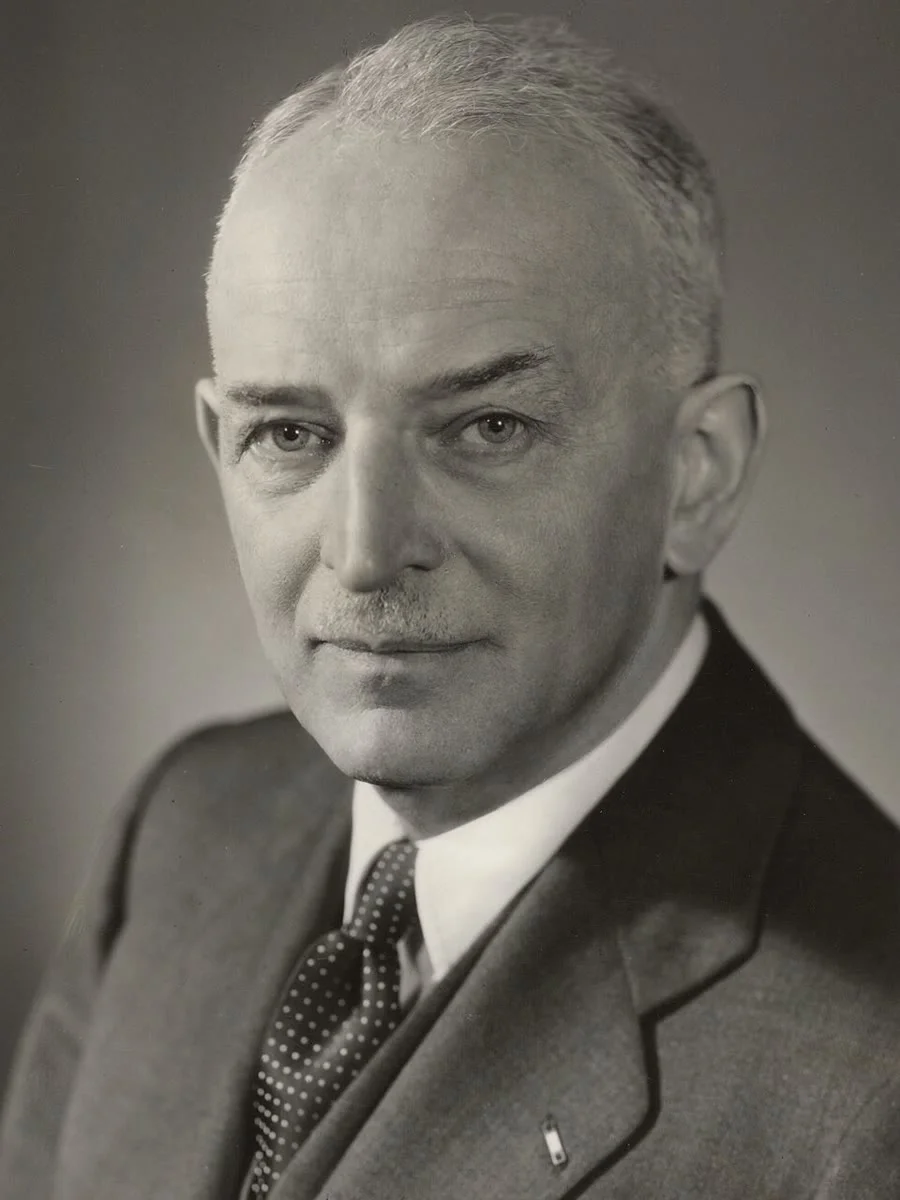
Georges Doriot
Institutional VC pioneer; ARD's patient DEC stake became the defining early power-law result.
SCOUT snapshot accessed 2026-07-26. Facts that remain disputed or inaccessible are stated as such.
Identity
- Full name: Georges Frederic Doriot. The Library of Congress uses the unaccented form; the Smithsonian records 24 September 1899–2 June 1987. Library of Congress · Smithsonian National Portrait Gallery
- Birth / death: born in Paris, France; died in Massachusetts. A contemporary TIME notice places his death in Boston. Library of Congress · TIME, 15 June 1987
- Nationality / geography: French-born, naturalized in Boston on 8 January 1940; career centered in Boston/Cambridge with institution-building in France. Library of Congress
- Education: studied at the University of Paris (1916–1920) and Harvard's Graduate School of Business Administration (1920–1921); Harvard records an M.A. in 1942. HBS separately labels him “MBA 1922,” so the exact degree chronology needs archival reconciliation. Library of Congress · HBS Entrepreneurship
Career and institutions
- Harvard Business School: professor from 1926 to 1966, interrupted by wartime service; roughly 7,000 students took his Manufacturing course. Library of Congress · HBS Baker Library introduction
- U.S. Army: officer from 1941 to 1947; directed equipment-and-supplies research and development and rose from lieutenant colonel to brigadier general. Library of Congress · U.S. Army official history
- American Research and Development Corporation (ARD): became president in 1946 and led the publicly funded investment company through its 1972 merger with Textron; he remained a director afterward and stepped down from active management in 1974. HBS Baker Library — ARD · HBS Baker Library — Financing New Ideas
- ARD capitalization: ARD targeted $5 million and had raised $3,581,750 by 10 February 1947, including $1.5 million committed by institutions. This is capital raised by the company, not a modern closed-end fund commitment. Hsu & Kenney, 2005
- International institution building: helped establish INSEAD, incorporated in 1957 and opened in 1959; Doriot also supported Canadian Enterprise Development Corporation and European Enterprise Development Company. INSEAD history · HBS Baker Library — Financing New Ideas
Leadership and board posts
- Chairman of the board, National Can Corporation, 1941–1942. Library of Congress
- President and investment leader, ARD, 1946–1972; post-merger director of ARD/Textron until at least 1974. HBS Baker Library — Financing New Ideas
- Director of Digital Equipment Corporation from 1972 until his death in 1987. Digital Equipment Corporation, Digital This Week, 15 June 1987
- President of the French Library in Boston from 1978 until 1987. French Library
Venture-era tags
- Era: 1946 · Pioneer
- Geography: US / France; institutional links to Canada and Europe
- Vehicle: publicly traded, SEC-regulated closed-end investment company
- Transparency: unusually rich archival record, but most ARD annual reports and Doriot papers require reading-room access
- Core research tension: Doriot promoted patient company building and social usefulness, yet ARD's public-company structure produced regulatory and compensation constraints that contributed to its demise. Hsu & Kenney, 2005
Notable companies for later DEALS verification
Digital Equipment Corporation, Circo Products, High Voltage Engineering, Tracerlab, Ionics, Baird Associates, Cordis, Transitron, and Textron Electronics. This is a research queue, not a claim that Doriot personally sourced or sat on every board. HBS Baker Library — ARD · HBS Baker Library — Financing New Ideas
SCOUT flags
- DEC's initial equity percentage is reported as 70%, 77%, or 80% by otherwise credible sources. The DEALS phase must reconstruct the capitalization from the 1957 proposal, ARD records, and contemporaneous DEC documents rather than select a convenient figure.
- DEC's registration became effective on 18 August 1966; the frequently repeated 1968 date refers to a later ARD secondary sale. Keep the IPO, secondary sale, and circa-1971 share distribution separate. SEC News Digest, 19 August 1966 · SEC News Digest, 29 August 1968
- Reported DEC return figures use incompatible dates and bases: approximately $38.5 million at the 1966 IPO, approximately $355 million around the 1971 distribution, and 500x/5,000x/5,071x gross comparisons against $70,000. None should be presented as audited net fund performance.
- “First venture capital firm” is definition-dependent: ARD's defensible distinction is institutional/public capital plus professional selection and active support, not the first risky private investment ever made.
- No comprehensive, source-backed list of Doriot's prewar corporate boards was found online; the Baker and Library of Congress papers are the best route.
Completed for T001.5 on 2026-07-26. This synthesis is built only from the completed note files, writings.md, talks.md, and investments.md. It distinguishes Doriot's direct words, witnesses' recollections, and later interpretation.
1. Snapshot
Georges F. Doriot (1899–1987) taught Manufacturing at Harvard Business School, led wartime research in the US Army Quartermaster Corps, and served as president of American Research and Development Corporation (ARD), one of the first modern institutional venture organizations (HBS ARD history). His superpower was not a single picking formula. It was an operating system that joined technical networks, whole-company judgment, patient active ownership, and the development of people.
The record is unusually easy to mythologize. Doriot led ARD, but ARD's staff, advisers, directors, bankers, and portfolio executives originated and managed deals; individual attribution is often missing (Hsu and Kenney). ARD's reported 14.7% compound return from 1946–1971 fell to 7.4% without DEC, versus a reported 12.8% for the DJIA, so the track record is power-law evidence rather than proof of uniformly superior selection (Hsu and Kenney, p. 599).
2. Core philosophy
Doriot's most consistent distinction is between construction and speculation. Harvard reproduces his description of investing as building people and companies, while excerpts from ARD's 1971 annual report warn that capital gains had become an objective instead of a reward for useful work (HBS, “Financing New Ideas”; 1971 excerpts). This is not hostility to returns. It is a causal sequence: create a useful product, capable people, and a durable company; let value follow.
The direct written record pairs that mission with selectivity. Harvard's archive-based exhibit quotes Doriot's preference for new work that ordinary banks could not finance and for specialized companies protected by patents and know-how (HBS ARD history; HBS, “Financing New Ideas”). Yet the deals show that mission alone did not save weak economics: Island Packers reportedly lost $239,000 of a $250,000 commitment after its catch-volume assumption failed (Nicholas, p. 232).
The practical synthesis is: finance work that deserves to exist, insist that it can become an enterprise, and take responsibility for developing it.
3. Sourcing
ARD's differentiated access began with institutional networks. MIT president Karl Compton brought High Voltage Engineering; MIT expertise populated ARD's technical advisory board; DEC emerged from MIT Lincoln Laboratory (Hsu and Kenney; HBS DEC history). Doriot's HBS classroom also became a talent and referral network: Perkins, Draper, and later investors describe the course as practical operator formation (Perkins oral history; Draper oral history).
The system was not predominantly a genius investor spotting cold inbound. In the Hsu–Kenney reconstruction, internally sourced share fell from about 40% to about 20%, investment banks and brokerages supplied 25%–50% of deals in each period, unsolicited proposals rarely produced investments, and the source was unknown for up to half the deals in some windows (Hsu and Kenney, p. 594).
Actionable rule: build a network where technical truth, operating talent, and capital meet; then record attribution instead of converting institutional access into a hero story.
4. Picking
People before polished plans
The accessible record consistently favors ability, integrity, resourcefulness, and trust. Perkins remembers student teams being asked why they would trust a chosen leader with money (Perkins oral history). Aulikki Olsen says Doriot interviewed the founders' wives separately, extending diligence beyond résumés while also imposing a period-specific and intrusive family lens (Aulikki Olsen oral history).
Newhall remembers a categorical preference for scientific backgrounds, followed later by Doriot acknowledging that the rejection may have been mistaken (Newhall oral history). The useful principle is technical literacy and revisable judgment—not degree worship.
Technical defensibility with commercial practicability
Harvard reproduces Doriot's view that patents and know-how could let specialized small firms compete with large ones (HBS, “Financing New Ideas”). Nicholas describes ARD filtering for commercial practicability, patent protection, and high profit potential (Nicholas, pp. 230–231). The company, not the invention, is the unit of analysis: Doriot's 1937 course integrated products and research with capital, labor, organization, production, and administrative control (HBS, “Educating Leaders”).
Selection is strict, but not static
ARD funded roughly 2% of 6,884 evaluated proposals and never more than 4% in a five-year period (Hsu and Kenney, Table 2). Its sector and stage mix evolved: 73% of investments were R&D-intensive under the authors' proxy, while early-stage share rose from 20.6% before 1961 to 57.1% afterward (Hsu and Kenney, Table 3). This was learning under competition, not an immutable 1946 thesis.
5. Deal and portfolio mechanics
ARD mixed instruments rather than using seed equity alone: Hsu and Kenney code 34.2% equity-only and 15.0% debt-only, leaving about half in mixed or other structures (Table 3). HBS reports DEC as $70,000 of equity plus a $30,000 loan, though credible sources disagree on whether initial equity ownership was 70%, 77%, or 78% (HBS DEC history; Nicholas).
The DEC proposal shows staged ambition: begin with digital test equipment and later attempt a general-purpose computer; Nicholas says ARD added financing after milestones (1957 proposal; Nicholas, p. 234). The repeatable mechanic is to finance a bounded first proof while preserving the path to a larger technical vision.
Portfolio construction was diversified in count but concentrated in outcome. Among 99 investments with coded results, 64.6% produced a gain, only eight of the full set went public, and acquisitions were important exits (Hsu and Kenney, Tables 3–4 and n. 15). DEC's reported 1971 value dominated the economics. That is a power-law portfolio, even though Doriot framed each company as constructive work rather than a lottery ticket.
6. Working with founders
The oral histories describe active ownership that tries not to steal agency. Ken Olsen remembers ARD staying with companies through success or failure and Doriot offering ideas in ways that let the recipient own them (Ken Olsen oral history). Aulikki Olsen saw a tension: independence was expected, yet protégés were also expected to seek counsel (Aulikki Olsen oral history).
ARD's operating support could be direct. At Flexible Tubing, it reportedly installed an employee as director, treasurer, and manager; Tracerlab founder William Barbour credited Doriot with pulling him out of operational detail (Nicholas, pp. 231–232; HBS ARD history).
This was not uniformly gentle founder-friendliness. Aulikki Olsen remembers Doriot as capable of public severity, and Newhall remembers categorical screening (Aulikki Olsen; Newhall). The model is demanding mentorship, with a real risk of paternalism and overreach.
7. Views on the craft
Returns follow useful work
The 1971 annual-report excerpts object to manufacturing gains instead of products; Doriot's direct sequence is company first, capital gain second (reproduced excerpts). Yet ARD's founders also knew the model had to produce attractive economics to diffuse. The reported return record confirms why: 7.4% without DEC would not have validated the experiment against the cited 12.8% DJIA result, while 14.7% with DEC did (Hsu and Kenney, p. 599).
Vehicle design is strategy
ARD's public closed-end form gave it institutional capital but exposed it to rules that constrained affiliate transactions and employee incentives. A direct Doriot statement preserved in a congressional hearing attributes ARD's end to the Investment Company Act, though his “sole reason” should be treated as his retrospective explanation rather than complete causal proof (House hearing, pp. 339–340). Draper also remembers declining an ARD West Coast role because authority would remain in Boston (Draper oral history).
Great venture practice therefore requires alignment among capital duration, incentives, geography, and decision rights. Philosophy cannot compensate indefinitely for a vehicle that loses talent or delays action.
8. Signature bets
Digital Equipment Corporation
DEC is the fullest expression of the method: technical founders, staged product ambition, patient ownership, and a power-law result. The SEC anchors the sequence at a 1966 registration, 1968 ARD secondary, and 1970 cap-table snapshot; the remaining stock was reportedly worth $355 million when distributed in 1971 (1966 SEC digest; 1968 digest; 1970 digest; Hsu and Kenney). The widely repeated $70,000-to-$355-million comparison is roughly 5,071x gross, not an audited net multiple or an IPO value.
High Voltage Engineering
Compton sourced the MIT accelerator company; ARD reportedly invested $200,000, worth $1.8 million at the 1955 IPO (Hsu and Kenney; Gompers). It shows scientific-network access and technical distinctiveness, but the approximate 9x comparison lacks follow-on and distribution detail.
Tracerlab
Tracerlab reportedly reached sales, profit, and an IPO quickly, while its founder credited Doriot's coaching (Nicholas; HBS ARD history). It is an operating-support case, not a quantified signature return.
Flexible Tubing
ARD embedded an operator and reportedly restored profitability within a year (Nicholas, p. 232). It demonstrates intervention, though the public record lacks amount and exit.
Island Packers
The bankrupt tuna venture is a signature negative case: a technically or socially appealing project still fails when physical throughput assumptions do not work (Nicholas, p. 232).
9. Mental models and maxims
- Constructive sequence: useful product and company first; gain as consequence (1971 excerpts).
- Whole-company lens: judge product, people, organization, production, and capital as one system (HBS, “Educating Leaders”).
- Able-person multiplier: prefer resourceful, trustworthy operators and develop their judgment (Perkins oral history).
- Protected-small-company wedge: patents and know-how can neutralize incumbent scale (HBS, “Financing New Ideas”).
- Staged technical ambition: fund a bounded proof that opens the larger product path (DEC proposal).
- Patient active ownership: stay engaged through difficulty without reflexively selling success (Ken Olsen oral history).
- Mentor without stealing agency: present counsel so the operator can own the decision (Ken Olsen oral history).
- Operating arithmetic before romance: test the constraint that can kill the venture, as Island Packers illustrates (Nicholas).
- Power-law honesty: evaluate portfolio results with and without the outlier (Hsu and Kenney).
- Vehicle–mission fit: ensure incentives and decision rights permit patient company-building (House hearing).
Each is expanded with origin, application, and counterexample in mental-models.md.
10. Evolution and contradictions
- 1937–1966: operator curriculum. The course framed manufacturing as integrated company analysis and executive responsibility (HBS, “Educating Leaders”).
- 1946–1960: institutional experiment and cautious early mix. Only 20.6% of investments were classified early-stage, even though ARD aimed to finance new enterprise (Hsu and Kenney).
- 1957–1971: DEC validates patience and concentration. The outlier transformed ARD's reported return and the industry's imagination, but obscures weaker performance elsewhere.
- 1961–1973: more early-stage, fewer coded gains. Early-stage share rose to 57.1% while gain frequency fell, amid greater competition and incentive problems (Hsu and Kenney, Table 3).
- 1971: anti-speculation warning. Doriot argued the expanding craft was converting capital gains from consequence to purpose (1971 excerpts).
- 1978: structural retrospective. He attributed ARD's termination to the Investment Company Act (House hearing).
The deepest contradiction is between autonomy and control. Witnesses remember advice that preserved operator ownership, but also severe judgment, family diligence, categorical rules, and Boston-centered authority (Aulikki Olsen; Draper). Doriot's practice was developmental and paternal, not modern founder-friendliness.
11. Critiques and failure modes
- Hero attribution: ARD deals are often credited to Doriot without evidence of personal sourcing or board work.
- Survivorship and DEC dominance: the non-DEC reported return lagged the cited public benchmark (Hsu and Kenney).
- Paternalism: family interviews, gendered assumptions, and categorical credential screens are era-bound practices, not portable maxims (Aulikki Olsen; Draper).
- Institutional rigidity: incentive restrictions, centralized authority, and succession problems weakened the organization even as its philosophy diffused (Hsu and Kenney).
- Mission can excuse weak economics: “noble” purpose is dangerous if it suppresses falsifiable operating assumptions; Island Packers is the warning.
- Quote-chain risk: many famous lines are remembered decades later or reproduced through editors. The archive-only 1966 reel, 1978/1980 interviews, and speech manuscripts remain necessary checks.
12. Go deeper — ranked sources
- Hsu and Kenney, “Organizing Venture Capital” — best portfolio and institution reconstruction.
- Ken Olsen Smithsonian oral history — best open firsthand account of patience and mentoring.
- DEC's May 1957 proposal — primary staged product plan.
- HBS “Financing New Ideas” — strongest accessible Doriot excerpts on construction and technical defensibility.
- ARD 1971 annual-report excerpts — late first-person critique; verify against the original.
- Nicholas, “Origins of High-Tech Venture Investing” — best readable early-deal narrative.
- Aulikki Olsen oral history — indispensable corrective on diligence, autonomy, and severity.
- Tom Perkins oral history — Manufacturing, trust, and operator substance.
- SEC's 1966, 1968, and 1970 DEC digests — primary chronology; follow the linked sequence in
investments.md. - 1979 House hearing, pp. 339–340 — Doriot's structural retrospective.
Completed for T001.4 on 2026-07-26. “ARD” means American Research and Development Corporation. Doriot led the institution, but a portfolio-company investment is not automatically a personally sourced Doriot deal. Dollar outcomes below are historical reported figures, not audited fund-return disclosures.
What the record can and cannot establish
ARD evaluated 6,884 proposals and funded 120 between 1946 and 1973 in Hsu and Kenney's reconstruction of annual reports, Doriot papers, and former-officer interviews; only about 2% of evaluated proposals were funded overall, and no five-year period exceeded 4% (Hsu and Kenney, Table 2). That dataset is the best portfolio-level reconstruction found, but its authors identify missing deal-source data, differing stage-classification sources, and only 99 observations with a coded gain outcome. It is not a complete audited cash-flow ledger.
Doriot was ARD's president and the organizing influence on its practice, while its staff, technical advisers, directors, bankers, and portfolio executives originated and managed individual investments (HBS ARD history). The public evidence does not name a sourcing partner for every deal. The table therefore uses “institutional lead” for Doriot where the evidence shows ARD leadership or board involvement but not personal origination.
Deal table
| Company | Year / stage | Capital and ownership | Role and discovery | Outcome / reported return | Evidence and investor interpretation |
|---|---|---|---|---|---|
| Circo Products | 1946 · established company / turnaround | ARD's initial commitment was reported as $150,000; the exact security terms need the original annual report. | Doriot was ARD's institutional lead; no public evidence found that he personally sourced Circo. | Contemporary TIME reported ARD's first investment produced a loss; later scholarship describes early operating losses, not a verified multiple. | Nicholas identifies Circo as one of ARD's first three commitments (CFA chapter, pp. 230–232); TIME is the contemporary loss source. |
| High Voltage Engineering | 1947 · startup | Reported $200,000 initial investment. | MIT president and ARD co-founder Karl Compton brought the opportunity; Doriot led ARD, but the reviewed sources do not isolate his personal underwriting or governance actions. | Reported $1.8 million value at the 1955 IPO, or about 9x gross on the initial amount before dilution, follow-ons, fees, and timing. | The company commercialized a one-million-volt Van de Graaff accelerator (Hsu and Kenney, p. 609); the amount and IPO value come from Gompers, p. 6. |
| Tracerlab | 1946–1947 · startup | Reported $150,000 initial investment; a 1957 SEC application later records ARD holding 60,005 shares, which is a later cap-table snapshot rather than the initial percentage. | MIT-linked opportunity and institutional ARD investment; the reviewed open sources do not establish personal origination by Doriot. | Sales reportedly reached $700,000 with $30,000 profit in 1948; its March 1948 IPO raised $1.3 million. No ARD multiple was found. | Operating and IPO figures are from the CFA chapter, p. 231; the later ownership and proposed transaction are primary in the 1957 Federal Register. |
| Flexible Tubing | 1948 · turnaround / growth | Amount and ownership were not established from the open sources reviewed. | Doriot assigned an unnamed former student and ARD employee to serve as director, treasurer, and manager. | The company reportedly became profitable within a year after securing large-customer supply contracts; no exit or multiple was found. | This is the clearest early example of operating intervention, but the accessible account is secondary (CFA chapter, p. 232). |
| Ionics | 1948 · early technology company | ARD had a controlling interest by early 1949; the initial amount and fully diluted percentage remain unverified. | HBS lists Ionics among ARD's prized companies; the reviewed open sources did not establish the introducer or Doriot's personal governance actions. | Credible accounts call it successful, but no verified ARD cash proceeds or multiple were found. | HBS identifies the water-purification focus (HBS ARD history); Nicholas documents that Ionics was among 13 controlled holdings by early 1949 (CFA chapter, p. 232). |
| Baird Associates | 1947 · growth-stage scientific instruments | The reviewed primary 1953 application records ARD ownership and a recapitalization, but this run does not infer an initial percentage from the later transaction. | Institutional ARD deal; HBS identifies Baird as a prized portfolio company but does not attribute sourcing to Doriot personally. | Sales reportedly grew significantly after 1947; no exit value or multiple was found. | The transaction and ownership evidence are in the 1953 Federal Register; operating outcome is summarized in the CFA chapter, p. 232. |
| Island Packers | 1948 · venture / co-investment | Reported $250,000 ARD investment alongside Laurance Rockefeller. | Co-investment; personal Doriot origination was not established. | Bankruptcy after the tuna venture could not catch enough fish; reported $239,000 ARD write-off, about 96% of the stated investment. | Co-investment is documented in the annual-report reconstruction (Hsu and Kenney, p. 594 n. 11); the loss is reported in the CFA chapter, p. 232. |
| Airborne Instruments Laboratory | 1950 · acquisition / growth | Amount and ownership were not established. | ARD joined Laurance Rockefeller in the purchase; no personal Doriot sourcing evidence found. | Public evidence reviewed did not establish an ARD outcome. | The co-purchase is reported from contemporaneous Wall Street Journal coverage in Hsu and Kenney, p. 594 n. 11. |
| Digital Equipment Corporation | 1957 · seed | HBS reports $70,000 equity for 70% plus a $30,000 loan; other credible reconstructions report 77% or 78%, so the initial basis remains contested. | The public record shows team effort: Ken Olsen and Harlan Anderson submitted the proposal; ARD staff coached it; Doriot led ARD and the relationship. Gompers credits ARD associate Bill Congleton with initiating the investment, so “Doriot personally sourced DEC” is not established. | DEC registered in 1966; ARD made a 1968 secondary sale; the remaining stock was reportedly worth $355 million when distributed in 1971. The $70,000-to-$355-million comparison is about 5,071x gross, not an audited net multiple and not IPO proceeds. | Primary product plan: May 1957 DEC proposal. Financing account: HBS DEC history. Chronology: 1966 SEC digest, 1968 SEC digest, and 1970 SEC digest. Distribution value: Hsu and Kenney, p. 599. |
This table is deliberately narrower than a portfolio list. HBS also names Cleveland Pneumatic Tool and Snyder Chemical among early controlled holdings, while the full scholarly dataset contains 120 investments; open evidence was not sufficient to report role, security, and outcome consistently for every company (CFA chapter, p. 232).
Signature wins
1. Digital Equipment Corporation — the power-law proof, with three different value dates
Olsen and Anderson's May 1957 proposal proposed selling digital test equipment before attempting a general-purpose computer. That staged product plan matters: the company did not ask investors to finance the final vision in one leap. HBS reports that ARD provided $70,000 in equity and a separate $30,000 loan, then refused acquisition approaches as the company grew (HBS DEC history).
The return story must preserve chronology:
- The SEC recorded DEC's registration as effective August 18, 1966 (SEC News Digest, August 19, 1966).
- In August 1968, ARD owned 1,750,000 of 2,296,600 outstanding shares and received permission to sell 215,000 shares; this was a secondary sale, not the IPO (SEC News Digest, August 29, 1968).
- By September 1970, after share-count changes, the SEC reported ARD at 48% of 9,675,132 shares and Ken Olsen at 10% (SEC News Digest, September 16, 1970).
- Hsu and Kenney, citing Liles and Doriot, report a $355 million gain/value when the remaining DEC stock was distributed in 1971 (Hsu and Kenney, p. 599).
Consequently, “$70,000 became $355 million” is a reported gross comparison across fourteen years. It is not the IPO value, does not include the separate loan or later financing, and does not reveal the cash timing needed for an investment-level IRR. The lesson is power-law concentration and patient support, not a clean audited 5,071x.
2. High Voltage Engineering — technical network plus an early liquidity proof
MIT president Karl Compton brought ARD the accelerator company, showing that early deal flow depended on technical institutions rather than only inbound applications (Hsu and Kenney, p. 609). Gompers reports that the $200,000 commitment was worth $1.8 million at the 1955 IPO (Gompers, p. 6). The approximate 9x gross comparison is meaningful but incomplete without dilution, follow-ons, distributions, and dates.
High Voltage also illustrates ARD's preference for technically defensible work that could be commercially unique. Hsu and Kenney classify 73% of ARD's lifetime investments as R&D-intensive and find that this classification was positively associated with a gain in their limited sample (Hsu and Kenney, Tables 3–4).
3. Tracerlab — governance mattered before a spectacular multiple existed
Tracerlab is a modest success rather than a power-law result. It reportedly reached $700,000 in sales and $30,000 in profit in 1948, then raised $1.3 million in a March IPO (CFA chapter, p. 231). HBS preserves founder William Barbour's account that Doriot helped him escape operational detail and return to long-range work (HBS ARD history). Because the board representatives identified publicly were Compton and Griswold, the evidence supports Doriot's coaching influence but not sole deal ownership.
4. Flexible Tubing — intervention as part of the investment
ARD placed an employee into three operating roles at a struggling manufacturer, which reportedly became profitable within a year after winning supply contracts (CFA chapter, p. 232). This is stronger evidence for active company-building than for financial performance: the open record provides no investment amount, exit, or multiple.
5. Ionics — a scientifically disputed bet with incomplete economics
Ionics appears in HBS's archive-based list of prized ARD companies, and Doriot served on its board (HBS ARD history). Later accounts describe outside technical skepticism of its water-purification membranes, but no primary diligence memo or verified ARD outcome was accessible. It is a signature example of technical contrarianism only with that limitation—not a quantified return case.
Misses and anti-portfolio
Realized failures
- Circo Products: contemporary TIME says ARD lost money on its first investment (TIME, 1962). The original investment instrument and final cash loss still need annual-report verification.
- Island Packers: the $250,000 co-investment ended in bankruptcy and a reported $239,000 write-off after the operating assumption about catch volume failed (CFA chapter, p. 232). This is a concrete diligence failure around a physical operating constraint.
- Portfolio loss rate: among 99 investments with coded outcomes, Hsu and Kenney report 64.6% produced a gain, implying 35.4% did not; the binary measure ignores magnitude and is incomplete for 21 of the 120 investments (Hsu and Kenney, Table 3).
Passes
TIME reported in 1962 that ARD failed to see much future in Ampex and Varian Associates, both of which later became important technology companies (TIME, 1962). The article does not disclose the proposed terms, stage, ARD decision-maker, or whether ARD formally rejected a financeable proposal. These are anti-portfolio leads, not fully reconstructed “missed returns.”
Institutional miss
ARD's later problem was not merely selecting the wrong companies. Hsu and Kenney report that the share of early-stage investments increased from 20.6% in 1946–1960 to 57.1% in 1961–1973, while the coded gain rate fell from 74.1% to 53.3% and R&D-intensive share declined (Hsu and Kenney, Table 3). They connect the deterioration to competition, sourcing, staff incentives, and ARD's public-company form rather than proving a single causal mechanism.
The clearest attribution failure would be to call every ARD investment a Doriot-sourced deal. Investment banks and brokerages supplied 25%–50% of deals in each period, internally sourced share fell, and the authors could not identify the source of up to half the deals in some five-year windows (Hsu and Kenney, p. 594).
Fund-level performance and portfolio mechanics
| Measure | Reported result | Interpretation |
|---|---|---|
| Initial capital | $3.5 million raised against a $5 million goal | Public closed-end vehicle; figure from Nicholas. |
| Proposals / investments | 6,884 evaluated; 120 funded | Roughly 2% selection rate in the Hsu–Kenney reconstruction. |
| R&D intensity | 73.3% of 120 | Sector-based proxy, not a direct measure of technical defensibility (Table 3). |
| Early stage | 34.9% overall; 20.6% early period; 57.1% later period | Stage definitions differ before and after 1966; treat trend as estimated (Table 3 and note 13). |
| Gain frequency | 64.6% of 99 coded outcomes | Binary gain after acquisition cost; not multiple or IRR (Tables 3–4). |
| IPO count | Eight | Acquisitions were an important exit route; count from Hsu and Kenney, p. 600 n. 15. |
| 1946–1971 compound return without DEC | Reported 7.4% | Liles estimate relayed by Hsu/Kenney; below their reported 12.8% DJIA comparison. Not a modern net-fund IRR. |
| 1946–1971 compound return with DEC | Reported 14.7% | Same secondary chain; DEC reverses the benchmark comparison and demonstrates concentration (Hsu and Kenney, p. 599). |
| DEC at 1971 distribution | Reported $355 million from $70,000 initial equity | Approximate 5,071x gross comparison; excludes the separate reported loan, follow-ons, dilution, secondary-sale cash, and timing. |
The power-law conclusion is supported, but it should be stated precisely: the reported portfolio return beat the cited public-market comparison only when DEC was included. Without DEC, reported compound performance lagged it. That is stronger evidence for outlier dependence than for consistent superior selection.
ARD's securities also mixed equity-only, debt-only, and combinations: Hsu and Kenney code 34.2% equity-only and 15.0% debt-only, leaving roughly half in mixed or other structures (Table 3). The modern shorthand “seed equity portfolio” erases that early risk-capital model.
Lessons grounded in the deals
- Stage the technical vision. DEC proposed test equipment before a general-purpose computer and received additional financing after milestones (proposal; Nicholas).
- Technical networks generated differentiated access. MIT leaders and researchers recur in High Voltage, Tracerlab, and DEC, while unsolicited proposals rarely produced investments (Hsu and Kenney).
- Governance was part of the product. Tracerlab coaching, Flexible Tubing's embedded operator, and DEC's long holding period show post-investment work beyond financing (HBS ARD history).
- Mission did not eliminate economics. Island Packers shows that a venture still fails on operating arithmetic; the non-DEC return shows that noble intent did not reliably generate benchmark-beating performance.
- One outlier can validate—and conceal weaknesses in—an institution. DEC lifted the reported compound return from 7.4% to 14.7% while ARD's structure struggled to retain investment professionals (Hsu and Kenney).
Unresolved evidence requests
- Retrieve ARD's complete annual-report run and transaction ledgers to replace reported values with dated cash flows, follow-ons, dividends, write-offs, and distributions.
- Reconstruct DEC's fully diluted cap table from formation through the 1966 registration, 1968 secondary, splits, and 1971 distribution.
- Obtain investment memoranda and board minutes for Circo, High Voltage, Tracerlab, Ionics, Baird, Flexible Tubing, Ampex, and Varian.
- Separate who sourced, underwrote, sat on the board, and made the final decision for each ARD investment; do not assign team work to Doriot by default.
WRITINGS synthesis completed 2026-07-26 from the note files in notes/. The central HBS course scans are currently unavailable; this document distinguishes direct text, reproduced excerpts, and metadata-only records.
Evidence boundary
Doriot left a large written record, but most of the decisive material is in Baker Library rather than reliably accessible online. The legacy HBS links for his course notes now return 404, and their indexed Wayback snapshots could not be retrieved during this run. Notes were still created for each priority item, with exact catalog locations where available, but no arguments were inferred from titles alone. The usable online corpus is therefore a mixture of a full translated book, Harvard course-description and exhibit transcriptions, a partial edited sourcebook, a reproduced 1971 annual-report introduction, and a short 1978 interview excerpt preserved in a congressional record. HBS digital archival resources · Doriot papers finding aid
Recurring themes
1. Enterprise is constructive work, not financial manufacture
The clearest continuity runs from Doriot's teaching into his late-career criticism of venture capital. Harvard's exhibit reproduces his description of the investor's job as building people and companies, not speculating. HBS, “Financing New Ideas” In the 1971 ARD annual-report introduction, reproduced by Udayan Gupta, Doriot argued that capital gains had become an objective instead of a reward for useful work and that “manufacturing” gains was displacing manufacturing products. 1971 annual-report excerpts
This is not an anti-profit position. It is a sequencing rule: make a useful institution and product first; treat financial gain as the consequence of the constructive task. The accessible excerpts do not define acceptable holding periods, prices, or exits, so those mechanics remain for the DEALS phase. 1971 annual-report excerpts
2. Study the whole company from the operator's seat
Harvard's 1937 register describes Manufacturing as an integrated study of company analysis and administrative control. Students were to examine decisions from the perspective of the person who must make and execute them, while also understanding the viewpoints of bankers and consultants. Products, new ideas, development, and research sat beside capital, materials, labor, organization, and production control. HBS course register and exhibit transcription
The written curriculum therefore resists reducing a company to either its technology or its financing. Doriot's teaching frame was operator-centered and multi-stakeholder: understand the productive system, then judge how capital and advisers can help it. HBS, “Educating Leaders”
3. Character and judgment are operating capabilities
The accessible Harvard excerpts present leadership as a practice of observation, self-knowledge, responsibility, and constructive contribution. Doriot told students to make maximum use of both their assets and liabilities and framed an HBS education as carrying superior responsibilities as businesspeople and citizens. HBS, “Educating Leaders”
The partial preview of The First Venture Capitalist reinforces that pattern: teaching by example, developing others' judgment, and using a personal notebook as a mirror for one's thinking. It also reproduces the proposition that each investment opportunity should be considered separately. Because the sourcebook is edited and its underlying documents are not always visible in preview, these passages are strong leads rather than fully traced primary citations. Google Books preview · publisher description
The inaccessible items titled “How to Manage — Lead — Command,” “Decision Making,” the 1961 orientation class, and the 1966 closing class are precisely the documents most likely to sharpen this theme. Until their text is retrieved, the record supports a broad emphasis on character and judgment but not a detailed Doriot decision algorithm. HBS digital archival resources
4. Technical specialization can create an asymmetric opening
Harvard reproduces a 1961 Doriot speech arguing that patents and know-how can let specialized small companies compete with large organizations. HBS, “Financing New Ideas” This is the most specific accessible picking signal in the written record: seek technically protected areas where scale is not yet decisive.
The signal is narrower than a generic “invest in technology” slogan. It combines technical specialization, defensibility, and a competitive-structure claim. The original “Creative Capital” manuscript and the inaccessible 1965 “R and D” notes are needed to determine how Doriot evaluated technical novelty, market readiness, and research risk. HBS, “Financing New Ideas” · Baker Doriot papers
5. Structure can defeat philosophy
In a statement preserved in a 1979 congressional hearing record, Doriot said he terminated ARD because it could not exist under the Investment Company Act of 1940. The statement is direct but comes through an interview, a legal memorandum, and then the official hearing record. House hearing record, printed p. 339 n. 12
The writing supplies an institutional-design lesson: patient company-building requires a vehicle whose regulation and compensation rules can retain investors and operators. Doriot's “sole reason” wording records his stated rationale; it does not by itself prove that ARD's merger had no other causes. House hearing record, printed pp. 339–340
Evolution of the written record
- 1928 — intellectual context, not doctrine. Doriot co-translated Henri Sée's Modern Capitalism. The full text treats capitalism as a historically evolving combination of commercial, financial, and industrial systems, but Sée authored the argument. Doriot's translation role is evidence of exposure, not proof that he adopted every proposition. Google Books
- 1937–1966 — the company-building curriculum. The course register and later Harvard excerpts show a shift toward integrated company analysis, executive judgment, innovation, character, and civic responsibility. Most of the exact course texts remain retrieval targets. HBS, “Educating Leaders” · HBS digital archival resources
- 1961–1967 — creative capital. Accessible excerpts connect technical defensibility with small-company opportunity and contrast construction with speculation. HBS, “Financing New Ideas”
- 1971 — warning against speculative drift. Doriot's annual-report introduction says the expanding industry was forgetting the constructive task and promoting gains from outcome to goal. Reproduced annual-report introduction
- 1978 — structural retrospective. His surviving interview excerpt attributes ARD's loss of independence to the 1940 Act, moving the written emphasis from how to build companies to whether the investment vehicle permits that work. House hearing record
Five best pieces to read first
- ARD 1971 annual-report introduction — the clearest accessible first-person contrast between constructive venture work and speculation, though only reproduced excerpts are online. Read the reproduction
- The First Venture Capitalist — the broadest edited collection of Doriot-attributed material on leadership, capital, research, and organization; use the full edition and trace each passage to its origin. Publisher
- 1937 HBS course register — a compact map of the operator-centered curriculum from which Doriot's later investment method grew. Harvard exhibit transcription
- 1978 Doriot interview excerpt — narrow but direct evidence that investment-vehicle structure was central to his explanation of ARD's end. House hearing record
- 1966 closing statement to the Manufacturing class — probably the highest-value unread primary item because it closes four decades of teaching; the online scan is unavailable, so request Baker volume 126, item 35. Baker finding aid
Open questions and retrieval queue
- Retrieve the 1966 closing statement, 1961 orientation, “How to Manage — Lead — Command,” “Decision Making,” “What Is a Company?”, and “R and D” from Baker Library; do not rely on their dead legacy links.
- Obtain the original 1971 ARD annual report to verify the reproduced wording, punctuation, authorship, and omitted context.
- Locate Paul Dykstra's full 1978 interview transcript and test whether Doriot qualified the “sole reason” explanation.
- Trace each useful passage in The First Venture Capitalist to its original document and date.
- Determine whether Doriot ever cited Sée's framework after translating Modern Capitalism; absent that link, keep it as intellectual context only.
Completed for T001.3 on 2026-07-26. This synthesis separates authenticated Doriot recordings and manuscripts from eyewitness recollections and modern retellings. A catalog record proves that an item exists; it does not prove what the inaccessible item says.
Evidence and access boundary
The public record is rich in testimony about Doriot but poor in publicly playable Doriot audio. Harvard catalogs a March 1, 1966 classroom reel, a 17-page 1980 interview transcript, and a 21-minute 1988 documentary, while the Computer History Museum catalogs a 1978 interview transcript and birthday/documentary production reels. None was publicly readable or streamable during this run. They are retrieval targets, not evidence for a paraphrase or quotation.
Four cataloged speech manuscripts are similarly archive-only: “Investing in New Areas of Science”, “Venture Capital”, “Launching New Products vs. Launching a New Company”, and “The Role of the Entrepreneur”. Their titles help prioritize retrieval but cannot bear claims about Doriot's frameworks.
The strongest open evidence is therefore firsthand recollection: approved oral histories with Aulikki Olsen, Ken Olsen, Tom Perkins, William Draper III, and Charles Newhall. These witnesses knew Doriot, but they spoke years later and sometimes quote him from memory. Modern podcasts by Spencer Ante, Margaret O'Mara, and David Senra are useful syntheses, not substitutes for ARD filings, board records, or Doriot's own papers.
Recurring stories
Venture capital is mentorship plus money
Margaret O'Mara describes high-technology venture capital as money combined with mentorship and expertise in the timestamped “Venture Capital Built Silicon Valley” transcript. The firsthand record supports that distinction. Ken Olsen remembers Doriot as “always there as a mentor and for help” in the Smithsonian oral history. Perkins calls Doriot his second mentor and recalls Manufacturing as practical formation in making, selling, and satisfying customers in his Bancroft Library oral history. Draper remembers advice to keep alert to opportunity and then acquire operating experience in his Computer History Museum oral history.
The recurring model is not passive friendliness. Aulikki Olsen remembers whole-family diligence, explicit boundaries between family and company, and a mentor who could be both kind and severe in her approved oral-history transcript. Newhall remembers being rejected for lacking scientific training, then receiving a later acknowledgment that the judgment may have been wrong in his CHM oral history. Mentorship included screening, challenge, correction, and revision.
Build enduring companies, not quick trades
Ken Olsen supplies the clearest eyewitness account of the time horizon. He says ARD stayed with companies through success or failure and remembers Doriot warning that unusually early success could endanger survival in the Smithsonian transcript. Spencer Ante summarizes the same orientation as patient company-building rather than speculation at 22:34–25:38 of the Libertarianism.org transcript. The official notes for Founders #203 repeat the line, “I am building men and companies,” but that quotation remains a secondary chain until traced to Doriot's original document.
This theme is stronger than a slogan because witnesses describe operating mechanisms: patient ownership, advice presented without stealing the operator's agency, experiential student projects, and attention to the company's ability to survive. It is also incomplete without the harder edge recorded by Olsen and Newhall: Doriot could be categorical about people, background, and board rules.
Teaching, wartime R&D, and investing formed one operating system
Ante links Doriot's wartime responsibility for research, manufacturing, and product development to his later investment practice in the 2020 podcast transcript. Perkins and Draper describe the peacetime teaching version: teams selected leaders, divided work, studied real companies or industries, generated ideas repeatedly, and were asked why they trusted particular people (Perkins; Draper).
The combined evidence suggests a consistent practice: learn through consequential work, judge the people doing it, and make the organization stronger through feedback. That is an inference across witnesses, not a recovered Doriot checklist. The inaccessible 1966 class recording is the best test of whether the remembered method matches Doriot's actual classroom language.
Institutional design determines behavior
The open talks also explain why Doriot's philosophy cannot be reduced to founder coaching. Ante describes ARD's disputes with the SEC over valuations and stock options, then connects later limited-partnership structures to stronger talent incentives in the 2020 transcript. Draper recalls declining an ARD West Coast role because Boston would retain decisions while he only sourced opportunities in his oral history. His account exposes a centralization problem inside the pioneering vehicle.
The recurring lesson is two-sided: Doriot helped institutionalize patient, expert venture investing, yet ARD's public-company structure and centralized authority constrained incentives and geographic expansion. These retrospective judgments need testing against ARD records in the DEALS phase.
Repeated frameworks
- Construct, do not speculate. The consistent distinction is productive company-building versus trading in financial claims. It appears in Ante's summary, the Founders show notes, and Perkins's recollection of making, selling, and satisfying customers.
- Back and develop people. Technical literacy, integrity, judgment, resourcefulness, and the ability to earn trust recur more often than a fixed market-size formula (Newhall; Perkins).
- Use patient, active ownership. Ken Olsen remembers support continuing through success or failure rather than a reflexive sale (Smithsonian).
- Preserve operator agency while remaining available. Ken and Aulikki Olsen both describe independence combined with access to advice, though Aulikki explicitly limits her knowledge of the business relationship (Aulikki Olsen).
- Create strength below the leader. The Founders notes emphasize intergenerational teams and capability beneath the founder; the student-team recollections show an early teaching analogue (Founders #203).
- Match authority to responsibility. Draper's account of a West Coast office without decision rights shows the failure mode when this principle was not met.
Claims said once, contested, or easy to overstate
- The DEC value chronology is often misstated. Ante says the $70,000 investment exceeded $400 million “when Digital went public”; Founders repeats a more-than-$400-million outcome without a measurement date. SEC records establish that DEC's registration became effective on August 18, 1966, while the much larger value normally refers to a later ARD distribution. The podcasts should not be used for IPO value or realized-return timing.
- Initial ownership and financing bases vary. Oral histories and later summaries use $70,000, while broader accounts sometimes add a separate loan or report stakes around 70%, 77%, 78%, or 80%. Each figure needs a dated cap table and transaction definition.
- “First venture capitalist” is definitional. Perkins carefully says first US high-technology venture capitalist “of the new mold”; Stanford and Ante emphasize institutional form. Earlier risk capital existed, so the defensible claim concerns a particular postwar institutional model, not the first risky investment.
- Memorable quotations are often remembered, not recorded. The Olsen, Perkins, Draper, and Newhall transcripts preserve valuable firsthand testimony, but their Doriot quotations are recollections decades after the events. The Founders quotation adds another layer through a biography and podcast.
- Mentorship had a severe side. Aulikki Olsen's account of favored and disfavored people and Newhall's remembered technical-degree screen complicate a purely nurturing canon. These are important counter-signals, not grounds for universalizing one anecdote.
Ranked listen/read-first list
- Ken Olsen oral history — best open firsthand account of patience, survival, mentoring style, and the DEC relationship.
- Aulikki Olsen oral history — strongest corrective on whole-person diligence, family boundaries, autonomy, loyalty, and severity.
- Tom Perkins oral history — clearest description of Manufacturing as operator formation and trust-based leadership training.
- Venture Capital Built Silicon Valley — best open, timestamped secondary synthesis; use its institutional history but reject its compressed DEC value chronology.
- 1966 class recording — highest-value archival retrieval because it can replace remembered classroom language with authenticated Doriot audio.
Retrieval queue
Request the 1966 class reel and the 1980 Doriot interview from Baker Library first, then the 1978 interview and production reels from CHM. Retrieve the four speech manuscripts as one archival batch. For each item, preserve exact page or timestamp anchors, identify whether Doriot approved the transcript, and distinguish prepared remarks from audience questions or editorial narration.
Completed for T001.5 on 2026-07-26. Direct quotations are labeled separately from remembered Doriot speech and later summaries. A remembered line is evidence about a witness's experience, not a stenographic transcript.
1. Constructive sequence
Statement: Build a useful product, capable people, and a durable company before treating financial gain as the objective.
Origin: Doriot's 1971 ARD introduction warned that the industry was “manufacturing capital gains” rather than manufacturing products (reproduced annual-report excerpts).
When it applies: Use it to test incentives, board discussions, and exit pressure: is the proposed action strengthening the productive enterprise or merely improving a near-term mark?
Counterexample / limit: A useful company still needs economic discipline. Island Packers' reported $239,000 write-off shows that mission does not repair a fatal operating assumption (Nicholas, p. 232).
2. Whole-company lens
Statement: Evaluate technology, product, organization, production, people, capital, and control as one operating system.
Origin: The 1937 Manufacturing course description joined products and research with “capital, materials, labor, organization and production control” (HBS exhibit transcription).
When it applies: Use it when a technically impressive pitch treats commercialization, hiring, or production as somebody else's problem.
Counterexample / limit: An integrated lens can become diffuse. Assign explicit owners and falsifiable milestones rather than conducting endless holistic analysis.
3. Able-person multiplier
Statement: An operator's judgment, integrity, resourcefulness, and ability to earn trust can multiply an imperfect idea.
Origin: Perkins remembers Doriot asking why the students chose the person they “would trust your money with” (Perkins oral history, transcript p. 6).
When it applies: Use it in founder references, leadership succession, and moments when the plan must change but the team must keep learning.
Counterexample / limit: Person-first investing can become charisma bias. Newhall's remembered rejection of an English major shows how a human heuristic can harden into a crude credential screen (Newhall oral history, p. 19).
4. Protected-small-company wedge
Statement: A specialized small company can neutralize incumbent scale when patents and know-how protect a valuable technical wedge.
Origin: Harvard reproduces Doriot's argument that “patents and know-how” could let small specialized companies compete with large organizations (HBS, “Financing New Ideas”).
When it applies: Use it where technical knowledge is difficult to reproduce, the initial market values performance, and a small team can reach customers before incumbents mobilize.
Counterexample / limit: Protection without a commercially practicable product is not a business. ARD's own filters reportedly included commercial practicability and high profit potential, not patents alone (Nicholas, pp. 230–231).
5. Staged technical ambition
Statement: Finance a bounded first proof that creates information and preserves the route to a much larger vision.
Origin: DEC's proposal began with digital test equipment and positioned a general-purpose computer as the next phase (May 1957 proposal).
When it applies: Use it when the final product requires too much capital or technical risk to fund in one step; define a first product that has its own customers and de-risks the platform.
Counterexample / limit: A small first product can become a local optimum. The milestone must test the core technical or commercial thesis, not merely generate unrelated revenue.
6. Patient active ownership
Statement: Stay with a company through difficulty and success while actively helping it become stronger.
Origin: Ken Olsen remembers that ARD would “work with, the company until they were successful, or until they failed” (Smithsonian oral history).
When it applies: Use it when the underlying thesis remains valid but development, hiring, or commercialization takes longer than expected.
Counterexample / limit: Patience without an explicit kill test becomes denial. Doriot's “family” framing must not prevent recognizing when the thesis is falsified.
7. Mentor without stealing agency
Statement: Offer experienced counsel in a form the operator can understand, adapt, and own.
Origin: Ken Olsen says Doriot “was always there as a mentor and for help” and usually presented ideas without demanding credit (Smithsonian oral history).
When it applies: Use it in board work, founder coaching, and succession development where durable judgment matters more than winning one decision.
Counterexample / limit: Aulikki Olsen remembers the tension between independence and being expected to seek Doriot's advice; mentorship can become dependency or paternal control (oral history, p. 9).
8. Operating-constraint kill test
Statement: Identify the physical, technical, regulatory, or unit-economic constraint that can make every other strength irrelevant.
Origin: Island Packers reportedly went bankrupt because it could not catch enough fish to sustain the business, producing a $239,000 write-off on ARD's $250,000 commitment (Nicholas, p. 232).
When it applies: Use it before investment and at each follow-on: name the one assumption whose failure would destroy the model, then test it directly.
Counterexample / limit: Not every uncertainty is a kill constraint. Overweighting one measurable risk can blind the investor to adaptive founders or alternative markets.
9. Power-law honesty
Statement: Judge a venture portfolio both with and without its largest outlier.
Origin: Liles's reported ARD return is 14.7% with DEC and 7.4% without it, versus a cited 12.8% DJIA compound return (Hsu and Kenney, p. 599).
When it applies: Use it in fund attribution, reserve planning, and performance review to distinguish the success of the portfolio construction from repeatable company selection.
Counterexample / limit: Removing the outlier is diagnostic, not a claim that it does not count. Venture portfolios are built to own rare extreme outcomes; the honest analysis reports both.
10. Vehicle–mission fit
Statement: Capital duration, incentives, governance, and decision rights must support the investment behavior the strategy requires.
Origin: Doriot later said ARD “could not exist under the 1940 Act,” a direct statement preserved through an interview and congressional hearing record (House hearing, printed pp. 339–340).
When it applies: Use it when choosing fund structure, compensation, geography, and delegation: can the vehicle retain talent, act quickly, and remain patient?
Counterexample / limit: Regulation was not necessarily the sole cause of ARD's decline. Competition, centralized authority, succession, and Doriot's own management choices also appear in the scholarly account (Hsu and Kenney).
Compact decision checklist
Before investing:
- What useful enterprise is being constructed?
- Why is this operator trustworthy, adaptive, and technically credible?
- What protects the small company's wedge?
- What bounded first proof unlocks the larger vision?
- Which operating constraint can kill the thesis?
After investing:
- Is the company becoming stronger, or only better marked?
- Does counsel increase founder judgment or replace it?
- Is patience still thesis-based?
- Does this result survive portfolio analysis without the outlier?
- Does the vehicle permit the behavior the mission requires?
T001.6 completed 2026-07-26. Scope: citation support, link resolution, deal attribution, return chronology, quote integrity, access honesty, and cross-investor handoff.
Result
Pass after corrections. The core thesis survives: Doriot's repeatable contribution was a company-building system, while DEC supplied the economic outlier. Three unsupported board-role details were removed, one partner-attribution citation was made local to the claim, two unsupported SCOUT-stage company leads were removed, and the index description was narrowed.
Citation reopenings
| # | Claim tested | Source reopened | Support result |
|---|---|---|---|
| 1 | Doriot became ARD president in 1946; ARD combined financial resources and managerial support. | HBS ARD exhibit | Pass. The exhibit states the role, year, and institutional model. |
| 2 | HBS reports DEC financing as $70,000 equity for 70% plus a $30,000 loan. | HBS DEC exhibit | Pass. Exact amounts and percentage appear together; competing 77% and 78% accounts remain disclosed. |
| 3 | ARD evaluated 6,884 projects, funded 120, and had reported compound returns of 7.4% without DEC and 14.7% with it. | Hsu and Kenney | Pass. Table 2 supports counts; the profitability section reports the return chain and 12.8% DJIA comparison. |
| 4 | Island Packers produced a reported $239,000 write-off on a $250,000 investment. | Nicholas, p. 232 | Pass. Amount, bankruptcy, and failed catch-volume assumption are all present. |
| 5 | DEC's registration became effective August 18, 1966. | SEC News Digest, August 19, 1966 | Pass. The effective-registration list names DEC and File 2-25291. |
| 6 | The 1968 event was an ARD secondary: permission to sell 215,000 shares while owning 1,750,000 of 2,296,600. | SEC News Digest, August 29, 1968 | Pass. All figures appear in the exemption-order notice. |
| 7 | In 1970, ARD held 48% and Ken Olsen 10% of 9,675,132 DEC shares. | SEC News Digest, September 16, 1970 | Pass. The offering notice supplies the share count and both percentages. |
| 8 | DEC proposed test equipment before a general-purpose computer. | May 1957 proposal | Pass. The scan supports the phased product plan; OCR is poor, so no quotation was used. |
| 9 | Perkins remembered leader selection as a test of who students would trust with money. | Perkins oral history, transcript p. 6 | Pass. The quote and context were checked in the transcript. |
| 10 | Aulikki Olsen remembered separate spouse interviews and a tension between independence and seeking advice. | Aulikki Olsen oral history, transcript pp. 5 and 9 | Pass. Both passages were checked; her explicit limits on business knowledge remain in the note. |
| 11 | Doriot said ARD could not exist under the 1940 Act and called that the sole reason it was no longer independent. | House hearing, printed pp. 339–340 | Pass with chain caveat. The official record quotes a November 9, 1978 Paul Dykstra interview; the synthesis treats it as Doriot's explanation, not complete causal proof. |
Five deal-attribution cross-checks
| Deal | Independent checks | Review conclusion |
|---|---|---|
| DEC | Original proposal, HBS exhibit, Gompers, and three SEC digests | ARD deal and Doriot relationship confirmed; personal sourcing is not. Gompers credits Bill Congleton with initiating it. |
| High Voltage Engineering | Hsu–Kenney, Gompers, and Nicholas | ARD amount, Compton sourcing, and reported IPO value triangulate; unsupported personal board-action wording was removed. |
| Tracerlab | HBS ARD exhibit, Nicholas, and 1957 Federal Register | ARD investment, early operating results, and later ownership are supported; unsupported board-representative wording was removed. |
| Baird Associates | HBS ARD exhibit, Nicholas, and 1953 Federal Register | ARD attribution and later transaction are supported; no return multiple is claimed. |
| Island Packers | Hsu–Kenney and Nicholas | Co-investment with Laurance Rockefeller, amount, bankruptcy, and write-off triangulate; personal Doriot sourcing is not claimed. |
Mechanical and evidence QA
sources.mdhas 105 annotated entries, 50 marked processed, and zero duplicate URLs.- All 36
w-*andt-*note files use the required template and remain below 500 words. - No quoted passage in the note corpus exceeds 25 words.
investmentphilosophy.mdcontains all 12 required sections;mental-models.mdcontains 10 models with origin, use, and counterexample.- Archive-only audio, interviews, manuscripts, and film remain labeled partial; no listening or reading is implied.
- DEC's 1966 registration, 1968 secondary, 1970 ownership snapshot, and reported 1971 distribution remain separate everywhere reviewed.
Residual gaps
The work is shareable but not archival-final. A full ARD annual-report and cash-flow reconstruction could revise company amounts and return timing. The 1966 class recording, 1978 and 1980 Doriot interviews, four speech manuscripts, and original 1971 annual report remain the highest-value retrievals.
SCOUT inventory accessed 2026-07-26. Priority: ★★★ must process · ★★ should process · ★ if time. Reliability: A original document, filing, or direct words · B strong institutional, scholarly, journalistic, or firsthand-secondary source · C lead only.
Primary writings and course documents
- ★★★ | Closing Statements to the Manufacturing Class | 1966-05-17 | speech/course document | reliability: A | access: partial/fragile, archived snapshot indexed but not retrieved | Processed as metadata; Baker volume 126, item 35 is the next legitimate retrieval route.
- ★★★ | Orientation Class for First-Year Students | 1961-05-05 | speech/course document | reliability: A | access: partial/fragile, archived snapshot indexed but not retrieved | Processed as metadata plus a short Harvard exhibit excerpt; request the Baker original.
- ★★★ | How to Manage — Lead — Command | 1959-04-13 | course notes | reliability: A | access: partial/fragile, archived snapshot indexed but not retrieved | Processed as metadata; Baker volume 5, folders 47–48 require date reconciliation and retrieval.
- ★★★ | Decision Making | 1959-04-14 | course notes | reliability: A | access: partial/fragile, archived snapshot indexed but not retrieved | Processed as metadata; no framework was inferred without the text.
- ★★ | Notes on the Duties of the Assistant to Professor Doriot | 1952-06 | memo | reliability: A | access: partial/fragile, archived snapshot indexed but not retrieved | Processed as metadata; Baker box 1, folder 6.1 is the next retrieval route.
- ★★ | George E. McCown Assistant's Lecture | 1962-10 | course document | reliability: B | access: partial/fragile, archived snapshot indexed but not retrieved | Processed as metadata; Baker box 1, folder 11.1 is the next retrieval route.
- ★ | Manufacturing I Final Exam | 1964-12-18 | exam | reliability: A | access: partial/fragile, archived snapshot indexed but not retrieved | Processed as metadata only; no questions or grading criteria were inferred.
- ★ | Manufacturing II Final Exam | 1965-03-06 | exam | reliability: A | access: partial/fragile, archived snapshot indexed but not retrieved | Processed as metadata only; no questions or grading criteria were inferred.
- ★ | Special Speakers for Doriot's Class | 1937–1938 | course record | reliability: A | access: partial/fragile, archived snapshot indexed but not retrieved | Maps the practitioner network feeding the Manufacturing course.
- ★ | Talk by General Leslie Groves | 1958-12-08 | course notes | reliability: B | access: partial/fragile, archived snapshot indexed but not retrieved | Context for Doriot's use of high-stakes technical leadership cases.
- ★★★ | R and D | 1965 | course notes | reliability: A | access: partial/fragile, archived snapshot indexed but not retrieved | Processed as metadata; Baker volume 4, folder 15 is the next retrieval route.
- ★★ | Advertising — Publicity — Public Relations | 1958; rev. 1964 | course notes | reliability: A | access: partial/fragile, archived snapshot indexed but not retrieved | Processed as metadata; Baker volume 5, folder 26 is the next retrieval route.
- ★★★ | What Is a Company? | undated | course notes | reliability: A | access: partial/fragile, archived snapshot indexed but not retrieved | Processed as metadata; related secondary material remains an unverified lead.
- ★★★ | Digital archival resources index | 1927–1968 collection | digital collection | reliability: B | access: full index, mixed document access | Processed as the canonical metadata map for dead course-document links.
- ★★ | Official Register of Harvard University: Graduate School of Business Administration | 1937 | institutional register | reliability: A | access: partial, Harvard exhibit transcription of p. 65 | Processed for the course description; the scan viewer did not render.
- ★★ | Georges F. Doriot: Manufacturing Class Notes | 1927–1966; published 1993 | edited primary compilation | reliability: A | access: partial, catalog/library access | Processed as metadata only; obtain the compilation before quoting.
- ★★ | The First Venture Capitalist | 2004 | edited book | reliability: B | access: partial, preview and publisher description | Processed from visible excerpts; trace each passage to the original papers.
- ★ | Modern Capitalism: Its Origin and Evolution | 1928 | translated book | reliability: A | access: full public-domain reprint | Processed as intellectual context; Sée's arguments were not attributed to Doriot.
Archives and finding aids
- ★★★ | Georges F. Doriot papers, 1920–2002 | 1920–2002 | archival collection, 39 linear feet | reliability: A | access: partial, reading room/finding aid | Teaching notes, correspondence, writings, speeches, ARD records, board material, annual reports, and a 1980 interview transcript.
- ★★★ | American Research and Development papers, 1946–1991 | 1946–1991 | archival collection | reliability: A | access: partial, reading room/finding aid | ARD annual reports, Doriot address and advice files, CED/EED records, and the 1988 film.
- ★★★ | Georges F. Doriot papers — Library of Congress | 1917–1985 | archival collection | reliability: A | access: partial, reading room/finding aid | 3,600 items: diaries, correspondence, reports, lectures, photographs, and wartime R&D files.
- ★★ | Library of Congress finding-aid PDF | updated 2023 | finding aid | reliability: A | access: full | Container-level chronology and route to specific military, lecture, and diary materials.
- ★★ | Georges F. Doriot Research Collection, 1928–1952 | 1928–1952 | archival collection | reliability: A | access: partial, reading room/finding aid | Research on aviation, atomic energy, radioisotopes, and correspondence behind the Manufacturing course.
- ★★ | Kenneth H. Olsen collection, 1940–2014 | 1940–2014 | archival collection | reliability: A | access: partial/restricted, physical and born-digital records by request | Doriot–Olsen relationship, DEC–ARD governance, and Olsen's service on ARD's board.
- ★★ | Patrick R. Liles papers, 1935–1981 | 1935–1981 | archival collection | reliability: A | access: partial, finding aid | Interviews and original company files used to analyze ARD and early venture-firm durability.
- ★★ | Digital Equipment Corporation records | 1947–1998 | archival collection | reliability: A | access: partial, finding aid | Contains Doriot-related material and DEC governance/company records.
- ★★ | William Elfers collection of Georges F. Doriot letters | 1956–1984 | letters and photographs | reliability: A | access: partial, reading room | Five direct later-life letters on ARD, Greylock, business, and Doriot's outlook.
- ★★ | Kenneth and Aulikki Olsen interviews about Doriot | 2003 | four audio files plus ASR transcripts | reliability: B | access: partial, by request | Extended eyewitness accounts of Doriot's mentoring, character, and relationship with DEC; ASR errors require audio verification.
- ★ | HBS archival-collections map | collection page | archival guide | reliability: B | access: full | Crosswalk among Baker, Library of Congress, DEC, and related venture-capital collections.
Video, audio, oral history, and transcript-bearing sources
- ★★★ | Class Recordings — Prof. Georges F. Doriot | 1966-03-01 | open-reel classroom audio | reliability: A | access: partial, Harvard request | Processed as metadata only; no content was inferred without the reel or a transcript.
- ★★★ | Georges F. Doriot—Win Hindle papers | 1971–1987 | archival file with 1978 interview transcript | reliability: A | access: partial, CHM request | Processed as metadata only; request the transcript and inspect approval/provenance.
- ★★★ | Aulikki Olsen interview with General Georges F. Doriot | 1980 | 17-page typed transcript | reliability: A | access: partial, Harvard request | Processed as metadata only; Baker retrieval is required before summarizing Doriot's answers.
- ★★★ | Doriot 80th-birthday and documentary production reels | 1979–circa 1987 | film, audio, and VHS archive | reliability: A/B | access: partial, CHM request | Processed as a segment-level retrieval target; speakers and editorial layers remain unidentified.
- ★★★ | Investing in New Areas of Science | 1961-03-09 | speech manuscript | reliability: A | access: partial, Harvard request | Processed as metadata only; no “creative capital” content was assumed from the title.
- ★★★ | Venture Capital — HBS Club of Toronto | 1966-09-06 | speech manuscript | reliability: A | access: partial, Harvard request | Processed as metadata only; retrieve Volume 126, Item 36.
- ★★ | Launching New Products vs. Launching a New Company | 1968-02-08 | speech manuscript | reliability: A | access: partial, Harvard request | Processed as metadata only; the title cannot establish the comparison.
- ★★ | The Role of the Entrepreneur | 1973-06-07 | speech manuscript | reliability: A | access: partial, Harvard request | Processed as metadata only; founder-selection claims await the manuscript.
- ★★★ | Georges F. Doriot: Man With a Vision | 1988 | 21-minute documentary | reliability: B | access: partial, Harvard request | Processed as metadata and a source-discovery target; film and credits remain inaccessible.
- ★★★ | Aulikki Olsen oral history | 1991-03-05 and 1991-06-18 | approved oral-history transcript | reliability: B | access: full | Processed for whole-person diligence, boundaries, autonomy, loyalty, and explicit witness limitations.
- ★★★ | Ken Olsen oral-history transcript | 1988-09-28–29 | Smithsonian oral history | reliability: B | access: full | Processed for patient ownership, survival discipline, mentoring, and DEC-proposal recollections.
- ★★ | Tom Perkins oral history | 2009 | oral-history transcript | reliability: B | access: full | Processed for Manufacturing pedagogy, operator substance, leadership trust, and retrospective ARD critique.
- ★★ | William H. Draper III oral history | 2011-04-14 | oral-history transcript | reliability: B | access: full | Processed for alertness, team learning, operating experience, and ARD's centralization tension.
- ★★ | Charles W. Newhall III oral history | 2013-04-18 | oral-history transcript | reliability: B | access: full | Processed for technical screening, revisable judgment, and the remembered NEA naming story.
- ★★★ | A History of Venture Capital | 2009-02-04 | Stanford talk/podcast | reliability: B | access: partial review, full audio available | Processed from the official synopsis and 2:27 excerpt; the claimed full transcript is only one page.
- ★★★ | Venture Capital Built Silicon Valley | 2020-02-06 | podcast and authored timestamped transcript | reliability: B | access: full | Processed for mentorship, wartime formation, company-building, SEC constraints, and a corrected DEC-value chronology.
- ★★ | Founders #203 — Georges Doriot | 2021-09-08 | podcast | reliability: B | access: partial review, full audio available and official transcript login-gated | Processed from official show notes and preview; quotations and return claims require primary reconciliation.
Books and long-form research
- ★★★ | Creative Capital: Georges Doriot and the Birth of Venture Capital | 2008 | biography | reliability: B | access: partial, table of contents and chapter-eight opening | Processed only for accessible preview content; obtain full lawful access before broader use.
- ★★★ | VC: An American History | 2019 | scholarly history | reliability: B | access: partial preview | Places ARD in the longer history of risk capital and challenges simple “first VC” claims.
- ★★★ | The Origins of High-Tech Venture Investing in America | 2016 | scholarly chapter | reliability: B | access: full | Processed for early-company amounts, operating outcomes, DEC staging, portfolio structure, misses, and performance caveats.
- ★★ | Done Deals | 2000 | oral-history anthology | reliability: B | access: partial | Charles Waite and other practitioners describe ARD and the formation of the venture industry.
- ★★ | The Ultimate Entrepreneur | 1988 | company biography | reliability: B | access: full | Detailed Ken Olsen/DEC account with Doriot governance and founder-support evidence; verify rights before quoting.
- ★ | A Delicate Experiment | 1987 | institutional history | reliability: B | access: partial | HBS context for Doriot's course and the school's pre-1945 development.
- ★ | Sustaining the Venture Capital Firm | 1977 | research monograph | reliability: B | access: partial | Early practitioner research using interviews and ARD files; source for performance and organizational claims.
- ★★ | Processing the Future: Venture Project Evaluation at ARD | 2018 | scholarly chapter | reliability: B | access: partial, abstract | Focused analysis of how ARD evaluated uncertain technical ventures and converted narratives and forecasts into decisions.
- ★ | Georges F. Doriot: Dream Builder | 2015 | book chapter | reliability: B | access: partial | Concise later synthesis with explicit attention to ARD formation and major deals.
Biographical and institutional context
- ★★★ | HBS Baker Library — introduction | 2014 exhibit | institutional biography | reliability: B | access: full | Authoritative overview and gateway to Doriot's four major careers.
- ★★ | Early Years at HBS | 2014 exhibit | institutional biography | reliability: B | access: full | Education, early teaching, and intellectual formation.
- ★★★ | Educating Leaders | 2014 exhibit | institutional biography | reliability: B | access: full | Processed for archival excerpts on company-building, character, and responsibility.
- ★★★ | Wartime Innovation | 2014 exhibit | institutional biography | reliability: B | access: full | How Army R&D shaped his later venture method.
- ★★★ | ARD | 2014 exhibit | institutional biography | reliability: B | access: full | Processed for team roles, named early holdings, board participation, Tracerlab coaching, and archive-based source leads.
- ★★★ | DEC | 2014 exhibit | institutional biography | reliability: B | access: full | Processed for proposal history, the $70,000 equity plus $30,000 loan account, long holding period, and ownership-figure conflict.
- ★★★ | Financing New Ideas | 2014 exhibit | institutional biography | reliability: B | access: full | Processed for Doriot excerpts on technical defensibility, construction, and speculation.
- ★★ | CPA and INSEAD | 2014 exhibit | institutional biography | reliability: B | access: full | Doriot's European management-education project and cross-border network.
- ★ | The French Library | 2014 exhibit | institutional biography | reliability: B | access: full | Cultural institution building and the role of Edna Doriot.
- ★★ | Visionary, Innovator, Educator | 2014 exhibit | institutional biography | reliability: B | access: full | Legacy assessment grounded in Baker holdings.
- ★★★ | HBS Entrepreneurship profile | current profile | institutional biography | reliability: B | access: full | HBS teaching chronology and concise ARD/DEC narrative.
- ★★ | HBS 20th-Century Leaders profile | database profile | institutional biography | reliability: B | access: full | Useful cross-check, but its 80% DEC figure conflicts with other sources.
- ★★ | Baker Library exhibit announcement | 2014 | institutional news | reliability: B | access: full | Quotes Doriot's ARD language and summarizes teaching, Army, and INSEAD roles.
- ★★ | Baker Library receives the Doriot papers | 2012-04-23 | institutional news | reliability: B | access: full | Describes collection scope, dates, speeches, annual reports, and personal library.
- ★★★ | INSEAD — A New Vision, 1950–1959 | institutional history | reliability: B | access: full | Official founding timeline and Doriot's postwar rationale.
- ★★ | INSEAD at 50: The Defining Years | 2009-10-22 | institutional history | reliability: B | access: full | Gives the school's account of Doriot's two postwar projects; its DEC return needs correction/triangulation.
- ★★ | French Library history | institutional history | reliability: B | access: full | Doriot's 1978–1987 presidency and the Doriots' civic work.
- ★★★ | Status Reports of Quartermaster R&D Projects | 1942-09–1943-01 | five official monthly reports | reliability: A | access: partial/fragile, indexed but unavailable during QA | Direct documentary record of the portfolio, cadence, and practical operating system of Doriot's wartime R&D branch.
- ★★ | Wound Ballistics — Personnel Protective Armor | 1962 | official Army medical history | reliability: B | access: full | Official reconstruction of the Doriot-led “Doron” body-armor program and its experimental lineage.
- ★★★ | U.S. Army official history — Quartermaster Corps | official history | reliability: B | access: full | Institutional context for Doriot's wartime R&D organization.
- ★★ | Quartermaster Hall of Fame — BG Georges F. Doriot | institutional biography | reliability: B | access: full | Focused military biography and postwar “Institute of Man” work.
- ★★ | Smithsonian National Portrait Gallery record | collection record | reliability: B | access: full | Exact life dates and identity metadata.
- ★★ | Who Made America? — Georges Doriot | PBS profile | reliability: B | access: full | Accessible biography linked to a researched documentary series; useful lead, not final authority for returns.
Deals, fund structure, performance, and criticism
- ★★★ | ARD notice and order for hearing, File 812-440 | 1946-07-16 | Federal Register filing | reliability: A | access: full | Foundational regulatory record for ARD's institutional ownership, non-diversified status, and public offering.
- ★★★ | Organizing Venture Capital: The Rise and Demise of ARD | 2005 | peer-reviewed paper | reliability: B | access: full | Processed for the 120-investment reconstruction, sourcing, stage/sector shifts, gain data, fund-return estimates, and organizational failure.
- ★★★ | The Rise and Fall of Venture Capital | 1994 | scholarly article | reliability: B | access: full | Processed for High Voltage's reported 1955 value, DEC's power-law role, and the hands-on ARD model.
- ★★★ | A Proposal to American Research and Development Corporation | 1957-05-27 | company proposal | reliability: A | access: full | Processed for DEC's staged test-equipment-to-computer product plan; the scan's financial OCR remains difficult.
- ★★★ | Digital Equipment registration effective, File 2-25291 | 1966-08-19 | SEC News Digest | reliability: A | access: full | Processed to establish the 18 August 1966 registration date.
- ★★★ | ARD permitted to sell 215,000 DEC shares | 1968-08-29 | SEC News Digest | reliability: A | access: full | Processed to separate the 1968 secondary from the IPO and anchor ARD's then-current holding.
- ★★ | DEC 500,000-share offering, File 2-38367 | 1970-09-16 | SEC News Digest | reliability: A | access: full | Processed as a later cap-table snapshot before the reported 1971 distribution.
- ★★ | ARD application to cease being an investment company | 1973-03-05 | SEC News Digest | reliability: A | access: full | Primary closeout evidence after the Textron transaction.
- ★★ | ARD qualifying certification | 1966-02-11 | SEC News Digest | reliability: A | access: full | Defines ARD's closed-end, non-diversified structure, purpose, and tax/regulatory status.
- ★★ | ARD and Tracerlab affiliate-transaction application | 1957-01-11 | Federal Register filing | reliability: A | access: full | Processed as a later Tracerlab ownership and affiliate-transaction snapshot, not initial-deal terms.
- ★★ | ARD and Baird Associates application | 1953-04-18 | Federal Register scan | reliability: A | access: full | Processed as primary later-stage Baird ownership and recapitalization evidence, not a return source.
- ★★★ | Small Business Investment Incentive Act hearings, Part 2 | 1979-11-07 | congressional hearing | reliability: A | access: full | Processed for the Doriot interview excerpt at printed p. 339 n. 12.
- ★★★ | General Doriot and Ken Olsen | 1957 event / CHM artifact | reliability: B | access: full | CHM's DEC photo record reports $70,000 for 70% and preserves a Doriot statement on “thought-out risk.”
- ★★★ | Digital This Week — In Memoriam: General Georges F. Doriot | 1987-06-15 | company newsletter | reliability: B | access: full | Contemporaneous DEC account of his board service and patient-investing influence.
- ★★ | DEC first board of directors | circa 1960 | company photograph/archive | reliability: A | access: full | Identifies ARD representatives on DEC's first board; guards against wrongly crediting Doriot personally.
- ★★ | Digital Equipment Corporation: The First Twenty-five Years | 1982 address, published 1983 | founder address/company history | reliability: A | access: full | Ken Olsen's account of the proposal, ARD's objections and advice, the $70,000 equity financing, early profit, and Doriot's role.
- ★★ | HBS Ken Olsen collection announcement | 2019-11-15 | institutional news | reliability: B | access: full | Confirms Olsen–Doriot relationship, ARD board materials, and Dorothy Rowe's DEC role.
- ★★ | The Consequences of Entrepreneurial Finance | 2010 | scholarly working paper | reliability: B | access: full | Comparative empirical context for ARD's organizational form and entrepreneurial finance.
Contemporary and retrospective press
- ★★ | Industry: Profit-Minded Professor | 1962-03-02 | contemporary magazine profile | reliability: B | access: full article text via publisher index | Added and processed for Circo's first-investment loss, Ampex and Varian pass leads, and contemporary limits on ARD's record.
- ★★★ | General Doriot's Dream Factory | Fortune, 1967-08 | magazine profile | reliability: B | access: partial, catalog metadata | Major contemporary profile containing Doriot's construction-versus-speculation distinction and outside criticism; obtain article pages before quoting.
- ★★★ | HBS Doriot bibliography | sources dated 1927–2012 | institutional bibliography | reliability: B | access: full metadata, mixed targets | Curated route to the otherwise hard-to-find Barron's, Business Week, Forbes, Fortune, and HBS Bulletin profiles.
- ★★ | George F. Doriot Dies at 87; Molder of U.S. Businessmen | New York Times, 1987-06-03 | obituary | reliability: B | access: partial/paywalled | Contemporary life chronology and external assessment.
- ★★ | Milestones: Georges Frederic Doriot | TIME, 1987-06-15 | obituary | reliability: B | access: full | Concise contemporary verification of death, career, and teaching reputation.
- ★★ | The Talented Georges Doriot | Harvard Gazette, 2015-02-24 | retrospective | reliability: B | access: full | Harvard retrospective on biography and legacy; useful bridge to the Ante biography.
- ★★ | Kenneth Olsen: Venture Capital's First Entrepreneurial Hero | Institutional Investor, 2011-02-09 | retrospective with recollections | reliability: B | access: full | Deal narrative with Olsen recollections, ARD annual-report language, board role, milestones, and mentor framing.
- ★★ | Problems Facing Venture Capital Today Are Not New | Institutional Investor, 2010-09-22 | retrospective/excerpts | reliability: B | access: full | Processed for four attributed 1971 annual-report passages; verify against the original before expanding quotations.
- ★ | Has Venture Capital Strayed From Its Roots? | INSEAD Knowledge, 2020-07-06 | retrospective essay | reliability: B | access: full | Modern critique contrasts Doriot's development mission with financialized VC.
Coverage assessment
- Record shape: unusually strong archival/written record but weak publicly accessible direct audio/video. Baker, the Library of Congress, and the Computer History Museum hold the decisive primary evidence; much of it requires onsite use or a digitization request. The strongest voice targets are Harvard's 1 March 1966 class reel and CHM's 1979 birthday recordings.
- Name variants searched: “Georges F. Doriot,” “Georges Frederic Doriot,” “Georges Frédéric Doriot,” “General Doriot,” “George Doriot,” ARD, ARDC, and “American Research and Development.”
- Thin areas: no complete online list of prewar board seats; no comprehensive digitized ARD annual-report run; no publicly streamable authenticated Doriot recording; exact DEC ownership and realized-return figures conflict across HBS, CHM, Gompers, Hsu/Kenney, SEC records, and later retellings.
- DEC chronology correction: the SEC records DEC's registration effective on 18 August 1966. Its August 1968 record is a later ARD secondary sale, not the IPO.
- Stake and financing caution: credible sources report ARD's initial stake as about 70%, 77%, 78%, or 80%, depending on share basis and later adjustments. Preserve the distinction between the reported $70,000 equity purchase, a separately reported $30,000 loan, and later financing.
- Return-label discipline: roughly $38.5 million at the 1966 IPO is a reported market value, not cash proceeds; roughly $355 million around the 1971 distribution is a later reported value/gain. “500x,” “5,000x,” and “5,071x” are gross comparisons against $70,000, not audited fund net multiples. The reported 14.7% annual return with DEC and 7.4% without it for 1946–1971 comes through Liles/Doriot and later scholarship, not a public audited return series.
- Three best next leads: (1) request the Baker Doriot and ARD annual-report boxes plus the 1988 DVD; (2) use the Library of Congress container list to target lectures/diaries on risk, leadership, and R&D; (3) reconstruct DEC capitalization and ARD's liquidation from the 1957 proposal, ARD annual reports, DEC board records, and Hsu/Kenney's dataset.
- SCOUT saturation: source categories swept across direct writings, Harvard/LOC/Army archives, books, talks/podcasts/video, contemporary press, company records, academic studies, and deal evidence. Later phases should add exact reading-room citations rather than more low-grade web summaries.
Source notes
[t] Class Recordings — Professor Georges F. Doriot
- URL: https://hollisarchives.lib.harvard.edu/catalog/bak00296_bak00296c05702 | Published: 1966-03-01 | Format: open-reel classroom audio | Reliability: A | Access: partial | Accessed: 2026-07-26
Takeaways
- Harvard's catalog identifies an open-reel recording of Doriot's class dated March 1, 1966.
- The record supplies a direct, authenticated route to Doriot's classroom voice rather than a later recollection of his teaching.
- No stream, digitized audio, transcript, running time, or topic-level description is exposed in the public record.
- The item therefore establishes that a recording survives, but it cannot support claims about what Doriot said that day.
- This is the highest-priority retrieval target for testing whether later students' accounts accurately represent his language and delivery.
Quotes
- None. The recording was not publicly accessible.
Philosophy signals
- tags: none assigned — content not reviewed.
Open questions
- Will Baker Library provide a research copy or supervised listening access?
- Does the reel contain one complete class, and are related notes available for the same date?
[t] Georges F. Doriot — Win Hindle Papers
- URL: https://www.computerhistory.org/collections/catalog/102737357 | Published: 1971–1987 | Format: archival file with interview transcript | Reliability: A | Access: partial | Accessed: 2026-07-26
Takeaways
- The Computer History Museum catalogs a file from former DEC executive Win Hindle containing a 1978 interview transcript with Doriot.
- The record also describes DEC-related notes and an original proposal to American Research and Development Corporation.
- The combination could directly connect Doriot's retrospective account with contemporaneous company-formation material.
- The catalog page does not expose the transcript pages, interview questions, interviewer identity, or full proposal.
- No substantive claim is extracted until the file can be requested and its internal provenance inspected.
Quotes
- None. The transcript text was not publicly accessible.
Philosophy signals
- tags: none assigned — content not reviewed.
Open questions
- Can CHM supply a scan of catalog item 102737357?
- Is the interview transcript signed, corrected, or otherwise approved by Doriot?
- Which DEC proposal version is included in the file?
[t] Aulikki Olsen Interview with General Georges F. Doriot
- URL: https://hollisarchives.lib.harvard.edu/catalog/bak00203_bak00203c02154 | Published: 1980 | Format: 17-page typed interview transcript | Reliability: A | Access: partial | Accessed: 2026-07-26
Takeaways
- Harvard catalogs a 17-page typed transcript of Aulikki Olsen's 1980 interview with Doriot.
- The public description says the interview addresses Doriot's childhood, migration, Harvard Business School, Army service, marriage, and home life.
- Because Doriot is the interview subject, the transcript is potentially the strongest late-life autobiographical source in the mapped corpus.
- The public catalog does not display the transcript, establish whether Doriot reviewed it, or disclose the exact interview date.
- The record supports a retrieval priority, not a summary of Doriot's answers.
Quotes
- None. The transcript pages were not publicly accessible.
Philosophy signals
- tags: none assigned — content not reviewed.
Open questions
- Can Baker Library provide a research scan of Volume 128, Item 24?
- Was the transcript corrected or approved by Doriot or Olsen?
- Does it discuss ARD and investing, or remain primarily biographical?
[t] Aulikki Olsen Oral History
- URL: https://bitsavers.org/pdf/dec/history/Oral_Histories/Aulikki_Olsen_910305_910618.pdf | Published: 1991-03-05 and 1991-06-18 | Format: approved oral-history transcript | Reliability: B | Access: full | Accessed: 2026-07-26
Takeaways
- Olsen recalls that Doriot insisted on interviewing both DEC founders' wives separately when ARD considered providing seed money.
- His questions covered interests and family backgrounds, suggesting that his assessment extended beyond the founders' résumés.
- She remembers a severe first impression but later experienced him as gentle, kind, cosmopolitan, and personally loyal to people he favored.
- Doriot advised her to remain friendly but keep founders' family relationships separate from company affairs; she says following that advice avoided problems.
- Olsen also portrays a sharp downside: Doriot divided people into favored and disfavored groups and could dismantle someone publicly.
- Her limited observation was that Doriot let Ken Olsen operate independently and receive reports, while also wanting protégés to seek his advice.
- She explicitly says she was not involved in that business relationship and should not second-guess it; this limits the governance inference.
- The transcript is firsthand recollection recorded four years after Doriot's death, not contemporaneous ARD documentation.
Quotes
- “General Doriot insisted on it.” — Olsen on the wives' interviews, transcript p. 5.
- “He really could be gentle and kind.” — Olsen's characterization, transcript p. 6.
- “He wanted people to be independent, and at the same time he wanted them to run to him for advice.” — Olsen, transcript p. 9.
Philosophy signals
- tags: picking / boards / people — whole-person diligence, personal boundaries, autonomy combined with access to counsel.
Open questions
- What questions did Doriot ask Ken Olsen and Harlan Anderson?
- Did ARD formally include family interviews in diligence elsewhere?
- Do DEC board records confirm the reporting and autonomy pattern Olsen observed?
[t] William H. Draper III Oral History
- URL: https://archive.computerhistory.org/resources/access/text/2013/04/102743096-05-01-acc.pdf | Published: 2011-04-14 | Format: Computer History Museum oral-history transcript | Reliability: B | Access: full | Accessed: 2026-07-26
Takeaways
- Draper says Doriot lectured instead of using Harvard's case method and taught what business work felt like to an inexperienced student.
- He remembers Doriot emphasizing alertness to bosses, opportunities, and the surrounding environment.
- Manufacturing used self-organized student groups; Draper's group studied steel through shared research, specialization, and coordinated work.
- A weekly new-idea requirement trained repeated ideation even when individual proposals were weak.
- Doriot encouraged Draper to leave Boston for operating experience; Draper followed that advice by joining Inland Steel in Chicago.
- The transcript also records outdated male-only assumptions about careers and wives, which should not be converted into timeless management guidance.
- Years later Doriot asked Draper to establish ARD's West Coast operation.
- Draper declined after concluding that Boston would retain decisions while he only sourced deals, revealing a centralization-autonomy tension in ARD's expansion model.
Quotes
- “Keep your antenna up. And always pay attention.” — Doriot as remembered by Draper, transcript p. 4.
- “The teamwork was good.” — Draper on Manufacturing's group project, transcript p. 4.
- “all the decisions were going to be made in Boston” — Draper on the proposed ARD role, transcript p. 5.
Philosophy signals
- tags: sourcing / picking / boards / people — alertness, repeated ideation, team learning, and the importance of local decision authority.
Open questions
- What authority did ARD's proposed West Coast office formally include?
- Which ARD board minutes document the offer?
- How did Doriot's weekly-idea exercise evolve over the course's lifespan?
[t] Charles W. Newhall III Oral History
- URL: https://archive.computerhistory.org/resources/access/text/2021/05/102792196-05-01-acc.pdf | Published: 2013-04-18 | Format: Computer History Museum oral-history transcript | Reliability: B | Access: full | Accessed: 2026-07-26
Takeaways
- Newhall calls Doriot a mentor although Doriot had left Harvard and was running ARD during Newhall's MBA years.
- Newhall sought a summer job at ARD through his father, whose Reaction Motors investment had connected the family to Doriot.
- He remembers Doriot rejecting him because ARD wanted scientific training rather than an English major.
- The anecdote suggests a strong technical-background screen, but one recollection cannot establish ARD's universal hiring rule.
- Newhall says he developed a relationship with Doriot through later meetings despite the rejection.
- After Dick Testa praised Newhall, Doriot wrote that refusing him might have been a mistake, showing willingness to revisit an assessment.
- Newhall recalls Doriot giving him the name New Enterprise Associates and saying it was ARD's originally considered name.
- The letter is quoted from memory in an edited oral history; the rejection, apology, and naming story need verification against the original correspondence.
Quotes
- “No. I don’t hire English majors. We want people with scientific backgrounds.” — Doriot as remembered by Newhall, transcript p. 19.
- “I guess with you starting your own venture capital firm, that may prove to be true.” — recalled Doriot letter, p. 19.
- “What I’m giving you is the name, New Enterprise Associates.” — recalled Doriot letter, p. 19.
Philosophy signals
- tags: picking / people / macro — technical literacy as a selection heuristic, revisable judgment, and institutional lineage.
Open questions
- Does Newhall's Doriot letter survive, and what is its exact date and wording?
- Can ARD formation papers confirm the earlier “New Enterprise Associates” name?
- How broadly did ARD apply technical-degree screens to investment staff?
[t] Doriot 80th-Birthday and Documentary Production Reels
- URL: https://www.computerhistory.org/collections/catalog/102767617 | Published: 1979–circa 1987 | Format: film, audio, and VHS archive | Reliability: A/B | Access: partial | Accessed: 2026-07-26
Takeaways
- The Computer History Museum catalogs media associated with Doriot's 80th-birthday event and later documentary production.
- The mixed media may contain authenticated Doriot voice or footage alongside retrospective interviews with associates.
- Public metadata does not identify every speaker, distinguish original event recordings from edited production material, or provide a transcript.
- Production footage is primary for a recorded speaker but editorial context may be secondary; individual segments require separate provenance ratings.
- No statement is attributed to Doriot from the catalog record alone.
Quotes
- None. The recordings were not publicly accessible.
Philosophy signals
- tags: none assigned — content not reviewed.
Open questions
- Which reels contain Doriot speaking, and what are their dates and durations?
- Are transcripts, shot logs, releases, or an edited documentary linked to the collection?
- Can CHM provide reference copies of the Doriot segments?
[t] Founders #203 — Georges Doriot: Birth of Venture Capital
- URL: https://colossus.com/episode/senra-georges-doriot-birth-of-venture-capital/ | Published: 2021-09-08 | Format: podcast/book distillation | Reliability: B | Access: partial | Accessed: 2026-07-26
Takeaways
- Host David Senra distills Spencer Ante's Creative Capital; this is a secondary reading of a secondary biography, not direct Doriot testimony.
- The official show notes repeatedly frame Doriot's method as building people and companies, favoring patience, resourcefulness, courage, and able operators over speculation.
- They connect his Manufacturing course, Army research work, ARD, and an intergenerational mentor network into one company-building system.
- The notes stress product obsolescence, the limits of conventional bank finance for new technologies, and the need to develop strength below the founder.
- The episode's “more than $400 million” and “more than a 70,000% return” claims do not specify measurement date, share basis, or cash realization; they must not be substituted for the SEC-confirmed 1966 IPO chronology.
Quotes
- “I don’t consider a speculator constructive. I am building men and companies.” — official show note 13
Philosophy signals
- tags: company-building, people judgment, resourcefulness, succession, product obsolescence
Open questions
- Which original Doriot document is the source of the show-note quotation?
- What return date and denominator underlie the episode's DEC percentage claim?
- Would the full audio materially qualify the compressed official show notes?
[t] Investing in New Areas of Science
- URL: https://hollisarchives.lib.harvard.edu/catalog/bak00203_bak00203c02040 | Published: 1961-03-09 | Format: speech manuscript | Reliability: A | Access: partial | Accessed: 2026-07-26
Takeaways
- HOLLIS catalogs the item under the event description “Investment Analysts Society - Chicago.”
- The catalog gives the speech title as “Investing in New Areas of Science” and dates it March 9, 1961.
- Its archival citation is Georges F. Doriot papers, Mss:784 1921-1984 D698, Volume 126, Item 3.
- The item record reports zero digital objects and offers a request-list workflow rather than readable manuscript pages.
- No legitimate full text was located, so the speech's claims, examples, and conclusions cannot be established from accessible evidence.
Quotes
- None. No manuscript text was accessible for verbatim verification.
Philosophy signals
- tags: none assigned — insufficient accessible text.
Open questions
- Can Baker Library provide a research scan of Volume 126, Item 3?
- Does the container include only the prepared manuscript, or also event notes and revisions?
[t] Ken Olsen Oral History
- URL: https://americanhistory.si.edu/comphist/olsen.html | Published: 1988-09-28–29 | Format: Smithsonian oral-history transcript | Reliability: B | Access: full | Accessed: 2026-07-26
Takeaways
- Olsen says ARD listened to DEC's proposal despite concern that several earlier investments had disappointed.
- He attributes three proposal lessons to ARD staff: avoid the word “computer,” target more than five-percent profit, and promise fast results.
- When DEC reported a small first-year profit, Olsen remembers Doriot warning that unusually early success could threaten survival.
- He characterizes Doriot's practical teaching as integrity, quality, honesty, and doing the right thing.
- Olsen says Doriot and ARD practiced long-term ownership: they did not sell merely because a company was succeeding or struggling.
- Patience applied to downside as well as upside, with support continuing until success or failure.
- Doriot's mentoring was usually non-dogmatic: Olsen says ideas were presented so recipients could own them, though some board rules were categorical.
- Olsen reports that ARD's $70,000 financed DEC for eight years; this is his retrospective account, not a verified capital ledger.
Quotes
- “Sorry to see this. No one has succeeded this soon and ever survived.” — Doriot as remembered by Olsen, “The American Research Company.”
- “They would stick with, [and] work with, the company until they were successful, or until they failed.” — Olsen, same section.
- “He was always there as a mentor and for help.” — Olsen, same section.
Philosophy signals
- tags: picking / portfolio / boards / risk / people — patient ownership, survival discipline, values-based and low-ego mentoring.
Open questions
- Were the three proposal instructions Doriot's or other ARD staff members'?
- Which investments made ARD cautious in 1957?
- Do ARD records confirm the $70,000's duration and the no-sale policy?
[t] Launching New Products in an Existing Company vs. Launching a Company Based on a New Product
- URL: https://hollisarchives.lib.harvard.edu/catalog/bak00203_bak00203c02083 | Published: 1968-02-08 | Format: speech manuscript | Reliability: A | Access: partial | Accessed: 2026-07-26
Takeaways
- HOLLIS catalogs the item under the event description “Boston Research Directors Club - Newton.”
- The catalog gives the full speech title and dates the event February 8, 1968.
- Its archival citation is Georges F. Doriot papers, Mss:784 1921-1984 D698, Volume 127, Item 8.
- The item record reports zero digital objects and offers a request-list workflow rather than readable manuscript pages.
- No legitimate full text was located, so no comparison between the two launch settings can be reconstructed from accessible evidence.
Quotes
- None. No manuscript text was accessible for verbatim verification.
Philosophy signals
- tags: none assigned — insufficient accessible text.
Open questions
- Can Baker Library provide a research scan of Volume 127, Item 8?
- Does the manuscript contain case examples, decision criteria, or revisions showing how the comparison was developed?
[t] Georges F. Doriot: Man With a Vision
- URL: https://hollisarchives.lib.harvard.edu/catalog/bak00296_bak00296c05584 | Published: 1988 | Format: 21-minute documentary | Reliability: B | Access: partial | Accessed: 2026-07-26
Takeaways
- Harvard catalogs a 21-minute posthumous documentary devoted to Doriot.
- Its date and format suggest a retrospective production that may combine archival footage with associate testimony.
- The public record does not expose the film, a transcript, credits, source list, or segment-level description.
- The documentary can serve as a discovery route for voices and footage, but its edited narrative is not equivalent to contemporaneous primary evidence.
- No factual or philosophical claim from the film is used until the production can be viewed and its sources identified.
Quotes
- None. The documentary was not publicly accessible.
Philosophy signals
- tags: none assigned — content not reviewed.
Open questions
- Can Baker Library provide streaming or research-room access to the DVD?
- Who produced and narrated the film, and which interviewees appear?
- Does its footage overlap CHM catalog item 102767617?
[t] The Role of the Entrepreneur
- URL: https://hollisarchives.lib.harvard.edu/catalog/bak00203_bak00203c02109 | Published: 1973-06-07 | Format: speech manuscript | Reliability: A | Access: partial | Accessed: 2026-07-26
Takeaways
- HOLLIS catalogs the item under the event description “CEO Seminar - Montreal.”
- The catalog gives the speech title as “The Role of the Entrepreneur” and dates it June 7, 1973.
- Its archival citation is Georges F. Doriot papers, Mss:784 1921-1984 D698, Volume 127, Item 34.
- The item record reports zero digital objects and offers a request-list workflow rather than readable manuscript pages.
- No legitimate full text was located, so the speech cannot support claims about Doriot's founder-selection or operating philosophy without archival access.
Quotes
- None. No manuscript text was accessible for verbatim verification.
Philosophy signals
- tags: none assigned — insufficient accessible text.
Open questions
- Can Baker Library provide a research scan of Volume 127, Item 34?
- How does this manuscript relate to the separately cataloged June 7, 1973 CIREM speech of the same title in Volume 128, Item 1?
[t] A History of Venture Capital
- URL: https://stvp.stanford.edu/av/history-venture-capital | Published: 2009-02-04 | Format: university talk/podcast | Reliability: B | Access: partial | Accessed: 2026-07-26
Takeaways
- Stanford identifies Spencer Ante, author of Creative Capital, as the speaker and dates the talk February 4, 2009.
- The official page provides the complete 56:45 audio, but its downloadable “full transcript” is a one-page synopsis rather than a verbatim transcript.
- Stanford's separately published 2:27 excerpt says modern venture capital developed on the postwar East Coast and emphasizes the institutional and corporate structures that supported it.
- The synopsis presents Doriot as an early architect of institutional venture capital, not as uncontested proof that no earlier risk-capital practice existed.
- Because this note reviews Stanford's synopsis and excerpt rather than the full recording, it does not attribute unverified claims or quotations to the complete talk.
Quotes
- None. The reviewed official materials did not provide a sufficiently complete, time-aligned transcript for quotation.
Philosophy signals
- tags: institution-building, postwar context, venture-capital history, secondary interpretation
Open questions
- What examples and qualifications does Ante give in the unreviewed portions of the full recording?
- Can Stanford publish a genuine time-aligned transcript for the 56:45 talk?
[t] Tom Perkins Oral History
- URL: https://digicoll.lib.berkeley.edu/record/218580/files/perkins_tom.pdf | Published: 2009-09-18 | Format: Bancroft Library oral-history transcript | Reliability: B | Access: full | Accessed: 2026-07-26
Takeaways
- Perkins calls Doriot his second mentor and describes Manufacturing as a popular but polarizing exception to Harvard's case method.
- He remembers the course as practical formation in how businesspeople should behave, not merely academic instruction.
- Perkins interprets “Manufacturing” broadly: making something, selling it, and satisfying customers rather than manipulating finance.
- Student groups consulted for two companies, wrote a paper, divided work, and selected a leader before analyzing why that person inspired trust.
- Doriot challenged Perkins to keep a difficult project under an A-plus-or-fail bargain; Perkins says he completed it and was offered the assistantship.
- Perkins says Doriot later invited him to lead ARD, an offer he could not accept.
- He judges Doriot the first US high-technology venture capitalist “of the new mold,” while acknowledging that risk capital predated ARD.
- Perkins's claim that ARD's public structure was a “fatal flaw” is retrospective opinion and needs documentary verification.
Quotes
- “a good business has to make something, sell it, satisfy customers.” — Perkins summarizing the course, 01-00:18:00, transcript p. 6.
- “You’ve picked the person that you would trust your money with” — Doriot as remembered by Perkins, p. 6.
- “you either get an A+ or I flunk you.” — Doriot as remembered by Perkins, 01-00:21:02, p. 7.
Philosophy signals
- tags: picking / boards / people / macro — operator substance, trust-based leadership, experiential learning, productive enterprise over finance.
Open questions
- When and on what terms did Doriot ask Perkins to run ARD?
- What surviving course records identify Perkins's companies and paper?
- Which ARD records test Perkins's structural critique?
[t] Venture Capital Built Silicon Valley
- URL: https://www.libertarianism.org/podcasts/building-tomorrow/venture-capital-built-silicon-valley | Published: 2020-02-06 | Format: podcast with authored timestamped transcript | Reliability: B | Access: full | Accessed: 2026-07-26
Takeaways
- Historian Margaret O'Mara distinguishes high-technology venture capital from ordinary finance by its mentorship and specialized expertise (01:13).
- Biographer Spencer Ante links Doriot's long-horizon orientation to Depression-era experience and wartime responsibility for Army research, manufacturing, and product development (17:39–20:06).
- Ante says Doriot treated venture capital as patient company-building and highlights management development, not merely capital provision, as the work (22:34–25:38).
- The discussion connects ARD's difficulties with the SEC over portfolio valuation and employee stock options to later limited-partnership structures and stronger talent incentives (27:41–33:50).
- Ante's statement that the $70,000 DEC investment exceeded $400 million “when Digital went public” conflicts with primary chronology: DEC registered in 1966, while the much larger value usually refers to a later ARD distribution. Treat the episode's return timing as erroneous.
Quotes
- “it is not just money, it's also mentorship, and it's expertise.” — Margaret O'Mara, 01:13
- “He was a builder, that's how he saw himself. He wasn't a speculator.” — Spencer Ante, 25:38
Philosophy signals
- tags: mentorship, patient capital, operator development, institutional design, incentives
Open questions
- Which primary ARD records best separate DEC's IPO value from its value at later distribution?
- How much of the SEC discussion reflects documented proceedings versus Ante's interpretive synthesis?
[t] Venture Capital — HBS Club of Toronto
- URL: https://hollisarchives.lib.harvard.edu/catalog/bak00203_bak00203c02073 | Published: 1966-09-06 | Format: speech manuscript | Reliability: A | Access: partial | Accessed: 2026-07-26
Takeaways
- HOLLIS catalogs the item under the event description “HBS Club - Toronto.”
- The catalog gives the speech title as “Venture Capital” and dates it September 6, 1966.
- Its archival citation is Georges F. Doriot papers, Mss:784 1921-1984 D698, Volume 126, Item 36.
- The item record reports zero digital objects and offers a request-list workflow rather than readable manuscript pages.
- No legitimate full text was located, so the speech's venture-capital definitions, practices, or recommendations cannot be inferred from its title.
Quotes
- None. No manuscript text was accessible for verbatim verification.
Philosophy signals
- tags: none assigned — insufficient accessible text.
Open questions
- Can Baker Library provide a research scan of Volume 126, Item 36?
- Does the container preserve a final delivered text, draft variants, or audience questions?
[w] Advertising—Publicity—Public Relations
- URL: https://web.archive.org/web/20151123001341/http://www.library.hbs.edu/docs/023A-B.pdf | Published: 1958-12-09; revised 1964-12-08 | Format: course notes | Reliability: A | Access: partial | Accessed: 2026-07-26
Takeaways
- The HBS digital-archives index identifies this item as Doriot course notes dated December 9, 1958 and revised December 8, 1964.
- The index places the item under “Business & Industry” in its selection from the Georges F. Doriot Papers.
- The index's current PDF target returns HTTP 404, and the listed 2015 Wayback capture was not retrievable during this review.
- No scan text was therefore available to compare the original and revised versions or support any substantive interpretation.
- Baker Library's collection finding aid catalogs “First Half Year Classes: Advertising, Publicity, Public Relations, December 9, 1958” at Volume 5, Folder 26.
Quotes
- None. No document text was accessible for verbatim verification.
Philosophy signals
- tags: none assigned — insufficient accessible text.
Open questions
- Can Baker Library supply a replacement scan or research copy of Volume 5, Folder 26?
- Does that folder contain both the 1958 original and the December 8, 1964 revision?
[w] ARD 1971 Annual-Report Introduction
- URL: https://www.institutionalinvestor.com/article/2btg5xht7d7d0zk0tvz0g/portfolio/problems-facing-venture-capital-today-are-not-new | Published: 1971 (reproduced 2010-09-22) | Format: annual-report excerpts | Reliability: B | Access: partial | Accessed: 2026-07-26
Takeaways
- Udayan Gupta reproduces four passages he attributes to Doriot's introduction to ARD's 1971 annual report; no report facsimile or original pagination is supplied.
- Doriot marks 1971 as ARD's twenty-fifth operating year and uses the anniversary to assess changes in venture capital.
- He argues that speculative excess displaced understanding, producing eventual disillusionment.
- The central contrast is constructive company-building versus speculation.
- Capital gains are framed as a reward for useful work, not the work's primary purpose.
- The final passage contrasts manufacturing products with “manufacturing” gains, criticizing finance detached from productive enterprise.
- Gupta's claim that the warning still described venture capital in 2010 is commentary, not part of Doriot's 1971 text.
Quotes
- “Venture capital seems to have shifted from a constructive, difficult task to a new method of speculation.” — reproduced bullet 2.
- “Capital gains have become a primary goal” — reproduced bullet 3.
- “Manufacturing capital gains seems to be of more importance than manufacturing products.” — reproduced bullet 4.
Philosophy signals
- tags: picking / risk / exits / macro — constructive development over speculation; gains as outcome rather than objective.
Open questions
- Can the original 1971 ARD annual report confirm wording, punctuation, sequence, and omitted context?
- Was the introduction solely authored by Doriot or prepared with ARD staff?
- What portfolio events prompted this warning?
[w] Closing Statements to the Manufacturing Class
- URL: https://web.archive.org/web/20151122235932/http://www.library.hbs.edu/docs/011A-C.pdf | Published: 1966-05-17 | Format: speech/course document | Reliability: A | Access: partial | Accessed: 2026-07-26
Takeaways (5–10 bullets, your words)
- Baker Library's institutional digital-resources index confirms the title, speaker, and date and classifies the item under “Leadership & Character.”
- The index describes the item as Doriot's closing statements to the Manufacturing class, but it does not expose the document text.
- The current HBS PDF endpoint returned 404. The listed Wayback snapshot timed out without returning content, so neither scan nor OCR was reviewed.
- Baker's 2026 finding aid independently identifies “HBS - Last Manufacturing Class, May 17, 1966” in volume 126, item 35 of the Georges F. Doriot papers.
- The collection is open for onsite research, but HOLLIS reports zero digital objects. A reading-room or reproduction request is therefore the legitimate next access route.
- No substantive claim about Doriot's final advice, leadership rules, or view of responsibility is made from title metadata alone.
Quotes (each ≤25 words, verbatim, with timestamp or paragraph anchor)
- None. The document text was not retrieved, so no verbatim quotation is claimed.
Philosophy signals (tags: sourcing / picking / portfolio / boards / risk / exits / people / macro)
- Provisional metadata tag: people. The title and HBS classification make leadership and character plausible targets, not established findings.
Open questions
- Obtain volume 126, item 35 from Baker Library and determine whether it is identical to legacy scan
011A-C.pdf. - Record the document's page sequence before extracting any anchored quotation.
[w] Creative Capital — accessible preview
- URL: https://www.oreilly.com/library/view/creative-capital/9781422129517/xhtml/chapter008.html | Published: 2008-04 | Format: biography/book preview | Reliability: B | Access: partial, table of contents and opening of chapter 8 | Accessed: 2026-07-26
Takeaways
- Spencer Ante organizes the biography chronologically across Doriot's formation, teaching, Army work, ARD, DEC, later influence, and private life.
- The accessible chapter-eight opening portrays Doriot's Manufacturing class as a formal working session, with punctuality and professional dress used to establish seriousness.
- The preview ends near the opening anecdote; it does not expose enough of the chapter to support claims about ARD's formation, portfolio, or returns.
- This is a researched secondary biography rather than Doriot's own writing. Its quotations should be traced to Ante's notes or the Baker papers before use as primary evidence.
Quotes
- “Doriot viewed his class as a business meeting.” — Spencer Ante, chapter 8 opening.
Philosophy signals
- tags: people / leadership / preparation / professional-discipline
Open questions
- Obtain lawful library access to the chapters on teaching, ARD, DEC, and the notes section.
- For every Doriot quotation used later, identify Ante's underlying archival or interview source.
[w] Decision Making
- URL: https://web.archive.org/web/20151123000012/http://www.library.hbs.edu/docs/026A-B.pdf | Published: 1959-04-14 | Format: course notes | Reliability: A | Access: partial | Accessed: 2026-07-26
Takeaways (5–10 bullets, your words)
- Baker Library's institutional index confirms the title and April 14, 1959 date and classifies the notes under “Leadership & Character.”
- The current HBS PDF endpoint returned 404. The listed Wayback snapshot timed out without returning a scan or OCR.
- The Baker finding aid confirms a large body of Doriot teaching notes, but it does not isolate an item with this exact title.
- The finding aid separately lists a 1959 student report, “Competitive Intelligence: Information, Espionage, and Decision-Making.” That is not this Doriot course document and was not used as a substitute.
- Exact-title searches produced only Baker's metadata, not an authenticated excerpt or reproduction.
- The title establishes decision making as a teaching topic; it does not establish Doriot's process, criteria, treatment of uncertainty, or delegation rules.
Quotes (each ≤25 words, verbatim, with timestamp or paragraph anchor)
- None. The document text was not retrieved, so no verbatim quotation is claimed.
Philosophy signals (tags: sourcing / picking / portfolio / boards / risk / exits / people / macro)
- Provisional metadata tags: picking / risk / boards. These are retrieval targets, not supported conclusions.
Open questions
- Ask Baker Library to map legacy scan
026A-B.pdfto a current container and provide a research copy. - Once retrieved, test whether the notes address individual judgment, group decisions, uncertainty, or execution.
[w] Doriot's 1978 Interview Excerpt
- URL: https://demo.sechistorical.org/collection/papers/1970/1979_1107_HouseIncentive_02.pdf | Published: 1978-11-09 (reproduced 1979-11-08) | Format: interview excerpt in congressional hearing record | Reliability: A | Access: full | Accessed: 2026-07-26
Takeaways
- The hearing record does not reproduce the interview itself; a Heizer Corporation legal memorandum preserves one statement from Paul H. Dykstra's November 9, 1978 Boston interview with Doriot.
- The statement says ARD ceased to be independent because it could not operate under the Investment Company Act of 1940.
- The memorandum uses Doriot's words as evidence for its broader claim that the Act made public, non-SBIC venture companies impractical.
- Its surrounding account says ARD merged with Textron in 1972 after years of difficulty operating under the Act.
- Doriot's “sole reason” formulation is strong first-person evidence of his stated regulatory rationale, not proof that no other commercial or personal considerations existed.
- The chain of custody is indirect: interview to legal memorandum to official hearing record.
Quotes
- “I had to terminate ARD because it could not exist under the '40 Act.” — Exhibit I memorandum, printed p. 339 n. 12.
- “That is the sole reason it does not exist today as an independent company.” — printed p. 339 n. 12.
Philosophy signals
- tags: risk / exits / macro — legal structure as an existential constraint on long-horizon venture-company design.
Open questions
- Does Dykstra's full interview transcript survive?
- What question elicited the statement, and did Doriot qualify it elsewhere?
- How did specific provisions of the 1940 Act constrain ARD's operations?
[w] Notes on the Duties of the Assistant to Professor Georges F. Doriot
- URL: https://web.archive.org/web/20151123000023/http://www.library.hbs.edu/docs/015A-M.pdf | Published: 1952-06 | Format: memorandum | Reliability: A | Access: partial | Accessed: 2026-07-26
Takeaways
- The HBS digital-archives index identifies the document as a June 1952 communication from Curtis Tarr (HBS MBA 1950) to Ralph Barford (HBS MBA 1952).
- The index places it under “The Manufacturing Course” in its selection from the Georges F. Doriot Papers.
- The index's current PDF target returns HTTP 404, and the listed 2015 Wayback capture was not retrievable during this review.
- No scan text was therefore available to establish what duties, practices, or observations the memo records.
- Baker Library's collection finding aid catalogs the memo at Box 1, Folder 6.1.
Quotes
- None. No document text was accessible for verbatim verification.
Philosophy signals
- tags: none assigned — insufficient accessible text.
Open questions
- Can Baker Library supply a replacement scan or research copy of Box 1, Folder 6.1?
- Does the memo distinguish Tarr's own practices from duties explicitly assigned by Doriot?
[w] Educating Leaders — archival excerpts
- URL: https://www.library.hbs.edu/hc/doriot/education/educating-leaders/ | Published: 2014 exhibit | Format: archival exhibit with document excerpts | Reliability: B | Access: full exhibit; underlying documents mixed | Accessed: 2026-07-26
Takeaways
- Baker Library reconstructs the Manufacturing course from Doriot papers, course documents, assistants, students, and later scholarship; it is a source bridge, not a substitute for every original.
- The course joined factory operations with leadership, entrepreneurship, advisers and investors, and new-product R&D. Doriot treated those subjects as one company-building system.
- Manufacturing mattered because it changed inputs into useful outputs. Doriot and his students contrasted that constructive work with entering finance too early.
- Business leadership carried civic and social obligations beyond profit. Students were asked to examine their character and personal code, not only master techniques.
- Observation, perception, understanding, appreciation, and constructive contribution recur as trainable habits.
Quotes
- “Make use of your assets and liabilities to the maximum.” — Doriot course guidance, exhibit body, footnote 16.
- “particular and superior form of responsibilities as businessmen, as citizens” — Doriot, 1961 orientation class excerpt, exhibit body, footnote 15.
Philosophy signals
- tags: people / picking / boards / risk / company-building / character / social-purpose
Open questions
- Retrieve the underlying orientation-class and closing-class pages before using longer passages.
- Separate Doriot's exact language from Gupta's and former students' paraphrases in the exhibit.
[w] Financing New Ideas — archival excerpts
- URL: https://www.library.hbs.edu/hc/doriot/innovation-vc/financing-new-ideas/ | Published: 2014 exhibit | Format: archival exhibit with primary-source excerpts | Reliability: B | Access: full exhibit; cited originals mixed | Accessed: 2026-07-26
Takeaways
- The exhibit connects Doriot's written philosophy to ARD's practice: capital was meant to help form useful technical companies, not manufacture short-term trading gains.
- Doriot argued that patent and know-how protection could let specialized small companies compete against large incumbents.
- He treated capital gains as the reward for constructive work rather than its primary purpose.
- His 1971 annual-report introduction shows a late-career critique: venture capital had become more speculative just as the industry expanded.
- The same page documents a structural tension between this patient-building ideal and ARD's closed-end public-company regulation and compensation limits.
Quotes
- “I am building men and companies.” — Doriot, 1967 Fortune excerpt, exhibit body, footnote 50.
- “Venture capital seems to have shifted from a constructive, difficult task to a new method of speculation.” — 1971 ARD annual report, exhibit body, footnote 55.
- “In specialized technical areas with products protected by patents and know-how, it is easier for small companies to compete with large organizations.” — 1961 speech excerpt, footnote 52.
Philosophy signals
- tags: picking / portfolio / risk / people / exits / company-building / technology / regulation
Open questions
- Check the 1961 “Creative Capital” manuscript and 1971 annual report before expanding either quotation.
- Determine how Doriot distinguished acceptable liquidity from speculation in complete context.
[w] The First Venture Capitalist
- URL: https://books.google.com/books/about/The_First_Venture_Capitalists.html?id=ETCmnRYfHzQC | Published: 2004 | Format: edited sourcebook | Reliability: B | Access: partial | Accessed: 2026-07-26
Takeaways
- Udayan Gupta assembled a multi-author sourcebook rather than a continuous Doriot-authored treatise; the publisher says it sometimes presents Doriot in his own words.
- The preview spans teaching, ARD, military logistics, INSEAD, an Aulikki Olsen interview, recollections, and appendices.
- A visible leadership passage frames leading as teaching through example and helping colleagues develop judgment.
- A research passage rejects one universal position on technological leadership; the appropriate posture depends on company and field.
- An ARD passage describes financing as case-specific, with terms fitted to the opportunity rather than imposed by formula.
- A teaching recollection presents a personal notebook as a continuing tool for planning, reflection, and self-measurement.
- Google Books describes a 2004 Gondolier edition of 221 pages; the publisher currently lists later 210-page editions, so pagination may differ.
- Because only snippets and selected pages were available, every substantive passage should be checked against the full edition and its original source.
Quotes
- “The best teaching is based on a good example” — leadership passage, Google Books preview, p. 14.
- “Each investment opportunity is considered separately” — ARD passage reproduced in the preview, p. 53.
- “It should become the mirror of your thinking.” — Manufacturing lesson reproduced in the preview, p. 182.
Philosophy signals
- tags: picking / risk / people / macro — case-specific financing, situational research posture, teaching by example, reflective discipline.
Open questions
- What original document or date underlies each Doriot-attributed selection?
- How much did Gupta abridge or regularize the reproduced texts?
- Do the 2004 and later editions differ substantively?
[w] 1937 Official Register of Harvard Graduate School of Business Administration
- URL: https://nrs.harvard.edu/urn-3:HBS.Baker.GEN:1264815 | Published: 1937-04-09 | Format: institutional course register | Reliability: A | Access: partial | Accessed: 2026-07-26
Takeaways
- The register is Harvard's institutional description of Manufacturing, not a Doriot-authored syllabus or transcript.
- Harvard's Doriot exhibit cites the course description to volume 34, number 14, page 65 and says Doriot introduced the second-year course in 1937.
- The full-year course centers on analyzing and administratively controlling a manufacturing company.
- Problems are studied from both the operating decision-maker's perspective and those of bankers or consultants.
- The curriculum covers manufacturing methods and organization; capital, materials, and labor; and production conduct and control.
- Products, new ideas, new developments, and research are explicit objects of study.
- The stated educational objective combines realistic executive problem-solving with fitness for managerial duties.
- The scan viewer did not render during this review; quotations below use Harvard's exhibit transcription of page 65.
Quotes
- “the thorough analysis of and in the administrative control of a manufacturing company” — course description, p. 65.
- “a man who has to reach decisions and carry them out” — course description, p. 65.
- “the study of products, new ideas, new developments and questions of research” — course description, p. 65.
Philosophy signals
- tags: picking / boards / people / macro — integrated operating analysis, multiple stakeholder viewpoints, innovation, and executive judgment.
Open questions
- Does the complete page assign individual topics directly to Doriot or to the course team?
- How did the catalog description change in later years?
- Which surviving class notes show how these objectives were taught in practice?
[w] How to Manage — Lead — Command
- URL: https://web.archive.org/web/20151122235956/http://www.library.hbs.edu/docs/025A-D.pdf | Published: 1959-04-13 | Format: course notes | Reliability: A | Access: partial | Accessed: 2026-07-26
Takeaways (5–10 bullets, your words)
- Baker Library's digital-resources index confirms the title and April 13, 1959 date and places the notes under “Leadership & Character.”
- The current HBS PDF endpoint returned 404. The listed Wayback snapshot timed out, so the four legacy scan segments implied by the filename were not reviewed.
- Baker's finding aid lists related “Manage, Lead, Command” materials in volume 5, folders 47–48.
- The finding aid dates folder 47 to May 1965 and the continuation in folder 48 to March 16, 1959. Those dates do not reconcile with the digital index's April 13, 1959 date.
- The exact relationship between legacy file
025A-D.pdfand folders 47–48 is therefore unverified. - No distinction among managing, leading, and commanding is inferred from the title alone.
Quotes (each ≤25 words, verbatim, with timestamp or paragraph anchor)
- None. The document text was not retrieved, so no verbatim quotation is claimed.
Philosophy signals (tags: sourcing / picking / portfolio / boards / risk / exits / people / macro)
- Provisional metadata tags: people / boards. The title suggests authority and leadership, but no rule or framework has been verified.
Open questions
- Ask Baker to map
025A-D.pdfto volume 5, folders 47–48 and resolve the conflicting dates. - Verify whether the archived document is a single lecture, a later revision, or a compilation.
[w] Georges F. Doriot: Manufacturing Class Notes
- URL: https://www.library.hbs.edu/hc/doriot/research-links/bibliography/ | Published: notes 1927–1966; compilation 1993 | Format: edited primary compilation | Reliability: A | Access: partial, bibliographic metadata and secondary excerpts only | Accessed: 2026-07-26
Takeaways
- Baker Library identifies the compilation as Georges F. Doriot: Manufacturing Class Notes, Harvard Business School, 1927–1966, published in Boston by the French Library's Board of Trustees in 1993.
- No lawful full-text copy was available during this run, so the compilation was not treated as read.
- The book is the most efficient single retrieval target for Doriot's course corpus, but edited compilation may omit original dates, revisions, or context.
- A thesis and The First Venture Capitalist preview reproduce isolated passages attributed to the notes; those leads were not substituted for full access.
Quotes
- None. No passage was verified against the compilation itself.
Philosophy signals
- tags: none assigned — catalog-level coverage only.
Open questions
- Obtain the 1993 edition through Baker Library or interlibrary loan and record its editorial method.
- Map each useful passage back to its dated manuscript in the Doriot papers.
[w] Manufacturing I and II Final Exams
- URL: https://web.archive.org/web/20151123001248/http://www.library.hbs.edu/docs/006A-B.pdf; https://web.archive.org/web/20151123001258/http://www.library.hbs.edu/docs/007A-B.pdf | Published: 1964-12-18; 1965-03-06 | Format: final examinations | Reliability: A | Access: partial | Accessed: 2026-07-26
Takeaways
- The HBS digital-archives index identifies separate Manufacturing I and Manufacturing II final examinations.
- It dates Manufacturing I to December 18, 1964 and Manufacturing II to March 6, 1965.
- The index places both items under “The Manufacturing Course” in its selection from the Georges F. Doriot Papers.
- Both current PDF targets return HTTP 404, and neither listed 2015 Wayback capture was retrievable during this review.
- No exam text was therefore available to establish the questions, grading criteria, or concepts tested; none is inferred from the titles.
Quotes
- None. No document text was accessible for verbatim verification.
Philosophy signals
- tags: none assigned — insufficient accessible text.
Open questions
- Can Baker Library supply replacement scans or research copies of both examinations?
- Where are these exact dated exams located within the collection, and do related answer keys or grading notes survive?
[w] George E. McCown Assistant's Lecture
- URL: https://web.archive.org/web/20151123001122/http://www.library.hbs.edu/docs/018A-W.pdf | Published: 1962-10 | Format: course lecture | Reliability: B | Access: partial | Accessed: 2026-07-26
Takeaways
- The HBS digital-archives index identifies the item as an October 1962 lecture by George E. McCown, an HBS MBA 1962 alumnus.
- The index places it under “The Manufacturing Course” in its selection from the Georges F. Doriot Papers.
- The index's current PDF target returns HTTP 404, and the listed 2015 Wayback capture was not retrievable during this review.
- No lecture text was therefore available to separate McCown's firsthand observations from his interpretation of Doriot.
- Baker Library's collection finding aid catalogs “Assistant's Lecture, by George E. McCown, October 9, 1962” at Box 1, Folder 11.1.
Quotes
- None. No document text was accessible for verbatim verification.
Philosophy signals
- tags: none assigned — insufficient accessible text.
Open questions
- Can Baker Library supply a replacement scan or research copy of Box 1, Folder 11.1?
- Which statements in the lecture quote Doriot directly, and which are McCown's retrospective characterization?
[w] Modern Capitalism: Its Origin and Evolution
- URL: https://books.google.com/books/about/Modern_Capitalism.html?id=XfA5AAAAIAAJ (full public-domain reprint: https://acervo.ler.app.br/livros/tecnico-administracao/5039.pdf) | Published: 1928 | Format: translated book | Reliability: A | Access: full | Accessed: 2026-07-26
Takeaways
- Henri Sée authored the book; Homer B. Vanderblue and Georges F. Doriot translated it. Its economic arguments cannot be attributed to Doriot.
- Vanderblue's foreword says the volume's relevance to American readers motivated the translation.
- Sée treats capitalism as an evolving historical system rather than a timeless synonym for capital or wealth.
- His sequence places commercial and financial capitalism before industrial capitalism; modern capitalism joins all three.
- Accumulated mobile wealth is necessary but insufficient: changes in labor organization and employer-worker relations also matter.
- The book uses comparative history across periods and regions, emphasizing relationships among economic and social developments.
- Doriot's identifiable contribution is linguistic and editorial collaboration; the accessible text does not isolate his translation choices.
Quotes
- “Professor Doriot and I were the more easily tempted to undertake the task of translation.” — Vanderblue foreword, p. 6.
- “It is the present day union of all these phenomena which really constitutes modern capitalism.” — Sée, chapter 1, p. 10.
- “The accumulation of capital was a necessary condition of the genesis of capitalism” — Sée, chapter 1, p. 11.
Philosophy signals
- tags: macro — indirect intellectual context only; no claim that Sée's framework was Doriot's own.
Open questions
- Which translation decisions were Doriot's rather than Vanderblue's?
- Did Doriot later cite or teach Sée's framework?
- Do surviving drafts or correspondence document Doriot's editorial contribution?
[w] Orientation Class for First-Year Students
- URL: https://web.archive.org/web/20151122235945/http://www.library.hbs.edu/docs/017A-B.pdf | Published: 1961-05-05 | Format: speech/course document | Reliability: A | Access: partial | Accessed: 2026-07-26
Takeaways (5–10 bullets, your words)
- Baker Library's digital-resources index confirms that Doriot gave this orientation class to first-year students on May 5, 1961.
- HBS places the item under “Leadership & Character,” which establishes its curatorial context but not its specific arguments.
- The current HBS PDF endpoint returned 404. The listed Wayback snapshot timed out without yielding the scan or OCR.
- Baker's finding aid confirms that the Doriot papers contain extensive teaching and lecture notes from 1925–1974, but it does not identify this title at container level.
- No exact-title secondary excerpt surfaced in the searches reviewed; no attempt was made to substitute generic recollections of Doriot's teaching.
- The item's intended audience and date are verified, but Doriot's expectations for students or managers cannot be reconstructed responsibly without the text.
Quotes (each ≤25 words, verbatim, with timestamp or paragraph anchor)
- None. The document text was not retrieved, so no verbatim quotation is claimed.
Philosophy signals (tags: sourcing / picking / portfolio / boards / risk / exits / people / macro)
- Provisional metadata tag: people. Any connection to selection, training, or character remains a research hypothesis.
Open questions
- Ask Baker Library to map legacy scan
017A-B.pdfto its present container and request a research copy. - Determine whether “first-year students” means the full HBS first-year cohort or another program.
[w] R and D
- URL: https://web.archive.org/web/20151123001331/http://www.library.hbs.edu/docs/022A-B.pdf | Published: 1965 | Format: course notes | Reliability: A | Access: partial | Accessed: 2026-07-26
Takeaways
- The HBS digital-archives index identifies this item as Doriot course notes dated 1965.
- The index places the item under “Business & Industry” in its selection from the Georges F. Doriot Papers.
- The index's current PDF target returns HTTP 404, and the listed 2015 Wayback capture was not retrievable during this review.
- No scan text was therefore available to support a claim about the notes' argument, examples, or implications.
- Baker Library's collection finding aid lists “Research and Development” at Volume 4, Folder 15, a legitimate route for requesting the archival material.
Quotes
- None. No document text was accessible for verbatim verification.
Philosophy signals
- tags: none assigned — insufficient accessible text.
Open questions
- Can Baker Library supply a replacement scan or research copy of Volume 4, Folder 15?
- Does the archival item exactly match the 1965 document formerly linked as
022A-B.pdf?
[w] What Is a Company?
- URL: https://web.archive.org/web/20151123001351/http://www.library.hbs.edu/docs/024A.pdf | Published: undated | Format: course notes | Reliability: A | Access: partial | Accessed: 2026-07-26
Takeaways (5–10 bullets, your words)
- Baker Library's digital-resources index confirms the title and classifies the item under “Business & Industry,” but supplies no date.
- The current HBS PDF endpoint returned 404. The listed Wayback snapshot timed out, so no scan or OCR was reviewed.
- Baker's finding aid does not isolate this exact title. It lists related but distinct material including “What is a Business?” and several “Analyzing a Company” folders.
- Those neighboring records help define a retrieval neighborhood, but they cannot be treated as the same document.
- A secondary academic thesis reproduces a passage attributed to the 1993 Manufacturing Class Notes, page 94, describing company analysis as the study of a living, changing human system.
- Because no primary page image was available and its relationship to this undated note is unproven, that secondary passage was treated only as a lead and is not quoted here.
Quotes (each ≤25 words, verbatim, with timestamp or paragraph anchor)
- None. The primary document text was not retrieved, so no verbatim quotation is claimed.
Philosophy signals (tags: sourcing / picking / portfolio / boards / risk / exits / people / macro)
- Provisional metadata tags: people / picking / boards. The living-system interpretation remains unverified for this exact item.
Open questions
- Ask Baker to map legacy scan
024A.pdfto its current container and determine its date. - Compare the retrieved note with page 94 of the 1993 compilation before attributing the secondary passage to this source.