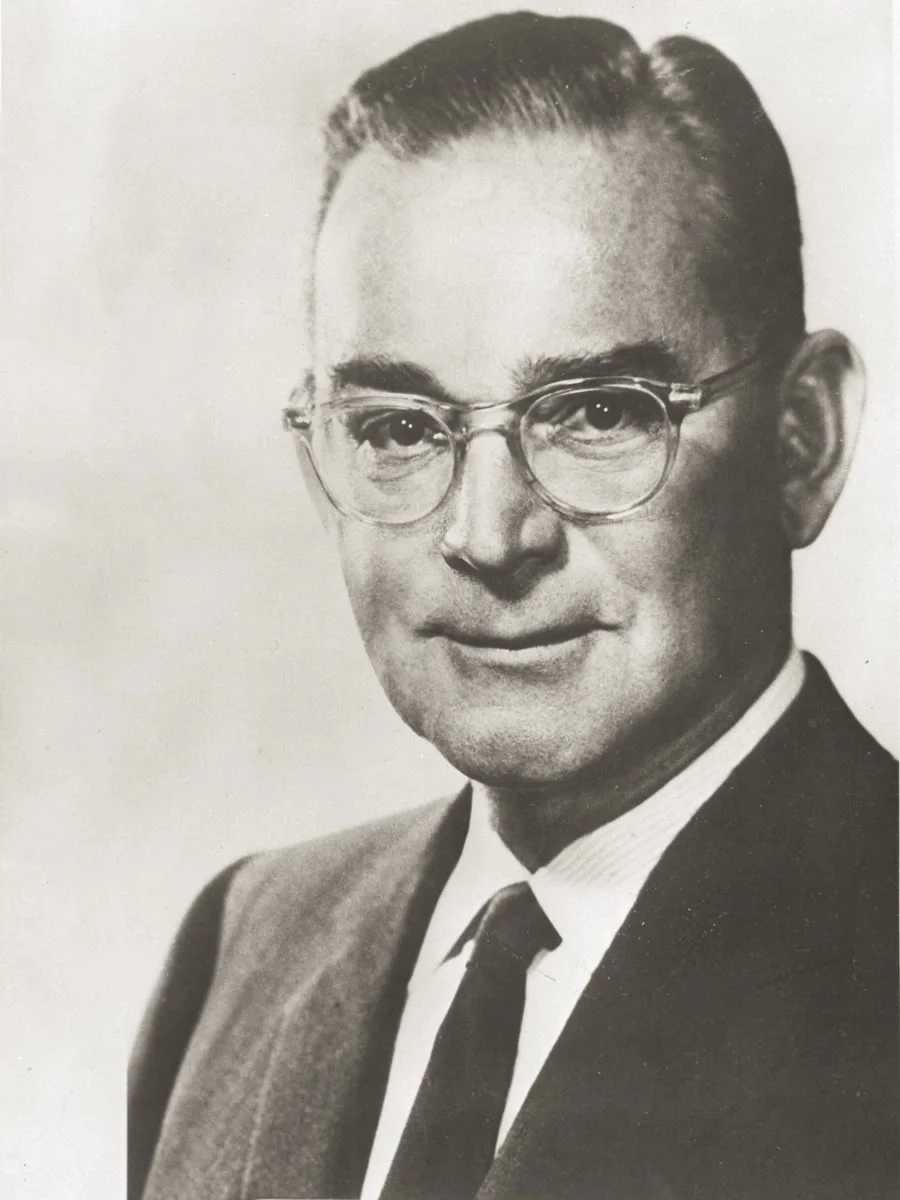
Jock Whitney
Put private-partnership risk capital to work in 1946; helped popularize, but did not demonstrably coin, 'venture capital.'
Inherited capital becomes an operating question
John Hay Whitney (1904–1982) entered investing with advantages that cannot be separated from the record: family wealth, elite education, and social access. He graduated from Yale in 1926; further study at Oxford ended after his father died. The Yale family-papers guide also records later wartime service and escape from German captivity, but the accessible research record does not establish that these experiences caused a particular investment rule. Yale family papers, collection biography
The investable question posed by that inheritance was not simply where to place money. Whitney repeatedly put capital into enterprises that required operating work, distribution, governance, or institution-building. Evidence label: researcher inference · provisional. One hypothesis is that family capital funded experiments that later preceded a staffed organization; the chronology does not prove an early master plan, learning mechanism, or internal motive. The skeptical alternative is that wealth and access bought many experiments until some succeeded. Man of Means—I · Man of Means—II
1926–1940 — an uneven apprenticeship in risk
Whitney’s pre-firm record matters because it contains behavior that resembles parts of the later J. H. Whitney & Co. doctrine, as well as failures that a triumphal biography would omit. Resemblance is not proof of institutional learning. These were personal or family investments, not firm performance.
- Novelty without validation failed early. Around 1926 Whitney reportedly paid more than $50,000 for U.S. rights to a fast-growing “miracle” tree; the American plantings did not reproduce the claimed result. A sugar process and several magazine investments also disappointed, including a reported $100,000 rescue of Outlook shortly before it failed. Man of Means—II, web transcription, relevant venture passages
- Introduced access plus governance worked at Freeport. J. T. Claiborne brought Whitney into a 1929 control contest; Whitney reportedly invested $500,000, became chairman, and by 1951 the stake was said to have quadrupled in value. TIME independently identified him as chairman and largest shareholder. This was a personal control investment, and the quoted value was not a realized return. Man of Means—II, Freeport passage · TIME, “Freeport’s Find,” 1951
- Theatre used bounded vehicles but still produced a mixed book. Single-purpose production corporations limited exposure. Jumbo and Here Goes the Bride reportedly lost more than $150,000 combined, while the family’s reported $40,000 investment for a 25% interest in Life With Father produced substantial distributions. Donation of part of the interest and later trust receipts make a simple multiple misleading. Man of Means—I, theatre passage · Man of Means—II, theatre passage · IBDB, production record
- Film paired enabling technology with a production company. Whitney and relatives formed Pioneer Pictures; contemporary reporting described a 15% Technicolor position reportedly worth about $1 million, while AFI records connect Pioneer and Whitney to La Cucaracha and the three-color strategy behind Becky Sharp. Pioneer later combined with David O. Selznick’s company, where the reported division of labor put Selznick on the creative side and Whitney on the commercial side. Evidence labels: contemporaneous record · moderate for the reported stake; retrospective witness · moderate for AFI's later synthesis; researcher inference · insufficient public record for investment economics. The record does not supply a complete capital-and-distribution ledger. TIME, “Whitney Colors,” 1935 · AFI, La Cucaracha record · AFI, Becky Sharp record · Man of Means—II, Pioneer/Selznick passage
Causal hypothesis. Evidence label: researcher inference · provisional. These experiments are consistent with three ideas later visible in Whitney’s written doctrine: isolate experimental risk, recruit domain specialists, and pair a promising artifact with the operating system that makes demand possible. The counterevidence is decisive for attribution: several novelty bets failed, and no accessible Whitney document says those losses taught him these lessons or caused the 1946 firm design. Man of Means—I · Man of Means—II
1941–1945 — institutions as operating systems
Before the venture partnership, Whitney’s public institutional work already treated resources as insufficient without execution. As MoMA president in 1941, he proposed not just selecting films for hemispheric exchange but translating them, supplying projectors, and building distribution through missions. MoMA/CBS record, PDF pp. 1–2
In a 1942 wartime-housing broadcast he compressed the production constraint into “Machine Needs Man / Man Needs House,” then joined mass production, design quality, and postwar usefulness. MoMA/Blue Network transcript, PDF pp. 1–2
These speeches are evidence of systems and bottleneck reasoning outside investing. Evidence label: researcher inference · moderate. Their resemblance to Whitney’s later capital-plus-assistance doctrine is analytically useful, but chronology does not prove that museum work originated the firm’s method.
1946 — from patron to partnership
Whitney formed J. H. Whitney & Co. in February 1946 with Benno C. Schmidt and other professionals. The capital base remains disputed rather than safely averaged: the current firm displays a $5 million figure; Kahn reported $10 million in 1951; partner C. Wrede Petersmeyer testified to $10 million in 1958; and David Morgenthaler later recalled Schmidt finding evidence for only one $5 million check while being unable to determine whether a second tranche existed. The 1958 figure may describe total capital then available rather than opening paid-in capital. No processed formation ledger resolves commitment, funding dates, or recycling. J.H. Whitney, firm history · Man of Means—I, firm-formation passage · Petersmeyer testimony, printed p. 119 · Morgenthaler oral history, printed pp. 65–67/PDF pp. 69–71
The firm-preserved founder statement sought businesses with a probability of success, management teams and purposes the partners could “wholeheartedly embrace,” and a building relationship they could be proud of. Its wording is direct testimony as represented by the current firm, but an original 1946 document was not independently authenticated. J.H. Whitney, founder statement
The organizational change was more important than the label. By 1951 the firm reportedly used seven young representatives for first-pass investigation and senior partners for escalation; it had reviewed more than 3,000 proposals and funded 18. Morgenthaler later remembered Schmidt recruiting roughly a dozen younger professionals after an initial senior-business cohort. In 1958 Petersmeyer described 33 staff—13 partners and 20 research, accounting, library, and support personnel—informal specialist teams, outside consultants, and pooled partner decisions. Partners could reportedly convert forgone profit into equity; whether that arrangement changed judgment or outcomes is unknown. The staffing and funnel figures are dated snapshots, not a single audited organization chart or lifetime denominator. Man of Means—I, proposal-funnel and partner-economics passages · Morgenthaler oral history, printed pp. 65–66/PDF pp. 69–70 · Petersmeyer testimony, printed pp. 119–120
Evidence label: contemporaneous record · moderate for the reported professional funnel; researcher inference · provisional for the claim that it was Whitney’s repeatable edge. The public record does not identify who designed each procedure or who personally sourced most deals.
1946–1951 — the method meets companies
Spencer Chemical: operator continuity plus conversion capital
Kenneth Spencer had built and operated the Jayhawk ordnance plant for the government. J. H. Whitney & Co. financed its postwar acquisition and conversion to fertilizer production. The supported mechanism is therefore not lone-investor invention; it is experienced operator + available industrial capacity + a peacetime market + private capital. TIME, “Jayhawk Goes Civilian,” 1946
Kahn later reported $1.25 million invested, a $6.5 million partial sale, and a retained interest worth more than three times original cost; another history reports $1.25 million preferred plus $250,000 common. Gulf’s proposed 1963 acquisition was reported at about $150 million, but the firm’s sale fraction, later ownership, and proceeds remain unknown, so no Whitney multiple is defensible. Man of Means—I, Spencer passage · Financiers of Innovation, Whitney chapter · TIME, “Fertilizing the Oil Business,” 1963
Florida Foods / Vacuum Foods / Minute Maid: commercialization with contested credit
The company moved from a wartime powdered-juice contract toward frozen concentrate. John M. Fox and Dr. L. S. McDowell—not Whitney—are credited with product development and operating leadership. Whitney entered through National Research Corp.; contemporary reporting described Vacuum Foods as “Whitney-dominated” and connected Bing Crosby’s radio relationship to promotion and demand generation as the business emerged from losses. The processed record does not establish that Crosby or Whitney physically distributed the product. TIME, “Minute Maid’s Man,” 1948 · Florida Citrus Hall of Fame, John M. Fox biography · Coca-Cola, Minute Maid history
Kahn attributed the Crosby idea to Whitney; Fox’s institutional biography attributed it to Fox. Evidence label: contemporaneous record · moderate for firm-assisted commercialization; researcher inference · insufficient public record for individual idea credit, initial ownership, board role, and returns. The disagreement is evidence against a lone-genius narrative.
The ordinary book: losses, uncertain outcomes, and a paid “no”
The 1951 snapshot classified nine of 18 investments as successes, two as total write-offs, and seven between those poles. One unnamed photographic-material company reportedly lost $340,000. An unnamed power-saw company received $75,000, with an unnamed partner explicitly entertaining both total loss and large upside. The firm also reportedly spent one year and $100,000 investigating a brick process and declined it. Man of Means—I, portfolio and diligence passages
These are reported categories with undefined accounting, not a complete denominator or modern fund metrics. Their value is epistemic: the contemporary record shows a process willing to incur diligence cost, reject a proposal, and accept that funded ventures could fail.
1954–1958 — sector ownership and portfolio concentration become visible
The public record after Kahn replaces a founder-centered sketch with firmer organizational attribution. A 1954 broadcasting trade profile called Petersmeyer the partner responsible for television, president of wholly owned Osage Broadcasting, and head of six community-antenna companies; the firm then had interests in about 40 companies. Television–Radio Age, printed pp. 125–126
Petersmeyer’s 1958 testimony is the closest contemporaneous portfolio denominator. The firm had received more than 7,000 proposals and financed slightly more than 50. Within a defined 38-investment cohort below $500,000, 15 lost all or substantially all capital, 6 broke even, 4 produced an unfavorable return, and only 13 were successes the firm would repeat; the group appreciated slightly more than 10% over the firm's full 12-year period, which Petersmeyer annualized by assuming an average six years at risk. Five larger ventures with more than $2 million at risk each generated 250 percentage points of the reported 300% increase in original capital. The figures are unaudited and the five are unnamed, but they directly establish high loss rates, outlier concentration, follow-on demands, and the difference between marked appreciation and risk-adjusted performance. Petersmeyer testimony, printed pp. 120 and 123 Evidence label: contemporaneous record · moderate for firm-reported, unaudited performance.
1955–1960 — the doctrine becomes explicit
Whitney’s clearest venture text, written in 1955 and reprinted in the 1960 Congressional Record, defines organized venture investing as finance for promising enterprises whose novelty, risk, and bespoke needs put them beyond banks, public markets, and cautious institutions. It distinguishes pioneering from recklessness, calls the work “a full-time job for an organization,” and says “Capital alone is not enough.” Modern Venture Capitalism, Congressional Record p. 17759, article ¶¶6, 13, 16
That organization should combine management, research and development, production, marketing, tax, and legal skill; it should investigate before investing and supervise and assist afterward. Yet Whitney rejects false precision: demand, execution, profit, and especially people remain irreducibly uncertain. Modern Venture Capitalism, p. 17759, article ¶¶13–19 Petersmeyer’s 1958 firm testimony turns this doctrine into an operating sequence: screen, decide, assist, then realize and recycle; require growth, a product beyond pure invention, strong or replaceable management, a sizeable influence position, generally $500,000–$1 million, hoped-for 3–5x appreciation over 5–10 years, reserves, diversification, and a plausible public or strategic exit. These are Petersmeyer’s words about firm practice—not Whitney quotations—and the return aspiration is not a realized base rate. Petersmeyer testimony, printed pp. 119–131
Evidence label: investor-stated · strong for Whitney’s doctrine; contemporaneous record · strong for Petersmeyer’s 1958 policy description; retrospective witness · moderate for later case execution. Consistent application across the whole portfolio and Whitney’s personal authorship remain unproved because approval memoranda, ledgers, ownership, cash flows, and many partner assignments are absent.
1957–1966 — diplomacy, publishing, and the limit of stewardship
Whitney served as U.S. ambassador to the United Kingdom from February 28, 1957, through January 14, 1961. U.S. Office of the Historian, appointment record A 1959 economic memorandum establishes that he drafted the record of a Camp David discussion; the economic positions it records belong to Eisenhower and Macmillan, not automatically to Whitney. A 1958 Lebanon/Jordan telegram is narrated by Robert Murphy and records only one individually identified sequencing question by Whitney. FRUS, 1959 memorandum, editorial note and discussion · FRUS, 1958 telegram, opening and p. 452
This attribution boundary matters. The records establish Whitney’s participation and one drafting role; they do not license converting other officials’ statements into Whitney maxims or inferring a transferable investment process.
As owner and publisher of the New York Herald Tribune, Whitney articulated a different capital-allocation mode. In 1964 he acknowledged that his money enabled ownership but did not confer journalistic authority. He argued that ownership should protect independent inquiry, accept being troubled by its own operators, and shift the newspaper’s edge from speed to interpretation. Lovejoy address, opening and passages beginning “To be fair” and “Increasingly”
The paper closed in 1966. Whitney’s recorded statement claimed civic contribution and called the disappearance a loss to journalism; he did not claim an economic success. UPI audio/transcript, final John Hay Whitney segment Evidence label: documented behavior · moderate for mission-driven stewardship and institutional loss; researcher inference · insufficient public record for any later change in the venture firm’s process caused by that failure.
1957–1970 — operator evidence weakens the founder-centered account
Morgenthaler identifies Nat Owen as the persistent recruiter and board contact who placed him into troubled Foseco in 1957; another Whitney partner also sat on the board. The firm sold its interest in 1967 after a public listing, producing a “huge” but unquantified cash-on-cash result on a small base. This is witness-reported firm performance, not a defensible multiple or a personal Jock decision. Morgenthaler oral history, printed pp. 64–81/PDF pp. 68–85
David Dunn’s 1962–1970 account supplies deeper partner-level cases. He identifies Schmidt as the decisive authority; Horgan and Owen spent much of their time operating General Signal; Dunn sourced Hamden National Bank, Inforex, and Storage Technology, negotiated terms, worked with management, arranged financing, and served on boards. Pacific Western Industries—the best documented ordinary/failure case—combined about $5 million reported equity with $16.5 million reported Prudential debt, suffered technical and acquired-distribution problems, stopped a fraudulent operating practice, and was sold with capital reportedly recovered but no profit established. Dunn oral history, printed pp. 15–38/PDF pp. 20–43
A testable thesis of Whitney’s edge
Proposed thesis — evidence label: researcher inference · moderate for the organization; provisional for Whitney’s personal edge and causal performance. J. H. Whitney & Co.’s most defensible founding-era advantage was converting Whitney family capital and privileged networks into a professional organization that could proactively source, investigate, finance, govern, recruit for, and supply missing operating capabilities to risky enterprises underserved by conventional finance. The mechanism is best supported from 1946 through the 1960s by Whitney’s doctrine, Petersmeyer’s contemporaneous operating account, and later partner/operator cases. Personal/family experiments in the 1920s–1930s are context, not firm performance. The unresolved question is whether Whitney personally designed and repeatedly applied the system, or chiefly supplied capital, reputation, access, and authority to a partner-led institution.
Mechanism and predicted evidence
If that thesis is true, unseen firm files should show:
- a high-volume funnel with explicit rejection work rather than social-access selection alone;
- multidisciplinary specialists influencing approvals and company milestones;
- assistance in management, production, distribution, legal, tax, or recruiting beyond the check;
- partners and operators—not Whitney alone—receiving deal-level credit;
- a mixed portfolio in which operating assistance improves some ventures but does not eliminate write-offs; and
- better company outcomes where a concrete nonfinancial bottleneck was diagnosed and addressed than where novelty or mission substituted for validation.
The record supports a funnel of >7,000 proposals and >50 investments by 1958, proactive adjacency sourcing, roughly 40 working directorships, partner-dominated portfolio labor, a costly rejection, and named operating work at Foseco, General Signal, Pacific Western, Inforex, and Storage. Man of Means—I, firm-method passages · Modern Venture Capitalism, p. 17759 · Petersmeyer testimony, pp. 119–130 · Morgenthaler oral history, pp. 64–81 · Dunn oral history, pp. 15–43 It does not supply a complete deal-by-deal causal test or isolate Whitney’s contribution from Schmidt, Petersmeyer, Owen, Horgan, Dunn, company operators, access, era, and luck.
Evidence that weakens or could overturn it
- Concentrated and weakly audited economics. Petersmeyer said original capital had almost quadrupled by 1958 versus a diversified listed portfolio that would have tripled with less effort and risk. Five large ventures supplied 250 percentage points of the reported 300% increase, while the 38 small investments appreciated slightly more than 10% over the firm's full 12-year period; he assumed an average six years at risk to annualize that result. These are unusually candid but unaudited marked-value claims, not cash-flow returns. Petersmeyer testimony, printed p. 123 Mallaby’s publisher sample independently frames the early risk-adjusted record as unimpressive, but its supporting footnotes are outside the accessible sample. Power Law publisher sample, Whitney passage
- Access and capital may dominate selection skill. Family wealth supplied capital, while relationships surfaced Freeport, entertainment, National Research, Crosby, and political or institutional opportunities. The record cannot measure repeatability or separate access from selection. Man of Means—II · TIME, Minute Maid
- Team evidence weakens hero attribution. The record now names Petersmeyer as sector lead, Schmidt as decisive authority in Dunn’s period, Owen and Horgan as operators/directors, Dunn as source and deal lead, and Morgenthaler as Foseco CEO. That improves institutional reconstruction while weakening a personal-Whitney causal claim. Petersmeyer testimony, pp. 117–131 · Dunn oral history, pp. 15–43 · Morgenthaler oral history, pp. 64–81
- The denominator remains incomplete despite one strong cohort. The evidence now reconciles 18 investments in 1951, about 40 company interests in 1954, >50 cumulative investments in 1958, and the 38-small/five-large 1958 performance subsets. Definitions, residual middle-sized cases, ownership, cash flows, IRR, DPI, TVPI, and a lifetime company list remain unavailable. Investment evidence rules · Petersmeyer testimony, pp. 120–123
- Mission can overwhelm economics. The Herald Tribune shows mission-oriented stewardship and principled ownership, but also that purpose and prestige can coexist with a structurally poor investment that ends in closure. Lovejoy address · UPI closure statement
The thesis would be overturned if the original ledgers showed that assistance was nominal, outcomes were not better where specialists intervened, the funnel was largely social intake without independent rejection, or returns depended on one unrelated outlier or on deals led entirely by others. It would strengthen if approval memoranda, board minutes, and company records repeatedly connect diagnosed bottlenecks to specific Whitney-team actions and superior outcomes across winners, ordinary cases, and failures.
Skill, access, vehicle, team, era, and luck
Evidence label: contemporaneous record · moderate; researcher inference · provisional for causal allocation among drivers. The table separates candidate explanations rather than assigning a defensible percentage to any one of them.
| candidate driver | what the record supports | what remains unproved |
|---|---|---|
| Skill | A >7,000-proposal funnel, paid diligence, proactive sourcing, a stated assistance doctrine, and named partner/operator cases. Man of Means—I · Modern Venture Capitalism · Petersmeyer testimony, pp. 119–130 | Repeatable risk-adjusted outperformance, Whitney-specific causality, deal-level selection accuracy, and a full portfolio counterfactual. |
| Access | Family, commercial, arts, media, and political networks brought capital, operators, and promotion or demand-generation relationships. Man of Means—II · TIME, Minute Maid | How many opportunities arrived through privilege versus systematic search, and whether access alone explains outcomes. |
| Vehicle | Family capital backed a staffed organization; Petersmeyer described liquidity reserves, diversification, follow-ons, sizeable minority stakes, and recycling; specialists could reportedly reinvest forgone profits in equity. Man of Means—I · Petersmeyer testimony, pp. 119–131 | Legal form, duration, fundraising constraints, carry formula, reserve allocation, distribution policy, succession mechanics, and the practical effect of partner participation. |
| Team | Petersmeyer’s 33-person organization, pooled decisions, working directorships, and the Dunn/Morgenthaler role maps show material specialist, partner, and operator work. Petersmeyer testimony, pp. 119–125 · Dunn oral history · Morgenthaler oral history | Roles remain unknown for many founding cases; later witnesses cannot prove Jock’s own approval or authorship. |
| Era | Postwar industrial conversion, immature private-risk markets, and enterprises outside bank/public-market tolerance created a broad financing gap. TIME, Spencer · Modern Venture Capitalism, p. 17759 | A sourced contemporaneous base rate and a clean modern comparison. |
| Luck / outliers | Five investments supplied 250 of the reported 300 percentage points of appreciation; 25 of 38 small deals were loss, break-even, or poor-return cases. Petersmeyer testimony, p. 123 | Which five drove the record, whether values were realized, and how access, skill, sizing, and luck divide their contribution. |
People, capital, and influence map
Capital and institutional layers
| layer | role | evidence boundary |
|---|---|---|
| Whitney personal/family capital | Freeport, theatre, Pioneer/Selznick, and other pre-firm experiments; supplied capital for experimentation. | Never count these as J. H. Whitney & Co. deals; duration and terms are unknown. Man of Means—II |
| J. H. Whitney & Co. | Professional risk-capital organization formed in 1946; its public doctrine and 1958 testimony prescribe sourcing, investigation, financing, supervision, reserves, realization, and specialist assistance. | Founding capital is disputed; a contemporaneous cohort and witness cases now exist, but cash flows and many roles remain sparse. J.H. Whitney · Modern Venture Capitalism · Petersmeyer testimony |
| John Hay Whitney Foundation | Parallel philanthropic institution. | Its grants and governance are not commercial portfolio evidence. Yale foundation records |
| Whitney communications ownership | Herald Tribune capital and publisher stewardship. | Mission-driven ownership, not a hidden venture-firm investment. Lovejoy address |
People and decision attribution
| person or group | documented contribution | unknown or disputed |
|---|---|---|
| Jock Whitney | Supplied capital; co-founded the firm; articulated its public doctrine; personally chaired Freeport and handled commercial work at Selznick; owned/published the Herald Tribune. J.H. Whitney firm history · Modern Venture Capitalism · Man of Means—II · Lovejoy address | Personal sourcing, approval, board, follow-on, and exit role for most firm deals. |
| Benno C. Schmidt | Founding partner; recruited younger professionals; Dunn identifies him as decisive authority in the 1960s and as final approver in Pacific Western, Storage, and Multi-Access episodes. Morgenthaler oral history, pp. 65–67 · Dunn oral history, pp. 15–43 | Exact authorship of the founding method, formal vote/veto, economics, and the disputed “venture capital” coinage. Planitzer’s later key-person account must not be back-projected unchanged. |
| C. Wrede Petersmeyer | Partner and 1958 public narrator of firm policy; television lead, Osage president, and head of six CATV companies in 1954. Senate testimony, pp. 117–131 · Television–Radio Age, pp. 125–126 | Whether Whitney drafted or approved the testimony; partner-level allocation for most reported portfolio statistics. |
| Young representatives and senior partners | Reportedly screened proposals, formed specialist teams, pooled decisions, and held about 40 working directorships; 1958 headcount was 13 partners plus 20 staff. Man of Means—I · Petersmeyer testimony, pp. 119–125 | Names, votes, vetoes, company assignments, and compensation terms for many cases. |
| Nat Owen and John Horgan | Recruited operators and assumed long-duration operating/board roles at Foseco and General Signal. Morgenthaler oral history, pp. 64–81 · Dunn oral history, pp. 14–38 | Exact Foseco second director, original approvals, and company-by-company economics. |
| David Dunn | Sourced Hamden/Inforex/Storage, negotiated Storage terms, worked on Pacific Western and General Signal, arranged financing, boarded companies, and initiated a sale approach. Dunn oral history, pp. 15–43 | Rounded witness economics, exact ownership/cash flows, and whether Schmidt’s approval was formal or expected. |
| David Morgenthaler | Foseco CEO who resolved operating conflict, expanded the business, and supplies firsthand operator evidence of Whitney board contact and exit. Morgenthaler oral history, pp. 64–81 | No evidence that his later four-leg philosophy was Whitney’s; Whitney’s Foseco check, ownership, and proceeds remain unknown. |
| J. T. Claiborne | Introduced the Freeport control opportunity. Man of Means—II | Any broader role in codifying the firm method is not established in the processed record. |
| Kenneth Spencer | Built and ran Jayhawk, then pursued its civilian conversion. TIME, Spencer | Which Whitney partner sourced, negotiated, governed, or authorized follow-ons. |
| John M. Fox and L. S. McDowell | Guided Florida Foods/Minute Maid product development and commercialization. Fox biography | Crosby idea credit is disputed between Fox and Whitney accounts. |
| Bing Crosby and CBS | Supplied a high-leverage promotion and demand-generation relationship to Minute Maid. TIME, Minute Maid | Exact equity economics and who originated the arrangement. |
| David O. Selznick | Led creative work in the combined film company; Whitney reportedly handled commercial work. Man of Means—II | Full cash-flow and decision ledger for family film investments. |
| Editors, journalists, MoMA and government staff | Supplied independent domain judgment inside institutions Whitney financed or led. Lovejoy address · MoMA/CBS record | Whether those institutional practices directly shaped venture approvals. |
Vehicle and incentive chronology
Evidence label: contemporaneous record · moderate; researcher inference · provisional for strategic implications. Capital source is visible, but duration, decision rights, and behavioral effects are largely not.
| period | vehicle | strategic implication | evidence limit |
|---|---|---|---|
| 1920s–1930s | Personal/family capital and single-purpose entertainment entities | Family capital funded experiments; theatre used bounded-liability entities. | No consolidated cash-flow ledger; duration and fundraising constraints are unknown. Man of Means—II |
| 1946 onward | J. H. Whitney & Co., initially backed by Whitney-family capital | Family capital funded a staffed organization; by 1958 the reported operating model required diversification, liquid reserves, large follow-ons, working directorships, and realization/recycling. | Opening capital, legal form, duration, carry, reserve allocation, distributions, and founding succession remain unavailable. Petersmeyer testimony, pp. 119–131 |
| 1946 onward | John Hay Whitney Foundation | A distinct philanthropic vehicle maintained a separate record. | Foundation activity cannot validate venture returns or establish firm criteria. Yale foundation records |
| 1958–1966 | Communications ownership | Whitney financed, owned, and published the paper while publicly defending its editorial mission. | Holding economics, losses, stop criteria, and the effect of ownership duration are not disclosed. Lovejoy address · UPI closure statement |
| 1960s witness record | Mixed equity, bank/insurance debt, guarantees, syndication, leasing finance, and public markets | Foseco, Pacific Western, and Storage show flexible company financing and differentiated operator/partner roles. | Witness figures are rounded; firm-level allocation, realized proceeds, and legal terms remain incomplete. Morgenthaler oral history · Dunn oral history |
| 1981–1993, mostly after Jock’s active period | Later Whitney partnership under Schmidt | Planitzer observed isolated deal owners, subjective quarterly marks, no durable written process, and blocked succession alongside individual wins. | Later-period counterevidence cannot establish founding-era practice, but it falsifies a claim of automatic institutional continuity. Planitzer oral history, pp. 50–75 |
| 1990, after Whitney’s death | First outside-capital partnership, as reported by the current firm | Later institutional evolution should not be back-projected onto Jock Whitney’s vehicle. | Later buyout-fund results do not answer founding-era performance. J.H. Whitney, firm history |
Failure, learning, and unresolved process change
Whitney’s record includes personal novelty losses, two reported firm write-offs in the first 18 investments, 25 loss/break-even/poor-return results in Petersmeyer’s 38-small cohort, a printed-circuit near-total loss, Wright Power Saw limbo, an expensive diligence rejection, Pacific Western’s capital-recovery sale, Multi-Access’s humane wind-down, and the Herald Tribune closure. These are not marginal footnotes; they test whether the favorable philosophy constrained sizing, follow-ons, governance, and stopping. Man of Means—I · Petersmeyer testimony, pp. 123–128 · Dunn oral history, pp. 17–23, 42–43 · UPI closure statement
Evidence label: researcher inference · provisional. The later emphasis on investigation, specialist help, uncertainty, reserves, and exit is consistent with learning from earlier failures. It is not proof of a documented before/after change. Dunn supplies case-level responses—buy the dryer, stop dishonest mixtures, sell Pacific Western, fund Multi-Access wind-down—but no source says those cases changed the firm’s standard process. Planitzer’s later account instead suggests institutional learning failed to become a durable written system.
Sourced chronology
| date | turning point | investment relevance and boundary |
|---|---|---|
| 1904 | Whitney is born. | Identity anchor; family wealth is an access and vehicle advantage, not evidence of skill. Yale family papers |
| 1926 | Graduates from Yale; Oxford study ends after his father’s death. | Start of independent capital allocation; no causal investment doctrine is documented. Yale family papers |
| c. 1926 | Buys rights to the failed “miracle” tree. | Personal novelty failure; reported cost over $50,000. Man of Means—II |
| 1929 | Invests in Freeport and becomes chairman after Claiborne’s introduction. | Personal control/governance case; reported $500,000 investment, not firm capital. Man of Means—II |
| 1930s | Magazine, sugar, Broadway, and film experiments. | Mixed outcomes; single-purpose theatre vehicles and domain partnerships precede the firm. Man of Means—II |
| 1933–1936 | Pioneer Pictures and Technicolor strategy; later Selznick combination. | Family capital paired enabling technology with production and commercial work; returns unresolved. TIME, Whitney Colors · HRC finding aid |
| 1941–1942 | MoMA national-defense and wartime-housing programs. | Direct evidence of institution-building, distribution, and bottleneck reasoning outside venture. MoMA 1941 · MoMA 1942 |
| 1946-02 | J. H. Whitney & Co. forms. | Professionalizes family risk capital; opening amount remains unresolved because $5 million and $10 million records may reflect one check, two tranches, commitment, or later capital. J.H. Whitney · Morgenthaler oral history, pp. 65–67 |
| 1946 | Spencer Chemical conversion financing. | Firm case with operator continuity and postwar industrial conversion; individual partner and ownership unknown. TIME, Spencer |
| by 1948 | Florida Foods/Vacuum Foods/Minute Maid commercialization. | Whitney-linked finance and promotion/demand-generation context; specific firm interventions, operator credit, and returns remain separated. TIME, Minute Maid |
| 1951 | Kahn documents the firm’s funnel and mixed early book. | More than 3,000 proposals, 18 investments, nine reported successes, two reported total losses, seven other outcomes; unaudited snapshot. Man of Means—I |
| 1954 | Petersmeyer leads broadcasting activity. | Trade press reports a $10 million firm, about 40 interests, 11 partners, wholly owned Osage, and Petersmeyer responsibility for television/six CATV companies; KOTV sale still awaited FCC approval. Television–Radio Age, pp. 42, 125–126 |
| 1955 / 1960 | “Modern Venture Capitalism” is written / reprinted. | Clearest investor-stated doctrine: organization, investigation, supervision, specialist help, and irreducible uncertainty. Congressional Record, p. 17759 |
| 1957–1967 | Foseco operator recruitment, public listing, and firm exit. | Owen’s repeated recruiting and board role are visible; Morgenthaler operates; the firm’s “huge” cash-on-cash result is unquantified witness testimony. Morgenthaler oral history, pp. 64–81 |
| 1957-02-28–1961-01-14 | U.S. ambassador to the United Kingdom. | Demonstrates public-service role; do not attribute other officials’ FRUS views to Whitney. Office of the Historian |
| 1958–1966 | Owns and publishes the Herald Tribune. | Mission-driven stewardship culminates in closure; not venture-firm performance. Lovejoy address · UPI closure statement |
| 1958-12-02 | Petersmeyer testifies on firm method and outcomes. | >7,000 proposals, >50 investments, 38-small cohort, five large contributors, follow-ons, reserves, active sourcing, and exits become visible; firm testimony is not Whitney-authored prose or audited return data. Senate print, pp. 117–131 |
| 1962–1970 | Dunn’s partner/associate period. | General Signal, Pacific Western, Hamden, Inforex, Storage, and Multi-Access expose Schmidt’s authority, operating labor, flexible financing, a capital-recovery sale, and failure conduct. Dunn oral history, pp. 14–43 |
| 1981–1993 witness period | Planitzer observes later partnership discontinuity. | Subjective marks, isolated deal owners, Schmidt key-person dominance, and blocked succession rebut automatic continuity; most observations belong to the later firm, not Jock’s active record. Planitzer oral history, pp. 50–75 |
| 1982 | Whitney dies. | End of the individual record; later firm structure and results require separate attribution. Yale family papers |
Read the package as a decision curriculum
- Start with this biography for the chronological story, causal tests, and falsifiable edge thesis.
- Read the written corpus to separate Whitney’s own doctrine from reported profiles and inaccessible archival titles.
- Read the talks and interviews for institutional judgment, bottleneck reasoning, and the candid newspaper failure.
- Work through the investment record, especially the Spencer, Minute Maid, Foseco, Storage, and Pacific Western decision labs plus the brick-process rejection and denominator ledger.
- Use the investment philosophy as the operating-system summary and the mental-model field guide for application checklists and boundary conditions.
The package’s central discipline is attribution: Whitney personal/family capital, J. H. Whitney & Co., the foundation, communications ownership, partners, and company operators are separate analytical units. Where the public record cannot identify who decided or what the investment returned, the answer remains unknown.
1. Snapshot and testable edge thesis
| dimension | evidence-backed answer |
|---|---|
| Investor | John Hay “Jock” Whitney (1904–1982), working first through personal/family capital and from 1946 through J. H. Whitney & Co. Yale family papers, collection biography |
| Era and scope | U.S. personal/control, entertainment, and technology experiments in the 1920s–1930s; organized postwar risk capital from 1946; later public-service and communications ownership. |
| Proposed edge | Convert family capital and privileged access into a professional organization that can actively source, investigate, finance, govern, recruit for, and supply missing technical, production, marketing, legal, tax, channel, and management capabilities. |
| Attribution / support | Researcher inference · moderate for the organizational mechanism; provisional for Jock’s personal causality and risk-adjusted performance. Whitney stated the doctrine; Petersmeyer described 1958 practice and a denominator; later witnesses identify partner/operator execution. Modern Venture Capitalism, Congressional Record p. 17759, article ¶¶13–19 · Petersmeyer testimony, printed pp. 117–131 · Dunn oral history |
| Where it should work | Most plausibly in the 1946–1960s U.S. context: enterprises outside conventional-finance tolerance whose uncertainty is partly reducible, whose missing capability is identifiable, and whose investor has the capital, rights, specialist capacity, reserves, and realization path to act. |
| Where it should fail | Ventures where novelty substitutes for validation, the team cannot execute, nonfinancial help is irrelevant, mission overrides commercial discipline, or the investor lacks the expertise and decision rights to change the bottleneck. |
Predictions
If the edge thesis is true, unseen approval files should show a broad intake funnel, active search, costly rejections, multidisciplinary participation, named decision rights, explicit follow-on/exit logic, partner/operator credit, and better outcomes where assistance addressed a diagnosed constraint. The record now supports >7,000 proposals and >50 investments by 1958, active adjacency sourcing, roughly 40 working directorships, a costly brick pass, and named work at Foseco, General Signal, Pacific Western, Inforex, and Storage. It still lacks a complete cash-flow/control group and Whitney-specific causal attribution. Man of Means—I, brick passage · Petersmeyer testimony, pp. 119–130 · Morgenthaler oral history, pp. 64–81 · Dunn oral history, pp. 15–43
Falsifiers
The thesis weakens or fails if original ledgers show that (1) social access dominated approvals; (2) advertised assistance was nominal; (3) specialists did not affect milestones; (4) helped cases did no better than comparable passive cases; (5) the five large contributors were unrelated access/luck outliers; or (6) partners designed and executed the method while Whitney supplied capital and reputation. Petersmeyer already weakens a broad personal-skill story: five >$2 million positions supplied 250 of the reported 300 percentage points of appreciation, while the 38-small cohort produced weak risk-adjusted results. Petersmeyer testimony, printed p. 123 No audited cash-flow series or complete decision-rights map resolves causality. Investment-record evidence boundary
2. Core philosophy
Whitney’s own words
- “The excitement and the pioneering are there; the recklessness is not.” Modern Venture Capitalism, p. 17759, article ¶6
- “It is a full-time job for an organization.” Modern Venture Capitalism, p. 17759, article ¶13
- “Capital alone is not enough.” Modern Venture Capitalism, p. 17759, article ¶16
- Management evaluation is “Most difficult of all.” Modern Venture Capitalism, p. 17759, article ¶19
- The firm-preserved 1946 statement sought management teams and purposes the partners could “wholeheartedly embrace.” J.H. Whitney, founder statement
Synthesis
Evidence label: investor-stated · strong for the 1955/1960 doctrine, investor-stated · moderate for the current firm’s representation of the 1946 purpose/fit screen, and researcher inference · moderate for arranging those components as one operating sequence. Venture investing is organized commercial work under uncertainty, not passive money or reckless speculation:
- find an enterprise conventional finance cannot comfortably underwrite;
- investigate technical, market, management, production, legal, tax, and distribution risk;
- decide with judgment rather than false precision;
- finance only when the team, purpose, and probability of success clear the gate;
- supervise and supply missing capabilities after investment; and
- accept that a serious process still produces failures.
Whitney explicitly called venture capital profit-seeking. Its public value came from supporting independent enterprise and industrial renewal, not from relaxing the commercial standard. Modern Venture Capitalism, p. 17759, article closing discussion The Herald Tribune later operated under a different, mission-driven standard; combining the two would turn a real tension into a cleaner philosophy than the record supports. Lovejoy address · UPI closure statement
3. Sourcing
Three sourcing engines
- Relationship access. Personal opportunities reached Whitney through trusted introducers and domain operators: J. T. Claiborne surfaced Freeport; entertainment ventures involved producers and family vehicles; National Research provided the route into Florida Foods/Vacuum Foods; the Crosby/CBS relationship amplified Minute Maid promotion and demand generation. Man of Means—II, Freeport and film passages · TIME, Minute Maid
- Institutional intake. By 1951 the firm reportedly had reviewed more than 3,000 proposals through seven young representatives and senior-partner escalation, funding 18; by 1958 Petersmeyer reported >7,000 proposals and >50 investments. Man of Means—I, proposal-funnel passage · Petersmeyer testimony, printed p. 120
- Active sector and adjacency search. Petersmeyer said many of the best investments were sought rather than received and described frozen-food/agriculture, broadcasting, and oil/refining/tanker learning loops. Dunn later traced Hamden→IBM training→Inforex→Storage. Petersmeyer testimony, pp. 124, 129 · Dunn oral history, pp. 26–36
Evidence label: contemporaneous record · strong for the existence of three engines; researcher inference · provisional for their relative returns. The public record does not show what percentage came from proprietary search, referrals, cold submissions, banks, universities, government disposals, or personal networks.
Analyst use
- Separate access alpha from selection alpha: record who introduced the opportunity before praising the investment decision.
- Measure funnel stages: incoming, screened, diligenced, approved, funded, followed on, and exited.
- Treat the ability to recruit specialists and channel or promotion partners as a sourcing asset only when it is demonstrably available to the portfolio company.
- Kill the sourcing thesis if proprietary access does not produce a differentiated information set or actionable capability.
Boundary
Evidence label: documented behavior · moderate. Active thematic sourcing and portfolio-derived adjacency are now supportable; a formal scoring system, sector allocation, geographic mandate, and inbound-versus-outbound performance comparison remain absent. An elite network is not automatically a repeatable process for a modern analyst.
4. Picking
What appears to matter
| question | supported answer | evidence status |
|---|---|---|
| Can the people execute? | Whitney called people the hardest variable to evaluate; the founder statement adds working fit and purpose. Modern Venture Capitalism, p. 17759, ¶19 · J.H. Whitney | Investor-stated · strong for importance; researcher inference · insufficient public record for the actual test. |
| Can uncertainty be reduced? | Technical, market, production, legal, tax, and management investigation precede the check. Modern Venture Capitalism, p. 17759, ¶¶13–19 | Investor-stated · strong. |
| Does a concrete enabling gap exist? | Spencer needed conversion capital; Minute Maid needed commercialization and demand generation; Pioneer paired production with Technicolor demand creation. Investment cases | Researcher inference · moderate across selected cases. |
| Is purpose compatible with profit? | The 1946 statement treats purpose as an underwriting variable; the later article insists the work is commercial. J.H. Whitney · Modern Venture Capitalism | Investor-stated · moderate because the 1946 provenance is not independently authenticated. |
| Can the firm add more than money? | Active supervision and specialist help are part of the investment. Modern Venture Capitalism, p. 17759, ¶¶13–16 | Investor-stated · strong; application breadth unproved. |
| Has the product moved beyond invention? | Petersmeyer preferred a product developed enough for practical testing and commercialization, normally in a growth field. Petersmeyer testimony, pp. 120–122 | Contemporaneous record · strong; named-deal consistency incomplete. |
| Can the stake influence outcomes without requiring control? | The firm sought a sizeable minority, board voice, and the ability to change management when necessary. Petersmeyer testimony, pp. 122, 130 | Contemporaneous record · strong; exact rights varied and are mostly unavailable. |
| Can the investment be realized? | A plausible public or strategic path and hoped-for 3–5x appreciation over 5–10 years were explicit gates. Petersmeyer testimony, p. 122 | Contemporaneous record · strong for aspiration; not a realized base rate. |
Red flags and kill criteria
Evidence label: researcher inference · moderate. A historically faithful IC should stop or defer when technical claims cannot reproduce, demand depends on an untested novelty story, management cannot absorb specialist help, the investor cannot name the post-check bottleneck, or mission is doing the work of an economic thesis. The failed tree and sugar process are grounded warnings; the year-long brick investigation shows that a paid “no” was acceptable. Man of Means—II, novelty-failure passages · Man of Means—I, brick passage
The record does not establish founder-reference procedures, valuation ceilings, formal partner votes/vetoes, or a standard investment memorandum. Petersmeyer supplies practical product, management, influence, check-range, and exit gates; do not expand them into a fictional scorecard.
5. Deal and portfolio mechanics
| mechanic | what is supported | what is not publicly established |
|---|---|---|
| Check / ownership | Petersmeyer described generally $500,000–$1 million and a sizeable non-control interest; Dunn reports Storage at $300,000 for 40% after management’s $75,000 for 60%. Petersmeyer testimony, pp. 121–122 · Dunn oral history, p. 30 | A universal range, valuation ceiling, dilution policy, or company-by-company cap table. |
| Security / terms | Common/preferred equity, loans, notes/warrants, guarantees, insurance-company debt, syndication, leasing finance, and public issues appear across the record. Petersmeyer testimony, pp. 126, 131 · Dunn oral history, pp. 17, 29–36 | Standard liquidation rights, anti-dilution, pro rata rights, covenants, or a single security doctrine. |
| Downside bounding | Personal theatre used single-purpose corporations; Petersmeyer prescribed diversification; Pacific Western’s sale reportedly recovered invested/lent capital. Man of Means—II · Petersmeyer, p. 126 · Dunn, pp. 17–23 | A formal loss budget, reserve ratio, or stop-loss formula. |
| Follow-ons / reserves | Minute Maid grew from about $500,000 to >$1.5 million; printed circuits from $140,000 to >$400,000 lost; Wright Power Saw reached nearly $750,000 with recovery uncertain. Liquidity and reserves were explicit necessities. Petersmeyer testimony, pp. 125–127 | Standard pro rata, bridge, milestone, or reserve-allocation rules. |
| Realization | The operating cycle ended in public/strategic realization and recycling; the profitable seaweed company was an explicit exit trap. Foseco later listed and sold to its British owner. Petersmeyer testimony, pp. 119–122, 128 · Morgenthaler oral history, pp. 64, 70 | A standardized sell rule or complete Whitney proceeds. Company financing and acquisitions are not automatically investor liquidity. |
| Portfolio shape | The 1958 38-small cohort had 15 losses/substantial losses, 6 break-even, 4 poor returns, and 13 successes; five >$2 million positions supplied 250 of 300 reported appreciation points. Petersmeyer testimony, p. 123 | Complete lifetime denominator, audited IRR/DPI/TVPI, identities of the five, realized-versus-marked values, or a Whitney-authored power-law formula. |
Evidence label: contemporaneous record · strong for heterogeneous outcomes, reserve need, diversification, and concentration; retrospective witness · moderate for later mechanics. Reported values remain reported; no multiple is synthesized without ownership, dilution, cash flows, and timing.
6. Vehicle and incentive fit
Evidence label: documented behavior · moderate; researcher inference · provisional for causal advantage. The record now establishes family backing, a staffed organization, firm-level liquidity/reserve logic, multiple financing instruments, and later succession problems. It still does not establish opening legal form, duration, carry, distributions, or a modern limited-partnership analogue.
| dimension | founding-era evidence | implication and boundary |
|---|---|---|
| Capital source and form | Whitney-family capital; a displayed/current $5 million figure conflicts with Kahn and Petersmeyer’s $10 million, while Morgenthaler recalls Schmidt finding only one $5 million record. J.H. Whitney · Petersmeyer, p. 119 · Morgenthaler, pp. 65–67 | Family backing is strong; opening commitment, paid-in dates, recycling, and legal form remain unresolved. |
| Duration / fundraising pressure | The current firm says its first outside-capital partnership came in 1990, after Whitney’s death. J.H. Whitney | Researcher inference · insufficient public record: that later date does not establish founding-era duration, redemption, privacy, patience, or freedom from fundraising constraints. |
| Compensation / carry | Partners reportedly began without contributed capital but could reinvest forgone profit into equity. Man of Means—I · Financiers of Innovation | Contemporaneous record · moderate: a participation mechanism was reported; its alignment effect, percentage, vesting, losses, liquidity, and carry formula are unknown. |
| Governance / decision rights | Petersmeyer reported specialist teams and pooled partner decisions; Dunn says Schmidt was decisive in the 1960s; Planitzer later observed extreme key-person dominance. Petersmeyer, p. 119 · Dunn, p. 31 · Planitzer, pp. 50–54 Evidence labels: Petersmeyer contemporaneous record · strong; Dunn and Planitzer retrospective witness · strong; cross-period divergence researcher inference · moderate. | Period-specific formal votes/vetoes and Whitney’s authority remain unknown; advertised and lived governance diverged. |
| Geographic authority | Petersmeyer described investing in the U.S. and Puerto Rico; Foseco had a British parent/licensor but a U.S. operating company. Petersmeyer, p. 121 | No full mandate, office delegation, foreign-investment rule, or approval boundary was recovered. |
| Liquidity | Realization and recycling were the fourth step; public/strategic exits were explicit, and the seaweed company was an illiquidity failure. Petersmeyer, pp. 119–122, 128 | Distribution policy, forced-sale rights, marks, and realized cash flows remain absent. |
| Regulation | KOTV awaited FCC approval; Dunn recalls Hamden ownership near a bank threshold; Storage avoided IBM patents/trade secrets. Television–Radio Age, p. 42 · Dunn, pp. 26, 32–33 | Dunn’s 19%/20% bank threshold is unverified; no general compliance system is public. Do not import ARD’s Investment Company Act problem into the family vehicle. |
| Reserves / follow-ons | Petersmeyer explicitly required diversification, reserves, and liquid capacity; named cases show large escalation and losses. Petersmeyer, pp. 125–127 | No reserve ratio, pro rata policy, or milestone formula. |
| Stakeholder incentives | Whitney capital, professional partner participation, entrepreneurs, and company employees had different exposures. | Economics for each stakeholder are mostly unknown; pride/purpose cannot substitute for alignment analysis. |
| Succession / key person | Curley’s departure required withdrawal; Planitzer later records Schmidt dominance, subjective marks, and blocked succession; outside capital came later. Curley, pp. 6–11 · Planitzer, pp. 50–54 | Founding partnership rules and succession plan remain absent; later failure must not be back-projected unchanged. |
Evidence label: researcher inference · provisional. Vehicle–behavior fit remains a hypothesis, not an established Whitney edge. Dunn explicitly attributes long holds to company-building and era capital rather than uniquely to Jock; Planitzer shows that family backing did not guarantee durable process. Dunn, pp. 36–37 A modern LP-backed fund should compare only named dimensions and should not assume identical duration, liquidity, compensation, authority, regulation, or fiduciary constraints.
7. Team attribution and work with founders
The philosophy was organizational, so lone-genius attribution directly contradicts its own premise.
| case or function | supported contributor map | unresolved decision rights |
|---|---|---|
| Firm funnel | Seven young representatives reportedly screened proposals; senior partners reviewed promising cases; professional expertise spanned technical, business, legal, tax, production, and marketing work. Man of Means—I · Modern Venture Capitalism, p. 17759 | Named sponsor, diligence owner, approver, negotiator, and board representative for most deals. |
| 1958 firm process | Petersmeyer reported 13 partners, 20 staff, informal specialist teams/consultants, pooled decisions, and about 40 working directorships. Petersmeyer testimony, pp. 119–125 | Formal votes, Whitney’s veto, partner economics, and company allocation remain unavailable. |
| Spencer Chemical | Kenneth Spencer supplied operating continuity; J. H. Whitney & Co. supplied financing. TIME, Spencer | Individual firm partner, board role, recruiting, follow-on, and exit authority. |
| Minute Maid | Fox and McDowell led product/operations; Whitney capital and networks supported commercialization; Crosby/CBS aided promotion and demand generation. TIME, Minute Maid · Fox biography | Crosby idea credit, initial ownership, board work, and exit influence. |
| Pioneer/Selznick | Selznick led creative work; Whitney reportedly handled the commercial side; family capital backed the vehicle. Man of Means—II | Full approval, governance, and economics map. |
| Freeport | Claiborne introduced; Whitney invested and chaired. Man of Means—II | Other advisers, board work, and subsequent capital decisions. |
| Foseco | Nat Owen repeatedly recruited Morgenthaler and sat on the board; Morgenthaler operated; another Whitney director is unnamed. Morgenthaler oral history, pp. 64–81 | Jock’s source/approval role, original check, second director, ownership, and sale negotiator. |
| General Signal / Pacific Western | Horgan and Owen operated General Signal; Schmidt approved major Pacific Western action while Dunn performed operating/sale work. Dunn oral history, pp. 15–23, 38 | Corporate records for the alleged General Signal conduct; Pacific buyer, exact proceeds, and formal vote. |
| Hamden / Inforex / Storage | Dunn sourced and boarded Hamden, learned computing, sourced Inforex/Storage, negotiated Storage, expected Schmidt approval, and remained on Storage's board into the mid-1980s; Mike Myers maintained contact. Dunn oral history, printed pp. 26–36, 61–64/PDF pp. 31–41, 66–69 | Exact securities/cash flows, syndicate allocations, formal initial governance terms, and whether Schmidt pre-authorized Storage. |
Evidence label: documented behavior · strong for an organizational method and named partner/operator work; insufficient public record for most Whitney-specific deal roles. Whitney’s supported contribution was capital, co-founding, public doctrine, selected personal governance, personnel authority, and commercial/network help. Later witness evidence improves the firm map while making lone-genius attribution less defensible.
8. Views on the craft
- Venture is a profession, not wealthy-person speculation. Investor-stated · strong. Complex enterprise finance is full-time organizational work. Modern Venture Capitalism, p. 17759, ¶13
- Process reduces recklessness, not uncertainty. Investor-stated · strong. Technical inquiry cannot guarantee demand, execution, profit, or people. Modern Venture Capitalism, p. 17759, ¶¶6, 17–19
- People remain the irreducible variable. Investor-stated · strong for importance, researcher inference · insufficient public record for the operational rubric. Modern Venture Capitalism, p. 17759, article ¶19
- Money must arrive with capabilities. Investor-stated · strong. Investigation, supervision, and specialist help are part of the product. Modern Venture Capitalism, p. 17759, ¶¶13–16
- Profit and public usefulness can be causally aligned. Investor-stated · moderate. Whitney argued that commercially successful independent enterprises could renew the economy; this is not permission to use social purpose as return evidence. Modern Venture Capitalism, closing discussion
- Failure and concentration belong in the craft. Contemporaneous record · strong. The 38-small cohort had 25 loss/break-even/poor-return cases, while five >$2 million positions drove most reported appreciation. Petersmeyer testimony, p. 123
- Asymmetric outcomes are visible; a Whitney-authored power-law formula is not. Documented behavior · strong for concentration, insufficient public record for a top-N rule, optimal portfolio count, or reserve ratio.
- Follow-ons require reserves and fresh evidence. Contemporaneous record · strong. Minute Maid, printed circuits, and Wright Power Saw show that both winners and weak cases consumed much more than the opening check. Petersmeyer testimony, pp. 125–127
- Source actively and learn through adjacency. Contemporaneous record · strong; documented behavior · strong. Petersmeyer’s three sector loops and Dunn’s Hamden→Inforex→Storage chain show outbound search grounded in portfolio knowledge. Petersmeyer, pp. 124, 129 · Dunn, pp. 26–36
- Realizability is part of entry underwriting. Contemporaneous record · strong. The seaweed company shows that a profitable small company can remain a bad illiquid investment. Petersmeyer testimony, pp. 122, 128
- Vehicle design and succession are hypotheses to test. Researcher inference · moderate. Family backing enabled staffing/reserves but did not prevent later key-person dominance or process decay. Planitzer oral history, pp. 50–54
Nothing in the processed record establishes Whitney’s ideal fund size, valuation ceiling, formal partner vote, reserve ratio, or a theory that access dominates selection.
9. Signature bets and decision process
The investment record contains nine numbered labs with ten no-hindsight worksheets: seven material firm cases, two separately labeled personal/family cases, and the brick-process pass paired with printed circuits. Each freezes the information set, asks for an invest/pass decision, kill criteria, ownership/terms, and next-check evidence, and only then reveals the sourced outcome. Missing historical terms, votes, or milestones remain unknown; the analyst prompts are explicitly researcher-created rather than reconstructed Whitney rules.
| case | decision problem to replay | evidence boundary | lab |
|---|---|---|---|
| Spencer Chemical (1946) | finance an operator-led conversion of a government-built plant without confusing asset availability with product demand | contemporaneous record · moderate; sponsor, ownership, board rights, and complete cash flows unknown | Decision lab 1 |
| Minute Maid (by 1948) | validate product, frozen handling, adoption, operator credit, reserves, and demand generation before scaling | contemporaneous record · moderate for exposure/process; investor return remains insufficient public record | Decision lab 2 |
| KOTV / Osage (1954) | price regulated control, closing risk, station economics, and delegated operating authority after mixed sector experiments | contemporaneous record · moderate; FCC close, ownership chain, and proceeds unknown | Decision lab 3 |
| Freeport (1929) | separate a personal control investment from venture finance and underwrite reserve, legal, governance, and commodity risk | documented behavior · moderate, reported retrospectively in 1951; no decision-date file, and value is reported rather than realized return | Decision lab 4 |
| Pioneer / Technicolor (1933) | stage an enabling-technology commitment while testing story, sound, production, rights, and adoption dependencies | retrospective witness · moderate plus contemporaneous press; no investor cash chain | Decision lab 5 |
| Printed circuits and brick process (1950–1953) | compare a funded escalation that nearly wiped out with a costly diligence process that ended in a pass | contemporaneous record · strong/moderate for reported decisions; company identities and decisive tests missing | Decision lab 6 |
| Foseco (1957 continuation) | decide whether operator recruitment, board involvement, and outside debt can repair a troubled licensed business without unlimited sponsor capital; this is not original-entry underwriting | retrospective witness · moderate from one operator family; original entry, check, stake, and proceeds unknown | Decision lab 7 |
| Pacific Western (1960s) | evaluate an integrated cement startup, leverage, a necessary dryer, acquisition risk, ethics, and a capital-recovery exit | retrospective witness · moderate; amounts rounded and profit above recovered capital unproved | Decision lab 8 |
| Storage Technology (1968–1969) | price a contrarian tape-drive thesis, founder ownership, bridge guarantee, syndication, repricing, growth capital, and long-duration board service | retrospective witness · strong for process and Dunn's board service into the mid-1980s; formal initial governance terms, dilution, firm exit, and proceeds unknown | Decision lab 9 |
10. Mental models and maxims
Every supported rule is developed—with provenance, cases, limits, application procedure, and dated translation—in the mental-model field guide.
- Capital-plus-organization and bottleneck map — direct organization doctrine combined with cautiously inferred systems reasoning.
- Diligence buys a decision, not certainty — origin: the “scientific” doctrine plus the reported year-long brick rejection.
- Accountable judgment without stolen credit — people uncertainty, decision transparency, role attribution, and operator credit.
- Purpose is a gate, not a subsidy — origin: the 1946 founder statement constrained by the profit-seeking doctrine and newspaper failure.
- Test vehicle, specialist, and succession alignment — match the promised behavior to capital, authority, capacity, and continuity.
- Reserve for information; measure concentration honestly — direct 1958 reserve, follow-on, cohort, and outlier evidence.
- Source actively, then compound adjacency knowledge — active search and portfolio-derived sector learning.
- Underwrite the exit before entering — realizability, recycling, and the difference between company finance, marks, and cash distributions.
11. Evolution and contradictions
Evidence label: contemporaneous record · moderate; researcher inference · provisional for causal evolution. The dated records establish what was reported or stated at each point; they do not establish that one episode caused the next.
| period or tension | evidence-backed evolution | unresolved contradiction |
|---|---|---|
| 1920s–1930s: personal experimentation | Control, media, agriculture, theatre, and film produce wins and losses. Man of Means—II | No document proves these outcomes caused the later process. |
| 1941–1942: institution and bottleneck | MoMA speeches join selection, localization, equipment, production, and durable usefulness. MoMA 1941 · MoMA 1942 | These were civic programs, not venture approvals. |
| 1946: purpose and partnership | The founder statement adds management, purpose, fit, and pride to probability of success. J.H. Whitney | Exact provenance and operational veto power are unresolved. |
| 1951: professional funnel | Screening, senior escalation, costly diligence, partner participation, and mixed outcomes are visible. Man of Means—I | The founding amount conflicts and the accounting categories are undefined. |
| 1955/1960: scientific but not mechanical | Whitney formalizes investigation and assistance while insisting people and demand remain uncertain. Modern Venture Capitalism | “Scientific” can be misread as predictive precision, which Whitney explicitly rejects. |
| 1954/1958: sector ownership and portfolio mechanics | Petersmeyer’s broadcasting role, 33-person organization, active search, pooled decisions, reserves, follow-ons, concentration, and exit gate become visible. Television–Radio Age · Senate testimony | Firm testimony is not Whitney-authored prose; 1951/1954/1958 denominators use different units. |
| 1957–1970: named operators and deal leads | Owen recruits Morgenthaler; Horgan/Owen operate General Signal; Dunn sources, negotiates, governs, finances, and exits named cases under Schmidt authority. Morgenthaler · Dunn | The evidence strengthens the institution and weakens personal-Whitney attribution; cash returns remain mostly unknown. |
| 1964–1966: stewardship versus economics | Whitney defends independent talent and institutional purpose, then acknowledges the paper’s disappearance as a loss. Lovejoy · UPI | Mission may justify patience or rationalize escalation; no stop discipline is public. |
| 1981 onward: process discontinuity | Planitzer sees isolated partners, subjective marks, Schmidt dominance, and blocked succession alongside individual wins. Planitzer, pp. 50–75 | Later counterevidence cannot be back-projected, but it rejects an assumption of automatic continuity. |
| Active investor versus independent operator | Capital plus help is central, but Spencer, Fox, McDowell, Selznick, partners, and staff did the domain work. | The record does not show how Whitney balanced intervention with operator agency. |
| Commercial venture versus civic capital | Venture is explicitly profit-seeking; foundation and newspaper capital pursued public-purpose outcomes. | Blending their return standards would erase a real two-mode system. |
No accessible source documents a specific post-failure process change. Treat continuity between early losses and later doctrine as inference, not autobiography.
12. Failures and limits
| failure / non-investment | ex-ante thesis or evidence | warning, capital/governance response, outcome | process change |
|---|---|---|---|
| “Miracle” tree | A novel plant/process appeared to grow unusually fast. | Reproducibility failed after more than $50,000 reported personal cost. Man of Means—II | Researcher inference · provisional: later diligence doctrine is consistent with learning, but no process change is documented. |
| Sugar process | Novel process; details sparse. | Reported substantial personal failure; warning signs, governance, and stop decision unknown. Man of Means—II | Unknown. |
| Outlook rescue | A media institution received a reported $100,000 rescue. | Failed roughly four months later; thesis, milestones, and stop criteria unavailable. Man of Means—II | Unknown. |
| Unsuccessful musicals | Single-production exposure bounded liability. | Jumbo and Here Goes the Bride reportedly lost more than $150,000 combined. Man of Means—II | Researcher inference · provisional: vehicle learning is plausible; explicit process change is unknown. |
| Photographic-material company | The firm reportedly believed the product might rival Eastman Kodak. | $340,000 reported total write-off; management, warnings, follow-ons, and governance unknown. Man of Means—I | Unknown. |
| Second firm write-off | Not publicly identified. | One of two reported total losses in the 1951 book. | Researcher inference · insufficient public record: the entire postmortem is unavailable. |
| Printed-circuit company | Initial $140,000 grew to >$400,000 as more capital was required. | Virtually all was reportedly lost; company, thesis, warnings, and follow-on thresholds are unnamed. Petersmeyer, p. 126 | No documented change; evidence that reserves can finance sunk-cost escalation as well as winners. |
| Wright Power Saw | Initial $80,000 plus notes/follow-ons grew toward a reported $750,000. | Recovery remained uncertain in 1958; an ordinary/limbo case, not a clean win or loss. Petersmeyer, p. 127 | Unknown. |
| Perlite venture | Commercial promise depended on material handling and salability. | Physical properties made the product unsalable; reported loss about $460,000. Petersmeyer, p. 127 | Named failure mechanism, but no documented firm-wide process change. |
| Pacific Western | Large cement startup with reported $5 million equity/$16.5 million debt; technical and distribution buildout. | Dryer risk was addressed; ten acquired ready-mix operations failed and one used dishonest mixtures; management stopped it and the firm initiated a sale that reportedly repaid capital. Dunn, pp. 17–23 | Case-level response documented; no evidence it became a standard rule. |
| Multi-Access Systems | Advanced-computer startup expected a third financing. | Capital markets closed; the company failed; Schmidt approved about $100,000 for employee pay and small vendors during wind-down. Dunn, pp. 42–43 | Humane closure is documented; underwriting/process change is not. |
| Brick-process rejection | Enough promise to justify a year and $100,000 reported diligence. | Firm declined; this is a paid “no,” not a portfolio loss. Man of Means—I | The negative decision is documented; its exact kill fact is not. |
| Herald Tribune | Whitney publicly defended independent journalism while acknowledging unattractive economics. | Paper closed in 1966; capital response, losses, governance interventions, and stop timing remain undisclosed. Lovejoy · UPI | No documented venture-process change. |
The package still has severe selection bias, but Petersmeyer’s 38-small cohort and Dunn’s Pacific Western/Multi-Access cases make the ordinary and failure record less anecdotal. The cohort categories are unaudited; 25 of 38 were loss, break-even, or poor-return, and a complete passes/lifetime company list remains unavailable. Failure and anti-portfolio
13. Historical operating environment
What a contemporary could know
- Whitney described a financing gap: novel, risky, bespoke industrial enterprises could be unsuitable for commercial banks, public markets, and cautious institutions. Modern Venture Capitalism, opening analysis
- Spencer’s 1946 opportunity involved conversion of a government-built wartime plant to civilian fertilizer production, a postwar asset-and-demand transition. TIME, “Jayhawk Goes Civilian”
- Florida Foods faced the expiration of wartime powdered-juice demand and had to commercialize frozen concentrate through production, frozen handling, and demand generation. TIME, “Minute Maid’s Man”
- Pioneer sought to create feature-film demand for three-color technology through a production vehicle. TIME, “Whitney Colors” · AFI, Becky Sharp
- Petersmeyer’s 1958 check range, geography, five-to-ten-year horizon, public/strategic exit, listed-portfolio comparison, and complete 38-small outcome distribution are contemporary internal benchmarks. They are firm estimates, not market-wide base rates. Petersmeyer testimony, pp. 121–123
- Storage’s 1960s tape-drive thesis used an independently prepared ~15% growth forecast and recognized a shift from single-sponsor capital to syndication; Dunn’s figures are retrospective. Dunn oral history, pp. 31–35
What the record cannot supply
No market-wide contemporaneous numerical base rate for new-company survival, venture return, bank rejection, valuation, dilution, or exit was recovered. Petersmeyer’s 1958 internal cohort is the best firm base-rate control; it cannot be generalized to all U.S. venture activity or merged with Kahn’s 1951 categories. Later company acquisitions and retrospective histories are outcomes, not ex-ante evidence.
The term “venture capital” and “first firm” remain definition-dependent in the processed record. J. H. Whitney & Co. and ARD both began in 1946 with different vehicles. The defensible claim here is that Whitney participated in institutionalizing organized private risk capital—not that he demonstrably invented the activity or phrase. Financiers of Innovation, Whitney chapter
14. Modern VC translation (as of 2026-08-01)
Historical transfer claims are researcher inference · moderate unless marked otherwise. Current premises come from four dated source families with different denominators: PitchBook/NVCA market aggregates; Carta’s 2,775-fund/$119.3 billion sample; Carta company-platform data; and SEC/NVCA regulatory/document controls. None is treated as a universal base rate. PitchBook–NVCA Q2 2026 · Carta fund performance Q1 2026 · Carta private markets Q1 2026 · SEC Private Funds
| historical lesson | what transfers | what does not automatically transfer and why | observable applicability signals | likely misuse | grounded 2026 application |
|---|---|---|---|---|---|
| Capital-plus-organization and bottleneck map | Underwrite the whole adoption system and commit named, capacity-budgeted help. | Whitney’s family-backed 33-person organization does not establish a current fund’s duties, economics, rights, or competence. Q1 company data also shows foundational-model Series A valuation around $300 million versus $55 million for non-AI, so sector labels hide different systems and capital needs. Carta private markets | One link demonstrably caps adoption; a named specialist has evidence, authority, time, and a measurable release condition. | Calling every weakness a bottleneck, selling nonexistent “platform” help, or displacing operators. | Analyst-created application: for an AI infrastructure round, map model → compute/data → security/regulatory approval → integration → buyer budget; reject generic AI comparables and name the single next constraint. |
| Diligence buys a decision | Pre-register disconfirming tests and value a rigorous pass. | Historic industrial timing is not universal; a tranche can create runway cliffs and milestone gaming. NVCA’s current forms make time/milestone tranches available but require tailoring. NVCA Model Legal Documents | One test can cross a written technical, customer, unit-economic, management, or regulatory threshold. | Continuing because diligence is expensive; using a tranche to underfund rather than learn. | Grounded legal mechanism; analyst application: connect the next tranche to independently verifiable evidence that resolves the largest remaining risk, with an explicit fail action and adequate base runway. |
| Accountable judgment without stolen credit | Preserve independent votes, dissent, rights, and role attribution. | Modern forms can document voting/information rights, but rights do not prove investment skill; the SEC says advisers have broad discretion under the stated strategy, which raises rather than removes accountability needs. SEC Private Funds · NVCA Model Legal Documents | Reviewers disagree, one person dominates, or multiple actors claim the same source/hire/pivot. | Scorecard pseudo-objectivity; marketing every company outcome as investor-created. | Analyst-created application: store pre-discussion votes and a post-investment source/sponsor/hire/follow-on/exit ledger; strike any value-add claim without a linked action and milestone. |
| Purpose is a gate, not a subsidy | Keep mission and commercial cases separate; either may veto. | Modern private funds pool LP capital and invest under a stated strategy; a family, foundation, or personal objective cannot be silently imported into that mandate. SEC Private Funds | Mission changes measurable retention, customer value, access, risk, or license-to-operate and the vehicle authorizes the tradeoff. | Calling virtue a moat or making LPs fund an unstated subsidy. | Analyst-created application: show the mission-to-economics causal link, commercial kill criterion, mandate authority, and alternative philanthropic vehicle before approval. |
| Vehicle, specialist, and succession alignment | Stress-test duration, reserves, partner capacity/economics, authority, key-person continuity, and regulation. | Family backing does not equal patience; LP vehicles add offering, adviser, antifraud, and beneficial-owner constraints. Carta’s sample is 89% funds below $100 million, but 54% of capital sits in larger funds. SEC Private Funds · Carta fund performance | Committed capital and decision authority survive a delayed exit, large follow-on, partner departure, and strategy-specific compliance event. | Promising ten-year help while board capacity, reserves, or key-person design cannot reach the horizon. | Grounded current stress test: compare the LPA/side letters, reserve model, ownership rights, adviser status, and succession plan—not the marketing label “evergreen” or “founder friendly.” |
| Reserve for information; measure concentration honestly | Report cohort loss, concentration, ex-outlier, reserve, DPI, and TVPI views; fund follow-ons only for changed evidence. | A five-position historical concentration result does not prescribe today’s portfolio count. Current aggregate capital is unusually concentrated in AI/mega-rounds, and Carta’s recent-vintage TVPI recovery has not broadly become DPI. PitchBook–NVCA Q2 2026 · Carta fund performance | The next check buys a named information milestone; reserves cover modeled winners, failures, and shutdown; performance survives ex-top-one/top-five review. | Copying concentration without price/ownership discipline; defending follow-ons with sunk cost; equating marks with distributions. | Grounded current analysis: show vintage-matched DPI/TVPI and performance with AI mega-round exposure removed before calling the portfolio broadly healthy. |
| Active adjacency sourcing | Turn portfolio-derived customer, talent, technical, and channel evidence into explicit outbound hypotheses. | In Q1 2026 >60% of Carta company funding went to AI; market concentration can masquerade as proprietary insight and increase correlation. Carta private markets | A prior company produces ethically usable evidence; independent data confirms the adjacency; the thesis has a written end condition. | Relabeling fashionable inbound flow as a theme or using confidential portfolio information. | Analyst-created application: segment foundational, applied, and non-AI cohorts; record what was actually learned from the first company; stop the theme if adjacent deals do not beat the base funnel on evidence and price. |
| Exit underwriting and recycling | Model buyers/listings/secondaries, dilution, timing, and DPI before entry and at every follow-on. | Selective IPO/M&A improvement is not broad liquidity. Carta reports median 2019/2020 DPI barely above zero and identifies tenders/secondaries as practical current routes for many private companies. Carta fund performance · Carta private markets | At least one dimension-matched buyer/listing/secondary path fits company scale, regulation, and fund horizon; marks reconcile to realizable ownership. | Calling an IPO filing, acquisition headline, tender, or rising mark a fund return. | Grounded current application: maintain separate primary financing, employee/early-holder secondary, and fund-distribution scenarios; report DPI consequences and re-underwrite if the preferred route closes. |
15. Comparison with completed peers
Only Georges Doriot is complete in the roster as of 2026-08-01; see his profile and investment philosophy. He is a valid sole comparator because ARD and J. H. Whitney & Co. both began in 1946 and helped professionalize U.S. risk capital, but their vehicles differed sharply. No unfinished profile is padded into a second comparison.
Comparison evidence label: researcher inference · moderate, except the Whitney vehicle-effects comparison, which is researcher inference · insufficient public record. Each row keeps its claim-local source and evidence boundary.
| dimension | Jock Whitney / J. H. Whitney & Co. | Georges Doriot / ARD | comparative conclusion |
|---|---|---|---|
| Sourcing | >7,000 proposals and >50 investments by 1958; relationship access, staffed screening, active search, and adjacency loops. Petersmeyer, pp. 120, 124, 129 | Scholarly reconstruction reports 6,884 proposals and 120 investments over 1946–1973, with banks/brokers supplying material flow. Hsu and Kenney, Table 2 and p. 594 | Researcher inference · moderate: both institutionalized funnels; periods, units, and intake sources differ, so acceptance rates are not directly comparable. |
| Picking | People are hardest; purpose, fit, probability, and addable capability matter. Modern Venture Capitalism | Doriot emphasized able people, technical defensibility, and whole-company construction. HBS, “Financing New Ideas” | Researcher inference · moderate: both reject passive capital; Doriot’s record is richer on technical networks, Whitney’s direct doctrine on multidisciplinary service and purpose. |
| Ownership / terms | Petersmeyer describes $500,000–$1 million, sizeable non-control interests/board voice, plus varied securities; Storage supplies $300,000/40% and syndication detail. Petersmeyer, pp. 121–122, 131 · Dunn, pp. 29–35 | ARD used equity, debt, and mixed structures; DEC’s initial equity/loan is documented though ownership accounts vary. Hsu and Kenney, Table 3 | Researcher inference · moderate: both used flexible structures; neither public record supplies clean comparable net fund cash flows. |
| Portfolio construction | 38-small cohort: 15 loss/substantial loss, 6 break-even, 4 poor, 13 successful; five >$2 million positions drove 250/300 reported appreciation points. Petersmeyer, p. 123 | DEC dominated reported economics; Hsu/Kenney report 14.7% compound with DEC and 7.4% without versus a reported 12.8% DJIA comparison. Hsu and Kenney, p. 599 | Researcher inference · moderate: both show outlier dependence; only ARD has a published ex-outlier compound comparison, while Whitney’s marks/cash flows are unaudited. |
| Governance / founder work | Doctrine and Petersmeyer prescribe active help; Foseco, General Signal, Pacific, and Storage identify operators/partners, mostly not Jock. Modern Venture Capitalism · Dunn | Oral histories describe active ownership and advice that tried to preserve operator agency. Ken Olsen oral history | Researcher inference · moderate: both built companies; Doriot has stronger direct founder testimony, Whitney stronger partner-level later cases. |
| Vehicle | Private family-backed organization; first outside partnership reportedly 1990. J.H. Whitney | Public closed-end corporation raised institutional capital and faced Investment Company Act/incentive constraints. House hearing, pp. 339–340 | Researcher inference · provisional: private family backing versus public institutional capital is supported; Whitney duration, privacy, control, and behavioral effects remain unknown, while ARD’s cited constraints are better documented. |
| Failures | The 38-small cohort, printed-circuit/perlite/saw cases, Pacific Western, Multi-Access, paid brick pass, and newspaper closure expose different failure modes; standard process changes mostly unknown. Whitney failure postmortems | Island Packers write-off, named passes, declining later gain rate, incentive and sourcing deterioration. Doriot investments, failures | Researcher inference · moderate: Whitney now has a better ordinary cohort; Doriot still has the stronger long-period reconstructed denominator and institution-level process-change record. |
| Incentives | Partners could reportedly reinvest forgone profit into equity; terms and effect unknown. Man of Means—I | Public-company constraints impeded employee participation and talent retention. Hsu and Kenney | Researcher inference · provisional: both records make vehicle–talent fit a testable issue; only Doriot has a documented institutional failure mechanism. |
16. The strongest case against greatness
The skeptical case is stronger than “some investments failed.” It argues that Whitney’s reputation may reflect privileged access, cultural prominence, a famous firm name, and selected company histories more than demonstrably repeatable investment performance. Evidence label: researcher inference · provisional.
- Capital and access, not selection. Family wealth supplied capital and absorbed reported personal losses; relationships surfaced Freeport, film, media, and commercial opportunities. The record does not show how much of the funnel a less connected investor could reproduce. Man of Means—I · Man of Means—II
- Team misattribution. The doctrine itself says venture is organizational. Petersmeyer, Schmidt, Owen, Horgan, Dunn, Morgenthaler, Spencer, Fox, McDowell, Selznick, and others did material work. Better attribution strengthens the institution while weakening a Jock-specific edge. Team attribution
- Incomplete denominator. The dated sequence—18 investments (1951), about 40 company interests (1954), >50 investments (1958), 38 small plus five large and an unenumerated middle—cannot produce a lifetime coverage fraction. Ownership and proceeds are mostly absent. Investment denominator
- Concentrated, weakly audited economics. Five positions supplied 250 of the reported 300 appreciation points; the 38-small cohort appreciated slightly >10% over the firm's full 12-year period, with an assumed average six years at risk used to annualize the result. “Almost quadrupled” used illiquid firm valuations and only modestly exceeded a reported listed-stock comparison before labor/risk. Petersmeyer, p. 123
- Survivorship and fame. Minute Maid, Spencer, and film milestones dominate memory, while Petersmeyer’s unnamed five, 25 weak small outcomes, printed-circuit loss, saw limbo, and profitable-but-illiquid seaweed company lack fame. Petersmeyer, pp. 123, 126–128
- Era effects. Postwar conversion assets, immature organized risk capital, and conventional-finance gaps may have made the organization novel without proving a timeless selection edge. Modern Venture Capitalism, historical context · Financiers of Innovation, Whitney chapter
- Mission and prestige can defeat discipline. The Herald Tribune shows that principled ownership can coexist with a structurally poor financial result and uncertain stopping rules. Lovejoy address · UPI closure statement
- Contradictory evidence and continuity failure. The $5 million/$10 million conflict, Crosby-credit dispute, Curley’s false death chronology, pooled-decision versus Schmidt-dominance accounts, and Planitzer’s later “no process” memory warn against a clean timeless narrative. Morgenthaler, pp. 65–67 · Curley, p. 11 · Planitzer, pp. 50–54
The favorable thesis strengthens only if internal records repeatedly connect specific team capabilities to decisions and outcomes across the full book and show economics not explained by one outlier or passive access. The skeptical thesis strengthens if ledgers reveal nominal assistance, ordinary economics, social selection, Whitney-light execution, or value concentrated in a few operator-led exceptions.
17. Analyst study guide, glossary, and go deeper
Recommended reading path
- Investment biography — chronology, people map, vehicle map, and falsifiable edge.
- Written corpus — Whitney’s direct doctrine versus reported profiles and metadata-only titles.
- Talks and interviews — institution-building, accountable judgment, and newspaper failure.
- Investment record — firm/personal separation, company ledger, cases, failures, and economics boundary.
- This operating-system page, then the mental-model field guide.
- The only defensible completed-peer package: Doriot’s profile and investment philosophy.
Decision-lab path
Use the nine worksheets in this order so the contrast compounds:
- Start with Spencer and Minute Maid to separate operator continuity, product proof, commercialization, promotion, and reserves.
- Compare controlled KOTV / Osage with personal-control Freeport to test vehicle, regulation, and decision rights.
- Use Pioneer / Technicolor to expose adjacent-system risk: proving color did not prove sound, story, schedule, or economics.
- Work the paired printed-circuit failure and brick-process pass before reading their outcomes; this is the required failure/miss exercise.
- Finish with the new witness cases: Foseco for operator recruitment and financing limits, Pacific Western for leverage, governance, acquisition, and ethics risk, and Storage Technology for terms, staged information, syndication, and repricing.
Every worksheet distinguishes historical evidence from analyst-created answers and follows the four-question gate before the outcome reveal. The full failure postmortems then test escalation, salability, liquidity, market windows, fraud, and objective mismatch across the wider book.
Glossary
| term | meaning in this package |
|---|---|
| Whitney personal/family capital | Pre-firm or separate investments funded by Whitney/family; not J. H. Whitney & Co. performance. |
| J. H. Whitney & Co. | The 1946 professional risk-capital organization; deal attribution requires firm-specific evidence. |
| Organized venture capital | Whitney’s full-time team combining investigation, capital, supervision, and specialist assistance. |
| Scientific | Disciplined inquiry that reduces ignorance; explicitly not guaranteed prediction. |
| Active supervision | Post-investment involvement and professional help; not proof of a specific board seat or founder intervention. |
| Purpose gate | Management/purpose/working-fit screen constrained by probability of commercial success. |
| Family-backed founding capital | Capital supplied by Whitney/family; it does not by itself establish duration, patience, governance, or freedom from fundraising pressure. |
| Reported return/economics | A historical source’s figure; not audited and not converted into a multiple without ownership, dilution, cash flows, and timing. |
| Researcher-applied illustration | A grounded case used to test a rule when no source says Whitney consciously applied that rule to the decision. |
Reusable sourcing checklist
- Who introduced the opportunity, and what access advantage did that person provide?
- Was it relationship flow, broad intake, proprietary search, or a recycled intermediary lead?
- What information or capability became available because of the source?
- Can the sourcing advantage recur without Whitney’s family/social network?
- Is deal fame being substituted for a searched denominator?
Reusable diligence and IC checklist
- What technical, market, management, production, legal, tax, and channel uncertainty matters?
- Which single result would kill the deal? Is it written before spending on diligence?
- What remains irreducible judgment, who owns it, and what contrary evidence was omitted?
- Which management reference or operating observation would update the people thesis?
- What exact nonfinancial capability can this investor add, and who is accountable?
- Does purpose strengthen the commercial mechanism, or merely make the story attractive?
- What check, security, ownership, milestone, and next decision fit the remaining risk?
- Is the decision still “yes” after removing prestige, access, and later outcome knowledge?
Reusable portfolio and governance checklist
- Separate personal/family, firm, foundation, side-vehicle, and later-owner exposure.
- Record known, searched, reconstructed, unresolved, excluded, and duplicate/follow-on cases.
- Review winners, ordinary cases, write-offs, passes, and the record without the dominant outlier.
- Attribute sourcing, sponsorship, diligence, approval, negotiation, board work, recruiting, follow-on, and exit separately.
- Define founder and investor decision rights before promising active help.
- Test whether duration, incentives, reserves, geography, regulation, succession, and key-person continuity support the strategy.
- Record stop criteria for mission-driven or prestige assets before prolonged support becomes escalation.
Ranked sources
- Modern Venture Capitalism, Congressional Record p. 17759 — best accessible first-person venture doctrine; primary.
- Petersmeyer, “Potentialities and Pitfalls,” printed pp. 117–131 — decisive contemporaneous firm record: policy, people, funnel, checks, ownership, reserves, concentration, failures, assistance cost, and exit traps; economics are unaudited and the speaker is Petersmeyer, not Whitney.
- David Dunn oral history, printed pp. 13–49 — strongest first-person 1960s account of authority, sourcing, terms, financing, governance, operating work, failure conduct, and flexible exits; retrospective and not universal to the founding era.
- David Morgenthaler oral history, printed pp. 64–81 — strongest operator-side evidence on recruiting, board contact, outside debt, management conflict, listing, and the unquantified Foseco exit; one witness family with his 2007 paper.
- Man of Means—I and Man of Means—II — near-contemporaneous funnel, early portfolio, people, paid rejection, personal apprenticeship, vehicle, and failure evidence; reported profiles rather than an audit or Whitney-authored doctrine.
- Kalmus, “Technicolor Adventures in Cinemaland,” pp. 579–581 — best ex-ante case of conditional commitment, technical tests, demonstration, story search, and adjacent-system failure; interested counterparty memoir with no investor return.
- 1964 Lovejoy address — strongest direct record on accountable judgment, independent talent, ownership, technological substitution, and mission economics; newspaper stewardship, not venture doctrine.
- Financiers of Innovation and Power Law publisher sample — useful institutional reconstruction and skeptical performance frame; later retellings do not independently validate deal attribution, and Mallaby’s supporting footnotes fall outside the sample.
- NVCA Q2 2026, Carta fund and company reports, and SEC private-fund guidance — dated controls for concentration, DPI/TVPI, current company financing, liquidity, vehicle, and regulatory translation; none is a Whitney-era base rate.
Go deeper: decisive missing evidence
Every accessible ★★★/★★ public route in the source map is processed or closed at a specific access boundary as of 2026-08-01. The remaining high-value evidence is primary, request-based, controlled, or internal rather than an unworked public lead:
- Yale MS 1938: box 119/folder 2 can reconcile the cataloged Whitney copy with Petersmeyer’s published testimony; boxes 211–213 hold three unread business/capitalism texts; the BBC, NBC, Martha Deane, Pilgrims, and investment-recording routes require permission or archival delivery. Yale finding aid
- Harry Ransom Center originals: Pioneer/Spectrum contracts, board minutes, financial statements, rights, billings, receipts, distribution records, and restructuring files could separate technology equity, production exposure, rights finance, and cash outcomes. HRC finding aid, containers 86–87 and 140–144
- Firm and company records: the schedules behind the 38-small/five-large analysis, subscriptions, approvals, votes, cap tables, board minutes, valuations, distributions, and exit files are required to identify the outliers, compute cash returns, and test assistance causally. Petersmeyer testimony, printed p. 123
- Controlled or partial books: the Schmidt chapter in Done Deals, the unpreviewed portions of Jock and VC: An American History, and their underlying citations may refine authorship and partner history, but the legitimately accessible portions cannot close those gaps. Done Deals route
These limits cap the defensible claim: the public record establishes an active, partner-led organization and several reusable decision mechanisms, but not a complete Whitney-authored operating manual, a personal causal share, or audited risk-adjusted outperformance.
Pareto 80/20 — what drove the record
The only defensible numeric concentration finding is not a reconstructed 80/20 ratio. In 1958, partner C. Wrede Petersmeyer said five ventures with more than $2 million each at risk accounted for 250 percentage points of the firm's reported 300% capital increase. The 38 investments below $500,000, by contrast, appreciated only slightly more than 10% over the firm's full 12-year period. Petersmeyer then assumed an average six years at risk to characterize that result as less than 2% annually. Petersmeyer, printed p. 123 The five companies are not named, so attaching their contribution to famous deals would manufacture evidence.
Economic contribution — only the unnamed top-five bucket is rankable
| rankability / item | basis or measure | attribution | evidence label | supported mechanism | denominator caveat | case / ledger |
|---|---|---|---|---|---|---|
| Only rankable: five unnamed large firm ventures, collectively | >$2m at risk in each; 250 points of a reported 300% capital increase | partnership; deal leads unknown; Petersmeyer is narrator | contemporaneous record · moderate | concentrated large outcomes funded the reported increase | unaudited; identities, dates, cash flows, and middle-size cohort absent | portfolio forensics |
| Unranked named evidence: Spencer Chemical | $1.25m reported invested; $6.5m partial sale; retained value reported >3x original cost | Kenneth Spencer operated; firm sponsor/board lead unknown; Kahn narrates | contemporaneous record · moderate | operator-led conversion of an existing plant plus private capital | partial-sale fraction, timing, distributions, dilution, and membership in the top five unknown | ledger · case |
| Unranked named evidence: Foseco | operator calls the firm's 1967 exit a “huge” cash-on-cash result from a small base | Nat Owen recruited/boarded; Morgenthaler operated/narrates; Jock role unknown | retrospective witness · moderate | repeated operator search, board contact, outside debt, strategic sale | no check, stake, proceeds, multiple, or 1958-table mapping | ledger · case |
| Unranked named evidence: Minute Maid family | >$1.5m reported staged exposure; later Coca-Cola acquisition | Fox/McDowell product/operations; Crosby promotion; firm deal lead unknown | contemporaneous record · insufficient public record for investor return | follow-ons, promotion, commercialization, adjacent sourcing | acquisition proves company exit, not Whitney proceeds; top-five membership unknown | ledger · case |
| Unranked named evidence: KOTV / broadcast path | $4m reported pending purchase; Tulsa later called profitable; four TV/two radio stations reported | Petersmeyer sector lead, Osage president, and narrator | contemporaneous record · insufficient public record for investor return | sector learning, regulatory acquisition, operating control, roll-up | no FCC closing file, holding period, exit, proceeds, or top-five mapping | ledger · case |
Dominant-outlier test. Removing the five-large-venture bucket leaves a disclosed 38-deal small cohort that appreciated only slightly more than 10% over the firm's full 12-year period. Assuming average capital was at risk for six years, Petersmeyer characterized that as less than 2% annually—insufficient to cover the organization's expenses. The unenumerated middle-size cohort prevents a complete “ex-top-five” return. The surviving record therefore supports concentration but not a named economic rank below the five-company bucket. Evidence label: contemporaneous record · moderate. Petersmeyer, printed p. 123
Historical importance — distinct from return contribution
| rank / item | basis | attribution | evidence label | supported mechanism | denominator caveat | case / ledger |
|---|---|---|---|---|---|---|
| 1. J. H. Whitney & Co. as an institution | early professional screen, pooled decisions, active sourcing, working boards, reserves | Whitney capital/public doctrine; Petersmeyer and partners describe/execute process | researcher inference · moderate | organized specialist labor around unconventional growth finance | historical prominence does not prove superior returns; >50-company identity set missing | people map · ledger |
| 2. Pioneer / Technicolor | conditional eight-film contract, extensive tests, demonstration short, first three-color feature program | Cooper film judgment; Kalmus technical team; Whitney capital/decision role | documented behavior · moderate | staged application development for enabling technology | pre-firm family vehicles; no cash chain | personal ledger · case |
| 3. Spencer Chemical | postwar civilian conversion of government-built industrial capacity | Spencer operator; firm capital; deal lead unknown | researcher inference · moderate | asset conversion plus proven operator | famous early success; complete firm economics unavailable | case |
| 4. Minute Maid | frozen-concentrate commercialization, promotion, follow-ons, later adjacency | Fox/McDowell/Crosby and firm; exact partner roles unresolved | researcher inference · moderate | product, demand generation, and follow-on capital combined | no proof of physical-distribution credit or investor proceeds | case |
| 5. KOTV / broadcast path | sector partner, regulated control vehicle, CATV/UHF learning into station group | Petersmeyer and operating teams; Jock approval unknown | researcher inference · moderate | specialized sector ownership and regulatory execution | six CATV identities and station economics unresolved | case |
Decision-learning value — ranked for replayability
| rank / item | basis | attribution | evidence label | supported mechanism | denominator caveat | case / ledger |
|---|---|---|---|---|---|---|
| 1. Five-large / 38-small distribution | strongest direct protection against survivor and famous-deal bias | Petersmeyer reports partnership statistics | researcher inference · strong for learning priority | fund-fit and outcome concentration matter more than win count | one historical portfolio; categories unaudited; middle cohort absent | portfolio forensics |
| 2. Printed circuits | $140k initial need escalated beyond $400k in under a year; virtually total loss | firm decision makers unknown; Petersmeyer narrates | researcher inference · strong for learning priority | predeclare product/customer milestones and a follow-on ceiling | no proposal, board minutes, or milestone record | failure lab · postmortem |
| 3. Pioneer / Technicolor | conditional contract, edge-case tests, demonstration short, 200-story search | Cooper/Kalmus/Whitney team | researcher inference · moderate | staged tests can retire one uncertainty while adjacent sound/story/economics risks remain | personal vehicle; no investor return | case |
| 4. Minute Maid | multiple securities, debt, promotion, and adjacency sequence | firm plus Fox/McDowell/Crosby; decision votes unknown | researcher inference · moderate | reserve planning and learning adjacency | outcome known only at company level | case |
| 5. Brick-process pass | one year and $100k reported diligence ended in “no” | screeners/partners unknown; Kahn narrates | researcher inference · moderate | paid disconfirmation can be a valid investment-process output | no later outcome; cannot call it a saved loss or missed win | miss lab · postmortem |
Evidence rules and searched denominator
Scope and inclusion rules
- Core firm scope: J. H. Whitney & Co. from formation in 1946 through Petersmeyer's December 1958 public snapshot. This is the only period with a claimed portfolio denominator.
- Continuity extensions: witness-supported cases from 1959–1970 and 1981–1993 are included in separate ledger bands to expose process change and later outcomes. They are not folded into Petersmeyer's “slightly more than 50” denominator or used to claim Jock-era performance.
- Adjacent scope: Whitney personal/family capital from the 1920s through film/theatre, plus later communications ownership, is maintained in a separate ledger because it shaped experience but is not firm performance.
- Vehicle rule: “Whitney-backed” is never enough. The partnership, Whitney personally/family, Pioneer/Spectrum/SIP, foundation, and communications vehicles are separate.
- Deduplication rule: Orange Concentrates/Vacuum Foods/Minute Maid is one deal family; the initial CATV/UHF/KOTV/broadcast sequence is separated only where Petersmeyer describes distinct investments. Kahn's unnamed $75,000 Connecticut portable-saw company and Petersmeyer's Wright Power Saw remain one ledger cluster because the product and opening amounts make an alias plausible, but identity is unproved: the counts therefore carry a one-case sensitivity, and their economics are never added together.
- Follow-on rule: additional capital into the same operating company is one deal family and part of cumulative exposure, not a new investment.
- Outcome rule: a product milestone, profitable company, public quote, acquisition, and investor cash return are different events.
Sources searched include Kahn's 1951 profiles, 1935/1948/1951/1954/1957/1963 trade and general press, Petersmeyer's 1958 Senate statement, Curley/Morgenthaler/Dunn/Planitzer oral histories, Morgenthaler's 2007 paper, firm/company histories, AFI, HRC/Yale/University of Kansas inventories, and name/vehicle variants including John Hay Whitney, Jock Whitney, J. H. Whitney & Co., Osage, Orange Concentrates, Vacuum Foods, Pioneer, Spectrum, Selznick, Foseco, General Railway Signal, Storage Technology, Inforex, and Pacific Western.
Mechanical reconciliation
| denominator state | count | definition and result |
|---|---|---|
| publicly claimed / known firm investments | slightly >50 through 1958 | cumulative 12-year total reported by Petersmeyer; exact identities unavailable p. 120 |
| identifiable candidates searched | 34–35 | 31 visible included ledger-row clusters, representing 31–32 possible case candidates because the two saw references may be one or two companies, plus three candidates tested and excluded |
| researched | 34–35 | every counted candidate received at least one source/vehicle check; a portfolio-list mention or witness name remains researched but unresolved |
| sufficiently reconstructed | 15 | 7 dated 1946–58 ledger clusters, 4 cases from 1959–70, and 4 cases from 1981–93 have enough evidence for a bounded reconstruction or postmortem; this is not the separate material-lab flag below |
| unresolved included investments | 16–17 | 10–11 dated 1946–58 candidates, 2 undated core-attributed cases, 3 cases from 1959–70, and 1 later case remain below reconstruction threshold; the upper bound treats Kahn's saw as distinct from Wright |
| excluded | 3 | brick process (pass, no investment), Pioneer/Selznick (personal/family vehicle), and Corinthian (1967 evidence points to Whitney/Whitcom rather than the partnership at that date) |
Arithmetic within the identifiable sample: 15 reconstructed + 16–17 unresolved + 3 excluded = 34–35 searched candidates. Period reconciliation is 17–18 dated 1946–58 included candidates + 2 undated core-attributed included cases + 3 excluded candidates + 7 included 1959–70 cases + 5 included 1981–93 cases = 34–35. Portfolio coverage fraction: not computable. The “slightly more than 50” denominator applies only through 1958; General Signal and Memorex cannot enter that period numerator until their entry dates are proved. The denominator also cannot be deduplicated against unidentified investments, subsidiaries, follow-ons, dispositions, or Petersmeyer's cumulative conventions. Kahn's second unidentified 1951 total write-off is an aggregate residual, not a stable candidate unit, because it cannot be matched against the visible rows or Petersmeyer's later loss cohort. Later extensions have no cumulative denominator: Planitzer recalled roughly 30 companies being valued in 1981, but named only a selected subset and referred to unnamed Schmidt biotech deals that likewise cannot be counted or deduplicated as stable company units. The visible sample is selection-biased toward successes, teaching failures, and media-visible or witness-remembered companies.
Dated denominator checkpoints
| date | reported checkpoint | interpretation boundary |
|---|---|---|
| 1951 | >3,000 proposals; 18 investments; 9 successes, 2 total write-offs, 7 intermediate | Kahn's unaudited five-year snapshot; outcome categories undefined Kahn |
| 1954 | interests in “some 40 companies”; 11 partners reported | trade-press current-interest count may include subsidiaries/realizations differently Television-Radio Age, p. 126 |
| 1958 | >7,000 proposals; slightly >50 cumulative investments; 38 small cohort; 5 large concentration | best insider denominator, still unaudited; middle-size residual not enumerated Petersmeyer, pp. 120 and 123 |
| 1981 | roughly 30 active companies valued quarterly | Planitzer's retrospective point-in-time recollection, not a cumulative deal count; the five named later cases are a selected subset and unnamed biotech deals remain uncountable Planitzer, printed pp. 50–51/PDF pp. 55–56 |
The checkpoints plausibly describe growth, but are not interchangeable denominators.
Historical context — what was investable then
1930s film and color technology
Pioneer was formed when three-color production still required technical proof, specialized cameras/processes, producer adoption, suitable stories, and audience acceptance. Its May 1933 Technicolor agreement was conditional on tests; La Cucaracha functioned as a practical process demonstration before Becky Sharp. Kalmus, printed pp. 579–581 The case resembles enabling-technology commercialization, but it used family film vehicles before the venture firm.
Postwar capital gap
Whitney's article and Petersmeyer's testimony describe new/growth companies that could not obtain sufficient conventional bank or public-market finance. The firm supplied equity, used bank finance inside portfolio companies where possible, avoided ordinary brokerage/listed investing, and expected eventual public or strategic sale. Whitney, Congressional Record p. 17759 · Petersmeyer, pp. 118–122
1958 Small Business Investment Act setting
Petersmeyer addressed an audience considering small-business investment companies. He warned that a viable organization required several million dollars, skilled staff, diversification, reserves, and years—not a lightly capitalized lending spread. Petersmeyer, pp. 125–128 His firm preferred growth ventures with higher risk rather than ordinary small businesses, limiting direct comparison with SBIC lending.
Broadcast regulation and consolidation
KOTV's reported sale required FCC approval. Petersmeyer framed television broadcasting as a young industry where consolidation could create a role for the firm; Osage was the acquisition vehicle and he became president. Television-Radio Age, pp. 42 and 126 Regulatory permission, station economics, control, and operating leadership were therefore part of the investment—not afterthoughts.
No comparable contemporaneous market-wide base rate for private U.S. growth investments was found. Petersmeyer's 38-small-deal cohort is a firm-specific, unaudited internal comparison—not a market benchmark—and postwar plant conversion, consumer refrigeration, broadcast licensing, and later computing each had different macro and financing conditions. Evidence label: researcher inference · insufficient public record for a period-wide private-growth base rate.
Vehicles, capital, and economics
| vehicle / period | capital and objective | governance / economics supported | unresolved |
|---|---|---|---|
| Whitney personal/family, 1920s onward | inherited/family capital across control, agriculture, publishing, theatre, film | chairmanships, commercial roles, bounded theatre entities, family co-investment Kahn II | complete cash ledger, opportunity cost, tax/distribution treatment |
| Pioneer/Spectrum/SIP, 1933–1940s | color-film process, productions, rights, commercial film company | Whitney chair/east-coast role; specialists in rights, talent, finance, sales, distribution | capital calls, entity ownership, fees, receipts, restructuring proceeds HRC, pp. 3–4 |
| J. H. Whitney & Co., 1946–1958 scope | own funds for growth-company equity; current sources disagree between $5 million formation and $10 million reported capital | 13 partners/33 staff in 1958; pooled decisions; sizeable non-control stakes; working boards; bank finance where possible; public/strategic exits Petersmeyer, pp. 119–122 | original subscriptions, legal form, partner voting/vetoes, carry/profit-sharing, valuation and distributions |
| John Hay Whitney Foundation, 1946 onward | separate philanthropic corpus and fellowship/grant purpose | distinct trustees/programs; not a commercial deal source Yale MS 1952 finding aid | no transfer of foundation selection into firm picking without evidence |
| communications ownership, 1958 onward | newspaper/communications control with civic mission | publisher authority and public-purpose claim Lovejoy | operating losses, vehicle chain, cross-holdings; closure is institutional loss, not firm VC UPI |
| later J. H. Whitney partnerships | current firm says first outside-capital partnership raised in 1990 | later buyout structure | outside this Jock-era performance scope J.H. Whitney |
Capital conflict. The current firm and Mallaby's sample say $5 million; Kahn and Florida/Kenney say $10 million at formation; 1954 press, 1957 TIME, and Petersmeyer in 1958 describe a $10 million firm. Petersmeyer's number may be then-current capital rather than initial commitment. No averaging is permitted. Evidence label: researcher inference · strong for preserving rather than averaging the unresolved source conflict.
Stated economics. Petersmeyer says the firm generally invested $500,000–$1 million, sought equity rather than loans, hoped for 3–5x over 5–10 years, held liquid reserves, and usually could not charge enough recurring fees to cover staff. Petersmeyer, pp. 121–130 This is a target and operating description, not achieved return. Evidence label: contemporaneous record · strong for stated 1958 practice; contemporaneous record · insufficient public record for achievement.
Vehicle effects and limits
| dimension | evidence | plausible behavioral effect | limit and evidence label |
|---|---|---|---|
| duration / fundraising pressure | Petersmeyer describes investment of the firm's own funds; Dunn later contrasts long-horizon family capital with fixed-liquidity institutional money Petersmeyer, p. 119 · Dunn, pp. 36–37, 47–49 | researcher inference · moderate: could tolerate long builds, illiquidity, and company-level public financing without forcing fund exit | legal term/capital-call rights unknown; Dunn rejects making duration Jock's invention; retrospective witness · moderate |
| reserves / income / stakeholder incentives | little recurring income covered staff; both winners and losers needed follow-ons; >95% of partner time reportedly went to company work Petersmeyer, pp. 125–130 | researcher inference · moderate: made liquid reserves, concentration discipline, and partner capacity central; created tension between assistance and overhead | partner carry, salaries, capital shares, and exact reserve governance unknown; contemporaneous record · moderate |
| geography / regulation | 1958 screen favored U.S./Puerto Rico proximity; KOTV required FCC approval and an operating acquisition vehicle Petersmeyer, pp. 121–122 · TV-Radio Age, pp. 42, 126 | proximity plausibly supported working boards; regulated assets demanded closing conditions and specialist authority | formal geographic mandate and compliance allocation unknown; researcher inference · moderate for effect |
| succession / key-person continuity | Dunn calls Schmidt decisive in the 1960s; Planitzer describes later isolated partners, subjective marks, and Schmidt blocking succession Dunn, p. 31 · Planitzer, pp. 50–54 | researcher inference · moderate: concentrated authority could speed decisions but weaken dissent, repeatability, and succession | later-period witness evidence cannot be back-projected unchanged to 1946; retrospective witness · strong for each witness's period |
People, capital, and influence map
Principals, partners, operators, and narrators
| person / capital locus | supported work and period | case-level roles supported | attribution boundary |
|---|---|---|---|
| John Hay “Jock” Whitney | family/founding capital and public doctrine Whitney, Congressional Record p. 17759; personal control/chair and film-commercial roles Kahn II | J. H. Whitney & Co. sponsor at institutional level; direct personnel authority in Curley's leave accounts Curley, pp. 5–7; personal Freeport/Pioneer/Selznick roles | no source shows him sourcing, diligencing, approving, boarding, or exiting every firm deal; documented behavior · moderate |
| C. Wrede Petersmeyer | 1954 television lead; Osage president; headed six CATV companies; 1958 public partner witness | KOTV sector lead/operating president; sourcing and sponsorship are unknown; narrates funnel, pooled decisions, terms, reserves, failures, and exits | his television work and testimony are not Whitney's personal acts; Television–Radio Age, p. 126 · Senate print, pp. 117–131 |
| Benno Schmidt | active managing partner by Dunn's 1962 arrival; later dominant key person | recruited/approved personnel; sponsored and boarded Pacific Western; decisive authority in Dunn's Storage account; later succession/control role | Dunn and Planitzer are retrospective; Planitzer never met Jock; retrospective witness · strong for their own periods Dunn, pp. 15–31 |
| Nat Owen / John Horgan | partners who operated General Railway/General Signal from the Whitney office | Owen repeatedly recruited Morgenthaler and boarded Foseco; Horgan sourced Dunn; both served on General Signal board/operations | case economics and formal approval rights unknown; Morgenthaler, pp. 64–81 · Dunn, pp. 14–17 |
| David J. Dunn | associate from 1962; partner circa 1966–70 | sourced, diligenced, negotiated, boarded, financed, recruited for, or helped exit Pacific Western, Hamden, Inforex, Storage, Multi-Access, and Tymshares | exact partnership economics and deal cash flows missing; strongest 1960s process witness, not Jock-era universal narrator; Dunn, pp. 13–49 |
| David Morgenthaler | Foseco president/operator, 1957–68; later independent VC | accepted fourth Whitney operating offer; rebuilt management; obtained outside debt; experienced listing and ownership transition | business associate/operator, not Whitney partner; his 2007/2010 accounts are one witness family; Morgenthaler, pp. 64–81 |
| Walter Curley | partner from 1959 for roughly fifteen years; later solo investor | relationship-based recruit; public-service leave/withdrawal; reciprocal later referrals | no named Whitney deal in his interview; Dunn recalls Curley doing no deals during overlap; chronology error weakens exact claims; Curley, pp. 5–11 · Dunn, pp. 37–38 |
| Don Ackerman / Russell Planitzer | later partnership, especially 1981–93 technology practice | Ackerman recruited Planitzer and approved InterLAN; Planitzer sourced/boarded/financed InterLAN, Wellfleet, MiniScribe, and Prime/ComputerVision | later-institution evidence only; Planitzer never met Jock; Planitzer, pp. 39–75 |
| Kenneth Spencer; John Fox; L. S. McDowell; Bing Crosby | portfolio executives and commercial partners | Spencer operated conversion; Fox/McDowell led juice company/product; Crosby supplied promotion/demand generation | firm sourcing/approval votes mostly unknown; Crosby/Whitney physical distribution unsupported; Fox biography |
| Merian Cooper; Herbert Kalmus; David Selznick; Kay Brown; SIP staff | film-domain, technical, creative, rights, and operating specialists | Cooper/Kalmus ran domain tests; Selznick produced; Brown handled rights/talent; staff handled finance/sales/distribution/post-production | Whitney did not invent Technicolor or run creative production; Kalmus, pp. 579–581 · HRC, pp. 3–4 |
| 13 partners / 33 staff reported in 1958 | pooled decisions; ~40 working directorships; >95% partner time reported in portfolio work | multidisciplinary investigation and active assistance | individual votes, recusals, economics, and case allocations unavailable; Petersmeyer, pp. 119–125 |
Material-case responsibility matrix
unknown means the reviewed record does not allocate that role; it does not imply nobody performed it.
| case | sourced | sponsored / approved | diligenced / negotiated | board / recruited management | follow-on / exit influence | later narrator and boundary |
|---|---|---|---|---|---|---|
| Spencer | unknown | firm investment occurred; 1946 approval mechanism and individual sponsor unknown | government/plant diligence unknown | Kenneth Spencer operated; firm board unknown | partial-sale actor unknown | Kahn reports; no partner attribution Kahn I |
| Minute Maid | National Research relationship reported; person-level origin disputed | individual sponsor/approval unknown | security negotiations unknown | Fox/McDowell operated; Crosby promoted; firm board unknown | follow-ons firm-level; exit influence unknown | Kahn, Fox, Petersmeyer describe different functions Petersmeyer, p. 126 |
| KOTV / Osage | CATV/UHF sector path; originator unknown | Petersmeyer was sector lead/Osage president; sponsor and case-specific pooled vote unknown | purchase/FCC negotiator unknown | Petersmeyer Osage president; local station team unknown | later group building Petersmeyer-reported; exit unknown | Petersmeyer and trade press TV-Radio Age, pp. 42, 126 |
| Foseco | company origin unknown; Owen sourced operator | firm approval/sponsor unknown | terms unknown | Owen + unnamed partner boarded; Owen recruited Morgenthaler | owners declined new cash; firm's 1967 sale actor unknown | Morgenthaler, operator witness pp. 64–81 |
| General Signal | Regina path pre-dates Dunn; origin unknown | approval unknown | transaction terms unknown | Owen/Horgan boarded and operated | later exit/Whitney realization unknown | Dunn, later partner witness pp. 15–17, 64 |
| Pacific Western | Schmidt brought project to Dunn | Schmidt sponsored and sat board; approval process unknown | Dunn did operating work; later initiated buyer contact | Schmidt board; management names incomplete | Dunn initiated sale; Stedman took over sale work | Dunn; amounts/outcome recalled pp. 17–23 |
| Inforex | Dunn via Jerry Lodge / Tom Horgan | Whitney half of startup capital; approver unknown | Dunn developed thesis; terms unknown | board/governance not stated | follow-on/exit unknown | Dunn; “successful” without economics pp. 27–29 |
| Storage Technology | Inforex's Carl → Aweida; Dunn/Mike Myers cultivated | Dunn agreed terms expecting Schmidt approval; formal committee absent | Dunn negotiated 40% for $300k / guarantee bridge | Aweida led; Dunn served on the board into the mid-1980s | Dunn syndicated repriced round and later resigned after a governance dispute; firm exit unknown | Dunn; chronology and return incomplete printed pp. 29–36, 61–64/PDF pp. 34–41, 66–69 |
| InterLAN | Planitzer / Severino | Ackerman approved $650k | Planitzer planned/negotiated | Planitzer sponsor; board role not explicit in cited passage | exit actor unknown | Planitzer reports $20m take, unaudited pp. 41–42 |
| Wellfleet | repeat founder Severino / Planitzer | Planitzer approved incubation and co-led $2m round | Planitzer rejected first thesis, approved router pivot | Planitzer recruited/guaranteed sales hire; board unspecified | later Nortel exit; Whitney seller/proceeds unknown | Planitzer explicitly disclaims exact proceeds pp. 55–57 |
| MiniScribe | unsolicited mail to Planitzer | Planitzer initial sponsor; rescue syndicate involved Hambrecht group | Planitzer checked product/customers; initial terms recalled | Planitzer boarded, recruited, forced disclosure | committed first rescue $2m; final bankruptcy | Planitzer; fraud/litigation account, no firm return pp. 59–69 |
| Prime / ComputerVision | Planitzer originated LBO | Schmidt/partnership approval details unknown | Planitzer negotiated/orchestrated; terms incomplete | Planitzer became operator; Whitney reps later resigned boards | Planitzer led turnaround/sale; firm economics unknown | Planitzer; later conflict shapes account pp. 73–75 |
Firm comprehensive deal ledger
The ledger separates the 1946–58 denominator period from later continuity evidence. Unknown is a substantive result. “Sufficient” means enough decision/process/outcome evidence for reconstruction, not enough cash flows for a return calculation.
Core period and undated core-attributed cases
| company / chronology / stage / vehicle | contemporaneous thesis or evidence | check / security / ownership | team and decision attribution | governance / follow-ons | outcome / reported economics | retrospective boundary, label, source |
|---|---|---|---|---|---|---|
| Spencer Chemical; 1946 industrial conversion; J. H. Whitney & Co. | acquire/convert government-built plant with proven operator Kenneth Spencer | Kahn: $1.25m reported; later account: $1.25m preferred + $250k common; ownership unknown | Spencer operator; source/sponsor/approval unknown | board terms unknown; partial sale and retained stake reported | $6.5m partial sale and retained value >3x original cost reported; complete proceeds unknown | sufficient; contemporaneous record · moderate Kahn I, Spencer passage |
| Orange Concentrates / Vacuum Foods / Minute Maid; 1947–60 commercialization; firm | frozen concentrate past invention stage; product/promotion still needed | >$500k common, $450k common, $118k preferred, $550k loan reported; stake unknown | Fox/McDowell operations/product; Crosby promotion; firm lead/vote unknown | staged follow-ons >$1.5m; board and dilution unknown | Coca-Cola acquisition; firm proceeds/return unknown | sufficient; contemporaneous record · moderate for exposure/process Petersmeyer, pp. 124, 126 |
| Morton Packing; by 1958 growth; firm | frozen specialty-food adjacency from Minute Maid knowledge | unknown | source/team/approval unknown | unknown | unknown | unresolved; contemporaneous record · provisional Petersmeyer, p. 124 |
| Florida citrus grove; by 1958 growth/asset; firm | agricultural adjacency from juice business | unknown | source/team/approval unknown | unknown | unknown | unresolved; contemporaneous record · provisional Petersmeyer, p. 124 |
| CATV cluster (six companies reported); 1951 onward; firm/unnamed vehicles | early community-antenna television opportunity | checks/securities/ownership unknown | Petersmeyer headed companies; other teams/votes unknown | direct operating responsibility reported | identities/exits/economics unknown | unresolved; contemporaneous record · moderate for reported cluster TV-Radio Age, p. 126 |
| Failed UHF station; before 1958; firm | experimental broadcast adjacency; exact thesis unknown | amount/security/ownership unknown | sponsor/board unknown; Petersmeyer narrates | operating response/stop timing unknown | station failed; firm reportedly lost its money | unresolved; contemporaneous record · moderate Petersmeyer, p. 124 |
| KOTV / Osage / broadcast group; 1954–58 acquisition/control; firm-owned Osage | profitable regulated station and sector consolidation after CATV/UHF learning | $4m reported pending purchase; Osage wholly owned/controlled by firm | Petersmeyer TV lead/Osage president; pooled vote and negotiator unknown | operating presidency; FCC closing and later follow-ons not retrieved | Tulsa called profitable; group reached 4 TV/2 radio; exit/return unknown | sufficient; contemporaneous record · moderate TV-Radio Age, pp. 42, 126 · Petersmeyer, p. 124 |
| Printed-circuit company; 1952–53 startup; firm | commercialize novel printed-circuit invention; proof at entry unspecified | $140k initial need; >$400k cumulative reported; security/ownership unknown | sponsor/approval unknown; Petersmeyer narrates | rent/follow-ons/merger funded; milestones and board unknown | virtually all capital lost | sufficient; contemporaneous record · strong for firm testimony Petersmeyer, p. 126 |
| Wright Power Saw / possibly distinct unnamed Connecticut portable-saw company; 1950–58 startup/merger; firm | portable power-saw opportunity; market/distribution thesis incomplete | Kahn reports $75k in 1951; Petersmeyer reports Wright at $80k initial + $60k notes + $600k later; do not add unless identity is proved | sponsor/board/approval unknown | Wright received repeated capital and a merger; Kahn's case may be the same company | Wright recovery uncertain in 1958; Kahn case outcome unknown if distinct | sufficient for Wright, unresolved if Kahn's case is distinct; contemporaneous record · moderate Kahn I · Petersmeyer, p. 127 |
| Perlite / volcanic-ash wallboard; early firm years; startup | light wallboard from volcanic ash; physical salability insufficiently proven | ~$460k reported loss; terms/ownership unknown | source/sponsor/approval unknown | governance/attempted remediation unknown | product could not be cut/painted competitively; loss | sufficient; contemporaneous record · moderate Petersmeyer, p. 127 |
| Photographic / film-material company; by 1951; startup | product thesis unknown | $340k reported; terms/ownership unknown | all case roles unknown | follow-ons/governance unknown | total write-off reported | unresolved; contemporaneous record · moderate Kahn I, portfolio passage |
| Seaweed stabilizer company; held ~7 years by 1958; growth | profitable specialty product; exitability not proven | check/security/ownership unknown | all case roles unknown | board/attempted sale unknown | profitable yet too small to list or sell; eventual liquidity unknown | unresolved; contemporaneous record · moderate Petersmeyer, p. 128 |
| Oil/gas producer; by 1958; growth | sector entry that generated related opportunities | unknown | source/team/approval unknown | unknown | unknown | unresolved; contemporaneous record · provisional Petersmeyer, p. 124 |
| Oil refiner; by 1958; adjacency | production knowledge led to refining | unknown | source/team/approval unknown | unknown | unknown | unresolved; contemporaneous record · provisional Petersmeyer, p. 124 |
| Tanker operator; by 1958; adjacency | petroleum chain led to worldwide tanker operator | unknown | source/team/approval unknown | unknown | unknown | unresolved; contemporaneous record · provisional Petersmeyer, p. 124 |
| New Mexico uranium company; reported 1957; resource risk | exact thesis unknown | unknown | all roles unknown | unknown | unknown | unresolved; contemporaneous record · provisional TIME, “The Gifted Amateur,” final paragraph |
| General Railway Signal / General Signal; entry date unresolved, active by 1962; firm | Regina transaction reportedly created public operating platform | check/security/ownership unknown | Owen/Horgan boarded and operated; source/approval unknown | active control from Whitney office; follow-ons unknown | later scale reported; firm realization unknown | unresolved for economics; retrospective witness · moderate Dunn, pp. 15–17, 64 |
| Memorex; later attributed, timing unresolved; firm claimed | thesis/stage unknown | unknown | all roles unknown | unknown | Florida/Kenney call it a successful later investment; proceeds unknown | unresolved; researcher inference · insufficient public record for case economics Financiers of Innovation, pp. 94–95 |
| Foseco; entry date unknown, portfolio company/operating build by 1957, exit 1967; firm | U.S. metallurgical-chemicals licensee needing operating repair and expansion | small capital base reported; exact check/stake/security unknown | Owen repeatedly recruited Morgenthaler and boarded with unnamed partner; Jock role unknown | outside debt financed plant after both owners declined more cash/guarantee | 1964 listing; firm sold to British side in 1967; “huge” cash-on-cash reported without figures | sufficient; retrospective witness · moderate Morgenthaler, pp. 64–81 |
Continuity extension: 1959–1970 witness-supported cases
| company / chronology / stage / vehicle | contemporaneous thesis or evidence | check / security / ownership | team and decision attribution | governance / follow-ons | outcome / reported economics | retrospective boundary, label, source |
|---|---|---|---|---|---|---|
| Pacific Western Industries; circa 1964 cement startup; firm/co-investors | exploit Tejon limestone with integrated cement/distribution | ~$5m equity + $16.5m Prudential debt recalled; stake unknown | Schmidt sourced/sponsored/boarded; Dunn operating work; other investors/directors | dryer intervention; ~10 ready-mix acquisitions; Dunn initiated sale, Stedman took over | sale reportedly repaid investors/lender; profit above capital unknown | sufficient; retrospective witness · moderate Dunn, pp. 17–23 |
| Hamden National Bank; 1960s startup; firm | proactive sourcing of a new bank | ~19% stake recalled; security/check unknown | Dunn sourced from TIME photo, joined board; approval unknown | Dunn board; follow-ons unknown | outcome unknown | unresolved; retrospective witness · strong for sourcing/board Dunn, p. 26 |
| Inforex; 1960s computer startup; firm + G. H. Walker | key-to-disk alternative exploiting IBM reluctance to obsolete keypunch rentals | Whitney half of startup money; amount/stake/security unknown | Dunn sourced with Lodge/Tom Horgan; approval/board unknown | follow-ons/exit unknown | large customers and “successful” reported; economics absent | sufficient for process; retrospective witness · moderate Dunn, pp. 27–29 |
| Storage Technology; about 1968–69 startup; firm/syndicate | tape drives in a still-growing segment competitors discounted | $300k for reported 40%; temporary guaranteed bank loan; later ~$1.2m–$1.5m syndicate round at ~10x price | Dunn sourced/negotiated; Schmidt decisive authority; Aweida founder | Dunn boarded through the mid-1980s; repriced syndication, leasing finance, early public issue; later resignation documented, exact firm exit unknown | >50% IBM high-performance tape share and later scale reported; firm proceeds unknown | sufficient; retrospective witness · strong for process Dunn, printed pp. 29–36, 61–64/PDF pp. 34–41, 66–69 |
| Multi-Access Systems; late 1960s startup; firm | advanced computer system; exact customer thesis incomplete | check/stake unknown; ~$100k later wind-down support reported | Dunn involved; source/approval/team incomplete | third-round market closed; firm funded employee/vendor obligations | failure and orderly wind-down; return absent | sufficient failure; retrospective witness · strong Dunn, pp. 42–43 |
| Tymshares; late 1960s second round; firm | California computing opportunity; thesis not detailed | amount/security/ownership unknown | Dunn involved; other roles unknown | unknown | unknown | unresolved; retrospective witness · provisional Dunn, pp. 45–46 |
| San Jacinto Petroleum; date unresolved; firm folklore | petroleum investment; thesis unknown | unknown | Planitzer says Curley boarded; Curley interview does not corroborate | unknown | “did well” guessed; no economics | unresolved; retrospective witness · provisional Planitzer, p. 49 |
Later continuity evidence: 1981–1993
| company / chronology / stage / vehicle | contemporaneous thesis or evidence | check / security / ownership | team and decision attribution | governance / follow-ons | outcome / reported economics | retrospective boundary, label, source |
|---|---|---|---|---|---|---|
| InterLAN; 1981 startup; firm | Ethernet-board company built with repeat colleague Severino | $650k reported; security/stake unknown | Planitzer sourced/planned; Ackerman immediately approved | board/follow-ons unknown | sold after ~3 years; $20m firm “take” reported, unaudited | sufficient; retrospective witness · moderate Planitzer, pp. 41–42 |
| MassComp; 1980s lead investment; firm | computer opportunity; thesis not supplied in cited passage | unknown | partner roles incomplete | unknown | public and “pretty successful” reported; no economics | unresolved; retrospective witness · provisional Planitzer, p. 53 |
| Wellfleet; 1980s incubation/startup; firm + co-investor | back repeat founder before concept, reject factory network, pivot to routers | $200k note; later $2m round split with co-investor; stake unknown | Planitzer/Severino; Planitzer recruited and guaranteed sales hire | first thesis rejected; router pivot; later financing/board details incomplete | Nortel sale; Whitney proceeds explicitly unknown; $100m only narrator guess | sufficient; retrospective witness · strong for process Planitzer, pp. 55–57 |
| MiniScribe; 1980s startup/rescue; firm/syndicate | disk drives with apparent contracts/orders and IBM demand | recalled $8m pre-money; proposed first $2m of rescue; later $20m outside-led round | unsolicited to Planitzer; he diligenced/boarded/recruited; Hambrecht group rescue | cash controls, manufacturing move, management replacement, disclosure demand/investigation | management fraud; bankruptcy; interim security appreciation not realized return | sufficient failure; retrospective witness · strong Planitzer, pp. 59–69 |
| Prime / ComputerVision; late 1980s–93 LBO/turnaround; Whitney-majority vehicle | harvest Prime service cash while rebuilding CAD/CAM asset | debt/equity/stake terms incomplete; majority ownership reported | Planitzer originated, then operated; Schmidt directed transition | Whitney representatives resigned boards; Planitzer cut costs/repaid debt/led sale | ComputerVision sold to PTC; firm return unknown | sufficient; retrospective witness · moderate Planitzer, pp. 73–75 |
Excluded candidates. Corinthian remains a vehicle-chain problem: 1967 trade press places the stake with Whitney personally and Whitcom at that date. Broadcasting, 1967-06-05 Pioneer/Selznick belongs to the personal/family ledger. The brick process is a diligence pass, not an investment. Kahn's second unidentified 1951 total write-off and Planitzer's unnamed Schmidt biotech investments remain unobserved rather than “excluded”: without company identities, neither can become a stable searched or deduplicated candidate unit. Kahn I, portfolio passage · Planitzer, printed p. 51/PDF p. 56
Material-case selection and reconstruction flags
Sufficiently reconstructed measures available evidence; lab material is the narrower judgment that a case materially tests the Jock-era edge and supports a no-hindsight exercise. The seven firm cases flagged below, plus the separately labeled personal Freeport and Pioneer cases, receive full decision labs. Other sufficiently reconstructed cases remain in the ledger and postmortems without being promoted into redundant Jock-era evidence.
| sufficiently reconstructed firm case | deep-reconstruction flag | selection rationale |
|---|---|---|
| Spencer Chemical | lab material | earliest major reported firm win and strongest test of operator versus capital attribution |
| Minute Maid family | lab material | signature commercialization/follow-on case with disputed idea credit |
| KOTV / Osage | lab material | regulated sector-learning and operating-control case |
| printed circuits | lab material | sufficiently evidenced failure and follow-on escalation; paired with the brick-process miss |
| Foseco | lab material for the 1957 operator/continuation decision | original entry is unavailable, but recruitment, operating transition, financing, board contact, and exit are evidenced |
| Pacific Western | lab material | ordinary/weak outcome with leverage, board intervention, operating failure, and controlled sale |
| Storage Technology | lab material | best later case for sourcing, terms, syndication, board duration, and governance conflict |
| Wright Power Saw cluster | supporting postmortem, not lab material | reserve escalation is evidenced, but alias, ex-ante rationale, merger, governance, and outcome remain unresolved |
| perlite wallboard | supporting postmortem, not lab material | product failure and loss are known; original test record and decision sequence are not |
| Inforex | supporting precursor, not lab material | useful mainly as the sourcing bridge into Storage; terms, governance, exit, and economics are absent |
| Multi-Access Systems | supporting postmortem, not lab material | wind-down conduct is evidenced, but product, entry terms, and early milestones are too thin for a full lab |
| InterLAN | later continuity, not lab material | bounded later result with no Jock involvement and little surviving ex-ante record |
| Wellfleet | later continuity, not lab material | repeat-founder/pivot evidence informs evolution but falls outside the Jock-era edge test |
| MiniScribe | supporting later failure postmortem, not lab material | rich governance/fraud evidence tests later continuity, but it is not a Jock case and its entry information is incomplete |
| Prime / ComputerVision | later continuity, not lab material | operator/governance discontinuity is useful, but it is a late buyout outside the core strategy and has incomplete terms |
Whitney personal, family, and mission-capital ledger
These cases are outside the firm's >50 denominator. Unless a row cites a decision-date record, Kahn's 1951 profiles are retrospective reporting about 1920s–1930s decisions, not ex-ante files; their evidence labels therefore describe documented behavior and reporting support, not contemporaneous knowledge at entry.
| asset / chronology / vehicle | thesis / evidence at entry | check / security / ownership | people / governance | outcome / economics | attribution, uncertainty, label, source |
|---|---|---|---|---|---|
| “Miracle” tree rights, circa 1926; personal | revolutionary-growth claim | >$50k reported; right form unknown | Whitney decision; technical advisers unknown | plantings failed to reproduce growth | novelty failure; no documented later rule change; documented behavior · moderate; reported retrospectively in 1951 Kahn II |
| Freeport, 1929; personal control | introduced control contest in resource company | $500k reported; control/security details incomplete | Claiborne sourced; Whitney chair; operator team unknown | value reported 4x by 1951; not realized return | sufficient personal case; documented behavior · moderate; reported retrospectively in 1951 Kahn II |
| Outlook / magazines, 1930s; personal media | rescue/publishing theses incompletely reported | Outlook $100k rescue reported | Whitney ownership; operating team/board response unknown | failed four months later | anti-portfolio; no causal link to firm rules; documented behavior · moderate; reported retrospectively in 1951 Kahn II |
| Sugar process, 1930s; personal | novel process; validation unknown | substantial reported loss; amount/terms unknown | all operating/governance roles unknown | failure | diagnosis unavailable; documented behavior · provisional; reported retrospectively in 1951 Kahn II |
| Jumbo / Here Goes the Bride, 1930s; bounded theatre entities | production-specific entertainment risk | >$150k combined reported losses | producers/creative teams carried execution; exact rights unknown | both losses | bounded vehicles limited cross-liability; documented behavior · moderate; reported retrospectively in 1951 Kahn II |
| Life With Father, 1939; family theatre vehicle | content/production bet | $40k for 25% reported | operators/producer plus family capital; Whitney role incomplete | nearly $300k distributions reported; later donated interest | donation/trust receipts block simple multiple; documented behavior · moderate; reported retrospectively in 1951 Kahn I |
| Pioneer / Spectrum / Technicolor, 1933 onward; family film vehicles | demonstrate three-color process through staged tests/films | reported 15% Technicolor control; capital calls/securities unknown | Cooper domain; Kalmus technical; Whitney capital/decision; Pioneer board files unread | milestones and mixed adoption; no cash chain | separate process equity/productions; documented behavior · moderate Kalmus, pp. 579–581 |
| Selznick International / Gone with the Wind, 1936–43; family/SIP/rights | film production and separate rights ownership | $50k novel rights reported; 1942/43 transfer prices unknown | Selznick creative; Brown rights; staff operations; Whitney commercial/rights owner | AFI reports 1942 Whitney purchase and 1943 MGM sale; proceeds unknown | separate production, equity, and rights; researcher inference · moderate AFI, History |
| New York Herald Tribune, 1958–66; communications ownership | civic newspaper stewardship despite weak economics | capital/loss amount and vehicle chain unknown | Whitney publisher/owner; professional newsroom | closure after operating failure | mission asset, not firm VC; documented behavior · moderate Lovejoy address |
No-hindsight decision labs
Each lab freezes the record at the stated date. Record a decision from the worksheet before reading the separately sourced outcome. Every worksheet answer—including kill criteria, proposed terms, and evidence gates—is Analyst-created; researcher inference · moderate unless the row says provisional; none is a reconstruction of historical terms.
Decision lab 1: Spencer Chemical
Information available in 1946. Kenneth Spencer had built and operated the government-owned Jayhawk ordnance plant. The war had ended; he sought private capital to acquire and convert the facility to fertilizer production. The plant supplied physical capacity and operator continuity, but peacetime demand, conversion cost, working capital, and government-sale terms remained uncertain. TIME, “Jayhawk Goes Civilian”
| decision question | no-hindsight answer |
|---|---|
| Would you invest then? | Conditional yes. Operator continuity and an existing industrial asset can justify diligence; neither proves economical conversion. researcher inference · moderate. |
| What would kill the deal? | hidden remediation/capex, no durable fertilizer customers or feedstock economics, weak title/government terms, or dependence on one operator without bench |
| What ownership/terms fit the risk? | a sizeable staged equity/preferred position, board/information rights, capex covenants, and reserves tied to conversion milestones; actual historical terms remain unknown |
| What evidence unlocks the next check? | independent engineering audit, conversion budget, customer/offtake evidence, working-capital plan, and second-line operating team |
Outcome revealed
Kahn later reported $1.25 million invested, a $6.5 million partial sale, and retained interest worth more than three times original cost; another scholarly account splits the security into $1.25 million preferred plus $250,000 common. Gulf proposed buying Spencer for about $150 million in 1963, but Whitney's remaining stake/proceeds are unknown. Man of Means—I · Financiers of Innovation · TIME, 1963
Postmortem: supported mechanism is operator-led conversion plus private capital, not “buy distressed plants.” No public source names the firm partner or governance terms. Evidence label: researcher inference · moderate for the bounded mechanism.
Decision lab 2: Minute Maid
Information available in 1947–1948. A wartime powdered-juice contract had become obsolete. Fox and McDowell developed/commercialized frozen concentrate; Whitney's relationship came through National Research. Petersmeyer says the firm first put more than $500,000 into Orange Concentrates common. The product still required repeatable quality, frozen handling, consumer adoption, working capital, and demand generation. TIME, “Minute Maid's Man” · Fox biography · Petersmeyer, p. 126
| decision question | no-hindsight answer |
|---|---|
| Would you invest then? | Conditional yes after product and cold-chain validation. The pivot solves a real preservation/logistics problem, but a novel consumer format can fail adoption. researcher inference · moderate. |
| What would kill the deal? | unstable taste/quality, uneconomic frozen handling, insufficient orange supply, consumer rejection, weak operator ownership, or capital needs exceeding reserves |
| What ownership/terms fit the risk? | staged non-control equity with board/information rights, milestone-based follow-ons, pro-rata protection, and working-capital capacity; do not price promotional access as a moat |
| What evidence unlocks the next check? | repeat purchase, retailer/freezer throughput, gross margin after frozen logistics, production yields, operator references, and cash conversion |
Outcome revealed
Petersmeyer reports another $450,000 common plus $118,000 preferred in Vacuum Foods and a later $550,000 loan—more than $1.5 million total exposure. The firm learned into Morton Packing and a Florida grove. TIME reported a 1948 profit after earlier losses; Coca-Cola acquired the company in 1960. Petersmeyer, pp. 124 and 126 · TIME · Coca-Cola
Postmortem: capital plus promotion/commercialization is supported; physical distribution credit is not. Kahn says Whitney proposed Crosby; Fox's biography credits Fox. No return can be computed. Evidence labels: documented behavior · moderate for capitalization/commercialization; researcher inference · insufficient public record for individual idea credit or return.
Decision lab 3: KOTV and Osage
Information available in 1954. The reported $4 million KOTV sale was pending FCC approval. Osage Broadcasting was wholly owned/controlled by J. H. Whitney & Co. Petersmeyer, responsible for television and already heading six CATV companies, would become president. Television broadcasting was young; the firm believed consolidation offered a role. Television-Radio Age, pp. 42 and 126
| decision question | no-hindsight answer |
|---|---|
| Would you invest then? | Conditional yes if license transfer, station cash flow, local advertising, network terms, and management withstand diligence. Prior CATV experience improves questions, not odds by itself. researcher inference · moderate. |
| What would kill the deal? | FCC denial/delay, overpayment for a scarce license, network dependence, weak local ad economics, governance conflicts, or no path beyond a single station |
| What ownership/terms fit the risk? | controlled acquisition vehicle with Petersmeyer's operating authority, regulatory closing condition, representations on license/compliance, and capital budget |
| What evidence unlocks the next check? | FCC record, audited station economics, ratings/ad backlog, network affiliation, technical capex, and integration/leadership plan |
Outcome revealed
By 1958 Petersmeyer called the Tulsa station very profitable and described a group with four TV and two radio stations, reached after an original community-antenna investment and a failed UHF station. Petersmeyer, p. 124
Postmortem: this is a documented learning path with a named sector partner and operating role. The FCC order, legal station list, ownership chain, sale proceeds, and return remain unresolved. Evidence label: contemporaneous record · moderate for the path and role; insufficient public record for economics.
Decision lab 4: Freeport
Information reported in 1951 about the 1929 decision. J. T. Claiborne surfaced a control contest at Freeport Texas/Freeport Sulphur. Whitney could supply substantial personal capital and take a chair role, but commodity, reserve, governance, and contest risks were material. Kahn's account is retrospective reporting, not a decision-date file. Man of Means—II, Freeport passage
| decision question | no-hindsight answer |
|---|---|
| Would you invest then? | Only after reserve/asset and control diligence. The case is a governance investment, not classic startup finance. researcher inference · provisional. |
| What would kill the deal? | weak resource quality, unresolved control litigation, hidden liabilities, no aligned operator, or price exposure without balance-sheet resilience |
| What ownership/terms fit the risk? | enough voting control to execute the thesis, explicit board authority, and downside asset protection; actual terms beyond reported investment/chair role are unavailable |
| What evidence unlocks the next check? | reserve report, production cost curve, shareholder/control map, legal opinions, capital needs, and operator plan |
Outcome revealed
Kahn reports a $500,000 personal investment and a position worth four times that amount by 1951; TIME independently calls Whitney chairman and largest shareholder. Value is not realized return. Man of Means—II · TIME, “Freeport's Find”
Postmortem: clean evidence of capital plus control, but outside J. H. Whitney & Co. and sourced by Claiborne. Evidence label: documented behavior · moderate, reported retrospectively in 1951.
Decision lab 5: Pioneer and Technicolor
Information retrospectively reported about the 1933 decision. Three-color film promised differentiation but required reliable reproduction, suitable stories, trained crews, equipment, studio adoption, and audience demand. Cooper and Whitney investigated; the May contract contemplated eight features subject to extensive tests. Kalmus's 1938 account postdates the decision, while 1935 press supplies later contemporaneous adoption evidence; neither is the original approval file. Kalmus, pp. 579–580
| decision question | no-hindsight answer |
|---|---|
| Would you invest then? | Staged yes, not an eight-film blind commitment. Finance tests and one demonstration before scaling. researcher inference · moderate. |
| What would kill the deal? | color failures in common scenes, excessive production cost/time, weak story slate, inadequate sound/crew systems, no exhibitor/studio adoption, or contract economics that separate risk from upside |
| What ownership/terms fit the risk? | conditional commitments, process/company equity plus production rights only where separately valued, governance with Cooper/Kalmus expertise, and bounded production vehicles |
| What evidence unlocks the next check? | edge-case color tests, complete-process short, production budget/schedule, story quality, equipment capacity, and distribution/exhibition interest |
Outcome revealed
Tests led to La Cucaracha and Becky Sharp after consideration of at least 200 stories. Kalmus says color hazards were cleared but sound caused trouble. TIME reported Pioneer's 15% Technicolor control and a $1 million Becky Sharp production; critics remained divided. Kalmus, pp. 580–581 · TIME, “Confusion of Color”
Postmortem: strong staged-diligence case and strong warning that the novel subsystem can distract from story, sound, schedule, and economics. Film fame and Technicolor's public quote are not Whitney return. Pioneer/Selznick is personal/family capital. Evidence labels: retrospective witness · moderate for Kalmus's sequence; researcher inference · moderate for the adjacent-risk lesson.
Decision lab 6: Printed circuits and the brick process
Printed-circuit information available in August 1952. A new company proposed to commercialize a novel printed-circuit invention. Initial capital required was $140,000; commercial readiness, plant, customer qualification, burn, and next-round need were uncertain. Petersmeyer, p. 126
| decision question | no-hindsight answer |
|---|---|
| Would you invest then? | No until customer and production proof; otherwise a capped option-sized tranche only. researcher inference · moderate. |
| What would kill the deal? | no qualified buyer, unrepeatable manufacturing, yield/reliability failure, rent/plant before demand, or follow-on needs exceeding a pre-agreed cap |
| What ownership/terms fit the risk? | milestone tranche with liquidation protection, board/information rights, follow-on ceiling, and shutdown trigger |
| What evidence unlocks the next check? | paid pilot/customer qualification, yield data, unit economics, equipment plan, burn/runway, and independent technical replication |
Printed-circuit outcome revealed
Exposure rose from $140,000 to more than $400,000 in less than a year through rent, follow-on financing, and a merger; virtually all was lost. Petersmeyer, p. 126
Postmortem: the available record shows escalating commitments, not which milestones justified them. The missing evidence is whether follow-ons bought new information or merely postponed recognition. Evidence label: contemporaneous record · strong for escalation/loss; researcher inference · insufficient public record for milestone quality.
Brick-process information available circa 1950. The firm had spent a year and $100,000 reported investigating a proposed brick-manufacturing process. Public reporting supplies no validated technical advantage, customer demand, or economics. Kahn, brick-process passage
| decision question | no-hindsight answer |
|---|---|
| Would you invest then? | No on the surviving record. Missing proof is itself decision evidence. researcher inference · moderate. |
| What would kill the deal? | failure to show repeatable cost/quality advantage, customer switching, scalable plant economics, or protectable know-how |
| What ownership/terms fit the risk? | none until proof; if one test remains, fund a bounded diligence option rather than company scale-up |
| What evidence unlocks the next check? | independent production run, comparable unit cost/quality, buyer trial, capex/maintenance model, and IP/process defensibility |
Brick-process outcome revealed
The firm declined the investment after the reported year/$100,000 investigation. No evidence shows that the pass later became a missed winner. This is a diligence cost, not a portfolio loss. Evidence label: contemporaneous record · moderate for the reported pass and cost; researcher inference · insufficient public record for the counterfactual.
Decision lab 7: Foseco
Information available at the 1957 operator-recruitment and continuation decision. Foseco was the U.S. licensee/operation of a small British metallurgical-chemicals company. Nat Owen and the firm had spent seven years offering David Morgenthaler operating roles; he accepted this fourth opportunity because it offered a CEO role, international scope, and proximity to the wider portfolio if the company failed. The public record does not preserve the firm's original entry date, check, ownership, license terms, market analysis, approval, or any Jock Whitney case role. This lab therefore evaluates whether to continue backing the 1957 operating transition and later expansion, not whether the original investment should have been made. Morgenthaler oral history, printed pp. 64 and 68–69/PDF pp. 68 and 72–73
| decision question | no-hindsight answer |
|---|---|
| Would you invest then? | Not an original-entry decision; conditional continuation of the operating transition. Continue only after license, customer, management, plant, and financing diligence. A specialist product and recruited operator can justify further backing, but neither shows a durable U.S. market or financing path. researcher inference · moderate. |
| What would kill the deal? | revocable/weak territorial rights, dependence on one foreign principal, unfixable local-management conflict, unsafe plant economics, thin metallurgical demand, or capital needs beyond owner/debt capacity |
| What ownership/terms fit the risk? | board/information rights, clear U.S. license and transfer protections, operator equity/incentives, staged expansion, and explicit limits on owner guarantees; actual terms remain unknown |
| What evidence unlocks the next check? | license/IP review, customer retention and margins, plant/fire-recovery plan, management references, product qualification, working-capital needs, and debt capacity |
Outcome revealed
Morgenthaler says he rebuilt a troubled operation, resolved a destructive management rivalry, and worked with Nat Owen plus another Whitney partner on the board. Foseco went public in 1964; the firm sold its interest to the British side in 1967. He calls the result a “huge” cash-on-cash return from a small base but provides no check, stake, proceeds, or multiple. Morgenthaler, printed pp. 69–81/PDF pp. 73–85 For plant expansion, neither owner supplied more cash or a guarantee; Morgenthaler obtained outside bank debt. Morgenthaler, printed pp. 79–80/PDF pp. 83–84
Postmortem: repeated operator recruitment, close board contact, and limited-recourse expansion are supported; Jock's case role and the investor return are not. Evidence label: retrospective witness · strong for Morgenthaler's operating experience; retrospective witness · moderate for firm economics.
Decision lab 8: Pacific Western Industries
Information available circa 1964. A proposed California cement business had access to Tejon Ranch limestone and required a large greenfield plant. Dunn recalls about $5 million of equity from four investors and $16.5 million of Prudential debt—roughly $21.5 million total—while calling the figures approximate. The opportunity combined resource quality, construction, cyclical cement demand, leverage, logistics, and distribution risk. Dunn oral history, printed pp. 17–19/PDF pp. 22–24
| decision question | no-hindsight answer |
|---|---|
| Would you invest then? | Only with high-confidence resource, cost, demand, and leverage evidence. A captive limestone source is necessary but not sufficient for a debt-heavy greenfield plant. researcher inference · moderate. |
| What would kill the deal? | poor reserve/quality data, construction overrun, inadequate weather handling, weak regional demand/pricing, debt service without ramp cushion, or a distribution plan dependent on fragile acquisitions |
| What ownership/terms fit the risk? | staged equity behind engineering milestones, lender and board covenants, contingency reserves, independent construction review, and governance that can require risk-reducing capex |
| What evidence unlocks the next check? | reserve report, kiln/plant engineering, delivered-cost curve, demand/offtake study, downside debt model, construction contingency, and build-versus-buy distribution analysis |
Outcome revealed
Heavy rain exposed wet-clinker risk. Dunn argued for a dryer despite management's budget and dilution concerns; Schmidt, a director, ordered the purchase. The company later bought about ten ready-mix businesses, but owner dependence, weak controls, and one operation's under-delivery practice undermined integration. Dunn initiated a discreet buyer approach; Stedman assumed sale work. Dunn says the sale repaid investors and Prudential, but gives no buyer, date, proceeds, or profit above capital. Dunn, printed pp. 18–23/PDF pp. 23–28
Postmortem: risk-asymmetric capex intervention and an eventual controlled sale are supported; a venture return is not. The ready-mix roll-up is counterevidence to treating vertical integration as automatically de-risking. Later process change: none is documented in the accessible record. Counterfactual uncertainty: a dryer, tighter acquisition controls, or lower leverage might have reduced specific risks, but the record cannot show whether any would have produced a profit or whether rejecting the project was superior. Evidence label: retrospective witness · strong for Dunn's actions; retrospective witness · moderate for recalled capital and outcome; researcher inference · provisional for the counterfactual.
Decision lab 9: Storage Technology
Information available about 1968–69. Inforex employee Carl introduced Dunn to Jesse Aweida, who led IBM's Boulder tape-drive development group. Tape looked mature beside disks, but independently prepared forecasts reportedly showed about 15% annual growth. Dunn offered $500,000 for 60%; Aweida countered that management would put in $75,000 for 60% and needed only $300,000, leaving Whitney 40%. The firm initially guaranteed a $300,000 bank loan to defer a management tax issue rather than immediately fund equity. Dunn, printed pp. 29–32/PDF pp. 34–37
| decision question | no-hindsight answer |
|---|---|
| Would you invest then? | Conditional yes. Founder domain knowledge, a testable product, and an overlooked still-growing segment can justify the bet; IBM dependence, IP contamination, service density, and rapid capital needs can kill it. researcher inference · moderate. |
| What would kill the deal? | no independent prototype, IBM IP/trade-secret exposure, insufficient reliability advantage, service economics below required city density, IBM price response, or inability to syndicate follow-on capital |
| What ownership/terms fit the risk? | the negotiated 40% must be tested against dilution and management incentives; use IP representations, prototype/customer milestones, board/information rights, and a defined guarantee-to-equity conversion |
| What evidence unlocks the next check? | working independent drive, patent/trade-secret review, customer benchmarks, failure/service data, segment forecast sensitivity, IBM response scenarios, and a follow-on financing plan |
Outcome revealed
Before Whitney replaced the guarantee with equity, a working drive supported a roughly $1.5 million financing at about ten times Whitney's price. Venrock and Chase declined, but Dunn syndicated roughly $1.2–$1.5 million; rapid shipment growth required more equity and an early public offering. Dunn recalls Storage taking more than half of IBM's high-performance tape-drive business and reaching billion-dollar scale. He later resigned from the board; the company subsequently entered and emerged from bankruptcy. No complete Whitney cash return is reported. Dunn, printed pp. 30–36 and 61–64/PDF pp. 35–41 and 66–69
Postmortem: domain-founder sourcing, contrarian segment work, rapid repricing, syndication, service-density discipline, and IP caution are supported; the later bankruptcy prevents a simple “timeless winner” story, and Jock played no documented case role. Evidence label: retrospective witness · strong for process; retrospective witness · moderate for scale and economics.
Portfolio forensics
The pattern denominator is the 31 included ledger-row clusters, representing 31–32 possible firm case candidates, not the firm's full portfolio. The range preserves the unresolved saw alias. Only Petersmeyer's 38-small-deal cohort has a complete internal outcome partition, and even it omits larger investments. Accordingly, the table distinguishes observed tendencies from portfolio-wide claims.
| dimension | observed pattern | denominator / missing-data boundary | evidence label |
|---|---|---|---|
| stage | 1958 screen preferred growth situations and products beyond raw invention; visible cases still span conversion (Spencer), commercialization (Minute Maid), startup technology, and regulated acquisition | stage is classifiable for only a selected subset; no complete >50-company stage schedule Petersmeyer, pp. 120–122 | contemporaneous record · moderate |
| sector | industrial/chemicals, food/agriculture, broadcasting, materials, petroleum, resources, and later computing appear; adjacency clusters formed in food, broadcasting, and petroleum | broad diversity is visible, but company identities and sector weights are absent Petersmeyer, p. 124 | contemporaneous record · moderate |
| geography | Petersmeyer states a U.S./Puerto Rico proximity screen | locations are missing for many unnamed cases, so sample geography cannot be computed; later witness cases are not the 1958 portfolio Petersmeyer, pp. 121–122 | contemporaneous record · moderate |
| check size / ownership | stated target $500k–$1m and sizeable non-control equity; 38 deals were <$500k; five had >$2m at risk; KOTV/Osage shows a control exception | securities, entry ownership, dilution, and check distribution for the middle cohort are missing Petersmeyer, pp. 121–123 | contemporaneous record · strong for stated bands; researcher inference · insufficient public record for distribution |
| concentration | five large ventures produced 250 points of a reported 300% capital increase | five identities and valuation/cash basis unknown; cannot map famous deals or compute IRR/DPI/TVPI Petersmeyer, p. 123 | contemporaneous record · moderate |
| reserves / follow-ons | Minute Maid, printed circuits, and Wright Power Saw all required material additional capital; winners and losers consumed reserves | complete reserve allocations, ownership effects, and decision gates unavailable Petersmeyer, pp. 125–127 | documented behavior · moderate |
| governance / assistance | pooled decisions, ~40 working directorships, and >95% reported partner time on companies; named partner control appears in KOTV and later witness cases | case-level boards and causal value-add evidence are sparse; time is partner estimate Petersmeyer, pp. 119, 125 | contemporaneous record · moderate |
| exit | the firm intended public or strategic realization, while the profitable seaweed case shows that operating success need not create liquidity | holding periods, proceeds, dilution, write-off dates, and exit route are missing for most cases Petersmeyer, pp. 122 and 128 | contemporaneous record · moderate |
| hit / miss | among 38 small deals: 15 losses, 6 break-even, 4 unfavorable positive, 13 repeatable successes; group appreciated only slightly >10% over the full 12-year period, then Petersmeyer assumed six years' average capital at risk to annualize it below 2% | firm-defined unaudited categories; excludes larger and middle-size cases; not a market base rate Petersmeyer, p. 123 | contemporaneous record · moderate |
The small-deal cohort
| Petersmeyer category for 38 investments below $500,000 | count | economic reading |
|---|---|---|
| total or substantial loss | 15 | capital impairment, not “learning wins” |
| break-even / bailed out | 6 | capital roughly recovered; time/overhead still matter |
| positive but unfavorable return | 4 | company survival/gain did not compensate for risk/time |
| success the firm would repeat | 13 | even these reportedly averaged ~54% appreciation over 5–6 years |
| total | 38 | group appreciated only slightly >10% over the full 12-year period; Petersmeyer then assumed six years' average risk duration to annualize below 2% |
These are Petersmeyer's own categories and calculations, not reconstructed returns. The economic readings in the third column are researcher inference · moderate; the counts and reported calculations are contemporaneous record · moderate. Petersmeyer, p. 123
Concentration and sequencing
- Five >$2 million ventures produced 250 percentage points of the reported 300% increase; their identities are unresolved. Contemporaneous record · moderate. Petersmeyer, p. 123
- Petersmeyer says an early large success enabled later major investments. This is sequencing/liquidity evidence, not proof the firm predicted the winner. Contemporaneous record · moderate. Petersmeyer, p. 123
- The annualized small-deal result did not cover firm overhead even among the 13 successes, according to Petersmeyer. Contemporaneous record · moderate. Petersmeyer, p. 123
- A $500,000–$1 million preferred range and shift toward larger investments followed the weak small-deal experience, but no investment-committee memo proves a formal policy change. Researcher inference · moderate. Petersmeyer, pp. 121, 123
Sourcing and assistance capacity
Petersmeyer says most successful situations were actively found, often by choosing fields and searching companies; only one or two current attractive holdings had simply arrived. Petersmeyer, p. 129 More than 95% of partner time reportedly went to portfolio work. p. 125 This supports active sourcing and high assistance cost, but not that assistance caused returns. Evidence labels: contemporaneous record · moderate for the partner's estimates; researcher inference · insufficient public record for causal impact.
Failure, pass, and exit-trap postmortems
The public record rarely preserves the original memorandum, warning sequence, board minutes, and stop decision together. Each postmortem therefore names all ten required fields and marks the missing ones rather than turning a sparse write-off into a confident lesson. Material lessons and counterfactuals carry their attribution/support label in the same bullet.
Printed circuits — follow-on escalation before commercial proof
- Original thesis and evidence: a new company sought to commercialize a novel printed-circuit invention with an initial reported need of $140,000; the surviving testimony gives no customer order, manufacturing-yield result, or independent technical test at entry. Petersmeyer, p. 126
- Warnings and capital response: within less than a year the firm funded rent, successive capital needs, and a merger; reported exposure exceeded $400,000. Which warnings appeared before each check, and whether any milestone was met, are unknown.
- Governance, stop/exit, and outcome: the board composition, partner sponsor, votes, merger rationale, and stop decision are not public. Virtually all capital was reportedly lost. Evidence label: contemporaneous record · strong for the firm-partner account of escalation and loss.
- Claimed lesson and later change: Petersmeyer uses the case to show why initial capital estimates are unreliable and why a venture organization needs reserves and diversification. The record does not document a case-specific rule change or prove that the later $500,000–$1 million preference resulted from this case alone. Evidence labels: contemporaneous record · strong for Petersmeyer's stated lesson; researcher inference · insufficient public record for a policy change.
- Attribution and counterfactual: the company and decision makers are unknown. Customer/production gates and a follow-on ceiling are researcher inference · moderate; without the proposal and later company history, neither “stop earlier” nor “fund through” can be proven superior.
Perlite wallboard — financing before salability
- Original thesis and evidence: the firm backed wallboard made from volcanic-ash/perlite, apparently expecting a useful lightweight building product; no reviewed record shows comparative cutting, painting, strength, cost, or customer tests before investment. Petersmeyer, p. 127
- Warnings and capital response: Petersmeyer says the material could not be cut and painted competitively. When those defects became knowable and how the reported ~$460,000 accumulated are not stated.
- Governance, stop/exit, and outcome: sponsor, board work, attempted product repair, follow-ons, and shutdown decision are unknown; the firm reported a roughly $460,000 loss. Evidence label: contemporaneous record · moderate.
- Claimed lesson and later change: Petersmeyer's explicit point is that inventors often seek money before producing a salable product. No subsequent investment memorandum proves adoption of a physical-product gate. Evidence labels: contemporaneous record · moderate for his stated lesson; researcher inference · insufficient public record for a process change.
- Attribution and counterfactual: assigning the decision or failure to Whitney personally is unsupported. Substitute-comparison and user-installation tests are researcher inference · moderate; a technically modified product might have changed the outcome, but no surviving record tests that counterfactual.
Wright Power Saw / possible Kahn saw alias — reserve escalation and unresolved recovery
- Original thesis and evidence: Petersmeyer reports an $80,000 initial commitment to Wright Power Saw; Kahn separately reports a $75,000 1951 bet on an unnamed Connecticut portable-saw company and preserves a partner's optimism. The product and opening amounts make an alias plausible, but do not prove it; the public record lacks customer, margin, manufacturing, distribution, and total-capital evidence at entry. Kahn I, power-saw passage · Petersmeyer, p. 127
- Warnings and capital response: $60,000 of notes and roughly $600,000 around a merger took exposure to just under $750,000. The source does not identify the warning signals, new evidence, or approval gates behind escalation.
- Governance, stop/exit, and outcome: sponsor, board, merger counterparty, management changes, and exit decision are unknown. Recovery remained uncertain in 1958, so neither a total loss nor a rescue success is supportable. Evidence label: contemporaneous record · moderate.
- Claimed lesson and later change: Petersmeyer presents the case as proof that ultimate capital need can dwarf the first estimate. A documented later process change is absent. Evidence labels: contemporaneous record · moderate for his stated lesson; researcher inference · insufficient public record for a process change.
- Attribution and counterfactual: treating Kahn's unnamed Connecticut saw company and Wright Power Saw as one company is researcher inference · provisional. The denominator carries both possibilities. Earlier refusal may have saved capital or killed a recoverable company; identity evidence and final cash flows are required.
Failed UHF station — a sector experiment without a case file
- Original thesis and evidence: Petersmeyer says the firm's television path moved from CATV to an unsuccessful UHF station and then to Tulsa broadcasting; the station, license market, technical thesis, and investment terms are unnamed. Petersmeyer, p. 124
- Warnings and capital response: audience adoption, network affiliation, regulatory, equipment, and financing signals are not preserved; check size and follow-ons are unknown.
- Governance, stop/exit, and outcome: partner sponsor, board/operator, shutdown or license-transfer decision are unknown. The station went broke and the firm reportedly lost its money. Evidence label: contemporaneous record · moderate.
- Claimed lesson and later change: Petersmeyer frames the loss as experience that helped the firm recognize and manage a profitable Tulsa opportunity, but does not identify a formal process change. Learning adjacency is firm testimony, not proof that the loss was necessary. Evidence labels: contemporaneous record · moderate for the claimed learning path; researcher inference · insufficient public record for necessity or a formal change.
- Attribution and counterfactual: no public evidence assigns this station to Jock or Petersmeyer individually. A cheaper market-entry experiment might have produced the same learning, but that is researcher inference · insufficient public record.
Photographic material — a write-off with an honest evidence ceiling
- Original thesis and evidence: Kahn names only a company making photographic or film material; the product, customer, technical proof, and entry thesis are absent. Kahn I, portfolio passage
- Warnings and capital response: no warning sequence or tranche record survives; total reported exposure was $340,000.
- Governance, stop/exit, and outcome: every sponsor, approval, board, management, follow-on, and shutdown field is unknown; Kahn reports a total write-off. Evidence label: contemporaneous record · moderate for the reported loss only.
- Claimed lesson and later change: no investor lesson or documented later process change is attached to the case. Evidence label: researcher inference · insufficient public record.
- Attribution and counterfactual: any product/market diagnosis would be invention. This case is retained chiefly to protect the denominator from famous-win selection bias. Evidence label: researcher inference · strong for preserving the observed loss without inventing a diagnosis.
Unidentified residual loss cohort — aggregate evidence, no case narrative
- Original thesis/evidence, warnings, and capital response: Kahn's 1951 snapshot reports two total write-offs among 18 investments but identifies only the $340,000 photographic-material company. The second company's identity, thesis, evidence, warning sequence, check, security, follow-ons, and loss amount are unavailable. Kahn I, portfolio passage
- Governance, stop/exit, and outcome: sponsor, approval, board work, management, stop decision, timing, and proceeds are all unknown. Only the aggregate fact of a second total write-off is supportable. Evidence label: contemporaneous record · moderate for Kahn's unaudited aggregate; insufficient public record at case level.
- Claimed lesson and later process change: none is reported. No lesson or firm rule can be assigned to the unidentified case. Evidence label: researcher inference · insufficient public record.
- Attribution and counterfactual: no person, vehicle subunit, product, cause, or alternative action can be assigned. It may overlap Petersmeyer's later 15-loss small cohort, but identity and overlap are unknown. Evidence label: researcher inference · insufficient public record.
- Denominator treatment: the residual proves the visible ledger is incomplete but is not added as a searched candidate because it cannot be deduplicated against named/unnamed rows. This is researcher inference · strong for unit integrity, not a claim that the loss was unimportant.
Seaweed stabilizer — operating success without liquidity
- Original thesis and evidence: the company made a seaweed-derived stabilizer and was profitable; check, ownership, market size, and entry evidence are unknown. Petersmeyer, p. 128
- Warnings and capital response: after seven years the business remained too small for a public offering and could not attract a strategic buyer. Follow-ons and the date at which the exit trap became visible are unknown.
- Governance, stop/exit, and outcome: board rights, buyer outreach, distributions, and eventual disposition are absent. The company was not an operating failure, but was an unrealized/illiquid investment as of 1958. Evidence label: contemporaneous record · moderate.
- Claimed lesson and later change: Petersmeyer explicitly uses it to show that profitability does not assure realization. No documented policy change follows. Evidence labels: contemporaneous record · moderate for his stated lesson; researcher inference · insufficient public record for policy change.
- Attribution and counterfactual: sponsor and operator are unknown. Underwriting buyer/public thresholds earlier is researcher inference · moderate; contractual liquidity may have damaged a small profitable company, so “force an exit” is not the lesson.
Brick process — paid diligence and a pass
- Original thesis and evidence: a proposed brick-manufacturing process survived enough screening to justify one year and $100,000 reported investigation; the process claim and test results are unavailable. Kahn I, brick-process passage
- Warnings and capital response: the investigation itself was the bounded capital response. Which technical, cost, IP, or buyer evidence failed is unknown.
- Governance, stop/exit, and outcome: junior/senior roles and the final vote are unknown; the firm declined to invest. The candidate's later fate is not public.
- Claimed lesson and later change: no participant states a case-specific lesson or subsequent process change. Treating a costly “no” as a valid process output is researcher inference · moderate, consistent with Whitney's stated investigation doctrine.
- Attribution and counterfactual: the pass cannot be called either a saved loss or a missed winner without later company evidence; paid diligence can also become theater if its decision threshold is undefined.
Multi-Access Systems — market-window failure and humane wind-down
- Original thesis and evidence: Dunn describes an advanced computer startup that required a third financing; the product, customers, initial terms, and early milestones are not sufficiently detailed for a full entry reconstruction. Dunn, pp. 42–43/PDF pp. 47–48
- Warnings and capital response: a capital-market collapse blocked the next round. Rather than finance the whole rescue, Dunn asked Schmidt for about $100,000 to cover one month of employee pay and small vendors.
- Governance, stop/exit, and outcome: Dunn influenced wind-down and Schmidt immediately approved the protective payment; board structure and earlier follow-ons are unknown. The company failed. Evidence label: retrospective witness · strong for Dunn's witnessed conduct.
- Claimed lesson and later change: the account supports stakeholder-aware shutdown after the financing path closed, but Dunn does not document a firm-wide policy adopted afterward. The humane payment was loss handling, not a successful follow-on. Evidence labels: retrospective witness · strong for the conduct; researcher inference · insufficient public record for firm-wide policy.
- Attribution and counterfactual: credit belongs to Dunn for proposing and Schmidt for approving the wind-down payment. Whether earlier capitalization, a different syndicate, or a stronger business could have survived the market closure is researcher inference · insufficient public record.
MiniScribe — board intervention defeated by strategy and fraud
- Original thesis and evidence: Planitzer received the disk-drive opportunity unsolicited, checked products/customers, and invested at a recalled $8 million pre-money valuation; at the first board meeting he learned that purported long-term contracts were not purchase orders. Planitzer, pp. 59–60/PDF pp. 64–65
- Warnings and capital response: IBM concentration, shipment interruption, an unsuccessful high-performance product, a reported $20 million cost hole, and coercive management were material warnings. Planitzer proposed the first $2 million of a $10 million rescue; Hambrecht's group instead led a reported $20 million round and installed Q. T. Wiles. Planitzer, pp. 61–66/PDF pp. 66–71
- Governance, stop/exit, and outcome: Planitzer imposed cash controls, recruited manufacturing leadership, demanded corrected disclosure, threatened resignation/SEC contact, and supported an investigation. Management nevertheless fabricated revenue by shipping bricks; the company went bankrupt. Evidence label: retrospective witness · strong for the witnessed governance sequence; reported dollar figures remain retrospective witness · moderate.
- Claimed lesson and later change: the source supports “verify contracts/orders and challenge management truthfulness,” but does not document a Whitney-wide process change after bankruptcy. Interim security appreciation is not an outcome once fraud and bankruptcy are revealed. Evidence labels: researcher inference · moderate for the procedural lesson; researcher inference · insufficient public record for firm-wide change.
- Attribution and counterfactual: Planitzer, management, the rescue syndicate, IBM dependence, and the board all affected the path; it is not a Jock case. Earlier CEO removal or refusal to rescue might have limited loss, but could also have ended the company before the fraud surfaced; complete cash flows and board records are missing.
Personal anti-portfolio and the Herald Tribune — do not launder objectives
- Original theses and evidence: the miracle tree, sugar process, magazine rescue, bounded musicals, and later newspaper ownership represented different novelty, process, entertainment, rescue, and civic objectives; they never formed one venture portfolio. Kahn II · Lovejoy address
- Warnings and capital response: reported losses include >$50,000 for tree rights, a $100,000 Outlook rescue, >$150,000 across two musicals, and unquantified sugar/newspaper losses. Warning sequences and full cash ledgers are absent.
- Governance, stop/exit, and outcome: single-purpose theatre entities bounded some exposure; Outlook failed quickly; the tree/process failed; the Herald Tribune persisted under an explicitly civic objective before closure.
- Claimed lesson and later change: no evidence shows these failures directly caused the 1946 firm's rules. Separating vehicle and objective is researcher inference · strong for accounting integrity, not an investor-stated causal lesson.
- Attribution and counterfactual: operators and co-owners carried substantial execution responsibility. Earlier exit might have reduced losses but sacrificed the civic/creative objective; economic and mission counterfactuals must remain separate.
Modern VC translation (as of 2026-08-01)
The historical partnership cannot be mapped mechanically onto a modern fund. For the U.S. federal adviser exemption, the SEC's 2011 definition of a “venture capital fund” imposes qualifying-investment, 20% non-qualifying-basket, limited-leverage, and no-ordinary-redemption conditions; it does not describe every vehicle marketed as venture capital, and its “terms in excess of 10 years” language concerns grandfathered pre-2011 funds. NVCA's current forms separately make governance and time/milestone tranching explicit. SEC · NVCA
Every application in the table is researcher inference · moderate unless a row carries a stronger two-axis label. Every hypothetical is explicitly an Analyst-created hypothetical.
| historical lesson | transfer test and observable signal | what fails / likely misuse | current illustration |
|---|---|---|---|
| paid disconfirmation | use when one bounded test can change feasibility/adoption odds | diligence theater or milestones that measure activity | researcher inference · moderate; grounded current mechanism: NVCA models now support time/milestone tranches NVCA |
| sizeable non-control influence | use when the thesis depends on a specific governance/hiring/commercial intervention | treating a board seat as operating skill | researcher inference · moderate; grounded current mechanism: separate voting, investor, and management-rights documents NVCA |
| reserves before initial check | use when fail/base/breakout cases produce materially different capital needs | automatic pro-rata support and sunk-cost escalation | researcher inference · moderate: require fresh evidence and a predeclared follow-on ceiling |
| few outcomes drive the vehicle | use only when realistic ownership × exit scale can matter to the named fund | using “power law” to waive price, dilution, or base rates | Analyst-created hypothetical · researcher inference · moderate: route a good-but-too-small outcome to a different vehicle rather than force flagship fit |
| underwrite exit traps | use when profitable scale may remain below buyer/public thresholds | forcing premature liquidity or equating growth with exitability | researcher inference · moderate: match the expected liquidity path to the actual vehicle term rather than borrowing a universal term from the SEC grandfathering clause |
| separate vehicles/objectives | use whenever rights, investors, duration, or mission differ | allocating wins to flagship narrative and losses elsewhere | documented behavior · strong: for the adviser exemption, the SEC definition turns specified portfolio, leverage, redemption, representation, and grandfathering conditions—not branding—into the boundary SEC |
Retrieval ledger — what could change the record
- Firm schedules behind Petersmeyer: retrieve the 38-small, five-large, and middle-size company schedules with cost, dates, valuations, proceeds, partner, board role, and status.
- Yale firm files: formation/subscription records; firm overview around 1950; investment profiles; financial statements; distributions; write-offs; television/media files. Resolve $5 million/$10 million and 18/40/>50.
- KOTV/FCC: transfer order, Osage filings, station list, purchase-price definition, ownership changes, and exit.
- Minute Maid: cap tables, Orange Concentrates/Vacuum Foods security documents, $550,000 loan, follow-ons, acquisition proceeds, and Crosby contract. Preserve Fox/McDowell/Crosby/Whitney attribution.
- Spencer: initial securities, partial-sale fraction, retained stake, dividends, partner/board records, and position at Gulf's 1963 proposal.
- HRC film files: Spectrum contracts/statements; Pioneer/Technicolor files; director minutes; SIP billings/receipts; 1942–43 rights instruments; restructuring. Keep technology equity, production, and rights separate.
- Named and residual failures: identify printed circuits, perlite, UHF, film material, seaweed, and Kahn's second unidentified 1951 total write-off; retrieve original proposals, milestone decisions, follow-ons, and exits/write-offs, and reconcile overlap with Petersmeyer's 15-loss cohort.
- Later attributed companies: confirm General Signal, Memorex, and Corinthian vehicle/timing from primary transaction records before inclusion in performance.
The defensible bottom line is narrower than the legend: J. H. Whitney & Co. built a professional, active investment organization, but its own partner described weak small-deal economics, high assistance cost, frequent losses, and return concentration in five large ventures. The public record still cannot identify those five, compute modern fund returns, or assign the partnership's record to Jock Whitney alone.
What the surviving corpus actually says
Whitney's recoverable venture doctrine is narrow but unusually clear. In the strongest first-person text, he defines venture capital as organized, profit-seeking work for businesses that conventional finance cannot underwrite: specialist investigation before the check, active help afterward, and humility about technical, market, and management uncertainty. Modern Venture Capitalism, Congressional Record p. 17759
The surrounding record changes the emphasis in five important ways:
- A related testing pattern predated the label. Pioneer's 1933 Technicolor program used a conditional contract, repeated technical tests, a prototype short, and a search across at least 200 stories. Treating that sequence as an ancestor of later venture experimentation is researcher inference · provisional, not a documented causal link. Kalmus, printed pp. 579–581
- The firm institutionalized judgment. In 1951, Kahn reported a funnel of more than 3,000 proposals, seven junior screeners, senior-partner review, 18 investments, and willingness to spend a year and $100,000 reported to reject a brick process. Man of Means—I, paragraphs beginning “The firm receives” and “Sometimes”
- Decision rights were delegated. A 1954 broadcasting profile identifies partner C. Wrede Petersmeyer as the person responsible for television and as president of the KOTV acquisition vehicle. Television-Radio Age, printed p. 126
- The portfolio was sharply skewed and less impressive than the legend. In 1958 Petersmeyer testified that five investments accounted for 250 percentage points of a 300% reported capital increase, while 38 sub-$500,000 investments together appreciated only slightly more than 10% over the firm's full 12-year period; he assumed an average six years at risk to annualize the result. Senate committee print, p. 123
- The legend still outruns the ledger. Petersmeyer's table is the best public denominator found, but it is unaudited and incomplete. TIME's 1957 “doubled its worth” claim remains reputation evidence rather than a return series. The Gifted Amateur, “Gone from the Nazis,” final paragraph
Overall evidence label: investor-stated · strong for the general doctrine in Whitney's 1955 article; documented behavior · moderate for its application; researcher inference · insufficient public record for portfolio-wide consistency or superior returns.
Coverage and evidence base
Literal priority-source reconciliation
The live source map contains 61 ★★★/★★ rows: 24 ★★★ and 37 ★★. They are routed once below by primary analytical destination so a speech, archive manifestation, deal record, or current control is not silently treated as an unread “writing.” The counts sum exactly: 22 WRITINGS + 12 TALKS + 12 DEALS + 10 PROFILE/SYNTH + 5 dated modern controls = 61.
| destination | count | every priority row routed there |
|---|---|---|
| WRITINGS | 22 | Modern Venture Capitalism; Petersmeyer testimony; Lovejoy address; FRUS economic memorandum; Jock Google preview; Jock Open Library route; The Power Law sample; VC: An American History; Venture Capital Revolutions; The Institutionalisation of Venture Capital; Financiers of Innovation; The History and Future of Venture Capital Investing; J.H. Whitney firm page; “Confusion of Color”; Kalmus's “Technicolor Adventures”; AFI Gone with the Wind; Television-Radio Age; “Man of Means—I”; “Man of Means—II”; “The Gifted Amateur”; Yale family-papers catalog; full Yale family-papers finding aid |
| TALKS | 12 | 1942 wartime-housing broadcast; 1941 national-defense broadcast; UPI 1966 audio; Curley oral history; Morgenthaler oral history; Morgenthaler 2007 paper; Dunn oral history; Planitzer oral history; Done Deals; MoMA Early Museum records; “Envoy”; TIME's “The Newspaper's Role” |
| DEALS | 12 | HRC film-papers HTML inventory; HRC film-papers PDF; Minute Maid company history; Fox biography; “Minute Maid's Man”; “Jayhawk Goes Civilian”; “Freeport's Find”; “Whitney Colors”; AFI Becky Sharp; AFI La Cucaracha; Gulf/Spencer archive record; “Fertilizing the Oil Business” |
| PROFILE / SYNTH | 10 | Foundation records; Foundation finding aid; Library of Congress “Ambassador Whitney” story; Reid family papers; “Opportunity”; “New Man for the Trib”; Washington Post obituary; New York Times obituary; Congressional Record memorial/reprints; State Department biography |
| dated modern controls | 5 | PitchBook–NVCA Q2 2026; Carta fund performance Q1 2026; Carta private markets Q1 2026; NVCA model documents; SEC private-funds guidance |
The 22 WRITINGS rows reconcile as follows:
The Yale HTML catalog and 113-page PDF finding aid are two priority map rows but one metadata family. They intentionally share notes/w-yale-family-collection-record.md, which identifies both manifestations; the four item-specific manuscript routes retain their own notes.
| access state | count | exact boundary |
|---|---|---|
| full content | 15 | four primary texts, three full books/articles, five firm/deal documents used as written evidence, and three reported profiles |
| partial content | 4 | Jock preview; The Power Law publisher sample; VC: An American History pp. 100–104/notes route; Institutionalisation abstract/introduction |
| metadata / access manifestation only | 3 | Jock Open Library/Internet Archive controlled-lending route plus the Yale catalog and finding-aid rows |
| deeply analyzed content | 19/19 | every full or partial content row has a source-specific subsection below; partial access is never represented as a full-work read |
The denominator is source-map rows, not claims of independence. Open Library and Google Books are two manifestations of one Jock biography; Yale's catalog and finding aid are two metadata routes into one collection. The same Yale inventory identifies three additional named texts—“Freedom Is Our Business,” “The Lost Question,” and “The Meaning of Modern Capitalism”—that remain metadata-only. The full FRUS Lebanon/Jordan telegram is a useful nonpriority corrective and is analyzed below without changing the 61-row priority arithmetic.
Processed content evidence
| date | source | voice and access | what it can support | bias / boundary |
|---|---|---|---|---|
| 1933–1936, recalled 1938 | Herbert Kalmus, Technicolor Adventures in Cinemaland | full; first-hand counterparty memoir | Pioneer's tests, conditional contract, prototype, story search | retrospective witness · moderate; Technicolor founder promoting the process, not Whitney voice |
| 1935 | TIME, “Confusion of Color” | full article text; contemporaneous report | reported Technicolor exposure, Becky Sharp scale, adoption uncertainty | contemporaneous record · moderate; no cap table, one internally inconsistent price sentence |
| 1936–1943 | AFI, Gone with the Wind | full institutional synthesis | production roles and reported 1942–43 rights-transfer sequence | researcher inference · moderate; no claim-level transfer document or price |
| 1946 | firm-preserved founder statement | full current reproduction | management, purpose, working-fit, and pride screen | investor-stated · moderate; original document not independently authenticated |
| 1951 | E. J. Kahn Jr., “Man of Means—I” | full reported profile with interviews | firm funnel, people, diligence, early outcomes, Spencer and Minute Maid | contemporaneous record · moderate; journalistic, unaudited, not Whitney-authored |
| 1951 | E. J. Kahn Jr., “Man of Means—II” | full reported profile with interviews | personal/family wins, failures, vehicles, Freeport, Pioneer/Selznick | contemporaneous record · moderate; selection and personal mythology risks |
| 1954 | Television-Radio Age, KOTV/Osage | full trade-journal PDF | pending $4 million reported KOTV sale, Osage vehicle, Petersmeyer, six CATV companies, “some 40” interests | contemporaneous record · moderate; pending transaction, no FCC order or return |
| 1955/1960 | Whitney, “Modern Venture Capitalism” | full; Whitney-authored article reprinted in Congress | direct venture doctrine and its assumptions | investor-stated · strong for stated views; no case-level audit |
| 1957 | TIME, “The Gifted Amateur” | full article text; contemporaneous profile | reputation cross-check, reported firm scale and breadth | contemporaneous record · moderate; conflates vehicles and gives no methodology |
| 1958/1959 | Petersmeyer, “Potentialities and Pitfalls” | full Senate committee print; contemporaneous partner statement | policy, pooled decisions, funnel, staffing, working directorships, capital/return distribution, deal examples | contemporaneous record · strong for firm-partner testimony on practice; contemporaneous record · moderate for unaudited returns |
| 1959 | FRUS economic-policy memorandum | full; explicitly drafted by Whitney | analytical compression of high-level economic discussion | documented behavior · strong for drafting; speakers' views are not Whitney's |
| 1958 | FRUS Lebanon/Jordan telegram | full; Murphy narrates | participation and one recorded sequencing question | contemporaneous record · moderate; not Whitney-authored doctrine |
| 1964 | Lovejoy address | full delivered-speech transcript | ownership, judgment, talent, technological substitution, institutional mission | investor-stated · strong for newspaper stewardship; not a venture speech |
| 1981 | Kahn, Jock | partial preview/search locations | routes Minute Maid, formation-capital, Schmidt, communications, and delegation passages | researcher inference · provisional at snippet level; biography/1951 profiles/Yale interviews are related research family |
| 1997 | Florida and Kenney, Financiers of Innovation | full scholarly manuscript | vehicle separation, Spencer terms, later firm/company context | researcher inference · moderate; secondary synthesis and later-company transaction gaps |
| 2005 | Cornelius, “The Institutionalisation of Venture Capital” | abstract/introduction only | changing institutional incentives and “classical” VC definition; reputed Schmidt coinage route | researcher inference · provisional for Whitney history; methods/results unread |
| 2006/2009 | Fohlin, “Venture Capital Revolutions” | full published French version; English route failed | comparative institutional context, data cautions, ARD/Whitney category boundary, Spencer correction | researcher inference · moderate for historical framing; no new case proof |
| 2019 | Nicholas, VC: An American History | partial preview, printed pp. 100–104 and p. 339 note route | longer risk-capital history, team/process/denominator interpretation | researcher inference · moderate; key Whitney statistics derive from Petersmeyer |
| 2019 | Siegel, “The History and Future of Venture Capital Investing” | full review essay | organization-first interpretation and disputed coinage; 2019 market caveat | researcher inference · moderate; mostly Nicholas/Kleinman chain, not independent deal evidence |
| 2022 | Mallaby, The Power Law publisher sample | partial publisher sample | early firm framing and risk-adjusted public-market critique | researcher inference · moderate for attributed interpretation; sample omits full notes/methodology |
The Harry Ransom Center HTML inventory and 142-page PDF inventory were also processed in full as one metadata family. They locate Pioneer/Spectrum contracts, statements, board minutes, SIP billings and receipts, distribution reports, rights files, and restructuring material; they do not reveal the underlying transaction contents.
Processed metadata only — not treated as prose
| item | exact retrieval route | current use |
|---|---|---|
| “The Potentialities and Pitfalls of Financing Small Enterprises,” 1958-12-02 | Yale MS 1938, box 119, folder 2; finding aid calls it “by Whitney” | public delivered version processed as Petersmeyer testimony; retrieve Yale copy only to reconcile draft/provenance |
| “The Meaning of Modern Capitalism,” 1956-05-17 | Yale MS 1938, box 213, folder 1; digital copy route | test how the commercial doctrine connected to political economy |
| “Freedom Is Our Business,” 1951–1952 | Yale MS 1938, box 211, folders 10–11; digital copy route | title/date only; no philosophy tag assigned |
| “The Lost Question,” 1953 | Yale MS 1938, box 212, folders 5–6; physical/request route | title/date only; no content claim |
| Jock controlled-lending manifestation | Open Library edition OL3784352M / Internet Archive item jocklifetimes00kahn; unauthenticated OCR/PDF/EPUB requests returned 401 |
edition/access metadata only; Google Books partial preview supplies the only inspected content |
All four routes come from the Yale family-papers finding aid. Non-Yale access before 2050 requires Greentree Foundation permission. Three texts remain substantively unread. For “Potentialities and Pitfalls,” the public Senate print supplies the delivered content and speaker; the Yale folder remains a provenance comparison.
Access boundaries and residual uncertainty
- The three Yale texts above remain unread because the public finding aid exposes metadata, while collection access before 2050 requires Greentree permission and a Yale request. The available public route is exhausted; titles are not treated as arguments. The Yale copy of “Potentialities and Pitfalls” remains a provenance question, while the public delivered statement is fully processed and explicitly attributed to Petersmeyer.
- The HRC inventories were processed, but the underlying Spectrum/Pioneer/Selznick transaction files require on-site/archive retrieval: container 87 contracts/statements, container 86 Technicolor/Becky Sharp files, containers 140–144 board/financial records, and the restructuring series. HRC PDF inventory, printed pp. 49 and 73–81
- Jock, The Power Law, VC: An American History, and “The Institutionalisation of Venture Capital” are analyzed only within their explicit preview/sample/abstract boundaries. Controlled lending returned authorization errors, and no unavailable page is inferred.
- Curley, Morgenthaler, Dunn, and Planitzer are fully processed in
talks.md; their deal evidence is integrated ininvestments.md. Future private or archival witnesses could change attribution, but no named publicly retrievable witness remains silently unprocessed here.
These are evidence boundaries: every accessible priority written item is analyzed, and every unavailable item has an exact access/provenance limit.
Source-by-source analysis
Whitney — “Modern Venture Capitalism” (1955; reprinted 1960)
Context and access. The full article appears at Congressional Record p. 17759. It is the only accessible sustained first-person venture text in this batch. The reprint identifies the earlier article but does not supply an investment memorandum or portfolio appendix.
Argument. New technical businesses fall between conventional channels: too uncertain and bespoke for commercial banks, public markets, and risk-averse institutions. Organized venture capital exists to fill that gap while remaining commercial rather than philanthropic.
Reasoning and examples. Whitney proceeds by function. Novel ventures require technical validation, management evaluation, production knowledge, marketing, legal and tax work. Because one individual cannot supply all of those capabilities, venture investing is “a full-time job for an organization.” Investigation reduces ignorance; supervision and specialist assistance make capital usable after closing. Modern Venture Capitalism, p. 17759, article ¶¶13–19
Assumptions and limits. He assumes private profit can produce wider industrial value and that active investors can improve outcomes. He explicitly rejects certainty: technical merit does not prove demand, and management is the hardest variable to assess. The text gives no check-size rule, ownership target, reserve policy, veto, or exit test.
Usable rule. Finance uncertainty only when the investing organization has the skills and time to investigate it and help after closing. Evidence label: investor-stated · strong.
Petersmeyer — “The Potentialities and Pitfalls of Financing Small Enterprises” (1958)
Context, authorship, and access. The full statement and questions appear at printed pp. 117–131 of a 1959 Senate committee print from a December 2, 1958 briefing. The heading identifies C. Wrede Petersmeyer, partner, J. H. Whitney & Co., as speaker. Title and attribution, p. 117 Yale's finding aid calls a same-title folder “by Whitney,” but the public delivered version is not authenticated Whitney prose. The Yale copy must be compared before assigning draft authorship.
Argument and operating model. Petersmeyer describes four linked steps: screen proposals, investigate with partners and consultants, pool the decision across partners, then work closely with the company through a working directorship until public or strategic exit and capital recycling. He reports $10 million of capital, 33 staff including 13 partners, and roughly 40 working directorships. Petersmeyer, pp. 119–120
Picking and terms. Over 12 years, the firm received more than 7,000 proposals and made slightly more than 50 investments—under 1%. It preferred observable products and growth situations to raw invention-stage projects, generally invested $500,000–$1 million, sought sizeable non-control equity and enough influence to change management, and hoped for 3–5x over 5–10 years. Petersmeyer, pp. 120–122
Portfolio evidence. Petersmeyer says capital almost quadrupled, but a diversified listed portfolio might have tripled with far less trouble and risk. Five ventures with more than $2 million each at risk produced 250 percentage points of the reported 300% increase. Among 38 sub-$500,000 investments, 15 lost all or substantially all, six broke even, four earned unfavorable positive returns, and 13 were successes; the 38 together appreciated only slightly more than 10% over the firm's full 12-year period, with an assumed average six years at risk used to annualize that result. Petersmeyer, p. 123
Examples and counterexamples. The testimony shows adjacency learning—Minute Maid led to Morton Packing and citrus groves; a CATV investment and failed UHF station led to KOTV and a broadcast group. It also shows reserve risk: staged Minute Maid exposure exceeded $1.5 million; a printed-circuit company grew from $140,000 to over $400,000 in under a year and lost virtually all; Wright Power Saw absorbed just under $750,000 with recovery uncertain; perlite wallboard lost about $460,000 because the product was not salable. Petersmeyer, pp. 124 and 126–127
Assumptions and limits. Petersmeyer assumes meaningful non-control influence, active sourcing, follow-on capacity, and an eventual exit. More than 95% of partner time reportedly went to portfolio work, yet some profitable small companies still could not be sold or listed. Petersmeyer, pp. 125 and 128–130 The statistics are a partner's contemporaneous self-report, not audited cash flows or modern fund metrics.
Usable rule. Size the vehicle for staff, diversification, follow-ons, and new opportunities; underwrite the exit as early as the product; expect a few large outcomes to fund the system. Evidence label: contemporaneous record · strong for firm-partner testimony on method and contemporaneous record · moderate for unaudited performance.
February 1946 founder statement
Context and access. The current firm reproduces a statement attributed to February 1946. The wording is accessible, but no scan, letterhead, recipient, or archival identifier establishes the original. J.H. Whitney homepage, founder quotation
Argument and reasoning. A candidate must have a reasonable probability of success, a management team and purpose the partners can embrace, and a working relationship from which both sides can build something worthy of pride. Commercial viability is necessary, but values and working fit belong inside underwriting.
Assumptions and limits. “Fun,” “embrace,” and “proud” can screen for trust and mission; they can also encode class affinity and homophily. The record does not show how partners checked that risk or whether the statement governed actual approvals.
Usable rule. Underwrite the people and relationship one expects to have after closing, not only the forecast. Evidence label: investor-stated · moderate.
Kahn — “Man of Means—I” (1951)
Context and access. Kahn reported while the firm was five years old and interviewed Whitney, partners, and associates. The publisher warns its digitized text may contain errors. This is near-contemporaneous reporting, not Whitney prose.
Argument reconstructed from behavior. The firm turned family capital into a professional screen: junior specialists filtered proposals, senior partners examined the strongest, and multidisciplinary diligence could end in an expensive “no.” Kahn reports more than 3,000 proposals, 18 investments, nine successes, two total write-offs, and seven results between those categories. Man of Means—I, firm-portfolio passages
Examples. Spencer Chemical shows capital applied to an operator-led conversion of wartime industrial capacity. Minute Maid shows financing plus relationships, promotion, and commercialization; the public record does not assign physical distribution to Whitney or Crosby. The rejected brick process shows willingness to spend for disconfirmation. The unnamed film-material company shows that even screened projects could be total losses.
Assumptions and limits. “Success” and “worth” are undefined, and outcomes are not audited. The profile centers Whitney even where unnamed partners did the work. It cannot establish an individual hit rate.
Usable rule. Build a funnel that makes “no after serious work” an acceptable output. Evidence label: documented behavior · moderate.
Kahn — “Man of Means—II” (1951)
Context and access. The second profile reconstructs Whitney's pre-firm personal/family activity. It is indispensable chiefly because it prevents those cases from contaminating firm performance.
Argument reconstructed from behavior. Whitney repeatedly paired capital with control or operators, bounded entertainment risk in single-purpose companies, and accepted experimental loss. Freeport, Pioneer/Selznick, and Life With Father sit beside failed magazines, a sugar process, the “miracle” tree, and costly musicals. Man of Means—II, investment and entertainment passages
Assumptions and limits. The article invites an apprenticeship narrative—personal failures taught the later firm discipline—but no source shows Whitney making that causal claim. Reported appreciation is not realized return.
Usable rule. Separate experimental exposure by vehicle and name the operator, decision right, and downside before celebrating the outcome. Evidence label: documented behavior · moderate; researcher inference · provisional for learning causality.
Kalmus — “Technicolor Adventures in Cinemaland” (1938)
Context and access. Kalmus, Technicolor's co-founder, wrote five years after the 1933 Pioneer agreement. He was a participant and an interested promoter.
Argument and process. Cooper and Whitney investigated the three-color process, held repeated conferences, and signed a conditional eight-feature agreement. They tested edge cases in color reproduction, made La Cucaracha as a practical process test, and considered at least 200 stories before Becky Sharp. Kalmus, printed pp. 579–581
Counterexample inside the source. Kalmus says the group cleared many color hazards but suffered sound problems it had treated as familiar. A technically rigorous workstream can leave an adjacent “known” dependency under-tested. He also insists that color cannot repair a poor story.
Usable rule. Stage a novel platform behind explicit tests, but maintain separate gates for the technology, the application, adjacent dependencies, and audience demand. Evidence label: retrospective witness · moderate.
TIME — “Confusion of Color” (1935)
Context and access. Published around Becky Sharp's premiere, this is contemporaneous market reporting. TIME reports a 15% Pioneer control position in Technicolor and a $1 million production, but supplies no cap table or accounts. TIME, opening two paragraphs
Reasoning and implications. The public film was both product and market-making demonstration. Mixed critics exposed the core uncertainty: color might remain experimental or become an integral film element. Technicolor's quoted stock reaction shows expectations moving around the premiere; it does not show Pioneer's private return.
Access warning. The article's final “35 points” decline to $21.63 is inconsistent with the preceding $25 price and is excluded as corrupt or ambiguous. The archive page date is June 24, 1935.
Usable rule. Do not confuse a showcase's technical success, public-category adoption, public-market reaction, and investor cash return. Evidence label: contemporaneous record · moderate.
HRC John Hay Whitney film papers (inventory combined 2025)
Context and access. The 136.48-linear-foot collection is open for on-site research with account and advance-notice requirements. Only the HTML/PDF inventories were reviewed; they are one source family.
What the map establishes. Rainbow and Spectrum became Pioneer; Whitney joined Selznick International in 1936 as chair and east-coast manager. Kay Brown and staff handled rights and talent; Lowell Calvert handled sales/distribution; Leonard Case and John Wharton handled treasury functions. The archive holds contracts, statements, board minutes, billings, receipts, distribution reports, and restructuring files. HRC PDF, Scope and Contents, pp. 3–4
What it does not establish. Folder names do not reveal approval rationales, authority, cash flows, or returns. The collection itself warns that relatively little pre-SIP company information survives.
Usable rule. Treat archival metadata as a retrieval map and a people map, never as the contents of the named folder. Evidence label: documented behavior · moderate at catalog level.
AFI — Gone with the Wind
Context and access. AFI synthesizes contemporary reporting, memoranda, interviews, and corporate records, but does not show a source for every sentence.
Decision evidence. AFI identifies Selznick International as producer and reports that Selznick sold picture rights to Whitney in 1942, followed by Whitney's sale to MGM in 1943. AFI, History, paragraph beginning “In 1989” This is a later rights transaction, not the 1936 novel-rights decision and not film production authorship.
Usable rule. Model technology equity, production-company equity, underlying rights, and distribution rights as different assets. No “film deal return” exists until those cash-flow chains are separated. Evidence label: researcher inference · moderate.
Television-Radio Age — KOTV and Osage (1954)
Context and access. The full trade-journal issue reports a $4 million pending KOTV sale subject to FCC approval and profiles the acquiring vehicle, Osage Broadcasting. Printed pp. 42 and 126
Decision evidence. Osage was reported wholly owned and controlled by the firm. Petersmeyer, one of 11 partners and the partner responsible for television, became its president; he also headed six CATV companies developed by the group since 1951. The firm was described as having interests in some 40 companies.
Assumptions and limits. The transaction was pending; approval, closing, ownership duration, and returns remain unproved. “Some 40” cannot be mechanically compared with Kahn's 18 because definitions differ.
Usable rule. Assign a named sector owner and specify operating authority, regulatory gates, and legal vehicle. Evidence label: contemporaneous record · moderate.
TIME — “The Gifted Amateur” (1957)
Context and access. Written for Whitney's ambassadorial nomination, the profile compresses business, foundation, culture, war, politics, and diplomacy into a reputation assessment.
Claims and limits. TIME reports a $10 million firm that had doubled its worth since 1946 and names uranium and frozen orange juice as sample risks. It also reports roughly 30 Broadway plays and Selznick films. TIME, paragraphs beginning “From his first job,” “Even as,” and “After the war” No claim supplies cash flows, partner attribution, or a vehicle trail.
Usable rule. Reputation profiles are useful cross-checks, but breadth and charisma are not proof of process or performance. Evidence label: contemporaneous record · moderate.
FRUS economic memorandum (1959)
Context and access. The FRUS source note explicitly says Whitney drafted the memorandum of a Camp David discussion among Eisenhower, Macmillan, and senior officials. FRUS, source note and p. 43
Reasoning. The memo compresses tensions between liberal trade and politically forced exceptions, aggregate insignificance and concentrated local pain, and domestic costs and international competitiveness. Those positions belong to the recorded speakers; the supported Whitney evidence is authorship, selection, and analytical compression.
Usable rule. Separate a recorder's framing from a speaker's position and examine second-order political constraints. Any transfer to venture practice is researcher inference · provisional.
FRUS Lebanon/Jordan telegram (1958)
Context and access. The full telegram is headed “From Murphy”; special representative Robert Murphy is the first-person narrator. It closes with Whitney's ambassadorial name but is not identified as his draft. FRUS, opening and source note
Evidence and implication. Whitney attended the Chequers consultations and asked what would happen if the United States left Lebanon before a workable arrangement for Jordan. Selwyn Lloyd's answer—that the sequence would be disastrous for Britain—is Lloyd's judgment, not Whitney's. The source supports participation and one sequencing question, not a Whitney geopolitical thesis or venture rule.
Assumptions and limits. Diplomatic routing conventions, transmission authority, and the closing name cannot establish authorship. Using the exchange as evidence of a general “second-order thinking” model would require more Whitney-authored decisions.
Usable rule. Ask sequencing questions, but do not attribute the answer—or a reusable framework—to the questioner without corroboration. Evidence label: contemporaneous record · moderate for participation; researcher inference · insufficient public record for philosophy.
Lovejoy address (1964)
Context and access. This is a full public speech about newspapers after television, not venture capital.
Argument. Capital gives an owner responsibility, not editorial authority. Reporters, editors, and publishers cannot eliminate judgment; they can make it skeptical, transparent, and fair. When television makes speed abundant, newspapers must compete through interpretation and connection. Lovejoy transcript, passages beginning “In some cultures,” “To be fair,” and “Increasingly”
Contradiction. Whitney calls a competitive morning newspaper a poor investment yet defends it as civic infrastructure. This is not a relaxation of the venture article's profit requirement; it is evidence of a separate mission-driven capital mode.
Usable rule. State the objective function before approving the asset. Commercial venture and civic stewardship cannot share an unstated return standard. Evidence label: investor-stated · strong for the newspaper claim.
Kahn — Jock: The Life and Times of John Hay Whitney (1981)
Context, access, and argument boundary. Kahn's dedicated biography draws on interviews with Whitney, family, partners, and associates, but only Google Books preview locations and search fragments were accessible. The book's complete narrative and source apparatus were not reconstructed. Accessible locations route Minute Maid (digital PT67–PT68), formation capital and Benno Schmidt (PT181–PT182), communications staffing (PT255–PT256), and executive delegation (PT296). Jock preview
Evidence and intellectual use. Even within the partial view, the firm appears as an institution delegated to Schmidt and other executives rather than an extension of one founder's judgment. The snippets also preserve the $5 million/$10 million formation tension and a multi-actor Minute Maid story. They are retrieval evidence, not quotation-safe transaction proof. Evidence label: researcher inference · provisional.
Source-family and biography limit. Kahn's 1951 profiles, this 1981 biography, and the Yale interview recordings generated for it are related works, not three independent witnesses. Missing preview context can change subjects, dates, and whether a number means an initial check, later capital, or total value. A licensed full copy is required before using the biography to resolve partner authority or returns.
Usable rule. Treat a biography's people map and page routes as leads; trace each decision/economic claim back to its named witness or contemporaneous record before using it.
Mallaby — The Power Law publisher sample (2022)
Context and access. The 49-page publisher sample contains Mallaby's Whitney discussion at printed pp. 25–26/PDF pp. 38–39, but omits endnotes 28–35 and the bibliography. It frames Whitney/Rockefeller family-capital experiments as public-spirited precursors and ARD as the stronger institutional forerunner. Publisher sample, printed pp. 25–26/PDF pp. 38–39
Argument and evidence. Mallaby reports $5 million, 18 ventures in five years, only modest S&P 500 outperformance, and failure on a risk-adjusted comparison. Those conclusions matter because they contest heroic gross-return stories, but the sample supplies no cash-flow schedule, benchmark convention, or reproducible calculation. Evidence label: researcher inference · provisional for performance; researcher inference · moderate for the importance of a risk-adjusted counterfactual.
Contradictions and intellectual use. The sample lists perlite and Vacuum Foods as successes, while Petersmeyer's direct testimony describes a perlite wallboard investment as a roughly $460,000 loss; without Mallaby's endnotes, identity or category differences cannot be resolved. Its terminology anecdote also concedes that “adventure capital” already circulated, so it cannot prove Whitney/Schmidt coined “venture capital.” Petersmeyer, p. 127
Usable rule. Demand the benchmark, cash-flow basis, denominator, and source chain behind a risk-adjusted verdict; a valuable skeptical conclusion is not reproducible evidence by itself.
Florida and Kenney — Financiers of Innovation (1997 manuscript)
Context and access. The accessible 372-page PDF is a full scholarly manuscript/draft, not a demonstrated final published edition. Its Whitney section appears at pp. 93–95; endnote 120 on p. 351 says the account derives from Dominguez (1974), Reiner (1989), and Wilson (1985), not transaction files. Florida and Kenney, pp. 93–95 and 351
Argument and evidence. The authors separate Whitney's personal Freeport, theatre, Pioneer, and Selznick activity from the organized 1946 firm, then describe professional finance/technical/legal staffing and reported profit participation. They report $10 million formation capital, Spencer securities, a Minute Maid acquisition, and later successes including General Signal, Memorex, and Corinthian; none receives a reproduced cap table or partnership instrument. Evidence label: researcher inference · moderate for vehicle separation; researcher inference · provisional for terms, incentives, and outcomes.
Decision and biography implications. The institutionalization thesis weakens a lone-patron story: specialists and shared economics could make repeated underwriting more systematic. Yet the text names no individual source, approver, board member, follow-on decision, or exit actor. Payson & Trask appears as a separate reported $5 million co-investment vehicle, another warning against aggregating “Whitney” capital.
Usable rule. Use the source to separate vehicles and generate document requests, not to convert secondary security terms or a company list into verified performance.
Nicholas — VC: An American History (2019)
Context and access. The inspected Google Books preview covers printed pp. 100–104 plus a note route on p. 339. Nicholas places J. H. Whitney & Co. in a much longer U.S. history of risk capital, making it a postwar organizational form rather than the origin of all venture activity. Nicholas, printed pp. 100–104
Argument and evidence chain. Nicholas emphasizes $10 million reported capital, multidisciplinary staff, extreme selectivity, working boards, illiquidity, costly supervision, reserves, poor small-deal economics, and concentrated gains. The decisive process/performance statistics come from Petersmeyer's now-processed 1958 testimony; Nicholas is interpretation and source routing, not independent corroboration. Evidence label: researcher inference · moderate.
Case corrections and limits. Nicholas reports Spencer preferred/common terms and staged Minute Maid capital, but his Minute Maid loan is $500,000 versus Petersmeyer's $550,000. He also distinguishes six founding partners from Petersmeyer's 13-partner 1958 snapshot—different dates, not automatically a conflict. The partial preview cannot stand in for the full book or all notes.
Usable rule. Historical synthesis is most valuable when it reveals the underlying primary denominator and competing institutional categories; cite that primary record for the figures and the historian for the interpretation.
Fohlin — “Venture Capital Revolutions” (2006/2009)
Context and access. The original CiteSeer route failed, but the full published French version was legitimately accessible through OpenEdition. Fohlin compares postwar U.S. and German VC systems and explicitly warns that early published VC datasets are weak and coverage shifts can invalidate trend claims. Fohlin, OpenEdition ¶¶1–9
Argument and reasoning. Divergence arises from interacting political, social, entrepreneurial-demand, labor, expertise, capital-market, and exit conditions—not a one-variable bank-versus-market or culture story. Her analytical VC definition combines young innovative/growth companies with intensive screening, mentoring/monitoring, equity/options, bounded horizons, and planned exits. Evidence label: researcher inference · moderate.
Whitney implication and counterexample. Fohlin treats ARD and J. H. Whitney & Co. as competing 1946 claimants to early modern-VC status while noting the sector remained small and uneven. Spencer is a corrective to reading today's high-technology stereotype backward into early private growth finance. Fohlin, ¶¶6–9 and note 40
Usable rule. Before transferring a historical playbook, map the surrounding labor, financing, regulatory, demand, and exit system; do not manufacture a base rate from unstable category data.
Cornelius — “The Institutionalisation of Venture Capital” (2005)
Context and access. Only the abstract and introduction of the peer-reviewed article were accessible; its methods, sample, results, and robustness were not reviewed. The accessible argument says larger capital pools and homogenized practitioner backgrounds pushed VC toward greater risk aversion and later stages. Cornelius, Technovation 25(6), abstract/introduction
Argument and Whitney boundary. Cornelius contrasts earlier “classical” VC—private, professionally managed, growth-oriented, hands-on, and capital-gains seeking—with later institutional practice. The opening's Whitney/Schmidt coinage story is explicitly “reputed” and routed through Gallese (1990); it is evidence that the story circulated, not a 1946 proof. Evidence label: researcher inference · provisional for Whitney history.
Operational implication and limit. The article's accessible policy point is that public VC programs need people with operating capability, not capital alone. That is consistent with Whitney/Petersmeyer organizational claims, but a population-level institutionalization thesis cannot prove Whitney's edge, and unread methods/results cannot be paraphrased.
Usable rule. Fund size, capital source, professional background, and fiduciary constraints can change stage and risk appetite; test those incentive changes directly rather than treating “venture capital” as a stable category.
Siegel — “The History and Future of Venture Capital Investing” (2019)
Context and access. Siegel's full essay is principally a review of Nicholas, with a compact Whitney section at web lines 75–84 and a 2019 future-return argument. It credits Whitney and Schmidt with building infrastructure for company growth, management improvement, and exits while preserving the dispute over terminology. Siegel, Whitney section
Evidence chain and argument. Team, Spencer, and organizational claims largely descend from Nicholas; the naming anecdote routes through Kleinman. Repetition therefore does not create witness independence. The essay's claim that Spencer returned the entire fund must be tested against security, ownership, timing, and cash-flow records rather than reported value. Evidence label: researcher inference · provisional for deal economics.
Modern boundary. Siegel's 2019 warning about abundant capital, costly talent, competition, and technology uncertainty is useful evidence of changed assumptions at that date, not a current 2026 market measure. His disclosed Greentree consulting connection is context, not transaction corroboration.
Usable rule. A secondary review can clarify competing interpretations and reveal citation chains; it should not become a second source for the same underlying claim.
Cross-source evolution and contradictions
Evolution
- 1926–1932 — personal experimentation: reported control, agriculture, publishing, and entertainment bets mix active roles with costly novelty failures. The later organizational method should not be back-projected onto these bets. Man of Means—II
- 1933–1936 — staged platform learning: Pioneer turns color-film uncertainty into contracts, tests, a prototype, story search, and specialist collaboration; adjacent sound and story risks remain. Kalmus, pp. 579–581
- 1946 — values and working fit: the founder statement adds management, purpose, and pride to probability of success. J.H. Whitney
- 1951 — institutional funnel: staffing, escalation, paid disconfirmation, heterogeneous ventures, and explicit losses become visible. Man of Means—I
- 1954 — sector delegation and scale: Petersmeyer owns television responsibility and an operating role; the firm is reported to have interests in some 40 companies. Television-Radio Age, p. 126
- 1955 — explicit doctrine: Whitney names disciplined risk capital, organizational capability, active supervision, profit, and irreducible uncertainty. Modern Venture Capitalism
- 1958 — method meets denominator: Petersmeyer reports pooled decisions, >7,000 proposals, >50 investments, working directorships, staged follow-ons, a heavy loss rate in small deals, and concentration in five large ventures. Senate print, pp. 119–127
- 1964–1966 — stewardship under failure: newspaper ownership reveals a different objective function and candid institutional loss. Lovejoy · UPI closure recording
Contradiction audit
- Founding capital: current firm and Mallaby report $5 million; Kahn, Florida/Kenney, Television-Radio Age, TIME, and Petersmeyer's 1958 testimony report $10 million. Do not average the figures; the testimony describes then-current capital and may not be the 1946 opening commitment.
- Portfolio denominator: the dated snapshots move from 18 investments (1951), to interests in “some 40 companies” (1954), to slightly more than 50 investments across 12 years (1958). Growth is plausible, but “investment,” “company,” realized holdings, subsidiaries, cumulative deals, and follow-ons remain different units. Petersmeyer's 38 small/five large partition also leaves a middle-size residual.
- Hero versus institution: profiles center Whitney; Kahn's funnel, Petersmeyer's television authority, Kalmus/Cooper's expertise, and HRC's people map show distributed work.
- Diligence versus certainty: the brick pass and Pioneer tests demonstrate process; the film-material write-off and sound problems demonstrate its limits.
- Purpose versus profit: the founder statement embeds purpose within commercial underwriting; the Lovejoy address accepts poor economics for a civic asset. These are separate modes, not evidence that return discipline was optional.
- Company outcome versus investor return: Gulf's later Spencer purchase, Coca-Cola's Minute Maid acquisition, Technicolor's stock, a film's fame, and a rights transfer do not reveal Whitney cash proceeds. Petersmeyer's own comparison with listed securities warns that company-building success did not automatically compensate for time, risk, and overhead.
- Perlite success versus loss: Mallaby's sample calls perlite a success, while Petersmeyer's firm-partner testimony reports roughly $460,000 lost on perlite wallboard. Missing Mallaby endnotes prevent a same-company, same-period, or category reconciliation; the two claims cannot be blended.
- Coinage folklore: Cornelius calls the Whitney/Schmidt “venture capital” coinage story reputed, Mallaby acknowledges prior “adventure capital” usage, and Siegel preserves competing Rockefeller/Whitney terminology accounts. The surviving sources support a disputed naming tradition, not an origin fact.
- Dependent citation chains: Kahn's profiles/biography/interviews form a related family; Florida/Kenney name later secondary sources; Nicholas routes core portfolio statistics to Petersmeyer; Siegel largely routes through Nicholas/Kleinman. Repetition across these works is not independent corroboration.
- Unreproducible risk adjustment: Mallaby's sample says the first five years only modestly beat the S&P 500 and failed on a risk-adjusted basis, but omits the endnotes, cash-flow schedule, benchmark convention, and calculation. The skeptical conclusion is material and researcher inference · provisional, not a reconstructed return result.
Reconstructed decision playbook
The following is a dated synthesis as of 2026-08-01, not a Whitney-authored checklist. Evidence label: researcher inference · moderate.
- Name the vehicle and objective. Personal/family, partnership, foundation, and communications capital have different mandates.
- State why conventional finance cannot act. Novelty alone is not a thesis; identify the specific information, collateral, scale, or market gap.
- Split the risk stack. Underwrite technology, application, market, management, regulation, and financing separately.
- Design tests before commitment. Specify what must work, what could falsify the thesis, and what capital buys the next answer.
- Pay for disconfirmation. A costly “no” can be a successful diligence outcome.
- Name the people and decision rights. Identify originator, sector lead, board/operating role, veto, and specialist operator; do not use “Whitney-backed” as attribution.
- Match ownership and terms to unresolved risk. Petersmeyer describes sizeable non-control equity, enough influence to change management, and occasional notes/warrants; stage where possible and preserve the voice the thesis requires.
- Build the commercialization system. Capital may need production, channel access, recruitment, regulatory work, and relationships.
- Keep adjacent dependencies in scope. Pioneer's sound problem is the warning against over-testing the novel component while assuming the familiar one.
- Underwrite reserves and exit before the check. Minute Maid, printed circuits, and Wright Power Saw expanded their capital needs; the profitable seaweed business still became an exit trap.
- Separate outcome layers. Product success, company success, public-market value, investor proceeds, and risk-adjusted portfolio performance are distinct.
Modern VC translation (as of 2026-08-01)
Every row below is researcher inference · moderate unless the historical rule has another explicit label. Current premises differ materially from Whitney's family-capital partnership. For the U.S. federal adviser exemption, the SEC's 2011 definition of a “venture capital fund” imposes qualifying-investment, 20% non-qualifying-basket, limited-leverage, and no-ordinary-redemption conditions; those conditions do not describe every private vehicle marketed as venture capital. The release's “terms in excess of 10 years” language concerns grandfathered pre-2011 funds, not a universal modern fund-life rule. SEC, “Definition of Venture Capital Fund,” 2011 Modern financing documentation makes voting, investor, management-rights, and time- or milestone-based tranche mechanics explicit and reflects newer outbound-investment and bulk-data rules. NVCA model documents, updated through June 2026
| historical rule and provenance | what transfers now | changed premise / what does not transfer | observable applicability signals | likely misuse | grounded current example or labeled hypothetical |
|---|---|---|---|---|---|
| Invest through a full-time multidisciplinary organization. investor-stated · strong. Whitney, p. 17759 | Match technical, commercial, legal, talent, security, and regulatory work to the thesis. | A modern fund cannot assume a family-capital balance sheet or indefinite horizon; the SEC conditions cited here apply specifically to the venture-capital-fund adviser exemption. SEC | Novel regulation or technology creates a diligence gap; founders ask for capabilities the board can actually supply. | Calling a generic vendor network “platform” or displacing the founder without operating competence. | Analyst-created hypothetical: a cross-border AI investor adds model-evaluation, data-rule, and customer-security diligence before pricing the round. |
| Use explicit tests and pay for a negative answer. documented behavior · moderate. Kalmus, pp. 579–581 · Kahn, brick-process passage | Tie the next capital release to the riskiest disconfirming evidence; test adjacent “known” dependencies as well as the novel core. | Contemporary tranche documents can encode time or milestones, but legal mechanics do not prove that the milestone is informative. NVCA | One experiment can materially change the probability of technical feasibility, adoption, or unit economics. | Milestone theater: rewarding activity, schedule, or vanity pilots instead of information gain. | Grounded current mechanism: NVCA's updated model documents expressly support time- or milestone-based tranching. NVCA |
| Underwrite management, purpose, and working fit. investor-stated · moderate. 1946 founder statement | Test integrity, learning rate, role clarity, incentive alignment, and the working cadence required after closing. | Whitney's subjective “embrace/fun/pride” language is vulnerable to affinity, status, gender, and class bias; it is not a reproducible scorecard. | Reference evidence predicts behavior under conflict; founders and investors can name decision boundaries before signing. | Converting personal comfort into “founder quality” or using mission as a substitute for economics. | Analyst-created hypothetical: run structured references with the same questions for every finalist and record disconfirming evidence before the partner meeting. |
| Pool decisions, name a sector lead, and negotiate meaningful non-control influence. contemporaneous record · strong. Petersmeyer, pp. 119 and 122 | Assign one accountable sponsor, preserve independent challenge, document dissent, and match board/information rights to the thesis. | Modern rights are contractually disaggregated; board, voting, information, pro-rata, and management rights are not implied by a “sizeable stake.” NVCA | The thesis depends on a named regulatory, hiring, commercialization, or governance intervention. | Consensus as responsibility diffusion, or a board seat as proof of value-add. | documented behavior · strong: NVCA maintains separate voting, investor-rights, and management-rights forms rather than one vague influence right. NVCA |
| Size capital for staff, diversification, follow-ons, and new opportunities. contemporaneous record · strong. Petersmeyer, pp. 125–127 | Build reserve cases before the initial check; capacity-plan board and operating work; protect liquidity for both rescues and better new deals. | For funds relying on the SEC venture-capital-fund adviser exemption, qualifying-investment, limited-leverage, and no-ordinary-redemption conditions make liquidity a portfolio-design problem; they are not a universal description of all modern venture vehicles. SEC | Down-round, delay, and upside-acceleration scenarios materially change ownership or solvency; partner board load exceeds the promised service level. | Treating every follow-on as “support” and compounding sunk-cost bias; reserving evenly regardless of evidence. | Analyst-created hypothetical: precompute reserve bands for fail/base/breakout cases and require fresh evidence for every inside-led extension. |
| Expect skew; a few large outcomes must pay for losses and overhead. contemporaneous record · moderate. Petersmeyer, p. 123 | Model whether any position can return a meaningful fraction of the vehicle, while preserving enough independent experiments for the strategy. | Petersmeyer's five-vs-38 result is one historical portfolio, not a timeless base rate or proof that larger initial checks cause success. | Entry ownership, plausible exit scale, dilution, and reserve capacity can jointly produce a vehicle-level outcome. | Retrofitting “power law” to justify any high price, overconcentration, or neglect of base rates. | Analyst-created hypothetical: reject a good company if realistic ownership and exit scale cannot move the named fund, while leaving room for a different vehicle to invest. |
| Underwrite exitability, not only operating success. contemporaneous record · strong. Petersmeyer, pp. 122 and 128 | Identify credible buyer, secondary, distribution, or listing paths; test whether minimum scale and rights support them. | A family-capital partnership need not share the same liquidity clock as a modern closed-end fund; the cited SEC release does not establish a universal term length. | The company can be profitable yet too small, concentrated, regulated, or rights-encumbered for likely acquirers or public markets. | Forcing a premature sale from a weak fund design, or treating revenue growth as liquidity evidence. | Analyst-created hypothetical: map strategic buyers and disqualifying dependencies at underwriting, then refresh the map at each reserve decision. |
| Separate vehicle, objective, and asset. documented behavior · moderate. HRC, Scope and Contents | Keep fund equity, SPVs, project rights, debt/warrants, philanthropy, and mission assets in separate ledgers with explicit conflicts and objectives. | Where the adviser exemption is invoked, SEC rules define the qualifying venture fund by portfolio, leverage, redemption, representation, and grandfathering conditions; “Whitney-backed” is not a valid vehicle label in any regime. SEC | Different investors, duration, risk, rights, or objective functions attach to the same company or project. | Moving wins into the flagship narrative while leaving losses in personal, opportunity, or mission vehicles. | documented behavior · strong: the SEC definition turns specified vehicle characteristics—not branding—into the exemption boundary. SEC |
Five writings to read first
- “Modern Venture Capitalism” — first because it is the strongest accessible Whitney-authored statement of the field's purpose, method, uncertainty, and profit requirement. investor-stated · strong.
- Petersmeyer's “Potentialities and Pitfalls” — the most important operating and performance corrective: pooled decisions, staffing, ownership, funnel, reserves, failures, concentration, time burden, and exit traps in one contemporaneous partner account. contemporaneous record · strong for method; contemporaneous record · moderate for unaudited performance.
- “Man of Means—I” — best near-contemporaneous view of the five-year-old firm's funnel, people, paid disconfirmation, and early portfolio; read skeptically because it is a profile, not an audit. contemporaneous record · moderate.
- Kalmus, “Technicolor Adventures in Cinemaland” — best concrete ex-ante case of tests, conditional commitment, prototype, story selection, and an adjacent failure mode. retrospective witness · moderate.
- “Man of Means—II” — essential attribution control separating personal/family experiments, failures, bounded vehicles, and film/control investments from the partnership. contemporaneous record · moderate.
Evidence that would change the synthesis
- Request Yale's MS 1938 box 119/folder 2 and compare it line-for-line with Petersmeyer's published pp. 117–131; resolve whether “by Whitney” means author, owner, drafter, or catalog error.
- Request the digital copy of box 213/folder 1, then box 211/folders 10–11 and box 212/folders 5–6, to finish the known business/capitalism title set.
- At HRC, prioritize container 87 Spectrum contracts and statements, container 86 Pioneer/Technicolor files, containers 140–144 board/financial records, and the restructuring/financial series. Record legal entities, authority, capital calls, receipts, and distributions before narrating returns.
- Integrate the completed Curley, Morgenthaler, Dunn, and Planitzer source notes into any future partner-level biography; keep each witness's period and independence boundary explicit rather than claiming continuity across decades.
- Reconcile the $5 million/$10 million conflict and the 18/40/>50 denominator sequence from contemporaneous ledgers rather than later summaries; retrieve Petersmeyer's schedules behind the 38-small/five-large analysis.
Under the current access boundaries, the defensible conclusion is organizational: Whitney stated a disciplined, active, team-based form of risk capital; the record shows examples of that behavior and its failures, but does not prove a complete personal method or superior portfolio performance.
What direct voice survives
The accessible spoken corpus does not contain a venture-specific Whitney interview. It contains four usable formal Whitney appearances—attributed excerpts from a 1941 CBS/MoMA broadcast, a prepared 1942 national-radio transcript, a full 1964 newspaper speech, and a short playable 1966 closure statement—plus a full 1957 reported interview/profile about his preparation for the London ambassadorship. These establish how Whitney spoke about institutions, bottlenecks, preparation, judgment, talent, ownership, and failure; applying those ideas to venture selection is researcher inference · provisional unless his investment writing or firm behavior independently supports the transfer.
The most informative public venture appearance is instead partner C. Wrede Petersmeyer's 1958 statement. It is direct firm-insider voice, but not Whitney voice. Petersmeyer, Senate committee print pp. 117–131 The distinction matters: Petersmeyer describes pooled decisions, working directorships, portfolio concentration, failures, reserves, and partner time in a way that directly resists a lone-genius biography.
Evidence labels: investor-stated · strong for Whitney's accessible words in their stated museum/newspaper contexts; contemporaneous record · strong for Petersmeyer's firm-partner testimony on contemporaneous practice; researcher inference · insufficient public record for a Whitney spoken venture philosophy.
Appearance denominator and access reconciliation
As of 2026-08-01, the working denominator is 22 priority appearances or recording/source families. Mirrors and the TIME report of the Lovejoy speech are not counted as separate independent arguments.
| coverage state | count | included material |
|---|---|---|
| accessible in full | 11 | Whitney 1942, 1964, 1966; Kahn's 1957 “Envoy” interview/profile; Petersmeyer 1958; TIME's 1964 corroboration; Curley, Morgenthaler oral history, Morgenthaler 2007, Dunn, and Planitzer |
| accessible in part | 1 | Whitney's 1941 speech survives as attributed excerpts in an institutional release |
| metadata-only / request required | 10 | BBC, Martha Deane, NBC, Pilgrims, five Yale investment-conversation sides, and the Done Deals Benno Schmidt chapter route with no exposed chapter content |
| deeply analyzed in this slice | 12 | the five accessible Whitney source families, Petersmeyer, TIME corroboration, and all five retrospective witness sources |
Coverage arithmetic: 11 full + 1 partial + 10 metadata-only/request-required = 22 found. Deep analysis covers 12/12 content-accessible records; no coverage fraction is claimed for the unknown wider universe of ambassadorial and MoMA speeches. The Done Deals contents route exposes the Benno Schmidt chapter's location but no chapter text; the other nine metadata rows require archival access.
Source-by-source guide to processed appearances
1941-02-28 — CBS / MoMA: national-defense broadcast
Context and access. MoMA's release identifies Whitney as museum president and Motion Picture Division chair and reproduces attributed excerpts from a nationally broadcast CBS address. The institutional record is full; Whitney's speech is only partial. MoMA release, PDF pp. 1–2
Direct voice and argument. Whitney proposes reviewing non-theatrical films, selecting useful titles, adding Spanish and Portuguese soundtracks, lending equipment, installing projectors, and distributing the films across Central and South America. The institution's purpose becomes credible through the whole delivery system, not the artifact alone.
Bias and attribution. This is wartime strategic communication and a press release, not a neutral transcript. Later passages belong to other speakers. The release does not establish how much of the program Whitney designed.
Biography and decision evidence. Whitney spoke as an institutional builder who connected selection, localization, infrastructure, and reach. A venture analogy requires independent corroboration. Evidence label: investor-stated · moderate because only excerpts survive.
1942-04-21 — Blue Network / MoMA: wartime-housing broadcast
Context and access. The prepared transcript covers a nationwide 7:45–8:00 p.m. broadcast. Whitney opens; Mrs. Samuel Rosenman and John Blandford follow. Only Whitney's labeled section is attributed to him. MoMA transcript, PDF pp. 1–2
Direct voice and argument. He reduces a production constraint to a dependency chain: machines need workers; workers need housing. The response joins architecture, efficient mass production, emergency speed, and postwar usefulness.
Bias and attribution. This is prepared wartime advocacy, not verified broadcast audio. It reveals public reasoning but may omit delivery changes and staff authorship.
Biography and decision evidence. The speech is the clearest compact example of Whitney's bottleneck reasoning. Transfer to investing is researcher inference · moderate only when paired with his written insistence on production and operating capability. Modern Venture Capitalism, p. 17759
1957-01-19 — Kahn: “Envoy” interview/profile
Context and access. Kahn's full short profile reports dialogue with Whitney as ambassador-designate. It is a journalistic transcription rather than an official interview transcript or recording; only words directly attributed to Whitney are treated as voice. Kahn, “Envoy”
Direct voice and argument. Whitney says he intended to spend the rest of January in Washington learning State Department thinking before taking the London post. He identifies strain in U.S.–U.K. relations and the wider Western alliance as the relevant problem and says he is eager to meet the assignment's demands.
Bias and attribution. The profile presents elite family history, travel, and British social access alongside Whitney's own preparation claim. Those relationships may have helped diplomacy, but inherited access is not demonstrated analytical skill. The archive also warns that automated digitization may contain errors.
Biography and decision evidence. The source supports a narrow behavior: facing unfamiliar institutional responsibility, Whitney planned a dedicated learning period and named the system-level objective. It contains no venture process, deal, or performance evidence. Evidence label: investor-stated · moderate for the attributed preparation statements; researcher inference · insufficient public record for transfer to investment practice.
1958-12-02 — Petersmeyer: Senate small-enterprise briefing
Context and access. The full printed statement and Q&A are public. The heading names C. Wrede Petersmeyer, partner, J. H. Whitney & Co.; it is not a Whitney appearance. Senate print, p. 117
Direct firm voice and argument. Petersmeyer describes screening, investigation, pooled partner decisions, working directorships, active sourcing, meaningful non-control stakes, management-change influence, follow-on reserves, and exit. He reports more than 7,000 proposals, slightly more than 50 investments, and more than 95% of partner time spent working with portfolio companies. Petersmeyer, pp. 119–125
Counterevidence. Five large ventures drove most reported appreciation, while the 38 sub-$500,000 deals produced weak aggregate results. Printed circuits, perlite, a failed UHF station, and uncertain Wright Power Saw recovery show capital escalation and failure. Petersmeyer, pp. 123–127
Bias and attribution. This is a partner explaining the model to prospective small-business investment-company participants. The figures are first-party and unaudited; they support firm practice, not Whitney's individual decisions. Evidence label: contemporaneous record · strong for firm-partner testimony on method and contemporaneous record · moderate for performance.
1964-11-12 — Elijah Parish Lovejoy address
Context and access. Colby preserves the full transcript of Whitney's convocation speech as publisher of the New York Herald Tribune. Lovejoy transcript
Direct voice and argument. Whitney says wealth enabled ownership but did not confer journalistic merit. Reporters select facts, editors select stories, and publishers select people; judgment is unavoidable, so the obligation is skeptical and “ferociously” fair. Television wins on speed; newspapers must differentiate through interpretation, civic connection, and talent.
Ownership stance. A publisher should provide opportunity and pressure while accepting coverage that troubles his political, directorial, and commercial interests. He openly calls a competitive metropolitan morning paper a poor financial investment.
Bias and attribution. This is a ceremonial defense of a loss-making institution by its owner. It is candid about conflicts but also self-justifying. TIME's report eight days later corroborates the main public claims but is a derivative summary. TIME, “The Newspaper's Role”
Biography and decision evidence. The address establishes a mission-driven ownership mode and a mature theory of accountable judgment. It does not prove that the venture partnership accepted poor economics. Evidence label: investor-stated · strong for newspaper stewardship; researcher inference · insufficient public record for transfer to commercial investment approval.
1964-11-20 — TIME report on the Lovejoy address
Context and access. TIME excerpted and organized the public speech eight days after delivery. The full Colby transcript controls exact meaning. TIME
Use. It independently establishes what contemporary press considered salient: weak newspaper economics, lost skepticism, ferocious fairness, and interpretation as differentiation.
Bias and attribution. The source is corroborative journalism, not a second Whitney argument. It omits much of his conflict-of-interest and talent discussion. Evidence label: contemporaneous record · moderate.
1966 — UPI: Herald Tribune closure statement
Context and access. UPI's year-in-review page includes playable audio and a page transcript. The exact recording date and venue are absent. The transcript's first Whitney sentence is garbled and excluded. UPI audio/transcript, final segment
Direct voice and argument. Two clear sentences say the paper gave something good to New York and that its disappearance would diminish American journalism. This is acceptance of institutional loss, not a performance victory.
Bias and attribution. The clip is short, edited into a retrospective package, and supplies no operating postmortem. Audio makes the two clear sentences direct voice; UPI's surrounding explanation remains journalistic. Evidence label: investor-stated · strong for the clear words; contemporaneous record · moderate for context.
Direct Whitney records still inaccessible
| date | appearance / recording | exact route | what is actually known | barrier and prohibited inference |
|---|---|---|---|---|
| 1959-02-12 | BBC television interview | Yale MS 1938, box 61, folder 12 | title and date only | Greentree permission/request; no program, topic, transcript, or video may be inferred |
| 1960-05-03 | Martha Deane interview | box 62, folder 6 | title and date only | no venue, subject, carrier, transcript, or broadcast status known |
| 1960 | NBC interview | box 63, folder 8 | title and year only | folder sits under miscellaneous; a recording cannot be inferred |
| 1961-01-11 | farewell speech to the Pilgrims | paper: box 62, folder 22; records: boxes 267/266; master 266D–267D | paper file plus two phonograph records | originals/masters may not be played; researcher must request or fund a use copy |
| undated | foundation and investments conversation | box 268; use copy 268U | one cassette and one CD-R use copy | no date, interviewer, runtime, or transcript |
| undated | investments, movies, and plays conversation | box 270; use copy 270U | one cassette/use copy | same boundary |
| undated | investments, social concerns, estates, and racing | box 271; use copy 271U | one cassette/use copy | same boundary |
| undated | “On JHW and Investments,” side A | box 273; use copy 273Ua | one side/use copy | no speaker map or continuity established |
| undated | Walter Thayer and investments, side B | box 273; use copy 273Ub | one side/use copy | may be a separate conversation; no content inferred |
All Yale routes derive from the MS 1938 finding aid. Non-Yale researchers need Greentree Foundation permission before 2050, and reproduction is restricted. MoMA's Early Museum History finding aid, folder IV.31.k, adds University Club, Lord & Taylor, WNYC, Varsity Club, and Dun & Bradstreet speech manuscripts; those titles are retrieval routes, not content.
Retrospective witness evidence and content boundary
Walter J. P. Curley — ADST oral history (1998 interview)
Curley directly recalls Charlie Brown introducing him to Jock Whitney and Benno Schmidt, joining in 1959, obtaining Jock's permission for two public-service transitions, withdrawing his partnership interest, and later exchanging referrals with the firm. That supports relationship-based recruiting and Jock's personnel authority, not investment approval. His statement that Jock died during Curley's 1975–77 Dublin posting is false; the error lowers confidence in uncorroborated chronology and counts. Curley, printed/PDF pp. 5–7 and 11 Evidence label: retrospective witness · moderate.
David Morgenthaler — CHM oral history and 2007 paper
Morgenthaler was a Foseco operator, not a Whitney partner. He identifies Nat Owen as the repeated recruiter and board contact, describes accepting the fourth opportunity in 1957, rebuilding Foseco, using outside debt after both owners declined more cash, a 1964 listing, and the firm's 1967 exit. “Huge” cash-on-cash profit lacks amount, stake, and cash-flow schedule. His 2007 paper and 2010 interview are one witness family; the paper's four-legged-stool and portfolio philosophy belongs to Morgenthaler, not Whitney. Oral history, printed pp. 64–81/PDF pp. 68–85 · 2007 paper, printed p. 10/PDF p. 46 Evidence labels: retrospective witness · strong for his operating experience; retrospective witness · moderate for firm history and economics; investor-stated · strong for Morgenthaler's own four-legged framework, which is not Whitney doctrine.
David J. Dunn — CHM oral history (2012 interview)
Dunn is the richest first-hand source for 1962–70 firm mechanics. He attributes recruiting to Horgan, active management to Schmidt, operating control of General Signal to Owen/Horgan, and his own sourcing and board work in Hamden National Bank, Inforex, Storage Technology, Pacific Western, and Multi-Access. The Storage case shows rapid terms, a temporary bank guarantee, repriced syndication, and Schmidt as decisive authority; Pacific Western shows partner operating work and a sale that reportedly recovered capital. Rounded memory, chronology drift, and absent cash ledgers block return claims. Dunn, printed pp. 13–49/PDF pp. 18–54 Evidence label: retrospective witness · strong for witnessed process; retrospective witness · moderate for amounts and outcomes.
Russell Planitzer — CHM oral history (2011 interview)
Planitzer never met Jock; his early stories are explicitly Schmidt-derived folklore. His direct evidence begins in 1981 and depicts individual partner authority, subjective quarterly marks, weak shared process, Schmidt key-person dominance, and later cases including InterLAN, Wellfleet, MiniScribe, and Prime/ComputerVision. This is powerful counterevidence to treating the firm's later culture as a continuous expression of Jock's personal method, but it cannot establish 1946–70 practice. Planitzer, printed pp. 39–75/PDF pp. 44–80 Evidence label: retrospective witness · strong for 1981–93; retrospective witness · insufficient public record for Jock's conduct.
Done Deals metadata boundary
Done Deals exposes edition metadata and a contents route locating “Benno Schmidt: J. H. Whitney & Co.” at pp. 95–100, but no chapter text. It therefore contributes no quotation, recollection, or content claim. A future full copy would need comparison with contemporary records before altering the synthesis. The five public witness sources above supply the fully processed retrospective content.
Recurring frameworks and stories
Useful institutions build the delivery system
The 1941 program joined film selection to translation, equipment, missions, and exhibition. MoMA 1941, pp. 1–2 The 1942 speech joined worker housing to industrial output and postwar use. MoMA 1942, pp. 1–2 The 1964 newspaper argument joined reporting to interpretation and civic connection. Lovejoy
The repeated causal chain is purpose → enabling system → capable practitioners → delivered public value. Repetition supports consistency across public roles; it does not prove investment efficacy. Evidence label: investor-stated · strong for the institutional pattern; researcher inference · provisional as a venture rule.
Find the new bottleneck after technology shifts supply
Film without translation/projectors could not reach audiences; war machinery without housed workers could not produce; newspapers could not beat television on speed and had to compete on meaning. The transferable question is: what has become abundant, and what constraint now governs useful adoption? Evidence label: investor-stated · moderate for the three public examples; researcher inference · moderate for the generalized diagnostic.
Judgment is unavoidable, so make it accountable
Lovejoy rejects a fiction of neutral selection. Petersmeyer independently says firm decisions were pooled and staff had to act as devil's advocate. Lovejoy · Petersmeyer, pp. 119 and 125 The sources support transparent responsibility and structured challenge; they do not show that consensus was always correct. Evidence label: documented behavior · moderate.
Ownership should create room and pressure for operators
Whitney tells publishers to choose and enable strong practitioners; Petersmeyer describes working directorships and enough non-control influence to change management when necessary. The similarity is real, but the objective functions differ: civic newspaper stewardship versus commercial venture. Evidence label: researcher inference · moderate.
Failure must remain failure in the record
The 1966 statement mourns a civic loss without claiming an economic win. Petersmeyer's testimony names weak small-deal returns, total losses, and illiquid successes. UPI · Petersmeyer, pp. 123 and 128 Together they argue against outcome laundering, although only Petersmeyer speaks to venture economics.
Evolution, biography, and contradiction audit
| period | supported change | contradiction / unknown |
|---|---|---|
| 1941–1942 | Whitney speaks as a museum and wartime institution-builder, translating purpose into distribution and production systems. | prepared/excerpted records may reflect staff drafting; no venture content |
| 1957 | the “Envoy” profile records a deliberate Washington preparation period and a system-level alliance objective before the London post. | reported dialogue, no official transcript; relationship access and diplomatic performance are not established investing skill |
| 1958 | Petersmeyer publicly describes a mature firm with pooled decisions, active sector search, working boards, reserves, high loss rates, and concentrated gains. | this is partner voice; Whitney's role in the speech or policies is unknown |
| 1959–1970 | Curley, Morgenthaler, and Dunn retrospectively expose recruitment, partner/operator boundaries, sector work, board labor, financing instruments, and Schmidt's authority. | witness memories are decades late; only Dunn was a partner doing deals, and none makes every firm action Whitney's |
| 1959–1961 | catalogs show BBC, Martha Deane, NBC, and Pilgrims appearances during/after the ambassadorship. | contents inaccessible; no evolution claim can bridge the gap |
| 1964 | Whitney presents accountable judgment and talent-enabling ownership under technological competition. | civic justification may rationalize a prestige asset's weak economics |
| 1966 | he publicly acknowledges the newspaper's closure as an institutional loss. | the clip is too short for a causal postmortem |
| 1981–1993 | Planitzer describes individual partner authority, subjective marks, key-person control, and succession failure. | he never met Jock; this is later-institution evidence, not a Jock-era operating model |
The principal contradiction is objective, not necessarily belief: “Modern Venture Capitalism” requires profit, while Lovejoy accepts a poor financial investment for public purpose. Whitney, p. 17759 · Lovejoy The clean reading is two capital-allocation modes—commercial venture and mission stewardship—not one flexible standard.
No accessible record supports a Whitney venture catchphrase, a repeated founder story, or the folklore that he personally originated every deal. Direct Whitney records are mostly public-institution speeches; detailed venture mechanics come from Petersmeyer, reported behavior, and later witnesses whose dates and roles are explicit. The oral histories add partner and operator attribution, but remain tested against the 1951–58 contemporaneous record rather than overwriting it.
Listen or read these five first
- Petersmeyer, 1958 — best direct firm-insider account of decision rights, sourcing, ownership, portfolio distribution, failures, reserves, time, and exit; not Whitney voice.
- Dunn oral history, 2012 — richest first-hand account of 1960s partner authority, proactive sourcing, terms, syndication, boards, operating work, and a failed company; retrospective and post-Jock-foundation era.
- Lovejoy address, 1964 — richest Whitney speech on ownership, conflicts, judgment, talent, competition, and institutional purpose.
- Morgenthaler oral history, 2010 — strongest operator view of recruitment, board contact, capital discipline, Foseco's development, and exit; not a Whitney-partner account.
- Wartime-housing broadcast, 1942 — clearest short example of Whitney's dependency-chain and bottleneck reasoning.
Retrieval work that could change the synthesis
- Obtain the full Done Deals Benno Schmidt chapters and compare every founding/deal claim with contemporary records and the witness notes above.
- Request the five Yale investment-conversation use copies first; log interviewer, date, runtime, speaker turns, and exact timestamps before quotation.
- Inspect BBC box 61/folder 12, Martha Deane box 62/folder 6, and NBC box 63/folder 8 to learn whether transcript, questions, correspondence, or media survive.
- Compare the Pilgrims paper text with a researcher use copy of both records; prepared and delivered versions must remain separate.
- Request MoMA IV.31.k manuscripts and II.19 Latin American Film Committee files; do not infer topics from venue names.
- Search broadcast logs only after the folders yield exact program titles and dates.
Under the current access boundaries, the strongest spoken conclusion is limited: Whitney consistently described preparation, enabling useful work, and accountable ownership; the public venture operating model belongs chiefly to Petersmeyer, and the accessible record cannot assign it wholly to Whitney.
1. Capital-plus-organization and bottleneck map
- Rule — Invest only when the enterprise is commercially worthwhile and the investor can name a missing capability that an accountable organization—not capital alone—can actually supply.
- Evidence status — Investor-stated · strong for Whitney’s full-time organization and “capital alone” doctrine; contemporaneous record · strong for Petersmeyer’s investigate–decide–assist–realize cycle; documented behavior · moderate for application because partner/operator cases are uneven and rarely identify Jock personally. Modern Venture Capitalism, Congressional Record p. 17759, article ¶¶13–19 · Petersmeyer testimony, printed pp. 119–125
- Provenance and origin — Whitney’s 1941–1942 MoMA broadcasts already mapped content, localization, equipment, housing, production, and postwar use; the earliest direct investment articulation recovered is his 1955 statement that venture is “a full-time job for an organization.” The earlier institutional work is a chronological precursor and analytical analogy; no source establishes a MoMA-to-venture causal link, so that connection remains researcher inference · provisional. MoMA 1941, PDF pp. 1–2 · MoMA 1942, PDF pp. 1–2 · Modern Venture Capitalism, p. 17759
- Mechanism and reasoning — Novel companies fail through linked technical, production, management, market, legal, tax, financing, and distribution constraints. Specialist diligence locates the binding constraint; ownership and board voice create responsibility; focused help changes the constraint; continued measurement reveals whether it moved. The model fails if help is generic, unstaffed, unwanted, or outside the investor’s competence.
- Historical and vehicle context — In 1958 the family-funded firm reported 33 staff, 13 partners, about 40 working directorships, and >95% of partner time on portfolio work. Those self-reported economics required substantial capital, reserves, and liquidity; they are not a costless template for an LP fund. Petersmeyer testimony, printed pp. 119, 125–127
- When to use — Use for companies whose main uncertainty is partly reducible through a capability the investor can verify and deliver. Do not use when the market is absent, the technology is irreproducible, the investor cannot influence the constraint, or “platform help” merely masks an undifferentiated thesis.
- How to apply it — Map product → production → buyer → approval → channel → service → financing; mark evidence and owner for each link; identify the one constraint that caps the next milestone; name the person, authority, time, and budget available to move it; specify the metric and date that would show release; pass if the investor cannot deliver the promised help or if no commercially sufficient system exists.
- Examples —
- Spencer Chemical — researcher-applied illustration. Kenneth Spencer supplied operating continuity; the firm supplied conversion capital for a government-built plant. The supported bottleneck was postwar financing and conversion, not invention by Whitney. TIME, “Jayhawk Goes Civilian,” 1946
- Foseco — documented application. Nat Owen repeatedly recruited David Morgenthaler, placed him into a troubled operation, stayed close, and sat on the board while Morgenthaler resolved a plant-fire aftermath and management conflict. Morgenthaler oral history, printed pp. 64–81/PDF pp. 68–85
- General Signal — documented application. Owen and Horgan spent most of their time operating the company from the Whitney office; Dunn devoted most of his first two years to assisting them. This is operating capacity, not monitoring theater. Dunn oral history, printed pp. 15–17, 38/PDF pp. 20–22, 43
- Pacific Western — counterexample. Capital, board action, and a technically justified dryer did not repair ten poorly managed ready-mix acquisitions; a sale reportedly recovered capital without a demonstrated profit. Dunn oral history, printed pp. 17–23/PDF pp. 22–28
- Evidence — The model has direct Whitney doctrine, contemporaneous firm policy, primary MoMA context, and two independent retrospective witness families. The sources support organization, named work, and failure; they do not prove a Whitney-specific causal return advantage or complete portfolio application.
- Limits, failure modes, and exception ledger — Active help consumes capacity and can become founder displacement, sunk-cost escalation, or self-attributed marketing. Pacific Western shows multiple interacting constraints; Foseco’s outside-debt episode shows that “help” need not mean more equity. Famous helped companies are easier to observe than equally helped failures, and >95% partner time is Petersmeyer’s estimate rather than a time study.
- Evolution and contradictions — Researcher inference · moderate. Pre-firm institutional systems precede the 1955 doctrine; Petersmeyer operationalizes it in 1958; Dunn and Morgenthaler show later execution. Planitzer’s account of the firm from his 1981 arrival—isolated partners and no written process—is discontinuity evidence, not permission to back-project failure into the founding era. Planitzer oral history, printed pp. 50–54/PDF pp. 55–59
- Modern VC translation (as of 2026-08-01) — Researcher inference · moderate. Transfer the bottleneck map, named capability owner, and capacity budget. Do not transfer a 33-person family-capital organization without testing fund economics, duties, and authority. Current capital is highly concentrated in AI and mega-rounds, so “hot sector” cannot substitute for a company-specific system map. PitchBook–NVCA Q2 2026 Venture Monitor A modern IC should reject a value-add claim unless the specialist, right, milestone, and postmortem owner are recorded. Analyst-created hypothetical: invest in a robotics startup with a manufacturing bottleneck only if a named specialist has supplier access, authority, a six-week qualification milestone, and a postmortem owner.
2. Diligence buys a decision, not certainty
- Rule — Spend on the smallest decisive test that can change invest/pass, terms, or the next check; pre-register the kill result and treat a rigorous “no” as a successful output.
- Evidence status — Investor-stated · strong that disciplined inquiry reduces recklessness without eliminating uncertainty; contemporaneous record · moderate for Kahn’s paid brick rejection; documented behavior · moderate across Pioneer, Storage, and Pacific Western. Modern Venture Capitalism, p. 17759, article ¶¶6, 17–19
- Provenance and origin — The earliest observed precursor is Pioneer’s 1933–1935 conditional contract, color tests, short film, and review of roughly 200 stories. Whitney’s direct 1955 language then distinguishes “scientific” investigation from prediction. Kalmus, printed pp. 579–581 · Modern Venture Capitalism, p. 17759
- Mechanism and reasoning — A test has value when its result changes action. Breaking a thesis into falsifiable technical, customer, unit-economic, management, regulatory, and financing claims prevents a beautiful aggregate story from hiding a fatal dependency. Pre-commitment resists sunk-cost bias; staging preserves capital for information rather than ceremony.
- Historical and vehicle context — Industrial and media projects required expensive physical tests and long cycles. Petersmeyer warned that rejection work was costly and largely unreimbursed, so the organization needed enough capital and deal economics to fund negative diligence. Petersmeyer testimony, printed pp. 120, 125–127
- When to use — Use when one or a few observable results can materially update the thesis. Do not demand a slow industrial test for every software or follow-on decision, and do not keep testing when the economics fail even under success.
- How to apply it — State the belief and current evidence; rank unknowns by value-of-information; choose the cheapest test that can cross a written threshold; identify adjacent dependencies; define pass/fail/ambiguous actions before spending; set a time and budget cap; after the result, change the decision or admit that the test was decorative.
- Examples —
- Brick process — documented negative decision. The firm reportedly spent a year and $100,000, then declined. The decisive result is not public, so the lesson is willingness to pay for a “no,” not a fictional test. Man of Means—I, brick passage
- Pioneer — documented testing with a boundary failure. The group tested color, made La Cucaracha, and searched stories before Becky Sharp; familiar sound problems still hurt production. Novel-component rigor can leave an adjacent dependency undertested. Kalmus, pp. 579–581
- Storage Technology — documented staged information. Dunn accepted $300,000 for 40%, initially used a guaranteed bank loan, and saw a working drive unlock a much larger round at roughly ten times the price; forecasts of ~15% tape growth supported the unfashionable market. Dunn oral history, printed pp. 29–35/PDF pp. 34–40
- “Miracle” tree — counterexample. Whitney reportedly bought U.S. rights before American reproducibility was established; plantings failed to match the claim. Man of Means—II, novelty-failure passage
- Evidence — Independent contemporary writing, reported profile evidence, participant technical history, and Dunn’s first-person deal account provide more than four useful placements. No recovered approval memorandum records Whitney’s own kill criteria, and the brick account remains outcome-only.
- Limits, failure modes, and exception ledger — Tests can be gamed, underpowered, nonrepresentative, or obsolete by decision time. A prototype may validate technology but not demand; a pilot may validate a friendly customer but not repeatability. Excess diligence can lose time-sensitive opportunities, and an expensive test can worsen escalation rather than prevent it.
- Evolution and contradictions — Researcher inference · moderate. Personal novelty losses precede Pioneer’s staged tests, Kahn’s paid pass, and Whitney’s explicit doctrine, but no autobiographical source says one caused the next. Storage later shows faster decision-making plus staged financing, not a universal one-year process.
- Modern VC translation (as of 2026-08-01) — Researcher inference · strong for the procedural transfer. Current NVCA model documents include time- and milestone-based tranche mechanics, making the next-check rule contractible, but a tranche can create runway cliffs or milestone gaming. NVCA Model Legal Documents, “What’s new” Use independently verifiable milestones tied to the remaining risk; do not use tranching as a substitute for adequate financing or legal advice. Analyst-created hypothetical: release a second biotech tranche only after an independent lab replicates the named assay, while funding enough runway to reach that test safely.
3. Accountable judgment without stolen credit
- Rule — Make the human judgment, dissent, decision rights, and contribution ledger explicit; never turn capital, fame, or board access into automatic credit for an operator’s invention or outcome.
- Evidence status — Investor-stated · strong that people remain the hardest variable and capital entails responsibility; contemporaneous record · strong for pooled partner decisions; documented behavior · strong for role attribution in Foseco and Dunn’s cases; Whitney-specific execution remains insufficient public record. Modern Venture Capitalism, p. 17759, article ¶19 · Petersmeyer testimony, printed p. 119
- Provenance and origin — Kahn’s 1951 firm profile exposed junior screening and senior escalation; Whitney’s 1955 article made judgment irreducible; his 1964 Lovejoy address later said ownership money did not confer editorial authority. Man of Means—I, firm-method passages · Lovejoy address, paragraphs beginning “In some cultures” and “To be fair”
- Mechanism and reasoning — Independent pre-discussion views reveal genuine disagreement; named decision rights prevent diffusion; a contribution ledger lets the institution learn which help mattered; credit discipline preserves trust and avoids confusing privileged access with selection or company-building skill.
- Historical and vehicle context — Petersmeyer described pooled decisions, yet Dunn remembered Schmidt as the decisive authority in the 1960s, and Planitzer saw near-total key-person dominance in the 1980s. Formal description and lived authority can diverge by period; partnership titles do not reveal votes or vetoes. Dunn oral history, printed p. 31/PDF p. 36 · Planitzer oral history, printed pp. 50–54/PDF pp. 55–59
- When to use — Use for founder assessment, IC disagreement, board intervention, recruiting, follow-ons, and retrospectives. Do not turn the ledger into surveillance theater or deny legitimate collaborative causality.
- How to apply it — Record source, sponsor, diligence owner, independent votes, approver, negotiator, board member, recruiter, follow-on authorizer, exit influencer, and narrator; separate facts, witness claims, and inference; write dissent before group discussion; specify founder/board/investor authority; kill any “value add” claim without a documented action linked to an outcome-relevant decision.
- Examples —
- Minute Maid — attribution conflict. Fox and McDowell led product and operations; Kahn credited Whitney with the Crosby idea, while Fox’s institutional biography credited Fox. The supported claim is promotion/demand generation with disputed origination, not Whitney invention or physical distribution. TIME, “Minute Maid’s Man” · Fox biography
- Foseco — documented differentiated roles. Nat Owen recruited and boarded; Morgenthaler operated; another Whitney director is unnamed; Jock’s deal role is not established. Morgenthaler oral history, printed pp. 64–81/PDF pp. 68–85
- Storage Technology — documented deal lead. Dunn sourced through Inforex, negotiated terms, expected Schmidt’s approval, and served for years on the board; the outcome cannot be credited to Whitney personally. Dunn oral history, printed pp. 29–36, 61–64/PDF pp. 34–41, 66–69
- Herald Tribune — authority boundary. Whitney publicly protected editorial independence; the 1959 White appointment joined business/editorial accountability with staffing authority. TIME, “New Man for the Trib,” pages 1–2
- Evidence — Direct Whitney texts, Petersmeyer’s contemporaneous firm account, independent operator/partner witnesses, contemporary press, and an operator biography exceed the breadth target. The record supports a discipline of attribution more strongly than it supports Whitney’s personal value-add record.
- Limits, failure modes, and exception ledger — Documentation can rationalize decisions after the fact; hierarchy survives voting forms; omitted informal influence may be real; overcorrection can erase genuine investor work. Planitzer’s later subjective marks and isolated partners show that a famous institutional brand can coexist with weak internal accountability.
- Evolution and contradictions — Pooled decisions in 1958 sit uneasily beside Dunn’s Schmidt-dominance account and Planitzer’s later “no process” account. The most defensible conclusion is period-specific tension between advertised collective judgment and key-person authority, not a timeless firm culture.
- Modern VC translation (as of 2026-08-01) — Researcher inference · strong. Current NVCA forms make voting, information, management-rights, and transfer rights observable; the SEC notes that advisers exercise broad discretion under a fund strategy. NVCA Model Legal Documents · SEC Private Funds A modern IC should keep independent votes and a role ledger, then audit whether claimed assistance changed a milestone; governance rights are not proof of competence. Analyst-created hypothetical: an AI-software memo records the sourcing partner, independent dissent, promised recruiting owner, and one hiring milestone, then credits the founder if the hire arrives without investor help.
4. Purpose is a gate, not a subsidy
- Rule — Require a purpose and working relationship the investor can support, but approve commercial capital only when a separate risk-adjusted profit mechanism survives; route noncommercial objectives to an authorized vehicle.
- Evidence status — Investor-stated · moderate for the current firm’s reproduced 1946 purpose/fit wording; investor-stated · strong for Whitney’s 1955 profit boundary; contemporaneous record · strong that “worthwhile” and risk-commensurate profit were joint requirements; combined model researcher inference · moderate. J.H. Whitney, founder statement · Modern Venture Capitalism, closing discussion · Petersmeyer testimony, pp. 120–121
- Provenance and origin — The earliest recovered commercial wording is the firm-attributed February 1946 statement seeking teams and purposes partners could “wholeheartedly embrace.” The 1950 Opportunity Fellowship account documents a parallel philanthropic talent mission; the 1955 article insists venture is profit-seeking. J.H. Whitney, founder statement · TIME, “Opportunity,” paragraphs 23–27 · Modern Venture Capitalism, closing discussion
- Mechanism and reasoning — Purpose can improve recruitment, trust, persistence, or customer value only when that effect enters a commercial causal chain. A separate economic gate prevents prestige, philanthropy, and moral appeal from silently changing the vehicle’s objective or hiding a missing market.
- Historical and vehicle context — Whitney used analytically distinct pools: personal/family capital, J. H. Whitney & Co., the John Hay Whitney Foundation, and communications ownership. The foundation reportedly targeted arbitrary barriers; the newspaper pursued civic value despite poor economics. TIME, “Opportunity,” paragraphs 23–27 · Lovejoy address
- When to use — Use when mission changes observable stakeholder behavior and the capital mandate permits it. Do not use it to excuse a failed product, weak demand, poor governance, or a rescue outside the vehicle’s authorized objective.
- How to apply it — Write separate purpose and commercial cases; name the measurable link from purpose to company value; give each case an independent veto and stop condition; identify the vehicle and stakeholder authorized to accept noncommercial outcomes; pass or reroute when the commercial case fails.
- Examples —
- Spencer Chemical — researcher-applied commercial illustration. Postwar fertilizer conversion could be useful and profitable; the source supports operator continuity and private finance, not an explicit Whitney purpose test. TIME, “Jayhawk Goes Civilian”
- Opportunity Fellowships — documented vehicle boundary. The foundation funded talent blocked by arbitrary barriers; fellowship impact is not J. H. Whitney & Co. return evidence. TIME, “Opportunity”
- Herald Tribune — counterexample/boundary. Whitney defended an economically unattractive civic institution; it closed in 1966, and losses were not publicly disclosed. Lovejoy address · Washington Post obituary, paragraphs 15–20
- Evidence — Firm/direct texts, contemporaneous Senate testimony, independent press, and the closure record support vehicle separation and dual gates. No recovered approval memo shows how purpose affected a named firm vote, so company-level application remains partly inferential.
- Limits, failure modes, and exception ledger — Purpose language is broad, socially desirable, and easy to retrofit. It can rationalize prestige, political access, long rescues, or weak returns. Conversely, a hard commercial gate may exclude legitimate philanthropic or public-goods projects; the remedy is correct vehicle selection, not pretending every objective is venture-backable.
- Evolution and contradictions — The 1946 statement joins probability, people, purpose, and pride; the 1955/1958 records insist on profit; the 1964–1966 newspaper record accepts civic loss outside the firm. The tension resolves only as a multi-vehicle system, not as one blended hurdle rate.
- Modern VC translation (as of 2026-08-01) — Researcher inference · moderate. The SEC describes modern private funds as pooled LP vehicles whose adviser invests under a stated strategy; that mandate differs from personal or foundation capital. SEC Private Funds Use an impact metric only alongside unit economics, financing path, and mandate authority. Likely misuse: calling virtue a moat or making LPs fund an unstated subsidy. Analyst-created hypothetical: back a low-cost climate sensor only if verified emissions avoided, customer payback, gross margin, follow-on need, and the fund mandate all clear separate thresholds.
5. Test vehicle, specialist, and succession alignment
- Rule — Before promising patient company-building, verify that capital duration, reserves, partner economics, authority, staffing, liquidity, regulation, and succession can sustain the behavior through the company’s critical horizon.
- Evidence status — Contemporaneous record · strong for 1958 capital, staffing, liquidity, reserve, and partner-work requirements; retrospective witness · strong for later financing and succession behavior; causal superiority from family capital remains researcher inference · provisional. Petersmeyer testimony, pp. 119–131
- Provenance and origin — Kahn reported partner participation and a family-funded organization in 1951. Petersmeyer supplied the first integrated vehicle logic in 1958: sizeable capital, diversification, liquid reserves, working directorships, and recycling. Man of Means—I · Petersmeyer testimony, pp. 119–131
- Mechanism and reasoning — Specialists influence outcomes only if incentives reward relevant work, authority permits action, and capital survives follow-ons and delayed exits. Succession matters because a process housed in one dominant person disappears when that person will not delegate or leaves.
- Historical and vehicle context — The exact opening capital remains disputed at $5 million versus $10 million; Petersmeyer reported $10 million in 1958. Family backing reduced one visible LP-fundraising constraint but did not prove evergreen duration or discipline. Curley’s withdrawal and Planitzer’s later account expose partnership and key-person fragility. Curley oral history, printed pp. 5–11 · Planitzer oral history, pp. 50–54
- When to use — Use in fund design, strategy expansion, board-capacity planning, reserve policy, partner departure, and succession. Do not infer alignment from family capital, co-investment, a long brand history, or the adjective “patient.”
- How to apply it — State the company horizon and assistance load; map committed/unfunded capital, recycling, liquidity, compensation, votes/vetoes, board capacity, geography, legal duties, key-person clauses, and succession; stress-test delayed exit, large follow-on, partner withdrawal, dominant-partner incapacity, and failed fundraising; redesign or stop when the vehicle cannot honor the promise.
- Examples —
- Foseco — documented financing boundary. Neither equity owner added plant cash or supplied a guarantee requested from Jock; Morgenthaler obtained outside debt. Active ownership did not mean unlimited equity support. Morgenthaler oral history, printed pp. 79–80/PDF pp. 83–84
- Pacific Western — documented capital stack. Roughly $5 million equity and $16.5 million Prudential debt financed a large startup; management’s dilution fear initially resisted a necessary dryer. Dunn oral history, printed pp. 17–23/PDF pp. 22–28
- Storage Technology — documented norm change. A guaranteed loan, repriced syndication, leasing finance, and early public issue replaced the older assumption that one sponsor funded the whole company. Dunn oral history, printed pp. 29–36/PDF pp. 34–41
- 1981 partnership — counterexample. Planitzer observed isolated deal owners, subjective valuations, Schmidt dominance, and blocked succession; individual wins did not create a durable firm-wide process. Planitzer oral history, printed pp. 50–54/PDF pp. 55–59
- Evidence — Petersmeyer, Kahn, Curley, Morgenthaler, Dunn, and Planitzer supply independent period and witness families. They support specific mechanics and discontinuities, but no partnership agreement, carry schedule, distribution ledger, or founding succession plan was recovered.
- Limits, failure modes, and exception ledger — Family capital can concentrate power and obscure marks; outside LPs can add governance and denominator discipline. Equity participation can be illiquid or too small to align. Long holds may reflect era/company-building rather than deliberate patience; Dunn explicitly rejected treating the pattern as uniquely Whitney’s. Dunn oral history, printed pp. 36–37/PDF pp. 41–42
- Evolution and contradictions — A staffed, pooled-decision 1958 organization coexists with later Schmidt dominance and 1981 process decay. That is evidence of succession risk and institutional change, not proof that either description governs every period.
- Modern VC translation (as of 2026-08-01) — Researcher inference · strong for dimension matching. The SEC describes pooled LP capital, adviser discretion, registration/exemption, Regulation D, and antifraud constraints; Carta finds 89% of sampled funds below $100 million but 54% of capital in larger vehicles. SEC Private Funds · Carta Q1 2026 fund performance Compare mandate, duration, reserves, duties, and key-person design—not family capital versus LP capital as slogans. Analyst-created hypothetical: put a 15-year deep-tech company in a vehicle with matching duration, reserves, and key-person succession rather than forcing it into a nearly expired generalist fund.
6. Reserve for information; measure concentration honestly
- Rule — Size initial and follow-on capital against the information it buys, preserve liquid reserves for both winners and failures, diversify enough to survive uncertainty, and test portfolio claims with and without the dominant positions.
- Evidence status — Contemporaneous record · strong for reserve, diversification, follow-on, and concentration practice; documented behavior · strong for named follow-on examples; no Whitney-authored reserve ratio or formal power-law equation survives. Petersmeyer testimony, printed pp. 123, 125–128
- Provenance and origin — Petersmeyer’s 1958 testimony is the earliest complete articulation recovered: “Diversity is a must,” recurring income was scarce, follow-ons consumed capital, and five large ventures drove most reported appreciation. Petersmeyer testimony, pp. 123, 126
- Mechanism and reasoning — Venture uncertainty produces many weak outcomes and a few large contributors. Reserves let an investor buy new information or protect a viable winner; cohort and ex-outlier views prevent marked winners from concealing poor ordinary economics. A follow-on is justified only when new evidence improves expected value, not because prior capital is sunk.
- Historical and vehicle context — Among 38 investments below $500,000, 15 were loss/substantial loss, 6 break-even, 4 poor-return, and 13 repeatable successes; the group appreciated only slightly >10% over the firm's full 12-year period, with an assumed average six years at risk used to annualize the result. Five >$2 million positions produced 250 of the reported 300 percentage points of appreciation. Categories and marks are unaudited. Petersmeyer testimony, printed p. 123
- When to use — Use at portfolio design, initial sizing, milestones, bridges, reserve reviews, and performance reporting. Do not mechanically maximize concentration when ownership, stage, correlation, follow-on needs, and loss-bearing capacity differ.
- How to apply it — Define the decision cohort; model base/up/down follow-ons; reserve against explicit milestones and shutdown costs; record why each follow-on buys information; report gross and realized performance, loss ratio, concentration, and ex-top-one/top-five views; stop when the next dollar protects history rather than a changed thesis.
- Examples —
- Minute Maid — documented escalation. Exposure reportedly grew from about $500,000 common to >$1.5 million across common, preferred, and a loan. The source establishes follow-on scale, not ownership or return. Petersmeyer testimony, printed p. 126
- Printed-circuit company — failure. Capital grew from $140,000 to >$400,000 and virtually all was lost; the company is unnamed, so milestone discipline cannot be reconstructed. Petersmeyer testimony, p. 126
- Wright Power Saw — unresolved ordinary case. Exposure rose from $80,000 plus notes and further capital to nearly $750,000, with recovery still uncertain in 1958. Petersmeyer testimony, p. 127
- Storage Technology — documented repricing. A working product enabled a much larger round at a steep price increase; later capital supported faster-than-planned growth. This is information-sensitive financing, though amounts are witness-reported. Dunn oral history, printed pp. 29–36/PDF pp. 34–41
- Evidence — Petersmeyer supplies direct quantitative firm practice; Dunn independently documents staged/syndicated financing; Kahn’s earlier mixed 18-deal snapshot corroborates heterogeneous outcomes without sharing the 1958 denominator. Man of Means—I
- Limits, failure modes, and exception ledger — The 38-small cohort excludes large and middle-sized cases; five contributors are unnamed; valuations may be unrealized; follow-on decisions lack ex-ante memos. Diversification can become many subscale positions; concentration can be hindsight disguised as conviction; reserves can prolong doomed companies.
- Evolution and contradictions — Kahn’s 1951 nine/two/seven categories and Petersmeyer’s 1958 15/6/4/13 cohort use different definitions and cannot be merged. The later source upgrades reserve/concentration evidence but does not prove Whitney formulated a power-law doctrine.
- Modern VC translation (as of 2026-08-01) — Researcher inference · strong. Carta reports rising TVPI but very low DPI for 2019–2020 vintages and top-decile versus 75th-percentile dispersion; NVCA reports 2026 investment concentrated in AI and mega-rounds. Carta Q1 2026 fund performance · PitchBook–NVCA Q2 2026 Use vintage-matched DPI/TVPI, reserves, correlation, and ex-mega-round views; likely misuse is copying outlier concentration without pricing or ownership discipline. Analyst-created hypothetical: report a 2022 fund’s TVPI, DPI, loss ratio, reserves, and returns both with and without its largest AI mark before approving another concentration increase.
7. Source actively, then compound adjacency knowledge
- Rule — Do not wait for inbound flow: choose a field where prior operating evidence creates an informational edge, search it deliberately, and let each company generate testable adjacent hypotheses rather than a vague thematic story.
- Evidence status — Contemporaneous record · strong for active sourcing and three adjacency chains; documented behavior · strong for Dunn’s Hamden→Inforex→Storage chain; Whitney’s personal participation is insufficient public record. Petersmeyer testimony, printed pp. 124, 129
- Provenance and origin — Petersmeyer said in 1958 that many of the best investments were actively sought and described frozen-food/agriculture, broadcasting, and oil/refining/tanker learning loops. Dunn later documented how a bank photograph led to computing education and downstream company sourcing. Petersmeyer testimony, printed pp. 124, 129 · Dunn oral history, printed pp. 26–36/PDF pp. 31–41
- Mechanism and reasoning — Portfolio work exposes customers, talent, technical shifts, and incumbent incentives. A written adjacency thesis converts that evidence into targeted search; reuse lowers learning cost while independent diligence prevents familiarity from becoming confirmation bias.
- Historical and vehicle context — The strategy required partner time, working directorships, sector ownership, and enough capital to pursue related companies. Petersmeyer headed television and six CATV companies in 1954; Dunn spent most of his time with companies and used those relationships as new-deal inputs. Television–Radio Age, printed pp. 125–126 · Dunn oral history, pp. 26–36
- When to use — Use when a first investment yields proprietary, ethically usable evidence about customers, technology, talent, or channels. Do not use when “adjacent” merely means fashionable, the portfolio creates conflicts, or the firm lacks capacity to refresh assumptions.
- How to apply it — Record the source observation; state the adjacent hypothesis and what is genuinely reusable; map conflicts and information barriers; run outbound searches; obtain independent market evidence; compare against nonadjacent alternatives; stop the theme when new cases no longer outperform the base funnel or when correlation overwhelms learning value.
- Examples —
- Frozen foods/agriculture — documented firm learning loop. Minute Maid experience led to Morton and grove-related investments; names and economics beyond that are incomplete. Petersmeyer testimony, printed p. 124
- Broadcasting — documented mixed loop. An unsuccessful UHF station preceded profitable Tulsa television and a reported group of four television/two radio stations; the failure is part of the learning record. Petersmeyer testimony, p. 124
- Oil chain — documented but thin. Oil-and-gas work led to refining and tanker investments; companies, partner roles, and returns are unnamed. Petersmeyer testimony, p. 124
- Hamden→Inforex→Storage — documented partner chain. Dunn sourced a bank from a photograph, used IBM training to learn computing and signal interest, backed Inforex, then followed an Inforex introduction to Storage. Dunn oral history, printed pp. 26–36/PDF pp. 31–41
- Evidence — Petersmeyer’s contemporaneous account and Dunn’s independent first-person cases supply direct firm and partner evidence; the 1954 trade profile corroborates named sector ownership. The source breadth supports the model even though many adjacency-company economics remain unknown.
- Limits, failure modes, and exception ledger — Adjacency can produce correlated portfolios, incumbent blind spots, conflicts, and recycled assumptions. The failed UHF case proves learning does not imply immediate success. Active search may simply amplify privileged networks; the record lacks an inbound-versus-outbound performance comparison.
- Evolution and contradictions — The 1951 account emphasizes high-volume intake; the 1954/1958 records add sector ownership and active search; Dunn shows later portfolio-derived outbound sourcing. These are complementary engines, not evidence that every deal came from a thesis.
- Modern VC translation (as of 2026-08-01) — Researcher inference · moderate. Carta reports >60% of Q1 2026 company funding went to AI and a $300 million versus $55 million median Series A valuation gap between foundational-model and non-AI companies. Carta State of Private Markets Q1 2026 A modern adjacency program must segment category and price, protect confidential information, and predefine evidence that ends the theme; likely misuse is relabeling market concentration as proprietary insight. Analyst-created hypothetical: after a cybersecurity portfolio company reveals a general identity-verification bottleneck, test a conflict-cleared identity thesis against ten nonportfolio buyers and abandon it if conversion does not beat the base funnel.
8. Underwrite the exit before entering; separate company finance from investor liquidity
- Rule — Require a plausible realization path, size and govern toward it, and distinguish capital raised by the company, marked value, secondary liquidity, and cash distributed to the investor.
- Evidence status — Contemporaneous record · strong for realization/recycling, a public-or-strategic path, and the profitable-but-illiquid counterexample; retrospective witness · moderate for Foseco/Storage; company-level exits rarely disclose Whitney proceeds. Petersmeyer testimony, printed pp. 119–122, 128, 130–131
- Provenance and origin — Petersmeyer’s 1958 four-step cycle ended with realization and reinvestment; the firm rejected situations with no apparent exit and sometimes used notes plus warrants because the equity market—not debt yield—was the real underwriting object. Petersmeyer testimony, printed pp. 119–122 and 128
- Mechanism and reasoning — Venture value is realized only when a buyer, public market, or other permitted liquidity route can absorb the security at sufficient scale and price. Modeling the path early exposes scale, governance, regulatory, and time requirements; keeping cash distributions separate from marks prevents false performance claims.
- Historical and vehicle context — Early public markets often financed company growth rather than immediate sponsor exit; Dunn recalled long holds as a feature of company-building and available capital, not a unique Whitney doctrine. Petersmeyer nevertheless made realizability a gate and warned that a profitable seaweed company remained trapped after seven years. Dunn oral history, printed pp. 36–37/PDF pp. 41–42 · Petersmeyer testimony, p. 128
- When to use — Use at entry, each follow-on, board strategy, and valuation review. Do not force a premature sale when company value creation is intact and the vehicle can wait; do not call an IPO, acquisition headline, or private mark a fund return without ownership and cash flows.
- How to apply it — Identify strategic buyers, public comparables, secondary routes, scale and regulatory gates; model dilution and time; state minimum realization and alternative paths; distinguish primary from secondary proceeds; track DPI separately from TVPI; re-underwrite when buyers, listing markets, or vehicle duration change; pass if no path fits the capital and horizon.
- Examples —
- Seaweed company — documented counterexample. The business was profitable but too small for public financing and lacked a buyer after seven years; good operations did not make a liquid investment. Petersmeyer testimony, printed p. 128
- Foseco — witness-reported path. It went public in 1964 and the firm sold its interest to the British side in 1967; the reported cash-on-cash result was “huge” but unquantified. Morgenthaler oral history, printed pp. 64, 70/PDF pp. 68, 74
- Spencer Chemical — incomplete realization. Kahn reported a partial sale with retained exposure; Gulf’s later ~$150 million acquisition proposal does not reveal Whitney’s remaining ownership or proceeds. Man of Means—I, Spencer passage · TIME, “Fertilizing the Oil Business”
- KOTV/Osage — regulatory gate. The 1954 $4 million sale was pending FCC approval; vehicle control, closing, holding period, and return remain unresolved. Television–Radio Age, printed pp. 42, 125–126
- Evidence — Petersmeyer provides primary firm policy and the seaweed exception; Morgenthaler, Kahn, trade press, and TIME add independent paths and limits. Four grounded cases support the rule, but no complete firm cash-flow series validates realized portfolio performance.
- Limits, failure modes, and exception ledger — Exit forecasts are fragile; a visible buyer can anchor strategy or create premature optimization; public financing may add company capital rather than distribute sponsor cash. Strategic acquisitions and fame create survivorship bias, while quiet write-offs and long-held ordinary firms disappear from public view.
- Evolution and contradictions — The 1958 3–5x/5–10-year aspiration and exit gate coexist with Dunn’s 15–20-year company-building recollections. The tension is resolved by distinguishing stated underwriting hope from actual duration and by refusing to call duration a Whitney-specific edge.
- Modern VC translation (as of 2026-08-01) — Researcher inference · strong. Carta reports TVPI improvement but median 2019/2020 DPI barely above zero and fewer than 20% of 2017–2018 funds at 1x DPI; its company report says tenders/secondaries are currently practical liquidity routes for many private companies. Carta Q1 2026 fund performance · Carta State of Private Markets Q1 2026 A modern IC should show buyer/listing/secondary paths, net dilution, vehicle horizon, and DPI consequences; likely misuse is treating rising marks or a selective IPO reopening as broad liquidity. Analyst-created hypothetical: approve a late-stage follow-on only after modeling primary capital, a partial tender, buyer/listing alternatives, net dilution, fund life, and cash DPI separately.
Evidence gaps and candidate models
The eight-model inventory merges overlapping ideas—organization with bottleneck analysis, and judgment with attribution—while keeping reserve/concentration, active adjacency sourcing, and exit underwriting separate because Petersmeyer gives each a distinct decision rule and failure mode. The following candidates remain excluded:
- Whitney-authored power-law doctrine — the 1958 record proves concentration and a poor ordinary cohort, not that Whitney used a formal power-law equation, top-N rule, or optimal portfolio count.
- Price discipline / valuation ceiling — Storage supplies one negotiated ownership/price sequence and Petersmeyer a 3–5x aspiration, but no standard entry multiple, valuation ceiling, comparison set, or walk-away rule survives.
- Standard security design — Petersmeyer discusses common/preferred, loans, and notes with warrants; isolated examples do not establish a standard security or liquidation-rights doctrine.
- Fixed founder scorecard — Whitney says people are hardest and Petersmeyer names objectivity, analysis, and imagination, but no reference protocol, score, veto, or succession rubric survives.
- Long-hold “patient capital” edge — Dunn explicitly attributes long durations to company-building and era capital, not uniquely to Jock or the firm; Planitzer’s later key-person/process failures further weaken a timeless claim.
- Sector-allocation doctrine — adjacency loops are documented, but no supported sector weights, diversification bands, or geographic mandate appears.
- Geopolitical or macro-forecasting model — FRUS establishes Whitney’s drafting/participation; the recorded substantive positions belong to Eisenhower, Macmillan, Murphy, and others.
- Stable collective-IC model — Petersmeyer reports pooled decisions; Dunn and Planitzer report Schmidt dominance in later periods. Without votes, partnership agreements, and period-specific minutes, “collective IC” is a contradiction to investigate rather than a reusable model.
Attempted routes include every retrievable ★★★/★★ direct writing, press item, trade report, and oral history in the source map; full public Senate testimony; Yale family/foundation finding aids; HRC film inventories; official records; Google Books/Open Library routes; and current NVCA, Carta, and SEC controls. The decisive missing proof is in uninspected deal files, ledgers, partnership/economic records, board minutes, cap tables, distributions, and Greentree-restricted Yale material. Those limits prevent the excluded candidates from being promoted through citation volume alone.
What the evidence supports
The strongest defensible conclusion is institutional, not heroic. J. H. Whitney & Co. used family capital and access to build a staffed system for sourcing, investigating, financing, governing, and assisting unconventional growth companies. Whitney's 1955 article makes the organizational doctrine explicit; Petersmeyer's 1958 testimony supplies the firm mechanics; later operator and partner witnesses show named people doing the work. Evidence label: researcher inference · moderate for the edge thesis, built from investor-stated · strong doctrine, contemporaneous record · strong/moderate firm evidence, and retrospective witness · strong/moderate case evidence. Modern Venture Capitalism, Congressional Record p. 17759 · Petersmeyer, printed pp. 117–131 · Morgenthaler, printed pp. 64–81/PDF pp. 68–85 · Dunn, printed pp. 15–43/PDF pp. 20–48
The organization had real operating content. Petersmeyer described 33 staff, pooled 1958 decisions, roughly 40 working directorships, reserves, active sourcing, and partner time dominated by portfolio work. The named cases then separate capital from labor: Kenneth Spencer operated the industrial conversion; Fox and McDowell developed and ran the juice business; Petersmeyer led television and Osage operations; Owen recruited and boarded at Foseco; Morgenthaler operated; Schmidt held decisive authority in Dunn's period; and Dunn sourced, negotiated, financed, boarded, and helped exit companies. That record supports organized assistance, while directly weakening a Jock-only causal story. Petersmeyer, printed pp. 119–130 · TIME, “Jayhawk Goes Civilian” · TIME, “Minute Maid's Man” · Florida Citrus Hall of Fame, John M. Fox · Dunn oral history
The package also supports a less flattering economic conclusion. Five unnamed ventures with more than $2 million at risk supplied 250 percentage points of the firm's reported 300% capital increase. The 38 sub-$500,000 investments appreciated only slightly more than 10% over the firm's full 12-year period; Petersmeyer then assumed an average six years at risk to characterize the result as less than 2% annually. The values are unaudited marks, the middle-size cohort is unenumerated, and the comparison is not a cash-flow return series. Evidence label: contemporaneous record · moderate. Petersmeyer, printed p. 123
Accordingly, the favorable thesis is narrow: Whitney helped create an important professional investment institution whose access, staffing, reserves, governance, and company assistance could turn unusual opportunities into operating businesses. The record does not establish superior risk-adjusted returns, a repeatable Jock-specific selection edge, or individual causality for most firm deals. Profile edge thesis · Investment philosophy
What could falsify the thesis
The organizational edge would fail if original deal files showed that specialist assistance was ceremonial, board work did not address a diagnosed constraint, or comparable companies did no better when the firm intervened. It would also fail if the five large contributors were unrelated access windfalls led wholly by others, or if the residual portfolio destroyed enough value that the staffed organization underperformed a passive alternative after costs and risk. Petersmeyer, printed pp. 119, 123, 125
The strongest skeptical explanation is privilege plus capital plus retrospective selection. Family wealth absorbed losses; social relationships surfaced Freeport, film, media, and promotion opportunities; famous company outcomes survived in memory; five decisive contributors remain unnamed; and operators or partners—not Jock—performed much of the evidenced work. Planitzer's later account of isolated partners, subjective marks, and blocked succession further shows that an organization can lose its process while preserving its name. Evidence label: researcher inference · provisional. Man of Means—I · Man of Means—II · Planitzer, printed pp. 50–54/PDF pp. 55–59
Evidence that would discriminate the two explanations is concrete: approval memoranda tying a diagnosis to a named intervention; board minutes showing who acted; cap tables and cash flows that identify the five contributors; comparable assisted and unassisted outcomes; partner-level source/approval/board/exit attribution; and a full ex-outlier return. Until those records surface, historical importance and a plausible organizational mechanism pass, while personal alpha remains unproved.
Attribution and denominator audit
The final searched unit is a ledger case-cluster, not a claim of company coverage. The ledger contains 31 visible included clusters, representing 31–32 possible included candidates because Kahn's unnamed $75,000 Connecticut saw may or may not be Petersmeyer's Wright Power Saw. With three excluded candidates, the searched and researched range is 34–35: 15 sufficiently reconstructed + 16–17 unresolved + 3 excluded = 34–35. Petersmeyer's public claim of slightly more than 50 investments applies only through 1958; Planitzer's roughly 30 companies is a 1981 point-in-time recollection, not a cumulative denominator. Coverage fraction remains not computable. Evidence rules and mechanical reconciliation · Kahn I, portable-saw passage · Petersmeyer, printed pp. 120, 127 · Planitzer, printed pp. 50–51/PDF pp. 55–56
Two aggregate residuals sit outside the identifiable count: Kahn's second unnamed 1951 total write-off and Planitzer's unnamed Schmidt biotech deals. Neither can be deduplicated into a stable searched company unit. They prove incompleteness rather than justify invented rows. Unidentified residual loss cohort
The review corrected three attribution overreaches. A 1958 pooled-decision description cannot be back-projected to Spencer's 1946 approval; Petersmeyer's television responsibility and Osage presidency do not prove KOTV sourcing or sponsorship; and Dunn's Storage board service was not unknown—he remained on the board into the mid-1980s before resigning after a governance dispute. People and responsibility matrix · TV–Radio Age, printed pp. 125–126 · Dunn, printed pp. 29–36, 61–64/PDF pp. 34–41, 66–69
Vehicle boundaries pass. Personal/family capital, Pioneer/Spectrum/SIP, J. H. Whitney & Co., the foundation, communications ownership, and later outside-capital partnerships remain separate. Company value, acquisition, public listing, private mark, and investor cash return are not treated as equivalent. Vehicle ledger · Capital and vehicle map
Transfer limits for modern VCs
Five procedures transfer with caution: name the binding constraint; pay for a decision-changing test; preserve an explicit people/credit ledger; reserve against evidence rather than sunk cost; and underwrite an exit path that fits the vehicle. These are researcher inference · moderate, not timeless Whitney maxims. Mental-model field guide · Modern translation
The historical numbers do not transfer mechanically. Family capital does not prove evergreen duration; 1958 check sizes and ownership targets are not current market rules; a board seat does not prove useful assistance; and one firm's unaudited marks are not a power-law base rate. Current NVCA forms separate financing, voting, investor, management, and tranche rights; the SEC's private-fund guidance turns legal structure and exemptions into real boundaries; and Carta's 2,775-fund sample shows that fund count and capital concentration describe different denominators. NVCA Model Legal Documents · SEC Private Funds · Carta VC Fund Performance, Q1 2026
The modern use test is therefore operational: identify the exact constraint, the named person with competence and authority to change it, the evidence that releases the next check, the vehicle capacity to fund the path, and the condition that would stop support. “Patient capital,” “founder friendly,” “platform,” or “value add” without those fields is branding, not a transferred mechanism.
Unresolved evidence
- The five >$2 million contributors, the unenumerated middle cohort, and the 38-small company schedule remain unnamed. Cost, ownership, dilution, valuations, proceeds, and timing are needed before IRR, DPI, TVPI, or an ex-top-five return can be computed. Petersmeyer, printed p. 123
- The $5 million/$10 million founding-capital conflict, legal form, subscription schedule, partner economics, reserve authority, distributions, and succession documents remain unresolved. Yale MS 1938 finding aid
- The saw alias, Kahn's second unidentified write-off, unnamed biotech deals, six CATV identities, middle-size investments, and later cumulative denominator remain unresolved. Investment retrieval ledger
- Original approval, board, and cash-flow files are missing for Spencer, Minute Maid, KOTV, Foseco, and most personal film vehicles. Foseco's lab therefore tests the 1957 operating continuation, not the unknown original entry. Material-case flags
- Yale and HRC catalogs expose precise routes but not the restricted manuscripts, ledgers, recordings, or transaction files. Catalog titles were not used as content. Writings access boundaries
- Georges Doriot is the only completed, defensible peer in the live roster. A second unfinished investor was not inserted to satisfy a numeric preference. Completed-peer comparison
These gaps constrain the conclusion but do not conceal a still-open public retrieval route. The package is acceptable as a bounded public-record reconstruction; archival evidence could materially change it.
Twenty-point acceptance evidence
| # | result | document / section inspected | acceptance evidence, correction, or continuation |
|---|---|---|---|
| 1 | PASS | _profile.md chronology and causal chain | Dated biography connects experience, belief, process, action, and outcome; causal links are labeled rather than inferred from chronology alone. |
| 2 | PASS | Profile edge thesis; philosophy thesis | Mechanism, scope, supporting/disconfirming cases, predictions, strongest alternative, and overturning evidence are explicit. |
| 3 | PASS — corrected | Material-case flags; decision labs | Seven firm cases and two personal cases are flagged lab-material; other sufficiently reconstructed rows have explicit omission reasons. Foseco is a 1957 continuation decision, not original-entry underwriting. |
| 4 | PASS | Pareto opening | Economic, historical, and learning ranks are separate; only the unnamed five-large bucket is economically rankable; no synthetic 80/20 percentage appears. |
| 5 | PASS | All eight root documents, including this review | Each file is substantive, H1 is followed by a substantive H2, and no phase placeholder or workflow preamble remains. |
| 6 | PASS — corrected | Denominator reconciliation | Unit is named; 31 clusters/31–32 included candidates and 34–35 searched sensitivity reconcile; unobserved aggregates and selection bias are explicit; coverage remains not computable. |
| 7 | PASS | Writings coverage; source-by-source analysis | All 61 priority rows are routed; all 19 accessible written-content rows receive substantive analysis; partial and metadata-only boundaries remain explicit. |
| 8 | PASS | mental-models.md | Eight models each retain all 12 labeled bullets, at least three grounded cases, four useful citation placements, and two independent source families. |
| 9 | PASS | Writings modern translation; model translations | Major lessons and every model have dated transfer, changed-assumption, observable-signal, misuse, and current-example tests. |
| 10 | PASS — corrected | Failure postmortems | Supported failures, pass, limbo, exit trap, wind-down, and fraud cases preserve all ten fields or explicit unknowns; the unidentified 1951 residual loss is now exposed rather than silently dropped. |
| 11 | PASS — corrected | People map; profile map | Spencer approval and KOTV sponsorship overreach were removed; Dunn's Storage board service was restored; unknown roles remain unknown. |
| 12 | PASS | Vehicle economics; philosophy vehicle analysis | Capital form, duration, fundraising, compensation uncertainty, authority, geography, liquidity, regulation, reserves, incentives, succession, and key-person risk are covered without invented carry. |
| 13 | PASS | Historical context; base-rate context | Decision-date financing, technology, regulation, and available internal comparison are separated from later data; absent market base rates are not manufactured. |
| 14 | PASS | sources.md; talks coverage; writings access boundaries | Direct voice, public archives, finding aids, oral histories, official records, controlled lending, and current routes were processed or assigned exact barriers. |
| 15 | PASS — corrected | Root citations and all 65 files under notes | Three compound note headers were normalized; Yale manifestations are intentionally combined; CiteSeer was replaced by the live OpenEdition canonical text; the Racing Museum migration and Lovejoy automation boundary are disclosed. |
| 16 | PASS — corrected | investments.md, especially vehicle effects, labs, portfolio lessons, and postmortems | Material interpretations now carry point-of-use attribution/support labels; 1951 reporting about 1920s–1930s decisions is no longer presented as decision-date evidence. |
| 17 | PASS | Strongest case against greatness | Privilege, access, team credit, missing denominator, concentration, survivorship, era, mission, contradictions, and discriminating evidence are tested. |
| 18 | PASS | Completed-peer comparison | Doriot is compared across sourcing, picking, ownership, construction, governance, vehicles, incentives, and failures; the one-peer roster boundary is stated. |
| 19 | PASS | Decision labs; study guide | Nine numbered labs contain ten four-question worksheets; printed circuits/brick supplies the required failure/pass exercise; outcomes follow the frozen decision. |
| 20 | PASS | Chronology; reading path; maps and checklists | The package has chronology, cross-links, glossary, reusable checklists, people/capital maps, exercises, and a coherent learning path without research-specific site components. |
No acceptance item requires a public-record continuation. The remaining gaps are explicitly archival, identity-level, or economic-record limits rather than unfinished accessible research.
Central-claim citation audit trail
| ID | high-risk claim family | controlling source and locator | independent or adversarial check | result |
|---|---|---|---|---|
| C01 | Organizational edge and falsifiers | Modern Venture Capitalism, p. 17759, article ¶¶13–19; Petersmeyer pp. 119–130 | Named operator/partner cases and weak small-cohort economics test doctrine against behavior and outcomes. | PASS — firm mechanism supported; Jock-specific causality remains provisional. |
| C02 | Biography's experience-to-belief links | Yale MS 1938 finding aid, collection biography; Kahn I; Kahn II | MoMA records corroborate institutional actions; no wartime or early-loss episode is called a proven cause of later doctrine. | PASS |
| C03 | Whitney venture quotations | Modern Venture Capitalism, p. 17759, article ¶¶6, 13, 16, 19 | Each quotation matches w-modern-venture-capitalism.md; authorship is direct. |
PASS |
| C04 | MoMA and Lovejoy quotations | MoMA 1942 transcript, PDF pp. 1–2; Lovejoy transcript, “To be fair” | “Ferociously fair” was corrected to the exact phrase; Lovejoy's official indexed copy controls when direct automation blocks. | PASS — corrected |
| C05 | Petersmeyer quotation and policy family | Senate print, pp. 117–131 | Yale's same-title folder is treated as provenance ambiguity, not proof that Whitney delivered the words. | PASS |
| C06 | Retrospective witness quotation family | Morgenthaler pp. 64–81; Dunn pp. 15–64; Planitzer pp. 39–75 | Quotes trace to individual source notes; witness periods and single-family limits remain adjacent. | PASS |
| C07 | >7,000 proposals and >50 investments | Petersmeyer, printed p. 120 | Kahn's 1951 3,000/18 and 1954 “some 40” are separate checkpoints, not merged denominators. | PASS |
| C08 | 38-small outcome partition and annualization | Petersmeyer, printed p. 123 | 15 + 6 + 4 + 13 = 38; >10% belongs to the 12-year period, while six years is the average-risk assumption for annualization. | PASS — corrected |
| C09 | Five large ventures supplied 250 of 300 appreciation points | Petersmeyer, printed p. 123 | Names are absent; no famous deal is assigned to the bucket and no ex-top-five return is invented. | PASS |
| C10 | Spencer rationale and economics | TIME, 1946; Kahn I, Spencer passage; TIME, 1963 | Operator role and plant conversion cross-check; partial sale, retained value, and later Gulf proposal remain separate. | PASS — no return multiple computed. |
| C11 | Minute Maid attribution and economics | TIME, 1948; Fox biography; Petersmeyer pp. 124, 126 | Fox/McDowell operating credit and Crosby-idea disagreement preserved; acquisition is not Whitney proceeds. | PASS |
| C12 | KOTV/Osage role and reported economics | Television–Radio Age, printed pp. 42, 125–126; Petersmeyer p. 124 | Pending sale, sector responsibility, Osage presidency, and later “profitable” report are periodized; sponsorship and return stay unknown. | PASS — corrected attribution |
| C13 | Foseco continuation, financing, and exit | Morgenthaler, printed pp. 64–81/PDF pp. 68–85 | The 2007 paper is the same witness family; “huge” remains unquantified; original entry and Jock role stay unknown. | PASS |
| C14 | Pacific Western capital stack, intervention, and outcome | Dunn, printed pp. 17–23/PDF pp. 22–28 | Approximate $5m equity/$16.5m debt and capital recovery are not converted into a profit. | PASS |
| C15 | Storage terms, syndication, board service, and later failure | Dunn, printed pp. 29–36, 61–64/PDF pp. 34–41, 66–69 | Dunn—not Jock—sourced/negotiated/boarded; board service into the mid-1980s restored; firm proceeds remain unknown. | PASS — corrected |
| C16 | Vehicle and founding-capital claims | Petersmeyer p. 119; current firm history; Kahn I | $5m/$10m conflict preserved; personal, firm, foundation, film, communications, and later partnership vehicles remain separate. | PASS |
| C17 | Failure lessons | Kahn I; Petersmeyer pp. 123–128; Dunn pp. 42–43; Planitzer pp. 59–69 | Original evidence, warnings, capital response, governance, stop/outcome, process-change gap, attribution, and counterfactual are explicit. | PASS — residual cohort added |
| C18 | Herald Tribune stewardship and failure | Lovejoy address; UPI closure recording/transcript; Washington Post obituary | Civic purpose and economic loss stay distinct; undisclosed losses are not quantified. | PASS |
| C19 | Doriot peer conclusions | Whitney comparison; Hsu and Kenney, ARD evidence | Vehicle, denominator, and period differences prevent a synthetic head-to-head return. | PASS |
| C20 | Current Carta/NVCA/SEC premises | Carta fund performance; Carta private markets; NVCA Q2 2026; SEC Private Funds | Publication dates, samples, aggregate limits, and regulatory scope were checked in current official pages. | PASS |
Ordinary-claim citation audit trail
The sample was fixed at two claims from each pre-review core document before results were recorded; it was not selected after checking.
| ID | document and ordinary claim | source / locator | result |
|---|---|---|---|
| O01 | _profile.md — education and wartime biography |
Yale MS 1938 finding aid, collection-biography pp. 5–6, cross-checked against official obituary records | PASS |
| O02 | _profile.md — 1941 film selection, localization, projectors, and distribution |
MoMA 1941 release, PDF pp. 1–2 | PASS |
| O03 | sources.md — H1 2026 investment and concentration premise |
NVCA Q2 2026, “What's new” | PASS |
| O04 | sources.md — 77 unique Markdown-linked URLs |
Mechanical unique-link count over the current file | PASS |
| O05 | writings.md — conditional Technicolor contract, tests, 200-story search, and sound problem |
Kalmus, printed pp. 579–581 | PASS |
| O06 | writings.md — KOTV/Osage vehicle and pending sale |
Television–Radio Age, printed pp. 42, 125–126 | PASS |
| O07 | talks.md — MoMA selection/localization/equipment claim |
MoMA 1941 release, PDF pp. 1–2 | PASS |
| O08 | talks.md — Curley's false death chronology |
Curley, printed/PDF p. 11, checked against official 1982 death records | PASS as corrective |
| O09 | investments.md — Pacific Western capital stack and capital-recovery sale |
Dunn, printed pp. 17–23/PDF pp. 22–28 | PASS |
| O10 | investments.md — Storage terms, syndication, and long board service |
Dunn, printed pp. 29–36, 61–64/PDF pp. 34–41, 66–69 | PASS |
| O11 | investmentphilosophy.md — Whitney/ARD funnel comparison |
Petersmeyer pp. 120, 124, 129; Hsu/Kenney Table 2 and p. 594 | PASS |
| O12 | investmentphilosophy.md — ARD ex-DEC economics |
Hsu/Kenney p. 599 | PASS |
| O13 | mental-models.md — Whitney staffing authority in the White appointment |
TIME, “New Man for the Trib,” pages 1–2 | PASS |
| O14 | mental-models.md — Hamden → Inforex → Storage sourcing chain |
Dunn, printed pp. 26–36/PDF pp. 31–41 | PASS |
Citation and link QA
The source map contains 77 unique Markdown-linked URLs and 61 priority rows: 24 ★★★ plus 37 ★★. All 61 priority routes reconcile to a source note or an explicitly combined manifestation note; all 65 notes retain the required metadata line and seven analytical headings.
The final automated sweep returned 51 HTTP 200, 2 HTTP 202, 12 HTTP 403, 9 HTTP 406, and 3 curl-level 000 results. The 403/406 set reflects automation controls and was independently reopened or official-index validated. Two Washington Post 000 routes remain live/indexed. The genuine Racing Museum migration was corrected; CiteSeer was replaced by the live OpenEdition publication; Lovejoy's direct-automation 403 is disclosed while Colby's official indexed transcript controls. No dead priority link remains.
Reader conclusion
Read Whitney as an institution builder whose supportable contribution was to combine capital, access, specialist judgment, governance, and operating help—not as a proven lone picker with a clean return record. The ordinary book and denominator matter more than the famous-company list: reported gains were highly concentrated, small deals were weak, assistance was expensive, several outcomes failed or remained illiquid, and much of the work belonged to partners and operators. The package is useful precisely because it preserves that narrower conclusion.
Primary writings, speeches, and diplomatic documents
Entries use ★★★ for must-process, ★★ for should-process, and ★ for if-time sources. Reliability grades are A for original documents or direct words, B for strong institutional, scholarly, journalistic, or firsthand-secondary evidence, and C for leads only; access boundaries are stated per entry.
- ★★★ | A Scientific Approach to Business Problems—Modern Venture Capitalism | 1960-08-26 reprint; original 1955 | authored article/speech | reliability: A | access: full | Processed in full: organized venture capital is disciplined risk capital plus specialist diligence, active supervision, and operating help.
- ★★★ | The Potentialities and Pitfalls of Financing Small Enterprises | delivered 1958-12-02; printed 1959 | partner testimony in U.S. Senate committee print | reliability: A for contemporaneous partner record | access: full public-domain scan | Processed in full, printed pp. 117–131: Petersmeyer supplies the firm’s 1958 policy, process, funnel, staff, portfolio denominator, return distribution, follow-ons, failures, and operating economics. The published record controls attribution; despite ambiguous Yale metadata, this is Petersmeyer’s testimony, not authenticated Whitney prose.
- ★★★ | Lovejoy 1964 Fellow—John H. Whitney | 1964 | full convocation transcript | reliability: A | access: full transcript; canonical direct automation returned 403 on 2026-08-01, and Colby's official indexed copy was inspected | Processed in full: institutional economics, judgment, the demand to be “ferociously fair,” interpretation, talent, and civic responsibility.
- ★★ | Radio Speeches on MoMA’s Wartime Housing exhibition | 1942-04-21 | radio-broadcast transcript | reliability: A | access: full | Processed: bottleneck reasoning joins worker housing, production, design, and postwar usefulness.
- ★★ | MoMA Will Serve as a Weapon of National Defense | 1941-02-28 | CBS broadcast transcript/excerpts | reliability: A | access: full | Processed: content selection, localization, projectors, and distribution form a strategic communications system.
- ★★ | FRUS memorandum drafted by Ambassador Whitney | 1959-03-22 | diplomatic memorandum | reliability: A | access: full | Processed: Whitney drafted the record but the economic positions belong to Eisenhower and Macmillan; useful for analytical style, not direct philosophy.
- ★ | FRUS telegram on Lebanon and Jordan consultations | 1958-08-11 | diplomatic telegram | reliability: A | access: full | Processed: Murphy narrates; Whitney participates and asks one recorded sequencing question, so authorship and viewpoint remain carefully bounded.
- ★ | FRUS Cyprus conversation | 1957-10-22 | memorandum of conversation | reliability: A | access: full | Corroborates diplomatic participation and provides context for the ambassadorial speech corpus.
Archives and finding aids
- ★★★ | John Hay Whitney and Betsey Cushing Whitney family papers | 1904–1983, bulk 1930–1982 | archival collection | reliability: A | access: partial/restricted, request or reading room | Processed as canonical collection metadata and a retrieval boundary alongside the full finding aid; the HTML record returned an automated-client 403, and unread files were not treated as content evidence.
- ★★★ | Full Yale family-papers finding aid | revised 2025 | 113-page finding aid | reliability: A | access: full metadata | Processed in the same combined-manifestation note as the HTML catalog record, and as metadata for four item-specific writing notes and the corpus map; inaccessible texts were not inferred.
- ★★ | John Hay Whitney Foundation records | 1946–1983 | archival collection | reliability: A | access: partial, request/reading room | Processed as canonical metadata for a separate nonprofit vehicle; underlying governance and selection files remain Greentree-restricted.
- ★★ | John Hay Whitney Foundation finding aid | revised 2025 | finding aid | reliability: A | access: full metadata | Processed in full: maps purpose, programs, boards, sparse deliberation, finances, and exact MS 1952 retrieval routes without inferring unread contents.
- ★★★ | John Hay Whitney film papers—Harry Ransom Center | 1933–1942 | archival inventory | reliability: A | access: partial, request/reading room | Processed as metadata: separates Whitney, Pioneer/Spectrum, Selznick, Kay Brown, and operating functions and identifies the finance/distribution/restructuring record.
- ★★ | Harry Ransom Center film-papers finding-aid PDF | revised 2025 | finding aid | reliability: A | access: full metadata | Processed in full as the pinpointable mirror of the HRC inventory; catalog containers are routes, not transaction-content evidence.
- ★★ | MoMA Early Museum History Records | 1941–1944 Whitney material | archival finding aid | reliability: A | access: partial/request | Processed as metadata: II.19 and IV.31.k identify Latin American film material and five additional Whitney speech routes; manuscripts remain uninspected.
- ★★ | Ambassador Whitney story | 1959-08-13; published 1960 | photographic archive | reliability: A | access: partial, reproduction limits | Processed as LOOK Job 59-8424 metadata and diplomatic context; it contains no identified investment discussion and most images require reproduction or reading-room access.
- ★ | Eisenhower Library motion-picture film list | 1961 | film catalog | reliability: A | access: partial/request | Lists a 13-minute Belmont Stakes film with Whitney; visual corroboration, no identified investment discussion.
- ★★ | Reid family papers | 1776–2007 | archival finding aid | reliability: A | access: partial/request | Processed in full as metadata: pre-sale advertising/labor strain, the 1958 sale, and boxes III:69–80 route to Whitney-era financial and operating evidence.
Audio, interviews, oral histories, and visual record
- ★★★ | Prices Rise/Labor Disputes—1966 Year in Review | 1966 | archival audio with transcript | reliability: A | access: full | Processed with transcript caveat: clearest playable Whitney voice clip and a candid statement on institutional loss.
- ★★★ | Walter J. P. Curley oral history | interview 1998-11-30; published 2000 | oral-history transcript | reliability: B | access: full | Processed pp. 5–7, 11: Brown/Jock/Schmidt recruitment, partner personnel authority, withdrawal and referrals; Curley’s claim that Jock died during his 1975–77 Dublin posting is demonstrably false and lowers confidence in loose chronology.
- ★★★ | David Morgenthaler oral history | interview 2010; CHM release 2019 | oral-history transcript | reliability: B | access: full | Processed printed pp. 64–81/PDF pp. 68–85: founding-capital uncertainty, Schmidt/Owen roles, Foseco recruitment, board work, financing, listing and unquantified firm exit.
- ★★★ | The Importance of Entrepreneurship in Economic Development | 2007 | firsthand conference paper/oral history | reliability: A/B | access: full | Processed article pp. 8–23 and discussion pp. 38–46: Foseco connection and later Morgenthaler philosophy; one witness family with his CHM interview, and his four-leg/power-law teaching belongs to Morgenthaler, not Whitney.
- ★★★ | David J. Dunn oral history | 2012-02-22 interview; CHM release 2021 | oral-history transcript | reliability: B | access: full | Processed printed pp. 13–49, 64/PDF pp. 18–54, 69: strongest witness account of Schmidt’s authority, General Signal/Pacific Western/Hamden/Inforex/Storage/Multi-Access, flexible financing, partner labor, failure conduct, and long-hold boundary; outer PDF title is incorrect.
- ★★★ | Russell E. Planitzer oral history | 2011-06-07 interview; CHM release 2021 | oral-history transcript | reliability: B for 1981–1993; C for Jock-era folklore | access: full | Processed printed pp. 39–75/PDF pp. 44–80: direct later-period no-process/subjective-mark/key-person/succession evidence and named later deals; Planitzer never met Jock, so Schmidt-derived founding stories are not independent.
- ★★ | Venture-capital contemporaries in Done Deals | 2000 | edited oral histories | reliability: B | access: metadata-only / request required | Processed as a legitimate retrieval route: metadata and the contents place “Benno Schmidt: J. H. Whitney & Co.” at pp. 95–100, but no chapter preview was available, so no content claim or quotation is used.
Books and scholarly research
- ★★★ | Jock: The Life and Times of John Hay Whitney | 1981; reissued 2021 | biography | reliability: B | access: partial preview | Processed as selected preview/search locations, not a full-book read: routes Minute Maid, founding capital, Schmidt, communications, and delegation claims while preserving snippet context and source-family limits.
- ★★ | Jock—Open Library record | 1981 | borrowable book/catalog | reliability: A for metadata; B for the unread work | access: controlled digital lending | Processed as edition and access metadata; unauthenticated OCR/PDF/EPUB requests returned HTTP 401, and this manifestation is not independent of the Google Books biography.
- ★★★ | The Power Law—publisher sample | 2022 | book excerpt | reliability: B | access: partial | Processed for its early-portfolio and risk-adjusted critique; footnote methodology is outside the sample, so the conclusion remains attributed to Mallaby.
- ★★★ | VC: An American History | 2019 | scholarly history | reliability: B | access: partial preview | Processed printed pp. 100–104 and note route: corrective context and source tracing; its firm-process and performance figures derive from the now-processed Petersmeyer testimony and are not independent corroboration.
- ★★ | Venture Capital Revolutions | 2006 working paper; published 2009 | scholarly comparative history | reliability: B | access: full published French edition | Processed for institutional context, early-data cautions, Whitney/ARD category boundaries, and Spencer’s mismatch with a later high-tech stereotype; the original CiteSeer route failed and is preserved in the source note, while this legal OpenEdition text controls locators.
- ★★ | The Institutionalisation of Venture Capital | 2005 | peer-reviewed article | reliability: B | access: abstract/introduction | Processed within the access boundary: traces the reputed Schmidt coinage story through a later source and the changing meaning/incentives of “classical” VC; no methods/results inference from the unread full text.
- ★★★ | Financiers of Innovation | 1997 | scholarly book manuscript | reliability: B | access: full | Processed with attribution cautions: distinguishes personal ventures from firm cases, but later-company mentions lack transaction-level evidence.
- ★★ | The History and Future of Venture Capital Investing | 2019-07-08 | sourced historical essay | reliability: B | access: full | Processed in full: useful synthesis and bibliography, but the Whitney section largely follows Nicholas/Kleinman and its 2019 market forecast is not current evidence.
- ★ | VC: An American History—Journal of American History review | 2021-06 | scholarly review | reliability: B | access: partial | Independent guide to Nicholas’s thesis and limits; not a substitute for the book.
Firm, company, deal, and performance evidence
- ★★★ | J.H. Whitney Capital Partners | current page accessed 2026-07-26 | firm history | reliability: B | access: full | Processed for the attributed February 1946 founder statement; provenance and surrounding promotional history remain qualified.
- ★★★ | Minute Maid history | current page accessed 2026-07-26 | company history | reliability: B | access: full | Processed for company names, product chronology, Crosby campaign, and Coca-Cola’s 1960 acquisition—not Whitney’s economics.
- ★★ | John M. Fox—Florida Citrus Hall of Fame | institutional biography | reliability: B | access: full | Processed as the operator counterweight: Fox and Dr. L. S. McDowell led product development, and Fox claimed the Crosby idea.
- ★★★ | Minute Maid’s Man | 1948-10-18 | contemporary company profile | reliability: B | access: full | Processed for Whitney/Vacuum attribution, National Research sourcing, operating losses, early profit, and the Crosby transaction.
- ★★★ | Jayhawk Goes Civilian | 1946-06-17 | contemporary deal report | reliability: B | access: full | Processed: confirms J. H. Whitney financing of Spencer’s ordnance-to-fertilizer conversion; does not state ownership or return.
- ★★ | Freeport’s Find | 1951-09-03 | contemporary company report | reliability: B | access: full | Processed: Whitney was chairman and largest shareholder; treated as personal pre-firm capital, not a firm deal.
- ★★★ | Whitney Colors | 1935-05-27 | contemporary film-business report | reliability: B | access: full | Processed for the reported Technicolor stake and Pioneer production exposure; treated as family/personal capital.
- ★★ | Confusion of Color | 1935-06-24 | contemporary film-industry report | reliability: B | access: full | Processed as same-family counterevidence to “Whitney Colors”: Pioneer's reported 15% control exposure, $1 million production, mixed market reception, and corrupt/ambiguous stock-price sentence; no investor return.
- ★★ | Becky Sharp—AFI Catalog | 1935 | institutional film-history record | reliability: B | access: full | Processed: corroborates Pioneer's Technicolor strategy and contract, but supplies no investor return.
- ★★ | La Cucaracha—AFI Catalog | 1934 | institutional film-history record | reliability: B | access: full | Processed: identifies Pioneer's first production and Whitney as financier/co-founder.
- ★★ | Technicolor Adventures in Cinemaland | 1938 | firsthand industry article | reliability: A/B | access: full | Processed printed pp. 579–581: conditional eight-picture agreement, repeated technical tests, La Cucaracha, roughly 200 stories, Becky Sharp, and the adjacent sound-risk counterexample; interested participant, no return evidence.
- ★ | George Eastman Museum—Technicolor, 1935–1955 | institutional history | reliability: B | access: full | Confirms Pioneer's formation and Becky Sharp as the first full-length three-color feature.
- ★★ | Gone With the Wind—AFI Catalog | 1939 film; record updated later | institutional film-history record | reliability: B | access: full | Processed “History” record: AFI reports 1942 Selznick-to-Whitney and 1943 Whitney-to-MGM picture-rights transfers; separates later personal rights finance from production authorship and supplies no return.
- ★ | Life With Father—IBDB | 1939–1947 | institutional production record | reliability: B | access: full | Verifies the production’s 3,224-performance run; pair with attribution evidence before discussing Whitney’s financing.
- ★★ | Television-Radio Age, May 1954 | 1954-05 | trade publication | reliability: B | access: full | Processed printed pp. 42, 125–126: $10 million firm, about forty interests, 11 partners, wholly owned Osage, Petersmeyer television/six-CATV responsibility, and pending $4 million KOTV sale subject to FCC approval.
- ★ | National Museum of Racing—John Hay Whitney | institutional biography | reliability: B | access: full | Separates Whitney’s racing, film, and family-capital activities from the formal venture portfolio; migrated museum URL verified 2026-08-01.
- ★ | What happened to Whitney? | 2003-09-01 | trade-press analysis | reliability: B | access: partial/paywalled | Post-Jock firm contraction and Prime Computer loss lead; do not back-project it onto Whitney’s own record.
- ★ | Benno C. Schmidt obituary | 1999-10-25 | syndicated obituary | reliability: B | access: full | Partner biography and terminology lead; reconcile with Yale’s Schmidt recording and pre-1946 phrase usage.
- ★★ | Gulf Oil purchase of Spencer Chemical | 1963 | archival item record | reliability: A for metadata | access: partial/request | Processed as the primary retrieval route for the later exit; it does not reveal Whitney’s remaining ownership or proceeds.
- ★★ | Fertilizing the Oil Business | 1963-09-20 | contemporary acquisition report | reliability: B | access: full | Processed: Gulf’s proposed acquisition was reported at about $150 million; no Whitney-specific proceeds are stated.
- ★ | Corinthian files to go public | 1967-06-05 | broadcasting trade press | reliability: B | access: full | Processed as a later liquidity/ownership lead; the report places the stake with Whitney personally and Whitcom at that date, not J. H. Whitney & Co., while the earlier ownership chain remains unresolved.
Contemporary profiles, press, and retrospective biography
- ★★★ | Man of Means—I | 1951-08-11 issue | long-form reported profile | reliability: B | access: full transcription/scan may vary | Processed as a near-contemporaneous reported source on purpose, filtering, diligence, portfolio outcomes, and firm cases—not as Whitney-authored prose.
- ★★★ | Man of Means—II | 1951-08-18 issue | long-form reported profile | reliability: B | access: full transcription/scan may vary | Processed to separate Whitney’s personal pre-firm wins and failures from J. H. Whitney & Co.; not treated as Whitney-authored prose.
- ★★ | Envoy | online 1957-01-12; print issue 1957-01-19 | reported interview/profile | reliability: B | access: full web transcription | Processed: Whitney’s direct comments on Washington preparation, strained U.S.–U.K. relations, Western-alliance duty, and elite access; no investment content and automated-transcription caveat.
- ★★★ | The Gifted Amateur | 1957-01-07 | contemporary profile | reliability: B | access: full | Processed below current sponsored content: reported $10 million firm/doubling, breadth, foundation, political network, and ambassadorial expectations; no cash-flow, partner-role, or vehicle proof.
- ★★ | Opportunity | 1950-06-05 | contemporary report | reliability: B | access: full | Processed: reported $10 million foundation, $100,000 annual allocation and 42 first fellowships; philanthropic talent objective remains a separate vehicle, not proof of commercial selection skill.
- ★★ | New Man for the Trib | 1959-07-20 | contemporary press/business report | reliability: B | access: full two-page transcription | Processed: national candidate/reference funnel, rejected nominees, values test, and combined editor/president authority plus hiring rights; communications-company behavior, not a standard venture process.
- ★★ | The Newspaper’s Role | 1964-11-20 | speech report | reliability: B | access: full | Processed only as contemporaneous corroboration; Colby’s full transcript controls Whitney’s exact argument.
- ★★ | Publisher, Former Ambassador John Hay Whitney Dies | 1982-02-09; page dated 1982-02-08 | obituary | reliability: B | access: full web text on 2026-08-01 | Processed paragraphs 13–41: chronology, undisclosed newspaper losses, communications holdings, and four-pool capital story; “only major setback” and return claims remain retrospective/unaudited.
- ★★ | John Hay Whitney Dies at 77 | 1982-02-09 | obituary | reliability: B | access: original inaccessible; full official reprint | Processed via Congressional Record printed pp. 1209–1210/PDF pp. 50–51: chronology, reported nearly $40 million newspaper commitment, Spencer claim, and anonymous team-player evidence; reprint is the same underlying work.
- ★★ | Congressional Record memorial and obituary reprints | 1982-02-09 | official record/reprinted press | reliability: A for entry into record; B for embedded claims | access: full | Processed printed pp. 1208–1211/PDF pp. 49–52: memorial plus complete NYT/Washington Post reprints; authenticates locators and death chronology, not the obituaries’ assertions; originals/reprints remain one source family each.
- ★ | UPI obituary | 1982-02-08 | wire obituary | reliability: B | access: full | Independently datelined chronology; useful for spot-checking, not narrative detail.
- ★ | The Attack Against Dulles | 1958-01-13 | diplomatic reporting | reliability: B | access: full | A narrow scene showing tact and alliance management.
- ★ | People—Whitney presents credentials | 1957-03-11 | news item | reliability: B | access: full | Contemporary check on the start of his London service and press expectations.
- ★ | Film Museum | 1935-07-01 | arts/business report | reliability: B | access: full | Early evidence of Whitney’s role in MoMA’s Film Library and film preservation.
- ★★ | John Hay Whitney—Office of the Historian | updated 2024-03-14 | official biography | reliability: A | access: full | Processed as authoritative chronology: appointed 1957-02-11, credentials 1957-02-28, left post 1961-01-14; no investment or performance evidence.
- ★ | John Hay Whitney—National Gallery of Art provenance | collection record | reliability: A | access: full | Institutional evidence of Whitney’s art holdings and gifts; outside venture scope but useful biography control.
- ★ | John Hay Whitney—Washington Post editorial | 1982-02-11 | editorial/eulogy | reliability: C | access: partial | Reputation evidence only; do not use for granular claims.
Modern translation controls (as of 2026-08-01)
- ★★ | PitchBook–NVCA Venture Monitor, Q2 2026 | Q2 2026 | current U.S. venture-market report summary | reliability: B | access: full summary | Processed: >$400 billion first-half investment, AI/mega-round and manager concentration, improving but uneven exits; aggregate/trade-association evidence, not a representative company or fund base rate.
- ★★ | Carta VC Fund Performance, Q1 2026 | 2026-06-04 | fund-performance data report | reliability: B | access: full web report | Processed 2,775 funds/$119.3 billion: rising TVPI, scarce recent-vintage DPI, top-decile dispersion, fundraising concentration, and 28% deployment/72% dry powder for Q1 funds; Carta sample and vintage limits disclosed.
- ★★ | Carta State of Private Markets, Q1 2026 | 2026-05-29 | company-financing data report | reliability: B | access: full web summary | Processed: $30.4 billion, >60% to AI, $300 million foundational-model versus $55 million non-AI median Series A valuation, 11.4% down rounds, and selective IPO versus tender/secondary liquidity; platform-sample limits disclosed.
- ★★ | NVCA Model Legal Documents | revised through 2026-06 | current industry model-document library | reliability: A/B | access: full index/revision summary | Processed: current financing/voting/investor/ROFR-co-sale forms, time/milestone tranche mechanics, and Outbound Investment Security Program/bulk-data updates; forms are starting points, not legal advice or evidence of term frequency.
- ★★ | SEC Private Funds building block | last reviewed 2026-04-24 | regulator educational guidance | reliability: A for stated federal framework | access: full | Processed: pooled LP/adviser structure, 3(c)(1)/3(c)(7)/qualifying-VC exclusions, registration/exemption, Regulation D, and antifraud boundary; simplified guidance, not matter-specific legal advice.
Coverage assessment
This map contains 77 unique Markdown-linked URLs across direct writing, archives, spoken/visual material, oral histories, scholarship, firm/deal evidence, contemporary press, and five dated modern controls. Every ★★★/★★ route is reconciled as of 2026-08-01: accessible works have notes, while archive/catalog, controlled-lending, and partial-preview items preserve their exact access boundary. Yale remains the decisive primary repository; Greentree restrictions and reading-room requirements leave several underlying manuscripts available only as metadata routes.
Name variants searched: John Hay Whitney, John H. Whitney, Jock Whitney, J. H. Whitney, J.H. Whitney & Company, and combinations with Benno Schmidt, C. Wrede Petersmeyer, J. T. Claiborne, venture capital, interview, speech, film, Minute Maid, Spencer Chemical, Freeport, and Technicolor.
The three highest-value later retrievals are: (1) request Yale MS 1938 box 119/folder 2 to compare the cataloged Whitney item against Petersmeyer’s complete published Senate testimony, plus boxes 211–213 for the still-unread manuscripts; (2) request/listen to Yale’s Whitney-and-investments biography recordings and the BBC, NBC, and Martha Deane use copies, whose exact finding-aid routes are now logged; (3) inspect original partnership, company, board, valuation, distribution, and cash-flow files to identify the five >$2 million contributors and reconcile the 18/about-40/>50/38-small denominators.
No authenticated public stream of the Yale venture interviews surfaced, and no processed public source supplies audited firm- or deal-level cash returns. Petersmeyer provides the strongest contemporaneous cohort and concentration evidence, but his values remain firm-reported and the five large contributors are unnamed. The phrase “venture capital” predates the firm in Nicholas’s research, so sources repeating the Schmidt coinage story remain useful testimony but not dispositive proof.
Source notes
[t] British Broadcasting Company Television Interview
- URL: https://ead-pdfs.library.yale.edu/4901.pdf | Published: 1959-02-12 | Format: archival interview-file metadata | Reliability: A for metadata; content unreviewed | Access: partial, finding-aid metadata only | Accessed: 2026-07-26 | Locator scheme: finding-aid PDF p. 25 and MS 1938 series/box/folder
Takeaways
[contemporaneous record | strong]Yale catalogs “British Broadcasting Company television interview” in the John Hay Whitney and Betsey Cushing Whitney Family Papers, MS 1938 (finding-aid PDF p. 25).[contemporaneous record | strong]The item is in Series I, underTopical > Ambassadorial files > Speeches, box 61, folder 12 (finding-aid PDF p. 25).[contemporaneous record | strong]The finding aid dates it February 12, 1959 (finding-aid PDF p. 25).[contemporaneous record | insufficient public record]The catalog does not identify an interviewer, program title, subject, runtime, transcript, script, recording carrier, broadcast status, or surviving video.[researcher inference | strong]“Television interview” is the finding aid’s description; the folder should not be represented as an accessible television recording without inspecting it.[contemporaneous record | strong]Request research access from Yale Manuscripts and Archives atbeinecke.library@yale.edu, citing MS 1938, box 61, folder 12.[contemporaneous record | strong]Before January 1, 2050, non-Yale researchers need written Greentree Foundation permission. Yale also restricts reproduction and copying devices under the donor agreement.
Quotes
[researcher inference | insufficient public record]None. Only catalog metadata was reviewed.
Biography and decision evidence
[contemporaneous record | moderate]The dated folder associates Whitney with a BBC television interview during his United Kingdom ambassadorship, but the finding aid alone does not establish the program, subject, whether it aired, or what he said (finding-aid PDF p. 25; MS 1938, box 61, folder 12).[researcher inference | insufficient public record]No investment, vehicle, people, or decision evidence is publicly accessible from the catalog entry.
Philosophy signals
[researcher inference | insufficient public record]tags: none assigned — content not accessed.
Contradictions, counterevidence, and access limits
[contemporaneous record | insufficient public record]This is folder-level metadata, not a reviewed script, transcript, or recording; “television interview” does not prove surviving audiovisual media or broadcast.[contemporaneous record | strong]Access and reproduction remain subject to the Yale and Greentree restrictions stated above.
Open questions
- What BBC program carried the interview, who conducted it, and does the folder contain a transcript, questions, correspondence, or audiovisual media?
[t] David J. Dunn — NVCA/Computer History Museum Oral History
- URL: https://archive.computerhistory.org/resources/access/text/2021/05/102792227-05-01-acc.pdf | Published: 2021; interview recorded 2012-02-22 | Format: lightly edited oral-history transcript (PDF) | Reliability: A for Dunn's own career, sourcing, negotiations, and board work; B for retrospective firm-wide counts, legal allegations, market shares, and returns | Access: full, 104-page PDF | Accessed: 2026-08-01 | Locator scheme: cite printed transcript page and PDF page; printed p. 1 begins at PDF p. 6, so PDF page = printed page + 5
Context and provenance
[contemporaneous record | strong]Carole Kolker interviewed Dunn in Rancho Santa Fe, California on February 22, 2012 for the NVCA Venture Capital Oral History Project with Harvard Business School support. The NVCA transferred copyright to the Computer History Museum in 2018; CHM published this transcript in 2021 (PDF pp. 1–6; printed p. 1/PDF p. 6).[contemporaneous record | strong]The outer PDF cover incorrectly says “Oral History with Russell E. Planitzer,” while the internal title page, biography, running heads, and interview identify David J. Dunn. The source should be cited to Dunn while preserving this metadata defect (PDF pp. 1–6).[retrospective witness | strong]Dunn worked at G. H. Walker & Co. in 1961–62, joined J. H. Whitney & Co. as an associate on July 30, 1962, became a partner around 1966, and left in 1970 to establish Idanta (printed pp. 13–25, 40–45/PDF pp. 18–30, 45–50).[retrospective witness | strong]This is the deepest first-hand operator/investor account among the five assigned sources for Whitney's 1960s sourcing, financing, company-building, partner labor, and decision rights. It is an independent witness family from Curley, Morgenthaler, and Planitzer, although Dunn and the other CHM witnesses share the NVCA series and interviewer.[retrospective witness | moderate]The interview took place roughly 42–50 years after Dunn's Whitney work. He frequently says figures are guesses or recollections; no transaction file, capitalization table, board minutes, or audited return schedule accompanies the transcript.[researcher inference | strong]In this note,investor-statedlabels Dunn's own later investment philosophy; it never denotes a statement by Jock Whitney.
Takeaways
Recruitment, roles, and firm structure
[retrospective witness | strong]Partner John Horgan sourced Dunn by asking McKinsey partner Jack Sheehan for a strong Harvard Business School graduate. Dunn initially declined even to interview, later re-opened discussions, and joined as an associate on July 30, 1962 (printed p. 14/PDF p. 19).[retrospective witness | strong]Dunn recalls eight or nine partners and himself as the only associate when he arrived. Benno Schmidt was the active managing partner; Nat Owen and Horgan spent most of their time operating General Railway Signal/General Signal rather than originating new investments (printed pp. 15–17, 38/PDF pp. 20–22, 43).[retrospective witness | moderate]Dunn says he became a partner around early 1966, held a 2% partnership position later raised to 3%, and was offered 10% to remain when he proposed leaving. The transcript never defines whether these percentages represented profits, capital, voting power, or another participation measure (printed pp. 24–25/PDF pp. 29–30).[retrospective witness | provisional]He claims the firm completed roughly ten deals over the preceding four to six years and that he did eight. This is a self-attributed, approximate count without deal list or firm records (printed p. 25/PDF p. 30).
General Railway Signal and active control
[retrospective witness | moderate]Dunn says Whitney first bought Regina Electrikbroom and later exchanged/sold it to public General Railway Signal at a price roughly twice what Whitney expected. Horgan and Owen joined General Railway's board after the transaction (printed pp. 15–16/PDF pp. 20–21).[retrospective witness | provisional]He alleges the board members then discovered an illegal market-sharing and royalty arrangement between General Railway and another signaling company, ended it without reporting it to government, replaced the chairman, and assumed control. This serious antitrust account is unsupported by records in the transcript and must not be stated as adjudicated fact (printed p. 16/PDF p. 21).[retrospective witness | strong]Owen and Horgan ran General Railway/General Signal from the Whitney office, and Dunn spent roughly two-thirds to three-quarters of his first two years helping them. Much later he describes Owen remaining chairman/CEO for decades (printed pp. 17, 38, 64/PDF pp. 22, 43, 69).[researcher inference | strong]Whatever the legal allegation's truth, the direct labor account is strong evidence that Whitney partners could become long-duration company operators and that portfolio work consumed far more than periodic board attendance.
Pacific Western Industries—large project, governance, and sale
[retrospective witness | strong]Around 1964 Schmidt brought Dunn into a startup cement project centered on Tejon Ranch limestone near Bakersfield. Dunn thinks the opportunity came through Schmidt; Schmidt joined the board, Dunn performed the operating work without a board seat, and other directors included Norman Chandler and an unnamed Canadian (printed pp. 17–19/PDF pp. 22–24).[retrospective witness | moderate]Dunn recalls roughly four equity investors contributing about $5 million and Prudential lending $16.5 million, for $21.5 million of startup capital—allegedly California's largest-capitalized startup at the time. Every amount and the superlative are expressly from memory (printed p. 17/PDF p. 22).[retrospective witness | strong]When heavy rains made wet clinker a startup risk, management resisted buying a dryer because it had exceeded budget and feared equity dilution. Dunn framed the downside asymmetry; Schmidt listened, ended the board discussion by ordering the dryer, and management complied (printed pp. 18–20/PDF pp. 23–25).[retrospective witness | strong]The company acquired about ten ready-mix businesses to secure distribution, but Dunn says their owner-dependent, poorly managed operations undermined integration. The only profitable operation was discovered to be shorting cement in customer mixtures; management stopped the practice, leaving all ten operations loss-making (printed pp. 20–21/PDF pp. 25–26).[retrospective witness | strong]Dunn concluded that the company needed to be sold. He discreetly used Jack Sheehan to alert a likely buyer rather than advertising distress; Schmidt initially treated the incoming call as serendipity, then shifted sale work to Richard Stedman after Dunn disclosed his role. Dunn reports that the sale repaid every investor and Prudential, but gives no timing, buyer name, proceeds, or return above capital (printed pp. 22–23/PDF pp. 27–28).
Hamden National Bank and Inforex—proactive sourcing
[retrospective witness | strong]Dunn sourced Hamden National Bank by magnifying a telephone number visible on a trailer in a Time photograph, calling the founders, and offering capital. He recalls Whitney taking about 19%—just below what he believed was a 20% bank-holding-company threshold—and himself joining the board (printed p. 26/PDF p. 31).[retrospective witness | strong]The bank relationship gave Dunn access to an IBM customer training course, which he used to learn data-processing vocabulary and then deliberately advertise Whitney's interest in computer startups (printed pp. 26–27/PDF pp. 31–32).[retrospective witness | strong]Through G. H. Walker research head Jerry Lodge and IBM engineer Tom Horgan, Dunn backed a keypunch replacement that moved from key-to-tape to key-to-disk after IBM introduced a disk device. Whitney supplied half of the startup money; Lodge assembled the other half through G. H. Walker (printed pp. 27–29/PDF pp. 32–34).[retrospective witness | moderate]The resulting company, Inforex, won large institutional customers and succeeded because customers wanted a working alternative to IBM. Dunn interprets IBM's reluctance to obsolete lucrative, fully depreciated keypunch rentals as the entrant's opening; no investment amount, ownership, proceeds, or audited market data are given (printed pp. 28–29/PDF pp. 33–34).
Storage Technology—terms, approval, syndication, and scale
[retrospective witness | strong]Inforex employee Carl introduced Dunn to Jesse Aweida, head of IBM's Boulder tape-drive development group. Dunn sent new associate Mike Myers to maintain contact, then interrupted a family sailing trip, flew to Boulder, and reached a handshake agreement within a day (printed pp. 29–30/PDF pp. 34–35).[retrospective witness | strong]Dunn first offered $500,000 for 60%; Aweida countered that management needed only $300,000 and should hold 60% for $75,000, leaving Whitney 40% for $300,000. Dunn accepted (printed p. 30/PDF p. 35).[retrospective witness | strong]To defer a management tax problem, Whitney initially guaranteed a $300,000 Denver bank loan instead of investing immediately, intending to replace it with equity four to six months later. Before Whitney funded, Dunn says the company raised about $1.5 million at ten times Whitney's price after producing a working tape drive (printed pp. 30–31/PDF pp. 35–36).[retrospective witness | strong]Dunn acted without a formal committee presentation because Schmidt was the decisive authority and Dunn believed Schmidt would approve. He says other partners rarely contradicted Schmidt once Schmidt spoke; Dunn sometimes did (printed p. 31/PDF p. 36).[retrospective witness | moderate]Dunn underwrote an apparently aging tape technology because independently prepared forecasts showed about 15% annual growth—high relative to mature U.S. industries—while competitors focused on faster-growing disks and rejected Aweida (printed pp. 31–32/PDF pp. 36–37).[retrospective witness | moderate]He recalls Storage later taking more than 50% of IBM's high-performance tape-drive business. The company concentrated only on cities capable of supporting about 200 drives and service infrastructure, sold a better product at roughly IBM's price, and carefully avoided IBM patents and trade secrets (printed pp. 32–33/PDF pp. 37–38).[retrospective witness | strong]Venrock's Peter Crisp rejected the stepped-up round as improper because a sponsor was then expected to supply all a company's capital. Dunn instead argued that high-growth data processing required syndicated, repriced follow-on financing. Chase also declined after IBM cut price, but several investors funded roughly $1.2–$1.5 million (printed pp. 33–35/PDF pp. 38–40).[retrospective witness | moderate]Dunn recalls shipments rising from roughly $100,000 to about $75 million in the next year against an approximately $35 million plan, requiring more equity and an early public offering. Bank leasing finance supported customer deployments (printed pp. 35–36/PDF pp. 40–41).[retrospective witness | moderate]He says Storage became a billion-dollar company and remained successful for fifteen to eighteen years; he stayed on the board until the mid-1980s. The transcript later describes a governance dispute, his resignation, and a subsequent bankruptcy from which Storage emerged (printed pp. 36, 61–64/PDF pp. 41, 66–69).
Duration, follow-ons, and failure conduct
[investor-stated | strong]Dunn says early family-capital firms built companies and used public markets to raise company capital, not to create investor liquidity. He recalls successful Whitney and Idanta holdings averaging about seventeen years, with failed companies usually ending much sooner (printed pp. 36–37, 47–49/PDF pp. 41–42, 52–54).[retrospective witness | strong]He explicitly rejects attributing long-duration ownership to Jock or Whitney: in his account it arose from the nature of building companies and the long-horizon capital available, not one founder's invention (printed p. 37/PDF p. 42).[retrospective witness | strong]Multi-Access Systems failed when capital markets collapsed before a third financing. During wind-down, Dunn asked Schmidt for about $100,000 to provide one month's employee pay and protect small vendors; Schmidt immediately agreed (printed pp. 42–43/PDF pp. 47–48).[investor-stated | moderate]Dunn says that once a portfolio existed, 80–90% of working time went to financed companies: visits, financing, introductions, recruiting, advice, and strategy. His examples blend Whitney and Idanta experience but match the detailed General Signal and Storage record (printed p. 64/PDF p. 69).
Biography and decision evidence
[retrospective witness | insufficient public record]Jock Whitney: Dunn provides almost no direct interaction with Jock and explicitly denies that long-term ownership was Jock's invention. This source should not be used to assign Jock individual credit for the described 1960s deals (printed p. 37/PDF p. 42).[retrospective witness | strong]Benno Schmidt: active managing partner, sole or dominant approval authority in Dunn's account, board member on Pacific Western, source/sponsor of some opportunities, and final authority on the dryer, Storage commitment, Dunn's partnership offer, and humane Multi-Access wind-down funding (printed pp. 15, 17–25, 31, 43/PDF pp. 20, 22–30, 36, 48).[retrospective witness | strong]John Horgan: recruited Dunn; with Owen assumed operating responsibility for General Signal; was a likely Foseco director and Morgenthaler's principal Whitney contact (printed pp. 14–17, 38/PDF pp. 19–22, 43).[retrospective witness | strong]Nat Owen: General Signal board member/operator, likely Foseco director, and later willing to lend his name as proposed Idanta chairman (printed pp. 15–17, 38, 44/PDF pp. 20–22, 43, 49).[retrospective witness | strong]David Dunn: sourced Hamden, Inforex, Storage, and other opportunities; negotiated Storage terms; worked directly with management; organized follow-on capital; sat on boards; and initiated Pacific Western's buyer approach (printed pp. 18–38/PDF pp. 23–43).[retrospective witness | strong]Mike Myers: associate assigned first to Dunn, made the initial Storage visit, then became a contested shared resource—one stated reason Dunn left to form a more leveraged team structure (printed pp. 29, 38–39/PDF pp. 34, 43–44).[retrospective witness | moderate]Richard Stedman and Don Ackerman: later recruits whom Dunn says entered on Horgan/Schmidt pathways; Stedman helped Pacific Western and Multi-Access, while Ackerman's arrival contributed to Dunn's perception that peers were being added without a scalable team model (printed pp. 22–23, 38–43/PDF pp. 27–28, 43–48).
Vehicles and economics
[retrospective witness | strong]Dunn characterizes Whitney as a family-capital firm with long-term money, unlike later institutional funds whose investors demanded liquidity in roughly five years. This is his causal explanation for long holds (printed pp. 47–49/PDF pp. 52–54).[retrospective witness | moderate]His 2%, 3%, and proposed 10% partnership interests show a graduated internal economic hierarchy but cannot be translated into ownership, carry, votes, or compensation without the partnership agreement (printed pp. 24–25/PDF pp. 29–30).[retrospective witness | strong]Pacific Western combined roughly $5 million equity with reported $16.5 million insurance-company debt; Storage used a temporary guaranteed bank loan, follow-on equity at a step-up, leasing finance, and an early public issue. The source therefore shows multiple financing instruments rather than a simple one-check model (printed pp. 17, 30–36/PDF pp. 22, 35–41).[retrospective witness | strong]The Storage episode records a transition in norm: older sponsors expected to fund the whole company, while fast-growth technology required syndication and price discovery across rounds (printed pp. 33–36/PDF pp. 38–41).[retrospective witness | moderate]No source-level return can be calculated for any deal. Pacific Western returned capital, Storage became large, and Inforex was “successful,” but Whitney's realized proceeds, dilution, duration-specific cash flows, and denominator are absent.
Named deals and outcomes
[retrospective witness | moderate]Regina Electrikbroom / General Railway Signal (General Signal): Regina was exchanged into a public signaling company; Owen and Horgan took operating control; General Signal later became multi-billion-dollar in Dunn's recollection. Transaction values and Whitney realization are unknown (printed pp. 15–17, 64/PDF pp. 20–22, 69).[retrospective witness | strong]Pacific Western Industries: approximately $21.5 million capitalized cement startup; operational/distribution problems; sold with reported recovery of investor and lender capital, not a reported profit (printed pp. 17–23/PDF pp. 22–28).[retrospective witness | strong]Hamden National Bank: proactively sourced startup; reported 19% stake; Dunn board seat; financial outcome absent (printed p. 26/PDF p. 31).[retrospective witness | strong]Inforex: Whitney and G. H. Walker split startup capital; produced an early key-to-disk system; described as successful, but terms and exit absent (printed pp. 27–29/PDF pp. 32–34).[retrospective witness | strong]Storage Technology: $300,000 for reported 40% after management's $75,000 for 60%; rapid repricing and growth; early IPO; reported billion-dollar scale; later bankruptcy after Dunn's board departure. No Whitney cash return is given (printed pp. 29–36, 61–64/PDF pp. 34–41, 66–69).[retrospective witness | strong]Multi-Access Systems: advanced computer startup; failed after the market collapse blocked third-round capital; Whitney supplied about $100,000 for employee/vendor wind-down obligations (printed pp. 42–43/PDF pp. 47–48).[retrospective witness | moderate]Tymshares: named as a second-round California investment that helped motivate Dunn's West Coast move; no terms or outcome in the cited passage (printed pp. 45–46/PDF pp. 50–51).[documented behavior | moderate]Later Idanta cases—Prime Computer and Iomega: extended board-chair roles and operator intervention reinforce Dunn's long-duration method but are not Whitney investments. They should be used only to interpret his later philosophy, not Jock's (intro PDF p. 5; printed pp. 50–81/PDF pp. 55–86).
Quotes
[retrospective witness | strong]Dunn on the Pacific Western dryer: “the risk/reward ratio said get it.” (printed p. 20/PDF p. 25)[retrospective witness | strong]Dunn: “In the firm, Benno was the decision maker.” (printed p. 31/PDF p. 36)[investor-stated | strong]Dunn: “Our business was building businesses.” (printed p. 36/PDF p. 41)[retrospective witness | strong]Dunn: “I don’t think it was a creation of Jocks or Whitney” (printed p. 37/PDF p. 42)[investor-stated | moderate]Dunn: “we spent 80 to 90 percent of our time working with the companies we financed” (printed p. 64/PDF p. 69)
Philosophy signals
[documented behavior | strong]sourcing: actively manufacture deal flow—read trade and general press closely, exploit network adjacency, advertise a sector thesis, and move quickly when a capable team appears (printed pp. 26–31/PDF pp. 31–36).[documented behavior | strong]picking / risk: compare growth to the broader economy rather than chase only the newest technology; analyze service density, manufacturing economics, IP freedom, and management capability (printed pp. 31–33/PDF pp. 36–38).[documented behavior | strong]capital: stage capital around technical de-risking, protect founder tax treatment, syndicate when growth outruns a family balance sheet, and use bank/leasing/public-market finance for the company's needs (printed pp. 30–36/PDF pp. 35–41).[documented behavior | strong]boards / operations: partner work ranged from directing a dryer purchase to running a public industrial company; this was company-building, not monitoring-only governance (printed pp. 15–23, 61–64/PDF pp. 20–28, 66–69).[documented behavior | strong]failure / ethics: Pacific Western stopped unsafe under-specification, Multi-Access paid vulnerable stakeholders at closure, and Storage later shows that board influence can fail when a dominant CEO retains support (printed pp. 20–23, 42–43, 61–64/PDF pp. 25–28, 47–48, 66–69).[researcher inference | strong]attribution boundary: the record makes Schmidt, Owen, Horgan, Dunn, Stedman, and management teams visible. A Jock-centric narrative would erase the actual sourcing, approval, and operating chain documented here.
Contradictions, counterevidence, and access limits
[contemporaneous record | strong]The erroneous Planitzer name on the outer cover is a catalog-production defect; internal evidence consistently identifies Dunn (PDF pp. 1–6).[retrospective witness | moderate]Storage's date shifts among 1967, 1968, 1969 in the biography, and “1968, ’70” in later recollection. Use “about 1968–69” unless a contemporary incorporation/investment record resolves it (PDF p. 5; printed pp. 24, 29, 63/PDF pp. 29, 34, 68).[retrospective witness | provisional]The editorial biography says Idanta provided Storage's startup capital in 1969, whereas Dunn's body assigns the original $300,000/40% commitment to Whitney and says Idanta later bought a secondary participation. The first-person transaction narrative is more detailed but still needs documents (PDF p. 5; printed pp. 30, 81/PDF pp. 35, 86).[retrospective witness | provisional]Dunn repeatedly gives management 60% and Whitney 40% in the transaction account, but later asks rhetorically where one could put in $300,000 and get 60%. Treat the later 60% as a slip, not a second capitalization claim, pending primary records (printed pp. 30, 63/PDF pp. 35, 68).[retrospective witness | provisional]General Railway's alleged market-sharing arrangement, lack of self-reporting, and control response are uncorroborated recollections of potentially unlawful conduct (printed p. 16/PDF p. 21).[retrospective witness | provisional]The eight-of-ten deal claim, 50% Storage market share, $75 million second-year shipments, billion-dollar business scale, and General Signal valuations are all approximate and self-reported (printed pp. 25, 32, 35–36, 64/PDF pp. 30, 37, 40–41, 69).[retrospective witness | moderate]Dunn admires Schmidt but also depicts him as dominant, ego-driven, and prone to claiming others' hires. Affection, rivalry, and a later founder narrative can shape both praise and criticism (printed pp. 18, 38–40/PDF pp. 23, 43–45).[retrospective witness | strong]Dunn expressly says Curley did no deals during their overlap and Morgenthaler was a business associate, not a partner. Those are useful attribution checks but remain one witness's recollection (printed pp. 37–38/PDF pp. 42–43).
Open questions
- What do the partnership agreement and compensation ledgers mean by Dunn's 2%, 3%, and offered 10% positions?
- Can board minutes, antitrust records, or corporate histories test the General Railway market-sharing account and identify the other signaling company?
- Who were Pacific Western's four equity investors, buyer, exact closing date, proceeds, and realized return?
- What were the exact Hamden, Inforex, Storage, and Multi-Access investment dates, securities, dilution, follow-ons, exits, and Whitney cash flows?
- Did Schmidt formally pre-authorize Storage, or did Dunn bind the partnership before approval based only on expected ratification?
- Which ten deals underlie Dunn's firm-count claim, and what roles did other partners perform even when Dunn originated them?
- Which corporate and bank records reconcile Storage's year, initial ownership, bank guarantee, and later Idanta participation?
[t] David Morgenthaler — NVCA/Computer History Museum Oral History
- URL: https://archive.computerhistory.org/resources/access/text/2019/03/102781071-05-01-acc.pdf | Published: 2019; interview recorded 2010-04-14 | Format: lightly edited oral-history transcript (PDF) | Reliability: A for Morgenthaler's own operating and investing experience; B for retrospective Whitney history and reported economics | Access: full, 118-page PDF | Accessed: 2026-08-01 | Locator scheme: cite printed transcript page and PDF page; interview printed p. 1 begins at PDF p. 5, so PDF page = printed page + 4
Context and provenance
[contemporaneous record | strong]Carole Kolker interviewed David T. Morgenthaler in Cleveland on April 14, 2010 for the National Venture Capital Association's Venture Capital Oral History Project. The NVCA transferred copyright to the Computer History Museum in 2018; CHM published this access copy in 2019 (PDF pp. 1–5; printed p. 1/PDF p. 5).[retrospective witness | strong]Morgenthaler was not a J. H. Whitney & Co. partner. He was recruited to operate Whitney portfolio company Foseco in 1957, ran it through the Whitney exit in 1967 and his own departure in 1968, had Whitney partners on his board, and later founded Morgenthaler Ventures (printed pp. 64–81/PDF pp. 68–85).[retrospective witness | moderate]He spoke 42–60 years after the relevant 1950–68 events. The transcript is rich in first-hand operating detail but supplies no contemporaneous board minutes, capitalization tables, bank papers, or audited investment returns.[researcher inference | strong]Morgenthaler's 2007 conference paper and this 2010 interview are one underlying witness family, not two independent corroborations. The paper is direct evidence of his public philosophy; this transcript is the richer source for Foseco and oral firm history.[researcher inference | strong]In this note,investor-statedlabels Morgenthaler's own later investment philosophy; it never denotes a statement by Jock Whitney.
Takeaways
Whitney formation and staffing as remembered
[retrospective witness | provisional]Morgenthaler retells Jock's postwar origin story: after capture during the war, Jock allegedly divided an approximately $40 million fortune into conservative investments, the John Hay Whitney Foundation, and J. H. Whitney & Co. He signals hearsay himself—“at least as he told the story” and “supposedly”—so this is not ledger evidence (printed p. 65/PDF p. 69).[retrospective witness | moderate]He says Jock first assembled older friends who led large businesses, then recruited Benno Schmidt, who hired roughly a dozen high-achieving younger men from schools such as MIT and Harvard and “turned them loose.” Nat Owen was one of those younger recruits (printed pp. 65–66/PDF pp. 69–70).[retrospective witness | provisional]The senior-friend cohort is described as lacking what a 2010 observer would call high-technology venture expertise. This is both retrospective category imposition and a useful warning against assigning every deal to Jock personally (printed p. 66/PDF p. 70).[retrospective witness | moderate]Morgenthaler says the conventional founding capitalization was $10 million, but recalls Schmidt privately saying late in life that he found a record for only $5 million and could not find a second $5 million. Morgenthaler immediately refuses to resolve the issue: neither he nor Schmidt knew whether the second tranche existed (printed p. 67/PDF p. 71).[retrospective witness | moderate]He associates Spencer Chemical with the possibility that the firm never needed a second $5 million, because the early company was built up quickly. He gives no investment amount, proceeds, or records (printed p. 67/PDF p. 71).
Recruitment and operating relationship
[retrospective witness | strong]Nat Owen knew Morgenthaler through the same MIT course, two years apart, and first approached him in 1950 to run a Whitney-backed company. Morgenthaler had only just joined Delavan Manufacturing and declined, but became interested in the unfamiliar idea of a venture-capital firm (printed pp. 64, 66–67/PDF pp. 68, 70–71).[retrospective witness | moderate]Morgenthaler recalls a seven-year courtship in which Whitney returned roughly four times with portfolio-company jobs. He rejected the earlier companies as poor opportunities and says Whitney later conceded that the declined companies had trouble. No company names or outcome records are supplied for those rejected opportunities (printed p. 68/PDF p. 72).[retrospective witness | strong]In 1957 Whitney offered him the presidency of Foseco, the U.S. licensee/operation of a small British metallurgical-chemicals company. He accepted because it offered international scope, a CEO role, and proximity to Whitney's wider portfolio if Foseco failed (printed pp. 68–69/PDF pp. 72–73).[retrospective witness | strong]Morgenthaler describes taking over a troubled Columbus operation after a plant fire, resolving a damaging rivalry between an English manager and an American manager, and demoting—but retaining—an extremely knowledgeable executive whom he judged incapable of sound decisions (printed pp. 69–70/PDF pp. 73–74).[retrospective witness | strong]From 1957 to 1968, Nat Owen kept close contact and Owen plus another unnamed Whitney partner sat on Foseco's board. Morgenthaler says he was treated as a favored operator and occasionally included in Whitney social or business settings, including playing bridge with Jock once or twice (printed p. 81/PDF p. 85).
Capital, governance, and exit
[retrospective witness | strong]Morgenthaler says Foseco went public in 1964 and that he first obtained meaningful personal wealth then (printed p. 64/PDF p. 68). He later says he held London-listed stock from 1964 onward (printed pp. 70–71/PDF pp. 74–75).[retrospective witness | moderate]Whitney sold its Foseco interest in 1967 to the British side. Morgenthaler calls the result a “huge” cash-on-cash return from a small capital base, but reports no dollars, ownership, distributions, or multiple (printed p. 70/PDF p. 74).[retrospective witness | strong]Morgenthaler wanted acquisitions and left in 1968 after the British owner rejected that strategy. He explicitly allows that the disagreement could be read as his being fired because the owner knew he would resign if refused (printed pp. 70, 74–75/PDF pp. 74, 78–79).[retrospective witness | strong]He says neither Whitney nor the British owner would contribute more cash for a Foseco plant. J. P. Morgan approved a loan but requested Jock's guarantee; the request was ridiculed at Whitney. Morgenthaler then obtained millions from Cleveland Trust without a guarantee after invoking Morgan's approval (printed pp. 79–80/PDF pp. 83–84).[researcher inference | moderate]The plant episode supports a capital-light, outside-debt, limited-recourse interpretation for this portfolio company. It does not prove that Jock categorically refused guarantees or follow-on funding across the portfolio.
Morgenthaler's later philosophy—do not attribute to Whitney
[investor-stated | strong]Morgenthaler's “four-legged stool” requires a differentiated concept/technology, an entrepreneur/team, a market, and financeability; a weak or absent leg collapses the company (printed pp. 85–87/PDF pp. 89–91).[investor-stated | moderate]He reports a prior failure study in information technology: about 10% technology failure, 30% market error, and 60% entrepreneur/management failure. These are recollected internal proportions with no denominator, period, sample definition, or study attached (printed pp. 87–88/PDF pp. 91–92).[investor-stated | strong]He stresses entering an industry on the rising portion of an S-curve, locating where opportunity clusters, and creating exposure to “lightning” rather than treating luck as purely random (printed pp. 89–93, 96–98/PDF pp. 93–97, 100–102).[investor-stated | strong]He defines venture success behaviorally—owning stock in companies that become extremely valuable—and says deal access, the ability to identify winners, market/industry timing, and repeated successes matter more than likability (printed pp. 95–97/PDF pp. 99–101).[documented behavior | moderate]His later cases include Manufacturing Data Systems, Modular Computer Systems, Apple, Siri, and Ribozyme Pharmaceuticals. They illuminate his subsequent method, not Jock's: operator intervention, geographic deal networks, market timing, and governance when managers falsify accounts (printed pp. 83–100/PDF pp. 87–104).
Biography and decision evidence
[retrospective witness | moderate]Jock Whitney: provider of family capital and public founder in the inherited origin story; occasional contact with Morgenthaler; declined or did not provide a plant guarantee according to the Foseco anecdote. The transcript does not show Jock sourcing, diligencing, approving, or managing Foseco personally (printed pp. 65, 79–81/PDF pp. 69, 83–85).[retrospective witness | moderate]Benno Schmidt: recruited the young investment team and appears as a keeper of firm history. Morgenthaler liked him but expressly says Schmidt embellished stories, which lowers confidence in Benno-derived origin details (printed pp. 65–67/PDF pp. 69–71).[retrospective witness | strong]Nat Owen: identified Morgenthaler through MIT, repeatedly recruited him, and remained a Foseco director/contact from 1957 to 1968. This is the clearest sourcing-and-board attribution in the source (printed pp. 64, 66, 81/PDF pp. 68, 70, 85).[retrospective witness | strong]David Morgenthaler: accepted operating responsibility, rebuilt the U.S. company, negotiated debt, led expansion, and later disagreed with the British owner over acquisitions. He was a portfolio-company executive/business associate, not a Whitney partner (printed pp. 68–81/PDF pp. 72–85).[retrospective witness | insufficient public record]The other Whitney Foseco director is unnamed; underwriting, approval vote, ownership negotiation, reserve decisions, and sale negotiation remain unattributed.
Vehicles and economics
[retrospective witness | provisional]The interview offers three incompatible or unresolved capital descriptions: Jock's alleged $40 million fortune allocation, the conventional $10 million firm capitalization, and Schmidt's record search finding only $5 million (printed pp. 65, 67/PDF pp. 69, 71).[retrospective witness | moderate]Jock's capital appears patient and personal rather than a fixed-life institutional fund, but the transcript does not address fund term, carry, partner compensation, capital-call mechanics, reserves, or LP constraints.[retrospective witness | strong]Foseco used outside bank debt for plant expansion when neither equity owner would add cash or guarantee the loan (printed pp. 79–80/PDF pp. 83–84).[retrospective witness | provisional]The Foseco outcome is only “small amounts of money, but large returns”; no defensible multiple, IRR, ownership, or economic contribution to the overall Whitney record can be calculated (printed p. 70/PDF p. 74).
Named deals and outcomes
[retrospective witness | provisional]Spencer Chemical: early Whitney success that may have reduced the need for additional founder capital; no transaction or return figures (printed p. 67/PDF p. 71).[retrospective witness | strong]Foseco: Morgenthaler accepted the presidency in 1957; company went public in 1964; Whitney sold in 1967; Morgenthaler left in 1968 after an acquisition-strategy dispute. Whitney's return is reported only as very large on a small cash base (printed pp. 64, 68–80/PDF pp. 68, 72–84).[retrospective witness | moderate]Unnamed rejected Whitney companies: roughly four opportunities over seven years; Morgenthaler declined the earlier ones and says they later struggled. Without names, this cannot support a failure denominator (printed p. 68/PDF p. 72).[documented behavior | moderate]Later Morgenthaler Ventures cases: Manufacturing Data Systems and Modular Computer Systems were early winners; Apple was entered later than ideal; Siri was sold to Apple immediately before the interview; Ribozyme failed clinically for Morgenthaler before later technology supported a reported acquisition by Merck. These are Morgenthaler-method examples only (printed pp. 83–100/PDF pp. 87–104).
Quotes
[retrospective witness | strong]Morgenthaler on Schmidt: “He never spoiled a story by sticking strictly to the facts” (printed p. 65/PDF p. 69)[retrospective witness | strong]Morgenthaler on the founder-capital dispute: “we don’t know whether he did or he didn’t” (printed p. 67/PDF p. 71)[retrospective witness | moderate]Morgenthaler on the rejected portfolio jobs: “these companies you show me are dogs.” (printed p. 68/PDF p. 72)[retrospective witness | moderate]Morgenthaler on Foseco: “They made a huge amount of money, cash on cash.” (printed p. 70/PDF p. 74)[retrospective witness | strong]Morgenthaler on follow-on capital: “neither Whitney nor the British would do was put any more cash in.” (printed p. 79/PDF p. 83)
Philosophy signals
[documented behavior | strong]people / sourcing: Nat Owen's repeated approach over seven years shows relationship persistence and operator recruitment into existing companies rather than only founder-led startup sourcing (printed pp. 64, 66–68/PDF pp. 68, 70–72).[documented behavior | moderate]picking / negative selection: Morgenthaler's rejection of several portfolio assignments and Whitney's later acknowledgment of trouble suggest operator judgment supplied an external quality filter. The unnamed sample and retrospective dialogue prevent a success-rate claim (printed p. 68/PDF p. 72).[documented behavior | strong]boards / operations: Whitney placed partners on Foseco's board while Morgenthaler exercised operating authority. This supports an active-governance model with differentiated investor and operator roles (printed pp. 69–81/PDF pp. 73–85).[researcher inference | moderate]capital / risk: refusing more equity and a personal guarantee forced the operator to find third-party debt. That may reflect capital discipline or limited support; without the contemporaneous risk case, it cannot be scored as wise restraint (printed pp. 79–80/PDF pp. 83–84).[researcher inference | strong]attribution boundary: Morgenthaler's later stool, S-curve, and geographic-lightning models belong to Morgenthaler. His exposure to Whitney may have informed him, but the transcript does not attribute those models to Jock, Schmidt, or Owen.
Contradictions, counterevidence, and access limits
[retrospective witness | strong]The narrator explicitly calls Schmidt a gifted embellisher and repeatedly qualifies his own recollection—“supposedly,” “I’m not sure,” and “we don’t know.” Benno-derived founding stories must remain folklore unless independently documented (printed pp. 65–67/PDF pp. 69–71).[retrospective witness | provisional]$10 million versus $5 million remains unresolved. A recollection of a private conversation and a failed search is useful counterevidence, not proof that only $5 million was committed or paid (printed p. 67/PDF p. 71).[retrospective witness | moderate]The transcript's interviewer asks why Morgenthaler “left Whitney,” but he ran a Whitney-backed company rather than holding a Whitney partnership. Reader-facing work must preserve the operator/investor distinction (printed p. 70/PDF p. 74).[retrospective witness | moderate]Foseco's public listing in 1964, Whitney's sale in 1967, and Morgenthaler's 1968 departure are compatible stages, but the transaction structure and which securities were sold are absent (printed pp. 64, 70–75/PDF pp. 68, 74–79).[retrospective witness | provisional]“Huge” Foseco cash-on-cash return and “made him a lot of money” are unquantified witness assessments, not audited return evidence (printed pp. 70, 103/PDF pp. 74, 107).[retrospective witness | moderate]The later philosophy and deal examples dominate the interview and are subject to survivorship and self-narration bias; they should not be back-projected into 1950s Whitney practice.
Open questions
- Which company did Owen first offer Morgenthaler in 1950, and what were the other declined portfolio assignments and outcomes?
- Who was the second Whitney director on Foseco, and who approved the original investment and Morgenthaler's appointment?
- What did Whitney invest in Foseco, what ownership did it hold, what proceeds did it receive in 1967, and were distributions realized before the sale?
- Do the firm ledgers show one $5 million contribution, two tranches, a $10 million commitment, or another structure?
- What plant-loan documents show the lender, principal, covenants, security, and absence of a Whitney guarantee?
- Did Whitney participate in the 1964 public transaction, retain stock until 1967, or sell through a separate negotiated transaction?
[t] E. J. Kahn Jr. — “Envoy”
- URL: https://www.newyorker.com/magazine/1957/01/19/envoy | Published: online 1957-01-12; print issue 1957-01-19 | Format: reported interview/profile | Reliability: B | Access: full web transcription | Accessed: 2026-08-01 | Locator scheme: web paragraphs beginning with the quoted phrases; archive transcription has no numbered paragraphs
Takeaways
- Whitney told Kahn he would spend the remainder of January in Washington learning State Department thinking before taking the London post.
- He framed the assignment against strain in the U.S.–U.K. relationship and the broader Western alliance, not as a ceremonial reward.
- Family history, repeated travel to Europe, elite British social access, and an earlier Korea role gave him unusually strong relationship capital but did not substitute for preparation in his own account.
- The source documents diplomatic preparation and self-presentation; it contains no venture process, deal, or performance evidence.
Quotes
- “I should learn as much as I can” (paragraph beginning “I never heard”).
- “the whole problem of the Western alliance is involved” (same paragraph).
- “I’m eager to measure up” (final paragraph).
Biography and decision evidence
- Whitney: ambassador-designate at age 52; expected to succeed Winthrop Aldrich; planned a Washington preparation period; acknowledged criticism of amateur diplomacy.
- Winthrop Aldrich: predecessor who had privately encouraged Whitney to succeed him.
- Decision boundary: the interview does not disclose Eisenhower’s selection process, Whitney’s alternatives, formal briefing, delegation, or later diplomatic outcomes.
Philosophy signals
- People / preparation: direct evidence that Whitney treated unfamiliar institutional responsibility as a learning problem.
- Macro / context: he named alliance strain as the relevant system-level objective.
- Attribution: any transfer from diplomatic preparation to investing is researcher inference, not a Whitney investment maxim.
Contradictions, counterevidence, and access limits
- Kahn’s short “Talk of the Town” item is reported dialogue, not an official transcript or contemporaneous recording.
- The page warns that automated digitization may contain errors; the print facsimile was not used to authenticate punctuation.
- Elite familiarity with Britain may have aided diplomacy, but it is also evidence of inherited access rather than demonstrated analytical skill.
Open questions
- What briefing books, memoranda, and correspondence document how Whitney prepared and what judgments he changed?
- Why did Eisenhower choose him, and what evidence distinguishes relationship access from diplomatic performance?
[t] Kahn Biography-Era Whitney Investment Recordings
- URL: https://ead-pdfs.library.yale.edu/4901.pdf | Published: undated | Format: archival audiocassettes and CD-R use copies | Reliability: A for metadata; content unreviewed | Access: partial, finding-aid metadata only | Accessed: 2026-07-26 | Locator scheme: finding-aid PDF p. 71 and MS 1938 container/use-copy identifiers
Takeaways
[contemporaneous record | moderate]Series III’s overview says most recordings were generated during research for E. J. Kahn Jr.’s Jock: The Life and Times of John Hay Whitney. It does not establish that every item below was made for that project (finding-aid PDF pp. 69, 71).[contemporaneous record | strong]UnderWhitney, John Hay > By Whitney, the investment-titled entries are (finding-aid PDF p. 71):b. 268: “In conversation on foundation and investments,” one audiocassette;b. 268U, one CD-R use copy.b. 270: “In conversation on investments, movies, and plays,” one audiocassette;b. 270U, one CD-R use copy.b. 271: “In conversation on investments, social concerns, estates, and racing,” one audiocassette;b. 271U, one CD-R use copy.b. 273: “On JHW and Investments” (Side A), one audiocassette;b. 273Ua, one CD-R use copy.b. 273: “In conversation: Walter Thayer and investments” (Side B), one audiocassette;b. 273Ub, one CD-R use copy.
[contemporaneous record | insufficient public record]All five entries are undated. The finding aid provides no interviewer credits, runtime, transcript, or topic detail beyond their titles.[contemporaneous record | strong]Researchers must consult use copies rather than originals. Request access frombeinecke.library@yale.edu, citing MS 1938 and the exact containers above.[contemporaneous record | strong]Before January 1, 2050, non-Yale researchers need written Greentree Foundation permission; copying and reproduction are restricted.
Quotes
[researcher inference | insufficient public record]None. No recording or transcript was accessed.
Biography and decision evidence
[contemporaneous record | moderate]The catalog places five investment-titled conversations underWhitney, John Hay > By Whitney, making them high-value leads to Whitney’s own retrospective voice; catalog placement and titles alone do not authenticate speaker identity, date, interviewer, or individual statements (finding-aid PDF p. 71; containers 268, 270, 271, and 273).[researcher inference | insufficient public record]No specific investment decision, rationale, vehicle term, or people attribution can be extracted until the use copies are heard.
Philosophy signals
[researcher inference | insufficient public record]tags: none assigned — titles indicate investment relevance, but content remains unreviewed.
Contradictions, counterevidence, and access limits
[contemporaneous record | moderate]The series-level statement that most recordings supported Kahn’s biography does not prove the provenance of each investment-titled item.[contemporaneous record | insufficient public record]All entries are undated and untranscribed in the finding aid; titles cannot be used as evidence of what Whitney believed or decided.[contemporaneous record | strong]Original carriers are restricted; the catalog identifies CD-R use copies, subject to Yale and Greentree access terms.
Open questions
- Who conducted and dated each conversation, and do Side A and Side B in box 273 belong to one continuous interview?
[t] 1964 Elijah Parish Lovejoy Convocation Address
- URL: https://goldfarbcenter.colby.edu/lovejoy-1964/ | Published: 1964-11-12 | Format: speech transcript | Reliability: A | Access: full transcript; canonical direct automation returned 403 on 2026-08-01, and Colby's official indexed copy was inspected | Accessed: 2026-08-01 | Locator scheme: transcript passage-opening words; webpage has no stable pagination
Takeaways
[investor-stated | strong]Whitney opens by separating wealth from earned journalistic authority: his money enabled him to buy and sustain the New York Herald Tribune, but did not by itself make him an eminent newspaperman (opening passage beginning “In some cultures”).[investor-stated | strong]He treats the paper as a mission-driven, economically poor investment in a market where competitive entry requires substantial capital and monopoly can reward mediocrity (passage beginning “This leads me”).[investor-stated | strong]Newspapers’ problem is not merely competition from television. Whitney argues that they have surrendered independence and skepticism by relying on handouts, polite press conferences, and institutional access (passage beginning “There is something wrong”).[investor-stated | strong]“Ferocious” fairness means pursuing uncomfortable facts even when they trouble a publisher’s political friendships, directorships, or other business interests (passage beginning “To be fair”).[investor-stated | strong]He rejects mechanical objectivity: reporters choose facts, editors choose stories, and publishers choose people. What each omits can suppress the texture and meaning of events (passage beginning “In making these choices”).[investor-stated | strong]Broadcast media can win on speed and repetition. Newspapers must instead interpret—finding order beneath daily clutter and addressing readers as individual human beings (passage beginning “Increasingly”).[investor-stated | strong]Whitney assigns publishers a talent-enabling role: provide both opportunity and pressure so journalists can exceed their prior best work (passage beginning “The publisher’s chief function”).[investor-stated | strong]The newspaper’s civic purpose is to involve readers in their communities and make a fragmented, impersonal culture intelligible without reducing people to a mass audience (closing passages).
Quotes
[investor-stated | strong]“I am here today primarily because I am a millionaire.” (Transcript, opening passage beginning “In some cultures”)[investor-stated | strong]“We must be ferociously fair.” (Transcript, passage beginning “To be fair”)[investor-stated | strong]“But the day my newspaper begins to cease troubling my non-journalistic life, I will know something is wrong with it.” (Same passage)[investor-stated | strong]“A newspaper is no longer the only chronicle of events. It is a guide and an interpreter for the reader.” (Transcript, passage beginning “Increasingly”)
Biography and decision evidence
[investor-stated | strong]On November 12, 1964, Whitney publicly identified inherited wealth as what enabled him to buy and sustain the Herald Tribune, while denying that wealth itself conferred journalistic authority (opening passage beginning “In some cultures”).[investor-stated | strong]He disclosed a decision boundary for his publisher role: political friendships, corporate directorships, and other interests should not shield him from uncomfortable coverage (passage beginning “To be fair”).[researcher inference | strong]This is direct evidence about Whitney’s newspaper ownership and governance posture, not a J. H. Whitney & Co. underwriting rule or proof that the stated editorial standard was consistently implemented.
Philosophy signals
[investor-stated | strong]Risk: Capital can preserve an institution whose mission matters despite weak standalone economics.[investor-stated | strong]People / boards: Ownership should create room and constructive pressure for talented operators, not dictate comfortable conclusions.[investor-stated | strong]Picking: Judgment is unavoidable; pretending selection is neutral obscures responsibility.[investor-stated | strong]Macro: A differentiated institution survives technological change by moving up the value chain from transmission to interpretation.
Contradictions, counterevidence, and access limits
[researcher inference | strong]A public award speech establishes Whitney’s stated 1964 doctrine; it does not independently show how the Herald Tribune newsroom operated, how often competing interests prevailed, or whether the strategy improved readership or economics.[contemporaneous record | moderate]The transcript webpage has no stable pagination or paragraph anchors, so locators use distinctive passage-opening words.[researcher inference | strong]TIME’s November 20 report derives from this address and is corroborative framing, not an independent source family for Whitney’s words.
Open questions
- How did Whitney enforce editorial independence when coverage conflicted with his investments, political relationships, or publisher authority?
- Which operating changes at the Herald Tribune embodied this interpretation-first strategy, and did readership or economics improve?
[t] Martha Deane Interview
- URL: https://ead-pdfs.library.yale.edu/4901.pdf | Published: 1960-05-03 | Format: archival interview-file metadata | Reliability: A for metadata; content unreviewed | Access: partial, finding-aid metadata only | Accessed: 2026-07-26 | Locator scheme: finding-aid PDF p. 26 and MS 1938 series/box/folder
Takeaways
[contemporaneous record | strong]Yale catalogs “Martha Deane interview” in the John Hay Whitney and Betsey Cushing Whitney Family Papers, MS 1938 (finding-aid PDF p. 26).[contemporaneous record | strong]The item is in Series I, underTopical > Ambassadorial files > Speeches, box 62, folder 6 (finding-aid PDF p. 26).[contemporaneous record | strong]The finding aid dates it May 3, 1960 (finding-aid PDF p. 26).[contemporaneous record | insufficient public record]The catalog does not state the venue, program, subjects, runtime, broadcast status, transcript availability, or material type inside the folder.[researcher inference | strong]The title alone does not establish that Whitney discussed investments or that an audio recording survives.[contemporaneous record | strong]Request research access from Yale Manuscripts and Archives atbeinecke.library@yale.edu, citing MS 1938, box 62, folder 6.[contemporaneous record | strong]Before January 1, 2050, non-Yale researchers need written Greentree Foundation permission. Yale also restricts reproduction and copying devices under the donor agreement.
Quotes
[researcher inference | insufficient public record]None. Only catalog metadata was reviewed.
Biography and decision evidence
[contemporaneous record | moderate]The dated folder associates Whitney with a Martha Deane interview during his ambassadorship, but the catalog does not establish the program, subject, broadcast, or surviving medium (finding-aid PDF p. 26; MS 1938, box 62, folder 6).[researcher inference | insufficient public record]No investment, vehicle, people, or decision evidence is publicly accessible from the catalog entry.
Philosophy signals
[researcher inference | insufficient public record]tags: none assigned — content not accessed.
Contradictions, counterevidence, and access limits
[contemporaneous record | insufficient public record]This is folder-level metadata, not a reviewed script, transcript, or recording; the interview title cannot support substantive claims.[contemporaneous record | strong]Access and reproduction remain subject to the Yale and Greentree restrictions stated above.
Open questions
- Was this an appearance on Deane’s radio program, and does the folder hold a transcript, preparatory notes, correspondence, or a recording?
[t] MoMA Will Serve as a Weapon of National Defense
- URL: https://www.moma.org/momaorg/shared/pdfs/docs/press_archives/676/releases/MOMA_1941_0015_1941-02-28_41228-14.pdf | Published: 1941-02-28 | Format: MoMA press release with CBS broadcast excerpts | Reliability: A for institutional record and attributed excerpts | Access: full | Accessed: 2026-07-26 | Locator scheme: PDF page and attributed-speaker passage
Takeaways
[contemporaneous record | strong]MoMA records Whitney speaking as its president and as chairman of the Motion Picture Division of the Office of the Coordinator of Commercial and Cultural Relations between the American Republics (PDF p. 1).[contemporaneous record | strong]The speech was broadcast nationally by CBS during the First International Conference of the School of the Air of the Americas (PDF p. 1).[investor-stated | moderate]Whitney presents the museum as practical communications infrastructure for hemispheric solidarity, not solely as a repository or exhibition space; the release partly summarizes rather than transcribes him (PDF pp. 1–2).[investor-stated | strong]His program begins with the Film Library: review public and private non-theatrical films, select suitable titles, add Spanish and Portuguese soundtracks, and distribute them in Central and South America (PDF p. 1).[investor-stated | strong]He also proposes lending equipment and installing projectors in key missions, combining media selection with the distribution system required for audiences to see it (PDF p. 1).[investor-stated | strong]Whitney says the films should show the breadth of American life, counter hostile or minimizing representations, and establish shared material interests and aspirations (PDF pp. 1–2).[investor-stated | moderate]Painting, sculpture, industrial design, graphic arts, architecture, and music were also included in the broader exchange plan (PDF p. 2).[contemporaneous record | strong]The release summarizes much of Whitney’s speech and reproduces only excerpts. Its later Padilla and Quintanilla passages are other speakers’ words and must not be attributed to Whitney (PDF pp. 2–3).
Quotes
[investor-stated | strong]“We will not be limited to technical subjects” — PDF p. 1, Whitney excerpt beginning “We will not.”[investor-stated | strong]“the widespread showing of these films will clarify their impressions of us” — PDF p. 2, Whitney excerpt beginning “We know.”[investor-stated | strong]“the common ground of our aspirations.” — PDF p. 2, same Whitney excerpt.
Biography and decision evidence
[contemporaneous record | strong]On February 28, 1941, Whitney spoke in the dual roles of MoMA president and chairman of a U.S. inter-American motion-picture program, before J. H. Whitney & Co. existed (PDF p. 1).[documented behavior | moderate]The attributed program joins content selection, translation/localization, equipment, and distribution. It is evidence of pre-venture institution-building and execution scope, not commercial investment approval or return evidence (PDF pp. 1–2).
Philosophy signals
[researcher inference | moderate]tags: macro / boards / people — institution-building, distribution as part of the product, localization, and strategic communication; pre-venture contextual evidence.
Contradictions, counterevidence, and access limits
[contemporaneous record | moderate]MoMA’s release mixes institutional summary with selected verbatim excerpts; only text explicitly attributed to Whitney can be quoted as his words.[contemporaneous record | strong]Padilla and Quintanilla speak later in the release; their claims and policy detail are separate attribution families, not Whitney statements (PDF pp. 2–3).[researcher inference | strong]This public-service program predates the venture firm and cannot by itself establish Whitney’s later sourcing, picking, portfolio, or return doctrine.
Open questions
- Locate the complete speech manuscript or CBS recording and separate prepared text from the release’s paraphrase.
- Establish how much of the program Whitney personally designed and how much came from MoMA or government staff.
[t] Radio Speeches at the Opening of MoMA’s Wartime Housing Exhibition
- URL: https://www.moma.org/momaorg/shared/pdfs/docs/press_archives/791/releases/MOMA_1942_0033.pdf | Published: 1942-04-21 | Format: nationwide Blue Network radio transcript | Reliability: A | Access: full | Accessed: 2026-07-26 | Locator scheme: PDF page and speaker heading
Takeaways
[contemporaneous record | strong]MoMA identifies John Hay Whitney, its president, as the opening speaker in a nationwide Blue Network broadcast from 7:45–8:00 p.m. Eastern War Time (PDF p. 1).[contemporaneous record | strong]The broadcast accompanied the preview of MoMA’s Wartime Housing exhibition. Mrs. Samuel I. Rosenman and National Housing Agency administrator John B. Blandford Jr. spoke after Whitney (PDF pp. 1–2).[investor-stated | strong]Whitney argues that a free cultural institution must actively serve a wartime democracy rather than treat its ordinary mission as detached from national survival (PDF p. 1,Mr. Whitney).[investor-stated | strong]He reduces the housing-production problem to a dependency chain: machines require workers, and workers require houses. A housing shortage therefore constrains war production (PDF pp. 1–2,Mr. Whitney).[investor-stated | strong]His proposed response joins architectural quality to efficient mass production. Design is not presented as ornament; beauty and use must work together under material and time pressure (PDF p. 2,Mr. Whitney).[investor-stated | strong]Whitney also connects immediate production needs to postwar durability: well-planned housing can remain useful in peace (PDF p. 2,Mr. Whitney).[contemporaneous record | strong]The remainder of the transcript belongs to Rosenman and Blandford. Their housing-policy detail should not be attributed to Whitney (PDF pp. 2–6).
Quotes
[investor-stated | strong]“free institutions such as ours must join the fight” — PDF p. 1, “Mr. Whitney,” opening paragraph.[investor-stated | strong]“The Museum’s all-out effort to be of service to the nation and its armed forces” — PDF p. 1, Whitney’s second paragraph.[investor-stated | strong]“Machine Needs Man / Man Needs House” — PDF p. 2, Whitney’s modernized proverb.[investor-stated | strong]“well-planned housing can contribute in beauty and usefulness to a happy peace.” — PDF p. 2, Whitney’s closing argument.
Biography and decision evidence
[contemporaneous record | strong]On April 21, 1942, Whitney spoke as MoMA president at the opening of its wartime-housing exhibition in a nationwide radio broadcast (PDF p. 1).[documented behavior | moderate]His short opening links institutional mission to a production bottleneck and durable postwar use. This is pre-venture public-service evidence, not proof of a later commercial investment rule (PDF pp. 1–2).
Philosophy signals
[researcher inference | moderate]tags: macro / people / risk — institutional purpose, bottleneck reasoning, coordinated production, and long-term usefulness; indirect evidence rather than venture doctrine.
Contradictions, counterevidence, and access limits
[contemporaneous record | strong]Whitney’s attributed portion ends on PDF p. 2; later detailed housing-policy statements belong to Rosenman and Blandford and must not be used as Whitney evidence (PDF pp. 2–6).[researcher inference | strong]The broadcast establishes a public wartime position but does not show who designed the exhibition or operating program, or whether Whitney applied the same reasoning in investments.[contemporaneous record | moderate]The reviewed file is a prepared transcript; surviving broadcast audio has not been authenticated against it.
Open questions
- Locate or authenticate surviving broadcast audio and compare it with this prepared transcript.
- Determine whether Whitney helped design the exhibition’s operating program or spoke only in his role as MoMA president.
[t] NBC Interview
- URL: https://ead-pdfs.library.yale.edu/4901.pdf | Published: 1960 | Format: archival interview-file metadata | Reliability: A for metadata; content unreviewed | Access: partial, finding-aid metadata only | Accessed: 2026-07-26 | Locator scheme: finding-aid PDF p. 27 and MS 1938 series/box/folder
Takeaways
[contemporaneous record | strong]Yale catalogs “NBC interview” in the John Hay Whitney and Betsey Cushing Whitney Family Papers, MS 1938 (finding-aid PDF p. 27).[contemporaneous record | strong]The item is in Series I, underTopical > Ambassadorial files > Miscellaneous, box 63, folder 8 (finding-aid PDF p. 27).[contemporaneous record | strong]The finding aid supplies only the year 1960 (finding-aid PDF p. 27).[contemporaneous record | insufficient public record]It does not identify a day, interviewer, program, network division, subject, runtime, transcript, recording carrier, or broadcast status.[researcher inference | strong]The folder’s placement under “Miscellaneous,” rather than Series III audiovisual material, means a surviving recording cannot be inferred from the entry.[contemporaneous record | strong]Request research access from Yale Manuscripts and Archives atbeinecke.library@yale.edu, citing MS 1938, box 63, folder 8.[contemporaneous record | strong]Before January 1, 2050, non-Yale researchers need written Greentree Foundation permission. Yale also restricts reproduction and copying devices under the donor agreement.
Quotes
[researcher inference | insufficient public record]None. Only catalog metadata was reviewed.
Biography and decision evidence
[contemporaneous record | provisional]The folder associates Whitney with an NBC interview in 1960, but its miscellaneous filing and minimal title do not establish the program, date, subject, broadcast, or material type (finding-aid PDF p. 27; MS 1938, box 63, folder 8).[researcher inference | insufficient public record]No investment, vehicle, people, or decision evidence is publicly accessible from the catalog entry.
Philosophy signals
[researcher inference | insufficient public record]tags: none assigned — content not accessed.
Contradictions, counterevidence, and access limits
[contemporaneous record | insufficient public record]This is folder-level metadata, not a reviewed script, transcript, or recording; a surviving NBC broadcast cannot be inferred.[contemporaneous record | strong]Access and reproduction remain subject to the Yale and Greentree restrictions stated above.
Open questions
- Which NBC program and date does the entry represent, and what material is present in the folder?
[t] Farewell Speech to the Pilgrims
- URL: https://ead-pdfs.library.yale.edu/4901.pdf | Published: 1961-01-11 | Format: archival speech file and phonograph records | Reliability: A for metadata; content unreviewed | Access: partial, finding-aid metadata only | Accessed: 2026-07-26 | Locator scheme: finding-aid PDF pp. 27 and 70 plus MS 1938 box/folder/container
Takeaways
[contemporaneous record | strong]Yale catalogs a paper file as “Farewell address, Pilgrims Dinner” in Series I,Topical > Ambassadorial files > Speeches, box 62, folder 22 (finding-aid PDF p. 27).[contemporaneous record | strong]Series III separately catalogs “Farewell speech, American Ambassador to the Court of St. James’s to the Pilgrims,” also dated January 11, 1961 (finding-aid PDF p. 70).[contemporaneous record | strong]The Series III entry lists two phonograph records in containers exactly rendered by the finding aid asb. 267, 266(finding-aid PDF p. 70).[contemporaneous record | strong]It also lists a duplicating master asb. 266D–267D; no researcher use copy is identified (finding-aid PDF p. 70).[contemporaneous record | strong]Original audiovisual material and duplicating masters may not be played. If no use copy exists, Yale says researchers must pay for one, which remains with the repository.[contemporaneous record | strong]Request access frombeinecke.library@yale.edu, citing MS 1938, box 62 folder 22 and Series III boxes 267/266.[contemporaneous record | strong]Before January 1, 2050, non-Yale researchers need written Greentree Foundation permission; reproduction is additionally restricted.
Quotes
[researcher inference | insufficient public record]None. Neither the speech file nor recording was accessed.
Biography and decision evidence
[contemporaneous record | strong]The paired paper and phonograph entries establish that a farewell address was associated with Whitney’s departure as ambassador and dated January 11, 1961; they do not reveal its text or confirm that the paper and recordings are identical (finding-aid PDF pp. 27, 70).[researcher inference | insufficient public record]No investment, vehicle, people, or decision evidence is publicly accessible from the catalog entries.
Philosophy signals
[researcher inference | insufficient public record]tags: none assigned — content not accessed.
Contradictions, counterevidence, and access limits
[contemporaneous record | moderate]Series I and Series III use slightly different titles and container conventions; content identity remains untested.[contemporaneous record | insufficient public record]No use copy is listed, and original/duplicating carriers cannot be played; neither the text nor audio was reviewed.[contemporaneous record | strong]Access and reproduction remain subject to the Yale and Greentree restrictions stated above.
Open questions
- Does the paper folder contain a final text matching both records, and can Yale create a researcher use copy?
[t] Russell E. Planitzer — NVCA/Computer History Museum Oral History
- URL: https://archive.computerhistory.org/resources/access/text/2021/05/102792210-05-01-acc.pdf | Published: 2021; interview recorded 2011-06-07 | Format: lightly edited oral-history transcript (PDF) | Reliability: A for Planitzer's 1981–93 Whitney experience and his own deals; C for Jock-era stories relayed from Benno Schmidt and firm folklore | Access: full, 92-page PDF | Accessed: 2026-08-01 | Locator scheme: cite printed transcript page and PDF page; printed p. 1 begins at PDF p. 6, so PDF page = printed page + 5
Context and provenance
[contemporaneous record | strong]Carole Kolker interviewed Russell E. Planitzer at Lazard Technology Partners in New York on June 7, 2011 for the NVCA/Harvard Business School Venture Capital Oral History Project. The NVCA transferred copyright to the Computer History Museum in 2018; CHM published this transcript in 2021 (PDF pp. 1–6; printed p. 1/PDF p. 6).[retrospective witness | strong]Planitzer was a J. H. Whitney general partner from 1981 to 1993. He had previously been an operator at Prime Computer and later ran ComputerVision/Prime before co-founding Lazard Technology Partners (biography, PDF p. 5; printed pp. 39–40, 73–76/PDF pp. 44–45, 78–81).[retrospective witness | strong]He explicitly says he never met Jock Whitney. Jock was alive but gravely ill when Planitzer joined; therefore Planitzer is not a direct witness to Jock's conduct, the firm's founding, or the 1940s–70s deals (printed p. 43/PDF p. 48).[retrospective witness | strong]Planitzer marks the early account as “Benno's version, as I remember it.” Its evidentiary chain is Schmidt → Planitzer → 2011 transcript, sometimes prompted by the interviewer. It is useful folklore provenance, not an independent Jock-era source (printed pp. 43–50/PDF pp. 48–55).[researcher inference | strong]Planitzer is an independent witness family for the firm's 1981–93 culture and his deals. His early-history anecdotes are not independent of Schmidt-derived stories also heard by Morgenthaler and others.
Takeaways
Entry and first deal
[retrospective witness | strong]Don Ackerman recruited Planitzer from Prime Computer as a technology-focused New York partner while David Morgenthaler Jr. was to open the California office. Planitzer met Schmidt during the process and began in 1981 (printed pp. 39–42/PDF pp. 44–47).[retrospective witness | strong]Before formally starting, Planitzer helped former Prime colleague Paul Severino develop an Ethernet-board business plan and retained a right of first refusal for Whitney. He submitted the plan to Ackerman, who approved $650,000 immediately and told him to complete the papers—no investment committee or written internal memo is described (printed pp. 41–42/PDF pp. 46–47).[retrospective witness | moderate]InterLAN was sold three years later, and Planitzer reports Whitney's “take” as $20 million on $650,000. This implies a large reported gross result but lacks dates, dilution, intermediate cash flows, expenses, or a transaction document (printed p. 42/PDF p. 47).
Jock-era formation story—third-hand folklore
[retrospective witness | provisional]Planitzer remembers Schmidt saying that Jock's prewar speculative investments succeeded when supervised and failed when unsupervised; wartime reflection led Jock to create a dedicated firm whose active oversight would improve outcomes (printed p. 43/PDF p. 48).[retrospective witness | provisional]In this story, Jock rejected advice to operate venture investing as a brokerage sideline, asked several contacts for the smartest colleague they knew, and recruited Schmidt after five recommendations. Schmidt refused to join as an associate and entered as a partner (printed pp. 43–45/PDF pp. 48–50).[retrospective witness | provisional]Schmidt allegedly admitted that neither he nor Jock could read a balance sheet when they first discussed working together. The anecdote functions as raconteur humor and should not be treated as proof of actual financial illiteracy (printed p. 45/PDF p. 50).[retrospective witness | provisional]Planitzer repeats the $10 million founder-capital story. During the interview, Kolker shows him an image of a $5 million check from the then-current Whitney history page, and both leave open whether it was one of two tranches or the entire amount (printed pp. 44–45/PDF pp. 49–50).[retrospective witness | provisional]Planitzer credits J. H. Whitney & Co. with coining “venture capital” after rejecting “adventure capital.” He acknowledges that ARD claimed the term too; no contemporaneous usage record is produced (printed pp. 49–50/PDF pp. 54–55).
Early named deals—folklore, not witnessed outcomes
[retrospective witness | provisional]Spencer Chemical: in Schmidt's account, Spencer operated a surplus munitions plant, acquired it cheaply after the war, converted it toward fertilizer/chemicals, and used a leveraged structure. Planitzer vaguely remembers that its success meant the firm needed no more of Jock's $10 million and that it later sold for a large price (printed p. 46/PDF p. 51).[retrospective witness | provisional]Corinthian Broadcasting: Planitzer attributes station-affiliation access to the social connection between Jock, his wife, and CBS president William Paley and says a five-station group became a “cash machine.” This is a causal relationship claim without licensing files, ownership data, or financials (printed pp. 46–47/PDF pp. 51–52).[retrospective witness | provisional]Minute Maid: he retells Schmidt's tasting story, Jock's Bing Crosby relationship, stock-for-promotion arrangement, market-share rise, and eventual Coca-Cola sale. The chronology compresses wartime product development and postwar firm investment, and Planitzer cannot name the entrepreneur (printed pp. 47–49/PDF pp. 52–54).[retrospective witness | provisional]San Jacinto Petroleum: Planitzer says Walter Curley was on the board and thinks the company did well, while retelling only a pronunciation joke. Curley's assigned ADST interview does not mention this company, so the cross-reference is not independent corroboration (printed p. 49/PDF p. 54).[retrospective witness | strong]Planitzer himself labels Spencer, Corinthian, and Minute Maid as the three companies that “stand out in the early folklore.” That phrasing properly limits their evidentiary status (printed p. 49/PDF p. 54).
Directly witnessed 1981–93 culture and decision rights
[retrospective witness | strong]Planitzer found almost no firm-wide structure on arrival: no prepared office or phone, no regular meetings apart from quarterly partnership valuations, and no written material or financials in those valuation sessions. He remembers the partners valuing about thirty companies in roughly four hours (printed p. 50/PDF p. 55).[retrospective witness | strong]Partners largely worked alone, avoided discussing one another's deals, and relied on their own entrepreneur networks. Planitzer contrasts this collection of individuals with Greylock's process and system (printed pp. 50, 54/PDF pp. 55, 59).[retrospective witness | strong]He viewed the 1981 portfolio—excluding Ackerman's companies—as “lackluster at best,” while expecting Ackerman to succeed Schmidt. This is a partner's qualitative assessment, not a measured return comparison (printed pp. 50–51/PDF pp. 55–56).[retrospective witness | strong]Schmidt remained the key person, resisted partner-only planning meetings, and did not yield control on the expected retirement timetable. A long-serving secretary warned Planitzer that the outside world saw many partners but internally there was only one (printed pp. 51–54/PDF pp. 56–59).[retrospective witness | strong]Planitzer nevertheless credits Schmidt with an uncompromising ethical rule to put portfolio companies first, great personal generosity, and unusually effective biotech sourcing through his Sloan Kettering network. The account is mixed rather than uniformly hostile (printed pp. 51–53/PDF pp. 56–58).[retrospective witness | moderate]Quarterly marks could be raised on subjective statements of what a partner would accept in a sale and later written down after bankruptcy. The transcript does not say whether accountants, tax rules, or external auditors imposed controls outside those meetings (printed pp. 50, 54/PDF pp. 55, 59).
Wellfleet—person-first incubation and pivot
[retrospective witness | strong]After InterLAN, Planitzer backed Severino again before a business concept existed, using a $200,000 note for a small team housed in unused portfolio-company space. He rejected the first factory-network concept and offered to forgive the note rather than fund a thesis he disliked (printed pp. 55–56/PDF pp. 60–61).[retrospective witness | strong]Severino pivoted to routers. Planitzer approved a reported $2 million round split with a Bruns Grayson/ABS fund, even though he initially did not know what a router was; he relied on the trusted entrepreneur and the new concept's relative attractiveness (printed p. 56/PDF p. 61).[retrospective witness | strong]Planitzer personally guaranteed Gary Bowen's salary for a year if the recommended sales hire failed. He attributes Bowen's competitive discipline to Wellfleet's emergence alongside Cisco in a router duopoly (printed pp. 56–57/PDF pp. 61–62).[retrospective witness | provisional]He guesses Whitney made about $100 million and says Wellfleet sold to Nortel for billions, but also says he had left and did not know Whitney's actual stock or proceeds. The explicit uncertainty makes the $100 million unusable as a return figure without records (printed p. 57/PDF p. 62).
MiniScribe—turnaround, fraud, and governance failure
[retrospective witness | strong]MiniScribe arrived unsolicited by mail. Planitzer knew the disk-drive market, checked products and customers, and invested at a recalled $8 million pre-money valuation. At the first board meeting he discovered that long-term “contracts” did not equal purchase orders and imposed cash-conservation actions (printed pp. 59–60/PDF pp. 64–65).[retrospective witness | moderate]IBM selected MiniScribe for a reported $50 million order, later issued a reported $100 million order, and then stopped shipments after finding excess inventory. MiniScribe had just raised about $20 million publicly and had extreme customer concentration (printed pp. 61–63/PDF pp. 66–68).[retrospective witness | strong]Planitzer pushed CEO Terry Johnson to secure a gradual IBM shipment reduction, recruited Jess Parker to move manufacturing to Hong Kong/Singapore, and committed Whitney to the first $2 million of a proposed $10 million rescue. Bill Hambrecht's group instead proposed a larger $20 million round and installed Q. T. Wiles (printed pp. 62–65/PDF pp. 67–70).[retrospective witness | moderate]Under Wiles, Planitzer recalls revenue reaching about $700 million and the rescue security rising from $1.25 to $37. He also describes a tyrannical control culture, a failed U.S.-manufactured high-performance drive, and a $20 million cost hole (printed pp. 65–66/PDF pp. 70–71).[retrospective witness | strong]Planitzer recounts management shipping approximately $6 million of bricks disguised as disk drives to fabricate revenue. He demanded corrective disclosure after a misleading release, threatened resignation and an SEC letter, and supported an outside investigation once the CFO confessed (printed pp. 66–68/PDF pp. 71–73).[retrospective witness | moderate]He says litigation ultimately cleared him and praised his conduct, but the company went bankrupt. The transcript identifies the failure mechanism as dishonesty plus a strategy and manufacturing process the board failed to stop—not merely market risk (printed pp. 68–69/PDF pp. 73–74).
Prime/ComputerVision—key-person and governance discontinuity
[retrospective witness | strong]Planitzer originated a leveraged buyout of Prime to harvest its declining minicomputer cash flow and service base while rebuilding the acquired ComputerVision CAD/CAM business. The transaction entered a recession and Schmidt became fearful (printed pp. 73–74/PDF pp. 78–79).[retrospective witness | strong]Schmidt directed Planitzer to run the company full-time while removing his Whitney office, salary, and partnership—functionally firing him. Whitney was majority owner, yet all Whitney representatives resigned from the holding-company board, leaving Planitzer with conflicted roles and no sponsor governance (printed p. 74/PDF p. 79).[retrospective witness | moderate]Planitzer says he cut 2,000 employees, restored roughly 20% profitability, repaid all debt without bankruptcy, and sold ComputerVision to PTC after four years. These are operator-reported outcomes and not a Whitney return calculation (printed pp. 74–75/PDF pp. 79–80).
Biography and decision evidence
[retrospective witness | insufficient public record]Jock Whitney: never met by Planitzer. Every Jock-era claim in this source is Schmidt-derived or interviewer-prompted; none can establish Jock's actual approval, diligence, board, or exit role (printed pp. 43–50/PDF pp. 48–55).[retrospective witness | strong]Benno Schmidt: dominant key person and cultural authority in Planitzer's period, ethics mentor, biotech network hub, and blocker of succession/collective partner process. Dominance did not necessarily mean he approved every deal; Ackerman approved InterLAN directly (printed pp. 42, 50–54/PDF pp. 47, 55–59).[retrospective witness | strong]Don Ackerman: recruited Planitzer, approved InterLAN without a committee, owned the strongest sub-portfolio in Planitzer's assessment, and was expected—but not allowed—to succeed Schmidt (printed pp. 39–42, 50–53/PDF pp. 44–47, 55–58).[retrospective witness | strong]Russell Planitzer: sourced, approved/negotiated, boarded, recruited, refinanced, forced disclosures, and in Prime/ComputerVision became the operator of last resort (printed pp. 41–75/PDF pp. 46–80).[retrospective witness | strong]Paul Severino: repeat entrepreneur at InterLAN and Wellfleet; trusted before the second company's thesis existed, but Planitzer still rejected Severino's first concept (printed pp. 41–42, 55–57/PDF pp. 46–47, 60–62).[retrospective witness | strong]Portfolio management and co-investors: Jesse Parker, Gary Bowen, Bill Hambrecht, Ed Anderson/Bruns Grayson, and operating teams materially affected outcomes. Their roles show that returns cannot be assigned to the capital provider alone (printed pp. 56–69/PDF pp. 61–74).
Vehicles and economics
[retrospective witness | provisional]Founder capitalization is unresolved between the inherited $10 million story and a displayed $5 million check image (printed pp. 44–45/PDF pp. 49–50).[retrospective witness | strong]Planitzer calls the operating entity a partnership with quarterly internal valuations of about thirty companies. No fixed term, LP agreement, outside valuation policy, capital-call mechanics, or reserve allocation is described (printed p. 50/PDF p. 55).[retrospective witness | moderate]Schmidt “took a big piece of the firm for himself,” but no percentage or legal entitlement is supplied. Ackerman's joke about financing Schmidt's philanthropy indicates perceived internal economic concentration, not a quantifiable carry split (printed p. 53/PDF p. 58).[retrospective witness | moderate]Reported gross deal economics include InterLAN's $650,000 to $20 million; Wellfleet's unknown proceeds guessed at $100 million; MiniScribe's security from $1.25 to $37 before bankruptcy; and a debt-heavy Prime/ComputerVision turnaround. None includes complete Whitney cash flows (printed pp. 42, 57, 64–69, 73–75/PDF pp. 47, 62, 69–74, 78–80).[researcher inference | strong]The combination of concentrated key-person economics, delegated individual deal authority, subjective marks, and no durable team process represents a continuity risk. It is directly observed in 1981–93 and must not be back-projected unchanged to Jock's earlier era.
Named deals and outcomes
[retrospective witness | provisional]Jock-era folklore: Spencer Chemical, Corinthian Broadcasting, Minute Maid, and San Jacinto Petroleum; all require independent transaction and outcome sources (printed pp. 46–49/PDF pp. 51–54).[retrospective witness | moderate]InterLAN: Ackerman-authorized $650,000; sold three years later; reported $20 million take (printed pp. 41–42/PDF pp. 46–47).[retrospective witness | provisional]Unnamed Schmidt biotech deals: described as “fabulous” and sourced through Sloan Kettering, but no companies, terms, or outcomes are named (printed p. 51/PDF p. 56).[retrospective witness | moderate]MassComp: lead Whitney investment, public and “pretty successful,” mentioned only as context for Schmidt's humor; no economics (printed p. 53/PDF p. 58).[retrospective witness | strong]Wellfleet: $200,000 pre-concept note, rejected first concept, router pivot, $2 million round split with a co-investor, later Nortel sale; Whitney proceeds explicitly unknown (printed pp. 55–57/PDF pp. 60–62).[retrospective witness | strong]MiniScribe: unsolicited disk-drive deal, IBM-driven hypergrowth, IPO, rescue, management fraud, litigation, and bankruptcy; a full failure/ethics case (printed pp. 59–69/PDF pp. 64–74).[retrospective witness | strong]Prime/ComputerVision: leveraged buyout, recession and governance retreat, Planitzer's operating turnaround, debt repayment, and sale to PTC; Whitney return absent (printed pp. 73–75/PDF pp. 78–80).
Quotes
[retrospective witness | strong]Planitzer: “I never met Jock Whitney.” (printed p. 43/PDF p. 48)[retrospective witness | strong]Planitzer on the 1981 firm: “There was no process, no process of any kind.” (printed p. 50/PDF p. 55)[retrospective witness | strong]Schmidt's secretary, as recalled by Planitzer: “there’s only one partner at J.H. Whitney & Co.” (printed p. 51/PDF p. 56)[retrospective witness | strong]Schmidt's rule, as recalled by Planitzer: “Always put the companies first” (printed p. 52/PDF p. 57)[retrospective witness | strong]Planitzer on Wellfleet: “I don’t know exactly how much J.H. Whitney made on it” (printed p. 57/PDF p. 62)
Philosophy signals
[documented behavior | strong]sourcing / people: repeat-founder trust can justify incubation before a thesis, but relationship conviction did not stop Planitzer from rejecting a poor first concept (printed pp. 55–56/PDF pp. 60–61).[documented behavior | strong]picking: identify a large emerging product family and a defensible reason to become the vendor of choice; treat a feature or single product as insufficient (printed pp. 56–57, 76–78/PDF pp. 61–62, 81–83).[documented behavior | strong]boards / risk: inspect rather than expect, force cash discipline, recruit missing functions, provide bridge capital when others will not, and demand truthful disclosure under threat of resignation (printed pp. 59–69, 75–78/PDF pp. 64–74, 80–83).[documented behavior | strong]portfolio / learning: Planitzer describes a roughly half portfolio-work/half sourcing allocation in later practice and uses portfolio-company pain points as new-deal inputs; this is his mature method, not evidence of Jock's calendar (printed p. 78/PDF p. 83).[researcher inference | strong]institutional lesson: a famous brand can coexist with weak internal process. Individual brilliance produced wins, but subjective valuation, isolated partners, control concentration, and succession failure created governance and continuity fragility (printed pp. 50–54, 73–75/PDF pp. 55–59, 78–80).[researcher inference | strong]attribution boundary: Planitzer's best direct evidence concerns Ackerman, Schmidt, himself, and 1980s deals. It is counterevidence to treating the firm's later record as a continuous expression of Jock's personal method.
Contradictions, counterevidence, and access limits
[retrospective witness | strong]Planitzer openly disclaims personal access to Jock and labels the early material Schmidt's remembered version. Early deal claims are two-generation memory, amplified by a gifted raconteur (printed pp. 43–49/PDF pp. 48–54).[retrospective witness | provisional]The founder is described as coming from a “Pittsburgh steel family,” a compressed characterization requiring correction against family and wealth records (printed p. 43/PDF p. 48).[retrospective witness | provisional]The $10 million story and $5 million check image remain unresolved. An image on a firm history page proves a check existed only if authenticated; it does not establish total commitment or paid-in capital (printed pp. 44–45/PDF pp. 49–50).[retrospective witness | provisional]Spencer as “first investment,” its ability to fund the firm, Corinthian's social-affiliation mechanism, and Minute Maid's wartime tasting chronology are folklore claims without primary transaction support (printed pp. 46–49/PDF pp. 51–54).[retrospective witness | moderate]“Cushing” appears as “crushing” in the transcript, and Minute Maid is momentarily contrasted with “Bird's Eye”; names and brand chronology require independent verification (printed pp. 47–49/PDF pp. 52–54).[retrospective witness | provisional]Curley does not mention San Jacinto in his assigned ADST transcript, contrary to the interview's expectation that he “probably talked about” it. This is a failed cross-check, not disproof that he served on the board (printed p. 49/PDF p. 54).[retrospective witness | moderate]InterLAN, Wellfleet, MiniScribe, and ComputerVision figures are rounded recollections. Planitzer carefully disclaims Wellfleet proceeds, but other reported amounts likewise need primary records (printed pp. 42, 57, 59–75/PDF pp. 47, 62, 64–80).[retrospective witness | moderate]Planitzer admired Schmidt yet was effectively fired by him. The interview's vivid “no process” and control account may reflect both long observation and a consequential succession conflict; independent partner and firm records are needed.[retrospective witness | strong]The culture evidence begins in 1981, when Jock was inactive and near death. It cannot prove how the partnership operated in 1946, 1959, or 1968.
Open questions
- Which authenticated capital records resolve the $5 million check, $10 million commitment, and any later funding?
- What contemporaneous sources document Jock's prewar supervision thesis and Schmidt recruitment?
- What licensing, CBS, ownership, and cash-flow records test the Corinthian social-access story?
- What Minute Maid board, capitalization, advertising, and Coca-Cola records allocate Jock, Schmidt, Bing Crosby, and management contributions?
- What were InterLAN's exact security, dilution, sale proceeds, and net cash distributions?
- Which biotech companies did Schmidt source through Sloan Kettering, and what were their outcomes?
- What Whitney ledgers and Nortel transaction records replace Planitzer's $100 million Wellfleet guess?
- Did outside accountants or tax rules constrain the quarterly valuation process beyond what Planitzer observed?
- What partnership and board records explain Whitney's governance withdrawal from Prime/ComputerVision and the resulting return to the firm?
[t] TIME: The Newspaper’s Role
- URL: https://time.com/archive/6626988/publishers-the-newspapers-role/ | Published: 1964-11-20 | Format: contemporaneous news report | Reliability: B | Access: full | Accessed: 2026-07-26 | Locator scheme: article subheading and paragraph number
Takeaways
[researcher inference | strong]This is a corroborative reported source, not independent authority for Whitney’s full philosophy: TIME excerpted and organized his November 12 Lovejoy address eight days after delivery.[investor-stated | moderate]TIME confirms that Whitney publicly described a competitive metropolitan morning newspaper as an unusually poor investment requiring substantial capital (Something Lost, ¶1).[investor-stated | moderate]Its report preserves his contrast between television’s speed and newspapers’ generation-old routines during the 1964 presidential election (Something Lost, ¶¶1–2).[investor-stated | moderate]TIME corroborates his complaint that newspapers had become dependent on press releases and restrained by a gentlemanly reluctance to embarrass institutions (Something Lost, ¶¶2–3).[investor-stated | moderate]The report foregrounds his memorable standard of “ferocious” fairness: the press must recover skepticism and watchdog behavior, not mistake politeness for balance (Ferocious Fairness, ¶1).[investor-stated | moderate]It also confirms Whitney’s differentiation strategy. Radio and television can repeat events; newspapers should identify patterns, interpret meaning, and connect citizens to their communities (Ferocious Fairness, ¶2).[contemporaneous record | strong]TIME’s condensed framing omits much of the address’s discussion of publisher conflicts, the limits of objectivity, cultural fragmentation, and the publisher’s responsibility for talent.
Quotes
[investor-stated | moderate]“there are worse investments in this country than running a competitive morning newspaper” (TIME, “Something Lost,” ¶1; Whitney as reported)[investor-stated | moderate]“We seem to have lost something: a spirit of independence, a spirit of our own ferocity.” (TIME, “Something Lost,” ¶3; Whitney as reported)[investor-stated | moderate]“To be fair is not enough any more. We must be ferociously fair.” (TIME, “Ferocious Fairness,” ¶1; Whitney as reported)[investor-stated | moderate]“Our task is to cut through the junk in the public mind.” (TIME, “Ferocious Fairness,” ¶2; Whitney as reported)
Biography and decision evidence
[contemporaneous record | strong]TIME reported the Lovejoy address eight days after Whitney delivered it as owner-publisher of the Herald Tribune, providing contemporaneous reception and selected phrasing rather than new decision evidence.[researcher inference | strong]The report supports Whitney’s public newspaper-governance posture but adds no J. H. Whitney & Co. sourcing, approval, vehicle, or return evidence.
Philosophy signals
[investor-stated | moderate]Risk: Mission-driven ownership can require accepting structurally unattractive economics.[investor-stated | moderate]People / boards: Institutional leaders must protect skeptical operators rather than optimize for personal comfort.[investor-stated | moderate]Macro: When technology commoditizes speed, durable advantage shifts toward judgment, context, and meaning.
Contradictions, counterevidence, and access limits
[researcher inference | strong]TIME and the Colby transcript are one underlying speech family; repetition across them must not inflate source independence.[contemporaneous record | moderate]The report condenses, selects, and organizes Whitney’s remarks. Quoted wording is contemporaneous but mediated, and omissions can change emphasis.[researcher inference | strong]Neither the report nor the speech proves that Whitney’s stated editorial doctrine was consistently implemented or economically effective.
Open questions
- Which passages did TIME omit or paraphrase, and did those editorial choices alter Whitney’s intended emphasis?
- Did contemporary readers interpret the speech as a credible operating doctrine or as a defense of a loss-making prestige asset?
[t] John Hay Whitney on the New York Herald Tribune Closure
- URL: https://www.upi.com/Archives/Audio/Events-of-1966/Prices-Rise/Labor-Disputes/ | Published: 1966 | Format: year-in-review audio with page transcript | Reliability: A for Whitney’s recorded remarks; B for UPI narration/transcript | Access: full page transcript and linked audio | Accessed: 2026-07-26 | Locator scheme: page-transcript speaker label and final segment; audio timestamps not yet established
Takeaways
[contemporaneous record | strong]UPI places Whitney’s short recorded statement at the end of a 1966 year-in-review segment about price increases and labor disputes (page transcript, final segment).[contemporaneous record | moderate]The narrator connects the excerpt to the newspaper strike, the end of the New York Herald Tribune, and formation of the World Journal Tribune (page transcript, final segment).[investor-stated | strong]Whitney’s two clear closing sentences frame the paper as a civic contribution and its closure as a loss to American journalism (speaker labelJohn Hay Whitney, final segment).[researcher inference | strong]This is evidence of institutional stewardship and Whitney’s public response to failure, not evidence of J. H. Whitney & Company’s venture process.[contemporaneous record | provisional]The page transcript’s first Whitney sentence—“We have a tribune in New York, we will not appear again”—appears garbled. It was not used as evidence and should be checked against the audio.[contemporaneous record | insufficient public record]The page gives only the year, not the recording’s exact date, venue, or event.
Quotes
[investor-stated | strong]“I know we gave something good to our city while we published” — page transcript, speaker label “John Hay Whitney,” final segment.[investor-stated | strong]“I know it will be a loss to journalism in this country as we cease publication.” — page transcript, same speaker segment.
Biography and decision evidence
[contemporaneous record | moderate]UPI preserves Whitney speaking publicly in connection with the 1966 Herald Tribune closure and successor-paper context, but the excerpt’s exact recording date and venue are unstated.[investor-stated | strong]His clear words accept institutional loss while asserting civic value; they do not allocate responsibility for the strike, merger, operating decisions, or economics.[researcher inference | strong]The evidence concerns Whitney as newspaper owner-publisher, not his venture firm or an investment exit rule.
Philosophy signals
[researcher inference | moderate]tags: boards / risk / macro — public ownership responsibility and candor about an institutional loss; not an investment-method statement.
Contradictions, counterevidence, and access limits
[contemporaneous record | provisional]The first Whitney sentence in UPI’s page transcript appears garbled and is excluded from evidence until checked word-for-word against the audio.[contemporaneous record | moderate]UPI narration supplies the strike and successor-paper frame; those are reporter statements, not Whitney’s own explanation.[contemporaneous record | insufficient public record]No exact recording date, venue, or verified timestamp is available in the note, limiting sequence and quotation precision.
Open questions
- Verify every word and add timestamps from the linked UPI audio.
- Establish the exact recording date and whether the statement preceded the August 1966 closure or followed the later merger announcement.
[t] Ambassador Walter J. P. Curley — ADST Oral History
- URL: https://www.adst.org/OH%20TOCs/Curley%2C%20Walter%20J.P.toc.pdf | Published: 2000; interview recorded 1998-11-30 | Format: edited oral-history transcript (PDF) | Reliability: A for Curley's own career and witnessed interactions; B for retrospective firm-history claims | Access: full, 28-page PDF | Accessed: 2026-08-01 | Locator scheme: printed transcript page = PDF page; the PDF has no separate cover offset
Context and provenance
[contemporaneous record | strong]The Association for Diplomatic Studies and Training's Foreign Affairs Oral History Project recorded Richard Jackson's interview with Curley on November 30, 1998 and copyrighted the transcript in 2000 (printed/PDF pp. 1–2). The interview's governing purpose is Curley's diplomatic career, not a history of J. H. Whitney & Co.; the firm receives only a few autobiographical passages.[retrospective witness | moderate]Curley is a first-hand witness to his recruitment, partnership status, leave, withdrawal, and later relationship with the firm. He says he joined in 1959, stayed fifteen years, became a partner before his New York City leave, and severed the partnership to enter government; the transcript's separate false claim about Jock's death materially lowers confidence in its loose chronology (printed/PDF pp. 5–7, 11).[retrospective witness | moderate]The interview occurred roughly 24–39 years after the Whitney events it describes. It contains no deal files, financial statements, contemporaneous notes, or interviewer challenge on firm history.[researcher inference | strong]This is an independent witness family and an institutionally independent oral-history program relative to the NVCA/Computer History Museum interviews. It can corroborate team structure and interpersonal decision rights, but it contributes almost no independent evidence on underwriting, ownership, portfolio outcomes, or realized returns.
Takeaways
[retrospective witness | strong]Curley says former CIA officer Charlie Brown, a Whitney partner, introduced him to Jock Whitney and managing figure Benno Schmidt after Curley's Caltex assignments in India and Italy. Curley portrays Brown as the source, Jock and Schmidt as the recruiting principals, and the appeal as the “venture capital world” they explained to him (printed/PDF p. 5).[retrospective witness | moderate]He dates his entry to 1959 and his tenure to fifteen years. This roughly brackets direct access from 1959 to 1974, but the transcript supplies no exact withdrawal date and later fails a basic Jock-death chronology check (printed/PDF pp. 5, 7, 11).[retrospective witness | strong]Curley recalls that while already a partner he asked Jock directly for permission to take a leave as New York City's Commissioner of Public Events and Chief of Protocol. Jock asked about the pay and work, then authorized the leave on the condition that Curley return within roughly eighteen months (printed/PDF p. 6).[retrospective witness | moderate]Curley says J. H. Whitney & Co. had only seven partners at that point. He does not name all seven, date the count more precisely, or distinguish equity shares, voting rights, compensation, or day-to-day authority (printed/PDF p. 6).[retrospective witness | moderate]When John D. J. Moore proposed him for the Ireland ambassadorship, Curley again consulted Jock. Jock, himself a former ambassador to the United Kingdom, advised him not to miss the opportunity (printed/PDF pp. 6–7).[retrospective witness | provisional]After describing his return from Ireland, Curley says Jock had died while he was in Dublin. That is chronologically false: Curley's posting was 1975–77, while the official State Department biography dates Whitney 1904–1982 and the Congressional Record reprints a February 8, 1982 death notice. The same passage's direct account—that government service required Curley to withdraw, take his assets, and later found re-entry difficult—remains usable with caution (printed/PDF p. 11; Office of the Historian, biography; Congressional Record, 1982-02-09, printed p. 1209).[retrospective witness | strong]Curley then formed W. J. P. Curley as a solo venture-capital operation while maintaining referral ties with Whitney: he would call the firm when an opportunity exceeded his capacity, and the firm would call him for opportunities too small for it (printed/PDF p. 11).[retrospective witness | provisional]Curley calls J. H. Whitney & Co. “the first venture capital firm” (printed/PDF p. 5). This is an unqualified retrospective priority claim, not a demonstrated finding; competing institutional histories distinguish J. H. Whitney & Co., American Research and Development, earlier family offices, investment trusts, and bank-backed risk finance differently.
Biography and decision evidence
[retrospective witness | moderate]Jock Whitney: co-recipient of Brown's introduction and the person Curley approached for both leave decisions. These specific episodes show Jock exercising partner-level personnel discretion, but the source's chronology failure counsels caution and they do not establish his role in investment approvals (printed/PDF pp. 5–7, 11).[retrospective witness | moderate]Benno Schmidt: participated in recruiting Curley and, in the same chronologically unreliable p. 11 passage, is called managing partner. Curley describes Schmidt as a close friend but supplies no investment-committee or deal-veto mechanics (printed/PDF pp. 5, 11).[retrospective witness | strong]Charlie Brown: partner, ex-CIA, and direct talent-sourcing intermediary for Curley (printed/PDF p. 5).[retrospective witness | strong]Walter Curley: partner by the Lindsay-administration leave; later withdrew rather than retaining a dormant partnership interest; subsequently operated independently and exchanged referrals with Whitney (printed/PDF pp. 6, 11).[retrospective witness | insufficient public record]The transcript does not allocate sourcing, diligence, approval, negotiation, board work, follow-ons, or exit influence for any investment.
Vehicles and economics
[retrospective witness | moderate]Curley consistently describes J. H. Whitney & Co. as a partnership and remembers seven partners during his New York City leave episode; the exact count remains uncorroborated (printed/PDF p. 6).[retrospective witness | strong]Withdrawal for public service meant taking his “goods” and leaving; his account suggests an interest that could not simply remain parked during government service, but the legal form, valuation method, and payout terms are absent (printed/PDF p. 11).[retrospective witness | moderate]His later two-way referrals imply a size boundary between a solo investor and the Whitney pool, but no dollar thresholds, ownership targets, reserve policy, carry, partner percentages, or return data appear (printed/PDF p. 11).
Named deals and outcomes
[retrospective witness | insufficient public record]No Whitney portfolio investment is analyzed. The transcript names no sourced deal, investment amount, ownership stake, board assignment, follow-on, exit, loss, or realized return.[retrospective witness | provisional]Curley's own W. J. P. Curley organization is described as a continuing venture-capital practice with reciprocal referrals to Whitney, but no portfolio companies or outcomes are named (printed/PDF p. 11).
Quotes
[retrospective witness | strong]Curley: “I joined J. H. Whitney and Co. in 1959, and stayed there for 15 years.” (printed/PDF p. 5)[retrospective witness | moderate]Curley: “J. H. Whitney and Co. was a partnership; there were only seven partners.” (printed/PDF p. 6)[retrospective witness | strong]Jock Whitney, as recalled by Curley: “Don't miss the opportunity if it arises.” (printed/PDF p. 7)[retrospective witness | strong]Curley: “But it's difficult to go back to a partnership.” (printed/PDF p. 11)
Philosophy signals
[documented behavior | moderate]people / sourcing: Curley's entry illustrates relationship-based executive recruitment: a trusted partner sourced a candidate with international operating experience, and two senior figures closed him (printed/PDF p. 5).[documented behavior | moderate]people / autonomy: Jock's approval of public-service leaves suggests latitude for partners' civic careers, but the condition to return and the later full withdrawal show that tolerance had organizational limits (printed/PDF pp. 6–7, 11).[researcher inference | provisional]key-person continuity: in a chronologically unreliable passage, Curley distinguishes founder Jock from managing partner Schmidt and describes re-entry as institutionally difficult. That is a lead for a people-dependent partnership interpretation, not proof of Schmidt's title on that date or of a formal succession system (printed/PDF p. 11).[researcher inference | strong]The source is useful for a people/influence map—Brown → Curley, Jock/Schmidt → recruitment, Jock → leave permission, Schmidt → later management—but is too thin to support a Whitney investment model by itself.
Contradictions, counterevidence, and access limits
[retrospective witness | provisional]“First venture capital firm” is a category claim without definition or comparison (printed/PDF p. 5).[retrospective witness | provisional]The statement that Jock died while Curley was in Dublin is plainly inconsistent with Curley's 1975–77 posting and Whitney's February 8, 1982 death. It is a concrete memory failure that lowers confidence in other uncorroborated chronology and exact-count claims (printed/PDF p. 11; Office of the Historian, biography; Congressional Record, 1982-02-09, printed p. 1209).[retrospective witness | moderate]The stated fifteen-year tenure beginning in 1959 points to about 1974, while Curley's ambassadorial transition is discussed around 1974–75. This is broadly plausible but not precise enough to date partnership termination exactly, especially after the death-date failure (printed/PDF pp. 5, 7, 11).[retrospective witness | moderate]Curley calls Jock both his partner and the firm's founder and, in the flawed p. 11 chronology, calls Schmidt managing partner; he never explains whether Jock held formal veto power or simply controlled his own capital. The leave anecdotes should not be generalized into investment decision rights (printed/PDF pp. 5–7, 11).[retrospective witness | strong]Because the interview is diplomacy-centered, absence of deal detail is an interview-scope limitation, not evidence that Curley did no investment work.
Open questions
- Which seven partners did Curley mean, on what date, and what were their economic and voting shares?
- What investments did Brown source, and what investments did Curley source or manage between 1959 and 1974?
- What were the legal and valuation terms of Curley's withdrawal, and did public-service departures trigger a standard partnership rule?
- Can Curley's own papers or the Whitney records document the reciprocal referrals he describes after 1977?
- Which contemporaneous source, if any, supports Curley's priority claim for J. H. Whitney & Co.?
[w] AFI Catalog: Gone with the Wind
- URL: https://catalog.afi.com/Film/1181-GONE-WITHTHEWIND | Published: catalog current as accessed; film released 1939-12 | Format: institutional film-history record | Reliability: A for catalog metadata; B for synthesized historical narrative | Access: full | Accessed: 2026-08-01 | Locator scheme: AFI section heading and history-paragraph opening; the page has no stable pagination
Takeaways
- AFI identifies Selznick International Pictures as the production company and Loew's as distributor. It does not identify Jock Whitney in the production credits as producer or creative lead.
- AFI reports in its history section that Selznick sold the film rights to Whitney in 1942 and that Whitney sold them to MGM in 1943 (history paragraph beginning “In 1989”). No price, exact right bundle, vehicle, or proceeds are supplied.
- The 1942–43 rights chain is a post-release asset transaction, distinct from the reported 1936 decision to acquire Margaret Mitchell's novel rights and distinct again from financing production.
- AFI says its history synthesizes contemporary news, interviews, memoranda, and corporate records, with modern sources flagged. The page does not expose a claim-level citation for the Whitney rights transfers.
Quotes
- “Selznick sold the rights to the picture to Jock Whitney in 1942” (History)
Biography and decision evidence
- The source supports Whitney's continuing commercial involvement after the film's release, but not that he originated the project or ran production.
- It adds an exit event to the rights ledger. Without purchase and sale prices, taxes, participation obligations, or the owning entity, no return can be computed.
- Evidence label: retrospective witness · moderate for the AFI-synthesized transfer chain; researcher inference · insufficient public record for vehicle and economics.
Philosophy signals
- Risk / exits: creative-property ownership can be separated from production operations and transferred after product-market validation.
- Boards / people: Selznick remains the identified producer; Whitney's supported role here is commercial ownership, not creative authorship.
- Portfolio: rights sales, production-company equity, and Technicolor equity are separate assets and must not be merged into one “film return.”
Contradictions, counterevidence, and access limits
- AFI gives no transaction documents or claim-level source for the 1942 and 1943 transfers.
- “Rights to the picture” is not defined; it may not mean all copyright, distribution, sequel, or territorial rights.
- The source offers no direct Whitney statement, check, ownership percentage, or cash proceeds.
Open questions
- Retrieve the 1942 Selznick-to-Whitney and 1943 Whitney-to-MGM instruments.
- Identify the legal owner, consideration, retained participations, and relationship to SIP's dissolution.
[w] AFI Catalog — *La Cucaracha* and *Becky Sharp*
- URL: https://catalog.afi.com/Film/3647- | Published: films released 1934 and 1935; catalog records updated later | Format: institutional film-history and credits records | Reliability: B for catalog synthesis and cited production records | Access: full | Accessed: 2026-08-01 | Locator scheme: each catalog record's “History,” “Production Credits,” and “Details” sections; no stable pagination. Both records belong to the same AFI catalog family
- Additional URL — La Cucaracha: https://catalog.afi.com/Film/113455-LA-CUCARACHA?cp=1&pos=4&sid=d0b1ff68-f87c-465a-8ade-ce1e0deebcb2&sr=0.08311578
Takeaways
[retrospective witness | moderate]AFI describes La Cucaracha as Whitney's first produced and financed film, a short intended to test the three-color Technicolor process before further production; it attributes that account to an April 24, 1934 San Francisco Examiner item (La Cucaracha, “History”).[retrospective witness | moderate]The same record names Pioneer Pictures as production company, says Cornelius Vanderbilt Whitney co-founded it, dates production to May 1934, and records an August 31 release and Academy Award (La Cucaracha, “History,” “Production Credits,” and “Details”).[retrospective witness | moderate]AFI calls Becky Sharp the first complete feature-length film shot in three-strip Technicolor and identifies Pioneer as production company and John Hay Whitney as president (Becky Sharp, opening record, “History,” and “Production Credits”).[retrospective witness | moderate]The Becky Sharp history quotes Kalmus's account of investigation and a May 18, 1933 Technicolor–Pioneer contract for eight color features; it separately reports a $950,000 production cost from Variety (“History”).
Quotes
[retrospective witness | moderate]La Cucaracha was “the first film to be produced and financed” by Whitney (La Cucaracha, “History,” citing the San Francisco Examiner).[retrospective witness | moderate]The Pioneer contract “provided for the production of eight pictures” (Becky Sharp, “History,” quoting Kalmus).
Biography and decision evidence
[retrospective witness | moderate]The records support Whitney as financier/co-founder and Pioneer president, while assigning production, direction, photography, color, and distribution functions to named specialists and companies.[researcher inference | strong]Film-production credits establish organizational participation, not the source of each dollar, legal ownership, investment return, or Whitney's individual creative authorship.[retrospective witness | moderate]The sequence from test short to full feature is evidence of staged technical commercialization, even though AFI's formation chronology is internally unstable.
Philosophy signals
[documented behavior | moderate]experimentation: a short production tested process quality and audience response before a costly full-length feature.[documented behavior | moderate]diligence / commitment: Kalmus's account describes investigation and conferences before an eight-picture contract, suggesting technical diligence followed by a multi-project commitment.[researcher inference | moderate]platform strategy: Pioneer financed content that could demonstrate and enlarge demand for Technicolor's enabling technology.
Contradictions, counterevidence, and access limits
[retrospective witness | provisional]The Becky Sharp record says La Cucaracha's success encouraged the cousins to form Pioneer, yet its quoted Kalmus chronology dates the Pioneer contract to May 1933, before the 1934 short; AFI's La Cucaracha record already calls Pioneer the production company. The formation sentence is chronologically compressed or wrong if read literally.[retrospective witness | moderate]AFI's $950,000 Becky Sharp figure and TIME's $1 million figure are plausibly rounded versions of the same cost, not independent proof of exact investment.[researcher inference | strong]AFI explicitly compiles Kalmus and trade-press accounts. The catalog is useful synthesis but is not independent evidence from those underlying sources.[researcher inference | strong]Neither record provides capitalization, Technicolor share ownership, receipts attributable to investors, rights-sale proceeds, or cash returns.[retrospective witness | moderate]AFI distinguishes Becky Sharp's feature-length priority from La Cucaracha's short-film experiment and notes that another short's theatrical release preceded La Cucaracha; “first” claims require the exact category.
Open questions
- What incorporation, stock, and contract records identify Pioneer's owners and each Whitney's capital?
- Did the eight-picture agreement create minimum payments, exclusivity, options, or termination rights?
- What were each film's final cost, receipts, rights transfers, and investor distributions?
- Which contemporary record fixes Pioneer's formation date relative to the 1933 contract and 1934 short?
[w] Coca-Cola — Minute Maid history
- URL: https://www.coca-cola.com/us/en/media-center/about-us-minute-maid | Published: undated current company history | Format: corporate brand timeline | Reliability: B for broad product/company chronology; provisional for unfootnoted priority and naming claims | Access: full | Accessed: 2026-08-01 | Locator scheme: named timeline entries (“1945 Marching Orders,” “1946 Orange Freeze,” “1948 Tuned In,” “1949 Behind the Name,” and “1960 Joining Forces”); no stable pagination
Takeaways
[retrospective witness | moderate]Coca-Cola says Florida Foods won a 1945 Army order for 500,000 pounds of powdered orange juice, but the war ended before shipment (“1945 Marching Orders”).[retrospective witness | moderate]It says renamed Vacuum Foods shipped the first U.S. frozen concentrated orange-juice product in 1946 under the Minute Maid name (“1946 Orange Freeze”).[retrospective witness | moderate]The timeline places the national Bing Crosby radio campaign in 1948, the corporate rename to Minute Maid Corporation in 1949, and Coca-Cola's acquisition in 1960 (“1948 Tuned In”; “1949 Behind the Name”; “1960 Joining Forces”).[retrospective witness | provisional]The page attributes creation of the Minute Maid name to an unidentified Boston marketing firm in 1946; it supplies no agency name or record (“1949 Behind the Name”).
Quotes
[retrospective witness | moderate]“the war ends before the product ships” (“1945 Marching Orders”).[retrospective witness | moderate]Vacuum Foods “launches a national radio campaign featuring Bing Crosby” (“1948 Tuned In”).
Biography and decision evidence
[researcher inference | strong]This chronology documents the operating company's sequence, not Whitney's investment, ownership, approval, board role, proceeds, or return.[researcher inference | moderate]The absence of Whitney from the timeline limits the current J. H. Whitney site's broad claim that the firm “introduced the world” to the product; it does not prove Whitney had no role.[retrospective witness | moderate]The acquisition date provides a plausible company-level liquidity endpoint, but no seller allocation or consideration appears.
Philosophy signals
[researcher inference | moderate]market creation: a wartime powder contract became a consumer frozen-concentrate category after the original demand disappeared.[researcher inference | moderate]commercialization: naming and national radio promotion followed product/process development, suggesting separate technical and distribution risks.[researcher inference | insufficient public record]exit: Coca-Cola's 1960 acquisition cannot be translated into Whitney economics without a cap table and proceeds schedule.
Contradictions, counterevidence, and access limits
[retrospective witness | provisional]Coca-Cola dates the Minute Maid Corporation rename to 1949; the Florida Citrus Hall of Fame dates the formal change to 1947.[researcher inference | moderate]Coca-Cola's timeline does not corroborate the current Whitney site's Rockefeller Center kitchen claim and does not name Fox, McDowell, National Research, or Whitney in its key entries.[retrospective witness | provisional]“First” product and category claims are unfootnoted corporate history and should be checked against patents, trade reporting, and company records.[researcher inference | strong]The page offers no investment terms, audited financials, ownership history, acquisition consideration, or distribution records.
Open questions
- Which company records resolve the 1947-versus-1949 rename and identify the Boston marketing firm?
- What were Whitney's exact financing dates, securities, board rights, dilution, and proceeds at the 1960 acquisition?
- How were National Research, Florida Foods/Vacuum Foods, Fox, McDowell, and Whitney linked contractually?
[w] Congressional Record — Whitney memorial and obituary reprints
- URL: https://www.govinfo.gov/content/pkg/GPO-CRECB-1982-pt1/pdf/GPO-CRECB-1982-pt1-10-1.pdf | Published: 1982-02-09 | Format: official legislative record containing memorial remarks and press reprints | Reliability: A for what entered the Record; B for memorial/obituary claims | Access: full 96-page PDF | Accessed: 2026-08-01 | Locator scheme: printed pp. 1208–1211/PDF pp. 49–52; Whitney section begins on printed p. 1208
Takeaways
- Senator Daniel Patrick Moynihan entered memorial remarks and complete New York Times and Washington Post obituaries into the Senate record.
- The public reprints provide legitimate access to the NYT work and a fixed printed locator, but do not turn either obituary into government-verified fact.
- The memorial emphasizes education, communications, wartime service, diplomacy, and civic purpose; it is ceremonial evidence and omits counterperformance.
- The two reprints are the same underlying works as the original newspaper pages and cannot be counted as independent corroboration.
Quotes
- Moynihan called Whitney a “distinguished citizen of America” (printed p. 1208/PDF p. 49).
- He asked that “two articles concerning Mr. Whitney” be printed (printed p. 1209/PDF p. 50).
Biography and decision evidence
- Moynihan/Javits: memorial narrators relaying personal assessments; no venture decision file is introduced.
- New York Times: reprinted at printed pp. 1209–1210/PDF pp. 50–51.
- Washington Post: reprinted at printed pp. 1210–1211/PDF pp. 51–52.
- Death-date control: the February 9 record reports Whitney’s death the prior day, correcting Curley’s false recollection that Whitney died during Curley’s 1975–1977 Dublin posting.
Philosophy signals
- Attribution: official publication authenticates the record and locators, not the newspapers’ underlying factual claims.
- Purpose / people: memorial praise is relevant to reputation and public objective, but not commercial selection or return evidence.
- Source independence: mirrors, reprints, and originals must remain one source family per underlying article.
Contradictions, counterevidence, and access limits
- Memorial speeches are designed to honor the deceased and do not present an adversarial record.
- OCR from the three-column scan can scramble text; printed page images control.
- The record’s public status does not validate unaudited amounts, causal claims, or anonymous character testimony inside the reprints.
Open questions
- Which claims in the memorial came from Javits’s direct knowledge versus public biography?
- Are the newspapers’ original reporting files or interview notes preserved and accessible?
[w] Carta — VC Fund Performance, Q1 2026
- URL: https://carta.com/data/vc-fund-performance-q1-2026/ | Published: 2026-06-04 | Format: fund-performance data report | Reliability: B | Access: full web report | Accessed: 2026-08-01 | Locator scheme: Executive summary, Q1 highlights, and Fund details headings
Takeaways
- Carta analyzes 2,775 venture funds closed from 2017 through Q1 2026, representing about $119.3 billion of committed capital.
- Median net TVPI rose for nearly every recent vintage, but realized cash remained scarce: median DPI for 2019 and 2020 was barely above zero, fewer than half of those funds had returned any capital, and fewer than 20% of 2017–2018 funds had reached 1x DPI.
- The distribution is steep. Except for 2021, top-decile net IRR exceeded 20% across 2017–2024 vintages, while no vintage's 75th percentile exceeded 15.5%.
- Fundraising is concentrated as well: 57% of 2025 cash went to funds of at least $100 million, up from 31% eight years earlier; 89% of sampled funds were below $100 million, yet 54% of capital sat in larger funds.
- The 86 funds closed in Q1 2026 raised $3.9 billion and had deployed about 28%, leaving 72% as dry powder.
Quotes
- “realized gains … are still relatively few and far between” (Executive summary).
- “Small funds are far more common than large funds” (Fund details).
Biography and decision evidence
- This report does not bear on Whitney's biography. It supplies a current benchmark for distinguishing marked value from distributions, testing portfolio concentration, and sizing reserves.
Philosophy signals
- Portfolio: performance remains power-law-like enough that averages and median TVPI conceal both top-decile outcomes and weak cash realization.
- Exits: DPI is the appropriate current check against treating unrealized appreciation as realized success.
- Risk / reserves: deployment pace and dry powder should be evaluated at a matched vintage, not as an undifferentiated market statistic.
- People / vehicles: fund size affects access to capital and opportunity sets; a family-capital partnership should not be compared mechanically with a modern LP fund.
Contradictions, counterevidence, and access limits
- Carta's customers are not the entire venture market, and the report does not claim a random or industry-complete sample.
- Recent vintages are still active; low DPI is partly a maturity effect, while TVPI depends on unrealized marks.
- Rising TVPI is counterevidence to a blanket deterioration story, but limited distributions prevent calling the improvement realized performance.
Open questions
- How do PME, loss ratio, reserve ratio, and DPI distributions change after matching funds by vintage, size, strategy, and geography?
- What share of the TVPI improvement came from new priced rounds rather than cash exits or operating progress?
[w] Carta — State of Private Markets, Q1 2026
- URL: https://carta.com/data/state-of-private-markets-q1-2026/ | Published: 2026-05-29 | Format: company-financing data report | Reliability: B | Access: full web summary | Accessed: 2026-08-01 | Locator scheme: Executive summary, Q1 highlights, and “What’s inside?” bullets
Takeaways
- Carta recorded $30.4 billion in startup funding in Q1 2026, but more than 60% went to AI companies.
- Category matching matters: the report gives a $300 million median Series A valuation for foundational-model companies versus $55 million for non-AI companies at the same stage.
- The down-round rate fell to 11.4%, and later-stage valuations rose year over year, while early-stage SaaS valuations softened.
- Carta describes tender offers and secondaries as the practical liquidity mechanisms for most private companies even as public listings reopen selectively.
- A modern Whitney-style “growth field” screen therefore needs category-specific prices, capital intensity, financing path, and exit route rather than a single venture-market multiple.
Quotes
- “Venture is back, but it is not back for everyone” (Executive summary).
- “These are not comparable markets” (Executive summary, AI valuation comparison).
Biography and decision evidence
- The report supplies no historical biography. It is used only as a dated current-market premise for modern applications and counterexamples.
Philosophy signals
- Picking: compare a company with the right sector/stage cohort; a broad market average can be decision-destructive.
- Portfolio: AI concentration raises correlated technology, valuation, and financing risk even when individual theses differ.
- Exits: underwrite tender/secondary pathways as well as IPO and acquisition, while distinguishing employee liquidity from full investor realization.
- Macro: capital abundance and favorable terms are segment-specific rather than market-wide.
Contradictions, counterevidence, and access limits
- Carta observes companies on its platform, not the full private market; excluded or non-customer companies can differ systematically.
- The accessible page summarizes more than 40 charts but does not expose every table, sample count, or methodology detail.
- Lower down-round frequency and rising later-stage values challenge a generalized distress narrative; AI concentration challenges a generalized recovery narrative.
Open questions
- How do valuation and dilution patterns change after excluding foundational-model mega-rounds?
- What portion of tender activity represents durable company liquidity rather than isolated employee or early-investor sales?
[w] NVCA Model Legal Documents — 2025–2026 revisions
- URL: https://nvca.org/model-legal-documents/ | Published: revised through 2026-06 | Format: industry model-document library and revision summary | Reliability: A/B | Access: full index and revision summary; individual forms not analyzed clause-by-clause | Accessed: 2026-08-01 | Locator scheme: “What’s new,” “Why it matters,” and document-list headings
Takeaways
- NVCA's current financing suite includes a charter, stock purchase agreement, investors' rights agreement, voting agreement, and right-of-first-refusal/co-sale agreement.
- The 2025–2026 revisions incorporate time- or milestone-based tranched financing and respond to the Outbound Investment Security Program and bulk-data rules.
- The page describes the forms as internally consistent starting points that reduce transaction cost, surface options, and require tailoring; it expressly says they are not legal advice.
- Historical “sizeable minority plus board voice” maps only loosely to a modern rights package. A current application must name governance, information, protective, pro rata, transfer, milestone, and regulatory terms rather than infer control from ownership percentage.
Quotes
- “serve as a starting point only” (Disclaimer).
- “time- or milestone-based funding” (What’s new).
Biography and decision evidence
- The library supplies no Whitney evidence. It is a 2026 control for translating sparse historical descriptions of staged capital and influence into observable modern deal terms.
Philosophy signals
- Picking / risk: milestone tranches can tie additional capital to information, but the milestone and remedy must be explicit.
- Boards / people: voting and investor-rights documents make decision rights auditable rather than relying on an informal claim of “active help.”
- Portfolio: pro rata and follow-on rights interact with reserve planning.
- Macro / regulation: cross-border investment and sensitive-data exposure now affect diligence and documentation in ways absent from the 1958 record.
Contradictions, counterevidence, and access limits
- Model documents describe available legal machinery, not market frequency, bargaining outcomes, enforceability in every jurisdiction, or investment merit.
- Tranched financing can reduce information risk but also create runway cliffs, renegotiation leverage, and milestone-gaming; it is not automatically founder- or investor-friendly.
- No individual form was construed as legal advice or used to make a clause-level legal claim.
Open questions
- Which milestones are independently verifiable and causally connected to the remaining risk in a given financing?
- Which current regulatory screens apply to the company, investor, data, technology, and geography in question?
[w] PitchBook–NVCA Venture Monitor — Q2 2026
- URL: https://nvca.org/pitchbook-nvca-venture-monitor/ | Published: Q2 2026 | Format: quarterly market report summary | Reliability: B | Access: full summary; downloadable report/data pack not used here | Accessed: 2026-08-01 | Locator scheme: page headings and bullet labels
Takeaways
- NVCA and PitchBook describe a record first half: more than $400 billion invested in U.S. startups, already above every previous full-year total.
- The aggregate conceals concentration. The page says the overwhelming majority of invested capital went to AI companies and rounds of at least $100 million; fundraising commitments also clustered among a small group of established managers.
- IPO and M&A activity improved in Q2, but NVCA calls the recovery uneven and says broader reopening of capital markets remains necessary.
- For a Whitney transfer test, a high headline total cannot stand in for a representative opportunity set, broad liquidity, or an individual fund's realized performance.
Quotes
- “the recovery remains uneven” (heading “What’s new”).
- “Strong headline numbers continue to mask significant concentration” (Q2 findings, final bullet).
Biography and decision evidence
- This source supplies no Whitney biography or historical-decision evidence. It is a dated 2026 control for testing whether historical portfolio and exit lessons survive current market structure.
Philosophy signals
- Picking / portfolio: segment AI, mega-round, stage, and manager concentration before applying market-wide base rates.
- Exits: improving exit value does not by itself prove usable liquidity across a portfolio.
- Risk: apparent abundance of capital can coexist with a narrow investable and fundraiseable market.
- Macro: current U.S. venture activity is shaped by unusually concentrated AI financing.
Contradictions, counterevidence, and access limits
- NVCA is an industry advocate and PitchBook its official data provider; the summary is credible market evidence but not an independent audit.
- The web summary does not expose all definitions, exclusions, revisions, or deal-level data. Its “overwhelming majority” formulation should not be converted into an invented percentage.
- Record investment and improving exits are counterevidence to a blanket “venture winter” claim; concentration and uneven liquidity are counterevidence to a broad recovery claim.
Open questions
- How much of the reported first-half total is attributable to the largest five financings, and how do results change when mega-rounds are excluded?
- What share of Q2 exit value produced cash distributions to the funds represented in current performance datasets?
[w] U.S. SEC — Private Funds building block
- URL: https://www.sec.gov/resources-small-businesses/capital-raising-building-blocks/private-funds | Published: last reviewed 2026-04-24 | Format: regulator educational guidance | Reliability: A for stated federal framework; not legal advice | Access: full | Accessed: 2026-08-01 | Locator scheme: “How do private funds provide capital?” and statute headings
Takeaways
- A modern private fund pools limited-partner capital in an entity and gives an adviser discretion to invest under the stated strategy; this differs structurally from Whitney's described use of family capital.
- The SEC page distinguishes traditional 3(c)(1) funds (no more than 100 beneficial owners), 3(c)(7) funds (qualified purchasers), and qualifying venture-capital funds (no more than $12 million and 250 beneficial owners).
- Private-fund advisers generally register with the SEC or a state regulator unless exempt; fund capital raises commonly rely on Regulation D Rule 506(b) or 506(c).
- Federal antifraud provisions broadly apply whether or not the fund or adviser otherwise registers.
- A valid modern comparison must therefore test LP mandate, duration, adviser duty, offering exemption, governance, and liquidity constraints—not merely compare check sizes or board activity.
Quotes
- “broad discretion to make investment decisions” (Investment Advisers Act heading).
- “Antifraud provisions … broadly apply to all funds and advisers” (Did you know?).
Biography and decision evidence
- The page does not establish historical Whitney facts. It supplies the current regulatory and principal-agent boundary for comparing a family-funded partnership with an LP-backed fund.
Philosophy signals
- Vehicles / people: strategy and discretion are delegated to an adviser on behalf of pooled investors.
- Risk: fund and adviser exemptions are separate questions; compliance cannot be inferred from investment style.
- Portfolio / macro: ownership limits, investor qualification, offering method, and adviser status shape feasible vehicle design.
- Governance: current fiduciary, disclosure, and antifraud constraints make undocumented informal process an inadequate modern operating standard.
Contradictions, counterevidence, and access limits
- This is a simplified SEC educational page, not a complete application of federal or state law to a particular fund.
- The $12 million threshold applies to the qualifying-venture-capital-fund variant of 3(c)(1), not to every venture fund.
- The page does not support a claim that modern LP funds are necessarily more disciplined than family capital; it only establishes different legal and incentive structures.
Open questions
- Which registration or reporting exemption and offering path applies to the specific modern comparison fund?
- How do the LPA, side letters, adviser economics, and key-person provisions alter the nominal strategy and decision rights?
[w] David T. Morgenthaler — “The Importance of Entrepreneurship to Economic Growth, Job Creation and Wealth Creation”
- URL: https://scholarlycommons.law.case.edu/cuslj/vol33/iss1/7 | Published: 2007; conference delivered 2007-04-13/14 | Format: edited conference remarks in law-journal proceedings | Reliability: A for Morgenthaler's stated views and career claims; B for retrospective institutional history and generalized performance statistics | Access: full article via the canonical Case Western record and full-volume mirror at https://moyak.com/papers/importance-entrepreneurship.pdf; Case's direct PDF route returned an access-control response during review | Accessed: 2026-08-01 | Locator scheme: stable journal printed pages 8–23; in the reviewed full-volume PDF these are PDF pp. 44–59. Related conference discussion is printed pp. 38–46/PDF pp. 74–82 and is identified separately below
Context and provenance
[contemporaneous record | strong]This is the United States speaker's published presentation from the Canada-United States Law Institute's April 13–14, 2007 conference on comparative legal aspects of entrepreneurship. The Case repository's recommended citation is 33 Canada-United States Law Journal 8 (2007); its page metadata separately says “Published on 01/01/08,” an online/indexing discrepancy rather than a reason to change the journal citation.[investor-stated | strong]The body is a first-person public statement by Morgenthaler near the end of his career. Law-journal editors added extensive footnotes after the conference; those citations are not all Morgenthaler's chosen evidence and vary substantially in quality.[investor-stated | strong]The article presents Morgenthaler's own macro and venture framework, not Jock Whitney's philosophy. It includes a brief first-person account of being recruited to run a Whitney-financed company and an institutional-origin claim (printed pp. 8, 17/PDF pp. 44, 53).[researcher inference | strong]This article and Morgenthaler's 2010 NVCA/CHM oral history count as one underlying Morgenthaler witness family for Whitney claims. Their repetition is useful consistency evidence but not independent corroboration.[researcher inference | strong]In this note,investor-statedlabels Morgenthaler's own public framework; Jock-era recollections are labeledretrospective witnessand are not Whitney statements.
Takeaways
Central thesis
[investor-stated | strong]Morgenthaler's thesis is that entrepreneurship is the main engine of economic growth, employment, and wealth because large mature companies often stop adding jobs or relocate activity, while innovation creates new firms and industries (printed pp. 8–9/PDF pp. 44–45).[investor-stated | strong]He treats falling entrepreneurship as a symptom of regional industrial maturity: leaders in successful regions fail to recognize that their industries and opportunity set have reached the top of an S-curve (printed pp. 9, 21–23/PDF pp. 45, 57–59).[investor-stated | strong]Economics and innovation—not capital alone—drive development. His historical examples move from land and trade through canals, railroads, telegraph, electricity, automobiles, and semiconductors to show how a new resource, invention, belief, or process opens a market (printed pp. 9–16, 20–23/PDF pp. 45–52, 56–59).
Company-formation model
[investor-stated | strong]The company is a stool with four necessary elements: a real or potential market, a product or service that can fill it, resources/venture capital, and an entrepreneur or team capable of execution. Omit one and the venture collapses (printed p. 10/PDF p. 46).[investor-stated | strong]In the related discussion, he restates the framework as a horse, rider, and race: concept/technology, entrepreneur, and market. The venture capitalist is an owner/trainer who supplies capital and advice but is not the horse, jockey, or race (discussion printed p. 42/PDF p. 78).[investor-stated | strong]Timing matters: investors should enter near the bottom of a rising S-curve, before an industry matures. Opportunity clustering also matters because entrepreneurs and replacement managers migrate toward regions with dense job and capital networks (discussion printed pp. 42–44/PDF pp. 78–80).
Venture-capital role and portfolio arithmetic
[investor-stated | strong]Morgenthaler argues that institutional venture capital does not originate innovation; it follows business opportunities. He uses Shockley, Fairchild, and the semiconductor cluster to argue that science, entrepreneurs, institutions, and prior capital created the opportunity before a regional VC industry followed (printed pp. 20–21/PDF pp. 56–57).[investor-stated | moderate]His stylized annual funnel for a large firm is: review more than 1,000 plans, invest in about ten, lose all invested capital plus attempted rescue capital in three, earn too little in three, earn a good return in three, and depend on one potential “gorilla” (printed pp. 18–20/PDF pp. 54–56).[researcher inference | strong]The funnel is a power-law teaching heuristic, not an audited Morgenthaler Ventures cohort. The attached footnotes mix generic small-business statistics and third-party venture estimates with different denominators; they do not validate his exact ten-deal outcome partition.[investor-stated | strong]He distinguishes early-stage venture from leveraged purchases of mature companies: buyout losses may be less frequent, debt is the main risk, and extreme winners are rarer (printed pp. 19–20/PDF pp. 55–56).[investor-stated | moderate]In discussion he reports five known fraud cases among more than 250 companies and more than $100 million of attained-but-unrealized profit lost. The figures are his own recollection and lack a deal list or accounting schedule (discussion printed p. 40/PDF p. 76).
Ethics, failure, and governance
[investor-stated | strong]Morgenthaler treats deliberate dishonesty—even an apparently immaterial résumé lie—as disqualifying because a manager who conceals a small fact may later conceal adverse clinical or operating evidence (discussion printed pp. 40–41/PDF pp. 76–77).[documented behavior | moderate]He describes freezing out a venture capitalist who passed a confidential plan to a competing portfolio company. The sanction was relational: the investor would thereafter see only unattractive deals (discussion printed pp. 41–42/PDF pp. 77–78).[investor-stated | strong]He says equity investors generally try to sell failing companies before bankruptcy and treat convertible debt as economically equivalent to equity that can be lost; personal bankruptcy rules are therefore not central to his underwriting frame (discussion printed pp. 45–46/PDF pp. 81–82).
Regional and macro implications
[investor-stated | strong]Innovation systems require markets, skilled people, research institutions, capital, and repeated company formation. He points to Singapore's national innovation effort and a U.S. National Academies project as evidence that governments were explicitly benchmarking such systems in 2007 (printed pp. 14–15/PDF pp. 50–51).[investor-stated | strong]Mature regions can confuse current prosperity with future competitiveness. His Rust Belt argument is that cities over-relied on mechanical industries and largely missed semiconductors, while Silicon Valley accumulated the relevant people and companies (printed pp. 16, 20–23/PDF pp. 52, 56–59).[investor-stated | moderate]He closes with uncertainty rather than a sector prediction: nanotechnology may lack a large market, alternative energy may lack economical technology, and new medicines or other unknown advances may lead. He warns that science and engineering capacity in China and India challenge U.S./Canadian complacency (printed pp. 22–23/PDF pp. 58–59).
Biography and decision evidence
[retrospective witness | strong]Morgenthaler says he returned from World War II, became an entrepreneurial manager, then spent 39 years on the investor side by 2007 (printed p. 8/PDF p. 44).[contemporaneous record | strong]The published contributor note identifies him as Foseco's CEO from 1957 to 1968 and Foseco as financed by J. H. Whitney & Co. (printed p. 8/PDF p. 44).[retrospective witness | moderate]He says Whitney first found him in 1950 while looking for entrepreneurial managers, courted him for seven years through several portfolio companies, and in 1957 placed him as president of the fourth opportunity—an American licensee of a small British multinational (printed p. 17/PDF p. 53).[retrospective witness | provisional]He claims the business was ultimately built into 57 corporations, manufacturing in 22 countries and warehousing/selling in about 75. These are exact but unsourced operating counts in a retrospective speech, not verified company records (printed p. 17/PDF p. 53).[retrospective witness | provisional]He states that Jock founded J. H. Whitney & Co. in late 1945 with $10 million of family money and pairs it with ARD as one of the first two institutional venture-capital organizations (printed p. 17/PDF p. 53). His 2010 oral history later reports uncertainty over whether the second $5 million was ever contributed.
People and decision rights
[retrospective witness | moderate]Jock Whitney: appears as founder and family-capital provider only. The article provides no first-hand evidence that Jock sourced Morgenthaler, approved Foseco, sat on its board, negotiated financing, or chose its exit (printed p. 17/PDF p. 53).[investor-stated | strong]David Morgenthaler: speaks from both operator and investor roles and claims direct responsibility for later portfolio selection and governance principles. His methods must not be relabeled as Jock's.[investor-stated | strong]Entrepreneur/management: the necessary execution leg of the stool and the rider in the race analogy; integrity is a hard gate (printed p. 10/PDF p. 46; discussion printed pp. 40–42/PDF pp. 76–78).[investor-stated | strong]Venture capitalist: owner/trainer who finances, advises, evaluates, and sometimes sanctions, but cannot substitute for a capable team, differentiated offer, or expanding market (discussion printed p. 42/PDF p. 78).[retrospective witness | insufficient public record]The paper names no Whitney partner responsible for recruiting Morgenthaler and assigns no Foseco board, follow-on, or exit roles.
Vehicles and economics
[retrospective witness | provisional]The only Whitney-vehicle figure is $10 million of Jock's family money in 1945 (printed p. 17/PDF p. 53); the article does not discuss legal form, partner economics, reinvestment, reserves, leverage, liquidity, or realized proceeds.[investor-stated | moderate]Morgenthaler's later large-firm funnel makes the economics dependent on a rare outlier. It supports a portfolio-construction mechanism but cannot be used as J. H. Whitney & Co.'s historical loss ratio (printed pp. 18–20/PDF pp. 54–56).[investor-stated | strong]He distinguishes high-risk equity from debt-heavy mature-company buyouts and says convertible debt in a venture should be treated as loss-bearing equity (printed pp. 19–20/PDF pp. 55–56; discussion printed pp. 45–46/PDF pp. 81–82).
Named deals and outcomes
[retrospective witness | moderate]Foseco: fourth Whitney opportunity offered after a seven-year courtship; Morgenthaler says it became a multinational network of 57 corporations. The paper gives no Whitney investment, ownership, exit date, or return (printed p. 17/PDF p. 53).[investor-stated | moderate]Apple: in the related discussion, Morgenthaler says his later firm reviewed roughly 25 personal-computer companies, passed on Apple initially because of the founders' youth and limited proprietary technology, invested one round later, and made a good return but believed an earlier entry would have produced ten times more (discussion printed p. 43/PDF p. 79).[investor-stated | moderate]Unnamed fraud cases: five of more than 250 later portfolio companies allegedly destroyed more than $100 million in attained value; without names and account records, the claim supports his integrity rule but not a return calculation (discussion printed p. 40/PDF p. 76).
Quotes
[investor-stated | strong]Morgenthaler: “entrepreneurship is nearly everything.” (printed p. 8/PDF p. 44)[investor-stated | strong]Morgenthaler: “The elements listed are like the legs of a stool – omit one, and the stool collapses.” (printed p. 10/PDF p. 46)[investor-stated | strong]Morgenthaler: “venture capital does not cause innovation, it follows it” (printed p. 21/PDF p. 57)[investor-stated | moderate]Morgenthaler: “we will lose all our money in 3” (printed p. 19/PDF p. 55)[investor-stated | strong]Morgenthaler on recognizing future winners: “I wish I knew for sure and I doubly wish I knew when they walked in.” (discussion printed p. 42/PDF p. 78)
Philosophy signals
[investor-stated | strong]sourcing / picking: see a very broad funnel, locate rising S-curves, require concept, people, market, and financeability, and accept that the winner is not obvious ex ante (printed pp. 10, 18–23/PDF pp. 46, 54–59).[investor-stated | strong]portfolio / risk: expect skewed outcomes and attempted-rescue losses; distinguish venture equity risk from buyout leverage risk (printed pp. 18–20/PDF pp. 54–56).[investor-stated | strong]people / governance: integrity is non-negotiable, skill is contextual to the market, and a good entrepreneur cannot rescue a structurally bad race (discussion printed pp. 40–44/PDF pp. 76–80).[investor-stated | strong]macro: capital follows a real innovation cluster; it does not manufacture the underlying technological opportunity by itself (printed pp. 20–23/PDF pp. 56–59).[researcher inference | strong]For the Whitney package, the article is most useful as a contrast and provenance check: Morgenthaler's mature philosophy explains how he later interpreted the industry, while the Foseco paragraph establishes only his operator connection and a recalled founding-capital claim.
Contradictions, counterevidence, and access limits
[investor-stated | provisional]“Formal venture institutional business” beginning in 1945 is a category choice, not a neutral fact. The article itself acknowledges earlier financing by wealthy families, corporations, banks, merchants, and other investment structures (printed pp. 8, 17–18/PDF pp. 44, 53–54).[retrospective witness | provisional]The article states $10 million of Whitney family capital without qualification, while the same witness's 2010 oral history says Schmidt found only a $5 million record and that the answer was unknown. The later self-correction weakens the confident 2007 formulation (printed p. 17/PDF p. 53; compare 2010 oral history printed p. 67/PDF p. 71).[researcher inference | strong]The editorial footnotes often use then-current websites, encyclopedia pages, news items, and generic small-business statistics; some do not match the precision of the adjacent claim. They should be re-sourced before reuse.[investor-stated | moderate]The 1,000-plan/ten-investment/one-gorilla distribution is explicitly a teaching generalization and uses a one-year sourcing denominator against five-year outcomes. It is not a full fund or firm track record (printed pp. 18–20/PDF pp. 54–56).[investor-stated | moderate]The historical survey compresses contested events and includes era-bound generalizations. It is evidence of Morgenthaler's causal model, not sufficient historical proof for Columbus, the “Dark Ages,” regional decline, or national innovation rankings.[contemporaneous record | strong]The canonical Case record resolves and supplies metadata, but its direct PDF endpoint was blocked during this review. The full journal was read through the listed legitimate mirror; stable printed journal pages are therefore the primary locators.
Open questions
- What Foseco corporate records support the 57-corporation, 22-country, and 75-country claims?
- Which Whitney partner sourced Morgenthaler, and what were the first three declined portfolio-company roles?
- What cohort and period underlie the 1,000/10/3/3/3/1 funnel, and do realized fund records match it?
- Which five fraud cases and accounting schedules support the reported greater-than-$100-million loss?
- Can contemporaneous capitalization records reconcile the paper's $10 million with Morgenthaler's later $5 million uncertainty?
- How much of the published footnoting was selected or reviewed by Morgenthaler rather than added by student editors?
[w] _Done Deals_ — Benno Schmidt chapter access route
- URL: https://books.google.com/books/about/Done_Deals.html?id=ZdG3wAEACAAJ | Published: 2000 | Format: edited first-person venture-capital accounts | Reliability: B for retrospective testimony; A for edition metadata | Access: partial; metadata and table of contents only, no chapter preview | Accessed: 2026-08-01 | Locator scheme: Benno Schmidt chapter listed at printed pp. 95–100
Takeaways
- Udayan Gupta’s 415-page edited volume includes a six-page “Benno Schmidt: J. H. Whitney & Co.” chapter in its “Beginnings” section.
- The Google Books record exposed edition metadata but no searchable or readable Schmidt chapter. Legitimate publisher, catalog, and library routes confirmed the chapter; no unauthenticated full-text mirror was used.
- Because the interview text was not accessed, this source contributes a retrieval target and source-family warning—not substantive claims, quotations, or a reconstructed philosophy.
- Later scholarship repeatedly cites the Schmidt chapter. Those repetitions do not make Schmidt’s recollections independent evidence, and claims must be traced to a legitimately inspected copy before use.
Quotes
- None. The Benno Schmidt chapter was not available in the accessible preview.
Biography and decision evidence
- The table of contents identifies Schmidt with J. H. Whitney & Co. and places his account among early venture-capital pioneers.
- No claim about his authority, Whitney’s capital, Spencer Chemical, the term “venture capital,” or firm decisions is taken from the unread chapter.
Philosophy signals
- Sourcing / picking / portfolio / boards / risk / exits / people / vehicle: retrieval route only; no rule is inferred from chapter metadata.
Contradictions, counterevidence, and access limits
- This is retrospective oral history edited roughly half a century after the firm’s founding. Even after retrieval, memory limits and editorial selection will require reconciliation with the 1958 Petersmeyer testimony and contemporaneous reporting.
- Google Books, catalog, and bookseller table-of-contents records are one bibliographic route, not independent accounts of chapter content.
- Search results exposed unauthorized mirrors; they were not used as evidence.
Open questions
- Obtain the six-page chapter from a library or licensed ebook and capture page-specific testimony.
- Which statements are Schmidt’s words, which are Gupta’s framing, and which rely on earlier interviews?
- How does Schmidt’s late account reconcile with Petersmeyer’s contemporaneous $10 million capitalization, pooled decisions, and portfolio denominator?
[w] February 1946 founder statement
- URL: https://www.whitney.com/ | Published: attributed to February 1946; page current as accessed | Format: founder statement reproduced by firm | Reliability: A for the words as represented by the firm; provenance not independently authenticated | Access: full | Accessed: 2026-07-26 | Locator scheme: quoted founder-statement block and surrounding firm-history section; the page has no stable pagination
Takeaways
- The statement defines investability through three linked tests: probability of success, a management team and purpose the firm can embrace, and pride in the joint building process.
- It treats purpose and working relationship as underwriting variables rather than philanthropic add-ons.
- “As we build” implies post-investment participation, consistent with Whitney’s later article describing specialist help beyond capital.
- “Fun to work with” suggests interpersonal compatibility mattered alongside economics, though a single ceremonial statement cannot establish its weight in actual approvals.
- The current site’s surrounding history claims $5 million founding capital, Spencer Chemical, and Minute Maid. Those claims are firm marketing and must be independently reconciled.
Quotes
- Whitney: “companies with both management teams and purposes that we can wholeheartedly embrace” (founder statement, site lines 18–22)
- Whitney: “companies of which we will be justly proud when we succeed.” (founder statement, site lines 18–22)
Biography and decision evidence
- The reproduced statement associates Whitney with the firm's formation and with a people/purpose/working-fit screen, but it does not allocate any particular investment decision among Whitney and his partners.
- Evidence label: investor-stated · moderate for the wording attributed to Whitney; the missing dated original prevents a stronger provenance claim.
Philosophy signals
- picking / people: back capable teams whose purpose passes a values test.
- boards: investing is a shared company-building relationship.
- risk: success remains probabilistic; pride and fit do not replace commercial viability.
Contradictions, counterevidence, and access limits
- The current firm page does not reproduce a scan, letterhead, recipient, or archival identifier for the February 1946 statement.
- The surrounding $5 million formation and portfolio claims are current firm history, not part of Whitney's quoted statement, and require independent records.
- “Embrace,” “fun,” and “proud” can encode trust and shared purpose, but can also encode affinity bias; the source contains no operational scorecard or approval record.
Open questions
- Does a dated original letter, brochure, or partnership document preserve this wording?
- How did partners operationalize “purpose,” “fun,” and “proud” in investment memoranda?
[w] Richard Florida and Martin Kenney — *Financiers of Innovation*
- URL: https://www.creativeclass.com/rfcgdb/articles/Financiers%20of%20Innovation.pdf | Published: February 1997 manuscript; PDF created 2008 | Format: full scholarly book manuscript/draft | Reliability: B for historical synthesis; Whitney section relies on three later secondary works | Access: full, 372-page PDF | Accessed: 2026-08-01 | Locator scheme: physical PDF pages, which carry matching printed page numbers for the cited Whitney section (pp. 93–95) and endnote 120 (p. 351)
Takeaways
[researcher inference | moderate]Florida and Kenney distinguish Whitney's personal pre-1946 investments—among them Freeport, stage productions, Pioneer Pictures, and Selznick—from the later J. H. Whitney & Co. portfolio (pp. 93–95).[researcher inference | provisional]They report that the firm launched in February 1946 with $10 million and sought risky ventures unable to raise money through established institutions (pp. 93–94).[researcher inference | provisional]They assign the firm a 1947 Minute Maid acquisition and Spencer financing of $1.25 million preferred plus $250,000 common, then name General Signal, Memorex, and Corinthian as other successes (pp. 94–95).[researcher inference | provisional]The authors claim the firm hired finance, technical, and legal specialists and pioneered a partnership in which professionals shared investment profits (p. 95). No partnership instrument is reproduced.[researcher inference | strong]Endnote 120 says the entire Whitney discussion derives from Dominguez (1974), Reiner's dissertation (1989), and Wilson (1985), not transaction files or contemporary interviews (p. 351).
Quotes
[researcher inference | moderate]The reported goal was to “invest in new, risky ventures that would face difficulty raising capital through established financial institutions” (pp. 93–94).[researcher inference | provisional]The authors say ad hoc investing “could be done more effectively in a more organized manner” (p. 94).
Biography and decision evidence
[researcher inference | moderate]The manuscript usefully separates Whitney's personal investing history from the organized firm, preventing Pioneer, Freeport, and Broadway exposure from being silently counted as partnership deals.[researcher inference | insufficient public record]It attributes the firm's organization and broad goal to Whitney but does not identify who sourced, approved, governed, or exited the named firm investments.[researcher inference | provisional]Payson & Trask is described as a separate $5 million vehicle formed in 1947 that had co-invested with Whitney in four ventures by 1949 (p. 95); no deal list follows.
Philosophy signals
[researcher inference | moderate]vehicle: organize family venture activity and professional specialists around a repeatable firm rather than continue ad hoc personal bets.[researcher inference | moderate]sourcing / picking: target businesses rationed out of established capital markets.[researcher inference | provisional]people / incentives: professional staffing and profit participation may align operators of the investment firm, but the legal and economic terms remain unknown.
Contradictions, counterevidence, and access limits
[researcher inference | strong]This is visibly a draft: its front matter says Princeton University Press publication was forthcoming, and unresolved editorial instructions and typographical errors remain. Published status is not established by this PDF.[researcher inference | moderate]The $10 million capitalization conflicts with the current firm's $5 million claim and Morgenthaler's later uncertainty; Petersmeyer's 1958 testimony supports $10 million but does not resolve timing of contribution.[researcher inference | provisional]The 1947 Minute Maid “acquisition,” Spencer security terms, more-than-$10-million valuation, and “first” profit-sharing partnership claim all depend on later secondary sources and require primary records.[researcher inference | strong]Repetition of company names here does not independently corroborate other histories when their claims descend from the same Dominguez/Reiner/Wilson source family.
Open questions
- Can partnership agreements establish professional profit-sharing terms and priority?
- Do Minute Maid and Spencer transaction files confirm the reported dates, securities, ownership, and values?
- Was a final published edition issued, and did it revise the Whitney section or its sourcing?
[w] Freedom Is Our Business
- URL: https://ead-pdfs.library.yale.edu/4901.pdf | Published: 1951–1952 | Format: archival speech metadata | Reliability: A for metadata; content unreviewed | Access: partial, finding-aid metadata only | Accessed: 2026-07-26 | Locator scheme: Yale MS 1938 finding-aid collection/series/box/folder coordinates; content has no reviewed page locator
Takeaways
- Yale catalogs this item under John Hay Whitney’s speeches in the John Hay Whitney and Betsey Cushing Whitney Family Papers, MS 1938, Series I, box 211, folders 10–11.
- The finding aid supplies only the date range 1951–1952.
- The finding aid says a digital copy is available from Manuscripts and Archives; request it from
beinecke.library@yale.edu, citing MS 1938, box 211, folders 10–11. - Non-Yale researchers require written permission from the Greentree Foundation to access the collection before January 1, 2050.
- The item was not retrieved or read. Its venue, audience, exact date, versions, and substantive claims remain unverified.
Quotes
- None. Only catalog metadata was reviewed.
Biography and decision evidence
- The metadata establishes that an item with this title sits in Whitney's speech files; it does not establish delivery, authorship beyond catalog arrangement, audience, or any decision rule.
- Evidence label: contemporaneous record · insufficient public record for content or causal use.
Philosophy signals
- tags: none assigned — content not accessed.
Contradictions, counterevidence, and access limits
- A title is not content evidence. No philosophical claim, quotation, venue, or investment analogy is assigned from “Freedom Is Our Business.”
- Access before 2050 requires both the archival request route and, for non-Yale researchers, Greentree Foundation permission.
Open questions
- Obtain the digital copy and determine why two folders are present, whether they contain multiple versions, and the exact delivery or publication context.
[w] FRUS Memorandum of Conversation: General Economic Matters
- URL: https://history.state.gov/historicaldocuments/frus1958-60v04/d19 | Published: 1959-03-22 | Format: diplomatic memorandum of conversation | Reliability: A | Access: full | Accessed: 2026-07-26 | Locator scheme: FRUS document paragraph and printed page shown in the web edition
Takeaways
- The FRUS editorial source note explicitly says Ambassador John Hay Whitney drafted this secret, limited-distribution memorandum. Whitney is therefore the author of the record, not necessarily the originator of the views it records.
- Whitney participated in the Camp David discussion among President Eisenhower, Prime Minister Harold Macmillan, and senior U.S. and British officials.
- Macmillan framed Britain’s problem as access to markets for its goods rather than inadequate capital.
- Whitney’s memorandum records Eisenhower defending liberal trade while acknowledging politically compelled exceptions, including mandatory oil-import restrictions.
- The account emphasizes a political-economy tension: industries small in aggregate can exert acute political pressure when concentrated losses mobilize voters.
- It also records Eisenhower’s concern that wage and price increases were eroding U.S. international competitiveness and his interest in tighter executive control of appropriations.
- These are attributed statements by Eisenhower and Macmillan. The document supports Whitney’s role as drafter and diplomatic synthesizer, not direct attribution of their economic positions to him.
Quotes
- Eisenhower was described as leading an administration “devoted to liberal trade policy.” (opening discussion ¶4, before p. 43)
- He warned that “we are pricing—costing ourselves out of world competition.” (p. 43, ¶4)
- On small-industry disputes: “Their importance is nil in the whole picture.” (p. 43, ¶3)
Biography and decision evidence
- The editorial source note directly supports Whitney's role as drafter and his participation in high-level Anglo-American economic discussion.
- The memo demonstrates concise diplomatic synthesis, but its reported positions belong to Eisenhower, Macmillan, and other named speakers unless Whitney is explicitly identified.
- Evidence label: documented behavior · strong for drafting; researcher inference · insufficient public record for transfer to Whitney's investment approval method.
Philosophy signals
- tags: macro / risk
- The memo foregrounds tradeoffs among open markets, domestic adjustment, concentrated political costs, and national competitiveness.
- Its selection and compression show diplomatic analytical work; they do not establish Whitney’s personal investment rules.
Contradictions, counterevidence, and access limits
- Authorship of the memorandum does not make every recorded view Whitney's; the source itself attributes the material positions to other participants.
- The published text contains no draft trail, editing history, or instruction identifying which emphases Whitney selected personally rather than through diplomatic reporting convention.
Open questions
- Did Whitney leave related drafts or instructions showing which analytical emphases were his rather than standard diplomatic reporting?
[w] FRUS Telegram: Lebanon and Jordan Consultations at Chequers
- URL: https://history.state.gov/historicaldocuments/frus1958-60v11/d265 | Published: 1958-08-11 | Format: embassy telegram / diplomatic record | Reliability: A | Access: full | Accessed: 2026-07-26 | Locator scheme: FRUS document paragraph and printed page shown in the web edition
Takeaways
- The telegram is headed “From Murphy,” and its first-person narrator is special representative Robert D. Murphy. Although the cable closes with Whitney’s name as ambassador, FRUS does not attribute its drafting to Whitney.
- Whitney accompanied Murphy and two U.S. officials to a working tea and dinner at Chequers with Foreign Secretary Selwyn Lloyd and senior British advisers.
- The record reports British concern that U.S. and U.K. withdrawals from Lebanon and Jordan be coordinated and leave a credible political or international arrangement behind.
- British participants considered neutralization guarantees for Lebanon and a United Nations role in Jordan while worrying that rapid Western withdrawal would strengthen Nasser and the United Arab Republic.
- Whitney’s only individually identified intervention is a question asking Lloyd about the consequences of U.S. withdrawal from Lebanon before an arrangement for Jordan.
- Lloyd answered that this sequence would be disastrous for Britain’s position. That answer is Lloyd’s judgment, not Whitney’s.
- The source establishes Whitney’s participation in high-level crisis diplomacy, but offers no direct statement of his investment philosophy and should not be treated as a Whitney-authored essay.
Quotes
- Murphy wrote, “Ambassador Whitney and I accompanied by Morris and Burdett proceeded immediately to Chequers.” (opening ¶1, before p. 452)
- The record marks Whitney’s intervention: “In response to question from Ambassador Whitney.” (p. 452, Jordan ¶6)
- Lloyd said withdrawal before a Jordan arrangement “would be absolute disaster.” (p. 452, Jordan ¶6)
Biography and decision evidence
- The telegram documents Whitney's attendance and one specifically recorded sequencing question during crisis consultations.
- Murphy is the narrator and Lloyd supplies the answer; the closing ambassador name and transmission chain do not establish Whitney as drafter.
- Evidence label: contemporaneous record · strong for participation and the recorded question; researcher inference · insufficient public record for a general Whitney decision model.
Philosophy signals
- tags: macro / risk
- The discussion concerns sequencing, alliance coordination, and second-order geopolitical consequences, but the substantive positions are attributed primarily to British officials and Murphy’s reporting.
Contradictions, counterevidence, and access limits
- Treating the cable as a Whitney-authored essay would contradict its “From Murphy” heading and first-person narration.
- One recorded question cannot establish a stable “second-order thinking” rule without additional Whitney-authored decisions.
Open questions
- Embassy drafting and transmission records might clarify whether Whitney shaped the cable beyond participating, asking the recorded question, and authorizing transmission.
[w] Laurence B. Siegel — “The History and Future of Venture Capital Investing”
- URL: https://www.advisorperspectives.com/articles/2019/07/08/the-history-and-future-of-venture-capital-investing | Published: 2019-07-08 | Format: sourced review essay | Reliability: B for attributed interpretation | Access: full | Accessed: 2026-08-01 | Locator scheme: page sections and web lines 14–164; Whitney discussion lines 75–84
Takeaways
- Siegel’s essay is primarily a substantive review of Tom Nicholas’s VC: An American History, with a compact Whitney section and a 2019 argument about future industry returns.
- It credits Whitney and Benno Schmidt with building a business infrastructure for portfolio-company growth, management improvement, and exits, while accurately presenting the term-coinage claim as disputed (lines 77–83).
- Team and Spencer claims are drawn from Nicholas; the coinage anecdote is routed through a 2017 Kleinman essay. These are interpretive chains, not independent Whitney evidence.
- Siegel’s 2019 caution—abundant capital, costly talent, competition, and uncertain technology payoffs—illustrates changed modern premises but is stale as a 2026 current-state citation (lines 131–142).
Quotes
- No quotation is reproduced. Direct Whitney-firm language should come from Petersmeyer’s 1958 testimony, not this review.
Biography and decision evidence
- The essay identifies Whitney and Schmidt as co-builders of the firm and emphasizes institutional operating infrastructure rather than a lone financier (lines 77–84).
- Its claim that Spencer returned the entire fund is Nicholas’s assertion and requires transaction/cash-flow verification; reported value is not necessarily realized return.
- Siegel discloses a personal connection to Whitney’s family through consulting for the Greentree Foundation, relevant context but not transaction evidence (lines 153–158).
Philosophy signals
- Portfolio: long-tail outcomes and extreme concentration are persistent features of risk-capital portfolios.
- Boards / value creation: the essay emphasizes active operating support, but the primary Petersmeyer record provides stronger contemporaneous evidence.
- Modern translation: crowding, fund economics, talent costs, and access to top managers can change whether an old playbook produces excess returns.
Contradictions, counterevidence, and access limits
- The essay calls J. H. Whitney & Co. the first VC firm while elsewhere recognizing earlier venture-oriented finance; treat “first” as a category claim, not settled fact.
- Nicholas disagrees with the Schmidt coinage legend because the term predates the firm; Siegel preserves that disagreement.
- The future-return section reflects 2019 conditions and opinions, not a current market measurement or a Whitney-specific inference.
- Repetition of Nicholas’s team, Spencer, and organizational claims does not add source independence.
Open questions
- Which primary records support the Spencer “entire fund” statement, and was it value, realized proceeds, or a later outcome?
- How do current fundraising, exit, stage, and ownership data compare with Siegel’s 2019 premises?
[w] John Hay Whitney papers — Harry Ransom Center HTML inventory
- URL: https://research.hrc.utexas.edu/fasearch/findingAid.cfm?eadid=01366 | Published: inventory combined in 2025 | Format: archival inventory | Reliability: A for collection metadata | Access: full metadata; originals require a research account/reading room | Accessed: 2026-08-01 | Locator scheme: Scope and Contents plus Film Collection FI-00048 container numbers
Takeaways
- The 136.48-linear-foot collection spans circa 1933–1952 and contains correspondence, legal and financial records, images, clippings, Selznick billings, and story synopses.
- Whitney formed Rainbow Pictures and Spectrum in 1933 to make Technicolor films; those entities became Pioneer Pictures. The inventory identifies three Pioneer releases and places Whitney at Selznick International in 1936 as chairman and east-coast manager.
- The New York office performed rights monitoring, talent scouting/testing, post-production business work, sales, and distribution. Those functions were distributed across named operators rather than performed by Whitney alone.
- The files document restructuring that ended Selznick International and Whitney's film involvement, but the catalog itself supplies no cash-return series.
Quotes
- “Relatively little information documenting Whitney's pre-SIP film corporations is present.” (Scope and Contents)
Biography and decision evidence
- Katharine Brown and staff handled publication monitoring, rights acquisition, and talent work; Lowell Calvert oversaw sales/distribution; Leonard Case and John Wharton had treasury functions. Documented behavior · strong for role separation at the catalog level.
- Pioneer and SIP are personal/family film vehicles before J. H. Whitney & Co., so their activity must not enter the venture-firm denominator.
Philosophy signals
- Sourcing / picking: story rights and talent were institutionally screened by specialist staff.
- Boards / people: Whitney held chair/east-coast-manager roles, while named operators owned functional work.
- Exits / vehicle: restructuring files are the primary route to the end of Whitney's film exposure.
Contradictions, counterevidence, and access limits
- The inventory and its PDF are mirrors of one HRC catalog family, not independent corroboration.
- Folder names establish that records exist, not what Whitney believed ex ante or what each investment returned.
- Part of the collection is off-site and may require three business days' notice.
Open questions
- Which Pioneer/Spectrum board, contract, distribution, and restructuring files show capital, ownership, authority, and cash flows?
- Which decisions belong to Whitney, Kay Brown, Selznick, Calvert, Case, Wharton, or other staff?
[w] John Hay Whitney papers — Harry Ransom Center PDF inventory
- URL: https://research.hrc.utexas.edu/fasearch/pdf/01366.pdf | Published: inventory combined in 2025 | Format: 142-page archival finding aid | Reliability: A for collection metadata | Access: full metadata; originals request/reading-room only | Accessed: 2026-08-01 | Locator scheme: PDF page and Film Collection FI-00048 container
Takeaways
- The PDF preserves the same catalog evidence as the HTML inventory with stable pages and containers. It should be cited for pinpoints, not counted as an independent source.
- Scope and Contents names Rainbow, Spectrum, Pioneer, and Selznick International and separates Whitney's chair/east-coast role from Kay Brown's rights/talent work and other operating functions. [PDF pp. 3–4]
- The record includes distribution reports, contracts, billings, receipts, rights, story/talent files, Pioneer/Spectrum corporate files, director-meeting files, and restructuring material across the container list. [PDF pp. 5–142]
- The collection is strongest for SIP's New York office and relatively weak for the pre-SIP companies, limiting claims about Pioneer's original formation rationale. [PDF p. 3]
Quotes
- “The files also reflect the corporate and financial restructuring” (PDF p. 3)
- “sales and distribution” (PDF p. 3)
Biography and decision evidence
- The inventory documents Whitney's 1936 chair/east-coast-manager position and an organization performing rights, talent, finance, sales, and distribution work. Contemporaneous record · moderate; underlying contents uninspected.
- Containers 1–8 include finance/distribution material; containers 9 onward map Kay Brown/story/talent records; later containers map Pioneer/Spectrum and Whitney-specific files. Exact transaction conclusions require the underlying records.
Philosophy signals
- Sourcing / picking / people: rights and talent work were delegated to a team.
- Portfolio / boards / exits: corporate, director, contract, and restructuring files can test governance and realization.
- Risk: billings and receipts can bound financial exposure only after retrieval.
Contradictions, counterevidence, and access limits
- The HTML and PDF inventories are one HRC reporting family.
- The finding aid is a map, not content evidence for a thesis, approval, return, or Whitney's personal authorship.
- Originals are open for research but require an account, advance notice, and on-site use; they were not requested in this run.
Open questions
- Can the Ransom Center supply targeted scans of Pioneer directors' minutes, Technicolor contracts, distribution reports, and restructuring agreements?
- Do the records confirm bounded vehicles, staged tests, or a complete return chain?
[w] Barbara Cornelius — “The Institutionalisation of Venture Capital”
- URL: https://www.sciencedirect.com/science/article/abs/pii/S0166497203002177 | Published: online 2004; journal issue June 2005 | Format: peer-reviewed article | Reliability: B | Access: abstract and introduction only | Accessed: 2026-08-01 | Locator scheme: Technovation 25(6), pp. 599–608; accessible abstract and introduction
Takeaways
- Cornelius argues that larger capital pools and homogenized practitioner backgrounds pushed VC toward greater risk aversion and later-stage investing.
- The paper distinguishes earlier “classical” venture capital—private, professionally managed, growth-oriented, hands-on, and capital-gains seeking—from later institutional practice.
- Its Whitney/Schmidt opening repeats a reputed 1946 coinage story attributed to Gallese (1990). That is evidence of the story’s circulation, not proof that the term originated there.
- The article’s central policy claim is that public VC programs need practitioners with operating skills to support portfolio companies; capital provision alone is insufficient.
Quotes
- No verbatim quotation is used from the partial-access article.
Biography and decision evidence
- The introduction identifies Whitney and Schmidt only to frame changing definitions of venture capital. It adds no transaction, team, or decision-right evidence.
- Its historical statements are secondary and must be reconciled with Nicholas’s evidence that “venture capital” predates 1946 and Petersmeyer’s direct 1958 description of firm practice.
Philosophy signals
- People: workplace-honed operating capability matters for active portfolio support.
- Vehicle / incentives: institutional capital, fiduciary expectations, and fund scale can reshape stage and risk appetite.
- Historical translation: do not assume the 1950s meaning of “classical” VC maps cleanly onto current fund categories.
Contradictions, counterevidence, and access limits
- Only the abstract and introduction were accessible; methods, sample, results, and robustness were not reviewed.
- The Schmidt coinage story is explicitly framed as reputed and routed through Gallese, not an original 1946 document.
- Industry-evolution claims describe a population and cannot establish Jock Whitney’s individual process or edge.
Open questions
- Obtain the full article and inspect the sample, regional comparisons, and tests behind the institutional-isomorphism argument.
- Retrieve Gallese’s underlying interview/source and compare its wording with pre-1946 uses of “venture capital.”
[w] J.H. Whitney — current firm history
- URL: https://www.whitney.com/ | Published: undated current page | Format: firm history and current marketing page | Reliability: B for the firm's present self-description; provisional for historical priority, transaction, and performance claims | Access: full | Accessed: 2026-08-01 | Locator scheme: visible section heading and paragraph opening; the page has no stable pagination. The separate February 1946 quotation is processed in
w-february-1946-founder-statement.md
Takeaways
[contemporaneous record | strong]Under “About Us,” the current firm describes itself as established in 1946, privately owned by its investing professionals, and focused on small- and middle-market U.S. companies. These are present-day self-descriptions, not Jock-era records.[contemporaneous record | provisional]The page claims more than 400 investments since formation, approximately $1.0 billion currently managed, and a seventh outside private-equity fund; it provides no as-of date, fund table, or audited schedule.[retrospective witness | provisional]Under “History,” the firm reports $5 million of Whitney capital, calls Spencer Chemicals the first postwar U.S. leveraged buyout, and says J. H. Whitney introduced Minute Maid, partly developed in its Rockefeller Center offices.[retrospective witness | moderate]The page says the firm raised its first private partnership apart from Whitney family capital in 1990, marking an explicit shift from a family vehicle to outside institutional funds.
Quotes
[retrospective witness | moderate]The stated 1946 objective was “providing capital and professional assistance to entrepreneurs” (“History,” paragraph opening “Founded as one”).[contemporaneous record | strong]The current firm says its main activity is “to provide private equity capital to small and middle market companies” (“About Us,” opening paragraph).
Biography and decision evidence
[retrospective witness | moderate]The history associates Whitney personally with the firm's founding and capitalization but identifies no partner decision rights or documentary provenance for the historical deal claims.[researcher inference | strong]Spencer's operating conversion and Minute Maid's development cannot be credited to Whitney alone: contemporary and institutional sources identify Kenneth Spencer, John Fox, L. S. McDowell, National Research, and other participants.[contemporaneous record | strong]The current buyout/recapitalization focus, transaction ranges, and outside-fund structure describe the successor firm and must not be back-projected onto its 1946 mandate.
Philosophy signals
[retrospective witness | moderate]purpose / assistance: the firm's chosen continuity story pairs capital with professional help and durable company performance.[researcher inference | moderate]vehicle: the 1990 outside partnership is a material structural break; modern institutional fund incentives may differ from Whitney family capital.[contemporaneous record | moderate]current picking: the page emphasizes growth prospects, cash flow, margins, and U.S. small/middle-market buyouts, not the early-stage venture screen documented in 1958 testimony.
Contradictions, counterevidence, and access limits
[retrospective witness | provisional]The $5 million claim conflicts with Petersmeyer's contemporaneous $10 million statement; Morgenthaler later said only one $5 million record was found and the second contribution remained uncertain.[researcher inference | provisional]The “first post-World War II leveraged buyout” label is not established by the cited page. TIME's 1946 report describes a government-plant lease with an option to buy and Whitney financial backing, not a complete modern leveraged-buyout structure.[researcher inference | moderate]“Introduced the world to Minute Maid” compresses company building into firm branding. Coca-Cola and the Florida Citrus Hall of Fame assign product and marketing roles to Florida/Vacuum Foods, Fox, McDowell, and a Boston marketing firm.[retrospective witness | insufficient public record]The Rockefeller Center kitchen claim, 400-company count, current assets, historical returns, and priority claims have no linked supporting records on the page.[researcher inference | strong]The founder quotation's authenticity boundary is handled separately; the site supplies no scan, recipient, or archival identifier for it.
Open questions
- What capitalization, partnership, and transaction records support the $5 million, first-buyout, Minute Maid, and office-development claims?
- What definition and deal list support “over 400 companies”?
- Which 1990 partnership documents define the shift to outside capital and successor-firm economics?
[w] E. J. Kahn Jr. — _Jock: The Life and Times of John Hay Whitney_ (Google Books preview)
- URL: https://books.google.com/books/about/Jock_The_Life_and_Times_of_John_Hay_Whit.html?id=6pw5EAAAQBAJ | Published: 1981; reissued 2021 | Format: deeply reported biography | Reliability: B; rich interview access but retrospective and narrative | Access: partial preview and search snippets | Accessed: 2026-08-01 | Locator scheme: Google Books digital pages PT67–PT68, PT181–PT182, PT255–PT256, PT296, and PT300; printed-page mapping unavailable in preview
Takeaways
- The dedicated biography is unusually important because Yale’s finding aid says Kahn’s research generated interviews with Whitney, family, partners, and associates. The book and the Yale interview recordings are one research family, not independent corroboration.
- Accessible snippets route relevant discussions of Minute Maid (digital pp. PT67–PT68), founding capital and Benno Schmidt (PT181–PT182), Whitney Communications staffing (PT255–PT256), and delegation to Schmidt and other executives (PT296).
- The preview is insufficient for responsible quotation or full-argument extraction. Snippets establish retrieval locations and tensions to resolve, not complete transaction or decision evidence.
- The founding-capital snippets are ambiguous: one preview fragment refers to a $5 million founding check while another describes a $10 million stake. The full surrounding text and original ledgers are required; Petersmeyer’s contemporaneous 1958 $10 million statement controls the public firm-history baseline.
Quotes
- None. Search-result fragments were not treated as complete, quotation-safe passages.
Biography and decision evidence
- Kahn’s accessible structure places Whitney’s foundation and commercial firm together in the 1946 chronology and identifies Schmidt as the later managing partner.
- Later sections distinguish executives delegated to run the venture firm and Whitney Communications, useful as a route to institutional rather than sole-founder decision attribution.
- Minute Maid snippets identify a multi-actor company story and point to promotion/equity arrangements; they cannot establish firm ownership, Whitney’s personal role, or returns without the complete pages.
Philosophy signals
- Vehicle: the preview supports a route to the creation of separate foundation and commercial vehicles, subject to full-text confirmation.
- People / delegation: the preview routes Schmidt’s operating authority and a broader executive bench; it weakens a founder-only narrative.
- Deals / returns: preview fragments are leads only and do not override contemporaneous firm testimony or company records.
Contradictions, counterevidence, and access limits
- The biography appeared 35 years after firm formation and blends interviews, archival access, and Kahn’s narration. Individual claims require speaker/source attribution where possible.
- Kahn’s two 1951 New Yorker installments, this biography, and the associated Yale recordings are related source families; count them separately by work, not as fully independent witnesses.
- Google’s reissue preview exposes selected pages and snippets, not the entire 339-page 1981 edition. Missing context can change subjects, dates, and whether figures refer to initial or total capital.
Open questions
- Inspect printed pp. corresponding to PT181–PT182 and reconcile $5 million initial funding with the $10 million 1958 reported capital.
- Retrieve Kahn’s source notes or recordings for Schmidt, Whitney, Petersmeyer, and other partners.
- Which firm/company figures in the biography came from ledgers, which from interview memory, and which from press accounts?
[w] _Jock_ — Open Library and Internet Archive lending route
- URL: https://openlibrary.org/books/OL3784352M/Jock_the_life_and_times_of_John_Hay_Whitney | Published: 1981 | Format: catalog record and controlled digital-lending route | Reliability: A for edition metadata; no content reviewed | Access: controlled; unauthenticated file requests returned HTTP 401 | Accessed: 2026-08-01 | Locator scheme: Open Library edition OL3784352M; Internet Archive item
jocklifetimes00kahn
Takeaways
- The record confirms the Doubleday 1981 edition, 339 pages, ISBN 0-385-14932-8, and the Internet Archive scan identifier.
- Open Library routes the same Kahn biography represented by the Google Books reissue; it is not an independent source.
- The current environment could inspect public metadata but not borrow or download the controlled scan. Requests for OCR, PDF, and EPUB returned authorization errors, so no book content was inferred.
Quotes
- None. Only catalog and access metadata were reviewed.
Biography and decision evidence
- None beyond edition identity. The route may later provide the complete biography needed to contextualize preview fragments and citations.
Philosophy signals
- Sourcing / picking / portfolio / boards / risk / exits / people / vehicle: no content evidence; this is an access record.
Contradictions, counterevidence, and access limits
- “Borrowable” does not mean the text was read. A user-authenticated loan or library copy is still required.
- Google Books, Open Library, Internet Archive, and the physical edition are access manifestations of one work, not independent accounts.
Open questions
- Obtain a licensed loan and capture printed-page locators for firm formation, partner authority, and deal narratives.
- Does the controlled scan include notes, acknowledgments, or a source apparatus that identifies Kahn’s evidentiary basis?
[w] Florida Citrus Hall of Fame — John M. Fox
- URL: https://floridacitrushalloffame.com/inductees/john-m-fox/ | Published: undated institutional biography | Format: posthumous hall-of-fame biography | Reliability: B for broad operator chronology; provisional for unfootnoted priority, sales, and attribution claims | Access: full | Accessed: 2026-08-01 | Locator scheme: page section and paragraph opening under “Bio”; no stable pagination
Takeaways
[retrospective witness | moderate]The biography places Fox at National Research Company in 1943, vice president in 1944, and in Florida in 1945 to pursue a military powdered-orange-juice contract (“Bio,” paragraphs opening “John M. Fox” and “Under Fox's leadership”).[retrospective witness | moderate]It identifies Fox as founder and president of Florida Foods and says he guided its change from an unsuccessful powdered product to commercial frozen concentrate developed by Dr. L. S. McDowell (“Bio,” paragraphs opening “In support” and “Although the powdered”).[retrospective witness | moderate]It credits the company with a commercial frozen-concentrate pack in April 1946 and credits Fox with the Bing Crosby spokesman idea (“Bio,” paragraphs opening “Although the powdered” and “It was Fox's idea”).[retrospective witness | provisional]It reports first-year sales of $374,501 and 1955 sales of $106.5 million, then says Fox remained president until Coca-Cola's 1960 purchase; no accounts or transaction details are linked.
Quotes
[retrospective witness | moderate]“a concentrated frozen product with improved flavor was developed by Dr. L.S. McDowell” (“Bio,” paragraph opening “Although the powdered”).[retrospective witness | moderate]“It was Fox’s idea to use singer Bing Crosby as the company’s first spokesman.” (“Bio,” paragraph opening “It was Fox's idea”).
Biography and decision evidence
[retrospective witness | moderate]The page establishes an operator-centered account: Fox led the company, McDowell developed the improved product, and Fox allegedly chose Crosby.[researcher inference | strong]It never mentions Whitney. Therefore it neither disproves Whitney financing nor supports claims that Whitney originated the product, operating conversion, or Crosby campaign.[retrospective witness | moderate]Fox's continued presidency through the 1960 sale is evidence of sustained operator authority, not of Whitney's day-to-day control.
Philosophy signals
[researcher inference | moderate]people: the company required distinct operating, technical, and marketing contributions; a financier-only narrative obscures those roles.[researcher inference | moderate]pivot: Fox's account describes repurposing dehydration expertise after military demand disappeared.[researcher inference | insufficient public record]governance / exit: the biography gives no board, ownership, financing, sale consideration, or proceeds evidence.
Contradictions, counterevidence, and access limits
[retrospective witness | provisional]This page dates the formal Minute Maid Corporation rename to 1947, while Coca-Cola's own current timeline dates it to 1949.[researcher inference | moderate]Fox's credited Crosby idea complicates TIME's 1948 golf-course story centered on Whitney and Crosby; the accounts may describe different stages, but neither supplies contracts or contemporaneous planning records.[researcher inference | strong]The page is a commemorative biography with no footnotes, quoted witnesses, corporate documents, or audited sales statements.[retrospective witness | provisional]“First commercial pack” and the exact sales figures should remain attributed to the Hall of Fame until checked against company and trade records.
Open questions
- Which corporate minutes, correspondence, or advertising contracts allocate the Crosby decision among Fox, Whitney, Crosby, and the marketing firm?
- What filing resolves the 1947-versus-1949 corporate rename?
- What financing and ownership records connect National Research, Florida Foods/Vacuum Foods, and J. H. Whitney & Co.?
[w] Technicolor Adventures in Cinemaland
- URL: https://www.eastman.org/sites/default/files/technicolor/pdfs/HerbertKalmus_TechnicolorAdventuresinCinemaland.pdf | Published: 1938-12 | Format: industry-journal memoir by Technicolor co-founder Herbert T. Kalmus | Reliability: A for Kalmus's account; B for retrospective transaction detail | Access: full PDF | Accessed: 2026-08-01 | Locator scheme: journal printed page and PDF page; relevant printed pp. 579–581 equal PDF pp. 17–19
Takeaways
- Kalmus says Merian C. Cooper and John Hay Whitney took practical interest in the three-color process in early 1933 and that Whitney and associates conducted a thorough investigation with repeated conferences (printed p. 579; PDF p. 17).
- A May 18, 1933 contract between Technicolor and Pioneer contemplated eight color “superfeatures,” subject to extensive preliminary tests (printed pp. 579–580; PDF pp. 17–18).
- The tests examined difficult combinations of green, dark hair, pale subjects, blond hair, backgrounds, makeup, and distant figures. Kalmus says the results satisfied Whitney and Cooper (printed p. 580; PDF p. 18).
- The group considered at least 200 stories. La Cucaracha was produced as a practical full-process test while the feature search continued; Becky Sharp was ultimately selected (printed pp. 580–581; PDF pp. 18–19).
- Kalmus's own postmortem is important: the team eliminated many color hazards but encountered sound trouble it had treated as familiar. Technical diligence had a boundary, and a successful process test did not by itself validate story quality, schedule, economics, or audience demand.
Quotes
- “thorough investigation” (printed p. 579)
- “no fewer than two hundred stories” (printed p. 580)
Biography and decision evidence
- Whitney appears as financier and decision participant alongside Cooper, not as the technical inventor or creative operator.
- The account supplies unusually concrete ex-ante evidence: contract structure, test design, explicit conditions, iterative prototype production, and a broad story search.
- Evidence label: retrospective witness · moderate for Kalmus's 1933 transaction narrative; documented behavior · moderate for the decision process when corroborated by AFI and the surviving archive inventory.
Philosophy signals
- Diligence / risk: convert uncertain technology into named tests and stage commitment behind results.
- People: pair capital with Cooper's film-domain judgment and Kalmus's technical team.
- Picking: technology cannot rescue weak content; product quality and market appeal remain separate underwriting questions.
- Portfolio / boards: the eight-picture ambition suggests a platform program, but the contract's economics and actual capital sequence remain unavailable.
Contradictions, counterevidence, and access limits
- Kalmus wrote five years after the events as Technicolor's co-founder and advocate. His account is first-hand but interested and retrospective, not Whitney's direct voice.
- “Satisfactory” tests are Kalmus's characterization; no raw test protocol, budget, contract, minutes, or dissent was reviewed.
- The article contains no Whitney check, ownership percentage, board vote, proceeds, or return.
- The eight-feature plan was not the same as eight completed films; the archival overview identifies only three Pioneer releases.
Open questions
- Retrieve the May 18, 1933 contract and Pioneer board minutes from the John Hay Whitney film papers.
- Determine which test results were decision gates and who held veto rights.
- Reconstruct the capital committed before and after La Cucaracha and Becky Sharp.
[w] Ambassador Whitney story — Library of Congress catalog record
- URL: https://www.loc.gov/pictures/item/2016715030/ | Published: photographed 1959-08-13; five images published 1960-03-01 | Format: photographic-job catalog record | Reliability: A for item metadata | Access: partial; contact sheets/slides largely undigitized or restricted | Accessed: 2026-08-01 | Locator scheme: LOOK Job 59-8424, catalog fields and notes
Takeaways
- LOOK Job 59-8424 contains contact sheets, published and unpublished color material showing Ambassador Whitney and Betsey Whitney at Winfield House, receptions, official tours, and private scenes.
- Five images appeared in LOOK's “Ambassador to Britain: the costliest job in the world,” March 1, 1960, pp. 38–39.
- The record corroborates the public/diplomatic setting but contains no identified venture-capital discussion, investment decision, or Whitney-authored argument.
Quotes
- No quotation is used; the accessible record is visual metadata.
Biography and decision evidence
- Contemporaneous record · strong for the existence/date/context of the diplomatic photo assignment; researcher inference · insufficient public record for any relevance to investment method.
- Call number and publication details make the source retrievable through the Library of Congress or the cited LOOK issue.
Philosophy signals
- Macro / people: contextual evidence only for diplomatic representation and relationship work.
- Sourcing / picking / portfolio / boards / risk / exits: none established.
Contradictions, counterevidence, and access limits
- The source is not direct voice. Photographs cannot establish motives, judgment, or causal skill.
- Unpublished slides/transparencies are treated as unprocessed; publication may be restricted and reproduction can require reading-room or duplication-service work.
Open questions
- Does the published LOOK story contain attributable Whitney comments relevant to institutional management?
- Are any digitized contact sheets sufficient to verify captions without reproduction requests?
[w] The Lost Question
- URL: https://ead-pdfs.library.yale.edu/4901.pdf | Published: 1953 | Format: archival speech metadata | Reliability: A for metadata; content unreviewed | Access: partial, finding-aid metadata only | Accessed: 2026-07-26 | Locator scheme: Yale MS 1938 finding-aid collection/series/box/folder coordinates; content has no reviewed page locator
Takeaways
- Yale catalogs this item under John Hay Whitney’s speeches in the John Hay Whitney and Betsey Cushing Whitney Family Papers, MS 1938, Series I, box 212, folders 5–6.
- The finding aid supplies only the year 1953.
- Unlike three nearby Whitney items, the finding aid does not identify a digital access copy for this title.
- Request the physical folders through the finding aid’s HTML request links at
https://hdl.handle.net/10079/fa/mssa.ms.1938, citing MS 1938, box 212, folders 5–6; contactbeinecke.library@yale.eduabout eligibility and access. - Non-Yale researchers require written permission from the Greentree Foundation to access the collection before January 1, 2050.
- The item was not retrieved or read. Its venue, audience, exact date, versions, and substance remain unverified.
Quotes
- None. Only catalog metadata was reviewed.
Biography and decision evidence
- The metadata establishes only a 1953 item in Whitney's speech files. It does not establish its argument, venue, audience, authorship history, or relationship to an investment decision.
- Evidence label: contemporaneous record · insufficient public record for content or causal use.
Philosophy signals
- tags: none assigned — content not accessed.
Contradictions, counterevidence, and access limits
- The evocative title cannot support a question-selection or contrarian-thinking interpretation.
- Unlike nearby items, the finding aid identifies no digital copy; physical access and Greentree permission remain material barriers.
Open questions
- Obtain the folders and determine whether they contain multiple versions, what kind of document is present, and its delivery or publication context.
[w] Man of Means—I
- URL: https://www.newyorker.com/magazine/1951/08/11/man-of-means | Published: 1951-08-04 (1951-08-11 issue) | Format: reported profile with direct quotations | Reliability: B | Access: full web transcription; publisher warns automated digitization may contain errors | Accessed: 2026-07-26 | Locator scheme: web paragraph opening and captured line range; the transcription has no stable pagination
Takeaways
- This is not Whitney-authored writing. It is valuable because E. J. Kahn Jr. interviewed Whitney and his circle while J. H. Whitney & Co. was only five years old.
- Whitney frames inherited wealth as legitimate only when deployed toward socially useful ends: enterprise capital and voluntary philanthropy rather than consumption alone.
- The article reports a February 1946 launch with $10 million, directly conflicting with the current firm’s $5 million history; formation records must decide.
- The firm reportedly screened more than 3,000 proposals through young specialists and senior partners, then funded 18 projects. This is a professional filtering system, not a lone patron’s intuition.
- Diligence could be expensive and end in “no”: the firm reportedly spent $100,000 and one year examining a brick process it declined.
- The reported early portfolio had nine successes, seven partial/non-total failures, and two total write-offs. These are a 1951 snapshot, not audited lifetime performance.
- Spencer Chemical illustrates concentrated capital plus industrial conversion; Minute Maid illustrates distribution and relationship leverage through Bing Crosby and CBS.
- Partners could reinvest forgone profit into equity, suggesting an early attempt to align hired judgment with Whitney’s capital.
Quotes
- Whitney: “I’m trying to learn about giving during my lifetime.” (web paragraph beginning “Soon after the end”; lines 59–61)
- Whitney: “the entrepreneur, no matter what the source of his money, can be a valuable member of society.” (lines 69–71)
- A partner on a power-saw bet: “We might make a million dollars out of it.” (lines 159–160)
Biography and decision evidence
- Kahn interviewed Whitney and associates near the firm's fifth anniversary, making this a near-contemporaneous team and process record rather than Whitney-authored doctrine.
- Junior screeners, senior partners, named operators, and the unattributed power-saw partner prevent assignment of the portfolio to Whitney alone.
- Evidence label: contemporaneous record · moderate for reported organization and cases; the counts and outcomes are unaudited.
Philosophy signals
- people / picking: recruit top technical, business, and legal analysts; escalate promising cases to senior partners.
- risk / portfolio: accept total loss as an explicit outcome while using a portfolio of heterogeneous ventures.
- sourcing / diligence: investigate broadly and pay for disconfirming work.
- boards / operations: combine capital with active help, networks, and commercialization.
- macro: defend private wealth through productive social use.
Contradictions, counterevidence, and access limits
- The reported $10 million launch conflicts with the current firm's $5 million account; neither source alone resolves committed versus paid-in capital.
- “Success,” “worth,” and the seven intermediate outcomes are undefined, and the article supplies no cash-flow schedule, ownership table, or valuation method.
- The publisher warns that the web transcription may contain digitization errors; quotations and numbers need archival-image checking where material.
Open questions
- Were the $10 million, 18-project status, and outcome classifications taken from ledgers or partner recollection?
- What ownership and realized proceeds sat behind the reported Spencer values?
- Which partners—not Whitney—sourced and managed each project?
[w] Man of Means—II
- URL: https://www.newyorker.com/magazine/1951/08/18/man-of-means-2 | Published: 1951-08-11 (1951-08-18 issue) | Format: reported profile with direct quotations | Reliability: B | Access: full web transcription; publisher warns automated digitization may contain errors | Accessed: 2026-07-26 | Locator scheme: web paragraph opening and captured line range; the transcription has no stable pagination
Takeaways
- This companion profile is not Whitney-authored; its main value is separating his personal pre-1946 bets from firm investments.
- Whitney’s $500,000 Freeport commitment followed an introduced control contest and reportedly quadrupled by 1951. He remained chairman, making it an active personal investment.
- The record is not a clean string of wins: a magazine failed shortly after a $100,000 rescue, a sugar process disappointed, and $50,000-plus American rights to a “revolutionary” tree produced no viable crop.
- Broadway exposure used single-purpose corporations to cap liability. Two musicals reportedly lost more than $150,000, while Life With Father and A Streetcar Named Desire did well.
- Pioneer Pictures was a family-capital vehicle. It merged into Selznick International, where Whitney handled the commercial side and held equal family ownership with Selznick.
- Whitney’s willingness to buy Gone with the Wind rights when Selznick hesitated is reported as a high-conviction content decision, but it is not evidence of the later firm’s normal process.
- The article suggests he learned through varied operating exposures—media, agriculture, entertainment, industrial control—before institutionalizing venture selection.
Quotes
- Whitney on following expectations: “I thought they were being sacrilegious.” (line 39)
- On his flight risk: “We used to nose over with considerable regularity.” (line 49)
- On Gone with the Wind: he would “buy it on his own” if the company would not. (lines 128–129)
Biography and decision evidence
- The profile supplies an apprenticeship record across control investing, media, agriculture, theatre, and film before the 1946 partnership, but chronology alone does not prove that a particular failure caused a later firm rule.
- Claiborne, Cooper, Selznick, producers, and other operators carry material sourcing or execution credit; Whitney supplied capital, governance, or commercial work in different cases.
- Evidence label: contemporaneous record · moderate for reported roles and economics; no complete transaction ledger was reviewed.
Philosophy signals
- sourcing: opportunity arrived through trusted operators and specialist introducers.
- risk: use bounded vehicles; distinguish experimental loss from ruinous liability.
- picking: imagination and conviction matter, but the failures warn against novelty without technical validation.
- boards / operations: chairmanship and commercial work were part of ownership.
- people: partner with domain experts while retaining the willingness to challenge them.
Contradictions, counterevidence, and access limits
- Personal/family vehicles, Pioneer/Spectrum/Selznick entities, theatre corporations, and the later partnership are distinct; combining their wins and losses would create a false portfolio.
- Reported 1951 values are not necessarily realized proceeds, and the source does not provide dilution, distributions, taxes, or holding-period cash flows.
- The profile's narrative selection can overemphasize memorable wins and colorful failures; it is not a denominator.
Open questions
- Which early failures changed the formal firm’s underwriting rules?
- Did personal control-investing experience explain the firm’s later preference for active supervision?
- Contemporary ledgers are needed before treating reported values as realized returns.
[w] The Meaning of Modern Capitalism
- URL: https://ead-pdfs.library.yale.edu/4901.pdf | Published: 1956-05-17 | Format: archival speech metadata | Reliability: A for metadata; content unreviewed | Access: partial, finding-aid metadata only | Accessed: 2026-07-26 | Locator scheme: Yale MS 1938 finding-aid collection/series/box/folder coordinates; content has no reviewed page locator
Takeaways
- Yale catalogs this item under John Hay Whitney’s speeches in the John Hay Whitney and Betsey Cushing Whitney Family Papers, MS 1938, Series I, box 213, folder 1.
- The finding aid dates the item May 17, 1956.
- The finding aid says a digital copy is available from Manuscripts and Archives; request it from
beinecke.library@yale.edu, citing MS 1938, box 213, folder 1. - Non-Yale researchers require written permission from the Greentree Foundation to access the collection before January 1, 2050.
- The item was not retrieved or read. Its venue, audience, text, and relationship to Whitney’s other capitalism speeches remain unverified.
Quotes
- None. Only catalog metadata was reviewed.
Biography and decision evidence
- The metadata establishes a dated item in Whitney's speech files but cannot show how, or whether, it connected commercial venture capital to Whitney's political economy.
- Evidence label: contemporaneous record · insufficient public record for content or intellectual-development claims.
Philosophy signals
- tags: none assigned — content not accessed.
Contradictions, counterevidence, and access limits
- The title cannot be used as evidence that the speech defended any specific form of capitalism or repeated the 1955 venture article.
- The digital-copy route is identified, but access before 2050 remains conditioned by Yale procedures and Greentree permission for non-Yale researchers.
Open questions
- Obtain the digital copy and verify authorship, venue, pagination, and whether the item is a manuscript or transcript.
[w] A Scientific Approach to Business Problems—Modern Venture Capitalism
- URL: https://www.govinfo.gov/content/pkg/GPO-CRECB-1960-pt13/pdf/GPO-CRECB-1960-pt13-7-1.pdf | Published: 1960-08-26 | Format: essay entered in the Congressional Record | Reliability: A | Access: full | Accessed: 2026-07-26 | Locator scheme: Congressional Record printed p. 17759 and article paragraph number within the reprint
Takeaways
- Whitney defines venture capital as the financing mechanism for promising industrial enterprises whose novelty, risk, and bespoke needs put them beyond commercial banks, public markets, and cautious institutional investors.
- He separates organized venture investing from speculation: its pioneering character remains, but disciplined investigation and supervision replace recklessness.
- Complex ventures require a full-time organization rather than a wealthy individual working alone. That organization should combine expertise in management, research and development, production, marketing, tax, and law.
- Money is only the entry point. The firm must investigate before investing, then actively supervise and supply professional capabilities until the enterprise is safely launched.
- Whitney calls this process “scientific,” but rejects false precision. Neither technical competence nor exhaustive diligence can guarantee demand, execution, or profit.
- People are the hardest variable: management quality can destroy an otherwise attractive business, yet human fallibility resists dependable measurement.
- Venture capital is explicitly commercial, not philanthropic. Its wider social value arises from profit-seeking support for new firms, industrial development, and economic dynamism.
- Because every firm has wins and failures, Whitney portrays the young industry as an evolving experiment rather than a proven formula.
Quotes
- “The excitement and the pioneering are there; the recklessness is not.” (Congressional Record p. 17759, article ¶6)
- “It is a full-time job for an organization.” (p. 17759, article ¶13)
- “Capital alone is not enough.” (p. 17759, article ¶16)
- “Most difficult of all is the evaluation of the people on whom the success of the project is likely to depend.” (p. 17759, article ¶19)
Biography and decision evidence
- This is the strongest accessible sustained Whitney-authored statement of the venture field's purpose, organizational requirements, uncertainty, and commercial objective.
- It defines an investing organization rather than proving that Whitney personally sourced, approved, or managed every J. H. Whitney & Co. case.
- Evidence label: investor-stated · strong for Whitney's stated doctrine; documented behavior · insufficient public record for portfolio-wide consistency.
Philosophy signals
- Risk / picking: Finance uncertainty through structured diligence, while accepting that new-product demand and execution cannot be forecast with assurance.
- People: Management evaluation is central and remains less measurable than technical or commercial analysis.
- Boards: Active post-investment supervision and expert operational assistance are part of the investment, not optional extras.
- Portfolio: Failures are inherent to the field; no process can make every venture profitable.
- Macro: Independent new firms renew economic dynamism when established companies and conventional finance cannot.
Contradictions, counterevidence, and access limits
- “Scientific” means organized investigation and specialist help, not deterministic prediction; Whitney explicitly preserves technical, market, and people uncertainty.
- The article gives no check-size, ownership, reserve, valuation, veto, carry, or exit-policy detail and includes no audited portfolio appendix.
- Petersmeyer's 1958 distribution shows that formal process coexisted with frequent losses, weak small-deal economics, and concentrated gains; doctrine is not proof of efficacy.
Open questions
- What specific tests did J.H. Whitney & Co. use to evaluate management, markets, and technical feasibility?
- How did the firm translate “active supervision” into board rights, staffing decisions, follow-on capital, and exit discipline?
[w] Early Museum History: Administrative Records — MoMA finding aid
- URL: https://www.moma.org/research/archives/finding-aids/EarlyMuseumHistb.html | Published: 2002; folders updated through 2025 | Format: archival finding aid | Reliability: A for collection metadata | Access: full metadata; records open/request-based | Accessed: 2026-08-01 | Locator scheme: series.folder and finding-aid heading
Takeaways
- The collection spans the 1930s–1950s and includes early museum programs, Latin-American work, television, armed-services activity, and institutional files.
- Folder II.19 identifies 1942 receipts, correspondence, and memoranda for a Latin American Film Committee involving Nelson Rockefeller and John Hay Whitney.
- Folder IV.31.k lists Whitney speeches at the University Club (1942), Lord & Taylor (1941), WNYC (1942), a Varsity Club, and Dun & Bradstreet (1944), extending the known direct-voice denominator.
- The listed speech manuscripts are retrievable archival routes; titles alone do not disclose arguments.
Quotes
- No manuscript quotation is used because only folder descriptions were available.
Biography and decision evidence
- Whitney participated in MoMA's Latin American film work and left several named speech records during 1941–1944. Documented behavior · strong for the institutional record; direct investment-philosophy transfer is researcher inference · insufficient public record.
- The finding aid's preferred locator is series.folder; the key routes are II.19 and IV.31.k.
Philosophy signals
- Sourcing / people / macro: potential evidence on institutional coordination, distribution, and public communication.
- Picking / portfolio / boards: not supportable from folder titles.
Contradictions, counterevidence, and access limits
- The accessible 1941/1942 MoMA releases are content evidence; this finding aid is only a retrieval map for additional talks.
- Museum and wartime behavior cannot be silently recast as venture-deal doctrine.
Open questions
- Can MoMA supply scans of IV.31.k and II.19?
- Do the University Club, Lord & Taylor, WNYC, Varsity Club, or Dun & Bradstreet texts contain distinct decision rules or merely public institutional advocacy?
[w] New York Times — “John Hay Whitney Dies at 77; Publisher Led in Many Fields”
- URL: https://www.nytimes.com/1982/02/09/obituaries/john-hay-whitney-dies-at-77-publisher-led-in-many-fields.html | Published: 1982-02-09 | Format: obituary | Reliability: B | Access: original page inaccessible in this environment; full article available in official Congressional Record reprint | Accessed: 2026-08-01 | Locator scheme: Congressional Record printed pp. 1209–1210/PDF pp. 50–51 at https://www.govinfo.gov/content/pkg/GPO-CRECB-1982-pt1/pdf/GPO-CRECB-1982-pt1-10-1.pdf#page=50
Takeaways
- The obituary supplies a broad chronology and identifies the Herald Tribune as Whitney’s “great disappointment,” reporting nearly $40 million invested through Whitney Communications.
- It reports a $1.25 million Spencer investment that “doubled in a year,” but does not define value, realization, ownership, or source.
- A close associate described Whitney as a quiet “team player” who did not put Whitney interests above the company; this is anonymous retrospective character evidence, not deal-by-deal proof.
- It records later communications assets, the Corinthian/Dun & Bradstreet transaction, and Minute Maid/Spencer as profitable investments without providing Whitney cash flows.
Quotes
- The newspaper was his “one great disappointment” (printed p. 1209/PDF p. 50).
- A close associate called him “a team player” (same page).
Biography and decision evidence
- Chronology: death, education, Pioneer/Selznick, wartime service, firm/foundation, diplomacy, publishing, philanthropy, and communications holdings.
- Whitney: obituary subject and public founder; anonymous associates supply character claims.
- Decision boundary: Spencer, Corinthian, Minute Maid, and newspaper figures lack named decision-makers, source documents, cash-flow schedules, and audited returns.
Philosophy signals
- People / boards: the anonymous team-player statement is consistent with quiet board conduct but cannot establish firm-wide operator agency.
- Failure / purpose: the reported $40 million newspaper commitment makes mission-versus-stop discipline material, while the article supplies no milestones or decision chronology.
- Returns: reported company appreciation and eventual acquisitions remain distinct from distributions to Whitney or the firm.
Contradictions, counterevidence, and access limits
- Direct access to the NYT page failed; this note uses the complete official reprint, preserving original byline/title and printed locators.
- The reprint is the same underlying NYT work, not an independent source.
- “Doubled in a year,” nearly $40 million newspaper investment, estate value, and company-profit claims are retrospective reports with unclear definitions.
- The obituary’s broad subject-centered narrative risks assigning partner/operator work to Whitney.
Open questions
- What underlying interview or document supported the Spencer “doubled in a year” claim?
- What payments make up the reported newspaper total, and what recovery or residual assets offset it?
[w] C. Wrede Petersmeyer — “The Potentialities and Pitfalls of Financing Small Enterprises”
- URL: https://books.google.com/books?id=iWpFAQAAMAAJ&pg=PA117 | Published: delivered 1958-12-02; printed 1959 | Format: prepared testimony and discussion in a U.S. Senate committee print | Reliability: A for Petersmeyer’s contemporaneous account of J. H. Whitney & Co.; unaudited firm estimates remain claims | Access: full, public-domain scan and OCR | Accessed: 2026-08-01 | Locator scheme: printed pages 117–131
Takeaways
- This is the full public text previously represented only by Yale finding-aid metadata. The committee print identifies C. Wrede Petersmeyer, a J. H. Whitney & Co. partner, as the speaker; it is firm testimony, not authenticated Whitney-authored prose (pp. 117–118).
- Petersmeyer reported a $10 million founding capital base, 33 New York staff including 13 partners, pooled partner investment decisions, roughly 40 working directorships, and a four-step cycle of screen, decide, assist, and realize/recycle (pp. 119–120).
- The firm had reviewed more than 7,000 proposals and invested in slightly more than 50—less than 1%—over 12 years. Petersmeyer said it actively sourced many of its best investments rather than relying on inbound proposals (pp. 120, 129).
- The explicit 1958 screen combined a worthwhile purpose with risk-commensurate profit, growth industries, a product past the inventive stage, U.S./Puerto Rico proximity, generally $500,000–$1 million checks, a sizeable but not necessarily controlling equity position, management quality/change rights, 3–5x hoped appreciation over 5–10 years, and a plausible public or strategic exit (pp. 120–122).
- Petersmeyer supplied the first usable contemporaneous denominator. Of 38 investments below $500,000, 15 lost all or substantially all capital, 6 broke even, 4 earned an unfavorable return, and 13 were successes the firm would repeat. He reported slightly more than 10% appreciation for the group over the firm's full 12-year period, then assumed an average six years at risk to characterize that as less than 2% annually; the successful 13 appreciated about 54% over an average five or six years (p. 123).
- Returns were concentrated. Five ventures with more than $2 million at risk generated 250 percentage points of the reported 300% increase in original capital; one early win enabled later risk-taking. Petersmeyer said the original capital had almost quadrupled in 12 years but acknowledged that a diversified listed portfolio would have tripled with less work and risk (p. 123).
- Follow-ons were structural, not exceptional. Minute Maid grew from roughly $500,000 initial exposure to more than $1.5 million; a printed-circuit company grew from $140,000 to more than $400,000 and lost virtually all; Wright Power Saw grew from $80,000 to nearly $750,000 with recovery still uncertain (pp. 126–127).
- The testimony makes firm economics explicit: costly rejection work, little recurring income, reserves for winners and losers, diversification, liquidity for new deals, and more than 95% of partner time reportedly spent helping portfolio companies (pp. 125–127).
Quotes
- “These decisions are pooled decisions” (p. 119).
- “something less than 1 percent” of more than 7,000 proposals received investment (p. 120).
- “worth while” and with “a profit potential commensurate with their risk” (pp. 120–121).
- “3 to 5 times” over “5 to 10 years” was the stated hope for a successful equity investment (p. 122).
- “one almost has to become a devil’s advocate” when testing an entrepreneur’s enthusiasm (p. 125).
- “Diversity is a must” for a sound venture-capital operation (p. 126).
Biography and decision evidence
- Witness and period: Petersmeyer spoke as a current partner while Whitney was ambassador to Britain. The testimony can establish 1958 firm policy and practice, but Petersmeyer’s “we” must not automatically become Whitney’s personal words or sole decisions (pp. 117–119).
- Vehicle: Petersmeyer described J. H. Whitney & Co. as using its own funds for equity investments and bank financing when possible at portfolio companies. He separated Whitney’s family security, foundation, and commercial firm into three capital allocations (p. 119).
- Team: The reported 13 partners spanned engineering, production, law, finance, economics, marketing, merchandising, and sales; 20 other staff included secretaries, librarians, researchers, and accountants (p. 119).
- Decision rights: informal sector-relevant teams and consultants investigated; all partners pooled judgment at firm meetings; a sizeable stake and negotiated board representation enabled operating help and management changes, without requiring control (pp. 119, 122, 130).
- Portfolio work: some 40 directorships were described as active rather than ceremonial. More than 95% of partner time was reportedly consumed by portfolio work, a claim framed as Petersmeyer’s estimate rather than a measured time study (pp. 119, 125).
- Exit and recycling: the fourth operating step was sale to the public or another organization, realization of gains, and reinvestment. The firm rejected situations with no apparent realization route (pp. 119–120, 122).
Philosophy signals
- Sourcing: high-volume inbound screening plus proactive thematic sourcing; prior field experience improved discovery and assessment of related opportunities (pp. 120, 124, 129).
- Picking: pair usefulness with economics; prefer growth situations, tangible/testable products, strong or changeable management, a sizeable influence position, and an identifiable exit (pp. 120–122).
- Portfolio construction: substantial initial capital, diversification, reserve capital, and liquid capacity were required because small deals consumed similar time and both winners and losers demanded follow-ons (pp. 121, 125–127).
- Boards / value creation: a large enough stake carried responsibility for working directorships and frequent operating assistance. The firm’s value-add claim is contemporaneous but self-reported (pp. 119, 122, 125, 130).
- Risk: product immaturity, weak management, premature financing, capital starvation, illiquidity, and early losses were named failure modes. Perlite’s unsalable physical properties produced a reported ~$460,000 loss (p. 127).
- People: objectivity, analytical ability, and imagination were the three named investor qualities; management quality and the capacity to change leadership were essential (pp. 122, 125, 127).
- Exits: underwriting began with the future equity market rather than the nominal debt instrument; public financing or strategic acquisition was the intended realization path (pp. 122, 130–131).
- Learning loops: Minute Maid led to adjacent frozen-food and agricultural investments; an unsuccessful UHF station preceded a profitable Tulsa station and a six-station broadcasting group; oil production led to refining and tankers (p. 124).
Quantitative record and denominator cautions
| Claim | Printed page | What it supports | Limit |
|---|---|---|---|
| $10 million founding capital | 119 | reported firm capitalization | Petersmeyer says it had appeared in the press; conflicts with later $5 million recollections |
| 33 staff: 13 partners + 20 support | 119 | 1958 organization | point-in-time headcount |
| ~40 working directorships | 119 | active governance load | companies and allocations unnamed |
| >7,000 proposals; >50 investments | 120 | 12-year funnel, <1% | “companies gone into” is not a lifetime realized-deal denominator |
| 38 investments below $500,000 | 123 | comparable small-deal outcome cohort | excludes larger investments and uses Petersmeyer’s categories |
| 15 loss / 6 break-even / 4 poor-return / 13 success | 123 | complete 38-deal outcome distribution | values and cash-flow timing unaudited |
| Five >$2 million ventures generated 250% of 300% increase | 123 | concentration and early-winner effect | ventures unnamed and valuations self-assessed |
| Minute Maid >$1.5 million exposure | 126 | staged follow-on pattern | no ownership, distributions, or Whitney-specific proceeds |
| Printed circuits >$400,000, virtually all lost | 126 | named failure pattern | company unnamed |
| Wright Power Saw nearly $750,000, recovery uncertain | 127 | follow-on and limbo case | outcome unresolved as of testimony |
The 38-deal cohort is the most internally complete denominator in the public record, but it is neither the 18-interest 1951 snapshot nor the firm’s entire lifetime portfolio. The “almost quadrupled” figure uses the firm’s own valuations for illiquid assets, not audited cash returns or an IRR calculation.
Contradictions, counterevidence, and access limits
- Authorship: Yale MS 1938, box 119, folder 2 catalogs a same-date item as “by Whitney.” The published committee record names Petersmeyer as speaker throughout. Unless the Yale manuscript proves otherwise, cite Petersmeyer for the words and treat the archive label as an authorship/provenance ambiguity.
- Capitalization: Petersmeyer’s contemporaneous $10 million statement outweighs later Morgenthaler memories of $5 million for 1958 firm history, while those memories remain evidence of retrospective uncertainty.
- Performance: the testimony is unusually candid but unaudited. Report the categories, valuation basis, exclusions, and benchmark together; do not convert “almost quadrupled” into audited returns.
- Attribution: policy and process belong to J. H. Whitney & Co. as described by a partner. They may inform Whitney’s institutional design, but are not direct evidence that Whitney personally originated or applied every rule.
- Source families: Nicholas’s 2019 account derives its central Whitney process and return statistics from this committee print. It is interpretation, not independent corroboration of the numbers.
- OCR: the scan is full; OCR contains typographical errors. Printed page images control wording and figures.
Open questions
- Does the Yale file contain Whitney’s draft, Petersmeyer’s prepared text filed under Whitney, or a separate speech with the same title and date?
- Which five investments over $2 million generated the reported concentration, and were their values realized or still marked?
- Can original ledgers reconstruct cash flows and ownership for the 38 small investments and reconcile the 1951, 1958, and lifetime denominators?
- Which partner led each investment, and when did pooled decisions defer to Benno Schmidt or Whitney?
[w] Sebastian Mallaby — *The Power Law* publisher sample
- URL: https://cdn.penguin.co.uk/dam-assets/books/9780141988948/9780141988948-sample.pdf | Published: 2022 | Format: publisher-hosted book excerpt | Reliability: B for Mallaby's attributed synthesis; underlying endnotes unavailable in the sample | Access: partial, 49-page sample | Accessed: 2026-08-01 | Locator scheme: printed book page and physical PDF page; the Whitney discussion is printed pp. 25–26/PDF pp. 38–39
Takeaways
[researcher inference | moderate]Mallaby groups the Whitneys and Rockefellers as early East Coast family-capital experiments motivated partly by patriotism and public service, while treating American Research and Development as the stronger institutional forerunner (printed p. 25/PDF p. 38).[researcher inference | provisional]He reports a $5 million Whitney fund, eighteen ventures in its first five years, and perlite and Vacuum Foods among its successes (printed p. 25/PDF p. 38). The sample omits the endnotes needed to test those figures.[researcher inference | provisional]Mallaby says the firm beat the S&P 500 only modestly in those years and failed a risk-adjusted comparison, but the sample supplies no cash-flow schedule, benchmark convention, or calculation (printed p. 25/PDF p. 38).[researcher inference | moderate]His terminology anecdote says Whitney's colleagues combined risk, adventure, and private capital into a preferred description; it also expressly says “adventure capital” was already in circulation (printed p. 26/PDF p. 39).
Quotes
[researcher inference | provisional]Mallaby: “had backed just eighteen ventures” (printed p. 25/PDF p. 38).[researcher inference | provisional]Mallaby: “the fund could not justify its existence” (printed p. 25/PDF p. 38).
Biography and decision evidence
[researcher inference | moderate]The excerpt links Whitney's postwar social concerns to the firm's stated free-enterprise purpose, but it is Mallaby's synthesis rather than Whitney testimony (printed p. 25/PDF p. 38).[researcher inference | insufficient public record]It names no partner who selected, diligenced, governed, or exited the eighteen reported ventures, so it cannot allocate decisions to Whitney individually.
Philosophy signals
[researcher inference | moderate]vehicle / purpose: family capital could pursue commercial ventures alongside public-service motives; those motives do not establish investment quality.[researcher inference | provisional]portfolio / risk: a safer public benchmark and risk adjustment matter, but Mallaby's conclusion cannot be reproduced from this excerpt.[researcher inference | moderate]language: the naming story is evidence of deliberate category-building, not proof that Whitney or Schmidt coined “venture capital.”
Contradictions, counterevidence, and access limits
[researcher inference | strong]Endnotes 28–35 and the bibliography are outside the publisher sample. The underlying sources and return method therefore remain unauditable from this route.[researcher inference | moderate]The $5 million figure conflicts with Petersmeyer's contemporaneous 1958 statement that the firm began with $10 million and with Morgenthaler's later uncertainty over whether a second $5 million was contributed.[researcher inference | moderate]The eighteen-venture denominator is only a five-year snapshot and cannot be compared directly with Petersmeyer's later 38 small-enterprise investments or reports of roughly forty total interests.[researcher inference | strong]The anecdote's acknowledgment of pre-existing “adventure capital,” plus earlier documented uses of “venture capital,” defeats a clean coinage claim.
Open questions
- Which sources and cash-flow assumptions support the five-year S&P and risk-adjusted comparisons?
- What dates and inclusion rules define the eighteen ventures?
- Do the omitted endnotes identify a contemporaneous record for the terminology discussion?
[w] Reid Family Papers — Library of Congress finding aid
- URL: https://tile.loc.gov/storage-services/service/gdc/gdcfindingaidpdfs/ms003038/ms003038.pdf | Published: revised 2024-09 | Format: 93-page archival finding aid | Reliability: A for collection metadata | Access: full metadata; originals open/request-based, many off-site | Accessed: 2026-08-01 | Locator scheme: PDF page plus part/container/folder
Takeaways
- The New York Herald Tribune series documents 1950s falling advertising revenue, labor strikes, the Reids' 1958 sale to Whitney, and the newspaper's 1966 closure. [PDF pp. 9–10]
- Part II boxes 35–57 contain annual reports, budgets, financial statements, business plans, circulation data, proposals, and other operating records. [PDF p. 14]
- Part III boxes 69–80 contain later annual reports, financial records, studies, and topical files. Box III:79 specifically routes to the 1958 sale, John Hay Whitney, and 1959–1962 financial statements. [PDF pp. 14, 91–92]
- The archive can test whether the newspaper's losses reflected inherited conditions, post-acquisition choices, labor shocks, or mission-driven escalation; the catalog does not answer that causal question.
Quotes
- “falling advertising revenue and labor strikes” (PDF p. 9)
- “sale by the Reids ... to John Hay Whitney in 1958” (PDF p. 9)
Biography and decision evidence
- Whitney bought an institution already facing economic and labor strain. Contemporaneous record · moderate for the archival description of the pre-acquisition context; Whitney's underwriting, purchase terms, interventions, and stop rules remain researcher inference · insufficient public record.
- The source identifies appropriate ex-ante evidence: pre-1958 financials, surveys, reorganization, board material, sale files, and post-sale statements.
Philosophy signals
- Picking / risk: the archive can test what a 1958 buyer could know about advertising, circulation, labor, and capital needs.
- Boards / people: board, employee, and reorganization files can map authority and operating response.
- Exits / vehicle: sale and post-acquisition statements can distinguish purchase, ongoing support, and closure.
Contradictions, counterevidence, and access limits
- The finding aid contradicts any story that Whitney alone created the paper's structural problems; material weakness and strikes predated the sale.
- It does not prove that continued support was rational, irrational, philanthropic, or financially material to a particular Whitney vehicle.
- Many originals are off-site; the collection was not retrieved in this run.
Open questions
- What purchase price, liabilities, labor assumptions, circulation forecast, and turnaround plan were known in 1958?
- What governance actions, additional capital, milestones, dissent, and closure criteria appear in boxes III:69–80?
[w] Spencer Chemical — Gulf Oil acquisition routes, 1963
- URL: https://archives.lib.ku.edu/repositories/3/archival_objects/328415 | Published: 1963 archival item; TIME report dated 1963-09-20 | Format: archival item metadata paired with a contemporaneous acquisition report | Reliability: A for KU metadata; B for TIME's reported transaction facts | Access: KU metadata only/request for contents; TIME article body full | Accessed: 2026-08-01 | Locator scheme: KU collection hierarchy and Box 38/Folder 17; TIME paragraph opening after the dated byline. These are distinct source types paired around the same event
- Additional URL — TIME, “Fertilizing the Oil Business”: https://time.com/archive/6808180/corporations-fertilizing-the-oil-business/
Takeaways
[contemporaneous record | strong]KU catalogs “Gulf Oil purchase of Spencer Chemical Company, 1963” in the Papers of Kenneth Aldred Spencer, RH MS VLT 157, under company annual reports and professional records, Box 38, Folder 17.[contemporaneous record | moderate]TIME reports that Gulf intended to acquire Spencer for about $150 million after Spencer earned $6.5 million on $106 million of prior-year sales (“For about $150 million”).[contemporaneous record | moderate]TIME describes Gulf's rationale as fertilizer diversification and ammonia supply adjacency, while Spencer president John C. Denton sought expansion capital amid stronger competition (“Gasoline and fertilizer”; “To Gulf Chairman”).[contemporaneous record | moderate]TIME names Helen Spencer as the largest shareholder with 14% of three million outstanding shares. It does not mention Whitney or J. H. Whitney & Co. in the 1963 ownership account.
Quotes
[contemporaneous record | moderate]“For about $150 million, Gulf intends to acquire” Spencer (TIME, paragraph opening “For about”).[contemporaneous record | moderate]Denton “felt a need for more expansion capital” (TIME, paragraph opening “To Gulf Chairman”).
Biography and decision evidence
[researcher inference | strong]These routes establish a later strategic-exit event for the company but do not establish that Whitney still held shares, approved the sale, or received proceeds.[contemporaneous record | moderate]The 1963 report makes Denton and Helen Spencer visible in the company's sale decision and ownership, preventing automatic attribution of the exit to the original financier.[contemporaneous record | strong]The KU record is the precise route for primary transaction material; its underlying folder was not inspected and contributes no unseen content claim.
Philosophy signals
[researcher inference | moderate]exit: the contemplated buyer was a strategic acquirer seeking input adjacency and diversification, while management sought growth capital.[researcher inference | insufficient public record]duration / return: a 1946 backing-to-1963 event suggests a possible long hold only if continuous Whitney ownership is proved.[researcher inference | insufficient public record]capital: headline company consideration cannot be converted into investor return without securities, dilution, debt, taxes, and distributions.
Contradictions, counterevidence, and access limits
[contemporaneous record | strong]KU's item title says “purchase,” while TIME reports an intention to acquire. Closing date, final terms, and consideration require the folder or other transaction records.[researcher inference | strong]KU metadata authenticates the existence, date, hierarchy, and retrieval location of an item—not its unseen contents.[contemporaneous record | provisional]TIME's “about $150 million” is a reported headline value; it does not specify cash, stock, assumed liabilities, adjustments, or allocations.[researcher inference | strong]Neither accessible source states J. H. Whitney & Co.'s initial or remaining ownership, follow-ons, dilution, distributions, or realized multiple.[researcher inference | strong]The TIME source is also processed inw-time-contemporary-deal-reports.md; this paired note adds KU's primary retrieval route and does not create a second independent TIME source.
Open questions
- Retrieve KU Box 38/Folder 17 and identify the agreement, closing record, correspondence, and seller schedule.
- What were J. H. Whitney & Co.'s initial securities, later ownership, cash flows, and proceeds?
- Did Gulf's announced terms change before closing, and how were debt and minority holders treated?
[w] U.S. Department of State, Office of the Historian — John Hay Whitney
- URL: https://history.state.gov/departmenthistory/people/whitney-john-hay | Published: last updated 2024-03-14 | Format: official chiefs-of-mission database record | Reliability: A | Access: full | Accessed: 2026-08-01 | Locator scheme: identity header and “Ambassador Extraordinary and Plenipotentiary (United Kingdom)” fields
Takeaways
- The record identifies Whitney as a non-career appointee from New York.
- Appointment was February 11, 1957; presentation of credentials was February 28, 1957; he left post January 14, 1961.
- These dates are the authoritative control for profiles that loosely say 1956–1961.
- The page contains no investment, company, foundation, newspaper, or performance evidence.
Quotes
- “Non-career appointee” (identity fields).
- “Left post on January 14, 1961” (termination field).
Biography and decision evidence
- Whitney: U.S. ambassador extraordinary and plenipotentiary to the United Kingdom during the stated dates.
- Decision boundary: the database does not explain nomination, confirmation, objectives, performance, delegation, or why the mission ended.
Philosophy signals
- No investment philosophy is stated.
- The record is useful as an attribution and chronology control for Kahn, TIME, Curley, FRUS, and obituary accounts.
Contradictions, counterevidence, and access limits
- The Washington Post obituary’s 1956 start is inaccurate against this official appointment and credentials record.
- The database notice says updates to the Principal Officers and Chiefs of Mission database are suspended; the page remains authoritative for the historical fields shown.
- Absence of narrative or evaluation is a database-scope limit, not evidence about diplomatic performance.
Open questions
- Which nomination, confirmation, and mission records explain selection, mandate, and evaluation?
- What official record provides the most precise death date for chronology checks outside the diplomatic tenure?
[w] TIME: Confusion of Color
- URL: https://time.com/archive/6754177/cinema-confusion-of-color/ | Published: 1935-06-24 | Format: contemporaneous news report | Reliability: B | Access: full article text after a contaminated page preamble | Accessed: 2026-08-01 | Locator scheme: article paragraph opening; the archive page has no stable pagination
Takeaways
- TIME reports that Pioneer controlled 15% reported of Technicolor and describes Becky Sharp as a $1 million reported production. It does not give the capital source, security, dilution, or proceeds.
- The article treats the film's premiere as an event that could change both public adoption of color and the market value of Technicolor. This is contemporary evidence of adoption uncertainty, not evidence of Whitney's investment return.
- Technicolor stock had reportedly risen from a January low of $11.63 to $27, then traded around $25 before mixed critical reaction. The article's final “35 points” decline to $21.63 is internally inconsistent and should not be repeated as a precise move.
- Critics disagreed about whether color remained experimental or would become integral to film. The product category was visibly unresolved at the point of investment.
Quotes
- “Gambling on the public's reaction” (opening paragraph)
Biography and decision evidence
- The article associates Pioneer and Whitney with a meaningful Technicolor position, but does not identify whether Whitney personally, relatives, Pioneer, or another entity held every share.
- It shows the feedback loop the venture was trying to create: finance a showcase film, demonstrate the process, and accelerate industry adoption.
- Evidence label: contemporaneous record · moderate for the reported stake, production scale, and market uncertainty; researcher inference · insufficient public record for Whitney economics.
Philosophy signals
- Risk: technical success and audience/critic adoption were separate risks.
- Picking: a showcase application could serve as market-making infrastructure for an enabling technology.
- Portfolio: public Technicolor price moves cannot substitute for Pioneer's private cash-flow ledger.
Contradictions, counterevidence, and access limits
- The archive page dates the article June 24, 1935, while the working source map had listed July 1; the publisher's page date controls.
- The final stock-move sentence is numerically inconsistent with the quoted prices, probably through digitization or typesetting; no correction was inferred.
- The article is journalism, not a cap table or production accounting record, and contains no Whitney direct voice.
- As accessed, unrelated sponsored material preceded the archive text; locators use article paragraphs.
Open questions
- Who legally held the reported 15% position, and how did it change through the Pioneer/Selznick restructuring?
- What were the production's actual cost, receipts, and effect on Technicolor licensing?
[w] TIME contemporary deal reports — Minute Maid, Spencer, Freeport, and Pioneer
- URL: https://content.time.com/time/subscriber/article/0%2C33009%2C799353%2C00.html | Published: 1935-05-27, 1946-06-17, 1948-10-18, 1951-09-03, and 1963-09-20, respectively by article | Format: five contemporaneous TIME reports | Reliability: B | Access: full article bodies | Accessed: 2026-08-01 | Locator scheme: article title and paragraph opening/subheading; archive pages have no stable pagination. These are five distinct works from one publisher family and are not counted as independent cross-publisher corroboration
- Additional URL — “Jayhawk Goes Civilian”: https://time.com/archive/6784008/surplus-property-jayhawk-goes-civilian/
- Additional URL — “Freeport's Find”: https://time.com/archive/6886351/raw-materials-freeports-find/
- Additional URL — “Whitney Colors”: https://content.time.com/time/subscriber/article/0%2C33009%2C883330%2C00.html
- Additional URL — “Fertilizing the Oil Business”: https://time.com/archive/6808180/corporations-fertilizing-the-oil-business/
Takeaways
[contemporaneous record | moderate]Minute Maid's Man: TIME calls Vacuum Foods “Whitney-dominated,” connects Whitney to it through National Research's licensed process, and reports a $2.3 million plant, $450,262 of first-two-year losses, and $179,865 of last-fiscal-year profit (“In the middle”; “The immediate”; “Around the Corner”).[contemporaneous record | moderate]Jayhawk Goes Civilian: Kenneth Spencer obtained the former ordnance works on a lease with a $20 million purchase option and used J. H. Whitney & Co. financial backing for the civilian fertilizer conversion (paragraphs opening “The man” and “After the war”).[contemporaneous record | moderate]Freeport's Find: TIME reports Whitney as Freeport's chairman and largest shareholder, a personal $500,000 participant in Williams's 1929 control fight, and a recipient of major-decision referrals from operating president Langbourne Williams (“Brimstone Battle”).[contemporaneous record | moderate]Whitney Colors: TIME reports that Jock and Cornelius Vanderbilt Whitney controlled Pioneer, invested roughly $1 million for 15% of Technicolor, spent about $1 million on Becky Sharp, and had earlier produced La Cucaracha, reported at $350,000 gross (opening paragraphs; paragraph opening “That some”).[contemporaneous record | moderate]Fertilizing the Oil Business: TIME reports Gulf's intended Spencer acquisition at about $150 million, against prior-year Spencer earnings of $6.5 million on $106 million sales; it names Helen Spencer, not Whitney, as the largest shareholder at 14% (“Gasoline and fertilizer”; “For about”; “To Gulf Chairman”).
Quotes
[contemporaneous record | moderate]“the Whitney-dominated Vacuum Foods Corp.” (“Minute Maid's Man,” opening paragraph).[contemporaneous record | strong]“with the financial backing of Manhattan’s J. H. Whitney & Co.” (“Jayhawk Goes Civilian,” final paragraph).[contemporaneous record | moderate]Williams: “I always take all major decisions to Jock.” (“Freeport's Find,” “Brimstone Battle”).[contemporaneous record | moderate]The cousins “bought 15%—about $1,000,000 worth—of Technicolor Inc.” (“Whitney Colors,” paragraph opening “That some”).[contemporaneous record | moderate]“For about $150 million, Gulf intends to acquire” Spencer (“Fertilizing the Oil Business,” second article paragraph).
Biography and decision evidence
[contemporaneous record | moderate]TIME assigns three different Whitney relationships: formal-firm backing at Spencer, reported control exposure at Vacuum Foods, and personal/family pre-firm positions at Freeport and Pioneer.[researcher inference | strong]Those categories must remain separate; neither Freeport nor Pioneer should be counted automatically as a J. H. Whitney & Co. portfolio investment.[contemporaneous record | moderate]The reports make operators visible: Spencer led Jayhawk, Fox ran Vacuum Foods, Williams ran Freeport, and film specialists directed production. Whitney financing did not equal sole operating authorship.
Philosophy signals
[documented behavior | moderate]company building: the Spencer and Vacuum reports show capital paired with asset conversion, process licensing, production capacity, and promotion.[documented behavior | moderate]governance: Williams's reported referral of major decisions suggests active personal oversight at Freeport while leaving day-to-day management to the president.[researcher inference | moderate]technical adoption: Pioneer's film production functioned as a costly showcase for Technicolor, exposing Whitney family capital to both technical and audience risk.[researcher inference | moderate]exit: a strategic buyer valued Spencer for growth, vertical inputs, and diversification, but TIME's contemplated deal supplies no Whitney distribution.
Contradictions, counterevidence, and access limits
[contemporaneous record | strong]TIME's live “Freeport's Find” page and issue index date the article September 3, 1951; the source map's August 6 date is incorrect.[researcher inference | strong]The current TIME archive pages for Jayhawk, Freeport, and Spencer contain unrelated sponsored material before the historical byline. Only the article body after the dated TIME byline was used.[contemporaneous record | moderate]“Fertilizing” says Gulf intended to acquire Spencer; it does not itself prove closing, final consideration, security treatment, or any Whitney proceeds.[contemporaneous record | provisional]“Whitney-dominated,” 15%, $1 million, reported losses/profit, and $150 million are journalistic figures without cap tables, contracts, or audited schedules.[researcher inference | strong]The five articles are separate reports but share one publisher. Their repetition is not independent cross-publisher confirmation, and the 1935 color reports overlap Kalmus/AFI source families elsewhere.
Open questions
- What securities and ownership made Vacuum Foods “Whitney-dominated,” and what did Whitney realize in 1960?
- What were J. H. Whitney & Co.'s Spencer investment, follow-ons, dilution, remaining 1963 ownership, and proceeds?
- Did Pioneer or individual Whitneys legally hold the reported Technicolor position, and what were its cash flows?
- Which Freeport records distinguish Whitney's governance rights from Williams's voluntary consultation?
[w] TIME: The Gifted Amateur
- URL: https://time.com/archive/6611213/national-affairs-the-gifted-amateur/ | Published: 1957-01-07 | Format: contemporaneous reported profile | Reliability: B | Access: full article text after a contaminated page preamble | Accessed: 2026-08-01 | Locator scheme: article section heading and paragraph opening; the archive page has no stable pagination
Takeaways
- The profile was occasioned by Whitney's nomination as ambassador to Britain after the Suez crisis. Its purpose is to assess a public figure, not to reconstruct an investment portfolio.
- TIME calls J. H. Whitney & Co. highly profitable and later reports that the $10 million reported investment firm had doubled its worth since 1946. Neither “worth,” the measurement date, nor contributions and distributions are defined, so this is not an independently usable return series.
- The profile names uranium in New Mexico and frozen orange juice in Florida as sample firm risks. It does not identify the uranium company, vehicle, check, ownership, partner, or outcome.
- TIME also reports that Whitney backed roughly 30 Broadway plays and helped finance Selznick productions including Rebecca and Gone with the Wind. Those were personal/family entertainment activities and should not be folded into J. H. Whitney & Co.'s record.
- The article compresses inherited wealth, the foundation, the venture firm, film, theatre, politics, and public service into one reputation narrative. Its breadth is biographically useful but creates a high attribution risk.
Quotes
- “sample risks: uranium in New Mexico, frozen orange juice in Florida” (“Gone from the Nazis,” final paragraph)
Biography and decision evidence
- The profile records a reported progression from a $16-per-week Wall Street job to heading the investment firm, then to foundation and government work. This is reputation evidence, not a causal account of his investing competence.
- Its contemporaneous firm-size/performance claims corroborate the scale described by Kahn in 1951, but they do not identify who selected or managed any investment.
- Evidence label: contemporaneous record · moderate for what TIME reported in 1957; researcher inference · insufficient public record for any portfolio return or personal-investor attribution.
Philosophy signals
- Portfolio: the two sample risks span resources and consumer food, consistent with a broad generalist mandate.
- Macro: TIME presents private investing, philanthropy, and public service as parts of one public identity; the investment documents must keep those capital pools separate.
- Picking / people: none. The source gives no approval rule, diligence method, partner role, or governance design.
Contradictions, counterevidence, and access limits
- The $10 million reported firm size conflicts with the current firm's $5 million formation claim; formation ledgers must resolve the discrepancy.
- “Doubled its worth” is a press claim with no denominator, valuation method, cash-flow adjustment, or audit.
- As accessed, TIME's renderer placed unrelated sponsored content before the archived article. The article text itself was readable from the title and date onward; locators therefore use section names and paragraph openings rather than page numbers.
- No investment claim in this profile is Whitney's direct voice.
Open questions
- Which New Mexico uranium company did TIME mean, and did the investment belong to J. H. Whitney & Co. or another Whitney vehicle?
- What balance-sheet or partner source supported TIME's “doubled” claim?
[w] TIME — “New Man for the Trib”
- URL: https://content.time.com/time/subscriber/article/0,33009,892757,00.html | Published: 1959-07-20 | Format: contemporary press/business report | Reliability: B | Access: full two-page web transcription | Accessed: 2026-08-01 | Locator scheme: web page 1 paragraphs beginning “In the city,” “Since taking,” and “Whitney was”; page 2 paragraphs “Hang or Dance”
Takeaways
- The Herald Tribune had about 351,000 daily circulation and little profit when Whitney chose Robert M. White II as president and editor.
- Whitney’s lieutenants searched nationally, solicited publisher recommendations, examined and rejected candidates, followed repeated referrals to White, and obtained an additional reference from Marshall Field Jr.
- White tested whether Republican owner Whitney wanted a good newspaper or a party organ; Whitney committed to objective news and an independently Republican editorial page.
- White received both president and editor roles plus authority to select his managing editor and business manager—an observable delegation of responsibility and staffing rights.
Quotes
- Whitney wanted “a good newspaper” (web page 2, “Hang or Dance”).
- White received “the authority to go with it” (same paragraph group).
Biography and decision evidence
- Whitney: owner, final interviewer, and appointing authority; rejected some nominees and recruited White after a broad referral/reference process.
- Whitney lieutenants: built the candidate funnel and consulted newspaper leaders.
- Robert M. White II: accepted combined business/editorial accountability and the right to appoint two key executives.
- Boundary: this is a communications-company executive search, not evidence of a standard J. H. Whitney & Co. CEO-recruiting procedure.
Philosophy signals
- People: multi-source references, direct examination, explicit values testing, and authority matched to accountability.
- Boards / ownership: Whitney stated the objective and boundaries while granting operational staffing authority.
- Risk: the article predates the newspaper’s closure and cannot validate the hire by hindsight.
Contradictions, counterevidence, and access limits
- TIME describes the candidate search but does not disclose the full denominator, criteria, dissent, employment terms, or White’s subsequent performance.
- Later failure of the newspaper does not prove the 1959 hire was wrong; the source itself shows severe starting economics.
- The web transcription may contain OCR errors, including punctuation and measurements.
Open questions
- What board minutes and correspondence record the candidate list, criteria, dissent, contract, and performance milestones?
- How long did White retain the combined roles, and which outcomes were within his authority?
[w] TIME — “Opportunity”
- URL: https://content.time.com/time/subscriber/article/0,33009,812602,00.html | Published: 1950-06-05 | Format: contemporary news brief | Reliability: B | Access: full web transcription | Accessed: 2026-08-01 | Locator scheme: web paragraphs beginning “Millionaire,” “Last fall,” and “Last week”
Takeaways
- TIME reported that Whitney established a $10 million foundation and allocated $100,000 in 1950 to Opportunity Fellowships for promising U.S. citizens blocked by racial, cultural, or regional barriers.
- The first 42 fellowships averaged a reported $2,024; examples tied training to intended community contribution.
- Another $100,000 was earmarked for the next year.
- This is a distinct philanthropic vehicle and objective. It cannot establish that commercial venture selection used the same criteria or that reported foundation capitalization equaled paid-in assets.
Quotes
- “freedom of opportunity for other people” (paragraph beginning “Millionaire”).
- “arbitrary barriers” (paragraph beginning “Last fall”).
Biography and decision evidence
- Whitney: founder/funder of the John Hay Whitney Foundation; described as pleased with the first awards.
- Selection: the article supplies eligibility language and examples but names no selectors, scoring, diligence, board vote, renewal method, or rejected applicants.
- Vehicle: foundation dollars and fellowships must remain outside J. H. Whitney & Co.’s commercial portfolio.
Philosophy signals
- People: evidence for a philanthropic objective of finding talent whose opportunity had been constrained.
- Portfolio / vehicle: explicit objective separation is more defensible than importing a “people-picking edge” into the venture firm.
- Risk: the brief reports awards, not recipient outcomes or program impact.
Contradictions, counterevidence, and access limits
- TIME’s capitalization and award figures are contemporaneous reported claims, not foundation accounts.
- The examples are selected winners and cannot establish selection quality or counterfactual impact.
- Any analogy between fellowships and venture investing is researcher inference; the source contains no commercial rule.
Open questions
- Which MS 1952 board and program files identify the selectors, denominator, deliberation, renewals, and outcomes?
- Was the reported $10 million an endowment commitment, paid-in corpus, or estimated value?
[w] Television-Radio Age: KOTV sale and Osage Broadcasting profile
- URL: https://www.worldradiohistory.com/Archive-TV-Radio-Age/50s/1954/Television-Radio-Age-1954-05-1-.pdf | Published: 1954-05 | Format: broadcasting trade magazine | Reliability: B | Access: full PDF | Accessed: 2026-08-01 | Locator scheme: printed magazine page; relevant items are printed pp. 42 and 126
Takeaways
- The issue reports a pending sale of Tulsa station KOTV to J. H. Whitney & Co. for $4 million reported, subject to Federal Communications Commission approval (printed p. 42).
- Its company profile says purchaser Osage Broadcasting Corp. was wholly owned and controlled by J. H. Whitney & Co. (printed p. 126). This establishes the acquisition vehicle in the reported transaction, not Whitney's personal ownership.
- The same profile describes J. H. Whitney & Co. as an eight-year-old, $10 million reported private investment firm with interests in “some 40 companies.” This is a valuable 1954 denominator snapshot, but “interests” is undefined and may include follow-ons, subsidiaries, or grouped projects.
- C. Wrede Petersmeyer, one of 11 partners reported, had responsibility for television and became Osage's president because the firm both supplied capital and participated in management (printed p. 126).
- Petersmeyer also headed six community-antenna television companies reported as developed by the Whitney group since 1951. The source does not name the six companies, their vehicles, checks, economics, or outcomes.
Quotes
- “some 40 companies” (printed p. 126)
- “participates in the management” (printed p. 126)
Biography and decision evidence
- This is direct contemporaneous evidence of sector delegation: a named partner—not Jock Whitney—had television responsibility and took the operating presidency of the acquisition vehicle.
- The KOTV transaction links capital, control, regulatory approval, and a partner operating role. It is stronger decision-rights evidence than generic “Whitney-backed” language.
- Evidence label: contemporaneous record · moderate for the reported transaction, vehicle, people, and firm scale; researcher inference · insufficient public record for approval, final ownership, or returns.
Philosophy signals
- People / boards: sector expertise and operating responsibility could be delegated to a partner.
- Risk: closing depended on FCC approval; regulatory risk was therefore part of the ex-ante transaction.
- Portfolio / sourcing: six CATV companies suggest a repeated sector-building program, but the source cannot establish whether they were six separate portfolio investments.
Contradictions, counterevidence, and access limits
- The sale was pending. No reviewed source in this batch proves FCC approval, closing, holding period, sale proceeds, or loss.
- The reported $10 million firm size conflicts with the current firm's $5 million formation claim.
- The “some 40 companies” denominator cannot be mechanically reconciled with Kahn's 18 investments in 1951 because neither source defines company, project, realized holding, or follow-on.
- Trade-press reporting is not a contract, FCC order, cap table, or audited statement.
Open questions
- Retrieve the FCC transfer decision and KOTV ownership filings.
- Identify the six CATV companies, their legal vehicles, checks, governance, and exits.
- Determine whether the reported $4 million was purchase price, enterprise value, or another transaction measure.
[w] Tom Nicholas — _VC: An American History_
- URL: https://books.google.com/books/about/VC.html?id=uSmWDwAAQBAJ | Published: 2019 | Format: scholarly history | Reliability: B; sourced secondary synthesis | Access: partial preview | Accessed: 2026-08-01 | Locator scheme: printed pp. 100–104 and notes on p. 339 in Google Books
Takeaways
- Nicholas places J. H. Whitney & Co. in a longer U.S. history of risk capital and treats the firm as one postwar organizational expression, not the origin of all venture practice (pp. 100–104).
- His Whitney section describes $10 million capitalization, Spencer Chemical terms, Minute Maid follow-ons, a multidisciplinary partner staff, an extremely selective funnel, working boards, and concentrated returns (pp. 101–103).
- The central process and performance statistics derive from Petersmeyer’s 1958 Senate-briefing testimony, now processed directly. Nicholas is valuable interpretation and source routing, not independent corroboration of those numbers.
- Nicholas’s account corrects hero narratives by emphasizing illiquidity, costly supervision, reserve capital, adverse small-deal base rates, and the public-equity opportunity-cost benchmark (pp. 102–103).
Quotes
- No quotation is reproduced from the partial preview. The underlying public-domain Petersmeyer testimony supplies quotation-safe primary wording.
Biography and decision evidence
- Nicholas reports six founding partners and $10 million capital, while Petersmeyer’s 1958 point-in-time organization had 13 partners and 20 support staff (pp. 101–102). These are different measurement dates, not automatically a conflict.
- Nicholas reports Spencer terms of $1.25 million preferred stock plus $250,000 for one-third of the common, with a rapid increase in the common’s reported value (p. 101). These figures remain secondary until a transaction record is inspected.
- His Minute Maid account reports more than $1.5 million in common/preferred investments during 1947–1949 plus a 1950 loan, broadly matching Petersmeyer’s staged-capital pattern but differing on the loan amount ($500,000 versus Petersmeyer’s $550,000) (p. 101).
- The chapter identifies Petersmeyer’s congressional appearance as the source for 1958 team, selection, board, and return evidence (pp. 101–103; note 58, p. 339).
Philosophy signals
- Historical framing: organized VC recombined older risk-capital practices; the term and activity predate the firm.
- Portfolio / risk: skewed outcomes and the public-market counterfactual matter more than a gross headline multiple.
- Boards / operating help: the firm’s labor-intensive model is historically important but should be credited to the institution and named partners.
- Evidence discipline: private-firm opacity makes committee testimony unusually valuable while also requiring valuation and denominator cautions.
Contradictions, counterevidence, and access limits
- The accessible preview is concentrated on pp. 100–104; it is not a full-book review.
- Spencer’s alleged one-year value and “returned the fund” framing concern reported value, not necessarily realized proceeds. Whitney ownership and cash distributions remain unresolved.
- Nicholas’s use of the $10 million figure aligns with Petersmeyer; later Morgenthaler memories of $5 million require explicit chronology/source reconciliation.
- Nicholas, Siegel’s review essay, and other works that cite Nicholas are one interpretive chain when repeating the same Whitney facts.
Open questions
- Inspect Nicholas’s full notes 55–60 and each cited primary document.
- Recover Spencer’s original capitalization table, subsequent dilution, disposition, and Whitney cash-flow history.
- Resolve Minute Maid’s $500,000/$550,000 1950 loan variance from primary company or firm records.
[w] Caroline Fohlin — “Venture Capital Revolutions: Germany and the United States in the Post-War Era”
- URL: https://books.openedition.org/igpde/11768 | Published: working-paper version 2006; published French chapter 2009 | Format: comparative scholarly history | Reliability: B | Access: full published text | Accessed: 2026-08-01 | Locator scheme: OpenEdition paragraphs 1–65 and notes; especially ¶¶4, 6–9 and note 40
- Additional URL — https://citeseerx.ist.psu.edu/document?doi=e393455a066e5bca20d827e4005d1098b87f2db6&repid=rep1&type=pdf | Relationship: original working-paper route; fetch failed and was not used for locators
Takeaways
- Fohlin argues that U.S.–German venture-capital divergence arose from interacting political, social, economic, supply, and entrepreneurial-demand conditions rather than a simple bank-versus-market or culture story (¶¶1–5).
- The paper explicitly warns that published VC data are weak in both countries, especially early in industry development, and that shifting coverage can undermine even trend claims (¶4).
- Its analytical definition combines young innovative/high-growth targets with intensive screening, monitoring, mentoring, equity or options, bounded horizons, and planned exits (¶¶6–7).
- Fohlin treats ARD and J. H. Whitney & Co. as competing 1946 claimants to early modern-VC status while emphasizing that the sector stayed small and uneven for decades (¶¶8–9).
- Spencer Chemical is used as a warning against reading today’s high-technology stereotype backward into early venture finance (note 40).
Quotes
- No English quotation is used because the fully accessible published text is a French translation; the note paraphrases and preserves paragraph locators.
Biography and decision evidence
- The article contributes institutional context, not new Whitney biography or transaction-level decision evidence.
- Its J. H. Whitney material is secondary and should not override Petersmeyer, Dunn, company records, or contemporaneous press.
Philosophy signals
- Institutional fit: venture practice depends on entrepreneurial supply/demand, labor mobility, expertise, capital markets, regulation, and exit channels—not capital supply alone.
- Method: screening, staged finance, governance rights, and close monitoring respond to information and agency problems (¶6).
- Historical humility: early categories and datasets are unstable; do not force the 1946 firm into a later Silicon Valley template (¶4 and note 40).
Contradictions, counterevidence, and access limits
- The source map’s original “2009 working paper” label conflated the 2006 English working paper with the 2009 published French chapter.
- The CiteSeer TLS/download route failed in this environment; the open full-text OpenEdition publication at https://books.openedition.org/igpde/11768 supplied the inspected text.
- This is broad comparative analysis, not independent proof of J. H. Whitney deal terms, returns, or individual superiority.
Open questions
- Retrieve the English working-paper PDF and compare paragraph/page mapping with the published translation.
- Which original records support Fohlin’s Whitney-versus-ARD framing beyond cited secondary histories?
- How should changing historical denominators be normalized without manufacturing precision?
[w] Washington Post — “Publisher, Former Ambassador John Hay Whitney Dies”
- URL: https://www.washingtonpost.com/archive/local/1982/02/09/publisher-former-ambassador-john-hay-whitney-dies/f85825cb-b2c1-401f-ad31-219667757410/ | Published: 1982-02-09; page dated 1982-02-08 | Format: obituary | Reliability: B | Access: full web text on 2026-08-01 | Accessed: 2026-08-01 | Locator scheme: numbered web paragraphs 13–41; also reprinted at Congressional Record printed pp. 1210–1211/PDF pp. 51–52
Takeaways
- The obituary separates diplomacy, publishing, film, art, racing, the foundation, and the venture firm, though it often compresses vehicle boundaries.
- It says Whitney never disclosed newspaper losses and records later ownership of the Paris paper, Parade, magazines, and small newspapers.
- It reports a four-part postwar capital allocation: two portions for personal use/investment, one for J. H. Whitney & Co., and one for the foundation. No amount, accounting document, or timing supports the partition.
- The obituary’s favorable “only major setback” framing conflicts with documented personal novelty losses and firm write-offs; it is reputation evidence, not a complete performance ledger.
Quotes
- The paper was “a victim of the dynamics of the New York newspaper market” (paragraph 16).
- Whitney “never disclosed what his losses at the newspaper were” (paragraph 18).
Biography and decision evidence
- Chronology: reports death at 77, wartime service and escape, Selznick chairmanship, 1946 firm/foundation formation, ambassadorship, publishing, and later communications holdings.
- Vehicles: offers a retrospective four-part capital-allocation story and distinguishes the foundation and firm, but not audited balances or legal forms.
- Claims needing independent proof: $1.5 million after-tax Gone With the Wind profit, inheritance amounts, newspaper investments, and firm economics are unattributed obituary claims.
Philosophy signals
- Vehicle separation: useful lead that personal, commercial, and philanthropic capital had different allocations.
- People: Katharine Graham credited the Tribune staff as a durable legacy, but this is memorial praise, not performance measurement.
- Failure: the undisclosed newspaper loss is a direct limit on retrospective financial claims.
Contradictions, counterevidence, and access limits
- The page says ambassador from 1956 to 1961; the official record says appointment February 11, credentials February 28, 1957, departure January 14, 1961.
- “Only major setback” is contradicted by Kahn’s personal-loss and firm-write-off accounts.
- The same text is reprinted in the Congressional Record; the web article and reprint are one underlying work, not independent corroboration.
- Obituary assertions often rely on reputation and unnamed sources; no return figure is treated as audited.
Open questions
- Which estate, company, and foundation records substantiate the four-part allocation and inheritance amounts?
- What were the Herald Tribune cash contributions, governance interventions, and stop decisions?
[w] John Hay Whitney and Betsey Cushing Whitney family papers — collection record
- URL: https://archives.yale.edu/repositories/12/resources/4901 | Published: revised through 2025 | Format: archival collection record | Reliability: A | Access: partial; collection restricted/request-based and the HTML record returned an automated-client 403 on 2026-08-01 | Accessed: 2026-08-01 | Locator scheme: collection MS 1938; series/box/folder in the linked PDF finding aid
- Additional URL — https://ead-pdfs.library.yale.edu/4901.pdf | Relationship: full 113-page metadata manifestation intentionally covered by this combined-family note
Takeaways
- This single combined-manifestation note covers both priority source-map rows: the canonical HTML catalog record and the separately inspected 113-page PDF finding aid. Neither is a digitized manuscript corpus; the PDF is the usable public metadata layer.
- The collection is the decisive route for original firm formation, investments, financial statements, distributions, speeches, correspondence, recordings, and vehicle records; catalog metadata cannot establish the content of any file.
- Greentree restrictions and reading-room/request requirements make identified but unread material an access result, not evidence for a thesis.
Quotes
- No quotation is used: the HTML record was not retrievable by the automated client, and collection metadata is not Whitney-authored content.
Biography and decision evidence
- The collection description and finding aid establish the existence and archival location of Whitney family, business, diplomatic, communications, arts, foundation, and investment materials.
- Decision-relevant routes include MS 1938 firm financial/legal files, investment profiles and write-offs, partner material, company files, and recorded investment conversations. Until inspected, the decision maker, terms, ownership, follow-ons, and exits remain unknown.
Philosophy signals
- Sourcing / picking / portfolio / boards / risk / exits / people: archival route only; no philosophy is inferred from folder titles.
- Vehicle: the collection can separate personal/family capital, J. H. Whitney & Co., foundation, communications, and estate records.
Contradictions, counterevidence, and access limits
- This HTML record and the PDF finding aid are one Yale metadata family, not independent evidence.
- The current public package may cite catalog facts, but it must not claim to have read restricted memoranda, ledgers, recordings, or correspondence.
Open questions
- Which legitimately accessible scans or use copies can Yale provide without Greentree permission?
- Which original formation and investment files resolve the $5 million/$10 million capital conflict, firm denominator, partner roles, and cash flows?
[w] John Hay Whitney Foundation records — collection record
- URL: https://archives.yale.edu/repositories/12/resources/4900 | Published: revised through 2026 | Format: archival collection record | Reliability: A | Access: partial/restricted; HTML record returned an automated-client 403 on 2026-08-01 | Accessed: 2026-08-01 | Locator scheme: collection MS 1952; series/box/folder in the linked PDF finding aid
Takeaways
- The canonical record describes a separate nonprofit foundation corpus spanning formation, governance, fellowships, programs, grants, financial records, and dissolution.
- The records are a route for testing philanthropic purpose, selection, governance, and capital allocation; they are not commercial venture-firm performance evidence.
- The separately processed PDF finding aid supplies the public description and container-level routes; underlying records remain restricted for non-Yale researchers without Greentree permission.
Quotes
- No quotation is used because the accessible layer is catalog metadata rather than Whitney-authored content.
Biography and decision evidence
- The collection preserves Whitney's distinct foundation role and therefore prevents foundation grants or investments from being silently counted as J. H. Whitney & Co. deals.
- Minutes, committee files, correspondence, program records, and financial files are the appropriate primary routes for selection and governance questions, but their contents were not inspected.
Philosophy signals
- Picking / people / macro: potential evidence about fellowship and grant selection, not yet content-analyzed.
- Portfolio / boards / vehicle: a separate nonprofit vehicle with its own governance and objectives.
Contradictions, counterevidence, and access limits
- This catalog page and the PDF finding aid are one Yale source family.
- A mission-oriented foundation cannot validate the venture firm's purpose screen, returns, or decision process without a documented connection.
Open questions
- Do trustees' minutes or committee files record selection criteria, dissent, stopping rules, or Whitney's personal role?
- Did foundation and commercial-firm personnel, capital, or decision rights overlap, and under what controls?
[w] Guide to the John Hay Whitney Foundation Records
- URL: https://ead-pdfs.library.yale.edu/4900.pdf | Published: compiled 2011; export dated 2026-02-11 | Format: 22-page archival finding aid | Reliability: A for collection metadata | Access: full metadata; underlying collection restricted | Accessed: 2026-08-01 | Locator scheme: PDF page plus MS 1952 box/folder
Takeaways
- MS 1952 contains 83 linear feet in 101 boxes covering a nonprofit dedicated to education and social welfare from its 1946 inception through post-dissolution records. [PDF pp. 3–5]
- The Greenwood Foundation began in 1946 and became the John Hay Whitney Foundation in 1949. Its Opportunity Fellowship program awarded 956 fellowships from 1950–1971; later humanities programs supported 688 year fellows and 1,359 summer fellows. [PDF pp. 4–5]
- Whitney was president from 1946–1970 and chairman from 1970 until 1982; the foundation ceased operations in 1983 and spent down through 1986. [PDF p. 5]
- Trustees' and members' minutes record allocations but preserve little deliberation, so an award list cannot be converted into a selection model. [PDF pp. 5–7]
- Accounting, audit, banking, tax, investment, and program files are extensive; foundation investment files begin in 1963, later than the venture firm's founding. [PDF pp. 6, 9–10]
Quotes
- “very limited documentation about their deliberations” (PDF p. 5)
- “little material ... on how funding decisions were made” (PDF p. 7)
Biography and decision evidence
- The foundation is a distinct nonprofit vehicle with documented board and committee structure, not an informal extension of the venture partnership. Documented behavior · strong for vehicle separation; commercial crossover is researcher inference · insufficient public record.
- The Committee of Award selected Opportunity fellows; current metadata does not show Whitney making each selection. [PDF pp. 4–5]
- High-value routes include members' minutes (boxes 3–5), trustees' minutes (boxes 7–11), policy/procedures (box 2), financial ledgers and audits (boxes 13–19), investments (box 19, folder 4), and Opportunity Fellowship records. [PDF pp. 7–10]
Philosophy signals
- Picking / people: mission and recipient selection are documented institutionally, but the individual rubric and Whitney's role are not.
- Boards: quarterly governance and committee allocation are visible at the catalog level; deliberation is thin.
- Portfolio / vehicle / macro: philanthropy, fellowships, and later community projects used a separate return standard and should remain outside commercial performance.
Contradictions, counterevidence, and access limits
- The finding aid's biographical narrative says postwar experience shaped a social vision; that is repository/creator narrative, not a contemporaneous causal statement by Whitney.
- Non-Yale researchers require Greentree permission until 2050, and Yale will not provide copies under the donor agreement. [PDF p. 4]
- The catalog describes files but does not authenticate a purpose screen inside J. H. Whitney & Co.
Open questions
- What did the early minutes record about purpose, probability of success, dissent, and Whitney's vote?
- Did the 1971 IRS record reveal governance or capital-allocation practices that differ from the public mission narrative?