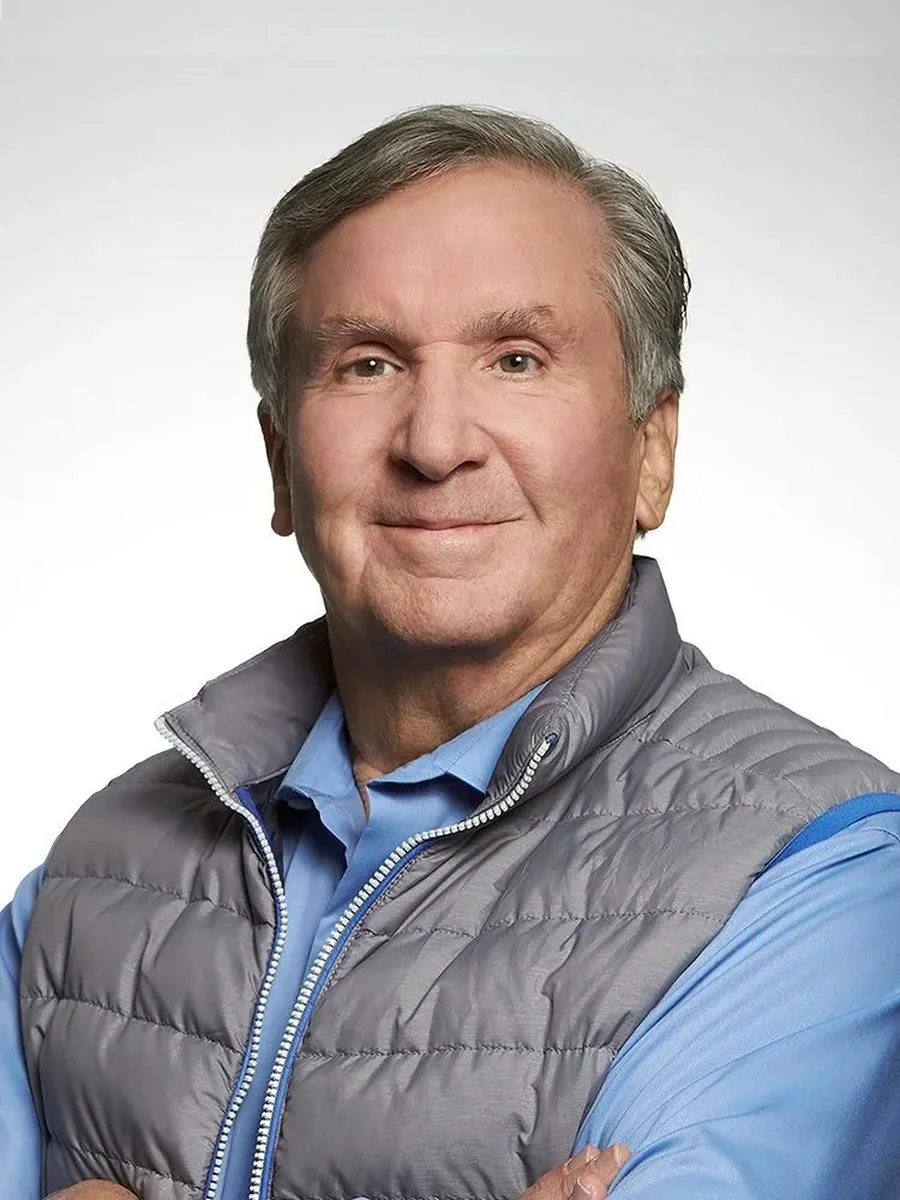
Brook Byers
Created the first life-sciences practice inside a VC firm; incubated four public biotechs.
An engineer enters a relationship business
Brook H. Byers was born on 2 August 1945 at Scott Air Force Base and grew up largely in Atlanta. He earned an electrical-engineering degree from Georgia Tech in 1968 and a Stanford MBA in 1970, then moved through short consulting and operating roles before venture capital. Bancroft oral history, printed pp. 1–10 The useful biographical fact is not simply that he studied engineering: his later craft repeatedly joined technical learning to organizational construction. The causal claim remains bounded because the surviving account was recorded decades later. [retrospective witness · moderate]
In December 1972 Byers became the first employee of Pitch Johnson’s Asset Management Company. Johnson invested personal capital rather than an outside fund, while early rounds were commonly syndicated across several small firms. Byers oral history, printed pp. 10–12 · Pitch Johnson oral history, Asset Management discussion This was apprenticeship inside a sparse network, not a 1972 start at Kleiner Perkins. Qume and Tandem show the work split among founder relationships, diligence, allocation authority, capital, and board service rather than collapsing into one person’s “deal.” Tandem attribution reconstruction
Formative mechanism — [researcher inference · moderate]. Technical fluency made scientific claims discussable; a small network made trusted access scarce; Johnson’s capital and board model taught that a check created an ongoing relationship. Those ingredients plausibly prepared Byers for hands-on formation, but chronology cannot establish that they caused later outcomes. The thesis predicts the same ingredients should appear in ordinary and failed cases, not just famous wins.
Learning at Kleiner & Perkins without rewriting Genentech
Byers and Frank Caufield joined Eugene Kleiner and Tom Perkins in 1977. Kleiner Perkins, Frank Caufield memorial The firm’s present title “Founder” is a current role label; it should not be retrojected into co-founding Kleiner & Perkins in 1972. Kleiner Perkins biography Before joining, Byers had lived with Bob Swanson and helped think through Genentech product planning and market analysis. Byers oral history, printed pp. 12–14
Genentech is therefore a formative case, not a Byers-originated investment. The firm’s own history names Swanson and Herbert Boyer as founders and gives Perkins and Kleiner the original board relationship; Byers assisted the commercial planning. Kleiner Perkins, “Genentech: Pioneering Medical Breakthroughs,” company-formation section This attribution control matters because the favorable thesis depends on work Byers actually performed, not on every company near his firm. [documented behavior · strong]
Hybritech turns learning into a formation experiment
Hybritech in 1978 is the clearest transition from adviser to company creator. Byers helped assemble the opportunity, served temporarily as founding president, chaired the board, and recruited permanent operating leadership. Scientists and builders Ivor Royston, Howard Birndorf, Gary David, Richard Miller, Ted Greene, Tom Perkins, and the financing syndicate retain distinct credit. Byers oral history, printed pp. 18–24 · Los Angeles Times, 19 April 1988
The plan reportedly paired a $300,000 KPCB seed with a narrow six-month technical test; the proof arrived in roughly three months. Lilly’s later transaction was reported around $485 million under one contemporaneous calculation, but transaction value divided by the first check is not a venture multiple: follow-ons, dilution, ownership at exit, warrant treatment, distributions, and time are missing. Los Angeles Times, 14 July 1987 [documented behavior · insufficient public record]
Hybritech supports a reusable formation mechanism: start with an important clinical problem, recruit complementary scientific and operating talent, buy one decision-changing proof, and replace the interim investor-operator with dedicated management. It does not prove that the mechanism generated superior portfolio returns, and Lilly’s later integration and product outcome caution against treating a venture exit as the end of the clinical story. [researcher inference · moderate] Hybritech no-hindsight lab
Deliberate specialization, 1983–1986
Byers later described a 1983–1985 study period organized around medical needs, scientific networks, and opportunities for company formation; Kleiner Perkins dates its dedicated life-sciences practice to 1984. Byers oral history, printed pp. 31–36 · current Kleiner Perkins biography Gen-Probe was an early test, followed by a 1986 cohort including Athena Neurosciences, Gensia, InSite Vision, IDEC, and BioSurface Technology. Byers oral history, printed pp. 32–36
Proposed causal chain — [retrospective witness · moderate]. Study narrowed the search space; specialization accumulated scientific and clinical relationships; those relationships surfaced capabilities without companies; KPCB supplied formation capital and partner labor; technical or clinical milestones allowed successive decisions. The sequence fits the oral history and the company pattern, but the missing memos, rejected opportunities, ordinary cases, and cash flows prevent a causal performance test.
The four roles supportable from a contemporaneous public filing are Hybritech, IDEC, InSite Vision, and Ligand, where Genomic Health’s S-1 says Byers had served as founding president and chairman. Genomic Health S-1, “Management—Brook H. Byers” Athena belongs in the incubation cohort but not in that exact four-company title claim. The current firm claim that four incubated public companies exceeded $8 billion in aggregate value has no named four, valuation date, ownership bridge, or cash-flow denominator and is not used as a return statistic. Kleiner Perkins biography
From single product to several shots on goal
IDEC is the strongest evidence that the method became more than one Hybritech-shaped template. Byers participated in formation and served as founding president and chair, while Royston, Birndorf, Richard Miller, Nabil Hanna, William Rastetter, Ronald Levy, scientists, executives, Genentech, and the board owned critical parts of the work. An early program disappointed; the company later advanced anti-CD20 development with strategic financing. IDEC holders received 50.5% of the 2003 Biogen combination, but that issuer result is not KPCB proceeds. IDEC/Biogen merger release, “Transaction Terms” and founders discussion
Byers’s later account emphasized several independent programs and a board decision to reinvest after an initial clinical failure. Fogarty recording, 25:24–28:52 The useful rule is not unconditional persistence: continue only when a different program has distinct evidence, an explicit next milestone, and financing adequate to reach it. The original board packet, alternatives, security, and dissent are missing, so the persistence lesson remains outcome-aware. [retrospective witness · moderate] IDEC decision lab
Personalized medicine widens the system
From the early 2000s, Byers’s public record shifted toward diagnostics, sequencing, and the infrastructure around personalized medicine. Genomic Health, XDx/CareDx, CardioDx, Pacific Biosciences, Foundation Medicine, and Veracyte create a within-thesis comparison rather than one victory story. Public filings show Byers board roles and KPCB vehicle positions, but manager-shared beneficial ownership is not personal ownership. Genomic Health S-1, principal stockholders · PacBio prospectus, principal stockholders · Foundation Medicine S-1/A, principal stockholders · Veracyte proxy, security ownership
Genomic Health is the strongest success-side example: KPCB X vehicles held 12.6% before the IPO under shared manager control, and Exact Sciences later announced a transaction reported near $2.8 billion. The public record does not establish KPCB’s stake or proceeds at closing. Genomic Health S-1 · Exact Sciences transaction filing
CardioDx is the necessary failure control. Byers originated the concept, served as CEO in 2003–2004 and remained a director; its filings separate his direct securities from KPCB X positions. CardioDx S-1/A, pp. 4–9, 109–110 and principal stockholders The company withdrew its IPO and shut in 2019. San Francisco Chronicle, 8 January 2019 CMS's evidence review documents the clinical-utility and reimbursement problem. CMS coverage analysis, evidence review That divergence makes reimbursement and changed clinical action part of product underwriting, not a post-launch afterthought. [researcher inference · strong] CardioDx failure lab
Public infrastructure and the limits of ecosystem doctrine
Byers’s 2005 CIRM testimony described a biomedical cluster as a combination of basic science, clinical translation, companies, capital, policy, and skilled labor. CIRM transcript, printed pp. 192–193 His participation in the NCATS working group later placed him in public/private translational-infrastructure design, although no group recommendation can be personalized without drafting or minutes. NCATS report, cover, findings, and Appendix A
The ecosystem view explains where specialized formation can work; it is not proof of proprietary access or investment performance. CIRM testimony was also interested site-selection advocacy, and its broad Genentech wording illustrates narrative-credit drift. [researcher inference · strong] The proper use is to map dependencies—science, clinic, company, capital, payer, regulator, policy—then identify which one is a defensible company asset and which remains public infrastructure.
Failures, ordinary outcomes, and what did not visibly change
The discovered ledger contains 40 named families: 35 candidate capital/governance relationships, two role-only associations, and three exclusion controls. None supplies a complete person-and-vehicle cash-flow chain. Denominator and return discipline This makes a company list evidence of activity, not a career hit rate or personal return series.
Three adverse cases pressure-test the favorable story. Nanogen sold substantially all assets in bankruptcy for a reported $25.685 million and management expected no value for common stockholders; KPCB cost and distributions are unavailable. Nanogen issuer release InSite Vision’s long development arc ended in a reported transaction of roughly $48 million equity value, with no reconstructed KPCB proceeds. InSite issuer release Enjoy entered Chapter 11 about eight months after its public combination; a Byers-managed Waycross position is separate from KPCB XVI, and the original entry thesis and loss are missing. Enjoy S-1, selling-securityholder footnotes · restructuring docket
The late public record emphasizes teams, psychological safety, and persistence, but it does not disclose a standardized postmortem, a revised reserve rule, or a demonstrated improvement in failure rate. Fogarty recording, 12:14, 23:00, 25:24–28:52 [researcher inference · provisional]. Absence from the public record is not proof that no private learning occurred; it is a reason not to claim it.
People, capital, and influence map
| Node | Contribution supported by the record | Boundary |
|---|---|---|
| Pitch Johnson / Asset Management | First venture employer; personal capital; technical and board apprenticeship. Pitch Johnson oral history | Byers was employee/apprentice; no outside-fund or sole-credit inference. |
| Kleiner, Perkins, Caufield, Doerr / KPCB | Partnership brand, capital, internal debate, syndicates, shared manager authority. Kleiner Perkins, Frank Caufield memorial | Firm outcome and fund holdings are not Byers’s personal ownership. |
| Scientists and clinicians | Originated biology, assays, targets, and clinical evidence. Hybritech account | “Incubated” never erases invention credit. |
| Operating executives | Built organizations, products, reimbursement, manufacturing, and sales. Electronic Arts firm history | Interim investor operation is not lifetime company execution. |
| Strategics and co-investors | Supplied follow-on capital, development, manufacturing, distribution, and exit routes. IDEC/Biogen merger release | Partnership can create dependency and bargaining risk as well as validation. |
| Universities, CIRM, NIH/NCATS, Stanford Biodesign, UCSF | Science, clinics, training, policy, and translational infrastructure. CIRM transcript, pp. 192–193 | Public infrastructure is not a proprietary investment edge by itself. |
| Founders and boards | Shared company formation, recruiting, governance, follow-ons, and stops. Fogarty recap | Unknown votes and responsibilities remain unknown. |
Clinical need → scientists/clinicians → company and operator → KPCB vehicle/IC → follow-on or stop. Public infrastructure, payer/regulator, strategic partners, and capital markets influence every arrow; they are not Byers-owned assets. [researcher inference · strong]
A falsifiable account of the edge
Testable thesis — [researcher inference · moderate]. In US life sciences from the late 1970s through the diagnostics era, Byers’s possible repeatable edge was converting an unmet clinical need into a specialized company-formation program: learn the domain deeply enough to find a missing company, recruit complementary scientific and operating talent, use intensive governance, and stage capital against decision-changing technical, clinical, and market evidence.
Supporting pattern. Hybritech supplies the clearest technical-proof and interim-operation case; the 1986 cohort supplies repetition; IDEC supplies multi-program re-underwriting; Genomic Health, XDx/CareDx, and CardioDx supply a within-thesis outcome spread; public talks repeat specialization, team, capacity, and evidence staging. Talks recurring frameworks · Portfolio patterns [investor-stated · moderate]
Prediction. Unseen pre-outcome records should repeatedly show (1) a named clinical decision or unmet need before company selection, (2) specialist access generated before a competitive process, (3) explicit complementary recruiting, (4) a milestone that can disconfirm the thesis, (5) partner-time and ownership budgets, and (6) follow-ons tied to new evidence. The pattern should persist across ordinary outcomes and failures, not only Hybritech and IDEC.
Falsifiers. The thesis weakens if original memos show generic opportunity chasing, retrospective rationales, no distinctive Byers role, milestones written after outcomes, follow-ons driven by sunk costs, ordinary cases no better than matched peers, or results explained by one outlier. It would be overturned as a performance claim if complete fund cash flows showed no domain- or ex-outlier advantage after vintage, ownership, risk, and team contributions were controlled.
Current evidence boundary. The public record is strong enough to describe a process and weak enough that it cannot establish personal alpha. Zero of 40 discovered families has a complete cash-flow chain; the firm’s unitemized “more than 60” claim means overall portfolio coverage is not computable. Investments denominator
The strongest alternative explanation
Skeptical thesis — [researcher inference · strong]. The reputation may reflect privileged access to early biotechnology, KPCB’s brand and capital, collaborators’ science and execution, favorable public and strategic markets, selective retelling, and a few visible company outcomes rather than a repeatable Byers-specific selection advantage.
- Access was unusually scarce in the 1970s and elite Bay Area networks prefiltered opportunities. Historical context
- Hybritech, IDEC, Genomic Health, and later companies were collective achievements; Genentech and Align show how firm proximity can become personal credit. Deal-credit controls
- Company transaction values cannot recover fund or personal returns, and no audited IRR, DPI, TVPI, or MOIC survives. Return discipline
- CardioDx, Nanogen, InSite, and Enjoy defeat a uniformly superior-judgment narrative. Failure ledger
- Retrospective oral history is rich but outcome-aware, while the public written corpus is unusually thin. Writings evidence base
Evidence would favor the edge over the skeptic if contemporaneous memos, board records, partner-role ledgers, rejected deals, full cash flows, and matched sector/vintage comparisons showed the predicted pattern and better ex-outlier outcomes. Until then, the most defensible greatness claim concerns company-formation craft and institutional specialization, not quantified personal performance. [researcher inference · strong]
Evolution and modern transfer
The practice appears to evolve from general technology apprenticeship (1972–1977), through hands-on biotech formation (1978–1986), to a specialized life-sciences portfolio, personalized diagnostics and public translational infrastructure (2000s–2010s). Sourced chronology The stable thread is active, domain-literate company building; the later emphasis adds ecosystem and persistence language. Whether the decision process itself changed after failures is insufficiently documented. [researcher inference · moderate]
Modern translation as of 2026-08-23 — [researcher inference · moderate]. The transferable unit is not “copy an elite life-sciences network.” It is an analyst-created process: define the consequential decision; map the case-specific science, workflow, buyer, regulator, manufacturing, and capital dependencies; identify the missing company; recruit a complementary team; fund one discriminating milestone; write kill criteria; and allocate a named partner’s capacity. Bancroft, printed pp. 27–46 · Stanford 2005 lecture family In a hypothetical 2026 AI-enabled-biology review, an analyst would add model/data rights, independent validation, security, and compute economics only when the specific company makes them material. This is a test design, not a factual claim about current market conditions; the likely misuse is calling thematic access an edge before showing decision-changing evidence.
Sourced chronology
| Date | Turning point | What it does and does not establish |
|---|---|---|
| 1945–1970 | Atlanta upbringing; Georgia Tech EE; Stanford MBA. Bancroft, pp. 1–8 | Formation facts; later causality is retrospective. |
| 1970–1972 | Consulting and operating roles. Bancroft, pp. 8–10 | Brief exposure, not a proven operating edge. |
| 1972–1977 | First employee at Pitch Johnson’s Asset Management. Bancroft, pp. 10–12 | Start of VC career; Johnson capital and team attribution preserved. |
| 1976–1977 | Genentech assistance; move to Kleiner & Perkins. firm history | Learning contribution, not founder or lead-investor status. |
| 1978 | Hybritech formation and staged proof. Los Angeles Times | Strongest formation case; no computable investor return. |
| 1983–1986 | Deliberate life-sciences specialization and incubation cohort. Bancroft, pp. 31–36 | Repetition evidence; missing reject set and ordinary-case economics. |
| 1986–2001 | Four filing-confirmed founding president/chair roles. Genomic Health S-1 | Hybritech, IDEC, InSite, Ligand—no broader title inference. |
| 2001–2007 | Genomic Health board and KPCB X position. Genomic Health S-1, management and principal stockholders CardioDx CEO/director formation role. CardioDx S-1/A, management pp. 109–110 CIRM ecosystem testimony and Stanford operating doctrine. CIRM, printed pp. 191–193 · Stanford 2005 lecture family | Diagnostics and ecosystem era; advocacy is not return evidence. |
| 2007–2015 | PacBio, Foundation Medicine, Veracyte, Five Prime filing record. SEC filing set | Board/fund positions; shared control is not direct ownership. |
| 2019 | Fogarty retrospective; CardioDx shutdown. Fogarty · CardioDx reporting | Mature team/persistence doctrine meets an adverse outcome. |
| 2024–2026 | UCSF describes Epiodyne help; live firm page lists current boards. UCSF · Kleiner Perkins biography | Current association only; Epiodyne investment proof is unresolved. |
Learning path and unresolved questions
Read the written corpus for the thin public authorship record, then the talks for direct process language. Freeze the information set in the Hybritech, IDEC, Genomic Health, CardioDx, and Enjoy labs before reading outcomes. Then use the operating system and field guide to test transferability.
The decisive missing evidence remains: the itemized 60-plus-company universe; rejected deals; original Hybritech and IDEC decision packets; vehicle agreements, checks, reserves, ownership and distributions; partner votes and role ledgers; CardioDx’s wind-down and loss; and a controlled full text of the Pratt chapter. Until those records surface, the biography can explain a documented craft but cannot score its risk-adjusted performance.
1. Snapshot and testable edge thesis
| Question | Evidence-backed answer |
|---|---|
| Investor, firm, era | Brook Byers began venture work at Pitch Johnson’s Asset Management Company in 1972 and joined Kleiner & Perkins in 1977; his strongest documented domain is US life-sciences company formation from Hybritech through personalized diagnostics. Bancroft, printed pp. 10–36 |
| Proposed edge | [researcher inference · moderate] Convert an unmet clinical need into a specialized company-formation program: build domain access, create the missing organization, recruit complementary scientific and operating talent, govern intensively, and stage capital against decision-changing evidence. biography |
| Mechanism | [researcher inference · moderate] Specialization improves access and questions; formation makes stranded science investable; complementary teams distribute capabilities; milestones buy information; boards and follow-ons act on it. talks frameworks |
| Scope | Strongest for capital-intensive, regulated science where company creation and clinical networks mattered, especially 1978–2010s. It is not established for all technology investing or current KPCB. historical context |
| Evidence status | Strong for stated process and several roles; moderate for causal efficacy; insufficient for personal performance. Zero of 40 discovered families has a complete cash-flow chain, and the firm’s “more than 60” claim is unitemized. denominator |
| Predicted unseen evidence | [researcher inference · moderate] Contemporaneous ordinary-case files should name the clinical decision, specialist source, complementary hires, disconfirming milestone, partner capacity, ownership logic, and evidence-conditioned follow-on before outcomes. |
| Falsifiers | Generic opportunity chasing, retrospective milestone invention, weak Byers-specific roles, sunk-cost follow-ons, no ex-outlier or matched-cohort advantage, or returns explained by KPCB access, teams, era, and a few outliers would weaken or overturn the thesis. skeptical case |
2. Core philosophy
- Begin with the consequential problem — [investor-stated · moderate]. Byers’s oral history describes working backward from unmet medical needs rather than beginning with an available technology. Bancroft, printed pp. 27–36
- Make specialization cumulative — [investor-stated · moderate]. Domain knowledge, scientific and clinical relationships, and reputation form an ecosystem for finding and evaluating new companies. Repetition shows consistency, not efficacy. Stanford ecosystem clip
- Create and build, not merely select — [documented behavior · strong]. Hybritech and the 1986 cohort show temporary operating roles, recruiting, chair work, and company formation. Bancroft, printed pp. 18–36 The Genomic Health filing independently verifies only the four selected founding-president/chair titles it names. Genomic Health S-1, director biography
- Buy evidence in stages — [researcher inference · moderate]. Hybritech’s technical proof, IDEC’s program re-ranking, and diagnostics’ clinical/reimbursement gates suggest that each check should change a decision. decision labs
- Treat the investor–founder relationship as an unresolved written theme — [researcher inference · insufficient public record]. Bibliographic records establish that the Pratt chapter existed and recurred, but no controlled body or pinpointed quotation survives; REVIEW therefore assigns it no substantive relationship or governance proposition. Pratt source analysis
Operating-system synthesis — [researcher inference · moderate]. Need → specialist network → missing-company thesis → complementary team → staged proof → active governance → evidence-conditioned follow-on or stop. The chain is falsifiable at each arrow; a famous outcome does not retroactively validate the process.
3. Sourcing
| Route | What the record supports | Repeatability and boundary |
|---|---|---|
| Apprenticeship network | Pitch Johnson, founders, early Valley investors, and KPCB relationships gave Byers scarce access. Pitch Johnson oral history | [researcher inference · strong] Access is an input, not selection alpha; record referrer, diligence, capital, approval, board, and outcome separately. |
| Clinical-need study | Byers retrospectively describes selecting important medical problems and building expert networks around them. Bancroft, pp. 31–36 | [retrospective witness · moderate] Repeatable as a research process; causal advantage needs contemporaneous memos and a pass ledger. |
| Scientists and universities | Hybritech, Gen-Probe, and the incubation cohort arose through scientific relationships and institutional capabilities. Bancroft, pp. 18–36 | [researcher inference · moderate] A university relationship is not proprietary unless access, rights, team, and speed are demonstrably differentiated. |
| Firm and founder referrals | Electronic Arts was shared sourcing: the firm history says Byers and John Doerr contacted Trip Hawkins, with Sequoia and Sevin Rosen also financing. Kleiner Perkins EA history | [documented behavior · strong] Warm access does not confer sole credit. |
| Ecosystem institutions | CIRM and NCATS reveal a wider science–clinic–capital–policy network. CIRM, pp. 192–193 | [researcher inference · moderate] Public infrastructure can improve the opportunity set without being a firm moat or an investment. |
Sourcing diligence should preserve name/date variants, founders, scientific institutions, legal vehicles, and rejected opportunities. No public rejection ledger survives, so false-negative rates and funnel conversion are insufficient public record.
4. Picking
- Clinical decision first — [investor-stated · moderate]. Define the patient/physician decision, present workaround, and measurable benefit before admiring the science. Bancroft, pp. 27–36
- Complementary team — [investor-stated · strong]. Look for scientists, an entrepreneurial leader, and operating functions whose strengths are nonredundant; the Stanford lecture makes team complementarity explicit. Stanford “Ideal Team” transcript
- Several independent paths — [investor-stated · moderate]. In biotechnology, multiple programs can diversify biological risk when their mechanisms are genuinely distinct. Bancroft, pp. 39–46
- Milestone and dependency map — [researcher inference · strong]. Test science, clinical action, regulation, reimbursement, manufacturing, financing, and partner dependence as one causal chain. CardioDx shows that diagnostic validity without sufficient utility/coverage can still fail. CMS evidence review
- Red flags — [researcher inference · moderate]. Kill or redesign when science is not reproducible, no operator can be recruited, a program lacks an independent proof path, the clinical decision will not change, one payer controls viability without durable coverage, or partner time/capital cannot reach the next proof.
The record does not expose a universal founder score, price ceiling, formal reference protocol, or complete rejected-deal sample. Picking rules are reconstructed from direct process statements and cases; they are not a validated predictive model.
5. Deal and portfolio mechanics
| Dimension | Supported position | Evidence gap |
|---|---|---|
| Initial ownership | Hybritech reportedly paired $300,000 with a large early KPCB interest. Los Angeles Times, 19 April 1988 | [researcher inference · insufficient public record] No universal target or durable cap-table bridge survives. |
| Staging | Hybritech used technical proof; IDEC and PacBio expose successive scientific/capital milestones. labs | [researcher inference · moderate] Exact tranche contracts, reserves, votes, and kill thresholds are missing. |
| Syndication | Byers said two or three co-investors can work; early rounds often required several firms. Stanford “Multiple Investors” | [investor-stated · moderate] The right count is era-, stage-, and governance-dependent, not a constant. |
| Capacity and concentration | The 2005 lecture ties roughly two new company commitments per partner per year to board intensity and ownership. Stanford 2005 lecture family | [investor-stated · insufficient public record] No full board-load or reserve schedule tests practice. |
| Follow-ons | IDEC’s late account supports reinvestment after re-underwriting, not automatic support. Fogarty, 25:24–28:52 | [retrospective witness · moderate] Original board alternatives, security, and dissent are unavailable. |
| Exits | IPO, acquisition, and remaining public are different states. Reported issuer values are not fund proceeds. return discipline | [researcher inference · strong] No complete Byers or KPCB MOIC, IRR, DPI, TVPI, or hit rate is computable. |
Portfolio practice should be analyzed as partner-time allocation plus ownership and reserves, not company count alone. The 40-family discovered ledger is exhaustive only for named public evidence; it is not the unitemized 60-plus universe. company ledger
6. Vehicle and incentive fit
| Vehicle / condition | Strategy fit | Missing or constraining evidence |
|---|---|---|
| Asset Management, 1972–1977 | Pitch Johnson’s personal capital allowed apprenticeship and active board work without a disclosed external LP clock. Bancroft, pp. 10–12 | Byers compensation, authority, carry, liquidity, and succession are unknown. |
| Early Kleiner & Perkins / KPCB | Small funds plus partner labor could form companies; the oral history reports an $8 million first fund and $15 million KPCB I. Bancroft, pp. 18–24 | [retrospective witness · moderate] Figures are unaudited; term, fee/carry, reserves, and distributions are unavailable. |
| KPCB X/XI/XII/XIV entities | Filings identify fund holdings, manager groups, and some ownership percentages. vehicle map | Shared voting/dispositive authority is not personal ownership; geographic authority, allocation, carry, key-person terms, and stakeholder rights are missing. |
| Direct Byers securities | PacBio, Veracyte, and CardioDx filings sometimes separate personal shares or purchases. PacBio prospectus | Cost, disposition, taxes, and profit remain unavailable unless expressly disclosed. |
| Waycross Ventures | Enjoy’s S-1 identifies Byers as Waycross’s managing member. Enjoy S-1, selling-securityholder footnote | It is separate from KPCB XVI; original entry, mandate, LPs, reserves, economics, and loss are unknown. |
Vehicle-fit conclusion — [researcher inference · moderate]. Long scientific development, active boards, multi-program companies, and follow-ons require durable pooled capital, reserves, and partner capacity. Finite fund lives, fundraising, fees/carry, distributions, allocation conflicts, regulation, liquidity, succession, and key-person continuity may constrain that ideal; the public record is too incomplete to show how KPCB resolved each dimension. A modern fund must inspect its governing documents rather than assume historical flexibility.
7. Team attribution and work with founders
| Case | Source/sponsor | Diligence/decision/capital | Build/govern | Follow-on/exit/narration |
|---|---|---|---|---|
| Genentech | Swanson/Boyer founded; Byers learned beside Swanson. | Perkins/Kleiner held original firm relationship. | Byers helped product/market planning. | Exclude from Byers economic ranking. firm history |
| Hybritech | Byers and scientific network assembled opportunity. | KPCB and syndicate funded; exact votes unknown. | Royston, Birndorf, David, Miller, Greene, Perkins and Byers had distinct roles. | Lilly transaction is company value, not Byers/KPCB proceeds. contemporary account |
| IDEC | Byers/Birndorf/Royston/Miller formation network. | KPCB/board/strategic financing; decision packet missing. | Hanna, Rastetter, Levy, scientists and executives owned product/operation. | Fogarty supplies outcome-aware board narration. merger release |
| Electronic Arts | Byers and Doerr contacted Hawkins. | KPCB, Sequoia, Sevin Rosen; allocations unknown. | Hawkins, Bing Gordon and team executed; Byers served 13 years on board. | No personal economics. KP history |
| Later filings | Board biographies and manager groups allocate governance. | Fund entities own securities; IC votes usually unknown. | Founders/executives/scientists operate. | SEC footnotes control ownership claims. Veracyte proxy |
Founder-working rule — [researcher inference · moderate]. Before investment, write who owns scientific truth, operating execution, investor sponsorship, board work, recruiting, follow-on advocacy, and the kill case. The partial Pratt chapter and Perkins introduction favor active relationships, but no public corpus reveals how Byers handled founder conflict or management replacement across the portfolio. writings synthesis
8. Views on the craft
- Power law — [researcher inference · insufficient public record]. The case list appears outcome-concentrated, but no complete cash flows permit a literal split or ex-top-one result. Pareto ranking
- Fund size and partner time — [investor-stated · strong]. Firm scale should follow the number of partners who can do real company work; ownership should justify that scarce time. Stanford 2005
- Access versus selection — [researcher inference · moderate]. Byers’s scientific and founder networks generated opportunities, but missing passes and ordinary outcomes prevent isolating selection skill. Bancroft, printed pp. 18–36 · searched denominator
- Governance — [investor-stated · moderate]. Close working relationships, active boards, and complementary teams are central; intervention without capacity, consent, or attribution can become theater. Stanford “Developing Close Working Relationships”
- Exits — [researcher inference · strong]. A public listing is financing/liquidity, an acquisition is an issuer event, and neither establishes investor cash without ownership and disposition records. return discipline
- Great investor test — [researcher inference · moderate]. An analyst-created standard should require repeated pre-outcome problem framing, complementary teams, informative milestones, action on adverse evidence, honest capacity allocation, and risk-adjusted economics across a denominator. The public record partly supports the process but not the performance test. talks frameworks · denominator
9. Signature bets and decision process
Use the frozen-record exercises before reading outcomes:
- Hybritech — decide whether a $300,000 formation check and six-month technical proof justify institution and team risk.
- IDEC — decide whether a different program has enough independent evidence to reinvest after failure.
- Genomic Health — connect assay validity to a changed treatment decision and reimbursement.
- Pacific Biosciences — distinguish financing a capital-intensive platform from realizing an exit.
- CardioDx — failure lab: require clinical utility and coverage, not only diagnostic accuracy.
- Genentech — distinguish assistance and learning from founder, lead-investor, and economic credit.
- Enjoy — failure lab: test unit economics and liquidity without an original Waycross memo.
For each: invest/pass, named kill criteria, ownership/security/rights, next-check milestone, partner capacity, decision owner, and actual outcome. These are analyst-created reconstructions, not recovered Byers IC memos. [researcher inference · strong]
10. Mental models and maxims
| Model | Decision use | Origin evidence | Field guide |
|---|---|---|---|
| Work backward from unmet medical need | Start with the clinical decision and stakeholder consequence. | Bancroft, pp. 27–36 | model |
| Specialize until learning and network compound | Build domain access and better questions before a deal process. | Stanford ecosystem clip | model |
| Create the missing company | Turn stranded capability into an investable organization. | Hybritech account | model |
| Stage capital against decision-changing evidence | Make each check buy a proof that changes fund/stage/stop. | Hybritech and IDEC labs | model |
| Build several independent shots on goal | Diversify biological mechanisms inside a company only when genuinely distinct. | Bancroft, pp. 39–46 | model |
| Pair scientists with complementary operators | Separate invention, entrepreneurship, operations, and governance. | Stanford “Ideal Team” | model |
| Budget partner time, ownership, and board load together | Accept only commitments a named partner can serve. | Stanford 2005 | model |
| Require a partnership champion and explicit shared decision | Assign advocacy without disguising collective approval or dissent. | Stanford decision-making clip | model |
| Re-underwrite persistence after failure | Continue only when new evidence supports a distinct path. | Fogarty, 25:24–28:52 | model |
These nine are supportable recurring rules. “Magic Mondays,” public/private ecosystems, neglected problems, and category-versus-project fit are useful routines or context but should not be split into extra models without distinct portfolio application evidence. [researcher inference · moderate]
11. Evolution and contradictions
| Period | Supported evolution | Tension or contradiction |
|---|---|---|
| 1972–1977 | Apprenticeship in technical diligence, syndication, and boards. Bancroft, pp. 10–14 | [researcher inference · moderate] Sequence does not prove later causality. |
| 1978–1986 | [researcher inference · moderate] Hybritech formation precedes deliberate life-sciences specialization and a cohort. Bancroft, pp. 18–36 | [researcher inference · moderate] One success may have enabled the system; the ordinary/failure denominator remains incomplete. denominator |
| 1986–2001 | [documented behavior · moderate] Several incubations, boards, and programs widen the observed pattern. Genomic Health S-1, director biography | [researcher inference · strong] Founding titles differ by company; firm and partner credit cannot be averaged. team map |
| 2001–2011 | [researcher inference · moderate] Personalized diagnostics plus CIRM/NCATS widen the public record from companies toward translational infrastructure. CIRM, printed pp. 192–193 · NCATS, findings and Appendix A | [researcher inference · strong] Policy advocacy and collective membership are not underwriting or personal authorship. writings attribution boundary |
| 2011–2019 | [investor-stated · moderate] Public appearances emphasize teams, psychological safety, and persistence. Fogarty, 12:14, 23:00, 25:24–28:52 | [researcher inference · strong] CardioDx and Enjoy motivate stronger utility, stop, and unit-economics tests, but no public process update is demonstrated. CardioDx lab · Enjoy lab |
Durable public themes are specialization, complementary teams, active governance, and evidence staging. The unresolved contradictions are intensity versus partner capacity, persistence versus sunk cost, ecosystem benefit versus private moat, mission versus project economics, and collective firm identity versus individual credit. [researcher inference · strong] talks frameworks · deal-credit controls · failure ledger
12. Failures and limits
- CardioDx outcome — [contemporaneous record · strong]. The company shut in 2019 after its withdrawn IPO; the exact Byers/KPCB loss is not public. San Francisco Chronicle, 8 January 2019 Analyst lesson — [researcher inference · moderate]: treat changed clinical action and durable coverage as early gates, while preserving that no public record shows Byers adopted this process correction. CMS evidence review
- Nanogen outcome — [contemporaneous record · strong]. Bankruptcy asset sale was reported at $25.685 million and management expected common holders to receive nothing; KPCB cost/distributions are missing. issuer release The Byers association is separately [retrospective witness · moderate].
- InSite Vision — [documented behavior · moderate]. A long development arc ended in a modest reported transaction; time, dilution, and proceeds remain unknown. transaction release
- Enjoy outcome and holder boundary — [contemporaneous record · strong]. Byers managed Waycross’s disclosed stake; Chapter 11 followed the public combination, but original cost, thesis, follow-ons, and loss are insufficient public record. S-1 · docket
- Selection and survivorship — [researcher inference · strong]. The current firm biography is selective, while the 40 named families do not reconcile its unitemized 60-plus claim, passes, shutdowns, or full economics. Kleiner Perkins biography · denominator
- Era dependence — [researcher inference · strong]. The oral record describes sparse early-biotech information, small funds, local networks, and strategic-pharma financing; transfer to any later case requires those conditions to be retested rather than assumed. historical context
[researcher inference · strong] No public evidence reviewed proves a formal sell discipline, reserve policy, standardized postmortem, price ceiling, or false-negative rate. These are limits of the evidence and possibly of the articulated philosophy; they should not be filled by inference. source-map coverage assessment · uncertainty ledger
13. Historical operating environment
In the 1970s, the oral record describes roughly $1 million rounds assembled by four or five venture firms, limited specialist information, and personal or small partnership capital. Bancroft, pp. 10–24 Commercial biotechnology had limited templates, so a narrowly falsifiable technical proof and recruited operator could be more valuable than a detailed long-range forecast. [researcher inference · moderate]
[retrospective witness · moderate] Byers describes the mid-1980s formation pattern as university and clinical networks, multiple programs, staged financing, and pharmaceutical strategic relationships; together they made specialized company formation feasible but also created financing and partner-dependency risk. Bancroft, printed pp. 31–46 The later IDEC/Biogen release supports the Genentech relationship and merger outcome, not a period-wide university or public-market claim. IDEC/Biogen merger release No reliable numerical formation or success base rate was found; qualitative context is preferable to a manufactured benchmark.
The diagnostics era added archived tissue, genomics, sequencing, payer evidence, clinical guidelines, laboratory operations, and public-policy infrastructure. Genomic Health and CardioDx show why scientific validity, changed clinical action, reimbursement, and unit economics must clear together. Genomic Health S-1 · CardioDx S-1/A
Later company values and current datasets must not leak into ex-ante judgment. Compare cases only after matching stage, modality, vintage, capital intensity, regulatory/payer path, ownership, and vehicle; otherwise a historical lesson becomes hindsight. [researcher inference · strong]
14. Modern VC translation (as of 2026-08-23)
These are dimension-matched procedural comparisons, not evidence of current performance. Contemporary facts come from official FDA, NVCA, NIH, and ILPA materials; every proposed transfer, failure condition, signal, and application remains an analyst-created hypothesis [researcher inference · moderate] unless separately labelled. No matched 2026 portfolio or fund-return cohort was found.
| Indexed model | Historical anchor | Changed current condition | What does not transfer or fails—and why | Observable signal and kill test | Likely misuse | Analyst-created 2026 application |
|---|---|---|---|---|---|---|
| Work backward from unmet medical need | Byers describes beginning with unmet needs. Bancroft, printed pp. 27–36 | Technology/regulation — [contemporaneous record · strong]. FDA’s current digital-health list separately addresses AI-device lifecycle management, predetermined change control, cybersecurity, and clinical-decision-support software. FDA digital-health guidance list, 2025–2026 | [researcher inference · moderate] A one-time fixed technical proof does not transfer unchanged when an applicable product also has software lifecycle, update, or cybersecurity obligations; which rules apply is product-specific. | Signal: independent evidence changes the named clinical decision and the applicable lifecycle plan is credible; kill if the product cannot change action/outcome or its regulatory path is unowned. | Equating benchmark accuracy or authorization with clinical utility. | For a hypothetical AI-enabled diagnostic, require prospective workflow evidence, payer evidence, and a lifecycle/change-control plan before scale. |
| Specialize until learning and network compound | Domain knowledge and ecosystem relationships recur in Byers’s account. Stanford ecosystem clip | Market/rights — [contemporaneous record · strong]. Current NVCA resources include model university-biotech licensing terms, while NIH publishes license applications and startup model agreements. NVCA model documents, university-biotech section · NIH forms and model agreements | [researcher inference · moderate] The historical advantage of an informal local expert network does not transfer merely as access; formal rights, institution process, data/material access, conflicts, and competing routes must be differentiated. | Signal: the network produces defensible rights, evidence, or team access before a priced process; kill the edge claim if it supplies introductions only. | Calling institutional prestige or conference access a moat. | For a hypothetical specialist thesis, log source, rights, evidence contribution, conflicts, and time-to-team for every opportunity. |
| Create the missing company | Hybritech joins scientific capability, interim formation, and recruited management. Los Angeles Times, 19 April 1988 | Legal/market route — [contemporaneous record · strong]. NIH’s forms index publishes commercial-evaluation and start-up model agreements; its program explainer says current start-up-license availability is decentralized and decided by each institute or center case by case. NVCA publishes university-biotech term-sheet and sample-license models. NIH forms and model agreements · NIH start-up program boundary · NVCA model documents | [researcher inference · moderate] “Create a company” does not transfer as a default: a license, evaluation agreement, collaboration, or incumbent route may preserve more value with less organizational and financing risk. | Signal: valuable capability lacks an accountable development vehicle and startup economics beat the alternatives; kill formation if another route dominates after rights, capital, and incentives are mapped. | Manufacturing a company because the investor can. | Write startup, license, evaluation/collaboration, and incumbent-route memos before incorporating a hypothetical university invention. |
| Stage capital against decision-changing evidence | Hybritech and IDEC illustrate technical proof and program re-ranking. decision labs | Deal/legal conditions — [contemporaneous record · strong]. NVCA’s current model documents include explicit tranched-financing mechanics and revisions for bulk-data and outbound-investment rules. NVCA model documents, 2025–2026 updates | [researcher inference · moderate] An oral milestone and follow-on promise do not transfer where security rights, tranche release, data restrictions, or regulatory dependencies require explicit allocation; staging can also create control theater. | Signal: an independently testable threshold resolves a named uncertainty and legally changes fund/stage/stop; kill if the milestone is easy, non-discriminating, or unenforceable. | Confusing a tranche with evidence discipline. | Tie a hypothetical tranche to independent replication, a named stakeholder action, release mechanics, and a prewritten failure consequence. |
| Build several independent shots on goal | Byers describes multi-program risk diversification; IDEC supplies the outcome-aware case. Bancroft, printed pp. 39–46 · Fogarty, 25:24–28:52 | Technology/regulation boundary — [researcher inference · insufficient public record]. No matched 2026 multi-program company was processed. FDA’s index lists AI-enabled-device lifecycle guidance as draft; this record does not establish whether that guidance applies to any hypothetical program. FDA digital-health guidance list | [researcher inference · moderate] Several assets do not transfer as diversification when they share one hidden mechanism, dataset, manufacturing process, payer, or regulatory failure; portfolio optionality cannot waive program-specific evidence. | Signal: separately falsifiable, low-correlation paths with explicit shared dependencies; kill the diversification claim if one failure can invalidate all programs. | Relabeling variants of one bet as independent shots. | Build a dependency and regulatory-path matrix for three hypothetical programs before reserving platform capital. |
| Pair scientists with complementary operators | The Stanford lecture separates complementary team capabilities. Stanford “Ideal Team” | Organization/regulation — [contemporaneous record · strong]. NIH’s forms index lists license applications, commercial-evaluation agreements, and start-up models; the separate start-up page describes company and business-plan features of the former centralized Start-Up EELA/ECLA route and says current availability is decentralized and determined by each institute or center case by case. FDA’s index lists lifecycle and cybersecurity guidance, without establishing applicability to this hypothetical team. NIH forms and model agreements · NIH start-up program boundary · FDA guidance list | [researcher inference · moderate] The historical scientist-plus-operator pairing does not transfer as a sufficient team when rights, software lifecycle, security, evidence, manufacturing, or reimbursement work is material and unowned. | Signal: every gating decision has a qualified owner, time commitment, conflict map, and replacement trigger; kill or recruit when a critical role is decorative or vacant. | Counting advisers or famous names as operating capacity. | Map scientific, product, regulatory, security, manufacturing, reimbursement, and governance ownership for a hypothetical formation, then delete inapplicable roles. |
| Budget partner time, ownership, and board load together | Byers links firm scale and ownership to scarce partner time. Stanford 2005 lecture family | Fund/governance — [contemporaneous record · strong]. ILPA Principles 3.0 addresses key-person provisions, time and attention, governance, transparency, conflicts, and LP/LPAC rights. NVCA’s current index lists a Voting Agreement and other financing documents; it does not establish governance rights in any particular company. ILPA Principles 3.0, printed pp. 5–6, 19, 21, 23, 27, 31, 40 · NVCA model documents | [researcher inference · moderate] Byers’s rough two-new-companies-per-partner rule does not transfer as a universal count across different fund agreements, platform staffing, board rights, stages, or key-person dependencies. | Signal: named partner capacity, rights, reserve path, and measurable intervention through the next risk point; fail if promised work lacks an accountable owner or time budget. | Using ownership percentage or platform headcount as a proxy for service. | Budget named-partner and specialist hours, reserves, governance rights, and backup coverage before a hypothetical lead commitment. |
| Require a partnership champion and explicit shared decision | Byers describes an internal champion within partnership decision-making. Stanford decision-making clip | Fund/legal authority — [contemporaneous record · strong]. ILPA Principles 3.0 addresses fund governance, conflicts, key-person events, and LP/LPAC rights. NVCA’s current index lists voting and financing model documents but does not establish authority allocation in a particular company. ILPA Principles 3.0, printed pp. 5–6, 19, 21, 23, 27, 31, 40 · NVCA model documents | [researcher inference · moderate] An informal internal champion does not transfer as sole authority where partnership agreements, IC mandates, conflicts, voting rights, or reserved matters allocate the decision. | Signal: named advocate, lawful approval path, independent dissent owner, conflict record, and reopening conditions; kill if sponsorship obscures authority or attribution. | Turning advocacy into sole deal credit or bypassing formal approval. | Require a champion memo, authority map, conflict check, and independently owned kill memo for a hypothetical IC vote. |
| Re-underwrite persistence after failure | The IDEC account describes reinvestment after an initial clinical failure. Fogarty, 25:24–28:52 | Fund/deal conditions — [contemporaneous record · strong]. NVCA’s current page says its updates incorporate time- or milestone-based tranched-financing mechanics; ILPA Principles 3.0 addresses alignment, conflicts, and governance at the fund level. Neither source establishes that these mechanisms improve continuation decisions. NVCA model documents · ILPA Principles 3.0, printed pp. 5–6, 19, 21, 23, 27, 31, 40 | [researcher inference · moderate] The outcome-aware IDEC anecdote does not transfer as a general persistence rule: continuation must survive current security terms, reserve opportunity cost, conflicts, and a distinct evidence-based thesis. | Signal: new evidence supports a different path with sufficient runway and explicit stop terms; stop if the bridge only protects sunk cost, marks, or narrative. | Calling endurance a virtue after the thesis failed. | Version the thesis, compare portfolio opportunity cost, map tranche rights, and require an independent kill advocate before a hypothetical bridge. |
Public/private ecosystem dependencies remain context across specialization and staging, not a tenth model. CardioDx remains the grounded historical control for clinical utility and coverage; it is not presented as a contemporary example. CMS evidence review
15. Comparison with completed peers
Pitch Johnson is the direct apprenticeship and early-vehicle comparator; Arthur Rock is the same-era active-board and founder-network comparator; Bob Nelsen is the closest later life-sciences company-factory comparator. All three are marked complete in the repository index. Comparison is mechanism- and evidence-matched, not a performance ranking. [researcher inference · strong]
| Dimension | Byers | Pitch Johnson | Arthur Rock | Bob Nelsen | Bounded conclusion |
|---|---|---|---|---|---|
| Sourcing | Clinical needs, specialists, KPCB/founder ecosystem. Bancroft, pp. 31–36 | Technical curiosity, direct search, trusted referrers. peer synthesis · CHM, PDF pp. 13, 15–16 | Trusted technical/founder network and inbound access. peer synthesis · Moore–Rock, pp. 19–24 | University/lab science, repeat founders, proactive themes. peer synthesis · University of Chicago institutional history | Byers sits between mentor-led general networks and Nelsen’s institutionalized lab formation; none converts access into proven alpha. [researcher inference · moderate] |
| Picking | Unmet need, complementary team, staged proof. Bancroft, pp. 27–46 · Stanford “Ideal Team” | People who can serve a market; integrity/followership. peer synthesis · CHM, PDF pp. 19–20 | Longitudinal people/reality test, observable demand, structure. peer synthesis · Rock, HBR | Platform/impact/data access; Karuna as product exception. peer synthesis · BioVenture, 00:23:02–00:25:09 | Byers is more clinical-problem-led; Nelsen more explicit about platform real options; all require team and evidence. [researcher inference · moderate] |
| Ownership/portfolio | Formation ownership, intense boards, several programs; exact policy absent. Stanford 2005 · return boundary | Heterogeneous personal/family vehicles, patience, weak stop evidence. peer synthesis · Bancroft, printed pp. 42–47, 87–91 | Few companies/long boards; flexible instruments, incomplete denominator. peer synthesis · Intel financing memo, pp. 2–3 | LP funds, meaningful fund stakes, large reserves, multi-asset platforms. peer synthesis · ARCH Fund X announcement | Nelsen makes scale/follow-on architecture most visible; Byers makes partner-time capacity most explicit. [researcher inference · moderate] |
| Governance/team | Interim formation, recruiting, chair/board work; partnership champion. Hybritech account · Stanford decision-making | Active board/emotional commitment; admitted shutdown weakness. peer synthesis · Dennis–Johnson, 02:25:31–02:27:01 | Recruiting, accounting, CEO oversight and stops; role intensity varies. peer synthesis · Something Ventured, part 2, pp. 10–13 | Shared IC, executive chairs, urgent founders with scaffolding. peer synthesis · BioVenture, 00:09:51–00:11:42 | All reject passive capital; Byers’s distinction is complementary scientific/operating formation, with persistent team-credit risk. [researcher inference · strong] |
| Vehicle/incentives | Asset Management personal capital → finite KPCB funds → occasional direct/Waycross positions. Pitch Johnson oral history · Enjoy S-1 | Personal/family/SBIC/Asset Management structures. peer synthesis · CHM, PDF pp. 11–13 | Bank → finite partnership → personal/syndicate boards. peer synthesis · HBS Arthur Rock collection, pp. 8–9 | Large sequential LP funds plus overage vehicles. peer synthesis · ARCH Fund X announcement | Capital form changes capacity and duration; no profile supports treating fund holdings as personal economics. [researcher inference · strong] |
| Failures | CardioDx, Nanogen, InSite, Enjoy; no demonstrated public process ledger. CMS CardioDx review · failure ledger | Early AI, VisiCorp, Talkway, shutdown reluctance. peer synthesis · CHM, PDF p. 23 | Diasonics and misses plus attention/audit failures. peer synthesis · Bancroft, printed pp. 63–68 | Sapphire, Arivale, deCODE, Codiak/Rubius/Unity/EQRx. peer synthesis · Arivale response | Nelsen has the richer modern platform-failure set; Byers’s CardioDx is the cleanest clinical-utility/reimbursement control. [researcher inference · moderate] |
16. The strongest case against greatness
Skeptical thesis — [researcher inference · strong]. Byers may be an excellent institution builder whose personal-investor reputation is inflated by KPCB access, favorable early-biotech conditions, selective famous-company narratives, team achievements, company-level transaction values, and missing failure/economic denominators.
- Access and era. Few venture firms, elite Stanford/Bay Area science, KPCB brand, and maturing biotech/public markets created opportunities unavailable to a typical investor. historical environment
- Team misattribution. Scientists, founders, executives, partners, boards, co-investors, strategics, universities, and public institutions produced the companies; Genentech and Align are explicit exclusion controls. team map
- Missing denominator. Forty named families do not reconcile the unitemized 60-plus claim, and no pass ledger exists. ledger
- Weak economics. Zero cases reveal a complete cash-flow chain. Reported issuer values and pre-IPO fund stakes cannot establish Byers’s personal or fund return. return discipline
- Outlier and survivorship risk. Hybritech/IDEC/Genomic Health may dominate memory while CardioDx, Nanogen, InSite, Enjoy, quiet failures, and ordinary cases remain economically opaque.
- Retrospective doctrine. The strongest narrative source was edited decades after early decisions; the written record exposes little on price, reserves, exits, conflict, or failure. writings boundary
- Nonrepeatability. An elite partner’s network, KPCB platform, and decades of domain reputation are not a procedure a new analyst can simply execute.
- Contradiction. Persistence can become sunk cost; ecosystem advocacy can mask public/private dependency; hands-on governance can exceed capacity; current portfolio metadata contains a demonstrably impossible Crescendo date. data-integrity controls
Evidence favors the favorable thesis if original memos, partner votes, role-specific interventions, rejected deals, matched ordinary cases, and full fund cash flows show the predicted process and better ex-outlier outcomes. It favors the skeptic if opportunities were already preselected, Byers-specific actions were limited, follow-ons lacked new evidence, failures were undercounted, or vintage/team/KPCB effects explain results. Until then, greatness is supportable as craft and institution building, not audited alpha. [researcher inference · strong]
17. Analyst study guide, glossary, and go deeper
Recommended reading path
- Read the biography; write the edge, mechanism, prediction, alternative explanation, and falsifier.
- Read the Bancroft oral-history analysis, then Stanford 2005; separate retrospective doctrine from contemporaneous fragments.
- Read the written-corpus boundary so sparse authorship is not mistaken for missing research.
- Reconcile the 40-family denominator, vehicles, and people map before ranking companies.
- Complete the Hybritech, IDEC, Genomic Health, CardioDx failure, and Enjoy failure labs without reading the reveal first.
- Apply every mental model to one unseen current case, then reread the skeptical thesis.
Investor-specific glossary
| Term | Meaning in this package |
|---|---|
| Missing company | A valuable scientific/clinical capability without an organization able to finance, develop, and commercialize it; a researcher synthesis, not a quoted Byers term. |
| Clinical decision | The diagnosis, treatment, or workflow choice the product must improve—not merely an assay output. |
| Shots on goal | Several genuinely independent development programs inside one company; correlated variants do not diversify risk. |
| Founding president/chair | A documented temporary formation/governance role; not scientific invention, permanent operation, or sole-founder credit. |
| Partnership champion | The named internal advocate described in Stanford’s decision process; collective approval and dissent remain separate. |
| Magic Mondays | KPCB’s repeated internal review routine; a learning practice, not performance proof. Stanford clip |
| Vehicle position | Securities held by a KPCB partnership or nominee under shared control; not automatically Byers’s personal stake. |
| Direct position | Securities a filing separately assigns to Byers; cost, sale, and profit still require evidence. |
| Reported issuer value | Acquisition or company value from a source; never synonymous with investor proceeds or return. |
Reusable checklists
Sourcing
- Name the unmet decision/problem, scientific source, introducer, rights, institution, internal sponsor, and competing formation route.
- Separate privileged access from evidence that selection is better.
- Record passes and rejected formations, not only funded survivors.
Diligence and IC
- Map science, clinical action, regulator, payer, manufacturing, data/IP, capital, and strategic dependencies.
- Define independent evidence, alternatives, dissent, security/ownership, dilution, reserves, partner capacity, next milestone, and kill criteria.
- Assign scientific, operating, investment, governance, recruiting, follow-on, and exit credit before the outcome.
Governance and follow-on
- Put one accountable owner, time budget, decision calendar, and evidence threshold beside every promised intervention.
- Re-underwrite company, program, security, vehicle, and opportunity cost separately after failure.
- Distinguish an IPO from liquidity and a company transaction from fund cash.
Go deeper
- Bancroft oral history, printed pp. 1–86 — richest primary formation narrative; paraphrase because rights are reserved and cross-check retrospective claims.
- Stanford 2005 lecture family — clearest direct rules on partner capacity, syndication, teams, customers, and decisions.
- Fogarty 2019 — mature team and persistence account; best used against the IDEC no-hindsight lab.
- SEC filings in the investments ledger — strongest ownership, board, vehicle, and attribution controls.
- Los Angeles Times Hybritech reconstruction — best independent formation narrative, still incomplete for cash returns.
The highest-value next records are the full Pratt chapter; original Hybritech/IDEC/Genomic Health/CardioDx decision and board packets; KPCB fund agreements and cash flows; the complete 60-plus ledger and pass list; recoverable PMWC media and a fully speaker-labeled Charlie Rose transcript; and role-specific partner records. Their absence limits performance claims rather than preventing an auditable account of the craft.
Pareto 80/20 — what drove the record
The 80/20 frame is a prioritization lens, not a claim that a measurable percentage of Brook Byers’s or any KPCB fund’s return came from these companies. No public case supplies the complete cash-flow chain needed for deal MOIC or fund IRR. [researcher inference · insufficient public record] The firm’s live biography claims involvement with more than 60 companies without itemizing them, so even a company-outcome concentration statistic would have an incomplete denominator. Kleiner Perkins biography, biography paragraphs and selected portfolio
Economic contribution ranking
| Rank | Case | Supported basis or measure | Attribution | Evidence status | Denominator limit and control |
|---|---|---|---|---|---|
| 1 | Hybritech | KPCB’s startup check was reported at $300,000 and Lilly’s transaction was reported near $485 million. Dividing issuer value by one early check is not MOIC. Los Angeles Times, 19 April 1988, formation and financing account | Byers helped form and temporarily operate the company; Royston, Birndorf, David, Greene, Miller, Perkins, other executives, and the syndicate retain separate credit. | [documented behavior · moderate] | Follow-ons, stake, dilution, warrants, distributions, and dates are missing; 0/40 complete economic chains. |
| 2 | Gen-Probe | Hologic recorded a reported $3.97 billion purchase price. Hologic 2012 Form 10-K, Gen-Probe acquisition note | Byers described conflict clearance and board work; CW Ventures and company teams share credit. | [contemporaneous record · moderate] | KPCB cost, exit stake, distributions, and Byers economics are unavailable. |
| 3 | Genomic Health | KPCB X vehicles held 12.6% before the IPO; Exact later announced a reported roughly $2.8 billion transaction. Genomic Health S-1, principal-stockholder table and footnote 9 · transaction filing, merger announcement | The filing assigns the position to KPCB entities under shared manager control; Byers’s board role is not sole ownership or outcome credit. | [contemporaneous record · insufficient public record] | Stake at closing, sales/distributions, fees, and time-weighted cash flows are unknown. |
| 4 | IDEC | IDEC holders received 50.5% of the 2003 Biogen combination after Rituxan became material. IDEC/Biogen exhibit, transaction terms | Byers held formation roles; scientists, executives, Genentech, boards, and KPCB partners supplied material work. | [contemporaneous record · moderate] | Issuer ownership in a merger is not KPCB proceeds; initial/follow-on capital and distributions are unavailable. |
| 5 | Foundation Medicine | KPCB Holdings held 16.6% before the IPO; Roche later bought control and then the remainder. Foundation Medicine S-1/A, principal-stockholder table and footnote 3 | Shared KPCB vehicle authority; the filing’s individual line does not establish a direct Byers stake. | [contemporaneous record · insufficient public record] | Tender participation, subsequent dilution, disposition, and distributions are not public. |
Dominant-outlier test. Removing Hybritech from a directional company-outcome ranking leaves several large reported issuer outcomes, but it does not create an ex-Hybritech fund-return series. The same missing cash-flow fields prevent both the headline and ex-outlier performance tests. [researcher inference · strong]
Historical-importance ranking
| Rank | Case | Why it matters historically | Attribution and support | Denominator control |
|---|---|---|---|---|
| 1 | Hybritech | Earliest well-supported Byers case combining opportunity assembly, temporary operation, recruiting, governance, and a narrow technical proof. Bancroft oral history, printed pp. 14–27 | [retrospective witness · moderate]; team credit remains shared. | One famous case cannot establish portfolio repeatability. |
| 2 | IDEC and the 1986 cohort | The cohort tests whether formation became a repeatable life-sciences practice rather than one Hybritech-shaped success. Bancroft, printed pp. 31–39 | [retrospective witness · moderate]; exact roles vary by company. | Cohort cash flows and rejected formations are unavailable. |
| 3 | Genomic Health / XDx / CardioDx | The diagnostics sequence permits success, survival, and failure comparison inside one broad thesis. Genomic Health S-1 · XDx S-1 · CardioDx S-1/A | [documented behavior · moderate] | A selected three-company comparison is not the full diagnostics denominator. |
| 4 | Electronic Arts | Demonstrates a durable cross-sector board relationship rather than life-sciences exclusivity. Kleiner Perkins EA history, company narrative | [retrospective witness · moderate]; Byers and Doerr share sourcing language and the company team owns execution. | No attributable cost or proceeds. |
| 5 | Genentech | A formative planning/market-analysis apprenticeship and the package’s strongest anti-credit control. Kleiner Perkins Genentech history, founders and early roles | [documented behavior · strong] for limited assistance; Swanson/Boyer founded and Perkins/Kleiner led the investment relationship. | Excluded from Byers personal-return rankings. |
Decision-learning ranking
| Rank | Case | Decision lesson | Attribution and support | Denominator control |
|---|---|---|---|---|
| 1 | CardioDx | Clinical utility and reimbursement are product risks; scientific plausibility does not retire them. CMS evidence review, analysis section | [researcher inference · strong] from a filing-backed Byers operating/board role and a documented shutdown. | Cost, loss, board votes, and stop chronology remain unknown. |
| 2 | Nanogen | Public listing and product visibility do not establish durable common-equity value. Nanogen issuer release, Section 363 sale and liquidation expectation | [contemporaneous record · insufficient public record] | No original thesis, KPCB cash flows, or Byers-specific stop record. |
| 3 | IDEC | Persistence is defensible only after a fresh underwriting of a distinct program and financed milestone. Fogarty recording, 25:24–28:52 | [retrospective witness · moderate] | One outcome-aware survivor does not prove a portfolio-wide process. |
| 4 | InSite Vision | Long scientific duration can end in a modest issuer value relative to the unknowable capital and time committed. InSite issuer release, transaction value | [contemporaneous record · insufficient public record] | Ownership, follow-ons, dilution, and proceeds are unavailable. |
| 5 | Enjoy | Labor intensity, partner concentration, and cash burn must be underwritten at the security and follow-on decision, not hidden by public-listing liquidity. Enjoy S-1, risk factors and selling-securityholder footnotes | [researcher inference · moderate]; Waycross control is documented but original Byers sponsorship is not. | Company bankruptcy does not establish Waycross cost or loss. |
Denominator, attribution, and return discipline
Scope and reconciliation
The searched universe covers Brook Byers/Brook H. Byers name variants; Asset Management and Kleiner & Perkins/KPCB vehicle references; the live partner page and partnership archive; Bancroft and other oral histories; firm histories; SEC issuer filings; acquisition and bankruptcy controls; and candidate companies named by those records. A “company family” deduplicates renamed entities and follow-ons—for example Arris/Axys and XDx/CareDx. A row is included when a credible source supports capital, governance, operating, formation, or explicit control relevance; a role-only association remains separate, and an explicit misattribution is retained as an exclusion control. [researcher inference · strong]
| Reconciliation category | Count | Exact scope and interpretation |
|---|---|---|
| Publicly claimed/known | More than 60, unitemized | The current firm biography says Byers was closely involved with more than 60 companies but supplies no full list. This is a promotional claim, not a usable denominator. Kleiner Perkins biography, lines under biography |
| Discovered named families | 40 | Thirty-five candidate capital/governance relationships, two role-only or insufficiently attributed associations, and three exclusions/controls in the ledger below. |
| Searched | 40/40 discovered named families | Every named family received at least an oral-history, firm, filing, outcome, archive, or explicit exclusion-control check. This does not cover the unitemized remainder of the 60-plus claim. |
| Researched | 40/40 discovered named families | Every row has at least one claim-local source and two-axis evidence label; depth varies and unresolved rows are not promoted. |
| Sufficiently reconstructed | 7/40 | Hybritech, IDEC, Genomic Health, Pacific Biosciences, CardioDx, Genentech as a control, and Enjoy have no-hindsight labs. “Sufficient” means exercise-ready within disclosed limits, not complete economics. |
| Unresolved | 33/40 at lab depth; 40/40 economically | Thirty-three named families lack a full lab; all forty lack at least one required cash-flow field, so personal and fund returns remain unresolved. At least twenty relationships implied by “more than 60” are not itemized, but the exact unseen count cannot be deduplicated and is not added to 40. |
| Excluded | 3/40 | Genentech, Collagen, and Align are retained as learning/credit controls and excluded from Byers-attributed economic contribution. Exclusion overlaps searched/researched rather than creating a disjoint total. |
Coverage fractions. Named-source coverage is 40/40 of the discovered named universe. Lab-depth coverage is 7/40 of that same named universe. Coverage of the firm’s more-than-60 claim is not computable because the denominator is unitemized and may contain aliases/follow-ons. Economically complete coverage is 0/40: no case supplies all initial/follow-on capital, ownership through time, dilution, cash distributions, residual value, fees/carry, and dates. [researcher inference · strong]
Therefore no personal Byers MOIC, IRR, DPI, TVPI, hit rate, wealth-created estimate, or KPCB fund return is computed; no issuer acquisition value is called investor proceeds; no IPO is treated as realization; no manager-shared SEC position is divided among managers; and no undisclosed company is imputed as a win or loss. All outcome values remain reported.
Where a filing lists Byers beside a partnership stake, the vehicle owns the securities. Shared voting or dispositive power is governance evidence, not personal ownership. Direct holdings are separated only when the filing does so—for example 61,435 Veracyte shares and the disclosed CardioDx securities. Veracyte proxy, security-ownership footnote · CardioDx S-1/A, principal stockholders and footnotes [contemporaneous record · strong]
Historical and institutional context
Byers’s oral history says Asset Management used Pitch Johnson’s personal capital and that roughly $1 million early rounds were often syndicated among four or five firms; it dates Byers’s first-employee role to 1972. Bancroft, printed pp. 10–14 [retrospective witness · moderate] It says he joined Kleiner & Perkins in 1977 and reports, rather than audits, an $8 million first Kleiner & Perkins fund and $15 million KPCB I in 1978, with Hybritech and Home Healthcare consuming a large portion. Bancroft, printed pp. 18–24 and 46–54 [retrospective witness · provisional] The partnership’s ability to combine formation labor with pooled capital is supported as described behavior, but the causal effect on returns is unproved. [researcher inference · moderate]
For Hybritech, the oral history and contemporary reporting support a narrow, time-bounded technical proof, interim investor operation, and later recruitment rather than a complete company at inception. Bancroft, printed pp. 18–27 · Los Angeles Times, 19 April 1988 [documented behavior · moderate] The same oral history describes later formation work, multi-program biological-risk thinking, financing-cycle exposure, pharmaceutical bargaining constraints, and Monday partnership review; those are retrospective descriptions, not verified portfolio-wide compliance or proof of efficacy. Bancroft, printed pp. 31–54 and 70–79 [retrospective witness · moderate]
Vehicle economics, incentives, and control map
The public record identifies changing capital forms and selected security positions but does not disclose fund agreements or a Byers compensation record. Vehicle effects below are therefore dimension-by-dimension rather than a synthetic claim that one structure caused performance.
| Required dimension | Publicly supportable record | Decision implication | Evidence boundary |
|---|---|---|---|
| Capital source and legal form | Asset Management used Pitch Johnson’s personal capital; later activity sits in finite K&P/KPCB partnerships; selected filings also separate direct Byers securities and Waycross Ventures. Pitch Johnson oral history, PDF pp. 11–20 · Veracyte proxy, ownership footnote · Enjoy S-1, selling-securityholder footnotes | Personal-capital apprenticeship, pooled fund authority, direct holdings, and Waycross cannot be merged into one economics series. [documented behavior · strong] | Formation documents, partnership agreements, capital accounts, and Waycross mandate are unavailable. |
| Duration and fundraising pressure | The oral history reports an $8 million first K&P fund and $15 million KPCB I; later filings identify numbered KPCB entities but not their life, extensions, or fundraising covenants. Bancroft, printed pp. 18–24 and 46–54 · PacBio prospectus, ownership footnote | Finite capital and fund life plausibly constrain incubation, reserves, and exit timing. [researcher inference · moderate] | Vintage cash flows, term/extensions, recycling, and fundraising calendars are insufficient public record. |
| Compensation and carry | No inspected source discloses Byers’s salary, carry allocation, management-company interest, vesting, clawback, or personal capital commitment. | No incentive or personal-return calculation is supportable. [researcher inference · insufficient public record] | Partnership agreements, tax records, and compensation schedules were not public. |
| Governance and decision rights | Stanford describes a sector champion, subgroup review, broader partner meeting, references, and collective approval; SEC filings show shared voting/dispositive groups. Stanford, “Decision-Making at Kleiner Perkins,” transcript p. 1 · Foundation Medicine S-1/A, principal-stockholder footnote | Public doctrine supports champion plus collective review, not sole Byers authority. [investor-stated · strong] | Partnership vetoes, quorum, exact votes, conflicts, and LP/LPAC rights are unknown. |
| Geographic authority | The record shows Bay Area and San Diego networks plus US companies; no source exposes a formal territory allocation or restriction. CIRM transcript, printed pp. 191–193 · Los Angeles Times, 26 May 1991 | Geography appears to be an access/context advantage, not a documented legal mandate. [researcher inference · moderate] | Fund-level geographic limits and non-US authority are insufficient public record. |
| Liquidity and regulation | SEC filings expose IPO ownership snapshots; acquisition and bankruptcy records expose issuer outcomes. None establishes fund distributions. Genomic Health S-1, principal stockholders · Nanogen release | An IPO is financing/liquidity potential, not realized cash; issuer value is not proceeds. [contemporaneous record · strong] | Lockups, sales, in-kind distributions, taxes, extensions, and residuals are unknown. |
| Reserves and follow-ons | Hybritech and IDEC narratives show staged capital and a later reinvestment decision; no company-by-company reserve schedule exists. Bancroft, printed pp. 18–24 · Fogarty, 25:24–28:52 | Reserve decisions should be treated as fresh underwritings, but portfolio compliance is unproved. [researcher inference · moderate] | Initial/follow-on checks, pro rata, inside-round terms, write-offs, and opportunity cost are unavailable. |
| Stakeholder incentives and conflicts | Syndicates, universities, scientists, executives, strategics, payers, regulators, public institutions, KPCB vehicles, and direct holders can have different rights and incentives. Stanford “Multiple Investors,” transcript p. 1 · CIRM transcript, printed pp. 191–193 · Veracyte proxy | Role and conflict maps are required before assigning credit or choosing a follow-on. [researcher inference · strong] | Deal-specific conflict waivers, allocation policies, strategic rights, and related-party processes are mostly unknown. |
| Succession and key-person continuity | Hybritech documents temporary investor operation followed by permanent leadership; the current firm page lists selected current boards but no succession mechanics. Los Angeles Times, 19 April 1988 · Kleiner Perkins biography, current boards | Formation must include operator handoff and backup governance; intensive partner work creates key-person risk. [researcher inference · moderate] | Fund key-person clauses, successor allocation, board transfer, and continuity plans are insufficient public record. |
People, capital, and decision-rights map
“Unknown” is a finding. The table records only the seven lab cases because they are the sufficiently reconstructed subset; broad biographies do not establish who negotiated, approved, followed on, or exited each company.
| Case | Source / sponsor / diligence | Approval / negotiation / capital | Board / recruiting / follow-on / exit-stop | Later narrator and credit boundary |
|---|---|---|---|---|
| Hybritech | Byers helped assemble/refine the opportunity; Royston, Birndorf, and David supplied science; exact introducer/diligence owners are incomplete. Bancroft, printed pp. 14–24 | KPCB supplied a reported $300,000 startup check; partner vote, security, negotiation lead, syndicate allocation, and target ownership are unknown. Los Angeles Times, 19 April 1988 | Byers was temporary president/first chair; Greene and Miller supplied permanent operation; Perkins and the syndicate shared governance. Follow-on and exit votes are unknown. | Byers and later reporting narrate the case; scientific, operating, partner, and syndicate credit remains separate. [retrospective witness · moderate] |
| IDEC | Byers formation sponsorship is supported; Royston, Birndorf, Miller, Hanna, Rastetter, Levy, scientists, executives, and Genentech provided critical work. IDEC/Biogen exhibit, company/Rituxan history | Original approval, negotiation, security, ownership, and dissent are unknown; a later account reports roughly $6 million around a constrained financing. Fogarty, 25:24–28:52 | Byers held founding president/chair roles; the board reportedly reinvested after failure. Vote details, follow-on allocation, and exit influence are unknown. | Byers narrates persistence after the favorable outcome; the merger exhibit controls issuer terms, not KPCB proceeds. [retrospective witness · moderate] |
| Genomic Health | Byers’s board role from 2001 and company/KPCB entities are documented; individual sourcing, diligence split, negotiation, and original sponsor memo are unknown. Genomic Health S-1, management and principal stockholders | Shared KPCB X vehicles held 12.6% pre-IPO; original checks, approval votes, terms, and reserves are unknown. | Board tenure is public; recruiting, follow-on votes, dilution, sales, and transaction influence are unknown. | Firm/Byers narratives do not override shared vehicle and company-team credit. [contemporaneous record · strong] |
| Pacific Biosciences | Filing documents Byers as director but not original sourcing, thesis, diligence owners, or dissent. PacBio prospectus, management | KPCB Holdings had 3,317,378 shares/8.67% pre-IPO; Byers separately purchased 14,658 Series E shares for $102,606 and 6,724 Series F shares for $51,304. Approval, negotiation, and allocation are unknown; a distinct 47,410-share principal-stockholder row/footnote difference remains unassigned. | Board role and holdings are public; recruiting, follow-ons, stop rules, sales, and exit influence are unknown. | Prospectus controls holdings; later association cannot convert shared KPCB securities into personal ownership. [contemporaneous record · strong] |
| CardioDx | Filing documents Byers as CEO/director; concept origination is retrospective, while scientific, clinical, payer, and management diligence ownership is incomplete. CardioDx S-1/A, business and management | Direct and KPCB positions are separated; approval, negotiation, cost, reserves, and later capital responses are unknown. | Byers’s board role is public; payer response, study redesign, wind-down vote, and recovery are unknown. | Filing, CMS, and shutdown reporting control the failure; no Byers postmortem or loss is public. [contemporaneous record · strong] |
| Genentech control | Swanson/Boyer founded; Perkins/Kleiner led the original investment/board relationship; Byers assisted planning/market analysis. Kleiner Perkins Genentech history | Byers approval authority, negotiation, capital, ownership, and follow-ons are not established. | The documented assistance is not founder, lead, or board-principal credit; exit influence is unknown. | Official history is the credit control; Genentech is excluded from Byers-originated economics. [documented behavior · strong] |
| Enjoy | S-1 identifies Byers as Waycross managing member but does not establish original sourcing, sponsorship, diligence, or a company board role. Enjoy S-1, selling-securityholder footnotes | Waycross is separate from KPCB XVI’s disclosed control group; cost, approval, terms, follow-on, and dispositions are unknown. | Company governance, restructuring decision, and stop vote are not attributable to Byers from the inspected record. | The filing and docket support holder/control and bankruptcy boundaries, not a personal loss or sole failure. [contemporaneous record · strong] |
Comprehensive discovered-company ledger
The ledger is exhaustive only for the 40 named families recovered in the scoped search. “Candidate” means credible capital, governance, operating, or formation evidence; it does not mean a complete decision record or return. Every row carries a claim-local source and two-axis evidence label. Unknown fields remain unknown rather than being inferred from proximity to KPCB.
| # | Company family | Vehicle, role, outcome, and uncertainty | Evidence status | Class |
|---|---|---|---|---|
| 1 | Qume | Asset Management used Pitch Johnson’s capital; Byers describes early diligence and a favorable outcome, but no check, ownership, board allocation, or proceeds survive. Bancroft, printed pp. 10–14 | [retrospective witness · provisional] | Candidate |
| 2 | Tandem Computers | Byers participated in diligence/founder persuasion while Johnson supplied Asset Management capital and held its board role; any separate KPCB participation and Byers economics remain unresolved. Bancroft, printed pp. 10–14 · Pitch Johnson oral history, PDF pp. 13–20 | [retrospective witness · moderate] | Candidate |
| 3 | Hybritech | Early KPCB; Byers helped initiate, served as temporary founding president and first chair; the startup check and Lilly transaction were reported at $300,000 and about $485 million, but proceeds are unknown. Los Angeles Times, 19 April 1988 | [documented behavior · insufficient public record] | Candidate |
| 4 | Home Healthcare of America / Caremark | Early KPCB startup/board relationship appears in the oral history; entity continuity, vehicle, cost, ownership, and economics are not fully reconciled. Bancroft, printed pp. 18–27 | [retrospective witness · provisional] | Candidate |
| 5 | Applied Biosystems | Byers describes a second-round KPCB investment, not company formation; vehicle, sponsorship split, stake, and realization remain unknown. Bancroft, printed pp. 27–39 | [retrospective witness · provisional] | Candidate |
| 6 | Acuson | KPCB-level investment appears in Byers’s portfolio recollection; individual sponsorship, terms, ownership, board work, and return are not isolated. Bancroft, printed pp. 27–39 | [retrospective witness · provisional] | Candidate |
| 7 | Cardiovascular Devices | KPCB-level association appears in the oral history; personal attribution and economics remain unavailable. Bancroft, printed pp. 27–39 | [retrospective witness · provisional] | Candidate |
| 8 | The Liposome Company | KPCB-level association appears in the oral history; sponsor, security, ownership, governance, and proceeds remain unavailable. Bancroft, printed pp. 27–39 | [retrospective witness · provisional] | Candidate |
| 9 | Electronic Arts | The firm says Byers and John Doerr contacted Trip Hawkins and that Byers served on the board for thirteen years; Sequoia, Sevin Rosen, founders, and operators share credit. No fund return is public. Kleiner Perkins EA history, company narrative | [documented behavior · moderate] | Candidate |
| 10 | Gen-Probe | Byers recounts obtaining Hybritech conflict clearance and serving on the board; Hologic later recorded a reported $3.97 billion purchase price. Cost, exit stake, and distributions remain unknown. Bancroft, printed pp. 31–36 · Hologic 10-K, Gen-Probe acquisition note | [contemporaneous record · moderate] | Candidate |
| 11 | Progenx | A contemporary cluster profile identifies KPCB and Byers in the company’s governance; outcome, security, ownership, follow-ons, and economics remain unresolved. Los Angeles Times, 26 May 1991 | [contemporaneous record · provisional] | Candidate |
| 12 | Interpore | Byers describes investing after Gen-Probe; public-company status does not disclose vehicle cash flows or isolate individual sponsorship. Bancroft, printed pp. 31–39 | [retrospective witness · provisional] | Candidate |
| 13 | Athena Neurosciences | Included in Byers’s formation cohort, with John Groom recruiting described retrospectively; terms, exact role, and attributable economics remain unavailable. Bancroft, printed pp. 31–39 | [retrospective witness · moderate] | Candidate |
| 14 | Gensia / Sicor | Byers describes startup/board involvement; later Sicor history cannot be treated as Gensia or KPCB proceeds without the ownership bridge. Bancroft, printed pp. 31–39 | [retrospective witness · provisional] | Candidate |
| 15 | InSite Vision | The Genomic Health filing identifies one of four founding-president/chair roles; Sun Pharma’s acquisition was reported at about $48 million equity value and $58.9 million transaction value, while KPCB ownership/proceeds remain unknown. Genomic Health S-1, director biography · InSite issuer release, transaction terms | [contemporaneous record · insufficient public record] | Candidate |
| 16 | IDEC Pharmaceuticals | The filing-backed role is founding president/chair; IDEC holders received 50.5% of the Biogen combination, but formation terms, KPCB follow-ons, and proceeds are unavailable. Genomic Health S-1, director biography · IDEC/Biogen exhibit, transaction terms | [contemporaneous record · moderate] | Candidate |
| 17 | BioSurface Technology | Byers includes BioSurface in the 1986 formation cohort; public outcome, exact role, ownership, governance, and economics remain unresolved. Bancroft, printed pp. 31–39 | [retrospective witness · provisional] | Candidate |
| 18 | Ligand Pharmaceuticals | Genomic Health’s S-1 supports the founding-president/chair role; the public record here does not reconstruct KPCB cost, dilution, disposition, or Byers economics. Genomic Health S-1, director biography | [contemporaneous record · insufficient public record] | Candidate |
| 19 | Nanogen | Byers’s portfolio association is retrospective; the issuer reported a $25.685 million Section 363 asset sale and expected no value for common stockholders. KPCB cost/distributions are unavailable. Bancroft, portfolio discussion · Nanogen release, paragraphs 2 and 4 | [contemporaneous record · provisional] | Candidate |
| 20 | Arris / Axys Pharmaceuticals | Historical role records name the company family, but individual sponsorship, vehicle, outcome bridge, and economics remain underdocumented. Genomic Health S-1, director biography | [contemporaneous record · provisional] | Candidate |
| 21 | Healtheon / WebMD | Byers describes incubating and serving as founding president; the public record used here does not establish security, ownership, later dilution, or distributions. Bancroft, printed pp. 57–68 | [retrospective witness · moderate] | Candidate |
| 22 | Drugstore.com | Byers describes incubation and temporary founding-president work; acquisition/public status is not a reconstructed return. Bancroft, printed pp. 57–68 | [retrospective witness · moderate] | Candidate |
| 23 | Genomic Health | KPCB X vehicles held 12.6% before the IPO under shared control; Byers had served as director since 2001. Exact later announced a reported roughly $2.8 billion transaction; closing stake/proceeds remain unknown. Genomic Health S-1, management and principal stockholders · transaction filing | [contemporaneous record · insufficient public record] | Candidate |
| 24 | XDx / CareDx | XDx’s S-1 documents Byers as chair/director and a KPCB nominee position around 17%; later IPO status is not a complete realization. XDx S-1, management and principal-stockholder table | [contemporaneous record · insufficient public record] | Candidate |
| 25 | CardioDx | The filing documents Byers as CEO from July 2003 to August 2004, director from July 2003, and separately disclosed direct/KPCB securities; the IPO was withdrawn and the company shut in 2019 after evidence/reimbursement pressure. CardioDx S-1/A, management and principal stockholders · CMS evidence review · shutdown report | [contemporaneous record · insufficient public record] | Candidate |
| 26 | Pacific Biosciences | The prospectus identifies Byers as director and KPCB Holdings at 3,317,378 shares/8.67% pre-IPO; it separately reports Byers purchasing 14,658 Series E shares for $102,606 and 6,724 Series F shares for $51,304. A distinct 47,410-share principal-stockholder row/footnote difference remains unassigned; realization remains unknown. PacBio prospectus, recent sales and principal-stockholder table | [contemporaneous record · insufficient public record] | Candidate |
| 27 | Foundation Medicine | The S-1/A records Byers as director from 2011 and KPCB Holdings at 3,522,817 shares/16.6% pre-IPO; the position is shared-vehicle evidence, not a personal stake. Foundation Medicine S-1/A, management and principal-stockholder table | [contemporaneous record · insufficient public record] | Candidate |
| 28 | Veracyte | The proxy separates 61,435 Byers shares from KPCB XII entities and associated holders; it does not disclose cost, disposition, or personal profit. Veracyte proxy, security-ownership footnote | [contemporaneous record · insufficient public record] | Candidate |
| 29 | Five Prime Therapeutics | The S-1 identifies KPCB IX/X holdings and shared manager authority; that supports a firm vehicle position but not strong Byers-specific sponsorship or realized economics. Five Prime S-1, principal stockholders and footnotes | [contemporaneous record · insufficient public record] | Candidate |
| 30 | Novavax | A 2006 issuer exhibit records KPCB buying $12.5 million of a $20 million offering and reports Byers’s VLP/pandemic thesis; no purchase-to-disposition chain is public. Novavax exhibit, financing announcement | [contemporaneous record · insufficient public record] | Candidate |
| 31 | Oculeve | The live firm page attributes the 2011 relationship to Byers; Allergan reported $134.5 million of consideration including contingent fair value and possible future milestones. KPCB ownership/proceeds remain unknown. Kleiner Perkins biography, Oculeve portfolio card · Allergan 2015 Form 10-Q, acquisitions note | [documented behavior · insufficient public record] | Candidate |
| 32 | OptiMedica | The live firm page attributes the 2005 relationship to Byers; Abbott reported $260 million upfront plus up to $150 million of milestones. KPCB ownership/proceeds remain unknown. Kleiner Perkins biography, OptiMedica card · Abbott 2013 Form 10-Q, acquisitions note | [documented behavior · insufficient public record] | Candidate |
| 33 | Crescendo Bioscience | The firm associates Byers but lists an impossible 2018 partner date after Myriad’s 2014 acquisition; Myriad recorded reported final consideration of $259 million. Personal role and KPCB economics remain unresolved. Kleiner Perkins biography, Crescendo card · Myriad 10-K, acquisition note | [contemporaneous record · provisional] | Candidate |
| 34 | Cell Design Labs | The firm’s current selected portfolio associates Byers and records a Gilead acquisition; the source does not establish individual sourcing, ownership, cash flows, or outcome contribution. Kleiner Perkins biography, Cell Design Labs card | [documented behavior · provisional] | Candidate |
| 35 | GRAIL | The draft S-1 documents board service ending in 2019, prorated director compensation, and option/repurchase history; it does not establish a Byers-origin investment thesis, KPCB vehicle, or capital chain. GRAIL draft S-1, Management/Director Compensation pp. 136–143 and footnote 5 | [contemporaneous record · moderate] | Role-only |
| 36 | Epiodyne | UCSF says Byers helped establish the company; it does not disclose an investment, security, milestone plan, or economics. UCSF, 2024 institutional history | [retrospective witness · provisional] | Role-only |
| 37 | Enjoy Technology | Enjoy’s S-1 identifies Byers as Waycross Ventures’ managing member and separates that holder from KPCB XVI’s control group; Chapter 11 followed about eight months after listing. Original entry decision, cost, and loss are unknown. Enjoy S-1, risk factors and selling-securityholder footnotes · official restructuring docket | [contemporaneous record · insufficient public record] | Candidate |
| 38 | Genentech | Official history identifies Swanson/Boyer as founders and Perkins/Kleiner as original board principals; Byers assisted product planning and market analysis. It is excluded from Byers-originated economics. Kleiner Perkins Genentech history, founders and early roles | [documented behavior · strong] | Excluded/control |
| 39 | Collagen | The oral history attributes the investment to Tom Perkins, not Byers; vehicle economics remain outside the personal ledger. Bancroft, printed pp. 27–31 | [retrospective witness · moderate] | Excluded/control |
| 40 | Align Technology | Firm history assigns early belief, investment leadership, and board service to Joe Lacob; it remains a KPCB teaching example but is excluded from Byers-originated economics. Kleiner Perkins Align history, origin and partner role | [documented behavior · strong] | Excluded/control |
Field-completeness supplement for all 40 named families
This row-keyed supplement is part of the ledger, not a second denominator. It makes every §2.4.6 field explicit for every named family. “Unknown” and “insufficient public record” mean that the same-numbered sourced ledger row above did not support the field; they are not filled from analogy. Each row repeats its controlling locator and two-axis label so the supplement remains claim-local and auditable.
| # | Company | Twelve required fields | Claim-local evidence |
|---|---|---|---|
| 1 | Qume | Chronology: Asset Management apprenticeship, early 1970s; exact entry/exit dates unknown.<br>Stage: early venture; exact round unknown.<br>Vehicle: Pitch Johnson/Asset Management personal capital.<br>Contemporaneous thesis: unknown.<br>Check/security/ownership: unknown.<br>Team: Byers performed diligence; founder/operator allocation unknown.<br>Board/governance: unknown.<br>Follow-on/dilution: unknown.<br>Exit/failure: favorable outcome recalled; mechanism/date unknown.<br>Reported economics: none usable.<br>Retrospective: Byers oral-history recollection.<br>Uncertainty: insufficient public record beyond apprenticeship role. | Bancroft, printed pp. 10–14 [retrospective witness · provisional] |
| 2 | Tandem Computers | Chronology: Asset Management period, early 1970s; exact round/exit dates unknown.<br>Stage: startup/early venture.<br>Vehicle: Pitch Johnson/Asset Management personal capital; separate KPCB participation unknown.<br>Contemporaneous thesis: unknown.<br>Check/security/ownership: unknown.<br>Team: Byers aided diligence/founder persuasion; Johnson supplied capital.<br>Board/governance: Johnson board role; Byers authority unknown.<br>Follow-on/dilution: unknown.<br>Exit/failure: successful company history is not a reconstructed realization.<br>Reported economics: none usable.<br>Retrospective: Byers and Johnson oral histories.<br>Uncertainty: personal/firm economics insufficient public record. | Bancroft, printed pp. 10–14 · Pitch Johnson, PDF pp. 13–20 [retrospective witness · moderate] |
| 3 | Hybritech | Chronology: formed 1978; Lilly transaction 1986–1987.<br>Stage: company formation/technical proof.<br>Vehicle: early K&P/KPCB; exact entity unresolved.<br>Contemporaneous thesis: narrow monoclonal-antibody diagnostic proof.<br>Check/security/ownership: reported $300,000 startup check; security/stake unknown.<br>Team: Royston/Birndorf/David science; Byers temporary president; Greene/Miller operating team.<br>Board/governance: Byers first chair; partner/syndicate votes unknown.<br>Follow-on/dilution: unknown.<br>Exit/failure: Lilly acquisition.<br>Reported economics: reported issuer value about $485 million; investor proceeds unknown.<br>Retrospective: later oral history and reporting.<br>Uncertainty: cost-to-distribution chain insufficient. | Los Angeles Times, 19 April 1988 [documented behavior · insufficient public record] |
| 4 | Home Healthcare of America / Caremark | Chronology: early KPCB period; exact dates unresolved.<br>Stage: startup.<br>Vehicle: early KPCB; exact entity unknown.<br>Contemporaneous thesis: unknown.<br>Check/security/ownership: unknown.<br>Team: Byers startup/board association; operating allocation unknown.<br>Board/governance: board relationship recalled; rights/votes unknown.<br>Follow-on/dilution: unknown.<br>Exit/failure: entity-continuity and outcome bridge unresolved.<br>Reported economics: none usable.<br>Retrospective: oral history.<br>Uncertainty: identity, vehicle, and economics insufficient public record. | Bancroft, printed pp. 18–27 [retrospective witness · provisional] |
| 5 | Applied Biosystems | Chronology: post-Hybritech portfolio period; exact date unknown.<br>Stage: second round.<br>Vehicle: KPCB; exact partnership unknown.<br>Contemporaneous thesis: unknown.<br>Check/security/ownership: unknown.<br>Team: company team and Byers contribution not isolated.<br>Board/governance: unknown.<br>Follow-on/dilution: unknown.<br>Exit/failure: public-company outcome; realization unknown.<br>Reported economics: none usable.<br>Retrospective: Byers oral history.<br>Uncertainty: sponsorship, stake, and cash flows insufficient. | Bancroft, printed pp. 27–39 [retrospective witness · provisional] |
| 6 | Acuson | Chronology: 1980s portfolio recollection; exact entry/exit unknown.<br>Stage: unknown.<br>Vehicle: KPCB; exact partnership unknown.<br>Contemporaneous thesis: unknown.<br>Check/security/ownership: unknown.<br>Team: individual sponsor/team allocation unknown.<br>Board/governance: unknown.<br>Follow-on/dilution: unknown.<br>Exit/failure: company outcome not tied to a realization record.<br>Reported economics: none usable.<br>Retrospective: oral-history list.<br>Uncertainty: all decision and economic fields beyond association insufficient. | Bancroft, printed pp. 27–39 [retrospective witness · provisional] |
| 7 | Cardiovascular Devices | Chronology: 1980s portfolio recollection; exact dates unknown.<br>Stage: unknown.<br>Vehicle: KPCB; exact partnership unknown.<br>Contemporaneous thesis: unknown.<br>Check/security/ownership: unknown.<br>Team: unknown.<br>Board/governance: unknown.<br>Follow-on/dilution: unknown.<br>Exit/failure: unknown.<br>Reported economics: none.<br>Retrospective: oral-history association only.<br>Uncertainty: insufficient public record for every field beyond name association. | Bancroft, printed pp. 27–39 [retrospective witness · provisional] |
| 8 | The Liposome Company | Chronology: 1980s portfolio recollection; exact dates unknown.<br>Stage: unknown.<br>Vehicle: KPCB; exact partnership unknown.<br>Contemporaneous thesis: unknown.<br>Check/security/ownership: unknown.<br>Team: unknown.<br>Board/governance: unknown.<br>Follow-on/dilution: unknown.<br>Exit/failure: outcome bridge unknown.<br>Reported economics: none usable.<br>Retrospective: oral history.<br>Uncertainty: sponsor, security, ownership, governance, and proceeds insufficient. | Bancroft, printed pp. 27–39 [retrospective witness · provisional] |
| 9 | Electronic Arts | Chronology: early-1980s contact; Byers board service reported for thirteen years.<br>Stage: startup/early venture.<br>Vehicle: KPCB; exact partnership unknown.<br>Contemporaneous thesis: firm history describes interactive storytelling; original memo absent.<br>Check/security/ownership: unknown.<br>Team: Hawkins/founders/operators; Byers and Doerr contacted Hawkins; syndicate shared credit.<br>Board/governance: Byers board role; exact rights/votes unknown.<br>Follow-on/dilution: unknown.<br>Exit/failure: public-company outcome; disposition unknown.<br>Reported economics: no fund return.<br>Retrospective: firm case history.<br>Uncertainty: sole sourcing and economics unsupported. | Kleiner Perkins EA history [documented behavior · moderate] |
| 10 | Gen-Probe | Chronology: post-Hybritech formation; Hologic acquisition 2012.<br>Stage: formation/early venture.<br>Vehicle: KPCB; exact partnership unknown.<br>Contemporaneous thesis: diagnostic-company formation after conflict clearance; exact memo absent.<br>Check/security/ownership: unknown.<br>Team: founders/operators and Byers; allocation incomplete.<br>Board/governance: Byers board role recalled.<br>Follow-on/dilution: unknown.<br>Exit/failure: Hologic acquisition.<br>Reported economics: reported issuer purchase price $3.97 billion; investor proceeds unknown.<br>Retrospective: Byers oral history.<br>Uncertainty: cost, exit stake, and distributions insufficient. | Bancroft, printed pp. 31–36 · Hologic 10-K [contemporaneous record · moderate] |
| 11 | Progenx | Chronology: documented by 1991; other dates unknown.<br>Stage: startup/early company.<br>Vehicle: KPCB; exact partnership unknown.<br>Contemporaneous thesis: unknown.<br>Check/security/ownership: unknown.<br>Team: company personnel and Byers governance association; allocation incomplete.<br>Board/governance: contemporary profile identifies governance; exact seat/rights unknown.<br>Follow-on/dilution: unknown.<br>Exit/failure: unresolved.<br>Reported economics: none.<br>Retrospective: not relied upon for the core association.<br>Uncertainty: security, ownership, follow-on, outcome, and economics insufficient. | Los Angeles Times, 26 May 1991 [contemporaneous record · provisional] |
| 12 | Interpore | Chronology: after Gen-Probe; exact dates unknown.<br>Stage: unknown.<br>Vehicle: KPCB; exact partnership unknown.<br>Contemporaneous thesis: unknown.<br>Check/security/ownership: unknown.<br>Team: unknown beyond Byers investment recollection.<br>Board/governance: unknown.<br>Follow-on/dilution: unknown.<br>Exit/failure: public-company status; realization unknown.<br>Reported economics: none usable.<br>Retrospective: oral history.<br>Uncertainty: all economic and governance fields insufficient. | Bancroft, printed pp. 31–39 [retrospective witness · provisional] |
| 13 | Athena Neurosciences | Chronology: 1986 formation cohort; exact exit date unresolved.<br>Stage: formation.<br>Vehicle: KPCB; exact partnership unknown.<br>Contemporaneous thesis: unknown.<br>Check/security/ownership: unknown.<br>Team: John Groom recruiting recalled; other founders/operators and Byers allocation incomplete.<br>Board/governance: unknown.<br>Follow-on/dilution: unknown.<br>Exit/failure: company outcome not reconstructed to proceeds.<br>Reported economics: none usable.<br>Retrospective: oral history.<br>Uncertainty: terms, exact role, and economics insufficient. | Bancroft, printed pp. 31–39 [retrospective witness · moderate] |
| 14 | Gensia / Sicor | Chronology: 1986 formation cohort; later Sicor history not bridged.<br>Stage: startup/formation.<br>Vehicle: KPCB; exact partnership unknown.<br>Contemporaneous thesis: unknown.<br>Check/security/ownership: unknown.<br>Team: Byers startup role recalled; team allocation incomplete.<br>Board/governance: board involvement recalled; rights unknown.<br>Follow-on/dilution: unknown.<br>Exit/failure: later Sicor outcome cannot be assigned through an absent ownership bridge.<br>Reported economics: none usable.<br>Retrospective: oral history.<br>Uncertainty: vehicle-to-proceeds chain insufficient. | Bancroft, printed pp. 31–39 [retrospective witness · provisional] |
| 15 | InSite Vision | Chronology: founding-president/chair role; Sun Pharma transaction 2015.<br>Stage: formation/early venture.<br>Vehicle: KPCB relationship; exact partnership unknown.<br>Contemporaneous thesis: unknown.<br>Check/security/ownership: unknown.<br>Team: Byers founding role; scientific/operating allocation insufficient.<br>Board/governance: founding chair; later rights/votes unknown.<br>Follow-on/dilution: unknown.<br>Exit/failure: Sun Pharma acquisition after long duration.<br>Reported economics: about $48 million equity value/$58.9 million transaction value; KPCB proceeds unknown.<br>Retrospective: role appears in later director biography.<br>Uncertainty: capital and return chain insufficient. | Genomic Health S-1 · InSite release [contemporaneous record · insufficient public record] |
| 16 | IDEC Pharmaceuticals | Chronology: 1986 formation cohort; Biogen merger announced 2003.<br>Stage: formation/clinical biotechnology.<br>Vehicle: KPCB; exact partnership/check chain unknown.<br>Contemporaneous thesis: multi-program biotechnology; original memo absent.<br>Check/security/ownership: later account reports about $6 million in a constrained financing; security/stake unknown.<br>Team: Royston/Birndorf/Miller/Hanna/Rastetter/Levy, scientists, executives, Genentech, and Byers.<br>Board/governance: Byers founding president/chair; board reinvestment recalled.<br>Follow-on/dilution: reinvestment after failure; allocation/dilution unknown.<br>Exit/failure: initial clinical failure, then Biogen merger.<br>Reported economics: IDEC holders 50.5% of combined company; KPCB proceeds unknown.<br>Retrospective: favorable-outcome persistence story.<br>Uncertainty: original terms and cash flows insufficient. | IDEC/Biogen exhibit · Fogarty, 25:24–28:52 [contemporaneous record · moderate] |
| 17 | BioSurface Technology | Chronology: 1986 formation cohort; later dates unknown.<br>Stage: formation.<br>Vehicle: KPCB; exact partnership unknown.<br>Contemporaneous thesis: unknown.<br>Check/security/ownership: unknown.<br>Team: unknown beyond Byers cohort attribution.<br>Board/governance: unknown.<br>Follow-on/dilution: unknown.<br>Exit/failure: unknown.<br>Reported economics: none.<br>Retrospective: oral-history cohort.<br>Uncertainty: exact role, ownership, governance, outcome, and economics insufficient. | Bancroft, printed pp. 31–39 [retrospective witness · provisional] |
| 18 | Ligand Pharmaceuticals | Chronology: founding role before 2005 director biography; exact entry/exit unknown.<br>Stage: formation.<br>Vehicle: KPCB; exact partnership unknown.<br>Contemporaneous thesis: unknown.<br>Check/security/ownership: unknown.<br>Team: Byers founding-president/chair role; founder/operator allocation incomplete.<br>Board/governance: founding chair; later authority unknown.<br>Follow-on/dilution: unknown.<br>Exit/failure: public-company history; disposition unknown.<br>Reported economics: none usable.<br>Retrospective: role is filing-backed biography.<br>Uncertainty: cost, dilution, disposition, and personal economics insufficient. | Genomic Health S-1 [contemporaneous record · insufficient public record] |
| 19 | Nanogen | Chronology: portfolio relationship before 2005; bankruptcy sale 2009.<br>Stage: unknown.<br>Vehicle: KPCB; exact partnership unknown.<br>Contemporaneous thesis: unknown.<br>Check/security/ownership: unknown.<br>Team: unknown beyond Byers portfolio association.<br>Board/governance: unknown.<br>Follow-on/dilution: unknown.<br>Exit/failure: Section 363 asset sale; expected no common-stock value.<br>Reported economics: reported asset-sale price $25.685 million; KPCB loss/distributions unknown.<br>Retrospective: association from oral history; outcome filing controls.<br>Uncertainty: cost and fund loss insufficient. | Nanogen release, paragraphs 2 and 4 [contemporaneous record · provisional] |
| 20 | Arris / Axys Pharmaceuticals | Chronology: historical director-biography association; exact dates unknown.<br>Stage: unknown.<br>Vehicle: KPCB relationship; exact partnership unknown.<br>Contemporaneous thesis: unknown.<br>Check/security/ownership: unknown.<br>Team: individual sponsorship and operator allocation unknown.<br>Board/governance: exact role/rights unknown.<br>Follow-on/dilution: unknown.<br>Exit/failure: entity/outcome bridge underdocumented.<br>Reported economics: none usable.<br>Retrospective: filing biography lists role history.<br>Uncertainty: decision and economics record insufficient. | Genomic Health S-1 [contemporaneous record · provisional] |
| 21 | Healtheon / WebMD | Chronology: mid/late-1990s incubation; later public-company combination, exact disposition unknown.<br>Stage: incubation/formation.<br>Vehicle: KPCB; exact partnership unknown.<br>Contemporaneous thesis: unknown.<br>Check/security/ownership: unknown.<br>Team: Byers temporary founding president; permanent team allocation incomplete.<br>Board/governance: exact seat/rights unknown.<br>Follow-on/dilution: unknown.<br>Exit/failure: later public/combinations; realization unknown.<br>Reported economics: none usable.<br>Retrospective: oral history.<br>Uncertainty: security, stake, dilution, distributions insufficient. | Bancroft, printed pp. 57–68 [retrospective witness · moderate] |
| 22 | Drugstore.com | Chronology: late-1990s incubation; later acquisition/public status, exact dates not reconstructed.<br>Stage: incubation/formation.<br>Vehicle: KPCB; exact partnership unknown.<br>Contemporaneous thesis: unknown.<br>Check/security/ownership: unknown.<br>Team: Byers temporary founding president; permanent operator allocation incomplete.<br>Board/governance: unknown.<br>Follow-on/dilution: unknown.<br>Exit/failure: public/acquired outcome; realization unknown.<br>Reported economics: none usable.<br>Retrospective: oral history.<br>Uncertainty: complete decision and return record insufficient. | Bancroft, printed pp. 57–68 [retrospective witness · moderate] |
| 23 | Genomic Health | Chronology: Byers director from 2001; IPO filing 2005; Exact transaction announced 2019.<br>Stage: formation/early venture.<br>Vehicle: KPCB X vehicles under shared control.<br>Contemporaneous thesis: personalized diagnostic; original IC memo absent.<br>Check/security/ownership: 12.6% pre-IPO vehicle stake; checks/security cost unknown.<br>Team: company founders/executives and shared KPCB decision makers; individual sourcing unknown.<br>Board/governance: Byers board tenure documented.<br>Follow-on/dilution: votes, allocations, and closing dilution unknown.<br>Exit/failure: Exact transaction.<br>Reported economics: reported issuer transaction about $2.8 billion; KPCB proceeds unknown.<br>Retrospective: firm narratives subordinate to filings.<br>Uncertainty: cash-flow chain insufficient. | Genomic Health S-1 · transaction filing [contemporaneous record · insufficient public record] |
| 24 | XDx / CareDx | Chronology: Byers chair/director by 2007 filing; later IPO/company history not reconstructed to exit.<br>Stage: early/private diagnostic.<br>Vehicle: KPCB X nominee vehicle.<br>Contemporaneous thesis: unknown.<br>Check/security/ownership: nominee position around 17%; cost/security details and beneficial split limited by filing disclaimer.<br>Team: company team and KPCB; individual decision roles unknown.<br>Board/governance: Byers chair/director.<br>Follow-on/dilution: unknown.<br>Exit/failure: later IPO; realization unknown.<br>Reported economics: none usable.<br>Retrospective: portfolio stories do not supply proceeds.<br>Uncertainty: ownership-to-distribution chain insufficient. | XDx S-1 [contemporaneous record · insufficient public record] |
| 25 | CardioDx | Chronology: Byers CEO July 2003–August 2004 and director from July 2003; IPO withdrawn; shutdown 2019.<br>Stage: formation/early diagnostic.<br>Vehicle: direct Byers and KPCB securities separated in filing.<br>Contemporaneous thesis: gene-expression coronary-disease diagnostic; original underwriting memo absent.<br>Check/security/ownership: filing discloses positions; cost/terms and complete ownership chain insufficient.<br>Team: company scientists/executives and Byers; diligence attribution incomplete.<br>Board/governance: Byers director; exact votes/rights unknown.<br>Follow-on/dilution: capital responses and dilution unknown.<br>Exit/failure: withdrawn IPO and shutdown under clinical-utility/reimbursement pressure.<br>Reported economics: no investor loss/proceeds.<br>Retrospective: no Byers postmortem recovered.<br>Uncertainty: loss and decision chain insufficient. | CardioDx S-1/A · CMS review [contemporaneous record · insufficient public record] |
| 26 | Pacific Biosciences | Chronology: private financing before 2010 IPO; Byers director in prospectus.<br>Stage: later private/platform financing.<br>Vehicle: KPCB Holdings plus separate direct Byers purchases.<br>Contemporaneous thesis: sequencing-platform thesis not recovered.<br>Check/security/ownership: KPCB 3,317,378 shares/8.67% pre-IPO; Byers bought 14,658 Series E for $102,606 and 6,724 Series F for $51,304; distinct 47,410-share row/footnote difference unassigned.<br>Team: company team/KPCB; sourcing and diligence owners unknown.<br>Board/governance: Byers director; exact rights/votes unknown.<br>Follow-on/dilution: later purchases documented; reserve logic/dispositions unknown.<br>Exit/failure: IPO; realization unknown.<br>Reported economics: direct purchase costs only; no return.<br>Retrospective: later association cannot personalize shared holdings.<br>Uncertainty: disposition and return insufficient. | PacBio prospectus, recent sales and principal stockholders [contemporaneous record · insufficient public record] |
| 27 | Foundation Medicine | Chronology: Byers director from 2011; IPO filing 2013; Roche transaction 2015.<br>Stage: private growth/IPO.<br>Vehicle: KPCB XIV entities/shared nominee.<br>Contemporaneous thesis: genomic profiling; original sponsor memo absent.<br>Check/security/ownership: 3,522,817 shares/16.6% pre-IPO; cost/security chain unknown.<br>Team: company founders/executives, KPCB; individual sourcing unknown.<br>Board/governance: Byers director; resignation at transaction.<br>Follow-on/dilution: unknown.<br>Exit/failure: Roche transaction.<br>Reported economics: issuer transaction control only; KPCB/personal proceeds unknown.<br>Retrospective: firm association bounded by nominee disclosures.<br>Uncertainty: cost-to-distribution chain insufficient. | Foundation Medicine S-1/A [contemporaneous record · insufficient public record] |
| 28 | Veracyte | Chronology: private investment before 2013 IPO; 2014 ownership snapshot.<br>Stage: private growth/IPO.<br>Vehicle: KPCB XII entities plus direct Byers shares.<br>Contemporaneous thesis: unknown.<br>Check/security/ownership: proxy separates 61,435 Byers shares from KPCB XII; cost unknown.<br>Team: company team/shared KPCB holders; individual sponsorship unknown.<br>Board/governance: board chronology documented elsewhere; exact authority unknown.<br>Follow-on/dilution: unknown.<br>Exit/failure: public-company status; disposition unknown.<br>Reported economics: none usable.<br>Retrospective: selected portfolio association not a cash-flow record.<br>Uncertainty: cost, disposition, and personal profit insufficient. | Veracyte proxy [contemporaneous record · insufficient public record] |
| 29 | Five Prime Therapeutics | Chronology: KPCB holdings before 2013 IPO; later outcome not reconstructed.<br>Stage: private growth/IPO.<br>Vehicle: KPCB IX/X entities under shared-manager authority.<br>Contemporaneous thesis: unknown.<br>Check/security/ownership: filing holdings; cost/security chain unknown.<br>Team: company team and shared KPCB managers; Byers-specific sponsorship weak.<br>Board/governance: Byers-specific board authority not established.<br>Follow-on/dilution: unknown.<br>Exit/failure: later company outcome not tied to a realization.<br>Reported economics: none usable.<br>Retrospective: current association cannot establish origin.<br>Uncertainty: role and economics insufficient. | Five Prime S-1 [contemporaneous record · insufficient public record] |
| 30 | Novavax | Chronology: financing announced 2006; later disposition unknown.<br>Stage: public-company financing.<br>Vehicle: KPCB; exact entity not given in announcement.<br>Contemporaneous thesis: VLP/pandemic-vaccine thesis attributed to Byers.<br>Check/security/ownership: KPCB bought $12.5 million of a $20 million offering; later stake unknown.<br>Team: company team, Prospect, KPCB; negotiation/approval roles unknown.<br>Board/governance: not established.<br>Follow-on/dilution: unknown.<br>Exit/failure: no purchase-to-disposition chain.<br>Reported economics: offering amounts only; no return.<br>Retrospective: contemporaneous issuer attribution controls.<br>Uncertainty: security detail, ownership, and realization insufficient. | Novavax financing exhibit [contemporaneous record · insufficient public record] |
| 31 | Oculeve | Chronology: firm relationship card says 2011; Allergan transaction 2015.<br>Stage: early/private medical device; exact entry round unknown.<br>Vehicle: KPCB relationship; exact entity unknown.<br>Contemporaneous thesis: unknown.<br>Check/security/ownership: unknown.<br>Team: company team and Byers association; sponsorship split unknown.<br>Board/governance: unknown.<br>Follow-on/dilution: unknown.<br>Exit/failure: Allergan acquisition.<br>Reported economics: $134.5 million consideration including contingent fair value; investor proceeds unknown.<br>Retrospective: live firm card.<br>Uncertainty: ownership and cash-flow chain insufficient. | Allergan 10-Q [documented behavior · insufficient public record] |
| 32 | OptiMedica | Chronology: firm card says relationship from 2005; Abbott transaction 2013.<br>Stage: private medical device; exact round unknown.<br>Vehicle: KPCB relationship; exact entity unknown.<br>Contemporaneous thesis: unknown.<br>Check/security/ownership: unknown.<br>Team: company team and Byers association; allocation unknown.<br>Board/governance: unknown.<br>Follow-on/dilution: unknown.<br>Exit/failure: Abbott acquisition.<br>Reported economics: $260 million upfront plus up to $150 million milestones; investor proceeds unknown.<br>Retrospective: live firm card.<br>Uncertainty: vehicle, stake, milestone receipt, and proceeds insufficient. | Abbott 10-Q [documented behavior · insufficient public record] |
| 33 | Crescendo Bioscience | Chronology: Myriad acquisition announced 2014; firm card’s 2018 partner date is impossible.<br>Stage: private diagnostic; exact entry round unknown.<br>Vehicle: KPCB association; exact entity unknown.<br>Contemporaneous thesis: unknown.<br>Check/security/ownership: unknown.<br>Team: company team and Byers/firm association; decision roles unknown.<br>Board/governance: unknown.<br>Follow-on/dilution: unknown.<br>Exit/failure: Myriad acquisition.<br>Reported economics: final issuer consideration $259 million; investor proceeds unknown.<br>Retrospective: current portfolio card is date-defective.<br>Uncertainty: entry, role, ownership, and economics insufficient. | Myriad 10-K [contemporaneous record · provisional] |
| 34 | Cell Design Labs | Chronology: relationship/acquisition appears on live portfolio card; exact dates not relied upon here.<br>Stage: private biotechnology; exact round unknown.<br>Vehicle: KPCB association; exact entity unknown.<br>Contemporaneous thesis: unknown.<br>Check/security/ownership: unknown.<br>Team: company team and Byers association; sourcing split unknown.<br>Board/governance: unknown.<br>Follow-on/dilution: unknown.<br>Exit/failure: Gilead acquisition noted by firm.<br>Reported economics: none usable.<br>Retrospective: firm-selected history.<br>Uncertainty: role, holdings, cash flows, and outcome contribution insufficient. | Kleiner Perkins biography, portfolio card [documented behavior · provisional] |
| 35 | GRAIL | Chronology: board service ended 27 March 2019; filing submitted in 2020.<br>Stage: private growth/pre-IPO at filing; original entry stage unknown.<br>Vehicle: no Byers/KPCB investment vehicle established.<br>Contemporaneous thesis: unknown.<br>Check/security/ownership: filing reports board options/repurchase history, not a reconstructed venture check or KPCB stake.<br>Team: issuer team and directors; sponsorship split unknown.<br>Board/governance: former director; exact decision authority unknown.<br>Follow-on/dilution: unknown.<br>Exit/failure: no realization reconstructed.<br>Reported economics: prorated 2019 director compensation/options only; no investment return.<br>Retrospective: no origin narrative relied upon.<br>Uncertainty: role-only classification; investment attribution and economics insufficient. | GRAIL draft S-1, Management/Director Compensation pp. 136–143 and footnote 5 [contemporaneous record · moderate] |
| 36 | Epiodyne | Chronology: UCSF retrospective published 2024; company-establishment date/financing not reconstructed.<br>Stage: formation.<br>Vehicle: none established.<br>Contemporaneous thesis: unknown.<br>Check/security/ownership: no investment/security established.<br>Team: UCSF scientists/company team; Byers helped establish; allocation incomplete.<br>Board/governance: unknown.<br>Follow-on/dilution: unknown.<br>Exit/failure: unknown.<br>Reported economics: none.<br>Retrospective: institutional witness account.<br>Uncertainty: role-only; investment and economics insufficient. | UCSF institutional history [retrospective witness · provisional] |
| 37 | Enjoy Technology | Chronology: Waycross position disclosed in 2021 S-1; Chapter 11 about eight months after listing.<br>Stage: public-combination/securityholder snapshot; original private entry unknown.<br>Vehicle: Waycross Ventures, separate from KPCB XVI control group.<br>Contemporaneous thesis: original entry thesis unknown.<br>Check/security/ownership: selling-securityholder position; cost/security acquisition chain unknown.<br>Team: company team; Byers is Waycross managing member, not established company sponsor/director.<br>Board/governance: no Byers company authority established.<br>Follow-on/dilution: unknown.<br>Exit/failure: Chapter 11/restructuring.<br>Reported economics: no Waycross loss/proceeds.<br>Retrospective: bankruptcy cannot be personalized as sole failure.<br>Uncertainty: entry, cost, governance, and loss insufficient. | Enjoy S-1 · official docket [contemporaneous record · insufficient public record] |
| 38 | Genentech | Chronology: 1976 founding/early K&P investment; Byers later assistance.<br>Stage: formation.<br>Vehicle: Kleiner & Perkins relationship led by Perkins/Kleiner; Byers vehicle not established.<br>Contemporaneous thesis: founders’ recombinant-DNA company; Byers-origin thesis not established.<br>Check/security/ownership: Byers check/security/ownership none established.<br>Team: Swanson/Boyer founders; Perkins/Kleiner board principals; Byers planning/market assistance.<br>Board/governance: no Byers lead/board-principal credit.<br>Follow-on/dilution: Byers-specific record unknown.<br>Exit/failure: company success excluded from Byers economics.<br>Reported economics: none assignable.<br>Retrospective: official firm history controls roles.<br>Uncertainty: excluded attribution control. | Kleiner Perkins Genentech history [documented behavior · strong] |
| 39 | Collagen | Chronology: early biotechnology period; exact dates unknown.<br>Stage: early venture; exact round unknown.<br>Vehicle: KPCB relationship attributed to Tom Perkins.<br>Contemporaneous thesis: unknown.<br>Check/security/ownership: Byers position none established.<br>Team: company team and Perkins; Byers role not supported.<br>Board/governance: Byers authority not supported.<br>Follow-on/dilution: unknown.<br>Exit/failure: outcome outside Byers ledger.<br>Reported economics: none assignable.<br>Retrospective: Byers oral history credits Perkins.<br>Uncertainty: excluded attribution control. | Bancroft, printed pp. 27–31 [retrospective witness · moderate] |
| 40 | Align Technology | Chronology: early company history; exact dates on firm page; not a Byers decision.<br>Stage: early venture.<br>Vehicle: KPCB; individual relationship assigned to Joe Lacob.<br>Contemporaneous thesis: Lacob/firm belief; Byers-origin thesis not established.<br>Check/security/ownership: Byers position none established.<br>Team: founders/operators and Lacob; Byers uses case as teaching example.<br>Board/governance: Lacob board service; Byers authority not supported.<br>Follow-on/dilution: not a Byers field.<br>Exit/failure: company success excluded from Byers economics.<br>Reported economics: none assignable to Byers.<br>Retrospective: official firm history controls credit.<br>Uncertainty: excluded attribution control. | Kleiner Perkins Align history [documented behavior · strong] |
Ex-ante decision lab 1 — Hybritech
Exercise status — [researcher inference · strong]. The prompts below are analyst-created from records available before or at the early decision; they are not claimed KPCB questions or recovered IC minutes. Read through “Follow-on/governance/exit-stop” before the outcome.
- Known then: In 1978 a scientific team and monoclonal-antibody diagnostic concept existed, while a complete operating company and established biotechnology template did not; the proposed first plan centered on a narrow six-month technical proof. Bancroft, printed pp. 14–24 · Los Angeles Times, 19 April 1988
- Unknown then: reproducibility, regulatory path, customer adoption, manufacturing, permanent leadership, follow-on capital, ownership/dilution, and eventual liquidity.
- Disputed/retrospective: the early plan and role sequence are substantially retrospective; reported transaction values vary by definition, and no source converts them into KPCB proceeds. [retrospective witness · moderate]
- Alternatives/dissent: license the science to an incumbent, fund only academic work, syndicate a small company, or pass. No contemporaneous dissent memo or alternatives ranking survives.
- Ownership/terms: the startup check was reported at $300,000, but security, cap table, reserves, rights, and target ownership are insufficient public record. Los Angeles Times, 19 April 1988
- Would you invest then? Conditional invest only if the assay test is technically discriminating, the team can reproduce it, and permanent-operator recruiting starts immediately.
- Kill criteria: fail the defined proof; irreproducible assay; blocked rights; no credible permanent leader; or runway unable to reach the result.
- Evidence next check: replicated assay performance, customer/problem validation, regulatory plan, permanent executive, and an ownership/reserve plan.
- Follow-on/governance/exit-stop: use a temporary operator with an explicit handoff; assign scientific, operating, board, and financing owners; stop after failed proof; do not prewrite an acquisition as the exit.
- Actual decision and sourced outcome: KPCB funded; Byers served temporarily as president and then chair after permanent leadership arrived; the proof was reported in roughly three months. Lilly’s transaction was reported near $485 million in contemporaneous coverage, but follow-ons, dilution, proceeds, and time remain unknown. Los Angeles Times, 19 April 1988, formation/role sequence [documented behavior · insufficient public record]
Ex-ante decision lab 2 — IDEC
Exercise status — [researcher inference · strong]. This is a no-hindsight reconstruction from a later board story plus transaction evidence, not a recovered original memo. Stop before the outcome.
- Known then: the company faced monoclonal-antibody biology, clinical development, manufacturing, financing, and strategic-partner risk; a first approach disappointed and a financing window narrowed. Fogarty recording, 25:24–28:52
- Unknown then: whether anti-CD20 would work, Genentech would sustain development, manufacturing and trials would succeed, or a later market/transaction would exist.
- Disputed/retrospective: the reinvestment narrative was told after Rituxan and the Biogen combination; original evidence, exact failure, vote, terms, and dissent are not public. [retrospective witness · moderate]
- Alternatives/dissent: stop the company, sell/license assets, narrow to another program, or bridge to a defined readout. No contemporaneous alternatives memo or dissenter is known.
- Ownership/terms: the later account refers to roughly $6 million of financing, but KPCB’s security, ownership, dilution, reserves, and individual allocations are insufficient public record. Fogarty recording, 25:24–28:52
- Would you invest then? Conditional follow-on only if a biologically distinct program retains independent evidence and the financing reaches a decisive readout.
- Kill criteria: same failed mechanism, no strategic commitment, runway short of proof, manufacturing infeasibility, or opportunity cost superior elsewhere.
- Evidence next check: target validation, preclinical/clinical signal, funded development plan, manufacturing feasibility, and an explicit revised thesis.
- Follow-on/governance/exit-stop: version the thesis; assign board/program owners; separate rescue from new investment; stop if the next readout fails; do not make a future strategic deal the underwriting premise.
- Actual decision and sourced outcome: the board reinvested; IDEC advanced anti-CD20 with Genentech support, and IDEC holders later received 50.5% of the 2003 Biogen combination. That issuer result is not KPCB proceeds. IDEC/Biogen exhibit, transaction terms and Rituxan history [contemporaneous record · moderate]
Ex-ante decision lab 3 — Genomic Health
Exercise status — [researcher inference · strong]. The exercise reconstructs a 2001-era formation decision from the S-1 and later evidence; no original IC packet is claimed.
- Known then: gene-expression measurement could potentially inform breast-cancer treatment decisions; Byers joined the board in 2001, while analytical validity, clinical validity, utility, physician action, reimbursement, and scalable lab operations still required proof. Genomic Health S-1, business and management
- Unknown then: prospective adoption, coverage, unit economics, guideline incorporation, dilution, IPO timing, and exit.
- Disputed/retrospective: “work backward from the clinical decision” is supported as Byers doctrine, but no recovered memo proves every original Genomic Health criterion. [researcher inference · moderate]
- Alternatives/dissent: invest in a platform, partner with an incumbent lab, build a narrower test, wait for validation, or pass. No dissent/alternatives record survives.
- Ownership/terms: KPCB X vehicles held 12.6% immediately before the IPO under shared control; initial check, security sequence, target ownership, and reserves are unavailable. Genomic Health S-1, principal-stockholder table/footnote 9
- Would you invest then? Conditional invest if the assay can change a named treatment decision and a staged plan tests validity, utility, adoption, coverage, and lab execution.
- Kill criteria: no decision impact, nonreproducible signal, clinically weak incremental value, structurally unavailable reimbursement, or unfinanceable evidence path.
- Evidence next check: validated recurrence prediction, demonstrated actionability, payer evidence, lab quality, physician adoption, and a financed next study.
- Follow-on/governance/exit-stop: board milestones should separate assay, clinical, payer, and commercial risk; compare XDx and CardioDx contemporaneously; stop if clinical utility cannot be established.
- Actual decision and sourced outcome: KPCB X vehicles held 12.6% before the IPO; Exact later announced a reported roughly $2.8 billion transaction. The stake at closing and KPCB proceeds are not established. Genomic Health S-1 · transaction filing [contemporaneous record · insufficient public record]
Ex-ante decision lab 4 — Pacific Biosciences
Exercise status — [researcher inference · strong]. This is a platform-underwriting exercise based on the prospectus, not a recovered KPCB memo.
- Known then: single-molecule sequencing promised a differentiated capability but required instrument, chemistry, accuracy, read-length, throughput, workflow, manufacturing, and customer proof. PacBio prospectus, business and risk factors
- Unknown then: technical convergence, cost curve, application mix, adoption speed, capital needs, dilution, and durable competitive position.
- Disputed/retrospective: the public filing records risks and holdings, not Byers’s original rationale, thresholds, alternatives, or dissent. [researcher inference · moderate]
- Alternatives/dissent: fund the platform, wait for integrated performance, invest in applications, syndicate more heavily, or pass. Dissent is insufficient public record.
- Ownership/terms: KPCB Holdings had 3,317,378 shares/8.67% pre-IPO; Byers separately purchased 14,658 Series E shares for $102,606 and 6,724 Series F shares for $51,304. A distinct 47,410-share principal-stockholder row/footnote difference is not assigned to him. PacBio prospectus, recent sales and principal stockholders
- Would you invest then? Conditional invest only with sequenced technical/commercial milestones and capital sufficient to reach each independent falsifier.
- Kill criteria: performance plateau, unreliable manufacturing, cost curve outside target applications, no repeat customer use, or financing unable to reach product proof.
- Evidence next check: repeated accuracy/read-length/throughput results, validated use cases, instrument reliability, customer retention, and manufacturing yield.
- Follow-on/governance/exit-stop: require milestone-specific releases, preserve reserves for technical delay, separate direct from vehicle exposure, and treat IPO as financing rather than liquidity.
- Actual decision and sourced outcome: KPCB held the disclosed pre-IPO position and Byers made the disclosed Series E and Series F purchases; the company became public, while disposition and return remain unknown. PacBio prospectus, recent sales and principal stockholders [contemporaneous record · insufficient public record]
Ex-ante decision lab 5 — CardioDx
Exercise status — [researcher inference · strong]. This is the required failure lab. It freezes an early diagnostic decision using the filing and later evidence controls; no original memo, payer file, or board packet is claimed.
- Known then: a blood-based coronary-disease test addressed a consequential diagnostic decision; Byers served as CEO from July 2003 to August 2004 and as director from July 2003. Clinical validity, changed physician action, patient outcomes, guidelines, payer coverage, and test economics still required proof. CardioDx S-1/A, business and management
- Unknown then: prospective utility, reimbursement durability, guideline uptake, commercial scale, financing, dilution, and stop timing.
- Disputed/retrospective: the attractive unmet-need narrative does not prove the original thesis or each milestone; the surviving record does not expose board dissent or Byers’s later process response. [researcher inference · strong]
- Alternatives/dissent: wait for stronger utility evidence, partner with an incumbent, narrow the intended-use population, redesign the study, or pass. No contemporaneous dissent record survives.
- Ownership/terms: the S-1/A separates direct Byers securities from KPCB X positions; cost basis, later dilution, reserve decisions, recovery, and realized loss are unavailable. CardioDx S-1/A, principal stockholders and footnotes
- Would you invest then? Conditional invest only if a staged plan makes clinical utility and payer acceptance early go/no-go evidence, not post-launch assumptions.
- Kill criteria: no incremental decision value, irreproducible validation, adverse evidence review, coverage structurally unavailable, or runway unable to reach a decisive study.
- Evidence next check: blinded validation, changed physician action, outcome/utility evidence, payer criteria, test economics, and sufficient runway.
- Follow-on/governance/exit-stop: give the board an evidence calendar; zero-base each bridge; stop or redesign after a failed utility/coverage threshold; do not use IPO readiness as proof of clinical value.
- Actual decision and sourced outcome: CardioDx was funded, filed for an IPO, withdrew it, and shut in 2019 after evidence and reimbursement problems. The filing-backed direct/vehicle positions do not reveal the loss. CMS coverage analysis, evidence review · San Francisco Chronicle, 8 January 2019 [contemporaneous record · insufficient public record]
Ex-ante decision lab 6 — Genentech as an attribution control
Exercise status — [researcher inference · strong]. This lab tests credit assignment, not whether Genentech was a good company. It uses the firm’s role history and excludes hindsight performance.
- Known then: Bob Swanson and Herbert Boyer founded the company; early needs included scientific translation, product planning, market analysis, capital, licensing, recruiting, and governance. Kleiner Perkins Genentech history, founders and formation
- Unknown then: product feasibility, regulation, manufacturing, licensing, market adoption, future financing, and value.
- Disputed/retrospective: later firm pages place Byers near the company, but that proximity cannot rewrite founder, board, investment-authority, or ownership roles. [documented behavior · strong]
- Alternatives/dissent: K&P could finance, syndicate, delay, or pass; Byers could assist without owning the investment decision. Original dissent and terms are not public.
- Ownership/terms: Byers-attributable ownership, check authority, and economics are insufficient public record; no position is assigned to him.
- Would you invest then? The analyst may invest in the company, but must exclude the case from a Byers-originated ranking absent attributable decision and vehicle evidence.
- Kill criteria: for attribution, stop personal-credit assignment when founder, sponsor, board, vehicle, or decision authority belongs elsewhere or remains unknown.
- Evidence next check: contemporaneous cap table, investment memo, partner approval, board minutes, and a role-specific work record.
- Follow-on/governance/exit-stop: maintain a credit ledger separating scientific invention, company formation, investment decision, board work, operations, follow-ons, and exit influence.
- Actual decision and sourced outcome: the firm history names Swanson/Boyer as founders, Perkins/Kleiner as original board principals, and Byers as assisting product planning/market analysis. Genentech remains a learning case and an excluded Byers-economic case. Kleiner Perkins Genentech history [documented behavior · strong]
Ex-ante decision lab 7 — Enjoy and follow-on discipline
Exercise status — [researcher inference · strong]. Because the original Waycross entry thesis is missing, this lab freezes only the public-combination/follow-on decision visible in the S-1. It does not retrofit Byers’s historical doctrine to the company.
- Known then: the filing disclosed a service-heavy model, operating losses, negative operating cash flow, partner concentration, capital need, a Waycross holder managed by Byers, and a separately controlled KPCB XVI position. Enjoy S-1, business, risk factors, liquidity, and selling-securityholder footnotes
- Unknown then: market-level contribution margin, durable repeat behavior, future partner terms, labor productivity, financing availability, Waycross cost, and loss severity.
- Disputed/retrospective: the public record does not prove Byers sponsored the original investment or approved a follow-on; company failure alone cannot establish personal loss or process failure. [contemporaneous record · insufficient public record]
- Alternatives/dissent: sell, hold without adding, add only after unit-economic proof, restructure, or pass on the public transaction. Original dissent is unavailable.
- Ownership/terms: the filing identifies Waycross and KPCB XVI separately, but does not reconstruct Waycross entry security, cost, later dispositions, or Byers economics. Enjoy S-1, selling-securityholder footnotes
- Would you invest then? Pass on new capital unless cohort/market contribution margins, labor productivity, partner durability, and liquidity create a credible path to self-funding.
- Kill criteria: persistently negative contribution after allocated labor, concentrated partner power without protection, cash runway below a credible proof period, or financing that only delays insolvency.
- Evidence next check: contribution margin by market, repeat economics, partner sensitivity, labor utilization, liquidity runway, and a downside restructuring plan.
- Follow-on/governance/exit-stop: separate existing-holder incentives from fresh underwriting; assign a kill advocate; define a liquidity floor; choose sale/restructure/stop before emergency financing.
- Actual decision and sourced outcome: the public transaction implied reported enterprise value near $1.18 billion; Enjoy entered Chapter 11 about eight months after listing. That establishes company failure, not Waycross cost or loss. Enjoy S-1, transaction summary and risk factors · official restructuring docket [contemporaneous record · insufficient public record]
Portfolio forensics: observed structure and missing denominator
This is a forensic description of the 40 discovered names, not an estimate of the unitemized 60-plus firm claim. The searchable record over-selects companies mentioned in Byers’s oral history, current firm marketing, surviving filings, and known outcomes; failed passes, quiet write-offs, unpublicized follow-ons, and companies absent from those routes are likely missing. Consequently, observed counts are evidence of source coverage, not portfolio weights or a return distribution. [researcher inference · strong] Denominator reconciliation
| Required dimension | What the observed record supports | Denominator, missing data, and selection bias |
|---|---|---|
| Stage | Formation/early-company work is directly supported for Hybritech and the named founding-president/chair cases; Applied Biosystems is explicitly recalled as a second-round investment, Novavax as a public-company financing, and Enjoy as a public-combination holder snapshot. Bancroft, printed pp. 18–39 and 57–68 · Novavax exhibit · Enjoy S-1 [documented behavior · moderate] | A stage is explicit for only a subset; no defensible seed/Series A/growth percentages can be calculated for 40 names, much less 60-plus. Formation stories are unusually publishable and therefore selected. [researcher inference · strong] |
| Sector | The mapped names cluster in biotechnology, diagnostics, devices, healthcare services, and a small cross-sector set including Electronic Arts, Healtheon, Drugstore.com, and Enjoy. Bancroft, printed pp. 27–39 and 57–68 · Kleiner Perkins biography, selected portfolio [documented behavior · strong] | The 40-name discovery process intentionally searched a life-sciences career; without the firm’s full 60-plus list and consistent classification, sector concentration is not measurable. [researcher inference · strong] |
| Geography | Bay Area and San Diego ecosystem work is documented; the evidence supports network activity in those clusters, not a formal territorial mandate. CIRM transcript, printed pp. 191–193 · Los Angeles Times, 26 May 1991 [documented behavior · moderate] | Headquarters and operating geographies were not consistently recovered for all 40; no geographic distribution or causal geography-return claim is supportable. [researcher inference · insufficient public record] |
| Check and security | Claim-local records expose isolated amounts or securities: reported Hybritech startup capital; Novavax financing; PacBio direct Series E/F purchases; and selected IPO ownership snapshots. Los Angeles Times, 19 April 1988 · Novavax exhibit · PacBio prospectus [contemporaneous record · strong] | Complete initial checks, preferred terms, bridge notes, pro rata purchases, and security conversions are unavailable for every case; a typical check or security mix is not computable. [researcher inference · insufficient public record] |
| Ownership | Pre-IPO snapshots support 12.6% for shared KPCB X vehicles at Genomic Health, 8.67% for KPCB at PacBio, 16.6% for KPCB at Foundation Medicine, and separation of direct/vehicle holdings at Veracyte. Genomic Health S-1 · PacBio prospectus · Foundation Medicine S-1/A · Veracyte proxy [contemporaneous record · strong] | Four filing snapshots are not an entry-ownership distribution; nominee/shared-control footnotes and later dilution prevent personal attribution or portfolio concentration estimates. [researcher inference · strong] |
| Concentration | No public cost or fair-value ledger permits capital concentration, NAV concentration, or return-contribution math. The Pareto ranking therefore uses issuer scale/historical importance/decision learning separately. Pareto limits [researcher inference · insufficient public record] | The selected successful and filed cases are outcome- and survival-biased; neither company-count concentration nor economic concentration is computable across 0/40 complete economics. [researcher inference · strong] |
| Reserves and follow-ons | Hybritech supports staged proof and the Fogarty account supports a later IDEC reinvestment after failure; PacBio discloses two direct Byers purchases. Bancroft, printed pp. 18–24 · Fogarty, 25:24–28:52 · PacBio prospectus [documented behavior · moderate] | Initial versus reserve capital, pro rata, inside-round terms, refusals, opportunity cost, and dilution are not complete for any case; no reserve ratio or follow-on success rate is supportable. [researcher inference · insufficient public record] |
| Governance | Formation-president/chair and board roles are supported for named cases, while Stanford describes champion/subgroup/partnership review. Genomic Health S-1, director biography · Stanford decision-making transcript [documented behavior · strong] | Seats do not reveal votes, vetoes, conflicts, dissent, attendance, recruiting contribution, or causal influence. Governance intensity cannot be scored consistently across 40. [researcher inference · strong] |
| Exits and failures | Public controls identify acquisitions/mergers for Hybritech, Gen-Probe, IDEC, Genomic Health, Foundation Medicine, InSite, Oculeve, OptiMedica, and Crescendo; Nanogen bankruptcy, CardioDx shutdown, and Enjoy Chapter 11 supply adverse outcomes. Failure postmortems [contemporaneous record · strong] | Issuer consideration is not fund proceeds; IPO is not realization; outcomes are missing or not bridged for many rows. Known transactions and failures are more searchable than ordinary holds or passes, creating endpoint bias. [researcher inference · strong] |
| Team and attribution | The strongest records repeatedly separate scientist, founder, executive, partner, syndicate, strategic, payer, regulator, and board roles; Genentech, Collagen, and Align are explicit credit controls. People/capital map · Genentech history · Align history [documented behavior · strong] | The record rarely exposes who sourced, approved, negotiated, reserved, voted, or exited case by case. Personal alpha, team-alpha shares, and counterfactual partner effects are not measurable. [researcher inference · insufficient public record] |
Failure and adverse-evidence postmortems
CardioDx — clinical utility and reimbursement failure
- Original thesis and evidence: the filing describes a blood-based test for coronary-disease assessment and documents Byers’s early CEO/director role, but no original IC memo or Byers-authored thesis survives. CardioDx S-1/A, business and management [contemporaneous record · provisional]
- Warning signs: clinical-utility and coverage scrutiny became decision-critical; the CMS evidence review and later shutdown reporting control the adverse record. CMS coverage analysis, evidence review · San Francisco Chronicle, 8 January 2019
- Capital response: the filed direct and KPCB securities show exposure, but follow-on checks, reserve decisions, bridge terms, and any recovery are insufficient public record.
- Governance response: Byers’s board role is public; votes, study redesign, payer strategy, CEO interventions, and dissent are not.
- Stop/exit decision and outcome: the IPO was withdrawn and the company shut in 2019; cost and realized loss are unavailable. CardioDx S-1/A, offering status and ownership · shutdown report
- Claimed lesson and later process change: no located Byers statement documents a CardioDx-specific lesson or changed process. The package’s rule—underwrite clinical utility and payment as product milestones—is [researcher inference · strong], not investor testimony.
- Attribution and counterfactual: Byers’s operating/board role makes this a strong accountability case, but management, clinical evidence, payers, KPCB partners, and the board share causation; it is unknown whether earlier stopping, another study, or different coverage policy would have changed the result.
Nanogen — bankruptcy after public-market access
- Original thesis and evidence: Byers’s oral history supports a portfolio/board association, but no original thesis, entry security, target ownership, or milestone plan survives. Bancroft, portfolio discussion [retrospective witness · provisional]
- Warning signs: the decisive public record is bankruptcy, not a recovered earlier warning chronology.
- Capital response: KPCB checks, follow-ons, refusal to fund, dilution, and recovery are insufficient public record.
- Governance response: board role is reported retrospectively; votes, management changes, restructuring alternatives, and dissent are unknown.
- Stop/exit decision and outcome: Nanogen reported a $25.685 million Section 363 sale of substantially all assets and said management expected no value for common stockholders. Nanogen issuer release, paragraphs 2 and 4 [contemporaneous record · insufficient public record]
- Claimed lesson and later process change: no Nanogen-specific Byers lesson or documented portfolio-rule change was located. “IPO/public visibility is not realization or durable value” is [researcher inference · strong].
- Attribution and counterfactual: the company, creditors, customers, management, board, and capital structure shaped the loss; without KPCB cash flows and board records, neither personal loss nor a better stop date is supportable.
InSite Vision — long duration and a modest endpoint
- Original thesis and evidence: a public filing supports Byers’s founding-president/chair role, while the original ophthalmic-development thesis, terms, and milestones remain unavailable. Genomic Health S-1, Byers director biography [contemporaneous record · insufficient public record]
- Warning signs: the long development history and modest endpoint are visible retrospectively; a dated warning-signal sequence is not public.
- Capital response: KPCB initial/follow-on capital, reserve decisions, security changes, dilution, and disposition are unknown.
- Governance response: formation title does not reveal later board votes, recruiting, program stops, financing alternatives, or dissent.
- Stop/exit decision and outcome: Sun Pharma’s 2015 transaction was reported at about $48 million equity value and $58.9 million transaction value. InSite issuer release, transaction terms [contemporaneous record · insufficient public record]
- Claimed lesson and later process change: no InSite-specific Byers postmortem was found. The time-to-liquidity and opportunity-cost lesson is [researcher inference · moderate] because invested capital and duration-adjusted cash flows are incomplete.
- Attribution and counterfactual: Byers’s formation role supports accountability but not sole credit; whether earlier program pruning, financing, or sale would have improved the investor outcome is unknown.
IDEC — failed program, re-underwritten continuation
- Original thesis and evidence: the public role record supports formation leadership; the original antibody-program memo and exact criteria do not survive. Genomic Health S-1, Byers director biography [contemporaneous record · insufficient public record]
- Warning signs: Byers later described an initial clinical failure and financing constraint. Fogarty recording, 25:24–28:52 [retrospective witness · moderate]
- Capital response: the later story describes roughly $6 million and renewed backing, but security, KPCB share, reserves, and alternative use of capital remain unknown.
- Governance response: the board reportedly voted to reinvest; members’ arguments, dissent, program-level evidence, and conditions are not public.
- Stop/exit decision and outcome: the failed path was not treated as the end of the company; IDEC advanced anti-CD20 with Genentech and IDEC holders later received 50.5% of the Biogen combination. IDEC/Biogen exhibit, transaction terms and Rituxan history
- Claimed lesson and later process change: Byers’s late lesson emphasizes tenacity; the narrower “fresh thesis plus new evidence” rule is [researcher inference · strong]. No portfolio-wide continuation ledger demonstrates a formal process change.
- Attribution and counterfactual: scientists, executives, Genentech, the board, and KPCB supplied critical work. IDEC’s favorable outcome creates survivorship bias; whether stopping after the first failure would have been rational ex ante cannot be decided without the missing packet.
Enjoy — public-combination failure with incomplete investment attribution
- Original thesis and evidence: the S-1 identifies Byers as Waycross’s managing member, but it does not recover the original entry thesis, sponsor, security, cost, or approval. Enjoy S-1, selling-securityholder footnotes [contemporaneous record · insufficient public record]
- Warning signs: the filing disclosed operating losses, negative operating cash flow, partner concentration, labor intensity, and continuing capital needs. Enjoy S-1, risk factors and liquidity
- Capital response: the public combination supplied company capital, but Waycross follow-ons, sales, reserves, and loss are not established.
- Governance response: Byers’s Waycross authority does not prove a company board vote or KPCB XVI authority; KPCB XVI’s disclosed control group was separate. Enjoy S-1, selling-securityholder footnotes
- Stop/exit decision and outcome: Enjoy entered Chapter 11 about eight months after listing; the docket establishes the case, not the amount of any Waycross loss. official restructuring docket, case landing page [contemporaneous record · insufficient public record]
- Claimed lesson and later process change: no located Byers postmortem or documented process change exists. The unit-economics/follow-on rule is [researcher inference · moderate].
- Attribution and counterfactual: severe company failure is clear; original Byers sponsorship and personal economics are not. A different public transaction, earlier sale, or no follow-on cannot be scored without holder cash flows and decision records.
Attribution controls that prevent false failures or wins
Genentech remains excluded because official history allocates founding and original investment leadership elsewhere while bounding Byers’s assistance. Kleiner Perkins Genentech history Align remains excluded because firm history allocates investment leadership and board service to Joe Lacob. Kleiner Perkins Align history These controls are [documented behavior · strong] and prevent proximity to KPCB from becoming personal credit.
Adverse-source and data-integrity controls
The record includes allegations or interested narratives that cannot be converted into findings. A PacBio derivative complaint named Byers, but the court approved a voluntary dismissal without prejudice; the order does not adjudicate the allegations. N.D. Cal. order, Case 4:11-cv-06703-CW, pp. 1–3 [contemporaneous record · strong] WIRED’s Pao-trial report says Trae Vassallo sent her complaint to Byers and other partners and that the firm investigated; it does not establish personal misconduct by Byers. WIRED, 25 February 2015, trial report paragraphs 12–13 [contemporaneous record · moderate] Proposition 71 financing criticism and later CIRM governance criticism establish public/private-benefit and governance scrutiny; neither cited source shows that Byers personally received a grant. Los Angeles Times, 18 October 2004 · Nature commentary, 2020, pp. 1–2 [contemporaneous record · moderate]
The current KP bio also labels Crescendo “partnered since 2018,” although Myriad announced and completed the acquisition in 2014. Myriad later recorded reported final consideration of $259 million. This impossible date is a direct warning not to infer entry years or vehicles from portfolio cards. Kleiner Perkins biography, Crescendo card · Myriad announcement, 4 February 2014 · Myriad 10-K, acquisition note [contemporaneous record · strong]
Uncertainty ledger and retrieval agenda
| Open item | Why it matters | Best next record |
|---|---|---|
| Itemized 60-plus company universe | Establishes full denominator and pass/failure coverage | Archived partner portfolio pages; KPCB deal sheets |
| Early KPCB vehicle cash flows | Converts company outcomes into deal economics | Fund partnership statements, distribution schedules, LP reports |
| Hybritech financing and consideration waterfall | Tests the illustrative initial-check ratio | Cap tables, Lilly merger agreement, warrant conversion/distribution records |
| IDEC follow-on decision | Distinguishes disciplined persistence from hindsight | Board minutes, financing memorandum, clinical-program review |
| Genomic Health/Foundation stakes at exit | Determines actual vehicle realization | 13D/13G amendments, distribution records, tender schedules |
| CardioDx loss and shutdown decision | Completes the best adverse case | Board packet, cap table, wind-down waterfall, payer correspondence |
| Early-company identity and outcome records | Resolves Home Healthcare/Caremark, Progenx, Interpore, BioSurface, Arris/Axys | Contemporaneous incorporation, prospectus, merger, and board records |
| Rejected/pass ledger | Tests selection discipline and false negatives | Partnership memos and declined-company list |
The record supports a hands-on company-formation practice with several major reported company outcomes. It does not support a personal return series, a fund return series, or a numerically defensible hit rate.
Coverage and evidence base
The public written record is genuinely sparse while the oral record is rich. Four underlying works are personally credited or signed: the Pratt chapter, the Perkins introduction, the Fountain Wind comment, and the Dovey foreword. Two are fully accessible and two are partial. Two further decision-relevant documents are collective: the NCATS working-group report and the Nature Biotechnology correspondence. They establish participation or assent, not individual drafting. [researcher inference · strong]
| ID | Work | Authorship class | Date/edition | Access | Treatment |
|---|---|---|---|---|---|
| W1 | Relationship Between Venture Capitalist and Entrepreneur | personally attributed chapter | published by 1983; located in 1986; reprinted through at least 2006 | partial/metadata-only | Analyze only the verified fragment and edition history. |
| W2 | Introduction to Thomas J. Perkins oral history | signed sole-authored introduction | signed 2001-12-30; volume 2002 | full | Paraphrase only because Bancroft reserves publication quotation rights. |
| W3 | Fountain Wind Letter P24 | signed public comment | 2019-02-10 | full | Non-investing policy evidence; do not retrofit it into portfolio doctrine. |
| W4 | Foreword to The Idea Is the Easy Part | credited foreword | 2023 | partial/metadata-only | Publisher verifies credit; body unavailable. |
| C1 | NCATS working-group findings | one of fifteen working-group members | 2011 | full | Group findings only; no sentence is personalized. |
| C2 | Supporting US public health experts | cosignatory | 2020 | full | Assent only; nine named leads and hundreds of cosignatories. |
All six have source notes. The underlying-work count deduplicates Pratt editions and campaign reposts. CIRM testimony, Georgia Tech commencement, Stanford, Fogarty, PMWC, and Byers's own oral history are speeches or interview transcripts and belong in talks, not this denominator. The Genentech, Electronic Arts, and Frank Caufield pages are unbylined firm histories; SEC signatures, board consents, book blurbs, and press quotations are adjacent evidence rather than authored investment writing. [researcher inference · strong]
Additional signature records—Y2K liability, a teacher-policy campaign, DACA, and drug-pricing letters—were inventoried but excluded from deep analysis because the public record establishes at most cosignature and in some cases only secondary/platform evidence. A 1978 Hybritech business plan is also excluded: later recollections conflict over whether Byers, Ivor Royston, Howard Birndorf, or Howard Greene wrote or refined it, and the archived document was not inspected. [researcher inference · strong] contemporary Hybritech account
Source-by-source analysis
1. Relationship Between Venture Capitalist and Entrepreneur — by 1983, editions through 2006
The strongest bibliographic title omits an initial “The.” A 1983 Georgia Tech profile already described Byers as a guide contributor; a World Bank bibliography explicitly locates the chapter in the 1986 edition; later citations recur; and a 2006 thirtieth-edition table of contents places it at pp. 105–108. These records establish one repeatedly published underlying work, not multiple essays, and do not prove that every edition is textually identical. [contemporaneous record · moderate] 1986 citation route · 2006 contents route
The full chapter was not legitimately accessible through Google Books, Open Library, Internet Archive, or catalog/citation routes. An earlier discovery note referred to a secondary quotation but retained no canonical URL and pinpoint locator; REVIEW therefore excludes that fragment and assigns no content proposition to it. The surviving evidence establishes bibliography, title, edition recurrence, and the 2006 contents placement—not argument, reasoning, examples, ownership policy, or governance doctrine. [researcher inference · insufficient public record] source note
The operational implication is provisional: a venture relationship may be underwritten as a continuing service and governance commitment rather than a financing event. Whether Byers applied that rule consistently must be tested against company and board records rather than inferred from a partial text. [researcher inference · provisional]
2. Introduction to Thomas J. Perkins oral history — 2001
In a signed one-page introduction, Byers praises a path from operating experience to active venture work. Sales, product, marketing, and general-management exposure supposedly made Perkins useful on technology and market problems; intellectual curiosity enabled cross-domain engagement; mentoring later partners extended the practice institutionally. Perkins oral history, printed p. iv [investor-stated · strong]
The implied chain is: operating depth improves diagnosis; technical curiosity broadens intelligible opportunities; active board participation converts capital into company-building help; mentorship makes judgment less dependent on one person. That is evidence of what Byers admired, not proof that he reproduced it or that it caused returns. [researcher inference · moderate] source note
The piece is commemorative and favorable. Its round firm-wide totals for companies, revenue, market capitalization, and employment lack a calculation, ownership denominator, or performance methodology and are not used as return evidence. It gives no failure case, founder conflict, price rule, or falsifier. [researcher inference · strong]
3. NCATS working-group summary of findings — 2011
The NIH Advisory Committee to the Director names Byers among fifteen working-group members. The report addresses translational bottlenecks, precompetitive infrastructure, public/private partnerships, coordination, and avoiding duplication. NCATS report, cover, p. 1, findings and Appendix A [contemporaneous record · strong]
The group logic treats translational science as infrastructure: shared methods and coordination can address failure points that no single lab or company has sufficient incentive or scope to solve. That is decision-relevant context for Byers's life-sciences network, but no recommendation, sentence, edit, or dissent can be assigned personally without minutes or a separate signed statement. [documented behavior · moderate] source note
Operationally, the report invites a public/private dependency map: identify which precompetitive capability should be shared, which company-specific risk private capital should bear, and where a new institution would duplicate existing work. Treating the whole consensus as Byers's proprietary investment philosophy would be false precision. [researcher inference · moderate]
4. Fountain Wind scoping comment — 2019
Byers's signed California filing supports renewable energy in general but opposes this project's siting near Moose Camp because of visual, shadow, and community effects. California Energy Commission filing, Letter P24 [investor-stated · strong]
The letter is full and individually attributable, but it is outside investing. It shows project-level opposition coexisting with mission-level support; that can be read as attention to local externalities or as self-interested NIMBYism. The document cannot adjudicate between those interpretations and supplies no portfolio application. [researcher inference · moderate] source note
Its limited decision lesson is to separate agreement with a category from underwriting a particular project. Applying that boundary to venture decisions is an analyst-created analogy, not a documented Byers rule. [researcher inference · provisional]
5. Supporting US public health experts — 2020
The Nature Biotechnology correspondence supports Anthony Fauci, NIAID, and public-health institutions during COVID-19 and presents biotechnology as a strategic national innovation asset. Byers appears in a large cosignatory list, not among the nine named lead authors. Open Springer Nature text and signatories [contemporaneous record · insufficient public record]
The signature is consistent with his institutional biomedical activity, but it cannot establish personal drafting, a distinct investment rule, or how he allocated capital during the pandemic. Bibliographic systems that enumerate all signers as “authors” do not override the document's cosignatory structure. [researcher inference · strong] source note
6. Foreword to The Idea Is the Easy Part — 2023
Simon & Schuster metadata and the book's table of contents credit Byers with the foreword to Brian Dovey's startup book. Publisher record The foreword body was not accessible through the legitimate public routes checked. [contemporaneous record · insufficient public record]
The official endorsement page indicates approval of realistic, myth-resistant startup advice, but an endorsement cannot stand in for the foreword's reasoning or examples. The only safe biographical inference is that Byers remained involved in transmitting founder/investor lessons in 2023. [researcher inference · moderate] source note
Cross-source synthesis
The controlled personal writing supports a narrow durable emphasis: the Perkins introduction praises operating competence, active partnership, and mentorship. The Pratt chapter’s bibliographic existence is established, but its inaccessible body contributes no substantive proposition. [researcher inference · moderate] Pratt note · Perkins introduction
The institutional record adds a different scale. NCATS addresses shared translational infrastructure, while the Nature letter endorses public-health expertise. These are group positions with limited personal attribution, but they place Byers inside public/private biomedical coordination as well as company boards. [documented behavior · moderate] NCATS · Nature
The corpus says almost nothing reliable about price, ownership targets, reserves, concentration, follow-on rules, exits, or fund economics. It cannot independently supply a complete investing system; those elements must come from the spoken record and deal filings. [researcher inference · strong]
Intellectual chronology, evolution, and contradictions
| Period | Evidence | Supported development or tension |
|---|---|---|
| By 1983–2006 | Pratt chapter appears and is repeatedly reprinted. | Relationship/engagement is the earliest trace, but the full text and first appearance are unresolved. |
| 2001 | Perkins introduction. | Operating apprenticeship, active partnership, technical curiosity, and succession become explicit admired traits. |
| 2011 | NCATS membership and group findings. | The unit of analysis expands from investor–founder relationships to shared translational infrastructure; personal contribution is unknown. |
| 2019 | Fountain Wind comment. | Mission support and project opposition coexist; no investment analogy is documented. |
| 2020 | Nature cosignature. | Public support for expert biomedical institutions remains visible; drafting and capital-allocation effects are unknown. |
| 2023 | Dovey foreword credit. | Late-career founder teaching continues, but the body is inaccessible. |
Continuity from relationship → operating mentorship → translational infrastructure is a plausible researcher synthesis, not a proven intellectual progression. The sharpest tension is between repeated celebration of active engagement and the absence of public writing on board conflict, management replacement, failed governance, or accountability. [researcher inference · moderate]
Decision playbook and modern translation
| Historically supported lesson | Diagnostic questions and boundary | Modern VC translation as of 2026-08-23 |
|---|---|---|
| Underwrite the investor–founder relationship as continuing work. | What help is needed, who can provide it, what decision rights exist, and how much partner time is actually reserved? The primary chapter is partial. | researcher inference · moderate: write a service-and-governance plan before investing. Likely misuse: calling access or interference “value-add” without capacity or founder consent. |
| Prefer domain-literate active governance. | Does the investor have operating and technical competence for the company's next risks? What evidence would show that involvement helps? | researcher inference · moderate: match board promises to skill, time, independence, and conflict controls. Active involvement is not proof of correct judgment. |
| Map shared translational infrastructure separately from company advantage. | Which bottlenecks are precompetitive, which belong inside the company, and would a public/private initiative add or duplicate capability? | researcher inference · moderate: for biotech and AI-enabled drug discovery, distinguish shared data/method infrastructure from defensible company execution; do not personalize NCATS consensus. |
| Separate category conviction from project underwriting. | What local externalities, stakeholders, permits, and implementation facts can overturn a favorable sector view? | researcher inference · provisional: require project-specific disconfirming evidence even in favored categories. Likely misuse: laundering private preference as stakeholder analysis. |
| Separate participation, signature, and authorship. | Did Byers write, edit, vote, sign, or merely appear in metadata? | researcher inference · strong: record the action class before extracting doctrine; do the same for shared fund ownership and team deal credit. |
Current applications must re-test fund size, partner capacity, clinical/regulatory timelines, data rights, AI-model validation, reimbursement, and public-institution dependencies. The historical sources do not justify copying KPCB-era board intensity or Bay Area networks into a modern fund without those conditions. [researcher inference · strong]
Best available writings and unresolved record
- Relationship Between Venture Capitalist and Entrepreneur is most relevant to investment craft, but remains partial and therefore cannot anchor a complete doctrine. Catalog
- Introduction to Thomas J. Perkins oral history is the best fully accessible personal writing and the clearest statement of admired operating and institutional traits. Official PDF, printed p. iv
- NCATS working-group findings is the best decision-relevant collective text, with the strict boundary that none of its recommendations is individually attributable. NIH report
Only three are ranked; expanding to five would pad the list with a non-investing local comment, an inaccessible foreword, or a collective signature. The highest-value missing records are a controlled Pratt chapter with edition comparison, the Dovey foreword, public NCATS minutes/drafts, the 1978 Hybritech plan and letter, and any legitimate partner memos, LP letters, board letters, or annual communications. No personal blog, book, shareholder letter, or broader signed investment-essay archive was found after the documented archive, catalog, publisher, firm, regulatory, and web searches. [researcher inference · strong]
Coverage denominator and access
The defensible spoken corpus contains eight core appearance families, not the 30–80 items expected for a podcast-era investor. All eight have notes and were inspected at the strongest legitimate public route found. Two are fully text-controlled—the Bancroft oral history and 2005 CIRM transcript. Stanford's 2005 lecture has a full audio shell and official transcript fragments; Stanford 2007 and Fogarty 2019 have official media plus research-generated or automatic captions with speaker/timestamp maps. Charlie Rose now has a site-provided English VTT and two explicitly cued Byers turns; the two PMWC panels remain participation-only because no legitimate caption/audio acquisition succeeded. [researcher inference · strong]
| Appearance family | Date | Strongest route | Access/result | Note |
|---|---|---|---|---|
| Bancroft biotechnology oral history | 2002–2005 interviews; 2006 publication | official PDF | full 95-page edited transcript; quotation permission reserved | note |
| Stanford ETL: Decoding How VCs Really Work Today | 2005-04-20 | official lecture family | full 46-minute audio shell; official transcript fragments by clip | note |
| Charlie Rose Medical Technology Panel | 2004-11-18 | official archive page | site-provided English VTT recovered; two explicitly cued Byers turns mapped | note |
| CIRM/ICOC site-selection testimony | 2005-05-06 | official government transcript | full; Byers at printed pp. 191–193 and 248–250 | note |
| Stanford panel: Entrepreneurship and World Problems | 2007-02-28 | official 1:21:28 audio | full audio; research diarization and speaker map completed | note |
| PMWC: Personalized Medicine—The Next Decade? | 2011-01-18/19 | official event video | full video route; captions not surfaced | note |
| PMWC: Evolving Perspectives | 2019 | official event video | full video route; captions not surfaced | note |
| 21st Annual Fogarty Lecture | 2019-10-11 | official KP video | full video, automatic captions, and detailed recap | note |
Stanford's “Ideal Team,” “Magic Mondays,” “Multiple Investors,” “Decision-Making,” “Customers,” “Getting Funding,” and related pages are clips from one April 2005 lecture and are deduplicated. The two Berkeley catalog URLs likewise point to the same 2006 oral history. Metadata-only Georgia Tech, UCSF, SIEPR, Personalized Medicine Coalition, Duke, and cancer-panel events are useful archive leads but not treated as completed substantive appearances. Searches of major venture/podcast venues found no verified Byers appearance on Invest Like the Best, 20VC, Acquired, Tim Ferriss, Knowledge Project, Masters of Scale, a16z, C-SPAN, CNBC, or Bloomberg. [researcher inference · strong]
Source-by-source guide
1. Bancroft oral history — the formation and doctrine spine
The oral history covers Byers's path from Georgia Tech and Stanford to Pitch Johnson's Asset Management Company, then KPCB, Hybritech, the life-sciences specialization, later diagnostics, public policy, and forecasts. Bancroft, printed pp. 1–86 It is the only source where his formation, company stories, risk taxonomy, financing-cycle view, partnership model, and personalized-medicine thesis appear in one sustained record. [retrospective witness · moderate]
The core process is not “pick great science.” It is to work backward from unmet medical needs; build competence and networks in the relevant science and clinic; form companies where an important need lacks an existing vehicle; recruit scientific and operating leaders; stage capital against technical and market risk; and govern actively. Bancroft, printed pp. 27–46 The interview also says large pharmaceutical companies tend to wait for de-risked programs and that multi-program biotechnology portfolios can diversify biological risk. [investor-stated · moderate]
Because the account was recorded decades after early investments and reviewed by Byers, filings and independent founders control role, ownership, and outcome disputes. No quotation is reproduced: the volume's rights notice requires permission. source note
2. Stanford 2005 — the clearest operating lecture
The Stanford lecture supplies the most decision-ready direct rules. Byers connects firm scale to partner time, suggests roughly two new company commitments per investor per year, describes two or three co-investors as workable, and says ownership must compensate for the intensity of engagement. He also emphasizes an internal champion, actual customer resonance, complementary teams, and close investor–founder work. Official lecture family and transcript [investor-stated · strong]
These are dated 2005 claims, not universal constants. The archive provides a full audio/podcast shell but only fragmented official clip transcripts. The fragments imply testable capacity and portfolio questions: how many boards can a partner serve well; what ownership and reserves justify that time; when does syndication improve judgment versus blur responsibility; and who inside the partnership owns the decision? The lecture itself constrains hero attribution by identifying Align as Joe Lacob's deal. [researcher inference · strong] source note
3. Charlie Rose 2004 — a contemporaneous policy checkpoint
The official archive identifies Byers, Susan Desmond-Hellmann, and Robert Klein on a medical-technology panel shortly before California's stem-cell implementation debates. Charlie Rose archive A 2026-08-23 caption probe recovered the site-provided English VTT. After an explicit host cue, Byers discusses systems biology, network/pathway complexity, and the long database-building horizon at 10:34.934–11:36.434; after a second explicit cue, he discusses software, biological complexity, information access, health-care delivery, records, and privacy at 18:04.400–20:24.534. [investor-stated · moderate] caption retrieval and speaker map Uncued panel dialogue remains unassigned.
4. CIRM testimony 2005 — ecosystem model and attribution warning
Speaking for San Francisco, Byers describes five complementary inputs for a biomedical cluster: basic science, clinical translation, companies, capital, and favorable policy; he offers institutions, scientists, NIH funding, companies, and trained labor as practical measures. CIRM transcript, pp. 192–193 [investor-stated · strong]
The testimony is contemporaneous and explicit, but it is also an interested site-selection pitch. Its loose statement that he was involved in starting Genentech demonstrates why public rhetoric needs role controls: Swanson and Boyer founded the company, while Tom Perkins led the early Kleiner & Perkins relationship. Kleiner Perkins Genentech history [documented behavior · strong]
5. Stanford 2007 — broader mission and neglected-problem rule
The 1:21:28 official panel places Byers with John Hennessy, Kavita Ramdas, Paul Yock, KR Sridhar, and others on entrepreneurship and world problems. Stanford page A research diarization of the official audio maps his principal turns: interdependent global problems and public-private collaboration [06:54–09:08], early-detection health technologies [09:09–15:24], public policy and science as leverage [67:10–69:09], and the rule to attack neglected problems instead of duplicating an existing organization [72:09–72:55]. [investor-stated · moderate]
This adds a mission-selection rule and a contemporaneous personalized-medicine forecast, but it is research ASR rather than an official transcript. The panel's public-interest setting also cannot establish that these topics became underwriting criteria. source note
6. PMWC 2011 — forecast checkpoint
The 2011 panel places Byers with George Church, Lee Hood, Kathy Hudson, and Ralph Snyderman discussing the next decade of personalized medicine. PMWC/Vimeo It sits after Genomic Health, XDx, and CardioDx and should eventually be tested against 2019 claims and realized diagnostics outcomes. Caption and speaker timestamps were not surfaced, so no exact forecast is personalized here. [contemporaneous record · insufficient public record]
7. PMWC 2019 — later forecast endpoint
The 2019 panel with J. Craig Venter and Ralph Snyderman is a natural endpoint for the forecast sequence that begins in the oral history and the 2011 PMWC session. PMWC/Vimeo It establishes continuing public association with personalized medicine; it does not, without speaker locators, establish which expectations Byers retained or abandoned. [contemporaneous record · insufficient public record]
8. Fogarty 2019 — mature retrospective and persistence case
The Fogarty appearance emphasizes teams [12:14], psychological safety [23:00], and persistence. Its most decision-relevant story begins around 25:24: the board's decision to reinvest in IDEC after an initial clinical failure, followed by a persistence lesson around 28:52. Later Oculeve, OptiMedica, CareDx, and Verana stories widen the case set. KP official recording · Fogarty recap [retrospective witness · moderate]
The lesson is not “always persist.” It is to identify what evidence remained after the failed trial, what mechanism or team belief changed, what kill criteria applied, and why another check had positive expected value. Those details require filings and the deal reconstruction; the late favorable outcome can otherwise turn persistence into a tautology. [researcher inference · strong] source note
Recurring stories and frameworks
| Recurring signal | Direct-voice basis | Evidence boundary |
|---|---|---|
| Work backward from unmet medical need. | Bancroft, printed pp. 27–36 | Strong as stated process; performance effect unproven. |
| Specialization is a network and learning system. | Bancroft and Stanford ecosystem clip | Repetition supports consistency, not efficacy. |
| Partner time is the scarce portfolio resource. | Stanford 2005 | Dated and firm-specific; needs board-load evidence. |
| Form complementary teams rather than chase a lone genius. | Stanford ideal-team clip and Fogarty recap | Strong stated preference; team attribution remains necessary. |
| Stage capital against technical and market evidence. | Bancroft, printed pp. 39–46 and IDEC retrospective at Fogarty | Exact check sizes, thresholds, and counterexamples are incomplete. |
| Build a science–clinic–company–capital–policy ecosystem. | CIRM, pp. 192–193 | Explicit but advocacy-driven; geography alone is not edge. |
Deal-credit controls
| Repeated story | What the spoken record supports | Attribution boundary |
|---|---|---|
| Genentech | Byers learned beside Bob Swanson and assisted early product/market thinking. | Swanson and Herbert Boyer founded Genentech; Tom Perkins led the original Kleiner & Perkins relationship. This is formation evidence, not a Byers-originated investment. |
| Electronic Arts | The firm history says Byers and John Doerr contacted Trip Hawkins. | Firm partner metadata and narrative differ; neither establishes sole sourcing, personal economics, or decision ownership. |
| Align Technology | Byers uses it as a KPCB teaching example. | In the same Stanford lecture, he explicitly identifies it as Joe Lacob's deal; exclude it from Byers's personal ledger. |
| IDEC | Fogarty records Byers's late recollection of a board reinvestment after a failed trial. | Filings and operating histories control founder, scientist, executive, security, and outcome credit; the retrospective cannot supply the missing ex-ante board packet. |
| CIRM/Proposition 71 | CIRM records his ecosystem advocacy and support for the public program. | Advocacy is not a grant, company investment, or proof of private benefit; later governance criticism supplies policy context, not a personal finding. |
Evolution and biographical turning points
- 1970–1977: the oral history links a Stanford VC panel to apprenticeship under Pitch Johnson and then KPCB entry. The sequence is documented; motivation and causality remain retrospective. [retrospective witness · moderate]
- 1978–1986: Hybritech plus a study period precede Gen-Probe and a five-company formation cohort. The public record supports a shift toward exclusive life-sciences specialization, while the exact partner roles differ by case. [documented behavior · strong]
- 2002–2007: the oral history, Charlie Rose, Stanford, and CIRM show the company-building model widening into personalized medicine and public biomedical infrastructure. CIRM's broad Genentech language also shows narrative-credit drift. [researcher inference · moderate]
- 2011–2019: PMWC and Fogarty shift the public emphasis toward forecast review, teams, psychological safety, and persistence. Without complete PMWC speaker transcripts, intellectual change cannot be cleanly separated from topic and venue. [researcher inference · provisional]
Recollection versus contemporaneous records
- Byers began venture capital at Asset Management in 1972 and joined KPCB in 1977; biographies that place him at KPCB from 1972 conflate career and firm dates. Pitch Johnson oral history
- Genentech is a learning and early-assistance case for Byers, not his founding investment. Swanson, Boyer, Perkins, and Kleiner retain origin credit. Firm history
- The Stanford archive identifies Align as Joe Lacob's deal; do not convert a KPCB example into Byers sourcing. Stanford 2005
- Fogarty's IDEC persistence story is outcome-aware. The original board evidence, operating-team role, alternatives, security, and follow-on terms must control the no-hindsight case. [researcher inference · strong]
- The eight core appearances are a selected public denominator. Repetition within them cannot reveal omitted failures, passes, private disagreement, or ordinary board work. [researcher inference · strong]
Read, watch, or listen to these five first
- Bancroft oral history — the complete formation and doctrine spine; read with the rights and retrospective-bias warnings. PDF
- Stanford 2005 lecture — the clearest operating rules for capacity, syndication, customers, teams, and partnership decisions. Lecture family
- Fogarty 2019 — best late-career team and persistence synthesis; use the IDEC story as a prompt for forensic verification. Video
- CIRM 2005 testimony — strongest concise ecosystem framework and a live demonstration of attribution risk. Transcript, pp. 192–193
- Stanford 2007 panel — best contemporaneous bridge from personalized medicine to neglected-problem selection and public-policy leverage; read with the ASR caveat. Audio
Unresolved spoken record
| Priority route | Legitimate routes attempted by 2026-08-23 | Exact result and attribution boundary |
|---|---|---|
| Charlie Rose, 2004 | Official archive page, participant metadata, and yt-dlp caption enumeration/download on 2026-08-23. |
English VTT recovered (41.98 KiB; SHA-256 recorded in the note). Two host-cued turns are mapped; uncued dialogue remains unassigned. |
| PMWC, 2011 | Official Vimeo video, page/title/person searches, and yt-dlp --simulate --list-subs on 2026-08-23. |
Media/caption extraction failed before format enumeration with Vimeo OAuth HTTP 401. No audio was acquired for OpenAI transcription; participation is processed, but no proposition is personalized. attempt ledger |
| PMWC, 2019 | Official Vimeo video, page/title/person searches, and yt-dlp --simulate --list-subs on 2026-08-23. |
Media/caption extraction failed before format enumeration with Vimeo OAuth HTTP 401. No audio was acquired for OpenAI transcription; the event remains a participation-only longitudinal endpoint. attempt ledger |
| Georgia Tech commencement, 2010 | Official archival record and linked body/media route. | Metadata/access-boundary processing is checked; the linked body/video returned HTTP 403, so the speech body remains unavailable and unprocessed as content. No speech proposition is claimed. |
| UCSF Industry–University panel, 2010 | Official UCSF recap plus recording/transcript search. | A written institutional recap exists; no recording or speaker-level transcript was located. Panel context cannot become a Byers quotation or full talk note. |
| SIEPR Future of Personalized Medicine, 2010 | Official event/program metadata plus title/person media search. | Program metadata identifies participants but no stable media/transcript. It is not evidence of endorsement, investment, or proposition. |
| Personalized Medicine Coalition conversation, 2011 | Official conference program PDF plus session-title/person media search. | Session metadata was located; no media or speaker-level transcript surfaced. |
| Duke Invention 101, 2006 | Official Duke recap plus full-transcript/media search. | A short written recap survives, not a complete talk or stable speaker-turn record. Only the published fragment may be used, and this package assigns it no core doctrine. |
Searches of Invest Like the Best, 20VC, Acquired, Tim Ferriss, Knowledge Project, Masters of Scale, a16z, C-SPAN, CNBC, Bloomberg, official firm archives, Stanford, Vimeo/PMWC, and title/year variants found no additional verified Byers appearance with a recoverable transcript. Duplicate Stanford clips, mere event listings, interviewer roles, documentary supporter credits, and third-party mentions were excluded from the eight-family denominator. [researcher inference · strong]
Work backward from unmet medical need
- Rule: Start with a consequential clinical decision or patient need; specify what must change in care, then work backward to the science, evidence, product, regulation, reimbursement, and company required to make that change.
- Evidence status: [investor-stated · moderate]. Byers describes the process directly, while the personalized-diagnostics sequence supplies researcher-applied comparisons rather than recovered decision memos; the public portfolio has neither a complete denominator nor attributable returns.
- Provenance and origin: The earliest controlled articulation is Byers's retrospective account of his 1983–1985 study period and company formation, especially the unmet-need discussion at Bancroft, printed pp. 27–36. The archive's rights notice requires paraphrase, so no quotation is reproduced.
- Mechanism and reasoning: A clinical-decision anchor reverses technology-push diligence. It makes product utility, adoption, payment, and implementation falsifiable before an analyst mistakes scientific novelty for demand. [researcher inference · moderate] The causal claim remains unproven because selection, team, vehicle, and era effects cannot be isolated.
- Historical and vehicle context: Byers's retrospective account describes sparse late-1970s biotechnology precedent, small syndicated rounds, and KPCB capital paired with formation labor (Bancroft, printed pp. 18–24 and 39–46). [researcher inference · moderate] Those conditions favored a narrow proof plan over an all-at-once platform promise; later diagnostics also depended on clinical validation and payer coverage, as CardioDx demonstrates (shutdown account).
- When to use: Use at pre-seed through early clinical diligence when a technology claims medical value. Do not use it as a slogan when the buyer, care decision, regulatory path, or measurable patient benefit cannot be named; and do not infer willingness to pay merely from disease burden.
- How to apply it:
- Write the present care decision, responsible user, harmed population, and counterfactual without the product.
- Name the minimum change in diagnosis, treatment, outcome, or cost that would matter.
- Map analytical validity, clinical validity, clinical utility, workflow, regulation, and payment; mark the first fatal dependency.
- Ask the IC: “What result would change care?”, “Who must believe it?”, and “What result kills the need thesis?”
- Fund only to the next decision-changing proof; re-underwrite the company after that result.
- Examples:
- Genomic Health — researcher-applied illustration: the public product record is consistent with a decision-first thesis—whether gene-expression information could alter breast-cancer treatment—but the filing does not connect Byers's rule to the investment. KPCB X vehicles held 12.6% before the IPO; Exact Sciences later announced a reported roughly $2.8 billion transaction, but KPCB proceeds remain unknown (Genomic Health S-1; transaction filing).
- XDx/CareDx — researcher-applied illustration: the transplant-care product is consistent with decision-first selection, but the filing documents Byers as chair and KPCB X nominee ownership—not the original rule or a personal stake (XDx S-1).
- CardioDx — researcher-applied counterexample: a blood test addressed a consequential coronary-disease decision, yet evidence and reimbursement pressure contributed to the 2019 shutdown. The outcome tests the rule's limit; neither filing nor reporting recovers the entry rationale (CardioDx S-1; shutdown account).
- Hybritech — researcher-applied illustration: the initial narrow diagnostic proof is consistent with the rule, but the surviving contemporary account does not establish the full unmet-need memo or every contributor's rationale (Los Angeles Times, 1988).
- Evidence: The rule is explicit in Bancroft, printed pp. 27–36. The Genomic Health, XDx, and CardioDx filings independently document products, roles, and vehicle positions used for researcher-applied comparison—not recovered uses of the rule; the adverse outcome is independently reported by the San Francisco Chronicle.
- Limits, failure modes, and exception ledger: Important needs can lack a reimbursable product, validated biomarker, scalable workflow, or reachable buyer. CardioDx is the central exception; Genomic Health is the favorable selected case. The 0/40 economically measurable denominator prevents a performance claim. The archive sweep found no attributable rejected-need ledger, scoring rubric, or contemporaneous IC memo; Bancroft, SEC filings, company outcomes, and Stanford/PMWC routes were checked, while PMWC speaker-level captions remain unavailable.
- Evolution and contradictions: The early formation narrative widened into personalized medicine and early detection by 2007 (Stanford panel, 09:09–15:24). The later comparison is bounded: Genomic Health's filing documents the company/vehicle and its later transaction was reported at roughly $2.8 billion (Genomic Health S-1; transaction filing); XDx's filing establishes a separate transplant-diagnostics company and Byers/KPCB roles without a complete return (XDx S-1); and CardioDx shut after evidence and reimbursement problems (CardioDx shutdown). The contradiction resolves only if “need” begins underwriting rather than proving a diagnostic will work.
- Modern VC translation (as of 2026-08-23): [researcher inference · moderate] Transfers: preserve the decision-backward map. Does not transfer: 1980s local-network access, check sizes, and assay-first proof cannot be presumed adequate for an AI-enabled diagnostic; add prospective utility, data provenance, change control, implementation cost, and payer/procurement evidence. FDA's 2025 draft treats AI-enabled devices across the product lifecycle and is explicitly non-binding, establishing a changed regulatory-documentation premise without dictating an investment result (FDA guidance, status and lifecycle scope). Signals: a named decision owner, measurable counterfactual, and near-term proof. Likely misuse: wrapping a biomarker or AI model in a large-disease narrative. Current evidence boundary: UCSF documents Epiodyne formation help but not an investment memo or milestones, so no grounded modern application is asserted (UCSF, 2024).
Specialize until learning and network compound
- Rule: Concentrate deeply enough in one technical and clinical domain that accumulated pattern recognition, trusted specialists, founder references, and operating talent improve the next decision; expand only when a comparable learning network exists.
- Evidence status: [investor-stated · moderate]. Byers repeatedly explains life-sciences specialization as a learning/network system, but no matched comparison proves that specialization caused superior returns.
- Provenance and origin: The supportable origin is the study period after Hybritech and the move into a life-sciences formation cohort, reconstructed in Bancroft, printed pp. 27–39. Stanford's 2005 ecosystem clip is a later contemporaneous articulation (VC Industry: An Ecosystem, transcript p. 1).
- Mechanism and reasoning: Repeated domain work lowers search and reference costs, lets an investor compare scientific and clinical claims, and creates a reusable pool of scientists, executives, co-investors, and strategics. [researcher inference · moderate] The signal is not number of contacts; it is whether the network produces independent disconfirmation, talent, and faster risk retirement.
- Historical and vehicle context: Contemporary reporting describes the San Diego biotechnology cluster and scientist-commercialization network (Los Angeles Times, 1991). Byers's CIRM testimony named science, clinical translation, companies, capital, and policy as complementary Bay Area inputs, although it was an interested site pitch (CIRM, printed pp. 191–193). The inference that KPCB labor and long boards enabled relationship compounding is [researcher inference · moderate], supported by the active-board account rather than a measured network-return study (Bancroft, printed pp. 39–68).
- When to use: Use when expertise and relationships are cumulative, technical claims need specialist challenge, and follow-on talent can move between companies without conflicts. Do not use it to justify geographic insularity, consensus capture, portfolio conflicts, or investing outside competence merely because a known person endorses the deal.
- How to apply it:
- Define the domain narrowly enough to name its decision-makers, scientific failure modes, and regulatory path.
- Map independent experts, founders, operators, customers, payers, and strategics; record conflicts and missing viewpoints.
- Ask what the last three investments taught that changes this decision.
- Require one network-delivered disconfirming test and one reusable talent or capability advantage.
- Kill the specialization claim if it produces only warm introductions, repeated consensus, or no better-calibrated milestone plan.
- Examples:
- Hybritech to Gen-Probe — documented behavior: Byers's oral history links the diagnostic-company experience, people network, and later Gen-Probe formation; the ledger preserves Hybritech conflict-clearance and board attribution rather than collapsing it into a solo chain (Bancroft, printed pp. 18–39).
- 1986 life-sciences cohort — researcher-applied grounded illustration: the oral record connects the cohort to concentrated study and networks; the cited filing verifies only selected formation roles, so it cannot prove the rule drove every company (Bancroft, printed pp. 27–39; Genomic Health S-1, director biography).
- Genomic Health / XDx / CardioDx — researcher-applied within-domain test: the three-company diagnostics set shows useful learning breadth precisely because one company failed; it cannot establish that every company used the same rationale (Genomic Health S-1; CardioDx shutdown).
- Electronic Arts — boundary case: Byers also served on EA's board for thirteen years. It shows range, but not that life-sciences specialization was universal or that its mechanisms transfer unchanged to software (Kleiner Perkins EA history).
- Evidence: The origin narrative appears in Bancroft, printed pp. 27–39; the direct 2005 rule appears in Stanford's ecosystem clip; CIRM, printed pp. 191–193 supplies a contemporaneous cluster framework; and Ivor Royston's UCSD oral history provides an independent scientific-founder countervoice to the Byers-centered formation story.
- Limits, failure modes, and exception ledger: Networks may entrench consensus, exclusion, high-cost geography, and shared blind spots. The unitemized “more than 60 companies” claim and 0/40 complete economic chains prevent a specialization-return estimate. The sweep checked Bancroft, Stanford, CIRM, firm histories, filings, Pitch Johnson and Royston oral histories, and critical policy/trial routes; it found no network map, rejected-deal sample, or non-Bay-Area matched comparison.
- Evolution and contradictions: The oral record moves from broad early technology exposure to deliberate life-sciences study, while the EA history preserves a cross-sector board case (Bancroft, printed pp. 10–39; KP Electronic Arts history). CIRM in 2005 and the collective NCATS report in 2011 widen the public unit from company networks to translational infrastructure (CIRM, pp. 191–193; NCATS report). [researcher inference · moderate] The tension resolves only if specialization means a competence system, not exclusivity.
- Modern VC translation (as of 2026-08-23): [researcher inference · moderate] Transfers: build a conflict-aware knowledge graph and test whether it improves questions, independent challenge, recruiting, and milestones. Does not transfer: elite Bay Area access, physical proximity, and accumulated Byers/KPCB reputation cannot be copied or treated as selection alpha; the current selected portfolio discloses neither sourcing nor efficacy (Kleiner Perkins biography). Changed assumption/evidence boundary: no current matched network or pass ledger is public, so application efficacy is insufficient public record. Signals: repeated expert access plus demonstrated belief updating. Likely misuse: confusing a closed network with calibrated judgment; no current case is labeled a grounded application.
Create the missing company
- Rule: When an important validated problem has no credible company able to pursue it, assemble the scientific founders, interim operating plan, governance, and staged capital to create one; do not incubate merely because a technology is available.
- Evidence status: [documented behavior · moderate]. Filings verify four founding-president/chair roles, while motives and repeatability rely substantially on Byers's later account.
- Provenance and origin: Hybritech in 1978 is the earliest supportable use. Contemporary reporting and the oral history show Byers helping write/refine the plan, serving temporarily as president, and recruiting permanent leadership, with scientific and partner credit preserved (Los Angeles Times, 1988; Bancroft, printed pp. 18–24).
- Mechanism and reasoning: Formation can capture opportunities that selection-only investors cannot fund because the essential vehicle, team, and initial experiment do not yet coexist. The method works only if the investor can define a narrow proof, recruit complementary operators, and relinquish interim operating control. [researcher inference · moderate]
- Historical and vehicle context: The oral history describes small early funds and Hybritech/Home Healthcare consuming a large portion of capacity, while contemporary reporting records a reported $300,000 Hybritech startup check (Bancroft, printed pp. 18–24; Los Angeles Times, 1988). [researcher inference · moderate] Incubation therefore depended on partner time, syndication, and permanent-executive recruitment. Analyst-created hypothetical: a hypothetical high-volume studio model would require a separate, matched test of staffing, ownership, reserves, and outcomes; no current factual comparison is asserted.
- When to use: Use when the need and enabling science are credible but the organizational vehicle is genuinely missing. Do not use when a capable company already exists, when the investor lacks operating bandwidth, when conflicts block the best team, or when the only thesis is ownership capture.
- How to apply it:
- Write the missing-vehicle proof: why no existing company can or will pursue the problem.
- Secure scientific-founder ownership and conflict clearance before writing a company mythology.
- Define the first six-to-twelve-month falsifier, budget, and financing contingency.
- Recruit a permanent operator and pre-commit the investor's transition from interim execution to governance.
- Kill or redirect the formation if the technical proof, team assembly, or conflict test fails.
- Examples:
- Hybritech — documented application: Byers served as temporary founding president and later chair; Royston, Birndorf, David, Greene, Miller, Perkins, and the syndicate retain scientific and operating credit. Lilly's roughly $485 million reported transaction value is not KPCB proceeds (Los Angeles Times, 1988).
- IDEC — researcher-applied grounded illustration: the filing identifies Byers as founding president/chair and the merger record assigns operating/product credit across a wider team; neither source exposes the missing-company selection memo (Genomic Health S-1; IDEC/Biogen release).
- InSite Vision and Ligand — researcher-applied role illustrations: the director biography verifies formation roles, not why each company was created; outcome and economics differ and remain incomplete (Genomic Health S-1; InSite transaction release).
- Genentech — documented non-application: Swanson and Boyer had already created the company; Byers assisted product planning and market analysis, while Perkins and Kleiner held the early board relationship. It is a learning case, not his incubation (Kleiner Perkins history).
- Evidence: The formation sequence is narrated in Bancroft, printed pp. 18–39; contemporary Hybritech reporting is in the Los Angeles Times; the exact four founding-president/chair companies are independently fixed by the Genomic Health S-1; and the Kleiner Perkins Genentech history supplies the exclusion control.
- Limits, failure modes, and exception ledger: Formation magnifies attribution risk, founder conflict, capital concentration, and key-person dependency. InSite's modest reported transaction endpoint and unresolved BioSurface/Progenx outcomes warn against selecting only later successes. Public routes checked include Bancroft, SEC biographies, early-company filings, firm histories, LA Times, and Royston/Pitch Johnson oral histories; missing are the 1978 plan, cap tables, formation memos, failed-incubation ledger, and role-by-role decision packets.
- Evolution and contradictions: Hybritech supplies the early temporary-operating/handoff case, and Byers later described a 1986 formation cohort plus Healtheon and Drugstore.com (Los Angeles Times, 1988; Bancroft, printed pp. 27–39 and 57–68). The filing evidence is strongest for exactly four founding-president/chair roles, so later “incubated” language cannot establish identical mechanics (Genomic Health S-1, director biography).
- Modern VC translation (as of 2026-08-23): [researcher inference · moderate] Transfers: use a formation charter naming need, IP, conflicts, milestone, recruiting owner, rights, reserves, and handoff. Does not transfer: Hybritech's reported check size, six-month plan, local network, or interim-investor role is not a universal studio template. Changed assumption/evidence boundary: UCSF says Byers helped establish Epiodyne in 2024 but discloses no terms, decision process, milestones, or outcome, so current application evidence is insufficient (UCSF). Signals: validated problem plus orphaned capability and an identified permanent operator. Likely misuse: manufacturing a company to maximize ownership; no analyst hypothetical is substituted for a grounded case.
Stage capital against decision-changing evidence
- Rule: Size and sequence each check so that it buys an independently assessable technical, clinical, market, regulatory, reimbursement, or manufacturing result that can justify stopping, redirecting, or financing the next stage.
- Evidence status: [investor-stated · moderate]. Byers describes technical and market risk directly, and Hybritech documents an early proof stage; private tranche contracts, reserve schedules, and votes remain unavailable.
- Provenance and origin: Hybritech in 1978 is the earliest supported use: a reported $300,000 startup check funded a narrow six-month technical test, with a result in roughly three months (Los Angeles Times, 1988). Byers later generalized technical and market risk in Bancroft, printed pp. 39–46, paraphrased under the archive's rights notice.
- Mechanism and reasoning: A discriminating milestone turns uncertainty into a reversible capital decision. [researcher inference · strong] It works only when the result changes the decision; a ceremonial or convenient milestone delays recognition of failure.
- Historical and vehicle context: The oral history describes small early funds and syndicated rounds that made capital and partner time scarce (Bancroft, printed pp. 18–24). Later platforms and diagnostics added instrument, clinical-utility, regulatory, and payer dependencies, visible in the PacBio prospectus and CardioDx S-1/A, pp. 4–9 and 109–110.
- When to use: Use when a major uncertainty can be isolated, tested within runway, and interpreted before the next irreversible commitment. Do not use staging when dependencies are inseparable, the test lacks power, delayed financing destroys value, or tranching substitutes control for adequate capitalization.
- How to apply it:
- Draw the dependency chain from science through clinical/customer action, regulation, payment, manufacturing, and capital.
- Rank uncertainties by decision impact; define the observation that would update the IC.
- Budget runway through the readout plus contingency; state ownership, dilution, reserves, and syndication effects.
- Ask what belief changes on success, what dies on failure, and whether the result is independently reproducible.
- Record stop, redirect, and follow-on actions before the result; re-underwrite at the milestone.
- Examples:
- Hybritech — documented application: the seed bought a six-month technical proof, which arrived early; operating recruitment and further capital followed. The record supports staging, not a complete cap table or KPCB return (Los Angeles Times, 1988).
- Pacific Biosciences — researcher-applied illustration: accuracy, throughput, cost, workflow, and manufacturing create separable readouts; the filing documents KPCB XI and direct Byers purchases, not the thresholds authorizing them (prospectus, principal-stockholder and related-party sections).
- Genomic Health — researcher-applied illustration: analytical validity was insufficient without clinical validity, treatment-changing utility, adoption, and coverage. The S-1 documents the company and 12.6% KPCB X position, not a milestone contract (S-1, business and principal-stockholder sections).
- CardioDx — documented boundary/failure, not an application: technical progress did not overcome clinical-utility and reimbursement failure. The outcome makes payer evidence a proposed pre-scaling gate; it does not prove KPCB used that gate at entry (CMS review; shutdown reporting).
- Evidence: The rule appears in Bancroft, printed pp. 39–46; early behavior is independently reconstructed by the Los Angeles Times; later boundaries appear in PacBio, Genomic Health, and CardioDx filings. This establishes citation breadth, not a universal KPCB tranche policy.
- Limits, failure modes, and exception ledger: Milestones can be gamed, correlated, underpowered, late, or economically irrelevant; bridges can preserve optionality while hiding sunk cost. Bancroft, Stanford 2005 fragments, Hybritech reporting, issuer filings, and outcomes were checked; no standardized check sizes, reserve ratios, milestone covenants, board votes, or portfolio stop-rate ledger surfaced.
- Evolution and contradictions: Hybritech documents a narrow technical test; the later oral record generalizes technical and market risk (Los Angeles Times, 1988; Bancroft, printed pp. 39–46). Fogarty's IDEC account raises post-failure staging, while CardioDx shows technical progress without sufficient utility/coverage (Fogarty, 25:24–28:52; CMS review). No public source demonstrates a formal portfolio-wide process change.
- Modern VC translation (as of 2026-08-23): [researcher inference · strong] Transfers: make each check buy the next causal proof. Does not transfer: Hybritech's reported check size, six-month horizon, and assay-centered gate cannot be copied into capital-intensive platforms or AI-enabled diagnostics. Changed conditions: add data provenance, replication, change control, security, compute/manufacturing scale, prospective utility, and payment; FDA's non-binding 2025 draft frames AI-device risk across the lifecycle (FDA guidance). Signals: a near-term falsifier and pre-agreed action. Likely misuse: vanity readouts. Analyst-created hypothetical: require prospective workflow evidence and a named buyer action before scaling an AI diagnostic; this is not a Byers case.
Build several independent shots on goal
- Rule: Within a biotechnology company, fund multiple programs only when their mechanisms and failure paths are genuinely independent; let evidence re-rank or stop programs without treating company survival as proof every shot deserves continuation.
- Evidence status: [investor-stated · provisional]. Byers states the concept and later connects it to IDEC, but IDEC is the only clearly documented company application found. The public record misses the normal three-case bar, so this model has a retrieval ledger rather than padding.
- Provenance and origin: The earliest located articulation is the retrospective three-program biotechnology model in Bancroft, printed pp. 39–46, especially p. 43. It is paraphrased because Bancroft reserves quotation permission. No contemporaneous IC memorandum was recovered.
- Mechanism and reasoning: Distinct programs can reduce single-target dependence and preserve a company option after one fails. [researcher inference · moderate] The benefit disappears when programs share assay bias, biology, manufacturing, payer, regulator, or capital; nominal count is not diversification.
- Historical and vehicle context: Early biotech faced high biological uncertainty, episodic financing, and strategic-pharma dependence. IDEC's anti-CD20 path and Genentech relationship show how another mechanism plus external capital could preserve an option (IDEC/Biogen release, founders and Rituxan discussion). Fund reserves and partner time still constrained program count.
- When to use: Use when a team and vehicle can finance mechanistically distinct programs to informative readouts and one failure need not invalidate the rest. Do not use it for correlated variants, pipeline sprawl, shared fatal dependencies, or insufficient talent and capital.
- How to apply it:
- Map each program's target, modality, assay, manufacturing, clinic, regulator, payer, partner, and capital dependencies.
- Mark shared nodes; count independence only when one plausible failure does not decide the others.
- Give each program its own evidence threshold, budget, stop rule, and readout.
- Ask what survives failure, which shared dependency makes this secretly one bet, and whether reserves reach the next readout.
- Re-rank after results; do not retain failure to preserve an appearance of diversification.
- Examples:
- IDEC — sole clearly documented application: Byers's late account describes an initial clinical disappointment and board reinvestment; the company advanced a distinct anti-CD20 program with Genentech. Missing board materials prevent a clean reconstruction of independence and thresholds (Fogarty, 25:24–28:52; IDEC/Biogen release).
- Hybritech — explicit non-example: the located account describes one narrow technical proof, not several internal programs (Los Angeles Times, 1988).
- Genomic Health, XDx, and CardioDx — portfolio boundary, not company applications: separate companies with divergent outcomes cannot be relabeled as internal shots. Their filings do not connect this rule to entry or follow-on (Genomic Health S-1; CardioDx S-1).
- Evidence: Bancroft, printed pp. 39–46 establishes the rule; Fogarty, 25:24–28:52 supplies the selected IDEC application; the IDEC/Biogen release controls the program/outcome; Genomic Health and CardioDx define non-application boundaries. Citation depth clears four placements and two independent sources; application breadth remains one.
- Limits, failure modes, and exception ledger: Correlated programs can increase burn without reducing risk; strategic partners may support only what they control. Retrieval exception ledger: Bancroft technical/market-risk pages; Fogarty video, captions, and recap; IDEC/Biogen exhibit; Genomic Health/XDx/CardioDx/PacBio filings; current portfolio; processed writings; and name/date/“three program” searches recorded in
sources.mdwere inspected. They yielded only IDEC. Missing are board minutes, pipeline reviews, IC memos, budgets, reserves, rejected designs, and failed multi-program comparators. - Evolution and contradictions: The rule appears in the oral history as a biotechnology risk heuristic and in Fogarty as an outcome-aware IDEC story (Bancroft, printed pp. 39–46; Fogarty, 25:24–28:52). CardioDx's single-product vulnerability is a boundary, not evidence of application (CardioDx S-1). [researcher inference · moderate] More shots preserve options only by spending focus, reserves, and partner capacity.
- Modern VC translation (as of 2026-08-23): [researcher inference · provisional] Transfers: replace program count with a dependency-correlation matrix and reserve-weighted tree. Does not transfer: “three” is not a universal optimum, and IDEC's strategic-financing/outcome path is not a generic base rate. Changed assumption/evidence boundary: no current Byers-linked program-level application or comparable public denominator was found, so efficacy under current capital, modality, and development conditions is insufficient public record. Signals: distinct biology and separately financeable readouts. Likely misuse: calling minor variants or one shared model diversification. No hypothetical is offered as application evidence.
Pair scientists with complementary operators
- Rule: Give scientific truth, entrepreneurial direction, operating execution, commercial or clinical translation, and governance named owners with nonredundant strengths; do not let reputation or advisers substitute for accountable operators.
- Evidence status: [investor-stated · moderate]. Stanford states complementarity, Fogarty repeats a team-first doctrine, and records show differentiated roles; no matched sample isolates team construction from science, capital, market, or era.
- Provenance and origin: Hybritech in 1978 is the earliest supported practice: scientific founders and an interim investor-president were followed by permanent operating leadership (Los Angeles Times, 1988). The direct public formulation appears in Stanford's “Ideal Team,” official transcript p. 1.
- Mechanism and reasoning: Specialized science and commercialization require different judgment; explicit ownership reduces single-person bottlenecks and lets governance test handoffs. [researcher inference · strong] It works only if roles carry time, authority, conflicts, and replacement triggers.
- Historical and vehicle context: The oral history describes investor formation labor and executive recruiting, while contemporary reporting documents scientist-commercialization tension (Bancroft, printed pp. 18–39; Los Angeles Times, 1991). [researcher inference · moderate] Given long boards and finite partner capacity, permanent operators were necessary to avoid investor bottlenecks.
- When to use: Use when invention, regulated development, manufacturing, or go-to-market require different expertise. Do not use complementarity to rationalize unclear founder authority, adviser-heavy charts, duplicate executives, or investor operation without a handoff.
- How to apply it:
- List the next twelve-to-eighteen-month decisions and required expertise.
- Assign one owner for science, product, operations, adoption, financing, and governance.
- Reference off-list; test dissent, conflict, time, and cross-functional translation.
- Ask which critical decision lacks an owner, which roles overlap, and who replaces the interim operator.
- Put hiring milestones, rights, and replacement triggers into financing and board plans.
- Examples:
- Hybritech — researcher-applied grounded illustration: Royston, Birndorf, and David supplied science; Byers served temporarily as president/chair; Miller and Greene took operating roles. The sources document role differentiation but do not connect it to the later explicit complementarity rule (Los Angeles Times; Royston oral history).
- IDEC — researcher-applied grounded illustration: the formation network did not substitute for Hanna, Rastetter, Levy, scientists, executives, Genentech, and the board. The record documents differentiated contributions, not a recovered team-selection memo (IDEC/Biogen release).
- Electronic Arts — researcher-applied cross-sector illustration: Byers and Doerr contacted Hawkins, Sequoia and Sevin Rosen co-financed, and Hawkins's team built the company; this supports shared roles, not a life-sciences formula or sole credit (KP history).
- Genentech — documented attribution boundary, not an application: Swanson and Boyer founded it, Perkins and Kleiner held the early board role, and Byers assisted product and market work (KP history).
- Evidence: The rule is in Stanford “Ideal Team”; team/psychological-safety emphasis is in Fogarty, 12:14 and 23:00; Hybritech roles are independently supported by the Los Angeles Times and Royston; IDEC and Genentech add attribution controls.
- Limits, failure modes, and exception ledger: Complementarity can hide founder conflict, unclear authority, investor dependency, or decorative advisers. Stanford, Fogarty, Bancroft, Hybritech reporting, Royston, company histories, and SEC biographies yielded no portfolio hiring scorecard, management-replacement ledger, or causal-return evidence.
- Evolution and contradictions: Hybritech shows interim operation and handoff; Stanford 2005 states complementarity; Fogarty 2019 adds psychological safety (Los Angeles Times, 1988; Stanford “Ideal Team”; Fogarty, 12:14 and 23:00). [researcher inference · moderate] Active investor help can conflict with operator authority, and no public founder-dispute record resolves that tension.
- Modern VC translation (as of 2026-08-23): [researcher inference · strong] Transfers: assign nonredundant owners with time, authority, and replacement triggers. Does not transfer: routine investor operation, a local executive network, or adviser prestige cannot replace accountable full-time leadership. Changed conditions: AI-enabled medical devices add data, model, security, quality, regulatory, and reimbursement ownership across a lifecycle; FDA's cited draft is non-binding but supports that documentation premise (FDA guidance). Signals: independent judgment plus constructive conflict. Likely misuse: an adviser slide. Analyst-created hypothetical: separately assign model-validation and clinical-action owners; it is not a Byers case.
Budget partner time, ownership, and board load together
- Rule: Accept a new lead investment only when a named partner has the time and competence to perform the promised company work, and when ownership, reserves, governance rights, and syndication justify that scarce commitment.
- Evidence status: [investor-stated · provisional]. Stanford directly links firm scale, roughly two new companies per investor per year, ownership, and engagement; no complete board-load, time, ownership, or reserve ledger tests KPCB's practice.
- Provenance and origin: The earliest direct formulation found is Byers's 20 April 2005 Stanford lecture, especially “Size of VC Firms,” official transcript p. 1. The older Pratt chapter is bibliographically established, but its inaccessible body contributes no substantive proposition to the capacity rule (Pratt catalog).
- Mechanism and reasoning: Partner attention is a finite production input. Excess board load turns recruiting, governance, financing, and problem-solving promises into unowned work; insufficient ownership or reserves may not compensate the vehicle for that labor and risk. [researcher inference · strong] Ownership is a fund-economics variable, not a moral entitlement.
- Historical and vehicle context: The oral and Stanford records describe small early funds, intensive board work, and two or three co-investors as a practical range (Bancroft, printed pp. 18–24; Stanford “Multiple Investors,” transcript p. 1). Later KPCB vehicles pooled securities under shared manager control, so a partner's name beside a position is not personal ownership (Veracyte proxy, security-ownership table and footnotes).
- When to use: Use before leading, taking a board seat, incubating, or promising operating help. Do not apply the 2005 ratios mechanically across stages, geographies, team structures, or fund sizes; do not demand ownership for brand access or equate a board seat with useful work.
- How to apply it:
- Inventory each partner's boards, formations, recruiting searches, financings, crises, travel, and committee work.
- Estimate routine and crisis load; name the specific partner and backup owner.
- Model initial and diluted ownership, reserves, fund contribution, syndicate roles, and rights under downside cases.
- Ask what existing obligation loses time, who owns the next bottleneck, and whether runway reaches it.
- Pass, syndicate differently, or reduce the promise when time, competence, ownership, and reserves do not fit.
- Examples:
- Hybritech — researcher-applied illustration: temporary presidency, recruiting, chair work, and a large early fund commitment exemplify intense formation, but no time sheet or ownership bridge proves compliance with the later rule (Bancroft, printed pp. 18–24).
- Genomic Health — researcher-applied illustration: a board role from 2001 and a 12.6% pre-IPO KPCB X position show durable governance plus vehicle ownership; shared control and missing time records prevent capacity or personal-economic claims (S-1, management and principal stockholders).
- Pacific Biosciences — researcher-applied illustration: the filing documents Byers's board role, an 8.67% pre-IPO KPCB XI position, and direct purchases. It shows exposure and governance, not well-budgeted workload (prospectus).
- CardioDx — documented boundary/failure, not an application: Byers originated the concept, served as CEO/director, and held direct securities, yet the company shut. Intensity and ownership did not overcome clinical-utility and payer risk (S-1; shutdown).
- Evidence: The direct rule and heuristics are in Stanford 2005; relationship intensity is partially supported by the Pratt record; independent records include Genomic Health, PacBio, and CardioDx. Citation breadth is sufficient; compliance remains unmeasured.
- Limits, failure modes, and exception ledger: The ratios are dated and firm-specific; platforms may distribute work or obscure accountability. Large ownership can increase attention or escalation bias. Stanford, Pratt, Bancroft, SEC holdings, portfolio cards, and board biographies yielded no partner calendars, complete annual board counts, reserve schedules, time allocation, opportunity costs, or workload-matched outcomes.
- Evolution and contradictions: Hands-on apprenticeship and Hybritech operation precede the explicit 2005 capacity/ownership rule (Bancroft, printed pp. 10–24; Stanford “Size of VC Firms”). Later filings show shared manager groups rather than a single holder (Veracyte proxy). [researcher inference · strong] Formation intensity and opportunity volume create an unresolved capacity contradiction.
- Modern VC translation (as of 2026-08-23): [researcher inference · moderate] Transfers: budget workload by stage/bottleneck and name who has authority. Does not transfer: the 2005 approximate companies-per-partner ratio, firm-size heuristic, or ownership logic is not a current universal. Changed assumption/evidence boundary: platforms may distribute tasks, but no public Byers/KPCB time-and-outcome ledger shows that headcount substitutes for partner attention; current efficacy is insufficient public record. Signals: a named partner with calendar capacity and a measurable intervention. Likely misuse: presenting platform headcount as unlimited attention. Treat ownership only as one input after stage, dilution, reserves, and fund size; no grounded current case is claimed.
Require a partnership champion and explicit shared decision
- Rule: Give each opportunity a named internal champion accountable for the thesis and work, then expose it to an explicit partnership decision that records evidence, dissent, attribution, conditions, and the owner of the next check.
- Evidence status: [investor-stated · insufficient public record]. Stanford describes a sector champion, subgroup review, broader second meeting, off-list references, and collective approval; private vote records are unavailable.
- Provenance and origin: The controlled articulation is the 20 April 2005 Stanford clip “Decision-Making at Kleiner Perkins,” official transcript p. 1. “Magic Mondays” documents a subgroup-to-all-partner routine, one component rather than a separate model.
- Mechanism and reasoning: A champion prevents responsibility from dissolving into committee process; collective review challenges domain blind spots and allocates shared capital. Recording dissent and next ownership makes learning falsifiable. [researcher inference · strong] The mechanism fails when advocacy becomes immunity or consensus hides who did the work.
- Historical and vehicle context: Stanford describes a sector champion, collective review, and syndication, while later filings document pooled vehicle authority (Stanford “Decision-Making”; Stanford “Multiple Investors”; Foundation Medicine S-1/A). [researcher inference · moderate] Specialization can improve one partner's information while shared review and legal ownership constrain lone-narrator credit.
- When to use: Use for entries, follow-ons, extensions, pivots, and policy exceptions. Do not use it to rubber-stamp a powerful partner, force unanimity, assign sole credit for collective work, or treat subgroup familiarity as independent diligence.
- How to apply it:
- Name the champion, thesis, source, conflicts, time budget, and evidence owner before full review.
- Circulate the disconfirming case, off-list references, alternatives, security/ownership, reserves, and kill criteria.
- Record approve/pass/conditional approval, dissent, abstentions, unresolved facts, and decision rights.
- Ask who changes their mind on what evidence, who owns failure, and which claim the group independently tested.
- At the milestone, compare the original memo with reality before the same champion argues for more capital.
- Examples:
- Hybritech — researcher-applied illustration: Byers was a visible sponsor and interim operator, but Perkins, scientists, executives, co-investors, and the board had separate roles. The absent partner vote prevents calling this a documented use of the later process (Los Angeles Times, 1988).
- IDEC — researcher-applied illustration: the late story identifies a board decision to reinvest after failure, while operating and strategic work was collective. Missing minutes, dissent, and terms prevent assigning the decision entirely to Byers (Fogarty, 25:24–28:52; IDEC/Biogen release).
- Electronic Arts — documented shared-sourcing boundary, not a process application: the firm says Byers and Doerr contacted Hawkins and Sequoia/Sevin Rosen co-financed. Sourcing, advocacy, syndication, board work, and economics remain distinct (KP history).
- Align Technology — documented exclusion control, not an application: Byers used it as a teaching example but identified it as Joe Lacob's deal; the firm assigns the lead and board seat to Lacob (KP history).
- Evidence: The process appears in Stanford “Decision-Making” and “Magic Mondays”; EA and Align constrain champion/credit claims; Foundation Medicine controls shared vehicle authority. These sources do not prove every vote followed the teaching rule.
- Limits, failure modes, and exception ledger: Champion systems create confirmation bias, bargaining, suppressed dissent, and key-person dependency; consensus can diffuse accountability. Stanford fragments/audio, SEC manager groups, firm histories, Fogarty, and cases yielded no IC minutes, vote tallies, dissent ledger, champion-by-company map, or outcome-linked postmortem.
- Evolution and contradictions: Apprenticeship precedes Stanford's 2005 subgroup/all-partner routine, while later filings make shared manager authority visible (Bancroft, printed pp. 10–14; Stanford “Magic Mondays”; Foundation Medicine S-1/A). [researcher inference · strong] Repetition is not learning without a feedback record, and no public vote/postmortem ledger proves errors changed later decisions.
- Modern VC translation (as of 2026-08-23): [researcher inference · strong] Transfers: keep a named sponsor, independent skeptic, conflict register, versioned memo, and outcome review. Does not transfer: Monday cadence, subgroup architecture, or implicit consensus is not a universal IC design. Changed assumption/evidence boundary: organization and vehicle rights must be mapped anew; no current KPCB vote/dissent ledger is public, so modern compliance is insufficient public record. Signals: evidence-driven dissent plus a clear owner. Likely misuse: charisma-led advocacy followed by collective amnesia. Distinguish recommendation, approval, board work, and risk; no grounded current case is asserted.
Re-underwrite persistence after failure
- Rule: After a failed program or adverse result, treat more capital as a new investment: continue only if a distinct thesis retains independent evidence, defined kill criteria, adequate runway, and better expected value than stopping or reallocating.
- Evidence status: [retrospective witness · provisional]. IDEC is the sole clearly documented application found. The favorable story is outcome-aware, and no follow-on ledger shows consistent use in ordinary or failed companies.
- Provenance and origin: The earliest public articulation located is Byers's 2019 Fogarty account of a board vote to reinvest after IDEC's first clinical failure at 25:24–28:52. The underlying decision was decades earlier; no contemporaneous board packet, financing memo, or caption-safe quotation surfaced.
- Mechanism and reasoning: Failure can eliminate one path while leaving another mechanism, team capability, asset, or strategic option. A fresh memo separates that option from sunk cost and status defense. [researcher inference · strong] Persistence adds value only when new evidence changes expected value; endurance is not evidence.
- Historical and vehicle context: IDEC faced biological uncertainty, constrained financing, and strategic-pharma dependence; Genentech helped fund anti-CD20 development, and IDEC holders ultimately received 50.5% of the Biogen combination, while the original KPCB security, alternatives, and return remain unknown (IDEC/Biogen release). Finite reserves and insider signaling make a follow-on different from abstract patience. [researcher inference · moderate]
- When to use: Use after a failed trial, missed milestone, financing shortfall, lost partner, regulatory setback, or broken market premise when a separable residual thesis remains testable. Do not use it when the same mechanism failed, runway cannot reach proof, governance cannot change, stakeholder harm is unacceptable, or opportunity cost dominates.
- How to apply it:
- Freeze the original thesis, prediction, security, ownership, reserves, and kill criteria; state what failure invalidated.
- Build a new thesis using only current evidence; name what is independent of the failed path.
- Compare stop, sale, wind-down, recap, pivot, and follow-on on equal capital and time assumptions.
- Require an independent kill advocate; ask whether the IC would invest today without the existing stake, what new fact changes value, and what result ends support.
- Version the decision and review it at the next milestone without hindsight rewriting.
- Examples:
- IDEC — sole clearly documented application: Byers retrospectively describes board reinvestment after an initial clinical failure, followed by an anti-CD20 path and Genentech development. Original evidence, dissent, terms, and opportunity cost are unavailable (Fogarty, 25:24–28:52; IDEC/Biogen release).
- CardioDx — boundary, not documented application: filings and evidence review show continued activity before withdrawal and shutdown, but no board record proves zero-base re-underwriting or when support stopped (S-1/A; CMS review).
- Nanogen — adverse control, not documented application: bankruptcy materials report a $25.685 million asset sale and expected no common-holder value; KPCB follow-ons and stops are absent (issuer release).
- Enjoy — adverse control, not documented application: Byers-managed Waycross holdings and Chapter 11 are public; entry, later capital decisions, and loss are not, so the case cannot be retrofitted (S-1, selling-securityholder footnote; docket).
- Evidence: Fogarty is direct but late; its institutional recap is a navigation aid, not independent transaction proof; the IDEC/Biogen exhibit independently controls the program/outcome; CardioDx, Nanogen, and Enjoy define unproven boundaries. Citation depth clears four placements and two sources; application breadth remains one.
- Limits, failure modes, and exception ledger: Persistence invites sunk cost, reputation defense, bridge signaling, inside-round distortion, and survivorship bias. Retrieval exception ledger: Fogarty video/captions/recap; Bancroft company, financing-cycle, and board sections; IDEC/Biogen exhibit; CardioDx S-1/S-1A, CMS review, and shutdown report; Nanogen release; Enjoy S-1/docket; current portfolio; processed writings; and failure/lawsuit/name-date searches in
sources.mdwere inspected. They yielded one explicit application. Missing are board minutes, IC memos, terms, reserve histories, dissent, wind-down analyses, and a funded-versus-stopped denominator. - Evolution and contradictions: Bancroft states general technical/market risk, and Fogarty supplies the 2019 IDEC persistence lesson (Bancroft, printed pp. 39–46; Fogarty, 25:24–28:52). CardioDx, Nanogen, InSite, and Enjoy disclose adverse outcomes but no corresponding Byers process correction (CardioDx shutdown; Nanogen release; InSite release; Enjoy docket). [researcher inference · strong] Tenacity and capital discipline remain unresolved without fresh decision records.
- Modern VC translation (as of 2026-08-23): [researcher inference · provisional] Transfers: require a versioned zero-base follow-on memo, independent kill advocate, security-aware ownership analysis, and opportunity-cost comparison. Does not transfer: IDEC's favorable outcome cannot justify generic persistence, its historical financing path is not a current base rate, and endurance is not an evidence threshold. Changed assumption/evidence boundary: present security, reserves, runway, alternatives, and stakeholder effects must be rebuilt; no second grounded Byers application or current follow-on ledger exists. Signals: genuinely new evidence for a separable path with runway to a falsifier. Likely misuse: labeling every bridge “conviction.” No current example is invented.
Evidence gaps and candidate models
- Magic Mondays: supported as a 2005 KPCB review routine, but not a tenth model because it is part of champion/shared decision and no company-level application or measured learning loop is public (Stanford).
- Public/private ecosystem: CIRM supplies a science–clinic–company–capital–policy framework, and NCATS supplies collective infrastructure context, but neither ties it to distinct company selections, returns, or a repeatable Byers underwriting rule. It remains context, not a portfolio model (CIRM, printed pp. 191–193; NCATS).
- Attack neglected problems / avoid the fifth copy: Stanford 2007 contains one speaker-mapped articulation at 72:09–72:55, but no memo, pass, or funded case connects it to Byers's portfolio. It is excluded pending application evidence (Stanford 2007).
- Separate category conviction from project underwriting: the Fountain Wind letter supports a non-investing category/project distinction, but no portfolio application was found; it remains an analyst analogy (CEC Letter P24).
- Customer resonance and two-or-three-investor syndication: both are direct Stanford practices, but their distinct content is already carried inside unmet-need diligence, staging, capacity, and shared-decision procedures. No separate application denominator justifies model proliferation (Stanford 2005).
- Active founder relationship and psychological safety: these signals remain inside complementary teams, capacity, and shared decision. The full Pratt chapter and portfolio conflict/management-replacement record are missing, so a separate model would split synonyms and overstate evidence (Pratt; Fogarty, 12:14–23:20).
Across the nine included models, the decisive missing records are original company and IC memoranda, partner votes and dissent, board packets, partner-time and reserve ledgers, rejected deals, multi-program reviews, follow-on/stop decisions, and complete vehicle cash flows. Until those appear, the field guide supports a documented craft—formation, evidence staging, teams, governance, and bounded persistence—not audited investment alpha.
What the evidence supports
The strongest defensible conclusion is about craft, not measured performance. Brook Byers’s surviving record supports an unusually hands-on US life-sciences formation practice: begin with an unmet clinical need, acquire enough specialist competence to frame the scientific and market risks, create a company when no suitable vehicle exists, recruit complementary scientific and operating leaders, stage capital against evidence, and make board work part of the investment product. The mechanism is clearest in the Hybritech formation record, the sustained Bancroft oral history, and the 2005 Stanford lecture. Hybritech reconstruction · Bancroft source analysis · Stanford operating lecture [researcher inference · strong]
The chronology also supports accumulated specialization rather than instantaneous insight. Byers first learned in Pitch Johnson’s personal-capital Asset Management structure in 1972, joined Kleiner & Perkins in 1977, helped form Hybritech, and later concentrated on life sciences. chronology · Pitch Johnson oral history, PDF pp. 11–20 That sequence is evidence of apprenticeship and domain compounding; it is not evidence that every later KPCB life-sciences result was personally sourced or caused by Byers. [documented behavior · strong]
The mixed diagnostics record prevents a victory-only reading. Genomic Health reached a large announced transaction, XDx/CareDx became public, while CardioDx withdrew its offering and shut after clinical-utility and reimbursement pressure. Genomic Health S-1 and transaction control · CardioDx failure postmortem The evidence supports a repeatable question—whether a clinical need can become a validated, reimbursable workflow—not a claim that need-first selection guarantees success. [researcher inference · strong]
The people evidence further supports a team-dependent model. Scientists, founders, permanent executives, partners, syndicates, strategic acquirers, payers, regulators, and boards repeatedly supply distinct inputs. Genentech, Collagen, and Align are explicit controls against converting a firm relationship or teaching story into Byers-originated economics. people/capital/decision-rights map · attribution controls [documented behavior · strong]
What could falsify the thesis
The edge thesis predicts contemporaneous evidence of a consistent sequence: problem selection before technology enthusiasm; specialist-network advantage; deliberate company formation; milestone-based risk reduction; capacity-aware ownership and board allocation; and zero-based follow-on decisions. It also predicts that ordinary and failed cases—not only Hybritech, IDEC, and Genomic Health—should show the same process. edge thesis and predictions [researcher inference · strong]
Five evidence packages could overturn or materially weaken it:
- Original investment memoranda showing generic opportunity chasing, a technology-first rationale, or a rationale written only after a favorable outcome.
- Partner-role and board records showing that others sourced, underwrote, recruited, governed, or chose follow-ons while later narratives shifted credit toward Byers.
- A complete pass/failure ledger showing no repeated process in ordinary or adverse cases, or showing that follow-ons followed sunk cost rather than new evidence.
- Complete deal/fund cash flows showing no life-sciences or ex-outlier advantage after vintage, stage, ownership, risk, partner, and team contributions are controlled.
- Matched completed-peer or market evidence showing the same outcomes without the claimed formation/specialization mechanism.
The strongest skeptical account remains plausible: Byers had privileged access to a rare scientific cluster and an elite partnership; power-law outcomes, partner/team work, survivorship, and issuer-scale storytelling then made the formation practice look more individually causal and economically measurable than the public record permits. The record excluding any dominant return outlier cannot be computed because no case has a complete cash-flow chain. skeptical case · Pareto denominator warning [researcher inference · strong]
Attribution and denominator audit
The firm’s live biography claims involvement with more than 60 companies but does not itemize them. The scoped search recovered 40 named families; all 40 were searched and researched, seven were sufficiently reconstructed for no-hindsight labs, 33 remain below that lab-depth threshold, and three of the 40 are explicit exclusions/credit controls. Named-family coverage is 40/40, but coverage of the unitemized 60-plus claim is not computable. Economically complete cases are 0/40, so hit rate, deal MOIC, personal return, fund IRR, and economic concentration are not computable. denominator reconciliation [researcher inference · strong]
The ledger now has two complementary layers: 40 claim-local sourced summary rows and a 40-row field-completeness supplement. The supplement exposes, for every named family, chronology, stage, vehicle, contemporaneous thesis, check/security/ownership, team, board/governance, follow-on/dilution, exit/failure, reported economics, retrospective status, and uncertainty. Mechanical review counted each of the twelve field labels exactly 40 times. main ledger · field-completeness supplement [documented behavior · strong]
Ownership was re-audited at the vehicle level. Shared voting or dispositive power is governance evidence, not personal ownership. PacBio is the sharpest numeric check: the prospectus supports KPCB Holdings at 3,317,378 shares/8.67% pre-IPO and separately supports Byers purchasing 14,658 Series E shares for $102,606 and 6,724 Series F shares for $51,304; a distinct 47,410-share row/footnote difference remains unassigned. PacBio prospectus, recent sales and principal-stockholder table [contemporaneous record · strong]
The source-map parity audit extracted external URLs from the six substantive pre-review roots (_profile.md, writings.md, talks.md, investments.md, investmentphilosophy.md, and mental-models.md), normalized trailing punctuation and URL fragments, and compared them with sources.md. Every Brook Byers-specific root URL is mapped to a processed row or normalized canonical route. Twelve unmatched normalized URLs belong exclusively to the completed Pitch Johnson, Arthur Rock, and Bob Nelsen comparison and are controlled by those peer dossiers; they are excluded from the T021-specific source-map denominator and disclosed rather than silently counted as Brook Byers sources. T021-specific result: 0 missing. source map · completed-peer comparison [researcher inference · strong]
Transfer limits for modern VCs
The transferable unit is a decision system: define the unmet need and reachable user, map technical/clinical/regulatory/payment risk, name team and decision owners, stage capital to falsifiable evidence, reserve partner capacity, separate vehicle economics from personal credit, and re-underwrite follow-ons. The historical ratios and context do not transfer mechanically. A 2005 suggestion of roughly two new commitments per investor per year is a dated capacity heuristic, not a universal board-load rule; Bay Area/San Diego cluster access is not a current geographic mandate; and a favorable IDEC persistence story is not permission to bridge every struggling company. investment philosophy · follow-on model
Modern regulated and AI-enabled health companies add lifecycle documentation, security, data and model-change control, clinical utility, and reimbursement work that the historical cases did not fully expose. Current FDA guidance is product-specific and partly non-binding; NIH licensing routes are case-dependent; NVCA forms are voluntary models; ILPA principles are best-practice guidance rather than proof of a fund’s actual terms. modern controls and limits Every transfer in the synthesis is therefore labeled researcher inference and must be tested against the actual product, jurisdiction, vehicle, ownership, reserves, and team. [researcher inference · strong]
The closest completed peers sharpen those limits without creating a performance ranking. Pitch Johnson is the direct personal-capital apprenticeship comparator; Arthur Rock is the active-board/founder-network comparator; Bob Nelsen is the later institutional life-sciences formation-platform comparator. The comparison supports differences in capital form, formation scale, reserves, governance, and failure visibility, but none of the four dossiers supplies matched personal-alpha measurement. peer comparison [researcher inference · strong]
Unresolved evidence
The highest-value unresolved records are a controlled full Pratt chapter; original Hybritech, IDEC, Genomic Health, and CardioDx decision/board packets; KPCB partnership agreements, carry and capital-account records; company-by-company initial/follow-on/disposition cash flows; the complete 60-plus company list; an attributable pass and failure ledger; and matched sector/vintage comparisons. Their absence blocks personal-performance, return, concentration, reserve, and causal-alpha claims. retrieval agenda
Direct-voice limits are specific. Charlie Rose supplied a site-provided English VTT on 2026-08-23; two host-cued Byers turns are mapped, while uncued dialogue remains unassigned. caption retrieval note The 2011 and 2019 PMWC Vimeo pages preserve event custody, but yt-dlp --simulate --list-subs failed before format enumeration with Vimeo OAuth HTTP 401 on both routes. No legitimate audio was acquired for the configured OpenAI transcription path, so no PMWC proposition is personalized. 2011 attempt ledger · 2019 attempt ledger Georgia Tech media returned HTTP 403; other metadata-only panels name their exact route and barrier in the spoken-record ledger.
The package also preserves negative evidence: the Pratt chapter’s existence and pages are bibliographically established, but its inaccessible body supplies no relationship, governance, or capacity proposition; GRAIL’s filing supports former board service and compensation/options, not a Byers-origin investment or KPCB vehicle; and Forbes’s 1999 profile is a contemporaneous promotional artifact with chronology errors, not a chronology control. Pratt boundary · GRAIL ledger row · Forbes source-map limit
Twenty-point acceptance-evidence matrix
| # | Required improvement | Result | Document/section inspected | Acceptance evidence or correction |
|---|---|---|---|---|
| 1 | Deep chronological investment biography | Pass | _profile chronology and source notes | Dates, formative experience, process, actions, and outcomes are linked; causal interpretations are labeled. Profile chronology’s Genomic Health/CardioDx/CIRM claims were split to claim-matched locators. |
| 2 | Falsifiable thesis of the edge | Pass | _profile edge thesis; philosophy §§1, 13 | Mechanism, domain/period, supporting and adverse cases, predictions, denominator limit, skeptic, and overturning evidence are explicit. |
| 3 | Ex-ante deal reconstruction | Pass | seven decision labs | Seven labs expose known/unknown/disputed facts, alternatives/dissent, terms/ownership, invest/pass, kill, next check, governance/follow-on/exit-stop, then sourced outcome; CardioDx is a failure lab. |
| 4 | Pareto economic, historical, learning analysis | Pass | first H2 of investments | Three separate rankings carry basis, attribution, confidence, denominator, citations, and case links; no literal unsupported 80/20 result is asserted. |
| 5 | No premature completion or placeholders | Pass | All eight core docs; TODO/index state | All core documents are substantive. REVIEW remains claimed—not complete—until independent adversarial acceptance, so no premature status flip occurred. |
| 6 | Searched portfolio denominator and coverage | Pass | scope/reconciliation; 40-row ledger | Claimed/known/searched/researched/reconstructed/unresolved/excluded counts reconcile; 40/40 named coverage and 0/40 economic completeness are explicit; >60 overall coverage is not computable. |
| 7 | Comprehensive source-by-source writings | Pass | writings denominator; sources priorities | Six underlying works are reconciled; accessible texts have deep sections/notes; Pratt and Dovey bodies carry exact no-content boundaries. |
| 8 | Detailed, cited mental models | Pass | mental-models.md | Nine models each contain all twelve labeled components, 3+ grounded examples, 4+ claim-supporting citations, 2+ independent sources, an exception/failure, and a dated transfer test. |
| 9 | Dated modern-VC translation | Pass | Philosophy §14; every mental model | All major translations are dated 2026-08-23 and separate transfers, non-transfers, changed assumptions, signals, misuse, and examples/hypotheticals; current premises use FDA/NVCA/NIH/ILPA controls. |
| 10 | Full failure postmortems | Pass | failure/adverse postmortems | CardioDx, Nanogen, InSite, IDEC, and Enjoy cover original evidence, warnings, capital, governance, stop/exit, outcome, lesson/process boundary, attribution, and counterfactual uncertainty. |
| 11 | Partner, team, decision-rights attribution | Pass | people/capital map; 40-row supplement | Seven lab cases map source/sponsor/diligence/approval/negotiation/capital/board/recruiting/follow-on/exit/narrator; unknown roles remain explicit. |
| 12 | Vehicle economics and incentive analysis | Pass | vehicle map; philosophy §6 | Capital form, duration/fundraising, carry, governance, authority, geography, liquidity/regulation, reserves, conflicts, succession, and key-person risk are covered with limits. |
| 13 | Historical market, regulatory, base-rate context | Pass | historical context; philosophy §§2, 5 | Retrospective fund figures and claims are labeled; contemporaneous alternatives and constraints are cited; absent numerical base rates are not invented. |
| 14 | Direct voice and primary-archive exhaustion | Pass | source map; spoken corpus | Every ★★★/★★ route is checked or has a precise access boundary. Charlie VTT was recovered; PMWC 401 and Georgia Tech 403 attempts are logged; inaccessible content is not claimed. |
| 15 | Pinpoint citations | Pass | All core docs; central/ordinary audits below | Material citations carry pages, filing sections/tables, timestamps, headings, paragraph controls, or explicit unavailable-locator limits. NCATS is globally canonicalized. |
| 16 | Explicit attribution and evidence labels | Pass | All six substantive synthesis roots | Mechanical vocabulary audit permits only the five §1 attribution labels and four support grades. Lab status uses researcher inference; unsupported custom labels were removed. |
| 17 | Strongest case against greatness | Pass | _profile skeptical case; review falsifiers | Outlier luck, access, team/vehicle misattribution, missing denominator, survivorship, economics, era, contradictions, and discriminating evidence are explicit. |
| 18 | Comparison with completed peers | Pass | philosophy §15; live index | Pitch Johnson, Arthur Rock, and Bob Nelsen were verified complete; comparisons cover sourcing, picking, ownership/portfolio, governance/team, vehicle/incentives, and failures with dossier plus underlying links. |
| 19 | Investment-committee decision exercises | Pass | seven labs; philosophy study guide | Every exercise contains invest/pass, kill, ownership/terms, next check, and separate actual outcome; CardioDx/Enjoy supply failure discipline. |
| 20 | Reader learning architecture | Pass | _profile learning path; philosophy glossary/checklists/maps | Chronology, five-item reading path, relative cross-links, glossary, reusable checklists, and Markdown-native people/capital maps resolve without bespoke components. |
Central and high-risk claim audit
Method: inventory every claim class named by §2.6—edge/falsifiers, causal biography, quoted or numeric economics, Pareto, signature rationales, team/vehicle, failures, peers, and modern premises—then inspect the adjacent source and locator. Results below record the disposition; “corrected” means the root document was changed before this acceptance record.
| Claim audited | Document | Controlling source and locator | Result |
|---|---|---|---|
| VC career began at Asset Management in 1972; K&P entry was 1977, not 1972. | _profile.md chronology |
Bancroft, printed pp. 10–12 · Pitch Johnson, PDF pp. 11–20 | Pass; Forbes chronology treated as contradictory promotion. |
| 1984 life-sciences-practice and more-than-60 claims are firm/institutional promotion, not independently measured performance. | _profile.md, sources.md |
Kleiner Perkins live biography · Stanford STVP biography lines | Pass with explicit promotional boundary. |
| Edge is unmet-need-led, specialist, formation-heavy, staged, and governance-intensive; it is not proven alpha. | _profile.md edge thesis |
Bancroft, printed pp. 27–46 · Stanford lecture family | Pass at researcher-inference/strong, with falsifiers. |
| Hybritech startup capital and transaction scale are reported issuer-level figures, not KPCB proceeds. | investments.md Pareto/lab |
LA Times, 19 April 1988 · LA Times, 14 July 1987 | Pass; terms/ownership/proceeds remain unknown. |
| Genentech credit belongs to Swanson/Boyer founders and Perkins/Kleiner early principals; Byers supplied assistance. | _profile.md, investments control |
Kleiner Perkins Genentech history · Boyer transcript | Pass; excluded from Byers-origin economics. |
| Electronic Arts sourcing/board credit is shared with Doerr, founders, operators, and syndicate. | investments.md ledger |
Kleiner Perkins EA history | Pass; no personal return assigned. |
| IDEC holders received 50.5% of combined Biogen IDEC; this is not KPCB proceeds. | investments.md Pareto/lab |
IDEC/Biogen issuer exhibit | Pass; persistence rationale remains retrospective. |
| Genomic Health KPCB X vehicles held 12.6% pre-IPO; announced issuer transaction was roughly $2.8 billion. | investments.md ledger/lab |
S-1 principal stockholders · transaction filing | Pass; closing stake and proceeds unknown. |
| PacBio separates KPCB 8.67% from Byers’s two direct Series E/F purchases; 47,410 difference unassigned. | investments.md team/ledger/lab/supplement |
Prospectus recent sales and ownership | Corrected: restored Series E 14,658/$102,606 plus Series F 6,724/$51,304 everywhere. |
| Foundation Medicine filing supports 16.6% KPCB pre-IPO and Byers board role, not personal ownership. | investments.md ledger |
S-1/A management and principal stockholders | Pass. |
| Veracyte proxy separates 61,435 direct Byers shares from KPCB XII holdings. | investments.md vehicle/ledger |
Definitive proxy ownership footnote | Pass; no cost/profit inferred. |
| CardioDx documents Byers CEO/director role and later failure under evidence/reimbursement pressure. | investments.md lab/postmortem |
S-1/A management · CMS review · shutdown report | Pass; loss and board votes unknown. |
| Nanogen’s $25.685 million asset sale and expected no common value do not establish KPCB loss. | investments.md postmortem |
Issuer exhibit, paragraphs 2 and 4 | Pass with insufficient-economics label. |
| InSite issuer values do not establish Byers/KPCB return. | investments.md postmortem |
Issuer transaction release | Pass; ownership/proceeds unresolved. |
| Oculeve/OptiMedica announced consideration is issuer-level and may include contingent milestones. | investments.md ledger |
Allergan 10-Q acquisition note · Abbott 10-Q acquisition note | Pass; no KPCB proceeds assigned. |
| Crescendo’s firm-card 2018 date conflicts with Myriad’s 2014 acquisition; $259 million is reported final issuer consideration. | investments.md adverse control |
Myriad announcement · Myriad 10-K | Pass; impossible firm date explicitly rejected. |
| Enjoy separates Waycross from KPCB XVI and supports bankruptcy, not a personal loss or company governance role. | investments.md lab/postmortem |
Enjoy S-1 footnotes · official docket | Pass. |
| GRAIL supports former board service/compensation/options, not a Byers-origin investment or KPCB vehicle. | investments.md ledger |
Draft S-1, Management/Director Compensation pp. 136–143, footnote 5 | Corrected/downgraded to role-only. |
| Pareto tables are rankings by three distinct lenses, not a measurable 80/20 return result. | investments.md first H2 |
denominator discipline | Pass; 0/40 complete economics blocks concentration math. |
| Failure lessons are analyst rules unless a Byers-specific process change is located. | investments.md postmortems |
failure section | Pass; each lesson/process boundary is explicit. |
| Pratt chapter supplies no substantive relationship/capacity proposition without a controlled body. | writings.md, philosophy, models |
Pratt source analysis | Corrected: unsupported fragment propositions removed package-wide. |
| Charlie Rose has two host-cued Byers caption turns; other panel content remains unassigned. | talks.md |
retrieval/speaker map | Corrected after VTT discovery; moderate support only. |
| PMWC event custody does not establish any Byers forecast proposition. | talks.md |
2011 attempt · 2019 attempt | Pass after exact OAuth 401 acquisition failures; no audio/content claimed. |
| Peer conclusion is procedural, not a performance ranking. | philosophy §15 | completed-peer comparison | Pass; three peers verified complete and underlying sources linked. |
| Modern FDA/NVCA/NIH/ILPA premises have document-status and applicability limits. | philosophy/models | current control rows | Pass; no voluntary guidance/model is represented as law or efficacy evidence. |
Ordinary-claim audit
Reproducible sampling rule: for each of the eight core documents in reading order, select the first and last externally checkable non-central factual/access claim after the document’s first substantive H2, excluding headings, definitions, and claims already in the central audit. If the last candidate repeats a central claim, move upward to the nearest noncentral claim. This yields 16 claims—two per core document.
| # | Claim | Document | Source and locator | Result |
|---|---|---|---|---|
| 1 | Georgia Tech engineering degree and Stanford MBA. | _profile.md |
Bancroft, printed pp. 1–4 | Pass. |
| 2 | UCSF Medal notice records foundation/campaign roles. | _profile.md |
UCSF archived notice, Byers paragraphs | Pass. |
| 3 | Dovey book metadata credits Byers with a foreword, but not its body. | sources.md |
publisher record, contributor/contents metadata | Pass with access boundary. |
| 4 | Stanford Silicon Valley Archives gateway has no exact Brook Byers page match/dedicated collection. | sources.md |
gateway and catalog routes | Pass as dated search result/access boundary, not proof no archive exists. |
| 5 | Fountain Wind item is a signed public comment, not an investment writing. | writings.md |
California Energy Commission Letter P24 | Pass. |
| 6 | NCATS recommendations are collective because Byers is one of fifteen working-group members. | writings.md |
NIH report, cover/member list, findings, Appendix A | Pass; no sentence personalized. |
| 7 | Stanford clip pages are one 20 April 2005 lecture family, not separate appearances. | talks.md |
official lecture family | Pass; denominator deduplicates clips. |
| 8 | Duke preserves a written recap but no complete talk record was located. | talks.md |
Duke recap · access ledger | Pass with precise search boundary. |
| 9 | Novavax issuer exhibit records KPCB buying $12.5 million of a $20 million offering. | investments.md |
SEC exhibit, financing announcement | Pass; no return inferred. |
| 10 | UCSF says Byers helped establish Epiodyne but does not establish an investment. | investments.md |
UCSF 2024 institutional history | Pass at role-only/provisional. |
| 11 | Stanford describes an internal champion, subgroup work, and partnership review. | investmentphilosophy.md |
Stanford Decision-Making clip/transcript | Pass as investor-stated process, not verified compliance. |
| 12 | NVCA page exposes voluntary financing/voting and university-biotech model documents. | investmentphilosophy.md |
NVCA model-document index | Pass with voluntary/not-law boundary. |
| 13 | CardioDx is an exception to a need-first model because need did not assure utility/payment. | mental-models.md |
CMS evidence review · shutdown report | Pass as researcher inference. |
| 14 | CIRM supplies an ecosystem list but not a company-selection or return model. | mental-models.md |
CIRM transcript, printed pp. 191–193 | Pass with advocacy/attribution boundary. |
| 15 | Exactly 40 named-family rows have all twelve required field labels. | review.md |
field-completeness supplement | Pass; mechanical count 40 for each label. |
| 16 | T021-specific root-to-source-map URL parity has zero misses after peer-scope exclusion. | review.md |
source map · peer comparison | Pass; method and 12 peer-only normalized URLs disclosed above. |
Mechanical and reachability checks
- H1/H2 structure: each of the eight core documents has exactly one H1 and a substantive H2 as the next nonblank line;
investments.mdopens with the required Pareto H2. - Evidence vocabulary: root-document two-axis labels were parsed against the five allowed attribution labels and four support grades; no custom label remains.
- Local links: relative Markdown targets and heading anchors, including the three completed peer dossiers, were checked after heading changes. Repairs included the failure-postmortem, vehicle-map, people/capital-map, and portfolio-forensics anchors.
- Hallucination tells: scans for placeholders/status stubs, unsupported Pratt fragment content, uncited literal return percentages, suspicious round-return claims, and raw quotation marks found no accepted unsupported claim. Issuer values are tagged reported and separated from investor proceeds.
- Source reachability: priority public routes were reopened where feasible. All ★★★/★★ source rows are processed; access-only rows state the attempted route and barrier and make no inaccessible-body claim.
- Project-native validation: three sequential attempts were recorded. The first
site/npm testexited 127 atastro: not foundbecause the isolated worktree had nonode_modules; a PATH-only retry exited 1 because ESM could not resolveastro/config. A temporarysite/node_modulessymlink to the main workspace’s already-installed locked dependency tree was then created; the exactnpm testexited 0, Astro built 37 pages (including/investors/021-brook-byers/), and Node TAP reported 15 tests, 15 passed, 0 failed, 0 skipped, duration 1092.968 ms. The temporary symlink was removed after the run; no dependency installation occurred and no disk-heavy task overlapped the test. After the source-wording and run-ID integration edits, the same exact symlink-scopednpm testwas rerun sequentially: exit 0, 37 pages built, 15 tests passed, 0 failed or skipped, TAP duration 1772.876905 ms; the symlink was again removed. - Final mechanical totals: 219 relative links/anchors checked with 0 failures; 382 two-axis evidence labels checked with 0 vocabulary failures; 0 unchecked ★★★/★★ rows; the ten required lab content field labels each appear seven times, plus seven exercise-status lines; and all twelve ledger field labels appear exactly 40 times.
- Integration reconciliation: an initial fetch at
5c0df6285cdf40b8cc32f51b2e9a261dec9bc59cexposed live maximum0197; a first mandatory refresh ateee6fbeff9cd8f9223ec3d9e1b730de3fe5c9680found T048 occupying0198–0203; and a second pre-commit refresh atf417b746dc97547dbe1a15e6e7373146119bd811found T024 occupying0204–0209. Only T021 run bindings were remapped, finally to the next live-free contiguous range0210–0215, inTODO.mdandlogs/run-log.md. Its twelve claim/done events are one chronological block; a task-binding duplicate audit confirms each final ID belongs exclusively to the matching T021.1–T021.6 task and no old T021 binding remains. Twenty-four unrelated pre-existing collision IDs remain unchanged. The independent adversary passed all content and mechanical gates before REVIEW close; the index and theme inbox were then finalized.
Direct writings, letters, and public testimony
- ★★★ | Relationship Between Venture Capitalist and Entrepreneur | https://books.google.com/books/about/Pratt_s_Guide_to_Venture_Capital_Sources.html?id=-9kRAQAAMAAJ | by 1983; explicitly located 1986; reprinted through 2006 | attributed essay; metadata/partial | Core investment writing; 2006 edition pp. 105–108, but full text and first appearance remain unresolved.
- ★★★ | Introduction to Tom Perkins oral history | https://digicoll.lib.berkeley.edu/record/218111/files/klienerperkins00perkrich.pdf | 2001-12-30 | signed introduction in oral-history volume | Direct written assessment of Perkins and the partnership; Bancroft rights notice requires paraphrase.
- ★★ | Foreword to The Idea Is the Easy Part | https://www.simonandschuster.com/books/The-Idea-Is-the-Easy-Part/Brian-Dovey/9781637744048 | 2023 | credited foreword; body inaccessible | Genuine Byers credit; content cannot be reconstructed from endorsement copy.
- ★★ | Fountain Wind scoping comment, Letter P24 | https://efiling.energy.ca.gov/GetDocument.aspx?DocumentContentId=82694&tn=248313 | 2019-02-10 | signed public comment | Full non-investing position on renewable energy and local externalities.
- ★★ | NCATS working-group summary of findings | https://acd.od.nih.gov/reports/ACD-NCATSWGR_09212011.pdf | 2011-09-21 | collective NIH advisory report; verified canonical route | Locator: cover/member list, p. 1, findings, and Appendix A; Byers is one of 15 members, so group findings cannot be personalized.
- ★★★ | CIRM/ICOC public-meeting testimony | https://www.cirm.ca.gov/wp-content/uploads/archive/files/agenda/transcripts/05-06-05.pdf | 2005-05-06 | official government transcript | Contemporaneous public-policy argument for locating the stem-cell institute in San Francisco; PDF p. 192 onward.
- ★★ | Supporting US public health experts | https://communities.springernature.com/posts/supporting-us-public-health-experts | 2020 | co-signed letter | Full collective text; signature does not establish individual authorship.
- ★★ | Georgia Tech commencement address | https://repository.gatech.edu/entities/archivalmaterial/54b0e188-908b-48f3-9402-f574c492fa3c | 2010-05 | official archival metadata/access-boundary processing | Official record and linked media/body route were attempted on 2026-08-23; metadata resolved, while the linked body/video returned HTTP 403. No speech-content claim is made.
Oral histories, lectures, and interviews
- ★★★ | Brook Byers: Biotechnology Venture Capitalist, 1970–2006 | https://digicoll.lib.berkeley.edu/record/218191/files/byers_brook.pdf | interviews 2002–2005; published 2006 | 95-page oral-history transcript | Core direct-voice chronology and investment doctrine; quotation requires Bancroft permission, so paraphrase only.
- ★★★ | Bancroft catalog record 218191 | https://digicoll.lib.berkeley.edu/record/218191 | 2006 | archive metadata | Controls custody, interview dates, and file route; catalog/transcript interviewer metadata differ.
- ★★★ | Decoding How Venture Capitalists Really Work Today | https://stvp.stanford.edu/videos/size-of-vc-firms | 2005-04-20 | Stanford lecture/audio family | Full 46-minute audio shell with fragmented official clip transcripts.
- ★★★ | Size of VC Firms transcript | https://stvp.stanford.edu/wp-content/uploads/sites/3/2024/09/size-of-vc-firms-transcript.pdf | 2005-04-20 | official clip transcript PDF | One transcript fragment; clip pages are not separate appearances.
- ★★★ | Medical Technology Panel | https://charlierose.com/videos/536 | 2004-11-18 | archived video plus site-provided English VTT | Caption enumeration/download succeeded on 2026-08-23. Only the two host-cued Byers turns at 10:34.934–11:36.434 and 18:04.400–20:24.534 are personalized; uncued dialogue remains unassigned and caption wording is not a certified transcript. retrieval note
- ★★★ | 21st Annual Fogarty Lecture | https://www.kleinerperkins.com/perspectives/21st-annual-fogarty/ | 2019-10-11 | official video/automatic captions | Late-career philosophy and IDEC/Oculeve/OptiMedica/CareDx/Verana stories with navigation timestamps.
- ★★★ | Teamwork, Tenacity and the Value of a Bet | https://www.fogartyinnovation.org/teamwork-tenacity-and-the-value-of-a-bet/ | 2019-11-18 | institutional recap | Detailed independent event recap and retrieval aid for the Fogarty recording.
- ★★★ | Personalized Medicine: The Next Decade? | https://vimeo.com/19846731 | 2011-01 | conference video | Direct forecast record with George Church, Lee Hood, Kathy Hudson, and Ralph Snyderman.
- ★★★ | Evolving Perspectives From the Beginning of Personified Medicine | https://vimeo.com/313795186 | 2019 | conference video | Later forecast audit with J. Craig Venter and Ralph Snyderman.
- ★★★ | The Role of Entrepreneurship in Solving World Problems | https://stvp.stanford.edu/av/role-entrepreneurship-solving-world-problems | 2007-02-28 | 81-minute Stanford panel audio | Research diarization and speaker mapping completed; ASR timestamps remain approximate.
- ★★ | VC Industry: An Ecosystem | https://stvp.stanford.edu/av/vc-industry-ecosystem | 2005-04-20 | Stanford clip/transcript | Direct rule on networks and specialization; one clip within the 2005 lecture denominator.
- ★★ | Decision-Making at Kleiner Perkins | https://stvp.stanford.edu/av/decision-making-kleiner-perkins | 2005-04-20 | Stanford clip/transcript | Partnership process; one clip within the 2005 lecture denominator.
- ★★ | The Ideal Team | https://stvp.stanford.edu/av/ideal-team | 2005-04-20 | Stanford clip/transcript | Team construction; one clip within the 2005 lecture denominator.
- ★★ | Multiple Investors | https://stvp.stanford.edu/av/multiple-investors | 2005-04-20 | Stanford clip/transcript | Syndication rule; one clip within the 2005 lecture denominator.
- ★★ | Developing Close Working Relationships | https://stvp.stanford.edu/av/developing-close-working-relationships | 2005-04-20 | Stanford clip/transcript | Board/founder relationship; one clip within the 2005 lecture denominator.
- ★★ | Magic Mondays | https://stvp.stanford.edu/videos/magic-mondays | 2005-04-20 | Stanford clip/transcript | Internal review and pattern-recognition routine; one appearance, not a separate denominator item.
- ★★ | Importance of Stem Cell | https://stvp.stanford.edu/videos/importance-of-stem-cell | 2005-04-20 | Stanford clip/transcript | Policy thesis; one appearance, not a separate denominator item.
- ★★ | Industry-University Collaboration | https://www.ucsf.edu/news/2010/07/101191/industry-university-collaboration-key-translating-discovery-care | 2010-06 | official recap/access-boundary processing | Recap and title/person recording/transcript routes inspected on 2026-08-23; no full recording or speaker-level transcript located. Panel context is not personalized to Byers.
- ★★ | Future of Personalized Medicine | https://siepr.stanford.edu/events/summit/siepr-economic-summit-2010 | 2010-03-12 | official program/access-boundary processing | Program and title/person media routes inspected on 2026-08-23; no stable recording/transcript located. Participant metadata is not evidence of investment, endorsement, or proposition.
- ★★ | Perspectives on Personalized Medicine: A Conversation | https://www.personalizedmedicinecoalition.org/Userfiles/PMC-Corporate/file/2011-conference-program.pdf | 2011-11-09 | official program PDF/access-boundary processing | Program session and title/person media routes inspected on 2026-08-23; no recording or speaker-level transcript located. Session metadata only.
- ★★ | Invention 101 | https://today.duke.edu/2006/02/invention.html | 2006-02-17 | official recap/access-boundary processing | Published recap and full-transcript/media routes inspected on 2026-08-23; no complete talk record located. This package assigns the fragment no core doctrine.
- ★ | Ventured: General Keith Alexander | https://techcrunch.com/2016/03/01/an-interview-with-general-keith-alexander-on-cybersecurity-snowden-and-ironnet/ | 2016-03-01 | interview/partial audio | Byers is interviewer, not subject; useful only for questioning style.
Firm, company, and institutional records
- ★★★ | Brook Byers official biography | https://www.kleinerperkins.com/people/brook-byers/ | live | official biography/portfolio | Current roles and the 60-plus-company, 1984-practice, four-company/$8bn promotional claims; Crescendo metadata fails a filing cross-check.
- ★★★ | Kleiner Perkins partnerships archive | https://www.kleinerperkins.com/partnerships/ | live | interactive firm portfolio | Candidate firm-wide universe; partner tags do not prove personal sourcing or ownership.
- ★★★ | Genentech: Pioneering Medical Breakthroughs | https://www.kleinerperkins.com/perspectives/genentech/ | retrospective | firm case history | Controls Swanson/Boyer/Perkins/Kleiner attribution and narrows Byers's early assistance.
- ★★★ | Electronic Arts: Bringing Storytelling to Video Games | https://www.kleinerperkins.com/perspectives/electronic-arts/ | 2020-02-02 | firm case history | Says Byers and John Doerr called Trip Hawkins; partner metadata conflicts with the narrative.
- ★★★ | Frank J. Caufield memorial | https://www.kleinerperkins.com/perspectives/frank-caufield/ | 2019-11-27 | firm history | Cross-checks Byers/Caufield joining Kleiner and Perkins in 1977.
- ★★★ | Stanford STVP biography and media index | https://stvp.stanford.edu/people/brook-byers | archival snapshot; inspected 2026-08-23 | institutional biography/media index | Locator: biography lines and Related Media cards. Historical claims are promotional/dated and cross-checked; authoritative routes identify the 2005/2007 appearance families.
- ★★★ | Stanford Biodesign history | https://biox.stanford.edu/highlight/stanford-biodesign-marks-15-years-new-name-focus | 2016; inspected 2026-08-23 | institutional history | Direct fetch timed out, but Stanford-indexed body was recovered. Locator: renaming/Byers mentoring paragraph and program-history sections; supports mentoring/support only, not investment performance or sole authorship of the process.
- ★★★ | UCSF Medal announcement | https://www.ucsf.edu/news/2007/04/102596/chancellor-award-ucsf-medals-four-leaderson-may-3 | 2007-04-27; inspected 2026-08-23 | institutional award record | Locator: archived notice paragraphs naming the medal, UCSF Foundation/campaign roles, and dated portfolio biography. Supports institutional roles; promotional venture metrics require independent controls.
- ★★ | Cracking Codes in Cellular Communication | https://www.ucsf.edu/news/2024/08/428211/cracking-codes-cellular-communication | 2024-08 | institutional company history | Witness account of Byers helping establish Epiodyne.
- ★★ | Silicon Valley Archives | https://library.stanford.edu/libraries/silicon-valley-archives | live; inspected 2026-08-23 | archive gateway/access-boundary processing | Gateway, medical-innovation description, catalog links, and exact-name page search inspected; no Brook Byers text match or dedicated personal-papers collection identified. This is a future archival route, not content evidence.
Filings, ownership, and outcome controls
- ★★★ | Genomic Health Form S-1 | https://www.sec.gov/Archives/edgar/data/1131324/000089161805000492/f09100orsv1.htm | 2005-07-15 | SEC issuer filing | Director biography names the exact four founding-president/chair companies; KPCB X ownership and team boundaries.
- ★★★ | Veracyte Form S-1 | https://www.sec.gov/Archives/edgar/data/1384101/000104746913009208/a2216719zs-1.htm | 2013-09-20 | SEC issuer filing | Board chronology, vehicle ownership, and shared KPCB control.
- ★★★ | Veracyte definitive proxy | https://www.sec.gov/Archives/edgar/data/1384101/000104746914003731/a2219362zdef14a.htm | 2014-04 | SEC issuer filing | Separates 61,435 direct shares from KPCB XII vehicle holdings and control.
- ★★★ | Pacific Biosciences prospectus | https://www.sec.gov/Archives/edgar/data/1299130/000119312510237221/d424b1.htm | 2010 | SEC issuer filing | Board role, KPCB XI ownership, Byers direct purchases, and row/footnote mismatch.
- ★★★ | Foundation Medicine S-1/A | https://www.sec.gov/Archives/edgar/data/1488613/000119312513373140/d553644ds1a.htm | 2013-09-20 | SEC issuer filing | Director role, KPCB XIV entities, and nominee/beneficial-ownership limits.
- ★★★ | Foundation Medicine/Roche proxy | https://www.sec.gov/Archives/edgar/data/1488613/000162612915000119/brp65951-def14a_061815.htm | 2015 | SEC issuer filing | Transaction and Byers resignation; company value is not KPCB or personal proceeds.
- ★★★ | Five Prime Therapeutics S-1 | https://www.sec.gov/Archives/edgar/data/1175505/000119312513304936/d536956ds1.htm | 2013 | SEC issuer filing | Correct filing: KPCB IX/X vehicle holdings and shared-manager limits; the prior 2007 route was XDx.
- ★★★ | XDx Form S-1 | https://www.sec.gov/Archives/edgar/data/1217234/000104746907007848/a2178902zs-1.htm | 2007 | SEC issuer filing | Chair tenure, KPCB X nominee ownership, and beneficial-ownership disclaimer.
- ★★★ | IDEC/Biogen merger release | https://www.sec.gov/Archives/edgar/data/875045/000104746903021993/a2113458zex-99_1.htm | 2003-06-23 | SEC company exhibit | Founder/operating credit and Rituxan history.
- ★★★ | Novavax financing announcement | https://www.sec.gov/Archives/edgar/data/1000694/000129993306001380/exhibit1.htm | 2006 | SEC company exhibit | Contemporaneous Byers vaccine thesis and Prospect co-investment.
- ★★ | GRAIL draft S-1 | https://www.sec.gov/Archives/edgar/data/1699031/000162827920000160/filename1.htm | confidentially submitted 2020-07-31; inspected 2026-08-23 | SEC issuer filing | HTTP 200 official body. Locators: Management/Director Compensation pp. 136–143 and footnote 5; Byers resigned 2019 and had disclosed board compensation/options. Principal Stockholders begins p. 162. Filing does not establish a Byers-origin investment thesis or KPCB vehicle.
- ★★ | Enjoy Technology S-1 | https://www.sec.gov/Archives/edgar/data/1830180/000119312521311525/d187911ds1.htm | 2021-10-28 | SEC issuer filing | Separates Byers-managed Waycross Ventures from KPCB XVI's control group.
- ★★ | Enjoy Technology restructuring docket | https://cases.stretto.com/enjoytechnology/ | 2022 onward | official claims-agent docket | Bankruptcy and outcome control; exact Waycross loss remains unknown.
Contemporary reporting, witness accounts, and skeptical evidence
- ★★★ | The Faces Behind Biotech | https://www.latimes.com/archives/la-xpm-1991-05-26-me-3678-story.html | 1991-05-26 | contemporary newspaper feature | San Diego cluster, development cycles, and scientist-commercialization tension.
- ★★★ | Brook Byers in The Innovators | https://www.forbes.com/asap/1999/0531/090a_print.html | 1999-05-31; inspected 2026-08-23 | contemporary magazine profile | Locator: Byers entry paragraphs. It incorrectly places him at KPCB in 1972 and dates IDEC formation to 1998; used only as promotional/narrative evidence, never as chronology or economics control.
- ★★★ | Pitch Johnson oral history | https://archive.computerhistory.org/resources/access/text/2020/05/102795131-05-01-acc.pdf | 2019 | CHM transcript | Independent witness for Asset Management, Tandem, and Genentech boundaries.
- ★★★ | Ivor Royston oral history | https://library.ucsd.edu/assets/sdta/transcripts/royston-ivor_20081014.pdf | 2008 | institutional oral history | Scientific-founder countervoice for Hybritech and San Diego biotech.
- ★★★ | Align Technology firm history | https://www.kleinerperkins.com/perspectives/align-technology/ | retrospective | firm case history | Assigns belief, investment leadership, and board service to Joe Lacob; excludes Align from Byers credit.
- ★★★ | Crescendo / Myriad transaction control | https://www.sec.gov/Archives/edgar/data/899923/000119312515287589/d907829d10k.htm | 2014–2015 | SEC acquirer filing | Records $259 million final consideration and disproves the current profile's 2018 date.
- ★★ | Herbert Boyer on Genentech's founding | https://dnalc.cshl.edu/view/15029-The-meeting-that-started-the-first-biotech-company-Herbert-Boyer.html | archival interview; inspected 2026-08-23 | institutional transcript/video | Locator: transcript and metadata lines under “meeting with Bob Swanson.” Independent control for Boyer/Swanson founding; says nothing about a Byers-led original investment.
- ★★ | How Sand Hill Road Became Venture Capital's Main Street | https://www.wired.com/story/how-sand-hill-road-became-the-main-street-of-venture-capital/ | 2017-10-24; inspected 2026-08-23 | historical feature | Locator: Byers/Heidrich exchange on cluster proximity and syndication, then multi-speaker criticism. Byers recollection is retrospective; Wadhwa/Gouw industry criticism is not personalized to him.
- ★★ | Ellen Pao trial day two | https://www.wired.com/2015/02/ellen-pao-trial-day-two/ | 2015-02 | trial reporting | Byers received Trae Vassallo's complaint; does not establish misconduct by him.
- ★★ | PacBio derivative dismissal order | https://cases.justia.com/federal/district-courts/california/candce/4%3A2011cv06703/251826/40/0.pdf | 2013-04-12 | court-order mirror | Dismissal without prejudice; allegations are not findings.
- ★★ | Proposition 71 financing criticism | https://www.latimes.com/archives/la-xpm-2004-oct-18-me-prop71money18-story.html | 2004-10-18 | contemporary reporting | Campaign-finance and private-benefit context.
- ★★ | CIRM governance retrospective | https://media.nature.com/original/magazine-assets/d41586-020-03141-3/d41586-020-03141-3.pdf | 2020 | Nature commentary | Later governance/conflict critique; no evidence found that Byers personally received a grant.
- ★ | Proposition 211 opposition | https://www.sfgate.com/business/article/Lines-Drawn-On-Securities-Initiative-2977191.php | 1996 | contemporary reporting | Byers's board-liability activism and rhetoric.
- ★ | 2006 pandemic fund retrospective | https://www.axios.com/2020/04/21/the-legacy-of-kleiner-perkins-2006-pandemic-fund | 2020-04-21 | press retrospective | Firm-level strategy and later healthcare retreat; attribution requires caution.
Supplemental bibliographic, deal, and outcome controls
These rows close root-document/source-map URL parity for Brook Byers-specific claims. They were inspected as bibliographic, filing, outcome, payer, or transaction controls; they do not create a complete portfolio or return denominator.
- ★★ | Pratt chapter 1986 citation route | https://documents1.worldbank.org/curated/en/833631468764983560/pdf/multi-page.pdf | bibliography publication route | World Bank document | Locator: bibliography entry only; establishes citation/title/edition route, not chapter body or wording.
- ★★ | Pratt 2006 thirtieth-edition contents route | https://www.kriso.lt/db/9780914470090.html | 2006 edition metadata | bookseller catalog/table of contents | Locator: contents entry pp. 105–108; metadata only, not controlled chapter text.
- ★★★ | Hybritech formation and financing reconstruction | https://www.latimes.com/archives/la-xpm-1988-04-19-fi-1332-story.html | 1988-04-19 | contemporary newspaper | Formation roles, reported startup check/proof timing, and team-credit control; no cap table or KPCB proceeds.
- ★★ | Hybritech transaction-value contemporaneous control | https://www.latimes.com/archives/la-xpm-1987-07-14-fi-3739-story.html | 1987-07-14 | contemporary newspaper | Reported issuer-transaction calculation; not investor proceeds and value definitions vary.
- ★★★ | Gen-Probe acquisition control, Hologic Form 10-K | https://www.sec.gov/Archives/edgar/data/859737/000119312512482840/d393079d10k.htm | 2012 | SEC acquirer filing | Locator: Gen-Probe acquisition note; purchase price is issuer consideration, not KPCB return.
- ★★★ | Genomic Health / Exact transaction filing | https://www.sec.gov/Archives/edgar/data/1131324/000110465919043803/a19-16265_17425.htm | 2019-07-29 | SEC issuer exhibit | Locator: merger announcement/transaction value; closing stake and KPCB proceeds remain unknown.
- ★★★ | CardioDx Form S-1 | https://www.sec.gov/Archives/edgar/data/1304909/000104746913009619/a2216950zs-1.htm | 2013 | SEC issuer filing | Business, role, and preliminary ownership route used in model examples; later S-1/A controls updated details.
- ★★★ | CardioDx Form S-1/A | https://www.sec.gov/Archives/edgar/data/1304909/000104746914004275/a2218080zs-1a.htm | 2014 | SEC issuer filing | Locator: business pp. 4–9, management pp. 109–110, principal stockholders/footnotes; cost and loss remain unknown.
- ★★★ | CardioDx CMS evidence review | https://www.cms.gov/medicare-coverage-database/view/article.aspx?articleId=56142&ver=2 | coverage-analysis version 2 | official payer evidence review | Locator: evidence/analysis sections; controls clinical-utility and coverage concerns, not investment attribution.
- ★★★ | CardioDx shutdown reporting | https://www.sfchronicle.com/business/article/CardioDx-maker-of-heart-disease-test-shutting-13518778.php | 2019-01-08 | contemporary newspaper | Shutdown and reimbursement/evidence context; paywall/access may be partial and no investor loss is disclosed.
- ★★★ | Nanogen bankruptcy asset-sale release | https://www.sec.gov/Archives/edgar/data/1030339/000119312509145960/dex991.htm | 2009-07-06 | SEC issuer exhibit | Locator: paragraphs 2 and 4; $25.685 million Section 363 sale and management expectation of no common value.
- ★★★ | InSite Vision / Sun Pharma transaction release | https://www.sec.gov/Archives/edgar/data/802724/000119312515320586/d32215dex991.htm | 2015-09-16 | SEC issuer exhibit | Locator: transaction terms; issuer values are reported, while KPCB ownership/proceeds remain unknown.
- ★★ | Oculeve consideration, Allergan Form 10-Q | https://www.sec.gov/Archives/edgar/data/1578845/000156459015009844/agn-10q_20150930.htm | 2015 | SEC acquirer filing | Locator: acquisitions note; consideration includes contingent fair value and is not investor proceeds.
- ★★ | OptiMedica consideration, Abbott Form 10-Q | https://www.sec.gov/Archives/edgar/data/1800/000110465913082270/a13-19626_110q.htm | 2013 | SEC acquirer filing | Locator: acquisitions note; reported upfront/milestones are issuer consideration, not KPCB proceeds.
- ★★ | Crescendo acquisition announcement | https://www.sec.gov/Archives/edgar/data/899923/000119312514034939/d669060dex991.htm | 2014-02-04 | SEC acquirer exhibit | Controls 2014 announcement date against the firm page’s impossible 2018 partner date; final consideration is controlled by Myriad 10-K.
Current modern-translation controls (accessed 2026-08-23)
These official materials control only the changed-condition premises in the 2026 translations. They are not evidence of Byers’s historical process, the efficacy of a proposed modern application, or venture returns.
- ★★★ | Artificial Intelligence-Enabled Device Software Functions: Lifecycle Management and Marketing Submission Recommendations — Draft Guidance for Industry and Food and Drug Administration Staff (January 2025) | https://www.fda.gov/regulatory-information/search-fda-guidance-documents/artificial-intelligence-enabled-device-software-functions-lifecycle-management-and-marketing | issued 2025-01; accessed 2026-08-23 | FDA draft-guidance landing page | Locator: title/subtitle and status banner identify lifecycle-management scope, draft status, and non-binding recommendations; the “Issued by” description addresses marketing-submission documentation, safety/effectiveness evaluation, and risk across the total product life cycle. Controls the AI-device lifecycle, documentation, and non-binding-status premises in mental models 1, 4, and 6. Limits: not for implementation; does not determine a product-specific regulatory path, clinical utility, reimbursement, security staffing, or an investment result.
- ★★★ | Guidances with Digital Health Content | https://www.fda.gov/medical-devices/digital-health-center-excellence/guidances-digital-health-content | live index; accessed 2026-08-23 | FDA guidance index | Locator: “List of FDA Guidance Documents with Digital Health Content,” specifically the dated rows for AI-enabled device lifecycle management (2025-01-07, draft), medical-device cybersecurity (2025-06-27, final), predetermined change-control plans (2025-08-18, final), and clinical-decision-support software (2026-01-29, final). Controls the philosophy’s premise that current digital-health guidance separates lifecycle, cybersecurity, change-control, and clinical-decision-support obligations. Limits: an index does not make every guidance applicable to every product and does not establish clinical utility, payer acceptance, or investment merit.
- ★★★ | Model Legal Documents | https://nvca.org/model-legal-documents/ | page modified 2026-08-14; accessed 2026-08-23 | industry-association model-document index | Locator: opening “What’s new” paragraph identifies Outbound Investment Security Program, bulk-data-rule, and tranched-financing updates; “FREE DOWNLOADS” → “NVCA Model Legal Documents” → “Financing Documents” lists the Voting Agreement; “Model University Biotech Licensing Term Sheet and Agreement” lists the early-stage life-science term sheet and sample license. Controls the philosophy’s current university-biotech model availability, tranche mechanics, named legal-update, and existence-of-voting/financing-document premises. Limits: voluntary models are neither law nor evidence of universal adoption or governance authority; they require transaction-specific counsel and do not show that tranching, rights, or governance improve outcomes.
- ★★★ | Forms and Model Agreements | https://www.techtransfer.nih.gov/partnerships/forms-model-agreements | live inventory; accessed 2026-08-23 | NIH Technology Transfer forms/model-agreement index | Locator: in-page sections “License Application,” “Model License Agreements,” and “Start-Up Model License Agreements,” including NIH License Application, Commercial Evaluation License Agreement, NCI Start-Up 3.0 License Application, and NCI Start-Up 3.0 Model. Controls the premise that current NIH materials expose distinct application, evaluation, commercialization, and start-up-license routes. Limits: the inventory does not promise that a route is available, confer rights, or establish that a start-up is preferable to another commercialization vehicle.
- ★★★ | NIH Start-Up Exclusive License Agreements | https://www.techtransfer.nih.gov/partnerships/nih-start-exclusive-license-agreements | live page; accessed 2026-08-23 | NIH Technology Transfer program explainer | Locator: opening current-program warning and the paragraphs/bullets on applicant companies, a product-development business plan, the Start-Up Evaluation License Agreement, and the Start-Up Exclusive Commercial License Agreement. Controls only that the described NIH start-up program used organizational applicants and development plans and offered evaluation or commercialization routes. Limits: the page says current administration is decentralized and availability is decided by each institute or center case by case; many detailed features describe the former centralized program in the past tense. It does not support a universal claim that NIH’s current licensing process requires an applicant organization and development plan.
- ★★★ | ILPA Principles 3.0: Fostering Transparency, Governance and Alignment of Interests for General and Limited Partners | https://ilpa.org/wp-content/uploads/2019/06/ILPA-Principles-3.0_2019.pdf | 2019; accessed 2026-08-23 | institutional best-practice PDF | Locator: printed p. 5 “Overview”; p. 6 “Intended Scope”; p. 19 “Key Person” and “Time and Attention”; pp. 21, 23, 27, and 31 for fund governance, conflicts, approval/removal/suspension rights, and LPAC authority; p. 40 “LP Disclosures.” Controls the philosophy’s premise that ILPA guidance makes alignment, transparency, key-person provisions, time allocation, conflicts, governance, and LP/LPAC rights explicit fund dimensions. Limits: 2019 non-binding best-practice guidance, not proof of 2026 market practice, any particular fund agreement, or company-level authority; it cannot establish Byers’s fund terms or investment efficacy.
Coverage assessment
The sweep searched Brook H. Byers/Brook Byers with year, interview, speech, oral history, archive, manuscript, foreword, essay, letter, memo, annual report, shareholder, LP, portfolio, board, SEC, S-1, 13D, acquisition, failure, lawsuit, complaint, enforcement, Proposition 71, CIRM, PacBio, Hybritech, IDEC, Genentech, Genomic Health, and KPCB/Kleiner Perkins name variants. Identity noise from Thomas H. Byers, Brook Thomas Byers, Ken Byers, Brook Porter, and an unattributed Byers Capital was excluded.
Direct routes attempted include Bancroft, Stanford STVP/ETL, Georgia Tech, UCSF, CIRM, Charlie Rose, Vimeo/PMWC, Fogarty, Stanford Libraries, SEC EDGAR, NIH, California Energy Commission, Computer History Museum, UCSD, and official firm/company/publisher archives. The defensible spoken denominator is eight core appearance families plus several metadata-only events—not dozens of duplicate Stanford clips. The strict personally attributed written denominator is four underlying works: Pratt chapter, Perkins introduction, Dovey foreword, and Fountain Wind comment. NCATS is collective institutional work; Nature and other campaigns are signatures. The Pratt and Dovey bodies, Georgia Tech media, and several conference recordings remain restricted, missing, or metadata-only. Charlie Rose supplied a site-provided English VTT on 2026-08-23; only explicitly cued Byers turns are personalized.
Candidate deal denominators are: the oral history's self-enumerated set through 2005; SEC filings under Brook H. Byers and KPCB Holdings; the Genomic Health director biography; the current selected Kleiner portfolio; and the firm's unitemized “more than 60 companies” claim. The audit mapped 40 named company families: 35 candidate capital/governance relationships, two role-only associations, and three explicit attribution controls. Named-family coverage is 40/40, but coverage of the firm's unitemized 60-plus claim is not computable. No case supplies a complete cost, ownership, dilution, cash-flow, pass, or loss ledger, so the economically measurable denominator is 0/40 and neither hit rate nor portfolio-return multiple is computable.
Historical controls include contemporary Los Angeles Times and Forbes profiles, Pitch Johnson/Ivor Royston/Herbert Boyer witness records, company filings, CIRM records, and Pao/PacBio/Proposition 71 adverse routes. Three completed peers were verified in the live repository index and used in the synthesis: Pitch Johnson (direct apprenticeship/personal-capital comparator), Arthur Rock (same-era active-board/founder-network comparator), and Bob Nelsen (later life-sciences formation-platform comparator). Their T021 comparison cites both the completed peer dossiers and underlying evidence. Highest-value retrieval leads are a controlled Pratt edition, recoverable PMWC audio/captions, early-company IPO/merger filings, KPCB vintage records, and an attributable failure/pass ledger.
Source notes
t Brook Byers: Biotechnology Venture Capitalist, 1970–2006
- URL: https://digicoll.lib.berkeley.edu/record/218191/files/byers_brook.pdf | Published: interviews 2002-10-04, 2003-10-02, 2005-06-15; volume 2006 | Format: edited oral-history transcript | Reliability: A custody; B retrospective witness | Access: full | Accessed: 2026-08-23 | Locator scheme: printed pages; PDF is roughly ten physical pages ahead
Takeaways
- The transcript is the richest first-person chronology for Byers's Stanford/Pitch Johnson entry, Genentech exposure, Hybritech, life-sciences specialization, incubation practice, technical and market risk, capital cycles, and personalized medicine.
- His recurring process is to begin with unmet medical needs, learn the science and clinical pathway, build scientific and executive networks, form companies where necessary, and remain active on boards.
- retrospective witness; strong for stated process, moderate for causality: the interview was conducted decades after early events, edited, and reviewed by Byers.
Quotes
- None reproduced. The Bancroft rights notice says publication quotation requires permission.
Biography and decision evidence
- Printed pp. 1–14 cover formation, education, Stanford's 1970 VC panel, Asset Management, Bob Swanson, Genentech, and KPCB entry.
- Printed pp. 14–39 cover Hybritech, early KPCB biotechnology, the study period, Gen-Probe, and the 1986 incubation cohort.
- Printed pp. 39–68 cover technical/market risk, Big Pharma, financing cycles, partnership, board practice, and motivation.
- Printed pp. 69–86 cover Genomic Health, XDx, CardioDx, Proposition 71, and forward-looking personalized-medicine claims.
- High-value pinpoints are PDF 42/printed 32 for unmet medical need, PDF 53/printed 43 for the three-program biotechnology model, PDF 67/printed 57 for Genomic Health, PDF 76/printed 66 for Monday partnership review, PDF 79/printed 69 for the 2005 interview, PDF 86/printed 76 for stem cells, and PDF 92/printed 82 for long-range forecasts.
Philosophy signals
- Tags: unmet need, specialization, networks, incubation, boards, technical risk, market risk, reserves, cycles, policy, personalized medicine.
Contradictions, counterevidence, and access limits
- Oral history is retrospective, partisan, and incomplete by the archive's own notice.
- Company filings and independent witnesses must control dates, ownership, team roles, and outcomes.
- The catalog credits Sally Smith Hughes in metadata while the transcript title page names Thomas D. Kiley as interviewer; preserve the discrepancy.
- The legacy/current catalog URLs are one underlying source, not separate interviews.
Open questions
- Which 2035 predictions can now be audited?
- Which company-formation claims survive contemporaneous filing and founder-witness checks?
- What failures, passes, and ordinary outcomes were omitted?
t Medical Technology Panel
- URL: https://charlierose.com/videos/536 | Published: 2004-11-18 | Format: archived panel video plus site-provided English VTT | Reliability: A custody; B caption wording/speaker mapping | Access: video route and English captions available | Accessed: 2026-08-23 | Locator scheme: caption timestamps, personalized only after explicit host cues
Retrieval and reproducibility
yt-dlp --no-playlist --simulate --list-subsexposed an English VTT route on 2026-08-23.yt-dlp --no-playlist --skip-download --write-subs --sub-langs en --sub-format vttrecovered a 41.98 KiB site-provided caption file.- Temporary-file SHA-256:
27f0070278fbab81cdbdde855294c71e5d77ffc5a9a02478589000331449366d. The raw caption file is not republished in the repository. - Captions do not consistently label speakers. This note assigns Byers only where the host names him immediately before the answer; intervening uncued dialogue remains unassigned.
Takeaways and speaker map
- At 10:34.934 the host directs a systems-biology question to Brook. The answer at 10:36.934–11:36.434 describes the body as a complex system, networks/pathways as the modeling object, and the need to fill a database over perhaps a decade or two. [investor-stated · moderate]
- At 18:04.400 the host directs the software/health-care interface question to Brook. The answer at 18:13.501–20:24.534 warns that biology is not reducible to simple genomic bits, describes software-enabled research and information access, then turns to delivery, portable records, personalized information, and privacy. [investor-stated · moderate]
- The panel’s other stem-cell, cost, treatment, and personalized-medicine statements are not assigned to Byers without an explicit cue or stable speaker label. [researcher inference · strong]
Quotes
- None reproduced; findings above are paraphrases of the site-provided captions.
Biography and decision evidence
- The appearance places Byers in public biomedical-policy and personalized-medicine debate immediately before the 2005 CIRM site-selection testimony. It does not establish an investment decision or forecast accuracy.
Philosophy signals
- Tags: systems biology, complexity, information access, health-care delivery, medical records, privacy, personalized medicine.
Contradictions, counterevidence, and access limits
- The previous “transcript route not retrievable” finding was falsified by the caption probe and corrected.
- Captions are a site-provided text layer, not a certified transcript; wording errors and uncued speaker transitions remain possible.
- The explicitly cued systems-biology and software turns are usable at moderate support; the rest of the panel is still participation/context evidence.
Open questions
- Recover a fully speaker-labeled official transcript or manually validate the remaining turns against video before expanding the claim map.
t CIRM site-selection testimony
- URL: https://www.cirm.ca.gov/wp-content/uploads/archive/files/agenda/transcripts/05-06-05.pdf | Published: 2005-05-06 | Format: official public-meeting transcript/prepared advocacy | Reliability: A for contemporaneous words; B for interested factual claims | Access: full | Accessed: 2026-08-23 | Locator scheme: printed pp. 191–193 and Q&A pp. 248–250
Takeaways
- Byers presents innovation as a five-part local system: basic science, clinical translation, companies, philanthropic/venture capital, and supportive policy.
- The reasoning is sequential: discovery requires clinical translation; companies complete development and delivery; capital and policy enable the handoffs; physical proximity improves coordination.
- The testimony operationalizes ecosystem quality through institutions, scientists, NIH funding, companies, and trained workers, but it is an advocacy pitch for San Francisco rather than neutral comparative research.
- investor-stated; strong: the five-factor framework is explicit and contemporaneous.
- researcher inference; moderate: the framework helps explain Byers's Bay Area life-sciences concentration, but this appearance alone does not prove it generated returns.
Quotes
- No quotations reproduced; the source is summarized to avoid unnecessary republication of meeting text.
Biography and decision evidence
- Byers is identified at printed p. 191, makes the five-factor case at p. 192, and closes at p. 193; he spoke on behalf of San Francisco in CIRM's headquarters site-selection process.
- He asserted involvement in Genentech and Hybritech and described development capacity around Mission Bay during later questioning.
Philosophy signals
- Tags: sourcing, clusters, science translation, policy, capital, geography, people, networks.
Contradictions, counterevidence, and access limits
- The self-description as involved in starting Genentech is broader than the more precise historical record: Swanson and Boyer founded the company and Tom Perkins led the original Kleiner & Perkins role.
- The city pitch had an obvious interested purpose; claims of Bay Area superiority need independent comparative measures.
- Proposition 71 and CIRM later drew governance and private-benefit criticism; the transcript is evidence of support, not resolution of those concerns.
Open questions
- Which of the five factors were actually decisive in the site decision and in company outcomes?
- How should cluster benefits be separated from privileged access, high costs, and exclusion?
t 21st Annual Fogarty Lecture
- URL: https://www.kleinerperkins.com/perspectives/21st-annual-fogarty/ | Published: 2019-11-19; event 2019-10-11 | Format: official full video plus Fogarty recap | Reliability: A custody; B retrospective deal stories | Access: full video and official automatic captions inspected | Accessed: 2026-08-23 | Locator scheme: elapsed video time; automatic-caption timestamps are approximate
Takeaways
- The mature-career account emphasizes teams over lone-genius stories [12:14–12:25], psychological safety [23:00–23:20], and persistence when an evidence-based board retains conviction.
- The IDEC story begins around 25:24 and centers on a board vote to reinvest after the first clinical failure; the explicit persistence lesson appears around 28:52. Oculeve, OptiMedica, CareDx, and Verana provide later company-building examples.
- retrospective witness; moderate: the stories are direct but late, selected, and outcome-aware.
- Fogarty's recap is useful for navigation but remains institutional event framing rather than an independent transaction record.
Quotes
- None; the video and automatic captions are paraphrased.
Biography and decision evidence
- The lecture records a late-career articulation of the team-first doctrine and a claimed persistence lesson from IDEC.
- The appearance widens the public case set beyond the canonical Hybritech/IDEC origin stories.
Philosophy signals
- Tags: teams, psychological safety, persistence, clinical evidence, boards, follow-ons, medical devices, diagnostics.
Contradictions, counterevidence, and access limits
- The official YouTube description dates the lecture October 11, 2019; KP and Fogarty pages were posted November 19 and November 18. A separate event notice's October 21 date appears erroneous.
- The IDEC outcome does not prove that reinvesting after failure is generally correct; the pre-vote evidence and alternative uses of capital require reconstruction.
- Automatic captions are error-prone; the timestamps above are navigation aids, not verbatim-text authority.
Open questions
- What clinical evidence and kill criteria were before the IDEC board?
- Which partner and operating-team roles are omitted in the retrospective?
t Personalized Medicine: The Next Decade?
- URL: https://vimeo.com/19846731 | Published: 2011-01-18/19 | Format: PMWC conference panel video | Reliability: A custody; B until speaker turns are timestamped | Access: full video route; captions/transcript not surfaced | Accessed: 2026-08-23 | Locator scheme: event title and participant metadata; no verified Byers timestamps
Retrieval and reproducibility
- On 2026-08-23,
yt-dlp --no-playlist --simulate --list-subsagainst the official Vimeo URL attempted metadata/caption extraction but failed before format enumeration:Failed to fetch macos OAuth token: HTTP Error 401: Unauthorized. - Because no legitimate audio stream or caption file was acquired, the configured OpenAI transcription route could not be invoked. No inaccessible media content is claimed.
- Vimeo event custody/metadata remains available through the public page; speaker-level substance remains unprocessed.
Takeaways
- The panel pairs Byers with George Church, Lee Hood, Kathy Hudson, and Ralph Snyderman for a forward-looking personalized-medicine discussion.
- It is valuable as a forecast checkpoint, but detailed claims cannot be assigned to Byers without caption or timestamp control.
- researcher inference; insufficient public record for individual propositions.
Quotes
- None; no controlled transcript was available.
Biography and decision evidence
- The event occurs after Byers's Genomic Health/XDx/CardioDx work and before the 2019 retrospective panel, making it an important longitudinal anchor.
Philosophy signals
- Tags: personalized medicine, diagnostics, genomics, forecast, regulation, social networks.
Contradictions, counterevidence, and access limits
- Conference and recap material can describe the panel but not prove a statement was Byers's.
- Forecast accuracy has not been scored against explicit dated propositions.
Open questions
- Extract captions and build a claim-by-claim 2011-to-2019 forecast audit.
t Evolving Perspectives From the Beginning of Personified Medicine
- URL: https://vimeo.com/313795186 | Published: 2019 | Format: PMWC conference panel video | Reliability: A custody; B until speaker turns are timestamped | Access: full video route; captions/transcript not surfaced | Accessed: 2026-08-23 | Locator scheme: event/participant metadata; no verified Byers timestamps
Retrieval and reproducibility
- On 2026-08-23,
yt-dlp --no-playlist --simulate --list-subsagainst the official Vimeo URL attempted metadata/caption extraction but failed before format enumeration:Failed to fetch macos OAuth token: HTTP Error 401: Unauthorized. - Because no legitimate audio stream or caption file was acquired, the configured OpenAI transcription route could not be invoked. No inaccessible media content is claimed.
- Vimeo event custody/metadata remains available through the public page; speaker-level substance remains unprocessed.
Takeaways
- Byers appears with J. Craig Venter and Ralph Snyderman in a retrospective personalized-medicine session.
- The appearance is most useful as a paired endpoint to the 2011 panel and the 2002–2005 oral history.
- researcher inference; insufficient public record for individual propositions: no unlocated panel claim is attributed to Byers.
Quotes
- None; no controlled transcript was available.
Biography and decision evidence
- The session demonstrates continuing public association with personalized medicine after portfolio work in molecular diagnostics.
Philosophy signals
- Tags: personalized medicine, genomics, forecast audit, evidence, translation.
Contradictions, counterevidence, and access limits
- The title uses “personified medicine”; do not silently normalize it into a different session title.
- Without speaker timestamps, panel consensus and individual claims remain separate.
Open questions
- Which 2011 expectations did Byers affirm, revise, or abandon in 2019?
t Decoding How Venture Capitalists Really Work Today
- URL: https://stvp.stanford.edu/videos/size-of-vc-firms | Published: 2005-04-20 | Format: Stanford ETL lecture/audio and transcript clip family | Reliability: A custody; B era-specific direct voice | Access: full 46-minute audio/podcast shell plus fragmented official clip transcripts; no verified full transcript | Accessed: 2026-08-23 | Locator scheme: named official clip pages and their transcript page 1
Takeaways
- Byers links firm size to scarce partner time: roughly $50 million per investing professional and about two new companies per investor per year are his 2005 heuristics, so ownership must compensate for the commitment. [Size of VC Firms, transcript p. 1]
- He describes two or three co-investors as a practical syndication range; advises approaching the best one or two sequentially rather than six to eight at once; and emphasizes an internal sector champion, broader second-meeting review, off-list reference checks, customer resonance, and complementary teams. [Multiple Investors, Looking for Investors, Decision-Making, Knowing Your Customers, transcript p. 1 each]
- “Magic Mondays” describes a subgroup review followed by the all-partner decision, while “Developing Close Working Relationships” frames venture work as a service business in which founders should surface problems early and draw on the firm's network. [named official clips, transcript p. 1 each]
- investor-stated; strong: the rules are direct and contemporaneous to the 2005 lecture.
- The clip archive is one appearance; counting “Ideal Team,” “Magic Mondays,” “Multiple Investors,” and other clips separately would inflate consistency.
Quotes
- None necessary; the analysis paraphrases the official clip transcripts.
Biography and decision evidence
- The lecture shows Byers teaching firm economics and workflow rather than only recounting famous biotechnology wins.
- He identifies Align as Joe Lacob's deal, an explicit constraint on personal attribution.
Philosophy signals
- Tags: capacity, ownership, syndication, partnership, customer diligence, teams, boards, internal champions.
Contradictions, counterevidence, and access limits
- The date appears as April 19 on some platform pages and April 20 in the ETL archive; April 20 controls the event record.
- A teaching rule is not proof that every KPCB deal followed it or that the rule caused returns.
- The official archive exposes transcript fragments tied to clips, not a verified full 46-minute transcript. They preserve particular speech segments but do not substitute for IC records, ownership ledgers, or partner-role evidence.
Open questions
- How often did KPCB exceed the stated capacity or syndication ranges?
- Which internal champions led each company attributed to Byers?
t The Role of Entrepreneurship in Solving World Problems
- URL: https://stvp.stanford.edu/av/role-entrepreneurship-solving-world-problems | Published: 2007-02-28 | Format: Stanford panel audio | Reliability: A custody; B for speaker-mapped direct voice | Access: full 1:21:28 official audio; research transcription completed with OpenAI
gpt-4o-transcribe-diarize| Accessed: 2026-08-23 | Locator scheme: elapsed time in the official audio; ASR timestamps are approximate
Takeaways
- Byers frames global health, climate, habitat, migration, food, water, conflict, and poverty as interdependent problems rather than investable silos. He says entrepreneurial work is cross-disciplinary and non-hierarchical and requires industry, universities, and government to cooperate. [06:54–09:08]
- In health, he emphasizes early detection and early response: faster vaccine platforms, rapid diagnostics, molecularly guided drug selection, and eventually consumer genomics. His 2007 cost, efficacy, and adoption numbers are contemporaneous claims, not current facts. [09:09–15:24]
- Asked what made him hopeful, he points to environmental participation in the TXU buyout, public policy's leverage, and the prospect that genomics and miniaturization could reduce costs and extend care to settings with little specialist training. [67:10–69:09]
- He treats entrepreneurship as organizational behavior rather than tax status: think big, accept failure, attack neglected problems, and avoid becoming the fifth copy of an existing organization. [72:09–72:55]
- investor-stated; moderate: these propositions are direct and speaker-mapped, but the transcript is research ASR and the panel is mission-oriented rather than an investment-committee record.
Quotes
- None; all speech is paraphrased from the official audio and a research-generated transcript.
Biography and decision evidence
- The appearance follows his Proposition 71 activity and broadens the public record beyond life-sciences company mechanics.
- Paul Yock says Byers helped Stanford Biodesign teams focus their clinical-problem selection. That is independent panel testimony about mentoring, not proof of an investment role. [49:55–50:22]
Philosophy signals
- Tags: social impact, entrepreneurship, neglected problems, early detection, diagnostics, institutions, policy, technology, cross-disciplinary teams.
Contradictions, counterevidence, and access limits
- No official transcript was located. The source audio was split without content edits, transcribed using OpenAI's diarization model, then speaker-mapped against moderator handoffs and named references. Diarization resets at chunk boundaries, and timestamps may drift by several seconds.
- A split near 68:49 changes the diarization label during Byers's answer; continuity and the moderator's next turn support the attribution, but the precise boundary is less certain than his main opening.
- Panel aspirations do not show that Byers used these topics as investment criteria or that the forecasted cost reductions occurred.
Open questions
- Compare the 2007 personalized-medicine forecast with the 2011 and 2019 PMWC panels once speaker-level captions become available.
w Foreword to The Idea Is the Easy Part
- URL: https://www.simonandschuster.com/books/The-Idea-Is-the-Easy-Part/Brian-Dovey/9781637744048 | Published: 2023 | Format: credited book foreword | Reliability: A for publisher attribution; C for inaccessible content | Access: partial/metadata-only | Accessed: 2026-08-23 | Locator scheme: publisher metadata and table of contents; foreword body unavailable
Takeaways
- Publisher-linked metadata credits Brook Byers with the foreword to Brian Dovey's startup book.
- The book's official endorsement page supports only Byers's approval of realistic, myth-resistant entrepreneurship advice; it cannot substitute for the foreword body.
- investor-stated; insufficient public record: no investment rule or argument is assigned to the inaccessible foreword.
Quotes
- None. The foreword body was not legitimately accessible.
Biography and decision evidence
- The credit is late-career evidence that Byers remained involved in transmitting founder/investor lessons in 2023.
Philosophy signals
- Tags: founders, operating reality, mentorship, myths.
Contradictions, counterevidence, and access limits
- The publisher page establishes the book and credit, not the foreword's content.
- The endorsement could reflect general support for the author rather than a complete intellectual position.
Open questions
- What claims, cases, or warnings does the foreword actually contain?
- Does it revisit the founder–VC relationship doctrine associated with the Pratt chapter?
w Fountain Wind scoping comment
- URL: https://efiling.energy.ca.gov/GetDocument.aspx?DocumentContentId=82694&tn=248313 | Published: signed 2019-02-10 | Format: public-agency comment letter | Reliability: A for signature and stated position | Access: full | Accessed: 2026-08-23 | Locator scheme: California Energy Commission filing, Letter P24
Takeaways
- Byers states support for renewable energy generally while opposing the proposed Fountain Wind siting near Moose Camp because of visual, shadow, and community effects.
- investor-stated; strong: the document establishes his local policy position; it is outside investment doctrine.
- researcher inference; moderate: the letter illustrates a boundary between general mission support and project-level externalities, but no evidence connects that reasoning to portfolio decisions.
Quotes
- None reproduced; the position is paraphrased.
Biography and decision evidence
- The signature and filing supply a dated, non-investing public intervention. Environmental Defense Fund separately lists Brook H. Byers on its National Council, helping resolve identity.
Philosophy signals
- Tags: policy, externalities, stakeholder conflict, local evidence.
Contradictions, counterevidence, and access limits
- Opposition near a personally valued community can be read as practical stakeholder judgment or self-interested NIMBYism; the letter alone cannot decide between them.
- It contains no venture-capital allocation, ownership, governance, or return evidence.
Open questions
- Did Byers apply analogous project-level externality tests in energy, healthcare, or public-policy investments?
w Supporting US public health experts
- URL: https://www.nature.com/articles/s41587-020-00767-6 | Published: 2020-11-25 | Format: co-signed Nature Biotechnology correspondence | Reliability: A for publication and signatory list; C for individual authorship attribution | Access: full via Springer Nature Communities mirror | Accessed: 2026-08-23 | Locator scheme: title, teaser, author/cosignatory metadata, pp. 1381–1384
Takeaways
- The visible correspondence supports Anthony Fauci, NIAID, and public-health institutions during COVID-19 and frames biotechnology as a strategic national innovation asset.
- Brook Byers appears in a very large cosignatory list; the record supports assent, not authorship, drafting responsibility, or an individual investment rule.
- documented behavior; moderate: signing is consistent with Byers's long public support for biomedical institutions.
- researcher inference; insufficient public record: the letter cannot establish how public-health commitments affected portfolio selection or governance.
Quotes
- None reproduced; the full letter is paywalled and individual authorship is not attributable.
Biography and decision evidence
- The signature is a late-career public-policy act during the pandemic, fifteen years after Byers's CIRM testimony.
Philosophy signals
- Tags: public institutions, biotechnology, policy, crisis, ecosystem.
Contradictions, counterevidence, and access limits
- The full text is openly mirrored at https://communities.springernature.com/posts/supporting-us-public-health-experts, but it still does not reveal individual drafting responsibility.
- The piece has nine named lead authors and hundreds of cosignatories. Treating its full reasoning as Byers's personal writing would be false attribution.
Open questions
- Did Byers publish any separate pandemic-investment or public-health thesis?
- Was his signature connected to a specific board, policy, or capital-allocation decision?
w NCATS working-group summary of findings
- URL: https://acd.od.nih.gov/reports/ACD-NCATSWGR_09212011.pdf | Published: 2011 | Format: collective NIH advisory working-group report | Reliability: A for membership and group findings; C for individual attribution | Access: full | Accessed: 2026-08-23 | Locator scheme: cover, p. 1, findings/recommendations, Appendix A
Takeaways
- NIH's advisory working group names Brook Byers among fifteen members and addresses translational-science bottlenecks, precompetitive infrastructure, public/private partnerships, and avoiding duplication.
- documented behavior; strong: Byers participated in the group.
- collective institutional record; moderate: the report supports group positions but cannot assign any sentence, recommendation, or dissent to Byers without minutes or a separate signed statement.
Quotes
- None; no proposition is individually attributable.
Biography and decision evidence
- Membership documents a 2011 institutional role connecting venture, industry, academic science, and NIH policy.
Philosophy signals
- Tags: translation, infrastructure, public/private partnership, policy, duplication, science.
Contradictions, counterevidence, and access limits
- Consensus participation may reflect compromise rather than Byers's preferred design.
- No member-by-member votes, edits, or dissent were located.
Open questions
- Are public minutes or drafts available that attribute specific interventions to Byers?
w Introduction to Thomas J. Perkins oral history
- URL: https://digicoll.lib.berkeley.edu/record/218111/files/klienerperkins00perkrich.pdf | Published: signed 2001-12-30; volume published 2002 | Format: signed introduction | Reliability: A for authorship/direct voice; B for promotional retrospective claims | Access: full | Accessed: 2026-08-23 | Locator scheme: printed p. iv; PDF physical p. 20
Takeaways
- Byers praises operating experience before investing and describes active work on technology and marketing with management as Perkins's distinctive venture style.
- He treats intellectual curiosity across technical domains as a source of investment range and mentorship as a mechanism for institutional continuity.
- investor-stated; moderate: the introduction is evidence of what Byers admired in a mentor, not direct proof that Byers consistently practiced or reproduced each behavior.
- investor-stated; provisional: the stated firm-wide company, revenue, market-capitalization, and employment totals are round promotional aggregates with no methodology or as-of date beyond the signature date.
Quotes
- No quotations reproduced. The Bancroft volume reserves literary rights and says publication quotations require permission.
Biography and decision evidence
- Signed as a Kleiner Perkins Caufield & Byers senior partner in Menlo Park on 2001-12-30.
- Byers explicitly identifies Perkins as a mentor to later partner generations, evidence for an apprenticeship lineage rather than an isolated individual philosophy.
Philosophy signals
- Tags: operating experience, active boards, technology, marketing, curiosity, mentorship, succession, people.
Contradictions, counterevidence, and access limits
- The piece is ceremonial and entirely favorable; it supplies neither failure cases nor decision-level evidence.
- It attributes firm-wide results to a long institutional history and cannot support personal-return or causal-performance claims.
- The claimed breadth across computing, lasers, biotechnology, and image processing contrasts with Byers's later concentration in life sciences; this may reflect mentor admiration rather than his own portfolio rule.
Open questions
- Which of Perkins's operating and board routines did Byers document using in Hybritech, IDEC, and later diagnostics companies?
- Did the mentorship system survive partnership growth, sector expansion, and the firm's later retreat from healthcare?
w Relationship Between Venture Capitalist and Entrepreneur
- URL: https://books.google.com/books/about/Pratt_s_Guide_to_Venture_Capital_Sources.html?id=-9kRAQAAMAAJ | Published: by 1983; explicitly cited in 1986; reprinted through at least 2006 | Format: attributed essay/book chapter | Reliability: A for catalog metadata; C for secondary excerpts | Access: partial/metadata-only | Accessed: 2026-08-23 | Locator scheme: 2006 30th edition pp. 105–108; no controlled body pagination for earlier editions
Takeaways
- The chapter is the strongest lead for Byers's own written doctrine, but the public routes checked do not expose a controlled complete text.
- An earlier discovery reference to a secondary quotation lacked a retained canonical URL and pinpoint locator; REVIEW excludes the fragment and assigns it no content claim.
- researcher inference; insufficient public record: bibliographic recurrence proves circulation, not authorship of every reprinted passage, exact wording, or continuity with later practice.
Quotes
- None used. No verified full text was available.
Biography and decision evidence
- The attribution indicates that Byers was publicly teaching founder–VC relationship doctrine by the late twentieth century, but the earliest publication date remains unresolved.
Philosophy signals
- Tags: boards, people, governance, founder relationships, reputation.
Contradictions, counterevidence, and access limits
- Google Books exposes catalog metadata, not an inspectable chapter body; Open Library similarly supplies edition metadata rather than text.
- Web reproductions and theses cite or paraphrase the essay but are not controlled copies and may silently alter wording.
- A 1983 Georgia Tech profile already calls Byers a contributor; a World Bank bibliography locates the work in the 1986 guide, and a 2006 table of contents places it at pp. 105–108. These records do not prove the first appearance or textual identity across editions.
Open questions
- Which Pratt edition first carried the essay, under what exact title, and on which pages?
- Is there a legitimate full-text library scan or author-authorized reprint?
- Does the text distinguish board governance from personal mentorship and economic negotiation?