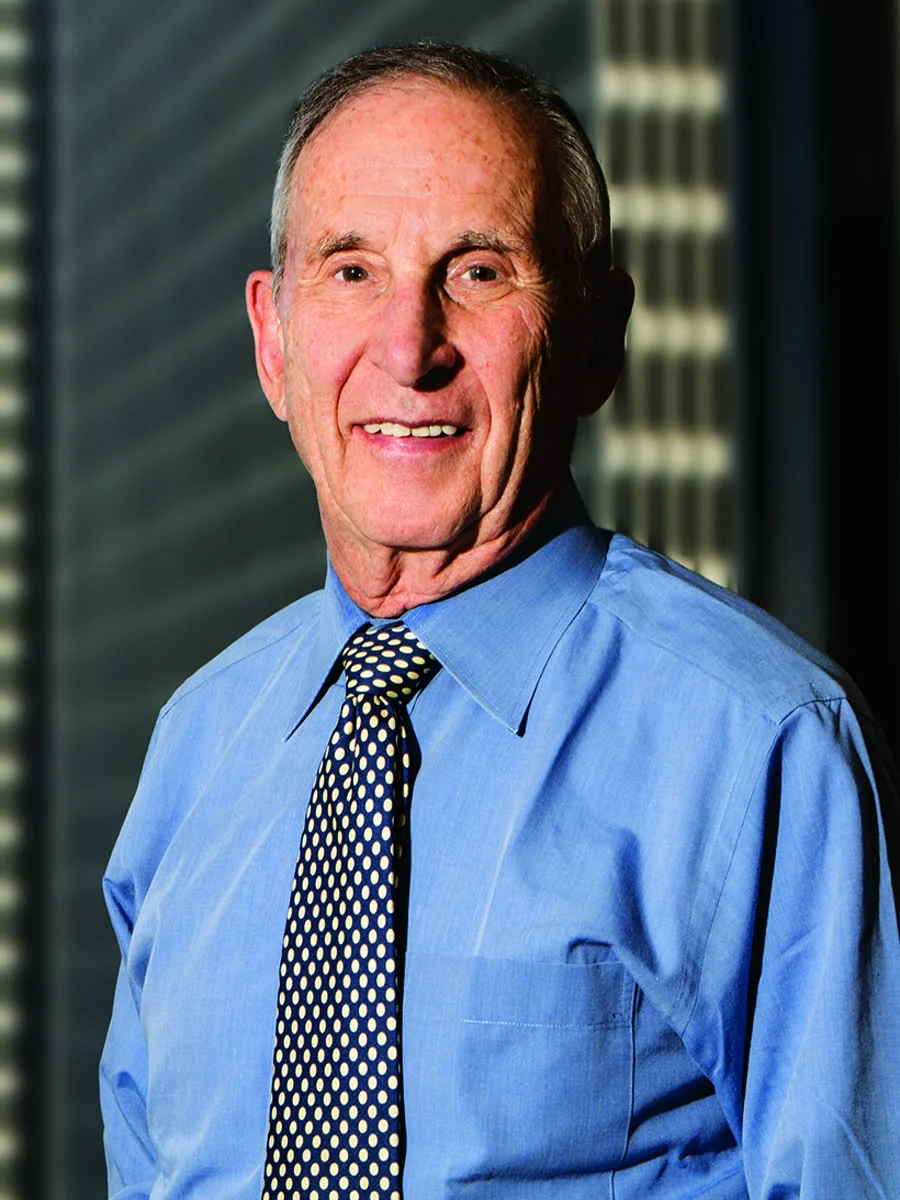
Arthur Rock
Financed the Fairchild Eight, Intel and Apple; archetype of the founder-backing investor.
From scarcity to judgment, 1926–1951
Arthur Rock was born in Rochester, New York, in 1926. Bancroft catalog, creator/subject “Rock, Arthur, 1926-” He worked in his father's small candy store before Army service, Syracuse University on the GI Bill, a brief Vick Chemical job, and an HBS MBA in 1951. [investor-stated · strong] Bancroft oral history, printed pp. 1–17 · HBS oral history, printed p. 1
Rock later connected his lack of scientific training to a compensating emphasis on people: he could not credibly judge semiconductor physics, so he tested records, motives, internal consistency, and intellectual honesty. [investor-stated · strong] Bancroft, printed pp. 17–18 and 66–68 The earlier family, military, and educational sequence may have affected his demeanor, but the surviving record does not show that it caused the later investing system. [researcher inference · insufficient public record] HBS, printed p. 1
Learning to finance small technology companies, 1951–1957
Rock moved through Wertheim, Shields, and Hayden, Stone, where small-company securities work and General Transistor gave him a practical bridge from Wall Street to emerging electronics. [investor-stated · moderate] Bancroft, printed pp. 18–25 The work built relationships and transaction skills; no complete client or underwriting ledger proves that it already constituted a venture portfolio. [researcher inference · strong] Source-map denominator
In 1957 Eugene Kleiner's letter reached Hayden, Stone on behalf of a group that wanted to leave Shockley together. Rock and senior colleague Alfred “Bud” Coyle reframed the search for an employer into the formation of a company and pursued corporate sponsors until Sherman Fairchild agreed. Jay Last remembers roughly 20–30 rejected prospects, Moore about 30, Rock elsewhere about 35 or 45; the public evidence establishes persistence, not an exact count. [retrospective witness · strong] Last, printed pp. 3–5 · Moore, “Mutiny and serendipity” · PBS, “working the phones” sequence
A later reconstruction of the 23 September 1957 agreement reports 100 shares for each founder, 225 for Hayden, Stone, a 300-share employee reserve, and a $1.38 million Fairchild Camera loan with options and a voting trust. It cites the contract but is not the contract itself. [documented behavior · moderate] CHM reconstruction, PDF p. 9, “Financing agreement details” The technical team built Fairchild; Fairchild Camera supplied company capital; Coyle and Rock arranged; Kleiner—not Rock—represented the founders on the board. [retrospective witness · strong] Bancroft, printed pp. 25–31 Fairchild demonstrates transaction design around an assembled team, not Rock as inventor, operator, sole founder, or personal equity funder. [researcher inference · strong] Fairchild decision lab
Davis & Rock: finite capital and concentrated work, 1960–1968
While still at Hayden, Stone, Rock helped finance Teledyne; related interests later entered Davis & Rock after he formed the San Francisco partnership with Thomas J. Davis in 1961. Henry Singleton and George Kozmetsky were the operators. [investor-stated · moderate] Bancroft, printed pp. 32–38 Scientific Data Systems followed Max Palevsky into the same early partnership era; an SEC digest later identified Rock as board chair while Hayden, Stone led the 1964 underwriting group. [contemporaneous record · strong] SEC News Digest, 12 May 1964, printed p. 1, lines 73–89
Davis & Rock was a seven-year partnership that Rock says ran seven years. [investor-stated · strong] Bancroft, printed p. 38 Its public economics conflict: reported: $3.0 million invested and $100 million returned (HBS profile, “Venture Capital” and results paragraphs, 2001); reported: $3.4 million invested and nearly $77 million returned (Mallaby, Rock chapter, printed pp. 17–39, 2022); reported: $3.5 million raised (Kenney and von Burg, printed p. 142, 2000). No audited cash-flow schedule surfaced, so no multiple or Rock-personal return is computed. [researcher inference · provisional]
SDS best displays the partnership's operating pattern: Palevsky and the team built the company; D&R and co-investors supplied capital; Rock chaired and organized financing. Rock later described his job as keeping the company honest and said SDS needed three-to-four-times IBM performance to overcome customer switching risk. [investor-stated · strong] SDS panel, printed pp. 8–14, 23–24, and 30 The remembered entry amounts conflict at roughly $250,000/$280,000/$300,000, and the Xerox acquisition does not reveal D&R allocation or Rock cash flows. [researcher inference · strong] SDS decision lab
[researcher inference · moderate] This era plausibly converted two constraints into a method: a small, finite pool encouraged few commitments, while a nontechnical financier created value through syndication, recruiting, accounting discipline, and boards. The record does not isolate that effect from limited capital supply, low deal competition, founder quality, and the young California technology ecosystem. Bancroft, printed pp. 38–50 · Federal Reserve Staff Study 168, printed pp. 7–15
Intel: reputation compressed uncertainty, structure contained it, 1968 onward
Robert Noyce and Gordon Moore arrived with a Fairchild record. The surviving four-page 1968 memorandum proposed a semiconductor-memory company, no significant first-year sales, $2.5 million of ten-year 6% convertible debentures, founder-price common, employee options, a mixed board, and conflict disclosures. Noyce and Moore held 245,000 common shares each and Rock 10,000; the memo's expected $300,000 Rock debenture subscription is not a closing receipt. [contemporaneous record · strong] Intel memorandum, PDF pp. 1–4
Rock said he raised the syndicate rapidly because investors trusted Noyce and Moore; Moore confirms that Intel's only business plan was Rock's. Their three-page recollection and the unsigned four-page scan leave exact version identity unresolved. [retrospective witness · strong] Moore–Rock panel, printed pp. 19–24 The better lesson is not that plans do not matter. [researcher inference · strong] Earned reputation compressed founder uncertainty, while security, use-of-proceeds, incentive, board, and conflict architecture contained capital and governance risk. Written-control analysis
Rock became Intel's first board chair and remained in Intel governance through 1999, then served as a non-voting director emeritus until 2003. [contemporaneous record · strong] Intel 35th-anniversary history, PDF p. 4 · Intel 2003 proxy, lines 373–400 He described interviewing hires, attending staff meetings, enforcing accounting discipline, and preparing the company for public markets. [investor-stated · strong] Something Ventured part 2, printed pp. 10–13 Moore and the operating team owned the semiconductor and product decisions. [researcher inference · strong] Moore–Rock, printed pp. 19–31 Rock assigned the memory-business decision to Moore and Andy Grove and limited his role to board approval. [investor-stated · strong] CHM Evening, printed p. 15
Person-centered vehicles and succession, 1968–1980
Davis & Rock ended in or around 1968. An SEC biography later calls Rock principal of Arthur Rock & Co. since 1969; Intel's 1977 annual report calls him a general partner of Arthur Rock & Associates. [contemporaneous record · strong] SEC biography, “Arthur Rock” paragraph · Intel 1977 annual report, board page Formation records proving legal continuity, partners, fees, carry, allocation rules, or portfolio economics did not surface, so the names remain separate. [researcher inference · insufficient public record]
Dick Kramlich recalls joining Rock after about a year of reference and portfolio diligence, raising $10 million and deploying $6.25 million across 13 unnamed companies. For the partnership, reported: $40 million in value (Kramlich, printed pp. 5–6, 2015). [retrospective witness · moderate] These are partner recollections, not audited returns; the legal entity, economics, voting, realization status, and company list are missing. Kramlich says the partnership ended despite positive results because Rock was control-oriented and he no longer wanted a junior role. [retrospective witness · strong] Kramlich, printed pp. 5–6 The episode is an adverse succession case: a person-dependent practice may protect decision quality while failing to institutionalize authority. [researcher inference · moderate]
Apple: changing a first impression, 1978–1993
Apple entered through a chain, not a lone picker. Don Valentine referred Mike Markkula; Markkula evaluated the Apple II, committed, helped write the plan, and then brought in Venrock and Rock. Rock's negative first impression of Jobs and Wozniak changed because he trusted Markkula and observed intense customer interest at a computer show. [retrospective witness · strong] Markkula, printed pp. 21–29 and 43 · CHM Evening, printed pp. 13–14
The SEC filing proves that Rock bought 640,000 split-adjusted shares on 31 January 1978 and was appointed to the board in October 1980. The director table displays $0.09 per share while Item 25 gives $0.09375; no realized return is inferred. [contemporaneous record · strong] Apple filing, SEC FOIA PDF pp. 33, 36–38, and 57 Rock said his Apple involvement was smaller than at Intel, SDS, or Teledyne. [investor-stated · strong] HBS, printed pp. 11–13
Rock resigned from Apple's board on 4 August 1993, citing perceived conflict from other computer-industry activities. UPI also reported separate complaints alleging insider trading and misleading statements; no docket or disposition surfaced, so allegations are not findings. [contemporaneous record · moderate] UPI, 4 August 1993 The separate 1984-filed Apple case ended in 1987 summary judgment for defendants. [contemporaneous record · strong] Court judgment, 690 F. Supp. 872
Governance tested by failure, 1970s–2000
Rock's public doctrine was never only founder charisma. His 1987 HBR essay describes about 300 plausible plans per year, one or two investments, and roughly half of selected investments failing expectations. It prioritizes résumés, mistakes, repeated listening, recruiting ability, intellectual honesty, a strong CFO, revenue quality, and management systems that change with complexity. [investor-stated · strong] HBR, complete official body, printed pp. 63–67
Diasonics is the necessary negative case. Rock later called it one of his biggest losers and described revenue-recognition problems, aggressive competitor financing, weak CEO judgment, and his own inadequate attention as audit chair. [investor-stated · strong] Bancroft, printed pp. 63–68 A federal opinion records the IPO, later loss disclosures, share-price decline, and allegations, but is procedural rather than a merits finding against Rock. [contemporaneous record · strong] In re Diasonics, 599 F. Supp. at 449–50 Board reputation cannot substitute for attention, independent measurement, and revenue-quality controls. [researcher inference · strong] Diasonics lab
The anti-portfolio adds a different failure. Rock later admitted passing on ROLM for perceived lack of experience and business sense and on Compaq; he later hired ROLM's Ken Oshman to run Echelon. [investor-stated · moderate] CHM Pioneers, 01:09:42–01:10:32 ROLM shows that a people screen must name evidence capable of reversing a negative judgment; later success does not prove the original pass irrational without the missing proposal and terms. [researcher inference · moderate] ROLM lab
In 2000 Rock urged SEC chairman Arthur Levitt to separate auditing from consulting except tax work and reported imposing that boundary as audit chair at Intel, Apple, and Teledyne. [investor-stated · strong] Rock–Levitt letter, PDF p. 1 The letter proves his stated practice, not issuer-by-issuer implementation or its performance effect. [researcher inference · strong]
Later articulation and institutional influence, 2001–2025
HBS, Stanford, CHM, Bancroft, Science History Institute, and Something Ventured projects recorded Rock's retrospective account. These overlapping narratives are not independent confirmations merely because institutions differ. [researcher inference · strong] Direct-voice inventory
The later record broadens the people doctrine. Rock described “intellectual book value” as human output absent from financial statements, linked options to recruitment, and reiterated that leaders must know their competence and limits. [investor-stated · strong] Stanford Law Q&A, intellectual-book-value and Intel-compensation exchanges · Steve Jobs Archive, paragraphs 1–5 Stability of vocabulary demonstrates a durable public philosophy, not uniform application or validated excess returns. [researcher inference · strong] Writings chronology
HBS reports a $25 million 2003 gift establishing the Rock Center for Entrepreneurship; Rock and Toni Rembe also supported Stanford's governance center. [contemporaneous record · strong] HBS entrepreneurship history, “In 2003” · Stanford Rock Center Institutional influence does not validate an investment thesis or return record. [researcher inference · strong]
People, capital, and influence map
| layer | actors | evidenced contribution and boundary |
|---|---|---|
| Formative/institutional | Family; Army; Syracuse; HBS; Wall Street firms | Biography and entry into securities work are documented; causal influence on investing rules remains largely unproved. [researcher inference · moderate] Bancroft, printed pp. 1–25 |
| Fairchild | Kleiner/eight; Rock; Coyle; Sherman Fairchild | Team and letter created the opportunity; Rock/Coyle reframed and arranged; Fairchild Camera funded; founders operated. [researcher inference · strong] Last, printed pp. 3–5 |
| Davis & Rock | Davis; LPs; Palevsky; Singleton; Kozmetsky | GPs and LPs supplied pooled capital; executives built companies; exact approval, carry, and allocations remain unknown. [researcher inference · strong] Bancroft, pp. 38–45 · Fialkov, pp. 88–91 |
| Rock–Kramlich | Kramlich; prior founders/investors; Rock | Kramlich raised, invested, and partnered; “one-third partner” does not establish rights or economics. [retrospective witness · strong] Kramlich, pp. 4–7 |
| Intel | Noyce; Moore; Grove; Vadasz; employees; syndicate; Rock | Team owned technology/operations; Rock organized financing, held common, chaired, recruited, and governed. [researcher inference · strong] Intel memo, pp. 1–4 · Intel 35th-anniversary history, PDF p. 4 · Intel 2003 proxy, lines 373–400 · Something Ventured part 2, printed pp. 10–13 |
| Apple | Jobs; Wozniak; Markkula; Valentine/Sequoia; Venrock; Rock | Markkula supplied the operating/underwriting bridge; investors bought distinct allocations; board action is collective. [researcher inference · strong] Markkula, pp. 21–29 |
| Governance controls | CFOs; auditors; committees; CEOs; co-investors | Recruiting, accounting, escalation, CEO oversight, and stopping support were stated levers; Diasonics and Ridge show failure. [researcher inference · strong] HBR · Ridge, pp. 13, 15, 20 |
A falsifiable account of the edge
Proposed edge. [researcher inference · moderate] In U.S. technology-company formation from roughly 1957 through the 1980s, Rock's repeatable advantage was the combination of trusted access to proven teams and capital, longitudinal assessment of executors for intellectual honesty, and concentrated financing/governance work that created fast capital formation and faster negative-information channels. HBR, diligence/control passages · Intel memo, pp. 1–4 · Something Ventured part 2, pp. 10–13, 28–29
Mechanism/domain. [researcher inference · moderate] Relationship access should improve opportunity and capital speed; repeated observation should reduce avoidable people error; a small active portfolio should make recruiting, accounting, escalation, and stop decisions more effective. It should work best where trusted references carry information, first capital is scarce, and an engaged director can change company systems. CHM Evening, p. 15 · HBS, pp. 8–16
Support. [researcher inference · strong] Fairchild shows team-preserving formation; Intel relationship compression plus explicit architecture; SDS financing/chair work; Apple belief revision through Markkula and demand. Eight decision labs
Disconfirmation. [researcher inference · strong] ROLM/Compaq show false negatives; Diasonics a false positive and monitoring failure; Ridge co-investor conflict; HBR says roughly half of selected investments disappointed. Failure table · HBR, opening funnel
Denominator. [researcher inference · strong] The public map contains 26 named families: 16 capital/ownership, four intermediation, two board/acquirer controls, two passes, and two association/failure controls. All 26 were searched/researched, but 0/26 has a complete vehicle-to-cash-flow chain; career coverage is not computable. DEALS reconciliation
Predictions. [researcher inference · moderate] Unseen files should show repeat founder/referrer channels, repeated-contact diligence, narrow portfolios, fast syndication, explicit accounting/recruiting interventions, and better ordinary-case outcomes when these mechanisms were present. HBR, diligence/finance passages
Falsifiers. [researcher inference · strong] The thesis fails if full opportunity/cash-flow records show no better selection or outcomes after controlling for access, founders, partners, vehicle, vintage, and outliers; if memos show shallow people diligence; if boards show nominal work; or if results disappear without SDS/other dominant positions. Portfolio limits
Skill, access, vehicle, era, team, luck, and outlier audit
| explanation | support and discriminating evidence |
|---|---|
| Skill | Repeated financing/governance mechanisms; requires matched decisions and cash flows. [researcher inference · moderate] Talks synthesis |
| Access | Kleiner, Noyce/Moore, Markkula, executives, and known investors supplied opportunity/capital; compare investors seeing the same deals. [researcher inference · strong] People map |
| Vehicle | Finite D&R, incomplete Rock–Kramlich/later entities, personal positions, and syndicates differ; agreements/economics are needed. [researcher inference · strong] Vehicle analysis |
| Team | Coyle, Davis, Kramlich, founders, executives, CFOs, co-investors, and boards did material work; case role ledgers are needed. [researcher inference · strong] DEALS people map |
| Era | Sparse venture capital, federal demand, young markets, and evolving exit/institutional-capital regimes supplied tailwinds; vintage controls are needed. [researcher inference · strong] Historical context |
| Luck/outliers | Rock acknowledged luck; SDS directionally dominates D&R's narrative, but conflicting economics prevent an ex-outlier return. [researcher inference · moderate] HBR · Pareto test |
Rock repeatedly performed high-value formation, financing, and governance work around exceptional teams, but public evidence does not establish comparative personal outperformance or a fully transferable selection algorithm. [researcher inference · strong] DEALS bottom line
Sourced chronology
| date | turning point and evidence |
|---|---|
| 1926–1951 | Rochester; Army; Syracuse; Vick; HBS. [investor-stated · strong] Bancroft, pp. 1–17 |
| 1951–1957 | Wall Street finance; General Transistor; Hayden, Stone. [investor-stated · moderate] Bancroft, pp. 18–25 |
| 1957 | Fairchild formation/corporate sponsorship. [retrospective witness · strong] Fairchild lab |
| 1960–1964 | Teledyne, D&R, SDS, public offering. [contemporaneous record · strong] SEC News Digest |
| 1968 | Intel common, debenture syndicate, first chair. [contemporaneous record · strong] Intel lab |
| 1968–1969 | D&R ends; later Rock entities appear. [researcher inference · strong] Vehicles |
| 1978–1980 | Apple placement and board appointment. [contemporaneous record · strong] Apple lab |
| 1983–1984 | Diasonics loss/accounting/governance failure. [investor-stated · strong] Diasonics lab |
| 1987 | HBR people, execution, controls, scaling doctrine. [investor-stated · strong] Written analysis |
| 1993 | Apple resignation/conflict and unresolved separate allegations. [contemporaneous record · moderate] UPI |
| 1999–2003 | Intel voting-board exit/director emeritus. [contemporaneous record · strong] Intel proxy |
| 2000 | Auditor-independence intervention. [investor-stated · strong] Levitt letter |
| 2001–2015 | Oral histories add direct and participant countervoices. [researcher inference · strong] Spoken corpus |
| 2003 onward | HBS/Stanford institutional philanthropy. [contemporaneous record · strong] HBS history, “In 2003” · Stanford |
| 2025 | Leadership letter restates longitudinal listening and self-knowledge. [investor-stated · strong] Steve Jobs Archive, paras. 1–5 |
Learning path
Read the investment philosophy for the operating system; writings for eight written families; talks for 21 spoken/participant families; investments for the 26-family denominator and eight no-hindsight labs; and mental models for nine decision-ready rules. The source map records barriers, conflicts, and retrieval routes.
1. Snapshot and testable edge thesis
Arthur Rock moved from 1950s investment banking through Davis & Rock, a Rock–Kramlich arrangement, later Rock-branded entities, personal positions, syndicates, and long board roles. Those are different economic actors, not one continuous fund. [researcher inference · strong] Vehicle analysis
Testable thesis. [researcher inference · moderate] In U.S. technology-company formation from roughly 1957 through the 1980s, Rock's repeatable edge was the combination of trusted access to proven teams and capital, longitudinal people assessment for intellectual honesty, and concentrated financing/governance work that accelerated capital formation and negative-information flow. HBR, diligence and control passages, printed pp. 63–67 · Intel memorandum, PDF pp. 1–4 · Something Ventured part 2, printed pp. 10–13 and 28–29
Mechanism and scope. [researcher inference · moderate] Warm access should improve the opportunity set and financing speed; repeated observation should reduce avoidable people error; a small active portfolio should enable recruiting, accounting, escalation, and stop decisions. The mechanism should be strongest when first capital is scarce, trusted references are informative, and a director can change company systems. CHM Evening, printed p. 15 · HBS, printed pp. 8–16
Evidence status. [researcher inference · moderate] Fairchild, SDS, Intel, and Apple support distinct parts of the mechanism; Diasonics, Ridge, ROLM, Compaq, and Rock's admission that roughly half of selected investments disappointed show large residual error. Eight decision labs · Failure table
Denominator boundary. [researcher inference · strong] The public set contains 26 named families—16 capital/ownership, four intermediation, two board/acquirer controls, two passes, and two association/failure controls. All 26 were searched/researched, but 0/26 has a complete vehicle, entry, security, ownership, follow-on, exit/write-off, and cash-flow chain; career coverage is not computable. DEALS reconciliation
Predictions. [researcher inference · moderate] Unseen records should show repeat referrer/founder channels, repeated-contact diligence, few active companies, fast syndication, board-level recruiting/accounting interventions, and better ordinary-case outcomes when those mechanisms were present. Falsifiers. [researcher inference · strong] The thesis fails if full decisions and cash flows show no incremental selection or outcome after controlling for access, founders, partners, vehicle, vintage, and outliers; if board work was nominal; or if results vanish without SDS/other dominant companies. Portfolio limits
2. Core philosophy
Rock's own language is stable: ideas are plentiful, execution and good management are scarce; diligence means listening over time; intellectual honesty means seeing conditions rather than desired outcomes; leaders must know what they cannot do. [investor-stated · strong] HBR, opening and diligence passages · Steve Jobs Archive, paragraphs 1–5
The synthesis is more specific than a people-first maxim. [researcher inference · strong] Select for demonstrated execution and reality testing; structure finance around development risk; create independent channels for bad news; concentrate only enough to perform real governance; redesign management as complexity changes; and make follow-ons or exits separate decisions. Written-corpus synthesis · Spoken-corpus synthesis
The philosophy is probabilistic, not deterministic. Rock's own funnel and luck admission, the ROLM/Compaq misses, and Diasonics prevent a deterministic great-people rule from becoming a causal law. [researcher inference · strong] HBR, opening funnel, luck passage, and final paragraph · CHM Pioneers, 01:09:42–01:10:32
3. Sourcing
| channel | supported method | repeatability and boundary |
|---|---|---|
| Cohesive technical teams | Kleiner's inbound letter led to a sponsor search for the Fairchild group. [retrospective witness · strong] Last, printed pp. 3–5 | Repeatable only if the network can surface a team before formal company creation; the founders' cohesion preceded Rock. [researcher inference · strong] |
| Prior operating record | Noyce/Moore's Fairchild work enabled rapid Intel capital calls. [investor-stated · strong] Moore–Rock, printed pp. 19–24 | Reputation compresses but must not erase technical, conflict, and terms risk. [researcher inference · strong] |
| Trusted intermediary | Markkula bridged Rock to Apple and observable demand changed the initial negative judgment. [retrospective witness · strong] Markkula, printed pp. 21–29 and 43 | The intermediary's competence and incentives require diligence; this is not Rock-only sourcing credit. [researcher inference · strong] |
| Inbound founder preference | In 1987 Rock preferred entrepreneurs to approach him and distrusted capital-led company creation. [investor-stated · strong] HBR, closing sourcing passage | Inbound may encode reputation and access rather than investment quality; no rejected-opportunity ledger tests it. [researcher inference · strong] |
| Recycled founder/LP network | Prior entrepreneurs and investors supplied later LP and syndicate capital. [retrospective witness · moderate] Fialkov, printed pp. 88–91 · Kramlich, printed pp. 4–7 | Relationship capital can improve information or simply privilege insiders; compare peers seeing the same opportunity. [researcher inference · moderate] |
4. Picking
Rock's first screen was not résumé prestige alone. He reviewed prior work and mistakes, listened through multiple meetings, tested whether answers stayed consistent, asked whom founders admired and would recruit, and separated company-building motive from wealth-first motive. [investor-stated · strong] HBR, résumé, listening, and “Belief in the business” passages
| decision dimension | question and evidence | red flag / limit |
|---|---|---|
| Founder | Can the person explain a consequential mistake, name limits, recruit complements, and update under evidence? [investor-stated · strong] 2025 letter, paras. 2–5 | Polished consistency can be rehearsed; require references and work evidence. [researcher inference · moderate] |
| Product/market | Is there differentiated performance or observable demand? SDS needed a multiple of IBM performance; Apple showed dealer/product demand. [investor-stated · strong] SDS panel, printed p. 30 · Apple offering memo, printed pp. 1–24 | People cannot rescue absent demand, unit economics, or technical feasibility. [researcher inference · strong] |
| Plan | Reject false five-year precision, but require a coherent scope, cash horizon, risks, and milestones. [researcher inference · strong] HBR, projections passage · Intel memo, PDF pp. 1–4 | People-first judgment must not become permission for planlessness. [researcher inference · strong] |
| Decision rights | Identify who approves, boards, recruits, authorizes follow-ons, and can stop. [researcher inference · strong] People/capital map | A famous director or firm label is not proof of individual action. [researcher inference · strong] |
ROLM supplies the critical false-negative test: a perceived experience gap prompted a pass, yet Rock later hired Ken Oshman at Echelon. [investor-stated · moderate] Pioneers, 01:09:42–01:10:32 A usable people screen must state what evidence reverses the judgment. [researcher inference · moderate] ROLM lab
5. Deal and portfolio mechanics
| mechanism | evidenced practice | boundary |
|---|---|---|
| Ownership/security | Intel combined founder common with $2.5 million proposed convertibles; Apple was direct placement equity; Echelon included Series E and a warrant. [contemporaneous record · strong] Intel memo, pp. 2–3 · Apple filing, pp. 36–38, 57 · Echelon 424B1, pp. 42, 49, 51–52 | No universal ownership, price, or security rule is public. [researcher inference · strong] |
| Development cash | Intel waived early interest and delayed sinking-fund/call pressure. [contemporaneous record · strong] Intel memo, pp. 2–3 | A 1968 debenture is not a timeless seed template. [researcher inference · strong] |
| Concentration | Rock said a few companies and long boards made help possible. [investor-stated · strong] HBS, pp. 8–9, 15–16 | No cost/value ledger proves target concentration or outcome advantage. [researcher inference · strong] |
| Reserves/follow-ons | Qantel support, Xynetics rescue, Ridge rounds, and undeployed Rock–Kramlich capital show case-level continuation. [researcher inference · moderate] Portfolio map | No portfolio reserve policy or pro-rata rule surfaced. [researcher inference · insufficient public record] |
| Exit/liquidity | SDS sale, D&R stock distribution, long Intel/Teledyne boards, and Apple conflict show different exit pressures. [researcher inference · moderate] Silicon Genesis, “Xerox came along” paragraph · Something Ventured part 2, pp. 24–25 | No general sell discipline or complete realization record exists. [researcher inference · insufficient public record] |
Precise economic contribution is not computable. SDS is directionally first in the D&R narrative, but removing it leaves incompatible partnership, company-scale, and personal-ownership measures. [researcher inference · strong] Pareto stress test
6. Vehicle and incentive fit
| vehicle/role | enablement | constraint and missing record |
|---|---|---|
| Hayden, Stone | Placement infrastructure and corporate access enabled Fairchild/Teledyne intermediation. [researcher inference · strong] Bancroft, pp. 25–38 | Bank, Fairchild Camera, and founders had distinct economics/authority; Rock compensation, reserves, and follow-on duty remain unknown. [researcher inference · insufficient public record] |
| Davis & Rock | Seven-year pooled LP capital supported concentrated company formation. [investor-stated · strong] Bancroft, p. 38 | Vehicle reports conflict: reported: $3.0 million invested (HBS profile, “Venture Capital” and results paragraphs, 2001); reported: $3.4 million invested (Mallaby, Rock chapter, printed pp. 17–39, 2022); reported: $3.5 million raised (Kenney and von Burg, printed p. 142, 2000); reported: $100 million returned (HBS profile, “Venture Capital” and results paragraphs, 2001); reported: nearly $77 million returned (Mallaby, Rock chapter, printed pp. 17–39, 2022). No multiple is calculated; fees/carry, allocations, reserves, distributions, geography, key-person, and succession terms remain missing. [researcher inference · insufficient public record] |
| Rock–Kramlich | Relationship fundraising and a small two-person team enabled 13 recalled companies. [retrospective witness · moderate] Kramlich, pp. 4–7 | Legal form, one-third rights, approvals, fees/carry, and cash flows are absent; Kramlich attributes the end of continuity to control conflict. [retrospective witness · moderate] Kramlich, pp. 4–7 |
| Arthur Rock & Associates / Arthur Rock & Co. | Later labels and a visible principal may have preserved concentrated discretion. [researcher inference · moderate] Intel 1977 annual report · SEC biography | Do not merge legal entities; partners, LPs, allocation, geography, regulation, liquidity, fees/carry, reserves, and succession remain unknown. [researcher inference · insufficient public record] |
| Personal shares/syndicates/boards | Flexible personal allocation and trusted syndicates supported Intel, Apple, and later positions. [researcher inference · strong] Vehicle table | Ownership and board service do not prove sourcing, sole approval, shared vehicle, exit, taxes, or return. [researcher inference · strong] |
[researcher inference · strong] The strategy and the vehicle cannot be separated: small pools made intensive governance plausible, finite terms created distribution pressure, relationship capital reduced fundraising friction, and key-person discretion made succession fragile. Only governing agreements and cash-flow ledgers can test the strength of those causal claims. Current LP comparison
7. Team attribution and work with founders
Rock's documented value-add mechanisms were arranging capital, drafting/organizing financing, recruiting, interviewing, board/audit participation, accounting discipline, offering preparation, CEO oversight, and deciding whether to continue funding. [researcher inference · strong] Something Ventured part 2, printed pp. 10–13 and 28–29
| case | source/sponsor/capital | operating/governance attribution |
|---|---|---|
| Fairchild | Kleiner sourced; Rock/Coyle arranged; Fairchild Camera funded. [retrospective witness · strong] Last, pp. 3–5 | Eight founders/employees operated; Kleiner represented founders; Rock held no board seat. [researcher inference · strong] Last, pp. 3–5 · Bancroft, pp. 25–31 |
| SDS | Palevsky brought the company; D&R and others funded. [retrospective witness · strong] SDS panel, pp. 8–14 | Palevsky/team operated; Rock chaired/financed; Hayden Stone underwrote. [researcher inference · strong] SDS panel, pp. 8–14 · SEC News Digest, 12 May 1964, printed p. 1 |
| Intel | Noyce, Moore, and Rock supplied the documented common capitalization; debenture investors were proposed or expected to supply distinct capital, but the memorandum is not closing or subscription evidence. [contemporaneous record · strong] Intel memo, pp. 1–4 | Noyce/Moore/Grove/Vadasz/employees operated; Rock organized/chair/recruited; product decisions belong to management. [researcher inference · strong] Moore–Rock, pp. 19–31 |
| Apple | Valentine led to Markkula; Markkula led to Venrock/Rock and distinct allocations. [retrospective witness · strong] Markkula, pp. 21–29, 43 | Jobs/Wozniak/Markkula operated; board actions are collective without minutes; Rock's involvement was relatively limited. [researcher inference · strong] Markkula, pp. 21–29, 43 · HBS, pp. 11–13 |
| Diasonics/Ridge | Entry roles remain incomplete. [researcher inference · insufficient public record] Failure table | Diasonics exposes Rock's admitted attention failure; participant testimony assigns later Ridge governance leadership to H&Q while Rock was less active. [researcher inference · moderate] Bancroft, pp. 63–68 · Sell, pp. 13, 15, 20 |
8. Views on the craft
- Power law and humility. [researcher inference · strong] Rock never published a formal power-law theory in the processed writings; the D&R/SDS narrative and missing denominator nevertheless demand outlier testing rather than fame-weighted storytelling. Pareto analysis
- Fund size and service. [investor-stated · strong] More capital and more boards can reduce time per company; the limiting resource is attention, not only dollars. Founding Funders, “How many boards” exchange
- Access versus selection. [researcher inference · strong] Trusted networks are real advantages but do not prove that Rock picked better than investors seeing the same deals. Talks, trusted-access counterargument
- Governance. [investor-stated · strong] Boards should recruit, test information, oversee CEOs, preserve audit independence, and approve adaptation without pretending to run engineering. Levitt letter, PDF p. 1 · Moore–Rock, pp. 19–31
- Exits. [researcher inference · provisional] Long company association and resistance to quick-exit promoters coexist with finite-fund distributions, acquisitions, and conflict-driven resignation; no universal hold-forever doctrine survives. Silicon Genesis, quick-money and Xerox passages
- Great investing. [researcher inference · moderate] The strongest supported definition is repeat access plus judgment plus governed execution, with honest recognition of luck and stop decisions—not prediction alone. HBR, full body
9. Signature bets and decision process
Use the no-hindsight labs rather than the later fame of each company. Every decision-replay question and evidence boundary in this table is [researcher inference · moderate] based on the linked frozen-date packet.
| lab | decision to replay | boundary |
|---|---|---|
| Fairchild | Employer search, sponsor search, or team-preserving formation? | Rock arranged; Fairchild Camera funded; founders built. |
| SDS | How much capital/governance for Palevsky's scientific-computer plan? | Entry security/ownership and cash flows missing. |
| Intel | Which security, governance, and milestones fit known founders and technical uncertainty? | Proposed $300,000 Rock debenture is not a closing receipt. |
| Apple | Does Markkula plus shipment/dealer evidence overcome founder and channel risks? | 640,000 shares are documented; realized return is not. |
| Diasonics | Does missing accounting/customer evidence itself block investment or demand staged terms? | Failure/miss lab; do not import later misconduct into the freeze. |
| ROLM | What evidence can reverse an experience-based pass? | Miss lab; original plan and terms missing. |
| Qantel | Does another check beat the portfolio opportunity cost? | Ordinary positive company result, not Rock return. |
| Ridge | Do prototype/founder commitment justify capital and co-investor board design? | Later sale/governance conflict; cash flows missing. |
10. Mental models and maxims
The reconciled field guide contains nine supportable models; each link opens its full provenance, procedure, cases, exceptions, and modern translation:
- Test people longitudinally for intellectual honesty, self-knowledge, and builder motive — [investor-stated · strong] HBR diligence passages.
- Let earned reputation and trusted intermediaries compress uncertainty—never erase it — [researcher inference · strong] Moore–Rock, pp. 19–24.
- Match the financing architecture to the development risk and align every capital provider — [contemporaneous record · strong] Intel memo, pp. 1–4.
- Keep the portfolio small enough that governance is real work — [investor-stated · strong] HBS, pp. 8–9, 15–16.
- Make bad news travel faster than reassuring narrative — [investor-stated · strong] HBR finance/control passages.
- Redesign management and information paths when complexity changes — [investor-stated · moderate] HBR three-stage passage.
- Update on observable evidence without pretending to time what you cannot know — [researcher inference · moderate] Founding Funders, closing valuation exchange.
- Make each follow-on earn a new decision; an advocate who disagrees funds the continuation — [investor-stated · moderate] Something Ventured part 2, pp. 28–29.
- Build companies for duration, but separate company quality from vehicle, liquidity, and conflict decisions — [researcher inference · strong] Something Ventured part 2, pp. 24–25.
Plausible but excluded models and the proof missing for each are recorded in Evidence gaps and candidate models.
11. Evolution and contradictions
Every unresolved-tension cell below is [researcher inference · moderate]; each tests the labelled continuity claim in the same row rather than asserting an investor-stated doctrine.
| period | shift or continuity | unresolved tension |
|---|---|---|
| 1957–1968 | Relationship brokerage became a finite partnership and then explicit financing/governance architecture. [researcher inference · strong] Biography | People trust versus detailed Intel structuring. |
| 1968–1987 | Long boards and concentrated work became a written people/control doctrine. [researcher inference · moderate] HBR | Few commitments versus incomplete reserve/portfolio rules. |
| 1983–2000 | Diasonics failure and later auditor-independence advocacy sharpen information-integrity rhetoric. [researcher inference · moderate] Bancroft, pp. 63–68 · Levitt letter | No public evidence proves the failure caused a documented process change. |
| 1993–2006 | Apple conflict exit and joint UC essays show role/confidentiality boundaries. [researcher inference · moderate] UPI · UC transparency essay | Transparency versus confidential deliberation. |
| 2022–2025 | Late voice retains people, options, integrity, and self-knowledge. [researcher inference · strong] Stanford Law · SJA | Rhetorical stability does not prove execution or efficacy. |
12. Failures and limits
- Diasonics — [investor-stated · strong]: later-described aggressive sales booking and revenue-recognition problems, competitor financing, CEO weakness, and inadequate board attention make this the strongest monitoring failure; original thesis/terms and later process adoption remain missing. Bancroft, pp. 63–68
- ROLM and Compaq — [investor-stated · moderate]: passes establish false-negative risk; hindsight success cannot reconstruct the proposals or prove irrationality. Pioneers, 01:09:42–01:10:32
- Ridge — [retrospective witness · strong]: founder/VC sale and governance disagreement, later H&Q leadership, and reduced Rock activity show that syndication can diffuse accountability; participant testimony says Ridge did not go bankrupt. Sell, pp. 13, 15, 20
- ELXSi/Xynetics/Qantel — [researcher inference · moderate]: company-level financing stress and continuation evidence exist, but Rock's security, follow-on, stop authority, and cash flow are incomplete. Failure postmortems
- Selection/survivorship — [researcher inference · strong]: 26 public names and 13 unnamed Rock–Kramlich companies do not form a complete funded denominator; visible filings and oral histories overweight famous outcomes. Denominator
- Era dependence — [researcher inference · strong]: low competition, federal semiconductor demand, company-formation scarcity, and different security/exit regimes limit transfer. Historical context
13. Historical operating environment
Fairchild emerged before the 1958 SBIC regime, in a semiconductor market shaped by federal R&D and procurement; Rock did not create the technical team or demand environment. [researcher inference · strong] CRS, “Background” and federal-policy sections · Small Business Investment Act, §§102 and 301 / pp. 2, 6–7
D&R operated among private LPs, SBICs, ARD-style investment companies, corporate/family capital, banks, and underwriters before pension capital became a dominant venture source. [researcher inference · strong] Federal Reserve Staff Study 168, printed pp. 7–15 The 1979 prudent-man clarification later widened the institutional-capital environment but cannot explain Rock's earlier access. [contemporaneous record · strong] Federal Register, printed pp. 37222–37225
Intel's 1968 packet shows what a contemporary could know: founders, product scope, expected development period, uses, proposed security, incentives, board, and conflicts—not later microprocessor dominance. [contemporaneous record · strong] Intel memo, pp. 1–4 Apple's 1978 packet similarly exposed shipments, dealers, product roadmap, staffing, manufacturing, risks, and capital needs—not its later IPO value. [contemporaneous record · strong] Apple memo, pp. 1–34
Later fund studies document selection, survivorship, persistence, and vintage effects, but they do not estimate D&R or Rock-personal returns. [researcher inference · strong] Kaplan and Schoar, pp. 1–7, 14–16 · Gompers and Lerner, pp. 1–10
14. Modern VC translation (as of 2026-08-19)
All rows are analyst translations, not Rock-attributed current advice.
| lesson | survives / fails / changed assumptions | signals, likely misuse, and current application |
|---|---|---|
| Longitudinal people test | [researcher inference · moderate] Repeated observation survives; founder-only intuition fails when product, market, references, and terms are ignored. Analyst assumption [researcher inference · provisional]: an AI-generated deck or prototype can reduce presentation effort without adding decision evidence. SJA, paras. 2–5 | Signals: changed answers under evidence, admitted limits, reference consistency, complementary recruiting. Misuse: charisma dressed as people assessment. Hypothetical: reproduce an AI benchmark live and explain a failed result. NIST AI RMF Playbook, Govern/Map/Measure/Manage |
| Trusted access | [researcher inference · strong] References can compress uncertainty; prestige cannot waive diligence. Analyst assumption [researcher inference · provisional]: faster round cadence and community-based sourcing can widen access without equalizing it. Moore–Rock, pp. 19–24 | Signals: firsthand work, incentives, independent validation. Misuse: treating famous referrer as outcome guarantee. Hypothetical: write what evidence the reference replaces and what it cannot. |
| Stage-matched financing | [researcher inference · strong] Match cash and rights to risk; the exact ten-year debenture does not transfer. Current preferred/voting/investor-rights/tranched forms differ. NVCA Model Legal Documents, 2025–2026 updates | Signals: gated development, measurable milestones, expensive early dilution. Misuse: protections that destroy operating flexibility. Grounded control: tailor current NVCA forms; do not back-cast them. |
| Governance capacity | [researcher inference · strong] Board time remains scarce. Analyst assumption [researcher inference · provisional]: a platform team can distribute work but may also obscure named accountability. Founding Funders, board-count exchange | Signals: named owner, decision calendar, founder demand for help, measurable intervention. Misuse: board count as status. Hypothetical: cap lead-director load by actual recruiting/audit/financing commitments. |
| Bad-news architecture | [researcher inference · moderate] Independent measurement and escalation survive; quarterly financial control alone fails for continuous software/AI risk. HBR, finance passages | Signals: metric-definition drift, withheld evals, weak collections, releases outrunning tests. Misuse: checklist theater. Grounded current frame: lifecycle Govern/Map/Measure/Manage. NIST AI RMF Core |
| Management-stage redesign | [researcher inference · moderate] Decision rights must evolve; Rock's $100–$200 million sales threshold does not transfer across business models. HBR, three-stage passage | Signals: founder bottlenecks, hidden metrics, unowned cross-functional decisions. Misuse: premature hierarchy. Hypothetical: map decisions before hiring a layer. |
| Evidence updates without timing claims | [researcher inference · moderate] Precommitted falsifiers, versioned thesis updates, and separating a company action from a market-timing forecast survive; Rock's long-board cadence and public-market setting do not transfer mechanically. Forbes, closing market exchange · Decision labs | Signals: independently reproduced metric changes, customer behavior, cost curves, regulation, and team learning. Misuse: chasing noisy dashboards or treating every pivot as intellectual honesty. Analyst-created hypothetical [researcher inference · moderate]: before an AI follow-on, record the evaluation, retention, cost, and governance thresholds that imply fund, stage, or stop, then version the decision when evidence changes. NIST's current lifecycle framework makes measurement and management iterative. NIST AI RMF Core |
| Follow-on as new decision | [researcher inference · moderate] Re-underwriting and opportunity cost survive. Analyst assumption [researcher inference · provisional]: reserves, pro-rata rights, bridge instruments, and insider signaling can change continuation incentives. Something Ventured part 2, pp. 28–29 | Signals: milestone delta, runway, outside validation, reserve opportunity cost. Misuse: escalation to protect mark. Hypothetical: require an explicit advocate and a separately owned kill case. |
| Independent assurance | [researcher inference · strong] Avoid self-review conflicts; modern issuer rules distinguish prohibited from preapproved services. PCAOB ethics/independence rules | Signals: provider audits its own design, undisclosed fees/exceptions. Misuse: treating every service as disqualifying. Grounded rule: PCAOB Rules 3524–3526 require specified preapproval/communication. |
| Duration versus liquidity/conflict | [researcher inference · strong] Company quality, fund clock, conflict, and exit price remain separate decisions; continuation is not automatically patience. Current LP governance makes key-person/liquidity rights more explicit. ILPA Principles 3.0, pp. 10–22, 41 | Signals: stakeholder clocks, conflict map, reserve horizon, buyer alternative. Misuse: treating build forever or sell quickly as a universal rule. Hypothetical: score company thesis and vehicle liquidity in separate IC votes. |
15. Comparison with completed peers
Reid Dennis is the closest same-region, overlapping-era syndication/governance peer; Laurance Rockefeller is the family-capital and Venrock-as-Apple-co-investor contrast; Georges Doriot is the public closed-end/permanent-capital and operator-development contrast. The first four columns summarize ordinary documented facts at their cited links; each bounded conclusion is separately labelled. Legal owners, periods, and return methods prohibit a performance ranking. [researcher inference · strong]
| dimension | Rock | Reid Dennis | Laurance Rockefeller | Georges Doriot | bounded conclusion |
|---|---|---|---|---|---|
| Sourcing | Warm technical/referrer network, prior executives, inbound preference; no complete funnel. Last, pp. 3–5 | Referrals, brokers, Stanford/engineering, repeat co-investors; incomplete Group/IVP denominator. Dennis, pp. 13–28 | Family, state, technical, and institution networks routed deals to staff. Kenney, pp. 1683–1692 | MIT/HBS/Army/banks/brokers/staff; reconstructed 6,884 proposals. Hsu/Kenney, Table 2, p. 594 | All institutionalized access; Doriot has the strongest funnel denominator; Rock/Dennis share relationship-access attribution risk. [researcher inference · strong] |
| Picking | Longitudinal people/reality test plus observable demand and technical/financial structure. HBR | Engineering-to-finance translation; customer timing, differentiation, price, role-relevant people. Almanac, ¶¶11–19 | Specialists tested people, technology, market, control, and purpose. Walkowicz, pp. 32735–32736 | Able people, defensible know-how, commercial practicability, whole company. HBS, “Financing New Ideas” | All reject passive money; Rock has clearest repeated-listening direct voice, Dennis clearer customer/price distinctions, Doriot richer developmental doctrine. [researcher inference · moderate] |
| Ownership/terms | Flexible common, convertibles, placement equity, warrants; no universal rule. Intel memo, pp. 2–3 | Heterogeneous checks/rights; no standard rule. Dennis mechanics | Common/preferred, convertibles, warrants, debt/staging; family reportedly often below one-third. Walkowicz, p. 32736 | Equity, debt, mixed structures; DEC staging/ownership conflicts. Hsu/Kenney, Table 3 | Flexible instruments are shared; none supplies a timeless standard term sheet. [researcher inference · strong] |
| Portfolio construction | Few companies/long boards stated; reserves and full denominator absent. HBS, pp. 8–9 | Heterogeneous stages/funds; one-LP data dispersed; company concentration incomplete. Dennis portfolio mechanics · UC table | Long reserves/follow-ons with frequent weak early outcomes and Apple concentration. Nicholas, pp. 95–96, 171–172 | Diversified by count, result concentrated; staged follow-ons mattered. Hsu/Kenney, Tables 3–4, p. 599 | All are outlier-sensitive; incomplete and incompatible denominators prevent skill ranking. [researcher inference · strong] |
| Governance | Recruiting, accounting, audit, CEO oversight, offering preparation, stop decisions; intensity varies. Something Ventured part 2, pp. 10–13 | Close support, planning, recruiting, CEO replacement; roles case-specific. Dennis labs | Staff/partner boards and interventions; Laurance personal role often weak. Rockefeller team attribution · Walkowicz, pp. 32735–32736 · Apple prospectus, pp. 21–28 | Demanding mentorship and direct operating intervention, sometimes paternal. Ken Olsen oral history | Every profile requires team attribution; Rock's role is unusually visible at Intel but absent at Fairchild. [researcher inference · strong] |
| Vehicle/incentives | Bank → finite LP → incomplete partnership/entities → personal/syndicates/boards. Vehicle analysis | Personal/trust → informal syndicate → corporate balance sheet → LPs. Dennis vehicle chronology | Personal/family office → optional family subscriptions → family LP/professional partners. Nicholas, pp. 167–170 | Public closed-end company broadened capital but constrained compensation/geography/succession. House hearing, pp. 339–340 | All forms enabled and constrained strategy; Rock has the weakest public later-entity agreements, Doriot the clearest vehicle-failure mechanism. [researcher inference · strong] |
| Failures | Diasonics monitoring, ROLM/Compaq passes, Ridge governance, incomplete ordinary cases. Postmortems | Too early/too expensive errors, people/proxy risk, fund dispersion, succession/liquidity conflict. Dennis limits | Weak pre-1969 economics, rescue escalation, purpose ambiguity, Apple attribution. Rockefeller limits | Island Packers, passes, lower later gain frequency, vehicle/talent deterioration. Doriot critiques | Rock has strongest self-admitted audit/attention failure; peers offer richer portfolio/institution denominators. [researcher inference · moderate] |
| Outcome/incentive sensitivity | D&R capitalization/outcome conflicts; SDS directional outlier; no personal ledger. Pareto | IVP III–VIII one-LP returns disperse; career/company attribution incomplete. UC table | reported: early-Venrock gross IRR 26.8% with Apple, 3.4% without (Nicholas, pp. 171–172, 2019). | reported: 14.7% compound with DEC, 7.4% without versus 12.8% DJIA (Hsu/Kenney, p. 599, 2005). | Outlier sensitivity is common; gross/net, owner, vintage, and methods prohibit ranking. [researcher inference · strong] |
16. The strongest case against greatness
Skeptical thesis. [researcher inference · strong] Rock's reputation may be the product of privileged access to extraordinary founders, scarce early capital, favorable semiconductor/computer regimes, team and vehicle work attributed to one famous financier, and a few visible outliers—without a complete personal or vehicle return record proving repeatable outperformance.
- Access before selection. [researcher inference · strong] Kleiner, Noyce/Moore, Markkula, portfolio executives, and known capital providers prefiltered the opportunity set. People map
- Founder/team causality. [researcher inference · strong] Fairchild's eight, Palevsky, Singleton/Kozmetsky, Noyce/Moore/Grove/Vadasz, Jobs/Wozniak/Markkula, co-investors, and employees owned much of the operating work. DEALS people map
- Missing denominator/economics. [researcher inference · strong] 0/26 is fully reconstructed; the 13 Rock–Kramlich companies are unnamed; no personal return ledger exists. Reconciliation
- Outlier dependence. [researcher inference · moderate] SDS directionally drives D&R's story, but conflicting reports prevent a clean ex-outlier test: reported: $3.0 million invested and $100 million returned (HBS profile, “Venture Capital” and results paragraphs, 2001); reported: $3.4 million invested and nearly $77 million returned (Mallaby, Rock chapter, printed pp. 17–39, 2022); reported: $3.5 million raised (Kenney and von Burg, printed p. 142, 2000). No multiple is calculated.
- Residual error. [researcher inference · strong] Roughly half of selected investments disappointed; Diasonics, ROLM, Compaq, Ridge, and unnamed ordinary cases defeat a uniformly superior-judgment story. HBR · Failures
- Era effects. [researcher inference · strong] Federal demand, young technical markets, low venture competition, changing public markets, and later institutional-capital expansion supplied conditions not created by Rock. Historical context
- Vehicle and succession. [researcher inference · moderate] Finite terms, opaque later entities, Kramlich's control critique, and no visible succession system can make a strong personal craft non-transferable. Kramlich, pp. 4–7
- Retrospective narrative. [researcher inference · strong] Repeated Rock interviews are correlated retellings; repetition proves stated consistency, not causality or efficacy. Source-map archive assessment
Evidence favors the edge thesis if original memos, reference records, votes, intervention logs, and full cash flows connect Rock-specific actions to better ordinary-case outcomes after access, team, vehicle, era, and outliers are controlled. Evidence favors the skeptic if roles are mostly nominal, selection resembles peers seeing the same deals, ordinary-case economics are weak, or results concentrate in exceptional founders and vintages. [researcher inference · strong] Profile falsifiers
17. Analyst study guide, glossary, and go deeper
Recommended reading path
- Start with the biography and write the edge thesis, alternative explanation, prediction, and falsifier in your own words.
- Read the 1987 HBR analysis, then the 1968 Intel written control; mark where people-first judgment becomes structure rather than planlessness.
- Read the spoken synthesis and separate Rock, founders, partners, editors, and later narrators.
- Complete all eight decision labs before reading each reveal; include the Diasonics failure and ROLM miss.
- Use the nine-model field guide to turn the historical record into IC procedures, then re-read the skeptical case.
Glossary
Unless a row carries a stronger source label, each definition is [researcher inference · moderate] and applies only within this package.
| term | meaning in this package |
|---|---|
| Intellectual honesty | Seeing conditions rather than desired outcomes; a founder/manager and information-system test. SJA, para. 5 |
| Intellectual book value | Rock's late label for human output not captured on conventional statements; not a computed asset. Stanford Law Q&A |
| Relationship capital | Trusted access to teams, references, LPs, and syndicate investors; not proof of selection skill. Sourcing analysis |
| Development-risk financing | A security/cash design matched to a pre-revenue technical program, exemplified—not standardized—by Intel. Intel memo, pp. 1–4 |
| Bad-news architecture | Independent finance/audit/product/customer channels that prevent reassuring narrative from dominating evidence. HBR, finance/control passages |
| Founder-price common | Intel common bought by Noyce/Moore and Rock before outside debentures; distinct from syndicate exposure. Intel memo, p. 2 |
| Vehicle boundary | Separation of bank, LP, later entities, personal positions, syndicates, trusts, and boards. Vehicle evidence |
| Reveal discipline | Decide from the dated evidence packet before learning the actual outcome. Decision labs |
Reusable sourcing checklist
- Who introduced whom, when, and with what incentive?
- Is the source a founder, financier, operator, co-investor, LP, filing, or later narrator?
- What did the trusted intermediary directly observe, and what is hearsay?
- Which peers saw the same opportunity, and what did they decide?
- Does a relationship expand access, compress diligence, or both?
Reusable diligence and IC checklist
- Freeze the decision date; list known, unknown, disputed, and later-reveal facts.
- Test prior work, mistakes, self-knowledge, recruiting, and response to contradiction.
- Independently test product performance, customer demand, revenue quality, cash, and collectibility.
- State the thesis, alternative, kill criteria, ownership/security, and next-check milestone.
- Name source, sponsor, diligence owner, approver, board owner, and follow-on decider.
- Record what evidence would reverse both invest and pass decisions.
Reusable governance and portfolio checklist
- Does each board seat have time, named work, and escalation authority?
- Can the CFO/auditor/product/customer evidence bypass management filtering?
- Are assurance providers independent from the work they assess?
- Has management/information design changed with complexity rather than a revenue slogan?
- Is each follow-on a new opportunity-cost decision with an explicit advocate and kill case?
- Are company quality, fund liquidity, conflict, and exit price decided separately?
- Can portfolio results be shown with and without the dominant outlier?
Ranked primary and secondary sources
- Intel financing memorandum, PDF pp. 1–4 — best ex-ante primary control for people, technology, financing, incentives, governance, and conflicts. [researcher inference · strong]
- HBR, 1987, printed pp. 63–67 — best direct method statement, including funnel, controls, failures, and luck. [researcher inference · strong]
- Bancroft oral history, printed pp. 1–68 — deepest chronology, direct philosophy, vehicles, boards, and Diasonics; quote restrictions and retrospection apply. [researcher inference · strong]
- Something Ventured Rock interviews — richest operational mechanisms and stop-funding logic; session-date conflict remains. [researcher inference · strong]
- Moore–Rock panel, printed pp. 19–31 — best paired attribution control for Intel plan, operating work, options, and memory decision. [researcher inference · strong]
- Markkula oral history, printed pp. 21–29, 43 — strongest Apple sourcing/underwriting countervoice. [researcher inference · strong]
- Apple filing, SEC FOIA PDF pp. 33, 36–38, 57 — primary allocation and board-date control. [researcher inference · strong]
- Kramlich oral history, printed pp. 4–7 — essential team, economics-boundary, control, and succession countervoice. [researcher inference · strong]
The source map ranks the decisive missing records: Fairchild contract/prospect ledger, D&R and Rock–Kramlich agreements/cash flows, Intel closing/minutes, Apple purchaser/minutes/transfers, Diasonics audit/board/position records, ROLM/Compaq proposals, the controlled SHI body, and Stanford V0311.
Pareto 80/20 — what drove the record
The public record does not support a literal 80/20 calculation. No complete portfolio, security-level cash-flow ledger, or Rock-personal realization schedule is public. The rankings below therefore separate three different questions and use only directional language. [researcher inference · strong] Source-map denominator and retrieval boundary
Economic contribution — directional, not a personal-return ranking
| rank and local case | basis, measure, and attributed vehicle | mechanism and confidence | denominator / outlier boundary |
|---|---|---|---|
| 1 · Scientific Data Systems | Directional Davis & Rock value contribution: partnership capital, Rock board chair, later Xerox acquisition. [researcher inference · strong] SDS ledger row | Governance plus staged public financing around Palevsky's operating team. [researcher inference · strong] Bancroft, printed pp. 38–45 · SEC News Digest, printed p. 1 | No audited D&R cash flows, allocation, carry, or Rock-personal proceeds. The roughly $250k/$280k/$300k recollections are not averaged or converted into a multiple. [researcher inference · strong] SDS source trail |
| 2 · Teledyne | Directional D&R exposure after Hayden, Stone placement; no personal/vehicle allocation basis. [researcher inference · moderate] Teledyne ledger row | Financing and governance accompanied Singleton and Kozmetsky's company building. [researcher inference · moderate] Bancroft, printed pp. 32–45 | Entry security, distributions, and Rock-personal economics are not reconstructed; founder execution is not an investor return. [researcher inference · strong] Teledyne ledger row |
| 3 · Intel | Documented personal $10k common plus Rock-arranged $2.5m debenture syndicate; the measures are kept separate. [contemporaneous record · strong] Intel history, PDF p. 4 | Security design, syndication, option incentives, and long governance around Noyce/Moore/Grove/Vadasz. [researcher inference · strong] Intel memorandum, PDF pp. 1–4 · Intel history, PDF p. 4 | The memo's expected $300k Rock debenture allocation is not a closing receipt; no personal realization ledger is public. [researcher inference · strong] Intel ledger row |
| 4 · Apple | Documented personal January 1978 placement ownership: 640,000 split-adjusted shares, later board service. [contemporaneous record · strong] Apple filing, SEC FOIA PDF pp. 33, 36–38, 57 | Markkula supplied the operating/underwriting bridge; the multi-investor placement and governance widened support beyond the founders. [researcher inference · strong] Apple filing, SEC FOIA PDF pp. 33, 36–38, 57 · Markkula, printed pp. 21–29, 43 | Rounded $0.09 and exact placement-group $0.09375 prices use different presentation precision; no sale record or realized return is public. [researcher inference · strong] Apple ledger row |
| 5 · Qantel | Period-reported backing and continued support; exact Rock entity and security unknown. [contemporaneous record · moderate] TIME, 1984, page 2 | Continued governance/capital support through a company sale produced an ordinary positive comparator rather than a public outlier. [researcher inference · moderate] TIME, 1984, page 2 | The period report gives company sales and sale price, not Rock's check, ownership, distribution, or return. [researcher inference · strong] Qantel ledger row |
Removing SDS makes the ranking much less defensible: Teledyne, Intel, and Apple use incompatible measures—partnership value, company scale, and documented personal ownership—and none has a complete Rock cash-flow series. [researcher inference · strong] Economic concentration excluding SDS is therefore not computable. D&R evidence conflict
Historical importance — ranked independently of economics
| rank and local case | historical measure | mechanism, attribution, and support | denominator boundary |
|---|---|---|---|
| 1 · Fairchild Semiconductor | New-company formation around an already assembled technical team. [researcher inference · strong] Jay Last, printed p. 4 | Rock and Bud Coyle connected the eight founders to Fairchild Camera; the founders and employees built the company. [researcher inference · strong] Jay Last, printed p. 4 · CHM reconstruction, PDF p. 9 | Historical importance is not a Rock investment return; the capital came through Fairchild Camera. [researcher inference · strong] Fairchild ledger row |
| 2 · Intel | Ex-ante financing/governance design for a semiconductor-memory startup. [contemporaneous record · strong] Intel memorandum, PDF pp. 1–4 | The plan combined established founders, convertibles, founder-price common, employee options, and a mixed board. [researcher inference · strong] Intel memorandum, PDF pp. 1–4 | Product/company-building credit remains with management and employees; the surviving memo is not a closing ledger. [researcher inference · strong] Intel ledger row |
| 3 · Davis & Rock / SDS | Early finite-life venture partnership applied to company formation and governance. [researcher inference · strong] Bancroft, printed pp. 38–45 | Pooled LP capital, board work, and syndication supported Palevsky's operating team. [researcher inference · strong] Bancroft, printed pp. 38–45 · Federal Reserve Staff Study 168, printed pp. 7–15 | The D&R result remains unaudited and vehicle-level; it is not proof of Rock-personal performance. [researcher inference · strong] Vehicle boundary |
| 4 · Apple | Later-stage syndicate/governance participation in a consumer-computer company. [researcher inference · strong] Apple filing, SEC FOIA PDF pp. 33, 36–38 | Rock joined after Markkula and alongside other investors, then served on the board. [researcher inference · strong] Markkula, printed pp. 21–29, 43 · Apple filing, PDF pp. 33, 36–38 | This is neither original-VC nor sole-investor credit, and historical fame is not a realized return. [researcher inference · strong] Apple ledger row |
| 5 · Diasonics | Best public adverse governance/accounting case. [researcher inference · strong] Diasonics lab | Later testimony and court background expose limits of board reputation, growth accounting, and monitoring. [researcher inference · strong] Bancroft, printed pp. 63–68 · In re Diasonics, 599 F. Supp. at 449–50 | The court opinion is procedural, and no personal loss ledger supports an economic ranking. [researcher inference · strong] Diasonics ledger row |
Decision-learning value — ranked for replayability
| rank and local case | replayable decision | mechanism and support | evidence boundary |
|---|---|---|---|
| 1 · Diasonics | Whether to invest/continue when revenue quality, financing, management, and board attention must be tested. [researcher inference · strong] Diasonics lab | Strongest adverse monitoring case in Rock's own detailed record. [researcher inference · strong] Bancroft, printed pp. 63–68 | No decision-date memo or entry terms; the lab must keep later failures out of the freeze. [researcher inference · strong] Diasonics lab |
| 2 · Ridge Computers | Whether prototype, founder self-funding, syndication, and board terms justify a first institutional round. [researcher inference · strong] John Sell, printed pp. 13, 15, 20 | Later ownership and sale disagreements test the co-investor/governance design. [researcher inference · strong] John Sell, printed pp. 13, 15, 20 | One participant account; security, percentages, and wind-down cash flows remain missing. [researcher inference · moderate] Ridge lab |
| 3 · ROLM pass | What specific evidence can overcome a perceived experience gap. [researcher inference · moderate] CHM Pioneers, 01:09:42–01:10:32 | A later admitted miss falsifies an unfalsifiable people-first screen and shows belief revision. [researcher inference · moderate] CHM Pioneers, 01:09:42–01:10:32 | Sparse retrospective evidence; the proposal, terms, and alternatives are missing. [researcher inference · moderate] ROLM lab |
| 4 · Intel | How to price and govern a founder-rich, technically uncertain startup. [researcher inference · strong] Intel memorandum, PDF pp. 1–4 | Unusually complete ex-ante security and governance proposal supports a real terms exercise. [researcher inference · strong] Intel memorandum, PDF pp. 1–4 | The memo is proposed terms, not proof that every subscription closed. [researcher inference · strong] Intel lab |
| 5 · Qantel | Whether continued support clears reserve and opportunity-cost hurdles. [researcher inference · moderate] TIME, 1984, page 2 | A reported ordinary positive outcome is a useful anti-outlier. [researcher inference · moderate] TIME, 1984, page 2 | Entry terms, contemporaneous forecasts, follow-ons, and Rock-specific proceeds are missing. [researcher inference · moderate] Qantel lab |
Evidence boundary and searched denominator
Scope and rules
- A candidate lead enters when a named source associates Rock or a defined vehicle with financing, beneficial ownership, board/governance, or an explicit pass/failure. A candidate is not automatically an investment. [researcher inference · strong] Source-map inclusion rule
- One company family is counted once; renamed entities, follow-ons, public offerings, acquisitions, and later board service do not create new investments. [researcher inference · strong] Source-map role boundary
- Rock personally, Hayden, Stone, Davis & Rock, Rock–Kramlich, Arthur Rock & Associates, Arthur Rock & Co., syndicates, trusts, and portfolio-company boards are separate actors. Unknown vehicle, security, check, ownership, follow-on, exit, or cash flow remains unknown. [researcher inference · strong] Profile vehicle map
- Company sale price, IPO valuation, public-market value, or a vehicle-level result is not Rock's realized return. A numeric multiple or IRR is used only in the required
reported:form with source, locator, and year. [researcher inference · strong] Source-map return conflicts
Reconciliation
The searched public set currently contains 26 named company/opportunity families. The count is a discovery denominator, not a funded-portfolio or return denominator. [researcher inference · strong] Source-map candidate ledger · T006.4 retrieval boundary
| class | count | reconciliation |
|---|---|---|
| Rock/Rock-vehicle capital or ownership | 16 | Teledyne, SDS, Intel, Apple, Diasonics, Qantel, ELXSi, Intersil, AirTouch, Echelon, Nasdaq, Benrus, Ridge, Xynetics, Astrodata, and Calydon. This establishes some economic exposure, not a complete security-to-cash-flow chain. [researcher inference · strong] Case ledger |
| financing, launch, or intermediation without proved Rock economic exposure | 4 | General Transistor, Fairchild, Rational Machines, and Amelco. [researcher inference · strong] Case ledger |
| board/acquirer/spinoff-only controls | 2 | Xerox and Argonaut. [researcher inference · strong] Case ledger |
| explicit passes | 2 | ROLM and Compaq. They belong in the anti-portfolio, not the funded portfolio. [investor-stated · moderate] CHM Pioneers, 01:09:42–01:10:32 |
| failure/association controls without proved investment | 2 | Electronic Memories and Daisy. [researcher inference · strong] Case ledger |
| sufficiently reconstructed across entry, vehicle, security, ownership, follow-on, exit, and cash flow | 0 | Even Intel and Apple lack a complete personal realization ledger. [researcher inference · insufficient public record] Retrieval ledger |
| provisional biography-only leads outside the 26 | 2 | Anadex Instruments and General Capacitor; a weak derivative biography names them, but no inspected primary or participant control yet supports inclusion. [researcher inference · provisional] Source-map search boundary |
| required state | count | exact boundary |
|---|---|---|
| publicly claimed / known named opportunities | 26 | All 26 satisfy the inclusion rule; inclusion does not imply funding. [researcher inference · strong] Source-map denominator |
| searched | 26/26 | Each case received company/alias, Rock/vehicle, financing/ownership/board/pass/failure, exit/legal, and source-family queries. [researcher inference · strong] Source-map exhaustion |
| researched at claim level | 26/26 | Each has a ledger row with best located evidence and explicit unknown fields. [researcher inference · strong] Case ledger |
| sufficiently reconstructed end to end | 0/26 | No case has a complete entry, vehicle, security, ownership, follow-on, exit/write-off, and Rock cash-flow chain. [researcher inference · insufficient public record] Retrieval ledger |
| unresolved | 26/26 | “Unresolved” means at least one required economic or attribution field remains missing, not that no evidence exists. [researcher inference · strong] Case ledger |
| excluded from a funded-investment return denominator | 10/26 | Four intermediation/support cases, two board/acquirer controls, two passes, and two association/failure controls lack proved Rock/Rock-vehicle capital. [researcher inference · strong] Exclusive classification |
| excluded from the 26-case set | 3 | Artisan public stake is passive/legacy ownership, Embarcadero is advisory-only, and MiniScribe was a false role hit; Anadex and General Capacitor remain two provisional leads rather than exclusions. [researcher inference · strong] Source-map exclusion ledger |
Coverage fraction is not computable. Rock's 1987 essay reports about 300 plausible plans per year, one or two investments, and roughly half of selected investments disappointing; Kramlich recalls an unenumerated 13-company pool. Those statements are incompatible with treating 26 public names as a complete career denominator. [investor-stated · strong] HBR, printed pp. 63–67 · [retrospective witness · moderate] Kramlich, printed pp. 4–7
Search boundary
The sweep searched all 26 named cases through 43 priority DEALS/control source families, plus SEC EDGAR, company histories, court opinions, CHM/Stanford/SHI oral histories, period press, acquisition records, bankruptcy routes, and exact Rock/vehicle/company/pass/failure/ownership combinations. [researcher inference · strong] It did not recover a complete D&R portfolio, Rock–Kramlich company list, fund agreements, capital calls, distribution ledgers, board minutes, or person-level tax/realization records. Source-map archive exhaustion
Historical market, regulatory, and base-rate context
| decision era | technology / market maturity | financing and underwriting alternatives | boundary |
|---|---|---|---|
| Fairchild, 1957 | Semiconductor commercialization was young and benefited from military/government R&D and procurement; the technical team and demand environment predated the financing structure. [researcher inference · strong] CRS semiconductor history, “Background” and federal-policy sections · National Academies, chapter 5, federal-support and procurement discussion | Employer search, corporate sponsor, investment-bank placement, founder self-funding, or no transaction; the federal SBIC regime did not arrive until 1958. [researcher inference · strong] Small Business Investment Act, §§ 102 and 301 / compilation pp. 2, 6–7 | Period context prevents attributing technical supply, procurement demand, or market creation to Rock. [researcher inference · strong] Historical source boundary |
| D&R/SDS/Teledyne, 1961 | Scientific computing and semiconductors required hardware, manufacturing, service, and scarce technical management; public markets were not first-check substitutes. [researcher inference · moderate] Federal Reserve Staff Study 168, printed pp. 7–15 | Private LP, SBIC, ARD-style investment company, corporate/family capital, bank/underwriter placement, or founder/customer finance. D&R chose a finite private LP; that choice alone does not prove performance. [researcher inference · strong] Small Business Investment Act, §§ 102 and 301 / compilation pp. 2, 6–7 | Exact decision-date alternatives differ by company; later system history is not an SDS term sheet. [researcher inference · moderate] Federal Reserve Staff Study 168, printed pp. 7–15 |
| Intel, 1968 | Experienced founders still faced product, yield, market-adoption, hiring, and capital risk in semiconductor memory. [researcher inference · strong] Intel memo, PDF pp. 1–4 | Founder common, employee options, convertible debentures, a wider syndicate, strategic/corporate capital, or pass. The memo supplies unusually strong period-specific underwriting structure. [contemporaneous record · strong] Intel memo, PDF pp. 1–4 | Proposed subscriptions are not closings, and government/industry tailwinds are not a Rock-specific return estimate. [researcher inference · strong] Intel memo, PDF pp. 1–4 |
| Apple, January 1978 | Personal computing was moving from hobbyist to consumer channels; Apple had shipments/dealers but forecast immature demand, supply, service, management, and cash-flow risks. [contemporaneous record · strong] Offering memo, printed pp. 1–24 | Private equity, retained profits, and long-term debt are named in the packet; strategic/corporate or no investment remained external alternatives. [contemporaneous record · strong] Offering memo, printed pp. ii–iii, 1, 34 | The memo's forecasts are management claims, not outcomes; later IPO value cannot enter the freeze. [researcher inference · strong] Offering memo, printed pp. ii–iii, 1–24 |
| ROLM/Ridge/Qantel/Diasonics, 1970s–1980s | Enterprise/computer and medical-capital-equipment cases added longer sales/service cycles, manufacturing, customer financing, public-market and refinancing exposure. Public decision packets are sparse outside Apple. [researcher inference · moderate] Ridge participant account, printed pp. 13–20 · TIME, 1984, page 2 | Founder capital, independent VC syndicates, strategic/corporate capital, public markets, staged follow-ons, sale, or stop. Company-specific choices are unknown unless a lab says otherwise. [researcher inference · moderate] Decision-lab evidence boundary | Later failures and passes cannot be imported into decision-date underwriting. [researcher inference · strong] Decision-lab evidence boundary |
| Institutional-capital shift, 1979 onward | The prudent-man clarification widened the institutional venture environment after D&R and around later venture growth. [contemporaneous record · strong] Federal Register, 1979-06-26, printed pp. 37222–37225 | Larger LP-backed pools became more feasible, changing fundraising, reserve, portfolio, and governance capacity. [researcher inference · moderate] Federal Register, 1979-06-26, printed pp. 37222–37225 | It cannot be back-cast as the cause of Rock's 1957–1968 access or results. [researcher inference · strong] Historical source boundary |
| Retrospective base-rate controls | Later datasets document selection, survivorship, persistence, vintage, and fundraising cycles. [researcher inference · strong] Kaplan and Schoar, working-paper pp. 1–7, 14–16 · Gompers and Lerner, printed pp. 1–10 | They provide portfolio/fund comparators, not company-specific decision facts. [researcher inference · strong] Kaplan and Schoar, working-paper pp. 1–7, 14–16 · Gompers and Lerner, printed pp. 1–10 | They do not estimate D&R, Rock–Kramlich, or Rock-personal returns. [researcher inference · strong] Vehicle boundary |
Vehicles, economics, and incentive boundaries
| vehicle / role | capital form, duration, and fundraising | authority, governance, geography, and regulation | liquidity, reserves, fees/carry, incentives, and succession |
|---|---|---|---|
| Hayden, Stone intermediation | Deal-by-deal investment-banking placement; Fairchild Camera, not Rock or a fund, supplied the documented Fairchild company capital. [retrospective witness · strong] Bancroft, printed pp. 25–31 | Rock and Bud Coyle arranged; Fairchild Camera and the founders negotiated company/voting structure. Approval authority, geographic mandate, and regulatory capital treatment are unknown. [researcher inference · strong] Bancroft, printed pp. 25–31 | Compensation, personal co-investment, reserves, follow-on duty, liquidity rights, carry, and succession are not public; Fairchild is not a Rock fund return. [researcher inference · strong] Vehicle retrieval boundary |
| Davis & Rock | Finite-life LP formed 1961. Capitalization conflicts: reported: $3.0m invested (HBS profile, “Venture Capital” and results paragraphs, 2001); reported: $3.4m invested (Mallaby, Rock chapter, printed pp. 17–39, 2022); reported: $3.5m raised (Kenney and von Burg, printed p. 142, 2000). [researcher inference · provisional] | Rock says it was a seven-year partnership that ran for seven years. [investor-stated · strong] Bancroft, printed p. 38 Rock and Thomas Davis were GPs and the LP/founder network supplied capital; the term's effect on any particular exit is not proved. [researcher inference · moderate] Bancroft, printed p. 38 | Outcomes also conflict: reported: $100m returned (HBS profile, “Venture Capital” and results paragraphs, 2001); reported: nearly $77m returned (Mallaby, printed pp. 17–39, 2022). No multiple is calculated; fees/carry, reserves, distributions, partner allocation, key-person terms, and succession remain unknown. [researcher inference · insufficient public record] |
| Rock–Kramlich arrangement; legal entity unlocated | reported: $10m raised and $6.25m deployed across 13 unnamed companies (Kramlich, printed pp. 5–6, 2015); Rock reportedly raised about two-thirds and Kramlich one-third. [retrospective witness · moderate] | Kramlich calls himself a one-third partner; legal, voting, approval, geography, regulation, and allocation rights are unlocated. [retrospective witness · moderate] Kramlich, printed pp. 4–7 | reported: $40m outcome (Kramlich, printed pp. 5–6, 2015), unaudited. Fee/carry, reserves, distributions, liquidity, and dissolution terms are unknown; the split makes key-person/control design a live question, not a proved causal lesson. [researcher inference · moderate] Vehicle retrieval boundary |
| Arthur Rock & Associates | Intel's 1977 annual report identifies Rock as general partner of Arthur Rock & Associates; formation documents and portfolio roster were not found. [contemporaneous record · strong] Intel 1977 annual report, board page | Decision authority, partners, investor base, regulatory form, geography, and relationship to the Rock–Kramlich arrangement remain unresolved. [researcher inference · insufficient public record] Vehicle boundary | Duration, fee/carry, reserves, liquidity, stakeholder incentives, succession, and cash-flow history are unknown. Do not merge this name with Arthur Rock & Co. [researcher inference · strong] Vehicle boundary |
| Arthur Rock & Co. | SEC biographies use the label from 1969; TIME says Rock invested his own money and that of a few friends in three or four deals yearly. [contemporaneous record · moderate] SEC biography, “Arthur Rock” paragraph · TIME, 1984, page 1 | Rock was visible principal; no investment-committee, allocation, geographic-authority, regulatory, or succession document surfaced. [researcher inference · insufficient public record] Vehicle boundary | Fundraising, fees/carry, reserves, liquidity, key-person continuity, and LP/friend economics are not public. [researcher inference · insufficient public record] Vehicle retrieval boundary |
| Personal positions, trusts, and deal syndicates | Intel $10k common; Apple 640k split-adjusted shares; AirTouch beneficial ownership/options; Echelon Series E/warrant; Nasdaq trust ownership; Calydon acquisition shares. [contemporaneous record · strong] Intel history, PDF p. 4 · Apple filing, SEC FOIA PDF pp. 33, 36–38, 57 · AirTouch proxy, printed pp. 3, 5–6 · Echelon 424B1, printed pp. 42, 49, 51–52 · Nasdaq 10-K/A, lines 282, 1168–1172, 1351–1352, 1430, 1442 · Calydon S-3, lines 87–90, 356–365, 410–416, 962–963 | Ownership can coexist with board service but does not prove sourcing, sole approval, or a common vehicle. Syndicate rights are transaction-specific. [researcher inference · strong] People and role map | Exit, taxes, gifts, transfers, dilution, reserves, realized returns, and succession are unknown unless separately documented. [researcher inference · strong] Vehicle retrieval boundary |
Dimension-matched comparison with a current LP-backed venture fund
This comparison is an analyst control as of 2026-08-19, not a claim that historical vehicles should have copied current documents. [researcher inference · strong] NVCA model-document scope and tailoring boundary
| dimension | historical Rock record | current LP-backed control and non-transfer boundary |
|---|---|---|
| fund/vehicle form | D&R was finite-life; Rock–Kramlich legal terms and later Rock entities are incomplete. [researcher inference · strong] Historical vehicle table | A current fund ordinarily defines commitments, capital calls, term/extensions, GP/LP rights, allocation, key-person and dissolution in governing documents. The comparison identifies missing fields; it does not infer historical terms. [researcher inference · strong] ILPA Principles 3.0, governance/economics principles, printed pp. 10–22 and glossary p. 41 |
| portfolio and reserves | Public evidence does not expose complete company lists, reserve policy, follow-on allocation, recycling, or concentration limits. [researcher inference · insufficient public record] Vehicle retrieval boundary | Current LP reporting can make portfolio cost, value, reserves, follow-ons, conflicts, and cash flows auditable; current transparency is a diagnostic, not proof older vehicles lacked internal records. [researcher inference · strong] ILPA Principles 3.0, printed pp. 10–22 |
| company securities/governance | Intel shows convertibles/options/board design; Apple/Echelon show direct equity; many other cases have no term sheet. [researcher inference · strong] Case ledger | Current NVCA forms cover preferred equity, voting, investor rights, information rights, and milestone/time tranches. Transfer the dimension, not the exact instrument. [researcher inference · strong] NVCA Model Legal Documents, 2025–2026 update and tranched-financing sections |
| incentives, liquidity, and succession | Public records do not expose historical fee/carry waterfalls, recycling, key-person remedies, succession plans, or complete distribution mechanics. [researcher inference · insufficient public record] Vehicle retrieval boundary | Current LP documents can define management fees, carry, conflicts, transfers, extensions, key-person events, and dissolution; those are missing-record diagnostics, not reconstructed Rock terms. [researcher inference · strong] ILPA Principles 3.0, printed pp. 10–22 and glossary p. 41 |
People, capital, and influence map
| case | sourcing, sponsorship, diligence, and capital | approval, negotiation, operating credit, and governance | recruiting, follow-on, exit, and narration boundary |
|---|---|---|---|
| Fairchild | Kleiner's letter sourced the team; Rock/Coyle searched sponsors and arranged Fairchild Camera capital; diligence is incomplete. [retrospective witness · strong] Last, printed p. 4 | Founders/Fairchild negotiated; founders supplied technology; Fairchild Camera approved/funded; Kleiner, not Rock, represented founders on the board. [retrospective witness · strong] Bancroft, printed pp. 25–31 | Recruiting, follow-on, exit decision, and compensation are unknown; later Rock narration is not independent control. [researcher inference · strong] Fairchild ledger row |
| Teledyne | Rock/Hayden Stone arranged; D&R later held exposure; source, check allocation, and diligence are incomplete. [investor-stated · moderate] Bancroft, printed pp. 32–38 | Singleton/Kozmetsky and team operated; Rock governed; approval and negotiation detail is unknown. [researcher inference · strong] Teledyne ledger row | Recruiting, follow-on, and exit allocation are unknown; later Rock testimony supplies the public role account. [researcher inference · moderate] Bancroft, printed pp. 32–38 |
| SDS | Palevsky brought the company; D&R and others supplied capital; exact diligence and allocation are unknown. [retrospective witness · strong] SDS panel, printed pp. 8–14 | D&R approved/invested; Rock chaired; Palevsky/team operated; Hayden Stone underwrote; Xerox later acquired. [researcher inference · strong] SDS ledger row | Recruiting and follow-ons are incomplete; exit allocation is unknown; Rock and participants are retrospective narrators. [researcher inference · strong] SDS panel, printed pp. 8–14 |
| Intel | Noyce/Moore sourced the opportunity; Rock drafted/organized the plan; founders, Rock, and syndicate supplied distinct capital. [researcher inference · strong] Memo, PDF pp. 1–4 | Rock negotiated/organized and chaired; Noyce/Moore/Grove/Vadasz/employees operated; specific closing approvals remain incomplete. [researcher inference · strong] Moore–Rock, printed pp. 19–31 | Option plan is proposed ex ante; later recruiting/follow-ons and exit are not allocated; Rock/Moore later narrate and correct one another. [researcher inference · strong] Moore–Rock, printed pp. 19–31 |
| Apple | Valentine referred Markkula; Markkula bridged Jobs/Wozniak to Rock; distinct investors held separate allocations. [retrospective witness · strong] Markkula, printed pp. 21–29, 43 | Markkula drove business organization; founders operated; filing proves purchases and later board; Rock's original approval/negotiation record is incomplete. [researcher inference · strong] Apple filing, PDF pp. 33, 36–38, 57 | Recruiting/board contribution and sale decisions need minutes; no Rock exit ledger; later accounts cannot make him Apple's original VC. [researcher inference · strong] Apple ledger row |
| Diasonics | Original sourcing, diligence, security, check, and co-investor allocation are unknown. [researcher inference · insufficient public record] Diasonics retrieval route | Waxman/Rock/Noyce are later linked to formation; Rock served chair/vice/audit roles and admitted monitoring failures. [investor-stated · strong] Bancroft, printed pp. 63–68 | Management reorganization is later-described; follow-on/stop/exit votes and Rock losses are unknown; court background is not a merits finding. [researcher inference · strong] Court, 599 F. Supp. at 449–50 |
| Qantel | TIME reports Rock backing and Teledyne/co-investor support; source, diligence, exact vehicle, and check are unknown. [contemporaneous record · moderate] TIME, 1984, page 2 | Operators built the company; Rock reportedly stayed engaged; approval, board authority, recruiting, and follow-on allocation are unknown. [researcher inference · moderate] Qantel ledger row | Company sale is reported; distribution/return are unknown; Sarofim is the contemporaneous narrator of the ordinary result. [researcher inference · moderate] TIME, 1984, page 2 |
| ELXSi | Thomas names Rock and Tata as investors; source, diligence, Rock vehicle/check/security are unknown. [retrospective witness · strong] Thomas, printed pp. 18–19 | Thomas/team operated; Hambrecht served on board; Rock approval/governance and recruiting detail are unknown. [researcher inference · strong] ELXSi ledger row | Financing shock, merger, and runway are Thomas's later account; follow-on, stop, exit, and Rock cash flow are unknown. [retrospective witness · moderate] Thomas, printed p. 23 |
| Intersil | Bauer recalls aggregate funding from Rock, Adler, and corporate investors; Rock's vehicle/check/security and diligence are unknown. [retrospective witness · moderate] Bauer, printed p. 4 | Hoerni/team operated; Intel memo records a conflict; exact approval, board, recruiting, and follow-on roles are unresolved. [researcher inference · strong] Intel memo, PDF p. 1 | Exit allocation and Rock cash flow are unknown; Bauer's later account does not establish a Rock-specific $4.5m check. [researcher inference · strong] Bauer, printed pp. 7–10 |
| Rational Machines | Period reporting places the company under Rock's wing and says he interviewed senior hires; capital exposure remains unproved. [contemporaneous record · moderate] TIME, 1984, page 2 | Paul Levy/team operated; Rock recruiting/governance involvement is reported; approval, negotiation, and board rights are unknown. [researcher inference · moderate] Rational ledger row | Follow-on and any retained ownership at IBM acquisition are unknown; no Rock return is established. [researcher inference · strong] Rational ledger row |
| Ridge | Sell/Siroker/team self-funded and built a prototype; Rock diligenced technology, invested, and introduced H&Q. [retrospective witness · strong] Sell, printed pp. 13, 15 | Exact approval/negotiation/security are unknown; founders initially controlled; later H&Q led and the board replaced management while Rock was less active. [retrospective witness · strong] Sell, printed p. 20 | Follow-on split and exit are unknown; Sell narrates the dispute and expressly rejects bankruptcy. [retrospective witness · strong] Sell, printed p. 20 |
| Xynetics / Benrus | Xynetics aggregate rescue and Benrus investment are supported, but Rock checks/vehicles are unknown. [retrospective witness · moderate] Fialkov, printed pp. 91, 106 | Rock chaired Xynetics; Fialkov says both invested/served. At Benrus, Rock delegated board work to Fialkov/Kaplan. [retrospective witness · moderate] Fialkov, printed pp. 91, 106 | Recruiting, follow-on, exits, and cash flows are unknown; Fialkov is the participant narrator. [researcher inference · moderate] Xynetics and Benrus ledger rows |
| Daisy | HBR supplies Rock's growth/control example but not proof of sourcing, diligence, capital, or a Rock vehicle. [investor-stated · moderate] HBR, printed pp. 63–67 | Founder/management and financing chronology require independent reconstruction; Rock approval, board, recruiting, and follow-on roles are unknown. [researcher inference · insufficient public record] Daisy ledger row | Court history documents company failure but does not name Rock; no Rock exit/loss or process change is established. [contemporaneous record · strong] Ninth Circuit, decision 1996-09-24 |
| Echelon | Filed Series E/warrant purchases prove personal capital; earlier sourcing/diligence and co-investor allocation are incomplete. [contemporaneous record · strong] Echelon 424B1, printed pp. 42, 49, 51–52 | Rock was director from 1988; Oshman/team operated; approval, recruiting, and follow-on roles are incomplete. [researcher inference · strong] Echelon ledger row | Later acquisition is company-level; no proof Rock held at exit. Rock's ROLM story is later belief-update evidence. [researcher inference · moderate] Pioneers, 01:09:42–01:10:32 |
| AirTouch / Nasdaq / Calydon | Filings prove ownership snapshots; original sourcing, diligence, entry route, and approval differ or remain unknown. [contemporaneous record · strong] AirTouch proxy, printed pp. 3, 5–6 · Nasdaq 10-K/A, lines 282, 1168–1172, 1351–1352, 1430, 1442 · Calydon S-3, lines 87–90, 356–365, 410–416, 962–963 · Calydon 424B3 supplement, lines 3–18, 53 | AirTouch/Nasdaq board roles are documented; Calydon governance is unknown; operating credit belongs to company teams. [researcher inference · strong] Case ledger | Recruiting, follow-on, transfers, and realized proceeds are unknown; filings, not later narration, control ownership claims. [researcher inference · strong] Case ledger |
| ROLM / Compaq | Rock later identifies two opportunities he passed; proposals, diligence files, vehicles, and terms are absent. [investor-stated · moderate] Pioneers, 01:09:42–01:10:32 | No Rock approval, negotiation, governance, recruiting, follow-on, or exit role followed; company operators deserve operating credit. [researcher inference · strong] Pass ledger rows | Later success and Rock's later Echelon recruitment of Oshman are retrospective update evidence, not proof the original passes were irrational. [researcher inference · moderate] Pioneers, 01:09:42–01:10:32 |
Comprehensive discovered-deal ledger
| family | date, stage, entity, and vehicle | ex-ante thesis / security / ownership | team, governance, follow-on | exit, economics, retrospective, and uncertainty |
|---|---|---|---|---|
| General Transistor | 1950s Hayden, Stone client financing; no proved Rock capital. [investor-stated · moderate] Bancroft, printed pp. 18–25 | Semiconductor banking relationship; security/check/ownership not public. [investor-stated · moderate] Bancroft, printed pp. 18–25 | Rock/Coyle responsibilities, approval, board, recruiting, and follow-on are unknown. [researcher inference · insufficient public record] Source-map case boundary | Outcome and cash flow unknown; banking intermediation is not Rock ownership. [researcher inference · strong] Source-map case boundary |
| Fairchild Semiconductor | 1957 Hayden, Stone/Fairchild Camera structure; not a Rock-personal investment. [documented behavior · moderate] CHM, PDF p. 9 | Later reconstruction: 100 shares per founder, 225 Hayden Stone, 300 employee reserve, $1.38m loan/options/voting trust. [documented behavior · moderate] CHM, PDF p. 9 | Kleiner/eight supplied technology; Rock/Coyle arranged; Fairchild Camera funded; Eugene Kleiner, not Rock, represented founders on the board. [retrospective witness · strong] Last, printed p. 4 | Successful company formation; no Rock return. Preserve 20–30/35/45 prospect counts and $1.38m/$1.5m/$3m bases. [researcher inference · strong] Source-map case boundary |
| Teledyne | 1960 Hayden, Stone placement; later D&R exposure. [investor-stated · moderate] Bancroft, printed pp. 32–38 | Rock-arranged financing; security/check/ownership and follow-ons incomplete. [investor-stated · moderate] Bancroft, printed pp. 32–38 | Singleton/Kozmetsky operated; Rock served financing/governance; exact approval and board chronology are incomplete. [researcher inference · strong] Bancroft, printed pp. 32–38 | Public-company success; D&R distributions and Rock-personal cash flows are unknown. [researcher inference · strong] Teledyne retrieval priority |
| Amelco | 1961 Teledyne-financed launch arranged by Rock; no proved Rock economic exposure. [documented behavior · moderate] CHM Silicon Engine, “Amelco” | CHM identifies Hoerni/Kleiner/Last/Roberts and Teledyne financing; amount/security unknown. [documented behavior · moderate] CHM Silicon Engine, “Amelco” | Rock's intermediation is supported; diligence, approval authority, board, reserves, and follow-on are unknown. [researcher inference · insufficient public record] Source-map case boundary | Later Teledyne/Telcom/Microchip path is not a Rock return. [researcher inference · strong] Source-map case boundary |
| Scientific Data Systems | About 1961 D&R startup investment. [investor-stated · provisional] Bancroft, printed pp. 38–45 | Recollections use about $250k/$280k/$300k; security/ownership not located. [investor-stated · provisional] Bancroft, printed pp. 38–45 | Palevsky/team operated; D&R invested; Rock chaired; other investors and Hayden Stone underwriters remained distinct. [researcher inference · strong] SDS panel, printed pp. 8–14 | 1964 offering and 1969 Xerox acquisition are documented; D&R allocation/distributions and Rock return are not. [contemporaneous record · strong] SEC News Digest, printed p. 1 |
| Astrodata | Early-1960s D&R investment. [investor-stated · moderate] Something Ventured part 1, printed pp. 22–24 | Rock later names it with SDS/Teledyne; check, security, ownership, and thesis unknown. [investor-stated · moderate] Something Ventured part 1, printed pp. 22–24 | Team, sourcing, approval, board, recruiting, follow-on, and exit roles unknown. [researcher inference · insufficient public record] Source-map case boundary | Outcome/return unknown; one narrator family only. [researcher inference · provisional] Source-map case boundary |
| Benrus | Date/vehicle unknown; participant-confirmed Rock investment. [retrospective witness · moderate] Fialkov, paragraphs oh-t-p901–903 | Security/check/ownership and thesis unknown. [retrospective witness · moderate] Fialkov, paragraphs oh-t-p901–903 | Rock delegated East Coast board coverage to Fialkov/Kaplan; Intel memo separately records the relationship. [retrospective witness · moderate] Fialkov, printed p. 91 | Follow-on, outcome, and cash flow unknown; do not assign to D&R without vehicle evidence. [researcher inference · insufficient public record] Benrus retrieval boundary |
| Intel | 1968 startup; personal common plus Rock-arranged syndicate. [contemporaneous record · strong] Memo, PDF pp. 1–4 | $2.5m proposed convertibles; Noyce/Moore $245k each; Rock $10k common. Expected $300k Rock debenture allocation is not a closing receipt. [contemporaneous record · strong] Memo, PDF pp. 1–4 | Noyce/Moore/Grove/Vadasz/employees operated; Rock organized financing and chaired; product decisions belong to management. [researcher inference · strong] Moore–Rock, printed pp. 19–31 | Long public success and governance; no Rock realization ledger or derived return. [researcher inference · insufficient public record] Source-map case boundary |
| Electronic Memories | 1968 association/control around Intel; no proved investment. [researcher inference · insufficient public record] Intel memo, PDF p. 1 | Intel memo and HBS establish relationship/knowledge, not capital. [researcher inference · insufficient public record] Intel memo, PDF p. 1 | Sourcing, approval, board, recruiting, follow-on, and exit unknown. [researcher inference · insufficient public record] Source-map case boundary | Excluded from funded denominator pending a security/ownership receipt. [researcher inference · strong] Source-map case boundary |
| Intersil | 1967–68 funding relationship; exact Rock vehicle unknown. [retrospective witness · moderate] Bauer, printed p. 4 | Bauer describes $4.5m from Rock, Fred Adler, and corporate investors in aggregate—not a Rock check. [retrospective witness · moderate] Bauer, printed p. 4 | Hoerni/team operated; Intel memo records a Rock conflict; exact board/approval/follow-on roles unresolved. [contemporaneous record · strong] Intel memo, PDF p. 1 | Later operating/board stress is participant context; allocation, ownership, exit, and cash flow unknown. [researcher inference · insufficient public record] Bauer, printed pp. 7–10 |
| Xynetics | 1970 distress refinancing; vehicle unknown. [contemporaneous record · moderate] Datamation, printed p. 87 | $1.5m aggregate round from multiple sources including Transamerica and Rock; no Rock allocation/security. [contemporaneous record · moderate] Datamation, printed p. 87 | Rock became chair; Fialkov says both invested/served; operating team and later acquisition roles remain imprecise. [retrospective witness · moderate] Fialkov, printed p. 106 | Rescue outcome and acquisition sequence incomplete; no Rock cash flow. [researcher inference · insufficient public record] Source-map case boundary |
| Apple | 1978 personal placement; director appointed October 1980. [contemporaneous record · strong] Apple filing, SEC FOIA PDF pp. 33, 36–38, 57 | 640k split-adjusted shares, 1.3%; rounded $0.09 table versus exact $0.09375 placement-group price. [contemporaneous record · strong] Apple filing, SEC FOIA PDF pp. 33, 36–38, 57 | Jobs/Wozniak operated; Markkula underwrote; Valentine/Sequoia, Venrock/Crisp, Rock and others invested; Rock later governed. [researcher inference · strong] Markkula, printed pp. 21–29, 43 | IPO appreciation is not a realized return. Preserve 1987 judgment versus unresolved 1993 complaints. [researcher inference · strong] Source-map case boundary |
| Ridge Computers | First venture round closed just before Christmas 1981; personal Rock/H&Q. [retrospective witness · strong] Sell, printed pp. 13–15 | Founders put in $500k, built a RISC prototype; Rock evaluated/invested and brought H&Q; split/security unknown. [retrospective witness · strong] Sell, printed pp. 13–15 | Founders retained early majority; VCs later held majority, H&Q led, Rock became less active; board installed new management. [researcher inference · insufficient public record] Source-map case boundary | Sale/management disagreement followed; Sell expressly says Ridge did not go bankrupt. Exit cash flow unknown. [retrospective witness · strong] Sell, printed p. 20 |
| Qantel | 1970s backing/support; exact Rock entity unknown. [contemporaneous record · moderate] TIME, 1984, page 2 | Teledyne/co-investor participation reported; Rock check/security/ownership unknown. [contemporaneous record · moderate] TIME, 1984, page 2 | Rock reportedly stayed engaged; board, follow-on amount, reserve decision, and exit allocation are unknown. [contemporaneous record · moderate] TIME, 1984, page 2 | Period report gives $49m sales and a 1980 $34m company sale with investors ahead but below norm; not a Rock return. Corporate litigation did not find Rock liable. [researcher inference · strong] First Circuit, lines 57–76 |
| Diasonics | About 1977–78 launch; Rock investor/founding chair, later vice/audit chair; vehicle/entry security unknown. [researcher inference · insufficient public record] Bancroft, printed pp. 63–68 | No decision-date memo or capitalization table; original thesis and ownership unresolved. [researcher inference · insufficient public record] Bancroft, printed pp. 63–68 | Rock later described management reorganization and admitted monitoring/audit-chair failures; exact follow-on/stop votes are unknown. [investor-stated · strong] Bancroft, printed pp. 63–68 | 1983 IPO/loss disclosures are procedural court background, not merits findings; no Rock sale/loss ledger. [contemporaneous record · strong] Court, 599 F. Supp. at 449–50 |
| Daisy Systems | 1980-era EDA failure/control; Rock investment not proved. [investor-stated · moderate] HBR, printed pp. 63–67 | HBR uses Daisy as a growth/control example but gives no Rock security, check, vehicle, or board role. [investor-stated · moderate] HBR, printed pp. 63–67 | Founder/management and financing chronology require independent reconstruction. [researcher inference · insufficient public record] Source-map case boundary | Cadnetix acquisition/financing, customer deferrals, refinancing failure, Chapter 11, and asset sale are adjudicated company history; Rock is not named. [contemporaneous record · strong] Ninth Circuit, decision 1996-09-24 |
| ELXSi | Founded 1979; participant-confirmed Rock investor; vehicle unknown. [retrospective witness · strong] Thomas, printed pp. 18–19 | Security/check/ownership unknown; Thomas also recalls Tata investment. [retrospective witness · strong] Thomas, printed pp. 18–19 | Thomas names Hambrecht director; team built for a larger demand plan; later financing markets closed. [researcher inference · insufficient public record] Source-map case boundary | Thomas recalls $25m sales versus $40–50m plan, Trilogy merger, and runway failure; company figures are not Rock cash flows. [retrospective witness · moderate] Thomas, printed p. 23 |
| Rational Machines | Early-1980s launch/governance support; no proved Rock exposure. [contemporaneous record · moderate] TIME, 1984, page 2 | TIME says launched under Rock's wing and Rock interviewed senior hires; no security/check. [contemporaneous record · moderate] TIME, 1984, page 2 | Paul Levy/team operated; approval, board, reserves, and follow-on unknown. [researcher inference · insufficient public record] Source-map case boundary | IBM later acquired Rational at company level; no proof Rock retained shares or received proceeds. [researcher inference · strong] IBM 8-K, Item 5 and Exhibit 99 press release |
| AirTouch | Director from January 1994; documented beneficial ownership, entry route unknown. [contemporaneous record · strong] AirTouch proxy, printed pp. 3, 5–6 | At 1995-02-01, 152,572 shares included 2,572 held by spouse, plus 10k exercisable options; cost/entry unknown. [contemporaneous record · strong] AirTouch proxy, printed pp. 3, 5–6 | Board role proved; sourcing, approval, purchases, option exercise, follow-on, and exit roles unresolved. [researcher inference · insufficient public record] Source-map case boundary | Ownership may reflect separation, purchase, grant, or another route; no exit/return. [researcher inference · insufficient public record] Source-map case boundary |
| Echelon | Director from December 1988; personal 1997 Series E purchase. [contemporaneous record · strong] Echelon 424B1, printed pp. 42, 49, 51–52 | 121,029 shares at $5 plus 29,187-share $5 warrant; 717,716 beneficial shares in 1998 including warrant, 2.6% pre/2.2% post. [contemporaneous record · strong] Echelon 424B1, printed pp. 42, 49, 51–52 | Board-service repurchase shares and two disclaimed trusts are separate; earlier rounds and follow-on roles unknown. [researcher inference · insufficient public record] Source-map case boundary | Adesto later entered a merger agreement to acquire Echelon; no evidence Rock retained the 1998 position, and this filing alone does not prove his proceeds. [researcher inference · strong] Echelon 8-K, Item 1.01 and Exhibit 2.1 |
| Nasdaq | Board from July 2000; Rock 2000 Trust ownership. [contemporaneous record · strong] Nasdaq 10-K/A, lines 282, 1168–1172, 1351–1352, 1430, 1442 | 200k shares held by trust, Rock sole trustee/beneficiary; aggregate five-director sale does not allocate Rock check. [contemporaneous record · strong] Nasdaq 10-K/A, lines 282, 1168–1172, 1351–1352, 1430, 1442 | Indirect H&F LP interest is separate; sourcing/approval and later sales unknown. [researcher inference · insufficient public record] Source-map case boundary | Exit/return unknown; aggregate consideration cannot be assigned to Rock. [researcher inference · strong] Source-map case boundary |
| Calydon | Pre-September 2001 ownership; original vehicle/check/security/date unknown. [contemporaneous record · strong] Cell Genesys S-3, lines 87–90, 356–365, 410–416, 962–963 | The Oct. 15 S-3 lists 14,689 owned and 11,751 initially eligible; the Nov. 29 supplement separately updates eligible shares to 13,220. [contemporaneous record · strong] Cell Genesys S-3, lines 87–90, 356–365, 410–416, 962–963 · Cell Genesys 424B3 supplement, lines 3–18, 53 | Team, sourcing, governance, follow-on, and acquisition role unknown. [researcher inference · insufficient public record] Source-map case boundary | The filings prove pre-acquisition ownership and dated resale eligibility, not original cost, a sale, or realized proceeds. [researcher inference · strong] Source-map case boundary |
| ROLM | Around 1969 opportunity; explicit pass, no capital. [investor-stated · moderate] Pioneers, 01:09:42–01:10:32 | Rock later says he rejected Oshman's plan for insufficient experience/business sense; proposal/terms absent. [investor-stated · moderate] Pioneers, 01:09:42–01:10:32 | No board/follow-on; Rock later hired Oshman at Echelon, evidence of belief revision. [researcher inference · insufficient public record] Source-map case boundary | Anti-portfolio only; later company success is reveal evidence, not a return or proof the original decision was irrational. [researcher inference · moderate] Source-map case boundary |
| Compaq | 1981-era opportunity; explicit pass, no capital. [investor-stated · moderate] Pioneers, 01:09:42–01:09:47 | Moderator identifies Ben Rosen/Compaq; exact proposal, authority, vehicle, and rationale absent. [investor-stated · moderate] Pioneers, 01:09:42–01:09:47 | No board/follow-on; even whether Rock personally reviewed full materials remains unknown. [researcher inference · insufficient public record] Source-map case boundary | Anti-portfolio only; later success cannot reconstruct the ex-ante decision. [researcher inference · moderate] Source-map case boundary |
| Xerox | 1969 SDS acquirer and later board relationship; no standalone investment proved. [researcher inference · insufficient public record] Bancroft, printed pp. 42–45 | Any SDS acquisition consideration and Rock ownership require an allocation record. [researcher inference · insufficient public record] Bancroft, printed pp. 42–45 | Xerox made acquisition/integration decisions; Rock entered governance through SDS. [researcher inference · insufficient public record] Source-map case boundary | Board/acquirer control; do not double-count SDS exposure as a Xerox investment. [researcher inference · strong] Source-map case boundary |
| Argonaut Insurance | Teledyne/spinoff-related board control; no standalone financing proved. [researcher inference · insufficient public record] Echelon prospectus, printed p. 42 | Security/check/ownership unknown. [researcher inference · insufficient public record] Echelon prospectus, printed p. 42 | Board chronology, sourcing, approval, recruiting, and follow-on unknown. [researcher inference · insufficient public record] Source-map case boundary | Excluded from funded denominator pending historical proxy/distribution evidence. [researcher inference · strong] Source-map case boundary |
Decision labs
Decision lab 1: Fairchild — structuring a company around eight engineers
- Freeze — 1957 decision: Reconstructed from later participant testimony because no public decision memo was located: eight engineers wanted to leave Shockley, initially sought another employer, and had technical capability but no independent company or conventional venture pool. [retrospective witness · strong] Last, printed p. 4
- Known: The team was intact; numerous prospects had declined; Rock and Coyle were placement intermediaries, not operators. [retrospective witness · strong] Last, printed p. 4 · Bancroft, printed pp. 25–31
- Unknown or disputed: Customer pipeline, unit economics, founder hierarchy, legal structure, and the exact prospect count—20–30, about 35, or 45—were not recoverable as one decision-date packet. [researcher inference · strong] Source conflict ledger
- Alternatives and dissent: Join an established employer, continue searching for a corporate sponsor, form a new company, or abandon the group transaction; prior declines are evidence of dissent, not proof the opportunity was bad. [researcher inference · strong] Last, printed p. 4
- Terms, milestones, follow-on, and governance: A later contract reconstruction supplies the proposed founder/employee shares, Fairchild Camera loan/options, and voting trust; authorized versus drawn capital and milestone releases remain unclear. [documented behavior · moderate] CHM, PDF p. 9
- Decision exercise — invest/arrange or pass: Choose among the four alternatives and name the vehicle. [researcher inference · strong] Fairchild packet
- Decision exercise — kill criteria: Define technical-team fracture, sponsor-control, customer, and capital-availability failures. [researcher inference · strong] Fairchild packet
- Decision exercise — ownership / terms: Allocate founder/employee incentives, sponsor options, voting control, board rights, and maximum capital. [researcher inference · strong] Fairchild packet
- Decision exercise — next-check evidence: Require an executed agreement, customer/market evidence, hiring plan, and capital-draw milestones. [researcher inference · strong] Fairchild packet
- Reveal — decision and outcome: Rock/Coyle proposed a new company and Fairchild Camera financed it; founders and employees built the semiconductor company. [researcher inference · strong] Bancroft, printed pp. 25–31
- Post-reveal lesson: The supported mechanism is team-preserving transaction design, not a Rock-personal investment return or sole-founder narrative. [researcher inference · strong] Fairchild ledger row
Decision lab 2: Scientific Data Systems — underwriting a new computer company
- Freeze — about 1961: Later testimony, not a contemporaneous memo, says Palevsky proposed a scientific-computer company while D&R had finite pooled capital. [investor-stated · moderate] Bancroft, printed pp. 38–45
- Known: Palevsky had relevant operating knowledge; computing required product, manufacturing, sales, and service capability; D&R could supply startup capital and governance. [retrospective witness · moderate] SDS panel, printed pp. 8–14
- Unknown or disputed: Decision-date market study, security, ownership, customer commitments, and follow-on plan are missing; cost recollections use about $250k/$280k/$300k. [researcher inference · provisional] SDS ledger row
- Alternatives and dissent: Invest through D&R, syndicate, require customer milestones, or pass; no contemporaneous dissent record was located. [researcher inference · moderate] Source-map retrieval boundary
- Terms, milestones, follow-on, and governance: Rock's chair role is later documented, but entry ownership, reserve budget, product/customer gates, and underwriting allocations are unknown. [researcher inference · insufficient public record] SEC News Digest, printed p. 1
- Decision exercise — invest or pass: Choose a capital amount/vehicle and explain why syndication is or is not required. [researcher inference · strong] SDS packet
- Decision exercise — kill criteria: Define founder, product, manufacturing, service, and customer failures. [researcher inference · strong] SDS packet
- Decision exercise — ownership / terms: Set security, ownership, board, protective rights, reserves, and founder incentives. [researcher inference · strong] SDS packet
- Decision exercise — next-check evidence: Require product validation, reference customers, gross-margin/service evidence, and a closing ledger. [researcher inference · strong] SDS packet
- Reveal — decision and outcome: D&R invested and Rock chaired; SDS later completed a 1964 public/secondary offering and Xerox acquired it in 1969. [documented behavior · strong] SEC News Digest, printed p. 1 · SDS panel, printed pp. 8–14
- Post-reveal lesson: Board-and-financing support accompanied Palevsky's operating execution; no audited cash flows show how much D&R or Rock captured. [researcher inference · strong] SDS ledger row
Decision lab 3: Intel — structuring a semiconductor-memory company
- Freeze — 1968: Noyce and Moore brought established semiconductor records but proposed a new memory company. The surviving memo is an ex-ante financing packet, though unsigned and only later attributed to Rock. [contemporaneous record · strong] Memo, PDF pp. 1–4
- Known: Proposed $2.5m convertibles, founder-price common, employee options, uses of proceeds, board design, and disclosed conflicts. [contemporaneous record · strong] Memo, PDF pp. 1–4
- Unknown or disputed: Memory-product adoption, closing subscriptions, exact memo version, and whether Rock's expected $300k debenture allocation closed. [researcher inference · strong] Intel evidence boundary
- Alternatives and dissent: Founder self-funding only, smaller staged round, strategic/corporate capital, wider syndicate, or pass; the memo's conflict disclosure is the visible internal challenge. [researcher inference · strong] Memo, PDF p. 1
- Terms, milestones, follow-on, and governance: Proposed security/conversion, board, option pool, and expenditure plan are visible; product/customer milestones and follow-on reserves are not fully specified. [contemporaneous record · strong] Memo, PDF pp. 2–4
- Decision exercise — invest or pass: Choose common, debenture, both, or pass and name the subscribing entity. [researcher inference · strong] Intel packet
- Decision exercise — kill criteria: Define technical yield, memory-demand, founder-team, conflict, and financing failures. [researcher inference · strong] Intel packet
- Decision exercise — ownership / terms: Set conversion, founder common, option pool, board, consent rights, and syndicate allocation. [researcher inference · strong] Intel packet
- Decision exercise — next-check evidence: Demand signed subscriptions, product/customer tests, hiring, and cash-use evidence. [researcher inference · strong] Intel packet
- Reveal — decision and outcome: Intel history reports Noyce/Moore at $245k each, Rock at $10k common, and Rock organizing the $2.5m syndicate; management built the company. [documented behavior · strong] Intel history, PDF p. 4
- Post-reveal lesson: Separate the proposed $300k allocation from the closed $10k common receipt and separate financing design from operating credit. [researcher inference · strong] Intel ledger row
Decision lab 4: Apple — underwriting a consumer-computer company through Markkula
- Freeze — January 1978 packet: Apple's preliminary confidential memorandum, not later Rock recollection, is the evidence set. It describes 1977 shipments/revenue, over 180 dealers, product roadmap, market forecasts, staffing, manufacturing, and capital needs. [contemporaneous record · strong] Apple offering memorandum, printed pp. 1–34
- Known: Apple II was shipping; Markkula chaired/marketed; the company planned dealer-led distribution and additional products. [contemporaneous record · strong] Offering memorandum, printed pp. 1, 15–25
- Unknown or disputed: Forecast accuracy, manufacturing scalability, consumer adoption, channel service, later governance, and liquidity. The preliminary cover leaves price/proceeds blank. [contemporaneous record · strong] Offering memorandum, printed pp. ii–iii, 1, 19–24
- Alternatives and dissent: The packet itself proposes equity, profits, and long-term debt; risk factors identify short history, case supply, cash-flow pressure, and inexperienced management. [contemporaneous record · strong] Offering memorandum, printed pp. iii, 1
- Terms, milestones, follow-on, and governance: Preliminary maximum 150,000 pre-split shares, sophisticated-investor restrictions, management/staff plan, manufacturing plan, and financial plan; exact investor allocation is reveal evidence. [contemporaneous record · strong] Offering memorandum, printed pp. ii, 25, 32, 34
- Decision exercise — invest or pass: Decide using only the packet and name personal versus pooled capital. [researcher inference · strong] Apple packet
- Decision exercise — kill criteria: Define shipment, margin, supply, channel, management, and cash failures. [researcher inference · strong] Apple packet
- Decision exercise — ownership / terms: Set price, ownership, board/information rights, financing mix, and dilution protections. [researcher inference · strong] Apple packet
- Decision exercise — next-check evidence: Require audited sales/cash, supplier capacity, dealer productivity, service quality, and hiring progress. [researcher inference · strong] Apple packet
- Reveal — decision and outcome: The later filing proves Rock's 640k split-adjusted shares, 1.3%, and October 1980 board appointment, while preserving $0.09/$0.09375 presentation. [contemporaneous record · strong] Apple filing, PDF pp. 33, 36–38, 57
- Post-reveal lesson: The packet supported a product/channel/capital decision; it does not prove Rock was the original VC or realized a particular return. [researcher inference · strong] Apple ledger row
Decision lab 5: Diasonics — testing revenue quality and board attention
- Freeze — about 1977–78, sparse packet: No public decision-date memo, capitalization table, forecast, or entry terms were located. The lab therefore exposes the missing record rather than importing later evidence. [researcher inference · insufficient public record] Diasonics retrieval route
- Known: Public later sources identify a medical-imaging company and Rock in founding/governance; that is the maximum baseline permitted before the exercise. [investor-stated · moderate] Bancroft, printed pp. 63–68
- Unknown or disputed: Product evidence, customers, revenue policy, financing arrangements, management capability, security/check/ownership, co-investors, reserves, board information, and dissent are all missing at decision date. [researcher inference · insufficient public record] Diasonics ledger row
- Alternatives and dissent: Pass; require an independent market/accounting review; stage capital against product/cash milestones; or invest with enhanced audit/governance rights. These are analyst-created alternatives, not documented Rock choices. [researcher inference · provisional] Diasonics packet
- Terms, milestones, follow-on, and governance: None are reconstructed ex ante; do not infer them from the later retrospective record. [researcher inference · insufficient public record] Diasonics ledger row
- Decision exercise — invest, stage, or pass: State whether this evidence deficit itself blocks the decision. [researcher inference · strong] Diasonics packet
- Decision exercise — kill criteria: Define product, customer, cash-collection, accounting, management, audit, and attention failures without assuming they occurred. [researcher inference · strong] Diasonics packet
- Decision exercise — ownership / terms: Specify security, board/audit rights, financing restrictions, reserves, and stop authority. [researcher inference · strong] Diasonics packet
- Decision exercise — next-check evidence: Demand contracts, collections, accounting policy, receivables aging, product comparison, CEO references, and board materials. [researcher inference · strong] Diasonics packet
- Reveal — decision and outcome: Rock later admitted inadequate monitoring, revenue-recognition problems, aggressive competitor financing, CEO weakness, and partial audit-chair responsibility; the court records IPO/loss allegations but no merits finding. [investor-stated · strong] Bancroft, printed pp. 63–68 · [contemporaneous record · strong] Court, 599 F. Supp. at 449–50
- Post-reveal lesson: Missing ex-ante records prevent proving the original thesis; the supported lesson is the monitoring/control failure Rock himself later described. [researcher inference · strong] Failure postmortem
Decision lab 6: ROLM — evaluating an inexperienced team
- Freeze — around 1969, sparse retrospective packet: No proposal, terms, market study, or contemporaneous memo is public; only Rock's later account supports a concern about Oshman's experience/business sense. [investor-stated · moderate] Pioneers, 01:09:42–01:10:32
- Known: A founder/team opportunity was presented and Rock later remembered experience as the decisive screen. [investor-stated · moderate] Pioneers, 01:09:42–01:10:32
- Unknown or disputed: Product, market, customers, capitalization, vehicle authority, ownership, milestones, competing offers, and contemporaneous dissent. [researcher inference · insufficient public record] ROLM ledger row
- Alternatives and dissent: Pass, stage capital, recruit an experienced operator, or syndicate with a domain expert; these mitigations are analyst-created. [researcher inference · provisional] ROLM packet
- Terms, milestones, follow-on, and governance: No public terms exist; any proposed vesting, board or milestone protection is hypothetical. [researcher inference · insufficient public record] ROLM ledger row
- Decision exercise — invest or pass: Decide whether the evidence deficit and experience gap are fatal. [researcher inference · moderate] ROLM packet
- Decision exercise — kill criteria: Define which specific experience, customer, product, or team gap ends the case. [researcher inference · moderate] ROLM packet
- Decision exercise — ownership / terms: Design vesting, board, staged capital, and operator-recruiting protections. [researcher inference · provisional] ROLM packet
- Decision exercise — next-check evidence: Name evidence that would reverse the pass rather than simply confirm it. [researcher inference · moderate] ROLM packet
- Reveal — decision and outcome: Rock passed; ROLM later succeeded; he later recruited Oshman at Echelon. [investor-stated · moderate] Pioneers, 01:09:42–01:10:32
- Post-reveal lesson: A people screen needs falsifiable subcriteria and a documented updating path; hindsight success does not prove the original pass irrational. [researcher inference · moderate] ROLM ledger row
Decision lab 7: Qantel — deciding whether to continue support
- Freeze — 1970s follow-on, sparse retrospective packet: The public record says Rock/co-investors backed Qantel but exposes no decision-date forecast or follow-on memorandum. [contemporaneous record · moderate] TIME, 1984, page 2
- Known: Small-business-computer company, continued support need, and reported Teledyne/co-investor participation. [contemporaneous record · moderate] TIME, 1984, page 2
- Unknown or disputed: Entry security, Rock vehicle/check/ownership, sales quality, margins, retention, cash runway, reserve budget, board rights, and contemporaneous dissent. [researcher inference · insufficient public record] Qantel ledger row
- Alternatives and dissent: Continue pro rata, stage, recapitalize/syndicate, seek a buyer, or stop; the archive does not identify which were presented. [researcher inference · provisional] Qantel packet
- Terms, milestones, follow-on, and governance: No public term sheet or reserve ledger; any milestone package is analyst-created. [researcher inference · insufficient public record] Qantel ledger row
- Decision exercise — continue or stop: Compare follow-on need with portfolio opportunity cost. [researcher inference · moderate] Qantel packet
- Decision exercise — kill criteria: Define cash, margin, retention, channel, management, and legal/conduct failures. [researcher inference · moderate] Qantel packet
- Decision exercise — ownership / terms: Set price, seniority, board/control, reserve cap, and buyer process. [researcher inference · provisional] Qantel packet
- Decision exercise — next-check evidence: Demand cohort/sales quality, gross margin, cash conversion, litigation exposure, and financing plan. [researcher inference · moderate] Qantel packet
- Reveal — decision and outcome: TIME reports continued Rock engagement, $49m sales, and a 1980 $34m company sale; Sarofim describes investors ahead but below norm. [contemporaneous record · moderate] TIME, 1984, page 2
- Post-reveal lesson: This is an ordinary positive company outcome, not a Rock return; corporate litigation is a conduct control, not a finding against Rock. [researcher inference · strong] First Circuit, lines 57–76
Decision lab 8: Ridge Computers — underwriting a prototype and co-investor board
- Freeze — late 1981: Founders had invested $500k, worked without salary for about 18 months, and built a RISC prototype before the first VC close. Rock's actual decision is withheld until reveal. [retrospective witness · strong] Sell, printed pp. 13, 15
- Known: Working prototype, founder commitment, technical architecture/implementation available for review, and need for outside capital. [retrospective witness · strong] Sell, printed pp. 13, 15
- Unknown or disputed: Customer demand, manufacturing economics, security/check, H&Q split, board rights, follow-on dilution, reserve needs, and dissent. [researcher inference · insufficient public record] Ridge ledger row
- Alternatives and dissent: Continue founder-funding, raise from Rock alone, syndicate, seek strategic capital, or pass; later testimony does not recover a contemporaneous dissent memo. [researcher inference · moderate] Sell, printed pp. 13–15
- Terms, milestones, follow-on, and governance: Founders later say they retained majority through early rounds, but first-round price/security and board allocation are absent. [retrospective witness · moderate] Sell, printed p. 20
- Decision exercise — invest or pass: Decide whether prototype/founder commitment overcome market/manufacturing uncertainty. [researcher inference · strong] Ridge packet
- Decision exercise — kill criteria: Define architecture, customer, manufacturing, team, and syndicate failures. [researcher inference · strong] Ridge packet
- Decision exercise — ownership / terms: Set founder majority, security, Rock/H&Q allocation, board deadlock, dilution, and sale rights. [researcher inference · strong] Ridge packet
- Decision exercise — next-check evidence: Require customer tests, bill of materials, manufacturing plan, hiring, cash runway, and governance agreement. [researcher inference · strong] Ridge packet
- Reveal — decision and outcome: Rock invested, brought H&Q, and split the round; later H&Q led, VCs held majority, Rock was less active, and the board replaced management after sale disagreements. [retrospective witness · strong] Sell, printed pp. 15, 20
- Post-reveal lesson: Sell expressly says Ridge did not go bankrupt; the supported failure is governance/exit disagreement with unknown cash flows. [retrospective witness · strong] Sell, printed p. 20
Portfolio forensics — economic concentration without a cash-flow ledger
Observed exposure map
| dimension | observed pattern in the 26-case set | analytical boundary |
|---|---|---|
| stage | Company formation/startup cases dominate the famous record, while later private/public ownership appears at AirTouch, Echelon, Nasdaq, and Calydon. [researcher inference · strong] Case ledger | Public discovery favors companies with filings, acquisitions, or repeated oral histories; it is not a stage-allocation ledger. [researcher inference · strong] Denominator boundary |
| sector | Semiconductors/electronics, computers/software, and capital equipment dominate; insurance/telecom exchange positions appear later. [researcher inference · strong] Case ledger | Sector concentration may reflect expertise, Bay Area access, government/industrial demand, archival survival, or all four; causality is not identified. [researcher inference · strong] Historical context |
| geography | Most operating companies were California-centered; Benrus and capital networks show East Coast links. [researcher inference · moderate] Bancroft, printed pp. 18–68 · Fialkov, printed pp. 88–91 | No governing document establishes a geographic mandate or opportunity denominator. [researcher inference · insufficient public record] Vehicle boundary |
| check / security | Exact personal checks or securities are public for Intel common, Apple placement shares, Echelon Series E/warrant, and ownership snapshots for AirTouch/Nasdaq/Calydon; other amounts are company-, round-, or vehicle-level. [researcher inference · strong] Intel history, PDF p. 4 · Apple filing, SEC FOIA PDF pp. 33, 36–38, 57 · Echelon 424B1, printed pp. 42, 49, 51–52 · AirTouch proxy, printed pp. 3, 5–6 · Nasdaq 10-K/A, lines 282, 1168–1172, 1351–1352, 1430, 1442 · Calydon S-3, lines 87–90, 356–365, 410–416, 962–963 | Amounts cannot be summed across commitments, common, preferred, warrants, trust holdings, or aggregate rounds. [researcher inference · strong] Vehicle boundary |
| ownership / concentration | Only dated snapshots are visible; no complete diluted ownership or cost/value series exists. [researcher inference · strong] AirTouch proxy, printed pp. 3, 5–6 · Nasdaq 10-K/A, lines 282, 1168–1172, 1351–1352, 1430, 1442 · Calydon S-3, lines 87–90, 356–365, 410–416, 962–963 · Calydon 424B3 supplement, lines 3–18, 53 | Concentration and contribution cannot be calculated from unmatched snapshots and company exit values. [researcher inference · strong] Denominator boundary |
| reserves / follow-on | Qantel has reported continued support; Ridge had repeated rounds; Xynetics had a rescue; Kramlich says some committed capital stayed undeployed. [researcher inference · moderate] Qantel, TIME page 2 · Ridge, printed p. 20 · Xynetics, printed p. 87 · Kramlich, printed pp. 5–6 | No portfolio reserve policy, pro-rata rule, loss-ratio series, or opportunity-cost ledger surfaced. [researcher inference · insufficient public record] Vehicle boundary |
| governance | Board/chair/recruiting activity recurs at SDS, Intel, Apple, Diasonics, Ridge, Xynetics, Echelon, AirTouch, and Nasdaq. [researcher inference · strong] People/role map | Board presence is an input, not proof of attention, efficacy, or causality; Diasonics and Ridge are adverse controls. [researcher inference · strong] Failure table |
| exits / liquidity | Company IPO/acquisition events are visible for SDS, Apple, Qantel, Rational, Echelon, and Calydon; D&R and personal distributions are not. [researcher inference · strong] Case ledger | Company value, public-market value, and Rock realized return are different measures. [researcher inference · strong] Vehicle boundary |
Concentration, hits, misses, and bias
- Mallaby reports that D&R's narrative result was concentrated in SDS, while HBS, Mallaby, and Kenney/von Burg disagree on vehicle inputs/outcomes. That makes “SDS first” directional, not an auditable attribution. [researcher inference · moderate] Mallaby, printed pp. 17–39 · vehicle boundary
- Removing SDS leaves Teledyne, Intel, and Apple on incompatible partnership/company/personal measures; a second-place economic ranking cannot be validated. [researcher inference · strong] Pareto stress test
- The observed set includes 16 capital/ownership cases, four intermediation/support cases, two board/acquirer controls, two passes, and two association/failure controls; 0/26 has a full chain. [researcher inference · strong] Denominator accounting
- HBR says roughly half of selected investments disappointed, and Kramlich recalls 13 unnamed companies with periods of distress; the public named corpus therefore overweights famous outcomes and cannot support a hit rate. [researcher inference · strong] HBR, printed pp. 63–67 · Kramlich, printed pp. 4–7
Failures, misses, and anti-portfolio
| case | original thesis / evidence | warning, escalation, or refusal | capital, governance, stop / exit | outcome, lesson, process-change and counterfactual boundary |
|---|---|---|---|---|
| Diasonics | Original thesis, security, and check are absent; only later sources identify medical imaging and Rock governance. [researcher inference · insufficient public record] Diasonics lab | Rock later cites aggressive sales booking and revenue-recognition problems, competitor financing, product, CEO, and his attention failures. [investor-stated · strong] Bancroft, printed pp. 63–68 | Rock says management was reorganized; TIME reports senior-management effort after forecast losses; follow-on/stop votes remain unknown. [researcher inference · moderate] TIME, 1984, page 2 | IPO/loss/price allegations are procedural court background, not merits. Claimed lesson is better monitoring/control; no documented later process adoption proves implementation. Stronger audit/tranches are analyst counterfactuals only. [researcher inference · strong] Court, 599 F. Supp. at 449–50 |
| ELXSi | Original thesis/security/check are absent; Thomas confirms Rock investor status and a large demand plan. [retrospective witness · strong] Thomas, printed pp. 18–19 | Thomas recalls actual sales below plan and a 1984 financing-market shock. [retrospective witness · moderate] Thomas, printed p. 23 | Hambrecht board role is known; Rock escalation/follow-on/stop decisions are not. Merger with cash-burning Trilogy supplied temporary runway. [retrospective witness · moderate] Thomas, printed p. 23 | Company ran out of runway; Rock cash flow and claimed lesson/process change are unknown. A smaller plan or earlier stop is an analyst counterfactual, not documented history. [researcher inference · insufficient public record] Thomas, printed p. 23 |
| Ridge | Prototype/founder self-funding supported the first round; terms and customer packet are absent. [retrospective witness · strong] Sell, printed pp. 13, 15 | Founders and VC owners later disagreed on attainable sale value and management; H&Q led while Rock was background. [retrospective witness · strong] Sell, printed p. 20 | VCs had majority and installed management; financing rounds, refusal/escalation record, and eventual disposition are incomplete. [retrospective witness · strong] Sell, printed p. 20 | Sell expressly says Ridge did not go bankrupt. No Rock return, claimed lesson, or adopted process change is public; alternate sale terms are an unpriced counterfactual. [researcher inference · strong] Sell, printed p. 20 |
| Daisy | HBR supplies a growth/control example but does not prove Rock invested or governed. [investor-stated · moderate] HBR, printed pp. 63–67 | HBR says founder management/control did not scale and reorganization followed; exact warning dates are absent. [investor-stated · moderate] HBR, printed pp. 63–67 | Rock capital, board vote, escalation, and stop are unknown. [researcher inference · insufficient public record] Daisy ledger row | Later court history covers Cadnetix financing, customer deferrals, failed refinancing, Chapter 11 and asset sale; Rock is not named. No Rock loss or documented process adoption. [contemporaneous record · strong] Ninth Circuit, decision 1996-09-24 |
| Qantel | Original thesis/terms are absent; period evidence supports backing and continued engagement. [contemporaneous record · moderate] TIME, 1984, page 2 | Follow-on need is implied but exact warnings, refusal points, and reserves are not public. [researcher inference · insufficient public record] Qantel lab | Rock reportedly stayed engaged through sale; security, follow-on amount, governance rights, and distribution are unknown. [contemporaneous record · moderate] TIME, 1984, page 2 | Period report calls investor result positive but ordinary; litigation establishes company conduct, not Rock liability. No process change is documented; earlier stop is an untested counterfactual. [researcher inference · strong] First Circuit, lines 57–76 |
| Xynetics | Distress and aggregate rescue round are contemporaneous; original thesis/security/check are absent. [contemporaneous record · moderate] Datamation, printed p. 87 | Refinancing itself is escalation; no refusal or alternative recapitalization record surfaced. [researcher inference · moderate] Xynetics ledger row | Multiple sources supplied $1.5m aggregate; Rock became chair; allocation, stop, and acquisition sequence remain incomplete. [researcher inference · moderate] Fialkov, printed p. 106 | Later outcome/economics and any claimed lesson/process change are unknown. Transamerica/board participation prevents attributing the rescue to Rock alone. [researcher inference · insufficient public record] Xynetics ledger row |
| ROLM / Compaq passes | Sparse later panel account; ROLM rationale concerns experience, while Compaq rationale and both proposals are absent. [investor-stated · moderate] Pioneers, 01:09:42–01:10:32 | Refusal was the decision; no mitigation, staged offer, or contemporaneous dissent is public. [researcher inference · insufficient public record] Pass lab | No capital, board, follow-on, or exit role. Rock later hiring Oshman at Echelon is the only observed belief update. [researcher inference · moderate] Pioneers, 01:09:42–01:10:32 | Later success does not prove the passes irrational. A documented people-screen update is not public; alternative terms remain hypothetical. [researcher inference · moderate] Pass ledger rows |
Apple litigation must remain split: the 1984-filed case ended in 1987 summary judgment for defendants; the 1993 UPI report describes different complaints whose docket/disposition were not located. [contemporaneous record · strong] 1987 judgment · [contemporaneous record · moderate] UPI, 1993-08-04
Uncertainty and retrieval ledger
- Retrieve D&R formation documents, full portfolio, capital accounts, LP letters, carry/fee terms, distributions, and SDS/Teledyne position records; reconcile the conflicting reported capitalization and outcomes above without computing a new return. [researcher inference · strong] Source-map priority 3
- Obtain Rock–Kramlich agreements and enumerate all 13 companies; map the reported vehicle economics above to actual cash flows. [researcher inference · strong] Kramlich, printed pp. 4–7
- Retrieve Intel subscription/closing records and board minutes; determine whether the memo's expected $300k Rock debenture allocation closed. [researcher inference · strong] Memo, pp. 1–4
- Retrieve Apple purchaser agreements, transfer/sale records, board minutes and distinct 1993 complaint dockets; do not infer realized return from 640k shares. [researcher inference · strong] Apple filing, SEC FOIA PDF pp. 33, 36–38, 57
- Retrieve Diasonics prospectus, insider-sale table, audit/board minutes, financing agreements, settlement/disposition records, and Rock capital account. [researcher inference · strong] Diasonics court opinion, 599 F. Supp. at 449–50
- Resolve Astrodata, Benrus, Xynetics, ELXSi, Rational, Daisy, and Qantel securities/vehicles/exits; seek primary controls for Anadex and General Capacitor before admission. [researcher inference · strong] Source-map archive exhaustion
- Retrieve contemporaneous ROLM/Compaq proposals and pass notes; retrospective admissions alone cannot reconstruct alternatives, terms, or kill criteria. [researcher inference · strong] Pioneers note
Bottom line
Across the observed public record, Rock repeatedly appears as a financing organizer, syndicator, board participant, and recruiter around founder/operator teams. [researcher inference · strong] This is a recurring role pattern, not a comparative edge, causal efficacy estimate, or personal-return claim. The same record shows large residual error: unenumerated ordinary investments, a major monitoring failure, explicit misses, vehicle/key-person discontinuities, and no public personal-return ledger. [researcher inference · strong] Bancroft, printed pp. 25–68 · HBR, printed pp. 63–67 · Pioneers, 01:09:42–01:10:32
Coverage and evidence base
Arthur Rock's live source map contains 85 unique records: 31 ★★★, 41 ★★, and 13 ★. The 72 priority records have one exclusive primary destination: 21 TALKS, 8 WRITINGS, and 43 DEALS/controls. Later TALKS and DEALS discoveries expanded the map without changing the locked eight-family WRITINGS denominator; cross-use is allowed, but no source is double-counted in that routing arithmetic. [researcher inference · strong] Source map, mechanical coverage
The WRITINGS denominator contains seven Rock-attributed works and one ex-ante written control. Seven bodies were available in full; the Done Deals chapter is metadata-only because its legitimate public route requires controlled borrowing. All eight have exact-template notes; seven receive body-level analysis and the eighth receives an access-and-authorship analysis only. [researcher inference · strong] Source-map routing and access controls
| Family | Priority | Attribution and access | Processing state |
|---|---|---|---|
| 1955 health-reinsurance letter | ★★ | Sole-signed letter transmitting a club resolution; full at Congressional Record Appendix A1929 | Full body deeply analyzed |
| 1968 Intel financing memorandum | ★★★ | Unsigned Rock-attributed memorandum; full four-page scan, with later Rock/Moore authorship testimony and an unresolved page-count/version mismatch | Full body deeply analyzed as an ex-ante control |
| 1987 HBR essay | ★★★ | Sole Rock byline; full official structured articleBody, printed pp. 63–67 |
Full body deeply analyzed |
| 2000 Done Deals chapter | ★★★ | Gupta-edited first-person Rock chapter, printed pp. 139–148; body inaccessible without controlled borrowing | Metadata/access route analyzed; no content claim |
| 2000 Levitt letter | ★★★ | Signed Arthur Rock & Co. letter; full one-page scan | Full body deeply analyzed |
| 2006 UC compensation essay | ★★ | Moore/Rock/Coblentz joint byline; full public body, sentence-level drafting unknown | Full body deeply analyzed as joint voice |
| 2006 UC transparency essay | ★★ | Hellman/Rock/Moore joint byline; full public body, sentence-level drafting unknown | Full body deeply analyzed as joint voice |
| 2025 leaders letter | ★★★ | Rock-attributed and signed Archive contribution; full five-paragraph body | Full body deeply analyzed |
The corpus is not eight independent Rock voices. The two UC essays are joint works; the Intel scan lacks an internal byline; Done Deals is edited and unread; and the 2025 letter is retrospective. The most defensible denominator is therefore 8 written families / 7 full bodies / 1 metadata-only body, not eight sole-authored method statements. [researcher inference · strong] Intel authorship testimony, CHM printed pp. 21–22 · Done Deals access metadata · SFGate May byline · SFGate August byline
Three lower-priority collective records complete the public attributed-writing inventory but do not enter the priority denominator: a 1999 campaign-finance letter in which Rock is one signatory, a 2003 California-recall op-ed presented as signed by five people, and a 2022 SIJ work-authorization letter whose official PDF route returned HTTP 403 here. None proves that Rock drafted the prose. [researcher inference · strong] 1999 Congressional Record, printed S13233–S13234 · 2003 Los Angeles Times signers · 2022 USCIS FOIA route, Rock listed at printed p. 14
The HBR access boundary deserves precision. The visible page shell stops after the opening, but the canonical HBR HTML delivered the complete 18,736-character essay in its official structured articleBody; the note uses phrase anchors because that representation has no page breaks. This is full, legitimate metered access—not an unofficial mirror or a purchased PDF. [contemporaneous record · strong] HBR canonical article, title, byline, opening, and structured body · HBR Store, item 87612, four-page reprint metadata
The Done Deals boundary is the opposite. Internet Archive marks the item access-restricted and its text/image derivatives private or encrypted; Open Library offers controlled borrowing, and public catalogs expose only metadata and the chapter's pp. 139–148 span. No unauthorized mirror was used. [contemporaneous record · strong] Internet Archive metadata, access-restricted-item · Open Library controlled edition · BiggerBooks table of contents
Source-by-source analysis
1955 — health reinsurance through private carriers and a public start-up fund
Representative Charles A. Wolverton inserted a March 4, 1955 letter from Arthur Rock, identified as secretary of the New York Young Republican Club, into the Congressional Record on March 21. Rock transmitted the club board's renewed support for the administration's health-reinsurance proposal. This is a signed organizational communication before Rock's documented venture career, not a personal investment memorandum. [contemporaneous record · strong] Congressional Record, 84th Congress, 1st session, Appendix A1929
The letter's mechanism is institutional rather than entrepreneurial: a $100 million public start-up fund would encourage private carriers to extend coverage to people then excluded, after which premiums were expected to support the program. The club framed this as expanding benefits through existing private organizations rather than nationalized provision. [contemporaneous record · strong] Those are the letter's policy claims; it supplies no actuarial evidence, take-up forecast, default model, administrative-cost estimate, or comparison with alternatives. [researcher inference · insufficient public record] Congressional Record Appendix A1929, entire letter
Its only safe intellectual implication is narrow: Rock was willing in 1955 to endorse temporary public risk-bearing when it was designed to mobilize private provision. It would be overreach to call that a venture-capital doctrine or the cause of later financing structures; no later writing makes that connection. [researcher inference · moderate] 1955 letter, Appendix A1929 · Bancroft oral history, printed pp. 7–8, New York Young Republicans chronology
Decision use is correspondingly bounded: distinguish a temporary risk-sharing mechanism from permanent public operation, and ask who bears losses after the start-up period. The failure mode is assuming that a premium-funded steady state will emerge merely because the launch subsidy exists. [researcher inference · moderate] 1955 letter, Appendix A1929
1968 — Intel's financing memorandum as an ex-ante written control
The surviving four-page memorandum has no signature, letterhead, internal date, or byline and refers to “Mr. Rock” in the third person. Later participant testimony is meaningful but not identical to intrinsic proof: Rock told Gordon Moore that he wrote a three-page, double-spaced Intel memo, and Moore replied that Intel's only business plan was the one Arthur wrote. The three-page recollection and four-page scan leave exact version identity unresolved. [retrospective witness · moderate] Moore–Rock panel, printed pp. 21–22 / PDF pp. 20–21, lines 487–506 · surviving memorandum, PDF pp. 1–4
The memo begins with people and technical scope. It names Robert Noyce, Gordon Moore, and Rock; summarizes the founders' Fairchild experience; proposes large-scale arrays using MOS and bipolar technologies; and permits adjacent advanced solid-state work only where prospective return justified the expenditure. It predicts no significant first-year sales, focuses that year on development, and allows that profit might begin in year two. These were underwriting assumptions, not later outcomes. [contemporaneous record · strong] Intel memorandum, PDF pp. 1–2
The capitalization and proposed financing are unusually explicit. Noyce and Moore each held 245,000 common shares and Rock 10,000 at $1; the company sought $2.5 million of ten-year, 6% convertible debentures at a $5 conversion price. Full conversion would leave founders and debenture investors with 50% each before later dilution. The instrument waived interest for three years, subordinated the debt, delayed callability, introduced a fifth-year sinking fund, restricted dividends, protected conversion economics, and granted registration rights. [contemporaneous record · strong] Intel memorandum, PDF pp. 2–3
The reasoning chain is coherent: protect early development cash, give outside capital a senior claim plus upside, align employee option pricing with the conversion price, and add a board spanning founders, investors, and operating networks. It also discloses potential Rock conflicts through Teledyne and Intersil. Yet the memo states only that Rock was expected to buy $300,000 of debentures; that is not a closing receipt, and it must remain separate from his documented 10,000 common shares. [contemporaneous record · strong] Intel memorandum, PDF pp. 1–4
The document is richer than a “people over plans” slogan. It combines founder judgment with technical scope, capital structure, cash preservation, governance, conflicts, incentives, and a milestone-linked acquisition earnout. A modern reader should not infer that Rock ignored plans; the stronger interpretation is that he distrusted false precision while still demanding an internally consistent financing-and-execution architecture. [researcher inference · strong] Intel memorandum, PDF pp. 1–4 · HBR, financial-projection and people passages
1987 — Strategy vs. Tactics from a Venture Capitalist
Rock's central argument is that execution, management, and honest day-to-day control matter more than novelty alone. His self-reported funnel is severe: about 300 plausible plans per year, one or two investments, and roughly half of selected investments failing to meet expectations. This is important denominator evidence and a direct admission of residual error; it is not an audited deal ledger or proof that people-selection caused the survivors. [investor-stated · strong] HBR, opening through “strategy is easy,” printed pp. 63–67
The diligence procedure starts with résumés and prior mistakes, then moves to long meetings in which Rock says he mostly listens. He asks whom candidates admire, what errors taught them, whom they will recruit, whether they want an active partner, and whether company-building or personal wealth dominates their motivation. [investor-stated · strong] The mechanism is repeated behavioral evidence, but the essay provides neither declined-candidate outcomes nor a false-positive/false-negative ledger. [researcher inference · insufficient public record] HBR, phrase anchors “The first place I look is the résumés,” “I don't talk much,” and “Belief in the business”
Rock makes financial control part of the people thesis. A tough accounting function and strong CFO should resist premature shipments, low-quality orders, doubtful collectibility, quota-driven revenue recognition, excess inventory, and expansion ahead of evidence. Anonymous computer-company stories illustrate how reassuring internal reports can conceal product delays, weak selling, and re-engineering costs. [investor-stated · strong] HBR, finance-function and anonymous-company passages
He also proposes a three-stage management model: the founder initially does nearly everything, then manages direct functional heads, then adds organizational layers once a company reaches roughly $100–$200 million of sales. The useful rule is that information paths and delegation must change as complexity grows; the dollar threshold is a 1987 estimate, not a timeless scaling constant. [investor-stated · moderate] HBR, phrase anchors “a company's growth has three stages” and “$100 million to $200 million”
Diasonics and Daisy are named counterexamples: both initially prospered and later required reorganization after growth outstripped management and controls. Teledyne's Henry Singleton and SDS's Max Palevsky serve as positive but stylistically different leaders. Apple is used to argue that technical expertise is usually useful while John Sculley was, by Rock's own account, a fortunate exception. These are selected retrospective illustrations, not ex-ante case reconstructions. [investor-stated · moderate] HBR, Singleton/Palevsky, Sculley, and “Consider the experience of Diasonics and Daisy” passages
The closing market critique links too much venture money to too few capable managers. Rock preferred founders to approach him; he worried that large funds created companies and pulled talent from incumbents. That is a dated statement about capital-supply and labor-market incentives, not proof that inbound sourcing dominates across eras. [investor-stated · strong] HBR, “too much money chasing too few good managers” and “vulture capitalists” passages
The essay contains its own strongest rebuttal: Rock admits both substantial failure among selected investments and the role of luck, then ends with rhetoric suggesting great people cannot lose. The evidence supports a probabilistic people-and-control screen, not managerial determinism. [researcher inference · strong] HBR, opening funnel, luck passage, and final paragraph
2000 — Done Deals chapter: a priority source with no readable body
Public records establish a Gupta-edited first-person volume, an “Arthur Rock & Co.” entry beginning at printed p. 139, and the next chapter beginning at p. 149. [contemporaneous record · strong] They do not expose the Rock chapter's prose or reveal whether it is a transcript, edited interview, subject-written chapter, or blended narrative. [researcher inference · insufficient public record] Internet Archive controlled-book route · BiggerBooks table of contents
Accordingly, this analysis extracts no argument, example, decision rule, deal claim, quotation, or return figure from the chapter. Its importance is prospective: a 2000 first-person account could test what Rock chose to emphasize between the HBR essay and later oral histories, but that hypothesis cannot substitute for the pages. [researcher inference · strong] Open Library edition · Google Books bibliographic description
The exact legitimate next step is controlled borrowing, a library copy, or purchase, followed by page-by-page separation of Gupta framing from Rock-attributed language. Secondary excerpts and unauthorized mirrors cannot authenticate omissions, transitions, or editorial intervention. [researcher inference · strong] Internet Archive metadata and restricted derivatives
2000 — letter to Arthur Levitt on auditor independence
Rock wrote one day after SEC chairman Arthur Levitt presented an auditor-independence proposal. He advocated separating auditing from consulting, with a tax-services exception, and offered an issuer-level fallback: prohibit companies from buying consulting from their own auditors. This is contemporaneous participation in a live policy debate. [investor-stated · strong] Rock letter, PDF p. 1, both body paragraphs · SEC, Levitt remarks, June 27, 2000
His stated mechanism is conflict prevention. Rock reports that while chairing audit committees at Intel, Apple, and Teledyne he insisted that the outside auditor not consult for the issuer other than on tax matters. That is strong evidence of his claimed governance practice, but not independent proof of titles, dates, implementation, or outcomes. [investor-stated · strong] Rock letter, PDF p. 1, first body paragraph
The letter's strength is clarity; its limitation is analytical thinness. It provides no named failure, empirical comparison, fee threshold, preapproval process, monitoring system, switching-cost analysis, or remedy. The final SEC rule restricted specified non-audit services rather than adopting a total ban, so the historical outcome cannot be presented as simple adoption of Rock's position or evidence that he caused it. [contemporaneous record · strong] SEC final rule, summary and discussion of alternatives
May 2006 — UC accountability without disabling talent competition
Gordon Moore, Rock, and William K. Coblentz jointly argued that UC compensation and disclosure problems required correction but should not trigger remedies that impaired the university's ability to recruit and retain strong faculty and executives. [investor-stated · moderate] The joint byline supports a shared public position; it does not reveal which author drafted each sentence. [researcher inference · insufficient public record] SFGate, title, byline, opening, and paragraphs beginning “There is an obvious need”
The reasoning balances two objectives. Public accountability and better administration are accepted; competitive compensation and leadership discretion are treated as necessary inputs to academic quality. The authors point to UC's research standing, alumni, faculty, and economic contribution, then predict that strict bureaucratic rules could damage recruitment. Several numerical and causal claims are unlinked in the op-ed, so they remain coauthors' evidence, not independently validated base rates. [investor-stated · moderate] SFGate, paragraphs beginning “We agree that UC,” “We need to remember,” and “To remain at the top”
The operational rule is not “ignore governance failures.” It is to fix a demonstrated control defect at the narrowest level that restores accountability without destroying a scarce-capability acquisition system. The missing evidence is whether the proposed reforms actually improved disclosure or whether looser discretion perpetuated the problem. [researcher inference · moderate] SFGate, “11-point plan” and closing paragraphs
August 2006 — disclosure at decision, privacy during negotiation
Warren Hellman, Rock, and Moore opposed AB775's requirement that UC conduct senior-management hiring and compensation discussions in public. They accepted public disclosure and open final decisions while arguing that interviews, negotiation, and sensitive candidate information needed protected deliberation. The position is jointly attributed; sentence-level drafting remains unknown. [investor-stated · moderate] SFGate, opening through paragraphs beginning “We recognize” and “Still, Yee's legislation”
Their causal mechanism is a candidate-market effect: public negotiations could deter privacy-sensitive people, reveal UC's offers to competitors, narrow the pool, and weaken internal promotion. Executive recruiter Eunice Azzani supplies a named contemporaneous practitioner view, but the essay gives no comparison group, hiring series, or observed effect under the proposed rule. [contemporaneous record · moderate] SFGate, paragraphs beginning “As graduates,” “We agree with Eunice Azzani,” and “Not only would AB775”
The strongest counterargument appeared alongside it: Assemblyman Leland Yee cited audit findings and argued that public deliberation was needed because compensation exceptions and approvals had occurred outside expected processes. [contemporaneous record · strong] The dispute is therefore not transparency versus secrecy in the abstract; it is where in the hiring process confidentiality should end and enforceable accountability begin. [researcher inference · strong] Yee, companion SFGate op-ed, paragraphs on audit exceptions and open meetings
2025 — leaders, listening, execution, and self-knowledge
Rock's five-paragraph letter compresses the people thesis into a procedure: choose good people, listen carefully, spend enough time to test first impressions, prefer people who know both their capabilities and limits, and value execution, drive, intelligence, integrity, and intellectual honesty. [investor-stated · strong] Steve Jobs Archive, paragraphs 1–5
The longitudinal element matters. A polished first meeting is treated as weak evidence; repeated observation tests whether conduct and self-description converge. [investor-stated · strong] That is a stronger rule than charisma-based founder selection, but the short letter supplies no cases, reference process, thresholds, negative examples, or denominator. [researcher inference · insufficient public record] Steve Jobs Archive, paragraphs 2–5
The vocabulary is remarkably stable against 1987: execution over ideas, careful listening, integrity, and reality-based self-assessment recur after 38 years. Stability of articulation is not proof of stable application or selection skill; the letter is a retrospective self-assessment written decades after the signature deals. [researcher inference · strong] 2025 letter, paragraphs 1–5 · HBR, diligence, execution, and intellectual-honesty passages
Cross-source synthesis
What is foundational, occasional, and absent
| Decision dimension | Cross-source finding | Evidence and boundary |
|---|---|---|
| Sourcing | Rock's only explicit venture-sourcing rule is the 1987 preference for founders to approach him and his suspicion of capital-led company creation. [investor-stated · strong] | HBR, closing sourcing passage. No written outbound funnel, network map, or declined-opportunity ledger survives. |
| Picking | People, execution, intellectual honesty, and knowledge of one's limits recur in 1987 and 2025; the Intel memo adds founder operating record and technical domain. [researcher inference · strong] | HBR, résumé/listening passages · Leaders letter, paras. 2–5 · Intel memo, PDF pp. 1–2. No matched rejection set establishes predictive accuracy. |
| Pricing and ownership | The Intel control shows a specific security, conversion price, founder/outside-investor split, option floor, and protections. [contemporaneous record · strong] No second full investment writing establishes a general pricing or ownership doctrine. [researcher inference · insufficient public record] | Intel memo, PDF pp. 2–3. |
| Portfolio construction | HBR supplies a selection funnel and admits roughly half of selected investments missed expectations. It gives no target diversification, reserve, concentration, loss-budget, or follow-on rule. [researcher inference · strong] | HBR, opening funnel. |
| Governance | The corpus repeatedly values information integrity: a strong finance function, direct checking of bad news, disclosed conflicts, independent audit, and a calibrated transparency/confidentiality boundary. [researcher inference · strong] | HBR, finance and bad-news passages · Intel memo, PDF pp. 1 and 3–4 · Levitt letter, PDF p. 1 · UC transparency essay. |
| Talent and incentives | HBR, the 2025 letter, and both UC essays treat capable people as scarce and organizational quality as sensitive to recruitment, incentives, and self-awareness. [researcher inference · strong] | HBR, closing and management passages · Leaders letter, paras. 1–5 · May UC essay · August UC essay. The UC claims are joint, not Rock-alone doctrine. |
| Exits | No accessible priority writing states an exit, liquidity-timing, distribution, or sell discipline. [researcher inference · insufficient public record] | The complete HBR, Intel memo, Levitt letter, UC essays, and 2025 letter contain none. |
The strongest supported written thesis is therefore narrower than “bet on people.” Rock's accessible corpus says to select for execution and reality-testing, build independent channels for negative information, and change the management system as complexity grows; the Intel control adds stage-specific financing and governance. It does not show that these rules generated superior returns, that Rock applied them uniformly, or that people quality dominated market timing, access, terms, team contribution, and luck. [researcher inference · strong] HBR, funnel, control, management-stage, and luck passages · Intel memo, PDF pp. 1–4
The 1955 and 2006 civic writings add an institutional theme but should not be laundered into investment behavior. They balance private capability with public or board accountability: private carriers with a public start-up fund; discretion in talent recruitment with disclosure and final accountability. That resemblance is analytically interesting, yet no source says it shaped Rock's venture method. [researcher inference · moderate] 1955 letter, Appendix A1929 · May 2006 UC essay · August 2006 UC essay
Intellectual chronology, evolution, and contradictions
| Date | Written evidence | What changes—or does not |
|---|---|---|
| 1955 | Signed organizational letter supports public seed risk to expand private health-insurance provision. [contemporaneous record · strong] | It predates the documented venture career and cannot establish a causal origin for later financing. Congressional Record Appendix A1929. |
| 1968 | The Intel memo combines founders, technology, cash-stage forecasts, capital structure, incentives, board design, and conflict disclosure. [contemporaneous record · strong] | It is the earliest accessible investment-specific written control, but the exact scan-to-recollection identity remains unresolved. Intel memo, PDF pp. 1–4 · Moore–Rock panel, printed pp. 21–22. |
| 1987 | HBR states the people/execution doctrine, operationalizes bad-news controls, supplies a funnel, names failures, and admits luck. [investor-stated · strong] | This is the first full accessible general method statement; it does not prove the method was consistently applied before 1987. HBR, complete official article body. |
| 2000 | Rock advocates auditor/consultant separation and reports using that rule on audit committees. [investor-stated · strong] | Governance shifts from founder judgment to institutional conflict design; the short letter gives no performance test. Levitt letter, PDF p. 1. |
| 2000 | Done Deals places an edited Rock chapter at pp. 139–148. [contemporaneous record · strong] | No intellectual change can be inferred without the body. [researcher inference · insufficient public record] Controlled-book route. |
| 2006 | Joint UC essays defend talent-market flexibility while conceding transparency and accountability duties. [investor-stated · moderate] | They extend the people theme to public-institution governance, but shared authorship and missing outcome evidence limit Rock-specific inference. [researcher inference · moderate] May essay · August essay. |
| 2025 | The leaders letter restates listening, execution, integrity, and self-knowledge. [investor-stated · strong] | Vocabulary remains stable; the shorter piece omits HBR's controls, stages, failures, and market critique. Leaders letter, paras. 1–5. |
Four tensions should remain unresolved rather than averaged away:
- People over projections versus a detailed plan. HBR attacks false five-year precision, while the Intel memo forecasts the development period and specifies financing, capitalization, governance, incentives, and risk protections. The most coherent reconciliation is planning by decision horizon rather than planlessness, but that is an analyst reconstruction. [researcher inference · moderate] HBR, projections passage · Intel memo, PDF pp. 1–4
- Execution primacy versus residual error and luck. The public doctrine elevates people, yet HBR says roughly half of selected investments disappointed and many success stories owed something to luck. The record establishes neither necessity nor sufficiency for people quality; it does establish that Rock's stated screen left substantial residual error. [researcher inference · strong] HBR, opening funnel and luck passage
- Active partnership versus protected independence. HBR favors founders who want an investor involved in decisions; the Levitt letter insists that an auditor remain free of consulting conflicts. These are compatible only if the role boundary is explicit: advice and governance are not independent assurance. [researcher inference · strong] HBR, active-investor passage · Levitt letter, PDF p. 1
- Transparency versus confidential deliberation. The UC essays support disclosure and final public decisions while resisting public negotiation. The companion Yee essay argues that secrecy enabled control failures. The unresolved design question is which decisions, facts, and conflicts require disclosure at which stage. [researcher inference · strong] Rock/Hellman/Moore essay · Yee counterposition
Decision playbook and modern translation
Historical operating rules
| Historical rule | Diagnostic questions | Boundary and failure mode |
|---|---|---|
| Test people through repeated observation, not first-meeting polish. [investor-stated · strong] | What changed after the rehearsed pitch? Which mistake can the founder explain without self-protection? Who will they recruit? What do they know they cannot do? HBR diligence passages · 2025 letter, paras. 2–5. | Charisma may still masquerade as self-awareness; no public rejection ledger validates the screen. [researcher inference · strong] |
| Make bad news travel faster than reassuring narrative. [investor-stated · strong] | Who can block premature shipment or weak revenue? What independent product, customer, cash, and collectibility evidence reaches the board? HBR finance and anonymous-company passages. | A strong CFO cannot repair absent product demand; excessive control can slow learning. [researcher inference · moderate] |
| Match the instrument to development cash needs and downside asymmetry. [contemporaneous record · strong] | What cash must remain inside the company? What milestone changes risk? How do conversion, subordination, options, dividends, and registration rights interact? Intel memo, PDF pp. 2–3. | One 1968 semiconductor structure is not a universal seed template; expected subscriptions are not closing evidence. [researcher inference · strong] |
| Separate advice from independent assurance. [investor-stated · strong] | Is the reviewer auditing its own design or revenue? Who approves exceptions? What service, fee, and conflict disclosures reach independent directors? Levitt letter, PDF p. 1. | Rock's near-categorical separation is broader than later rules; tax and permitted-service boundaries require a real policy. [researcher inference · strong] |
| Change the management and information system when complexity changes. [investor-stated · moderate] | Which decisions still bottleneck at the founder? Which functional leaders own evidence? What layer improves decisions rather than adding status? HBR, three-stage management passage. | Revenue thresholds vary by business model; premature layering can destroy speed and accountability. [researcher inference · strong] |
| Protect scarce-talent acquisition while defining an accountability boundary. [investor-stated · moderate] | Which deliberations genuinely require candidate privacy? Which final decision, compensation, conflict, and exception must be disclosed? May UC essay · August UC essay. | “Talent competition” can become a blanket excuse for weak controls; compulsory openness can also shrink the candidate pool. [researcher inference · moderate] |
Modern VC translation (as of 2026-08-19)
| Lesson | Transfer test, changed assumptions, signals, misuse, and current example |
|---|---|
| Repeated observation and self-knowledge | The method transfers, but polished decks and generated product artifacts make presentation quality even less diagnostic. Signals are changed answers under new evidence, honest knowledge limits, reference consistency, and the ability to recruit complementary operators. Likely misuse is elevating “people” above product, market, and terms. Analyst-created hypothetical: require an AI-startup founder to reproduce a critical evaluation live, explain a failed benchmark, and name the next expert hire. NIST's current AI playbook organizes risk work around Govern, Map, Measure, and Manage, reinforcing process evidence rather than a one-meeting impression. [researcher inference · moderate] NIST AI RMF Playbook, functions and tailoring guidance, updated 2026-06-10 |
| Bad-news architecture | The rule survives as independent measurement, explicit escalation, and board-visible exceptions. Present-day AI and software risks can change throughout a system lifecycle, so the evidence channel must be continuous rather than quarterly. Signals include withheld evals, unexplained metric definition changes, revenue-quality exceptions, and release decisions that outrun testing. Likely misuse is turning governance into checklist theater. Analyst-created hypothetical: condition a follow-on on a board-reviewed risk register and independently reproduced safety and customer-retention metrics. [researcher inference · moderate] NIST AI RMF Core, continuous lifecycle governance |
| Stage-matched financing | The mechanism transfers; the exact ten-year subordinated convertible does not. Current venture documentation covers preferred equity, voting, investor rights, and milestone- or time-tranched financings. Signals are a technically gated plan, measurable milestones, high early cash need, and costly premature dilution. Likely misuse is adding investor protection that destroys operating flexibility. Analyst-created hypothetical: tranche an infrastructure round against independently verifiable capacity and customer milestones, with a pre-agreed stop/reprice decision. [researcher inference · strong] NVCA Model Legal Documents, 2025–2026 updates and tranched-financing description |
| Independent assurance | Rock's concern survives, but current issuer rules distinguish prohibited services from permissible services subject to audit-committee preapproval and independence communications. Signals are a provider designing a control it must later audit, fees or relationships that create self-review, and exceptions not visible to independent directors. Likely misuse is treating every non-audit service as automatically disqualifying. Grounded present-day rule example: PCAOB Rules 3524–3526 require preapproval or communication for specified tax and non-audit services. [researcher inference · strong] PCAOB ethics and independence rules · PCAOB Rule 3525 requirements |
| Management stages | The need to redesign decision rights transfers; Rock's $100–$200 million threshold does not. Signals are founder bottlenecks, cross-functional failures, unowned metrics, repeated rework, and hidden information. Likely misuse is importing executives or hierarchy solely because revenue crossed a number. Analyst-created hypothetical: add a product-and-risk owner only after mapping which decisions lack accountable evidence and which should remain founder-led. [researcher inference · moderate] HBR, three-stage management passage |
| Talent competition versus accountability | The tradeoff transfers to firms, universities, and portfolio boards, but the disclosure regime depends on entity type, public obligations, and stakeholder rights. Signals are materially smaller candidate pools under public negotiation, off-process compensation, undisclosed conflicts, or repeated exceptions. Likely misuse is invoking privacy to hide a decision after it is final. Analyst-created hypothetical: keep candidate deliberations confidential, document the selection rubric and conflicts, then disclose the final compensation, approval path, and exception basis required by the governing regime. [researcher inference · moderate] Rock/Hellman/Moore joint essay · Yee's contemporaneous counterargument |
These translations are analyst-created. None should be back-attributed to Rock, and none establishes historical investment efficacy. Their purpose is to convert bounded written evidence into testable present-day questions while preserving changed technology, instrument, regulation, and institutional context. [researcher inference · strong] HBR, failure and luck boundaries · NIST AI RMF Playbook, voluntary and adaptable scope · NVCA documents, tailoring disclaimer
Best writings and unresolved record
Read these five first
- HBR, 1987 — Strategy vs. Tactics from a Venture Capitalist. Best general method statement: sourcing preference, diligence questions, finance controls, scaling model, named failures, a selection funnel, and luck in one short primary essay. Its own denominator caveat makes it more useful than a maxim collection. [researcher inference · strong] HBR, complete official article body
- Intel financing memorandum, 1968. Best ex-ante control: people, technology, capitalization, instrument, cash preservation, governance, incentives, conflicts, and planned investors before outcome. Read with the authorship/version caveat. [researcher inference · strong] Intel memo, PDF pp. 1–4 · Moore–Rock authorship discussion, printed pp. 21–22
- Levitt letter, 2000. Clearest written governance rule and a rare contemporaneous intervention in public policy; its brevity also exposes what is missing from a slogan-like control principle. [researcher inference · strong] Rock letter, PDF p. 1
- Leaders letter, 2025. Best compressed restatement of the people thesis and a useful test of rhetorical continuity against HBR. Read it as retrospective doctrine, not a skill audit. [researcher inference · strong] Steve Jobs Archive, paragraphs 1–5
- UC transparency and talent essay, August 2006. Best explicit tradeoff between private deliberation and public accountability, with a same-day published counterargument. It is joint voice, not Rock-alone doctrine. [researcher inference · moderate] Rock/Hellman/Moore essay · Yee counterposition
Evidence that could change the synthesis
- Retrieve Done Deals. Borrow or inspect a lawful copy at printed pp. 139–148; record the interview date, editorial transitions, exact Rock-attributed language, and whether it changes the 1987 method. [researcher inference · strong] Open Library controlled edition
- Identify the Intel document version. Locate a dated original, transmittal, distribution list, or Rock file copy that links the surviving four-page scan to the three-page/two-and-a-half-page recollections; retrieve signed subscriptions and closing evidence. [researcher inference · strong] Moore–Rock panel, printed pp. 21–22 · Intel memo
- Inspect the 1996/1998 Levitt correspondence. Columbia's finding aid lists two incoming and two outgoing Rock/Intel/Arthur Rock & Co. items, but no body or subject is public. [researcher inference · strong] Arthur Levitt papers finding aid, printed p. 167
- Test claimed practice against records. Audit-committee charters, minutes, auditor engagements, non-audit fees, CFO hiring, shipment controls, and board decisions could confirm or contradict the HBR and Levitt claims. [researcher inference · strong] Intel 2003 proxy, “Directors Emeriti” · Levitt letter, PDF p. 1
- Recover a decision denominator. The HBR funnel lacks company names, rejected plans, ordinary outcomes, loss definitions, and capital-weighted results. Without those, the people thesis remains a plausible method statement rather than a validated edge. [researcher inference · strong] HBR, opening funnel
- Resolve joint-author drafting and outcomes. Editorial correspondence for the 2006 UC essays and subsequent hiring, compensation, and transparency evidence could show which mechanisms the authors owned and whether their predictions held. [researcher inference · moderate] May essay · August essay
No retrievable public priority writing remains unprocessed. The outstanding items require controlled borrowing, archive access, or nonpublic company records; these are specific evidence limits, not a claim that the missing materials do not exist. [researcher inference · strong] Source map, direct-archive exhaustion and highest-value retrievals
Coverage and evidence base
The TALKS corpus contains 21 deduplicated priority families, each represented by one source note: 19 full public source bodies and 2 controlled institutional barriers. Fourteen families contain Rock speech or a cataloged Rock appearance; seven are participant or colleague controls. Of the 19 public bodies, 18 expose complete human-edited text layers. The CHM Pioneers of Venture Capital record exposes the full hosted video plus machine-generated timed text, which was used only after speaker turns were controlled against moderator prompts and surrounding context. Contemporaneous record · strong for inventory and access; researcher inference · strong for family boundaries. Source map
| processed state | count | families |
|---|---|---|
| full public text or edited-program transcript, deeply analyzed | 18 | Bancroft; HBS; CHM Evening; Moore–Rock; Something Ventured Rock; Last; Markkula; Fialkov; Rock–Kleiner; PBS Silicon Valley; Moore/Fortune; CHM Legacy; Dennis; Kramlich; Stanford Law; Silicon Genesis; SDS alumni; PBS Triumph |
| full official public video plus host-generated timed text, deeply analyzed with speaker controls | 1 | CHM Pioneers of Venture Capital |
| controlled barrier, route note only | 2 | Science History Institute Rock 0265; Stanford Fairchild 50 V0311 |
| source notes | 21/21 | one notes/t-*.md file per family |
No raw transcript, video, audio, WARC, or machine-text dump is stored in the repository. Stanford Law was read through a disclosed public text renderer because the non-paywalled official page returned automated HTTP 403. Silicon Genesis was recovered from a fixed Common Crawl record because the original Stanford URL is dead. The two Something Ventured sessions remain one family and preserve their repository-date conflict. No local ASR was used; any genuinely missing-media transcription must use the OpenAI API. Researcher inference · strong. Stanford Law note · Silicon Genesis note · Something Ventured note · Pioneers note
Source-by-source guide
Arthur Rock — Bancroft Library oral history (2008–2009)
The most complete direct account separates Rock's nontechnical people screen, Fairchild financing, the Davis & Rock partnership, Intel and Apple governance, and Diasonics as a major failure. Rock says intellectual honesty is tested over repeated contact, describes Intel as an exception underwritten through known operators, and admits that board status did not substitute for attention at Diasonics. Investor-stated · strong for Rock's account; researcher inference · insufficient public record for portfolio-wide application, cash flows, or efficacy. Bancroft transcript, printed pp. 17–18, 25–68 · note
Arthur Rock — HBS Entrepreneurs oral history (2001)
Rock presents a concentrated, involvement-heavy practice: spend time with prospective leaders, look for internal consistency and intellectual honesty, and limit company count so governance remains possible. He also distinguishes Teledyne's operating judgment from his sounding-board role and says Apple involvement was smaller than at Intel, SDS, or Teledyne. The HBS introduction's reported D&R economics are editorial framing without a reproduced ledger. Investor-stated · strong for stated method and role limits; researcher inference · insufficient public record for returns or selection efficacy. HBS transcript, printed pp. 4–16 · note
Arthur Rock — Science History Institute oral history 0265 (2002)
The archive catalogs a 29-page transcript and three audio files totaling 01:45:00, but access requires a patron name/email because of an interviewee-stipulated privacy condition. No body, quote, or substantive Rock claim is used. Contemporaneous record · strong for catalog metadata; researcher inference · insufficient public record for content. SHI record and request route · route note
An Evening with Arthur Rock — CHM/John Markoff (2007)
Rock frames his edge as evaluating drive, intelligence, and intellectual honesty rather than forecasting technology. He differentiates no board role at Fairchild from prolonged Intel and Teledyne governance, assigns Intel's memory decision to Moore and Grove, and says Markkula and observable customer demand changed his Apple judgment. Investor-stated · strong for those distinctions; researcher inference · provisional for causal value-add. CHM transcript, printed pp. 9–15 · note
Gordon Moore and Arthur Rock — CHM panel (2014)
This paired record is the strongest live attribution control. Rock describes recruiting, accounting, and board mechanisms; Moore supplies technical and operating ownership. Rock says he wrote the short Intel memo, while Moore confirms that Intel's only business plan was Rock's; their page-count memories still differ from the surviving four-page scan. Moore assigns the memory exit to product economics and management, not Rock. Investor-stated · strong for Rock's statements; retrospective witness · strong for Moore's corrections; researcher inference · insufficient public record for exact scanned-version identity. CHM panel, printed pp. 9–12, 19–31 · note
Arthur Rock — Something Ventured raw interviews (2008–2009 date conflict)
Across two sessions, Rock turns abstract value-add into mechanisms: repeated listening, board service, recruiting, staff-meeting attendance, conservative accounting, audit structure, public-offering preparation, CEO oversight, and willingness to stop financing. He limits his own credit for Intel's memory exit to approval and makes Markkula the key Apple underwriting subject. Smithsonian dates the family 2008-09-04; Stanford calls part 1 approximately 2009 and part 2 2009-11-18, while part 2 carries an internal 2009 header. Investor-stated · strong for the claims; contemporaneous record · strong for repository metadata; researcher inference · strong for keeping the dates unresolved. Part 1, printed pp. 8–15 and 29–34 · part 2, printed pp. 10–29 · note
Jay Last — CHM oral history (2007)
Last says the scientists first sought employment together and that Rock and Bud Coyle proposed forming a company. His roughly 20–30 rejected prospects counter Rock's later 35 and 45 variants. This is founder testimony that constrains financier-only mythology without resolving the exact list or sponsor terms. Retrospective witness · strong. Last transcript, printed pp. 3–5 · note
Mike Markkula — CHM oral history (2012)
Markkula separates Apple's sequence: Valentine referred him; Markkula committed before Rock; Venrock/Peter Crisp and Rock later joined; Rock then contributed as a director. His account also says Rock had reportedly passed earlier, which remains in tension with Rock's simpler Markkula-called-me narrative. Retrospective witness · strong for Markkula's own actions; retrospective witness · moderate for what Rock previously decided. Markkula transcript, printed pp. 21–29 and 43 · note
Herman Fialkov — Science History Institute oral history (2009–2010)
Fialkov supplies a limited-partner-side account of D&R solicitation, reports, term, and a stock distribution. It is useful evidence that Rock raised from prior relationships and that LP experience differed from a founder-only narrative, but it is not a partnership statement or audited cash-flow schedule. Retrospective witness · moderate. Fialkov oral history, printed pp. 88–91 and 103–106 · note
Arthur Rock and Eugene Kleiner — Forbes Founding Funders (2000)
Rock calls Fairchild the galvanizing event, recalls a maximum D&R check pattern rather than a formal concentration rule, and argues that large board loads reduce company service. Kleiner separately explains builder motivation and the industry's institutionalization. Agreement between two participants in one edited Q&A is not independent corroboration. Investor-stated · strong for each speaker's positions; researcher inference · moderate for synthesized doctrine. Forbes Q&A, exchanges beginning “galvanizing event,” “typical deal,” and “How many boards” · note
Silicon Valley — PBS American Experience (2013)
Five edited Rock clips sit beside Moore, Last, historians, and narration. Rock supplies his inbound-letter, sponsor-search, Sherman Fairchild, and Sputnik recollections; Moore and Last keep the company proposal, team intent, and sponsor decision multi-actor. The broadcast preserves a 45-company count and a $1.3 million narration, both in tension with other sources. Investor-stated · strong for Rock's aired words; retrospective witness · strong for Moore/Last; researcher inference · provisional for exact count and financing amount. PBS official program transcript, sequences beginning “letter landed,” “working the phones,” and “Sherman Fairchild” · note
Fairchild Semiconductor 50th Anniversary — Stanford V0311 (2007)
Stanford catalogs two DVDs of the October 4 panel with Julius Blank, Jay Last, Gordon Moore, Arthur Rock, moderator Leslie Berlin, and introducer John Hennessy. It is on-site and reproduction-controlled; no public body was inspected. The route is distinct from CHM's October 5 Legacy panel, where Rock is not a speaker. Contemporaneous record · strong for metadata; researcher inference · insufficient public record for content. Stanford finding aid · route note
Gordon Moore — Fortune interview (2012)
Moore credits Kleiner's inquiry and Rock/Coyle's startup proposal, recalls roughly 30 rejected prospects, and separates founder-price Intel purchases from Rock's smaller equity purchase and the debenture syndicate. He also owns the technical and memory-exit reasoning. Retrospective witness · strong for Moore's account; researcher inference · insufficient public record for exact cash flows. Fortune, “Mutiny and serendipity” and “Inside Intel” · note
The Legacy of Fairchild — CHM panel (2007)
Moore, Corrigan, Sanders, and Kvamme discuss Fairchild's founding and spinout legacy; Rock is not a speaker. Moore again says the group sought employment and Rock plus a Hayden Stone colleague proposed a company. The source is a witness control, not another Rock interview or independent source family for Moore's repeated memory. Retrospective witness · strong for Moore's account; researcher inference · strong for the speaker boundary. Legacy panel, printed pp. 2–4 · note
Reid Dennis — Something Ventured raw transcript, part 2 (2008)
Dennis praises Rock's long Intel committee involvement and company-building horizon. This supports durable governance effort but does not identify each committee action, establish causality, or turn Dennis into an independent observer of every Rock deal. Retrospective witness · moderate. Dennis transcript, printed pp. 29–31 · note
Dick Kramlich — CHM oral history, part 1 (2015)
Kramlich distinguishes the post-D&R Rock–Kramlich period, fundraiser roles, Apple access, and the later split. His “one-third partner” phrase does not by itself establish carry, voting, profit-sharing, or ownership rights. The account therefore supports team and relationship attribution while leaving legal/economic terms unresolved. Retrospective witness · strong for Kramlich's account; researcher inference · insufficient public record for rights and economics. Kramlich transcript, printed pp. 4–7 · note
Arthur Rock — Stanford Law Legal Matters (2022–2023)
Rock discusses Intel's legal design, broad options and vesting, governance, Apple/Jobs, luck, and intellectual honesty. Grundfest's prompts and Driscoll's editing are framing, not Rock evidence; the late recollection cannot prove historical implementation. Investor-stated · strong for Rock's positions; researcher inference · provisional for generalization. Stanford Law Q&A, questions on Intel, Apple, luck, and education · public renderer and note
Arthur Rock — Stanford Silicon Genesis (2002)
Rock says Intel capital was committed before his short plan circulated, defines his Intel contribution as financing/incorporation/governance rather than science, explains why SDS was sold and why Xerox's later strategy failed, and ties Apple to Markkula plus visible demand. He also criticizes quick-exit arithmetic. The original Stanford page is dead; claims are tied to a fixed Common Crawl record and unique paragraph anchors. Investor-stated · strong for Rock's recovered account; researcher inference · moderate for cross-deal synthesis. Common Crawl index and WARC coordinates · note
Scientific Data Systems alumni panel — CHM (2007)
Rock and SDS participants jointly revisit Max Palevsky, financing, capitalization, board roles, competition, and growth funding. The multi-speaker record distinguishes Rock's financing/governance memory from operators' product and market experience; speaker agreement inside one panel is still one event family. Investor-stated · strong for Rock; retrospective witness · strong for SDS participants; researcher inference · moderate for integrated role allocation. SDS panel, printed pp. 8–14, 23–24, 30, and 35–36 · note
Triumph of the Nerds — PBS (1996)
The earliest Rock moving-image testimony in the mapped public corpus is a short edited clip about meeting Jobs: appearance and diet violated the prevailing venture norm, while Jobs was articulate. It is a contemporaneous-to-1996 broadcast record but retrospective about Apple; the underlying full interview was not found on the inspected PBS route. Investor-stated · moderate. PBS Part I transcript, Jobs/Rock sequence · note
Pioneers of Venture Capital — CHM (2002)
In moderator-controlled turns, Rock recounts Fairchild financing and ownership structure, distinguishes SDS/Teledyne from Intel as his first large outcomes, explains the SDS sale and Xerox post-acquisition change, describes the Intel raise and founder commitment, and admits passing on ROLM and Compaq. The miss is especially diagnostic: he rejected the original ROLM plan for weak experience/business sense, then later hired Ken Oshman at Echelon. Investor-stated · moderate because the host-generated text required speaker/context control and contains recognition errors. CHM catalog, Rock turns 00:22:31–00:26:50, 00:42:17–00:44:49, 00:57:37–01:00:28, and 01:09:42–01:10:32 · note
The catalog states a 01:41:06 media extent, while the first machine-text segment starts at 00:00:00 and the last starts at 01:54:01; the latter is not a verified runtime. That discrepancy and the transcript's unlabeled speakers prevent treating raw machine output as self-authenticating quotation. Contemporaneous record · strong for catalog/asset metadata; researcher inference · strong for the limitation. CHM catalog
Recurring frameworks and strongest counterarguments
People-first selection is a screen, not an outcome guarantee
Rock repeatedly favors prolonged observation, listening, internal consistency, drive, and intellectual honesty over technical or forecast precision. The record also supplies falsifiers: Diasonics escaped adequate monitoring, ROLM was rejected for thin experience, Compaq was missed, and Rock's written funnel says roughly half of selected investments disappointed. Investor-stated · strong for the screen; researcher inference · strong that residual error remains large; researcher inference · insufficient public record for incremental predictive power. Bancroft, printed pp. 63–68 · Pioneers, 01:09:42–01:10:32 · written-corpus HBR analysis
Trusted access and demonstrated execution are distinct from selection skill
Fairchild arrived through Kleiner and Hayden Stone; Intel through Noyce and Moore's record; Apple through Markkula, with Valentine and Venrock also in the sequence; D&R capital came largely from people who knew prior work. These channels create valuable information and scarce access, but they do not prove that Rock selected better than comparable investors from the same network. Researcher inference · strong. Last, printed pp. 3–5 · Moore–Rock, printed pp. 19–22 · Markkula, printed pp. 21–29
Board help is mechanism-specific and bounded
The spoken record supports recruiting, CEO succession, accounting discipline, audit structure, staff-meeting participation, offering preparation, and long committee work. It also records no Fairchild board seat, management-owned Intel product decisions, limited Apple involvement relative to other companies, and failed monitoring at Diasonics. A board title is therefore neither operating control nor causal proof. Researcher inference · strong. Something Ventured part 2, printed pp. 10–13 · Moore–Rock, printed pp. 21–31 · Bancroft, printed pp. 63–65
Vehicle, capital, and team boundaries change the meaning of concentration
Hayden Stone placement work, Davis & Rock partnership capital, the Rock–Kramlich period, Arthur Rock & Associates/Co., personal Apple shares, syndicate capital, and portfolio-company board service are separate. Rock's preference for few companies may reflect a service model, a small vehicle, era-specific capital supply, personal choice, or all four. Kramlich and Fialkov make partner/LP roles visible without supplying governing agreements. Researcher inference · strong for separation; researcher inference · insufficient public record for exact decision rights and economics. Fialkov, printed pp. 88–91 · Kramlich, printed pp. 4–7 · source-map boundary
Company-building and liquidity are separate decisions
Rock says the SDS sale premium made rejection difficult, while Xerox's later strategy damaged the business; D&R's term forced stock distribution; Intel and Teledyne involved decades of governance. These examples reject both “never sell” and “exit quickly” as universal rules. Investor-stated · strong for the episodes; researcher inference · provisional for a general exit doctrine because complete exit, reserve, and opportunity-cost records are absent. Silicon Genesis, paragraph beginning “Xerox came along” · Something Ventured part 2, printed pp. 24–25
Repetition is not independence, truth, or efficacy
Fairchild, Intel, and Apple stories recur across many Rock interviews, often from the same speaker and later institutional retellings. Moore, Last, Markkula, Fialkov, Dennis, Kramlich, and SDS participants add distinct perspectives, but shared event memory and editorial reuse remain correlated. Researcher inference · strong. source map · chronology conflicts
Intellectual evolution and unresolved contradictions
| period | evidence | evolution or tension |
|---|---|---|
| 1996 | PBS Triumph, Part I | Researcher inference · moderate. The earliest mapped public clip focuses on Jobs violating the venture stereotype while remaining articulate; it is a compact person-over-convention story. |
| 2000–2001 | Forbes · HBS, printed pp. 8–16 | Researcher inference · moderate. Rock connects few deals, time per company, listening, and long boards; favorable retrospective selection is high. |
| 2002 | Silicon Genesis · Pioneers | Researcher inference · moderate. The record adds exit constraints, bubble criticism, and explicit ROLM/Compaq misses; the SHI body remains controlled. |
| 2007 | CHM Evening · Last · SDS panel | Researcher inference · strong. Rock's method becomes explicit while founder/company witnesses narrow origin and operating credit; Fairchild counts diverge. |
| 2008–2012 | Something Ventured · Fialkov · Markkula · Moore/Fortune | Researcher inference · strong. Raw interviews add mechanisms and failures; LP, founder, and Apple countervoices expose team, capital, and sequencing boundaries. |
| 2014–2015 | Moore–Rock · Kramlich | Researcher inference · strong. Paired testimony strengthens Intel plan-family attribution but preserves version conflict; former-colleague testimony complicates post-D&R ownership and credit. |
| 2022–2023 | Stanford Law | Researcher inference · moderate. The late account foregrounds legal design, options, vesting, governance, luck, and education; it cannot retroactively prove consistent practice. |
Researcher inference · strong: the stated philosophy is unusually stable—people, listening, company building, long governance, and few commitments—but the evidence becomes more bounded over time as misses, team roles, vehicle constraints, and luck enter the record. Stability of rhetoric is not evidence of stable execution or excess returns. Bancroft, printed pp. 63–68 · Pioneers, 01:05:01–01:10:32 · Stanford Law Q&A
Biography, deals, vehicles, and attribution leads
| lead | spoken evidence | disciplined use |
|---|---|---|
| Fairchild | Last, printed pp. 3–5 · Pioneers, 00:22:31–00:26:50 | Researcher inference · strong. Separate Kleiner/eight, Coyle/Rock/Hayden Stone, Sherman Fairchild/company capital, founders, and later employees; preserve 20–30/35/45. |
| Davis & Rock | HBS, printed pp. 7–9 · Fialkov, printed pp. 88–91 | Researcher inference · strong. Recover partnership, LP, capital-account, distribution, and portfolio records before publishing any return or personal-credit claim. |
| SDS and Teledyne | SDS panel, printed pp. 8–14 and 23–36 · Pioneers, 00:42:17–00:44:49 | Researcher inference · strong. Distinguish D&R capital, Rock governance, Palevsky/Singleton operation, sale decisions, and acquirer outcomes. |
| Intel | Moore–Rock, printed pp. 19–31 · Pioneers, 00:57:37–01:00:28 | Researcher inference · strong. Separate founder equity, Rock's equity, debenture investors, memo authorship/version, technical work, recruiting, board roles, and memory decisions. |
| Apple | Markkula, printed pp. 21–29 and 43 · Something Ventured part 2, printed pp. 16–22 | Researcher inference · strong. Preserve Valentine→Markkula→Venrock/Rock sequence, personal shares, board appointment, governance, and later conflict separately. |
| Diasonics | Bancroft, printed pp. 63–65 | Researcher inference · strong. Treat as monitoring/accounting failure evidence; recover security, board minutes, financing, loss, and legal disposition. |
| ROLM and Compaq passes | Pioneers, 01:09:42–01:10:32 | Researcher inference · moderate. Use as ex-post miss admissions, not proof that the people screen is invalid; recover contemporaneous proposals and rejection records. |
Five sources to study first
- Bancroft oral history — Researcher inference · strong. Deepest direct chronology, method, vehicle, board, and failure record.
- Something Ventured Rock interviews — Researcher inference · strong. Most detailed operating mechanisms, stop-financing logic, and role boundaries across two raw sessions.
- Moore–Rock CHM panel — Researcher inference · strong. Strongest paired participant control for Intel financing, memo authorship, product decisions, and governance.
- Pioneers of Venture Capital — Researcher inference · moderate. Best same-stage comparison with peer investors and rare direct admissions about misses.
- Markkula oral history — Researcher inference · strong. Strongest Apple sequence and attribution counterweight to Rock's own compressed story.
Researcher inference · strong. Last is the next Fairchild control; the SDS alumni panel is the next company-specific operating control; Kramlich is the next vehicle/team control.
Evidence still missing
- The SHI transcript/audio requires its stipulated patron request; Stanford V0311 requires on-site inspection or authorized reproduction. SHI route note · V0311 route note
- Pioneers needs independent human correction of machine wording and complete speaker segmentation; the host-generated text is useful for locators, not a self-authenticating transcript. Pioneers note
- Fairchild contract/correspondence, D&R governing and LP records, Rock–Kramlich agreements, Intel subscription/board records, Apple purchaser/board records, Diasonics board/accounting files, and pass memos remain necessary to adjudicate oral-history claims. Source-map retrieval priorities
- No complete Rock opportunity, investment, ownership, follow-on, exit/write-off, or cash-flow denominator surfaced. Spoken recall cannot support personal IRR, a literal Pareto contribution, or an ex-outlier return test. source-map denominator
- The public broadcast and Q&A routes do not expose the complete underlying Rock interviews for PBS Triumph or Silicon Valley; absence from inspected public routes is not proof the footage no longer exists. Triumph note · Silicon Valley note
Researcher inference · strong: the spoken record supports a bounded system—relationship-based sourcing, prolonged people assessment, concentrated ownership attention, specific governance mechanisms, and willingness to stop or sell—alongside access advantages, misses, monitoring failure, vehicle constraints, market luck, and team/company agency. It does not prove Rock-exclusive credit, uniform application, a complete personal investment system, or audited outperformance. Bancroft, printed pp. 17–18 and 63–68 · Moore–Rock, printed pp. 19–31 · Pioneers, 01:05:01–01:10:32 · coverage denominator
Test people longitudinally for intellectual honesty, self-knowledge, and builder motive
- Rule — Do not treat a polished first meeting, a novel idea, or a precise forecast as the decision. Spend enough time listening to test whether the founder's account stays consistent, whether bad news changes the account, whether the founder knows the limits of their competence, and whether the objective is building a company rather than engineering a quick exit. [investor-stated · strong] HBR, diligence and motivation passages, printed pp. 63–67
- Evidence status — [investor-stated · strong] as a selection rule repeated from the 1987 HBR essay through Rock's 2025 leaders letter; [documented behavior · moderate] in named cases because most application accounts are retrospective and the rejected-plan denominator is unavailable. HBR, printed pp. 63–67 Rock leaders letter, paragraphs 1–5
- Provenance and origin — The earliest accessible general articulation is Rock's 1987 essay: “Good execution and good management—in a word, good people—are rare.” HBR, opening after the funnel, printed pp. 63–67 His 2008–2009 raw interview gives the operational maxim: “I think you learn a lot more by listening than by asking questions.” [investor-stated · strong] Something Ventured part 1, printed p. 9, block 09
- Mechanism and reasoning — Repeated observation creates opportunities for rehearsed claims to collide with references, operating facts, mistakes, and changed evidence. Rock's intended signal is not charm but reality contact: the ability to acknowledge error, recruit around personal limits, and change direction without surrendering intensity. [investor-stated · strong] HBS oral history, “Investment Philosophy,” printed pp. 15–16 Rock leaders letter, paragraphs 2–5
- Historical and vehicle context — Rock says sparse competition let him spend much longer with candidates than later investors could, and his small practice did not need to deploy a large institutional pool on a fixed cadence. Those conditions aided the method; they are not proof of its accuracy. [investor-stated · moderate] CHM Markoff interview, printed p. 15 HBS oral history, printed pp. 15–16
- When to use — Use before founder selection, key-hire approval, and a major follow-on when the team's judgment is central and observations can be repeated. Do not use it as permission to ignore product evidence, market structure, price, security, or conflicts; Rock's own Intel memo addressed all of those. [researcher inference · strong] Intel memorandum, PDF pp. 1–4
- How to apply it — (1) Compare the résumé with references and actual shipped work. (2) Ask for a consequential mistake, its detection path, and the resulting change. (3) Revisit the same market, product, and hiring claims after new evidence. (4) Ask whom the founder admires and which complementary executives are needed. (5) Kill or pause when contradictions are material, bad news is rationalized, references fail, or the founder cannot name a competence boundary. (6) The next check is unlocked by consistent reference evidence plus demonstrated correction of one real operating miss. [researcher inference · strong] HBR, résumé, listening, mistakes, and recruiting passages
- Examples —
- Intel — documented application, retrospective: Rock says his unusual confidence came from Noyce and Moore's demonstrated Fairchild execution rather than forecast precision; Intel became a major company, but later product decisions belonged to management. [investor-stated · strong] HBS oral history, printed pp. 9–11 Moore–Rock panel, printed pp. 21–31
- Apple — documented application, retrospective and bounded: Rock says he underwrote Markkula, not the two founders he initially disliked; visible show demand changed the case. Apple succeeded, but Markkula's account shows that he performed the technical evaluation and company-building work that preceded Rock's participation. [investor-stated · strong] Something Ventured part 1, printed pp. 32–33 Markkula oral history, printed pp. 21–23
- ROLM — documented failure/exception: Rock says he passed because Ken Oshman lacked experience and business sense; ROLM later succeeded, and Rock later hired Oshman at Echelon. The screen produced a false negative and later evidence changed his person judgment. [investor-stated · moderate] Pioneers panel, 01:09:42–01:10:32
- Diasonics — researcher-applied counterexample: Rock later faulted his own monitoring while aggressive sales booking and operating problems developed. Selecting people did not remove the need to verify information after investment. [researcher inference · strong] Bancroft oral history, printed pp. 63–65
- Evidence — The direct doctrine is preserved in the HBR note, 2025 letter note, and Something Ventured note; the case boundary and anti-portfolio are in the deal ledger. Independent underlying works include Rock's 1987 essay, two institutional oral histories, the late letter, and Markkula's participant testimony. [researcher inference · strong]
- Limits, failure modes, and exception ledger — The HBR funnel says roughly half of selected investments disappointed, so the rule is neither sufficient nor validated against rejected founders. ROLM and Compaq expose false-negative risk; Apple exposes first-impression error; Markkula's testimony disputes any claim that Rock performed all relevant evaluation. Attempted routes that remain missing are the HBR company's named 300-plan annual denominator, rejected-plan files, reference notes, investment-committee records, and the controlled Done Deals chapter at printed pp. 139–148. [researcher inference · strong] HBR, opening funnel Done Deals controlled route
- Evolution and contradictions — The vocabulary is stable from 1987 to 2025, but the later letter compresses away finance controls, company stages, and admitted luck. Rock's 2000 view that some Internet prices were “ridiculous” while he would not forecast a crash demonstrates useful epistemic restraint, yet it does not prove that the people screen protected him in that period. [researcher inference · strong] Forbes, closing market exchange Rock leaders letter, paragraphs 1–5
- Modern VC translation (as of 2026-08-19) — What transfers is longitudinal evidence and explicit knowledge-boundary testing; what fails is the assumption that a modern competitive process permits months of access. Observable signals are consistent references, changed views after disconfirming data, reproducible product claims, and complementary recruiting. Likely misuse is “back the person” as an excuse to waive market, safety, price, or governance work. Analyst-created hypothetical: require an AI founder to reproduce a critical evaluation live, explain a failed result, and identify the expert who must own the next risk gate; NIST's current playbook organizes evidence around Govern, Map, Measure, and Manage rather than pitch quality. [researcher inference · moderate] NIST AI RMF Playbook, functions and tailoring guidance, updated 2026-06-10
Let earned reputation and trusted intermediaries compress uncertainty—never erase it
- Rule — Give demonstrated operating history and trusted relationship referrals more weight than an untested plan, but identify exactly whose reputation supports which claim and preserve independent diligence on technology, market, terms, and conflicts. [researcher inference · moderate] Bancroft oral history, printed pp. 45–48 Intel memorandum, PDF pp. 1–4
- Evidence status — [investor-stated · strong] for Intel's reputation-led syndication; [documented behavior · strong] across Fairchild, SDS, Intel, and Apple sourcing routes; [researcher inference · moderate] as a general rule because Rock never publishes a reference-weighting formula. Bancroft oral history, printed pp. 45–48 Stanford Silicon Genesis, paragraph beginning “What did I do?”
- Provenance and origin — The earliest observed use is 1957: Eugene Kleiner's family connection reached Rock, who recognized the intact Shockley group as a financing opportunity and searched for a sponsor. This is behavior reconstructed from participant testimony, not a contemporaneous Rock rule. [retrospective witness · strong] Jay Last oral history, printed pp. 3–4 Moore interview, “Mutiny and serendipity”
- Mechanism and reasoning — A trusted intermediary reduces identity and character uncertainty; a demonstrated team record supplies evidence of joint execution; a financing reputation can coordinate otherwise fragmented capital. The chain breaks if reputation is borrowed across domains, if the referee lacks direct knowledge, or if familiarity suppresses adverse evidence. [researcher inference · strong] Moore–Rock panel, printed pp. 20–22
- Historical and vehicle context — Early venture syndication depended on wealthy individuals and personal networks because institutions were not available to Davis & Rock. Rock's ability to call intended Intel investors in roughly a day and a half was an access advantage, not simply selection skill. [investor-stated · strong] CHM Markoff interview, printed pp. 7–8 Moore–Rock panel, printed pp. 5–13, 20–22
- When to use — Use when the referee observed the team in a comparable setting or when founders have a directly relevant shared operating record. Do not use for a new market, a changed team, a conflicted referee, or a claim that can be tested directly. [researcher inference · strong] Moore–Rock panel, printed pp. 20–22
- How to apply it — (1) Draw the referral chain. (2) Record each person's direct observation and incentives. (3) Separate individual from team evidence. (4) Test whether the prior task matches the new company's hardest task. (5) Seek one disconfirming reference and one direct artifact. (6) Kill when attribution is vague, references recycle the same story, or the claimed record belongs to a different person. (7) Unlock the next decision only after the direct evidence agrees with, or explains divergence from, reputation. [researcher inference · strong] People/capital map
- Examples —
- Fairchild — documented behavior, researcher-reconstructed rule: Kleiner's letter surfaced a cohesive group; Rock and Coyle reframed placement as company formation; repeated sponsor rejection persisted until Sherman Fairchild acted. The technical work belonged to the eight and the capital decision to Fairchild Camera. [retrospective witness · strong] Last, printed p. 4 PBS, “Sherman Fairchild” sequence
- Intel — documented application, retrospective: Noyce and Moore's Fairchild record let Rock syndicate rapidly; the short memo still specified technology scope, capital, terms, governance, and conflicts. Reputation compressed diligence but did not eliminate transaction design. [investor-stated · strong] Bancroft, printed pp. 45–48 Intel memo, PDF pp. 1–4
- Apple — documented application, retrospective: Rock used prior Intel knowledge of Markkula plus show-floor demand to overcome his negative first impression of Jobs and Wozniak. Markkula's independent testimony shows that the trusted intermediary also performed material technical and organizational work. [investor-stated · strong] CHM Markoff interview, printed pp. 13–14 Markkula, printed pp. 21–23
- ROLM — documented failure/exception: Rock's experience screen rejected Oshman, whose subsequent performance caused Rock to revise his view and recruit him later. Prior experience can be underweight evidence of learning capacity. [investor-stated · moderate] Pioneers, 01:09:42–01:10:32
- Evidence — The model reconciles the Fairchild participant notes, Moore–Rock panel note, Markkula note, and source/role map in investments.md. These are independent witness families rather than repetitions of a single Rock retrospective. [researcher inference · strong]
- Limits, failure modes, and exception ledger — Access can masquerade as judgment; famous teams create survivorship bias; repeated accounts may share the same mythology. Fairchild prospect counts conflict; Intel subscription closings remain missing; Apple sourcing is often wrongly collapsed onto Rock; ROLM is the direct false-negative. Attempted but unresolved routes include Hayden Stone correspondence, a complete Fairchild prospect list, signed Intel subscriptions, Apple investment-committee or board minutes, and the request-only Science History Institute Rock interview. [researcher inference · strong] SHI catalog, request boundary
- Evolution and contradictions — The 1957 brokerage model became a 1968 reputation-led capital network and later a repeated people doctrine. Yet institutional capital and faster competition reduced time for relationship testing, while the Intel and Apple records show that trusted people did not make product, market, and security analysis unnecessary. [researcher inference · strong] HBS oral history, printed pp. 15–16 Apple offering memorandum, printed pp. 1–24
- Modern VC translation (as of 2026-08-19) — The transferable unit is a dated, claim-specific reputation graph; the non-transferable part is assuming a famous founder or warm introduction proves a new domain. Signals are referees with direct comparable observation, a team that has executed together, and primary artifacts matching the story. Likely misuse is circular reference checking inside one network. Analyst-created hypothetical: for a repeat founder entering regulated AI, credit prior recruiting and shipping evidence but require an independent safety-domain reference and reproduced system evidence before pricing the round. [researcher inference · moderate] NIST AI RMF Core, lifecycle evidence and governance
Match the financing architecture to the development risk and align every capital provider
- Rule — Translate the venture's next development horizon into a security, cash schedule, incentives, protective rights, governance, and syndicate that preserve operating runway while making dilution, downside, conflicts, and the next financing decision explicit. [researcher inference · moderate] Intel memorandum, PDF pp. 1–4
- Evidence status — [documented behavior · strong] for Intel's proposed 1968 architecture; [researcher inference · moderate] as a repeatable Rock model because other transactions lack comparable term records. Intel memorandum, PDF pp. 1–4
- Provenance and origin — The earliest full written instance is the 1968 Intel memorandum: ten-year 6% convertible debentures, three years of waived interest, subordination, conversion and anti-dilution protection, dividend limits, registration rights, price-aligned employee plans, and a mixed board. Its bounded cash forecast contradicts the caricature that Rock ignored plans. [contemporaneous record · strong] Intel memorandum, PDF pp. 2–4
- Mechanism and reasoning — Deferred cash yield extends development runway; conversion shares upside; protections constrain value transfer; founder common and employee ownership align builders; a syndicate diversifies funding capacity; governance and disclosure make conflicts visible. These mechanisms work only if subscriptions close and decision rights are enforceable. [researcher inference · strong] Intel memo, PDF pp. 1–4
- Historical and vehicle context — Intel was a pre-revenue semiconductor development program structured for financing by founders and a proposed private syndicate before modern preferred-stock templates. Rock's $10,000 common holding is documented; the memo's expected $300,000 debenture purchase is not closing evidence. [contemporaneous record · strong] Intel memo, PDF pp. 2–3 Moore interview, Intel-capital exchange
- When to use — Use when technical or regulatory milestones precede revenue, early cash must remain in the company, and several parties bring different capital or governance needs. Do not copy Intel's instrument where the milestone is unobservable, enforcement costs exceed protection, or terms impair hiring and iteration. [researcher inference · strong] Intel decision lab
- How to apply it — (1) Name the next value-changing evidence and cash required to reach it. (2) Model founder, employee, and investor ownership under success, delay, and another round. (3) Select cash-pay versus deferred consideration. (4) specify information, voting, board, conflict, and registration rights. (5) Identify each subscribing entity and closing evidence. (6) Kill if runway does not reach a test, incentives reward premature optics, conflicts lack a remedy, or “expected” capital is treated as committed. (7) Set the next check at independently verified milestone completion. [researcher inference · strong] Intel decision lab
- Examples —
- Intel — documented application: The memo connects a development-year cash plan to convertible debt, founder common, employee pricing, investor protections, a syndicate, and board composition. It is a proposed packet rather than a complete closing ledger. [contemporaneous record · strong] Intel memo, PDF pp. 1–4
- Fairchild — researcher-applied historical illustration: The later contract reconstruction combines founder and employee shares, a corporate loan/options, and a voting trust to preserve the team while supplying sponsor capital. It is not evidence that Rock held or applied the 1968 Intel rule in 1957. [documented behavior · moderate] CHM contract reconstruction, PDF p. 9
- Ridge — researcher-applied illustration: Founders self-funded a prototype before Rock invested and brought H&Q; missing security and board-deadlock terms later matter because VC control, management change, and sale disagreement emerged. [retrospective witness · strong] Sell, printed pp. 13–15, 20
- ELXSi — researcher-applied failure case: A plan sized for $40–50 million of sales met lower recalled sales and a closed financing market; no Rock-specific terms or follow-on decision survive, so staged financing is an analyst counterfactual, not a claimed historical remedy. [retrospective witness · moderate] Thomas, printed pp. 18–19, 23
- Evidence — The ex-ante core is the Intel memo note; transaction comparisons appear in the Intel, Fairchild, Ridge, and ELXSi labs. The cited underlying works include one contemporaneous financing document, a contract-history reconstruction, and independent participant accounts. [researcher inference · strong]
- Limits, failure modes, and exception ledger — Only Intel exposes a complete Rock-linked packet, and even it lacks a date, signature, executed subscriptions, closing certificate, and version identity. Fairchild's amount and prospect accounts conflict; Ridge and ELXSi terms are missing. Attempted routes still needed are Intel subscriber records, later cap tables/conversions, the Fairchild agreements, Davis & Rock partnership schedules, and company financing files. The shortfall is transaction-record survival, so the cross-case model remains moderate rather than being padded with inferred terms. [researcher inference · strong] Source retrieval ledger
- Evolution and contradictions — Rock's 1987 attack on five-year forecast precision coexists with Intel's bounded first- and second-year plan. The defensible synthesis is decision-horizon planning, not planlessness. [researcher inference · moderate] HBR, financial-projection passage Intel memo, PDF p. 2
- Modern VC translation (as of 2026-08-19) — The mechanism transfers; the exact debenture does not. Current NVCA forms include preferred-equity, voting, investor-rights, and milestone/time-tranche controls, all requiring tailoring. Signals are a costly technical gate, observable milestone, high early cash need, and meaningful financing risk. Likely misuse is punitive structure that prevents learning or converts weak underwriting into false security. Analyst-created hypothetical: tranche an infrastructure round against independently reproduced capacity and paid-pilot retention, with a pre-agreed stop or reprice review. [researcher inference · strong] NVCA Model Legal Documents, 2025–2026 update and tranched-financing sections
Keep the portfolio small enough that governance is real work
- Rule — Accept only as many investments and boards as the investor can serve through recruiting, finance oversight, difficult decisions, and long-duration attention; concentration is justified by service capacity, not by confidence rhetoric alone. [investor-stated · strong] Forbes, “How many boards” exchange
- Evidence status — [investor-stated · strong] for Rock's preference for a few companies and rejection of a large firm; [documented behavior · moderate] because the complete portfolio and time-allocation denominator remain unavailable. HBS oral history, printed pp. 8–9, 15–16 Forbes, “How many boards” exchange
- Provenance and origin — Davis & Rock's early concentration in SDS and Teledyne is the earliest observed pattern; Rock later says those two absorbed most of his time. The clearest articulation is his 2000 criticism that 17–18 boards leave too little time for each company. [investor-stated · strong] Moore–Rock panel, printed pp. 1–2 Forbes, board-count exchange
- Mechanism and reasoning — Fewer positions preserve attention for hiring, accounting, succession, and strategic adaptation; long involvement compounds context and trust. The hidden assumptions are that board help has value, ownership justifies the time, and concentration does not make one error fatal. [researcher inference · strong] Something Ventured part 2, printed pp. 10–13
- Historical and vehicle context — D&R was a small finite-life partnership, and Rock later used personal or Rock-branded vehicles rather than scaling a large institutional firm. Sparse competition and long boards made service possible; today's larger portfolios, reserves, platform teams, and formal key-person duties change the capacity equation. [researcher inference · strong] Vehicle table
- When to use — Use when the strategy promises investor labor and governance rather than capital alone. Do not use concentration merely because the founder is famous, when reserve needs are unmodeled, when board information rights are weak, or when sector correlation dominates company-specific oversight. [researcher inference · strong] HBS oral history, printed pp. 8–9, 15–16
- How to apply it — (1) List required work per company through the next milestone. (2) Assign a named person and weekly/quarterly capacity. (3) map board, audit, recruiting, reserve, and conflict obligations. (4) Stress a simultaneous-crisis scenario. (5) Kill the new deal if no accountable owner has capacity or if existing companies lose promised attention. (6) Reopen capacity after a governance handoff, exit, or explicit service-level reduction. [researcher inference · strong] People/capital map
- Examples —
- SDS — documented application, retrospective: Rock says SDS absorbed much of his early partnership time and he served as chair; company operation belonged to Palevsky and the team. [investor-stated · strong] Moore–Rock panel, printed pp. 1–2 SDS panel, printed pp. 8–14
- Teledyne — documented application, retrospective: Rock says Teledyne also absorbed much of his early partnership time and he served for decades, while assigning operating and acquisition judgment to Singleton. [investor-stated · strong] Moore–Rock panel, printed pp. 1–2 HBS, printed pp. 8–9
- Intel — documented application, retrospective: Rock describes staff-meeting attendance, recruiting, finance controls, audit work, and public-offering preparation across a long board tenure while assigning product decisions to management. [investor-stated · strong] Something Ventured part 2, printed pp. 10–13
- Apple — bounded application: Rock's later governance included CEO recruitment and succession, but his involvement was smaller than at Intel, SDS, or Teledyne and collective board attribution remains incomplete. [investor-stated · strong] HBS, printed pp. 11–13 Markkula, printed p. 34
- Diasonics — documented failure/exception: Rock says he did not monitor closely enough despite chair/audit responsibilities; concentration as a preference did not guarantee attention in practice. [investor-stated · strong] Bancroft, printed pp. 63–68
- Evidence — The doctrine and cases connect the HBS note, Founding Funders note, Something Ventured note, and portfolio forensics. The four underlying sources include Rock interviews, participant testimony, and deal evidence. [researcher inference · strong]
- Limits, failure modes, and exception ledger — The record lacks a complete portfolio, formal board-cap, hours, reserves, ownership-weighted exposure, and contemporaneous service evaluation. Long tenure may reflect inertia or access rather than value. Diasonics is the direct attention failure; Markkula describes selective rather than detailed Intel engagement; East Coast Benrus board work was delegated. Missing routes include calendars, minutes, committee records, fund schedules, board evaluations, and partner work allocation. [researcher inference · strong] Markkula, printed pp. 17–18 Fialkov, printed p. 143
- Evolution and contradictions — Rock's early concentrated practice became an explicit critique of institutional scale by 2000. At the same time, he delegated geography and participated unevenly across companies, showing that “few” is not a complete operating design; named ownership of work matters more than a raw board count. [researcher inference · strong] Forbes, board-count exchange
- Modern VC translation (as of 2026-08-19) — Transfer capacity accounting, not Rock's historical number of boards. Signals are named ownership of recruiting and risk work, crisis slack, explicit handoffs, reserve plans, and LP disclosure of conflicts/key-person exposure. Likely misuse is under-diversifying while providing no actual service. Analyst-created hypothetical: an IC rejects a fifth board seat until it shows who owns two simultaneous financings and one CEO search; ILPA's current framework makes portfolio reporting, conflicts, and key-person governance visible but does not prescribe a universal board cap. [researcher inference · strong] ILPA Principles 3.0, printed pp. 10–22 and glossary p. 41
Make bad news travel faster than reassuring narrative
- Rule — Build an independent finance and assurance system that can challenge shipments, revenue quality, receivables, inventory, product status, and management narrative before capital or reputation commits the board to a false picture. [investor-stated · strong] HBR, finance and anonymous-company passages
- Evidence status — [investor-stated · strong] in HBR and the Levitt letter; [documented behavior · moderate] through Rock's self-reported Intel, Apple, and Teledyne audit practice; [investor-stated · strong] in his Diasonics self-critique. HBR, finance and anonymous-company passages Levitt letter, PDF p. 1
- Provenance and origin — Intel's 1968 memo names an auditor and discloses potential Rock conflicts, but the first accessible full articulation is HBR in 1987: a tough finance function must resist premature shipment, doubtful orders, and comforting internal reports. [contemporaneous record · strong] Intel memo, PDF pp. 1, 3–4 HBR, CFO and anonymous-company passages
- Mechanism and reasoning — Independent measurement shortens the distance between operational fact and board action; separating assurance from consulting removes self-review incentives; visible exceptions allow the board to stage capital and management responses. The system fails if the board ignores it or if independence exists only on paper. [researcher inference · strong] Levitt letter, first body paragraph
- Historical and vehicle context — Rock's examples span private growth companies and later public-company audit committees. Accounting rules and product telemetry differed, but the governance problem was stable: managers and advisers can benefit from reassuring the capital provider. [researcher inference · strong] HBR, printed pp. 63–67
- When to use — Use before a priced round, revenue recognition, a major shipment, forecast-based hiring, and every board/audit review. Do not confuse more reporting with better evidence, or an auditor with product-market validation. [researcher inference · strong] HBR, CFO and product-status passages
- How to apply it — (1) Define product-ready, booked, shipped, accepted, collectible, and retained separately. (2) Give finance and assurance direct board access. (3) reproduce a sample of product and customer evidence. (4) log overrides and conflicts. (5) require audit-committee preapproval of permitted outside services. (6) kill or pause financing when management blocks verification, repeatedly changes definitions, or exceptions outrun cash. (7) unlock the next check after independent reproduction and corrective ownership. [researcher inference · strong] Diasonics lab
- Examples —
- Intel — documented application, retrospective: Rock describes conservative accounting, audit structure, staff meetings, and offering preparation as board mechanisms; the public record does not isolate outcomes caused by him. [investor-stated · strong] Something Ventured part 2, printed pp. 10–13
- SDS — documented application, retrospective: Rock and participants connect chair-level concern to accounting honesty and financing continuity; precise decision minutes remain missing. [investor-stated · strong] SDS panel, printed pp. 8, 23–24, 30
- Diasonics — documented failure: Rock later identifies aggressive sales booking and revenue-recognition problems, competitor financing, competitive product issues, CEO problems, and his own insufficient attention; reorganization followed, but later adoption of a stronger process is not documented. [investor-stated · strong] Bancroft, printed pp. 63–68
- Daisy — investor-stated boundary case: Rock uses Daisy as a growth/control failure, but no public record proves Rock invested or governed; it supports the general mechanism, not personal application. [investor-stated · moderate] HBR, Diasonics/Daisy passage Ninth Circuit, 1996-09-24 company history
- Evidence — The model joins the HBR note, Levitt letter note, SDS panel note, and failure postmortems. Independent underlying sources include Rock's essay and signed regulator letter, company-participant testimony, court history, and Rock's oral-history self-critique. [researcher inference · strong]
- Limits, failure modes, and exception ledger — HBR's anonymous stories cannot be tied to companies; the Levitt letter is self-report and contains a tax exception; the final SEC rule did not adopt a total ban; Diasonics lacks minutes that date visible warnings and Rock's response. Attempted but missing routes include audit charters, engagements, non-audit fees, CFO records, shipments, receivables aging, board packets, and the 1996/1998 Levitt correspondence listed in Columbia's finding aid. [researcher inference · strong] SEC final rule, summary and alternatives Levitt papers finding aid, printed p. 167
- Evolution and contradictions — The model develops from operating finance control in 1987 to structural auditor independence in 2000. Rock's earlier Diasonics failure makes the later rule credible as learning but does not prove causal process adoption; no record connects the two explicitly. [researcher inference · moderate] Bancroft, printed pp. 63–68 Levitt letter, PDF p. 1
- Modern VC translation (as of 2026-08-19) — The principle survives as continuous, independent evidence; the historical audit boundary must be adapted to modern software and AI lifecycle risks. Signals are hidden evaluations, metric-definition changes, override growth, self-review, and revenue exceptions. Likely misuse is checklist theater or treating every outside service as disqualifying. Grounded current rule example: PCAOB Rules 3524–3526 prescribe preapproval or communication for specified tax and non-audit services. Analyst-created hypothetical: condition a follow-on on independent reproduction of retention and model-risk metrics. [researcher inference · strong] PCAOB ethics and independence rules NIST AI RMF Core, continuous lifecycle governance
Redesign management and information paths when complexity changes
- Rule — Do not ask a founding management system to carry a company through every scale. Change roles, reporting paths, executive depth, and board intervention when the next stage creates decision bottlenecks or hides information. [investor-stated · moderate] HBR, three-stage management passage
- Evidence status — [investor-stated · moderate] as a three-stage management rule in HBR; [documented behavior · moderate] across Apple and Intel succession/governance accounts; [investor-stated · moderate] in named Diasonics and Daisy failures. HBR, three-stage management passage
- Provenance and origin — The earliest accessible articulation is 1987: founder-does-everything, direct functional reports, then a layered organization, with a period estimate of roughly $100–$200 million in sales for the third transition. The causal rule is information-path redesign, not the dollar threshold. [investor-stated · moderate] HBR, phrase anchors “a company's growth has three stages” and “$100 million to $200 million”
- Mechanism and reasoning — Complexity increases coordination load and makes one person's direct observation less complete. Functional owners and later layers can improve decision quality only if accountability stays explicit; premature hierarchy adds latency and status without better evidence. [researcher inference · strong] HBR, stage and bad-news passages
- Historical and vehicle context — Rock's rule arose from capital-intensive hardware companies with manufacturing, sales, service, and public-market transitions. The exact revenue threshold is era- and business-model-specific; the investor's concentrated board capacity enabled recruiting and succession work. [researcher inference · strong] Historical context
- When to use — Use when founder bottlenecks, unowned decisions, inconsistent functional data, repeated rework, or a new regulatory/manufacturing/channel burden appears. Do not professionalize merely because a benchmark says to, and do not assume replacing a founder fixes a weak market. [researcher inference · strong] HBR, management-stage and Diasonics/Daisy passages
- How to apply it — (1) Map recurring decisions and their evidence owners. (2) identify founder bottlenecks versus unique founder advantages. (3) recruit the missing function before adding layers. (4) define board and management decision rights. (5) test a management transition against product, customer, and cash milestones. (6) kill a proposed executive hire if the problem is unnamed or the candidate only adds hierarchy. (7) reopen design after each business-model or scale discontinuity. [researcher inference · strong] HBR management-stage passage
- Examples —
- Apple — documented application, retrospective: Rock links the case to bringing in experienced management and later board response to CEO performance; Markkula and the collective board share the work, and individual votes remain unavailable. [investor-stated · strong] Stanford Law Q&A, Apple sequence Markkula, printed p. 34
- Intel — researcher-applied illustration: Rock participated in hiring and governance while Noyce, Moore, Grove, and other employees operated; management rather than Rock drove the memory-business adaptation. [researcher inference · strong] Something Ventured part 2, printed pp. 10–13 Moore–Rock panel, printed pp. 22–31
- Diasonics — investor-stated failure application: Rock says growth and weak controls preceded management reorganization; missing decision records prevent dating when a transition should have occurred. [investor-stated · strong] Bancroft, printed pp. 63–68
- Daisy — investor-stated boundary/failure: Rock presents Daisy as initial success followed by a management/control reorganization, but Rock's investment and governance role are unproved. [investor-stated · moderate] HBR, Diasonics/Daisy passage
- Evidence — The rule is developed in the HBR note, constrained by the Markkula note and Moore–Rock note, and tested in the Diasonics and Ridge labs. The underlying works include Rock's method essay, participant histories, and company evidence. [researcher inference · strong]
- Limits, failure modes, and exception ledger — No dataset validates Rock's revenue threshold or compares founder retention, replacement, and layered management outcomes. Sculley is called a lucky nontechnical exception; Diasonics and Daisy lack decision dates; Ridge's management change and sale disagreement show that professionalization can create agency conflict. Missing routes are hiring packets, org charts, board minutes, executive scorecards, and management-change votes. [researcher inference · strong] HBR, Sculley and Diasonics/Daisy passages Sell, printed p. 20
- Evolution and contradictions — Rock's model values strong founders yet rejects the claim that weak management can always be replaced. The tension resolves only probabilistically: build executive depth around a reality-facing founder, but change authority when evidence shows the current system cannot carry the next stage. That reconciliation is [researcher inference · moderate], not Rock's explicit formula. Moore–Rock panel, printed pp. 9–11
- Modern VC translation (as of 2026-08-19) — Transfer decision-right redesign; discard the fixed revenue threshold. Signals are unowned metrics, founder queues, cross-functional failures, hidden exceptions, and repeated execution resets. Likely misuse is importing a “professional” executive before defining the problem or stripping the founder's unique advantage. Analyst-created hypothetical: add a product-risk owner only after mapping which AI evaluation, release, and customer decisions lack accountable evidence; NIST's lifecycle framework supports explicit governance functions without prescribing an org chart. [researcher inference · moderate] NIST AI RMF Core, Govern/Map/Measure/Manage
Update on observable evidence without pretending to time what you cannot know
- Rule — Treat the original view as revisable: identify what evidence would reverse it, update when that evidence arrives, and distinguish a warranted company decision from confidence about market timing or later outcomes. [researcher inference · moderate] HBS oral history, Apple, printed pp. 11–12 Forbes, closing market exchange
- Evidence status — [documented behavior · strong] in Rock's Apple decision change and later ROLM/Oshman reassessment; [investor-stated · strong] in his bounded Intel board credit and 2000 valuation-versus-crash distinction; [researcher inference · moderate] as one unified model. CHM Markoff interview, printed pp. 13–15 Forbes, closing exchange
- Provenance and origin — The earliest deal-level public instance is the 1978 Apple account: Rock's negative founder impression changed after trusted Markkula evidence and visible demand at a computer show. The exact contemporaneous decision memo is missing, so the sequence is retrospective. [investor-stated · strong] HBS oral history, printed pp. 11–12
- Mechanism and reasoning — Precommitting to reversal evidence reduces ego defense; distinguishing operating evidence from macro prediction keeps a board from claiming knowledge it lacks; assigning product decisions to operators preserves attribution and lets the board approve adaptation without inventing it. [researcher inference · strong] Pioneers, Intel memory discussion 01:02:29–01:04:18
- Historical and vehicle context — Rock's long board tenures created repeated decisions after the initial check, while public-market booms created pressure to confuse price discomfort with timing ability. These are different inference horizons and should not be collapsed. [researcher inference · strong] Forbes, board and market exchanges
- When to use — Use at every thesis review, management change, product pivot, follow-on, and exit. Do not update from outcome alone; later success does not prove an earlier pass irrational, and later failure does not prove the initial bet lacked merit. [researcher inference · strong] Decision labs
- How to apply it — (1) Write the decision-date belief and missing facts. (2) list reversal and confirmation evidence before outcome. (3) assign who can produce each fact. (4) update probability and action separately. (5) record whether the board originated, approved, or merely observed the change. (6) kill or change course when a named threshold breaks; do nothing when the evidence is only price excitement or hindsight. (7) set the next review date and artifact. [researcher inference · strong] Decision labs
- Examples —
- Apple — documented application, retrospective: Show demand and confidence in Markkula reversed Rock's first impression; the subsequent outcome cannot be imported into that evidence packet. [investor-stated · strong] Stanford Silicon Genesis, paragraph beginning “Well, Mike Markkula was” Apple offering memo, printed pp. 1–24
- Intel memory exit — documented board application, bounded: Rock approved management's decision but assigns the reasoning to Grove and Moore; Moore says Intel retained profitable memory categories, correcting the simplistic claim that it left all memory. [investor-stated · strong] Something Ventured part 2, printed p. 12 Moore–Rock, printed pp. 30–31
- ROLM/Oshman — documented failure and update: Rock passed on Oshman for experience/business-judgment reasons, then later hired him at Echelon. That later action supports belief revision; it does not prove the original proposal should have been funded. [investor-stated · moderate] Pioneers, 01:09:42–01:10:32
- Internet valuations — boundary case: Rock called prices ridiculous but declined to predict a crash, separating valuation assessment from a timing forecast. [investor-stated · moderate] Forbes, closing exchange
- Evidence — The model connects the Apple oral histories, Pioneers note, Moore–Rock note, and frozen decision labs. The independent sources include Rock interviews, company participant testimony, and ex-ante Apple materials. [researcher inference · strong]
- Limits, failure modes, and exception ledger — Retrospective narration can recast ordinary adaptation as a rule; no Rock decision journal or probability record survives. Apple can be used to rationalize any exception, ROLM can generate hindsight punishment, and the Intel pivot is often misattributed to the board. Attempted but missing routes include Apple and Intel minutes, ROLM proposal/diligence files, dated thesis updates, and bubble-era deal identities/results. [researcher inference · strong] Stanford Silicon Genesis open questions
- Evolution and contradictions — The Apple change and ROLM reassessment show flexibility, while the people doctrine risks becoming unfalsifiable if every success is post-hoc evidence of a “good person.” Rock's admission of luck and residual failure is the necessary constraint. [researcher inference · strong] HBR, opening funnel and luck passage
- Modern VC translation (as of 2026-08-19) — Transfer precommitted falsifiers, versioned thesis updates, and precise decision attribution. Signals are independently reproduced metric changes, customer behavior, cost curves, regulation, and team learning; likely misuse is chasing noisy dashboards or calling every pivot intellectual honesty. Analyst-created hypothetical: before an AI follow-on, record the eval, retention, cost, and governance thresholds that imply fund, stage, or stop, then version the decision when evidence changes; NIST's lifecycle approach supports continuous measurement and management. [researcher inference · moderate] NIST AI RMF Core
Make each follow-on earn a new decision; an advocate who disagrees funds the continuation
- Rule — Re-underwrite additional capital against current evidence and portfolio opportunity cost. If investors disagree and one insists on continuing, make that advocate supply the incremental capital rather than socializing an unproven rescue. [investor-stated · strong] Something Ventured part 2, printed pp. 28–29, block 09
- Evidence status — [investor-stated · strong] as a general stop-funding rule in Rock's raw interview; [researcher inference · provisional] in company applications because no named vote, reserve ledger, or Rock follow-on amount is public. Something Ventured part 2, printed pp. 28–29, block 09
- Provenance and origin — The only direct articulation located is the 2008–2009 Something Ventured interview. Earlier D&R records show uninvested commitments and distressed companies but do not connect those facts to this explicit rule. [investor-stated · strong] Something Ventured part 2, printed pp. 28–29 Kramlich oral history, printed p. 5
- Mechanism and reasoning — A fresh decision prevents sunk-cost escalation; putting incremental capital behind the strongest advocate reveals conviction and limits forced exposure for dissenters; explicit next-check evidence makes continuation falsifiable. It fails when control rights, signaling, or fiduciary duties make refusal value-destructive. [researcher inference · moderate] Something Ventured part 2, printed pp. 28–29, block 09
- Historical and vehicle context — Public evidence does not reveal D&R reserves, recycling, follow-on rights, or later Rock-vehicle policies. Early syndicates and personal capital could allocate a rescue differently from a modern LP fund with concentration and allocation duties. [researcher inference · insufficient public record] Vehicle comparison
- When to use — Use at bridge rounds, covenant relief, missed milestones, turnaround financing, and portfolio triage. Do not use as a threat that blocks information, or when a small bridge protects a clearly valuable process and the dissent rule would create a holdout windfall. [researcher inference · moderate] Qantel decision lab
- How to apply it — (1) Ignore sunk cost. (2) rebuild the current case, runway, downside, and alternatives. (3) compare with the best unfunded portfolio use. (4) record advocate, dissent, conflicts, and pro-rata capacity. (5) define amount, seniority, control, milestone, and maximum reserve. (6) kill when evidence does not improve, no accountable advocate funds, or a bridge cannot reach a decision. (7) unlock only on a named operational or financing milestone. [researcher inference · strong] Qantel lab
- Examples —
- Qantel — researcher-applied illustration: Period reporting says Rock and co-investors stayed engaged and achieved a positive but ordinary company-level result; exact follow-ons, votes, and Rock proceeds are unknown. It is a triage case, not a documented application of the advocate-funds rule. [researcher inference · moderate] TIME, 1984, page 2
- ELXSi — researcher-applied failure case: A lower-than-planned sales base, financing-market closure, merger, and exhausted runway make follow-on re-underwriting central; Rock's own continuation or stop action is absent. [retrospective witness · moderate] Thomas, printed pp. 18–19, 23
- Diasonics — researcher-applied failure case: Management reorganization followed warning signs, but capital escalation, reserves, and stop votes are missing; the rule cannot be retrofitted as something Rock used. [researcher inference · strong] Bancroft, printed pp. 63–68
- Davis & Rock — boundary evidence: Rock says the partnership did not deploy all commitments, which is consistent with willingness not to invest but does not prove company-level stop discipline. [investor-stated · strong] Moore–Rock panel, printed pp. 1–2
- Evidence — The direct rule is in the Something Ventured note; candidate applications are bounded in the Qantel lab, failure matrix, and vehicle table. The evidence shortfall is explicitly model-specific rather than filled with inferred decisions. [researcher inference · provisional]
- Limits, failure modes, and exception ledger — No public case links the stated rule to a named Rock vote. Qantel, ELXSi, and Diasonics have incomplete follow-on records; Ridge identifies a co-investor-led control shift but not Rock's funding action. Attempted and missing routes are capital-call and reserve schedules, pro-rata notices, bridge terms, board minutes, side letters, fund allocation policy, and company cash ledgers. This model remains provisional until one named application is documented. [researcher inference · insufficient public record] Uncertainty ledger
- Evolution and contradictions — Long company-building tenure can encourage patience, while re-underwriting requires willingness to stop. The public record states both values but does not show how Rock resolved them in a contested named financing. [researcher inference · moderate] Pioneers, company-building discussion 01:28:21–01:30:22
- Modern VC translation (as of 2026-08-19) — Transfer fresh underwriting, named advocacy, capped reserves, and milestone-linked continuation; do not mechanically force one partner to finance where fund documents allocate decisions collectively. Signals are runway, independently verified milestone progress, financing alternatives, insider conflict, and opportunity cost. Likely misuse is abandoning a strong company because ownership or optics are inconvenient. Analyst-created hypothetical: a bridge closes in two milestone tranches only if the sponsoring partner records the falsifiers and the fund discloses allocation/conflict treatment; modern NVCA documents recognize tranched financing, while ILPA emphasizes allocation and conflict transparency. [researcher inference · strong] NVCA Model Legal Documents ILPA Principles 3.0, printed pp. 10–22
Build companies for duration, but separate company quality from vehicle, liquidity, and conflict decisions
- Rule — Prefer founders and governance built for durable company creation over quick-exit arithmetic, while deciding distributions, sales, board departures, and conflicts on their own legal and economic facts rather than treating patience as an absolute. [researcher inference · moderate] HBR, company-building motive passage Something Ventured part 2, printed pp. 24–25
- Evidence status — [investor-stated · strong] for company-building motive and long board service; [investor-stated · strong] for D&R's term-driven SDS distribution and Rock's Apple/Intel conflict choice; [researcher inference · moderate] as an integrated duration model. HBR, company-building motive passage Something Ventured part 2, printed pp. 24–25
- Provenance and origin — The earliest observed behavior is Rock's long SDS/Teledyne involvement, but the first accessible broad articulation is 1987's preference for builders. By 2000–2002 he explicitly contrasts decades-long Intel/Teledyne boards with promoters seeking liquidity. [investor-stated · strong] Forbes, board and company-builder exchanges Pioneers, 01:28:21–01:30:22
- Mechanism and reasoning — Durable motive favors reinvestment, recruiting, and painful adaptation over terminal-value theater; long governance compounds company context. Yet a finite partnership, fiduciary sale duty, investor liquidity, or portfolio conflict can require action unrelated to company quality. [researcher inference · strong] Stanford Silicon Genesis, SDS sale and Apple conflict paragraphs
- Historical and vehicle context — Rock says D&R's seven-year life forced distribution of SDS stock and that successor-fund design could constrain LP selling. Rock's later personal capital and long public-company boards had different liquidity and governance constraints. [investor-stated · strong] Something Ventured part 2, printed pp. 24–25
- When to use — Use in founder motivation, fund/vehicle design, exit review, and board-conflict analysis. Do not use “long term” to reject a legally compelling premium, trap LPs, ignore concentration, or preserve a conflicted board seat. [researcher inference · strong] Stanford Silicon Genesis, SDS sale and Apple conflict paragraphs
- How to apply it — (1) Separate company thesis from vehicle term and investor liquidity. (2) ask whether the founder's operating choices favor durable capability or merely exit optics. (3) map fiduciary duties, distribution rights, conflicts, and alternative owners. (4) evaluate sale price and strategic risk without later integration hindsight. (5) kill a board role when conflict cannot be managed; distribute or sell when documents/duties require it. (6) document what decision is about the company and what is about the vehicle. [researcher inference · strong] Vehicle table
- Examples —
- Intel — documented application, retrospective: Rock uses his 30-plus-year board tenure as evidence of company-building duration while assigning operating judgment to Moore, Grove, and the Intel team. [investor-stated · strong] Forbes, board exchange Moore–Rock panel, printed pp. 22–31
- Teledyne — documented application, retrospective: Rock likewise cites decades on Teledyne's board while assigning operating and acquisition judgment to Singleton. [investor-stated · strong] Forbes, board exchange HBS, printed pp. 8–9
- SDS/Xerox — documented boundary: Rock says the premium made rejection vulnerable to shareholder litigation and separately faults Xerox's post-acquisition strategy. A justified sale and a poor later integration can both be true. [investor-stated · strong] Stanford Silicon Genesis, paragraph beginning “Xerox came along”
- Davis & Rock distribution — documented vehicle exception: The finite partnership term required SDS-stock distribution and contributed to the partners' separation; this was a liquidity/vehicle event, not a reversal of the SDS thesis. [investor-stated · strong] Something Ventured part 2, printed pp. 24–25
- Apple board departure — documented conflict exception: Rock says he left Apple when the PowerPC campaign conflicted with Intel, choosing his longer tenure and greater investment in Intel. The departure does not establish loss of confidence in personal computing. [investor-stated · strong] CHM Markoff interview, printed p. 15
- Bubble-era promotion — stated counterexample: Rock contrasts builders with promoters and quick-exit motives, but does not disclose the few Internet/telecom deals he joined or their outcomes. [investor-stated · moderate] Pioneers, 01:28:21–01:30:22
- Evidence — The model connects the HBR note, Founding Funders note, Something Ventured note, and vehicle analysis. Independent source families include Rock's essay, multiple oral histories, vehicle testimony, and company records. [researcher inference · strong]
- Limits, failure modes, and exception ledger — Long board tenure is not measured contribution; public records do not expose D&R's agreement, fees/carry, extensions, distribution detail, Rock's personal liquidity, or the outcome of bubble deals. The SDS premium is Rock's recollection, not a fairness record. Missing routes include D&R governing documents and LP statements, acquisition board materials, Intel/Apple conflict minutes, share-sale records, and named bubble investments. [researcher inference · strong] Uncertainty ledger
- Evolution and contradictions — The durable-company ideal survives across decades, while Rock's own cases show three legitimate exceptions: finite-vehicle distribution, a premium sale under fiduciary pressure, and a board conflict. These do not negate patience; they define where company-building motive stops being the only decision variable. [researcher inference · strong] Stanford Silicon Genesis, SDS and Apple passages
- Modern VC translation (as of 2026-08-19) — Transfer explicit time-horizon alignment and separate company/vehicle/conflict memos. Changed conditions include larger LP funds, formal key-person and extension terms, secondary liquidity, and denser conflict sets. Signals are founder reinvestment behavior, durable recruiting, LP term, reserve horizon, concentration, and unmanageable board conflicts. Likely misuse is calling illiquidity a virtue or rejecting beneficial liquidity to preserve identity. Analyst-created hypothetical: an IC supports a founder's long build but separately models fund extension, secondary sale, reserves, and conflict recusal; ILPA's current framework makes term, extension, key-person, conflict, and reporting controls explicit. [researcher inference · strong] ILPA Principles 3.0, printed pp. 10–22 and glossary p. 41
Evidence gaps and candidate models
- Inventory reconciliation — nine retained models. Every philosophy-signal section in all 29 source notes, plus writings.md, talks.md, investments.md, and the nine-heading model index supplied for
investmentphilosophy.mdwas reconciled. Genuine duplicates were merged: listening, execution, integrity, and self-knowledge became the longitudinal people test; network access, team continuity, and reputation became earned-reputation underwriting; CFO truth channels and auditor independence became bad-news architecture; governance intensity and portfolio concentration became a capacity budget; patience, anti-promotion, exits, vehicle liquidity, and conflicts became the duration model. Stage financing, management redesign, belief updating, and follow-on discipline remained separate because their decisions and boundary conditions differ. [researcher inference · strong] Writings cross-source synthesis Talks recurring frameworks Deal decision labs - Fragments merged or excluded rather than inflated into models. The generic “people” slogan is subsumed by the testable longitudinal screen; persistent sponsor search has only the Fairchild case and remains an example inside earned-reputation sourcing; Rock's $100–$200 million management threshold is a dated parameter inside the stage model, not its own rule; no formal reserve or portfolio-allocation rule survives; and the record supports no universal exit rule, only the company/vehicle/liquidity/conflict separation in the duration model. [researcher inference · strong] HBR, people, management-stage, and market-supply passages Fairchild lab Vehicle and reserve boundary
- Broad employee ownership as a recruiting system — plausible, excluded. Intel records and Moore/Rock testimony support a three-person discussion and an employee-option rationale; Markkula says he copied Intel's culture at Apple. The record does not establish Rock's sole authorship, a general allocation rule, or three Rock-linked application decisions. Needed proof: contemporaneous option plans, grant and vesting schedules, board minutes, and Rock's application in another company. [researcher inference · moderate] Moore–Rock panel, printed pp. 27–29 Markkula, printed pp. 19–20, 33
- Confidential deliberation with transparent final action — plausible, excluded from the venture model set. Two joint 2006 UC essays support a bounded governance tradeoff, but sentence-level Rock authorship is unknown, the application is public-university hiring, and no portfolio-company case or outcome test survives. Needed proof: drafting records, exact bill/history, later hiring data, and Rock-linked board applications. [documented behavior · moderate] August UC essay May UC essay
- Temporary public first-loss capital to mobilize private provision — isolated, excluded. Rock's signed 1955 organizational letter transmits a public-start-up/private-carrier proposal, but it predates his venture career and no later source connects it to his investing. Needed proof: Rock-authored reasoning, later cross-reference, and multiple investment applications. [contemporaneous record · strong] Congressional Record Appendix A1929
- Geographic proximity as a board-capacity rule — plausible, excluded. Fialkov says Rock referred East Coast Benrus board work because he did not want East Coast boards, but one retrospective case cannot establish a general geography model. Needed proof: portfolio geography, travel/capacity records, comparable accept/decline cases, and a stated Rock rule. [retrospective witness · moderate] Fialkov, paragraph oh-t-p1463, printed p. 143
- Immigrant hunger or hardship as an entrepreneurship predictor — excluded. Rock voices the intuition in a framed Stanford Q&A, but the demographic claims belong largely to the interviewer, causality is untested, and the rule risks stereotyping. Needed proof: a defined comparison set, confound controls, and actual Rock decision applications; absent that, it is not a decision-ready model. [investor-stated · provisional] Stanford Law Q&A, “immigrant energy” sequence
- Market-size-first selection — explicitly not attributed to Rock. In the 2002 Pioneers panel, Valentine prioritizes market size and Perkins qualifies complete-team requirements; those are valuable same-session counterarguments to Rock's people emphasis, not Rock models. [retrospective witness · moderate] Pioneers, 01:12:44–01:15:43
- Priority retrievals that could add, merge, or delete models. Lawfully inspect Done Deals pp. 139–148; request the Science History Institute 2002 Rock interview and Stanford Fairchild V0311 panel; locate D&R governing documents and portfolio/reserve schedules; retrieve Intel/Apple/Teledyne/SDS/Diasonics board and audit records; obtain named rejected-plan and reference files; and identify Rock's bubble-era deals. These routes were mapped but remain controlled, request-only, nonpublic, or unidentified—not silently unsearched. [researcher inference · strong] Done Deals controlled route SHI request-only catalog Stanford V0311 finding aid
What the evidence supports
[researcher inference · strong] The public record supports a company-formation and governance thesis more strongly than a personal-alpha thesis. Across Fairchild, Scientific Data Systems, Intel, and Apple, Rock repeatedly appears at the junction of trusted team access, financing architecture, recruiting, accounting discipline, and board escalation. The package also keeps the technical and operating work with Kleiner and the Fairchild eight, Palevsky and the SDS team, Noyce/Moore/Grove and Intel, and Jobs/Wozniak/Markkula and Apple. Profile edge and role map · deal people map
[researcher inference · moderate] The favorable edge claim is therefore narrow: in U.S. technology-company formation from roughly 1957 through the 1980s, trusted access could compress search and capital-formation time; longitudinal people assessment could expose inconsistency; and concentrated board work could improve recruiting and negative-information flow. Fairchild supports team-preserving formation, SDS financing/chair work, Intel explicit ex-ante structure, and Apple belief revision through Markkula and observable demand. None proves comparative selection skill by itself. Profile mechanism, predictions, and falsifiers · eight decision labs
The strongest supported lessons are bounded:
- Preserve an exceptional team while designing the financing — [researcher inference · strong]. Fairchild's engineers supplied the opportunity and built the company; Rock and Coyle reframed the employer search; Fairchild Camera supplied company capital; Kleiner represented the founders. [retrospective witness · strong] Jay Last, printed pp. 3–5 · Fairchild lab
- Let reputation compress uncertainty without replacing terms — [researcher inference · strong]. Intel's four-page memorandum still specifies capitalization, a proposed $2.5 million debenture financing, conversion and investor protections, board composition, and conflicts despite the founders' record. [contemporaneous record · strong] Intel memorandum, PDF pp. 1–4
- Make bad news travel — [researcher inference · strong]. Rock's HBR method and Levitt letter favor finance, audit, and board information paths; Diasonics is the adverse case showing that formal responsibility without attention does not work. [investor-stated · strong] HBR, printed pp. 63–67 · Levitt letter, PDF p. 1 · Diasonics lab
- Update on evidence and preserve attribution — [researcher inference · moderate]. Markkula and customer interest changed Rock's Apple view; Moore and Grove, not the board, owned Intel's product reasoning; later success at ROLM does not reconstruct the rejected proposal. [retrospective witness · strong] Markkula, printed pp. 21–29 and 43 · Moore–Rock, printed pp. 30–31 · Pioneers, 01:02:29–01:10:32
What could falsify the thesis
The favorable thesis predicts that unseen ordinary-case files will show repeated-contact diligence, trusted-referrer access, fast but structured syndication, small capacity-aware portfolios, explicit accounting and recruiting interventions, named reversal evidence, and better ordinary outcomes when those mechanisms were present. [researcher inference · moderate] Predicted evidence
It weakens or fails if complete opportunity and cash-flow records show no selection or outcome advantage after controlling for founders, access, co-investors, vehicle, vintage, and dominant winners; if investment memoranda show shallow people work; if board minutes show nominal participation; or if the economics disappear without SDS and other outliers. [researcher inference · strong] The public denominator cannot decide this: 26 named families were searched, but 0/26 has a complete vehicle-to-cash-flow chain and career coverage remains not computable. Reconciliation · portfolio limits
Four observed controls already prevent a heroic reading:
- False positives and monitoring failure — [investor-stated · strong]. Diasonics combines revenue-quality problems, weak CEO judgment, and Rock's admission that he did not pay enough attention as audit chair. Bancroft, printed pp. 63–68
- False negatives — [investor-stated · moderate]. Rock identified ROLM and Compaq as passes; the proposals, alternatives, prices, and terms are absent. Pioneers, 01:09:42–01:10:32
- Residual error — [investor-stated · strong]. The 1987 funnel says roughly half of selected investments disappointed, so a people screen was never a deterministic law. HBR, opening funnel
- Team, access, era, and outlier alternatives — [researcher inference · strong]. Extraordinary founders, scarce early capital, federal technology demand, partners and boards, survivor narration, and SDS's directional dominance can explain part of the record without a Rock-specific alpha estimate. Skeptical case
Attribution and denominator audit
| layer | mechanically reconciled public record | acceptance conclusion |
|---|---|---|
| Mapped sources | 85 source rows and 85 unique canonical URLs: 31 ★★★, 41 ★★, and 13 ★. The 72 priority routes reconcile to 21 TALKS, 8 WRITINGS, and 43 DEALS/control routes. Mechanical coverage | [researcher inference · strong] Row counts measure route coverage, not independent confirmation. |
| Written record | Eight priority writing families: seven readable full bodies and one metadata-only controlled chapter; three lower-priority collective records remain separate. Coverage and evidence base | [researcher inference · strong] No inference is drawn from the unread Done Deals body. |
| Spoken record | 21 priority appearance families: 19 full public bodies and two controlled barriers. Eighteen expose human-edited text; Pioneers supplies full hosted video plus speaker-unlabeled machine text. Coverage and evidence base | [researcher inference · strong] Institutions hosting overlapping recollections do not turn them into independent witnesses. |
| Named company/opportunity set | 26 exclusive families: 16 capital/ownership, 4 intermediation, 2 board/acquirer controls, 2 passes, and 2 association/failure controls; 26/26 searched, 26/26 unresolved, 0/26 complete. Reconciliation | [researcher inference · strong] Ten non-funded controls stay outside a funded-return denominator; no personal hit rate or coverage fraction is computed. |
| Vehicles | Hayden Stone, Davis & Rock, Rock–Kramlich, Arthur Rock & Associates, Arthur Rock & Co., personal/trust positions, syndicates, and boards remain distinct. Vehicle table | [researcher inference · strong] Legal continuity, allocations, fees, carry, reserves, and personal cash flows are missing for material periods. |
| Economic controls | D&R accounts conflict: reported: $3.0m invested and $100m returned (HBS exhibit, “Venture Capital” and results, 2001); reported: $3.4m invested, nearly $77m returned, and 22.6x (Mallaby, printed pp. 17–39, 2022); reported: $3.5m raised (Kenney/von Burg, printed p. 142, 2000). For Rock–Kramlich, reported: $10m raised, $6.25m invested across 13 unnamed companies, and $40m in value (Kramlich, printed pp. 5–6, 2015). | [researcher inference · strong] These are source-bound, unaudited reports, not reviewer-derived or Rock-personal returns. Vehicle table |
| Decision labs and failures | Eight labs freeze known/unknown/alternatives/terms before four no-hindsight questions and a separate reveal; the set includes Diasonics, ROLM, Qantel, and Ridge controls. Decision labs · failure matrix | [researcher inference · strong] A later lesson is not treated as proof that Rock adopted a dated new process. |
The required material attribution cross-check passes only with bounded credit. Fairchild belongs operationally to the eight and financially to Fairchild Camera, with Rock/Coyle as arrangers; SDS to Palevsky/team, D&R/co-investors, Rock as chair/financier, and Hayden Stone as underwriter; Intel to Noyce/Moore/Grove/team for product and operations, and Rock/syndicate for financing, recruiting, and governance; Apple to Jobs/Wozniak/Markkula for product, underwriting bridge, and plan, with separate Venrock/Rock allocations and collective board action; Diasonics and Ridge preserve management, co-investor, audit, and board conflict rather than collapsing failure onto one actor. [researcher inference · strong] Profile map · deal map
Transfer limits for modern VCs
[researcher inference · strong] The transferable object is a procedure, not Rock's historical result: record who sourced and decided; distinguish demonstrated team history from reputation; specify the instrument, conflicts, and decision rights; budget governance capacity; give finance and assurance direct escalation; precommit reversal evidence; and re-underwrite follow-ons. Philosophy translation, as of 2026-08-19 · mental-model field guide
Changed conditions matter. Early syndicates of wealthy individuals, scarce institutional venture capital, founder-price common and convertible debentures, federal electronics demand, and long personal board tenures do not map mechanically onto an LP-backed fund with allocation policies, reserve budgets, formal preferred-stock rights, secondary liquidity, and denser conflicts. [researcher inference · strong] Historical context · dimension-matched comparison
The dated contemporary controls are narrow. NVCA model documents show available legal dimensions, ILPA supplies governance and conflict principles, PCAOB rules supply auditor-independence requirements, and NIST AI RMF supplies lifecycle measurement language. None proves that a Rock rule causes current venture returns. [researcher inference · strong] Likely misuses are substituting prestige for diligence, treating a board seat as efficacy, forcing a personal-capital follow-on rule into collective fund documents, turning a 1987 revenue threshold into a scaling law, or calling illiquidity long-term virtue. Writings translation · model translations
Unresolved evidence
The decisive gaps are named and claim-changing:
- the 1957 Fairchild agreement and complete prospect/rejection ledger;
- D&R, Rock–Kramlich, Arthur Rock & Associates, and Arthur Rock & Co. governing documents, LP statements, allocations, reserves, carry, and distributions;
- Intel subscription closings, board/committee minutes, recruiting files, and conflict records;
- Apple's purchaser schedule, board minutes, transfer/sale records, and the unresolved 1993 complaint disposition;
- Diasonics audit packets, revenue evidence, warning dates, board responses, ownership, and realized losses;
- ROLM and Compaq proposals, diligence, terms, alternatives, and contemporaneous pass records;
- ordinary-case decisions and cash flows sufficient to test access, people assessment, governance, and ex-outlier performance; and
- the request-only Science History Institute Rock interview, reproduction-controlled Stanford V0311 panel, and lawfully accessible Done Deals chapter.
Highest-value source retrievals · deal uncertainty ledger · writing gaps · talk gaps
[researcher inference · strong] These gaps do not justify filler: legitimate routes and barriers are logged. They do prohibit audited personal performance, a clean ex-SDS calculation, a complete career denominator, and a claim that Rock's public rules were uniformly applied.
Central-claim citation audit trail
| # | high-risk claim family | documents/sections inspected | controlling source and pinpoint | result / correction |
|---|---|---|---|---|
| 1 | Identity, education, and chronology | profile opening and chronology | Bancroft catalog, creator/subject “Rock, Arthur, 1926-”; Bancroft, printed pp. 1–17; HBS exhibit/transcript route, printed p. 1 | Corrected/pass — [researcher inference · strong]: birth year now uses catalog metadata; the transcript controls the Army/Syracuse/HBS sequence. |
| 2 | Formative causation and nontechnical people method | profile formative sections and philosophy picking | Bancroft, printed pp. 17–25 and 66–68 | Pass — [researcher inference · strong]: Rock's stated nontechnical compensation is separated from unproved childhood/education causation. |
| 3 | Fairchild formation, capital, and role attribution | profile 1951–1957 and lab 1 | Last, printed pp. 3–5; CHM reconstruction, PDF p. 9; Bancroft, printed pp. 25–31 | Pass — [researcher inference · strong]: conflicting prospect counts stay ranges; arrangement, funding, operation, and board credit remain separate. |
| 4 | Davis & Rock capitalization and reported outcome | profile D&R, Pareto, and vehicle table | HBS exhibit, “Venture Capital” and results; Mallaby, printed pp. 17–39; Kenney/von Burg, printed p. 142 | Corrected/pass — [researcher inference · strong]: the conflicting D&R capitalization/outcome accounts remain source-specific and unaudited; no reviewer-derived multiple or Rock-personal return is asserted. |
| 5 | SDS rationale, role, amount conflict, and economic concentration | profile D&R, lab 2, and Pareto | SDS panel, printed pp. 8–14, 23–24, 30; SEC Digest, printed p. 1, lines 73–89 | Pass — [researcher inference · strong]: Palevsky/team, Rock, D&R, and Hayden Stone roles are distinct; $250k/$280k/$300k memories are not averaged. |
| 6 | Intel ex-ante financing, capitalization, and memo version | profile Intel, writings Intel, and lab 3 | Intel memorandum, PDF pp. 1–4; Moore–Rock, printed pp. 19–21 | Pass — [researcher inference · strong]: 245k/245k/10k common and proposed $2.5m financing are exact; expected $300k Rock subscription is not closing proof; unsigned four-page scan controls later three-page memory. |
| 7 | Intel governance versus product attribution | profile Intel, deal map, and model 7 | Intel 2003 proxy, lines 373–400; Moore–Rock, printed pp. 19–31 | Pass — [researcher inference · strong]: Rock's chair/recruiting/accounting role is supported; semiconductor and memory decisions stay with Moore/Grove/team. |
| 8 | Post-D&R entities and Rock–Kramlich succession | profile vehicles and vehicle table | SEC biography, “Arthur Rock”; Intel 1977 annual report, board page; Kramlich, printed pp. 4–7 | Pass — [researcher inference · strong]: entity names are not treated as one legal vehicle; Rock–Kramlich economics remain unaudited partner memories; authority succession is adverse evidence. |
| 9 | Apple sourcing, belief update, shares, price, and board date | profile Apple, lab 4, and model 7 | Markkula, printed pp. 21–29 and 43; Apple filing, SEC FOIA PDF pp. 33, 36–38, 57 | Pass — [researcher inference · strong]: Valentine→Markkula→Venrock/Rock chain is preserved; 640k, 1.3%, Jan. 31, 1978, $0.09 rounded versus $0.09375 Item 25, and Oct. 1980 board appointment are not converted to realized return. |
| 10 | Apple board departure and litigation posture | profile Apple, failure matrix, and model 9 | UPI, Aug. 4, 1993; 690 F. Supp. 872; CHM Evening, printed p. 15 | Pass — [researcher inference · strong]: conflict rationale, unresolved reported allegations, and a separate case ending in summary judgment remain distinct. |
| 11 | Diasonics failure, self-critique, and court posture | profile failure, lab 5, and failure matrix | Bancroft, printed pp. 63–68; 599 F. Supp. 447, 449–50 | Pass — [researcher inference · strong]: Rock's admissions control the governance lesson; the federal opinion is correctly bounded as procedural, not a merits finding. |
| 12 | ROLM, Compaq, Ridge, and anti-portfolio lessons | profile failure, labs 6 and 8, and failure matrix | Pioneers, 01:09:42–01:10:32; Ridge participant account, printed pp. 13, 15, 20 | Pass — [researcher inference · strong]: passes are not reconstructed as investments; Ridge remains a co-investor/control conflict rather than bankruptcy or sole-Rock failure. |
| 13 | Direct quotations and speaker/version control | all seven pre-review roots, writing notes, and talk notes | HBR, printed pp. 63–67; Bancroft transcript; Pioneers official catalog/video | Pass — [researcher inference · strong]: paraphrase dominates; no overlong quoted span was detected; machine-text wording is not promoted to quotation without video/speaker control. |
| 14 | Pareto ranking, returns, and outlier test | investments first H2, portfolio forensics, and skeptical case | HBS exhibit, D&R results; Kramlich, printed pp. 5–6; HBR, opening funnel/luck | Pass — [researcher inference · strong]: economic, historical, and learning rankings are separate and directional; no unsupported literal 80/20, personal return, or ex-SDS result appears. |
| 15 | Portfolio denominator and reconciliation | source denominator, investments boundary, and reconciliation | 26-family ledger; archive/search boundary | Corrected/pass — [researcher inference · strong]: 43 priority DEALS/control routes now reconcile with the source map; 26 named families remain exclusive and 0/26 complete. |
| 16 | Partner, team, and decision-rights credit | profile map, deal map, and philosophy team section | Last, printed pp. 3–5; SDS panel, pp. 8–14, 23–24; Moore–Rock, pp. 19–31; Markkula, pp. 21–29; Fialkov, pp. 88–91, 106, 143 | Pass — [researcher inference · strong]: five-plus material cases separate sourcing, finance, operation, board work, follow-on, and later narration; unknown roles stay unknown. |
| 17 | Vehicle economics and incentives | profile decomposition, deal vehicles, and philosophy vehicle fit | Bancroft, printed pp. 38–50; Kramlich, printed pp. 4–7; Intel memo, pp. 2–4 | Pass — [researcher inference · strong]: pooled fund, partnership, syndicate, personal/trust security, and board role are not mixed; key missing economics are explicit. |
| 18 | WRITINGS, TALKS, and primary-archive coverage | source exhaustion, writings coverage, and talks coverage | 1955 Congressional Record, Appendix A1929; SHI request route; Stanford V0311 finding aid; HBS stable exhibit/transcript route | Corrected/pass — [researcher inference · strong]: the retired HBS transcript URL was replaced by the stable official exhibit route; 8 writing and 21 talk families are processed or barrier-logged. |
| 19 | Mental-model inventory, evidence depth, and current premises | nine models, candidate ledger, and philosophy translation | HBR, printed pp. 63–67; NVCA model documents; ILPA Principles 3.0, printed pp. 10–22; PCAOB rules; NIST AI RMF Core | Pass — [researcher inference · strong]: nine models have 12/12 fields and 4–6 grounded examples; model 8 remains explicitly provisional; current controls are dated premises, not efficacy evidence. |
| 20 | Peer comparison and reader learning architecture | peer table, study guide, chronology/learning path, and labs | Doriot philosophy; Rockefeller philosophy; Dennis philosophy | Pass — [researcher inference · strong]: three completed peers are mechanism comparators, not performance ranks; chronology, path, glossary, checklists, maps, and exercises are Markdown-native. |
Ordinary-claim citation sample
Sampling rule: within each of the seven pre-review root documents, enumerate externally checkable claim-bearing blocks with a claim-local link in source order after excluding headings, navigation-only blocks, and the central claim instances audited above; inspect the first eligible block at or after 25% and the first at or after 75% of that document's eligible sequence. This deterministic spread yields exactly two claims per document and 14 claims total.
| document / ordinary claim | source and locator | disposition |
|---|---|---|
_profile.md — a filed biography names Arthur Rock & Co. from 1969 while Intel's 1977 report names Arthur Rock & Associates |
SEC biography, “Arthur Rock”; Intel 1977 annual report, board page | Pass — [researcher inference · strong]: the names are evidence of distinct public descriptions, not proof of legal continuity. |
_profile.md — HBS reports a $25m 2003 gift establishing its Rock Center |
HBS entrepreneurship history, “In 2003” | Corrected/pass — [researcher inference · strong]: the supporting page states amount and year; philanthropic influence is not used as investment-performance evidence. |
sources.md — Echelon's filing reports a May 1997 Series E purchase and warrant with a 1998 ownership snapshot |
Echelon 424B1, printed pp. 42, 49, 51–52 | Pass — [researcher inference · strong]: purchase, warrant, beneficial ownership, trusts, and board-service shares remain distinct. |
sources.md — Stanford Fairchild V0311 is an on-site/reproduction-controlled route, not a processed public transcript |
OAC finding aid, V0311 route | Pass — [researcher inference · strong]: exact access barrier is disclosed; no body claim is inferred. |
writings.md — the 1955 letter transmits a $100m public start-up fund/private-carrier proposal |
Congressional Record, Appendix A1929, entire letter | Pass — [researcher inference · strong]: it is organizational policy advocacy, not retroactive venture doctrine. |
writings.md — HBR's third management stage uses a period estimate of roughly $100m–$200m in sales |
HBR, phrase anchors “a company's growth has three stages” and “$100 million to $200 million” | Pass — [researcher inference · strong]: the document treats the threshold as a 1987 estimate, not a timeless scaling constant. |
talks.md — Jay Last remembers roughly 20–30 rejected Fairchild prospects |
Last, printed pp. 3–5 | Pass — [researcher inference · strong]: conflicting witness counts remain visible rather than forced into one number. |
talks.md — Pioneers has a 01:41:06 archival extent while host timed text reaches a 01:54:01 final segment start |
CHM catalog item 102706131 | Pass — [researcher inference · strong]: the discrepancy is recorded; machine-text endpoint is not asserted as verified runtime. |
investments.md — AirTouch's 1995 proxy reports 152,572 beneficial shares including spouse-held shares plus 10,000 exercisable options |
AirTouch DEF 14A, printed pp. 3, 5–6 | Pass — [researcher inference · strong]: snapshot is not converted into original cost, route, sale, or return. |
investments.md — Calydon's October and November filings report changing resale eligibility, not a sale |
Cell Genesys S-3, lines 87–90, 356–365, 410–416, 962–963; 424B3, lines 3–18, 53 | Pass — [researcher inference · strong]: 14,689 owned, 11,751 initially eligible, and 13,220 later eligible stay date-specific. |
investmentphilosophy.md — auditor independence is treated as assurance distinct from active board advice |
Levitt letter, PDF p. 1; HBR, active-investor passage | Pass — [researcher inference · strong]: apparently competing ideas are reconciled through role boundaries, not attributed as identical functions. |
investmentphilosophy.md — PCAOB Rules 3524–3526 require specified preapproval or communication |
PCAOB ethics and independence rules; PCAOB Rule 3525 | Pass — [researcher inference · strong]: current rule example is dated context, not a historical Rock practice or venture-return base rate. |
mental-models.md — Markkula describes Rock's Intel engagement as selective rather than detailed |
Markkula, printed pp. 17–18 | Pass — [researcher inference · strong]: witness evidence limits, rather than validates, a universal high-touch-board claim. |
mental-models.md — Fialkov says Rock referred East Coast Benrus board work rather than treating proximity as a proven general rule |
Fialkov, paragraph oh-t-p1463, printed p. 143 | Pass — [researcher inference · strong]: one case remains a plausible excluded model, not a portfolio-wide geography law. |
Twenty-point acceptance evidence
| # | required improvement | pass/fail | document / section inspected | evidence, correction, or continuation |
|---|---|---|---|---|
| 1 | Deep chronological investment biography | Pass | profile narrative and sourced chronology | [researcher inference · strong] Formative experience, belief, action, and outcome are connected; causal gaps remain labeled. |
| 2 | Falsifiable thesis of the edge | Pass | profile edge and philosophy thesis | [researcher inference · strong] Mechanism, domain/period, support, disconfirmation, denominator, predictions, alternatives, and overturning evidence are explicit. |
| 3 | Ex-ante deal reconstruction | Pass | eight decision labs | [researcher inference · strong] Known, unknown, disputed, alternatives, risks, terms, governance, and follow-on fields precede each reveal; sparse records stay sparse. |
| 4 | Pareto economic, historical, and learning analysis | Pass | investments first H2 | [researcher inference · strong] Three rankings are separate and bounded; no unsupported percentage or personal-return calculation. |
| 5 | No premature completion or placeholders | Pass | profile, sources, writings, talks, investments, philosophy, models, and review | [researcher inference · strong] All eight core documents are substantive; review opens with reader-facing analysis rather than workflow status. |
| 6 | Searched portfolio denominator and coverage | Pass | evidence boundary and reconciliation | [researcher inference · strong] 26 exclusive families reconcile; 26/26 searched, 26/26 unresolved, 0/26 complete, 10 non-funded controls excluded, career coverage not computable. |
| 7 | Comprehensive source-by-source writings | Pass | writings analysis, source inventory, and eight w-notes | [researcher inference · strong] Seven full priority bodies are analyzed and one controlled chapter is metadata-only; lower-priority collective records remain attribution-bounded. |
| 8 | Detailed, cited mental models | Pass | nine model H2s and candidate ledger | [researcher inference · strong] Each model has 12/12 labeled fields, 4–6 examples, exception/failure evidence, independent sources, and model-specific limits; model 8 is explicitly provisional. |
| 9 | Dated modern-VC translation | Pass | writings translation, philosophy translation, and all models | [researcher inference · strong] Transfers are dated 2026-08-19 and cover survival, failure, changed assumptions, signals, misuse, and labeled current examples/hypotheticals. |
| 10 | Full failure postmortems | Pass | failure matrix and labs 5–8 | [researcher inference · strong] Diasonics, ROLM/Compaq, Ridge, Qantel, Xynetics, and bounded association controls preserve thesis, warning, capital, governance, outcome, lesson, adoption gap, and counterfactual uncertainty where evidence permits. |
| 11 | Partner, team, and decision-rights attribution | Pass | profile map, deal map, and philosophy roles | [researcher inference · strong] Fairchild, SDS, Intel, Apple, Diasonics, Ridge, and later positions separate source, sponsorship, operation, financing, board work, follow-on, and narration; unknown remains unknown. |
| 12 | Vehicle economics and incentive analysis | Pass | deal vehicles and philosophy vehicle fit | [researcher inference · strong] Capital form, duration, authority, liquidity, reserves, regulation, succession, key-person dependence, and current LP-fund comparisons are separated to the public boundary. |
| 13 | Historical market, regulatory, and base-rate context | Pass | deal context and philosophy environment | [researcher inference · strong] Contemporary alternatives, federal demand, scarce capital, syndication, and later institutionalization are dated; no absent numerical base rate is invented. |
| 14 | Direct voice and primary-archive exhaustion | Pass | source exhaustion, writings boundary, and talk boundary | [researcher inference · strong] 8 writing, 21 talk, and 43 DEALS/control priority routes reconcile; HBS uses its stable official exhibit; SHI, V0311, and Done Deals barriers are exact. |
| 15 | Pinpoint citations | Pass | all root documents, 29 notes, and review audit | [researcher inference · strong] Material claims use adjacent canonical routes plus pages, printed pages, lines, sections, paragraphs, timestamps, filing items/tables, or explicit unavailable-locator boundaries. |
| 16 | Explicit attribution and evidence labels | Pass | profile, writings, talks, investments, philosophy, models, and review | [researcher inference · strong] Material statements distinguish investor, contemporaneous record, retrospective witness, and researcher inference while supplying a support grade; no unlabeled omniscient causal conclusion controls acceptance. |
| 17 | Strongest case against greatness | Pass | profile decomposition, philosophy skeptical case, and review falsifiers | [researcher inference · strong] Access, privilege, teams, vehicles, missing denominator, survivor narration, economics, era, contradictions, and outlier dependence are steelmanned with discriminating evidence. |
| 18 | Comparison with completed peers | Pass | philosophy peer table | [researcher inference · strong] Doriot, Rockefeller, and Dennis are completed mechanism comparators across sourcing, picking, ownership, governance, vehicles, incentives, and failure; no unsupported performance ranking. |
| 19 | Investment-committee decision exercises | Pass | eight labs and recommended path | [researcher inference · strong] Every lab asks invest/pass, kill, ownership/terms, and next-check questions before a separate reveal; failure and miss cases are included. |
| 20 | Reader learning architecture | Pass | chronology and learning path, study guide/glossary/checklists, people maps, and review audit | [researcher inference · strong] Relative links, chronology, path, glossary, reusable checklists, maps, and labs work as Markdown without bespoke site components. |
QA disposition
[researcher inference · strong] Acceptance is bounded to the public record: the package passes the twenty structural and evidentiary requirements after reconciling the 43 DEALS/control routes and replacing the retired HBS direct-download URL with the stable official exhibit route. The accepted thesis is formation/governance skill around exceptional teams; Rock-personal alpha, a complete return record, and a universal people-selection law remain unproved.
Source-ranking protocol
Priority is retrieval order, not endorsement: ★★★ must process; ★★ should process; ★ is a lower-priority lead. Reliability A denotes direct testimony or an authoritative record, B a strong institutional or secondary source, and C a discovery lead, interested paraphrase, or unprocessed restricted source. All checkboxes remain empty because SCOUT maps sources; it does not process later-phase evidence.
Direct voice, participant interviews, and filmed testimony
- ★★★ | Arthur Rock oral history, Bancroft Library | https://digicoll.lib.berkeley.edu/record/103610 | interviews 2008–2009 | official university oral-history record and full 76-printed-page transcript; reliability A for Rock's retrospective account | Deepest direct source for biography, vehicle sequence, named companies, Apple and Intel roles, institutional-capital criticism, and Diasonics; printed pp. 63–69 and 75 are priority adverse passages, but recurring stories require contemporary controls.
- ★★★ | Arthur Rock, HBS Entrepreneurs Oral History Collection | https://www.library.hbs.edu/special-collections-and-archives/exhibits/entrepreneurs/arthur-rock | 2001-03 | official HBS 47:12 interview, transcript, and institutional profile; reliability A for attributed speech and B for host claims | Compact direct account across Fairchild, D&R, Teledyne, SDS, Intel, Apple, decisions, and criteria; HBS's reported $3 million to $100 million D&R figure is unaudited and must not become a personal return.
- ★★★ | Arthur Rock oral history, Science History Institute | https://digital.sciencehistory.org/works/ayd1qb3 | 2002-10-09 | official archive record for oral history 0265, 29-page transcript and 01:45:00 audio; reliability A for metadata and Rock's account | Semiconductor-specialist route spanning Hayden Stone through Intel; full transcript/audio require the archive request form, and an impossible catalog education year is a warning not to treat metadata as verified body text.
- ★★★ | An Evening with Arthur Rock | https://archive.computerhistory.org/resources/access/text/2012/05/102658253-05-01-acc.pdf | 2007-05-01 | official CHM John Markoff interview transcript, ref. X4795.2009; reliability A for participant speech | Full direct account of Fairchild, Intel, Apple, competition, firm scale, and company building; printed pp. 3 and 14–15 are priority, while jokes, memory limits, and repeat narration require filings and witnesses.
- ★★★ | Gordon Moore and Arthur Rock Oral History Panel | https://archive.computerhistory.org/resources/access/text/2015/09/102739934-05-01-acc.pdf | 2014-07-09 | official CHM 32-page paired-witness transcript, ref. X7227.2015; reliability A for attributed speech | Best live role-boundary control for D&R, Intel financing, product decisions, and institutional capital; printed pp. 19–21 support the $2.5 million raise and Moore corrects Rock's later-financing memory at pp. 30–31.
- ★★★ | Something Ventured Film Transcripts collection | https://sova.si.edu/components/NMAH.AC.1467 | Smithsonian component dates the Rock transcript family 2008-09-04; Stanford item 1 says approximately 2009 and item 2 says 2009-11-18 | official Smithsonian collection record and two full Stanford-preserved Rock transcripts, collection NMAH.AC.1467; reliability A for custody and attributed speech, with a repository date conflict preserved | One raw-interview family with two sessions: Stanford PURLs https://purl.stanford.edu/jb183tm5048 and https://purl.stanford.edu/gq780fg2129, direct 66-page PDF https://stacks.stanford.edu/file/jb183tm5048/Arthur_Rock_Transcript.pdf and 34-page PDF https://stacks.stanford.edu/file/gq780fg2129/Aurthur_Rock_Transcript_2.pdf; item 2's internal header says “ARTHUR ROCK 2009 - 1-11,” and the official filename misspells “Arthur.”
- ★★★ | Jay T. Last oral history | https://archive.computerhistory.org/resources/access/text/2013/05/102658211-05-01-acc.pdf | 2007-09-15 | official CHM 16-page participant transcript recorded in Beverly Hills, interviewed by Craig Addison, ref. X4158.2008; reliability A for Last's retrospective account | Essential Fairchild founder countervoice: printed p. 4 says roughly 20–30 prospects declined and credits Rock plus Bud Coyle with proposing a company, constraining 35/45 counts and lone-founder stories.
- ★★★ | Mike Markkula oral history | https://archive.computerhistory.org/resources/access/text/2012/08/102746385-05-01-acc.pdf | 2012 | official CHM participant transcript; reliability A for Markkula's account | Printed pp. 21–29 and 43 distinguish Valentine, Markkula, Venrock/Peter Crisp, Rock, financing, and later board contribution; primary Apple filings control shares and dates.
- ★★★ | Herman Fialkov oral history | https://digital.sciencehistory.org/works/8910jv49c | oral history record accessed 2026-08-19 | official Science History Institute participant interview; reliability A for Fialkov's account | D&R limited-partner-side route describing the 1961 solicitation and reported $100,000-to-$2 million stock distribution; it is witness testimony, not an audited partnership statement.
- ★★★ | Arthur Rock and Eugene Kleiner, Forbes ASAP interview and artifacts | https://www.forbes.com/asap/2000/0529/145_print.html | 2000-05-29 | paired direct interview in business press; reliability B | Joint origin account plus route to the surviving Kleiner letter and Rock's crossed-out 1957 prospect list; editorial rhetoric is not evidence and the list is not enumerated in the accessible body.
- ★★★ | Silicon Valley, PBS American Experience | https://www.pbs.org/wgbh/americanexperience/films/silicon/ | 2013 | edited documentary with public transcript and Rock clips; reliability B | Accessible direct-voice route in which Rock gives a 45-company Fairchild count; curated editing prevents treating the clip as a complete interview.
- ★★★ | Fairchild Semiconductor 50th Anniversary videorecording | https://oac.cdlib.org/findaid/ark:/13030/kt8t1nf6wj | 2007-10-04 | Stanford University Archives finding aid, collection V0311, two DVDs; reliability A for metadata | Panel with Julius Blank, Jay Last, Gordon Moore, Arthur Rock, and Leslie Berlin; open for on-site research but not online, with reproduction permission required.
- ★★ | Gordon Moore's Journey | https://fortune.com/2012/09/24/gordon-moores-journey/ | 2012-09-24 | founder interview in business press; reliability B | Moore recalls Noyce and himself at about $250,000 each and Rock at $10,000, an independent witness route for separating founder equity from the $2.5 million debenture syndicate.
- ★★ | The Legacy of Fairchild | https://archive.computerhistory.org/resources/text/Oral_History/Fairchild_at_50/102658284.05.01.acc.pdf | 2007 | official CHM multi-participant panel transcript, ref. X4208.2008; reliability A for attributed speech | Printed p. 3 again says the group sought jobs and Rock plus a Hayden Stone colleague proposed a company; later pages add incentive and spinout context.
- ★★ | Reid Dennis raw Something Ventured transcript, part 2 | https://stacks.stanford.edu/file/mj877gg1809/Reid_Dennis_Transcript_2.pdf | 2008-09-25 | official Stanford/Smithsonian participant transcript; reliability A for Dennis's account | Printed pp. 29–31 praise Rock's long Intel committee work and company-building horizon; useful direct peer and governance witness, not a return audit.
- ★★ | Dick Kramlich oral history, part 1 | https://archive.computerhistory.org/resources/access/text/2016/03/102740064-05-01-acc.pdf | 2015 | official CHM former-colleague oral history; reliability A for Kramlich's account | High-value route for post-Davis Rock–Kramlich vehicles, fundraising, Apple allocation, and partnership dissolution; quantities require scan-level checking because a related Berkeley transcript contains obvious transcription/OCR defects.
- ★★ | Arthur Rock on the Early Venture Capital Decisions That Sparked Decades of Innovation | https://law.stanford.edu/stanford-lawyer/articles/legal-matters-arthur-rock-on-the-early-venture-capital-decisions-that-sparked-decades-of-innovation/ | 2023-01-05 | complete Stanford Lawyer edited Q&A by Sharon Driscoll, with Rock interviewed by Joseph Grundfest; reliability A for attributed speech and B for editorial framing | Full public body is available through the non-paywalled official-page renderer https://r.jina.ai/http://law.stanford.edu/stanford-lawyer/articles/legal-matters-arthur-rock-on-the-early-venture-capital-decisions-that-sparked-decades-of-innovation/ despite direct automated HTTP 403; use question/phrase anchors for Intel legal design, governance and vesting, Apple/Jobs, luck, and education.
- ★★ | Stanford Silicon Genesis interview with Arthur Rock | http://silicongenesis.stanford.edu/transcripts/rock.htm | 2002-11-12 | full Stanford Rob Walker–Arthur Rock transcript recovered from Common Crawl; reliability A for attributed speech and archive fixity | San Francisco interview with speaker labels RW and AR; original is dead, but full 24,433-byte HTML is preserved in CC-MAIN-2014-10 at timestamp 20140312135648, digest sha1:N7RKO3U75OLYMTWKHZTQKXQAXG6QCAPC, WARC crawl-data/CC-MAIN-2014-10/segments/1394021856395/warc/CC-MAIN-20140305121736-00064-ip-10-183-142-35.ec2.internal.warc.gz, offset 162328150, length 9739; WARC-Date 2014-03-12 and page Last-Modified 2003-06-23.
- ★★ | Scientific Data Systems Alumni Oral History Panel | https://archive.computerhistory.org/resources/access/text/2012/04/102658201-05-01-acc.pdf | 2007-11-29 | official CHM 42-page multi-participant transcript, ref. X4207.2008; reliability A for attributed speech | Company-specific direct Rock and participant-witness control on SDS financing, board role, capitalization, competition, and growth; Rock appears at printed pp. 8–9, 12–14, 23–24, 30, and 35–36.
- ★★ | Triumph of the Nerds: The Rise of Accidental Empires | https://www.pbs.org/nerds/part1.html | premiered 1996-06 | official PBS full program transcript, produced by John Gau Productions and Oregon Public Broadcasting for Channel 4 and PBS; reliability B for edited direct testimony | Earliest located public Rock moving-image testimony; Part I preserves his short first-person description of meeting Jobs, but the underlying full interview was not located, so use only the aired clip.
- ★★ | Pioneers of Venture Capital | https://computerhistory.org/events/pioneers-venture-capital/ | 2002-09-30 | official CHM event record plus digitized catalog item 102706131/X4859.2009 with full hosted media asset 140793 and host-generated “Speech to text” layer; reliability A for custody, participants, date, and media, B for context-controlled paraphrase after speaker turns are bounded by named prompts and distinctive facts; exact wording and quotations require official-video validation | Gordon K. Davidson moderates William Draper, Pitch Johnson, Burton J. McMurtry, Thomas Perkins, Arthur Rock, and Donald T. Valentine. The catalog payload contains 1,478 unlabeled timed-text segments whose start times span 00:00:00–01:54:01; its archival extent is 01:41:06. Preserve the discrepancy, do not treat the final segment start as verified runtime, and keep the event page, catalog, and official YouTube upload as one appearance family.
- ★★ | Up on the Ridge: The Story of a Workstation Pioneer | https://www.bitsavers.org/pdf/chac/CHAC_Analytical_Engine/3.4_Fall_1996.pdf | Fall 1996 | Computer History Association of California interview with Ridge cofounder John Sell in The Analytical Engine, vol. 3.4; reliability A for Sell’s participant account and B for archive custody | Printed pp. 13 and 15 fix May 1980 founding, founder self-funding, the pre-Christmas 1981 first VC close, Rock’s technical review/investment, his H&Q introduction, and split investment; printed p. 20 says Ridge did not go bankrupt, but founders and VC owners disagreed over sale terms before new management replaced them.
- ★★ | Oral History of A. Thampy Thomas | https://archive.computerhistory.org/resources/access/text/2019/01/102740189-05-01-acc.pdf | recorded 2017-08-03 | official CHM founder oral-history transcript, ref. X8292.2018; reliability A for Thomas’s account | Printed pp. 18–19 and 23 identify Tata’s recalled investment, Rock as an investor, Hambrecht as a director, the 1984 demand/financing shock, $25m sales against $40–50m plan, and the Trilogy merger/runway failure; amounts are participant recollections, not Rock cash flows.
- ★★ | Swiss Engineers in Early Silicon Valley I Knew | https://archive.computerhistory.org/resources/access/text/2018/06/102738807-05-01-acc.pdf | 2018-03-04 | first-person CHM memorandum by former Intersil/Eurosil executive Luc-Olivier Bauer, ref. X8682.2018; reliability A for Bauer’s experience and B for reconstructed financing | Printed p. 4 says Hoerni put in $300k and describes $4.5m from Rock, Fred Adler, and corporate investors; it must not be restated as a $4.5m Rock check. Printed pp. 7–10 supply operating/board and Eurosil distress context.
- ★ | Arthur Rock — Importance of Luck | https://computerhistory.org/blog/is-it-better-to-be-lucky-than-good-in-silicon-valley/ | remarks 2016-06-02; recap 2016-07-13 | official CHM recap and embedded official video clip by Arthur Rock; reliability A for the attributed excerpt and B for editorial framing | Short gala remarks on early luck and the Fairchild counterfactual; CHM's embedded official video is https://www.youtube.com/watch?v=79M9FqWF_fM. Treat as a partial direct-voice lead, not a complete appearance.
- ★ | Believe in the Value of Investors | https://stvp.stanford.edu/av/believe-value-investors | 2009-01-13 | official Stanford eCorner 1:07 Hugh Martin clip with transcript; reliability A for Martin's participant account and C for company inference | Martin, not Rock, says Art Rock and Bill Hambrecht joined the founders' “gold-plated” board and were initially treated as obstacles rather than resources. The clip does not name the company; chronology and separate Ridge evidence suggest Ridge Computers, but do not infer an investment. Witness/control only, not a Rock TALK appearance.
Authored, coauthored, edited-first-person, and collective writings
- ★★★ | Strategy vs. Tactics from a Venture Capitalist | https://hbr.org/1987/11/strategy-vs-tactics-from-a-venture-capitalist | 1987-11/12 | Arthur Rock-authored HBR article, printed pp. 63–67; reliability A for Rock's stated method | Clearest dated method statement and denominator lead: about 300 plausible plans per year, one or two investments, and roughly half failing expectations; also names Diasonics and Daisy, admits luck, and discusses accounting and management controls.
- ★★★ | Arthur Rock chapter in Done Deals | https://openlibrary.org/books/OL8089991M/Done_Deals | 2000 | edited first-person book chapter, printed pp. 139–148; reliability B pending licensed body retrieval | Longer Rock-selected narrative about firm identity, investing method, and portfolio; controlled borrowing/catalog route identified, but no unauthorized mirror may stand in for the chapter.
- ★★ | Health Reinsurance Bill Supported by New York Young Republican Club | https://archive.org/details/sim_congressional-record-proceedings-and-debates_january-6-1955-march-25-1955_101_appendix | letter dated 1955-03-04; entered 1955-03-21 | Congressional Record reproduction of a sole-signed Arthur Rock letter, Appendix A1929; reliability A for the text and recipient's identification | Earliest located Rock writing: as club secretary he transmitted a resolution supporting private-carrier health reinsurance with a public start-up fund; useful chronology and political-economic evidence, not a venture rule.
- ★★ | Let's address UC's problems, but keep them in perspective | https://www.sfgate.com/opinion/openforum/article/Let-s-address-UC-s-problems-but-keep-them-in-2497325.php | 2006-05-15 | full SFGate op-ed by Gordon Moore, Arthur Rock, and William K. Coblentz; reliability B for co-attributed prose | Defends competitive UC leadership compensation while acknowledging transparency and accountability failures; named coauthorship does not reveal sentence-level drafting.
- ★★ | Brighten the light on UC? Don't stifle the university's ability to recruit top talent | https://www.sfgate.com/opinion/openforum/article/Brighten-the-light-on-UC-Don-t-stifle-the-2513738.php | 2006-08-16 | full SFGate op-ed by Warren Hellman, Arthur Rock, and Gordon Moore; reliability B for co-attributed prose | Opposes public-session mandates for senior UC hiring and compensation deliberations on privacy and talent-competition grounds; additional signers are separately listed.
- ★ | Letter supporting McCain-Feingold campaign-finance reform | https://www.govinfo.gov/content/pkg/CREC-1999-10-27/pdf/CREC-1999-10-27-pt1-PgS13222.pdf | letter dated 1999-10-18; entered 1999-10-27 | Congressional Record reproduction of a collective letter, printed S13233–S13234; reliability A for the text and signature list | Rock appears as one of many signatories supporting a soft-money ban and disclosure; no evidence identifies him as the drafter, so this is civic-position evidence rather than Rock-authored prose.
- ★ | Mr. President, Urge Republicans to End Davis Recall Bid | https://www.latimes.com/archives/la-xpm-2003-jun-29-oe-doerr29-story.html | 2003-06-29 | full Los Angeles Times op-ed co-signed by Eli Broad, Arthur Rock, John Doerr, F. Warren Hellman, and Art Pulaski; reliability B | Opposes the California recall on cost, governance, bond-rating, and recovery grounds; co-attribution does not establish which signer drafted any sentence.
- ★ | SIJ EAD Letter to Biden administration | https://www.uscis.gov/sites/default/files/document/foia/Work_permits_for_Special_Immigrant_Juvenile_petitioners-Schey.pdf | 2022-03-08 | USCIS FOIA-hosted 14-page collective letter and signature list; reliability A for official custody and C for any claim of Rock authorship | Official indexing places Rock at printed p. 14 as Arthur Rock & Co. partner; the PDF returned HTTP 403 here, so this is a partial signatory route, not body evidence attributable to Rock.
Transaction, company, filing, and legal records
- ★★★ | Intel Corp. $2,500,000 Convertible Debentures memorandum | https://law.stanford.edu/wp-content/uploads/2023/01/Intel-Convertible-Note-220920.pdf | 1968 | contemporaneous four-page financing memorandum preserved by Stanford Law; reliability A for the document and B for later participant authorship testimony | Best ex-ante Intel receipt for founders, business, terms, proceeds, and conflicts; Rock and Moore later attributed Intel's plan to Rock, but the surviving scan is unsigned, refers to Rock in the third person, and differs from their three-page recollection.
- ★★★ | Apple Computer registration statement and prospectus | https://www.sec.gov/files/18-02062-FOIA.pdf | 1980-12 | SEC FOIA-hosted statutory filing scan; reliability A | FOIA PDF p. 33 / prospectus printed p. 30 records Rock's October 1980 appointment; PDF pp. 36–38 / printed pp. 33–35 record 640,000 shares, a rounded $0.09 table price, and 1.3% ownership; Item 25 at PDF p. 57 gives the placement-group price as $0.09375. A reputable mirror is not counted separately.
- ★★★ | Intel 35th-anniversary corporate history | https://www.chiphistory.org/chc_upload/content/pdf/7/1525800843/1525800843.pdf | 2003 | Intel corporate retrospective booklet; reliability B | PDF p. 4 reports Noyce $245,000, Moore $245,000, Rock $10,000, and a further $2.5 million raised by Rock through convertible debentures; precise but not independent of Intel's institutional narrative.
- ★★★ | In re Apple Computer Securities Litigation | https://law.justia.com/cases/federal/district-courts/FSupp/690/872/2359401/ | 1987-12-11 | federal district-court summary-judgment opinion, 690 F. Supp. 872; reliability A | Adjudicated control on the distinct 1984-filed Apple case naming Rock: the court granted summary judgment for defendants; this outcome must never be applied to the separate complaints reported in 1993.
- ★★★ | In re Diasonics Securities Litigation | https://law.justia.com/cases/federal/district-courts/FSupp/599/447/1898592/ | 1984-09-21 | federal district-court procedural opinion, 599 F. Supp. 447; reliability A | Records the 1983 IPO, later loss disclosures, price collapse, parties, and plaintiffs' allegations; class-certification and partial-dismissal rulings are not a merits finding against Rock.
- ★★ | Apple Computer confidential offering memorandum | https://archive.computerhistory.org/resources/text/2009/102712693.05.01acc.pdf | 1978 | primary private-placement memorandum in CHM custody; reliability A | Ex-ante Apple product, management, capital, risk, and financial record near Rock's investment; use exact sections and avoid double-counting a later CHM compilation.
- ★★ | Intel historical annual reports and virtual vault | https://www.intel.com/content/www/us/en/history/virtual-vault/articles/historical-annual-report-list.html | reports from 1968 onward | official corporate document index; reliability A for hosted historical filings | Route to financing, governance, ownership, operating results, and outcome bases; current URL paths do not change historical document dates.
- ★★ | Intel 2003 definitive proxy | https://www.sec.gov/Archives/edgar/data/50863/000104746903011595/a2105765zdef14a.htm | 2003-04-04 | SEC-filed DEF 14A; reliability A | “Directors Emeriti” records Rock's 1968–1999 director service, 1999–2003 emeritus status, and chair/lead/audit roles; a board title is not proof of each investment or operating decision.
- ★★★ | Arthur Rock & Co. principal and board biography | https://www.sec.gov/Archives/edgar/data/1107112/000091205701006073/a2023305zs-1.htm | 2001-02-15 | issuer-filed SEC registration statement; reliability A | Director biography says Rock had been principal of Arthur Rock & Co. since 1969 and an Intel director from 1968 to 1999; it does not reconcile the separate Arthur Rock & Associates label or establish fund economics.
- ★★★ | Echelon Corporation initial public offering prospectus | https://www.sec.gov/Archives/edgar/data/31347/000101287098001903/0001012870-98-001903.txt | 1998-07-30 | SEC-filed 424B1; reliability A | Printed pp. 42, 49, and 51–52 show Rock director since Dec. 1988; May 1997 purchase of 121,029 Series E shares at $5 plus a 29,187-share $5 warrant; and 717,716 beneficial shares including the warrant, 2.6% pre/2.2% post, with separate trust disclaimers and 7,500 board-service repurchase shares.
- ★★★ | Nasdaq 2001 Form 10-K/A | https://www.sec.gov/Archives/edgar/data/1120193/000091205702017541/a2078439z10-ka.htm | 2002-04-30 | issuer-filed SEC annual-report amendment; reliability A | Lines 282, 1168–1172, 1351–1352, 1430, and 1442 show July 2000 board election, 200,000 shares held by the Rock 2000 Trust with Rock sole trustee/beneficiary, indirect H&F LP status, and an aggregate Nov. 2001 private sale to five directors and H&F; no filing allocation supports a Rock-specific check.
- ★★★ | AirTouch Communications 1995 definitive proxy | https://www.sec.gov/Archives/edgar/data/904255/000095014995000156/0000950149-95-000156.txt | 1995-03-29 | issuer-filed SEC DEF 14A; reliability A | Printed pp. 3 and 5–6 show Rock director since Jan. 1994 and, as of Feb. 1, 1995, 152,572 beneficial shares including 2,572 held by spouse plus 10,000 exercisable options; the filing does not disclose original purchase, cost, or whether the position arose through the Pacific Telesis separation.
- ★★★ | IBM current report on completion of the Rational Software acquisition | https://www.sec.gov/Archives/edgar/data/51143/000104746903006346/a2104164z8-k.htm | 2003-02-21 | issuer-filed SEC Form 8-K; reliability A | Item 5 and Exhibit 99 report completion of IBM's acquisition of Rational Software; this is company-level exit evidence and does not prove that Rock held Rational securities or received proceeds.
- ★★★ | Echelon current report on the Adesto merger agreement | https://www.sec.gov/Archives/edgar/data/31347/000119312518208447/d809508d8k.htm | 2018-06-29 | issuer-filed SEC Form 8-K; reliability A | Item 1.01 and Exhibit 2.1 document the Adesto merger agreement; this company-level transaction does not establish that Rock retained his 1998 Echelon position or realized proceeds.
- ★★★ | Cell Genesys Calydon resale-prospectus supplement | https://www.sec.gov/Archives/edgar/data/865231/000086523101500053/body424.htm | 2001-11-29 | issuer-filed SEC Form 424B3 supplement; reliability A | Lines 3–18 and 53 update Rock's shares eligible for sale to 13,220; this later date must remain separate from the Oct. 15 registration statement and does not prove a sale.
- ★★ | Cell Genesys registration statement for Calydon acquisition shares | https://www.sec.gov/Archives/edgar/data/865231/000086523101500044/s3body.htm | 2001-10-15 | issuer-filed SEC Form S-3; reliability A | Lines 87–90, 356–365, 410–416, and 962–963 show Cell Genesys shares issued for Calydon stock, Rock with 14,689 shares and 11,751 then eligible for sale, and Sept. 4, 2001 acquisition effective time. This proves pre-acquisition ownership, not original check/security/date or realized proceeds.
- ★★ | Computer Systems Engineering, Inc. v. Qantel Corporation | https://law.justia.com/cases/federal/appellate-courts/F2/740/59/233752/ | 1984-09-11 | published First Circuit opinion, 740 F.2d 59; reliability A | Lines 57–76 record Qantel’s 1976–78 distributorship conduct, affirmed breach/fraud/ch. 93A findings, and $4,997,544.50 judgment. The corporate-conduct control overlaps Rock’s reported backing but does not find Rock personally responsible.
- ★★ | In re Daisy Systems Corporation and Daisy/Cadnetix, Inc. | https://law.justia.com/cases/federal/appellate-courts/F3/97/1171/554835/ | 1996-09-24 | published Ninth Circuit opinion, 97 F.3d 1171; reliability A | Lines 62–90 record the failed Cadnetix acquisition/financing, customer deferrals, refinancing failure, and involuntary Chapter 11; Rock is not named, so use only as an adverse company control for his 1987 Daisy example, not investment proof.
Contemporaneous and later press
- ★★★ | Rock resigns from Apple Computer board | https://www.upi.com/Archives/1993/08/04/Rock-resigns-from-Apple-Computer-board/8072744436800/ | 1993-08-04 | contemporaneous wire report; reliability B | Reports resignation to avoid perceived conflict and identifies complaints alleging insider trading and misleading statements; this is not a pleading, finding, or outcome, and its 1981 board-start date conflicts with Apple's filing.
- ★★★ | Arthur Rock: The Best Long-Ball Hitter Around | https://content.time.com/time/subscriber/article/0,33009,949965,00.html | 1984-01-23 | Michael Moritz contemporary profile in TIME; reliability B | Period account of amounts, portfolio cadence, operating behavior, and Diasonics before later legend hardened; figures and wealth estimates are reported, not audited.
- ★★ | Arthur Rock | https://www.forbes.com/asap/1998/0601/106.html | 1998-06-01 | retrospective business profile; reliability B | Preserves a “thirty or so” Fairchild-rejection version and a dated late-1990s public narrative; it cannot resolve the 20–30/35/45 conflict.
- ★★ | The Folks Who Brought You Apple | https://fortune.com/article/folks-who-brought-you-apple/ | 1981 | contemporaneous business press; reliability B | Reports Apple investor-network and valuation claims, including a $57,600 Rock investment; the prospectus remains the primary date/share/price control and headline value is not realized return.
- ★★ | Et tu Brute? | https://www.forbes.com/1997/08/04/column_side1.html | 1997-08-04 | retrospective magazine account; reliability B | Governance counterstory about the Jobs/Sculley board conflict; compare with Rock, Markkula, company, and board records and avoid the shorthand that Rock alone “fired Jobs.”
- ★★ | New Lease on Life | https://www.bitsavers.org/magazines/Datamation/19700915.pdf | 1970-09-15 | contemporaneous Datamation news item, printed p. 87; reliability B | Reports a $1.5m Xynetics refinancing from multiple sources including Transamerica and new board chair Rock; the aggregate round is not a Rock check. Fialkov’s existing participant oral history separately calls Rock an investor and board member.
- ★ | How Apple became Apple: The definitive oral history of the company's earliest days | https://www.fastcompany.com/91514404/apple-founding-50th-anniversary-apple-1-apple-ii-jobs-wozniak | 2026-03-26 | full Fast Company edited oral history by Harry McCracken; reliability B for edited attribution | Section 5 attributes one five-word Apple-investment assessment to Rock; provenance as a new interview versus archival reuse is unstated, so this is a late quote lead, not an independent full Rock appearance.
Books, scholarship, base rates, and source trails
- ★★ | The Power Law | https://books.google.com/books/about/The_Power_Law.html?id=FqVPEAAAQBAJ | 2022 | Sebastian Mallaby researched narrative history, Rock chapter printed pp. 17–39; reliability B | Reports D&R $3.4 million to nearly $77 million and reported: 22.6x (The Power Law, Rock chapter, printed pp. 17–39, 2022), with concentration in SDS; use a licensed copy and follow the endnotes because this is not a fund audit.
- ★★ | VC: An American History | https://books.google.com/books/about/VC.html?id=uSmWDwAAQBAJ | 2019 | Tom Nicholas scholarly history; reliability B | Historical framing for D&R, SDS, Intel, Doriot, family capital, SBICs, and partnership structures; use underlying records for specific economics and role attribution.
- ★★ | How Venture Capital Became a Component of the U.S. National System of Innovation | https://kenney.faculty.ucdavis.edu/wp-content/uploads/sites/332/2018/03/how-venture-capital-became-a-component-of.pdf | scholarly article accessed 2026-08-19 | peer-reviewed institutional history; reliability B | Counterfactual/base-rate context for SBIC failures, independent partnerships, ERISA, institutions, and scale; useful against attributing an entire system to one investor.
- ★★ | Paths and Regions: The Creation and Growth of Silicon Valley | https://kenney.faculty.ucdavis.edu/wp-content/uploads/sites/332/2018/03/Paths-and-Regions-The-Creation-and-Growth-of-Silicon-Valley.pdf | scholarly paper accessed 2026-08-19 | academic regional history by Martin Kenney and Urs von Burg; reliability B | Reports $3.5 million raised for Davis & Rock, preserving a third capitalization version; trace its reference rather than forcing agreement with HBS or Mallaby.
- ★★ | Private Equity Performance: Returns, Persistence and Capital | https://www.nber.org/papers/w9807 | 2003/2005 | NBER working paper and later Journal of Finance article; reliability A for its defined sample | Quantitative selection, heterogeneity, persistence, and follow-on-fund base-rate control; later vintages and Venture Economics data are not a direct D&R estimate.
- ★★ | Short-Term America Revisited? Boom and Bust in the Venture Capital Industry | https://www.nber.org/system/files/chapters/c10791/c10791.pdf | 2002 | NBER academic chapter; reliability A for the stated data and methods | Fundraising/return cycles and 1979 prudent-man context test Rock's excess-capital critique; historical VC datasets remain incomplete and often self-reported.
- ★★ | The Economics of the Private Equity Market | https://www.federalreserve.gov/pubs/staffstudies/168/ss168.pdf | 1995 | Federal Reserve Staff Study 168; reliability A | Official institutional history of ARD, SBICs, partnership incentives, information problems, fundraising, and returns; a system comparator rather than Rock-specific proof.
- ★ | Robert Noyce and Fairchild Semiconductor, 1957–1968 | https://www.cambridge.org/core/journals/business-history-review/article/abs/robert-noyce-and-fairchild-semiconductor-19571968/D4E663ED75099AA9A3F260BE7D6C13EE | scholarly article accessed 2026-08-19 | Leslie R. Berlin peer-reviewed business history, partly paywalled; reliability B | Archive-rich reconstruction of Fairchild roles and financing; obtain licensed body and follow primary notes before using exact claims.
- ★ | The evolution of new technology ventures over 20 years | https://www.sciencedirect.com/science/article/abs/pii/088390269290003A | 1992 | peer-reviewed longitudinal study of 250 Northern California technology companies, abstract-only open route; reliability B | Period-matched survival/failure denominator for market, design, distribution, capital, VC relations, and management; not a Rock portfolio study.
- ★ | A Dozen Things I've Learned From Arthur Rock | https://25iq.com/2015/02/13/a-dozen-things-ive-learned-from-arthur-rock-about-business-venture-capital/ | 2015-02-13 | Tren Griffin secondary quotation trail; reliability C | Mandatory discovery route to HBR/HBS/CHM/Berkeley passages; repeats disputed shorthand and must never replace the underlying source.
Archive and catalog routes
- ★ | Arthur Levitt papers finding aid | https://findingaids.library.columbia.edu/pdf/cul-4079912.pdf | holdings include 1996 and 1998 | Columbia RBML finding aid; reliability A for metadata only | Printed p. 167 lists incoming and outgoing Rock/Intel/Arthur Rock & Co. correspondence; contents were not inspected and are an archive-request lead, not evidence of subject matter.
Additional primary receipts and historical context
- ★★ | Semiconductor Sector corporate histories report | https://archive.computerhistory.org/resources/access/text/2012/10/102746515-05-01-acc.pdf | 2012 | CHM commissioned historical reconstruction; reliability B | PDF p. 9, “Financing agreement details (September 23, 1957),” gives the 1,325-share allocation, $1.38 million loan, options, and voting trust; it cites the underlying contract but is not itself contemporaneous.
- ★★★ | Scientific Data Systems registration and offering notice | https://www.sec.gov/news/digest/1964/dig051264.pdf | 1964-05-12 | SEC News Digest, printed p. 1; reliability A | Contemporaneous control for SDS's public/secondary offering, Hayden Stone underwriting group, and Rock's board-chair title; it does not establish personal cash flow or sole deal credit.
- ★★ | Intel 1977 annual report | https://www.intel.com/content/dam/www/central-libraries/us/en/documents/2025-05/history-1977-annual-report.pdf | 1977 | official historical annual-report scan; reliability A | Board page identifies Rock as vice chair and general partner of Arthur Rock & Associates; use the historical document date, not its modern hosting path.
- ★★★ | Letter to SEC chairman Arthur Levitt from Arthur Rock | https://sechistorical.org/digital-archive/letter-to-sec-chairman-arthur-levitt-from-arthur-rock-in-support-of-separating-auditing-and-consulting-practices/ | 2000-06-28 | SEC Historical Society catalog and letter; reliability A for Rock's statement | Direct governance writing supporting audit/consulting separation and citing Rock's audit-committee experience at Intel, Apple, and Teledyne; company filings remain role controls.
- ★★★ | Arthur Rock letter on leaders | https://letters.stevejobsarchive.com/volume-2/arthur-rock | 2025-07-03 | Steve Jobs Archive publication of Rock's short letter; reliability A for the dated statement | Direct later voice on choosing, listening to, and evaluating leaders; doctrine is retrospective and does not prove historical application.
- ★★ | Small Business Investment Act of 1958 | https://www.govinfo.gov/content/pkg/COMPS-1835/pdf/COMPS-1835.pdf | enacted 1958; current compilation accessed 2026-08-19 | official statutory compilation; reliability A | Establishes the SBIC policy regime around D&R's formation; it is context, not evidence that Rock or a named vehicle used an SBIC.
- ★★ | Employee Retirement Income Security Act prudent-man clarification | https://www.govinfo.gov/content/pkg/FR-1979-06-26/pdf/FR-1979-06-26.pdf | 1979-06-26 | official Federal Register rule and preamble; reliability A | Contemporary regulatory context for later institutional venture fundraising; causal application to Rock requires dated vehicle and LP evidence.
- ★★ | U.S. Semiconductor Manufacturing: Industry Trends, Global Competition, Federal Policy | https://www.congress.gov/crs-product/R44544 | updated congressional report accessed 2026-08-19 | Congressional Research Service historical and policy synthesis; reliability A | Documents government-purchase and industrial-policy context for early semiconductors, preventing person-only commercialization stories.
- ★★ | Innovation in Information Technology | https://nap.nationalacademies.org/read/12174/chapter/5 | 1999 | National Academies historical synthesis; reliability A for cited research | Chapter reports the scale of military procurement and R&D in early semiconductor markets; later retrospective context, not a Fairchild deal record.
- ★★ | Companies — The Silicon Engine | https://www.computerhistory.org/siliconengine/companies/ | CHM exhibit accessed 2026-08-19 | official CHM institutional company history; reliability B | Lines 77–79 say Amelco was founded in 1961 by Hoerni, Kleiner, Last, and Roberts, with Teledyne financing arranged by Rock, and later became Teledyne Semiconductor/Telcom before Microchip acquired it; this establishes intermediation, not Rock economic exposure.
- ★★ | NVCA Model Legal Documents | https://nvca.org/model-legal-documents/ | current library accessed 2026-08-19 | official industry model-document library; reliability A for current forms and B for normative comparison | Current preferred-equity, voting, investor-rights and tranched-financing controls; the forms require tailoring and are diagnostics for missing historical fields, not evidence of Rock-era terms.
- ★★ | ILPA Principles 3.0 | https://ilpa.org/wp-content/uploads/2019/06/ILPA-Principles-3.0_2019.pdf | 2019 | official Institutional Limited Partners Association principles; reliability A for the published framework and B for normative comparison | Printed pp. 10–22 and glossary p. 41 provide current governance, economics, reporting, key-person, conflict and transparency controls; they do not reconstruct D&R or later Rock vehicles.
- ★ | Fairchild Semiconductor employee papers and oral-history collections | https://www.computerhistory.org/collections/search/?s=Fairchild%20Semiconductor | holdings accessed 2026-08-19 | CHM collection-search and item-level retrieval route; reliability A for catalog metadata | Route to founder, employee, financing, and technical records that could test the public origin narrative; each item requires its own locator and access check.
- ★ | Arthur Rock Center history | https://www.hbs.edu/entrepreneurship/about/history | current page accessed 2026-08-20 | HBS institutional history; reliability B | The “In 2003” entry documents the $25 million gift and namesake center; promotional philanthropy evidence does not validate investing performance.
- ★ | Arthur and Toni Rembe Rock Center for Corporate Governance | https://law.stanford.edu/arthur-and-toni-rembe-rock-center-for-corporate-governance/ | current page accessed 2026-08-19 | Stanford institutional page; reliability B | Establishes the namesake governance institution and a later influence route, not a deal, vehicle, or return record.
Coverage assessment
Mechanical coverage
The map contains 85 rows and 85 unique canonical URLs: 31 ★★★ / 41 ★★ / 13 ★. Exclusive section totals are 26 direct-voice or participant records; 8 authored, edited-first-person, coauthored, or collective written records; 18 transaction/company/filing/legal records; 7 press records; 10 scholarship/base-rate/source-trail records; 1 archive/catalog route; and 15 additional primary, historical, or institutional controls. The priority routing denominator is 72 = 21 TALKS / 8 WRITINGS / 43 DEALS-controls. Mirrors and related documents are mentioned inside annotations but are not counted as independent rows. Every checkbox remains empty because no later-phase processing is being claimed.
Identity and name/date sweep
Searches used Arthur Rock with venture capital, Rochester, Syracuse, HBS, Army, Hayden Stone, Davis & Rock, Arthur Rock & Associates, Arthur Rock & Co., Rock-Kramlich, company names, and archive/SEC/catalog variants. Results tied the target to Rochester, Syracuse, HBS, Hayden Stone, Davis & Rock, Intel, and Apple through HBS, Bancroft, CHM, and SEC records. Searches also surfaced unrelated Arthur Rock obituaries and a namesake commercial site; neither is used. Strong inspected archival records support birth year 1926, but this SCOUT publishes no day/month, current-age, or death claim without target-specific authoritative evidence.
Direct voice and primary-archive exhaustion
The public direct-voice spine is Bancroft 2008–09, HBS 2001, Stanford Silicon Genesis 2002, CHM Pioneers 2002, CHM 2007, the two-session Something Ventured Rock family, CHM Moore–Rock 2014, Stanford Law 2023, Rock's 1987 HBR essay, his sole-signed 1955, 2000, and 2025 letters, the two 2006 named-coauthor op-eds, and participant controls from Last, Markkula, Moore, Dennis, Kramlich, Fialkov, PBS, SDS, and the Fairchild panels. The 1999, 2003, and 2022 collective writings establish only that Rock was a signatory or named co-author; they do not establish that he drafted the prose. These are overlapping retrospective or attribution families, not independent confirmation merely because several institutions host them. Of 21 priority TALKS families, 19 have full public bodies and 2 remain controlled barriers: the Science History Institute Rock oral history requires a name/email request because of interviewee-stipulated privacy, and Stanford Fairchild V0311 is on-site and reproduction-controlled. Eighteen public families expose complete human-edited text layers; Pioneers of Venture Capital supplies the full hosted video and host-generated timed text, which requires speaker and wording verification. The Something Ventured transcripts, Silicon Genesis transcript, and Stanford Law interview are fully retrievable through the disclosed routes above. No local ASR was used; any future transcription of genuinely missing media must use the OpenAI API.
Searches of Stanford Special Collections/OAC, CHM, SHI, Smithsonian, HBS/Baker/HOLLIS, Columbia finding aids, Internet Archive/Open Library, SEC EDGAR, company archives, and exact title/name variants found no open Arthur Rock personal-papers finding aid, D&R investor-report series, capital-call/distribution ledger, complete investment-memo/pass corpus, or audited person-level return record. The Levitt finding aid and Stanford/Smithsonian item records are exact request routes, not inspected body evidence.
Chronology and role conflicts that remain open
- Fairchild prospect count: Jay Last says roughly 20–30, other accounts say about 35, and PBS preserves Rock saying 45. The crossed-out 1957 list is an artifact lead, not yet an enumerated ledger.
- Fairchild capital: the CHM reconstruction reports 1,325 shares, a $1.38 million loan from Fairchild Camera, options, and a voting trust; oral histories often round the advance to $1.5 million or mention a $3 million purchase option. Drawn capital, authorized capacity, and option value must not be averaged together.
- Davis & Rock: public narratives use $3.0 million, $3.4 million, or $3.5 million for capitalization and roughly $77 million or $100 million for outcome. No audited cash-flow basis surfaced, so no new multiple or Rock-personal return is computed.
- Intel: the primary financing memorandum and Intel history support a $2.5 million convertible-debenture syndicate plus Noyce $245,000, Moore $245,000, and Rock $10,000; later $2 million shorthand remains a memory variant, not an equal primary estimate.
- Apple: the prospectus proves Rock bought 640,000 split-adjusted shares in January 1978 and was appointed a director in October 1980. The director table displays $0.09 per share while Item 25 gives the placement-group price as $0.09375; SHI and UPI use 1980/1981 board-start conventions. Board minutes/proxies are needed to resolve appointment, election, and reporting dates.
- Litigation: the 1984-filed Apple matter ended in 1987 summary judgment for defendants. UPI's 1993 report describes different complaints and allegations with no located docket/disposition. The Diasonics opinion is procedural and records allegations, not a merits finding.
People, entities, vehicles, and deal-credit boundary
The map keeps Rock personally separate from Hayden Stone, Bud Coyle, Davis & Rock and Thomas J. Davis, the Rock–Kramlich period, Arthur Rock & Associates, Arthur Rock & Co., personal Apple shares, financing syndicates, and portfolio-company boards. The last two Rock-branded names are not merged without formation/governance records. Fairchild belongs to Kleiner, the eight founders, Coyle/Rock/Hayden Stone, Sherman Fairchild/Fairchild Camera, and employees in distinct roles. Intel belongs operationally to Noyce, Moore, Grove, Vadasz, and employees; Rock's supported roles are capital organization, memo, chair, and governance. Apple requires separate treatment of Jobs, Wozniak, Markkula, Valentine/Sequoia, Venrock/Crisp, Singleton, Rock, and later board actors. “Introduced,” “placed financing,” “invested,” “approved,” “served on the board,” and “later narrated” are not interchangeable.
Candidate portfolio and denominator
The locked public research denominator is 26 company/opportunity families, routed once into five exclusive categories: 16 confirmed Rock/Rock-vehicle capital or ownership cases (Teledyne, Scientific Data Systems, Intel, Apple, Diasonics, Qantel, ELXSi, Intersil, AirTouch, Echelon, Nasdaq, Benrus, Ridge Computers, Xynetics, Astrodata, and Calydon); 4 financing, launch, or intermediation cases without proved Rock economic exposure (General Transistor, Fairchild Semiconductor, Rational Machines, and Amelco); 2 board, acquirer, or spinoff-only controls (Xerox and Argonaut Insurance); 2 explicit passes (ROLM and Compaq); and 2 failure or association controls without proved Rock investment (Electronic Memories and Daisy Systems). [researcher inference · strong] All 26/26 were searched and mapped; 0/26 has a complete source-backed chain of vehicle, decision date, security, check, ownership, follow-ons, exit/write-off, and cash flows, so 26/26 remain unresolved at full reconstruction depth. The 16 capital/ownership cases are not a return denominator: several prove a position or financing relationship without an original check, basis, or realization. AirTouch proxy, printed pp. 3 and 5–6 · Echelon prospectus, printed pp. 42, 49, 51–52 · Nasdaq 10-K/A, cited lines
The Rock–Kramlich recollection of $10 million committed, $6.25 million invested across 13 companies, and a recalled $40 million result remains a separate completeness gap because the transcript does not enumerate the 13. It cannot create 13 inferred company rows or a normalized return. Anadex Instruments and General Capacitor remain provisional searches outside the denominator; Ridge is confirmed and did not go bankrupt. Artisan Partners Asset Management is excluded as later public ownership without a surfaced venture role, Embarcadero Technologies as advisory-only, and MiniScribe as a false-positive search hit. [researcher inference · strong] Kramlich oral history, printed pp. 5–6 · Ridge participant interview, printed pp. 13, 15, 20
Rock's 1987 HBR essay separately reports a funnel of roughly 300 plausible plans per year, one or two investments, and about half of selected investments failing expectations. That is investor-stated context, not an archival portfolio count. A true total-company denominator and any economic contribution/Pareto analysis are not computable in SCOUT.
Historical, regulatory, and skeptical coverage
The 1958 SBIC statute, 1979 prudent-man clarification, Federal Reserve institutional history, CRS semiconductor history, and National Academies chapter cover alternative vehicles, institutional capital, government demand, R&D, and market conditions available around different eras. They prevent military procurement, semiconductor economics, exit markets, and regulatory change from being silently attributed to Rock.
Adversarial searches combined Arthur Rock with criticism, lawsuit, fraud, sanction, SEC, conflict, Apple board resignation, insider trading, Diasonics, failed investment, biggest loser, Daisy, Qantel, ELXSi, ROLM, Compaq, pass, write-off, ordinary investment, and namesake/death variants. Results found Rock's Diasonics admission, the procedural Diasonics case, the adjudicated 1984 Apple case, the unresolved 1993 allegations, governance criticism, and his own criticism of excess capital/corporate VC. No public sanction or merits finding of Rock misconduct surfaced; that is a bounded search result, not proof none exists. Selection, survivor, access, era, founder/team, and one-outlier explanations remain live.
Completed peers for later comparison
- Reid Dennis is the closest same-region, overlapping-era, syndication, and long-governance comparator; Dennis's raw witness transcript also supplies a non-Rock account of Intel board work.
- Laurance Rockefeller is the Apple co-investor/family-capital contrast; Markkula's CHM oral history preserves the distinct Valentine, Venrock, and Rock sequence.
- Georges Doriot is the public-corporation/permanent-capital and defense/research contrast; Federal Reserve Staff Study 168 supplies underlying structural context.
These are completed, evidence-based comparators, not rankings or claims that their vehicles were equivalent.
Highest-value retrievals for later phases
- Retrieve the SHI transcript/audio through its stipulated institutional request and inspect Stanford V0311 on-site or by authorized reproduction; independently verify CHM Pioneers machine-text wording and speaker turns against the hosted video.
- Obtain the direct 1957 Fairchild contract/prospect list and Stanford V0311 panel; test the 20–30/35/45 counts, $1.38/$1.5 million language, and Coyle/Rock/Fairchild roles.
- Locate D&R formation documents, LP letters, capital accounts, complete portfolio, distributions, and Mallaby/Nicholas underlying notes to reconcile $3.0/$3.4/$3.5 million and $77/$100 million.
- Retrieve Intel's subscription ledger, later financing records, and board minutes; distinguish founder equity, Rock's $10,000, syndicated debentures, and governance.
- Retrieve Apple's 1978 purchaser agreements, 1980 appointment minutes, 1980–1993 proxies/minutes, and the 1993 complaint dockets/dispositions; preserve the separate 1984 litigation.
- Complete the locked 26-family ledger: retrieve a full vehicle, decision-date, security, check, ownership, follow-on, exit/write-off, and cash-flow chain for each family, while keeping the 16 capital/ownership cases separate from intermediation, board/acquirer controls, passes, and adverse association controls.
- Resolve the unnamed Rock–Kramlich 13-company pool and the provisional Anadex Instruments and General Capacitor leads from governing agreements, investment schedules, quarterly reports, and distribution records; do not create company rows from an unenumerated aggregate recollection.
- Inspect Rock–Levitt correspondence, Stanford/CHM Fairchild collections, HBS/Baker records, licensed Done Deals, and licensed book endnotes.
Source notes
[t] Early Bay Area Venture Capitalists: Shaping the Economic and Business Landscape
- URL: https://digicoll.lib.berkeley.edu/record/103610/files/rock_arthur.pdf | Published: 2009 | Format: interviewee-reviewed Bancroft Library oral-history transcript; Sally Smith Hughes interviewing Arthur Rock in 2008–2009 | Reliability: A | Access: full | Accessed: 2026-08-19 | Locator scheme: transcript printed page and session/topic heading
Takeaways (evidence-complete bullets in your words; no arbitrary count)
- [investor-stated · strong] Rock’s selection method grew partly from constraint: without scientific training, he learned to underwrite people, test their record and motives, and spend time detecting inconsistency rather than pretending to judge the underlying physics (printed pp. 17–18, 66–68). Bancroft transcript, cited printed page
- [investor-stated · strong] The oral history distinguishes sourcing, financing, and operating roles: Rock organized the Fairchild financing but did not take its board seat; at Teledyne, SDS, Intel, and Apple his governance role varied materially (printed pp. 25–34, 38–62). Bancroft transcript, cited printed page
- [investor-stated · strong] Rock describes Intel as a network-underwritten exception: he contacted known reputable investors, wrote a short general business plan after interest was already present, and relied on Noyce and Moore’s demonstrated Fairchild execution (printed pp. 45–48). Bancroft transcript, cited printed page
- [investor-stated · strong] He identifies Diasonics as a major failure and faults his own insufficient monitoring after aggressive sales booking; this supplies rare negative evidence against an otherwise success-heavy record (printed pp. 63–65). Bancroft transcript, cited printed page
- [investor-stated · moderate] Rock says changes in institutional capital shortened diligence and enlarged firms, but the account does not isolate law, market maturation, and survivorship as causal drivers (printed pp. 48–50, 67–68). Bancroft transcript, cited printed page
Quotes (each ≤25 words, verbatim, with timestamp or paragraph anchor)
- No verbatim excerpts used: the manuscript’s legal agreement reserves literary rights to the Bancroft Library and requires written permission to quote. Evidence is paraphrased with printed-page locators. Bancroft transcript, cited printed page
Biography and decision evidence (dated facts, ex-ante information, people/vehicle attribution)
- [investor-stated · strong] The transcript traces Rock from Rochester, Syracuse, wartime service, HBS, and Wall Street to Hayden Stone’s small-company financing practice (printed pp. 1–24). Bancroft transcript, cited printed page
- [investor-stated · strong] Rock says Fairchild Camera and Instrument invested $1.5 million for an option over the founders’ stock; Hayden Stone, not Rock personally, was the financing intermediary and selected its board representative (printed pp. 25–31). Bancroft transcript, cited printed page
- [investor-stated · strong] Teledyne began as a Hayden Stone private placement and moved into the Davis & Rock economic sphere when Singleton and Kozmetsky contributed stock as limited partners; Rock then served on the board (printed pp. 32–37). Bancroft transcript, cited printed page
- [investor-stated · strong] SDS and Teledyne were near-simultaneous early Davis & Rock commitments; the partnership, not a later Rock-only vehicle, held those positions (printed pp. 38–44). Bancroft transcript, cited printed page
- [investor-stated · strong] Rock joined Apple after Markkula’s initial commitment and later left its board when the PowerPC campaign created a direct Intel conflict (printed pp. 55–62). Bancroft transcript, cited printed page
Philosophy signals (tags: sourcing / picking / portfolio / boards / risk / exits / people / macro)
- [sourcing] [people] [investor-stated · strong] Trusted relationships supplied both entrepreneurs and capital; reputation substituted for a detailed Intel plan only because the parties had prior evidence about one another (printed pp. 45–48). Bancroft transcript, cited printed page
- [picking] [investor-stated · strong] Rock prioritizes intellectual honesty, drive, and company-building motive over forecast precision (printed pp. 66–68). Bancroft transcript, cited printed page
- [boards] [risk] [investor-stated · strong] Diasonics is his counterexample: board status without adequate operational attention did not prevent aggressive accounting or competitive deterioration (printed pp. 63–65). Bancroft transcript, cited printed page
- [portfolio] [investor-stated · moderate] Rock favored few investments and direct participation, but the transcript does not supply a complete portfolio denominator. Bancroft transcript, cited printed page
Contradictions, counterevidence, and access limits
- The Bancroft introduction explicitly calls oral history reflective, partisan, involved, and not a final verified narrative; interviewee review improves speaker control but can also polish retrospection. Bancroft transcript, cited printed page
- Rock’s option-history recollections shift among SDS and Intel, and he acknowledges uncertainty. Contemporaneous plans should govern priority claims. Bancroft transcript, cited printed page
- His Fairchild prospect count differs across later retellings, and the account’s dates occasionally rely on memory rather than exhibited records. Bancroft transcript, cited printed page
- The body was fully accessible for research, but no transcript quotation is reproduced because the manuscript requires written permission to publish excerpts. Bancroft transcript, cited printed page
Open questions
- Can Bancroft’s interview tapes clarify editorial changes between spoken and reviewed versions? Bancroft transcript, cited printed page
- Which Diasonics minutes and audit records test Rock’s self-critique and date when the warning signs became visible? Bancroft transcript, cited printed page
- What complete Davis & Rock portfolio schedule would make the success and failure denominator auditable? Bancroft transcript, cited printed page
[t] Pioneers of Venture Capital
- URL: https://www.computerhistory.org/collections/catalog/102706131/ | Published: CHM catalog publication date not stated; Made/Event: 2002-09-30 | Format: official Computer History Museum full panel video plus host-provided
Speech to textmachine data; catalog 102706131; acquisition X4859.2009; related catalog record 102703187; Gordon Davidson moderating William Draper, Pitch Johnson, Burton McMurtry, Arthur Rock, Thomas Perkins, and Donald Valentine | Reliability: A for official media and catalog metadata; B for machine-generated timed text | Access: full | Accessed: 2026-08-19 | Locator scheme: hostmachine_datastart times; Rock turn boundaries established by Davidson's named prompts, panel sequence, and speaker-specific first-person facts
Takeaways (evidence-complete bullets in your words; no arbitrary count)
- Rock recounts the Fairchild search as a relationship-mediated process with repeated rejection: Gene Kleiner's family connection reached Rock, the group sought $1.5 million, 35 corporate approaches failed, and Rock then found Sherman Fairchild. [investor-stated · moderate] CHM host timed text, 00:24:10–00:25:39
- He recalls a Fairchild structure in which the eight scientists held 10% each, Hayden Stone held 20%, and Fairchild Camera and Instrument received an option; this is retrospective deal testimony, not a substitute for the executed agreements. [investor-stated · moderate] CHM host timed text, 00:26:08–00:26:29
- Rock identifies SDS and Teledyne—not Intel—as contenders for his first major hit. For SDS he recalls $250,000 becoming about $100 million, while explaining that Xerox's acquisition later imposed a business-computer strategy that did not work. [investor-stated · moderate] CHM host timed text, 00:42:17–00:44:41
- On Intel, Rock says Noyce and Moore asked for about $2.5 million, he committed before syndicating it, and he reached the necessary investors in a day and a half; he separately recalls each founder investing $250,000. [investor-stated · moderate] CHM host timed text, 00:57:37–01:00:26
- Rock limits his authorship of Intel's memory exit: he describes Japanese quality and below-cost pricing as forcing the move, calls it his hardest board experience, and assigns the decision-driving role to Andy Grove and Gordon Moore. [investor-stated · moderate] CHM host timed text, 01:02:29–01:04:18
- His failed ROLM decision is a people test with adverse evidence: Rock says he rejected Ken Oshman's plan for lack of experience and business sense, then later hired Oshman to run Echelon. [investor-stated · moderate] CHM host timed text, 01:09:42–01:10:32
- In the same moderator-controlled handoff, Davidson identifies Ben Rosen’s Compaq as an opportunity Rock passed on, and Rock acknowledges passing very early before treating ROLM as his larger miss. The host ASR renders Compaq as “compact”; the company and speaker attribution come from the named prompt and panel sequence. [investor-stated · moderate] CHM host timed text, 01:09:42–01:09:47
- Rock answers affirmatively when Davidson frames the choice as backing the team rather than the market or plan, but Perkins immediately argues that a single technical founder can precede a complete team, and Valentine prioritizes market size independently of founders. [researcher inference · moderate] CHM host timed text, 01:12:44–01:15:43
- In the post-bubble discussion, Rock contrasts company builders with promoters chasing quick exits, supports the distinction with his decades on the Intel and Teledyne boards, and predicts a long recovery from the quick-money cycle. [investor-stated · moderate] CHM host timed text, 01:28:21–01:30:22
Quotes (each ≤25 words, verbatim, with timestamp or paragraph anchor)
- No quotation used. CHM's exposed words are machine-generated, not speaker-labeled, and direct media playback could not be independently checked in this research environment; analysis therefore paraphrases only context-controlled Rock turns. CHM catalog payload,
Speech to textmachine data
Biography and decision evidence (dated facts, ex-ante information, people/vehicle attribution)
- Rock's Fairchild account assigns the scientists' technical work to the Shockley group and his own role to company formation and capital search; the machine text says Hayden Stone, rather than Rock personally, held the stated 20% block. [investor-stated · moderate] CHM host timed text, 00:22:31–00:26:29
- The SDS figure is framed as an approximate recalled investment-to-value change without security, dilution, distribution, holding-period, or realized-cash detail; it cannot support an IRR or personal-return claim. [investor-stated · moderate] CHM host timed text, 00:44:30–00:44:49
- Rock's Intel sequence distinguishes the founders' personal commitments from the approximately $2.5 million syndication he says he arranged; the panel does not enumerate investor allocations or identify the exact securities. [investor-stated · moderate] CHM host timed text, 00:59:12–01:00:26
- Rock's ROLM rejection belongs to his own selection record, while Ken Oshman and the ROLM team own the company's later execution; Rock's subsequent Echelon hiring decision does not retroactively turn the pass into a successful investment. [researcher inference · moderate] CHM host timed text, 01:09:42–01:10:32
- Rock uses 34 years on Intel's board and 35 on Teledyne's as evidence of company-building duration, not as proof that he originated either company's operating decisions. [investor-stated · moderate] CHM host timed text, 01:29:28–01:29:47
Philosophy signals (tags: sourcing / picking / portfolio / boards / risk / exits / people / macro)
- sourcing / risk: The Fairchild story combines a warm introduction, 35 failed approaches, and a late institutional match; persistence and relationship access mattered together. [researcher inference · moderate] CHM host timed text, 00:24:10–00:25:39
- picking / people: Rock gives people categorical priority, yet his ROLM pass shows that judging experience can reject an ultimately capable team; his own counterexample narrows the slogan's predictive value. [researcher inference · moderate] CHM host timed text, 01:09:42–01:10:32 and 01:12:44–01:13:05
- boards / risk: Rock describes board work as approving painful adaptation rather than claiming to invent it; on Intel's memory exit, Grove and Moore drive and Rock bears governance responsibility. [investor-stated · moderate] CHM host timed text, 01:02:29–01:04:18
- exits / macro: Rock treats hot-sector promotion and quick liquidity as bubble mechanisms, contrasted with long board tenure and company building. [investor-stated · moderate] CHM host timed text, 01:28:21–01:30:22
- portfolio: no allocation, reserve, diversification, loss-budget, or formal portfolio-construction rule appears in Rock's controlled turns. [researcher inference · moderate] CHM host timed text, complete public panel
Contradictions, counterevidence, and access limits
- Perkins disputes the idea that a complete team must precede investment, and Valentine says market size is his first test; these are same-session countervoices to an unqualified people-first reading of Rock's response. [retrospective witness · moderate] CHM host timed text, 01:12:44–01:15:43
- Rock's claim that the Fairchild financing brought silicon to Silicon Valley is a causal retrospective judgment; the panel supplies neither counterfactual evidence nor documentary proof. [researcher inference · moderate] CHM host timed text, 00:26:23–00:26:46
- The SDS $250,000-to-$100-million statement is approximate and omits cash-flow mechanics; it conflicts with any presentation of the number as a verified realized return. [researcher inference · moderate] CHM host timed text, 00:44:30–00:44:49
- CHM labels the 1,478 timed segments
Speech to text; they are machine-generated, not speaker-labeled, and visibly contain repetitions and name errors such as “Martha” for Arthur, “Mark” in Rock’s handoff, “compact” for Compaq, and “Rome” for ROLM. Rock-only analysis is limited to turns bounded by named questions, panel order, and distinctive first-person facts; ambiguous audience-answer turns are excluded. [researcher inference · moderate] CHM catalog payload,machine_data - Catalog metadata gives an extent of 01:41:06, while the last host-ASR segment starts at 01:54:01; the segment endpoint and actual media runtime are not established, and CHM does not explain the discrepancy on the inspected page. [contemporaneous record · strong] CHM catalog metadata and host timed text
- The public catalog exposes the full player, media record, and timed-text body, so access is full even though a direct automated request for the linked CHM MP4 returned HTTP 403 in this research environment. No local or OpenAI transcription was run. [contemporaneous record · strong] CHM public catalog and media record
- The panel was made on 2002-09-30, while CHM's separate event-page publication is dated 2019-07-29; event and web-publication dates are not conflated. [contemporaneous record · strong] CHM event page, date and roster
Open questions
- Do executed Fairchild agreements confirm the recalled $1.5 million target, 80/20 ownership split, and Fairchild option? CHM host timed text, 00:25:09–00:26:29
- What SDS cash flows, dilution, distributions, and dates underlie Rock's approximate $250,000-to-$100-million comparison? CHM host timed text, 00:42:25–00:44:49
- Which Intel board minutes show Rock's vote and Grove and Moore's decision leadership in the memory exit? CHM host timed text, 01:02:29–01:04:18
- Can CHM provide a human-corrected, speaker-labeled transcript and reconcile the 01:41:06 catalog extent with the 01:54:01 last ASR-segment start? CHM catalog metadata and host timed text
- How did Rock operationalize his people-first answer when evaluating incomplete founding teams, the exact boundary Perkins contests in the same panel? CHM host timed text, 01:12:44–01:15:43
[t] Scientific Data Systems Alumni Oral History Panel
- URL: https://archive.computerhistory.org/resources/access/text/2012/04/102658201-05-01-acc.pdf | Published: 2007 transcript; Recorded: 2007-11-29 | Format: official Computer History Museum multi-witness panel transcript; Gardner Hendrie moderating Robert Adams, Robert Beck, Emil Borgers, Donald Cooper, Pete England, Jack Mitchell, Max Palevsky, and Arthur Rock; CHM ref X4207.2008 | Reliability: A | Access: full | Accessed: 2026-08-19 | Locator scheme: transcript printed page and named speaker
Takeaways (evidence-complete bullets in your words; no arbitrary count)
- Rock defines his SDS remit as chairman and financing organizer, then says his more important job was keeping the company honest; the panel supplies contemporaneous participants who can confirm or challenge operational claims. [investor-stated · strong] SDS panel, printed pp. 7–8
- He says an acquaintance introduced him to Palevsky in early 1961 and emphasizes that the team did what it promised; sourcing and subsequent execution are distinct stages. [investor-stated · strong] SDS panel, printed pp. 11–12
- Other participants say the initial business plan was assembled through questions and answers and identify additional funders, limiting any implication that Rock alone supplied capital or product design. [retrospective witness · strong] SDS panel, printed pp. 12–14
- Rock says financing was the main first-year problem and cannot remember whether later money came through stock or debentures; honest uncertainty is more probative than reconstructed precision. [investor-stated · strong] SDS panel, printed pp. 23–24
- On positioning, Rock says SDS needed three-to-four-times IBM performance to overcome customer risk, a concrete competitive threshold rather than generic people-first rhetoric. [investor-stated · strong] SDS panel, printed p. 30
Quotes (each ≤25 words, verbatim, with timestamp or paragraph anchor)
- “it was my job to arrange the financing.” — Rock, printed p. 8. SDS panel, printed p. 8
- “my job was to keep the company honest.” — Rock, printed p. 8. SDS panel, printed p. 8
- “they did exactly what they said they were gonna do.” — Rock, printed p. 12. SDS panel, printed p. 12
- “the only problem that I had to face was how to finance the company.” — Rock, printed p. 23. SDS panel, printed p. 23
Biography and decision evidence (dated facts, ex-ante information, people/vehicle attribution)
- Rock says “we” invested in SDS without naming the vehicle in this passage; other sources identify Davis & Rock, so the panel alone should not establish security or ownership. SDS panel, printed pp. 7–8
- Palevsky and the engineering team own product, silicon/germanium, shipping, and customer decisions in their labeled turns; Rock’s role is financing, chairmanship, and competitive questioning. SDS panel, printed pp. 8–30
- Leonard Sperry, his brother, and another venture capitalist are named as additional capital sources, making SDS a syndicate rather than a sole-Rock financing. [retrospective witness · strong] SDS panel, printed pp. 13–14
Philosophy signals (tags: sourcing / picking / portfolio / boards / risk / exits / people / macro)
- sourcing / picking / people: Mutual introduction plus observed promise-keeping is Rock’s source-specific evidence for the team. [investor-stated · strong] SDS panel, printed pp. 11–12
- boards / risk: Financing continuity, accounting honesty, and a performance hurdle against IBM are concrete chair-level concerns. [investor-stated · strong] SDS panel, printed pp. 8, 23–24, 30
- portfolio / exits / macro: no explicit rule appears. [researcher inference · strong] SDS panel, cited source
Contradictions, counterevidence, and access limits
- Rock’s claim that he kept the company honest is self-assessment; the panel does not identify an accounting incident that tests it. SDS panel, cited source
- Participants correct one another on technology and timing, demonstrating valuable memory conflict rather than a single unified account. SDS panel, printed pp. 23–24
- The transcript is full and speaker-labeled but retrospective, and no financing documents are appended. SDS panel, cited source
Open questions
- What were SDS’s initial and follow-on securities, amounts, dates, and syndicate allocations? SDS panel, cited source
- Which board actions operationalized Rock’s “keep the company honest” mandate? SDS panel, cited source
- Was the three-to-four-times IBM hurdle documented contemporaneously in pricing or sales materials? SDS panel, cited source
[t] Oral History of C. Richard “Dick” Kramlich, Part 1
- URL: https://archive.computerhistory.org/resources/access/text/2016/03/102740064-05-01-acc.pdf | Published: 2015 transcript; Recorded: 2015-03-31 | Format: official Computer History Museum oral-history transcript; David C. Brock interviewing Dick Kramlich; CHM ref X7447.2015 | Reliability: A | Access: full | Accessed: 2026-08-19 | Locator scheme: transcript printed page and named speaker
Takeaways (evidence-complete bullets in your words; no arbitrary count)
- Kramlich says a Forbes profile prompted his handwritten application to Rock; Rock then performed reference, portfolio, and deal-history diligence over about a year before partnering. [retrospective witness · strong] Kramlich oral history, printed pp. 4–5
- He describes a $10 million Rock–Kramlich fund, roughly two-thirds raised by Rock and one-third by Kramlich, with $6.25 million invested across 13 companies and a recalled $40 million outcome. [retrospective witness · moderate] Kramlich oral history, printed pp. 5–6
- Kramlich says all 13 companies were failing at some point and survived, supplying a stress-case denominator absent from Rock’s winner-centered accounts. [retrospective witness · moderate] Kramlich oral history, printed p. 5
- The partnership ended despite positive results because Kramlich experienced Rock as control-oriented and did not want another junior partnership; organizational compatibility, not returns alone, governed vehicle continuity. [retrospective witness · strong] Kramlich oral history, printed pp. 5–6
- Kramlich says both men personally invested in Apple before NEA and that he preferred Apple’s entrepreneurial spark over technically stronger PC competitors. His thesis is Kramlich’s, not automatically Rock’s. [retrospective witness · strong] Kramlich oral history, printed pp. 6–7
Quotes (each ≤25 words, verbatim, with timestamp or paragraph anchor)
- “there were a thousand replies.” — Kramlich on Rock’s partner search, printed p. 4. Kramlich oral history, printed p. 4
- “we had nine out of ten things overlapped.” — Kramlich on partnership design, printed p. 5. Kramlich oral history, printed p. 5
- “he’s a very control-oriented guy.” — Kramlich, printed p. 6. Kramlich oral history, printed p. 6
Biography and decision evidence (dated facts, ex-ante information, people/vehicle attribution)
- Rock’s post-Davis vehicle with Kramlich was a two-person partnership with unequal fundraising and control roles; it should not be merged with Davis & Rock or NEA. Kramlich oral history, printed pp. 4–7
- Kramlich names Moore, Kaplan, Singleton, Noyce, and Last among investors, illustrating how prior portfolio executives recycled capital into the successor fund. [retrospective witness · strong] Kramlich oral history, printed p. 5
- The $40 million on $6.25 million figure is a partner recollection, not an audited distributed-value calculation; committed and invested capital are distinct. Kramlich oral history, printed pp. 5–6
Philosophy signals (tags: sourcing / picking / portfolio / boards / risk / exits / people / macro)
- picking / people: Rock’s partner selection used nonstandard signal recognition—a handwritten letter—followed by long reference and portfolio diligence. [retrospective witness · strong] Kramlich oral history, printed pp. 4–5
- portfolio / risk: Uninvested commitments and repeated company distress suggest active reserve/triage needs, although the source does not quantify follow-ons. [researcher inference · moderate] Kramlich oral history, printed p. 5
- exits / people: Partnership governance and autonomy caused dissolution despite positive recalled economics. [retrospective witness · strong] Kramlich oral history, printed pp. 5–6
- sourcing / boards / macro: no complete Rock rule appears. [researcher inference · strong] Kramlich oral history, cited source
Contradictions, counterevidence, and access limits
- Kramlich’s recollected Davis & Rock and partnership economics differ from other published figures; they require partnership statements rather than normalization by narrative. Kramlich oral history, cited source
- “All survived” does not mean all met underwriting targets, and the transcript does not list all 13 names or cash flows. Kramlich oral history, printed p. 5
- This is one former junior partner’s retrospective; his control critique is material but not a neutral governance audit. Kramlich oral history, cited source
Open questions
- What was the legal name, vintage, ownership, carry, and complete portfolio of the Rock–Kramlich fund? Kramlich oral history, cited source
- How much capital and return came from each of the 13 companies? Kramlich oral history, cited source
- What legal, economic, and control rights accompanied Kramlich’s “one-third partner” description? Kramlich oral history, cited source
[t] An Evening with Legendary Venture Capitalist Arthur Rock in Conversation with John Markoff
- URL: https://archive.computerhistory.org/resources/access/text/2012/05/102658253-05-01-acc.pdf | Published: 2007 transcript; Recorded: 2007-05-01 | Format: official Computer History Museum event transcript; John Markoff interviewing Arthur Rock | Reliability: A | Access: full | Accessed: 2026-08-19 | Locator scheme: transcript printed page and named speaker
Takeaways (evidence-complete bullets in your words; no arbitrary count)
- [investor-stated · strong] Rock says his edge was not technical prediction but prolonged evaluation of founders’ drive, intelligence, and intellectual honesty; he could do that because deal competition was lower (printed p. 15). CHM transcript, cited printed page
- [investor-stated · strong] He distinguishes governance intensity across deals: no operating role at Fairchild, but hands-on Intel participation, staff-meeting attendance, and more than three decades as a director (printed pp. 9–10). CHM transcript, cited printed page
- [investor-stated · strong] Apple was a demand signal plus a trusted-person bet: Rock cites Markkula, prior Intel familiarity, and extraordinary interest at a computer show, while admitting he initially disliked the two Steves (printed pp. 13–14). CHM transcript, cited printed page
- [investor-stated · strong] Rock rejects credit for Intel’s memory exit beyond approving management’s decision as a board member (printed p. 15). CHM transcript, cited printed page
- [investor-stated · moderate] He says he did not build a large venture firm because helping a limited number of companies mattered more to him than accumulating institutional capital (printed p. 15). CHM transcript, cited printed page
Quotes (each ≤25 words, verbatim, with timestamp or paragraph anchor)
- “I’m not a technologist by background, nor am I a technologist today.” — Rock, printed p. 2. CHM transcript, cited printed page
- “At Intel, I was hands-on.” — Rock, printed p. 9. CHM transcript, cited printed page
- “Well, it’s all about the people.” — Rock, printed p. 15. CHM transcript, cited printed page
- “I was always interested in helping the companies, not in building my own venture capital firm.” — Rock, printed p. 15. CHM transcript, cited printed page
Biography and decision evidence (dated facts, ex-ante information, people/vehicle attribution)
- [investor-stated · strong] Rock recalls Kleiner’s letter, 35 unsuccessful corporate approaches, and Fairchild Camera and Instrument’s $1.5 million commitment; this is his account of the financing route, not proof that he originated the scientists’ technical plan (printed pp. 1–2). CHM transcript, cited printed page
- [investor-stated · strong] He dates his California move to 1961 and says Davis & Rock’s investors were roughly 15–20 mostly East Coast individuals who knew his Hayden Stone record; institutions were not then eligible investors (printed pp. 7–8). CHM transcript, cited printed page
- [investor-stated · strong] He says he raised Teledyne’s initial capital before moving west, Davis & Rock followed on, and he served on the board for 34 years (printed p. 13). CHM transcript, cited printed page
- [investor-stated · strong] Rock says Apple’s public attack on Intel forced a board conflict choice; he left Apple because of longer tenure and greater investment in Intel (printed p. 15). CHM transcript, cited printed page
- [investor-stated · strong] He explicitly attributes Intel’s memory-business exit to Grove and Moore, limiting his own role to board approval (printed p. 15). CHM transcript, cited printed page
Philosophy signals (tags: sourcing / picking / portfolio / boards / risk / exits / people / macro)
- [sourcing] [investor-stated · strong] Relationship capital mattered at both ends: scientists reached Rock through Kleiner, and Rock raised early funds from people familiar with his prior work (printed pp. 1, 7–8). CHM transcript, cited printed page
- [picking] [people] [investor-stated · strong] Rock evaluates founders over time for consistency, ambition, intelligence, and intellectual honesty, not through technical mastery (printed p. 15). CHM transcript, cited printed page
- [boards] [investor-stated · strong] His own distinctions among Fairchild, Intel, Teledyne, and Apple show that “value-add” was company-specific, not a uniform claim of operating control. CHM transcript, cited printed page
- [risk] [investor-stated · moderate] Rock’s confidence rested on known executors and sparse competition; the transcript does not establish calibrated probabilities or a formal loss budget. CHM transcript, cited printed page
Contradictions, counterevidence, and access limits
- Markoff’s introduction repeats a Davis & Rock return figure and broad creation claims; those are interviewer framing, not documentary proof. CHM transcript, cited printed page
- Rock corrects the idea that Fairchild broadly distributed employee options, assigning that practice to Intel (printed pp. 10–11); this conflicts with the SDS-first account in the HBS interview and requires plan documents. CHM transcript, cited printed page
- Rock’s memory is openly uncertain on several details, including timing; precise dates and amounts should defer to contemporaneous records. CHM transcript, cited printed page
- The official transcript is complete for the public event, but audience questions and edited stage directions do not make it a raw archival interview. CHM transcript, cited printed page
Open questions
- Can the 35 rejected Fairchild approaches be reconstructed from Hayden Stone correspondence? CHM transcript, cited printed page
- Which Intel minutes document Rock’s staff-meeting and governance role, and how did it change over three decades? CHM transcript, cited printed page
- What were Rock’s actual loss rates and follow-on decisions across the concentrated portfolio? CHM transcript, cited printed page
[t] Fairchild Semiconductor 50th Anniversary Videorecording — Access Route
- URL: https://oac.cdlib.org/findaid/ark:/13030/kt8t1nf6wj | Published: date not stated; Event: 2007-10-04 | Format: Stanford University Archives finding aid for V0311; two optical discs/DVDs; panel moderated by Leslie Berlin with Julius Blank, Jay Last, Gordon Moore, and Arthur Rock | Reliability: A for catalog metadata only | Access: partial (on-site/reproduction-controlled; body unavailable) | Accessed: 2026-08-19 | Locator scheme: finding-aid field and restriction paragraph; no media timestamps available
Takeaways (evidence-complete bullets in your words; no arbitrary count)
- [contemporaneous record · strong] Stanford’s finding aid establishes a distinct 2007-10-04 panel with Rock and three Fairchild founders, introduced by John Hennessy and co-sponsored by Stanford Libraries and the Bill Lane Center. V0311 finding aid, biographical/historical note
- [contemporaneous record · strong] The collection is open for research but has no online body; use requires on-site access or an authorized reproduction route. V0311 finding aid, access restrictions
- Because the recording could cross-examine Rock against Blank, Last, and Moore in the same session, it remains a priority evidence gap rather than an omitted low-value source. [researcher inference · strong] V0311 finding aid, participant list
Quotes (each ≤25 words, verbatim, with timestamp or paragraph anchor)
- No media quotation is available; the finding aid contains no speaker-attributed body. V0311 finding aid
Biography and decision evidence (dated facts, ex-ante information, people/vehicle attribution)
- The finding aid identifies Rock as the venture capitalist who backed the founders but does not describe his words, check, security, or role allocation. V0311 finding aid, event description
- Moderator, participants, date, sponsor, and physical extent are authoritative metadata; substantive Fairchild claims await body access. V0311 finding aid
Philosophy signals (tags: sourcing / picking / portfolio / boards / risk / exits / people / macro)
- sourcing / picking / portfolio / boards / risk / exits / people / macro: insufficient public record; no source-body analysis is possible. [researcher inference · strong] V0311 finding aid
Contradictions, counterevidence, and access limits
- The collection is “open for research,” but all requests to reproduce, publish, quote, or otherwise use materials must be submitted in writing; copyright permission may also be required. V0311 finding aid, restrictions and terms of use
- Digital representations, if supplied, are restricted to research and educational purposes. V0311 finding aid, terms of use
- No request was submitted because external contact/reproduction was not authorized, and no transcription was attempted. V0311 finding aid
Open questions
- Will Stanford permit remote research access or supply an authorized research copy? V0311 finding aid
- Does the panel reconcile Fairchild prospect counts, financing amount, and Coyle/Rock roles? V0311 finding aid
- Are there session notes, captions, or a transcript that can provide speaker-controlled locators? V0311 finding aid
[t] Founding Funders
- URL: https://www.forbes.com/asap/2000/0529/145_print.html | Published: 2000-05-29 | Format: edited Forbes ASAP paired interview; Arthur Rock and Eugene Kleiner interviewed by Michael S. Malone and Rodes Fishburne | Reliability: B | Access: full | Accessed: 2026-08-19 | Locator scheme: speaker plus unique question/answer opening phrase
Takeaways (evidence-complete bullets in your words; no arbitrary count)
- [investor-stated · strong] Rock assigns Fairchild the galvanizing role in his career; Kleiner separately frames professional venture capital as an evolution from wealthy-family financing toward specialized, institutionalized company building (“galvanizing event” exchange). Forbes interview, cited exchange
- [investor-stated · strong] Rock describes Davis & Rock as a $5 million fund with no single investment above roughly $300,000–$350,000, evidence of the recalled maximum exposure pattern in period dollars, not a stated formal limit (“size of a typical deal”). Forbes interview, cited exchange
- [investor-stated · strong] He contrasts 32–33 year Intel/Teledyne board tenures with the faster turnover and higher board counts of 2000, arguing that scale reduces time available per company (“How many boards” exchange). Forbes interview, cited exchange
- [investor-stated · strong] Rock gives people primacy over plans and technology, but Kleiner adds the entrepreneurial desire to build; their agreement is directional, not a single jointly authored framework (“What makes a good venture capitalist?”). Forbes interview, cited exchange
- [investor-stated · moderate] Rock considered 2000 Internet prices “ridiculous” yet refused to predict a crash, a useful example of separating valuation discomfort from market-timing confidence (closing market exchange). Forbes interview, cited exchange
Quotes (each ≤25 words, verbatim, with timestamp or paragraph anchor)
- “Sometimes you have to make up your mind that day.” — Rock, answer beginning “It’s just a different world.” Forbes interview, cited exchange
- “I was on the Teledyne board for 33 years.” — Rock, “How many boards” exchange. Forbes interview, cited exchange
- “I think it’s all about people.” — Rock, “What makes a good venture capitalist?” exchange. Forbes interview, cited exchange
- “I personally think these prices are ridiculous, but I’m not willing to say there is a crash coming.” — Rock, closing exchange. Forbes interview, cited exchange
Biography and decision evidence (dated facts, ex-ante information, people/vehicle attribution)
- [contemporaneous record · moderate] The editors place Rock and Kleiner together in Rock’s San Francisco office in 2000 and identify both reporters; the article is near-contemporaneous to its market commentary but retrospective about the 1950s–1970s. Forbes interview, cited exchange
- [investor-stated · strong] Rock assigns the galvanizing event for his venture career to Fairchild in 1957; Kleiner, not Rock, supplies the institutionalization interpretation in the next answer. Forbes interview, cited exchange
- [investor-stated · strong] Rock’s disclosed Davis & Rock fund and check sizes belong to the Davis & Rock partnership, not to his later personal investing vehicle. Forbes interview, cited exchange
- [investor-stated · strong] The long Intel and Teledyne tenures are presented as governance commitments; the transcript does not say that all portfolio companies received the same attention. Forbes interview, cited exchange
Philosophy signals (tags: sourcing / picking / portfolio / boards / risk / exits / people / macro)
- [portfolio] [boards] [investor-stated · strong] Rock treats board capacity as scarce and doubts that 17–18 boards are compatible with recruiting, sourcing, and company service. Forbes interview, cited exchange
- [picking] [people] [investor-stated · strong] Listening and distinguishing genuine from performative entrepreneurship come before plan elegance; this is Rock’s view, while Kleiner separately stresses builder motivation. Forbes interview, cited exchange
- [macro] [risk] [investor-stated · strong] Rock recognizes more capital, faster decisions, larger potential returns, and more tolerable losses as one system rather than viewing fund size in isolation. Forbes interview, cited exchange
- [exits] [investor-stated · moderate] His long-tenure comparison favors patient ownership, but the Q&A supplies no exit rules or counterexamples. Forbes interview, cited exchange
Contradictions, counterevidence, and access limits
- This is an edited magazine Q&A, not audio or a verbatim deposition; bracketed stage direction and compression may reflect editorial treatment. Forbes interview, cited exchange
- Speaker boundaries matter: Kleiner, not Rock, states a 10% fund-allocation rule and describes the time needed for historical due diligence. Forbes interview, cited exchange
- Rock’s check-size and fund-size claims are unaccompanied by partnership statements; treat them as first-person recollection pending ledger corroboration. Forbes interview, cited exchange
- The canonical Forbes page is preserved through a public text rendering because the legacy page is difficult to automate; no authenticated or paywalled route was bypassed. Forbes interview, cited exchange
Open questions
- Did Davis & Rock use a formal position-size cap, or is the disclosed maximum only an observed result? Forbes interview, cited exchange
- How did reserves and follow-ons alter the initial $300,000–$350,000 exposure figure? Forbes interview, cited exchange
- Which board actions make the claimed difference between long tenure and active contribution measurable? Forbes interview, cited exchange
[t] Gordon Moore’s Journey
- URL: https://fortune.com/2012/09/24/gordon-moores-journey/ | Published: 2012-09-24 | Format: edited Fortune interview; David A. Kaplan interviewing Gordon Moore | Reliability: B | Access: full | Accessed: 2026-08-19 | Locator scheme: section heading and unique question/answer opening phrase
Takeaways (evidence-complete bullets in your words; no arbitrary count)
- Moore says Kleiner initiated the group-employment inquiry and Hayden Stone’s two representatives, including Rock, reframed it as a financed startup; this supports brokerage while preserving the scientists’ and firm’s roles. [retrospective witness · strong] Moore interview, “Mutiny and serendipity”
- Moore recalls about 30 rejected prospects before Rock reached Sherman Fairchild, again contradicting precise higher prospect counts in Rock interviews. [retrospective witness · strong] Moore interview, question beginning “And that led”
- For Intel, Moore says he and Noyce each bought $250,000 of initial stock while Rock bought $10,000 “at that price”; this distinguishes founder-price purchases from Rock’s separately raised investor capital. [retrospective witness · strong] Moore interview, question beginning “You were 39”
- Moore assigns the DRAM-exit reasoning to himself and Grove and says microprocessors were already working; this counters any inference that Rock originated the pivot. [retrospective witness · strong] Moore interview, “Inside Intel”
Quotes (each ≤25 words, verbatim, with timestamp or paragraph anchor)
- “And they decided that rather than find a company that wanted to hire us, we ought to set up our own company.” — Moore, “Mutiny.” Moore interview, “Mutiny and serendipity”
- “Arthur Rock put in $10,000 as well.” — Moore, Intel-capital answer. Moore interview, question beginning “You were 39”
- “there was way too much money chasing deals.” — Moore, venture-capital section. Moore interview, “Venture capital and the market”
Biography and decision evidence (dated facts, ex-ante information, people/vehicle attribution)
- Moore was a founder of both Fairchild and Intel and a direct counterparty to Rock; the interview is still a 2012 edited retrospective. Moore interview, introduction
- The $10,000 amount is Moore’s recollection of Rock’s founder-price participation, not total Intel economic exposure and not the amount Rock raised from outside subscribers. Moore interview, Intel-capital exchange
- Moore describes himself as an accidental entrepreneur and assigns technical/operating decisions to the company team, limiting heroic financing-only narratives. [retrospective witness · strong] Moore interview, “Mutiny” and “Inside Intel”
Philosophy signals (tags: sourcing / picking / portfolio / boards / risk / exits / people / macro)
- sourcing / people: Rock’s opportunity emerged from Kleiner’s network and a cohesive team, not cold outbound thematic sourcing. [researcher inference · strong] Moore interview, “Mutiny and serendipity”
- risk / macro: Moore’s later “too much money” view parallels Rock’s scale critique but is Moore’s own assessment. [retrospective witness · moderate] Moore interview, “Venture capital and the market”
- boards / portfolio / exits: no direct Rock rule appears. [researcher inference · strong] Moore interview, cited source
Contradictions, counterevidence, and access limits
- Fortune labels the body “edited excerpts”; the full recording and omitted questions were not exposed on the inspected public route. Moore interview, cited source
- Moore’s roughly 30 prospect companies differs from Rock’s 35 or 45. No prospect list is reproduced. Moore interview, cited source
- The article distinguishes Rock’s $10,000 founder-price investment but does not disclose later ownership, convertible debentures, or carry. Moore interview, cited source
Open questions
- What security and share count did Rock’s $10,000 purchase obtain? Moore interview, cited source
- How did outside investor subscriptions relate to the founders’ initial stock purchases? Moore interview, cited source
- Which contemporary minutes document Rock’s role, if any, in the DRAM exit beyond board approval? Moore interview, cited source
[t] Arthur Rock, Venture Capitalist
- URL: https://www.library.hbs.edu/special-collections-and-archives/exhibits/entrepreneurs/arthur-rock | Published: date not stated; Recorded: 2001-03 | Format: official HBS interview transcript (Amy Blitz interviewing Arthur Rock; 47:12 recording) | Reliability: A | Access: full | Accessed: 2026-08-19 | Locator scheme: transcript printed page and section heading
Takeaways (evidence-complete bullets in your words; no arbitrary count)
- [investor-stated · strong] Rock describes a repeatable selection model: spend enough time with prospective managers to test whether first impressions survive, whether their accounts remain internally consistent, and whether they combine intellectual honesty with drive (printed pp. 15–16, “Investment Philosophy”). HBS transcript, cited printed page
- [investor-stated · strong] He preferred a deliberately concentrated practice: a few companies, material personal involvement, and long board service, rather than maximizing assets under management (printed pp. 8–9, “Teledyne”). HBS transcript, cited printed page
- [investor-stated · strong] The Fairchild episode was initially a capital-and-structure problem, not a technical insight by Rock: the eight had been selected by Shockley, Fairchild Camera financed them, and Rock says the parent subsequently excluded him from operations (printed pp. 4–6, “Finding the Opportunity”). HBS transcript, cited printed page
- [investor-stated · strong] At Apple, booth demand changed Rock’s view after Jobs and Wozniak initially repelled him; Markkula’s prior investment and operating credibility were part of the underwriting boundary (printed pp. 11–12, “Apple”). HBS transcript, cited printed page
- [investor-stated · moderate] Rock credits the people-led model with creating wealth and companies, but this is a retrospective account from a highly successful survivor and does not enumerate failed investments (printed p. 17, closing reflections). HBS transcript, cited printed page
Quotes (each ≤25 words, verbatim, with timestamp or paragraph anchor)
- No verbatim excerpts used: the official transcript states that quotation requires prior written permission from Harvard Business School’s Baker Library. Evidence above is paraphrased with printed-page locators. HBS transcript, cited printed page
Biography and decision evidence (dated facts, ex-ante information, people/vehicle attribution)
- [investor-stated · strong] Rock links his Wall Street work financing small growth companies to the later venture role; he moved west after repeated Fairchild-related travel and formed Davis & Rock with Tommy Davis in 1961 (printed pp. 3, 7–8). HBS transcript, cited printed page
- [investor-stated · strong] Davis & Rock financed SDS and Teledyne; Rock distinguishes this partnership vehicle from later personal/Arthur Rock and Associates activity (printed pp. 7–9). HBS transcript, cited printed page
- [investor-stated · strong] Rock says he was a Teledyne director and Singleton’s sounding board, but assigns operating and acquisition judgment to Henry Singleton rather than claiming it himself (printed pp. 8–9). HBS transcript, cited printed page
- [investor-stated · strong] He describes Intel as the exceptional case in which he felt certain because Noyce and Moore had already executed at Fairchild; that is a people-and-record judgment, not certainty inferred from a market forecast (printed pp. 9–11, “Intel”). HBS transcript, cited printed page
- [investor-stated · strong] Rock says his Apple position was the first institutional venture round after Markkula’s initial role; he explicitly describes his Apple involvement as smaller than at Intel, SDS, or Teledyne (printed pp. 11–13). HBS transcript, cited printed page
Philosophy signals (tags: sourcing / picking / portfolio / boards / risk / exits / people / macro)
- [picking] [people] [investor-stated · strong] Intelligence is necessary but insufficient; Rock emphasizes intellectual honesty, sustained observation, and the ability to execute or change direction (printed pp. 15–16). HBS transcript, cited printed page
- [boards] [portfolio] [investor-stated · strong] Concentration creates time for recruiting, succession, and company-building; Rock rejects the large-firm path as inconsistent with that model (printed pp. 8, 15–16). HBS transcript, cited printed page
- [risk] [investor-stated · moderate] Rock benefited from markets with little startup competition and acknowledges that modern deal speed makes equivalent diligence harder (printed pp. 15–16). HBS transcript, cited printed page
- [exits] [researcher inference · moderate] The narrative presents long company association as the objective; it supplies little evidence about sale timing, reserves discipline, or loss containment. HBS transcript, cited printed page
Contradictions, counterevidence, and access limits
- The transcript is a retrospective, edited interview produced by an institution honoring Rock; recollections require transaction records and participant controls before being treated as settled chronology. HBS transcript, cited printed page
- Rock says SDS was the first company to offer options to all employees (printed p. 6), while his later accounts and other participants sometimes assign broad-based-option innovation to Intel. Treat priority and design details as disputed. HBS transcript, cited printed page
- The introductory return claim—$3 million invested and $100 million returned—is HBS editorial framing, not a fund ledger reproduced in the interview. HBS transcript, cited printed page
- The body was fully readable, but Baker Library’s rights statement bars quotation without permission; this note therefore contains no transcript quotations. HBS transcript, cited printed page
Open questions
- Which Davis & Rock partnership records reconcile committed capital, invested capital, and the often-repeated $100 million return figure? HBS transcript, cited printed page
- What contemporaneous board and option-plan records separate SDS’s and Intel’s respective compensation innovations? HBS transcript, cited printed page
- Which losing or marginal investments did Rock reject from this success-centered retrospective account? HBS transcript, cited printed page
[t] Oral History Interview with Herman Fialkov
- URL: https://digital.sciencehistory.org/works/8910jv49c | Published: transcript date not stated; Interview sessions: 2009-09-24 to 2010-06-28 | Format: official Science History Institute transcript; Herman Fialkov interviewed by David C. Brock and Richard Ulrych; oral history 0667 | Reliability: A | Access: full | Accessed: 2026-08-19 | Locator scheme: HTML paragraph ID and printed-page marker where exposed
Takeaways (evidence-complete bullets in your words; no arbitrary count)
- Fialkov identifies Rock as General Transistor’s young Hayden Stone contact but says the Hayden Stone board representative was another person, preventing Rock’s relationship from being inflated into a board seat. [retrospective witness · strong] Fialkov oral history, paragraph oh-t-p78
- Fialkov dates his first Davis & Rock limited-partner position to 1961, reports investing $100,000, and recalls that the position “came out to” approximately $2 million by the fund’s end; he later says liquidation distributed an unspecified amount of Xerox stock. The figures are reported, approximate, and unaudited—not a verified cash return. [retrospective witness · moderate] Fialkov oral history, paragraphs oh-t-p866–868 and oh-t-p1033–1035, printed pp. 88 and 103–104
- He says declining Rock’s Fairchild opportunity made him resolve not to say no again, leading him to join Davis & Rock and participate personally in Teledyne before the fund; this is a relationship-driven update, not a documented underwriting rule. [retrospective witness · moderate] Fialkov oral history, paragraph oh-t-p878, printed pp. 88–89
- Fialkov remembers quarterly reports, no attended Davis & Rock annual LP meetings, a seven-year term with possible liquidity extensions, and overlapping investor-board relationships; together these describe an early LP network but not its governing legal rights. [retrospective witness · moderate] Fialkov oral history, paragraphs oh-t-p886–903, printed pp. 90–91
- He says the Davis & Rock experience helped motivate his own venture-capital move, then dates Geiger & Fialkov’s 1968 launch to the period when Davis & Rock was liquidating; this is LP influence, not proof of Rock’s authorship of Fialkov’s strategy. [retrospective witness · moderate] Fialkov oral history, paragraphs oh-t-p1027–1035, printed pp. 103–104
- Fialkov says Rock referred East Coast Benrus board service to him and Sandy Kaplan because Rock did not want East Coast boards, evidence of geographic capacity limits and delegated coverage. [retrospective witness · moderate] Fialkov oral history, paragraph oh-t-p1463, printed p. 143
- Fialkov invokes Rock’s people-first maxim, then supplies his own example of investors liquidating a cash-rich company despite a strong CEO; the rule and example belong to different speakers. [retrospective witness · moderate] Fialkov oral history, paragraph oh-t-p1721, printed p. 168
Quotes (each ≤25 words, verbatim, with timestamp or paragraph anchor)
- “Arthur Rock was the young contact at Hayden Stone.” — Fialkov, paragraph oh-t-p78. Fialkov oral history, oh-t-p78
- “I invested in his first venture capital operation, Davis and Rock.” — Fialkov, paragraph oh-t-p470. Fialkov oral history, oh-t-p470
- “Actually, I was a limited partner, much earlier in 1961, of a venture capital fund called Davis and Rock (Arthur Rock).” — Fialkov, paragraph oh-t-p866. Fialkov oral history, oh-t-p866
- “And of course Arthur gave us quarterly reports” — Fialkov, paragraph oh-t-p886. Fialkov oral history, oh-t-p886
- “Ask Arthur Rock. He’ll tell you it’s all about people.” — Fialkov, paragraph oh-t-p1721. Fialkov oral history, oh-t-p1721
Biography and decision evidence (dated facts, ex-ante information, people/vehicle attribution)
- Fialkov’s relationship with Rock began through General Transistor/Hayden Stone and became a 1961 limited-partner commitment to the first Davis & Rock fund. Fialkov reports $100,000 invested and recalls an approximately $2 million result at completion, but supplies no statements, dates of capital calls, fees, carry, or distribution ledger. [retrospective witness · moderate] Fialkov oral history, paragraphs oh-t-p866–870, printed p. 88
- Fialkov says his Fairchild pass preceded both his Davis & Rock commitment and a separate personal Teledyne participation; Teledyne should not be assigned automatically to his Davis & Rock LP interest. [retrospective witness · moderate] Fialkov oral history, paragraph oh-t-p878, printed pp. 88–89
- He places Geiger & Fialkov’s 1968 launch while Davis & Rock was liquidating and separately assigns Intel to Geiger & Fialkov, preserving the vehicle boundary. [retrospective witness · moderate] Fialkov oral history, paragraphs oh-t-p1027–1033, printed p. 103
- Fialkov recalls SDS as a Davis & Rock holding and says its Xerox sale led to a distribution of an unspecified amount of Xerox stock when the fund liquidated; this establishes recalled distribution form, not cash realization or net proceeds. [retrospective witness · moderate] Fialkov oral history, paragraphs oh-t-p1033–1035, printed pp. 103–104
- Fialkov’s stated $1 million commitment belongs to his own later Geiger & Fialkov fund, not to Davis & Rock; the adjacent dialogue must not be merged. Fialkov oral history, paragraph oh-t-p1037, printed p. 104
- Fialkov calls Rock a Benrus investor and describes the board referral, but does not identify Rock’s security, amount, or vehicle. Fialkov oral history, paragraphs oh-t-p901–903 and oh-t-p1463
Philosophy signals (tags: sourcing / picking / portfolio / boards / risk / exits / people / macro)
- sourcing / boards: Relationships were reused across banker, LP, personal co-investment, successor-fund, referral, and board networks; Fialkov names overlapping Davis & Rock investors and directors while geography constrained Rock’s direct board coverage. [researcher inference · strong] Fialkov oral history, paragraphs oh-t-p901–905 and oh-t-p1463
- picking / risk: Missing Fairchild changed Fialkov’s willingness to follow Rock into later opportunities, but “never say no again” is Fialkov’s retrospective relationship heuristic, not evidence of Rock’s security-level diligence. [retrospective witness · moderate] Fialkov oral history, paragraph oh-t-p878
- portfolio / exits: The recalled seven-year finite term, quarterly reporting, and Xerox-stock distribution describe fund duration and LP communication; the transcript does not disclose reserves, pacing, fees, carry, or net cash flows. [retrospective witness · moderate] Fialkov oral history, paragraphs oh-t-p886–897 and oh-t-p1035
- people / exits: Fialkov uses Rock’s maxim to criticize a liquidation that privileged preferred-holder cash over a capable CEO’s redeployment option. [retrospective witness · moderate] Fialkov oral history, oh-t-p1721
- macro: no direct Rock rule appears. [researcher inference · strong] Fialkov oral history, cited source
Contradictions, counterevidence, and access limits
- The Science History Institute catalog summary mistakenly calls the firm “Rock and Davis”; Fialkov’s transcript says Davis and Rock. SHI record description and oh-t-p866
- “All about people” is Fialkov’s attribution to Rock, not Rock’s direct speech in this source. Fialkov oral history, cited source
- The $100,000 and approximately $2 million figures are Fialkov’s decades-later recollection. The transcript does not establish gross versus net, cash versus stock, valuation date, fees, carry, capital-call timing, or audited proceeds, and no multiple is computed here. Fialkov oral history, paragraphs oh-t-p868 and oh-t-p1035
- Fialkov says Arthur supplied quarterly reports but is unsure whether he retained them; he also phrases the absence of attended Davis & Rock annual meetings tentatively. No reports, governing agreement, minutes, or distribution statements are appended. Fialkov oral history, paragraphs oh-t-p886–889
- Personal Teledyne participation, the Davis & Rock LP interest, and Geiger & Fialkov’s Intel position are three different vehicles or accounts in Fialkov’s telling. Fialkov oral history, paragraphs oh-t-p878 and oh-t-p1027–1035
- The full 175-page transcript is available with stable paragraph IDs; the source remains in copyright and interview dates span four sessions. Fialkov oral history, cited source
Open questions
- Can the first Davis & Rock governing agreement, capital calls, quarterly reports, and liquidation statements verify the reported 1961 commitment, seven-year term, and LP rights? Fialkov oral history, paragraphs oh-t-p866–897
- How many Xerox shares did Fialkov receive, when were they valued or sold, and what portion of the recalled approximately $2 million was cash versus stock? Fialkov oral history, paragraph oh-t-p1035
- Which General Transistor financings did Rock personally work on, and who held Hayden Stone’s board seat? Fialkov oral history, cited source
- What security, amount, and vehicle—if any—supported Fialkov’s recollection that Rock invested in Benrus? Fialkov oral history, paragraphs oh-t-p901–903
[t] Oral History of Jay Last
- URL: https://archive.computerhistory.org/resources/access/text/2013/05/102658211-05-01-acc.pdf | Published: 2007 transcript; Recorded: 2007-09-15 | Format: official Computer History Museum oral-history transcript; Craig Addison interviewing Jay Last; CHM ref X4158.2008 | Reliability: A | Access: full | Accessed: 2026-08-19 | Locator scheme: transcript printed page and named speaker
Takeaways (evidence-complete bullets in your words; no arbitrary count)
- Last says the seven scientists initially sought a joint employer; Rock and Hayden Stone proposed a new company, an idea Last describes as foreign to both the group and the period’s finance market. [retrospective witness · strong] Last oral history, printed pp. 3–4
- He assigns credit across the Fairchild sequence: Kleiner wrote the letter, Rock and Coyle met the group and pursued backers, Noyce joined after persuasion, and Sherman Fairchild supplied the successful sponsorship. [retrospective witness · strong] Last oral history, printed p. 4
- Last remembers roughly 20–30 rejected corporate prospects, a lower denominator than some Rock retellings; the disagreement supports only a broad, difficult search until contemporaneous correspondence is counted. [researcher inference · strong] Last oral history, printed p. 4
- For Amelco, Last says Rock initiated the Singleton introduction but the operating choice, Bay Area location, and later undercapitalization belonged to Last, Hoerni, Singleton, and Teledyne—not to Rock alone. [retrospective witness · strong] Last oral history, printed pp. 12–13
Quotes (each ≤25 words, verbatim, with timestamp or paragraph anchor)
- “You should start your own company.” — Last quoting Rock/Hayden Stone, printed p. 3. Last oral history, printed p. 3
- “he had the wit not to throw our letter in the wastepaper basket.” — Last on Rock, printed p. 4. Last oral history, printed p. 4
- “At least call him.” — Last quoting the Hayden Stone prompt to contact Singleton, printed p. 13. Last oral history, printed p. 13
Biography and decision evidence (dated facts, ex-ante information, people/vehicle attribution)
- Last was a Fairchild founder and direct participant in the group’s departure, but the interview was recorded fifty years later. Last oral history, title page and printed pp. 3–4
- Hayden Stone was the intermediary in the Fairchild search; Last calls Rock a junior associate and names senior colleague Bud Coyle, constraining single-person credit. [retrospective witness · strong] Last oral history, printed p. 4
- Rock’s Teledyne board role gave him a relationship channel to introduce Last to Singleton; Last and Hoerni then chose to join and negotiated location. [retrospective witness · strong] Last oral history, printed pp. 12–13
Philosophy signals (tags: sourcing / picking / portfolio / boards / risk / exits / people / macro)
- sourcing / people: Rock’s role was relational brokerage—recognize the team, reframe employment as formation, and find a sponsor—while technical conviction remained with the scientists. [researcher inference · strong] Last oral history, printed pp. 3–4
- risk / boards: Last’s Amelco account shows that introduction and board affiliation did not eliminate financing scarcity or operating tradeoffs. [researcher inference · moderate] Last oral history, printed p. 13
- picking / portfolio / exits / macro: no Rock decision rule is stated directly. [researcher inference · strong] Last oral history, cited source
Contradictions, counterevidence, and access limits
- Last says the “traitorous eight” label arose much later and was not Shockley’s phrase, warning against importing popular mythology into the ex-ante record. [retrospective witness · moderate] Last oral history, printed p. 4
- Prospect counts range from Last’s 20–30 to Rock’s 35 or 45. The official transcript contains no attached list. Last oral history, printed p. 4
- The transcript is full and speaker-controlled, but no audio timecodes or contemporaneous exhibits accompany the relevant passages. Last oral history, cited source
Open questions
- Which Hayden Stone partner generated the original corporate-prospect list, and how many names were actually contacted? Last oral history, cited source
- What correspondence documents Rock’s introduction of Last to Singleton and the terms later offered by Teledyne? Last oral history, cited source
- Did Last’s reported concern about Amelco undercapitalization reach Rock or Teledyne’s board contemporaneously? Last oral history, cited source
[t] The Legacy of Fairchild
- URL: https://archive.computerhistory.org/resources/text/Oral_History/Fairchild_at_50/102658284.05.01.acc.pdf | Published: 2007 transcript; Recorded: 2007-10-05 | Format: official Computer History Museum Fairchild@50 panel transcript; Gordon Moore, Wilf Corrigan, and Jerry Sanders, moderated by Floyd Kvamme; CHM ref X4208.2008 | Reliability: A | Access: full | Accessed: 2026-08-19 | Locator scheme: transcript printed page and named speaker
Takeaways (evidence-complete bullets in your words; no arbitrary count)
- Moore says the scientists’ original intention was employment elsewhere; Rock and a Hayden Stone colleague convinced them to form a company and promised to find financing. [retrospective witness · strong] Legacy panel, Moore, printed p. 3
- Moore’s account preserves founder agency: the group chose to leave after Beckman backed Shockley, then accepted Rock’s company-formation proposal partly because it allowed them to remain in place. [retrospective witness · strong] Legacy panel, Moore, printed pp. 2–3
- The panel’s wider Fairchild history attributes technical and commercial legacy to operators and engineers; Rock appears only in the formation bridge, not as inventor or later Fairchild manager. [researcher inference · strong] Legacy panel, complete transcript
Quotes (each ≤25 words, verbatim, with timestamp or paragraph anchor)
- “Fortunately, we caught up with Arthur Rock and a colleague at Hayden Stone.” — Moore, printed p. 3. Legacy panel, printed p. 3
- “we ought to set up our own company instead of just finding somebody to hire us.” — Moore, printed p. 3. Legacy panel, printed p. 3
Biography and decision evidence (dated facts, ex-ante information, people/vehicle attribution)
- Moore is a direct Fairchild founder recalling the formation; he names Rock plus an unnamed Hayden Stone colleague, so the firm-level contribution should not be assigned to Rock alone. Legacy panel, printed p. 3
- The account assigns the initial employment idea to the scientists, the company reframe to Hayden Stone, and the later engineering legacy to Fairchild participants. [retrospective witness · strong] Legacy panel, printed pp. 2–3 and later panel
Philosophy signals (tags: sourcing / picking / portfolio / boards / risk / exits / people / macro)
- sourcing / people: Rock recognized a cohesive team as a formation opportunity rather than treating each scientist as an individual placement. [researcher inference · strong] Legacy panel, printed p. 3
- risk: The scientists’ burned bridges preceded financing; capital did not create their willingness to leave. [researcher inference · strong] Legacy panel, printed pp. 2–3
- portfolio / boards / exits / macro: no Rock rule appears. [researcher inference · strong] Legacy panel, cited source
Contradictions, counterevidence, and access limits
- Moore says “a colleague” without naming Bud Coyle; other sources supply the name. This transcript alone supports firm-level Hayden Stone credit. Legacy panel, cited source
- The panel was recorded fifty years after formation and was designed as an anniversary event, increasing celebratory and retrospective bias. Legacy panel, cited source
- Rock was not a panel participant; every Rock-related statement here is Moore’s witness testimony. Legacy panel, cited source
Open questions
- Which formation correspondence identifies the Hayden Stone participants and their respective work? Legacy panel, cited source
- When did the scientists shift from seeking a group employer to accepting a new-company structure? Legacy panel, cited source
- Did the ability to remain in California materially affect any founder’s decision, as Moore suggests? Legacy panel, cited source
[t] Oral History of Armas Clifford “Mike” Markkula, Jr.
- URL: https://archive.computerhistory.org/resources/access/text/2012/08/102746385-05-01-acc.pdf | Published: 2012 transcript; Recorded: 2012-05-01 | Format: official Computer History Museum oral-history transcript; John Hollar interviewing Mike Markkula; CHM ref X6501.2012 | Reliability: A | Access: full | Accessed: 2026-08-19 | Locator scheme: transcript printed page and named speaker
Takeaways (evidence-complete bullets in your words; no arbitrary count)
- Markkula confirms Rock’s Intel board presence but portrays it as selective rather than detail-immersed: Rock attended board presentations yet showed little interest in shipping, forecasts, and product-level reporting. [retrospective witness · strong] Markkula oral history, printed pp. 17–18
- Markkula’s Apple account limits Rock’s sourcing credit: Bushnell led Jobs to Valentine, Valentine led the company to Markkula, and Markkula evaluated the Apple II, helped write the plan, and organized financing; Rock initially shared Valentine’s aversion. [retrospective witness · strong] Markkula oral history, printed pp. 21–23
- He says Noyce and Moore trusted Rock’s ability to obtain Intel funding even before a company existed; this supports relationship capital, but Markkula explicitly marks parts of the surrounding Fairchild chronology as secondhand. [retrospective witness · moderate] Markkula oral history, printed pp. 38–39
- Markkula credits Intel’s option/ownership culture as a template he copied at Apple, widening compensation authorship beyond any one board member. [retrospective witness · strong] Markkula oral history, printed pp. 19–20, 33
Quotes (each ≤25 words, verbatim, with timestamp or paragraph anchor)
- “He doesn’t get into that stuff. He doesn’t care about it.” — Markkula on detailed Intel reporting, printed p. 18. Markkula oral history, printed p. 18
- “Arthur was the same way.” — Markkula on Rock’s initial reaction to Jobs and Wozniak, printed p. 21. Markkula oral history, printed p. 21
- “they had enough confidence in Arthur.” — Markkula on Noyce and Moore, printed p. 39. Markkula oral history, printed p. 39
Biography and decision evidence (dated facts, ex-ante information, people/vehicle attribution)
- Markkula knew Rock through Intel board presentations before Apple and describes a continuing friendship. Markkula oral history, printed pp. 17–18
- Markkula—not Rock—says he recognized the Apple II’s engineering merit, planned to help write a business plan, and expected only initially to help raise capital. [retrospective witness · strong] Markkula oral history, printed pp. 21–23
- He later describes Apple’s board as including Singleton, Rock, Venrock’s representative, and Valentine; collective board action should not be reassigned to Rock without minutes. [retrospective witness · strong] Markkula oral history, printed p. 34
Philosophy signals (tags: sourcing / picking / portfolio / boards / risk / exits / people / macro)
- picking / people: Markkula is a counterexample to Rock’s negative first impression: technical evaluation and willingness to mentor the unconventional founders uncovered value Rock initially missed. [researcher inference · strong] Markkula oral history, printed pp. 21–23
- boards: Rock’s Intel involvement was real but not operationally uniform; selective attention is the participant-described boundary. [researcher inference · strong] Markkula oral history, printed pp. 17–18
- sourcing / portfolio / risk / exits / macro: no independent Rock rule is stated. [researcher inference · strong] Markkula oral history, cited source
Contradictions, counterevidence, and access limits
- Rock often describes Apple as investment in Markkula plus booth demand. Markkula’s account corroborates Rock’s early dislike but centers his own technical and company-building conviction before Rock’s later participation. Markkula oral history, printed pp. 21–23
- Markkula’s “confidence in Arthur” statement is inference about Noyce and Moore, not their direct testimony. Markkula oral history, printed p. 39
- The 49-page transcript is full, but the interview occurs decades after the events and exposes no underlying video timestamps. Markkula oral history, cited source
Open questions
- When did Rock first commit capital to Apple relative to Markkula, Venrock, and Valentine? Markkula oral history, cited source
- Which Intel board materials distinguish Rock’s high-value governance contributions from the operational detail Markkula says he ignored? Markkula oral history, cited source
- Which Apple board minutes attribute CEO recruitment and succession decisions among directors? Markkula oral history, cited source
[t] Gordon Moore and Arthur Rock Oral History Panel
- URL: https://archive.computerhistory.org/resources/access/text/2015/09/102739934-05-01-acc.pdf | Published: 2014 transcript; Recorded: 2014-07-09 | Format: official Computer History Museum panel transcript; John Hollar and Douglas Fairbairn interviewing Gordon Moore and Arthur Rock | Reliability: A | Access: full | Accessed: 2026-08-19 | Locator scheme: transcript printed page, named speaker, and CHM line where supplied
Takeaways (evidence-complete bullets in your words; no arbitrary count)
- [investor-stated · strong] Rock attributes early Davis & Rock fundraising to wealthy individuals’ trust in proven people and says institutional money was unavailable; he later chose not to pursue large institutional pools (printed pp. 5–13). CHM panel transcript, cited printed page
- [investor-stated · strong] His company-building model included interviewing hires, insisting on sound accounting, and participating in boards, but he says he intervened “gingerly” because he trusted the selected managers (printed pp. 9–12). CHM panel transcript, cited printed page
- [investor-stated · strong] Rock testifies that he wrote a three-page, double-spaced Intel memo for investors; Moore independently confirms that Intel’s only business plan was Rock’s (printed p. 21, lines 487–493; printed p. 22, lines 504–506). CHM panel transcript, cited printed page
- [retrospective witness · strong] Moore supplies the technical and operating countervoice: semiconductor memory was the founding opportunity, Noyce and Moore shared early management, and the later memory exit reflected economics and competition rather than a Rock-led strategic pivot (printed pp. 21–31). CHM panel transcript, cited printed page
- [investor-stated · strong] Rock and Moore jointly describe broad options as a recruiting response; Rock assigns the idea to a discussion among himself, Noyce, and Moore, while Moore stresses egalitarian hiring needs (printed pp. 27–29). CHM panel transcript, cited printed page
Quotes (each ≤25 words, verbatim, with timestamp or paragraph anchor)
- “So I wrote this three page double spaced memo.” — Rock, printed p. 21, lines 487–493. CHM panel transcript, cited printed page
- “No, the only business plan was the one Arthur wrote.” — Moore, printed p. 22, lines 504–506. CHM panel transcript, cited printed page
- “I had just had faith in people that we hired or invested in.” — Rock, printed p. 11. CHM panel transcript, cited printed page
- “What led to it is this was the way we could hire the people we wanted.” — Moore, printed p. 28. CHM panel transcript, cited printed page
Biography and decision evidence (dated facts, ex-ante information, people/vehicle attribution)
- [investor-stated · strong] Rock identifies SDS and Teledyne as the two Davis & Rock companies that absorbed most of his time and says the partnership did not deploy all committed capital (printed pp. 1–2). CHM panel transcript, cited printed page
- [investor-stated · strong] Rock says it took about a day and a half to call intended Intel investors; his own explanation is trust in Noyce and Moore’s Fairchild record, not a detailed ex-ante technical model (printed pp. 20–22). CHM panel transcript, cited printed page
- [retrospective witness · strong] Moore confirms that neither he nor Noyce wrote a separate business plan, materially supporting Rock’s authorship claim for the plan family (printed p. 22). CHM panel transcript, cited printed page
- [retrospective witness · strong] Moore assigns early managerial roles to himself and Noyce and explains the technical memory thesis; Rock’s role was financing and governance, not semiconductor invention (printed pp. 22–26). CHM panel transcript, cited printed page
- [retrospective witness · strong] Moore describes the DRAM exit and continuing EPROM business, correcting the oversimplified formulation that Intel left “memory” altogether (printed pp. 30–31). CHM panel transcript, cited printed page
Philosophy signals (tags: sourcing / picking / portfolio / boards / risk / exits / people / macro)
- [picking] [people] [investor-stated · strong] Rock seeks intelligence, knowledge, fire, and intellectual honesty and rejects the product-first assumption that weak management can simply be replaced (printed pp. 9–11). CHM panel transcript, cited printed page
- [boards] [investor-stated · strong] Accounting advice, hiring interviews, and industry-capable directors are concrete mechanisms; Rock does not claim to run engineering (printed pp. 9–12). CHM panel transcript, cited printed page
- [portfolio] [macro] [investor-stated · moderate] Rock views institutional capital as creating performance pressure and scale; this is his interpretation, not a measured industry study (printed pp. 12–17). CHM panel transcript, cited printed page
- [risk] [retrospective witness · strong] Moore’s memory-exit account shows active reallocation away from structurally poor returns while retaining a profitable memory category (printed pp. 30–31). CHM panel transcript, cited printed page
Contradictions, counterevidence, and access limits
- The surviving Stanford Intel memorandum is four pages, unsigned, and written in the third person. Participant testimony strongly supports a Rock-authored plan family, but does not prove that scan is the exact three-page version both men remember. CHM panel transcript, cited printed page
- Rock calls the plan content minimal; Moore nevertheless identifies a substantive semiconductor-memory thesis. “It didn’t say anything” should be read as rhetorical compression, not literal absence of a plan. CHM panel transcript, cited printed page
- Rock’s recollection of the option sequence and SDS precedent is qualified; Moore provides a parallel account but no plan documents are exhibited. CHM panel transcript, cited printed page
- This is a retrospective institutional panel with two central participants; agreement improves support but shared success and decades of retelling can align memories. CHM panel transcript, cited printed page
Open questions
- Is there a dated three-page original or cover letter that links the surviving four-page scan to Rock’s investor mailing? CHM panel transcript, cited printed page
- Which Intel board and option-plan records establish eligibility, cliff, vesting, and the contributors to each provision? CHM panel transcript, cited printed page
- What were the identities and allocation amounts of the investors Rock called in the initial financing? CHM panel transcript, cited printed page
[t] Silicon Valley
- URL: https://www.pbs.org/wgbh/americanexperience/films/silicon/ | Published: 2013-02-05 | Format: official American Experience edited-program transcript with five Arthur Rock clips among narration and participant voices | Reliability: B | Access: full (edited program transcript, not raw Rock interview) | Accessed: 2026-08-19 | Locator scheme: named program sequence plus speaker and unique opening phrase
Takeaways (evidence-complete bullets in your words; no arbitrary count)
- [investor-stated · strong] Rock’s clips establish his receipt of a letter about seven dissatisfied Shockley employees, a search for a corporate backer, Fairchild’s immediate interest, and the Sputnik-era demand atmosphere (“letter landed,” “working the phones,” and “Sputnik” sequences). PBS program transcript, cited sequence
- [retrospective witness · strong] Gordon Moore says Rock proposed creating a new company and finding financing; Jay Last credits Fairchild’s vision. These independent participant clips constrain a Rock-only origin story (“letter landed” and “Sherman Fairchild” sequences). PBS program transcript, cited sequence
- [researcher inference · moderate] The narrator identifies a $1.3 million Fairchild commitment, whereas Rock elsewhere commonly recalls $1.5 million; this program does not exhibit the agreement (“Fairchild readily agreed” sequence). PBS program transcript, cited sequence
- [researcher inference · moderate] The edited narrative presents a causal chain from labor rupture to financing to defense demand, but program construction should not be mistaken for an ex-ante investment memorandum. PBS program transcript, cited sequence
Quotes (each ≤25 words, verbatim, with timestamp or paragraph anchor)
- “The letter essentially said that there were seven people connected with Shockley Laboratories who were thinking of leaving.” — Rock, “letter landed” sequence. PBS program transcript, cited sequence
- “We had a couple of months of doing this and were about to give up.” — Rock, “working the phones” sequence. PBS program transcript, cited sequence
- “And he immediately saw the potential in this.” — Rock, “Sherman Fairchild” sequence. PBS program transcript, cited sequence
- “How could this happen? How could they beat us?” — Rock, “Sputnik” sequence. PBS program transcript, cited sequence
Biography and decision evidence (dated facts, ex-ante information, people/vehicle attribution)
- [investor-stated · strong] Rock identifies himself as a Hayden Stone analyst receiving a request to help the group find a common employer; the next-company idea is separately corroborated by Moore. PBS program transcript, cited sequence
- [retrospective witness · strong] Moore attributes to Rock the proposal to form a company and obtain financing, while Last says the scientists’ aim was to remain together and build a transistor. PBS program transcript, cited sequence
- [investor-stated · strong] Rock recalls 45 prospect companies in this cut, higher than the 35 in some other interviews; the stable conclusion is a broad unsuccessful search, not a settled exact count. PBS program transcript, cited sequence
- [retrospective witness · strong] Last assigns the sponsor’s decisive vision and enthusiasm to Sherman Fairchild; the evidence separates financial intermediation from the capital owner’s decision. PBS program transcript, cited sequence
Philosophy signals (tags: sourcing / picking / portfolio / boards / risk / exits / people / macro)
- [sourcing] [researcher inference · strong] The source begins with an inbound relationship and becomes an outbound sponsor search, illustrating network brokerage before a formal venture-fund market existed. PBS program transcript, cited sequence
- [risk] [retrospective witness · strong] Moore, Last, and the program’s historians describe unusually high career risk in leaving a prestigious employer in the 1950s. PBS program transcript, cited sequence
- [macro] [researcher inference · moderate] Sputnik and federal procurement enlarged semiconductor demand after formation; the program does not show that Rock forecast the scale of that catalyst when sourcing the deal. PBS program transcript, cited sequence
- [people] [retrospective witness · strong] The scientists’ desire to remain a team and Noyce’s eventual inclusion precede Rock’s financing, limiting any claim that capital alone created the group. PBS program transcript, cited sequence
Contradictions, counterevidence, and access limits
- This is the full transcript of the edited broadcast, not the full raw Arthur Rock interview. Only five short Rock clips survive in the program transcript; omitted questions and unused footage were not exposed on the inspected public PBS route. PBS program transcript, cited sequence
- The broadcast interleaves narration, historians, and participants. Narrator statements and other speakers’ words are labeled separately and never attributed to Rock. PBS program transcript, cited sequence
- The prospect count and Fairchild financing amount differ from other sources; exact figures remain provisional until the 1957 agreement and correspondence are examined. PBS program transcript, cited sequence
- Stable media timecodes were not exposed in the public transcript, so locators use named sequence and unique opening phrase. PBS program transcript, cited sequence
Open questions
- Does WGBH preserve Rock’s raw interview, logs, or timecoded transcript? PBS program transcript, cited sequence
- Does the executed Fairchild agreement resolve $1.3 million versus $1.5 million and the exact option mechanics? PBS program transcript, cited sequence
- Can Hayden Stone records resolve the prospect-company denominator and who assembled the list? PBS program transcript, cited sequence
[t] Triumph of the Nerds: The Rise of Accidental Empires, Part I
- URL: https://www.pbs.org/nerds/part1.html | Published: 1996-06 | Format: official PBS full-program transcript with a short edited Arthur Rock clip; Robert X. Cringely host/interviewer | Reliability: B | Access: full (program transcript; underlying Rock interview not exposed on the inspected public PBS route) | Accessed: 2026-08-19 | Locator scheme: Part I Apple-financing sequence and named speaker
Takeaways (evidence-complete bullets in your words; no arbitrary count)
- Rock’s surviving clip describes Jobs’s unconventional appearance, diet, and articulation, then calls the situation outside the venture norm. [investor-stated · strong] PBS Part I, Apple-financing sequence
- The narrator says Jobs persuaded Rock to supply capital, but Markkula and later primary accounts show a more complex financing syndicate; narration is program framing, not a capitalization table. [researcher inference · strong] PBS Part I, Apple-financing sequence
- Within this project’s mapped public corpus, this is the earliest located public moving-image Rock testimony; the clip documents the mid-1990s public version of his first impression—not the full ex-ante investment analysis. [researcher inference · moderate] PBS Part I, Arthur Rock clip mapped source inventory
Quotes (each ≤25 words, verbatim, with timestamp or paragraph anchor)
- “but very articulate.” — Rock on Jobs, Part I Apple-financing sequence. PBS Part I, Arthur Rock clip
- “This is not the norm. This is not the norm.” — Rock, Part I Apple-financing sequence. PBS Part I, Arthur Rock clip
Biography and decision evidence (dated facts, ex-ante information, people/vehicle attribution)
- Rock appears as “Venture Capitalist”; the clip does not state his Apple check, security, date, vehicle, or board role. PBS Part I, Arthur Rock clip
- The adjacent narration places Markkula in the company-building sequence but compresses multiple financings and actors. PBS Part I, Apple-financing sequence
- No statement in the surviving clip proves Rock was persuaded at the first meeting; it records impressions only. PBS Part I, cited source
Philosophy signals (tags: sourcing / picking / portfolio / boards / risk / exits / people / macro)
- picking / people: Articulation registered positively despite appearance outside Rock’s pattern; the clip is too short to establish how that observation affected the investment. [investor-stated · moderate] PBS Part I, Arthur Rock clip
- sourcing / portfolio / boards / risk / exits / macro: no usable rule appears. [researcher inference · strong] PBS Part I, cited source
Contradictions, counterevidence, and access limits
- PBS calls Rock “the inventor of venture capital” and simplifies him as the man Jobs persuaded to part with cash; these are narrator claims and overstate priority and sole-financier credit. PBS Part I, Apple-financing sequence
- The full Part I program transcript is accessible, but Rock’s underlying interview, unused answers, and stable media timestamps were not exposed or found on the inspected public PBS route. PBS Part I, cited source
- The webpage contains legacy encoding artifacts; the quoted Rock lines are clear and speaker-labeled. PBS Part I, cited source
Open questions
- Does PBS/WGBH retain the complete Rock interview and production log? PBS Part I, cited source
- When and through which security did Rock first invest in Apple? PBS Part I, cited source
- Did Rock’s first-impression clip precede or follow his observation of the Apple booth demand? PBS Part I, cited source
[t] Reid Dennis Something Ventured Interview, Part 2
- URL: https://stacks.stanford.edu/file/mj877gg1809/Reid_Dennis_Transcript_2.pdf | Published: date not stated; Interviewed: 2008-09-25 | Format: official Stanford/Smithsonian interview transcript; Reid Dennis interview family, part 2 | Reliability: A | Access: full | Accessed: 2026-08-19 | Locator scheme: printed/PDF page and numbered REID DENNIS clip block
Takeaways (evidence-complete bullets in your words; no arbitrary count)
- Dennis contrasts transaction-oriented investment banking with building durable companies and names Rock’s Intel service as a leading example of the latter. [retrospective witness · strong] Dennis transcript, printed pp. 29–31, REID DENNIS 48
- He says an Intel annual report showed Rock on every standing board committee and chairing the executive committee, offering a specific documentary lead but not reproducing the report. [retrospective witness · moderate] Dennis transcript, printed pp. 30–31
- Dennis characterizes Rock’s private network as capable of financing companies with few collaborators; this is a peer’s assessment of relationship capital, not a syndicate ledger. [retrospective witness · moderate] Dennis transcript, printed pp. 24–25, REID DENNIS 37
- His larger critique is that modern liquidity pressure shifts venture practice from building to last toward building to sell; Rock is the positive comparator, not the sole causal explanation. [retrospective witness · moderate] Dennis transcript, printed pp. 29–31
Quotes (each ≤25 words, verbatim, with timestamp or paragraph anchor)
- “Arthur Rock is a fabulous venture capitalist.” — Dennis, printed p. 8, REID DENNIS 13. Dennis transcript, printed p. 8
- “among the people he knows, can finance almost anything.” — Dennis, printed p. 25, REID DENNIS 37. Dennis transcript, printed p. 25
- “He has never, never publicly claimed the title.” — Dennis on Intel executive-committee chair, printed p. 30. Dennis transcript, printed p. 30
Biography and decision evidence (dated facts, ex-ante information, people/vehicle attribution)
- Dennis is a peer venture capitalist, not an Intel employee; his governance account derives from reported annual-report reading and industry observation. Dennis transcript, printed pp. 29–31
- He separates Rock’s Hayden Stone analyst background from the later private-investor network. [retrospective witness · moderate] Dennis transcript, printed pp. 24–25
- Dennis’s brief mention of Rock discussing Jobs’s removal does not establish that Rock individually fired Jobs; Apple board action remains collective. Dennis transcript, printed p. 8
Philosophy signals (tags: sourcing / picking / portfolio / boards / risk / exits / people / macro)
- boards / exits: Dennis frames deep committee service as company-building infrastructure and opposes it to transaction-driven liquidity. [retrospective witness · strong] Dennis transcript, printed pp. 29–31
- sourcing / people: A compact trusted-investor network is presented as Rock’s financing advantage. [retrospective witness · moderate] Dennis transcript, printed pp. 24–25
- picking / portfolio / risk / macro: no direct Rock rule appears. [researcher inference · strong] Dennis transcript, cited source
Contradictions, counterevidence, and access limits
- Dennis praises Rock strongly; peer admiration is not independent proof of investment returns or committee effectiveness. Dennis transcript, cited source
- The Intel annual report is not identified by year or attached, so the committee claim needs primary-document verification. Dennis transcript, printed pp. 30–31
- The raw transcript has clip blocks but no timestamps and contains speech disfluencies and transcription uncertainty. Dennis transcript, cited source
Open questions
- Which Intel annual report lists Rock on every standing committee and as executive-committee chair? Dennis transcript, cited source
- What decisions did that committee make, and which were attributable to Rock rather than management? Dennis transcript, cited source
- Did Dennis co-invest with Rock in deals that could test his network assessment? Dennis transcript, cited source
[t] Oral History Interview with Arthur Rock — Access Route
- URL: https://digital.sciencehistory.org/works/ayd1qb3 | Published: date not stated; Interviewed: 2002-10-09 | Format: official Science History Institute catalog record; David C. Brock interviewing Arthur Rock; oral history 0265; 29-page transcript and three audio files totaling 01:45:00 | Reliability: A for catalog metadata only | Access: partial (request-only; body unavailable) | Accessed: 2026-08-19 | Locator scheme: catalog field and record-section heading; no body locators available
Takeaways (evidence-complete bullets in your words; no arbitrary count)
- [contemporaneous record · strong] The catalog establishes a dedicated semiconductor-specialist Rock interview with transcript and audio, but neither body is publicly readable without submitting the archive’s access form. SHI record, “By request” section
- [researcher inference · strong] The catalog summary names Hayden Stone, General Transistor, Fairchild, Davis & Rock, Teledyne, and Intel; these are editorial coverage signals, not Rock quotations or analyzed evidence. SHI record, description
- [researcher inference · strong] No access request was submitted because the form requires external contact and personal details; the task did not authorize sending a request on the user’s behalf. SHI catalog record
Quotes (each ≤25 words, verbatim, with timestamp or paragraph anchor)
- No body quotation is available. Catalog-summary prose is not treated as Arthur Rock speech. SHI record
Biography and decision evidence (dated facts, ex-ante information, people/vehicle attribution)
- The record dates the interview 2002-10-09, names interviewer David C. Brock, and identifies the 29-page/01:45:00 extent. SHI record, metadata and request section
- The catalog’s chronology is secondary archival description until body review; it cannot establish check sizes, authorship, governance decisions, or exact wording. SHI catalog record
Philosophy signals (tags: sourcing / picking / portfolio / boards / risk / exits / people / macro)
- sourcing / picking / portfolio / boards / risk / exits / people / macro: insufficient public record; the catalog description cannot substitute for the interview body. [researcher inference · strong] SHI catalog record
Contradictions, counterevidence, and access limits
- “Get Access” leads to an institutional request workflow for one PDF and three audio files. SHI record, request section
- The record is in copyright, and the request route is tied to interviewee-stipulated access restrictions; indexed derivative URLs must not be used to evade that control. SHI catalog record
- An impossible education-year field elsewhere in the catalog warns against treating every metadata field as verified biography. SHI catalog record
- No transcription was attempted. If audio later becomes authorized and available, transcription must use the OpenAI API, never a local model. SHI catalog record
Open questions
- Will SHI grant research access and quotation permission for this project? SHI catalog record
- Does the transcript contain unique ex-ante or failure evidence absent from Rock’s other interviews? SHI catalog record
- Do the three audio files include content omitted from the 29-page transcript? SHI catalog record
[t] Arthur Rock Interviews for Something Ventured
- URL: https://purl.stanford.edu/jb183tm5048 and https://purl.stanford.edu/gq780fg2129 | Published: date not stated; Date signals: Smithsonian family 2008-09-04; Stanford part 1 [ca. 2009]; Stanford part 2 2009-11-18; part 2 internal
2009 - 1-11header | Format: two official Stanford/Smithsonian interview transcripts; Dayna Goldfine interviewing Arthur Rock; Source IDs M2289_transcript01 and M2289_transcript02 | Reliability: A | Access: full | Accessed: 2026-08-19 | Locator scheme: part 1 or part 2, PDF/printed page, and numbered clip/question block
Takeaways (evidence-complete bullets in your words; no arbitrary count)
- [investor-stated · strong] Part 1 states Rock’s listening-based diligence method explicitly: observe entrepreneurs across repeated meetings for contradictions and their ability to see conditions as they are (part 1, printed pp. 8–9, “ARTHUR ROCK 08–09”). Stanford transcripts, cited part and printed page
- [investor-stated · strong] Rock says board service accompanied every company he financed, yet also says a company could remove him; the model is active governance, not claimed operating command (part 1, printed p. 15, “ARTHUR ROCK 14–15”). Stanford transcripts, cited part and printed page
- [investor-stated · strong] His Intel business-plan recollection is people-first and version-sensitive: no founder-written plan at commitment, a roughly 2.5-page general memo by Rock, and technical writing by Noyce later (part 1, printed pp. 31–32, “ARTHUR ROCK 29”). Stanford transcripts, cited part and printed page
- [investor-stated · strong] Part 2 converts “value-add” into mechanisms: attending Intel staff meetings, interviewing candidates, conservative accounting, an audit committee, public-offering preparation, and CEO oversight (part 2, printed pp. 10–13, blocks 04–05). Stanford part 2 transcript, cited printed page
- [investor-stated · strong] Rock limits his credit for Intel’s memory decision to approval and assigns the decision itself to Moore and Grove (part 2, printed p. 12, block 05). Stanford part 2 transcript, cited printed page
- [investor-stated · strong] Apple was underwritten through Markkula and observable booth demand; Rock says the two Steves were not exceptions because the person he trusted was Markkula (part 1, printed pp. 32–33, “ARTHUR ROCK 30”; part 2, printed pp. 16–18, block 06). Stanford part 1 transcript, cited printed page · Stanford part 2 transcript, cited printed page
Quotes (each ≤25 words, verbatim, with timestamp or paragraph anchor)
- “I think you learn a lot more by listening than by asking questions.” — Rock, part 1, printed p. 9, “ARTHUR ROCK 09.” Stanford transcripts, cited part and printed page
- “I always went on the board of any company uh I helped finance.” — Rock, part 1, printed p. 15, “ARTHUR ROCK 14.” Stanford transcripts, cited part and printed page
- “Well, I invested in Mike Markkula.” — Rock, part 1, printed p. 33, “ARTHUR ROCK 30.” Stanford transcripts, cited part and printed page
- “The board had nothing to do with that other than when they asked for the board’s approval.” — Rock, part 2, printed p. 12, block 05. Stanford part 2 transcript, cited printed page
Biography and decision evidence (dated facts, ex-ante information, people/vehicle attribution)
- [investor-stated · strong] Part 1 distinguishes Teledyne’s Hayden Stone origin from the later Davis & Rock interest and identifies SDS, Teledyne, and Astrodata as early partnership investments (part 1, printed pp. 10, 22–24). Stanford transcripts, cited part and printed page
- [investor-stated · strong] Rock says Davis & Rock separated when its seven-year life required distributing SDS stock and a successor vehicle could constrain limited partners’ ability to sell (part 2, printed pp. 24–25, block 08). Stanford part 2 transcript, cited printed page
- [investor-stated · strong] He describes founder stock and incorporation-signing at Intel while disclaiming scientific contribution; this is a legal/economic founder claim, not an engineering one (part 1, printed pp. 29–32). Stanford transcripts, cited part and printed page
- [investor-stated · strong] At Apple he describes prior Intel interaction with Markkula, product-show demand, CEO recruitment, and succession as separate bases for investment and governance (part 2, printed pp. 16–22, blocks 06–07). Stanford part 2 transcript, cited printed page
- [investor-stated · strong] Rock treats stopping support as a capital-allocation duty: if co-investors disagree, the party wishing to continue must fund the decision (part 2, printed pp. 28–29, block 09). Stanford part 2 transcript, cited printed page
Philosophy signals (tags: sourcing / picking / portfolio / boards / risk / exits / people / macro)
- [picking] [people] [investor-stated · strong] Repeated listening is a behavioral consistency test; intellectual honesty means seeing reality rather than desired outcomes (part 1, printed pp. 8–9). Stanford transcripts, cited part and printed page
- [boards] [investor-stated · strong] Hiring/firing the CEO, conservative reporting, audit structure, recruitment, and offering preparation are Rock’s stated board levers (part 2, printed pp. 10–13). Stanford part 2 transcript, cited printed page
- [risk] [investor-stated · strong] Rock analogizes venture investing to gambling but pairs the analogy with repeated diligence and willingness to stop financing (part 1, printed pp. 33–34; part 2, printed pp. 28–29). Stanford part 1 transcript, cited printed page · Stanford part 2 transcript, cited printed page
- [exits] [portfolio] [investor-stated · strong] Partnership-life constraints and investor liquidity influenced the Davis & Rock split; not every exit or vehicle change was an investment-thesis judgment (part 2, printed pp. 24–25). Stanford part 2 transcript, cited printed page
Contradictions, counterevidence, and access limits
- Part 1 is 66 pages with numbered “ARTHUR ROCK” clip blocks and no visible interview date. Part 2 is 34 pages and every page bears “VENTURE CAPITAL - ARTHUR ROCK 2009 - 1-11.” The Smithsonian family date is 2008-09-04; Stanford dates part 1 [ca. 2009] and part 2 2009-11-18; the internal part 2 marker’s exact meaning remains unresolved. Stanford part 1 transcript, cited printed page · Stanford part 2 transcript, cited printed page
- Part 1 and later testimony variously describe the Intel memo as roughly 1.5, 2.5, or three pages. The official surviving scan is four pages; this note preserves the version conflict. Stanford transcripts, cited part and printed page
- The transcripts include interviewer prompts and overlapping speech but expose no timestamps. All claims are tied to part, printed/PDF page, and clip block. Stanford transcripts, cited part and printed page
- Rock occasionally accepts or corrects prompt premises and openly says he cannot remember. Interviewer formulations are not counted as Rock evidence. Stanford transcripts, cited part and printed page
Open questions
- Are production logs available to date each session and explain the part 2 “2009 - 1-11” header? Stanford part 2 transcript, cited printed page
- Can the source video map each numbered clip block to exact timecodes? Stanford transcripts, cited part and printed page
- Which Davis & Rock agreement provisions caused the SDS distribution and successor-fund eligibility concern? Stanford transcripts, cited part and printed page
[t] Arthur Rock on the Early Venture Capital Decisions That Sparked Decades of Innovation
- URL: https://law.stanford.edu/stanford-lawyer/articles/legal-matters-arthur-rock-on-the-early-venture-capital-decisions-that-sparked-decades-of-innovation/ | Published: 2023-01-05 (Fall 2022, issue 107) | Format: edited Stanford Lawyer Q&A; Joseph Grundfest interviewing Arthur Rock; article by Sharon Driscoll | Reliability: B | Access: full | Accessed: 2026-08-19 | Locator scheme: named speaker plus unique question/answer opening phrase in public text rendering
Takeaways (evidence-complete bullets in your words; no arbitrary count)
- [investor-stated · strong] Rock attributes Intel’s broad employee-option decision to a joint discussion with Gordon Moore and Robert Noyce, not to a unilateral invention (“trying to figure out how we could motivate”). Stanford Lawyer Q&A, cited speaker exchange
- [investor-stated · strong] He defines “intellectual book value” as value produced by people that financial statements do not capture and identifies intellectual honesty as the core character test (“How do you calculate” sequence). Stanford Lawyer Q&A, cited speaker exchange
- [investor-stated · moderate] Rock argues that immigrant hunger contributes to startup risk-taking, but the demographic statistics and examples are supplied by Grundfest and should not be converted into Rock-generated empirical evidence (“immigrant energy” sequence). Stanford Lawyer Q&A, cited speaker exchange
- [investor-stated · strong] His Apple recollection emphasizes governance and succession: discipline at meetings, the need for an experienced CEO, and the board’s later response to Sculley’s performance (“role in Apple’s early years” sequence). Stanford Lawyer Q&A, cited speaker exchange
- [investor-stated · moderate] Rock links education philanthropy to future entrepreneurial capacity, explicitly moving from venture selection to a macro human-capital thesis (closing education sequence). Stanford Lawyer Q&A, cited speaker exchange
Quotes (each ≤25 words, verbatim, with timestamp or paragraph anchor)
- “We really, among the three of us, decided that the employees should get options.” — Rock, Intel-compensation answer. Stanford Lawyer Q&A, cited speaker exchange
- “It’s the value that you put on what people produce that isn’t in dollars.” — Rock, intellectual-book-value answer. Stanford Lawyer Q&A, cited speaker exchange
- “Intellectual honesty.” — Rock, character answer. Stanford Lawyer Q&A, cited speaker exchange
- “These people come over here and they’re hungry.” — Rock, immigrant-energy answer. Stanford Lawyer Q&A, cited speaker exchange
Biography and decision evidence (dated facts, ex-ante information, people/vehicle attribution)
- [investor-stated · strong] Rock’s answer limits Intel compensation authorship to a three-person discussion among himself, Moore, and Noyce; it does not authenticate every clause of the surviving unsigned four-page memorandum. Stanford Lawyer Q&A, cited speaker exchange
- [investor-stated · strong] He recounts Apple board discipline involving Jobs and Markkula and later CEO succession, but Grundfest supplies much of the framing and chronology. Stanford Lawyer Q&A, cited speaker exchange
- [investor-stated · moderate] Rock describes a difficult upbringing as a possible contributor to his style, then resists a simple recipe for reproducing his career (“how do they do that?”). Stanford Lawyer Q&A, cited speaker exchange
- [investor-stated · strong] Education work is described as his current priority; the Q&A names charter schools as his preferred intervention but is not a grants ledger. Stanford Lawyer Q&A, cited speaker exchange
Philosophy signals (tags: sourcing / picking / portfolio / boards / risk / exits / people / macro)
- [people] [picking] [investor-stated · strong] “Intellectual book value” is an explicitly non-accounting assessment of human contribution, constrained by the test of intellectual honesty. Stanford Lawyer Q&A, cited speaker exchange
- [boards] [investor-stated · moderate] The Apple account treats board conduct, CEO recruitment, and removal as integral to venture stewardship, while leaving individual vote records unshown. Stanford Lawyer Q&A, cited speaker exchange
- [risk] [macro] [investor-stated · moderate] Rock connects immigrant hunger and education to entrepreneurial energy; the interview does not establish causality or control for selection effects. Stanford Lawyer Q&A, cited speaker exchange
- [portfolio] [researcher inference · moderate] The human-capital lens is consistent across Intel, Apple, and philanthropy, but the short edited answers do not show how Rock translated it into comparative investment rankings. Stanford Lawyer Q&A, cited speaker exchange
Contradictions, counterevidence, and access limits
- Grundfest calls the Intel memo a venture-capital “Magna Carta” and attributes several industry inventions to Rock. Those are interviewer claims; Rock’s short affirmations do not independently prove priority. Stanford Lawyer Q&A, cited speaker exchange
- The surviving Stanford memo is unsigned, four pages, and written in the third person; participant testimony supports a Rock-authored three-page business plan, but exact version identity remains unresolved. Stanford Lawyer Q&A, cited speaker exchange
- The official Stanford page returned HTTP 403 to direct automation. Full body access came through the disclosed public text-rendering route at https://r.jina.ai/http://law.stanford.edu/stanford-lawyer/articles/legal-matters-arthur-rock-on-the-early-venture-capital-decisions-that-sparked-decades-of-innovation/; it is a rendering of the non-paywalled official page, not an authentication bypass. Stanford Lawyer Q&A, cited speaker exchange
- This is a heavily framed retrospective Q&A. Quotes here are only from text explicitly marked ROCK in the rendered body; editorial prose and Grundfest’s questions are not treated as Rock evidence. Stanford Lawyer Q&A, cited speaker exchange
Open questions
- Which contemporaneous Intel plan, option agreement, and board minutes establish the exact vesting design and its authors? Stanford Lawyer Q&A, cited speaker exchange
- Is “intellectual book value” documented before Mallaby’s interviews, or is it a late articulation of a long-standing practice? Stanford Lawyer Q&A, cited speaker exchange
- Which Apple board minutes corroborate the succession chronology and distinguish Rock’s vote from collective board action? Stanford Lawyer Q&A, cited speaker exchange
[t] Arthur Rock Interview, Silicon Genesis
- URL: http://silicongenesis.stanford.edu/transcripts/rock.htm | Published: date not stated; Interviewed: 2002-11-12 | Format: full Stanford Silicon Genesis HTML interview transcript; Rob Walker interviewing Arthur Rock; recovered original webpage | Reliability: A | Access: full | Accessed: 2026-08-19 | Locator scheme: speaker plus unique paragraph-start anchor in recovered HTML
Takeaways (evidence-complete bullets in your words; no arbitrary count)
- [investor-stated · strong] Rock describes an unusually reputation-driven Intel raise: Noyce and Moore each committed $250,000, Rock raised the balance quickly, and he says the money preceded circulation of his short plan (paragraph beginning “What did I do?”). Common Crawl capture-record/fixity route; paragraph in recovered body
- [investor-stated · strong] He separates Intel founder roles precisely: founder stock, incorporation signature, financing, and board service for himself; scientific contribution for Noyce, Moore, and the technical team (paragraph beginning “I was on the Board from the beginning”). Common Crawl capture-record/fixity route; paragraph in recovered body
- [investor-stated · strong] SDS underwriting combined an inbound mailed plan, time with Max Palevsky, a $300,000 Davis & Rock investment, lead-investor status, and Rock’s chairmanship (paragraph beginning “Well, this was just about the time”). Common Crawl capture-record/fixity route; paragraph in recovered body
- [investor-stated · strong] At Apple, Rock initially disliked Jobs and Wozniak, then changed his decision because of Markkula and concentrated observable demand at the show (paragraph beginning “Well, Mike Markkula was”). Common Crawl capture-record/fixity route; paragraph in recovered body
- [investor-stated · strong] Rock rejects exit-arithmetic pitches as evidence of company-building motive and contrasts builders with late-1990s promoters (paragraph beginning “Well, you got to realize” and subsequent bubble exchange). Common Crawl capture-record/fixity route; paragraph in recovered body
Quotes (each ≤25 words, verbatim, with timestamp or paragraph anchor)
- “I had raised all the money before I even sent the plan out.” — Rock, paragraph beginning “I wrote the business plan.” Common Crawl capture-record/fixity route; paragraph in recovered body
- “I wasn’t a founder in the sense that I contributed anything scientifically.” — Rock, paragraph beginning “I was on the Board from the beginning.” Common Crawl capture-record/fixity route; paragraph in recovered body
- “The first meeting with anybody is, you know, everybody is on their best behavior.” — Rock, investment-criteria answer. Common Crawl capture-record/fixity route; paragraph in recovered body
- “That doesn’t interest me at all.” — Rock, investment-criteria answer on quick-money motives. Common Crawl capture-record/fixity route; paragraph in recovered body
Biography and decision evidence (dated facts, ex-ante information, people/vehicle attribution)
- [investor-stated · strong] Rock says General Transistor financing in 1955 gave him business familiarity with semiconductors before Fairchild (paragraph beginning “Now I had some experience”). Common Crawl capture-record/fixity route; paragraph in recovered body
- [investor-stated · strong] His Fairchild account assigns the technical group to Shockley’s recruitment, the financing search to Hayden Stone/Rock, and the capital and option decision to Fairchild Camera and Instrument (paragraphs beginning “Well, I was working at Hayden Stone” and “When through a third person”). Common Crawl capture-record/fixity route; paragraph in recovered body
- [investor-stated · strong] Rock states that the SDS sale premium was high enough that rejecting it risked shareholder litigation; he then faults Xerox’s later strategic redirection, distinguishing exit decision from post-acquisition failure (paragraph beginning “Xerox came along”). Common Crawl capture-record/fixity route; paragraph in recovered body
- [investor-stated · strong] Rock dates his Apple departure to the Spindler transition and explains it as an Intel/PowerPC board conflict, not loss of confidence in personal computing (paragraph beginning “Yeah, I know that”). Common Crawl capture-record/fixity route; paragraph in recovered body
Philosophy signals (tags: sourcing / picking / portfolio / boards / risk / exits / people / macro)
- [picking] [people] [investor-stated · strong] Rock looks for honesty, drive, priorities, direction, and durable company-building intent; he discounts detailed terminal-value arithmetic (investment-criteria answer). Common Crawl capture-record/fixity route; paragraph in recovered body
- [sourcing] [researcher inference · strong] Fairchild, Intel, SDS, and Apple each enter through a different relationship channel, but all depend on trusted intermediaries or known operating records. Common Crawl capture-record/fixity route; paragraph in recovered body
- [boards] [investor-stated · strong] Founder stock does not equal technical authorship; Rock frames his contribution as incorporation, financing, and governance. Common Crawl capture-record/fixity route; paragraph in recovered body
- [macro] [risk] [investor-stated · moderate] His bubble critique links promotion, comparison-driven greed, and hot-sector sourcing, but is retrospective and does not disclose the returns of the few deals he joined with friends. Common Crawl capture-record/fixity route; paragraph in recovered body
Contradictions, counterevidence, and access limits
- Rock calls the Intel plan 1.5 pages here, versus roughly 2.5 or three pages elsewhere; the surviving Stanford scan is four pages. Authorship of a plan family is supported, exact version identity is not. Common Crawl capture-record/fixity route; paragraph in recovered body
- His statement that capital was raised before the plan circulated may describe verbal commitments rather than settlement; subscription records are needed. Common Crawl capture-record/fixity route; paragraph in recovered body
- The original Stanford URL is now dead and a Wayback retrieval timed out. Full HTML was recovered reproducibly from Common Crawl record timestamp 20140312135648, digest sha1:N7RKO3U75OLYMTWKHZTQKXQAXG6QCAPC, WARC path
crawl-data/CC-MAIN-2014-10/segments/1394021856395/warc/CC-MAIN-20140305121736-00064-ip-10-183-142-35.ec2.internal.warc.gz, offset 162328150, length 9739. No transcript/WARC is committed. Common Crawl capture-record/fixity route; paragraph in recovered body - Recovery preserves the original Stanford HTML and speaker labels but supplies no audio, timestamps, or independent guarantee that Stanford’s posted transcript was verbatim. Common Crawl capture-record/fixity route; paragraph in recovered body
Open questions
- Do Stanford archives retain the underlying recording and a version history for the HTML transcript? Common Crawl capture-record/fixity route; paragraph in recovered body
- Which investor subscription dates test the “money before plan” sequence? Common Crawl capture-record/fixity route; paragraph in recovered body
- What exactly were the “couple of deals” Rock joined during the Internet/telecom bubble, and how did they perform? Common Crawl capture-record/fixity route; paragraph in recovered body
[w] Done Deals — Arthur Rock & Co.
- URL: https://archive.org/details/donedealsventure00gupt/page/138/mode/2up | Published: 2000-09 | Format: edited first-person book chapter | Reliability: B | Access: metadata-only (body inaccessible without controlled borrowing) | Accessed: 2026-08-19 | Locator scheme: printed pp. 139–148 inferred from adjacent table-of-contents starts; chapter body unavailable
Takeaways (evidence-complete bullets in your words; no arbitrary count)
- Lawful catalog records establish that Udayan Gupta edited Done Deals: Venture Capitalists Tell Their Stories, published by Harvard Business School Press in 2000. The table of contents places an “Arthur Rock & Co.” entry attributed to Arthur Rock at printed p. 139 and starts the next section at p. 149, supporting a ten-page span of pp. 139–148. This is bibliographic evidence, not evidence of what Rock said. [contemporaneous record · strong] Internet Archive controlled-book route, scan leaf at chapter start · BiggerBooks, table of contents
- Public descriptions characterize the volume as a history told through first-person accounts, but the accessible records do not reveal whether the Rock entry is a transcript, edited interview, subject-written chapter, or a blend of Gupta framing and Rock-attributed speech. It must therefore remain a Gupta-edited, Rock-attributed chapter until the body and editorial apparatus are inspected. [researcher inference · strong] Google Books, editor, publication, and first-person-account description · Open Library, edition record
- No central argument, reasoning chain, example, decision rule, biographical fact, deal attribution, or return figure is extracted from metadata. The chapter remains in the priority denominator because its first-person framing and date could add a written narrative between the 1987 HBR essay and later oral histories. [researcher inference · strong] BiggerBooks, Arthur Rock & Co. row
Quotes (each ≤25 words, verbatim, with timestamp or paragraph anchor)
- None. No legitimate chapter page was accessible, so no sentence is quoted or attributed to Rock.
Biography and decision evidence (dated facts, ex-ante information, people/vehicle attribution)
- Catalog evidence associates the chapter with Arthur Rock, Arthur Rock & Co., and the “Beginnings” section of the book. It does not establish the legal continuity of Arthur Rock & Co. with Arthur Rock & Associates, the interview date, any partner or staff role, or a specific investment decision. [contemporaneous record · moderate] BiggerBooks, “Beginnings” contents and Arthur Rock & Co. row
- The visible records cannot establish whether Rock reviewed, approved, or rewrote the edited chapter. Until that boundary is known, repetition between this chapter and Gupta's other Rock reporting would show a shared interview family, not independent corroboration. [researcher inference · moderate] Google Books, editor and volume description
Philosophy signals (tags: sourcing / picking / portfolio / boards / risk / exits / people / macro)
- tags: none assigned — metadata-only access cannot support any Rock philosophy signal. [researcher inference · strong] Internet Archive controlled-book route
Contradictions, counterevidence, and access limits
- Internet Archive marks the item
access-restricted-item: true. Its plaintext PDF, EPUB, OCR text, and page-image derivatives are private; the public downloadable book files are encrypted controlled-lending formats. No access control was bypassed. Internet Archive item metadata and file list - Open Library routes the same Internet Archive item as a borrowable edition rather than open full text. No authenticated loan was available in this run. Open Library edition OL8089991M
- Google Books exposes editor, publisher, date, ISBN, page count, and description but no public Rock chapter pages. BiggerBooks exposes the table of contents and a rental/purchase route, not the body. Google Books bibliographic record · BiggerBooks record
- Pagination metadata differs: Google Books reports 415 pages, while Open Library's physical-object record reports 448. The pp. 139–148 locator follows the printed table of contents, not scan-leaf or physical-object totals. Google Books bibliographic record · Open Library edition record
- Apparent third-party full-text mirrors were excluded. No snippet or secondary retelling was used as a substitute for the controlled chapter.
Open questions
- Borrow or inspect a lawful copy and read every page at printed pp. 139–148.
- Record the interview date, chapter headings, question structure, footnotes, and transitions between Gupta framing and Rock-attributed speech.
- Determine whether Rock reviewed or materially authored the final prose before classifying the chapter as investor-authored rather than edited testimony.
- Compare every claim about D&R, Rock-branded vehicles, firm economics, Intel, Apple, failures, and decision rules with contemporaneous documents and independent witnesses.
- Test whether the chapter changes, repeats, or qualifies the 1987 HBR people-first thesis.
[w] Health Reinsurance Bill Supported by New York Young Republican Club
- URL: https://archive.org/details/sim_congressional-record-proceedings-and-debates_january-6-1955-march-25-1955_101_appendix | Published: 1955-03-04 (letter); inserted 1955-03-21 | Format: signed letter transmitting an organization resolution, reprinted in the Congressional Record | Reliability: A for the contemporaneous letter and signature; B for OCR | Access: full | Accessed: 2026-08-19 | Locator scheme: 84th Congress, 1st session, Congressional Record Appendix A1929, entire letter; OCR line anchors checked against the page image
Takeaways (evidence-complete bullets in your words; no arbitrary count)
- Writing as secretary of the New York Young Republican Club, Rock reminded Representative Charles A. Wolverton that he had urged the same health-reinsurance legislation the previous year, reported the club's disappointment at its defeat, transmitted a newly adopted board resolution, and asked Congress to enact the bill in 1955. This establishes a dated advocacy act, not authorship of the bill or proof that Rock personally drafted the resolution. [contemporaneous record · strong] Congressional Record Appendix A1929, letter opening and closing
- The board resolution framed reinsurance as a market-extending public intervention: federal start-up capital would enable private carriers to try health-insurance fields they had avoided, with premiums expected to sustain the program afterward. The design joins public risk-bearing to private distribution rather than choosing either direct public provision or an entirely private system. [contemporaneous record · strong] Appendix A1929, resolution clauses 3–5
- The resolution used both an access claim and an ideological claim. It said a majority of 63 million people then lacking health insurance could conceivably obtain policies, while describing the proposal as delivering social benefits without socialism and fostering free enterprise. “Could conceivably” is possibility language, not a forecast with an evidenced take-up rate. [contemporaneous record · strong] Appendix A1929, resolution clauses 3–4
- The funding claim was $100 million of public money to begin the program, followed by self-support from carrier premiums. The letter gives no actuarial assumptions, loss-sharing formula, eligibility rules, carrier commitments, administrative-cost estimate, or downside case with which to test that assertion. [contemporaneous record · strong] Appendix A1929, resolution clause 5
- Wolverton inserted the letter as evidence of continuing demand after attributing the prior bill's defeat partly to misunderstanding and a “personality situation.” That framing is Wolverton's, not Rock's; the letter itself says only that the club was disappointed and had re-endorsed the administration proposal. [contemporaneous record · strong] Appendix A1929, Wolverton introduction and Rock letter
Quotes (each ≤25 words, verbatim, with timestamp or paragraph anchor)
- “the bill gives people social benefits without socialism and fosters free enterprise” Appendix A1929, board resolution clause 3
- “this bill will allow insurance companies to experiment in fields of health insurance which they have been reluctant to do in the past” Appendix A1929, board resolution clause 4
- “only $100 million of public money to start the program” Appendix A1929, board resolution clause 5
- “we hope that the Congress will see fit to adopt the bill this year.” Appendix A1929, letter closing
Biography and decision evidence (dated facts, ex-ante information, people/vehicle attribution)
- The March 4, 1955 letter identifies Arthur Rock as secretary of the New York Young Republican Club and bears his printed signature. It predates his semiconductor financings and documents public-policy work in an organizational role, not an Arthur Rock & Co. investment action. [contemporaneous record · strong] Appendix A1929, letterhead, salutation, and signature
- In a later Bancroft oral history, Rock said that after moving to New York he became a young Republican and helped run New York State Young Republicans for Eisenhower–Nixon. That first-person recollection corroborates the political biography but does not independently prove the exact club title, office, or authorship of every clause in this letter. [retrospective witness · strong] Bancroft oral history, interview 1, 00:22:06–00:22:59
- The resolution is expressly attributed to the club's board of governors. Rock's own attributable acts are transmitting it, recalling his earlier advocacy, expressing disappointment, and asking for enactment; the collective policy language cannot be assigned uniquely to him. [contemporaneous record · strong] Appendix A1929, letter and quoted resolution
Philosophy signals (tags: sourcing / picking / portfolio / boards / risk / exits / people / macro)
- macro / risk: The signed advocacy supports a narrow, dated preference for public seed risk to induce private-market experimentation and broader insurance supply. Applying that position to venture financing would be an analogy, not direct investment evidence. [documented behavior · moderate] Appendix A1929, resolution clauses 3–5 and Rock's closing request
- boards / people: Rock communicated a board-adopted position in his capacity as secretary rather than presenting it as personal unilateral policy. The record supplies no meeting minutes, vote, dissent, or drafting history. [documented behavior · moderate] Appendix A1929, paragraph introducing the resolution
- sourcing / picking / portfolio / exits: no investment process or exit rule appears.
Contradictions, counterevidence, and access limits
- The resolution's coverage and self-sustainability claims are advocacy assertions without an evidentiary appendix. It does not quantify expected carrier participation, premium levels, selection effects, claims volatility, federal contingent liability, or alternative program designs. [researcher inference · strong] Appendix A1929, resolution clauses 4–5
- “The board of governors” is the stated authorizing body for the resolution; the document does not say who drafted it or how Rock voted. Only the surrounding letter and request are securely his signed communication.
- The Congressional Record preserves Wolverton's extension of remarks, not delivery-testimony by Rock. Its introductory interpretation must remain separate from the enclosed letter.
- The Internet Archive item is a scan of the Congressional Record Appendix under canonical library custody. Machine OCR contains obvious typographical errors; page-image wording and printed page A1929 control. No unauthorized reproduction was used.
Open questions
- Locate Rock's referenced 1954 letter and compare its language, bill identifier, and reasoning with the 1955 re-endorsement.
- Retrieve the club board's meeting minutes, attendance, roll call, and drafting record to identify authorship and dissent.
- Compare the resolution's $100 million and 63 million figures with the introduced bill, committee record, and contemporary actuarial estimates.
- Determine whether Rock testified, lobbied other members, or performed additional health-policy work, and whether he later revised this position.
- Trace the bill's legislative outcome and distinguish the effects of its design from the political explanation Wolverton supplied.
[w] Intel Corp. $2,500,000 Convertible Debentures memorandum
- URL: https://law.stanford.edu/wp-content/uploads/2023/01/Intel-Convertible-Note-220920.pdf | Published: 1968 (no day or month on the scan) | Format: unsigned, Rock-attributed financing memorandum / ex-ante written control | Reliability: A for the contemporaneous document; B for participant testimony and later institutional authorship attribution | Access: full | Accessed: 2026-08-19 | Locator scheme: PDF pages 1–4; the scan has no printed folios, byline, signature, or internal date
Takeaways (evidence-complete bullets in your words; no arbitrary count)
- The memorandum presents Intel as a newly incorporated company built around Robert Noyce, Gordon Moore, and Arthur Rock. It establishes Noyce's and Moore's Fairchild roles and lists Rock's SDS, Teledyne, Benrus, and Intersil governance ties before describing the proposed business. [contemporaneous record · strong] Intel memorandum, PDF p. 1
- The product thesis was intentionally broad but bounded: pursue large-scale arrays using MOS and bipolar technologies, avoid merely reproducing integrated circuits already on the market, and consider other advanced solid-state opportunities only when potential return justified the expenditure. That is ex-ante scope discipline, not a later microprocessor thesis. [contemporaneous record · strong] Intel memorandum, PDF pp. 1–2
- The operating plan anticipated no significant first-year sales, a development focus during that period, possible second-year profit, and a later decision on whether more financing would be needed. These are financing-stage expectations, not verified outcomes. [contemporaneous record · strong] Intel memorandum, PDF p. 2
- The pre-debenture capitalization was 500,000 shares at $1 each: Noyce 245,000, Moore 245,000, and Rock 10,000. The company proposed $2.5 million of convertible debentures to a limited private-investor group at a $5 conversion price; the memorandum states that full conversion would give investors 50% for $2.5 million and founders 50% for $500,000. [contemporaneous record · strong] Intel memorandum, PDF p. 2
- Employee incentives were designed not to undercut the debenture conversion price: the stock-option and stock-purchase plans would price shares at no less than $5, and directors would not participate. This is a documented alignment term; actual grants and later dilution require separate records. [contemporaneous record · strong] Intel memorandum, PDF p. 2
- The proposed instrument combined a ten-year term, 6% interest, a three-year interest waiver, full subordination, one-year non-callability, a fifth-year sinking fund for half the outstanding debentures, anti-dilution protection, a common-dividend restriction, piggyback registration, and one free majority-requested registration. The package traded current cash yield for conversion and protection while preserving operating cash early. [contemporaneous record · strong] Intel memorandum, PDF pp. 2–3
- The memo expected Rock to buy $300,000 of debentures and each of six Fairchild founders to invest $50,000–$100,000. “Expected” is not closing evidence; Rock's documented $10,000 common-stock purchase and proposed $300,000 debenture purchase are different securities and must not be collapsed. [contemporaneous record · strong] Intel memorandum, PDF pp. 2–3
- A contemplated technology acquisition would exchange 2,000 Intel shares for assets valued at $10,000, with additional performance-linked stock over five years capped at 1% of outstanding shares in each year assuming full conversion. This is an unusually concrete ex-ante link between acquisition consideration and sales milestones, but the memo does not show whether it closed. [contemporaneous record · strong] Intel memorandum, PDF p. 3
- The proposed board extended beyond Noyce, Moore, and Rock to Max Palevsky, a Rockefeller family representative, Paul Cook, Richard Hodgson, and Gerard Currie. The list documents intended governance breadth; later minutes and filings are required to establish who accepted and served. [contemporaneous record · strong] Intel memorandum, PDF pp. 3–4
Quotes (each ≤25 words, verbatim, with timestamp or paragraph anchor)
- “The company may explore other areas of advanced solid-state electronic technology where potential return appears to justify this expenditure.” Intel memorandum, PDF pp. 1–2
- “It is believed that the present financing will allow the company to carry out its development plans” Intel memorandum, PDF p. 2
- “Mr. Rock believes there is no conflict of interest at the present time” Intel memorandum, PDF p. 1
Biography and decision evidence (dated facts, ex-ante information, people/vehicle attribution)
- The scan itself has no byline or signature. Rock said he wrote a three-page, double-spaced memo, and Gordon Moore called Intel's only business plan “Arthur's”; Intel Capital later attributed a four-page memorandum to Rock. Because the surviving Stanford scan is four pages and written in the third person, authorship of this exact version remains unproven. Treat it as a Rock-attributed ex-ante written control, not securely verified Rock-authored prose. [retrospective witness · moderate] Computer History Museum panel transcript, printed p. 21/PDF p. 20 lines 487–493 and printed p. 22/PDF p. 21 lines 504–506 · Intel Capital, paragraph beginning “What many don’t know” · Intel memorandum, PDF pp. 1–4
- The memorandum assigns discrete capital roles: Noyce and Moore each bought 245,000 common shares, Rock bought 10,000, and a private syndicate was invited into $2.5 million of debentures. It therefore prevents the shorthand that Rock personally supplied all founding capital. [contemporaneous record · strong] Intel memorandum, PDF p. 2
- Pillsbury, Madison & Sutro was named as counsel and Arthur Young & Company as auditor. The proposed board and investor group also drew on SDS, Rockefeller, Raychem, Fairchild Camera, Data Technology, and Fairchild-founder networks. This is documented network composition, not sole-source or sole-credit evidence. [contemporaneous record · strong] Intel memorandum, PDF pp. 3–4
- Rock disclosed possible future conflicts arising from his Teledyne and Intersil relationships and said he would act if one emerged. The document specifies neither the trigger nor the remedy, so it evidences issue recognition rather than a complete conflict protocol. [contemporaneous record · strong] Intel memorandum, PDF p. 1
Philosophy signals (tags: sourcing / picking / portfolio / boards / risk / exits / people / macro)
- picking: The memo underwrites named technical founders, their Fairchild operating record, and a broad technical domain rather than a mature revenue history. Whether this reflects a general Rock rule or this transaction alone remains [researcher inference · moderate]. Intel memorandum, PDF pp. 1–2
- portfolio / risk: Structure early downside and dilution protection through debt terms, anti-dilution, dividend limits, registration rights, and price-aligned employee plans, while deferring interest to protect development cash. [documented behavior · strong] Intel memorandum, PDF pp. 2–3
- boards / people: Build a board spanning founders, investors, operating executives, and related industry networks; disclose foreseeable conflicts. The memo does not specify reserved matters or voting control. [documented behavior · strong] Intel memorandum, PDF pp. 1 and 3–4
- macro: The financing assumes a private syndicate capable of funding a pre-revenue semiconductor development program and accepting deferred interest. Its transferability depends on capital-market, technology-cycle, and security-law conditions. [researcher inference · moderate] Intel memorandum, PDF pp. 2–3
- sourcing / exits: no explicit sourcing account or exit rule appears.
Contradictions, counterevidence, and access limits
- Intel Capital's claim that the memo “laid the framework” for the venture industry is retrospective corporate promotion, not something the 1968 document proves. The memo can establish its own terms and intended governance; priority or industry-wide causal influence needs comparison with earlier and contemporaneous financings. [researcher inference · strong] Intel Capital, paragraph beginning “What many don’t know” · Intel memorandum, PDF pp. 1–4
- The document's $2.5 million offer is a proposed financing, not a subscription ledger. A later Intel corporate history repeats the $245,000/$245,000/$10,000 common-equity split and says Rock raised a further $2.5 million, but that booklet is retrospective and does not replace signed subscriptions or cash receipts. [documented behavior · moderate] Intel 35th-anniversary booklet, PDF p. 4 · Intel memorandum, PDF pp. 2–3
- The 1987 HBR essay dismisses precision in five-year financial projections, while this memo forecasts no significant first-year sales and possible second-year profitability. The records are compatible if Rock distinguished bounded development planning from five-year precision, but neither document explicitly resolves that interpretation. [researcher inference · moderate] Intel memorandum, PDF p. 2 · HBR, financial-projections passage
- The scan is complete and readable, but OCR contains errors and the document provides no day/month, author line, signature, recipient list, version history, attachments, executed term sheet, or closing certificate. Page-image review controls exact wording.
Open questions
- Locate a dated original, transmittal letter, distribution list, or Rock file copy that directly establishes authorship, audience, and version.
- Retrieve executed debentures, subscriber identities and amounts, wire receipts, capitalization ledger, amendments, conversion records, and later rounds.
- Determine whether Rock's expected $300,000 debenture purchase and the Fairchild founders' proposed subscriptions closed as described.
- Trace the contemplated technology acquisition and its sales-based earnout; identify the invention, counterparty, closing terms, and actual shares issued.
- Reconstruct board appointments, recusals, conflict actions, and decision rights from minutes and filings.
[w] Arthur Rock letter on leaders
- URL: https://letters.stevejobsarchive.com/volume-2/arthur-rock | Published: 2025-07-03 | Format: short published letter | Reliability: A | Access: full | Accessed: 2026-08-19 | Locator scheme: webpage paragraphs 1–5, signature, and dateline
Takeaways (evidence-complete bullets in your words; no arbitrary count)
- Rock's compressed leadership rule is to choose good people, but his process is longitudinal rather than impressionistic: listen carefully and spend enough time with a candidate to test whether a polished first meeting survives repeated observation. [investor-stated · strong] Rock letter, paragraphs 1–2
- The differentiating trait is calibrated self-knowledge. Rock wants people who both execute within their competence and recognize what they do not know; he links trouble to the belief that one person can do everything. This makes epistemic humility part of execution quality. [investor-stated · strong] Rock letter, paragraph 3
- He again ranks execution above ideas and retrospectively describes himself as good at identifying executors. The first part is a stated decision rule; the self-assessment is not independent evidence of selection skill. [investor-stated · strong] Rock letter, paragraph 4
- His evaluation set mixes drive, cognition, and ethics: “fire in the belly,” intelligence, integrity, and intellectual honesty. The final term is operationalized as seeing conditions as they are rather than as one wishes them to be. [investor-stated · strong] Rock letter, paragraph 5
- The letter supplies a compact founder-assessment checklist but no cases, negative examples, thresholds, reference-check process, or portfolio denominator. It should be treated as a 2025 restatement of doctrine, not proof that the doctrine explains earlier results. [researcher inference · strong] Rock letter, complete body
Quotes (each ≤25 words, verbatim, with timestamp or paragraph anchor)
- “A good leader chooses good people.” Rock letter, paragraph 1
- “You want people who know what they don’t know.” Rock letter, paragraph 3
- “Ideas are a dime a dozen. It’s the execution that’s really the important thing” Rock letter, paragraph 4
- “intellectual honesty—the ability to see things as they are, not the way you want them to be.” Rock letter, paragraph 5
Biography and decision evidence (dated facts, ex-ante information, people/vehicle attribution)
- The Steve Jobs Archive presents the contribution under Rock's name, identifies him as a venture capitalist in San Francisco, and dates it July 3, 2025. The project's about page says the series was written in response to questions from past and present SJA Fellows and that letters were first released in small-press books in 2024 and 2025. [contemporaneous record · strong] Rock contribution, signature and dateline · Letters to a Young Creator, project description
- Rock's only biographical/deal claim is a retrospective self-assessment that he was good at identifying people who could execute. No company, partner, vehicle, date, investment, board action, or outcome is named, so the sentence cannot allocate credit across his record. [investor-stated · strong] Rock letter, paragraph 4
- The letter postdates Rock's early financing and board work by decades. It can document late-life articulation and continuity of vocabulary, but not the information available during Fairchild, Intel, Apple, or other investment decisions. [researcher inference · strong] Rock letter, dateline
Philosophy signals (tags: sourcing / picking / portfolio / boards / risk / exits / people / macro)
- picking / people: Replace first-meeting charisma with repeated observation and careful listening; test delivery, knowledge boundaries, motivation, intelligence, integrity, and intellectual honesty. [investor-stated · strong] Rock letter, paragraphs 2–5
- risk: Treat inability to recognize one's limits and reality-distorting self-belief as leadership risks. The letter offers no explicit kill threshold or remediation path. [investor-stated · strong] Rock letter, paragraphs 3 and 5
- sourcing / portfolio / boards / exits / macro: no explicit rule appears.
Contradictions, counterevidence, and access limits
- The people-and-execution vocabulary closely matches Rock's 1987 HBR essay, suggesting a durable public doctrine across 38 years. Repetition establishes consistency of stated belief, not efficacy or unchanged application. [researcher inference · strong] Rock letter, paragraphs 1–5 · HBR, opening diligence and people passages
- The 1987 essay reported that about half of Rock's highly selected investments failed expectations and emphasized luck. Those admissions constrain the 2025 self-assessment: people judgment may have been a screen without being a sufficient cause of success. [researcher inference · strong] HBR, opening funnel and luck passages · Rock letter, paragraph 4
- The 2025 piece omits accounting controls, management-stage transitions, board partnership, and market-capital critique that made the HBR essay operational. Its brevity should not be interpreted as repudiation of those earlier elements. [researcher inference · moderate] Rock letter, complete body · HBR, complete official article body
- Access is full, but the page does not publish the Fellows' exact prompt, a draft history, editorial correspondence, or whether the webpage date is composition, submission, or web-publication date. The about page says the wider collection first appeared in 2024 and 2025 small-press editions without item-level release dates. Letters to a Young Creator, project description
Open questions
- What exact question did the SJA Fellows pose, when did Rock draft the letter, and what editing occurred before publication?
- Which documented hiring or investment decisions show that Rock spent extended time testing first impressions, and which cases contradict that claim?
- How did Rock operationalize integrity and intellectual honesty in references, diligence, board monitoring, and founder replacement decisions?
- Does the omission of active board partnership in 2025 reflect brevity, evolution, or a narrower question rather than a change in doctrine?
[w] Letter to SEC chairman Arthur Levitt on auditor independence
- URL: https://sechistorical.org/digital-archive/letter-to-sec-chairman-arthur-levitt-from-arthur-rock-in-support-of-separating-auditing-and-consulting-practices/ | Published: 2000-06-28 | Format: signed letter | Reliability: A | Access: full | Accessed: 2026-08-19 | Locator scheme: one-page PDF; dateline, first body paragraph, second body paragraph, and signature
Takeaways (evidence-complete bullets in your words; no arbitrary count)
- Rock's governance rule is categorical except for tax work: an issuer's outside auditor should not provide consulting, and the company should hire other accountants for advice. His stated mechanism is conflict prevention, not a claim that consulting had already caused a named audit failure. [investor-stated · strong] Rock letter, PDF p. 1, first body paragraph
- He supports the rule with self-reported audit-committee experience at Intel, Apple, and Teledyne and says he imposed it while chairing those committees. This is strong evidence of Rock's claimed practice, but company records are needed to verify dates, committee mandates, exceptions, and implementation. [investor-stated · strong] Rock letter, PDF p. 1, first body paragraph
- Rock endorses separating auditing from consulting at the accounting-practice level, then offers an issuer-level fallback if structural separation proves too contentious: prohibit companies from using their auditors as consultants. The fallback shows implementation flexibility without abandoning the independence objective. [investor-stated · strong] Rock letter, PDF p. 1, second body paragraph
- Timing supplies unusually clear context. SEC chairman Levitt announced the independence proposal on June 27; Rock wrote on June 28 in response to a request; the formal proposing release followed on June 30. The letter is therefore contemporaneous participation in an active policy debate, not a post-rule retrospective. [contemporaneous record · strong] SEC, Levitt open-meeting remarks, June 27, 2000 · Rock letter, dateline and opening · SEC final-rule page, prior-action record for Release 34-42994
Quotes (each ≤25 words, verbatim, with timestamp or paragraph anchor)
- “the potential conflicts are just too great.” Rock letter, PDF p. 1, first body paragraph
- “another solution to consider would be to bar companies from using their auditors as consultants.” Rock letter, PDF p. 1, second body paragraph
Biography and decision evidence (dated facts, ex-ante information, people/vehicle attribution)
- The Arthur Rock & Co. letterhead, date, addressee, closing, and signature establish a direct written communication from Rock to SEC chairman Arthur Levitt. The SEC Historical Society attributes the scan to the Arthur Levitt Papers at Columbia. [contemporaneous record · strong] SEC Historical Society catalog, date, format, and attribution · signed scan, PDF p. 1
- Rock identifies himself as former audit-committee chair at Intel, Apple, and Teledyne. The claim documents how he represented his governance experience to a regulator; it does not by itself prove every title or that each issuer followed the stated practice throughout his tenure. [investor-stated · strong] Rock letter, PDF p. 1, first body paragraph
- The intervention concerns board oversight and auditor selection, not venture sourcing, security selection, portfolio construction, or returns. It should inform Rock's governance model without being retrofitted into an explanation for Intel, Apple, or Teledyne investment performance. [researcher inference · strong] Rock letter, complete one-page body
Philosophy signals (tags: sourcing / picking / portfolio / boards / risk / exits / people / macro)
- boards / risk: Remove relationships that create incentives for an auditor to evaluate or defend its own consulting work; use a separate provider for advice, with a narrow tax exception. [investor-stated · strong] Rock letter, PDF p. 1, first body paragraph
- boards: Preserve the objective under political or institutional constraints by moving from accounting-firm separation to an issuer purchasing prohibition. [investor-stated · strong] Rock letter, PDF p. 1, second body paragraph
- macro / regulation: Rock treats perceived and actual conflicts in financial reporting as an institutional design problem suitable for SEC action. The letter does not present empirical estimates of audit quality, compliance cost, or market impact. [researcher inference · moderate] Rock letter, complete body · SEC, four independence principles announced June 27
- sourcing / picking / portfolio / exits / people: no direct signal appears beyond the use of specialist outside accountants.
Contradictions, counterevidence, and access limits
- The tax exception makes Rock's position narrower than complete audit/non-audit separation. The letter provides no materiality threshold, preapproval rule, fee cap, disclosure requirement, monitoring process, or remedy after a breach. [researcher inference · strong] Rock letter, PDF p. 1
- The final SEC rule did not adopt a total ban; it identified particular non-audit services that impair independence and paired restrictions with fee and audit-committee disclosure. That outcome is context, not evidence that Rock's short letter caused the final design. [contemporaneous record · strong] SEC final rule, summary and discussion of alternatives
- The one-page letter states a conclusion from Rock's experience but supplies no case example, opposing argument, empirical record, or analysis of provider-knowledge benefits and switching costs. Its value is a clear rule and dated governance posture, not a complete policy study.
- The catalog page's old
/collection/papers/link returned 404 during retrieval; its current official download link at/wp-content/uploads/2000_0628_LevittRock.pdfresolved to the complete one-page scan. Both the catalog and current PDF route are recorded so link drift is explicit. SEC Historical Society catalog and current Download PDF link
Open questions
- Retrieve Intel, Apple, and Teledyne audit-committee charters, minutes, proxy disclosures, auditor engagements, and non-audit fee records for Rock's tenure.
- Identify the request from Levitt to Rock and any subsequent correspondence, meeting notes, or SEC comment-file treatment of this letter.
- Determine how Rock defined permitted tax services and whether any issuer exception, preapproval, or provider transition tested his rule.
- Compare this 2000 categorical posture with Rock's conduct during the Diasonics accounting failure and with his later governance statements.
[w] Strategy vs. Tactics from a Venture Capitalist
- URL: https://hbr.org/1987/11/strategy-vs-tactics-from-a-venture-capitalist | Published: 1987-11/12 | Format: essay | Reliability: A | Access: full (official metered webpage and structured article body; print page breaks not exposed) | Accessed: 2026-08-19 | Locator scheme: HBR printed pp. 63–67 plus unique opening-phrase anchors in the official
articleBody
Takeaways (evidence-complete bullets in your words; no arbitrary count)
- Rock's central claim is that venture outcomes depend more on day-to-day execution and management than on the novelty of an initial idea. He supports that view with a self-reported funnel: roughly 300 plausible plans reviewed per year, one or two investments, and about half of selected investments failing to meet expectations. The funnel is valuable denominator evidence, but it is neither an audited portfolio ledger nor proof that people-selection caused the surviving outcomes. [investor-stated · strong] HBR, official article body, opening through the phrase “strategy is easy,” printed pp. 63–67
- His screening chain begins with skepticism toward five-year forecasts, moves to résumés and prior mistakes, and then to long, mostly listening-oriented meetings. He probes whom candidates admire, what they learned from errors, whom they plan to recruit, and whether they want an investor as a partner or merely as capital. This is a described diligence procedure, not evidence of how consistently it was applied. [investor-stated · strong] HBR, unique phrase anchors “The first place I look is the résumés” and “I don’t talk much,” printed pp. 63–67
- Finance is part of his people thesis rather than a separate spreadsheet thesis. Rock treats a tough accounting function and a strong chief financial officer as defenses against premature shipment, bad orders, weak collectibility, quota-driven revenue recognition, and expansion ahead of validated demand. [investor-stated · strong] HBR, unique phrase anchor “I am especially interested in what kind of financial people,” printed pp. 63–67
- He distinguishes builders motivated by creating a durable company from people primarily motivated by personal wealth. Commitment, intensity, character, and willingness to accept an active investor are the observable signals he says he uses, but the essay supplies no rejected-candidate ledger with which to test false positives or false negatives. [investor-stated · moderate] HBR, unique phrase anchors “Belief in the business” and “How can I make this business a success,” printed pp. 63–67
- Intellectual honesty is the essay's main operating-control mechanism. Rock argues that founders must surface bad news, test the status of product development themselves, ask the right questions, and distinguish principled persistence from refusal to accept criticism. His anonymous computer-company cases illustrate inventory, sales-force, and re-engineering costs when managers believe reassuring reports instead of verifying them. [investor-stated · strong] HBR, unique phrase anchors “whether they are honest with themselves,” “We’re at least a year behind,” and “thin line,” printed pp. 63–67
- Rock divides company growth into three managerial stages: founder-does-everything, direct functional reports, and a layered organization once sales reach roughly $100–$200 million. The important claim is not the threshold itself but the changing information and delegation system; the numeric range is an investor estimate, not a universal scaling law. [investor-stated · moderate] HBR, unique phrase anchors “a company’s growth has three stages” and “$100 million to $200 million,” printed pp. 63–67
- The examples separate managerial style from managerial capability. Rock contrasts Teledyne's Henry Singleton and SDS's Max Palevsky as very different personalities, while arguing that both had recognizable styles and could inspire organizations. He values technical understanding but admits exceptions, presenting John Sculley's Apple appointment as a lucky fit. [investor-stated · moderate] HBR, unique phrase anchors “Henry Singleton,” “Max Palevsky,” and “John Sculley,” printed pp. 63–67
- Diasonics and Daisy are his named counterexamples to founder scalability: both initially flourished, then required reorganization after rapid growth outstripped management and controls. The essay is strong evidence of Rock's 1987 interpretation, but it does not reconstruct the companies' financing, governance votes, or causal alternatives. [investor-stated · moderate] HBR, unique phrase anchor “Consider the experience of Diasonics and Daisy,” printed pp. 63–67
- The closing market critique links fund supply to talent scarcity. Rock says he preferred entrepreneurs to approach him, whereas “megafunds” increasingly created companies and recruited managers; he concedes that venture investors can weaken existing companies by luring away their best people. This is a dated critique of sourcing incentives, not evidence that inbound opportunities are inherently better. [investor-stated · strong] HBR, unique phrase anchors “too much money chasing too few good managers” and “vulture capitalists,” printed pp. 63–67
Quotes (each ≤25 words, verbatim, with timestamp or paragraph anchor)
- “Good ideas and good products are a dime a dozen. Good execution and good management—in a word, good people—are rare.” HBR, article opening after the self-reported funnel, printed pp. 63–67
- “I want to build great companies. That’s how I get my kicks.” HBR, phrase anchor “Belief in the business,” printed pp. 63–67
- “Many business success stories are due at least in part to simple good luck.” HBR, penultimate example before the market-supply critique, printed pp. 63–67
- “Great people make great companies, and that’s the kind of company I want to be a part of.” HBR, final sentence, printed pp. 63–67
Biography and decision evidence (dated facts, ex-ante information, people/vehicle attribution)
- In 1987 Rock described a 30-year observation window and an inbound screening practice rather than a large outbound sourcing operation. That supports a dated account of his stated process; it does not establish the legal vehicle, staff, or allocation rule behind every investment he referenced. [investor-stated · strong] HBR, opening funnel and closing “preferred to wait” passages, printed pp. 63–67
- The HBR author biography identifies Rock as principal of Arthur Rock & Company and says he had helped finance Fairchild Semiconductor, SDS, Teledyne, Intel, Diasonics, and Apple, with contemporaneous board service at Teledyne, Intel, Diasonics, and Apple. This is publication-supplied attribution and requires company records before any financing or board decision is credited to Rock alone. [contemporaneous record · moderate] HBR, author biography after the article body
- Rock uses Apple, Teledyne, Intel, SDS, Diasonics, and Daisy as managerial examples, but most are retrospective illustrations rather than ex-ante investment memoranda. The essay does not disclose position size, security, ownership, follow-on capital, partner credit, exit, or realized return for any case. [researcher inference · strong] HBR, company examples throughout the official article body, printed pp. 63–67
- The Apple passage credits Jobs and Wozniak with recognizing a need for professional management and calls Sculley a lucky exception to the preference for technical managers. It does not identify which director sourced Sculley, how the board voted, or who later made management-change decisions. [investor-stated · moderate] HBR, unique phrase anchors “Steve Wozniak and Steve Jobs” and “John Sculley,” printed pp. 63–67
Philosophy signals (tags: sourcing / picking / portfolio / boards / risk / exits / people / macro)
- sourcing: Prefer self-selected inbound founders who demonstrate a desire to build; treat money-first questions and an adversarial view of the investor as negative signals. [investor-stated · strong] HBR, interview and closing sourcing passages
- picking / people: Start with résumés, track record, mistakes, admired people, recruiting plans, motivation, character, energy, self-awareness, and receptivity to evidence. Spend time listening rather than treating the plan as a forecast. [investor-stated · strong] HBR, résumé and meeting passages
- risk: Treat revenue quality, collectibility, product readiness, inventory, headcount, delegation, and unreported bad news as survival risks. Require an independent-minded finance function early. [investor-stated · strong] HBR, CFO and anonymous computer-company passages
- boards: Rock frames himself as a continuing decision resource and favors founders who want that involvement. The essay does not define board-reserved matters, voting thresholds, or a governance escalation protocol. [investor-stated · moderate] HBR, phrase anchor “play a role in the enterprise’s decision making”
- portfolio: The self-reported 300-to-one-or-two funnel and roughly half-underperforming subset imply extreme selectivity plus substantial residual error. No diversification, reserves, ownership, or loss-rate denominator is supplied. [researcher inference · moderate] HBR, opening funnel
- macro: Excess venture capital can intensify competition for scarce managers and induce company creation for financial rather than operating motives. This is a 1987 market observation whose transfer requires a current capital-and-talent test. [investor-stated · moderate] HBR, closing megafund passage
- exits: no explicit exit rule appears.
Contradictions, counterevidence, and access limits
- The essay says roughly half of Rock's highly selected investments failed expectations and that luck materially affects success, yet its final rhetoric says good managers “can’t lose.” The defensible reading is that adaptability improves odds, not that people quality eliminates loss. [researcher inference · strong] HBR, opening funnel, luck passage, and final paragraph
- Rock rejects long-range forecast precision but makes his own qualitative and short-horizon forecasts when judging execution. The 1968 Intel memorandum, for example, expected no material first-year sales and possible second-year profitability; that tension should be treated as forecast-horizon and confidence calibration, not as proof he ignored plans. [researcher inference · moderate] HBR, financial-projections passage · Intel financing memorandum, PDF p. 2
- The named cases are selected illustrations. There is no matched set of declined founders, ordinary outcomes, good managers with bad outcomes, or weak managers rescued by market structure. That missing denominator prevents converting the essay into a validated causal model. [researcher inference · strong] HBR, official article body
- The official HBR page supplied the complete essay in its structured
articleBodyon 2026-08-19, while the visible page does not expose print page breaks and the downloadable reprint remains a separate HBR product. Locators therefore pair the known printed range, pp. 63–67, with unique phrase anchors; no unofficial mirror informed this note. HBR, article metadata and official body · HBR Store, product 87612, four-page reprint metadata - HBR presents Rock's first-person account, not independent validation. Company filings, board minutes, finance ledgers, and other participants remain necessary for role attribution and outcome claims.
Open questions
- Which specific plans comprise the 300-per-year denominator, which one or two were funded each year, and how did Rock define “fail to perform up to expectations”?
- Did the people-first screen reject high-performing founders or accept well-regarded managers whose ventures failed for product, market, financing, or timing reasons?
- Which CFO hires, shipment controls, board interventions, and management replacements can be connected to Rock through contemporaneous records rather than later narration?
- How were decisions divided among Rock, partners, co-investors, founders, boards, and executives in Diasonics, Daisy, Apple, Intel, SDS, and Teledyne?
- Did Rock revise the three-stage management model, inbound-sourcing preference, or technical-manager preference in later writings?
[w] Let’s address UC’s problems, but keep them in perspective
- URL: https://www.sfgate.com/opinion/openforum/article/Let-s-address-UC-s-problems-but-keep-them-in-2497325.php | Published: 2006-05-15 | Format: coauthored opinion essay | Reliability: A for the authors' stated position; B for unlinked empirical claims | Access: full (public article body; direct automated route served a bot interstitial, so a public text-rendering route was used) | Accessed: 2026-08-19 | Locator scheme: unique opening-phrase paragraph anchors plus closing byline
Takeaways (evidence-complete bullets in your words; no arbitrary count)
- Gordon Moore, Arthur Rock, and William K. Coblentz respond to audit criticism of University of California compensation practices by arguing for proportional reform rather than wholesale disruption. They explicitly accept the need to improve how executive compensation is set, approved, and disclosed while opposing indiscriminate blame, rigid bureaucracy, or removal of leadership without a fuller performance assessment. [investor-stated · strong] SFGate, opening through paragraph beginning “Indeed, we believe”
- Their governing tradeoff is accountability versus institutional competitiveness. They argue that UC must remain able to recruit and retain faculty, chancellors, and executives against wealthier private universities, and that rules intended to correct compensation failures could impose a larger cost if they shrink the leadership pool. The essay does not specify which proposed rule crosses that line. [investor-stated · strong] SFGate, paragraphs beginning “To remain at the top” and “There is an obvious need”
- The authors ask readers to judge administrative failures against multiple output measures: graduate-program standing, National Academy membership, faculty recruitment, student education, biotechnology formation, and university contributions to Silicon Valley. These examples construct an institutional-performance denominator, but the article does not link to the cited datasets or show whether leadership compensation caused the outcomes. [investor-stated · moderate] SFGate, paragraphs beginning “We need to remember” and “UC faculty and students”
- The essay's quantified proportionality claim is that cited policy violations amounted to well under 0.1% of UC's total budget. Budget share measures financial scale, not whether disclosure, authorization, equity, or trust failures were material; the source provides neither the numerator nor the budget period needed to reproduce the percentage. [investor-stated · moderate] SFGate, paragraph beginning “Indeed, we believe”
- Moore, Rock, and Coblentz point to President Robert Dynes's 11-point plan and further work with the Regents as evidence that correction was already underway. They offer no implementation audit, milestones, or outcome data, so the plan supports a claim of announced response rather than demonstrated remediation. [investor-stated · moderate] SFGate, penultimate paragraph
- The publication lists additional business leaders who signed the piece. Their signatures broaden the coalition but do not independently corroborate the empirical claims, and the joint prose does not reveal which author originated or approved any particular sentence beyond signing the whole. [documented behavior · strong] SFGate, contributor list and closing byline
Quotes (each ≤25 words, verbatim, with timestamp or paragraph anchor)
- “we must be very careful to protect one of our state’s greatest assets.” SFGate, opening paragraph
- “We agree that UC must improve its business practices, especially in setting, approving and disclosing executive compensation.” SFGate, paragraph beginning “Indeed, we believe”
- “The record shows that we have created a great system of higher education.” SFGate, paragraph beginning “The hiring practices”
- “We write this with the hope that reason, not rhetoric, will carry the day.” SFGate, final argument paragraph
Biography and decision evidence (dated facts, ex-ante information, people/vehicle attribution)
- SFGate's closing byline names Gordon Moore, Arthur Rock, and William K. Coblentz. The article therefore documents Rock's public co-signature on a May 2006 UC-governance position; it does not document an Arthur Rock & Co. investment decision or allow any sentence to be credited to Rock alone. [documented behavior · strong] SFGate, closing byline
- The authors describe Berkeley as the UC campus with which “we” are most familiar and write as defenders of UC's public value. The article does not specify each principal author's university role, financial relationship, or contribution to the text, so those affiliations require separate records. [investor-stated · moderate] SFGate, paragraph beginning “Berkeley, the UC campus”
- Named leaders Robert Dynes, Robert Birgeneau, and Steven Chu are offered as examples of talent UC had attracted. Their inclusion establishes the authors' 2006 evaluative stance, not that Rock recruited, compensated, supervised, or voted on any of them. [researcher inference · strong] SFGate, paragraph beginning “To remain at the top”
Philosophy signals (tags: sourcing / picking / portfolio / boards / risk / exits / people / macro)
- people / macro: In this public-university context, the coauthors treat exceptional leaders and faculty as scarce, mobile inputs whose outside options constrain compensation policy. This resembles Rock's people-first investment rhetoric but cannot be assigned individually or generalized beyond the signed essay. [investor-stated · moderate] SFGate, recruitment and retention paragraphs
- boards / risk: They favor board-led improvement in transparency and accountability while warning that control design can create second-order recruiting damage. The source supplies a direction of travel, not a concrete approval matrix, disclosure threshold, or enforcement rule. [investor-stated · moderate] SFGate, paragraph beginning “There is an obvious need”
- portfolio: Their use of system-wide performance as context for discrete policy failures is analogous to denominator discipline, but treating a university system as an investment portfolio would exceed the evidence. [researcher inference · provisional] SFGate, performance and budget-share paragraphs
- sourcing / picking / exits: no venture sourcing, selection, or exit rule appears.
Contradictions, counterevidence, and access limits
- Strong academic and economic outputs can coexist with serious compensation-governance failures. The article's performance evidence does not rebut specific audit findings, and a sub-0.1% budget share does not by itself measure authorization, disclosure, fairness, or public-trust risk. [researcher inference · strong] SFGate, audit-concession and performance paragraphs
- The authors concede that compensation practices need improvement but characterize some remedies as draconian without identifying a bill, rule text, or test for excessive intervention. That limits reconstruction of their preferred governance design.
- The National Research Council, National Academy, biotechnology, salary, and policy-violation statistics are not linked to source tables in the essay. They should remain coauthor-stated until independently reproduced.
- Joint authorship is a hard attribution boundary: the article demonstrates Rock's endorsement of the whole, not his drafting of a passage or sole ownership of its reasoning. The additional signers are endorsements, not independent sources.
- SFGate's public page returned a bot interstitial to a direct automated request on 2026-08-19; Jina Reader's public text-rendering route exposed the full current article body and byline. No paywall was bypassed, but unique phrase anchors should be rechecked against the publisher page if its delivery changes.
Open questions
- Which audit findings and proposed remedies were the authors responding to, and how does each claim compare with the underlying audit record?
- Who drafted and edited the essay, and what did Rock personally contribute beyond co-signature?
- Can the sub-0.1%, graduate-program, academy-membership, and biotechnology claims be reproduced from contemporaneous primary data?
- What provisions were contained in Dynes's 11-point plan, which were implemented, and did subsequent audits find durable remediation?
- What university, donor, governance, or financial relationships did each principal author and additional signer have in May 2006?
[w] Brighten the light on UC? / Don’t stifle the university’s ability to recruit top talent
- URL: https://www.sfgate.com/opinion/openforum/article/Brighten-the-light-on-UC-Don-t-stifle-the-2513738.php | Published: 2006-08-16 | Format: coauthored opinion essay | Reliability: A for the authors' stated position; B for unlinked legal and labor-market claims | Access: full (public article body; direct automated route served a bot interstitial, so a public text-rendering route was used) | Accessed: 2026-08-19 | Locator scheme: unique opening-phrase paragraph anchors plus closing byline
Takeaways (evidence-complete bullets in your words; no arbitrary count)
- Warren Hellman, Arthur Rock, and Gordon Moore oppose California Assemblyman Leland Yee's AB775 because, as they describe it, the bill would require UC Regents to conduct all senior-management hiring and compensation discussions in public. Their objection is directed at publicizing negotiations and deliberations, not at hiding final compensation decisions. [investor-stated · strong] SFGate, opening three paragraphs
- The coauthors draw a governance boundary: taxpayers should know how and how much UC compensates employees, and final senior-level hiring and compensation decisions should remain public, while interviews and bargaining require limited confidentiality. The essay states the principle clearly but does not propose a clause-by-clause alternative to AB775. [investor-stated · strong] SFGate, paragraphs beginning “We recognize,” “As California taxpayers,” and “Still, Yee’s legislation”
- Their causal case is labor-market competition: public negotiations could deter privacy-sensitive candidates, expose UC's offers to competing universities, weaken internal retention and promotion, and force selection from a smaller or less-qualified pool. These are prospective mechanisms; the article provides no comparison group or observed hiring outcomes under an all-public regime. [investor-stated · moderate] SFGate, paragraphs beginning “As graduates,” “We agree with Eunice Azzani,” and “Not only would AB775”
- The legal argument is that the Brown Act, Bagley-Keane Act, and California Education Code already combine public final action with some closed-session discretion, whereas AB775 would go farther. A quoted Senate legislative analyst reportedly found the bill's open-meeting language broader than necessary or intended. The article does not link the bill version, statutes, or analyst report, so the comparison remains author-reported. [investor-stated · moderate] SFGate, paragraphs beginning “Simply put,” “Still, Yee’s legislation,” and “The Senate’s legislative analyst”
- Executive recruiter Eunice Azzani is the essay's named practitioner witness. She argues that public hiring can deter candidates and narrow the talent pool, potentially leaving UC with less-qualified options. Her quoted judgment supports plausibility, not a quantified effect size or an independent study. [contemporaneous record · moderate] SFGate, two paragraphs beginning “We agree with Eunice Azzani”
- The essay closes by making people the primary driver of institutional quality and treating recruiting flexibility as a means to protect UC. Its listed additional signers expand the coalition but do not turn the policy assertions into independent corroboration. [investor-stated · strong] SFGate, final argument paragraph and signer list
Quotes (each ≤25 words, verbatim, with timestamp or paragraph anchor)
- “That is why we strongly oppose Assemblyman Leland Yee’s AB775.” SFGate, second paragraph
- “Our concerns with Yee’s bill, however, do not conflict with our belief in the value and necessity of appropriate public disclosure and transparency.” SFGate, paragraph beginning “We recognize”
- “We believe the public has a right to know how and to what extent UC compensates its employees.” SFGate, paragraph beginning “As California taxpayers”
- “Extraordinary people, from students to senior administrators, are the main reason the University of California is unquestionably one of the world’s best” SFGate, final argument paragraph
Biography and decision evidence (dated facts, ex-ante information, people/vehicle attribution)
- SFGate's closing byline names Warren Hellman, Arthur Rock, and Gordon Moore, documenting Rock's public co-signature on the August 2006 position. The article also lists eleven further signers. It does not identify a drafting lead or isolate Rock's words. [documented behavior · strong] SFGate, closing byline and full signer list
- The principals write collectively as employers who had recruited and hired dozens of employees and as UC graduates, supporters, and friends. The source does not allocate that experience among Hellman, Rock, and Moore or establish that Rock personally conducted any particular search. [investor-stated · moderate] SFGate, opening paragraph and paragraph beginning “As graduates”
- This is a public-policy intervention about university governance, not evidence of an Arthur Rock & Co. security purchase, board vote, portfolio-company hiring decision, or realized outcome. Similarity to Rock's investment language about people must be treated as cross-source consistency, not transaction proof. [researcher inference · strong] SFGate, full article and byline
Philosophy signals (tags: sourcing / picking / portfolio / boards / risk / exits / people / macro)
- people / picking: The joint essay treats access to a broad, high-quality candidate pool as an organizational advantage and privacy during evaluation as part of the recruiting infrastructure. It does not specify a candidate-assessment method. [investor-stated · moderate] SFGate, recruiting-disadvantage paragraphs
- boards / risk: The coauthors favor public board action and compensation accountability while preserving closed deliberation for sensitive negotiations. Their risk model includes both abuse from inadequate transparency and talent loss from excessive disclosure, but supplies no audit design that balances them. [investor-stated · strong] SFGate, accountability and Education Code paragraphs
- macro: Competing institutions' ability to observe and outbid public offers is presented as a labor-market constraint on disclosure policy. The magnitude and frequency of that response are unmeasured. [investor-stated · moderate] SFGate, paragraph beginning “Not only would AB775”
- sourcing / portfolio / exits: no venture sourcing, portfolio construction, or exit rule appears.
Contradictions, counterevidence, and access limits
- The essay acknowledges UC's recent transparency and accountability problems but does not analyze whether existing closed-session discretion contributed to them. The same confidentiality the authors see as recruiting infrastructure can also reduce contemporaneous scrutiny; a full policy assessment needs evidence on both mechanisms. [researcher inference · strong] SFGate, paragraphs beginning “We recognize” and “Still, Yee’s legislation”
- Candidate deterrence, smaller pools, competitor outbidding, and less-qualified hires are plausible predictions, not outcomes demonstrated by this source. Azzani is a relevant named practitioner but one quoted witness, and the article offers no recruitment data.
- The bill scope, the Senate analyst's conclusion, and the comparison with existing open-meeting laws are unlinked paraphrases or excerpts. They require verification against the enrolled bill version, legislative history, and statutory text before use as legal conclusions.
- The article does not evaluate narrower alternatives such as delayed disclosure, confidential interviews followed by itemized public approval, compensation bands, recusals, independent review, or privacy redaction.
- Joint authorship is a hard attribution boundary: Rock endorsed the article but cannot be credited individually with a sentence, legal interpretation, empirical prediction, or employer experience absent drafting records.
- SFGate's public page returned a bot interstitial to a direct automated request on 2026-08-19; Jina Reader's public text-rendering route exposed the full current article body and byline. No paywall was bypassed, but unique phrase anchors should be rechecked against the publisher page if its delivery changes.
Open questions
- Retrieve the exact AB775 version discussed, committee analyses, votes, amendments, and final disposition; test whether the essay describes its scope accurately.
- Compare UC candidate-pool size, offer acceptance, retention, compensation, and search duration before and after relevant disclosure changes.
- Identify who drafted and edited the essay and what Rock personally contributed beyond co-signature.
- Determine each signer's UC governance, donor, business, or alumni relationship and any interest requiring disclosure.
- What narrower transparency mechanisms did the authors support, and did later UC reforms achieve accountability without the recruiting harms they predicted?