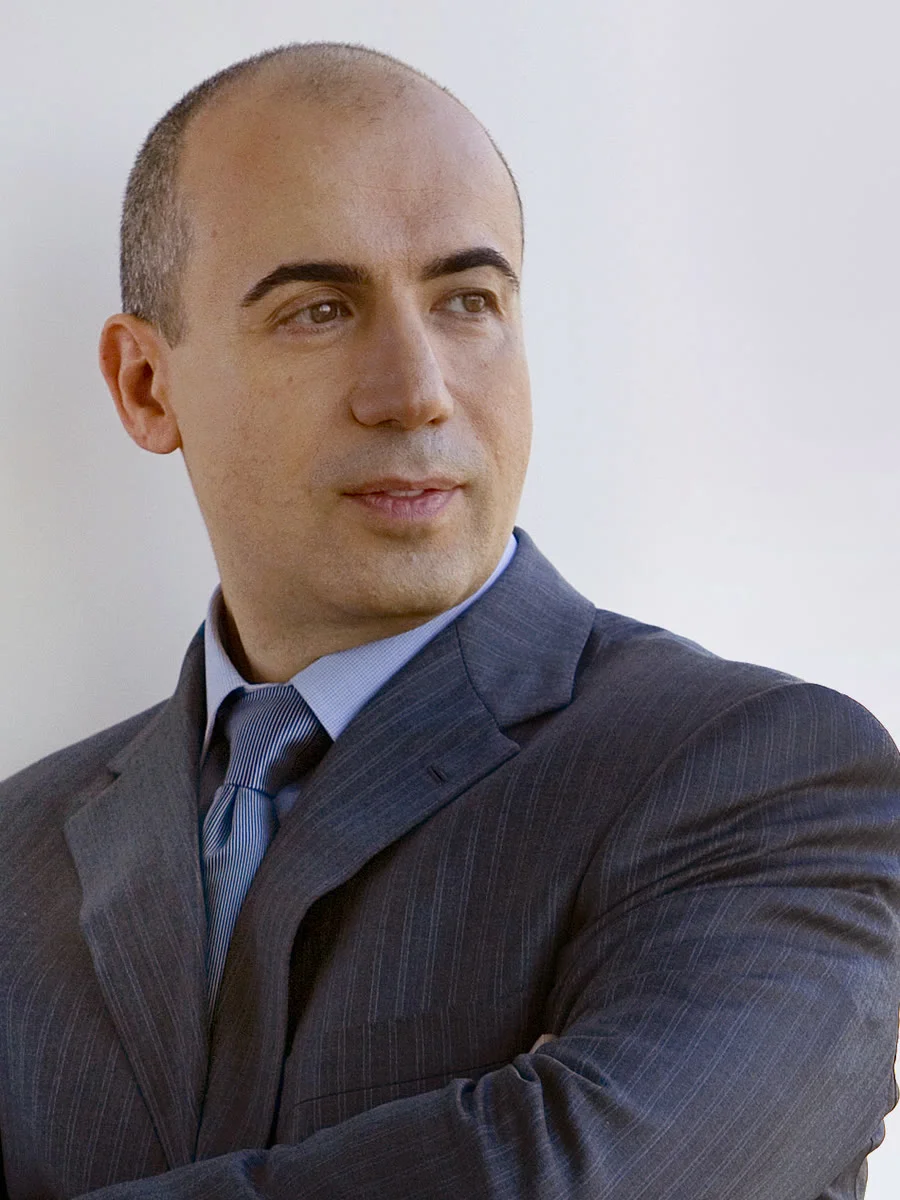
Yuri Milner
Cross-market comparison, category-first selection, scaled private-company financing, and founder accommodation form a testable method; audited personal and fund alpha remain unproved.
Verified chronology
Physics, family memory, and a cross-border reset, 1985–1995
The surviving research record does not support a confident story about Yuri Milner's parents, household economics, or a family-taught investment philosophy. It supports something narrower and more revealing about the way he later narrated his beginnings: Milner says he was named for Yuri Gagarin, and he repeatedly returns to childhood reading about extraterrestrial life by Iosif Shklovsky and Carl Sagan. These are autobiographical memories offered decades later, not proof that family background caused his investment method. TIME Q&A, opening answer Eureka Manifesto, printed pp. 5 and 72–75 [retrospective witness · moderate]
The institutional chronology is firmer. Milner graduated from Moscow State University in 1985 with advanced training in theoretical physics and worked in quantum-field-theory research. He later dated his first meeting with Stephen Hawking to a 1987 Moscow physics conference. Internet Technology, biography paragraphs Hawking memorial, 1987 conference paragraphs The Hawking memory became important to Milner's later philanthropy; it is not contemporaneous evidence about why he later selected internet companies. [retrospective witness · moderate]
Milner dates the end of his unfinished scientific career to 1989. He entered Wharton in 1990 and later described himself as its first student from behind the Iron Curtain; Wharton's own event record confirms the alumni relationship and early-1990s attendance without independently validating every detail of his admission story. Bell interview, section “1990-е” Wharton Business Radio, 00:55–02:56 Wharton speaker biography His official fact sheet dates World Bank employment to 1992–1995, while a 2010 stage interview independently preserves Wharton and the World Bank as waypoints before his return to Russia. Fact sheet, “Yuri Milner” TechCrunch Disrupt, opening career exchange
Years later Milner described physics as training in models and business school as a complete career change. The tempting causal story is that scientific method became investment method. The record only partly supports it: the explicit transfer appears most clearly in 2021, after the famous outcomes, while the 2009–2011 record independently supports comparison, measurement, and category research without using the polished scientific autobiography. Bell interview, “1990-е” and investment-statistics sections Facebook interview, 2009 [researcher inference · moderate]
The Runet as operating laboratory, 1999–2008
Milner says he reviewed hundreds of investment-bank reports, including Mary Meeker's internet work, before committing capital to the Russian internet in 1999. Bell interview, section “1990-е” His own accounts disagree slightly on the initial amount: a 2017 interview says $750,000, while the later Bell interview recalls approximately $1 million plus several million raised from others. The discrepancy should remain visible because neither account is a contemporaneous subscription record. Forbes Q&A, “An ‘Adventure’ in the Russian Internet” Bell interview, paragraphs beginning “В 1999 году” [retrospective witness · moderate]
The company story is not one clean founding event. NetBridge, Grigory Finger, Port.ru, Mail.ru, and later Digital Sky Technologies appear at different points in the operating and investment chain. The current official biography compresses them into the claim that Milner founded the company that became Mail.ru Group in 1999; the processed record does not supply the complete merger, ownership, and legal-successor chain. Internet Technology, biography paragraphs Entity and vehicle note, Forbes chronology The honest narrative is therefore an operating-company formation with Milner and Finger at its center, not a claim that every precursor, asset, or later DST fund was personally founded and owned by Milner. [researcher inference · strong]
The dot-com crash turned that formation into an operating apprenticeship. In the earliest substantial interview located, Milner said he and Finger began Runet investing around 2000, cut staff by roughly 80%, and that he assumed the Mail.ru chief-executive role as the market collapsed. Secret Firm, questions beginning “В 1990-х” In 2017 he added that the private valuation fell 97%, expenses fell 80%, his salary went to $1, and the business reached break-even by 2006. Those figures are retrospective testimony, not an audited loss series. Forbes Q&A, early Mail.ru questions [retrospective witness · moderate]
Survival also depended on outside capital and operators. Milner names Tiger Global and Naspers before Goldman Sachs; he says Alisher Usmanov supplied material capital during the financial crisis, and the broader record places Dmitry Grishin in Mail.ru's operating leadership. Forbes Q&A, early Mail.ru and Usmanov questions Forbes 2011 chronology Capital, operating work, and investment selection were already distributed across people and entities.
What plausibly carried forward was information. By September 2009 Milner said DST specialized in internet businesses, used the products, owned positions in four social networks, and treated organic growth without advertising as a leading signal of real user need. Secret Firm, questions beginning “Остались какие-нибудь опережающие индикаторы” and “Если действовать как Баффет” Operating several Russian and regional networks could have made engagement and monetization patterns legible before they were obvious to a Silicon Valley-only investor. That mechanism is plausible and later corroborated for Facebook; the public record does not reveal the comparison fields, failed analogues, or conflicts among competing networks. [documented behavior · moderate] [researcher inference · provisional]
Facebook converts local knowledge into a global investment product, 2009–2010
The decisive public event came on 26 May 2009. Facebook announced that Digital Sky Technologies would invest $200 million for preferred stock representing 1.96% at a $10 billion valuation and intended to buy at least $100 million of employee and former-employee common stock. The company stated that DST would receive neither a board seat nor special observer rights. Meta announcement, transaction paragraphs [contemporaneous record · strong]
The announcement and same-day interview preserve the strongest ex-ante rationale anywhere in the record. Milner pointed to user growth, engagement, technology, and monetization evidence from other social networks; Zuckerberg separately said DST's portfolio analogues made the relationship useful. Meta announcement, Milner quotation and “About Digital Sky Technologies” TechCrunch Facebook interview, valuation and monetization exchanges Facebook also credited a DST team of Milner, Gregory Finger, and Alexander Tamas. This was a company/team decision with a supportable comparative thesis, not a lone personal wager. [contemporaneous record · strong]
Years later Milner supplied the scene-setting details: Goldman Sachs made an introduction; the team had tracked social networks for roughly two years; a large spreadsheet compared engagement and monetization; Mail.ru's board resisted the commitment; and Usmanov's support mattered. Osetinskaya interview, 01:12:50–01:25:02 Forbes Q&A, “How did you first come to invest in Facebook?” These details are valuable recollection, but the spreadsheet, board minutes, and original memorandum are not public. [retrospective witness · moderate]
Facebook's S-1 resolves a crucial ownership ambiguity. The May 2009 purchaser was Mail.ru Group, formerly Digital Sky Technologies: 44,037,540 split-adjusted Series E shares at $4.54, approximately $200 million. Facebook S-1, “Series E Preferred Stock Financing” Milner later explained that no DST fund yet existed and that the purchase used Mail.ru company money. Osetinskaya interview, 01:13:11–01:13:35 The celebrated investment therefore began on an operating-company balance sheet; later DST funds and special vehicles must be kept separate. [contemporaneous record · strong] [retrospective witness · moderate]
In 2009 Milner created DST Global as a separate international investment manager because global investing from Mail.ru's balance sheet was not scalable. Facebook's filing records the subsequent legal separation: after a November 2010 restructuring, Mail.ru was no longer affiliated with the named DST Global entities; a December 2010 DST Global purchase added approximately $50 million of Class A shares. Forbes Q&A, Mail.ru/DST separation Facebook S-1, “Restructuring” and December 2010 purchase Mail.ru then listed in London in November 2010, and Milner later sold down his operating-company stake and stepped down as chairman in 2012. Forbes Q&A, “How did you part ways with Mail?”
By May–November 2010 the investment product was explicit: target companies already worth about $1 billion, write roughly $100 million checks, combine primary capital with extensive secondary liquidity, give companies another one or two private years, and avoid the operating burden of a board seat. TechCrunch Disrupt, questions beginning “what is the model?” Web 2.0 Summit, 03:25–04:05 The later slogan “founder-friendly” is directionally consistent with that posture, but filings show preferred stock, proxies, and retained rights. Founder alignment was an access and governance design, not legal rightlessness. [investor-stated · strong] [researcher inference · strong]
Global scale, regional teams, and the limits of the template, 2011–2015
Twitter extended the structure but leaves the company-specific thesis thin. In July 2011 three DST affiliates—DST Global II, L.P.; DST Investments 3 Limited; and DST Investments IV, L.P.—bought 12,427,273 Series G-2 shares for $199,999,991. A separate tender involved multiple purchasers and must not be converted into an $800 million DST primary check. Holder agreements directed voting through a Twitter board-appointed officer until the IPO. Twitter S-1/A, “2011 Series G-2 Financing,” “Holder Voting Agreements,” and principal-stockholder footnote 17 The documents establish terms and authority, while a 2010 talk supplies only category-level belief in a small set of global social platforms. Web 2.0 Summit, 11:35–13:30 [contemporaneous record · strong] [researcher inference · insufficient public record]
JD.com shows both scale and team dependence. Filed purchases by DST-related vehicles total $778,941,947.14 across April and June 2011 and February 2013; before the IPO the vehicles held 225,744,465 shares, or 11.2%. The structure included Global II, China EC vehicles, Investments 1/2, investor consent or redemption rights, and a bounded Max Smart proxy benefiting founder Richard Liu's company. JD F-1, Item 7 and principal-shareholder footnote 7 A 2012 forecast that China's largest retailer could be online was published after the first purchases but before the 2013 follow-on; it cannot be backdated into the April 2011 memo. TNW, preserved 2012 excerpts [investor-stated · moderate] [researcher inference · strong]
The China expansion was not simply Milner exporting a Moscow spreadsheet. Later reporting names Shou Zi Chew's local sourcing network and John Lindfors alongside Milner in Xiaomi diligence; it describes founder and intermediary networks opening JD, Alibaba, and Xiaomi. Forbes 2015, China sourcing and Xiaomi paragraphs The reported marks—approximately $3 billion for JD, $3.2 billion for Xiaomi, and $2.5 billion for Alibaba at different 2015 snapshots—are journalist estimates, not audited realizations. Team access is supported; partner-level selection credit and fund returns are not. [retrospective witness · moderate] [researcher inference · provisional]
Groupon prevents the era from becoming a winners-only montage. The issuer records at least $151,000,033 of purchases by Digital Sky/DST affiliates across Series F in April 2010 and Series G in January 2011. Its June 2011 S-1, published after both decisions, showed fast growth alongside net losses, acquisition, merchant-retention, and accounting risks; Forbes later said DST cashed out but supplied no proceeds. Groupon S-1, Item 15, Summary, and Risk Factors Forbes 2015, portfolio paragraph Groupon is an ordinary or indeterminate investment on the public record, not a proved write-off or win. [contemporaneous record · strong] [researcher inference · insufficient public record]
The 2014 WhatsApp transaction shows how access could become the product. Forbes reported that DST bought $125 million of founder shares after a handshake with Jan Koum and near Facebook's acquisition, partly as insurance if the strategic deal failed. Forbes 2015, WhatsApp paragraphs It was a late founder secondary near a revealed buyer, not evidence that DST discovered WhatsApp early. [retrospective witness · moderate]
Exits expose a tension between long-horizon rhetoric and finite vehicles. Milner said in 2012 that investors should stay with founders beyond IPO; in 2018 he said Facebook and Twitter were sold because the relevant funds ended. TNW, 2012 excerpts Globes, social-network exit answer Reported sales can therefore reflect fund duration, liquidity, or concentration rather than a change in company belief. The actual fund terms and sale-by-sale proceeds remain unavailable. [investor-stated · moderate] [researcher inference · provisional]
Institutionalization, adverse outcomes, and selected misses, 2016–2025
The later record looks less like one person's portfolio and more like a multi-fund institution. Nu's 2021 Schedule 13G maps Global V/VI, a co-investment vehicle, Investments XVIII, company-specific holders, managers, DST Global Advisors, Cardew, and Galileo. Chime's 2025 filing maps Global VI/VII and related vehicles through managers and an upstream Cardew–Galileo chain to Despoina Zinonos, reporting 52,268,715 Class A shares, or 15.7%. Nu Schedule 13G, reporting-person and ownership tables Chime Schedule 13G, Items 2 and 4 These are time-bounded legal-control snapshots, not proof of Milner's personal ownership or the firms' purchase costs. [contemporaneous record · strong]
Ofo is the clearest visible stress test. DST led a reported $450 million Series D in February 2017 at a valuation above $1 billion when one-yuan hourly pricing, vandalism, deposits, utilization, subsidies, and a capital war were already visible. DST participated again in a $700 million-plus Series E in July. TechCrunch Series D, round and operating-economics paragraphs TechCrunch Series E, investor paragraph By December 2018 more than ten million users reportedly sought deposit refunds and a court restricted founder Dai Wei's high-end spending after an unpaid debt. China Daily, refund and court paragraphs The company failed; the exact DST vehicle, check, continuation vote, impairment, and recovery are unknown. [documented behavior · strong] [researcher inference · insufficient public record]
The anti-portfolio is also selected. Forbes reported in 2015 that DST saw three Uber opportunities and passed because Milner doubted Travis Kalanick's ability to manage legal and regulatory conflict; Milner later called the miss a major error. Forbes 2015, Uber-pass paragraphs Bell interview, selected-misses discussion In 2021 he also said DST withdrew from Pinduoduo near an effectively signed term sheet at a $1 billion valuation through its own shortsightedness. Bell interview, Pinduoduo discussion Uber suggests founder/regulatory weighting can create false negatives; PDD suggests a near-commitment can be reversed without a public changed-fact record. Both are retrospective, and neither supplies terms, partner votes, or a computable counterfactual. [retrospective witness · moderate]
Milner's 2021 claim that roughly sixty investments produced “maybe” two money-losers is not a usable loss rate. It does not define investment, vehicle, realized versus unrealized loss, write-down threshold, or follow-ons; it must coexist with Ofo and with unobserved ordinary outcomes. Bell interview, investment-statistics discussion The current official claim of more than eighty DST portfolio companies and the researched twenty-eight-company public relationship union use different dates and inclusion rules. Fact sheet, portfolio statement Deal denominator Coverage and alpha are not computable from those denominators. [investor-stated · provisional] [researcher inference · insufficient public record]
People, capital, and decision rights
The biography is easiest to misread when “Milner” substitutes for every person and “DST” for every vehicle. The map below records contribution and the boundary of what the evidence permits.
| Person or institution | Documented role in the story | Attribution boundary |
|---|---|---|
| Yuri Milner | Runet operator-investor; DST Global founder; public thesis narrator; filings identify ultimate voting/investment power over selected Facebook, Twitter, and JD structures. Facebook S-1, principal-stockholder footnote 17 Twitter S-1/A, footnote 17 JD F-1, footnote 7 | Legal reporting authority does not prove sole sourcing, sole investment-committee authority, personal security ownership, or personal return. |
| Family record / Julia Milner | The parental record is not sufficiently developed; Yuri says he was named after Gagarin. Julia and Yuri later appear together in the Giving Pledge and as co-founders of Breakthrough Initiatives. TIME, opening answer Giving Pledge letter Breakthrough Initiatives, About | Do not invent parental causation or convert shared philanthropy into DST investment attribution. |
| Grigory Finger and Dmitry Grishin | Finger was Milner's NetBridge-era partner and was named in Facebook's 2009 DST team; Grishin belongs to Mail.ru's operating history. Secret Firm, Runet chronology Meta announcement, DST team Forbes 2011 chronology | Their operating and deal contributions must not be absorbed into a lone-founder narrative. |
| Alexander Tamas | Named with Milner and Finger in the contemporaneous Facebook team. Meta announcement, “About Digital Sky Technologies” | Exact sourcing, diligence, negotiation, and economics are not public. |
| Saurabh Gupta, John Lindfors, Rahul Mehta, Tom Stafford | DST's current site names them as co-founders with Milner; later reporting specifically names Lindfors in China work. DST Global, current leadership Forbes 2015, China sourcing paragraphs | Current leadership is not retroactive credit for 2009, and public partner vote/carry records are unavailable. |
| Shou Zi Chew and regional networks | Forbes reports Chew developed China advisory and founder relationships that opened opportunities including JD and Xiaomi. Forbes 2015, China sourcing paragraphs | Supports sourcing and diligence contribution, not security ownership or sole decision authority. |
| Alisher Usmanov | Material early Mail.ru/DST capital provider; Milner says his support mattered to Facebook. Forbes Q&A, Usmanov and Facebook questions Osetinskaya, 01:12:50–01:16:22 | Capital and support do not establish operating control or deal authorship; the account is partly retrospective and interested. |
| Mark Zuckerberg, Richard Liu / Max Smart | Zuckerberg received voting support over reported Facebook shares; Max Smart held a bounded JD proxy favoring Liu's company. Facebook S-1, footnote 17 JD F-1, footnote 7 | Founder alignment reduced investor operating burden but did not erase vehicle-level authority or every preferred right. |
| VTB, Kanton, and Gazprom Investholding | Capital-source nodes in the Twitter/Facebook financing record. ICIJ, Twitter and Facebook deal sections | Financing links do not establish portfolio-company control, political direction, or Milner's personal economics. |
The decision-rights record is incomplete even where the people are known. No public matrix consistently identifies who sourced, sponsored, diligenced, approved, negotiated, monitored, authorized follow-ons, or chose exits. Treating Milner as the public narrator is supportable; treating him as the sole producer of every outcome is not. Deal people map [researcher inference · strong]
Russian capital, political scrutiny, and the adjudication boundary
The controversy begins with documented financial relationships. ICIJ reported that VTB supplied at least $191 million to DST Investments 3 Limited for the Twitter position and that Gazprom Investholding financed Kanton, a participant in a Facebook investment chain. The Twitter filing independently verifies the holdings of DST Investments 3 Limited but does not disclose VTB's influence. ICIJ, Twitter and Facebook sections Twitter S-1/A, principal-stockholder footnote 17 ICIJ reported no indication that the Kremlin obtained Facebook or Twitter influence or inside information through these interests. [documented behavior · strong] [researcher inference · insufficient public record]
DST's response said VTB was passive, Usmanov was one of roughly fifty LPs in relevant Facebook entities, and later funds contained no Russian investor other than Milner and team members. DST LP letter, reproduced paragraphs Milner's fact sheet extends the later-fund claim and supplies small aggregate percentages for Russian institutional capital. Fact sheet, “Fundraising” These are primary statements of the defense, not independent LP registers. A capital provider can be small across all DST capital and still material to a single special vehicle. [investor-stated · moderate] [researcher inference · strong]
The legal record narrows several common overstatements. Treasury explicitly said the 2018 CAATSA Section 241 report was not a sanctions list and imposed no restrictions by itself. Treasury release, “Additional Background” The processed OFAC route did not preserve a complete export across Yuri/Yuriy/Yury/Юрий variants, so the authorized conclusion is limited: inclusion in that report was not a sanctions designation; a blanket claim that no designation ever existed is not established by this search. OFAC route and access boundary [contemporaneous record · strong] [researcher inference · insufficient public record]
Milner and DST were also named in Think Computer Corp. v. Dwolla. The federal court dismissed the action on jurisdiction and standing grounds, closed the file, and made no merits finding of wrongdoing. Dismissal order, conclusion A procedural dismissal is neither proof of misconduct nor an adjudication that every allegation was false. [contemporaneous record · strong]
Milner's official page dates Israeli citizenship to 1999, California residence to 2014, and renunciation of Russian citizenship to August 2022. Fact sheet, “Yuri Milner” Those biographical claims do not retroactively settle the source, rights, or influence of capital in earlier vehicles. The defensible conclusion is layered: state-linked capital existed in identified financing chains; its deal-level materiality deserves scrutiny; operational or political control has not been established by the opened records. [researcher inference · strong]
Science philanthropy is a parallel ledger, not venture evidence
Milner's public writing begins in earnest after the first global investment outcomes, and it is overwhelmingly about science, civilization, and philanthropy rather than DST underwriting. The earliest full written bridge is the Giving Pledge letter, which treats scientists and entrepreneurs as people forming provisional answers and investors as resource allocators under uncertainty. The page says “Pledged in 2013,” while the letter and later Milner sources point to 2012; the conflict remains unresolved. Giving Pledge, header and letter [investor-stated · strong] [researcher inference · insufficient public record]
The 2012 Fundamental Physics Prize concentrated money and public recognition on scientists. Milner’s foundation announced nine inaugural laureates and a $3 million award to each; the launch belongs to personal-foundation philanthropy rather than a DST portfolio. Prize launch, prize, laureate, and selection paragraphs [contemporaneous record · strong]
Breakthrough Listen launched in 2015 as a ten-year, $100 million search using telescope access, open data, open software, and distributed participation. Listen launch, program and open-data sections Breakthrough Starshot launched in 2016 as a separate $100 million proof-of-concept program decomposing an interstellar mission into chips, sails, lasers, communications, and staged research; Stephen Hawking and Mark Zuckerberg joined the board, while Pete Worden, Avi Loeb, and named scientists supplied operational and technical work. Starshot launch, board, technical, and “Path to the stars” sections The programs reveal preference for open search, explicit unknowns, and staged feasibility, but no source ties those methods to a specific DST decision at the investment date. [documented behavior · strong] [researcher inference · insufficient public record]
The 2021 Eureka Manifesto integrates childhood science, the Prize, Listen, Starshot, AI, and a civilizational mission into one retrospective account. Eureka Manifesto, printed pp. 33 and 68–75 The 2022–current humanitarian page separately describes refugee relief, support for Ukrainian scientists, and technology-company partnerships, but does not independently audit disbursement or outcomes. Humanitarian Giving, program sections These activities may share a long-horizon identity with the investment narrative; they have different entities, beneficiaries, metrics, governance, and return objectives. [researcher inference · strong]
The strongest skeptical reading of the writing corpus is therefore essential to the biography: the elegant scientific worldview may be a post-success synthesis flexible enough to explain winners after the fact. Dated DST memoranda, ordinary and failed cases governed by the same rules, and disclosed falsifiers would be needed before the manifesto's models could count as evidence of venture skill. Written-corpus skeptical reading [researcher inference · strong]
A falsifiable thesis of the edge
Proposed thesis. The best-supported edge hypothesis is that, principally from 2009 through 2015, DST combined a scarce cross-market consumer-internet comparison set with a founder-attractive late-stage financing product: identify categories already demonstrating network or ecommerce behavior in one geography, compare emerging leaders elsewhere after product evidence but before public liquidity, then win meaningful allocations with large flexible primary/secondary capital, low operating burden, and founder-control accommodation. This should work best in global consumer platforms where adoption and monetization patterns travel across borders; it should weaken when regulation, physical assets, subsidies, or local distribution make the analogy non-portable. Facebook announcement interview TechCrunch Disrupt, 2010 [researcher inference · moderate]
The proposed mechanism
- Information: Runet and other regional operating data made user growth and monetization patterns observable before the target fully monetized. Facebook is the strongest contemporaneous example. Facebook interview, 2009 rationale [contemporaneous record · strong]
- Timing: DST entered after substantial product evidence but before IPO, avoiding early technical formation risk while retaining private-market upside. Milner stated the billion-dollar threshold and roughly $100 million check model in 2010. TechCrunch Disrupt, “what is the model?” [investor-stated · strong]
- Access: Primary runway, secondary liquidity, no board seat, and voting support reduced founder-side friction. Filings show that this service proposition coexisted with preferred securities and vehicle rights. Web 2.0, 03:25–04:05 Twitter S-1/A, holder agreements [documented behavior · strong]
- Institutional scaling: Regional partners, intermediaries, co-investments, and numbered funds extended the search beyond Milner's personal network. China sourcing is the clearest reported example; later Nu and Chime filings show continuity of the multi-vehicle institution. Forbes 2015, China sourcing paragraphs Nu Schedule 13G Chime Schedule 13G [documented behavior · moderate]
- Concentration: Large positions in a small set of category leaders could make correct comparisons economically important, but also made outcome claims sensitive to Facebook and a few reported China marks. Deal Pareto analysis [researcher inference · moderate] [researcher inference · provisional]
Evidence for and against the thesis
| Case | What supports the hypothesis | What prevents a victory lap |
|---|---|---|
| Decision-date cross-network evidence, price, stake, primary/secondary structure, and no-board posture survive in company and interview records. Meta announcement 2009 interview | One unusually successful, access-rich case can dominate the narrative; complete costs, proceeds, fees, carry, and fund return are absent. [contemporaneous record · strong] [researcher inference · provisional] | |
| Twitter and JD | Filings show that the large-check, preferred-security, founder-aligned, multi-vehicle model repeated. Twitter S-1/A JD F-1 | Company-specific contemporaneous rationales are missing; repetition of structure does not prove selection skill or net return. [documented behavior · strong] [researcher inference · provisional] |
| Groupon | Two filed purchases show the model also entered an ordinary/indeterminate case. Groupon S-1, Item 15 | No original memo, proceeds, or outcome classification exists; growth analogies may not have captured merchant retention or acquisition economics. [researcher inference · moderate] |
| Ofo | The cross-geography, scaled-consumer-platform search extended into mobility. Series D | Physical assets, subsidies, deposits, and local operating intensity were visible analogy breakers, and DST followed on before failure. Exact investor loss remains unknown. [documented behavior · strong] [researcher inference · insufficient public record] |
| Uber pass | The category was visible, but founder/regulatory risk outweighed upside in Milner's later account. Forbes 2015, Uber paragraphs | A category-first method can still reject the category leader; no contemporary decline memo or proposed terms survive. [retrospective witness · moderate] |
| Pinduoduo pass | DST reportedly reached a near-term-sheet decision at a $1 billion valuation. Bell, PDD discussion | The reversal lacks a public changed fact, decision owner, or dissent record; hindsight supplies the “shortsighted” label. [retrospective witness · moderate] |
Denominator, predictions, and falsifiers
The researched public union contains twenty-eight claimed investment relationships, but only Facebook, Twitter, JD, and Groupon have sufficiently reconstructed entry/security cases. Ofo supplies strong financing and failure evidence without DST economics; Uber and PDD are selected passes; the official DST claim exceeds eighty companies. Deal denominator and inclusion rules A coverage fraction, gross or net IRR, DPI, TVPI, loss rate, vintage-adjusted benchmark, partner hit rate, and Milner personal return are not computable. The thesis is consequently a mechanism hypothesis, not a conclusion that DST generated alpha. [researcher inference · strong]
If the thesis is real, unseen evidence should show:
- pre-decision memoranda with normalized cross-market adoption, retention, monetization, payment, and regulatory comparisons—not only generic market-size forecasts;
- explicit tests for where analogies break, with different thresholds for pure software networks, ecommerce logistics, regulated mobility, and asset-heavy services;
- allocation wins tied to primary/secondary flexibility, founder-control terms, and regional-team access rather than only brand or price;
- repeated selection quality across ordinary companies and vintages after removing Facebook and controlling for stage, geography, market beta, fees, and survivorship; and
- partner and vehicle records showing distributed sourcing, documented dissent, follow-on gates, and exit decisions rather than a single retrospective narrator. [researcher inference · moderate]
The thesis would be weakened or overturned if original memos do not use cross-market evidence; if comparable failed and ordinary deals passed the same tests without discriminating signals; if allocation was explained mainly by introductions, abundant capital, or founder concessions; if returns disappear after removing Facebook or after fees and write-downs; if regional partners rather than the claimed comparison system supplied the decisive selection; or if the method cannot adapt once private-market information and late-stage capital become abundant. [researcher inference · strong]
Skill versus alternative explanations
| Component | What the record supports | What would separate it from the edge thesis |
|---|---|---|
| Skill | Comparative category research, organic-demand screening, quantitative tables, and qualitative founder assessment appear in the spoken record. Talk synthesis | Dated memos, calibrated forecasts, decision logs, and outcomes across the full denominator. |
| Access | Goldman supplied the Facebook introduction; large checks, secondary liquidity, and founder accommodation made DST competitive. Forbes Q&A, Facebook questions | Evidence that comparable access without the comparison work performed worse, or vice versa. |
| Team | Finger, Tamas, Chew, Lindfors, current co-founders, intermediaries, and founders contributed operating data, sourcing, diligence, or access. | Deal-level source, sponsor, analyst, vote, follow-on, board, and exit attribution. |
| Vehicle design | Mail.ru balance-sheet capital enabled the first Facebook purchase; later funds and co-investments scaled checks; secondaries and founder voting shaped access; fund life could force exits. Facebook S-1 Globes, exit answer | Fund terms, allocation policy, reserves, fees/carry, extension votes, and cash-flow records. |
| Regime | The model formed after the financial crisis as global consumer platforms scaled while remaining private and sought very large liquidity. TechCrunch Disrupt, 2010 model | Stage- and vintage-matched performance after late-stage capital, founder liquidity, and cross-market data became common. |
| Luck | Milner explicitly acknowledged luck in 2021. Bell, performance-statistics answer | A sufficiently large, pre-specified decision set showing persistent calibration rather than selected recollection. |
| Outlier effect | Facebook is both the cleanest rationale and reported largest gain; the remaining reported record includes JD, Xiaomi, and Alibaba but lacks comparable cash-flow proof. Deal Pareto analysis | Audited results excluding Facebook and reconciling every vehicle, follow-on, loss, distribution, fee, and mark. |
Sourced chronology and reading path
| Date | Turning point | Evidence and boundary |
|---|---|---|
| 1985 | Moscow State theoretical-physics degree; quantum-field-theory research follows. | Internet Technology, biography; official/self-published chronology. |
| 1987 | Milner later dates his first Hawking meeting to a Moscow conference. | Hawking memorial, 1987 paragraphs; retrospective memory. |
| 1989–1995 | Leaves physics, enters Wharton in 1990, then works at the World Bank according to the current fact sheet. | Bell, “1990-е” Wharton speaker biography Fact sheet; mixed retrospective and institutional record. |
| 1999–2000 | Commits capital to the emerging Runet; NetBridge/Mail.ru formation begins with Finger. | Forbes Q&A, early career Secret Firm, Runet chronology; amount/entity details remain incomplete. |
| 2001–2006 | Dot-com collapse, severe cuts, Mail.ru operating role, and reported break-even. | Forbes Q&A, crash questions Secret Firm; retrospective figures. |
| 2008 | Usmanov becomes a material early capital provider amid the financial crisis. | Forbes Q&A, Usmanov question ICIJ, Milner background; economics not fully allocated. |
| 2009-05-26 | Mail.ru/Digital Sky invests $200 million in Facebook for 1.96%; employee liquidity is planned. | Meta announcement Facebook S-1, Series E; strongest ex-ante case. |
| 2009–2010 | DST Global is created; Mail.ru lists and is legally separated from named DST Global affiliates. | Forbes Q&A, separation Facebook S-1, restructuring. |
| 2010–2011 | The late-stage, secondary-heavy, no-board model becomes public; Twitter and JD purchases follow. | TechCrunch Disrupt 2010 Twitter S-1/A JD F-1. |
| 2010–2011 | Groupon receives at least $151,000,033 across two filed DST-affiliate purchases. | Groupon S-1, Item 15; final return unknown. |
| 2012–2014 | Facebook and Twitter holdings are reportedly sold as vehicles mature; complete proceeds remain unavailable. | Globes, exit answer Fact sheet, disposal dates. |
| 2012–2016 | Prize, Giving Pledge, Listen, and Starshot establish a separate science-philanthropy program. | Prize launch Giving Pledge Listen Starshot. |
| 2017–2018 | DST leads and follows on in Ofo before refund and creditor distress become public. | Series D Series E China Daily; DST loss amount unknown. |
| 2017–2018 | Paradise Papers reporting exposes VTB and Kanton/Gazprom-linked financing chains; DST publishes a rebuttal. | ICIJ DST letter; financing supported, political control unproved. |
| 2021 | Milner gives the fullest retrospective account of the method, approximately sixty investments, and Uber/PDD misses. | Bell Osetinskaya video; abridged text/translated-caption boundaries apply. |
| 2021–2025 | Nu and Chime filings expose the later numbered-fund, co-investment, and manager chains. | Nu 13G Chime 13G; ownership snapshots, not returns. |
| 2022 | Milner's fact sheet says he renounced Russian citizenship; humanitarian work expands. | Fact sheet, “Yuri Milner” Humanitarian Giving; official-position evidence, not independent outcome audit. |
Read this biography as the spine, then use the package in evidence order:
- Sources and coverage map — the full source denominator, access boundaries, adverse routes, and retrieval controls.
- Writings — source-by-source science/philanthropy corpus, its intellectual evolution, and why later prose cannot be back-cast into early investments.
- Talks and interviews — the dated direct-voice record, contemporaneous method, retrospective drift, and transcript controls.
- Investments and decision laboratories — Pareto rankings, vehicle-aware ledger, ex-ante Facebook/Twitter/JD/Groupon cases, Ofo/Uber/PDD labs, and unresolved economics.
- Investment philosophy — the operating system, edge tests, portfolio mechanics, contradictions, and modern translation.
- Mental models — the evidence-backed rules, grounded cases, exceptions, and application checklists.
- Processed notes — claim-level locators, quotations, attribution boundaries, contradictions, and open questions for every processed priority source.
The package supports a specific, testable account of how DST may have built an information-and-access advantage. It does not yet establish audited excess return, a stable loss denominator, or a Milner-personal performance record. Falsifiable thesis Evidence boundary [researcher inference · moderate]
1. Snapshot and testable edge thesis
The supportable hypothesis is a cross-market comparative-data edge expressed through founder-aligned late-stage capital: identify an internet category whose behavior is already visible in several countries, compare product use and monetization across those markets, enter after organic demand is legible but before public liquidity, and make a large minority check easier for the founder to accept through secondary liquidity, low operating burden, and bounded voting accommodation. [researcher inference · strong] Facebook announcement interview TechCrunch Disrupt 2010 Web 2.0 Summit, 03:25–05:54 and 13:02–17:27
The proposed mechanism is:
operating data from earlier markets → category map → small eligible-company set → quantitative company/valuation work plus qualitative founder judgment → primary/secondary preferred structure → extra private runway → global scale and eventual liquidity.
This is a hypothesis, not a final edge finding. It predicts that the same comparison set, entry screen, terms, and pre-registered risks should be visible before both winners and ordinary or failed investments; that the record should remain meaningful without Facebook; and that team, vehicle, price, and exit effects can be separated from Milner's personal contribution. The three ranked views and four reconstructed entry cases partly support the mechanism. The denominator, Ofo failure, and Uber/PDD passes show why it remains unproved.
Falsifiers are concrete: dated IC records could show that famous outcomes were selected without the stated framework; a complete portfolio could reveal that cross-market analogies produced many hidden false positives; ordinary investments could underperform stage/geography-matched alternatives; another partner could own the decisive sourcing or underwriting; or fund cash flows could show that headline company marks did not translate into superior net returns. The missing records are listed in the uncertainty and retrieval ledger.
2. Core philosophy
Milner's contemporaneous investment doctrine is narrower and more operational than the later “scientific method” autobiography.
- Choose the structural category first. Consumer internet, social networks, ecommerce, and mobility were screened for very large scale before a specific company was selected. [investor-stated · strong] TechCrunch Disrupt 2010
- Treat countries as a model library. Russian, Chinese, Korean, European, and U.S. services supplied leading and lagging evidence about adoption and monetization. Facebook is the strongest contemporaneous instance; JD extends the approach into ecommerce. [documented behavior · strong] Facebook interview JD F-1, Item 7 and Principal Shareholders
- Separate product proof from current revenue. Organic use and network density can precede monetization, but comparable networks must make monetization plausible. [investor-stated · moderate] Secret Firm interview
- Enter after early venture uncertainty but before public liquidity. By 2010 Milner described roughly billion-dollar companies, large checks, extensive secondary purchases, and another one or two private years. That is growth investing, not seed discovery. [investor-stated · strong] Web 2.0 Summit
- Offer founders capital without demanding operational control. Board avoidance and founder-supportive voting were part of the product offered to companies. Filed preferred securities, consent rights, and vehicle-level authority mean “founder-friendly” never equals rightless capital. [documented behavior · strong] Facebook S-1, Related Party Transactions and Principal Stockholders n.17 Twitter S-1/A, Holder Voting Agreements JD F-1, Principal Shareholders n.7
The later writings add useful epistemic tools—factor uncertainty, test anomalies, stage remote projects, map correlated risk—but they are mainly science-philanthropy doctrine written after the early DST wins. They inform the explicitly bounded mental-model index; they cannot be back-cast as the Facebook, Twitter, or JD investment memo. written-corpus boundary
3. Sourcing
The early sourcing advantage combined operating experience, cross-border data, founder referrals, and a deliberately small eligible universe. Runet companies supplied product and monetization observations before comparable U.S. companies were public; the DST team could then approach scaled founders with a differentiated transaction rather than generic advice. [retrospective witness · moderate] Forbes 2011 Facebook announcement interview
By the 2010 Web 2.0 appearance, Milner described only about 50 companies as fitting the strategy. That statement supports selectivity at a moment in time, not a complete reviewed-company ledger. Forbes later reported roughly 250 companies reviewed over five years, but the names, dates, rejection reasons, and partner ownership are unavailable. [retrospective witness · moderate] Web 2.0 Summit Forbes 2015
Local relationships mattered. Later reporting names Shou Zi Chew and John Lindfors in China work; current DST materials name Saurabh Gupta, Lindfors, Rahul Mehta, and Tom Stafford as co-founders. Milner's access should not absorb their sourcing, diligence, or negotiation. [documented behavior · moderate] Forbes 2015 DST Global
Reusable sourcing screen
- Define the category without naming the target.
- List leading and lagging markets and the comparable product behavior in each.
- Record what is genuinely portable: use frequency, retention, payments, distribution, regulation, or unit economics.
- Identify the target's organic signal and the possibility that incentives, fraud, or paid acquisition manufactured it.
- Name the human source—partner, founder, operator, portfolio company, bank, or intermediary—and keep access separate from judgment.
- Build the eligible-company and pass ledger before outcomes select the sample.
- Ask what proprietary evidence remains after global data and founder networks become widely available.
The screen should be run against Facebook, JD, and Ofo to expose both useful transfer and analogy error.
4. Picking
A decision-useful reconstruction has two coupled models: a quantitative category/company model and a qualitative founder model. Milner's 2020 Wharton interview explicitly places founder motivation, history, and conduct beside spreadsheets. [investor-stated · strong] Wharton Business Radio, 05:45–07:04
Pre-IC sequence
- Would you invest then? Freeze the date, available information, alternatives, price, and vehicle before revealing the outcome.
- Category: specify the structural behavior, total eligible-company set, cross-market comparables, and conditions under which the markets are not analogous.
- Company: test organic growth, cohort retention, network density, monetization path, operating leverage, regulation, and capital intensity.
- Founder/team: examine motivation, truth-seeking, learning, recruiting, conduct, and capacity to manage the category's specific conflicts.
- Ownership/terms: price the security, primary/secondary split, preference stack, dilution, voting/proxy rights, information rights, and expected ownership through follow-ons.
- Vehicle: identify legal holder, fund, manager, LP or co-invest source, duration, reserves, fees/carry, and beneficiary. Never write “DST invested” when the filing names a narrower entity.
- What kills the deal? Pre-register product, economics, governance, regulation, financing, and valuation thresholds.
- Evidence unlocks the next check? Name the next cohort, filing, reference, customer test, or legal record required.
Red flags and stop conditions
- growth that disappears after subsidies or paid acquisition;
- a foreign analogue whose payments, distribution, regulation, or user behavior is not portable;
- a founder-friendly narrative used to waive conduct or governance risk;
- secondary liquidity that overwhelms company funding or creates seller-selection risk;
- a valuation that requires implausible monetization or market share;
- a capital-intensive model whose next financing is the business model;
- a follow-on justified by sunk cost rather than fresh expected return;
- an unnamed holder, vehicle, decision owner, or final beneficiary;
- retrospective doctrine used as decision-date evidence.
The exact worksheet is implemented in all seven investment cases and laboratories.
5. Deal and portfolio mechanics
The 2010 model targeted large, scaled private companies and checks around $100 million. Milner described aggregate activity as approximately 80% secondary and 20% primary, while Facebook's announced initial transaction was $200 million of Series E primary plus a later employee-liquidity plan. These are different denominators; neither is a universal deal template. [documented behavior · strong] Web 2.0, 03:25–04:05 Facebook announcement
The economic logic has four parts:
- Private runway: primary capital postpones a forced IPO and funds growth.
- Liquidity as access: founder, employee, or shareholder secondaries reduce pressure and make DST's offer more attractive.
- Minority concentration: large checks create material exposure without operating control.
- Founder-aligned governance: no board demand and supportive voting can lower founder burden, while preferred rights and manager control still protect the security holder.
Filed transactions show why each deal requires its own ledger. Twitter's DST-affiliate primary allocation was $199,999,991, not the whole $800 million financing or tender. JD records four purchases totaling $778,941,947.14. Groupon records at least $151,000,033 across separate 2010 Series F and 2011 Series G purchases, while most Series G round proceeds funded shareholder redemptions. [documented behavior · strong] Twitter S-1/A, Series G-2 Financing JD F-1, Item 7 Groupon S-1, Item 15 and Related Party Transactions
Public evidence does not disclose a universal ownership target, reserve ratio, position cap, follow-on rule, valuation method, or exit process. The visible portfolio is power-law concentrated and winner-selected. The portfolio forensics therefore separates filed cost, reported mark, realized cash, vehicle return, net LP return, and Milner personal economics.
6. Vehicle and incentive fit
The strategy changed legal and economic perimeter over time:
- The 2009 Facebook Series E buyer was Digital Sky Technologies Limited, the operating company renamed Mail.ru Group Limited in 2010; it was not a later numbered DST fund.
- After the 2010 separation, numbered DST funds and co-investment/SPV holders owned securities.
- Twitter used DST Global II, L.P.; DST Investments 3 Limited; and DST Investments IV, L.P.
- JD used Global II and several China EC/Investments vehicles.
- Nu and Chime filings show later multi-fund, co-investment, manager, adviser, and upstream-control chains.
- Breakthrough philanthropy and personal investments are outside the DST fund denominator.
[documented behavior · strong] Facebook S-1 Twitter S-1/A Nu 13G Chime 13G
The fit is intuitive: large LP-backed funds and co-investments can supply concentrated late-stage checks; secondaries need patient private-market capital; follow-ons require reserves; and limited fund lives create an eventual liquidity obligation. Milner said Facebook and Twitter exits reflected fund duration, demonstrating that company conviction and vehicle timing can diverge. [investor-stated · moderate] Globes 2018
The incentive risks are allocation among flagship and co-invest vehicles, LP concentration, passive capital-provider scrutiny, fees/carry, fund-life selling, adverse selection in secondaries, and ambiguity about who benefits. ICIJ's reporting on VTB and Kanton makes capital provenance relevant, but it found no evidence of portfolio-company influence; DST's response is an interested-party control, not an independent LP register. [retrospective witness · moderate] ICIJ DST LP letter
The adverse record needs equally narrow legal language. Treasury said the CAATSA Section 241 report was not a sanctions list and that inclusion imposed no restrictions, but this research did not preserve a complete OFAC alias-export across Yuri/Yuriy/Yury/Юрий variants, so it cannot support a blanket “never sanctioned” claim. Think Computer Corp. v. Dwolla was dismissed and closed on jurisdiction and standing grounds; the order made no merits finding of wrongdoing by Milner or DST, and a procedural dismissal does not prove every allegation false. Treasury, Background OFAC search route Think Computer dismissal order
The entity rule is absolute: company value is not security proceeds; security proceeds are not fund return; fund return is not net LP return; reporting power is not personal ownership; and philanthropy is neither investment cost nor return. See the vehicle table and people, capital, and decision-rights map.
7. Team attribution and work with founders
Milner is the founder and a senior authority, but the public record describes an institution. DST's current site names Saurabh Gupta, John Lindfors, Rahul Mehta, and Tom Stafford as co-founders; the 2009 Facebook announcement named Milner, Gregory Finger, and Alexander Tamas in the then-DST team. Team composition changed, and no public IC ledger allocates sourcing, analysis, negotiation, approval, monitoring, or exit work across every deal. [contemporaneous record · strong] DST Global Facebook announcement
Founder work is clearest as transaction design:
- Facebook granted no board or observer right and subjected DST shares to a Zuckerberg voting agreement.
- Twitter holders agreed to vote as directed by an officer appointed by the board until IPO, subject to exceptions.
- JD funds appointed Max Smart as a bounded proxy while retaining other holder rights.
- Later interviews describe qualitative founder diligence and a broad founder-friendly posture.
[documented behavior · strong] Facebook S-1 Twitter S-1/A JD F-1
The supported claim is that DST reduced operating and voting friction to compete for founder access. The unsupported claims are that Milner personally sourced every deal, that founders directed DST's vehicle decisions, that DST held no protective rights, or that accommodation caused superior returns. A useful analyst matrix records source, analysis, negotiation, IC vote, company work, follow-on, governance, and exit for each named person; blanks remain unknown. people/capital map
8. Views on the craft
- Information before proximity. Comparative data from several markets can be more valuable than geographic closeness to one company. The transferable rule is to prove comparability, not collect foreign anecdotes. [investor-stated · strong] SPIEF transcript, pp. 23–24
- Evidence before monetization, not economics never. Organic use may lead revenue, but price, retention, regulation, and value capture still require underwriting. [researcher inference · strong] Secret Firm interview Facebook S-1
- Capital is a product. Check size, primary/secondary mix, governance burden, and private runway can differentiate an investor as much as advice. [documented behavior · strong] Web 2.0 Summit Facebook announcement
- Quantitative and qualitative work are complements. Spreadsheets do not replace founder judgment; founder charisma does not replace terms, cohorts, or falsifiers. Wharton Business Radio
- Board seats are not the only governance channel. Security rights, information, voting agreements, proxies, allocations, follow-ons, and exit decisions remain consequential. Facebook S-1 JD F-1
- Long holding is conditional on the vehicle. The 2012 hold-with-founders language conflicts productively with the later fund-life explanation for exits. TNW 2012 Globes 2018
- Failure needs two denominators. A financed-company failure and a passed winner reveal different errors; both need a complete searched opportunity set before rates are claimed. layered counts decision laboratories
- Mission is not a return metric. Science patronage may illuminate tolerance for uncertainty and program design, but its open-data, cultural, and civilizational objectives are not DST economics. writings boundary
9. Signature bets and decision process
- Facebook, 2009: the cleanest contemporaneous success lab—cross-market network and monetization evidence, $200 million for 1.96% at a $10 billion valuation, founder voting support, primary plus planned secondaries, and no board seat. It tests the claimed information and transaction edge without assigning the result to Milner personally.
- JD.com, 2011–2013: repeated, vehicle-specific purchases test whether the social-network comparison method transferred to ecommerce and proprietary logistics. The 2012 public China thesis is later context for the 2011 entry, not its original memo.
- Twitter, 2011: distinguishes the $199,999,991 DST-affiliate Series G-2 primary allocation from the wider financing and tender, while exposing exact co-investment and capital-source attribution.
- Groupon, 2010–2011: at least $151,000,033 of filed purchases test headline growth, redemption-heavy financing, merchant value, customer acquisition, and accounting quality. The outcome remains ordinary/indeterminate.
- Ofo: the strongest visible financed-company adverse outcome tests subsidy-normalized unit economics, deposit liabilities, physical-asset loss, follow-on discipline, and financing dependence. DST's check, vehicle, impairment, and recovery are unknown.
- Uber pass: tests whether founder/regulatory risk was over-weighted and whether a staged or governed option could have preserved category upside. Retrospective accounts do not prove absence from every DST-related vehicle.
- Pinduoduo/PDD pass: tests reversal discipline after a reportedly near-signed term sheet around a $1 billion valuation. The decision record, proposed ownership, and changed fact remain missing.
The seven workbooks share four pre-reveal prompts: would you invest then; what kills the deal; what ownership and terms are required; and what evidence unlocks the next check.
10. Mental models and maxims index
The completed mental-model registry preserves provenance and distinguishes historical DST practice from later researcher translation. Names and links below match that registry exactly.
- Model 1 — Build a cross-market model library — normalize behavior, monetization, payments, regulation, distribution, and capital intensity before transferring a pattern.
- Model 2 — Choose the category before the company — define structural scale and the eligible universe before access or company charisma selects the sample.
- Model 3 — Let organic use lead, then prove value capture — use unpaid product pull as a signal, then prove retained cohorts, value capture, and unit economics.
- Model 4 — Sell private runway and liquidity — separate primary runway, seller liquidity, security price, operating burden, and vehicle duration.
- Model 5 — Be founder-aligned without becoming rightless — distinguish board posture from proxies, preferences, information, consent, and vehicle authority.
- Model 6 — Freeze the decision before the reveal — preserve evidence, alternatives, dissent, terms, and kill criteria before outcome knowledge.
- Model 7 — Factor ignorance before pricing possibility — enumerate measurable unknowns; this is a researcher-applied investment translation of later science writing.
- Model 8 — Investigate the anomaly without buying its favorite explanation — keep competing explanations alive and fund the next discriminating observation.
- Model 9 — Stage a remote ambition through bottlenecks — fund the next proof, name the binding constraint, and precommit the stop or redirect gate.
- Model 10 — Match the risk horizon to the vehicle — align objectives, common-mode risks, reserves, liquidity, and succession to the vehicle's actual life.
- Model 11 — Separate mission, mechanism, metric, and authority — keep scientific, philanthropic, operating, and financial objectives in distinct decision ledgers.
- Model 12 — Audit company, security, fund, LP, and person separately — protect every company, security, holder, fund, LP, control, and personal-economics boundary.
11. Evolution and contradictions
| Period | Visible doctrine | Later evolution or contradiction | Decision control |
|---|---|---|---|
| 1999–2004 | survive the dot-com collapse, operate Mail.ru, and learn from Runet product/economic data | later narratives compress operating-company formation into an investment origin story | keep NetBridge, Port.ru, Mail.ru, personal capital, and later funds separate Forbes 2011 |
| 2009 | Facebook rationale uses product behavior, global monetization analogues, valuation, and a company-balance-sheet check | later accounts add an ordered scientific-method story and contested approval recollection | contemporaneous rationale is strong; retrospective process detail is moderate Facebook interview |
| 2010–2012 | late-stage threshold, large checks, heavy secondary volume, board avoidance, private runway, and holding with founders | 2021 broadens this into an all-investments founder-friendly claim | filed rights and deal-specific terms control the generalization |
| 2012–2018 | Prize, Listen, Starshot, anomaly search, and longevity develop recognition, open search, staged proof, and long-horizon risk | science language can be mistaken for the original venture method | philanthropy and DST remain separate perimeters writings chronology |
| 2017–2018 | quantified internet forecasts and long-company-duration language coexist with regional uncertainty | Milner later attributes Facebook/Twitter exits to fund life | distinguish company conviction from vehicle obligation Globes |
| 2020 | founder motivation is explicitly combined with spreadsheets | neither input has a disclosed scoring rule or failed-founder denominator | record qualitative and quantitative falsifiers separately |
| 2021 | coherent scientific-method autobiography, selected misses, about 60 investments, and perhaps two losses | the polish risks hindsight, and the loss/pass denominators are unaudited | use the layered denominator, not the recollection as a statistic |
| 2022 onward | humanitarian and science identity becomes more prominent | official narrative may crowd out investment-process disclosure | do not infer DST returns or process from philanthropic program scale |
The deepest tensions are productive rather than resolvable slogans: exceptional individual versus distributed network; open knowledge versus private investment records; long horizon versus measurable milestones; founder accommodation versus downside governance; concentrated category conviction versus correlated risk; and company patience versus finite fund duration.
12. Failures, misses, and limits
Ofo is the best visible false-positive laboratory. DST led a reported $450 million Series D and joined a later $700 million-plus round; later refund and creditor distress establish an adverse company outcome. They do not establish the DST security, vehicle loss, impairment, recovery, or individual decision owner. [contemporaneous record · moderate] Series D Series E distress
Uber and PDD are selected false negatives. Milner's accounts expose founder/regulatory weighting and near-commitment reversal, but no original term sheet, vote, proposed allocation, or complete all-vehicle search is public. Groupon is an ordinary/indeterminate case: the filed cost is material, the S-1 later revealed acquisition, retention, loss, and accounting risks, and Forbes says DST cashed out, but sale proceeds and return are absent. [retrospective witness · moderate] Bell 2021 Groupon S-1
The method's principal failure modes are:
- cross-market analogy without local-regime falsification;
- organic growth that is subsidized, unsafe, fraudulent, or uneconomic;
- founder trust that delays governance response;
- secondary-heavy rounds that reduce company benefit or increase selection risk;
- follow-ons that fund a financing-dependent model;
- long-horizon language without milestones, opportunity cost, or stop authority;
- vehicle duration that forces an otherwise unwanted exit;
- power-law storytelling that hides ordinary outcomes and losses.
The public record cannot establish DPI, TVPI, IRR, MOIC, loss ratio, hit rate, vintage alpha, Milner's personal return, or partner-level performance. Milner's “perhaps two” money-losers among about 60 is a retrieval lead, not comparable portfolio evidence. evidence limits
13. Historical operating environment
The strategy emerged from a specific sequence.
Runet and the crash, 1999–2004. Internet penetration, payment systems, and capital markets were less mature, while local portals and social products generated comparative data unavailable to many Western investors. The dot-com collapse rewarded survival, restructuring, and operator knowledge; the public record does not supply a matched cohort proving those experiences created later alpha. [retrospective witness · moderate] Forbes 2011
Private-platform scale, 2005–2012. Global consumer networks could reach hundreds of millions of users before IPO, and employees/founders needed liquidity. Traditional venture checks were often smaller, while public markets imposed disclosure and timing costs. Large preferred primary-plus-secondary transactions with no board demand were therefore a distinctive financing alternative. [contemporaneous record · strong] Facebook announcement Web 2.0 Summit
Global smartphone, ecommerce, and abundant private capital, 2011–2021. The comparison framework expanded across China ecommerce and regional mobility. More growth capital and cross-border funds reduced the scarcity of large private checks; regulation, VIE structures, capital controls, and local competitors made country analogy harder. JD's logistics burden and Ofo's asset/subsidy model show that format transfer is not economic identity. JD F-1 Ofo lab
Disclosure and geopolitical scrutiny, 2017 onward. Paradise Papers reporting made LP sources, co-investments, trusts, and passive-control claims part of underwriting the manager itself. The CAATSA Section 241 report was not a sanctions list and imposed no restrictions merely by inclusion; it should neither be inflated into a sanctions finding nor used to dismiss legitimate provenance questions. Treasury, Background legal/adverse controls
No public stage/geography-matched base rate, complete opportunity set, or fund cash-flow series is available. Historical distinctiveness is therefore an explanatory context, not a benchmark-adjusted performance conclusion.
14. Modern VC translation as of 2026-08-23
| Historical lesson | What still transfers | What changed or invites misuse | Observable 2026 test |
|---|---|---|---|
| Cross-market comparison | parallel markets reveal adoption, monetization, and regulation earlier | global data is abundant and models can synthesize public analogues; local regulation and distribution remain stubbornly specific | a proprietary cohort or operating insight, explicit comparability matrix, and one disconfirming market |
| Organic use before monetization | genuine pull can precede a mature revenue model | AI-generated products, incentives, bots, and paid loops make usage cheap to manufacture | identity-clean retention, task completion, willingness to pay, acquisition-source mix, and subsidy-normalized margin |
| Category before company | structural shifts can narrow the search universe | category narratives and giant AI TAMs can make every target appear inevitable | named eligible set, substitutes, value-capture map, and regime falsifier |
| Large late-stage minority check | scaled private companies still need runway and shareholder liquidity | growth markets are more crowded; tender pricing, preference stacks, and extension rounds can hide weak primary economics | primary use of proceeds, seller identity, full preference stack, dilution, and downside value |
| Founder alignment | control-respecting capital remains attractive | founder friendliness can become a waiver for conduct, safety, related parties, or governance | reference-backed integrity, bounded votes, information rights, intervention triggers, and named stop authority |
| Quantitative plus qualitative judgment | models and human motives remain complementary | AI makes spreadsheet and narrative production effortless, increasing false precision | source-level data audit, scenario calibration, independent founder references, and written falsifiers |
| Secondary liquidity as investor product | liquidity can extend private runway and improve access | seller selection and employee/founder incentives may diverge from company need | primary/secondary split, seller concentration, retention plan, and post-sale governance |
| Long horizon | difficult infrastructure and AI-science companies require patient proof | fund lives and compute/financing dependence can be shorter than the mission | milestone-linked reserves, financing runway, common-mode dependency map, and vehicle-duration fit |
| Open search and staged proof | useful for AI science, frontier systems, and data networks | openness may conflict with privacy, dual use, proprietary value, or investment duties | reproducibility, provenance, security authority, ecosystem contribution quality, and durable value capture |
| Vehicle-aware attribution | increasingly important as SPVs, co-invests, continuations, and cross-border structures proliferate | brand-level reporting obscures allocation, fees, beneficiaries, and conflicts | security-to-holder-to-manager-to-LP map plus complete lifecycle cash ledger |
A modern investor should not copy the headline—big checks, founder-friendly, global. The portable artifact is the disciplined combination of a comparison matrix, decision-date freeze, exact security/vehicle map, founder and company falsifiers, and milestone-linked follow-on. The mental-model registry, four entry workbooks, and three decision laboratories are designed to test that process prospectively.
15. Comparison with three completed peers
The comparison set is limited to the requested completed profiles: Masayoshi Son 039, Kathy Xu 046, and Danny Rimer 048. It compares documented doctrine and public evidence, not audited personal alpha.
| Dimension | Yuri Milner | Masayoshi Son | Kathy Xu | Danny Rimer |
|---|---|---|---|---|
| Primary information edge | cross-market internet operating data and category comparison | regime backcasting, strategic bottlenecks, and asset assembly | local consumer observation, founder access, and China pattern recognition | outsider cultural observation and purpose/taste judgment |
| Typical stage | late private after product evidence, before public liquidity | spans seed-like options, control acquisitions, telecom operations, and giant growth funds | early and growth venture with direct local market work | early/pre-product through growth inside a multi-stage partnership |
| Sourcing design | small category-qualified universe plus global/local founder networks | top-down future map plus founder and strategic-network access | field research, operators, consumers, and founder relationships | referrals, cultural observation, founders, and Index network |
| Company picking | organic use, cross-market monetization, scale, and founder qualitative assessment | category leadership and ambition, sometimes subordinating price/security discipline | founder insight, product detail, market timing, and local execution | purpose-bound founder, taste, culture shift, and complementary teams |
| Price and security | large minority preferred/secondary structures; public universal valuation method absent | security economics vary widely and are often the weakest disclosed link | public check/ownership and return denominator incomplete | says price can be a mental trap; public ownership rules incomplete |
| Founder relationship | low operating burden, no-board posture, supportive voting with retained holder rights | unusually founder-centric and capable of escalating conviction/control | relational, locally embedded, and active in judgment/support | service-oriented recruiting, board work, and patient formation |
| Governance | accommodation by design; proxies and preferences remain deal-specific | ranges from minority influence to control; governance failures are highly visible | public deal-specific governance record is limited | boards, honest counsel, recruiting, and institutional support are more visible |
| Portfolio mechanism | concentrated category leaders, large follow-ons, primary/secondary access, finite fund life | extreme scale, ecosystem correlation, leverage, control, and multiple vehicle perimeters | firm/fund allocation and complete portfolio economics remain private | multi-stage follow-ons within Index; explicit artisanal-scale rhetoric |
| Team-attribution risk | Milner brand can absorb regional partners and changing DST teams | Son's central public role can absorb operators, IC, portfolio teams, and third-party capital | Xu/Capital Today attribution must remain separate from founders and team | Rimer/Index/family/partner attribution is inseparable in many deals |
| Failure laboratory | Ofo financed-company adverse outcome; Uber/PDD false negatives; Groupon ordinary | WeWork, DiDi, Sprint, OneWeb, NVIDIA exit, and ordinary public tail | ordinary, adverse, and pass evidence is thinner than winner narratives | Nasty Gal, Good Eggs, Fast, Gather, and admitted passes |
| Historical advantage | scarce cross-border data plus a differentiated late-private liquidity product | Japan/U.S./China network eras, cheap capital, strategic control, and later Vision Fund scale | China's consumer/internet growth and scarce local insight | European/U.S. venture infrastructure, cross-border culture, and design/software waves |
| Strongest present-day lesson | prove comparability and preserve exact vehicle/terms | separate regime insight from company/security price and correlated exposure | combine local fieldwork with explicit stop, denominator, and attribution controls | start with founder/purpose, then force commercial, price, and governance proof |
| Evidence limitation | no complete fund cash flows, loss/pass ledger, or personal economics | large corporate disclosure exists but personal/vehicle attribution remains complex | private-firm records limit cash-flow and IC reconstruction | filings prove selected holdings/boards, not full partner economics |
Milner is closest to Xu on cross-border/local-market information and to Rimer on founder-accommodating minority partnership, while Son is the useful contrast in control, strategic asset assembly, and scale. The distinctive hypothesis is not simply “global vision”; it is a late-stage comparative-data model packaged in a founder-acceptable liquidity structure. Whether that distinction produced superior net performance remains untested.
16. The strongest case against greatness
The strongest skeptical case is that a handful of famous late-private winners, especially Facebook, generated a compelling retrospective story around access, favorable era, abundant capital, and institutional execution rather than a proven Milner-specific selection edge.
First, the public record is selected. DST's current account says more than 80 companies; Milner recalled about 60 investments and perhaps two losses; this research union names 28 and sufficiently reconstructs only four entry/security cases. There is no complete portfolio, pass, follow-on, write-off, or cash-flow denominator. layered counts
Second, the apparent method may be outcome-compatible rather than predictive. “Global,” “organic,” “founder-friendly,” “large category,” and “look beyond the horizon” describe many winners after the fact. The polished scientific vocabulary largely postdates the Facebook-era decisions, while original IC memos and falsifiers are absent. contemporaneous-versus-retrospective audit skeptical reading
Third, access and transaction product may explain more than selection. Mail.ru operating data, Usmanov and institutional capital, large secondary capacity, founder voting accommodation, and a global team could win allocations in already de-risked category leaders. That can be a valuable franchise, but it is not automatically superior company picking or personal alpha.
Fourth, team and vehicle attribution are unresolved. Regional partners, founders, portfolio employees, co-investors, LPs, numbered funds, and SPVs supplied the work and capital. Beneficial reporting power does not disclose personal economics. Facebook's first check was Digital Sky Technologies Limited operating-company capital, before its renaming as Mail.ru Group Limited; Chime's filed upstream chain ends with Despoina Zinonos, not Milner. people, capital, and decision-rights map Facebook S-1 Chime 13G
Fifth, adverse evidence is underdeveloped. Ofo shows that a scaled, heavily financed category analogy can fail; Uber and PDD show selected false negatives; Groupon prevents a winners-only binary. No disclosed process change proves that the method learned prospectively from them.
The defensible conclusion is narrower: Milner helped build a historically important, founder-attractive, cross-border late-stage investment franchise with several strongly documented transactions. Career-wide, ex-Facebook, benchmark-adjusted, vehicle-level, net-LP, and personal investment greatness remain unproved until the retrieval ledger is satisfied.
17. Analyst study guide, glossary, and go deeper
Recommended reading order
- Start with the profile for chronology, entity boundaries, philanthropy, capital sources, and evidence limits.
- Read the spoken-record synthesis before later scientific language.
- Work the Facebook, JD, Twitter, and Groupon cases without revealing their outcome sections.
- Run the Ofo, Uber, and PDD labs to balance false positives, false negatives, and unknowns.
- Read the writings synthesis, then apply only explicitly labeled analyst translations.
- Reconcile the vehicle map, people map, 28-name union, and uncertainty ledger.
- Apply every model in mental-models.md to a live opportunity and record the result before the next financing or exit.
Reusable pre-IC checklist
- decision date, available evidence, alternatives, and reveal boundary;
- category map, eligible-company set, and cross-market comparability matrix;
- organic growth, identity-clean cohorts, retention, value capture, and unit economics;
- founder motivation, truth-seeking, conduct, learning, recruiting, and references;
- valuation, security, primary/secondary split, preferences, dilution, and ownership;
- legal holder, fund, manager, LP/co-invest source, beneficiary, duration, and reserves;
- votes, information, board/proxy posture, consent rights, and stop authority;
- regulation, capital intensity, financing runway, and common-mode dependencies;
- explicit invest/pass decision, kill criteria, and evidence that unlocks the next check;
- source locator, evidence class, confidence, attribution, and unresolved field.
Reusable follow-on checklist
- restate the original thesis and every prediction against actual evidence;
- calculate fresh expected return from the new price and security, not sunk cost;
- show ownership before/after, dilution, reserve use, and remaining vehicle capacity;
- update subsidy-normalized cohorts, contribution margin, burn, regulation, and founder conduct;
- separate company need from shareholder liquidity and identify every seller;
- state governance change, milestone, downside protection, creditor priority, and named stop;
- compare investing, passing, selling, and supporting without new capital;
- preserve dissent and the changed fact in a dated decision log.
Reusable portfolio and return checklist
- complete invested, passed, active, exited, written-off, and unresolved denominators;
- one row per company with follow-ons and SPVs deduplicated;
- security-level cost, proceeds, distributions, remaining mark, fees, carry, tax, and currency;
- named company, holder, fund, manager, LP/co-investor, and personal perimeter;
- vintage, stage, geography, sector, and appropriate public/private benchmark;
- factor concentration, cross-company dependence, and top-one/top-two exclusion;
- ordinary outcomes and failures selected by rule, not fame;
- DPI, TVPI, IRR, and MOIC only when numerator, denominator, dates, vehicle, and cash/mark boundary are explicit.
Reusable postmortem checklist
- Freeze the original information and alternatives.
- Reconstruct the security, vehicle, check, ownership, and rights.
- Compare original predictions with the first contrary evidence.
- Re-IC every follow-on using only information then available.
- Separate founder, company, financing, governance, regulation, and price failure.
- Attribute sourcing, analysis, approval, intervention, and exit by person.
- Reconstruct cash flows and recovery before calling a write-off or win.
- State the violated rule and a prospective process change with a future test.
Compact glossary
- Beneficial reporting power: filed voting or dispositive authority; not automatically personal cash ownership.
- Category-first: define the structural market and eligible-company set before selecting the company.
- Decision-date freeze: preserve only evidence, alternatives, terms, and forecasts available when the decision was made.
- DPI / TVPI / IRR / MOIC: distributions, total value, time-sensitive return, and value multiple; none is available here as a complete DST fund series.
- Founder-aligned: low operating/voting burden offered to founders; not absence of security or information rights.
- Global comparison: use several markets as a model library after testing behavioral, regulatory, distribution, and economic comparability.
- Organic signal: product use not primarily purchased through advertising or subsidy; it still needs identity and retention controls.
- Primary / secondary: money issued to the company versus purchase from an existing holder; one round can contain both.
- Reported mark: journalist or company estimate of position value; not realized proceeds or net fund return.
- Sufficient reconstruction: dated entry plus material cost/security/rights evidence adequate for a bounded case; not complete lifecycle economics.
- Vehicle: the legal/economic entity holding a security and bearing or receiving its cash flows.
- Founder/company/fund/person boundary: company success, security gain, fund result, LP return, and individual wealth are different claims.
Ranked routes to go deeper
- Facebook issuer announcement and Facebook S-1 — strongest contemporaneous terms and later holder/rights controls.
- TechCrunch Disrupt 2010 and Web 2.0 Summit — clearest early strategy statement.
- JD F-1 and Twitter S-1/A — strongest vehicle, cost, ownership, and governance controls outside Facebook.
- Wharton Business Radio and Bell 2021 — mature founder/process account and selected misses, with retrospective limits.
- Forbes 2015 — richest independent method/team/outcome account, but not a cash-flow ledger.
- Giving Pledge letter, Tabby's Star, Frank Drake essay, and Starshot — later epistemic models; do not back-cast them into early DST decisions.
- Source map — complete access, reliability, and unresolved-route ledger for this profile.
Go-deeper questions
- Which dated IC memo would most likely falsify the cross-market comparative-data thesis?
- What was the full eligible-company and pass universe in each category?
- Which market analogy failed, and what evidence should have invalidated it earlier?
- Who sourced, analyzed, negotiated, voted, supported, followed on, and exited each security?
- Which exact holder and vehicle bore each cost and received each distribution?
- What do ex-Facebook results look like after complete cash-flow reconstruction?
- Which ordinary outcomes applied the same thesis without becoming famous?
- What milestone earned each follow-on, and who held stop authority?
- Did founder accommodation improve access, or merely reduce governance leverage?
- Can the method retain an information advantage when global data and AI comparison are commoditized?
- How do results change after top-one and top-two outcome exclusion?
- Which rule changed after Ofo, Uber, PDD, or Groupon, and where was that change documented?
Until those questions are answered with dated records and complete economics, this document is a testable philosophy reconstruction—not a claim of final investment alpha. Uncertainty and retrieval ledger [researcher inference · strong]
Pareto 80/20 — what drove the record
No audited DST fund cash-flow schedule, complete investment ledger, or Milner-specific economics is public. The three rankings below answer different questions. They use [documented behavior · strong] for issuer/government records, [retrospective witness · provisional] for journalist arithmetic, [investor-stated · moderate] for retrospective claims, and [researcher inference · provisional] for analysis. Company valuation, round size, security value, vehicle proceeds, net LP return, and Milner's personal gain are not interchangeable.
Ranked view 1 — estimated economic contribution
| Rank | Exposure | Basis and link | Attribution | Confidence | Mechanism and denominator |
|---|---|---|---|---|---|
| 1 | Facebook announced $200m for 1.96% at a $10bn valuation; Forbes later estimated a $4bn gain. Issuer announcement; Forbes 2015 | The initial primary buyer was Mail.ru Group, formerly Digital Sky Technologies; later securities sat in DST Global Limited, DST Global II, DST Global III, DST USA and DST USA II. Milner had ultimate voting/investment power over the disclosed DST entities, while the shares were subject to a Zuckerberg voting agreement. Facebook S-1 | Initial price and ownership strong; the gain is a reported estimate, provisional, not a fund return. | Network scale plus entry before public liquidity; primary and later secondary purchases enlarged exposure. Denominator: no complete cost, sale, distribution, fee, carry, or fund-level cash-flow bridge. | |
| 2 | JD.com | The issuer records four DST-group purchases totaling $778,941,947.14 in 2011–2013 and 225,744,465 shares/11.2% before the IPO; Forbes later described an approximately $3bn position. JD F-1, principal holders and Item 7; Forbes 2015 | Credit belongs to a multi-vehicle DST China/global syndicate and the sourcing/decision team, not a personal Milner check. The filing maps DST Global II, China EC vehicles and Investments 1/2. | Cost/ownership strong; $3bn mark provisional and measured at a later, diluted date. | Cross-market ecommerce pattern plus proprietary logistics. Denominator: no sale/distribution schedule, so gross multiple and net return are unavailable. |
| 3 | Xiaomi | Forbes reported roughly $500m invested over multiple rounds, including three exclusive rounds, for about 7% then worth approximately $3.2bn. Forbes 2015 | The account names Milner, Shou Zi Chew and John Lindfors in sourcing/diligence; the exact purchasing vehicles and decision shares are absent. | Reported estimate · provisional; no issuer ownership schedule or fund accounts were located. | Founder access, online distribution and a hardware/software/services thesis. Denominator: reported cost and mark only; dilution, realizations and net fund economics unknown. |
| 4 | Alibaba | Forbes estimated approximately $500m for a single-digit stake then worth roughly $2.5bn. Forbes 2015 | The profile attributes relationship-building to the DST team and Milner; it does not identify the security holders, allocations or sole decision owner. | Reported estimate · provisional. | China ecommerce category transfer and founder network. Denominator: no security ledger, dated ownership table, sale schedule or net return. |
Record excluding Facebook. JD has the strongest ex-Facebook filed cost/ownership evidence. The 2015 reported marks for JD, Xiaomi and Alibaba show that the visible record was not a one-company story, but they cannot be summed into audited gains: dates differ, some positions were unrealized, and the vehicle cash flows are missing. No defensible economic rank exists below these four on the public record. [researcher inference · provisional]
Ranked view 2 — historical importance
| Rank | Case | Historical basis | Attribution and confidence | Mechanism and denominator |
|---|---|---|---|---|
| 1 | Facebook, 2009 | Established the large-check, late-private, minority, founder-aligned model at global scale. Contemporaneous interview; issuer terms | Mail.ru company capital made the first purchase; internal approval was contested in Milner's later account. [documented behavior · strong] [retrospective witness · moderate] | Cross-market social-network evidence and employee liquidity. Historical importance is not personal or net-fund return. |
| 2 | Twitter, 2011 | Demonstrated that the Facebook structure could extend to another global network and later exposed the importance of exact co-investment and capital-source attribution. Twitter S-1/A; ICIJ | Exact buyers were DST Global II, L.P.; DST Investments 3 Limited; and DST Investments IV, L.P.; Milner had ultimate voting/investment power. ICIJ ties $191m of VTB capital to DST Investments 3 Limited but reports no evidence of portfolio-company direction. [contemporaneous record · strong] [retrospective witness · moderate] | Primary preferred stock plus a separate tender; voting was directed by a board-appointed officer until IPO. Aggregate financing headlines are not the DST check. |
| 3 | JD.com, 2011–2013 | Moved the comparison engine from social networks to China ecommerce at unusual check size and through repeated follow-ons. JD F-1 | Multi-vehicle/team result; Shou Zi Chew and China networks feature in later reporting. [contemporaneous record · strong] [retrospective witness · moderate] | Large primary purchases, founder proxy on bounded matters and a costly proprietary logistics moat. No IC record allocates personal credit. |
| 4 | Xiaomi, 2011 onward | Made local sourcing and category analogy visible as an institutional capability, not simply Silicon Valley access. Forbes 2015 | Chew and Lindfors are named alongside Milner; three exclusive rounds were reported. [retrospective witness · moderate] | Founder network plus hardware/software/services integration; no filed security denominator. |
| 5 | Nu and Chime, 2021–2025 snapshots | The later 13Gs show a continuing, multi-fund institution with co-investment vehicles and formal manager chains, years after the founding narrative. Nu 13G; Chime 13G | The filings report DST Advisors/managers/funds; Chime's upstream chain ends with Despoina Zinonos. They do not identify Milner as the personal owner of the positions. [contemporaneous record · strong] | Institutional continuity, follow-on reserves and co-investment complexity; purchase costs and returns remain unavailable. |
Record excluding Facebook. Twitter, JD, Xiaomi, Nu and Chime show strategy transfer across networks, ecommerce, hardware-enabled services and fintech. That is strong evidence of franchise breadth, not proof that Milner personally selected every company or that each fund outperformed. [researcher inference · provisional]
Ranked view 3 — decision-learning value
| Rank | Case | Basis | Attribution and confidence | Mechanism and denominator |
|---|---|---|---|---|
| 1 | Ofo | DST led a reported $450m Series D and participated in a later $700m-plus round before deposit refunds and creditor distress became public. Series D; Series E | A DST-backed failure, but no source identifies the exact vehicle, check, continuation vote, impairment or Milner-only decision. [contemporaneous record · moderate] | Subsidized demand, fleet damage, deposits, financing dependence and follow-on discipline. Loss denominator unavailable. |
| 2 | Uber pass | In 2015 Milner said DST saw three opportunities and passed over concerns about Travis Kalanick's ability to manage legal/regulatory conflict; in 2021 he again called Uber a major miss. Forbes 2015; Bell 2021 | The reasons and repetition come from the 2015 account; Bell supports the later importance judgment, not those details. [retrospective witness · moderate] | False negative from over-weighting governance/regulatory risk. Proposed terms and complete all-vehicle history are absent, so “never invested” is not proven. |
| 3 | Pinduoduo pass | Milner said DST was close to investing at a $1bn valuation, had an effectively signed term sheet and withdrew through its own shortsightedness. Bell 2021 | Team-level retrospective; no term sheet, date, price mechanics or decision record is public. [investor-stated · moderate] | Process reversal after near-commitment. Opportunity cost cannot be quantified without the proposed allocation and dilution path. |
| 4 | Groupon | The issuer records at least $151,000,033 of DST-predecessor/DST-affiliate purchases: Digital Sky Technologies affiliates bought 3,113,080 Series F preferred for $100m on 2010-04-16, and DST Global Limited affiliates bought 1,614,436 Series G preferred for $51,000,033 on 2011-01-11. The latter sat inside a $946m Series G round largely used for shareholder redemptions. Groupon S-1, Item 15 and Related Party Transactions—Series G | The filing does not name the exact affiliate entities or disclose final proceeds. Forbes later says DST cashed out. [contemporaneous record · strong] [retrospective witness · moderate] | Explosive topline with customer-acquisition, merchant-retention and accounting-quality risks. Ordinary/indeterminate outcome, not a proved write-off. |
| 5 | Facebook, frozen at 2009 | The cleanest success lab because price, stake, governance posture and contemporaneous global-comparison rationale survive. Facebook announcement; 2009 interview | Company/team transaction; later coherent “scientific method” language must not be back-cast into 2009. [contemporaneous record · strong] | Product evidence before public liquidity, but with valuation, privacy, monetization and concentration risk. |
Record excluding Facebook. Ofo, Uber, Pinduoduo and Groupon carry more process information than many visible winners: one adverse investment, two selected false negatives and one ordinary/indeterminate outcome expose unit-economics, founder/regulatory and decision-process failure modes. The set is not a complete failure or pass denominator. [researcher inference · provisional]
Evidence boundary and searched denominator
Layered counts
| Layer | Count | What it measures | What it does not measure |
|---|---|---|---|
| SEC/issuer/contemporaneous-deal minimum | 7 companies | Facebook, Twitter, JD, Groupon, Chime and Nu have issuer/ownership records; Ofo has two contemporaneous financing reports. Facebook; Twitter; JD; Groupon; Chime; Nu; Ofo | Complete security/cash-flow reconstruction. Ofo is a deal record, not a filing; Chime/Nu 13Gs are ownership snapshots, not cost records. |
| Publicly claimed/known candidate union below | 28 companies | Deduplicated names for which an official page, filing or strong reported source supports a DST-affiliated investment relationship. | A complete DST portfolio; a 28-company fund; equal documentation; Milner sole attribution; realized success. |
| Researched candidate union | 28 companies | Every named row was checked for a dated relationship source, vehicle/security fields, lifecycle status, attribution and unknowns in the ledger below. | The relationship screen is uneven: it is not 28 complete transaction reconstructions. |
| Sufficiently reconstructed entry/security cases | 4 companies | Facebook, Twitter, JD and Groupon have filed dated purchases, security type or class, cost and material rights/ownership evidence sufficient for bounded case reconstruction. | None has complete lifecycle cash flows, fund return or personal economics. |
| Unresolved within the 28-name union | 24 companies | Nu, Chime and Ofo have strong ownership/financing evidence but incomplete entry-security economics; 21 further names are official or strong reported relationship claims. | Year, holder, fund/manager/LP, security, primary-secondary allocation, rights or lifecycle cash flows remain missing in one or more fields. |
| Explicit selected passes excluded from the investment union | 2 companies | Uber and Pinduoduo are retained as retrospective decision labs, not counted as invested companies. | Not a complete anti-portfolio; absence from every DST-related vehicle is unproved. |
| DST official claim | 80+ companies | Current self-description of investments by DST Global funds. Milner fact sheet | Named roster, dates, vehicles, failures or cash flows. |
| Milner's 2021 retrospective | about 60 investments in ten years; perhaps two lost money | His selected, unaudited recollection. Bell 2021 | Definition of “investment,” realized/unrealized loss, write-offs, opportunity costs, or all vehicles. |
| 2015 reported review funnel | 250 companies reviewed over five years; a small fraction invested | A reported sourcing/selection universe. Forbes 2015 | A dated candidate list, pass reasons, partner votes or audited funnel. |
| Searched source routes | 67 rows | Authored, oral, filing, reported, adverse and search routes documented in the source map. | not 67 unique works or companies; several routes are partial, duplicated by work family or discovery-only. |
A portfolio coverage fraction is not computable. The 7-company hard minimum, 28-company public union, “about 60” recollection and “80+” official claim use different dates and definitions. The public set also lacks complete securities, follow-ons, write-offs, exits and cash flows. Even a descriptive 7/28 would measure depth within this selected research union, not economic portfolio coverage.
Inclusion and attribution rules
- A company enters the 28-name union only when a filing, issuer record, official Milner page or strong reported account says a DST-affiliated entity invested. An oral company mention alone does not establish the vehicle, year, cost or outcome.
- “DST” is never assumed to mean one entity. The minimum layers are portfolio company → security holder → fund/manager → capital provider. Facebook S-1 and Twitter S-1/A show why.
- Beneficial ownership and voting/dispositive power do not establish personal cash ownership, sole decision authority or portfolio-company operating control.
- The Uber and Pinduoduo accounts establish selected team-level passes in Milner's recollection. They cannot prove absence from every parallel, predecessor, co-investment or later vehicle.
- “Win,” “failure,” “ordinary” and “miss” are kept distinct: a company outcome is not a fund return; a passed winner is opportunity cost, not a realized loss.
Historical and market context
| Period | Evidence | Interpretation boundary |
|---|---|---|
| 1999–2004: Runet operator-investor formation | Forbes traces NetBridge, Gregory Finger, Port.ru/Mail.ru and Milner's operating role through the dot-com collapse. Forbes 2011 | This predecessor era supplied operating and comparative data, but its entities, investors and economics must not be merged into later DST Global funds. |
| 2005–2008: Digital Sky Technologies and outside capital | The same profile describes the Russian internet holding and Alisher Usmanov's backing. Forbes 2011 | Capital-provider support does not by itself prove sourcing, investment-control or operating credit. |
| 2009: Facebook and international franchise formation | Mail.ru/Digital Sky Technologies paid $200m for Facebook Series E; Milner's official history dates DST Global's founding to 2009. Facebook S-1; fact sheet | The initial Facebook check was company balance-sheet capital, not a later numbered fund or Milner personal cash. |
| 2010: separation and strategy codification | Facebook's filing says Mail.ru ceased to be affiliated with DST Global and its listed affiliates after a November 2010 restructuring; contemporaneous talks specify large late-stage checks, secondary liquidity and no board seat. Facebook S-1; TechCrunch 2010 | Public doctrine is evidence of method offered to founders, not a universal statement of security rights. |
| 2011–2014: global and China scale | Twitter and JD filings show large preferred/common purchases; Forbes reports JD, Alibaba and Xiaomi built a large China portfolio. Twitter S-1/A; JD F-1; Forbes 2015 | Geographic pattern transfer and large checks became visible; return and personal attribution remained opaque. |
| 2015–2017: mature franchise and failure exposure | Forbes reports 250 companies reviewed, concentrated outcomes and the Uber miss; Ofo financings show the method extending into subsidy-heavy mobility. Forbes 2015; Ofo Series D | The same access/concentration engine could produce false negatives and financed-company failures. |
| 2017–2021: capital-source scrutiny and retrospective doctrine | ICIJ disclosed VTB and Gazprom-linked financing paths; DST answered in an LP letter; Milner later described partner process, misses and a low loss count. ICIJ; DST response; Bell | Financing links are not evidence of Kremlin direction; self-defense and retrospective coherence require independent controls. |
| 2022–2025: later numbered-fund visibility | Nu and Chime 13Gs disclose multi-fund, co-investment and upstream reporting chains. Nu; Chime | These snapshots evidence institutional holdings, not purchase costs, complete fund assets or Milner personal economics. |
Opportunity-set, financing-norm, and base-rate controls
- Financing alternative at the time. Facebook’s 2009 announcement and Milner’s 2010 interview show the offered alternative to a near-term IPO: a large minority primary check, planned employee liquidity, no board seat and another one or two private years. That was a company-financing product as well as an asset-selection decision. Facebook announcement, transaction terms; TechCrunch Disrupt 2010, late-stage threshold and liquidity discussion [contemporaneous record · moderate]
- Macro boundary. The model emerged after the 2008 financial crisis, when large private checks and employee liquidity could defer public-market timing. The cited deal/interview records support that transaction alternative, not a market-wide claim that capital was unavailable or that DST alone could supply it. [researcher inference · provisional]
- Governance norm boundary. No board seat and founder-/board-aligned voting were differentiating terms, but the filings also show preferred securities, registration/protective rights, conversion terms and bounded proxies. Founder alignment therefore meant low operating burden, not absence of legal rights. Facebook S-1, Related Party Transactions; Twitter S-1/A, Holder Voting Agreements; JD F-1, Principal Shareholders n.7 [contemporaneous record · strong]
- Regulatory/geographic boundary. JD’s later F-1 records PRC variable-interest-entity, fulfillment, labor, counterfeit and profitability risks. Those filed risks are a control on the 2011 China thesis, not proof of the exact issues or weights in the original IC memo. JD F-1, Risk Factors [contemporaneous record · strong]
- Base-rate absence. No stage-, vintage-, geography- and check-size-matched universe of late-private investments, passes, write-offs and cash flows was recovered. The visible outcomes cannot establish selection alpha or an 80/20 distribution relative to contemporaneous alternatives. [researcher inference · strong]
Vehicle economics and incentives
| Boundary | Public evidence | Economic/incentive implication | Missing evidence |
|---|---|---|---|
| Primary versus secondary | Facebook announced $200m primary and a planned employee-common program of at least $100m. Twitter separately filed a roughly $200m DST-affiliate primary purchase and a broader 22,634,944-share tender. Groupon retained only $136.2m of a $946m Series G round and used $809.8m for redemptions. Facebook; Twitter; Groupon | Primary buys company runway; secondary buys ownership and liquidity for holders. Treating an aggregate tender as company financing overstates productive capital. | Exact buyer/seller allocation in the Facebook employee and Twitter tenders; total DST cost. |
| Preferred/common rights | Twitter's DST affiliates bought Series G-2 preferred. Groupon's Series G had liquidation preference and weighted-average anti-dilution. JD shareholders in some vehicles retained consent, redemption and approval rights. Twitter; Groupon; JD | “Founder-friendly” and no board seat can coexist with economic protection and vehicle-level rights. | Complete side letters, information rights, preference stack and exercise history. |
| Voting versus operating control | Facebook DST shares were subject to a Zuckerberg voting agreement. Twitter holders agreed to vote as directed by an officer appointed by the board, subject to exceptions. JD's DST funds appointed Max Smart proxy on bounded matters and retained other rights. Facebook; Twitter; JD | Founder/board-aligned voting reduced portfolio governance burden without eliminating manager authority over the holding vehicle. | Negotiation record, exceptions invoked and actual votes. |
| Numbered funds and co-investments | Twitter used DST Global II, L.P.; DST Investments 3 Limited; and DST Investments IV, L.P.; JD used Global II and several China EC/Investments vehicles; Nu used Global V/VI and co-investments; Chime used Global VI/VII and investment vehicles. Twitter; JD; Nu; Chime | Co-investments can concentrate one deal while headline fund-level LP percentages remain small. | Allocation policy, fees/carry by vehicle, conflicts and LP-by-LP commitments. |
| Fund life and exits | Milner said in 2018 that Facebook and Twitter sales were driven by fund duration; the official fact sheet dates last exits to 2013/2014. Globes; fact sheet | A sale can reflect vehicle maturity or concentration constraints rather than changed company conviction. | Fund terms, extensions, distribution choices and sale-by-sale proceeds. |
| Manager, LP and personal economics | Filings identify managers and beneficial reporting power; the current firm says its fund registered offices are in Cayman. DST Global; Chime 13G | Legal control, carried interest, GP commitment, LP capital and personal wealth are different layers. | Management-company ownership, carry splits, GP commitments, fees, tax/distribution records and Milner's net proceeds. |
People, capital, and influence map
| Actor/entity | Verified role | Influence boundary |
|---|---|---|
| Yuri Milner | Founder of DST Global; filings give him ultimate voting/investment power over the disclosed Facebook, Twitter and JD holding structures. DST; Facebook; Twitter; JD | Supports senior authority, not sole sourcing, sole IC vote, personal security ownership or personal return. |
| Saurabh Gupta, John Lindfors, Rahul Mehta, Tom Stafford | DST's current site names them as co-founders with Milner. DST Global | Firm leadership is not deal-by-deal credit; public IC voting and carry shares are absent. |
| Gregory Finger | Forbes identifies him as Milner's NetBridge-era partner. Forbes 2011 | Predecessor-company contribution must not be silently assigned to later DST funds. |
| Dmitry Grishin | Mail.ru operator/executive in the predecessor chronology. Forbes 2011 | Operating-company creation and investment-franchise returns are separate credit pools. |
| Shou Zi Chew | Forbes reports China sourcing work and Xiaomi access; later became a prominent operator elsewhere. Forbes 2015 | Supports sourcing contribution, not a disclosed security allocation or sole decision. |
| Alisher Usmanov | Early Mail.ru/DST capital provider; DST's 2017 letter says he was one of 50 LPs in Facebook entities and an investor in Funds I/II, not III–V. Forbes 2011; DST letter | The LP-count and passivity framing is the manager's self-interested account; it does not prove operating or investment direction. |
| VTB Bank | ICIJ reports $191m supplied to DST Investments 3 Limited for Twitter; DST calls VTB passive. ICIJ; DST letter | Material to one vehicle even if small in aggregate capital. No cited evidence shows VTB directed Twitter or DST's investment decisions. |
| Kanton / Gazprom Investholding-linked path | ICIJ maps financing through Kanton into a Facebook investment chain. ICIJ | Financing link, not proof of control, inside information or political direction. |
| Mark Zuckerberg | Facebook founder; the filing records a voting agreement covering DST shares. Facebook S-1 | Founder voting support does not erase DST vehicle-level investment power. |
| Twitter board-appointed proxyholder | DST-affiliated holders agreed to vote as directed by an officer appointed by Twitter's board until IPO. Twitter S-1/A | The filing does not say the proxy was founder-directed. |
| Richard Liu / Max Smart | JD founder and his vehicle; Max Smart held DST's bounded voting proxy until IPO. JD F-1 | DST funds retained other rights; proxy language is not total surrender of control. |
| Despoina Zinonos / Galileo / Cardew | Chime's 13G says Zinonos was sole equity owner of Galileo, which owned Cardew, which owned DST Global Advisors; the chain reported 52,268,715 shares/15.7%. Chime 13G | This is the filed reporting chain at 2025-06-30. It is not evidence that Milner personally owned the Chime stake. |
Legal and adverse controls
- The 2018 CAATSA Section 241 report is not a sanctions list. Treasury said inclusion imposed no restrictions and did not constitute an agency sanctions determination; the reproduced appendix lists “Yuriy Milner” at no. 59 without the asterisk used for separately sanctioned persons. Treasury release, Background; GovInfo hearing PDF, Appendix B, PDF p. 73 [contemporaneous record · strong]
- The OFAC search portal was opened, but no complete alias-export artifact was preserved across Yuri/Yuriy/Yury/Юрий variants. The authorized conclusion is limited to the CAATSA document above; no blanket “never sanctioned” claim is supported. OFAC sanctions search [contemporaneous record · insufficient public record]
- In Think Computer Corp. v. Dwolla, the federal district court dismissed the action and closed the file on jurisdiction and standing grounds. The order supplies no merits finding of wrongdoing by Milner or DST. Dismissal order, conclusion [contemporaneous record · strong]
Tiered 28-company candidate public-relationship union
Evidence is tiered: seven names have issuer/deal records, while 21 are official or strong reported relationship claims without full transaction reconstruction. The seven hard-minimum names have security or contemporaneous deal evidence; the other 21 are a deduplicated claimed union. Unknown means the public packet lacks the year, exact vehicle, security, cost, ownership, sale, recovery, or decision owner. Shared row schema is: canonical company/alias; evidence date and access; status; exact holder, fund, manager and known LP/capital-provider layer; jurisdiction; primary/secondary and security; cost, ownership and rights; lifecycle cash flows; attribution; confidence; and unresolved fields. If a field is omitted or says “unknown,” the public packet does not establish it. “Full” or “partial” access follows the linked source-map row; no blank field should be read as negative evidence.
| # | Company / canonical alias | Evidence date, access, and status | Holder/fund/manager/LP; jurisdiction; security and primary-secondary; cost/ownership/rights | Lifecycle cash flows; attribution; confidence; unresolved fields |
|---|---|---|---|---|
| 1 | 2009 issuer announcement; 2012 S-1. Announcement; S-1 | Mail.ru bought $200m Series E; DST Global Ltd later bought ~$50m Class A; multiple DST USA/global holders disclosed. | Public-company exit by 2013 per DST; strong transaction evidence. Complete secondary cost, proceeds, vehicle returns and personal economics unknown. | |
| 2 | July 2011 purchase; 2013 S-1/A. S-1/A | DST Global II, L.P.; DST Investments 3 Limited; and DST Investments IV, L.P. bought $199,999,991 Series G-2; 23,744,745 shares/5.0% pre-IPO; cited table does not state every holder jurisdiction; holder voting followed a board-appointed proxy. | Divested May 2014 per fact sheet; strong. Tender allocation, proceeds and return unknown. | |
| 3 | JD.com | Purchases 2011-04-01, 2011-06-08 and 2013-02-06. F-1 | Global/China EC/Investments vehicles paid $778,941,947.14; 225,744,465 shares/11.2% pre-IPO; filed jurisdictions include Cayman, Singapore, BVI and Isle of Man across named holders, with manager/vehicle rights detailed in footnote 7. | Public company; strong. Sale schedule, fund allocations and net returns unknown. |
| 4 | Groupon | 2010-04-16 Series F and 2011-01-11 Series G purchases. S-1, Item 15 | Digital Sky Technologies affiliates paid $100m for 3,113,080 Series F; DST Global Limited affiliates paid $51,000,033 for 1,614,436 Series G; exact legal purchasers/jurisdictions and primary-secondary allocations beyond the filing are unknown. | Forbes says DST cashed out; [contemporaneous record · strong] [retrospective witness · moderate]. Proceeds, fund/manager/LP allocation and return are unknown; ordinary/indeterminate, not proved loss. |
| 5 | Chime | 2025-06-30 event. 13G | Global VI/VII and related investments reported 52,268,715 Class A/15.7% through Cayman funds/managers and the BVI Advisors–Cardew–Galileo chain to Cyprus citizen Zinonos; security is Class A, original primary-secondary mix unknown. | Strong ownership snapshot. Entry years, cost, sales, allocation and Milner link/economics unknown. |
| 6 | Nu / Nubank | 2021-12-31 event. 13G | Global V/VI, V Co-Invest, Investments XVIII and NB vehicles reported 415,539,300 Class A shares/12.02% through Cayman funds/managers and the BVI Advisors–Cardew–Galileo chain; primary-secondary mix unknown. | Strong ownership snapshot. Cost, sale/distribution and personal attribution unknown. |
| 7 | Ofo | DST-led Series D and follow-on participation in 2017. Series D; Series E | Aggregate rounds $450m and $700m-plus; China company; exact DST holder, fund/manager/LP, vehicle jurisdiction, check, security, primary-secondary split, ownership and rights unknown. | Company later distressed; moderate deal evidence. Impairment, recovery, continuation vote and personal attribution unknown. |
| 8 | Airbnb | Named in Milner's current official portfolio and Forbes by 2015. Official page; Forbes 2015 | Unknown year/vehicle/security/cost/ownership. | Public-company success does not prove DST return. Relationship strong; economics and deal owner unknown. |
| 9 | DoorDash | Named in current official portfolio. Official page | Unknown year/vehicle/security/cost/ownership. | Relationship investor-stated/strong; outcome cash flows and decision attribution unknown. |
| 10 | Robinhood | Named in current official portfolio. Official page | Unknown year/vehicle/security/cost/ownership. | Relationship investor-stated/strong; outcome cash flows and decision attribution unknown. |
| 11 | Snap / Snapchat | Named in current official portfolio and Forbes by 2015. Official page; Forbes 2015 | Unknown year/vehicle/security/cost/ownership. | Public-company outcome; relationship strong, economics unknown. |
| 12 | Spotify | Named in current official portfolio and Forbes by 2015. Official page; Forbes 2015 | Unknown year/vehicle/security/cost/ownership. | Public-company outcome; relationship strong, economics unknown. |
| 13 | Stripe | Named in current official portfolio. Official page | Unknown year/vehicle/security/cost/ownership. | Private-company status is date-sensitive; relationship strong, cash flows unknown. |
| 14 | Forbes reports a $125m founder secondary in January 2014. Forbes 2015 | Exact vehicle, shares and transfer/settlement economics unknown. | Relationship reported/moderate; bought around Facebook acquisition timing, so do not infer venture-like return. | |
| 15 | Zynga | Named as DST-backed and later cashed out. Forbes 2015 | Unknown exact year/vehicle/security/cost/ownership. | Public-company/exit relation moderate; proceeds and return unknown. |
| 16 | LendingClub | Named as DST-backed by 2015. Forbes 2015 | Unknown exact year/vehicle/security/cost/ownership. | Public-company relation moderate; economics and decision owner unknown. |
| 17 | Alibaba | Reported 2011-era investment. Forbes 2015 | Estimated ~$500m for single-digit stake; vehicle/security unknown. | Reported ~$2.5bn mark, provisional; sale and net return unknown. |
| 18 | Xiaomi | Initial work in 2011; multiple rounds. Forbes 2015 | Reported ~$500m, ~7%, three exclusive rounds; vehicle/security unknown. | Reported ~$3.2bn mark, provisional; Chew/Lindfors/Milner shared narrative, cash flows unknown. |
| 19 | Flipkart | Milner names it in the 2021 ecommerce portfolio. Bell | Year/vehicle/security/cost/ownership unknown in this packet. | Retrospective relationship moderate; exit allocation and return unknown. |
| 20 | Zalando | Milner names it in the 2021 ecommerce portfolio. Bell | Year/vehicle/security/cost/ownership unknown. | Retrospective relationship moderate; public-company cash flows unknown. |
| 21 | Farfetch | Milner names it in the 2021 ecommerce portfolio. Bell | Year/vehicle/security/cost/ownership unknown. | Retrospective relationship moderate; adverse later company outcome does not establish DST loss. |
| 22 | Wish | Milner names it in the 2021 ecommerce portfolio. Bell | Year/vehicle/security/cost/ownership unknown. | Retrospective relationship moderate; later company decline does not establish vehicle return. |
| 23 | Rappi | Milner names it in the 2021 ecommerce portfolio. Bell | Year/vehicle/security/cost/ownership unknown. | Retrospective relationship moderate; outcome/economics unknown. |
| 24 | DiDi | Milner says DST invested after recognizing the Uber miss. Bell | Year/vehicle/security/cost/ownership unknown. | Retrospective relationship moderate; corrective category exposure is not proof it offset Uber opportunity cost. |
| 25 | Gojek | Same post-Uber mobility basket. Bell | Year/vehicle/security/cost/ownership unknown. | Retrospective relationship moderate; outcome/economics unknown. |
| 26 | Ola | Same post-Uber mobility basket. Bell | Year/vehicle/security/cost/ownership unknown. | Retrospective relationship moderate; outcome/economics unknown. |
| 27 | Slack | Twitter's statement in the reproduced DST LP-letter report lists Slack among DST investments. TechCrunch/DST response | Year/vehicle/security/cost/ownership unknown. | Issuer-attributed relationship within a controversy report; economics and decision owner unknown. |
| 28 | Box | Twitter's same statement lists Box among DST investments. TechCrunch/DST response | Year/vehicle/security/cost/ownership unknown. | Issuer-attributed relationship; public-company cash flows and decision attribution unknown. |
Ex-ante case studies
These cases freeze the decision record before discussing outcome. Later filings can verify terms and subsequent operating scale, but they are not treated as information available on the first decision date.
Case 1 — Facebook: global social graph before public liquidity, 2009
Freeze. Facebook said it had more than 200m active users and accepted $200m for 1.96% at a $10bn valuation, with at least $100m of employee common-stock purchases planned. The same announcement says DST received neither a board seat nor special observer rights. Facebook announcement, transaction terms [contemporaneous record · strong]
Ex-ante thesis. In the contemporaneous interview, Milner framed Facebook through usage and monetization patterns observed in other social networks; product adoption could be legible before full monetization. TechCrunch, 2009, interview rationale [contemporaneous record · moderate] The underwrite therefore required global-network persistence, eventual monetization, founder execution and a price that could survive private-company illiquidity—not the later “scientific method” autobiography.
Terms and decision boundary. The filing identifies the May 2009 buyer as Mail.ru Group, formerly Digital Sky Technologies, and the security as 44,037,540 split-adjusted Series E shares at $4.54. Later secondaries and a December 2010 ~$50m Class A purchase involved other DST entities; by December 2011 those entities held 5.4% economic/5.5% voting power, subject to a Zuckerberg voting agreement. Facebook S-1, Related Party Transactions—Series E and Principal Stockholders n.17 [contemporaneous record · strong] The public record supports Milner's ultimate vehicle authority, not a solo personal check or complete IC vote.
Risks visible then. A $10bn private valuation, unsettled monetization, privacy/regulatory exposure, key-person/founder concentration and secondary liquidity were all decision-relevant. No public IC memo supplies weights or kill criteria.
Four questions before outcome.
- Would you invest then? Decide at the announced $10bn valuation from the 200m-user network, cross-market monetization analogues and private-liquidity structure—not the later IPO.
- What kills the deal? Monetization failure, slowing organic engagement, privacy/regulatory impairment, founder/key-person breakdown or evidence the global-network analogy does not travel.
- Ownership/terms? Separate the $200m Series E primary from employee/holder secondary purchases; price voting, conversion, information and liquidity rights without assuming a board seat.
- Evidence unlocks the next check? Sustained organic engagement, monetization proof in comparable networks, controlled privacy risk and a verified cap-table/secondary allocation.
Reveal. Forbes later estimated a $4bn gain; DST's fact sheet says the holdings were sold in 2012–2013. Forbes 2015; fact sheet [retrospective witness · provisional] [investor-stated · moderate] Those are not audited fund cash flows or Milner personal profit.
Case 2 — JD.com: ecommerce scale plus logistics burden, 2011–2013
Freeze. The filing later records DST-group purchases of $314,474,963.14 on 2011-04-01; $199,999,994 and $231,999,992 on 2011-06-08; and $32,466,998 on 2013-02-06. JD F-1, Item 7—Recent Sales [contemporaneous record · strong] There is no public contemporaneous IC memo. A public 2012 category statement—after the April/June 2011 purchases but before the February 2013 follow-on—forecast that China’s largest retailer could be online. It is post-initial-investment category context, not a clean ex-ante record for the 2011 purchases. TNW, 2012 excerpts [investor-stated · moderate]
What the investment had to underwrite. JD combined direct retail, marketplace economics and a self-built fulfillment network. Its later F-1 records growth from 12.5m active accounts in 2011 to 35.8m in the first nine months of 2013, while also showing 2011/2012 net losses and the capital intensity of warehouses and delivery. JD F-1, Summary and Risk Factors [contemporaneous record · strong] These later filed figures validate the scale/risk axis; they are not retroactively available at the April 2011 decision.
Terms and decision boundary. The $778,941,947.14 total spans DST Global Limited, Global II, China EC/II/III/X and Investments 1/2. Some vehicle shareholders had consent, disposition, redemption or approval rights. Max Smart held a proxy for bounded matters until IPO; DST retained other rights. The position was 225,744,465 shares/11.2% before the IPO. JD F-1, Principal Shareholders n.7 [contemporaneous record · strong]
Four questions before outcome.
- Would you invest then? Decide from the 2011 China ecommerce opportunity and company evidence available at each purchase, not the 2014 IPO scale.
- What kills the deal? Fulfillment burn without service advantage, weak repeat purchase, supplier/counterfeit failures, unmanageable VIE/regulatory risk or no credible path to operating leverage.
- Ownership/terms? Model each named Global/China EC/Investments vehicle, its jurisdiction, shareholder consent/redemption rights, Max Smart proxy, dilution and follow-on reserve separately.
- Evidence unlocks the next check? Cohort retention, order density, inventory turns, fulfillment cost per order, supplier quality and contribution-margin progress verified before each follow-on.
Reveal. Forbes later described an 8.9% diluted position worth approximately $3bn and named relationship work by Milner and the China team. Forbes 2015 [retrospective witness · provisional] The filing and later profile use different dates; neither provides sales, distributions or net return.
Case 3 — Twitter: preferred primary, separate tender, bounded proxy, 2011
Freeze. By 2010 Milner publicly treated Twitter as part of a small set of global-scale social platforms, but did not disclose company diligence or an IC memo. Web 2.0 Summit, 11:35–13:30 In July 2011 Twitter sold 14,757,386 Series G-2 shares at $16.09 for $237,499,978; DST affiliates bought 12,427,273 for $199,999,991. Twitter S-1/A, 2011 Series G-2 Financing [investor-stated · moderate] [contemporaneous record · strong]
What the investment had to underwrite. The thesis required a global information network with durable engagement and monetization potential to outrun governance, product, competitive and valuation risk. The absence of a public underwriting memo means those variables cannot be scored after the fact.
Terms and decision boundary. Buyers were DST Global II, L.P.; DST Investments 3 Limited; and DST Investments IV, L.P. A separate August tender covered 22,634,944 shares at approximately $15.93 across multiple purchasing holders; it is not all DST primary capital. DST-affiliated holders agreed to vote as directed by an officer appointed by Twitter's board until IPO, subject to exceptions. Milner held ultimate voting/investment power over the DST entities. Twitter S-1/A, Holder Voting Agreements and Principal Stockholders n.17 [contemporaneous record · strong]
Capital-source control. ICIJ reports $191m of VTB funding into DST Investments 3 Limited. DST calls VTB passive; neither source establishes VTB direction of the deal or Twitter. ICIJ; DST letter [retrospective witness · moderate] [investor-stated · provisional]
Four questions before outcome.
- Would you invest then? Decide at $16.09 per Series G-2 share from engagement, network density and monetization evidence—not the later IPO.
- What kills the deal? Engagement decay, product instability, no durable monetization, governance conflict or a valuation requiring implausible long-run economics.
- Ownership/terms? Separate the $199,999,991 DST-affiliate primary allocation from the multi-buyer tender; map each legal holder, VTB-funded co-investment, preferred rights and board-appointed proxy.
- Evidence unlocks the next check? Cohort engagement, advertiser demand, product reliability, cap-table/tender allocation and a path to positive unit economics.
Reveal. The filing shows 23,744,745 shares/5.0% before the IPO; DST says it exited in May 2014. Twitter S-1/A; fact sheet [contemporaneous record · strong] [investor-stated · moderate] No realized proceeds, DPI, TVPI or personal return are public.
Case 4 — Groupon: rapid growth, redemption-heavy financing, ordinary outcome, 2010–2011
Freeze. The filing records Digital Sky Technologies affiliates buying 3,113,080 Series F preferred for $100m on 2010-04-16 and DST Global Limited affiliates buying 1,614,436 Series G preferred for $51,000,033 on 2011-01-11. Groupon S-1, Item 15—Recent Sales [contemporaneous record · strong] The S-1 was filed in June 2011, after both decisions; its operating data and risk factors are reveal/control evidence, not a contemporaneous IC memo.
What the investment had to underwrite. Daily-deal growth had to convert into durable consumer repeat use and merchant value after subscriber acquisition, discounting and sales costs. The public record does not preserve the original DST memo, cohort data or affiliate allocations.
Terms and decision boundary. The two filed purchases total at least $151,000,033 across Series F and Series G. The Series G financing raised $946m, retained $136.2m for the company and used $809.8m for redemptions; Series G carried liquidation preference and weighted-average anti-dilution. Groupon S-1, Related Party Transactions—Series G and Note 8 [contemporaneous record · strong] Exact affiliate legal entities, jurisdictions, primary-secondary allocations for the DST purchases and lifecycle cash flows remain unknown.
Four questions before outcome.
- Would you invest then? Decide separately at the April 2010 Series F and January 2011 Series G prices using only then-available merchant, consumer, acquisition-cost and repeat-use evidence.
- What kills the deal? Weak merchant repeat rates, paid-acquisition payback that lengthens with scale, customer fatigue, accounting that obscures economics or a redemption-heavy round that misaligns holders.
- Ownership/terms? Identify the exact Digital Sky/DST affiliates; reconcile Series F/G preferences, anti-dilution, registration rights, dilution and which dollars fund the company versus selling holders.
- Evidence unlocks the next check? Merchant cohort retention, repeat customer purchase, subscriber-acquisition payback, contribution margin after refunds and sales expense, and clean GAAP reconciliation.
Reveal. The June 2011 S-1 later reported Q1 2011 revenue of about $644.7m and net loss attributable to Groupon of about $102.7m, alongside acquisition, retention and accounting risks. Groupon S-1, Summary, F-47 and Risk Factors [contemporaneous record · strong] Forbes later said DST cashed out, but no sale proceeds or return are public. Forbes 2015 [retrospective witness · moderate] The case remains ordinary/indeterminate, not a proved win or write-off.
Decision laboratories
The questions are analytical exercises, not reconstructed DST checklists. Each lab presents the decision frame first and the known outcome afterward.
Lab A — dockless urban mobility financing
Pre-reveal record. In February 2017 DST led a reported $450m Series D at a valuation above $1bn. The service charged roughly RMB1 per hour; vandalism, deposits, hardware utilization, subsidies and a capital war were already visible issues. TechCrunch, round and operating-economics paragraphs [contemporaneous record · moderate]
Four questions before the outcome.
- Would you invest then? Decide at a valuation above $1bn from subsidy-normalized bicycle contribution margin, utilization, loss/damage, deposit liabilities and runway—not later creditor distress.
- What kills the deal? Pre-register fleet-utilization, damage, subsidy-free retention, payback and cash-burn thresholds that stop the initial investment or a follow-on.
- Ownership/terms? Identify the exact DST vehicle, check, security and ownership; ring-fence customer deposits; map information/governance rights and creditor priority if the next round disappears.
- Evidence unlocks the next check? Independently audited city cohorts covering rides, retention, contribution margin, bicycle loss/repair, deposit balances and cash consumption.
Reveal — Ofo. DST led the February round and participated in a $700m-plus July financing led by Alibaba/Hony/CITIC. TechCrunch, Series E investor paragraph [contemporaneous record · moderate] By December 2018 more than 10m users reportedly sought deposit refunds and a court restricted founder Dai Wei’s high-end spending after an unpaid logistics debt. China Daily, refund and court-disposition paragraphs [contemporaneous record · moderate] This is the strongest visible financed-company failure, but the DST vehicle, check, write-off and recovery remain unknown.
Postmortem. The likely mechanism is a compound of weak asset/unit economics, subsidy-dependent demand, deposit-liability risk, rapid capital consumption and follow-on financing dependence. That mechanism is [researcher inference · provisional]; the private board record could change it.
Lab B — global ride-hailing opportunity
Pre-reveal record. The public packet does not preserve the offered rounds, dates, prices, securities or contemporaneous memo. A later account says the team faced the opportunity three times and focused on whether the founder could manage city and regulatory conflict. Forbes 2015, Uber-pass paragraphs [retrospective witness · moderate]
Four questions before the outcome.
- Would you invest then? Decide only from the unknown offered-round record and then-available evidence: distinguish a terminal founder defect from the aggression needed to open a regulated network category.
- What kills the deal? A probability-adjusted legal, insurance, safety and city-compliance burden that overwhelms network economics, or founder conduct that governance cannot contain.
- Ownership/terms? Recover proposed price, check, security and ownership; test whether a smaller or staged allocation, milestone tranche and governance covenants preserve upside without accepting unbounded risk.
- Evidence unlocks the next check? City cohorts, driver/rider retention, contribution margin after insurance and compliance, regulator outcomes and cross-market analogues that can falsify the category thesis.
Reveal — Uber pass. Milner said DST passed three opportunities and that underestimating Travis Kalanick was a large mistake; the 2021 Bell interview again identifies Uber as one of the biggest misses. Forbes 2015, Uber-pass paragraphs [retrospective witness · moderate]; Bell 2021, selected-misses discussion [retrospective witness · moderate] The account does not prove no DST-related vehicle ever held Uber, and no proposed allocation exists from which to calculate opportunity cost.
Postmortem. The stated failure was not category blindness but founder/regulatory weighting. The corrective action Milner describes—later investing in DiDi, Gojek and Ola—recovered category exposure, not necessarily the missed economics. [retrospective witness · moderate]
Lab C — emerging China social ecommerce
Pre-reveal record. The only public decision evidence is retrospective: the team was close to investing at a $1bn valuation and had an effectively signed term sheet. No memo, term sheet, date, proposed ownership or company metrics are public. Bell 2021, Pinduoduo-pass discussion [retrospective witness · moderate]
Four questions before the outcome.
- Would you invest then? Decide at the reported $1bn valuation using only the data available near the term sheet: retention, repeat purchase, subsidy-normalized margin and merchant quality.
- What kills the deal? A pre-registered threshold on cohort deterioration, subsidy dependence, merchant fraud/quality or governance—not confidence loss without a named changed fact.
- Ownership/terms? Recover proposed ownership, price and security; test staged capital, information rights and downside protection before abandoning the option.
- Evidence unlocks the next check? The term sheet, dated cohort and merchant data, withdrawal memo, changed-fact log, dissent and final decision owner.
Reveal — Pinduoduo/PDD pass. Milner says DST itself withdrew through shortsightedness and calls PDD the other major miss beside Uber. Bell 2021, selected-misses discussion [retrospective witness · moderate] This establishes a selected retrospective pass, not the exact transaction or absence from every vehicle.
Postmortem. PDD is primarily a process-control case: near-agreement followed by reversal without a public evidence trail. The portable lesson is to record the changed fact, owner, falsifier and counterfactual before walking away. [researcher inference · provisional]
Portfolio forensics
What the visible record supports
- Power-law concentration. Facebook, JD, Xiaomi and Alibaba dominate the only available reported value arithmetic; Facebook and JD have stronger transaction evidence than Xiaomi/Alibaba. Forbes 2015 The apparent concentration may be real, but a winner-selected public record exaggerates it.
- Category-first migration. The spoken record moves from social networks to ecommerce and mobility, then the later filings show fintech exposure. Bell 2021; Nu 13G; Chime 13G This is evidence of a repeated search framework, not proof that every analogy was valid.
- Late-stage access as product. Large checks, founder voting support, no board seat and secondary liquidity reduced company-side friction. TechCrunch 2010; Web 2.0 Filed preferred rights and proxies show that low operating burden was not legal rightlessness.
- Primary/secondary mix changes the mechanism. A secondary-heavy strategy can create strong ownership without equivalent company cash, while providing founder/employee liquidity and delaying IPO pressure. It also introduces seller-selection, valuation and liquidity incentives.
- Geographic breadth was team-dependent. JD/Xiaomi accounts name China team members and intermediaries. Milner's authority should not absorb Chew, Lindfors, founders, managers or partner contributions. Forbes 2015
- False positives and false negatives coexist. Ofo is a financed-company adverse outcome with DST return unresolved; Uber and PDD are selected false negatives; Groupon is ordinary/indeterminate. A method should be judged on both sides, but the complete denominators are missing.
- Exit timing is vehicle-specific. Reported Facebook/Twitter exits can reflect fund life. They should not automatically be scored as prescient market calls or thesis abandonment. Globes
What the visible record cannot establish
It cannot establish gross or net fund IRR, TVPI, DPI, loss ratio, vintage-matched alpha, Milner's personal return, partner-level hit rate, reserve discipline, or whether the ex-Facebook record clears an appropriate risk-adjusted benchmark. The Facebook/JD cost records and Nu/Chime ownership snapshots are security evidence, not a portfolio cash-flow model.
Failure and miss postmortems
| Case | Correct classification | Evidence | Failure mechanism / learning | Unknowns that block stronger wording |
|---|---|---|---|---|
| Ofo | Financed-company failure; DST loss amount unproved | DST-led/follow-on financings and later refund/creditor distress. Series D; Series E; distress | Asset/unit economics, subsidies, deposits and financing dependence. [researcher inference · provisional] | Vehicle, check, security, governance, impairment, recovery and decision owner. |
| Groupon | Ordinary/indeterminate case, not a proved write-off | Filed purchases total at least $151,000,033: $100m of Series F on 2010-04-16 and $51,000,033 of Series G on 2011-01-11. The June 2011 filing—post-decision evidence, not the original memo—then showed rapid scale, net losses and subscriber-acquisition/merchant-retention risks; Forbes later says DST cashed out. Groupon S-1, Item 15, Summary and Risk Factors; Forbes 2015 | Headline growth did not by itself answer durable merchant value, repeat consumer demand, acquisition payback or accounting-quality questions. [contemporaneous record · strong] [researcher inference · provisional] | Exact affiliate vehicles/jurisdictions, sale date/price, gross proceeds and whether the investment gained or lost money. |
| Uber | Selected opportunity-cost miss | Milner's 2015 and 2021 retrospective accounts. Forbes; Bell | Over-weighted founder/regulatory concern relative to network/category upside, on his account. | Offered dates, valuations, checks, vehicle scope, decision votes and counterfactual dilution/exit. |
| Pinduoduo | Selected opportunity-cost miss | Near-$1bn term-sheet account and withdrawal. Bell | Reversal discipline and decision logging, rather than category discovery. | Actual term sheet, date, proposed ownership, changed evidence, partner vote and all-vehicle exposure. |
| “Perhaps two” money-losers among about 60 | Unverified self-reported loss denominator | Bell 2021 | Useful as a retrieval target, not a statistic ready for comparison. | Company names, realized/unrealized definition, write-off threshold, follow-ons, marks and cash flows. |
Uncertainty and retrieval ledger
| Priority | Open item | Present evidence boundary | Retrieval target | Claim unlocked if recovered |
|---|---|---|---|---|
| 1 | Audited fund performance | No public DPI, TVPI, IRR or complete cash flows. | LP reports, audited financials, capital-account statements, distribution notices and fund termination accounts for each numbered fund. | Gross/net performance by fund and vintage; still not automatically Milner personal return. |
| 2 | Complete company/security denominator | Official page says 80+; public union has 28; no complete roster. | Fund-by-fund investment ledger with dates, security, vehicle, cost, follow-on, dilution, transfer and status. | Economically meaningful coverage, hit rate, loss ratio and concentration. |
| 3 | Facebook cash-flow bridge | Initial and one follow-on primary are filed; secondaries and sales incomplete. | Purchase/sale confirmations across Mail.ru, DST Global/II/III and DST USA/II; distribution schedules. | Vehicle-level gross result and attribution; not personal net without carry/ownership records. |
| 4 | Twitter tender and exit | $199,999,991 primary and pre-IPO holdings are filed; tender allocation/sale proceeds missing. | Tender buyer schedules, May 2014 sale records and DST II/co-investment distributions. | Exact cost/proceeds by vehicle and treatment of the VTB-funded position. |
| 5 | JD follow-ons and realization | $778,941,947.14 purchases and 11.2% pre-IPO are filed. | Sales, in-kind distributions, lock-up releases and fund allocations for each China EC/global vehicle. | Gross realized/unrealized result and allocation across vehicles. |
| 6 | Xiaomi/Alibaba economics | One strong reported profile supplies estimates. | Issuer registers, subscription/transfer agreements, vehicle accounts and disposition records. | Move reported marks from provisional toward documented security economics. |
| 7 | Failure/write-off schedule | Ofo is visible; other loss names and marks absent. | Quarterly valuations, impairment memos, liquidation statements, continuation decisions and recovery notices. | Tested false-positive denominator and realized loss severity. |
| 8 | Uber/PDD pass record | Selected retrospective recollections only. | Dated term sheets, IC memos, partner votes, decline emails and later all-vehicle holdings search. | Exact decision owner, price/ownership counterfactual and whether “pass” was complete. |
| 9 | Team and IC attribution | Filings show authority; profiles name contributors; no decision ledger. | Investment memos, sourcing CRM, partner vote logs, board/observer records and carry attribution. | Separate Milner, partner, source, analysis and governance contribution. |
| 10 | LP/capital-source allocation | ICIJ and the DST letter illuminate VTB/Usmanov paths but not the full cap table. | Subscription agreements, side letters, audited vehicle registers and Kanton/VTB/Usmanov funding flows. | Deal-specific capital concentration and rights without inferring operational control. |
| 11 | Nu/Chime entry economics | 13Gs provide ownership snapshots only. | IPO filings' selling-holder details, historical financings, fund purchase ledgers and post-IPO 13G amendments. | Cost, dilution, sale and fund-level outcome for the later franchise. |
| 12 | Benchmarking | No complete cash flows or stage/geography-matched opportunity set. | Vintage-matched late-stage/growth peer index and PME inputs after cash-flow reconstruction. | A supportable claim about excess return; until then, no final edge conclusion is authorized. |
The file therefore supports a vehicle-aware reconstruction, not a final verdict on investment edge. The strongest evidence is transaction-specific—Facebook, Twitter, JD and Groupon cost/rights, plus Nu/Chime ownership—not a complete performance denominator.
Written corpus and evidence base
Milner's accessible written corpus is primarily a science-philanthropy and civilizational-risk corpus, not a public archive of DST investment memoranda. It contains personally authored essays and a book, one collective open letter, institution releases with short attributed statements, and undated official-site copy. Those categories have different evidentiary force: only personally attributed text is treated as Milner's prose; a signature establishes endorsement rather than sole authorship; a release's body is institution voice; and unattributed official copy establishes the subject's public position, not independent fact. [contemporaneous record · strong] Official publications index
The priority denominator is 20 ★★★/★★ rows in sources: 17 processed writing works/routes, of which 14 are available in full and 3 are partial, plus 3 context/index records that are not Milner writings. Every processed route has a structured note. No metadata-only route is presented as content-read.
| Priority row | Authorship class | Access | WRITINGS disposition |
|---|---|---|---|
| Eureka Manifesto | personally authored book | full | Deep analysis; note |
| Giving Pledge letter | signed first-person letter | full | Deep analysis; page says 2013 while letter/later sources point to 2012; note |
| Russia fact sheet | unattributed official advocacy copy | full | Processed as subject position, not independent fact; note |
| Internet Technology | attributed pull quote plus official copy | full | Quote and institution body separated; note |
| Publications index | official route index | full index | Reconciliation control only; not checked because it is not an underlying work |
| Frank Drake essay | personally bylined essay | full | Deep analysis; note |
| Looking Beyond the Horizon | attributed Hebrew essay | full, translation-dependent | Deep paraphrase; no English quote reproduced; note |
| Let's Mask Up | attributed open letter | partial | Official-index excerpt only after canonical cache miss; note |
| Stephen Hawking essay | personally bylined essay | full | Deep analysis; official index's 2017 death-year error retained; note |
| This Year's Game Changers in Space | attributed NYT essay | partial | Official-index summary only; note |
| May Science Go Gangnam | attributed Economist contribution | partial | Official-index summary only; note |
| The Longevity Factor | personally bylined Edge response | full | Deep analysis; note |
| Tabby's Star | personally bylined Edge response | full | Deep analysis; note |
| Are We Alone? | collective signed open letter | full | Endorsement analyzed without sole-author attribution; note |
| Fundamental Physics Prize launch | institution release plus attributed quote | full | Release facts and Milner sentence separated; note |
| Breakthrough Listen launch | institution release plus attributed quote | full | Release facts and Milner sentence separated; note |
| Breakthrough Starshot launch | institution release plus attributed quote | full | Release facts and Milner sentence separated; note |
| Breakthrough Initiatives biography | institution biography | full | Context record, not a writing; remains unchecked |
| Humanitarian Giving | attributed pull quote plus official copy | full | Quote, foundation, partners, and DST separated; note |
| Wharton fellowship release | university press release | full | External context/control, not a Milner writing; remains unchecked |
Source-by-source analytical record
2012 — Fundamental Physics Prize launch
- Authorship/context/access: Full foundation release; administrative prose is Milner Foundation voice and only the passage under “Yuri Milner commented” is Milner's direct voice. [contemporaneous record · strong] Source, launch and statement
- Argument and mechanism: Large unrestricted prizes, public lectures, cultural attention, and future peer selection are intended to give fundamental scientists resources, freedom, recognition, and inspirational visibility. [contemporaneous record · strong] Source, prize-category and lecture paragraphs
- Decision implications: A scarce-recognition system can focus capital and cultural prestige on rare contributors, while later delegation to recipients can reduce permanent founder control. Whether this changes discovery output is unmeasured. [researcher inference · moderate]
- Attribution and boundary: The release names nine inaugural winners but does not disclose who nominated, diligenced, dissented, or selected them; concentrated recognition is not an investment-return result. [contemporaneous record · strong]
- Note: w-2012-fundamental-physics-prize-launch.md
2013/2012 — Giving Pledge letter
- Authorship/context/access: Full, signed first-person letter. The page labels Milner “Pledged in 2013,” but the letter discusses the 2012 Prize and later Milner sources say Yuri and Julia joined in 2012. The conflict is unresolved. [contemporaneous record · strong] Source, header and letter
- Central argument: Scientists and entrepreneurs form provisional answers about reality; an investor allocates resources under uncertainty. Science can therefore be under-capitalized even where conventional financial markets do not capture its value. [investor-stated · strong] Source, paragraphs beginning “Because of this,” “Both scientists,” and “In my opinion”
- Reasoning and assumptions: Exceptional individuals create nonlinear value, collaborative networks extend it, and philanthropy should experiment and learn from outcomes. The letter assumes prizes and prestige improve discovery incentives but supplies no causal test. [investor-stated · strong] Source, leadership and Giving Pledge paragraphs
- Decision implications: Treat knowledge value, financial value, and cultural value as separate outputs; require an explicit learning loop for nonfinancial capital. This is a philanthropy rule, not proof of DST process. [researcher inference · strong]
- Evolution: It is the earliest full writing located that explicitly connects Milner's investor identity to science patronage and supplies the conceptual base later expanded in the manifesto. [researcher inference · moderate]
- Note: w-2013-giving-pledge.md
2015 — Are We Alone? open letter
- Authorship/context/access: Full collective declaration signed by Milner, Hawking, Drake, Rees, Tarter, Worden, and many others. A signature proves endorsement, not that Milner drafted every sentence. [contemporaneous record · strong] Source, signatory list
- Central argument: Falling computation costs, better telescopes, and abundant planetary evidence make a large international life-search newly feasible and worthy of resources. [contemporaneous record · strong] Source, search-tools and action paragraphs
- Governance reasoning: The letter asks who may authorize a probe or message and treats public deliberation as part of the mission. It does not solve the governance question. [contemporaneous record · strong] Source, paragraph beginning “But as well as”
- Decision implications: Re-underwrite neglected questions when enabling technology changes cost or observability; do not confuse improved feasibility with guaranteed discovery. [researcher inference · strong]
- Contradiction: Calling the search “win-win” understates resource opportunity cost and possible contact externalities. [researcher inference · moderate]
- Note: w-2015-are-we-alone.md
2015 — Breakthrough Listen launch
- Authorship/context/access: Full institution release with one attributed Milner statement; telescope, sensitivity, budget, and organization claims remain Breakthrough voice. [contemporaneous record · strong] Source
- Central argument: A ten-year, $100 million search uses telescope access, open data, open-source software, distributed computing, and public contribution to expand the discovery surface. [contemporaneous record · strong] Source, program, scope, and open-data sections
- Milner-stated mechanism: The “Silicon Valley approach” is defined here as openness plus social-network problem solving, not rapid private-market financing or founder control. [investor-stated · strong] Source, Milner statement
- Decision implications: Fund a long-duration low-base-rate search where intermediate outputs—data, software, instrumentation, participation—have learning value. This reading is reasonable but not a disclosed expected-value calculation. [researcher inference · moderate]
- Boundary: Launch scale and superlatives are projections; disbursement, null-result learning, and scientific outcomes require later evidence. Breakthrough Message is discussion, not authority to transmit. [contemporaneous record · strong]
- Note: w-2015-breakthrough-listen-launch.md
2016 — Tabby's Star
- Authorship/context/access: Full personally bylined Edge response published after Listen's launch. [contemporaneous record · strong] Source
- Central argument: An anomaly can be important even when the most vivid explanation is probably wrong; competing ordinary and exotic explanations should drive targeted follow-up. [investor-stated · strong] Source, opening and three-reasons sequence
- Evidence and mechanism: Open Kepler data, citizen scientists, distributed computing, and professional instruments form a planet-wide discovery network. [investor-stated · strong] Source, second and third reasons
- Decision implications: Separate signal, causal story, and escalation test; reward anomaly discovery without promoting the preferred narrative. Applying this to startup sourcing is a researcher translation, not documented DST practice. [researcher inference · strong]
- Contradiction: The compelling megastructure frame demonstrates the same narrative hazard the method is meant to control; no false-positive or search-cost denominator is supplied.
- Note: w-2016-tabbys-star.md
2016 — Breakthrough Starshot launch
- Authorship/context/access: Full institution release with a short Milner quotation. Technical claims belong to the program and named advisers, not to Milner alone. [contemporaneous record · strong] Source, board and advisory sections
- Central argument: A remote mission becomes researchable by decomposing it into gram-scale electronics, sails, a modular laser array, launch, dust, imaging, and communications, beginning with a $100 million proof-of-concept program. [contemporaneous record · strong] Source, technical and path sections
- Operational design: Public-domain inputs, publication, open access, grants, mass-produced craft, and staged research are intended to reduce knowledge and single-craft risk. [contemporaneous record · strong] Source, open environment and research support
- Decision implications: Break a high-impact project into falsifiable bottlenecks and fund the next proof rather than pretending to fund the final outcome. This resembles option-style capital allocation but is not shown as a DST rule. [researcher inference · strong]
- Boundary: “Reasonable assumptions,” component cost, speed, and timing are launch projections; no probability, milestone budget, stop rule, or opportunity-cost comparison is disclosed.
- Note: w-2016-breakthrough-starshot-launch.md
2016/2017 — This Year's Game Changers in Space
- Authorship/context/access: The official index attributes the New York Times contribution to Milner and summarizes it; the canonical body was unavailable. It is dated December 6, 2016 and appears in Turning Points 2017. [contemporaneous record · moderate] Official index
- Recoverable content: Proxima Centauri b, genomic work on the last universal common ancestor, and gravitational-wave detection are presented as scientific advances that can inspire the public. [contemporaneous record · moderate] Official index, Game Changers entry
- Boundary: No reasoning chain, exact language, examples beyond the summary, or reader action is reconstructed. Metadata is not treated as full-text evidence.
- Note: w-2016-game-changers-space.md
2017 — May Science Go Gangnam
- Authorship/context/access: The official index attributes the contribution to Milner in The World in 2017; the Economist shop route remained paywalled/unavailable. [contemporaneous record · moderate] Official index
- Recoverable content: The summary says Milner expected major breakthroughs and asked whether public attention would follow. That supports an attention-allocation premise, not the inaccessible forecast details. [contemporaneous record · moderate] Official index, Gangnam entry
- Boundary: No prediction list, probability, scoring period, mechanism, or exact quote is used. This source cannot be cited to show forecast accuracy.
- Note: w-2017-may-science-go-gangnam.md
2017 — The Longevity Factor
- Authorship/context/access: Full personally bylined Edge response. [contemporaneous record · strong] Source
- Central argument: The final Drake-equation term, civilization longevity, reframes intelligence as identifying and solving threats before they mature. [investor-stated · strong] Source, paragraphs defining L and threats
- Reasoning: Low annual probabilities compound over long horizons; spatially separated daughter civilizations could reduce correlated catastrophic risk. [investor-stated · strong] Source, Hawking, death-bubble, and dispersion paragraphs
- Decision implications: Match risk analysis to the duration of the objective and identify common-mode failure. Portfolio-diversification language is a researcher analogy, not Milner's stated investment rule. [researcher inference · strong]
- Boundary: The essay does not price interventions, compare nearer risks, or supply probabilities robust enough for capital allocation.
- Note: w-2017-longevity-factor.md
2018 — Stephen Hawking memorial
- Authorship/context/access: Full personally bylined memorial essay. The official index incorrectly says Hawking died in March 2017; the essay is dated March 29, 2018 and refers to his March 14 death. [contemporaneous record · strong] Essay Official index
- Central argument: Courage, honesty, rebelliousness, and curiosity matter alongside intellect; Hawking's later reversal on information loss is treated as scientific strength. [investor-stated · strong] Source, opening and 2016-paper paragraphs
- Biography: Milner says their first meeting was a 1987 Moscow conference and that Hawking later collaborated on Listen and Starshot. The childhood impact is retrospective; collaboration is independently visible in launch records. [retrospective witness · moderate] Source, 1987 and initiative paragraphs
- Decision implications: Test truth-seeking character partly through willingness to reverse an important view. The source does not show DST applying that screen to founders. [researcher inference · moderate]
- Boundary: Memorial selection favors admirable traits and has no ordinary or adverse-person denominator.
- Note: w-2018-stephen-hawking.md
2020 — Let's Mask Up
- Authorship/context/access: Attributed Calcalist open letter; canonical page returned a cache miss. Only official-index metadata, donation context, and one short excerpt were recoverable. [contemporaneous record · moderate] Official index
- Recoverable content: The Milner Foundation announced three million masks, with a significant fraction intended for essential-service organizations. [contemporaneous record · moderate] Official index, Mask Up entry
- Decision implication: The fragment supports rapid practical risk mitigation and frontline prioritization, not a general investment doctrine. [researcher inference · provisional]
- Boundary: Procurement, delivery, recipient, outcome, and full scientific reasoning remain unavailable.
- Note: w-2020-lets-mask-up.md
2020 — Looking Beyond the Horizon
- Authorship/context/access: Full Hebrew article attributed by Milner's index to him and published by Forbes Israel. Analysis is paraphrased from the Hebrew route; no English translation is quoted as verbatim. [contemporaneous record · moderate] Source
- Central argument: Using Benjamin Franklin, Wharton, the internet commitment, and Israel, Milner frames progress as backing future possibility before immediate utility or conventional credentials are evident. [investor-stated · moderate] Source, opening and “כשהבטתי מעבר לאופק שלי”
- Evidence and operation: The Friends of Israel MBA fellowship is intended to finance more than 60 Israeli students over ten years and create a Wharton–Israel talent bridge. This is an intended mechanism, not a measured result. [investor-stated · strong] Source, fellowship paragraphs
- Investment relation: “Bet everything” on the internet and endurance through crashes are retrospective, undefined, and winner-conditioned. They identify a claim to retrieve contemporaneously, not verified sizing or process evidence. [researcher inference · strong]
- Note: w-2020-looking-beyond-horizon.md
2021 — Eureka Manifesto
- Authorship/context/access: Full personally authored book. The PDF is large but downloadable and text-extractable; printed-page locators are used. [contemporaneous record · strong] Source, contents pp. 7–8
- Central argument: Civilization needs a shared mission to explore and understand the Universe; knowledge is framed as the Universal Story's progression from matter to minds capable of modelling reality. [investor-stated · strong] Source, printed pp. 12–34
- Reasoning: The mission is justified through survival, quality of life, civilizational expansion, and meaning. AI is treated as a possible phase transition that should be directed toward knowledge. [investor-stated · strong] Source, printed pp. 34–64
- Action plan: Fund fundamental science and space, direct AI toward science, celebrate scientists, teach an integrated story through art, and strengthen critical inquiry. [investor-stated · strong] Source, printed pp. 68–71
- Biography/evolution: The postscript integrates childhood influences, leaving physics, the Giving Pledge, Prize, and Initiatives into a coherent mission after the fact. Chronology is supported; original causal unity remains retrospective. [researcher inference · strong] Source, printed pp. 72–75
- Contradiction: A single mission can conflict with the earlier corpus's epistemic pluralism and distributed discovery; governance and value disagreement are underspecified.
- Note: w-2021-eureka-manifesto.md
2022 — Frank Drake's Courageous Questions Live On
- Authorship/context/access: Full personally bylined obituary/analysis. [contemporaneous record · strong] Source
- Central argument: Drake made an enormous unknown scientific by expressing its factors, quantifying ignorance, and building a field around testable search. [investor-stated · strong] Source, Green Bank and equation paragraphs
- Evidence and mechanism: Instrument improvement, open data, machine learning, institutional participation, and explicit null results turn the question into cumulative research. [investor-stated · strong] Source, telescope and Kepler paragraphs
- Biography: Milner retrospectively identifies Hawking, Bernie Oliver's former house, Drake, the 2014 Arecibo visit, and childhood Shklovsky/Sagan reading as Listen influences. [retrospective witness · moderate] Source, three-inspirations sequence
- Decision implications: Factor the unknown, identify measurable inputs, improve observation, and value field-building. No source connects this method to a specific DST underwriting decision. [researcher inference · strong]
- Note: w-2022-frank-drake.md
Undated — Internet Technology
- Authorship/context/access: Full official-site page with two attributed Milner sentences and unattributed biography/portfolio copy. [contemporaneous record · strong] Source
- Central claim: Milner says better career decisions came from looking beyond the horizon and calls his 1990s internet commitment the first example. [investor-stated · strong] Source, pull quote
- Investment relation: The claim is retrospective and “betting everything” is undefined; selected winners do not provide the initial evidence set, losses, position size, or fund return denominator. [researcher inference · strong]
- Entity boundary: “Founded Mail.ru Group in 1999” compresses NetBridge, Port.ru, and Mail.ru history; final biography must use contemporaneous entity records. [researcher inference · strong]
- Note: w-undated-internet-technology.md
Undated/current — Russia fact sheet
- Authorship/context/access: Full unattributed advocacy page updated after August 2022. It is the subject's position and cannot validate itself. [contemporaneous record · strong] Source
- Recoverable claims: The page supplies a biography, DST fund sequence, asserted Russian-capital percentages and dates, and Facebook/Twitter disposal windows. [contemporaneous record · moderate] Source, named sections
- Decision relevance: Its strongest analytical use is entity control: LP, fund, manager, co-investment vehicle, portfolio stake, and personal economics are different layers. [researcher inference · strong]
- Boundary: “Purely commercial,” 97% personal wealth, “never met Putin,” and capital-source defenses require independent evidence; no fund returns or personal proceeds are disclosed.
- Note: w-undated-russia-fact-sheet.md
2022–2023/current — Humanitarian Giving
- Authorship/context/access: Full official page with one attributed Milner pull quote; program descriptions are institution copy. [contemporaneous record · strong] Source
- Central argument: The quote frames displacement as the loss of human knowledge and ideas; the operating record presents technology-company networks as delivery infrastructure. [contemporaneous record · moderate] Source, pull quote and Tech for Refugees
- Evidence: The page lists foundation, partner, and DST commitments across relief, information, education, transport, and scientist continuity. Those actors and amounts must remain separate. [contemporaneous record · provisional] Source, program and contribution sections
- Boundary: The page provides no independent disbursement, beneficiary, cost-effectiveness, or failure record. Later humanitarian language is not evidence of earlier DST investment doctrine.
- Note: w-2022-humanitarian-giving.md
Doctrine taxonomy
| Doctrine in the written corpus | Strongest provenance | Mechanism claimed | Evidentiary boundary |
|---|---|---|---|
| Look beyond the horizon | Looking Beyond the Horizon, 2020 | Current utility and credentials can understate future option value | Internet example is retrospective and winner-conditioned |
| Quantify ignorance | Frank Drake, 2022 | Express an unknown as factors, observations, and learning paths | No DST application or calibrated probability record |
| Search anomalies without marrying the story | Tabby's Star, 2016 | Preserve exotic hypotheses while testing ordinary causes with more instruments | False-positive and search-cost denominator absent |
| Open knowledge compounds | Listen, 2015 and Tabby's Star, 2016 | Open data, tools, crowds, and specialists expand discovery surface | Science-program design may not transfer to private funds |
| Exceptional people need capital and prestige | Giving Pledge and Prize launch | Resources, freedom, recognition, and networks increase discovery | Team credit, Matthew effects, and measured impact unresolved |
| Stage audacious projects through bottlenecks | Starshot, 2016 | Decompose remote outcome into proof-of-concept modules | Launch assumptions and stop rules not disclosed |
| Duration changes risk | Longevity Factor, 2017 | Small annual risks compound; redundancy reduces correlated failure | Opportunity cost and probability estimates weak |
| Mission can coordinate action | Eureka Manifesto, 2021, pp. 12–18 | Shared purpose aligns goals, resources, education, and culture | Plural values and centralized agenda risk underspecified |
| Direct AI toward knowledge | Eureka Manifesto, 2021, pp. 58–70 | AI may accelerate fundamental science and collective understanding | Governance, safety authority, and empirical program absent |
Intellectual chronology, evolution, and contradictions
- 2012–2013 — investor analogy and prestige: The Prize and Giving Pledge establish the earliest full written claim: scientific talent is under-capitalized, and an investor can allocate both money and cultural recognition. [investor-stated · strong] Giving Pledge Prize launch
- 2015 — feasibility and openness: The open letter and Listen launch shift from individual recognition toward international search, better tools, open data, open source, and networked participation. [contemporaneous record · strong] Open letter Listen
- 2016 — anomaly search and system decomposition: Tabby's Star supplies an epistemic process; Starshot supplies modular proof-of-concept engineering. Together they move from “support great people” toward “design a search system.” [researcher inference · strong] Tabby's Star Starshot
- 2017–2018 — attention, survival, and intellectual character: Partial attention essays, the Longevity Factor, and Hawking memorial make public recognition, accumulated risk, and willingness to reverse a view more explicit. [researcher inference · moderate] Publications index Longevity Hawking
- 2020 — horizon and immediate crisis: The Hebrew essay applies horizon language to Milner's career and education; the mask letter fragment shows near-term protective action. Long horizon and immediate intervention are complementary only if opportunity costs and time-sensitive evidence are explicit. [researcher inference · moderate] Horizon Official index
- 2021–2022 — comprehensive mission and origin story: The manifesto integrates the prior components; the Drake essay later gives the most operational formulation of disciplined ignorance. The coherent origin story is retrospective and should not erase separate program histories. [researcher inference · strong] Manifesto, pp. 68–75 Drake
The durable beliefs are long horizons, exceptional questions and people, technology-enabled search, public recognition, and knowledge as a compounding public good. The unresolved tensions are equally important:
- Genius versus network: The Giving Pledge and Prize center exceptional individuals; Tabby's Star and Listen emphasize distributed networks. A coherent interpretation is that rare question selection and broad execution are complements, but the corpus does not allocate their relative contribution. [researcher inference · moderate]
- Open knowledge versus private investing: Science programs emphasize open data and source code, while no DST memos, loss ledger, or fund cash flows are public. The corpus never explains where openness should stop. [researcher inference · strong]
- Humility versus one Mission: Drake and Tabby's Star preserve uncertainty and multiple hypotheses; the manifesto advances one civilizational mission. Governance for legitimate disagreement remains thin. [researcher inference · moderate]
- Long horizon versus measurable progress: The corpus advocates time horizons from decades to cosmic duration but rarely supplies near-term milestones, kill criteria, or opportunity-cost tests. Starshot's proof-of-concept decomposition is the strongest exception. [researcher inference · strong]
- Recognition versus causality: Prizes, media attention, and celebrity may change incentives, but no writing supplies a controlled outcome comparison. [researcher inference · strong]
Claim-attribution and direct-quote controls
| Source class | Permitted attribution | Prohibited shortcut |
|---|---|---|
| Personally bylined book/essay/letter | “Milner argues/says” with locator | Treating later rhetoric as the ex-ante DST thesis |
| Collective open letter | “Milner endorsed” or “the signatories argue” | Assigning the prose or decision solely to Milner |
| Institution release with quotation | Milner quote is direct; body is institution voice | Assigning technical, selection, or operating work to Milner |
| Official site copy with pull quote | Pull quote is direct; surrounding copy is official position | Treating self-published biography or economics as independently verified |
| Publications index/partial route | Metadata and visible excerpt only | Reconstructing paywalled argument or quotation |
Direct quotations are capped below 25 words and carry a stable page, heading, or paragraph locator. Translated Hebrew is paraphrased rather than presented as verbatim English. The control set is:
- “Scientific brilliance is currently under-capitalized.” Giving Pledge, “In my opinion”
- “Drake quantified our ignorance, and in doing so put bounds on it.” Frank Drake essay, equation sequence
- “The longevity factor is a measure of intelligence.” Longevity Factor, closing
- “There is no bigger question out there.” Tabby's Star, closing
- “Our approach to data will be open” is part of an attributed Milner launch statement, not release-body authorship. Listen, Milner statement
- “The human story is one of great leaps.” Starshot, Milner statement
- “Our Mission is to explore and understand for as long as we can.” Manifesto, printed p. 33
Two chronology controls remain explicit. The Giving Pledge page says 2013 while later Milner sources say 2012. The official publications index says Hawking died in March 2017, while the March 29, 2018 essay refers to his March 14 death; 2018 controls. Giving Pledge Hawking essay Official index
Relationship to investments without outcome hindsight
The writings do not provide contemporaneous DST IC memoranda. The only direct investment-language bridges are retrospective:
- The Internet Technology page and 2020 Hebrew essay say Milner looked beyond the horizon, bet heavily on the internet, and persisted through crashes. They do not define capital at risk, alternatives, timing, evidence, or rejected cases. [investor-stated · moderate] Internet Technology Horizon
- The Giving Pledge calls both science and entrepreneurship resource-allocation judgments under uncertainty. It does not say the same diligence, portfolio, governance, or return rules govern each. [investor-stated · strong] Giving Pledge
- Listen's “Silicon Valley approach” means open data and social problem solving in that release. It cannot be expanded into an undocumented founder, price, ownership, or exit doctrine. [investor-stated · strong] Listen
- Tabby's Star, Drake, Longevity, and Starshot support potentially useful analyst models—anomaly testing, factorized ignorance, correlated-risk analysis, and staged proof—but no writing ties any one to Facebook, Twitter, JD, Alibaba, Nubank, Chime, or Ofo at the decision date. [researcher inference · strong]
- The fact sheet is useful for vehicle and chronology claims, not rationale or returns. Facebook and Twitter outcomes cannot validate later doctrine, and fund/company value cannot become Milner personal economics. [researcher inference · strong] Fact sheet, Facebook and Twitter
The correct later-phase test is therefore forward: retrieve 2009–2012 interviews and filings, reconstruct information available before each investment, and ask whether the written-corpus models were stated then. Success cannot be used to infer the original rule.
Strongest skeptical reading
The skeptical thesis is that this is a polished post-success philanthropic worldview, not evidence of a durable venture-investing edge. Most substantive prose appears after the Facebook-era outcome and after Milner had moved from operator/investor visibility toward science patronage. Official pages select successes, launch releases announce intentions, memorials select heroes, and the manifesto integrates earlier events into a single story after the fact. [researcher inference · strong]
The core vocabulary is flexible enough to explain many choices: look beyond the horizon, back exceptional people, take risks, ask big questions, build networks, and use technology. Without contemporaneous memos, pass and loss denominators, calibrated forecasts, prices, ownership, and stop rules, those principles risk becoming winner-compatible rather than falsifiable. [researcher inference · strong]
There are also substantive counterarguments to the doctrine itself:
- concentrating prestige on star scientists may amplify existing status and under-credit teams;
- one civilizational mission may suppress legitimate plural aims;
- very long horizons can evade accountability and crowd out nearer, tractable needs;
- open collaboration can create governance, security, and free-rider problems;
- low-probability/high-impact language is incomplete without probabilities, opportunity costs, and portfolio constraints; and
- science analogies can dignify venture bets without proving comparable evidence quality or social value.
Evidence that would weaken this skeptical reading includes dated DST memos using explicit models before outcomes; ordinary and failed cases governed by the same rules; complete vehicle cash flows; disclosed falsifiers and rule changes; and independent evaluations showing the Prize, Listen, Starshot, fellowships, and humanitarian programs changed outcomes rather than only visibility.
Decision playbook and modern VC translation
1. Factor ignorance before pricing possibility
- Historical rule: Express the question as uncertain factors and identify which observation would narrow each one. [investor-stated · strong] Drake
- Diagnostics: What is known, assumed, unobservable, or merely narrated? Which factor dominates the result? What is the cheapest disconfirming test?
- Boundary/failure mode: A factor list can create false precision; priors, dependence, and base rates still matter.
- Modern VC translation (as of 2026-08-23): For an AI-science startup, separate model capability, proprietary evidence, workflow adoption, reproducibility, compute cost, regulation, and willingness to pay. Do not replace missing priors with a giant TAM. [researcher inference · provisional]
2. Investigate the anomaly without buying its favorite explanation
- Historical rule: Preserve the surprising signal, enumerate ordinary and exotic causes, and escalate through independent instruments. [investor-stated · strong] Tabby's Star
- Diagnostics: Is the signal reproducible? What data-generation artifact could cause it? Which explanation predicts the next observation?
- Boundary/failure mode: Outlier hunting produces false positives and story bias without a search-cost denominator.
- Modern VC translation (as of 2026-08-23): Unusual product growth merits cohort, identity, channel, and counterfactual tests before “category creation” language. [researcher inference · provisional]
3. Stage a remote ambition through proof-of-concept bottlenecks
- Historical rule: Decompose the final mission into components, fund the next technical proof, and preserve the ability to stop. [researcher inference · strong] Starshot
- Diagnostics: Which component is critical-path? What milestone changes feasibility? What cost/time assumption would kill the project?
- Boundary/failure mode: Modular decomposition can hide system-integration, safety, and governance risk; Starshot's public release does not disclose stop rules.
- Modern VC translation (as of 2026-08-23): For capital-intensive frontier technology, tie reserves to reproducibility, unit-cost decline, safety performance, and integration evidence rather than calendar or narrative momentum. [researcher inference · provisional]
4. Use open networks where search breadth is the bottleneck
- Historical rule: Open data, reusable tools, public participation, and specialists can expand anomaly detection and cumulative knowledge. [investor-stated · strong] Listen Tabby's Star
- Diagnostics: Does openness add independent search capacity? Are data quality, incentives, attribution, privacy, and security controlled?
- Boundary/failure mode: Open science logic may fail where proprietary data, abuse risk, or investment obligations dominate.
- Modern VC translation (as of 2026-08-23): Underwrite the complementarity between an open ecosystem and the company's durable control point; “community” without contribution quality or value capture is not a moat. [researcher inference · moderate]
5. Allocate cultural capital as deliberately as money
- Historical rule: Recognition, narrative, and public examples may change who enters a field and what society values. [investor-stated · strong] Giving Pledge Prize
- Diagnostics: Who is invisible under current incentives? Is recognition tied to verified contribution? Who and what does the selection system omit?
- Boundary/failure mode: Celebrity can entrench prestige, distort collaboration, or reward communicability over rigor.
- Modern VC translation (as of 2026-08-23): Treat brand, recruiting signal, and founder visibility as portfolio support inputs, but measure candidate quality, retention, and downstream behavior and preserve team credit. [researcher inference · moderate]
6. Match the risk horizon to the objective's duration
- Historical rule: Small annual hazards become material over long periods, and correlated failure requires redundancy. [investor-stated · strong] Longevity
- Diagnostics: What is the cumulative probability across fund/company life? Which dependencies create common-mode failure? What redundancy is economically real?
- Boundary/failure mode: Cosmic-horizon reasoning can over-weight speculative tails and ignore nearer constraints.
- Modern VC translation (as of 2026-08-23): Stress a long-duration company against cloud/model concentration, financing windows, regulation, key-person dependence, and geographic continuity. Do not call portfolio-company count diversification without exposure correlation. [researcher inference · strong]
7. Separate mission, mechanism, metric, and authority
- Historical rule: A mission coordinates action, but individual programs still need mechanisms and governance. [researcher inference · moderate] Manifesto, pp. 12–18 and 68–71 Open letter
- Diagnostics: Who defines success? Which metric can falsify progress? Who may change or stop the program? Who bears externalities?
- Boundary/failure mode: Mission language can suppress dissent or turn activity into self-validation.
- Modern VC translation (as of 2026-08-23): In IC, record founder mission separately from product mechanism, customer proof, financing milestone, governance authority, and stop condition. [researcher inference · strong]
8. Direct AI toward verifiable knowledge, not only engagement
- Historical rule: Milner argues that AI's next phase should accelerate fundamental science and understanding. [investor-stated · strong] Manifesto, pp. 58–70
- Diagnostics: Does the system generate reproducible findings? Can domain experts audit it? Are uncertainty, provenance, and negative results preserved?
- Boundary/failure mode: “AI for science” can become a prestige category without evidence, safety authority, or durable economics.
- Modern VC translation (as of 2026-08-23): Require benchmark-to-lab transfer, reproducibility, provenance, expert workflow retention, and explicit dual-use controls. [researcher inference · provisional]
Five best writings and unresolved record
- Giving Pledge letter — clearest explicit bridge between investment judgment, scientists, incentives, networks, and experimental learning. [investor-stated · strong]
- Looking Beyond the Horizon — strongest full written bridge to Wharton and the internet decision; read with translation and hindsight controls. [retrospective witness · moderate]
- Eureka Manifesto — comprehensive synthesis of mission, knowledge, survival, AI, science funding, education, and culture; most ambitious and most exposed to retrospective coherence. [investor-stated · strong]
- Tabby's Star — most operational epistemic piece: anomaly, alternative explanations, open data, distributed search, and follow-up instruments. [investor-stated · strong]
- Frank Drake's Courageous Questions Live On — best account of factorized ignorance, field-building, null results, and the biographical influences behind Listen. [investor-stated · strong]
The highest-value missing writing is not another public manifesto. It is a contemporaneous DST memo, annual/LP letter, or decision record stating the evidence, price, ownership, downside, falsifiers, vehicle, partner roles, and exit conditions before a major investment. Also missing are complete lawful texts of Let's Mask Up, This Year's Game Changers in Space, and May Science Go Gangnam; a fluent Hebrew review of Looking Beyond the Horizon; original Giving Pledge date documentation; independently evaluated program outcomes; and a complete failure/pass/write-off denominator.
Until those records are recovered, the writing corpus supports a documented worldview and several testable analyst tools more strongly than it supports a causal claim about investment performance. [researcher inference · strong]
The spoken record supports a global-pattern, founder-aligned late-stage method
Across the usable 2009–2021 record, Milner's most consistent investment method has five parts: Facebook announcement interview TechCrunch Disrupt, 2010 Wharton Business Radio, 2020 [researcher inference · moderate]
- Choose a structural category before a company. Early sources focus on consumer internet, social networks, ecommerce, and other categories capable of very large global scale. TechCrunch Disrupt, 2010 [investor-stated · strong]
- Compare markets rather than extrapolate one company in isolation. Russian, Chinese, Korean, European, and U.S. operating data are treated as a shared model library. The 2009 Facebook rationale is strongest because Milner and Zuckerberg described this cross-market evidence at announcement time (TechCrunch, 2009). [investor-stated · strong]
- Enter after product evidence but before public liquidity. By May–November 2010, Milner publicly defined an approximately $1 billion valuation threshold, roughly $100 million average check, heavy use of secondary purchases, no board seat, and willingness to finance an extra one or two private years (TechCrunch Disrupt, 2010; Web 2.0 Summit). [investor-stated · strong]
- Compete for founders through trust and low operating burden. This is contemporaneous as a board-avoidance posture, but the universal “founder-friendly” formulation becomes clearest only in the 2021 retrospective record. It describes the service offered to founders, not the absence of preferred-security or consent rights. TechCrunch Disrupt, 2010 Twitter S-1/A, holder agreements [researcher inference · moderate]
- Combine quantitative comparison with qualitative founder judgment. The 2020 Wharton radio interview makes the combination explicit: founder motivation, background, and conduct sit beside spreadsheets and quantitative methods (Wharton Business Radio, 05:45–07:04). [investor-stated · strong]
The contemporaneous core is therefore narrower than the later legend. Cross-market comparison, organic growth, large late-stage checks, secondary liquidity, long holding periods, and board avoidance are visible by 2009–2012. The polished scientific-method autobiography, near-miss ledger, universal founder-friendly label, and clean Facebook decision sequence are predominantly retrospective. Repetition establishes consistency of public doctrine; it does not establish causality, audited performance, or personal ownership. 2009 Facebook interview Web 2.0 Summit, 2010 Bell interview, 2021 [researcher inference · strong]
Coverage denominator and access reconciliation
The mapped TALK corpus contains 20 processed routes, reconciling to 18 appearance/work families. The Bell transcript and Osetinskaya video are two access routes to one 2021 interview; the Wharton speaker announcement is a date/identity control for the 2017 keynote rather than another speech.
| Access class | Routes | Treatment |
|---|---|---|
| Full or near-full claim-level text/media | 13 | TIME; Secret Firm; TechCrunch Disrupt 2010; SPIEF; Forbes 2017; Globes; Facebook announcement interview; Web 2.0; Code; Wharton keynote; TechCrunch Future; Osetinskaya; Wharton Business Radio |
| Excerpted, abridged, or editorially partial | 4 | Le Figaro excerpts; TNW/Bloomberg excerpts; Bell's explicitly abridged transcript; Breakthrough launch highlights |
| Metadata/barrier/control only | 3 | Davos embedded-video page; Charlie Rose transcript UI; Wharton graduation announcement |
All 20 source-map rows are checked because each route was genuinely processed to its lawful access boundary. A check does not mean a full transcript exists. The six YouTube sources were caption/subtitle-validated: five rely on automatic English captions, while Osetinskaya adds uploader-provided English subtitles checked against a Russian automatic track. The Wharton Business Radio MP3 was downloaded only to /tmp and transcribed through the OpenAI API with whisper-1 segment timestamps; neither raw audio nor raw transcript is committed.
Remaining barriers are exact:
- Charlie Rose (2015): the page advertises a transcript, but ordinary retrieval exposes no transcript body; the 53:10 duration refers to the larger multi-topic episode, not a verified Milner segment.
- Davos (2010): the stable TechCrunch page supplies reporter context and an embedded-video route, but no recoverable Milner transcript was processed.
- TNW/Bloomberg (2012): only two direct excerpts survive; the underlying Bloomberg questions and complete video remain unavailable.
- Le Figaro/Monaco (2010): journalist-selected French renderings survive, not the full English recording; the page's 2020 metadata is migration drift, not the event date.
- Breakthrough highlights: the captions cover a five-minute official montage, not the complete 2015 Royal Society event, and later montage turns are not always securely speaker-labelled.
- Wharton radio: the full official audio exists, but there is no publisher transcript or human edit log; only one short quote is retained from the OpenAI transcript.
Dated source-by-source guide
| Date | Route and access | Read, watch, or listen for | Evidence boundary |
|---|---|---|---|
| 2009-05-26 | Facebook investment interview · note | Contemporaneous $10 billion valuation rationale, cross-network monetization evidence, 1.96% stake, and disclosure restraint | Publisher transcript; purchaser, security, and later economics require issuer records |
| 2009-09-01 | Secret Firm Q&A · note | Organic growth without advertising, product use, specialization, competing networks, and dot-com survival | Full Russian text; web page was republished in 2017 |
| 2010-01-27 | Davos route · note | Contemporaneous context for the primary-plus-employee-secondary structure | Reporter text only; no Milner answer recovered |
| 2010-05-24 | TechCrunch Disrupt · note | Best early model statement: late-stage threshold, average check, private runway, global social graph, and advisory-not-operating posture | Full reconstruction with evident transcription errors |
| 2010-11-17 | Web 2.0 Summit · note | The two-business distinction, approximately 80/20 secondary-primary mix, no-board policy, eligible-company universe, and AI forecast | Full video; automatic captions, with interviewer ownership framing excluded |
| 2010-11 event | Monaco excerpts · note | Organic Facebook growth, small late stakes, global monetization comparison, and human-plus-machine curation | Selected French renderings; no original English transcript |
| 2011 | SPIEF panel PDF · note | Global-brain thesis, cross-border format transmission, regulation, and the six-year unprofitable music effort | Official speaker-labelled transcript; PDF metadata is unreliable |
| 2012-01-28 | TNW/Bloomberg excerpts · note | Holding with founders beyond IPO and the online-native China retail forecast | Two preserved excerpts only |
| 2015-07-20 | TIME Q&A · note | Probability-times-impact, open data, SETI infrastructure, and the stated willingness to fund another decade | Lightly edited full Q&A; science philanthropy, not DST investing |
| 2015-07-20 | Breakthrough launch highlights · note | Announced decade, $100 million commitment, search breadth, and open data/software | Official edited montage; automatic captions; uploaded 2016-02-17 |
| 2015-07-29 | Charlie Rose · note | DST, Breakthrough Listen, and Prize topic map | Metadata only; advertised transcript body dynamically inaccessible |
| 2016-06-14 | Code Conference · note | StarChip/lightsail/laser decomposition, 20%-of-light-speed target, technical gates, and 25–35-year horizon | Solo presentation; automatic captions; feasibility assertions are not independent validation |
| 2017-02-07 | Wharton speaker announcement · note | Official date, venue, and speaker identity for the May 14 address | Institutional metadata, no Milner speech text |
| 2017-05-14 | Wharton keynote · note | Physics-to-business biography, internet risk story, Facebook preparation, failure narrative, Prize, and Starshot | Prepared retrospective speech; automatic captions; uploaded 2017-05-16 |
| 2017-09-18 | TechCrunch Future · note | Quantified market forecasts, five-company concentration, geography uncertainty, JD relationship anecdote, and diversity answer | 2017 event, not 2023 thinking; automatic captions; re-uploaded 2023-06-05 |
| 2017-09-28 | Forbes Q&A · note | Facebook spreadsheet, Mail.ru/DST separation, exits, Usmanov/VTB response, ecommerce, and data forecasts | Full edited Q&A published just before Paradise Papers reporting; self-account needs filings |
| 2018-11-05 | Globes interview · note | Network saturation, fund-life-driven exits, sector screens, science recognition, and staged Starshot feasibility | Full publisher English, but translation/edit provenance is unstated |
| 2020-09-16 | Wharton Business Radio · note | Founder-centered qualitative diligence plus spreadsheets, global-by-default Israel thesis, philanthropy boundary, and pandemic duality | Full 15:27 audio; OpenAI whisper-1 timestamp transcript; no publisher text |
| 2021-02-10 | Bell transcript · note | Scientific-method account, founder-friendly generalization, Uber/PDD misses, biography, and claimed loss rate | Explicitly abridged Russian text; not the complete interview |
| 2021-02-10 | Osetinskaya video · note | Broadest oral history: Mail.ru capital, contested Facebook approval, partner process, founder terms, misses, LP claims, and philanthropy | Full 2:37:38 video; uploader English translation plus Russian auto-caption control |
Recurring frameworks
Global comparison is the information edge
Milner repeatedly argues that internet formats and monetization travel between markets. In 2009–2011 this was a non-consensus advantage: DST could compare Facebook with social networks it already knew, use Russian and Chinese monetization as leading evidence, and treat country differences as narrowing (Facebook interview; SPIEF transcript, pp. 23–24). The modern test is not “foreign analogue exists”; it is whether product behavior, payments, regulation, distribution, and unit economics are actually comparable.
Organic use precedes monetization confidence
The 2009 Russian interview identifies growth without advertising as a leading indicator. Monaco adds Facebook's reported roughly 1% daily growth, and the 2009 announcement interview says other networks made eventual monetization legible. The method separates product demand from present revenue, but it needs a failure denominator: organic growth can coexist with poor retention quality, unsafe behavior, adverse regulation, or an excessive price.
Late-stage capital sells time and liquidity
By 2010 the model is not conventional operational venture capital. Enter around billion-dollar scale, buy a large minority position, combine primary capital with employee/founder liquidity, avoid a board seat, and give management another one or two years before IPO or acquisition. The 80/20 secondary-primary mix is Milner's 2010 volume estimate, not a permanent mandate or a transaction-by-transaction fact (Web 2.0, 03:25–04:05).
Founder alignment is a sourcing design, not absence of rights
Board avoidance and voting support recur from 2010 onward. The 2020 radio interview adds a behavioral founder screen; the 2021 account broadens this into an all-investments claim. The disciplined reading is that DST competed on founder control and low operating burden. It does not follow that DST bought common stock without protections, lacked security rights, or had no power over its own vehicles.
Quantitative models and qualitative judgment are complements
Milner's team tracked social networks, built spreadsheets, converted trend ideas into market-size forecasts, and compared global cohorts. The Wharton audio makes clear that the founder's motivation and life remain qualitative inputs. A usable decision memo should therefore preserve both: numeric category/valuation evidence and an explicit founder assessment with falsifiers.
Vehicle duration can override company conviction
The 2012 excerpts say to stay with founders beyond an IPO, while the 2018 interview says Facebook and Twitter sales occurred because the funds ended. This is a useful tension: long-horizon company belief operates inside finite fund lives. Exit timing must be attributed to the vehicle and its obligations, not narrated automatically as a thesis change or personal market call.
Science philanthropy borrows the risk language but not the economics
Breakthrough Listen and Starshot use high-impact/low-probability reasoning, long horizons, technical milestones, and open infrastructure. The 2020 audio explicitly places science and space mainly in nonprofit activity. These programs may illuminate Milner's tolerance for uncertainty, but their commitments, outputs, and governance are not DST checks, fund returns, or evidence of investment skill.
Biography and deal-rationale reconstruction
- Physics to business: later sources consistently say Milner left theoretical physics around 1989, entered Wharton in 1990, and moved into business. The keynote, Bell/Osetinskaya, and radio account are retrospective witnesses; Wharton controls the event and alumni relationship but not every autobiographical detail.
- Runet formation and crash: the 2009 interview says Milner and Grigory Finger began investing around 2000 and survived by cutting staff 80% and taking the Mail.ru CEO role. Later accounts add a 97% private-valuation decline, reduced salary, and eventual break-even. Entity, valuation, and personal-capital claims remain incompletely documented.
- Facebook: the strongest rationale is contemporaneous: global social-network comparisons, observed growth, and monetization analogues supported a $10 billion valuation even while revenue forecasts stayed confidential. Osetinskaya later says the first investment used Mail.ru company money because no fund existed and that internal approval was contested, with Usmanov supportive. This is a team/company decision, not a solo personal check.
- Late-stage structure: Facebook became the canonical example of primary capital plus employee liquidity, minority ownership, founder voting support, and no board seat. The portfolio expanded to Zynga, Groupon, Twitter, JD.com, Airbnb, and others, but a spoken mention never establishes the exact purchasing entity, security, amount, return, or deal-specific thesis.
- China and JD: the 2012 China ecommerce forecast and 2017 JD relationship story show the cross-market thesis moving beyond social networks. The anecdote explains access and adaptability, not underwriting, ownership, or realized economics.
- Misses and failures: in 2021 Milner identifies Uber and withdrawing from Pinduoduo as major opportunity-cost errors while recalling only about two money-losing investments among roughly 60. That unaudited denominator must be paired with Ofo, a documented failed DST-backed company, and with unrealized/write-down data that remain unavailable.
- Science turn: the Prize (2012), Listen (2015), and Starshot (2016) extend the long-horizon identity into philanthropy. They are better evidence of agenda and program design than of venture performance.
Contemporaneous doctrine versus retrospective evolution
| Period | What is genuinely visible at the time | Later elaboration or drift | Assessment |
|---|---|---|---|
| 2009 | Organic demand, product use, internet specialization, cross-market monetization, Facebook valuation math, confidential diligence | Later stories add a highly ordered spreadsheet and career-risk narrative | Strong contemporaneous core; moderate retrospective process detail |
| 2010–2012 | Billion-dollar late-stage screen, approximately $100 million checks, heavy secondary volume, board avoidance, private runway, global comparison, China ecommerce, holding beyond IPO | “All investments founder-friendly” and universal voting concessions become much broader in 2021 | Consistent direction, later overgeneralization risk |
| 2015–2016 | High-impact/low-probability science, open data/software, technical decomposition, long feasibility horizons | Later civilizational narratives make the programs sound inevitable | Contemporaneous philanthropic doctrine; outcomes still unproven |
| 2017–2018 | Quantified consumer-internet forecasts, data advantage, regional uncertainty, vehicle-life exits, staged Starshot research | $25–35 trillion forecasts are not later results; upload dates must not create false evolution | Dated forecasts suitable for scorekeeping |
| 2020 | Founder motivation plus spreadsheets; global-by-default Israel thesis; explicit nonprofit boundary; two-sided pandemic view | Short promotional interview supplies no failed-founder denominator | Useful mature process statement, limited validation |
| 2021 | Scientific-method autobiography, partner decision process, Uber/PDD misses, LP account, universal founder-friendly claim | Hindsight compresses Mail.ru, DST funds, partner votes, vehicles, and famous outcomes into one coherent arc | Broadest record, but most retrospective and definition-sensitive |
Two important non-evolutions should be preserved. First, TechCrunch Future was recorded on 2017-09-18; its 2023 YouTube re-upload cannot evidence 2023 thinking. Second, the Wharton keynote occurred on 2017-05-14; the 2016 label on Milner's official video index is contradicted by Wharton's event record and the 2017 upload.
Filing and adverse-evidence controls
The oral record is strongest for rationale and weakest for ownership, rights, capital sources, and outcomes. Apply these controls whenever a talk is cited:
- Facebook attribution: Facebook's S-1 reports multiple DST-held securities, Milner's ultimate voting and investment power at the holding-vehicle level, and a voting agreement favoring Zuckerberg (Facebook S-1, beneficial-ownership footnote 17). This can coexist with no board seat; it disproves the shortcut from “no operating control” to “no legal authority.” The 2009 company announcement separately reports $200 million for 1.96% plus a planned employee-common purchase (Facebook announcement).
- Twitter vehicle correction: the S-1 identifies DST Global II, L.P., DST Investments 3 Limited, and DST Investments IV, L.P. as buyers/holders; it does not support substituting “DST Global III.” The July 2011 primary purchase was approximately $200 million; it must not be conflated with an entire approximately $800 million aggregate transaction or tender (Twitter S-1).
- Founder-friendly legal limits: Twitter and JD filings show preferred securities and retained, consent, or redemption rights. Milner's broad 2021 language about avoiding preferences is a governance/service characterization, not a universal statement of legal terms (Twitter S-1; JD.com F-1).
- State-linked capital: Paradise Papers reporting supports a $191 million VTB financing connection to DST Investments 3 in the Twitter chain and a Gazprom Investholding/Kanton connection in the Facebook financing chain (ICIJ). It does not establish Kremlin direction of Milner, DST, Facebook, or Twitter. DST's LP letter calls VTB passive; that is the firm's defense, not independent verification (DST response).
- Sanctions wording: Treasury says the CAATSA Section 241 report is not a sanctions list and imposes no restrictions by itself (Treasury clarification). Do not call Milner sanctioned on this record.
- Litigation wording: Milner and DST were named in Think Computer Corp. v. Dwolla, but the federal court dismissed the case on jurisdiction/standing grounds, closed the file, and made no merits finding of wrongdoing (dismissal order).
- Failure denominator: DST participated in Ofo financing before the company's collapse (financing report). That is valid counterevidence to a winner-only story, but the public record does not reveal DST's exact realized loss or Milner's personal economics.
- Return language: company valuation, round size, aggregate stake value, and reported exit proceeds are not DPI, TVPI, IRR, net fund return, or personal profit. No talk supplies the full cash-flow denominator.
Ranked listen-to-five
- Osetinskaya 2021 — start here for the fullest biography, partner process, Facebook decision, founder terms, misses, LP account, and philanthropy. Use the uploader translation cautiously and check consequential language against Russian/audio. Note
- Web 2.0 Summit 2010 — best compact contemporaneous statement of DST's two-business structure, late-stage universe, secondary-heavy model, and board avoidance. Note
- Wharton keynote 2017 — best short autobiography and risk narrative; explicitly downgrade it for hindsight and commencement-story incentives. Note
- TechCrunch Future 2017 — best dated quantitative forecast, market-concentration view, geographic uncertainty, JD anecdote, and diversity tension. It is a 2017 appearance despite the 2023 re-upload. Note
- Wharton Business Radio 2020 — clearest short statement that founder-centered qualitative work and quantitative spreadsheets coexist, plus an explicit philanthropy boundary. Note
For a sixth, read the 2009 Facebook announcement interview: it is the strongest contemporaneous control against later deal-story polishing.
Modern translation into a usable investment process
- Write the category prior. Define why the category can become globally large, the adoption constraint, the relevant analogues, and why the present market may be mispriced.
- Build a cross-market comparison table. Normalize usage, organic acquisition, retention, monetization, payment behavior, regulation, and distribution. Record where the analogy breaks.
- Separate demand from price. Organic growth and network effects can justify deeper work, not any valuation. Include dilution, liquidation preferences, security rights, and exit-timing sensitivity.
- Score the founder explicitly. Record motivation, conduct, learning behavior, global ambition, and contradictory references. Keep this qualitative assessment beside—not inside—the spreadsheet.
- Design founder alignment and LP protection separately. A board seat is only one governance tool. Log voting, information, consent, redemption, transfer, and protective rights, plus who controls the investment vehicle.
- Name every entity. Use four layers: portfolio company, security-holding vehicle, fund/manager, and underlying capital provider. Never convert a DST outcome into Milner's personal check or return without evidence.
- Model primary and secondary capital independently. State which dollars fund the company, employees, founders, or existing holders; do not use an aggregate tender headline as the primary investment amount.
- Pre-register the exit logic. Distinguish company-thesis deterioration from fund-life, liquidity, concentration, or distribution constraints.
- Keep a miss-and-failure ledger. Include passed deals, withdrawn term sheets, write-downs, write-offs, and opportunity-cost misses such as Uber and Pinduoduo alongside winners and Ofo.
- Score forecasts on their dated baseline. The 2017 consumer-internet and ecommerce projections should be measured from their then-stated market and penetration assumptions, not retold qualitatively.
- Ring-fence philanthropy. Track Breakthrough commitments, disbursements, scientific milestones, openness, and nonprofit governance separately from investment cash flows and returns.
The strongest portable lesson is disciplined comparison across markets and time. The strongest warning is attribution leakage: a coherent public philosophy can conceal vehicle complexity, partner decisions, contractual rights, adverse capital-source facts, and the unobserved denominator of losses. Vehicle and return controls [researcher inference · moderate]
Model 1 — Build a cross-market model library
- Rule: Compare normalized product behavior and monetization across countries before judging a target; Milner described this around Facebook in 2009 (TechCrunch, 2009-05-26; Secret, 2009-09-01).
- Evidence status: The rule and Facebook application are contemporaneous and first-person; later-company applications are researcher-applied unless a decision-date record says otherwise. [investor-stated · strong]
- Provenance and origin: Russian and Chinese social-network economics made Facebook monetization more legible; SPIEF later generalized the transmission of internet formats (Facebook interview; SPIEF, pp. 23–24).
- Mechanism and reasoning: A market library widens the base rate; normalization across penetration, payments, regulation, distribution, purchasing power, and capital intensity decides whether the analogy transfers.
- Historical and vehicle context: The 2009 Facebook buyer was the operating company later renamed Mail.ru Group Limited, not a later numbered DST fund (Facebook S-1).
- When to use: Use when one geography supplies mature evidence for a category that remains earlier elsewhere and the relevant variables can be compared.
- How to apply it: Build a country table; normalize behavior and economics; state the transfer mechanism; identify the local variable most likely to break it; pre-register a disconfirming observation.
- Examples:
- Facebook — investor-stated / strong: foreign network economics supplied leading evidence (TechCrunch, 2009-05-26).
- JD.com — researcher-applied / moderate: the filing proves purchases, not the internal comparison (JD F-1).
- Ofo — researcher-applied failure / moderate: global category excitement did not resolve local economics or financing dependence (Series D; Series E).
- Evidence: Two contemporaneous interviews, SPIEF, and issuer records independently establish origin and boundary; no full comparison workbook is public.
- Limits, failure modes, and exception ledger: Product resemblance is not economic equivalence; payments, subsidies, regulation, logistics, governance, and selection bias can dominate. Ofo is the clearest adverse case.
- Evolution and contradictions: A narrow 2009 social-network comparison became a multi-category retrospective account; that does not prove unchanged variables or thresholds (The Bell, 2021-02-10).
- Modern translation (as of 2026-08-23): Require normalized cohorts, unit economics, regulation, distribution, one transfer mechanism, and one disconfirming local case before using an analogue in valuation.
Model 2 — Choose the category before the company
- Rule: Define the structural category and eligible universe before founder access or company charisma selects the sample (TechCrunch Disrupt, 2010-05-24; The Bell, 2021-02-10).
- Evidence status: The early social-network sequence is investor-stated and strong; the cross-category ecommerce and mobility generalization is retrospective and moderate. [investor-stated · moderate]
- Provenance and origin: In 2010 Milner placed Facebook after five earlier network investments; in 2021 he described studying a trend, then geography, then candidates (TechCrunch Disrupt; The Bell).
- Mechanism and reasoning: Category-first selection makes structural drivers and the opportunity set explicit before access narrows attention, reducing winner-selected reconstruction.
- Historical and vehicle context: The sequence spans operating-company capital and later funds; category continuity does not imply one vehicle or decision team (Facebook S-1; JD F-1).
- When to use: Use before sourcing in scale-driven markets where a small number of companies may capture much of the category value.
- How to apply it: Name the category without a company; define scale and disqualification criteria; enumerate the eligible set and human source; score company, founder, price, security, and vehicle separately.
- Examples:
- Facebook — investor-stated / strong: Milner placed it within a global network category already studied (TechCrunch Disrupt).
- JD.com — documented position, researcher-applied mechanism / moderate: repeated purchases show exposure, not the screen that caused it (JD F-1).
- Uber and PDD — investor-stated misses / moderate: finding a category did not ensure choosing or retaining its winner (Forbes 2015; Bell 2021).
- Evidence: Two interview periods support the sequence and issuer filings confirm positions; neither supplies the complete eligible-company or pass denominator.
- Limits, failure modes, and exception ledger: A good category can contain no attractive security or a company whose governance, economics, financing, or price destroys value.
- Evolution and contradictions: The doctrine broadened from social networks to ecommerce and mobility, but Uber/PDD misses and Ofo’s adverse outcome expose false negatives and false positives.
- Modern translation (as of 2026-08-23): Freeze a category memo and eligible-company list before meetings; record why each candidate qualifies, what kills it, and whether later access changed the screen.
Model 3 — Let organic use lead, then prove value capture
- Rule: Treat sustained use without paid promotion as an early signal, then test monetization separately (Secret, 2009-09-01; TechCrunch, 2010-05-24).
- Evidence status: Strong for Milner’s stated Facebook signal; moderate beyond social products because no public decision-date thresholds exist. [investor-stated · moderate]
- Provenance and origin: In 2009 he called growth without advertising the best leading indicator and paired use with foreign monetization analogues (Secret; Facebook interview).
- Mechanism and reasoning: Unpaid retained growth can reveal product pull before revenue optimization; the second test identifies payer, value exchange, marginal cost, and durable capture.
- Historical and vehicle context: Facebook was already large and private; the signal is not permission to ignore economics in earlier or capital-intensive models (Facebook announcement).
- When to use: Use where paid acquisition can be separated from organic cohorts and engagement plausibly precedes mature monetization.
- How to apply it: Split paid and organic acquisition; test cohorts, frequency, invitations, safety, geography, payer, contribution margin, incentives, and regulation.
- Examples:
- Facebook — investor-stated / strong: use without advertising was paired with foreign monetization evidence (Facebook interview).
- Groupon — researcher-applied exception / strong transaction evidence: growth did not settle repeat use, acquisition economics, or redemption-heavy financing (Groupon S-1).
- Ofo — researcher-applied failure / moderate: adoption was intertwined with subsidy and financing (Series D).
- Evidence: Independent interviews establish the rule; Facebook, Groupon, and Ofo test it across success, indeterminate outcome, and failure.
- Limits, failure modes, and exception ledger: Viral growth may be subsidized, unsafe, fraudulent, low-retention, or non-monetizable; no universal threshold is public.
- Evolution and contradictions: Commerce, fintech, and mobility add logistics, credit, incentives, regulation, and asset risk (Forbes 2015).
- Modern translation (as of 2026-08-23): Require retained organic cohorts and contribution economics by source; treat growth as a signal, never a valuation substitute.
Model 4 — Sell private runway and liquidity
- Rule: For scaled private companies, offer primary runway and separately priced shareholder liquidity while accepting lower operating involvement (TechCrunch Disrupt; Web 2.0).
- Evidence status: Strong for the stated strategy and filed Facebook/Twitter structures; performance is unproved without fund cash flows. [documented behavior · strong]
- Provenance and origin: Milner described billion-dollar-scale companies, large checks, more private time, and aggregate volume weighted to secondaries (TechCrunch Disrupt; Web 2.0).
- Mechanism and reasoning: Primary capital funds milestones; secondaries reduce holder pressure; each has different dilution, seller-selection, information, and governance risks.
- Historical and vehicle context: Facebook announced $200 million primary plus planned employee liquidity; Twitter separated roughly $200 million DST-affiliate primary from the wider tender (Facebook; Twitter S-1/A).
- When to use: Use when scale evidence and pricing are credible, cap-table liquidity is valuable, and added private time has identifiable value.
- How to apply it: Separate primary, secondary, and tender dollars; map sellers and buyers; model dilution, runway, governance, information asymmetry, and exit.
- Examples:
- Facebook — announced/filed / strong: primary capital and employee liquidity were distinct (Facebook announcement).
- Twitter — filed / strong: DST-affiliate primary was not the whole financing or tender (Twitter S-1/A).
- Groupon — filed exception / strong: most Series G round proceeds funded redemptions, so gross round size overstates operating capital (Groupon S-1).
- Evidence: Spoken records and filings establish structure, not DPI, TVPI, IRR, or seller counterfactuals.
- Limits, failure modes, and exception ledger: Later prices can capitalize perfection; secondaries select against buyers; liquidity may reward insiders; fund duration can still force exit.
- Evolution and contradictions: Milner later said fund life drove Facebook/Twitter sales, so the investor extending company duration had its own clock (Globes, 2018-11-05).
- Modern translation (as of 2026-08-23): Underwrite each component separately; demand runway milestones and complete cash flows before return claims.
Model 5 — Be founder-aligned without becoming rightless
- Rule: Reduce operating and voting friction while documenting every proxy, consent, preference, information, redemption, and manager right (Web 2.0; The Bell, 2021-02-10).
- Evidence status: Strong for the stated posture and for filings that qualify a universal no-rights narrative. [documented behavior · strong]
- Provenance and origin: Milner said DST avoided boards and operating control in 2010; the 2021 founder-friendly formulation is broader and retrospective (TechCrunch Disrupt; The Bell).
- Mechanism and reasoning: Low process burden can win allocations; a rights map prevents conversational non-control from being mistaken for legal passivity.
- Historical and vehicle context: Facebook favored Zuckerberg; Twitter used board-designated-officer-directed voting; JD used a bounded proxy while retaining other rights (Facebook; Twitter; JD).
- When to use: Use when founder competence is demonstrated, speed matters, and investor control adds less than access, capital, or advice.
- How to apply it: Separate board, voting, veto, preference, information, manager, and informal rights; define escalation triggers and LP-duty limits.
- Examples:
- Facebook — filed / strong: a Zuckerberg voting agreement coexisted with no DST board/observer right (S-1).
- Twitter — filed / strong: officer-directed voting and no DST board seat still formed legal architecture (S-1/A).
- JD — filed counterexample / strong: the proxy coexisted with preferred protections (F-1).
- Evidence: Direct interviews establish the sales proposition; three issuer filings control deal-specific rights.
- Limits, failure modes, and exception ledger: Alignment can entrench control, suppress oversight, weaken misconduct response, or conflict with LP duties; it says nothing alone about price.
- Evolution and contradictions: A specific 2010 posture became a sweeping 2021 account; filings prevent universalizing the retrospective claim.
- Modern translation (as of 2026-08-23): Put a rights matrix beside the founder memo; distinguish low operating interference from legal passivity.
Model 6 — Freeze the decision before the reveal
- Rule: Preserve date, evidence, alternatives, security, vehicle, predictions, veto, and kill criteria before outcome knowledge rewrites the decision (Wharton, 2020-09-16; The Bell, 2021-02-10).
- Evidence status: Researcher-constructed control prompted by retrospective misses, not a documented DST practice. [researcher inference · strong]
- Provenance and origin: Bell supports a near-signed PDD term sheet and withdrawal; Forbes separately supports three Uber passes over founder/regulatory concerns (Bell; Forbes 2015).
- Mechanism and reasoning: Precommitment distinguishes good process/bad outcome from bad process/good outcome and makes veto patterns reviewable.
- Historical and vehicle context: Neither pass account identifies every proposed security, allocation, vehicle, decision owner, or parallel exposure.
- When to use: Use at approval, rejection, term-sheet withdrawal, sizing change, follow-on refusal, or exception approval.
- How to apply it: Date-stamp facts and unknowns; record entity, base case, dissent, falsifiers, alternatives, and staged option; score reasoning before revealing outcome.
- Examples:
- PDD — investor-stated miss / moderate: near-signed terms around $1 billion, but changed evidence and vote are unknown (Bell).
- Uber — retrospective witness / moderate: Forbes reports three passes and reasons; Bell supports only later identification as a major miss (Forbes; Bell).
- Ofo/Groupon — adverse/ordinary controls / moderate-to-strong: a failure and indeterminate investment prevent a pass-only ledger (Ofo; Groupon).
- Evidence: Retrospectives supply selected misses; financing reports and filings supply observed investments. No complete IC log or opportunity set is public.
- Limits, failure modes, and exception ledger: Logs can rationalize and outcomes can dominate; passes are opportunity-cost misses, while Ofo’s company failure is not a quantified fund loss.
- Evolution and contradictions: The candid but post-outcome 2021 account must not be back-cast as historical process.
- Modern translation (as of 2026-08-23): Maintain a versioned decision/error ledger; grade decision-time reasoning before recording cash flows by exact vehicle.
Model 7 — Factor ignorance before pricing possibility
- Rule: Break a large unknown into measurable factors, assign uncertainty, and identify which next observation changes the decision most (Frank Drake essay, 2022-09-14; Tabby’s Star, 2016).
- Evidence status: Strong as authored science reasoning; researcher-applied as an investment model because no public DST memorandum documents the transfer. [researcher inference · strong]
- Provenance and origin: Milner praises Drake for factorizing an enormous question; Tabby’s Star separates a signal from explanations (Drake; Tabby’s Star).
- Mechanism and reasoning: Factorization exposes dominant unknowns, dependencies, and priors and directs diligence toward information rather than narrative completeness.
- Historical and vehicle context: The doctrine comes from science philanthropy after the early DST wins; it is not Facebook-era fund-process or return evidence (Giving Pledge).
- When to use: Use where value depends on uncertain technical, market, regulatory, adoption, or financing variables and one may dominate.
- How to apply it: List factors and dependencies; use ranges; identify dominant uncertainty; define the cheapest discriminatory test; update every factor, including nulls.
- Examples:
- Drake equation — author-stated / strong: factorization made a large search progressively measurable (Scientific American).
- Facebook monetization — researcher-applied / moderate: foreign analogues reduced one uncertainty; no public memo shows a full factor model (Facebook interview).
- Ofo — researcher-applied failure / moderate: adoption, subsidies, asset loss, liabilities, and refinancing should not collapse into growth (Series E).
- Evidence: Two authored works establish the pattern; Facebook and Ofo bound analyst application rather than prove historical use.
- Limits, failure modes, and exception ledger: Lists create false precision; priors can be arbitrary, dependencies hidden, and scientific possibility says nothing about price.
- Evolution and contradictions: The logic is explicit only in later science writing and cannot explain early outcomes without decision-date evidence.
- Modern translation (as of 2026-08-23): Add a factor-and-test table, preserve ranges/dependencies, and distinguish evidence updates from cash-flow-value changes.
Model 8 — Investigate the anomaly without buying its favorite explanation
- Rule: Preserve an unusual signal, enumerate ordinary and exotic explanations, and escalate through independent tests before adopting the exciting story (Tabby’s Star; Listen launch).
- Evidence status: Strong for authored anomaly reasoning and Listen design; researcher-applied for commercial underwriting. [researcher inference · strong]
- Provenance and origin: Tabby’s Star justified follow-up without proving alien technology; Listen institutionalized wide search, public data, independent instruments, and meaningful nulls (Tabby’s Star; TIME, 2015-07-20).
- Mechanism and reasoning: Competing hypotheses constrain confirmation bias; independent measurement separates anomalies from artifacts and predicts the next observation.
- Historical and vehicle context: These are science programs, not a DST rule; company application is a dated analyst translation (Wharton, 2020-09-16).
- When to use: Use for extreme growth, retention, margins, technical claims, accounting discontinuities, or category-creation stories.
- How to apply it: State the signal without interpretation; list artifacts and causes; seek independent instruments/cohorts; specify predictions; retain the null.
- Examples:
- Tabby’s Star — author-stated / strong: open data and telescope follow-up preserved the anomaly without fixing its cause (Edge).
- Facebook growth — researcher-applied / moderate: exceptional use invited monetization tests but did not prove capture (Secret).
- Ofo — researcher-applied failure / moderate: adoption and funding were compatible with subsidy, loss, and refinancing explanations (Series D).
- Evidence: An authored essay, official release, independent interview, and company records provide distinct routes; none proves a DST hypothesis tree.
- Limits, failure modes, and exception ledger: Outlier hunting creates false positives; tests may be dependent; search costs matter; a true anomaly can be an unattractive security.
- Evolution and contradictions: The method appears after early investment successes; it is a later tool, not a retrospective explanation of them.
- Modern translation (as of 2026-08-23): Require cohort, identity, channel, accounting, and counterfactual tests before treating an outlier as a moat.
Model 9 — Stage a remote ambition through bottlenecks
- Rule: Decompose an audacious objective into bottlenecks, fund a bounded proof stage, and preserve the ability to stop, redesign, or scale (Starshot launch; Code 2016).
- Evidence status: Strong for Starshot/Listen design; researcher-applied to venture because no DST-wide stage-gate policy is public. [researcher inference · strong]
- Provenance and origin: Starshot specified craft, lightsail, laser array, and a $100 million research phase; Milner described many challenges but no known fundamental blocker (Starshot; Code).
- Mechanism and reasoning: Decomposition exposes the critical path; bounded commitment buys information while limiting irreversible capital before feasibility.
- Historical and vehicle context: Starshot and Listen are philanthropic, with different objectives, duration, governance, and return standards from DST funds (TIME).
- When to use: Use for technically uncertain, capital-intensive, or long-duration projects where successive evidence materially changes odds.
- How to apply it: Draw dependencies; rank bottlenecks; define time, capital, evidence, integration, stop/redirect gates, and follow-on owner.
- Examples:
- Starshot — program-stated / strong: the initial phase tests components/systems before a full mission (launch).
- Listen — program-stated / strong: a ten-year search buys bounded coverage before renewal (TIME).
- Ofo — researcher-applied failure / moderate: successive rounds without public unit-economics gates show staging becoming refinancing (Series D; Series E).
- Evidence: Official launches, a direct interview, TIME, and financing reports support model and adverse test; none is an investment memo.
- Limits, failure modes, and exception ledger: Gates fail when vague, integration risk hidden, sunk cost dominant, follow-on assumed, or technical milestones lack economics.
- Evolution and contradictions: Starshot remained conditional; the investment corpus lacks comparable Ofo gates, but absence of public evidence is not proof of absent internal gates.
- Modern translation (as of 2026-08-23): Name bottleneck, expiry, maximum loss, evidence threshold, integration test, and follow-on owner; rescue financing is not staging.
Model 10 — Match the risk horizon to the vehicle
- Rule: Match objective duration and correlated risks to capital, governance, liquidity, reserves, and succession that survive the horizon (Longevity Factor; Globes, 2018-11-05).
- Evidence status: Strong across an authored risk essay and a moderate retrospective fund-duration account. [investor-stated · moderate]
- Provenance and origin: Milner separates repeated independent hazards from common-mode extinction and later said fund life drove Facebook/Twitter sales (Longevity; Globes).
- Mechanism and reasoning: A long objective fails if liabilities mature, governance expires, or one shock defeats all positions; duration/dependency mapping reveals mismatch.
- Historical and vehicle context: Wharton separates nonprofit science from investments, requiring distinct mission, capital, return, and authority ledgers (Wharton).
- When to use: Use for long-lived companies, frontier programs, concentrated funds, infrastructure, or payoffs outlasting their vehicle.
- How to apply it: Map objective duration, vehicle expiry, reserves, dependencies, common-mode failures, liquidity, succession, and renewal.
- Examples:
- Facebook/Twitter — investor-stated exception / moderate: fund duration reportedly forced exits despite belief (Globes).
- Listen — program-stated / strong: ten years with contemplated renewal aligns a bounded search with nonprofit capital (TIME).
- Ofo — researcher-applied failure / moderate: continuing finance is correlated duration risk, not diversification across cities (Series E).
- Evidence: Essay, publisher interview, Wharton audio, and Listen records are distinct; only cash flows establish financial effect.
- Limits, failure modes, and exception ledger: Long horizons can excuse weak accountability; renewal may fail; diversification can be illusory; LP liquidity can conflict.
- Evolution and contradictions: Early DST rhetoric extended private life; later fund-life constraints reportedly shortened ownership.
- Modern translation (as of 2026-08-23): Add a mission-to-vehicle table, correlated-risk register, reserves, and succession; do not conceal a short liability structure.
Model 11 — Separate mission, mechanism, metric, and authority
- Rule: Mission cannot substitute for causal mechanism, falsifiable metric, named decision authority, or stop condition (Eureka Manifesto, pp. 12–18, 68–71; Are We Alone?).
- Evidence status: Moderate researcher synthesis of later writings/programs; not a DST maxim or alpha evidence. [researcher inference · moderate]
- Provenance and origin: The manifesto supplies mission; Prize, Listen, and Starshot supply narrower mechanisms. Institution prose is not automatically Milner’s voice (Prize launch; Listen launch).
- Mechanism and reasoning: Separate fields prevent inspiring language from self-validating activity, preserve dissent, assign change authority, and make outcomes auditable.
- Historical and vehicle context: Breakthrough programs and family giving are outside DST funds; cultural/scientific outputs are not DPI, TVPI, IRR, or portfolio evidence (Giving Pledge).
- When to use: Use when a founder, fund, nonprofit, or frontier project invokes purpose that could blur proof, governance, externalities, or obligations.
- How to apply it: Record mission, mechanism, outcome metric, owner, affected parties, vehicle, falsifier, and stop/change authority separately.
- Examples:
- Physics Prize — program-stated / strong: recognition is mechanism and peers supply authority; career-outcome metrics are absent (2012 launch).
- Listen — program-stated / strong: telescope time, coverage, public data, and ten years make mechanism testable (launch; TIME).
- Ofo — researcher-applied failure / moderate: expansion and financing cannot replace economics, liabilities, authority, or stop rules (Series E).
- Evidence: Manifesto, open letter, program records, Giving Pledge, TIME, and an adverse commercial case are independent; none proves early DST use.
- Limits, failure modes, and exception ledger: Metrics can be gamed, authority nominal, mission suppress dissent, and visibility displace outcomes; the framework does not prove causality.
- Evolution and contradictions: A 2012 prize became programs and then a 2021 civilizational synthesis; broader/later mission increases retrofit risk.
- Modern translation (as of 2026-08-23): Record founder mission apart from product mechanism, customer/unit evidence, milestone, authority, externalities, and stop condition.
Model 12 — Audit company, security, fund, LP, and person separately
- Rule: Attribute each claim to exact company, security, holder, fund, manager, LP/lender, date, controller, and beneficiary (Facebook S-1; Twitter S-1/A).
- Evidence status: Strong and mandatory because filings disclose distinct buyers and rights; control/provenance remains vehicle-specific and disputed. [documented behavior · strong]
- Provenance and origin: Researcher-constructed control derived from filings/adverse record, not a quoted maxim; DST spans operating company, partnerships, investment companies, co-investors, and managers.
- Mechanism and reasoning: Entity mapping prevents false ownership, governance, sanctions, and return claims; distinct cash-flow layers prevent denominator drift.
- Historical and vehicle context: Facebook’s buyer was Digital Sky Technologies Limited, renamed Mail.ru Group Limited; Twitter and JD used multiple exact entities (Facebook; Twitter; JD).
- When to use: Use for every ownership, financing, governance, sanctions, adverse, performance, or wealth statement and whenever a source says only “DST” or “Milner.”
- How to apply it: Capture issuer, security, buyer, feeder, manager/controller, LP/lender, primary/secondary split, rights, dates, exits, and cash-flow scope; preserve unknowns.
- Examples:
- Twitter — filed/adverse boundary / strong: primary was not the whole tender; VTB funding does not alone establish investment direction (filing; ICIJ).
- Facebook — adverse boundary / moderate-to-strong: ICIJ supports provenance scrutiny and DST disputes implication; financing is not automatically control (ICIJ; response).
- Chime — filed counterexample / strong: the reporting chain ends with Despoina Zinonos, so the filing cannot support a Milner personal-stake claim (13G).
- Evidence: Filings control named securities; ICIJ/DST give competing accounts. Treasury says the CAATSA report was not a sanctions list, but no exhaustive alias export is preserved (Treasury, 2018-01-29).
- Limits, failure modes, and exception ledger: Filings are snapshots; thresholds omit stakes; offshore chains may be incomplete; funding is not control; reporting power is not personal ownership; partial alias search cannot prove “never sanctioned.”
- Evolution and contradictions: Media shorthand moves from DST to Milner or “Kremlin-linked” faster than legal evidence; provenance scrutiny is supported, unqualified direction/sanctions/return claims are not.
- Modern translation (as of 2026-08-23): No DPI, TVPI, IRR, personal return, sanctions, or control conclusion ships without entity graph and denominator.
Evidence gaps and excluded candidates
- Inventory reconciliation: These 12 models match investmentphilosophy.md one-for-one and in order; “people plus spreadsheet” is an implementation layer, not a thirteenth model.
- Merged/excluded: Open-network search and cultural capital fold into Model 11; exceptional-person selection remains founder diligence.
- AI for verifiable knowledge — excluded: the manifesto lacks repeated dated investment decisions and falsifiers for standalone promotion.
- Humanitarian/privacy candidates — excluded: Mask Up is too thin; social-graph forecasts lack a stable adverse privacy ledger (TechCrunch Disrupt).
- Return claims not supported: no complete fund cash flows, fee/carry terms, exposure denominator, or LP/GP split supports DPI, TVPI, IRR, personal return, or causal alpha.
- Adverse/process gaps: no contemporaneous IC memos, complete pass/write-off denominator, Ofo cash flows, exhaustive related-vehicle search, or complete sanctions-alias export; Uber/PDD are selected misses, Groupon is indeterminate, and Ofo is a company failure rather than quantified fund loss.
What the evidence supports
The public record supports a narrower thesis than the legend. Milner and the teams around NetBridge, Mail.ru, and DST used cross-market comparison to identify scaled internet categories, then offered large primary and secondary transactions with relatively low operating intrusion. Facebook is the cleanest contemporaneous example; Twitter, JD.com, and Groupon show how the structure crossed companies and vehicles. The mechanism is documented, but its repeatability and economic contribution are not. _profile; investments [researcher synthesis · strong on method, indeterminate on returns].
The record also supports an important qualification: “founder friendly” did not mean legally rightless, one permanent vehicle, or one-person authorship. Filings identify specific funds, managers, proxies, voting agreements, and upstream control chains; company and security outcomes cannot be assigned automatically to Milner personally. Twitter S-1/A; JD.com F-1; Nu Schedule 13G [contemporaneous record · strong].
The dossier therefore passes as a public-evidence reconstruction of a decision doctrine, selected actions, and falsifiable limits. It does not establish audited personal or fund DPI, TVPI, IRR, carry, realized proceeds, or repeatable alpha.
What could falsify the thesis
- Original investment memoranda could show that cross-market analogies, category screens, and founder-alignment language were imposed after success rather than used before commitments.
- A complete opportunity, investment, pass, follow-on, exit, and write-off ledger could show that the doctrine does not distinguish winners from financed failures or rejected winners.
- Investment-committee and partner records could assign the signature work primarily to Gregory Finger, Alexander Tamas, John Lindfors, Rahul Mehta, Tom Stafford, or other DST participants.
- Audited fund cash flows could show that Facebook or another outlier masks weak ordinary-case results, poor reserve use, or unattractive net LP returns.
- Matched-vintage comparison could explain visible outcomes through access, late-stage internet beta, abundant capital, favorable timing, or vehicle structure rather than selection skill.
- Ofo and other adverse cases could reveal that category conviction and founder accommodation weakened price, governance, or financing-durability controls.
Attribution and denominator audit
| Boundary | Count | Review conclusion |
|---|---|---|
| Hard-minimum filed or strongly documented company relationships | 7 | Facebook, Twitter, JD.com, Groupon, Nu, Chime, and Ofo; this is a documentation floor, not a lifetime portfolio. |
| Candidate public-relationship union | 28 | A tiered searched ledger with mixed attribution strength, not a complete denominator. |
| Sufficiently reconstructed ex-ante invested cases | 4 | Facebook, JD.com, Twitter, and Groupon. |
| Decision laboratories | 3 | Ofo plus selected retrospective passes on Uber and Pinduoduo. |
| Unresolved candidates | 24 | The public record cannot reconstruct security, check, ownership, decision rights, or outcome for most candidates. |
| Official and retrospective scale claims | 80+ / about 60 / 250 reviewed | Different source conventions and populations; none is used as a hit-rate denominator. |
Coverage cannot be expressed as a defensible career percentage because the complete opportunity and investment universes are unavailable. The 28-company union is a research denominator; the seven worksheets are evidence-rich teaching cases. Person, firm, fund, manager, co-investment vehicle, issuer, security, mark, proceeds, and LP return remain separate ledgers.
The 2009/2010 DST formation discrepancy is preserved rather than silently reconciled: official and reported sources use different conventions, while Facebook's filing establishes the November 2010 Mail.ru restructuring. Likewise, the OFAC route was checked, but no complete alias export was preserved, so the package makes no blanket never-sanctioned claim. CAATSA Section 241 inclusion is not a sanctions determination. Allegations, financing facts, procedural dismissals, and merits findings remain separate.
Central-claim audit trail
| ID | Claim tested | Pinpoint evidence | Review disposition |
|---|---|---|---|
| C1 | Physics-to-investing transfer | Bell, “1990-е” and statistics; 2009 Facebook interview | Pass with boundary. The explicit scientific-method transfer is retrospective; contemporary interviews independently support comparison and measurement. |
| C2 | Cross-market, late-stage financing edge is falsifiable | _profile, thesis and tests; TechCrunch Disrupt | Pass. Mechanism, scope, alternatives, counterexamples, predictions, and falsifiers are stated; alpha is not presumed. |
| C3 | Facebook terms, rationale, team, and vehicle | Meta announcement, transaction and “About DST”; Facebook S-1, Series E financing | Pass. $200m, 1.96%, $10bn valuation, planned secondary, team attribution, and operating-company purchaser reconcile. |
| C4 | Twitter primary, entities, tender, and voting direction | Twitter S-1/A, Series G-2, Holder Voting Agreements, n.17 | Pass. The $199,999,991 primary is separate from the wider tender; the exact vehicles are DST Global II, L.P.; DST Investments 3 Limited; and DST Investments IV, L.P. |
| C5 | JD.com purchases, ownership, rights, and ex-ante boundary | JD.com F-1, Item 7 and principal-shareholder n.7 | Pass. Four filed purchases total $778,941,947.14 and 225,744,465 shares; later category narration is not treated as decision-date evidence. |
| C6 | Groupon is an ordinary/indeterminate case | Groupon S-1, Item 15 and Risk Factors; Forbes 2015 | Pass. At least $151,000,033 in filed purchases is supported; reported cash-out language is not converted into proceeds or return. |
| C7 | Ofo is an adverse financed-company stress test | Series D; Series E; China Daily, 2018-12-20 | Pass with boundary. Financing and distress are supported; DST check, impairment, recovery, and personal loss are unknown. |
| C8 | Uber and Pinduoduo are selected retrospective misses | Forbes 2015, Uber account; Bell 2021 | Pass with boundary. These are selected memories, not a complete anti-portfolio or proof that no related vehicle invested. |
| C9 | Mail.ru/DST vehicle transition | Facebook S-1, Restructuring; Forbes Q&A; Breakthrough biography | Pass with source conflict. The 2009 manager-creation and 2010 biography conventions differ; the legal restructuring date is filed. |
| C10 | Russian-capital, sanctions, and adjudication boundaries | ICIJ investigation; Treasury CAATSA explanation; Think Computer dismissal | Pass. Capital chains are reported without imputing control; CAATSA is not mislabeled; jurisdiction/standing dismissal is not a merits finding. |
| C11 | Science philanthropy is a parallel evidence ledger | Giving Pledge; Listen launch; Starshot launch | Pass. Prize, Listen, Starshot, and Manifesto evidence is not back-cast into earlier DST decisions. |
| C12 | Factor-ignorance model is later science reasoning applied cautiously | Frank Drake essay; Tabby's Star | Pass after correction. Frank Drake essay date corrected to 2022-09-14; investment application remains labeled researcher-applied. |
Ordinary-claim audit trail
| ID | Claim spot-checked | Pinpoint evidence | Review disposition |
|---|---|---|---|
| O1 | Wharton and World Bank chronology | Wharton 2017 speaker biography; Milner fact sheet | Pass with attribution boundary. Wharton is institutionally controlled; 1992–1995 World Bank service remains official-biography evidence. |
| O2 | Facebook team names | Meta, “About Digital Sky Technologies” | Pass. Yuri Milner, Gregory Finger, and Alexander Tamas are named; the package does not assign sole credit. |
| O3 | Citizenship, residence, and renunciation chronology | Milner fact sheet; Axios, 2022-10-11 | Pass with boundary. Exact August 2022 comes from Milner; Axios independently supports completion by summer and the October announcement. |
| O4 | Game Changers in Space access | Official publications index | Pass. Metadata and index summary only; inaccessible reasoning is not reconstructed. |
| O5 | Let's Mask Up access | Official publications index | Pass. The cache-miss boundary is explicit; no unobserved procurement or outcome claim is made. |
| O6 | Chime ownership snapshot | Chime Schedule 13G, Items 2 and 4 | Pass. 52,268,715 shares and 15.7% are time-bounded firm/vehicle data, not Milner personal ownership. |
| O7 | Hawking death-year discrepancy | Scientific American essay, 2018-03-29; official index | Pass. The official index's 2017 error is disclosed and not repeated as fact. |
| O8 | Wharton fellowship scale | Wharton release, 2020-09-15 | Pass. More than 60 students over ten years is an intended mechanism, not an achieved outcome. |
| O9 | Charlie Rose transcript access | Charlie Rose route | Pass. Only accessible metadata and topic boundaries are used; the dynamic transcript is not reconstructed. |
| O10 | Completed-peer comparison | Masayoshi Son; Kathy Xu; Danny Rimer | Pass. Comparison is restricted to completed peers 039, 046, and 048 and matched dimensions. |
Quote, number, and source-route audit
Seven controlled synthesis quotations were checked against canonical notes and source locators. Six matched. One Manifesto excerpt was corrected in both the synthesis and note from a paraphrase to the exact printed-page-33 wording, “for as long as we can.” Every controlled excerpt remains shorter than 25 words. The Frank Drake essay date was separately corrected to 2022-09-14.
Material dates, dollar amounts, ownership percentages, share counts, round sizes, program durations, and participant counts were reconciled to notes or primary filings. All 67 source routes were processed to their stated boundaries. Discovery-only and blocked routes remain controls or access gaps, not substantive evidence.
Transfer limits for modern VCs
- Cross-market analogy transfers only after normalizing regulation, distribution, payments, purchasing power, capital intensity, governance, and security price.
- Founder accommodation does not justify waiving information, consent, preference, proxy, governance, or liquidity analysis.
- Primary and secondary dollars solve different problems and carry different selection, dilution, and seller-information risks.
- Late-stage scale reduces some product risk while increasing price, duration, financing, and exit risk.
- A 2009 global information advantage may be less scarce in 2026; the modern practitioner must state the remaining proprietary signal.
- Science-philanthropy reasoning can improve hypothesis discipline, but later mission language is not evidence of earlier investment causation.
Unresolved evidence
- Complete opportunity, investment, pass, follow-on, exit, and write-off ledgers by person, team, firm, fund, and co-investment vehicle.
- Original memos, investment-committee votes, dissent, partner ownership, board materials, and decision-right changes.
- Round-by-round checks, securities, ownership, dilution, reserves, secondaries, realized proceeds, fees, carry, DPI, TVPI, and net IRR.
- Exact opportunity dates, proposed terms, objections, and decision owners for Uber and Pinduoduo.
- Complete aliases and exported results from sanctions searches across jurisdictions.
- A complete litigation and regulatory search across every court, agency, private dispute, and related entity.
Strongest skeptical case
The visible record may be a highly selected story dominated by Facebook and a favorable late-stage internet window. Access to founders, Russian and other LP capital, team execution, vehicle design, global internet beta, abundant later-stage funding, founder/company performance, survivorship, and outlier luck can explain much of what is visible. Only four of 28 candidate relationships are sufficiently reconstructed as ex-ante invested cases, while complete lifetime and economic denominators remain unavailable. Ofo demonstrates that a financed category leader can still become an adverse outcome; Uber and Pinduoduo demonstrate false negatives. The evidence supports a usable doctrine more strongly than a claim of Milner-specific repeatable alpha. Investment philosophy, skeptical case.
Twenty-point acceptance evidence
| # | Required improvement | Review result and auditable evidence |
|---|---|---|
| 1 | Deep chronological biography | PASS. _profile supplies dated formation, vehicle, transaction, scrutiny, and philanthropy chronology. |
| 2 | Falsifiable thesis of the edge | PASS. _profile states mechanism, scope, alternatives, predictions, and overturning evidence. |
| 3 | Ex-ante deal reconstruction | PASS WITH BOUNDARY. Four case studies separate decision-state evidence from reveal. |
| 4 | Pareto economic, historical, and learning analysis | PASS. The first H2 in investments presents three distinct rankings and refuses unsupported returns. |
| 5 | Complete, substantive reader package | PASS. Eight reader documents are substantive and open directly with analysis rather than phase status. |
| 6 | Searched denominator and coverage | PASS WITH BOUNDARY. The 28-company union is reconciled; career coverage remains uncomputable. |
| 7 | Comprehensive writings | PASS. Writings synthesizes 17 works with 17 canonical notes and explicit partial-access boundaries. |
| 8 | Comprehensive talks | PASS. Talks synthesizes 20 appearance routes with 20 canonical notes, retrieved captions, and a timestamped OpenAI transcription boundary. |
| 9 | Detailed cited mental models | PASS. Mental models contains 12 models, each with 12 required components and three grounded examples. |
| 10 | Dated modern translation | PASS. All 12 models and the philosophy translation state dated 2026-08-23 transfer tests. |
| 11 | Failure and miss postmortems | PASS WITH BOUNDARY. Postmortems distinguish Ofo company distress from unknown DST loss and retrospective selected passes. |
| 12 | Partner, team, and decision-rights attribution | PASS. _profile and investments separate people, entities, rights, and unknowns. |
| 13 | Vehicle economics and incentives | PASS WITH BOUNDARY. Vehicle analysis maps structures while disclosing unavailable private cash flows. |
| 14 | Historical and regulatory context | PASS. Historical context and the adverse record separate regimes, claims, capital chains, and adjudication. |
| 15 | Primary/direct-voice exhaustion | PASS WITH BOUNDARY. Sources, writings, talks, filings, captions, audio, and notes record all attempted priority routes and limits. |
| 16 | Pinpoint citations and evidence labels | PASS. Material claims use sections, pages, dates, timestamps, or explicit access limits and canonical two-axis labels. |
| 17 | Strongest case against greatness | PASS. The skeptical case tests outlier, access, team, denominator, survivorship, era, and vehicle alternatives. |
| 18 | Comparison with completed peers | PASS. Peer comparison uses only 039, 046, and 048 on matched dimensions. |
| 19 | Investment-committee exercises | PASS. Four case studies and three decision laboratories each ask invest/pass, kill condition, ownership/terms, and next-check evidence before reveal. |
| 20 | Reader learning and render architecture | PASS. Study guide, stable local routes, glossary, checklists, and eight-tab loader form a usable learning path. |
Mechanical and rendered verification
- Package: 8/8 reader documents and 41/41 notes are substantive; the notes comprise four foundation, 17 writing, and 20 talk records.
- Source and note schemas: 67/67 source rows are checked with zero malformed or duplicate primary URLs; 41/41 notes have one canonical metadata row and exactly six canonical H2 sections.
- Investments and synthesis: 28 ledger companies, seven worksheets, all four pre-reveal prompts exactly seven times, 17 philosophy H2s, 12 models, 12 required labels per model, and 36 nested examples.
- Links and loader: the pre-review audit passed 153/153 Markdown paths, 153/153 loader route shapes, 70/70 fragments, 20/20 loader/tab checks, 3/3 JavaScript syntax checks, and 6/6 peer links. Final post-review link and build checks are reported in the run log.
- Corrections: the review fixed the Manifesto printed-page-33 excerpt, Frank Drake essay date, Twitter filing route and legal vehicle names, Ofo outcome wording, stale note metadata, evidence labels, and 14 internal anchors.
Acceptance conclusion
Adversarial review passed. The package satisfies the repository's public-evidence standard after claim reopening, source reconciliation, filing/entity controls, quote and number checks, and link repair. Its durable conclusion is a testable cross-market and founder-aligned late-stage method, not proof of audited Milner-specific or DST-fund alpha. Private performance, complete denominators, decision ownership, aliases, and unresolved legal/regulatory routes remain explicit evidence gaps.
Direct writings and official personal record
- ★★★ | Eureka Manifesto | https://yurimilnermanifesto.org/book/formats/eurekamanifesto.pdf | 2021 | authored book/PDF; reliability A; full | Only book-length direct statement of Milner's intellectual biography, knowledge mission, long-horizon worldview, and Shklovsky/Sagan influence; printed pp. 8–18, 34–72 are priority locators.
- ★★★ | Yuri and Julia Milner Giving Pledge letter | https://www.givingpledge.org/pledger/yuri-and-julia-milner/ | page lists pledged 2013 | signed pledge letter; reliability A; full | Connects capital allocation to science philanthropy through the claims that scientific brilliance is under-capitalized and that incentives shape discovery; preserve the 2012/2013 date conflict.
- ★★★ | Yuri Milner fact sheet | https://www.yurimilner.com/fact-sheet | undated; updated after 2022-08; accessed 2026-08-23 | official fact sheet; reliability A for Milner's position; full | Detailed self-published chronology, citizenship history, DST fundraising claims, and rebuttal on VTB and Usmanov capital; requires independent controls.
- ★★ | Yuri Milner — Internet Technology | https://yurimilner.com/internet-technology | undated; accessed 2026-08-23 | official biographical essay; reliability A for Milner's account; full | Concise account of betting on the internet, Mail.ru, DST, and the maxim that better decisions require looking beyond the horizon.
- ★★ | Yuri Milner publications index | https://www.yurimilner.com/publications | undated; accessed 2026-08-23 | official archive/index; reliability A for route metadata; full | Controls the known authored corpus and exposes Frank Drake, Stephen Hawking, Edge, SETI, Economist, and New York Times routes without treating index excerpts as full works.
- ★★★ | Frank Drake's Courageous Questions Live On | https://www.scientificamerican.com/article/frank-drakes-courageous-questions-live-on/ | 2022-09-14 | authored essay; reliability A; full | Direct intellectual autobiography covering the Drake equation, 2014 Arecibo visit, childhood influences, and Milner's case for rigorous open search.
- ★★★ | Looking Beyond the Horizon | https://forbes.co.il/%D7%9C%D7%94%D7%91%D7%99%D7%98-%D7%9E%D7%A2%D7%91%D7%A8-%D7%9C%D7%90%D7%95%D7%A4%D7%A7-%D7%99%D7%95%D7%A8%D7%99-%D7%9E%D7%99%D7%9C%D7%A0%D7%A8-%D7%9E%D7%9E%D7%99%D7%99%D7%A1%D7%93%D7%99-%D7%A4%D7%99/ | 2020-09-15 | attributed Hebrew essay; reliability A/B; full, translation-dependent | Connects Wharton, the internet decision, Israeli identity, and a fellowship to long-horizon risk; English quotation is withheld pending fluent review.
- ★★ | Let's Mask Up—and Unmask the Power of Science | https://www.calcalistech.com/ctech/articles/0,7340,L-3805618,00.html | 2020-04 | attributed open letter; reliability A for official-index excerpt; partial | Official index preserves title, mask-donation context, and one excerpt; canonical Calcalist body returned a cache miss.
- ★★ | This Year's Game Changers in Space | https://www.nytimes.com/2016/12/06/opinion/this-years-game-changers-in-space.html | 2016-12-06; Turning Points 2017 | attributed opinion essay; reliability A for metadata; partial | Official index summarizes three scientific developments, but the New York Times body remained unavailable.
- ★★ | May Science Go Gangnam | https://ukshop.economist.com/products/the-world-in-2017 | 2017 special edition | attributed magazine contribution; reliability A for metadata; partial | Official index preserves the attention-versus-breakthrough premise; publisher body remained paywalled/unavailable.
- ★★★ | Stephen Hawking: The Universe Does Not Forget—and Neither Will We | https://www.scientificamerican.com/blog/observations/stephen-hawking-the-universe-does-not-forget-and-neither-will-we/ | 2018-03-29 | authored essay; reliability A; full | Records Milner's 1987 Moscow meeting with Hawking, decision to leave physics, and retrospective account of scientific values; official index incorrectly says Hawking died in March 2017.
- ★★ | The Longevity Factor | https://www.edge.org/response-detail/27228 | 2017 | authored essay; reliability A; full | Direct evidence of civilization-scale, existential-risk, and long-duration scenario thinking.
- ★★ | Tabby's Star | https://www.edge.org/response-detail/26739 | 2016 | authored essay; reliability A; full | Shows Milner's hypothesis discipline and astrobiology reasoning before later manifesto synthesis.
- ★★★ | Are We Alone? An Open Letter | https://breakthroughinitiatives.org/arewealone | 2015 | signed open letter; reliability A; full | Primary case for a rigorous, open, large-scale SETI search and a clean attribution route for the declaration's signatories.
- ★★★ | Fundamental Physics Prize launch | https://breakthroughprize.org/News/15 | 2012-07-31 | official release with Milner statement; reliability A; full | Establishes the inaugural nine awards, original structure, and Milner's contemporaneous purpose for creating the prize.
- ★★★ | Breakthrough Listen launch | https://breakthroughinitiatives.org/news/1 | 2015-07-20 | official release with Milner statement; reliability A; full | Primary record for program scale, telescope time, open-data commitment, and Milner's claimed Silicon Valley approach.
- ★★★ | Breakthrough Starshot launch | https://breakthroughinitiatives.org/news/4 | 2016-04-12 | official release with Milner statement; reliability A; full | Primary record for the lightsail concept, open collaboration, advisory board, scaling assumptions, and high-impact/low-probability ambition.
- ★★ | Yuri Milner — Breakthrough Initiatives biography | https://breakthroughinitiatives.org/yuri-milner | current; accessed 2026-08-23 | official institutional biography; reliability A/C; full | Gives the science-philanthropy chronology and current institutional framing; selected biography rather than independent career verification.
- ★★ | Yuri Milner — Humanitarian Giving | https://www.yurimilner.com/humanitarian-giving | current; accessed 2026-08-23 | official giving record; reliability A/C; full | Controls Milner-linked claims about refugee, Ukraine, and humanitarian commitments after Russia's 2022 invasion.
- ★★ | Wharton fellowship gift from the Milner foundation | https://news.wharton.upenn.edu/press-releases/2020/09/10-million-gift-from-foundation-established-by-yuri-and-julia-milner-creates-full-tuition-mba-fellowship-for-israeli-wharton-students/ | 2020-09-15 | university release; reliability A/C; full | Independent institutional control for the Wharton relationship and a $10 million fellowship commitment; not evidence of investment performance.
Talks, interviews, podcasts, and video
- ★★★ | Why I Funded the Largest Search for Alien Life Ever | https://time.com/3964238/yuri-milner-breakthrough-listen/ | 2015-07-20 | edited Q&A; reliability A/B; full | Explicit answers on being named for Gagarin, probability versus impact, Moore's law, open data, and a further decade of funding.
- ★★★ | Yuri Milner: the Internet is ruled by feudal fragmentation and anarchy | https://secretmag.ru/business/trade-secret/yurii-milner-v-seti-carit-feodalnaya-razdroblennost-i-anarkhiya.htm | original 2009-09-01; republished 2017-09-29 | Russian interview; reliability A/B; full | Earliest long interview located, with NetBridge/Mail.ru chronology and a contemporaneous Facebook thesis grounded in prior social-network data.
- ★★★ | Facebook Is Going to Be the Social Graph That Unifies All Civilization | https://techcrunch.com/2010/05/24/dsts-yuri-milner-facebook-is-going-to-be-the-social-graph-that-unifies-all-civilization/ | 2010-05-24 | stage-interview transcript; reliability A/B; full | Richest contemporaneous explanation of DST's late-stage threshold, average check, secondary liquidity, no-rush-to-IPO thesis, global comparison set, and privacy view.
- ★★ | St. Petersburg International Economic Forum panel transcript | https://cdn.forumspb.com/upload/iblock/0d6/0d6ec74cb754ba6a4f41f2066ef0352f.pdf?1568095369310820= | 2011 forum event; PDF metadata unreliable | official panel transcript/PDF; reliability A; full | Speaker-labelled Milner interventions on user-generated content and internet structure alongside Daniel Ek, Arkady Volozh, and other operators.
- ★★★ | All our investments are founder friendly — long Yuri Milner interview | https://thebell.io/vse-nashi-investitsii-founder-friendly-bolshoe-intervyu-yuriya-milnera | 2021-02-10 | edited Russian transcript; reliability A/B; full | Deepest retrospective oral history on physics, Wharton, World Bank, NetBridge, Facebook, geographic allocation, scientific method, and admitted Uber/Pinduoduo misses.
- ★★★ | Yuri Milner on Russia, DST, Facebook and e-commerce | https://www.forbes.com/sites/parmyolson/2017/09/28/yuri-milner-russia-dst-facebook-e-commerce/ | 2017-09-28 | edited Q&A; reliability A/B; full at time checked | Detailed self-account of Mail.ru/DST separation, Facebook ownership and exits, Usmanov LP capital, and VTB co-investment immediately before the Paradise Papers report.
- ★★ | Monaco Media Forum — Yuri Milner interview excerpts | https://www.lefigaro.fr/blogs/medias/2010/11/monaco-media-forum-yuri-milner.html | 2010-11 event; page metadata now 2020-02-20 | French interview excerpts; reliability A/B; full excerpts | Contemporaneous no-board-seat, small-stake, global-versus-local, freemium, and AI-curation claims; event date must be separated from drifted page metadata.
- ★★ | Stick with the founders as long as they're pushing the envelope | https://thenextweb.com/news/yuri-milners-strategy-stick-with-the-founders-as-long-as-theyre-pushing-the-envelope | 2012-01-28 | video report with direct excerpts; reliability A/B; partial | Preserves founder-alignment language and the prediction that China's Walmart-scale winner would be online after the Bloomberg route became blocked.
- ★★ | I want to make scientists celebrities | https://en.globes.co.il/en/article-i-want-to-make-scientists-celebrities-1001258639 | 2018-11-05 | edited interview; reliability A/B; full | Direct discussion of network effects, fund-life-driven exits, sector selection, Russia, Israel, and science philanthropy.
- ★★ | New Gift to Provide Wharton MBA Education to International Students | https://knowledge.wharton.upenn.edu/podcast/this-week-in-business/new-gift-provide-wharton-mba-education-international-students/ | 2020-09-16 | official Wharton Business Radio audio interview; reliability A/B; full | Direct MP3: https://open.acast.com/public/streams/5ab54c70bb6ddf45527e06b1/episodes/5f6226bed4f38b60634f5f04.mp3; founder-diligence, global-market, biography, pandemic, and philanthropy evidence; transcribed with OpenAI whisper-1 and timestamp-checked, with no raw transcript committed.
- ★★★ | Mark Zuckerberg and Yuri Milner talk about Facebook's new investment | https://techcrunch.com/2009/05/26/mark-zuckerberg-and-yuri-milner-talk-about-facebooks-new-investment-video/ | 2009-05-26 | contemporaneous video/interview report; reliability A/B; partial | Immediate founder-and-investor account of the $200 million Facebook transaction and employee-secondary plan.
- ★★ | Survival of the fittest — Yuri Milner at the World Economic Forum | https://techcrunch.com/2010/01/27/survival-of-the-fittest-dsts-yuri-milner-talks-to-us-at-the-world-economic-forum/ | 2010-01-27 | Davos video/interview route; reliability A/B; partial | Early post-Facebook period route for global internet consolidation and DST strategy; stable transcript unavailable.
- ★★ | Yuri Milner on Charlie Rose | https://charlierose.com/videos/28925 | 2015 | long-form television interview; reliability A/B; partial | Page advertises a full transcript and preserves program metadata, but the transcript body is dynamically inaccessible.
- ★★★ | Web 2.0 Summit 2010: A Conversation with Yuri Milner | https://www.youtube.com/watch?v=YbhXcw5ItmU | uploaded 2010-11-17 | publisher video; reliability A; full video | Priority direct-voice route for the early global internet thesis, DST structure, and founder relationship model; English automatic captions retrieved and checked.
- ★★ | Breakthrough Initiatives Launch Highlights | https://www.youtube.com/watch?v=f9pqgqhVrgk | event 2015-07-20; uploaded 2016-02-17 | official highlight video; reliability A; partial by editorial selection | Priority audiovisual route for Listen launch language and public positioning; English automatic captions retrieved, with highlights kept distinct from the complete event.
- ★★★ | Tiny robots in space — Yuri Milner at Code Conference 2016 | https://www.youtube.com/watch?v=CFDSsrxWxlQ | uploaded 2016-06-14 | publisher presentation video; reliability A; full video | Priority direct discussion of Starshot engineering, risk, time horizon, and the relationship between technology investment and scientific patronage; English automatic captions retrieved and checked.
- ★★★ | Looking Beyond the Horizon — Wharton graduation keynote | https://www.youtube.com/watch?v=ZlwMm5XehPg | speech 2017-05-14; uploaded 2017-05-16 | official keynote video; reliability A; full video | Priority autobiography spanning Wharton, Facebook, scientific ambition, and decision-making; English automatic captions retrieved, and official Wharton records establish 2017 rather than the 2016 date on Milner's videos page.
- ★★ | Yuri Milner on the Future of the Internet | https://www.youtube.com/watch?v=btGm47-PNBE | event 2017-09-18; re-uploaded 2023-06-05 | TechCrunch video; reliability A/B; full video | Direct 2017 forecast and market-sizing evidence; English automatic captions retrieved. The 2023 upload is not evidence of 2023 thinking.
- ★★★ | Yuri Milner on space investments, Durov and social networks | https://www.youtube.com/watch?v=x0fxbdoMTgg | uploaded 2021-02-10 | Russian publisher video; reliability A; full video | Priority source video underlying the 2021 oral history; uploader English subtitles and Russian automatic captions retrieved for speaker, translation, and edited-transcript checks.
- ★★ | Wharton graduation 2017 speakers announced | https://graduation.wharton.upenn.edu/graduation-speakers/wharton-graduation-2017-speakers-announced/ | 2017 | official event metadata; reliability A; full | Resolves keynote year, event role, and school attribution independently of Milner's incorrectly dated official video index.
Company, filing, ownership, and deal evidence
- ★★★ | Facebook receives investment from Digital Sky Technologies | https://about.fb.com/news/2009/05/facebook-receives-investment-from-digital-sky-technologies/ | 2009-05-26 | company announcement; reliability A/C; full | Contemporaneous transaction terms: $200 million for a 1.96% stake at a $10 billion valuation plus planned employee common-stock purchases.
- ★★★ | Facebook Form S-1 | https://www.sec.gov/Archives/edgar/data/1326801/000119312512034517/d287954ds1.htm | 2012-02-01 | SEC issuer filing; reliability A; full | Controls pre-IPO capitalization, principal holders, related transactions, financial scale, and what cannot be attributed personally to Milner.
- ★★★ | Twitter Form S-1/A | https://www.sec.gov/Archives/edgar/data/1418091/000119312513409822/d564001ds1a.htm | 2013-10-24 | SEC issuer filing; reliability A; full | Primary control for pre-IPO ownership, capitalization, and company economics behind DST's reported Twitter investment.
- ★★★ | JD.com Form F-1 | https://www.sec.gov/Archives/edgar/data/1549802/000104746914000443/a2218025zf-1.htm | 2014-01-30 | SEC issuer filing; reliability A; full | Primary issuer record for DST-related ownership, business economics, risks, and entity-level attribution in the China e-commerce portfolio.
- ★★★ | Groupon Form S-1 | https://www.sec.gov/Archives/edgar/data/1490281/000104746911005613/a2203913zs-1.htm | 2011-06-02 | SEC issuer filing; reliability A; full | Primary control for DST-linked ownership and Groupon's operating/financial condition before the IPO; company value is not fund return.
- ★★★ | Chime Financial Schedule 13G | https://www.sec.gov/Archives/edgar/data/1740858/000095017025108791/xslSCHEDULE_13G_X01/primary_doc.xml | event 2025-06-30; filed 2025-08-14 | SEC ownership filing; reliability A; full | Maps DST Global Advisors, managers, funds, investment vehicles, and the Cardew–Galileo–Zinonos upstream chain, and 15.7% aggregate reported ownership; disproves shortcuts from firm stake to Milner personal economics.
- ★★★ | Nu Holdings Schedule 13G | https://www.sec.gov/Archives/edgar/data/1691493/000119312522041547/d293929dsc13g.htm | event 2021-12-31; filed 2022-02-14 | SEC ownership filing; reliability A; full | Maps DST Global V/VI, co-investment vehicles, managers, and upstream control around a reported 12.02% position; critical person–firm–vehicle control.
- ★★ | Ofo raises $450 million Series D | https://techcrunch.com/2017/02/28/ofo-300-million-series-d-unicorn/ | 2017-02-28 | contemporaneous financing report; reliability B; full | Documents DST participation, the reported $450 million round, co-investors, and unicorn valuation context before Ofo's collapse; stale URL slug says $300 million.
- ★★ | Ofo raises more than $700 million led by Alibaba | https://techcrunch.com/2017/07/05/ofo-raises-700m-led-by-alibaba/ | 2017-07-05 | contemporaneous financing report; reliability B; full | Follow-on financing and investor-syndicate control for a major adverse portfolio case; round size is not DST exposure or loss.
- ★★ | Ofo refund backlog and founder spending restriction | https://global.chinadaily.com.cn/a/201812/20/WS5c1b82c9a3107d4c3a001f2f.html | 2018-12-20 | government-affiliated press report of court action; reliability B/A for quoted court disposition; full | Reports more than 10 million refund requests and a court restriction after unpaid logistics debt; establishes company distress, not DST vehicle loss or recovery.
- ★★ | DST Global official website | https://dst-global.com/ | current; accessed 2026-08-23 | official firm site; reliability A/C; full | Current institutional identity and selected portfolio route; deliberately sparse and not a historical portfolio, fund, or performance denominator.
Independent biography and investment-method reporting
- ★★★ | The Billionaire Who Friended the Web | https://www.forbes.com/forbes/2011/0328/billionaires-11-profile-yuri-milner-billionaire-friended-web.html | 2011-03-09 | reported profile with direct quotes; reliability B; full at time checked | Best early independent chronology for physics, World Bank, Alliance-Menatep, NetBridge/Mail.ru, Usmanov, and Facebook deal formation.
- ★★★ | Yuri Milner's Unparalleled Global Tech Gold-Mining Machine | https://www.forbes.com/sites/parmyolson/2015/03/25/yuri-milners-unparalleled-global-tech-gold-mining-machine/ | 2015-03-25 | reported profile with direct quotes; reliability B; full at time checked | Best independent account of concentrated review, founder selection, global pattern recognition, no-board-seat posture, and major visible outcomes.
- ★★ | Billionaire Yuri Milner renounces Russian citizenship | https://www.axios.com/2022/10/11/billionaire-yuri-milner-renounces-russian-citizenship | 2022-10-11 | reported chronology with direct statement; reliability B/A for quotation; full | Independent date control for completed renunciation and Milner's claim that he left Russia in 2014.
Skeptical, legal, sanctions, and access-control routes
- ★★★ | Kremlin-owned firms linked to major Twitter and Facebook investments | https://www.icij.org/investigations/paradise-papers/kremlin-owned-firms-linked-major-twitter-facebook-investments-icij/ | 2017-11-05 | documentary investigative report; reliability B; full | Establishes $191 million VTB funding and an opaque Gazprom-linked route while explicitly reporting no indication of Kremlin influence or inside information.
- ★★★ | Russia funded Facebook and Twitter investments through Yuri Milner vehicles | https://www.theguardian.com/news/2017/nov/05/russia-funded-facebook-twitter-investments-kushner-investor | 2017-11-05 | documentary investigative report; reliability B; full | Corroborates the VTB vehicle, May 2014 sale, ultimate-capital disclosure issue, and correction history; allegations and proven transaction facts stay separated.
- ★★★ | DST Global letter to LPs on Russia, Facebook and Twitter | https://techcrunch.com/2017/11/08/dst-global-letter-to-lps-russia-facebook-twitter/ | 2017-11-08 | reproduced primary LP letter with reporting; reliability A/B; full | Contemporaneous rebuttal on passive stakes, no boards or votes, early investor base, and customary LP nondisclosure; self-interested, not independent validation.
- ★★★ | Think Computer Corp. v. Dwolla dismissal order | https://docs.justia.com/cases/federal/district-courts/california/candce/5:2013cv02054/265908/158 | 2014-03-24 | U.S. federal district court order; reliability A; full | Dismissed the action and closed the file on jurisdiction and standing grounds; supplies no merits finding of wrongdoing by Milner or DST.
- ★★★ | Treasury releases CAATSA Section 241 report | https://home.treasury.gov/news/press-releases/sm0271 | 2018-01-29 | U.S. government release; reliability A; full | Decisive wording that the report is not a sanctions list, imposes no restrictions by inclusion, and represents no agency determination.
- ★★★ | CAATSA Section 241 report reproduced in congressional record | https://www.govinfo.gov/content/pkg/CHRG-116hhrg36135/pdf/CHRG-116hhrg36135.pdf | report dated 2018-01-29 | U.S. government PDF; reliability A; full | Appendix B lists “Yuriy Milner” at no. 59 on PDF p. 73 without the asterisk used for separately sanctioned persons.
- ★★ | In startup world, little surprise over Yuri Milner reports | https://www.wired.com/story/in-startup-world-little-surprise-over-yuri-milner-reports/ | 2017-11-08 | reported context and criticism; reliability B; full | Captures industry reaction and challenges simplistic inference from capital source to portfolio-company control.
- ★★ | OFAC sanctions list search | https://sanctionssearch.ofac.treas.gov/ | current; accessed 2026-08-23 | official search portal; reliability A; route only | Required identity-control route; a complete exported alias search was not preserved, so no blanket never-sanctioned claim is authorized.
- ★ | Yuri Milner lawsuit, SEC, complaint, fraud and controversy search | https://www.google.com/search?q=%22Yuri+Milner%22+lawsuit+SEC+complaint+fraud+controversy | searched 2026-08-23 | adverse discovery route; reliability C; search only | Surfaced Paradise/CAATSA material but no verified personal SEC or DOJ enforcement action; negative search is not proof of absence.
Archive and saturation controls
- ★ | Yuri Milner YouTube interview and speech search | https://www.youtube.com/results?search_query=Yuri+Milner+interview+speech | searched 2026-08-23 | platform discovery route; reliability C; search only | Saturation route that produced the six priority video IDs; channel, date, captions, and speaker identity require per-video validation.
- ★ | Yuri Milner Google Books search | https://www.google.com/search?tbm=bks&q=%22Yuri+Milner%22 | searched 2026-08-23 | book/archive discovery route; reliability C; search only | Finds book mentions and interview fragments but does not authorize claims from snippets or unattributed aggregation.
- ★ | Yuri Milner Internet Archive search | https://archive.org/search?query=%22Yuri%20Milner%22 | searched 2026-08-23 | archive discovery route; reliability C; search only | Recovery route for video, audio, and pages that may disappear; each archived object still needs provenance and date checks.
- ★★ | SEC EDGAR search for DST Global | https://www.sec.gov/edgar/search/#/q=%2522DST%2520Global%2522 | searched 2026-08-23 | regulatory discovery route; reliability A for returned filings; full route | Denominator route for issuer and beneficial-ownership filings across DST entities; returned names must be mapped to exact funds and managers.
Coverage assessment
This source map contains 67 deduplicated rows: 20 direct writings or official personal/institutional records, 20 talks/interviews/video routes, 11 company/filing/deal records, 3 independent biography/method profiles, 9 skeptical/legal/sanctions routes, and 4 archive/saturation controls. The source mix is deliberately primary-heavy: authored work and direct speech establish what Milner said; company and government records establish transactions, ownership, and legal status; reported profiles supply independent chronology; search routes record unresolved discovery rather than evidence.
Searched routes and saturation
The sweep covered Milner's official publication and video indexes; the Eureka Manifesto PDF and references; Giving Pledge; Breakthrough Prize and Breakthrough Initiatives archives; Scientific American and Edge author routes; English- and Russian-language interviews; YouTube priority IDs and publisher metadata; TechCrunch, Forbes, TIME, Globes, Le Figaro, The Bell, Secret Firm, Charlie Rose, and forum transcripts; Facebook/company releases; SEC issuer and Schedule 13G filings; DST's current site; ICIJ/Paradise Papers; Treasury, GovInfo, OFAC, lawsuit/SEC/DOJ, criticism, sanctions, Russia/Ukraine, losses, misses, and underperformance query variants; Google Books; Internet Archive; and peer-dossier routes. Two late saturation rounds produced no new unique, accessible A/B source that displaced a priority row.
The current 67 rows should be treated as a route denominator, not 67 completed works. Six YouTube items were processed with caption/subtitle validation, subject to automatic-caption and translation reliability limits; the Wharton Business Radio MP3 was processed through the OpenAI transcription API; the Breakthrough highlights are editorially partial; Charlie Rose and the Bloomberg-derived route are access-partial; index and search pages are controls rather than substantive works; and the Facebook announcement plus TechCrunch interview are separate issuer and direct-voice records of the same transaction.
Access and evidence barriers
- The 23.8 MB manifesto PDF exceeds some browser extractors but is downloadable and text-extractable; use printed and PDF page locators separately.
- Charlie Rose exposes program metadata and advertises a transcript, but the transcript body is dynamically hidden.
- Bloomberg's underlying founder-alignment interview returned an access block; TNW preserves only selected excerpts.
- New Scientist/ScienceDirect remains metadata-only; the New York Times, Economist, and Calcalist writing routes are retained as processed partial rows with exact access boundaries until lawful full text is recovered.
- YouTube and official video pages do not consistently expose stable captions. Audio claims require caption retrieval or repository-approved transcription and timestamp checks.
- Forbes routes currently rely on fragile TollBit delivery; archive snapshots should be captured before later phases.
- Le Figaro's page metadata now says 2020 although the event and text are from 2010.
- Milner's official videos page dates the Wharton address to 2016; Wharton's event record and YouTube metadata establish May 2017.
- No public DST annual letters, complete LP reports, IC memoranda, board minutes, pass ledger, write-off ledger, audited fund cash flows, or complete historical portfolio export was found.
- The OFAC portal route was opened, but no complete alias-export artifact was preserved. The narrower primary-source conclusion is that the 2018 CAATSA report itself was not a sanctions list.
Denominator candidates and attribution controls
The minimum economic denominator is every DST and predecessor investment by vehicle, date, security, round, amount, ownership, dilution, follow-on, transfer, sale, write-off, distribution, fee, carry allocation, and current mark. Public issuer filings provide bounded snapshots for Facebook, Twitter, Groupon, JD.com, Nu, and Chime; Ofo supplies an adverse financing path. None alone yields fund DPI, TVPI, IRR, net returns, or Milner's personal economics. Company valuation, aggregate financing, gross position value, and reported exit value must not migrate into fund or personal return.
The filing record requires person–firm–vehicle separation. “DST” can mean the Russian internet holding, DST Global, a numbered DST Global fund, a manager, an investment/co-investment vehicle, or a portfolio-company holder. Beneficial ownership can sit through DST Global Advisors, DST Managers V/VI/VII, Galileo, Cardew, trustees, and named partnerships; legal reporting power is not synonymous with Milner's direct ownership or decision credit. Likewise, VTB, Gazprom Investholding, Kanton Services, and Alisher Usmanov must be assigned to the dated capital path they actually funded.
Identity variants searched and preserved are Yuri Milner, Yuriy Milner, Yury Milner, Yuri Borisovich Milner, Yuri Bentsionovich Milner, Юрий Борисович Мильнер, יורי מילנר, and the occasional Youri/Juri rendering. His father appears as Boris or Bentsion Milner and his mother as Betti or Betty. Entity aliases include NetBridge/netBridge, Port.ru, Mail.ru/Mail.ru Group, Digital Sky Technologies, DST/DST Global, DST Investments, DST Managers, Breakthrough Prize Foundation, Breakthrough Foundation, Milner Global Foundation, and the individual Breakthrough programs.
Guiding questions
- How did theoretical physics, the unfinished postgraduate path, Wharton, the World Bank, and Russian privatization-era finance change Milner's actual decision process?
- What precisely changed across NetBridge, Port.ru/Mail.ru, Digital Sky Technologies, and DST Global, and which people, vehicles, and capital providers deserve each result?
- What did Milner say contemporaneously—not retrospectively—about Facebook, secondary liquidity, late-stage risk, IPO timing, board seats, voting control, and founder alignment?
- How did the global-comparison doctrine evolve across social, e-commerce, mobility, fintech, China, India, and AI, and what do Uber, Pinduoduo, and Ofo reveal about its limits?
- Which investment functions belonged to Milner personally versus Gregory Finger, Dmitry Grishin, John Lindfors, Saurabh Gupta, Rahul Mehta, Tom Stafford, co-investors, founders, and the broader DST team?
- How do the Breakthrough Prize, Listen, Starshot, Giving Pledge, and Eureka Manifesto connect to the investing language of long duration, high impact, asymmetric probability, open information, and scientific method?
- What do the VTB, Gazprom Investholding, Kanton, Usmanov, Paradise Papers, CAATSA, and OFAC records establish—and what influence, control, knowledge, or sanctions claims do they not establish?
- After reconstructing every vehicle and cash flow, do results remain unusual against stage-, geography-, sector-, and vintage-matched peers, especially Masayoshi Son, Kathy Xu, and Danny Rimer?
Source notes
[s] Yuri Milner adverse record
- URL: https://www.icij.org/investigations/paradise-papers/kremlin-owned-firms-linked-major-twitter-facebook-investments-icij/; https://home.treasury.gov/news/press-releases/sm0271; https://www.govinfo.gov/content/pkg/CHRG-116hhrg36135/pdf/CHRG-116hhrg36135.pdf; https://docs.justia.com/cases/federal/district-courts/california/candce/5:2013cv02054/265908/158; https://techcrunch.com/2017/11/08/dst-global-letter-to-lps-russia-facebook-twitter/; https://techcrunch.com/2017/07/05/ofo-raises-700m-led-by-alibaba/; https://global.chinadaily.com.cn/a/201812/20/WS5c1b82c9a3107d4c3a001f2f.html | Published: 2014-03-24 to 2018-12-20 | Format: adverse-evidence ledger covering offshore financing, sanctions claims, congressional criticism, litigation, response, and failed investment | Reliability: A for Treasury, government record, court order, and DST response as a primary statement; B for ICIJ, TechCrunch, and China Daily reporting | Access: full | Accessed: 2026-08-23 | Locator scheme: named report sections, government appendix, Treasury background section, court conclusion, LP-letter paragraphs, and financing/postmortem paragraphs
Takeaways
- Paradise Papers reporting documents Russian state-controlled financial institutions in the funding chain for DST vehicles connected to Twitter and Facebook. It supports a financing-and-disclosure controversy, not a finding that the Kremlin directed Milner or controlled either company (ICIJ).
- Treasury explicitly says inclusion in the CAATSA Section 241 report does not make a person sanctioned and imposes no legal restrictions by itself (Treasury, “Additional Background”).
- Milner and DST were named among many defendants in Think Computer Corp. v. Dwolla; the court dismissed the action on jurisdiction/standing grounds, closed the file, and denied sanctions. There was no merits finding of wrongdoing (dismissal order, 2014-03-24).
- DST participated in Ofo's $700 million financing before the bicycle-sharing company collapsed. The public sources establish exposure and failure, but not DST's exact realized loss (TechCrunch; China Daily).
Quotes
- Treasury: “This is not a sanctions list.” (official clarification, 2018-01-29).
- The court ordered: “The Clerk shall close the file.” (dismissal order, conclusion).
- DST described VTB as “a passive investor” in its response to limited partners (primary letter reproduced by TechCrunch, 2017-11-08).
Biography and decision evidence
- Twitter: ICIJ reports $191 million of VTB financing for DST Investments 3 Limited; the SEC filing independently verifies the vehicle's Twitter holdings but not VTB's influence (ICIJ; Twitter S-1/A).
- Facebook: ICIJ reports a Gazprom Investholding-linked financing path through Kanton; Facebook's S-1 shows DST holdings and a Zuckerberg voting agreement, limiting claims of operational control (ICIJ; Facebook S-1).
- Ofo: DST appears in the funding syndicate before the company's collapse; it is a concrete failure case but not enough to calculate Milner's personal loss (TechCrunch; China Daily).
- Think Computer/Dwolla: naming in a complaint is not equivalent to liability; the controlling fact is the dismissal without a merits finding against Milner (order).
Philosophy signals
- Separate five propositions: state-linked capital existed; its size within a vehicle; its size across DST; whether it influenced Milner; and whether it controlled a portfolio company. Evidence for one does not establish the others.
- Label a congressional allegation as testimony, a leaked record as financing evidence, a Treasury clarification as sanctions authority, and a court dismissal as procedural disposition.
- Treat DST's LP letter as probative of the firm's stated defense, not independent verification of its percentages or influence claims.
- Use failed-company evidence to challenge survivorship bias, but do not invent deal-level losses or fund returns absent cap-table and realization records.
Contradictions, counterevidence, and access limits
- DST's aggregate claim that Russian institutional capital was a small percentage of total capital can coexist with ICIJ's evidence that VTB was material to a specific Twitter vehicle; the denominator must always be stated.
- “Kremlin-linked financing” is supportable when tied to the exact entity chain; “Kremlin-controlled investor” is not established by the opened primary records.
- Media and database references to a Russian “sanctions” or “oligarch” list risk conflating the CAATSA report with an actual designation; Treasury rejects that reading.
- Ofo demonstrates selection risk, but one failed company does not establish overall fund underperformance. Conversely, famous winners do not establish audited net returns.
Open questions
- The final adverse section should lead with the documented financing chain and disclosure issue, immediately followed by the limits of the evidence and DST's response.
- Do not call Milner sanctioned, a Kremlin agent, or the subject of an adjudicated securities violation on the present record.
- Phrase the legal item as a dismissed case in which Milner/DST were named, not as a lawsuit proving misconduct.
- Include Ofo as a failure counterweight and state that the exact DST and personal economics remain unavailable.
[s] Yuri Milner direct-voice map
- URL: https://techcrunch.com/2009/05/26/mark-zuckerberg-and-yuri-milner-talk-about-facebooks-new-investment-video/; https://www.youtube.com/watch?v=YbhXcw5ItmU; https://charlierose.com/videos/28925; https://www.youtube.com/watch?v=CFDSsrxWxlQ; https://www.youtube.com/watch?v=ZlwMm5XehPg; https://www.youtube.com/watch?v=btGm47-PNBE; https://knowledge.wharton.upenn.edu/podcast/this-week-in-business/new-gift-provide-wharton-mba-education-international-students/; https://www.youtube.com/watch?v=x0fxbdoMTgg; https://thebell.io/vse-nashi-investitsii-founder-friendly-bolshoe-intervyu-yuriya-milnera | Published: 2009-05-26 to 2021-02-10 | Format: direct-voice source map covering interviews, conference video, keynote, podcast, transcript, and captions | Reliability: A for Milner's words; B for host summaries and contextual reporting | Access: mixed — full human transcript, full video/audio with captions, abridged transcript, and one transcript UI barrier | Accessed: 2026-08-23 | Locator scheme: linked page headings and question openings; YouTube timestamps and caption cues; access barriers stated per source
Takeaways
- The direct record begins with the 2009 Facebook financing interview, where Milner explains the attraction of global social-network scale and the logic of investing without seeking operational control (TechCrunch, 2009-05-26).
- The strongest early philosophy sources are the 2009 Facebook interview and the 24:10 Web 2.0 Summit interview, which jointly cover capital structure, late-stage selection, secondary purchases, board avoidance, and mathematical pattern recognition.
- The strongest mature-period sources are the 2017 Wharton keynote, 2017 TechCrunch Disrupt interview, and 2:37:38 Osetinskaya interview; the last is the broadest public account of biography, founders, Russia, investment process, failures, and science.
- Public direct voice becomes materially thinner after 2021. No reliable pre-2009 appearance surfaced under Yuri, Yury, Juri, Юрий Борисович, or Юрий Бенционович Мильнер in the tested public indexes.
Quotes
- “Facebook is going to be the social graph that unifies all civilization.” (TechCrunch Disrupt reconstruction, 2010-05-24).
- “This is the era of mathematicians.” (Monaco Media Forum interview, 2010-11-11).
Biography and decision evidence
- Facebook is the canonical proof case for late-stage minority capital and secondary-share liquidity; the contemporary interview is more reliable for rationale than later retrospective profiles (TechCrunch).
- Twitter is used in the Web 2.0 and later interviews as a second global-network example, but ownership and vehicle attribution require the SEC filing rather than oral shorthand (Web 2.0 Summit; Twitter S-1/A).
- Xiaomi and Chinese ecommerce illustrate geographic pattern transfer and the willingness to back consumer platforms outside the United States (Forbes Q&A; TechCrunch Disrupt 2017).
- Breakthrough Listen, Breakthrough Starshot, and the Breakthrough Prize show the later shift from private-company investing toward science patronage (Code Conference; Wharton keynote).
Philosophy signals
- Seek platforms capable of global scale, then underwrite growth from observable usage and network effects rather than demand a conventional near-term earnings profile (Facebook interview; Web 2.0 Summit).
- Preserve founder control: provide large late-stage checks, accept minority status, avoid board seats, and compete on speed and low governance burden (TechCrunch Disrupt; Monaco).
- Treat internet investing as a quantitative comparison problem across markets and cohorts; use concentrated pattern recognition rather than broad operational intervention (Web 2.0 Summit; Osetinskaya).
- Separate investment activity from long-duration science philanthropy, while applying the same preference for large, measurable questions to Breakthrough Listen and Starshot (Code Conference; Wharton keynote).
Contradictions, counterevidence, and access limits
- “No control” in public interviews describes board and operating posture, not the absence of legal voting or investment authority over DST holding vehicles; SEC beneficial-ownership footnotes must govern the latter claim (Facebook S-1; Twitter S-1/A).
- Milner's founder-friendly framing describes the service offered to companies; it does not resolve the identity, concentration, or disclosure of DST vehicle investors (ICIJ).
- The Charlie Rose page exposes a “See Transcript” control, but ordinary page retrieval does not return its text; the 53:10 episode therefore remains only partially accessible until browser/UI extraction.
- The Wharton podcast supplies full audio but no publisher transcript; the project processed it through the OpenAI transcription API and retained timestamped evidence notes rather than raw audio or transcript. Processed note
Open questions
- TALKS should prioritize, in order: Osetinskaya 2021, Web 2.0 Summit 2010, Wharton keynote 2017, TechCrunch Disrupt 2017, Facebook 2009, and Charlie Rose 2015.
- Retrieve YouTube captions with
yt-dlp; use uploader English subtitles for Osetinskaya and automatic English captions for the other checked videos. Treat the Bell text as abridged, not a complete transcript. - Use the direct record to build Milner's mental models, but route ownership, financing, performance, and control claims to filings or independent reporting.
[s] Yuri Milner entity and vehicle map
- URL: https://www.sec.gov/Archives/edgar/data/1326801/000119312512034517/d287954ds1.htm; https://www.sec.gov/Archives/edgar/data/1418091/000119312513409822/d564001ds1a.htm; https://www.icij.org/investigations/paradise-papers/kremlin-owned-firms-linked-major-twitter-facebook-investments-icij/; https://techcrunch.com/2017/11/08/dst-global-letter-to-lps-russia-facebook-twitter/; https://www.forbes.com/forbes/2011/0328/billionaires-11-profile-yuri-milner-billionaire-friended-web.html | Published: 2011-03-28 to 2017-11-08 | Format: entity, fund, holding-vehicle, ownership, and capital-source map | Reliability: A for SEC filings and DST's letter as a primary response; B for ICIJ and Forbes reporting | Access: full | Accessed: 2026-08-23 | Locator scheme: SEC beneficial-ownership footnotes and transaction headings; ICIJ transaction sections; DST letter paragraphs; Forbes chronology paragraphs
Takeaways
- Digital Sky Technologies began as a Russian internet-investment organization associated with Milner and Alisher Usmanov; the international investment business became DST Global, while the Russian operating portfolio was separated into Mail.ru Group. These names should not be treated as one timeless legal entity (Forbes).
- Facebook securities were held through multiple DST entities. The Facebook S-1 identifies Milner as having ultimate voting and investment power, while a voting agreement assigned voting of the reported shares to Mark Zuckerberg (Facebook S-1, beneficial-ownership footnote 17).
- Twitter's filing separately names DST Global II, L.P.; DST Investments 3 Limited; and DST Investments IV, L.P., with Milner holding ultimate voting and investment power over their reported shares (Twitter S-1/A, beneficial-ownership footnote 17).
- ICIJ reports that VTB supplied $191 million to DST Investments 3 for the Twitter position and that a Gazprom Investholding-linked structure financed Kanton, which participated in the Facebook investment chain. The report does not establish that those capital providers directed Facebook, Twitter, or DST operations (ICIJ).
Quotes
- The Facebook filing says Milner had “ultimate voting and investment power” over the DST-held shares (SEC S-1, beneficial-ownership footnote 17).
- DST's LP letter states that VTB was “a passive investor” and had no influence over investment decisions (TechCrunch reproduction, 2017-11-08).
- ICIJ's headline describes “Kremlin-owned firms” as linked to the investments; that is an investigative characterization, not a sanctions or control finding (ICIJ, 2017-11-05).
Biography and decision evidence
- Facebook: DST entities held reportable shares; Milner had vehicle-level voting/investment power, while the disclosed voting agreement favored Zuckerberg (Facebook S-1).
- Twitter: DST Global II, L.P.; DST Investments 3 Limited; and DST Investments IV, L.P. were separately reported holders; ICIJ links VTB funding specifically to DST Investments 3 Limited (Twitter S-1/A; ICIJ).
- Mail.ru Group: use it for the Russian operating portfolio after restructuring, not as a synonym for every later DST Global fund or special-purpose vehicle (Forbes profile).
- Kanton: treat it as a financing/intermediary node in the reported Facebook chain, not as proof that Gazprom controlled the Facebook stake or Milner's management decisions (ICIJ).
Philosophy signals
- Resolve every investment claim across four separate layers: portfolio company, security-holding vehicle, fund/manager, and underlying capital provider.
- Do not infer portfolio-company control from fund beneficial ownership, and do not infer fund-manager control by an LP solely from the LP's capital contribution.
- Use contemporaneous SEC ownership tables for share and voting claims; use leaked records and fund correspondence only for financing relationships not disclosed in those tables.
- Preserve team attribution: a DST vehicle result is not automatically a personal Milner investment, and an Usmanov-, VTB-, or Kanton-linked financing relationship is not automatically evidence of their deal sourcing or operating influence.
Contradictions, counterevidence, and access limits
- DST's 2017 letter emphasizes that Russian institutional capital represented a small share of aggregate DST capital; ICIJ's transaction-level account shows that a provider could still be highly material to a particular vehicle. Aggregate-firm and deal-vehicle percentages answer different questions.
- Milner's repeated no-board-seat claim is consistent with limited portfolio governance but coexists with formal voting/investment authority over holding vehicles.
- SEC filings establish beneficial ownership and voting arrangements but generally do not reveal every upstream LP or financing source; Paradise Papers records fill part of that gap without proving political direction.
- Retrospective references to “our Facebook investment” or “DST invested” often collapse vehicles and team members. Those formulations should not determine personal economics or sole deal credit.
Open questions
- The dossier should use
DST Globalfor the international manager/franchise and name the exact DST vehicle whenever a filing supplies it. - Facebook and Twitter claims should cite their separate SEC footnotes; the Paradise Papers material should be layered on as capital-source evidence, not substituted for ownership records.
- Any reported return must specify whether it belongs to Milner personally, a DST fund, a special-purpose vehicle, or another shareholder. No source here supplies audited Milner-level net returns.
[s] Yuri Milner research agenda
- URL: https://charlierose.com/videos/28925; https://knowledge.wharton.upenn.edu/podcast/this-week-in-business/new-gift-provide-wharton-mba-education-international-students/; https://www.youtube.com/watch?v=x0fxbdoMTgg; https://www.icij.org/investigations/paradise-papers/kremlin-owned-firms-linked-major-twitter-facebook-investments-icij/; https://www.sec.gov/Archives/edgar/data/1326801/000119312512034517/d287954ds1.htm; https://www.sec.gov/Archives/edgar/data/1418091/000119312513409822/d564001ds1a.htm | Published: 2012 to 2021-02-10 | Format: open-question, retrieval, verification, and attribution agenda | Reliability: A for recordings, filings, and underlying records; B for host metadata and investigative routing | Access: mixed — full filings/video, audio without transcript, transcript UI barrier, and documentary investigation | Accessed: 2026-08-23 | Locator scheme: episode controls and timestamps; transcript/caption cues; ICIJ document names; SEC ownership and transaction footnotes
Takeaways
- The public record is sufficient to describe Milner's stated late-stage strategy and the broad Russian-financing controversy, but not to calculate audited personal or fund-level returns.
- Direct-voice coverage is strongest in 2009–2011 and 2017–2021; the 2012–2014 and post-2021 periods require further venue and language-specific retrieval.
- The largest unresolved evidence gaps are exact vehicle economics, upstream LP exposure by deal, individual/team attribution, failed-investment loss rates, and the distinction between realized proceeds and headline valuation marks.
- Charlie Rose remains a transcript-interface barrier; Wharton audio has been processed through the OpenAI transcription API with timestamped evidence retained in its canonical note (Charlie Rose; Wharton note).
Quotes
- The Charlie Rose interface offers “See Transcript,” but the transcript body is absent from ordinary page retrieval (episode page).
- Treasury's “This is not a sanctions list” language is the mandatory control when evaluating any sanctions claim (Treasury, 2018-01-29).
Biography and decision evidence
- Facebook and Twitter: extract every relevant SEC ownership-table amendment and compare dates, share counts, voting agreements, and named DST entities (Facebook S-1; Twitter S-1/A).
- Ofo: seek cap-table, liquidation, write-down, or LP-letter evidence before assigning a loss amount to DST or Milner.
- Xiaomi, Alibaba-linked ecommerce, JD.com, Spotify, Airbnb, WhatsApp, and Flipkart: verify the exact DST vehicle, entry date, security, team credit, and realized-versus-marked outcome rather than copying portfolio lists.
- Breakthrough initiatives: separate philanthropic grants and prize commitments from venture investments and personal-return claims.
Philosophy signals
- Complete transcript retrieval before synthesizing TALKS: human transcript first, uploader captions second, automatic captions third, and OpenAI API transcription for audio-only sources.
- Require two-axis labeling for consequential claims: evidence origin such as investor-stated, filing, leaked record, or researcher inference; and confidence such as strong, moderate, or provisional.
- For returns, require the vehicle, security, cash invested, cash distributed, remaining value, date, gross/net basis, and personal-versus-fund attribution.
- Stop only after a repeated venue/name/language search batch produces no new high-priority appearance or material adverse fact; preserve tested-query and access-barrier notes.
Contradictions, counterevidence, and access limits
- Public interviews emphasize passive, founder-friendly capital; beneficial-ownership filings show Milner's formal authority over DST vehicles. Both can be true, but they concern different control layers.
- DST's response uses aggregate capital percentages, while Paradise Papers reporting focuses on transaction-specific financing. Future work must reconcile denominators and vehicle dates using the investigation’s documentary record.
- The Bell transcript is shortened while the Osetinskaya video has uploader English subtitles; quotations must come from the full subtitle track, with Russian checked where wording is consequential (video).
- Success narratives are abundant and failure economics scarce. The imbalance is an evidence-access problem, not evidence that failures were immaterial.
Open questions
- Next direct-voice retrieval order: recover the Charlie Rose publisher transcript body, the Davos embedded interview, and the complete Bloomberg/TNW source; re-check publisher transcript routes before any new transcription.
- Next documentary order: download the ICIJ DST source records; build a dated vehicle/LP table; collect every SEC ownership amendment; seek fund letters or credible realization records.
- Next skeptical checks: sanctions databases against Treasury authority, federal litigation by exact name/entity variants, regulatory enforcement indexes, failed portfolio-company postmortems, and contradiction checks against Milner's own chronology.
- Do not promote a claim into synthesis until the citation resolves to the exact entity, date, and evidence type.
[t] Secret Firm — feudal fragmentation and anarchy on the internet
- URL: https://secretmag.ru/business/trade-secret/yurii-milner-v-seti-carit-feodalnaya-razdroblennost-i-anarkhiya.htm | Published: original 2009-09-01; republished 2017-09-29 | Format: edited Russian-language Q&A | Reliability: A/B | Access: full; Russian | Accessed: 2026-08-23 | Locator scheme: section heading, question opening, and visible paragraph
Takeaways
- Milner says the post-1998 U.S. internet trajectory led him and Grigory Finger to begin Runet investing around 2000; surviving the crash required an 80% staff reduction and his assumption of the Mail.ru CEO role. [retrospective witness · moderate] Questions beginning “В 1990-х” and answer through the 2004 recovery
- His strongest contemporaneous sourcing rule is organic growth without advertising, interpreted as evidence that users need the product. [investor-stated · strong] Question beginning “Остались какие-нибудь опережающие индикаторы”
- He describes a long technology cycle, internet-only specialization, use of the product as part of diligence, and willingness to own several competing networks. [investor-stated · strong] Questions beginning “Есть в мире инвестор,” “Если действовать как Баффет,” and “Зачем вам столько”
Quotes
- “Проект, растущий без рекламной поддержки, — вот лучший опережающий индикатор.” — original Russian; organic-growth answer. Source
- “У нас два основных орудия производства — сервера и мозги.” — original Russian; section heading and scale-economics answer. Source
Biography and decision evidence
- The article identifies itself as Milner's first large interview and dates the underlying magazine issue to September 1, 2009; the web page's 2017 date is a republication date. [contemporaneous record · strong] Deck and archive note
- Milner says he used all four social networks in which DST held stakes, though he concedes he was outside Facebook's target demographic. [investor-stated · strong] Questions beginning “Если действовать как Баффет”
Philosophy signals
- Favor revealed user demand over paid acquisition, specialize deeply, and hold through a ten-year-plus technology cycle. [researcher inference · strong]
- Cross-market replication is not treated as disqualifying; the underwriting question is whether the local product and founder can build enduring scale. [researcher inference · moderate]
Contradictions, counterevidence, and access limits
- The page is Russian. English claims here are paraphrases; only the two Russian excerpts above are quoted verbatim.
- The 2009 recollection compresses NetBridge, Mail.ru, portfolio companies, and DST into a founder narrative; entity and role claims need transaction records.
- Organic growth is a useful signal but not a complete investment test: the interview supplies no cohort retention, unit economics, valuation, loss set, or counterexamples. [researcher inference · strong]
Open questions
- Which four portfolio social networks did Milner mean in 2009, and what data fields were standardized across them?
- What investments passed the organic-growth test but still failed?
- How were competing-network conflicts and information boundaries managed?
[t] TechCrunch — Zuckerberg and Milner on Facebook's new investment
- URL: https://techcrunch.com/2009/05/26/mark-zuckerberg-and-yuri-milner-talk-about-facebooks-new-investment-video/ | Published: 2009-05-26 | Format: contemporaneous three-person video transcript published by TechCrunch | Reliability: A/B | Access: full text transcript; no media retrieved | Accessed: 2026-08-23 | Locator scheme: transcript question opening and speaker label YM
Takeaways
- Milner confirms a 1.96% stake and says the $10 billion valuation came from applying social-network monetization experience from other markets over a longer horizon. [investor-stated · strong] Questions “How much do you own?” and “comfortable with the $10B valuation?”
- He declines to disclose forecast revenue, distinguishing completed diligence from public disclosure. [investor-stated · strong] Question “what revenue numbers”
- Zuckerberg independently says DST's portfolio supplied directional monetization evidence and frames the capital as option value rather than required operating finance. [contemporaneous record · strong] Zuckerberg answers following revenue and financing questions
Quotes
- “We’re just doing our math and coming up with numbers that we feel very comfortable with.” — valuation answer. Source
- “We’ve done our due diligence but I’m not sure I can disclose that.” — revenue question. Source
Biography and decision evidence
- TechCrunch's introduction identifies Milner as DST founder/CEO, a 1992 Wharton graduate, a former Bank Menatep executive, and an investor in Russian internet companies. Those are reporter claims requiring independent chronology. [contemporaneous record · moderate] Introductory paragraphs before “Transcript”
- The contemporaneous exchange is unusually strong for decision rationale because investor and founder both describe the same cross-market evidence at announcement time. [researcher inference · strong]
Philosophy signals
- Use observed monetization in leading analogous networks to price a company before its own model is fully mature. [researcher inference · strong]
- Capital can maximize a founder's strategic option set even when the base operating plan is already funded. [researcher inference · strong]
- A portfolio-company founder's corroboration helps distinguish the offered investor service from later self-description. [researcher inference · moderate]
Contradictions, counterevidence, and access limits
- The text is TechCrunch's transcription of a contemporaneous video and contains minor spelling and uncertainty markers; no media was retrieved in this lane.
- Comfortable valuation language does not reveal the revenue forecast, discount rate, downside case, ownership dilution, or secondary-purchase economics.
- The article's historical Bank Menatep paragraph is contextual reporting, not an allegation against Milner and not part of his direct speech.
Open questions
- What Russian-network revenue and cohort data drove the $10 billion valuation?
- How did preferred and later employee-secondary prices interact in DST's total underwriting?
- Which strategic options did Facebook actually exercise because the capital was available?
[t] Le Figaro — Monaco Media Forum excerpts
- URL: https://www.lefigaro.fr/blogs/medias/2010/11/monaco-media-forum-yuri-milner.html | Published: 2010-11 event; page metadata now 2020-02-20 | Format: French reporter-selected excerpts from an English fireside interview | Reliability: A/B | Access: full excerpts; source media unavailable | Accessed: 2026-08-23 | Locator scheme: topical lead-in beginning “A propos,” “De,” or “Du”
Takeaways
- Milner says Facebook's roughly 1% daily growth without advertising and DST's prior social-network monetization evidence supported conviction before meeting Zuckerberg. [contemporaneous record · moderate] “A propos de Mark Zuckerberg” and “De l'investissement” excerpts
- He describes DST as buying small, late stakes, avoiding boards, and sometimes substituting private capital for an IPO. [contemporaneous record · moderate] “A propos de la stratégie DST” excerpt
- He treats monetization models as cross-border learning objects and predicts both human and AI curation as information volume doubles. [contemporaneous record · moderate] “De ne pas être américain” and “De l'évolution du Web social” excerpts
Quotes
- “Notre avenir est mondial, pas aux Etats-Unis.” — Le Figaro's French rendering; DST-strategy excerpt. Source
- “Je suis plutôt un serviteur qui essaie d'aligner ses intérêts avec les leurs.” — French rendering; founder-control excerpt. Source
Biography and decision evidence
- The page identifies Michael Wolff as interviewer and situates the conversation at the 2010 Monaco Media Forum immediately after Mail.ru's flotation. [contemporaneous record · strong] Opening paragraphs and DST-strategy excerpt
- Milner says DST had experience in five social networks and eight years of domestic activity before making outside investments. [contemporaneous record · moderate] Facebook-investment excerpt
Philosophy signals
- Compete for founders through capital without board control, aligning economics while minimizing operating demands. [researcher inference · strong]
- Use faster-monetizing Chinese and Russian models as leading indicators for U.S. consumer platforms. [researcher inference · moderate]
- Treat filtering capacity as a necessary complement to exponential information production. [researcher inference · moderate]
Contradictions, counterevidence, and access limits
- The visible text is a journalist's selected French rendering of an English interview, not a complete or verbatim transcript; no English quotation is reconstructed.
- The page currently displays February 20, 2020 even though its URL, context, and IPO references place the event in November 2010. Event and page-migration dates must remain separate.
- “Servant” and no-board-seat language does not establish absence of contractual influence, information rights, or vehicle-level control.
Open questions
- Can the original Monaco recording or English transcript be recovered?
- Which five networks and monetization fields formed the eight-year comparison base?
- How did DST govern conflicts while investing in Facebook, Zynga, and platform-dependent businesses?
[t] TechCrunch — Milner at the World Economic Forum
- URL: https://techcrunch.com/2010/01/27/survival-of-the-fittest-dsts-yuri-milner-talks-to-us-at-the-world-economic-forum/ | Published: 2010-01-27 | Format: reporter article introducing an embedded Davos video; no transcript | Reliability: A/B | Access: partial metadata and reporter context only; media not retrieved | Accessed: 2026-08-23 | Locator scheme: article paragraphs 121–145; no speech locator available
Takeaways
- The article establishes that Michael Arrington recorded a short Milner interview at Davos after DST's Facebook and Zynga investments. [contemporaneous record · strong] Paragraph 121
- TechCrunch describes the primary-plus-employee-secondary structure as a newly imitated “DST-style deal,” but that description is reporter voice, not a recovered Milner explanation. [contemporaneous record · moderate] Paragraphs 122–125
- The stable text contains no Milner answer, so this route contributes contemporaneous context rather than investment philosophy. [contemporaneous record · strong]
Quotes
- No Milner quotation is used. The article body supplies reporter prose and an unattributed explanatory block, while the embedded media was not retrieved.
Biography and decision evidence
- The page identifies Milner as CEO of Digital Sky Technologies and places the interview at the January 2010 World Economic Forum in Davos. [contemporaneous record · strong] Headline, date, and paragraph 121
- Reporter context dates the Facebook primary investment to May 2009 at a $10 billion valuation and the later common purchase to a $6.5 billion valuation; transaction claims require issuer and filing controls. [contemporaneous record · moderate] Paragraphs 123–125
Philosophy signals
- The article suggests that combining growth capital with employee liquidity was perceived as a differentiating late-stage structure in early 2010. [researcher inference · moderate]
- No founder-alignment, valuation, or portfolio doctrine can be attributed to Milner from the accessible text alone.
Contradictions, counterevidence, and access limits
- This is a partial route: the embedded interview is not transcribed, and this lane intentionally did not retrieve or transcribe media.
- TechCrunch's favorable hindsight judgment is not evidence of realized fund returns and postdates changes in the referenced Facebook secondary price.
- The block description of “DST deals” is not speaker-labelled and is treated as editorial explanation.
Open questions
- Can a stable human transcript or caption file for the Davos interview be recovered later?
- Did Milner distinguish employee liquidity from founder liquidity or governance concessions?
- Which non-DST financings were actually modeled on the structure, and with what outcomes?
[t] TechCrunch Disrupt — Facebook and the global social graph
- URL: https://techcrunch.com/2010/05/24/dsts-yuri-milner-facebook-is-going-to-be-the-social-graph-that-unifies-all-civilization/ | Published: 2010-05-24 | Format: TechCrunch's stage-interview transcript/reconstruction | Reliability: A/B | Access: full text; transcript contains evident typos | Accessed: 2026-08-23 | Locator scheme: interviewer question and transcript paragraph
Takeaways
- Milner defines DST's evolved strategy as late-stage investment around a billion-dollar valuation with an approximately $100 million average check. [investor-stated · strong] Question beginning “what is the model?”
- He says primary capital can delay an IPO by one or two years so management can focus on product, with acquisition or IPO as the anticipated liquidity route. [investor-stated · strong] Questions beginning “you want to see an established business”
- Facebook followed five earlier social-network investments; the thesis combined cross-market comparison with a belief that one global social graph would become strategically important. [investor-stated · strong] “Why Facebook?” through “most valuable” exchange
Quotes
- “I’m not in business of influencing them… I’m influencing by them.” — founder-advice exchange. Source
- “I do want to stick around and watch them grow.” — final time-horizon exchange. Source
Biography and decision evidence
- Milner attributes Russia's internet opportunity to engineering talent and identifies Wharton and the World Bank as waypoints before returning to Russia. [retrospective witness · moderate] Opening career exchange
- He distinguishes advisory “global perspective” from operational influence, a contemporaneous statement of the low-governance service proposition. [investor-stated · strong] Question beginning “What advice”
Philosophy signals
- Enter after product-market evidence but before public-market liquidity, offering capital, time, and cross-market pattern recognition instead of operating control. [researcher inference · strong]
- Treat information-sharing growth and network concentration as structural trends, while retaining a small set of local exceptions. [researcher inference · moderate]
Contradictions, counterevidence, and access limits
- The TechCrunch transcript is not publisher-certified verbatim and contains capitalization, punctuation, and transcription errors; exact wording should be checked against source media before high-stakes quotation.
- “Not influencing” describes Milner's public operating posture, not legal voting authority, shareholder rights, or the manager's control over holding vehicles.
- The privacy answer infers low concern from increased sharing and underweights selection effects, defaults, and regulatory externalities. [researcher inference · moderate]
Open questions
- What quantitative thresholds converted the five-network comparison into the Facebook investment decision?
- How did DST price the value of delaying an IPO relative to dilution and liquidity risk?
- Which founder decisions did DST decline to influence despite material downside risk?
[t] SPIEF — the future of the digital world panel
- URL: https://cdn.forumspb.com/upload/iblock/0d6/0d6ec74cb754ba6a4f41f2066ef0352f.pdf?1568095369310820= | Published: 2011 forum event; PDF metadata unreliable | Format: official English speaker-labelled panel transcript/PDF | Reliability: A | Access: full, 47-page PDF | Accessed: 2026-08-23 | Locator scheme: PDF page and speaker label “Y. Milner”
Takeaways
- Milner identifies user-generated information and Facebook's apparent social formula as defining recent trends. [investor-stated · strong] PDF p. 4, Y. Milner
- His “Global Brain” forecast links billions of people and millions of servers, then cautions leaders that regulation in one location can disrupt the whole network. [investor-stated · strong] PDF pp. 11–12 and 16, Y. Milner
- DST's comparison model is described as finding similarities across markets: formats travel from Korea and China to the United States while country differences erode. [investor-stated · strong] PDF pp. 23–24, Y. Milner
Quotes
- “Our business model is actually built on similarities.” — PDF p. 23. Source
- “The best products are immune.” — PDF p. 36. Source
Biography and decision evidence
- The roster identifies Milner as founder and CEO of DST Global alongside Daniel Ek, Dmitry Grishin, Mary Meeker, Jim O'Neill, Peter Vesterbacka, and Arkady Volozh. [contemporaneous record · strong] PDF p. 1
- Milner says the firm spent six years attempting a legal music-distribution market without profit, an unusual contemporaneous negative operating datapoint. [investor-stated · strong] PDF pp. 38–39, Y. Milner
Philosophy signals
- Compare business-model transmission across countries, then search for the company best positioned to globalize the pattern. [researcher inference · strong]
- Treat the internet as an interdependent system where local regulation and intellectual-property rules can create nonlocal effects. [researcher inference · moderate]
- Global ambition is partly psychological: Silicon Valley startups assume worldwide reach from day one. [investor-stated · strong] PDF pp. 41–42, Y. Milner
Contradictions, counterevidence, and access limits
- The PDF is an official transcript but its embedded metadata is unreliable; the event year in the source map controls.
- The “global brain” analogy is a forecast, not a measured causal model, and its no-near-term-threat confidence underweights regulatory and security failure modes. [researcher inference · moderate]
- “Best products are immune” is contradicted by distribution constraints, regulation, capital structure, and timing; no survival denominator is given. [researcher inference · strong]
Open questions
- Which exact cross-country features did DST normalize before comparing companies?
- What happened to the six-year music-distribution effort, and what was written off or retained?
- Which regulatory changes most challenged the 2011 global-brain forecast?
[t] The Next Web — stay with founders while they push the envelope
- URL: https://thenextweb.com/news/yuri-milners-strategy-stick-with-the-founders-as-long-as-theyre-pushing-the-envelope | Published: 2012-01-28 | Format: report preserving two direct excerpts from a blocked Bloomberg video | Reliability: A/B | Access: partial excerpts; underlying interview unavailable | Accessed: 2026-08-23 | Locator scheme: article paragraphs 11–17 and two block quotations
Takeaways
- Milner says DST's strategy is to remain with founders while they continue to expand the company's frontier rather than exit automatically at an IPO. [investor-stated · moderate] First block quotation
- He forecasts that China's Walmart-scale retail winner will be online, preserving a concise cross-market ecommerce thesis. [investor-stated · moderate] Second block quotation
Quotes
- “Stick with the founders as long as they're pushing the envelope.” — first preserved excerpt. Source
- “The Wal-Mart of China is actually going to be an online company.” — second preserved excerpt. Source
Biography and decision evidence
- TNW situates the remarks before Facebook's expected IPO and identifies DST as a participant in the prior $500 million direct investment. [contemporaneous record · moderate] Article paragraphs 10–12
- The page lists other DST investments, but its portfolio list is reporter context rather than Milner's direct evidence. [contemporaneous record · moderate] Paragraph 15
Philosophy signals
- Public listing is a liquidity event, not necessarily the end of a founder-led compounding period. [researcher inference · moderate]
- In underpenetrated markets, an online-native company may leapfrog incumbent physical infrastructure. [researcher inference · moderate]
Contradictions, counterevidence, and access limits
- Only two excerpts are accessible. The Bloomberg questions, surrounding qualifications, tone, and full forecast horizon cannot be reconstructed.
- “Pushing the envelope” has no disclosed operating metric, governance test, or exit rule.
- A correct winner forecast does not establish fund-level return, ownership, entry price, or the absence of failed China investments.
Open questions
- What conditions would make DST stop backing an otherwise founder-led company?
- Did the underlying Bloomberg interview define the China forecast's timing or comparison set?
- Which public listings prompted immediate versus delayed DST exits, and why?
[t] Charlie Rose — Yuri Milner
- URL: https://charlierose.com/videos/28925 | Published: 2015-07-29 | Format: television-interview metadata page with dynamically unavailable transcript | Reliability: A/B | Access: partial metadata only; transcript body unavailable; media not retrieved | Accessed: 2026-08-23 | Locator scheme: page title, air-date line, description, category, and related-program duration
Takeaways
- The page confirms a July 29, 2015 Charlie Rose interview with Milner focused on DST Global, the search for other civilizations, and the Breakthrough Prize. [contemporaneous record · strong] Title, air date, and description
- The related-program entry gives a 53:10 total episode duration, but the page does not expose Milner's segment duration. [contemporaneous record · strong] Related appearance entry
- A visible “See Transcript” control and “Full Transcript” label do not yield transcript text through ordinary retrieval. This route is a barrier record, not a processed speech body.
Quotes
- No quotation is used. The transcript body is dynamically inaccessible and no media was retrieved in this lane.
Biography and decision evidence
- The official program description identifies Milner as founder of DST Global and associates him with Breakthrough Listen and the Breakthrough Prize. [contemporaneous record · strong] Description
- Categories are Business, Science, and Tech; Yuri Milner is the only person listed on the segment page. [contemporaneous record · strong] People and Category fields
Philosophy signals
- None can be extracted from metadata alone. The topical description does not preserve Milner's claims, reasoning, or answers.
Contradictions, counterevidence, and access limits
- The interface advertises a transcript but the text is absent from the retrieved page; treating the control label as transcript access would be false.
- The 53:10 duration belongs to a multi-topic program entry that also mentions Deflategate and China's stock market, not necessarily the Milner segment.
- No media download, playback, or transcription was performed under this assignment.
Open questions
- Can the transcript be recovered through a stable, authorized text endpoint?
- What is the exact start and end time of Milner's segment?
- Does the interview add decision evidence beyond the same-day TIME Q&A and Listen launch release?
[t] TIME — Why I Funded the Largest Search for Alien Intelligence Ever
- URL: https://time.com/3964238/yuri-milner-breakthrough-listen/ | Published: 2015-07-20 | Format: lightly edited English Q&A transcript | Reliability: A/B | Access: full | Accessed: 2026-08-23 | Locator scheme: question opening and answer paragraph
Takeaways
- Milner calls Breakthrough Listen a high-impact, low-probability scientific project made newly tractable by telescope access, abundant candidate planets, and Moore's law. [investor-stated · strong] “Why focus” and “What's changed?” answers
- Openness is operational rather than rhetorical: the answer promises intelligible public data without an application gate and distributed processing through SETI@home. [investor-stated · strong] “You say this is an open project” answer
- He supplies a renewal rule—another decade of funding after an initial null result—but no budget, milestone, or review criterion for that extension. [investor-stated · strong] Final question
Quotes
- “It's high impact, low probability which is scientifically legitimate.” — “Why focus” answer. Source
- “The more people participate, the better.” — openness answer. Source
Biography and decision evidence
- Milner attributes his science interest to his earlier physics career and his naming after Yuri Gagarin; this is direct autobiographical testimony, not independent chronology. [retrospective witness · moderate] Opening answer
- The interview dates the Prize to three years earlier and frames Listen as science philanthropy; it does not connect the program to a DST investment vehicle. [contemporaneous record · strong] Opening question and introduction
Philosophy signals
- A question can merit capital when its probability of success is low if its informational and civilizational consequence is unusually large. Applying that rule to venture portfolios remains a researcher translation. [researcher inference · strong]
- Intermediate public goods—data, software, compute participation, and improved search capacity—can make a long-duration null-result program useful before the headline outcome. [researcher inference · moderate]
Contradictions, counterevidence, and access limits
- TIME calls the text lightly edited, so wording is attributable but not a verbatim audio transcript; no raw recording or edit log is supplied.
- “Totally open” is a launch commitment, not evidence that all later data, code, and interfaces met the stated standard. [contemporaneous record · strong]
- A willingness to fund indefinitely weakens falsifiability unless renewal criteria and opportunity costs are defined. [researcher inference · moderate]
Open questions
- What milestones governed the first ten-year commitment and the promised renewal?
- Which Listen outputs remained reusable after false positives or null searches?
- Did Milner use a comparable probability-times-impact framework in any contemporaneous DST memorandum?
[t] Forbes — Russia, DST, Facebook, and ecommerce
- URL: https://www.forbes.com/sites/parmyolson/2017/09/28/yuri-milner-russia-dst-facebook-e-commerce/ | Published: 2017-09-28 | Format: edited English Q&A | Reliability: A/B | Access: full at access date | Accessed: 2026-08-23 | Locator scheme: section heading and question opening
Takeaways
- Milner says Facebook underwriting used a large cross-network spreadsheet and foreign monetization evidence unavailable to many Silicon Valley investors. [investor-stated · strong] Question “How did you first come to invest in Facebook?”
- He frames no board seat and assignment of voting rights to Zuckerberg as trust signals, while reporting a cumulative 5.5% pre-IPO holding disposed of in 2012–2013. [investor-stated · strong] Questions on Facebook ownership and disposition
- The ecommerce forecast rests on penetration growth, online-native dominance, data advantage, and continued category concentration with periodic leader turnover. [investor-stated · strong] Section “E-Commerce: Then, Now and in the Future”
Quotes
- “We had a lot of supporting evidence that Facebook would be able monetize the business.” — Facebook-investment answer. Source
- “The data will become the differentiator.” — AI and ecommerce answer. Source
Biography and decision evidence
- Milner says he committed $750,000 in 1999, suffered a 97% valuation decline, cut expenses 80%, and reduced his salary to $1 before break-even in 2006. [retrospective witness · moderate] Opening career and dot-com questions
- He separates Mail.ru balance-sheet investments from DST Global's 2009 fund-manager structure and identifies Usmanov, institutional LPs, VTB co-investments, and exit dates. Those assertions require filing and transaction controls. [retrospective witness · moderate] Questions on Mail.ru separation, LPs, and VTB
- The interview records his account of a 2009–2011 presidential innovation commission role and a sub-$1 million Cadre investment. [investor-stated · strong] Government-role and Cadre questions
Philosophy signals
- Build a structured global comparison set before underwriting a network-effect company; use monetization evidence from analogous markets to challenge local consensus. [researcher inference · strong]
- Separate category persistence from company persistence: concentration may continue while incumbents reshuffle. [researcher inference · strong]
- Open technologies can commoditize model access, making proprietary data a defensible input; this is a 2017 forecast, not a validated modern AI moat. [researcher inference · moderate]
Contradictions, counterevidence, and access limits
- The Q&A appeared shortly before Paradise Papers reporting and includes defensive capital-source and government-relationship questions; it is Milner's account, not independent verification.
- Forbes's introductory return figures are reported gross values without the vehicle cash-flow, fee, carry, or personal-economics denominator.
- The prediction of $25 trillion in ecommerce value and $5 trillion to founders is an extrapolation with no model, geography, inflation basis, or confidence interval disclosed. [researcher inference · strong]
Open questions
- Can the Facebook spreadsheet, fields, peer set, or contemporaneous investment memorandum be recovered?
- Which filings reconcile the 5.5% cumulative holding and 2012–2013 disposal by vehicle?
- How did the 2017 ecommerce penetration and value forecasts score against a defined baseline?
[t] Wharton — 2017 graduation speakers announced
- URL: https://graduation.wharton.upenn.edu/graduation-speakers/wharton-graduation-2017-speakers-announced/ | Published: 2017-02-07 | Format: official event announcement and speaker biography | Reliability: A for event metadata; A/C for selected biography | Access: full text; no speech transcript | Accessed: 2026-08-23 | Locator scheme: “Wharton MBA Graduation Ceremony” heading, date line, speaker heading, and biography paragraph
Takeaways
- Wharton identifies Yuri Milner as the MBA graduation speaker for Sunday, May 14, 2017 at 1 PM in the Palestra. [contemporaneous record · strong] “Wharton MBA Graduation Ceremony” heading and date/location lines
- This official event record resolves the speech year as 2017, controlling the conflicting 2016 date on Milner's own videos index. [contemporaneous record · strong]
- The page is a metadata and institutional-biography control; it contains no address text and therefore no Milner doctrine.
Quotes
- No Milner quotation is used. The only quotation is Wharton dean Geoffrey Garrett's introduction, which is institution voice.
Biography and decision evidence
- The announcement calls Milner a Wharton MBA alumnus and DST Global founder and says he attended Wharton in the early 1990s. [contemporaneous record · moderate] Speaker heading and biography
- Its selected biography credits him with founding Mail.ru Group, taking it public in 2010, and founding DST Global; those compressed role claims need company-history controls. [contemporaneous record · moderate] Speaker biography
Philosophy signals
- None can be attributed to Milner from the announcement. Wharton's description of “great ideas into concrete action” is promotional institutional framing.
Contradictions, counterevidence, and access limits
- The page validates event date, role, and venue, not what Milner said in the keynote.
- Wharton's biographical paragraph compresses Mail.ru, DST Global, and portfolio history and is not a transaction or ownership ledger.
- The date conflict should be preserved explicitly: Wharton's event record and the video's upload metadata support 2017 over the official Milner video index's 2016 label.
Open questions
- Does Wharton retain an official text, caption file, or program for the May 14 address?
- Which degree and class-year fields does Wharton's alumni office independently confirm?
- Why does Milner's official video index misdate the address by one year?
[t] Globes — I want to make scientists celebrities
- URL: https://en.globes.co.il/en/article-i-want-to-make-scientists-celebrities-1001258639 | Published: 2018-11-05 | Format: edited English-language interview and profile | Reliability: A/B | Access: full; translated or edited provenance not stated | Accessed: 2026-08-23 | Locator scheme: visible question opening and named subheading
Takeaways
- Milner says prior operation of NetBridge made social-network monetization legible and that network effects now make new large social networks unlikely. [investor-stated · strong] Questions beginning “How did you spot” and “Does this mean”
- He attributes Facebook and Twitter sales to fund end dates rather than a negative sector view, a useful distinction between thesis and vehicle constraints. [investor-stated · strong] Question “Does this mean that the social networks opportunity has been exhausted?”
- Starshot is presented as staged research: after five to ten years, feasibility evidence would determine whether more capital follows. [investor-stated · strong] Subheading “Unafraid of extraterrestrials,” Starshot paragraphs
- The Prize and Israeli scholarships aim to redirect public attention toward scientists, but intended recognition is not measured research impact. [investor-stated · strong] Subheading “Shimon Peres persuaded me”
Quotes
- “We sold our holdings in those companies only because of the fund's end date.” — social-network exit answer. Source
- “I want to create a platform for celebrating the scientist.” — Breakthrough Prize answer. Source
Biography and decision evidence
- Milner recalls childhood reading of Shklovsky, discussions with Hawking, and his wish to repay science after investment success. [retrospective witness · moderate] “Unafraid” and “Shimon Peres” sections
- Reporter biography covers Wharton, World Bank, NetBridge, Mail.ru, DST, returns, and political controversy; those paragraphs are secondary narrative and must not be assigned to Milner. [contemporaneous record · moderate] Paragraphs following “I stay as far away as possible from politics”
Philosophy signals
- Vehicle duration can force an exit independently of company quality; evaluation should separate fund constraint from thesis change. [researcher inference · strong]
- Avoid structurally small categories when scale and network dominance are central to the strategy; seek ecommerce, transport, and fintech where multiple regional leaders can emerge. [researcher inference · moderate]
- Stage audacious scientific capital against a feasibility milestone rather than funding the final objective at once. [researcher inference · strong]
Contradictions, counterevidence, and access limits
- The English page does not state whether answers were conducted in English or translated; quotations are the publisher's English rendering, not audio-verified transcript.
- The article contains reporter-supplied return and biography claims that require primary controls and includes a technically questionable description of Listen's telescope infrastructure.
- Milner's no-new-large-social-network claim needs testing against later platform formation and category redefinition; niche exclusion can miss markets that expand. [researcher inference · moderate]
Open questions
- Which fund-life provisions forced the Facebook and Twitter sale schedule?
- How did DST define consumer versus enterprise exposure when screening Israeli companies?
- Did Starshot's five-to-ten-year feasibility review produce a formal continuation decision?
[t] Wharton Business Radio 2020: fellowship, founders, and science philanthropy
- URL: https://knowledge.wharton.upenn.edu/podcast/this-week-in-business/new-gift-provide-wharton-mba-education-international-students/; https://open.acast.com/public/streams/5ab54c70bb6ddf45527e06b1/episodes/5f6226bed4f38b60634f5f04.mp3 | Published: 2020-09-16 | Format: official audio interview; OpenAI whisper-1 verbose_json transcription with segment timestamps | Reliability: B | Access: full 15:27 MP3 retrieved to /tmp and transcribed through OpenAI API; no publisher transcript; raw audio/transcript not committed | Accessed: 2026-08-23 | Locator scheme: OpenAI transcript timestamps (mm:ss)
Takeaways
- Milner connects the $10 million fellowship gift to two autobiographical anchors: becoming the first Wharton student from behind the Iron Curtain in 1990 and a longstanding connection to Israel (00:55–02:00). The host, not Milner, supplies the “over 60 students over the next decade” figure (00:10–00:45).
- He argues that Israeli founders must think globally from inception because the domestic market is small, contrasting compulsion by scale with Silicon Valley's English-language distribution advantage (04:43–05:31).
- His clearest investment-process statement combines qualitative founder assessment—motivation, background, and conduct—with spreadsheets and quantitative methods (05:45–07:04).
- He expressly places science and space primarily in nonprofit activity rather than investment, then describes Breakthrough Prize as attention infrastructure and Starshot as a frontier research program (07:25–09:45).
- On COVID-19, he distinguishes human and offline-business suffering from accelerated adoption of technology-enabled models, hoping both technological gains and non-technology employment survive normalization (13:43–14:58).
Quotes
- “We always prioritize the founder and trying to understand founders' motivations, where they're coming from, and how they live their lives.” (Milner, 06:20–06:37; 21 words; OpenAI transcript checked against adjacent turns.)
Biography and decision evidence
- Milner says Wharton enabled a complete career change into business and that international classmates were unusually valuable exposure (00:55–02:56). This is retrospective testimony, not independent enrollment or financing evidence.
- He describes having built a business outside Israel, lived in Silicon Valley, and traveled globally to invest in internet companies before ranking Israel behind only the United States and China for technology entrepreneurship (03:22–04:33).
- The strategy answer is unusually useful because it states both sides of the method in one contemporaneous passage: founder-centered qualitative diligence plus spreadsheet-based quantitative work (05:45–07:04).
- The interviewer's $10 million, Friends of Israel Fund, and student-count claims are host framing; the university gift release is the appropriate independent control.
Philosophy signals
- Founder evaluation is behavioral and motivational, not merely résumé-based; quantitative comparison remains necessary but is not presented as sufficient.
- Small domestic markets can create a global-by-default founder habit, a geographic screening advantage that should be tested rather than presumed.
- Milner distinguishes commercial investing from nonprofit scientific patronage even while applying long-horizon technology language to both.
- The pandemic answer shows two-sided scenario reasoning: record both accelerated digital adoption and displaced people/offline activity rather than narrating technology gains alone.
Contradictions, counterevidence, and access limits
- Speaker confidence is high from alternating host questions and Milner answers. Transcript confidence is moderate-high for sense and moderate for exact wording: OpenAI whisper-1 produced timestamped segments from the official MP3, but no publisher transcript or human edit log exists.
- The automated transcript is not speaker-diarized; attribution was resolved from question-answer structure. Names and punctuation remain model outputs, so only the single short quote above is retained.
- The founder-priority claim describes a selection practice but supplies no scorecard, rejected-founder denominator, failure rate, or evidence that founder impressions were consistently predictive.
- Praise for Israel's entrepreneurial rank is an interview judgment, not a measured league table; no population-adjusted definition or time series is provided.
- Space is explicitly characterized as “a much bigger focus on non-profit activity” (07:25–07:39); Breakthrough spending must not migrate into DST investment or return claims.
- The episode page dates publication to 2020-09-16 and update to 2020-09-17. The publication date controls; transcription occurred only on 2026-08-23.
Open questions
- What repeatable founder-assessment questions or behavioral evidence operationalize the stated qualitative method?
- How were founder assessments weighted against spreadsheets, valuation, governance rights, and downside cases?
- Which investments contradicted the claimed advantage of founder understanding?
- What legal foundation made the Wharton gift, and how do disbursement and recipient outcomes compare with the announced decade-long commitment?
[t] The Bell — all our investments are founder friendly
- URL: https://thebell.io/vse-nashi-investitsii-founder-friendly-bolshoe-intervyu-yuriya-milnera | Published: 2021-02-10 | Format: edited and explicitly abridged Russian interview transcript | Reliability: A/B | Access: full abridged text; Russian | Accessed: 2026-08-23 | Locator scheme: named section heading, question opening, and visible paragraph
Takeaways
- Milner explicitly transfers the scientific method into investing, describing trend study, geographic comparison, and portfolio construction across social networks, ecommerce, and transportation. [investor-stated · strong] Sections “1990-е” and paragraphs beginning “Что касается нашей статистики”
- Founder-friendly is defined operationally: no preferences or board seats and, in many deals, voting proxies given to founders. [investor-stated · strong] Paragraph beginning “Все наши инвестиции”
- Milner names failing to invest in Uber and withdrawing from PDD near a $1 billion valuation as larger errors than the roughly two money-losing investments he recalls among about 60. [retrospective witness · moderate] Questions beginning “Какие самые большие ошибки?”
Quotes
- “Все наши инвестиции — founder friendly.” — original Russian/English phrase; founder-control section. Source
- “Без везения, конечно, не обошлось.” — original Russian; performance-statistics answer. Source
Biography and decision evidence
- Milner dates the end of his unfinished scientific career to 1989, describes Wharton admission and funding, and says he reviewed hundreds of investment-bank reports before acting on Mary Meeker's internet work. [retrospective witness · moderate] Section “1990-е,” questions on physics, Wharton, and 1999
- He says the 2000 private valuation fell from $200 million to $6 million and that Usmanov later supported the risky Facebook allocation; these figures require independent company and vehicle records. [retrospective witness · moderate] Questions on financing and Facebook
- The WhatsApp account illustrates founder alignment but is retrospective and selected: Milner says he advised Jan Koum to accept Facebook's offer despite a prior investment handshake. [retrospective witness · moderate] Paragraphs beginning “В WhatsApp нам тоже”
Philosophy signals
- First identify a global category, then seek leading local or regional companies before the pattern is consensus. [researcher inference · strong]
- Founder trust is treated as a sourcing advantage and contractual design choice, not only a cultural slogan. [researcher inference · strong]
- Opportunity-cost errors can dominate realized losses; a serious record therefore needs both invested and near-miss denominators. [researcher inference · strong]
Contradictions, counterevidence, and access limits
- The Bell labels the text a shortened version of a much longer video interview. It is not a complete transcript, and English prose here is paraphrase rather than translation-certified quotation.
- The recalled “about 60” investments, “maybe two” losses, regional allocations, and $1.5 billion annual pace are unaudited oral claims. [retrospective witness · provisional]
- Voting proxies and no-board-seat terms can align with founders while weakening LP monitoring; the interview gives no adverse case where this design failed. [researcher inference · strong]
Open questions
- What is the complete investment and near-miss ledger behind the “about 60” denominator?
- Which governance rights remained despite board-seat and voting-proxy concessions?
- What evidence caused DST to abandon PDD and decline Uber, and was the process changed afterward?
[t] Breakthrough Initiatives launch highlights
- URL: https://www.youtube.com/watch?v=f9pqgqhVrgk | Published: 2015-07-20 | Format: edited event-highlights video; English automatic captions | Reliability: B | Access: public video and auto-caption track retrieved 2026-08-23; YouTube upload dated 2016-02-17 | Accessed: 2026-08-23 | Locator scheme: video timestamps (mm:ss)
Takeaways
- At the Royal Society launch, Milner presented Breakthrough Listen as a ten-year, $100 million search for extraterrestrial intelligence covering a broader spectrum, one million nearby stars, the galactic center and plane, and 100 nearby galaxies (00:05–01:20).
- He said the program's data and software would be open, making transparency part of the initiative's operating design (01:00–01:12).
- The montage later frames the project as a low-probability, very-high-payoff search whose expected value can still justify the effort (02:34–02:50), although that later speaker turn is less securely attributed than Milner's opening.
Quotes
- “It’s time to commit to finding the answer, to search for life beyond Earth.” (Milner, 00:05–00:17; 14 words.)
- “Both data and software will be open.” (Milner, 01:00–01:12; 7 words.)
Biography and decision evidence
- The source documents Milner acting as a science philanthropist and program sponsor, not as a DST fund manager making a portfolio investment.
- The announced scale—one decade and $100 million—is a commitment stated at launch, not evidence of the eventual amount disbursed or scientific outcomes achieved.
- The search design favors breadth, sensitivity, speed, and reusable open infrastructure rather than a single-target wager.
Philosophy signals
- Milner applies an expected-value frame to uncertain scientific searches: very low probability can remain rational when the possible informational payoff is extraordinary.
- Openness is treated as a force multiplier: public data and software can expand scrutiny and participation beyond the funded team.
- The initiative exemplifies a preference for measurable, frontier-scale programs with a long horizon.
Contradictions, counterevidence, and access limits
- Speaker confidence is high for the uninterrupted opening segment (00:05–01:20), where Milner is visibly speaking; attribution of later montage remarks is moderate because the edit lacks persistent speaker labels.
- Caption confidence is moderate. Only automatic English captions were available, and they garble the initiative's name and some technical terms.
- This five-minute highlight reel is editorially partial and cannot establish everything said at the full launch.
- The event occurred 2015-07-20, while this official upload is dated 2016-02-17; use the event date for chronology and retain the upload date as an access fact.
- The $100 million commitment belongs in philanthropy/science analysis. It is not a DST check, fund size, investment return, or proof of personal cash already deployed.
Open questions
- Is a full launch video or official transcript available with stable speaker labels?
- How much of the announced commitment was ultimately disbursed, and through which nonprofit entities?
- Did the promised open-data and open-software regime operate as announced over the full ten-year program?
[t] Code Conference 2016: Tiny robots in space
- URL: https://www.youtube.com/watch?v=CFDSsrxWxlQ | Published: 2016-06-14 | Format: conference presentation video; English automatic captions | Reliability: B | Access: public video and auto-caption track retrieved 2026-08-23 | Accessed: 2026-08-23 | Locator scheme: video timestamps (mm:ss)
Takeaways
- Milner described Breakthrough Starshot's target as sending gram-scale probes toward Alpha Centauri at roughly 20% of light speed, implying a flight time of about twenty years (01:34–02:18).
- The proposed system combines a sub-gram “StarChip,” a lightsail, and a ground-based laser array rather than relying on chemical propulsion (05:19–07:01).
- He acknowledged multiple hard engineering and policy problems, while saying the preliminary research had found no fundamental deal breaker and offering a broad 25–35-year development horizon (08:44–10:30).
- He explicitly framed Starshot as an international undertaking that would require global consensus, not merely a privately funded engineering build (09:18–11:07).
Quotes
- “We need to go about 20% of the speed of light.” (Milner, 01:34–01:46; 11 words.)
- “There are no fundamental deal breakers.” (Milner, 08:44–09:01; 6 words.)
- “Each one of them is difficult but doable.” (Milner, 09:01–09:17; 8 words.)
Biography and decision evidence
- Milner invokes his physics background while presenting a science-philanthropy initiative, showing continuity between early scientific training and later patronage (00:43 onward).
- The talk identifies concrete technical components and constraints rather than relying only on civilizational rhetoric.
- The decision to proceed rests on research-stage feasibility and a long time horizon; it is not presented as a conventional financial underwriting.
Philosophy signals
- Ambitious goals are decomposed into component bottlenecks: mass, propulsion, power, communication, and international authorization.
- “No fundamental deal breaker” functions as a gate for exploration even when every component remains difficult.
- Milner links frontier research to a unifying international objective and values enabling technology beyond the immediate mission.
Contradictions, counterevidence, and access limits
- Speaker confidence is high: this is a solo Milner presentation. Caption confidence is moderate because only YouTube automatic English captions were available and they garble “Moore's law,” “Alpha Centauri,” and technical language.
- The absence of an identified fundamental barrier is Milner's summary of preliminary research, not independent validation that the system is feasible, safe, funded, or on schedule.
- The spoken estimate spans roughly 25, 30, or 35 years (09:01–09:17), broader than the video's description-level shorthand of 25–30 years.
- Breakthrough Starshot is science philanthropy. Its budget, schedule, and risk logic should not be blended with DST Global investment performance.
Open questions
- Which feasibility studies underpinned the “no fundamental deal breakers” claim, and what later technical reviews changed it?
- Which entity owns, funds, and governs the program and its intellectual property?
- Has the program met intermediate milestones implied by the 25–35-year horizon?
[t] Osetinskaya interview 2021: Mail.ru, DST, Facebook, and the investment process
- URL: https://www.youtube.com/watch?v=x0fxbdoMTgg | Published: 2021-02-10 | Format: Russian video interview; uploader-provided English subtitles and Russian automatic captions | Reliability: B | Access: public video; English subtitle and Russian auto-caption tracks retrieved 2026-08-23 | Accessed: 2026-08-23 | Locator scheme: video timestamps (hh:mm:ss)
Takeaways
- Milner says the first Facebook investment was made with Mail.ru company money because no DST fund yet existed; internal approval was contested, and he says Alisher Usmanov supported the proposal (01:12:50–01:16:22).
- He broadly characterizes DST as founder-friendly, citing avoidance of board seats and preferences and support for founder voting control; he says responsibility for implementing the model was his within a five-partner organization (00:44:26–00:46:34).
- He portrays the Facebook decision as a calculated career risk grounded in roughly two years of studying social networks and a comparative spreadsheet, not an intuition-only bet (01:16:22–01:25:02).
- He reports roughly 60 investments and only two that lost money, then identifies backing away from Pinduoduo at a $1 billion term sheet as a major missed opportunity (01:32:43 onward). Both the loss count and counterfactual are self-reported.
- He says DST was investing around $1.5 billion annually, that Russian investors predominated in the first two or three years, and that capital was mostly international from 2013; he also distinguishes Zuckerberg-family nonprofit science collaboration from DST limited-partner capital (01:41:57–01:46:02).
Quotes
- “All of our investments were founder-friendly.” (Milner, uploader English translation, 00:44:26–00:44:33; 6 words.)
- “The first investment was actually made by Mail.ru. There was no fund; it was the company money.” (Milner, uploader English translation, 01:13:11–01:13:35; 17 words.)
Biography and decision evidence
- The interview traces physics, study abroad, return to Russia, the capitalization and creation of Mail.ru, and the later DST partnership (00:00–00:18:10).
- Milner discusses Telegram, WhatsApp after its sale, Start Fund's offers to Y Combinator companies, Facebook, Airbnb, Pinduoduo, and DST's seventh fund (00:26:25–01:46:02). These references require separate vehicle, date, and outcome verification.
- He says Mail.ru's board opposed committing $200 million to Facebook and, when asked whether it ultimately agreed, answers no; Usmanov's support mattered (01:12:50–01:16:22). The account shows contested internal authority rather than a unanimous board decision.
- He says the team spent about two years studying social media and used an Excel comparison table before Facebook (01:18:36 onward).
- He places the first Airbnb investment in Fund II in 2011, jointly with Andreessen Horowitz (01:46:02 onward); confirm the exact security and entities independently.
Philosophy signals
- Founder alignment is defined through control and governance terms, not only price: avoid boards and preferences, and reinforce founder voting authority.
- The decision process combines category research, comparative data, concentrated risk, and partnership consent.
- Milner distinguishes “obvious” low-risk choices from opportunities with asymmetric upside, while admitting that collective decisions can produce costly omissions.
- Curiosity and trust are presented as durable selection and relationship advantages.
Contradictions, counterevidence, and access limits
- Speaker confidence is high from the long-form question-and-answer structure. The English subtitles are uploader-provided and readable, but translation confidence is moderate for exact nuance; the Russian automatic track corroborates topics but is too error-prone for consequential verbatim claims. Quotes above are explicitly translations, not Milner speaking English.
- “All” investments being founder-friendly is a broad self-characterization, not a universal legal-term fact. Twitter and JD filings document preferred securities and retained, consent, or redemption rights; deal documents control over the interview generalization.
- The source corrects a common simplification: the first Facebook capital described here was Mail.ru company money, not a later DST fund. It does not by itself resolve every later purchaser or vehicle.
- The claim of only two money-losing investments among about 60 is unaudited and definition-sensitive; it omits unrealized positions, write-downs, opportunity costs, and failed companies such as Ofo unless independently reconciled.
- Statements that DST had no Russian investors after 2013 and about the composition of limited partners are self-reported and require fund records and Paradise Papers-era entity documents.
- Figures such as a $6.5 billion Facebook tender, investment and exit valuations, and the $200 million commitment are interview claims; filings must separate primary purchases, tenders, aggregate syndicates, and specific legal buyers.
- Philanthropic collaboration with the Zuckerberg family is expressly distinguished from DST capital in the interview and must not be used to imply an LP relationship.
Open questions
- Which Mail.ru board minutes, filings, or shareholder records corroborate the first Facebook authorization and $200 million amount?
- Which DST vehicles, related entities, and counterparties participated in later Facebook purchases and tenders?
- How is the “two losses” figure defined, and what are the complete realized and unrealized outcomes across the roughly 60 investments?
- Do fund records support the claimed post-2013 LP geography and the separation between nonprofit collaborators and fund investors?
- How do filed founder-voting and preference terms compare with the universal “founder-friendly” characterization?
[t] TechCrunch Disrupt 2017: the future of the internet
- URL: https://www.youtube.com/watch?v=btGm47-PNBE | Published: 2017-09-18 | Format: conference interview video; English automatic captions | Reliability: B | Access: unlisted video and auto-caption track retrieved 2026-08-23; YouTube re-upload dated 2023-06-05 | Accessed: 2026-08-23 | Locator scheme: video timestamps (mm:ss)
Takeaways
- Milner says DST tried to turn broad internet theses into quantitative forecasts by looking back ten years and putting numbers behind its ideas (01:49–03:29).
- He forecast another tenfold expansion in global consumer-internet market capitalization over roughly twenty years, from a stated $3.5 trillion base to $35 trillion, tied to online consumer spending rising from about 6% toward 20% (02:19–03:29).
- He described value concentration in five companies—Google, Facebook, Amazon, Tencent, and Alibaba—which he said represented about 70% of the relevant value pool (07:22–09:30).
- Asked about diversity, he acknowledged the scarcity of women founders among late-stage companies and argued that corrective leverage is greater earlier in company formation; he did not state a concrete DST diversity policy (17:53–19:12).
Quotes
- “We decided to make some quantitative predictions, to put some numbers behind the ideas.” (Milner, 01:49–02:13; 14 words.)
- “We don’t see a lot of female founders running late-stage companies.” (Milner, 17:53–18:20; 11 words.)
Biography and decision evidence
- Milner recounts traveling to meet JD.com's Richard Liu and accepting a culturally specific drinking compromise in order to secure the investment relationship (00:24–01:28). The captions garble Liu's name and “baijiu,” so exact wording beyond the verified quote set is paraphrased.
- The forecasting exercise is offered as evidence of a quantitative, category-level process rather than conventional company-by-company valuation alone (01:49–03:29).
- Milner declines to make a precise geographic forecast: he identifies the United States and China as strong, sees some European emergence, and says the distribution of future value remains uncertain (10:42–11:09).
Philosophy signals
- Translate qualitative trend beliefs into falsifiable numerical forecasts.
- Study value-pool concentration and category scale before selecting late-stage companies.
- Relationship-building can require adaptation, but anecdotal access stories do not substitute for underwriting evidence.
Contradictions, counterevidence, and access limits
- Speaker confidence is high from visible interview turns. Text confidence is moderate because only automatic English captions were available.
- The event was recorded 2017-09-18; the unlisted YouTube re-upload is dated 2023-06-05. The latter is not the interview date and cannot evidence 2023 thinking.
- The $35 trillion figure is a forward forecast using self-reported market-size inputs, not a realized outcome or portfolio return.
- The diversity answer describes constrained late-stage leverage, not a policy, target, measured outcome, or evidence that DST had no agency over capital allocation.
- At 19:17 the interviewer—not Milner—states that he invested $100 million of his own money in space. Do not attribute that amount or funding route to Milner without primary corroboration.
- The five named companies are market examples; their mention is not proof that DST owned each at the time or through a particular vehicle.
Open questions
- Where is the underlying model for the 10x forecast, and how did actual results compare with its dated assumptions?
- What measured diversity practices or portfolio outcomes followed this exchange?
- Which entity and security underlay the JD.com anecdote, and what contemporaneous documents corroborate it?
[t] Web 2.0 Summit 2010: a conversation with Yuri Milner
- URL: https://www.youtube.com/watch?v=YbhXcw5ItmU | Published: 2010-11-17 | Format: video interview; English automatic captions | Reliability: B | Access: public video and auto-caption track retrieved 2026-08-23 | Accessed: 2026-08-23 | Locator scheme: video timestamps (hh:mm:ss)
Takeaways
- Milner described two separate businesses: a Russian operating company that had just gone public and a distinct international investment company (00:33–01:16). The distinction is useful but does not itself establish the precise legal entities or purchasers.
- He characterized the 2010 model as late-stage, global, social-internet investing in companies already valued around $1 billion or more, and estimated a universe of only 25–30 eligible private companies (07:06–07:28).
- The disclosed transaction pattern was unusually passive: mostly secondary purchases, employee liquidity, no board seat, and distance from operations (03:25–04:05).
- He framed Facebook as a possible foundation for the convergence of social and machine filtering and forecast meaningful artificial intelligence within ten years (14:42–15:49).
Quotes
- “Probably 80% of the volume is secondary versus 20% primary.” (Milner, 03:28–03:35; 10 words; verified against adjacent video cues.)
- “We also don’t join boards.” (Milner, 03:54–03:59; 5 words; verified against adjacent video cues.)
Biography and decision evidence
- The interview names Facebook, Zynga, and Groupon while discussing liquidity for founders, managers, and employees (01:37–02:28). Those mentions are portfolio/context evidence, not proof of purchaser, amount, or return.
- Milner linked his mathematical training to an interest in large-scale computing and social-data trends (12:43–13:45).
- The 80/20 primary-secondary split is a contemporaneous self-description of transaction volume in 2010, not a timeless fund mandate.
Philosophy signals
- Market selection precedes company selection: narrow the field to a small set of very large social-internet businesses, then buy late.
- Governance restraint was presented as part of the offer to founders: liquidity and capital without board participation or operating involvement.
- He treated information filtering—not merely advertising or commerce—as the deepest long-run value of social networks.
Contradictions, counterevidence, and access limits
- Speaker confidence is high because the question-and-answer turns are visually and audibly attributable. Text confidence is moderate: YouTube supplied only automatic English captions, which garble names including Zynga.
- “80%” is an unaudited, self-reported snapshot; it requires deal-level testing and should not be generalized to every DST vehicle or vintage.
- “We don’t join boards” is a stated practice, not proof that no related vehicle, nominee, or partner ever took governance rights.
- The interviewer’s statement that Milner “control[s] 10%” of Facebook (12:30) is interviewer framing and must not be converted into a Milner claim or an ownership finding.
- The AI passage is a forecast, not evidence that a particular investment thesis produced a realized result.
Open questions
- Which legal entity corresponds to each of the “two businesses” described at 00:33–01:16?
- Do primary filings corroborate the claimed primary-secondary mix and absence of board rights?
- Which 25–30 companies were in the eligible universe, and how did the screen change after 2010?
[t] Wharton graduation keynote 2017
- URL: https://www.youtube.com/watch?v=ZlwMm5XehPg | Published: 2017-05-14 | Format: prepared commencement speech video; English automatic captions | Reliability: B | Access: public video and auto-caption track retrieved 2026-08-23; YouTube upload dated 2017-05-16 | Accessed: 2026-08-23 | Locator scheme: video timestamps (mm:ss)
Takeaways
- Milner presents his career as a sequence of long-horizon pivots—from Soviet physics, to Wharton, to internet entrepreneurship, to late-stage technology investing and science philanthropy (00:04–14:10).
- He retrospectively describes “betting everything” on the internet, says the company he founded lost 97% of its value in the 2001 crash, and uses that failure to support a doctrine of risk tolerance (08:02–10:06).
- His Facebook story centers on preparation before access: the team tracked social networks globally, then pursued a meeting and made an offer that others considered implausible (08:30–09:29).
- The speech connects investment risk-taking with Breakthrough Prize and Starshot, but those activities have different entities, objectives, and evidence standards (13:14–14:10).
Quotes
- “Betting everything on internet.” (Milner, 08:10–08:14; 4 words.)
- “To invest in the future, you need to be prepared to take risks and fail.” (Milner, 09:31–09:37; 15 words.)
Biography and decision evidence
- Milner recounts leaving physics after the Soviet collapse, entering Wharton, building a European internet company, and later pursuing Facebook (04:21–09:29).
- He says the team had been tracking social networks worldwide before the 2009 Facebook approach, supporting a research-before-access narrative (08:30–09:29).
- He describes an initial Silicon Valley trip, a meeting at Starbucks with Facebook's CFO, an introduction to Mark Zuckerberg, and a bid viewed as “insane” by some observers (08:30–09:29). These are memoir-style claims that need transaction-document corroboration.
- The 97% loss is described as a decline in the company he founded, not an audited personal loss or DST fund return (09:54–10:06).
Philosophy signals
- Look beyond the visible horizon, prepare deeply, then accept concentrated risk when the opportunity appears.
- Failure is treated as a prerequisite of investing in uncertain futures rather than evidence that the process was necessarily unsound.
- Milner uses scientific patronage to extend the same long-horizon identity beyond financial investing.
Contradictions, counterevidence, and access limits
- Speaker confidence is high because this is a solo prepared speech. Caption confidence is moderate: only automatic English captions were available, and they garble DST Global, Moore's law, and Zuckerberg.
- The speech was delivered 2017-05-14 and uploaded 2017-05-16. An official Milner video index elsewhere labels it 2016; the event and upload evidence support 2017.
- “Betting everything” is rhetorical and retrospective. It must not erase the roles of the operating company, its board, co-investors, or the specific Facebook purchasing entity.
- The commencement format rewards a coherent success narrative; it is weaker than contemporaneous memos or filings for ex-ante decision rules, amounts, rights, and returns.
- Science prizes and Starshot are philanthropic programs and should not be counted as investments or portfolio evidence.
Open questions
- Which contemporaneous research artifacts document the team's pre-2009 social-network tracking?
- What company is the referent for the claimed 97% decline, over which exact dates, and measured by which security or valuation?
- Which legal entity made each Facebook purchase discussed in the story?
[w] Fundamental Physics Prize Launch
- URL: https://breakthroughprize.org/News/15 | Published: 2012-07-31 | Format: institution press release with attributed Milner statement | Reliability: A for release facts and quotation | Access: full | Accessed: 2026-08-23 | Locator scheme: release paragraph and recipient list
Takeaways
- The Milner Foundation created two prize categories, selected nine inaugural senior recipients, and made those recipients the future selection committee. [contemporaneous record · strong] Source, launch, recipient, and committee paragraphs
- The design combines large unrestricted recognition, future peer selection, and public lectures intended to raise scientific visibility. [contemporaneous record · strong] Source, prize-category and public-lecture paragraphs
- Milner's own stated aim is recognition and inspiration; the broader administrative prose remains foundation voice. [investor-stated · strong] Source, “Yuri Milner commented”
Quotes
- “I hope the new prize will bring long overdue recognition to the greatest minds working in the field of fundamental physics.” — Milner statement. Source
Biography and decision evidence
- The release is the contemporaneous primary record for Milner's 2012 science-prize launch and the initial recipient/selection design. [contemporaneous record · strong] Source
- Recipient selection is not attributed person-by-person; later peer selection limits ongoing sole-funder control but does not disclose the inaugural process. [researcher inference · moderate]
Philosophy signals
- people: concentrate recognition on unusually consequential scientific contributors.
- incentives: unrestricted awards and cultural prestige may expand future discovery capacity.
- governance: delegate later selection to prior recipients.
- communication: public lectures make recognition part of field-building.
Contradictions, counterevidence, and access limits
- The release offers no baseline for whether prizes change research output, talent entry, or public regard.
- Winner concentration may amplify Matthew effects and overlooks team or institutional production.
- A launch release cannot establish long-run impact or opportunity-cost superiority.
Open questions
- How were the inaugural nine selected, and what dissent or conflicts were recorded?
- Did prize recipients alter research choices because of the award?
- How are team science and junior contributors recognized?
[w] My Giving Pledge
- URL: https://www.givingpledge.org/pledger/yuri-and-julia-milner/ | Published: 2013 page and announcement; letter describes 2012 activity | Format: signed pledge letter | Reliability: A | Access: full | Accessed: 2026-08-23 | Locator scheme: paragraph beginning
Takeaways
- Milner frames scientists and entrepreneurs as people who form provisional answers to questions about reality, with an investor allocating resources under uncertainty. [investor-stated · strong] Source, paragraphs beginning “Because of this” and “Both scientists”
- He argues scientific brilliance receives too little financial and cultural capital, and that philanthropy can change both the resources and prestige assigned to discovery. [investor-stated · strong] Source, paragraph beginning “In my opinion”
- Effective philanthropy should learn from experiments and real-world experience rather than equating disbursement with success. [investor-stated · strong] Source, paragraph beginning “In creating the Giving Pledge”
Quotes
- “Scientific brilliance is currently under-capitalized.” — paragraph beginning “In my opinion.” Source
- “I realized I was better at predicting the trajectory of firms than the trajectory of fermions.” — biographical paragraph. Source
Biography and decision evidence
- The letter records theoretical-physics doctoral work, investing in technology companies since the late 1990s, and the 2012 Fundamental Physics Prize. [investor-stated · moderate] Source, paragraphs beginning “When I was discovering science” and “Recently”
- The page says “Pledged in 2013,” while the 2022 Drake essay and 2021 manifesto say Yuri and Julia joined in 2012. Preserve the discrepancy rather than normalize it. [contemporaneous record · strong] Source, page header
Philosophy signals
- picking / people: unusually creative individuals can create nonlinear social value.
- capital allocation: financial return and social knowledge value are distinct outputs of judgment under uncertainty.
- portfolio / learning: treat philanthropy as experimentation and update from results.
- people / networks: individual leadership and collaborative networks are complements.
Contradictions, counterevidence, and access limits
- The letter analogizes science patronage to investment but provides no measurement system, comparison set, failure cases, or resource-allocation denominator.
- Celebrating exceptional individuals may under-credit teams and institutions; the letter recognizes collaboration but centers “genius.”
- The current page contains a date conflict with Milner's later accounts.
Open questions
- What outcome measures or stopping rules govern Milner-linked philanthropic programs?
- Which failed scientific grants or programs changed the allocation process?
- Is “under-capitalized” assessed against social return, researcher wages, funding probability, or another denominator?
[w] Are We Alone? An Open Letter
- URL: https://breakthroughinitiatives.org/arewealone | Published: 2015 | Format: co-signed open letter | Reliability: A for signatory position | Access: full | Accessed: 2026-08-23 | Locator scheme: paragraph and signatory list
Takeaways
- The letter argues that the search for life is under-prioritized relative to its civilizational importance and that improving telescopes and computing change search feasibility. [contemporaneous record · strong] Source, paragraphs on priorities and search tools
- It treats the search as both action and governance problem: whether to probe or contact another civilization and who has authority to decide. [contemporaneous record · strong] Source, paragraph beginning “But as well as”
- International participation and public thought are part of the objective, not only signal detection. [contemporaneous record · strong] Source, final two paragraphs
Quotes
- “There has never been a better moment for a large-scale international effort to find life in the Universe.” — action paragraph. Source
- “Who decides?” — governance paragraph. Source
Biography and decision evidence
- Milner is one of many signatories and is identified as founder of Breakthrough Prize and DST Global. The prose cannot be assigned to him alone. [contemporaneous record · strong] Source, signatory list
- Hawking, Drake, Rees, Tarter, Worden, and many scientists are co-signatories; idea and institutional credit must remain collective. [contemporaneous record · strong] Source, signatory list
Philosophy signals
- macro: update action when enabling technology changes feasibility.
- governance: irreversible contact decisions require legitimacy beyond an individual funder.
- sourcing / networks: international, cross-institution participation expands search capacity.
Contradictions, counterevidence, and access limits
- A signature proves endorsement, not sole authorship or agreement with every unstated implication.
- The “win-win” framing understates opportunity cost and possible contact externalities.
- The page is undated internally; 2015 is inferred from the launch context.
Open questions
- Who drafted and revised the letter?
- What governance mechanism would decide whether to transmit a message?
- Which program milestones distinguish knowledge gained from mission success?
[w] Breakthrough Listen Launch
- URL: https://breakthroughinitiatives.org/news/1 | Published: 2015-07-20 | Format: institution press release with attributed Milner statement | Reliability: A for release facts and quotation | Access: full | Accessed: 2026-08-23 | Locator scheme: named heading and speaker statement
Takeaways
- The release defines a ten-year, $100 million program spanning radio and optical search, large telescope access, open data, open-source software, and public participation. [contemporaneous record · strong] Source, “Breakthrough Listen,” “Unprecedented scope,” and “Open Data”
- Milner describes the program as importing a Silicon Valley approach through openness and social problem solving; only that attributed sentence is his direct voice. [investor-stated · strong] Source, Milner statement
- Breakthrough Message is explicitly a competition to think about messages, not a commitment to transmit one. [contemporaneous record · strong] Source, “Breakthrough Message”
Quotes
- “Our approach to data will be open and taking advantage of the problem-solving power of social networks.” — Milner statement. Source
Biography and decision evidence
- The launch credits Hawking, Rees, Drake, Marcy, Worden, Druyan, Werthimer, and Siemion in scientific, public, and operational roles; program credit is collective. [contemporaneous record · strong] Source, launch and “Project Leadership”
- The release records commitment amount and intended duration, not disbursement, results, or Milner's sole decision process. [contemporaneous record · strong]
Philosophy signals
- sourcing: expand search through open data, reusable tools, and public participation.
- portfolio: commit a long duration to a low-probability question while collecting intermediate knowledge.
- technology: exploit falling computation costs and instrument capability.
- governance: distinguish research and discussion from irreversible transmission.
Contradictions, counterevidence, and access limits
- Superlatives and sensitivity claims are launch projections, not verified outcomes.
- “Silicon Valley approach” is defined for this science program and cannot automatically be treated as DST doctrine.
- The release discloses no alternative programs rejected, expected-value calculation, or kill criteria.
Open questions
- How much of the $100 million was disbursed, by year and recipient?
- Which null results or technical failures changed program design?
- What formal governance controls any future transmission decision?
[w] Breakthrough Starshot Launch
- URL: https://breakthroughinitiatives.org/news/4 | Published: 2016-04-12 | Format: institution press release with attributed Milner statement | Reliability: A for release facts and quotation | Access: full | Accessed: 2026-08-23 | Locator scheme: named technical heading and speaker statement
Takeaways
- The release proposes a $100 million proof-of-concept program for gram-scale light-propelled craft, not a fully funded or completed interstellar mission. [contemporaneous record · strong] Source, opening and “Path to the stars”
- Its technical reasoning decomposes the system into StarChip, lightsail, modular laser array, mothership, dust risk, imaging, and communications. [contemporaneous record · strong] Source, “Nanocrafts,” “Light Beamer,” and “Path to the stars”
- The project commits to public-domain inputs, publication, transparency, open access, expert/public participation, and grants. [contemporaneous record · strong] Source, “Open and collaborative environment” and “Research support”
Quotes
- “The human story is one of great leaps.” — Milner statement. Source
- “Today, we are preparing for the next great leap—to the stars.” — Milner statement. Source
Biography and decision evidence
- The board is Hawking, Milner, and Zuckerberg; Pete Worden leads, Avi Loeb chairs the advisory committee, and many named engineers/scientists supply domain work. [contemporaneous record · strong] Source, board and management sections
- Launching on the 55th anniversary of Gagarin's flight connects the program to Milner's name story but does not establish a technical investment rationale. [researcher inference · strong]
Philosophy signals
- picking: decompose a remote objective into independently testable technical bottlenecks.
- portfolio: stage capital at proof of concept before full-mission commitment.
- risk: redundancy through low-cost mass-produced craft; explicitly surface dust, energy, optics, and communications constraints.
- governance: open research plus government/international launch clearance.
Contradictions, counterevidence, and access limits
- “Reasonable assumptions” and future component costs are projections requiring dated technical validation.
- The release gives no milestone budget, stop rule, probability of success, or alternative allocation comparison.
- Silicon Valley analogies do not show that venture-style speed is appropriate for safety-critical infrastructure.
Open questions
- What proof-of-concept milestones, budgets, and termination criteria were adopted?
- Which assumptions have failed or improved since 2016?
- How are technical, safety, geopolitical, and governance authority allocated?
[w] This Year's Game Changers in Space
- URL: https://www.nytimes.com/2016/12/06/opinion/this-years-game-changers-in-space.html | Published: 2016-12-06; official index labels Turning Points 2017 | Format: attributed opinion essay | Reliability: A for authorship/metadata; content access partial | Access: partial | Accessed: 2026-08-23 | Locator scheme: official publications-index summary; canonical article unavailable
Takeaways
- The official index says Milner connected three 2016 developments—Proxima Centauri b, genomic analysis of the last universal common ancestor, and gravitational-wave detection—to public inspiration. [contemporaneous record · moderate] Official index, “This Year's Game Changers in Space”
- The available summary suggests a pattern of treating major discoveries as phase changes in human perspective, but the full argument and examples remain inaccessible. [researcher inference · provisional]
Quotes
- No quotation is used. The New York Times body was unavailable and the official index provides only a paraphrased summary.
Biography and decision evidence
- Publication in the 2017 Turning Points package places the essay after Listen and Starshot launches; it cannot establish their ex-ante rationale. [contemporaneous record · strong] Source
Philosophy signals
- macro: connect frontier discoveries across astronomy, biology, and physics.
- communication: use scientific milestones to expand public imagination.
- evidence status remains provisional because the full text was not recovered.
Contradictions, counterevidence, and access limits
- The canonical New York Times route was inaccessible; no article text, section structure, or exact quotations were available.
- The official index's summary is selected and self-published.
- Discovery importance is not equivalent to an investable decision rule or measured social impact.
Open questions
- Can a lawful archive or print Turning Points edition recover the complete essay?
- How did Milner connect the three discoveries rather than merely list them?
- What action, if any, did he ask readers or funders to take?
[w] Tabby's Star
- URL: https://www.edge.org/response-detail/26739 | Published: 2016 | Format: bylined Edge annual-question response | Reliability: A | Access: full | Accessed: 2026-08-23 | Locator scheme: article-body paragraph
Takeaways
- Milner uses an anomalous light curve to argue that interesting evidence remains valuable even when the most exotic explanation is probably wrong. [investor-stated · strong] Source, body paragraphs 1–8
- He identifies open Kepler data, citizen scientists, distributed computing, and professional follow-up as a new planet-wide knowledge network. [investor-stated · strong] Source, second-reason paragraphs
- The method is anomaly → competing explanations → targeted instruments, not anomaly → preferred story. [researcher inference · strong] Source, body paragraphs 4–14
Quotes
- “1,500 light years away, in the direction of Cygnus, lies a star that probably doesn’t host an advanced civilization.” — opening. Source
- “There is no bigger question out there.” — closing. Source
Biography and decision evidence
- The essay was published after Breakthrough Listen launched and supports Milner's public interest in open, distributed search. It is not a funding memo and supplies no DST decision evidence. [contemporaneous record · strong] Source
Philosophy signals
- sourcing: open systems can surface anomalies outside incumbent institutions.
- picking: preserve unlikely hypotheses while seeking ordinary explanations.
- diligence: use multiple instruments and methods to narrow uncertainty.
- people / networks: combine specialists, lay participants, and computers.
Contradictions, counterevidence, and access limits
- The later natural explanations for Tabby's Star do not invalidate anomaly search, but they demonstrate the danger of narrative attraction.
- No cost/false-positive denominator is supplied for distributed anomaly discovery.
- Applying the method to startup sourcing or contrarian investing remains researcher inference.
Open questions
- What false-positive rate does Milner tolerate before escalating an anomalous signal?
- Did DST systematically search open behavioral data for outlier companies?
- Which portfolio misses resulted from compelling anomalies with weak causal explanations?
[w] The Longevity Factor
- URL: https://www.edge.org/response-detail/27228 | Published: 2017 | Format: bylined Edge annual-question response | Reliability: A | Access: full | Accessed: 2026-08-23 | Locator scheme: paragraph number from article body
Takeaways
- Milner focuses on the final Drake-equation term, L, as the average lifespan of a technological civilization and treats survival as an intelligence problem. [investor-stated · strong] Source, body paragraphs 2–4
- He argues that low annual risks compound over long periods, so a civilization must plan across planetary, interstellar, and eventually galactic horizons. [investor-stated · strong] Source, body paragraphs 7–15
- Redundancy across distant locations is the proposed response to correlated existential hazards. [investor-stated · moderate] Source, body paragraphs 12–15
Quotes
- “If you wait long enough the improbable is inevitable.” — body paragraph 11, paraphrasing Hawking's reminder. Source
- “Our responsibility as a civilization is to keep going for as long as the laws of physics allow.” — penultimate paragraph. Source
Biography and decision evidence
- The response appears after Listen and Starshot and uses both SETI and interstellar-travel concepts, but it does not say those programs were selected through an explicit expected-value framework. [researcher inference · strong] Source
Philosophy signals
- risk: aggregate small probabilities over the relevant duration.
- portfolio: geographic redundancy can reduce common-mode failure.
- macro: the time horizon changes which risks deserve resources.
- technology: treat capability-building as staged preparation for uncertain future needs.
Contradictions, counterevidence, and access limits
- The essay does not price competing interventions, opportunity costs, or near-term human needs.
- Extending portfolio-diversification language to civilization is a researcher analogy, not an investor-stated venture rule.
- Some physical scenarios are speculative; plausibility is not probability or actionable timing.
Open questions
- Did Milner use correlated-risk or redundancy analysis in DST portfolio construction?
- What probability, discount rate, and time horizon would make interstellar investment rational relative to nearer risks?
- How should irreversible downside from technology itself enter the longevity objective?
[w] May Science Go Gangnam
- URL: https://ukshop.economist.com/products/the-world-in-2017 | Published: 2017 special edition | Format: attributed magazine contribution | Reliability: A for official-index authorship/metadata; content access partial | Access: partial | Accessed: 2026-08-23 | Locator scheme: official publications-index summary; publisher shop route blocked
Takeaways
- The official index says Milner predicted a high likelihood of major scientific breakthroughs in 2017 and questioned whether the public would notice them. [contemporaneous record · moderate] Official index, “May science go Gangnam”
- The recoverable premise aligns scientific progress with an attention-allocation problem, but no full argument, evidence, or proposed mechanism is available. [researcher inference · provisional]
Quotes
- No quotation is used. The publisher body is paywalled/unavailable and the official index supplies only a summary.
Biography and decision evidence
- The contribution falls between Starshot's 2016 launch and later science-celebrity interviews, providing a chronology lead but not enough content to infer a process change. [researcher inference · provisional] Source
Philosophy signals
- communication: scientific discovery competes for public attention.
- incentives / people: recognition may affect who enters or persists in science.
- support is provisional until full text is recovered.
Contradictions, counterevidence, and access limits
- The Economist shop route was blocked and no lawful full-text copy was recovered.
- “High likelihood” has no accessible denominator, forecast list, or scoring period.
- Popularity analogies may privilege spectacle over replication and cumulative work.
Open questions
- What breakthroughs did Milner predict, and how would the forecast be scored?
- Did the essay propose mechanisms beyond prizes and media attention?
- Can a library copy of The World in 2017 provide page-level access?
[w] Stephen Hawking: The Universe Does Not Forget, and Neither Will We
- URL: https://www.scientificamerican.com/blog/observations/stephen-hawking-the-universe-does-not-forget-and-neither-will-we/ | Published: 2018-03-29 | Format: bylined memorial essay | Reliability: A | Access: full | Accessed: 2026-08-23 | Locator scheme: paragraph beginning and named year
Takeaways
- Milner argues that major scientific leaps require courage, honesty, rebelliousness, and curiosity in addition to intellect. [investor-stated · strong] Source, opening paragraphs
- Hawking's willingness to reverse his black-hole information view is presented as intellectual courage rather than inconsistency to hide. [investor-stated · strong] Source, 2016-paper paragraph
- The piece links scientific prestige, public communication, and existential-risk engagement to the Prize, Listen, and Starshot. [investor-stated · strong] Source, 2013 prize and later-initiative paragraphs
Quotes
- “The greatest scientists are remembered not only for their discoveries but for their characters.” — opening. Source
- “Although I eventually quit physics—we can’t all be as good as Stephen Hawking, after all—” — Moscow recollection. Source
Biography and decision evidence
- Milner dates his first meeting with Hawking to a 1987 Moscow physics conference and says it made a deep, permanent impression. [retrospective witness · moderate] Source, 1987 paragraphs
- Hawking accepted the Breakthrough Prize in 2013 and later partnered on Listen and Starshot; this establishes collaboration, not Milner-only scientific or governance credit. [contemporaneous record · strong] Source, prize and initiative paragraphs
Philosophy signals
- people: character and truth-seeking behavior matter alongside technical brilliance.
- risk: discuss existential threats beyond disciplinary and political comfort zones.
- learning: changing one's mind when evidence changes is a positive signal.
- communication: public understanding and recognition support a scientific ecosystem.
Contradictions, counterevidence, and access limits
- The memorial genre selects admirable traits and contains no comparable failure or ordinary-scientist denominator.
- The source supports a people-evaluation ideal, not evidence that DST underwrote founders with the same traits.
- Hawking's scientific reversals and program participation should remain credited to Hawking and collaborators.
- Milner's official publications index incorrectly says Hawking died in March 2017; the essay is dated March 29, 2018 and refers to his March 14 death. The essay date controls.
Open questions
- Which investment decisions cite willingness to reverse a view as a founder-selection signal?
- How were authority and dissent divided among Milner, Hawking, Worden, and scientific advisers?
- What evidence would distinguish prestige-building from measurable scientific impact?
[w] Let's Mask Up—and Unmask the Power of Science
- URL: https://www.calcalistech.com/ctech/articles/0,7340,L-3805618,00.html | Published: 2020-04 | Format: attributed open letter | Reliability: A for official-index excerpt; otherwise unresolved | Access: partial | Accessed: 2026-08-23 | Locator scheme: official publications-index excerpt; canonical page cache miss
Takeaways
- The recoverable official-index excerpt says the Milner Foundation announced three million masks for Israel and that a significant fraction would go to essential-service organizations. [contemporaneous record · moderate] Official index, “Let's Mask Up” entry
- The title and excerpt connect immediate protective behavior to respect for scientific capacity, but the unavailable body prevents reconstructing the full reasoning chain. [researcher inference · provisional]
Quotes
- “A significant fraction of these masks will go to organizations providing essential services.” — excerpt preserved by Milner's official index. Source
Biography and decision evidence
- The open letter belongs to the April 2020 COVID-19 response and is contemporaneous with a reported foundation donation. [contemporaneous record · moderate] Source
Philosophy signals
- risk: act on practical protective measures during scientific uncertainty.
- networks: prioritize frontline and essential-service delivery channels.
- science: pair immediate action with public confidence in research.
Contradictions, counterevidence, and access limits
- The canonical Calcalist page returned a cache miss; only title, date context, donation amount, and one excerpt were recoverable.
- The official index is controlled by Milner and does not independently confirm procurement, delivery, recipients, or outcomes.
- No investment doctrine can be inferred from this humanitarian letter.
Open questions
- Can an archived snapshot recover the full English text?
- How many masks were delivered, to which organizations, and when?
- What did the full letter say about scientific uncertainty and evidence updating?
[w] Looking Beyond the Horizon
- URL: https://forbes.co.il/%D7%9C%D7%94%D7%91%D7%99%D7%98-%D7%9E%D7%A2%D7%91%D7%A8-%D7%9C%D7%90%D7%95%D7%A4%D7%A7-%D7%99%D7%95%D7%A8%D7%99-%D7%9E%D7%99%D7%9C%D7%A0%D7%A8-%D7%9E%D7%9E%D7%99%D7%99%D7%A1%D7%93%D7%99-%D7%A4%D7%99/ | Published: 2020-09-15 | Format: attributed Hebrew essay | Reliability: A/B; translation-dependent | Access: full | Accessed: 2026-08-23 | Locator scheme: Hebrew section heading and paragraph
Takeaways
- Using Benjamin Franklin's balloon and institution-building as a frame, Milner argues that long-horizon vision means acting on what civilization can become rather than only current utility. [investor-stated · moderate] Source, opening and Franklin paragraphs
- He retrospectively names leaving science for business, going to Wharton, and maintaining internet conviction through financial crashes as horizon-looking decisions. [investor-stated · moderate] Source, “כשהבטתי מעבר לאופק שלי”
- The Friends of Israel MBA fellowship is presented as a bridge between Wharton and Israeli entrepreneurship, with hoped-for future spillovers rather than demonstrated outcomes. [investor-stated · strong] Source, Israel and fellowship paragraphs
Quotes
- No English quotation is reproduced. The accessible publication is Hebrew; claims above are paraphrases and should be rechecked by a fluent reviewer before verbatim use.
Biography and decision evidence
- Milner says he lacked conventional qualifications and money for Wharton and describes admission as an institution taking a cross-border long-horizon risk. [retrospective witness · moderate] Source, Wharton paragraph
- The article says the foundation intended to fund full two-year tuition for more than 60 Israeli MBA students over a decade; this is an intention, not a completion count. [investor-stated · strong] Source, fellowship paragraph
Philosophy signals
- picking: willingness to back potential before conventional credentials are complete.
- risk: expect failure and volatility while preserving focus on a long horizon.
- people: invest in education, cross-border networks, and future institution-builders.
- macro: small current utility can hide large future optionality.
Contradictions, counterevidence, and access limits
- The article is promotional context for a fellowship and tells a winner-conditioned career story.
- “Bet everything” and financial-crash endurance remain undefined and uncorroborated.
- Full Hebrew access is available, but English claims are translation-dependent; no translated quotation is treated as verbatim.
- The 2020 essay postdates the internet wins and cannot establish the original decision rule.
Open questions
- What were the fellowship's selection criteria, completion rate, and measured network effects?
- Which dated evidence shows conviction during rather than after each crash?
- What failed horizon-looking bets tested the same doctrine?
[w] Eureka Manifesto: The Mission for Our Civilization
- URL: https://yurimilnermanifesto.org/book/formats/eurekamanifesto.pdf | Published: 2021 | Format: authored book/PDF | Reliability: A | Access: full | Accessed: 2026-08-23 | Locator scheme: printed page; PDF page differs by front matter
Takeaways
- Milner proposes that civilization needs a shared mission: exploring and understanding the Universe for as long as humanity can. He derives it from a “Universal Story” in which matter develops increasingly capable models of reality. [investor-stated · strong] Source, printed pp. 12–34
- The argument joins long-term survival, knowledge creation, and quality of life rather than treating science as a narrow economic input. [investor-stated · strong] Source, printed pp. 34–58
- The five-part action plan is to fund fundamental science and space exploration, direct AI toward science, celebrate scientists, teach the Universal Story through art, and build a culture of critical inquiry. [investor-stated · strong] Source, printed pp. 68–71
- This is a civilization manifesto, not a DST investment memorandum; applying its logic to venture decisions requires inference. [researcher inference · strong]
Quotes
- “Our Mission is to explore and understand for as long as we can.” — printed p. 33. Source
- “The longevity factor is a measure of intelligence.” — printed p. 45. Source
Biography and decision evidence
- The reader note says the idea began with childhood reading of Iosif Shklovsky and Carl Sagan; the postscript says Milner left particle physics after roughly ten years and later returned to science through philanthropy. [investor-stated · moderate] Source, printed pp. 5 and 72–75
- The postscript retrospectively connects the 2012 Giving Pledge and Breakthrough Prize and the 2015 Breakthrough Initiatives to the proposed mission. It does not prove those programs were originally conceived under the 2021 framework. [researcher inference · strong] Source, printed pp. 74–75
Philosophy signals
- macro / risk: survival requires analysis over civilizational time horizons.
- picking / people: rare scientific creators merit exceptional recognition and resources.
- portfolio / capital allocation: fundamental science has uncertain timing but potentially transformative option value.
- technology: AI should be evaluated partly by whether it expands reliable knowledge.
Contradictions, counterevidence, and access limits
- The single global mission may underweight plural values, political conflict, distribution, and the institutional hazards of defining one objective for civilization.
- The manifesto argues that knowledge and coordination promote survival but supplies no investment-performance evidence, fund denominator, or proof that DST applied this doctrine.
- Its 2021 retrospective coherence risks back-projecting later philanthropy onto earlier business decisions.
Open questions
- Which pre-2021 letters, talks, or investment records use the same “Mission” language?
- What governance prevents a shared mission or science-directed AI from becoming centralized agenda setting?
- Did any DST IC decision explicitly use long-horizon civilizational or open-knowledge criteria?
[w] Frank Drake's Courageous Questions Live On
- URL: https://www.scientificamerican.com/article/frank-drakes-courageous-questions-live-on/ | Published: 2022-09-14 | Format: bylined opinion essay | Reliability: A | Access: full | Accessed: 2026-08-23 | Locator scheme: paragraph beginning and named event/year
Takeaways
- Milner presents the Drake equation as a model that turns large unknowns into explicit factors, allowing disciplined inquiry without false precision. [investor-stated · strong] Source, paragraphs on the 1961 Green Bank conference
- The essay argues that ambitious questions become scientific when speculation is translated into testable search, open data, and improving instruments. [investor-stated · strong] Source, paragraphs beginning “Faced with” and “More than half a century”
- It says no intelligence or life has been found, preserving a valuable outcome boundary despite program advocacy. [contemporaneous record · strong] Source, telescope and Kepler paragraph
Quotes
- “Drake quantified our ignorance, and in doing so put bounds on it.” — paragraph following the Drake equation. Source
- “Drake wanted to know the answer to a question, and he had the courage to ask it.” — opening. Source
Biography and decision evidence
- Milner names three inspirations for Breakthrough Listen: Hawking, discovering Bernie Oliver's former house, and a 2014 Arecibo visit with Drake. [retrospective witness · moderate] Source, paragraphs beginning “The first inspiration,” “Maybe,” and “The third influence”
- He identifies childhood reading of Shklovsky and Sagan as a long-running influence. [investor-stated · moderate] Source, garden/night-sky paragraph
Philosophy signals
- picking: convert an apparently unanswerable question into an explicit model of unknowns.
- risk: low prior probability does not eliminate the value of bounded search.
- portfolio / process: instrumentation, open data, and multiple institutions improve search power.
- people: field-builders can create both methods and successor networks.
Contradictions, counterevidence, and access limits
- The essay is an obituary and program retrospective, not contemporaneous documentation of the 2014–2015 funding decision.
- The Drake equation structures uncertainty but does not itself estimate scientific or financial expected value.
- Telescope sensitivity and coverage figures are program claims requiring technical outcome evaluation.
Open questions
- What cost, probability, and learning milestones were written before Breakthrough Listen launched?
- Which unexpected null results changed the search design?
- Did DST use factorized ignorance models in investment selection, or is that analogy researcher-created?
[w] Global Refugee Crisis Response
- URL: https://www.yurimilner.com/humanitarian-giving | Published: current page covering 2022–2023 activity | Format: official site copy with attributed Milner pull quote | Reliability: A for the quotation; A/C for institutional claims | Access: full | Accessed: 2026-08-23 | Locator scheme: named program heading and contribution bullet
Takeaways
- The page frames refugee support as preservation of human knowledge and agency, then lists Tech for Refugees partnerships and support for Ukrainian scientists. [contemporaneous record · moderate] Source, pull quote and program sections
- The operating model uses technology-company networks for shelter, logistics, information, sponsorship, education, and transportation. [contemporaneous record · moderate] Source, “Tech for Refugees”
- It reports multiple foundation and DST donations but does not provide audited disbursement or outcome data. [contemporaneous record · provisional] Source, “Support for Ukrainian Scientists,” “Other Contributions,” and “Related Contributions”
Quotes
- “Every life thrown into chaos is a great personal loss, and also a loss to humanity.” — Milner pull quote. Source
Biography and decision evidence
- The page dates the Tech for Refugees pledge to April 2022 and records later partnerships through 2023. [contemporaneous record · moderate] Source, “Tech for Refugees”
- Foundation, initiative, partner, and DST donations are separate actors; none should be recast as Milner's personal payment without legal/economic records. [researcher inference · strong]
Philosophy signals
- people: displacement destroys both individual welfare and society's knowledge capacity.
- networks: existing technology-company capabilities can be repurposed for delivery.
- portfolio: support spans immediate relief, information infrastructure, education, and scientist continuity.
Contradictions, counterevidence, and access limits
- The page is self-published and selected; it lacks independent delivery, beneficiary, cost-effectiveness, and failure evidence.
- Donation totals mix foundations, DST, and partners and cannot be summed as Milner personal giving.
- Later humanitarian rhetoric cannot be back-projected into DST's earlier investment doctrine.
Open questions
- Which commitments were disbursed, when, and with what independently measured result?
- How were partners selected and underperforming programs stopped?
- What governance separates foundation, DST, and personal decisions?
[w] Internet Technology
- URL: https://yurimilner.com/internet-technology | Published: undated | Format: official biographical page with attributed Milner pull quote | Reliability: A for the quotation; A/C for institution copy | Access: full | Accessed: 2026-08-23 | Locator scheme: pull quote and visible paragraphs
Takeaways
- Milner's attributed statement links his better career decisions to looking beyond the horizon and identifies his 1990s internet commitment as the first example. [investor-stated · strong] Source, pull quote
- The institution copy compresses a multi-entity history into Mail.ru founding, its 2010 IPO, and DST Global's portfolio. It is a summary, not a transaction or role ledger. [contemporaneous record · provisional] Source, visible biography paragraphs
Quotes
- “Most of the better decisions I’ve made in my career came from trying to look beyond the horizon.” — pull quote. Source
- “The first was in the nineties, betting everything on the Internet.” — pull quote. Source
Biography and decision evidence
- The page records a 1985 theoretical-physics degree, subsequent quantum-field-theory research, Wharton study, Mail.ru, the 2010 IPO, and DST Global. [contemporaneous record · moderate] Source, visible biography paragraphs
- “Founded Mail.ru Group in 1999” collapses NetBridge, Port.ru, and the later combination; earlier contemporaneous sources must control final entity history. [researcher inference · strong]
Philosophy signals
- macro / picking: identify a long-duration platform transition before the dominant outcome is obvious.
- risk: concentration can follow unusually high conviction, but the page supplies no downside or sizing rule.
- portfolio: a global comparative portfolio follows the internet thesis.
Contradictions, counterevidence, and access limits
- The quote is retrospective and undated, so it cannot establish what evidence Milner had before the original internet commitment.
- “Betting everything” is undefined and uncorroborated; it should not be converted into a position-size fact.
- The selected portfolio excludes losses and supplies no denominator, vehicle, ownership, or return evidence.
Open questions
- What was actually at risk when Milner says he bet “everything”?
- Which dated memo first states the internet thesis and its falsifiers?
- How were NetBridge, Port.ru, Mail.ru, Digital Sky Technologies, and DST Global responsibilities divided?
[w] DST Global, Yuri Milner and Russia — Fact Sheet
- URL: https://www.yurimilner.com/fact-sheet | Published: undated; updated after 2022-08 | Format: official advocacy fact sheet | Reliability: A for the subject's position; B/insufficient for uncorroborated facts | Access: full | Accessed: 2026-08-23 | Locator scheme: named section and bullet
Takeaways
- The page presents Milner's preferred chronology of citizenship, residence, tax status, and Russian business ties, then distinguishes DST Global's later global funds from earlier Russian capital. [investor-stated · moderate] Source, “Yuri Milner” and “Fundraising”
- It says VTB supplied less than 3% of DST Global's cumulative raised capital, all before 2011 and returned by 2014, and says Usmanov's last fund commitment was DST Global II in 2011. [contemporaneous record · provisional] Source, “Russian Institution” and “Russian Investor”
- It identifies DST Investment 3 as a DST Global II co-investment vehicle in Twitter, usefully narrowing entity attribution. [contemporaneous record · moderate] Source, “DST Global Investment in Twitter”
Quotes
- No quotation is treated as personally authored. The page is unattributed institutional copy and is cited as the subject's position rather than Milner's verbatim voice.
Biography and decision evidence
- The page dates Moscow State graduation to 1985, World Bank employment to 1992–1995, Israeli citizenship to 1999, California residence to 2014, and Russian-citizenship renunciation to August 2022. [contemporaneous record · moderate] Source, “Yuri Milner” bullets
- It says Facebook holdings were accumulated from 2009–2011 and sold in 2012–2013, while the Twitter position was exited in May 2014. [contemporaneous record · moderate] Source, Facebook and Twitter sections
Philosophy signals
- vehicle / attribution: distinguish LP, fund, manager, co-investment vehicle, and portfolio-company control.
- governance: passive capital and absence of operating control are part of the defense.
- exits: the page supplies asserted disposal windows but not cash-flow economics.
Contradictions, counterevidence, and access limits
- The page is undated advocacy published after controversy; it is not an audited fund record or independent investigation.
- The KPMG route was commissioned by Gazprom and therefore requires conflict-aware treatment even if recovered.
- “Purely commercial” describes motive without proving it; company-level and LP-level records are needed.
- The page reports gross capital percentages and counts, not fund returns, ownership economics, or personal proceeds.
Open questions
- Can fund accounts independently reconcile VTB, Usmanov, and every co-investment vehicle by amount and date?
- Who approved, controlled, and economically benefited from DST Investment 3?
- Which independent records corroborate the tax, asset, and personal-wealth percentages?