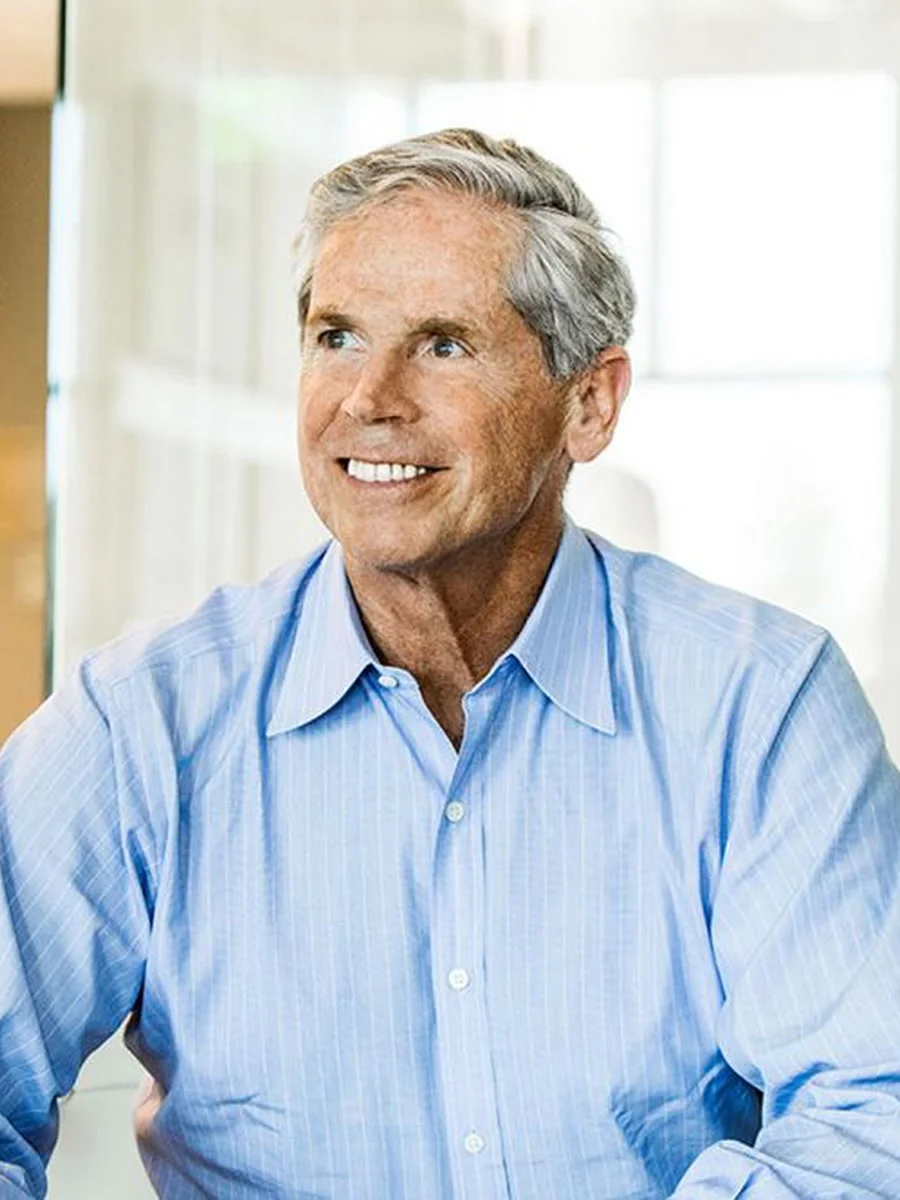
Arthur Patterson
Accel co-founder; formalized market-mapping and the 'prepared mind' before the deal exists.
From policy work to a downturn apprenticeship (before 1971–1978)
Arthur C. Patterson's public biography starts with institutions, not a garage or operating company. Accel says he earned an A.B. and M.B.A. at Harvard and worked in the U.S. Treasury's international office before entering venture capital. Graduation years, Treasury title, exact dates, and work product remain absent; those gaps matter because no surviving record shows that policy work caused a later investment belief. [researcher inference | insufficient public record] Accel, “About Arthur”
Patterson dates his venture entry to Citicorp Venture Capital in 1971. He remembers 1974 as so inhospitable to private-company investment that the group bought public securities. That episode is the earliest support for a durable distinction in his later thinking: technologies may continue changing while financing opportunity and asset prices cycle. It is retrospective testimony, not a Citicorp portfolio or proof that he forecast the downturn. [investor-stated | moderate] Super{set}, clip 1, 00:54–03:57
The vehicle is part of the explanation. Citicorp supplied corporate balance-sheet capital and institutional access; Patterson did not own its portfolio merely because he worked on it. Federal Express appears in his later recollection as a Citicorp example, but no public document establishes that he sourced, selected, boarded, or profited from it. [researcher inference | strong] Super{set} transcript control, 02:44–03:38
Adler, volume, and the case for specialization (1978–1983)
Patterson says he joined Adler & Company in 1978 and participated in roughly fifty financings over five years. The count is self-reported and unenumerated. CHM identifies Fred Adler and Jim Swartz—not Patterson—as Adler's founders; Swartz recalls recruiting Patterson from Citicorp and later negotiating their departure amid conflict with Adler. [researcher inference | moderate] Super{set}, clip 1 · CHM Swartz profile · Swartz oral history, printed pp. 20–27
Volume produced a hypothesis: as software and communications generated more companies, an investor could specialize without starving the funnel. Patterson and Swartz later describe dividing preparation—software for Patterson, communications for Swartz—so that a company meeting would update prior work rather than begin it. [investor-stated | moderate] The story explains the prepared-mind doctrine, but no dated Adler market map or pass memo survives to show the process before its famous outcomes. 20VC, 07:50–11:58
Tolerant Systems is the bridge case. Mark Leslie remembers Patterson and Swartz in the original Adler financing and later Accel reinvestment. That establishes relationship continuity across vehicles; it does not establish a Patterson check or sole thesis. [retrospective witness | moderate] Leslie oral history, printed pp. 4–5
Accel is founded, then financed (September 1983–spring 1984)
Public shorthand says Accel was founded in 1983. Swartz more precisely remembers fundraising beginning in September 1983 and closing in spring 1984, with about $40 million domestic and $28 million international. Kaplan's later teaching case gives a $64 million first fund and warns that some facts are disguised. The honest chronology keeps formation, fundraising, close, and conflicting amounts separate pending partnership/subscription records. [researcher inference | provisional] Swartz, printed pp. 24–27 · Kaplan, p. 4
The period supplied a favorable structural backdrop. A 1979 Labor Department rule evaluated prudence at portfolio level rather than declaring an asset class inherently imprudent; academic histories associate later clarification and institutional participation with venture's expansion. Neither proves a pension invested in Accel or that policy change created Patterson's returns. [researcher inference | moderate] 44 FR 37222–37223 · Gompers and Lerner, NBER 6846
Accel's proposed organizational answer was specialization inside a horizontal partnership. Later direct testimony describes equal standing, open criticism without a formal vote, one partner accountable for a project, and institutional support after the decision. That is a stated governance design, not a verified description of every 1980s IC. [investor-stated | moderate] 20VC, 23:36–28:45
Early Accel: hardware failure, software option, board triage (1983–1992)
Accel's current site tags Patterson to Alpha Technologies in 1983, AMCC in 1987, and the original Santa Cruz Operation in 1987. These are portfolio leads, not proof of personal sourcing or economics. The Santa Cruz Operation must also be kept distinct from the later Caldera/SCO Group: Caldera's filing says it bought server and services assets from Tarantella, formerly Santa Cruz Operation, in 2001. [researcher inference | moderate] Alpha · AMCC and selected IPOs · Caldera 10-K
Tolerant/Veritas is more revealing because an operator narrates the failure. Leslie recalls roughly $50 million invested, a workforce near 200, and a $15–20 million quarter that produced about $3 million. Hardware was shut, the software remnant fell to roughly ten people, a recap included about a 50:1 reverse split, and Leslie became CEO. The company became Veritas; Symantec later reported a $13.2 billion purchase price. [researcher inference | moderate] Leslie, printed pp. 4–7 · Symantec 10-K, “Veritas Acquisition”
The learning is conditional. The outcome supports preserving a valuable software option after hardware failed, but Leslie and the operating team made the reinvention real. It does not prove that all patience works, that Patterson caused the pivot alone, or that the $13.2 billion target value became Accel proceeds. [researcher inference | strong] Veritas decision lab
Walker Interactive supplies the adverse companion. Bruce Coleman remembers $21.8 million of venture capital, less than $1 million of hard assets against about $17.5 million of liabilities, a failed buyer search involving Patterson, and a board-led cut from 192 employees to 71. Coleman designed the revenue-first reset. The public record does not reveal the security, exact vote, terminal realization, or a Patterson process change. [retrospective witness | moderate] Coleman, printed pp. 35–38
Internet, wireless, and customer wedges (1993–1999)
The official map places Actuate and UUNET in 1993, MetroPCS in 1994, Portal in 1995, and several security/software companies in 1999. Patterson's strongest public story is Portal: prior work on communications billing let him recognize a founder and problem others discounted, while John Little's Sprint contract supplied the customer wedge. It is the clearest claimed prepared-mind application, yet the original memo, price, ownership, and independent decision account remain missing. [researcher inference | moderate] Super{set}, clip 1, 07:35–09:02 · Portal company page
UUNET shows what the clean story omits. Peter Barris says founder Rick Adams disliked Patterson and wanted NEA alone; Menlo entered as counterweight, Patterson succeeded Jim McClane in Accel's role, and the syndicate recruited John Sidgmore while debating litigation. Barris does not know how Accel sourced the deal; Kaplan says Mitch Kapor introduced it. UUNET's reported $2 billion MFS exit therefore reflects founder, management, and multi-firm work, not a “Patterson deal.” [retrospective witness | moderate] Barris, printed pp. 59–68 · SEC-hosted biography
MetroPCS reveals duration and entity complexity. A 2009 proxy calls Patterson an initial investor and director from the 1994 founding. A pre-IPO Form 3 separates Accel IV, Internet III, Investors '94/'99, Keiretsu, VII, family entities, trusts, direct shares, options, and Series D at a $9.40 conversion price. Those records establish roles and layers, not the original vehicle or personal return. [contemporaneous record | strong] MetroPCS proxy · Patterson Form 3
Rapt, Arcot, Counterpane, Savi, IronPlanet, Noosh, and other 1999-era names expand the visible record, but current pages select outcomes and omit the full loss denominator. Rapt later became the best direct why-continue case; Arcot became a repeat-founder bridge to Acalvio. [researcher inference | moderate] Accel profile · Rapt discussion, clip 8
Scale, IPOs, and the need for terminal outcomes (1999–2008)
Kaplan's 1999 case describes a proposed $500 million Accel VII, earlier 2.5% management fee and 25% carry, proposed 30% carry, and firm-wide Accel V/VI ledgers. It also says facts may be disguised. The case is valuable for scale/incentive context and selected check sequences, but not audited terms, fund cash flows, or Patterson's economics. [contemporaneous record | provisional] Kaplan, pp. 1–15
IPOs did not settle investment quality. Portal went public in May 1999, later deteriorated, faced securities litigation, and was bought by Oracle for $4.90 per share. Portal 10-K · court order, pp. 1–2 · Oracle close iPass priced its 2003 IPO at $14 and raised about $91.14 million net, later disclosed that plaintiffs voluntarily dismissed litigation without prejudice, warned of going-concern doubt in 2018, and completed an all-stock Pareteum combination in 2019. iPass prospectus · 2006 10-K, Item 3 · 2018 10-Q · closing 8-K PageMart's successor WebLink entered Chapter 11 and confirmed a 2002 plan cancelling notes. WebLink Form 15 None of these paths can be assigned causally to Patterson from the surviving record. [contemporaneous record | strong]
Firm-level evidence is equally mixed. A 2000 Forbes critique emphasized Jim Breyer in Accel's recent identity. Later Forbes reporting says Accel VIII was reduced from $1.2 billion to $680 million amid LP and partner adversity and reports a Google miss. These are Accel controls, not Patterson-personal failures, but they challenge a seamless founder-centered performance narrative. [researcher inference | moderate] “The Big 12” · “The Comeback Kid”
Public doctrine, repeat relationships, and cycle revision (2010–2017)
Patterson's 2010 Visionary Award text is the first substantial recovered authored/published doctrine. He emphasizes applied technology, quality people, uncertainty, experiments, failures, and teams; he uses MetroPCS, Portal, Integral, and Tolerant/Veritas as examples. The text survives on a mirror rather than an original organizer recording, so it is direct-attributed but not a contemporaneously validated transcript. [investor-stated | moderate] 2010 speech mirror, printed pp. 1–2
The 2013 Information article was published on 20 December 2013; “2014” belongs to the headline. Its lawful public metadata identifies Patterson and frames him as viewing the boom in its “last innings,” but the body is subscription-locked. Later interviews replace a simple fixed cycle with causal variables: semiconductor economics once supplied a rhythm, while multiple technologies and cheap money can lengthen it. That is evolution, not proof of predictive success. [researcher inference | provisional] Information metadata · 20VC, 14:17–17:19
The 2016 Patterson-attributed Medium essay calls repeat-founder choice an acid test and links Accel's 1999 Rapt investment to its 2011 Krux Series A. It is explicitly “posted on behalf” of Patterson, so the idea is attributable but editorial custody is imperfect. Salesforce later recorded $741.766 million as Krux purchase-price fair value; that is not Accel or Patterson proceeds. [researcher inference | moderate] Medium, ¶¶2–5 · Salesforce 10-K, Note 6
Arcot→Acalvio supplies a second repeat chain. A founder introduction says Patterson joined Arcot's board in 1999; Acalvio's 2016 issuer release names Accel, Ignition, and Eileses in a $17 million round and quotes Patterson on the proven team, technology, and market shift. The issuer is interested and gives no security or allocation. [researcher inference | moderate] Acalvio release
Emeritus voice and institutional self-renewal (2018–2025)
The 2021 20VC conversation with Swartz is the best direct source for Accel's operating architecture: conditional specialization, horizontal economics, project ownership, succession, geography, stage focus, and the difference between opportunity supply and capital price. Joint audio also creates a speaker boundary; claims must not be assigned to Patterson when Swartz is the source. [researcher inference | moderate] 20VC official audio, 39:30
The 2022 Super{set} corpus turns the doctrine operational: prepare a category map, demand founder novelty, test one learning loop, score opportunity separately from energy, and continue only while progress remains. The public corpus is twelve edited clips rather than an uncut master; later mirrors are controls, not independent appearances. [investor-stated | moderate] Super{set} event page
NVCA's 2022 Lifetime Achievement award formalized industry recognition. Patterson's published remarks foreground luck, repeated opportunities, partners, founders, managers, employees, payroll crises, and policy rather than a personal return ledger. That humility supports distributed credit but does not substitute for outcome analysis. [investor-stated | strong] NVCA remarks, ¶¶2–10
Accel now lists Patterson as emeritus with current boards including Aalyria, Acalvio, Govini, Integral, and QMC. A 2025 Druid release also says Patterson significantly participated in a $20 million growth round. Those are current firm/issuer claims as of 2026-08-23; no public evidence maps the legal vehicle, check, rights, or economics. [contemporaneous record | moderate] Accel profile · Druid release
A falsifiable account of the edge
Favorable thesis. [researcher inference | moderate] Patterson helped turn sector specialization into an institutional process: prepare enough to recognize a founder's delta, fund legible experiments, sustain responsibility through uncertainty, and distribute dissent/ownership so the firm can renew. Portal, Rapt, Veritas, MetroPCS, and the two repeat-founder chains support different links. philosophy thesis
Strongest alternative. [researcher inference | strong] Early institutional access, a favorable category-formation era, Accel's durable vehicle/brand, Swartz/Breyer/partner work, founder execution, long capital, and one or two power-law endpoints explain the visible record at least as well. The selected 36-name map omits the lifetime loss/pass denominator and cannot reconstruct personal returns. skeptical case · denominator
Predictions. [researcher inference | moderate] Unseen pre-investment files should show maps written before contact and founder-specific updates; ordinary follow-on files should show milestones and explicit stop alternatives; minutes should name sponsor, dissent, decision owner, and board action; and mechanism-positive cases should outperform matched mechanism-negative cases after price, ownership, partner work, vintage, and era are controlled.
Falsifiers. [researcher inference | strong] Post-hoc maps, no pass discrimination, follow-ons unrelated to new evidence, ceremonial board work, decisive partner/operator contributions omitted from the narrative, ordinary results no better than matched controls, or ex-Veritas economics without persistence would overturn or sharply narrow the claim.
People, capital, and influence map
This is a role-bound synthesis, not a claim that every named contributor participated in every decision. [researcher inference | moderate] Deal-level people and decision-rights map
| Person / institution | Contribution visible in the record | Boundary |
|---|---|---|
| U.S. Treasury / Citicorp | Policy/corporate-capital formation; downturn/public-market exposure | Exact work, authority, portfolio, and economics missing |
| Fred Adler / Adler & Co. | Pre-Accel platform and Tolerant lineage | Adler and Swartz founded it; partnership/departure records missing |
| Jim Swartz | Recruited Patterson; co-founded/funded Accel; communications/international/succession work | Equal co-founder/independent narrator; no sole Patterson history |
| Jim Breyer and later partners | Firm renewal, later portfolio, brand and stage/geographic growth | Current Accel outcomes cannot default to Patterson credit |
| Leslie / Shipley / Rothschild | Tolerant-to-Veritas operator reinvention | Operator causal work must remain explicit |
| Coleman / Walker board | Distress plan, board approval, execution | Recollection; exact rights/economics absent |
| Adams / Barris / Menlo / Sidgmore | UUNET founder, syndicate counterweight, CEO recruitment | Founder friction and shared sourcing/decision credit |
| Little / Linquist | Portal first-customer and MetroPCS founder/spectrum endurance | Founder/company work separate from investor recognition |
| Chavez / Vaidya; Varadarajan | Rapt→Krux and Arcot→Acalvio repeat chains | Returning relationship is data, not sole attribution or waiver |
| Accel LPs and legal entities | Capital, reserves, duration, governance and economics | Funds, managers, family/trust/direct holders must not be collapsed |
Sourced chronology
| Date | Verified event | Evidence / caveat |
|---|---|---|
| Before 1971 | Harvard A.B./M.B.A.; Treasury international office | Accel profile; dates/titles missing |
| 1971 | Joined Citicorp Venture Capital, per Patterson | Super{set}, clip 1 |
| 1974 | Recalls private drought and public-security buying | Same retrospective; not a portfolio ledger |
| 1978 | Joined Adler & Company | Swartz, pp. 20–27 |
| Sep. 1983–spring 1984 | Accel formation/fundraise then remembered close | Swartz, pp. 24–27; 1983 shorthand vs 1984 close |
| Late 1980s | Tolerant crisis and software reset | Leslie, pp. 4–7 |
| By 1999 | Twelve Kaplan Patterson-linked public-company names | Kaplan, p. 6; facts may be disguised |
| 1994–2013 | MetroPCS founding board role through T-Mobile combination | 2009 proxy · T-Mobile 10-K |
| 1995–2006 | Portal seed, 1999 IPO, Oracle takeout | Portal 10-K · Oracle close |
| 1999–2016 | Rapt relationship leads to Krux Series A and Salesforce acquisition | Medium · Salesforce 10-K |
| 2010-06-24 | SDForum Visionary Award speech | mirror; no original AV |
| 2013-12-20 | Information late-cycle article/interview | public metadata; body locked |
| 2021-11-08 | 20VC with Swartz | official audio |
| 2022-06-02 | NVCA Lifetime Achievement award/remarks | NVCA · remarks |
| 2022 / 2023-01-19 | Super{set} event / public clip uploads | official event page |
| 2025-01-08 | Druid financing participation disclosed | issuer release |
Learning path and unresolved proof
Read the three-work writings synthesis, then the two full-public-family talk synthesis, then freeze hindsight in the seven investment labs. Use the 17-section operating system to connect the chronology to decisions, and the mental-model field guide to apply each rule with exceptions. The source map preserves access and attribution limits.
Highest-value missing proof remains: Harvard/Treasury records; Citicorp and Adler files; Accel formation and LP agreements; original prepared-mind/pass/IC memos; board minutes; full loss/write-off and passive ledgers; security-level cost, dilution, distributions, and carry; the lawful full 2013 interview; and a Patterson papers/oral-history collection. Without them, the biography can explain a plausible system but cannot certify personal alpha. [researcher inference | strong]
1. Snapshot and testable edge thesis
| Dimension | Evidence-backed answer |
|---|---|
| Person and period | Arthur C. Patterson, Treasury and Citicorp alumnus, Adler general partner, Accel co-founder, and later emeritus; public venture activity runs from 1971 through a disclosed 2025 Druid participation. Accel biography · Druid financing |
| Proposed edge | **[researcher inference |
| Mechanism | **[researcher inference |
| Scope | Most plausible in formation-stage enterprise software and communications from the 1980s through the early internet era. It is not established as a public-market timing, late-stage pricing, ownership, or universal sector-selection edge. **[researcher inference |
| Supporting cases | Portal joins prior billing preparation to a founder/customer wedge; Tolerant/Veritas preserves a software option; Rapt and Krux show staged persistence and repeat-founder information; MetroPCS shows long board duration. **[researcher inference |
| Disconfirming cases | Walker required a severe rescue; UUNET preserves founder friction and shared credit; PageMart's successor entered Chapter 11; iPass later faced distress; Accel reportedly missed Google and reduced Accel VIII. These reject a winner-only and lone-genius account without proving personal failure. **[researcher inference |
| Denominator / economics | The bounded public union is 36 person-linked candidates: eight multi-source and 28 row-level, with three firm-level controls excluded and Adler, Citicorp, passive, pass, and write-off classes uncountable. No personal IRR, MOIC, hit rate, or literal 80/20 split is computable. **[researcher inference |
Predictions. [researcher inference | moderate] If the edge is real, unseen ordinary-company files should contain category maps dated before contact, founder evidence that changed them, cheap milestones governing follow-ons, explicit option-value comparisons in trouble, accountable partner/board decisions, and better matched outcomes when those mechanisms were present.
Falsifiers. [researcher inference | strong] The thesis weakens if maps were written after introductions or did not discriminate false positives/passes; pivots were wholly operator-created without investor-relevant action; follow-ons tracked sunk cost; partner/vehicle labor explains outcomes; or complete cash flows show no advantage outside the leading outlier. Missing memos, pass files, minutes, and cash flows currently prevent the test. retrieval ledger
2. Core philosophy
- Prepare before the pitch. [investor-stated | strong] Specialize only when opportunity supply supports it; know the category deeply enough that the founder must supply the critical novelty. 20VC, 10:42–11:58 · Super{set}, clip 1
- Fund legible learning. [investor-stated | strong] One sales team can test the loop; ten teams can spend capital before the model is understood. Super{set}, clip 5, 03:31–05:22
- Persist only while the option improves. [investor-stated | moderate] Patterson explains Rapt support through continuing progress, product repositioning, financing feasibility, and lack of a better management alternative—not persistence alone. Super{set}, clip 8, 00:48–02:12
- Multiply a sound opportunity with people quality. [investor-stated | moderate] Integrity, curiosity, low ego, recruiting, and execution intensity are distinct from the quality of the idea. Super{set}, clips 2, 4, 8, 11
- Make one partner accountable. [investor-stated | moderate] Invite criticism, reject reciprocal deal trading, let the project manager proceed against the room, then support the decision institutionally. 20VC, 23:36–28:45
- Decompose cycles and outcomes. [researcher inference | moderate] Technology/social change creates company supply; cheap capital can inflate prices without creating opportunities. Company quality, security price, vehicle ownership, team work, era, and luck must remain separate. 20VC, 14:36–22:43 · vehicle evidence
3. Sourcing
- Prepared domains narrow search. [investor-stated | moderate] Patterson covered software while Swartz covered communications; no contemporaneous funnel measures conversion. Super{set}, clip 1 · Swartz oral history, pp. 24–27
- Networks distribute origination. [retrospective witness | moderate] UUNET involved Kapor, McClane, Barris/NEA, Menlo, and conflicting sourcing memories. It supports networked access, not sole Patterson sourcing. Barris, pp. 59–64
- Founder return is a relational signal. [investor-stated | moderate] The 2016 post calls repeat founder choice an acid test; Rapt→Krux and Arcot→Acalvio are the two Patterson-linked chains. Missing rejected-repeat-founder cases and byline custody constrain the causal claim. Medium, ¶¶2–5 · Acalvio release
- Brand is not sourcing proof. [researcher inference | strong] Company pages define a lead union, not introducer, sponsor, IC owner, or competing firms. source boundary
Record the pre-contact map, introducer, relationship/conflict, independent channels, founder delta, sponsor, pass reason, and outcome. Source conversion and false-negative rates are insufficient public record.
4. Picking
| Gate | Supported rule | Red flag / kill condition |
|---|---|---|
| Market | Favor applied technology and durable drivers while admitting timing uncertainty. **[investor-stated | moderate]** 2010 speech, pp. 1–2 |
| Founder | Test integrity, curiosity, recruiting, low ego, and evidence-driven intensity. **[investor-stated | moderate]** Super{set}, clips 2, 4, 8, 11 |
| Product | Require a founder-specific delta and one customer-learning loop. **[investor-stated | strong]** clips 1 and 5 |
| Progress | Continue while evidence and option value improve. **[investor-stated | moderate]** Rapt, clip 8 |
| Price / ownership | No public Patterson ceiling, target, dilution budget, or return hurdle survives. **[researcher inference | insufficient public record]** deal boundary |
| Decision rights | One accountable owner after open criticism. **[investor-stated | moderate]** 20VC, 26:56–28:45 |
5. Deal and portfolio mechanics
| Mechanic | What is known | What remains unknown |
|---|---|---|
| Checks | Kaplan's disguised case records aggregate Portal $8.610m, iPass $3.385m, and Motive $4.142m multi-check histories. **[contemporaneous record | provisional]** Kaplan, pp. 13–15 |
| Ownership / security | iPass and MetroPCS filings expose funds, managers, family/direct layers, trusts, options, and preferred shares. **[contemporaneous record | strong]** MetroPCS Form 3 |
| Reserves | Portal had four case checks; Rapt, Veritas, and MetroPCS required duration. **[researcher inference | moderate]** case labs |
| Concentration | Several disclosed target endpoints are large. **[contemporaneous record | strong]** Pareto |
| Exit / holding | Winner uncertainty, long holding, IPOs, acquisitions, distress, distributions, and all-stock combinations appear. **[researcher inference | moderate]** 20VC, 17:42–22:43 |
6. Vehicle and incentive fit
| Layer | Strategy fit | Authority / incentive boundary |
|---|---|---|
| Treasury / Citicorp | Policy context then corporate capital and a 1974 public/private-market apprenticeship. **[investor-stated | moderate]** Super{set}, clip 1 |
| Adler | Roughly fifty self-reported financings and original Tolerant exposure. **[researcher inference | moderate]** Leslie, pp. 4–5 |
| Accel LPs | Specialized teams, reserves, long boards, global/local authority, and renewal. **[investor-stated | moderate]** 20VC, 23:36–33:23 |
| Related/family/direct layers | Layered fund, co-investment, compensation, and estate exposure can coexist. **[contemporaneous record | strong]** MetroPCS Form 4 |
| Emeritus / later | Current boards and Druid show continued sector/network participation. **[contemporaneous record | moderate]** Accel profile · Druid |
Vehicle fit is causal only when duration, reserves, decision rights, geography, regulation, partner capacity, and liquidity match the experiment. Fund carry can reward power-law outcomes and patience; fees/fund growth can reward asset scale; family/direct exposure can alter liquidity. Agreements and cash flows needed to estimate those forces are unavailable. [researcher inference | moderate]
7. Team attribution and work with founders
| Node | Discoverable work | Credit boundary |
|---|---|---|
| Jim Swartz | Co-founding, fundraising, communications preparation, international expansion, succession. Swartz, pp. 24–27 | Patterson assigns international entrepreneurial leadership to Swartz; Accel is not a solo creation. |
| Patterson | Software preparation, attributable relationships, boards/interventions, later narration. people map | Tags rarely prove sourcing, IC vote, negotiation, reserves, recruiting, or exit influence. |
| Leslie / Veritas team | Shut hardware, preserved ten-person software unit, rebuilt company. Leslie, pp. 4–7 | Operator-led reinvention with investor support, not a Patterson rescue alone. |
| Coleman / Walker board | Coleman designed revenue-priority reset; Patterson helped seek buyer and, in Coleman's memory, led board approval. Coleman, pp. 35–38 | Exact votes and terminal economics unknown. |
| Adams, Barris/NEA, Menlo, Sidgmore | Founder, co-investors/counterweight, recruited CEO at UUNET. Barris, pp. 59–68 | Friction and multiple sourcing accounts reject sole credit. |
| Little, Linquist, Chavez/Vaidya, Varadarajan | Customer acquisition, spectrum/legal endurance, repeat execution. 2010 speech · 2016 post | Interested retrospectives require memos, minutes, cap tables, founder controls. |
Use verbs, not logos: identify who introduced, prepared, diligenced, sponsored, approved, negotiated, boarded, recruited, funded, intervened, exited, and narrated. Unknown remains unknown. [researcher inference | strong]
8. Views on the craft
- Power law and humility. [investor-stated | moderate] Many attempts fail, rare outcomes dominate, and another great opportunity is unknowable. 2010 speech · NVCA remarks, ¶¶2–5
- Access versus selection. [researcher inference | moderate] Prepared domains and relationships can improve access/recognition; no pass ledger tests selection.
- Fund size and focus. [investor-stated | moderate] Opportunity supply should constrain specialization; large growth pools can pull attention from early stage. 20VC, 11:44–11:58, 32:32–33:23
- Governance as responsibility. [investor-stated | moderate] A partner can proceed against criticism but spends credibility and remains accountable. 20VC, 26:56–28:45
- Greatness is relational/institutional. [investor-stated | moderate] The award remarks credit partners, founders, managers, employees, and policy, not a personal return schedule. NVCA remarks, ¶¶4–10
9. Signature bets and decision process
Use the seven no-hindsight labs: Tolerant/Veritas for option preservation; Walker for sale/liquidation/rescue; UUNET for founder fit and syndicate design; iPass for IPO versus terminal quality; Portal for prepared thesis and first customer; MetroPCS for spectrum duration and entity ownership; Rapt→Krux for repeat-founder re-underwriting. Each asks invest/pass, kill criteria, ownership/terms, and next-check evidence before revealing the actual outcome. The missing universal artifacts are prepared-mind memos, IC minutes, board votes, reserve thresholds, and cash flows. [researcher inference | strong]
10. Mental models and maxims
- Specialize conditionally; prepare the map; require the founder's delta.
- Buy one discriminating experiment before scaling.
- Persist only while learning or option value improves.
- Multiply opportunity quality by integrity, curiosity, recruiting, and execution.
- Re-underwrite repeat founders; relationship history is data, not a waiver.
- Use a horizontal partnership: open dissent, one accountable project owner.
- Separate opportunity supply and company durability from capital-price, stage, and liquidity risk.
- Decompose outcomes into access, selection, team, vehicle, era, and luck.
11. Evolution and contradictions
| Period | Evolution | Tension |
|---|---|---|
| 1971–1983 | Downturn experience, public/private boundary, opportunity supply, sector specialization. **[investor-stated | moderate]** Super{set}, clip 1 |
| 1983–1999 | Prepared mind, software flexibility, long responsibility, growing institutional scale. **[researcher inference | moderate]** Leslie |
| 1999–2013 | Volatile prices can coexist with business fundamentals; later fixed-cycle language appears. **[contemporaneous record | moderate]** WIRED · Information metadata |
| 2016–2022 | Repeat-founder acid test, company experiments, causal cycle decomposition, horizontal succession. **[investor-stated | moderate]** Medium · 20VC |
No public evidence proves a formal process change after Walker, iPass, PageMart, Google, or Accel VIII. Later doctrine is more nuanced, but chronology is not causation. [researcher inference | strong]
12. Failures and limits
The adverse corpus includes Tolerant hardware failure/rescue, Walker distress, UUNET friction, PageMart/WebLink bankruptcy, Portal deterioration/litigation, iPass litigation/distress, and firm-level Accel VIII/Google adversity. postmortems
[researcher inference | strong] Patience requires better information and opportunity-cost limits; an IPO is not terminal realization; preparation does not remove founder-fit/timing error; and Accel outcomes cannot be assigned to Patterson without partner, vehicle, and ordinary-case files. A complete loss/pass ledger and documented process-change record are insufficient public record.
13. Historical operating environment
- Patterson recalls a thin 1974 private market that pushed Citicorp toward public securities. [investor-stated | moderate] Super{set}, clip 1
- The 1979 ERISA rule framed prudence at portfolio level; institutional inflows later expanded venture, but the rule does not prove an Accel LP. [researcher inference | moderate] 44 FR 37222–23 · NBER 6846
- Software could escape hardware inventory/capital burdens, while UUNET and MetroPCS depended on internet/spectrum policy, syndicates, management, and long financing. [researcher inference | moderate] Leslie, pp. 2–4 · MetroPCS proxy
Fewer specialists, emerging categories, and new institutional capital can magnify outcomes independently of personal edge; scarce management, thin markets, and scarce follow-on capital can also make board work and duration unusually valuable. [researcher inference | moderate]
14. Modern VC translation (as of 2026-08-23)
| Lesson | What transfers | Changed condition / signal | Misuse |
|---|---|---|---|
| Prepared mind | Dated category map plus disconfirmation list. **[researcher inference | moderate]** | AI/open-source/regulation can invalidate maps faster; founder must reveal a testable surprise. |
| One experiment | Buy the next decision-changing proof. **[researcher inference | strong]** | Cloud/AI cheapen prototypes while data, inference, safety, and compliance costs can be nonlinear; use one deployment signal. |
| Conditional persistence | Reserve against written milestones and stop rules. **[researcher inference | moderate]** | Opportunity cost and fast category decay shorten some options; require “what changed?” evidence. |
| People multiplier | Test integrity, update quality, recruiting, and low ego in real decisions. **[researcher inference | moderate]** | Synthetic demos and network polish increase surface-signal risk. |
| Repeat founders | Use prior behavior as data; re-underwrite market/security independently. **[researcher inference | moderate]** | Dense networks amplify familiarity/allocation conflict; compare against outsiders. |
| Accountable dissent | Name sponsor, objections, evidence, owner, duties. **[researcher inference | moderate]** | Multi-stage/platform firms add allocation conflicts; dissent must change a recorded decision. |
| Cycle decomposition | Track opportunity creation separately from price, exit liquidity, and fund flows. **[researcher inference | moderate]** | Multiple technologies/policy regimes weaken fixed periodicity; watch customer deployment and market multiples separately. |
| Attribution decomposition | Reconcile legal owner, source, selection, board work, era, and cash flows. **[researcher inference | strong]** | SPVs, secondaries, continuation/personal vehicles add layers. |
Grounded current application. [researcher inference | provisional] Druid's $20m round establishes Patterson participation but not vehicle, check, diligence, or rights. A 2026 analyst should map owner/allocation, recover the telecom thesis, identify the founder delta, and name the deployment milestone bought. Druid
15. Comparison with completed peers
The live index marks Ann Winblad, Bob Kagle, and Jim Breyer complete. Winblad is the closest software-specialist/operator comparator, Kagle the horizontal service-partnership comparator, and Breyer the same-firm successor/scale comparator. Returns are not compared because vehicles and denominator quality differ. [researcher inference | strong]
| Dimension | Patterson | Winblad | Kagle | Breyer |
|---|---|---|---|---|
| Sourcing | Prepared domains, networks, repeat founders | Software operator knowledge, founders/customers/incumbents | Relationship paths inside a collective partnership | Themes plus partner, founder, university, corporate/global networks |
| Picking | Founder delta, one experiment, conditional persistence | Buyer/budget, assumption tests, stage-matched proof | Customer trust despite primitive product; listening/adaptation | Simple high-use wedge, adaptive team, institution fit |
| Portfolio / ownership | 36 selected names; targets/reserves/returns unknown | 98 firm logos; 9 reconstructed; personal economics unknown | Power-law heuristic; eBay dominant; economics incomplete | Accel/trust/family office layers; Facebook outlier risk |
| Governance | Open dissent, one accountable owner, long boards | Active board recruiting and executive ensemble | Equal economics/authority, service-first help | Senior sponsorship, recruiting, boards, institutional links |
| Failure control | Walker, UUNET, PageMart, iPass; firm Google/Accel VIII | Slate, Napster, Pets.com, Liquid Audio, forecast/Fund III controls | Non-eBay denominator and team-credit uncertainty | Accel VIII, Prosper, Google, AOL–Time Warner forecast |
| Attribution risk | Swartz, founders, co-investors, legal layers | Hummer/partners, operators, firm directory | Dunlevie/Benchmark team, eBay outlier | Chien/Efrusy/Accel, trust, Facebook |
[researcher inference | moderate] Winblad makes Patterson's prepared-mind idea more testable through buyers, budgets, and dated assumptions; Kagle supplies the nearest independent horizontal-partnership analogue; Breyer shows both doctrine propagation and how successor labor/scale can be laundered into founder history. Winblad thesis · Kagle core philosophy · Breyer skeptic case
16. The strongest case against greatness
The skeptic says the visible record is selection plus institutional privilege: Treasury/Citicorp access, Adler networks, Accel's platform, early category formation, selected-win publishing, and missing losses/passes. Veritas—the largest disclosed endpoint—required operator reinvention; UUNET required founders, NEA, Menlo, and recruited management; MetroPCS mixed multiple funds, family/trust layers, regulation, and founder endurance; later Accel identity involved Breyer and other partners. [researcher inference | strong] attribution map · denominator
“Prepared mind” is repeatedly narrated after success without an original Portal memo. Conditional persistence is visible in Rapt and Veritas, but similar failed follow-ons are unenumerated. The fixed-cycle claim is inaccessible in full, while later causal nuance may reflect outcome knowledge. Transaction prices, IPOs, and beneficial-ownership forms are not personal returns. [researcher inference | strong] talk contradictions · Pareto boundary
The dispute requires Accel I–VIII/Adler ledgers, original category/pass/IC memos, partner responsibility, board records, security-level cash flows, matched ordinary/failure cases, and ex-Veritas/ex-top-one results. Until then: consequential specialist institution-builder and board investor, not audited personal alpha or sole causation. [researcher inference | insufficient public record]
17. Analyst study guide, glossary, and go deeper
Reading path
- Read the biography, then writings and talks to separate authored/direct evidence from synthesis.
- Freeze hindsight in Veritas, UUNET, and full-failure Walker labs.
- Work every mental model, especially counterexamples and exception ledgers.
- Reconcile claims to the 36-company ledger, vehicle map, and source map.
Glossary
- Prepared mind: category structure written before contact, not post-success theme.
- Founder delta: new fact/reasoning that updates the prepared map.
- Discriminating experiment: cheapest milestone that changes invest/follow-on/stop.
- Conditional persistence: support only while evidence or option value improves.
- Project owner: partner accountable after open criticism, regardless of consensus.
- Opportunity supply: companies created by technical/social change, distinct from capital supply.
- Vehicle fit: alignment of owner, duration, reserves, authority, incentives, liquidity.
- Endpoint value: target purchase/accounting value, not investor proceeds.
Reusable checklist
- Source: What map existed before contact; who introduced; what conflict/unavailable population shapes the funnel?
- Founder: What changed; which integrity/update/recruiting evidence is prospective?
- Experiment: Cheapest discriminating milestone; kill rule; next-check evidence?
- Security: Which owner buys what security at what price, ownership, dilution, reserve burden?
- Governance: Who owns the decision; what did dissent change; what happens after bad news?
- Portfolio: Capacity, correlation, opportunity cost, ex-top-one?
- Outcome: Separate survival, financing, target value, distributions, and LP/person economics.
Best sources
- 20VC — formation, specialization, governance, cycles, succession.
- Super{set} — prepared mind, experiments, people, Rapt, focus risk.
- Mark Leslie — strongest Veritas operator/credit control.
- Peter Barris — strongest adverse relationship/syndicate control.
- SEC controls — legal owner, board, security, transaction, adversity; not rationale or personal return.
- Kaplan — rare fund/check chronology, but disguised and firm-wide.
Original memos, complete denominators, partner attribution, and cash flows are the proof required to distinguish an admired method from demonstrated edge. [researcher inference | strong]
Pareto 80/20 — what drove the record
The public record does not permit a Patterson net-return, MOIC, or IRR ranking. No complete company denominator, partnership cash-flow ledger, cost basis, security schedule, ownership-through-time series, or Patterson carry schedule is public. The rankings below therefore separate three questions that are often collapsed: likely economic contribution to the relevant vehicles, historical importance, and decision-learning value. Target transaction value, market capitalization, and shareholder consideration are not investor proceeds. [researcher inference | provisional] Accel's selected company roster · Kaplan, Accel Partners VII, disguised-data warning and fund terms, pp. 1–7
Economic-contribution candidates — directional, not attributable returns
| Rank | Candidate and public measure | Who / vehicle | Confidence | Plausible mechanism | Denominator caveat |
|---|---|---|---|---|---|
| 1 | Portal Software — Patterson calls it his “best deal”; 1995 seed, 1999 IPO, later $4.90/share Oracle takeout | Accel-tagged; exact fund, cost, ownership, distributions, and Patterson co-investment unresolved | Moderate for self-ranking; insufficient public record for economics | Prepared billing thesis met a founder with an overlooked first-customer wedge. `[researcher inference | moderate]` |
| 2 | Tolerant / Veritas — $13.2bn Symantec purchase price in 2005 after a near-failure and recapitalization | Adler investment followed by Accel reinvestment; Patterson and Swartz jointly named; exact securities/proceeds missing | Strong for target value and operator chronology; insufficient public record for vehicle return | Preserve the UNIX software option, shut hardware, recapitalize, recruit/empower Mark Leslie. `[retrospective witness | strong]` |
| 3 | MetroPCS — 2013 accounting purchase consideration of $2.971bn, plus a $1.5bn recapitalization payment to all MetroPCS shareholders | Accel IV and related vehicles plus family/direct entities appear in filings; Patterson initial investor and director from 1994 | Strong for issuer structure; insufficient public record for net return | Long-duration spectrum and operating-company build, board continuity through IPO and T-Mobile combination. `[researcher inference | moderate]` |
| 4 | UUNET — later SEC-hosted issuer biography reports a $2bn MFS acquisition; UUNET then became material inside MFS/WorldCom | Accel co-investment with NEA and Menlo; Patterson inherited the Accel seat after Jim McClane left | Moderate for reported target value; strong for shared-deal testimony; insufficient public record for Accel proceeds | Recognize commercial internet applications, recruit professional management, use local co-investors. `[researcher inference | moderate]` |
| 5 | NextG Networks — approximately $1.0bn cash acquisition by Crown Castle in 2012 | Accel-tagged; Patterson role, security, board period, cost, and proceeds not independently reconstructed | Strong for transaction; provisional for Patterson attribution; insufficient public record for economics | Possible wireless-infrastructure adjacency to MetroPCS experience. `[researcher inference | provisional]` |
| 6 | IronPlanet — approximately $758.5m acquisition value in 2017 | Accel VII / Internet Fund III / Investors '99 / ACP Family Partnership shown in pre-IPO filing; Patterson director from 1999 | Strong for ownership snapshot and target value; insufficient public record for realized proceeds | Long-duration marketplace with fund and family exposure. `[researcher inference | provisional]` |
| 7 | Krux Digital — Salesforce recorded $741.8m total purchase price in 2016 | Accel says it led the 2011 Series A; Patterson-attributed post frames a repeat-founder relationship | Strong for acquisition accounting; moderate for role; insufficient public record for fund economics | Re-underwrite Chavez/Vaidya after Rapt using accumulated relationship information. `[investor-stated | moderate]` |
Concentration test. A literal “80/20” result is not defensible. The table mixes issuer purchase-price accounting, cash acquisition values, a recapitalization paid to all shareholders, and one investor's self-ranking while omitting cost, dilution, ownership, distributions, holding time, failures, and Portal's outcome magnitude. Veritas is the largest disclosed endpoint, but no portfolio-concentration percentage follows from these non-comparable measures. [researcher inference | strong] underlying accounting bases: Symantec · T-Mobile · Salesforce
Historical-importance ranking
| Rank | Case and historical basis | Attribution | Confidence | Historical mechanism | Denominator boundary / case |
|---|---|---|---|---|---|
| 1 | Tolerant / Veritas — clearest Adler-to-Accel bridge and hardware-to-software reinvention | Patterson and Swartz as investors; Shipley, Rothschild, Leslie, employees, and the board as operating/recap contributors | Strong chronology; low economic attribution | Preserve a software option inside a failed hardware company | One selected lineage, not two wins. `[retrospective witness |
| 2 | UUNET — early commercial-internet underwriting with unusually candid founder-fit evidence | Rick Adams, Mitch Kapor, Patterson/Accel, Barris/NEA, Menlo, McClane, and Sidgmore | Strong shared-deal recollection; low return attribution | Syndicate design and management recruitment beside network-market formation | Sourcing accounts conflict; proceeds are absent. `[retrospective witness |
| 3 | MetroPCS — 1994 founding exposure through IPO, public governance, and the T-Mobile combination | Linquist and management; Patterson and multiple Accel, co-investor, family, trust, and direct layers | Strong role/entity record; low personal-return evidence | Long-duration spectrum, legal, financing, and network build | Issuer consideration is not investor proceeds. `[contemporaneous record |
| 4 | Portal Software — canonical prepared-domain and anchor-customer example followed by public deterioration | Little and team; Patterson/Accel; public investors; Oracle | Moderate thesis chronology; low economics | Prepared billing work met an operator-created Sprint wedge | Self-selected account and incomplete cash flows. `[researcher inference |
| 5 | Rapt → Krux — clearest public repeat-founder chain | Chavez, Vaidya, both teams, Patterson/Accel, Microsoft, and Salesforce | Moderate role; low vehicle economics | Reuse accumulated relationship information without assuming the second market is identical | Two company rows and one relationship case; custody is attributed, not direct-byline. `[investor-stated |
Decision-learning ranking
| Rank | Case and learning basis | Attribution | Confidence | Decision mechanism | Denominator boundary / case |
|---|---|---|---|---|---|
| 1 | Walker Interactive — failed sale, quantified distress, founder removal, and revenue-first reset | Patterson and board on sale/cuts; Coleman on operating design | Strong recollection; terminal economics unknown | Decide whether going-concern value exceeds liquidation value | One rescued company cannot establish a general stopping rule. `[retrospective witness |
| 2 | Tolerant / Veritas — option preservation and recapitalization after a hardware failure | Investors, operators, employees, and board shared the decision chain | Strong chronology; exact terms absent | Separate salvageable product/team options from sunk cost | Famous rescue; no matched liquidations or write-offs. `[retrospective witness |
| 3 | UUNET — founder fit, syndicate counterweight, and recruitment risk | Adams, Kapor, Patterson/Accel, Barris/NEA, Menlo, McClane, Sidgmore | Strong recollection; sourcing disputed | Underwrite the investor-founder relationship and escalation path | Successful endpoint does not prove friction was costless. `[retrospective witness |
| 4 | iPass — IPO liquidity, later litigation posture, operating decline, and going-concern risk | Company, board, shareholders, Accel/family layers; Patterson liquidity choices unknown | Strong events; insufficient individual causality | An IPO requires a fresh hold/sell/governance decision | Plaintiffs voluntarily dismissed without prejudice; allegations were not findings, and loss and process-change ledgers are absent. `[researcher inference |
| 5 | Rapt → Krux — conditional persistence and repeat-founder underwriting | Chavez, Vaidya, teams, Patterson/Accel, acquirers | Moderate attributed thesis; board records missing | Treat relationship history as data, not a waiver | No declined repeat-founder comparison set. `[investor-stated |
| 6 | Portal — preparation versus hindsight across seed, IPO, deterioration, litigation, and takeout | Little/team, Patterson/Accel, public investors, board, Oracle | Moderate mixed record | Keep entry quality separate from later governance and realization | No reconstructed multiple or final litigation docket. `[researcher inference |
Evidence boundary and searched denominator
Inclusion rule and aliases
A company enters the named candidate denominator if it appears (a) in Accel's current Patterson profile, (b) in the 1999 Kaplan case's Patterson biography, (c) on an Accel company page that explicitly tags Patterson, or (d) in a primary issuer/legal record that explicitly identifies Patterson as investor, financing participant, or director. This is a discoverable public denominator, not a complete lifetime portfolio. Tolerant Systems / Tolerant Software / Veritas is one family; UUNET / MFS / MCI-WorldCom is one company path; PageMart later appears as WebLink Wireless; QMC means QMC Telecom International. The official Integral Development page names Patterson, Series A 1998, and founder Harpal Sandhu; Patterson's 2010 mirror says “Integral Technology” and “Harpal Sandu.” The matching founder, domain, and relationship make a common lineage highly probable, but the spelling/name variance is preserved rather than asserted as proved. [researcher inference | moderate] current profile · Integral · 2010 speech mirror
| Reconciliation bucket | Count | Meaning |
|---|---|---|
| Publicly claimed/known — current Accel profile | 24 | 9 IPOs + 10 private exits + 5 current boards; all included below. Accel profile |
| Additional unique archival-profile names | 6 | Axent, Synercom, Trinsic, Unify, VIASOFT, Walker; the 1999 case calls them public-company outcomes, but its facts may be disguised. Kaplan, p. 6 |
| Additional Patterson-tagged Accel pages | 2 | Alpha Technologies and Forescout. Alpha · Forescout |
| Additional primary-record candidates | 4 | Motive and Aptana filing evidence; Druid financing participant; Mendocino director. Motive S-1/A · Aptana Form D · Druid issuer release · Mendocino Form D, p. 2 |
| Unique named candidates searched | 36 | The initial 34-company map expanded when Druid and Mendocino surfaced; high-probability aliases are collapsed with caveats. |
| Named candidates researched / ledgered | 36 | Every in-scope candidate has a row below, including explicit unknowns rather than inferred roles. |
| Sufficiently reconstructed for a multi-source case | 8 | Tolerant/Veritas, Walker, UUNET, iPass, Portal, MetroPCS, Rapt/Krux (two company rows, one relationship case), and IronPlanet. |
| Row-level only / unresolved | 28 | A name and at least one role/outcome lead exist, but timing, security, ownership, board action, or vehicle outcome is materially incomplete. |
| Excluded attribution controls | 3 | Brightcove, Facebook, and the reported Google pass were searched but lack a Patterson-specific sourcing, sponsorship, diligence, board, or decision record. |
| Unenumerated classes | Not countable | Patterson says roughly 50 Adler financings; Accel says “numerous passive investments”; the Citicorp portfolio was broad. None has a public complete name ledger. Super{set} clip-1 transcript control, 02:44–04:12 · Accel profile |
Coverage fractions. Named-current-profile inclusion is 24/24 (100%). Named-candidate row coverage is 36/36 (100%). Multi-source reconstruction is 8/36 (22.2%). A lifetime coverage fraction and a loss rate are not computable because the Adler, Citicorp, Accel passive, pass, and write-off classes remain unenumerated. [researcher inference | strong]
Federal Express is a named Citicorp portfolio example in Patterson's retrospective, not a Patterson deal: no sourcing, board, underwriting, or security role is established. Facebook and Brightcove appear only through firm-wide story or shared Accel-management filings; Google is a reported Accel miss without primary Patterson attribution. These remain attribution controls outside the 36-company candidate denominator. Motive stays inside only as a provisional filing-linked candidate: its shared Accel and family-entity ownership does not prove project leadership or personal economics. [researcher inference | moderate] Citicorp/Federal Express passage, 02:44–03:38 · Motive S-1/A, principal-stockholder footnotes
Historical market, regulatory, and base-rate context
- Institutional capital was changing the feasible fund. The 1979 Labor Department rule framed prudence at portfolio level rather than treating an asset as prudent or imprudent in isolation. That context helps explain later pension participation in venture, but does not prove that any pension invested in Accel.
[contemporaneous record | strong]44 FR 37222–37223, published 1979-06-26 - The early market was smaller and less specialized. Patterson says the 1974 private market nearly stopped, Citicorp bought public securities, and specialization became viable around the late 1970s/early 1980s. The NBER history independently links ERISA clarification and institutional inflows to industry growth; neither source makes Patterson the cause of the market shift.
[researcher inference | moderate]Super{set} clip-1 transcript control, 02:07–05:25 · Gompers and Lerner, NBER Working Paper 6846 - Software economics supplied a structural tailwind. Leslie's ex-ante operator logic was that software avoided hardware inventory, doubled development burden less often, and could be more capital-efficient; Patterson later called Tolerant his last hardware investment. The pivot's success therefore mixes decision quality with an industry-wide change in value pools.
[researcher inference | moderate]Leslie, printed pp. 2–4 · Patterson 2010 prepared speech, pp. 1–2 - Internet and telecom policy mattered. UUNET's commercial opportunity depended on public-network economics, while MetroPCS depended on licensed spectrum, financing, regulation, and litigation. Treating either as a pure software-pattern-recognition win erases public infrastructure and legal path dependence.
[researcher inference | moderate]Barris, printed pp. 57–68 · MetroPCS 2012 merger proxy - Base rates are power-law and selection-biased. Leslie recalls that venture investors make many bets, only a minority work, and very few are exceptional; Patterson acknowledges “spectacular failures” and uncertainty about skill versus “at bats.” Neither supplies Patterson's actual loss denominator.
[researcher inference | moderate]Leslie, printed p. 2 · Patterson 2010 speech, pp. 1–2
Vehicle economics and incentives
| Layer | Public evidence | What it permits | What it does not permit |
|---|---|---|---|
| Citicorp Venture Capital | Patterson says he began there in 1971, bought public securities during the 1974 drought, and cites a broad corporate portfolio | Corporate-balance-sheet apprenticeship and cycle context | No Patterson-owned capital, personal return, or complete deal attribution. `[investor-stated |
| Adler & Company | Patterson reports roughly 50 financings from 1978–83; Leslie places the original Tolerant investment there by Patterson and Swartz | Pre-Accel partnership experience and one named bridge investment | No 50-deal ledger, fund agreements, ownership, or realized outcome schedule. `[retrospective witness |
| Accel first fund(s) | Swartz recalls a roughly $40m domestic and $28m international split; Kaplan says $64m first-fund capital and warns facts are disguised | Approximate scale and vehicle plurality | The recollections conflict and underlying subscription/partnership records are absent. `[retrospective witness |
| Accel VII proposal | 1999 case: $500m target, prior 2.5% management fee/25% carry, proposed 30% carry; facts may be disguised | Incentive and scale context at firm level | No Patterson carry split, realized fund cash flows, or proof the proposed terms closed unchanged. `[contemporaneous record |
| Portfolio-company fund entities | iPass filing separates Accel V, AISTF, Keiretsu V, Investors '96 and related managers | Legal owner/manager map at a date | “Deemed” or shared beneficial ownership is not personal ownership; a Form 4 is not a return ledger. `[contemporaneous record |
| Family/direct vehicles | iPass and MetroPCS filings show ACP Family Partnership, Ellmore C. Patterson Partners, GRATs, and direct shares beside funds | Confirms co-investment/estate-planning layers can coexist | Aggregate reporting cannot be summed as Patterson's personal economics; each disclaimer and pecuniary-interest limit controls. `[contemporaneous record |
| Druid Software | Issuer says Patterson had “significant participation” alongside two lead investors in a $20m growth round | A late-career financing participation | It does not name his legal vehicle, amount, security, board role, or whether Accel participated. `[contemporaneous record |
The incentive implication is two-sided. Fund-level carry rewards portfolio outcomes and can support long holds; deal reputation, board relationships, and family/direct co-investments can create different exposures. Without agreements and cash flows, it would be improper to assign a rescue, distribution, or sale to one layer merely because Patterson signed a filing as manager or trustee. [researcher inference | strong] Kaplan, partnership structure, pp. 2–3 · MetroPCS Form 4
The public record does not disclose Accel's fund-by-fund reserve policy, liquidity windows, geographic authority, partner-level approval thresholds, succession plan, or key-person provisions. It also does not show whether Patterson's family/direct layers followed fund liquidity or governance. Those unknowns prevent a causal claim that duration came from Patterson rather than from fund design, co-investors, boards, or market conditions. [researcher inference | strong] Kaplan, partnership structure, pp. 2–7 · MetroPCS Form 4, footnotes 1–12
The only supportable comparison with a current LP-backed venture fund is structural: pooled vehicles, manager governance, fees/carry, staged company financing, and multiple legal owners remain relevant analytical dimensions. The record does not support importing any current fee norm, reserve ratio, geographic mandate, recycling rule, key-person clause, or partner carry split into historical Accel. A true dimension-matched comparison requires the executed historical LPAs and a named current LPA; neither is public here. [researcher inference | moderate] Kaplan, proposed versus prior terms, pp. 1–3 and 7
People, capital, and influence map
| Company / decision node | People and capital | Discoverable Patterson role | Attribution control |
|---|---|---|---|
| Accel formation | Jim Swartz; domestic/international LP vehicles; later partners | Co-founder; software preparation domain in retrospective accounts | Swartz supplies fundraising, international, and shared-governance evidence; do not assign all firm outcomes to either founder. `[retrospective witness |
| Tolerant / Veritas | Patterson, Swartz, Dale Shipley, Jeff Rothschild, Mark Leslie, other directors and investors | Adler investor then Accel reinvestor; board/investor participant | Leslie identifies $50m prior investment, the ten-person software remnant, recap, and his own CEO decisions. `[retrospective witness |
| Walker Interactive | Founder Jeff Walker, Bruce Coleman, board, prospective acquirers | Patterson helped attempt a sale; Coleman says the board was led by Patterson into cutbacks | Coleman, not Patterson, designed the revenue-priority operating reset. `[retrospective witness |
| UUNET | Rick Adams, Jim McClane, Mitch Kapor, Peter Barris/NEA, Menlo, John Sidgmore | Replaced McClane in Accel/UCCEL role; participated in CEO search and risk debate | Barris says Adams wanted Patterson counterbalanced; shared diligence and management recruitment dominate the case. `[retrospective witness |
| MetroPCS | Roger Linquist, Accel IV and affiliates, other investors, Patterson family/direct entities | Initial investor; director from 1994; later presiding independent director | Filings establish roles/entities, not original sourcing or individual proceeds. `[contemporaneous record |
| Portal | John Little, Sprint, Accel, public shareholders, Oracle | Accel-tagged partner; later director/defendant; self-describes deal as best | Founder won first customer; public-company deterioration and litigation are separate from seed underwriting. `[researcher inference |
| Rapt → Krux | Tom Chavez, Vivek Vaidya, Accel, Microsoft, Salesforce | Accel partner tagged to Rapt; Patterson-attributed post claims long relationship and 2011 Krux Series A lead | Founder persistence and team execution are explicit; acquisition values do not allocate investor credit. `[investor-stated |
| Arcot → Acalvio | Ram Varadarajan, Accel, Ignition, Eileses, CA | Arcot board from 1999 by founder testimony; quoted Acalvio investor | Issuer/award materials are interested accounts; financing documents and cap tables are missing. `[investor-stated |
Decision-rights audit for material cases
| Case | Source / sponsor | Diligence / approval / negotiation | Board / recruiting | Follow-ons / exit | Later narration and unresolved roles |
|---|---|---|---|---|---|
| Tolerant / Veritas | Original Adler opportunity is jointly tied to Patterson and Swartz; precise source and sponsor unknown | Diligence, vote, recap negotiation, and dissent unknown | Patterson/Swartz investor-board participation; Shipley/Rothschild preserved software; Leslie led operating reset | Accel reinvestment known; authorizers, amounts, dilution, and exit influence unknown | Leslie and Patterson later narrated; employee, director, and other-investor contributions remain only partly named. `[researcher inference |
| Walker | Source and original sponsor unknown | Sale work and board restructuring approval connected to Patterson; diligence, financing votes, and negotiations unknown | Patterson participated in buyer search; Coleman designed reset; board approved cuts | Follow-on authorizers and terminal exit influence unknown | Coleman narrates; Kaplan supplies only a selected public-company roster. `[researcher inference |
| UUNET | Kaplan credits Kapor with introduction; Barris is unsure how Accel sourced; sponsor and IC owner disputed | Patterson/Accel and Barris/NEA debated market, management, and syndicate; approval votes and terms unknown | Patterson joined CEO search; Adams demanded Menlo counterweight; Sidgmore recruited | Follow-on authority, sale negotiation, and proceeds unknown | Barris narrates most detail; Adams-side and board records remain absent. `[researcher inference |
| MetroPCS | Patterson was an initial investor; source, sponsor, and original IC path unknown | Initial diligence/terms unknown; later entities and Series D are visible, not their approvals | Director from founding; later presiding independent director | Multiple holdings/distributions visible; follow-on approvals and merger influence unknown | Issuer filings narrate role/entity history; no personal proceeds ledger. `[researcher inference |
| Portal | Patterson describes prior billing preparation; exact source, sponsor, and IC approval unknown | Seed diligence, negotiation, security, and dissent unknown | Patterson later director; Little won Sprint; recruiting record absent | Four case-ledger checks visible; authorizers, distribution choices, and Oracle-sale influence unknown | Patterson supplies retrospective thesis; filings supply company/outcome chronology. `[researcher inference |
| Rapt → Krux | Accel/Patterson relationship established; source and sponsor for each company unknown | Krux Series A lead reported; diligence, votes, terms, and dissent unknown | Public board/recruiting evidence not found | Repeated Rapt financing described; authorizers, reserves, ownership, and exit influence unknown | Patterson-attributed essay and Super{set} clips narrate; founders' execution and acquirer records are distinct evidence. `[researcher inference |
| Arcot → Acalvio | Source and sponsor unknown; repeat-founder relationship documented | Five Arcot financings recalled; allocation, approvals, terms, and dissent unknown | Patterson on Arcot board from 1999 and current Acalvio board per Accel | Follow-on authorizers and CA-exit influence unknown | Varadarajan and issuer materials narrate; cap tables and board minutes absent. `[researcher inference |
Complete bounded candidate ledger
This table is the denominator, not a victory list. “Strong” means a primary filing, issuer/acquirer record, or direct counterparty account connects Patterson to the opportunity; “moderate” usually means an official Accel attribution or a contemporaneous teaching-case biography. Neither grade establishes sole sourcing or personal economics. “Unknown” is a result, not an invitation to impute a firm role. [researcher inference | strong] Accel profile · Kaplan roster, printed p. 6
| # | Company / opportunity | Source and discoverable Patterson role | Vehicle; timing / security / ownership | Board / decision rights | Outcome | Evidence strength; unresolved status |
|---|---|---|---|---|---|---|
| 1 | Actuate | Official profile and company page tag Patterson | Accel; Series A, 1993; security/ownership unknown | Unknown | IPO; OpenText acquisition reported by Accel | Moderate; fund, check, governance, and proceeds unresolved |
| 2 | AMCC | Official profile names IPO | Accel; initial 1987; security/ownership unknown | Unknown | IPO; later MACOM acquisition reported by Accel | Moderate; exact role and economics unresolved |
| 3 | iPass | Profile, issuer filings, and Patterson Form 4 identify director/reporting owner | Accel V-related entities plus family/direct interests; Kaplan's disguised case records $3.385m aggregate checks | Director; exact appointment/decision rights incomplete | 2003 IPO; 2019 all-stock Pareteum combination | Strong role/ownership snapshot; no personal proceeds. Form 4 · closing 8-K |
| 4 | MetroPCS | Issuer calls Patterson initial investor and director from founding | Accel IV, Internet III, Investors '94/'99, Keiretsu, VII, family/trust/direct layers; Series D and options visible before IPO | Director from 1994; later presiding independent director | IPO; 2013 T-Mobile combination | Strong role/entity map; exact initial check and proceeds unresolved. Form 3 · 2009 proxy |
| 5 | PageMart / WebLink Wireless lineage | Official profile names PageMart IPO | Accel; Series A, 1983 per firm; security/ownership unknown | Unknown | IPO milestone; successor WebLink entered Chapter 11 and confirmed a 2002 plan | Moderate; IPO is not terminal success or proof of realization. Form 15 · FCC order |
| 6 | Portal Software | Profile/company page tag Patterson; direct voice calls it his best deal | Accel; seed 1995; Kaplan's disguised ledger totals $8.610m across four checks | Patterson later a director; exact seed decision rights unknown | 1999 IPO; Oracle $4.90/share takeout in 2006 | Strong relationship/outcome; case dollars are fund-wide and potentially disguised. Kaplan pp. 13–15 · Oracle close |
| 7 | The Santa Cruz Operation | Official Accel page tags Patterson and initial 1987 investment | Accel; security/ownership unknown | Unknown | NASDAQ:SCO; server/professional-services assets sold to Caldera in 2001 while remaining entity became Tarantella | Moderate; do not transfer later SCO Group bankruptcy/litigation to the original investment. Caldera 10-K |
| 8 | UUNET | Accel page, Kaplan roster, and Barris testimony connect Patterson | Accel with NEA/Menlo; Series A, 1993; security/ownership unknown | Took Accel role after McClane; CEO-search participation | IPO; reported $2bn MFS acquisition | Strong shared-deal history; sourcing accounts conflict and founder fit was adverse. Barris pp. 62–64 |
| 9 | Tolerant Systems / Veritas | Leslie identifies Patterson and Swartz in original Adler investment and Accel reinvestment | Adler then Accel; about $50m total capital recalled; recap/security details incomplete | Investor/board involvement; operators drove pivot | Near-collapse, recap, software pivot, IPO, $13.2bn Symantec acquisition | Strong operator chronology; joint credit and exact economics unresolved. Leslie pp. 4–7 |
| 10 | Arcot Systems | Profile/company page; founder introduction says Patterson joined board in 1999 | Accel; initial 1999; five financings recalled; security/ownership unknown | Board from 1999, per founder | CA acquisition, reported $200m | Moderate-to-strong role; issuer/award source is interested. CA close |
| 11 | Centrify | Official Accel page tags Patterson | Accel; Series A; year/security/ownership unresolved | Unknown | Thoma Bravo majority investment | Moderate attribution; transaction value/proceeds unresolved. Thoma Bravo |
| 12 | Coremetrics | Official Accel page tags Patterson | Accel; Series A, 2000; security/ownership unknown | Unknown | IBM acquisition in 2010 | Moderate attribution; price grouped/undisclosed, proceeds unknown. IBM annual report |
| 13 | Counterpane | Official Accel page tags Patterson | Accel; Series A, 1999; security/ownership unknown | Unknown | BT acquisition | Moderate attribution; terms and proceeds unresolved. BT announcement |
| 14 | IronPlanet | Accel page and S-1 identify Patterson as director since 1999 | Accel VII / Internet III / Investors '99 and ACP Family layers | Director; Accel-designated seat | Ritchie Bros. acquisition, about $758.5m | Strong role/snapshot; exit ownership and proceeds unknown. S-1 |
| 15 | Krux | Accel and Patterson-attributed writing describe 2011 Series A lead and repeat founders | Accel; Series A, 2011; security/ownership unknown | Unknown | Salesforce acquisition; $741.766m accounting purchase price | Moderate role, strong price; no allocation to Accel/Patterson. Salesforce 10-K |
| 16 | NextG Networks | Official Accel page tags Patterson | Accel; Series A, 2009; security/ownership unknown | Unknown | Crown Castle cash acquisition, about $1bn | Moderate attribution, strong transaction; proceeds unknown. Crown Castle |
| 17 | Noosh | Official Accel page tags Patterson | Accel; initial 1999; security/ownership unknown | Unknown | HH Global acquisition | Moderate attribution; terms/proceeds unresolved. HH Global |
| 18 | Rapt | Accel page and direct voice connect Patterson to founders | Accel; Series A, 1999; repeated financing described, amounts/ownership unknown | Board role not publicly fixed | Microsoft acquisition in 2008 | Moderate attribution; no price or proceeds. Microsoft |
| 19 | Savi Technology | Official Accel page tags Patterson | Accel; Series A, 1999; security/ownership unknown | Unknown | Lockheed Martin acquisition in 2006, terms undisclosed | Moderate attribution; role/economics unresolved. Lockheed Martin |
| 20 | Aalyria | Current official profile names board | Vehicle, date, security, ownership unknown | Current board per Accel | Private/current | Moderate current-role claim; no live company page or financing map found |
| 21 | Acalvio | Accel page and issuer quote identify Patterson; repeat Arcot founder | Accel alongside Ignition/Eileses; initial 2015; $17m launch round in 2016 | Current board per Accel | Private/current | Moderate-to-strong role; allocation/security unresolved. issuer release |
| 22 | Govini | Official Accel page tags Patterson | Accel; Series A, 2012; security/ownership unknown | Current board per Accel | Private/current | Moderate; legal board record, check, and economics unresolved |
| 23 | Integral Development / probable “Integral Technology” alias | Official Accel page tags Patterson and founder Harpal Sandhu; 2010 mirror says “Integral Technology” and “Harpal Sandu” | Accel; Series A, 1998; firm-wide Accel VI ledger only; precise security/ownership unknown | Current board per Accel; 2010 account implies relationship but not decision rights | Private/current; 2010 account reports a $50m customer deal | Moderate; common lineage is highly probable from founder/name/context match, but spelling/legal-name variance remains explicit. speech mirror |
| 24 | QMC Telecom International | Official Accel page tags Patterson and John Locke | Accel; initial 2014; security/ownership unknown | Current board per Accel | Private/current | Moderate and explicitly shared; exact roles/economics unresolved |
| 25 | Alpha Technologies | Official Accel page tags Patterson | Accel; initial 1983; security/ownership unknown | Unknown | NASDAQ:AHAG per page | Moderate; absent from profile prose; final outcome/proceeds unresolved |
| 26 | Forescout | Official Accel page tags Patterson | Accel; initial 2001; security/ownership unresolved | Board/decision rights unresolved | IPO; later take-private not reconstructed here | Moderate; absent from profile prose; personal economics unknown |
| 27 | Axent Technologies | Kaplan's 1999 Patterson roster | Vehicle/date/security unknown | Unknown | Public by 1999; final outcome not primary-controlled here | Moderate institutional attribution; case data may be disguised. Kaplan p. 6 |
| 28 | Synercom | Kaplan roster | Vehicle/date/security unknown | Unknown | Public by 1999, per case | Moderate; legal entity/ticker/final outcome unresolved |
| 29 | Trinsic | Kaplan roster | Vehicle/date/security unknown | Unknown | Public by 1999, per case | Moderate; identity disambiguation and outcome unresolved |
| 30 | Unify | Kaplan roster | Vehicle/date/security unknown | Unknown | Public by 1999, per case | Moderate; legal entity/security/outcome unresolved |
| 31 | VIASOFT | Kaplan roster | Vehicle/date/security unknown | Unknown | Public by 1999, per case | Moderate; exact role/economics unresolved |
| 32 | Walker Interactive | Kaplan roster plus Coleman operator testimony | Accel/earlier vehicle not established; $21.8m total VC capital recalled | Patterson helped seek buyer; Coleman says Patterson led board into restructuring | Public; survived distress/restructuring; terminal economics unresolved | Strong board-action recollection, weak investment terms. Coleman pp. 35–38 |
| 33 | Motive | S-1/A maps Accel VII managers and Ellmore/Patterson family layer | Accel VII-related and family entity; Kaplan's disguised ledger totals $4.142m across two checks | No personal board/lead proof found | IPO in 2004; later outcome not reconstructed | Strong vehicle record, low personal-deal attribution; provisional inclusion. S-1/A |
| 34 | Aptana | Form D lists Patterson and Kevin Efrusy as Accel-address directors | Series B preferred plus note conversion; $5,492,327 offered/sold, first sale 2009-02-06; specific vehicle absent | Director listed | Appcelerator acquisition reported, primary close not found | Strong board record; check, sole lead, and terminal outcome unresolved. Form D |
| 35 | Druid Software | Issuer says Patterson had significant participation in 2025 $20m round | Non-Accel/unknown Patterson vehicle; security/allocation unknown | Unknown | Private/current | Strong participation wording; interested issuer source and economics unresolved. Druid |
| 36 | Mendocino Software | Form D lists Patterson as director | Issuer offering; Patterson investment vehicle/check not shown | Director | Outcome unresolved | Strong board identity; investment attribution remains unknown. Form D p. 2 |
Excluded attribution controls (3). Brightcove and Facebook filings can expose Patterson through shared Accel-management reporting without proving sourcing, sponsorship, diligence, board work, or economics; the reported Google pass is firm-level and lacks primary Patterson attribution. These are searched rows, not part of the 36 personal-candidate denominator. [researcher inference | strong] Forbes on Accel's Google miss and Accel VIII adversity
Ex-ante forensic cases and no-hindsight decision labs
Each case below freezes only what a diligent participant could have known at the stated decision point. The questions are analyst-created exercises; the “actual” line follows separately so later outcomes do not leak into the underwriting prompt.
Tolerant / Veritas — preserve the software option after hardware failure
Freeze, about 1988. [retrospective witness | strong] Tolerant had absorbed about $50m, employed roughly 200 people, missed a $15–20m quarter with only about $3m, and still possessed UNIX backup software inside a failing hardware strategy. Unknowns included whether the ten-person software remnant could build a standalone company, whether customers would buy unbundled software, recap dilution, and whether another financing was rational. Leslie's account identifies Patterson and Swartz among the original Adler backers and later Accel participants; it does not disclose the term sheet or dissent vote. Leslie, printed pp. 4–7
Exercise — decide before outcome. Would you finance the software remnant or liquidate? What customer-validation, cash-burn, and product-portability failures kill the deal? What liquidation preference, governance, and milestone-based tranche protect new money without eliminating operator incentives? What evidence unlocks the next check?
Actual decision and outcome. [researcher inference | strong] Hardware was shut, staffing was reduced to about ten, the company recapitalized with a roughly 50:1 reverse split, Leslie became CEO, and the surviving business became Veritas. Symantec later recorded a $13.2bn purchase price. The outcome validates preserving an embedded option; it does not reveal Accel's cost, ownership, distributions, or Patterson's economics. Leslie · Symantec 10-K
Walker Interactive — a full failure/rescue lab
Freeze, distressed company. [retrospective witness | strong] Coleman recalls $21.8m of venture capital invested, less than $1m of hard assets against about $17.5m of liabilities, products that customers valued, sustained losses, and an unsuccessful buyer search in which Patterson participated. The live choice was not “buy a future winner”; it was whether the business had positive going-concern value after a sale failed. Security terms, cash runway, board minutes, and creditor alternatives remain unknown. Coleman, printed pp. 35–38
Exercise — decide before outcome. Would you support the rescue, sell assets, or liquidate? Kill if contracted revenue cannot cover the 71-person reset, liabilities cannot be restructured, or key customers defect. What control rights, creditor concessions, and management equity fit the risk? Which weekly cash and renewal evidence unlocks another check?
Actual decision and outcome. [retrospective witness | strong] After the buyer search failed, Coleman says the board led by Patterson approved reducing staff from 192 to 71 and costs to about $4.4m, prioritizing revenue-producing activity. Coleman—not Patterson—designed the operating plan. Walker later appears in Kaplan's public-company roster, but the public record here does not establish a profitable Accel exit or Patterson return. Coleman · Kaplan p. 6
UUNET — market insight with founder and syndicate risk
Freeze, 1993 Series A. [retrospective witness | strong] Commercial internet applications were emerging, but the management team and acceptable investor syndicate were unsettled. Barris says Rick Adams disliked Patterson, wanted NEA alone, and accepted Menlo as a counterbalance; he says UCCEL introduced NEA yet separately did not know how Accel sourced the deal. Kaplan says Mitch Kapor introduced Accel. The contradiction defeats sole-sourcing claims. Barris, printed pp. 59–64; transcript renders Accel as “UCCEL” · Kaplan p. 6
Exercise — decide before outcome. Would you invest despite founder-investor mismatch? Kill if the syndicate cannot define CEO succession, litigation exposure is uncapped, or network demand lacks paid applications. What shared board rights and founder protections fit the risk? Which customer, traffic, and management milestones unlock follow-on capital?
Actual decision and outcome. [researcher inference | moderate] Accel, NEA, and Menlo invested; Patterson assumed Accel's role after McClane left; the group recruited John Sidgmore while debating litigation risk. UUNET went public and was reportedly acquired by MFS for $2bn. Credit belongs to founders, management, and multiple firms; Accel ownership/proceeds are absent. Barris pp. 62–68 · SEC-hosted biography
iPass — attractive IPO does not settle terminal quality
Freeze, pre-IPO 2003. [researcher inference | provisional] The offering priced at $14 and raised about $91.14m net; Kaplan's historical case ledger records $3.385m across three checks, but says facts may be disguised and does not allocate them to Patterson. Filings show Accel V-related and family/direct interests, not a clean personal cost basis. prospectus · Kaplan pp. 13–15
Exercise — decide before outcome. At IPO, sell, hold, or stage liquidity? Kill further support if customer economics, competition, or cash runway deteriorate below preset thresholds. What lockup/liquidity plan and board reporting fit a now-public risk? Which recurring-revenue, margin, and governance evidence unlocks retention or new capital?
Actual decision and outcome. [contemporaneous record | strong] The company later disclosed two 2005 suits naming directors; demurrers followed and plaintiffs voluntarily dismissed without prejudice in 2006, so allegations were not findings. By 2018 it warned of substantial doubt absent the Pareteum transaction; the all-stock combination closed in 2019 at 1.17 Pareteum shares per iPass share. The public record does not reveal Patterson's liquidity decisions. 2006 10-K Item 3 · 2018 10-Q · closing 8-K
Portal Software — prepared mind, first customer, and later public failure modes
Freeze, seed 1995. [researcher inference | moderate] Patterson had prepared around communications billing; founder John Little had a product concept and, in Patterson's later telling, won a $10m Sprint first order when the company was nearly out of cash. Kaplan's ledger records four checks totaling $8.610m, including a frequently omitted $0.413m check on 1997-01-31; the case may disguise facts and is fund-wide. Customer concentration, implementation risk, security terms, ownership, and dissent are missing. 2010 speech mirror · Kaplan pp. 13–15
Exercise — decide before outcome. Would you seed before a signed anchor customer? Kill if billing accuracy, deployment time, or buyer concentration cannot be bounded. What ownership and milestone tranches fit technical and go-to-market risk? Does a paid pilot, referenceable operator, or repeatable deployment unlock the next check?
Actual decision and outcome. [researcher inference | moderate] Accel invested, Sprint became the wedge, Portal went public in May 1999, later deteriorated, and Oracle acquired it for $4.90/share in 2006. A 2006 federal order says prior fraud claims had been dismissed for insufficient pleading, then denied dismissal of certain Securities Act claims and granted dismissal of Exchange Act claims; allegations are not findings and the order is not asserted as final disposition. Patterson's “best deal” judgment remains reported, not a reconstructed multiple. Portal 2002 10-K · court order pp. 1–2 · Oracle close
MetroPCS — spectrum duration and entity-level ownership
Freeze, 1994 and pre-IPO follow-ons. [contemporaneous record | strong] The issuer calls Patterson an initial investor and director from founding. A pre-IPO Form 3 separates Accel IV, Internet III, Investors '94/'99, Keiretsu, VII, ACP Family, Ellmore, Brandywine trusts, direct shares, options, and Series D converting at $9.40. This proves layered exposure at a date, not which layer funded the original round or how aggregate holdings should be attributed. 2009 proxy · Form 3
Exercise — decide before outcome. Would you fund spectrum and network build before scaled subscribers? Kill if licenses cannot survive legal challenge, unit economics require implausible penetration, or financing cannot bridge build-out. What liquidation, dilution, reserve, and board protections fit regulatory duration? Which license, coverage, subscriber, churn, and financing milestones unlock follow-ons?
Actual decision and outcome. [contemporaneous record | strong] Accel and related layers remained exposed across a long build; a 2007 Form 4 documents pro-rata distributions without consideration and explicit pecuniary-interest disclaimers. T-Mobile's 2013 accounts recorded $2.971bn purchase consideration plus a $1.5bn cash recapitalization for all MetroPCS shareholders. Neither amount is Patterson proceeds. 2007 Form 4 · T-Mobile 10-K
Rapt → Krux — conditional persistence and repeat-founder information
Freeze, Rapt 1999 then Krux 2011. [investor-stated | moderate] Accel first backed Chavez and Vaidya at Rapt in 1999 and, after repeated financing and a Microsoft exit, led Krux's 2011 Series A. Patterson's custody is imperfect—the Medium essay says Accel wrote it “on behalf” of him—but it supplies the repeat-founder thesis. Public sources omit both cap tables, check sizes, dissent, board rights, and the precise evidence that changed between rounds. 2016 post, ¶¶ 2–5 · Rapt acquisition
Exercise — decide before outcome. Would you follow a team whose first company needed repeated support? Kill if lessons are slogans rather than changed behavior, customer data cannot validate the new market, or prior trust masks new concentration risk. What founder vesting, ownership, reserves, and board rights price accumulated relationship information? Which design partners and data-quality milestones unlock the next check?
Actual decision and outcome. [researcher inference | moderate] Accel re-underwrote the team; Salesforce acquired Krux and recorded $741.766m purchase-price fair value, including cash, stock, and assumed awards. The case supports relationship reuse, not unconditional persistence or individual credit. Salesforce FY2017 10-K, Note 6
Portfolio forensics — patterns, controls, and rival explanations
| Dimension | Observed within the 36-company bounded map | What remains unknown / biased |
|---|---|---|
| Stage | Official pages emphasize seed/Series A or initial investments; Druid is a later growth round. `[researcher inference | moderate]` Accel profile · Druid, 2025-01-08 |
| Sector | Software, internet services, security, communications, and telecom infrastructure dominate named cases. `[researcher inference | moderate]` Accel profile |
| Geography | Most reconstructed cases are U.S.-centered; QMC and Druid show later non-U.S. exposure. `[researcher inference | moderate]` QMC · Druid |
| Check / security | Kaplan supplies potentially disguised checks for Portal, iPass, Motive, and fund tables; SEC filings expose selected preferred/common/options. `[researcher inference | provisional]` Kaplan, pp. 12–15 · MetroPCS Form 3 |
| Ownership / concentration | MetroPCS, iPass, Motive, Portal, and IronPlanet supply dated entity snapshots. `[researcher inference | strong]` MetroPCS Form 3 · iPass Form 4 |
| Reserves / follow-ons | Portal/iPass case rows, five Arcot financings, repeated Rapt support, and MetroPCS entity layers show follow-on behavior. `[researcher inference | moderate]` Kaplan, pp. 12–15 · SDForum introduction |
| Governance | Several board roles and selected interventions are documented. `[researcher inference | strong]` MetroPCS 2009 proxy · Coleman, printed pp. 35–38 |
| Exit / hit-miss | The official bio selects IPOs/private exits; PageMart, iPass, Portal, Walker, and Tolerant reveal adversity or rescue. `[researcher inference | strong]` Accel profile · WebLink Form 15 |
Firm-level performance control. Kaplan’s 1999 teaching case reports that Accel IV/V net LP returns were “running above 100% per year”; its displayed rows reconcile to 41 unique Accel V companies and $140.2m invested, and 25 unique Accel VI companies and $87.4m invested, as of the case date. The figure comes from a single, disguised teaching case. These are firm-wide, young-vintage snapshots—not audited final returns, not a Patterson portfolio, and not comparable with later transaction values. [researcher inference | provisional] Kaplan, warning and return snapshot, p. 1; V/VI tables, pp. 12–15
Reported external fund control. Fortune reported the 1999 Accel VII at 89% value/called and 74% distributed/called as of 2011-12-31; its displayed 2000 entry also says “VII,” an apparent duplicate label preserved rather than silently repaired. This is secondary firm-level, as-of-date reporting—not audited final performance or Patterson economics. [researcher inference | provisional] Fortune, 2012-08-20
- The repeatable unit is a prepared domain plus operator adaptation, not prediction alone. Portal joined a billing thesis to a first-customer breakthrough; Tolerant survived because Leslie and a reduced team changed the business; UUNET required a syndicate and CEO recruitment.
[researcher inference | moderate]Portal speech · Leslie · Barris - Duration appears central, but the vehicle supplied it. Tolerant, MetroPCS, Arcot, Rapt, and IronPlanet span long development periods; limited-partnership reserves, follow-ons, boards, co-investors, and founder persistence are causal candidates. This is not proof that patience was always optimal.
[researcher inference | moderate]IronPlanet S-1 · MetroPCS filings - Relationship capital compounds selectively. Rapt/Krux and Arcot/Acalvio are public repeat-founder chains. They can lower people risk while increasing familiarity bias; the missing counterfactual is how repeat founders who were declined or failed performed.
[researcher inference | moderate]Patterson-attributed post · Acalvio release - IPOs are financing milestones, not terminal outcomes. PageMart's successor bankruptcy, iPass's later distress, and Portal's post-IPO deterioration prevent a selection-biased “nine IPO successes” interpretation.
[contemporaneous record | strong]WebLink Form 15 · iPass 2018 10-Q · Portal 2002 10-K - Survivor bias remains irreducible. The 36-name map is a selected public corpus against roughly 50 self-reported Adler financings, unenumerated passive investments, and no complete pass/write-off ledger. Famous acquisitions cannot establish a batting average or strategy-level alpha.
[researcher inference | strong]Accel profile · Patterson direct voice
Failures, misses, adversity, and anti-portfolio controls
| Case | Original thesis / evidence | Warning / capital response / governance | Outcome and lesson | Attribution / counterfactual |
|---|---|---|---|---|
| Tolerant hardware | Fault-tolerant hardware plus embedded UNIX software | Severe revenue miss after about $50m; shut hardware, cut to ten, recapitalized | Veritas pivot preserved the option | Operators and board shared credit; liquidation might also have been rational absent software evidence. `[retrospective witness |
| Walker | Products had customer value despite losses | Failed buyer search; liabilities overwhelmed hard assets; board-approved 192→71 cut | Survival/public status reported; terminal return unknown | Coleman designed execution; no evidence of a Patterson process change. `[retrospective witness |
| UUNET founder fit | Early commercial-internet opportunity | Adams resisted Patterson; Menlo counterbalanced; management search and litigation risk debated | Major reported exit | Friction may have improved governance or imposed cost; no founder-side board record beyond Barris. `[retrospective witness |
| PageMart / WebLink | Wireless messaging and IPO path | Failed Metrocall merger; successor announced Chapter 11 | Confirmed plan effective 2002-09-09; 15% notes cancelled | No causal link to Patterson or personal loss is established. `[contemporaneous record |
| Portal | Communications billing and anchor customer | Public deterioration and securities litigation | Oracle takeout; mixed public-company endpoint | Court posture is not fraud finding; seed quality and later governance can diverge. `[contemporaneous record |
| iPass | Global access platform and strong IPO | plaintiffs voluntarily dismissed 2005 suits without prejudice; losses and later going-concern risk | 2019 all-stock combination | No Patterson liquidity or causality record; no documented later process change. `[contemporaneous record |
| Accel VIII / Google | Firm scaled during boom; Google reportedly passed | Fund reduced from reported $1.2bn to $680m; LP backlash/departures reported | Later Facebook success helped the firm | Firm-level adversity and miss; no primary Patterson decision evidence, so excluded from personal denominator. `[researcher inference |
No public source located a complete Patterson write-off list, postmortem memo, or documented process change after these cases. The falsifiable conclusion is narrower: public evidence shows rescue behavior and tolerance for long duration, but cannot establish whether unsuccessful follow-ons were systematically stopped early enough. [researcher inference | strong]
Decision playbook and translation as of 2026-08-23
- Prepare a domain map before the pitch, then demand an operator-specific wedge. A modern IC should record the prior thesis separately from founder evidence so thematic preparation is not confused with retroactive narrative.
[researcher inference | moderate]Portal account - Price optionality explicitly. When a core strategy fails, inventory salvageable product, customer, data, license, and team options; tranche new capital against proof rather than rewarding sunk cost.
[researcher inference | strong]Tolerant case - Treat founder-investor fit as an underwriting variable. Record dissent, choose co-investors who add genuine counterweight, and pre-agree CEO-search/board escalation rules.
[researcher inference | strong]UUNET case - Separate patience from escalation bias. Reserve follow-ons only when a predefined milestone improved; require a written “what changed?” memo after every missed plan.
[researcher inference | moderate]Rapt discussion · Walker case - Re-underwrite repeat founders from zero. Relationship history is data, not a waiver; score which behavior changed and which risks are genuinely new.
[researcher inference | moderate]Rapt/Krux post - Track every legal owner and decision right. Maintain fund, SPV, family/direct, trust, option, and board-role ledgers so no manager filing is misread as personal economics.
[researcher inference | strong]MetroPCS Form 3 - Score outcomes through terminal realization, not logo milestones. IPO, acquisition price, and market cap should sit beside cost, dilution, distributions, time, write-offs, and remaining value; if cash flows are missing, report “not computable.”
[researcher inference | strong]PageMart/WebLink control
Exact retrieval ledger and unresolved proof
| Gap | Routes attempted / present limit | Evidence that would resolve it |
|---|---|---|
| Complete lifetime denominator | Current/archived Accel roster, Kaplan biography and fund tables, SEC exact-name/company queries, issuer/acquirer releases, CHM oral histories | Adler and Accel I–VIII portfolio ledgers; passive/co-invest/write-off/pass schedules; Citicorp records |
| Personal and fund returns | SEC ownership snapshots and transaction values do not supply cash-flow sequences | Audited LP statements, capital calls/distributions, security-level cost bases, sale records, carry allocation |
| Deal decision rights | Public bios and company pages generally omit sourcing, sponsorship, IC vote, negotiation, recruiting, and exit roles | Investment memoranda, IC minutes, board minutes, term sheets, partner attribution records |
| Six Kaplan-only companies | Archival case names only; facts may be disguised | Contemporary prospectuses/proxies and the underlying Accel biography/archive used by Kaplan |
| Integral alias precision | Official page and speech mirror probably describe the same Harpal Sandhu/Sandu company, but legal-name and spelling variance remain | Original speech file, founder confirmation, contemporaneous financing/customer record |
| Aptana terminal outcome | Form D establishes directors/round; secondary acquisition report located | Acquirer/issuer closing document and cap-table/merger consideration |
| Motive attribution | S-1 maps shared Accel/family layers, not project leadership | Board record, investment memo, partner attribution, distribution ledger |
| PageMart lineage | SEC/FCC show WebLink distress but the full corporate-name/security path is incomplete | Merger/conversion documents and security-by-security realization records |
| Litigation finality | Portal order and iPass filing establish procedural snapshots, not every later docket event | Complete dockets and final judgments/settlements, if any |
| Misses and process change | Google is secondary firm-level reporting; no Patterson postmortem found | Primary decline memo, Patterson/partner testimony, subsequent IC-policy documents |
The public record is therefore sufficient for a bounded 36/36 named-candidate map, eight multi-source reconstructions, and disciplined decision exercises. It is insufficient for a lifetime batting average, personal-return league table, literal 80/20 return split, or causal claim that Patterson alone produced Accel's outcomes. [researcher inference | strong]
Coverage and evidence base
The current 110-row source map contains 98 priority rows (40 ★★★ and 58 ★★), but exact authorship and genre screening leaves three qualifying Patterson-authored or Patterson-attributed published texts. All three are accessible in full and deeply analyzed here and in exact-schema notes: a 2010 prepared speech preserved in a two-page mirror, a 2016 Accel Medium post explicitly published on Patterson's behalf, and 2022 remarks explicitly labeled “Written by: Arthur Patterson” and signed by him. 2010 prepared text, printed pp. 1–2 · 2016 Medium post, rendered lines 20–55 and 80–90 · 2022 remarks, rendered lines 4–21
| priority written inventory | found | full | partial | inaccessible/metadata-only | deeply analyzed |
|---|---|---|---|---|---|
| ★★★ Patterson-authored or explicitly Patterson-attributed published texts | 3 | 3 | 0 | 0 | 3 |
| ★★ Patterson-authored books, essays, letters, or long posts | 0 | 0 | 0 | 0 | 0 |
| screened non-writing archival lead, excluded from denominator | 1 | 1 | 0 | 0 | 0 |
The corpus requires three provenance grades. The 2022 page has the cleanest custody: an explicit Patterson byline and signature. 2022 remarks, lines 4–21 The 2016 post's account byline says Accel, while the closing says it was posted on behalf of Patterson; first-person reference to founding Accel with Jim Swartz identifies the represented speaker, but the drafter and editor are unknown. 2016 post, lines 20–55 and 80–90 The 2010 work is a fully published prepared-speech text in a 2015 mirror; the original file, editing history, and delivery recording are missing. 2010 text, lines 110–113 and 307–309
These prepared texts are processed here as writings and must not be counted in TALKS as additional independent works; TALKS may validate delivery, wording, and audiovisual context against the same underlying source family. The 2014 Information article and Rich Wong page remain interviews; Acalvio is issuer copy containing one quotation; What comes next is unsigned collective firm copy; the team page is biography; and the 2012 cycle post is a third-party preservation lead rather than a Patterson byline. The Information · Rich Wong interview · Acalvio release · What comes next · team profile · cycle post
No Patterson-authored book, recurring blog, essay series, shareholder letter, public LP letter, long thread, or signed investment memo surfaced. [researcher inference | strong] The corpus is complete to the mapped public access boundary but is small, retrospective, interested, and largely ceremonial; it cannot bear a complete investment-system claim. Source-map coverage assessment
Source-by-source analysis
2010 — Arthur Patterson's SDForum Visionary Award acceptance speech
Authorship, context, and access. The artifact dates the event 2010-06-24, separates Ram Varadarajan's introduction from a section titled “Arthur Patterson's Acceptance Speech,” and ends Patterson's text before a biographical sidebar. [contemporaneous record | moderate] The prepared work is fully readable on printed pp. 1–2, but only through a Yumpu mirror posted in 2015; the original Accel/SDForum file and delivered recording remain unavailable. 2010 text, rendered lines 65–113 and 307–345
Central argument and reasoning. [investor-stated | moderate] Patterson presents applied technology and entrepreneurial company formation as socially consequential while denying that he foresaw Silicon Valley's rise. His causal sequence is: move toward the emerging ecosystem, choose capable partners, specialize in software, tolerate timing uncertainty, and give strong teams time to redirect adaptable products. 2010 text, printed pp. 1–2; lines 121–174 and 195–226
Evidence and examples. Tolerant Systems is the deepest case. Patterson says the hardware effort consumed several hundred million current dollars, then roughly $1 million remained when Dale Shipley and Jeff Rothchild extracted a UNIX file system and relaunched the company as Veritas. [investor-stated | provisional] This is a single-source account. The example supports strategic malleability and distributed operator credit, but the amounts, securities, board decision, and fund outcome are not verified here. 2010 text, printed pp. 1–2; lines 176–193
Arcot, MetroPCS, Portal Software, and Integral Technology appear as founder-hero stories involving persistence, litigation, or major customer wins. [investor-stated | provisional] This is a single-source account. The speech preserves Patterson's selection of examples, not audited contract values or proof that he caused the outcomes. 2010 text, printed p. 2; lines 256–280
Assumptions and decision implications. The patience thesis assumes a quality team, a worthwhile market, sufficient runway, and a malleable product; it also assumes delayed demand rather than broken economics or misconduct. [researcher inference | strong] A decision-ready version must therefore ask what changed, what new milestone capital buys, when the next decision occurs, and what evidence ends support. The prepared text itself gives no reserve, ownership, or kill rule. 2010 text, printed p. 2; lines 195–226
Biographical and intellectual evidence. Patterson describes choosing software after Accel began in 1983, often remaining involved with companies for more than ten years, and viewing companies as experiments that include spectacular failures. [investor-stated | moderate] These are valuable mature recollections, not decision-dated proof from the 1980s. 2010 text, printed pp. 1–2; lines 157–174, 195–200, and 228–238
Contradictions and limits. Patterson recommends persistence yet admits many experiments fail; no rule resolves patience versus sunk-cost escalation. He names people quality and “well chosen spaces” but supplies no selection scorecard. He questions whether outcomes reflect insight or many attempts, which limits any skill-only reading. [researcher inference | strong] 2010 text, printed p. 2; lines 219–238 and 282–305
2016 — Returning Entrepreneurs: Tom Chavez and Vivek Vaidya
Authorship, context, and access. Medium displays an Accel account byline and says “Written by Accel,” but the post closes “Posted on behalf of Accel co-founder and partner, Arthur Patterson.” The first-person statement that “Jim Swartz and I founded Accel” fixes Patterson as the represented speaker. [contemporaneous record | strong] Reliability remains B because drafting, editing, and approval custody are undisclosed. 2016 post, rendered lines 20–55 and 80–90
The date matters: the 2016-10-03 post congratulates Krux on joining Salesforce; Salesforce's history dates transaction completion to 2016-11-01. [contemporaneous record | strong] The post is therefore contemporaneous relationship commentary, not a closing document. 2016 post, lines 39 and 49 · Salesforce acquisition history, Krux entry
Central argument and reasoning. [investor-stated | moderate] Patterson's attributed test of venture-partner quality is revealed preference: entrepreneurs voluntarily choosing to work with an Accel partner again. The proposed chain is strong first partnership → trust and positive experience → privileged opportunity in the next company → durable firm culture. 2016 post, lines 50–52
Evidence and examples. The post says Accel first backed Tom Chavez at Rapt in 1999, the positive experience helped create the 2011 Krux Series A opportunity, and Rapt had been acquired by Microsoft in 2008. Microsoft independently confirms its 2008 acquisition. [investor-stated | moderate] The financing role and “positive” relationship remain firm/Patterson-attributed. 2016 post, line 50 · Microsoft announcement
The seven-person repeat-founder list is explicitly firm-wide: Roger Lindquist, Marc Lore, Stewart Butterfield, Andrew Kortina, Jim Payne, Amr Awadallah, and Jeff Hammerbacher. [researcher inference | strong] It supports a cultural claim, not seven Patterson-led investments; partner attribution, eligible-founder denominator, counterexamples, and economics are absent. 2016 post, lines 51–52
Assumptions and decision implications. Founder return may signal partner help, trust, speed, terms, brand, capital availability, or lack of alternatives. [researcher inference | strong] An IC should record what the relationship concretely improves—access, references, hiring, customers, governance, or financing—and still underwrite product, market, price, ownership, and conflicts independently. 2016 post, lines 50–52
Evolution and limits. This text turns the 2010 people preference into a more observable proxy: repeat entrepreneur choice. It praises commitment and perseverance at Krux but offers no failed repeat-company control or fund return. [researcher inference | moderate] Acquisition is a transaction milestone, not proof of Patterson or fund economics. 2016 post, lines 49–53
2022 — Acceptance Remarks for NVCA's '22 Lifetime Achievement Award
Authorship, publication context, and access. Accel published the full eleven-paragraph text on 2022-06-02 with an explicit Patterson byline and signature; NVCA independently confirms the award and date. [contemporaneous record | strong] The page does not say whether it is a prepared script, edited copy, or transcript, so equivalence to delivery is unverified. 2022 remarks, lines 4–21 · NVCA announcement, lines 209–213
Central argument and reasoning. [investor-stated | strong] Patterson rejects isolated personal-foresight attribution. He acknowledges repeated opportunities, then credits relationships with family, Accel partners, entrepreneurs, managers, the profession, and NVCA. Company creation becomes a distributed achievement, and venture's legitimacy rests on claimed contributions to dynamism, employment, and living standards. 2022 remarks, body ¶¶2–8; lines 10–16
Evidence and examples. A family-vacation anecdote about portfolio-company payroll is the only operating example. [investor-stated | moderate] It signals involvement during distress but gives no company, decision, financing, or outcome. References to partners in Palo Alto, London, and Bangalore establish a gratitude roster, not deal credit or economics. 2022 remarks, body ¶¶3–5; lines 11–14
Policy and incentives. [investor-stated | insufficient public record] Patterson asks NVCA to change employee-option taxation because employees bear startup risk while receiving less favorable treatment than founders and VCs. The writing supplies no jurisdiction, instrument, statute, reform text, or trade-off analysis and cannot serve as current legal guidance. 2022 remarks, body ¶¶9–10; lines 17–18
Assumptions and decision implications. Relationships must affect access, judgment, company assistance, or institutional durability to constitute investment advantage. Repeated opportunities must be compared with misses and losses before “at bats” becomes portfolio guidance. [researcher inference | strong] The text offers attribution discipline, not a selection, pricing, ownership, reserve, or exit system. 2022 remarks, complete body ¶¶1–11; lines 9–21
Evolution and contradictions. The writing preserves 2010 humility and people orientation, broadens the relationship set from founders to partners and institutions, and adds an employee-incentive concern. It becomes less deal-specific with time. [researcher inference | moderate] That may reflect mature thought or merely the ceremonial genre; the public corpus cannot separate them. 2010 text, printed p. 2; lines 282–305 · 2022 remarks, body ¶¶2–10
Cross-source synthesis
Three writings permit a narrow recurrence test, but all are public-facing, interested, and success-adjacent. [researcher inference | strong] 2010 prepared text, printed pp. 1–2 · 2016 Medium post, lines 49–55 · 2022 remarks, body ¶¶1–11
| recurring idea | 2010 | 2016 | 2022 | decision use and boundary |
|---|---|---|---|---|
| Humility about causal credit | Insight versus many attempts remains unresolved. Printed p. 2 | Relationship recurrence, not solo judgment, is the “acid test.” Lines 50–52 | Luck, opportunities, relationships, partners, and builders receive credit. Body ¶¶2–5 | **[researcher inference |
| People as the durable asset | Quality individuals in selected spaces justify patience. Lines 219–226 | Repeat-founder choice is observable relationship evidence. Lines 50–52 | Partners, entrepreneurs, and managers are explicit contributors. Body ¶¶4–5 | **[researcher inference |
| Patience and persistence | Timing uncertainty and software malleability support continued backing. Lines 195–226 | Krux required commitment and perseverance. Line 53 | Payroll crises represent continuing responsibility. Body ¶3 | **[researcher inference |
| Venture as institution | Applied technology drives development. Lines 139–174 | Founder return is treated as firm-culture evidence. Lines 51–52 | NVCA, economic dynamism, and employee options frame legitimacy. Body ¶¶6–10 | **[researcher inference |
The corpus gives no supportable rule for entry price, minimum ownership, reserve ratios, formal portfolio construction, or exit timing. [researcher inference | strong] “At bats” is not diversification evidence; acquisition anecdotes are not realized-return records; founder return is not a fund-performance denominator. 2010 text, printed pp. 1–2 · 2016 post, lines 49–55 · 2022 remarks, body ¶¶1–11
Intellectual chronology, evolution, and contradictions
- 2010 — uncertainty, adaptation, and people: the prepared work combines software specialization, timing humility, patience, founder heroics, experiment language, and acknowledged failure. [investor-stated | moderate] 2010 text, printed pp. 1–2
- 2016 — relationship quality becomes observable: the Medium post proposes repeat-founder choice as an “acid test” and uses Rapt/Krux plus a firm-wide list. [investor-stated | moderate] 2016 post, lines 49–55
- 2022 — attribution and institutions broaden: Patterson's cleanly authored remarks credit luck, relationships, partners, builders, and NVCA, then add an employee-option fairness concern. [investor-stated | strong] 2022 remarks, body ¶¶2–10
Stable core. [researcher inference | moderate] Across twelve years, people, repeated engagement, persistence, and restraint about personal foresight recur. The writings become less company-specific and more institutional, but the small ceremonial corpus cannot distinguish intellectual evolution from audience and genre. 2010 text, printed pp. 1–2 · 2016 post, lines 49–55 · 2022 remarks, body ¶¶2–10
Preparation versus luck. Accel's unsigned institutional history describes thematic preparation as core, while Patterson's texts foreground luck, experiments, and relationships. [researcher inference | moderate] Preparation may improve choices while luck controls opportunity and timing, but no Patterson memo decomposes the mechanism. What comes next, “Preparations and Focus” · 2010 text, lines 282–290 · 2022 remarks, body ¶2
Patience versus capital discipline. Persistence appears in all three writings, but none gives a stop-loss, reserve, recapitalization, or replacement rule. [researcher inference | strong] An unconditional “never give up” reading would contradict the 2010 acknowledgment of experiments and spectacular failures. 2010 text, lines 195–238 · 2016 post, line 53 · 2022 remarks, body ¶3
Relationship quality versus survivorship. Repeat founders create a more observable proxy than praise, yet the 2016 list selects successful recurrences and supplies no eligible-founder denominator or failed second company. [researcher inference | strong] The proxy is valuable for diligence, not proof of causal edge. 2016 post, lines 50–53
Decision playbook and modern translation
Rule 1 — Decompose success before claiming edge
- Historical rule: [investor-stated | moderate] Leave room for luck, opportunity frequency, relationships, partners, and company builders. 2010 text, lines 282–305 · 2022 remarks, body ¶¶2–5
- IC diagnostics: [researcher inference | strong] Who created access, originated, underwrote, voted, governed, and operated? Which vehicle paid? Which market movement mattered? What are comparable losses and passes? 2010 text, lines 282–305 · 2022 remarks, body ¶¶2–5
- Boundary/failure: [researcher inference | strong] Humility does not prove randomness; selected wins do not prove personal alpha. A decision-dated denominator is required. 2010 text, lines 228–305 · 2022 remarks, body ¶¶2–5
Rule 2 — Use repeat-founder choice as a diligence signal, not a verdict
- Historical rule: [investor-stated | moderate] Founder willingness to return is Patterson's attributed “acid test” of partnership quality. 2016 post, lines 50–52
- IC diagnostics: [researcher inference | moderate] What specifically improved—access, truth-telling, recruiting, customers, governance, or financing? Why did the founder return? Who can contradict the favorable reference? How did non-returners and failed repeats behave? 2016 post, lines 50–53
- Boundary/failure: [researcher inference | strong] A relationship does not prove market, price, ownership, or governance quality. Prestige-network substitution is the central misuse. 2016 post, lines 50–53
Rule 3 — Finance adaptation, not undefined patience
- Historical rule: [investor-stated | moderate] Emerging-market timing is uncertain and software can redirect; commitment and perseverance matter. 2010 text, lines 195–226 · 2016 post, line 53
- IC diagnostics: [researcher inference | strong] Is the shortfall timing, economics, product, financing, or conduct? What milestone will new capital buy? Who bears dilution? What evidence and date trigger sale, shutdown, recapitalization, or management change? 2010 text, lines 176–238 · 2016 post, line 53
- Boundary/failure: [researcher inference | strong] Product malleability and team trust can preserve optionality; they can also rationalize sunk costs. No public Patterson writing supplies a reserve or kill rule. 2010 text, lines 195–238 · 2016 post, line 53
Rule 4 — Model employee outcomes, not nominal grants
- Historical rule: [investor-stated | insufficient public record] Employees accepting startup risk deserve option treatment Patterson considers fairer relative to founders and VCs. 2022 remarks, body ¶¶9–10
- IC diagnostics: [researcher inference | moderate] Model strike, vesting, exercise, dilution, tax, liquidity, and failure across employee groups; establish jurisdiction and security type before making a legal recommendation. 2022 remarks, body ¶¶9–10
- Boundary/failure: [researcher inference | strong] The 2022 preference is not current legal guidance and says nothing about a specific reform design. 2022 remarks, body ¶¶9–10
Modern VC translation (as of 2026-08-23)
What transfers. [researcher inference | strong] A 2026 IC can record contribution roles at decision time, measure repeat-founder and reference behavior against a denominator, require relationships to yield disconfirming evidence, attach rescue capital to a falsifiable milestone, and model employee outcomes alongside founder and fund ownership. 2016 post, lines 50–52 · 2022 remarks, body ¶¶2–5 and 9–10
What does not transfer unchanged. “At bats” cannot prescribe portfolio breadth without fund/stage/ownership/reserve data; a 2010 software-pivot story is not a universal license to pivot; founder return can reflect brand or terms; and the option claim cannot substitute for current counsel. [researcher inference | strong] 2010 text, lines 176–238 and 282–290 · 2016 post, lines 50–53 · 2022 remarks, body ¶¶9–10
Observable signals. [researcher inference | moderate] Relationship quality is more credible when repeat interactions accelerate bad-news disclosure, credible references, hires, customers, or financing. Patience is more credible when a bounded capital bridge buys a measurable learning event. Employee alignment is more credible when nominal grants produce financeable ownership under plausible dilution and exit scenarios. 2010 text, lines 195–226 · 2016 post, lines 50–53 · 2022 remarks, body ¶¶3 and 9–10
Most likely misuse. [researcher inference | strong] Humility can become anti-analysis, relationships can become clubbiness, patience can become escalation, and advocacy can become unsourced legal advice. 2010 text, lines 195–238 and 282–290 · 2016 post, lines 50–53 · 2022 remarks, body ¶¶2 and 9–10
Analyst-created hypothetical — not a documented Patterson case. A fund considers a bridge for a repeat software founder whose company will miss payroll. Ask what independent evidence the relationship unlocked, who owns the turnaround, whether software adaptation changes customer proof, what milestone the bridge buys, what ends support, and how dilution affects employees. [researcher inference | moderate] This combines supported signals; Patterson did not publish the checklist. 2010 text, lines 176–226 · 2016 post, lines 50–53 · 2022 remarks, body ¶¶3 and 9–10
Best writings and unresolved record
Only three qualifying writings survive, so a top five would fabricate breadth. Coverage reconciliation
- SDForum Visionary Award prepared text (2010) — [researcher inference | moderate] richest because it gives a reasoning chain, a failure/pivot case, named founders, uncertainty, patience, experiments, and attribution humility. Its mirror provenance and unverified numbers prevent treating it as a controlled case study. Printed pp. 1–2
- Returning Entrepreneurs: Tom Chavez and Vivek Vaidya (2016) — [researcher inference | moderate] most operational because it proposes an observable partner-quality proxy and ties a prior relationship to repeat access. Firm-account custody, survivorship, shared-partner attribution, and missing economics limit it. Rendered lines 49–55 and 80–90
- Acceptance Remarks for NVCA's '22 Lifetime Achievement Award (2022) — [researcher inference | moderate] cleanest authorship and best mature attribution/incentive statement, but shortest and most ceremonial. Title/byline/body, lines 4–21
Precise unavailable and internal-paper ledger
| candidate record | route and access boundary | why it matters |
|---|---|---|
| Who's Who at ETRE within CHM's Correspondence; Promotional Material; 1990 file | Full 73-page PDF inspected. Patterson appears only as Accel's managing general partner in the attendee and company indexes (printed pp. 56 and 59; PDF pp. 62 and 66); no Patterson-authored text, letter, or separate Patterson/Schoendorf component was identified. CHM file | Excluded from the writing denominator; it validates only narrow event/role metadata. |
| Early “prepared mind” market maps and investment memoranda | Direct Q&A and later firm copy describe preparation, but no Patterson-signed memo or catalog route surfaced. Super{set} Q&A, segment 2 · What comes next | Would test written process, ex-ante theses, and decisions. |
| Citicorp/Adler memoranda | Biography confirms the roles; no public memo, letter, committee record, or personal-file catalog surfaced. Accel profile | Could date selection and governance rules before Accel. |
| Accel partnership/LP letters | No legitimately public Patterson-authored fund communication surfaced; private existence is unknown. | Could provide construction, pacing, reserves, losses, attribution, and cycle rules. |
| Board/rescue memoranda | 2010 patience and 2022 payroll evidence imply intervention; no authored board memo is public. 2010 text, lines 195–226 · 2022 remarks, body ¶3 | Could distinguish adaptive patience from escalation and assign roles. |
| Original “Patterson Cycle” text | Third-party post attributes wording to an old Accel biography; original page/byline is dead. Cycle post | Could establish authorship, exact conditions, and forecast language. |
| Original 2010 file and event recording | Full prepared text survives only as mirror; delivery and edit history are missing. Mirror | TALKS can validate delivery without double-counting the work. |
| Patterson book/blog/essay series/long threads/shareholder letters | Exact-name, firm, publisher, library, and archive routes found no metadata title. | Discovery would expand a three-item, success-adjacent corpus. |
Weak interpretations that must remain bounded
- Relationships as sourcing edge — [researcher inference | provisional]: repeat-founder choice is observable, but the public record lacks eligible-founder, failed-repeat, terms, and return denominators. 2016 post, lines 50–53
- “At bats” as diversification — [researcher inference | insufficient public record]: repeated opportunity is not a portfolio construction rule. 2010 text, lines 282–290 · 2022 remarks, body ¶2
- Persistence as edge — [researcher inference | insufficient public record]: the writings lack a decision-dated continue/stop denominator. 2010 text, lines 195–238
- Option reform as current prescription — [investor-stated | insufficient public record]: the value is direct; jurisdiction and mechanics are absent. 2022 remarks, body ¶¶9–10
The synthesis would change most if a decision-dated Patterson market map connected preparation to an investment, an LP letter exposed portfolio and loss rules, or a board memo showed when patience stopped. Until then, three public writings support a people-centered attribution ethic and a few operating questions—not a complete Patterson investment doctrine. [researcher inference | strong] 2010 text, printed pp. 1–2 · 2016 post, lines 49–55 · 2022 remarks, body ¶¶1–11
What the spoken record can support
Patterson's surviving public spoken corpus is small but unusually concentrated: a 39:30 joint founder interview and a 56:16 edited fireside-chat series provide the only full-public bodies. Together they support a decision system built around sector preparation, conditional specialization, staged experiments, founder integrity and stamina, long board responsibility, accountable dissent, and a strict separation between technological opportunity and capital-market pricing. [investor-stated | moderate] 20VC, 10:42–11:58 and 25:51–28:45 Super{set}, clips 1, 5, 8, and 11
This is testimony, not a complete track record. Many deal examples are selected retrospectives; figures are self-reported; the 20VC dialogue shares credit with Jim Swartz; and the public Super{set} record is an edited clip series rather than an uncut master. No public talk supplies a complete Patterson deal denominator, fund cash flows, loss ledger, or independent test of the claimed methods.
Corpus denominator and access accounting
The bounded search located six independent spoken families. Coverage is 2/6 full public (33.3%), 2/6 partial/report-only (33.3%), and 2/6 metadata-only inaccessible (33.3%). Four analyzable families have exactly four t-*.md notes, so note coverage is 4/6 (66.7%); the two inaccessible appearances have no source body from which to make a valid note. Two additional prepared-text delivery families are shown separately and excluded from the TALKS denominator because WRITINGS already processed the underlying works. Inclusive discovery is therefore eight event/delivery families = six TALKS families + two validation-only WRITINGS families.
| Date | Independent family | Coverage | TALKS treatment |
|---|---|---|---|
| 1999-02-24 report | Robertson Stephens Tech 99 VC panel | Partial | WIRED preserves two Patterson sentences; source note. |
| 2013-12-20 | The Information, “2014: The Beginning of the End of the Tech Boom” | Partial | Official public description metadata identifies Patterson and preserves broad “last innings” framing; exact wording, definitions, and horizon remain locked; source note. |
| 2021-11-08 | 20VC with Jim Swartz | Full | Official 39:30 audio, transcribed through the OpenAI API; source note. |
| 2022 event / 2023-01-19 publication | Super{set} Community Call with Tom Chavez | Full public edited corpus | Twelve first-party clips totaling 56:16; all automatic captions retrieved; source note. |
| 2022-12-14 | Antler conversation led by KC Agerup | Inaccessible | Bernie Li's post confirms the appearance and summarizes a prepared-mind/90% theme; no recording, transcript, agenda, or Patterson wording surfaced. Metadata control |
| 2025-02-26 | Accel Bengaluru office appearance | Inaccessible | Accel in India says Patterson discussed enduring culture, market shifts, and day-zero backing; no recording, transcript, agenda, or direct wording surfaced. Metadata control |
| 2010-06-24 | SDForum Visionary Award delivery | Validation-only; excluded | The published prepared speech is already processed in WRITINGS and its note; no original AV surfaced. |
| 2022-06-02 | NVCA Lifetime Achievement remarks | Validation-only; excluded | The published prepared remarks are already processed in WRITINGS and their note; no independent public delivery recording surfaced. |
The 2025 Tomisms article, Lilys clip-1 transcript, and two 2023 Closed Session commentary episodes are representations of the 2022 Super{set} event, not separate Patterson appearances. The 20VC Tapesearch page is likewise a transcript/index route for the official Libsyn audio, not a second interview.
Dated source-by-source guide
1999 — Tech 99 panel: caution without rejection
The only contemporaneous report says web and e-commerce businesses could experience “big swings” while retaining fundamentals. [contemporaneous record | moderate] WIRED, concluding VC-panel passage It is useful precisely because it does not fit a simple bear/bull label: Patterson could doubt valuation continuity without denying the opportunity. The record is only two sentences, so it cannot establish how he positioned Accel or what “fundamentals” meant. See the source note.
2013 — The Information: a prospective forecast route, not yet evidence
The article's embedded metadata dates it to 2013-12-20; “2014” belongs to the headline. Its official public description identifies Patterson and preserves Efrati's broad “last innings” framing, but the interview body remains locked. Consequently this corpus can establish a prospective late-cycle position but cannot quote Patterson, reconstruct the exact Cycle thesis, or score/backtest it. [contemporaneous record | moderate] The Information, title/byline, HTML description metadata, and subscription boundary See the source note.
2021 — 20VC: firm design, cycles, and productive disagreement
This is the strongest single audio because Patterson and Swartz correct and challenge one another. They disagree on the first fundraise's difficulty; separate technology cycles from cheap-money valuation effects; distinguish early-stage company risk from late-stage price exposure; and explain succession through equal ownership, individual project responsibility, firm support, and founder economic dilution. [investor-stated | moderate] 20VC, 07:50–09:25, 14:17–22:43, and 23:36–28:45 The joint format also prevents Patterson-only hero attribution: Swartz supplies much of the fundraise, international, succession, and IC-mechanics evidence. See the source note.
2022 — Super{set}: the operational field manual
Across twelve topic clips, Patterson turns the abstract “prepared mind” into a workflow: specialize when supply allows; know the sector before the meeting; use the founder's novelty as the decisive remainder; recruit for curiosity and integrity; fund a controlled learning loop; persist while evidence improves; and protect early-stage work from the organizational pull of later-stage capital. [investor-stated | moderate] Super{set}, clips 1, 2, 4, 5, 8, 11, and 12
Portal, Tolerant/Veritas, and Rapt are learning-rich but survivorship-selected examples. The Portal return claim lacks fund/ownership math; the Tolerant pivot needs operator and financing controls; and Rapt's patience is explained after a successful exit. These stories should generate hypotheses for DEALS, not substitute for a denominator. See the source note.
2022 and 2025 — metadata-only private appearances
Bernie Li's 2022 post attributes the prepared-mind/90% theme to an Antler conversation led by KC Agerup, but supplies no Patterson wording. LinkedIn metadata/search control Accel in India's 2025 post says a Bengaluru-office appearance covered culture, market shifts, and backing founders from day zero, but likewise supplies no recording or transcript. LinkedIn, post body Both confirm influence and continued teaching; neither can support direct quotation or a new philosophy claim.
Recurring stories and frameworks
Prepared mind: knowledge before novelty
Patterson's deepest recurring claim is not “follow a thesis” but “earn recognition speed.” Sector preparation should let the investor know the category's structure before the pitch, leaving the founder to supply the critical new insight. [investor-stated | strong] 20VC, 10:42–11:58 Super{set}, clip 1, 06:42–09:02 The risk is confirmation bias: preparation can make an investor quicker at recognizing what they already expect. Patterson therefore pairs it with founder novelty, integrity, and willingness to recruit better people—but the public corpus does not measure false negatives.
Company as experiment: buy information before scale
At formation stage, Patterson wants fast learning rather than premature organizational mass. His concrete example is one sales team testing the customer/model loop; ten teams create activity without legible evidence. [investor-stated | strong] Super{set}, clip 5, 03:31–05:22 The transferable mechanism is option preservation: spend enough to discriminate hypotheses, then scale the demonstrated loop.
Persistence with a progress condition
Patterson's long time horizon is not an unconditional “never quit.” In Rapt, he describes continued support because the same software base was being repositioned, progress remained visible, incremental financing remained possible, and replacing Chavez was not a better option. [investor-stated | moderate] Super{set}, clip 8, 00:48–02:12 “Demonic energy” then describes execution quality; it is a multiplier on an opportunity, not evidence that every persistent founder deserves capital.
Horizontal firm, accountable individual
Accel's described governance has three layers: equal economic standing among full partners, broad criticism without a formal vote, and one project manager who can proceed against the room but owns the consequence. The firm supports the decision after it is made; reciprocal deal trading is rejected as politics. [investor-stated | moderate] 20VC, 23:36–28:45
Opportunity supply versus capital price
Patterson repeatedly separates the number of genuine new opportunities from the amount of capital chasing them. Technologies and social change create company supply; low rates and liquid markets can inflate prices without creating more underlying opportunities. [investor-stated | provisional] 20VC, 14:36–17:19 Super{set}, clips 5–7 This distinction is more robust than the famous cycle length because it supplies causal variables an IC can actually examine.
Evolution, disagreement, and falsification
| Tension | What the spoken evidence says | What would resolve it |
|---|---|---|
| 1999 volatility warning vs continued web conviction | The Tech 99 fragment expects swings but says the businesses have fundamentals. WIRED | Contemporaneous Accel deployment, reserve, valuation, and exit records. |
| Fixed cycle vs causal cycle | The partial 2013 route preserves a broad late-cycle view but not its definitions. By 2021–22, Patterson says semiconductor economics once dominated but several technologies and cheap money lengthened the cycle. The Information, public description metadata 20VC, 14:17–17:19 Super{set}, clip 6 | Recover the 2013 wording; predefine cycle variables; test forecasts out of sample. |
| Specialization vs scale/global expansion | Patterson says specialization needs sufficient supply, later warns that growth-stage pools—not decentralized geography—create focus risk. 20VC, 11:44–11:58 and 32:32–33:23 | Partner-time allocation, stage-specific hit/loss rates, and sourcing overlap across vehicles. |
| Hold winners vs de-risk the cycle | Patterson notes power-law holding benefits while both founders warn that extreme multiples can contract and firms must adjust after a turn. 20VC, 17:42–22:43 | Security-level liquidity, ownership, tax, reserve, and mandate data; one rule cannot cover private seed shares and liquid public stock. |
| Horizontal partnership vs credibility chips | A partner may invest without consensus, but failure spends credibility. 20VC, 26:56–28:45 | Deal-level voting, dissent, follow-on, partner-economics, and promotion records. |
| Preparation vs humility | “90%” preparation promises recognition; the same corpus says no VC knows whether another good deal remains and admits ideas can arrive before markets. Super{set}, clips 1, 6, and 10 | A pass ledger and false-negative audit, not selected winners. |
| Crypto skepticism vs predictive credit | The strongest public segment is explicitly post-FTX. Super{set}, clip 7 | A dated pre-collapse memo, investment record, or recorded warning. |
The strongest skeptical interpretation is that this is an eloquent retrospective system fitted to surviving wins. To defeat that interpretation, DEALS needs ordinary companies, write-offs, passes, contemporaneous memos, and partner attribution—not more repetitions of Portal and Rapt.
Biography, deals, and credit boundaries
- Firm formation: both full sources date Accel's founding to late 1983 after Citicorp and Adler, but self-reported deal counts and vehicle figures remain controls for archival work, not final facts. 20VC, 03:26–09:25 Super{set}, clip 1
- Portal: direct rationale connects prior billing/internet-services knowledge to recognizing a founder others discounted. Return magnitude is self-reported; vehicle math and co-investor credit are missing. Super{set}, clip 1, 07:35–09:02
- Tolerant/Veritas: the long-horizon rescue story supports persistence and rearchitecture but needs Mark Leslie's operator oral history and financing records to allocate causal credit. Super{set}, clip 3
- Rapt: the best public “why continue?” case; Patterson cites ongoing learning and option value, while Chavez's successful outcome creates hindsight risk. Super{set}, clip 8
- Facebook: Patterson uses firm-level “we” and does not claim sourcing or lead-decision credit. Super{set}, clip 10
- International Accel: Patterson expressly assigns entrepreneurial leadership to Swartz; the history must not be recast as Patterson's solo expansion strategy. 20VC, 29:21–32:14
Decision playbook
- Test whether specialization is economically possible. Map opportunity count, founder density, capital needs, and adjacent categories before choosing a narrow domain. Kill the specialization thesis if the investable supply cannot sustain the vehicle.
[researcher inference | moderate]20VC, 11:44–11:58 - Write the prepared-mind memo before meeting the founder. State the category structure, customer pain, technical bottleneck, likely winners, failure modes, and the unknown that only this founder can resolve. After the meeting, record what was actually new; reject a thesis that merely confirms the memo.
[researcher inference | moderate]Super{set}, clip 1 - Score idea quality separately from execution multiplier. Ask whether the opportunity merits an “eight” before using founder energy to raise execution toward “ten.” Verify integrity, curiosity, ability to recruit stronger people, and response to disconfirming evidence.
[researcher inference | moderate]Super{set}, clips 2, 4, 8, and 11 - Fund the next discriminating experiment. Define one customer or sales loop, its falsifiable signal, budget, deadline, and decision after the result. Do not scale ten teams when one can reveal whether the model works.
[researcher inference | strong]Super{set}, clip 5, 03:31–05:22 - Continue only while learning or option value improves. For a troubled company, document progress, remaining technical/commercial hypotheses, financing runway, founder learning, replacement feasibility, and the cost of a fresh experiment. Persistence without evidence is not the Rapt rule.
[researcher inference | moderate]Super{set}, clip 8 - Make dissent accountable and non-transactional. Name one project owner; let the group surface disconfirming facts; forbid “support mine and I support yours”; record whether the owner proceeds and why; then support the decision institutionally. Review credibility by process quality, not outcome alone.
[researcher inference | moderate]20VC, 26:56–28:45 - Separate company risk from price and liquidity risk. Run stage-specific cases: formation evidence, follow-on reserves, growth valuation, liquidation preference, public comparables, and liquidity timing. A durable company can still be a bad security at an extreme entry price.
[researcher inference | moderate]20VC, 19:00–22:43
Modern VC translation — as of 2026-08-23
- What transfers: prepared category work, staged learning, integrity checks, and accountable dissent remain stage-independent. Their observable signals are a documented pre-meeting map, a founder-specific surprise, a cheap falsification milestone, and an IC record that distinguishes disagreement from politics.
[researcher inference | moderate]The historical mechanism comes directly from Patterson's prepared-mind, experiment, and governance discussions. Super{set}, clips 1 and 5 20VC, 26:56–28:45 - What requires adaptation: the “90%” framing can become dangerous in fast-changing technical markets if it rewards familiar pattern matching. A 2026 analyst should add a disconfirmation memo: which founder claim would invalidate the firm's map, what new technical evidence would update it, and which unfamiliar team would the current pattern exclude?
[researcher inference | provisional]Super{set}, clip 1 - Fund-size guardrail: monitor partner time, number of new early-stage relationships, time-to-first-meeting, stage mix, and follow-on burden. A strong brand can mask declining early-stage craft; renewal should be measured rather than asserted.
[researcher inference | moderate]Super{set}, clip 12 - Hypothetical decision lab: for a new AI-infrastructure company, the prepared-mind memo should state the assumed cost curve, buyer, workflow bottleneck, security constraints, and incumbents; the founder must reveal a material non-obvious change. Fund one deployment that can falsify retention or cost advantage before scaling go-to-market. This is a researcher-applied illustration, not a Patterson case.
[researcher inference | provisional]Super{set}, clips 1 and 5 - Most likely misuse: invoking “demonic energy” to excuse weak integrity, “long horizons” to avoid closing a failed experiment, or “cycles” to make a calendar-timing bet. Each use removes the condition that made Patterson's original statement operational.
[researcher inference | moderate]Super{set}, clips 6, 8, and 11
Best public listening and reading order
Only two public families are actually listenable in full; ranking five would pad the list with metadata, derivative commentary, or inaccessible material.
- 20VC Special with Arthur Patterson and Jim Swartz — best for genuine disagreement, firm formation, cycle nuance, partnership economics, succession, and IC mechanics; listen to 07:50–11:58 and 14:17–33:23 if time-constrained.
- Super{set} Q&A with Arthur Patterson — best operational direct voice; prioritize clips 1, 5, 8, 11, and 12. The page is complete as a 12-clip public corpus, but not an unedited master.
Then read the 1999 WIRED panel fragment as the earliest contemporaneous control. Do not rank the locked 2013 article as “best” until its body is lawfully accessible. Tomisms, Lilys, and Closed Session are useful transcript or context controls for Super{set}, but not additional appearances.
Retrieval limits and exclusions
- Antler, 2022-12-14: appearance and host are supported by Bernie Li's post/search extract; direct page fetch failed and no body beyond metadata, recording, transcript, or agenda surfaced. It remains
inaccessible, not silently omitted. - Accel Bengaluru, 2025-02-26: the LinkedIn body is public metadata, not a transcript. It remains
inaccessiblefor content analysis. - SDForum 2010 and NVCA 2022: the prepared texts are analyzed once in writings.md. TALKS records the delivery families only to prevent a false missing-source signal; no duplicate
t-notes were created. - Super{set} representations: the page's twelve clips, Lilys clip-1 ASR, the 2025 Tomisms republication, and Closed Session review episodes collapse to one 2022 family. No full transcript or media was committed; temporary caption/audio/transcript files stayed outside the repository.
- 20VC representations: official Libsyn page/audio and Tapesearch index collapse to one 2021 family. The OpenAI transcript is a retrieval artifact, not a citable independent source.
- Sunshine Lake, 2026: conflicting social metadata describes Patterson either as “riffing” or as an audience member. With no recording or speaker proof, it is excluded from the denominator pending identity and participation evidence.
- Adversity sweep: the spoken corpus itself contains no full discussion of iPass litigation, UUNET founder friction, Walker distress, Accel VIII's reduction, or a complete loss ledger. Those issues remain for DEALS/REVIEW; their absence here is a limitation of the public talk set, not evidence of absence.
Specialize conditionally; prepare the map; require the founder's delta
- Rule — Specialize only when the domain supplies enough venture-scale opportunities; write the category/customer/technical map before contact; invest only when the founder contributes a material non-obvious update that survives disconfirmation.
- Evidence status — [investor-stated | moderate] Patterson states specialization and preparation repeatedly, but Portal is the only public case he directly connects to prior preparation and selection. 20VC, 10:42–11:58 · Super{set}, clip 1, 06:42–09:02
- Provenance and origin — The earliest recovered substantial text is the 2010 prepared speech's software-focus/well-chosen-space account; the 2021–22 audio names the “prepared mind” and makes founder novelty the remaining input. No contemporaneous 1980s memo was found. [investor-stated | moderate] 2010 speech, printed pp. 1–2
- Mechanism and reasoning — Specialization compresses recognition time and makes questions sharper; requiring a founder-specific delta protects against a static thesis and social proof. The causal chain assumes the map is genuinely prior, the founder can falsify it, and the opportunity set is large enough to support focus. [researcher inference | moderate] Super{set}, clip 1
- Historical and vehicle context — Early software/communications categories were becoming deep enough for two Accel founders to divide preparation, while limited-partnership capital could support specialist follow-ons. Thin 1970s opportunity supply had made comparable specialization less feasible. The necessary condition is recurring opportunity density; 1980s geography is incidental. [investor-stated | moderate] 20VC, 07:50–11:58
- When to use — Use for formation/early-stage categories with repeated deal supply and legible customers/technical bottlenecks. Do not use when one regulation, buyer, or technology shift makes the map rapidly obsolete, or when “specialist” is only fund marketing.
- How to apply it — (1) Date the pre-contact map; (2) list customer pain, architecture, value chain, incumbents, regulatory constraints, and failure modes; (3) state disconfirming evidence; (4) record the founder's new fact; (5) seek an independent control; (6) pass if nothing material changed or if the delta cannot be tested; (7) name the next proof. IC questions: What was known before the lead? What surprised us? What would make the map wrong?
- Examples —
- Portal — documented application. Patterson links prior billing/internet-services preparation to recognizing Little's opportunity; Sprint supplied the customer wedge, and Portal later IPOed and sold to Oracle. The missing memo prevents a fully prospective reconstruction. Super{set}, clip 1 · Portal 10-K
- UUNET — researcher-applied illustration. Commercial internet formation fits a prepared communications map, but Barris's account exposes disputed sourcing, founder friction, and syndicate/management work that preparation did not solve. Barris, pp. 59–68
- Tolerant/Veritas — boundary case. The initial hardware thesis failed; software value emerged through operator and investor adaptation. A correct sector label did not make the initial company design correct. Leslie, pp. 4–7
- Evidence — Independent support comes from Patterson's 2010 prepared work, joint 2021 audio, 2022 recorded Q&A, and operator/counterparty controls in Leslie and Barris. The writings synthesis and talk synthesis reconcile the formulations; the Portal lab preserves decision/outcome separation.
- Limits, failure modes, and exception ledger — Preparation can become confirmation bias, social-proof rationalization, or false precision. Google is only a firm-level miss; Facebook is a firm-level “we” control, so neither proves Patterson's false-negative rate. Accel pages, Kaplan fund tables, SEC company/name searches, CHM oral histories, the full two-family talk corpus, and three-work writing corpus were checked; no Patterson market map, original Portal IC memo, or pass/false-negative ledger surfaced. [researcher inference | strong]
- Evolution and contradictions — The 2010 version favors applied technology and people; 2021 adds the opportunity-supply condition; 2022 makes founder novelty and anti-social-proof explicit. “90%” preparation conflicts productively with his admission that markets and future opportunities remain unknowable. [researcher inference | moderate] 20VC
- Modern VC translation (as of 2026-08-23) — [researcher inference | moderate] Preserve a timestamped map and update log. In fast-moving AI/open-source/regulatory markets, shorten its half-life and require a founder claim that can be tested in one deployment. Observable signal: a specific surprise changes architecture, buyer, economics, or timing. Misuse: a prestigious introduction triggers a post-hoc theme. Grounded current control: Druid names Patterson's telecom participation but not his prepared thesis, so the thesis must be recovered before calling it an application. Druid, 2025-01-08
Buy one discriminating experiment before scaling
- Rule — Fund the smallest customer, product, or organizational loop that can falsify the central hypothesis; scale only after its signal changes the next decision.
- Evidence status — [investor-stated | moderate] The one-sales-team formulation is explicit, while historical applications are reconstructed from operator records rather than Patterson's contemporaneous experiment memos. Super{set}, clip 5, 03:31–05:22
- Provenance and origin — The 2010 speech calls new companies “experiments”; the 2022 Q&A turns that into one loop rather than ten. The short quote is origin evidence, not a portfolio rule with a disclosed budget or deadline. [investor-stated | moderate] 2010 speech, printed p. 2
- Mechanism and reasoning — A bounded experiment maximizes information per dollar and preserves future choices. Scaling correlated teams before a loop works increases burn without independent evidence. The mechanism requires measurable outcomes, a deadline, and an actual proceed/stop decision. [researcher inference | strong]
- Historical and vehicle context — Enterprise-software teams could often test one deployment or sales process before national scale; LP reserves could fund sequential checks. This works less cleanly in capital-heavy networks or regulated infrastructure where one “experiment” may require spectrum, approvals, or a full build. MetroPCS lab [researcher inference | moderate]
- When to use — Use when a key risk can be isolated within the company's runway. Do not use when risks are irreducibly coupled, the test is too small to represent production, or safety/regulation forbids an underpowered pilot.
- How to apply it — Name the hypothesis, metric, minimum evidence, budget, deadline, responsible owner, and decision after the result. Kill if the test cannot discriminate, is repeatedly redefined, or requires scale merely to hide weak signal. Next check unlocks only after the prewritten threshold is met.
- Examples —
- Tolerant/Veritas — researcher-applied rescue experiment. After large hardware losses, the company preserved roughly ten software staff and tested a standalone software future. Leslie, pp. 4–7
- Walker — researcher-applied operating experiment and failure control. Coleman reduced 192 people to 71 and prioritized revenue activity after a sale failed; the record lacks the milestone/stop memo. Coleman, pp. 35–38
- Portal — documented customer wedge, inferred experiment. Little's Sprint order demonstrated a buyer, but no source says Patterson pre-specified it as the experiment. 2010 speech
- Counterexample — Tolerant before salvage. Roughly $50 million had already been invested; a late experiment does not retroactively make earlier capital efficient. Leslie
- Evidence — Four independent placements support the model: 2010 speech, 2022 recorded rule, Leslie's Tolerant account, and Coleman's Walker account. Portal supplies a separate founder/customer example. deal labs
- Limits, failure modes, and exception ledger — Small tests can underrepresent network effects, safety, integration, regulation, or capital intensity; teams can redefine failures as learning indefinitely. No Patterson experiment budget, milestone template, board dashboard, or failed-test denominator surfaced in the writings, talks, SEC records, CHM histories, or company pages. [researcher inference | moderate]
- Evolution and contradictions — The 2010 “experiment” is broad and accepts failure; the 2022 formulation is more operational. Conditional persistence can conflict with experimental discipline unless every extension buys a new discriminating signal. talk synthesis [researcher inference | moderate]
- Modern VC translation (as of 2026-08-23) — [researcher inference | moderate] For an AI workflow company, test one production deployment with prewritten retention, cost, latency, safety, and buyer thresholds; do not scale ten sales pods on demos. Observable signal: repeat use and unit economics survive production. Misuse: cheap prototypes mistaken for validated systems. This is a hypothetical application grounded in Patterson's rule, not a Patterson investment.
Persist only while learning or option value improves
- Rule — Continue financing or board support only while learning, technical/commercial option value, financing feasibility, or team adaptation improves; otherwise recapitalize, replace, sell, or stop.
- Evidence status — [investor-stated | moderate] Rapt supplies a direct rationale; Tolerant/Veritas and Walker are witness-controlled; the complete continue/stop denominator is missing. Super{set}, clip 8, 00:48–05:03
- Provenance and origin — The 2010 speech discusses budget misses, market timing, software malleability, and long responsibility; the 2022 Rapt account gives the clearest progress conditions. [investor-stated | moderate] 2010 speech, printed p. 2
- Mechanism and reasoning — Follow-on capital buys the right, not obligation, to continue. Rational persistence requires new information and compares the current option with replacement, sale, liquidation, and opportunity cost. The mechanism fails when sunk cost or relationship loyalty substitutes for improving evidence. [researcher inference | strong]
- Historical and vehicle context — Long-duration LP reserves and malleable enterprise software made repeated financing/pivots feasible. Spectrum businesses could require longer legal/build clocks; fund life and partner attention remain constraints. MetroPCS filings [researcher inference | moderate]
- When to use — Use after missed plans when a salvageable asset, learning trajectory, founder update, or financing path remains. Do not use when the key assumption has failed without replacement, the team does not learn, runway cannot reach proof, or the best alternative dominates.
- How to apply it — At each check: rewrite thesis; list what improved/failed; value remaining product/customer/legal/team options; compare replace/sell/stop; set milestone, amount, dilution, reserve impact, and deadline. Kill if “progress” is non-falsifiable or the next check cannot reach decisive evidence.
- Examples —
- Rapt — documented application. Patterson says continued product repositioning, visible progress, incremental financing, and no superior replacement made continued support rational. Microsoft later acquired it. clip 8 · Microsoft
- Tolerant/Veritas — corroborated application. Investors preserved a small software option after hardware failure; Leslie and operators executed the pivot. Leslie, pp. 4–7
- Arcot — direct-attributed duration. The 2010 introduction reports Patterson joined the board in 1999 and five financings over eleven years; transaction terms and stop alternatives remain absent. speech mirror
- Counterexamples — PageMart/iPass. Successor bankruptcy and later going-concern risk show that duration/IPO do not prove good terminal economics or stopping discipline. WebLink Form 15 · iPass 2018 10-Q
- Evidence — Independent sources include the 2010 prepared text, 2016 attributed Rapt/Krux essay, 2022 Rapt video, Leslie's operator testimony, and SEC/acquirer controls. Medium · failure ledger
- Limits, failure modes, and exception ledger — Public success stories select surviving options; no reserve policy, write-off schedule, failed-follow-on cohort, opportunity-cost calculation, or board stop memo was found across Kaplan, SEC, CHM, Accel, talks, or writings. “Long horizon” therefore cannot be treated as measured edge. [researcher inference | strong]
- Evolution and contradictions — The 2010 text praises persistence broadly; 2022 adds Rapt-specific progress conditions. This narrows rather than eliminates tension with PageMart, iPass, Portal, and Walker. No evidence shows those outcomes caused a formal process change. [researcher inference | moderate]
- Modern VC translation (as of 2026-08-23) — [researcher inference | moderate] Require a “what changed?” memo for every bridge/follow-on: learning, asset option, replacement, opportunity cost, and reserve burden. Observable signal: a new milestone materially changes probability or exit options. Misuse: runway extensions renamed patience. Current high-burn AI/infrastructure cases need explicit data/inference/compliance cost-to-proof, not generic momentum.
Multiply opportunity quality by integrity, curiosity, recruiting, and execution
- Rule — Score opportunity quality independently; then underwrite integrity, learning/curiosity, low ego, recruiting stronger people, and execution stamina as multipliers. Energy cannot manufacture a market or excuse weak integrity.
- Evidence status — [investor-stated | moderate] The people attributes recur across 2010 and 2022; case evidence is selected and rarely scored prospectively. Super{set}, clips 2, 4, 8, 11
- Provenance and origin — The 2010 speech favors quality individuals with integrity/tenacity in well-chosen spaces. The 2022 Q&A adds curiosity, apprenticeship, low ego, recruiting, and “demonic energy.” [investor-stated | moderate] 2010 speech, printed p. 2
- Mechanism and reasoning — Opportunity quality sets the ceiling; integrity improves truth flow; curiosity/low ego improve updating; recruiting expands capability; stamina increases iteration rate. The components are multiplicative only if the company has a real problem/product and the behaviors are observable rather than reputational. [researcher inference | moderate]
- Historical and vehicle context — Scarce experienced startup management and long board involvement made recruiting/learning unusually important. The attributes are portable; the era's small, relationship-heavy network is not necessary and can create homophily.
- When to use — Use in founder/team underwriting and follow-on reviews. Do not use personality resemblance, pedigree, charisma, or hours worked as proxies; do not apply “energy” to override market, security, or integrity failure.
- How to apply it — Score idea/market first. Then collect dated examples of bad-news disclosure, changed mind, stronger hire, delegated authority, customer persistence, and execution under constraint. Kill on integrity breach, inability to update/recruit, or weak opportunity regardless of energy. Next check requires both company proof and behavior proof.
- Examples —
- Rapt / Chavez — documented stamina application. Patterson directly connects Chavez's persistence and repositioning to continued support. Super{set}, clip 8
- Portal / Little — documented execution illustration. The founder obtained a consequential first customer near a cash boundary; exact investor decision linkage is retrospective. 2010 speech
- Tolerant/Veritas operators — researcher-applied. Shipley, Rothschild, Leslie, and the surviving team changed strategy and organization after hardware failure. Leslie, pp. 4–7
- UUNET — counterexample/boundary. Adams's resistance to Patterson, the need for Menlo counterweight, and CEO recruitment show that opportunity quality can coexist with poor founder-investor fit. Barris, pp. 59–68
- Evidence — Independent evidence spans the 2010 prepared speech, 2016 repeat-founder essay, 2022 recorded clips, Leslie operator history, and Barris counterparty history. Medium · talk people synthesis
- Limits, failure modes, and exception ledger — “Demonic energy” can glorify unhealthy intensity or mask weak markets; integrity and curiosity are easy to retrofit after success. No scored rejected-founder set, reference templates, founder changes, or founder-performance comparison surfaced. Search covered notes, speeches, interviews, oral histories, company pages, and adverse queries. [researcher inference | strong]
- Evolution and contradictions — 2010 places people inside well-chosen spaces; 2022 offers a more granular people rubric and explicitly keeps idea quality separate. UUNET shows that a strong opportunity may require counterweights despite poor fit. [researcher inference | moderate]
- Modern VC translation (as of 2026-08-23) — [researcher inference | moderate] Demand behavioral receipts: bad-news email, reference-backed update, senior recruit, delegation, and customer iteration. Observable signal: truth speed and hiring improve decisions. Misuse: charisma, online reputation, or extreme work patterns become “energy.” Adapt for distributed teams with cross-cultural references and evidence from actual collaboration.
Re-underwrite repeat founders; relationship history is data, not a waiver
- Rule — Treat a founder's voluntary return and prior working history as positive revealed-preference and behavioral data, then re-underwrite the new market, product, team, security, conflicts, and governance from zero.
- Evidence status — [investor-stated | provisional] The acid-test claim is explicit, but only two Patterson-linked repeat chains and no eligible-founder denominator are public. Medium, ¶¶2–5
- Provenance and origin — The 2016 essay, explicitly posted on Patterson's behalf, calls repeat choice an “acid test.” Rapt's 2022 discussion supplies direct relationship context; editorial custody remains a caveat. w-note [investor-stated | moderate]
- Mechanism and reasoning — A returning founder reveals satisfaction and supplies observed data on integrity, learning, recruiting, and work under stress. That lowers some people uncertainty but can increase familiarity bias and does not transfer old market/product evidence.
- Historical and vehicle context — Long boards and a durable Accel brand could compound relationships across company cycles. The necessary condition is meaningful prior joint work; brand affiliation or a warm introduction is incidental and weaker.
- When to use — Use for repeat founders/executives after a complete prior relationship review. Do not use when prior work was superficial, allocation/conflicts are hidden, the new company differs materially, or familiarity prevents an outside comparison.
- How to apply it — (1) Record prior behavior and unresolved harms; (2) ask why the founder returned; (3) run independent market/customer/security diligence; (4) compare unfamiliar teams; (5) document conflicts/allocation; (6) reset milestones and governance. Kill if relationship is the principal evidence or bad prior behavior is rationalized.
- Examples —
- Rapt→Krux — documented relationship chain. Accel backed the founders in 1999 and led Krux's 2011 Series A; Salesforce later acquired Krux. The source does not prove sole Patterson lead or fund economics. Medium · Salesforce 10-K
- Arcot→Acalvio — researcher-applied repeat chain. Issuer/founder material links Patterson to both and stresses proven team, technology, and market shift; security/allocation remain missing. Acalvio
- UUNET — counterexample. Adams resisted Patterson; Menlo supplied counterweight. A strong opportunity need not produce mutual founder-investor preference. Barris, pp. 59–64
- Evidence — Independent works are the 2016 attributed essay, 2022 Rapt video, 2010 Arcot introduction/Acalvio issuer release, Barris oral history, and Salesforce filing. Rapt clip · relationship analysis
- Limits, failure modes, and exception ledger — Only two Patterson-linked repeat chains are supportable; PageMart→MetroPCS is at most a provisional firm/person-network lead and is not counted as a third success. No eligible-founder, non-returner, declined-repeat, failed-repeat, terms, or matched-performance set surfaced in Accel pages, writings/talks, SEC, CHM, issuer, or exact-name searches. [researcher inference | strong]
- Evolution and contradictions — The 2016 essay makes founder return a relational outcome; 2022 Rapt adds why persistence worked. The rule must coexist with prepared-mind independence and UUNET's fit failure. [researcher inference | moderate]
- Modern VC translation (as of 2026-08-23) — [researcher inference | moderate] Build a repeat-founder memo that separates observed behavior from new-market proof and compares outsiders. Observable signal: prior trust improves truth/recruiting while independent evidence still clears. Misuse: preferred access or brand loyalty waives terms, conflicts, safety, or buyer diligence.
Use a horizontal partnership: open dissent, one accountable project owner
- Rule — Let partners attack a proposal without reciprocal trading; one named sponsor may proceed without consensus, owns the consequences, receives firm support after the decision, and helps transfer authority to successors rather than hoard it.
- Evidence status — [investor-stated | provisional] The 2021 founders describe the rule clearly; no public IC minutes tie it to a sampled company. Succession and credibility chips are submechanisms, not separate models. 20VC, 23:36–28:45
- Provenance and origin — The earliest recovered full articulation is the joint 2021 audio; 2022 remarks credit later partners and teams. Joint-speaker attribution means some institutional detail belongs to Swartz, not Patterson alone. [investor-stated | moderate] NVCA remarks, ¶¶4–5
- Mechanism and reasoning — Open criticism expands disconfirming evidence; single ownership prevents committee diffusion; no horse trading limits politics; firm support makes action coherent; equal/horizontal economics and succession can route help and renew expertise. Informal credibility also disciplines—but can suppress—future risk.
- Historical and vehicle context — A small early LP partnership could combine shared economics with company-level ownership. As Accel globalized and added stages, local authority, succession, allocation, and partner attention became harder. Necessary conditions are transparent economics/authority and capacity; the specific office map is incidental.
- When to use — Use in partnership IC and long board relationships where one sponsor can remain accountable. Do not use without fund-level exposure limits, conflict/recusal rules, a follow-on authority map, or evidence that dissent is safe.
- How to apply it — Name sponsor, source, objectors, disconfirming evidence, vehicle, exposure, decision, and duties. Record what dissent changed. For succession, specify economics/authority transferred and apprenticeship evidence. Kill if ownership is symbolic, horse trading appears, or one sponsor can consume portfolio capacity without limits.
- Examples —
- Walker — researcher-applied illustration. Coleman recalls Patterson helping seek a buyer and leading board approval of restructuring; no minutes connect this to the stated Accel project-owner rule. Coleman, pp. 35–38
- UUNET — researcher-applied dissent/counterweight. Founder resistance, Menlo counterbalance, CEO search, and litigation debate show value and cost of distributed challenge. Barris, pp. 59–68
- Tolerant/Veritas — researcher-applied shared rescue. Patterson, Swartz, other directors, and operators participated; sole ownership would misstate the action. Leslie, pp. 4–7
- Accel succession — institutional application. The founders describe transferring ownership/authority and local leadership; executed terms remain private. 20VC, 23:36–33:23
- Evidence — Four independent works support description or illustrations: official 20VC audio, Patterson's 2022 remarks, Coleman, Barris, and Leslie oral histories. None supplies sampled IC minutes. team attribution
- Limits, failure modes, and exception ledger — Model-specific exhausted-route exception: Accel site/archive, Kaplan case, SEC proxies/ownership filings, Swartz/Patterson audio, CHM operator/co-investor histories, company pages, and adversity queries were searched. No IC minutes, formal votes, dissent ledger, partner-economics schedule, promotion/carry transfer, office authority record, or failed-sponsor cohort surfaced. All company examples therefore remain researcher-applied, not documented applications of the stated rule. Founder hostility, group pressure, and credibility chips can suppress dissent. [researcher inference | insufficient public record]
- Evolution and contradictions — The later horizontal/succession account is more explicit than the 1980s record. A partner may proceed without consensus, yet repeated failure spends credibility: formal equality and informal power coexist. Growth-stage pools/local expansion also test whether attention and authority truly transfer. [researcher inference | moderate]
- Modern VC translation (as of 2026-08-23) — [researcher inference | moderate] Require a decision log, sponsor exposure limit, conflict/recusal record, dissent-change field, and successor authority/economics map. Observable signal: dissent alters terms/milestones and successors originate/own decisions. Misuse: “conviction” excuses unconstrained sponsor discretion or nominal decentralization.
Separate opportunity supply and company durability from capital-price, stage, and liquidity risk
- Rule — Model technology/regulation/social change that creates companies separately from monetary/fund-flow conditions that price securities; avoid fixed calendars; re-underwrite company, security, stage, and liquidity at every financing and IPO.
- Evidence status — [investor-stated | provisional] The causal decomposition is clear in 2021–22; the 2013 forecast body is unavailable and cannot establish forecast skill. 20VC, 14:17–22:43
- Provenance and origin — WIRED's 1999 report preserves Patterson expecting large swings while saying net businesses had fundamentals. The 2013 public description frames the boom in its “last innings.” Later audio replaces calendar confidence with semiconductor, multiple-technology, and cheap-money causes. WIRED, concluding passage · Information metadata
- Mechanism and reasoning — Opportunity supply follows technical feasibility, regulation, and behavior; security prices follow capital supply, rates, liquidity, and narratives; stage changes information and downside; durable companies can be bad securities at extreme prices. The variables interact but are not interchangeable.
- Historical and vehicle context — Semiconductors once imposed a rhythm; the internet, mobile, cloud, AI, and cheap capital can overlap. Private LPs, growth vehicles, public markets, and distributed shares have different duration/liquidity. Necessary conditions are stage/security-specific data; a fixed fourteen-year calendar is not.
- When to use — Use for thematic allocation, fund sizing, follow-ons, growth rounds, IPO/hold decisions, and cycle claims. Do not use for precise calendar timing without predefined variables/horizon or as a substitute for company diligence.
- How to apply it — Maintain four dashboards: opportunity creation, company durability, security price/terms, and vehicle liquidity/capacity. State forecast horizon/base rate. At every stage, update ownership, dilution, preference, reserves, exits, and downside. Kill a cycle claim that changes definitions after the result.
- Examples —
- 1999 internet panel — contemporaneous framework. Patterson expected swings while preserving business fundamentals; only two sentences survive. WIRED
- 2013 late-cycle view — prospective but partial. Publication date is 2013-12-20; exact wording, variables, and horizon are locked. Information metadata
- 2021–22 evolution — documented framework. Patterson separates opportunity supply from cheap-money pricing and says overlapping technologies can lengthen cycles. 20VC · Super{set}, clip 6
- IPO controls — researcher-applied counterexamples. PageMart/WebLink bankruptcy, iPass distress, and Portal deterioration show why IPO is not terminal company/security quality. WebLink Form 15 · iPass 10-Q
- Evidence — Independent sources span 1999 contemporaneous press, 2013 official metadata, 2021 official audio, 2022 video, and SEC terminal-outcome records. talk contradictions · portfolio controls
- Limits, failure modes, and exception ledger — The 2013 body remains lawfully inaccessible; no predeclared Patterson forecast series, security transactions, valuation thresholds, hold/sell record, or matched cycle performance surfaced. Crypto skepticism is post-FTX and earns no predictive credit. Selection and definition drift can make cycles unfalsifiable. [researcher inference | strong]
- Evolution and contradictions — The record moves from 1999 volatility/fundamentals, through an inaccessible fixed-cycle framing, to causal decomposition. “Hold winners” tensions with de-risking extreme price; no security cash flows resolve it. The fixed “Patterson Cycle” is therefore subsumed, not a standalone model. [researcher inference | moderate]
- Modern VC translation (as of 2026-08-23) — [researcher inference | moderate] Track deployment/customer formation apart from rates, private multiples, secondary discounts, and exit windows. Observable signal: company evidence strengthens while capital-price indicators weaken. Misuse: calendar calls or a good technology thesis justify any price/stage. Adapt by running private-security dilution/liquidity cases at each round.
Decompose outcomes into access, selection, team, vehicle, era, and luck
- Rule — Before learning from a result, ledger who accessed, selected, approved, governed, operated, financed, and exited; identify the legal vehicle/security and terminal cash flows; then separate era and luck. A logo, IPO, target price, or reported ownership is not personal alpha.
- Evidence status — [researcher inference | moderate] Patterson explicitly credits luck, partners, entrepreneurs, and teams; filings and witnesses make decomposition necessary, but he never publishes this exact ledger. NVCA remarks, ¶¶2–10
- Provenance and origin — The 2010 speech emphasizes attempts, failures, teams, and luck; 2022 remarks make distributed credit explicit. SEC filings and oral histories provide the independent control needed to turn humility into an audit method. 2010 speech
- Mechanism and reasoning — Venture outcomes are jointly produced and power-law. Without contribution and legal/economic decomposition, survivor stories assign company value to the narrator, firm marks to a person, and market tailwinds to selection skill. The ledger makes causal claims and returns falsifiable.
- Historical and vehicle context — Patterson moved across Treasury, corporate venture, Adler, multiple Accel LPs/managers, family/trust/direct layers, boards, and emeritus activity. Category formation and new institutional capital changed base rates. These conditions are material, not background decoration.
- When to use — Use for every case, track-record claim, partner promotion, fund attribution, acquisition/IPO, and historical lesson. Do not infer intent or personal economics from a signature, board title, firm page, or transaction value.
- How to apply it — Record source, preparer, sponsor, voter/objector, negotiator, board/recruiting/follow-on/exit actors; then vehicle, security, cost, ownership/dilution, distributions, remaining value, fees/carry, time, and counterfactual benchmark. Mark unknown. Reject a return claim that cannot reconcile cash flows or says only “reported” without the reporting basis.
- Examples —
- Tolerant/Veritas — team decomposition. Patterson/Swartz and investors preserved capital options; Shipley/Rothschild/Leslie and staff executed reinvention; $13.2 billion target price is not investor proceeds. Leslie · Symantec
- UUNET — access/team decomposition. Conflicting sourcing, founder, Accel, NEA, Menlo, and Sidgmore roles defeat sole credit. Barris
- Walker — governance/operation decomposition. Patterson participated in sale/board action; Coleman designed the operating reset; terminal economics unknown. Coleman
- MetroPCS — vehicle decomposition. Accel funds, family entities, trusts, direct shares, options, and preferred stock coexist with disclaimers; aggregate consideration is not Patterson proceeds. Form 3 · T-Mobile 10-K
- Evidence — The model has more than four independent placements: Patterson's 2010/2022 works, Leslie, Barris, Coleman, MetroPCS ownership filings, transaction filings, Kaplan's disguised fund case, and the 36-company ledger.
- Limits, failure modes, and exception ledger — Decomposition can become false humility if it refuses any judgment. The purpose is comparative causal analysis, not “everyone contributed.” Missing LP statements, original costs, dilution, distributions, carry, pass/write-off denominator, and IC/board records prevent literal personal performance. Those routes were attempted through SEC, firm/issuer pages, Kaplan, press, CHM, books/catalogs, talks, and writings. [researcher inference | strong]
- Evolution and contradictions — Patterson's 2010 and 2022 humility is consistent, while firm biography and awards necessarily select wins. Public narration grows more team-oriented as records remain incomplete. This does not resolve whether the proposed process added value. [researcher inference | moderate]
- Modern VC translation (as of 2026-08-23) — [researcher inference | strong] Maintain a contribution/cash-flow ledger across fund, SPV, scout, continuation, family, and direct vehicles. Observable signal: every claimed win reconciles source, decision, work, security, distributions, and benchmark. Misuse: transaction price, Form 4 aggregation, or logo count becomes “track record.” Apply before partner attribution, fundraising, or model training on venture outcomes.
Evidence gaps and candidate models
The eight models above exhaust the distinct decision rules supported by the processed corpus. The following signals were reviewed and excluded as standalone models:
- Employee-option tax fairness: direct 2022 value statement, but no jurisdiction, instrument, reform mechanism, portfolio application, or independent Patterson source. NVCA remarks, ¶¶9–10
- “At bats” / diversification: humility and power-law language without portfolio size, ownership, reserve, loss-rate, or fund-construction rule. 2010 speech
- Hold winners / sell timing: a joint 20VC theme with no Patterson security-level decisions, cash flows, second independent source, or stage-specific policy; its company-versus-security tension belongs in model 7.
- Fixed Patterson Cycle: original formulation and full 2013 body unavailable; later causal decomposition supersedes a calendar rule, so it is evolution inside model 7.
- Crypto skepticism: post-FTX retrospective with no dated pre-collapse memo or attributable portfolio action; boundary evidence only.
- Local autonomy / succession: valid institutional signals but not separate from accountable ownership and authority transfer in model 6; partnership agreements and office IC records are missing.
- First-customer wedge: useful evidence inside prepared mind and discriminating experiment, not a general Patterson sourcing/picking rule.
- Legal-owner / terminal-realization audit: essential analyst control inside model 8, not demonstrated as a standalone Patterson maxim.
- Entry price, ownership target, reserve ratio, geographic mandate, and exit discipline: no Patterson rule. Required proof is signed memos/LPAs, IC/board minutes, cap tables, cash flows, and complete pass/write-off ledgers.
No candidate is promoted because it sounds canonical. New evidence should be admitted only if it supplies a reusable rule, origin, mechanism, boundary conditions, grounded applications, and failures—not another selected slogan. [researcher inference | strong]
What the evidence supports
The strongest defensible conclusion is institutional and behavioral, not a personal-return claim. Patterson repeatedly describes a conditional specialist system: prepare before contact, require the founder to change the map, buy a discriminating learning loop, continue only while evidence or option value improves, and assign one partner responsibility after open dissent. [researcher inference | moderate] The rule is direct in the 2021 joint audio and 2022 edited Q&A; Portal, Tolerant/Veritas, Walker, UUNET, and Rapt/Krux illustrate different mechanisms, but only Portal is publicly tied by Patterson to prior preparation. 20VC, 10:42–11:58 and 25:51–28:45 · Super{set}, clip 1, 06:42–09:02 · seven decision labs
The biography supports a real institution-building role. Swartz supplies independent testimony about recruiting Patterson, leaving Adler, raising Accel, dividing software/communications work, and later transferring ownership; operator and co-investor histories prevent that role from becoming a solo-origin story. [researcher inference | moderate] Swartz, printed pp. 20–27 · Leslie, printed pp. 4–7 · Barris, printed pp. 59–68
The public deal record is useful for learning but inadequate for audited alpha. The bounded union has 36 person-linked candidates, 36 ledger rows, eight multi-source reconstructions, 28 row-level unresolved cases, and three excluded firm-level controls; unenumerated Citicorp, Adler, passive, pass, write-off, and loss classes make lifetime coverage and hit rate not computable. [researcher inference | strong] denominator reconciliation Target prices—Veritas $13.2 billion, MetroPCS $2.971 billion accounting consideration plus a separate $1.5 billion recapitalization, UUNET's reported $2 billion, NextG approximately $1.0 billion cash, IronPlanet approximately $758.5 million, and Krux $741.766 million purchase-price fair value—are endpoints, not Patterson proceeds. Pareto basis
The direct corpus is bounded rather than artificially enlarged: three qualifying writings are analyzed 3/3; six independent spoken families comprise two full-public, two report-only/partial, and two metadata-only records, while two prepared-text deliveries remain WRITINGS validation families. The source map now adjudicates 110 rows to a full, partial, or documented lawful-access boundary; all reader-cited external URLs map to processed rows. writing coverage · talk denominator · source coverage
The strongest skeptical explanation
The skeptic can explain the visible record without assuming persistent Patterson-specific alpha: elite institutional access, early software/communications category formation, Accel's pooled brand and capital, Swartz and later-partner labor, operator reinvention, co-investor counterweights, favorable vintage effects, and survivor-selected publication. [researcher inference | strong] Veritas—the largest disclosed endpoint—required Shipley, Rothchild, Leslie, employees, and a recapitalization; UUNET required Adams, NEA, Menlo, and recruited management; MetroPCS filings expose multiple fund, family, trust, option, and direct layers; later Accel identity visibly involved Breyer and other partners. Veritas case · UUNET case · MetroPCS Form 3 · Forbes, “The Big 12”
The narrative is especially vulnerable to hindsight. No original Portal map, IC memo, matched pass set, reserve rule, personal cash-flow ledger, or ex-Veritas result survives publicly. The famous fixed-cycle route is inaccessible in full, and the later causal account may be a genuine revision or post-outcome repair. Conditional persistence has successful illustrations, but the failed-follow-on denominator is missing. [researcher inference | strong] skeptical case · retrieval ledger
The favorable thesis therefore survives only in a narrow form: Patterson is well supported as a consequential specialist institution-builder, long-duration board investor, and unusually explicit teacher of prepared recognition and accountable dissent; personal alpha, a lifetime league-table rank, a literal power-law contribution split, and sole causation remain unproved. [researcher inference | moderate]
What could falsify the thesis
The thesis predicts four classes of unseen record: maps dated before founder contact; founder-specific updates that change a decision; follow-on files with milestones and explicit stop alternatives; and minutes that name sponsor, dissent, accountable owner, board work, and vehicle. A matched ordinary/failure set should show better decisions when those mechanisms are present after controlling for entry price, ownership, partner labor, vintage, sector, and luck. [researcher inference | moderate] profile predictions
It would be overturned or materially narrowed by post-hoc maps, no difference between passes and investments, follow-ons unrelated to new evidence, ceremonial rather than causal board work, repeated omission of decisive partners/operators, ordinary results no better than controls, or evidence that Veritas/ex-top-one economics dominate while the claimed process adds no measurable value elsewhere. [researcher inference | strong] The missing discriminator is not another success anecdote; it is decision-dated evidence and security-level cash flows across successes, ordinary cases, failures, and passes. philosophy falsifiers
Attribution and denominator audit
The 36-company denominator is a minimum public person-linked union, not a lifetime portfolio. It reconciles 24 names on the current Accel profile, six Kaplan-only names, two additional Patterson-tagged Accel pages, and four primary-record discoveries. Tolerant/Veritas, UUNET/MFS, PageMart/WebLink, and Rapt→Krux are correctly treated as company or relationship families; “Integral Technology”/Harpal Sandu is retained as a probable spelling/name variant of Integral Development/Harpal Sandhu rather than a 37th company. [researcher inference | strong] inclusion rule and aliases
Legal ownership is not collapsed into personal credit. The MetroPCS Form 3 and Form 4 separate Accel funds, co-investment/family/trust/direct layers and include pecuniary-interest limitations; the package does not sum attributed shares into Patterson proceeds. MetroPCS Form 3 · 2007 Form 4
Attribution also survives five independent deal/team controls: Leslie allocates Veritas rescue work to operators and board; Coleman gives Walker operating design to himself while recalling Patterson-led board cuts; Barris supplies UUNET founder friction and multi-firm credit; MetroPCS filings establish layered entities rather than a clean personal position; the Patterson-attributed Medium post establishes a Rapt/Krux relationship thesis but not sole sourcing or economics. [researcher inference | strong] Leslie · Coleman · Barris · Rapt/Krux post
Transfer limits for modern VCs
Prepared category work, a founder-specific surprise, one discriminating deployment, explicit follow-on learning, and accountable dissent transfer as process tests. They do not transfer as an automatic sector, geography, stage, ownership, pricing, reserve, or exit rule. [researcher inference | moderate] In 2026, AI/open-source/regulatory markets shorten a map's useful half-life; large multi-stage vehicles alter partner time and follow-on incentives; SPVs, secondaries, and family/personal vehicles multiply attribution layers. Every current use therefore needs a dated assumption log, disconfirmation event, security/owner map, and stage-matched milestone. dated translations · model transfer tests
Druid is the package's grounded current control: the issuer reports a $20 million round with significant Patterson participation but does not disclose vehicle, allocation, security, diligence, rights, or board role. A modern analyst may use it to ask the Patterson questions; the record cannot call it a demonstrated prepared-mind application. [researcher inference | provisional] Druid, 2025-01-08
Unresolved evidence
- Accel I–VIII and Adler company/pass/write-off ledgers, LP cash flows, carry allocations, and security-level realization records remain unavailable; personal IRR, MOIC, hit rate, ex-top-one performance, and literal 80/20 contribution are not computable.
- Original prepared-mind/Portal files, IC minutes, board minutes, term sheets, reserve thresholds, and postmortems remain unavailable; causal process effectiveness is therefore moderate at best.
- The 2013 Information body, original 2010 SDForum file/delivery media, creator 20VC transcript, exact-date/uncut Super{set} master, and a Patterson-dedicated archive or oral history remain unavailable. retrieval log
- The Power Law, Done Deals, and The Venture Capital Cycle were processed only to publisher/catalog/review or controlled-lending boundaries; no body-only claim was imported. source map
- One fresh link sweep initially found the Crown Castle investor-relations route nonresponsive; REVIEW replaced it with Crown Castle's live 2012 Form 10-K, which reports the April 2012 NextG close for approximately $1.0 billion cash, subject to adjustments. Crown Castle 2012 Form 10-K
These are bounded exhausted-record limitations, not permission to fill gaps with retrospective certainty. New primary files should change confidence and attribution before they expand the model inventory. [researcher inference | strong]
Central-claim citation audit trail
| High-risk claim reopened | Document / source / locator | Verdict and action |
|---|---|---|
| Falsifiable edge and mechanism | philosophy §1; 20VC 10:42–11:58; Super{set} clip 1 | PASS, moderate. Direct rules support the mechanism; effectiveness remains inferred and falsifiers are explicit. |
| Policy experience → later belief | _profile, opening; Accel bio | CORRECTED. Removed contemporaneous-record framing; no policy-to-process causation is asserted. |
| Accel formation date and capital | _profile, 1983–84; Swartz pp. 24–27; Kaplan p. 4 | PASS, provisional. September 1983 fundraising, spring 1984 close, $40m/$28m testimony, and disguised $64m case figure remain separate. |
| Tolerant/Veritas rescue and $13.2bn endpoint | case; Leslie pp. 4–7; Symantec 10-K | PASS. Operator work and target purchase price are separated from Accel/Patterson proceeds. |
| Walker failure/rescue | case; Coleman pp. 35–38 | PASS. Patterson-led board cut is witness memory; Coleman owns operating design; terminal return and process change remain unknown. |
| UUNET sourcing, friction, and reported $2bn sale | case; Barris pp. 59–68 | PASS. Conflicting sourcing and NEA/Menlo/management credit preserved; “UCCEL” treated as transcript error with caveat. |
| MetroPCS role, $9.40 conversion, and entity layers | case; Form 3; Form 4 | PASS. Original role and dated holdings are supported; no aggregate personal-ownership inference. |
| Portal prepared-mind rationale and adverse endpoint | case; clip 1; court order pp. 1–2 | PASS, moderate. Rationale is retrospective/self-selected; litigation posture is procedural, not a fraud finding; economics absent. |
| iPass litigation, going concern, and combination | _profile, scale chapter; 2006 10-K Item 3; 2018 10-Q | CORRECTED. Now says plaintiffs voluntarily dismissed without prejudice; claim-local disposition and closing citations added. |
| PageMart/WebLink adverse terminal path | failure table; Form 15 | PASS. IPO is not treated as terminal success; bankruptcy outcome is not assigned causally to Patterson. |
| Rapt→Krux repeat-founder thesis and $741.766m endpoint | case; Medium ¶¶2–5; Salesforce Note 6 | PASS, moderate. Editorial custody, team credit, and no-proceeds boundary remain explicit. |
| Pareto economic ranking | first H2 | PASS, directional only. Three rankings are separate; mixed endpoints are not added; no literal percentage or personal return. |
| Kaplan fees, carry, checks, and return snapshot | vehicle section; Kaplan pp. 1–15 | CORRECTED. All figures now expressly reported from a single disguised case and remain firm-wide/provisional. |
| Fortune Accel VII control | portfolio forensics; Fortune | ADDED, provisional. As-of-date secondary figures and apparent duplicate VII label preserved; no audited/person-level inference. |
| 36-company denominator | reconciliation | PASS. 24 + 6 + 2 + 4 = 36; 8 multi-source + 28 unresolved = 36; three controls excluded; lifetime fraction not computable. |
| Writing corpus/authorship | coverage | CORRECTED/PASS. Current map is 110 rows/98 priority; genre screen remains exactly three qualifying works, all full and noted. |
| Spoken corpus denominator | coverage | PASS. Six independent families (2 full/2 partial/2 metadata-only) plus two writing-delivery validations; no clip/event double count. |
| Cycle/forecast claim | talk contradictions; Information metadata | PASS, provisional. Publication is 2013-12-20; locked body prevents exact reconstruction or backtest. Stale SCOUT “testable” wording corrected. |
| Horizontal governance | 20VC note; 20VC 25:51–28:45 | PASS, provisional application. Founders' design is direct; no sampled IC minutes prove universal practice. |
| Eight-model inventory | mental models | PASS. Exactly eight nonduplicative models, each 12 required bullets, 3–4 examples, 6–11 external placements, and named exceptions; model 6 contains exhausted-route detail. |
| Peer comparison | philosophy §15 | PASS. Winblad, Kagle, and Breyer were live-complete peers; comparison covers sourcing, picking, ownership, governance, vehicles, and failure boundaries. |
| Modern Druid application | translation; issuer release | PASS, provisional. Participation and round size are supported; vehicle, role, rights, and mechanism application are not inferred. |
| Quote integrity | writings coverage and talks denominator | PASS. Mechanical maximum is 22 words; no quote exceeds the 25-word source limit; joint-audio speaker boundary is stated. |
Ordinary-claim audit trail
Selection rule: take the first source-backed ordinary fact after the first substantive H2 in each of the seven pre-review core documents, then the first eligible fact in the final third of _profile.md, writings.md, talks.md, investments.md, and mental-models.md. This reproducible spread yields twelve claims rather than a favorable cluster.
| # | Ordinary claim | Document / source / locator | Result |
|---|---|---|---|
| 1 | Harvard degrees and Treasury office appear in the public bio | _profile.md; Accel “About Arthur” |
PASS with boundary: dates/title/work product absent; causal label corrected. |
| 2 | Source checkbox means processed, not true | sources.md; ranking protocol |
PASS: access/reliability caveats remain row-local. |
| 3 | Exactly three qualifying writings | writings.md; 3/3 table |
PASS: two prepared/attributed custody caveats and one clean byline distinguished. |
| 4 | 20VC is 39:30 and Super{set} public clips total 56:16 | talks.md; coverage table |
PASS: event families deduplicated; official audio/captions retrieval logged. |
| 5 | Integral Technology/Sandu probably aliases Integral Development/Sandhu | investments.md; inclusion rule |
PASS, moderate: spelling variance retained, no 37th row. |
| 6 | Current philosophy denominator says 36/8/28 | investmentphilosophy.md; snapshot |
PASS: reconciles mechanically to DEALS. |
| 7 | Portal is the only public prepared-mind case tied directly to prior preparation | mental-models.md; model 1 |
PASS, moderate: other cases are labeled illustrations/boundaries. |
| 8 | 2021 20VC is the best direct source for Accel operating architecture | _profile.md; official audio |
CORRECTED: source-assessment and speaker-boundary inference now labeled. |
| 9 | 2022 award page has explicit Patterson byline/signature | writings.md; remarks |
PASS: delivery equivalence remains unverified. |
| 10 | Antler and Bengaluru appearances are metadata-only | talks.md; retrieval limits |
PASS: exact timestamps/access barriers retained and processed to boundary. |
| 11 | iPass plaintiffs voluntarily dismissed without prejudice | investments.md; 2006 10-K Item 3 |
CORRECTED: no court-dismissal implication remains. |
| 12 | Employee-option fairness is excluded as a standalone model | mental-models.md; candidate ledger |
PASS: value statement retained in WRITINGS; no mechanics are invented. |
Twenty-point acceptance evidence
| # | Verdict | Document / section inspected | Evidence, correction, or continuation required |
|---|---|---|---|
| 1 | PASS | _profile.md | Deep chronology connects formative evidence, belief, process, action, and outcome; policy and other causal gaps are explicitly labeled. |
| 2 | PASS | _profile edge; philosophy §1 | Precise domain/period/mechanism, denominator, alternatives, predictions, and overturning evidence are present. |
| 3 | PASS | seven deal labs | Each freezes known/unknown/disputed evidence, exercise, terms gaps, milestones, and actual outcome separately. |
| 4 | PASS | first H2 | Economic, historical, and learning ranks are separate; endpoints are not proceeds; mixed-basis percentage was removed. |
| 5 | PASS | All eight core files | All are substantive; all H1s open directly into substantive H2s; no workflow-status stub or empty phase file remains. |
| 6 | PASS | denominator | 36/36 ledger; 8/36 multi-source; 28 unresolved; three excluded; unenumerated classes and selection bias explicit. |
| 7 | PASS | writings; three w- notes |
Exact 3/3 corpus; every work has deep subsection and exact six-H2 note; provenance and access boundaries explicit. |
| 8 | PASS | mental-models.md | Eight models × exactly 12 bullets; 3–4 examples and 6–11 external placements each; 2+ independent sources; exception ledgers present. |
| 9 | PASS | dated translation; every model | 2026-08-23 transfer, changed assumptions, signals, misuse, and grounded/hypothetical boundaries are substantive. |
| 10 | PASS | failure table | Tolerant, Walker, UUNET, PageMart, Portal, iPass, and firm controls cover thesis, warning, response, outcome, attribution, and missing process change. |
| 11 | PASS | people map; _profile map | Sourcing, board, syndicate, founder/operator, vehicle, and unknown roles are kept distinct; missing profile lead-in label/link corrected. |
| 12 | PASS | vehicle chapter; philosophy §6 | Capital, duration, fees/carry caveat, authority, layers, liquidity, regulation, reserves, succession, and modern mismatches covered. |
| 13 | PASS | historical context; profile chapters | Contemporary regulation/financing/technology context is separated from retrospective data; numerical base rates are not invented. |
| 14 | PASS | sources.md; retrieval log | 110/110 rows adjudicated to full, partial, or lawful-access boundary; all twelve formerly open rows now have exact incremental/nonincremental/barrier dispositions. |
| 15 | PASS | All core docs and notes | 89 unique reader-cited external URLs map to processed rows; all 176 final local-link placements, including same-document anchors, resolve; legal/outcome citations were added claim-locally to the profile. |
| 16 | PASS | All core docs and notes | All 437 final two-axis labels use exact attribution/support enums; five auxiliary single-source brackets were moved to prose. |
| 17 | PASS | skeptical explanation; philosophy §16 | Luck, access, team/vehicle, missing denominator, survivor bias, era, outlier, and discriminating evidence all tested. |
| 18 | PASS | peer table | Live-complete Winblad, Kagle, and Breyer compared on sourcing, picking, ownership, governance, vehicles, and failure controls. |
| 19 | PASS | deal labs; study guide | Seven no-hindsight exercises include Walker failure; each asks invest/pass, kill, terms/ownership, and next evidence before outcome. |
| 20 | PASS | _profile learning path; study guide | Chronology, reading order, relative cross-links, glossary, checklists, and Markdown people/capital/influence maps work without bespoke components. |
Final verdict: PASS. The package passes the twenty acceptance conditions at the bounded public-record standard. The verdict certifies evidence discipline and curriculum completeness; it does not certify personal returns, a complete lifetime portfolio, or sole causation. [researcher inference | strong]
Source-ranking protocol
Priority is ★★★ must process, ★★ should process, and ★ retrieval lead/context. Reliability A means direct testimony, contemporaneous legal record, or authoritative transaction/role record; B means strong secondary, institutional retrospective, or interested first-party company record; C means discovery lead, automated transcript, derivative retelling, or an item whose body could not be inspected. A checkbox records later-phase processing, not truth. URLs below were opened during SCOUT or the relevant later phase; a row explicitly says when the body was blocked, partial, automated, duplicative, or otherwise inaccessible.
Direct voice, talks, interviews, and attributed writings
- ★★★ | Acceptance Remarks for NVCA's 2022 Lifetime Achievement Award | https://www.accel.com/news/acceptance-remarks-for-nvcas-22-life-time-achievement-award | 2022-06-02 | Patterson-authored remarks on Accel site; reliability A for his statement; access full | Direct voice on luck, repeated opportunities, partners, entrepreneurs, company-building, payroll responsibility, and policy work; use paragraph-level locators and do not infer a performance record.
- ★★★ | Returning Entrepreneurs: Tom Chavez and Vivek Vaidya | https://medium.com/accel-insights/returning-entrepreneurs-tom-chavez-and-vivek-vaidya-8b6a63862748 | 2016-10-03 | Accel Medium post explicitly “posted on behalf of” Arthur Patterson; reliability B because account byline says Accel and editorial custody is undisclosed; access full | WRITINGS processed: direct attributed first-person argument that repeat-founder choice is an “acid test” of partnership quality, using Rapt/Krux and a firm-wide repeat-founder list; not proof of Patterson-only attribution or returns.
- ★★★ | Q&A with Arthur Patterson hosted by Tom Chavez | https://www.superset.com/blogs/q-a-with-arthur-patterson-hosted-by-tom-chavez | event recorded 2022; original clip uploads/page publication 2023-01-19; page also displays 2025 update/republication metadata | official event/video page; reliability A for recorded testimony/B for editing; access full public edited corpus, 12 clips totaling 56:16 | TALKS processed as one family; all first-party auto-captions retrieved. Tomisms confirms the conversation occurred in 2022; no exact event date or uncut master surfaced.
- ★★★ | Arthur Patterson Q&A — Super{set} clip 1 | https://www.youtube.com/watch?v=3GlwwWue7cI | event recorded 2022; uploaded 2023-01-19 | first-party 9:08 video; reliability A for testimony; access full via automatic captions | This is only clip 1 (“Starting Accel”), not the full event; the official page's 12 clips form the 56:16 public corpus.
- ★★★ | Arthur Patterson Q&A — Super{set} clip 5, company experiments | https://www.youtube.com/watch?v=H049Deh0N50 | event recorded 2022; uploaded 2023-01-19 | first-party edited video; reliability A for testimony/B for editing; access full via automatic captions | Exact 03:31–05:22 locator for the one-sales-team learning rule; same Super{set} family, not an independent appearance.
- ★★ | Arthur Patterson Q&A — Super{set} clip 2, founder and opportunity quality | https://www.youtube.com/watch?v=qebxbjPSG4g | event recorded 2022; uploaded 2023-01-19 | first-party edited video; reliability A for testimony/B for editing; access full via automatic captions | Exact locator used for the opportunity-quality discussion; same Super{set} family, not an independent appearance.
- ★★ | Arthur Patterson Q&A — Super{set} clip 3, Tolerant/Veritas | https://www.youtube.com/watch?v=Q_71BXlb7AM | event recorded 2022; uploaded 2023-01-19 | first-party edited video; reliability A for testimony/B for editing; access full via automatic captions | Exact locator for Patterson's compressed Tolerant/Veritas account; operator and financing controls remain necessary.
- ★★ | Arthur Patterson Q&A — Super{set} clip 4, curiosity and recruiting | https://www.youtube.com/watch?v=cpgHadOuSMU | event recorded 2022; uploaded 2023-01-19 | first-party edited video; reliability A for testimony/B for editing; access full via automatic captions | Exact locator used for curiosity, integrity, and recruiting claims; same Super{set} family.
- ★★ | Arthur Patterson Q&A — Super{set} clip 7, crypto and liquidity | https://www.youtube.com/watch?v=Hbe-2teXalU | event recorded 2022; uploaded 2023-01-19 | first-party edited video; reliability A for testimony/B for editing; access full via automatic captions | Post-FTX criticism and liquidity context; not evidence of a dated pre-collapse forecast.
- ★★ | Arthur Patterson Q&A — Super{set} clip 10, Facebook and firm-level credit | https://www.youtube.com/watch?v=FAaRwYnzr_E | event recorded 2022; uploaded 2023-01-19 | first-party edited video; reliability A for testimony/B for editing; access full via automatic captions | Patterson uses firm-level “we”; no Patterson sourcing or lead-decision credit is inferred.
- ★★ | Arthur Patterson Q&A — Super{set} clip 11, integrity and founder quality | https://www.youtube.com/watch?v=luGq4JHYj3A | event recorded 2022; uploaded 2023-01-19 | first-party edited video; reliability A for testimony/B for editing; access full via automatic captions | Exact locator used for integrity and founder-quality claims; same Super{set} family.
- ★★ | Arthur Patterson Q&A — Super{set} clip 12, fund size and early-stage focus | https://www.youtube.com/watch?v=dIOJnpp_TJM | event recorded 2022; uploaded 2023-01-19 | first-party edited video; reliability A for testimony/B for editing; access full via automatic captions | Exact locator for the risk that larger later-stage pools draw partner attention from early-stage work.
- ★★ | Arthur Patterson Q&A — Super{set} clip 6, technology cycles | https://www.youtube.com/watch?v=UkGvYv_bm-E | event recorded 2022; uploaded 2023-01-19 | first-party edited video; reliability A for testimony/B for editing; access full via automatic captions | Exact 00:18–04:19 causal-cycle locator; same Super{set} family, not an independent appearance.
- ★★ | Arthur Patterson Q&A — Super{set} clip 8, “There Are No Overnight Successes” | https://www.youtube.com/watch?v=oJJFaKIzIH8 | event recorded 2022; uploaded 2023-01-19 | first-party edited video; reliability A for testimony/B for editing; access full via automatic captions | DEALS uses Patterson's Rapt financing-persistence account; this is part of the single Super{set} family, not an independent appearance.
- ★★ | Arthur Patterson Q&A timestamped transcript | https://lilys.ai/en/notes/146628 | derived from Super{set} clip 1; page accessed 2026-08-23 | automated transcript mirror; reliability C; access full for clip 1 only | Useful clip-1 locator/control; not a transcript of the other eleven clips and not independent evidence.
- ★★ | Arthur Patterson on Company-Building | https://www.superset.com/theclosedsession/arthur-patterson-on-company-building | displayed metadata 2023-03-20 / 2025-07-23 | official 32-minute derivative podcast page; reliability A for audio/B for hosts' framing; access full landing page | Tom Chavez and Vivek Vaidya review and excerpt the prior Community Call; TALKS collapses it into the Super{set} event family.
- ★★ | Arthur Patterson on Crypto, Cogs, and Company Building | https://www.tomisms.com/p/arthur-patterson-on-crypto-cogs-and | 2025-04-10; explicitly republishes a conversation from 2022 | Tom Chavez-curated transcript/republication; reliability B for custody and editing; access full | TALKS used as a transcript control for the Super{set} family, not a new appearance or independent corroboration.
- ★★★ | 20VC Special: Accel Founders Arthur Patterson and Jim Swartz — official Libsyn page/audio | https://thetwentyminutevc.libsyn.com/20vc-special-accel-founders-arthur-patterson-and-jim-swartz-on-building-accel-into-one-of-the-most-prominent-venture-firms-over-four-decades-how-todays-market-compares-to-the-dot-com-bubble-how-to-do-generational-transition-well-and-why-accel-will-never-h | 2021-11-08 | official 39:30 audio and show notes; reliability A for testimony/B for host framing; access full | TALKS downloaded the lawful MP3 to temporary storage and transcribed it with the OpenAI API; transcript/media were not committed.
- ★★★ | 20VC Special: Accel Founders Arthur Patterson and Jim Swartz — Tapesearch route | https://www.tapesearch.com/episode/20vc-special-accel-founders-arthur-patterson-and-jim-swartz-on-building-accel-into-one-of-the-most-prominent-venture-firms-over-four-decades-how-today-s-market-compares-to-the-dot-com-bubble-how-to-do-generational-transition-well-and-why-accel-will-nev/J4NuHGhZCNNKcyDonz4Ceg | 2021-11-08 | transcript/index mirror; reliability C for automated text; access partial/paywalled | TALKS processed against official audio; this representation does not create a second interview family.
- ★★★ | Arthur Patterson — SDForum Visionary Award acceptance speech | https://www.yumpu.com/en/document/view/39433399/arthur-patterson-accel-partners | delivered 2010-06-24 | attributed speech-text mirror; reliability B pending original; access full, pp. 1–2 | WRITINGS processed as a published prepared work; TALKS treats delivery validation as the same source family, not a new work.
- ★★★ | 2014: The Beginning of the End of the Tech Boom | https://www.theinformation.com/articles/2014-the-beginning-of-the-end-of-the-tech-boom | 2013-12-20 09:22 PST (embedded metadata 2013-12-20T17:22:06Z) | Amir Efrati reported interview/article; reliability B for public metadata and framing; body subscription-locked | TALKS processed to the lawful access boundary; “2014” is headline text, not publication year. Official public description metadata identifies Patterson and preserves reporter framing that he viewed the boom as in its “last innings”; full interview wording and definitions remain unavailable.
- ★★ | Tech 99: Buzz vs. Hype | https://www.wired.com/1999/02/tech-99-buzz-vs-hype/ | 1999-02-24 | Joanna Glasner contemporaneous report of Robertson Stephens VC panel; reliability B; access partial/report-only | TALKS note preserves two Patterson sentences at the concluding panel passage; no recording, transcript, agenda, exact panel date, or full remarks surfaced.
- ★★ | Antler conversation led by KC Agerup | https://tr.linkedin.com/posts/libernie_what-a-lucky-opportunity-to-learn-from-one-activity-7008837476005941248-S2yX | activity-ID timestamp 2022-12-14T16:57:52Z | Bernie Li LinkedIn metadata/search extract; reliability C for theme summary; direct fetch failed | Distinct metadata-only appearance mentioning the prepared mind/90% theme; no recording, transcript, agenda, or Patterson wording surfaced, so TALKS classifies it inaccessible and creates no note.
- ★★ | Arthur Patterson at Accel Bengaluru office | https://www.linkedin.com/posts/accelinindia_we-had-the-privilege-of-hosting-arthur-patterson-activity-7300417295443509248-zR1V | activity-ID timestamp 2025-02-26T07:31:58Z | interested firm metadata; reliability B for occurrence/C for content summary; public body accessible | Distinct metadata-only appearance on culture, market shifts, and day-zero backing; no recording, transcript, agenda, or direct wording surfaced, so TALKS classifies it inaccessible and creates no note.
- ★★ | Patterson Cycles in Technology | https://lazarinsight.blogspot.com/2012/02/patterson-cycles-in-technology-i-talk.html | 2012-02-03 | independent blog preserving text attributed to an older Accel bio; reliability C; access full | Earlier trace of the fourteen-year cycle formulation and a dead-link route to historical Accel copy; use only to guide Wayback retrieval, not as final authority.
- ★★★ | Acalvio Technologies emerges from stealth mode | https://www.acalvio.com/press-releases/acalvio-technologies-emerges-from-stealth-mode-announces-17-million-from-top-tier-vcs-accel-ignition-and-eileses/ | 2016-07-25 | issuer announcement with Patterson statement; reliability A for his words/B for company claims; access full | Direct, compact thesis statement combining a proven team, technology, and market shift; maps repeat-founder relationship with Ram Varadarajan/Arcot.
Biography, honors, firm history, and method propagation
- ★★★ | Arthur Patterson — Accel team profile | https://www.accel.com/team/arthur-patterson | accessed 2026-08-23 | current firm biography and portfolio/board list; reliability B; access full | Baseline identity, education, Treasury/Citicorp/Adler chronology, roles, awards, named IPO/exited companies, current boards, and emeritus status; every consequential claim needs an independent control.
- ★★★ | NVCA Presents the 2022 Venture Capital Awards | https://nvca.org/press_releases/nvca-presents-the-2022-venture-capital-awards-in-san-francisco/ | 2022-06-02 | industry-association record; reliability A for award/B for biography; access full, lines/body 164–213 | Confirms award date and association framing; repeats Citicorp, Adler, and 1983 Accel chronology without underlying employment records.
- ★★ | SDForum announces 2010 Visionary Award recipients | https://www.prnewswire.com/news-releases/sdforum-proudly-announces-13th-annual-2010-visionary-award-recipients-94846459.html | 2010-05-25 | organizer-issued announcement; reliability A for award/B for biography; access full | Contemporary control for the 2010 honor, event timing, and stated rationale. REVIEW processed the full organizer release: it confirms award timing and rationale but adds no decision evidence beyond the prepared text.
- ★★ | Silicon Valley's elite come out for tech awards | https://venturebeat.com/ai/silicon-valleys-elite-come-out-for-tech-awards-photo-gallery | 2010-06-25 | contemporaneous event report; reliability B; access full but extraction limited | Independent preservation of Patterson's “at-bats” theme and a Tolerant/Veritas rescue anecdote; compare exact wording with the speech mirror. REVIEW processed the accessible report: it independently preserves the at-bats and Veritas framing but adds no terms, board vote, or return evidence.
- ★★ | What comes next | https://www.accel.com/news/what-comes-next | 2019-03-14 | Accel institutional retrospective; reliability B; access full | Firm account of the name choice, teamwork, preparedness, geographic expansion, and 2019 fundraise; useful for culture claims, not independent founder validation.
- ★★ | Investing Outside Silicon Valley, “Prepared Minds” and How to Build Strong Boards | https://www.accel.com/news/investing-outside-silicon-valley-prepared-minds-and-how-to-build-strong-boards | 2017-12-20 | Rich Wong interview on Accel site; reliability A for Wong's recollection/B for history; access full | Independent partner testimony explicitly tracing the “prepared mind” practice to Patterson and Swartz and relating it to boards and geography.
- ★ | Prepared Mind: The insurtech landscape and five predictions | https://www.accel.com/news/prepared-mind-the-insurtech-landscape-and-five-predictions-for-the-future | 2021-08-03 | later Accel methodology essay; reliability B; access full | Shows contemporary propagation of the phrase; useful for intellectual-lineage analysis but not evidence of Patterson's original process. REVIEW screened it as later firm-method propagation, not Patterson authorship or original-process evidence.
Oral histories, witnesses, and archival routes
- ★★★ | James W. Swartz — Venture Capital Greats oral history | https://archive.computerhistory.org/resources/access/text/2019/03/102781072-05-01-acc.pdf | 2014 interview; 2019 archive file | CHM oral-history PDF; reliability A for Swartz's testimony; access full, 67 pp. | Essential counter-witness on Citicorp, recruiting Patterson, Adler conflict, the 1983–84 Accel fundraise, vehicle split, role division, and global strategy; prioritize printed pp. 20–27.
- ★★ | James W. Swartz oral history | https://archive.computerhistory.org/resources/access/text/2015/05/102746860-05-01-acc.pdf | recorded 2013-10-11; 2015 archive file | CHM oral-history PDF; reliability A for testimony; access route produced an internal fetch error | Earlier Swartz account of Citicorp, Adler, and Accel; compare for date/number drift rather than treating it as independent of the later interview. REVIEW reattempted the route; the body remained unavailable, while the later full Swartz oral history supplies the usable overlapping account.
- ★★ | Jim Swartz profile | https://computerhistory.org/profile/jim-swartz/ | current CHM profile, accessed 2026-08-23 | institutional biography; reliability B; access full | Confirms Fred Adler and Swartz founded Adler & Co. in 1978 and that Swartz later co-founded Accel with Patterson; controls the unsupported claim that Patterson co-founded Adler.
- ★★★ | Mark Leslie oral history | https://archive.computerhistory.org/resources/access/text/2017/10/102738378-05-01-acc.pdf | recorded 2017-08-11; archive file | CHM operator oral history; reliability A for witness testimony; access full, 51 pp. | Direct operator account of Tolerant's Adler/Accel financing, near-collapse, workforce reduction, rearchitecture, and Veritas pivot; printed pp. 3–6.
- ★★★ | Bruce Coleman oral history | https://archive.computerhistory.org/resources/access/text/2020/01/102746639-05-01-acc.pdf | recorded 2013-04-30 and 2013-05-02; 2020 archive file | CHM operator oral history; reliability A for witness testimony; access full, 79 pp. | Adverse/turnaround evidence from Walker Interactive, including a failed sale process, Patterson's board role, cutbacks, and remembered balance-sheet figures; printed pp. 36–38.
- ★★★ | Peter Barris oral history | https://archive.computerhistory.org/resources/access/text/2021/05/102792204-05-01-acc.pdf | interviews 2006-12-13/14 and 2011-06-23; 2021 archive file | CHM investor oral history; reliability A for Barris's testimony; access full, 138 pp. | Material UUNET counterevidence: founder Rick Adams's stated dislike of Patterson, NEA/Accel/Menlo dynamics, and why “Patterson deal” is inadequate attribution; printed pp. 58–59.
- ★★ | Michael C. Brooks oral history | https://archive.computerhistory.org/resources/access/text/2019/03/102740498-05-01-acc.pdf | interviewed 2010-06-30; 2019 archive file | CHM investment-banker oral history; reliability A for Brooks's recollection; access full, 100 pp. | External account of Patterson and Swartz approaching Morgan Stanley during Accel's formation; also contains an unverified recollection about Patterson's father that must not enter biography without a control; printed p. 33/PDF pp. 37–38. REVIEW inspected the cited formation passage; the Morgan Stanley approach is incremental witness context, while the father recollection remains excluded.
- ★★ | T. Bondurant French oral history | https://archive.computerhistory.org/resources/access/text/2021/09/102792280-05-01-acc.pdf | 2018 interview; 2021 archive file | CHM LP/fund-of-funds oral history; reliability A for testimony; access full | Provides geography and back-office context for Accel's Princeton/Silicon Valley organization, with explicit witness uncertainty; prioritize printed p. 77. REVIEW inspected printed p. 77; uncertain geography/back-office recollection is nonincremental to the better Swartz record.
- ★ | C. E. Unterberg, Towbin story | https://archive.computerhistory.org/resources/access/text/2021/05/102792231-05-01-acc.pdf | archived 2021 | CHM oral-history PDF; reliability A for personal opinion; access full | Brief peer assessment of Patterson and Swartz; low factual yield, useful only as a reputation datapoint and name-route map; printed p. 149. REVIEW inspected the cited passage; it is opinion-only and contributes no decision-grade fact.
- ★ | Correspondence; Promotional Material; 1990 / Who's Who at ETRE | https://archive.computerhistory.org/resources/access/text/2022/11/102739412-05-01-acc.pdf | 1990 material; archived 2022 | CHM archival PDF; reliability A for document metadata; access full, 73 pp. | WRITINGS screen complete: Patterson appears only as Accel's managing general partner in the attendee and company indexes (printed pp. 56 and 59; PDF pp. 62 and 66); no Patterson-authored text, letter, or separate Patterson/Schoendorf component was identified, so this is excluded from the written-work denominator.
Books, teaching cases, and historical controls
- ★★★ | The Power Law | https://www.penguinrandomhouse.com/books/580120/the-power-law-by-sebastian-mallaby/ | 2022 | publisher page for reported history; reliability B; page full/book body controlled | Mallaby reports extensive Accel access and reconstructs firm strategy, internal preparation, and selected outcomes; obtain the relevant licensed chapter and trace its footnotes before using claims. REVIEW processed the publisher/catalog route to its lawful boundary; no licensed chapter body or footnotes were available, so no book-content claim enters the package.
- ★★★ | Accel Partners VII | https://www.chicagofed.org/-/media/others/events/2010/private-equity-conference/07-21-kaplan-2-pdf.pdf | 1999 | Steven Kaplan teaching case; reliability B/provisional because information is disguised; access full, 17 pp. | Rare vehicle/economics lead: p. 11 fund sizes and pp. 12–15 Accel VI/V ledgers with 25/41 companies as of 1999; firm-wide rather than Patterson-specific; preserve the disguised-data warning and require underlying LP records.
- ★★ | 1979 ERISA prudence regulation | https://archives.federalregister.gov/issue_slice/1979/6/26/37221-37229.pdf#page=2 | published 1979-06-26; effective 1979-07-23 | Department of Labor final rule, 44 FR 37222–37223; reliability A; access full | Supports portfolio-level prudence context; does not itself prove pension allocations to Accel.
- ★★ | What Do Venture Capitalists Do? / The Venture Capital Cycle working-paper context | https://www.nber.org/system/files/working_papers/w6846/w6846.pdf | 1998 | NBER working paper; reliability A for academic historical analysis; PDF route intermittently errors | Controls the 1970s–1980s institutional-capital backdrop, including ERISA change and pension-fund growth; not Patterson-specific evidence.
- ★★ | The Venture Capital Revolution | https://www.aeaweb.org/articles?id=10.1257%2Fjep.15.2.145 | 2001 | peer-reviewed economic history; reliability A for scholarship; access full abstract/PDF route | Context for venture contracting, institutionalization, and the era in which Citicorp/Adler/Accel developed; useful rival explanations to individual genius. REVIEW processed the scholarly context route; it supplies era-level institutional context, not Patterson-specific causation.
- ★ | The Venture Capital Cycle | https://openlibrary.org/books/OL9687044M/The_Venture_Capital_Cycle | 1999/2004 catalog editions | book catalog/controlled lending; reliability B; metadata full, body borrow-restricted | Broader fund-cycle and contract control; route for historical comparison, not a current Patterson-specific source. REVIEW processed catalog metadata to the controlled-lending boundary; no book-body claim is used.
- ★★ | Done Deals: Venture Capitalists Tell Their Stories | https://www.publishersweekly.com/9780875849386 | 2000 | book review/metadata; reliability B; review full, book body not exposed | Retrieval route for contemporary venture-capital narratives and Accel peers; locate the licensed book/index for Patterson, Swartz, Breyer, and firm attribution. REVIEW processed the review/metadata route; the book body and index remain unavailable, so it is retrieval-only and supports no Patterson claim.
Accel portfolio map — candidate denominator, not verified personal attribution
- ★★ | Portal Software | https://www.accel.com/companies/portal-software | current page; initial investment dated 1995 | firm portfolio record; reliability B; access full | Tags Patterson, founder John Little, seed stage, and IPO; cross-check the seed memo, board role, customer evidence, cap table, and proceeds.
- ★★ | Actuate | https://www.accel.com/companies/actuate | current page; initial investment dated 1993 | firm portfolio record; reliability B; access full | Tags Patterson, founder Pete Cittadini, Series A, IPO, and OpenText acquisition; reconstruct legal/company chronology separately.
- ★★ | UUNET Technologies | https://www.accel.com/companies/uunet-technologies | current page; initial investment dated 1993 | firm portfolio record; reliability B; access full | Tags Patterson and Rick Adams; must be reconciled with Barris's adverse relationship account and SEC/issuer records.
- ★★ | MetroPCS | https://www.accel.com/companies/metropcs | current page; initial investment dated 1994 | firm portfolio record; reliability B; access full | Tags Patterson, Roger Linquist, Malcolm Lorang, Series A, and IPO; use the 2012 proxy and early financing records for ownership and role.
- ★★ | Counterpane | https://www.accel.com/companies/counterpane | current page; initial investment dated 1999 | firm portfolio record; reliability B; access full | Tags Patterson and Bruce Schneier, Series A, and BT acquisition; retrieve financing and acquisition terms.
- ★★ | Rapt | https://www.accel.com/companies/rapt | current page; initial investment dated 1999 | firm portfolio record; reliability B; access full | Tags Patterson and Tom Chavez, Series A, and Microsoft exit; map repeat-founder work with Krux without double-counting relationship evidence.
- ★★ | Alpha Technologies | https://www.accel.com/companies/alpha-technologies | current page; initial investment dated 1983 | firm portfolio record; reliability B; access full | Earliest Patterson-tagged Accel page found; possible first-fund denominator candidate requiring contemporary records.
- ★★ | Forescout | https://www.accel.com/companies/forescout | current page; initial investment dated 2001 | firm portfolio record; reliability B; access full | Tags Patterson and an IPO; recover sourcing, board, follow-ons, capitalization, and realized fund outcome.
- ★★ | Acalvio | https://www.accel.com/companies/acalvio | current page; initial investment dated 2015 | firm portfolio record; reliability B; access full | Tags Patterson and repeat founder Ram Varadarajan; pair with Patterson's 2016 issuer quote and independent financing documents.
- ★ | Govini | https://www.accel.com/companies/govini | current page; initial investment dated 2012 | firm portfolio record; reliability B; access full | Current-board/portfolio lead; verify legal board status, financing role, and investment stage independently.
- ★ | Centrify | https://www.accel.com/companies/centrify | current page | firm portfolio record; reliability B; access full | Private-exit denominator candidate named on Patterson's biography; retrieve board and acquisition records.
- ★ | NextG Networks | https://www.accel.com/companies/nextg-networks | current page; initial investment dated 2009 | firm portfolio record; reliability B; access full | Private-exit denominator candidate; verify timing, board role, and Crown Castle transaction economics.
- ★ | Coremetrics | https://www.accel.com/companies/coremetrics | current page; initial investment 2000 | firm portfolio record; reliability B; access full | Tags Patterson and Series A; IBM exit is separately controlled and does not establish personal economics.
- ★★ | Integral Development | https://www.accel.com/companies/integral | current page; initial investment 1998 | firm portfolio record; reliability B; access full | Tags Patterson, founder Harpal Sandhu, and Series A; supports high-probability collapse of the 2010 mirror's “Integral Technology” / “Harpal Sandu” variant while preserving the spelling caveat.
- ★ | Noosh | https://www.accel.com/companies/noosh | current page; initial investment 1999 | firm portfolio record; reliability B; access full | Tags Patterson; HH Global transaction controlled separately; no security, ownership, or proceeds.
- ★ | QMC Telecom International | https://www.accel.com/companies/qmc | current page; initial investment 2014 | firm portfolio record; reliability B; access full | Tags Patterson and John Locke, requiring shared attribution; security and economics unresolved.
- ★★ | The Santa Cruz Operation | https://www.accel.com/companies/santa-cruz-operation | current page; initial investment 1987 | firm portfolio record; reliability B; access full | Identifies the original NASDAQ:SCO company and Patterson; do not conflate it with the later Caldera/SCO Group lineage.
- ★★ | Savi Technology | https://www.accel.com/companies/savi-technology | current page; initial investment 1999 | firm portfolio record; reliability B; access full | Tags Patterson and Series A; Lockheed transaction controlled separately; terms/proceeds unavailable.
Public filings and ownership controls
★★★ | iPass 2006 Form 10-K | https://www.sec.gov/Archives/edgar/data/1053374/000105337407000012/form10k2006.htm | filed 2007 for year ended 2006 | SEC issuer filing; reliability A; access full | Identifies Patterson as director; Item 3 records allegations, demurrers, and plaintiffs' voluntary dismissals without prejudice on 2006-11-27. Allegations were not findings; later refiling remains unverified.
★★★ | iPass Patterson Form 4 | https://www.sec.gov/Archives/edgar/data/1053374/000120919104008843/xslF345X03/doc4.xml | 2004 | SEC ownership filing; reliability A; access full | Maps Accel V-related entities, Patterson's director/10% owner status, indirect holdings, and a family partnership; crucial vehicle-person boundary.
★★★ | MetroPCS 2012 merger proxy | https://www.sec.gov/Archives/edgar/data/1283699/000119312512474169/d433418dprem14a.htm | 2012 | SEC merger proxy; reliability A; access full | Controls board/ownership/merger history and related litigation disclosure; does not by itself prove personal deal sourcing or realized proceeds.
★★★ | MetroPCS 2009 definitive proxy | https://www.sec.gov/Archives/edgar/data/1283699/000119312509079399/ddef14a.htm | 2009-04-15 | SEC proxy; reliability A; access full | Says Patterson was an initial investor, served from the company's 1994 founding, and was initially elected under an investor shareholder agreement; issuer biography remains promotional for skill.
★★★ | MetroPCS Patterson Form 4 | https://www.sec.gov/Archives/edgar/data/1283699/000120919107066509/xslF345X02/bod51807_bod2acp.xml | filed 2007-11-28; transactions 2007-11-26 | SEC ownership filing; reliability A; access full | Reports pro-rata distributions without consideration involving Accel IV, Accel Keiretsu, Accel Investors '94, ACP Family, Ellmore, two 2007 GRATs, and Patterson's direct account, with pecuniary-interest disclaimers; the filing does not establish sale proceeds or personal return.
★★ | Portal Software 2002 Form 10-K | https://www.sec.gov/Archives/edgar/data/1080306/000101287002001436/d10k.htm | 2002 | SEC issuer filing; reliability A; access full | Controls company history, May 1999 IPO, and legal matters; pair with the Accel tag to avoid using firm marketing as the sole chronology.
★★ | Motive S-1/A | https://www.sec.gov/Archives/edgar/data/1112422/000119312504007744/ds1a.htm | 2004 | SEC registration statement; reliability A; access full | Maps Patterson/Accel VII management and an Ellmore family entity, illustrating entity structure and potential attribution complexity.
★★★ | MetroPCS Patterson Form 3 | https://www.sec.gov/Archives/edgar/data/1219233/000120919107016326/xslF345X02/bod44310_bod1acp.xml | filed 2007-04-18 | SEC ownership filing; reliability A; access full | Maps pre-IPO shares, options, and Series D across Accel IV, Internet III, Investors '94/'99, Keiretsu, VII, ACP Family, Ellmore, Brandywine trusts, and direct holdings; $9.40 conversion; disclaimers bar aggregate personal-ownership inference.
★★★ | iPass IPO prospectus | https://www.sec.gov/Archives/edgar/data/1053374/000095014903001688/f86991b4e424b4.htm | 2003 | SEC Rule 424(b)(4) prospectus; reliability A; access full | Controls $14 offer price and approximately $91.14m net proceeds; an IPO milestone is not a terminal return.
★★★ | iPass 2018 Form 10-Q | https://www.sec.gov/Archives/edgar/data/1053374/000105337418000079/ipas-20180930x10q.htm | filed 2018 | SEC issuer filing; reliability A; access full | Records substantial-doubt/going-concern warning absent the contemplated Pareteum deal; no Patterson causality or liquidity inference.
★★ | Pareteum closes iPass combination | https://www.sec.gov/Archives/edgar/data/1084384/000114420419006783/tv513340_8-k.htm | filed 2019-02-13 | SEC acquirer filing; reliability A; access full | Confirms completed all-stock combination at 1.17 Pareteum shares per iPass share; no Accel/Patterson proceeds allocation.
★★ | Oracle completes Portal Software acquisition | https://www.sec.gov/Archives/edgar/data/1080306/000119312506141390/dex99a5v.htm | 2006-07-03 | SEC-hosted acquirer release; reliability A; access full | Confirms $4.90/share close; target consideration is not investor return.
★★★ | Portal Securities Act / Exchange Act order | https://www.govinfo.gov/content/pkg/USCOURTS-cand-3_03-cv-05138/pdf/USCOURTS-cand-3_03-cv-05138-3.pdf | 2006 | federal-court order; reliability A for procedural posture; access full | Printed pp. 1–2 summarize allegations and prior pleading failure; court denied dismissal of certain Securities Act claims and granted dismissal of Exchange Act claims. Allegations are not findings; this order is not asserted as final disposition.
★★ | Caldera 2002 Form 10-K — Santa Cruz Operation asset lineage | https://www.sec.gov/Archives/edgar/data/1102542/000104746903003091/a2101798z10-k.htm | filed 2003 | SEC issuer filing; reliability A; access full | Says Caldera acquired server/professional-services assets from Tarantella, formerly Santa Cruz Operation, in 2001; prevents misassignment of later SCO Group history.
★★★ | Salesforce FY2017 Form 10-K — Krux | https://www.sec.gov/Archives/edgar/data/1108524/000110852417000006/crm-2017131x10k.htm | filed 2017 | SEC acquirer filing; reliability A; access full | Note 6 reports $741.766m purchase-price fair value: $367.995m cash, $317.703m stock, and $56.068m assumed awards; no Accel/Patterson ownership.
★★★ | IronPlanet S-1 | https://www.sec.gov/Archives/edgar/data/1481441/000095012310026056/f55123orsv1.htm | filed 2010 | SEC registration statement; reliability A; access full | Identifies Patterson as director since 1999 and maps Accel VII, Internet III, Investors '99, and ACP Family ownership; one snapshot is not exit ownership or proceeds.
★★★ | Symantec 2005 Form 10-K — Veritas acquisition | https://www.sec.gov/Archives/edgar/data/849399/000089161806000254/f21002e10vk.htm | filed 2006 | SEC acquirer filing; reliability A; access full | “Veritas Acquisition” section reports $13.2bn purchase price; does not establish Accel or Patterson return.
★★★ | WebLink Wireless Form 15 | https://www.sec.gov/Archives/edgar/data/947268/000095010302000899/sep1102_weblinkform15.htm | 2002-09-11 | SEC issuer filing; reliability A; access full | Says bankruptcy court confirmed the plan 2002-08-23, effective 2002-09-09, cancelling 15% notes; controls the adverse PageMart/WebLink terminal path without assigning Patterson causality.
★★★ | Aptana 2009 Form D | https://www.sec.gov/Archives/edgar/data/1416348/000141634809000003/primary_doc.xml | filed 2009 | SEC offering filing; reliability A; access full | Lists Patterson and Kevin Efrusy as Accel-address directors; Series B preferred/note conversion and $5,492,327 offered/sold; specific vehicle and personal check absent.
★★★ | Mendocino Software Form D | https://www.sec.gov/Archives/edgar/vprr/0708/07080643.pdf | filed 2007 | SEC offering filing; reliability A; access full, Patterson on p. 2 | Lists Patterson as director c/o Accel; board evidence does not itself establish an investment check or vehicle.
★★★ | T-Mobile US 2013 Form 10-K — MetroPCS combination | https://www.sec.gov/Archives/edgar/data/1283699/000128369914000012/tmus12312013form10k.htm | filed 2014 | SEC issuer filing; reliability A; access full | Reports $2.971bn accounting purchase consideration and a separate $1.5bn cash recapitalization to all MetroPCS shareholders; neither is Patterson proceeds.
★★ | SEC-hosted UUNET executive biography | https://www.sec.gov/Archives/edgar/data/1015715/000108503705000204/f8k021504ex991.htm | filed 2005 | issuer exhibit; reliability B for retrospective biography; access full | Reports MFS bought UUNET for $2bn; use as reported target value, not Accel/Patterson proceeds.
Transaction controls for selected private exits
★★ | Microsoft announces acquisition of Rapt | https://news.microsoft.com/source/2008/03/14/microsoft-announces-acquisition-of-rapt/ | 2008-03-14 | acquirer announcement; reliability A for transaction; access full | Confirms acquisition date and rationale, but supplies no price, Accel ownership, or Patterson economics.
★★ | Lockheed Martin completes Savi Technology acquisition | https://news.lockheedmartin.com/2006-06-08-Lockheed-Martin-Completes-Savi-Technology-Inc-Acquisition | 2006-06-08 | acquirer announcement; reliability A for transaction; access full | Confirms the acquisition and undisclosed terms; pair with financing/cap-table records before any return claim.
★★ | Ritchie Bros. completes acquisition of IronPlanet | https://www.rbauction.com/cms_assets/pdf/investor-relations/RB_Closing_Release_2017_5_31.pdf | 2017-05-31 | acquirer closing release; reliability A for transaction; access full, 4 pp. | Confirms completion and approximate $758.5 million purchase value; does not allocate proceeds to an Accel fund or Patterson.
★★ | Salesforce acquisitions history — Krux | https://www.salesforce.com/news/stories/salesforce-acquisitions/?bc=OTH | transaction completed 2016-11-01 | acquirer transaction history; reliability A for date; access full | Confirms Krux completion date and supplies an official control for a company named on Patterson's firm profile; retrieve consideration and ownership separately.
★ | IBM 2012 Annual Report — Coremetrics | https://www.ibm.com/annualreport/2012/bin/assets/2012_ibm_annual.pdf | 2012 report; Coremetrics acquired 2010 | acquirer annual report; reliability A; access full, 146 pp. | Confirms Coremetrics as a 2010 IBM acquisition and strategic rationale, but groups its price with other transactions; no Patterson-level economics.
★★ | FCC order — WebLink Wireless / Metrocall | https://docs.fcc.gov/public/attachments/FCC-01-192A1.pdf | 2001 | FCC order; reliability A; access full | Records the failed Metrocall merger and WebLink Chapter 11 announcement; public-policy control for the PageMart successor's adversity.
★★ | Druid Software $20m financing | https://druidsoftware.com/2025/01/08/druid-software-takes-20m-investment-co-led-by-j2-ventures-and-hico-investment-group/ | 2025-01-08 | issuer release; reliability A for participant naming/B for company claims; access full | Says the round was led by J2/HICO with “significant participation” from Patterson; vehicle, allocation, security, and board role are absent.
★★ | Crown Castle 2012 Form 10-K — NextG acquisition | https://www.sec.gov/Archives/edgar/data/1051470/000105147013000007/cci10-k123112.htm | filed 2013 for FY2012 | SEC acquirer filing; reliability A; access full, MD&A acquisition summary | Reports the April 2012 close for approximately $1.0bn cash, subject to adjustments; not investor proceeds.
★ | HH Global acquires Noosh | https://www.hhglobal.com/news/hh-global-announces-the-acquisition-of-noosh/ | 2021 | acquirer announcement; reliability A for transaction/B for framing; access full | Confirms acquisition; terms and ownership allocation unavailable.
★★ | BT acquires Counterpane | https://www.investegate.co.uk/announcement/rns/bt-group--bt.a/bt-acquires-counterpane/1359197 | 2006 | BT announcement mirror; reliability A for transaction; access full | Confirms acquisition; terms and Patterson/Accel proceeds unavailable.
★★ | CA Technologies completes Arcot acquisition | https://www.prnewswire.com/news-releases/ca-technologies-completes-arcot-systems-acquisition-104336013.html | 2010-10-01 | acquirer-issued release; reliability A for transaction; access full | Reports $200m all-cash purchase price; target price is not Patterson proceeds.
★★ | Thoma Bravo completes majority investment in Centrify | https://www.thomabravo.com/press-releases/thoma-bravo-completes-majority-investment-in-centrify | 2018 | acquirer announcement; reliability A for transaction; access full | Confirms majority investment; value, security, ownership, and Patterson proceeds unresolved.
Criticism, disputes, misses, and falsifiable claims
- ★★★ | The Big 12 | https://www.forbes.com/asap/2000/0529/121_print.html | 2000-05-29 | contemporaneous critical press; reliability B; access full | Challenges founder-centered Accel history by emphasizing Breyer and reports calendar-1999 marked-share metrics, not a fund IRR; press/firm-supplied figures remain reported.
- ★★★ | Peter Barris oral history — UUNET disagreement | https://archive.computerhistory.org/resources/access/text/2021/05/102792204-05-01-acc.pdf#page=58 | 2019 interview | direct counterparty testimony; reliability A for recollection; access full | Named adverse relationship evidence; preserve as Barris's account, seek Rick Adams/board documents, and do not generalize from one company.
- ★★★ | The Comeback Kid | https://www.forbes.com/2011/04/06/midas-list-11-jim-breyer-venture-capital-comeback-kid.html | 2011-04-06 | retrospective reporting; reliability B; access full | Reports Accel VIII's reduction from $1.2 billion to $680 million, LP backlash/departures, partner departures, and a Google miss; firm-level counterevidence, not Patterson-specific responsibility.
- ★★ | Returns for brand-name VC funds | https://fortune.com/2012/08/20/exclusive-returns-for-brand-name-vc-funds/ | 2012-08-20 | reported confidential fund-of-funds data as of 2011-12-31; reliability B; access full | Lists the 1999 Accel VII at 89% value/called and 74% distributed/called; preserve the article's apparent duplicate “VII” label for its 2000 entry rather than silently correcting it. REVIEW processed the accessible report as a secondary, as-of-date firm-level control; the figures remain reported and are not individual economics.
- ★★ | Forbes 2006 Midas profile — Arthur Patterson | https://images.forbes.com/lists/2006/99/IMA4.html | 2006 | methodology-bound ranking/profile; reliability B; access full | Ranks Patterson 63rd and notes iPass struggled after its roughly $1 billion 2003 IPO; Midas methodology is not a realized-return or lifetime-track-record measure.
- ★★★ | Bruce Coleman oral history — Walker Interactive restructuring | https://archive.computerhistory.org/resources/access/text/2020/01/102746639-05-01-acc.pdf#page=36 | 2014 interview | direct operator testimony; reliability A for recollection; access full | Material setback/turnaround account that can test board behavior, capital preservation, and claimed patience; reconstruct actual security and company outcome.
- ★★★ | iPass 2006 Form 10-K — shareholder and derivative litigation | https://www.sec.gov/Archives/edgar/data/1053374/000105337407000012/form10k2006.htm | 2007 filing describing 2005–2006 matters | SEC filing; reliability A for allegations/posture; access full | Item 3 records demurrers and voluntary dismissals without prejudice on 2006-11-27; allegations were not findings, and later refiling remains unverified.
- ★★★ | 2014 Patterson Cycle forecast | https://www.theinformation.com/articles/2014-the-beginning-of-the-end-of-the-tech-boom | 2013-12-20 | Amir Efrati reported interview/article; reliability B for public metadata; access paywalled/partial | Official public description metadata identifies Patterson and preserves a broad “last innings” characterization; exact Cycle wording, definitions, and test horizon remain unavailable, so no performance judgment is made.
Coverage assessment
- Corpus shape: 110 source rows / 108 literal row-level URLs / 106 canonical URL bases / approximately 89 underlying source families after collapsing duplicate uses of the same iPass filing, Barris and Coleman oral histories, The Information interview, the Super{set} representations, the 20VC representations, and prepared-text delivery coverage. Priority split: 40 ★★★ / 58 ★★ / 12 ★; checkbox split: 110 processed to the full, partial, or documented lawful-access boundary / 0 unadjudicated. DEALS added 29 rows: primary ownership/offering/acquisition controls, six official company pages, a policy/adversity control, and one existing-event clip locator. SYNTH and REVIEW added nine exact Super{set} clip locators without adding independent source families.
- Direct voice status: TALKS located six independent spoken families: two full-public (2021 20VC; 2022 Super{set}), two partial/report-only (1999 WIRED panel; 2013 Information interview), and two metadata-only inaccessible (2022 Antler; 2025 Bengaluru). Two prepared-text delivery families (2010 SDForum; 2022 NVCA) remain WRITINGS works and are not double-counted. The official 20VC audio was transcribed through the OpenAI API; all twelve Super{set} clips expose first-party auto-captions, but no uncut master surfaced.
- Aliases and query variants searched: “Arthur Patterson,” “Arthur L. Patterson,” “Art Patterson,” “Patterson Accel,” “Patterson Adler,” “Patterson Citicorp,” co-founder/founder/partner/emeritus, interview/podcast/speech/remarks/oral history/transcript/archive/papers/letter, prepared mind/Patterson Cycle, portfolio-company names, lawsuit/litigation/complaint/fraud/failure/write-off/miss/criticism. Results for unrelated Arthur Pattersons—including a similarly named litigant—were excluded.
- Routes searched: Accel and portfolio-company sites; NVCA and SDForum/TechAmerica traces; YouTube/podcast/transcript indexes; CHM full-text oral histories and collection indexes; SEC EDGAR; acquirer and issuer releases; publisher, library, case-study, and academic routes; contemporaneous press; exact-name and company-paired adversity queries. This was a bounded web scout, not a claim that unindexed or closed records do not exist.
- Access barriers: The Information body is subscription-locked; the Antler and Bengaluru appearances have no public media or transcript; Super{set} audio downloads returned HTTP 403 although all twelve automatic-caption tracks were retrievable; the SDForum text remains a mirror; the NBER PDF route intermittently errors; the MetroPCS 2012 full HTML exceeded the research parser size limit though relevant indexed text was inspected; books require lawful library/purchase access; and the 1990 CHM index points to an underlying item not publicly resolved. These are retrieval constraints, not negative evidence.
- Candidate portfolio denominator: the bounded map reconciles 36/36 named person-linked candidates: 24 selected names in the current Accel profile, six unique Kaplan-roster names, two additional Patterson-tagged Accel pages, and four filing/issuer additions. Eight have multi-source reconstructions; 28 remain row-level; three firm-level attribution controls are excluded; lifetime passive, Adler, Citicorp, pass, and write-off classes remain uncountable. The initial 34-name map expanded when Druid and Mendocino surfaced. “Integral Technology” / Harpal Sandu is collapsed into Integral Development / Harpal Sandhu as a highly probable alias, with the spelling/legal-name caveat preserved. Kaplan's Accel V/VI company tables remain firm-wide and are not imported as Patterson deals. DEALS denominator
- Vehicle boundary: distinguish Treasury employment, Citicorp corporate venture capital, Adler & Company, Accel's management company, each domestic/international limited partnership, related ownership vehicles, Patterson/family entities, and portfolio-company directorships. Public Form 4/S-1 records prove that several layers coexist.
- Historical controls: the late-1970s institutionalization of venture capital, tax/regulatory changes, limited contemporary competition, software/communications sector formation, and market cycles are rival explanations for outcomes. Gompers/Lerner and the AEA literature should frame the era without substituting for Patterson evidence.
- Adverse/critical evidence: a 2000 critique centered Accel results on Jim Breyer; Barris preserves founder friction at UUNET; Coleman preserves a distressed Walker case; Leslie preserves Tolerant near-collapse; iPass disclosed litigation naming Patterson and other directors; and the 2013 cycle article could support a forecast test only after its complete wording is lawfully recovered. Search did not surface a substantiated criminal conviction or regulator finding tied to Patterson, but a bounded search cannot prove universal absence.
- Chronology and attribution conflicts to preserve: 1983 founding shorthand versus spring-1984 fund close; Patterson's own roughly fifty Adler financings without a ledger; founder testimony versus firm retrospective on responsibilities; present portfolio tags versus sourcing/IC/board/economics; Kaplan case returns versus disguised data and missing LP statements; selected IPO/exit lists versus missing failures and total denominator.
- Completed-pioneer comparison: Doriot's ARD used a publicly traded vehicle; Whitney mixed personal/family capital with an organized firm; Rockefeller used inherited capital and a family office; Reid Dennis moved through personal, informal-network, corporate, then limited-partnership capital. Patterson instead moved from Treasury/Citicorp corporate experience through Adler to specialized limited partnerships with a co-founder. This is a vehicle-and-era comparison only, not a ranking or proof of individual edge.
- Highest-value retrievals: (1) Harvard and Treasury records; (2) Citicorp and Adler employment/portfolio files; (3) Accel formation documents and I–VII LP cash flows; (4) the original 2010 delivery recording, uncut Super{set} master, and lawful full 2013 Information body; (5) Accel investment memoranda and board minutes for Portal, MetroPCS, Tolerant/Veritas, UUNET, Walker, Rapt, Arcot/Acalvio, and Krux; (6) complete loss/write-off/pass ledger; (7) final iPass litigation disposition; (8) a predefined cycle-forecast test after source recovery; and (9) a Patterson personal-papers or dedicated oral-history collection.
Source notes
T022.1 SCOUT retrieval log — Arthur Patterson
Scope and stopping rule
This pass stopped once the map had direct Patterson voice, a co-founder account, operator and co-investor counter-witnesses, firm/company records, public filings, transaction controls, historical context, criticism, litigation, and explicit retrieval barriers. It intentionally did not convert the source map into final philosophy, trade, mistake, quote, or edge conclusions.
Search routes completed
- Exact-name and alias variants: Arthur Patterson, Arthur L. Patterson, Art Patterson, Patterson/Accel, Patterson/Adler, Patterson/Citicorp, co-founder, partner, emeritus.
- Direct-voice variants: interview, oral history, podcast, speech, remarks, transcript, video, letter, writings, papers, archive, prepared mind, Patterson Cycle.
- Institutions and archives: Accel, NVCA, SDForum/TechAmerica, Computer History Museum, SEC EDGAR, Harvard, Treasury, publisher/library/case-study indexes.
- Attribution routes: Patterson paired with Jim Swartz, Fred Adler, Jim Breyer, Joe Schoendorf, Mark Leslie, Bruce Coleman, Peter Barris, Rick Adams, Roger Linquist, John Little, Ram Varadarajan, Tom Chavez, and selected portfolio companies.
- Adversity routes: lawsuit, litigation, complaint, fraud, failure, loss, write-off, miss, criticism, dispute, founder conflict, board conflict, cycle forecast.
- Outcome controls: issuer filings and official acquirer records for selected public and private exits. Transaction completion is not treated as proof of fund proceeds or personal economics.
Highest-value direct corpus
- Patterson's 2022 NVCA acceptance remarks: complete signed/published text.
- Super{set} 2022 Community Call: official video/page plus automated timestamped transcript route; recording retrieval failed in the research client.
- Patterson/Swartz 20VC interview (2021): complete public audio transcribed by TALKS through the OpenAI API; no creator transcript surfaced.
- 2010 SDForum award speech: full attributed text mirror, original organizer transcript/recording not recovered.
- 2014 The Information interview: partial/paywalled direct forecast and cycle account.
- 2016 Acalvio release: compact Patterson thesis statement in an interested issuer release.
Independent and skeptical controls
- Jim Swartz oral history: formation, roles, vehicles, and Adler conflict from the co-founder.
- Mark Leslie: Tolerant/Veritas crisis and pivot from an operator.
- Bruce Coleman: Walker Interactive failed sale and restructuring from an operator.
- Peter Barris: UUNET founder–investor friction and syndicate dynamics from a co-investor.
- SEC filings: iPass ownership/litigation and its 2006 voluntary dismissals, MetroPCS governance/ownership/entity separation, Portal history, and Motive entity structure.
- Kaplan's 1999 case: firm-wide as-of-1999 ledgers contain 25 Accel VI and 41 Accel V companies; the case warns that data are disguised and does not identify a Patterson denominator.
- Forbes (2000/2011), Fortune (2012), and Patterson's 2006 Midas profile: firm concentration, dot-com-cycle retrenchment, reported fund data, and iPass weakness, all bounded from person-level economics.
- The 1979 Labor Department prudence rule: primary legal context for portfolio analysis, not proof of pension allocations to Accel.
- 2013 article: a prospective forecast route that becomes testable only after lawful recovery of exact wording, variables, and horizon; the public description alone cannot be scored.
Access ledger
| Item | Boundary encountered | Next lawful route |
|---|---|---|
| Super{set} edited corpus | TALKS retrieved all twelve first-party automatic-caption tracks and spot-checked the videos | creator transcript, exact event date, and uncut master remain unavailable |
| LilysAI transcript | full but automated/third-party for clip 1 only | TALKS used it only as a locator and controlled claims against first-party video/captions |
| 20VC | TALKS downloaded the lawful official audio and transcribed it with the OpenAI API; the transcript/media were not committed | creator/official transcript and documentary speaker attribution remain unavailable; source note preserves timecodes and joint-speaker boundaries |
| SDForum speech | complete mirror, no original recording/transcript found | query SDForum/TechAmerica archive and event participants |
| The Information | body paywalled/partial | licensed access or library database |
| Forbes “The Big 12” | full print route opened | press/firm-supplied calendar-1999 marks remain reported rather than audited fund performance |
| Kaplan Accel Partners VII | Chicago Fed PDF opened fully; case warns that data are disguised | underlying LP records remain the verification route |
| MetroPCS 2012 proxy | full HTML exceeded the research parser's size limit; relevant indexed text inspected | use filing sections and tables with exact locators in DEALS |
| CHM 1990 correspondence index | metadata visible, underlying Patterson component unresolved | request collection item from CHM |
| Books | publisher/catalog metadata only | licensed book/library access and footnote trace |
False-positive and exclusion notes
- Litigation results involving other people named Arthur Patterson were excluded; same-name results are not evidence about the Accel co-founder.
- Modern essays that call Patterson a Stanford professor were excluded because no reliable source substantiated that description.
- Duplicate retellings of the “prepared mind” and “Patterson Cycle” were not counted as independent evidence.
- Current Accel portfolio tags were retained as candidate-denominator leads, not proof of sourcing, sole credit, or returns.
- Acquisition prices and company outcomes were not attributed to Patterson or an Accel vehicle without security-level ownership and cash-flow records.
Unresolved primary-record requests
- Harvard degree-year confirmation and Treasury title/appointment files.
- Citicorp and Adler employment, portfolio, and partnership records.
- Accel legal formation, partnership agreements, first-close records, fund-by-fund company ledgers, and LP cash flows.
- Original 2010 SDForum delivery media; a creator/official 20VC transcript; and the exact-date, creator transcript, or uncut Super{set} master.
- Investment memoranda, cap tables, board minutes, follow-on decisions, and exit distributions for the material case set.
- Complete failed-deal, write-off, passed-deal, and realized-return denominator.
- Any refiling or later order after the iPass actions' 2006-11-27 voluntary dismissals without prejudice.
- Any Patterson-dedicated oral history, papers, correspondence, or archival donation.
20VC Special: Accel Founders Arthur Patterson and Jim Swartz
- URL: https://thetwentyminutevc.libsyn.com/20vc-special-accel-founders-arthur-patterson-and-jim-swartz-on-building-accel-into-one-of-the-most-prominent-venture-firms-over-four-decades-how-todays-market-compares-to-the-dot-com-bubble-how-to-do-generational-transition-well-and-why-accel-will-never-h | Published: 2021-11-08 | Format: podcast interview | Reliability: A for the official audio and the speakers' testimony; B for host framing; OpenAI transcript is a retrieval aid, not an independent source | Access: full, 39:30 official MP3 | Accessed: 2026-08-23 | Locator scheme: elapsed timestamp in the official MP3; speaker assignments follow explicit questions and conversational turn boundaries; ambiguous multi-speaker passages are paraphrased as joint dialogue
Takeaways
- Specialization became viable only after startup supply deepened. Patterson says that by 1983 the market had enough software and communications companies for a focused firm, while incumbent partners remained spread across sectors. He connects that structural opening to Accel's founding culture and later “prepared mind” work.
[investor-stated | moderate]20VC, 03:26–03:54 and 10:42–11:58 - The rule is conditional, not a slogan. Patterson's “specialist” claim immediately asks whether the market is large enough to support specialization; this is a supply threshold, not a claim that narrowness always wins.
[investor-stated | strong]20VC, 11:44–11:58 - Cycle thinking moved from calendar regularity to causal drivers. Asked about his cycle thesis, Patterson distinguishes an earlier semiconductor-cost cycle from the 2010s' multiple technology waves; Swartz adds unusually cheap capital as a macro driver. Their debate separates company durability from valuation risk.
[investor-stated | provisional]20VC, 14:17–17:19 and 19:00–21:58 - Early stage and late stage carry different market exposure. Patterson argues that company formation remains protected by low entry prices and messy, judgment-heavy selection, whereas deploying large sums at multibillion-dollar valuations imports public-market-cycle risk.
[investor-stated | moderate]20VC, 20:51–21:19 - Partnership governance combines horizontal ownership with accountable dissent. Patterson argues for balanced decisions and professional norms; Swartz describes a project manager who can proceed without consensus but spends credibility if the decision fails. Patterson adds that intellectual integrity, not deal-trading politics, must govern criticism and risk.
[investor-stated | moderate]20VC, 25:51–28:45 - Succession required economic surrender, not just mentoring. Swartz says the founders began giving up ownership around the late 1990s or early 2000s so younger partners could become full equals; Patterson identifies horizontal ownership and continuing-but-restrained founder engagement as cultural infrastructure.
[investor-stated | moderate]20VC, 23:36–25:51
Quotes
- “A specialist always wins over the generalist. But the question is, do you have a market where that's possible?” — Patterson, 20VC, 11:44–11:52
- “You have to have people that are self-confident enough to withstand withering criticism.” — Patterson, 20VC, 28:05–28:16
- “We have to encourage risk, but we have to have intellectual integrity at all times.” — Patterson, 20VC, 28:27–28:45
- “Like all great partnerships, they're based on mutual respect and confidence and trust in the other person.” — Patterson, 20VC, 34:32–34:44
Biography and decision evidence
- Patterson places Accel's formation after five years of market expansion and roughly sixty prior startups; these are founder recollections, not a deal ledger.
[investor-stated | provisional]20VC, 03:26–05:25 - The founders disagree in real time about the first fundraise: Patterson calls first funds hardest, while Swartz calls this one their easiest and dates most commitments to September–December 1983. Swartz describes parallel domestic and international vehicles totaling about $70 million.
[investor-stated | provisional]20VC, 07:50–09:25 - Swartz calls Accel III's 1989 raise the hardest because the firm lacked major realized wins; he says the partners were prepared to add personal checks to reach $100 million. This is useful vehicle history but not Patterson-only evidence.
[investor-stated | moderate]20VC, 09:29–10:42 - Patterson assigns international expansion credit to Swartz. Swartz distinguishes London's founder-led cultural transfer from India's partnership with a locally rooted Indian-American team.
[investor-stated | moderate]20VC, 29:21–32:14
Philosophy signals
- sourcing / picking: specialize only once opportunity supply is sufficient; turn sector knowledge into faster recognition rather than passive thematic branding.
[investor-stated | moderate]20VC, 10:42–11:58 - portfolio / exits / macro: accept that winners are hard to identify prospectively, yet distinguish holding-company durability from entry-price and asset-multiple risk.
[investor-stated | moderate]20VC, 17:42–22:43 - people / partnership: criticism is permitted, politics is not; the responsible partner owns a project across its life while the firm supports it.
[investor-stated | strong]20VC, 26:56–28:45 - firm building: pass ownership to successors, preserve horizontal decision rights, and let local teams decide locally; Patterson nevertheless flags growth-stage expansion as a focus hazard.
[investor-stated | moderate]20VC, 23:36–25:51 and 32:32–33:23
Contradictions, counterevidence, and access limits
- This is a joint interview. Swartz supplies material portions of the fund, succession, decision-rights, and international-expansion account; it would be false attribution to convert those passages into Patterson's personal doctrine.
- Patterson's earlier cycle regularity becomes conditional on technology and capital-market causes. Swartz openly mocks the phrase “different this time,” while conceding the outcome may still converge; the disagreement is more useful than a single neat cycle rule. 20VC, 14:36–17:19
- Their portfolio advice contains a real tension: keep investing and hold difficult-to-identify winners, but move quickly when a downturn is confirmed and reduce extreme valuation exposure. This is not resolvable without specifying stage, security, liquidity, and fund mandate. 20VC, 17:42–22:43
- The interview contains many recalled amounts, dates, and performance characterizations. None is audited here; each remains self-reported and single-source until fund documents or contemporaneous records corroborate it.
- The official audio was transcribed in three temporary chunks using OpenAI's API. Chunk joins were reconciled to the 39:30 master, but the machine transcript has no diarization. Quotes above were limited to turns with explicit speaker context; the transcript and audio were not stored in the repository.
Open questions
- Can Accel I–III LP records verify the two-vehicle $70 million first close, the $100 million third fund, and the timing of founder ownership transfers?
- Which specific investments demonstrate that prepared-sector work changed sourcing, underwriting, or outcomes rather than merely improving marketing?
- How did the 2021 risk calls perform by stage and security after the 2022 valuation reset?
- Can partnership agreements or partner oral histories test the claimed absence of politics, equal ownership, project-manager autonomy, and “chip” accountability?
2014: The Beginning of the End of the Tech Boom
- URL: https://www.theinformation.com/articles/2014-the-beginning-of-the-end-of-the-tech-boom | Published: 2013-12-20 09:22 PST (page metadata: 2013-12-20T17:22:06Z) | Format: reported interview/article by Amir Efrati | Reliability: B for publication metadata and reporter framing; attributed Patterson wording cannot be graded without the body | Access: partial; title, byline, public description metadata, and subscription boundary only | Accessed: 2026-08-23 | Locator scheme: public title/byline and HTML
description/og:description; no stable body-paragraph locator is available because the article is subscription-locked
Takeaways
- The accessible surface establishes that Amir Efrati published a prospectively framed technology-boom article on 2013-12-20; “2014” is part of the headline, not the publication date. The Information, title/byline and embedded date metadata
- The official public description metadata identifies Arthur Patterson and says, in Efrati's framing, that Patterson viewed the boom as in its “last innings.” This confirms the interview subject and a broad late-cycle position, but not Patterson's exact wording, definitions, evidence, or forecast horizon.
[contemporaneous record | insufficient public record]The Information, HTML description metadata and subscription boundary
Quotes
- No direct Patterson quotation is usable from the lawful public surface. The public description is reporter-written framing, not a transcript or Patterson quotation.
Biography and decision evidence
- The official description calls Patterson a 42-year venture-capital veteran.
[contemporaneous record | moderate]This is reporter framing rather than an independently verified employment chronology, and the locked body exposes no deal, fund, or action evidence. The Information, HTML description metadata
Philosophy signals
- macro / risk: the headline and official public description support a broad late-cycle view prospectively published before 2014, but the exact thesis, Patterson wording, variables, and test remain unavailable.
[contemporaneous record | insufficient public record]The Information, title and HTML description metadata
Contradictions, counterevidence, and access limits
- The page body is subscription-locked. Public description metadata confirms Patterson and a broad “last innings” characterization but supplies neither a direct quotation nor the exact “Patterson Cycle,” peak definition, metric, or horizon needed to judge whether a forecast succeeded.
- Later 2021 and 2022 interviews show Patterson revising a fixed-cycle story toward underlying technological and monetary causes; that later evidence must not be projected backward into the inaccessible 2013 article. 20VC, 14:17–17:19 Super{set}, clip 6
Open questions
- Obtain lawful subscriber, library, author, or licensed-archive access to the complete article.
- Separate Efrati's analysis from Patterson's attributed language, then capture exact paragraph locators.
- Define the forecasted object (venture deployment, private valuations, public multiples, IPO window, or company formation), peak date, and horizon before testing it against data.
Q&A with Accel Founder Arthur Patterson
- URL: https://www.superset.com/blogs/q-a-with-arthur-patterson-hosted-by-tom-chavez | Recorded: 2022, as explicitly dated by the 2025 Tomisms republication; exact event date not exposed | Original uploads/page publication: 2023-01-19 | Displayed update/republication metadata: 2025 | Format: fireside chat / edited first-party video series | Reliability: A for Patterson's recorded testimony; B for host framing and page selection; automatic captions are a retrieval aid | Access: full public edited corpus, 12 clips totaling 56:16; no continuous master surfaced | Accessed: 2026-08-23 | Locator scheme: official clip number/title plus clip-local elapsed timestamp; quotations are lightly punctuated from first-party YouTube auto-captions and have not been audio-verified
Takeaways
- The “prepared mind” joins a market map to founder-specific novelty. Patterson says Accel's clean start let it specialize; his test was to understand roughly 90% of a prospective business before the founder supplied the critical, differentiating remainder. He offers Portal as a retrospective illustration, but its “thousand-to-one” return claim is self-reported and lacks vehicle math.
[investor-stated | provisional]Super{set}, clip 1, 06:42–09:02 - Early-stage company building is controlled experimentation. Capital should buy learning: Patterson recommends a single sales team until customer evidence clarifies the model, because scaling ten teams too early obscures what works.
[investor-stated | strong]Super{set}, clip 5, 03:31–05:22 - People evaluation centers on curiosity, integrity, stamina, and low ego. Patterson favors apprenticeship over importing celebrated operators into venture, wants investors who seek smarter people, and treats a founder willingness to recruit better executives as positive evidence.
[investor-stated | moderate]Super{set}, clip 2 Super{set}, clip 4 - Persistence is conditional on learning, not merely time. In the Rapt discussion, Patterson says he continued support because Chavez kept repositioning the same software base, made progress, and could still raise incremental capital; “demonic energy” improves execution but does not rescue a poor opportunity by itself.
[investor-stated | moderate]Super{set}, clip 8, 00:48–05:03 - Cycle analysis should ask causality, not extrapolate a clock. Patterson traces earlier cycles to semiconductor-cost decline, then explains the longer post-2008 expansion through cloud, mobile, big data, machine learning, security, and technology's broader corporate importance. He ends by emphasizing that venture supply remains unknowable.
[investor-stated | provisional]Super{set}, clip 6, 00:18–04:19 - Large funds may preserve brand-driven access while losing early-stage focus. Patterson argues that franchise value can keep deal flow strong, but partner attention naturally migrates toward easier later-stage work; early-stage capability therefore requires renewal and effort.
[investor-stated | moderate]Super{set}, clip 12, 00:10–02:48 - Crypto criticism is a post-FTX, macro-liquidity argument. Patterson treats crypto as a particularly clean speculative vehicle in a low-rate environment and emphasizes belief dynamics and intermediary/legal weaknesses. This is direct testimony, but it is retrospective after the failure named by Chavez, not a contemporaneous pre-FTX warning.
[investor-stated | insufficient public record]Super{set}, clip 7, 00:16–06:19
Quotes
- “Treat them like experiments, understand they're experiments, and have extremely fast learning processes.” — Patterson, auto-caption lightly punctuated, Super{set}, clip 5, 03:31–03:43
- “No venture guy has a clue whether he's going to be able to ever do another good deal again.” — Patterson, auto-caption lightly punctuated, Super{set}, clip 6, 03:33–03:44
- “Demonic energy can get you up to the ten on the doing.” — Patterson, auto-caption lightly punctuated, Super{set}, clip 8, 04:15–04:23
- “Integrity is incredibly important because you're dealing with layers of information.” — Patterson, auto-caption lightly punctuated, Super{set}, clip 11, 01:16–01:24
Biography and decision evidence
- Patterson dates his venture entry to 1971 after Treasury work, Adler to 1978–83, and Accel to the end of 1983. His surrounding Citicorp portfolio figures and claim of about fifty Adler deals are unaudited recollections.
[investor-stated | provisional]Super{set}, clip 1, 00:43–05:06 - Portal is framed as a prepared-mind case: Patterson says prior internet-services work made billing infrastructure legible while others focused on management gaps. The clip does not supply investment size, ownership, dilution, vehicle, cash flows, or partner/IC credit.
[investor-stated | insufficient public record]Super{set}, clip 1, 07:35–09:02 - The Tolerant/Veritas story is used to demonstrate long-horizon board work and a near-failure pivot around the file system. It is retrospective and compressed; operator oral history is needed to allocate credit and reconstruct the financing.
[investor-stated | moderate]Super{set}, clip 3 - Rapt provides a rare decision rationale tied to an ordinary, uncertain period: Patterson says progress, continued financing capacity, and lack of a superior replacement justified patience with Chavez. The later Microsoft exit cannot prove the ex-ante rule by itself.
[investor-stated | moderate]Super{set}, clip 8, 00:48–02:12 - Patterson says Facebook looked like a good idea by the time Accel invested, but uses “we” and does not claim sourcing or lead-decision credit. This must remain firm-level testimony.
[investor-stated | moderate]Super{set}, clip 10
Philosophy signals
- sourcing / picking: build a sector map before the pitch; look for the founder's critical novelty; discount social proof and confirmation bias; emphasize integrity and a genuinely good idea.
[investor-stated | moderate]clip 1 clip 10 clip 11 - people: prefer curious apprentices and low-ego team builders; treat sustained execution intensity as a multiplier, not the underlying opportunity score.
[investor-stated | moderate]clip 2 clip 4 clip 8 - boards / company building: maintain long responsibility, stage experiments, and scale only after an observable learning loop works.
[investor-stated | moderate]clip 3 clip 5 clip 8 - macro / risk: distinguish technological opportunity supply from capital-market enthusiasm; causal drivers can lengthen cycles but cannot make future deal supply predictable.
[investor-stated | moderate]clip 6 clip 7 - portfolio / firm design: protect early-stage focus against the organizational pull of large, easier, later-stage pools; brand can preserve access while capability decays.
[investor-stated | moderate]clip 12
Contradictions, counterevidence, and access limits
- The official page is not one continuous recording. It presents 12 edited clips—9:08, 3:07, 6:47, 3:17, 6:31, 4:23, 6:25, 5:12, 2:35, 2:52, 3:09, and 2:50—totaling 56:16. Edits may omit questions, transitions, or contrary remarks; “full” here means the complete public clip corpus, not an uncut event master. Super{set} official page
- YouTube audio downloads repeatedly returned HTTP 403, but first-party English automatic captions were lawfully retrievable for every clip. Captions have no authoritative speaker labels and contain obvious ASR errors; quotation use is therefore deliberately sparse and flagged.
- The Lilys page covers clip 1, not the whole event. The 2025 Tomisms article curates a broader transcript from the 2022 conversation, and the 2023 Closed Session episodes replay/comment on it. All are one underlying event family, not independent corroboration. Lilys clip-1 transcript Tomisms republication Closed Session page
- The prepared-mind “90/10,” Portal “thousand-to-one,” Citicorp performance, and company-valuation numbers are Patterson's self-reported retrospective figures. None is treated as audited.
- The crypto segment is contemporaneous with post-FTX discussion. It supports a skeptical framework, not proof that Patterson predicted or avoided every relevant loss before the collapse.
- Some assertions are overbroad or culturally charged. They are evidence of Patterson's worldview, not established facts, and are omitted from the operating playbook when no independent support is available.
Open questions
- Does Super{set} retain the unedited Community Call, original event date, agenda, and participant Q&A?
- Can investment memoranda establish what Accel knew before Portal, Tolerant/Veritas, Rapt, and other cited decisions—and who supplied the decisive work?
- How often did “one sales team” experimentation, the no-sales-founder heuristic, or the apprenticeship hiring model produce false negatives?
- Did Patterson or Accel publish a contemporaneous crypto/market view before the 2022 collapse, rather than only a retrospective critique?
- Can fund and board records test whether long patience improved loss-adjusted portfolio outcomes, not just selected survivorship stories?
Tech 99: Buzz vs. Hype — Robertson Stephens venture-capital panel
- URL: https://www.wired.com/1999/02/tech-99-buzz-vs-hype/ | Published: 1999-02-24 | Format: contemporaneous conference report preserving two attributed sentences | Reliability: B for Joanna Glasner's report and attribution; no primary recording or transcript | Access: partial/report-only | Accessed: 2026-08-23 | Locator scheme: concluding venture-capital-panel passage, paragraphs beginning “In terms of Net businesses” and “You're clearly”; the page supplies no panel date, agenda, timestamp, or participant transcript
Takeaways
- At a Robertson Stephens technology-conference panel amid sharply rising web and e-commerce valuations, Patterson expected large price swings but still distinguished business fundamentals from pure hype.
[contemporaneous record | moderate]WIRED, concluding VC-panel passage - The two-sentence excerpt is notable because it is contemporaneous rather than retrospective, but it is too thin to reconstruct a valuation discipline, exposure level, or sell rule.
[researcher inference | strong]WIRED, paragraphs 96–97 in the rendered article
Quotes
- “You're clearly going to see a lot of big swings.” — Patterson, WIRED, concluding VC-panel passage
- “But they do have the fundamentals.” — Patterson, WIRED, same passage
Biography and decision evidence
- The report identifies Patterson with Accel and places him on a venture-capital panel alongside remarks from Promod Haque and Bill Younger. It does not identify a Patterson deal, fund, position, or portfolio action. WIRED, venture-capital-panel passage
Philosophy signals
- macro / risk: volatile valuations can coexist with underlying business potential; a price-warning is not necessarily a categorical rejection of a technology wave.
[contemporaneous record | moderate]WIRED, concluding passage
Contradictions, counterevidence, and access limits
- WIRED summarizes a broader panel and preserves only two Patterson sentences. There is no audio, transcript, agenda, exact panel date, question wording, or surrounding explanation; the excerpt cannot show whether “fundamentals” referred to revenue, growth, margins, network effects, or merely sector demand.
- Later cycle accounts should not be backfilled into this 1999 fragment. The contemporaneous record establishes caution plus continued sector belief, not the later “Patterson Cycle” model.
Open questions
- Does Robertson Stephens/BancBoston conference material preserve the 1999 agenda, panel title, participant list, tape, or transcript?
- Which web/e-commerce companies or valuation metrics was Patterson referencing?
- Did Accel change deployment, reserves, or exits after this warning?
Acceptance Remarks for NVCA's 2022 Lifetime Achievement Award
- URL: https://www.accel.com/news/acceptance-remarks-for-nvcas-22-life-time-achievement-award | Published: 2022-06-02 | Format: authored published acceptance remarks | Reliability: A | Access: full | Accessed: 2026-08-23 | Locator scheme: title/byline and body paragraphs 1–11; rendered web lines 4–21
Takeaways
- [investor-stated | strong] Patterson refuses a simple skill-only explanation for his career. He connects good fortune to repeated opportunities and, more emphatically, to relationships with family, Accel partners, entrepreneurs, managers, the venture profession, and NVCA. This is direct evidence of his preferred attribution in 2022; it is not evidence that relationships caused superior returns. Body ¶¶2–7; rendered lines 10–16
- [investor-stated | strong] He assigns company-building credit across the partnership and management teams, saying later Accel partners sustained the firm's reputation and entrepreneurs allowed him to participate in developing companies. The text therefore argues against sole-investor credit even though it does not identify decision rights in any deal. Body ¶¶4–5; rendered lines 13–14
- [investor-stated | moderate] A family-vacation anecdote says portfolio-company payroll crises could demand his attention. It supports a picture of prolonged board responsibility and distressed-company involvement; it does not state a governance process, rescue threshold, financing result, or frequency. Body ¶3; rendered line 11
- [investor-stated | strong] Patterson presents venture capital as socially productive through company formation, dynamism, employment, and living standards, and he credits NVCA with defending market mechanisms. These are his normative claims, not outcome measurements in the remarks. Body ¶¶6–9; rendered lines 15–17
- [investor-stated | strong] His only concrete policy request is to change employee-option taxation because founders and VCs receive capital-gains treatment while option holders share startup risk but lose more gains to tax. The writing states an incentive-fairness principle; it does not specify jurisdiction, statute, instrument type, holding period, or proposed legislative text. Body ¶¶9–10; rendered lines 17–18
- [researcher inference | strong] The writing is a credit-allocation and institutional-values document, not a complete investment philosophy. It offers no selection screen, market map, pricing rule, ownership target, reserve policy, portfolio-size rule, exit rule, or fund-performance evidence. Complete body ¶¶1–11; rendered lines 9–21
Quotes
- “my good fortune should be attributed to the relationships from which I've benefited” — Patterson, body ¶2/rendered line 10. Source
- “participating in the development of their companies” — Patterson on entrepreneurs and managers, body ¶5/rendered line 14. Source
- “do good while doing well” — Patterson on the profession, body ¶6/rendered line 15. Source
- “fix the tax treatment of options” — Patterson's policy request, body ¶9/rendered line 17. Source
Biography and decision evidence
- The Accel page dates the remarks 2022-06-02, labels them “Written by: Arthur Patterson,” and ends with his signature. [contemporaneous record | strong] That metadata makes this an authored published text even though it originated as award remarks. Title/byline/signature; rendered lines 4–7 and 19–21
- Patterson says he knew all prior recipients of the award, but the text does not name them or specify the relationships. [investor-stated | moderate] Body ¶1; rendered line 9
- The payroll anecdote is dated only by this 2022 telling and does not identify a company. [investor-stated | provisional] It cannot be assigned to Walker, Tolerant/Veritas, MetroPCS, Portal, Arcot, or another board without independent evidence. Body ¶3; rendered line 11
- The text identifies Accel partners in Palo Alto, London, and Bangalore as contributors to the reputation underpinning the honor. [investor-stated | strong] It supplies team and geographic context, not a legal partnership roster or economic allocation. Body ¶4; rendered line 13
- No company, fund, check size, security, ownership stake, cash flow, multiple, IRR, loss, or exit is named. [contemporaneous record | strong] The document cannot support deal ranking or track-record claims. Complete body ¶¶1–11; rendered lines 9–21
Philosophy signals
- people / sourcing: [investor-stated | moderate] Relationships and repeated opportunities are central to Patterson's own explanation of good fortune, but he does not describe how to originate or evaluate a relationship. Body ¶2; rendered line 10
- boards / risk: [investor-stated | provisional] Portfolio support may extend to acute payroll problems; no escalation threshold, follow-on policy, or loss-control rule is stated. Body ¶3; rendered line 11
- people / attribution: [investor-stated | strong] Partners, entrepreneurs, and managers receive explicit credit, which is inconsistent with a lone-star account of investment outcomes. Body ¶¶4–5; rendered lines 13–14
- portfolio / macro: [investor-stated | provisional] Patterson claims venture-backed companies contribute to broad economic dynamism, employment, and living standards, but gives no denominator, counterfactual, or cited measurement. Body ¶¶6–8; rendered lines 15–16
- people / incentives: [investor-stated | insufficient public record] Startup risk-bearers should receive fairer option-tax treatment. The desired principle is clear; the actual reform mechanism and trade-offs are absent. Body ¶¶9–10; rendered lines 17–18
- picking / pricing / ownership / exits: no supported rule appears in this writing.
Contradictions, counterevidence, and access limits
- The byline and signature establish authorship, but the page does not say whether the posted text is the delivered version, a prepared text, or an edited transcript. [researcher inference | moderate] The artifact is fully accessible as published writing; equivalence to oral delivery is unverified. Page metadata and body; rendered lines 4–21
- [researcher inference | strong] “At bats,” relationships, and luck are not mutually exclusive causal explanations. Without a complete opportunity, decision, and outcome denominator, the remarks cannot distinguish access, selection, governance, team contribution, market timing, and luck. Body ¶2; rendered line 10
- [researcher inference | strong] The social-productivity argument and the option-tax argument are assertions in an award setting. The text provides no studies, opposition case, distributional analysis, or legislative detail. Body ¶¶6–10; rendered lines 15–18
- The writing's gratitude genre creates selection pressure toward successes and valued relationships; no failed relationship, investment rejection, write-off, governance dispute, or LP disagreement is discussed. [researcher inference | strong] Complete body ¶¶1–11; rendered lines 9–21
- Access is full for the Accel page. There is no stable paragraph anchor in the URL, so citations use body paragraph numbers plus rendered-line locators recorded on 2026-08-23.
Open questions
- Was the page the prepared text, a post-event edit, or a transcript of delivered remarks?
- Which relationships generated sourcing access, decision improvement, governance leverage, or follow-on capital, and which were merely valued personally?
- Which portfolio-company payroll crises does the anecdote reference, what decisions were made, and what were the outcomes?
- What precise option-tax regime and reform did Patterson mean in 2022?
- Do public letters, investment memos, board memoranda, LP communications, or earlier authored essays exist that turn these values into repeatable decision rules?
Returning Entrepreneurs: Tom Chavez and Vivek Vaidya
- URL: https://medium.com/accel-insights/returning-entrepreneurs-tom-chavez-and-vivek-vaidya-8b6a63862748 | Published: 2016-10-03 | Format: attributed first-person firm Medium post | Reliability: B | Access: full | Accessed: 2026-08-23 | Locator scheme: rendered web lines 20–90, especially body lines 49–55; Medium account byline and on-behalf attribution differ
Takeaways
- Medium labels the account author “Accel,” while the closing line says the post was made on behalf of Accel co-founder and partner Arthur Patterson. [contemporaneous record | strong] The first-person reference to founding Accel with Jim Swartz makes Patterson the represented speaker, but drafting and editing custody are undisclosed; the post is direct attributed evidence with a firm-account caveat, not a clean personal byline. Account/byline, rendered lines 20–39 and 80–90; attribution, lines 53–55
- [investor-stated | moderate] The post treats a founder's voluntary decision to work again with an Accel partner as the strongest available test of partner quality. This is a relationship-retention proxy, not a measured fund return or proof that Accel caused the repeat company's outcome. Body, rendered lines 51–52
- [investor-stated | moderate] Patterson's attributed Rapt/Krux sequence is causal in a limited sense: a positive prior experience with Tom Chavez created the opportunity for Accel to lead Krux's 2011 Series A. The post does not identify who sourced or approved either deal, what “positive” means, or what competing investors offered. Body, rendered line 50
- [investor-stated | moderate] The piece presents repeat-founder work as an Accel cultural output, not a Patterson-only portfolio. Its list spans Roger Lindquist, Marc Lore, Stewart Butterfield, Andrew Kortina, Jim Payne, Amr Awadallah, and Jeff Hammerbacher across multiple companies and likely multiple partners. Body, rendered lines 51–52
- [investor-stated | strong] Commitment and perseverance are offered as part of the Krux story, but the acquisition moment is not treated as rest: the closing injunction is to appreciate it and continue building. This is a work/culture signal, not an exit-timing rule. Body, rendered line 53
- [researcher inference | strong] The post gives no ownership, entry price, follow-on amount, dilution, acquisition consideration, proceeds, fund, multiple, IRR, failed repeat-founder case, or total entrepreneur denominator. It cannot validate the economics of the “acid test.” Complete body, rendered lines 49–55
Quotes
- “The acid test of our success is the number of entrepreneurs who choose to work with the partners here again and again.” — Patterson-attributed, rendered line 51. Source
- “it took commitment and perseverance to get to this point” — Patterson-attributed on Krux, rendered line 53. Source
- “And then get back to work” — Patterson-attributed closing, rendered line 53. Source
Biography and decision evidence
- The post says Accel first backed Tom Chavez when he co-founded Rapt in 1999, that Microsoft acquired Rapt in 2008, and that Accel had the opportunity to lead Krux's Series A in 2011. [investor-stated | moderate] These are firm/Patterson-attributed chronology claims; the post contains no financing documents. Body, rendered line 50
- Microsoft independently announced the Rapt acquisition on 2008-03-14. [contemporaneous record | strong] That controls the event, not investment return or individual credit. Microsoft announcement, title/body
- The 2016-10-03 post congratulates Krux on joining Salesforce. Salesforce's transaction history separately dates completion to 2016-11-01, so the post should not be used as a closing-date record. [contemporaneous record | strong] Medium post, rendered lines 39 and 49 · Salesforce acquisitions history, Krux entry
- “Since Jim Swartz and I founded Accel” pins the represented first-person speaker to Patterson even though Medium's platform metadata says “Written by Accel.” [contemporaneous record | strong] Body and account metadata, rendered lines 51, 55, and 80–90
- The repeat-founder list is explicitly introduced as “we” and “partners here.” [researcher inference | strong] It must not be converted into seven Patterson-led relationships without partner- and company-level evidence. Body, rendered lines 51–52
- The page spells the PageMart/MetroPCS founder “Roger Lindquist,” while other records use “Roger Linquist.” Preserve the source spelling and resolve the identity through company filings rather than silently harmonizing it.
Philosophy signals
- people / sourcing: [investor-stated | moderate] Founder willingness to return is Patterson's preferred signal of partnership quality and can create privileged repeat access. Body, rendered lines 50–52
- picking: [investor-stated | provisional] Positive prior experience with a founder influenced the Krux opportunity, but the post gives no market, product, team-composition, price, or competitive diligence. Body, rendered line 50
- boards / people: [investor-stated | moderate] Accel wanted to be the best partner management teams had worked with; the intended standard is relational and comparative, but no founder survey or behavior checklist is provided. Body, rendered line 51
- risk: [investor-stated | provisional] Commitment and perseverance are praised in the Krux journey without a duration, financing sequence, or counterexample. Body, rendered line 53
- exits: [investor-stated | provisional] The post treats acquisition as a milestone and urges continued work, but offers no sell/hold process, valuation assessment, or distribution evidence. Body, rendered lines 49 and 53
- pricing / ownership / portfolio: no supportable rule appears.
Contradictions, counterevidence, and access limits
- Custody boundary: Medium says “Written by Accel,” the publication is @Accel, and the article says “posted on behalf of” Patterson. Reliability is B rather than A because the public page does not reveal drafter, editor, approval process, or whether every word is Patterson's. Rendered lines 22–39, 55, and 72–90
- Selection and survivorship: only successful, named repeat relationships appear. No repeat founder who declined Accel, no first-time founder comparator, no failed second company, and no denominator of eligible entrepreneurs is disclosed. [researcher inference | strong] Body, rendered lines 50–53
- Proxy boundary: returning may reflect partner help, but also brand, price, speed, capital availability, pre-existing board rights, or lack of alternatives. The post does not discriminate among them. [researcher inference | strong] Body, rendered lines 50–52
- Attribution boundary: the cultural claim is firm-wide and the examples likely span different partners. The text supports Patterson's cultural preference, not personal authorship of every relationship or investment. [researcher inference | strong] Body, rendered lines 51–52
- Outcome boundary: Rapt and Krux acquisitions are transaction events, not proof of realized Patterson or fund returns. Entry securities, ownership, dilution, price, and proceeds are missing. [researcher inference | strong] Body, rendered lines 49–50
- Access is full for the current Medium rendering. The page provides stable rendered-line locators but no paragraph anchors; outbound historical company links may have changed since 2016.
Open questions
- Did Patterson draft the post, approve Accel-authored copy, dictate it, or merely authorize posting?
- Which Accel partner led Rapt and Krux at each decision, and what were Patterson's sourcing, IC, board, follow-on, and exit roles?
- What share of eligible founders returned to Accel, versus other firms, and how did repeat-founder cases perform relative to first-time relationships?
- Which repeat-founder relationships failed or produced poor outcomes, and did Accel change terms or governance on the second company?
- What company and fund cash flows underlie the Rapt and Krux acquisition narratives?
- Which behaviors made founders describe Accel as a good partner, and were those behaviors ever measured contemporaneously?
Arthur Patterson's SDForum Visionary Award acceptance speech
- URL: https://www.yumpu.com/en/document/view/39433399/arthur-patterson-accel-partners | Published: delivered 2010-06-24; mirror posted 2015-06-10 | Format: published prepared award-speech text | Reliability: B | Access: full mirror, original host/document and delivery recording unavailable | Accessed: 2026-08-23 | Locator scheme: printed pp. 1–2; Patterson text begins at rendered lines 110–113 and ends at lines 307–309; introduction at lines 65–108 is Ram Varadarajan, not Patterson
Takeaways
- [investor-stated | moderate] Patterson presents applied technology and new-company formation as forces that create the future, while denying that he foresaw Silicon Valley's development. He attributes his position to geographic movement, partners, software focus, and luck rather than a singular prediction. Patterson text, printed p. 1; rendered lines 121–174
- [investor-stated | moderate] This is a single-source account. Tolerant Systems is his explicit failure-to-pivot case: a hardware strategy consumed what he describes as several hundred million current dollars, then the remaining roughly $1 million supported extraction of a UNIX file system and relaunch as Veritas. The mirror preserves his claim, not audited economics or sole attribution. Patterson text, printed pp. 1–2; rendered lines 176–193
- [investor-stated | provisional] Patterson argues for patient backing of strong people in well-chosen spaces because emerging-market timing is hard to predict and software can change focus. The text provides no kill criteria, reserve policy, denominator, or failed-patience control. Patterson text, printed pp. 1–2; rendered lines 195–226
- [investor-stated | moderate] He treats startups as experiments with a modest success probability, acknowledges spectacular failures, and identifies integrity and tenacity in teams as the human response to difficult markets. The passage frames uncertainty and people quality; it does not quantify the base rate. Patterson text, printed p. 2; rendered lines 228–260
- [investor-stated | provisional] This is a single-source account. Arcot, MetroPCS, Portal Software, and Integral Technology supply founder-hero anecdotes involving long company-building, litigation, and large customer contracts. Amounts and causal roles remain Patterson's award-speech recollections until filings, contracts, and participant records control them. Patterson text, printed p. 2; rendered lines 256–280
- [investor-stated | strong] The conclusion returns to epistemic humility: Patterson says he saw growth potential in entrepreneurs but cannot separate prescient insight from many opportunities. Patterson text, printed p. 2; rendered lines 282–305
Quotes
- “I certainly make no claims to be a visionary.” — Patterson, printed p. 1/rendered lines 157–161. Source
- “Their pace of development depends on too many emerging market forces” — Patterson on company timing, printed p. 2/rendered lines 200–208. Source
- “Persistence pays, if you've backed quality individuals in well chosen spaces.” — Patterson, printed p. 2/rendered lines 219–226. Source
- “New companies, as we all learn, are essentially experiments” — Patterson, printed p. 2/rendered lines 228–238. Source
- “prescient insight or just a lot of ‘at bats’” — Patterson, printed p. 2/rendered lines 282–290. Source
Biography and decision evidence
- The artifact dates the event 2010-06-24 and explicitly labels the second portion “Arthur Patterson's Acceptance Speech.” [contemporaneous record | moderate] It separates Ram Varadarajan's introduction from Patterson's text, an authorship boundary later analysis must preserve. Printed p. 1; rendered lines 65–113
- Patterson says that when he began, most U.S. venture activity was on the East Coast and California technology centered more heavily in Southern California aerospace; he then describes moving from New York to Silicon Valley and choosing software after Accel began in 1983. [investor-stated | moderate] These are retrospective context claims without contemporaneous statistics. Printed p. 1; rendered lines 157–174
- Tolerant/Veritas is decision evidence for changing the product/company strategy after a hardware failure, but Patterson credits Dale Shipley and Jeff Rothchild with the technical rescue. [investor-stated | moderate] This directly blocks sole-investor credit. Printed pp. 1–2; rendered lines 176–193
- Patterson says he often remained involved with companies for more than ten years. [investor-stated | provisional] No portfolio denominator, board-tenure ledger, or outcome comparison appears. Printed p. 2; rendered lines 195–200
- He identifies Roger Linquist at MetroPCS, John Little at Portal, Harpal Sandu at Integral, and Ram Varadarajan at Arcot as company builders, assigning operating heroism to them rather than himself. [investor-stated | moderate] Printed p. 2; rendered lines 256–280
Philosophy signals
- macro / picking: [investor-stated | moderate] Favor applied technology and long-term external drivers, while admitting timing is unpredictable. Printed pp. 1–2; rendered lines 139–174 and 200–226
- picking / people: [investor-stated | provisional] Back quality individuals in well-chosen spaces; no selection rubric or rejected-case control is supplied. Printed p. 2; rendered lines 219–226
- boards / risk: [investor-stated | moderate] Interpret budget misses in light of emerging-market timing and use software malleability to change focus. The text does not state when to stop funding. Printed p. 2; rendered lines 195–226
- portfolio: [investor-stated | provisional] Companies are experiments and many fail, but “at bats” is not accompanied by a company count, fund construction rule, loss rate, or reserve model. Printed p. 2; rendered lines 228–238 and 282–290
- exits: no sell/hold or distribution rule; acquisition/IPO outcomes are not analyzed economically.
- pricing / ownership: no supportable rule appears.
Contradictions, counterevidence, and access limits
- Publication boundary: the text is a fully published two-page prepared work suitable for WRITINGS, but it is available through a 2015 Yumpu mirror. The original Accel/SDForum file, drafting history, and delivery recording were not recovered; TALKS should validate delivery without counting it as a new underlying work.
- Genre boundary: an award speech rewards memorable success stories and gratitude. The text names spectacular failures generically but supplies no failed-company list, pass ledger, or ordinary-case denominator. [researcher inference | strong] Printed p. 2; rendered lines 228–305
- Numbers boundary: Tolerant capital, remaining cash, MetroPCS license value, Portal contract value, and Integral contract value are reported recollections. No audited, contract-level, or cash-flow support appears in the speech. [researcher inference | strong] Printed pp. 1–2; rendered lines 176–193 and 264–280
- Patience boundary: persistence could preserve optionality in adaptable software or prolong a bad investment. No stop/continue comparison makes it an unconditional rule. [researcher inference | strong] Printed p. 2; rendered lines 195–226
- Attribution boundary: founder and operator names make distributed contribution visible. Firm, fund, partner, and individual economics remain unresolved.
Open questions
- Does the original prepared document or video differ from the mirror, and who edited it?
- What securities, cash flows, and decision rights underlay Tolerant/Veritas, and when was the pivot approved?
- What was the complete portfolio denominator behind “most companies for more than ten years,” experiments, successes, and spectacular failures?
- Which observable signals distinguished patient adaptation from sunk-cost escalation?
- Can the MetroPCS litigation and Portal/Integral contracts be verified through contemporaneous records?
- Which “well-chosen spaces” were mapped before deals, and where are the written market maps?