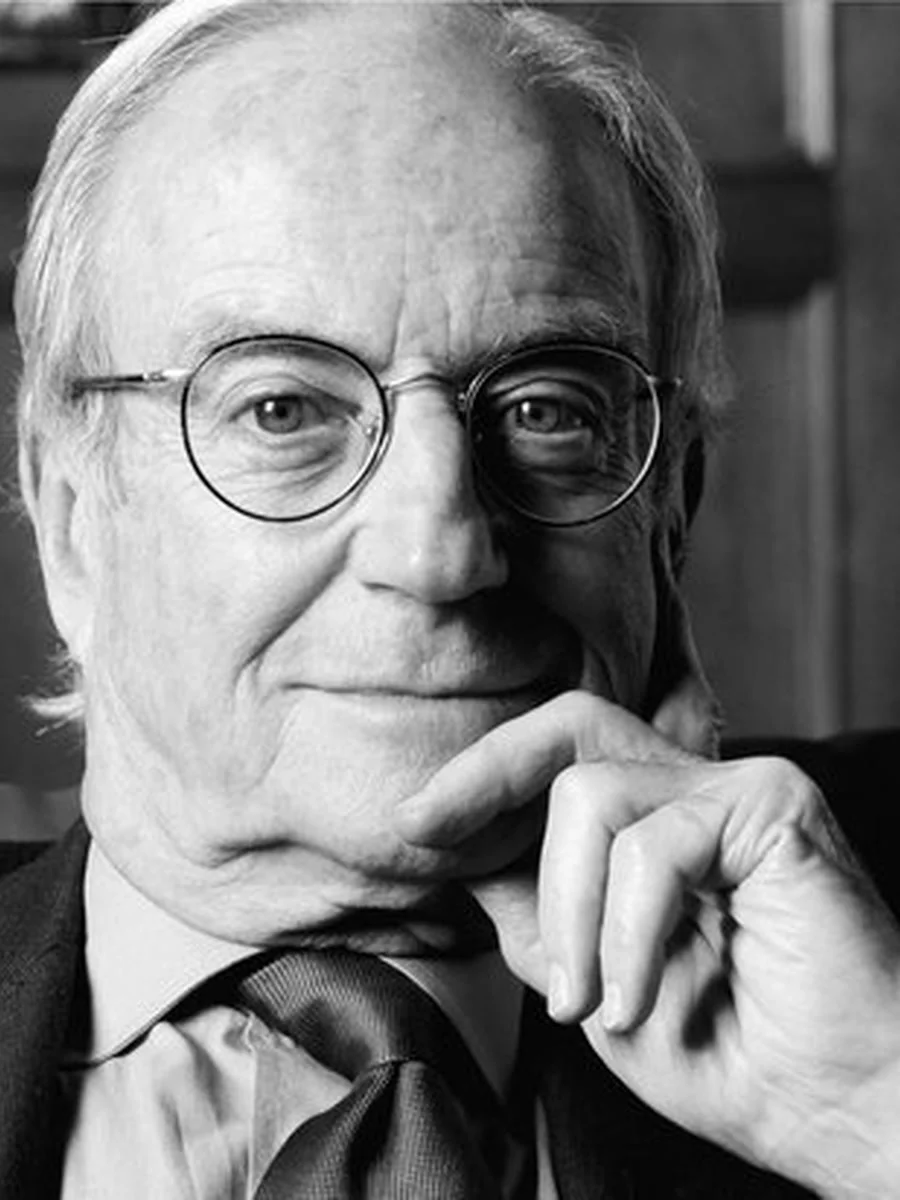
Ben Rosen
Seeded Compaq and Lotus; analyst-turned-VC whose newsletter shaped early PC investing.
From Depression-era New Orleans to an engineer's view of markets
Benjamin Maurice Rosen was born on March 11, 1933 and grew up in New Orleans during the 1930s and 1940s. The date comes from Rosen's recollection that he was born seven days after Franklin Roosevelt's March 4 inauguration; it is unusually precise first-person evidence, though still retrospective. Rosen, “Reflections,” “Banks Closing” and “Reflections on New Orleans”
Rosen crossed disciplines and coasts before becoming an investor: a Caltech BS in electrical engineering in 1954, a Stanford MS in electrical engineering, and a Columbia MBA. Caltech's commencement record fixes his full name and bachelor's degree; Caltech's institutional biography supplies the later degrees. Caltech commencement, printed p. 5 · Caltech official biography
Rosen also identified his older brother Harold as the strongest early pull toward electrical engineering. His edited recollection places roughly four years of engineering work around graduate study at Stanford—including work at Raytheon and Sperry Gyroscope—before Columbia and securities analysis; a 1984 contemporary profile independently reports that he began at Raytheon. CHM, printed pp. 2–7 · TIME, January 23, 1984 [retrospective witness · moderate] The exact sequence remains approximate. Rosen later said engineering experience helped differentiate his analysis. [investor-stated · moderate] CHM, printed pp. 6–7 [researcher inference · moderate] That supports an engineering-to-analysis link, not a demonstrated analysis-to-venture-alpha chain.
[researcher inference · moderate] That educational sequence plausibly supplied a translation skill—technical claims could be examined as engineering, then recast as markets and capital—but no surviving student paper or early investment memorandum proves a direct education-to-investment causal chain. Rosen's 1990 foreword makes the distinction explicit: unlike a technical exercise, a business problem may have several answers or none. Raising Money foreword excerpt, printed p. 39
The historical setting mattered. Rosen entered electronics analysis before the IBM PC's open architecture created an unsettled standard around which independent software and compatible hardware could form. [researcher inference · strong] IBM, “The IBM PC” The setting created opportunity, not a presumption of personal foresight: a June 1981 SEC speech estimated that organized venture funds had raised about $900 million in 1980, up from $319 million in 1979, and described typical organized-venture holding periods of six to ten years. Those are market estimates, not Sevin Rosen terms. SEC speech, June 12, 1981
The analyst years: research became infrastructure
Rosen recalled about ten years at Coleman & Co. and five at Morgan Stanley before leaving securities analysis in January 1980; exact employer dates remain approximate. CHM oral history, printed pp. 6–8 At Coleman he moved beyond routine company reports by organizing CEO lunches, newsletters and conferences. At Morgan Stanley he covered electronics while experimenting directly with personal computers. [retrospective witness · moderate] Rosen said the network and name recognition later produced by those information products were useful but not their original purpose. CHM, printed pp. 7–8
The practice was concrete. In 1978, by Rosen's later account, he carried an Apple II to institutional clients and built a searchable restaurant application so skeptical users could see an actual workflow rather than a toy. Rosen, “I Coulda Been a Contenda,” opening through restaurant application The prototype found limited use inside Morgan Stanley, but it never established proprietary data, distribution, monetization or Rosen's commitment to build a company. [researcher inference · strong] It demonstrates prototype-led learning, not a lost venture return.
The stronger frozen evidence arrived in 1979. After previewing VisiCalc, Rosen wrote that application software might drive personal-computer demand—the “software tail” could sell the hardware “dog.” Rosen Electronics Letter VisiCalc reaction, scan pp. 1–2 [contemporaneous record · strong] This pre-outcome record supports a specific mechanism: a useful business application could unlock a platform that hardware specifications alone had not made legible to corporate buyers. It does not show that Rosen invested in Software Arts, identified Lotus in advance, or captured the insight economically.
By April 1982, proposal stacks, a newsletter and the Personal Computer Forum had become a feedback system. Rosen said conferences were a way to learn an industry and incoming plans continually exposed him to frontier activity. Boston Computer Update, printed pp. 23–24 [researcher inference · strong] Research produced reputation; reputation attracted founders and intermediaries; their proposals supplied more research. That loop is the most plausible source of repeatable access in Rosen's record, but access still had to be converted into a security decision.
The network was unusually dense. Rosen's 1980 farewell photographs included Regis McKenna, Steve Jobs, Andy Grove, Gordon Moore, John Young and Jerry Sanders. Rosen, “Potpourri,” “Memories of another era” [documented behavior · moderate] Proximity explains how opportunities could reach him; it does not prove superior selection or justify credit for the companies those people built.
Conflict discipline shaped what Rosen would not own
Rosen says he declined an offered $1 million private Apple placement because meaningful ownership could compromise, or appear to compromise, his published judgment as an analyst. Rosen, “Memories of Steve,” “Easy Come, Easy Go” He similarly recalled selling a small VisiCorp public position, then selling Rosen Research to Esther Dyson when venture activity created a publication conflict. CHM, printed pp. 9–11 The Dyson papers independently document the acquired publishing organization, though they do not validate every remembered transaction detail. Esther Dyson papers finding aid, pp. 1–7
[researcher inference · moderate] These documented choices made role boundaries part of Rosen's process: analyst, personal investor, fund partner and director were not interchangeable identities. The cost was real optionality foregone; the credibility benefit and any later deal-flow effect are plausible but unproved because no matched analyst cohort or contemporaneous compliance file survives.
Sevin Rosen: complementary judgment, small-fund constraints, shared veto
Rosen and Mostek co-founder L. J. Sevin initially explored forming a semiconductor company with Al Stein. When financing conditions defeated that plan, they raised an approximately $25 million first fund in 1981. Rosen remembered a roughly six-month raise and a founder commitment near 1%; Inc. later reported $200,000. Fund II was approximately $60 million in 1983. CHM, printed pp. 11–13, 22–24 · Inc., web paragraphs 50–66 These are recollections and reporter figures, not partnership accounts.
The original partnership was designed around disagreement. Rosen described himself as optimistic and Sevin as skeptical, with each partner holding a veto in Fund I. Rosen brought PC/software observation and capital-markets relationships; Sevin brought semiconductor operating depth. CHM, printed pp. 11–16 · L. J. Sevin oral history, printed pp. 20–25 [researcher inference · strong] The bilateral veto could force opposing views into an early decision, while the small vehicle made a few outcomes consequential. No partnership agreement reveals carry, reserves, formal ownership targets, recycling, key-person terms or whether the veto survived unchanged in later funds.
The partnership should therefore be treated as a unit of analysis, not a backdrop to a lone-investor story. [documented behavior · strong] Cypress and Crystal Semiconductor have L. J. board attribution; a preserved firm biography credits Jon Bayless with leading the firm's early Landmark Graphics and Ciena investments and chairing both, independently controlled by a Landmark founder interview and Ciena's 1998 proxy; Electronic Arts and Silicon Graphics were firm successes for which no Ben lead or board seat is established. Dataquest, printed pp. 114–16 and 127–32 · Bayless firm biography · Landmark founder interview, financing and start-up passages · Ciena 1998 proxy, Proposal 1 · CHM, firm-only controls, printed pp. 20–24
Two losses before the celebrated pair
The firm's first two reported investments, Synapse Computer and Osborne Computer, failed. Synapse remains almost entirely opaque: the thesis, check, security, ownership, board work, capital response and loss are unavailable. Inc., web paragraphs 50–70 Osborne is better documented as a later-round, passive position in which Rosen said he had neither representation nor effective control. He reported a complete $400,000 loss, but Inc. uses first-person language while TIME assigns the amount to the fund; capital ownership remains unresolved. Practical Computing, printed p. 81 · Inc., 1986 · TIME, January 23, 1984
Rosen's public lesson was to invest earlier, obtain board authority and work closely with the company. [investor-stated · strong] Practical Computing, printed p. 81 [researcher inference · strong] The process change is intelligible—rights become an underwriting fact rather than a post-failure complaint—but the causal claim remains unproved. A board seat might not have saved Osborne, and the public record contains no matched set of passive and active positions.
Compaq: preserving the team while changing the proposition
In 1981, Rod Canion, Jim Harris and Bill Murto approached with a disk-drive-company proposal. Rosen and Sevin rejected that product but encouraged the three Texas Instruments managers to return. The revised proposal was a portable computer intended to be fully compatible with IBM's new PC. Rosen recalled insisting that partial compatibility would be commercially weak: the startup needed to borrow the emerging application ecosystem while differentiating through portability. CHM, printed pp. 13–16
[investor-stated · strong] The decision supports a repeatable sequence: assess the people separately from their first idea, identify the platform constraint, and require a narrow wedge that does not ask customers to surrender the standard. 2019 Bloomberg/Yahoo Q&A, “difference between the person and the idea” exchange It does not prove that compatibility itself was durable protection; IBM's open architecture also invited clones and competition.
Credit is shared. Canion, Harris and Murto conceived, founded and operated Compaq; Ben and L. J. shared early diligence; a syndicate including Kleiner Perkins supplied capital; Rosen assumed primary chair responsibility. Kleiner Perkins Compaq retrospective · L. J. Sevin oral history, printed pp. 22–24 The SEC record places Rosen's chair tenure from 1982 to 2000. Compaq 2001 proxy
TIME reported in January 1984 that a $2.5 million firm position was worth about $40 million at Compaq's 1983 IPO; L. J. separately remembered roughly $1.5 million from the firm in an approximately $3 million first round. TIME, January 23, 1984 · L. J. Sevin oral history, printed pp. 22–24 [retrospective witness · moderate] The definitions conflict. Neither figure is a cash-distribution history, fund return or Rosen personal return.
Lotus: a founder exception and bounded investor value-add
Lotus emerged independently, not as half of a planned hardware/software portfolio. Rosen explicitly denied the tidy retrospective story that Compaq and Lotus expressed one integrated thesis. CHM, printed p. 16 He had known Mitch Kapor for years and backed product imagination that did not fit a conventional executive profile. Kapor later credited Rosen with credibility, Wall Street introductions and press access rather than the operating strategy or product. Kapor oral history, printed pp. 11–13
[researcher inference · moderate] Lotus tests Rosen's people-first hierarchy at its most useful: the founder rule admitted an exception when rare creative judgment was visible, and investor value-add remained bounded to legitimacy and access. Kapor oral history, printed pp. 11–13 It also tests conflict discipline after entry. Rosen left the Lotus board when IBM-related discussions created a conflict with his Compaq chairmanship. CHM, printed pp. 15–18
TIME reported that a $2.1 million Sevin Rosen stake was worth about $70 million at the 1983 IPO. TIME, January 23, 1984 [contemporaneous record · moderate] This is the largest disclosed firm-level paper value in the reconstructed candidate set, not audited realization, net multiple or personal wealth.
Search breadth, false negatives, and the ordinary record
Ansa is the clearest additional Ben-led fund case. In 1986 Rosen said he had examined roughly 100 database products before backing Ansa and becoming non-executive chair. His stated order was people, unmet need, then product fitness. Practical Computing, printed pp. 80–81 Borland agreed to acquire the loss-making company in 1987 for a reported amount near $38 million. Tech Monitor, July 12, 1987 [researcher inference · moderate] Comparative search may improve judgment, but the “100” is unaudited and no candidate list, scorecard, stake or proceeds survive. Transaction value is not investor return.
Borland supplies the visible false negative. Rosen publicly included himself among the venture investors who passed on Philippe Kahn before Kahn founded the company with $5,000; Rosen later became a director. Caltech, “Four Million Transistors,” printed p. 18 [documented behavior · strong] The later role may show updating or relationship repair, but it cannot be rewritten as original foresight. The original pitch and rejection rationale are missing.
The broader book is not reconstructable. By March 1990, Inc. reported 45 financed entities, while Caltech later described more than 100 companies receiving initial firm financing. Inc., web paragraphs 50–66 · Caltech biography The deal work found 23 named public opportunity paths, searched and researched all 23, and sufficiently reconstructed 18; five remain association-only or sponsor-unresolved. That mixed set includes passes, personal capital and family projects, so true firm-investment coverage and hit rate are not computable. Deal denominator
[researcher inference · strong] This missing ordinary record is decisive. Famous successes are more likely to survive than small exits, write-offs, rejected opportunities and unchanged companies. Removing Lotus and Compaq leaves no public basis for a positive aggregate cash result or even a third-place return ranking. Top-outcome removal test
The long Compaq chairmanship: governance as both edge and liability
After Compaq's first quarterly loss, the board removed founder-CEO Rod Canion in 1991. Washington Post, October 26, 1991 In May 1992 Rosen defended a restructuring that cut costs and prices, refreshed products, widened customer segments and improved service; the operating plan was attributed mainly to CEO Eckhard Pfeiffer, while Rosen's evidenced role was board sponsorship and public defense. Washington Post, May 14, 1992
[researcher inference · moderate] The episode shows what board authority can do—change leadership and preserve a company-level option—but not that the chair caused the subsequent recovery. Employees, products, pricing, channels, Pfeiffer and market conditions divide causal credit. The contemporaneous evidence was adverse: quarterly income and sales had fallen, layoffs were announced, and shareholders questioned returns. Washington Post, results and shareholder paragraphs
In 1999 the board removed Pfeiffer. Rosen, then acting chair and briefly acting chief executive, said the strategy was sound but execution had failed; shareholders pointed to a severe share-price fall, earnings miss and customer-service problems. Wired/Reuters, April 22, 1999 Critics argued that Rosen's continuing influence impeded CEO recruitment, and Pfeiffer later said the abrupt removal damaged the company. TheStreet, 1999 · Computerworld, Pfeiffer interview [researcher inference · moderate] These interested-witness and contemporary adverse accounts do not adjudicate causality, but they prevent an unqualified stewardship narrative.
Rosen generally argued that chair and CEO should be separate because the board selects and supervises management. CHM, printed pp. 30–31 Yet on retiring in 2000 he endorsed Michael Capellas holding both offices, conditioned on an active independent board. Compaq retirement email, Capellas paragraph [investor-stated · strong] The record shows a contextual principle, not a rule applied mechanically.
Rosen later admitted that Compaq reacted too slowly to lower-cost competition and the Internet, called the DEC acquisition a mistake, and could not reconstruct why the board had approved it. CHM, printed pp. 28–31 [investor-stated · strong] The admission is meaningful adverse evidence; its limitation is precisely what Rosen acknowledged—no preserved ex-ante board rationale, alternatives or kill criteria from which to learn how the error happened.
The legal record also requires narrow wording. Rosen was a named defendant in Berger v. Compaq, which alleged misleading 1997–98 disclosures and channel-inventory practices. The Fifth Circuit reversed class certification for legal error and remanded; it did not decide the allegations' merits. Fifth Circuit opinion HP later disclosed a Compaq-related company settlement substantially covered by insurance, not a finding of Rosen's personal wrongdoing. HP 2002 Form 10-K, litigation section
Succession at the firm and the move to personal capital
Inc. reported Fund III at $65 million in 1988. By 1990 Rosen said he and Sevin had reduced new-company selection while keeping Fund I/II board duties and adviser/investor roles in Fund III. [investor-stated · strong] Inc., second Q&A answer Caltech dates Rosen's formal general-partner service to 1981–95. Caltech biography [researcher inference · strong] This was distributed succession, not instant retirement: younger partners gained selection authority while legacy governance continued. Successor-firm outcomes after 1995 cannot be assigned to Rosen without deal-specific evidence.
[researcher inference · moderate] Later personal investing changed the constraint set and made attribution clearer but portfolio policy less visible. Ask Jeeves's prospectus records four Ben purchases totaling $2,320,038 and 1,413,802 beneficially owned shares before the 1999 IPO; at the $14 offer price that was a $19,793,228 paper mark, not realized proceeds. Ask Jeeves prospectus, printed pp. 60–65 Ron Conway later recalled that Ben sourced the company and that Ben, L. J. and Conway used personal money and held company-building sessions. Conway transcript, lines 126–29 [retrospective witness · moderate] The prospectus controls the purchases; disposition, realized return and formal governance remain unknown.
Capstone Turbine combined separate interests. The issuer's 2000 prospectus says Ben and brother Harold invested in 1993 and redirected the company toward vehicle microturbines; it records 3,492,621 Ben-beneficial shares and a distinct 4,120,967-share Sevin Rosen position represented through John Jaggers. Capstone prospectus, Product Development table, printed p. 30; director biographies, printed p. 49; Principal Shareholders and notes, printed pp. 60–62 [contemporaneous record · strong] Personal/family ownership and firm ownership must not be merged into one Ben return.
Rosen Motors: operating experience exposes the limits of technical conviction
From roughly 1993 to 1997, Ben and his brother Harold pursued a turbine-flywheel hybrid drivetrain. Harold served as CEO and led the technical architecture; Ben chaired. The effort reached a working Saturn demonstration, about 70 employees and roughly $24 million of consumed capital, but no automaker committed. LA Times, November 19, 1997 Rosen later called it technically but not commercially successful. Rosen, “Car of the Future,” failure postmortem
[researcher inference · strong] The failure breaks a technology-first causal chain. A working subsystem did not supply industrialization, automotive cost, safety and reliability, total capital, or an integration owner. Nine automakers reportedly declined; the architecture also asked a conservative industry to adopt several unfamiliar technologies at once. Rosen, “Car of the Future,” automaker meetings and “In retrospect”
The residual story is bounded. Capstone bought $590,000 of equipment and improvements from Rosen Motors and assumed leases; Pentadyne later used flywheel patents. Capstone prospectus, Certain Transactions, printed p. 59 · Rosen, “Car of the Future,” “But all was not lost” [documented behavior · strong] Component salvage is not recovery of the $24 million, and the cap table, loss allocation and total proceeds are unknown.
This operating period plausibly broadened Rosen's later attention from product insight to manufacturing, channel and system adoption. [researcher inference · moderate] His 2008 Tesla analysis warned that startups underestimate incumbent cost, volume manufacturing, supply-chain and integration learning, while favoring a differentiated beachhead that buys time to build those capabilities. Rosen, “Driving the Tesla Roadster,” “Other competitors” and “Tesla's opportunity” The writings show the later framework; they do not prove Rosen Motors caused it or that he applied it to later securities.
Eclipse, Energy Vault, and late updating
Eclipse Aviation repeated part of the capital-intensity problem. Rosen made what he called a modest early personal investment, did not follow on and expected severe dilution. His 2008 account identified more than $1 billion of company capital, an engine delay, scale-dependent gross margins and roughly 1,800 employees; ten months later he recorded the bankruptcy. Rosen, “Eclipse Takes Off,” production and closing disclosure · Rosen, “On... a Lot of Topics,” “On Microjets”
[documented behavior · strong] Eclipse shows that early access without a reserve rule can become negligible retained exposure. [researcher inference · strong] It also suggests that financing volume or backlog cannot substitute for certification, supplier and unit-economics gates. No later personal-portfolio policy demonstrates that Rosen adopted the generalized rule.
In 2019 Rosen called Energy Vault his only investment in roughly twenty years and framed it around a large physical storage problem. Bloomberg/Yahoo Q&A, Energy Vault exchange A 2021 investor-rights agreement lists Ben Rosen as a purchaser. SEC exhibit, Schedule A [investor-stated · moderate] This freezes a late personal thesis and verifies purchaser identity; check, security, ownership, follow-ons, governance and outcome remain unscored.
[researcher inference · moderate] His intellectual updating was uneven but visible. In 1986–87 he revised his view of software opportunities as 80386 proposals appeared; in 1988 he still said the processor lacked a VisiCalc-like killer application. Byte, printed p. 6 · “Four Million Transistors,” printed pp. 24–25 He also forecast OS/2 would succeed DOS, a forecast later contradicted by Windows 3.0's adoption. “Four Million Transistors,” printed pp. 25–26 · Microsoft, “The Road from 3.0”
Rosen's later product-use doctrine includes its own failure condition. He said direct use aided the PC and spreadsheet judgments but admitted his preferences likely would have rejected eBay and much of social media. CHM, printed pp. 25–27 His early Kindle skepticism is a second visible false negative. Rosen, “Potpourri,” “Electric vehicle update” [investor-stated · strong] Product use was a source of hypotheses, not a sufficient picking rule.
People and influence map
| person or institution | evidenced influence, role, or decision right | attribution boundary |
|---|---|---|
| Caltech, Stanford, Columbia | Engineering and business education; Caltech later made Rosen a trustee and trustee chair. Caltech biography | [researcher inference · moderate] Cross-disciplinary training plausibly aided translation; no direct educational causal record survives. |
| Coleman & Co. / Morgan Stanley | Securities-analysis apprenticeship, CEO access, institutional-client testing and an Apple banking introduction. CHM, printed pp. 6–10 | [researcher inference · moderate] Employers supplied platform and access; Rosen's sole causation of mandates or later deal flow is unproved. |
| Jobs, McKenna, Grove, Moore, Young, Sanders | Dense technology network documented around Rosen's 1980 analyst farewell. “Potpourri,” network passage | Contacts are not all mentors, counterparties or investees; exact influence on decisions is mostly unknown. |
| Esther Dyson | Acquired Rosen Research after venture/publication conflicts emerged. Dyson finding aid, pp. 1–7 | Ownership transition is documented; issue-level authorship after the sale cannot be assigned to Rosen. |
| L. J. Sevin | Co-founder, Fund I veto partner, shared Compaq diligence, semiconductor operating judgment. L. J. oral history, pp. 20–25 | Firm outcomes are not Ben-only; Cypress and Crystal have L. J.-led governance evidence. |
| Canion, Harris, Murto | Created and operated Compaq; returned with the portable-compatible concept after the disk-drive proposal was rejected. Kleiner Perkins | Rosen financed and governed; he did not found or operate the company at inception. |
| Mitch Kapor | Created Lotus's product vision; chose Rosen partly for credibility and access. Kapor oral history, pp. 11–13 | Rosen's value-add is not product authorship or sole company-building credit. |
| Jon Bayless / younger partners | A preserved firm biography credits Bayless with leading the firm's early Landmark Graphics and Ciena investments and chairing both; a Landmark founder interview and Ciena's 1998 proxy independently control the board roles. Bayless firm biography · Landmark founder interview, financing and start-up passages · Ciena 1998 proxy, Proposal 1 | Successor and firm-brand outcomes require deal-specific sponsorship evidence. |
| Kleiner Perkins, Sequoia, Brook Byers and other syndicate investors | Added capital, sourcing and board work in Compaq and Electronic Arts. Kleiner Perkins on Compaq · Kleiner Perkins on EA | Syndicate contribution prevents sole-credit claims; EA has no documented Ben board seat. |
| Harold Rosen | Brother, Rosen Motors CEO and technical architect; co-investor in Capstone. LA Times · Capstone prospectus, pp. 30, 49 | Family operating and personal capital are not Sevin Rosen fund performance. |
| Ron Conway | Recalled Ben sourcing Ask Jeeves and joining informal company-building sessions with L. J. and Conway. Conway transcript, lines 126–29 | Witness memory supports sourcing; the issuer filing controls purchases and ownership. |
| Compaq operators, directors, employees and shareholders | Operators and employees executed products and strategy; directors appointed and removed CEOs; shareholders supplied criticism during crises. Wired, 1999 | Board authority is real but cannot absorb operator credit or erase shareholder counterevidence. |
Turning points and what actually changed
| turning point | belief or process before | observed change | causal boundary |
|---|---|---|---|
| VisiCalc, 1979 | PCs lacked an obvious corporate job. | Application value became the demand lens. VisiCalc scan | [contemporaneous record · strong] Category insight is evidenced; later selection is not caused by this page alone. |
| Publication-to-fund conflict, 1980–81 | Research and securities access coexisted. | Rosen separated publication ownership from venture activity. CHM, pp. 9–12 | [documented behavior · moderate] Conduct is remembered; effect on reputation or deal flow is unmeasured. |
| Synapse/Osborne failures | At least one passive later-round position lacked governance. | Rosen publicly favored earlier entry and active boards. Practical Computing, p. 81 | [investor-stated · strong] Adoption of the rule is visible; counterfactual efficacy is not. |
| Compaq first proposal, 1981 | Product rejection might have ended the relationship. | The team was preserved and a new wedge was tested. CHM, pp. 13–16 | [investor-stated · strong] Rationale is retrospective; IC dissent and terms are absent. |
| Fund III succession, late 1980s | Founders selected and governed new companies. | Younger partners assumed more new-selection work while founders retained legacy boards/adviser roles. Inc., second Q&A | [investor-stated · strong] Authority shifted; formal votes and economics remain unknown. |
| Compaq crises, 1991–2000 | Active boards were framed as downside protection. | The Compaq board twice removed CEOs during Rosen's chairmanship; Rosen briefly acted as CEO, then accepted a combined chair/CEO exception. 1991 removal · Wired · retirement email | [documented behavior · strong] Intervention is evidenced; value causality is contested. |
| Rosen Motors, 1993–97 | Technical ambition and prototype progress carried the project. | Later writing separated technical success from timing, integration and industrial adoption. “Car of the Future” | [researcher inference · moderate] The framework follows the failure; no formal process revision survives. |
| DEC admission and product-use self-critique, 2017 | Governance and hands-on use were strengths in Rosen's narrative. | He named DEC as a board mistake and personal taste as a source of false negatives. CHM, pp. 25–31 | [investor-stated · strong] Belief correction is explicit; subsequent allocation evidence is sparse. |
A falsifiable thesis of Rosen's edge
Proposed edge. [researcher inference · moderate] In U.S. PC, business-software and adjacent electronics opportunities from roughly 1979 through 1990, Rosen's repeatable advantage was an information-to-governance loop: create research and convening products, use the resulting network to see founders and technologies early, translate technical capability into a customer/application and platform map, preserve exceptional teams through idea iteration, then pair the selected company with capital-markets credibility and board authority. 1979 VisiCalc record · 1982 sourcing evidence · 1986 underwriting hierarchy, printed pp. 80–81 · Kapor on Rosen's credibility, printed pp. 11–13 · Compaq chair record
The mechanism is specific enough to test:
- Research should precede access. Unseen winning cases should have dated Rosen analysis, conferences or relationships before financing—not only later recollection.
- The thesis should name a job and bottleneck. Pre-decision records should identify the application, standard, compatibility constraint or narrow wedge rather than generic technology enthusiasm.
- Founder judgment should survive idea iteration. Strong teams should receive cheap, explicit next tests after a rejected first proposal, while weak teams should not be rescued by category excitement.
- Direct attribution should concentrate in the domain. Ben-led evidence should be stronger in PC/software and capital-markets work than in L. J.-led semiconductors or Bayless-led later deals.
- Governance should produce observable interventions. Board records should show recruiting, milestones, conflict management or stopping decisions connected to the original risk.
Wins fit parts of the thesis: VisiCalc supplies frozen category insight; Compaq supplies team preservation, compatibility and a wedge; Lotus supplies a founder exception and credibility access; Ansa supplies comparative search. [researcher inference · strong] Investment cases Ordinary outcomes do not yet validate it: only 18 of 23 public paths are sufficiently reconstructed, and many visible firm successes lack Ben sponsorship or cash economics. Candidate ledger
Failures specify the edge's boundary. Synapse offers no usable diagnosis; Osborne shows weak rights; Borland shows a false negative despite access; Rosen Motors shows technology without committed integration; Eclipse shows reserve and capital-stack failure; DEC shows that board authority did not prevent strategic error. [researcher inference · strong] Failure postmortems
The thesis would weaken materially if archived memos show that the job/wedge language arose only after outcomes; if a complete accepted/rejected cohort shows no advantage in Rosen's mapped domains; if Ben-attributed deals underperform L. J.- or successor-led deals after vintage and sector controls; if board records show ceremonial rather than decision-relevant involvement; or if audited fund cash flows show that results depend overwhelmingly on one unrelated outlier. It would be overturned as a personal-alpha thesis if the apparent pattern disappears after assigning founder, partner, syndicate, vehicle and era contributions correctly.
Skill, access, team, vehicle, era, luck, and outliers
| explanation | strongest evidence | judgment |
|---|---|---|
| Skill | A 1979 contemporaneous application-demand insight; Compaq compatibility reasoning; Ansa category search; conflict discipline. VisiCalc scan · CHM, printed pp. 13–16 · Practical Computing, printed pp. 80–81 | [researcher inference · moderate] Real process signals, but no complete accepted/rejected or cash-return cohort measures repeatability. |
| Access | Analyst brand, CEO lunches, newsletter, Forum and dense industry relationships. CHM, printed pp. 7–8 · Boston Computer Update, printed pp. 23–24 | [researcher inference · strong] Access is well evidenced and likely necessary; it can mimic selection alpha without passes and losses. |
| Team | L. J.'s veto and operating judgment; founders' product/company creation; Bayless and syndicate roles. L. J. oral history, printed pp. 22–25 · Kleiner Perkins on Compaq · Bayless firm biography · Landmark founder interview, financing and start-up passages · Ciena 1998 proxy, Proposal 1 | [researcher inference · strong] The visible record is produced by a partnership and founders, not one investor. |
| Vehicle | Approximately $25 million Fund I, bilateral veto and active boards; later authority distribution. CHM, printed pp. 11–13, 22–24 · L. J. oral history, printed pp. 23–24 · Inc., second Q&A | [researcher inference · moderate] Small scale may have made concentrated work feasible, but terms, reserves, carry and returns are missing. |
| Era | IBM's open architecture, a forming business-PC ecosystem and expanding venture pools. IBM PC history · SEC speech, June 12, 1981 | [researcher inference · strong] The regime amplified compatibility and applications; the same playbook is not automatically portable. |
| Luck | Rosen repeatedly called Compaq and Lotus lucky while arguing that knowledge and networks improved luck's surface area. CHM, p. 16 | [investor-stated · strong] His own account rejects a deterministic genius narrative. |
| Outlier concentration | Lotus and Compaq dominate disclosed firm paper values; top-outcome removal destroys the public economic ranking. Pareto ranking and removal test | [researcher inference · strong] A power-law-compatible record is not proof that selection created excess return. |
The strongest skeptical reading is credible: Rosen was a superbly positioned analyst during an extraordinary platform transition; two early visible outliers, founder execution, complementary partners and an emerging fund category did most of the visible economic work; later narration converted contingent choices into a coherent craft. [researcher inference · moderate] Rosen on luck, CHM printed p. 16 · denominator and selection bias The favorable thesis survives only in narrower form—Rosen built a repeatable way to improve the information set and exercise governance in a domain he understood. Evidence that this produced personal, portfolio-wide economic alpha is insufficient public record. Top-outcome removal test
Sourced chronology
| date or period | evidenced event | interpretation boundary |
|---|---|---|
| 1933 | Born March 11; grew up in New Orleans. “Reflections” | First-person retrospective. |
| 1954–early 1960s | Caltech BS; later Stanford MS and Columbia MBA. Caltech commencement, p. 5 · Caltech biography | Degree record is stronger than any inferred intellectual effect. |
| c. 1965–80 | Electronics analyst at Coleman and Morgan Stanley; dates approximate. CHM, pp. 6–8 | No complete employment file. |
| 1978–79 | Apple II demonstrations, restaurant prototype, VisiCalc reaction. prototype · VisiCalc scan | Prototype retrospective; VisiCalc thesis contemporaneous. |
| 1980–81 | Leaves analysis, declines Apple conflict, separates research business, forms approximately $25 million Fund I with L. J. CHM, pp. 9–13 | Offer/fund details are unaudited recollection. |
| 1981–82 | Synapse and Osborne failures; Compaq and Lotus financing. Inc., 1990 · CHM, pp. 13–19 | Exact sequencing, checks and cash flows incomplete. |
| 1983 | Compaq and Lotus IPO paper marks reported; Fund II approximately $60 million. TIME · CHM, pp. 22–24 | Paper values are not realized returns. |
| mid-1980s | Ansa search/investment and chair role; Borland pass later disclosed. Practical Computing, pp. 80–81 · Caltech report, p. 18 | Ansa proceeds and Borland rejection rationale unknown. |
| 1988–95 | Fund III reported at $65 million; new-selection authority shifts; formal GP period ends in 1995. Inc., 1990 · Caltech biography | Formal IC rights and economics unavailable. |
| 1991–92 | Canion removed; board-led Compaq overhaul defended publicly. Washington Post, 1992 | Turnaround credit shared and endpoint-sensitive. |
| 1993–97 | Ben/Harold invest in Capstone; Rosen Motors operates and closes without OEM commitment. Capstone prospectus, pp. 30, 49 · LA Times | Separate companies/interests; total loss and recovery unknown. |
| 1999–2000 | Ask Jeeves ownership disclosed; Pfeiffer removed; Rosen briefly acts as Compaq CEO; retires as chair. Ask Jeeves prospectus, pp. 60–65 · Compaq proxy | Paper mark not proceeds; governance causality contested. |
| 2007–09 | Public blog revisits Rosen Motors, Eclipse, product use, risk, systems and institutional governance. Writings corpus | Later doctrine is not automatically a historical IC record. |
| 2017–19 | CHM oral history; Bloomberg/Yahoo highlights; Energy Vault personal thesis. CHM · 2019 Q&A | Edited memory and incomplete late-investment terms. |
| 2020 | Late systems essay pairs crisis diagnosis with conditional optimism. Essay, PDF p. 1 | Civic forecast, not venture performance evidence. |
How to study the record
Read the writings corpus first for Rosen's contemporaneous VisiCalc observation and later self-corrections, then the talks and interviews for the 1982 and 1986 process record. Use the investment ledger and no-hindsight labs to separate decision-time information from outcomes. The investment philosophy converts the biography into a testable operating system, while the mental-model field guide states each reusable rule, counterexample and modern boundary. The source map shows what was processed and which archives remain missing.
The principal unresolved evidence is not another celebratory anecdote. It is the mundane denominator: Fund I–III partnership records, all investments and passes, ownership and follow-on histories, write-offs, cash distributions, board/IC papers and Rosen's personal-capital ledger. Until those records surface, Rosen's historical importance and process contribution are better supported than a claim of audited, repeatable personal investment alpha. Source-map coverage assessment · deal denominator
1. Snapshot and testable edge thesis
| question | evidence-backed answer |
|---|---|
| Investor, firm, era | Ben Rosen moved from electronics research at Coleman and Morgan Stanley into Rosen Research and then Sevin Rosen, whose first fund was formed in 1981; Caltech dates his formal general-partner service to 1981–1995. CHM oral history, printed pp. 4–13 · Caltech biography |
| Proposed edge | [researcher inference · moderate] In U.S. PC, software, and adjacent electronics opportunities from roughly 1979 through the early 1990s, Rosen's plausible repeatable advantage was to build an information network, map a technology transition to a concrete customer job, recognize an unusual team's relevant capability, and then use board authority and capital-market access to help the company cross adoption bottlenecks. 1979 VisiCalc scan · Practical Computing, printed p. 81 · CHM, printed pp. 13–19 |
| Mechanism and scope | [researcher inference · moderate] Research, conferences, and proposals should improve access and comparative context; product use should reveal an urgent workflow; a narrow wedge should borrow an emerging standard; active governance should accelerate recruiting and correction. The mechanism should work best in young technical markets where standards and distribution are forming and where one informed director can materially affect a small company. Boston Computer Update, printed pp. 23–24 · CHM, printed pp. 25–27 |
| Supporting and adverse cases | [researcher inference · strong] Compaq, Lotus, and Ansa support different links in the chain; Osborne, Borland, Rosen Motors, Eclipse, Kindle skepticism, and the Compaq/DEC decision show that access, technical fluency, product taste, and board control each fail under identifiable conditions. Seven decision labs · failure postmortems |
| Denominator and economics | [researcher inference · strong] The public opportunity set has 23 named paths, all searched and researched, but only 18 are sufficiently bounded and none has a complete cash-flow history. The 18/23 fraction measures reconstruction of a selected public set, not firm hit rate; career firm coverage and personal alpha are not computable. denominator reconciliation |
| Predictions | [researcher inference · moderate] If the edge thesis is real, unseen ordinary-case records should show repeated pre-outcome market maps, user-workflow evidence, explicit compatibility/complement tests, partner-specific attribution, active board interventions, and better results when those mechanisms were present than when Rosen was passive or outside his domain. |
| Falsifiers | [researcher inference · strong] The thesis weakens or fails if full memos and cash flows show that access did not improve selection; that ordinary outcomes were no better after controlling for founders, L. J. Sevin, other partners, syndicates, vehicle, era, and outliers; that board work was nominal or value-destructive; or that returns disappear without Lotus and Compaq. top-outcome removal test |
This is a testable process thesis, not a greatness verdict. Rosen himself described Lotus and Compaq as lucky opportunities and denied that they came from one integrated portfolio plan. [investor-stated · strong] CHM, printed p. 16
2. Core philosophy
Rosen's clearest contemporaneous hierarchy is people first, an unmet market need second, and a product capable of serving that need third. [investor-stated · strong] Practical Computing, printed p. 81 His compact formulation—“We invest primarily in people”—does not authorize founder worship: the same answer retains need and product as separate gates.
His pre-outcome writing adds a demand mechanism. VisiCalc could make a personal computer useful to business and thereby pull the hardware platform into a larger market. [contemporaneous record · strong] Rosen Electronics Letter reprint, scan pp. 1–2 His 1982 interview similarly joined applications, simplicity, lower price, and reach rather than assuming that improving chips create demand by themselves. [investor-stated · strong] Boston Computer Update, printed pp. 23–24
The synthesized operating system is therefore:
- Build an information surface before choosing. [researcher inference · strong] Publish, convene, use products, and treat proposals as market intelligence; do not confuse privileged access with selection skill. CHM, printed pp. 7–10 and 25–26
- Underwrite people, need, and product in that order, but require all three. [investor-stated · strong] The people test concerns learning and company-building capacity, not conventional polish. Practical Computing, printed p. 81
- Name the adoption bottleneck and the narrow wedge. [researcher inference · strong] Compaq borrowed IBM compatibility while differentiating through portability; Rosen's later Tesla analogy makes the beachhead logic explicit. CHM, printed pp. 13–16 · Driving the Tesla Roadster, “Tesla's opportunity”
- Earn governance authority without taking product authorship. [researcher inference · strong] Rosen favored early entry and active boards after Osborne, but said principal product features should come from entrepreneurs. Practical Computing, printed p. 81
- Treat every forecast and intervention as fallible. [researcher inference · strong] Borland, Kindle, Rosen Motors, Eclipse, and DEC demand written alternatives, kill criteria, and post-outcome scoring. Four Million Transistors, printed p. 18 · CHM, printed pp. 26–30
3. Sourcing
| route | evidence-backed practice | repeatability and boundary |
|---|---|---|
| Research publication | Rosen used analyst research and the Rosen Electronics Letter to interpret emerging electronics and PC markets. [documented behavior · strong] VisiCalc scan | [researcher inference · strong] A durable information product can attract informed participants and force written forecasts; brand reach still measures access, not investment efficacy. |
| Convening | Rosen said a conference was the best way to learn before the industry was stable. [investor-stated · strong] Boston Computer Update, printed p. 23 | [researcher inference · moderate] Repeatable when participants exchange genuine frontier information; fails when the event becomes consensus theater or conflicts are hidden. |
| Proposal flow | By 1982 Rosen described continual exposure to frontier proposals; in 2017 he called deal flow an information advantage. [investor-stated · strong] Boston, printed p. 24 · CHM, printed pp. 25–26 | [researcher inference · strong] Record the complete funnel and source, including rejections; otherwise inbound volume becomes an unscored anecdote. |
| Long relationships | A roughly four-year relationship preceded Lotus; known intermediaries led toward Compaq and Ansa. [investor-stated · strong] Practical Computing, printed p. 81 | [researcher inference · moderate] Repeated observation can reveal behavior, but affinity and elite-network selection can also suppress dissent and widen attribution error. |
| Comparative search | Rosen said he reviewed about 100 database products before Ansa. [investor-stated · moderate] Practical Computing, printed pp. 80–81 | [researcher inference · moderate] A category map is repeatable only if the candidate list, dimensions, exclusions, and decision date are preserved; none survives here. |
| Product use | Apple II, VisiCalc, Tesla, Segway, and Kindle show Rosen using products to form views. [documented behavior · strong] writings synthesis | [investor-stated · strong] Rosen later admitted that personal preference was sample-biased and likely would have rejected eBay and social media. CHM, printed pp. 26–27 |
Sourcing checklist. [researcher inference · strong] For each opportunity record: source and prior relationship; the pre-existing market map; first direct user evidence; what access reveals that a cold analyst could not know; conflicts; who independently verifies it; and the full accepted/rejected denominator. A referral or conference encounter never receives picking credit by itself.
4. Picking
Rosen's screen is a hierarchy, not a slogan.
| decision dimension | test | red flag or boundary |
|---|---|---|
| People | Can the team learn after its first concept is rejected, recruit complements, and build the next product? Compaq returned after the disk-drive rejection; Kapor's product imagination justified an exception to a conventional executive template. [investor-stated · strong] CHM, printed pp. 13–19 | [researcher inference · strong] Charisma, pedigree, or domain passion alone; Eclipse shows that committed founder-market fit cannot repair supplier, unit-economic, and finance failures. Eclipse post |
| Need | Which customer job becomes materially better, who pays, and why now? VisiCalc created a legible business job; Segway was strong engineering for a weak problem. [investor-stated · strong] VisiCalc scan · Potpourri, “Electric vehicle update” | [researcher inference · strong] Investor taste, technical novelty, or an undefined top-down market. Kindle is the warning that an early product can obscure an emerging need. |
| Product | Does the product serve the need with a measurable advantage and survive real workflows? [investor-stated · strong] Practical Computing, printed p. 81 | [researcher inference · strong] Demo success without retention, reliability, manufacturing, service, or total-cost proof. |
| Platform and wedge | What incumbent standard or complement lowers adoption friction, and what narrow capability prevents direct symmetric competition? [investor-stated · strong] Compaq account, CHM printed pp. 13–16 | [researcher inference · strong] Partial compatibility or a wedge that never compounds into broader capabilities. |
| Scale and succession | Can the organization generate successor products rather than depend on one hit? [investor-stated · strong] Bloomberg/Yahoo Q&A, product-lifetime exchange | [researcher inference · strong] Product enthusiasm without a roadmap, recruiting system, or capability owner. |
| Evidence update | What new capability invalidates the prior view? Rosen revised his software outlook after seeing 80386 proposals. [investor-stated · moderate] Byte, printed p. 6 | [researcher inference · strong] Vague forecasts with no metric, time horizon, or allocation action. |
Diligence protocol. [researcher inference · strong] Freeze the decision-time state; interview users and channel partners; test the product against alternatives; map standards, complements, suppliers, regulation, and incumbent response; assess the team against the next failure mode; model total capital through the next value-inflecting milestone; record dissent, authority, conflicts, and falsifiers; and decide what evidence licenses a small option versus a full commitment. decision labs
5. Deal and portfolio mechanics
| dimension | supported record | usable rule and limit |
|---|---|---|
| Check and security | Public figures are sparse and sometimes conflict: TIME reported $2.5 million for Compaq and $2.1 million for Lotus at firm level, while L. J. recalled about $1.5 million of an approximately $3 million Compaq round. [contemporaneous record · moderate] TIME, January 23, 1984 · L. J. Sevin, printed pp. 22–24 | [researcher inference · insufficient public record] No universal Rosen check, valuation, security, or price-discipline rule survives; do not invent one. |
| Ownership | Ask Jeeves and Capstone filings give company-specific holdings; no target ownership rule is public. [contemporaneous record · strong] Ask Jeeves prospectus, printed pp. 60–65 · Capstone prospectus, printed pp. 60–62 | [researcher inference · strong] State security, beneficial owner, dilution, follow-on, and disposition separately; shares at IPO are not cash proceeds. |
| Governance rights | Osborne became the negative control; Compaq, Lotus, and Ansa show active board work. [documented behavior · strong] Practical Computing, printed p. 81 | [researcher inference · strong] Price absence of control explicitly, but do not assume a board seat rescues a bad company. |
| Reserves and follow-ons | Eclipse shows a modest initial check, no follow-on, severe dilution, and bankruptcy; Crystal documents a company follow-on without Sevin Rosen allocation. [documented behavior · moderate] Eclipse post · Dataquest, printed pp. 114–16 | [researcher inference · strong] Set the reserve rule before entry, then re-underwrite each follow-on; initial access without retained exposure is not an economic win. |
| Concentration | Lotus and Compaq dominate disclosed early paper values; after removing both, the surviving record cannot rank returns or sign net cash results. [researcher inference · strong] Pareto analysis | [researcher inference · strong] Report the top-one/top-two stress test, but do not infer a portfolio policy or literal power-law percentage from selected public outcomes. |
| Exit and liquidity | IPO marks, company offering totals, and acquisition prices survive; distributions do not. [researcher inference · strong] return controls | [researcher inference · strong] Separate company event, paper mark, realized proceeds, taxes, and fund distributions; no IRR, DPI, or TVPI is computable. |
Portfolio decision rule. [researcher inference · moderate] Concentrate only where domain knowledge, governance capacity, and reserve capacity coexist; treat follow-on, intervention, and exit as new decisions. The historical record supports the components but not a Rosen-authored universal allocation formula. portfolio forensics
6. Vehicle and incentive fit
The vehicle is part of the method, not background.
| dimension | historical evidence | implication and missing record |
|---|---|---|
| Capital source and form | Rosen Research was an information business; Funds I–III were venture pools; later Ask Jeeves, Eclipse, Energy Vault, and Rosen Motors used personal, informal, or family routes. [documented behavior · strong] vehicle table | [researcher inference · strong] Never pool these economics or opportunity denominators. |
| Scale and duration | Rosen recalled Fund I at approximately $25 million and Fund II at approximately $60 million. [retrospective witness · moderate] CHM, printed pp. 13 and 24 Inc. reported Fund III at $65 million. [contemporaneous record · moderate] Inc., web paragraphs 50–66 A 1981 SEC speech described organized venture holdings commonly lasting six to ten years, but that is period context, not Sevin Rosen terms. [contemporaneous record · moderate] SEC speech, June 12, 1981, venture-capital characteristics | [researcher inference · insufficient public record] Legal life, extensions, recycling, commitment schedule, and distributions are unavailable. |
| Fundraising pressure | Rosen recalled a roughly six-month Fund I raise and about a 1% founder commitment; Inc. later reported $200,000. [retrospective witness · moderate] CHM, printed p. 13 · Inc., web paragraphs 50–66 | [researcher inference · insufficient public record] LP identities, capital-call pressure, and fundraising effects on deployment are unknown. |
| Compensation and carry | No partnership agreement or public fee/carry schedule was found. [researcher inference · insufficient public record] uncertainty ledger | [researcher inference · strong] Do not infer carry-driven behavior from outcomes. |
| Governance and decision rights | L. J. Sevin recalled that each partner held a Fund I veto; public evidence does not show whether that rule persisted. [retrospective witness · strong] L. J. Sevin oral history, printed p. 24 | [researcher inference · strong] A bilateral veto can improve dissent or produce deadlock; record proposals, votes, dissent, and exception authority. |
| Geographic authority | Visible paths are predominantly U.S. technology companies, but no mandate or allocation rule was recovered. [researcher inference · insufficient public record] portfolio forensics | Geography observed in a selected sample is not a contractual mandate. |
| Liquidity | Public markets and acquisitions supplied routes to liquidity, but no fund distribution policy survives. [contemporaneous record · moderate] 1981 SEC speech | [researcher inference · insufficient public record] Holding period, lockups, secondary sales, and in-kind distributions remain unknown. |
| Regulation and conflicts | Analyst securities ownership created perceived conflicts; Rosen says he declined Apple and sold the publication when venture activity conflicted with coverage. [investor-stated · moderate] CHM, printed pp. 9–11 | [researcher inference · strong] Conflict boundaries can preserve information credibility while forgoing upside; document the duty, owner, recusal, and disclosure. |
| Reserves | No vehicle reserve policy survives; Eclipse exposes the consequence of no personal follow-on. [documented behavior · moderate] Eclipse post | [researcher inference · strong] Match initial check, pro rata capacity, total capital, and kill milestones before entry. |
| Stakeholder incentives | Founders, LPs, GPs, co-investors, corporate directors, and personal/family capital had different payoff and duty structures. [researcher inference · strong] people/capital map | A board decision at Compaq cannot automatically be evaluated as a fund-return action. |
| Succession | By 1990 Rosen and Sevin had reduced new selection while retaining Fund I/II boards and Fund III adviser/investor roles. [investor-stated · strong] Inc., visible Q&A | [researcher inference · moderate] Distributed selection can reduce key-person risk, but formal authority and economics are unknown. |
| Key-person continuity | A preserved firm biography credits Jon Bayless with leading and chairing Landmark Graphics and Ciena; Rosen separately described younger-partner selection authority by Fund III, and the successor firm's 2006 fund cancellation occurred after Rosen's formal GP period. [documented behavior · strong] Bayless firm biography · Landmark founder interview, financing and start-up passages · Ciena 1998 proxy, Proposal 1 · CHM, succession discussion, printed pp. 20–24 · 2006 report mirror | [researcher inference · strong] Preserve partner attribution and do not back-assign successor outcomes to Rosen. |
Vehicle-fit test. [researcher inference · strong] Before investing, write the legal owner, decision makers, duration, reserve budget, liquidity clock, compensation, conflict duty, geographic authority, stakeholder claims, and succession owner. Reject the investment if the proposed industrialization or governance burden exceeds what that vehicle can finance or staff.
7. Team attribution and work with founders
| person or group | evidenced contribution | decision boundary |
|---|---|---|
| Ben Rosen | Fund I veto; PC/software research and network; Compaq chair; Lotus founding director/relationship sponsor; Ansa search and non-executive chair. [documented behavior · strong] L. J. Sevin oral history, printed p. 24 · CHM, printed pp. 11–19 · Practical Computing, printed p. 81 | He did not create founders' products, lead every firm deal, or personally own fund returns. |
| L. J. Sevin | Co-founder, Fund I veto, shared Compaq diligence, semiconductor operating expertise, Cypress and Crystal board roles. [retrospective witness · strong] L. J. Sevin oral history, printed pp. 20–25 | Cypress and Crystal are L. J.-led evidence; firm adjacency is not Ben credit. |
| Rod Canion, Jim Harris, Bill Murto | Conceived, founded, and operated Compaq; returned with the portable-compatible concept after the disk-drive rejection. [documented behavior · strong] Kleiner Perkins retrospective | “Rosen founded Compaq” is prohibited compression. |
| Mitch Kapor and Lotus team | Kapor supplied product imagination and company leadership; he credited Rosen mainly with credibility, Wall Street introductions, and press access. [retrospective witness · strong] Kapor oral history, printed pp. 11–13 | Investor access is not product or operating authorship. |
| Jon Bayless and younger partners | A preserved firm biography credits Bayless with leading the firm's early Landmark Graphics and Ciena investments and chairing both; the Landmark founder interview and Ciena's 1998 proxy independently control the board roles. Rosen separately described younger partners gaining selection authority by Fund III. [documented behavior · strong] Bayless firm biography · Landmark founder interview, financing and start-up passages · Ciena 1998 proxy, Proposal 1 · CHM, succession discussion, printed pp. 20–24 | Firm brand does not imply Ben sponsorship. |
| Co-investors | Kleiner Perkins joined Compaq; KPCB, Sequoia, and Sevin Rosen financed EA, where Brook Byers held the documented VC board role. [documented behavior · strong] KPCB on Compaq · KPCB on EA | Capital, sourcing, negotiation, and governance credit is syndicated unless the record separates it. |
| Harold Rosen | CEO and technical co-leader of Rosen Motors; Ben chaired. [contemporaneous record · strong] LA Times, 1997 | Family operating project, not a Sevin Rosen fund deal. |
| Ron Conway | Recalled that Ben sourced Ask Jeeves and that Ben, L. J., and Conway used personal capital and company-building sessions. [retrospective witness · moderate] Conway transcript, lines 126–29 | Formal approval, board, and exit roles remain unknown; the issuer filing controls Ben's purchases and ownership. |
Ten-role attribution protocol. [researcher inference · strong] For every deal name the source, sponsor, diligence owner, approver, negotiator, board representative, recruiter, follow-on decision maker, exit influencer, and later narrator. Use unknown rather than letting the best-known partner absorb the role. deal-level rights map
Rosen's supported founder-service doctrine is bounded: help with credibility, financing access, recruiting, governance, and difficult decisions; leave primary product features to entrepreneurs. [investor-stated · strong] Practical Computing, printed p. 81 Compaq's CEO removals and DEC acquisition show that active governance can create entrenchment, succession, and strategic-error risk, so interventions need precommitted measures and independent directors. [researcher inference · strong] Wired, 1999 · CHM, printed pp. 28–31
8. Views on the craft
- Risk and failure. [investor-stated · strong] Rosen said sufficiently aggressive venture investing should produce failures. The usable meaning is not “losses prove courage”; it is to distinguish thesis risk from process error and evaluate both against a complete denominator. Practical Computing, printed p. 81
- Power law and fund size. [researcher inference · moderate] Rosen sought companies large enough to justify fixed investor work, and Lotus/Compaq dominate public paper-value evidence. No public statement supplies a target concentration or fund-size formula, and no cash-flow ledger proves the power law. CHM, printed p. 16 · Pareto stress test
- Access versus selection. [investor-stated · moderate] Rosen said knowledge and networks made luck more likely, while explicitly naming luck. A great investor should therefore enlarge the opportunity surface and then prove selection and value-add separately. CHM, printed pp. 15–16 and 25–26
- Governance. [investor-stated · strong] The board selects and supervises management; Rosen generally favored separating chair and CEO. His Capellas exception shows that he allowed an independent board to substitute for formal separation. CHM, printed pp. 30–31 · retirement email
- Exits. [researcher inference · insufficient public record] No general sell discipline survives. Leaving Lotus's board over an IBM/Compaq conflict is governance evidence, not an exit rule; IPO marks and acquisition prices cannot establish realized skill. CHM, printed pp. 15–18 · return controls
- Greatness. [researcher inference · moderate] A defensible great-investor standard would require repeatable pre-outcome judgment, correct role attribution, aligned vehicle, useful intervention, ordinary-case resilience, and cash returns after outlier removal. Rosen's public record proves selected judgment and historical influence more strongly than personal alpha.
9. Signature bets and decision process
The labs below preserve the decision freeze before the outcome. Complete the four questions—invest/pass, kill criteria, ownership/terms, and next-check milestones—before opening each reveal.
- Compaq: reject the first product, preserve the team. [researcher inference · strong] Test the team separately from the disk-drive concept, then validate compatibility, channel, supplier, and IBM-response risk. decision lab
- Lotus: unconventional founder, powerful product layer. [researcher inference · strong] Evaluate product imagination and user switching without forcing a generic executive template; price conflict and recruiting risk. decision lab
- Ansa: search breadth before conviction. [researcher inference · moderate] Reconstruct the category map, candidate exclusions, customer need, release capital, and acquisition dependence before treating “about 100” as diligence proof. decision lab
- Osborne: passive later-round failure. [researcher inference · strong] Price the lack of rights and demand sell-through, runway, inventory, and transition evidence before investing. failure lab
- Rosen Motors: technology without a committed integrator. [researcher inference · strong] Gate scale on OEM commitment, cost-down, total capital, certification, and salvage rights. failure lab
- Borland: visible false negative. [researcher inference · strong] Do not backfill the later winner; ask whether a cheap milestone option could test a technically credible but underdocumented founder. miss lab
- Eclipse: reserve strategy before apparent scale. [researcher inference · strong] Model supplier, certification, backlog quality, unit cost, round-by-round dilution, and reserve capacity before accepting the headline market. failure lab
The recurring sequence is: map → freeze → test people/need/product → identify wedge and bottlenecks → assign roles and rights → model total capital and reserves → precommit milestones and kill criteria → reveal and score. [researcher inference · strong] This is an analyst reconstruction from the seven cases, not a surviving Rosen IC template.
10. Mental models and maxims
The field guide promotes every distinct supportable rule rather than a top-N list:
- Turn research into a compounding information network. [researcher inference · strong] Research, conferences, relationships, and proposals can widen access and comparison; they do not by themselves prove picking skill. model
- Back people first, an unmet need second, and the first product third. [investor-stated · strong] All three gates matter; Kapor, Borland, Eclipse, and Kindle keep the hierarchy falsifiable. model
- Find the application that pulls the platform. [researcher inference · strong] Start with the purchasing workflow that makes new infrastructure useful, then test whether demand is broad enough to matter. model
- Enter through a narrow wedge while preserving the ecosystem. [investor-stated · strong] Borrow a standard or complement to lower adoption cost while building capabilities the incumbent lacks. model
- Underwrite the company's next product, not only today's hit. [investor-stated · strong] Product enthusiasm is insufficient unless the team and organization can create successors. model
- Invest early enough to earn active governance. [researcher inference · strong] Secure information and intervention rights, leave product authorship to founders, and audit board-caused harm. model
- Match leaders to the failure mode, then separate strategy from execution. [researcher inference · moderate] Select against the next operating constraint and specify the evidence that distinguishes a bad strategy from weak execution. model
- Separate technical proof from commercial scale and total capital. [researcher inference · strong] Require the customer, integrator, manufacturing, unit-economic, and total-funding gates that Rosen Motors and Eclipse missed. model
- Preserve options and update at evidence thresholds. [researcher inference · moderate] Use small tests where uncertainty is cheap to resolve, precommit what changes the decision, and treat follow-ons as new underwritings. model
- Use denominators and forecast ledgers to reason under uncertainty. [researcher inference · moderate] Define exposure and alternatives, freeze predictions, and score misses rather than rewarding a merely directional story. model
- Write conflict, authority, and attribution boundaries before acting. [researcher inference · strong] Identify the legal owner, duty, recusal, ten decision roles, and later narrator so access and fame cannot absorb credit. model
These are model-family labels for navigation. The field guide controls exact provenance, examples, exceptions, support grade, and modern translation; no reconstructed label should be read as Rosen's wording.
11. Evolution and contradictions
| period | evidenced emphasis | change, contradiction, or unresolved tension |
|---|---|---|
| 1979–82 | Application software can create PC demand; lower cost, simplicity, and business use drive adoption. [contemporaneous record · strong] VisiCalc scan · Boston, pp. 23–24 | Category observation does not choose team, price, security, ownership, or exit. |
| 1981–83 | First two failures are followed by Compaq and Lotus; L. J. recalled a bilateral veto, while the surviving accounts document active boards. [retrospective witness · moderate] L. J. Sevin oral history, printed pp. 22–24 · Ben Rosen oral history, printed pp. 13–19 | Rosen later rejects an integrated hardware/software master-thesis and emphasizes luck. |
| 1986–88 | People/need/product, early involvement, application catalysts, and self-obsolescence become explicit. [investor-stated · strong] Practical Computing, p. 81 · Four Million Transistors | Borland is a false negative; the predicted OS/2 succession was materially wrong. |
| 1990–2000 | New selection shifts toward younger partners while Rosen remains on earlier boards; Compaq becomes the governance laboratory. [documented behavior · strong] Inc., 1990 · SEC proxy | Separate-chair doctrine yields to a Capellas exception; CEO removals and DEC expose intervention risk. |
| 1993–2009 | Industrial ambition, product use, complement mapping, base rates, and system risk broaden the public philosophy. [investor-stated · moderate] writings chronology | Rosen Motors and Eclipse fail commercially; Kindle and eBay expose personal-use bias; public-policy reasoning is not evidence of portfolio application. |
| 2017–19 | Rosen explicitly stresses luck, network, sample bias, attribution, product succession, and one late personal investment. [investor-stated · strong] CHM, pp. 15–31 · 2019 Q&A | Candor improves the teaching record but remains retrospective and edited. |
The durable belief is not a fixed sector call. [researcher inference · strong] It is that technical capability becomes valuable through people, applications, complements, distribution, and organizational execution. The unresolved contradiction is whether Rosen consistently converted that systems view into disciplined capital and governance decisions outside a few visible cases.
12. Failures and limits
| case | what failed | lesson and evidence boundary |
|---|---|---|
| Synapse | First reported firm investment failed; thesis, check, rights, and stop decision are missing. [contemporaneous record · insufficient public record] Inc., 1990 | No causal lesson is supportable. |
| Osborne | Passive later-round entry lacked representation/control; reported $400,000 was lost, with personal-versus-fund attribution unresolved. [investor-stated · strong] Practical Computing, p. 81 · TIME | [researcher inference · strong] Price missing rights and seek earlier involvement; no counterfactual proves control would have saved Osborne. |
| Borland | Rosen and other VCs passed; the original pitch and rationale do not survive. [investor-stated · strong] Caltech report, p. 18 | [researcher inference · strong] Preserve cheap tests for unusual founders; no evidence shows Rosen adopted a formal option process. |
| Rosen Motors | About $24 million and 70 employees ended without automaker commitment. [contemporaneous record · strong] LA Times, 1997 | [researcher inference · strong] Technical proof, cost-down, integrator commitment, and total capital are separate gates; Capstone's $590,000 asset purchase does not prove recovery. Capstone prospectus, printed p. 59 |
| Eclipse | Supplier delay, scale-dependent gross margins, more than $1 billion of company capital, no Rosen follow-on, severe dilution, and bankruptcy. [investor-stated · strong] Eclipse post | [researcher inference · strong] Reserve and milestone policy must be set before entry; later Rosen application is unproved. |
| Compaq / DEC | Rosen later called the acquisition a mistake and could not reconstruct why the board supported it. [investor-stated · strong] CHM, pp. 28–31 | [researcher inference · strong] Authority cannot substitute for a preserved acquisition thesis, integration milestones, and independent challenge. |
| Product-use misses | Rosen identified eBay/social media as likely passes under his taste; his Kindle dismissal was a visible false negative. [investor-stated · strong] CHM, pp. 26–27 · Potpourri | [researcher inference · strong] Personal use generates hypotheses, not a representative customer sample. |
The principal limits are incomplete opportunity and cash-flow denominators, survivor-selected narratives, retrospective memory, partner and founder misattribution, era dependence, unknown terms/reserves, and no measured comparison cohort for active governance. [researcher inference · strong] uncertainty ledger
13. Historical operating environment
- PC platform formation. [contemporaneous record · strong] IBM's August 1981 PC used off-the-shelf components and an open architecture; its growing software ecosystem made compatibility commercially useful while lowering hardware defensibility. IBM history
- Applications as scarce complements. [contemporaneous record · strong] Rosen identified VisiCalc before the famous outcomes and later framed VisiCalc and Lotus 1-2-3 as catalysts for successive PC generations. 1979 scan · Four Million Transistors, pp. 24–25
- A smaller venture market. [contemporaneous record · moderate] A 1981 SEC speech reported roughly $900 million raised by organized venture funds in 1980 versus $319 million in 1979 and common six-to-ten-year investment periods. These are period estimates, not a Sevin Rosen benchmark. SEC speech, June 12, 1981
- Semiconductor capital and cycle. [contemporaneous record · moderate] Dataquest recorded a weak 1981–82 market and foundry access that let some startups postpone fab capital; this contextualizes but does not prove the Cypress or Crystal thesis. Dataquest archive, printed pp. 114–16 and 127–32
- Liquidity and regulation. [researcher inference · moderate] IPO and acquisition markets mattered to finite venture pools, while analyst-security conflicts shaped Rosen's transition. No public benchmark, partnership agreement, or cohort supplies period-adjusted alpha. vehicle analysis
The correct historical control asks what a diligent investor could know at the decision date. [researcher inference · strong] Open IBM architecture, a VisiCalc demonstration, processor capability, supplier plans, and customer interviews qualify; later company dominance, revised datasets, and retrospective memories do not enter the frozen case unless explicitly labeled.
14. Modern VC translation (as of 2026-08-23)
| major lesson | what transfers | what fails or changed | observable applicability signals | likely misuse | grounded current example or explicit hypothetical |
|---|---|---|---|---|---|
| Build an information surface. [researcher inference · strong] Boston, pp. 23–24 | [researcher inference · strong] Publish falsifiable maps, convene technical users, and log inbound evidence. | Online visibility increases volume and mimicry; public content can attract consensus rather than proprietary evidence. | Repeat expert contribution, proprietary longitudinal observations, and a scored accepted/rejected funnel. | Counting audience, introductions, or inbound as selection alpha. | Analyst-created hypothetical [researcher inference · moderate]: an AI-infrastructure analyst versions a quarterly bottleneck map, then scores every sourced deal against it. |
| Let workflow pull platform. [researcher inference · strong] VisiCalc | [researcher inference · strong] Require repeated paid workflow displacement before underwriting infrastructure demand. | AI model quality, inference price, bundling, and data rights can change faster than a 1980s hardware standard. | Retention after model swaps, measurable labor/workflow replacement, willingness to pay, and gross margin after inference. | Calling a benchmark win, pilot, or demo the new VisiCalc. | Analyst-created hypothetical [researcher inference · provisional]: a coding assistant qualifies only after customer-side logs show durable task completion and cost. |
| Compatible differentiated wedge. [investor-stated · strong] Compaq, CHM pp. 13–16 | [researcher inference · strong] Lower switching cost through compatibility while owning a user-valued wedge. | APIs and models can commoditize quickly; incumbent retaliation and dependency concentration may arrive sooner. | Portability, independent distribution, multi-provider operation, and customer value not owned by the platform. | Treating dependency as moat or compatibility as sufficient differentiation. | CoreWeave's Q2 2026 filing describes customer concentration, NVIDIA-dependent GPUs, capex, and financing needs—useful changed-assumption controls, not proof of a Compaq analogue. [contemporaneous record · strong] CoreWeave Q2 2026 10-Q, Item 1A “Risk Factors” |
| People/need/product with exceptions. [investor-stated · strong] Practical Computing, p. 81 | [researcher inference · strong] Test team learning, urgent need, and product fitness separately; write evidence that reverses a rejection. | Remote work, open-source identity, AI-assisted output, and specialized regulation change how ability is observed. | Fast learning after adverse evidence, independent customer pull, and complementary recruiting. | Founder charisma, rigid archetypes, or “people first” as permission to ignore product and economics. | Analyst-created hypothetical [researcher inference · moderate]: reject an initial AI feature but retain a small option after the team rapidly validates a different regulated workflow. |
| Technical proof is not industrialization. [researcher inference · strong] Rosen Motors | [researcher inference · strong] Gate capital on certification, yield, unit cost, binding customer/integrator commitment, and financing to scale. | Current climate/industrial startups may use milestone strategic capital and joint ventures, but partner logos still do not guarantee completion. | Independently verified yield/reliability, binding offtake, milestone funding, and cost-down ownership. | Treating a prototype, grant, MOU, or OEM logo as distribution and scale proof. | Rivian's Q2 2026 filing reports Volkswagen milestone funding while retaining supplier, factory, JV, and additional-capital risks. [contemporaneous record · strong] Rivian Q2 2026 10-Q, Note 1 “Presentation and Nature of Operations” and Item 1A “Risk Factors” |
| Active governance with boundaries. [researcher inference · strong] Practical Computing, p. 81 | [researcher inference · strong] Pre-agree board role, information rights, CEO review, recusals, crisis authority, and intervention metrics. | Larger portfolios and platform teams can diffuse named accountability; rapid product cycles require more frequent risk evidence. | Named board owner, founder demand for help, independent directors, versioned decisions, and measured intervention. | Counting seats as value-add, shadow operating, or rewriting founder product work as investor contribution. | Analyst-created hypothetical [researcher inference · moderate]: a 2026 investor with competing AI seats documents information barriers and recusal triggers before diligence. |
| Denominator and system-risk discipline. [researcher inference · moderate] Fear of Flying | [researcher inference · moderate] Define exposure, custody, leverage, incentives, and beneficial-owner records before ranking risk. | Platform/intermediary chains can hide legal owner and operational custody behind APIs. | Daily reconciliation, direct contracts, beneficial-owner records, and failure playbooks. | Using a convenient denominator or a partner logo as end-to-end safety. | The FDIC's proposed custodial-account rule is a grounded recordkeeping control, not a Rosen-endorsed policy. [contemporaneous record · strong] Federal Register, RIN 3064-AG07 |
| Reserve and follow-on discipline. [researcher inference · strong] Eclipse | [researcher inference · strong] Model round-by-round dilution, pro rata capacity, milestone delta, and reserve opportunity cost. | Longer private durations and capital-intensive rounds can make initial ownership economically irrelevant. | Financing-to-milestone coverage, outside validation, explicit reserve owner, and separately argued stop case. | Following on to defend a mark, or claiming access after declining the rounds that retain exposure. | Analyst-created hypothetical [researcher inference · moderate]: an industrial seed deal receives only validation capital until the fund can reserve through certification. |
15. Comparison with completed peers
Arthur Rock is the closest people-first, concentrated-governance pioneer; Pitch Johnson is the closest early technical-network and patient-board comparator; Bob Kagle tests whether service, partnership design, and a visible outlier in a later internet regime produce the same claims. All three profiles are complete. The comparison is process- and vehicle-matched, not a performance ranking. [researcher inference · strong] Underlying comparison anchors are Rock, HBR, “Belief in the business,” projections, and closing passages, Johnson, CHM oral history, PDF pp. 17–29, and Kagle, Kettering transcript, eBay narrative and 10/90 exchange.
| dimension | Rosen | Arthur Rock | Pitch Johnson | Bob Kagle | bounded conclusion |
|---|---|---|---|---|---|
| Sourcing | Research, conferences, proposals, product use, relationships, and category search; no complete funnel. sourcing | Cohesive technical teams, prior operators, trusted intermediaries, inbound founders, and recycled networks. Rock sourcing · HBR, diligence passages | Direct search, trusted referrers, co-investor invitations, and team sourcing. Johnson sourcing · CHM, pp. 13–23 | Relationship access plus observable customer behavior; no complete funnel. Kagle sourcing | Rosen uniquely institutionalized a public market-information product; every network embeds access advantage and incomplete reject data. [researcher inference · moderate] |
| Picking | People → need → product, with workflow, compatibility, bottleneck, and successor-product tests. picking | Execution, longitudinal listening, intellectual honesty, demand, and technical/financial structure. Rock picking · HBR | Integrity, followership, market understanding, technical humility, timing, and product control. Johnson picking | Behavioral proof, adaptability, customer trust, and service; Webvan/Friendster are adverse controls. Kagle picking | All prioritize people, but Rosen's strongest distinctive evidence links an application or wedge to a forming platform; none has a complete matched decision cohort. [researcher inference · moderate] |
| Ownership and portfolio | No universal target; Lotus/Compaq dominate disclosed paper values; no cash-return path. mechanics | Heterogeneous securities, few active companies, long boards; complete economics absent. Rock mechanics | No standard ownership or reserve rule; Amgen visibly dominates retrospective importance. Johnson mechanics | eBay visibly dominates; staged capital and partnership exposure are documented, but no career cash-flow denominator. Kagle mechanics | Every record is outlier-sensitive; paper marks, company values, and incompatible owners prohibit return ranking. [researcher inference · strong] |
| Governance | Early/active boards, founder product boundary, long Compaq chair role, CEO changes, and DEC error. team attribution | Recruiting, accounting, audit, CEO oversight, and stop decisions; intensity varies. Rock governance | Frequent board work, recruiting, adaptation, and admitted difficulty stopping weak companies. Johnson governance | Service-first work with explicit decision rights, bounded by Friendster and Prosper. Kagle governance | Rosen supplies unusually long public-company chair evidence; that makes intervention and board-caused harm more visible, not necessarily superior. [researcher inference · strong] |
| Vehicle and incentives | Fund I bilateral veto; Funds I–III scale/succession; later personal and family paths; fees/carry unknown. vehicle fit | Bank → finite LP → incomplete later entities → personal/syndicates/boards. Rock vehicle analysis | SBIC → personal/family and Asset Management forms → institutional/regional vehicles; patient capital and stopping tension. Johnson vehicle analysis | TVI distinct from equal-partner Benchmark numbered funds; service capacity and fund scale tension. Kagle vehicle analysis | Rosen's early partnership specialization is comparatively clear, but carry, reserves, LP pressure, and legal continuity remain too thin for incentive ranking. [researcher inference · strong] |
| Failures | Synapse, Osborne, Borland, Rosen Motors, Eclipse, DEC, and product-taste misses. failures | Diasonics, ROLM/Compaq passes, Ridge, and ordinary-case gaps. Rock failures | Early AI, VisiCorp, Talkway, follow-on persistence, and Amgen outlier risk. Johnson failures | Webvan, Friendster, Prosper, Starbucks/Pink Dot passes, and eBay concentration. Kagle failures | Rosen's record best supports failure as a checklist generator; none proves the later process consistently changed or that failure itself created alpha. [researcher inference · strong] |
16. The strongest case against greatness
Skeptical thesis. [researcher inference · strong] Rosen may have been a historically important analyst, connector, and director whose reputation reflects extraordinary access, the PC/software regime, exceptional founders, partner and syndicate work, and two early visible outliers more than repeatable personal investment alpha.
- Luck and outliers. [investor-stated · strong] Rosen called Lotus and Compaq lucky; those two dominate disclosed early paper values, and removing them destroys the public economic ranking. CHM, p. 16 · top-outcome removal
- Privileged access. [researcher inference · strong] Morgan Stanley, the newsletter, conferences, executive relationships, and a small early venture network prefiltered the opportunity set. Access may explain why he saw deals without proving superior selection. CHM, pp. 7–10 and 25–26
- Team misattribution. [researcher inference · strong] Founders built Compaq and Lotus; L. J. led semiconductor work; Bayless led Landmark/Ciena; co-investors and executives supplied capital and governance. people map
- Missing denominator and economics. [researcher inference · strong] Five of 23 named paths remain unresolved, 30–31 names in the March-1990 45-entity census remain unallocated, and 0/23 has full cash returns. denominator
- Survivorship and narration. [researcher inference · strong] Famous successes, instructive failures, biographies, and Rosen's retrospective accounts dominate; repetition is correlated evidence, not independent validation. source-map coverage boundary
- Era effect. [researcher inference · strong] Open PC architecture, scarce organized venture capital, favorable software leverage, public-market liquidity, and a young category were conditions Rosen did not create. historical context
- Governance contradiction. [researcher inference · strong] Board control did not prevent Compaq's DEC mistake; CEO removals created criticism; separate-chair doctrine admitted an exception. Active governance can add or destroy value. governance criticism
- Non-repeatable or weak economics. [researcher inference · strong] No audited fund or personal return record shows that the process beat an era-, access-, partner-, and outlier-adjusted comparator. return controls
The favorable case wins if original ordinary-case memos, source/referral logs, votes, intervention records, and full cash flows show Rosen-specific pre-outcome judgment and value-add across more than Lotus and Compaq after controlling for team, vehicle, vintage, access, and syndicate. The skeptical case wins if roles are mostly access/narration, ordinary outcomes are weak, cash value is concentrated in the two famous companies, or matched partners seeing the same opportunities performed similarly. [researcher inference · strong]
17. Analyst study guide, glossary, and go deeper
Recommended reading path
- Read the chronological biography and write the edge thesis, mechanism, predicted unseen evidence, and falsifier without using company outcomes.
- Read the 1979 writing, then the 1982 and 1986 interviews; separate contemporaneous rules from later memory.
- Use the people and rights map to assign sourcing, diligence, approval, negotiation, board, recruiting, follow-on, exit, and narration before crediting Rosen.
- Complete all seven no-hindsight labs in order: Compaq, Lotus, Ansa, Osborne, Rosen Motors, Borland, and Eclipse. Write your answer before each reveal.
- Apply every mental model to one ordinary or adverse case, then re-read the skeptical thesis.
- Finish with the review, especially its central-claim audit, denominator checks, and unresolved evidence.
Investor-specific glossary
| term | meaning in this package |
|---|---|
| Information surface | [researcher inference · strong] The combined research, conference, proposal, product-use, and relationship system through which Rosen learned and sourced; not a return claim. sourcing |
| People → need → product | [investor-stated · strong] Rosen's 1986 ordered selection hierarchy; all three are gates. Practical Computing, p. 81 |
| Application pull | [researcher inference · strong] A customer workflow creates demand for the enabling platform; derived from VisiCalc and later lecture evidence. VisiCalc scan |
| Compatible beachhead | [investor-stated · strong] A narrow differentiated entry that lowers adoption friction by preserving an emerging standard; Compaq's portable/full-compatibility path is the anchor. CHM, pp. 13–16 |
| Bilateral veto | [retrospective witness · strong] L. J. recalled that either partner could stop a Fund I investment; no claim that the rule persisted unchanged. L. J. Sevin oral history, printed p. 24 |
| Active board | [investor-stated · strong] Early governance and company-building involvement with rights; not product authorship or guaranteed rescue. Practical Computing, p. 81 |
| Paper mark | [researcher inference · strong] A security's value at an event or price, not cash proceeds, DPI, TVPI, IRR, or personal wealth. return controls |
| Public candidate set | [researcher inference · strong] The 23 deduplicated named opportunity/company paths used for research; mixed deals, passes, projects, and vehicles, not a portfolio or hit-rate denominator. denominator reconciliation |
| Integrator gate | [researcher inference · strong] A binding customer/OEM/partner commitment that proves who will adopt and integrate an industrial system; derived from Rosen Motors. failure lab |
Reusable checklists
Sourcing. [researcher inference · strong]
- Define the market map, names/aliases, date, source, and complete funnel.
- Separate access, referral, sponsorship, and selection credit.
- Record conflict, incentive, and independent-verification boundaries.
- Preserve passes and ordinary opportunities, not only winners.
Diligence and picking. [researcher inference · strong]
- Freeze team, need, product, alternatives, price, and unresolved facts.
- Test the team after adverse evidence and specify exception criteria.
- Observe the customer job, repeat use, switching cost, and purchase owner.
- Name standard, complement, wedge, incumbent response, and dependency.
- For industrial systems, require certification, integrator, yield, cost-down, and total capital.
Investment committee. [researcher inference · strong]
- Name source, sponsor, diligence owner, approver, negotiator, and dissent.
- State invest/pass, kill criteria, ownership/security/terms, and next-check milestones.
- Model dilution and fund results with and without the dominant outcome.
- Match check, reserves, duration, board capacity, and liquidity to the legal vehicle.
- Record a small-option case separately from a full-underwriting case.
Governance and follow-on. [researcher inference · strong]
- Write board versus founder product rights, CEO review, recusals, and crisis authority.
- Assign recruiting, operating metric, financing, and succession owners.
- Re-underwrite each follow-on against milestone change and reserve opportunity cost.
- Preserve contemporaneous acquisition/integration assumptions and stop criteria.
- Audit whether the intervention helped, was neutral, or harmed the company.
Go deeper: ranked source path
- Practical Computing, printed pp. 80–81 — best contemporaneous direct process statement. [researcher inference · strong]
- 1979 VisiCalc reaction — strongest surviving pre-outcome category insight. [researcher inference · strong]
- CHM oral history — deepest direct decision record, with memory and self-narration controls. [researcher inference · strong]
- Boston Computer Update, printed pp. 23–24 — best early market forecast and sourcing-transition evidence. [researcher inference · strong]
- L. J. Sevin oral history, printed pp. 20–25 and Kapor oral history, printed pp. 11–13 — essential partner/founder attribution controls. [researcher inference · strong]
- SEC issuer filings — strongest ownership, board, and transaction controls; incomplete for full returns. [researcher inference · strong]
- LA Times Rosen Motors closure — best contemporaneous commercial-failure control. [researcher inference · strong]
The package's unresolved record remains material: partnership agreements, LP reports, complete 45-company and lifetime lists, screening/pass logs, cash flows, original Compaq/Lotus/Ansa memos, board minutes, and disposition records could change the edge, economics, and governance conclusions. [researcher inference · strong] retrieval ledger
Pareto 80/20 — what drove the record
The public record supports concentration, but not a literal “80% of value from 20% of deals” calculation. There is no audited cash-flow ledger, complete company denominator, or LP-level DPI/TVPI/IRR. The useful Pareto result is therefore ordinal: two visible Fund I outcomes dominate the disclosed paper-value evidence, while a different set of failures and misses dominates what can be learned. [researcher inference · strong] TIME's contemporaneous paper-value report · searched-denominator reconciliation
Economic ranking — only what public evidence can support
| rank | path | evidenced economic basis | attribution and confidence | mechanism / denominator link |
|---|---|---|---|---|
| 1 | Lotus | TIME reported that a $2.1 million Sevin Rosen stake was worth about $70 million at the 1983 IPO. This is paper value, not a cash realization, and no ownership history or distributions are public. TIME, January 23, 1984 | Firm outcome with Ben as founding director and relationship sponsor; not a Ben-only return. [contemporaneous record · moderate] Kapor oral history, pp. 11–13 | Product/category timing plus credibility and capital-markets access. It ranks first only within the disclosed 23-path candidate set, not the unknown full firm portfolio. Case 2 |
| 2 | Compaq | TIME reported that a $2.5 million firm position was worth about $40 million at the 1983 IPO; L. J. Sevin separately recalled about $1.5 million from the firm in an approximately $3 million first round. The definitions conflict and cannot be converted into a verified multiple. TIME, January 23, 1984 · L. J. Sevin oral history, pp. 22–24 | Shared founder/firm creation: Canion, Harris and Murto built the company; Ben and L.J. diligenced it; Ben became chair; co-investors also mattered. [documented behavior · strong] SEC proxy · Kleiner Perkins retrospective | A narrow portable wedge into the IBM-compatible standard, reinforced by channel execution and active governance. It ranks second only within disclosed paper values; cash realization and the full firm denominator are unknown. Case 1 |
| — | All remaining paths | Ansa has a reported acquisition price, Cypress and Crystal have syndicate-round and IPO totals, and Rosen Motors has capital consumed; none supplies Sevin Rosen cash proceeds or Rosen's personal economics. Tech Monitor on Ansa · Dataquest archive, printed pp. 114–16 and 127–32 | No defensible third-place return ranking. [researcher inference · strong] | The inability to rank the remainder is the control against converting famous-company association into fund performance; it applies to the 23 named paths, not the unknown portfolio. Ledger |
Top-outcome removal test. Remove Lotus and Compaq and the surviving public evidence no longer supports an economic ranking, a positive aggregate return, or even a signed net cash result. It still supports multiple firm successes, but not their cost basis, dilution, realizations, write-offs, or opportunity cost. [researcher inference · strong] candidate ledger · return controls
Historical-significance ranking — category impact, not return
| rank | path | why it matters historically | attribution boundary |
|---|---|---|---|
| 1 | Compaq | It demonstrated that a fully IBM-compatible portable could become a major enterprise-PC company while preserving the software ecosystem. IBM PC history · Kleiner Perkins retrospective · CHM, pp. 13–16 · Compaq proxy | Founders operated it; the investor syndicate financed it; Ben's strongest evidenced role is compatibility reasoning and chair governance. The rank is historical, not a 23-path hit-rate or return claim. [researcher inference · strong] Case 1 |
| 2 | Lotus | 1-2-3 helped turn the PC into a business-productivity platform and demonstrated software leverage atop an emerging hardware standard. Kapor oral history, pp. 11–13 | Kapor supplied product imagination; Rosen supplied backing, credibility and access. The rank is historical and does not imply portfolio-wide economic contribution. [retrospective witness · strong] Case 2 |
| 3 | Electronic Arts | The deal represents the emergence of independent packaged interactive entertainment, but the public record identifies Brook Byers—not Rosen—as the long-serving investor director. Kleiner Perkins history | Sevin Rosen was one co-investor with Kleiner Perkins and Sequoia; individual Ben sponsorship and economics are unproved, and the rank covers category importance only. [contemporaneous record · strong] Ledger |
| 4 | Cypress / Crystal Semiconductor | The pair captures the fabless and specialized-semiconductor opportunity created by foundries and startup capital. Dataquest archive, printed pp. 114–16 and 127–32 | L. J. Sevin held the board seats; these are firm successes, not Ben-led cases, and neither firm economics nor the full portfolio denominator is known. [contemporaneous record · strong] Ledger |
Learning-value ranking — failures and misses included
| rank | path | falsifiable lesson | evidence |
|---|---|---|---|
| 1 | Osborne | Later-round participation without control or a board seat can leave an investor unable to influence a deteriorating company; it does not prove control would have saved it. [investor-stated · strong] | Rosen described “neither control nor representation” and a complete reported $400,000 loss. Capital ownership and the loss denominator remain unresolved, so this is a learning rank, not a loss-size rank. Practical Computing, printed p. 81 · Inc., 1986 · TIME, January 23, 1984 · Case 4 |
| 2 | Rosen Motors | A technically working prototype is not a business unless the capital path, customer commitment, cost-down curve and integration owner are proven. [researcher inference · strong] | Nearly five years, about $24 million and 70 employees produced no automaker commitment; the total loss/recovery and personal-capital denominator are unknown. LA Times, 1997 · Case 5 |
| 3 | Eclipse Aviation | Early entry without follow-on reserves can turn apparent access into negligible retained exposure; scale forecasts do not prove unit economics or financing durability. [researcher inference · strong] | Rosen disclosed a modest early personal investment, no follow-ons, severe dilution and then bankruptcy; check and loss size are unavailable, so this is not an economic rank. first-person post · later post · Case 7 |
| 4 | Borland pass | Category knowledge and a strong network do not eliminate false negatives; later board association must not be rewritten as originating investment foresight. [documented behavior · strong] | Rosen publicly included himself among the venture investors who declined Philippe Kahn; the pitch and rejection denominator are missing, so the rank reflects learning value only. Caltech lecture report, printed p. 18 · Case 6 |
| 5 | Ansa | A broad product search can improve comparative judgment, but “screened about 100” is not an audited funnel and a sale price is not investor return. [researcher inference · moderate] | Rosen described the search and his non-executive chair role; the candidate list and comparative scorecard do not survive, so the rank is bounded to the named public set. Practical Computing, printed pp. 80–81 · Case 3 |
Evidence boundary and searched denominator
The source map began with 21 named opportunity/company paths. A DEALS-specific pass over acquired first-party and contemporaneous sources added Citrix (Rosen's post says Sevin Rosen financed it) and Capstone Turbine (the prospectus identifies both Ben/Harold investment and separate Sevin Rosen ownership), producing a deduplicated 23-path public candidate set. One company/opportunity is one path: follow-on rounds remain inside that path; passes, personal investments, family projects and firm investments stay in the candidate set but retain separate vehicle labels; Capstone's personal/family and firm interests remain one dual-vehicle company path; and the eight non-comparable controls are excluded rather than added. [researcher inference · strong] Eclipse post · Capstone prospectus, Product Development milestone table, printed p. 30; director biographies, printed p. 49; Principal Shareholders table and notes (5), (6), (11), printed pp. 60–62
| denominator state | count | reconciliation |
|---|---|---|
| Publicly claimed/known | 23 paths | The deduplicated candidate set: Apple; Synapse; Osborne; Compaq; Lotus; Ansa; Electronic Arts; Silicon Graphics; Cypress; Crystal Semiconductor; Landmark Graphics; Ciena; Borland; Ask Jeeves; Rosen Motors; Eclipse Aviation; Energy Vault; Capstone Turbine; Citrix; Acuson; General Parametrics; Convex; ProNet. It is a mixed opportunity set, not 23 investments. |
| Searched | 23 / 23 paths | Each name and known alias was searched across the acquired corpus, portfolio records, filings, archives, direct voice, partner/founder accounts and adverse/outcome routes for vehicle, sponsor, check, security, ownership, board, follow-on and outcome evidence. Source map |
| Researched | 23 / 23 paths | Every searched path was evaluated in the ledger against the same field set; a researched row may still conclude unknown or insufficient public record. Search completion is retrieval accounting, not reconstruction success. [researcher inference · strong] |
| Sufficiently reconstructed | 18 / 23 paths | All except Acuson, General Parametrics, Convex, ProNet and Citrix are sufficiently bounded to distinguish invest/pass/project, vehicle class, individual-versus-firm role and outcome status. This does not mean complete terms or cash economics. [researcher inference · moderate] |
| Unresolved | 5 / 23 paths | Acuson, General Parametrics, Convex and ProNet remain firm-list associations; Citrix has firm-financing evidence but no public sponsor, exact vehicle, terms, board role or outcome reconstruction. |
| Excluded | 8 controls | VisiCorp public stock; LSI Logic false attribution; DEC corporate acquisition; HP/Compaq merger; Tesla Roadster purchase; DayJet context; Pentadyne technology salvage; idealab! board-only association. These are inspected controls but do not enter the 23-path denominator. |
| Cash-return reconstruction | 0 / 23 paths | No path has a complete contribution/distribution timeline sufficient for IRR, DPI or TVPI. |
The 18/23 (78%) coverage fraction applies only to the named public candidate set. It is not a firm-portfolio coverage ratio. Inc. reported 45 financed entities by March 1990, while Caltech says the firm supplied initial financing to more than 100 companies over its life; neither source provides a deduplicated company list, and the 23 paths also include passes and personal projects. The true firm-investment coverage fraction is therefore not computable. [researcher inference · moderate] Inc., 1990 · Caltech biography
The March-1990 firm denominator must be reconciled independently of the 23-path opportunity set. Fourteen names are confirmed or plausibly contemporaneous members: Compaq, Lotus, Cypress, General Parametrics, Acuson, Convex, Silicon Graphics, ProNet, Landmark Graphics, Electronic Arts, Synapse, Osborne, Ansa and Crystal Semiconductor. Citrix's financing cutoff is unresolved. Nine named paths or controls are necessarily outside the financed-entity census: Apple and Borland were passes; Eclipse, Ask Jeeves and Energy Vault were later personal investments; Ciena was a later firm investment; Capstone combined later Ben/Harold investment with separate firm ownership; Rosen Motors was a family operating company; and LSI Logic is an anti-attribution control. [researcher inference · strong] Inc., 1990 · Dataquest archive · Capstone prospectus, Product Development milestone table, printed p. 30; director biographies, printed p. 49; Principal Shareholders table and notes (5), (6), (11), printed pp. 60–62
| March-1990 firm-census state | count | boundary |
|---|---|---|
| Inc.-reported financed entities | 45 | Reporter-framed and unaudited; not a Ben-led, return, or hit-rate denominator. |
| Confirmed or plausibly contemporaneous named members | 14 | Relationship membership only; individual sponsorship and economics vary. |
| Cutoff unresolved | 1 | Citrix was incorporated in 1989 and described as initially financed by Sevin Rosen, but no opened source fixes the financing before March 1990. |
| Historical identities still unallocated | 30–31 | Thirty if Citrix is later proved inside the 45; otherwise thirty-one. |
| Complete fund or personal cash-return histories | 0 | No audited contribution/distribution timeline supports MOIC, IRR, DPI, TVPI or personal alpha. |
Selection bias is severe: the named set is drawn from biographies, interviews, a success-oriented firm history, litigation, and Rosen's own later writing. Famous winners and narratively useful failures are more likely to survive than ordinary losses, small exits and rejected opportunities. No hit rate or greatness claim should be inferred from 18/23. [researcher inference · strong]
Historical market, regulatory, and base-rate context
- The platform inflection was visible but unsettled. IBM introduced the PC in August 1981 using off-the-shelf components and an open architecture; within a year, its ecosystem had hundreds of software packages. Compatibility could therefore be an adoption strategy, but it also invited clones and compressed durable hardware differentiation. [contemporaneous record · strong] IBM history
- Venture capital was expanding and still exit-dependent. A June 1981 SEC speech described organized venture investments as commonly lasting six to ten years, noted that public equity and secondary markets supplied liquidity, and reported about $900 million raised by organized venture funds in 1980 versus $319 million in 1979. These are period estimates, not Sevin Rosen fund data. [contemporaneous record · moderate] SEC speech, June 12, 1981
- Semiconductor startups faced a cyclical and capital-cost problem. Dataquest's historical directory records a weak 1981–82 market and a wave of 1977–85 startups; foundry access allowed some entrants to postpone fab capital. This contextualizes, but does not prove, the Cypress and Crystal theses. [contemporaneous record · moderate] Dataquest archive
- The relevant base rate is missing. There is no surviving Rosen screening log, rejected-deal list, fund write-off schedule, ownership ledger or vintage benchmark in the public corpus. Rosen's recollection that the first two investments failed and that he reviewed roughly one in fifty proposals cannot substitute for a cohort. [investor-stated · moderate] CHM, pp. 12–13 · TIME, January 23, 1984
Vehicle economics and incentives
| vehicle / period | capital source and scale | authority and incentive evidence | what remains unknown |
|---|---|---|---|
| Rosen Research / analyst period, 1979–81 | Research and conference business, not a venture fund. Rosen says he declined a $1 million Apple private placement and sold a small VisiCorp public position to preserve analyst independence. CHM, pp. 9–11 | Conflicts were governed by publication credibility rather than an LP mandate. [investor-stated · moderate] | No compliance file, exact VisiCorp security, cost basis or proceeds. |
| Sevin Rosen Fund I, c. 1981 | Approximately $25 million; Rosen recalled an approximately 1% founder commitment, while Inc. later reported $200,000. CHM, pp. 11–12 · Inc., 1990 | Ben and L.J. each held a veto; Ben supplied PC/software and capital-markets judgment, L.J. semiconductor and operating judgment. [investor-stated · strong] | Partnership agreement, LP list, management fee, carry, recycling, reserves, ownership targets, audited returns. |
| Fund II, c. 1983 | Approximately $60 million. CHM, pp. 22–23 | The partnership expanded; public evidence does not establish whether the bilateral veto persisted unchanged. [investor-stated · moderate] | Vehicle-by-company allocation, follow-on policy, portfolio reserves, realized economics. |
| Fund III, reported 1988 | Inc. reported $65 million. Inc., 1990 | Rosen said younger partners increasingly made new selections; this is succession evidence, not proof that he lacked every vote or board role. [investor-stated · moderate] | GP roster by closing, IC rules, Rosen commitment/carry, exact portfolio. |
| Later Sevin Rosen vehicles / after Rosen's 1995 formal GP period | Caltech dates Rosen's GP service to 1981–95. In 2006 the successor firm canceled a new fund and released commitments rather than invest it. Caltech · NYT mirror, 2006 | Successor decisions cannot be assigned to Ben without deal-specific evidence. [researcher inference · strong] | No named successor-vehicle investment in this corpus is attributable to Ben. |
| Later personal capital | Ask Jeeves, Eclipse and Energy Vault are evidenced as personal/informal paths. Ask Jeeves's prospectus reconstructs $2,320,038 of disclosed Ben purchases and 1,413,802 beneficially owned shares before its IPO; Eclipse and Energy Vault check sizes remain unavailable. Ask Jeeves prospectus, printed pp. 60–65 · Eclipse post | Personal capital removed fund-duration and LP constraints but also makes the opportunity denominator and reserve policy unknowable. [researcher inference · moderate] | Complete personal portfolio and Ask Jeeves disposition history; Eclipse/Energy Vault securities, ownership and cash returns. |
| Rosen Motors, 1993–97 | Operating company/project funded with about $24 million; the public account does not identify Ben's personal contribution versus other capital. LA Times, 1997 | Ben chaired; Harold Rosen served as CEO. The project ended after no automaker committed. [contemporaneous record · strong] | Cap table, financing rounds, salvage proceeds, patent ownership and loss allocation. |
The incentive-sensitive conclusion is narrow: Fund I's small size and bilateral veto favored concentrated partnership judgment; later growth and succession distributed selection authority; personal projects allowed long-duration technical conviction without transparent institutional portfolio controls. No public evidence supports a claim about carry-driven behavior or fund-level performance. [researcher inference · moderate] CHM, pp. 11–24 · Inc., 1990 · Ask Jeeves prospectus, printed pp. 60–65 · Eclipse post
People, capital, and influence map
| person / group | sourced decision right or contribution | boundary |
|---|---|---|
| Ben Rosen | Fund I veto; analyst/network sourcing; primary chair responsibility at Compaq; founding director and relationship sponsor at Lotus; non-executive chair at Ansa. CHM, pp. 11–19 · Practical Computing | Strongest in PC/software sourcing and governance; not the author of founders' products and not the lead on every firm investment. [documented behavior · strong] |
| L. J. Sevin | Co-founder, Fund I veto, shared Compaq diligence; board member at Cypress and Crystal. L.J. oral history, pp. 20–25 · Dataquest | Cypress and Crystal belong to L.J.-led evidence, not Ben-led evidence. [contemporaneous record · strong] |
| Rod Canion, Jim Harris, Bill Murto | Conceived, founded and operated Compaq; returned with the portable-compatible concept after the investors rejected a disk-drive proposal. Kleiner Perkins | “Rosen founded Compaq” is false compression. [contemporaneous record · strong] |
| Mitch Kapor | Founded Lotus and supplied the product vision. He credited Rosen with credibility, Wall Street access and press rather than operating strategy. Kapor oral history, pp. 11–13 | Value-add should not be upgraded into product authorship. [retrospective witness · strong] |
| Jon Bayless / younger partners | A preserved firm biography credits Bayless with leading the firm's early Landmark Graphics and Ciena investments and chairing both; a Landmark founder interview and Ciena's 1998 proxy independently control the board roles. Bayless firm biography · Landmark founder interview, financing and start-up passages · Ciena 1998 proxy, Proposal 1 | Firm brand does not imply Ben sponsorship. [documented behavior · strong] |
| Co-investors | Kleiner Perkins participated in Compaq; Kleiner, Sequoia and Sevin Rosen co-invested in EA, where Brook Byers joined the board. Kleiner Perkins on Compaq · Kleiner Perkins on EA | Syndicate sourcing, capital and governance prevent sole-credit claims. [documented behavior · strong] |
| Harold Rosen | CEO and technical co-leader of Rosen Motors; Ben chaired. LA Times, 1997 | Family operating project, not Sevin Rosen portfolio evidence. [contemporaneous record · strong] |
| Ron Conway | Says Ben sourced Ask Jeeves; Ben, L.J. and Conway used personal money informally and held “build-the-company” sessions with founders. Conway transcript, lines 126–29 | The recollection supports sourcing and involvement. Ben's disclosed purchases and IPO ownership are independently controlled by the issuer prospectus, but disposition and realized return remain unknown. [retrospective witness · moderate] Ask Jeeves prospectus, printed pp. 60–65 |
Deal-level decision-rights map
| path | sourced lead / rights | confidence |
|---|---|---|
| Compaq | Ben and L.J. shared initial diligence; Ben held primary board/chair responsibility from 1982 to 2000. SEC proxy | [documented behavior · strong] |
| Lotus | Ben relationship sponsor and founding director; he later left the board because IBM discussions conflicted with Compaq. CHM, pp. 15–18 | [investor-stated · strong] |
| Ansa | Ben says he screened the category and became non-executive chair. Practical Computing | [investor-stated · moderate] |
| Cypress / Crystal | L.J. Sevin board roles; specific Sevin Rosen check and ownership unavailable. Dataquest | [contemporaneous record · strong] |
| Landmark / Ciena | A preserved firm biography credits Jon Bayless with leading the firm's early investments and chairing both; the Landmark founder and Ciena issuer records independently control his chair roles. Bayless firm biography · Landmark founder interview, financing and start-up passages · Ciena 1998 proxy, Proposal 1 | [documented behavior · strong] |
| Electronic Arts / Silicon Graphics | Firm successes; Rosen said Sevin Rosen neither led nor supplied his board seat. EA's documented VC board member was Brook Byers. CHM, pp. 20–24 · Kleiner Perkins | [researcher inference · strong] |
| Ask Jeeves | Ben sourced; Ben, L.J. and Ron Conway participated personally and informally. The prospectus records Ben directly rather than a Sevin Rosen entity; CPQ Holdings was a separate Compaq-owned investor. Conway transcript · Ask Jeeves prospectus, printed pp. 60–65 | [contemporaneous record · strong] |
| Rosen Motors | Ben chair; Harold CEO; no fund attribution. LA Times | [contemporaneous record · strong] |
| Eclipse | Ben disclosed only a modest personal early investment and no follow-on. His role in founder removal is not established. post | [investor-stated · strong] |
| Energy Vault | Ben called it his only investment in roughly twenty years; an SEC-filed 2021 investor-rights agreement lists “Ben Rosen” among purchasers. 2019 Q&A · SEC exhibit, Schedule A | Personal investor identity is strong; the 2019 security/check and later economics remain unknown. [contemporaneous record · strong] |
Material-case ten-role matrix
“Source” means who originated the opportunity, not the documentary source. unknown means the opened public record does not establish the role; firm association never fills it.
| Case | Source | Sponsor | Diligence | Approval | Negotiation | Board | Recruiting | Follow-on | Exit | Narration |
|---|---|---|---|---|---|---|---|---|---|---|
| Compaq | unknown |
unknown; joint evaluation is recorded, not a sponsor assignment. | Ben + L. J. [retrospective witness · strong] L. J. CHM, pp. 22–25 | Ben + L. J.; each held a Fund I veto. [retrospective witness · strong] L. J. CHM, p. 24 | unknown |
Ben, director/chair, 1982–2000. [contemporaneous record · strong] proxy | KPCB helped recruit; individual owner unknown. [retrospective witness · moderate] KPCB |
unknown |
unknown |
Ben, L. J., KPCB, founders; no narrator controls credit. [researcher inference · strong] sources |
| Lotus | Kapor chose Rosen through a prior relationship. [retrospective witness · strong] Kapor, pp. 11–13 | Ben. [retrospective witness · strong] Kapor, pp. 11–13 | unknown beyond relationship and product judgment |
Ben + L. J. under Fund I veto. [retrospective witness · moderate] L. J., p. 24 | unknown |
Ben, founding director; later left amid IBM/Compaq conflict. [investor-stated · strong] Ben CHM, pp. 15–18 | unknown |
unknown |
unknown |
Kapor + Ben; Kapor controls founder/product credit. [researcher inference · strong] Kapor |
| Ansa | unknown |
unknown; Ben screening and chair roles do not prove sponsorship. | Ben screened the category. [investor-stated · moderate] Practical, p. 81 | unknown |
unknown |
Ben, non-executive chair. [investor-stated · moderate] Practical, p. 81 | unknown |
unknown |
unknown; Borland board accession does not prove exit influence. [contemporaneous record · moderate] trade report |
Ben + trade press. [researcher inference · moderate] sources |
| Ask Jeeves | Ben. [retrospective witness · moderate] Conway, lines 126–29 | unknown; all three supplied personal capital, not a documented sponsor right. [retrospective witness · moderate] Conway | The three held company-building sessions; formal owner unknown. [retrospective witness · moderate] Conway |
Each approved personal capital; collective right unknown. [researcher inference · moderate] prospectus, pp. 60–65 |
unknown |
Ben, director from Jan. 1999. [contemporaneous record · strong] prospectus, p. 55 | unknown |
Four disclosed Ben purchases; later decisions unknown. [contemporaneous record · strong] prospectus, pp. 60–65 |
unknown |
Conway + issuer; filing controls quantities. [researcher inference · strong] prospectus |
| Rosen Motors | Ben + Harold family project. [contemporaneous record · strong] LA Times | Ben + Harold; other providers unknown. [contemporaneous record · moderate] LA Times |
unknown |
unknown |
unknown |
Ben chaired; Harold was CEO/technical lead. [contemporaneous record · strong] LA Times | unknown |
unknown; $24m is company capital, not Ben follow-on. [contemporaneous record · strong] LA Times |
Brothers closed after no OEM committed; individual authority unknown. [contemporaneous record · moderate] LA Times |
Ben + Harold + reporter. [researcher inference · strong] LA Times |
| Eclipse | unknown |
Ben, personal. [investor-stated · strong] post | unknown |
Ben for his check; company right unknown. [investor-stated · strong] post |
unknown |
unknown |
unknown |
Ben declined follow-ons. [investor-stated · strong] post | unknown; bankruptcy does not establish Ben exit influence. [investor-stated · strong] follow-up |
Ben. [investor-stated · strong] post |
| Cypress / Crystal — firm-only | unknown |
unknown |
unknown |
unknown |
unknown |
L. J.; Ben board credit unestablished. [contemporaneous record · strong] Dataquest, pp. 114–16, 127–32 | unknown |
unknown |
unknown |
L. J. + Dataquest; firm association is not Ben narration. [researcher inference · strong] sources |
| EA / SGI — firm-only | EA: KPCB; SGI: unknown. [retrospective witness · moderate] KPCB |
Firm participation only; individual unknown. [investor-stated · moderate] Ben CHM, pp. 20–24 |
unknown |
unknown |
unknown |
EA: Brook Byers; SGI: unknown; no Ben seat. [documented behavior · strong] KPCB |
unknown |
unknown |
unknown |
Ben + KPCB; neither supports Ben lead. [researcher inference · strong] sources |
| Landmark / Ciena — firm-only | Landmark: Kevin Kinsella; Ciena: unknown. [retrospective witness · moderate] founder interview |
Jon Bayless. [documented behavior · strong] firm bio | unknown |
unknown |
unknown |
Bayless chaired both. [documented behavior · strong] firm bio · Landmark founder · Ciena proxy | Landmark: Bayless found seasoned management; Ciena: unknown. [retrospective witness · moderate] founder |
unknown |
unknown |
Firm bio + founder + issuer; none supports Ben credit. [researcher inference · strong] source route |
Comprehensive named candidate ledger
“Win,” “loss,” “pass” and “unresolved” describe the evidenced company path, not an audited fund result. Every row uses the same fields; explicit unknowns are evidence limits, not omissions.
| # | candidate | chronology, stage and vehicle | ex-ante thesis or warning | check, security, ownership and follow-on | attribution, team and governance | outcome, reported economics, retrospective account and uncertainty |
|---|---|---|---|---|---|---|
| 1 | Apple | 1980 private-placement pass during Rosen's analyst period; personal opportunity, not a Sevin Rosen fund path. | Rosen says independent ownership would conflict with his published coverage. [investor-stated · moderate] CHM, pp. 9–10 | Offered amount: $1 million; security, price and offered ownership are not public; Rosen invested zero; follow-on is inapplicable. | Ben made the pass; counterparty, advisers, approval process and board rights are not public. | Apple later succeeded, but no foregone return is backfilled. The account is retrospective; exact offer terms and counterfactual economics remain unknown. |
| 2 | Synapse Computer | First reported Sevin Rosen investment, circa Fund I; exact date, stage and deal-level vehicle are not public. | No contemporaneous thesis or warning survives. [contemporaneous record · insufficient public record] Inc., 1990 | Check, security, ownership, dilution and follow-on decisions are not public. | Sponsor, diligence, approval, board role, management intervention and co-investors are unknown. | Reported failure; loss amount, stop decision and cash economics are unknown. The surviving reporter account gives no retrospective lesson or failure mechanism. |
| 3 | Osborne Computer | Early-1980s second financing round; firm-associated investment, but personal-versus-fund capital owner is disputed. | Rosen later described passive later-round entry with neither control nor representation; valuation and operating evidence at entry are unavailable. [investor-stated · strong] Practical Computing, printed p. 81 | Reported $400,000 was fully lost; security, ownership, dilution and follow-on history are unknown. | Rosen participated but had no board representation or effective control; sponsor, approval and other decision rights are unknown. | Company failed. Rosen's active-board lesson is retrospective; Inc. uses first-person loss language while TIME assigns the same amount to the fund, leaving capital attribution unresolved. Inc., 1986 · TIME, January 23, 1984 |
| 4 | Compaq | 1981 first round, Sevin Rosen Fund I with a venture syndicate; company-formation stage. | After rejecting a disk-drive proposal, investors backed a portable computer designed for complete IBM compatibility. [investor-stated · strong] CHM, pp. 13–16 | TIME reported a $2.5 million firm position; L.J. recalled about $1.5 million from the firm in an approximately $3 million round. Security, ownership, dilution and follow-on allocations are not public. | Canion, Harris and Murto founded and operated; Ben and L.J. shared diligence; Ben became chair; Kleiner Perkins and other co-investors participated. Kleiner Perkins | TIME reported about $40 million paper value at the 1983 IPO, not cash proceeds. Later Rosen accounts frame compatibility and governance; realized firm economics and exact contribution definitions remain unresolved. |
| 5 | Lotus Development | 1982 early Fund I investment; founding-stage software company. | Rosen backed Kapor's product imagination despite an unconventional executive profile and saw a business-software layer above the PC platform. [retrospective witness · strong] Kapor oral history, pp. 11–13 | TIME reported a $2.1 million firm stake; security, exact ownership, dilution, follow-ons and distributions are not public. | Kapor supplied the product; Ben sponsored the relationship and served as founding director, later leaving over a Compaq/IBM conflict. Other approval and board-work roles are unknown. | TIME reported about $70 million paper value at the 1983 IPO. Kapor later credited Rosen with credibility and access; realized proceeds and fund return remain unknown. TIME |
| 6 | Ansa Software | Mid-1980s firm investment; exact financing date, stage and fund vehicle are not public. | Rosen says he reviewed roughly 100 database products and prioritized people, need and product; the underlying candidate list and scorecard do not survive. [investor-stated · strong] Practical Computing, printed pp. 80–81 | Check, security, ownership, dilution and follow-on history are unknown. | Ben sourced the category search and became non-executive chair; other sponsors, approval rights, board members and interventions are unknown. | Borland agreed to acquire loss-making Ansa in 1987 for a reported amount near $38 million. The screening account is retrospective; firm stake, proceeds and return remain unknown. Tech Monitor |
| 7 | Electronic Arts | December 1982 early-company syndicate investment by Sevin Rosen, Kleiner Perkins and Sequoia; exact Sevin Rosen fund vehicle is not public. | No contemporaneous Ben thesis survives; Rosen's later Q&A points to Trip Hawkins and the team. [researcher inference · strong] 2019 Q&A | Firm check, security, ownership, dilution, follow-on and proceeds are unknown. | Brook Byers/Kleiner Perkins has documented sourcing and board credit; no Ben lead or board seat is established. Kleiner Perkins | Company success is documented, but no Sevin Rosen cash economics are reconstructed. The Ben account is retrospective and individual sponsorship remains unresolved. |
| 8 | Silicon Graphics | Named 1980s firm success; exact date, stage and Sevin Rosen vehicle are not public. | No decision-time thesis or warning was recovered. [investor-stated · insufficient public record] CHM, pp. 20–24 | Check, security, ownership, dilution and follow-on history are unknown. | Sponsor, diligence, approval, board role and governance interventions are unknown; no Ben lead is established. | Rosen retrospectively named it among firm successes. Exit status and firm economics are not reconstructed, so attribution and return remain unresolved. |
| 9 | Cypress Semiconductor | April 1983 first syndicate round; early semiconductor company and Sevin Rosen firm path. | Foundry access reduced some fab capital needs; applying that context to the actual selection is researcher inference because no deal memo survives. [researcher inference · moderate] Dataquest, printed pp. 127–32 | First company round totaled $7.3 million; Sevin Rosen check, security, ownership, dilution and follow-ons are unknown. | L.J. Sevin held the board role; Ben sponsorship is not established. Other syndicate allocation and approval rights are unknown. | June 1986 IPO totaled $72.8 million at company level, not investor proceeds. No Ben retrospective thesis or Sevin Rosen cash-return history survives. |
| 10 | Crystal Semiconductor | October 1984 first round and February 1986 follow-on; early semiconductor company and firm path. | No Ben or contemporaneous firm selection thesis was recovered. [contemporaneous record · insufficient public record] Dataquest, printed pp. 114–16 | Company rounds totaled $4.5 million and $6.7 million; firm check, security, ownership and dilution are unknown. | L.J. Sevin held the board role; Ben lead is not established. Other diligence, approval and governance roles are unknown. | Financing progress is documented, but exit and Sevin Rosen cash economics are not reconstructed; no supported Rosen retrospective account was found. |
| 11 | Landmark Graphics | Initial financing was committed in December 1982; exact stage and fund vehicle are not public. [retrospective witness · moderate] Landmark founder interview, financing passages | No decision-time memo, thesis or warning was recovered. [researcher inference · insufficient public record] source route | Check, security, ownership, dilution and follow-on history are unknown. | A preserved firm biography credits Bayless with leading the firm's early investment and chairing; the founder independently confirms his chair, start-up help and management recruiting. [documented behavior · strong] firm biography · founder interview, financing and start-up passages | The firm biography identifies Landmark as public, but exit, reported economics and cash return are not reconstructed; Ben attribution is explicitly limited. |
| 12 | Ciena | Later firm initial financing, after the March-1990 census; exact date, stage and fund vehicle are not public here. | No decision-time memo, thesis or warning was recovered. [researcher inference · insufficient public record] Caltech | Check, security, ownership, dilution and follow-on history are unknown. | A preserved firm biography credits Bayless with leading the firm's early investment and chairing; Ciena's 1998 proxy independently records his directorship from April 1994 and chair from November 1996. Ben sponsorship, approval and governance roles are not established. [documented behavior · strong] firm biography · Ciena 1998 proxy, Proposal 1 | Caltech calls it an initial financing, but firm proceeds and Rosen economics are unknown. |
| 13 | Borland / Philippe Kahn | Pre-founding venture pass; exact pitch date and vehicle are unknown because no investment occurred. | The original pitch and rejection rationale do not survive; Rosen later said all approached VCs, including him, declined Kahn. [investor-stated · strong] Caltech report, printed p. 18 | Investor check, security, ownership, dilution and follow-on are inapplicable; Kahn reportedly founded Borland with $5,000. | Ben and other unnamed VCs passed; decision process and dissent are unknown. Ben later became a director, not an originating investor. | Borland later succeeded. Foregone economics are unknowable; the pass is a retrospective self-report and later board association does not create investment credit. |
| 14 | Ask Jeeves | Four disclosed personal purchases before April 30, 1999; later informal angel path, not a Sevin Rosen fund investment. | Conway later recalled company-building sessions among Ben, L.J. and himself; no contemporaneous selection memo survives. [retrospective witness · moderate] Conway transcript, lines 126–29 | Issuer tables disclose $2,320,038 of Ben purchases and 1,413,802 beneficially owned shares; complete security sequence, dilution, post-April follow-ons and dispositions are unknown. | Ben sourced according to Conway; Ben, L.J. and Conway participated informally. Formal approval, board seat and governance rights are not publicly established. | At the $14 IPO price, the shares marked at $19,793,228 on paper, not realized proceeds. CPQ Holdings' separate $6,600,290 purchases belonged to Compaq; Ben's cash return remains unknown. [contemporaneous record · strong] Prospectus, printed pp. 60–65 |
| 15 | Rosen Motors | 1993–97 family operating company/project, not a Sevin Rosen portfolio company; commercialization stage followed prototype work. | Turbine-flywheel architecture sought performance and efficiency but depended on automaker integration, cost-down and a long capital path. [investor-stated · moderate] Car of the Future post | About $24 million total capital was reported; Ben's check, security, ownership, follow-on allocation and loss share are unknown. | Harold Rosen was CEO and technical co-leader; Ben chaired. Other investors, approval rights and governance interventions are not public. | Closed after nearly five years and 70 employees without an OEM commitment. Rosen called it technically but not commercially successful; salvage proceeds and total recovery remain unknown. LA Times |
| 16 | Eclipse Aviation | Early personal round, later than Rosen's formal GP era; exact investment date and stage are not public in the opened post. | Low-cost very-light jets and an air-taxi network required certification, manufacturing scale and continuing finance; the surviving thesis is retrospective. [investor-stated · strong] Eclipse post | Rosen called his check modest, made no follow-ons and expected severe dilution; exact check, security, ownership and loss are unknown. | Ben was a personal investor; board rights, other approval roles and his role in founder removal are not established. | Company entered bankruptcy. Rosen expected little value; realized recovery and the causal lesson beyond reserve exposure remain uncertain. Later post |
| 17 | Energy Vault | 2019 later personal investment; a 2021 investor-rights agreement confirms purchaser identity but not the thesis-date stage or security. | Rosen favored a large physical energy-storage problem and called it his only investment in roughly twenty years. [investor-stated · moderate] 2019 Q&A | Check, 2019 security, ownership, dilution and follow-on history are unknown; the 2021 agreement lists Ben as a purchaser. SEC exhibit, Schedule A | Ben is the evidenced personal investor; co-investor, approval, board and governance roles are unknown. | Outcome and cash economics are unscored. The thesis is contemporaneous public voice, but the later filing establishes identity rather than return. |
| 18 | Capstone Turbine | Existing 1988 turbine company; Ben and Harold invested in 1993 and redirected it toward vehicle microturbines. Post-1990 dual path with separate personal/family and Sevin Rosen firm interests. | Vehicle microturbines were the operating direction; no contemporaneous valuation or underwriting memo survives. [contemporaneous record · strong] Prospectus, Product Development milestone table, printed p. 30 | Prospectus discloses 3,492,621 Ben-beneficial shares and 4,120,967 Sevin Rosen shares; original checks, security histories, dilution, follow-ons and dispositions are unknown. Ownership, Principal Shareholders table and notes (5), (6), (11), printed pp. 60–62 | Ben and John Jaggers served as directors from 1993; Harold invested; Jaggers was the GP deemed beneficial owner of the firm stake. Biographies of Ben Rosen and John Jaggers, printed p. 49 | Public-company ownership is evidenced, not cash return. Capstone's $590,000 Rosen Motors asset purchase and assumed leases are related-party salvage, not proof of recovery. Certain Transactions, printed p. 59 |
| 19 | Citrix | Incorporated in 1989 and financed by Sevin Rosen; cutoff before March 1990, stage and exact fund vehicle remain unresolved. | Rosen names founder Ed Iacobucci and firm financing but gives no selection rationale. [investor-stated · moderate] Eclipse post | Check, security, ownership, dilution and follow-on history are unknown. | Iacobucci founded the company; individual sponsor, diligence, approval, board and governance roles are unknown. | Company outcome and firm economics were not reconstructed in the opened sources; the first-person account establishes firm financing only. |
| 20 | Acuson | Named by 1990 as a firm-list success; exact chronology, stage and Sevin Rosen vehicle are unknown. | No decision-time thesis or warning was recovered. [contemporaneous record · insufficient public record] Inc., 1990 | Check, security, ownership, dilution and follow-on history are unknown. | Sponsor, diligence, approval, board role and governance work are unknown. | Reporter-framed success association only; outcome mechanics, cash economics, retrospective account and Ben attribution are unresolved. |
| 21 | General Parametrics | Named by 1990 as a firm-list success; exact chronology, stage and Sevin Rosen vehicle are unknown. | No decision-time thesis or warning was recovered. [contemporaneous record · insufficient public record] Inc., 1990 | Check, security, ownership, dilution and follow-on history are unknown. | Sponsor, diligence, approval, board role and governance work are unknown. | Reporter-framed success association only; outcome mechanics, cash economics, retrospective account and Ben attribution are unresolved. |
| 22 | Convex | Named by 1990 as a firm-list success; exact chronology, stage and Sevin Rosen vehicle are unknown. | No decision-time thesis or warning was recovered. [contemporaneous record · insufficient public record] Inc., 1990 | Check, security, ownership, dilution and follow-on history are unknown. | Sponsor, diligence, approval, board role and governance work are unknown. | Reporter-framed success association only; outcome mechanics, cash economics, retrospective account and Ben attribution are unresolved. |
| 23 | ProNet | Named by 1990 as a firm-list success; exact chronology, stage and Sevin Rosen vehicle are unknown. | No decision-time thesis or warning was recovered. [contemporaneous record · insufficient public record] Inc., 1990 | Check, security, ownership, dilution and follow-on history are unknown. | Sponsor, diligence, approval, board role and governance work are unknown. | Reporter-framed success association only; outcome mechanics, cash economics, retrospective account and Ben attribution are unresolved. |
Excluded and non-comparable controls
| item | why excluded from the 23-path venture denominator |
|---|---|
| VisiCorp public security | Rosen describes a small public position sold for analyst-conflict reasons; no venture financing is evidenced. [investor-stated · moderate] CHM, pp. 9–11 |
| LSI Logic | Dataquest's financing and board history names other investors and does not identify Sevin Rosen; this is an anti-attribution control. [contemporaneous record · strong] Dataquest, pp. 235–44 |
| DEC acquisition by Compaq | Corporate M&A approved during Ben's chair tenure, not a Rosen/Sevin Rosen investment; included only as a governance failure. [investor-stated · strong] CHM, pp. 28–31 |
| HP/Compaq merger | Rosen says he was retired, did not participate and held no HP stock; this is successor corporate history. [investor-stated · moderate] first-person post |
| Tesla Roadster | A product purchase and commentary path; no Rosen equity investment is evidenced. [investor-stated · strong] first-person post |
| DayJet | Eclipse ecosystem/customer context; no Rosen security or financing path found. [researcher inference · strong] Eclipse post |
| Pentadyne | User/licensee of Rosen Motors flywheel patents in a salvage narrative; no investment is established. [investor-stated · moderate] Car of the Future post |
| idealab! | Later reporting associates Rosen with a director role, but no purchase, financing vehicle or economics were found; board association alone is not an investment. [contemporaneous record · provisional] InternetNews, 2000 |
No named post-1995 successor-firm deal in the acquired corpus is assigned to Ben. That negative boundary prevents the successor firm's later portfolio from being folded into his record. [researcher inference · strong]
Return and economics controls
| path | public number | what it is | what it is not |
|---|---|---|---|
| Lotus | $2.1m → ~$70m | TIME's January 23, 1984 firm-stake cost/value description of the 1983 IPO mark. [contemporaneous record · moderate] TIME | Not audited realized proceeds, net multiple, IRR or Ben's personal wealth. |
| Compaq | $2.5m → ~$40m; alternate recollection ~$1.5m of ~$3m round | Conflicting contemporary-report/retrospective figures. [retrospective witness · moderate] TIME · L.J. oral history | Not safely combinable; not a cash-return series. |
| Osborne | $400k lost | Rosen's first-person reported loss; TIME attributes the same amount to the fund, so the capital owner is unresolved. [contemporaneous record · moderate] Inc., 1986 · TIME, January 23, 1984 | Complete reported loss, but not safely classifiable as Ben-personal or Fund I capital without account records. |
| Ask Jeeves | $2,320,038 disclosed Ben purchases; 1,413,802 shares / $19,793,228 IPO-price paper mark | Issuer prospectus purchase and beneficial-ownership tables. [contemporaneous record · strong] prospectus, printed pp. 60–65 | Personal/direct, not a Sevin Rosen fund return; no disposition history or realized proceeds. Separate CPQ Holdings capital belongs to Compaq. |
| Capstone | 3,492,621 Ben-beneficial shares; 4,120,967 Sevin Rosen shares; $590k equipment/improvements purchase from Rosen Motors plus assumed leases | Issuer prospectus ownership and related-party disclosures. [contemporaneous record · strong] $590,000 transaction, Certain Transactions, printed p. 59; ownership, Principal Shareholders table and notes (5), (6), (11), printed pp. 60–62 | No original check, security history, disposition, realized return or proof that the related-party transaction recovered Rosen Motors' total capital. |
| Ansa | ~$38m acquisition | Reported company transaction value. [contemporaneous record · moderate] Tech Monitor | Not firm proceeds; Ansa was loss-making and stake/dilution are unknown. |
| Cypress | $7.3m first syndicate round; $72.8m IPO | Company financing and offering totals. [contemporaneous record · strong] Dataquest | Not Sevin Rosen cost, ownership or proceeds. |
| Crystal | $4.5m first round; $6.7m follow-on | Company syndicate totals. [contemporaneous record · strong] Dataquest | Not Sevin Rosen allocation or return. |
| Rosen Motors | ~$24m consumed | Operating-project capital reported at closure. [contemporaneous record · strong] LA Times | Not Ben's personal check or a fund write-off; salvage value unknown. |
| Eclipse | >$1bn company capital reported by Rosen | Total company financing context; Ben says his own investment was modest. [investor-stated · moderate] post | Not his cost or loss; no ownership series. |
| Energy Vault | no amount | SEC schedule establishes purchaser identity only. [contemporaneous record · strong] SEC exhibit | No inferred check, valuation, ownership, mark or return. |
No IRR is calculated. Paper value is not cash realization; company financing is not investor cost; acquisition price is not proceeds; IPO size is not gain; company market value is not fund NAV; and firm economics are not Rosen's personal economics. [researcher inference · strong]
Ex-ante case studies and no-hindsight decision labs
Each lab freezes the evidence at the stated decision point. The prompts are analyst-created exercises, not Rosen quotations. Outcomes appear only after the exercise.
Case 1 — Compaq: reject the first product, preserve the team
Decision freeze — Houston, 1981
Three experienced Texas Instruments managers first propose a disk-drive company. IBM has just launched a PC using open architecture, but the future dominance of its standard is unproved. The team returns with a portable computer intended to be completely IBM-compatible. Rosen believes partial compatibility would be commercially weak; the product must win through portability while borrowing the new ecosystem. [investor-stated · strong] CHM, pp. 13–16 · IBM history
Analyst-created exercise
[researcher inference · strong] Underwrite the team separately from its first proposal. Test BIOS/legal implementation, application compatibility, bill of materials, dealer willingness and an IBM-response scenario before treating “compatible” as a moat.
- Would you invest? Yes, conditionally, if independent compatibility tests and dealer interviews validate the wedge.
- What would kill the deal? Material application failures, dependence on IBM-controlled components without alternatives, or no channel willingness to stock a new brand.
- What ownership/terms would you require? A board seat, milestone-tranched capital, information rights and enough pro rata capacity to support the launch; exact percentage cannot be set without valuation and round data.
- What next-check evidence would change the decision? A working prototype against a defined application suite, supplier quotes, dealer letters and a bottom-up launch cash plan.
Actual decision and outcome
The investors rejected the disk-drive concept but funded the portable-compatible concept. Ben became chair; Kleiner Perkins and others joined the syndicate. Compaq reported $111 million of first-year sales and completed a 1983 IPO, but the public record does not supply complete Sevin Rosen cash returns. [documented behavior · strong] Kleiner Perkins · SEC proxy
Case 2 — Lotus: unconventional founder, powerful product layer
Decision freeze — 1982
Mitch Kapor has a pre-existing relationship with Rosen and unusual product imagination, but does not fit a conventional executive template. The PC installed base is growing; a business-productivity layer could create leverage above hardware. No public decision memo supplies price, ownership, burn or competitor analysis. [retrospective witness · strong] Kapor oral history, pp. 11–13
Analyst-created exercise
[researcher inference · strong] Evaluate the product insight and founder learning rate rather than force a generic CEO archetype. Separate product-market evidence from the investor's ability to confer legitimacy.
- Would you invest? Yes, if users switch from incumbent tools and the product has a credible route to distribution.
- What would kill the deal? Weak repeat usage, dependence on one hardware vendor without portability, or a founder unwilling to recruit complementary operating talent.
- What ownership/terms would you require? Board representation, pro rata rights and explicit conflict management because Rosen also chairs Compaq.
- What next-check evidence would change the decision? Cohort usage, willingness-to-pay, performance benchmarks, dealer/software-channel interviews and a recruiting plan.
Actual decision and outcome
Sevin Rosen backed Lotus; Rosen served as founding director and later left the board when IBM-related discussions conflicted with Compaq. Kapor credited him principally with credibility and access. TIME's IPO paper-value figure is not a realized-return record. [documented behavior · strong] CHM, pp. 15–18 · TIME
Case 3 — Ansa: search breadth before conviction
Decision freeze — mid-1980s database market
Rosen says he evaluated roughly 100 database products before selecting Ansa and becoming non-executive chair. The surviving Q&A gives a decision hierarchy—people, need, product—but not unit economics, valuation, security, ownership or comparative scorecard. [investor-stated · strong] Practical Computing, pp. 80–81
Analyst-created exercise
[researcher inference · moderate] Rebuild the category map rather than accept “100” as proof of diligence. Compare target users, query model, hardware requirements, distribution, performance and switching cost across a representative sample.
- Would you invest? Only if Ansa is top-decile on a predefined user problem and has a credible path to revenue before the next round.
- What would kill the deal? No differentiated user need, benchmark inferiority, or a funding plan dependent on an acquisition.
- What ownership/terms would you require? Board seat, budget approval rights, pro rata participation and milestones tied to product release and paid adoption.
- What next-check evidence would change the decision? Blind product tests, reference calls, sales pipeline conversion, burn-to-release and a competitor matrix preserved before investment.
Actual decision and outcome
Rosen invested and chaired. Borland agreed to acquire the loss-making company in 1987 for a reported amount near $38 million. Without stake and proceeds, this is a strategic exit, not a verified win multiple. [contemporaneous record · moderate] Tech Monitor
Case 4 — Osborne: the passive later-round failure
Decision freeze — second financing round
Osborne is already operating when Rosen enters a later round. He has neither board representation nor effective control. The public record does not preserve valuation, liquidity runway, channel inventory, product roadmap or the syndicate's governance. [investor-stated · strong] Practical Computing, p. 81
Analyst-created exercise
[researcher inference · strong] Treat absence of rights as an underwriting fact, not a post-failure excuse. Price the inability to intervene and require operating evidence that makes passive ownership tolerable.
- Would you invest? No on the surviving facts; reconsider only with sufficient downside price protection and reliable operating data.
- What would kill the deal? Short runway, inventory/channel deterioration, a product-transition gap or refusal to grant information and governance rights.
- What ownership/terms would you require? At minimum information rights, protective provisions and a board observer; a board seat if the check is material.
- What next-check evidence would change the decision? Weekly sell-through, returns, cash conversion, product-transition schedule and downside liquidation analysis.
Actual decision and outcome
Rosen reported losing the full $400,000. Inc. uses first-person loss language while TIME attributes $400,000 to the fund, so the capital owner remains unresolved. He later made active earlier-stage board participation part of his lesson. The causal counterfactual remains unproved: board control might not have rescued Osborne. [investor-stated · strong] Inc., 1986 · TIME, January 23, 1984 · Inc., 1990
Case 5 — Rosen Motors: technology without a committed integrator
Decision freeze — 1993
Ben and Harold Rosen pursue a turbine-flywheel hybrid drivetrain. The architecture promises performance and efficiency but must be integrated by an automaker, reach automotive cost and reliability, and survive a long capital cycle. No signed OEM program or full capital-to-production budget is in the public record. [investor-stated · moderate] Car of the Future post
Analyst-created exercise
[researcher inference · strong] Underwrite the customer and integration path before the prototype. Make an OEM commitment, cost-down curve and total funding plan gates to scale.
- Would you invest? Only a staged technical-validation amount before OEM evidence; not the full commercialization program.
- What would kill the deal? No paid OEM pilot by a fixed date, component cost above the adoption envelope, or funding needs beyond an agreed ceiling.
- What ownership/terms would you require? Milestone tranches, independent technical review, board control over budget expansion and clear IP ownership/salvage rights.
- What next-check evidence would change the decision? OEM engineering commitment, duty-cycle data, reliability testing, production quotes and a financing plan through certification and launch.
Actual decision and outcome
After nearly five years, about $24 million and 70 employees, Rosen Motors closed without an automaker commitment. Rosen characterized the work as technically but not commercially successful. Capstone, which had been adjacent since the 1993 Ben/Harold investment, bought $590,000 of Rosen Motors equipment and improvements in 1997 and assumed leases; that transaction and later Pentadyne licensing do not establish total recovery. [documented behavior · strong] LA Times · Capstone prospectus, Certain Transactions, printed p. 59 · first-person post
Case 6 — Borland: the visible false negative
Decision freeze — before Borland's founding
Philippe Kahn seeks venture backing. Rosen later says every approached VC, including him, passed; Kahn then founded Borland with $5,000. The surviving report supplies neither pitch nor rejection rationale, so market, product, founder and price cannot be reconstructed without hindsight. [investor-stated · strong] Caltech report, p. 18
Analyst-created exercise
[researcher inference · strong] Do not reverse-engineer a “yes” from Borland's later success. Build a small-option path for a technically credible but unconventional founder when core uncertainty can be tested cheaply.
- Would you invest? Insufficient evidence for a full investment; consider a small milestone option only if a product demonstration is compelling.
- What would kill the deal? No usable product, no identifiable customer, founder integrity concerns or an untestable capital plan.
- What ownership/terms would you require? A simple seed security with pro rata rights; governance proportional to the small check, not control by default.
- What next-check evidence would change the decision? Prototype, early paid users, distribution experiment and the original rejection notes.
Actual decision and outcome
Rosen passed; Kahn founded Borland, and Rosen later became a director. The later role is evidence of updating or relationship, not proof of original foresight or later investment. [documented behavior · strong] Caltech report, p. 18
Case 7 — Eclipse: reserve strategy before apparent scale
Decision freeze — early personal round
Eclipse proposes a low-cost very-light jet and a linked air-taxi market. Rosen invests a modest personal amount. Aircraft certification, engine supply, manufacturing scale, customer financing and repeated follow-on rounds all sit between prototype and sustainable economics. [investor-stated · strong] Eclipse post
Analyst-created exercise
[researcher inference · strong] Model total capital and reserve behavior before accepting the headline market. A small first check without a follow-on rule is not exposure to the ultimate outcome.
- Would you invest? Only with a financing-to-certification model and a precommitted reserve rule; otherwise pass.
- What would kill the deal? Engine/supplier delay beyond runway, gross margin requiring implausible volume, refundable rather than firm backlog, or no financing path to certification.
- What ownership/terms would you require? Pro rata rights, information rights, milestone tranches and governance around supplier and liquidity risk.
- What next-check evidence would change the decision? Certification schedule, supplier guarantees, audited backlog quality, unit-cost curve and round-by-round dilution model.
Actual decision and outcome
Rosen did not follow on, expected severe dilution and later recorded that Eclipse ran out of money and entered bankruptcy. The case falsifies the equation of ambitious engineering, backlog or capital raised with durable value. [investor-stated · strong] Eclipse post · bankruptcy follow-up
Portfolio-level forensics
| dimension | observed public pattern | control / missing evidence |
|---|---|---|
| Stage | Osborne was a negative later-round example; Compaq, Lotus and Ansa support a preference for early company-building. [investor-stated · strong] Practical Computing | No stage distribution for 45 or 100+ firm companies. |
| Sector | Visible concentration in PCs, software and semiconductors matches Ben/L.J.'s expertise. [researcher inference · strong] CHM, pp. 11–24 · Dataquest | Famous-outcome selection and incomplete healthcare/industrial coverage make a portfolio concentration percentage impossible. |
| Geography | Named paths are overwhelmingly U.S. technology companies, with Texas, California and Massachusetts visible. [researcher inference · moderate] Ledger | No full geography ledger or mandate found. |
| Check / ownership | Only scattered and conflicting amounts survive; no target ownership policy is public. Return controls | Company-round totals cannot fill investor-specific fields. [researcher inference · strong] |
| Reserves | Eclipse shows the consequence of not following on; Crystal shows syndicate follow-on but not Sevin Rosen allocation. [documented behavior · moderate] Eclipse post · Dataquest | No reserve budget, pro rata policy or loss ratio. |
| Governance | Active board service is clearest at Compaq, Lotus and Ansa; Osborne became the negative control. [documented behavior · strong] CHM, pp. 13–18 · Practical Computing, printed pp. 80–81 | Intervention has no matched comparison cohort and can create succession/entrenchment costs. |
| Syndication | Compaq and EA show co-investor capital and governance. [documented behavior · strong] Kleiner Perkins on Compaq · Kleiner Perkins on EA | Allocation, lead rights and information sharing are not reconstructed. |
| Exit | IPO paper values, an acquisition and company offering totals survive; cash distributions do not. Return controls | No holding periods, escrow, lockup sales, write-offs, DPI, TVPI or IRR. |
| Hit / miss concentration | Lotus and Compaq dominate disclosed economic values; the first two firm investments reportedly failed; Borland is a disclosed pass. [researcher inference · strong] TIME · Inc., 1990 · Caltech report, printed p. 18 | A 23-path famous-name sample cannot estimate the firm's hit rate or loss ratio. |
| Governance after entry | Compaq shows long-duration chair influence and two CEO removals; Rosen later admitted the DEC acquisition was a mistake. [investor-stated · strong] CHM, pp. 28–31 | Causality between board action and company value is contested and unreconstructed. |
The most defensible portfolio mechanism is specialized partnership coverage plus active governance, not a single Ben Rosen formula. Ben's PC/software and capital-markets access, L.J.'s semiconductor operating depth, younger partners' deal leadership and outside syndicates produced the visible set. [researcher inference · strong] Ben Rosen CHM, pp. 11–24 · L.J. Sevin CHM, pp. 20–25 · Dataquest · Kleiner Perkins on Compaq The economic claim remains weaker than the historical one because attribution is better documented than cash flows.
Failure, miss, and adverse-evidence postmortems
| case | original thesis / early warning | capital and governance | stop / outcome | process lesson and whether later behavior proves change |
|---|---|---|---|---|
| Synapse | Thesis and warnings unavailable. | First reported firm investment; check and rights unknown. | Failed. Inc., 1990 | No causal lesson can be assigned. [contemporaneous record · insufficient public record] |
| Osborne | Later-round entry despite lack of representation/control. | Complete $400,000 loss reported; personal-versus-fund capital owner unresolved. | Company failed; exact stop decision unavailable. | Rosen articulated earlier entry and active boards afterward, but no matched sample proves the rule. [investor-stated · strong] Inc., 1986 · TIME, January 23, 1984 |
| Borland pass | Original rejection rationale unavailable. | No investment; later directorship. | Missed originating investment. | Preserve small test options for cheap-to-validate uncertainty; whether Rosen adopted that process is unproved. [researcher inference · strong] Caltech report |
| Rosen Motors | Technical promise preceded customer commitment and full commercialization proof. | ~$24 million, 70 employees; Ben chair, Harold CEO. | Shut after no OEM commitment. | Require customer, capital and cost gates. Capstone's disclosed $590,000 related-party asset purchase and lease assumptions, plus Pentadyne licensing, show residual option value but not total return recovery. [researcher inference · strong] LA Times · Capstone prospectus, Certain Transactions, printed p. 59 |
| Eclipse | Scale economics, engine supply, certification and continued financing were coupled. | Modest personal early check; no follow-on; severe dilution. | Founder removed; company later bankrupt. Rosen's role in removal is unknown. | Reserve planning and milestone-based follow-ons are mandatory; later application by Rosen is not demonstrated. [researcher inference · strong] source note |
| Compaq / DEC acquisition | Rosen later said the company moved too slowly and could not reconstruct why the board supported DEC. | Corporate acquisition under his chairmanship; not venture capital. | Rosen called the acquisition a mistake. | Board authority does not prevent strategic error; preserve contemporaneous acquisition assumptions and integration kill criteria. [investor-stated · strong] CHM, pp. 28–31 |
Governance criticism, litigation, and contradictory evidence
- Rosen's philosophy favored separating chair and CEO, yet Compaq later combined the roles under Michael Capellas. Rosen justified the exception by pointing to an independent board. The episode shows a principle with contextual exceptions, not a mechanically applied rule. [investor-stated · strong] retirement email
- Rosen participated in the removals of Rod Canion in 1991 and Eckhard Pfeiffer in 1999. Contemporary critics questioned whether his influence complicated CEO recruitment; Pfeiffer later argued the abrupt removal hurt the company. These are relevant adverse accounts, not adjudicated causality. [retrospective witness · moderate] Wired, 1999 · Computerworld
- Rosen was a named defendant in Berger v. Compaq, concerning alleged misleading 1997–98 disclosures and channel inventory practices. The Fifth Circuit reversed class certification for legal error and remanded; it did not decide the allegations' merits. [contemporaneous record · strong] Fifth Circuit opinion
- HP later disclosed a Compaq-related securities settlement substantially covered by insurance. That company settlement is not a finding of Rosen's personal wrongdoing. [contemporaneous record · strong] HP 2002 10-K
- No Rosen-specific SEC enforcement action or substantiated LP suit was found in the reviewed public routes. This is a bounded retrieval result, not legal clearance. [researcher inference · moderate] adverse-source map
Uncertainty and retrieval ledger
| unresolved item | why it matters | best next retrieval route |
|---|---|---|
| Fund I–III partnership agreements, LP reports and audited cash flows | Required for vehicle allocation, carry, ownership, reserves, DPI, TVPI and IRR. | SEC/NARA partnership records if any; institutional-LP archives; former GP/LP records. |
| Complete 45-company 1990 and 100+-company lifetime lists | Required for genuine firm hit rate, loss rate, sector weights and coverage fraction. | Archived Sevin Rosen portfolio pages, fund reports, NVCA directories and firm records. |
| Compaq round documents and distribution history | Resolves $1.5m versus $2.5m definitions, security, ownership and realization. | Charter/financing files, early S-1 exhibits, GP capital accounts and distribution notices. |
| Lotus cap table and sale/distribution history | Converts paper value into realized fund economics. | Lotus S-1/13D/Form 4 history, partnership records and lockup sale records. |
| Synapse failure file | Prevents the first loss from remaining a name-only anecdote. | Bankruptcy/corporate records, partner interviews and portfolio write-off memo. |
| Ansa term sheet and Borland consideration allocation | Distinguishes strategic sale price from firm return. | Merger agreement, cap table, board minutes and GP distribution ledger. |
| EA, SGI, Cypress, Crystal, Landmark and Ciena vehicle allocations | Tests firm versus partner attribution and economic contribution outside the two famous wins. | Company S-1 beneficial ownership, archived board biographies, fund schedules and partner oral histories. |
| Acuson, General Parametrics, Convex, ProNet and Citrix deal files | These five remain association-only or sponsor-unresolved. | Company securities filings, firm archive snapshots, NVCA directories and founder/partner interviews. |
| Ask Jeeves disposition records | Establishes realized proceeds, holding period, dilution after April 30, 1999, and personal return. | 13D/Form 4 records, personal entity records and contemporaneous board materials; the issuer prospectus already fixes disclosed purchases and IPO ownership. |
| Rosen Motors capitalization and residual recovery | Determines who funded the $24m and what value, beyond Capstone's disclosed $590,000 equipment/improvement purchase and assumed leases, returned through Capstone or Pentadyne. | Corporate records, patent assignments, shareholder ledger and asset-sale agreements. |
| Eclipse cap table and board minutes | Tests dilution, reserve decisions, founder removal and whether any value survived bankruptcy. | Bankruptcy docket, financing schedules and board records. |
| Energy Vault subscription and ownership history | Converts verified purchaser identity into an investable record without hindsight. | 2019 subscription documents, later 13D/13G/Form 4 if applicable, and personal records. |
| Original screening and pass log | Required to test selection accuracy rather than narrate winners. | Rosen/Sevin Rosen archive, CHM collections, correspondence and IC memoranda. |
Three terminal search passes—company-name plus Rosen/Sevin, company-name plus board/financing, and company-name plus filing/outcome/adverse terms—produced no new named Ben-attributable candidate beyond Citrix and Capstone and no additional audited economics. The search is saturated for this public web run, not historically exhaustive. [researcher inference · moderate]
Continue with the source map, profile, writings, talks, and the case notes in notes/.
Corpus definition and reconciliation
The public written corpus is bounded rather than assumed complete. The first-party RSS feed contains 43 items: 41 substantive Ben-authored posts plus two administrative notices, from November 2007 through December 2009. Thirteen concern investing, technology, company operations, institutions, Rosen's biography or decision reasoning closely enough for deep processing; the other 28 substantive posts remain routed rather than silently omitted. first-party RSS archive
Four other usable writing families are separated: the 1979 VisiCalc letter scan; the 2011 “Memories of Steve” post; the 2020 essay; and the January 1983 Rosen-branded newsletter. The last is organizational evidence only because no Ben Rosen byline was verified. Four archival newsletter leads remain partial or unavailable. [researcher inference · strong] annotated source map
| corpus | mapped | deep notes | boundary |
|---|---|---|---|
| 2007–09 first-party blog | 43 | 13 | 41 substantive posts plus two admin notices; 28 substantive routes not analyzed as investment doctrine. |
| 1979 VisiCalc letter | 1 | 1 | Full two-page scan; exact issue metadata controlled by the image. |
| 2011 Jobs remembrance | 1 | 1 | Full HuffPost preservation; retrospective memory. |
| 2020 systems essay | 1 | 1 | Full PDF; late public-policy forecast, not a venture memo. |
| 1983 Rosen-branded newsletter | 1 | 1 | Full body, authorship unresolved; no prose assigned to Ben. |
| archival newsletter leads | 4 | 0 | Metadata or derivative quotation only. |
| total | 51 routes/items | 17 notes | A route/item count, not a claim of complete lifetime authorship. |
Source-by-source analysis
1979 — Rosen Electronics Letter reaction to VisiCalc
The two-page scan is the most important surviving pre-outcome writing. Rosen sees that a spreadsheet can make the personal computer useful to business users and may pull hardware demand behind it. [contemporaneous record · strong] This is stronger than a later “saw the PC revolution” recollection because it freezes the software-as-demand-driver thesis before Lotus or Compaq. letter scan · source note
Its limitation is equally important: recognizing VisiCalc did not itself specify the later IBM-compatible hardware wedge, the Lotus team, price, ownership or exit. It demonstrates category observation, not a complete venture decision.
1983 — Rosen-branded newsletter after the editorial transition
The January 1983 issue shows a continuing research product organized around the IBM PC and networking. It is not treated as Ben-authored: Rosen had sold the publication to Esther Dyson, the issue is unbylined, and brand continuity is not authorship. [contemporaneous record · strong] source note
2008 — I Coulda Been a Contenda
Rosen recalls building a searchable restaurant application on an Apple II and distributing printouts inside Morgan Stanley. [investor-stated · moderate] It shows prototype-first curiosity and limited observed utility, but the later Zagat comparison is humorous hindsight: there was no demonstrated data-acquisition, distribution, monetization or founder-commitment advantage. post · source note
2008 — Eclipse Takes Off
Rosen describes Eclipse Aviation's linked aircraft-manufacturing and air-taxi bets, more than $1 billion of capital, an engine delay, scale-dependent gross margins and roughly 1,800 employees. [investor-stated · moderate] The strongest portfolio lesson is disclosed dilution after Rosen declined follow-ons: early access is not retained economic exposure. Eclipse's later bankruptcy is the mandatory outcome control. post · source note
2008 — Potpourri
Rosen treats the Segway as impressive engineering for a weak customer problem, proposes field evidence to decide between electric-vehicle architectures, and records founder-board conflict at Eclipse. [investor-stated · moderate] His initial Kindle skepticism is a scored counterexample: a good “problem, not technology” heuristic can still misread a changing product. post · source note
2008 — Reflections
Rosen challenges equilibrium assumptions with models of interacting expectations and challenges football convention using conversion and yardage base rates. [investor-stated · moderate] Both moves ask whether inherited rules survive measurement, while raw averages still require causal controls. post · source note
2008 — On... a Lot of Topics
Rosen audits a presidential-election forecast, judges policymakers partly by pre-crisis foresight, distinguishes Tesla builders from commentators, and revisits GM's rejection of Rosen Motors. [investor-stated · moderate] The Eclipse bankruptcy discussed in the same piece checks the temptation to equate risk-taking with value creation; the GM story validates a category direction, not Rosen's specific architecture. post · source note
2007 — Car of the Future
Rosen revisits Rosen Motors and the larger transition to electric propulsion. The useful investment signal is not technological triumphalism but the mismatch between a demonstrable subsystem and an automotive-scale route to market. [investor-stated · moderate] His retrospective can underweight selection effects and the financing/channel constraints documented when the company closed. post · source note · LA Times failure control
2008 — The Merger That Worked
Rosen argues that Compaq and HP possessed complementary products, distribution and scale, and that execution—not combination logic—was the principal risk. [investor-stated · moderate] The post includes a useful disclosure that he did not participate in the transaction and owned no HP stock, but its stock-price comparison is endpoint-sensitive and does not isolate merger causality. post · source note
2008 — Science, Technology and America's Future
The post applies the same ecosystem lens at national scale: universities, research laboratories, engineering talent, capital and policy jointly shape innovation capacity. [investor-stated · moderate] The lesson is a constraint map, not a forecast of individual-company returns. International degree-count comparisons and institutional decline claims need dated source control. post · source note
2008 — Met Opera — A New Act
Rosen describes a turnaround through product improvement, marketing and new revenue/audience channels. [investor-stated · moderate] It is relevant because it reveals an operating decomposition outside technology: improve the offering, increase awareness and expand distribution/monetization. An arts institution is not a startup control, and Rosen's management role creates an interested-narrator limit. post · source note
2008 — Driving the Tesla Roadster
The post begins with firsthand product use and links delight to broader electric-vehicle potential. [investor-stated · moderate] It is a valuable match to Rosen's habit of learning through use, but also exposes sample bias: an affluent early adopter's experience does not establish mass-market cost, service, manufacturing or charging readiness. post · source note
2009 — Fear of Flying
Rosen contrasts vivid accident salience with transportation base rates. [investor-stated · moderate] The portable lesson is to compare risks against a denominator, not against emotional availability. The post is not venture analysis and its chosen statistics must remain tied to the publication date. post · source note
2009 — It's Time for a Change
The post criticizes leverage, complexity, incentives and opacity in crisis policy. [investor-stated · moderate] For investing, it suggests a system-risk checklist: trace leverage, payoff asymmetry, transparency and unintended consequences before accepting an elegant rescue mechanism. It does not document Rosen applying this checklist to his venture portfolio. post · source note
2009 — One Mistake of the First 100 Days
Rosen evaluates public appointments through prior evidence of understanding systemic risk, capital deterioration, financial innovation, leverage and instability. [investor-stated · moderate] The underlying investment principle is a role-specific evidence test: select leaders by demonstrated comprehension of the failure mode they must manage. Political judgment and venture hiring remain distinct contexts. post · source note
2011 — Memories of Steve
Rosen recounts showing the Apple II inside Morgan Stanley, recognizing VisiCalc's importance, declining an Apple security because of conflict, and later corresponding with Jobs. [investor-stated · moderate] The narrative connects access, use and ethics, but memorial writing is highly selective and should be read beside the 1979 scan and Morgan Stanley's institutional history. post · source note
2020 — A Miserable Old World, A Better New World
The late essay makes a broad systems forecast about crises accelerating institutional and technological change. [investor-stated · provisional] Its value is as a dated prediction ledger, not as evidence that Rosen's earlier venture selections followed the same framework. Outcomes should be scored against explicit propositions, time horizons and alternatives rather than narrative plausibility. essay · source note
Detailed source worksheets
| work | argument, reasoning and example | assumptions, operating implication, decision relation and boundary |
|---|---|---|
| 1979 VisiCalc reaction | Application value can create hardware demand; the spreadsheet preview is the observed example. [contemporaneous record · strong] note | Assumes business users generalize from the preview. Test job, buyer, switching cost and complements; it anticipates category demand, not Lotus selection or economics. |
| January 1983 issue | Maps the IBM PC/network ecosystem as a structured research product. [contemporaneous record · moderate] note | Useful as institutional method only; unbylined Dyson-transition custody prohibits Ben authorship or forecast attribution. |
| I Coulda Been a Contenda | A searchable restaurant prototype created limited internal utility before Zagat. [investor-stated · moderate] note | Noticing an application is not choosing to build: distribution, data supply, monetization and founder commitment were absent. |
| Eclipse Takes Off | A domain-committed founder pursued aircraft production and air taxis with scale-dependent economics. [investor-stated · moderate] note | More than $1 billion, supplier delay, follow-on dilution and later bankruptcy make total capital, reserves and unit economics mandatory. |
| Potpourri | Segway is framed as engineering without a customer problem; vehicle architectures should be field-tested. [investor-stated · moderate] note | The same screen misclassified Kindle, proving that apparent problem weakness may reflect category or timing error. |
| Reflections | Interactive expectations can destabilize markets; football convention should face base-rate evidence. [investor-stated · moderate] note | Aggregate statistics do not establish causal policy; selection, game state and endogeneity are required controls. |
| On... a Lot of Topics | Rosen audits an election forecast, pre-crisis foresight, Tesla execution tolerance and GM's Rosen Motors rejection. [investor-stated · moderate] note | Category vindication is not architecture validation; Eclipse failure checks the claim that taking difficult risks deserves deference. |
| Car of the Future | Electric propulsion can improve while industrial channels block a specific system. [investor-stated · moderate] note | A technical demonstration needs cost-down, OEM commitment and total-capital proof; hindsight may underweight why incumbents passed. |
| The Merger That Worked | Complementary product, geography, channel and scale can justify combination; execution remains decisive. [investor-stated · moderate] note | Endpoint stock prices cannot isolate merger causality; Rosen disclosed no participation and no HP stock. |
| Science, Technology and America's Future | Universities, labs, talent, capital and policy jointly determine innovation capacity. [investor-stated · moderate] note | National aggregates are not company returns; degree-count and institutional comparisons need dated definitions. |
| Met Opera — A New Act | Product, marketing and new distribution/revenue channels form a turnaround system. [investor-stated · moderate] note | Arts management is not a startup control and contradicts any rigid “must know the industry” rule; interested narration limits causality. |
| Driving the Tesla Roadster | Firsthand delight can expose a new product experience and prompt ecosystem questions. [investor-stated · moderate] note | Affluent early adoption cannot establish mass cost, service or manufacturing; ownership is not verified equity investment. |
| Fear of Flying | Vivid risk should be compared with an exposure denominator and alternatives. [investor-stated · moderate] note | Transport base rates are dated and not mechanically portable to venture tails; denominator choice can manufacture certainty. |
| It's Time for a Change | Leverage, opacity, complexity and bad incentives can make a rescue repeat the original failure. [investor-stated · moderate] note | Political advocacy is not an IC record; use as a system-risk diagnostic, not proof of portfolio behavior. |
| One Mistake of the First 100 Days | Leaders should have shown pre-crisis comprehension of the failure mode they must manage. [investor-stated · moderate] note | Prior statements are evidence but not sufficient skill; role-specific selection must still allow unconventional creators such as Kapor. |
| Memories of Steve | Access, product use and conflict avoidance shaped Rosen's Apple/PC path. [investor-stated · moderate] note | Memorial selection and embedded third-party excerpts require attribution; the 1979 scan controls contemporaneous category evidence. |
| A Miserable Old World, A Better New World | Crisis can accelerate institutional and technological change. [investor-stated · provisional] note | The propositions are broad and late; score dates, horizons and alternatives rather than using them as proof of earlier investing doctrine. |
Cross-source synthesis
- Product use becomes valuable only when it reveals a purchasing job. Rosen's 1979 VisiCalc reaction identifies application software as demand-pull for PCs; his Tesla post again starts from firsthand use, but a luxury early-adopter experience does not establish mass-market cost or serviceability. [researcher inference · strong] VisiCalc scan · Tesla post
- Adoption is a complement system, not a stand-alone product score. Software pulled PC hardware; Rosen judged HP/Compaq through product, geography, channel and scale; his Met Opera account joins offering, marketing and distribution. This is a bottleneck checklist, not proof any one complement caused an outcome. [researcher inference · moderate] merger post · Met post
- Technical proof and commercial scalability are separate gates. Rosen's EV writing recognizes that automotive incumbents excel at high-volume, low-cost manufacturing; Rosen Motors' closure supplies the adverse case—reported $24 million spent, 70 employees and no automaker commitment. [researcher inference · strong] Car of the Future · LA Times closure
- Risk should be decomposed into denominator, leverage, incentives and opacity. “Fear of Flying” attacks salience without a base rate; the crisis posts ask whether leaders recognized leverage, deteriorating capital and unstable incentives before failure. These are public-policy arguments, not evidence Rosen used the checklist in an IC. [researcher inference · moderate] Fear of Flying · One Mistake
- Role and conflict boundaries are part of the decision. Rosen says he declined private Apple stock while covering Apple and explicitly says he neither participated in HP/Compaq nor owned HP stock when defending the merger. The first is a conduct example; the second limits his authority to retrospective commentary. [documented behavior · moderate] Memories of Steve · merger disclosure
The tensions remain visible: firsthand use generated insight but Rosen later admitted his preferences could have led him to miss eBay; technical optimism coexists with Rosen Motors' commercial failure; base-rate skepticism coexists with broad 2020 optimism; and the favorable merger narrative is ex post and endpoint-sensitive. [researcher inference · strong] CHM, pp. 25–27 · 2020 essay
Chronology, evolution, and contradictions
| period | observable emphasis | later correction or tension |
|---|---|---|
| 1979 | Application software can create business demand for PCs. | Does not identify teams, price, compatibility or distribution. |
| 1983 | IBM PC ecosystem and networking research continues institutionally. | Authorship shifts; brand cannot be assigned to Rosen. |
| 2007–08 | Product use, complements and institutional turnaround. | Rosen Motors shows technical proof without channel/economics can fail. |
| 2009 | Base rates, leverage, incentives and system fragility. | No evidence this public-policy lens changed later portfolio behavior. |
| 2011 | Ethics and access framed through Apple/Jobs memories. | Retrospective selection; contemporaneous scan is stronger where available. |
| 2020 | Crisis as accelerator of systemic change. | Broad predictions need dates, base rates and falsifiers. |
Decision playbook derived from the corpus
| historical rule | diagnostic questions | boundary and failure mode |
|---|---|---|
| Start with a demonstrated user job, then name the enabler. [researcher inference · strong] VisiCalc | What work changed? Who purchases? What must the user abandon? | A delightful demo can measure novelty or investor taste rather than repeat demand. |
| Name the complement or bottleneck before projecting adoption. [researcher inference · moderate] merger fit | Is the constraint software, compatibility, channel, cost, trust, talent or regulation? Who owns it? | A complement list becomes hindsight unless frozen pre-decision; strategic fit can fail under weak integration. |
| Separate prototype, industrialization and financing gates. [researcher inference · strong] Rosen Motors | Unit cost at volume? Capital to certification? Binding channel/offtake? | Technical milestones without an offtake and total-capital plan can create no scalable company. |
| Use a denominator and trace system risk. [researcher inference · moderate] Fear of Flying | Compared with what base rate? Where are leverage, maturity mismatch, payoff asymmetry and opaque custody? | Choosing a convenient denominator or importing an unrelated base rate creates false precision. |
| Select managers against the failure mode. [researcher inference · moderate] One Mistake | What did the candidate understand before crisis? Does the job require creation, scaling, integration or repair? | Résumé pedigree is not evidence; rigid templates would have excluded unconventional Kapor. |
| Write conflict and authority boundaries before acting. [researcher inference · strong] Memories of Steve | Is this personal, fund, board or analyst activity? Who recuses? | Ethical caution can forgo upside, while silent conflicts corrupt analysis and attribution. |
This is a researcher reconstruction, not a claimed Rosen checklist. Osborne, Rosen Motors, the DEC acquisition, Eclipse dilution, Kindle skepticism and admitted sample bias are mandatory adverse tests.
Modern translation as of 2026-08-23
- AI applications. [researcher inference · provisional; analyst-created scenario] For a hypothetical coding assistant, transfer the workflow/adoption-unlock test. Assume model capability and price can change quickly while data rights, inference cost and bundling dominate. Signals: paid repeat use, retention after model changes, workflow displacement and gross margin after inference. Misuse: calling a benchmark or pilot product-market fit. The example is deliberately hypothetical, not a claim about a named 2026 company. historical analogue
- AI infrastructure. [researcher inference · provisional] Transfer compatibility and complement mapping. Current example: CoreWeave's Q2 2026 filing describes customer concentration, NVIDIA-dependent GPUs, substantial capex and future financing needs. Signals: multi-customer utilization, contracted power, financing headroom and portability. Misuse: treating incumbent compatibility as protection from incumbent response. CoreWeave Q2 2026 10-Q · Compaq analogue
- Climate and industrial technology. [researcher inference · strong] Require industrialization, certification, channel/offtake and total-capital plans. Current example: Rivian's Q2 2026 filing reports Volkswagen milestone funding while retaining JV, supplier, factory and additional-capital risks. Signals: yield, unit cost, homologation and binding milestone funding. Misuse: treating an OEM logo as guaranteed distribution. Rivian Q2 2026 10-Q · Rosen Motors
- Fintech. [researcher inference · moderate] Map leverage, incentives, custody and record ownership through every intermediary. The FDIC's proposed custodial-account recordkeeping rule is a current public example of ledger/beneficial-owner risk across intermediaries. Signals: reconciliation, beneficial-owner records, direct bank contracts and failure playbooks. Misuse: treating a partner-bank logo as end-to-end safety. Federal Register, RIN 3064-AG07 · historical crisis post
- Boards and portfolio conflicts. [researcher inference · moderate; analyst-created scenario] For a hypothetical 2026 investor holding competing AI application seats, pre-agree information rights, recusal triggers, CEO-review cadence and crisis authority. Signals: written recusals, independent committees and rehearsed succession. Misuse: counting seats as value-add without interventions and counterfactuals. The example is hypothetical; Rosen's Apple conduct is the historical control. Apple conflict
Five highest-value writings
- 1979 VisiCalc reaction — best contemporaneous category observation. [researcher inference · strong]
- The Merger That Worked — best complement-versus-execution framework and explicit disclosure. [researcher inference · strong]
- Car of the Future — strongest prototype, capital and channel tension when paired with failure. [researcher inference · strong]
- Driving the Tesla Roadster — firsthand product judgment constrained by manufacturing economics. [researcher inference · moderate]
- One Mistake of the First 100 Days — sharpest evidence-based leadership and systemic-risk test. [researcher inference · moderate]
Access, attribution, and prediction gaps
- The 1973–82 newsletter archive is fragmentary: the March 31, 1980 “Quality” item survives only as OTA quotation/metadata; the July 14/15, 1980 Semiconductor Forum only as a JEC derivative citation; the August 24, 1981 IBM PC issue only as catalog metadata; and the June/November 1981 PC items only as museum paraphrase without scans.
- A Rosen-branded issue after the Dyson transition is not Ben-authored without a byline or editorial record.
- Blog statistics and broad forecasts are time-bound and have no externally scored denominator.
- No private investment memo, IC record or LP letter links the public writing directly to allocation decisions.
- The 43-item feed denominator is complete only for the preserved 2007–09 first-party export; it contains 41 substantive posts and two admin notices, not Rosen's lifetime writing.
- The corpus supports a testable process more strongly than repeatable personal economic alpha.
Routed first-party blog ledger
The routing rule excludes a post from deep investment analysis when it contains no direct investment, fund or company-board decision and is unnecessary to support a claimed investing rule. The 28 routed substantive titles are: Healthcare, Academia, Perps; Three Visual Treats; Inaugurating a President; Inaugurating a New Year; Archeos and Elyn Zimmerman; Election Prediction; Letter from London; Tabula Rasa No. 1—A Conversation with Edmund Morris; North Korea and the N.Y. Philharmonic: The “Why?” Question Gets Answered; Revisiting “The Gates”; Dinner with Barack; A Good-News Katrina Story; Spin Me to the Moon; Letter from North Korea Parts 1, 2, 3 and 4; Pre-Pyongyang: Japan and China; On Reading Books: A Better Way?; On to Pyongyang Part 2; Movies Are ??? Than Ever; Democratizing Art; Car-Pooling—An Idea Whose Time Has Come—and a Solution; Obama—A Personal Take; On to Pyongyang Part 1; Hurricanes—Whither Thou Blowest?; Horses vs. Humans—Improvement of Which Breed?; and Male vs. Women Swimmers. Peripheral technology hypotheticals may be cited only as such. RSS inventory
The two administrative notices are Until Later… and New Blog Site. They count in the 43-item feed denominator but not the 41 substantive-post denominator.
Appearance denominator and access reconciliation
Twelve public direct-communication families were mapped: 11 provide usable full or partial attributable text in different forms, while one documentary is metadata-only and supports no content claim. No report, feature, excerpt, email or edited Q&A is upgraded to a transcript. [researcher inference · strong] source map
| family | date | access | evidentiary use |
|---|---|---|---|
| Boston Computer Update | 1982-04 | full published feature, partial quoted voice, pp. 23–24 | Period PC adoption thesis and forecasts. |
| Practical Computing | 1986-04 | full Q&A, printed pp. 80–81 | People/need/product hierarchy, active boards, Ansa and Osborne. |
| Byte conversations | 1987-01 | full reported item, printed p. 6 | Updated software/386 forecast; editor-mediated. |
| Four Million Transistors | 1988 | report of four separate public lectures; partial Rosen remarks | Hyper-growth thesis and Borland miss. |
| Inc., Risky Business | 1990-03-01 | partial legacy page: reporter profile plus two Rosen answers | Fund sizes/45-entity editorial record and authority-transition direct voice. |
| Raising Money foreword | 1990 | partial reproduced prose | Decision uncertainty; a written foreword, retained here as a direct-communication family and not called a talk. |
| Washington Post annual meeting | 1992-05-14 | report/direct excerpts | Post-Canion strategy; not full remarks. |
| Wired annual meeting | 1999-04-22 | report/direct excerpts | Execution diagnosis amid shareholder criticism. |
| Compaq retirement email | 2000-09-28 | full third-party reproduction | Succession/governance; email, not speech. |
| CHM oral history | 2017-09-12 | full 34-page transcript | Career, decisions, failures, governance and retrospective self-critique. |
| Bloomberg Markets/Yahoo | 2019-10-04 | partial published highlights; underlying interview unavailable | Product succession, Energy Vault, team attribution, network and career advice. |
| Silicon Cowboys | 2016 | metadata-only | Credited cast listing recorded; screen appearance and content unverified, unavailable, and unused. |
No private conference, board, LP, IC or classroom transcript is implied by this public denominator. The corpus contains no locally transcribed audio; all analysis uses publisher text, scans, reports or the explicit unavailable record.
Source-by-source analysis
1982 — Boston Computer Update
Rosen argues that falling cost and easier use can move personal computers from enthusiasts toward both homes and businesses. [investor-stated · strong] The interview is valuable because it predates Compaq's outcome and speaks from an analyst/investor transition point. scan, printed pp. 23–24
The reasoning links hardware capability, application availability, price and ease of use rather than treating unit growth as autonomous. The assumptions are that useful applications will arrive, corporate buyers will legitimate the category and customers will tolerate incompatibilities. Compaq later supports the category direction but does not validate every penetration estimate or timeframe. [researcher inference · moderate] Boston feature, pp. 23–24
Operating implication: freeze the adoption chain before a deal—job, application, standard, distribution, price and user friction. Access is a full scanned feature with partial quoted voice, not a verbatim interview; OCR should be checked against printed pages. [researcher inference · strong] source note
1986 — Practical Computing
Rosen's clearest contemporaneous underwriting hierarchy is people first, an unfilled need second and product quality third. He prefers large-company potential and close board involvement. [investor-stated · strong] interview, pp. 80–81
Osborne supplies the adverse example: a passive investment without sufficient control or representation. Ansa supplies a search example—Rosen says he reviewed roughly 100 database products before investing. The assumption is that people, need and product can be assessed early enough to justify ownership and governance; the missing comparison cohort prevents causal claims. [investor-stated · moderate] Practical Computing, pp. 80–81
The interview also forecasts new software opportunities as 286/386-class capability expands. Byte's 1987 update shows the view evolving rather than remaining a single frozen call. [investor-stated · moderate] Practical, pp. 80–81 · Byte, p. 6
1987 — Byte conversations
Two short conversations record Rosen changing his view of software opportunity after seeing what the 80386 enabled. [investor-stated · moderate] Byte, printed p. 6
The process lesson is updating on capability thresholds, not merely defending an earlier forecast. The evidence is editor-mediated and brief; it identifies no investment, price, team, market size or allocation. Later software success cannot be scored as Rosen alpha without a frozen security decision. [researcher inference · strong] source note
1988 — Four Million Transistors lecture series
Rosen describes the PC industry's “hyper-growth” as the interaction of enabling technology, entrepreneurs and capital, while acknowledging that venture investors including him rejected Philippe Kahn/Borland. [investor-stated · moderate] Caltech four-lecture report
The Borland admission falsifies a simple “technical-network access finds every winner” story. Rosen's low then-current penetration observation supported continued category growth, but a category forecast and company decision are separate. The four-lecture report is not a transcript, so only explicitly attributed wording is Rosen voice. [researcher inference · strong] source note
1990 — Inc., Risky Business
Mamis's reporter profile—not a visible Rosen answer—reports Fund I at $25 million, the first two investments as failures, $2.5 million in Compaq, roughly $2 million in Lotus, Fund II at $60 million and Fund III at $65 million. It supplies the best public denominator: 45 financed entities by early 1990. [contemporaneous record · moderate] Inc. profile
The two accessible Rosen answers say venture remained vigorous and that he and Sevin had reduced new-company selection while retaining Fund I/II board work and Fund III adviser/investor roles. Mamis attributes the active-board process change to the early failures; the missing Q&A body does not preserve Rosen confirming it. Quantities are unaudited, and differences from L. J. Sevin's recollection stay unresolved. [investor-stated · strong] source note
1990 — Raising Money foreword excerpt
The reproduced foreword argues that business decisions, unlike many engineering problems, often lack a uniquely correct answer. [investor-stated · moderate] Caltech review, printed p. 39
Its operating implication is scenario work under uncertainty: record alternatives, assumptions and reversible tests rather than presenting a single optimized answer. The full foreword is unavailable, and the item is written prose rather than an appearance. [researcher inference · moderate] source note
1992 — Compaq annual meeting
After Rod Canion's removal, Rosen publicly argued that Compaq's new strategy would restore competitiveness. [investor-stated · moderate] Washington Post
The report suggests a crisis-governance test: a chair replacing a founder-CEO should name the failure, new strategy, indicators and review date. Any later recovery cannot assign sole credit to Rosen; executives, employees, products, prices and markets matter. Full remarks and Q&A are unavailable. [researcher inference · moderate] source note
1999 — Compaq annual meeting
Rosen acknowledges that Compaq's strategy had not been executed well and identifies bureaucracy, speed, simplicity, services, Internet distribution, channel choice, profitability and growth as priorities. [investor-stated · strong] Wired
The admission distinguishes strategy from operating capacity, but it is also a defense by the chair who oversaw the period. Hostile shareholder reaction is counterevidence; no full transcript or board packet is available. [researcher inference · strong] Wired report · source note
2000 — Retirement email
Rosen endorses Michael Capellas as both chair and CEO while emphasizing an independent board. [investor-stated · strong] email reproduction
That decision conflicts with Rosen's general preference for separating the roles. The exception may reflect changed circumstances or a belief that board independence substitutes for separation; the email does not compare alternatives. It is full direct prose preserved by a third party, not a speech or primary company archive. [researcher inference · moderate] retirement email · source note
2017 — Computer History Museum oral history
The transcript supplies the fullest reasoning chain: engineering and analyst formation; newsletter/conflict history; fund formation; Synapse and Osborne; Compaq and Lotus; firm attribution; Rosen Motors; Compaq governance; and explicit memory uncertainty. [investor-stated · strong] CHM transcript
Three testable ideas recur: full IBM compatibility plus portability created Compaq's wedge; rare creative judgment justified backing unconventional Kapor; and knowledge, networks and deal flow improve the conditions in which luck operates. Each is retrospective and requires contemporaneous controls. [investor-stated · moderate] CHM, pp. 13–19, 25–26
Rosen admits his product-use heuristic is sample-biased and that he likely would have passed on eBay; calls DEC a mistake; cannot reconstruct the board's ex-ante reasoning; and separates firm successes from his roles. These admissions make the record useful while its dates/economics require controls. [investor-stated · strong] CHM, pp. 23–31
2019 — Bloomberg Markets/Yahoo Q&A
The recovered published highlights add four distinct ideas. Rosen says strong founders can survive rejection of a narrow first idea, as the Compaq team did; product enthusiasm must be paired with an organization's ability to generate successors; “we” backed Electronic Arts around Trip Hawkins, preserving firm rather than sole-Ben attribution; and Energy Vault was his only investment in roughly 20 years. [investor-stated · moderate] published highlights · source note
The Energy Vault statement is a late personal thesis, not a Sevin Rosen decision or verified personal-investment denominator. Rosen also links career learning to company experience and its network. Bloomberg calls the article “highlights”; the full interview/audio is unavailable. [investor-stated · moderate] source note
2016 — Silicon Cowboys
IMDb lists Rosen in the cast of the 2016 Compaq documentary, but metadata alone does not verify an on-screen appearance, speaking role, or content; no stable lawful full stream or complete transcript was verified in this research environment. [contemporaneous record · provisional] film metadata
The metadata route is listed to make the appearance denominator auditable. No scene, quotation, timestamp, decision claim, forecast, or confirmed screen appearance depends on it. [researcher inference · strong] source note
Chronology and evolution of the spoken record
| period | emphasis | change or contradiction |
|---|---|---|
| 1982 | PC adoption through price, usability and applications. Boston, pp. 23–24 | Category thesis precedes famous outcomes. [researcher inference · strong] |
| 1986–88 | People/need/product, active boards, capability thresholds and hyper-growth. Practical, pp. 80–81 | Osborne and Borland constrain confidence. [researcher inference · strong] Caltech report |
| 1990 | Fund transition and active ownership. Inc. visible Q&A | Forty-five editorially reported entities expose a larger denominator. [researcher inference · moderate] |
| 1992–2000 | Crisis governance and strategy/execution separation. 1992 report | CEO removals and combined-role exception complicate doctrine. [researcher inference · strong] email |
| 2017–19 | Luck, network, sample bias, attribution, product succession and late personal investing. CHM | Self-critique is late, edited and memory-dependent. [researcher inference · strong] 2019 note |
Recurring frameworks and strongest counterarguments
| framework | strongest direct support | counterargument/failure mode |
|---|---|---|
| Applications pull platforms | 1982 feature and 2017 VisiCalc account. [investor-stated · strong] Boston | Recognition does not identify security, team, ownership or timing. [researcher inference · strong] |
| People, need, product | 1986 Practical Computing. [investor-stated · strong] Practical | Rigid templates would reject Kapor; Borland was missed. [researcher inference · strong] CHM, pp. 17–19 |
| Full compatibility plus wedge | 2017 Compaq recollection. [investor-stated · moderate] CHM, pp. 13–16 | Founders, L. J., co-investors and IBM ecosystem divide credit. [researcher inference · strong] |
| Active board control | Osborne lesson and Compaq chair role. [documented behavior · moderate] Inc. profile | Intervention creates entrenchment, succession and integration risks. [researcher inference · moderate] Wired |
| Knowledge increases luck surface | 2017 oral history. [investor-stated · moderate] CHM, pp. 25–26 | Elite access and survivor selection can mimic skill; no matched cohort exists. [researcher inference · strong] |
| Update on new capability | 1986/87 forecast change. [investor-stated · moderate] Byte | Brief reports show no portfolio action or scored forecast universe. [researcher inference · strong] |
Deal and team attribution ledger
| decision | what the spoken record supports | prohibited shortcut |
|---|---|---|
| Compaq | Ben and L. J. diligenced; founders returned with compatible portable; Ben later took primary chair role. [retrospective witness · strong] CHM, pp. 13–21 | Do not say “Ben founded Compaq” or turn company value into personal return. |
| Lotus | Ben backed Kapor and supplied credibility/Wall Street access; Kapor/Sachs built product/company. [retrospective witness · strong] Kapor, pp. 11–13 | Do not assign operating strategy or all firm economics to Rosen. |
| Ansa | Ben describes a roughly 100-product search and chair role. [investor-stated · moderate] Practical | Reported acquisition value is not audited gain. |
| Cypress/Crystal | L. J.-led semiconductor decisions. [retrospective witness · strong] L. J. oral history | Sector adjacency is not Ben attribution. |
| EA/SGI | Firm investments; Rosen says not lead/no board. [investor-stated · strong] CHM, pp. 22–24 | Firm success is not Ben-led deal evidence. |
| Rosen Motors | Ben/Harold personal-family operating project. [investor-stated · strong] CHM, pp. 26–28 | Technical result is not fund or commercial success. |
Forecast scorecard
| forecast or claim | frozen source | later evidence | score boundary |
|---|---|---|---|
| PCs expand through lower cost, ease and applications. | [investor-stated · moderate] Boston, pp. 23–24 | IBM documents the PC's launch and standard-setting role, not Rosen's exact forecast set. IBM history | Directionally consistent; no precise horizon or benchmark. [researcher inference · moderate] |
| 286/386 capability opens new software categories. | [investor-stated · moderate] Practical · Byte | No compatible category dataset or named security action was reconstructed. | Directional thesis remains unscored. [researcher inference · insufficient public record] |
| Compaq strategy after Canion will pay off. | [investor-stated · moderate] Washington Post, 1992 | No predefined metric/horizon permits clean scoring. | Endpoint-dependent and causally unisolated. [researcher inference · insufficient public record] |
| Compaq strategy was sound but execution failed. | [investor-stated · strong] Wired, 1999 | Rosen later calls DEC a mistake and cannot reconstruct the board rationale. CHM, pp. 28–30 | Partly self-protective and not cleanly falsifiable. [researcher inference · strong] |
| Personal product use reveals opportunity. | [investor-stated · moderate] CHM, pp. 25–26 | VisiCalc is selected support; Rosen names eBay as a counterexample. | Explicit sample-bias failure; no complete opportunity set. [researcher inference · strong] |
| Leadership energy decays with tenure. | [investor-stated · moderate] CHM, pp. 30–31 | Canion/Pfeiffer removals are behavior, not proof of the general law. Wired | Governance causality remains unresolved. [researcher inference · strong] |
| Energy Vault can address a large physical storage problem. | [investor-stated · moderate] 2019 note | Security, date, check, follow-ons and later outcome are unreconstructed. | Frozen personal thesis; unscored and not backfilled as a fund result. [researcher inference · insufficient public record] |
Five highest-value appearances
- CHM oral history — deepest direct decision record; must be externally controlled.
- Practical Computing, 1986 — strongest contemporaneous process interview.
- Inc., 1990 — best public fund and denominator interview.
- Boston Computer Update, 1982 — best early pre-outcome category thesis.
- Wired, 1999 — best contemporaneous execution admission and adverse governance context.
Gaps and access limits
- Full prepared remarks and Q&A from the 1992 and 1999 Compaq meetings were not found.
- The complete Raising Money foreword and canonical 2019 Bloomberg body remain unavailable.
- Silicon Cowboys has no verified stable full transcript in the research environment.
- Private partnership, IC, LP, board and conference material is outside the public denominator.
- Reported excerpts are not silently upgraded to transcripts, and a reproduced email/foreword is not called a talk.
- No spoken forecast has a complete externally scored universe; directional calls are not treated as audited alpha.
Appearance note index
- Boston Computer Update, 1982
- Practical Computing, 1986
- Byte conversations, 1987
- Four Million Transistors, 1988
- Inc. Risky Business, 1990
- Raising Money foreword excerpt, 1990
- Compaq new strategies, 1992
- Compaq promises better days, 1999
- Compaq retirement email, 2000
- Silicon Cowboys, 2016 — metadata only
- CHM oral history, 2017
- Bloomberg Markets/Yahoo highlights, 2019
1. Turn research into a compounding information network
- Rule — Publish useful market maps, convene practitioners, test products, and log incoming opportunities before trying to pick winners; use the resulting network to enlarge and improve the comparison set, while measuring selection quality separately from access.
- Evidence status — [documented behavior · strong] for Rosen's newsletter, conferences, and product demonstrations; [investor-stated · moderate] for the reported Ansa search and his later claim that knowledge, relationships, and deal flow improve the conditions in which luck operates. No matched opportunity cohort proves that the network generated superior returns.
- Provenance and origin — By 1979 Rosen was publishing the Rosen Electronics Letter and evaluating unreleased products; his two-page VisiCalc reaction recorded the business-use implication before the famous PC investments. VisiCalc letter and scans In 1982 a contemporary feature described the newsletter and conferences as an information-and-relationship system, not merely personal commentary. Boston Computer Update, printed pp. 23–24
- Mechanism and reasoning — Repeated research creates a taxonomy; convening supplies expert correction and proprietary-seeming but legitimately shared observations; incoming proposals then reveal where founders are clustering. The causal chain is research → informed relationships → broader deal flow → better comparisons → a larger surface on which judgment and luck can operate. The model fails if popularity merely increases low-quality inbound or if access is mistaken for selection skill. [researcher inference · strong] CHM oral history, printed pp. 7–8, 25–26
- Historical and vehicle context — Rosen developed the system as a sell-side analyst and independent publisher when semiconductor and PC information was fragmented, then divested the research business because venture ownership conflicted with publication independence. That pre-fund institution and early-1980s geography were necessary advantages; the precise subscriber list, conference attendee set, proposal funnel, and economic conversion are not public. CHM, printed pp. 8–12 Dyson collection finding aid
- When to use — Use when a market is new, vocabulary and value chains are unsettled, experts are dispersed, and a fund can contribute a credible research product. Do not use it as a reason to manufacture thought leadership in a mature market, to solicit confidential information improperly, or to assume that large inbound volume is evidence of an edge.
- How to apply it — (1) Define the market map and falsifiable questions; (2) publish or convene around evidence useful to operators; (3) record every opportunity and rejection under a stable taxonomy; (4) compare each candidate with the live set; (5) separate source, sponsor, diligence, and decision credit. IC questions: What did the network reveal that public data did not? Is it lawful and repeatable? What is the comparable set? Kill criteria: no differentiated learning after two research cycles, conflicts that cannot be managed, or a funnel whose conversion and miss rates cannot be logged. Evidence threshold: at least three independent expert corrections and a dated candidate comparison before conviction; next milestone is a scored funnel review.
- Examples —
- Documented pre-investment application — VisiCalc: [documented behavior · strong] Rosen used an unreleased spreadsheet demonstration to identify a business workflow that could pull PC demand, then demonstrated it inside Morgan Stanley. The observation was real; it did not by itself select Lotus or Compaq. 1979 letter 2011 first-person recollection, “Easy Come, Easy Go” and VisiCalc sections
- Documented investment application — Ansa: [investor-stated · moderate] Rosen said he reviewed roughly 100 database products before backing Ansa and becoming non-executive chair. The list and scorecard do not survive, so “100” is a reported funnel, not an audited denominator. Practical Computing, printed pp. 80–81
- Researcher-applied illustration — Compaq: [researcher inference · moderate] the newsletter/conference network and Rosen-Sevin partnership plausibly improved access to the founders, but no source shows that publishing caused the deal. The evidenced decision was shared diligence after the team arrived. CHM, printed pp. 11–16
- Counterexample — Borland: [investor-stated · strong] Rosen's category expertise and network did not prevent him from passing on Philippe Kahn; later board service cannot be rewritten as originating foresight. Caltech lecture report, printed p. 18
- Evidence — The contemporaneous 1979 letter establishes the research act; the 1982 feature independently records the research/conference system; the 1986 Q&A records comparative search; and the 2017 oral history supplies Rosen's later mechanism and its luck qualification. 1979 scan 1982 feature, printed pp. 23–24 1986 Q&A, printed pp. 80–81 2017 CHM, printed pp. 7–8, 25–26
- Limits, failure modes, and exception ledger — Network prestige can create adverse selection, consensus herding, and unearned attribution; the public record contains no complete inbound, pass, or return cohort. Ansa's reported search did not preserve its alternatives, and Borland is a visible false negative. Rosen's own formulation includes luck, so this is a process model, not proof of personal alpha. searched-denominator limits
- Evolution and contradictions — The mechanism begins as paid research in the 1970s, becomes a venture sourcing advantage after 1981, and is described in 2019 as career learning through company experience and relationships. Rosen also withdrew from new selection by Fund III, showing that a network can outlive direct decision authority. 2019 Q&A, network and career exchanges Inc., 1990, second visible Q&A answer
- Modern VC translation (as of 2026-08-23) — [researcher inference · moderate; analyst-created hypothetical] What transfers is the research flywheel and scored opportunity set; what fails is assuming a public content audience equals privileged access. Search, data rooms, virtual communities, and AI lower mapping cost but also increase copied theses and conflict risk. Applicability signals are expert correction, unique lawful data, high-quality founder referrals, and measurable funnel learning; likely misuse is vanity-media volume. A climate-infrastructure fund could publish a grid-constraint map, convene utilities and developers, and require three independently verified bottlenecks before investment; that example is hypothetical, not Rosen behavior. The contemporary need for capital and ecosystem mapping is illustrated, not validated, by Rosen's late systems essay. 2020 essay, PDF p. 1
2. Back people first, an unmet need second, and the first product third
- Rule — Rank the team's ability and integrity first, prove a consequential unmet need second, and treat the initial product as a testable implementation third; reject a weak proposal without discarding a strong team, but require evidence that the revised thesis can build a large company.
- Evidence status — [investor-stated · strong] for the 1986 hierarchy and the 2019 Compaq iteration rule; [retrospective witness · strong] for the independently bounded Lotus sequence and [retrospective witness · moderate] for Compaq; support for predictive superiority remains moderate because the rejected and ordinary-deal denominator is missing.
- Provenance and origin — The earliest explicit public statement recovered is Rosen's 1986 order: people, an unsatisfied need, then product, paired with a preference for large-company potential. Practical Computing, printed p. 81, selection-criteria answer His later Compaq account makes the rule dynamic: the disk-drive proposal failed, but the founders were invited back. 2019 Q&A, Compaq discussion
- Mechanism and reasoning — Products change as customers and platforms reveal constraints; capable, honest, adaptive founders can generate a second answer. Need prevents technology-first enthusiasm, while product supplies a concrete test. The causal bet is that team quality persists across iterations more reliably than a first specification, but “team quality” must be decomposed into relevant creation, recruiting, learning, and operating evidence rather than charisma. [researcher inference · strong] CHM, printed pp. 13–19
- Historical and vehicle context — A small early-1980s fund could work closely with a few founding teams before product-market fit. Rosen and Sevin each held a veto, so optimism about an unconventional founder was checked by partner dissent. That concentrated governance context is necessary to interpret the rule; it is not equivalent to a modern multi-stage fund selecting from thousands of software companies. CHM, printed pp. 11–18
- When to use — Use at pre-seed through Series A when the problem is important, product evidence is early, and iteration can be cheap enough to preserve runway. Do not use when the team lacks domain capacity for an irreversible safety, manufacturing, or regulatory task; when the “need” has no buyer; or when iteration consumes industrial-scale capital.
- How to apply it — (1) Score each founder on learning velocity, integrity, recruiting, and relevant creation; (2) interview users to quantify pain and buyer authority; (3) test the product against a specific workflow; (4) if product fails but team/need pass, define one bounded return experiment. IC questions: What would this team have to learn? Who urgently buys? Which result would invalidate founder or need? Kill criteria: integrity failure, no reachable buyer, repeated uninstrumented pivots, or inability to recruit missing expertise. Evidence threshold: two reference-checked examples of learning, five qualified user interviews, and one measurable product test; next milestone is paid repeat use or an industrial equivalent.
- Examples —
- Documented application — Compaq: [documented behavior · strong] Ben and L. J. rejected the founders' disk-drive proposal but encouraged them to return; the compatible portable PC became the investable thesis. Founders Canion, Harris, and Murto—not Rosen—built the company. CHM, printed pp. 13–16 Kleiner Perkins retrospective
- Documented exception — Lotus: [retrospective witness · strong] Kapor did not fit Rosen's usual executive pattern, but Rosen judged his creative product capacity exceptional; Kapor later bounded Rosen's contribution to backing, credibility, and access. Kapor oral history, printed pp. 11–13 CHM, printed pp. 17–19
- Researcher-applied adverse illustration — Osborne: [researcher inference · moderate] a later-round, passive investment supplied neither the early team-building relationship nor control Rosen later preferred; the record does not show that the hierarchy was applied before entry. Practical Computing, printed p. 81 Inc., 1986
- Counterexample — Borland: [investor-stated · strong] a technically capable unconventional founder was still rejected. The pitch and rationale are unavailable, preventing a claim that the rule should have compelled investment. Caltech lecture report, printed p. 18
- Evidence — The rule is explicit in the 1986 Q&A and 2019 highlights; the CHM and Kapor oral histories independently reconstruct Compaq and Lotus; Osborne and Borland prevent winner-only inference. 1986 interview, printed pp. 80–81 2019 Q&A Kapor, printed pp. 11–13 Caltech, printed p. 18
- Limits, failure modes, and exception ledger — “People first” can rationalize charisma, pedigree, or founder domination after weak product evidence. A rigid founder template would have excluded Kapor; unlimited patience would subsidize Eclipse-like capital burn; a severe regulatory or technical constraint may make initial domain competence non-negotiable. No complete Rosen screening log tests false positives, false negatives, or whether team scores preceded outcomes.
- Evolution and contradictions — The 1986 hierarchy is qualified by the later Kapor exception and strengthened in 2019 by “preserve the team after rejecting the idea.” Rosen's later auto-industry writing asks for industry expertise in a turnaround, while the Met Opera case praises hiring an outsider with the missing production capability. The consistent core is role-specific capability, not a universal résumé template. auto-management discussion Met Opera post, Gelb selection section
- Modern VC translation (as of 2026-08-23) — [researcher inference · moderate; analyst-created hypothetical] The hierarchy transfers to cheap-to-test software and AI applications, but fails when model dependence, safety, data rights, or hardware capital makes iteration non-reversible. Signals: rapid evidence-based revision, senior recruits, paid repeat use, and explicit abandonment of failed assumptions. Misuse: funding endless pivots because the founder is impressive. For a hypothetical AI compliance startup, reject a generic chatbot but fund a 60-day audit-workflow test only if references show regulatory depth and buyers precommit; kill if the team cannot secure lawful data or two design partners. No named current company is asserted.
3. Find the application that pulls the platform
- Rule — Underwrite a technology transition through the concrete workflow that makes a user buy or adopt the enabling platform; then update the application map when a new capability threshold changes what software or services can do.
- Evidence status — [contemporaneous record · strong] for Rosen's 1979 VisiCalc observation and [investor-stated · strong] for his 1982 adoption chain; [investor-stated · moderate] for the 1986–87 processor update. Company-selection efficacy is only moderate because category recognition does not specify team, security, price, ownership, or timing.
- Provenance and origin — The earliest recovered articulation is the 1979 letter: Rosen treated VisiCalc's business workflow as a reason personal computers might matter beyond hobbyists. letter transcription and scans In 1982 he explicitly linked PC adoption to cost, ease of use, and useful applications. Boston Computer Update, printed pp. 23–24
- Mechanism and reasoning — Platform specifications are inputs, not demand. A “killer application” changes a valuable job enough to justify hardware, learning, switching, and complement costs; adoption then attracts more complements. A later capability threshold can reopen an application frontier, so the map must be revised rather than extrapolated from the old constraint. [researcher inference · strong] 1986 Practical Computing, printed pp. 80–81 1987 Byte, printed p. 6
- Historical and vehicle context — The IBM PC used off-the-shelf components and an open architecture, and its software ecosystem expanded quickly; compatibility therefore reduced adoption friction while inviting clones. The fund entered during an unsettled standard transition, when hands-on software access could precede reliable shipment datasets. IBM PC history This context is necessary; a mature platform with entrenched distribution may not yield the same venture opening.
- When to use — Use at platform transitions—compute, interface, network, energy, or regulatory—when the enabling technology is visible but the purchasing job is not. Do not use when adoption is compulsory regardless of application, when infrastructure economics dominate end-user value, or when a demo has no buyer, budget, or retention evidence.
- How to apply it — (1) Name the changed capability; (2) identify one before/after workflow; (3) measure time, cost, quality, or revenue improvement; (4) list required complements and switching costs; (5) test whether repeat use pulls platform adoption. IC questions: Who buys and why now? Is the application causal or merely correlated with platform growth? What old constraint disappeared? Kill criteria: no budget owner, novelty without repeated use, or dependence on an uncommitted complement. Evidence threshold: three workflow observations, one paid pilot, and retention after novelty; next milestone is repeatable deployment without founder handholding.
- Examples —
- Documented pre-investment application — VisiCalc: [documented behavior · strong] Rosen saw financial modeling become a legible business-PC job and used a live demonstration inside Morgan Stanley. The evidence supports demand insight, not a Lotus investment rationale. 1979 letter 2011 recollection, VisiCalc section
- Researcher-applied investment illustration — Compaq: [researcher inference · moderate] full IBM compatibility preserved the application base while portability supplied the differentiated use case. Rosen directly states the compatibility reasoning; the founders and syndicate supplied execution. CHM, printed pp. 13–16
- Documented forecast update — 80386 software: [investor-stated · moderate] Rosen revised his software opportunity view after seeing proposals enabled by additional processor capability. No named investment or shipment denominator survives. Byte, printed p. 6
- Counterexample — personal-preference blind spots: [investor-stated · strong] Rosen later said his own use test could have caused him to miss eBay, and his initial Kindle skepticism proved wrong. A workflow can matter to others before it matters to the investor. CHM, printed pp. 25–27 Potpourri, Kindle discussion
- Evidence — Four independent records cover formation, repetition, update, and self-critique: the 1979 letter, 1982 feature, 1987 report, and 2017 oral history. 1979 scan 1982, printed pp. 23–24 1987, printed p. 6 CHM, printed pp. 23–27
- Limits, failure modes, and exception ledger — A selected winning application can be hindsight camouflage; no complete set of Rosen's application forecasts survives. Product use overweights the investor's demographics, and a platform can win through distribution, regulation, bundling, or cost rather than one application. VisiCalc does not prove Lotus selection, and the 80386 forecast lacks a scored horizon or security action.
- Evolution and contradictions — The rule moves from one observed application in 1979 to a multi-factor adoption chain in 1982, then to capability-driven software updating in 1986–87. Late self-critique narrows it: personal use is a discovery method, not a universal demand oracle. Practical Computing, printed p. 81 CHM, printed pp. 25–27
- Modern VC translation (as of 2026-08-23) — [researcher inference · moderate; analyst-created hypothetical] The workflow test transfers to AI, robotics, and new interfaces; what fails is treating benchmark gains as user demand when capability and prices change rapidly. Signals are paid repeated use, displacement of an incumbent workflow, retention across model changes, and gross margin after inference; misuse is calling a pilot a killer application. A hypothetical coding assistant should pass only if teams keep it after a model swap and materially change deployment throughput. The example is hypothetical; CoreWeave's filing supplies a grounded infrastructure reminder that customer concentration, GPU dependence, capex, and financing can dominate application enthusiasm. CoreWeave Q2 2026 Form 10-Q, Part II, Item 1A, customer, supplier, and capital-expenditure risks
4. Enter through a narrow wedge while preserving the ecosystem
- Rule — Join the standard or complement system customers already value, remove a specific adoption constraint, and choose an asymmetric beachhead where incumbents cannot or will not respond immediately; underwrite every required complement and its owner.
- Evidence status — [investor-stated · strong] for Compaq's full-compatibility-plus-portability logic; [investor-stated · moderate] for Tesla's asymmetric entry and HP/Compaq complement analysis; overall support is moderate because only Compaq is a directly connected venture application.
- Provenance and origin — Rosen's 1981–82 Compaq account is the earliest reconstructed use: he regarded partial IBM compatibility as commercially weak and portability as the opening. CHM, printed pp. 13–16 IBM's own history documents the open-architecture ecosystem that made compatibility consequential. IBM PC history
- Mechanism and reasoning — Compatibility lowers switching and complement costs; the wedge supplies differentiation while the entrant builds distribution, operations, and follow-on products. The complement map—product, standard, channel, supply, trust, financing, and regulation—shows which external owner can veto adoption. The mechanism fails if compatibility makes the product a commodity, the standard owner forecloses access, or an indispensable complement remains uncommitted. [researcher inference · strong] Compaq case
- Historical and vehicle context — The open IBM PC architecture and rapid software growth made full compatibility unusually valuable, while a small venture syndicate could finance a focused portable entrant. This was not a generic “copy the incumbent” rule. In automobiles, incumbents retained volume manufacturing, supply, service, and certification advantages, so Rosen later praised Tesla's high-end entry as time to build a broader system. Tesla Roadster post, “Tesla's opportunity” and competitor sections
- When to use — Use when a dominant standard has valuable complements, one underserved job is urgent, and the wedge can become a distribution or learning advantage. Do not use where certification, proprietary interfaces, supplier control, or platform retaliation can close the route; where the wedge is too small to support a company; or where “compatibility” erases differentiation.
- How to apply it — (1) Draw the customer workflow and complement owners; (2) identify the standard that reduces adoption friction; (3) specify one narrow constraint the entrant removes; (4) model incumbent response and platform retaliation; (5) require a path from wedge to a durable capability. IC questions: Which complement is non-negotiable? Who can revoke it? Why is the beachhead unattractive or inaccessible to incumbents? Kill criteria: no control over the differentiator, a hostile gatekeeper, no second market, or switching cost greater than user value. Evidence threshold: interoperable product proof, three reference customers, a named distribution route, and an incumbent-response scenario; next milestone is repeat purchase without bespoke integration.
- Examples —
- Documented investment application — Compaq: [documented behavior · strong] full IBM compatibility preserved applications while portability supplied the wedge. Founders and co-investors share creation credit; the public record does not isolate returns from this mechanism. CHM, printed pp. 13–16 Kleiner Perkins retrospective
- Researcher-applied non-investment illustration — Tesla: [researcher inference · moderate] Rosen argued that a premium sports car avoided immediate symmetric competition and could buy time to build manufacturing and distribution. His product purchase is not an equity investment and mass-market proof did not follow from his drive. Roadster post
- Researcher-applied corporate illustration — HP/Compaq: [researcher inference · moderate] Rosen's retrospective case joined complementary products, geographies, channels, and scale while treating integration as the risk. He disclosed no role and no HP ownership, so this is analytical evidence, not deal credit. “The Merger That Worked,” fit and disclosure sections
- Failure boundary — Rosen Motors: [documented behavior · strong] a technically promising drivetrain had no committed automaker integrator; absent complement ownership defeated the route to market after reported capital of about $24 million. Los Angeles Times, November 19, 1997
- Evidence — The CHM oral history connects the rule to Compaq; IBM independently establishes the standard context; Rosen's Tesla and merger essays extend the complement logic; Rosen Motors supplies a contemporaneous failure control. CHM, printed pp. 13–16 IBM Tesla LA Times
- Limits, failure modes, and exception ledger — Wedges can remain niches; compatible entrants can face price compression; complement owners can integrate, bundle, or revoke access. Compaq's success does not establish the base rate. HP/Compaq is an endpoint-sensitive retrospective, and Rosen Motors warns that a technical component without the industrial integrator is not an ecosystem strategy.
- Evolution and contradictions — The model begins as compatibility reasoning at Compaq, broadens into an ecosystem analysis of products, channels, and geographies, and becomes an explicit warning that a period-fit business model is not permanent. merger post, closing lessons Its tension is that preserving an incumbent ecosystem can delay necessary self-obsolescence, addressed by the next-product model below.
- Modern VC translation (as of 2026-08-23) — [researcher inference · moderate] What transfers is complement ownership and asymmetric entry; what fails is assuming API or model access is durable. AI platforms can change price, terms, routing, or bundle an application. Signals: multi-provider portability, proprietary workflow data, repeat distribution, and a wedge expanding into owned capability; misuse: calling thin integration a moat. Grounded current premise: CoreWeave's Q2 2026 filing describes customer concentration, NVIDIA-dependent GPUs, substantial capex, and future financing needs—complements that a modern infrastructure IC must model. CoreWeave Q2 2026 Form 10-Q, Part II, Item 1A, customer, supplier, and capital-expenditure risks
5. Underwrite the company's next product, not only today's hit
- Rule — Invest only when the organization can generate, select, and ship successor products before the current wedge matures; require evidence of a repeatable renewal system, not merely enthusiasm for one product.
- Evidence status — [investor-stated · strong] as a 2019 rule; [researcher inference · moderate] across Compaq, Lotus, and the Met Opera. The public record connects no complete three-company venture cohort to Rosen applying this test ex ante, so predictive support is provisional even though the rule itself is explicit.
- Provenance and origin — The earliest explicit articulation recovered is the 2019 published Q&A, where Rosen says product enthusiasm should be paired with evidence that the organization can create successors. 2019 Q&A, product-lifetime exchange A 1988 lecture report supplies an earlier adjacent belief: technology firms must accept self-obsolescence when discontinuities transfer leadership. Caltech lecture report, printed p. 26
- Mechanism and reasoning — A venture outcome compounds only if the company renews product, channel, and operating capabilities before competitors and standards move. The mechanism is discovery cadence → resource reallocation → deliberate cannibalization → successor adoption. Necessary assumptions are that the organization can learn before runway expires and that the next market remains economically adjacent; serial launches without retention are not renewal.
- Historical and vehicle context — PC hardware and packaged software product cycles shortened rapidly, while Fund I's long-lived ownership and Rosen's 18-year Compaq chair tenure exposed him to succession beyond the initial wedge. The model may be partly retrospective learning from Compaq's later bureaucracy and acquisition errors, not a frozen 1981 underwriting criterion. Compaq proxy, director tenure CHM, printed pp. 28–31
- When to use — Use after initial product-market evidence and before underwriting a long-duration ownership or growth round. Do not penalize a focused company before its first wedge works; do not demand unrelated diversification; and do not use launch count as a proxy for renewal quality.
- How to apply it — (1) Map current product maturity and replacement risk; (2) inspect how customer evidence enters the roadmap; (3) review the last two resource-allocation choices; (4) identify the successor thesis and the capability it reuses; (5) set cannibalization and adoption milestones. IC questions: Who can kill the incumbent product? What was learned from the last miss? Can a second team ship without founder heroics? Kill criteria: no renewal owner, roadmap driven only by incumbent defense, acquisition as a substitute for integration capacity, or no evidence of a second creation cycle. Evidence threshold: one shipped extension with retained users, a resourced successor experiment, and a board-reviewed sunset criterion; next milestone is successor revenue or usage independent of the first hit.
- Examples —
- Researcher-applied investment illustration — Compaq: [researcher inference · moderate] compatibility and portability created the first wedge, but later bureaucracy, weak speed, and the DEC acquisition show that a successful first system did not guarantee renewal. Rosen later called DEC a mistake and could not reconstruct the board rationale. Wired, April 22, 1999 CHM, printed pp. 28–31
- Researcher-applied investment illustration — Lotus: [researcher inference · moderate] 1-2-3 demonstrated the leverage of an application atop the PC standard, but the public record here does not establish that Rosen tested Lotus's successor process before investing. It is therefore an example of why the question matters, not a documented use of it. Kapor oral history, printed pp. 11–13
- Researcher-applied institutional illustration — Metropolitan Opera: [researcher inference · moderate] Rosen's account links product improvement, marketing, and a new cinema distribution/revenue channel, showing renewal outside venture. His governance role and interested narration constrain causal credit. Met Opera post, “Measures of success” and HD sections
- Failure boundary — DEC acquisition: [investor-stated · strong] buying a new capability can magnify integration burden instead of creating renewal; board approval is not evidence of organizational capacity. CHM, printed pp. 28–30
- Evidence — The 2019 Q&A establishes the rule; the 1988 lecture report establishes self-obsolescence; the Compaq proxy and 1999 meeting report document the long governance window and execution concern; the Met essay supplies a distinct operating illustration. 2019 Q&A Caltech, printed p. 26 Compaq proxy Met Opera post
- Limits, failure modes, and exception ledger — The rule can encourage premature diversification, waste, or narrative excuses for a fading core. A single durable product can be an excellent business. Model-specific attempted-route ledger: the research reviewed Rosen's 43-item blog feed, 12 direct-communication families, CHM/Kapor/L. J. oral histories, Compaq proxy and meeting reports, and the 23-path deal ledger; it found the explicit 2019 rule but no private IC memo, Lotus roadmap record, complete Compaq board packet, or three-company ex-ante application cohort. corpus reconciliation appearance reconciliation deal retrieval ledger
- Evolution and contradictions — The early public record celebrates platform applications and hyper-growth; the late rule reflects exposure to product-cycle decay. Rosen's 2008 HP/Compaq essay also says business models fit periods rather than remaining permanently superior. merger post, closing lessons The contradiction is productive: focus wins the wedge, but renewal must begin before focus becomes inertia.
- Modern VC translation (as of 2026-08-23) — [researcher inference · provisional; analyst-created hypothetical] The renewal test transfers, but AI-era release frequency makes launch count nearly meaningless and model vendors can absorb features quickly. Signals: retained cohorts across versions, a roadmap informed by proprietary workflow evidence, lower dependence on one model, and a second product with independent pull; misuse: demanding a “platform” before the wedge works. A hypothetical AI application passes only after its second workflow retains without bundling subsidies. This remains hypothetical because no grounded 2026 company case in the research record tests Rosen's rule.
6. Invest early enough to earn active governance
- Rule — When the investment is material and the company is early enough to shape, secure explicit information and board rights, work on management and financing rather than the founder's product, and record the conditions under which intervention, recusal, or exit becomes necessary.
- Evidence status — [investor-stated · strong] for Rosen's lesson from Osborne and his board-role boundary; [documented behavior · strong] for the Compaq chair role and [retrospective witness · moderate] for Lotus and Ansa. Outcome superiority is moderate because active-board successes lack a matched passive cohort and Compaq supplies adverse intervention evidence.
- Provenance and origin — Rosen says the passive, later-round Osborne loss taught him to invest earlier, obtain representation, and work actively. Practical Computing, printed p. 81 Inc. independently reported the first two failures and the subsequent emphasis on active boards, though its causal account is reporter-framed. Inc., 1990, web paragraphs 68–70
- Mechanism and reasoning — Early rights increase information, financing, recruiting, succession, and crisis options before a company is locked into a path. The board supervises management and capital allocation; it should not substitute investor taste for founder product judgment. The mechanism assumes the investor has relevant skill, time, and legitimate authority. More control can also create entrenchment, correlated errors, and unearned credit.
- Historical and vehicle context — Fund I was approximately $25 million, Ben and L. J. each held a veto, and a few major board roles could absorb meaningful partner time. Rosen's Compaq chair tenure ran from 1982 to 2000; Lotus and Ansa supplied other direct roles. That concentrated model differs from a high-velocity seed portfolio or a late-stage crossover vehicle. CHM, printed pp. 11–24 Compaq proxy
- When to use — Use when ownership and company risk justify time, the investor can fill an actual governance gap, and information or crisis rights are negotiated before trouble. Do not demand control for a small optional check, enter a later round merely to obtain a title, or intervene in product choices outside demonstrated competence.
- How to apply it — (1) Name the governance gap before term-sheet negotiation; (2) assign source, sponsor, diligence, approval, board, and follow-on roles; (3) agree information cadence and reserved matters; (4) define CEO evaluation, conflict, recusal, and succession triggers; (5) log interventions and counterfactuals. IC questions: What decision improves because we have a seat? Who is accountable? What would make us leave? Kill criteria: ceremonial seat, no time budget, authority without expertise, unresolved conflict, or founder/board expectations that cannot be written. Evidence threshold: rights in documents, monthly operating data, and a board skills map; next milestone is a dated governance review.
- Examples —
- Documented negative application — Osborne: [investor-stated · strong] Rosen reported neither control nor representation and a complete $400,000 loss. Capital owner and the “control would save it” counterfactual remain unresolved. Inc., 1986 TIME, January 23, 1984
- Documented application with adverse control — Compaq: [documented behavior · strong] Rosen held the chair role for 18 years and participated in two CEO removals; he later called DEC a mistake. Active governance supplied influence, not immunity from strategic or succession error. Compaq proxy CHM, printed pp. 28–31
- Documented bounded application — Lotus: [documented behavior · moderate] Rosen served as founding director but left when IBM discussions conflicted with his Compaq chairmanship; Kapor credited his value mainly to credibility and access. Kapor oral history, printed pp. 11–13 CHM, printed pp. 15–18
- Documented application — Ansa: [investor-stated · moderate] Rosen became non-executive chair after a broad product search; exact ownership, interventions, and proceeds are unknown. Practical Computing, printed pp. 80–81
- Evidence — The 1986 Q&A supplies the explicit lesson; Inc. supplies an independent contemporaneous account; SEC records establish the Compaq role; Kapor bounds Lotus value-add; and Rosen's later admission supplies an adverse governance result. 1986 Q&A Inc., 1990 SEC proxy Kapor
- Limits, failure modes, and exception ledger — Board activity is endogenous: weak companies demand more intervention. Seats can create overreach, founder conflict, groupthink, and reputational self-defense. Pfeiffer later argued his abrupt removal hurt Compaq, while critics said Rosen's dominance complicated recruiting; neither account proves causality. Computerworld adverse account Wired shareholder criticism
- Evolution and contradictions — The Osborne lesson hardens into active early ownership, but Compaq complicates it: Rosen favored separate chair/CEO roles, then endorsed Capellas holding both while emphasizing independent directors. This is a conditional governance model, not a constitutional rule. retirement email reproduction
- Modern VC translation (as of 2026-08-23) — [researcher inference · moderate; analyst-created hypothetical] Active governance transfers where ownership, risk, and expertise justify it; it fails in crowded cap tables where seats are ornamental or portfolio conflicts are pervasive. Signals: complete information, explicit reserved matters, independent directors, decision logs, and rehearsed succession; misuse: counting seats as value-add or using “founder-friendly” to avoid accountability. A hypothetical investor with seats at competing AI applications should pre-agree information barriers, recusals, and independent committees. The example is hypothetical; Rosen's Apple and Lotus recusals are the historical controls. Apple recollection CHM, printed pp. 15–18
7. Match leaders to the failure mode, then separate strategy from execution
- Rule — Define the job's dominant failure mode, select leaders using evidence that they understood and managed that risk before it became obvious, and evaluate strategy and execution on separate dated metrics.
- Evidence status — [investor-stated · moderate] across Rosen's Compaq meeting remarks, public-policy writing, and retirement email; [documented behavior · strong] for Compaq and the Met Opera. Venture-selection application beyond those roles is provisional.
- Provenance and origin — The earliest recovered operating use is Compaq governance after Canion's 1991 removal: Rosen defended a slower overhaul and named the new strategy rather than promising an instant fix. Washington Post, May 15, 1992 By 2009 he made the selection test explicit in another domain: ask whether a proposed leader had recognized leverage, capital, incentive, and innovation risks before crisis. “One Mistake,” five-part Secretary test
- Mechanism and reasoning — A generic “great CEO” score hides job differences: creation, scaling, turnaround, integration, and succession require different evidence. Pre-event decisions are harder to manufacture than post-event confidence. Once hired, separating thesis from operating cadence prevents a sound strategy from excusing slow execution—or weak strategy from being blamed only on people. [researcher inference · strong] Wired, April 22, 1999
- Historical and vehicle context — Rosen applied the model as a long-tenured public-company chair and civic-board participant, roles with authority and multi-year metrics. Venture boards often have less control, shorter runway, and incomplete executive alternatives. His independent-chair preference was later relaxed for Capellas, proving that board structure and job context matter. retirement email reproduction
- When to use — Use for founder-to-scaler transitions, turnarounds, integration, senior hiring, and board reviews. Do not use hindsight outcome alone as a leader score; do not demand prior incumbency where unconventional creation is the job; and do not replace product evidence with résumé pattern-matching.
- How to apply it — (1) Write the next 18-month failure modes; (2) collect dated examples of the candidate diagnosing analogous risks; (3) assign strategy and execution metrics separately; (4) define decision rights and review cadence; (5) precommit succession triggers. IC questions: What must be true even with excellent execution? Which miss is strategic versus operational? Kill criteria: no role-specific evidence, refusal to expose past errors, goals without dates, or board inability to act. Evidence threshold: two reference-verified episodes, a 30/90/180-day plan, and three operating indicators; next milestone is the first board scorecard.
- Examples —
- Documented application with contested outcome — Compaq: [documented behavior · strong] Rosen backed Pfeiffer's strategy after Canion, then said in 1999 that strategy had not been executed well. Shareholder hostility and later DEC regret prevent a clean board-success narrative. Washington Post, 1992 Wired, 1999
- Documented institutional application — Metropolitan Opera: [documented behavior · strong] Rosen describes defining the operating problem, hiring Peter Gelb for production/marketing capability, allowing transition, and monitoring multiple dated measures. His board role makes the narration interested. Met Opera post
- Researcher-applied public-policy illustration — auto leadership: [researcher inference · moderate] Rosen argued that a turnaround leader needed industry knowledge spanning product, manufacturing, and distribution. This is not a portfolio hiring decision and conflicts with using outsiders where the missing capability is reinvention. “It's Time for a Change,” auto-management section
- Exception — Kapor: [retrospective witness · moderate] evidence of rare product creation overrode Rosen's normal executive pattern, showing that the role score must not become pedigree matching. CHM, printed pp. 17–18
- Evidence — Contemporary Compaq reports show stated strategy and execution diagnoses; the Met post shows a separate selection/scorecard; the 2009 essay supplies the pre-crisis evidence test; CHM supplies the unconventional-founder exception. Washington Post Wired One Mistake CHM, printed pp. 17–18
- Limits, failure modes, and exception ledger — Prior foresight can be rhetorical rather than operational; references select favorable stories; board chairs can redefine strategy after an execution miss. Canion and Pfeiffer were distinct decisions inside one company, not independent proof. The public record lacks candidate lists, board packets, and predefined success metrics for those removals, while Pfeiffer's adverse account disputes the intervention. Computerworld
- Evolution and contradictions — Rosen moved from defending a strategic turnaround in 1992 to admitting execution failure in 1999, then endorsed combined chair/CEO authority under Capellas despite preferring separation. retirement email The durable principle is independent evaluation against the job, not one immutable governance form.
- Modern VC translation (as of 2026-08-23) — [researcher inference · moderate; analyst-created hypothetical] The role/failure-mode test transfers; what fails is treating big-company AI or growth titles as evidence for zero-to-one creation. Signals: dated incident decisions, recruiting quality, explicit strategy assumptions, and operating leading indicators; misuse: post hoc “execution” blame. A hypothetical industrial-AI company moving from pilots to deployment should hire for safety integration and field operations, with kill criteria tied to incident rate and repeat installations. The example is hypothetical, not Rosen behavior.
8. Separate technical proof from commercial scale and total capital
- Rule — Treat prototype, customer commitment, industrialization, unit economics, regulatory approval, channel integration, and financing-to-scale as separate gates; size the initial check and reserves to the next falsifiable milestone, not the eventual market story.
- Evidence status — [researcher inference · strong] reconstructed from Rosen Motors, Eclipse, Capstone, and Rosen's own industrial writing; Rosen directly distinguishes technical from commercial success, but no source proves that he consistently used this staged rule before investing.
- Provenance and origin — The strongest origin is the 1993–97 Rosen Motors experience: after nearly five years, reported capital of about $24 million, and 70 employees, the company closed without an automaker commitment. Los Angeles Times, November 19, 1997 Rosen later described the system as technically but not commercially successful. CHM, printed pp. 26–28
- Mechanism and reasoning — Deep-technology risk is conjunctive: a working component creates no scalable value if certification, supply, yield, cost, customer integration, or finance fails. Milestone tranches preserve information and stop options; a reserve policy determines whether early ownership survives later capital. The causal chain is technical validation → integrator/offtake → cost/yield → certification → financed scale. Passing one gate must not silently waive the others.
- Historical and vehicle context — Rosen Motors was a personal/family operating project rather than a Sevin Rosen fund investment, while Eclipse was a modest later personal check with no follow-ons. These vehicles lacked the disclosed reserve and governance machinery of a dedicated industrial fund. Capstone held both personal/family and separate firm interests, illustrating why vehicle, related-party, and salvage boundaries matter. Capstone prospectus, printed pp. 30, 49, 59–62
- When to use — Use for hardware, climate, aerospace, biotech tools, regulated products, and any model whose gross margin appears only at future volume. Do not impose industrial gates on low-capital software, and do not treat a large backlog, famous partner, or successful prototype as a substitute for binding, financeable adoption.
- How to apply it — (1) Draw every technical, regulatory, supply, customer, and financing gate; (2) price the capital and time to each; (3) assign an evidence owner and expiration date; (4) stage the check and reserves; (5) define salvage and stop rights. IC questions: Who signs the integration? What unit cost at audited yield? How much cash reaches commercial release? Kill criteria: no paid/binding integrator by deadline, cost curve outside the adoption envelope, certification beyond funded runway, or financing needs beyond the reserve ceiling. Evidence threshold: independent technical validation, production quote, binding pilot/offtake, and full cash-to-launch model; next milestone is customer acceptance at target economics.
- Examples —
- Documented failure — Rosen Motors: [documented behavior · strong] technical work proceeded without a committed automaker, and closure followed. Capstone's later $590,000 related-party asset purchase and assumed leases do not establish recovery of the reported $24 million consumed. LA Times Capstone prospectus, Certain Transactions, printed p. 59
- Documented failure — Eclipse: [investor-stated · strong] aircraft certification, engine supply, scale economics, and follow-on finance were coupled; Rosen made no follow-ons, expected severe dilution, and later recorded bankruptcy. Eclipse post bankruptcy follow-up
- Researcher-applied mixed illustration — Capstone: [contemporaneous record · strong] the prospectus documents product-direction, Rosen/Jaggers board roles, dual ownership paths, and salvage transactions, but not original checks, cash returns, or proof that microturbine industrialization validated Rosen Motors. Capstone prospectus, printed pp. 30, 49, 59–62
- Counterexample to overstrict screening — Kindle: [investor-stated · moderate] Rosen initially saw a weak problem and later admitted the judgment was wrong; customer-need gates must allow timing and category uncertainty rather than institutionalizing investor taste. Potpourri, Kindle discussion
- Evidence — The closure report independently documents capital, staffing, and missing OEM commitment; CHM supplies Rosen's own technical/commercial distinction; the Eclipse posts document dilution and bankruptcy; the Capstone prospectus provides primary ownership, governance, and related-party details. LA Times CHM, printed pp. 26–28 Eclipse Capstone filing
- Limits, failure modes, and exception ledger — Milestones can create false precision, delay learning, and reject nonlinear discoveries. Binding customers can disappear; production quotes can exclude yield and service; reserves can throw good money after bad. Rosen Motors' technical salvage may have option value, but no capitalization or recovery ledger permits a return conclusion. Eclipse's exact check, security, dilution path, and Rosen's governance role remain unknown.
- Evolution and contradictions — Rosen Motors supplied the commercial failure by 1997; the 2007 retrospective emphasized industry adoption constraints; Eclipse then showed that early access without follow-on policy can erase retained exposure. “Car of the Future,” automaker and failure sections The record does not show a later Rosen investment process changed as a result, so evolution is lesson articulation rather than demonstrated behavior change.
- Modern VC translation (as of 2026-08-23) — [researcher inference · strong] The gates transfer directly to climate and industrial technology; what fails is assuming a strategic investor logo guarantees integration or capital. Signals: contracted milestone funding, yield, certified performance, binding offtake, service readiness, and financing headroom; misuse: valuing pilot announcements as commercial scale. Grounded current example: Rivian's Q2 2026 filing describes Volkswagen milestone funding alongside continuing JV, supplier, factory, and additional-capital risks—the kind of coupled gate set this model requires. Rivian Q2 2026 Form 10-Q, Liquidity and Capital Resources; Part II, Item 1A, Volkswagen JV and capital risks
9. Preserve options and update at evidence thresholds
- Rule — When commercial decisions have no uniquely correct answer, keep plausible alternatives alive only while uncertainty is cheap to resolve; predefine the evidence that expands, changes, or kills each option, and update rather than defend the original narrative.
- Evidence status — [investor-stated · moderate] for business decision uncertainty, competing-architecture tests, and the 80386 update; [retrospective witness · moderate] for preserving the Compaq team after rejecting its first proposal. Performance support is moderate because option costs and rejected alternatives are not reconstructed.
- Provenance and origin — The earliest observed use is the Compaq return invitation after the disk-drive rejection in 1981–82. CHM, printed pp. 13–16 The earliest explicit general statement recovered is Rosen's 1990 foreword: business decisions, unlike many engineering problems, often lack one derivable correct answer. Raising Money review, printed p. 39
- Mechanism and reasoning — Irreversible commitment under model uncertainty destroys learning; unlimited optionality destroys focus. A cheap, time-bounded test converts disagreement into information. The causal chain is alternative hypotheses → discriminating test → threshold → allocation update. The model assumes tests are informative and decision-makers will honor the threshold rather than reinterpret failure.
- Historical and vehicle context — Early PC/software prototypes could often be tested with modest teams, making return invitations and software experiments relatively cheap. Aircraft, automotive, and semiconductor options could require much more capital; vehicle reserves and partner vetoes therefore determine whether optionality is real. Rosen and Sevin's two-veto Fund I structure supplied dissent but could also block unconventional opportunities. CHM, printed pp. 11–16
- When to use — Use when two or more hypotheses are plausible, a reversible experiment can discriminate them, and delay does not forfeit the market. Do not use where safety requires a hard stop, a test cannot resolve the core risk, option maintenance consumes most runway, or “wait for data” is avoidance.
- How to apply it — (1) Write mutually exclusive hypotheses; (2) define the cheapest discriminating test; (3) cap time and capital; (4) precommit expand/change/kill thresholds; (5) log the update and residual uncertainty. IC questions: What do we believe differently? Which observation changes the decision? What does delay cost? Kill criteria: non-discriminating experiment, threshold drift, no owner, or option cost above expected information value. Evidence threshold: one independently observable result tied to a dated decision; next milestone is the next capital release.
- Examples —
- Documented application — Compaq: [documented behavior · strong] the investors rejected a disk-drive company but preserved the team option; the compatible portable proposal then crossed the new decision threshold. CHM, printed pp. 13–16 2019 Q&A
- Documented forecast update — processor applications: [investor-stated · moderate] Rosen's published view changed after he saw what 80386-class capability enabled. The report identifies no security action, so it is an epistemic update rather than investment proof. Byte, printed p. 6
- Researcher-applied field-test illustration — vehicle architectures: [investor-stated · moderate] Rosen proposed comparing competing electric/hybrid architectures through service evidence rather than declaring one winner from specifications. Potpourri, vehicle-architecture section
- Counterexample — Borland pass: [investor-stated · strong] no small validation option is documented; later success shows the cost of a false negative but does not prove a small check was rational on the missing pitch. Caltech report, printed p. 18
- Evidence — CHM and the 2019 Q&A independently preserve the Compaq iteration; the 1990 foreword states the uncertainty premise; the 1987 report records an update; the 2008 post records a comparative test preference. CHM, printed pp. 13–16 foreword excerpt, printed p. 39 Byte, printed p. 6 Potpourri
- Limits, failure modes, and exception ledger — Options can rationalize indecision, tiny non-informative checks, or portfolio sprawl. A milestone can be gamed; a fast market can close while the investor experiments. The original Compaq and Borland alternatives, prices, and dissent logs do not survive. Rosen Motors and Eclipse show that preserving a technical option without a commercial or reserve threshold can become expensive rather than prudent.
- Evolution and contradictions — The observed Compaq behavior precedes the 1990 uncertainty statement; the 1987 software update shows willingness to revise; the later DEC admission shows why decision logs matter when memory cannot reconstruct the original rationale. CHM, printed pp. 28–30 The tension is with conviction: Rosen still wanted companies large enough to justify the work, so options must expire into concentration or a pass.
- Modern VC translation (as of 2026-08-23) — [researcher inference · moderate; analyst-created hypothetical] Fast software experimentation makes options cheaper, but AI benchmarks and pilots can be non-discriminating; industrial tests remain slow and capital-intensive. Signals: preregistered metrics, independent user behavior, clear decision dates, and budget released by milestone; misuse: “optionality” as excuse for no thesis. A hypothetical AI agent investment starts with a capped pilot and expands only if retained task completion survives a model/vendor swap. The example is hypothetical, not a documented current investment.
10. Use denominators and forecast ledgers to reason under uncertainty
- Rule — Before ranking risk or claiming foresight, define the exposure denominator, record the forecast, horizon, alternatives, and falsifier, then score it after resolution without converting one vivid outcome into a general law; in structured systems, also trace leverage, opacity, maturity mismatch, custody, and payoff incentives.
- Evidence status — [investor-stated · moderate] for Rosen's denominator, conventional-wisdom, and forecast-scoring arguments; [researcher inference · strong] for the investment checklist. No public forecast universe or complete deal denominator proves forecasting skill.
- Provenance and origin — The earliest recovered investment-adjacent premise is the 1990 foreword's distinction between determinate engineering problems and ambiguous business choices. Raising Money review, printed p. 39 In 2008–09 Rosen made the method explicit through election-scorekeeping, football frequencies, and transportation exposure denominators. Reflections, football section Fear of Flying, fatality comparisons
- Mechanism and reasoning — Salience, convention, and retrospective narrative overweight selected outcomes. A denominator makes the reference class explicit; a frozen forecast prevents moving goalposts; a falsifier forces learning. Because markets are adaptive systems, base rates inform but do not mechanically determine a case. The model fails when the denominator is chosen after the outcome or when aggregate correlations are treated as causal.
- Historical and vehicle context — Rosen's public portfolio record is precisely the adverse setting: 23 named opportunity paths, 45 reporter-framed financed entities by 1990, and no complete cash-return history. Famous wins and narrated failures are selected. deal denominator His late writing applied the method mostly to public policy and everyday risk, not a disclosed Sevin Rosen IC process.
- When to use — Use for market sizing, failure rates, reserve decisions, portfolio claims, forecasts, and any argument driven by a vivid anecdote. Do not import a historical base rate across different stage, geography, vehicle, or regime without adjustment; do not withhold action merely because the perfect denominator is unavailable.
- How to apply it — (1) Define numerator, denominator, unit, period, and inclusion rule; (2) freeze prediction, horizon, alternatives, and falsifier; (3) identify selection and survivorship bias; (4) update at a fixed date; (5) preserve unresolved outcomes. IC questions: Compared with what? Which cases are unobserved? What result changes our view? Kill criteria: denominator cannot be named, forecast has no horizon, metric changes after outcome, or causality rests on one anecdote. Evidence threshold: one defensible reference class plus case-specific evidence and a dated score date; next milestone is forecast review.
- Examples —
- Documented non-investment application — transportation risk: [investor-stated · moderate] Rosen compared vivid air accidents with exposure-based alternatives. Statistics remain publication-dated and do not transfer mechanically to venture tails. Fear of Flying
- Documented non-investment application — football convention: [investor-stated · moderate] Rosen used observed fourth-down frequencies and loss aversion to question received strategy; game-state and selection controls remain necessary. Reflections, football section
- Documented forecast audit — 2008 election: [documented behavior · moderate] Rosen scored his prediction after resolution and discussed which assumptions missed. That is process evidence, not venture performance. “On... a Lot of Topics,” election section
- Researcher-applied system-risk illustration — financial structures: [researcher inference · moderate] Rosen's crisis writing asks who bears leveraged downside, where records and incentives become opaque, and whether a remedy reproduces moral hazard. The source is public-policy analysis, not evidence of a Sevin Rosen IC rule. “It's Time for a Change,” Stiglitz discussion
- Researcher-applied portfolio boundary — Sevin Rosen: [researcher inference · moderate] removing Lotus and Compaq leaves no defensible public economic ranking, and 18/23 named-path reconstruction is not a firm hit rate. Pareto removal test denominator reconciliation
- Evidence — The foreword establishes uncertainty; two independent Rosen posts establish denominator and conventional-wisdom tests; a third records forecast scoring; the deal ledger demonstrates the selection problem in his own record. foreword, printed p. 39 Fear of Flying Reflections deal return controls
- Limits, failure modes, and exception ledger — Denominators can create false precision, and adaptive systems change reference classes. Rosen's transportation figures are time-bound; football averages are not causal; the election test is one forecast; no complete Rosen forecast log, screening funnel, pass set, loss schedule, or audited fund cash flow exists. The model disciplines uncertainty but cannot manufacture missing data.
- Evolution and contradictions — A 1982 category forecast lacked precise share definitions; the 1986–87 software forecast lacked a scored universe; the 2008–09 writing becomes more explicit about denominators and ex-post scoring. 1982 feature, printed pp. 23–24 1987 Byte, printed p. 6 His broad 2020 crisis forecast reverses some discipline by offering propositions with loose horizons, so it belongs in a prediction ledger rather than as proof of a timeless model. 2020 essay, PDF p. 1
- Modern VC translation (as of 2026-08-23) — [researcher inference · moderate] Denominator discipline transfers; what fails is using stale SaaS or venture base rates for AI, climate, or regulated fintech without stage and regime matching. Signals: frozen cohort definitions, exposure-adjusted losses, calibration curves, and preregistered follow-ups; misuse: base-rate vetoes that ignore case evidence. Grounded current example: the FDIC's proposed custodial-account recordkeeping rule identifies beneficial-owner and reconciliation risk across intermediaries, showing why a fintech IC must map the actual account denominator rather than trust a partner-bank logo. Federal Register, RIN 3064-AG07
11. Write conflict, authority, and attribution boundaries before acting
- Rule — Before investing, publishing, governing, or narrating an outcome, write which vehicle owns the exposure, who may decide and receive information, who must recuse, and which person or team deserves each part of the credit.
- Evidence status — [retrospective witness · moderate] for the Apple, VisiCorp, and Lotus conflict rationales; [documented behavior · moderate] for the Rosen Research divestiture, public roles, and later disclosure; [investor-stated · strong] for firm-versus-person attribution. Compliance documentation and economic allocation remain unavailable, so the prescriptive rule remains moderate.
- Provenance and origin — Rosen says he declined a private Apple placement and sold a small VisiCorp holding because securities ownership compromised analyst independence. CHM, printed pp. 9–11 He then sold the research business when venture investing created the same structural conflict. The conduct is retrospectively reported, not reconstructed from a compliance file.
- Mechanism and reasoning — Written boundaries protect decision quality, lawful information flow, trust, and accurate learning. Vehicle labels prevent personal, family, fund, company, and successor-firm economics from being mixed; role labels prevent sourcing or board work from becoming sole-investor mythology. Recusal costs access or upside, but hidden conflicts corrupt both action and historical attribution.
- Historical and vehicle context — Rosen crossed analyst, publisher, GP, public-company chair, civic trustee, personal investor, and family-company roles. Fund I's shared vetoes and later partner specialization further divide credit. These overlapping roles make boundaries a necessary operating system rather than a disclosure footnote. people and decision-rights map vehicle analysis
- When to use — Use before every security purchase, board appointment, competitive portfolio decision, publication, related-party transaction, follow-on, and retrospective case. Do not use disclosure as permission for an unmanageable conflict; recuse or decline where information barriers and independent decision rights are insufficient.
- How to apply it — (1) Name the legal vehicle and beneficial owner; (2) assign source, sponsor, diligence, approval, negotiation, board, follow-on, exit, and narration roles; (3) map competitive and publication conflicts; (4) document recusal and independent authority; (5) report economics only at the evidenced level. IC questions: Whose capital and authority are these? Who cannot see or vote? Which claim would mislead if “we” became “I”? Kill criteria: undisclosed personal exposure, no independent approver, incompatible board duties, or attribution unsupported by records. Evidence threshold: signed conflict schedule, role map, cap-table/vehicle confirmation, and recusal minutes; next milestone is quarterly refresh.
- Examples —
- Documented conduct — Apple and VisiCorp: [investor-stated · moderate] Rosen says he declined the offered Apple security and sold VisiCorp to preserve analyst independence. The opportunity cost is real but unknowable; the compliance record is unavailable. 2011 first-person account CHM, printed pp. 9–11
- Documented structural remedy — Rosen Research: [documented behavior · moderate] he sold the newsletter/conference business to Esther Dyson after becoming a venture investor. An unbylined 1983 Rosen-branded issue is therefore not assigned to Ben. Dyson finding aid 1983 note
- Documented recusal/exit — Lotus: [investor-stated · moderate] Rosen left the board when IBM-related discussions conflicted with his Compaq chairmanship. The act limits information and influence rather than proving perfect conflict management. CHM, printed pp. 15–18
- Documented disclosure — HP/Compaq: [investor-stated · moderate] when defending the merger, Rosen said he had not participated and held no HP stock; the essay is analysis, not transaction authority. merger post, disclosure
- Attribution control — EA and SGI: [investor-stated · strong] Rosen named them as firm successes while saying Sevin Rosen did not lead and he held no board seat; Brook Byers is the evidenced EA director. CHM, printed pp. 22–24 Kleiner Perkins EA history
- Evidence — Rosen's CHM account supplies multiple role boundaries; the Dyson archive independently fixes custody transfer; Kapor independently bounds Rosen's Lotus contribution; SEC/company records distinguish board tenure and ownership where available. CHM, printed pp. 9–24 Dyson finding aid Kapor, printed pp. 11–13 Compaq proxy
- Limits, failure modes, and exception ledger — Most conduct evidence is Rosen's retrospective account; no conflict register, partnership agreement, board minutes, or personal transaction ledger survives publicly. Disclosure does not neutralize influence, and formal recusal may not erase prior knowledge. Excessive avoidance can forgo learning and returns; the rule requires proportional safeguards, not ceremonial paperwork.
- Evolution and contradictions — Analyst-era conflicts led to declined or sold exposure and then structural divestiture; Lotus produced a board-level exit; later writing disclosed no HP role or ownership; CHM explicitly separated firm wins from his lead roles. Yet Capstone's personal/family and firm interests and its related-party Rosen Motors transaction show how complex the map can remain even when filings disclose it. Capstone prospectus, printed pp. 49, 59–62
- Modern VC translation (as of 2026-08-23) — [researcher inference · moderate; analyst-created hypothetical] The rule transfers directly, while AI-era competitive overlap, shared models, expert networks, SPVs, and personal angel checks multiply conflicts. Signals: vehicle-level cap tables, written information barriers, independent approvals, recusal logs, and role-specific deal retrospectives; misuse: a generic portfolio-conflict disclosure with no operational restriction. A hypothetical multi-stage fund owning competing AI agents should assign separate teams, prohibit cross-company confidential sharing, and use independent committees for follow-ons. The example is hypothetical; no current named fund is being accused.
Evidence gaps and candidate models
The inventory reconciles all philosophy signals in the 29 source notes, the 17-item deep writing corpus, 12 direct-communication families, and 23-path deal ledger. Eleven models survive after synonyms and nested rules are merged; the exclusions below are explicit so a memorable phrase or famous outcome cannot silently become a twelfth rule. writing reconciliation talk reconciliation deal reconciliation
- “If you have no losses, you are not taking enough risk.” Rosen states the thought in 1986, but the public record lacks a loss-rate denominator, allocation rule, or evidence that more risk improved expected return. It remains a temperament slogan, not a decision-ready model. Practical Computing, printed p. 81
- “Only pursue very large companies.” Rosen links company scale to the fixed work of investing, but no minimum market, ownership, price, probability, or fund-return threshold survives. Scale is retained as a boundary inside Models 2 and 5 rather than inflated into an unsupported standalone allocation model. CHM, printed p. 16
- “Knowledge makes you luckier.” This causal phrase has no matched network cohort; its decision-ready content is already captured in Model 1's research/funnel procedure, with Borland as the false-negative control. CHM, printed pp. 25–26
- Always separate chair and CEO. The Capellas exception disproves an unconditional rule. Chair/CEO structure, independent oversight, intervention, and recusal are treated as boundary conditions inside Model 6. retirement email
- Self-obsolescence as a separate model. It is a mechanism within Model 5's successor-product rule; splitting it would duplicate the same renewal decision without adding a distinct trigger. Caltech lecture report, printed p. 26
- Acquisition complementarity as a separate model. Rosen's HP/Compaq analysis is retrospective, and DEC is an adverse case; capability fit is therefore an example and failure test inside Model 4, not an evidenced venture-M&A playbook. merger essay CHM, printed pp. 28–30
- Crisis automatically accelerates innovation. The 2020 essay is a broad late forecast with loose horizons and no allocation record. It belongs in Model 10's forecast ledger, not as proof of a reusable selection rule. 2020 essay, PDF p. 1
- Patient science funding as a venture model. Rosen supports upstream research and later climate work, but the sources provide no private-fund duration, selection, ownership, reserve, or exit rule. The idea remains macro context until an investment process or repeated cases surface. science and technology post 2019 Q&A, Energy Vault exchange
- Salvage component IP after system failure. Rosen Motors, Capstone, and Pentadyne create one linked salvage episode, not three independent decisions; ownership, proceeds, and repeat application are missing. It remains a useful postmortem question under Model 8. Rosen Motors post Capstone prospectus, printed p. 59
The attempted-route record is specific rather than generic: the project reviewed the complete preserved 2007–09 feed, the accessible 1979/1983/2011/2020 writing families, every mapped public direct-communication family, CHM/Kapor/L. J. oral histories, public-company filings, period press, and company/partner/adverse searches. Missing private IC memoranda, partnership agreements, board packets, LP reports, screening/pass logs, cap tables, and cash-flow histories are named in the deal retrieval ledger. source coverage assessment deal retrieval ledger
For the integrated operating system, continue to the investment philosophy; for decision freezes, counterfactuals, and no-hindsight exercises, use the deal cases.
What the evidence supports
The record supports a narrower and more useful claim than “Ben Rosen picked the PC winners.” [researcher inference · moderate] From roughly 1979 through 1990, Rosen built an information surface through research, product use, conferences, proposals, and industry relationships; in selected PC/software cases he translated that information into an application, platform, or compatibility test; and in a few companies he coupled financing with long-duration governance. The frozen 1979 VisiCalc note supports application-led category observation, the 1982 feature supports the research/deal-flow loop, and the 1986 interview states people → unmet need → product plus early active-board preferences. VisiCalc letter, scans pp. 1–2 · Boston Computer Update, printed pp. 23–24 · Practical Computing, printed pp. 80–81
Selected behavior fits that process, but personal alpha does not follow. Compaq preserves the team after rejecting the disk-drive proposal and makes full IBM compatibility plus portability the wedge; Lotus shows an unconventional-founder exception and credibility/access value-add; Ansa shows a reported comparative search. Independent witnesses divide credit: L. J. Sevin confirms shared decision rights, while Mitch Kapor says Rosen brought legitimacy and Wall Street attention rather than operating or product strategy. Ben Rosen CHM, printed pp. 13–19 · L. J. Sevin CHM, printed pp. 20–24 · Kapor CHM, printed pp. 11–13
The economic record is much weaker. TIME reported Fund I paper values of roughly $70 million for a $2.1 million Lotus stake and $40 million for a $2.5 million Compaq position at their 1983 IPOs; those are contemporaneous firm-level marks, not distributions, audited multiples, or Rosen’s personal wealth. After removing both, no compatible public cash series supports a third-place ranking, a signed aggregate return, or a claim of repeatable personal alpha. TIME, January 23, 1984, Ben Rosen profile · top-outcome removal test
The package therefore teaches a bounded process, not a greatness verdict. Its strongest durable lessons are to freeze the customer job and platform constraint, preserve strong teams through a cheap idea revision, separate technical proof from commercialization capital, specify decision rights before entry, preserve partner/founder/vehicle attribution, and refuse to turn paper marks or company transaction values into investor returns. seven no-hindsight labs · eleven model inventory
Central-claim citation audit
The audit reopened every high-risk class required by the REVIEW gate. “Pass” means the resolved source supports the bounded adjacent claim and locator; it does not turn a public fragment into a complete deal or return record. Corrections made during REVIEW remain visible in the result column.
| # | high-risk claim or class reopened | package location and underlying evidence | result |
|---|---|---|---|
| 1 | Edge thesis: an information-to-governance loop in U.S. PC/software and adjacent electronics, not proved portfolio-wide alpha. | _profile thesis; 1979 VisiCalc scan; 1982 feature, pp. 23–24; 1986 interview, pp. 80–81 | Pass. Domain, mechanism, predictions, disconfirming cases, denominator, and overturn conditions are explicit; support remains moderate. |
| 2 | Formative causal chain: engineering informed analysis, but education or analyst reputation is not asserted to have caused venture alpha. | _profile formation; Caltech commencement, printed p. 5; CHM, printed pp. 2–8; TIME, 1984 | Pass. Degree/employment chronology is cross-checked and the causal step is labeled inference with an explicit limit. |
| 3 | Research, conferences, product use, and proposals expanded Rosen’s information and relationship surface. | _profile analyst years; Boston, pp. 23–24; CHM, pp. 7–10 | Pass. Behavior and self-described mechanism are supported; economic conversion remains unproved. |
| 4 | Compaq rationale: preserve the TI team after rejecting the disk-drive idea; require complete IBM compatibility and a portable beachhead. | Compaq lab; Ben Rosen CHM, pp. 13–16; L. J. Sevin CHM, pp. 20–24; Kleiner Perkins retrospective | Pass. Rationale is retrospective, founders and syndicate retain credit, and terms/IC dissent remain unknown. |
| 5 | Lotus rationale and contribution: Kapor’s unusual product judgment cleared an exception; Rosen supplied backing, credibility, and access rather than product authorship. | Lotus lab; Kapor, pp. 11–13; Ben Rosen CHM, pp. 16–19 | Pass. Independent founder evidence bounds the favorable investor narrative. |
| 6 | All return/economic figures: Lotus/Compaq paper marks; Osborne loss; Ask Jeeves purchases/ownership/mark; Capstone ownership/related-party transaction; Ansa transaction; Cypress/Crystal rounds; Rosen Motors/Eclipse capital. | economics controls; TIME; Ask Jeeves prospectus, printed pp. 60–65; Capstone prospectus, printed pp. 59–62 | Pass. Every public number is classified by owner and metric; no IRR/DPI/TVPI or unsupported multiple is computed. |
| 7 | Pareto rankings: Lotus and Compaq lead disclosed economics; historical significance and learning value are ranked separately; removing both destroys the economic ordering. | first H2 | Pass. Basis, attribution, confidence, denominator caveat, mechanism, and case link appear item by item; no literal 80/20 percentage is claimed. |
| 8 | Portfolio denominator: 23 named public paths = 23 searched = 23 researched = 18 sufficiently reconstructed + 5 unresolved; 8 controls excluded; 0 complete cash-return paths. | denominator reconciliation; source reconciliation | Pass. Aliases, vehicles, years, source classes, inclusion/dedup rules, follow-ons, selection bias, 18/23 named-set coverage, and noncomputable firm coverage are explicit. |
| 9 | Fund I capital and bilateral veto; Fund II/III scale and succession; later personal/family capital remains separate. | vehicle analysis; L. J. Sevin, printed pp. 20–24; Ben Rosen CHM, pp. 11–24 | Pass. Capital form, scale, authority, geography, duration context, liquidity/regulation, reserves, succession, and key-person gaps are separated; carry/fees are unknown. |
| 10 | Partner/team credit across at least five material paths: Compaq, Lotus, Cypress/Crystal, EA/SGI, Landmark/Ciena, Ask Jeeves, Rosen Motors/Capstone. | people map and ten-role assignments; Kapor, pp. 11–13; Dataquest, printed pp. 114–16 and 127–32; Capstone filing, pp. 49 and 60–62 | Pass. REVIEW replaced an unsupported CHM locator for Bayless with the preserved firm biography/independent controls and added case-by-case ten-role assignments with unknown where the record ends. |
| 11 | Failure lessons: Osborne does not prove control would have saved the company; Rosen Motors separates prototype from integrator/capital; Eclipse separates early access from retained exposure; DEC limits governance claims. | failure postmortems; Practical, p. 81; LA Times, 1997; CHM, pp. 28–31 | Pass. Original thesis/warning, capital, rights, outcome, lesson, missing process change, and counterfactual uncertainty are preserved case by case. |
| 12 | Governance/adverse record: two Compaq CEO removals, a combined-chair/CEO exception, Berger allegations, and company settlement are not converted into personal wrongdoing or value causality. | governance criticism; Fifth Circuit opinion; HP 2002 10-K | Pass. Allegation, procedural holding, company settlement, criticism, and researcher inference stay distinct. |
| 13 | Quotations and narration: direct fragments are short and source-local; retrospective memory is not upgraded to a contemporaneous memo. | source notes; talk access boundaries | Pass. Mechanical review found 101 curly-quoted spans across the seven pre-review root documents, maximum 11 words; titles/scare quotes were not counted as independent evidence. |
| 14 | Historical context/base rates: IBM openness, 1981 venture-market estimates, and semiconductor/foundry context qualify decisions without inventing a Rosen cohort. | historical context; IBM history; SEC speech, June 12, 1981 | Pass. Period estimates are labeled context rather than Sevin Rosen data; the relevant screening/return base rate remains missing. |
| 15 | Modern factual premises: current AI infrastructure, industrial, fintech, governance, and reserve translations are dated and do not masquerade as Rosen rules. | modern translation; CoreWeave Q2 2026 10-Q; Rivian Q2 2026 10-Q; Federal Register, RIN 3064-AG07 | Pass. Filings/rulemaking resolve and support the factual premises; applications remain labeled inference or hypothetical. |
| 16 | Mental models: exactly 11 distinct models, each with all 12 required labeled bullets, 4–5 grounded examples, failure/exception, multi-source evidence, and dated transfer test. | mental models; candidate-model dispositions | Pass. Mechanical schema counts are 11/11 for each label; every model has at least four example rows and at least 13 external citation placements. |
| 17 | Writings/talks completeness and direct-voice exhaustion. | writing reconciliation; talk reconciliation; source-map boundary | Pass. 17 deep writing notes, 12 communication families/11 usable bodies, exact partial/unavailable routes, and 29 total notes reconcile. Legacy synthesis labels were canonicalized and failing first-party archive URLs were changed from HTTPS to resolving HTTP. |
| 18 | Strongest skeptical case: access, founder/partner/vehicle credit, era, outliers, luck, survivor bias, economics, and governance contradictions. | skeptical case; denominator | Pass. Discriminating evidence is named; the favorable thesis survives only as a process claim. |
| 19 | Peer conclusions: Arthur Rock, Pitch Johnson, and Bob Kagle are completed comparators across sourcing, picking, ownership/portfolio, governance, vehicle/incentives, and failures. | peer comparison; Rock; Johnson; Kagle | Pass. All three index rows are complete; conclusions are dimension-matched and not performance rankings. |
| 20 | Reader learning architecture and seven decision labs. | study guide; seven labs | Pass. Seven freezes, seven exercises, 28 required questions, seven separate outcomes, including failures/misses; chronology, maps, glossary, checklists, and relative links create a Markdown-native path. |
Ordinary-claim reproducible spread
The sample was fixed before reopening: the first bounded factual or corpus claim under the first substantive H2 of each of the seven pre-review core documents, then the next denominator/chronology claim in alternating documents, plus the first factual premise in this review after review.md existed. This produces 15 claims across all eight core documents rather than a convenient cluster.
| # | document and claim | source and locator | result |
|---|---|---|---|
| 1 | _profile: Rosen was born March 11, 1933 and grew up in New Orleans. | “Reflections,” “Banks Closing” and “Reflections on New Orleans” | Pass; first-person retrospective date, not civil-record proof. |
| 2 | sources: the VisiCalc route is a mid-1979 two-page reproduced letter. | Bricklin custody page and scans | Pass; scan controls date/body; custody grade remains A/B. |
| 3 | writings: the first-party feed contains 43 items, 41 substantive plus two notices. | first-party RSS archive | Pass; item/title recount matches the routed/deep totals. |
| 4 | talks: 12 communication families are mapped; 11 have usable text and Silicon Cowboys is metadata-only. | source map; film metadata | Pass; form/access boundaries are preserved. |
| 5 | investments: a 1981 SEC speech reported roughly $900 million raised in 1980 versus $319 million in 1979 and six-to-ten-year organized-venture holdings. | SEC speech, June 12, 1981 | Pass; period estimate is not relabeled as Rosen-fund data. |
| 6 | philosophy: the visible edge is strongest in the 1979–90 PC/software domain and economics remain noncomputable. | VisiCalc scan; denominator | Pass; inference is labeled and domain-bounded. |
| 7 | models: newsletter, conferences, product tests, and opportunity logging precede a selection claim. | Boston, pp. 23–24; CHM, pp. 7–8 | Pass; documented process is not promoted to return proof. |
| 8 | _profile: Caltech BS in 1954, later Stanford MS and Columbia MBA. | Caltech commencement, printed p. 5; Caltech biography | Pass. |
| 9 | sources: 65 routes split 20 ★★★, 41 ★★, and 4 ★; 59 processed within stated boundaries. | source-map rows and reconciliation | Pass; rows/statuses/priorities mechanically recounted after the independently controlled Bayless route was added. |
| 10 | writings: the January 1983 issue is organizational evidence, not Ben-authored prose. | issue; Dyson finding aid, pp. 1–7 | Pass; unbylined post-transfer text is not misattributed. |
| 11 | talks: Rosen linked PC adoption to cost, usability, and useful applications. | feature, printed pp. 23–24 | Pass; the scanned feature is not called a verbatim transcript. |
| 12 | investments: Ask Jeeves disclosed $2,320,038 of Ben purchases, 1,413,802 beneficial shares, and a $19,793,228 IPO-price mark. | prospectus purchase/ownership tables, printed pp. 60–65 | Pass; purchase cost, beneficial shares, paper mark, CPQ Holdings, and realized return remain separate. |
| 13 | philosophy: either Fund I partner could veto an investment. | L. J. Sevin, printed p. 24 | Pass; no claim that the rule persisted unchanged in later funds. |
| 14 | models: Rosen’s late risk/forecast writing is not evidence of a disclosed historical IC process. | “Fear of Flying”; deal denominator | Pass; researcher application is explicit. |
| 15 | review: the public record supports a process-level edge more strongly than personal economic alpha. | TIME paper marks; top-outcome removal; searched denominator | Pass; this review’s opening judgment is labeled inference and its economic falsifier is explicit. |
What could falsify the thesis
The favorable thesis predicts dated pre-decision market maps or memos that name the user job and platform constraint; source/referral records showing that Rosen’s research surface preceded access; repeat preservation of strong teams through bounded idea tests; Rosen-specific roles concentrated in PC/software rather than partner-led sectors; and decision-relevant board interventions tied to the original risk. profile predictions
It weakens if original Compaq/Lotus/Ansa records show that the application, wedge, or people-first language arose only after outcomes; if a complete accepted/rejected cohort shows no advantage in Rosen’s mapped domain; if Ben-attributed deals do not outperform partner- or successor-led cases after vintage, stage, sector, ownership, access, and syndicate controls; or if board minutes show ceremonial rather than decision-relevant work. It fails as a personal-alpha thesis if full cash flows and role records show that founder execution, L. J./younger-partner judgment, syndicate access, era, and Lotus/Compaq concentration explain the result. skeptical case
The observed adverse set already constrains the story. Synapse is too opaque to teach; Osborne lacks a control counterfactual; Borland is a visible false negative; Rosen Motors failed commercially despite technical work; Eclipse lost retained exposure; Compaq’s DEC acquisition shows active governance can approve a bad strategic move; and five of 23 public paths remain unresolved. failure postmortems · denominator
Attribution and denominator audit
Independent underlying sources were used for more than five material deal/team checks. Compaq is controlled by Ben’s transcript, L. J.’s partner account, Kleiner Perkins, and the issuer proxy; Lotus by Ben and Kapor; Cypress/Crystal by Dataquest and L. J.; EA by Ben’s firm-level account and Kleiner Perkins’ board history; Ask Jeeves by Conway’s recollection and the issuer prospectus; Rosen Motors/Capstone by contemporary press and the issuer prospectus. These checks support shared work and vehicle separation, not sole-Rosen credit. decision-rights map · Compaq proxy · Capstone prospectus
Mechanical reconciliation passes: 65 source routes = 20 ★★★ + 41 ★★ + 4 ★; 59 processed and 6 metadata-only/unavailable/excluded; 29 notes = 17 writing + 12 communication; 23 public paths = 18 sufficiently reconstructed + 5 unresolved, with 8 excluded controls and 0 complete cash-return paths; the separate March-1990 census remains 45 reporter-framed entities, 14 confirmed/plausible names, 1 cutoff unresolved, and 30–31 unallocated. The 18/23 figure is named-set research coverage, not a portfolio hit rate; the firm coverage fraction is not computable. source reconciliation · deal reconciliation
The ledger now distinguishes source, sponsor, diligence, approval, negotiation, board, recruiting, follow-on, exit, and narration for each material case, preserving unknown instead of letting the best-known person absorb the role. Fund, personal, family, public-company, and successor-firm capital stay separate. ten-role assignments · vehicle analysis
Transfer limits for modern VCs
The transferable core is diagnostic, not stylistic. Research/convening transfers only when it produces lawful differentiated learning and a scored funnel. People-first transfers only with role-specific evidence and cheap falsifiable tests. Compatibility/wedge analysis transfers only after mapping incumbent control, complements, switching, and commoditization. Active governance transfers only with founder consent, named rights, board capacity, and an intervention audit. Industrial conviction transfers only with certification, yield, offtake/integrator, cost-down, total-capital, and reserve gates. dated transfer table
What does not transfer automatically is equally important: a 1981 small-fund bilateral veto is not a modern multi-stage IC; an IBM-compatible beachhead is not generic proof that compatibility creates a moat; product use is sample-biased; a board seat is not value-add; a first check without reserves is not retained exposure; and public content reach is not proprietary deal flow. The package’s named 2026 examples are factual context from filings/rulemaking, while every Rosen-to-modern application is labeled researcher inference or analyst-created hypothetical. model transfer tests
Unresolved evidence
No public route produced the Fund I–III partnership agreements, LP reports, audited cash flows, capital accounts, complete 45-company or lifetime lists, screening/pass logs, write-off and follow-on schedules, original Compaq/Lotus/Ansa memos, board/IC minutes, or disposition records. Those gaps prevent audited ownership, reserves, carry, DPI, TVPI, IRR, cash attribution, hit rate, and personal alpha. retrieval ledger
The direct record also remains incomplete: the 1973–82 newsletter run is fragmentary; several cataloged issues expose metadata or derivative quotation only; the complete Raising Money foreword and full 2019 Bloomberg interview are unavailable; Silicon Cowboys has no verified complete transcript in this environment; and private firm/board archives remain closed or unlocated. These are precise access boundaries after logged routes, not content analyzed from titles. writing gaps · talk gaps
The most decision-relevant remaining retrieval is mundane rather than celebratory: ordinary deals, passes, losses, votes, labor attribution, dilution, distributions, and stop decisions. Any of those could materially change the edge thesis, the outlier test, or the favorable-versus-skeptical balance.
Twenty-point acceptance evidence
| # | required improvement | pass/fail | exact document/section inspected | evidence, correction, or continuation |
|---|---|---|---|---|
| 1 | Deep chronological investment biography | Pass | _profile narrative; sourced chronology | Formation → belief → decision → action → outcome is explicit; causal inference and retrospective limits are labeled. |
| 2 | Falsifiable thesis of the edge | Pass | _profile thesis; philosophy §1 | Domain, mechanism, predictions, cases against, denominator, rival explanations, and overturn evidence are substantive. |
| 3 | Ex-ante deal reconstruction | Pass | seven cases | Each freezes known/unknown before the reveal and covers alternatives, risks, terms/rights, milestones, follow-on, governance, and exit where evidence permits. |
| 4 | Pareto economic, historical, and learning analysis | Pass | first H2 | Three separate rankings include item-level basis, attribution, confidence, mechanism, denominator caveat, and local case/ledger link; top-two removal tested. |
| 5 | No premature completion or placeholders | Pass | All eight core documents and 29 notes | Every core file is substantive; no empty/status-only future-phase stub; bookkeeping may follow acceptance. |
| 6 | Searched portfolio denominator and coverage | Pass | evidence boundary | 23/23/23/18/5/8/0 states reconcile; entities, aliases, years, vehicles, sources, inclusion/dedup, follow-ons, bias, fraction, and noncomputable firm boundary explicit. |
| 7 | Comprehensive source-by-source writings | Pass | corpus reconciliation; source analyses; worksheets | 17 deep notes/subsections; 28 routed feed items and partial/unavailable archive leads named; authorship and content boundaries preserved. |
| 8 | Detailed, cited mental models | Pass | 11 models; candidate dispositions | All 12 bullets appear 11/11; 4–5 cases/model, failure/exception, multiple independent works, distributed citations, and explicit exclusions. |
| 9 | Dated modern-VC translation | Pass | writings translation; philosophy §14; every model | Each covers transfer, failure, changed premise, signal, misuse, adaptation, and grounded current example or labeled hypothetical as of 2026-08-23. |
| 10 | Full failure postmortems | Pass | postmortem matrix; philosophy §12 | Synapse’s thin record is not invented; Osborne, Borland, Rosen Motors, Eclipse, and DEC include thesis/warning, capital/rights, outcome, lesson, process-change limit, attribution, and uncertainty. |
| 11 | Partner, team, and decision-rights attribution | Pass | _profile map; people map and ten-role assignments; philosophy §7 | Corrected during REVIEW: unsupported Bayless locator removed; material-case source/sponsor/diligence/approval/negotiation/board/recruit/follow-on/exit/narration assignments added; unknowns remain unknown. |
| 12 | Vehicle economics and incentives | Pass | vehicle table; philosophy §6 | Capital form/source, scale/duration context, fundraising, carry gap, authority, geography, liquidity/regulation, reserves, stakeholders, succession, and key-person continuity covered. |
| 13 | Historical market, regulatory, and base-rate context | Pass | historical context; philosophy §13 | Period sources precede outcomes; later data/retrospection are labeled; missing Rosen base rate is not manufactured. |
| 14 | Direct voice and primary-archive exhaustion | Pass | sources; writing gaps; talk gaps | Writing/speech/oral-history/filing/firm/web/archive/catalog/adverse routes were processed or assigned an exact legitimate boundary and next route. |
| 15 | Pinpoint citations | Pass | Central and ordinary audits above; 29 notes | REVIEW changed failing first-party HTTPS variants to the resolving HTTP canonicals; material citations use pages, printed pages, headings, paragraphs, filing tables/items, or disclosed no-locator boundaries. |
| 16 | Explicit attribution and evidence labels | Pass | writings; talks; investments; philosophy; models | REVIEW canonicalized legacy synthesis/ranking labels to §1 attribution classes; investor statement, contemporary record, behavior, witness, and inference remain distinct with support grades. |
| 17 | Strongest case against greatness | Pass | philosophy §16; falsification section above | Luck, access, team/vehicle credit, missing denominator, survivor bias, economics, era, outliers, contradictions, and discriminating evidence are explicit. |
| 18 | Comparison with completed peers | Pass | philosophy §15 | Completed Arthur Rock, Pitch Johnson, and Bob Kagle packages compared across six required dimensions; no unfinished peer or incompatible return ranking. |
| 19 | Investment-committee decision exercises | Pass | seven labs; study path | Seven freezes/exercises/outcomes; 28 invest/kill/terms/next-check questions; failures and a pass included; reveal stays separate. |
| 20 | Reader learning architecture | Pass | _profile study path; philosophy §17 | Sourced chronology, reading path, cross-links, glossary, reusable checklists, people/capital maps, ranked sources, and labs work as plain Markdown; the post-repair rendered audit found 326 local targets with zero missing and the site suite passed 15/15. |
Reader conclusion
Ben Rosen’s historical importance is better supported than a claim of audited, repeatable investment alpha. The evidence-backed curriculum is an information-and-decision discipline: create a useful research surface, identify the customer job and platform constraint, separate people from the first proposal, acquire rights proportional to the intended work, map every contributor and vehicle, and keep an ordinary-case denominator. Its strongest safeguard is the one Rosen’s legend most needs: do not let Compaq and Lotus erase Synapse, Osborne, Borland, Rosen Motors, Eclipse, DEC, the unresolved 30–31-company historical census, or the difference between paper value and cash.
Direct writing and archive corpus
- ★★★ | Rosen Electronics Letter VisiCalc reaction | http://www.bricklin.com/history/rosenletter.htm | mid-1979; two-page scans | reproduced direct writing; reliability A/B for custody; access full | Earliest recoverable Rosen thesis that application software could pull PCs into business use; scan date must control, not HTML metadata.
- ★★★ | Through Rosen-Colored Glasses RSS archive | http://www.brosen.com/files/blog.xml | 2007-11 to 2009-12; 43 items | first-party metadata and abridged excerpts over invalid TLS; reliability A/B; access partial feed plus full individual HTML permalinks under TLS exception | Forty-one substantive Ben-authored posts plus two admin notices; 13 investing, technology, company-operations, biographical or decision-relevant posts deep-processed and 28 substantive posts routed.
- ★★ | The Merger That Worked | https://www.huffpost.com/entry/the-merger-that-worked-co_b_95873 | 2008-04-09 | first-person post; reliability A/B; access full | Compaq/HP complementary-assets thesis, management execution diagnosis and explicit stock/nonparticipation disclosure.
- ★★ | Memories of Steve | https://www.huffpost.com/entry/steve-jobs-remembered_b_1026789 | 2011-10-24 | first-person post; reliability A/B; access full | Apple II/VisiCalc, analyst conflict and Jobs correspondence; retrospective and memorial selection limits.
- ★★ | A Miserable Old World, A Better New World | https://corp-realty.com/wp-content/uploads/2021/02/Rosen_Recipe.pdf | 2020 | first-person essay; reliability A/B; access full PDF | Late-life systems and public-policy forecast, not a venture memo.
- ★★ | Rosen Electronics Letter, January 6, 1983 | https://archive.org/details/release-1.0-01-83 | 1983-01-06 | organizational newsletter; reliability A/B; access full | Rosen-branded but unbylined after Dyson transition; processed as archive evidence, not Ben-authored prose.
- ★★ | Rosen Electronics Letter, March 31, 1980 | https://www.princeton.edu/~ota/disk3/1983/8314/831409.PDF | cited in OTA report | metadata/limited quotation; reliability C; access partial | “Quality” manufacturing piece; original issue unrecovered.
- ★★ | Rosen Electronics Letter, July 14/15, 1980 Semiconductor Forum | https://www.jec.senate.gov/reports/97th%20Congress/International%20Competition%20in%20Advanced%20Industrial%20Sectors%20-%20Trade%20and%20Development%20in%20the%20Semiconductor%20Industry%20%281079%29.pdf | 1980 source cited in congressional report | derivative metadata; reliability C; access partial | Original issue and exact authorship unrecovered.
- ★★ | Rosen Electronics Letter, August 24, 1981 IBM PC issue | https://www.mcjones.org/halpern/catalog.html | 1981-08-24 | archive-catalog metadata; reliability C; access unavailable | High-value archival target; box number may have changed after transfer.
- ★ | June/November 1981 PC issues | https://museum.syssrc.com/artifact/exhibits/140/ | 1981 | museum paraphrase; reliability C; access unavailable | Xerox 820 and IBM PC review leads; no scan used.
Interviews, oral histories and speeches
- ★★★ | CHM Oral History of Benjamin “Ben” Rosen | https://archive.computerhistory.org/resources/access/text/2019/07/102738545-05-01-acc.pdf | recorded 2017-09-12; 34 pp. | direct transcript; reliability A/B; access full | Core chronology, process, decisions, failures, attribution and self-critique; late memory slips are marked.
- ★★★ | Practical Computing interview | https://device.report/m/61ab47729c4f894642cfa32d0d5c96b0a83d8267a213271227352a618c09cec4.pdf | 1986-04; printed pp. 80–81 | contemporaneous Q&A scan; reliability A/B; access full | People/need/product hierarchy, active boards, Osborne lesson, Ansa screening and software forecasts.
- ★★★ | Risky Business, Inc. | https://www.inc.com/magazine/19900301/5070.html | 1990-03-01 | reporter profile plus Q&A; reliability A for visible answers/B for editorial quantities; access partial legacy body ending after third question | Two Rosen answers support outlook/authority transition; fund sizes, 45-entity denominator and early-failure process are reporter-framed, not audited or direct answers.
- ★★ | Boston Computer Update interview | https://dtvgroup.com/BCS/ComputerUpdate.pdf | 1982-04; printed pp. 23–24 | contemporaneous interview; reliability A/B; access full | PC market adoption, business/home uses, falling cost and ease-of-use forecasts.
- ★★ | Two Brief Conversations with Ben Rosen, Byte | https://www.worldradiohistory.com/Archive-Byte/80s/Byte-1987-01.pdf | 1987-01; printed p. 6 | reported conversations; reliability B; access full OCR | Rosen updates his software opportunity view after the 80386.
- ★★ | Four Million Transistors lecture report | https://calteches.library.caltech.edu/3592/ | 1988 | report of four separate public lectures; reliability B; access full report/partial Rosen remarks | Hyper-growth, founders/technology/capital and admitted Borland pass; not a panel or verbatim transcript.
- ★★ | Raising Money foreword excerpt | https://calteches.library.caltech.edu/614/2/Books.pdf | 1990; printed p. 39 | reproduced direct excerpt; reliability A/B; access partial | Business decisions lack a unique engineering-style answer; complete foreword missing.
- ★★ | Compaq retirement email | https://www.theregister.com/2000/09/29/compaqs_rosen_steps_down/ | 2000-09-28/29 | third-party email reproduction; reliability B; access full | Succession and independent-board rationale for combined chair/CEO.
- ★★ | Compaq Promises Better Days | https://www.wired.com/1999/04/compaq-promises-better-days/ | 1999-04-22 | speech report/direct excerpts; reliability B; access partial speech | Execution, bureaucracy and recovery priorities amid shareholder criticism.
- ★★ | Compaq: New Strategies Will Pay Off | https://www.washingtonpost.com/archive/business/1992/05/15/compaq-new-strategies-will-pay-off/428ea2d4-12c7-48ef-b29a-732e3e76f0ff/ | 1992-05-14 page/dateline | annual-meeting report; reliability B; access partial speech | Post-Canion strategy and governance defense; URL date differs from controlled page date.
- ★★ | Bloomberg Markets/Yahoo interview | https://www.yahoo.com/news/early-tech-backer-journey-steve-090014165.html | 2019-10-04 | Q&A syndication; reliability A/B; access partial | Timing, networks and Apple recollections; canonical Bloomberg body blocked.
- ★★ | Silicon Cowboys | https://www.imdb.com/title/tt4938484/ | 2016 | documentary appearance; reliability C until acquired; access unavailable in research environment | Appearance confirmed, stable full transcript not found; no content claims rely on it.
Biography, people and institutional controls
- ★★★ | Caltech official biography | https://board.caltech.edu/board-members/mr-benjamin-m-rosen-chair-emeritus | current; accessed 2026-08-23 | institutional biography; reliability A/B; access full | Degrees, employment, GP dates, portfolio examples and civic roles.
- ★★★ | Caltech 1954 commencement | https://campuspubs.library.caltech.edu/2503/1/June_11%2C_1954.pdf | 1954; printed p. 5 | contemporaneous institutional record; reliability A; access full | Full name Benjamin Maurice Rosen and degree.
- ★★ | Caltech 1988 profile | https://calteches.library.caltech.edu/607/1/ES52.1.1988.pdf | 1988 | institutional profile; reliability B; access full | Board roster and Borland pass admission.
- ★★ | Caltech 1989 profile | https://campuspubs.library.caltech.edu/2438/1/1989_04_23_02.pdf | 1989 | institutional profile; reliability B; access full | Newsletter timing and trustee context.
- ★★ | Caltech trustee-chair announcement | https://hr.caltech.edu/news/sally-ride-david-lee-named-caltech-trustees-ben-rosen-named-trustee-chair-440 | 2001 | institutional announcement; reliability A/B; access full | Trustee and chair chronology.
- ★★ | Caltech Millikan Medal | https://associates.caltech.edu/news/caltech-awards-millikan-medal-ben-rosen-bs-54-84219 | 2018 | institutional announcement; reliability A/B; access full | Award and retrospective biography.
- ★★ | Caltech Rosen Bioengineering Center | https://rosen.caltech.edu/about | current | institutional page; reliability A/B; access full | 2008 family philanthropy, not investment performance.
- ★★★ | L. J. Sevin CHM oral history | https://archive.computerhistory.org/resources/access/text/2013/05/102702194-05-01-acc.pdf | recorded 2009; pp. 20–25 | partner witness; reliability A/B; access full | Fund sizes, veto practice, Compaq check recollection and retirement.
- ★★★ | Jon Bayless preserved firm biography and independent deal controls | https://www.srfundstest.com/jon-bayless/ | current preserved firm biography; accessed 2026-08-23 | successor-firm retrospective; reliability B; access full | Direct firm attribution that Bayless led early Ciena and Landmark investments and chaired both; independently controlled by Ciena's 1998 proxy, Proposal 1 and Landmark founder Roice Nelson's financing and start-up account.
- ★★★ | Mitch Kapor CHM oral history | https://archive.computerhistory.org/resources/text/Oral_History/Kapor_Mitch/Kapor_Mitch.oral_history.2006.102657943.pdf | 2006; pp. 11–13 | founder witness; reliability A/B; access full | Why Kapor chose Rosen and limits of Rosen's operating contribution.
- ★★ | Mitch Kapor workshop oral history | https://archive.computerhistory.org/resources/access/text/2012/04/102658198-05-01-acc.pdf | 2004; pp. 4–5 | founder witness; reliability A/B; access full | Lotus seed and founder contribution.
- ★★ | Tommy Unterberg CHM oral history | https://archive.computerhistory.org/resources/access/text/2021/05/102792231-05-01-acc.pdf | oral history; p. 136 | peer witness; reliability A/B; access full | Fundraising/underwriting relationship and Compaq context.
- ★★ | Esther Dyson papers finding aid | https://archive.computerhistory.org/resources/access/text/finding-aids/102733962-Dyson/102733962-Dyson.pdf | 2015 | archive metadata; reliability A; access full | Rosen Research acquisition and highest-value undigitized archive route.
- ★★ | Morgan Stanley Apple history | https://ourhistory.morganstanley.com/stories/new-horizons-with-new-challenges/story-1980-apple | institutional retrospective | witness-based company history; reliability B | Rosen's Apple II demonstration and banker introduction.
- ★ | ETHW biography | https://ethw.org/Benjamin_M._Rosen | current | community biography; reliability C; access full | Discovery/identity cross-check only.
Deals, vehicles and outcome controls
- ★★★ | Compaq 2001 proxy | https://www.sec.gov/Archives/edgar/data/714154/000089155401501345/d25040_def14a.htm | 2001 | SEC filing; reliability A; access full | Chair tenure 1982–2000 and retirement.
- ★★★ | Compaq 1999 10-K | https://www.sec.gov/Archives/edgar/data/714154/000091205700008116/0000912057-00-008116-d2.pdf | 2000 filing | SEC filing; reliability A; access full | Interim executive role and 200,000 option grants; no personal return inference.
- ★★★ | Kleiner Perkins Compaq retrospective | https://www.kleinerperkins.com/perspectives/compaq/ | firm archive | co-investor retrospective; reliability B; access full | Product/channel thesis and shared creation.
- ★★★ | Kleiner Perkins Electronic Arts retrospective | https://www.kleinerperkins.com/perspectives/electronic-arts/ | firm archive | co-investor retrospective; reliability B; access full | KPCB sourcing/board attribution; prevents Rosen over-credit.
- ★★★ | Dataquest I.C. Start-ups 1987 | https://archive.computerhistory.org/resources/access/text/2013/04/102723181-05-01-acc.pdf | 1987; pp. 122–36, 244 | contemporary industry report; reliability B+; access full | Cypress/Crystal financing and LSI anti-attribution control.
- ★★★ | Ask Jeeves 424B4 prospectus | https://www.sec.gov/Archives/edgar/data/1054298/000095014999001225/0000950149-99-001225.txt | 1999-07-01; printed pp. 60–65 | issuer SEC filing; reliability A; access full | Ben's four direct purchases, beneficial ownership and IPO-price paper mark; separates CPQ Holdings corporate capital and leaves dispositions unresolved.
- ★★★ | Capstone Turbine 424B1 prospectus | https://www.sec.gov/Archives/edgar/data/1009759/000095015000000546/e424b1.txt | 2000; Product Development milestone table, printed p. 30; director biographies, printed p. 49; Certain Transactions, printed p. 59; Principal Shareholders table and notes (5), (6), and (11), printed pp. 60–62 | issuer SEC filing; reliability A; access full | Ben/Harold's 1993 investment and contemporaneous board roles; Ben's separate 3,492,621 beneficial shares; Sevin Rosen's 4,120,967 shares represented by John Jaggers; and the $590,000 Rosen Motors related-party asset purchase.
- ★★ | TIME, Lotus paper value | https://content.time.com/time/subscriber/article/0,33009,949963-3,00.html | 1984-01-23 | contemporaneous report; reliability B; access full | Reported 1983 IPO marks of $2.1m-to-$70m for Lotus and $2.5m-to-$40m for Compaq; not audited proceeds.
- ★★ | Ansa acquisition report | https://www.techmonitor.ai/technology/ben_rosen_to_join_board_of_borland_under_agreement_for_acquisition_of_ansa/ | 1987-07-12 | trade report; reliability B; access full | Reported acquisition and Rosen board role.
- ★★ | Sevin Rosen preserved portfolio | https://www.srfundstest.com/portfolio/ | current archive | successor-firm retrospective; reliability B; access full | Firm association only; sponsor, vehicle and economics need separate proof.
- ★★ | IBM personal-computer history | https://www.ibm.com/history/personal-computer | institutional history | reliability A/B; access full | Market inflection context, not Rosen decision evidence.
- ★★ | CHM 1981 timeline | https://www.computerhistory.org/timeline/1981/ | institutional history | reliability A/B; access full | Contemporaneous category context.
- ★★ | 1981 SEC venture-capital speech | https://www.sec.gov/news/speech/1981/061281friedman.pdf | 1981 | regulator speech; reliability A; access full | Regulatory/fundraising context, not Rosen-specific conduct.
- ★★ | Federal Reserve Staff Study 168 | https://www.federalreserve.gov/pubs/staffstudies/1990-99/ss168.pdf | historical study | government research; reliability A/B; access full | Capital-gains/ERISA and venture-market context.
- ★ | 2026 IPO equity reconstruction | https://www.startup-book.com/wp-content/uploads/2026/03/20260228-Equity-List-Lebret.pdf | 2026 | secondary reconstruction; reliability C/B-; access full | Compaq/Lotus cap-table lead contains a suspicious Lotus date; excluded from computed returns.
Failures, criticism, litigation and regulatory controls
- ★★★ | Berger v. Compaq | https://www.ca5.uscourts.gov/opinions/pub/00/00-20875.cv0.wpd.pdf | 2002 | official appellate opinion; reliability A; access full | Rosen named in allegations; reversal addressed class certification, not merits.
- ★★★ | HP 2002 10-K | https://www.sec.gov/Archives/edgar/data/47217/000104746903002015/a2096381z10-k.htm | 2003 filing | SEC filing; reliability A; access full | Company settlement and insurance; no admission or Rosen-specific finding.
- ★★★ | LA Times, Rosen Motors closes | https://www.latimes.com/archives/la-xpm-1997-nov-19-fi-55325-story.html | 1997-11-19 | contemporaneous report/direct comments; reliability B+; access full | $24m, 70 employees, no automaker commitment and commercial failure.
- ★★ | LA Times, Rosen brothers/Capstone | https://www.latimes.com/archives/la-xpm-1997-03-05-mn-35031-story.html | 1997-03-05 | contemporaneous profile; reliability B; access full | Family/team boundary and company context.
- ★★ | Inc., Osborne loss | https://www.inc.com/magazine/19860201/7497.html | 1986-02-01 | contemporaneous report/direct remarks; reliability B+; access full | First-person $400,000 loss language and active-board lesson; TIME assigns the same amount to the fund, so capital ownership remains unresolved.
- ★★ | Washington Post, Canion ouster | https://www.washingtonpost.com/archive/business/1991/10/26/compaq-ousts-president-who-founded-firm/69510cac-24ef-45d7-95af-b83ed96b9d83/ | 1991-10-26 | contemporaneous report; reliability B; access full | First CEO transition, loss/layoff context and surprise.
- ★★ | Washington Post, CEO search | https://www.washingtonpost.com/archive/business/1999/07/23/compaq-insider-tabbed-as-new-ceo/438f7b11-20af-438b-be5d-03daeb756f9a/ | 1999-07-23 | contemporaneous report; reliability B; access full | Governance criticism and successor search.
- ★★ | TheStreet, CEO search criticism | https://www.thestreet.com/technology/compaqs-quest-for-a-ceo-754202 | 1999 | contemporaneous commentary; reliability B/C; access full | Explicit concern that Rosen's continued role deterred candidates.
- ★★ | Pfeiffer criticism | https://www.computerworld.com/article/1371834/former-compaq-ceo-says-his-ouster-damaged-company.html | 1999/2000 | interested-witness interview; reliability B/C; access full | Adverse governance testimony, not adjudicated fact.
- ★★ | USC CEO appraisal paper | https://ceo.usc.edu/wp-content/uploads/1997/10/1997-15-g97_15-CEO_Appraisal.pdf | 1997 | governance study/interview; reliability B; access full | Rosen on separate chair/CEO and board appraisal.
- ★★ | 2006 canceled fund, NYT mirror | https://www.wcapgroup.com/wp-content/uploads/2013/07/NYTimes-October.7.2006.pdf | 2006-10-07 | contemporary report mirror; reliability B/C custody; access full | Later successor-firm event; explicitly outside Ben's 1981–95 active GP record.
- ★★ | Institutional Investor, No Exit | https://www.institutionalinvestor.com/article/2btfvr3z1yqmxt9f0swlc/home/no-exit | 2006 | contemporary report; reliability B; access full | Later fund-cancellation rationale and market context, not Ben attribution.
- ★ | SEC 1970 administrative decision | https://www.sec.gov/files/alj/aljdec/1970/id19700626web.pdf | 1970; printed p. 92 | regulator decision; reliability A; access full | Identifies Rosen as Coleman analyst/source, not respondent or wrongdoer.
Coverage reconciliation and open archive work
- Inventory: 65 annotated routes: 10 writing/archive, 12 interview/speech/direct-communication, 15 biography/people, 15 deal/context and 13 adverse/legal routes. Priority split: 20 ★★★, 41 ★★ and 4 ★.
- Access: 59 routes were processed within their stated full or partial boundary; six are metadata-only, unavailable or excluded from claim support. A found URL is never treated as a processed body.
- Writing denominator: the RSS archive contains 43 items: 41 substantive Ben-authored posts and two admin notices. Thirteen investing, technology, governance, operating, biographical or decision-relevant posts are deep-processed from individual HTML bodies; 28 substantive items are routed. Outside the feed, four standalone works are full (1979 VisiCalc scan, 2011 Jobs remembrance, 2020 essay and unbylined 1983 issue) and four archive leads are partial/unavailable. The HuffPost merger page is duplicate custody of a feed work.
- Talk denominator: 12 distinct interview, speech, feature, email, foreword or documentary families are mapped. Eleven have usable full or partial attributable text; Silicon Cowboys is metadata-only/unavailable. The full CHM oral history is the anchor; reports, excerpts and emails retain their form boundaries.
- Deal denominator: the public opportunity set contains 23 named paths: all were searched, 18 are attribution- or decision-bounded and five remain association-only. That set includes passes, personal capital, later deals and projects, so it is not the Inc. census. Within Inc.'s reporter-framed 45 entities financed by March 1990, 14 names are confirmed or plausibly contemporaneous, Citrix's cutoff is unresolved, and 30–31 historical identities remain unallocated. Nine named paths or controls are outside the 45: Apple, Borland, Eclipse Aviation, LSI Logic, Ciena, Capstone, Ask Jeeves, Energy Vault and Rosen Motors. No cash-return path is reconstructable. This is research coverage, not a hit rate.
- Identity and attribution controls: Ben/Benjamin M./Benjamin Maurice Rosen are included. Brother Harold's Navy record, unrelated same-name people, L. J.-led semiconductor deals, Bayless-led later deals, KPCB-led board work, successor-firm post-1995 events and Rosen-branded unbylined Dyson-era writing remain separated.
- Highest-value gaps: the 1973–82 Rosen Electronics Letter run; Rosen Research corporate files; Sevin Rosen partnership agreements, LP reports, IC and board minutes; complete opportunity/pass/write-off/follow-on and cash-flow ledgers; audited Fund I/II returns; personal capital accounts; original Compaq/Lotus/Ansa memos; full prospectuses; private settlements; and stable Silicon Cowboys transcript.
- Negative-search boundary: exact-name SEC, DOJ, FINRA, FTC, court, LP-suit and enforcement searches found no Rosen-specific enforcement disposition. That does not cover private, sealed, non-U.S. or unindexed records and is not legal clearance.
Source notes
[t] Silicon Cowboys
- URL: https://www.imdb.com/title/tt4938484/ | Published: 2016; exact premiere/release date not established from the acquired metadata | Format: documentary film title/cast metadata | Reliability: C for title/cast metadata until the film body is acquired | Access: unavailable/metadata-only (IMDb title/cast metadata confirms Ben Rosen is listed; official trailer and clip routes were found, but no full film, stable transcript, or usable Ben-attributable captions were recovered) | Accessed: 2026-08-23 | Locator scheme: IMDb title page and cast listing; no film timestamp or transcript locator available
Takeaways
- IMDb identifies Silicon Cowboys as a 2016 documentary/history title and lists Ben Rosen in the cast. This confirms only a credited listing, not an on-screen appearance, speaking role, or the substance, duration, or context of anything he may have said. [contemporaneous record · provisional] IMDb title and cast listing
- The title's public framing concerns Compaq's rise against IBM, making the film a potentially high-value witness source for founding, product compatibility, financing, and governance. None of those claims are attributed to Rosen here because the film body was not acquired and no Ben-attributable footage was verified. [researcher inference · provisional] IMDb title page
- Public trailers and clips establish that promotional material exists, but they do not substitute for the documentary body or prove that Rosen appears or speaks in the film. [contemporaneous record · moderate] official trailer · FilmRise clip
Quotes
No attributable Ben Rosen quotation was recovered. Metadata, trailers, user reviews, and third-party summaries are not treated as his spoken words.
Biography and decision evidence
- The cast listing supports only that Rosen is credited as a participant. Without the film body, it does not verify an on-screen appearance or speaking role, establish approval of the final edit, or show that the documentary preserves his chronology and attribution without compression. [contemporaneous record · provisional] IMDb cast listing
- [researcher inference · insufficient public record] No decision claim about Compaq's initial check, portable-PC thesis, IBM compatibility, board roles, CEO changes, or outcome is sourced to this film until a viewable body and timestamps are acquired. IMDb title/cast metadata
Philosophy signals
- Tags: picking / boards / people. [researcher inference · insufficient public record] No philosophy signal is admitted from this route. Appearance metadata alone cannot support a rule, rationale, or behavior claim. IMDb title/cast metadata
Contradictions, counterevidence, and access limits
- [researcher inference · moderate] The documentary body was unavailable in the research environment, and no stable full transcript was found.
- [researcher inference · moderate] IMDb cast metadata does not identify speaking duration, exact wording, scene context, archival versus newly recorded footage, or editorial cuts.
- [researcher inference · moderate] The official trailer and FilmRise clip did not yield a usable, speaker-identified Ben Rosen transcript. Their availability does not change the film's metadata-only status.
- [researcher inference · moderate] IMDb user reviews and promotional summaries discuss Compaq and Rosen's investment, but they are neither transcripts nor reliable evidence of Rosen's own claims and are excluded from content analysis.
- [researcher inference · moderate] No quotation, forecast, investment rationale, attribution claim, or return assertion in the dossier relies on this source.
Open questions
- Acquire a legitimately accessible copy of the complete film and, if Rosen footage is confirmed but no reliable captions exist, transcribe those segments with the repository-required OpenAI API workflow.
- If Rosen footage is confirmed, record every timestamp, interviewer prompt, edit boundary, archival insert, and named speaker before treating it as direct voice.
- Compare any recovered Compaq claims with the 1986 interview, 1990 Inc. article, 2001 proxy, L. J. Sevin oral history, and contemporaneous financing records.
[t] An Early Tech Backer's Journey From Steve Jobs to Pete Buttigieg
- URL: https://www.yahoo.com/news/early-tech-backer-journey-steve-090014165.html | Published: 2019-10-04 | Format: edited Bloomberg Markets Q&A highlights syndicated by Yahoo | Reliability: A for Rosen's attributed answers; B for edited selection and mirror custody | Access: partial (the published highlights body was recovered through a public text renderer; Yahoo returned HTTP 429, Bloomberg's canonical body was blocked, and no full underlying interview or audio was recovered) | Accessed: 2026-08-23 | Locator scheme: interviewer question prompts and named-company passages; no page, paragraph, or timestamp anchors
Takeaways
- Rosen attributes much of his access to timing and a network built through technology analysis, a conference, and a newsletter. He presents the network as an input to opportunity discovery, not proof that every resulting investment was skill-driven. [retrospective witness · moderate] Q&A, opening and closing career-advice exchanges
- His Compaq account separates team conviction from the initial product: Sevin Rosen liked the three founders, rejected their proposed IBM PC hard-drive accessory as too narrow, then invested after they returned with a portable computer designed for full IBM compatibility. [retrospective witness · moderate] Q&A, “difference between the person and the idea” exchange
- Rosen contrasts the Compaq sequence with Electronic Arts, where his stated attraction began with Trip Hawkins and a proposed game studio. The answer supports a flexible people-and-product judgment, but the plural “we” does not establish Ben as sole sponsor, lead investor, or board representative. [retrospective witness · moderate] Q&A, Compaq and Electronic Arts discussion
- He warns that product enthusiasm is insufficient when the organization cannot produce successive products. This is an explicit durability test rather than a claim that the first product is unimportant. [investor-stated · strong] Q&A, product-lifetime discussion
- Rosen describes early Sevin Rosen as a startup/greenfield investor with few secondary investments. His statement that one could count the venture firms “on your hand” is rhetorical historical context, not a literal industry denominator. [retrospective witness · moderate] Q&A, 1981 venture-capital exchange
- He calls Energy Vault his only investment in roughly 20 years and prefers a large physical energy-storage problem to application software. This is evidence about a late personal investment and taste, not a Sevin Rosen vehicle decision or verified complete personal-investment ledger. [investor-stated · moderate] Q&A, current-technology and Energy Vault exchange
- His career advice favors relevant company experience and the operating network it creates over relying on business school alone. The mechanism is exposure to organizational and technical reality, not credential rejection in every case. [investor-stated · strong] Q&A, entrepreneurial-career advice
Quotes
- “One of the big risks is falling in love with a product.” [investor-stated · strong] Q&A, product-lifetime discussion
- “The timing was fortunate.” [retrospective witness · moderate] Q&A, opening answer
Biography and decision evidence
- The introduction places the interview at Rosen's Kent, Connecticut home when he was 86 and identifies his analyst, venture-capital, and entrepreneurial careers. This framing is Bloomberg's editorial voice rather than Rosen's testimony. [contemporaneous record · moderate] Q&A introduction
- Rosen recalls introducing Steve Jobs to Morgan Stanley chairman Robert Baldwin, declining private Apple stock because of an analyst conflict, and remaining a consultant for one year after leaving Morgan Stanley. These are retrospective claims and should be checked against contemporaneous banking and employment records. [retrospective witness · moderate] Q&A, Apple/Morgan Stanley exchanges
- He labels Rosen Motors an artistic success and commercial failure after a large personal investment. The answer supplies no amount, ownership, recovery, or shutdown chronology and must be paired with contemporaneous reporting. [retrospective witness · moderate] Q&A, career-regret exchange
Philosophy signals
- Tags: sourcing / people. [investor-stated · strong] Build domain access through sustained research, convening, and operating relationships; distinguish network access from decision quality. Q&A, timing/network and career-advice exchanges
- Tags: picking / people / risk. [investor-stated · moderate] Team quality can justify iteration after rejecting the first proposal, but a fundable company still needs a large differentiated thesis. Q&A, Compaq discussion
- Tags: picking / portfolio. [investor-stated · strong] Underwrite the organization's ability to generate the next product, not only the current product. Q&A, product-lifetime discussion
- Tags: risk / macro. [investor-stated · provisional] Patient science funding can expand climate solutions; the interview supplies no allocation rule, horizon, or scored Energy Vault outcome. Q&A, climate and Energy Vault discussion
Contradictions, counterevidence, and access limits
- [researcher inference · moderate] Bloomberg labels the article “highlights,” so even the recovered published body is an edited selection rather than a complete interview transcript. The canonical Yahoo URL returned HTTP 429 during this audit, Bloomberg's body was blocked, and no audio was available for wording or omission checks.
- [researcher inference · moderate] The transcript appears to call Mike Markkula an original investor in Intel while describing a 1976 purchase of one-third of a company. The wording is internally suspect and is not used as factual support without an independent Apple/Intel record.
- [researcher inference · moderate] “Only investment in 20 years,” “count on your hand,” and other compressed retrospective formulations are approximate unless reconciled against personal and industry denominators.
- [researcher inference · moderate] Compaq and Electronic Arts answers repeatedly use “we.” They support firm/team judgment but not sole Ben attribution, exact checks, ownership, board service, or return economics.
- [researcher inference · moderate] The 2019 Energy Vault thesis was contemporaneous and unresolved within the interview. Later outcomes must not be backfilled into Rosen's information set without a separate dated source.
Open questions
- Can Bloomberg provide the complete interview recording, transcript, or a stable canonical text with editorial omissions visible?
- Which contemporaneous Morgan Stanley records corroborate Rosen's Apple introduction, consultancy period, and private-stock conflict decision?
- Was the Energy Vault commitment personal, through an entity, or associated with another vehicle, and what date, security, check, follow-on, and outcome applied?
- What Sevin Rosen records identify the individual sponsor, board representative, and decision sequence for Electronic Arts?
[t] A Conversation with Ben Rosen — Boston Computer Update
- URL: https://dtvgroup.com/BCS/ComputerUpdate.pdf | Published: 1982-04 | Format: reported interview by Jon Zonderman in the Boston Computer Society magazine | Reliability: A for direct quotations; B for narrative, chronology and paraphrase | Access: full | Accessed: 2026-08-23 | Locator scheme: printed pp. 23–24; PDF pages 12–13 of 13 (browser extraction P11–P12); named subheads and paragraph sequence
Takeaways
- Rosen expected microcomputer growth to continue until meaningful economic penetration because both home and business markets remained unsaturated. [investor-stated · strong] printed p. 23, opening market discussion
- He saw business applications as the immediate market after weak early home use cases; for the home, he preferred education with good software and doubted information services as the main wedge. [investor-stated · strong] printed p. 23, “The home/business debate”
- Rosen predicted that broader home adoption required friendlier interaction, including voice recognition or diagrammatic/picture-based cursor work rather than keyboard dependence. [investor-stated · strong] printed p. 23, “The home/business debate”
- He describes the first Personal Computer Forum as a learning mechanism: convene firms to understand a market before a stable industry exists. [retrospective witness · moderate] printed p. 23, “It's come a long way”
- By 1982, incoming proposals were consuming enough attention that he planned to hire newsletter writers and devote more time to venture capital; he says proposal flow continually exposed him to frontier activity. [contemporaneous record · strong] printed p. 24, publishing/venture transition
- His decade questions were Japanese entry into the U.S. market and the source of a true technical breakthrough; regardless of breakthrough, he thought computers had to become simpler and cheaper for non-elite users. [investor-stated · strong] printed p. 24, “A window on the future”
Quotes
- “The best way to learn was to have a conference.” — Rosen, forum origin. printed p. 23
- “I'm constantly being exposed to the future.” — Rosen, proposal-flow discussion. printed p. 24
- “They have to become a lot simpler and ultimately cheaper.” — Rosen, industry-growth answer. printed p. 24
Biography and decision evidence
- The article reports that Rosen began the Letter and a semiconductor publication in January 1980, joined L. J. Sevin a year later, and had raised $25 million to invest in systems, electronics, software and automation. These are reporter narrative, not all direct Rosen quotations. [contemporaneous record · moderate] printed pp. 23–24
- Stacks of proposals are contemporaneous sourcing evidence but do not reveal which partner originated, rejected, approved or led any deal. [researcher inference · strong] printed p. 24
Philosophy signals
- research / sourcing: convene an emerging field and read incoming proposals as live market intelligence. [researcher inference · strong] printed pp. 23–24
- markets: distinguish attractive technology from a usable application and a reachable customer; weak home use cases redirected near-term effort toward business. [researcher inference · strong] printed p. 23
- adoption: simplicity, lower cost and interfaces legible to lay users expand the addressable market. [investor-stated · strong] printed pp. 23–24
Forecasts and later tests
| dated proposition | falsifier | observed control | result |
|---|---|---|---|
| 1982: business PCs had substantial remaining penetration runway. | Business-PC adoption stalls near 1982 levels. | In 1986 Rosen still described business PCs as the strong computing segment and estimated substantial growth. Practical Computing, printed p. 81 | Directionally supported by a later Rosen observation; no independent series. |
| 1982: home adoption would require friendlier, less keyboard-dependent interaction. | Mass adoption occurs without simpler graphical, pointing or voice interfaces. | The 1986 interview predicts software using richer hardware to broaden lay-user access but does not test keyboard elimination. Practical Computing, printed p. 81 | Mechanism partly anticipated; outcome test unresolved. |
| 1982: Japanese firms would enter the U.S. microcomputer market “in a big way” within one or two years. | Defined Japanese U.S. share remains immaterial through 1984. | No product category, market-share metric or later dataset is supplied. Boston Computer Update, printed p. 24 | Unresolved and underspecified. |
| 1982: Rosen Research would add a third letter that year and two letters annually from 1983. | Publishing expansion does not occur because Rosen shifts to venture and sells the business. | In 2017 Rosen recalls selling the newsletter/conference business when venture conflicts emerged. CHM, printed pp. 8, 11–12 | Not supported; later account describes divestiture instead. |
Contradictions, counterevidence, and access limits
- [researcher inference · moderate] The article places the first forum in late 1977 and calls the 1981 event the fifth annual conference; in 2017 Rosen corrects himself to 1979 for the first Personal Computer Forum. Contemporary programs are needed. Boston Computer Update, printed p. 23 · CHM, printed pp. 7–8
- [researcher inference · moderate] The article dates the Letter's start to January 1980, while a Software Arts reprint is described as Rosen's mid-1979 VisiCalc reaction. “Letter” may refer to the independent publication rather than earlier analyst writing, but the distinction is unresolved. Boston Computer Update, printed p. 23 · Bricklin scan route
- [researcher inference · moderate] The opening says “nearly 20 years” as an electronics analyst; Rosen's later account says 15 years, divided ten at Coleman and five at Morgan Stanley. Boston Computer Update, printed p. 23 · CHM, printed pp. 7–8
- [researcher inference · moderate] This is a reported feature, not a verbatim Q&A. Only quoted passages are Rosen's exact voice; connective narrative and forecasts introduced as “Rosen believes” remain reporter-mediated.
Open questions
- Recover forum programs for 1977–81 and identify which event Rosen counted as the first Personal Computer Forum.
- Test the Japanese-entry forecast against a defined U.S. personal-computer category and shipment/share series.
- Did Rosen publish the planned third letter or the two-per-year expansion before selling to Esther Dyson?
[t] Two Brief Conversations with Ben Rosen
- URL: https://www.worldradiohistory.com/Archive-Byte/80s/Byte-1987-01.pdf | Published: 1987-01 | Format: magazine editorial reporting two conversations | Reliability: B | Access: full article (OCR/PDF; underlying conversations unrecorded) | Accessed: 2026-08-23 | Locator scheme: printed p. 6, paragraphs beginning “At the Personal Computer Forum” and “More recently”
Takeaways
- [retrospective witness · moderate] BYTE editor Phil Lemmons recalls asking Rosen at the early-1986 Personal Computer Forum whether he would finance Mitch Kapor if Kapor approached him then rather than before Lotus 1-2-3. Rosen answered only that it was an interesting question. The episode is evidence of contemporaneous market-saturation anxiety, not evidence that Rosen actually rejected Kapor. Printed p. 6, Personal Computer Forum paragraph
- [investor-stated · moderate] In a November 1986 COMDEX exchange, Rosen said proposals for 80386 application software were beginning to arrive and predicted attractive applications. He identified artificial intelligence only as one possible area and withheld specifics. Printed p. 6, COMDEX paragraphs
- [researcher inference · moderate] Lemmons uses both encounters to argue that new applications, rather than processor specifications alone, would justify 32-bit personal computers. That conclusion is the editor’s interpretation, although it is consistent with Rosen’s reported remarks. Printed p. 6, opening and closing paragraphs
Quotes
- “That’s an interesting question.” Rosen as recalled by Lemmons, printed p. 6
- “There are going to be some very nice things written for that chip.” Rosen as recalled by Lemmons, printed p. 6
Biography and decision evidence
- [contemporaneous record · moderate] The account places Rosen at the Personal Computer Forum in Phoenix in early 1986 and at Quarterdeck’s COMDEX booth in Las Vegas in November 1986. Both settings connect his analyst-investor role to emerging PC software. Printed p. 6
- [researcher inference · provisional] The hypothetical Kapor answer suggests Rosen recognized how category-crowding could suppress a good investment, but it supplies no investment memorandum, vote, or actual declined transaction. Printed p. 6, Personal Computer Forum paragraph
Philosophy signals
- Tags: market timing / applications / platform shifts. [investor-stated · moderate] Rosen expected software proposals to reveal the practical value of a new processor generation; he did not name a single inevitable winner. Printed p. 6, COMDEX paragraphs
- Tags: counterfactuals / picking. [researcher inference · provisional] The Kapor hypothetical warns that a crowded-market narrative can obscure a category-defining entrant, but Lemmons—not Rosen—draws the cautionary lesson. Printed p. 6, Personal Computer Forum paragraph
Contradictions, counterevidence, and access limits
- [researcher inference · moderate] This is Lemmons’s short recollection, not a transcript, recording, or Rosen-authored account. Exact wording, omissions, and conversational context cannot be independently checked.
- [researcher inference · moderate] The 80386 forecast is vague: “very nice things” supplies no product, adoption threshold, or deadline. In Rosen’s 1988 Caltech lecture report, he still said the 386 lacked a VisiCalc- or 1-2-3-like “killer application,” so the later source does not establish prompt fulfillment. “Four Million Transistors,” printed pp. 24–25
- [researcher inference · moderate] The Kapor exchange concerns a hypothetical 1986 approach. It cannot support a claim that Rosen would have refused Lotus, or that his original Lotus decision followed the same reasoning.
Open questions
- Do Forum or COMDEX recordings, programs, notes, or Rosen correspondence preserve fuller versions of either conversation?
- Which 80386 proposals did Rosen see, and did Sevin Rosen finance any of them?
- What measurable adoption or investment outcome would make the 80386 prediction falsifiable?
[t] Oral History of Benjamin “Ben” Rosen — Computer History Museum
- URL: https://archive.computerhistory.org/resources/access/text/2019/07/102738545-05-01-acc.pdf | Recorded: 2017-09-12 | Format: full edited oral-history transcript, interview by David C. Brock, 34 printed pages | Reliability: A for Rosen's recorded remarks; B for chronology and causal recollection decades later | Access: full | Accessed: 2026-08-23 | Locator scheme: CHM printed page number, Rosen/Brock speaker turn, and topic sequence; reference X8327.2018
Takeaways
- Rosen says the newsletters, conferences and Coleman CEO lunches were products he created to escape routine stock reports; their later network and name-recognition benefits were useful but not originally planned. [retrospective witness · moderate] CHM, printed pp. 7–8
- Hands-on Apple II demonstrations preceded VisiCalc, but VisiCalc supplied the decisive business use that Morgan Stanley's mainframe staff could understand. [retrospective witness · moderate] CHM, printed pp. 9–10
- After two early venture failures, Rosen and L. J. Sevin regrouped; Rosen calls Lotus and Compaq lucky opportunities while identifying industry experience, networks and founder appeal as factors that made favorable luck more likely. [retrospective witness · moderate] CHM, printed pp. 14–16
- He denies that Lotus and Compaq arose from an integrated hardware/software thesis. He says the unified story was constructed afterward and that each independently offered the possibility of a large win. [retrospective witness · strong] CHM, printed p. 16
- Deal flow itself was an information advantage: incoming proposals exposed the firm to new technologies, people and ideas. Rosen says firm/portfolio knowledge-sharing was attempted, though less systematically than later practice. [retrospective witness · moderate] CHM, printed pp. 25–26
- He treats personal product use as both insight and bias. It helped with portable PCs and spreadsheets but, by his own test, would have led him to pass on eBay and much of social media. [investor-stated · strong] CHM, printed pp. 26–27
- On Compaq, he admits management lagged cost and Internet shifts, accepts responsibility for supporting the DEC acquisition, and calls it a major mistake. [retrospective witness · strong] CHM, printed pp. 29–30
Quotes
- “VisiCalc was a revelation.” — Rosen, spreadsheet discussion. CHM, printed p. 10
- “And it was luck. Luck. Luck. But, the luck had factors which made it more likely to be lucky.” — Rosen, Lotus/Compaq discussion. CHM, printed p. 16
- “personal preference being destructive to what may be good venture capital practice.” — Rosen, consumer-product discussion. CHM, printed p. 27
Biography and decision evidence
- Rosen distinguishes ten years at Coleman from five at Morgan Stanley and places the newsletter/conference experimentation at Coleman. The dates remain approximate. [retrospective witness · moderate] CHM, printed pp. 7–8
- He dates Fund I to 1981 at $25 million and Fund II to 1983 at $60 million, says the founders contributed roughly 1% to Fund I, and says he was less involved in Fund II. These are recalled fund facts, not audited cash flows or ownership records. [retrospective witness · moderate] CHM, printed pp. 13, 24
- Rosen's Compaq and Lotus stories support meetings, encouragement, rejection/revision, board help and network access. They do not establish sole sourcing, IC authority, exact ownership, follow-on allocation or individual return. [researcher inference · strong] CHM, printed pp. 14–20
Philosophy signals
- research / sourcing: create information products and convene industry participants; the resulting network can later improve access and deal flow. [researcher inference · strong] CHM, printed pp. 7–8, 25
- picking: seek outcomes large enough to justify the fixed work of an investment, without retrofitting independent decisions into a portfolio master plan. [investor-stated · strong] CHM, printed p. 16
- people: rules for judging founders require exceptions; Mitch Kapor did not fit Rosen's normal CEO pattern but exceptional product creativity outweighed it. [retrospective witness · moderate] CHM, printed pp. 17–18
- boards: separate chair and CEO because the board selects and supervises the CEO; refresh leadership when management adapts more slowly than the industry. [investor-stated · strong] CHM, printed pp. 30–31
Forecasts and later tests
| dated proposition | falsifier | observed control | result |
|---|---|---|---|
| 1979: VisiCalc could make PCs materially useful in business. | Business adoption remains hardware/hobby-led and spreadsheets stay marginal. | Rosen recalls Morgan Stanley approval after the demonstration and later says spreadsheets made business-plan production explode. CHM, printed pp. 10, 23 | Directionally supported, not independent: both test and forecast are Rosen's retrospective account. |
| 1981: complete IBM compatibility plus a portable beachhead could support Compaq. | Customers accept partial compatibility or IBM eliminates the opening before adoption. | Rosen describes the compatible portable strategy and Compaq's subsequent growth. CHM, printed pp. 14–20 | Outcome supported; decision-time probability unresolved. |
| Personal product use can identify investment demand. | A complete accepted/rejected cohort shows no advantage or persistent consumer blind spots. | Rosen supplies favorable Compaq/spreadsheet examples and adverse eBay/social-media counterexamples. CHM, printed pp. 26–27 | Mixed by his own evidence; no denominator. |
| 2017: underinvestment in U.S. research and education will narrow the gap with China and Korea. | Long-run science, talent and startup measures show no relative convergence. | No defined horizon, metric or later Rosen update is in the source. CHM, printed pp. 26–27 | Unresolved. |
Contradictions, counterevidence, and access limits
- [researcher inference · moderate] Rosen first dates the Personal Computer Forum to 1969, then corrects himself to 1979; other passages use “I think,” incomplete names and uncertain sequencing. Exact dates require contemporary records. CHM, printed pp. 7–8
- [researcher inference · moderate] He advocates separate chair/CEO roles but admits that Capellas assumed both when Rosen retired. The exception should remain visible rather than be harmonized away. CHM, printed p. 31
- [researcher inference · moderate] Rosen calls DEC a mistake but cannot reconstruct the contemporaneous combination thesis when asked. Hindsight culpability is not a decision record. CHM, printed p. 30
- [researcher inference · moderate] Successful-company recollections dominate. The transcript contains no complete opportunity, pass, write-off, follow-on, ownership or cash-return ledger.
Open questions
- Which partnership, IC and board records test the Compaq, Lotus, Osborne and DEC narratives at decision time?
- What were Fund I and II gross/net cash flows, and how concentrated were returns by company?
- Which companies did Rosen's personal-use criterion reject, and how did their outcomes compare with accepted deals?
[t] Compaq: New Strategies Will Pay Off
- URL: https://www.washingtonpost.com/archive/business/1992/05/15/compaq-new-strategies-will-pay-off/428ea2d4-12c7-48ef-b29a-732e3e76f0ff/ | Published: 1992-05-14 | Format: Bloomberg annual-meeting speech report | Reliability: B | Access: full article (partial quotations; no meeting transcript) | Accessed: 2026-08-23 | Locator scheme: paragraphs following the May 14, 1992 dateline
Takeaways
- [investor-stated · moderate] Rosen says Compaq is halfway through a late-1991 overhaul and rejects a quick fix, arguing that sales and earnings will eventually reflect the work. He acknowledges that both shareholders and he are discouraged by the delay. Opening five paragraphs
- [contemporaneous record · strong] The reported plan combines lower production costs and prices, expansion toward small businesses and individuals, a rapid product refresh, a larger advertising budget, and improved customer service. Most operating details are attributed to CEO Eckhard Pfeiffer, not Rosen. Strategy paragraphs after first-quarter results
- [contemporaneous record · moderate] Contemporaneous results were adverse: first-quarter income fell 60%, sales fell 19%, management expected no improvement before the fourth quarter, and Compaq had recorded its first quarterly loss in 1991. First-quarter and restructuring paragraphs
- [contemporaneous record · moderate] A shareholder challenged management with a fall in return on equity from a claimed historical 20–25% to 7% in the prior year and urged dividends. This is attributed criticism, not an audited denominator. Shareholder paragraphs
Quotes
- “Sales and earnings haven’t yet reflected the massive effort at Compaq sites around the world, but they will.” Rosen as quoted by Bloomberg
- “We’re halfway down the road to reaping rewards.” Rosen as quoted by Bloomberg
Biography and decision evidence
- [contemporaneous record · strong] Rosen publicly defends a board-led restructuring after founder Rod Canion’s removal, 1,700 announced job eliminations, and Compaq’s first quarterly loss. Opening and restructuring paragraphs
- [contemporaneous record · strong] The article attributes the product, pricing, market-segment, advertising, and customer-service plan to Pfeiffer. Rosen’s role in this source is governance defense and patience, not sole authorship of the turnaround tactics. Strategy paragraphs after first-quarter results
- [investor-stated · moderate] Rosen says Compaq’s $750 million cash position could fund acquisitions but that the company was seeking critical technology rather than an acquisition for its own sake. Closing acquisition paragraph
Philosophy signals
- Tags: governance / turnaround / patience. [investor-stated · moderate] Rosen favors a slower operational overhaul over a superficial quick fix, even while acknowledging shareholder frustration. Opening five paragraphs
- Tags: capital allocation / acquisitions. [investor-stated · moderate] Cash should purchase a critical capability, not merely create the appearance of action. Closing acquisition paragraph
- Tags: attribution / operators. [researcher inference · strong] The meeting evidence separates board-level sponsorship from Pfeiffer’s operating plan, limiting Rosen-centric turnaround credit. Strategy paragraphs after first-quarter results
Contradictions, counterevidence, and access limits
- [researcher inference · moderate] The 60% profit decline, 19% sales decline, 7% shareholder-cited return on equity, and lack of improvement expected before the fourth quarter sharply qualify Rosen’s confidence. Results and shareholder paragraphs
- [researcher inference · moderate] Compaq’s later expansion under Pfeiffer is directionally consistent with a successful turnaround—revenue reportedly grew from $3.3 billion to $31 billion during his tenure—but a 1999 retrospective does not test Rosen’s specific fourth-quarter timing or identify causal credit. Los Angeles Times, April 19, 1999, paragraphs on Pfeiffer’s tenure
- [researcher inference · moderate] The article is a Bloomberg report with selected remarks, not an annual-meeting transcript. It omits complete questions, management answers, votes, and the basis for the shareholder’s historical-return figures.
- [researcher inference · moderate] The Washington Post archive URL contains May 15, but the article page and dateline identify publication as May 14, 1992; the page date controls here.
Open questions
- Did fourth-quarter 1992 sales and earnings meet management’s contemporaneous recovery thresholds?
- Which board materials assigned responsibility for the overhaul and evaluated its progress?
- Were the cash balance and any later technology acquisitions governed by explicit hurdle rates?
[t] Compaq Promises Better Days
- URL: https://www.wired.com/1999/04/compaq-promises-better-days/ | Published: 1999-04-22 | Format: Reuters annual-meeting speech report | Reliability: B | Access: full article (partial quotations; no meeting transcript) | Accessed: 2026-08-23 | Locator scheme: paragraphs following the April 22, 1999 dateline
Takeaways
- [investor-stated · moderate] At a contentious annual meeting after Eckhard Pfeiffer’s removal, Rosen says Compaq’s strategy is sound but execution has failed. He promises greater speed and simplicity while giving few operational specifics. Dateline through paragraphs on execution and management
- [investor-stated · moderate] Rosen says a three-person management team will run Compaq during a chief-executive search expected to last several months. He also defends multi-channel distribution as customer choice rather than avoidable complexity. Management-team and distribution paragraphs
- [investor-stated · moderate] He retains the services and Internet strategy: build a high-margin services business, seek Internet leadership, and defer an AltaVista public offering until it is better integrated and can command more value. Services and AltaVista paragraphs
- [contemporaneous record · moderate] The room supplies immediate counterevidence: shareholders object to director share sales and customer service, Compaq shares had lost more than half their value in weeks, and quarterly profit was roughly half the analyst expectation cited by Reuters. Shareholder and first-quarter paragraphs
Quotes
- “We have a sound company and a sound strategy.” Rosen as quoted by Reuters
- “it’s also clear we have not executed the way we should have.” Rosen as quoted by Reuters
- “Complexity for one is choice to others.” Rosen as quoted by Reuters
Biography and decision evidence
- [contemporaneous record · strong] The report places Rosen in operational control as acting chairman during the CEO search and attributes the three-person interim-management structure to him. Opening and management-team paragraphs
- [contemporaneous record · moderate] Rosen’s public defense preserves major strategic commitments while blaming bureaucracy and execution, a narrower diagnosis than a wholesale reversal. Strategy, services, Internet, and distribution paragraphs
Philosophy signals
- Tags: governance / intervention / execution. [investor-stated · moderate] Board intervention can replace leadership while retaining a strategy believed to be sound; the stated remedy is faster, simpler execution. Opening through management-team paragraphs
- Tags: optionality / exits. [investor-stated · moderate] Rosen prefers delaying an AltaVista flotation when immediate separation would sacrifice integration or valuation. AltaVista paragraphs
- Tags: distribution / customers. [investor-stated · moderate] Channel complexity may be justified as customer choice rather than optimized solely for organizational simplicity. Distribution paragraph
Contradictions, counterevidence, and access limits
- [researcher inference · moderate] The report itself stresses that Rosen offered few specifics. The stated program—speed, simplicity, profitable growth, Internet leadership—has no quantitative milestones, owners, or deadlines beyond the CEO search.
- [researcher inference · moderate] Defending multiple distribution channels sits in tension with the simultaneous promise to reduce bureaucracy and complexity; the article does not show how management would reconcile them.
- [researcher inference · moderate] The stock decline, earnings miss, shareholder criticism, and customer-service complaints are contemporaneous adverse evidence against the “sound company” framing, though not proof the underlying strategy was wrong. Shareholder and first-quarter paragraphs
- [researcher inference · moderate] This is a Reuters report with selected direct quotations, not a transcript. Questions, full answers, slides, shareholder resolutions, and applause or dissent counts are absent.
- [researcher inference · moderate] The “several months” CEO-search forecast appears broadly consistent with Michael Capellas’s July 22, 1999 election, but the issuer filing establishes the appointment date rather than whether the search met its internal criteria. Compaq 1999 Form 10-K, printed pp. 11–12
Open questions
- Are a meeting transcript, proxy-vote results, presentation deck, or video preserved?
- What specific operating metrics did the interim committee adopt for “speed and simplicity”?
- Why was AltaVista not separated at that meeting, and what value was ultimately realized relative to the implied IPO alternative?
[t] Compaq Retirement Email
- URL: https://www.theregister.com/2000/09/29/compaqs_rosen_steps_down/ | Published: 2000-09-29 | Format: reproduced internal email | Reliability: B | Access: full reproduction (original message file unavailable) | Accessed: 2026-08-23 | Locator scheme: reproduced header and body paragraphs under “Here’s the memo”
Takeaways
- [investor-stated · moderate] Rosen tells Compaq employees that he is retiring after eighteen years with the company, including seventeen as chairman, and that the board unanimously elected Michael Capellas chairman. Reproduced email, header through first body paragraph
- [investor-stated · moderate] He argues that combining chair and chief executive is appropriate after more than a year of solid performance, provided an active independent board remains in place. This is a contemporaneous governance rationale, not independent evidence of board effectiveness. Reproduced email, Capellas paragraph
- [investor-stated · moderate] Rosen describes his brief 1999 tenure as acting chief executive as deepening his appreciation for employees and expresses confidence in the company’s strategy, products, services, and people. Reproduced email, second and closing body paragraphs
Quotes
- “Compaq has meant more to me than any other.” Rosen email as reproduced, second body paragraph
- “I have never been more confident about Compaq’s future.” Rosen email as reproduced, closing paragraph
Biography and decision evidence
- [contemporaneous record · moderate] The reproduced header dates the email to September 28, 2000, at 5:27 p.m., with subject “Retirement” and audience “Compaq Worldwide Team.” Reproduced email header
- [investor-stated · moderate] Rosen dates his Compaq association and chair tenure and confirms his three-month acting-chief-executive period. Reproduced email, first two body paragraphs
- [contemporaneous record · moderate] The board’s unanimous Capellas election is reported inside Rosen’s message; minutes or a contemporaneous issuer release remain the stronger control for the vote. Reproduced email, first body paragraph
Philosophy signals
- Tags: governance / succession / leadership. [investor-stated · moderate] Rosen’s stated succession model permits a combined chair/CEO when operating performance is solid and independent directors remain active. Reproduced email, Capellas paragraph
- Tags: people / execution. [investor-stated · moderate] He places leadership, team, execution, sustainable growth, and profitability ahead of a purely product-centered endorsement of Capellas. Reproduced email, Capellas paragraph
Contradictions, counterevidence, and access limits
- [researcher inference · moderate] This is an email, not a speech. Its inclusion in the talk-adjacent family reflects direct first-person language, not oral delivery.
- [researcher inference · moderate] The Register says it reproduces the complete message, but the original email, distribution archive, and cryptographic metadata are unavailable. Reliability is therefore below an issuer-filed document, and the publisher’s commentary is not evidence about Rosen’s intent.
- [researcher inference · moderate] Rosen’s confidence forecast is broad and lacks performance thresholds. Compaq ceased to be standalone when Hewlett-Packard completed its acquisition on May 3, 2002; that outcome constrains a simple standalone “new heights” reading but does not by itself grade shareholder value or operating execution. HP 2002 Form 10-K, “Compaq Acquisition”
- [researcher inference · moderate] The email’s claim of more than a year of solid performance is interested management testimony and is not reconciled here to audited segment results or peer returns.
Open questions
- Is the original email preserved in a Compaq corporate archive or Rosen papers?
- What board minutes document the succession vote and the board’s independence safeguards?
- How did Compaq’s operating and shareholder performance from September 2000 to the HP closing compare with Rosen’s confidence claim?
[t] Four Million Transistors
- URL: https://calteches.library.caltech.edu/3592/ | Published: 1988 | Format: magazine report of four public lectures | Reliability: B | Access: full report (selected quotations; no full Rosen transcript) | Accessed: 2026-08-23 | Locator scheme: Engineering & Science 52(1), printed pp. 18–27
Takeaways
- [investor-stated · strong] Rosen decomposes the PC revolution into technology, entrepreneurs, and money, then argues that applications unlock hardware demand: VisiCalc for 8-bit systems and Lotus 1-2-3 for 16-bit systems. He says the 80386 still lacks an equivalent catalyst. Printed pp. 19, 24–25
- [investor-stated · strong] His five-year forecast calls for 32-bit word length to persist, higher performance at lower cost, more coprocessors, flat low-power color displays, and a roughly ten-pound portable more capable than then-current PCs. Printed pp. 21–22
- [investor-stated · strong] Rosen predicts the 80386 will pass the 80286 by 1990 and dominate by 1992. He separately expects DOS to dominate for at least two more years before OS/2 takes over. Printed pp. 21, 25–26
- [investor-stated · strong] He favors small software ventures over new hardware manufacturers because software requires less capital and shelf space, while warning incumbents to obsolete their own products before entrants do. Printed pp. 24–26
- [investor-stated · strong] Rosen admits that all venture capitalists approached, himself included, passed on Philippe Kahn before Kahn founded Borland with $5,000. That is unusually clear contemporaneous missed-investment evidence. Printed p. 18
Quotes
- “What is the new 1-2-3, the new Visicalc? If I knew, I’d invest in it.” Rosen, printed pp. 24–25
- “today’s complacency could well become tomorrow’s obituary” Rosen, printed p. 26
Biography and decision evidence
- [contemporaneous record · strong] The article identifies Rosen as a Caltech trustee, Compaq chairman, Lotus founding director, and director of Borland, Bestinfo, and Quarterdeck. Printed p. 18
- [investor-stated · strong] Rosen includes himself among the venture investors who declined Kahn, separating later Borland board association from originating investment credit. Printed p. 18
- [contemporaneous record · moderate] The report presents Rosen as one of four separate public lecturers—alongside Gordon Moore, Carver Mead, and Philippe Kahn—not as a participant in one four-person panel. Introductory matter, printed p. 18
Philosophy signals
- Tags: platform shifts / applications / picking. [investor-stated · strong] Hardware capacity becomes investable when a new application makes it useful; the key opportunity is therefore uncertain and software-led. Printed pp. 24–25
- Tags: capital efficiency / market structure. [investor-stated · strong] Small teams can finance and distribute software more readily than hardware entrants can displace crowded shelves. Printed pp. 24–25
- Tags: disruption / governance. [investor-stated · strong] Incumbents must accept self-obsolescence because technical discontinuities transfer leadership to faster firms. Printed p. 26
- Tags: failure / humility. [documented behavior · strong] The Borland miss is disclosed without claiming retroactive foresight. Printed p. 18
Contradictions, counterevidence, and access limits
- [researcher inference · moderate] The article synthesizes four public lectures and reproduces selected quotations; it is not a panel transcript or a complete transcript of Rosen’s talk. Editorial compression may merge or omit qualifications.
- [researcher inference · moderate] The OS/2 succession forecast was materially wrong. Microsoft’s retrospective records Windows 3.0’s May 1990 release and more than ten million copies sold within two years, contrary to an OS/2 takeover of the mass PC platform. Microsoft, “The Road from 3.0,” opening chronology
- [researcher inference · moderate] The 80386-by-1990/1992 forecast is precisely dated, but this note found no compatible processor-shipment or installed-base series with which to grade it. Product longevity alone would not prove dominance.
- [researcher inference · moderate] Rosen’s claim that only 20% of the potential PC market had been penetrated lacks a defined denominator. The portable, display, cost, and user-interface predictions are directionally testable but have no stated thresholds beyond the five-year horizon.
Open questions
- Are Rosen’s lecture manuscript or an audio recording preserved in the Caltech Archives?
- What annual 80286/80386 shipment data can test the 1990 crossover and 1992 dominance forecasts?
- Which internal screening record explains the Borland rejection, and did Rosen later invest personally or only join the board?
[t] Risky Business — Inc. interview
- URL: https://www.inc.com/magazine/19900301/5070.html | Published: 1990-03-01 | Format: Robert A. Mamis profile followed by Rosen Q&A | Reliability: A for visible attributed answers; B for reporter narrative and unaudited quantities | Access: partial due broken legacy rendering | Accessed: 2026-08-23 | Locator scheme: web paragraphs 49–78 and
INC:/ROSEN:speaker turns; current body stops after the third question
Takeaways
- In the accessible Q&A, Rosen rejects the inference that several prominent departures meant venture capital's strong period was ending. [investor-stated · strong] opening question/answer, web paragraphs 73–75
- He says he and Sevin were less active in new-company selection but remained involved with and on boards of Fund I/II companies, while serving as advisers and investors in Fund III. [investor-stated · strong] second question/answer, web paragraphs 76–77
- Mamis reports a $25 million first fund, $200,000 combined founder contribution, 45 financed entities, 20,000 jobs and a $65 million third pool. These are reporter-framed contemporaneous figures, not audited fund records or Rosen Q&A answers. [contemporaneous record · moderate] profile, web paragraphs 50–66
- The profile attributes a process change after Synapse and Osborne: earlier-stage entry, board membership, larger ownership and operating involvement. The current body does not preserve Rosen's answer confirming or qualifying that account. [contemporaneous record · moderate] profile, web paragraphs 68–70
Quotes
- “Absolutely not! It's as vigorous as ever.” — Rosen, venture-industry outlook. web paragraph 75
- “We're not quite out to pasture.” — Rosen, role-transition answer. web paragraph 77
Biography and decision evidence
- The profile supplies a contemporaneous company roster and marks Rosen's transition away from primary pick/pass work. It does not assign sourcing, approval or return credit within the Sevin Rosen partnership. [contemporaneous record · moderate] web paragraphs 50–70
- Rosen's visible answer is useful authority-transition evidence: board and portfolio duties continued after new-deal activity declined. It does not define the formal economics, voting rights or time allocation of adviser/investor roles in Fund III. [investor-stated · strong] web paragraph 77
Philosophy signals
- succession: reducing new-deal authority need not mean immediate withdrawal from existing-company governance or fund exposure. [researcher inference · strong] second Q&A answer
- risk / boards: the reported early-failure response favors initial-stage participation and board authority over passive later-round exposure, but this is Mamis's narrative until a complete answer or contemporary firm record is recovered. [contemporaneous record · moderate] web paragraphs 68–70
Forecasts and later tests
| dated proposition | falsifier | observed control | result |
|---|---|---|---|
| 1990: venture capital remained vigorous despite several prominent departures. | Subsequent formation, financing and outcomes show durable contraction attributable to loss of leading practitioners. | “Vigorous” has no defined metric or horizon in the visible answer; the remainder of the interview is missing. web paragraphs 73–75 | Not falsifiable as stated. |
| Founders could step back from new picks while preserving useful Fund I/II board involvement and Fund III advisory continuity. | Formal records show immediate disengagement or no continuing authority/economic exposure. | Rosen states the continuing roles, but no partnership agreement, board-attendance series or time record is public here. web paragraphs 76–77 | Stated contemporaneously; operational test unresolved. |
Contradictions, counterevidence, and access limits
- [researcher inference · moderate] The current official page terminates after
INC.: What was life like before then?without Rosen's answer. Raw-page inspection and exact-title/phrase/archive searches did not recover the missing body. The note therefore does not claim to process the complete print interview. - [researcher inference · moderate] Most of the accessible substance is Mamis's profile, not Rosen's voice. The two must not be blended into an “investor-stated” philosophy.
- [researcher inference · moderate] The $1.7 billion IPO valuation, $5 billion later stock value, 20,000 jobs and 45-company figures are selected, unaudited and lack cash-flow, ownership, loss and pass denominators. web paragraphs 50–54
- [researcher inference · moderate] The profile's claim that the firm changed venture capital's broader stand-back posture is causal industry interpretation without a comparative-firm record. web paragraph 69
Open questions
- Obtain the March 1990 print issue or a licensed database copy and process every missing Q&A turn.
- Reconcile the reported 45-company roster with the fund/vehicle ledger and identify writes-offs and still-private holdings.
- Recover partnership records defining Rosen and Sevin's Fund III authority and economics.
[t] Ben Rosen — Practical Computing interview
- URL: https://device.report/m/61ab47729c4f894642cfa32d0d5c96b0a83d8267a213271227352a618c09cec4.pdf | Published: 1986-04 | Format: one-page Q&A, interviewed by Glyn Moody | Reliability: A for attributed direct answers; B for edited context and unverified quantities | Access: full | Accessed: 2026-08-23 | Locator scheme: printed p. 81; PDF page 81 of 116 (browser extraction P80); question heading and answer paragraph
Takeaways
- Rosen says sufficiently aggressive venture investing should produce failures and describes the firm's target as companies at the paper-or-two-lines-of-code stage, supported closely after investment. [investor-stated · strong] printed p. 81, opening answer
- Sourcing ran both directly and through trusted referrals: a four-year relationship preceded Lotus, while known intermediaries led to Compaq and Ansa. [investor-stated · strong] printed p. 81, “How does the process begin?”
- His stated selection order is people, unmet market need, then whether product quality can serve that need. [investor-stated · strong] printed p. 81, selection-criteria answer
- The database category was a rare deliberate theme: Rosen says the firm reviewed about 100 possible solutions before Paradox; generally it sought entrepreneurs capable of building major companies instead of filling a balanced sector map. [investor-stated · moderate] printed p. 81, portfolio answer
- He distinguishes advisory governance from product authorship: partners may serve as non-executive chairs, but principal product features should come from entrepreneurs. [investor-stated · strong] printed p. 81, involvement/management answers
- Osborne is his negative control for passive later-round participation without board representation or control. [investor-stated · strong] printed p. 81, Osborne answer
Quotes
- “We invest primarily in people because it is the people who make things happen.” — Rosen, selection criteria. printed p. 81
- “We think it's important to fail.” — Rosen, opening answer. printed p. 81
- “We had neither control nor representation, barely participation.” — Rosen, Osborne answer. printed p. 81
Biography and decision evidence
- The editorial sidebar dates Rosen's analyst career to 1965–79 and describes VisiCalc, Osborne, Lotus, Compaq and Ansa. Those statements are magazine framing, not Rosen's answer text. [contemporaneous record · moderate] printed p. 81, sidebar
- Rosen's answers support relationship/referral paths and board involvement. They do not identify source initiator, internal approval, investment size, ownership, reserves, exit influence or realized returns. [researcher inference · strong] printed p. 81, full Q&A
Philosophy signals
- people / market / product: evaluate the team first, demand second and product fitness third. [investor-stated · strong] printed p. 81, selection criteria
- risk: absence of losses may indicate insufficiently ambitious risk-taking, but the claim requires a full portfolio denominator before use as a performance rule. [investor-stated · strong] printed p. 81, opening answer
- boards: pair early support and board authority with a boundary against designing the founder's product. [researcher inference · strong] printed p. 81, involvement/Osborne answers
Forecasts and later tests
| dated proposition | falsifier | observed control | result |
|---|---|---|---|
| 1986–87 software would increasingly exploit 286/386 speed, addressability, storage and multi-user capability. | New applications remain centered on 8088-class constraints. | A January 1987 Byte conversation reports Rosen seeing new 80386 application proposals, but offers no shipment/application denominator. Byte, printed p. 6 | Early directional support; magnitude unresolved. |
| Richer hardware/software would broaden access for lay users and power users. | New capability serves only specialists or does not improve adoption. | Rosen's 2017 account says the Internet later changed the industry, but does not isolate this 1986 mechanism. CHM, printed pp. 29–30 | Too broadly framed to score. |
| Business-PC growth would slow from an estimated 30–40% in 1985 to 20–30% in 1986 while remaining substantial. | Compatible shipment/revenue data fall outside the forecast band. | No defined geography, units/revenue measure or audited market dataset appears in the Q&A. printed p. 81, closing answer | Unresolved. |
Contradictions, counterevidence, and access limits
- [researcher inference · moderate] The compact one-page Q&A is edited; no audio, full interview notes or rejected material are available to test completeness.
- [researcher inference · moderate] “People first” does not mean product is irrelevant: Rosen explicitly makes product quality the third gate. Reducing the hierarchy to founder charisma would misstate the source. printed p. 81
- [researcher inference · moderate] Osborne's lack of representation is Rosen's process lesson, not a complete causal account of Osborne's bankruptcy. No counterfactual shows that a board seat would have saved it.
- [researcher inference · moderate] The “100” database candidates, growth rates and failure logic are self-reported and lack accepted/rejected lists, definitions and fund-return controls.
- [researcher inference · moderate] OCR contains line-break artifacts and misspellings; quotations were checked against the page image, but a higher-resolution publisher scan remains preferable.
Open questions
- Which database candidates comprised the claimed 100, and why was Paradox selected?
- What were the defined 1985/86 business-PC market series and actual outcomes?
- Which passive investments besides Osborne shaped the board-control rule?
[t] Raising Money: Venture Funding & How to Get It — Foreword Excerpt
- URL: https://calteches.library.caltech.edu/614/2/Books.pdf | Published: 1990 | Format: written foreword excerpt reproduced in a magazine book notice | Reliability: B | Access: partial (opening excerpt only; full foreword unavailable) | Accessed: 2026-08-23 | Locator scheme: Engineering & Science book notice, printed p. 39, paragraph beginning “The foreword was contributed”
Takeaways
- [investor-stated · moderate] Rosen contrasts academic problems that may have unique solutions with business problems that may have multiple solutions—or none—and recommends strategy rather than certainty. Printed p. 39, reproduced foreword opening
- [contemporaneous record · strong] The surrounding notice describes Ronald E. Merrill and Gaylord E. Nichols’s book as a guide to funding sources, legal pitfalls, business plans, and investor relationships, grounded in Enterprise Forum cases. Those descriptions belong to the magazine/book, not necessarily to Rosen. Printed pp. 38–39
Quotes
- “the answer to a business problem may not be unique. In fact, in many cases, there is no answer.” Rosen foreword excerpt, printed p. 39
Biography and decision evidence
- [contemporaneous record · strong] The notice identifies the foreword contributor as Caltech trustee, venture capitalist, and 1954 BS alumnus Benjamin Rosen. Printed p. 39
- [researcher inference · moderate] Rosen’s Caltech analogy makes uncertainty management legible to technically trained founders, but the excerpt does not show how he applied the principle in a specific financing decision. Printed p. 39, reproduced foreword opening
Philosophy signals
- Tags: uncertainty / strategy / decision-making. [investor-stated · moderate] Venture decisions should be approached as contingent strategy problems, not exercises with one derivable correct answer. Printed p. 39, reproduced foreword opening
- Tags: founders / education. [researcher inference · moderate] The physics comparison is a translation device for founders moving from technical training to ambiguous commercial choices. Printed p. 39, reproduced foreword opening
Contradictions, counterevidence, and access limits
- [researcher inference · moderate] This is a written foreword, not a speech, interview, or oral-history record. It belongs in the talk-adjacent source family only as a direct Rosen excerpt; no spoken provenance should be inferred.
- [researcher inference · moderate] The Caltech magazine reproduces only the opening passage. The full foreword’s length, qualifications, examples, and page span were not accessible, so the excerpt cannot support a complete account of Rosen’s financing advice.
- [researcher inference · moderate] The book notice is strong evidence of the published wording but is one editorial layer removed from the book. No scan of the 1990 AMACOM edition was found for comparison.
- [researcher inference · moderate] The passage states a decision principle, not a forecast; there is no dated outcome to grade.
Open questions
- Can a library-held copy supply the complete foreword and stable book-page locators?
- Did Rosen draft the foreword independently, or was it edited from a speech or interview?
- Does the missing text give operational criteria for choosing among non-unique strategies?
[w] A Miserable Old World, A Better New World
- URL: https://corp-realty.com/wp-content/uploads/2021/02/Rosen_Recipe.pdf | Published: 2020 in text; hosting path dated 2021-02 | Format: two-page Corporate Realty PDF containing a bylined essay, third-person biography, and first-person family recipe | Reliability: A for the bylined essay and recipe; B for the adjacent unsigned biography | Access: full | Accessed: 2026-08-23 | Locator scheme: PDF p. 1 essay and biography; PDF p. 2 recipe
Takeaways
- Rosen frames 2020 through three crises—pandemic deaths, political polarization, and systemic racism—then pairs them with possible advances in vaccine capability, political moderation, and racial justice. [investor-stated · strong] PDF p. 1
- His optimism is explicitly temperamental and normative, not a probabilistic investment or policy forecast with defined milestones. [researcher inference · strong] PDF p. 1, closing paragraph
- The adjacent caramel recipe connects his late-life public voice to Depression-era New Orleans family memory, but it has no defensible investment-philosophy content. [investor-stated · strong] [researcher inference · strong] PDF p. 2
Quotes
- “Maybe it’s because I look at the world through Rosen-colored glasses.” [investor-stated · strong] PDF p. 1, final paragraph
Biography and decision evidence
- The third-person sidebar summarizes Caltech and Stanford engineering study, Morgan Stanley analysis, formation of a venture firm with L. J. Sevin, nonprofit service, and Kent Presents. It is editorial biography, not first-person testimony. [contemporaneous record · moderate] PDF p. 1, biography sidebar
- The essay documents Rosen's late-life civic outlook but contains no venture selection, fund, deal, board, valuation, ownership, or return evidence. [researcher inference · strong] PDF p. 1
Philosophy signals
- systems: Rosen looks for capabilities created under crisis that may persist afterward, illustrated by vaccine-development skills. [researcher inference · provisional] PDF p. 1, “Healthy World”
- temperament: he chooses conditional optimism after enumerating adverse evidence; portability of that stance to investing is unproven. [researcher inference · provisional] PDF p. 1, closing paragraph
Contradictions, counterevidence, and access limits
- The PDF prints no visible publication date. “2020” is supported by the events discussed; the URL path indicates February 2021, so edition/date metadata remain unresolved.
- The essay offers no data source, probability, time horizon, or falsification condition for its healthier, happier, and more humane world scenarios. [researcher inference · strong] PDF p. 1
- The prediction of political moderation and a path toward ending systemic racism is a time-bound civic hope; later outcomes must not be backfilled into Rosen's 2020 information set. [researcher inference · strong] PDF p. 1
- Authorship is explicit for the essay and recipe, while the sidebar biography has no named byline. Those components require separate attribution. [researcher inference · strong] PDF pp. 1–2
Open questions
- Which Corporate Realty issue originally carried the pages, and what publication date and pagination did it assign?
- Was the sidebar biography written or approved by Rosen?
- Did Rosen revisit these 2020 expectations in a dated later essay?
[w] Car of the Future
- URL: http://www.brosen.com/files/81026c7350bde3f123dffbacf1cbdc12-2.html#unique-entry-id-2 | Published: 2007-12-25 | Format: essay | Reliability: A | Access: full (first-party HTML; RSS item is abridged) | Accessed: 2026-08-23 | Locator scheme: opening phrase and named-company discussion; no stable paragraph numbers
Takeaways
- Rosen gives a compact failure postmortem of Rosen Motors. The system's flywheel and microturbine worked in a Saturn proof-of-concept, but nine automakers declined adoption; technical completion did not establish a commercial path. Post, opening through automaker meetings
- He identifies two errors: the hybrid market was not ready, and the architecture demanded too many unfamiliar technologies at once for a conservative, safety- and scale-sensitive industry. The boundary condition is industry adoption speed, not simply technical merit. Post, “In retrospect” through 1997 shutdown
- Rosen also records residual option value: Capstone commercialized microturbines, while Pentadyne used Rosen Motors flywheel patents for stationary storage. A failed system-level thesis can therefore leave valuable components, people, and intellectual property. Post, “But all was not lost”
- He sees lithium-ion improvement as the enabling change for a simpler all-electric architecture and treats Tesla's Roadster as evidence that the high-performance green-car ambition could be realized through a different design. Post, Tesla discussion
Quotes
- “For Rosen Motors, it was too much, too soon.” Post, failure postmortem
- “I’ve learned that it’s a lot cheaper to buy a car than build a car company.” Post, Tesla-purchase discussion
Biography and decision evidence
- Rosen says he and brother Harold began Rosen Motors approximately 15 years before this December 2007 post, developed for four years, and shut it in 1997 after nine major automakers declined to adopt the powertrain. “Fifteen years” implies roughly 1992, but other Rosen accounts date the venture 1993–1997; treat the start year as approximate. Post, opening and shutdown discussion
- He identifies Tesla CTO J. B. Straubel as an early Rosen Motors engineer and says he and Donna expected Roadster serial number seven after visiting Tesla's factory in October 2007. These are first-person claims; the post does not establish a Tesla equity investment. Post, closing paragraphs
Philosophy signals
- Tags: picking / risk / people / exits. Investor-stated, strong: separate technical proof from adoption proof; before scaling, test whether the industry's buyers can absorb the number and pace of required changes. Post, automaker meetings and failure postmortem
- Tags: portfolio / exits. Documented behavior, moderate: after system failure, preserve and redirect component intellectual property and talent toward narrower markets. Post, Capstone and Pentadyne discussion
Contradictions, counterevidence, and access limits
- The post is a founder's retrospective and may select technical achievements and salvage value more readily than governance, cost, or organizational failure. It gives no total capital, milestone budget, ownership, or financial recovery.
- The approximate start date conflicts by about one year with Rosen's later CHM chronology. Performance, efficiency, emission, and vehicle-range figures are not independently validated here.
- Tesla delivery was already delayed when Rosen wrote; the essay's early-2008 timing and later sedan expectations were forecasts. The full HTML is accessible only with an invalid TLS certificate and has no paragraph anchors; the RSS item is abridged.
Open questions
- What capital was invested in Rosen Motors, and what value—if any—was recovered through Capstone, Pentadyne, patents, or personnel transfers?
- Were automakers rejecting the market timing, the architecture, economics, safety certification, supplier risk, or the proposed business arrangement?
[w] Driving the Tesla Roadster
- URL: http://www.brosen.com/files/cf074da85fe741405157e32c7c02261d-40.html#unique-entry-id-40 | Published: 2008-11-03 | Format: essay | Reliability: A | Access: full (first-party HTML; RSS item is abridged) | Accessed: 2026-08-23 | Locator scheme: first-party section heading; no stable paragraph numbers
Takeaways
- Rosen evaluates the Roadster as both a customer and a former technology investor: he records performance, battery, charging, price, weight, production, range, and usability rather than treating novelty as sufficient. Post, “The bottom line,” “About the Roadster,” and “My concerns”
- He warns that technology startups can underestimate incumbent automakers' manufacturing learning curves, capacity, functional integration, and cost discipline. Post, “Other competitors”
- His affirmative Tesla case is a beachhead strategy: enter with a differentiated product incumbents do not offer, use it to assemble customers, channels, manufacturing, engineering, supply chain, and brand, and only then compete head-on. Post, “Tesla’s opportunity”
- Rosen derives the strategy from Compaq's portable-first entry against IBM's desktop position. The analogy is explicit but prospective; the 2008 post cannot establish whether Tesla would execute the capability-building sequence. Post, “Tesla’s opportunity”
Quotes
- “We needed to create something that IBM didn’t have.” Post, “Tesla’s opportunity”
- “Similarly, the Roadster is Tesla’s beachhead into the automotive business.” Post, “Tesla’s opportunity”
Biography and decision evidence
- Rosen says he ordered the Roadster almost three years before delivery and received it at his Litchfield County home in October 2008, after a delay of roughly 18 months from the initial promise. Post, opening
- At a 2008 Caltech board retreat, fellow trustee Bill Gross arranged a prototype Aptera drive; Rosen identifies Idealab as its funder. This documents an active Caltech/technology network but not an investment by Rosen. Post, “Aptera”
- His Compaq recollection assigns the initial differentiation to a portable product absent from IBM's line, followed by the deliberate construction of corporate capabilities before desktop competition. Post, “Tesla’s opportunity”
Philosophy signals
- Tags: picking / sourcing / people / risk. Investor-stated, strong: a startup's wedge should avoid immediate symmetric competition with the incumbent and buy time to build a complete operating system. Post, “Tesla’s opportunity”
- Tags: risk / portfolio. Investor-stated, moderate: technological differentiation does not erase incumbent advantages in cost, volume manufacturing, supply chains, or accumulated learning. Post, “Other competitors”
Contradictions, counterevidence, and access limits
- Rosen was an enthusiastic early customer, so the evaluation mixes operational scrutiny with product affinity. He discloses ownership but not whether he held Tesla securities.
- Production, backlog, pricing, range, and future Model S timing are contemporaneous company or product claims, not independently audited facts in this note. The startup-versus-Compaq analogy was a forecast, not outcome evidence.
- The first-party HTML is complete but has invalid TLS and no paragraph anchors; the RSS record preserves only excerpts.
Open questions
- Did Rosen invest in Tesla, Aptera, or related suppliers, or were these customer/adviser relationships only?
- Which capabilities did Tesla actually build during Rosen's proposed two-year beachhead, and which came later under different financing conditions?
[w] Eclipse Takes Off
- URL: http://www.brosen.com/files/4b67f1852b81fc25767e0cb7bc08e104-13.html#unique-entry-id-13 | Published: 2008-02-13 | Format: essay | Reliability: A | Access: full (first-party HTML; RSS item is abridged) | Accessed: 2026-08-23 | Locator scheme: opening phrase and named-company discussion; no stable paragraph numbers
Takeaways
- Rosen presents Eclipse Aviation as an attempt to create both a lower-cost microjet category and a downstream air-taxi market. The bet required aircraft mass production at a scale and price unlike conventional custom manufacturing. Post, opening through DayJet discussion
- Founder-market fit is unusually explicit: Vern Raburn combined a technology operating history with a lifelong aviation obsession and pilot experience. Rosen treats that domain commitment as a reason to take the project seriously, not proof that it would succeed. Post, Vern Raburn biography
- The operational account includes warning signs alongside momentum: more than $1 billion invested, a two-year engine-supplier delay, positive gross margins still dependent on greater volume, and a large fixed organization of about 1,800 employees. Post, production and financing discussion
- Rosen discloses that he did not invest in follow-on rounds, causing severe dilution. This is direct evidence that initial access without reserve deployment or pro-rata participation can leave little economic exposure even if the company survives. Post, closing disclosure
Quotes
- “Positive gross margins are still some time away, awaiting higher production rates.” Post, production discussion
- “I didn’t pay to play” Post, closing disclosure
Biography and decision evidence
- Rosen says he first knew Vern Raburn as an early computer-store operator in the mid-1970s and later helped Mitch Kapor recruit him from Microsoft to become Lotus's executive vice president of sales and marketing. Post, Vern Raburn biography
- He identifies DayJet founder Ed Iacobucci as a former IBM engineer who started Citrix with Sevin Rosen financing. Post, DayJet discussion
- Rosen made a modest personal Eclipse investment shortly after formation but declined subsequent rounds and expected little remaining value because of dilution. Post, closing disclosure
Philosophy signals
- Tags: people / picking / sourcing. Investor-stated, moderate: founder-market fit can combine transferable company-building experience with deep domain commitment. Post, Raburn discussion
- Tags: portfolio / risk / exits. Documented behavior, strong: ownership economics depend on follow-on strategy, and nonparticipation can overwhelm a correct initial selection through dilution. Post, closing disclosure
- Tags: risk / picking. Researcher inference, moderate: when positive unit economics depend on a future production rate, backlog and shipment growth are insufficient without supplier, certification, financing, and gross-margin milestones. Post, operations discussion
Contradictions, counterevidence, and access limits
- Ten months later Rosen reported that Eclipse had run out of money and entered bankruptcy. The February backlog, production forecast, and “industry created” narrative therefore did not establish durable demand or viable economics. Later post, “On Microjets,” 2008-12-08
- The account came after a company visit and from a friend and investor. That access improves operating detail but creates optimism and relationship bias.
- Reported investment, backlog, shipment, employment, and production figures are not independently audited in this note. The first-party HTML is complete but has invalid TLS and no paragraph anchors; the RSS item is abridged.
Open questions
- What caused the financing failure: unit economics, supplier delays, certification, customer cancellations, governance, or the 2008 credit shock?
- Why did Rosen decline follow-ons, and was that a negative underwriting signal or simply portfolio policy?
[w] Fear of Flying
- URL: http://www.brosen.com/files/49390fb8d3ce74ecc3d20de6e12190cf-52.html#unique-entry-id-52 | Published: 2009-03-04 | Format: essay | Reliability: A | Access: full (first-party HTML; RSS item is abridged) | Accessed: 2026-08-23 | Locator scheme: first-party section heading; no stable paragraph numbers
Takeaways
- Rosen uses aviation, automobile, and motorcycle fatalities to argue that vivid group disasters distort risk perception while dispersed recurring losses become normalized. Post, “How safe flying is” through “The drama of multiple simultaneous death”
- His comparison changes the denominator from dramatic events to exposure: he claims commercial flying is much safer than driving for the same distance, while motorcycling is substantially riskier again. Post, “The incredible odds” and “Motorcycles -- incredibly dangerous”
- The operational implication is to distinguish perceived risk from measured base rates, then modify controllable behavior—seat belts, alcohol, fatigue, and distraction—rather than reacting only to salient news. Post, closing risk discussion
- Rosen explicitly connects this perception error to the financial crisis, suggesting that familiar risks receive too little respect until a dramatic failure forces attention. Post, closing paragraphs
Quotes
- “risk is rarely given the respect it deserves in making what should be rational decisions and inferences.” Post, closing risk discussion
- “Cars are riskier, much riskier, than flying commercially, but we drive as if we’re immortal.” Post, closing risk discussion
Biography and decision evidence
- Rosen reports riding a Vespa approximately 3,000 miles through France and Spain in 1959 and surviving two accidents, one collision and one slippery-road fall. This is retrospective first-person biographical evidence. Post, motorcycle disclosure
Philosophy signals
- Tags: risk / portfolio / macro. Investor-stated, moderate: define the denominator and exposure before ranking risks; salience and media coverage are not probability estimates. Post, fatality comparisons
- Tags: risk. Researcher inference, moderate: an investment analogue would compare recurring portfolio loss rates and exposure-adjusted downside rather than overweighting one spectacular failure. The essay itself does not make that portfolio rule explicit.
Contradictions, counterevidence, and access limits
- The post supplies several precise fatality counts and ratios, but the HTML text does not identify the underlying data tables or calculation method. The numerical claims therefore require independent validation before reuse as current safety statistics.
- Including 9/11 deaths in the aviation total mixes terrorism with accidental transportation risk, while a distance-based comparison may not answer a trip-based decision. These choices do not negate the salience argument but weaken the precision of its ratios.
- The first-party HTML is complete but has invalid TLS and no paragraph anchors; the RSS item is abridged.
Open questions
- Which NHTSA, NTSB, or Bureau of Transportation Statistics tables underlie Rosen's ratios?
- Is denominator discipline visible in Sevin Rosen portfolio construction, reserve policy, or failure-rate reporting?
[w] I Coulda Been a Contenda
- URL: http://www.brosen.com/files/6089c851ef3adbd8676370cc7926603e-8.html#unique-entry-id-8 | Published: 2008-01-14 | Format: essay | Reliability: A | Access: full (first-party HTML; RSS item is abridged) | Accessed: 2026-08-23 | Locator scheme: opening phrase and distinctive phrase; no stable paragraph numbers
Takeaways
- Rosen describes adopting an Apple II in early 1978 and demonstrating it to Morgan Stanley institutional clients before PCs had robust productivity software. Rather than argue abstractly, he built a searchable restaurant-information application to supply a concrete business use case. Post, opening through restaurant application
- The prototype combined restaurant name, location, cuisine, price, telephone number, and Rosen's ratings, then allowed search and sorting. Morgan Stanley salespeople used printouts to schedule client meetings, providing limited observed internal utility. Post, application description
- Rosen presents the application as a missed opportunity because it preceded Zagat, but the piece is humorous hindsight rather than evidence that the prototype had a defensible data-acquisition, distribution, monetization, or founder-commitment advantage. Post, Zagat comparison
- The more durable lesson is the difference between noticing an application and choosing to build a company: Rosen moved from Wall Street into venture capital and redirected his effort toward technology startups. Post, Wall Street departure
Quotes
- “I was first! I was computerized! I was ahead of Zagat!” Post, Zagat comparison
- “my PC-based restaurant application had become but a faint memory” Post, Wall Street departure
Biography and decision evidence
- Rosen was a Morgan Stanley technology analyst in the late 1970s, selected an Apple II in early 1978, and used client visits to evangelize personal computing despite employer and client impatience. Post, opening
- He dates the restaurant prototype to roughly one year before VisiCalc and says Regis McKenna retained a printout. After leaving Wall Street, Rosen focused on creating technology startups rather than commercializing the restaurant application. Post, application and McKenna discussion
Philosophy signals
- Tags: sourcing / picking / people. Documented behavior, strong: demonstrate a new platform through a concrete customer workflow when the general technology still appears toy-like. Post, restaurant application discussion
- Tags: picking / portfolio. Researcher inference, moderate: idea priority is not venture priority; execution commitment, proprietary inputs, distribution, and business-model evidence determine whether an early observation becomes an investable company.
Contradictions, counterevidence, and access limits
- Rosen's claim that he “could” have owned the restaurant-information business is knowingly playful and subject to hindsight bias. A personal prototype and early date do not demonstrate the capabilities that made Zagat a business.
- The restaurant application's date, internal adoption, and precedence over Zagat rely on Rosen's memory and one surviving printout; no contemporaneous corporate record is linked.
- The Pan Am real-estate comparison also selects endpoints retrospectively and ignores operating, financing, and opportunity-cost differences.
- The first-party HTML is complete but has invalid TLS and no paragraph anchors. The RSS item is abridged.
Open questions
- Does the surviving printout carry a date or program metadata that independently fixes the prototype chronology?
- Did Rosen's PC demonstrations directly influence Morgan Stanley's Apple engagement or later VisiCalc/Lotus sourcing?
[w] It's Time for a Change
- URL: http://www.brosen.com/files/55c8beaecd89badabacc05fb28debf37-54.html#unique-entry-id-54 | Published: 2009-04-01 | Format: essay | Reliability: A | Access: full (first-party HTML; RSS item is abridged) | Accessed: 2026-08-23 | Locator scheme: first-party section heading and distinctive phrase; no stable paragraph numbers
Takeaways
- Rosen argues that Joseph Stiglitz offered a clearer crisis diagnosis than Timothy Geithner or Larry Summers, especially on leverage, opacity, asymmetric incentives, and the socialization of losses. His preferred alternative was temporary bank nationalization using the FDIC's historical playbook. Post, opening through Stiglitz discussion
- He treats domain knowledge as a constraint on managerial portability: financial engineering credentials are not substitutes for understanding how to design, build, and sell automobiles. Post, “Wall Street and the Automobile Industry”
- The Ford 1956 IPO tombstone becomes a compact industry-history exercise: of seven lead managers, Rosen says only Goldman Sachs still existed under its own name in 2009. The example supports his observation that finance consolidated dramatically after his 1960s–1970s analyst career. Post, Ford IPO discussion
- His broader decision rule is epistemic humility: complex systems reward candid recognition of uncertainty, whereas confidence, opacity, and conflicts can magnify errors. Post, “Where Maureen Gets Her Material”
Quotes
- “In Washington, politics trumps rationality.” Post, Stiglitz discussion
- “I always thought that one should know something about the business one runs.” Post, “Wall Street and the Automobile Industry”
Biography and decision evidence
- Rosen identifies himself as a Wall Street technology analyst during the 1960s and 1970s and uses an underwriting tombstone as a memory aid for structural change in securities firms. Post, Ford IPO discussion
- The essay shows continuing interest in the operating competence behind capital allocation, but it does not disclose a portfolio position or a direct role in the administration, banks, or automakers discussed.
Philosophy signals
- Tags: people / picking / boards. Investor-stated, moderate: require industry knowledge from operating leaders when product, manufacturing, and distribution expertise are central to the turnaround. Post, auto-industry management discussion
- Tags: risk / macro. Investor-stated, moderate: reject structures that combine leverage, complexity, opacity, and privatized upside with socialized downside. The mechanism is incentive misalignment, not complexity by itself. Post, Stiglitz discussion
Contradictions, counterevidence, and access limits
- The Stiglitz case relies heavily on Rosen's agreement with one op-ed and early 2009 outcomes; it does not establish the counterfactual results of Stiglitz's policies.
- The claim that domain expertise is necessary is stated broadly but not reconciled here with successful cross-industry executives or with Rosen's own transition from engineering to securities analysis, venture capital, and institutional boards.
- The first-party HTML is complete but has invalid TLS and no stable paragraph anchors. The RSS record is an abridged first-party excerpt.
Open questions
- How did Rosen distinguish essential domain knowledge from transferable governance or capital-allocation skill?
- Did his Compaq CEO-selection decisions apply this same sector-expertise standard consistently?
[w] Memories of Steve
- URL: https://www.huffpost.com/entry/steve-jobs-remembered_b_1026789 | Published: 2011-10-24 | Format: first-person memorial essay with reproduced 2007 email exchange and quotations from Michael Moritz | Reliability: A for Rosen's bylined prose; B for decades-later recollection and the self-published copy of Jobs's reply | Access: full | Accessed: 2026-08-23 | Locator scheme: named section headings, web paragraph sequence, and email headers dated 2007-06-04 and 2007-08-01
Takeaways
- Rosen describes using a VisiCalc beta and a live financial model to overcome Morgan Stanley IT resistance to purchasing an Apple II; the enabling application, not the machine alone, changed the internal decision. [retrospective witness · moderate] “The Odd Couple,” paragraphs 103–121
- He presents himself as an Apple and PC evangelist who introduced Morgan Stanley chairman Robert Baldwin to Jobs before the Apple IPO. This supports access and advocacy, not sole underwriting causation. [retrospective witness · moderate] [researcher inference · strong] “The Odd Couple,” paragraphs 103–136
- In 1999, Rosen considered but rejected Jobs's proposal that Compaq offer Apple's operating system because it would antagonize Microsoft and because Apple reconsidered licensing a core asset. [retrospective witness · moderate] “The Industry Change That Didn't Happen,” paragraphs 173–181
- He says he declined an opportunity to buy $1 million of private Apple stock in 1979 because covering Apple as an analyst created a perceived judgment conflict. [retrospective witness · moderate] “Easy Come, Easy Go,” paragraphs 194–202
Quotes
- “I felt that meaningful stock ownership would affect my judgment on the stock.” [retrospective witness · moderate] “Easy Come, Easy Go”
Biography and decision evidence
- Rosen dates his Apple II introduction to late 1977, his Apple-banking introduction to spring 1980, his four-month acting-CEO period to 1999, and his last Jobs exchange to 2007. These are retrospective dates and should be checked against contemporaneous records. [retrospective witness · moderate] section chronology
- The 1979 Apple offer is a declined personal opportunity during Rosen's analyst career, not a Sevin Rosen fund pass or a realized investment mistake. [researcher inference · strong] “Easy Come, Easy Go”
- The pasted 2007 exchange supports Rosen's return to Apple products after his Compaq years, but the copy is hosted by Rosen and is not independent email-authentication evidence. [retrospective witness · moderate] email headers and bodies
Philosophy signals
- conflicts: forgo financially attractive personal exposure when it may compromise, or appear to compromise, published analysis. [researcher inference · strong] “Easy Come, Easy Go”
- product / adoption: demonstrate a new workflow in the decision maker's own language; Rosen used a live financial model rather than abstract PC capability claims. [researcher inference · moderate] VisiCalc demonstration
- strategy: platform decisions must include partner retaliation and control of crown-jewel intellectual property, not only product appeal. [researcher inference · moderate] 1999 OS proposal
Contradictions, counterevidence, and access limits
- The post appeared shortly after Jobs's death and reconstructs events up to thirty-four years later; memorial selection, hindsight, and relationship framing are material limitations.
- Several indented passages are quotations from Michael Moritz's The Little Kingdom, not Rosen-authored contemporaneous notes. Jobs's pasted reply is Jobs's voice, not Rosen's. [researcher inference · strong] Moritz excerpts and email exchange
- Rosen calls declining Apple stock over-cautious but also says he has no regret. That is a nuanced ethics reflection, not proof that the original conflict analysis was wrong. [researcher inference · strong] “Easy Come, Easy Go”
- The essay says the Compaq/Apple OS proposal made no sense after analysis but supplies no memo, economics, technical assessment, or board record. [researcher inference · strong] 1999 OS section
Open questions
- Can Apple IPO banking records corroborate Rosen's role and separate introduction from mandate causation?
- Is there a contemporaneous Morgan Stanley record of the VisiCalc demonstration or the 1979 stock offer?
- Do Compaq or Apple archives preserve a 1999 OS proposal, analysis, or board discussion?
[w] Met Opera -- A New Act
- URL: http://www.brosen.com/files/4b6a14a397973bb2a90d63a73a0dc7f4-31.html#unique-entry-id-31 | Published: 2008-06-10 | Format: essay | Reliability: A | Access: full (first-party HTML; RSS item is abridged) | Accessed: 2026-08-23 | Locator scheme: first-party section heading; no stable paragraph numbers
Takeaways
- Rosen frames the Metropolitan Opera's 2006 condition as a turnaround case: declining attendance and subscriptions, rising cost, weak endowment, flat philanthropy, increased competition, complacency, and no marketing organization. Post, opening and “Decline” sections
- The response had three linked components—improve the product, build marketing, and create revenue/audience channels. Rosen insists on this order because promotion cannot compensate for a weak product. Post, “Turning the battleship around” and “Create a Major Marketing Effort”
- The Satyagraha case illustrates segmented demand creation: when broad demand was weak, the Met targeted yoga, anti-apartheid, Indian, South African, and other aligned communities, and Rosen reports that the seven-performance run sold out. Post, Satyagraha marketing discussion
- Live HD cinema distribution changed both economics and reach. Rosen reports that the 2007–08 season reached about 920,000 viewers in 23 countries, approximately covered production costs, and created a funnel into the physical opera house. Post, “Generate New Sources of Revenues and Audience Development”
- Rosen's turnaround scorecard uses box-office capacity, sell-out share, subscriptions, philanthropy, and qualitative buzz rather than one vanity measure. Post, “Measures of success”
Quotes
- “Great marketing starts with a great product. Rule Two is, See Rule One.” Post, “Create a Major Marketing Effort”
- “if the product isn’t any good, no amount of marketing can make it succeed.” Post, “Create a Major Marketing Effort”
Biography and decision evidence
- Rosen says he was a Met board member, chaired the seven-month general-manager search that selected Peter Gelb, and remained marketing-committee chair after retiring from the board in 2007. This is direct evidence of his governance and executive-selection role. Post, Peter Gelb selection discussion
- Gelb's artistic-management experience and marketing flair outweighed the fact that he had never run an opera house. That selection complicates Rosen's separate 2009 claim that a leader should know the business being run: here he accepted adjacent rather than identical domain experience. Post, Gelb discussion
Philosophy signals
- Tags: people / boards / picking. Documented behavior, strong: define the operating problem, hire for the missing capability, allow a transition period, and judge the executive on several dated operating metrics. Post, Gelb selection through “Measures of success”
- Tags: sourcing / portfolio / exits. Researcher inference, moderate: HD cinema resembles channel expansion that monetizes existing intellectual property while building a future-customer funnel. Post, HD telecast discussion
Contradictions, counterevidence, and access limits
- Rosen was both participant and evaluator: he chaired the search and marketing committee, then declared the turnaround successful. The post provides detailed figures but no audited statements or independent comparison.
- The artistic-product, marketing, and HD initiatives moved together, so the post cannot isolate their causal contributions. Rising box office and subscriptions over two years may also reflect repertoire, star casting, macro conditions, or regression from a low base.
- The first-party page is full access but has invalid TLS and no paragraph anchors; several charts are images whose underlying data tables are unavailable. The RSS item is abridged.
Open questions
- Do Met annual reports reconcile Rosen's capacity, subscription, telecast-cost, and audience figures?
- What evidence separated Gelb's contribution from the initiatives already scheduled under the preceding administration?
[w] On... a Lot of Topics
- URL: http://www.brosen.com/files/8ab4f31594902611990764cbdda6c200-42.html#unique-entry-id-42 | Published: 2008-12-08 | Format: essay | Reliability: A | Access: full (first-party HTML; RSS item is abridged) | Accessed: 2026-08-23 | Locator scheme: first-party section heading; no stable paragraph numbers
Takeaways
- Rosen argues for selecting economic policymakers partly on whether their pre-crisis record identified fragility. He favors Joseph Stiglitz over Timothy Geithner and Larry Summers because Stiglitz publicly challenged deregulation, securitization, and unrestricted capital flows before the 2008 collapse. Post, “On the Economic Appointments”
- He audits his own election forecast against the outcome: 375 predicted Obama electors versus 365 actual, with errors in Missouri and Nebraska. He identifies the mistaken assumptions rather than merely repeating that the direction was right. Post, “On the Election Results”
- The automobile section contrasts Rosen Motors' failed 1997 General Motors pitch with GM's later acknowledgment that it was late to hybrids. Rosen treats this as validation of the market direction, but it does not show that GM should have adopted Rosen's specific flywheel-turbine architecture. Post, “On Automobiles — General Motors”
- Rosen defends Tesla's builders against critics who emphasize lateness, cost overruns, bugs, and immature technology. His distinction is between participants accepting execution risk and commentators judging from outside; the strongest counterexample appears in the same essay, where Eclipse Aviation entered bankruptcy after consuming almost $1 billion. Post, “Tesla Motors” and “On Microjets”
Quotes
- “These entrepreneurs may succeed, or they may not – they understand this going into the fray.” Post, “Tesla Motors”
- “it’s a sad illustration of how difficult it is for an upstart to penetrate an established industry” Post, “On Microjets”
Biography and decision evidence
- Rosen dates an April 14, 1997 dinner with Harold Rosen, GM CEO Rick Wagoner, and other GM executives to pitch the Rosen Motors powertrain. He says Saturn and Mercedes vehicles served as test beds and GM did not proceed. Post, “On Automobiles — General Motors”
- By December 2008 he described himself as rarely interviewed and quoted a recent profile calling him elderly, a minor direct indicator of his later public profile. Post, “On Pet Peeves”
Philosophy signals
- Tags: people / picking / risk. Investor-stated, moderate: judge leaders and experts by dated warnings before a failure, not only by credentials or post-event explanations. Post, “On the Economic Appointments”
- Tags: picking / people / risk. Investor-stated, provisional: give builders latitude for delay and iteration when attempting category change. The Eclipse counterexample shows the limit—effort and ambition do not establish a viable cost structure or financing path. Post, “Tesla Motors” and “On Microjets”
- Tags: risk / macro. Documented behavior, moderate: score forecasts after resolution and identify which assumptions caused the miss. Post, “On the Election Results”
Contradictions, counterevidence, and access limits
- Rosen partly rationalizes his electoral miss by saying the result would otherwise have been exact; this weakens the calibration lesson because the unmodeled exceptions were part of the forecast problem.
- His builder-versus-observer framing risks dismissing legitimate criticism. Tesla's delays and cost overruns were material financing and execution evidence, while Eclipse's bankruptcy demonstrates that ambitious technical work can still destroy capital.
- GM's later admission that it was late to hybrids does not validate Rosen Motors' particular technology or proposed transaction.
- The direct HTML is complete but has invalid TLS and no paragraph anchors. The RSS record preserves only metadata and excerpts.
Open questions
- What technical, economic, and organizational objections did GM give Rosen Motors in 1997?
- How did Rosen distinguish useful external criticism from uninformed “kennel-dog” commentary in board practice?
[w] One Mistake of the First 100 Days
- URL: http://www.brosen.com/files/ee9c462aa3475db86aad8c22f550371f-55.html#unique-entry-id-55 | Published: 2009-04-28 | Format: essay | Reliability: A | Access: full (first-party HTML; RSS item is abridged) | Accessed: 2026-08-23 | Locator scheme: opening phrase and distinctive quoted phrase; no stable paragraph numbers
Takeaways
- Rosen judges a leader by what the person recognized before a crisis, not merely by how forcefully the person responds afterward. He tests Timothy Geithner's suitability for Treasury against Geithner's own optimistic May 2007 assessment of capitalization, leverage, innovation, and systemic resilience. Post, opening through “Timothy Geithner, May 15, 2007”
- The essay's reasoning chain is: Treasury needed a diagnostician of systemic risk; Geithner's contemporaneous speeches missed the danger; therefore Rosen had little confidence in Geithner's prescriptions. This is an investor-stated assessment with strong evidence for Rosen's reasoning but only provisional support for the personnel conclusion because the post is polemical and retrospective. Post, “How could one person”
- Rosen nevertheless predicts that massive intervention will eventually help, while criticizing it as inefficient, unfair, and indiscriminate. His objection is therefore as much about diagnosis and incentive design as about the existence of government action. Post, “But fortunately for us”
- He separates this criticism from his broader view of the administration, praising appointments and initiatives in energy, infrastructure, science, health, defense, and foreign relations. Post, closing paragraphs
Quotes
- “He was wrong not on a few things, not on a lot of things, but on everything.” Post, “How could one person”
- “why, oh why, couldn’t we have done better?” Post, closing sentence
Biography and decision evidence
- By April 2009 Rosen was applying an analyst's ex-ante-record test to public appointments: compare a decision-maker's dated statements with the risks later realized. The post does not establish that he used this exact test in venture selection, so any transfer to his investment process remains researcher inference. Post, opening and 2007-speech discussion
Philosophy signals
- Tags: risk / macro / people. Investor-stated, strong: examine whether a leader identified capital weakness, leverage, incentive, and innovation risks before they became consensus. Researcher inference, moderate: contemporaneous error records may be more diagnostic than post-crisis confidence. Post, five-part Secretary test
- Tags: risk / macro. Investor-stated, moderate: scale alone can eventually arrest a crisis, but poor incentives, opacity, and subsidized moral hazard can make the route costly and unfair. Post, “unintended consequences” through “But fortunately”
Contradictions, counterevidence, and access limits
- Rosen evaluates a May 2007 speech with knowledge of the 2008 collapse, creating hindsight risk. The post quotes selected passages but does not test Geithner's full 2007 record or alternative candidates on the same standard.
- The first-party HTML body is complete, but its TLS certificate is invalid and the page has no stable paragraph anchors. The first-party RSS record preserves title, date, URL, and excerpts rather than the complete essay.
Open questions
- What did the full set of Geithner's 2007 speeches say about tail risks, and would the same test materially alter Rosen's conclusion?
- Did Rosen use a written pre-mortem or contemporaneous-statement audit when selecting founders and CEOs?
[w] Potpourri
- URL: http://www.brosen.com/files/0fb10921d4f8b82ddb659e8e10070b32-37.html#unique-entry-id-37 | Published: 2008-09-24 | Format: essay | Reliability: A | Access: full (first-party HTML; RSS item is abridged) | Accessed: 2026-08-23 | Locator scheme: first-party section heading; no stable paragraph numbers
Takeaways
- Rosen's crisis diagnosis emphasizes uncertainty and unintended consequences. He argues that CEOs, regulators, legislators, journalists, investors, and voters all failed to understand a rapidly expanding and opaque financial system. Post, “My explanation for the economic chaos”
- The Segway becomes a product-market-fit counterexample: Rosen praises the engineering but says it solved a problem few customers had. He initially places Amazon's Kindle in the same category, an important prediction to test rather than preserve as timeless wisdom. Post, “Electric vehicle update”
- He compares all-electric and range-extended vehicle architectures without declaring a winner, saying field experience should decide. This is a falsifiable, evidence-seeking stance rather than a purely technical preference. Post, “Electric vehicle update”
- Harold Rosen's Selene team withdrew from the Google Lunar X Prize because its scientific-mission objective conflicted with the sponsor's commercialization goal. Rosen presents goal alignment as more important than continuing merely for prize capital. Post, “Google Lunar X follow-up”
- Eclipse founder Vern Raburn's board removal is treated as both a governance event and a personal loss: the founder had been Rosen's friend for 35 years. Post, “Another poignant follow-up”
Quotes
- “The problem, however, turned out to be one that few had.” Post, “Electric vehicle update”
- “actual experience in service will determine the better solution.” Post, “Electric vehicle update”
Biography and decision evidence
- Rosen says he retired from Morgan Stanley securities analysis in January 1980 and held his own farewell party at Rickey's Hyatt House in Palo Alto. Surviving photographs included Regis McKenna, Steve Jobs, Andy Grove, Gordon Moore, John Young, and Jerry Sanders, documenting the density of his technology network. Post, “Memories of another era in the computer industry”
- By September 2008 his Tesla Roadster was about 18 months late; while waiting he bought and tested a Segway. Post, “Electric vehicle update”
Philosophy signals
- Tags: picking / sourcing / people. Investor-stated, strong: technical sophistication is not product-market fit; identify the urgent user problem before celebrating the solution. Post, Segway discussion
- Tags: risk / picking. Investor-stated, moderate: preserve competing technical architectures until service data reveal the superior trade-off. Post, vehicle-architecture comparison
- Tags: boards / people. Documented behavior, provisional: a board can replace a founder after prolonged execution difficulty even when relationships are close; this post does not explain the board's evidence or Rosen's role. Post, Eclipse follow-up
Contradictions, counterevidence, and access limits
- Rosen's Kindle dismissal is a useful false-negative candidate: it infers weak demand from an early product generation and may underweight iteration, falling costs, and ecosystem development.
- The essay reports a credit-default-swap notional value above $60 trillion and U.S. GNP of $14 trillion without preserving the linked tables or explaining notional versus net exposure; the comparison should not be treated as loss-at-risk.
- Rosen calls Maimonides's framework seven levels, whereas common renderings enumerate eight; the philanthropy passage needs source verification before reuse.
- Alberto Vilar was on trial when Rosen wrote; the post describes charges, not a verdict.
- The direct HTML is complete but has invalid TLS and no paragraph anchors. The RSS item is abridged.
Open questions
- What later evidence changed, or failed to change, Rosen's view of Kindle-like products?
- What were the Eclipse board's milestones, financing alternatives, and reasons for removing Raburn?
[w] Reflections
- URL: http://www.brosen.com/files/3974695198d22685b884b0202a7b86ac-38.html#unique-entry-id-38 | Published: 2008-10-06 | Format: essay | Reliability: A | Access: full (first-party HTML; RSS item is abridged) | Accessed: 2026-08-23 | Locator scheme: first-party section heading; no stable paragraph numbers
Takeaways
- Writing during the 2008 market break, Rosen contrasts equilibrium models with bottom-up models of interacting beliefs, expectations, and misperceptions. The appeal is their ability to produce abrupt instability and phase transitions rather than assuming markets move only on new information. Post, “So Much for Econ 101”
- The professional-football section attacks convention with base-rate questions. Rosen reports a 49% league-wide fourth-down conversion rate in 2007 and asks why teams attempted only about one per game. Post, “Reflections on Professional Football”
- He likewise compares 6.8 yards per attempted pass with 4.0 per rush and challenges the conventional explanation that rushing is required to open the pass. The useful process is to demand data for inherited rules; the raw averages do not by themselves establish an optimal play mix. Post, “Reflections on Professional Football”
- Rosen reads the 2008 crisis as evidence that systems can be internally unstable and that expert confidence deserves contemporaneous verification. He highlights a July 2007 Hank Paulson statement praising risk dispersion shortly before the breakdown. Post, “The Smartest Guy in the Room” and “So Much for Econ 101”
Quotes
- “They follow a philosophy of ‘lose the least’ rather than ‘make the most.’” Post, “Reflections on Professional Football”
- “Is there any data to support it? I don’t think so.” Post, “Reflections on Professional Football”
Biography and decision evidence
- Rosen states that he was born seven days after Franklin Roosevelt's March 4, 1933 inauguration, directly supporting March 11, 1933 as his birth date. Post, “Banks Closing”
- He describes growing up in New Orleans during the 1930s and 1940s and identifies Ben C. Toledano as a classmate from fifth through eighth grades. Post, “Reflections on New Orleans”
Philosophy signals
- Tags: risk / macro. Investor-stated, moderate: model markets as adaptive systems whose participants' beliefs can create nonlinear internal instability; do not assume equilibrium or smooth deterioration. The model itself is quoted from physicist Mark Buchanan, while Rosen's support for it is direct. Post, “So Much for Econ 101”
- Tags: picking / portfolio / risk. Investor-stated, moderate: test conventional wisdom against denominators and observed frequencies, then consider whether loss aversion suppresses positive-expected-value action. Post, football discussion
Contradictions, counterevidence, and access limits
- The fourth-down data are selection-dependent: teams choose attempts by field position, distance, score, and time. A 49% conditional success rate cannot be applied to every unattempted fourth down.
- Passing and rushing averages are endogenous to play selection and defensive response. Rosen acknowledges the interaction but offers no causal model for a radically pass-heavy strategy.
- The market-model discussion relies on a quoted New York Times op-ed rather than a model Rosen built or tested. It establishes intellectual affinity, not investment application.
- The first-party HTML is complete but has invalid TLS and no paragraph anchors; charts and external linked material are not preserved as auditable datasets. The RSS item is abridged.
Open questions
- Did Rosen use explicit expected-value thresholds or base-rate tables in venture investment and board decisions?
- Which agent-based or nonlinear market models, if any, did he later follow or fund?
[w] The Rosen Electronics Letter — January 6, 1983
- URL: https://archive.org/details/release-1.0-01-83 | Published: 1983-01-06 | Format: newsletter issue, scan and OCR | Reliability: A/B for organizational text; C for Ben Rosen authorship | Access: full | Accessed: 2026-08-23 | Locator scheme: printed pages, headings and Archive.org OCR
Takeaways
- [contemporaneous record · strong] The issue documents the Rosen Research/Dyson transition-era research product and treats the IBM PC ecosystem and networking as investable industry structure. Issue record and files
- [researcher inference · strong] The unbylined issue cannot be assigned to Ben Rosen merely because the publication retained his name; Esther Dyson was already writing and would rename the service RELease 1.0. Dyson papers finding aid, pp. 1–7
- [researcher inference · moderate] As organizational evidence it shows a structured market-mapping product persisting beyond Rosen's active editorship; it does not establish which 1983 forecasts or judgments were his.
Quotes
No quotation is attributed to Ben Rosen because the accessible issue has no verified byline.
Biography and decision evidence
The issue supplies a dated endpoint for the Rosen-branded newsletter after Rosen says venture/publication conflicts caused him to sell the business. It corroborates institutional continuity, not a specific authorship or investment decision. [contemporaneous record · moderate] CHM oral history, pp. 10–11
Philosophy signals
- [markets] [researcher inference · provisional] Recurring ecosystem and technology mapping resembles the research process Rosen describes, but issue-level attribution is missing.
- [conflicts] [documented behavior · moderate] Separating the publication from venture activity preserved an authorship and securities-conflict boundary.
Forecasts and later tests
No forecast in this issue is scored as Rosen's. Later PC/network outcomes may test the publication's analysis, but not his personal forecasting skill without a byline or editorial file.
Contradictions, counterevidence, and access limits
- Search results and catalogs often use “Rosen” as an author-like brand; the scan does not justify that inference.
- The accessible OCR is a navigation aid and may corrupt layout or punctuation; claims should be checked against printed pages.
- Earlier Coleman, Morgan Stanley and independent Rosen Research periods must not be collapsed into this Dyson-transition issue.
Open questions
- Who wrote and edited each section?
- What was the exact sale/transition date and retained role, if any, for Rosen?
- Do the Dyson papers contain editorial correspondence or bylined manuscripts?
[w] Rosen Electronics Letter: VisiCalc reaction
- URL: http://www.bricklin.com/history/rosenletter.htm | Published: mid-1979; exact issue date unresolved | Format: two-page monochrome scan of a Rosen Electronics Letter reprint, with Dan Bricklin provenance note | Reliability: A for reproduced Rosen text; B for custody and dating supplied by Bricklin | Access: full scans | Accessed: 2026-08-23 | Locator scheme: HTML introduction followed by scan image Page 1 (
02d58210.gif) and Page 2 (02e58210.gif)
Takeaways
- After a preview of VisiCalc, Rosen treated application software as a potential driver of personal-computer demand rather than as an accessory to hardware. [contemporaneous record · strong] HTML transcription above the two scans
- The item is evidence of product observation becoming a market thesis while Rosen was an analyst; it is not an investment memorandum and does not show that he invested in Software Arts. [researcher inference · strong] two-page reprint and Bricklin provenance note
- Bricklin says the reprint was used at Software Arts after Rosen saw a preview in mid-1979, giving the scans a plausible recipient-custody chain but not a precise publication date. [retrospective witness · moderate] Bricklin introduction
Quotes
- “VisiCalc could some day become the software tail that wags (and sells) the personal computer dog.” [contemporaneous record · strong] HTML transcription above the scans
Biography and decision evidence
- Bricklin identifies Rosen as a Morgan Stanley semiconductor and later PC-industry analyst who ran an annual conference; those biographical details are Bricklin's later framing, not text visible in the newsletter excerpt. [retrospective witness · moderate] Bricklin introduction
- The source supports early proximity to VisiCalc and a favorable demand insight. It does not establish sourcing, investment approval, ownership, board service, or realized return in any company. [researcher inference · strong] two-page reprint
Philosophy signals
- product / demand: observe what a new application enables, then ask whether it can pull the underlying platform into a larger market. [researcher inference · strong] HTML transcription and scans
- research: hands-on access to an unreleased product can generate insight before adoption data exist, while also creating selection and enthusiasm bias. [researcher inference · moderate] Bricklin provenance note
Contradictions, counterevidence, and access limits
- The HTML page dates the encounter only to mid-1979. The exact newsletter issue date and original masthead should not be asserted until read from a higher-resolution original or cataloged issue.
- The scan is a reprint retained by Software Arts, not the publisher's bound archive. Bricklin's contextual text is secondary testimony even though the reproduced pages are contemporaneous.
- A correct product forecast does not show that Rosen could capture the value as an investor; the item predates Sevin Rosen Funds and contains no transaction evidence. [researcher inference · strong] reprint and Bricklin introduction
Open questions
- What exact issue date, volume, page numbers, and Morgan Stanley/Rosen Research masthead appear on the best surviving original?
- Do the missing surrounding pages qualify the VisiCalc forecast or compare it with competing applications?
- Is a complete copy available in the Computer History Museum collection or the Software Arts records?
[w] Science, Technology and America's Future
- URL: http://www.brosen.com/files/a1ee991ce6986bb6bb133e85a7eaf240-27.html#unique-entry-id-27 | Published: 2008-05-15 | Format: essay | Reliability: A | Access: full (first-party HTML; RSS item is abridged) | Accessed: 2026-08-23 | Locator scheme: opening phrase and named-source/data discussion; no stable paragraph numbers
Takeaways
- Rosen weighs a pessimistic Caltech op-ed and innovation-policy report against Fareed Zakaria's optimism about U.S. higher education, then sides with the pessimists after examining science-and-engineering degrees, R&D composition, public research funding, and competitiveness measures. Post, opening through conclusion
- His causal chain is: basic science feeds applied research; research feeds development and innovation; innovation drives productivity and living standards. A corporate shift toward near-term development and public underfunding of basic research therefore erode the future option set. Post, corporate R&D discussion
- He treats talent production as a competitive input but acknowledges measurement problems: Chinese bachelor's counts included vocational credentials not fully comparable with U.S. four-year engineering degrees. Post, degree comparisons
- Rosen argues that political systems underinvest in science because the electoral payoff is small and delayed, despite large long-run economic effects. He worries that policy changes may require an external shock comparable to World War II or Sputnik. Post, closing paragraphs
Quotes
- “science drives innovation, and innovation drives America’s economic growth and ultimately determines its living standards.” Post, opening synthesis
- “it’s clear to me that we are slipping competitively.” Post, conclusion
Biography and decision evidence
- The essay shows Rosen reading Caltech faculty David Baltimore and Ahmed Zewail alongside policy and geopolitical sources, consistent with his institutional focus on science and engineering. The post does not document a specific venture decision caused by these views. Post, opening
Philosophy signals
- Tags: macro / picking / risk. Investor-stated, moderate: assess an innovation ecosystem by its upstream replenishment—research funding, laboratories, technical talent, and conversion into applied work—not only by current commercial output. Post, degree and R&D discussions
- Tags: portfolio / macro. Researcher inference, provisional: basic research produces long-duration options whose payoff timing and category are uncertain, making patient public funding complementary to corporate development. Rosen states the causal chain but not this portfolio formulation.
Contradictions, counterevidence, and access limits
- Several central statistics stop in 2003 or describe changes over the prior 15 years, so they were already lagging indicators in 2008. The essay acknowledges degree-definition differences but still draws a directional U.S.–China conclusion.
- “Virtually all” basic research being federally funded is broader than the evidence shown in the page. The post's charts are images and their full data tables, definitions, and transformations are not preserved in the text.
- The direct page is complete but has invalid TLS and no paragraph anchors. The RSS record provides metadata and excerpts only.
Open questions
- Retrieve the underlying NSF, NIH, Council on Competitiveness, and ITIF series and reproduce the comparisons with consistent definitions.
- Did this ecosystem view affect Rosen's philanthropy, fund sector choices, or holding-period expectations?
[w] The Merger That Worked: Compaq and Hewlett-Packard
- URL: https://www.huffpost.com/entry/the-merger-that-worked-co_b_95873 | Published: 2008-04-09 | Format: first-person contributed post with comparative stock-price chart | Reliability: A for Rosen's bylined prose and disclosures; B for retrospective causal judgments and market comparisons | Access: full | Accessed: 2026-08-23 | Locator scheme: web title/byline/date, paragraph sequence, disclosure paragraph, and stock-price chart
Takeaways
- Rosen rejects the rule that large mergers are inherently bad and instead tests whether each company's weaknesses are complemented by the other's strengths. [investor-stated · strong] fit analysis, paragraphs 79–84
- He separates transaction logic from post-close execution: in his account, the combined assets had latent potential, Fiorina failed to realize it, and Hurd supplied the management capability. [investor-stated · moderate] integration and management discussion, paragraphs 102–117
- His comparison of HP with Dell, IBM, and the S&P 500 treats relative stock-price performance through 2008 as evidence that the combination worked. [investor-stated · moderate] stock-price comparison and chart, paragraphs 112–116
Quotes
- “The merger wasn't the problem; it was the management.” [investor-stated · strong] lesson paragraph
Biography and decision evidence
- Rosen discloses that he was Compaq's non-executive chairman from shortly after its 1982 founding through 2000, retired before the merger was announced, had no knowledge of or participation in the deal, and owned no HP stock when he wrote. [investor-stated · strong] disclosure paragraph
- The essay therefore supports informed industry observation, not Rosen deal authorship, approval, negotiation, or merger-governance credit. [researcher inference · strong] disclosure paragraph
Philosophy signals
- strategy: evaluate concrete asset and capability complementarity instead of applying a category-level merger rule. [researcher inference · strong] fit analysis
- people / execution: distinguish a sound strategic combination from the managers' ability to integrate and operate it. [researcher inference · strong] Fiorina/Hurd comparison
- models: a business model can fit a period without remaining permanently superior; Rosen uses Dell to warn against timeless extrapolation. [investor-stated · moderate] closing lessons
Contradictions, counterevidence, and access limits
- The argument is written six years after closing and selects a favorable endpoint. Stock appreciation does not isolate merger causality from management replacement, industry cycles, capital allocation, or starting valuation. [researcher inference · strong] comparison period and chart
- No current financial interest does not eliminate reputational attachment: Rosen chaired Compaq for eighteen years and openly writes as an interested former insider. [researcher inference · strong] disclosure paragraph
- The claims about Fiorina's skills and Walter Hewlett's opposition are Rosen's retrospective judgments; the post does not supply integration KPIs, board records, or counterfactual analysis. [researcher inference · strong] management and opposition sections
- The closing cello jokes are polemical and add no evidence to the merger thesis. [researcher inference · strong] closing paragraphs
Open questions
- Do merger proxy materials and contemporaneous HP/Compaq board records support Rosen's complementary-assets thesis at decision time?
- How does relative total shareholder return change with alternative start/end dates and reinvested dividends?
- Which integration metrics changed before and after Hurd, and what portion is attributable to the merger rather than later management actions?