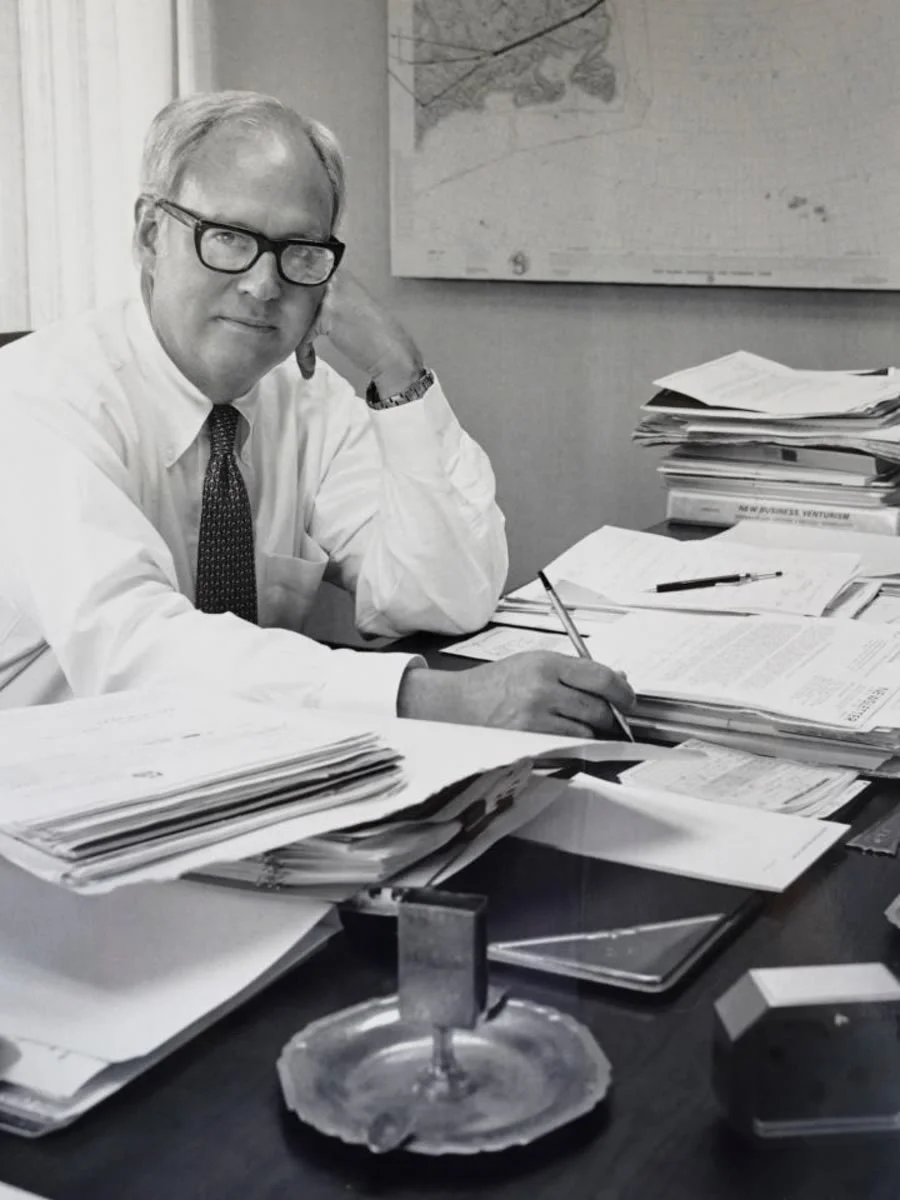
Reid Dennis
Invested personally in Ampex in 1952, joined the informal Group, then formed IVA and IVP.
1926–1952 — inherited access meets technical training
[retrospective witness · strong] Reid Weaver Dennis was born in San Francisco on 16 May 1926. His electrical-engineer father died when Dennis was seven. Dennis later described substantial support from his maternal grandfather, automobile executive Chester N. Weaver, and a family trust that helped pay for education. He attended the Thacher School and entered the Navy in 1944, where radio and electronics training reinforced an early technical orientation. Dennis oral history, printed pp. 1–11 · family obituary [researcher inference · moderate] Bereavement may have increased the importance of his grandfather, but the record does not support a psychological investment theory; inherited education, social access, and trust capital are the defensible formative advantages. Ampex access record
[retrospective witness · strong] Dennis entered Stanford after Navy service in autumn 1946 and earned a B.S. in electrical engineering in 1950 and an M.B.A. in 1952. Dennis oral history, printed pp. 10–11/PDF pp. 16–17 · Stanford Magazine, July 2024, PDF p. 59 [retrospective witness · provisional] His family later reported a coauthored MBA paper about startup-financing difficulty. [researcher inference · strong] No title, coauthor, body, or date surfaced, so it is evidence of a topic, not a recoverable doctrine. Blocked-record access ledger
1952–1955 — analyst apprenticeship and the Ampex fortune
[retrospective witness · moderate] Fireman's Fund hired Dennis in autumn 1952 as a security-analyst trainee under Fred Merrill. Dennis remembered being sent into the field with unusual autonomy and using engineering knowledge to interpret technical businesses that conventional securities analysts treated as a “black box.” Dennis oral history, printed pp. 13–18 · Weisel's later Fireman's Fund recollection, printed pp. 5–6 [researcher inference · strong] This was a finance apprenticeship, not operating-company experience. Analyst-apprenticeship source map
[retrospective witness · provisional] Just before starting, a friend of Dennis's brother referred Ampex. Dennis's account moves among $13,000 of trust assets, another $2,000 personally added, and a $15,000 investment; the oral-history preface instead says $20,000. His mother, as trustee, consulted an adviser before approving the transaction. Dennis recalled paper value of roughly $800,000–$900,000 after about three and a half years; the preface says more than $1 million over several years. Dennis oral history, preface and printed pp. 13–16 [researcher inference · insufficient public record] No security, ownership, dilution, sale, or tax record converts those memories into a realized multiple. Ampex decision lab
[researcher inference · moderate] Ampex matters less as a clean skill proof than as a causal mixture: technical fluency may have helped Dennis understand the company, while family trust capital, trustee consent, a warm referral, geographic timing, and what Dennis called fortune made the wager possible. [retrospective witness · provisional] Dennis's account assigns the investment to personal/family capital—not Fireman's Fund, The Group, IVA, or IVP—and says its remembered appreciation funded later personal experimentation; no transaction record allocates causal weights or verifies proceeds. Ampex decision lab · raw Something Ventured transcript 2, pp. 4–6
Circa 1955–1965 — The Group as a shared apprenticeship
[retrospective witness · provisional] Dennis dated The Group to roughly 1955–1965 and named five core members across his interviews: Dennis, William K. “Bill” Bowes, John Bryan, William “Bill” Edwards, and Daniel J. McGanney. Kenney and Florida call Bryan “William,” so the roster still needs a contemporary control. Members retained full-time jobs, brought locally referred entrepreneurs to lunch, screened collectively, pooled perhaps $80,000–$100,000 toward rounds Dennis remembered at roughly $250,000–$350,000, recruited repeat co-investors, and generally put one member on the board. Dennis oral history, printed pp. 22–28 · Inc., body ¶¶4–5 [researcher inference · strong] The mechanism was distributed personal capital and relationships, not a Dennis-owned fund. Group vehicle boundary
[researcher inference · strong] Measurex shows why “backed by Dennis” is inadequate. [retrospective witness · moderate] William Draper remembers sourcing Dave Bossen through a Chicago contact and helping assemble talent and financing; Bossen names Paul Wythes, Pete Bancroft/Bessemer, Reid Dennis, Peggy Dennis, and others. Peggy's remembered roughly 50-fold result belongs to her holding, not Reid or IVP. Measurex decision lab · Draper, printed pp. 49–50/PDF pp. 58–59 · Bossen, 02-00:01:26
[retrospective witness · provisional] Dennis later reported about twenty-five Group investments, approximately eighteen successes, two capital returns, and roughly three major losses. [researcher inference · strong] The arithmetic does not fully reconcile, the company roster is missing, and “success” has no ownership, cash-flow, time, or benchmark definition. The account supports a remembered preference for many viable companies; it does not prove a hit rate or return edge. Reported Group outcomes · Institutional Investor, body ¶4 · CHM video, 00:35:07–00:39:15
1960–1973 — corporate capital and a long board apprenticeship
[researcher inference · moderate] Fireman's Fund's 1960 Recognition Equipment investment was Dennis's institutional proof point. [retrospective witness · provisional] He remembered an initial corporate check around $600,000–$650,000, eventual exposure above $1 million, a partial sale after a roughly tenfold price rise that recouped reported cost, a later price reversal, nineteen years on the board, participation in replacing the chief executive, and about $15 million of corporate profit. [researcher inference · strong] Company and insurer ledgers are absent; the capital and result belong first to Fireman's Fund, while Dennis's research and board work are distinct contributions. Recognition decision lab · Dennis oral history, printed pp. 16–22
[retrospective witness · moderate] Dennis remembered an informal boundary with Merrill: personal opportunities below roughly $50,000 versus corporate investments commonly above $250,000, leaving a financing gap between. [researcher inference · moderate] The constraint helped make an independent pooled vehicle attractive, but it is a retrospective recollection rather than a recovered policy. Vehicle and economics boundary · Dennis oral history, printed pp. 21–22
[retrospective witness · moderate] American Express acquired Fireman's Fund in 1968. Dennis began planning to leave in 1972, then negotiated a transition. He said the corporations needed no SBIC because balance-sheet capital was available. Kenney and Florida call AMEXCO a venture subsidiary, not an SBIC. [researcher inference · insufficient public record] Charter or license files are still needed. Vehicle and economics boundary · Dennis oral history, printed pp. 28–39 · Kenney and Florida, printed p. 135
1973–1980 — IVA converts a network into an LP partnership
[retrospective witness · provisional] Dennis began planning Institutional Venture Associates in 1973 and remembered a spring 1974 close at $19 million. American Express's president offered a conditional $5 million anchor; six insurers and the Ford Foundation appear across the accounts. Dennis describes three senior principals—himself, Burt McMurtry, and Burgess Jamieson—with Jim Norris as a younger partner, while Jamieson calls all four founders. T. Bondurant French remembers 1975. [researcher inference · insufficient public record] Formation documents must settle the dates, LPs, titles, votes, fees, and carry. IVA vehicle evidence · Dennis oral history, printed pp. 35–48 · McMurtry oral history, printed pp. 29–33 · Jamieson oral history, printed pp. 37–39
[researcher inference · moderate] IVA is the vehicle-building inflection: Dennis's insurance-company credibility helped attract institutions, while partners supplied sourcing, judgment, and board capacity. Vehicle and responsibility record [retrospective witness · moderate] McMurtry's ROLM account makes distributed credit visible: he sourced it, disclosed a pre-existing stake and recused from the approval group, Dennis/Jamieson/Norris approved, and McMurtry boarded. ROLM decision lab · McMurtry, printed pp. 30–32/PDF pp. 40–42
[retrospective witness · provisional] Dennis reported that the first IVA basket grew from $19 million to roughly $180–$200 million and returned about 38%–40% annually. [researcher inference · strong] No calculation date, gross/net basis, capital-call series, valuation policy, distributions, fee, carry, or company schedule survives publicly; it is a retrieval claim, not an audited personal or fund result. Portfolio forensics · Dennis oral history, preface and printed pp. 40–50
1977–1981 — policy work through a coalition
[contemporaneous record · strong] An official 1977 staff summary places Dennis on a Senate panel with David Morgenthaler, Richard Hanschen, and Stewart Greenfield and attributes to him a bounded change to concentration language, a cost-basis denominator for the proposed leeway, and a permissive—not compulsory—rule. [researcher inference · strong] The source is staff paraphrase, not his full testimony. 1977 written-record analysis · JCT summary, printed p. 8/PDF p. 5 · Congressional Record panel notice, printed pp. 14000–14001
[contemporaneous record · strong] The official NVCA table places Dennis's chair term in 1978–1979, and his May 1979 prepared statement argued that young-company formation required people as well as capital and advocated employee equity as compensation for startup risk. [retrospective witness · moderate] Stanley Pratt later called Dennis prominent in Washington while also crediting Stanley Golder, Charlie Lea, Ned Heizer, and Pratt's own Labor Department work. 1979 written-record analysis · NVCA former-chair table · Dennis prepared statement, printed pp. 1056–1062 · Pratt, printed pp. 20–23/PDF pp. 25–28
[contemporaneous record · strong] ERISA was enacted in 1974; Dennis testified in 1977; the Revenue Act changed capital-gains treatment in 1978; Labor's final prudence rule took effect in 1979; and the next tax act arrived in 1981. Revenue Act of 1978 · 1979 final rule, 44 FR 37221–23 · Economic Recovery Tax Act of 1981 [researcher inference · strong] This chronology rejects the familiar single-year story and Dennis's later memory of a second reduction in 1980; the supported role is coalition participant and association leader, not sole author or demonstrated cause of institutional venture allocations. Policy chronology and attribution boundary
1980–1999 — IVP, partner judgment, and organizational discontinuity
[retrospective witness · moderate] IVA split in 1980. Dennis continued as Institutional Venture Partners; McMurtry formed Technology Venture Investors, and Jamieson's later lineage included Sigma. Witnesses variously cite partner renewal, economics/ownership, and poor communication; no one public account resolves the cause. Dennis remembered a first IVP fund of about $22 million, service as general partner through IVP XI, and an adviser role for IVP XII. IVA reportedly continued as a runoff entity until 1994. [researcher inference · strong] Firm name, management company, and investment vehicle therefore cannot be collapsed. Vehicle and economics boundary · Dennis oral history, printed pp. 47–48 · Marquardt, printed pp. 23–25
[researcher inference · strong] The case record exposes several kinds of Dennis contribution. Material-case responsibility matrix
- Seagate — [retrospective witness · moderate]: David Marquardt sourced and persisted; Oak/Glassmeyer co-invested; Dennis authorized IVP to proceed after initial reluctance. [researcher inference · strong] The one-$500,000-to-$63-million and two-$500,000/roughly-three-times-fund accounts conflict, so neither is audited Dennis economics. Seagate decision lab · Marquardt, printed pp. 28–30 · Glassmeyer, printed pp. 41–42/PDF pp. 46–47
- LSI Logic — [retrospective witness · moderate]: Sequoia brought Wilf Corrigan; Dennis accelerated the decision over a younger partner's reluctance and later admitted violating his consensus ideal. [researcher inference · insufficient public record] His vehicle memory and formal decision record remain unresolved. LSI decision lab · raw transcript 2, pp. 25–29
- Exabyte — [retrospective witness · moderate]: Dennis sourced the opportunity; all partners flew to Boulder and approved applying video-hardware experience to data storage. [researcher inference · insufficient public record] Initial customer evidence, ownership, and return remain missing. Exabyte decision lab · Dennis oral history, printed pp. 53–56/PDF pp. 59–62
- Collagen — [retrospective witness · moderate]: the burn-dressing thesis failed; a cosmetic use emerged; the company required repeated financing and produced what Dennis called a modest positive result. [researcher inference · strong] Emotion at a burn unit motivated attention but did not validate efficacy. Collagen decision lab · raw transcript 2, pp. 8–10
- Reference Technology — [retrospective witness · provisional]: Dennis remembered good people and technology, but a 14-inch optical-storage form factor arrived years before an adequate market. [researcher inference · moderate] The case is a timing/form-factor control, not evidence that technical merit ensures demand. Reference decision lab · Dennis oral history, printed pp. 52–53/PDF pp. 58–59
[contemporaneous record · strong] The 1999 creation of Redpoint by IVP partners and later issuer filings identify organizational changes, Tim Haley, Samuel Colella, and shared managing directors—not Dennis—as board representatives or controllers in specific holdings. Redpoint formation account · Netflix prospectus, principal stockholders · Thermage Form 3 [investor-stated · moderate] Dennis said intensifying competition required deeper technical specialization. [researcher inference · strong] Redpoint is therefore evidence of organizational discontinuity, not a Dennis deal. IVP role and succession record
1998–2024 — critique, competence boundaries, and legacy
[contemporaneous record · moderate] A 1998 report preserves Richard Leza's allegation that Dennis told him he did not resemble or speak like incumbent venture capitalists, Dennis's denial of memory and credential-heavy market explanation, and Leza's reported Stanford MBA, engineering degree, and startup experience. SFGate, body ¶¶1–14 [researcher inference · moderate] The credential answer is incomplete; this is a disputed allegation and response—not an admission, exoneration, or measured prevalence—but it is counterevidence to a frictionless relationship model. People-judgment evidence and limits
[investor-stated · strong] In January 2000 Dennis made an ex-ante distinction: Internet adoption could keep growing while public Internet-company prices lacked a rational relation to value, late or unnecessary companies failed, and the correction date remained unknowable. Almanac, body ¶¶4 and 11–19 [retrospective witness · provisional] He later admitted that he had not clearly recognized the bubble in practice and had held unnamed public positions to zero. Raw transcript 2, pp. 17–18 [researcher inference · moderate] The belief was prescient; the investment action and result are unproved or negative. Public-position postmortem
[retrospective witness · provisional] Dennis recalled passing Apple at a roughly $78 million post-money value because price relative to revenue lay outside his experience; no term sheet, date, allocation, or revenue control surfaced. Apple decision lab [investor-stated · moderate] In retirement he said younger partners understood Internet, software, and consumer markets better and that he should leave decisions to them. Raw transcript 2, pp. 39–42 [researcher inference · moderate] These admissions make competence boundaries part of the biography, not posthumous polish. People-judgment evidence and limits
[researcher inference · strong] Applied Medical reveals the collision between company duration and fund liquidity. [documented behavior · strong] A February 2013 filing retrospectively records IVP IV's 1988 investment, follow-on capital through 1990, and nonparticipation in the final 1992 venture round. [contemporaneous record · strong] The 2012 registration filing documents IVP's exercise of demand-registration rights and the company's opposition; the 2013 withdrawal says the registration never became effective and no securities were sold through it. February 2013 S-1/A, prospectus pp. 45–46 · October 2012 S-1/A · withdrawal [retrospective witness · moderate] Dennis said he personally preferred retaining shares while the fund owed liquidity to LPs. [contemporaneous record · strong] A later appellate opinion preserved disputed proceeds-sharing allegations, affirmed that fraud claims were time-barred, and revived contract/conversion claims without deciding their merits against Dennis. Applied decision lab · appellate opinion
[contemporaneous record · strong] Dennis died on 14 March 2024 at age ninety-seven. Celebration-of-life notice · Stanford Magazine, July 2024, PDF p. 59 [researcher inference · strong] His aviation, opera, charitable, and family activities are biographically material but do not validate investment claims. Profile evidence standard
A testable account of the edge
| dimension | evidence-backed answer |
|---|---|
| Investor | [researcher inference · strong] Reid Weaver Dennis, an electrical engineer and security analyst who invested through personal/family capital, an informal syndicate, Fireman's Fund/American Express corporate capital, Institutional Venture Associates (IVA), and successive Institutional Venture Partners (IVP) funds. Dennis vehicle chronology · Dennis oral history, printed pp. 13–62 |
| Era and domain | [researcher inference · moderate] Most plausibly 1952 through the late 1990s in early electronics, computing, data storage, process control, and biomedical companies, first around Stanford and the San Francisco Peninsula and later through institutionally funded partnerships. Selected-company record and sector boundary |
| Proposed edge | [researcher inference · moderate] Dennis could translate technical claims into business and customer questions, obtain information and syndicate capital through dense relationships, and stay close enough to update plans and management. He scaled those practices by moving from personal checks to corporate and LP-backed vehicles. Dennis oral history, printed pp. 13–28 and 50–60 · Marquardt oral history, printed pp. 23–30 |
| Causal boundary | [researcher inference · moderate] The public record supports an operating mechanism, not personal alpha. Inheritance, employer autonomy, early-sector timing, entrepreneurs, partners, co-investors, corporate and LP capital, and luck are rival or complementary causes. The Ampex record is explicitly a fortune-and-access story; ROLM and Seagate are partner-led; Exabyte is a Dennis source followed by partnership diligence. |
| Performance verdict | [researcher inference · provisional] No complete career denominator or cash-flow ledger exists. Reported Group and IVA results are unaudited; UC's net-to-one-LP observations for IVP III–VIII show pronounced dispersion. The edge is therefore plausible in process and unproved in risk-adjusted return. Portfolio-level forensics |
Predictions
[researcher inference · moderate] If the thesis is true, unrecovered files should repeatedly show Dennis asking engineers about current customer use, pairing technical and financial judgment, sourcing through attributable referrals, preferring experienced compact teams, revising the plan after board evidence, and matching check size and duration to a named vehicle. It should recur beyond Ampex and Recognition in ordinary cases, and Dennis-led cases should outperform comparable passive, partner-led, or merely network-accessed cases after price, ownership, follow-ons, and era are controlled. Spoken-record operating claims · searched denominator · Berkeley oral history, printed pp. 13–28 and 50–60
Falsifiers
[researcher inference · moderate] The thesis weakens or fails if contemporaneous ledgers show that referrals and privileged capital explain the opportunity set without differentiated selection; Dennis's technical questions were generic or non-causal; active board work did not improve matched outcomes; partner-led cases account for the remembered successes; false positives and passes offset the wins; or full cash flows show ordinary economics once dominant vintages or companies are removed. Existing counterevidence already matters: Collagen's first use failed, Reference was too early, Dennis passed Apple, held unnamed public positions to zero, admitted that people were his largest errors, and Marquardt regarded Dennis's intuitive judgment as difficult to transfer. Failure postmortems · material-case responsibility matrix · portfolio forensics · Marquardt, printed pp. 23–30
Vehicle and incentive chronology
| era / unit | capital and authority supported by the record | strategic fit | unresolved incentive or attribution boundary |
|---|---|---|---|
| 1952 onward: personal/family | [retrospective witness · provisional] Trust-backed and personal money; trustee approval is remembered at Ampex. Ampex decision lab | [researcher inference · moderate] Small checks and long personal discretion, subject to trustee authority. Ampex decision lab | [researcher inference · insufficient public record] Trust ownership, security, sale, taxes, and realized proceeds. Ampex decision lab |
| c.1955–1965: The Group | [retrospective witness · moderate] Members invested deal by deal and invited friends; one member generally boarded. Reported Group outcomes | [researcher inference · moderate] Pooled relationships and checks without evidence of a permanent fund. Group vehicle evidence | [researcher inference · insufficient public record] Legal form, member ledger, allocations, carry, reserves, and full outcomes. Reported Group outcomes |
| 1960–1973: Fireman's/American Express | [retrospective witness · moderate] Corporate balance sheet and internal approval; the personal/corporate size boundary is remembered. Recognition decision lab | [researcher inference · moderate] Larger checks and a long board apprenticeship. Recognition decision lab | [researcher inference · insufficient public record] Committee votes, compensation, corporate ownership, AMEXCO charter, and exact economics. Fireman's/AMEXCO vehicle evidence |
| 1974–1980: IVA | [retrospective witness · provisional] Reported $19 million partnership with insurer/Foundation LPs and a formation team under disputed role labels. Vehicle evidence | [researcher inference · moderate] Permanent professional attention, institutional scale, and follow-on capacity. IVA vehicle evidence | [researcher inference · insufficient public record] Agreement, calls, fee/carry, LP list, voting, audited cash flows, and split cause. IVA retrieval ledger |
| 1980 onward: IVP funds/management entities | [retrospective witness · moderate] Successive LP funds and Dennis's claimed GP tenure through XI; [contemporaneous record · strong] later filings and the UC table show distributed partner/fund roles. Responsibility matrix · IVP III–VIII record | [researcher inference · moderate] Greater scale, sector specialization, and succession. Responsibility matrix | [researcher inference · insufficient public record] Fund-by-fund roles, economics, reserves, board capacity, IVP I–II performance, and entity lineage. IVP retrieval ledger |
| Long-held distributions / personal securities | [retrospective witness · moderate] Dennis separately remembered a Microsoft personal sale, public positions held to zero, and a personal Applied holding preference. Applied and public-position postmortems | [researcher inference · provisional] Personal liquidity or conviction can diverge from a fund exit. Applied decision lab | [researcher inference · insufficient public record] Source vehicle, distribution basis, tax, sale authority, and counterfactual fund result. Applied and public-position postmortems |
[researcher inference · strong] Vehicle was not administrative background; it determined whose money was at risk, who could approve a check, how long capital could wait, and when liquidity became compulsory. Yet public records do not establish Dennis's fee, carry, wealth share, or a universal ownership/reserve rule. Vehicle and attribution boundary · Applied liquidity postmortem
People, capital, and influence map
| layer | named actors | supported contribution and boundary |
|---|---|---|
| Family and early access | Chester N. Weaver; Dennis's mother and her adviser; Peggy Dennis; unnamed Ampex intermediary | [researcher inference · moderate] Education, trust authority, capital, referral, and separate family holdings are enabling access, not Dennis selection skill. Ampex decision lab |
| Analyst apprenticeship | Fred Merrill; Fireman's Fund colleagues; Thom Weisel | [retrospective witness · moderate] Merrill supplied autonomy and employer authority; Fireman's owned corporate securities; Weisel confirms a department context but no deal. Dennis and Weisel accounts |
| The Group / syndication | Bill Bowes, John Bryan, Bill Edwards, Dan McGanney; Bill Draper, Paul Wythes, Pete Bancroft, Dave Bossen | [retrospective witness · moderate] Member sourcing/boards and external financing were distributed; Peggy's remembered Measurex ownership remains separate. Measurex responsibility record |
| IVA formation and policy | Burt McMurtry, Burgess Jamieson, Jim Norris, William Morton, insurer LPs, Ford Foundation; Morgenthaler, Golder, Lea, Heizer, Pratt | [researcher inference · moderate] Partners and LPs built the vehicle, while documented and remembered coalition work supplied policy advocacy; Dennis's prominence does not erase other actors. IVA vehicle record · policy attribution record |
| IVP deals and succession | David Marquardt, Samuel Colella, Tim Haley, Ruthann Quindlen, Dennis Phelps, Sandy Miller and later managing directors | [researcher inference · moderate] Witness accounts and issuer filings assign sourcing, sponsorship, boards, shared GP control, and later-fund management to different people; firm ownership is not Dennis action. Material-case responsibility matrix |
| Entrepreneurs and co-investors | Alexander Poniatoff/Ampex team; Bossen; ROLM founders; Al Shugart and Finis Conner; Wilf Corrigan; Exabyte and Collagen teams; Oak, Sequoia, Kleiner Perkins | [researcher inference · strong] Case records assign company building to entrepreneurs and material sourcing, pricing, finance, and governance to co-investors; investor capital is not company authorship. Material-case responsibility matrix |
| Critical witnesses | Richard Leza; David Marquardt; Applied Medical and litigants | [researcher inference · moderate] The access allegation, transferability/communication testimony, and documented liquidity dispute test the favorable narrative; allegations and court opinions retain their stated legal status. Leza and witness controls · Applied decision lab |
Skill, access, team, vehicle, era, luck, and outlier audit
- Skill — [researcher inference · moderate]: engineering-to-finance translation, customer questioning, board learning, and institutional fundraising recur. No matched sample isolates their causal value. Direct spoken synthesis
- Access — [researcher inference · moderate]: inherited education/trust capital, Stanford geography, insurer authority, warm referrals, and institutional credibility opened doors that process alone did not create. Ampex and access record · sourcing boundary
- Team — [documented behavior · strong]: Group members, IVA/IVP partners, operators, co-investors, and policy peers supplied material work. Material-case responsibility matrix · policy attribution record [researcher inference · moderate] The strongest cases weaken rather than support lone-genius attribution. Material-case responsibility matrix
- Vehicle — [researcher inference · moderate]: successive capital forms expanded check size and attention, but introduced trustee/employer authority, committee, LP, fund-life, and succession constraints. Vehicle and economics boundaries
- Era — [researcher inference · moderate]: low early startup costs, limited competition, defense/electronics demand, maturing public markets, and later policy changes may explain part of the opportunity set. Historical conditions
- Luck — [investor-stated · strong]: Dennis explicitly credited fortune at Ampex and conceded that judgment has no simple answer. Luck is not residual noise to be removed from the story. Raw transcript 2, pp. 4–7 and 27
- Outliers — [researcher inference · strong]: Seagate's conflicting economics and IVP VI/VII's fund-level dominance make ex-outlier analysis mandatory; they do not prove a Dennis-specific power law. UC IVP III–VIII table
Failure, change, and unresolved learning
[researcher inference · moderate] Dennis supplied unusually useful admissions, but rarely a documented before/after process change. Reference shows technical truth without market timing; Collagen shows a failed indication followed by a pivot; Apple shows a price-based pass and competence boundary; unnamed public holdings show an adoption thesis without an executed sell discipline; Recognition shows management intervention and partial de-risking; Applied shows a fund-duration conflict; and The Group contains an unnamed loss cohort. Detailed case-specific postmortems
[retrospective witness · moderate] One remembered “frame of reference” rule deserves rejection, not modernization: Dennis repeated an acquaintance's rule against substantially overweight chief executives. Raw transcript 2, p. 28, clip 43 [researcher inference · strong] Body size is a stigmatizing and unsupported proxy for discipline. It is counterevidence to the idea that experience automatically produces valid people judgment; use job-relevant evidence and audit false negatives instead. People-judgment model
[researcher inference · strong] The strongest missing evidence is operational: Ampex subscription/sale records; The Group's company/member ledger; Fireman's/American Express committee and Recognition files; IVA's agreement and cash flows; IVP I–II and complete Dennis-era LP schedules; and decision records for losses, passes, board interventions, and partner attribution. [researcher inference · provisional] Until those surface, the favorable edge remains a mechanism with partial case support, while personal risk-adjusted greatness remains unproved. Ranked retrieval ledger
Sourced chronology
| date | event | evidence boundary |
|---|---|---|
| 1926-05-16 | Born in San Francisco. | [retrospective witness · strong] Oral history and obituary agree. Dennis oral history, printed p. 1 · family obituary |
| 1944–1946 | Navy radio/electronics training and service. | [retrospective witness · moderate] Dennis supplies the assignments and dates. Dennis oral history, printed pp. 7–11 |
| 1946–1952 | Stanford BSEE and MBA. | [retrospective witness · strong] Dennis and Stanford's memorial record agree on the degrees. Dennis oral history, printed pp. 10–13 · Stanford Magazine, July 2024, p. 59 |
| 1952 | Fireman's Fund analyst role; personal/family Ampex investment. | [retrospective witness · provisional] The employer and check story are retrospective; amount and result conflict. Ampex decision lab |
| c.1955–1965 | The Group's informal syndication period. | [retrospective witness · provisional] The mechanism recurs across late accounts, while roster spelling and the deal denominator remain unresolved. Reported Group outcomes |
| 1960 | Fireman's Fund invests in Recognition Equipment. | [retrospective witness · moderate] Dennis assigns the capital to Fireman's; figures and board chronology remain unaudited. Recognition decision lab |
| 1968–1973 | American Express ownership and transition toward independence. | [retrospective witness · moderate] Dennis describes the transition; AMEXCO legal identity remains unresolved. Dennis oral history, printed pp. 28–39 |
| 1973–1974 | IVA planned and reported $19 million close. | [retrospective witness · provisional] Witness accounts disagree on year and founder roles. Vehicle evidence |
| 1977 | Senate pension-investment testimony. | [contemporaneous record · strong] An official staff summary preserves a bounded position, not Dennis's full text. JCT summary, printed p. 8/PDF p. 5 |
| 1978–1979 | NVCA chair term; 1978 statute and 1979 regulation. | [contemporaneous record · strong] Official chronology controls later compressed memories. Policy chronology and source boundary |
| 1980 | IVA operating split; IVP continuation. | [retrospective witness · moderate] Witnesses agree on discontinuity but contest causes and leave management-entity lineage incomplete. Marquardt, printed pp. 23–25 |
| 1980s–1990s | IVP deal and fund activity; Dennis reports GP role through IVP XI. | [researcher inference · moderate] Oral histories, issuer filings, and one-LP fund data require case-by-case separation of company, fund, and person. Material-case responsibility matrix · IVP III–VIII record |
| 1999 | Redpoint formation amid specialization and succession. | [contemporaneous record · moderate] The formation account supports organizational discontinuity, not a Dennis investment. Redpoint formation |
| 2000 | Ex-ante Internet adoption/value warning. | [contemporaneous record · strong] The view is documented; a corresponding trading action is not. Almanac, body ¶¶11–19 |
| 2008–2011 | Major oral histories and documentary interviews. | [contemporaneous record · strong] The artifacts preserve rich direct voice, but their claims are retrospective and partially overlapping. Spoken-record inventory |
| 2012–2017 | Applied demand-registration and later litigation record. | [contemporaneous record · strong] Registration was withdrawn; allegations and procedural holdings are not merits findings. Applied decision lab |
| 2024-03-14 | Dennis dies at age ninety-seven. | [contemporaneous record · strong] The celebration notice and Stanford memorial record agree. Celebration-of-life notice · Stanford Magazine, July 2024, p. 59 |
Read the package as a decision curriculum
Start with the investment philosophy for the integrated doctrine and falsifiers, use mental models for decision procedures, and audit each remembered example in investments. The spoken corpus distinguishes Dennis's direct remarks from witness recollection; the written corpus separates contemporaneous policy and valuation views from later interviews; the source map preserves access barriers and retrieval priorities. [researcher inference · strong] The central reading discipline is constant: identify the person, vehicle, information available ex ante, action, outcome, denominator, and source family before drawing a lesson. Profile evidence standard
1. Snapshot and testable edge thesis
| dimension | evidence-backed answer |
|---|---|
| Core orientation | [researcher inference · moderate] Translate technical possibility into a customer and company judgment; back people capable of learning; remain close enough to update the plan; and treat capital as one input rather than the creator of the enterprise. Dennis oral history, printed pp. 13–28 and 50–60 · raw Something Ventured transcript 2, pp. 6–10 |
| Proposed edge | [researcher inference · moderate] In early electronics, computing, process-control, storage, and biomedical venture, Dennis combined engineering-to-finance translation, a referral/syndication network, active board learning, and successive vehicles able to scale those practices. Profile thesis |
| What is personal | [researcher inference · moderate] Technical-financial fluency, some sourcing, judgment, long board work, fundraising relationships, and selected decision interventions. Material-case responsibility matrix · direct spoken attribution |
| What is not personal | [researcher inference · strong] Family trust capital and luck; entrepreneurs' company creation; partner sourcing/boards and co-investor work; employer or LP ownership; and favorable geography, era, and policy are separate causes or owners. Ampex access/luck record · people and role attribution · vehicle ownership boundary · historical conditions |
| Performance status | [researcher inference · provisional] Process evidence is substantial; risk-adjusted personal performance is unproved. The full denominator, ownership, cash flows, fees, carry, and matched comparison do not exist publicly. Portfolio forensics |
Predictions
[researcher inference · moderate] If the edge thesis is true, unseen investment memoranda and board files should show recurring technical-to-customer questions, attributable referrals, explicit job-relevant people tests, plan revisions after new evidence, and vehicle/capacity checks before commitments. Those patterns should appear in ordinary Dennis-led cases, not only Ampex, Recognition, or Seagate, and should predict better outcomes after price, ownership, sector, vintage, partner work, and access are controlled. Full prediction and falsifier statement · searched denominator
Falsifiers
[researcher inference · moderate] The thesis fails or narrows if complete files show that access selected the opportunity set, partners supplied the decisive judgment, Dennis's technical screening did not distinguish wins from false positives, board intervention did not change matched outcomes, or ex-outlier cash flows were ordinary. Reference, Apple, public securities held to zero, Collagen's failed first use, person-selection errors, fund dispersion, and Marquardt's transferability critique are already disconfirming observations—not footnotes to be explained away. Failure postmortems · role attribution · portfolio forensics · Marquardt, printed pp. 23–30
2. Core philosophy
What Dennis actually said
- Entrepreneurs own creation. [investor-stated · strong] Dennis explicitly said venture investors do not create companies; entrepreneurs do. Investor finance, imagination, support, and influence are participating inputs. Raw transcript 2, pp. 6–7
- Capital is necessary but insufficient. [investor-stated · strong] His 1979 prepared statement treats qualified managers and key employees as a second scarce input and employee equity as compensation for startup cash and security risk. Prepared statement, printed pp. 1060–1062
- People judgment dominates, but has no formula. [investor-stated · moderate] Dennis preferred relevant experience, trust, vision, and small teams, while crediting luck and later calling people mistakes his largest errors. Raw transcript 2, pp. 26–29 · CHM video, 01:06:29–01:10:44
- Plans change. [investor-stated · moderate] Financing begins with a hypothesis; boards learn how the team behaves, recruit or support where possible, and may replace leadership when repeated evidence requires it. Raw transcript 2, pp. 7–10 and 27–28
- Technology, company necessity, price, and timing are separate. [investor-stated · strong] His January 2000 warning expected continued Internet adoption while rejecting prevailing prices and refusing to predict the correction date. Almanac, body ¶¶4 and 11–19
- Company building is not transaction completion. [investor-stated · moderate] Dennis contrasted operating consequences with investment-banking transactions and admired long-lived company building, but acknowledged that LP liquidity can force action. Raw transcript 2, pp. 29–32
Synthesis
[researcher inference · moderate] The integrated sequence is: use technical literacy and networks to find a live problem; test whether a differentiated company and role-relevant team can solve it at the offered price; name the person and vehicle making the decision; finance within the fund's capacity and duration; treat the plan as revisable; help without claiming the entrepreneur's work; and keep company viability, investor liquidity, and realized fund economics separate. This is a reconstruction across decades, not a recovered Dennis playbook. The detailed procedures and counterexamples live in mental models.
3. Sourcing
Referral translation
[retrospective witness · moderate] Ampex came through a friend of Dennis's brother, and brokers and engineers later routed technical founders to him because he could interpret technical claims for a financial audience. Dennis oral history, printed pp. 13–18 [researcher inference · moderate] The repeatable mechanism is not “warm intros win”; trusted nodes reduce search cost and route specialized claims to someone able to interrogate them, while family access and employer reputation remain confounders. Network model and exceptions
Syndication and sponsor ownership
[retrospective witness · moderate] The Group turned member-sourced leads into lunches, pooled checks, follow-on calls, and one member's board responsibility. Inc., ¶¶4–5 [researcher inference · strong] Measurex shows that source, capital, and outcome were distributed among Draper, Wythes, Bancroft/Bessemer, Bossen, Reid, Peggy, and others; ROLM makes a different sponsor boundary legible because McMurtry sourced, disclosed and recused, others approved, and McMurtry boarded. Measurex decision lab · ROLM decision lab · McMurtry, printed pp. 30–32
Geographic proximity as operating capacity
[investor-stated · moderate] Dennis said closeness helped investors stay in contact and spot problems. [contemporaneous record · moderate] Exabyte was in Boulder, and a 1983 report describes investments outside the Valley. Christian Science Monitor, body ¶¶7–9 [researcher inference · moderate] Travel time is a board-capacity cost, not a universal radius rule; use it only when the work actually requires frequent presence and remote substitutes are inadequate. Direct spoken synthesis
Funnel boundary
[retrospective witness · provisional] Dennis later claimed IVP funded roughly 1.5%–2.5% of opportunities, but intake unit, years, stages, duplicates, and definition are absent; The Group's twenty-five-company denominator is likewise incomplete. CHM video, 01:15:31–01:17:05 · reported Group outcomes [researcher inference · moderate] The Leza account exposes a second risk: familiar networks can improve trust while narrowing who reaches the funnel. A modern reconstruction must record source, sponsor, rejection reason, identity-independent job evidence, and false negatives; no cold-inbound or complete pass ledger survives here. Network model and funnel audit · SFGate, ¶¶3–14
4. Picking
Technology must reach a present customer at investable economics
[researcher inference · moderate] Dennis's defensible screening advantage begins with technical understanding but ends in a commercial/security judgment. [retrospective witness · moderate] Exabyte reused video hardware in data storage; Reference's 14-inch optical system was technically plausible but too early and cumbersome; Collagen's burn indication failed before a different use emerged; Apple was passed because the remembered price/revenue relationship lay outside Dennis's experience. Technology-to-economics model · Exabyte and Reference, printed pp. 52–56 · Apple, raw transcript 2, pp. 39–40
[researcher inference · moderate] The practical gate asks four different questions: does the technology work; is there a current, paid and sufficiently large customer problem; is the company differentiated from later or unnecessary entrants; and do valuation, preferences, ownership, dilution, and time permit an investor return? A “yes” at one level cannot substitute for another. Technology-to-economics model · Almanac, body ¶¶11–19
People are tested by role-relevant evidence, not resemblance
[investor-stated · moderate] Dennis preferred entrepreneurs with relevant company experience, advised aspiring investors to gain operating experience, called people his largest errors, acknowledged Google-like exceptions, and repeated an acquaintance's anti-overweight-CEO rule. Raw transcript 2, pp. 26–32 and 37–38 [researcher inference · moderate] Seagate's team, Wilf Corrigan at LSI, and Exabyte's application shift fit the preference, but the body-size heuristic is rejected as stigmatizing and unsupported; Leza's allegation and Dennis's response further show how familiarity and credentials can become closed-network proxies. People-judgment evidence and limits · SFGate, ¶¶1–14
[researcher inference · moderate] The transferable test is falsifiable: name the job to be done; identify evidence of learning, execution, integrity, and complementary teamwork; pre-register what reference or work-sample evidence would change the judgment; and audit comparable candidates who were never referred. [investor-stated · moderate] Dennis's retirement admission supplies the reciprocal rule for investors—hand off when the market exceeds the team's competence. Role-relevant competence model · raw transcript 2, pp. 41–42
Red flags and kill criteria
- [researcher inference · moderate] A technology thesis without current use, form-factor fit, or willingness to pay: Reference. Reference decision lab
- [researcher inference · moderate] A fashionable category without necessity or differentiation: Dennis's 2000 late/unnecessary Internet-company warning. Almanac, body ¶¶11–19
- [researcher inference · moderate] A good company at a security price outside a defined return case: Apple, while preserving that the pass may still be wrong. Apple decision lab
- [researcher inference · strong] Person confidence based on familiarity, appearance, or prestige rather than role evidence: the body-size rule and access dispute. People-judgment evidence and limits
- [researcher inference · moderate] A team or market beyond the partnership's current knowledge: Dennis's succession admission. Raw transcript 2, pp. 41–42
- [researcher inference · strong] A process that cannot name source, voter, objector, vehicle, board actor, and cash-flow outcome: much of the surviving selected-company record. Material-case responsibility matrix · searched denominator
5. Deal and portfolio mechanics
| mechanic | what the record supports | boundary / missing rule |
|---|---|---|
| Check size | [researcher inference · moderate] Personal/trust Ampex around $15,000 in the body account; Group pools around $80,000–$100,000; corporate checks generally above $250,000; later Applied follow-ons in millions. Check-size analysis | [researcher inference · insufficient public record] Eras, dollars, stages, and vehicles differ; no median or universal range. Check-size analysis |
| Ownership | [researcher inference · moderate] A few case points: LSI syndicate about 50% in a founder recollection; Seagate co-investor allocation; Dennis-linked Collagen/Cohesion beneficial ownership around 8% in dated filings. Ownership analysis | [researcher inference · insufficient public record] No universal target, cost basis, dilution, or Dennis beneficial share. Ownership analysis |
| Security / terms | [researcher inference · strong] Public evidence shows equity, observer/board rights, beneficial ownership, demand registration, and co-investment. Security and terms evidence | [researcher inference · insufficient public record] No standard term sheet, preference, anti-dilution, pro rata, option pool, or control doctrine. Security and terms evidence |
| Staging / reserves | [researcher inference · moderate] Recognition exposure grew; Collagen was repeatedly financed; Applied received follow-ons through 1990 but not the last 1992 round. Reserve analysis | [researcher inference · insufficient public record] No reserve ratio, milestone template, loss budget, or full escalation ledger. [retrospective witness · moderate] Perkins—not Dennis—stated the remembered staged-risk maxim. Dennis introduction, PDF p. 23 |
| Governance | [researcher inference · moderate] Long board tenure/CEO replacement, sponsor recusal, observer status, all-partner field diligence, repeated financing, and contractual liquidity rights appear in different cases. Governance evidence | [researcher inference · insufficient public record] “Founder friendly” and “control investor” each erase material variation; minutes and formal votes are missing. Governance evidence |
| Exit / liquidity | [researcher inference · moderate] Partial sale to recover cost, IPO/distribution, acquisition, personal sale, positions held to zero, and a withdrawn registration all appear. Exit analysis | [researcher inference · strong] IPO or filing is not realized return; [researcher inference · insufficient public record] no standard sell rule, distribution policy, or full DPI survives. Exit analysis |
Portfolio objective and denominator
[investor-stated · moderate] Dennis disliked designing around only one or two wins in ten and remembered a higher viable-company frequency. Inc., ¶¶13–14 [researcher inference · strong] That is an objective, not performance proof, and The Group's count is unaudited. Reported Group outcomes [contemporaneous record · strong] UC's IVP III–VIII observations range from 1.07x/1.5% to 6.80x/93.6% net to one LP. UC report, IVP III–VIII [researcher inference · strong] The rows show vintage dispersion, but combining their paid-in and distributions is not a valid aggregate TVPI or IRR because each has its own timing. Fund table and arithmetic boundary
[researcher inference · strong] Report company-count survival, capital-weighted returns, ownership, reserves, gross/net cash flows, DPI/TVPI/IRR, and ex-top-one/top-vintage views separately. The record supports no 80/20 company computation because only 10 funded cases were reconstructed and the career denominator and cash flows remain absent. Viability/economics model · coverage denominator
6. Vehicle and incentive fit
| capital unit | authority and purpose | useful fit | incentive / evidence failure |
|---|---|---|---|
| Personal/family | [retrospective witness · provisional] Dennis and family/trust authority, small checks, and personal liquidity choices appear in the Ampex account. Ampex decision lab | [researcher inference · moderate] Long discretion and early experiments, subject to trustee authority. Ampex decision lab | [researcher inference · insufficient public record] Ownership/sale data are absent; personal result cannot become fund result. Ampex decision lab |
| The Group | [retrospective witness · moderate] Deal-by-deal personal commitments, collective screening, and a sponsor board recur in late accounts. Reported Group outcomes | [researcher inference · moderate] Extends check size, knowledge, and relationships. Group vehicle evidence | [researcher inference · insufficient public record] No permanent reserve pool, legal agreement, decision rule, or member economics. Reported Group outcomes |
| Fireman's/American Express | [retrospective witness · moderate] Corporate capital and a committee boundary are remembered at Recognition. Recognition decision lab | [researcher inference · moderate] Larger rounds and a long governance apprenticeship. Recognition decision lab | [researcher inference · insufficient public record] Employer owns the result; committee rights, bonus/equity, AMEXCO status, and conflict policy are missing. Fireman's/AMEXCO vehicle evidence |
| IVA | [retrospective witness · provisional] A reported $19 million LP partnership was anchored by institutions under disputed formation details. Vehicle evidence | [researcher inference · moderate] Dedicated team, follow-ons, and institutional credibility. IVA vehicle evidence | [researcher inference · insufficient public record] Agreement, fee/carry, calls, LP list, votes, audited results, and split cause are missing. IVA vehicle evidence |
| IVP funds/entities | [retrospective witness · moderate] Dennis described successive funds; [contemporaneous record · strong] issuer filings and one-LP data show distributed partner/fund authority. Responsibility matrix · IVP III–VIII observations | [researcher inference · moderate] Greater scale, specialist partners, and succession. Responsibility matrix | [researcher inference · insufficient public record] Fund/manager names, fund-by-fund Dennis role, board capacity, reserves, and IVP I–II performance are incomplete. IVP retrieval ledger |
| Distributed or personally held securities | [retrospective witness · moderate] A fund distribution, personal holding, and fund-owned stake diverge in Dennis's Microsoft and Applied accounts. Applied and personal-liquidity postmortems | [researcher inference · provisional] Distinct family liquidity or continued conviction may follow. Applied decision lab | [researcher inference · insufficient public record] Basis, taxes, authority, and counterfactual value differ. Applied and personal-liquidity postmortems |
[researcher inference · moderate] Vehicle design changes the feasible strategy: source of money, legal authority, check size, reserve capacity, partner time, holding horizon, liquidity obligation, and who receives the economics. It does not prove patience or skill. Applied demonstrates that a strong company can outlive a fund's expected clock; the IVA split and Redpoint formation show that organizational continuity cannot be inferred from a brand. Applied liquidity postmortem · Redpoint formation
[researcher inference · insufficient public record] No public evidence establishes Dennis's fee, carry, clawback, personal co-investment allocation, universal reserve policy, or succession economics. [researcher inference · moderate] A modern reader should compare an opportunity with the actual partnership agreement, mandate, side letters, decision rights, key-person provisions, reserve model, and liquidity alternatives—not with the generic label “venture fund.” Vehicle gaps and retrieval boundary
7. Team attribution and work with founders
[investor-stated · strong] Venture was collective in Dennis's own framing: entrepreneurs create companies, while investors finance, question, support, recruit, govern, and sometimes replace. Raw transcript 2, pp. 6–10 [researcher inference · moderate] The analytical unit is therefore a role ledger, not a hero label. Material-case responsibility matrix
| case / function | supported roles | unresolved boundary |
|---|---|---|
| Ampex | [retrospective witness · provisional] Referral, Dennis technical/financial judgment, family/trust capital, trustee approval, and company work remain distinct. Ampex decision lab | [researcher inference · insufficient public record] Security, ownership, dilution, sale, and causal effect of Dennis's work. Ampex decision lab |
| Measurex | [retrospective witness · moderate] Draper source/network, Wythes fundraising, Bossen operating work, Bancroft/Bessemer capital, and Reid/Peggy positions remain distinct. Measurex decision lab | [researcher inference · insufficient public record] Full cap table, board work, each holding, and proceeds. Measurex decision lab |
| ROLM | [retrospective witness · moderate] McMurtry sourced, disclosed, recused, and boarded; Dennis, Jamieson, and Norris approved. ROLM decision lab | [researcher inference · insufficient public record] Formal vote, legal vehicle, economics, follow-ons, and exit. ROLM decision lab |
| Seagate | [retrospective witness · moderate] Marquardt sourced, persisted, and boarded; Oak/Glassmeyer co-invested; Dennis authorized and later attended; founders built. Seagate decision lab | [researcher inference · insufficient public record] Conflicting cash-flow accounts, exact board role, dilution, and distribution. Seagate decision lab |
| LSI Logic | [retrospective witness · moderate] Sequoia sourced; Corrigan supplied team/vision; several firms funded; Dennis accelerated the decision over another partner's objection. LSI decision lab | [researcher inference · insufficient public record] Legal vehicle, allocation deadline, votes, observer rights, and realized result. LSI decision lab |
| Exabyte | [retrospective witness · moderate] Dennis sourced; all partners performed Boulder diligence and approved; the company team executed the reuse. Exabyte decision lab | [researcher inference · insufficient public record] Customer memo, ownership, board actions, and audited outcome. Exabyte decision lab |
| Collagen | [researcher inference · moderate] Oral histories and filings assign different roles to scientists/operators, IVA/IVP/Kleiner Perkins, Perkins, Dennis, regulators, and the later use. Collagen decision lab | [researcher inference · insufficient public record] Pivot author, financing votes, clinical evidence, and return. Collagen decision lab |
| Applied | [researcher inference · moderate] Filings and Dennis's account separate Thomas's board role, shared IVM/IVP authority, Dennis's personal preference, and opposed company/fund liquidity interests. Applied decision lab | [researcher inference · insufficient public record] Original source, agreement, final sale, and litigation merits. Applied decision lab |
Conflicts, dissent, and intervention
[researcher inference · moderate] ROLM's disclosed pre-existing position and recusal is the clearest conflict-control story; LSI is the clearest exception because Dennis admits overriding the spirit of his consensus norm when he expected the allocation to vanish, and the good outcome cannot validate the governance breach ex post. Recognition and an unnamed rescue show remembered CEO replacement after accumulated evidence; Applied shows documented rights used against company preference. ROLM decision lab · LSI decision lab · Recognition and Applied postmortems
[researcher inference · moderate] The transferable process stores pre-discussion views, the sponsor and objector, conflict and recusal, legal decision right, action, board owner, later intervention, and cash-flow result. This makes learning possible without stealing credit from founders or laundering a lucky override into policy. Roles and decision-rights model
8. Views on the craft
Capital and people are complements
[investor-stated · strong] Dennis described entrepreneurs as the motive force and capital as fuel or lubricant, while his 1979 statement made management supply a binding growth constraint. Prepared statement, p. 1061 · Stanford ETL/CHM talk synthesis [researcher inference · moderate] The investor's job is therefore to identify the scarce complement—people, technical truth, customer access, governance, or time—not automatically enlarge the round. Capital-plus-complements model
Company building precedes transactions, but investors still have clocks
[investor-stated · moderate] Dennis criticized a finance-first, transaction-oriented craft, admired Arthur Rock's quiet committee work at Intel as company building, favored building to last, and described IPOs and distributions as financing or liquidity events rather than company endpoints. Raw transcript 2, pp. 29–31 [contemporaneous record · strong] Applied documents that a fund can seek liquidity while an operating company prefers continued privacy. Applied registration record [researcher inference · moderate] The doctrine is conditional patience: define which actor needs liquidity, by when, and through what rights before calling a long hold virtuous. Company-building and patience model
Optimism needs disconfirming evidence
[investor-stated · moderate] Dennis called optimism necessary but repeatedly credited luck and disappointment. Raw transcript 2, pp. 6–10 and 17–18 [researcher inference · moderate] The best version of his craft is hopeful participation under falsifiable tests; the worst is intuitive confidence protected by survivor stories. Reference, Collagen's first indication, and public positions held to zero are the controls. Case-specific failure postmortems
Capital cycles change conduct, not just supply
[researcher inference · moderate] Across 1974, 1979, 2000, 2005, and 2008/09 records, Dennis alternately welcomed useful new capital and warned that excess money could inflate price, accelerate decisions, enlarge rounds, weaken selection, and push firms toward sales; these are mechanism claims, not a proven timing signal. Written intellectual chronology · spoken intellectual chronology [researcher inference · moderate] The reader must measure fund/partner capacity, price, round size, follow-on burden, and exit liquidity rather than infer “more capital is good” or “boom means immediate crash.” Capital-cycle model
9. Signature bets and decision process
| case | information and decision known ex ante | action and attribution | outcome / lesson boundary |
|---|---|---|---|
| Ampex | [retrospective witness · provisional] A technical company arrived via warm referral; Dennis had engineering/finance training and trust access. Ampex decision lab | [retrospective witness · provisional] Dennis/family money entered with trustee approval. Ampex decision lab | [retrospective witness · provisional] Dennis remembered appreciation, but no realization record survives. [researcher inference · moderate] It is an access/luck case, not clean alpha. Ampex decision lab |
| Recognition Equipment | [retrospective witness · provisional] Dennis remembered a document-automation opportunity large enough for insurer capital. Recognition decision lab | [retrospective witness · provisional] Fireman's invested; Dennis researched, partially de-risked, boarded for nineteen years, and participated in CEO change. Recognition decision lab | [retrospective witness · provisional] Dennis reported corporate profit. [researcher inference · strong] The corporate ledger and causal board record are absent. Recognition decision lab |
| Measurex | [retrospective witness · moderate] Bossen fundraised through Draper/Wythes for an instrumentation business. Measurex decision lab | [retrospective witness · moderate] A distributed syndicate financed it; Dennis and Peggy invested separately. Measurex decision lab | [retrospective witness · provisional] Witnesses describe a successful company and Peggy's result. [researcher inference · strong] Her holding cannot become Reid's. Measurex decision lab |
| ROLM | [retrospective witness · moderate] McMurtry brought a deal with a disclosed prior interest. ROLM decision lab | [retrospective witness · moderate] McMurtry recused; Dennis/Jamieson/Norris approved; McMurtry boarded. ROLM decision lab | [retrospective witness · provisional] Witnesses remember partnership success. [researcher inference · strong] It is a legible-role case, not Dennis sourcing. ROLM decision lab |
| Seagate | [retrospective witness · moderate] Witnesses describe an experienced disk team and Marquardt's persistence after reluctance. Seagate decision lab | [retrospective witness · moderate] Marquardt sourced/boarded, Dennis authorized, and Oak co-invested. Seagate decision lab | [retrospective witness · provisional] Accounts describe a large result but conflict on economics. [researcher inference · strong] It is a signature partner outcome, not clean Dennis economics. Seagate decision lab |
| LSI Logic | [retrospective witness · moderate] Dennis remembered Corrigan's experience, syndicate scarcity, and a younger partner's objection. LSI decision lab | [retrospective witness · moderate] Dennis accelerated and overrode the consensus ideal; an observer rather than board role is remembered. LSI decision lab | [retrospective witness · provisional] Dennis remembered a strong outcome. [researcher inference · strong] Hindsight does not justify the override. LSI decision lab |
| Exabyte | [retrospective witness · moderate] Dennis described video-hardware capability redirected to storage in Boulder. Exabyte decision lab | [retrospective witness · moderate] Dennis sourced; all partners traveled and approved. Exabyte decision lab | [researcher inference · moderate] It is the best-supported Dennis-source/team-decision case; customer evidence and economics remain absent. Exabyte decision lab |
| Collagen / Cohesion | [retrospective witness · moderate] Dennis described a burn-dressing thesis with regulatory/clinical risk. Collagen decision lab | [retrospective witness · moderate] Partnerships repeatedly financed and boarded it; a cosmetic pivot emerged. Collagen decision lab | [retrospective witness · provisional] The first use failed and Dennis remembered a modest later result; [contemporaneous record · strong] filings prove dated holdings, not return. Collagen decision lab |
| Applied Medical | [contemporaneous record · strong] Filings document a later long-lived medical-device company and contractual registration rights; the original ex-ante thesis is absent. Applied decision lab | [researcher inference · moderate] Filings and Dennis's account separate IVP IV/IVM partners and Thomas from Dennis's personal preference and stated LP duty. Applied decision lab | [contemporaneous record · strong] The filing was withdrawn and sold no securities through it; cited litigation did not resolve the stated contract merits. [researcher inference · moderate] It is a duration/liquidity boundary. Applied decision lab |
| Reference Technology | [retrospective witness · provisional] Dennis remembered good technology/people with an early, large optical-storage form factor. Reference decision lab | [retrospective witness · provisional] Reference was funded; timing/adoption assumptions remain missing. Reference decision lab | [retrospective witness · provisional] Dennis remembered a loss. [researcher inference · moderate] It is a negative timing control. Reference decision lab |
| Apple pass | [retrospective witness · provisional] Dennis remembered price/revenue outside his experience at roughly $78 million post-money. Apple decision lab | [retrospective witness · provisional] Dennis said he passed; vehicle, date, allocation, and terms remain unresolved. Apple decision lab | [researcher inference · moderate] The extraordinary missed company is a valuation/competence control, not proof the original rationale was documented ex ante. Apple decision lab |
10. Mental models and maxims
The canonical inventory reconciles duplicate note-level rules into ten models. Each model includes provenance, context, applications, at least one exception, and a current translation; the two evidence-thin models disclose their own attempted-route shortfalls.
- Underwrite the chain from technology to security economics.
- Test role-relevant competence; reject proxies and hand off beyond competence.
- Use networks for leads and syndication, then audit sponsor and funnel.
- Map capital plus scarce complements.
- Match vehicle capacity, partner time, duration, and liquidity to the opportunity.
- Make roles, conflicts, dissent, and decision rights legible.
- Treat plans as hypotheses and boards as update mechanisms.
- Build companies rather than transactions, with explicit patience boundaries.
- Separate company viability from investment economics and audit outliers.
- Scale selection capacity through capital cycles without timing pretense.
11. Evolution and contradictions
| period | observable evolution | contradiction or boundary |
|---|---|---|
| 1952 | [researcher inference · moderate] Technical-financial translation and personal/trust capital meet at Ampex. Ampex decision lab | [researcher inference · strong] Self-described fortune, inherited access, warm referral, and conflicting economics prevent clean skill attribution. Ampex decision lab |
| c.1955–1965 | [researcher inference · moderate] Individual intuition becomes repeat syndication and sponsor boards. Group operating record | [researcher inference · strong] Group hit claims lack a ledger; relationship access is not selection proof. Reported Group outcomes |
| 1960–1973 | [researcher inference · moderate] Corporate capital enables larger checks and long governance. Recognition decision lab | [researcher inference · strong] The employer owns results, while the personal/corporate gap and authority remain informal. Vehicle evidence |
| 1973–1979 | [researcher inference · moderate] IVA institutionalizes capital/team while Dennis works through an industry policy coalition. IVA vehicle evidence · written chronology | [researcher inference · strong] Limited-partnership economics are absent, and advocacy cannot prove policy causality. IVA retrieval ledger · policy evidence boundary |
| 1980s | [retrospective witness · provisional] The first IVP fund reportedly exceeds intended startup workload; remembered partnership judgment includes overrides and field diligence. Spoken chronology | [researcher inference · moderate] The consensus ideal conflicts with the LSI override, while six/seven/eight startup counts vary. LSI decision lab |
| 1998–2000 | [researcher inference · moderate] Dated records make specialization/succession explicit and separate Internet adoption from price. Written chronology | [researcher inference · moderate] The Leza access dispute and public positions reportedly held to zero constrain the favorable story. SFGate source analysis · public-position postmortem |
| 2002–2012 | [researcher inference · moderate] The late-life record emphasizes analytical detail, stage-risk logic, company building, and patience. Spoken chronology · written chronology | [researcher inference · strong] The staging rule belongs to Perkins, while Applied shows liquidity can defeat unlimited patience. Perkins attribution boundary · Applied decision lab |
| Retirement | [investor-stated · moderate] Dennis handed decisions to partners with more current market knowledge. Raw transcript 2, pp. 41–42 | [researcher inference · moderate] The competence-boundary admission weakens timeless-intuition claims and strengthens succession discipline. Role-relevant competence model |
Three contradictions should remain productive rather than be harmonized away:
- Consensus versus urgency — [researcher inference · moderate]: Dennis preferred reasoned consensus but overrode it at LSI; outcome cannot resolve process quality. LSI decision lab
- Openness versus familiarity — [researcher inference · moderate]: Dennis described Silicon Valley financing as open to good ideas, while the Leza record exposes a different gate in venture hiring and a homophily risk. SFGate source analysis
- Patient company building versus fiduciary liquidity — [researcher inference · moderate]: the build-to-last ideal collides with distributions, personal needs, fund lives, and Applied's demand rights. Applied decision lab · company-building and patience model
12. Failures and limits
| negative case | what failed | decision lesson support | what remains unknown |
|---|---|---|---|
| Reference Technology | [retrospective witness · moderate] Market/form factor arrived too early despite a good-technology/team memory. Reference decision lab | [researcher inference · moderate] Test customer timing and adoption-form-factor fit. Reference decision lab | [researcher inference · insufficient public record] Memo, vehicle, checks, reserves, stop vote, and recovery. Reference decision lab |
| Apple pass | [retrospective witness · provisional] Dennis's remembered valuation/experience boundary excluded an exceptional company. Apple decision lab | [researcher inference · moderate] Respect competence and price, but log what evidence could overturn a pass. Apple decision lab | [researcher inference · insufficient public record] Date, referrer, term sheet, actual revenue, and allocation. Apple decision lab |
| Collagen first use | [retrospective witness · moderate] The burn-dressing efficacy thesis failed before a later use emerged. Collagen decision lab | [researcher inference · moderate] Emotion cannot validate product; a pivot needs new evidence. Collagen decision lab | [researcher inference · insufficient public record] Clinical file, pivot authorship, capital sequence, and economics. Collagen decision lab |
| Public holdings to zero | [retrospective witness · provisional] Dennis said he did not clearly see the bubble operationally and held unnamed positions to zero. Public-position postmortem | [researcher inference · moderate] Keep belief, action, and result separate; predefine public-risk rules. Public-position postmortem | [researcher inference · insufficient public record] Issuers, vehicle, basis, sales, and benchmark. Public-position postmortem |
| Likely MiniStor / storage failure | [researcher inference · insufficient public record] Identity is uncertain and prolonged correlated exposure is only implied. Unresolved failure record | [researcher inference · provisional] Aggregate correlated hardware risk only after identity control. Unresolved failure record | [researcher inference · insufficient public record] Nearly every decision field. Unresolved failure record |
| Recognition round trip / CEO change | [retrospective witness · provisional] Dennis remembered a market reversal and management weakness after strong appreciation. Recognition decision lab | [researcher inference · moderate] Partial de-risking and intervention appear; no universal policy follows. Recognition decision lab | [researcher inference · insufficient public record] Committee/board records, complete cash flow, and counterfactual. Recognition decision lab |
| Unnamed management rescue | [retrospective witness · insufficient public record] Dennis described repeated crisis and eventual CEO diagnosis without naming the company. Failure-postmortem ledger | [researcher inference · provisional] Separate diagnosis, intervention style, and rescue finance. Failure-postmortem ledger | [researcher inference · insufficient public record] Issuer, terms, actions, and outcome; it cannot be merged with NBI. Failure-postmortem ledger |
| Applied liquidity attempt | [contemporaneous record · strong] Company/fund horizons diverged and the offering was withdrawn without a sale through it. Applied decision lab | [researcher inference · moderate] Underwrite duration and alternative liquidity at entry. Applied decision lab | [researcher inference · insufficient public record] Final disposition and cited litigation merits. Applied decision lab |
| Unnamed Group losses | [retrospective witness · provisional] Dennis remembered roughly three large losses without names or weights. Reported Group outcomes | [researcher inference · strong] Preserve losses and weights before hit-rate claims. Reported Group outcomes | [researcher inference · insufficient public record] Names, checks, stops, proceeds, and complete denominator. Reported Group outcomes |
[researcher inference · strong] The record does not demonstrate a consistent postmortem practice, a changed checklist after each miss, a formal reserve rule, or a Dennis-authored valuation method. [researcher inference · moderate] His honesty about luck, people errors, Apple, Reference, and public losses improves the evidence base but does not itself prove learning or performance. Postmortems and missing controls · retrieval ledger
13. Historical operating environment
What a contemporary Dennis could use
- [researcher inference · moderate] Stanford and Peninsula engineering networks; brokers seeking help with technical issuers; employer research autonomy. Historical environment
- [researcher inference · moderate] Family/trust capital for a small personal check and an insurer balance sheet for larger corporate opportunities. Ampex access record · vehicle record
- [researcher inference · moderate] Early electronics, instrumentation, defense-adjacent and computing demand; smaller rounds and fewer specialized competitors. Historical environment
- [researcher inference · moderate] Repeat personal syndication before a deep institutional venture market. Group operating record
- [researcher inference · moderate] An American Express anchor and insurer credibility for IVA fundraising. Vehicle record
- [researcher inference · moderate] Later tax, pension, public-market, and limited-partnership changes that enlarged the capital pool. Historical environment · policy chronology
What cannot be carried forward as personal skill
[researcher inference · strong] Inherited capital, trustee approval, employer capital, privileged geography, low early valuations, institutional scarcity, policy changes, founders' execution, co-investor work, and favorable public markets are conditions or other actors. Dennis's own policy claims rely partly on temporal association; the official chronology does not prove that he or one reform caused venture growth. Historical environment · 1979 statement and evidentiary boundary
Denominator and hindsight controls
[researcher inference · strong] The public record is survivor-selected: 33 candidate names were searched, 26 met inclusion logic, only 11 entered decision labs, and only 10 were funded. No lab satisfies a full decision schema; 15 included names remain unresolved. This does not mean the missing companies failed. It means sector, stage, hit rate, ownership, reserve behavior, and career return cannot be inferred from the visible winners. Coverage accounting
14. Modern VC translation (as of 2026-08-02)
All transfer claims below are [researcher inference · moderate] unless marked otherwise. Current premises are bounded to sources already processed in the Reid record. NVCA/PitchBook reports more than $400 billion raised by U.S. startups in the first half of 2026 with capital heavily concentrated in AI and $100-million-plus rounds; its 2026 Yearbook reports AI at 65.4% of 2025 deal value and 487 mega-deals at 67% of value. These are association/market aggregates, not a bubble verdict or a Dennis-model efficacy test. NVCA Q2 2026 Venture Monitor · NVCA 2026 Yearbook
| Dennis-derived dimension | what transfers | when transfer fails | observable 2026 signals | likely misuse | labeled 2026 illustration |
|---|---|---|---|---|---|
| Technology → customer → security economics | [researcher inference · moderate] Test utility, paid workflow, necessity, differentiation, price, preferences, dilution, and time separately. Technology-to-economics model | [researcher inference · moderate] The product must create a market before paid evidence exists, or the analyst imports historical hardware adoption clocks into a different system. Technology-to-economics model | [researcher inference · moderate] Independent usage/willingness-to-pay; durable workflow/distribution; downside ownership and return case. Technology-to-economics model | [researcher inference · moderate] Treating AI category growth or a benchmark lead as company/round proof. Technology-to-economics model | [researcher inference · moderate] [researcher-applied illustration]: compare an AI application with retained paid workflow against one whose use disappears when a platform bundles the feature; then model both securities under slower adoption. Technology-to-economics model |
| Role-relevant people judgment | [researcher inference · moderate] Use work evidence and references; audit false negatives; hand off outside competence. People-judgment model | [researcher inference · moderate] Prior role evidence is obsolete, references are socially correlated, or the evaluator lacks knowledge of the actual layer. People-judgment model | [researcher inference · moderate] Predefined role, evidence standard, counter-reference, decision log, comparable-candidate review. People-judgment model | [researcher inference · moderate] Repackaging familiarity, pedigree, age, appearance, or confidence as pattern recognition. People-judgment model | [researcher inference · moderate] [researcher-applied illustration]: require separate work evidence for a model researcher, infrastructure operator, and workflow seller; record which partner is competent to judge each. People-judgment model |
| Network and funnel audit | [researcher inference · moderate] Let referrals route specialized evidence and syndicate capacity, then track the whole funnel. Network and funnel model | [researcher inference · moderate] The network shares the same blind spot, uses confidential information, or excludes unfamiliar but qualified people. Network and funnel model | [researcher inference · moderate] Source, sponsor, independent diligence, rejection reason, demographic/adjacency denominator. Network and funnel model | [researcher inference · moderate] Calling access proprietary selection alpha or using confidential portfolio information. Network and funnel model | [researcher inference · moderate] [researcher-applied illustration]: compare referred and non-referred AI infrastructure opportunities on the same technical, customer, price, and outcome fields. Network and funnel model |
| Capital plus scarce complements | [researcher inference · moderate] Name the binding noncapital constraint and whether the investor can affect it. Capital-plus-complements model | [researcher inference · moderate] The “constraint” is misdiagnosed, cannot be changed by the named owner, or extra capital raises burn without buying evidence. Capital-plus-complements model | [researcher inference · moderate] Owner, authority, capacity budget, milestone and release condition for talent, compute, power, data, distribution, or approval. Capital-plus-complements model | [researcher inference · moderate] Prescribing a larger round for a bottleneck the investor cannot change. Capital-plus-complements model | [researcher inference · moderate] [researcher-applied illustration]: before enlarging a round, name whether deployment is blocked by cash, integration, customer approval, or another candidate complement and fund only the authorized release plan. Capital-plus-complements model |
| Vehicle/capacity fit | [researcher inference · moderate] Match mandate, reserves, partner time, duration and liquidity before entry. Vehicle and capacity model | [researcher inference · moderate] Legal rights, board capacity, domain knowledge, reserves, key-person continuity, or LP clock cannot reach the company horizon. Vehicle and capacity model | [researcher inference · moderate] Actual agreement/side-letter rights, board load, follow-on model, key-person and liquidity scenarios. Vehicle and capacity model | [researcher inference · moderate] Promising patience a finite fund and overloaded partner cannot supply. Vehicle and capacity model | [researcher inference · moderate] [researcher-applied illustration]: stress a delayed-exit case against the actual reserve model and partner board load, then name a different vehicle or pass if either fails. Vehicle and capacity model |
| Legible decisions | [researcher inference · moderate] Preserve roles, conflicts, votes, dissent, rights, action and outcome. Roles and decision-rights model | [researcher inference · moderate] Records become performative, suppress informal work, or confuse legal authority with intellectual contribution. Roles and decision-rights model | [researcher inference · moderate] Timestamped pre-discussion positions and later cash-flow/operating ledger. Roles and decision-rights model | [researcher inference · moderate] Scorecard theater or marketing all portfolio outcomes as firm-created. Roles and decision-rights model | [researcher inference · moderate] [researcher-applied illustration]: log a 2026 AI-round source, sponsor, independent votes, dissent, final security, board owner, and later cash flows as separate fields. Roles and decision-rights model |
| Plans and boards as updates | [researcher inference · moderate] Pre-register the largest uncertainty and what the board will do when evidence changes. Plans-as-hypotheses model | [researcher inference · moderate] Milestones are gameable, the board lacks authority/capacity, or repeated pivots remove any stop condition. Plans-as-hypotheses model | [researcher inference · moderate] Milestone, owner, cadence, pivot/recruit/replace/stop triggers and financing consequences. Plans-as-hypotheses model | [researcher inference · moderate] Endless pivots, performative boards, or rescuing sunk costs. Plans-as-hypotheses model | [researcher inference · moderate] [researcher-applied illustration]: connect the next check to a verifiable deployment/retention threshold with explicit support, pivot, and stop actions rather than a generic runway extension. Plans-as-hypotheses model |
| Company building / patience boundary | [researcher inference · moderate] Separate primary company finance, employee/founder liquidity, fund liquidity, and company mission. Company-building and patience model | [researcher inference · moderate] The vehicle lacks duration/reserves, continuation protects loss aversion, or a sale better serves the authorized stakeholders. Company-building and patience model | [researcher inference · moderate] Dated stakeholder clocks, realizable paths, consent/rights, and fallback if exits remain uneven. Company-building and patience model | [researcher inference · moderate] Calling any long hold patient or any sale a betrayal. Company-building and patience model | [researcher inference · moderate] [researcher-applied illustration]: maintain separate primary, employee secondary, fund secondary/distribution, and company-sale scenarios and show whose objective each serves. Company-building and patience model |
| Viability versus economics | [researcher inference · moderate] Report company-count and capital-weighted outcomes, gross/net and ex-outlier. Viability-versus-economics model | [researcher inference · moderate] The denominator, marks, cash flows, ownership, timing, or gross/net basis is not comparable; removing outliers misstates an intentional strategy. Viability-versus-economics model | [researcher inference · moderate] Ownership/dilution, reserves, DPI/TVPI/IRR, top-one/top-vintage sensitivity. Viability-versus-economics model | [researcher inference · moderate] Using survival, unicorn count, or marked value as realized fund return. Viability-versus-economics model | [researcher inference · moderate] [researcher-applied illustration]: show a fund's company survival beside DPI/TVPI and results excluding its largest AI position or vintage, without combining timing into a synthetic IRR. Viability-versus-economics model |
| Capital cycle without timing pretense | [researcher inference · moderate] Scale diligence/governance with dollars; make price and exit assumptions explicit. Capital-cycle model | [researcher inference · moderate] High funding reflects real fixed costs or growth, capacity metrics become box-checking, or the investor treats concentration as a crash clock. Capital-cycle model | [researcher inference · moderate] Deals/partner, board load, round-size need, reserve burden, independent price case, realizable liquidity. Capital-cycle model | [researcher inference · moderate] Inferring quality from record funding or predicting an immediate correction from concentration alone. Capital-cycle model | [researcher inference · moderate] [researcher-applied illustration]: use the current NVCA concentration data to trigger a capacity/price audit, not a bubble label; slow or syndicate only when the measured load or return case fails. Capital-cycle model |
[researcher inference · strong] Two current legal/tax controls constrain historical analogy. [contemporaneous record · strong] The eCFR current through 30 July 2026 requires ERISA plan fiduciaries to evaluate an investment's portfolio role, alternatives, diversification, liquidity/current return, projected return, and funding objectives. 29 CFR §2550.404a-1(b) [researcher inference · strong] Dennis's 1977 cost-basis proposal is not a blanket prudence rule. 1977 proposal [contemporaneous record · strong] IRS Topic 427 distinguishes statutory and nonstatutory options and notes AMT and holding-period consequences. IRS Topic 427, reviewed 2026-04-28 [researcher inference · moderate] Employee options therefore carry exercise, AMT, and holding-period consequences and should not be treated as cash-equivalent compensation. Capital-plus-complements model
15. Comparison with completed peers
The eligible peer set as of 2026-08-02 is limited to completed Georges Doriot, Laurance Rockefeller, and Jock Whitney, in that order. Comparisons below are [researcher inference · moderate] unless marked provisional. Every row includes underlying evidence; incompatible owners, periods, legal forms, and return methods prohibit a ranking.
| dimension | Dennis | Doriot | Rockefeller | Whitney | bounded conclusion |
|---|---|---|---|---|---|
| 1. Capital and vehicle path | [researcher inference · moderate] Trust/personal → informal syndicate → corporate balance sheet → insurer/Foundation-backed LP partnerships. Dennis vehicle chronology | [researcher inference · moderate] ARD's public closed-end corporation broadened capital but constrained incentives and authority. House hearing, pp. 339–340 | [researcher inference · moderate] Personal/family assets → optional family-office subscriptions → family LP with professional partners. Nicholas, pp. 167–170 | [researcher inference · moderate] Personal/family capital through a staffed firm; first outside partnership reportedly came in 1990. J.H. Whitney | [researcher inference · provisional] Dennis has the clearest multi-form progression; only Doriot has a strongly documented founding-vehicle failure mechanism. Behavioral effects remain provisional without agreements and economics. Dennis vehicle chronology · Doriot vehicle evidence |
| 2. Sourcing and funnel | [researcher inference · moderate] Referrals, brokers, Stanford/engineering networks, repeat co-investors; Group and IVP denominator claims incomplete. Dennis, printed pp. 13–28 | [researcher inference · moderate] MIT/HBS/bank/broker networks; scholarly reconstruction reports 6,884 proposals. Hsu and Kenney, Table 2 and p. 594 | [researcher inference · moderate] Family, state, technical and public-institution networks routed opportunities to staff; denominator is thin. Kenney, pp. 1683–1692 | [researcher inference · moderate] More than 7,000 proposals and more than 50 investments by 1958 through staffed search. Petersmeyer, pp. 120–124 | [researcher inference · moderate] Dennis has strong mechanism stories but a much weaker public funnel denominator than Doriot or Whitney; Rockefeller shares the access-attribution problem. Dennis source record · Doriot denominator · Rockefeller sourcing · Whitney denominator |
| 3. Picking lens | [researcher inference · moderate] Engineering-to-finance translation; role-relevant people; separate customer timing, differentiation, and price. Almanac, ¶¶11–19 | [researcher inference · moderate] Able people, defensible know-how and whole-company construction. HBS, “Financing New Ideas” | [researcher inference · moderate] Specialists test people, technology, market and control within a purpose/system frame. Walkowicz, pp. 32735–32736 | [researcher inference · moderate] Management evaluation, purpose/fit and multidisciplinary capability are explicit. Modern Venture Capitalism, p. 17759 | [researcher inference · moderate] All reject passive money. Dennis has the clearest direct adoption/company/price distinction; Doriot and Whitney have richer organizational doctrine; Rockefeller keeps purpose more explicit. Dennis picking record · Doriot picking record · Rockefeller picking record · Whitney picking record |
| 4. Ownership, terms, and staging | [researcher inference · moderate] Heterogeneous checks/rights and repeated finance; no standard ownership, security, reserve or staging rule. Mechanics | [researcher inference · moderate] ARD used equity, debt and mixed structures; DEC joined equity/loan with milestone follow-ons. Hsu and Kenney, Table 3 | [researcher inference · moderate] Common/preferred, convertibles, warrants, debt and staging appear; family often reportedly stayed below one-third. Walkowicz, p. 32736 | [researcher inference · moderate] Reported sizeable non-control positions and flexible securities; Storage was $300,000 for 40%. Petersmeyer, pp. 121–122, 131 · Dunn, pp. 29–35 | [researcher inference · provisional] All used flexible instruments; Dennis has the weakest public universal mechanics, and no record makes one peer's terms transferable by default. Dennis mechanics · Doriot mechanics · Rockefeller mechanics · Whitney mechanics |
| 5. Founder and board work | [researcher inference · moderate] Close support, plan updates, recruiting, CEO replacement and partner field diligence; roles vary by case. Recognition and Exabyte | [researcher inference · moderate] Patient, demanding mentorship that could become paternal. Ken Olsen oral history | [researcher inference · moderate] Staff/partners supplied boards and operating intervention; personal Laurance role often weak. Apple prospectus, pp. 21–28 | [researcher inference · moderate] Active organizational help, often executed by partners/operators rather than Jock. Dunn oral history | [researcher inference · moderate] Every profile requires team attribution. Dennis's personal role is clearest at Recognition and source role at Exabyte, not in firm-branded later holdings. Dennis role record · Doriot role record · Rockefeller role record · Whitney role record |
| 6. Duration and liquidity | [researcher inference · moderate] Build-to-last ideal meets partial sales, distributions, personal need, fund clocks and Applied demand rights. Applied filing/withdrawal | [researcher inference · moderate] Patient ownership conflicted with public-vehicle incentive, geography and succession constraints. House hearing, pp. 339–340 | [researcher inference · moderate] Long family capital enabled continuation but could escalate weak cases; later LP form added specialist incentives. Crisp, pp. 15–17 and 26–30 | [researcher inference · moderate] Family backing supported long holds, yet Petersmeyer made realization/recycling explicit and later succession failed. Petersmeyer, pp. 119–128 | [researcher inference · moderate] Stable capital is not automatically patient or wise. Dennis provides the clearest public company-versus-fund liquidity conflict; none offers a universally comparable duration policy. Dennis duration record · Doriot duration record · Rockefeller duration record · Whitney duration record |
| 7. Outcome concentration and denominator | [researcher inference · moderate] IVP III–VIII net-to-one-LP data are highly dispersed; company concentration and career return unknown. UC table | [researcher inference · moderate] Reported 14.7% compound with DEC and 7.4% without versus 12.8% DJIA. Hsu and Kenney, p. 599 | [researcher inference · moderate] Reported early-Venrock gross IRR 26.8% with Apple and 3.4% without. Nicholas, pp. 171–172 | [researcher inference · moderate] Five large positions supplied 250 of 300 reported appreciation points. Petersmeyer, p. 123 | [researcher inference · strong] All reputations are outlier-sensitive. Methods, legal owners, periods, gross/net basis and completeness prohibit comparing personal or vehicle performance. Dennis returns · Doriot returns · Rockefeller returns · Whitney returns |
| 8. Institutional failure and succession | [researcher inference · moderate] Access/proxy risk, intuitive non-transferability, IVA/IVP/Redpoint discontinuities and liquidity conflict. Marquardt, pp. 23–25 | [researcher inference · moderate] Public-company incentive rigidity, Boston authority, paternalism and later gain-rate decline. Hsu and Kenney | [researcher inference · moderate] Purpose can obscure commercial failure; rescue patience and Apple can launder the earlier record. Nicholas, pp. 95–96, 169, 171–172 | [researcher inference · moderate] Later key-person dominance and blocked succession occurred despite family backing. Planitzer, pp. 50–54 | [researcher inference · moderate] Dennis's most portable warning is that relationship-based, intuitive judgment must become legible before a team or vehicle can scale; peer records show that every capital form can fail institutionally. Dennis succession record · Doriot institutional record · Rockefeller institutional record · Whitney institutional record |
16. The strongest case against greatness
[researcher inference · provisional] The strongest case against Dennis as a personally great venture investor is that a celebrated pioneer narrative may combine inherited access, an early technical niche, corporate and institutional capital, partner-led successes, unusually favorable vintages, and retrospective memories without enough data to demonstrate repeatable personal outperformance. Profile edge audit · portfolio forensics
- Access before skill — [researcher inference · moderate]. Trust capital, trustee approval, Stanford geography, warm referrals, employer autonomy, and insurer credibility shaped both opportunity and financing. Ampex access record · vehicle boundaries
- Team misattribution — [researcher inference · strong]. Draper/Wythes/Bancroft at Measurex, McMurtry at ROLM, Marquardt at Seagate, Sequoia/Corrigan at LSI, and all partners at Exabyte performed material work. Better attribution strengthens the institution while weakening a Dennis-only edge. Material-case responsibility matrix
- Incomplete denominator — [researcher inference · strong]. Twenty-five Group companies have no ledger; the selected career list is not a portfolio; full cash flows and ownership are unavailable. Searched denominator
- Unaudited and conflicting economics — [researcher inference · strong]. Ampex, Recognition, IVA, and Seagate figures conflict or lack cash-flow definitions; UC starts at IVP III and represents one LP. Portfolio forensics
- Fund dispersion — [researcher inference · strong]. IVP VI/VII are exceptional in the UC table while VIII is near capital return, contradicting a uniformly exceptional firm story. Comparable IVP III–VIII observations
- Failure in both timing directions — [researcher inference · moderate]. Reference was too early; Apple was passed as too expensive; Dennis warned about Internet valuation but reported holding unnamed public positions to zero. Case-specific failure postmortems
- People judgment is vulnerable to bias — [researcher inference · moderate]. Dennis called people his largest errors; the rejected body-size heuristic and Leza dispute show how “frame of reference” can encode invalid proxies or closed access. People-judgment evidence and limits
- Intuition may not scale — [researcher inference · moderate]. Marquardt described Dennis's fast judgment as hard to explain and transfer; IVA's split and later organizational discontinuities weaken the idea of a durable Dennis system. Marquardt, printed pp. 23–25 · role and succession evidence
- Company building can conceal investor tradeoffs — [researcher inference · moderate]. Collagen required repeated capital, while Applied shows patience colliding with LP liquidity and legal rights. Collagen decision lab · Applied decision lab
- Era and luck — [researcher inference · moderate]. Dennis credited fortune, while early electronics demand, cheap rounds, limited competition, maturing public markets, and policy changes supplied potential tailwinds. Historical environment · Ampex decision lab
[researcher inference · moderate] The favorable thesis strengthens only if original memos, votes, role ledgers, board records, and full cash flows repeatedly connect Dennis-specific actions to better ordinary-case outcomes after access, partners, price, vintage, and outliers are controlled. The skeptical thesis strengthens if the missing record shows generic technical diligence, partner-heavy execution, selection by familiarity, weak ex-outlier economics, or governance assistance that did not change outcomes. Ranked retrieval ledger
17. Analyst study guide, glossary, and go deeper
Recommended reading path
- Read the profile for chronology, causality, vehicles, and people map.
- Read investments before using any company anecdote; the labs preserve ex-ante information and missing fields.
- Compare Dennis's direct spoken and written records; repeated late-life stories are not independent corroboration.
- Apply the mental models only with their exceptions and evidence status.
- Use the source map to distinguish full, partial, blocked, and unprocessed sources.
Decision-lab path
- Technical/customer/price: Exabyte → Reference Technology → Apple → January 2000 valuation warning.
- People and governance: Seagate → LSI → Recognition → unnamed rescue → rejected body-size heuristic.
- Networks and attribution: Ampex → The Group → Measurex → ROLM.
- Vehicle and liquidity: personal/corporate boundary → IVA formation → IVP split → Applied.
- Portfolio evidence: Group claims → Seagate conflicts → UC IVP III–VIII dispersion → missing denominator.
Glossary
| term | meaning in this package |
|---|---|
| Dennis-led | Evidence assigns Dennis a specific source, decision, negotiation, board, intervention, or exit action; founder status alone does not qualify. |
| Vehicle | The legal/economic owner or decision unit: personal/trust, Group member, Fireman's/American Express, IVA, specific IVP fund, or management entity. |
| Sponsor | Person accountable for bringing and advancing an opportunity; not automatically source, approver, or board member. |
| Ex ante | Information demonstrably available before the decision, rather than a later result or memory. |
| Viability | Company survives or reaches an operating outcome; not equivalent to an attractive investor return. |
| Security economics | Entry price, preferences, ownership, dilution, follow-ons, time, and realization that convert a company outcome into an investor result. |
| DPI / TVPI / IRR | Distributions-to-paid-in; total-value-to-paid-in; and timing-sensitive internal rate of return. They are not interchangeable. |
| Attribution ledger | Source, sponsor, diligence owner, voter/objector, negotiator, vehicle, board actor, follow-on/exit actor, and outcome recorded separately. |
| Attempted-route ledger | Exact sources and routes checked when a model misses the normal case/source threshold; it prevents generic “insufficient evidence.” |
| Two-axis label | Evidence type—such as investor-stated, contemporaneous record, documented behavior, retrospective witness, or researcher inference—paired with confidence. |
Reusable sourcing checklist
- [researcher inference · moderate] Record referral origin, source owner, sponsor, date, and legal/ethical use of information. Network and funnel model
- [researcher inference · moderate] Define intake unit, duplicate policy, period, stage, and complete pass/invest denominator. Searched denominator
- [researcher inference · moderate] Compare referred and non-referred opportunities on the same evidence standard. Network and funnel model
- [researcher inference · moderate] Track who never enters the funnel and audit familiarity/geography/credential filters. People-judgment model · network and funnel model
- [researcher inference · moderate] Treat syndicate participation as separate from sourcing, selection, board work, and proceeds. Roles and decision-rights model
Reusable diligence and IC checklist
- [researcher inference · moderate] Separate technical efficacy, present customer need, differentiation, timing, and security economics. Technology-to-economics model
- [researcher inference · moderate] Name the role and job-relevant evidence for each key person; reject appearance/familiarity proxies. People-judgment model
- [researcher inference · moderate] State what is believed ex ante and what evidence would falsify it. Plans-as-hypotheses model
- [researcher inference · moderate] Record vehicle, conflicts, recusal, sponsor, pre-discussion votes, dissent, final right, and urgency exception. Roles and decision-rights model
- [researcher inference · moderate] Identify the binding noncapital complement and a capacity-budgeted owner. Capital-plus-complements model
- [researcher inference · moderate] Model initial/follow-on capital, ownership/dilution, downside terms, reserves, and exit/liquidity paths. Vehicle and capacity model
Reusable portfolio and governance checklist
- [researcher inference · moderate] Report company-count and capital-weighted outcomes; gross/net; DPI/TVPI/IRR; top-one/top-vintage sensitivity. Viability-versus-economics model
- [researcher inference · moderate] At each board cycle, compare plan with evidence and choose support, recruit, pivot, replace, stop, or continue. Plans-as-hypotheses model
- [researcher inference · moderate] Require changed evidence before rescue capital; preserve the original thesis and sunk cost separately. Plans-as-hypotheses model
- [researcher inference · moderate] Reconcile company duration with fund, LP, founder, employee, and personal liquidity clocks. Company-building and patience model
- [researcher inference · moderate] Audit partner board load, domain competence, reserve capacity, and succession before scaling fund size. Capital-cycle model · vehicle and capacity model
Ranked sources
- Dennis two-session Berkeley oral history — broadest direct chronology, philosophy, cases, and admissions; retrospective.
- Raw Something Ventured transcript 2 — less-polished direct testimony, decision exceptions, failures, and competence boundary.
- 2005 CHM Dennis–Johnson video — auditable audiovisual discussion and denominators, with collective-speaker boundaries.
- 1979 Dennis prepared statement — contemporaneous authored policy and people/capital argument.
- 1977 JCT testimony summary — official ex-ante policy position, but staff paraphrase.
- UC private-equity report — comparable net-to-one-LP IVP III–VIII observations.
- Marquardt oral history — partner attribution, Seagate, communication, and transferability critique.
- Applied Medical registration, withdrawal, and opinion — vehicle duration, rights, liquidity, and legal boundaries.
- Almanac January 2000 interview — ex-ante adoption/value/timing distinction.
- Annotated source map — family de-duplication, access states, exact gaps, and retrieval priorities.
Go deeper: decisive missing evidence
[researcher inference · strong] Retrieve Ampex subscription/trust/sale records; The Group's company/member ledger; Fireman's/American Express committee and Recognition files; IVA's agreement, LP list, fees/carry and cash flows; IVP I–II and complete Dennis-era LP schedules; and company memos/minutes assigning source, votes, board actions, follow-ons, stops, and exits. Recover the 1981 authored article, full Done Deals chapter, WSJ interview, MBA paper, Dennis Applied declaration, archive video, and original speech/board files. Those records—not another selected-company list—can adjudicate edge, transferability, bias, fund economics, and learning. Ranked retrieval ledger · annotated source map
Pareto 80/20 — what drove the record
[researcher inference · strong] No defensible lifetime 80/20 percentage can be calculated from the public record. The surviving figures mix Dennis's personal and family-trust money, the personal-capital syndicate called The Group, Fireman's Fund/American Express corporate capital, Institutional Venture Associates (IVA), multiple Institutional Venture Partners (IVP) funds, paper values, partnership distributions, and one limited partner's fund-level cash flows. The denominator is incomplete and the measures are not commensurable. The rankings below are therefore directional answers to three different questions, not a synthetic return table. Dennis oral history, printed pp. 13–60 · UC methodology, p. 7
Economic contribution — ranked named-deal evidence, not comparable returns
Ranking rule. [researcher inference · strong] Eligibility requires a named Dennis-associated case with a reported dollar outcome. Order is lexicographic: (1) distributed/realized cash or reported corporate profit precedes paper value; then (2) larger nominal reported scale precedes smaller scale within that evidence tier. That yields Seagate's reported partnership distribution, Recognition's reported corporate profit, and Ampex's reported paper value, in that order. This is an economic-evidence priority, not a ranking of comparable return contribution: the values span decades and different owners, and none supplies compatible dates, dilution, fees, carry, taxes, or complete cash flows. Seagate witnesses · Recognition and Ampex account
| rank / investment | basis / measure | who deserves attribution | support | mechanism | denominator caveat | reconstruction |
|---|---|---|---|---|---|---|
| 1. Seagate | Marquardt: one $500k IVP check and about $63m distributed; Dennis separately: original $500k, later $500k IPO purchase, and in-kind distribution around 3x fund capital. Marquardt, pp. 28–30 · Dennis, pp. 58–60 | Marquardt sourced/persisted and led IVP's board work; Oak/Glassmeyer co-invested and Glassmeyer also served on the board; Dennis authorized IVP's check | retrospective witness · moderate for roles; retrospective witness · provisional for economics | researcher inference · moderate: experienced team, storage demand, board work, public liquidity and distribution | narrators/cash-flow sets cannot be reconciled; vehicle, dilution, timing, fees and taxes absent | ledger · lab |
| 2. Recognition Equipment | initial Fireman's $600k–$650k; later exposure >$1m; partial sale after ~10x; reported ~$15m corporate profit. Dennis, pp. 16–21 | Fireman's owned the position; Dennis sponsored and served nineteen years on board, including CEO change | retrospective witness · moderate | researcher inference · moderate: corporate-scale capital, partial de-risking, board monitoring and management succession | not Dennis personal return; basis, dates, fees/accounting and complete cash flows absent | ledger · lab |
| 3. Ampex | body: $13k trust + $2k personal became roughly $800k–$900k paper value in ~3.5 years; preface: $20k to >$1m. Preface, PDF p. 4 · body, pp. 13–15/PDF pp. 19–21 | Dennis selected; family trust supplied most reported capital; mother was trustee | retrospective witness · moderate for body; retrospective witness · provisional for value | researcher inference · moderate: Stanford exposure to the recorder, a financing referral through his brother's friend, electronics knowledge and risk-bearing personal/trust capital | conflicting unaudited paper values; sale, dilution, dividends and realized proceeds absent | ledger · lab |
Sensitivity. [researcher inference · strong] If corporate-account profit is excluded, the eligible order is Seagate then Ampex; if paper value is excluded, it is Seagate then Recognition. Neither variant makes these returns commensurable or admits a whole-fund aggregate into a named-deal ranking. Ranked cases and controlling measures
Unranked fund-level controls
| observation | reported measure | attribution and use | why it is not ranked with deals |
|---|---|---|---|
| IVA first-fund basket | reported $19m fund; McMurtry says more than $200m in cash/liquid securities by years 6–7, while Dennis recalls more than $180m. McMurtry, printed p. 44/PDF p. 54 · Dennis, printed pp. 39–40/PDF pp. 45–46 | retrospective witness · provisional: shared partnership team and LP capital; useful only as a scale/control observation | unaudited whole-fund basket; no company schedule, dated cash flows, fees/carry, residuals, or Dennis-only allocation |
| IVP VI/VII UC observations | UC net-to-one-LP: VI 5.82x/63.1%; VII 6.80x/93.6%. UC table, p. 1 · methodology, p. 7 | contemporaneous record · strong for UC's account; insufficient public record for person/deal attribution | one LP's entire-vintage net cash flows, not an audited fund aggregate or named-deal contribution |
Dominant-outlier tests. [researcher inference · strong] At deal level, exclusion of Seagate cannot be calculated because no compatible cash-flow ledger exists. At the only comparable public fund-vintage level, UC paid $92m and received $305.403m across IVP III–VIII, or 3.32x on simple cash totals. Excluding IVP VII—40.1% of those observed distributions—leaves $74m paid and $182.936m distributed, or 2.47x. Excluding both VI and VII leaves $62m and $113.138m, or 1.82x. These are researcher calculations from one LP's fully distributed rows, not a reported aggregate TVPI or IRR, Dennis economics, or proof that any named deal drove a vintage. [contemporaneous record · strong] The UC report warns that timing, fees, carry, expenses, secondaries, and valuation methods can make its figures differ from other investors' results. [researcher inference · strong] The observable IVP LP record is concentrated, but it does not support a literal “20% of deals produced 80% of returns” claim. UC table, IVP III–VII p. 1 · IVP VIII p. 2 · methodology p. 7
Historical importance — separate from return contribution
Ranking rule. [researcher inference · strong] Cases are ordered first by whether they mark a change in Dennis's capital-formation or governance regime, then chronologically within that qualifying set: personal/trust capital, corporate capital, pooled partnership formation, first-fund startup practice, and finally the fund-duration conflict. The order is historical judgment, not economic contribution; each row carries its claim-local evidence. Historical cases and evidence
| rank / case | historical basis / measure | who deserves attribution | support | mechanism | denominator caveat | reconstruction |
|---|---|---|---|---|---|---|
| 1. Ampex | very early private-company personal/trust technology position Dennis treated as entry to venture. Dennis, pp. 13–15 | Dennis, brother-friend referral, family capital, trustee | retrospective witness · moderate | researcher inference · moderate: prior exposure to the recorder plus risk-bearing personal/trust capital | importance is not realized return; no comparable early portfolio | lab |
| 2. Recognition | corporate venture check, nineteen-year board tenure, partial de-risking and CEO succession before IVA. Dennis, pp. 16–22 | Fireman's/American Express capital; Dennis sponsor/board | retrospective witness · moderate | researcher inference · moderate: corporate balance sheet plus active governance | one remembered case, not insurer portfolio denominator | lab |
| 3. Group → IVA / ROLM | shift from personal syndication to reported $19m LP partnership; ROLM's later oral history records disclosure/recusal. Dennis, pp. 22–40 · McMurtry, pp. 30–32 | all Group members; IVA partners/LPs; McMurtry source/board; Dennis/Jamieson/Norris approval | retrospective witness · moderate | researcher inference · moderate: repeat syndication became pooled institutional capital with conflict separation | Group ledger and IVA company schedule absent | vehicle analysis · ROLM lab |
| 4. 1980 cohort | Seagate, LSI, Exabyte, Stratus exemplify the first IVP fund's startup exception. CHM, 00:50:54–00:55:18 | different sponsors/boards; Dennis source only where separately shown | retrospective witness · moderate | researcher inference · moderate: experienced teams, urgent allocations, technology reuse, new computing demand | witnesses conflict on six/seven/eight startups; “six succeeded” unaudited | Seagate lab · LSI lab · Exabyte lab |
| 5. Applied Medical | 1988-to-2012 chronology (roughly 24 years; researcher calculation) and attempted demand-rights exit exposed fund/company time conflict. S-1/A · withdrawal | IVP IV/IVM IV/shared managers; Thomas board; Dennis as shared GP and public explainer | documented behavior · strong for filings; researcher inference · moderate for duration; investor-stated · moderate for Dennis's rationale | researcher inference · moderate: contractual liquidity right versus company preference | proposed exit did not become effective; final economics absent | lab |
Decision-learning value — ranked for replayability
Ranking rule. [researcher inference · strong] Cases are ordered by replayability: an observable decision tension plus a specific action plus post-decision evidence ranks ahead of a story missing one of those elements; ties are broken by field completeness. The row citations define the evidence ceiling, and the order does not claim economic importance. Decision-learning cases and evidence
| rank / case | learning basis / measure | who deserves attribution | support | mechanism to test | denominator caveat | reconstruction |
|---|---|---|---|---|---|---|
| 1. Applied Medical | contractual registration action after a roughly 24-year 1988-to-2012 chronology; offering withdrawn. S-1/A · withdrawal | IVP IV/IVM IV, LPs, Thomas, Dennis, company board/executives | documented behavior · strong for the action; researcher inference · moderate for duration | researcher inference · moderate: pre-plan fund-life, transfer, secondary and company-governance paths | private negotiation/final return absent | lab |
| 2. LSI Logic | Dennis admits urgency overrode partner-consensus norm. raw transcript 2, pp. 25–29 | Sequoia source, Corrigan team, multiple investors, Dennis decisive approval/observer | retrospective witness · moderate | researcher inference · moderate: document dissent, decision owner, allocation expiry, evidence and review date | vehicle/check conflict; good outcome cannot validate general override | lab |
| 3. Collagen/Cohesion | failed burn indication, pivot and repeated financing; later dated holdings. Dennis, pp. 50–55 | company/scientists, biomedical partners, Dennis board, later personal holder | retrospective witness · moderate; contemporaneous record · strong for holdings | researcher inference · moderate: milestone-based platform pivot and reserve decision | trial/round/return data absent | lab |
| 4. Reference / Apple | funded too early versus passed as too expensive. Reference, raw transcript 2, pp. 17–18 · Apple, pp. 39–40 | Dennis admits both; other voters/terms unknown | retrospective witness · provisional | researcher inference · moderate: distinguish technical timing, customer readiness, valuation and competence boundary | no memos, terms, cash loss or opportunity-cost ledger | Reference lab · Apple lab |
| 5. Seagate | source persistence plus incompatible headline returns. Marquardt, pp. 28–30 | Marquardt source/board, Oak co-investor, Dennis authorizer | researcher inference · moderate | researcher inference · moderate: separate source, approval, board, capital, market and distribution credit | no cap table or compatible cash flows | lab |
Evidence rules and searched denominator
Scope and attribution rules
- Vehicles are never collapsed. [researcher inference · strong]
Dennis personal,family trust,Peggy Dennis personal,The Group,Fireman's Fund/American Express,IVA, each numberedIVPpartnership, its management entity, and later public holdings are separate capital accounts until a source proves otherwise. - A name enters the discovery ledger. [researcher inference · strong] Inclusion requires a direct witness, institutional biography, court/SEC record, or public ownership filing connecting Dennis to an investment, board, management entity, or disclosed beneficial holding. A filing that merely names him among shared managers proves legal control/beneficial-ownership reporting, not sourcing, approval, or operating work.
- Follow-ons, distributions, successor securities, and duplicate filings are one company lineage. [researcher inference · strong] Collagen's Cohesion distribution remains visible because it created a separate public holding; it does not become a second original sourcing claim.
- Outcome measures stay separate. [researcher inference · strong] Paper value, beneficial ownership, company IPO/acquisition, partnership distribution, gross fund proceeds, and one LP's net cash flows cannot be added or converted into a Dennis multiple without basis, dates, dilution, fees, carry, and allocation.
- Support uses two axes. [researcher inference · strong] The first says what kind of evidence exists—
investor-stated,contemporaneous record,documented behavior,retrospective witness, orresearcher inference; the second saysstrong,moderate,provisional, orinsufficient public record. - No selection-list laundering. [researcher inference · strong] The Computer History Museum biography supplies a selected name set, not a portfolio ledger, and IVP's firm-wide promotional totals or later partner wins are excluded from Dennis performance. CHM profile
Reproducible search protocol
- Time boundary. [researcher inference · strong] The case search covered Dennis-associated activity described from his 1952 Ampex financing through the 2013 Applied registration withdrawal; retrieval/context sources were checked through 2 August 2026. Later sources could corroborate an older event but did not turn a retrospective account into contemporaneous evidence.
- Repositories and routes. [researcher inference · strong] Searches covered the Berkeley Venture Capitalists oral histories, Stanford's Dennis transcripts, Computer History Museum profiles/video/oral histories, SEC EDGAR issuer and beneficial-ownership filings, UC and CalSTRS private-equity disclosures, the Online Archive of California Fireman's finding aid, the cited state-court opinion, and targeted press/archive searches. The repeatable routing set was:
Dennis name variant + company,Dennis name variant + vehicle alias, exact company name +IVP/IVA/director/investment, and SEC issuer/CIK searches. Berkeley Dennis oral history · Stanford transcript 2 · CHM profile · UC 2020 disclosure · Fireman's finding aid - Name and vehicle variants. [researcher inference · strong] Queries used
Reid Weaver Dennis,Reid W. Dennis,Reid Dennis,R. W. Dennis, andDennis, Reid, paired withInstitutional Venture Associates,IVA,Institutional Venture Partners,IVP,The Group,Fireman's Fund,Firemen's Fund,American Express, andAMEXCO; company-name spelling and successor lineages were also checked. - Inclusion, deduplication, and depth. [researcher inference · strong] A named candidate entered only when a direct witness, institutional biography, court/SEC record, or public ownership filing connected Dennis to an investment, board, management entity, or disclosed holding. Follow-ons, successor securities, and duplicate filings were collapsed to one lineage.
Searchedmeans a query/repository route was executed;researchedmeans the candidate received an evidence-boundary and structured field screen. All 33 named candidates reached both stages: 26 included associations are routed in the ledger and seven excluded shared-control issuers are documented as controls.Sufficiently reconstructedmeans enough decision fields survived for a bounded no-hindsight lab, not that the case is complete.
Mechanical reconciliation
| exact funnel state | count | definition and treatment |
|---|---|---|
| publicly known | 33 named candidates | [researcher inference · strong] The union of 26 included associations—25 funded/held lineages plus the Apple pass—and seven excluded shared-control issuer candidates. The 26 come from the CHM selection and direct/filing routes in the ledger; the seven filing controls are Netflix, Thermage, ArcSight, Vonage, Argonaut, Turnstone, and Digital Impact |
| searched | 33 / 33 | [researcher inference · strong] Every named candidate was run through the repository, name-variant, vehicle, company, and filing routes |
| researched | 33 / 33 | [researcher inference · strong] Every candidate received an evidence-boundary and structured field screen: 26 included associations are routed in the scoped ledger, and seven excluded candidates are screened in the shared-control controls |
| sufficiently reconstructed | 11 / 26 included | [researcher inference · strong] Ten funded/held cases—Ampex, Recognition, Measurex, ROLM, Seagate, LSI, Exabyte, Collagen/Cohesion, Applied, and Reference—plus the Apple pass have bounded labs. This is a depth threshold, not completeness. Decision labs |
| unresolved | 15 / 26 included named cases | [researcher inference · strong] The complementary included partition: NBI plus fourteen other sparse funded/held associations. Each has a supported association but insufficient decision fields for a lab. Other-name ledger |
| excluded | 7 / 33 named candidates | [contemporaneous record · strong] Filing controls for Netflix, Thermage, ArcSight, Vonage, Argonaut, Turnstone, and Digital Impact show a different board partner or shared management control. [researcher inference · strong] Without separate Dennis deal evidence, these seven remain attribution controls rather than included associations |
Overlap and partition rule. [researcher inference · strong] 33 publicly known = 26 included + 7 excluded, with no overlap. Searched and researched are audit stages applied to all 33, not additive buckets. Within the 26 included associations, 11 sufficiently reconstructed + 15 unresolved = 26, again without overlap. Apple sits inside the 11 reconstructed cases but outside the 25 funded/held count. Cohesion remains one successor-security lineage within Collagen, not a second original investment. Mechanical reconciliation table
Outside the named funnel. Dennis and Johnson's claimed roughly 25 Group companies are a separate unreconciled public claim, not part of the 33 because no company list survives; they remember about eighteen successes, two capital returns, and roughly three substantial losses. [retrospective witness · provisional] CHM video, 00:35:07–00:39:15 At least five unnamed unresolved leads—Portland, Boulder, uncertain “Mini Store,” unnamed public stocks, and an unnamed management rescue—also sit outside the 33-name funnel. [researcher inference · provisional] 1983 report, ¶¶7–9 · CHM, 01:06:39 · raw transcript 2, printed pp. 12–13 and 17–18/PDF pp. 7–10
Pre-candidate exclusions. [researcher inference · strong] Later IVP XII/XVII/XVIII LP rows, IVP's promotional counts of 400 companies and 135+ IPOs, co-speaker companies, operating employers, duplicate filings, and repeated follow-ons are excluded before deal-candidate counting; they therefore do not alter 33, 26, 11, or 15. Dennis on GP/adviser boundary, printed pp. 47–48/PDF pp. 53–54 · CalSTRS later-fund rows, p. 5 · IVP promotional homepage
Full-schema reconstruction: 0 / 25 funded/held cases. [researcher inference · strong] No funded case has a complete contemporaneous memo, legal vehicle, security, ownership/dilution, approvals, board chronology, follow-ons, exit, and investor cash-flow schedule. The deep ledger is bounded reconstruction, not a complete file.
Coverage fraction: not computable. [researcher inference · strong] 11 / 26 is analytical depth inside the selected included set, not career coverage; 0 / 25 is full-schema completeness among included funded/held cases, not a hit rate. The true denominator across personal, Group, corporate, IVA, and IVP I–XI activity is absent, and the unnamed Group portfolio alone prevents a compatible career fraction. The 33-name audit funnel is reproducible but selection-biased toward remembered wins, board stories, public issuers, and filing controls. Mechanical reconciliation table
Historical context — what could have been known then
- 1950s corporate and personal experimentation. [retrospective witness · moderate] Ampex predated Dennis's institutional investing and Recognition used an insurer's balance sheet. [researcher inference · strong] The public record does not supply a contemporary private-company pricing index or success base rate, so later outcome fame cannot substitute for the evidence available at approval. Dennis, Ampex and Recognition, printed pp. 13–21/PDF pp. 19–27
- 1973–1974 fundraising shock. [retrospective witness · moderate] Jamieson recalls the oil shock and market decline during IVA's raise; Dennis recalls American Express offering a conditional $5m anchor and the completed fund reaching $19m through six insurers and the Ford Foundation. [researcher inference · moderate] That setting supports cautious fundraising and diversified institutional capital, not a claim that the fund faced modern fundraising terms. Jamieson, printed pp. 39–41/PDF pp. 51–53 · Dennis, printed pp. 30–40
- Caution after close. [retrospective witness · moderate] McMurtry recalls IVA waiting about fifteen months after the close before making its first investment. [researcher inference · moderate] This is evidence of pacing under uncertainty; without the pipeline and cash ledger it cannot establish superior discipline. McMurtry, printed pp. 42–43/PDF pp. 52–53
- Policy changed the opportunity set, but causality is bounded. [contemporaneous record · strong] The Revenue Act of 1978 changed capital-gains taxation; the Department of Labor's 1979 final rule under 29 CFR 2550.404a-1 said an investment's riskiness is not per se prudent or imprudent and that prudence depends on its role in the plan's overall portfolio (effective 23 July 1979); and the 1981 tax act changed rates again. [researcher inference · strong] These are contemporaneous institutional facts, not proof that any single reform caused pension allocations, an IVP deal, or a return. Revenue Act of 1978 · 1979 DOL final rule, 44 FR 37221–23 · Economic Recovery Tax Act of 1981
- 1980 promise versus opportunity. [retrospective witness · moderate] Dennis recalls telling first-fund LPs that only one or two raw startups would be attempted, then backing six or seven because the observed opportunities changed. [researcher inference · strong] That is a contemporaneous-governance question reconstructed retrospectively: whether the partnership agreement permitted the change, whether LPs were notified, and how reserves changed are unknown. Dennis, printed pp. 46–48/PDF pp. 52–54
- 2000s capital abundance. [investor-stated · moderate] In 2008 Dennis and Johnson described excess capital, higher prices, later rounds, fewer IPOs, and build-to-sell behavior. [researcher inference · strong] These observations help interpret the late portfolio; they do not retroactively establish the 1950s–1980s base rate. Dennis–Johnson, printed pp. 9–12/PDF pp. 10–13
Vehicles, economics, and incentive boundaries
| vehicle | capital source / duration | fundraising and economics | governance / decision rights | observed consequence and unknowns | evidence / source |
|---|---|---|---|---|---|
| personal and family trust | Dennis's own cash plus inherited trust; duration apparently flexible | no outside fundraising; fee/carry inapplicable; tax and trust constraints unknown | Dennis chose the investment; his mother was trustee on the reported Ampex trust capital | researcher inference · moderate: supplied risk-bearing capital for Ampex; personal liquidity later drove a tiny Microsoft distribution sale. Exact trust authority, basis, taxes, and realized proceeds are absent | retrospective witness · moderate. Ampex, printed pp. 13–15/PDF pp. 19–21 · Microsoft, raw transcript 2, printed p. 40/PDF p. 40 |
| The Group | five members' personal capital, often $80,000–$100,000 collectively toward a $250,000–$350,000 startup round | no reported management fee/carry; outside syndication filled rounds; individual allocations and reserve rules unknown | one member sponsored and boarded a company; core members were Dennis, Bill Bowes, John Bryan, Bill Edwards, and Dan McGanney | researcher inference · moderate: aligned sponsor labor with board responsibility but leaves no audited ledger, voting rule, conflict policy, or ownership schedule | retrospective witness · moderate. Dennis, printed pp. 22–28/PDF pp. 28–34 |
| Fireman's Fund / American Express | insurer corporate balance sheet; checks Dennis recalls as generally at least $250,000 | no external LP raise; internal hurdle, accounting, compensation, and capital-charge rules unknown | corporate approval and board service; Dennis says personal checks were normally capped around $50,000 while Fireman's sought larger positions | researcher inference · strong: created a check-size boundary and a principal-agent layer; Recognition's reported profit belonged to the corporation | retrospective witness · moderate. Dennis, printed pp. 16–22/PDF pp. 22–28 |
| IVA (1974) | reported $19m closed-end partnership; American Express conditional $5m anchor, insurers, Ford Foundation, and other LP capital | fee, carry, GP commitment, recycling, reserve and extension terms unavailable; fundraising took place through a hostile market | partners made shared decisions; ROLM's later oral history describes prior-position disclosure and sponsor recusal; LP documentary influence appears in Dennis's Mutual of New York account | researcher inference · moderate: institutional scale supported follow-ons but introduced LP promises, documentation, and finite life. Company schedule and net LP return are unavailable | retrospective witness · moderate. Dennis, printed pp. 30–40/PDF pp. 36–46 · McMurtry, printed pp. 30–32/PDF pp. 40–42 |
| IVP I–XI / management entities | sequential institutional limited partnerships; Dennis says he was a GP through XI and adviser to XII | fund size, fee/carry, GP commitment, reserve, key-person and extension terms are mostly private; UC supplies only its own net rows for III–VIII | partner consensus was the stated ideal, yet Dennis's LSI account records an override; SEC filings often assign shared control to multiple managers rather than Dennis alone | researcher inference · moderate: specialization emerged across biomedical and later-stage/public work; succession reduced key-person dependence, but deal attribution is not recoverable from management-control footnotes | retrospective witness · moderate for practice; contemporaneous record · strong for UC's account and filing control. Dennis, printed pp. 47–57/PDF pp. 53–63 · UC methodology, p. 7 · Applied principal-stockholder footnote 10 |
| long-held public/private distributions | shares distributed or held after operating milestones; duration can outlive the originating fund | liquidity, taxes, lockups, and individual versus partnership allocation matter | Applied's demand rights allowed an IVP-initiated registration despite company opposition; Dennis's Collagen/Cohesion filings show personal beneficial ownership after a distribution | researcher inference · strong: creates a conflict between LP liquidity and company/individual preference; a filing position is not a realized return | documented behavior · strong. Applied S-1/A · Collagen 13G · Cohesion 13G |
Structural comparison. [researcher inference · strong] IVA/IVP had pooled LP capital, GP decision rights, finite fund expectations, management entities, and shared partner control. The evidence does not support generic claims about fee levels, carry, governance quality, reserve formulae, or “more patient” old capital. The clearest supported contrast is within Dennis's own record: personal/trust and corporate capital had different owners and duration constraints, while Applied shows how a ten-year fund expectation can collide with a twenty-four-year holding. OCBJ report of Dennis remarks · Applied S-1/A
People, capital, and influence map
Institutions and recurring roles
| person / institution | supported role | boundary | evidence / source |
|---|---|---|---|
| Reid Dennis | personal investor; Fireman's corporate sponsor/board member; Group member; IVA/IVP GP; later adviser | role changes by case; founder status does not make every IVP company his deal | retrospective witness · moderate. Dennis oral history, printed pp. 13–57/PDF pp. 19–63 |
| Dennis's mother / family trust | trustee and capital route in Ampex recollection | not IVP capital; governing trust documents unavailable | retrospective witness · moderate. Dennis, printed pp. 13–15/PDF pp. 19–21 |
| Peggy Dennis | separate Measurex personal investor; Bossen recalls she held through the Honeywell acquisition | her reported roughly 50x result cannot be assigned to Reid or a firm | retrospective witness · moderate. Bossen, printed pp. 19–20/PDF pp. 25–26 |
| Bowes, Bryan, Edwards, McGanney | other core Group members; a sponsor typically joined each board | company-by-company allocations and sponsors remain largely unnamed | retrospective witness · moderate. Dennis, printed pp. 22–28/PDF pp. 28–34 |
| Fred Merrill / Fireman's / American Express | employer, corporate principal, later IVA anchor context | corporate gains and governance are not Dennis personal economics | retrospective witness · moderate. Dennis, printed pp. 16–21 and 30–40/PDF pp. 22–27 and 36–46 |
| Burt McMurtry, Burgess Jamieson, Jim Norris | IVA formation and partnership decision makers; McMurtry sourced ROLM | witness accounts differ on formation chronology and founder labels; retain each account rather than force unanimity | retrospective witness · moderate. McMurtry, printed pp. 30–44/PDF pp. 40–54 · Jamieson, printed pp. 39–41/PDF pp. 51–53 |
| David Marquardt and Ed Glassmeyer | Marquardt sourced/persisted and led IVP's Seagate board work; Oak/Glassmeyer offered half its reported 20%/$1m position to IVP; Marquardt recalls both men as directors | distinct capital and board roles prevent sole Dennis attribution | retrospective witness · moderate. Glassmeyer, printed p. 42/PDF p. 47 · Marquardt, printed pp. 28–30/PDF pp. 33–35 |
| Sam Colella, Becky Robertson | biomedical specialization; Colella appears in IVP management-control filings | no presumption that Dennis sourced biomedical deals | retrospective witness · moderate for specialization; contemporaneous record · strong for filing control. Dennis, printed pp. 47–51/PDF pp. 53–57 · Collagen 13G |
| Norm Fogelsong, Mary Jane Elmore, Peter Thomas, Geoffrey Yang | later-stage/public work or IVP IV shared management/control | a filing footnote proves control structure, not active work on every issuer | retrospective witness · moderate for specialization; documented behavior · strong for Applied's control structure. Dennis, printed pp. 47–57/PDF pp. 53–63 · Applied S-1/A, principal-stockholder footnote 10 |
| Todd Chaffee, Steve Harrick, Dennis Phelps, Tim Haley | managers/directors in later IVP company filings | later control/board evidence is not Dennis-specific sourcing evidence | contemporaneous record · strong for filing roles; insufficient public record for Dennis-specific work. Netflix prospectus, principal-stockholder footnote 6 · ArcSight S-1, principal stockholders |
| founders and operators | Bossen, Corrigan, portfolio-company teams, replacement CEOs, and customers created operating outcomes | investment access and governance must not be confused with company execution | researcher inference · strong. Bossen, printed pp. 19–20/PDF pp. 25–26 · LSI panel, transcript pp. 15–16 |
| LPs and company stakeholders | insurers, Ford Foundation, UC, other LPs, Applied's board/executives, and founders supplied capital or bore liquidity/control effects | one stakeholder's objective is not the partnership's or company's objective | researcher inference · strong. Dennis on IVA LPs, printed pp. 30–40/PDF pp. 36–46 · UC methodology, p. 7 · Applied S-1/A |
Material-case responsibility matrix
| case | source / sponsor | approval and capital | board / operating influence | exit / distribution | supported Dennis role |
|---|---|---|---|---|---|
| Ampex | Dennis via a financing referral from his brother's friend | Dennis plus family trust | none established | sale unknown | retrospective witness · moderate: personal selector and investor. Dennis, printed pp. 13–15/PDF pp. 19–21 · Lab |
| Recognition | Dennis at Fireman's | corporate approval; Fireman's capital | Dennis, nineteen-year board tenure and CEO change | partial cost recovery and later corporate profit reported | retrospective witness · moderate: source/sponsor/board, not personal capital. Dennis, printed pp. 16–21/PDF pp. 22–27 · Lab |
| Measurex | Draper and Wythes route; Bossen founder; Bancroft largest original investor | Bancroft/Bessemer, other investors, then Group; Dennis one investor; Peggy separate | Dennis board role not established in accessible evidence | Honeywell acquisition; Peggy result only | retrospective witness · moderate: participant, not sole source or result owner. Bossen, printed pp. 19–20/PDF pp. 25–26 · Dennis, printed pp. 24–27/PDF pp. 30–33 · Lab |
| ROLM | McMurtry | Dennis, Jamieson, and Norris approved after McMurtry disclosed/recused | McMurtry board | economics unknown | retrospective witness · moderate: approving partner. McMurtry, printed pp. 30–32/PDF pp. 40–42 · Lab |
| Seagate | Marquardt persisted; Oak/Glassmeyer co-invested | Dennis authorized the reported IVP check | Marquardt led IVP's board work; Marquardt recalls Glassmeyer also a director | reported distribution, exact recipient/cash flows unresolved | retrospective witness · moderate: authorizer, not source or board lead. Glassmeyer, printed p. 42/PDF p. 47 · Marquardt, printed pp. 28–30/PDF pp. 33–35 · Lab |
| LSI Logic | Sequoia brought Wilf Corrigan | reported KP $750k, Dennis vehicle $600k, Sequoia $400k–$500k; Dennis overrode reluctance | Dennis had observer status, not a board seat | economics unknown | retrospective witness · moderate: decisive approving partner/observer. Dennis raw transcript 2, printed pp. 25–29/PDF pp. 25–29 · LSI panel, transcript p. 36 · Lab |
| Exabyte | Dennis sourced | all partners flew to Boulder and approved | board identity and interventions unknown | company outcome known broadly; investor cash flows unknown | retrospective witness · moderate: source and collective approver. Dennis, printed pp. 53–56/PDF pp. 59–62 · Lab |
| Collagen | source unknown | repeated IVP financing reported | Dennis was a director; later filings show a personal holding | Collagen distributed Cohesion shares; personal sale/cash flows unknown | retrospective witness · moderate for board/follow-on account; contemporaneous record · strong for dated holding. Dennis, printed pp. 50–55/PDF pp. 56–61 · Collagen 13G · Lab |
| Applied Medical | original source unknown | a 2013 filing retrospectively records $1.5m invested in October 1988 and $4.2m of later IVP financing through December 1990; IVM IV shared managers | Peter Thomas joined the board in October 1988; Dennis was an IVM IV GP | IVP invoked registration rights; registration withdrawn | documented behavior · strong: GP/control and liquidity advocate, not established source/board lead. February 2013 S-1/A, prospectus pp. 45–46 · withdrawal · Lab |
Comprehensive scoped deal ledger
This is comprehensive only for the narrow 25 funded/held names plus one Apple pass defined above. It is not Dennis's full career portfolio. Every missing decision field is written as unknown or not publicly established; neither means zero. Every outcome is kept behind its vehicle boundary.
Deep-reconstructable cases
| company | stage / vehicle | ex-ante thesis; check / security / ownership | roles; board / follow-on / exit | outcome / economics | evidence and support |
|---|---|---|---|---|---|
| Ampex | private-company financing; personal + family trust | Dennis had seen the recorder at Stanford and received a financing referral through his brother's friend; reported $13k trust + $2k personal, with a $20k variant; security and percentage not publicly established | Dennis selected; board, follow-on, and sale not publicly established | reported paper value $800k–$900k after ~3.5 years, with a preface variant above $1m; unrealized/realized status unresolved | retrospective witness · moderate for the body account; retrospective witness · provisional for figures. Preface, PDF p. 4 · body, pp. 13–15/PDF pp. 19–21 |
| Recognition Equipment | early growth/company financing; Fireman's corporate account | automated document-processing opportunity; initial reported $600k–$650k, later aggregate exposure just above $1m; security and ownership not publicly established | Dennis sponsor and director for nineteen years; sold enough after a tenfold rise to recover cost; later helped replace CEO | stock later retraced; corporate account ultimately reported about $15m profit | retrospective witness · moderate; unaudited. Dennis, pp. 16–21 |
| Measurex | startup; Group/network personal capital | process-control founder and product; Bossen remembers a $1.3m target while Dennis recalls $1.2m; Bancroft/Bessemer largest original block, then wider syndicate; Dennis amount, security, and ownership not publicly established | Draper/Wythes route; Bossen founder; Dennis one investor; Peggy separate; board and follow-on roles not publicly established | Honeywell acquired Measurex in 1997; Bossen attributes a roughly 50x hold to Peggy, not Reid | retrospective witness · strong for attribution separation; insufficient public record for Reid economics. Bossen bio, PDF p. 5 · investment account, pp. 19–20/PDF pp. 25–26 · Dennis, p. 26 |
| ROLM | early institutional venture; IVA | ex-IBM team/computing opportunity; check, security, and ownership not publicly established | McMurtry sourced, disclosed a prior personal/Palo Alto Investment position and recused; Dennis, Jamieson, Norris approved; McMurtry boarded | IPO/public outcome is known, but IVA proceeds and Dennis economics are not publicly established | retrospective witness · moderate for disclosure/roles; insufficient public record for economics. McMurtry, printed pp. 30–32/PDF pp. 40–42 |
| Seagate | startup; early IVP-era vehicle not proved by closing papers | experienced disk-drive team and emerging storage demand; Oak/Glassmeyer offered IVP half of a reported 20%/$1m position; Marquardt recalls one IVP $500k check; Dennis separately recalls an original $500k and a later $500k IPO purchase; security not publicly established | Marquardt sourced/persisted and led IVP's board work; Dennis initially declined then authorized; Oak/Glassmeyer co-invested and Glassmeyer also served as a director | Marquardt reports about $63m distributed from IVP's $500k; Dennis's different account says the in-kind distribution approximated 3x fund capital | retrospective witness · moderate for roles; retrospective witness · provisional for non-reconciled economics. Glassmeyer, printed p. 42/PDF p. 47 · Marquardt, printed pp. 28–30/PDF pp. 33–35 · Dennis, printed pp. 58–60/PDF pp. 64–66 |
| LSI Logic | 1981 startup; Dennis could not recall whether IVA or IVP | experienced Corrigan team, custom-logic path, scarce allocation; Dennis recalls KP $750k, his vehicle $600k, Sequoia $400k–$500k, while Corrigan remembers a $6m total round and about 50% sold; security and ownership by investor not publicly established | Sequoia brought Corrigan; Dennis overrode younger-partner reluctance; Corrigan later says Dennis had observer status, not a board seat | company reached a 1983 IPO; investor cash flows not publicly established | retrospective witness · moderate; check/vehicle conflict preserved. Dennis raw transcript 2, pp. 25–29 · LSI panel, transcript pp. 15 and 36 |
| Exabyte | startup; first independent IVP fund | repurpose consumer-video recording hardware for computer data storage; check, security, and ownership not publicly established | Dennis sourced; all partners flew to Boulder and approved; board, reserves, and exit actor not publicly established | positive company outcome remembered; investor proceeds not publicly established | retrospective witness · moderate for source/decision. Dennis, pp. 53–56 |
| Collagen / Cohesion | biomedical startup/follow-ons; IVP lineage, later personal holdings | burn-dressing indication initially; repeated financing after failure and cosmetic-use emergence; original check, security, and ownership not publicly established | source unknown; Dennis director; follow-ons reported; Collagen distributed Cohesion shares in 1998 | Dennis calls Collagen a modest positive result. SEC snapshots show Collagen 697,043 shares/7.9% at 1996 year-end and Cohesion 696,043/8.3% at 1998 year-end; basis and sales not publicly established | retrospective witness · moderate for pivot; contemporaneous record · strong for dated holdings, not return. Dennis, pp. 50–55 · Collagen 13G · Cohesion 13G |
| Applied Medical | startup/follow-ons 1988–1990; IVP IV/IVM IV and affiliated personal trusts | a February 2013 filing retrospectively records a $1.5m October 1988 IVP/IVM investment, another $4.2m of IVP financing through December 1990, no IVP participation in the final March 1992 VC financing, common plus Series A/B/D/E preferred, and shared control among six IVM managers | source not publicly established; Thomas director from October 1988 and compensation committee 1989–2011; Dennis GP/shared controller, not the named board representative; IVP invoked demand rights | 2012 proposed 729,798-share secondary registration; company opposed; 2013 withdrawal says no securities were issued or sold under it; final IVP disposition and economics not publicly established | documented behavior · strong for the later-filed financing reconstruction, roles, securities, and withdrawn exit; insufficient public record for contemporaneous underwriting merit or final return. February 2013 S-1/A, prospectus pp. 45–46 (financing) · October 2012 S-1/A, reasons and principal-stockholder footnote 10 · court opinion, background · withdrawal request |
| Reference Technology | startup; IVP-era vehicle unspecified | adapt Sony's 14-inch videodisc technology to digital storage; Dennis remembers a good team and technology, but check, security, and ownership are not publicly established | source, approval, board, follow-ons, and stop decision not publicly established | Dennis estimates the company was about five years early: cumbersome discs found too little market before smaller IBM 8-inch and Seagate 5-inch alternatives; loss and recovery not publicly established | retrospective witness · moderate for thesis/failure mechanism; insufficient public record for transaction mechanics. Dennis, printed pp. 52–53/PDF pp. 58–59 · raw transcript 2, pp. 17–18 |
| Apple — pass | later private financing; no investment | Dennis remembers an approximately $78m post-money price as too high relative to revenue and outside his experience; no term sheet/date | referring investor's identity is uncertain in transcript; no vote/board/follow-on | company became an exceptional success; there is no Dennis investment return | retrospective witness · provisional for price/reason; pass is not in the 25 funded names. raw transcript 2, pp. 39–40 |
Other funded/held names — association is not deal leadership
| company | vehicle / observed association | thesis / check / security / ownership | role / follow-on / exit / economics | evidence boundary |
|---|---|---|---|---|
| Acurex | early personal involvement; vehicle unknown | all transaction fields unknown | Dennis work and economics unknown | selected retrospective institutional biography only; retrospective witness · provisional. CHM profile |
| American Microsystems | early personal involvement; vehicle unknown | all transaction fields unknown | Dennis work and economics unknown | selected retrospective institutional biography only; retrospective witness · provisional. CHM profile |
| California Microwave | early personal involvement; vehicle unknown | all transaction fields unknown | Dennis work and economics unknown | selected retrospective institutional biography only; retrospective witness · provisional. CHM profile |
| Coherent Radiation | early personal involvement; vehicle unknown | all transaction fields unknown | Dennis work and economics unknown | selected retrospective institutional biography only; retrospective witness · provisional. CHM profile |
| Ultek | early personal involvement; vehicle unknown | all transaction fields unknown | Dennis work and economics unknown | selected retrospective institutional biography only; retrospective witness · provisional. CHM profile |
| Reed Tool | Fireman's/American Express corporate board association | thesis, check, security, and ownership unknown | board details and corporate economics unknown | selected retrospective institutional biography only; retrospective witness · provisional. CHM profile |
| Storage Technology | Fireman's/American Express corporate board association | thesis, check, security, and ownership unknown | board details and corporate economics unknown | selected retrospective institutional biography only; not Jock Whitney's separate position. retrospective witness · provisional. CHM profile |
| Sequent Computer Systems | IVP early-investor/director selection | thesis, check, security, and ownership unknown | exact Dennis versus partner board role, follow-ons, exit, and proceeds unknown | selected retrospective institutional biography only; retrospective witness · provisional. CHM profile |
| NBI | word-processing-system association; stage and vehicle unknown | secretary's software-versus-hardware screening anecdote; check, security, and ownership unknown | Dennis said Burt McMurtry probably joined the board and praised his work; dates, specific work, follow-ons, exit, and economics unknown | no management-rescue claim is assigned to NBI; retrospective witness · provisional. raw transcript 2, printed pp. 14–15/PDF p. 8 |
| Stratus Computer | 1980 first-fund startup cohort | Dennis recalls urgency before the fund close; check, security, and ownership unknown | source, board, and exit actor unknown; positive outcome remembered, economics unknown | direct cohort mention but incomplete case; retrospective witness · moderate. CHM video, 00:50:54–00:55:18 |
| @Road | active-involvement/IVP association plus later shared-control filing | thesis, check, security, and ownership unknown | Dennis-specific board and source unknown; filing records affiliate distribution/control mechanics, not leadership | retrospective witness · provisional for the selected institutional-biography association; contemporaneous record · strong for the 2004 filing mechanics. CHM profile · 2004 Form 4 |
| Dust Networks | later board/personal-interest association; exact vehicle unknown | thesis, check, security, and ownership unknown | CHM says board; Dennis said continuing involvement; outcome and economics unknown | role visible, capital account not; investor-stated · moderate. CHM video, 01:29:51–01:32:21 · CHM profile |
| Excite | interview profile names it among Dennis investments; vehicle unknown | all transaction fields unknown | source, board, follow-on, exit, and economics unknown | contemporaneous secondary association, no decision record; contemporaneous record · provisional. Almanac, ¶¶2–3 |
| GRiD Systems | moderator calls Dennis an investor; vehicle unknown | all transaction fields unknown | Dennis role and economics unknown | retrospective moderator identification, no case body; retrospective witness · provisional. CHM video, 00:00:42–00:01:31 |
| Microsoft | small distributed holding; originating vehicle unknown | original thesis, check, security, and ownership unknown | Dennis sold the distribution for about $25k for a family medical need; no firm exit inference | personal liquidity recollection, not deal sourcing; retrospective witness · moderate. raw transcript 2, p. 40 |
Unnamed and excluded evidence
- Portland and Boulder deals. A 1983 report says IVP invested outside the Valley and that Boulder housing costs helped recruit a CEO; company, vehicle, check, security, ownership, board and result remain unknown. These are two references, not two proven unique deals. [contemporaneous record · provisional] Christian Science Monitor, ¶¶7–9
- “Mini Store” / likely MiniStor. Automatic captions render the storage failure unclearly. The plausible identity remains a researcher lead, not a ledger name, until a contemporaneous portfolio or company record links Dennis's vehicle. [retrospective witness · provisional] CHM video, 01:06:39–01:10:30
- Other unnamed losses/interventions. [retrospective witness · provisional] Dennis describes public stocks held to zero and an unnamed management-rescue story, but neither supplies issuers or legal vehicles. [researcher inference · strong] They enter failure-pattern analysis, not the 33-name funnel. raw transcript 2, printed pp. 12–13 and 17–18/PDF pp. 7–10
- Shared-control filing controls. [contemporaneous record · strong] Filings for Netflix, Thermage, ArcSight, Vonage, Argonaut, Turnstone, and Digital Impact name a different board partner or list Dennis among multiple IVP managers. [researcher inference · strong] Without separate Dennis deal evidence, those seven are excluded candidates: legal control does not prove source, vote, board work, or economics.
No-hindsight decision labs
[researcher inference · strong] Each lab stops at the decision date before revealing the remembered outcome. The questions are analyst-created exercises, not claimed historical IVP checklists. “Unknown” is decision-relevant: it marks the evidence that a real committee would have needed and the public record does not preserve. Scope and attribution rules
Decision lab 1: Ampex — access, inherited capital, and concentration
Decision-date freeze. [retrospective witness · moderate] Dennis had seen the Ampex recorder at Stanford and says a friend of his brother referred him into the private-company financing roughly a month before he joined Fireman's. The account does not provide a dated memo, then-current revenue, valuation, security, ownership, customer concentration, or liquidity plan. He remembers roughly $13,000 from a family trust and $2,000 of his own money; a $20,000 summary conflicts with the detailed body. His mother, as trustee, was a capital decision maker. Preface, PDF p. 4 · body, printed pp. 13–15/PDF pp. 19–21
Analyst worksheet — answer before reading the reveal.
- Would you invest then? What does prior product exposure establish, and what still needs independent diligence beyond a trusted referral?
- What would kill the investment? Define customer, governance, valuation, and personal-concentration limits.
- What ownership and terms would you require? Specify security, information rights, and a maximum personal/trust exposure.
- What evidence unlocks the next check? Name operating milestones, customer proof, and trustee authorization.
Actual decision and outcome revealed. Dennis and the trust invested. He remembers a paper value of about $800,000–$900,000 roughly three-and-a-half years later; the preface says more than $1m. No sale record supports a realized multiple. [retrospective witness · provisional] [researcher inference · strong] The supported lesson is to distinguish access and paper appreciation from realized skill. Preface, PDF p. 4 · body, printed pp. 13–15/PDF pp. 19–21
Decision lab 2: Recognition Equipment — corporate scale and board responsibility
Decision-date freeze. [retrospective witness · moderate] Fireman's could write a much larger check than Dennis personally. The remembered opportunity was automated document processing, but the public account omits an approval memo, product evidence, security, ownership, downside case, reserve plan, and initial management assessment. Dennis reports roughly $600,000–$650,000 initially. Dennis, printed pp. 16–22/PDF pp. 22–28
Analyst worksheet — answer before reading the reveal.
- Would you invest then? Is the automation need sufficiently urgent and proven to support an insurer-sized position?
- What would kill the investment? Define accuracy, throughput, customer adoption, and management triggers.
- What ownership and terms would you require? Specify board rights, information rights, staged funding, and executive-change authority.
- What evidence unlocks the next check? Require customer acceptance, unit economics, working-capital data, and hiring milestones.
Actual decision and outcome revealed. Fireman's invested; Dennis served nineteen years on the board, sold enough after a tenfold rise to recover reported cost, and later participated in a CEO change. He says the broader corporate position ultimately produced about $15m of profit after a major price round trip. [retrospective witness · moderate] The corporate owner—not Dennis personally—held the economics. Dennis, printed pp. 16–21/PDF pp. 22–27
Decision lab 3: Measurex — syndication without credit laundering
Decision-date freeze. [retrospective witness · moderate] Bossen sought roughly $1.2m–$1.3m, above a typical Group round. Draper and Wythes opened the fundraising route; Bancroft/Bessemer became the largest original investor; other investors filled the round; Dennis and Peggy invested separately. Product evidence, pricing, securities, allocations, board rights, and reserves are not public. Dennis, printed pp. 24–27 · Bossen, printed pp. 19–20/PDF pp. 25–26
Analyst worksheet — answer before reading the reveal.
- Would you invest then? Which founder, process-control customer, and technical claims must be independently verified?
- What would kill the investment? Set financing-completion, prototype, customer-pilot, and founder-reference thresholds.
- What ownership and terms would you require? Allocate pro rata, board, information, and follow-on rights among a crowded syndicate.
- What evidence unlocks the next check? Require a fully subscribed round, working system, named industrial users, and installation economics.
Actual decision and outcome revealed. The network financed Measurex and Honeywell acquired it in 1997. Bossen remembers Peggy holding her separate investment through the sale for roughly 50x; no comparable Reid result survives. [retrospective witness · moderate] [researcher inference · strong] A strong company outcome does not collapse sourcing, capital, board work, and proceeds into one investor's credit. Bossen bio, PDF p. 5 · investment account, printed pp. 19–20/PDF pp. 25–26
Decision lab 4: ROLM — disclose, recuse, then decide
Decision-date freeze. [retrospective witness · moderate] McMurtry brought ROLM to IVA after already holding a personal/Palo Alto Investment position. He disclosed the conflict and did not join the approval decision. The public account establishes an experienced team but omits IVA's check, security, ownership, valuation, market memo, and reserve model. McMurtry, printed pp. 30–32/PDF pp. 40–42
Analyst worksheet — answer before reading the reveal.
- Would you invest then? Can the merits be reproduced independently of the conflicted sponsor?
- What would kill the investment? Define conflict-disclosure, customer, technology, and valuation failures.
- What ownership and terms would you require? Specify clean allocation, independent approval, board seat, and related-party documentation.
- What evidence unlocks the next check? Require customer references, a cap table, use of proceeds, and conflict-compliance record.
Actual decision and outcome revealed. Dennis, Jamieson, and Norris approved; McMurtry became the board representative. The company later went public, but public evidence does not reconstruct IVA's cash return. [retrospective witness · moderate] [researcher inference · strong] The learnable fact is the role separation preserved in McMurtry's later oral history, not a claimed multiple. McMurtry, printed pp. 30–32/PDF pp. 40–42
Decision lab 5: Seagate — sponsor persistence versus partnership concentration
Decision-date freeze. [retrospective witness · moderate] Marquardt backed a known disk-drive team and persisted after Dennis's initial reluctance. Oak/Glassmeyer offered IVP half of a reported 20%/$1m position; Marquardt says IVP's proposed share was $500,000. The initial security, dilution, product evidence, customer commitments, reserves, and exact legal vehicle remain unresolved. Glassmeyer, printed p. 42/PDF p. 47 · Marquardt, printed pp. 28–30/PDF pp. 33–35
Analyst worksheet — answer before reading the reveal.
- Would you invest then? How much weight belongs to team history versus disk-drive market and manufacturing risk?
- What would kill the investment? Define product, yield, customer, financing, and concentration thresholds.
- What ownership and terms would you require? Reconcile the proposed 10% stake, board right, anti-dilution, and follow-on capacity.
- What evidence unlocks the next check? Require working drives, qualified customers, manufacturing yields, and cash-burn milestones.
Actual decision and outcome revealed. [retrospective witness · provisional] Dennis authorized the IVP investment; Marquardt led IVP's board work and recalls Glassmeyer as another director. Marquardt recalls roughly $63m distributed from IVP's $500,000. Dennis separately recalls a later $500,000 IPO purchase and an in-kind distribution worth about three times the fund's contributed capital. [researcher inference · strong] These unaudited narratives are not merged. Marquardt, printed pp. 28–30/PDF pp. 33–35 · Dennis, printed pp. 58–60
Decision lab 6: LSI Logic — scarcity, dissent, and excess cash in 1981
Decision-date freeze. Corrigan was an experienced semiconductor executive pursuing custom logic. Dennis recalls a scarce allocation, a younger partner's objection, and reported checks of $750,000 from Kleiner Perkins, $600,000 from his uncertain IVA/IVP vehicle, and $400,000–$500,000 from Sequoia. Corrigan's broader recollection says the startup raised $6m, gave up about 50%, began in a semiconductor downturn with excess fabrication capacity, and earned 18%–19% bank interest—about $100,000 monthly—while software was the critical path. [retrospective witness · moderate] Dennis raw transcript 2, pp. 25–29 · LSI oral-history panel, transcript pp. 15–16
Analyst worksheet — answer before reading the reveal.
- Would you invest then? Does founder experience and foundry slack justify the price, ownership surrendered, and product uncertainty?
- What would kill the investment? Define dissent-resolution, software completion, CMOS performance, customer, and burn triggers.
- What ownership and terms would you require? Reconcile the $6m total, investor allocations, observer/board rights, and staged deployment.
- What evidence unlocks the next check? Require a functioning design system, foundry agreement, customer design wins, and a written response to the partner objection.
Actual decision and outcome revealed. Dennis moved before the long weekend and later admitted violating his consensus ideal. Corrigan says Dennis had observer status, not a board seat. LSI reached an IPO in 1983; investor cash flows remain unavailable. [retrospective witness · moderate] [researcher inference · strong] A good outcome cannot validate every urgent override. Dennis raw transcript 2, pp. 25–29 · LSI panel, p. 36
Decision lab 7: Exabyte — application change as the thesis
Decision-date freeze. [retrospective witness · moderate] Dennis brought the partnership a Boulder team proposing to reuse consumer-video recording technology for computer data storage. He recalls initial partner disbelief followed by an all-partner trip. Public evidence does not give the check, security, ownership, product benchmark, customer commitments, board assignment, or reserve plan. Dennis, printed pp. 53–56/PDF pp. 59–62
Analyst worksheet — answer before reading the reveal.
- Would you invest then? Is the technical reuse real, and does data storage solve a budgeted customer problem?
- What would kill the investment? Set error-rate, durability, throughput, customer-validation, and cost thresholds.
- What ownership and terms would you require? Specify a staged preferred round, board rights, reserves, and technical-information rights.
- What evidence unlocks the next check? Require prototype endurance tests, customer trials, supplier commitments, and production-cost proof.
Actual decision and outcome revealed. All partners traveled to Boulder and approved the investment. Dennis remembers Exabyte among the successful first-fund startups, but the public record supplies no IVP cash flows. [retrospective witness · moderate] [researcher inference · moderate] The portable learning is to underwrite the new application independently of the inherited hardware. Dennis, printed pp. 53–56/PDF pp. 59–62
Decision lab 8: Collagen/Cohesion — finance the learning, not the original story
Decision-date freeze. [retrospective witness · provisional] The initial disclosed thesis was collagen as a burn-dressing material. Before revealing the later indication history, the public record supplies no original clinical evidence, adverse-event profile, regulatory route, check, security, ownership, burn, reserve plan, or contemporaneous platform thesis. Dennis, printed pp. 50–55/PDF pp. 56–61
Analyst worksheet — answer before reading the reveal.
- Would you invest then? Is the biomaterial platform valuable independently of the burn indication?
- What would kill the investment? Define safety, efficacy, regulatory, cash-runway, and alternative-use thresholds.
- What ownership and terms would you require? Specify tranched preferred financing, board rights, protective provisions, and reserve limits.
- What evidence unlocks the next check? Require controlled clinical data, regulator feedback, reproducible manufacturing, and paid demand for the new indication.
Actual decision and outcome revealed. IVP continued financing and Collagen shifted toward cosmetic use. Dennis called the outcome modestly positive. Later SEC filings show his 7.9% Collagen beneficial ownership at 1996 year-end and an 8.3% Cohesion holding received in Collagen's 1998 distribution; they do not show cost or realization. [contemporaneous record · strong] for holdings; [retrospective witness · moderate] for the pivot. Dennis, printed pp. 50–55 · Collagen 1997 13G · Cohesion 1999 13G
Decision lab 9: Applied Medical — company duration versus fund duration
Decision-date freeze. [documented behavior · strong] This October 1988 first-financing boundary comes from Applied's February 2013 filing—not a contemporaneous 1988 memo. The filing retrospectively records that the company was founded in 1987, IVP/IVM invested $1.5m in October 1988, and Peter Thomas joined the board that month. It does not preserve the product, regulatory, customer, valuation, security, ownership, sponsor, fund-life, or reserve evidence available at approval. Later financings and the exit conflict are withheld until the reveal; a true no-hindsight underwriting freeze cannot be reconstructed from the public file. Applied February 2013 S-1/A, prospectus pp. 45–46
Analyst worksheet — answer before reading the reveal.
- Would you invest then? What medical need, regulatory path, manufacturing advantage, and founder evidence justify the first and follow-on checks?
- What would kill the investment? Define product, regulatory, customer, governance, and fund-duration triggers.
- What ownership and terms would you require? Specify preferred rights, board representation, demand-registration rights, transfer rights, and a long-stop liquidity plan.
- What evidence unlocks the next check? Require product clearance, hospital adoption, gross-margin proof, manufacturing milestones, and a revised exit path.
Actual decision and outcome revealed. The later filing says IVP added $4.2m through December 1990 but did not participate in Applied's final March 1992 venture financing. [researcher inference · moderate] The 1988-to-2012 chronology implies a roughly twenty-four-year hold; it is not a reported return period. In 2011 IVP invoked demand-registration rights, while the company and board said the timing/manner was not in Applied's best interest. The proposed 2012 offering involved 729,798 selling-holder shares, not primary capital. A June 2013 withdrawal said the registration never became effective and no securities were issued or sold under it. [documented behavior · strong] [investor-stated · moderate] The OCBJ report says Dennis wanted to retain his personal shares; that preference is distinct from IVP IV's LP-liquidity position. OCBJ report of Dennis's personal-share rationale The 2017 appellate opinion records allegations about Thomas, Dennis, and IVM IV; it time-barred fraud claims and revived contract/conversion claims without deciding their merits or establishing misconduct by Dennis. February 2013 S-1/A, financing history · October 2012 S-1/A · withdrawal · court opinion
Decision lab 10: Reference Technology — timing failure
Decision-date freeze. [retrospective witness · moderate] Reference Technology proposed adapting Sony's 14-inch videodisc technology to digital storage. Dennis remembers a good team and good underlying technology. [researcher inference · moderate] From that later description, an analyst can reconstruct the large physical format, uncertain customer readiness, and new-category adoption as risks that should have been tested; the record does not prove they were identified at decision date. No dated memo, market test, vehicle, check, security, ownership, milestones, board record, or follow-on plan survives. The later timing diagnosis and competing formats are withheld until the reveal. Dennis, printed pp. 52–53/PDF pp. 58–59
Analyst worksheet — answer before reading the reveal.
- Would you invest then? Can a 14-inch optical-storage product solve an urgent need despite its physical burden?
- What would kill the investment? Define paid-customer, form-factor, competing-medium, access-speed, cost-curve, and runway thresholds.
- What ownership and terms would you require? Specify small option-preserving tranches, milestone pricing, board information, and hard reserve caps.
- What evidence unlocks the next check? Require paid pilots, data-density/reliability tests, integration proof, and a financing plan matched to adoption.
Actual decision and outcome revealed. The firm invested. Dennis later estimated it was about five years too early: the cumbersome discs found too little market before IBM's 8-inch and Seagate's 5-inch alternatives supplied a more practical path. Investor loss, follow-ons, stop decision and salvage are unknown. [retrospective witness · moderate] [researcher inference · moderate] The reconstructed failure mechanism is market timing plus form factor, not bad people or nonexistent technology. Dennis, printed pp. 52–53/PDF pp. 58–59 · raw transcript 2, pp. 17–18
Decision lab 11: Apple — valuation discipline or category error?
Decision-date freeze. [retrospective witness · provisional] Dennis remembers a roughly $78m post-money price that looked extreme against Apple's then revenue and his own prior experience. The transcript is uncertain about the referring investor and supplies no date, term sheet, revenue definition, security, allocation, rights, growth evidence, or committee record. raw transcript 2, pp. 39–40
Analyst worksheet — answer before reading the reveal.
- Would you invest then? Which growth, product, channel, and market evidence could justify a price outside the investor's historical range?
- What would kill the investment? Define valuation, governance, customer concentration, execution, and downside thresholds.
- What ownership and terms would you require? Specify allocation, preferred protections, information/board rights, and follow-on capacity.
- What evidence unlocks the next check? Require verified revenue/growth, unit economics, channel proof, cap table, and a dated term sheet.
Actual decision and outcome revealed. Dennis passed and later recounted Apple as a miss; there is no Dennis anti-portfolio dollar calculation. [retrospective witness · provisional] [researcher inference · strong] The lesson is not “always pay up”; it is to make the valuation model, evidence boundary, and competence limit explicit before passing. raw transcript 2, pp. 39–40
Portfolio forensics
Comparable fund-vintage observations — one LP only
| IVP fund | vintage | UC paid in | UC distributions | current market value | simple distributed / paid | UC net IRR | interpretation limit |
|---|---|---|---|---|---|---|---|
| III | 1985 | $8.000m | $17.169m | $0 | 2.15x | 13.7% | team/fund result; drivers and Dennis contribution unknown |
| IV | 1988 | $12.000m | $28.057m | $0 | 2.34x | 9.9% | Applied was in this vehicle, but its contribution is not disclosed |
| V | 1991 | $12.000m | $35.945m | $0 | 3.00x | 27.5% | company schedule unavailable |
| VI | 1994 | $12.000m | $69.798m | $0 | 5.82x | 63.1% | high vintage result; deal concentration unavailable |
| VII | 1996 | $18.000m | $122.467m | $0 | 6.80x | 93.6% | 40.1% of observed III–VIII distributions; drivers unavailable |
| VIII | 1998 | $30.000m | $31.967m | $0 | 1.07x | 1.5% | materially weaker result; later shared-control filings do not explain it |
| combined, researcher calculation | 1985–1998 | $92.000m | $305.403m | $0 | 3.32x | not calculated | arithmetic aggregation only; not a reported aggregate TVPI or IRR, fund result, or Dennis return |
[contemporaneous record · strong] These rows are fully distributed observations reported by the University of California as of 30 June 2020, and UC defines vintage year as the year of first cash flow. Until 31 March 2017 Cambridge Associates prepared UC's periodic disclosure reports; beginning 31 December 2017 UC prepared them from internal recordkeeping, and UC warns that differences from prior reports can reflect that source-data change. UC's IRRs are net to its own account, calculated by a third-party service provider from UC-maintained partnership records, and may differ across investors because of cash-flow timing, carried interest, fees, expenses, distributed-stock sales, secondaries, and valuations. UC states that none of the information in the report was reviewed or approved by the funds' General Partners. The simple distributed/paid quotient above is therefore a researcher calculation, not an IRR. The 2010 and 2003 reports are earlier snapshots useful for chronology, not independent economic “votes.” UC 2020 table, III–VII p. 1 · VIII p. 2 · methodology and source switch, p. 7 · UC 2010 snapshot, pp. 1–3 · UC Regents 2003 snapshot, p. 1
[contemporaneous record · strong] CalSTRS reports IVP XII, XVII, and XVIII. [retrospective witness · moderate] Dennis described himself as an adviser—not GP—to XII, and the other vintages are later still. [researcher inference · strong] Those rows are excluded from Dennis-era economics rather than used to smooth the highly dispersed III–VIII record. Dennis, printed pp. 47–48/PDF pp. 53–54 · CalSTRS FYE 2024, p. 5
Funnel, stage, sector, geography, and check size
- Funnel. [investor-stated · provisional] Dennis said a fund invested in roughly 1.5%–2.5% of opportunities seen, but did not define
seen, the time period, funds, duplicates, screens, or funded numerator. [researcher inference · strong] It is process-color, not a computable denominator. CHM video, 01:15:31–01:17:05 - Stage. [researcher inference · strong] The observed set ranges from a private-company personal/trust financing (Ampex), early startups (Measurex, ROLM, Seagate, LSI, Exabyte), repeated biomedical financing (Collagen), later-stage/public work, and distributed public shares (Microsoft). A single “seed investor” label would erase real vehicle differences. Ampex, printed pp. 13–15/PDF pp. 19–21 · first-fund cases, printed pp. 46–60/PDF pp. 52–66 · Microsoft, raw transcript 2, printed p. 40/PDF p. 40
- Sector. [researcher inference · moderate] Electronics, computing, storage, semiconductors, process control, and biomedical devices dominate the selected public record. That may reflect Dennis's electrical-engineering experience and IVP specialization, but it also reflects CHM selection and public-company survival. Sector weights cannot be calculated from 25 names. CHM selected profile · Dennis on specialization, printed pp. 47–57/PDF pp. 53–63
- Geography. [researcher inference · moderate] Silicon Valley dominates the selected record, with explicit Boulder and other out-of-Valley activity. [contemporaneous record · moderate] A 1983 report says Boulder housing was 10%–20% cheaper than Silicon Valley in a CEO-recruiting example, but omits the company and investment terms. [researcher inference · strong] The anecdote supports one talent-cost comparison, not a regional return edge. Christian Science Monitor, ¶¶7–9
- Check size. [retrospective witness · moderate] Dennis's recollections range from $15,000 of Ampex personal/trust capital to Group pools of roughly $80,000–$100,000 and Fireman's checks generally above $250,000. [documented behavior · strong] A later filing retrospectively records Applied financing in the millions. [researcher inference · strong] Dates, stages, follow-ons, inflation, and vehicle ownership differ, so no median or trend is supportable. Dennis, printed pp. 13–28/PDF pp. 19–34 · Applied February 2013 S-1/A, prospectus pp. 45–46
Ownership, concentration, reserves, governance, and exits
- Ownership. [retrospective witness · moderate] LSI's founder recalls the $6m syndicate taking about 50% collectively, while Seagate witnesses imply IVP took half of Oak's proposed 20% block. [contemporaneous record · strong] Dated filings separately show Dennis's later 7.8%–8.1% Collagen and 8.0%–8.3% Cohesion beneficial holdings. [researcher inference · strong] These are three different entities and dates, not a universal target. LSI panel, transcript p. 15 · Glassmeyer, printed p. 42/PDF p. 47 · Collagen 1998 13G, 7.8% · Collagen 1999 amendment, 8.1% · Cohesion 2000 amendment, 8.0% · Cohesion 1999 13G, 8.3%
- Concentration. [researcher inference · strong] Seagate is the only named case with a reported distribution large enough to test fund dominance, yet its witness cash-flow accounts cannot be reconciled. The UC fund rows show vintage dispersion and sensitivity to VI/VII, not company concentration. The bounded result is deal-level concentration unknown; vintage-level observed concentration high. Seagate witnesses · UC table, IVP III–VII p. 1 · IVP VIII p. 2
- Reserves. [researcher inference · moderate] Dennis recalls repeated Collagen financing, Reference as too early, and a first IVP fund that exceeded its promised startup workload; a later Applied filing says IVP skipped the final 1992 venture round even though the stake remained visible in 2012. No reserve ledger shows initial/follow-on ratios, loss escalation, recycling, or write-offs. Collagen and Reference, printed pp. 50–55/PDF pp. 56–61 · first-fund promise, printed pp. 46–48/PDF pp. 52–54 · Applied February 2013 S-1/A, prospectus pp. 45–46
- Governance. [researcher inference · strong] The visible modes include a long board tenure and CEO replacement (Recognition), sponsor recusal and a different approval group (ROLM), observer status (LSI), all-partner field diligence (Exabyte), repeated biomedical oversight (Collagen), and contractual demand rights against company preference (Applied). “Founder friendly” or “control investor” alone describes none of them. Recognition, printed pp. 16–21/PDF pp. 22–27 · ROLM, printed pp. 30–32/PDF pp. 40–42 · LSI panel, transcript p. 36 · Exabyte, Dennis printed pp. 53–56/PDF pp. 59–62 · Collagen, Dennis printed pp. 50–55/PDF pp. 56–61 · Applied S-1/A
- Exits/liquidity. [researcher inference · strong] Visible paths include partial public sale to recover basis, IPO and in-kind distribution, strategic acquisition, a corporate distribution into a successor holding, a personal sale for family liquidity, holdings retained to zero, and an attempted registration that never became effective. An IPO is not automatically a realized investor return. Recognition and Seagate, printed pp. 16–21 and 58–60/PDF pp. 22–27 and 64–66 · Measurex, Bossen printed pp. 19–20/PDF pp. 25–26 · Cohesion 13G · Microsoft/public losses, raw transcript 2, printed pp. 17–18 and 40/PDF pp. 17–18 and 40 · Applied withdrawal
Reported Group outcomes remain separate
[retrospective witness · provisional] Dennis and Johnson recall about twenty-five Group companies, around eighteen successes, two that returned capital, and roughly three large losses. [researcher inference · strong] The counts do not perfectly reconcile, names are absent, “success” is undefined, member allocations differ, and neither value-weighted nor cash-flow-weighted performance can be computed. The recollection supports frequent positive company outcomes in memory, not audited personal returns or a literal hit rate. CHM video, 00:35:07–00:39:15
People and capital versus personal “alpha”
[researcher inference · strong] The supported mechanism is collective: family/trust access at Ampex; employer balance-sheet scale at Recognition; syndicate sourcing at Measurex; partner disclosure and approval at ROLM; Marquardt sourcing and board work at Seagate; Sequoia access and Corrigan execution at LSI; all-partner diligence at Exabyte; specialist biomedical partners and repeated capital at Collagen; and LP rights at Applied. Dennis made consequential choices—authorizing Seagate, overriding LSI dissent, serving long on Recognition, and explaining Applied liquidity—but public evidence cannot separate his selection effect from co-investor access, founder execution, customer demand, market cycles, and vehicle duration. It would be equally wrong to erase him from those decisions or assign him every IVP outcome. Dennis oral history, printed pp. 13–60/PDF pp. 19–66 · Measurex, Bossen printed pp. 19–20/PDF pp. 25–26 · McMurtry on ROLM, printed pp. 30–32/PDF pp. 40–42 · Marquardt on Seagate, printed pp. 28–30/PDF pp. 33–35 · LSI decision account, raw transcript 2, printed pp. 25–29/PDF pp. 25–29 · LSI founder/operator account, transcript pp. 15 and 36 · Applied S-1/A
Failure, miss, and anti-portfolio postmortems
| case | original thesis / evidence | warning signs | capital response | governance / stop / exit | outcome | supported lesson and process change | attribution / counterfactual boundary |
|---|---|---|---|---|---|---|---|
| Reference Technology | adapt Sony 14-inch videodisc technology to digital storage; Dennis remembers good team/technology | large cumbersome discs; insufficient market foothold; later IBM 8-inch and Seagate 5-inch alternatives | check, reserves, and escalation unknown | sponsor, board, and stop vote unknown | Dennis estimates ~five years early; loss and recovery unknown | researcher inference · moderate: no documented rule change surfaced; require form-factor, paid-adoption and runway milestones, not technical possibility alone | Dennis admits the mistake; vehicle/other voters unknown, and earlier/later funding counterfactual cannot be priced. Dennis, printed pp. 52–53/PDF pp. 58–59 |
| Apple pass | price/revenue relationship looked outside Dennis's experience; remembered ~$78m post-money | valuation itself was the warning; term sheet and growth data unknown | no investment | pass actor beyond Dennis, date, and committee unknown | exceptional company/outcome for others; Dennis gain/loss is zero, opportunity cost unquantified | investor-stated · moderate: Dennis framed the price as beyond his experience. researcher inference · strong: respect competence bounds and record what growth evidence could falsify a valuation pass | uncertain referrer and terms; no allocation means no defensible “missed billions.” raw transcript 2, pp. 39–40 |
| Collagen first indication | collagen burn dressing | clinical use failed | IVP repeatedly financed the company; amounts and terms unknown | Dennis director; exact pivot vote and stop criteria unknown | cosmetic use emerged; Dennis calls overall result modestly positive | researcher inference · moderate: finance a platform pivot only when new evidence retires a distinct risk. No documented firmwide change | scientists, management, biomedical partners, regulators, and capital all mattered; outcome without pivot unknowable. Dennis, pp. 50–55 |
| dot-com/public stocks to zero | Internet adoption thesis and public holdings; issuers and vehicles unknown | Dennis says he did not clearly recognize the bubble | he held some positions to zero; purchases and follow-ons unknown | risk limits and sell decisions unknown | losses occurred; amount unknown | investor-stated · strong admission; researcher inference · moderate: separate technology adoption from price and predefine public-position loss/liquidity rules. No documented policy change | unnamed securities prevent attribution, benchmark, or counterfactual sale test. raw transcript 2, pp. 17–18 · Almanac, ¶¶9–12 |
| disk-drive exposure / likely MiniStor | storage opportunity; company identity uncertain | Dennis describes prolonged disk-drive exposure and a failure-award company transcribed as “Mini Store” | capital sequence unknown | board, stop, and exit unknown | failure implied; dollars unknown | researcher inference · provisional: aggregate correlated hardware exposures and require identity before case learning. No change documented | likely MiniStor is only a research lead; do not merge it with Seagate or other disk companies. CHM video, 01:06:29–01:10:44 |
| Recognition price round trip / management | document automation and corporate-scale growth | share-price reversal and management weakness in Dennis's account | partial sale returned reported cost; total follow-on exposure later exceeded $1m | long board service; CEO replaced | Dennis reports eventual corporate profit around $15m | retrospective witness · moderate: Dennis says de-risking and management change were used. researcher inference · strong: no evidence shows they were universal rules | Fireman's owned capital; company performance and market recovery complicate causality. Dennis, printed pp. 16–21/PDF pp. 22–27 |
| unnamed management rescue | original company thesis and transaction data unknown | a young co-investor board member concluded the CEO should be replaced but left after a conflict; issuer and dates unknown | rescue capital unknown | Dennis says he replaced that director, listened for three or four months, and independently reached the same CEO conclusion; replacement process and stop unknown | auditable result unknown | researcher inference · provisional: separate diagnosis from intervention style and define leadership-change triggers before rescue funding. No documented process change | researcher inference · strong: the transcript never names the company; causal success and any connection to NBI cannot be inferred. Historical account: retrospective witness · provisional. raw transcript 2, printed pp. 12–13/PDF p. 7 |
| Applied liquidity attempt | successful-looking operating company held far beyond expected fund life | LP liquidity needs, company opposition, disputed timing/manner | no new company capital in the secondary offering; IVP had skipped the March 1992 final VC round | IVP invoked demand rights; company could defer under specified terms but opposed; filing withdrawn | no securities issued/sold under registration; final disposition unknown | documented behavior · strong: IVP invoked demand rights and the registration was withdrawn. researcher inference · moderate: model fund duration and alternative liquidity at entry; this episode demonstrates a constraint, not a proven firmwide policy change | company and IVP had opposed interests. Later lawsuit allegations are not findings; appellate disposition did not decide Dennis liability merits. S-1/A · withdrawal · opinion |
| unnamed Group loss cohort | roughly twenty-five personal-syndicate investments, selected one at a time | around three substantial losses remembered; names and warnings unknown | member allocations and follow-ons unknown | one sponsor generally boarded; stop actors unknown | aggregate loss count only | retrospective witness · provisional: Dennis and Johnson remember a loss cohort without names or weights. researcher inference · strong: preserve losses in the denominator and retrieve the ledger before causal storytelling | no company names, capital weights, or member ownership; survivorship and recall bias are unmeasurable. CHM video, 00:35:07–00:39:15 |
Uncertainty and retrieval ledger
Priority rule. [researcher inference · strong] Retrievals are ordered first by their expected ability to change the career denominator or economic conclusion, then person/deal attribution, then a single-case decision lab; ties favor records that could fill multiple missing schema fields. This is an analyst research queue, not a probability-of-retrieval estimate or a ranking of historical importance. Unresolved-record table
| priority | unresolved fact that could change the assessment | decisive retrieval route | current boundary |
|---|---|---|---|
| 1 | complete career denominator and value-weighted outcomes across all vehicles | Dennis personal/trust ledgers; The Group company/member ledger; Fireman's/AMEXCO investment ledger; IVA and IVP I–XI portfolio-and-cash-flow schedules | coverage fraction and literal 80/20 split not computable |
| 2 | Ampex basis, trust authority, security, ownership, sale and realized proceeds | Dennis family/trust subscription papers; Ampex stock ledger and transfer-agent records; tax/sale records | three amount/value variants remain unaudited recollections |
| 3 | Recognition approval, corporate basis, follow-ons, board interventions and reported $15m profit | Fireman's/American Express investment-committee minutes, Recognition cap table/board books, corporate accounting and sale ledger | public Fireman's finding aid contains ten maritime items through 1969, not venture files; this route was a dead end, not proof records do not exist |
| 4 | Group names, checks, sponsor boards, losses and member proceeds | member ledgers and correspondence from Dennis, Bowes, Bryan, Edwards and McGanney; company closing files | reported |
| 5 | IVA $19m partnership terms, LP list, capital calls, fee/carry, company cash flows, distributions and net/gross return | 1974 partnership agreement; American Express, insurer and Ford Foundation subscription files; MONY correspondence; audited statements | reported $180m–$200m outcome has no public schedule; formation/founder chronology differs among witnesses |
| 6 | IVP I–II and complete Dennis-era vintage performance | partnership agreements, audited statements, LP reports, investment schedules, management-company allocation records | no public IVP I–II LP statement surfaced; UC begins at III and observes only its own account |
| 7 | exact Seagate economics and role sequence | IVP/Oak closing papers, cap tables, board minutes, IPO purchase and distribution ledgers | Marquardt's one-$500k/$63m account and Dennis's two-$500k/3x-fund account are preserved separately |
| 8 | LSI legal vehicle, allocation, objection, observer rights, ownership and realized return | 1981 term sheet/closing binder; IVA/IVP minutes; Sequoia/KP records; LSI board-observer documents | Dennis could not remember vehicle; Corrigan's $6m/50% account and Dennis's investor checks require reconciliation |
| 9 | Collagen clinical decision, follow-ons, original cost, IVP versus personal allocation, Cohesion proceeds | clinical/regulatory file; IVP memos and capital accounts; Collagen/Cohesion cap tables and Forms 4/sale records | SEC 13Gs prove dated ownership only; do not expose personal identifiers in legacy filings |
| 10 | Applied original sourcing, exact financing rights, extensions, partnership vote, final IVP sale and litigation merits | original 1988–1992 financing/rights agreements and board minutes; IVP IV/IVM IV agreement and minutes; final disposition ledger; San Mateo case CIV519758 docket, Dennis declaration and post-remand disposition; missing WR Hambrecht video | 2012–2013 filings prove financing history, rights posture and withdrawal; court allegations remain allegations, fraud claims were time-barred, contract/conversion merits unresolved in cited opinion |
| 11 | Reference, NBI, MiniStor, and the unnamed rescue: identities/vehicles, checks, board work, capital escalation, stops, and recoveries | IVP investment memos, quarterly reports, board packages, write-off schedules; CHM audio/caption correction for uncertain company name | NBI is only a sparse word-processing/likely-McMurtry-board association; the rescue issuer is unnamed; all four case mechanics are too incomplete for return or causal claims |
| 12 | Apple pass date, referrer, $78m price, revenue, allocation and terms | dated term sheet, correspondence, IC minutes, cap table and contemporaneous revenue records | retrospective anti-portfolio account only; no opportunity-cost calculation |
Saturation result. [researcher inference · strong] The final three searches—SEC records for IVP I–II plus Dennis, UC records for IVP I–II, and CHM records for a Dennis Group portfolio/loss ledger—yielded no new material deal or cash-flow evidence. A duplicate 2017 UC table repeated the IVP III–VII values and was not promoted into an independent source family. The absence is a bounded retrieval result, not evidence the underlying records never existed. Source-map attempted-route ledger
[researcher inference · strong] The evidence most likely to change the named-deal economic-evidence ranking is a compatible cash-flow schedule for Seagate, Recognition, and Ampex; the first IVA fund belongs in the separate fund-level controls. The evidence most likely to change personal attribution is a sponsor/approval/board ledger for Measurex, ROLM, Seagate, LSI, Exabyte, Collagen, and Applied. Until then, the narrow conclusion is: Dennis helped create several successive venture-capital institutions and made identifiable consequential decisions, but the selected public record cannot produce a career return, strict hit rate, complete denominator, or auditable personal 80/20 result. Dennis oral history · McMurtry oral history · UC methodology, p. 7
Coverage and evidence base
Literal priority-source reconciliation
At the WRITINGS cutoff, the source map contained 66 priority rows: 29 ★★★ and 37 ★★. Every priority row was routed once below by its primary analytical destination, and the counts reconcile exactly: 14 WRITINGS + 17 TALKS + 12 DEALS + 23 PROFILE/SYNTH = 66. Routing says which phase owned deep analysis at that cutoff; it does not claim that a gated body was read.
| destination | count | every priority row routed there |
|---|---|---|
| WRITINGS | 14 | 1979 prepared Senate statement; 1981 “Venture capital, technology and taxes”; untitled Stanford MBA paper; Dennis introduction to the Tom Perkins oral history; Done Deals Dennis chapter; Almanac Internet/valuation profile; Inc. “Then and Now”; Gentry Wealth “The Pioneer”; WSJ “Five Questions”; Stanford ETL handout; Institutional Investor “Venture Capital's Early Pioneers”; Dennis Applied Medical declaration; SFGate “Roadblocks”; 1977 JCT/CRS testimony summary |
| TALKS | 17 | Berkeley Dennis catalog and transcript; Dennis–Johnson oral history; two Stanford Something Ventured transcripts; CHM event record and video; McMurtry, Jamieson, Marquardt, French, Morgenthaler, Weisel, Pratt, Bancroft, Draper, and Bossen oral histories |
| DEALS | 12 | two UC private-equity reports; UC Regents snapshot; CalSTRS FYE 2024 report; Dennis SEC index; Netflix prospectus; @Road Form 4; Thermage Form 3; ArcSight S-1; Applied Medical appellate opinion; Fireman's Fund archive; American Express/Fireman's Fund contemporary report |
| PROFILE / SYNTH | 23 | CHM “The Next New Thing” and Dennis profile; six historical or critical works; IVP homepage and Fortune succession profile; Stanford Engineering history, Stanford obituary, family celebration notice, and Alpha Girls excerpt; Revenue Act of 1978; Economic Recovery Tax Act of 1981; JCT 1981 explanation; 1979 investment-duties rule; H.R. 10148; two Congressional Record routes; Federal Reserve report; NVCA board handbook |
The ★ “Institutional Venture veterans” feature is outside the literal priority denominator but is included in the written corpus as a supplementary, eligible direct-profile route because its registration barrier could be tested cheaply. It received a bounded note rather than being silently discarded. Low-priority speech reports and event fragments remain with TALKS; aviation-only, derivative, posthumous, or third-party hiring narratives remain contextual rather than inflating the direct written denominator.
Written-record denominator
The written record contains 15 distinct artifacts or publication families: five authored/signed candidates or reported artifacts, plus ten published direct-response, interview, handout, or official-testimony records. The first group is an inventory denominator, not a claim that every blocked artifact or Dennis-only wording has been independently authenticated. The access accounting is complete:
| access state | items | exact records |
|---|---|---|
| full body or full Dennis-authored target | 6 | 1979 prepared statement; 2002 Perkins introduction; 1998 SFGate response; 2000 Almanac profile; 2010 Institutional Investor profile; 2011 Inc. interview |
| partial Dennis record | 1 | 1977 JCT/CRS staff summary of Dennis's testimony; the summary is complete, but Dennis's statement, exhibits, and questions are absent |
| inaccessible or metadata-only | 8 | untitled MBA paper; Done Deals chapter; 1981 journal article; Stanford ETL handout; WSJ “Five Questions”; Applied Medical declaration; Gentry Wealth “The Pioneer”; Private Funds CFO “Institutional Venture veterans” |
| deep analysis completed to the stated access boundary | 7/7 accessible | each full or partial source has a note and a source-specific subsection below; all eight blocked items have a six-section route note without content inference |
The authored/signed candidate sub-denominator is 5 = 2 full + 0 materially partial + 3 blocked. The two full items are the 1979 prepared statement and 2002 Perkins introduction. The three blocked candidates are the 1981 article, untitled MBA paper, and Applied Medical declaration. The 1977 committee print is deliberately outside this candidate sub-denominator because it is staff paraphrase, not Dennis prose.
Exact access boundaries for the blocked record
| item | material actually available | material not available and defensible use |
|---|---|---|
| Untitled Stanford MBA paper | 2024 family-obituary statement that Dennis coauthored a paper while earning his MBA | no title, coauthor, date, course, abstract, repository record, or text; establishes only that the family reported an artifact |
| Done Deals chapter | book metadata and chapter opening at printed p. 179 | controlled digital loan required; no search snippet or unauthorized mirror used as chapter content |
| 1981 article | author, title, journal, volume/issues, pp. 107–111, DOI, and restricted collected-volume route | no abstract or body; title and neighboring essays are not substitutes for Dennis's argument |
| Stanford ETL handout | event date and exact archived PDF route | payload timed out; authorship, format, and contents unknown; spoken event remains a TALKS source |
| WSJ “Five Questions” | canonical title, date, and URL | paywalled body; no question, answer, or philosophy claim used |
| Applied Medical declaration | appellate court's joint description of Dennis and Thomas declarations and “proceeds-sharing arrangement” at opinion p. 4 n.2 | declaration caption, filing date, signature, complete wording, exhibits, and Dennis-only statement absent |
| Gentry Wealth “The Pioneer” | cover, masthead, editor's note, and contents entry naming Kristine Carber and saying the omitted article begins on printed p. 20 | clipping does not contain printed p. 20 or the article body; teaser supports no investment claim |
| Private Funds CFO | exact title, deck, Jennifer Harris byline, date | registration gate blocks body; Dennis participation itself remains unknown |
Researcher inference · moderate: no owned blog, memoir, public LP letters, personal newsletter, published memo series, or standalone papers collection surfaced. The 1981 article is the only known major authored work likely recoverable through an authenticated Internet Archive loan or institutional ScienceDirect access; no other major openly retrievable authored item remains unprocessed as of 2026-08-02. Source-map attempted-route and direct-voice audit
What the surviving written record actually establishes
The public written record does not expose a complete Reid Dennis investment system. Its strongest contemporaneous authored item is policy advocacy, not an investment memorandum: in 1979 Dennis argues that venture-company formation depends on capital and people, and that employee equity helps young firms recruit when they cannot match incumbent salaries or security. Investor-stated · strong for the two-input diagnosis; investor-stated · moderate for his tax remedy; researcher inference · insufficient public record for whether the remedy improved company or fund outcomes. Prepared statement, printed pp. 1060–1066
The best ex-ante investment judgment appears in a reported interview rather than an authored essay. In January 2000 Dennis simultaneously expected broad Internet adoption and rejected then-current Internet-stock prices as disconnected from value. He refused a precise correction date. Investor-stated · strong for the price/value distinction and timing humility; researcher inference · moderate for the reusable two-stage underwriting rule; researcher inference · insufficient public record for any corresponding IVP trade or return. Almanac, body ¶¶4 and 13–19
The retrospective corpus describes a small, relationship-based syndication mechanism and a preference for more viable companies rather than accepting a few extreme winners as the governing portfolio design. Yet the reported 60–65% success rate and roughly eighteen Group successes have no company ledger, stable definition, ownership record, cash-flow series, or benchmark. Retrospective witness · provisional for the remembered counts; researcher inference · insufficient public record for superior selection skill or a non-power-law return distribution. Inc., body ¶¶4–5 and 13–14 · Institutional Investor, body ¶4
Finally, the record contains material counterevidence about access. Richard Leza alleged that Dennis described him as outside the industry's familiar image; Dennis said he did not remember the meeting and emphasized scarce positions and unusually credentialed applicants. Retrospective witness · provisional for Leza's allegation; investor-stated · moderate for Dennis's response; researcher inference · strong that neither is an adjudication, admission, disproof, or exoneration. SFGate, body ¶¶3–5 and 11–14
Overall boundary — researcher inference · moderate: Dennis's written record supports a capital-plus-people model, employee ownership as recruiting compensation, separation of technology adoption from entry price, timing humility, small-network syndication, and a preference for viable-company batting average. It does not establish his full sourcing screen, pricing method, ownership targets, portfolio construction, reserve policy, board operating system, exit rules, or audited performance. 1979 statement, printed pp. 1060–1066 · Almanac, body ¶¶11–17 · Institutional Investor, body ¶4 · Inc., body ¶¶13–14
Source-by-source analysis
JCT/CRS — summary of Dennis's 1977 pension-investment testimony
Context, authorship, and access. Dennis testified on May 11, 1977 before a Senate panel considering the Tax-Exempt Private Pension Investment Act. The accessible Joint Committee on Taxation/CRS print, issued August 2, supplies one staff-written paragraph at printed p. 8. It is a complete official summary but a partial Dennis record: his prepared text, evidence, exhibits, questions, and wording are absent. JCT/CRS summary, printed p. 8/PDF p. 5 · source note
Argument and reasoning. Contemporaneous record · strong: staff report that Dennis supported changing a five-percent concentration rule from “any class” of security to voting or equity securities, wanted the bill's two-percent leeway measured at asset cost rather than fluctuating market value, and stressed that section 3 permitted rather than compelled investment. JCT/CRS summary, printed p. 8/PDF p. 5
Evidence, assumptions, and operational rule. The staff paragraph preserves no example or empirical support. Researcher inference · moderate: the proposals share a design logic—measure the economic exposure that matters, stabilize the denominator, and open fiduciary capacity without imposing a quota. That is an analyst reconstruction, not Dennis's phrasing. Cost basis may stabilize compliance but can also conceal appreciated concentration, so it cannot be imported as a modern prudence rule without portfolio-level analysis. JCT/CRS summary, printed p. 8/PDF p. 5
Biography, decision relevance, and contradiction. The official hearing notice places Dennis on a panel with David Morgenthaler, Richard Hanschen, and Stewart Greenfield; it does not make him sole architect of the proposal or later law. This is an ex-ante coalition position before the 1978 tax act and 1979 final investment-duties rule. Researcher inference · strong: later stories that compress ERISA, Dennis's advocacy, and the prudence rule into a single 1978 event are historically unsafe. Congressional Record, 1977-05-09, printed pp. 14000–14001 · 1979 final rule, 44 FR 37221–22
Dennis/NVCA — “Emerging Innovative Companies, Capital Formation and the Need for Incentives” (1979)
Context, authorship, and access. The Senate print identifies Dennis as NVCA chair and an IVA general partner and prints his full prepared statement at pp. 1057–1067. It is direct authored testimony in an association-policy role, not an IVA fund letter or sole-person policy project. The body and exhibits are fully visible through the public Google Play Books reader. Introduction and title page, printed pp. 1056–1057 · source note
Central argument and reasoning chain. Dennis begins with a supply claim: the 1978 capital-gains reduction revived independent venture fundraising. He then says capital is only one input. Emerging companies sit between founder/family resources and a possible public offering, face higher financing needs and underwriting thresholds, and require qualified managers and key employees. Because they cannot match established-company cash pay or job security, he presents prospective employee ownership as risk compensation and recommends restoring qualified stock options. Investor-stated · strong for the people constraint; investor-stated · moderate for the capital-gains causal story and policy remedy. Prepared statement, printed pp. 1058–1062
Evidence and examples. Exhibit I reports independent venture firms raising $20 million in 1977, $215 million in 1978, and $69 million through May 15, 1979, with twenty other groups seeking $250–$300 million. The exhibit names NVCA and Capital Publishing Corporation as sources and combines known data with estimates described as reliable. Contemporaneous record · provisional: the association-supplied series is an advocacy dataset without a fund list, methodology, counterfactual, or coverage of all informal, corporate, SBIC, and personal capital. Exhibit I, printed p. 1063
Exhibit II compares then-current and proposed option treatment through one stylized grant at 5, exercise at 20, and sale at 30, under simplified tax-rate assumptions. It projects 7 of government revenue under the proposal against 2.5 under then-current law. Contemporaneous record · provisional: the association-supplied exhibit is a constructed example, not an aggregate revenue or employee-welfare estimate. Exhibit II, printed pp. 1064–1066
Assumptions, rule, and operational implications. The argument assumes more risk capital creates worthwhile company formation, qualified employees value illiquid equity enough to offset lower certainty, and favorable option taxation improves recruitment and ownership. It does not model dilution, exercise financing, AMT, concentration of worker wealth, failed-company options, retention, or unequal grant allocation. Researcher inference · moderate: underwrite the scarce complement to money—management, technical, and operating capacity—and test whether contingent equity credibly compensates each recruit for cash, liquidity, tax, dilution, and company-specific risk. Prepared statement, printed pp. 1060–1066
Biography, actual decisions, and evolution. Investor-stated · moderate: Dennis welcomes new venture firms even though they increase competition, saying the incumbent market had become too selective for the economy's good. Researcher inference · moderate: that sits usefully beside his 2002 Perkins introduction recalling 1974, where he describes scarce good deals immediately after IVA closed its first fund: supply of funds and supply of fundable projects can move differently. Researcher inference · insufficient public record: the statement names no Dennis investment, hiring decision, board action, reserve decision, or exit, so its firm-level application is unproven. Prepared statement, printed pp. 1059–1061 · Perkins introduction, PDF p. 23/printed p. vii
Contradictions and limit. Researcher inference · moderate: Dennis acknowledges fundraising that began before the 1978 bill was signed, weakening a simple post-enactment causal story. Contemporaneous record · strong for Senator Gaylord Nelson later quoting the personnel passage; researcher inference · strong that quotation shows legislative uptake but not Dennis authorship of S. 2239 or causal influence on enactment. Prepared statement, printed p. 1059 · Congressional Record, 1980-02-06, printed pp. 2108–2109
SFGate — “Roadblocks for Latino Venture Capitalist” (1998)
Context, authorship, and access. Laura Castaneda's full reported profile examines Richard Leza's difficulty entering venture capital. Retrospective witness · provisional: it presents Leza's account of an early-1980s conversation and Dennis's 1998 response; the alleged event is remembered about fifteen years later without notes, witnesses, correspondence, or hiring records. It is not Dennis-authored. SFGate, body ¶¶1–14 · source note
Claims and reasoning. Retrospective witness · provisional: Leza says Dennis told him he would struggle because he did not talk or look like incumbent venture capitalists. Investor-stated · moderate: Dennis says he does not remember the meeting and describes venture hiring as many unusually qualified applicants competing for very few positions. His response supplies a scarcity explanation but no decision criteria, applicant denominator, or evidence separating competitive selection from familiarity-based exclusion. SFGate, body ¶¶3–5 and 11–12
Evidence and counterevidence. The article reports Leza's Stanford MBA, engineering degree, 4.0 GPA, and large-company and startup experience. Those facts make Dennis's visible “good, average education” explanation incomplete, but the full candidacy and firms' evaluations are absent. Leza's broader explanation is homophily: investors recruit people with familiar backgrounds and search narrowly. Other named examples illustrate the claim but do not create a representative hiring study. Retrospective witness · moderate for Leza's mechanism; researcher inference · insufficient public record for prevalence or Dennis-specific intent. SFGate, body ¶¶1–2 and 11–14
Decision implication and boundary. Researcher inference · moderate: relationship-based selection can lower coordination costs while shrinking the observed opportunity set. A defensible process must measure who enters the referral funnel, who is screened, the reasons for rejection, and whether similarly qualified candidates receive comparable evaluation. The article does not prove a discriminatory act; Dennis's non-recollection does not disprove one. SFGate, body ¶¶6 and 10–14
Evolution and contradiction. Two years later Dennis told the Almanac that a good startup idea could obtain funding regardless of family or school. That statement concerns entrepreneurs seeking financing; the 1998 article concerns hiring investment professionals. Researcher inference · strong: the records create a tension between openness rhetoric and a possible network gate, not a literal same-market reversal. SFGate, body ¶¶11–14 · Almanac, body ¶¶5–8
Almanac — Internet adoption, crowded entry, and valuation (2000)
Context, authorship, and access. Contemporaneous record · strong: Barbara Wood's full January 5, 2000 profile records Dennis during the dot-com boom, before the later collapse, making the warning genuinely ex ante. It is a short edited interview without the question list or transcript. Almanac, full article · source note
Central argument and reasoning. Dennis separates the technology from its securities. He expects large remaining growth in Internet connectivity while calling Internet-stock prices irrationally disconnected from value. His reasoning is analogical: Cleveland once led automobiles, crowded startup funding resembles musical chairs, and speculative enthusiasm recalls tulip bulbs. Investor-stated · strong for the price/value distinction; investor-stated · moderate for the adoption and historical forecasts; the article supplies no comparative valuation or adoption dataset. Almanac, body ¶¶4 and 9–19
Picking and timing rules. Dennis expects late or unnecessary dot-com companies to fail but names no company or necessity test. He declines to time the correction closely, offering an eighteen-to-thirty-six-month range while saying he sees no near-term blow-up. Researcher inference · moderate: first test whether the technology creates durable utility; then independently test whether the particular company is differentiated and whether entry price permits a return. Recognizing a dislocation is not a market-timing edge. Almanac, body ¶¶11–17
Evidence, application, and limits. The profile names Ampex, Collagen, Seagate, and Excite as companies in which Dennis invested but gives no vehicle, date, round, role, ownership, governance action, or outcome. It supplies no evidence that Dennis or IVP reduced exposure, changed terms, or sold positions before the correction. Researcher inference · strong: an accurate warning without an action and cash-flow record is intellectual evidence, not investment-performance evidence. Almanac, body ¶¶2–3 and 11–19
Access rhetoric and contradiction. Investor-stated · provisional: Dennis calls Silicon Valley uniquely attractive and says family and school do not matter if an entrepreneur has a good idea. Researcher inference · strong: the claim has no applicant or funding denominator and cannot erase the SFGate hiring record. Researcher inference · moderate: it also should not be universalized beyond the 2000 Peninsula market. Almanac, body ¶¶5–8 · SFGate, body ¶¶3–14
Dennis — introduction to the Tom Perkins oral history (2002)
Context, authorship, and access. Contemporaneous record · strong: Dennis signed this one-page introduction in Menlo Park on January 6, 2002 as IVP Partner Emeritus. Researcher inference · moderate: it is a commemorative tribute selected to honor Perkins, so favorable tone and hindsight are structural features. Dennis introduction, PDF p. 23/printed p. vii · source note
Biography and market context. Dennis dates his first meaningful Perkins encounter to a May 1974 University of Washington seminar. He says that one month earlier Burge Jamieson, Burt McMurtry, and Dennis closed a $19 million IVA fund and then faced rising interest rates, a falling stock market, and scarce good entrepreneurs and deals. Retrospective witness · moderate for both the remembered chronology and market characterization nearly twenty-eight years later. Dennis introduction, PDF p. 23/printed p. vii, paragraph 1
Judgment and reasoning. Dennis praises Perkins for decomposing venture capital like an engineering problem, attending to detail, thinking analytically, setting high goals, and seeking industry leadership. Investor-stated · moderate: these are qualities Dennis admired in a peer, not direct proof of Dennis's own process or of Perkins's outcomes. His claim that Perkins built the “#1 firm” supplies no date, metric, comparison, or return denominator. Dennis introduction, PDF p. 23/printed p. vii, paragraphs 2 and 4
Example and operational rule. Retrospective witness · moderate: Dennis recalls Kleiner Perkins joining IVA in Collagen and Perkins serving as a constructive director; FDA approval risk inverted normal staging because the necessary capital had to be committed before the decisive risk could be reduced. The explicit maxim—invest a little to reduce risk before committing more—is Perkins's speech as reported by Dennis. Researcher inference · moderate: Dennis's choice to preserve the exchange shows that risk-retirement sequencing was memorable; it does not transfer authorship of the rule or prove Dennis applied it consistently. Dennis introduction, PDF p. 23/printed p. vii, paragraph 3
Actual-decision and access limits. Researcher inference · insufficient public record: the example identifies two firms and a board role but no date, check, ownership, financing sequence, milestone, vote, or outcome. Investor-stated · provisional: Dennis calls the FDA highly politicized without evidence. Researcher inference · moderate: the useful diagnostic is narrow—distinguish risk that staged spending can reduce from regulatory or technical risk requiring substantial precommitment, then price and size that irreducible exposure explicitly. Dennis introduction, PDF p. 23/printed p. vii
Institutional Investor — “Venture Capital's Early Pioneers” (2010)
Context, authorship, and access. Udayan Gupta's full trade-press history combines a short Dennis recollection with the editor's industry narrative. Researcher inference · moderate: because Gupta also edited Done Deals, overlap may derive from one interview family; repetition would show persistence, not independent corroboration. Institutional Investor, full article · Done Deals route · source note
Mechanism and evidence. Dennis recalls Group members bringing opportunities, evaluating them together, contributing about $25,000–$30,000 each, and calling friends to fill typical $250,000–$300,000 rounds. He reports roughly twenty-five investments over ten years, eighteen of them highly successful. Retrospective witness · provisional: the mechanism is concrete, but the result claim lacks names, dates, membership by deal, ownership, follow-ons, loss handling, success definition, and cash proceeds. Institutional Investor, body ¶4
Decision rule and limits. Researcher inference · moderate: small personal checks, repeated relationships, and referrals allowed a local network to assemble financings larger than any member's check. The article does not show whether this improved selection, governance, or returns, and it gives no reserve or concentration rule. Group screening, individual ownership, friendship syndication, and a formal fund must remain separate legal and analytical categories. Institutional Investor, body ¶4
Material chronology defects. The article says Dennis launched IVP in 1974 with $18 million and that “they” made a first investment in 1952. Better-specified direct testimony distinguishes a reported $19 million IVA close in 1974 from IVP's formation in 1980, and places Dennis's personal Ampex investment in 1952 before the Group's later period. Researcher inference · strong: the article cannot safely establish vehicle, fund size, founder roster, collective start date, or deal attribution. Institutional Investor, body ¶4 · Dennis oral history, printed pp. 27, 31, and 47
Policy contradiction. Gupta attributes institutional entry to “ERISA in 1978.” ERISA was enacted in 1974, while the relevant final investment-duties regulation was published in 1979. Contemporaneous record · strong for the official dates; researcher inference · moderate that later narrative compression overstates a single-event explanation. Institutional Investor, body ¶¶5–6 · 44 FR 37221–22
Inc. — “Then and Now: Venture Capital” (2011)
Context, authorship, and access. Eric Markowitz's full interview/profile accompanied Something Ventured, a documentary celebrating industry pioneers. Researcher inference · moderate: the source is direct edited voice, but selection, promotional, nostalgia, and survivor bias are unusually salient. Inc., full article · source note
Syndication mechanism and people thesis. Dennis describes roughly five working professionals inviting a Peninsula entrepreneur to lunch, pooling about $100,000, and phoning prior co-investors to complete a round. He contrasts early participants' constructive interest in helping people build companies with later entrants whom he sees as motivated chiefly by wealth. Retrospective witness · moderate for the remembered process; investor-stated · moderate for his normative contrast; researcher inference · insufficient public record for the unnamed actors, deal allocation, diligence, board work, or any survey of motives. Inc., body ¶¶4–8
Portfolio claim and reasoning. Dennis reports roughly 60–65% of early companies successful and another 10–15% returning capital, then rejects a philosophy satisfied with two large wins in ten. Retrospective witness · provisional for the remembered results; investor-stated · moderate for the higher-batting-average preference. Neither establishes a less-skewed return distribution: the cohort, vehicle, years, success definition, capital weighting, follow-ons, losses, and realized cash flows are unknown. Inc., body ¶¶13–14
Operational implication and failure mode. Researcher inference · moderate: know people through direct interaction, syndicate with repeat collaborators, and seek a larger fraction of viable enterprises instead of accepting failure as costless. The failure mode is optimizing an easy-to-remember company count while ignoring ownership, magnitude, time, dilution, and opportunity cost. A venture fund can have many viable companies and weak returns, or a low hit rate and exceptional returns. Inc., body ¶¶4–5 and 13–14
Evolution and contradictions. The 2011 story turns a 1950s apprenticeship into a critique of an industrialized asset class. Its ERISA date repeats the same 1978 compression as the 2010 article, while the legal record supports 1974 enactment and a 1979 final prudence rule. The “constructive pioneers” frame also omits failed pioneers and modern investors who provide operating help. Researcher inference · moderate: motive is a diligence question, not a performance proxy or moral halo. Inc., body ¶¶6–10 and 13–14 · 44 FR 37221–22
Cross-source synthesis
Capital is necessary, but the scarce complement changes
In 1977 Dennis seeks legal room for pension fiduciaries to invest rather than a mandate that they do so. In 1979 he says capital supply has recovered but company formation still depends on capable people willing to accept startup risk. In his 2002 recollection of 1974, a newly closed $19 million IVA fund faced scarce good entrepreneurs and deals. Researcher inference · strong: across these records, money is a system input whose usefulness depends on fiduciary discretion, fundable projects, and operating talent; more capital alone is never a complete company-formation thesis. 1977 JCT summary, printed p. 8/PDF p. 5 · 1979 statement, printed pp. 1060–1062 · 2002 introduction, PDF p. 23/printed p. vii
The causal chain is conditional: policy can expand eligible capital; capital can finance more candidates; company formation still requires differentiated projects and recruits; employee equity may help recruit them; execution and exits determine whether the capital creates returns. The sources support the first four links as Dennis's argument or memory, not the last link as a demonstrated outcome. Researcher inference · moderate. 1979 statement, printed pp. 1058–1066
Technology truth and investment truth are different propositions
The 2000 profile is the corpus's clearest foundational investment insight: broad Internet adoption can be real while particular companies are unnecessary and traded prices are irrational. Investor-stated · strong for the separation; researcher inference · moderate for a three-part underwriting sequence—technology utility, company differentiation, and price/terms. Neither a correct technology forecast nor an eventual market correction proves that Dennis selected the right private company or timed an exit. Almanac, body ¶¶4 and 11–19
This distinction also disciplines the 1979 policy argument. A larger venture-capital supply and useful employee option regime may improve financing capacity without making every funded project worthwhile or every option valuable. Researcher inference · moderate: analyze system capacity, company quality, and security economics separately. 1979 statement, printed pp. 1058–1066
Relationships are both financing infrastructure and a possible gate
The 2010 and 2011 retrospectives describe a repeated network: members source opportunities, meet founders directly, pool small personal checks, and call prior co-investors. That network plausibly reduces search and trust costs and expands financing capacity. Retrospective witness · moderate for the remembered mechanism; researcher inference · insufficient public record for its return advantage. Institutional Investor, body ¶4 · Inc., body ¶¶4–5
The SFGate record supplies the necessary adverse mechanism: familiar networks can also narrow who gets considered for investor roles. Dennis's 2000 openness claim applies to entrepreneur funding rather than VC employment, so it does not resolve the tension. Researcher inference · moderate: use relationships as evidence channels, not eligibility rules; measure reach, conversion, and rejection reasons. SFGate, body ¶¶3–14 · Almanac, body ¶¶5–8
Batting average is a preference, not a return proof
Dennis twice remembers unusually high early-company success and rejects a portfolio design content with two big wins out of ten. Researcher inference · moderate: the recurrence supports a stable preference for viable-company frequency. It does not establish the reported rate, its economic merit, or a portable process. Retrospective witness · provisional for the remembered counts; investor-stated · moderate for the stated preference; researcher inference · strong that company count, capital-weighted loss rate, fund TVPI, DPI, IRR, and partner attribution are different measures. Institutional Investor, body ¶4 · Inc., body ¶¶13–14
Researcher inference · strong: the strongest test would reconcile The Group's approximately twenty-five companies, checks and follow-ons by member, write-offs, distributions, holding periods, and market values. Until then, the claim is useful as a portfolio question—what failure distribution are we underwriting?—not as evidence that Dennis beat a power-law strategy. Institutional Investor, body ¶4 · Inc., body ¶¶13–14
Risk should be sequenced, but some risk requires precommitment
The Collagen anecdote preserves a useful tension. Perkins's stated norm is to invest incrementally and use each check to retire risk; FDA approval forced the parties to commit all required capital before the decisive risk could be reduced. Researcher inference · moderate: a staged-financing model must distinguish milestones that genuinely create information from unavoidable fixed-cost or regulatory gates. Otherwise “staging” becomes either false comfort or chronic underfunding. Dennis introduction, PDF p. 23/printed p. vii
Rhetoric is much richer than documented action
Researcher inference · moderate: the written corpus supports macro policy, people, valuation, network, and risk-sequencing ideas more strongly than actual fund operations. The evidence by function is deliberately uneven. 1979 statement, printed pp. 1058–1066 · Almanac, body ¶¶11–19 · Inc., body ¶¶4–14 · source-map denominator audit
| function | strongest written signal | boundary |
|---|---|---|
| sourcing | Retrospective witness · moderate: repeat relationships and member-generated referrals. Institutional Investor, body ¶4 · Inc., body ¶¶4–5 | Researcher inference · insufficient public record: no sourced-deal denominator; relationship advantage and exclusion risk coexist. SFGate, body ¶¶3–14 |
| picking | Investor-stated · moderate: fund capable people; reject late or unnecessary entrants. 1979 statement, printed pp. 1060–1061 · Almanac, body ¶¶11–14 | Researcher inference · insufficient public record: no complete diligence checklist, named pass set, or comparative hit rate. Source-map denominator audit |
| pricing | Investor-stated · strong: adoption can rise while price disconnects from value. Almanac, body ¶¶4 and 13–17 | Researcher inference · insufficient public record: no valuation model, private round terms, or action ledger. Almanac, body ¶¶11–19 |
| ownership / incentives | Investor-stated · strong: employee equity can compensate for startup risk. 1979 statement, printed pp. 1061–1062 | Researcher inference · insufficient public record: this is employee compensation, not Dennis's investor ownership target; dilution and concentration are unmeasured. 1979 statement, printed pp. 1061–1066 |
| portfolio construction | Investor-stated · moderate: preference for more viable companies. Inc., body ¶¶13–14 | Researcher inference · insufficient public record: no sizing, reserve, concentration, or cash-flow denominator. Inc., body ¶¶13–14 |
| boards / governance | Retrospective witness · moderate: Perkins described as constructive; contemporaneous record · moderate: the court jointly characterizes Dennis and Thomas declarations as describing a GP proceeds-sharing practice. Dennis introduction, PDF p. 23/printed p. vii · Applied Medical opinion, PDF pp. 3–4 and n.2 | Researcher inference · insufficient public record: no Dennis-specific board action in the analyzed bodies; underlying declaration blocked. Declaration route note |
| risk | Retrospective witness · moderate: Perkins's reported maxim stages capital against reducible uncertainty; researcher inference · moderate: identify precommitment risk. Dennis introduction, PDF p. 23/printed p. vii | Researcher inference · insufficient public record: the maxim belongs to Perkins; consistency of Dennis application is unknown. Dennis introduction, PDF p. 23/printed p. vii |
| exits | Researcher inference · insufficient public record: no written signal in the processed corpus. Source-map direct-voice audit | Researcher inference · insufficient public record: no written exit rule, sale record, or timing evidence. Source-map denominator audit |
Intellectual chronology, evolution, and contradictions
| date | surviving signal | what appears stable or changed | influence boundary |
|---|---|---|---|
| date unknown; during MBA completed in 1952 | family reports an MBA paper on startup-financing challenges | possible early interest in a financing gap | Researcher inference · insufficient public record: chronology alone does not establish influence; no text, title, coauthor, or proof it shaped Ampex. Family obituary, paragraph beginning “His grandfather urged him” · Stanford Magazine, MBA ’52 at PDF p. 59 |
| 1977 | argues for bounded, permissive pension-investment capacity | system-level focus on enabling risk capital | Contemporaneous record · strong for the staff-paraphrased position; no sole-policy credit. JCT/CRS summary, printed p. 8/PDF p. 5 |
| 1979 | capital-gains advocacy expands into a capital-plus-people model and employee-equity remedy | people emerge explicitly as the complement to money | Investor-stated · strong for the people constraint; investor-stated · moderate for the policy remedy. Interested NVCA advocacy lacks an outcome test. Prepared statement, printed pp. 1058–1062 |
| 1998 | responds to Leza's access allegation with a scarcity/credential explanation | relationship-based industry now confronts who can enter it | Retrospective witness · provisional for Leza's allegation; investor-stated · moderate for Dennis's response. No hiring denominator or adjudication. SFGate, body ¶¶3–14 |
| 2000 | distinguishes Internet adoption from asset price, screens late/unnecessary entrants, refuses precise timing | clearest ex-ante picking/pricing judgment and epistemic humility | Investor-stated · strong for the adoption/value and timing distinctions; investor-stated · moderate for the entrant screen. No action or return record. Almanac, body ¶¶11–19 |
| 2002 | praises analytical decomposition and preserves a staged-risk/FDA exception | explicit admiration for engineering rigor and milestone financing | Retrospective witness · moderate: the staged-capital rule belongs to Perkins; commemorative selection and hindsight limit inference about Dennis. Dennis introduction, PDF p. 23/printed p. vii |
| 2010 | reconstructs Group syndication and high success count | relationships become origin story; later narration compresses entities and legal chronology | Retrospective witness · provisional for counts; article errors weaken chronology. Institutional Investor, body ¶4 |
| 2011 | emphasizes constructive motivation and rejects two-of-ten portfolio comfort | later moral and portfolio critique is sharper than earlier policy writing | Investor-stated · moderate for the motive contrast; retrospective witness · provisional for result counts. Survivor and nostalgia bias remain, with no cash-flow denominator. Inc., body ¶¶7–14 |
| 2014–2015 | Dennis and Thomas declarations are jointly characterized as describing proceeds sharing among IVM partners | direct written evidence might illuminate GP incentive allocation | Contemporaneous record · moderate for the court's joint characterization; researcher inference · insufficient public record for the declaration body. The court's description cannot be expanded into Dennis doctrine. Applied Medical appellate opinion, PDF pp. 3–4 and n.2 |
Three tensions should remain unresolved rather than averaged away:
- More capital versus too much undisciplined capital. Dennis welcomes increased fund supply in 1979, warns about crowded Internet financing in 2000, and criticizes wealth-motivated entrants in 2011. Researcher inference · moderate: the consistent variable may be productive intermediation rather than capital quantity, but no source supplies a threshold. 1979 statement, printed pp. 1059–1061 · Almanac, body ¶¶11–19 · Inc., body ¶¶7–8
- Trusted relationships versus open access. — Researcher inference · moderate. Group accounts celebrate repeat networks; SFGate documents a credible exclusion mechanism; the Almanac offers broad entrepreneur-openness rhetoric. These sources cover different gates and cannot adjudicate each other. Inc., body ¶¶4–5 · SFGate, body ¶¶3–14 · Almanac, body ¶¶5–8
- High viability versus venture return skew. — Researcher inference · insufficient public record. Dennis prefers more company successes, but the public record does not show whether that preference generated better net returns or simply reflects a different company, era, or success definition. Inc., body ¶¶13–14
Decision playbook reconstructed from the written record
This is an analyst reconstruction, not a Dennis-authored checklist. Each rule preserves its evidence grade, diagnostic questions, and failure boundary.
Map the system before underwriting the security. — Researcher inference · moderate. Historical rule: capital is one input alongside fundable projects and qualified people. Ask which complement is actually scarce, who controls it, and what evidence shows money can unlock it. Failure mode: assuming a larger round fixes a talent, demand, regulation, or execution bottleneck. 1979 statement, printed pp. 1060–1062
Create capacity without confusing permission with allocation. — Researcher inference · moderate. Historical rule: Dennis's 1977 position sought permissive fiduciary room, not compulsory venture exposure. Ask whether an institutional rule expands a choice or silently becomes a quota, and what portfolio analysis must precede use. Failure mode: treating asset-class eligibility as evidence that a particular fund is prudent. JCT/CRS summary, printed p. 8/PDF p. 5
Use a stable denominator, then separately monitor current exposure. — Researcher inference · moderate. Historical rule: Dennis preferred cost for a statutory leeway calculation. Ask what denominator best matches the legal or operating decision and how appreciation, impairment, follow-ons, and distributions alter actual risk. Failure mode: allowing stable measurement to hide current concentration. JCT/CRS summary, printed p. 8/PDF p. 5
Underwrite employee equity as risky compensation, not free upside. — Researcher inference · moderate. Historical rule: young firms can use prospective ownership to offset lower salary and security. Ask what cash discount the recruit bears, which option regime applies, when exercise and sale occur, whether AMT or a holding-period failure changes treatment, and whether the grant is broad or selectively allocated. Failure mode: counting headline option value as realized after-tax compensation. 1979 statement, printed pp. 1061–1066 · IRS Topic 427, reviewed 2026-04-28
Welcome financing capacity only if selection capacity keeps pace. — Researcher inference · moderate. Historical rule: Dennis welcomed new venture firms after believing incumbents had become overly selective. Ask whether new capital adds sourcing, domain judgment, governance, and follow-on capacity or only bidding pressure. Failure mode: equating fund count with useful company formation. 1979 statement, printed p. 1060
Separate technology adoption from company quality and entry price. — Investor-stated · strong for the distinction; researcher inference · moderate for the rule. Ask whether the underlying technology creates durable utility, whether this company captures it, and whether price and terms leave a return. Failure mode: using a correct secular trend to justify every participant or valuation. Almanac, body ¶¶4 and 11–17
Demand a necessity and differentiation test in crowded categories. — Researcher inference · moderate. Historical rule: late or unnecessary dot-coms can fail even when the Internet grows. Ask which user problem disappears without the product, why the company is not redundant, and what evidence shows timing advantage. Failure mode: financing category membership rather than a differentiated wedge. Almanac, body ¶¶11–14
Do not convert valuation conviction into false timing precision. — Investor-stated · strong for timing humility; researcher inference · moderate for the rule. Ask what evidence would change the value judgment, what liquidity runway can survive delayed correction, and which actions do not require predicting the exact turn. Failure mode: being directionally right but financially unable to wait. Almanac, body ¶¶15–17
Use repeated relationships to assemble information and capital. — Researcher inference · moderate. Historical rule: direct founder meetings, member referrals, and repeat co-investors can lower coordination costs. Ask who sourced the evidence, which participant independently challenged it, and who is responsible after financing. Failure mode: letting trust substitute for diligence or leaving decision rights implicit. Institutional Investor, body ¶4 · Inc., body ¶¶4–5
Audit the network's blind spots and entry funnel. — Researcher inference · moderate. Ask who never receives a referral, whether comparable candidates are judged by comparable criteria, and how sourcing expands beyond familiar backgrounds. Failure mode: interpreting homophily as merit because the excluded opportunity set remains unseen. SFGate, body ¶¶3–14
Keep person, syndicate, corporation, partnership, and fund attribution separate. — Researcher inference · strong. Ask who supplied capital, sourced, approved, negotiated, served on the board, authorized follow-ons, and influenced exit. Failure mode: assigning Dennis's 1952 personal investment to The Group or collapsing 1974 IVA into 1980 IVP. Institutional Investor, body ¶4 · Dennis oral history, printed pp. 27, 31, and 47
Stage capital only against milestones that retire real risk. — Retrospective witness · moderate for Perkins's reported statement; researcher inference · moderate for use. Ask what will be learned before the next check, whether the result changes invest/stop/terms, and whether management can reach it with the tranche. Failure mode: cosmetic staging that delays an inevitable full commitment. The maxim belongs to Perkins as quoted by Dennis, not to Dennis. Dennis introduction, PDF p. 23/printed p. vii
Name irreducible precommitment risk before investing. — Researcher inference · moderate. If regulation, manufacturing, infrastructure, or a pivotal trial requires capital before information arrives, ask for total exposure, financing contingency, survival runway, and explicit stop conditions. Failure mode: funding half of a binary program and discovering that the “option” has no standalone value. Dennis introduction, PDF p. 23/printed p. vii
Track viability and economics on separate scorecards. — Researcher inference · strong. Ask for company outcomes and capital-weighted cash flows, ownership, dilution, time, and opportunity cost. Failure mode: calling a portfolio superior because many companies survive while ignoring whether the fund returned capital competitively. Inc., body ¶¶13–14 · Institutional Investor, body ¶4
Diligence motivation, but never use it as a performance proxy. — Researcher inference · moderate. Ask why each investor and founder wants the work, what behavior that predicts under stress, and what incentives contradict the story. Failure mode: turning “constructive” motives into a halo for competence or treating financial ambition as proof of poor governance. Inc., body ¶¶7–10
Separate a stated belief, an action, and an outcome. — Researcher inference · strong. Ask what Dennis said before the event, what vehicle actually did, who made the decision, and what cash-flow result followed. Failure mode: treating the 2000 warning as a successful trade, the 1979 testimony as policy causation, or a remembered success count as audited performance. Almanac, body ¶¶11–19 · 1979 statement, printed pp. 1058–1066 · Inc., body ¶¶13–14
Modern VC translation (as of 2026-08-02)
Contemporaneous record · moderate: the transfer test must start with changed premises. NVCA's Q2 2026 page says U.S. startups raised more than $400 billion in the first half, with the overwhelming majority of capital flowing to AI companies and $100 million-plus rounds; investment, fundraising, and exits remained concentrated among relatively few companies and funds. Its 2026 Yearbook reports 65.4% of 2025 deal value in AI and 67% of total value in 487 mega-deals. Researcher inference · strong: these are current association/PitchBook market observations, not evidence that a Dennis rule produces returns. NVCA Q2 2026 Venture Monitor, summary and bullets · NVCA 2026 Yearbook, “Two Markets” and mega-deal sections
Researcher inference · strong: current pension prudence cannot be reduced to Dennis's 1977 cost-basis proposal. Contemporaneous record · strong: the eCFR, current through July 30, 2026, requires ERISA plan fiduciaries with investment duties to give appropriate consideration to an investment's portfolio role, risk and opportunity relative to reasonably available alternatives, diversification, liquidity/current return, projected return, and funding objectives. 29 CFR §2550.404a-1(b), current as of 2026-07-30
Researcher inference · strong: the 16 historical playbook rules map to 14 modern translations: relationship use and funnel audit are tested together, as are staged financing and irreducible precommitment risk. Every rule is therefore transferred once without pretending the paired diagnostics operate independently. Reconstructed playbook
| historical lesson | what transfers and what changed | observable applicability signals | likely misuse and grounded current translation |
|---|---|---|---|
| Capital plus scarce complements — researcher inference · moderate | The system map transfers. Analyst-created hypothesis: for a given company, the bottleneck may be frontier talent, compute, power, data rights, distribution, or regulatory access rather than venture dollars. | abundant term sheets but delayed hiring, capacity, deployment, or approval; milestone slippage despite adequate cash | Misuse: prescribing a larger round for every bottleneck. Current condition: record headline capital alongside extreme AI/mega-round concentration makes complement analysis more—not less—important. NVCA Q2 2026 |
| Employee equity as risk compensation — researcher inference · moderate | Equity can still bridge some cash and upside gaps, but analysts must inspect the option regime and current tax treatment. IRS distinguishes statutory ISOs/ESPPs from nonstatutory options; ISO exercise can trigger AMT and holding-period failures can change income treatment. | option type, grant and exercise dates, exercise price, sale date, AMT exposure, statutory holding period, and after-tax scenario | Misuse: presenting notional grant value as cash-equivalent. A modern IC should model the cited exercise, AMT, holding-period, and sale consequences rather than infer realized compensation from a grant headline. IRS Topic 427, reviewed 2026-04-28 |
| Permissive institutional capacity — researcher inference · moderate | Eligibility still does not establish prudence. ERISA plan fiduciaries with investment duties must evaluate the actual fund in portfolio context and against alternatives. | documented role in the portfolio, diversification, liquidity plan, funding-objective fit, and risk/return comparison | Misuse: invoking the historical “ERISA opened VC” story as blanket support for an allocation. Apply current §2550.404a-1 to the specific plan and course of action. 29 CFR §2550.404a-1(b) |
| Stable denominator plus current exposure — researcher inference · moderate | A stable legal or policy denominator can aid consistency, but present portfolio risk still requires current values, liquidity, concentration, alternatives, and funding-objective analysis. | both original-cost and current-exposure views; appreciation, impairment, follow-ons, distributions, liquidity, and portfolio-role changes reconciled | Misuse: using cost basis to make an appreciated private allocation appear harmless. Keep the historical denominator only for its defined decision, then apply current §2550.404a-1 portfolio analysis separately. 29 CFR §2550.404a-1(b) |
| Selection capacity must scale with capital supply — researcher inference · moderate | New funds and large rounds add productive capacity only when sourcing, domain judgment, governance, and follow-on discipline scale with dollars. | investment-team capacity per active company, domain coverage, partner board load, diligence cycle quality, reserve plan, and evidence that capital concentration does not bypass underwriting | Misuse: reading record fundraising or mega-round volume as proof of better company formation. Current concentration makes the capital-to-selection-capacity ratio an empirical diligence question. NVCA Q2 2026 · NVCA 2026 Yearbook |
| Technology adoption is not entry price — researcher inference · moderate | The rule transfers directly; today's private mega-rounds and AI concentration make security-level analysis more important. | independent usage or willingness-to-pay evidence; differentiated economics; valuation and preferences that survive slower growth or down rounds | Misuse: treating AI category growth as proof that every AI company or round is investable. NVCA's concentration data is a current warning signal, not a bubble verdict. NVCA 2026 Yearbook |
| Necessity and differentiation in a crowded category — researcher inference · moderate | Analyst-created hypothesis: run the same necessity test whenever features can be copied or bundled faster than a company builds durable distribution; the rate is company-specific. | proprietary workflow or data advantage, switching behavior, repeat usage, durable distribution, and unit economics after infrastructure costs | Misuse: calling a demo, benchmark lead, or category label a moat. Analyst-created hypothetical: compare an AI application with paid workflow retention against one whose use disappears when a platform bundles the feature. Historical basis: Almanac, body ¶¶11–14 |
| Timing humility — researcher inference · moderate | Analyst-created scenario: a value/price gap can persist while a company uses private extensions, secondary liquidity, or structured rounds; the observable question is whether runway survives delayed correction. | explicit financing horizon, downside terms, burn sensitivity, and actions that remain rational if correction is delayed | Misuse: turning “overvalued” into an immediate short or “great technology” into a reason to ignore duration. NVCA's current report says exit improvement remains uneven; it does not establish which financing structure any company will obtain. NVCA Q2 2026 |
| Relationship networks with funnel audit — researcher inference · moderate | When repeat co-investors and referrals accelerate trust, the old mechanism transfers; a modern team can also choose to widen and measure its reachable opportunity set. | source-channel coverage, stage-by-stage conversion, structured scorecards, documented exceptions, and comparable rejection reasons | Misuse: claiming network quality without measuring who is absent. Analyst-created hypothetical: audit whether non-referral founders with equivalent evidence receive the same partner time and follow-up. SFGate, historical mechanism |
| Entity, team, and vehicle attribution — researcher inference · strong | Analyst-created operating rule: wherever a transaction uses a syndicate, opportunity fund, SPV, or cross-fund follow-on, record which person, management company, partnership, fund, and co-investor supplied each decision or resource. | dated source, approval, check, security, ownership, board seat, follow-on, and exit fields linked to the responsible legal entity and people | Misuse: assigning a person's early check to a later firm, or a syndicate result to one fund. Analyst-created hypothetical: in a cross-fund follow-on, record Fund A's original approval separately from Opportunity Fund B's follow-on and the named partner's board vote. The historical Dennis record demonstrates the error cost. Institutional Investor, body ¶4 · Dennis oral history, printed pp. 27, 31, and 47 |
| Viability versus return skew — researcher inference · moderate | Modern funds must report company and capital-weighted outcomes separately; mega-round concentration makes count-based hit rates especially misleading. | gross and net cash flows by deal, ownership and dilution, reserve use, write-offs, DPI/TVPI/IRR, and results excluding the dominant winner | Misuse: celebrating survival rate or unicorn count as fund performance. NVCA reports 3.2% of 2025 deals accounting for 67% of value, illustrating why counts and capital weights answer different questions. NVCA 2026 Yearbook, mega-deal section |
| Stage reducible risk; pre-fund irreducible gates — researcher inference · moderate | Analyst-created hypothesis: apply the diagnostic to any regulated, hardware, energy, compute-infrastructure, or frontier-model program; milestone definitions remain company- and sector-specific. | next check follows a falsifiable technical, customer, regulatory, or cost result; total fixed-cost exposure and financing contingency are explicit | Misuse: splitting capital by calendar rather than information gain, or underfunding a program that has no partial value. Analyst-created hypothetical: fund a validation milestone separately only if its result changes the pivotal-program decision. Historical basis: Dennis introduction, PDF p. 23/printed p. vii |
| Motive without halo — researcher inference · moderate | Analyst-created transfer: mission, craft, and financial incentives can be diligence inputs, but none substitutes for skill, governance, or terms. | referenceable behavior under stress, time allocation, incentive alignment, decision logs, and evidence of helping ordinary as well as celebrated companies | Misuse: idealizing pioneers or assuming wealth motivation predicts failure. Analyst-created hypothetical: compare a mission-driven founder with weak stress references against a financially motivated founder with strong stress behavior; do not infer performance from either motive story. Inc., body ¶¶7–10 |
| Belief, action, and outcome separation — researcher inference · strong | Analyst-created operating rule: a modern evidence ledger should preserve what was believed before the event, what a named person or vehicle did, and what cash-flow or company outcome followed. | timestamped memo or public statement; linked approval and transaction record; later gross and net cash flows, ownership, dilution, and operating outcomes | Misuse: converting Dennis's 2000 warning into a successful trade or a remembered hit count into audited performance. Analyst-created hypothetical: ledger a 2026 AI valuation memo, the named fund and security purchased, and later cash flows as three separate fields. Almanac, body ¶¶11–19 · 1979 statement, printed pp. 1058–1066 · Inc., body ¶¶13–14 |
Five writings to read first
Ranking method — researcher inference · moderate: prioritize directness, contemporaneity, decision usefulness, adversarial value, access completeness, and independence from the later oral-history corpus. This is a reading order, not a quality or performance ranking. Corpus accounting and access boundaries
- “Emerging Innovative Companies, Capital Formation and the Need for Incentives” (1979). The only full, substantial contemporaneous Dennis-authored statement; it exposes his capital-plus-people causal chain, source data, tax example, assumptions, and advocacy limits. Prepared statement, printed pp. 1057–1067 · note
- Almanac Internet/valuation profile (2000). The strongest ex-ante investment judgment: a correct adoption thesis can coexist with irrational security prices, crowded entry, and uncertain correction timing. Full article · note
- “Roadblocks for Latino Venture Capitalist” (1998). Essential adversarial reading on the possible exclusion cost of a relationship-driven industry; preserves both Leza's allegation and Dennis's non-recollection without resolving them. Full article · note
- Dennis introduction to the Tom Perkins oral history (2002). The other full signed writing; supplies IVA chronology, admired analytical traits, a concrete regulatory-risk example, and an attribution test because the staged-financing maxim belongs to Perkins. Introduction, PDF p. 23/printed p. vii · note
- “Then and Now: Venture Capital” (2011). The clearest compact account of Group syndication, constructive motivation, and Dennis's high-batting-average preference—best read with its missing denominator and nostalgia bias in view. Full article · note
The 2010 Institutional Investor article is useful as a chronology-error exercise but ranks below these five because its Dennis passage is short, likely overlaps Gupta's Done Deals work, and compresses 1952 personal capital, 1974 IVA, 1980 IVP, and ERISA dates. Full article
Unresolved written record and retrieval agenda
Planning label — researcher inference · moderate: this ordering reflects expected ability to change the synthesis, not certainty that the records exist in the named repository. Source-map route audit
- Retrieve the 1981 article body. Use authenticated Internet Archive lending, institutional ScienceDirect, or a library scan of Technology in Society 3(1–2):107–111. It could confirm, narrow, or reverse the 1979 capital-gains, employee-option, and technology-policy argument. DOI and route note
- Recover the May 11, 1977 underlying testimony. Seek the committee hearing transcript, Dennis statement, exhibits, marked bill text, and panel correspondence. The staff summary cannot reveal his reasoning or coalition authorship. JCT/CRS route and note
- Locate the Stanford MBA paper. Search 1950–1952 GSB course archives, registrar or student-paper holdings, yearbooks, Dennis family files, and likely period terms such as “new enterprise,” “risk capital,” and “small business.” Identify the coauthor before assigning any idea. Discovery note
- Borrow Done Deals through a lawful route. Reconcile the full chapter against Gupta's 2010 article and Dennis's 2009 oral history; obtain interview date, recording, questions, and edits if preserved. Controlled-lending note
- Retrieve the Dennis Applied Medical declaration and exhibits. Request San Mateo County Superior Court case CIV519758, the summary-judgment filing, IVM IV partnership agreement, and any attached allocation documents. Preserve the difference between stock ownership and sale-proceeds sharing and between procedural result and merits. Declaration route note
- Complete the blocked interview set. Use lawful subscriptions or library databases for the WSJ interview and Private Funds CFO feature; locate the complete Autumn 2011 Gentry Wealth issue through the publisher, reporter, libraries, or Dennis papers. Gentry route note
- Recover the Stanford ETL handout. Ask Stanford eCorner/ETL and Internet Archive for the original PDF payload, then determine authorship before treating it as writing; process the spoken event separately in TALKS. Handout route note
- Search for the absent operating record. Original investment memoranda, partnership letters, board memoranda, annual LP communications, portfolio reviews, pass logs, and exit memoranda would test whether the public principles affected real decisions. No public corpus of these records has surfaced. Source map, direct-voice and archive assessment
Researcher inference · moderate: until those records are recovered, the sharpest defensible conclusion is limited: Dennis articulated how policy, capital, people, ownership incentives, relationships, valuation, and staged risk interact, but the written corpus cannot establish a complete investing process or its returns. 1979 statement, printed pp. 1058–1066 · Almanac, body ¶¶11–19 · Institutional Investor, body ¶4 · source-map denominator audit
Coverage and evidence base
Literal TALKS reconciliation
TALKS began with 17 priority source-map rows representing 14 independent evidence families: the Berkeley catalog/transcript pair, Dennis–Johnson joint oral history, two duplicate Stanford Something Ventured transcripts, CHM event/video pair, and ten colleague or counterevidence oral histories. Every priority family was acquired and reviewed in full. The two Stanford transcript objects are alternate renderings of one 2008-09-25 interview, not two testimonies; the CHM page and video are one 2005 appearance; and catalog metadata is not independent corroboration of its attached body.
Saturation work expanded the deliverable to 26 exact-schema notes: four core direct-voice families, ten original priority witness families, and twelve supplementary appearance or control families. Access reconciles exactly:
| access state | families | accounting |
|---|---|---|
| full body reviewed | 20 | all 14 original priority families; Charles Lea; Brook Byers; Rebecca Lynn; 1983 Christian Science Monitor; 1999 Almanac; 2000 Forbes |
| partial body or metadata route | 6 | 2005 Stanford ETL; 2007 IBF; 2009 GTS; 2010 SFAero; edited Something Ventured film; 2012 Applied Medical video |
| unprocessed priority family | 0 | none |
| total | 26 | every note has the required six analytical sections and a stated access boundary |
At the TALKS cutoff, the source map had 106 rows, 106 unique retrieval URLs, and 91 underlying families, with a 31 ★★★ / 48 ★★ / 27 ★ priority split. Of those rows, 63 had been reviewed to their stated boundary and 43 remained queued; later DEALS additions are intentionally outside this historical phase count. An [x] means reviewed to the stated boundary, not that a missing speech, restricted film, or gated recording was silently treated as available.
Evidence labels carry two separate judgments. The first is attribution—investor-stated, contemporaneous record, documented behavior, retrospective witness, or researcher inference. The second is support—strong, moderate, provisional, or insufficient public record. Repeated Dennis recollections show consistency, not independent verification; repeated praise from members of the same professional network may show a field norm or shared retrospective narrative rather than a distinctive edge. Source-map methodology and boundaries
Dated appearance and appearance-route inventory
| date | appearance family | access | what the surviving record establishes—and does not |
|---|---|---|---|
| spring 1970 | Stanford brown-bag panel with Pitch Johnson and Bill Draper | full witness account; original absent | Byers remembers the panel inspiring his venture career and collectively discussing technical change and company formation. Retrospective witness · moderate; no Dennis-specific wording, and Dennis was then with American Express Management, not IVP. |
| 1979 | Stanford business-school guest lecture | full witness account; original absent | Marquardt says Dennis described Silicon Valley investing and recruited him into IVA. Retrospective witness · moderate; no program, date, recording, or lecture body. |
| 1983-05-13 | “The Spoils of Success” interview fragment | full article | Dennis discussed recent Portland and Boulder deals, cheaper Boulder housing, and more reasonable non-Valley terms. Investor-stated · moderate; neither deal nor vehicle is named. |
| 1992-10-28–30 | unnamed Westin Hotel venture forum with John Doerr, mentioned in a Computer Museum memo | planned attendance only | A 1992 board memo lists both as expected at the forum; it separately discusses inviting them to the Museum. Contemporaneous record · provisional for the forum plan; no proof of attendance, Museum sponsorship, Museum visit, or remarks, so this is outside the 26-note denominator. |
| 1999-08-25 | Redpoint formation interview | full article | Dennis said competition required deeper technical knowledge while named IVP and Brentwood partners formed a new firm. Investor-stated · strong for his dated diagnosis; no later-performance evidence. |
| 2000-05-29 | “Automatic Pilots” | full article | Aviation and time-pressure remarks add biography, not an investment system. Investor-stated · moderate for the narrow remarks; low analytical weight. |
| 2005-01-12 | Stanford ETL, “Venture Capital as a Career—Then and Now” | event metadata only | Stanford confirms title, speaker, date, handout, and dinner. Contemporaneous record · strong for occurrence; no claim is inferred from the title because the handout and biography payloads fail and no recording surfaced. |
| 2005-04-27 | CHM, “Innovation Is Nothing New” with Pitch Johnson | complete 1:39:48 video and captions | Investor-stated · strong for directly audible Dennis content; contemporaneous record · strong for event metadata. The source covers regional history, Group mechanics, 1980 cases, failures, selection claims, capital cycles, career advice, and Q&A. Speaker attribution is preserved and only three short quotations were audio-checked. |
| 2007-06 | IBF lifetime-achievement acceptance speech | attendee highlights only | The recap preserves reported career, policy, and carried-interest themes. Contemporaneous record · provisional for content; no original program, transcript, or recording. |
| 2008-09-22 | Dennis–Johnson Venture Voices | full joint transcript | Investor-stated · moderate for direct Dennis content; contemporaneous record · strong for transcript metadata. Dennis addresses people judgment, adaptive boards, Ampex luck, ROLM/Seagate attribution, excess capital, IPO scarcity, and building to last; Johnson's separate statements remain Johnson's. |
| 2008-09-25 | raw Something Ventured interview | two complete duplicate transcripts; video metadata only | Investor-stated · moderate for transcript content; contemporaneous record · strong for the Smithsonian-controlled date; researcher inference · strong that duplicates add no independent witness. The source covers board work, Collagen, policy, LSI dissent, Apple, errors, succession, and a discreditable body-size heuristic. |
| late 2008 or early 2009 | private venture-cycle panel with Dick Kramlich and David Morgenthaler | full 2015 witness transcript; original absent | Lynn remembers the three investors reviewing recurring downturns for non-partners during the crisis. Retrospective witness · moderate; the cycle framework belongs to the panel collectively. |
| 2009-01-13 and 2009-02-10 | Berkeley oral history | full transcript; five cataloged videodiscs unavailable | Retrospective witness · moderate for Dennis's account; contemporaneous record · strong for archive metadata and rights. The broadest reviewed Dennis narrative covers inherited access, Fireman's Fund, The Group, IVA, IVP, policy, cases, exits, and failures; rights terms require paraphrase absent permission. |
| March 2009 | Global Technology Symposium panel | contemporary panel recap only | Dennis appeared with Draper, Johnson, and Ann Winblad; a U.S.-fund contraction/globalization view is assigned only to the panel. Contemporaneous record · provisional for substance. |
| 2010 | SFAero Achievement in Aviation route | honoree biography only | Contemporaneous record · strong for the honor metadata; contemporaneous record · provisional for reported flight history; researcher inference · insufficient public record for any speech. The page preserves no program, date, venue, or recording. |
| 2011 | edited Something Ventured documentary | official guide and commercial metadata; full film not reviewed | Investor-stated · moderate for the guide's short Dennis excerpt; contemporaneous record · strong for official metadata; researcher inference · strong that the film, raw interview pair, and promotional interviews are related products rather than independent repetition. |
| 2012-11 | Applied Medical liquidity video route | two contemporary reports quote fragments; original video missing | Investor-stated · moderate for Dennis's twenty-four-year holding and LP-liquidity rationale; documented behavior · strong for the S-1/A-described demand-registration action; researcher inference · insufficient public record for a merits judgment. |
Priority witness and supplementary attribution controls
Each row carries both axes locally; grades describe what the cited witness remembers, not independent verification of complete legal attribution or economics.
| witness family | strongest use | boundary |
|---|---|---|
| Burt McMurtry | Retrospective witness · moderate. IVA formation, LP structure, ROLM decision roles, Dennis/Jamieson style balance, split account | Researcher inference · insufficient public record. Participant memory, not closing papers or a complete split record. |
| Burgess Jamieson | Retrospective witness · moderate. Four-person formation account including Jim Norris; fundraising shock; ownership-dispute explanation; legal wind-down | Researcher inference · insufficient public record. Does not establish equal founder economics or identify the disputants. |
| David Marquardt | Retrospective witness · moderate. Dennis's intuitive style, IVA communication, the 1980 split, and Seagate sourcing | Researcher inference · strong. A participant's skeptical account, not a complete partnership or economics record. |
| T. Bondurant French | Retrospective witness · moderate. Allocator view of insurer LPs and successor-firm genealogy | Researcher inference · strong. The 1975/two-partner shorthand cannot control formation chronology. |
| David Morgenthaler | Retrospective witness · moderate. Policy role-and-sequence control: Heizer, Hanschen, Bancroft, Morgenthaler, then Dennis | Researcher inference · strong. Supports major late-stage Dennis work, not NVCA origin, authorship, or sole causation. |
| Thom Weisel | Retrospective witness · moderate. Dennis running a Fireman's Fund investment department in the early 1960s | Researcher inference · insufficient public record. No named assignment, security, decision, or result; interview was 2018-12-10, not 2009. |
| Stanley Pratt | Retrospective witness · moderate. Dennis as prominent Washington leader inside a wider coalition; separation of tax and Labor/ERISA channels | Researcher inference · strong. A 2011 credit allocation, not a contemporaneous activity log. |
| Pete Bancroft | Retrospective witness · moderate. Policy coalition, people-first reputation, reported hit-rate claim, Merrill-approved personal investing | Researcher inference · provisional. People and performance claims remain peer opinion or nested hearsay. |
| William Draper | Retrospective witness · moderate. Negative name-search control and independent Measurex sourcing/company-building account | Researcher inference · strong. Absence of Dennis from this interview is not universal proof of no involvement. |
| Dave Bossen | Retrospective witness · moderate. Distinct Measurex roles for Draper/Wythes, Bancroft, Reid Dennis, and Peggy Dennis | Researcher inference · strong. Peggy's reported hold and roughly 50× outcome cannot be assigned to Reid, IVA, or IVP. |
| Charles Lea | Retrospective witness · moderate. Broad early NVCA board and a remembered twenty-minute proximity heuristic | Researcher inference · insufficient public record. Rights bar quotation; no complete deal map or Dennis-specific lobbying act. |
What the direct spoken record actually establishes
Dennis's origin story is not merit-only. Navy electronics work, Stanford engineering and business training, Fireman's Fund autonomy, a dense San Francisco referral network, and inherited assets he could risk in Ampex all preceded the repeatable process he later described. Retrospective witness · moderate for this combined opportunity set; researcher inference · strong that the first Ampex purchase was family/personal capital rather than fund capital. Berkeley, printed pp. 1–15/PDF pp. 7–21
His distinctive claimed advantage was translation: ask technical employees questions, connect a device to a customer need, and combine that understanding with financial and management judgment. The source record supports that he used this language repeatedly and that referrals followed his technical fluency. It does not show a blinded comparison, false-positive rate, or causal return advantage. Investor-stated · moderate. Berkeley, printed pp. 13 and 49–56/PDF pp. 19 and 55–62 · CHM, 00:35:07–00:39:15
Dennis's people-centered philosophy does not mean passive founder loyalty. He says financed plans often become obsolete by the first board meeting, boards learn how teams actually work, and long support can culminate in replacing a CEO. Recognition Equipment supplies the long apprenticeship; Collagen, NBI, and an unnamed recurring year-end rescue case supply adaptation and failure evidence. Investor-stated · moderate for the operating ideal; retrospective witness · moderate for the cases. Dennis–Johnson, printed pp. 5–7/PDF pp. 6–8 · raw interview, transcript 2 pp. 7–10 and 27–28
The spoken record also contains meaningful negative evidence. Dennis calls Ampex fortunate, admits he did not clearly recognize the dot-com bubble, held some public stocks to zero, invested too early in Reference Technology, passed on Apple because its price/revenue relationship exceeded his experience, and retired when younger partners understood newer markets better. Retrospective witness · strong that he made these admissions; researcher inference · moderate that his strongest reusable lesson is competence-boundary awareness rather than infallible intuition. raw interview, transcript 2 pp. 17–18 and 39–42
No spoken source establishes a complete personal portfolio, stable ownership denominator, fund-by-fund cash-flow series, repeatable scoring rubric, reserve model, or audited hit rate. The record is richest on narrative mechanism and role memory, weaker on ex-ante documents, and weakest on person-level economics. Researcher inference · strong. Source-map candidate denominators and attribution boundary
Intellectual chronology and changes over time
1952–1965: personal access becomes a relationship syndicate
The remembered sequence is personal Ampex capital, employer-supported field research, Fireman's Fund corporate investing, and then The Group's informal personal syndication. The Group was not a fund: one member screened, five members deliberated, individual checks were pooled, recurring followers completed the round, and one member took board responsibility. Retrospective witness · moderate. The model depended on wealth, other full-time jobs, trusted referrals, and geographic proximity as much as judgment. Berkeley, printed pp. 13–28/PDF pp. 19–34
The later people-centered doctrine grows out of this small-network setting, but so does its access problem. A fast lunch process among known financiers could lower coordination cost while restricting who reached the table. The corpus supplies no applicant funnel, demographic denominator, or rejected-company sample. Researcher inference · moderate. Berkeley oral-history note · source-map historical context
1960–1974: corporate apprenticeship becomes an institutional partnership
Recognition Equipment taught Dennis that a large order did not guarantee durable profitability, partial sale could return cost, and long board service could end in management change. These were Fireman's Fund acts and capital. IVA later used Dennis's insurer credibility and an American Express conditional anchor to attract other institutions; McMurtry, Jamieson, Norris, LPs, and outside counsel all belong in the formation account. Retrospective witness · moderate. Berkeley, printed pp. 16–22 and 30–40 · McMurtry, printed pp. 41–42 · Jamieson, printed pp. 37–41
1977–1981: company building becomes policy advocacy
Dennis later described capital-gains and pension-regulation work as necessary to enlarge the capital base. Independent witnesses support substantial work but allocate origins and tasks across Heizer, Hanschen, Bancroft, Morgenthaler, Golder, Lea, Pratt, association staff, legislators, regulators, and Dennis. The official former-chair table places Morgenthaler in 1977–1978, Dennis in 1978–1979, and Golder in 1979–1980. Retrospective witness · moderate for Dennis's major coalition role; contemporaneous record · strong for association-chair chronology; researcher inference · strong against sole credit. Morgenthaler, printed pp. 101–106/PDF pp. 105–110 · Pratt, printed pp. 19–23/PDF pp. 24–28 · NVCA former-chair table
The spoken chronology repeatedly compresses a 1978 tax change, a 1979 Labor rule, and a second 1981 tax statute. Researcher inference · strong: official law controls dates; oral history controls Dennis's remembered causal model. 1978 Revenue Act · 1979 final investment-duties rule · 1981 Economic Recovery Tax Act
1980s: stated workload limits meet an exceptional opportunity wave
Dennis says the 1980 vehicle told LPs it expected only one or two raw startups because company creation consumed partner time, then made six, six or seven, or seven or eight as opportunities appeared. The varying denominator prevents an exact success rate, but the invariant ex-ante point is useful: the partnership recognized a workload constraint and then made a deliberate exception. Retrospective witness · moderate for the premise; retrospective witness · provisional for count and results. CHM, 00:50:54–00:55:18 · Berkeley, printed pp. 46–48 · raw interview, transcript 2 pp. 18–20
The cases do not reduce to one formula: Seagate relied on a proven entrepreneurial team; LSI involved a scarce allocation and disputed internal timing; Stratus required bridge-like urgency before a fund close; Exabyte repurposed consumer-video technology for data storage. Researcher inference · moderate: Dennis's practice was case-based judgment bounded by people, time, technical translation, and capital availability—not a fixed scorecard. CHM, 00:51:39–00:55:18
1999–2009: succession, specialization, and capital-cycle skepticism
By 1999 Dennis publicly said deeper technical knowledge was necessary because venture had become more competitive; named partners moved to Redpoint while old IVP/Brentwood partnerships continued portfolio obligations. Investor-stated · strong for Dennis's diagnosis and contemporaneous record · strong for named formation-time roles; researcher inference · strong that this is organizational discontinuity, not a timeless founder-centered IVP. Almanac, paragraphs 3–12
In 2005 and 2008 he warned that excess fund capital raised prices, accelerated decisions, enlarged rounds, and pushed investors toward financial engineering or sales when IPO liquidity weakened. In the private 2008/09 cycle panel, Lynn recalls three senior investors contesting claims that venture capital was dying by pointing to historical recurrence. Investor-stated · moderate for Dennis's dated market diagnosis; retrospective witness · moderate for Lynn's collective panel memory. CHM, 01:17:33–01:25:56 · Dennis–Johnson, printed pp. 9–12 · Lynn, PDF p. 4
2012: patient capital reaches a legal and liquidity boundary
Applied Medical is the sharpest late counterexample to an unlimited build-to-last story. Dennis reportedly still admired the company and wanted personally to retain shares, but IVP IV exercised demand-registration rights because a ten-year fund had held the company for twenty-four years and some LPs needed liquidity; Applied's board and executives publicly opposed the IPO. Investor-stated · moderate for Dennis's missing-video rationale; documented behavior · strong for the filing-described demand right; researcher inference · strong that company duration, fund duration, and personal conviction are separate variables. OCBJ, paragraphs 3–9 · Fortune video transcription · Applied Medical S-1/A, “Reasons for this Offering”
Recurring frameworks, stories, and their limits
People judgment is central—and least codified
Dennis repeatedly says his largest mistakes involved people and that accumulated experience provides the comparison base for assessing them. McMurtry, Jamieson, and Bancroft remember him as optimistic or people-oriented; Marquardt regards Dennis's style as intuitive and chooses McMurtry because McMurtry's method looked more learnable. Investor-stated · moderate for Dennis's preference; retrospective witness · moderate for the reputation; researcher inference · strong that no transferable Dennis rubric survives. Dennis–Johnson, printed pp. 5–7 · McMurtry note · Jamieson note · Bancroft note · Marquardt, printed pp. 20–21
The raw interview also records Dennis adopting an acquaintance's rule against substantially overweight CEOs. Investor-stated · strong that he recounted the proxy; researcher inference · strong that body size is a stigmatizing, unsupported substitute for diligence. This counterexample is crucial: accumulated pattern recognition can encode prejudice as easily as expertise. raw interview, transcript 2 p. 28
Plans are hypotheses; boards update them
The first board meeting may reveal that the financed plan is already obsolete. Dennis's preferred response is sustained attention, team observation, advice, and—when necessary—leadership change or an end to financing. Investor-stated · moderate. Recognition Equipment demonstrates long involvement and CEO replacement; Collagen demonstrates a failed initial use and costly pivot; Reference Technology demonstrates being right about direction but wrong about timing. Berkeley, printed pp. 16–21 and 49–55 · raw interview, transcript 2 pp. 7–10
Technical truth, market timing, and entry economics remain separate
Engineering fluency helps interrogate a product, but Reference Technology was too early, Collagen's original clinical use failed, and Apple was passed because the remembered price/revenue relationship exceeded Dennis's experience. Exabyte worked through application change. Researcher inference · moderate: ask separately whether the technology works, a customer problem exists now, the team can translate one into the other, and the security's price/terms permit a return. The cases support the questions, not universal answers. Berkeley, printed pp. 50–56 · raw interview, transcript 2 pp. 39–40
A high batting average is a preference, not performance evidence
Dennis consistently recalls roughly twenty-five Group investments and approximately eighteen large successes and rejects a portfolio philosophy satisfied with one or two winners in ten. The repetition is almost entirely Dennis-derived and lacks names, ownership, follow-ons, cash flows, time weighting, or a stable definition of success. Investor-stated · moderate for the preference; retrospective witness · provisional for the denominator; researcher inference · insufficient public record for superior returns or a non-power-law distribution. Berkeley, printed pp. 27–28 · CHM, 00:37:41–00:39:15
Proximity was a mechanism, not an invariant law
Lea remembers Dennis describing a roughly twenty-minute investing radius, consistent with The Group's other jobs and the value of frequent access. Yet the 1983 interview reports Dennis's two latest deals in Portland and Boulder, and Exabyte later took the partnership to Boulder. Retrospective witness · moderate for the remembered heuristic; investor-stated · moderate for the 1983 exceptions; researcher inference · moderate that proximity was period- and case-dependent rather than categorical. Lea, printed pp. 137–139 · CSM, paragraphs 7–9 · Berkeley, Exabyte at printed pp. 53–56
Build to last is an ideal constrained by vehicle obligations
Dennis contrasts company building with transactions, praises Arthur Rock's long Intel engagement, and treats IPOs as financing and liquidity events rather than company endpoints. Pratt independently remembers a similar contrast. But Applied Medical shows LP liquidity and contractual rights overriding management's desired timing. Investor-stated · moderate for the ideal; retrospective witness · provisional for Pratt's characterization; documented behavior · strong for the counterexample. Dennis–Johnson, printed pp. 9–12 · Pratt, printed p. 43 · Applied Medical S-1/A, “Reasons for this Offering”
Decision evidence and safe attribution
| case | strongest supported attribution | what remains unproven |
|---|---|---|
| Ampex | Dennis/family trust capital; Dennis explicitly credits fortune. Retrospective witness · moderate. Berkeley, printed pp. 13–15 | Researcher inference · insufficient public record. Exact $13,000/$15,000/$20,000 check, ownership, sale path, and $800,000–$1 million value variants. |
| Recognition Equipment | Retrospective witness · moderate. Fireman's Fund corporate capital; Dennis researched, sold part without customary advance approval, served on the board, and later helped replace the CEO. Berkeley, printed pp. 16–21 | Researcher inference · insufficient public record. Committee authority, full cap table, attribution of every board action, and realized fund economics. |
| Measurex | Retrospective witness · moderate. Draper/Wythes sourcing and fundraising; Bancroft/Bessemer major capital; Reid and Peggy Dennis separately remembered investors; The Group followed after outside capital. Draper, printed pp. 49–50 · Bossen, printed p. 20/PDF p. 26 · Berkeley, printed p. 26/PDF p. 32 | Researcher inference · insufficient public record. Fundraising target ($1.2 million/$1.3 million recollections), exact Bessemer check, Reid vehicle/amount, Peggy ownership and reported 50×, and complete investor ledger. |
| ROLM | Retrospective witness · moderate. McMurtry sourced and disclosed a pre-existing position; Dennis, Jamieson, and Norris evaluated/approved; McMurtry took the board. McMurtry, printed p. 32 | Researcher inference · insufficient public record. Legal decision mechanics, partner economics, follow-on votes, and audited return. |
| Seagate | Retrospective witness · moderate. Marquardt says he sourced and persisted; Dennis authorized proceeding; Dennis later attended board meetings; partnership capital and entrepreneurs created the outcome. Marquardt, printed pp. 28–30 · Dennis–Johnson, printed pp. 8–9 | Researcher inference · insufficient public record. Legal vehicle, exact check, board seat/attendance distinction, dilution, distribution date, and claimed three-times-fund economics. |
| LSI Logic | Retrospective witness · moderate. Sequoia brought Corrigan; multiple firms funded; Dennis accelerated his vehicle's decision over younger-partner reluctance and admits violating his consensus ideal. raw interview, transcript 2 pp. 25–29 | Researcher inference · insufficient public record. Exact allocations, legal vehicle, dissent record, and whether urgency justified the governance override ex ante. |
| Exabyte | Retrospective witness · moderate. Dennis sourced; all partners traveled to Boulder and approved the data-storage application. Berkeley, printed pp. 53–56 | Researcher inference · insufficient public record. Initial memo, customer evidence, legal vehicle, partner vote, ownership, and audited outcome. |
| Collagen | Retrospective witness · moderate. IVA and Kleiner Perkins participated; initial burn-dressing use failed, cosmetic use emerged, and repeated financing produced a remembered modest positive result. Berkeley, printed pp. 50–55 | Researcher inference · insufficient public record. Source, sponsor, financing sequence, FDA record, each board action, and return. |
| Applied Medical | Documented behavior · strong for IVP IV's exercised demand-registration right; investor-stated · moderate for Dennis's LP/fund-life rationale and separate personal stock preference. OCBJ · Fortune · Applied Medical S-1/A | Researcher inference · insufficient public record. Complete video, partnership vote, governing extensions, final outcome, and merits of disputed valuation or litigation claims. |
The governing rule is simple: personal capital, spouse capital, employer capital, informal syndicate capital, IVA capital, each IVP fund, and shared GP control are different. Sourcing, approval, board work, follow-ons, exit, and economics may belong to different people. Researcher inference · strong. Source-map vehicle and attribution boundary
Contradictions, counterevidence, and unresolved claims
The preservation and resolution rules below are researcher inference · strong; the underlying factual components retain the source-specific grades and claim-local links in each row. Source-map chronology and attribution controls
| issue | conflict or qualification | present resolution |
|---|---|---|
| Ampex economics | Retrospective witness · provisional. The institutional preface says $20,000 and over $1 million; the interview body says about $15,000 and $800,000–$900,000. Berkeley note | Researcher inference · strong. Preserve variants; require trust, subscription, split, valuation, and sale records. |
| Group membership and outcomes | Retrospective witness · provisional. Five versus five-or-six members; about twenty-five companies/eighteen successes recur without a ledger. CHM note · Berkeley note | Researcher inference · strong. The member roster is moderately supported; performance remains provisional. |
| IVA formation | Retrospective witness · moderate. 1973 planning/1974 close/four organizers conflicts with French's 1975/two-partner shorthand. McMurtry · Jamieson · French | Researcher inference · strong. Control with participant accounts and eventual partnership records. |
| IVA LP count | Retrospective witness · provisional. Seven institutions conflicts with six-insurer shorthand and named American Express/Ford roles. McMurtry · Jamieson | Researcher inference · strong. No final schedule recovered; do not turn shorthand into a legal roster. |
| 1980 split | Retrospective witness · moderate. Team renewal, ownership/compensation dispute, and poor communication/incompatible-style accounts differ. McMurtry · Jamieson · Marquardt | Researcher inference · moderate. The accounts may be complementary; no complete causal record survives. |
| successor lineage | Contemporaneous record · moderate for formation-time named roles; retrospective witness · provisional for broader genealogy. Redpoint note · French note | Researcher inference · strong. People genealogy does not prove legal succession, asset transfer, or Dennis credit. |
| 1980 startup count | Retrospective witness · provisional. Six; six or seven; seven or eight. CHM note · raw-interview note | Researcher inference · strong. Preserve the range; do not calculate a success percentage. |
| partnership consensus | Retrospective witness · moderate. Dennis prefers reasoned consensus but says he overrode reluctance on LSI. raw-interview note | Researcher inference · strong. Treat consensus as a norm with a reported exception, not an invariant. |
| people-first diligence | Investor-stated · strong. Trust/support rhetoric coexists with an unsupported anti-overweight-CEO proxy. raw-interview note | Researcher inference · strong. Reject the proxy; validate observations against job-relevant evidence and outcomes. |
| local investing | Retrospective witness · moderate for a remembered twenty-minute radius; investor-stated · moderate for Portland/Boulder exceptions. Lea · CSM · Berkeley | Researcher inference · moderate. Interpret it as an early proximity heuristic with material exceptions. |
| tax/ERISA chronology | Retrospective witness · provisional. Spoken accounts compress 1978, 1979, and 1981 into one or two events. Morgenthaler note · Pratt note | Researcher inference · strong. Official statutes and rule control dates; coalition testimony controls roles. |
| policy credit | Retrospective witness · moderate. Dennis is called a leader, while witnesses identify Heizer, Hanschen, Bancroft, Morgenthaler, Golder, Lea, Pratt, staff, and public officials. Morgenthaler · Pratt · Bancroft | Researcher inference · strong. Substantial Dennis coalition role; no sole origin, authorship, or causal credit. |
| Measurex financing and return | Retrospective witness · provisional. Dennis remembers a $1.2 million fundraising target, Bossen remembers $1.3 million, and the roughly 50× story is attached to Peggy Dennis holding her personal position. Berkeley note · Bossen note | Researcher inference · strong. Preserve the $1.2–$1.3 million recollected range; do not assign Peggy's reported return to Reid, The Group, IVA, or IVP. |
| Seagate economics | Retrospective witness · provisional. A large-distribution story repeats in Dennis interviews; Marquardt supplies different sourcing emphasis. Dennis–Johnson · Marquardt | Researcher inference · strong. Sourcing, board, and fund roles can coexist; economics remain unaudited. |
| build-to-last | Investor-stated · moderate for the ideal; documented behavior · strong for Applied's registration action. Dennis–Johnson · Applied S-1/A | Researcher inference · strong. Fund life and LP liquidity are binding counterweights, not footnotes. |
| documentary repetition | Contemporaneous record · strong. Raw transcripts, edited film, guide, and promotional interviews echo the same interview cycle. documentary note | Researcher inference · strong. Count one raw interview family and one editorial derivative, not independent confirmation. |
Reconstructed operating playbook
This is an analyst reconstruction, not a Dennis-authored checklist. The global grade is researcher inference · moderate; each step must be tested against contemporaneous deal records before use as historical fact. Source-map attribution and denominator controls
- Name the capital before evaluating the story. Identify personal, employer, syndicate, partnership, fund, and co-investor capital; identify who can approve, who owns the board role, and whose liquidity clock applies. Berkeley note · Bossen note · Applied note
- Use referrals as leads, not truth. Dennis's network helped surface technical founders quickly, but familiarity can narrow access and amplify shared blind spots. Record the full funnel and reasons for rejection. raw-interview note · Lea note
- Translate technology into a dated customer problem. Test technical feasibility, current use, customer budget, distribution, and whether timing—not merely direction—is right. Collagen, Reference Technology, and Exabyte show why these are separate gates. Berkeley note · raw-interview note
- Evaluate people through job-relevant evidence. Direct work, references, conflict behavior, learning speed, and operating history are defensible inputs. Appearance, body size, social familiarity, and confidence are not. Dennis–Johnson note · raw-interview counterexample
- Match company needs to vehicle capacity. Check initial capital, reserves, partner time, ownership, duration, and exit flexibility. The 1980 startup exception and Applied Medical show opposite ends of this constraint. CHM note · Applied note
- Make dissent explicit. Record the objection, evidence that could resolve it, decision owner, timing pressure, and follow-up review. Do not use LSI's good outcome to validate every override. raw-interview LSI account
- Treat the financed plan as a hypothesis. At each board cycle, compare customer, product, team, cash, and market evidence with the underwriting case; decide whether to support, pivot, recruit, replace, stop, or sell. Dennis–Johnson note · Berkeley note
- Separate company success from investment return. Track security, ownership, dilution, follow-ons, distributions, time, fees, carry, and opportunity cost. A high company batting average is not itself a high return. CHM denominator note · source-map candidate denominators
- Plan liquidity before it becomes coercive. Model fund term, extensions, LP needs, secondary options, IPO rights, management preference, and in-kind distribution. “Patient” must have a legal and economic definition. Applied note · Applied Medical S-1/A
- Keep a loss and pass ledger. Reference Technology, public stocks held to zero, Apple, Collagen's failed first use, and prolonged disk-drive exposure are more useful for calibration than selected winners alone. raw-interview note · CHM note
Five records to read or watch first
The ranking criterion is decision density, directness, auditability, and counterevidence—not fame or positivity. The ranking itself is researcher inference · moderate. Corpus reconciliation
- CHM: “Innovation Is Nothing New”. The only complete public audiovisual appearance in the corpus; full history, cases, failures, Q&A, and exact timestamps permit speaker and tone checks.
- Berkeley oral history. The broadest direct record across biography, capital sources, vehicles, policy, cases, boards, and exits; pair it with the note because publication rights constrain quotation and figures remain retrospective.
- Raw Something Ventured interview. Less polished than the documentary and unusually candid about LSI, Apple, public-stock losses, retirement, and the body-size proxy; count the two transcripts once.
- Dennis–Johnson Venture Voices. A compact direct comparator recorded on 2008-09-22, preserving speaker-specific views on people, markets, boards, capital scale, and building to last.
- David Marquardt oral history. The best skeptical internal witness on Dennis's intuitive style, IVA communication, the split, and Seagate sourcing; it prevents the direct corpus from becoming self-validating.
For policy attribution, read Morgenthaler and Pratt immediately after those five. For fund-life and founder/LP conflict, add the Applied Medical route.
Unresolved spoken record and retrieval agenda
The priority order is researcher inference · moderate, based on how much each missing record could change attribution, chronology, decision reconstruction, or economics. The access states and attempted routes are documented in the source-map coverage assessment.
- Berkeley audiovisual originals: inspect the five cataloged videodiscs, session logs, unedited audio, release forms, and correction correspondence for the 2009 oral history. Berkeley note and catalog boundary
- Stanford raw interview media: obtain the companion moving-image objects for all 66 clips and reconcile names, amounts, requested cuts, and transcript variants against audio. Stanford raw-interview note
- Early Stanford appearances: locate the spring 1970 panel program/recording and the 1979 small-business-class schedule, handout, recording, and student notes; keep Johnson/Draper and Marquardt attribution separate. Byers note · Marquardt note
- 2005 ETL: recover the dead handout and biography from Stanford storage or a valid web archive and search event audio/video, course records, dinner notes, and attendee archives. Stanford ETL route note
- Public event originals: request the 2007 IBF acceptance speech, 2009 GTS panel, 2010 SFAero program, and records of the unnamed 1992 Westin venture forum; the Computer Museum memo establishes only planned attendance and does not establish Museum sponsorship. IBF note · GTS note · SFAero note · 1992 board memo
- Private cycle panel: search Morgenthaler/Canvas calendars, invitations, internal notes, and recordings to date the 2008/09 Kramlich–Dennis–Morgenthaler appearance and allocate its examples. Lynn cycle-panel note
- Applied Medical video: recover the WR Hambrecht file and surrounding page, then reconcile the complete remarks with IVP IV documents, Applied filings, board records, and final transaction outcome. Applied video-route note · filing reconstruction
- Decision artifacts: obtain The Group ledger, Fireman's Fund committee minutes, IVA/IVP investment memoranda, board minutes, partner votes, and capitalization records for Recognition, Measurex, ROLM, Seagate, LSI, Exabyte, Collagen, Reference Technology, Apple, and Applied. Ranked retrieval ledger
- Performance denominator: acquire fund-by-fund LP statements and cash flows, including IVP I–II and Dennis-era vehicles, before reusing any claimed hit rate, multiple, market share, or “three times the fund” story. Comparable LP observations and limits
- Saturation refresh: repeat exact-title, archive-catalog, event-host, transcript, and video searches when collections change. The present three broad passes plus final exact-title/video check found no additional Dennis speech body beyond duplicates and bounded routes; that is not proof that no other recording exists. Source-map attempted-route ledger
1. Underwrite the chain from technology to security economics
- Rule: Do not invest in “a technology.” Test a five-link chain: technical efficacy → present customer problem and willingness to pay → differentiated company → market timing and adoption path → entry security economics. A strong link never cures a broken one.
- Evidence status: [investor-stated · strong] for Dennis's January 2000 separation of Internet adoption from public-company value and his refusal to time the correction; [retrospective witness · moderate] for Exabyte, Reference, Collagen, B2B-customer, and Apple memories; [researcher inference · moderate] for integrating them into one chain. Almanac, body ¶¶4 and 11–19 · Dennis oral history, printed pp. 50–56
- Provenance and origin: Dennis's engineering degree and securities-analysis apprenticeship preceded Ampex; he said technical founders were routed to him because he could interpret the “black box.” The clearest ex-ante written formulation came much later, when he expected continuing Internet utility but called prevailing prices irrational and some entrants late or unnecessary. Dennis oral history, printed pp. 13–18 · Almanac, ¶¶11–19
- Mechanism and reasoning: Technical literacy can expose what must be true; customer evidence tests whether anyone needs it now; competitive analysis tests whether a company captures the value; timing tests whether the form factor, infrastructure, regulation, and budget exist; price, preferences, ownership, dilution, follow-ons, and exit time determine whether company success becomes investor return. Reference failed at timing/form factor, while the Apple pass shows that price discipline can also reject an extraordinary company. Reference and Apple postmortems
- Historical and vehicle context: The model is most grounded in Dennis's electronics, computing, storage, process-control, and biomedical record from the 1950s–1990s. Fireman's corporate balance sheet, IVA/IVP partnership capital, and personal holdings faced different approval and liquidity conditions; Dennis's public-market warning cannot be silently converted into an IVP private-company trade. Sector and vehicle boundary · public-position admission, raw transcript 2 pp. 17–18
- When to use: Use at first screen, before price approval, at every follow-on, when a platform pivots uses, when a category is fashionable, and whenever an analyst is tempted to use technical inevitability as a complete thesis.
- How to apply it: Write one falsifiable test per link. Record independent efficacy evidence; a named customer workflow, budget and switching behavior; alternatives and the reason this company remains necessary; adoption prerequisites and time-to-proof; and security-level ownership/return under slower growth, down round, extra follow-on, and delayed exit. Give each broken link a kill, re-price, milestone, or pass action.
- Examples:
- Exabyte — retrospective account; supporting case, [retrospective witness · moderate]: Dennis sourced a team redirecting video-hardware knowledge to data storage; all partners flew to Boulder and approved. The application-change logic is visible, but initial customer evidence, price, ownership, and return are not. Dennis oral history, printed pp. 53–56/PDF pp. 59–62
- Reference Technology — retrospective account; negative case, [retrospective witness · moderate]: Dennis remembered good people and technology but a large 14-inch optical-storage form factor about five years too early. Technical possibility did not create a current market. Dennis, printed pp. 52–53/PDF pp. 58–59
- Collagen — retrospective account; exception/pivot case, [retrospective witness · moderate]: the emotionally compelling burn-dressing use failed; a cosmetic use emerged after investors repeatedly financed the company. A platform can survive a broken first link only when new evidence supports a different chain. Raw transcript 2, pp. 8–10
- Apple and the Internet warning — researcher-applied illustration; opposite-direction control, [researcher inference · moderate]: the Apple pass and later public-loss admission are retrospective accounts, while the January 2000 adoption/value distinction is a contemporaneous articulation rather than evidence of a portfolio application. Comparing them is the analyst's control: correct concern is not correct action. Raw transcript 2, pp. 17–18 and 39–40 · Almanac, ¶¶11–19
- Evidence: Useful citation placements span Dennis's Berkeley oral history, a separate raw documentary interview, and the contemporaneous January 2000 article. The model has more than three cases and an exception, but only Exabyte offers a reasonably direct positive Dennis-source/partnership-decision example; no complete memo or cash-flow record proves efficacy. Decision labs 7, 8, 10 and 11
- Limits, failure modes, and exception ledger: Analysts can overfit a neat chain to retrospective stories, demand present revenue from markets that require creation, or use “valuation discipline” to rationalize every missed winner. B2B preference is not universal; Google-like consumer exceptions were conceded. No term sheet verifies Apple, no clinical file fixes Collagen's decision sequence, and no Exabyte/Reference memo exposes the actual tests. Treat each case as bounded evidence, not a scoring formula. Raw transcript 2, pp. 37–40
- Evolution and contradictions: The underlying skill appears at Ampex, becomes a repeated storage/computing screen, and is articulated at security level in 2000. Contradictions run both ways: Reference was too early, Apple looked too expensive, Collagen's first use was wrong, and public holdings went to zero despite the valuation warning. The record shows humility, not a stable predictive batting record.
- Modern VC translation (as of 2026-08-02): [researcher inference · moderate] What transfers: separate technical efficacy, paid customer need, differentiation, timing, and security economics. What fails / changed assumptions: frontier or market-creating products may lack paid history, and current AI infrastructure/platform dependencies differ from Dennis-era hardware adoption. Observable signals: retained paid workflow, independent customer value, durable distribution, infrastructure cost, ownership/dilution, and delayed-exit return. Likely misuse: treating model benchmarks or NVCA's reported AI/mega-deal concentration as company proof or a bubble clock. [researcher-applied illustration]: compare an AI application with retained paid workflow against one whose use disappears when a platform bundles the feature, then stress both securities under slower adoption. NVCA 2026 Yearbook · NVCA Q2 2026 Venture Monitor
2. Test role-relevant competence; reject proxies and hand off beyond competence
- Rule: Define the actual role, test observable learning and execution evidence, and update the judgment. Do not substitute familiarity, pedigree, appearance, age, body size, or confidence for competence; an investor must also hand off when current markets exceed the team's knowledge.
- Evidence status: [investor-stated · moderate] for Dennis's preference for relevant operating experience, small teams, trust, and his retirement competence boundary; [investor-stated · strong] for the body-size statement as a rejected counterexample; [researcher inference · moderate] for the falsifiable, bias-audited procedure. Raw transcript 2, pp. 26–32, 37–42
- Provenance and origin: Dennis described accumulated experience as a “frame of reference,” preferred people over markets, and recommended operating-company experience to would-be venture investors. He also said people were his largest errors, conceded exceptional inexperienced founders, and retired when younger partners understood new markets better. These admissions turn a person-first maxim into a revisable competence test rather than intuition worship. CHM video, 01:06:29–01:10:44 · raw transcript 2, pp. 37–42
- Mechanism and reasoning: In uncertain companies, people must learn before the plan is known. Relevant prior work, honest explanation, reference behavior, complementary teams, and evidence of adapting after error can predict that capacity. Familiarity and visible identity may reduce perceived friction without predicting the work, so they create hidden false negatives and correlated teams. Handing off protects the institution when the evaluator's experience no longer maps to the market. Leza access account and Dennis response, ¶¶3–14
- Historical and vehicle context: Dennis formed his early frame in electronics and securities analysis, then evaluated small teams through The Group, corporate boards, and partnerships. His “experienced manufacturing founder” preference belongs to that context, not a universal age rule. Later IVP specialization and Redpoint formation show institutional competence can migrate away from a founder. Redpoint formation · Dennis on specialization, printed pp. 47–57
- When to use: Use for founder and executive assessment, investor hiring, board succession, sector expansion, deal-sponsor selection, and any pattern-recognition claim based chiefly on resemblance to past winners.
- How to apply it: State the role's next twelve-to-eighteen-month jobs; list evidence of comparable learning, execution, integrity, and team complementarity; seek disconfirming references or work samples; record what would change the score; compare referred and non-referred candidates under the same standard; and run a competence review for the evaluating partner before approval.
- Examples:
- Seagate — retrospective account; supporting but team-attributed, [retrospective witness · moderate]: Marquardt emphasized the experienced disk-drive founders and persisted; Dennis eventually authorized IVP. Team experience was relevant, but source and board work were Marquardt's and economics conflict. Marquardt, printed pp. 28–30
- LSI Logic — retrospective account; supporting/exception, [retrospective witness · moderate]: Wilf Corrigan's semiconductor experience and vision attracted a multi-firm syndicate, yet Dennis overrode a younger partner rather than resolving dissent through a legible evidence standard. A good outcome cannot validate the override. Raw transcript 2, pp. 25–29
- Body-size heuristic — retrospective account; rejected case, [researcher inference · strong]: Dennis repeated an acquaintance's rule against substantially overweight CEOs. It is a stigmatizing, unsupported proxy and direct evidence that accumulated “frame of reference” can encode bias. Raw transcript 2, p. 28, clip 43
- Leza and retirement — researcher-applied illustration; access/competence controls, [researcher inference · moderate]: Leza alleged a familiarity-based gate, while Dennis offered a scarcity/credential explanation; later Dennis voluntarily ceded decisions to partners with more current knowledge. One warns about external false negatives, the other about internal evaluator decay. SFGate, ¶¶1–14 · Raw transcript 2, pp. 41–42
- Evidence: Direct Dennis testimony supplies the positive preference, explicit error admission, invalid proxy, exceptions, and handoff. Marquardt and Leza provide independent skeptical perspectives; issuer/firm records show later roles belonged to other partners. No complete hiring or founder-evaluation denominator tests predictive accuracy. Netflix prospectus, principal stockholders
- Limits, failure modes, and exception ledger: Job evidence can be backward-looking, references socially correlated, and a scorecard false precision. Operating experience may overfit yesterday; inexperienced founders can succeed; a sector expert may miss a cross-category innovation. The Leza meeting is disputed and has no IVP hiring ledger, so it demonstrates a credible access mechanism, not measured Dennis discrimination. Appearance-based heuristics are not “limits” to tune—they are excluded.
- Evolution and contradictions: Dennis moved from personal technical pattern recognition to larger specialist teams and finally a competence-based handoff. Yet his people-first doctrine coexists with acknowledged people mistakes, a biased heuristic, LSI's governance exception, and an access dispute. The modern rule is stricter than the historical behavior because the corpus itself supplies the counterevidence.
- Modern VC translation (as of 2026-08-02): [researcher inference · moderate] What transfers: define the role, test job-relevant work and learning evidence, audit false negatives, and hand off beyond evaluator competence. What fails / changed assumptions: prior titles can become obsolete quickly, references can be socially correlated, and expertise at one AI layer does not establish competence at another. Observable signals: a predefined job, work sample, disconfirming reference, comparable-candidate review, exclusion log, and named competent evaluator. Likely misuse: relabeling pedigree, affiliation, appearance, or category fluency as pattern recognition. [researcher-applied illustration]: require different evidence for a model researcher, infrastructure operator, workflow seller, and regulated-deployment leader, and record which partner can judge each. NVCA concentration is context, not a hiring base rate. NVCA Q2 2026 · NVCA 2026 Yearbook
3. Use networks for leads and syndication, then audit sponsor and funnel
- Rule: Let trusted networks route specialized leads, information, talent, and co-investors; never treat the referral as proof. Record source, sponsor, independent diligence, board owner, pass reason, and who never reached the funnel.
- Evidence status: [retrospective witness · moderate] for Dennis's early brokerage referrals, The Group mechanics, and witness-described Measurex and ROLM roles; [researcher inference · moderate] for the funnel-audit extension. Dennis oral history, printed pp. 13–28 · Inc., ¶¶4–5 · Measurex and ROLM responsibility rows
- Provenance and origin: Ampex arrived through a family-connected friend; brokers sent technical companies; The Group pooled member leads and called prior co-investors; IVA fundraising used Dennis's insurer credibility. The network was an information and financing infrastructure before it was a fund. Raw transcript 2, pp. 1–6 and 24
- Mechanism and reasoning: Repeated relationships lower search and coordination cost, make references richer, and assemble rounds larger than one investor can fund. Named sponsorship creates accountability after sourcing. The same mechanism can create homophily, overconfidence, geographic correlation, and stolen credit; independent diligence and funnel denominators separate access from selection.
- Historical and vehicle context: In the 1950s, roughly five part-time professionals could pool $80,000–$100,000 and call friends to fill a $250,000–$350,000 round. This is not a modern fund acceptance rate or proof of a legal pool. IVA later converted institutional relationships into committed partnership capital. Geographic closeness helped board work but was not invariant: Exabyte required travel to Boulder. Institutional Investor, ¶4 · Exabyte, printed pp. 53–56
- When to use: Use in thesis sourcing, founder referrals, co-investor assembly, executive recruiting, customer/reference diligence, and portfolio adjacency—especially when someone calls a network “proprietary.”
- How to apply it: Capture first source and every handoff; name the sponsor and board owner; record whether capital, diligence, or reputation came from each participant; obtain independent customer/technical evidence; define the intake unit and duplicates; track rejects and no-access populations; and compare referred versus non-referred outcomes without using confidential portfolio data.
- Examples:
- The Group — retrospective account; supporting mechanism, [retrospective witness · provisional]: one member sourced, five screened, personal checks pooled, friends filled the round, and a member boarded. The claimed outcomes lack a ledger. Inc., ¶¶4–5 and 13–14
- Measurex — retrospective account; attribution control, [retrospective witness · strong]: Draper sourced Bossen through Chicago, Wythes helped fundraise, Bancroft/Bessemer supplied major capital, and Reid/Peggy held separate positions. A network success cannot become a Dennis-only deal. Draper, printed pp. 49–50/PDF pp. 58–59 · Bossen, 02-00:01:26
- ROLM — retrospective account; sponsor/conflict case, [retrospective witness · moderate]: McMurtry brought a position he already partly owned, disclosed and recused; Dennis, Jamieson, and Norris approved; McMurtry boarded. The network opened the door while procedure allocated responsibility. McMurtry, printed pp. 30–32
- Leza / out-of-region deals — researcher-applied illustration; exceptions, [researcher inference · moderate]: relationship familiarity may close the investor-employment funnel; Boulder and other out-of-Valley cases disprove a strict local-radius law. SFGate, ¶¶3–14 · Christian Science Monitor, ¶¶7–9
- Evidence: Dennis, Inc., and Institutional Investor are overlapping retrospective narratives for The Group, not three independent confirmations. Independent support comes from Draper/Bossen and McMurtry role accounts. No Group member/deal ledger, complete IVP funnel, or referred-versus-cold outcome series exists. Source-family de-duplication
- Limits, failure modes, and exception ledger: A dense network can amplify shared error, exclude unfamiliar people, leak confidential information, or turn a prestigious referral into waived diligence. Proximity can waste coverage if the actual work is remote-compatible. Dennis's 1.5%–2.5% funding claim lacks intake definition; The Group's twenty-five-company claim lacks roster. Do not calculate acceptance or network alpha from either. CHM video, 01:15:31–01:17:05
- Evolution and contradictions: Warm access at Ampex became a local personal syndicate, then insurer-backed LP fundraising, then specialized multi-firm deal networks. Scale increased but attribution and communication weakened: Marquardt recalled poor partner communication, and later firm lineages split. The relationship mechanism persisted; its legibility did not automatically scale. Marquardt, printed pp. 23–25
- Modern VC translation (as of 2026-08-02): [researcher inference · moderate] What transfers: use networks to route specialized evidence and syndicate capacity, then preserve independent diligence and a complete funnel. What fails / changed assumptions: co-investors may share the same AI thesis, confidential information cannot be repurposed, and referred/non-referred cohorts may be incomparable. Observable signals: source, sponsor, independent evidence, rejection reason, duplicate policy, stage/price, and no-access denominator. Likely misuse: calling prestigious or repeated inbound proprietary selection alpha. [researcher-applied illustration]: compare referred and non-referred AI-infrastructure opportunities on identical technical, customer, price, and outcome fields. Treat NVCA concentration only as a prompt to test correlation. NVCA Q2 2026
4. Map capital plus scarce complements
- Rule: Before adding capital, map the full company-building system and identify the binding scarce complement—qualified people, technical proof, customer access, distribution, regulatory permission, governance, or time. Assign an owner and measurable release condition; money alone is not the intervention.
- Evidence status: [investor-stated · strong] that capital alone was insufficient and qualified managers/key employees were scarce; [investor-stated · moderate] that entrepreneurs are the motive force; [researcher inference · provisional] for a general bottleneck map. This model is below the normal case-evidence target because no Dennis memo shows the map used before a named approval. 1979 statement, printed pp. 1060–1062
- Provenance and origin: In May 1979 Dennis argued contemporaneously that young firms needed a steady supply of managers and key employees and used employee equity to compensate for lower cash and security. In later talks he described entrepreneurs as the motive force and capital as fuel or lubricant. The generalized complement map is an analyst reconstruction, not his phrase. Prepared statement, p. 1061 · Stanford ETL talk synthesis
- Mechanism and reasoning: More money raises the chance of success only if cash can acquire or unlock the actual constraint. If the bottleneck is regulatory evidence, a scarce operator, customer trust, or board decision, a larger round may merely increase burn and price. Employee options may broaden upside and offset risk, but exercise timing, applicable tax, and statutory holding periods can materially change the employee's outcome. IRS Topic 427, reviewed 2026-04-28
- Historical and vehicle context: Dennis spoke for NVCA while identified as an IVA partner, not from a company memo. Startups then faced cash-pay and job-security disadvantages, and the policy objective was to restore qualified stock options. Recognition, LSI, Collagen, and Exabyte illustrate possible complement problems, but public files do not prove Dennis diagnosed them this way ex ante. Prepared statement, printed pp. 1056–1062
- When to use: Use when a company asks for a larger round, misses milestones despite adequate cash, cites hiring as the reason for financing, relies on a regulatory or distribution gate, or claims investor “value add.”
- How to apply it: Draw the causal system; rank constraints; name the evidence, accountable operator, investor capacity, authority, cost, and date for the top constraint; compare capital-only and noncapital interventions; model employee-equity value under failure/flat/down-round/secondary/exit scenarios; and decline to promise help that lacks a named capable owner.
- Examples:
- 1979 employee-equity proposal — researcher-applied illustration; direct but non-deal case, [researcher inference · moderate]: Dennis identified manager/key-employee recruitment as a complement and options as risk compensation. The attached tax example was stylized NVCA advocacy, not a company outcome study. Prepared statement and Exhibit II, pp. 1061–1066
- Recognition — retrospective account; plausible operating complement, [retrospective witness · moderate]: Dennis remembered long board work and eventual CEO replacement after management weakness. This shows that capital did not eliminate leadership risk, but missing board books prevent an ex-ante bottleneck attribution. Dennis, printed pp. 16–21
- Collagen — retrospective account; exception, [retrospective witness · moderate]: capital had to support a long clinical/regulatory path and a pivot after the first use failed. Repeated funding may have bought learning or escalated commitment; financing and clinical minutes are absent. Raw transcript 2, pp. 8–10
- Exabyte / LSI — researcher-applied illustration; candidate complements, [researcher inference · provisional]: application insight, specialized technical teams, syndicate capacity, and speed appear, but no memo identifies the binding constraint or tests whether investor help released it. Exabyte, Dennis pp. 53–56 · LSI, raw transcript 2 pp. 25–29
- Evidence: The direct 1979 authored source and later direct talks support “capital plus people,” while Recognition/Collagen/Exabyte/LSI provide bounded illustrations from different source families. They do not meet the normal standard of three grounded decisions showing Dennis used a complement map ex ante and achieved a linked result.
- Limits, failure modes, and exception ledger: Model-specific attempted-route ledger: the 1981 Dennis article body was sought through DOI/ScienceDirect and an access-restricted Internet Archive volume but remained blocked; the MBA paper was sought through Stanford catalogs, web/archive, exact-phrase, obituary, and degree routes but title/coauthor/body remain absent; the 1977 testimony was checked in the JCT summary, Congressional Record notice, GovInfo, Congress, and hearing routes but the full Dennis text was not recovered. Fireman's/OAC was searched for Recognition files but resolved to an unrelated ten-item maritime collection; SEC/issuer filings, CHM/Berkeley/Stanford oral-history archives, company searches, and note saturation did not produce Recognition, LSI, Collagen, and Exabyte investment memoranda, hiring plans, board records, and employee-option evidence, or original IVP portfolio reviews and LP communications. Collagen clinical/financing minutes and Exabyte customer diligence are specific subsets of that missing record. Blocked written-record routes · 1977 and 1979 source analysis · Fireman's dead end
- Evolution and contradictions: Dennis welcomed new capital in 1979 because it could widen company formation, yet later warned that excess capital raises price and weakens discipline. Employee options can recruit scarce people, but exercise may create tax consequences before sale and failure to meet statutory holding periods can alter tax treatment. The model therefore asks what capital unlocks, not whether capital is generally scarce or abundant. IRS Topic 427, reviewed 2026-04-28
- Modern VC translation (as of 2026-08-02): [researcher inference · moderate] What transfers: identify the binding noncapital constraint, a capable owner, authority, capacity, and a release condition before enlarging a round. What fails / changed assumptions: the inferred bottleneck may be wrong or uncontrollable, and extra capital can raise burn without buying evidence; employee option outcomes also depend on exercise timing, AMT exposure, and statutory holding-period treatment. Observable signals: named constraint/owner, decision authority, capacity budget, milestone, release condition, and employee-option outcomes after applicable tax. Likely misuse: quoting headline grant value as cash-equivalent after-tax value or prescribing more money for integration, approval, distribution, or talent the investor cannot unlock. [researcher-applied illustration]: before financing more compute, test whether customer approval or integration is actually binding and fund only the authorized release plan. NVCA Q2 2026 · IRS Topic 427, reviewed 2026-04-28
5. Match vehicle capacity, partner time, duration, and liquidity to the opportunity
- Rule: Underwrite the investor as rigorously as the company: legal capital, mandate, decision rights, reserves, partner skill/time, holding duration, liquidity obligations, and succession must fit the work from first check through realization.
- Evidence status: [retrospective witness · moderate] for Dennis's successive capital forms; [contemporaneous record · strong] for Applied's financing, registration-right, and withdrawal sequence; [researcher inference · moderate] for vehicle fit as a unified rule; [researcher inference · insufficient public record] for exact fees, carry, reserves, and most partnership terms. Vehicle chronology · Applied case record
- Provenance and origin: Dennis moved from trust/personal capital to The Group, Fireman's/American Express, IVA, and successive IVP funds. He described a personal/corporate check gap, used insurer credibility to raise IVA, and later distinguished his personal wish to hold Applied from a fund's LP-liquidity duty. Dennis oral history, printed pp. 21–48 · Applied account and filing
- Mechanism and reasoning: Vehicle determines whose capital bears risk, who may approve and govern, check/follow-on capacity, incentive and conflict structure, time available for learning, and when cash must return. Partner board load and current domain knowledge determine whether promised help exists. A company can be excellent while its security, fund, or manager is a poor fit.
- Historical and vehicle context: Personal capital allowed small discretionary bets; The Group enlarged checks without a permanent pool; corporate capital enabled Recognition-scale investing but belonged to the employer; IVA introduced institutional LPs and dedicated partners; IVP added fund vintages, shared control, and succession. These were different systems, not one continuous Dennis portfolio. Vehicle/economics boundaries
- When to use: Use before every fund commitment and company investment, before increasing fund size, when adding board seats or sectors, at each follow-on, and whenever company duration may exceed the fund or key person's authority.
- How to apply it: Name the exact legal owner/manager and mandate; map decision/veto/conflict rules; model initial and reserve checks, ownership/dilution, partner hours, board load, skill coverage, key-person departure, delayed exit, and LP liquidity; list primary, acquisition, secondary, tender, distribution, and continuation alternatives; then state what mismatch causes a pass or different vehicle.
- Examples:
- Ampex / Fireman's boundary — retrospective account; supporting origin, [retrospective witness · moderate]: Dennis's personal/trust check required trustee approval, while larger corporate opportunities used Fireman's authority. Size and ownership changed the feasible decision. Dennis, printed pp. 13–22
- IVA formation — retrospective account; capacity case, [retrospective witness · moderate]: a conditional $5 million American Express anchor and institutional LPs helped close a reported $19 million pool and support a dedicated team; terms and return remain unaudited. Dennis, printed pp. 35–48
- First IVP fund — retrospective account; workload exception, [retrospective witness · provisional]: Dennis remembered promising only one or two startups and making six to eight after an opportunity wave. The varying count and missing capacity record prevent a success claim, but show strategy can outrun planned partner time. Raw transcript 2, pp. 18–20
- Applied Medical — researcher-applied illustration; duration/liquidity exception, [researcher inference · moderate]: filings document that IVP IV invested in 1988, followed through 1990, skipped the last 1992 round, later invoked registration rights, and withdrew without a sale; they do not show that Dennis or IVP applied this synthesized vehicle-fit rule. Dennis's separate personal-versus-LP account makes the sequence a bounded analyst test. Applied S-1/A · withdrawal
- Evidence: The Berkeley and raw transcripts provide direct vehicle testimony; filings independently document Applied's financing/right/withdrawal sequence; UC supplies net-to-one-LP vintage observations. No partnership agreement or full manager economics verifies the claimed causal advantage. UC IVP III–VIII
- Limits, failure modes, and exception ledger: A long-duration label does not prove patience; stable family/corporate capital can conceal concentration, weak incentives, or poor stops. A finite fund can still support a long company through planned liquidity alternatives. Dennis's fee/carry, co-investment, reserve ratios, side letters, key-person rules, and IVP I–II LP results remain missing. Do not infer fund terms from witness praise or later IVP vehicles.
- Evolution and contradictions: Each new vehicle solved a constraint—small checks, corporate ownership, dedicated capital, partner specialization—while adding another: trustee/employer authority, LP liquidity, partner economics, communication, or succession. The 1980 IVA split and 1999 Redpoint formation show organizational discontinuity; Dennis's retirement shows a responsible competence handoff, not continuous personal authority. Marquardt, printed pp. 23–25 · Redpoint formation
- Modern VC translation (as of 2026-08-02): [researcher inference · moderate] What transfers: match the actual mandate, decision rights, reserves, partner capacity, duration, and liquidity to the company. What fails / changed assumptions: historical vehicle labels do not establish current legal authority, side-letter obligations, key-person continuity, or the company's horizon. Observable signals: governing documents, portfolio role, alternatives, diversification, liquidity/current return, projected return, funding objectives, board load, reserve model, and delayed-exit cases. Likely misuse: treating “patient capital” or the historical “ERISA opened VC” story as permission to skip current prudence. [researcher-applied illustration]: stress a delayed-exit company against the fund's actual agreement, reserves, partner load, and LP obligations, then use another vehicle or pass if the fit fails. 29 CFR §2550.404a-1(b), current through 2026-07-30
6. Make roles, conflicts, dissent, and decision rights legible
- Rule: Before outcome is known, record who sourced, sponsored, diligenced, objected, recused, approved, negotiated, boarded, followed on, and exited; identify the legal vehicle and final decision right. Learning requires attribution without hero laundering.
- Evidence status: [retrospective witness · moderate] for role separation at ROLM, Seagate, LSI, Exabyte, and Measurex; [contemporaneous record · strong] for named later issuer holdings and board/control roles; [researcher inference · strong] that historical attribution must keep roles separate; [researcher inference · moderate] for the proposed IC ledger. Material-case responsibility matrix · later issuer filing boundary
- Provenance and origin: Dennis preferred small partnerships, reasoned objections, and no automatic veto, but admitted that LSI violated his consensus ideal. ROLM supplies a disclosure/recusal pattern; the other deal records repeatedly separate sponsor, capital, board, and result. The formal ledger is a synthesis from attribution failures, not a recovered IVP form. Raw transcript 2, pp. 27–29 · ROLM, McMurtry printed pp. 30–32
- Mechanism and reasoning: Pre-discussion views reduce conformity and hindsight editing. Conflict disclosure and recusal protect the decision object. Naming the final right distinguishes persuasion from authority. Later action/outcome fields reveal whether a thesis was implemented and whether claimed help occurred. Without this chain, a firm's brand absorbs partner and founder work and lucky outcomes validate opaque process.
- Historical and vehicle context: The Group decided informally, Fireman's used corporate approval, IVA/IVP involved partners and legal entities, and issuer filings later show shared managing-director power. A “Dennis investment” can mean personal capital, a corporate security, a partnership vote, a board role, shared GP control, or no Dennis action at all. Netflix prospectus · ArcSight S-1
- When to use: Use for every IC decision, conflict, co-investment, partner override, board allocation, follow-on, management change, exit, performance attribution, and historical case study.
- How to apply it: Timestamp independent pre-meeting views; record source and sponsor; list information owners and evidence; disclose conflicts and recusal; preserve dissent and response; name the governing document and final right; log security/vehicle and board actor; then attach later operating action, ownership, cash flow, and counterfactual without rewriting the original belief.
- Examples:
- ROLM — retrospective account; supporting conflict case, [retrospective witness · moderate]: McMurtry disclosed a prior position and recused; Dennis, Jamieson, and Norris approved; McMurtry boarded. Formal documents are missing, but the remembered roles are unusually legible. McMurtry, printed pp. 30–32
- LSI Logic — retrospective account; governance exception, [retrospective witness · moderate]: Sequoia brought Corrigan, several firms supplied capital, a younger partner objected, and Dennis accelerated the decision. The good outcome is hindsight; the vehicle and formal vote remain unresolved. Raw transcript 2, pp. 25–29
- Seagate / Exabyte — researcher-applied illustration; sponsor contrast, [researcher inference · strong]: Marquardt sourced and persisted on Seagate while Dennis authorized; Dennis sourced Exabyte while all partners traveled and approved. “IVP backed” obscures different work. Marquardt, printed pp. 28–30 · Dennis, printed pp. 53–56
- Measurex / later issuer filings — researcher-applied illustration; anti-hero controls, [researcher inference · strong]: Draper/Wythes/Bancroft/Bossen/Peggy and Reid occupy separate roles; Netflix and Thermage filings identify other IVP directors. Founder status cannot assign every later firm action to Dennis. Bossen, 02-00:01:26 · Thermage Form 3
- Evidence: Independent source families include Dennis, McMurtry, Marquardt, Draper/Bossen, SEC filings, and company records. They strongly establish attribution risk and several role maps, but no complete IVP IC minute book proves a standard decision procedure or Dennis's formal authority across funds.
- Limits, failure modes, and exception ledger: A ledger can become bureaucratic theater, suppress informal contribution, or manufacture false precision. Legal authority does not equal intellectual causality; dissent can be tactical; recusal can be incomplete; a successful override can encourage outcome bias. Formal IC rules, partner economics, LSI allocation deadline, ROLM vote, Seagate board status, and most exit actors remain missing.
- Evolution and contradictions: Informal personal syndication evolved into corporate committees and LP partnerships, but communication did not automatically improve. ROLM shows disciplined recusal; LSI shows senior urgency overriding the norm; Marquardt describes Dennis's intuitive speed as hard to transfer; later filings show distributed control. Legibility is the remedy the historical organization did not consistently document publicly.
- Modern VC translation (as of 2026-08-02): [researcher inference · moderate] What transfers: preserve source, sponsor, evidence owners, conflicts, independent views, dissent, authority, vehicle, board actor, and later outcome separately. What fails / changed assumptions: structured records can become performative, suppress informal contribution, or expose confidential material if access is poorly controlled. Observable signals: timestamped pre-discussion views, conflict/recusal record, final-right citation, security terms, board capacity, and later operating/cash-flow entries. Likely misuse: scorecard theater, rushed consensus, or assigning every outcome to the firm. [researcher-applied illustration]: log a concentrated 2026 AI round's source, sponsor, independent votes, dissent, final security, board owner, and later cash flows as separate access-controlled fields. NVCA Q2 2026
7. Treat plans as hypotheses and boards as update mechanisms
- Rule: Finance an explicit hypothesis, not a fixed forecast. Use the board to compare plan with evidence and choose support, recruit, pivot, replace, continue, or stop; require changed evidence before new capital.
- Evidence status: [investor-stated · moderate] for plans changing quickly and boards learning team dynamics; [retrospective witness · moderate] for Recognition, Collagen, and an unnamed rescue; [researcher inference · moderate] for the full update cadence and stop logic. Raw transcript 2, pp. 7–10 and 27–28
- Provenance and origin: Dennis described board work as continuous updating after the financed plan changes. Recognition supplied a nineteen-year apprenticeship and management replacement. Collagen preserved a failed use and pivot. An unnamed rescue showed Dennis listening for months before independently agreeing that a CEO change was needed. Dennis oral history, printed pp. 16–21 and 50–55
- Mechanism and reasoning: Early plans compress uncertain technology, people, customers, and regulation. A board adds value only if it collects decision-relevant evidence, names accountable owners, changes resources or leadership when warranted, and stops when option value no longer exceeds capital/time. Repeated financing without a new hypothesis is sunk-cost escalation; changing management without diagnosis is scapegoating.
- Historical and vehicle context: Dennis's visible modes range from corporate board tenure to sponsor recusal, observer status, all-partner travel, repeated biomedical financing, and contractual liquidity action. This is not one universal “active board” style. The investor's legal right and partner capacity vary by Fireman's, IVA/IVP, and company. Governance modes
- When to use: Use at underwriting, board formation, budget approval, missed milestone, pivot, executive hire/change, rescue round, regulatory delay, and exit/liquidity conflict.
- How to apply it: Preserve the initial causal plan; define the highest-risk belief, evidence cadence, owner and threshold; keep a board decision log; on each cycle compare forecast with fact; distinguish support/recruit/pivot/replace/stop; attach capital to the new information path; and record why contrary evidence did not trigger action.
- Examples:
- Recognition Equipment — retrospective account; supporting governance case, [retrospective witness · moderate]: Dennis remembered partial de-risking, a later price reversal, long board work, an interim committee, and CEO replacement. The action sequence is visible only retrospectively. Dennis, printed pp. 16–21
- Collagen — retrospective account; pivot/financing case, [retrospective witness · moderate]: the burn treatment failed, cosmetic use emerged, and investors repeatedly financed the company to a remembered modest result. The case supports updating but cannot distinguish disciplined learning from escalation. Raw transcript 2, pp. 8–10
- Unnamed management rescue — retrospective account; diagnosis case, [retrospective witness · provisional]: Dennis replaced a departing board member, observed for three or four months, and reached the same CEO conclusion. The issuer, intervention, capital, and outcome are unknown; it cannot be merged with NBI. Raw transcript 2, pp. 7 and 12–13
- Reference / Applied — researcher-applied illustration; stop and objective exceptions, [researcher inference · moderate]: Reference's good-technology/team story lacked timely adoption, while Applied's successful company triggered a fund-liquidity action. Board updating must include market stops and stakeholder-specific objectives, not only operating support. Reference, Dennis pp. 52–53 · Applied withdrawal
- Evidence: The Berkeley oral history and raw documentary transcript are separate artifacts but share Dennis as narrator and therefore are not independent corroboration. This single-narrator limit governs Recognition, Collagen, and the unnamed-rescue account. Applied filings independently show a rights action, not that Dennis used the board-update model. The named positive cases remain retrospective and lack board materials, so causal efficacy is unproved.
- Limits, failure modes, and exception ledger: Active boards can micromanage, create founder dependency, confuse noisy data with structural failure, or use management replacement to hide an investor's bad thesis. Pivot tolerance can eliminate falsifiability; milestone finance can underfund; rescue rounds can protect sunk cost. Required missing controls: Recognition board books and committee/CEO-change record; Collagen clinical evidence, financing minutes, and pivot/stop decisions; identity and complete file for the unnamed rescue; and contemporaneous, case-specific stop criteria across all three. None surfaced in Fireman's/OAC, SEC/issuer, Berkeley/Stanford/CHM, litigation, or company searches. Ranked retrieval ledger
- Evolution and contradictions: Recognition taught long board participation; later stories frame plans as provisional and people problems as observable over time. Collagen shows a useful pivot but weak stop evidence; Reference shows patience cannot fix premature timing; Applied shows a board/fund action can serve liquidity rather than company strategy. No public postmortem shows a firm-wide checklist change.
- Modern VC translation (as of 2026-08-02): [researcher inference · moderate] What transfers: preserve the initial hypothesis, define evidence thresholds, and pre-commit support, recruit, pivot, replace, continue, or stop actions. What fails / changed assumptions: AI or regulated milestones can be gamed, technical progress may not yield deployment or approval, and a board may lack authority or capacity. Observable signals: independent technical evidence, deployment/retention, security/compliance, burn/runway, named owner, cadence, threshold, and financing consequence. Likely misuse: endless pivots or follow-ons that merely protect sunk cost. [researcher-applied illustration]: connect the next check to a verified deployment/retention threshold with explicit support, pivot, and stop actions rather than a generic runway extension. NVCA 2026 Yearbook
8. Build companies rather than transactions, with explicit patience boundaries
- Rule: Optimize for a durable operating company and useful work, not a financing headline or fast transaction; at entry, define whose patience is promised, the resources supporting it, the liquidity clocks, and the conditions under which sale, distribution, secondary, or stop is legitimate.
- Evidence status: [investor-stated · moderate] for Dennis's company-building/transaction distinction and build-to-last ideal; [retrospective witness · moderate] for Recognition, Seagate, Microsoft, and board examples; [contemporaneous record · strong] for Applied's registration/withdrawal boundary; [researcher inference · moderate] for conditional patience. Raw transcript 2, pp. 29–31 and 40 · Applied case record
- Provenance and origin: Dennis said venture investors influence rather than create companies, contrasted operating consequences with investment-banking transactions, admired Arthur Rock's quiet Intel committee work, and criticized later pressure to build to sell. Pratt independently remembered Dennis as non-transactional, though without a named case. Raw transcript 2, pp. 6–7 and 29–31 · Pratt, printed p. 43/PDF p. 48
- Mechanism and reasoning: Company value compounds through product, customers, people, governance, and reinvestment after a financing closes. A patient investor can avoid premature sale and support that compounding. But patience consumes reserves, partner time, and LP duration; a strategic sale may be rational, and a long hold may be loss aversion. Naming stakeholder clocks prevents “build to last” from erasing fiduciary or personal needs.
- Historical and vehicle context: Personal holdings, a corporate balance sheet, and LP funds had different clocks. Dennis remembered recovering Recognition cost through a partial sale, receiving Seagate distributions, selling a small Microsoft distribution for family medical needs, and preferring to hold Applied personally while the fund sought LP liquidity. These are not one exit doctrine. Recognition/Seagate, Dennis printed pp. 16–21 and 58–60 · Microsoft, raw transcript 2 p. 40
- When to use: Use at entry, board/financing decisions, strategic offers, IPOs, tenders, distributions, secondary requests, fund extensions, continuation structures, and any claim of patient capital.
- How to apply it: Separate company financing from investor/employee/founder liquidity; list stakeholder horizons and rights; budget reserves and board time; define operating milestones and opportunity cost; model primary, acquisition, IPO, secondary, tender, distribution, and shutdown; and explain why the chosen route serves the authorized vehicle rather than a personal preference.
- Examples:
- Recognition — retrospective account; conditional patience/de-risking, [retrospective witness · moderate]: Fireman's reportedly sold enough after appreciation to recover cost, then remained through a reversal, management change, and eventual corporate profit. No ledger tests whether the partial sale or long hold was optimal. Dennis, printed pp. 16–21
- Seagate — retrospective account; company versus fund event, [retrospective witness · provisional]: Dennis described an IPO purchase and distribution while Marquardt described one check and a large distribution. Both treat the public event as a fund-liquidity path, but economics conflict. Marquardt, printed pp. 28–30
- Microsoft — retrospective account; personal exception, [retrospective witness · moderate]: Dennis sold a small distributed position for a family medical need. It is a personal liquidity decision, not evidence that the fund exited badly; the lost upside is hindsight. Raw transcript 2, p. 40
- Applied — researcher-applied illustration; hard boundary, [researcher inference · moderate]: filings document the company's opposition to IVP's demand-registration route and a withdrawal that sold no securities; they do not document application of the synthesized patience rule. Dennis's separate personal-versus-LP account makes the conflict an analyst test of actor-specific patience. Applied S-1/A · withdrawal
- Evidence: Direct Dennis testimony supports the ideal and several personal/fund distinctions; Pratt offers independent but thin character evidence; SEC and court records control Applied's documented sequence. No complete hold/sell ledger or matched long-hold outcome set proves patience added return.
- Limits, failure modes, and exception ledger: “Company first” can excuse over-capitalization, delayed stops, weak distributions, or disregard of LP mandate. A quick acquisition can maximize company/stakeholder value; a long hold can reflect no market. IPO, filing, mark, and company sale are not automatically fund cash. Applied's later lawsuit preserved allegations and procedural outcomes, not a merits finding against Dennis. Applied appellate opinion
- Evolution and contradictions: Dennis's career moved from personally patient concentrated holdings to institutional funds with explicit liquidity pressure. His late ideal grew more critical of build-to-sell behavior, while Applied made the counterconstraint concrete. The correct evolution is from unconditional rhetoric to actor-specific patience, not a claim that Dennis always followed one holding rule.
- Modern VC translation (as of 2026-08-02): [researcher inference · moderate] What transfers: separate company financing, employee/founder liquidity, fund liquidity, and company continuity, with actor-specific patience limits. What fails / changed assumptions: concentrated large rounds and uneven exits can exhaust reserves or duration, while a long hold may reflect loss aversion rather than company building. Observable signals: stakeholder clocks, consent/rights, reserve and board capacity, realizable liquidity paths, and delayed-exit effects on ownership and LP cash. Likely misuse: branding every long hold as patient or every sale as betrayal. [researcher-applied illustration]: maintain distinct primary, employee-secondary, fund-secondary/distribution, and company-sale scenarios and identify whose authorized objective each serves. NVCA Q2 2026
9. Separate company viability from investment economics and audit outliers
- Rule: A viable company count and an attractive investment return are different claims. Report the complete denominator, capital weights, ownership/dilution, follow-ons, time, gross/net cash flows, DPI/TVPI/IRR, and results excluding dominant companies and vintages.
- Evidence status: [investor-stated · moderate] for Dennis's preference for a higher batting average; [retrospective witness · provisional] for Group hit counts and named return claims; [contemporaneous record · strong] for UC's net-to-one-LP IVP III–VIII rows; [researcher inference · strong] for separation, but model efficacy remains unresolved because no complete Dennis-career ledger exists. Inc., ¶¶13–14 · UC report
- Provenance and origin: Dennis reported roughly 60%–65% early successes plus another 10%–15% returning capital and rejected a two-winners-in-ten objective. Other appearances report about twenty-five Group companies, eighteen successes, two capital returns, and roughly three losses. The numbers express preference and nostalgia; definitions and arithmetic are unstable. Institutional Investor, ¶4 · CHM video, 00:35:07–00:39:15
- Mechanism and reasoning: Company-count viability measures selection/support frequency; return measures the price, ownership, dilution, reserves, magnitude, timing, fees/carry, and realization of those outcomes. One dominant winner can rescue a low hit rate, while many survivors can tie up capital at poor returns. Ex-outlier and capital-weighted views expose the difference without claiming one portfolio shape is universally best.
- Historical and vehicle context: The Group invested member capital deal by deal; Recognition belonged to Fireman's; IVA and each IVP fund had different pools and clocks. Combining their counts creates a false fund. UC observes one LP in IVP III–VIII as of a date, not Dennis's personal economics, IVA, IVP I–II, or a lifetime aggregate. Reported Group outcomes · Comparable vintages
- When to use: Use in fund underwriting, portfolio reviews, reserve allocation, performance claims, pioneer comparisons, track-record attribution, and any “hit rate,” “X-times fund,” or selected-company narrative.
- How to apply it: Freeze the company/vehicle/time denominator; define success before classification; reconcile paid-in, follow-on, ownership/dilution, realized/unrealized value and dates; calculate metrics only within commensurable cash flows; show loss/break-even/viable/outlier counts and weights; remove top one/top vintage; and attribute management-company, fund, partner, and personal economics separately.
- Examples:
- The Group — retrospective account; count without economics, [retrospective witness · provisional]: roughly twenty-five, eighteen successes, two capital returns, and three large losses do not fully reconcile and have no company ledger or value weights. Dennis, printed pp. 27–28
- Seagate — retrospective account; outlier with conflicting cash flows, [retrospective witness · provisional]: Marquardt's one-$500,000-to-$63-million memory conflicts with Dennis's two-$500,000 and roughly-three-times-fund account. Preserve both; calculate neither as audited. Marquardt, printed pp. 28–30 · Dennis, printed pp. 58–60
- IVP III–VIII — researcher-applied illustration; supporting dispersion control, [researcher inference · strong]: UC reports III 2.15x/13.7%, IV 2.34x/9.9%, V 3.00x/27.5%, VI 5.82x/63.1%, VII 6.80x/93.6%, VIII 1.07x/1.5%, net to that LP as of 2020-06-30. The rows are contemporaneous records; using their dispersion as an analyst control is not evidence Dennis applied this model, and different timing prohibits a synthesized aggregate IRR. UC report, pp. 1–2
- Collagen / Applied — researcher-applied illustration; viability exceptions, [researcher inference · moderate]: Dennis remembered Collagen as only modestly positive after a pivot; Applied was a successful-looking long-lived company whose fund liquidity route failed. Survival and operational quality do not settle fund return. Collagen, raw transcript 2 pp. 8–10 · Applied withdrawal
- Evidence: The UC table is the strongest comparable performance evidence but covers one LP and six funds. Dennis interviews supply denominator-like counts and conflicting outlier memories; filings supply ownership snapshots, not proceeds. No full cash-flow/control series tests whether the higher-batting preference produced superior risk-adjusted returns.
- Limits, failure modes, and exception ledger: Hit rates depend on definitions and horizon; ex-outlier analysis can understate a deliberately power-law strategy; IRR can be gamed by timing; TVPI mixes marks and cash; one-LP data may differ by fees/timing. Model-specific attempted-route ledger: searches sought personal/trust records, The Group's member/company ledger, Fireman's and AMEXCO investment/committee ledgers, IVA partnership/capital-account/audited statements, and IVP I–XI fund schedules; no complete set or stable success definition surfaced. IVP I–II LP statements were specifically sought through UC performance archives and web/LP routes without result. Final saturation searches for SEC filings naming Dennis with IVP I–II, UC records for IVP I–II, and CHM records for a Group portfolio/loss ledger produced no new material evidence; a duplicate 2017 UC table was not treated as an independent source. Retrieval ledger · source-map saturation record
- Evolution and contradictions: Dennis's early count-based pride persists into late interviews even as institutional funds create more measurable but dispersed vintages. The stated dislike of two-winner portfolios does not show lower concentration: Seagate is a remembered outlier, and IVP VI/VII dominate simple pooled arithmetic. The model preserves the preference while withholding efficacy.
- Modern VC translation (as of 2026-08-02): [researcher inference · moderate] What transfers: separate company-count viability from capital-weighted, gross/net, realized/unrealized, and ex-outlier economics. What fails / changed assumptions: incomplete denominators, incomparable marks/cash-flow dates, and intentional power-law construction can make simple counts or mechanical outlier removal misleading. Observable signals: ownership/dilution, reserves, DPI/TVPI/IRR, realization date, top-one and top-vintage sensitivity, and a stable success definition. Likely misuse: substituting survival, unicorn count, or marked value for realized fund return. [researcher-applied illustration]: show survival beside DPI/TVPI and results excluding the dominant AI company or vintage without combining differently timed rows into a synthetic IRR. NVCA's 487 mega-deals and 67% value share illustrate concentration, not fund efficacy. NVCA 2026 Yearbook
10. Scale selection capacity through capital cycles without timing pretense
- Rule: When capital supply expands, scale domain judgment, diligence quality, governance time, reserve discipline, and exit analysis before scaling fund size, price, round size, or decision speed. Diagnose cycle pressure without pretending to call its reversal date.
- Evidence status: [investor-stated · moderate] for Dennis's capital-supply mechanisms and timing humility; [contemporaneous record · strong] for his authored 1979 welcome to new capital; [researcher inference · moderate] for the measurable capacity rule; no causal estimate shows the model improved returns. 1979 prepared statement, printed pp. 1058–1060 · Almanac, ¶¶11–19
- Provenance and origin: In 1974 Dennis remembered scarce deals and entrepreneurs after IVA closed; in 1979 he welcomed new firms because excessive selectivity left capable entrepreneurs unfunded; around 2000–2009 he warned that excess capital raised prices, compressed decisions, enlarged rounds, changed motives, and encouraged building to sell. These are different cycle states, not one anti-capital doctrine. Dennis Perkins introduction, PDF p. 23 · spoken chronology
- Mechanism and reasoning: More capital can fund neglected good companies and attract skilled investors. Beyond selection/governance capacity it can reduce underwriting time, bid up entry price, overfund before evidence, overload boards and reserves, correlate portfolios, and create exit dependence. A dislocation may persist; the actionable variables are capacity and price, not a precise crash date.
- Historical and vehicle context: Dennis's comments span a newly raised $19 million IVA fund, post-1978 industry fundraising, first-IVP startup workload, dot-com public valuation, and later institutionalized venture. Fund size, security type, regulation, and market liquidity differ. His 2008/09 cycle-panel remarks were collective and must not be assigned solely to him. Cycle-panel attribution boundary
- When to use: Use in fund-size decisions, hiring and partner promotion, annual planning, hot-sector underwriting, mega-rounds, reserve reviews, compressed allocations, IPO/M&A assumptions, and public/private valuation comparisons.
- How to apply it: Track capital raised/deployed by stage/sector, deals and boards per partner, specialist coverage, diligence time and exception rate, entry price/preferences, round size versus milestone need, reserve burden, concentration/correlation, and realizable exit paths. Predefine actions—slow, syndicate, re-price, narrow, hire, or pass—without attaching them to a forecast correction date.
- Examples:
- 1974 IVA — retrospective account; scarcity case, [retrospective witness · moderate]: Dennis remembered raising $19 million into high rates, falling markets, and scarce deals/entrepreneurs, then needing deal flow. A full-purse investor can lower standards if deployment becomes the objective. Dennis introduction, PDF p. 23
- 1979 advocacy — researcher-applied illustration; contemporaneous articulation and productive-capital control, [researcher inference · moderate]: Dennis welcomed new entrants despite competition because existing firms had become too selective. The authored statement articulates a position; it does not document portfolio application of the synthesized capacity rule, and its estimated fundraising data cannot establish tax causality. Prepared statement, pp. 1058–1063
- First IVP fund / LSI — retrospective account; capacity and speed exceptions, [retrospective witness · moderate]: the fund reportedly exceeded its planned startup count, while scarcity pushed Dennis to act before a long weekend over partner reluctance. Outcomes do not prove workload or rushed governance was sound. Raw transcript 2, pp. 18–20 and 25–29
- January 2000 — researcher-applied illustration; contemporaneous articulation and timing-humility control, [researcher inference · strong]: Dennis called prices disconnected from value and predicted failures among late/unnecessary entrants but declined to claim a near-term break. The article documents a contemporaneous view, not a portfolio application; later public-loss admissions prevent turning the warning into a successful trade. Almanac, ¶¶11–19 · Raw transcript 2, pp. 17–18
- Evidence: The 1979 authored statement supplies an ex-ante pro-capital position; the 2000 article supplies an ex-ante valuation/timing distinction; direct later talks supply excess-capital mechanisms. None identifies a complete portfolio action or provides a causal capacity/return study.
- Limits, failure modes, and exception ledger: Capacity metrics can encourage box-checking and miss exceptional urgent opportunities; high prices can accompany durable growth; larger rounds can fund irreducible fixed cost; low deal pace can reflect weak sourcing rather than discipline. Dennis's forecasts lack named company/security actions, and his policy fundraising series had estimated components. Never label current concentration a bubble or predict its end from this record.
- Evolution and contradictions: Dennis moved from capital scarcity, to welcoming competition, to warning about excess supply and transaction incentives, while consistently resisting precise timing. The apparent reversal is conditional: capital is useful when selection and company-building capacity scale with it. The contradiction remains that his own first fund reportedly exceeded planned startup workload and he held some public positions to zero.
- Modern VC translation (as of 2026-08-02): [researcher inference · moderate] What transfers: scale selection, diligence, governance, reserves, and exit analysis before scaling dollars or speed; do not time a reversal. What fails / changed assumptions: large rounds may reflect real fixed costs or durable growth, aggregate funding does not measure one fund's capacity, and metrics can become box-checking. Observable signals: deals and boards per partner, specialist coverage, diligence time/exceptions, price/preferences, round-to-milestone need, reserve burden, concentration, and realizable exits. Likely misuse: calling AI a bubble or forecasting an immediate correction from funding concentration alone. [researcher-applied illustration]: use NVCA's reported first-half-2026 capital and AI/mega-round concentration to trigger a named fund-capacity and price audit, slowing or syndicating only when measured load or return fails. NVCA Q2 2026 Venture Monitor · NVCA 2026 Yearbook
Evidence gaps and candidate models
[researcher inference · strong] The ten models above are the full reconciled set supported at synthesis. Note-level rules were merged when they shared a mechanism; isolated ideas remain below rather than being promoted into artificial models. Philosophy model index · Writings playbook · Talks playbook
| candidate / isolated rule | why it was not promoted | attempted routes and evidence needed |
|---|---|---|
| Stage capital to retire risk; identify irreducible precommitment | The memorable staged-risk maxim is Tom Perkins's speech as quoted by Dennis. Collagen is the exception, not proof Dennis used a general staging rule. It is folded into models 5 and 7. | Dennis's signed 2002 introduction was read; Collagen filings/oral histories were checked. Retrieve IVA/IVP memos, clinical milestones, financing minutes, reserve schedules, and Perkins/Dennis correspondence. Dennis introduction, PDF p. 23 |
| Permission is not allocation; stable legal denominator plus current exposure | Dennis's 1977 position is one official staff-paraphrased paragraph about a bill. It supports a policy design signal, not a repeated investment model. Current fiduciary analysis is preserved under model 5. | JCT summary and Congressional Record notice were read; GovInfo/Congress/hearing routes did not yield the full testimony. Retrieve prepared text, exhibits, correspondence, drafting history, enacted-language trace, and implementation outcomes. JCT summary, p. 8/PDF p. 5 |
| Prefer identifiable B2B first customers | Dennis's B2B preference is spoken and useful but not supported by a complete cross-sector decision set; consumer exceptions were explicit. It is folded into model 1's customer test. | Berkeley, raw documentary transcripts, CHM and event routes were processed. Retrieve contemporaneous customer-reference files for Exabyte, LSI, Reference, Collagen, and consumer passes/wins plus a rejected-deal denominator. Dennis, printed pp. 54–55/PDF pp. 60–61 · Technology-to-economics model |
| Use roughly one-times to 1.5-times sales as a valuation heuristic | A 2009 retrospective account places the rule in older electronics/public or later-stage contexts and says growth quality matters. No repeated startup application, security terms, margins, capital intensity, cash flow, or outcome supports a canonical model; model 1 retains only the broader security-economics gate. | The full Berkeley transcript and Apple/Internet valuation passages were processed; company filings and decision labs supplied no Dennis valuation memo. Needed: dated IC analyses, comparable sets, revenue definitions, margin/growth/capital-intensity adjustments, security terms, actions and realized returns across passes, wins, and losses. Dennis, printed pp. 66–68/PDF pp. 72–74 |
| Transfer aviation discipline or risk judgment into investing | Aviation is biography. The available sources do not connect piloting practice to a named investment decision, risk rule, or performance result, so analogy would be speculative. | The full 2000 Forbes article and SFAero honoree page were processed; the Gentry body and any SFAero speech remained unavailable. Needed: contemporaneous Dennis text explicitly making the analogy, flight/risk practice controls, and investment records showing application and outcome. Forbes, “Automatic Pilots” · SFAero honoree record |
| Treat a 1.5%–2.5% funding rate as selectivity evidence | Dennis's direct CHM claim lacks the definition of “seen,” period, fund set, duplicate policy, stage, screened numerator, and outcome denominator. It is process color, not a computable rate or model. | The complete CHM video, transcript notes, Berkeley/raw interviews, IVP/SEC/LP routes, and saturation searches were processed; no funnel ledger surfaced. Needed: dated opportunity intake, deduplication rules, stage/status, meeting/diligence/pass/fund counts, decision owners, and subsequent outcomes. CHM video, 01:15:31–01:17:05 |
| Keep partnerships at five to seven people | Dennis stated a rough size preference, but no comparable partnership-size/outcome series, capacity model, or formal governance record establishes a causal threshold. It is folded into models 5 and 6. | Dennis/raw interviews and partner oral histories were read; retrieve IVA/IVP agreements, rosters by decision period, votes, board load, economics, departures, and matched performance. Raw transcript 2, pp. 27–29 |
| Money-first motivation predicts poor venture work | Dennis's normative career view is not a measurable investment rule; Inc. supplies no survey or matched outcomes. It informs model 8's objective boundary without becoming a model. | Processed Inc., raw interview, CHM and Pratt records. Needed: contemporaneous hiring criteria, compensation, partner behavior, retention, value-add actions, and matched portfolio outcomes. Inc., ¶¶7–10 |
| Local twenty-minute radius | Dennis described proximity as useful, but Boulder and 1983 out-of-Valley activity refute it as an invariant. The capacity mechanism remains inside model 3. | Berkeley/raw interviews, Exabyte record, 1983 press, and company routes were read. Needed: complete geography, travel/board time, intervention and outcome data; no universal radius is supportable. Raw transcript 2, p. 23 · 1983 out-of-Valley evidence, ¶¶7–9 |
| Body size as discipline proxy | Rejected, not a candidate. It is stigmatizing, unsupported, and contradicted by the requirement for job-relevant evidence. | No validation route is warranted; use it only as counterevidence in model 2. Raw transcript 2, p. 28 |
| Policy lowers taxes and thereby causes venture formation | Dennis's 1979 causal story rests on timing and interested industry estimates; official chronology establishes policy changes, not Dennis or single-reform causation. It remains historical context, not an investment model. | Prepared statement, statutes, Federal Register, JCT, Pratt and Morgenthaler were processed; retrieve underlying fund dataset, contribution/drafting logs, allocation data, and causal counterfactual research. Prepared statement, pp. 1058–1063 |
Highest-value adjudication remains unchanged: complete vehicle/fund ledgers and cash flows; company memos and board minutes; pass and loss files; hiring/funnel records; and the blocked authored/interview corpus. Until those arrive, a model's clarity must not be mistaken for Dennis's authorship, consistent application, or demonstrated return efficacy.
What the evidence supports
The strongest defensible thesis is narrower than a pioneer legend. Dennis combined engineering literacy, securities-analysis training, access to personal and family-trust capital, an insurer's balance sheet, and a dense Peninsula referral network. Across later vehicles, the record shows him translating technical claims for financial decision makers, assembling syndicates, authorizing some investments, serving on boards, and helping convert an informal network into institutionally funded partnerships. [researcher inference · strong] for this bundle; [researcher inference · insufficient public record] for repeatable personal return alpha. Dennis oral history, printed pp. 13–57/PDF pp. 19–63 · Testable edge thesis
The direct record supports several useful habits, but not a recovered universal checklist. Dennis distinguished technical adoption from security value, treated plans as hypotheses that boards must update, emphasized role-relevant people judgment, and recognized that fund and company clocks can diverge. His best ex-ante public judgment is the January 2000 separation of broad Internet adoption from listed-company prices and his refusal to predict when the gap would close. [investor-stated · strong] for that dated distinction; [researcher inference · moderate] for the generalized underwriting sequence. Almanac, body ¶¶4 and 11–19 · Written-record boundary
The operating evidence is collective. At Measurex, Draper and Wythes routed the founder, Bancroft supplied the largest remembered block, and Peggy Dennis's reported holding is separate from Reid's. At ROLM, McMurtry sourced, disclosed his prior position, recused, and joined the board while Dennis, Jamieson, and Norris approved. At Seagate, Marquardt sourced, persisted, and led IVP's board work; Oak/Glassmeyer supplied half the reported opportunity; Dennis authorized IVP's participation. At LSI, Sequoia brought Corrigan and Dennis made the urgent approval decision but held observer rather than board status. [retrospective witness · moderate] for these role reconstructions; [researcher inference · strong] that no lone-picker account survives them. Bossen, printed pp. 19–20/PDF pp. 25–26 · McMurtry, printed pp. 30–32/PDF pp. 40–42 · Marquardt, printed pp. 28–30/PDF pp. 33–35 · LSI panel, transcript p. 36
The policy record supports coalition participation, not sole-person causation. The 1977 JCT staff summary preserves Dennis's proposal for a permissive pension-investment rule and a cost-basis denominator; enacted tax and pension changes followed through different statutes, agencies, dates, and named advocates. Morgenthaler, Pratt, and Bancroft remember Dennis as important within the coalition, while the official records do not allocate causal shares. [contemporaneous record · strong] for Dennis's summarized proposal and enacted chronology; [retrospective witness · moderate] for coalition contribution; [researcher inference · insufficient public record] for sole authorship or causal effect. JCT summary, printed p. 8/PDF p. 5 · 1979 DOL final rule, 44 FR 37221–23 · Morgenthaler note
The economic evidence permits only bounded conclusions. Reported Ampex, Recognition, first-IVA-fund, and Seagate figures use different owners, dates, measures, and incomplete cash-flow sets. The only comparable public series is UC's net-to-one-LP IVP III–VIII table: researcher calculations from the disclosed paid-in and distributed cash yield 3.32x across those six rows, 2.47x excluding VII, and 1.82x excluding VI and VII. Those are simple cash ratios, not reported fund TVPI, personal economics, or proof that a named company drove a vintage. [contemporaneous record · strong] for UC's rows; [researcher inference · strong] for the arithmetic and boundary. UC IVP III–VII rows, p. 1 · IVP VIII row, p. 2 · methodology, p. 7
[researcher inference · strong] Accordingly, what survives is an institutional and process contribution: Dennis helped connect engineering evidence to capital, built successive vehicles, made identifiable consequential decisions, and articulated several useful boundaries. The public record does not establish a complete career return, a stable hit rate, a Dennis-only contribution to IVP performance, or a literal 80/20 result. Investment evidence boundary · Strongest skeptical case
What could falsify the thesis
[researcher inference · strong] The favorable thesis would weaken if original opportunity logs showed that family, Stanford, broker, employer, and co-investor access—not Dennis's technical translation—selected nearly all attractive opportunities; if contemporaneous memoranda showed generic rather than discriminating technical work; if partners supplied the decisive judgment in cases later attached to Dennis; or if matched ordinary cases showed no relation between his board interventions and company or investor outcomes. It would fail as a return thesis if complete, commensurable, net cash flows showed ordinary ex-outlier performance after price, ownership, sector, vintage, partner work, and access were controlled. Predictions and falsifiers · Ranked retrieval ledger
The strongest skeptical explanation is inherited and institutional access plus favorable geography and era plus team execution plus survivor memory. Dennis entered with trust capital and elite educational access; Fireman's Fund supplied a balance sheet and unusual autonomy; electronics and storage companies clustered nearby; later LP capital and policy changes expanded capacity; famous outcomes survived while the Group ledger, most losses, and complete IVP cash flows did not. [researcher inference · provisional] because the missing records could either strengthen or weaken this account. Ampex access record · Historical context · Source-map highest-value retrievals
[researcher inference · strong] The record already contains disconfirming observations. Reference Technology was remembered as roughly five years early; Apple was passed at a remembered price Dennis considered beyond his frame; Collagen's first use failed and required repeated financing; Dennis said people mistakes were his largest errors, repeated a stigmatizing body-size heuristic that this package rejects, and reported holding unnamed public securities to zero; LSI succeeded after an admitted consensus exception; IVP fund observations are sharply dispersed; Applied shows company-building patience colliding with LP liquidity and contractual rights. Failure and anti-portfolio table · People-judgment model · Applied filing
[researcher inference · strong] The discriminating evidence is concrete: contemporaneous source and pass logs; technical and customer diligence; term sheets and votes; dissent and recusal records; board minutes tied to a diagnosed constraint; ownership, dilution, reserves, and complete cash flows; ordinary and failed cases; and matched Dennis-led versus partner-led outcomes. Until those records surface, process and institution building pass, while personal alpha remains unproved. Predictions and falsifiers · Ranked retrieval ledger
Attribution and denominator audit
[researcher inference · strong] The package correctly separates personal and family-trust capital, Peggy Dennis's separate holding, The Group members' personal capital, Fireman's Fund/American Express corporate capital, the 1974 IVA partnership, numbered IVP funds and management entities, and later public holdings. It does not convert a management-control filing into sourcing, a board role into ownership, an IPO into realized proceeds, a company outcome into a fund return, or a firm result into Dennis economics. Vehicle analysis · People and capital map
[researcher inference · strong] Seven material role cross-checks were reopened against the underlying records. Material-case responsibility matrix
| case | underlying cross-check | result |
|---|---|---|
| Ampex | Dennis assigns most remembered capital to a family trust controlled by his mother as trustee, with a smaller personal addition and a warm referral. Dennis, printed pp. 13–15/PDF pp. 19–21 | PASS — personal/trust, not Fireman's, Group, IVA, or IVP. |
| Measurex | Bossen identifies the Draper/Wythes route, Bancroft/Bessemer as largest original investor, Reid as one investor, and Peggy's position separately. Bossen, printed pp. 19–20/PDF pp. 25–26 | PASS — no Reid-only sourcing or Peggy-return transfer. |
| ROLM | McMurtry identifies his prior position, disclosure, recusal, source and board role; Dennis, Jamieson, and Norris made the decision. McMurtry, printed pp. 30–32/PDF pp. 40–42 | PASS — source, vote, and board work remain separate. |
| Seagate | Marquardt assigns himself sourcing/persistence/board work and Dennis authorization; Glassmeyer describes Oak's 20%/$1m opportunity and IVP taking half. Marquardt, printed pp. 28–30/PDF pp. 33–35 · Glassmeyer, printed p. 42/PDF p. 47 | PASS — the two reported economic accounts stay unreconciled. |
| LSI Logic | Corrigan recalls a $6m round and roughly 50% aggregate sale at transcript p. 15, and Dennis's observer rather than board status at p. 36; Dennis supplies the urgent internal decision account. LSI panel, pp. 15 and 36 · Dennis raw transcript 2, pp. 25–29 | PASS — corrected — observer locator is p. 36; vehicle and cash flows remain unknown. |
| Exabyte | Dennis assigns himself sourcing and all partners the Boulder diligence and approval. Dennis, printed pp. 53–56/PDF pp. 59–62 | PASS — source is Dennis-specific; approval is collective. |
| Applied Medical | The February 2013 filing assigns the board role to Thomas and shared control to IVM IV managers; registration and withdrawal records document the opposed liquidity action. February 2013 S-1/A, prospectus pp. 45–46 · withdrawal | PASS — Dennis is a shared GP/public explainer, not established source or board lead. |
[researcher inference · strong] The named-deal funnel also reconciles. There are 33 named candidates: 26 included associations, comprising 25 funded/held lineages plus the Apple pass, and seven filing-based exclusions. All 33 were searched and researched; 11 of the 26 included cases have bounded decision labs and 15 remain unresolved. None of the 25 funded/held cases has every full-schema field. The unnamed roughly 25-company Group claim is outside the named funnel because no member-company ledger survives. Thus 11/26 is analytical depth and 0/25 is full-schema completeness, not career coverage or hit rate; career coverage remains not computable. Mechanical reconciliation · Group boundary
[researcher inference · strong] The source and phase denominators are internally exact. The map has 119 rows, 119 unique row-level retrieval URLs, and 99 defined source families; 107 rows are processed to their stated boundary and 12 remaining rows are low-priority ★ routes. All 31 ★★★ and all 61 ★★ rows are processed. WRITINGS routes its cutoff set of 66 priority rows exactly once across 14 WRITINGS, 17 TALKS, 12 DEALS, and 23 PROFILE/SYNTH destinations; its 15-artifact corpus has seven accessible full/partial records analyzed and eight exact blocked boundaries. TALKS reconciles 26 notes: 20 full-body and six partial/metadata routes, with no unprocessed priority family. Source coverage assessment · Writings reconciliation · Talks reconciliation
Transfer limits for modern VCs
The most defensible transfers are procedures, not slogans: separate technical efficacy, current customer need, differentiation, and security economics; test people on role-relevant evidence and reject familiarity or appearance proxies; distinguish source, sponsor, vote, board work, ownership, and exit; write down conflicts and dissent; connect the next check to information gain; match vehicle duration, reserves, partner capacity, and liquidity to the company; and report company viability separately from capital-weighted outcomes. These are [researcher inference · moderate], not recovered Dennis rules with demonstrated efficacy. Mental-model field guide · Reusable checklists
[researcher inference · moderate] Historical conditions do not transfer mechanically. Dennis's trust capital, insurer balance sheet, small early rounds, nearby electronics cluster, limited competition, and successive corporate/partnership vehicles differ from a modern institutional fund. A remembered proximity advantage can become a closed funnel; patient capital can become escalation; consensus can be bypassed by scarcity; company building can collide with LP duties; a high company-success count can conceal weak capital-weighted performance; and category growth cannot justify any security price. Historical context · Vehicle-fit analysis
[contemporaneous record · strong] The current factual premises were refreshed as of 2026-08-02. NVCA reports extreme 2025–H1 2026 AI and mega-round concentration. [researcher inference · moderate] That concentration is a capacity and price-audit signal, not a company proof or crash clock. [contemporaneous record · strong] Current 29 CFR §2550.404a-1(b) requires ERISA plan fiduciaries with investment duties to analyze portfolio role, alternatives, diversification, liquidity/current return, projected return, and funding objectives. [researcher inference · strong] It does not turn Dennis's 1977 cost-basis proposal into a modern blanket rule. [contemporaneous record · strong] IRS Topic 427 supports option-regime, exercise, AMT, and holding-period consequences, not an uncited claim about preferred-stock mechanics. NVCA Q2 2026 Venture Monitor · NVCA 2026 Yearbook · 29 CFR §2550.404a-1(b) · IRS Topic 427
[researcher inference · moderate] The practical transfer test is therefore observable: name the decision owner and legal vehicle; freeze the evidence available then; state the customer, price, ownership, and milestone assumptions; record dissent and conflicts; budget partner and reserve capacity; define the evidence that releases the next check; and show gross/net, realized/unrealized, and ex-outlier economics only within a compatible denominator. Without those fields, technical fluency, network quality, patience, and company building are stories rather than testable mechanisms. Reusable diligence and IC checklist · Decision-lab protocol
Unresolved evidence
- Ampex subscription, trust-authority, security, ownership, sale, tax, and realized-proceeds records remain unavailable; the $13,000/$15,000/$20,000 inputs and $800,000–$900,000/above-$1m values remain conflicting recollections. Ampex lab
- No Group member/company ledger reconciles the roughly 25 companies, reported successes, capital-return cases, losses, member allocations, board sponsors, or cash flows. Group evidence boundary
- Fireman's Fund/American Express committee minutes, the AMEXCO charter or licensing file, Recognition board/accounting records, and the corporate venture ledger remain missing. The public Fireman's finding aid is a bounded maritime-collection dead end. Fireman's finding aid · Vehicle boundary
- The IVA agreement, LP schedule, capital calls, fees, carry, reserves, extensions, company schedule, and cash flows are unavailable; the reported $19m and $180m–$200m accounts remain unaudited, and witness chronology differs. IVA retrieval priority
- No public IVP I–II LP statement or complete Dennis-era fund series surfaced. UC III–VIII represents one LP; later CalSTRS funds do not fill the Dennis-era gap. Comparable LP observations
- Seagate's two reported check/distribution accounts, LSI's legal vehicle and allocation, Collagen's clinical and financing decisions, Reference's full loss mechanics, Apple's pass terms, and Applied's final disposition remain unreconciled. Deep case ledger · Failure table
- The 1981 Dennis article, Done Deals chapter, MBA paper, Stanford ETL handout, full WSJ and Gentry interviews, Applied declaration, original event recordings, and Berkeley/Stanford audiovisual originals remain bounded by exact legal, institutional, or access routes. Written access boundaries · Spoken retrieval agenda
[researcher inference · strong] The review corrected source-map priority parity, the Financiers and LSI page locators, unsupported family chronology, ambiguous missing-field dashes, Markdown-breaking evidence-label separators, claim-local links, note metadata keys, legal and tax scope, direct-looking phrases without note parity, and overbroad employee-option inferences. The remaining items above are explicit archival, denominator, attribution, or outcome limits after bounded public-route work; none is a silently waived accessible priority source or unfinished phase requirement. No REVIEW continuation is required on the present record. Source coverage · Uncertainty ledger
Twenty-point acceptance evidence
| # | result | document / section inspected | acceptance evidence, correction, or continuation required |
|---|---|---|---|
| 1 | PASS — corrected | _profile.md chronology and narrative | The biography connects formative access, training, vehicles, beliefs, decisions, outcomes, criticism, succession, and death with causal labels. The audit removed unsupported marriage/children timing and added the correct Stanford-entry source. |
| 2 | PASS | Profile thesis; philosophy thesis | The proposed technical-translation, network, governance, and institution-building edge names mechanism, domain, predictions, favorable and disconfirming cases, denominator limits, alternatives, and overturning evidence. None. |
| 3 | PASS | Eleven decision labs | Every lab freezes known, unknown, believed, and disputed evidence before the reveal and addresses alternatives, risks, terms, ownership, milestones, follow-ons, governance, and exit or stop where evidence permits. Missing fields remain explicit. None. |
| 4 | PASS | Pareto opening | Economic evidence, historical importance, and learning value are separately ranked with method, attribution, confidence, caveat, and links. The UC dominant-vintage test is explicit; no literal 80/20 split is claimed. None. |
| 5 | PASS | All eight reader-facing root documents, including this review | Every file is substantive, opens from H1 into a substantive H2, and contains no placeholder or workflow-status preamble. None. |
| 6 | PASS | Evidence rules and denominator | Entities, vehicles, years, routes, aliases, inclusion/deduplication rules, selection bias, and the 33/26/7 and 11/15 partitions reconcile; full-schema and career coverage limits are explicit. None. |
| 7 | PASS | Writings coverage; source analyses | All 66 cutoff-priority rows route once; all 15 writing families have notes; all seven accessible full/partial sources have deep subsections; all eight blocked items have exact access boundaries. None. |
| 8 | PASS | mental-models.md | Ten models each retain all 12 labeled bullets, four grounded examples, distributed citations, multiple source families, counterevidence, and dated transfer tests. Model 4 is honestly below the documented-application target and includes a model-specific exhausted-route ledger rather than padding. None. |
| 9 | PASS — corrected | Writings translation; model translations | Every major lesson and model states what transfers, changed assumptions, observable signals, likely misuse, and a labeled current illustration as of 2026-08-02. Current NVCA, eCFR, and IRS premises were reopened and legal/tax scope narrowed to what each source supports. |
| 10 | PASS — corrected | Failure and anti-portfolio postmortems | Nine rows cover thesis/evidence, warnings, capital response, governance, stop/exit, outcome, labeled lesson, documented-or-absent process change, attribution, and counterfactual uncertainty. Missing decision fields now say unknown or not publicly established. |
| 11 | PASS | People map; responsibility matrix; profile map | Sourcing, sponsorship, approval, diligence, board work, follow-ons, exit influence, ownership, and narration are separated by person and vehicle; seven material cases were independently reopened. None. |
| 12 | PASS | Vehicle economics; vehicle fit | Capital form, duration, fundraising, compensation uncertainty, governance, decision rights, geography, liquidity, regulation, reserves, stakeholder incentives, succession, and key-person continuity are covered without invented terms. None. |
| 13 | PASS | Historical context; historical environment | Decision-date financing, technology, competition, macro conditions, tax and pension changes, and absent base rates are separated from retrospective evidence. No modern outcome is inserted into an ex-ante worksheet. None. |
| 14 | PASS — corrected | sources.md; writings access ledger; talks retrieval ledger | All ★★★/★★ routes are processed to their stated boundary; direct voice, filings, LP reports, law, archives, catalogs, and named collections are processed or given exact legitimate barriers. Fifteen live priority rows were reopened and reconciled. No continuation. |
| 15 | PASS — corrected | Seven pre-review root documents and all 41 notes | Material claims use adjacent canonical links and precise pages, printed/PDF pages, paragraphs, timestamps, filing sections, or explicit access boundaries. The audit corrected Financiers p. 135, LSI observer p. 36, and retrieval-ledger locality. |
| 16 | PASS — corrected | writings.md, talks.md, investments.md, investmentphilosophy.md, mental-models.md | Material theses, rationales, rules, lessons, comparisons, and applications preserve canonical attribution type plus support grade. All raw type-plus-grade reader labels were normalized to type · grade; LSI reveal support was aligned at moderate. |
| 17 | PASS | Strongest case against greatness; falsification audit | Access, team/vehicle credit, missing denominator, survivorship, economics, era, luck, fund dispersion, bias, and contradictory cases are steelmanned with discriminating evidence. None. |
| 18 | PASS | Completed-peer comparison | Completed Doriot, Rockefeller, and Whitney records are compared across sourcing, picking, terms, construction, governance, vehicles, incentives, failures, duration, and outlier dependence; incompatible methods prohibit a synthetic rank. None. |
| 19 | PASS | Decision labs; study-guide path | All 11 cases end with the four required invest/pass, kill-criteria, ownership/terms, and next-check questions before a separately sourced reveal; Reference and Apple supply failure/miss exercises. None. |
| 20 | PASS | Chronology; recommended reading path; maps, glossary, and checklists | The package supplies a chronology spine, relative cross-links, decision paths, an investor-specific glossary, reusable sourcing/IC/governance checklists, and Markdown-native people/capital maps without bespoke components. None. |
[researcher inference · strong] After the recorded corrections, no acceptance item requires a public-record continuation. Remaining uncertainty is preserved in the ranked retrieval ledgers and the substantive boundaries above. Source coverage · Uncertainty ledger
Central-claim citation audit trail
| ID | high-risk claim family | controlling source and locator | independent or adversarial check | result |
|---|---|---|---|---|
| C01 | Proposed technical-translation and institution-building edge | Dennis, printed pp. 13–57/PDF pp. 19–63 | Marquardt's transferability critique and the case responsibility matrix test individual versus institutional contribution. | PASS — process bundle supported; personal alpha unproved. |
| C02 | Formative access, Navy/Stanford training, and finance plan | Dennis, printed pp. 1–17/PDF pp. 7–23; Stanford Magazine, PDF p. 59 | Family trust and Tresidder access remain advantages rather than psychological causation. | PASS — corrected |
| C03 | Ampex capital and reported value variants | Dennis preface, PDF p. 4; body, printed pp. 13–15/PDF pp. 19–21 | $13k/$15k/$20k and $800k–$900k/above-$1m remain separate; sale and realized multiple are unknown. | PASS |
| C04 | Group roster, mechanics, and remembered outcome denominator | Dennis, printed pp. 22–28/PDF pp. 28–34; CHM, 00:35:07–00:39:15 | Financiers p. 135 supplies a derivative roster but conflicts on Bryan's given name; no ledger verifies counts. | PASS — corrected |
| C05 | Recognition corporate capital, board work, and reported profit | Dennis, printed pp. 16–21/PDF pp. 22–27 | No corporate accounting or board book surfaced; the reported ~$15m belongs to Fireman's, not Dennis. | PASS — moderate witness evidence only. |
| C06 | IVA formation, $19m fund, and reported basket outcome | Dennis, printed pp. 30–40/PDF pp. 36–46; McMurtry, printed pp. 42–44/PDF pp. 52–54 | Witnesses differ on formation details; LSE repeats Dennis rather than independently verifying economics. | PASS — all amounts reported and unaudited. |
| C07 | 1977 pension proposal and policy causation | JCT, printed p. 8/PDF p. 5; 1979 DOL rule | Official chronology and Morgenthaler/Pratt coalition evidence prevent sole-Dennis credit. | PASS |
| C08 | 1980 IVA split and organizational discontinuity | Marquardt, printed pp. 23–25/PDF pp. 28–30; McMurtry oral history | Direct witnesses control over Financiers' 1976/TV Associates account; later Redpoint formation prevents seamless founder narrative. | PASS |
| C09 | Measurex attribution and Peggy/Reid separation | Bossen, printed pp. 19–20/PDF pp. 25–26; Dennis, printed p. 26/PDF p. 32 | Draper's transcript contains no Dennis mention and serves as a negative attribution control. | PASS |
| C10 | ROLM source, recusal, approval, and board roles | McMurtry, printed pp. 30–32/PDF pp. 40–42 | Source, disclosed interest, voters, and board actor are separately named; check and economics remain unknown. | PASS |
| C11 | Seagate source, authorization, board work, and economics | Marquardt, printed pp. 28–30/PDF pp. 33–35; Glassmeyer, printed p. 42/PDF p. 47 | Dennis's two-$500k/three-times-fund recollection remains separate from Marquardt's one-$500k/$63m account. | PASS |
| C12 | LSI urgent override, allocation, and observer status | Dennis raw transcript 2, pp. 25–29; LSI panel, pp. 15 and 36 | Corrigan independently controls aggregate round and observer facts; legal vehicle, votes, security, and returns remain absent. | PASS — corrected |
| C13 | Exabyte sourcing and collective decision | Dennis, printed pp. 53–56/PDF pp. 59–62 | No company memo or independent role witness surfaced; package limits the claim to Dennis source and collective approval. | PASS — single-family boundary disclosed. |
| C14 | Collagen failed indication, repeated capital, and later holdings | Dennis, printed pp. 50–55/PDF pp. 56–61; Collagen 13G; Cohesion 13G | Filings verify dated holdings, not original thesis, cost, follow-ons, or realized return. | PASS |
| C15 | Applied financing, rights, board attribution, and withdrawal | February 2013 S-1/A, prospectus pp. 45–46; withdrawal; opinion | Issuer allegations, procedural rulings, shared GP control, Thomas's board role, and no-sale withdrawal remain distinct. | PASS |
| C16 | Named-deal denominator and coverage | Mechanical reconciliation | SEC filings for seven excluded issuers and all 26 included boundaries reproduce 33 = 26 + 7 and 26 = 11 + 15; unnamed Group cases remain outside. | PASS |
| C17 | UC IVP III–VIII cash arithmetic and concentration | UC tables, pp. 1–2; methodology, p. 7 | Paid/distributed totals independently recompute to 3.3196x, 2.4721x ex-VII, and 1.8248x ex-VI/VII; no synthetic IRR is made. | PASS |
| C18 | Pareto rankings and dominant-outlier conclusion | Pareto opening | Ranking rules distinguish reported deal figures from LP fund rows; exclusion tests do not become a literal 80/20 claim. | PASS |
| C19 | Reference and Apple anti-portfolio accounts | Reference, Dennis printed pp. 52–53/PDF pp. 58–59; Apple, raw transcript 2 pp. 39–40 | No terms, votes, loss ledger, or opportunity-cost number is invented; both remain retrospective. | PASS |
| C20 | Written-corpus claims and access boundaries | Writings accounting | Seven accessible sources have deep analyses; eight blocked bodies are not inferred from titles, snippets, or metadata. | PASS |
| C21 | Spoken-corpus claims and quotation control | Talks accounting | Duplicate Stanford transcripts and CHM event/video routes remain one family each; partial events do not become complete talks; direct-looking unsupported phrases were paraphrased. | PASS — corrected |
| C22 | Source-map parity and archive exhaustion | Source coverage | Arithmetic reproduces 119 rows/URLs, 107 processed, 12 low-priority open, 31/31 ★★★ and 61/61 ★★ processed; every open priority row was rechecked. | PASS — corrected |
| C23 | Modern NVCA, ERISA, and option-tax premises | NVCA Q2 2026; NVCA 2026 Yearbook; 29 CFR §2550.404a-1(b); IRS Topic 427 | Current facts are used only as bounded premises; ERISA actor scope and IRS-supported consequences were narrowed. | PASS — corrected |
| C24 | Mental-model authorship and completeness | Ten models; candidate ledger | Reconstructed procedures are labeled; exclusions and model 4 shortfall have exact attempted routes; clarity is not treated as Dennis authorship or efficacy. | PASS |
| C25 | Completed-peer comparison | Peer comparison | Doriot, Rockefeller, and Whitney use completed records and underlying sources; incompatible owners, periods, vehicles, and return methods prohibit ranking. | PASS |
| C26 | Criticism, access, and gender evidence | SFGate, ¶¶3–14; Alpha Girls excerpt | Leza's allegation, Dennis's response, and Elmore's retrospective account remain separate; none becomes adjudication, exoneration, or a firm-wide denominator. | PASS |
Ordinary-claim citation audit trail
The sample was fixed at two claims from each pre-review core document before results were recorded; it was not selected after checking.
| ID | document and ordinary claim | source / locator | result |
|---|---|---|---|
| O01 | _profile.md — Dennis returned from Navy service and entered Stanford in autumn 1946, then earned BSEE 1950 and MBA 1952 |
Dennis, printed pp. 10–11/PDF pp. 16–17 · Stanford Magazine, PDF p. 59 | PASS — corrected |
| O02 | _profile.md — Dennis died 2024-03-14 at age 97 |
Celebration-of-life notice · Stanford Magazine, PDF p. 59 | PASS — notice label corrected; no investment inference. |
| O03 | sources.md — Financiers p. 135 names the Group/AMEXCO context while p. 139 conflicts with direct witnesses on split date and successor |
Financiers, printed/PDF pp. 135 and 139 | PASS — corrected |
| O04 | sources.md — Stanford Engineering records Dennis among those approached in 1984 and reports first/second fund annual returns without supplying cash-flow method |
Fearless, Stanford Engineering | PASS — retained as reported institutional context, not Dennis economics. |
| O05 | writings.md — 1977 JCT staff summary describes Dennis's permissive pension-rule and cost-basis proposals |
JCT summary, printed p. 8/PDF p. 5 | PASS — staff paraphrase, not Dennis prose or enacted law. |
| O06 | writings.md — January 2000 interview separates Internet adoption from listed-company value and refuses a correction date |
Almanac, body ¶¶4 and 11–19 | PASS |
| O07 | talks.md — 1983 report identifies unnamed Portland and Boulder activity and lower Boulder housing cost, not a complete deal record |
Christian Science Monitor, ¶¶7–9 | PASS |
| O08 | talks.md — 1999 Redpoint formation report names the successor-team movement and Dennis's specialization diagnosis |
Almanac, ¶¶1–9 | PASS — no seamless IVP continuity or later performance inferred. |
| O09 | investments.md — UC paid $92m and received $305.403m across IVP III–VIII in the selected 2020 rows |
UC tables, pp. 1–2 | PASS — arithmetic independently reproduced. |
| O10 | investments.md — Applied's registration never became effective and no securities were sold under it |
Applied withdrawal request | PASS |
| O11 | investmentphilosophy.md — Dennis assigned company creation to entrepreneurs and investor roles to finance, support, imagination, and influence |
Raw transcript 2, pp. 6–7 | PASS |
| O12 | investmentphilosophy.md — Dennis said people were his largest errors and later bounded his own competence |
Raw transcript 2, pp. 26–32 and 37–42 | PASS — invalid body-size proxy remains explicit counterevidence. |
| O13 | mental-models.md — Dennis preferred identifiable business customers but conceded consumer and category exceptions |
Dennis, printed pp. 54–55/PDF pp. 60–61 | PASS — retained inside a broader customer test, not a universal model. |
| O14 | mental-models.md — proximity was useful for urgent meetings, while Boulder and 1983 non-Valley activity refute a universal radius |
Raw transcript 2, p. 23 · 1983 report, ¶¶7–9 | PASS — corrected |
Citation and link QA
[researcher inference · strong] Mechanical reconciliation returns 119 source rows and 119 unique row-level retrieval URLs: 107 checked and 12 unchecked ★ routes, with 31/31 ★★★ and 61/61 ★★ processed. All 41 notes have the exact metadata keys and six required analytical H2 sections. All eight reader-facing roots open directly into a substantive H2; investments.md opens with the required Pareto section. The package contains 11 four-question decision labs, nine failure/anti-portfolio rows, 17 philosophy sections, and 10 twelve-component mental models. Source coverage · Decision labs · Mental models
[researcher inference · strong] The final sweep checked 743 local links, including 574 heading anchors, with no missing target; it also checked 186 unique external HTTP routes, of which 151 returned 2xx, 31 returned access-controlled 401/403, four ended in a transport timeout or HTTP/2 stream error, and none returned 404. No Markdown table-width defect, raw compound evidence-label separator, or Git whitespace error remained. Authentication, automation controls, and transport failures were treated as access states, not automatic evidence that a reader-facing route was dead; material routes were manually reopened where required. Source access boundaries · Written access boundaries
[researcher inference · strong] The quotation audit checked direct-looking phrases against notes or underlying audio/text and paraphrased phrases that lacked note parity. Economic claims retain owner, period, reported-versus-calculated status, and cash-flow boundary. No unsupported literal 80/20 result, audited personal return, firm-wide hit rate, sole-policy-causation claim, or hidden accessible-source waiver survived the review. Economic evidence rules · Spoken-record evidence policy
Reader conclusion
[researcher inference · strong] Read Dennis as an important technical translator, syndicator, board participant, and builder of successive venture-capital institutions—not as a demonstrated lone picker with an auditable personal track record. The best lessons are disciplined separations: technology from security price, company viability from investor return, source from approval and board work, personal from corporate and fund capital, patient company building from LP duration, and historical policy advocacy from current legal duty. The same evidence requires skepticism: access and era mattered, partners and operators supplied decisive work, famous economics are incomplete and conflicting, fund observations are dispersed, and the career denominator is missing. The package is valuable because it preserves those limits rather than converting pioneering status into proof of alpha. Testable edge thesis · Strongest skeptical case
Direct voice, oral history, and first-person records
- ★★ | Reid Dennis oral-history catalog record | https://digicoll.lib.berkeley.edu/record/218448 | 2009 | archive catalog; reliability A for metadata | Canonical metadata, rights route, and five-videodisc holdings record for the two-session Berkeley interview; processed with the transcript in TALKS.
- ★★★ | Reid Dennis: Pioneer Venture Capitalist oral-history transcript | https://digicoll.lib.berkeley.edu/record/218448/files/dennis_reid.pdf | interviews 2009-01-13 and 2009-02-10; published 2009 | full transcript; reliability A | Core direct account of family access, Ampex, Fireman's Fund, The Group, IVA, IVP, policy, deals, and failures; processed in TALKS.
- ★★★ | Reid Dennis and Pitch Johnson, Venture Voices oral history | https://digicoll.lib.berkeley.edu/record/218377/files/dennis_johnson_donated.pdf | 2008-09-22 interview; 2009 copyright | full transcript; reliability A | Joint testimony and a high-priority cross-check for industry chronology and first-fund cases; processed in TALKS.
- ★★ | Tom Perkins oral history with Reid Dennis introduction | https://digicoll.lib.berkeley.edu/record/218111/files/klienerperkins00perkrich.pdf | 2002 | transcript and signed introduction; reliability A | Dennis's own short assessment of Perkins, Collagen, and early venture relationships; signed introduction processed in WRITINGS.
- ★★★ | Emerging Innovative Companies, Capital Formation and the Need for Incentives | https://play.google.com/books/reader?id=_7XYivWt-6sC&hl=en_US&pg=GBS.PA1057 | 1979-05-22 | prepared Senate statement; reliability A; access full | Dennis speaking as NVCA chair on capital supply, management recruitment, and qualified stock options; printed pp. 1057–1067 processed in WRITINGS.
- ★★★ | Venture capital, technology and taxes | https://doi.org/10.1016/0160-791X(81)90016-6 | 1981 | authored journal article; reliability A for metadata; body restricted | Technology in Society 3(1–2):107–111; DOI, ScienceDirect, and controlled-lending routes attempted, with no body claim inferred.
- ★★ | Stanford MBA paper on startup-financing challenges, title unknown | https://www.legacy.com/us/obituaries/sfgate/name/reid-dennis-obituary?id=54696176 | date unknown; written while completing MBA; reported 2024 | coauthored student paper; reliability C until located | Family obituary establishes the artifact but supplies no title, coauthor, course, repository ID, or text; Stanford and catalog routes produced no copy.
- ★★★ | Done Deals, Reid Dennis chapter beginning p. 179 | https://archive.org/details/donedealsventure00gupt/page/178/mode/2up | 2000 | controlled-digital-lending book; reliability B | Interview-based chapter is a near-contemporaneous Dennis route; authenticated loan required and no unauthorized mirror was used.
- ★★ | Venture capitalist Reid Dennis: “We've just scratched the surface of the Internet” | https://www.almanacnews.com/morgue/2000/2000_01_05.yearbw.html | 2000-01-05 | interview profile; reliability B; access full | Ex-ante separation of Internet adoption from listed-company value, crowded-entry risk, access rhetoric, and timing humility processed in WRITINGS.
- ★ | Reid Dennis acceptance-speech notes | https://willprice.blogspot.com/2007/06/reid-dennis.html | 2007-06-08 | attendee notes; reliability C | Contemporary paraphrase of Dennis's IBF speech; processed to the absent-recording boundary in TALKS.
- ★ | Global Technology Symposium highlights with Reid Dennis | https://techcrunch.com/2009/04/03/highlights-from-this-years-global-technology-symposium/ | 2009-04-03 | event report; reliability B | Contemporary collective-panel recap and event metadata processed to the absent-transcript boundary in TALKS; no statement is assigned to Dennis alone.
- ★★★ | Something Ventured Reid Dennis interview, transcript one | https://stacks.stanford.edu/file/vf476gy6652/Reid_Dennis_Transcript.pdf | interview 2008-09-25; transcript object circa 2009 | raw interview transcript; reliability A | Long direct interview that overlaps the second Stanford transcript and was processed as one evidence family in TALKS.
- ★★ | Something Ventured Reid Dennis interview, transcript-one record | https://purl.stanford.edu/vf476gy6652 | interview 2008-09-25; transcript object circa 2009 | repository metadata and rights record; reliability A for metadata | Canonical Stanford control for transcript one; processed with its PDF and collapsed into the same interview family.
- ★★ | Something Ventured Reid Dennis interview, transcript two | https://stacks.stanford.edu/file/mj877gg1809/Reid_Dennis_Transcript_2.pdf | interview 2008-09-25; file dated 2009-08-27 | raw interview transcript; reliability A | Overlapping rendering includes Dennis's retirement and limits-of-competence reflections; processed with transcript one in TALKS.
- ★★ | Something Ventured Reid Dennis interview, transcript-two record | https://purl.stanford.edu/mj877gg1809 | interview 2008-09-25; file dated 2009-08-27 | repository metadata and rights record; reliability A for metadata | Canonical Stanford control for transcript two; processed with its PDF and collapsed into the same interview family.
- ★★ | Something Ventured collection record | https://purl.stanford.edu/mb678nw9491 | circa 2011 | repository collection metadata; reliability A for metadata | Controls collection provenance and routes companion media; processed without counting a new Dennis appearance.
- ★ | Something Ventured Reid Dennis moving-image component, early history | https://purl.stanford.edu/th350dw5024 | interview 2008-09-25; repository object circa 2009 | moving-image metadata; reliability A for metadata | Component record for early interview material; metadata reviewed, media not replayed, and collapsed into the raw-interview family.
- ★ | Something Ventured Reid Dennis moving-image component, NBI/Collagen/Fireman's Fund | https://purl.stanford.edu/hj715nt1591 | interview 2008-09-25; repository object circa 2009 | moving-image metadata; reliability A for metadata | Component record for the named segment; metadata reviewed, media not replayed, and collapsed into the raw-interview family.
- ★ | Something Ventured Reid Dennis moving-image component, Carter/Doriot/East–West | https://purl.stanford.edu/tb017pn8590 | interview 2008-09-25; repository object circa 2009 | moving-image metadata; reliability A for metadata | Component record for the named segment; metadata reviewed, media not replayed, and collapsed into the raw-interview family.
- ★★ | Something Ventured official study guide | https://zeitgeistfilms.com/sitelets/somethingventured/pdf.php | 2011 | distributor study guide; reliability B | Official synopsis, participants, runtime, and closed-caption metadata for the edited documentary; processed without treating the edit as an independent interview.
- ★ | Something Ventured film listing | https://tv.apple.com/us/movie/something-ventured/umc.cmc.4h745fuvxxm12zvdzp2411pe | 2011 film | commercial platform metadata; reliability C | Runtime, credits, and legal full-film route; processed to the rental boundary without implying full-film review.
- ★★ | Something Ventured Smithsonian finding aid | https://sirismm.si.edu/EADpdfs/NMAH.AC.1467.pdf | interview 2008-09-25; finding aid 2018 | archive authority; reliability A for metadata | Resolves the interview date and proves both Stanford transcripts are one Dennis interview family.
- ★★ | Innovation is Nothing New event record | https://computerhistory.org/events/innovation-nothing-new-100odd-years/ | 2005-04-27 | institutional event record; reliability A for metadata | Metadata for Dennis and Pitch Johnson's full recorded discussion; processed with the video in TALKS.
- ★★★ | Innovation is Nothing New full video | https://www.youtube.com/watch?v=gC6qJ7HuCX8 | recorded 2005-04-27; uploaded 2019-01-31 | full captioned event video; reliability A | Entire 1:39:48 program and captions reviewed with quoted passages checked against audio in TALKS.
- ★★★ | Then and Now: Venture Capital | https://www.inc.com/articles/201109/then-and-now-venture-capital.html | 2011-09-22 | interview; reliability B; access full | Direct retrospective remarks on The Group, motivation, and changing portfolio expectations processed with denominator and nostalgia controls.
- ★★ | The Pioneer | https://www.gwenbooks.com/pdf/gentry_press.pdf | Autumn 2011 | Gentry Wealth interview/profile; reliability C until retrieved | Public clipping exposes cover, masthead, editor's note, and contents metadata but omits the article body; the contents say the article begins at printed p. 20 and credit Kristine Carber.
- ★★ | Five Questions With Reid Dennis, a VC Investor Since 1952 | https://www.wsj.com/articles/BL-VCDB-2219 | 2009-06-24 | paywalled interview; reliability C until retrieved | Exact canonical route inspected; body remained unavailable and no title-derived claim was used.
- ★ | Stanford ETL archive | https://stanfordetl.wordpress.com/archive/ | 2005-01-12 event | archive index; reliability A for metadata | Confirms Venture Capital as a Career—Then and Now; processed to the dead biography/handout boundary in TALKS.
- ★ | Stanford ETL Reid Dennis biography snapshot | https://web.archive.org/web/20100706174327/http://etl.stanford.edu/handouts/0405_win_speakerbio/ReidDennis.html | 2010-07-06 snapshot of 2005 page | archive snapshot; reliability C until retrieved | Exact snapshot timed out during retrieval on 2026-08-01; no body claim was inferred.
- ★★ | Stanford ETL Reid Dennis handout snapshot | https://web.archive.org/web/20120406220815/http://etl.stanford.edu/handouts/0405_win/ReidDennis_1_12_2005.pdf | 2012-04-06 snapshot of 2005 handout | archive snapshot; reliability C until retrieved | Live and archived payloads failed; authorship and contents remain unknown and no talk-title inference was used.
- ★ | San Francisco Aeronautical Society 2010 Reid Dennis honoree page | https://sfaero.org/honorees/2010-reid-dennis/ | 2010 | institutional award biography; reliability B | Award metadata and aviation chronology processed to the absent program/speech/recording boundary in TALKS.
- ★★ | The Spoils of Success | https://www.csmonitor.com/1983/0513/051337.html | 1983-05-13 | contemporaneous reported interview; reliability B | Direct fragments on out-of-Valley deals, capital abundance, and competition; processed in TALKS.
- ★ | Automatic Pilots | https://www.forbes.com/asap/2000/0529/148.html | 2000-05-29 | reported lifestyle interview; reliability B | Direct fragments on piloting, retirement, and generational time pressure; processed without transferring aviation risk tolerance into investing claims.
- ★★ | Stakeholder Explains Push for Applied IPO | https://www.ocbj.com/finance/stakeholder-explains-push-applied-ipo/ | 2012-11-16 | contemporaneous report quoting a missing WR Hambrecht video; reliability B | Preserves Dennis's IVP IV fund-life and LP-liquidity rationale; processed to the unavailable-video boundary in TALKS.
- ★★ | The kicking-and-screaming IPO | https://fortune.com/2013/01/07/the-kicking-and-screaming-ipo/ | 2013-01-07 | contemporaneous report quoting the missing WR Hambrecht video and filing; reliability B | Preserves additional Dennis fragments and transaction context; processed without treating the article as the primary record for Applied's legal position.
Witnesses, colleagues, and team attribution
- ★★★ | Burt McMurtry oral history | https://digicoll.lib.berkeley.edu/record/218493/files/mcmurtry_burt.pdf | interviews 2009-06-09 and 2009-06-30; published 2009 | full transcript; reliability A | Co-founder's account of The Group, IVA fundraising, ROLM, and the 1980 partnership split; processed in TALKS.
- ★★★ | Burgess Jamieson oral history | https://digicoll.lib.berkeley.edu/nanna/record/103808/files/jamieson_burgess.pdf?registerDownload=1&version=1&withMetadata=0&withWatermark=0 | interviews 2009-07-21 and 2009-07-28; published 2010 | full transcript; reliability A | IVA colleague's chronology and disputed four-founder account, including Jim Norris; processed in TALKS.
- ★★★ | David Marquardt oral history | https://archive.computerhistory.org/resources/access/text/2021/05/102792229-05-01-acc.pdf | interviews 2011-10-11 and 2012-02-28; published 2021 | full transcript; reliability A | Skeptical witness on IVA's internal communication, Dennis's intuitive style, and the 1980 split; processed in TALKS.
- ★★ | T. Bondurant French oral history | https://archive.computerhistory.org/resources/access/text/2021/09/102792280-05-01-acc.pdf | interviews 2011-12-16 and 2012-05-08; published 2021 | full transcript; reliability A | Alternative IVA date and lineage account that tests retrospective chronology; processed in TALKS.
- ★★★ | David Morgenthaler oral history | https://archive.computerhistory.org/resources/access/text/2019/03/102781071-05-01-acc.pdf | interview 2010-04-14; published 2019 | full transcript; reliability A | Independent witness to Dennis's NVCA coalition work on capital-gains and pension policy; processed in TALKS.
- ★★ | Thom Weisel oral history | https://archive.computerhistory.org/resources/access/text/2020/09/102740478-05-01-acc.pdf | interview 2018-12-10; released 2020 | full transcript; reliability A | Former Fireman's Fund employee's account of Dennis and the insurer investment department; processed in TALKS.
- ★★★ | Stanley Pratt oral history | https://archive.computerhistory.org/resources/access/text/2021/05/102792221-05-01-acc.pdf | interview 2011-08-09; published 2021 | full transcript; reliability A | Credits Dennis and Stanley Golder within the tax-and-ERISA advocacy coalition; processed in TALKS.
- ★★★ | Pete Bancroft oral history | https://digicoll.lib.berkeley.edu/record/218541/files/bancroft_pete.pdf | interviews 2009–2010; published 2010 | full transcript; reliability A | Witness account of Dennis's Washington policy work and the shared West Coast investment network; processed in TALKS.
- ★★ | William Draper oral history | https://digicoll.lib.berkeley.edu/record/103600/files/draper_william.pdf | interviews 2008; published 2009 | full transcript; reliability A | Measurex sourcing and investor-network counterevidence; the transcript contains no Dennis mention and was processed as a negative control in TALKS.
- ★★★ | David A. Bossen oral history | https://digicoll.lib.berkeley.edu/record/103597/files/bossen_dave.pdf | interview 2010; published 2011 | canonical full transcript; reliability A | Printed p. 20/PDF p. 26 names the wider Measurex investor network and separates Peggy Dennis's personal position from Reid Dennis's investor role; processed in TALKS.
- ★★ | Dave Bossen Measurex oral-history mirror | https://ed-thelen.org/MeasurexBossenOral.html | interview 2010; published 2011 | authorized timestamped transcript mirror; reliability B | Duplicate of the canonical Berkeley transcript used only for audio timestamps and collapsed into the same evidence family.
- ★★ | Edward F. Glassmeyer oral history | https://digicoll.lib.berkeley.edu/record/103633/files/vcg-glassmeyer.pdf | interview 2008-10-17; published 2009 | full NVCA transcript; reliability A | Co-investor testimony says Oak bought 20% of Seagate for $1m, invited IVP to take half, and Marquardt joined the board; processed without restricted quotation.
- ★★ | LSI Logic oral-history panel | https://archive.computerhistory.org/resources/access/text/2012/04/102746194-05-01-acc.pdf | recorded 2011-11-30; published 2012 | full Computer History Museum transcript; reliability A | Founder/operator testimony cross-checks LSI's 1981 syndication, financing environment, Dennis's observer rather than board role, and the limits of person-level check attribution.
- ★★ | Charles Lea oral history | https://digicoll.lib.berkeley.edu/record/103633/files/vcg-lea.pdf | interviews 2008-10-10 and 2008-10-11; published 2009 | full transcript; reliability A | Witness evidence on NVCA coalition membership and Dennis's reported proximity heuristic; processed without restricted quotation in TALKS.
- ★★ | Brook Byers oral history | https://digicoll.lib.berkeley.edu/record/218191/files/byers_brook.pdf | interviews 2002–2005; published 2006 | full transcript; reliability A | Reconstructs a spring 1970 Stanford panel with Johnson, Draper, and Dennis while preventing retroactive IVP attribution; processed without restricted quotation in TALKS.
- ★ | Rebecca Lynn, Creating Your Own Canvas | https://ecorner.stanford.edu/wp-content/uploads/sites/2/2015/11/3600.pdf | 2015-11-11 | full Stanford eCorner talk transcript; reliability B | Retrospective witness to Dennis, Kramlich, and Morgenthaler's private 2008/09 venture-cycle panel; processed with collective attribution in TALKS.
- ★★ | The Next New Thing | https://computerhistory.org/stories/the-next-new-thing/ | accessed 2026-08-01 | institutional web feature; reliability B | Processed as historical context for The Group and WAVC; it supplies no member ledger, investment economics, or basis for formal-lineage claims beyond its institutional narrative.
- ★★ | Computer History Museum Reid Dennis profile | https://computerhistory.org/profile/reid-dennis/ | accessed 2026-08-01 | institutional biography; reliability B | Its selected personal, corporate, and IVP company names were screened into the DEALS discovery ledger as role leads, not treated as a complete portfolio or as proof of economics or sole attribution.
Books, scholarship, and historical interpretation
- ★★★ | Financiers of Innovation: The Development of the Venture Capital Industry | https://creativeclass.com/articles/Financiers%20of%20Innovation.pdf | 1997 | scholarly book manuscript; reliability B | Full manuscript screened: printed p. 135/PDF p. 135 names five Group members and describes AMEXCO, while printed p. 139/PDF p. 139 conflicts with direct witnesses on Bryan's given name, IVA's split date, and the successor name; used only with those conflicts preserved.
- ★★★ | Venture Capital: An American History | https://books.google.com/books?id=uSmWDwAAQBAJ | 2019 | limited-preview scholarly book; reliability B | Canonical limited-preview route screened; it supports completed-peer and institutional context but exposed no Dennis-specific body passage suitable for promotion, so no title- or snippet-derived Dennis claim is used.
- ★★ | Social Networks in Silicon Valley | https://web.mit.edu/ecastill/www/publications/CastillaExtract.pdf | 2000 | scholarly book chapter; reliability B | Full extract screened; printed p. 236/PDF p. 20 names Dennis as a charter Group member and gives a derivative IVA/Seagate account, useful as network context but not independent verification of deal economics or individual leadership.
- ★★ | Venture Capital-Financed Innovation and Technological Change in the USA | https://kenney.faculty.ucdavis.edu/wp-content/uploads/sites/332/2018/03/Venture-Capital-Financed-Innovation-and-Technological-Change-in-the-US.pdf | 1988 | research paper; reliability B | Full paper screened; Dennis appears only in the acknowledgments/interview list on PDF p. 1, so the paper is retained as fund-market context and a negative control rather than Dennis-specific evidence.
- ★★ | Financing the Next Silicon Valley | https://wustllawreview.org/wp-content/uploads/2021/10/87.4.1.pdf | 2010 | law-review article; reliability B | Full article screened; printed p. 741/PDF p. 26 names Dennis and four peers as angels but generalizes the SBIC solution, so it does not establish that Dennis or AMEXCO used an SBIC.
- ★★★ | Solving the problem of abundance: venture capital and the making of asset-driven inequalities | https://researchonline.lse.ac.uk/id/eprint/125890/1/Solving_the_problem_of_abundance_venture_capital_and_the_making_of_asset-driven_inequalities.pdf | 2024 | critical scholarly article; reliability B | Full article screened; printed pp. 14–15/PDF pp. 16–17 supplies an adversarial asset-abundance account and the six-insurer-plus-Ford/$19m IVA claim, but it relies on Dennis's 2009 oral history and is not independent verification of economics or policy causation.
- ★ | Understanding Silicon Valley | https://www.researchgate.net/publication/37702342_Understanding_Silicon_Valley_The_Anatomy_of_an_Entrepreneurial_Region | 2000 | hosted scholarly volume; reliability B | Provides regional institutions and network context for testing person-centered claims.
- ★ | The Power Law sample | https://cdn.penguin.co.uk/dam-assets/books/9780141988948/9780141988948-sample.pdf | 2022 | book sample; reliability B | Modern narrative treatment useful for locating claims, not for a portfolio or return denominator.
- ★★ | Venture Capital's Early Pioneers | https://www.institutionalinvestor.com/article/2btgdtwr5w5i99g1zmm0w/portfolio/venture-capitals-early-pioneers | 2010-02-06 | trade-press history; reliability B; access full | Dennis-derived Group mechanics and result claims processed; 1952, 1974/1980, fund-size, and ERISA compressions are explicitly corrected.
- ★ | The rise of risk capital, part 2 | https://steveblank.com/2009/10/29/the-secret-history-of-silicon-valley-12-the-rise-of-%E2%80%9Crisk-capital%E2%80%9D-part-2/ | 2009-10-29 | practitioner synthesis; reliability B | Useful overview with Ampex amount variants that should not override primary records.
- ★ | Bancroftiana 137 | https://digicoll.lib.berkeley.edu/record/255009/files/bancroftiana_137.pdf | 2010 | archive newsletter; reliability B | Describes the venture-capital oral-history project, provenance, and interview network.
- ★ | Institutional Venture Partners fund-size history in Entrepreneurial Finance | https://books.google.com/books?dq=%22institutional+Venture+Partners%22+founded+1980&id=qpBlEAAAQBAJ&pg=PA18 | 2022 edition | restricted book preview; reliability C | Secondary lead for IVP II–IV fund sizes pending legal and LP records.
Vehicles, portfolio, filings, and performance records
- ★★★ | University of California private-equity performance report | https://www.ucop.edu/investment-office/_files/updates/pe_irr_06-30-20.pdf | 2020-06-30 | official LP performance table; reliability A | Tables pp. 1–2 and methodology p. 7 supply the dated, net-to-UC cash-flow observations for IVP III–VIII used in DEALS; they are one LP's fund-level results, not Dennis's economics or a deal ledger.
- ★★★ | University of California private-equity methodology and fund table | https://www.ucop.edu/investment-office/_files/invinfo/ICC_12-31-10%20Master%20by%20Type.pdf | 2010-12-31 | official LP report; reliability A | Tables pp. 1–3 were processed as an earlier IVP III–VIII valuation snapshot and methodology control; interim values and UC cash-flow timing prevent person-level or deal-level attribution.
- ★★ | UC Regents private-equity performance snapshot | https://regents.universityofcalifornia.edu/regmeet/nov03/603spreadsheetnov.pdf | 2003-09-30 | official LP report; reliability A | Tables pp. 1–2 were processed as a historical IVP III–VIII snapshot; the report's early-fund and valuation caveats prevent treating the observation as audited lifetime performance.
- ★★ | CalSTRS private-equity performance report FYE 2024 | https://www.calstrs.com/files/5c3703f7c/CalSTRSPrivateEquityPerformanceReportFYE2024.pdf | 2024-06-30 | official LP report; reliability A | Methodology p. 1 and table p. 5 were processed only as excluded later-fund context for IVP XII, XVII, and XVIII, not as Dennis-era or person-level performance.
- ★ | CalSTRS current private-equity portfolio performance table | https://www.calstrs.com/private-equity-portfolio-performance-table | accessed 2026-08-01 | dynamic official LP table; reliability A | Drift-prone later-fund observations demonstrate why all performance figures need dated snapshots.
- ★★ | Reid W. Dennis SEC submission index | https://data.sec.gov/submissions/CIK0000903975.json | 1997–2008 filings | regulator data index; reliability A | All 15 indexed filings were screened, yielding eight disclosed issuer families; the set is a later public-disclosure denominator, not an early-career portfolio denominator.
- ★★ | Collagen Schedule 13G | https://www.sec.gov/Archives/edgar/data/903975/000095000597000127/0000950005-97-000127.txt | filed 1997-02-11; holdings as of 1996-12-31 | SEC ownership filing; reliability A | Reports Dennis's individual beneficial ownership of 697,043 shares, or 7.9%; processed without reproducing the personal identifier embedded in the legacy filing.
- ★★ | Collagen Schedule 13G | https://www.sec.gov/Archives/edgar/data/903975/000095000598000092/0000950005-98-000092.txt | filed 1998-02-10; holdings as of 1997-12-31 | SEC ownership filing; reliability A | Reports 700,043 shares, including exercisable options, or 7.8%, with separately disclaimed trustee shares; it does not establish original cost, vehicle, or realized return.
- ★★ | Collagen Schedule 13G amendment | https://www.sec.gov/Archives/edgar/data/903975/000095000599000220/0000950005-99-000220.txt | filed 1999-02-22; holdings as of 1998-12-31 | SEC ownership filing; reliability A | Reports 706,043 shares, including exercisable options, or 8.1%; later ownership is not evidence of the original investment thesis or cash flows.
- ★★ | Cohesion Technologies Schedule 13G | https://www.sec.gov/Archives/edgar/data/903975/000095000599000101/0000950005-99-000101.txt | filed 1999-02-10; holdings as of 1998-12-31 | SEC ownership filing; reliability A | Reports 696,043 shares, or 8.3%, received through Collagen's 1998 distribution; this documents the corporate lineage but not investment basis or realization.
- ★★ | Cohesion Technologies Schedule 13G amendment | https://www.sec.gov/Archives/edgar/data/903975/000095000500000044/0000950005-00-000044.txt | filed 2000-01-21; holdings as of 1999-12-31 | SEC ownership filing; reliability A | Reports 696,043 shares, or 8.0%, and separately identifies excluded options and trustee shares; economics remain unreconstructed.
- ★★★ | Netflix final IPO prospectus | https://www.sec.gov/Archives/edgar/data/1065280/000101287002002475/d424b4.htm | 2002-05-22 | SEC prospectus; reliability A | Principal-stockholder table and footnote 6 identify IVP VIII ownership, Tim Haley's board role, and Dennis as one of ten shared controllers; the filing does not credit Dennis with sourcing or board work.
- ★★ | Digital Impact Form 4 | https://www.sec.gov/Archives/edgar/data/903975/000120158003000003/primary_doc.xml | filed 2003-09-11 | SEC ownership filing; reliability A | Records a pro-rata IVP VIII/affiliate distribution and shared reporting-person control; it is distribution mechanics, not evidence that Dennis sourced or led the deal.
- ★★ | Turnstone Systems Form 4 | https://www.sec.gov/Archives/edgar/data/903975/000102691903000001/primary_doc.xml | filed 2003-10-30 | SEC ownership filing; reliability A | Identifies IVP VII and affiliated reporting persons, including Dennis; it establishes shared control rather than personal deal leadership or economics.
- ★★ | Argonaut Technologies Form 4 | https://www.sec.gov/Archives/edgar/data/903975/000100905604000001/primary_doc.xml | filed 2004-01-13 | SEC ownership filing; reliability A | Identifies IVP VI and affiliated reporting persons, including Dennis; it supplies no sourcing, board, cost, dilution, or realized-return record.
- ★★ | @Road Form 4 | https://www.sec.gov/Archives/edgar/data/903975/000090397504000001/xslF345X02/primary_doc.xml | filed 2004-07-28; earliest reported transaction 2004-07-27 | SEC ownership filing; reliability A | Defines Dennis's IVM VIII and X roles, shared voting and investment power, and pecuniary-interest disclaimers; it does not establish a Dennis-only deal.
- ★★ | Vonage Form 3 | https://www.sec.gov/Archives/edgar/data/903975/000133500506000046/edgar.xml | filed 2006-05-23 | SEC ownership filing; reliability A | Identifies IVP X entities and a group of affiliated reporting persons, including Dennis; personal sourcing, governance work, and economics are not established.
- ★★ | Thermage Form 3 | https://www.sec.gov/Archives/edgar/data/1026919/000118143106062776/xslF345X02/rrd134489.xml | filed 2006-11-09; signed 2006-11-04 | SEC ownership filing; reliability A | Assigns Samuel Colella's board role and documents IVP VII/shared fund control, countering a Dennis-led-deal inference.
- ★★ | ArcSight S-1 | https://www.sec.gov/Archives/edgar/data/1368582/000095013407019818/f28075orsv1.htm | 2007-09-11 | SEC registration filing; reliability A | Principal-stockholder and management tables show IVP X ownership and six managing directors sharing control; no Dennis board role appears.
- ★ | Yodlee S-1 | https://www.sec.gov/Archives/edgar/data/1161315/000119312514255452/d684206ds1.htm | 2014-06-30 | SEC registration filing; reliability A | Maps IVP X–XI entity hierarchy and partner-specific board attribution.
- ★ | comScore principal-stockholder filing copy | https://ir.comscore.com/static-files/387f7f04-77bc-4a88-8b6b-af7c287cf647 | SEC-era filing | issuer-hosted filing, partial access; reliability A for document | Retrieval route for IVP X holdings and shared-managing-director control.
- ★★★ | Applied Medical Corp. v. Thomas | https://law.justia.com/cases/california/court-of-appeal/2017/a145867m.html | 2017-05-10 | appellate opinion transcription; reliability A | The opinion's background and disposition were processed for IVP IV roles and the time-bar/contract/conversion rulings; party allegations are not converted into findings, and the court did not reach the stated Dennis liability theories.
- ★★ | Reid Dennis declaration supporting summary judgment in Applied Medical Corp. v. Thomas | https://cases.justia.com/california/court-of-appeal/2017-a145867m.pdf?ts=1494450041 | filed by 2014–2015; described 2017 | signed litigation declaration; reliability A for court characterization; body unavailable | Opinion p. 4 n.2 jointly characterizes Dennis and Thomas declarations; exact caption, date, and Dennis-only wording require trial docket CIV519758.
- ★★★ | Applied Medical Resources Corp. Form S-1/A | https://www.sec.gov/Archives/edgar/data/1534727/000119312512424444/d415166ds1a.htm | 2012-10-16 | SEC registration filing; reliability A | “Reasons for this Offering” records IVP IV's exercise of demand-registration rights and Applied's stated opposition; processed as company-stated transaction evidence, not a merits finding.
- ★★ | Applied Medical Resources Corp. Form S-1/A financing history | https://www.sec.gov/Archives/edgar/data/1534727/000119312513055761/d415166ds1a.htm | 2013-02-13 | SEC registration filing; reliability A | Prior-financing paragraphs record the October 1988 IVP/IVM round, IVP follow-ons through December 1990, nonparticipation in the March 1992 final venture round, Peter Thomas's board role, and shared IVM IV control; issuer accusations remain company-stated, not adjudicated facts.
- ★★ | Applied Medical request to withdraw Form S-1 | https://www.sec.gov/Archives/edgar/data/1534727/000119312513247925/d550189drw.htm | 2013-06-05 | SEC withdrawal request; reliability A | Confirms the registration never became effective, no securities were sold through it, and the company sought withdrawal after IVP IV, other sellers, and their underwriter stopped responding; the stated reasons are the issuer's account.
- ★★ | IVP official homepage | https://www.ivp.com/ | accessed 2026-08-01 | promotional firm summary; reliability B | Current firm-wide company and IPO counts were processed only as a survivor-selected promotional denominator boundary, not Dennis performance.
- ★★ | How IVP's Reid Dennis built a VC firm to last | https://fortune.com/2024/03/19/how-ivp-reid-dennis-built-a-vc-firm-to-last/ | 2024-03-19 | business feature, partial access; reliability B | The accessible succession and current-fund context was screened, then excluded from Dennis-era economics; the full article remained gated.
- ★ | Fundraising documents reveal IVP's returns | https://www.newcomer.co/p/scoop-fundraising-documents-reveal | 2026-07-23 | paywalled confidential-deck report; reliability C | Recent reported inception and fund-return claims to compare with independent LP tables.
- ★ | Institutional Venture veterans | https://www.privatefundscfo.com/venture-veterans-2/ | 2008-09-01 | registration-gated trade feature; reliability C | Title, deck, Jennifer Harris byline, and date inspected; body and any Dennis contribution remain unavailable, so no content claim is used.
Corporate, archive, and institutional records
- ★★★ | Fireman's Fund Insurance Companies records | https://oac.cdlib.org/findaid/ark%3A%2F13030%2Fc8pc37sv | 1882–1969 holdings | archive finding aid; reliability A for metadata | The full ten-item HDC 1780 / SAFR 24946 inventory was screened; it concerns the vessel Harvey Mills and exposes no Dennis, investment-committee, Recognition Equipment, AMEXCO, or venture file. This is a bounded negative archive result.
- ★ | Fireman's Fund heritage timeline, 1960s | https://www.ffic-heritageserver.com/time/1960.htm | accessed 2026-08-01 | corporate retrospective; reliability B | Dates the American Express acquisition and supplies corporate context requiring independent corroboration.
- ★★ | American Express to lower stake in Fireman's Fund | https://www.washingtonpost.com/archive/business/1986/02/27/american-express-to-lower-stake-in-fund/0ef4b7c4-70d4-49b5-9736-52c59c139b38/ | 1986-02-26 | contemporaneous business report; reliability B | Processed only for the 1968 acquisition and 1985–1988 divestment chronology and stated corporate-capital rationale; it supplies no Dennis deal economics or proof of AMEXCO's legal form.
- ★ | VIA funds history | https://www.viafunds.com/ | accessed 2026-08-01 | successor-firm history; reliability B | Maps a claimed American Express venture lineage that must not be conflated with IVA or IVP.
- ★ | Redpoint's formation | https://www.almanacnews.com/morgue/1999/1999_08_25.venture.html | 1999-08-25 | contemporaneous local report; reliability B | Dennis's direct explanation and successor-team counterevidence processed in TALKS, guarding against a seamless founder-centered firm narrative.
- ★ | Computer Museum board meeting memo, 9 October 1992 | https://tcm.computerhistory.org/GardnerHenrieFiles/CM%20Board%20Meeting%2010-9-92.pdf | 1992-10-09 | institutional board memo; reliability A for the plan | Says Dennis and John Doerr would attend an October venture forum; processed only as planned-attendance evidence because no program, recording, or proof of appearance surfaced.
- ★★ | Fearless: Stanford Engineering Venture Fund at twenty-five | https://engineering.stanford.edu/news/fearless-stanford-engineering-venture-fund-twenty-five | 2021-06-14 | university history; reliability B | Full university history screened: it records Dennis among three people approached about endowed chairs in 1984 and reports first- and second-fund annual returns, but the article supplies no cash-flow method or Dennis-level economics; used only for later institutional and vehicle context.
- ★★ | Stanford Magazine July 2024 | https://project-orion-production.s3.amazonaws.com/uploads/issue/189/StanfordMagazine_July2024.pdf | 2024-07 | alumni magazine PDF; reliability B | Full issue route screened; PDF p. 59 separately summarizes Dennis's Stanford degrees, Navy service, IVA/IVP chronology, civic roles, family, and death, with no investment economics or sole-deal attribution inferred.
- ★★ | Celebration of Life for Reid Dennis | https://www.legacy.com/us/obituaries/sfgate/name/reid-dennis-obituary?id=55393790 | 2024-06-20 | short family event notice; reliability B | Full notice screened: it gives the 1926-05-16 to 2024-03-14 lifespan and September 29 celebration, links to the separate March obituary, and supplies no independent investment evidence.
- ★★★ | Roadblocks for Latino Venture Capitalist | https://www.sfgate.com/news/article/Roadblocks-for-Latino-Venture-Capitalist-3006465.php | 1998-05-04 | contemporaneous reported article; reliability B; access full | Richard Leza's allegation and Dennis's non-recollection/labor-market response processed without treating either as adjudication or exoneration.
- ★★ | Alpha Girls excerpt on Mary Jane Elmore | https://www.sfchronicle.com/style/article/How-can-women-survive-Silicon-Valley-and-thrive-13867257.php | 2019-05-21 | adapted book excerpt; reliability B | Full accessible excerpt screened: it reports peer warnings before Dennis hired Elmore and says IVP had not previously had a woman partner, but remains a retrospective narrative excerpt and cannot establish a firm-wide gender denominator or adjudicate the Leza allegation.
- ★ | Smithsonian Reid Dennis transcript finding-aid component | https://sova.si.edu/components/NMAH.AC.1467 | 2008 interview collection | archive authority; reliability A for metadata | Processed with the full finding-aid PDF to resolve provenance and the 2008-09-25 date for the overlapping Stanford transcripts.
Policy, regulation, and industry formation
- ★★★ | JCT/CRS summary of testimony on the Tax-Exempt Private Pension Investment Act of 1977 | https://www.jct.gov/getattachment/6f1dd827-59d6-42f7-9951-4ca6d76956f1/jcs-47-77-4091.pdf | 1977-08-02; testimony 1977-05-11 | official staff summary; reliability A; partial as Dennis record | Printed p. 8/PDF p. 5 preserves staff paraphrase of Dennis's concentration, cost-basis, and permissive-rule proposals; underlying testimony remains unrecovered.
- ★★★ | Congressional Record notice of the May 1977 pension-investment hearing | https://www.congress.gov/95/crecb/1977/05/09/GPO-CRECB-1977-pt12-1-2.pdf | 1977-05-09 | official congressional record; reliability A | Printed pp. 14000–14001 names Dennis alongside other venture-capital witnesses; processed as coalition and appearance evidence, not proof of sole authorship or causation.
- ★★★ | Revenue Act of 1978 | https://www.govinfo.gov/content/pkg/STATUTE-92/pdf/STATUTE-92-Pg2763.pdf | 1978-11-06 | enacted federal statute; reliability A | Title IV, §§ 401–403 supplies the contemporaneous capital-gains changes and controls TALKS chronology.
- ★★★ | Economic Recovery Tax Act of 1981 | https://www.congress.gov/97/statute/STATUTE-95/STATUTE-95-Pg172.pdf | 1981-08-13 | enacted federal statute; reliability A | Section 101 controls the later rate-reduction date and corrects compressed oral-history chronology in TALKS.
- ★★ | General Explanation of the Economic Recovery Tax Act of 1981 | https://www.jct.gov/publications/1981/jcs-71-81/ | 1981-12-29 | official legislative explanation; reliability A | Official full explanation screened as the enacted-law control for the 1981 provisions; it supplies statutory context, not Dennis authorship or person-level causal credit.
- ★★★ | Investment Duties regulation, 44 Federal Register 37221 | https://archives.federalregister.gov/issue_slice/1979/6/26/37221-37229.pdf | 1979-06-26 | final federal regulation; reliability A | Primary record controlling the 1979 prudent-investor-rule date in TALKS; it does not allocate causal credit among advocates.
- ★★ | H.R. 10148, Venture Capital Tax Act | https://www.congress.gov/bill/95th-congress/house-bill/10148 | introduced 1977-11-29 | official congressional bill record; reliability A | Full record and CRS summary screened: Rep. Thomas Downey introduced the bill, it was referred to Ways and Means and never enacted, and its exchange/option/loss provisions are proposal context—not the enacted changes or evidence of Dennis authorship.
- ★★ | Congressional Record, 22 August 1978 | https://www.congress.gov/95/crecb/1978/08/22/GPO-CRECB-1978-pt20-5-1.pdf | 1978-08-22 | official debate record; reliability A | Full issue searched and the capital-gains debate screened; it identifies a wider legislative and industry coalition but contains no Dennis hit, so it is used against sole-person causal credit.
- ★★ | Congressional Record, 23 May 1978 | https://www.congress.gov/95/crecb/1978/05/23/GPO-CRECB-1978-pt11-6-1.pdf | 1978-05-23 | official debate record; reliability A | Full issue searched for Dennis and venture-tax terms; no Dennis-specific passage was located, so no appearance, testimony, or causal claim is inferred from this route.
- ★★ | Federal Reserve report on small-business capital | https://www.federalreserve.gov/boarddocs/rptcongress/sbc_rep.pdf | 2007 | government report; reliability A | Full report screened for retrospective small-business finance and limited-partnership context; it supplies no Dennis-specific evidence or basis for attributing tax or pension reforms to one advocate.
- ★★★ | NVCA Board of Directors Handbook | https://nvca.org/wp-content/uploads/2023/05/2023-2024-NVCA-Board-of-Directors-Handbook.pdf | 2023–2024 | association record; reliability A for role metadata | Former-chair table dates David Morgenthaler to 1977–1978, Reid Dennis to 1978–1979, and Stanley Golder to 1979–1980; processed as title chronology, not a contributor ranking.
- ★ | Capital Formation hearings catalog | https://books.google.com/books/about/Capital_Formation.html?id=KA6PJo8SisMC | 1978 | official hearing-volume catalog; reliability A for metadata | Retrieval route for Ed Zschau, industry witnesses, and contemporaneous policy arguments.
Coverage assessment
- Source-map protocol: ★★★ must process · ★★ should process · ★ if time; the live 31/61/27 split keeps the queue selective. Reliability A means primary/direct or authoritative record, B means institutional or quality secondary, and C means discovery lead, interested paraphrase, or uninspected restricted source.
[x]means a later phase processed the item to the access boundary written on its row; it does not mean a gated body was read. Reported gains, multiples, hit rates, and IRRs remain reported unless a dated LP or audited record states their basis. - Corpus shape: this map now contains 119 source rows and 119 unique row-level retrieval URLs, representing 99 underlying source families after additionally collapsing the repeated Collagen filings into one issuer family, the repeated Cohesion filings into another, and the Applied registration/withdrawal records into one transaction family. The pre-DEALS family rules still collapse the Berkeley Dennis catalog/PDF pair, the canonical Bossen transcript/mirror pair, the Stanford raw-interview PDFs, record pages, collection row, sampled moving-image records, and Smithsonian controls, the CHM event/video pair, the Stanford ETL index/snapshot set, and the study-guide/Apple routes to the edited film. Eleven primary SEC rows were added in DEALS: nine represent six newly mapped issuer families, while two expand the existing Applied family; the Glassmeyer and LSI records add two independent operator/co-investor witness families. The current check state is 107 processed / 12 unprocessed rows; by grade it is 31/31 ★★★, 61/61 ★★, and 15/27 ★. TALKS began with 17 priority rows representing 14 families and processed all fourteen; its 26 exact-schema notes comprise four core direct-voice families, ten priority witness families, and twelve supplementary appearance or control families. The full map spans direct testimony, witness oral histories, books, scholarship, LP performance tables, SEC filings, litigation, corporate archives, contemporaneous press, enacted law, regulation, and legislative records.
- Name and date variants searched: Reid Weaver Dennis, Reid W. Dennis, Reid Dennis, R. W. Dennis, and Dennis, Reid were paired with Institutional Venture Associates, IVA, Institutional Venture Partners, IVP, The Group, Fireman's Fund/Firemen's Fund, American Express, AMEXCO, Ampex, Recognition Equipment, Measurex, Seagate, Exabyte, colleague/company names, and interview/oral-history/speech/letter/archive/lawsuit/failure terms. Date variants covered 1926, 1944–1952, 1955/56–1965, 1960, 1968, 1972–1975, 1977–1981, the 1980s, 1998, 2000–2011, and 2024. Results for people who merely share the Dennis surname were excluded.
- Attempted-route ledger: direct voice was searched through Berkeley, Stanford/eCorner, CHM, Smithsonian, NVCA, YouTube, event archives, exact-title press, and Internet Archive; vehicles and deals through SEC/issuer filings, OAC, insurer/successor records, official LP reports, and company/litigation searches; policy through Congress, GovInfo, Federal Register, JCT, Federal Reserve, and NVCA; criticism through lawsuit, discrimination, gender, failure, write-off, regulatory, and criminality variants; books and archives through Google Books, Internet Archive, library catalogs, and exact Wayback snapshots. Three broad TALKS saturation passes—decade/speech/lecture, platform/event/podcast, then conference/forum/video combinations—plus a final exact-title/video check produced no additional Dennis speech body beyond duplicate families, the processed cycle-panel recollection, the processed Applied-video fragments, and an October 1992 board memo that says Dennis and John Doerr would attend a venture forum but does not prove they did. The last three DEALS saturation searches—SEC filings for IVP I–II with Dennis, UC records for IVP I–II, and CHM records for a Group portfolio or loss ledger—produced no new material deal or cash-flow evidence; a duplicate 2017 UC table was not counted as an independent family.
- Direct voice: the two-session 2009 Berkeley transcript is unusually rich; the 22 September 2008 Dennis–Johnson interview is a valuable joint comparator; the full 2005 CHM video supplies directly auditable audiovisual evidence; and the 25 September 2008 raw Something Ventured interview preserves less-polished testimony in two duplicate transcript renderings. TALKS also recovered bounded direct or edited fragments from 1983, 1999, 2000, and 2012; a 2007 attendee paraphrase; a 2009 collective-panel recap; and event metadata for 2005 and 2010. WRITINGS recovered the full 1979 prepared statement and 2002 signed Perkins introduction. The 1981 article, controlled Done Deals chapter, full Wall Street Journal interview, MBA paper, signed Applied Medical declaration, original speeches, correspondence, board memoranda, and any standalone papers remain retrieval targets. No owned blog, memoir, public LP-letter corpus, or standalone Dennis papers collection surfaced.
- Archive routes, rights, and barriers: Berkeley states that publication beyond fair use may require permission, the NVCA transcript reserves publication rights, and Stanford limits reproduction of its raw transcripts beyond research, teaching, private study, and fair use. The Berkeley catalog identifies five interview videodiscs, but only the transcript was publicly reviewable; Stanford exposes companion moving-image metadata for the raw documentary interview, not playable media. The edited documentary requires lawful rental, the original WR Hambrecht Applied Medical video is missing, the Stanford ETL biography/handout payloads fail, and the SFAero page contains honoree biography rather than an appearance body. Done Deals is controlled digital lending; trade press can be paywalled; CHM's older institutional files may require onsite access. The public Fireman's Fund finding aid was fully screened and proved to be a ten-item maritime collection rather than the venture files sought; it points to no investment-committee or Recognition records. The exact Stanford ETL biography snapshot and handout snapshot both timed out when retried on 2026-08-01; the live links return 404. No public IVA/IVP partnership agreements or IVP I–II LP statements surfaced. These are bounded access findings, not evidence that records do not exist.
- Candidate denominators: Dennis retrospectively reports about 25 Group investments but supplies no ledger. CHM and IVP publish selected-company or firm-wide promotional lists. Dennis's SEC CIK gives a complete 15-filing / eight-issuer public-disclosure set for 1997–2008—Collagen, Cohesion, Digital Impact, Turnstone, Argonaut, @Road, Vonage, and ArcSight—but neither an early-career denominator nor proof of sourcing; Thermage and Netflix appear through separate issuer filings. UC provides comparable, dated, net-to-one-LP observations only for IVP III–VIII; CalSTRS's disclosed IVP XII, XVII, and XVIII observations are later-fund context excluded from Dennis-era performance. A complete personal, Group, corporate, IVA, and IVP I–XI portfolio-and-cash-flow denominator remains unresolved.
- Vehicle and attribution boundary: at minimum, later phases must separate Dennis personal capital, The Group's member capital, Fireman's Fund/American Express corporate capital, the 1974 IVA partnership, and each IVP fund. Within funds, sourcing, investment-committee approval, board work, follow-on decisions, shared GP control, and economics may belong to different people.
- Chronology and identity conflicts: preserve $13,000/$15,000/$20,000 for Ampex; $1.2 million/$1.3 million for the remembered Measurex fundraising target (Dennis, printed p. 26/PDF p. 32 · Bossen, printed pp. 19–20/PDF pp. 25–26); Dennis's John Bryan versus Kenney and Florida's William Bryan; three senior IVA principals plus junior partner Jim Norris versus Jamieson's four-founder account; 1973 planning/1974 close versus a 1975 IVA recollection; seven LPs versus six-institution shorthand; direct-witness 1980/Technology Venture Investors versus scholarly 1976/Technology Venture Associates; The Group network overlap versus formal WAVC succession; 1978 versus 1981 capital-gains chronology; a proximity heuristic versus Dennis's 1983 out-of-Valley deals; reported Group/startup counts with shifting denominators; and the 2008-09-25 Smithsonian interview date versus later transcript-file dates. Dennis says no SBIC was needed, while Kenney and Florida call AMEXCO a venture subsidiary—not an SBIC—so AMEXCO regulatory status is an open-document question, not a source contradiction.
- Critical and negative coverage: direct testimony identifies Group losses, Collagen's failed first use, Reference Technology, and another uncertainly named storage failure. Marquardt questions process transferability; Draper's negative name search and Bossen's account prevent sole Dennis credit for Measurex; the LSI override complicates Dennis's consensus rule; LP tables show sharp fund dispersion; and the Applied Medical demand-registration episode qualifies unlimited-patience and founder-deference narratives. The Applied Medical opinion preserves allegations and procedural outcomes without converting them into a merits finding. Searches did not surface a substantiated personal criminal conviction or venture-related regulatory sanction, but that bounded result is not proof of universal absence.
- Historical context: inherited educational and trust access, an insurer balance sheet, inexpensive local startups, small early syndicates, defense and electronics demand, limited competition, tax changes, pension regulation, and a dense Stanford–San Francisco network are rival explanations to test alongside selection and governance skill.
- Completed-peer comparison: Doriot's ARD used a publicly traded institutional vehicle; Whitney deployed personal/family capital through a staffed firm; Rockefeller used inherited family capital and a family office; Dennis moved from trust-backed personal investing to an informal syndicate, corporate capital, then institutionally funded partnerships. This is a vehicle comparison, not a ranking or proof that any one person was “first.”
- Highest-value retrievals: (1) Ampex subscription, trust, ownership, and sale records; (2) The Group's member and company ledger; (3) Fireman's Fund/American Express committee minutes, AMEXCO charter, SBA license, and Recognition files; (4) IVA formation, LP, capital-account, fee/carry, valuation, and cash-flow records; (5) IVP I–II and complete Dennis-era LP statements; (6) board minutes assigning deal roles; (7) Berkeley's five interview videodiscs and Stanford's raw companion video; (8) original records for the 1970 and 1979 Stanford appearances, 2005 ETL lecture, 2007 IBF speech, 2008/09 cycle panel, 2009 GTS panel, 2010 SFAero award, 2012 Applied video, and planned 1992 forum; and (9) company files for losses, passes, recapitalizations, and exits.
Source notes
[t] Applied Medical liquidity video route
- URL: https://www.ocbj.com/finance/stakeholder-explains-push-applied-ipo/ | Published: 2012-11-16 | Format: contemporaneous article quoting a now-unavailable WR Hambrecht video | Reliability: B | Access: partial | Accessed: 2026-08-01 | Locator scheme: article paragraphs under headline; corroborating Fortune report at lines quoted below
Takeaways (evidence-complete bullets in your words; no arbitrary count)
[investor-stated | moderate]In a WR Hambrecht video quoted by the Orange County Business Journal, Dennis said IVP sought liquidity because IVP IV was designed as a ten-year fund but had held Applied Medical for twenty-four years, and some limited partners needed liquidity. The original video is no longer available for independent audio, context, or completeness checks. OCBJ, paragraphs 3–6[investor-stated | moderate]Dennis reportedly distinguished liquidity from loss of conviction: IVP wanted a marketable security reflecting value, while he personally preferred to retain his own Applied shares. OCBJ, paragraphs 7–9 · Fortune, quoted video passage[contemporaneous record | strong]The episode exposes a real conflict between company and fund time horizons. Applied's S-1 said IVP IV was exercising demand-registration rights even though Applied's board and executives believed an IPO was not in the company's best interests. This is company-stated opposition, not a judicial finding about either side's conduct. Fortune, S-1 excerpt · Applied Medical S-1/A, “Reasons for this Offering”[researcher inference | strong]Dennis's public rationale is evidence against treating “patient capital” as unlimited duration: even a successful operating company can encounter binding limited-partner liquidity and fund-life constraints. OCBJ, paragraphs 3–9 · Applied Medical S-1/A
Quotes (each ≤25 words, verbatim, with timestamp or paragraph anchor)
[investor-stated | moderate]“have had a real need for liquidity” — Dennis as quoted from the video, OCBJ paragraph 3[investor-stated | moderate]“twenty-four years is a long time to try to keep maintaining a fund” — Dennis as transcribed by Fortune, video quotation[investor-stated | moderate]“I would like to continue to hold onto the stock that I own” — Dennis as transcribed by Fortune, video quotation
Biography and decision evidence (dated facts, ex-ante information, people/vehicle attribution)
[investor-stated | moderate]Dennis identified IVP IV, not Dennis personally or IVP generically, as the fund that invested when Applied was a startup and led a follow-on roughly four years later. Fortune, video quotation[contemporaneous record | strong]Applied's filing attributed the compelled registration to Institutional Venture Partners IV, L.P.; Dennis described IVP IV's limited partners only by institution type, not name. Applied Medical S-1/A, “Reasons for this Offering” · Fortune, video excerpts[investor-stated | moderate]Dennis described Applied as a successful, low-cost medical-device producer manufacturing principally in owned Southern California plants. That is a promotional statement in an underwriter-hosted video and requires operating records before reuse as audited performance evidence. Fortune, video quotation[contemporaneous record | strong]The OCBJ reported IVP as a roughly 20% stakeholder and a proposed sale of about 730,000 shares to raise $24.8 million; those are offering-period figures, not realized proceeds or a final exit result. OCBJ, paragraphs 2–3
Philosophy signals (tags: sourcing / picking / portfolio / boards / risk / exits / people / macro)
[investor-stated | moderate]exits / portfolio / risk: Dennis framed liquidity as a fiduciary response to limited partners whose fund interests had become unusually old and, for some, saleable only at steep discounts. OCBJ, paragraphs 3–6[investor-stated | moderate]exits: he sought a marketable security rather than a complete immediate disposal, separating price discovery and transferability from a judgment that the company had exhausted its growth. OCBJ, paragraphs 7–9[documented behavior | strong]boards / exits: IVP IV exercised a contractual demand-registration right despite stated opposition from Applied's board and executives. Whatever the commercial merits, the behavior qualifies any generalized claim that Dennis's model always deferred to founder or management preferences. Applied Medical S-1/A, “Reasons for this Offering”[researcher inference | insufficient public record]sourcing / picking / people: the surviving fragment does not explain why Applied was originally selected or who sourced, sponsored, priced, or monitored it. Fortune, surviving video fragments
Contradictions, counterevidence, and access limits
[contemporaneous record | strong]The WR Hambrecht video has not been recovered. OCBJ and Fortune preserve overlapping fragments, but neither supplies the complete recording, runtime, posting date, interviewer, or surrounding questions. OCBJ · Fortune[contemporaneous record | strong]Applied publicly challenged the IPO and criticized Hambrecht's cooperation and third-party research. Dennis's liquidity account is one side of a contested transaction, not a neutral case history. OCBJ, paragraphs 10–17[researcher inference | strong]IVP IV's demand-registration action belongs to the fund and partnership. Dennis's role as public explainer does not prove he alone originated or approved every decision. Applied Medical S-1/A · OCBJ[contemporaneous record | moderate]Fortune noted related pending litigation involving the deal's original IVP partner. Its article expressly called the matter a “story in process”; this note makes no inference about fraud, valuation merits, or later adjudication. Fortune, closing analysis[researcher inference | moderate]A desire to keep personally owned shares can coexist with a fund-level need to distribute or list securities; it is not by itself inconsistency. Fortune, Dennis video fragments
Open questions
- Can the full WR Hambrecht video be recovered from its web archive, the underwriter, IVP, Applied, or an offering-roadshow repository?
- What were IVP IV's governing term, extensions, distribution provisions, and limited-partner votes?
- Who sourced and led the original and follow-on investments, and which partner held the board role at each stage?
- What became of the proposed IPO, the exercised demand right, and IVP IV's position?
- Which contemporaneous board minutes, partnership memoranda, valuation reports, and court records explain the competing decisions?
[t] Reid Dennis — Berkeley oral history
- URL: catalog record · full transcript PDF | Interviewed: 2009-01-13 and 2009-02-10 | Published: 2009 | Format: interviewee-reviewed oral-history transcript | Reliability: A for authenticated Dennis testimony and interview metadata; B for retrospective chronology, causal claims, and unaudited economics | Access: full | Accessed: 2026-08-01 | Locator scheme: printed transcript page and PDF page; in the interview body, printed page = PDF page minus 6; embedded session timecodes provide a second anchor
Takeaways (evidence-complete bullets in your words; no arbitrary count)
- [retrospective witness | moderate] Dennis's path into venture investing combined unusual technical-financial training with unusual financial access. He had Navy electronics training, Stanford BSEE and MBA degrees, a security-analysis role at Fireman's Fund, and inherited assets he could risk in Ampex. The source therefore does not support a skill-only origin story or a claim that a venture fund made his first investment (printed pp. 1–15, PDF pp. 7–21).
- [retrospective witness | moderate] He says Fireman's Fund evaluated public-company management and markets through field visits, while his engineering background helped him question technical employees directly. That technical-financial bridge became both a diligence advantage and a source of referrals on Montgomery Street; the account does not measure whether it improved returns (printed pp. 13 and 22–23, PDF pp. 19 and 28–29).
- [retrospective witness | moderate] Recognition Equipment was Fireman's Fund's first described special-situation investment in 1960. Dennis recalls a large customer order, an initial corporate commitment of roughly $600,000–$650,000, a sale of part of the position after a tenfold rise, nineteen years of board service, and eventually helping replace the CEO. The episode supports corporate sponsorship and board learning, not sole-Dennis economics or foresight (printed pp. 16–21, PDF pp. 22–27).
- [retrospective witness | moderate] Dennis says he and Fred Merrill separated personal and corporate opportunities by check size: Dennis could pursue opportunities of $50,000 or less personally, while Fireman's Fund wanted to review opportunities of $250,000 or more. The remembered policy left a $200,000 gap and is evidence of an explicit conflict boundary, not proof that every conflict was eliminated (printed pp. 21–22, PDF pp. 27–28).
- [retrospective witness | moderate] The Group was a five-person, relationship-driven syndicate rather than a fund. A member screened a referral, the group questioned the founder over lunch, chose whether to proceed, assigned one member to the board, pooled roughly $80,000–$100,000, and called recurring co-investors to complete a typical $250,000–$350,000 startup round. All members had other jobs, which also constrained deals mainly to Northern California (printed pp. 22–27, PDF pp. 28–33).
- [retrospective witness | provisional] Dennis remembers about twenty-five Group companies, approximately eighteen large successes, two capital-return outcomes, and roughly three major losses. He uses that memory to reject a portfolio philosophy satisfied with one or two hits in ten, but provides no company list, cash flows, ownership, follow-ons, outcome definition, or independent ledger (printed pp. 27–28, PDF pp. 33–34).
- [retrospective witness | moderate] Measurex illustrates the syndicate's capacity limit and attribution boundary: Dave Bossen needed $1.2 million; Pete Bancroft and Bessemer reportedly committed $400,000–$450,000; other investors helped reach $600,000; only then did The Group follow. Dennis neither originated nor led the financing in this account (printed p. 26, PDF p. 32).
- [retrospective witness | moderate] Dennis says IVA's 1973–1974 fundraising drew on his insurance-industry credibility and American Express's conditional $5 million anchor. Six insurers and the Ford Foundation supplied a reported $19 million; Mutual of New York shaped documents because of the non-arm's-length American Express relationship. This supports institutional access and LP governance, while the total and claimed market share remain self-reported (printed pp. 30–40, PDF pp. 36–46).
- [retrospective witness | moderate] The policy narrative is collective: Dennis describes working with David Morgenthaler, Ed Zschau, industry allies, the NVCA, legislators, and the Carter administration. His account supports participation in a coalition, not sole credit for changing capital-gains policy or proof that tax changes alone caused venture formation (printed pp. 32–46, PDF pp. 38–52).
- [retrospective witness | moderate] For the 1980 IVP fund, Dennis says the partnership told LPs it expected only one or two raw startups because they consumed time, then backed six or seven when the observed opportunities appeared compelling. The account is useful ex-ante evidence of a stated workload constraint and a deliberate deviation; the assertion that six succeeded is not audited here (printed pp. 46–48, PDF pp. 52–54).
- [retrospective witness | moderate] Dennis's picking model is experience-based and person-heavy: small teams, technical comprehension, a translation from technology to customer need, and enough direct work to judge whether people can be trusted and supported. He contrasts that with Don Valentine's greater willingness to replace people, making the approach a preference with acknowledged alternatives rather than a universal rule (printed pp. 49–56 and 63–64, PDF pp. 55–62 and 69–70).
- [retrospective witness | moderate] Collagen and Reference Technology expose thesis risk. Collagen's emotionally compelling burn-treatment premise failed, while a cosmetic application eventually produced a modest positive outcome after repeated financing; Reference Technology was technologically plausible but too early. Neither case validates social diligence or technical novelty by itself (printed pp. 50–55, PDF pp. 56–61).
- [retrospective witness | moderate] The Exabyte account shows partner-wide diligence rather than unilateral conviction: Dennis sourced the opportunity, but all partners flew to Boulder and agreed to repurpose consumer-video hardware for data storage. He also says IVP preferred business-to-business products because identifiable first customers reduced consumer-distribution uncertainty (printed pp. 53–56, PDF pp. 59–62).
- [retrospective witness | provisional] Dennis reports an original Seagate position of about $500,000 at $0.50 per share, a further $500,000 IPO purchase at $10, sale of the higher-cost shares within a year, and an in-kind distribution allegedly worth three times the fund's entire contributed capital. The source supplies no cap table, vehicle, dilution, distribution date, cash-flow schedule, or gross/net reconciliation (printed pp. 58–60, PDF pp. 64–66).
- [investor-stated | moderate] Dennis distinguishes financing companies to last from financing them to sell, and connects in-kind distributions to LP liquidity pressure. He treats an IPO as a financing and liquidity mechanism rather than the end of company building, but the interview does not test whether his own vehicles consistently followed that ideal (printed pp. 60–66, PDF pp. 66–72).
- [investor-stated | provisional] His price-to-sales rule was historically bounded: he recalls valuing older electronics companies near one times sales and, in 2009, viewing less than roughly 1.5 times sales as potentially attractive if growth quality justified it. This is a rough public/late-stage heuristic, not a general startup valuation method (printed pp. 66–68, PDF pp. 72–74).
Quotes (each ≤25 words, verbatim, with timestamp or paragraph anchor)
- [contemporaneous record | strong] No verbatim Dennis quotation is reproduced. The manuscript agreement reserves literary rights and requires Bancroft permission to quote for publication (rights statement, PDF p. 2).
Biography and decision evidence (dated facts, ex-ante information, people/vehicle attribution)
- [retrospective witness | moderate] Dennis describes his father's death when Dennis was seven, close contact with his maternal grandfather, early interests in trains, radio, and engineering, wartime Navy electronics training, and Stanford engineering and business degrees. Those conditions preceded his 1952 Fireman's Fund role and shaped the technical-financial frame he later used (printed pp. 1–13, PDF pp. 7–19).
- [retrospective witness | moderate] The body account says a trust held about $13,000, his mother was trustee, and he added about $2,000 to buy Ampex; Dennis remembers the roughly $15,000 becoming $800,000–$900,000 in market value within about three and a half years. This was Dennis/family capital, not Fireman's Fund, IVA, or IVP capital (printed pp. 13–15, PDF pp. 19–21).
- [retrospective witness | moderate] Fred Merrill gave the young analyst latitude to make field visits and study small technology companies even when Fireman's Fund held larger public securities. This employer-granted autonomy is part of the opportunity set; it should not be collapsed into a Dennis-only capability claim (printed pp. 13–16, PDF pp. 19–22).
- [retrospective witness | moderate] In Recognition Equipment, Dennis says he sold roughly ten percent of Fireman's position after a tenfold gain without obtaining the customary advance approval, reasoning that the sale returned the original cost. He later took board leadership during a CEO transition and learned that sales growth without profitability was insufficient. These are Fireman's Fund decisions and governance work, not IVP decisions (printed pp. 16–21, PDF pp. 22–27).
- [retrospective witness | moderate] From roughly 1955–1965, The Group comprised Dennis, Bill Bowes, John Bryan, Bill Edwards, and Dan McGanney. Individual members supplied personal capital and one assigned member handled the board; the source does not allow all Group deals or board work to be attributed to Dennis (printed pp. 22–27, PDF pp. 28–33).
- [retrospective witness | moderate] Dennis decided in 1972 that he preferred investing to American Express administration and New York responsibilities. Over roughly fifteen months he negotiated a transition in which American Express reportedly anchored the independent partnership with $5 million subject to agreed investment parameters (printed pp. 35–40, PDF pp. 41–46).
- [retrospective witness | moderate] IVA began investing in 1974 with Dennis, Burt McMurtry, Burgess Jamieson, and initially Jim Norris elsewhere in the oral-history record; this Dennis transcript emphasizes Dennis's fundraising and later partnership with McMurtry rather than reconstructing every founder's role. Its $19 million figure is vehicle-level, not Dennis personal performance (printed pp. 30–40, PDF pp. 36–46).
- [retrospective witness | moderate] Dennis says the IVA partners separated in 1980: McMurtry left, Jamieson reduced activity, and Dennis continued under the IVP name. He served as general partner through IVP XI and adviser to IVP XII; the transcript does not provide legal dissolution dates, fund-by-fund authority, or an ownership schedule (printed pp. 47–48, PDF pp. 53–54).
- [retrospective witness | moderate] ROLM was sourced and led by Burt McMurtry. Dennis describes IVA staying with it through volatility and buying after an IPO decline, but the testimony does not turn McMurtry's deal into a Dennis-sourced investment (printed pp. 49–50, PDF pp. 55–56).
- [retrospective witness | moderate] Dennis places Sam Colella and Becky Robertson in IVP's biomedical group, other partners in computers and communications, and Dennis, Norm Fogelsong, and Mary Jane Elmore in later-stage/public investments. The structure supports team attribution and explains why public stocks appear in his record (printed pp. 56–57, PDF pp. 62–63).
- [retrospective witness | provisional] Dennis says IVP X, a 2000-vintage fund, had returned capital and was positive by the 2009 interview. No audited statement, valuation date, net/gross definition, or later realization is provided, so this is a dated status claim rather than a final fund result (printed p. 63, PDF p. 69).
Philosophy signals (tags: sourcing / picking / portfolio / boards / risk / exits / people / macro)
- tags: sourcing / picking / people — [retrospective witness | moderate]. Referred technical founders, direct questioning, a small trusted syndicate, and a designated sponsor formed The Group's funnel. The process depended on closed professional and wealth networks as well as judgment (printed pp. 22–27, PDF pp. 28–33).
- tags: boards / people — [retrospective witness | moderate]. Recognition Equipment supplies the clearest Dennis governance case: long board tenure, interim executive leadership, and management replacement after operating underperformance. One long case cannot establish a general board-effectiveness rate (printed pp. 18–21, PDF pp. 24–27).
- tags: picking / risk / people — [investor-stated | moderate]. Dennis prefers backing three-to-five-person teams he can understand and support; he treats accumulated operating and interview experience as a frame of reference. The record supplies no blinded calibration of that intuition (printed pp. 49–50 and 63–64, PDF pp. 55–56 and 69–70).
- tags: portfolio / risk — [investor-stated | provisional]. He rejects pre-accepting a low batting average and says it is better to pass than own a mediocre company. The remembered Group denominator is too incomplete to demonstrate that this preference generated superior risk-adjusted returns (printed pp. 27–28, PDF pp. 33–34).
- tags: picking / risk — [retrospective witness | moderate]. Collagen and Reference Technology show two different false-positive modes: an emotionally compelling use case that did not work and a technically plausible product whose market timing was premature (printed pp. 50–55, PDF pp. 56–61).
- tags: sourcing / picking — [retrospective witness | moderate]. Exabyte shows Dennis sourcing outside Silicon Valley while requiring the partnership to inspect the team and application together; the favorable outcome is hindsight and does not erase the ex-ante repurposing risk (printed pp. 53–55, PDF pp. 59–61).
- tags: exits / portfolio — [investor-stated | moderate]. Dennis views IPOs as capital formation plus founder, employee, and LP liquidity, and says stock distributions can preserve upside while returning control to LPs. The source also acknowledges that LPs may sell immediately, making realized outcomes investor-dependent (printed pp. 58–66, PDF pp. 64–72).
- tags: macro / risk — [investor-stated | moderate]. He treats tax policy, public-market liquidity, institutional demand, and fund size as constraints on venture supply and behavior. His causal confidence is stronger than the transcript's evidence and requires statutory and market-series corroboration (printed pp. 28–46 and 60–73, PDF pp. 34–52 and 66–79).
- tags: picking / exits — [investor-stated | provisional]. The price-to-sales heuristic is explicitly rooted in a prior electronics/public-market context; growth rate, margins, capital intensity, and comparables remain necessary boundary conditions (printed pp. 66–68, PDF pp. 72–74).
Contradictions, counterevidence, and access limits
- [contemporaneous record | strong] The institutional preface says Dennis invested $20,000 in Ampex and that it exceeded $1 million; the interview body says trust assets of about $13,000 plus roughly $2,000 became $800,000–$900,000. The body is the participant's detailed account, but neither version includes transaction records (preface, PDF p. 4; printed pp. 13–15, PDF pp. 19–21).
- [retrospective witness | provisional] The preface's claim that IVA's $19 million became more than $180 million and Dennis's claim that the fund represented roughly 45% of 1974 private venture capital are not accompanied by fund accounts, cash-flow dates, fee/carry treatment, or a market denominator (preface, PDF p. 4; printed pp. 31–40, PDF pp. 37–46).
- [researcher inference | strong] Dennis repeatedly places the second federal capital-gains reduction in 1980. The relevant federal statutes were signed on 1978-11-06 and 1981-08-13; use the statutes for legal chronology, while preserving Dennis's coalition testimony as memory (printed pp. 32–46, PDF pp. 38–52; Revenue Act of 1978; Economic Recovery Tax Act of 1981).
- [retrospective witness | provisional] Dennis cites economic-policy figures such as jobs created per investment dollar and government revenue recapture but supplies no underlying Joint Committee, survey instrument, sample, or calculations. They should not be repeated as validated causal estimates (printed pp. 42–46, PDF pp. 48–52).
- [researcher inference | strong] ROLM belongs to McMurtry's sourcing/leadership; Measurex belongs initially to Bossen and Bancroft/Bessemer; The Group assigned different board members; and IVP later operated through sector teams. These passages directly block a Dennis-only portfolio narrative (printed pp. 24–27 and 49–57, PDF pp. 30–33 and 55–63).
- [retrospective witness | provisional] The Group outcome count is survivor memory from roughly five decades later and mixes “wildly successful,” capital returned, and losses without a common return metric. It cannot be compared directly with a modern power-law fund denominator (printed pp. 27–28, PDF pp. 33–34).
- [contemporaneous record | strong] The Oral History Office says the recording was transcribed, lightly edited, and reviewed by Dennis, while warning that oral history is reflective and partisan rather than final or complete. Full access therefore improves coverage but does not remove hindsight or editorial-selection risk (method statement, PDF p. 2).
- [contemporaneous record | strong] The manuscript is fully accessible for research, but its legal agreement forbids quotation for publication without written Bancroft permission. This note therefore paraphrases rather than reproducing Dennis's words (rights statement, PDF p. 2).
- [retrospective witness | moderate] Dennis explicitly recalls The Group's founders and entrepreneurs as male, while inherited wealth and established financial-district ties supplied checks and access. That is evidence of a narrow historical network, not evidence that gender or wealth homogeneity improved selection (printed pp. 22–25, PDF pp. 28–31).
- [investor-stated | provisional] Dennis's 2009 predictions about biomedical innovation and slower electronics change are dated expectations, not outcomes observable within this source (printed pp. 68–70, PDF pp. 74–76).
Open questions
- What Ampex subscription, trust, transfer, and sale records reconcile the $15,000/$20,000 cost and $800,000–$900,000/>$1 million value memories?
- What complete Group company list, cap tables, follow-on checks, board assignments, exits, losses, and cash flows test the reported batting average?
- Which Fireman's Fund minutes and Recognition Equipment trading records document the initial commitment, Dennis's partial sale, board role, CEO replacement, and realized profit?
- Which IVA closing binders identify all founders, LPs, commitments, side letters, legal entities, and the $19 million fund's gross and net cash flows?
- What contemporaneous correspondence separates Dennis's, Morgenthaler's, Zschau's, NVCA's, legislators', and administration officials' roles in the 1978 and 1981 policy changes?
- Which investment memoranda preserve the ex-ante theses, dissent, ownership, reserves, and decision rights for Collagen, Reference Technology, Exabyte, ROLM, and Seagate?
- How did IVP's actual winner/loss distribution and reserve policy compare with Dennis's stated preference for a high batting average?
- Which fund agreements and liquidation records establish when IVA ceased new investing, when IVP became the operative name/entity, and Dennis's fund-by-fund authority?
[t] T. Bondurant French — NVCA–Venture Forward oral history
- URL: T. Bondurant French oral-history transcript | Interviewed: 2011-12-16 and 2012-05-08 | Published: 2021 | Format: participant oral-history transcript | Reliability: A for authenticated participant testimony; B for retrospective accuracy | Access: full | Accessed: 2026-08-01 | Locator scheme: printed transcript page and PDF page; in the cited body, printed page = PDF page minus 5
Takeaways (evidence-complete bullets in your words; no arbitrary count)
- [retrospective witness | moderate] French, speaking as a long-term institutional private-markets allocator, remembers insurers as major 1970s venture LPs and associates Dennis with the Fireman's Fund corporate-investment lineage. This supplies LP-market context, not Dennis's exact employer chronology, authority, or personal capital (printed p. 19, PDF p. 24).
- [retrospective witness | provisional] He dates Dennis's “first fund,” IVA, to 1975, names McMurtry and Jamieson as the two partners, and calls Marquardt the associate. This compresses the record: McMurtry and Jamieson place formation in 1973 and the close in 1974, and both include Jim Norris in the organizing team (French, printed p. 67, PDF p. 72; McMurtry, printed p. 41; Jamieson, printed pp. 37–40).
- [retrospective witness | provisional] French says that despite IVA's success, the principals all decided to run their own funds in 1980. Jamieson instead reports an ownership conflict between two partners, and Marquardt reports separate recruitment and poor communication; French's LP-level lineage summary cannot resolve the internal cause (French, printed p. 67; Jamieson, printed pp. 41–42; Marquardt, printed pp. 20–22).
- [retrospective witness | moderate] French maps the people-and-LP lineage from IVA through IVP, TVI, Sigma, August, Benchmark, Foundation, Redpoint, and Versant. It is useful genealogy from a fund investor, but “morphing” does not establish legal succession, asset transfer, continuous GP control, or Dennis credit for descendants (printed pp. 67–68, PDF pp. 72–73).
- [retrospective witness | provisional] French groups Dennis with several admired firms as investors who care deeply about entrepreneurs and stay involved over long periods, while immediately acknowledging risks of continued funding and keeping founders too long. The passage gives no Dennis-specific company, decision, board act, or outcome and therefore cannot be promoted into Dennis's own philosophy (printed pp. 68–69, PDF pp. 73–74).
- [researcher inference | strong] French's testimony is strongest for institutional memory and fund genealogy and weakest for precise IVA formation, partner count, and breakup motive. Its compressions should be used as cross-check prompts, not controlling facts (printed pp. 19 and 67–69, PDF pp. 24 and 72–74).
Quotes (each ≤25 words, verbatim, with timestamp or paragraph anchor)
- [retrospective witness | provisional] French summarizes the allocator's genealogy as, “IVA really morphed into many firms” (printed p. 67, PDF p. 72).
Biography and decision evidence (dated facts, ex-ante information, people/vehicle attribution)
- [retrospective witness | moderate] French says Connecticut General, Prudential, John Hancock, Northwestern Mutual, Aetna, Travelers, Connecticut Mutual, Phoenix Mutual, American Express, and Fireman's Fund participated in the wider 1970s insurer/venture ecosystem. The list contextualizes capital supply but is not an IVA LP schedule (printed p. 19, PDF p. 24).
- [retrospective witness | provisional] His statement that early Dennis funds were “almost entirely” insurer funded is dimensionally consistent with other witness accounts but too broad to settle any specific vehicle; McMurtry also names American Express and Ford Foundation among IVA's seven institutions (French, printed p. 19; McMurtry, printed pp. 41–42).
- [retrospective witness | moderate] French's 1980 lineage assigns IVP to Dennis, Sigma to Jamieson, and TVI to McMurtry with Marquardt. It does not discuss IVA's continuing runoff entity, each new partnership's legal formation, or whether successor LP commitments were automatic (printed p. 67, PDF p. 72).
- [retrospective witness | moderate] French says his institution invested across IVP and several descendant funds. That perspective explains his knowledge of fundraising genealogy but does not make him a witness to IVA's internal partnership discussions or company-level decisions (printed pp. 67–68, PDF pp. 72–73).
- [retrospective witness | provisional] The later IVP passage names Dennis and Norm Fogelsong as leaders of a continued IVP organization, but supplies no fund-by-fund titles, dates, votes, ownership, or deal roles (printed p. 68, PDF p. 73).
Philosophy signals (tags: sourcing / picking / portfolio / boards / risk / exits / people / macro)
- tags: macro / portfolio — [retrospective witness | moderate]. French identifies insurers as a central 1970s capital channel before pension capital became material. This contextualizes IVA's fundraising environment but is not a Dennis-stated macro view (printed p. 19, PDF p. 24).
- tags: people / boards — [retrospective witness | provisional]. French's long-horizon, founder-support characterization is generalized across Dennis, Dick Kramlich, Benchmark, and Kleiner Perkins. Without a Dennis-specific case it is witness praise, not operational evidence (printed pp. 68–69, PDF pp. 73–74).
- tags: risk / boards — [retrospective witness | provisional]. French supplies his own counterweight to the praise: loyalty can become throwing good money after bad or delaying management replacement. The source does not connect either failure mode to a Dennis company (printed p. 69, PDF p. 74).
- tags: sourcing / portfolio — [researcher inference | moderate]. Repeated LP relationships appear to have carried across successor firms, but the testimony does not establish automatic access, preferential allocations, shared economics, or Dennis control of descendant-fund fundraising (printed pp. 67–68, PDF pp. 72–73).
- tags: picking / exits — [researcher inference | insufficient public record]. French gives no Dennis-specific diligence, pricing, reserve, exit, or loss decision. None should be inferred from his broad lineage or praise (printed pp. 67–69, PDF pp. 72–74).
Contradictions, counterevidence, and access limits
- [researcher inference | strong] French's 1975 first-fund date conflicts with the two IVA participant accounts that separate August/September 1973 formation from an April–May 1974 close. It may compress formation, close, and first investment, but the transcript does not say so (French, printed p. 67; McMurtry, printed pp. 41–43; Jamieson, printed pp. 37–40).
- [researcher inference | strong] French's two-partner formulation omits Norris, whom both McMurtry and Jamieson name in the four-person formation. It may describe senior or enduring principals, but cannot erase Norris without legal records (French, printed p. 67; McMurtry, printed p. 41; Jamieson, printed pp. 38–39).
- [retrospective witness | provisional] “They all decided” smooths over the internally reported dispute and competing successor recruitment. French was an LP observer, not a participant in those conversations (printed p. 67, PDF p. 72).
- [researcher inference | strong] The lineage metaphor does not prove that IVA legally became IVP or that descendant firms inherited IVA assets, liabilities, performance, or Dennis's decision process. Each named vehicle needs separate formation and LP records (printed pp. 67–68, PDF pp. 72–73).
- [retrospective witness | provisional] The transcript says ERISA was “clarified” in 1978, while the controlling prudent-investment final rule was published and effective in 1979. French's memory should not set regulatory chronology (printed p. 19, PDF p. 24; 44 Federal Register 37221–22).
- [contemporaneous record | strong] The full 90-page CHM PDF resolved on 2026-08-01. It is a lightly edited 2011–2012 recollection released in 2021, not a contemporaneous 1970s partnership record (cover and interview metadata, PDF pp. 1–7).
Open questions
- Which LP entity employed French or his predecessors when they first invested with IVA/IVP, and what rights and records did that role provide?
- Which fund-closing schedules test the “almost entirely insurance companies” characterization vehicle by vehicle?
- Why does French use 1975: fund close, first capital call, first investment, or later memory compression?
- Which formation records restore Norris's title, economics, authority, and exit to the lineage?
- Which legal documents map IVA, IVP, TVI, Sigma, and later descendants without treating personnel genealogy as entity continuity?
- Which Dennis-specific company records could test French's generalized long-horizon founder-support characterization and its stated failure modes?
[t] Brook Byers oral history
- URL: https://digicoll.lib.berkeley.edu/record/218191/files/byers_brook.pdf | Published: 2006 (interviews 2002–2005) | Format: reviewed and lightly edited oral-history transcript | Reliability: A | Access: full | Accessed: 2026-08-01 | Locator scheme: printed page/PDF page; 1970 Stanford panel at printed pp. 5–6/PDF pp. 15–16
Takeaways (evidence-complete bullets in your words; no arbitrary count)
[retrospective witness | moderate]Byers recalls a spring 1970 Stanford Business School brown-bag panel with Pitch Johnson, Bill Draper, and Reid Dennis as the pivotal event that made him want a venture-capital career. This is evidence of audience impact on one student, not a complete record of any speaker's remarks. printed pp. 5–6/PDF pp. 15–16[retrospective witness | moderate]He remembers the panel collectively forecasting rapid technology and science development, product translation, and fast-growth company formation when Silicon Valley's importance was not yet obvious. The transcript does not allocate particular propositions among the three panelists. printed p. 5/PDF p. 15[retrospective witness | strong]Byers corrects the interviewer on vehicle chronology: in spring 1970 Dennis had not formed IVP and was with American Express Management in San Francisco managing public and private investments. This is a useful guardrail against backdating IVP affiliation. printed p. 6/PDF p. 16[retrospective witness | moderate]Byers does not remember the panel discussing life sciences; he associates the period's venture activity with semiconductors, computers, peripherals, and some communications. This bounded negative memory helps prevent retroactively reading the later biotechnology boom into Dennis's 1970 talk. printed p. 6/PDF p. 16[researcher inference | moderate]The panel is evidence of field-building through public explanation and apprenticeship networks. Byers later joined Pitch Johnson, so Dennis's individual causal contribution to Byers's career cannot be separated from the other panelists or Stanford context. printed pp. 5–8/PDF pp. 15–18
Quotes (each ≤25 words, verbatim, with timestamp or paragraph anchor)
[contemporaneous record | strong]No interview language is reproduced: the transcript's rights notice requires written permission for quotation. The panel recollection is paraphrased above. rights notice/PDF p. 2
Biography and decision evidence (dated facts, ex-ante information, people/vehicle attribution)
[retrospective witness | moderate]Byers dates the Stanford panel to spring 1970 and his MBA graduation to June 1970. The archive supplies no separate program, date, venue beyond the school auditorium, or recording. printed pp. 5–6/PDF pp. 15–16[retrospective witness | strong]Speaker affiliations as remembered are: Johnson—newly formed Asset Management Company; Dennis—American Express Management; Draper—newly started Sutter Hill Ventures. printed p. 6/PDF p. 16[retrospective witness | moderate]Byers later sought a venture job and in 1972 approached Johnson for an apprenticeship. His account supports panel-level inspiration followed by his own persistence and Johnson's later mentorship, not Dennis mentorship. printed pp. 6–10/PDF pp. 16–20[researcher inference | insufficient public record]No Dennis company, check, security, board action, return, or pass is described in the panel recollection. printed pp. 5–6/PDF pp. 15–16
Philosophy signals (tags: sourcing / picking / portfolio / boards / risk / exits / people / macro)
[retrospective witness | provisional]macro / sourcing / people: the panel collectively linked scientific and technical change to entrepreneur discovery, product formation, and company building. Individual Dennis wording and emphasis are unavailable. printed p. 5/PDF p. 15[retrospective witness | moderate]people: Dennis participated in an educational appearance that helped make an obscure profession legible to students. One highly successful listener's outcome is vivid but selected and cannot establish typical impact. printed pp. 5–6/PDF pp. 15–16[researcher inference | insufficient public record]picking / portfolio / boards / risk / exits: no Dennis-specific rule or decision survives. printed pp. 5–6/PDF pp. 15–16
Contradictions, counterevidence, and access limits
[retrospective witness | strong]The interviewer initially associates Dennis with IVP; Byers corrects that IVP came later. Any 1970 panel citation must use American Express Management, not IVP. printed p. 6/PDF p. 16[researcher inference | strong]The remembered technology thesis belongs to the three-person panel collectively. Assigning it to Dennis alone would exceed the source. printed p. 5/PDF p. 15[retrospective witness | moderate]Byers recorded the memory thirty-two years later and describes a career-defining experience, which raises retrospective coherence and selection risk. printed pp. 5–6/PDF pp. 15–16[contemporaneous record | strong]The full transcript is readable but bars quotation without permission; this note uses no interview quotation. rights notice/PDF p. 2
Open questions
- Does Stanford University Archives hold the spring 1970 brown-bag schedule, program, recording, or student newspaper coverage?
- Which panelist made each remembered point about science, markets, and company formation?
- Did the panel disclose specific deals or only describe the profession?
- Were other students or faculty able to corroborate the event and its date contemporaneously?
[t] J. Burgess Jamieson — Bay Area Venture Capitalists oral history
- URL: J. Burgess Jamieson oral-history transcript | Interviewed: 2009-07-21 and 2009-07-28 | Published: 2010 | Format: participant oral-history transcript | Reliability: A for authenticated participant testimony; B for retrospective accuracy | Access: full | Rights: research access; the printed p. ii notice prohibits publication quotation without Bancroft permission | Accessed: 2026-08-01 | Locator scheme: printed transcript page, PDF page, and embedded audio-file timecode; cited body pages use printed page plus PDF page
Takeaways (evidence-complete bullets in your words; no arbitrary count)
- [retrospective witness | moderate] Jamieson distinguishes Dennis's Fireman's Fund work after American Express acquired the insurer from the later independent IVA partnership. He separately characterizes bank-affiliated venture programs as a common entry route whose compensation and ownership differed from independent funds, but says he did not know their exact economics (printed pp. 31–32, PDF pp. 43–44, audio file 2 at 00:22:39–00:25:10).
- [retrospective witness | moderate] He calls IVA a 1973 start with a 1974 capital raise and explicitly names four founders: Dennis, Burt McMurtry, Jamieson, and Jim Norris. The account does not establish equal status or economics, and later three-partner descriptions concern the team after Norris left (printed pp. 37–40, PDF pp. 49–52, audio file 2 at 00:43:28–00:51:37).
- [retrospective witness | moderate] Jamieson remembers Dennis obtaining conditional American Express backing and the team spending about nine months fundraising through the 1973 oil shock and market decline. A prospective LP withdrew before closing, forcing the team to reopen the raise; the transcript supplies no final LP schedule or closing documents (printed pp. 39–41, PDF pp. 51–53, audio file 2 at 00:48:25–00:52:55).
- [retrospective witness | provisional] Jamieson says an ownership or compensation disagreement between the two partners other than himself caused the 1980 break, but he was not directly involved, learned after the fact, and does not identify either disputant or specify the demanded economics. This is valuable insider-adjacent testimony, not a complete causal record (printed pp. 41–42, PDF pp. 53–54, audio file 3 at 00:00:28–00:02:36).
- [retrospective witness | moderate] He separates the 1980 operating split from IVA's legal life: Dennis and McMurtry formed different successor firms, Jamieson invested personally before Sigma, while IVA stopped new deals but remained alive to liquidate investments until its reported 1994 legal dissolution (printed pp. 42–44, PDF pp. 54–56, audio file 3 at 00:02:07–00:07:40).
- [retrospective witness | provisional] Looking back, Jamieson characterizes Dennis as unusually intuitive in judging people and says he later understood that intuition better. He provides no Dennis deal sample, underlying observations, false-positive record, or decision protocol, so this cannot establish a transferable Dennis method (printed pp. 49–50, PDF pp. 61–62, audio file 3 at 00:21:50–00:24:35).
Quotes (each ≤25 words, verbatim, with timestamp or paragraph anchor)
- [contemporaneous record | strong] No quotation is reproduced because the transcript's rights notice requires written permission for publication. The cited passages are paraphrased from printed pp. 31–32, 37–44, and 49–50.
Biography and decision evidence (dated facts, ex-ante information, people/vehicle attribution)
- [retrospective witness | moderate] Jamieson says he first knew Dennis through overlapping work around Storage Technology and monthly Western Association of Venture Capitalists lunches; Dennis was a Storage Technology director, while Jamieson's officers' pool had invested. This establishes a network route, not that Dennis sourced or controlled Jamieson's investment (printed pp. 38–39, PDF pp. 50–51, audio file 2 at 00:46:24–00:47:16).
- [retrospective witness | moderate] Jamieson remembers Dennis as the senior partner during fundraising and says the group delegated a follow-up call to him after a prospective insurer went silent. That is one dated coordination act, not proof of unilateral fundraising authority or superior economics (printed p. 40, PDF p. 52, audio file 2 at 00:49:08–00:51:37).
- [retrospective witness | moderate] The four-founder account includes Norris because he worked with Dennis at American Express and joined the organizing team. It supplies no date or terms for Norris's exit and no evidence that all four partners held the same title, carry, vote, or company responsibility (printed pp. 38–39, PDF pp. 50–51, audio file 2 at 00:44:37–00:49:08).
- [retrospective witness | moderate] After the split, Dennis continued under IVP, McMurtry formed TVI, and Jamieson first used Jamieson and Company for personal-capital startups before raising Sigma. These are separate vehicles; IVA's continuing liquidation does not make their new investments IVA investments (printed pp. 42–44, PDF pp. 54–56, audio file 3 at 00:02:07–00:07:40).
- [retrospective witness | provisional] Jamieson says Dennis's longest-lasting investment caused IVA to remain legally alive, but does not name the company, explain ownership, or identify whether Dennis retained sole board or liquidation responsibility (printed pp. 42–43, PDF pp. 54–55, audio file 3 at 00:03:43–00:04:51).
Philosophy signals (tags: sourcing / picking / portfolio / boards / risk / exits / people / macro)
- tags: sourcing / people — [retrospective witness | moderate]. Storage Technology overlap and WAVC lunches are the concrete relationship channels Jamieson gives for meeting Dennis; they support network formation, not a general Dennis sourcing rule (printed pp. 38–39, PDF pp. 50–51).
- tags: picking / people — [retrospective witness | provisional]. Jamieson's later respect for Dennis's intuition is a peer assessment of person judgment. Without contemporaneous memoranda, rejected cases, false positives, or repeated role-specific decisions, it cannot establish accuracy, repeatability, or causation (printed pp. 49–50, PDF pp. 61–62).
- tags: risk / portfolio — [retrospective witness | moderate]. The difficult 1973–1974 raise and withdrawn commitment show funding-market risk before investment selection. The stress belonged to the four-person team and proposed LP structure, not Dennis alone (printed pp. 39–41, PDF pp. 51–53).
- tags: exits / portfolio — [retrospective witness | provisional]. IVA's post-1980 existence was a runoff vehicle on Jamieson's account. No company list, valuation method, distribution schedule, reserve policy, or liquidation authority is supplied (printed pp. 42–43, PDF pp. 54–55).
- tags: boards / risk — [researcher inference | insufficient public record]. The Dennis-specific passages do not expose how he used boards, priced risk, set reserves, replaced management, or timed exits. Jamieson's own operating philosophy must not be reassigned to Dennis (printed pp. 31–44 and 49–50, PDF pp. 43–56 and 61–62).
Contradictions, counterevidence, and access limits
- [retrospective witness | moderate] Jamieson's explicit four-founder account is compatible with Marquardt's three-partner list in late 1979 only if Norris had already left; neither establishes original equality. Any synthesis should retain both the four-person formation and the later three-person operating team (Jamieson, printed pp. 38–39; Marquardt, printed p. 19).
- [retrospective witness | provisional] Jamieson's breakup story is hearsay about a discussion he says excluded him. It cannot identify which partner sought more ownership, whether the dispute was the sole cause, or whether Dennis was claimant, respondent, or neither (printed pp. 41–42, PDF pp. 53–54).
- [researcher inference | strong] The interviewer suggests a direct IVA-to-IVP transformation, followed by Jamieson's looser statement that Dennis carried on with IVP after IVA disbanded, while the same testimony says IVA legally survived until 1994. This does not prove a legal conversion, asset transfer, or continuous fund lineage (printed pp. 37–38 and 42–43, PDF pp. 49–50 and 54–55).
- [retrospective witness | provisional] Dennis's perceived intuition is retrospective praise without a denominator. It cannot be used to explain IVA's results, validate intuitive judgment, or infer a rule Dennis himself stated (printed pp. 49–50, PDF pp. 61–62).
- [contemporaneous record | strong] The full 90-page PDF resolved on 2026-08-01, but the archive's rights notice prohibits publication quotation without permission; this note therefore paraphrases and stores no transcript text (printed p. ii, PDF p. 2).
Open questions
- What do the formation agreement and amendments say about the four founders' titles, capital, carry, votes, company assignments, and Norris's departure?
- Which final closing schedule identifies the 1974 LPs and reconciles Jamieson's nine-month raise with McMurtry's six-month recollection?
- Which contemporaneous correspondence identifies the two partners in the compensation dispute and tests whether it caused or merely accompanied the split?
- Which investment kept IVA alive until the reported 1994 dissolution, and who held the board, reserve, exit, and liquidation responsibilities?
- Was IVP a new partnership, renamed successor, asset recipient, or only a brand continuation, fund by fund?
- Which dated decisions could test Jamieson's intuition claim against false positives, rejected opportunities, and partner dissent?
[t] Burton J. McMurtry — Early Bay Area Venture Capitalists oral history
- URL: Burton J. McMurtry oral-history transcript | Interviewed: 2009-06-09 and 2009-06-30 | Published: 2009 | Format: participant oral-history transcript | Reliability: A for authenticated participant testimony; B for retrospective accuracy | Access: full | Rights: research access; the printed p. ii notice prohibits publication quotation without Bancroft permission | Accessed: 2026-08-01 | Locator scheme: printed transcript page, PDF page, and embedded audio-file timecode; cited body pages use printed page plus PDF page
Takeaways (evidence-complete bullets in your words; no arbitrary count)
- [retrospective witness | moderate] McMurtry remembers Dennis planning to leave American Express, Norris working there with him, and those two joining McMurtry before adding Burgess Jamieson to start Institutional Venture Associates in August 1973. He dates the close to April–May 1974 and reports $19 million from seven institutional limited partners; this is participant recollection, not a partnership agreement or closing schedule (printed pp. 41–42, PDF pp. 51–52, audio file 3 at 00:00:54–00:03:47).
- [retrospective witness | moderate] The remembered fundraising structure was a conditional $5 million American Express commitment if the team found $10 million more, followed by an LP mix McMurtry describes as mainly insurers plus American Express and the Ford Foundation. The transcript does not identify all seven legal subscribers, commitments, fee/carry terms, or partner economics (printed pp. 41–42, PDF pp. 51–52, audio file 3 at 00:01:28–00:04:25).
- [retrospective witness | moderate] McMurtry assigns the 1975 ROLM work carefully: he originated and researched the opportunity but disclosed his existing personal/Palo Alto Investment Company position and withdrew from the investment decision; Dennis, Jamieson, and Norris evaluated and approved it, after which McMurtry took the board seat (printed p. 32, PDF p. 42, audio file 2 at 00:31:55–00:33:57).
- [retrospective witness | moderate] He portrays IVA's decision system as a balance between Dennis's strong optimism and people insight and Jamieson's reticence and hazard-finding. McMurtry expressly says his colorful description does not mean Dennis approved every deal, so it is evidence of a colleague's perceived style, not a literal decision rule or measured hit rate (printed pp. 51–52, PDF pp. 61–62, audio file 3 at 00:33:23–00:35:58).
- [retrospective witness | moderate] McMurtry frames his 1980 departure as a desire to build a younger new team while continuing to wind down IVA, and says he remained happy working with Dennis and Jamieson. That explanation conflicts in emphasis with Jamieson's compensation-dispute account and Marquardt's account of poor communication; none alone proves the complete cause of the split (printed pp. 46–47, PDF pp. 56–57, audio file 3 at 00:15:22–00:19:00).
- [researcher inference | strong] This testimony defeats lone-investor attribution. IVA fundraising, ROLM approval, policy advocacy, company work, and successor formation involved distinct partners, LPs, entrepreneurs, and outside allies, and the transcript does not allocate every economic or governance contribution to Dennis (printed pp. 32, 41–46, and 51–52, PDF pp. 42, 51–56, and 61–62).
Quotes (each ≤25 words, verbatim, with timestamp or paragraph anchor)
- [contemporaneous record | strong] No quotation is reproduced because the transcript's rights notice requires written permission for publication. The cited passages are paraphrased from printed pp. 32, 41–46, and 51–52.
Biography and decision evidence (dated facts, ex-ante information, people/vehicle attribution)
- [retrospective witness | moderate] McMurtry remembers a pre-fund informal investment network involving Dennis, Bill Edwards, John Bryan, and Bill Bowes, but says he did not know whether it had a name. This supports a casual syndication network while leaving use of The Group as its name, membership, dates, and deal ledger unresolved (printed p. 34, PDF p. 44, audio file 2 at 00:37:16–00:38:38).
- [retrospective witness | moderate] The formation account names four participants—Dennis, Norris, McMurtry, and Jamieson—and distinguishes 1973 organizing from the 1974 capital close. It does not establish equal founder status, ownership, compensation, authority, or time commitment among the four (printed p. 41, PDF p. 51, audio file 3 at 00:00:54–00:02:57).
- [retrospective witness | moderate] ROLM was not a Dennis-sourced deal on this account: McMurtry had known the founders through GTE, Jack Melchor had provided early personal backing, and McMurtry brought the later IVA opportunity. Dennis's support belongs to the conflict-cleansed approval group, while the subsequent board role belongs to McMurtry (printed pp. 30–32, PDF pp. 40–42, audio file 2 at 00:27:11–00:33:57).
- [retrospective witness | provisional] McMurtry reports that IVA's $19 million fund had distributed more than $200 million in cash and liquid securities by years six or seven. No LP statement, valuation date, gross/net basis, residual value, ownership schedule, or person-level attribution accompanies that reported performance (printed p. 44, PDF p. 54, audio file 3 at 00:08:57–00:10:15).
- [retrospective witness | moderate] McMurtry credits Dennis and David Morgenthaler with sustained work toward tax-law change and admits he had initially dismissed Dennis's policy effort. This supports coalition participation and a changed colleague assessment, not sole causation of legislation or pension regulation (printed pp. 45–46, PDF pp. 55–56, audio file 3 at 00:14:02–00:15:10).
- [retrospective witness | moderate] By late 1979 or early 1980, Norris had left IVA. McMurtry says he planned Technology Venture Investors with Jim Bochnowski and David Marquardt while IVA continued only its mature fund work; all seven remembered IVA institutional LPs expressed interest in TVI, but the successor had its own nine-LP, reported $24 million vehicle (printed pp. 46–47, PDF pp. 56–57, audio file 3 at 00:15:22–00:18:38).
Philosophy signals (tags: sourcing / picking / portfolio / boards / risk / exits / people / macro)
- tags: picking / people — [retrospective witness | provisional]. McMurtry perceived Dennis as unusually optimistic and able to notice why people were interesting, with Jamieson supplying contrary hazard analysis. The account gives no Dennis-specific checklist, reference protocol, kill criterion, or decision sample large enough to validate intuition as an edge (printed pp. 51–52, PDF pp. 61–62, audio file 3 at 00:34:33–00:35:58).
- tags: boards / risk — [retrospective witness | moderate]. The ROLM episode, as remembered by the conflicted sponsor, separates sourcing and diligence from approval and board work: McMurtry disclosed and recused, the other three partners decided, and McMurtry served on the board (printed p. 32, PDF p. 42, audio file 2 at 00:31:55–00:33:57).
- tags: risk / portfolio — [retrospective witness | moderate]. McMurtry says the newly capitalized IVA waited about fifteen months before its first investment because the difficult fundraise had made the team unusually cautious. This is a team-level retrospective causal explanation, not a Dennis-only pacing rule (printed pp. 42–43, PDF pp. 52–53, audio file 3 at 00:04:25–00:05:46).
- tags: macro / people — [retrospective witness | moderate]. Dennis's policy effort appears as coalition labor alongside Morgenthaler, William Ballhaus, NVCA, lawmakers, and regulators. McMurtry's admission that he opposed the effort at the time is useful counterevidence to a hindsight narrative of obvious consensus (printed pp. 45–46, PDF pp. 55–56, audio file 3 at 00:14:02–00:15:10).
- tags: picking / risk — [researcher inference | strong]. McMurtry's later mandatory-dissent rule and reference procedure are described as TVI practices after the split and cannot be silently assigned to Dennis or IVA (printed pp. 52–54, PDF pp. 62–64, audio file 3 at 00:35:58–00:44:14).
Contradictions, counterevidence, and access limits
- [retrospective witness | moderate] McMurtry's account of a close partnership and his voluntary next-team rationale sit beside Jamieson's report of an ownership/compensation conflict between two unnamed partners and Marquardt's report that the partners rarely spoke and separately recruited him. These may describe different layers of the same breakup, but they cannot be merged into one verified motive (McMurtry, printed pp. 46 and 51–52; Jamieson, printed pp. 41–42; Marquardt, printed pp. 19–22).
- [researcher inference | strong] During the policy passage the transcript identifies Dennis as McMurtry's TVI partner, but only one page later names McMurtry, Bochnowski, and Marquardt as TVI's founding team. Whether speaker slip or transcription error, the first wording cannot place Dennis in TVI (printed pp. 45–46, PDF pp. 55–56).
- [retrospective witness | provisional] The informal investment-club recollection does not confirm the historical name The Group, its full membership, legal form, or whether any particular investment belonged to the collective rather than one or more individuals (printed p. 34, PDF p. 44).
- [retrospective witness | provisional] The reported IVA distribution is gross portfolio memory without a cash-flow schedule. It cannot establish net LP performance, Dennis's economics, a deal-level return, or causation by one partner (printed p. 44, PDF p. 54).
- [contemporaneous record | strong] The complete 82-page PDF resolved on 2026-08-01, but the archive's rights notice prohibits publication quotation without permission; this note therefore paraphrases and stores no transcript text (printed p. ii, PDF p. 2).
Open questions
- Which August 1973 formation papers and April–May 1974 closing records identify each founder, GP interest, LP commitment, carry allocation, and decision right?
- Which ROLM minutes, conflict disclosures, investment memoranda, subscription records, and board minutes confirm McMurtry's role allocation?
- Which contemporaneous letters or partnership minutes identify the immediate causes of the 1980 split and distinguish interpersonal conflict from succession design?
- Which audited LP statements reconcile the reported $19 million commitment and more-than-$200-million distribution, including dates, residual value, and gross/net basis?
- Which records identify Jim Norris's departure date, economics, deal work, and continuing rights?
- Which documents separate Dennis's NVCA policy work from that of Morgenthaler, Ballhaus, other association members, legislators, and regulators?
[t] Charles L. Lea Jr. oral history
- URL: https://digicoll.lib.berkeley.edu/record/103633/files/vcg-lea.pdf | Published: 2009 (interviewed 2008-10-10 and 2008-10-11) | Format: edited oral-history transcript | Reliability: A | Access: full | Accessed: 2026-08-01 | Locator scheme: printed page/PDF page; Dennis in NVCA board discussion at printed p. 95/PDF p. 100 and local-investing anecdote at printed pp. 137–139/PDF pp. 142–144
Takeaways (evidence-complete bullets in your words; no arbitrary count)
[retrospective witness | moderate]Lea places Dennis on a broad early NVCA board alongside Heizer, Bancroft, Lea, Lionel Pincus, Peter Brooke, Stewart Greenfield, Bill Hambrecht, George Quist, Dan Gregory, Tom Perkins, and Ed Glassmeyer. The list supports coalition breadth and conflicts with any lone-founder or lone-lobbyist account. printed p. 95/PDF p. 100[retrospective witness | moderate]Lea recalls a Dennis remark that he avoided deals outside a roughly twenty-minute view or reach from his back porch. Lea uses it to characterize the dense Highway 101/280 network and rapid local access, but it is a remembered private conversation rather than a documented Dennis rule. printed pp. 137–139/PDF pp. 142–144[researcher inference | moderate]The local-radius anecdote implies a mechanism—frequent access to companies and known co-investors—rather than proof of geography-driven performance. It supplies no complete deal map, exception rate, travel-time definition, or comparison cohort. printed pp. 137–139/PDF pp. 142–144[retrospective witness | moderate]Lea says early NVCA advocacy became increasingly organized through appointment-setting, participant lists, subject assignment, a Washington office, and repeated follow-up. Dennis is one named board participant; no specific Dennis meeting or work product is identified in Lea's account. printed pp. 94–96/PDF pp. 99–101
Quotes (each ≤25 words, verbatim, with timestamp or paragraph anchor)
[contemporaneous record | strong]No interview language is reproduced: the transcript's rights notice requires written permission for quotation. The Dennis anecdote is paraphrased above. rights notice/PDF p. 1
Biography and decision evidence (dated facts, ex-ante information, people/vehicle attribution)
[retrospective witness | moderate]Lea knew Dennis for many years and presents the local-radius remark as a conversation at Dennis's house. The transcript does not date the conversation or name a proposed Texas company, so it cannot be tied to a specific Dennis pass. printed p. 138/PDF p. 143[retrospective witness | moderate]The NVCA passage names Dennis as a board participant but does not assign him office, dates, committee, meeting count, subject, or specific congressional contact. printed p. 95/PDF p. 100[retrospective witness | moderate]Lea describes collective policy action: members made their own visits, then formalized coverage lists and a Washington presence. That recollection should remain attributed to Lea, not converted into a Dennis-authored process. printed pp. 94–96/PDF pp. 99–101[researcher inference | insufficient public record]No company ownership, vehicle, check, board action, follow-on, or exit is assigned to Dennis in either passage. printed pp. 137–139/PDF pp. 142–144
Philosophy signals (tags: sourcing / picking / portfolio / boards / risk / exits / people / macro)
[retrospective witness | provisional]sourcing / people / boards: Lea's remembered local-radius remark suggests geographic concentration enabled fast visits and dense relationship information. Its literal reach and consistency remain untested. printed pp. 137–139/PDF pp. 142–144[researcher inference | moderate]picking / risk: rejecting distant opportunities could reduce monitoring friction and unfamiliar-network risk while increasing geographic and sector concentration. The transcript offers no Dennis portfolio data to measure either effect. printed pp. 137–139/PDF pp. 142–144[retrospective witness | moderate]macro / people: the NVCA episode shows a small field coordinating research, lobbying coverage, and association infrastructure. Dennis appears as one member of that network. printed pp. 94–96/PDF pp. 99–101[researcher inference | insufficient public record]portfolio / exits: no position sizing, diversification, reserves, or exit rule appears. printed pp. 137–139/PDF pp. 142–144
Contradictions, counterevidence, and access limits
[researcher inference | strong]A “twenty-minute” anecdote should not be literalized into a universal screen. Dennis invested through corporate and partnership vehicles, discussed companies outside the immediate Peninsula, and later traveled extensively; a complete deal ledger is needed to test exceptions. Lea, printed pp. 137–139/PDF pp. 142–144 · 1983 nonlocal-deal fragment[retrospective witness | moderate]Lea's exact recollection was recorded decades after the conversation and is embedded in a broader East-versus-West cultural comparison. It may sharpen the story for explanatory effect. printed pp. 137–139/PDF pp. 142–144[researcher inference | strong]Local proximity is not equivalent to proprietary sourcing, better selection, board effectiveness, or higher returns. Network density can also produce conformity, exclusion, and correlated exposure. proximity passage, printed pp. 137–139/PDF pp. 142–144[contemporaneous record | strong]The transcript is publicly readable but restricts quotation without permission; this note uses paraphrase only. rights notice/PDF p. 1
Open questions
- Which Dennis investments and passes fell inside or outside the reported local radius?
- When did the private conversation occur, and what Texas opportunity prompted it?
- Do calendars and board minutes show that proximity produced more frequent company contact?
- Which official NVCA records specify Dennis's board terms, committee, assigned meetings, and work product?
[t] Spoils of success force adjustments in Silicon Valley
- URL: https://www.csmonitor.com/1983/0513/051337.html | Published: 1983-05-13 | Format: contemporaneous reported interview fragment | Reliability: B | Access: full | Accessed: 2026-08-01 | Locator scheme: article-body paragraphs counted from opening vignette; Dennis at ¶¶7–9
Takeaways (evidence-complete bullets in your words; no arbitrary count)
[investor-stated | strong]Dennis says one recent Boulder deal could recruit a capable Silicon Valley CEO partly because housing was 10–20% cheaper there. This is ex-ante evidence that talent mobility and living cost entered at least one location decision. ¶¶7–8[investor-stated | moderate]He characterizes Silicon Valley entrepreneurs as becoming greedy and says deals elsewhere were more reasonable. The article does not identify the two companies, securities, prices, ownership targets, or whether IVP invested, so “reasonable” cannot be reduced to a valuation multiple. ¶¶7–9[contemporaneous record | moderate]The reporter identifies Dennis as an IVP general partner and says his two most recent deals were in Portland and Boulder. It also describes him as an investor in Collagen and Seagate; those portfolio associations do not establish lead sourcing, board work, vehicle, or individual economics. ¶¶7–9[researcher inference | moderate]The fragment complicates a literal local-only doctrine: by 1983 Dennis was discussing recent opportunities outside Silicon Valley when price and talent conditions justified them. The source does not reveal whether he personally led them or how often IVP invested outside the region. ¶¶7–9
Quotes (each ≤25 words, verbatim, with timestamp or paragraph anchor)
[investor-stated | strong]Dennis: “The fact is, deals elsewhere are more reasonable.” ¶9[investor-stated | moderate]Dennis: “In the case of the Boulder deal, we were able to hire a very competent chief executive officer out of Silicon Valley.” ¶8
Biography and decision evidence (dated facts, ex-ante information, people/vehicle attribution)
[contemporaneous record | strong]On 1983-05-13 Dennis was publicly identified as an IVP general partner in Palo Alto. ¶7[investor-stated | moderate]The Boulder example links lower housing cost to executive recruitment. The article does not disclose company identity, whether the hire preceded investment, or who made the hiring decision. ¶8[contemporaneous record | provisional]Portland and Boulder are reporter-supplied locations for the two most recent deals; no check size, vehicle, syndicate, stage, board assignment, or result is stated. ¶7
Philosophy signals (tags: sourcing / picking / portfolio / boards / risk / exits / people / macro)
[investor-stated | moderate]sourcing / picking / people / macro: compare regions on talent recruitability, living cost, and deal terms rather than treating Silicon Valley proximity as absolute. ¶¶7–9[researcher inference | moderate]risk / portfolio: geographic expansion may trade monitoring convenience for lower price and better talent economics. The fragment gives no portfolio construction or outcome evidence. paragraphs 7–13[researcher inference | insufficient public record]boards / exits: no board action or exit evidence appears. article
Contradictions, counterevidence, and access limits
[researcher inference | strong]This contemporaneous fragment qualifies Charles Lea's later recollection of a strict twenty-minute Dennis radius. The accounts may reflect different periods, a heuristic with exceptions, or rhetorical simplification. CSM ¶¶7–9 · Lea, printed pp. 137–139/PDF pp. 142–144[researcher inference | strong]Calling entrepreneurs greedy is judgment, not valuation evidence. The article supplies no comparable financing terms or founder ownership across locations. paragraphs 10–13[contemporaneous record | moderate]The article is accessible, but it is an edited report rather than a transcript; questions, full answers, and the two company names are omitted. article[researcher inference | moderate]Housing-cost causality is plausible but untested. Executive preferences, taxes, compensation, schools, company mission, and other factors are not controlled. paragraphs 7–9
Open questions
- Which Portland and Boulder companies did Dennis mean, and which IVP fund invested?
- What financing terms made the non-Valley deals more reasonable?
- Who sourced, diligenced, approved, and governed each investment?
- Did the Boulder CEO move before financing, and how did the company perform?
[t] David A. Bossen oral history
- URL: https://digicoll.lib.berkeley.edu/record/103597/files/bossen_dave.pdf | Published: 2011 (interviewed 2010) | Format: canonical reviewed oral-history transcript | Reliability: A | Access: full | Accessed: 2026-08-01 | Locator scheme: printed page/PDF page/audio timestamp; Dennis and Measurex financing at printed p. 20/PDF p. 26/02-00:01:26
Takeaways (evidence-complete bullets in your words; no arbitrary count)
[retrospective witness | moderate]Bossen remembers Bill Draper and Paul Wythes agreeing to back him, Wythes taking him to other investors, Pete Bancroft becoming the largest original investor, Reid Dennis participating, and Peggy Dennis making her own investment. The account makes Measurex a syndicate with distinct sourcing, fundraising, and capital roles. printed p. 20/PDF p. 26/02-00:01:26[retrospective witness | moderate]Reid Dennis's presence is real but bounded: Bossen calls him one investor and immediately separates Peggy's personal investment. The passage does not name a Reid vehicle, amount, security, ownership percentage, board seat, or operating contribution. printed p. 20/PDF p. 26/02-00:01:26[retrospective witness | provisional]Bossen recalls a twenty-fifth-anniversary exchange in which Peggy was said to be the only original investor who retained her entire position until the sale and estimates that she made roughly fifty-to-one. This is nested retrospective testimony with no capitalization table, split adjustment, distributions, dates, or cash-flow proof. printed p. 20/PDF p. 26/02-00:01:26[retrospective witness | moderate]Bossen describes a $1.3 million fundraising target, Bancroft as the largest original investor, and a wider group that included Dan McGanney, Bill Edwards, and John Bryan. These details make any sole-Dennis Measurex claim untenable. printed p. 20/PDF p. 26/02-00:01:26[researcher inference | strong]The analytically safe formulation is that Reid and Peggy Dennis were separately remembered investors in a Draper/Wythes-led syndication; Peggy's reported hold and return belong to Peggy, not Reid, IVA, or IVP. printed p. 20/PDF p. 26/02-00:01:26
Quotes (each ≤25 words, verbatim, with timestamp or paragraph anchor)
[retrospective witness | moderate]Bossen: “Reid Dennis was one. His wife actually made an investment herself.” printed p. 20/PDF p. 26/02-00:01:26[retrospective witness | provisional]Bossen: “Pete was the largest original investor.” printed p. 20/PDF p. 26/02-00:01:26
Biography and decision evidence (dated facts, ex-ante information, people/vehicle attribution)
[retrospective witness | moderate]Bossen assigns initial backing to Draper and Wythes and says they lacked enough capital to complete the round themselves. Wythes then accompanied him to other venture investors. printed pp. 19–20/PDF pp. 25–26[retrospective witness | moderate]Named investor roles are: Bancroft—largest original investor; Reid Dennis—one investor; Peggy Dennis—separate personal investor and reported full-position holder; McGanney, Edwards, and Bryan—members of the broader group. printed p. 20/PDF p. 26[retrospective witness | provisional]The recalled anniversary exchange occurred after Measurex had been sold, which the transcript introduction dates to Honeywell's 1997 acquisition. The passage does not establish Peggy's original date, price, later purchases, distributions, taxes, or exact exit proceeds. biographical sketch, PDF p. 5 · printed p. 20/PDF p. 26[researcher inference | insufficient public record]Nothing in the passage establishes that Reid invested through IVA or IVP; the Measurex financing predates those firms' later institutional forms, and vehicle attribution remains unresolved. printed pp. 19–20/PDF pp. 25–26
Philosophy signals (tags: sourcing / picking / portfolio / boards / risk / exits / people / macro)
[retrospective witness | moderate]sourcing / people: the deal moved through personal referral and an investor tour, with different peers contributing access and capital. printed pp. 19–20/PDF pp. 25–26[retrospective witness | provisional]portfolio / exits / risk: Peggy's reported hold contrasts with the witness's description of venture investors selling enough of a successful position to recover cost. It is an anecdote about Peggy's behavior, not Reid's portfolio rule. printed p. 20/PDF p. 26[researcher inference | moderate]people / risk: separate household investments illustrate why family proximity must not erase beneficial-owner boundaries. Shared surname is not shared vehicle, decision right, or performance. printed p. 20/PDF p. 26[researcher inference | insufficient public record]picking / boards / macro: the relevant passage does not preserve Dennis's investment rationale, diligence, governance, or macro view. printed pp. 19–20/PDF pp. 25–26
Contradictions, counterevidence, and access limits
[researcher inference | strong]Bossen remembers a $1.3 million Measurex fundraising target, while Dennis's Berkeley account remembers $1.2 million. Preserve a $1.2–$1.3 million recollected range until a contemporaneous financing plan or closing record controls the figure. Bossen, printed pp. 19–20/PDF pp. 25–26 · Dennis, printed p. 26/PDF p. 32[researcher inference | strong]The reported fifty-to-one outcome cannot be verified or annualized from this source. It lacks invested capital, exact dates, splits, dividends, follow-ons, partial transfers, sale proceeds, fees, taxes, and a cash-flow ledger. printed p. 20/PDF p. 26[researcher inference | strong]The holding-period story belongs to Peggy. Turning it into “Dennis returned 50×,” “IVP returned 50×,” or evidence of Reid's patience would be a direct attribution error. printed p. 20/PDF p. 26[contemporaneous record | strong]Berkeley's canonical transcript is public, and its rights agreement permits properly cited noncommercial excerpts up to 1,000 words; the two excerpts here total fewer than 25 words each. The HTML mirror remains useful only for timestamp anchors. rights notice, PDF p. 2 · authorized HTML mirror[retrospective witness | moderate]The exchange was recalled roughly four decades after the financing and after the 1997 sale. It is high-value participant evidence, not a substitute for contemporary ownership records. printed p. 20/PDF p. 26
Open questions
- Locate the Berkeley audiovisual recording and compare tone, pauses, and transcription against the now-verified canonical transcript.
- Obtain Measurex's original subscription agreements and capitalization table, with Reid and Peggy identified separately.
- Determine whether either Dennis position was personal, family, employer-associated, or held through a later partnership.
- Reconstruct Peggy's actual cash flows before citing any return multiple or holding-period result.
[t] David F. Marquardt — NVCA–Venture Forward oral history
- URL: David F. Marquardt oral-history transcript | Interviewed: 2011-10-11 and 2012-02-28 | Published: 2021 | Format: participant oral-history transcript | Reliability: A for authenticated participant testimony; B for retrospective accuracy | Access: full | Accessed: 2026-08-01 | Locator scheme: printed transcript page and PDF page; in the cited body, printed page = PDF page minus 5
Takeaways (evidence-complete bullets in your words; no arbitrary count)
- [retrospective witness | moderate] Marquardt says Dennis recruited him from a 1979 Stanford business-school guest lecture into IVA, where the active partners were Dennis, Burt McMurtry, and Burgess Jamieson. This is a late-1979 team snapshot and does not contradict evidence that Jim Norris participated in the 1973 formation before leaving (printed p. 19, PDF p. 24).
- [retrospective witness | moderate] He remembers the three partners as seldom communicating unless they needed his help on a deal, with sharply different styles: Dennis fast and optimistic, Jamieson conservative and highly structured, and McMurtry between them. These are a junior colleague's compressed characterizations, not measured decision processes (printed pp. 20–21, PDF pp. 25–26).
- [retrospective witness | moderate] Marquardt says Dennis, McMurtry, and Jamieson each privately invited him into a successor arrangement as the 1980 market improved. He chose McMurtry because he believed McMurtry's methodology was more learnable than Dennis's “magic”; this explains Marquardt's choice, not the objective quality or performance of any partner (printed pp. 20–21, PDF pp. 25–26).
- [retrospective witness | provisional] The account of the IVA split emphasizes incompatible personalities and weak communication, while McMurtry emphasizes desired team renewal and Jamieson reports an ownership dispute between two unnamed partners. The accounts are not mutually exclusive, but no one recollection supplies the full causal chain (Marquardt, printed pp. 20–22; McMurtry, printed pp. 46 and 51–52; Jamieson, printed pp. 41–42).
- [retrospective witness | moderate] Marquardt's Seagate story assigns sourcing and persistence to himself: Dennis and the other IVA partners initially declined even to meet the team, then Dennis authorized Marquardt to proceed with a reported $500,000 position alongside Ed Glassmeyer's reported $500,000. The transcript never identifies the legal investing entity or approval mechanics (printed pp. 28–30, PDF pp. 33–35).
- [researcher inference | moderate] Marquardt's testimony makes Dennis's style least transferable in his own assessment: it supplies perceived speed and person judgment but no repeatable Dennis checklist. That is counterevidence to turning witness praise into a teachable mental model without additional primary decisions (printed pp. 20–21 and 26–27, PDF pp. 25–26 and 31–32).
Quotes (each ≤25 words, verbatim, with timestamp or paragraph anchor)
- [retrospective witness | provisional] Marquardt recalls Dennis eventually telling him, “All right, if you want to throw a half-million in there, we'll support that” (printed p. 29, PDF p. 34).
Biography and decision evidence (dated facts, ex-ante information, people/vehicle attribution)
- [retrospective witness | moderate] Dennis's guest lecture described prior Silicon Valley deals and advertised a junior role requiring technical training, local operating experience, and an MBA. Marquardt raised his hand, met Dennis, then met the other partners before receiving an offer; Dennis sourced the candidate, but the source records partner meetings rather than a formal partnership vote (printed p. 19, PDF p. 24).
- [retrospective witness | moderate] Marquardt places himself at IVA from late 1979 into 1980 and identifies Dennis, McMurtry, and Jamieson as the partners then. He does not claim that these were IVA's only original founders, nor does he discuss Norris (printed pp. 19–20, PDF pp. 24–25).
- [retrospective witness | moderate] In the Seagate account, a former Diablo colleague contacted Marquardt, Marquardt developed the thesis and repeatedly pressed the partners, Dennis voiced founder-history risk, and Glassmeyer shared the financing and board work. This evidence makes Marquardt the deal sponsor and prevents sole-Dennis sourcing or board credit (printed pp. 28–30, PDF pp. 33–35).
- [retrospective witness | provisional] Marquardt reports the two $500,000 checks produced a $63 million distribution, but supplies no vehicle, cash-flow schedule, dates, gross/net basis, ownership, dilution, or division between investors. The number is a reported deal memory, not verified Dennis economics (printed p. 29, PDF p. 34).
- [retrospective witness | moderate] He remembers IVA's original LP base generically as insurance companies, contrasting TVI's endowment/foundation base. McMurtry separately remembers American Express, insurers, and Ford Foundation among seven IVA LPs, so only the broad institutional/insurer orientation is supported without a closing schedule (Marquardt, printed p. 51, PDF p. 56; McMurtry, printed pp. 41–42).
- [retrospective witness | moderate] Marquardt later calls all three IVA partners close mentors and credits their differences with broadening his perspective. That supports a personal learning relationship, not a claim that Dennis caused Marquardt's later deals or returns (printed p. 71, PDF p. 76).
Philosophy signals (tags: sourcing / picking / portfolio / boards / risk / exits / people / macro)
- tags: sourcing / people — [retrospective witness | moderate]. Dennis used a Stanford classroom appearance to source an associate, then included the other partners in evaluation. This is one recruiting episode rather than proof of a general talent strategy (printed p. 19, PDF p. 24).
- tags: picking / people — [retrospective witness | provisional]. Marquardt perceived Dennis as fast at sizing up people and situations, but also regarded that ability as difficult to transfer. The source offers no explicit Dennis process, calibration record, or boundary conditions (printed pp. 20–21, PDF pp. 25–26).
- tags: picking / risk — [retrospective witness | moderate]. Dennis's initial Seagate objection concerned Al Shugart's removal from his prior company; Marquardt's continued technical and market work changed the decision. The episode shows dissent, persistence, and delegated sponsorship, not a stable pro- or anti-founder-history rule (printed pp. 28–29, PDF pp. 33–34).
- tags: people / portfolio — [retrospective witness | moderate]. Marquardt's lesson from IVA is that varied perspectives can improve decisions but excessive divergence can destabilize a partnership. This is Marquardt's later synthesis, not a Dennis-stated doctrine (printed pp. 21–22, PDF pp. 26–27).
- tags: boards / exits — [researcher inference | insufficient public record]. The Dennis-specific passages do not establish his Seagate board role, ownership, follow-on decisions, governance work, or exit timing. Marquardt and Glassmeyer receive the explicit board attribution (printed pp. 29–30, PDF pp. 34–35).
Contradictions, counterevidence, and access limits
- [contemporaneous record | strong] The transcript's editorial heading says “Institutional Venture Partners (IVA),” but the narrative calls the firm IVA and elsewhere distinguishes later firms. “IVA” ordinarily refers to Institutional Venture Associates; the heading cannot prove an IVP legal name in 1979 (printed p. 19, PDF p. 24).
- [retrospective witness | moderate] Marquardt's three-partner list is explicitly “at the time” he joined in 1979. It does not refute Jamieson and McMurtry's four-person 1973 formation accounts including Norris (Marquardt, printed p. 19; Jamieson, printed pp. 37–39; McMurtry, printed p. 41).
- [retrospective witness | moderate] Saying the firm “broke up” in 1980 describes the operating team, not the legal entity: Jamieson says IVA stopped new deals but remained alive for liquidation until 1994 (Marquardt, printed pp. 20–22; Jamieson, printed pp. 42–43).
- [retrospective witness | provisional] “Magic,” “gut,” and personality descriptions are evaluative memory after the portfolio outcomes. They cannot validate decision accuracy or explain performance without contemporaneous cases and a denominator (printed pp. 20–21, PDF pp. 25–26).
- [researcher inference | strong] The Seagate passage does not name the legal investor. Its late-1979/1980 timing spans the IVA breakup and TVI formation, so synthesis must not assign the reported check or distribution to IVA, IVP, TVI, or Dennis personally without subscription and fund records (printed pp. 28–30, PDF pp. 33–35).
- [contemporaneous record | strong] The full 81-page CHM PDF resolved on 2026-08-01. It is a lightly edited 2011–2012 oral history released in 2021, so its accessibility does not remove hindsight, memory, or editorial-heading risk (cover and interview metadata, PDF pp. 1–6).
Open questions
- Which 1979 hiring correspondence and IVA payroll/partnership records verify Marquardt's title, start date, authority, and reporting line?
- Which contemporaneous memoranda or partner communications test Marquardt's account of limited communication and competing successor invitations?
- Which documents identify the Seagate investing entity, sponsor, approvers, ownership, dilution, board roles, distributions, and gross/net economics?
- Did Dennis's initial Seagate objection lead to any explicit diligence condition, staged check, or governance protection?
- Which partnership records distinguish the interpersonal, compensation, succession, and market-timing causes of the 1980 split?
- Across what dated decisions did Dennis's fast person judgment help, fail, or defer to structured diligence?
[t] David Morgenthaler oral history
- URL: https://archive.computerhistory.org/resources/access/text/2019/03/102781071-05-01-acc.pdf | Published: 2019 (interviewed 2010-04-14) | Format: edited oral-history transcript | Reliability: A | Access: full | Accessed: 2026-08-01 | Locator scheme: printed page/PDF page; Dennis and NVCA discussion on printed pp. 101–106/PDF pp. 105–110
Takeaways (evidence-complete bullets in your words; no arbitrary count)
[retrospective witness | moderate]Morgenthaler allocates the earliest NVCA credit among several people: Ned Heizer called the organizing group and became first president; Dick Hanschen (rendered “Hanshen” in this transcript) proposed an incentives effort and recruited Morgenthaler; Morgenthaler says explicitly that neither the association nor the incentives idea began with him. This is valuable participant testimony, but it is a 2010 recollection of 1970s events and contains admitted uncertainty about meeting place and sequence. printed pp. 101–102/PDF pp. 105–106 · official 1977 panel notice, printed pp. 14000–14001[retrospective witness | moderate]Dennis enters this account late in the campaign rather than at its origin. Morgenthaler remembers Dennis as executive vice president during Morgenthaler's presidency, his successor as president, and his close partner in the 1977–78 congressional effort. The testimony supports substantial joint work, not founder status or sole causation. printed pp. 104–106/PDF pp. 108–110[retrospective witness | moderate]Pete Bancroft is credited with getting Emerging Small Companies: An Endangered Species written, while Morgenthaler describes using testimony and congressional reprinting to distribute it and Dennis helping during the later lobbying stage. The source separates document production, distribution, and legislative advocacy instead of merging them into a Dennis-authored policy achievement. printed pp. 104–105/PDF pp. 108–109[retrospective witness | moderate]The remembered mechanism was persistent, low-budget coalition work: secure hearings, present a young-company economic case, circulate a common paper, make repeated congressional visits, and find a legislative champion. Morgenthaler also cautions that merely getting a bill introduced did not mean it would be advanced. printed pp. 102–106/PDF pp. 106–110[researcher inference | strong]For Dennis, this interview is best used as a role-and-sequence control. It corroborates sustained late-stage advocacy while countering any claim that he founded NVCA, originated its incentives program, wrote its core paper, or acted alone. printed pp. 101–106/PDF pp. 105–110
Quotes (each ≤25 words, verbatim, with timestamp or paragraph anchor)
[retrospective witness | moderate]Morgenthaler: “The one who really worked a lot with me toward the end was Reid Dennis.” printed p. 104/PDF p. 108[retrospective witness | moderate]Morgenthaler: “Reid and I had walked the halls.” printed p. 106/PDF p. 110
Biography and decision evidence (dated facts, ex-ante information, people/vehicle attribution)
[retrospective witness | moderate]Morgenthaler places Dennis as NVCA executive vice president while Morgenthaler was president and as Morgenthaler's successor. The official former-chair table fixes the chair sequence as Morgenthaler 1977–1978, Dennis 1978–1979, and Stanley Golder 1979–1980; it does not verify the remembered executive-vice-president title or allocate campaign work. printed pp. 104–105/PDF pp. 108–109 · NVCA former-chair table[retrospective witness | moderate]He specifically places their intensive joint congressional work in 1977–78 and says the shared paper had become familiar enough for legislators to quote it back to them. This establishes activity and reach as remembered by a collaborator, not legislative adoption or causal effect. printed p. 105/PDF p. 109[retrospective witness | strong]Named role boundaries in Morgenthaler's account are: Heizer—organizing founder and first president; Hanschen—originator of the incentives proposal; Bancroft—principal writer of the white paper; Morgenthaler and Dennis—later congressional advocates; Bill Steiger—legislative champion. printed pp. 101–106/PDF pp. 105–110[contemporaneous record | strong]A 1977 government hearing summary separately places Dennis on a panel with Morgenthaler, Hanschen, and Stewart Greenfield. That contemporaneous record supports the coalition boundary but not every role or recollection in this oral history. JCT summary, printed p. 8/PDF p. 5
Philosophy signals (tags: sourcing / picking / portfolio / boards / risk / exits / people / macro)
[retrospective witness | moderate]macro / people: Dennis appears as a persistent coalition operator willing to do repeated, unglamorous legislative work and learn lobbying alongside an experienced peer. This is Morgenthaler's characterization, not a Dennis-authored operating rule. printed pp. 104–106/PDF pp. 108–110[researcher inference | moderate]macro / sourcing: the policy analogue to syndication is distributed specialization—one participant frames the idea, another produces evidence, others carry it to decision-makers, and a legislator advances it. The source does not show Dennis applying that exact framework to company selection. printed pp. 101–106/PDF pp. 105–110[researcher inference | insufficient public record]picking / portfolio / boards / risk / exits: this policy narrative does not disclose Dennis's company underwriting, ownership, reserves, board conduct, or realized returns. printed pp. 101–106/PDF pp. 105–110
Contradictions, counterevidence, and access limits
[retrospective witness | strong]Morgenthaler flags his own uncertainty: he is unsure whether an early meeting occurred in San Diego or Chicago and does not remember precisely who worked with him before Dennis's later involvement. Those admissions make exact chronology less secure than the broad role allocation. printed pp. 101–104/PDF pp. 105–108[researcher inference | strong]“Worked a lot” and “walked the halls” establish effort, not authorship, bargaining leverage, statutory adoption, or economic causation. The transcript supplies no calendars, correspondence, meeting count, marked-up bills, or outcome attribution. printed pp. 104–106/PDF pp. 108–110[contemporaneous record | strong]Dennis's accessible 1977 testimony summary addressed specific pension-investment provisions; the 1978 Revenue Act and 1979 Labor regulation were distinct policy events. This makes later narratives that collapse “ERISA,” capital-gains reduction, and one campaign into a single 1978 Dennis achievement unreliable. JCT summary, printed p. 8/PDF p. 5 · 1978 Revenue Act · 1979 final rule[retrospective witness | moderate]The interview is full and professionally preserved, but it was conducted more than three decades after the campaign and reflects one participant's perspective. Repetition across later oral histories may reflect a shared industry narrative rather than independent contemporary documentation. interview transcript
Open questions
- Which NVCA minutes clarify the remembered president/executive-vice-president titles and task assignments within the official 1978–1979 Dennis chair term?
- Which Dennis calendars, correspondence, testimony, and bill drafts document his 1977–78 activity?
- Which portions of Emerging Small Companies were drafted, edited, presented, or distributed by each participant?
- Which Dennis proposals, if any, can be traced into enacted statute or final regulation?
[t] Reid Dennis and Pitch Johnson — Venture Voices oral history
- URL: full NVCA transcript PDF | Interviewed: 2008-09-22 | Published: 2009 | Format: joint participant oral-history transcript, Tape 2 | Reliability: A for authenticated direct testimony and speaker/time attribution; B for retrospective chronology, generalization, and unaudited economics | Access: full | Accessed: 2026-08-01 | Locator scheme: printed transcript page, PDF page, and tape timecode; printed page = PDF page minus 1
Takeaways (evidence-complete bullets in your words; no arbitrary count)
- [retrospective witness | moderate] Dennis frames the largest industry change as capital scale: venture investing began as a small side activity, not a defined industry, while later capital inflows increased pricing, round sizes, and the number of underqualified entrants. His own electrical-engineering and finance combination was unusual on 1950s Montgomery Street, but the transcript does not test whether that background caused superior outcomes (printed pp. 2–4, PDF pp. 3–5, 02:01:30–02:04:00).
- [retrospective witness | moderate] Dennis makes accumulated person judgment the core repeatable input: operating and investing experience supply a frame of reference for assessing a team, while the first board meeting often reveals a business materially different from the financed plan. The source supports adaptive governance and humility about plans, not an objective people-scoring model (printed pp. 5–7, PDF pp. 6–8, 02:06:29–02:09:00).
- [investor-stated | moderate] He says his largest errors were more often judgments about people than technology. His proposed response is mutual trust, respect, and support through good and bad periods; he does not claim that loyalty precludes management change or provide a denominator of failed person judgments (printed pp. 5–7, PDF pp. 6–8, 02:06:29–02:09:00).
- [retrospective witness | moderate] Dennis calls Ampex a fortunate personal investment that enabled his later career, explicitly preserving luck rather than converting an early winner into proof of a mature process. The short segment gives no check size, ownership, or sale record (printed p. 7, PDF p. 8, 02:09:33–02:10:31).
- [retrospective witness | provisional] His success examples maintain partial attribution boundaries: ROLM was a partner-led investment; Dennis attended Seagate board meetings but credits the entrepreneurs; and he remembers an in-kind Seagate distribution worth about three times the fund's committed capital. The economic claim lacks vehicle, ownership, dilution, date, and cash-flow records (printed pp. 8–9, PDF pp. 9–10, 02:10:51–02:12:26).
- [investor-stated | moderate] In September 2008 Dennis saw excessive fund supply producing high entry prices, larger later rounds, and pressure to sell companies because IPO liquidity was weak. He contrasts this with Arthur Rock's long-term Intel involvement and company-building orientation. This is a contemporaneous market view, not proof of what the subsequent financial crisis would do (printed pp. 9–12, PDF pp. 10–13, 02:13:26–02:17:58).
- [retrospective witness | moderate] Pitch Johnson's separate segment converges on people and engagement but adds a market-size filter: he wants capable people serving large markets and says venture support includes money, time/advice, and emotional commitment. That is corroborating peer philosophy, not Dennis testimony or Dennis deal attribution (printed pp. 15–20, PDF pp. 16–21, 02:21:25–02:28:00).
- [retrospective witness | moderate] Johnson distinguishes his family/private capital from institutional asset management and says capital-intensive clean technology may require larger funds than his vehicle can provide. This vehicle-fit point helps bound the joint conversation: a good opportunity can still be inappropriate for a particular capital base (printed pp. 14–15 and 21–23, PDF pp. 15–16 and 22–24, 02:20:00–02:21:25 and 02:28:18–02:31:02).
Quotes (each ≤25 words, verbatim, with timestamp or paragraph anchor)
- [contemporaneous record | strong] No verbatim Dennis or Johnson quotation is reproduced. The governing agreements reserve literary rights and require NVCA permission to quote for publication (rights page, PDF p. 1).
Biography and decision evidence (dated facts, ex-ante information, people/vehicle attribution)
- [contemporaneous record | strong] At 02:00:58 Dennis identifies himself as an IVP founder and retiring partner. The phrasing dates his role at the 2008 interview; it does not specify which fund's investment committee or legal partnership he still served (printed pp. 1–2, PDF pp. 2–3).
- [retrospective witness | moderate] Dennis recalls entering San Francisco finance with electrical-engineering training when neither high technology nor venture capital existed as mature categories. This is career-context evidence and should not be read as proof he was literally the only technically trained finance worker in the region (printed pp. 2–4, PDF pp. 3–5, 02:01:30–02:04:00).
- [retrospective witness | moderate] The policy account names an industry effort rather than a lone actor: Dennis discusses David Morgenthaler, the NVCA, and political advocacy around capital gains. Dennis's role is participant/organizer in his own recollection; legislation remains Congress's and the administration's action (printed pp. 4–5, PDF pp. 5–6, 02:04:30–02:05:56).
- [retrospective witness | moderate] The ROLM passage is transcribed as “Rome,” but Dennis describes another partner finding and leading the investment. The oral history therefore cannot support Dennis sourcing credit despite Dennis's later knowledge of the company (printed p. 8, PDF p. 9, 02:10:51–02:11:20).
- [retrospective witness | moderate] Dennis says he attended Seagate board meetings with an entrepreneur/manager whom he trusted and admired, then reports a large stock distribution. Board attendance is Dennis-level behavior; the investment and distribution are fund-level; company creation and execution remain the entrepreneurs' (printed pp. 8–9, PDF pp. 9–10, 02:11:20–02:12:26).
- [retrospective witness | moderate] In his own segment Johnson attributes early deals separately: Tom Perkins preceded him at Tandem; Johnson participated in Amgen and Boole & Babbage; and founders and subsequent managers carried company execution. None of these cases belongs in Dennis's portfolio merely because the men were interviewed together (printed pp. 17–19, PDF pp. 18–20, 02:23:19–02:26:30).
- [retrospective witness | moderate] Johnson says difficult board decisions include replacing management and deciding when to stop financing. That peer evidence supplies a counterweight to any simplistic reading of Dennis's trust-and-support emphasis, but the transcript does not present a joint decision or adjudicate which approach performed better (printed pp. 19–20, PDF pp. 20–21, 02:26:30–02:28:00).
Philosophy signals (tags: sourcing / picking / portfolio / boards / risk / exits / people / macro)
- tags: picking / people — [investor-stated | moderate]. Dennis prioritizes an experience-built frame of reference for evaluating people and says human judgments produced his largest errors. The transcript provides no explicit scorecard or calibration data (printed pp. 5–7, PDF pp. 6–8, 02:06:29–02:09:00).
- tags: boards / people / risk — [investor-stated | moderate]. Trust and support must persist when the first board meeting invalidates parts of the plan; Johnson's segment adds that support sometimes culminates in management change or a financing stop (Dennis, printed pp. 5–7; Johnson, printed pp. 19–20).
- tags: sourcing / picking — [retrospective witness | moderate]. Dennis says his technical-financial combination provided a useful frame; Johnson emphasizes large markets and an early collegial network of roughly twelve SBIC-era practitioners. These are complementary but speaker-specific selection signals (Dennis, printed pp. 2–4; Johnson, printed pp. 15–17).
- tags: exits / portfolio / macro — [investor-stated | moderate]. Dennis links excess capital, high pricing, later-round demand, and a weak IPO channel to lower expected returns and more build-to-sell behavior. It is a 2008 thesis, not a causal estimate (printed pp. 9–12, PDF pp. 10–13, 02:13:26–02:17:58).
- tags: portfolio / risk — [investor-stated | moderate]. Johnson's clean-technology answer makes vehicle capacity a first-order screen: high capital requirements can make a sector unsuitable for small family capital even when the underlying need is attractive (printed pp. 21–23, PDF pp. 22–24, 02:28:18–02:31:02).
- tags: people / boards — [investor-stated | moderate]. Both participants treat integrity and emotional commitment as operational inputs, but neither supplies a method for separating genuine commitment from confidence, familiarity, or hindsight (Dennis, printed pp. 5–7; Johnson, printed pp. 15–20).
Contradictions, counterevidence, and access limits
- [researcher inference | strong] Dennis again places a later capital-gains reduction in 1980. The federal statutes were signed in 1978 and 1981, so the transcript is evidence of his policy memory, not the controlling legal chronology (printed pp. 4–5, PDF pp. 5–6; Revenue Act of 1978; Economic Recovery Tax Act of 1981).
- [retrospective witness | provisional] Dennis's Seagate “three times” statement and Johnson's upper-teen/twenties return recollection lack cash-flow dates, gross/net treatment, vehicle identity, fees, carry, and valuation basis. They are not comparable performance metrics (Dennis, printed pp. 8–9; Johnson, printed pp. 14–15).
- [researcher inference | strong] Dennis's people-first emphasis does not eliminate market or vehicle constraints: Johnson explicitly adds large-market and capital-fit tests, while Dennis himself describes financing-market conditions overwhelming otherwise attractive company-building ambitions (printed pp. 9–12 and 15–23, PDF pp. 10–13 and 16–24).
- [contemporaneous record | strong] “Rome” is a transcript error for ROLM, and the short tape includes director comments, false starts, and conversational compression. Named entities and figures should be checked against audio or independent records before exact reuse (printed pp. 1–8, PDF pp. 2–9).
- [contemporaneous record | strong] Full access means the complete donated Tape 2 transcript was reviewed. Dennis speaks only from 02:00:33 to about 02:18:04; Johnson then speaks to 02:31:02. The source is therefore a compact interview segment, not a comprehensive career oral history (printed pp. 1–23, PDF pp. 2–24).
- [contemporaneous record | strong] The transcript is available for research, but the 2008 agreements reserve literary rights to NVCA and require written permission to quote for publication. This note paraphrases the testimony (rights page, PDF p. 1).
Open questions
- What audio master or production log resolves transcript errors, edits, and the exact question context around the Dennis segment?
- Which dated decision records show how Dennis updated a thesis between financing and the first board meeting?
- What complete set of Dennis-led losses tests his claim that people judgments were more consequential than technology judgments?
- Which Seagate fund records establish the investing vehicle, board representatives, ownership, follow-ons, distribution date, and gross/net return?
- Which contemporaneous ROLM records separate McMurtry's sourcing, Dennis's participation, partnership decisions, and later governance work?
- What 2008 fund-supply, entry-valuation, follow-on, IPO, and return data test Dennis's excess-capital thesis?
- How did Dennis's trust-and-support practice determine when to replace management or stop financing, the hard boundaries Johnson identifies?
[t] Automatic Pilots
- URL: https://www.forbes.com/asap/2000/0529/148.html | Published: 2000-05-29 | Format: reported lifestyle interview | Reliability: B | Access: full | Accessed: 2026-08-01 | Locator scheme: article-body paragraphs counted from opening; Dennis at ¶¶1–4
Takeaways (evidence-complete bullets in your words; no arbitrary count)
[investor-stated | moderate]Dennis says contemporary work demands made it harder for younger venture investors to find time to learn to fly than when he took lessons before work. This is a time-use observation, not an investment-process claim. ¶¶1–3[contemporaneous record | moderate]Forbes reports Dennis began flying in 1963 and by 2000 owned and operated five aircraft, ranging from a Cessna Skylane and 1946 Grumman Mallard to a Citation V Ultra. These are reporter-supplied biographical details without registration or logbook exhibits. ¶4[investor-stated | provisional]Dennis jokes that partner Geoff Yang's mind works on three things at once and questions whether Yang could carve out flight-training time. The remark indicates familiarity and humor, not a formal assessment of Yang's investing or safety. ¶3[researcher inference | strong]The source has low investing relevance. It supports aviation chronology and a generational time-pressure observation, but no sourcing, selection, board, portfolio, or return conclusion. article
Quotes (each ≤25 words, verbatim, with timestamp or paragraph anchor)
[investor-stated | strong]Dennis: “People don't have the time to learn how to fly.” ¶2[investor-stated | moderate]Dennis: “In today's economy, the hours between 7 a.m. and 9 a.m. are work time.” ¶2
Biography and decision evidence (dated facts, ex-ante information, people/vehicle attribution)
[contemporaneous record | moderate]The article identifies Dennis as an IVP veteran associated with Seagate and Exabyte. Those parenthetical examples are portfolio associations, not evidence of his specific role, vehicle, or economics. ¶1[contemporaneous record | moderate]It dates his first lesson to 1963 at San Carlos Airport and identifies an aircraft fleet as of 2000. ¶¶2–4[researcher inference | insufficient public record]No business flight, company visit, investment approval, board attendance, or ownership through a business entity is documented. article
Philosophy signals (tags: sourcing / picking / portfolio / boards / risk / exits / people / macro)
[investor-stated | provisional]people / macro: Dennis perceives work intensity as having increased enough to crowd out mastery of a demanding outside skill. ¶¶2–3[researcher inference | provisional]risk: piloting requires disciplined risk management, but the article does not connect aviation practice to Dennis's investment decisions; no transfer should be claimed. article[researcher inference | insufficient public record]sourcing / picking / portfolio / boards / exits: no evidence appears. article
Contradictions, counterevidence, and access limits
[researcher inference | strong]Lifestyle analogy is not investment evidence. Aviation experience cannot substantiate judgment, risk tolerance, attention, or venture performance without decision-specific records. article[contemporaneous record | moderate]The article is a short generational lifestyle feature, edited for humor, with no transcript or interview methodology. article[researcher inference | moderate]The reported aircraft ownership may combine personal, shared, or entity ownership; FAA records would be needed for legal attribution. article[contemporaneous record | moderate]The San Francisco Aeronautical Society later repeats the 1963 start and supplies hour and travel claims, but neither source exposes a logbook. 2010 honoree page
Open questions
- Do FAA registrations and Dennis's logbooks verify aircraft ownership, hours, and routes?
- Which flights were personal versus business-related?
- Did Dennis use flight access to expand sourcing or board coverage, and is that documented contemporaneously?
- Was the reported generational time pressure reflected in IVP staffing, specialization, or decision processes?
[t] Founders of Silicon Valley Venture Capital (Global Technology Symposium)
- URL: https://techcrunch.com/2009/04/03/highlights-from-this-years-global-technology-symposium/ | Published: 2009-04-03 (reporting on the prior week's event) | Format: contemporaneous event report with panel summary | Reliability: B | Access: partial | Accessed: 2026-08-01 | Locator scheme: article-body paragraph counted from opening (panel at ¶2); no transcript or panel timestamps
Takeaways (evidence-complete bullets in your words; no arbitrary count)
[contemporaneous record | strong]TechCrunch records Dennis appearing with Bill Draper, Pitch Johnson, and Ann Winblad on a panel titled Founders of Silicon Valley Venture Capital at the sixth Global Technology Symposium. ¶¶1–2[contemporaneous record | provisional]The reporter assigns the panel a collective view: international opportunities and funds could partly offset an expected 40–50% reduction in the number of U.S. venture funds. No statement is assigned individually to Dennis, and no forecast horizon or denominator is given. ¶2[researcher inference | strong]This is evidence that Dennis participated in a globalization and industry-contraction discussion, not evidence that he personally made, endorsed, or originated the published forecast. ¶2
Quotes (each ≤25 words, verbatim, with timestamp or paragraph anchor)
[researcher inference | insufficient public record]No Dennis quotation survives in the article. Its substantive sentence attributes an attitude and forecast to the panel collectively. ¶2
Biography and decision evidence (dated facts, ex-ante information, people/vehicle attribution)
[contemporaneous record | strong]The article identifies Dennis with Institutional Venture Partners, Draper with Draper Richards, Johnson with Asset Management Company, and Winblad with Hummer Winblad. ¶2[contemporaneous record | moderate]The report was published 2009-04-03 and says the symposium occurred the prior week. An exact panel date, venue, moderator, running time, recording, and program were not recovered. ¶1[researcher inference | insufficient public record]No investment, company, vehicle decision, or performance outcome is assigned to Dennis. event report
Philosophy signals (tags: sourcing / picking / portfolio / boards / risk / exits / people / macro)
[contemporaneous record | provisional]macro / portfolio: the panel reportedly anticipated U.S. fund contraction alongside international fund growth. Individual conviction, definitions, timing, and decision consequences are unavailable. ¶2[researcher inference | insufficient public record]sourcing / picking / boards / risk / exits / people: the article supplies no Dennis-specific evidence. event report
Contradictions, counterevidence, and access limits
[researcher inference | strong]Collective panel attribution cannot be converted into a Dennis quotation or personal forecast. Agreement, dissent, qualification, or moderator framing may have been omitted. event report[contemporaneous record | moderate]The article includes video only for a separate T. Boone Pickens interview, not the founders panel. The linked conference site is no longer a working recording route. event report[researcher inference | moderate]The 40–50% forecast is not evaluated here because the source gives neither baseline nor forecast window. Later industry counts would need definition-consistent comparison. event report[researcher inference | strong]A panel title using “founders” is event branding, not evidence that each panelist founded Silicon Valley venture capital or held equivalent historical roles. event report
Open questions
- Can the Global Technology Symposium archive supply the program, recording, transcript, slides, and exact panel date?
- Which panelist made the U.S. fund-contraction forecast, and what denominator and horizon did they use?
- What did Dennis say about international investing, if anything?
- Did the panel discuss specific investment decisions or only industry history and outlook?
[t] IBF Lifetime Achievement Award acceptance speech
- URL: https://willprice.blogspot.com/2007/06/reid-dennis.html | Published: 2007-06-08 | Format: contemporaneous attendee notes on an award speech | Reliability: C | Access: partial | Accessed: 2026-08-01 | Locator scheme: post body and unordered “highlights” list; no speech timestamp, transcript, recording, or stable paragraph IDs
Takeaways (evidence-complete bullets in your words; no arbitrary count)
[contemporaneous record | moderate]The attendee places Dennis at IBF's 18th Venture Capital Investing Conference receiving a lifetime-achievement award and giving an acceptance speech. The post is evidence that the appearance occurred and that these themes were heard, not a verbatim or complete record. post opening[contemporaneous record | provisional]The observer paraphrases Dennis as covering his 1952 start, inexpensive early electronics companies, private-person syndicates, IVA and IVP formation, successor firms, the 1978 tax and pension-policy changes, and a 2007 warning about carried-interest taxation. Speaker wording, order, examples, qualifications, and evidentiary basis are unavailable. highlights list[researcher inference | strong]The notes show continuity between Dennis's historical narrative and a current policy appeal: industry participants should engage Washington when tax or regulation may constrain capital formation. The inference concerns the reported arc of the speech; it is not a verbatim Dennis framework. highlights list[researcher inference | strong]The policy chronology in the attendee summary is compressed and partly wrong. The 1978 Revenue Act changed capital-gains treatment, while the Labor Department's prudent-investor final rule was published in 1979; neither should be summarized as a single 1978 “ERISA law” change. attendee notes · 1978 Revenue Act · 1979 final rule
Quotes (each ≤25 words, verbatim, with timestamp or paragraph anchor)
[researcher inference | insufficient public record]No Dennis quotation is reproduced. The accessible page explicitly presents “highlights” in the attendee's words, not a transcript. highlights list
Biography and decision evidence (dated facts, ex-ante information, people/vehicle attribution)
[contemporaneous record | moderate]The post dates the appearance to the week ending 2007-06-08 and identifies it as an IBF conference acceptance speech. It does not give the event day, venue, session duration, introducer, award citation, or recording provider. post date and opening[contemporaneous record | provisional]The attendee attributes IVA's 1974 and IVP's 1980 formation to Dennis and reports a lineage from IVA/IVP into TVI, Redpoint, August, and Benchmark. Those compressed lineage claims require partnership records and team attribution before reuse. highlights list[contemporaneous record | provisional]The post reports early-company capital requirements and 1975 industry fundraising totals without source, denominator, or nominal-dollar definition. They are speech recollections, not audited market statistics. highlights list
Philosophy signals (tags: sourcing / picking / portfolio / boards / risk / exits / people / macro)
[contemporaneous record | provisional]sourcing / macro: the attendee heard a story of private individuals pooling small checks when public electronics companies and formal venture institutions were scarce. highlights list[contemporaneous record | provisional]macro / risk: Dennis reportedly urged active defense of tax and regulatory conditions he believed enabled capital to reach entrepreneurs. The record does not test the causal claim or preserve counterarguments. highlights list[researcher inference | insufficient public record]picking / portfolio / boards / exits / people: the summary has no decision-specific evidence for these dimensions. attendee highlights
Contradictions, counterevidence, and access limits
[contemporaneous record | strong]The source is one attendee's positive recap; no recording, transcript, slides, program, or other attendee account was recovered. Selection, paraphrase, and admiration bias are therefore material. attendee highlights[researcher inference | strong]“Key role” does not allocate Dennis's contribution against Morgenthaler, Golder, Bancroft, Hanschen, Pratt, association staff, legislators, regulators, or other participants. highlights list · official 1977 panel notice[researcher inference | strong]The reported 1978 ERISA timing conflicts with the official 1979 regulation. Use this note to reconstruct Dennis's 2007 public narrative, not legal chronology. 1979 final rule[researcher inference | moderate]The speech's award setting and audience of industry participants create incentives toward celebratory history and contemporary advocacy. attendee highlights
Open questions
- Did IBF retain the recording, transcript, program, award citation, slides, or attendee packet?
- What exact day and venue hosted the speech?
- Which statistics and policy documents did Dennis cite?
- How did Dennis qualify team, vehicle, and causal attribution in his own words?
[t] Innovation Is Nothing New — Reid Dennis and Pitch Johnson
- URL: Computer History Museum event record · full CHM video on YouTube | Recorded: 2005-04-27 | Published: 2019-01-31 YouTube upload | Format: filmed joint lecture, dialogue, and audience Q&A | Runtime: 1:39:48 | Reliability: A for directly audible speaker testimony and CHM event metadata; B for retrospective history, causal claims, and unaudited economics; C for uncorrected automatic-caption text | Access: full (entire published video and full automatic-caption track reviewed) | Accessed: 2026-08-01 | Locator scheme: video timestamp; short quoted excerpts were replayed against audio rather than copied only from automatic captions
Takeaways (evidence-complete bullets in your words; no arbitrary count)
- [contemporaneous record | strong] The program has several speaker phases: a moderator introduces Dennis; Dennis opens with regional history and introduces Pitch Johnson; Johnson gives a historical presentation; Dennis gives his career/industry account; both alternate in war stories and Q&A. Statements must remain speaker-specific even when the men agree (00:00:42–00:25:27).
- [investor-stated | moderate] Dennis uses an 1846 regional account to argue that migration, entrepreneurship, and innovation predate Silicon Valley. The anecdote is rhetorical historical framing, not evidence that one continuous regional culture caused modern venture capital (00:01:37–00:04:42).
- [retrospective witness | moderate] Dennis remembers the postwar Peninsula as a very small technology ecosystem with few public companies, then uses Hewlett-Packard, Varian, Ampex, Eimac, Davis & Rock, SBICs, and institutional investors to describe gradual market formation. Several dates and figures are spoken from memory and need company records before exact reuse (00:25:27–00:35:07).
- [retrospective witness | moderate] His Group account describes a five- or six-person lunch syndicate: one member screened a technical founder, the group deliberated for minutes, pooled personal checks of roughly $80,000–$120,000, and called recurring followers to complete startup rounds of about $200,000–$300,000. Wealth, referrals, and technical translation all supplied access (00:35:07–00:39:15).
- [retrospective witness | provisional] Dennis again remembers about twenty-five Group companies, eighteen strong successes, roughly three full losses, and four or five intermediate outcomes. No list, ownership history, return definition, or cash-flow ledger accompanies the claimed denominator (00:37:41–00:39:15).
- [retrospective witness | provisional] Dennis says IVA raised $19 million in 1974, the only fund over $10 million and roughly 45% of that year's private venture fundraising. This is evidence of his 2005 recollection and the capital-scarcity thesis, not an independently established market share (00:40:14–00:41:27).
- [retrospective witness | moderate] The 1980 fund was pitched as making only two raw startups because of partner workload, then made six in twelve months when opportunities appeared exceptional. Dennis names Seagate, Stratus, LSI Logic, and Exabyte, describing different ex-ante rationales rather than one formula: team quality, time-sensitive allocation, technology reuse, and market emergence (00:50:54–00:55:18).
- [retrospective witness | moderate] Dennis presents failure modes alongside winners. Reference Technology was too early despite a valid direction; Recognition Equipment rose from a remembered $1 to $102 and then fell to $2; IVP stayed too long in shrinking disk-drive formats; and the firm created a tongue-in-cheek internal award for persistent “dogs.” These cases undercut a success-only narrative (01:06:29–01:10:44).
- [retrospective witness | moderate] Pitch Johnson's separate failure cases add market and organizational errors: VisiCorp lacked control of product development and missed the IBM PC, while Talkway's video-email market never developed despite capable people. Dennis responds that correct direction can still be too early. The combined lesson is not Dennis deal attribution (00:59:00–01:07:30).
- [investor-stated | moderate] In Q&A Dennis says IVP historically funded roughly 1.5%–2.5% of seen opportunities and had to become good at declining founders while still giving a serious meeting. The denominator, period, stage, and counting method are unspecified, so this is a service/selection norm rather than a verified conversion rate (01:15:31–01:17:05).
- [investor-stated | moderate] Dennis links information overload to opportunities in security, software, search, and information management, but worries that faster deal cycles reduce time for thought. He and Johnson distinguish company building from financial engineering and place entrepreneurial motive power outside the venture firm (01:17:33–01:22:07).
- [investor-stated | moderate] Dennis believed in 2005 that too much capital was chasing too few strong deals and that roughly half of private-equity firms might disappear over a decade. Johnson objects to putting venture capital inside the private-equity category; Dennis agrees that the line had blurred for some investors. This is a dated industry thesis with an explicit terminology disagreement (01:22:59–01:25:56).
- [investor-stated | moderate] Both prefer investors with operating-company experience; Dennis is especially skeptical of investment bankers' transaction orientation and consultants' freedom from implementation consequences. Their preference is experience-based opinion, not evidence that every operator outperforms every banker, consultant, or journalist (01:26:01–01:29:43).
- [retrospective witness | moderate] Dennis rejects the claim that established venture firms only copy trends. He cites his 2005 work with Dust Networks as a relatively uncrowded wireless-network idea, while acknowledging the historical overfunding of disk-drive startups. The example supports a novelty preference but not a verified Dust investment outcome or vehicle (01:29:51–01:32:21).
- [investor-stated | moderate] In closing Dennis treats miniaturization and scientific progress as continuing sources of new applications, while Johnson adds market imagination—the translation of science or engineering into useful service. Dennis contrasts this risk-taking orientation with capital preservation, but neither presents a measurable innovation forecast (01:34:01–01:39:12).
Quotes (each ≤25 words, verbatim, with timestamp or paragraph anchor)
- [retrospective witness | strong] Dennis: “It is hard to realize today how small this industry was.” (00:25:41, audio-checked).
- [investor-stated | strong] Dennis: “We do have to get very good at saying no.” (01:16:39, audio-checked).
- [investor-stated | strong] Dennis: “Venture capital is both a fuel and a lubricant.” (01:21:54, audio-checked).
Biography and decision evidence (dated facts, ex-ante information, people/vehicle attribution)
- [contemporaneous record | moderate] The moderator introduces Dennis as IVP's founder, a Stanford electrical-engineering graduate, and an investor in the moderator's GRiD Systems. The moderator also calls Dennis's 1952 Ampex purchase his first venture-capital investment; that category is the moderator's retrospective characterization of Dennis's personal investment (00:00:42–00:01:31).
- [retrospective witness | moderate] Dennis attributes his early pipeline to Fireman's Fund employment, engineering training, referrals from finance professionals, and personal capital made in Ampex. Group members and recurring followers supplied most of a startup's round, while a designated member carried board responsibility (00:35:07–00:39:15).
- [retrospective witness | moderate] Dennis says Fireman's Fund did direct venture-style investing while Allstate, through Ned Heiser, was another early institutional participant. Pitch Johnson separately explains how the 1958 SBIC program enabled Johnson and Bill Draper; Dennis explicitly did not use an SBIC (00:30:38–00:35:07).
- [retrospective witness | moderate] IVA's reported 1974 capital belongs to the partnership and its LPs, not Dennis personally. In this talk Dennis names Burt McMurtry and Burgess Jamieson alongside himself when describing the vehicle (00:40:14–00:40:47).
- [retrospective witness | moderate] Seagate's 1980 start is attributed to Al Shugart and Finis Conner working together; Dennis's partnership supplied capital. Stratus required borrowing before the fund closed to pay first and last months' rent, an ex-ante time-pressure decision with partnership-level risk (00:51:39–00:54:08).
- [retrospective witness | moderate] LSI Logic is attributed to Wilf Corrigan's experience and fundraising skill; Dennis says it was a relatively expensive deal and mentions other investor groups. Exabyte was an application change from consumer video recording to data storage; Dennis says partners initially thought the idea implausible but the firm invested (00:54:14–00:55:18).
- [retrospective witness | moderate] Dennis calls Reference Technology and the disk-drive investment transcribed as “Mini Store” internal failure-award recipients. Because automatic captions garble company names and the talk supplies no vehicle/check data, only Reference Technology is securely identifiable from this passage without additional records (01:06:39–01:10:30).
- [retrospective witness | moderate] In the Measurex account Dennis says Bessemer offered half of a $1.2 million round if local investors raised the rest. The central attribution is clear—Dave Bossen needed capital and Bessemer unlocked the local syndicate—even though Dennis's remembered Bessemer check conflicts with his later Berkeley transcript (01:14:07–01:14:52).
- [investor-stated | moderate] In 2005 Dennis describes himself as attached to a firm focused on later-stage/expansion capital while personally working with Dust Networks. The statement separates then-current firm positioning from his personal interest; it does not identify the legal investor or board role (01:30:03–01:30:58).
- [retrospective witness | moderate] Johnson's Amgen, VisiCorp, Boole & Babbage, and Talkway stories are Johnson's cases. The co-appearance and Dennis's questions do not make those companies Dennis or IVP investments (00:55:23–01:06:29).
Philosophy signals (tags: sourcing / picking / portfolio / boards / risk / exits / people / macro)
- tags: sourcing / picking / people — [retrospective witness | moderate]. Dennis's early funnel combined trusted referrals, technical translation, direct founder questioning, partner discussion, and a designated board sponsor. It was fast and relational, with limited geographic and social reach (00:35:07–00:39:15).
- tags: picking / risk — [retrospective witness | moderate]. The 1980 cases use heterogeneous judgments rather than a fixed score: founder/team history for Seagate and LSI, urgent control of an allocation for Stratus/LSI, and technology repurposing for Exabyte (00:50:54–00:55:18).
- tags: portfolio / risk — [investor-stated | provisional]. Dennis favors fewer false positives and reports a low funding rate, while the talk's own failures show that early timing, crowded markets, and prolonged attachment still entered the portfolio. No audited distribution connects preference to results (00:37:41–00:39:15; 01:06:29–01:10:44; 01:15:31–01:17:05).
- tags: boards / people — [investor-stated | moderate]. Johnson defines venture involvement as policy, planning, key hires, advice, and emotional commitment rather than daily operations; Dennis's fuel/lubricant metaphor places executional motive power with entrepreneurs. These are aligned but independently stated philosophies (Johnson, 00:20:18–00:21:37; Dennis, 01:21:54–01:22:07).
- tags: exits / macro — [investor-stated | moderate]. Dennis links missing IPO liquidity and excess fund capital to pressure for strategic sales and financial engineering. He wants company building to remain the objective, but no portfolio evidence here measures IVP's build-to-last versus build-to-sell mix (01:11:29–01:12:41; 01:20:16–01:22:07).
- tags: people / picking — [investor-stated | moderate]. Operating responsibility is the preferred apprenticeship because it forces decisions and consequences; technical and business training help but do not replace operating exposure. The claim is a hiring preference without comparative performance evidence (01:26:01–01:29:43).
- tags: sourcing / picking / portfolio — [investor-stated | moderate]. Dennis prefers uncrowded, differentiated opportunities and treats dozens of disk-drive startups as a warning against bandwagon capital. Johnson agrees that a meaningful technology or market advantage is required for a follow-on entrant (01:29:51–01:32:42).
- tags: macro / risk — [investor-stated | moderate]. Dennis treats policy, fund supply, public liquidity, and changing LP definitions as cycle drivers; Johnson separates venture from buyout/private equity. The disagreement itself warns against comparing capital totals without category definitions (01:22:59–01:25:56).
Contradictions, counterevidence, and access limits
- [researcher inference | strong] Dennis says federal capital-gains rates fell in 1978 and again in 1980. The relevant statutes were enacted in 1978 and 1981; use the laws for chronology and the talk for Dennis's causal belief (00:50:54–00:51:30; Revenue Act of 1978; Economic Recovery Tax Act of 1981).
- [retrospective witness | provisional] The 2005 Measurex account says Bessemer would provide $600,000 of the $1.2 million round; the 2009 Berkeley account says Bessemer provided roughly $400,000–$450,000 and other investors helped reach $600,000. The invariant point is Bessemer's lead, not an exact check (2005 video, 01:14:28–01:14:52; 2009 Berkeley transcript, printed p. 26, PDF p. 32).
- [retrospective witness | provisional] The 1980 fund count is six startups here, six or seven in the Berkeley oral history, and seven or eight in the raw Stanford interview. That drift matters because Dennis also reports nearly all succeeded (2005 video, 00:51:53–00:52:38; Berkeley, printed pp. 46–48; Stanford transcript 2, PDF pp. 18–20).
- [retrospective witness | provisional] The Group hit rate, IVA's 45% fundraising share, Davis & Rock's return, Recognition Equipment's price path, and named deal checks are all stage recollections without source tables. They cannot be treated as audited performance evidence (00:25:27–00:41:27; 01:06:29–01:10:44).
- [researcher inference | moderate] Dennis's statement that the firm focused on later-stage/expansion deals coexists with his personal Dust Networks startup involvement. This is not necessarily a contradiction: firm strategy, partner role, personal investment, and advisory work are distinct, but the video does not identify which applied (01:30:03–01:30:58).
- [contemporaneous record | strong] The event occurred on 2005-04-27; the YouTube upload is dated 2019-01-31. Upload date must not be used as the speech date (CHM event record; video description).
- [contemporaneous record | strong] YouTube supplies only automatic captions. They repeatedly render Reid as “Reed,” ROLM as “Rome,” Kleiner as “Kliner,” and other names and amounts incorrectly. Only the three short quotations above were replayed directly; all other content is paraphrased from the full audiovisual context (full video).
- [contemporaneous record | moderate] Full access means the entire 1:39:48 published CHM video and caption track were reviewed. The underlying slides, historical chart data, production edit log, and an authenticated human transcript were not available on the event page, so visual figures and completeness beyond the published cut remain unverified (CHM event record; full video).
- [researcher inference | strong] The nineteenth-century passage Dennis reads contains ethnicized language from its period. Its value here is evidence of Dennis's 2005 rhetorical framing, not an endorsed description of Mexicans, migration, or causality (00:01:50–00:04:42).
- [researcher inference | strong] Johnson's statements about Amgen, VisiCorp, Talkway, market size, and venture history are not Dennis statements. The joint stage and mutual interruptions make attribution discipline especially important (00:09:04–00:25:27; 00:55:23–01:06:29).
Open questions
- Does CHM hold a human-corrected transcript, source-quality video, slide deck, chart dataset, or edit log for catalog object 102651440 / lot X4783.2009?
- Which company and fund records verify the dates and figures in Dennis's postwar ecosystem chronology?
- What complete Group ledger tests the claimed twenty-five-company outcome distribution and identifies each board sponsor?
- Which IVA closing records verify the $19 million size, 1974 market-share denominator, LP roster, and eventual gross/net cash flows?
- Which 1980 fund memo reconciles the startup count and records the ex-ante workload exception for Seagate, Stratus, LSI Logic, and Exabyte?
- What Reference Technology and disk-drive memoranda show why IVP continued funding, when evidence changed, and how losses were recognized?
- What source underlies Dennis's 1.5%–2.5% selection rate, and does it count introductions, first meetings, diligence processes, companies, or financings?
- What was Dennis's legal role, check source, ownership, and board involvement in Dust Networks in 2005?
- Did Dennis's forecast of industry consolidation and excess capital prove accurate over a clearly defined ten-year fund/firm cohort?
[t] Paul “Pete” Bancroft III oral history
- URL: https://digicoll.lib.berkeley.edu/record/218541/files/bancroft_pete.pdf | Published: 2010 | Format: reviewed and lightly edited oral-history transcript | Reliability: A | Access: full | Accessed: 2026-08-01 | Locator scheme: printed page/audio timestamp/PDF page; principal Dennis discussions at printed pp. 26, 41, 46, and 58–65
Takeaways (evidence-complete bullets in your words; no arbitrary count)
[retrospective witness | moderate]Bancroft remembers Dennis and David Morgenthaler spending substantial time explaining young-company economics to members of Congress. This corroborates their advocacy but does not assign authorship, quantify effort, or show which intervention changed a vote or legal text. printed pp. 61–62, 04-00:00:00–04-00:02:46/PDF pp. 69–70[retrospective witness | moderate]Bancroft's broader NVCA account attributes formation to a group including Charlie Smith, Charlie Lea, Ned Heizer, Bancroft, and at some meetings Lionel Pincus, Peter Brooke, and Morgenthaler. He credits a 1976 white paper, an MIT study, executive director Stanley Rubel, Congressman Ed Zschau, and Bill Steiger alongside Dennis and Morgenthaler. printed pp. 58–62/PDF pp. 66–70[retrospective witness | provisional]Bancroft describes Dennis as more people-oriented than Don Valentine, whom he characterizes as more market-oriented. The comparison is a peer's shorthand, not a documented Dennis scorecard; it does not mean Dennis ignored market size or never replaced management. printed p. 46, 03-00:22:23–03-00:23:12/PDF p. 54[retrospective witness | provisional]Bancroft says Dennis believed he had a better winner-to-failure record than the typical two-or-three-winners-in-ten pattern. This is nested hearsay without a cohort, fund, cash-flow ledger, ownership, or definition of “winner”; it cannot establish Dennis's hit rate or performance. printed p. 41, 03-00:06:11–03-00:06:13/PDF p. 49[retrospective witness | moderate]Bancroft recalls that Fred Merrill encouraged Dennis, while employed at Fireman's Fund, to invest a little personal money in deals Dennis found. This supports an unusual but approved personal/corporate overlap; it does not identify deal-by-deal capital or imply that all early Dennis investments were his own. printed p. 26, 02-00:26:58–02-00:27:13/PDF p. 34[researcher inference | strong]Used critically, this interview reinforces three boundaries: policy credit was collective; Dennis's people-first reputation is witness testimony rather than a complete process; and personal, employer, partnership, and co-investor capital must be assigned separately. printed pp. 26, 41, 46, 58–65/PDF pp. 34, 49, 54, 66–73
Quotes (each ≤25 words, verbatim, with timestamp or paragraph anchor)
[retrospective witness | moderate]Bancroft: “Reid Dennis and Dave Morgenthaler spent a lot of time back in Washington.” printed p. 61, 04-00:00:00/PDF p. 69[retrospective witness | provisional]Bancroft: “Reid Dennis was very people oriented; Don Valentine is more market oriented.” printed p. 46, 03-00:22:23/PDF p. 54
Biography and decision evidence (dated facts, ex-ante information, people/vehicle attribution)
[retrospective witness | moderate]Bancroft places Dennis at Fireman's Fund before he “broke away” and recalls employer Fred Merrill's approval for small personal co-investments. No company, amount, security, date, or employer ownership is specified in that passage. printed p. 26, 02-00:24:27–02-00:27:13/PDF p. 34[retrospective witness | moderate]In the policy account, Bancroft places Dennis among active Washington advocates after the 1973 formation and 1976 paper, especially around the 1978 tax change. He separately names Morgenthaler as an NVCA founder and presidential predecessor; he does not call Dennis an association founder in this passage. printed pp. 58–62/PDF pp. 66–70[retrospective witness | moderate]Bancroft says Dennis was the only northern Californian among interviewees then active in Washington, while much early activity came from the East and Midwest. That is a geographic characterization of the recalled lobbying network, not proof that no other Californian participated. printed p. 65, 04-00:10:28/PDF p. 73[retrospective witness | provisional]The people-versus-market comparison lacks a named Dennis investment and therefore cannot determine how he balanced founder quality, market size, technology, price, ownership, or governance in an actual decision. printed p. 46, 03-00:22:23–03-00:23:12/PDF p. 54
Philosophy signals (tags: sourcing / picking / portfolio / boards / risk / exits / people / macro)
[retrospective witness | provisional]picking / people: Dennis's peer reputation was people-oriented relative to Valentine's market orientation. “Relative to” is essential: the witness also says market size mattered to the people-oriented investors. printed p. 46, 03-00:22:23–03-00:23:12/PDF p. 54[retrospective witness | provisional]portfolio / risk: Dennis reportedly believed his winner ratio was better than the common power-law pattern. Without a denominator or cash flows, this is a hypothesis about selection philosophy rather than evidence of achieved portfolio structure. printed p. 41, 03-00:06:11–03-00:06:13/PDF p. 49[retrospective witness | moderate]sourcing / risk / people: employer-approved personal co-investment could align conviction while creating attribution and conflict questions. The witness says Merrill encouraged it, but no allocation policy or disclosure process survives here. printed p. 26, 02-00:26:58–02-00:27:13/PDF p. 34[retrospective witness | moderate]macro: Dennis appears as one advocate in a coalition using company-formation, employment, tax, and exit-market evidence to argue for policy change. printed pp. 58–65/PDF pp. 66–73[researcher inference | insufficient public record]boards / exits: no Dennis board intervention or company exit decision is described in the relevant passages. policy and people passages
Contradictions, counterevidence, and access limits
[retrospective witness | strong]Bancroft attributes the industry's post-1978 expansion almost entirely to lower taxes. That monocausal conclusion exceeds the evidence in his before-and-after statistics and does not isolate pension rules, public markets, technology cycles, monetary conditions, or other drivers. printed pp. 61–62/PDF pp. 69–70[retrospective witness | strong]He later associates ERISA with loosened pension criteria and is unsure when a stock-option change occurred. Official chronology distinguishes ERISA's 1974 enactment from the 1979 prudent-investor regulation; use the oral history for participant memory, not legal dates. printed pp. 62–63/PDF pp. 70–71 · 1979 final rule[researcher inference | strong]Dennis's reported superior hit rate conflicts with no audited data because none is offered. It also may mix personal investments, The Group, employer capital, IVA, and IVP across decades. printed p. 41, 03-00:06:11–03-00:06:13/PDF p. 49[retrospective witness | moderate]The professionally preserved transcript was reviewed by Bancroft, but it is a retrospective, participant-sponsored oral history. Edited-in statistics and recalled interpretations are not independent contemporary evidence. transcript front matter
Open questions
- Which Dennis deals received Fred Merrill's approval for personal co-investment, and how were opportunities allocated between Dennis and Fireman's Fund?
- What vehicle-level ledger could test Dennis's reported winner ratio using consistent definitions?
- Which records identify Dennis's exact contribution to the 1976 white paper and subsequent campaign?
- Which named investments show how Dennis traded people quality against market size, technology risk, valuation, and governance?
[t] Rebecca Lynn recollection of the 2008 venture-cycle panel
- URL: https://ecorner.stanford.edu/wp-content/uploads/sites/2/2015/11/3600.pdf | Published: 2015-11-11 | Format: Stanford eCorner transcript of a public talk | Reliability: B | Access: full | Accessed: 2026-08-01 | Locator scheme: PDF page/transcript line; Dennis passage at PDF p. 4, lines 171–187
Takeaways (evidence-complete bullets in your words; no arbitrary count)
[retrospective witness | moderate]Lynn recalls that after joining Morgenthaler in fall 2008, the firm invited Dick Kramlich, Reid Dennis, and David Morgenthaler to speak to colleagues who were not yet partners during a stressful market contraction. The recollection establishes a private educational appearance, not its exact date, title, venue, or full attendance. PDF p. 4, lines 171–183[retrospective witness | moderate]She remembers the three senior investors collectively reviewing recurring venture downturns at roughly ten-to-fifteen-year intervals. No surviving wording or speaker-by-speaker allocation permits assigning the cycle framework to Dennis alone. PDF p. 4, lines 181–187[retrospective witness | moderate]Lynn's lesson was that markets cycle, venture changes form, and finance remains necessary for unconventional ideas. That is her stated takeaway seven years later, not a Dennis quotation or proof that the panelists made an accurate forecast. PDF p. 4, lines 183–187[researcher inference | moderate]The appearance extends Dennis's field-building record beyond public speeches: he also transferred pattern recognition to junior investors during a crisis. One remembered internal event cannot establish how regularly he did so. PDF p. 4, lines 171–187
Quotes (each ≤25 words, verbatim, with timestamp or paragraph anchor)
[retrospective witness | moderate]“They went through cycle after cycle after cycle of every 10 to 15 years venture capital dying.” — Rebecca Lynn, PDF p. 4, lines 181–185[retrospective witness | moderate]“Yes markets cycle.” — Rebecca Lynn's stated takeaway, PDF p. 4, lines 183–185[researcher inference | insufficient public record]No Dennis quotation survives in this source. PDF p. 4, lines 171–187
Biography and decision evidence (dated facts, ex-ante information, people/vehicle attribution)
[retrospective witness | strong]Lynn says she joined Morgenthaler in fall 2008, after Lehman's collapse and while credit markets were frozen; the panel occurred in that setting. It may have fallen in late 2008 or early 2009, but the transcript does not resolve the date. PDF p. 4, lines 171–183[retrospective witness | strong]The three speakers were Kramlich of NEA, Dennis of IVP, and David Morgenthaler; Lynn says the intended audience was “everyone who wasn't yet a partner.” The record does not identify the organizer beyond the firm-level “we.” PDF p. 4, lines 178–183[researcher inference | insufficient public record]No Dennis deal, company, check, security, board action, return, or pass is described. PDF p. 4, lines 171–187
Philosophy signals (tags: sourcing / picking / portfolio / boards / risk / exits / people / macro)
[retrospective witness | moderate]macro / risk: the panel reportedly treated contraction and obituary narratives as recurring features of venture markets rather than evidence that entrepreneurial finance had permanently ended. PDF p. 4, lines 181–187[retrospective witness | provisional]people: the reported audience and crisis setting suggest apprenticeship through historical analogy. The source does not preserve advice about portfolio triage, reserves, valuation, or conduct toward founders. PDF p. 4, lines 171–187[researcher inference | insufficient public record]sourcing / picking / portfolio / boards / exits: no Dennis-specific rule survives. PDF p. 4, lines 171–187
Contradictions, counterevidence, and access limits
[retrospective witness | strong]Lynn spoke in 2015 about an event roughly seven years earlier. Her memorable summary can establish recollection and perceived effect, but not the panelists' exact words or the accuracy of every cycle interval. PDF p. 4, lines 171–187[researcher inference | strong]All panel content must remain collectively attributed to Kramlich, Dennis, and Morgenthaler. The source gives no basis for treating Dennis as the author of the framework. PDF p. 4, lines 178–187[contemporaneous record | strong]Stanford provides the complete 2015 talk transcript, but no original program, recording, transcript, invitation, calendar entry, or attendee notes for the 2008/09 panel were recovered. Stanford transcript[researcher inference | moderate]Repetition of “venture is dying” across remembered cycles may be rhetorically compressed. A dated market chronology would be required to test the claimed interval. PDF p. 4, lines 181–187
Open questions
- What exact date, title, venue, and attendee list belonged to the 2008/09 panel?
- Do Morgenthaler or Canvas records retain an invitation, recording, presentation, or internal notes?
- Which cycles and examples did each panelist discuss?
- Did Dennis translate the history into concrete reserve, valuation, governance, or founder-support decisions?
[t] VCs form new firm (Redpoint formation)
- URL: https://www.almanacnews.com/morgue/1999/1999_08_25.venture.html | Published: 1999-08-25 | Format: contemporaneous local-news report with direct Dennis quotation | Reliability: B | Access: full | Accessed: 2026-08-01 | Locator scheme: article-body paragraphs counted from issue-date line; Dennis at ¶¶3–9
Takeaways (evidence-complete bullets in your words; no arbitrary count)
[contemporaneous record | strong]The report says six IVP and Brentwood partners would form a new firm, with Dennis and Kip Hagopian as advisory partners and Sam Colella as a special partner. Existing IVP and Brentwood partnerships would continue supporting portfolios but would not raise new funds. ¶¶3–12[investor-stated | strong]Dennis says venture capital had become more competitive and required deeper technical knowledge. He frames the successor team as benefiting entrepreneurs and investors, but the quotation is endorsement at formation, not evidence of later performance. ¶9[researcher inference | strong]The article documents a discontinuity rather than a seamless founder-centered IVP story: named partners moved into a new organization, old partnerships continued portfolio obligations, and health-care partners were forming a separate firm. ¶¶3–12[researcher inference | moderate]Dennis's diagnosis implies that an early generalist or intuition-heavy model was becoming less transferable as competition and technical specialization increased. The source does not specify whether Dennis changed his own process, staffing, or decision rights in response. ¶9
Quotes (each ≤25 words, verbatim, with timestamp or paragraph anchor)
[investor-stated | strong]Dennis: “Today, the business is more competitive and requires more in-depth technical knowledge.” ¶9
Biography and decision evidence (dated facts, ex-ante information, people/vehicle attribution)
[contemporaneous record | strong]Dennis was described as IVP's founding partner and a future advisory partner to the new firm; the article assigns active formation to Jeff Brody, Tom Dyal, Tim Haley, Brad Jones, John Walecka, and Geoff Yang. ¶¶3–9[contemporaneous record | strong]The successor team's announced focus was broadband Internet and digital television. That strategy belongs to the new team, not automatically to Dennis. ¶6[contemporaneous record | moderate]The report says existing partnerships retained portfolio-company involvement while ceasing new fundraising. It does not state fund names, legal transfer terms, advisory authority, economics, or company allocations. ¶11
Philosophy signals (tags: sourcing / picking / portfolio / boards / risk / exits / people / macro)
[investor-stated | strong]people / picking / macro: rising competition increases the value of deeper technical knowledge and a strong specialist team. ¶9[researcher inference | moderate]portfolio / boards / exits: continuing legacy partnerships imply continuing obligations to existing companies during organizational transition. Exact governance and economics are not public in this article. ¶11[researcher inference | insufficient public record]sourcing / risk: no deal example or risk rule is provided. formation-time article
Contradictions, counterevidence, and access limits
[researcher inference | strong]Dennis's public praise of the new team is interested formation-time commentary. It cannot validate the new firm's later returns, culture, or entrepreneur outcomes. formation-time article[researcher inference | strong]“Founding partner” does not mean Dennis personally owned, led, or governed every IVP investment or successor organization. The report names different actors and roles. formation-time article[contemporaneous record | moderate]The article is concise and omits fund agreements, partner votes, personnel negotiations, conflicts, and the names of the two ultimately formed firms. formation-time article[researcher inference | moderate]The deeper-technical-knowledge diagnosis is broad. It does not reveal which domains required specialization or whether organizational scale introduced coordination costs. formation-time article
Open questions
- Which legal agreements allocated legacy IVP, Brentwood, Redpoint, and health-care responsibilities and economics?
- What authority did Dennis have as advisory partner?
- Which investments or missed opportunities prompted his competition and technical-depth assessment?
- How did the successor structures handle reserves, boards, conflicts, and exits for legacy funds?
[t] San Francisco Aeronautical Society Achievement in Aviation Award
- URL: https://sfaero.org/honorees/2010-reid-dennis/ | Published: 2010 honoree record (current site footer 2023) | Format: institutional award biography | Reliability: B | Access: partial | Accessed: 2026-08-01 | Locator scheme: single honoree paragraph; no event date, speech, program, transcript, or recording
Takeaways (evidence-complete bullets in your words; no arbitrary count)
[contemporaneous record | strong]The San Francisco Aeronautical Society records Dennis as its 2010 Achievement in Aviation Award honoree, citing his aviation-history support and long-distance flights. honoree paragraph[researcher inference | strong]The page confirms an honor, not a public talk. It contains no claim that Dennis delivered remarks and provides no gala date, venue, program, video, audio, transcript, or quotation. honoree page[contemporaneous record | provisional]The society reports that Dennis began flying in 1963, accumulated more than 9,000 hours including 1,700 in multi-engine seaplanes, flew an unpressurized Cessna to Europe in 1970, and flew it to Kuwait via Beirut and Damascus in 1972. These are institutional biographical claims without a logbook or route documents on the page. honoree paragraph
Quotes (each ≤25 words, verbatim, with timestamp or paragraph anchor)
[researcher inference | insufficient public record]No Dennis quotation or acceptance-speech text is present. honoree page
Biography and decision evidence (dated facts, ex-ante information, people/vehicle attribution)
[contemporaneous record | moderate]The award belongs to Dennis personally and concerns aviation, not IVP or an investment vehicle. honoree paragraph[contemporaneous record | provisional]The recorded 1963, 1970, and 1972 milestones offer chronology leads for logbooks, aircraft registrations, and travel records; the web biography alone does not verify them independently. honoree biography[researcher inference | insufficient public record]The page supplies no investment decision, portfolio outcome, company role, or business-use flight record. honoree page
Philosophy signals (tags: sourcing / picking / portfolio / boards / risk / exits / people / macro)
[researcher inference | provisional]risk / people: sustained piloting and preservation activity may indicate technical curiosity and comfort with managed risk, but transferring an aviation biography into an investment rule would be speculative. honoree paragraph[researcher inference | insufficient public record]sourcing / picking / portfolio / boards / exits / macro: no evidence appears on the page. honoree page
Contradictions, counterevidence, and access limits
[researcher inference | strong]An award record is not evidence of an award speech. TALKS coverage should label this as an appearance/retrieval route until a program or recording establishes remarks. honoree page[contemporaneous record | moderate]The page is a later institutional summary with no byline, publication date, citations, or logbook images. honoree page[researcher inference | moderate]Forbes's 2000 aviation profile independently reports Dennis flying since 1963, but it is another reported feature rather than primary flight documentation. Forbes profile
Open questions
- Did Dennis attend and speak at the 2010 award event?
- Can the society supply the gala program, award citation, photographs, recording, or transcript?
- Do logbooks and aircraft records verify the hour totals and long-distance routes?
- Which flights, if any, were connected to Dennis's investment work rather than recreation?
[t] Something Ventured documentary
- URL: https://zeitgeistfilms.com/sitelets/somethingventured/pdf.php | Published: 2011 | Format: distributor study guide for an 85-minute closed-captioned documentary | Reliability: B | Access: partial | Accessed: 2026-08-01 | Locator scheme: study-guide PDF page and film timecode; full film is rental/restricted, while two raw Dennis interview transcripts are public separately
Takeaways (evidence-complete bullets in your words; no arbitrary count)
[investor-stated | moderate]The official study guide attributes to Dennis a concise definition of innovation as creating something where none existed. Because the full film was not acquired in this run, the study guide—not independent playback—is the quote control. study guide, PDF p. 3[contemporaneous record | strong]The commercial film record identifies Something Ventured as a 2011, 1-hour-25-minute documentary directed by Dayna Goldfine and Daniel Geller, with English closed captions. Apple TV information[contemporaneous record | strong]The Smithsonian finding aid dates Dennis's raw interviews to 2008-09-25 and links two Stanford transcript records. This establishes provenance and collapses the two overlapping transcripts into one interview family rather than two independent testimonies. finding aid, printed p. 3/PDF p. 5[researcher inference | strong]The edited documentary, distributor guide, raw transcript pair, and later promotional interviews are related evidence, not independent repetition. Editorial selection, narration, and surviving-pioneer focus make the film valuable for direct voice but poor as a complete portfolio denominator. official study guide · Smithsonian finding aid[contemporaneous record | moderate]The guide places Dennis and Dick Kramlich in the film's closing-life discussion at 1:20:14–1:20:40, concerning travel and collections. That segment is biographical, not evidence of investment process or outcome. study guide, PDF p. 7
Quotes (each ≤25 words, verbatim, with timestamp or paragraph anchor)
[investor-stated | moderate]Dennis: “creating something where nothing existed before.” study guide, PDF p. 3
Biography and decision evidence (dated facts, ex-ante information, people/vehicle attribution)
[contemporaneous record | strong]Smithsonian collection NMAH.AC.1467 preserves interview transcripts used in the film; its finding aid lists Dennis's two transcripts under the same 2008-09-25 interview date. finding aid, printed pp. 1–3/PDF pp. 2–5[contemporaneous record | moderate]The guide labels Dennis as IVP's founder and includes him among a large cast of investors and entrepreneurs. That cast description is film metadata, not deal-level attribution. study guide, PDF pp. 14–15[researcher inference | strong]Company stories in the film must be assigned to the named speaker, investor, operator, and vehicle shown in each segment. A montage about the venture industry cannot transfer another participant's decision to Dennis. official study guide
Philosophy signals (tags: sourcing / picking / portfolio / boards / risk / exits / people / macro)
[investor-stated | moderate]macro / people: Dennis's surviving film line frames innovation as constructive creation. It states purpose, not a sourcing, underwriting, governance, or return mechanism. study guide, PDF p. 3[researcher inference | moderate]risk / people: the film's pioneer framing emphasizes risk-taking and company creation across its ensemble; Dennis-specific philosophy should come from his raw transcript and identifiable film segments, not the distributor synopsis. Apple TV synopsis[researcher inference | insufficient public record]sourcing / picking / portfolio / boards / exits: the accessible study guide does not preserve enough Dennis-specific language to establish these dimensions. official study guide
Contradictions, counterevidence, and access limits
[contemporaneous record | strong]The full film is commercially restricted rather than freely inspectable in this run; only metadata, the official guide, trailer route, and raw interview transcripts were public. Film-wide quotation and timestamp validation therefore remains incomplete. Apple legal route · official study guide[researcher inference | strong]The film's celebratory thesis and cast selection create survivorship and hero-narrative risk. It is not a ledger of failed companies, passes, ownership, dilution, or fund cash flows. official study guide[researcher inference | strong]The Stanford transcript pair overlaps substantially and belongs to one interview date. Counting its repeated story in the edited film, two PDFs, and later press as four corroborations would inflate confidence. Smithsonian finding aid · transcript one · transcript two[researcher inference | moderate]The study guide's timecodes can route playback, but only the Dennis innovation line and closing-life segment are Dennis-specific on the accessible guide; no timestamp is supplied for the innovation line itself. official study guide
Open questions
- Acquire the authorized full film and validate every Dennis line against closed captions and picture-accurate timecodes.
- Obtain the raw audiovisual interview, not only the overlapping transcripts.
- Identify which Dennis interview passages were edited into the final film and what context was omitted.
- Separate each company segment by source, investment vehicle, board contributor, operator, and result.
[t] Reid Dennis — Something Ventured interview transcripts
- URL: Stanford transcript 1 record · transcript 1 PDF, 92 pages · Stanford transcript 2 record · transcript 2 PDF, 44 pages · Smithsonian finding aid | Recorded: 2008-09-25 | Published: transcript 2 file dated 2009-08-27; collection circa 2011 | Format: two raw clip/file transcripts of the same filmed interview | Reliability: A for Dennis's directly recorded testimony and Smithsonian collection metadata; B for retrospective claims; C for exact spellings, names, and figures in the unpolished transcription | Access: full for both transcript objects; companion moving-image metadata only | Accessed: 2026-08-01 | Locator scheme: transcript number, PDF page, and
REID DENNISclip/file label 01–66; no interview timestamps are printed
Takeaways (evidence-complete bullets in your words; no arbitrary count)
- [contemporaneous record | strong] The 92-page and 44-page Stanford objects are alternate transcriptions/layouts of the same 66-clip interview, with minor wording and spelling differences. They improve error detection but are one spoken appearance and must not be counted twice (transcript 1 record; transcript 2 record).
- [investor-stated | moderate] Dennis assigns company creation to entrepreneurs and the venture role to financing, imagination, support, and influence. He says optimism is necessary but openly acknowledges disappointment and luck, making the model participatory rather than a claim that investors originate companies or control outcomes (transcript 2, PDF pp. 6–7, clips 09–12).
- [retrospective witness | moderate] His early advantage combined engineering fluency, finance training, employer autonomy, personal/inherited capital, and a small referral network. Brokers sent technical founders to him because he could interpret the “black box”; The Group then combined members' checks and contacts. The source directly resists a lone-genius or fund-only account (transcript 2, PDF pp. 1–6, clips 01–08).
- [retrospective witness | provisional] Dennis again reports roughly twenty-five Group investments and about eighteen successes. He credits luck, enthusiasm, and staying close to founders as well as judgment, but no complete cohort, vehicle, outcome definition, or cash-flow ledger appears (transcript 2, PDF pp. 7 and 27, clips 12 and 40).
- [retrospective witness | moderate] Board work is described as a continuous update process: the financed plan often changes quickly, directors learn the management team's interactions, and support can culminate in replacing a leader. Dennis's examples include Recognition Equipment, NBI, and a repeatedly rescued company whose year-end crises eventually revealed weak management (transcript 2, PDF pp. 7–10 and 27–28, clips 12–18 and 41–42).
- [retrospective witness | moderate] Collagen is the clearest failed-use-case/pivot account: a visit to a burn unit made the dressing thesis emotionally compelling, the burn treatment failed, cosmetic use emerged, and investors financed the company repeatedly for a modest positive result. The story shows empathy can motivate diligence but cannot validate product efficacy (transcript 2, PDF pp. 8–10, clips 14–18).
- [retrospective witness | moderate] Recognition Equipment supplied Dennis's long board apprenticeship and Fireman's Fund's institutional proof point; IVA then used an American Express anchor, six insurers, the Ford Foundation, and MONY-influenced documentation. Reported position values and the claim that $19 million became $180 million remain unaudited memories (transcript 2, PDF pp. 12–16, clips 20–23).
- [retrospective witness | moderate] Dennis's policy narrative describes a coalition involving David Morgenthaler, Ed Zschau, the NVCA, Congress, and the Carter administration. He treats lower capital-gains rates as releasing managers and capital, but the transcript is not a legislative record or a causal econometric test (transcript 2, PDF pp. 16–18, clips 24–27).
- [retrospective witness | strong] The interview includes unusually useful negative evidence: Dennis says he did not clearly recognize the dot-com bubble, held some public stocks to zero, invested too early in Reference Technology, and declined Apple because its valuation relative to then-current revenue was outside his experience. These admissions bound his claimed intuition and valuation discipline (transcript 2, PDF pp. 17–18 and 39–40, clips 26–27 and 60).
- [retrospective witness | moderate] The 1980 fund allegedly promised one or two startups and made seven or eight after a wave of opportunities; sourcing came through engineering networks, brokers, Ed Heller, and angels. The source preserves the ex-ante workload premise and later exception, but its startup count varies across Dennis interviews (transcript 2, PDF pp. 18–20, clips 28–30).
- [retrospective witness | moderate] LSI Logic is a revealing decision exception. Sequoia brought Wilf Corrigan; Kleiner Perkins reportedly invested $750,000, Dennis's vehicle $600,000, and Sequoia $400,000–$500,000. Dennis moved before a long weekend over a younger partner's reluctance because he expected the allocation to disappear, then acknowledged violating his own consensus ideal (transcript 2, PDF pp. 25–29, clips 37–45).
- [investor-stated | moderate] Dennis prefers people over markets, smaller partnerships of roughly five to seven, no automatic veto, and respect for a partner's reasoned objection. Yet the LSI episode shows that urgency and senior conviction could override the stated norm; outcome success does not retrospectively validate the governance breach (transcript 2, PDF pp. 27–29, clips 40–45).
- [investor-stated | moderate] He rejects precise computer projections as false certainty and contrasts venture company-building with investment-banking transactions. Arthur Rock's quiet Intel committee work is his model for building to last; LP liquidity and strategic sales increasingly pulled the industry toward building to sell (transcript 2, PDF pp. 29–31, clips 45–48).
- [investor-stated | moderate] Dennis advises aspiring venture investors to get operating-company experience and treats money-first motivation as a poor fit. He also says manufacturing founders usually benefit from prior company experience, while conceding Google-like exceptions. This is career advice, not a universal founder-age rule (transcript 2, PDF pp. 32 and 37–38, clips 49 and 55–57).
- [retrospective witness | moderate] His post-venture examples preserve the same ownership/ethics themes: he transferred operating control of an inherited lumber company to capable managers, broadened employee ownership, and built a charter-aircraft business around accurate billing, planned crew rest, and repeat customers. These are self-reported operating cases outside IVP, not venture-fund results (transcript 2, PDF pp. 38–43, clips 58–64).
Quotes (each ≤25 words, verbatim, with timestamp or paragraph anchor)
- [investor-stated | moderate] Dennis: “VCs don’t create the companies. The entrepreneurs create the companies.” (transcript 2, PDF p. 6, clip 09).
- [retrospective witness | moderate] Dennis, after crediting luck, enthusiasm, and proximity: “There’s just no simple answer to that.” (transcript 2, PDF p. 27, clip 40).
- [investor-stated | moderate] Dennis: “It’s wrong to think about this business as a great way to make money first.” (transcript 2, PDF p. 32, clip 49).
Biography and decision evidence (dated facts, ex-ante information, people/vehicle attribution)
- [retrospective witness | moderate] Dennis recounts wartime Navy electronics/LORAN training, Stanford engineering and MBA study, and a 1952 Fireman's Fund analyst role. The education preceded his investment work and gave him a technical bridge to engineers; it did not give him operating-company experience (transcript 2, PDF pp. 33–37, clips 50–55).
- [retrospective witness | moderate] Ampex was a personal/family-capital investment enabled by inherited assets and trustee approval. Dennis says its gains financed later personal deals, explicitly separating that wealth base from Fireman's Fund and later institutional partnerships (transcript 2, PDF pp. 4–6, clips 06–08).
- [retrospective witness | moderate] Fireman's Fund permitted small personal checks while claiming larger institutional opportunities; Dennis says prior institutional success then made insurance-company fundraising a natural route. His access advantage was that prospective LPs regarded him as one of them (transcript 2, PDF pp. 4–5 and 24, clips 06–07 and 36).
- [retrospective witness | moderate] The Group comprised Dennis, Bill Bowes, John Bryan, Bill Edwards, and Dan McGanney, with Brooks Walker Jr. among recurring co-investors. The end-of-interview roster explicitly excludes Pitch Johnson and Don Valentine from the original five (transcript 2, PDF pp. 1–5 and 44, clips 01–07 and 66).
- [retrospective witness | moderate] In LSI Logic, Sequoia supplied the opportunity, Wilf Corrigan supplied semiconductor experience and the vision, multiple firms supplied capital, and Dennis supplied urgency for his partnership's allocation. Dennis could not remember whether the investing vehicle was IVA or IVP, so the legal entity remains unresolved (transcript 2, PDF pp. 25–26, clips 37–39).
- [retrospective witness | provisional] The Apple miss is ex-ante valuation evidence: Dennis remembers a roughly $78 million post-money price as far above prior deals and too high relative to revenue. The transcript is uncertain about the referring investor's name and supplies no term sheet or date, so the figure should not be treated as verified (transcript 2, PDF pp. 39–40, clip 60).
- [retrospective witness | moderate] Dennis sold a small Microsoft distribution for about $25,000 to help his sister's family with medical bills. This was a personal liquidity/value decision, not evidence that his fund exited Microsoft badly; the counterfactual wealth is hindsight (transcript 2, PDF p. 40, clip 60).
- [retrospective witness | moderate] In retirement Dennis says younger partners understood internet/software/consumer behavior better and that he should get out of their way. The admission is direct evidence of a competence boundary and succession choice, though the transcript does not date his last investment authority precisely (transcript 2, PDF pp. 41–42, clips 61–62).
- [retrospective witness | moderate] Dennis's charitable and opera discussion attributes giving decisions jointly to Reid and Peggy Dennis and ties them to realized wealth. It is biography and stated purpose, not evidence that philanthropy was an ex-ante venture screen (transcript 2, PDF pp. 40–41, clips 61–62).
Philosophy signals (tags: sourcing / picking / portfolio / boards / risk / exits / people / macro)
- tags: sourcing / people — [retrospective witness | moderate]. Technical referrals, brokers, local operating networks, angels, and existing venture firms recur as sources; Dennis does not describe a cold-inbound or quantitatively ranked funnel (transcript 2, PDF pp. 1–5 and 18–20, clips 01–07 and 28–30).
- tags: picking / people — [investor-stated | moderate]. An experience-built frame of reference, relevant founder history, trust, and ability to explain a vision dominate Dennis's person assessment. He also credits luck and says the judgment has no simple formula (transcript 2, PDF pp. 26–28, clips 38–43).
- tags: boards / people / risk — [retrospective witness | moderate]. Stay close, support the team, observe recurring operating patterns, and replace management when repeated rescues reveal a structural problem. The emotional difficulty of change is part of the model rather than a reason never to change (transcript 2, PDF pp. 7–10 and 27–28, clips 12–18 and 41–42).
- tags: portfolio / risk — [investor-stated | provisional]. Dennis wants a higher batting average than one or two winners in ten and smaller decision groups, but the source lacks audited portfolio construction, ownership, reserves, and loss data (transcript 2, PDF pp. 5–7 and 29, clips 07–12 and 44).
- tags: picking / risk — [retrospective witness | moderate]. LSI Logic shows a scarcity/velocity judgment overriding consensus; Reference Technology, Apple, and dot-com holdings show that timing, valuation, and cycle recognition also failed in different directions (transcript 2, PDF pp. 17–18, 25–29, and 39–40).
- tags: exits / macro — [investor-stated | moderate]. Dennis treats LP liquidity pressure and excess capital as forces pushing firms from building to last toward strategic sale; he also regards IPOs and in-kind distributions as intermediate financing/liquidity events rather than company endpoints (transcript 2, PDF pp. 11–12 and 29–31, clips 19 and 45–48).
- tags: macro / portfolio — [investor-stated | moderate]. He links tax rates, institutional access, public markets, fund size, and competition to the supply and conduct of venture capital. The testimony offers mechanisms, not validated elasticities (transcript 2, PDF pp. 12–25, clips 20–37).
- tags: people / portfolio — [investor-stated | moderate]. Dennis prefers five-to-seven-partner firms and reasoned consensus while acknowledging no universal veto. The LSI exception is important counterevidence to presenting this as an invariant operating rule (transcript 2, PDF pp. 28–29, clips 43–45).
Contradictions, counterevidence, and access limits
- [contemporaneous record | strong] The Smithsonian finding aid dates Dennis's interview to 2008-09-25; Stanford's object records use approximate or file-level 2009 dates. Both transcripts run through clips 01–66 with near-identical content, so differences in page count and small wording variants are transcription/layout differences, not independent corroboration (Smithsonian finding aid, PDF p. 5; transcript 1 record; transcript 2 record).
- [contemporaneous record | strong] These are raw Perfect Pages transcripts with false starts, overlaps,
[?],[sp?], inaudibles, interviewer edits, and obvious name errors. Dennis also asks that some material be edited or left out, confirming the object precedes polished documentary selection (transcript 2, PDF pp. 1–44). - [researcher inference | strong] Dennis again dates the second federal capital-gains reduction to 1980; the governing statutes were enacted in 1978 and 1981. Preserve the advocacy testimony, but use official law for chronology (transcript 2, PDF pp. 16–18, clips 24–27; Revenue Act of 1978; Economic Recovery Tax Act of 1981).
- [retrospective witness | moderate] Dennis's 1980 startup count is seven or eight here, versus six or seven in other appearances. That variation is material when the success claim uses nearly the same small denominator (transcript 2, PDF pp. 18–20, clips 28–30).
- [retrospective witness | strong] Dennis admits the LSI decision violated his stated partnership norm. The good outcome and the younger partner's remembered benefit are hindsight; they do not establish that overriding reasoned dissent is sound governance (transcript 2, PDF pp. 25–29, clips 37–45).
- [investor-stated | strong] Dennis recounts adopting an acquaintance's rule against CEOs who were substantially overweight. That is a stigmatizing, unsupported body-size proxy for discipline, not valid diligence; it is direct counterevidence to treating all accumulated “frame of reference” heuristics as expertise (transcript 2, PDF p. 28, clip 43).
- [retrospective witness | provisional] The Apple valuation, Seagate economics, Group hit rate, IVA return, and many deal check sizes are recollections without contemporaneous documents. Transcription uncertainty compounds the missing financial definitions (transcript 2, PDF pp. 5–16, 25–26, and 39–40).
- [contemporaneous record | strong] Stanford's records permit research, teaching, and private study; transmission or reproduction beyond fair use requires rights-holder permission. This note uses only three short excerpts and otherwise paraphrases (transcript 2 record, rights metadata).
- [contemporaneous record | strong] Stanford also exposes companion moving-image records for clips corresponding to early interview material, the NBI/Collagen/Fireman's Fund segment, and the Carter/Doriot/East–West segment, within the Something Ventured collection. Their catalog metadata was reviewed, but the moving images were not replayed; they are components of this same interview family, not three new appearances.
Open questions
- Which moving-image records cover clips 37–66, and can the audio resolve every uncertain name, amount, and cut request?
- Which of the two Stanford transcripts was created first, and what editorial or transcription process produced the alternate pagination and wording?
- What complete deal records test Dennis's person-first frame against misses, false positives, management replacements, and passed opportunities?
- Which LSI Logic memo identifies the legal investor, partner objection, allocation deadline, ownership, board role, follow-ons, and realized economics?
- What Apple term sheet or contemporaneous correspondence verifies the timing, investor name, revenue, and approximately $78 million post-money memory?
- What written IVP governance rules governed vetoes, dissent, deal champions, and exceptions across different fund generations?
- When did Dennis's formal investment authority end, and how did IVP transfer sector and committee responsibility to younger partners?
- Which operating records test the lumber and charter-business claims about employee ownership, billing integrity, safety practices, and repeat customers?
[t] Venture Capital as a Career—Then and Now (Stanford ETL route)
- URL: https://stanfordetl.wordpress.com/archive/ | Published: 2005-01-12 event (archive page retained later) | Format: institutional event index with dead biography and handout links | Reliability: A for event metadata, C for unretrieved linked artifacts | Access: partial | Accessed: 2026-08-01 | Locator scheme: 2004–05 Winter Quarter archive table, Jan 12 row; linked biography and handout URLs
Takeaways (evidence-complete bullets in your words; no arbitrary count)
[contemporaneous record | strong]Stanford's Entrepreneurial Thought Leaders archive records Reid Dennis speaking on January 12, 2005 under the title Venture Capital as a Career—Then and Now. It identifies him as an IVP partner and records a post-seminar dinner and handout. Jan 12 archive row[researcher inference | strong]The archive establishes that the event occurred, but it does not preserve the talk body. The live biography and handout links return 404, archived snapshots did not return a usable payload on 2026-08-01, and no public audio, video, transcript, or attendee notes surfaced in exact-title searches. Stanford ETL archive[researcher inference | insufficient public record]The title suggests a career and historical comparison, but no substantive claim about Dennis's advice, chronology, company examples, or portfolio philosophy is inferred from the title alone. Stanford ETL archive
Quotes (each ≤25 words, verbatim, with timestamp or paragraph anchor)
[researcher inference | insufficient public record]No Dennis quotation is available. The archive contains only event metadata, and the handout body was not recovered. Jan 12 archive row
Biography and decision evidence (dated facts, ex-ante information, people/vehicle attribution)
[contemporaneous record | strong]The row places Dennis at Stanford on 2005-01-12 and describes him as “Partner” at IVP; it does not identify a course number, moderator, venue, recording ID, audience size, or co-speaker. Jan 12 archive row[contemporaneous record | strong]The original linked handout route washttp://etl.stanford.edu/handouts/0405_win/ReidDennis_1_12_2005.pdf; the exact Wayback snapshot is dated 2012-04-06. Neither route yielded readable contents during this run. archived handout route[researcher inference | insufficient public record]No company, vehicle, check, investment decision, board role, or return is supported by the accessible event row. Stanford ETL archive
Philosophy signals (tags: sourcing / picking / portfolio / boards / risk / exits / people / macro)
[researcher inference | insufficient public record]sourcing / picking / portfolio / boards / risk / exits / people / macro: none can be extracted from event metadata without the talk or handout. Stanford ETL archive[researcher inference | moderate]people: the appearance is evidence that Stanford treated Dennis as a practitioner able to discuss venture capital as a career. It is not evidence that any advice was effective or distinctive. Jan 12 archive row
Contradictions, counterevidence, and access limits
[researcher inference | strong]This appearance must not be conflated with the separate 2005-04-27 Computer History Museum discussion with Pitch Johnson. The titles, host institutions, dates, and available records differ. Stanford archive · CHM event[researcher inference | strong]The presence of a handout link does not establish that Dennis authored it; the unrecovered artifact may contain slides, biography, reading material, or third-party content. Stanford ETL archive[contemporaneous record | moderate]The WordPress archive is a migrated institutional index rather than the original ETL site. Its row is internally specific, but the linked live assets are gone and the Wayback payloads failed. Stanford ETL archive · handout snapshot
Open questions
- Can Stanford Engineering, STVP, or University Archives supply the recording, event program, speaker release, and original handout?
- Was the seminar captured in an unindexed eCorner collection or course archive?
- Who created the linked handout, and did Dennis review it?
- What career advice or investment history did Dennis actually present?
[t] Stanley E. Pratt oral history
- URL: https://archive.computerhistory.org/resources/access/text/2021/05/102792221-05-01-acc.pdf | Published: 2021 (interviewed 2011-08-09) | Format: lightly edited oral-history transcript | Reliability: A | Access: full | Accessed: 2026-08-01 | Locator scheme: printed page/PDF page; principal Dennis discussion on printed pp. 19–23/PDF pp. 24–28 and printed p. 43/PDF p. 48
Takeaways (evidence-complete bullets in your words; no arbitrary count)
[retrospective witness | moderate]Pratt credits Dennis and Stanley Golder with underappreciated work on the capital-gains campaign, identifies Dennis as NVCA president and Golder as vice president, and later calls Dennis the Washington leader. This is a participant's 2011 allocation of credit, not a contemporaneous activity log. printed pp. 20–22/PDF pp. 25–27[retrospective witness | moderate]The same exchange resists a sole-actor story. Pratt names Dennis, Golder, Charlie Lea, and Ned Heizer as people who made the small early NVCA work, while describing his own data collection and Labor Department effort around pension investment. printed pp. 19–23/PDF pp. 24–28[retrospective witness | moderate]Pratt distinguishes two channels that later summaries often collapse: capital-gains advocacy by NVCA participants and his own effort to explain venture capital's long-term investment discipline to Labor officials considering ERISA implementation. His chronology is informal, so official statute and rule dates remain the control. printed pp. 19–22/PDF pp. 24–27[retrospective witness | provisional]Pratt contrasts Dennis with what he considered a Wall Street, transaction-oriented influence on NVCA. This is evidence of Pratt's view that Dennis favored company-building over transactions; it does not preserve Dennis's words or test his actual holding periods, board behavior, or returns. printed p. 43/PDF p. 48[researcher inference | strong]The interview is most probative as an independent witness to Dennis's prominence within a coalition. It cannot by itself establish that Dennis led every phase, held the stated office at the exact time remembered, or caused policy and industry outcomes. printed pp. 20–23/PDF pp. 25–28
Quotes (each ≤25 words, verbatim, with timestamp or paragraph anchor)
[retrospective witness | moderate]Pratt: “really, Reid Dennis was the leader.” printed p. 22/PDF p. 27[retrospective witness | moderate]Pratt: “Reid Dennis, Stan Golder, Charlie Lea, Ned Heiser, all made it work.” printed p. 22/PDF p. 27
Biography and decision evidence (dated facts, ex-ante information, people/vehicle attribution)
[retrospective witness | moderate]Pratt remembers Dennis as NVCA president and Golder as vice president during the relevant effort. The official former-chair table dates Dennis to 1978–1979 and Golder to 1979–1980; minutes are still needed to reconcile Pratt's officer titles and contemporaneous task allocation. printed p. 20/PDF p. 25 · NVCA former-chair table[retrospective witness | moderate]Pratt assigns himself a separate information role: collecting industry data and explaining venture capital's professional, long-horizon discipline to the Labor Department. This prevents attribution of the entire institutional-capital campaign to Dennis. printed p. 19/PDF p. 24[retrospective witness | moderate]His named early network includes Dennis, Golder, Lea, Heizer, and Pratt himself; Morgenthaler appears in the adjacent discussion as a later president and friend. The exchange supplies roles and relationships, not a complete NVCA membership or contribution ledger. printed pp. 20–23/PDF pp. 25–28[contemporaneous record | strong]The 1977 hearing notice and staff summary verify that Dennis appeared with other venture-capital representatives and proposed bounded changes to pension-investment language. They support activity but not Pratt's later “leader” ranking. Congressional Record, printed pp. 14000–14001 · JCT summary, printed p. 8/PDF p. 5
Philosophy signals (tags: sourcing / picking / portfolio / boards / risk / exits / people / macro)
[retrospective witness | moderate]macro / people: Pratt depicts Dennis as a persistent association leader who worked through a small peer network rather than as a solitary policy entrepreneur. printed pp. 20–23/PDF pp. 25–28[retrospective witness | provisional]boards / exits / people: Pratt's non-transactional characterization is consistent with a company-building orientation, but it lacks a named Dennis decision, vehicle, board episode, or exit. printed p. 43/PDF p. 48[researcher inference | moderate]portfolio / risk / macro: Pratt's emphasis on pension funds as long-duration capital offers context for the policy campaign. The interview does not show Dennis endorsing Pratt's exact thesis or reveal how IVA or IVP matched asset duration to company needs. printed p. 19/PDF p. 24[researcher inference | insufficient public record]sourcing / picking: no Dennis company-selection evidence appears in the relevant passages. printed pp. 19–23/PDF pp. 24–28
Contradictions, counterevidence, and access limits
[retrospective witness | strong]Calling Dennis “the leader” sits beside Pratt's own plural allocation of credit. The narrower supported reading is that Dennis led a Washington phase or was especially prominent, not that he originated or single-handedly executed the full campaign. printed p. 22/PDF p. 27[researcher inference | strong]Pratt's phrase that Carter tried to eliminate the capital-gains preference is not a sufficiently precise legal chronology. Official records must control the differences among ERISA's 1974 enactment, the 1977 hearing, the 1978 Revenue Act, and the 1979 prudent-investor rule. printed p. 20/PDF p. 25 · 1978 Revenue Act · 1979 final rule[retrospective witness | moderate]The full transcript is accessible and lightly edited, but it was recorded more than thirty years after the policy work. It contains no Dennis correspondence, calendar, meeting minutes, work product, or contemporaneous ranking of contributors. oral-history transcript[researcher inference | moderate]Pratt's publisher, data-provider, adviser, and LP roles gave him relevant access but also a stake in the industry's professionalization narrative. His praise should be triangulated rather than treated as neutral outcome evaluation. biographical note/PDF p. 5
Open questions
- Which period did Pratt mean by “at the time,” and does an official NVCA roster place Dennis and Golder in those offices then?
- What contemporaneous records separate Dennis's capital-gains work from Pratt's Labor Department and pension-investment work?
- Which Dennis company or board decisions substantiate Pratt's non-transactional characterization?
- Did Pratt's archived correspondence record specific Dennis meetings, proposals, or contribution rankings?
[t] Thom Weisel — Computer History Museum oral history
- URL: Thom Weisel oral-history transcript | Interviewed: 2018-12-10 | Published: 2020 file release; transcript copyright 2018 | Format: participant oral-history transcript | Reliability: A for authenticated participant testimony; B for retrospective accuracy | Access: full | Accessed: 2026-08-01 | Locator scheme: CHM printed page and PDF page; the relevant pages use the same number
Takeaways (evidence-complete bullets in your words; no arbitrary count)
- [retrospective witness | moderate] Weisel remembers meeting Dennis after graduating from Stanford and before Harvard Business School, then working six months for Dennis and his Fireman's Fund investment department. The transcript dates Stanford graduation to 1963 but does not date the exact employment months (printed pp. 5–6, PDF pp. 5–6).
- [retrospective witness | moderate] He says Dennis offered him the job and was running the department. That establishes a reporting relationship and corporate setting in memory, not Dennis's formal title, committee authority, budget, compensation, or ownership (printed p. 5, PDF p. 5).
- [retrospective witness | provisional] Weisel says the stint exposed him to investments, venture investing, and Wall Street research. He names no assignment, company, memorandum, meeting, decision, or result, so the source cannot attribute a Fireman's Fund deal or investment method to him or Dennis (printed p. 5, PDF p. 5).
- [researcher inference | strong] The account anchors Dennis inside an insurer's investment department before IVA. Work done there belongs first to the Fireman's Fund corporate vehicle and its team unless records assign personal capital or individual decision authority (printed p. 5, PDF p. 5).
- [researcher inference | strong] Weisel's description of Dennis as an “original venture capitalist” is retrospective honorific context, not evidence that Dennis was first, that Fireman's Fund had a particular legal venture vehicle, or that any specific deal was Dennis-led (printed p. 5, PDF p. 5).
Quotes (each ≤25 words, verbatim, with timestamp or paragraph anchor)
- [retrospective witness | moderate] Weisel remembers that Dennis “was running the investment department at Fireman's Fund” (printed p. 5, PDF p. 5).
Biography and decision evidence (dated facts, ex-ante information, people/vehicle attribution)
- [retrospective witness | moderate] The interviewer states that Weisel graduated Stanford with distinction in 1963, and Weisel agrees; his six-month Dennis stint occurred in the interval before Harvard, but the sequence of six months of work and six months of European travel is not calendar-dated (printed pp. 5–6, PDF pp. 5–6).
- [retrospective witness | moderate] Weisel attributes the offer and supervisory relationship to Dennis and the employer to Fireman's Fund. He describes working for both Dennis and the investment department, which supports a team/institution boundary rather than a personal apprenticeship vehicle (printed p. 5, PDF p. 5).
- [retrospective witness | provisional] The only named outside information source during the stint is Donaldson, Lufkin & Jenrette research, including a remembered General Motors report. The transcript does not say Dennis selected it, taught from it, or used it in an investment decision (printed p. 5, PDF p. 5).
- [researcher inference | insufficient public record] No Dennis-specific deal, Fireman's Fund security, board role, committee vote, position size, ownership, return, or exit appears in the relevant passage (printed pp. 5–6, PDF pp. 5–6).
Philosophy signals (tags: sourcing / picking / portfolio / boards / risk / exits / people / macro)
- tags: people — [retrospective witness | moderate]. Dennis recruited a newly graduated Stanford economics student for a short pre-business-school role. One hire does not establish a general recruiting rule or the criteria Dennis used (printed pp. 5–6, PDF pp. 5–6).
- tags: sourcing / macro — [retrospective witness | provisional]. Weisel remembers broad exposure to venture and Wall Street developments, but no evidence identifies Dennis's information network, research process, or macro thesis (printed p. 5, PDF p. 5).
- tags: picking / portfolio / risk — [researcher inference | insufficient public record]. The passage supplies no selection criterion, underwriting document, position rule, reserve policy, or loss response attributable to Dennis (printed pp. 5–6, PDF pp. 5–6).
- tags: boards / exits — [researcher inference | insufficient public record]. Nothing in the Dennis passage describes board service, governance intervention, security distribution, or exit timing (printed pp. 5–6, PDF pp. 5–6).
Contradictions, counterevidence, and access limits
- [contemporaneous record | strong] The PDF says the interview was recorded on 2018-12-10, not 2009. Any source-map or synthesis date of 2009 is a metadata error (cover, PDF p. 1).
- [retrospective witness | moderate] The transcript fixes the stint only between Stanford and Harvard. Converting it to a precise 1963 or 1964 employment interval without enrollment or payroll records would exceed the source (printed pp. 5–6, PDF pp. 5–6).
- [retrospective witness | provisional] “Original venture capitalist” is witness praise given more than five decades later; it is not a priority, founding, or industry-firstness record (printed p. 5, PDF p. 5).
- [researcher inference | strong] Running a corporate investment department does not prove that Dennis personally owned its securities, made unilateral decisions, or later transferred the portfolio into IVA/IVP. Corporate minutes and ownership records must control those boundaries (printed p. 5, PDF p. 5).
- [contemporaneous record | strong] The complete 25-page CHM PDF resolved on 2026-08-01, but the Dennis material occupies only printed pp. 5–6. Full source access therefore does not imply rich Dennis coverage (printed pp. 5–6, PDF pp. 5–6).
Open questions
- What exact dates, title, responsibilities, compensation, and reporting line did Weisel have at Fireman's Fund?
- Which department roster, budget, committee charter, and minutes establish Dennis's formal authority and colleagues?
- Which projects or securities did Weisel analyze, and did Dennis review or decide any of them?
- Which corporate records distinguish Fireman's Fund capital, American Express capital, Dennis personal capital, and later IVA assets?
- Did the short role influence Weisel's later investment-banking practice in any traceable decision, or is the connection only broad exposure?
[t] William H. Draper III oral history
- URL: https://digicoll.lib.berkeley.edu/record/103600/files/draper_william.pdf | Published: 2009 (interviewed 2008) | Format: reviewed and lightly edited oral-history transcript | Reliability: A | Access: full | Accessed: 2026-08-01 | Locator scheme: printed page/audio timestamp/PDF page; Measurex at printed pp. 49–50 and 85–87/PDF pp. 58–59 and 94–96; full-text name search used as a negative-evidence control
Takeaways (evidence-complete bullets in your words; no arbitrary count)
[retrospective witness | strong]Draper's full transcript contains no “Reid” or “Dennis” match. It therefore supplies no direct Dennis testimony and no witness attribution of a company, policy action, board decision, or result to him. A text-search absence is useful for bounding this source, not proof that Dennis had no involvement outside the interview. full transcript[retrospective witness | moderate]Draper describes himself as sourcing Dave Bossen through a Chicago contact, helping Bossen find Stanford technical talent, assembling other venture money, bringing Pete Bancroft into Measurex, advising on service operations, and arranging follow-on introductions. This is strong counterevidence against assigning Measurex sourcing or company-building solely to Dennis. printed pp. 49–50, 05-00:08:19–05-00:13:52/PDF pp. 58–59 · printed pp. 85–87, 08-00:09:26–08-00:14:49/PDF pp. 94–96[retrospective witness | moderate]His Measurex account makes Dave Bossen the accomplished operator and Draper the sourcing, network, board, and follow-on contributor. It does not provide a full capitalization table, identify every investor, or say who held which security through exit. printed pp. 49–50/PDF pp. 58–59[researcher inference | strong]Read with Bossen's oral history, the supported boundary is: Draper and Paul Wythes led the initial fundraising route, Bancroft became a major investor, Dennis and Peggy Dennis were among investors, and Peggy's personal holding must not be converted into a Reid or IVP return. Draper, printed pp. 49–50/PDF pp. 58–59 · Bossen, 02-00:01:26[retrospective witness | moderate]Draper's broader people-first remarks independently show that founder quality was not unique to Dennis among early venture investors. Similar language across witnesses indicates a shared field norm or remembered narrative, not proof that Dennis had a distinctive edge. printed pp. 40–41, 04-00:07:42–04-00:11:41/PDF pp. 49–50
Quotes (each ≤25 words, verbatim, with timestamp or paragraph anchor)
[contemporaneous record | strong]No quotation is reproduced: the transcript's rights notice requires written permission for quotation, and the relevant passages do not mention Dennis. rights notice/PDF p. 2
Biography and decision evidence (dated facts, ex-ante information, people/vehicle attribution)
[retrospective witness | moderate]Draper says a Chicago investment contact referred him to Bossen after Bossen came west; Draper then helped locate technical people and assemble the financing. This assigns initial sourcing to Draper's network as remembered by Draper. printed pp. 49–50, 05-00:08:19–05-00:11:46/PDF pp. 58–59[retrospective witness | moderate]Draper identifies Pete Bancroft as a Measurex participant whom he called into the deal. Bossen's separate account names Paul Wythes as the fundraising escort and Bancroft as the largest original investor, showing distributed deal roles. Draper, printed p. 50/PDF p. 59 · Bossen, 02-00:01:26[retrospective witness | moderate]Draper's later operating examples assign him board suggestions, talent-network help, and follow-on introductions at Measurex. None is assigned to Dennis; absence from a selected anecdote does not exclude unmentioned investor work. printed pp. 85–87, 08-00:09:26–08-00:14:49/PDF pp. 94–96[researcher inference | insufficient public record]No Dennis amount, vehicle, security, ownership, board seat, monitoring action, distribution, or return can be derived from this transcript. Measurex passages, printed pp. 49–50/PDF pp. 58–59
Philosophy signals (tags: sourcing / picking / portfolio / boards / risk / exits / people / macro)
[retrospective witness | moderate]sourcing / people: Draper's account models referral-based sourcing and network assembly, independently of Dennis. It is comparative context for the early Bay Area ecosystem, not Dennis philosophy. printed pp. 49–50/PDF pp. 58–59[retrospective witness | moderate]boards / people / risk: Draper describes matching technical talent, advising a service model, helping obtain follow-on capital, and adjusting board attention to operating need. These are Draper's recollections of his own behavior, not actions transferable to Dennis. printed pp. 85–87/PDF pp. 94–96[researcher inference | moderate]picking / people: the independent people-first statement weakens any claim that Dennis's people orientation was singular. Distinctiveness would require comparative decision records and results, which this source lacks. printed pp. 40–41/PDF pp. 49–50[researcher inference | insufficient public record]portfolio / exits / macro: the relevant Measurex passages do not reveal Dennis's portfolio logic, exit decision, or macro thesis. printed pp. 49–50/PDF pp. 58–59
Contradictions, counterevidence, and access limits
[researcher inference | strong]Any synthesis saying Dennis “backed,” “built,” or “made” Measurex without role and vehicle qualifiers would erase the source, operator, lead fundraisers, largest investor, and Peggy Dennis's personal capital. Draper, printed pp. 49–50/PDF pp. 58–59 · Bossen, 02-00:01:26[retrospective witness | moderate]Draper's account is self-narrated and selective. Its failure to mention Dennis can bound what this transcript supports, but it cannot settle a complete Measurex contribution ledger. Measurex passages, printed pp. 49–50/PDF pp. 58–59[contemporaneous record | strong]The transcript is fully accessible for reading, but its rights notice bars quotation without written permission. This note therefore paraphrases Draper and reproduces no interview language. rights notice/PDF p. 2[researcher inference | moderate]The oral history was recorded about four decades after Measurex's formation. Company records, capitalization tables, board minutes, and contemporaneous correspondence would outrank recollection for exact contribution and ownership claims. oral-history metadata
Open questions
- Obtain Measurex's original capitalization table, subscription records, and board minutes.
- Which investor or vehicle held each security, and how did positions change before the Honeywell sale?
- Did Dennis hold a board or advisory role that neither Draper nor Bossen discussed?
- What contemporaneous correspondence documents Draper's, Wythes's, Bancroft's, Reid Dennis's, and Peggy Dennis's separate contributions?
[w] Summary of Reid Dennis testimony on the Tax-Exempt Private Pension Investment Act of 1977
- URL: https://www.jct.gov/getattachment/6f1dd827-59d6-42f7-9951-4ca6d76956f1/jcs-47-77-4091.pdf | Published: 1977-08-02 | Format: government summary of testimony | Reliability: A | Access: partial | Accessed: 2026-08-01 | Locator scheme: printed page/PDF page; Dennis entry on printed p. 8/PDF p. 5
Takeaways (evidence-complete bullets in your words; no arbitrary count)
[contemporaneous record | strong]Joint Committee on Taxation and Congressional Research Service staff summarize Dennis's May 11, 1977 Senate testimony as supporting a revision to S. 285's concentration language: measure five percent against voting or equity securities rather than any class of security. This is evidence of the position he presented, but the accessible record is staff paraphrase rather than Dennis's prepared text. JCT summary, printed p. 8/PDF p. 5[contemporaneous record | strong]He supported modifying ERISA's prudent-man rule while arguing that the bill's two-percent leeway should use asset cost rather than market value.[researcher inference | moderate]A plausible concern is that a fluctuating mark should not mechanically change whether a pension allocation remains inside a statutory safe space; the summary does not preserve his rationale, so that concern is not assigned to Dennis. JCT summary, printed p. 8/PDF p. 5[contemporaneous record | strong]Dennis stressed that section 3 was permissive: it would allow, not compel, the specified investment practice. That distinction makes his public position an argument for expanding fiduciary discretion rather than directing pension capital into venture funds. JCT summary, printed p. 8/PDF p. 5[researcher inference | moderate]The three proposals share a design principle: define exposure using the economic interest or control right that creates the risk, keep the measurement basis stable, and create optional capacity rather than a quota. This rule is reconstructed from a one-paragraph staff summary and should not be presented as Dennis's own formulation. JCT summary, printed p. 8/PDF p. 5
Quotes (each ≤25 words, verbatim, with timestamp or paragraph anchor)
[researcher inference | insufficient public record]No verbatim Dennis quotation survives in the accessible JCT summary. Its sentences are committee-staff paraphrases and are not placed in quotation marks here. JCT summary, printed p. 8/PDF p. 5
Biography and decision evidence (dated facts, ex-ante information, people/vehicle attribution)
[contemporaneous record | strong]The official Congressional notice places Dennis on a May 11 panel representing private venture-capital organizations with David Morgenthaler, Richard Hanschen, and Stewart Greenfield. It identifies a coalition setting, not sole-Dennis authorship or causation. Congressional Record, 1977-05-09, printed pp. 14000–14001[contemporaneous record | strong]The committee print identifies Dennis only as being from San Francisco. It summarizes his policy recommendations without naming his investment vehicle, clients, bill-drafting role, meetings, or the evidence he supplied. JCT summary, printed p. 8/PDF p. 5[contemporaneous record | strong]This testimony predates both the 1978 capital-gains statute and the Department of Labor's 1979 final investment-duties regulation. It therefore establishes an ex-ante lobbying position, not a retrospective claim that Dennis caused either change. JCT summary, printed p. 8/PDF p. 5 1979 final rule, 44 Federal Register 37221–22
Philosophy signals (tags: sourcing / picking / portfolio / boards / risk / exits / people / macro)
[contemporaneous record | moderate]portfolio / risk / macro: Dennis favored a carefully bounded expansion of pension-fund discretion, with exposure tied to voting or equity interests and a cost-based allocation measure. JCT summary, printed p. 8/PDF p. 5[researcher inference | moderate]risk / people: a permissive rule leaves asset-allocation judgment with fiduciaries instead of treating venture investing as either prohibited or required. The source does not disclose Dennis's own LP-screening, portfolio-construction, or governance process. JCT summary, printed p. 8/PDF p. 5[researcher inference | insufficient public record]sourcing / picking / boards / exits: this source concerns pension-policy design and does not disclose how Dennis selected, governed, or exited companies. JCT summary, printed p. 8/PDF p. 5
Contradictions, counterevidence, and access limits
[contemporaneous record | strong]The accessible source is complete as a 1977 staff summary but partial as a record of Dennis's testimony. It omits his wording, questions, exhibits, data, assumptions, and responses. JCT summary, printed p. 8/PDF p. 5[researcher inference | strong]The surrounding committee print summarizes many witnesses. Dennis's paragraph does not establish that his proposals originated with him, that other panelists agreed, or that later statutory and regulatory language adopted them. JCT summary, printed p. 8/PDF p. 5 · Congressional Record panel notice, printed pp. 14000–14001[researcher inference | strong]Later venture histories often compress ERISA and the prudent-investor change into 1978. The official rule identifies ERISA as a 1974 act, while this hearing occurred in 1977 and the final prudence regulation was published in 1979. JCT summary, printed p. 8/PDF p. 5 · 1979 final rule, 44 Federal Register 37221–22[researcher inference | insufficient public record]No implementation or outcome evidence in the accessible record shows whether cost-basis leeway would have improved diversification, reduced fiduciary risk, or created unintended concentration. JCT summary, printed p. 8/PDF p. 5
Open questions
- Locate the complete May 11, 1977 hearing transcript and any Dennis prepared statement, exhibits, correspondence, or marked-up S. 285 language.
- Determine whether Dennis or another NVCA participant originated each proposed change and whether any appeared in later bill or regulatory text.
- Test how a cost-basis limit would behave after gains, losses, follow-ons, and distributions compared with a market-value limit.
- Identify whether IVA's own institutional limited partners informed Dennis's position and, if so, preserve the institution and vehicle attribution.
[w] Venture capital, technology and taxes
- URL: https://doi.org/10.1016/0160-791X(81)90016-6 | Published: 1981 | Format: journal article / collected-volume chapter | Reliability: A for bibliographic metadata | Access: partial | Accessed: 2026-08-01 | Locator scheme: Technology in Society 3(1–2), pp. 107–111; DOI; body restricted by subscription and controlled lending
Takeaways (evidence-complete bullets in your words; no arbitrary count)
[contemporaneous record | strong]Publisher metadata attributes “Venture capital, technology and taxes” solely to Reid W. Dennis in Technology in Society, volume 3, issues 1–2, pp. 107–111. The title and placement make it the highest-value unrecovered authored follow-up to his 1979 testimony, but they reveal no defensible argument or change in view. DOI record ScienceDirect route[contemporaneous record | strong]The collected volume Taxation, Technology and the U.S. Economy is cataloged by Internet Archive but is flagged as access restricted; anonymous downloads expose encrypted lending files rather than readable article text. Restricted volume
Quotes (each ≤25 words, verbatim, with timestamp or paragraph anchor)
[researcher inference | insufficient public record]No article quotation is used because no body text or abstract was lawfully accessible. DOI record
Biography and decision evidence (dated facts, ex-ante information, people/vehicle attribution)
[contemporaneous record | moderate]Contemporary Senate material identifies Dennis as the sole venture-capital contributor to the broader tax-and-technology project. That establishes contributor context, not the content or authorship of collective conclusions elsewhere in the volume. Senate hearing, Landau statement, printed pp. 100–106
Philosophy signals (tags: sourcing / picking / portfolio / boards / risk / exits / people / macro)
[researcher inference | insufficient public record]macro / people / risk: plausible topics only, not evidence. No philosophy signal is assigned until the five-page body is read. DOI record[researcher inference | insufficient public record]sourcing / picking / portfolio / boards / exits: no signal is assigned. DOI record
Contradictions, counterevidence, and access limits
[contemporaneous record | strong]ScienceDirect exposes bibliographic metadata but no open abstract or text. Internet Archive requires authenticated controlled lending. Neither title nor neighboring authors' arguments can stand in for Dennis's article. ScienceDirect restricted volume[researcher inference | strong]The article postdates the 1979 final ERISA investment-duties rule and appeared in the year of the 1981 tax act; chronology alone does not show that Dennis revised his earlier causal claims. DOI record 1981 act
Open questions
- Retrieve pp. 107–111 through authenticated Internet Archive lending, ScienceDirect, or an institutional library.
- Compare its claims, data, and policy recommendations line by line with the 1979 prepared statement and enacted 1981 law.
[w] Reid Dennis declaration in Applied Medical Corp. v. Thomas
- URL: https://cases.justia.com/california/court-of-appeal/2017-a145867m.pdf?ts=1494450041 | Published: filed before 2015-06-05 summary judgment; described in 2017 appellate opinion | Format: signed litigation declaration | Reliability: A for the court's characterization, unavailable for the declaration body | Access: partial | Accessed: 2026-08-01 | Locator scheme: appellate PDF pp. 3–4 / opinion footnote 2; declaration body absent
Takeaways (evidence-complete bullets in your words; no arbitrary count)
[contemporaneous record | strong]The appellate opinion says Dennis and T. Peter Thomas described an IVM “proceeds-sharing arrangement” in declarations supporting summary judgment. The court says the declarations did not suggest participation was optional, but the underlying Dennis declaration, exhibits, questions, and signature page were not included in the appellate opinion. Appellate opinion, printed p. 4 n.2[researcher inference | moderate]The narrow recoverable proposition concerns a GP practice for proceeds from options received through portfolio-company board service. It is litigation evidence about compensation allocation, not a general Dennis investment doctrine. Appellate opinion, printed pp. 3–4
Quotes (each ≤25 words, verbatim, with timestamp or paragraph anchor)
[researcher inference | strong]No Dennis quotation is used. “Proceeds-sharing arrangement” is the court's short characterization of both respondents' declarations, not a verified verbatim sentence from Dennis. Appellate opinion, printed p. 4 n.2
Biography and decision evidence (dated facts, ex-ante information, people/vehicle attribution)
[contemporaneous record | strong]The court identifies Dennis and Thomas as IVM IV general partners and describes IVP IV investments in Applied from 1988 to 1992. It does not establish which partner sourced, approved, monitored, or exited the investment. Appellate opinion, printed p. 3[contemporaneous record | moderate]The declarations were submitted as advocacy in litigation. Their date is bounded by the December 2014 summary-judgment motion and June 5, 2015 ruling, but the opinion does not expose the exact signing or filing date. Appellate opinion, procedural history and printed p. 4 n.2
Philosophy signals (tags: sourcing / picking / portfolio / boards / risk / exits / people / macro)
[contemporaneous record | moderate]boards / people / risk: the court's summary supports the existence of a shared GP economic arrangement, subject to the litigation and access limits above. It supplies no board-governance philosophy or assessment of whether the arrangement was disclosed appropriately. Appellate opinion, printed pp. 3–4[researcher inference | insufficient public record]sourcing / picking / portfolio / exits / macro: no signal is assigned. Appellate opinion
Contradictions, counterevidence, and access limits
[contemporaneous record | strong]The Court of Appeal reversed parts of the summary judgment while affirming that fraud-based claims were time-barred; it did not adjudicate every underlying allegation as true or exonerate every respondent on the merits. Appellate opinion, summary and disposition[contemporaneous record | strong]The underlying superior-court declaration is not publicly attached. The opinion notes a dispute over whether the agreement concerned stock ownership or only sale proceeds and declines to resolve that issue. Appellate opinion, printed p. 4 n.2
Open questions
- Retrieve the Dennis declaration, exhibits, IVM IV partnership agreement, and superior-court docket from San Mateo County case CIV519758.
- Determine when the proceeds-sharing practice began, which partners and funds it covered, how it was disclosed, and how economics were booked.
[w] Emerging Innovative Companies, Capital Formation and the Need for Incentives
- URL: https://play.google.com/books/reader?id=_7XYivWt-6sC&hl=en_US&pg=GBS.PA1057 | Published: 1979-05-22 | Format: prepared congressional statement | Reliability: A | Access: full | Accessed: 2026-08-01 | Locator scheme: printed page
Takeaways (evidence-complete bullets in your words; no arbitrary count)
- [investor-stated · moderate] Dennis argues that emerging innovative companies depend on venture capital for birth and growth and that the 1978 reduction in long-term capital-gains tax revived fundraising. He offers temporal association rather than a causal design: fundraising began to recover in 1978, some money preceded enactment, and larger sums followed it. Prepared statement, printed pp. 1058–1060
- [investor-stated · moderate] He says established venture firms had previously become excessively selective, leaving capable entrepreneurs with worthwhile projects unfunded. By May 1979 he welcomed new entrants despite the competitive pressure because they expanded the market's skills and financing capacity. Prepared statement, printed p. 1060
- [investor-stated · moderate] Dennis defines the financing gap as the interval between founders' personal or family resources and a future public offering. He says professionally managed independent venture firms and SBICs supplied most long-term equity in that interval, which rising costs and higher underwriting thresholds had widened. Prepared statement, printed pp. 1060–1061
- [investor-stated · strong] His central operating claim is that capital alone is insufficient: a growing young company needs a continuing supply of qualified middle managers and key employees. Because startups cannot match large-company salary or job security, he treats eventual employee equity as a principal recruiting instrument. Prepared statement, printed p. 1061
- [investor-stated · moderate] Dennis recommends restoring qualified stock options after their elimination in the 1976 Tax Act. His stated objectives are to help small companies compete for personnel, spread ownership and rewards, defer employee tax until liquidity, and replace the corporate deduction then available for nonqualified options. Prepared statement, printed pp. 1061–1062
- [contemporaneous record · provisional] Exhibit I reports independently managed venture firms raising $20 million in 1977, $215 million in 1978, and $69 million through May 15, 1979; it also says another 20 groups were seeking $250–$300 million. The exhibit identifies NVCA and Capital Publishing Corporation as sources and admits that totals combine known data with estimates deemed reliable. Exhibit I, printed p. 1063
- [contemporaneous record · provisional] Exhibit II models the option proposal with a stylized grant at fair market value of 5, exercise at 20, and sale at 30. Under stated tax-rate assumptions it predicts government revenue of 7 under the proposal versus 2.5 under current law, but this is one constructed example rather than a revenue estimate across firms or employees. Exhibit II, printed pp. 1064–1066
Quotes (each ≤25 words, verbatim, with timestamp or paragraph anchor)
[investor-stated | strong]“The supply of funds, however, is only one element in the equation.” — Dennis on company-building constraints, printed p. 1061, paragraph 2[investor-stated | strong]“a steady stream of qualified middle managers and other key employees.” — Dennis on growth requirements, printed p. 1061, paragraph 2
Biography and decision evidence (dated facts, ex-ante information, people/vehicle attribution)
- [contemporaneous record · strong] The committee identifies Dennis on May 22, 1979 as NVCA chairman and an Institutional Venture Associates general partner; the title page attributes the prepared statement to him in the association role. [researcher inference · strong] These positions mean the policy claims and exhibits should be attributed to Dennis speaking for NVCA, not automatically to an IVA investment memorandum. Introduction and title page, printed pp. 1056–1057
- Dennis dates the capital-raising evidence to the two and one-half years ending May 1979. He estimates that independent venture firms already operating in mid-1978 held approximately $600–$750 million, then describes four recent larger funds raising $95 million from 42 investors across corporations, banks, individuals or families, insurers, pension funds, college endowments, foreign investors, and a foundation. The firms and funds are unnamed. Prepared statement, printed pp. 1059–1060
- [researcher inference · insufficient public record] The statement contains no Dennis- or IVA-specific investment selection, check size, ownership, board intervention, reserve policy, portfolio result, or exit. Its decision evidence concerns industry fundraising and tax-policy advocacy rather than a particular investment. Prepared statement, printed pp. 1057–1067
Philosophy signals (tags: sourcing / picking / portfolio / boards / risk / exits / people / macro)
[investor-stated | moderate]macro / risk: Dennis sees after-tax risk/reward as a major determinant of venture-fund supply and attributes the 1978–1979 fundraising rebound to lower long-term capital-gains taxation. The statement is contemporaneous advocacy supported by an industry series, not an identified causal estimate. Prepared statement, printed pp. 1058–1060[investor-stated | moderate]sourcing / picking: He treats an overly selective capital market as harmful when it leaves capable entrepreneurs with worthwhile projects unfunded, and welcomes additional professional entrants. He gives no diligence test for distinguishing “capable” entrepreneurs or “worthwhile” projects. Prepared statement, printed p. 1060[investor-stated | strong]people: The strongest company-building signal is that recruiting qualified managers and key employees is a necessary complement to founders and capital; employee equity compensates for young companies' lower cash pay and weaker job security. Prepared statement, printed pp. 1061–1062[researcher inference | insufficient public record]portfolio / boards / exits: The statement does not disclose diversification, ownership targets, follow-on reserves, governance, board practice, loss management, holding periods, or exits except to describe a later public offering as one endpoint of the startup financing gap. Prepared statement, printed pp. 1058–1066
Contradictions, counterevidence, and access limits
- [contemporaneous record · strong] The statement is a fully accessible primary source explicitly printed by the Senate as Dennis's prepared statement. [researcher inference · moderate] It is also policy advocacy by an interested industry chair; its causal and revenue claims require evidence outside the document. Title page and statement, printed pp. 1057–1067
- [researcher inference · moderate] The claimed capital-gains effect rests chiefly on timing. Dennis acknowledges that part of the fundraising occurred before the 1978 bill was signed, while supplying no counterfactual for market recovery, investor expectations, regulatory changes, or other causes. Prepared statement, printed pp. 1058–1059
- [contemporaneous record · provisional] Exhibit I is sourced to NVCA and Capital Publishing Corporation, not to Dennis personally. Its totals include estimates described only as “believed to be highly reliable,” with no fund list or estimation method. Exhibit I, printed p. 1063
- [contemporaneous record · provisional] Exhibit II is headed “Prepared for NVCA.” Its higher-revenue conclusion depends on a single stylized option path and assumed 28% long-term-capital-gains, 50% personal-service-income, and simplified 50% corporate tax rates; it is not an aggregate score. Exhibit II, printed pp. 1064–1066
- [researcher inference · strong] The page immediately after the prose contains proposed statutory text as Exhibit III and then oral testimony. Because the exhibit has no personal author credit and Dennis describes it as proposal language, it is not treated as independently authored Dennis prose; oral remarks and questions are outside this written-material note. Printed p. 1067
- [researcher inference · insufficient public record] The Senate printing does not expose a signed manuscript, drafter history, editorial revisions, underlying fund-level dataset, or calculations beyond the attached examples. Prepared statement and exhibits, printed pp. 1057–1067
Open questions
- Can NVCA or Congressional committee files supply Dennis's signed original, drafting correspondence, and the underlying fund-by-fund data for Exhibit I?
- Which four new funds and 42 investors make up the $95 million sample, and did their commitments precede or follow enactment of the Revenue Act of 1978?
- How did actual employee hiring, retention, option exercise, and government revenue change after qualified options were restored relative to Dennis's modeled example?
- Did Dennis publish a later reassessment separating capital-gains taxation from ERISA's 1979 prudent-man clarification and the reopening of IPO markets?
[w] Introduction to Tom Perkins Oral History
- URL: https://digicoll.lib.berkeley.edu/record/218111/files/klienerperkins00perkrich.pdf | Published: 2002-01-06 | Format: introduction/foreword | Reliability: A | Access: full | Accessed: 2026-08-01 | Locator scheme: PDF page and printed page
Takeaways (evidence-complete bullets in your words; no arbitrary count)
- [retrospective witness · moderate] Dennis dates his first meaningful encounter with Tom Perkins to a May 1974 University of Washington venture-capital seminar. Writing in 2002, he recalls that one month earlier Burge Jamieson, Burt McMurtry, and Dennis had closed a $19 million Institutional Venture Associates fund and were trying to generate deal flow amid rising interest rates, a falling stock market, and scarce entrepreneurs and deals. Dennis introduction, PDF p. 23 / printed p. vii
- [investor-stated · moderate] Dennis's written assessment of Perkins emphasizes an engineering-style decomposition of venture capital, close attention to detail, analytical thought, high goals, and the ambition to lead the industry. This is evidence of what Dennis admired in another investor, not direct proof that Dennis used the same process. Dennis introduction, PDF p. 23 / printed p. vii
- [retrospective witness · moderate] Dennis recalls that Kleiner Perkins later joined IVA as an investor in Collagen Corp. and that Perkins joined its board. He describes Collagen as a struggling medical-device company and Perkins as a conscientious, constructive director. Dennis introduction, PDF p. 23 / printed p. vii
- [retrospective witness · moderate] In Dennis's 2002 account, FDA approval risk made Collagen an inversion of normal staged financing: all capital had to be committed before the relevant risk could be reduced. The explicit rule about investing incrementally to retire risk is Perkins's reported statement, not Dennis's rule. Dennis introduction, PDF p. 23 / printed p. vii
- [researcher inference · moderate] Dennis's decision to preserve the Collagen exchange in a one-page tribute suggests that capital sequencing against discrete risk-reduction milestones was a memorable diagnostic for him. The source does not establish how consistently he applied it in his own investments. Dennis introduction, PDF p. 23 / printed p. vii
- [investor-stated · provisional] Dennis credits Perkins's leadership with creating the venture industry's “#1 firm” and a wide gap over the runner-up, but supplies no ranking date, metric, comparator, or performance data. It is praise in a commemorative introduction, not an independently testable fund-performance claim. Dennis introduction, PDF p. 23 / printed p. vii
Quotes (each ≤25 words, verbatim, with timestamp or paragraph anchor)
[retrospective witness | moderate]“You are supposed to invest a little money up front and use those funds to reduce the risk” — Perkins, quoted by Dennis, PDF p. 23 / printed p. vii, paragraph 3
Biography and decision evidence (dated facts, ex-ante information, people/vehicle attribution)
[contemporaneous record | strong]Dennis signed the introduction in Menlo Park on January 6, 2002, identifying himself as Partner Emeritus of Institutional Venture Partners. Signature block, PDF p. 23 / printed p. vii[retrospective witness | moderate]The first-meeting chronology is Dennis's 2002 recollection of events nearly 28 years earlier: early May 1974 for the Seattle seminar and approximately April 1974 for the $19 million IVA fund close. The fund-close claim is attributed jointly to Burge Jamieson, Burt McMurtry, and Dennis—not to Dennis alone. Paragraph 1, PDF p. 23 / printed p. vii[researcher inference | moderate]The Collagen decision evidence belongs to two firms and several roles: Kleiner Perkins joined IVA in the investment, while Perkins served on the board. The introduction gives no check size, ownership, financing date, underwriting memorandum, milestone schedule, or outcome. Paragraph 3, PDF p. 23 / printed p. vii
Philosophy signals (tags: sourcing / picking / portfolio / boards / risk / exits / people / macro)
[retrospective witness | moderate]sourcing / macro: Dennis links the 1974 IVA fund close to an immediate need to generate deal flow in a difficult capital-market and entrepreneurial environment; this is retrospective context, not a contemporaneous market memo. Dennis introduction, PDF p. 23 / printed p. vii[investor-stated | moderate]picking / people: His praise centers on Perkins's analytical rigor, detail orientation, ambition, and leadership. These are Dennis's criteria for admiring a peer, not a complete founder- or investment-selection rubric. Dennis introduction, PDF p. 23 / printed p. vii[investor-stated | moderate]boards: Dennis values Perkins as a conscientious and constructive Collagen director, but offers no board actions beyond their shared response to FDA risk. Dennis introduction, PDF p. 23 / printed p. vii[retrospective witness | moderate]risk / portfolio: Dennis preserves Perkins's staged-capital rule and a Collagen exception in which FDA risk required full precommitment. The rule remains Perkins's; the introduction supplies no Dennis portfolio-construction, reserve, follow-on, or loss policy. Dennis introduction, PDF p. 23 / printed p. vii[researcher inference | insufficient public record]exits: No exit philosophy or realization evidence appears in the introduction. Dennis introduction, PDF p. 23 / printed p. vii
Contradictions, counterevidence, and access limits
[contemporaneous record | strong]This is a signed, fully accessible primary writing by Dennis.[researcher inference | moderate]It is also a one-page commemorative introduction written to honor Perkins, so its selection and tone are structurally favorable. Dennis introduction, PDF p. 23 / printed p. vii[retrospective witness | moderate]The 1974 chronology, fund size, market conditions, Collagen history, and reported dialogue are retrospective claims; this source supplies no contemporaneous documents or independent corroboration. Dennis introduction, PDF p. 23 / printed p. vii[investor-stated | provisional]Dennis calls the FDA “highly politicized” without specifying the policy dispute, regulatory decision, or supporting evidence. Dennis introduction, PDF p. 23 / printed p. vii[researcher inference | strong]The staged-financing language is Perkins's speech as reconstructed by Dennis. Treating it as Dennis's own maxim would erase speaker attribution and overstate the source. Dennis introduction, PDF p. 23 / printed p. vii[investor-stated | provisional]The “#1 firm” claim lacks a metric and should not be used as a performance ranking. Dennis introduction, PDF p. 23 / printed p. vii[contemporaneous record | strong]The scan's searchable OCR misreads “Burge Jamieson” as “Surge Jamieson”; the page image reads “Burge.” Dennis introduction, PDF p. 23 / printed p. vii
Open questions
- Can contemporaneous University of Washington seminar material corroborate the May 1974 date and preserve either speaker's prepared remarks?
- Do IVA closing records confirm the exact $19 million amount, close date, and vehicle name?
- Do Collagen financing and board records document the regulatory-risk sequencing Dennis describes, including when capital was committed and what milestones it funded?
- Does an original Dennis manuscript or correspondence with the oral-history editors survive, allowing editorial changes to the published introduction to be checked?
[w] Done Deals — Reid Dennis chapter
- URL: https://archive.org/details/donedealsventure00gupt/page/178/mode/2up | Published: 2000 | Format: edited oral-history chapter in book | Reliability: B | Access: partial | Accessed: 2026-08-01 | Locator scheme: catalog page and printed chapter start, p. 179; body restricted to controlled digital lending
Takeaways (evidence-complete bullets in your words; no arbitrary count)
[contemporaneous record | strong]The Internet Archive record identifies Udayan Gupta's Done Deals: Venture Capitalists Tell Their Stories and routes the Reid Dennis chapter beginning at printed p. 179. The book body was not available without an authenticated controlled loan, so no Dennis argument, example, or rule is reconstructed from the title or snippets. Internet Archive catalog and chapter opening[researcher inference | moderate]The same editor later published “Venture Capital's Early Pioneers.” Similar details across the two records may derive from one interview family and would show narrative persistence, not independent corroboration. Done Deals route Institutional Investor article
Quotes (each ≤25 words, verbatim, with timestamp or paragraph anchor)
[researcher inference | insufficient public record]No chapter quotation is used. Search snippets and unauthorized mirrors were excluded. Controlled-lending route
Biography and decision evidence (dated facts, ex-ante information, people/vehicle attribution)
[contemporaneous record | moderate]The catalog establishes an edited Dennis chapter in a 2000 book; it does not establish when Gupta interviewed Dennis, which statements were edited, or whether the chapter distinguishes Dennis's personal capital, The Group, Fireman's Fund/American Express, IVA, and IVP. Internet Archive catalog
Philosophy signals (tags: sourcing / picking / portfolio / boards / risk / exits / people / macro)
[researcher inference | insufficient public record]sourcing / picking / portfolio / boards / risk / exits / people / macro: no signal is assigned until the controlled chapter is lawfully borrowed and read. Controlled-lending route
Contradictions, counterevidence, and access limits
[contemporaneous record | strong]This is a legitimate discovery and lending route, not content access. No metadata-only claim is treated as Dennis's philosophy. Internet Archive catalog[researcher inference | strong]A PDFCoffee copy surfaced in search, but it is not an authorized publisher, library, or author route and was not used. Authorized catalog route
Open questions
- Borrow the controlled copy or inspect a lawful library copy; compare every Dennis passage with Gupta's 2010 article and the 2009 Berkeley oral history.
- Recover the interview date, question set, recording, editorial notes, and any omitted company or failure examples.
[w] The Pioneer
- URL: https://www.gwenbooks.com/pdf/gentry_press.pdf | Published: Autumn 2011 | Format: magazine profile/interview | Reliability: C until retrieved | Access: partial | Accessed: 2026-08-01 | Locator scheme: clipping PDF, contents printed p. 6; missing article begins at printed p. 20
Takeaways (evidence-complete bullets in your words; no arbitrary count)
[contemporaneous record | strong]The surviving Gentry Wealth clipping identifies “The Pioneer,” an interview/profile of Reid Dennis that its contents say begins at printed p. 20. The contents describe business, philanthropy, aviation, and travel framing, but the clipping omits printed p. 20 and the article body; no investment argument can be inferred from the teaser. Clipping, contents printed p. 6[contemporaneous record | strong]The contents say Kristine Carber chats with Dennis. Robin Hindery is separately credited for the Executive Health feature, so she must not be assigned to “The Pioneer.” Clipping, contents printed p. 6 and editor's note printed p. 10
Quotes (each ≤25 words, verbatim, with timestamp or paragraph anchor)
[researcher inference | insufficient public record]No Dennis quotation is used; the surviving text is editorial description. Clipping, editor's note and contents
Biography and decision evidence (dated facts, ex-ante information, people/vehicle attribution)
[contemporaneous record | moderate]The issue cover and contents establish a 2011 retrospective profile and the planned Stanley Hiller Intrepid Pioneer Award. They do not disclose a deal, vehicle, decision right, or result. Clipping, cover and contents
Philosophy signals (tags: sourcing / picking / portfolio / boards / risk / exits / people / macro)
[researcher inference | insufficient public record]sourcing / picking / portfolio / boards / risk / exits / people / macro: no signal is assigned. Clipping route
Contradictions, counterevidence, and access limits
[contemporaneous record | strong]The public PDF is a press clipping, not the full issue. It includes the cover, masthead, editor's note, and contents but skips the Dennis article body. Clipping PDF
Open questions
- Locate the Autumn 2011 issue through Gentry Wealth, 18 Media, Kristine Carber, libraries, or Dennis family papers.
- Determine whether the interview supplies independent remarks or repeats the Something Ventured promotional narrative published that year.
[w] Venture capitalist Reid Dennis: “We've just scratched the surface of the Internet”
- URL: https://www.almanacnews.com/morgue/2000/2000_01_05.yearbw.html | Published: 2000-01-05 | Format: interview profile | Reliability: B | Access: full | Accessed: 2026-08-01 | Locator scheme: body paragraph counted from the first paragraph after the byline (¶¶1–19); no stable paragraph IDs
Takeaways (evidence-complete bullets in your words; no arbitrary count)
[investor-stated | moderate]Dennis separates technological adoption from asset price. He expects Internet connectivity to have substantial room to grow while arguing that listed Internet-company prices have lost a rational relationship to underlying value. The first proposition is an unsourced forecast; the second is his observable valuation judgment, not a measured market study. ¶¶4, 13–15[investor-stated | moderate]His reasoning is historical and analogical: Cleveland once led the automobile industry; crowded start-up financing resembles musical chairs; and speculative Internet enthusiasm may resemble the tulip-bulb episode.[researcher inference | moderate]A reusable rule is to avoid extrapolating regional leadership or prices indefinitely, but the article gives no comparable valuation, failure-rate, or adoption data. ¶¶9–12, 18–19[investor-stated | moderate]Dennis predicts that some dot-com companies will fail because they are late or unnecessary.[researcher inference | moderate]The implied underwriting question is whether a company adds differentiated substance rather than merely participating in a fashionable category. The source does not name companies, investments, passes, or a test for “unnecessary.” ¶¶11–14[investor-stated | strong]He refuses to time the correction precisely. His stated range extends from roughly eighteen to thirty-six months, and he immediately acknowledges that he does not see a near-term break.[researcher inference | moderate]The reusable posture is to recognize a price/value dislocation without claiming a timing edge; it is better supported than the forecast itself. ¶¶15–17[investor-stated | provisional]Dennis says Silicon Valley is the singular place to start a high-technology company and that a good idea can obtain funding regardless of family or school. These are broad millennium-era claims with no denominator.[researcher inference | moderate]They sit uneasily beside a 1998 report about relationship- and credential-constrained access to venture jobs, but start-up financing and VC hiring are different markets, so the records create a tension rather than a clean contradiction. Almanac, ¶¶5–8 · SFGate, ¶¶3–14[researcher inference | moderate]The usable decision rule is two-stage: first test whether a technology creates durable new utility, then separately test whether the entry price and competitive timing permit returns. A correct technology thesis does not validate any company or valuation. ¶¶4, 11–17
Quotes (each ≤25 words, verbatim, with timestamp or paragraph anchor)
[investor-stated | strong]Dennis: “There's just no rational connection between price and value.” ¶14[investor-stated | strong]Dennis: “I hope we're not just growing new and rare tulip bulbs.” ¶19
Biography and decision evidence (dated facts, ex-ante information, people/vehicle attribution)
[contemporaneous record | moderate]The profile identifies Dennis as IVP's founder and says he had been investing for forty-seven years by January 2000. It names Ampex, Collagen, Seagate, and Excite as companies in which he had invested, but does not identify the investment vehicle, date, round, individual partner role, ownership, board work, or outcome for any of them. ¶¶2–3[contemporaneous record | moderate]The article captures Dennis's view during the dot-com boom, before its later collapse was known. That makes the warning genuinely ex ante, although the publication date alone does not establish whether he acted on it in IVP portfolio or pricing decisions. ¶¶11–19[researcher inference | provisional]The profile describes Dennis as a history collector. That detail may contextualize his use of historical analogy but does not prove that analogy caused or improved an investment decision. ¶3
Philosophy signals (tags: sourcing / picking / portfolio / boards / risk / exits / people / macro)
[investor-stated | moderate]picking / risk / macro: distinguish a long technology-adoption runway from security-level value; screen out redundant late entrants; expect crowded markets to correct; do not pretend to know the correction date. ¶¶4, 11–19[investor-stated | provisional]sourcing / people: Dennis presents Silicon Valley as unusually open to good ideas, but supplies neither an access mechanism nor evidence about whose ideas reached investors. ¶¶5–8[researcher inference | insufficient public record]portfolio / boards / exits: the source gives no reserve policy, ownership target, governance intervention, exit rule, or evidence that Dennis reduced exposure before the correction. ¶¶11–19
Contradictions, counterevidence, and access limits
[contemporaneous record | strong]The article is fully readable, but it is a short edited profile rather than a transcript. The interviewer’s omitted questions and edits are unavailable; paragraph numbers are local counting aids because the legacy page supplies no IDs. Full article[researcher inference | strong]The January 2000 warning is not evidence of a successful market-timing trade. No contemporaneous IVP memo, position ledger, sale record, or fund cash flow is supplied. ¶¶11–19[researcher inference | moderate]The openness claim conflicts rhetorically with the 1998 Leza account, but the objects differ: this article discusses entrepreneurs obtaining financing, while the earlier article discusses hiring into venture firms. Neither source provides a representative access denominator. Almanac, ¶¶5–8 · SFGate, ¶¶3–14[researcher inference | insufficient public record]The Internet-growth estimate, named-company attribution, and time-to-correction forecast are not independently substantiated within the article. ¶¶2–4 and 13–17
Open questions
- Did IVP change entry prices, sector exposure, reserves, or exit timing because of Dennis's stated valuation concern before March 2000?
- Which dot-com companies did Dennis regard as late or unnecessary, and what observable test distinguished them?
- What evidence underlay his claim that most Internet growth remained ahead, and how did he separate adoption from monetization?
- Did Dennis revise the claim that family and school did not matter after the bust or after later diversity debates?
[w] Then and Now: Venture Capital
- URL: https://www.inc.com/articles/201109/then-and-now-venture-capital.html | Published: 2011-09-22 | Format: interview profile | Reliability: B | Access: full | Accessed: 2026-08-01 | Locator scheme: article-body paragraph counted from the opening Dennis quotation (¶¶1–14); no stable paragraph IDs
Takeaways (evidence-complete bullets in your words; no arbitrary count)
[retrospective witness | moderate]Dennis describes an early syndication process in which roughly five working professionals heard about a Peninsula deal, invited the entrepreneur to lunch in San Francisco, pooled about $100,000, and called prior co-investors to complete the round. The account supports relationship-based sourcing and distributed personal-capital syndication, not a formal fund or sole-Dennis decision right. ¶¶4–5[investor-stated | strong]His central contrast is motivational: the early participants found company building constructive and personally engaging, whereas he believed many later entrants regarded venture capital primarily as a route to wealth. This is a normative judgment about motives; the article provides no survey or performance comparison that tests it. ¶¶7–8[retrospective witness | provisional]Dennis retrospectively reports that roughly 60–65% of early companies succeeded and another 10–15% returned capital. He supplies no cohort, vehicle, years, definition of success, cash-flow ledger, write-off policy, or attribution. The figures therefore cannot support a return multiple, hit-rate comparison, or claim that his selection process caused the result. ¶¶13–14[investor-stated | moderate]He rejects a portfolio model that accepts two large wins in ten as the governing approach. The passage indicates a preference for a higher batting average, but it does not reveal whether Dennis concentrated less, reserved more, accepted lower upside, or actually produced less-skewed fund returns. ¶¶13–14[researcher inference | moderate]The operational mechanism implied by the interview is high-touch selection plus continued help: know the people through direct interaction, syndicate with trusted prior investors, and aim to build a larger share of viable companies rather than pre-accepting a power-law failure distribution. This mechanism is reconstructed from the article, not stated as a complete Dennis process. ¶¶4–5, 8, 13–14[contemporaneous record | provisional]The reporter says regulatory change was a major cause of VC growth and dates ERISA relaxation to 1978. That chronology is compressed: the official final regulation identifies ERISA as a 1974 act and dates the prudence rule's publication and effective date to 1979. The article is useful evidence of the 2011 popular narrative, not precise legal history. Inc., ¶6 44 Federal Register 37221–22
Quotes (each ≤25 words, verbatim, with timestamp or paragraph anchor)
[retrospective witness | moderate]Dennis: “It was an informal association of people that had full-time jobs doing something else.” ¶5[investor-stated | strong]Dennis: “That’s not an approach I’m comfortable with.” ¶14
Biography and decision evidence (dated facts, ex-ante information, people/vehicle attribution)
[retrospective witness | moderate]The reporter dates Dennis's first Ampex investment to October 1952 and identifies him as IVP's founder and a participant in the Something Ventured documentary. The article does not state his Ampex check size, ownership, sale date, or whether the informal group existed at that first investment. ¶¶1–3[retrospective witness | moderate]Dennis's lunch-and-phone account describes the group process from memory almost six decades later. The actors other than Dennis are unnamed, and the passage does not distinguish who sourced, diligenced, negotiated, monitored, or exited a specific deal. ¶¶4–5[retrospective witness | moderate]The article introduces Jimmy Treybig's separate critique of finance-oriented VC. Treybig's remarks show that this criticism existed among operators in 2011, but they are not evidence that Dennis mentored any named company or that older firms generally performed better. ¶¶9–10[researcher inference | moderate]The interview was published in connection with a documentary about venture pioneers. That setting raises selection and nostalgia risk: the story foregrounds surviving founders and celebrated companies rather than a complete deal denominator. ¶¶2–3, 13
Philosophy signals (tags: sourcing / picking / portfolio / boards / risk / exits / people / macro)
[retrospective witness | moderate]sourcing / people: the remembered process sources through trusted professional networks and meets the entrepreneur directly; Dennis separately values helping people build companies. ¶¶4–5, 8[investor-stated | moderate]picking / portfolio / risk: seek a higher fraction of viable outcomes rather than designing around a small number of extreme winners; the source does not expose position sizing, reserves, diversification, or audited outcomes. ¶¶13–14[researcher inference | insufficient public record]boards / exits: mentorship and loyalty are reporter characterization, while no specific board action or exit decision is described. ¶13[investor-stated | moderate]macro: Dennis treats the industrialization of venture capital as changing both participant motives and acceptable portfolio math; causality and efficacy remain untested. ¶¶6–8, 13–14
Contradictions, counterevidence, and access limits
[contemporaneous record | strong]The full web article is accessible, but the interview is edited and contains only selected Dennis remarks. There is no question list, recording, transcript, or methodology for the retrospective percentages. Full article[researcher inference | strong]The 60–65% success claim is not commensurable with a modern “two of ten” fund heuristic. “Company,” “success,” time horizon, follow-ons, loss treatment, and return magnitude are undefined in both statements. ¶¶13–14[researcher inference | moderate]The article's contrast between constructive pioneers and money-motivated newcomers risks cohort and survivorship bias. It supplies no failed pioneer, ordinary fund, or modern hands-on counterexample. ¶¶7–10[researcher inference | strong]The legal chronology is unreliable if read literally. Use the 1978 Revenue Act and the 1979 final prudent-investor regulation for policy dates rather than this article's ERISA sentence. Inc., ¶6 · 1978 Revenue Act · 1979 final rule, 44 Federal Register 37221–22[researcher inference | strong]This article overlaps the Something Ventured promotion and Dennis's raw documentary interviews. It remains a print-source family for WRITINGS, while the underlying audiovisual testimony belongs in T004.3 TALKS and should not be counted as an independent Dennis source merely because themes repeat. Inc., ¶¶2–3 · Stanford transcript route
Open questions
- What exact early-company cohort underlies Dennis's 60–65% and 10–15% figures?
- Did the claimed higher batting average persist across The Group, Fireman's Fund/American Express, IVA, and IVP, or does it mix vehicles and eras?
- How did the informal group allocate diligence, board work, follow-on capital, losses, and gains?
- Which specific IVP decisions demonstrate that Dennis rejected outlier-dependent portfolio construction in practice?
[w] Venture Capital's Early Pioneers
- URL: https://www.institutionalinvestor.com/article/2btgdtwr5w5i99g1zmm0w/portfolio/venture-capitals-early-pioneers | Published: 2010-02-06 | Format: interview-derived trade-press history | Reliability: B | Access: full | Accessed: 2026-08-01 | Locator scheme: nonempty article-body paragraph counted from the first paragraph after the deck (¶¶1–10); no stable paragraph IDs
Takeaways (evidence-complete bullets in your words; no arbitrary count)
[retrospective witness | moderate]Gupta frames U.S. venture capital as a cottage industry of family funds, regulated small-business investment companies, and informal groups before institutional capital and specialized investment banks increased scale. It is an editor's 2010 historical synthesis, not Dennis's authored argument or a contemporaneous record of the early period. ¶¶1–3, 5–10[retrospective witness | provisional]Dennis recalls The Group as people who convened around member-sourced opportunities, contributed about $25,000–$30,000 each, and called friends to complete typical rounds of roughly $250,000–$300,000. The article gives no member list, deal ledger, allocation rule, contemporaneous subscription record, or vehicle documentation. ¶4[retrospective witness | provisional]He reports about twenty-five investments in ten years, with eighteen described as highly successful. The denominator is unusually useful but remains unaudited: no company names, dates, loss count, success definition, ownership, realized proceeds, or person-level attribution accompanies it. ¶4[researcher inference | strong]The article compresses Dennis's entities and dates. It says he launched Institutional Venture Partners in 1974 with $18 million, whereas Dennis's detailed oral history distinguishes 1974 Institutional Venture Associates and its $19 million fund from the first Institutional Venture Partners fund in 1980. The sentence cannot safely establish firm, vehicle, year, or fund size. Institutional Investor, ¶4 Berkeley oral history, printed pp. 31, 47[researcher inference | strong]The statement that “they” made a first investment in 1952 likely folds Dennis's individual Ampex investment into The Group's later record. Dennis's detailed oral history places the Group's twenty-five-company period from the mid-1950s to the mid-1960s; without the missing deal ledger, 1952 should not be assigned to the collective. Institutional Investor, ¶4 Berkeley oral history, printed p. 27[retrospective witness | provisional]The article attributes institutional entry to ERISA in 1978 and a changed prudent-man rule. That is a later historical compression contradicted by the official final regulation, which identifies ERISA as a 1974 act and dates the prudence rule's publication and effective date to 1979. Institutional Investor, ¶¶5–6 44 Federal Register 37221–22[researcher inference | moderate]The source's most defensible decision implication is about syndication mechanics, not investment edge: small personal checks, repeat relationships, and referrals let a local group assemble rounds larger than one member could fund. The evidence does not show that this mechanism produced the claimed success rate. ¶4
Quotes (each ≤25 words, verbatim, with timestamp or paragraph anchor)
[retrospective witness | provisional]Dennis reports that eighteen investments “were wonderfully successful.” ¶4
Biography and decision evidence (dated facts, ex-ante information, people/vehicle attribution)
[retrospective witness | moderate]Gupta identifies Dennis as eighty-four in 2010 and reports the Group account as his recollection. That dates the testimony, not the underlying investments. ¶4[retrospective witness | moderate]The account makes source ownership collective: a member found a deal, the group evaluated it, members invested individually, and friends filled the remainder. It does not assign Dennis every source, decision, or dollar. ¶4[researcher inference | strong]The article reports typical check and round sizes but does not identify whether commitments were legally pooled, deal-specific, personally held, or later transferred. The Group must not be treated as an LP fund on this evidence. ¶4[researcher inference | moderate]Gupta also edited Done Deals, which contains a Reid Dennis chapter. The overlap in author and subject means this article may belong to the same interview family; it should not automatically count as independent corroboration of the unread book chapter. Done Deals, Internet Archive catalog · Institutional Investor article
Philosophy signals (tags: sourcing / picking / portfolio / boards / risk / exits / people / macro)
[retrospective witness | moderate]sourcing / people: member-generated referrals, group screening, recurring friends, and local lunches form the remembered network mechanism. ¶4[researcher inference | provisional]portfolio / risk: deal-by-deal personal syndication distributed financing capacity, but the source supplies no position limits, reserves, diversification rule, loss handling, or member-level exposure. ¶4[researcher inference | insufficient public record]picking / boards / exits: a reported result count does not reveal selection criteria, governance contribution, exit timing, or realized economics. ¶4[retrospective witness | provisional]macro: Gupta's later history presents institutional capital and public-market intermediaries as scaling mechanisms, but the policy chronology and causal attribution require primary legal and market evidence. ¶¶5–10
Contradictions, counterevidence, and access limits
[contemporaneous record | strong]The article is fully readable, but Dennis's contribution is brief and edited. Questions, recording, notes, and the provenance of each number are unavailable. Full article[researcher inference | strong]Entity/date compression is material: 1974 IVA and 1980 IVP cannot be collapsed without distorting the vehicle, partners, limited partners, and track record. Institutional Investor, ¶4 · Dennis oral history, printed pp. 31 and 47[researcher inference | provisional]The Group's reported eighteen successes out of twenty-five is not independently supported and may contain hindsight, selection, or changed-definition bias. Institutional Investor, ¶4[researcher inference | strong]The 1952 collective start, $18 million vehicle figure, and 1978 ERISA wording conflict with better-specified records. Those sentences should be used as retrieval prompts, not controlling facts. Institutional Investor, ¶¶4–6 · Dennis oral history, printed pp. 27, 31, and 47 · 44 Federal Register 37221–22[researcher inference | strong]Because Gupta also edited Done Deals, repetition between the article and book would establish narrative persistence, not two independent Dennis witnesses. Done Deals, Internet Archive catalog · Institutional Investor article
Open questions
- Obtain The Group's complete twenty-five-company ledger and reconcile the eighteen claimed successes with losses, write-offs, follow-ons, and cash proceeds.
- Was $25,000–$30,000 the contribution per person, per participating member, or a remembered typical range across eras?
- Which part of the 2010 article came from a new interview versus Gupta's 1998–1999 Done Deals work?
- Which primary documents separate IVA's 1974 close, its capital commitments, and IVP's 1980 formation?
[w] Roadblocks for Latino Venture Capitalist
- URL: https://www.sfgate.com/news/article/Roadblocks-for-Latino-Venture-Capitalist-3006465.php | Published: 1998-05-04 | Format: reported profile with Dennis response | Reliability: B | Access: full | Accessed: 2026-08-01 | Locator scheme: article-body paragraph counted from the opening Richard Leza paragraph (¶¶1–21); no stable paragraph IDs
Takeaways (evidence-complete bullets in your words; no arbitrary count)
[retrospective witness | provisional]Richard Leza told the reporter that, during an early-1980s career conversation, Dennis warned that Leza would struggle in venture because he did not resemble or speak like incumbent venture capitalists. It is a named first-person allegation published roughly fifteen years after the event, not a contemporaneous document or adjudicated finding. ¶¶3–5[investor-stated | moderate]Dennis said he did not remember the meeting. He explained venture hiring as a scarcity problem: many unusually credentialed applicants compete for very few positions. The response neither confirms the alleged wording nor supplies hiring records that could distinguish selective competition from network or identity exclusion. ¶¶11–12[retrospective witness | moderate]Leza interprets the industry mechanism as homophily rather than necessarily deliberate discrimination: investors repeatedly hire people with familiar backgrounds and fail to search beyond existing networks. The article supplies other minority-firm examples, but no representative hiring dataset. ¶¶13–14[contemporaneous record | moderate]The article records Leza as having a Stanford MBA, an engineering degree with a 4.0 GPA, and both large-company and start-up experience when he sought venture work. That profile makes a simple “average education” explanation incomplete on the reported facts, though the article does not disclose his full candidacy or firms' decision criteria. ¶¶1–2, 12[researcher inference | moderate]For evaluating Dennis's people-first philosophy, this source is disconfirming evidence about who could enter the investor network. A preference for trusted, familiar people may lower working-friction while also narrowing search; the article cannot establish whether Dennis intended or measured either effect. ¶¶3–5, 11–14[researcher inference | moderate]The 1998 hiring record and Dennis's 2000 claim that family and school do not matter to start-up financing address different gates. Read together, they imply that claimed openness for entrepreneurs did not necessarily extend to hiring investors. ¶¶11–14
Quotes (each ≤25 words, verbatim, with timestamp or paragraph anchor)
[retrospective witness | provisional]Leza's account attributes the phrase “talk or look like” to Dennis. ¶4[investor-stated | strong]Dennis: “It makes it tough for someone who has a good, average education.” ¶12[retrospective witness | strong]Leza: “They feel comfortable with their own kind.” ¶14
Biography and decision evidence (dated facts, ex-ante information, people/vehicle attribution)
[retrospective witness | provisional]The alleged meeting occurred in the early 1980s, during Dennis's IVP era, but the article supplies no exact date, interviewer notes, witnesses, correspondence, or hiring requisition. ¶¶1–5[retrospective witness | provisional]Leza says the conversation helped convince him to stop pursuing an incumbent-firm job; he later formed AI Research in Palo Alto in 1988. That supports a reported career consequence, not a claim that Dennis alone caused the firm's creation. ¶5[researcher inference | insufficient public record]The article contains no IVP applicant pool, interview slate, offers, partner demographics, promotion decisions, or Dennis-specific vote record. It cannot quantify his hiring behavior or the industry's exclusion rate. ¶¶1–21[researcher inference | strong]Leza's statement belongs to Leza; Dennis's non-recollection and labor-market explanation belong to Dennis. Neither may be rewritten as an admission, a proven discriminatory act, or an exoneration. ¶¶3–5 and 11–14
Philosophy signals (tags: sourcing / picking / portfolio / boards / risk / exits / people / macro)
[researcher inference | moderate]sourcing / people: relationship-heavy selection can create both trust and a closed opportunity set. A modern diligence process should track who reaches the funnel, who is referred, and why similarly qualified candidates exit it. ¶¶6, 10–14[investor-stated | moderate]people: Dennis emphasizes credential competition and scarce seats, but the article does not show whether he valued operating ability, technical judgment, interpersonal fit, referrals, or identity in a specific hire. ¶¶11–12[researcher inference | insufficient public record]picking / portfolio / boards / risk / exits / macro: this source concerns entry into venture employment and does not disclose company underwriting or fund management. ¶¶3–14
Contradictions, counterevidence, and access limits
[retrospective witness | provisional]The article is fully accessible and reports both Leza's allegation and Dennis's response, but the disputed meeting is supported by one participant's memory and not remembered by the other. ¶¶3–5 and 11–14[researcher inference | strong]Dennis did not issue a categorical denial of the quoted remark in the article; he said he did not remember the meeting. Non-recollection is not corroboration and is not disproof. ¶¶11–14[researcher inference | moderate]The article's industry-level claims rely on named practitioners and reporter synthesis rather than a statistical hiring study. It documents a credible mechanism and dispute, not prevalence. ¶¶6–21[researcher inference | moderate]The later Almanac openness statement concerns entrepreneur funding, while this article concerns venture-firm employment. The tension is analytically important but not a literal same-market reversal. SFGate, ¶¶3–14 · Almanac, ¶¶5–8[researcher inference | provisional]“Good, average education” appears incongruent with Leza's reported Stanford MBA, engineering degree, and 4.0 GPA; missing interview criteria or context prevent a definitive interpretation. ¶¶1–2 and 11–12
Open questions
- Do IVP archives preserve early-1980s recruiting correspondence, applicant lists, interview notes, or partner votes involving Leza?
- Who else heard about the conversation contemporaneously, and did Leza record it before 1998?
- How did Dennis and IVP source and evaluate investment professionals across the 1980s and 1990s?
- Did later hiring, mentorship, or portfolio behavior support or weaken Leza's account of a familiarity-based gate?
[w] Stanford MBA paper on financing startups — title unknown
- URL: https://www.legacy.com/us/obituaries/sfgate/name/reid-dennis-obituary?id=54696176 | Published: date unknown; written while completing MBA; described in 2024 obituary | Format: coauthored MBA paper | Reliability: B for family report, C for paper metadata | Access: partial | Accessed: 2026-08-01 | Locator scheme: obituary paragraph beginning “His grandfather urged him”; no paper title, author list, or repository record
Takeaways (evidence-complete bullets in your words; no arbitrary count)
[retrospective witness | moderate]Dennis's family obituary says that, while completing his Stanford MBA, he coauthored a paper on the challenges of funding startups. No title, coauthor, course, date, abstract, quotation, bibliography, or copy surfaced in Stanford catalog, web, archive, or exact-phrase searches. Family obituary, paragraph beginning “His grandfather urged him”[researcher inference | insufficient public record]The family report places the paper sometime during Dennis's MBA; Stanford's alumni magazine dates the degree to 1952, and Inc. dates his Ampex investment to October 1952. Temporal proximity is possible, but the unknown paper date cannot establish that it preceded or caused the investment. Family obituary · Stanford Magazine, MBA ’52 at PDF p. 59 · Inc., ¶¶1–3
Quotes (each ≤25 words, verbatim, with timestamp or paragraph anchor)
[researcher inference | insufficient public record]No paper quotation is available. The obituary's description is not represented as paper text. Family obituary
Biography and decision evidence (dated facts, ex-ante information, people/vehicle attribution)
[retrospective witness | moderate]The only public evidence is a family retrospective published after Dennis's death. Coauthorship is explicit, so any recovered argument must not be assigned to Dennis alone without a byline and contribution record. Family obituary
Philosophy signals (tags: sourcing / picking / portfolio / boards / risk / exits / people / macro)
[researcher inference | insufficient public record]macro: the described topic suggests early interest in the startup-financing gap, but this is metadata only and receives no substantive philosophy label. Family obituary[researcher inference | insufficient public record]sourcing / picking / portfolio / boards / risk / exits / people: no signal is assigned. Family obituary
Contradictions, counterevidence, and access limits
[retrospective witness | moderate]“Challenges of funding startups” is the obituary's paraphrase, not a known title. Searches may fail because period terminology could differ from modern “startup” language; the paper's exact date remains unknown. Family obituary[researcher inference | insufficient public record]The coauthor, faculty sponsor, and intellectual contribution are unknown. The paper may be a course assignment rather than a published work. Family obituary
Open questions
- Search Stanford Graduate School of Business course archives, registrar records, student-paper collections, yearbooks, and Dennis family papers for the MBA period ending in 1952. Stanford Magazine, MBA ’52 at PDF p. 59
- Identify the coauthor and test whether the paper contains a financing model, a literature review, or a specific company case.
[w] Institutional Venture veterans
- URL: https://www.privatefundscfo.com/venture-veterans-2/ | Published: 2008-09-01 | Format: trade-press feature | Reliability: C until retrieved | Access: partial | Accessed: 2026-08-01 | Locator scheme: canonical article page; visible header and deck; registration-gated body
Takeaways (evidence-complete bullets in your words; no arbitrary count)
[contemporaneous record | strong]Jennifer Harris's feature is titled “Institutional Venture veterans.” Its visible deck says IVP had a storied past and was focusing on a new generation of leadership. Registration blocks the body, so Dennis's participation, wording, and the article's evidence cannot be determined. Visible header and deck
Quotes (each ≤25 words, verbatim, with timestamp or paragraph anchor)
[researcher inference | insufficient public record]No Dennis quotation is used. Canonical feature route
Biography and decision evidence (dated facts, ex-ante information, people/vehicle attribution)
[contemporaneous record | moderate]Publication in September 2008 places the feature during IVP's later succession period. The deck alone cannot assign founding, fund, deal, governance, or succession actions to Dennis. Visible header and deck
Philosophy signals (tags: sourcing / picking / portfolio / boards / risk / exits / people / macro)
[researcher inference | insufficient public record]sourcing / picking / portfolio / boards / risk / exits / people / macro: no signal is assigned. Canonical feature route
Contradictions, counterevidence, and access limits
[contemporaneous record | strong]The body requires a registered or subscribed account. Neither the title nor deck establishes that the feature contains a Dennis interview. Registration boundary
Open questions
- Retrieve through a lawful PEI/Private Funds CFO account or library database.
- Compare any historical figures or succession claims with primary partnership, LP, and IVP records.
[w] Venture Capital as a Career—Then and Now handout
- URL: https://web.archive.org/web/20120406220815/http://etl.stanford.edu/handouts/0405_win/ReidDennis_1_12_2005.pdf | Published: associated with 2005-01-12 event; archived 2012-04-06 | Format: event handout | Reliability: C until retrieved | Access: partial | Accessed: 2026-08-01 | Locator scheme: exact Wayback snapshot; archived object timed out and body remains unavailable
Takeaways (evidence-complete bullets in your words; no arbitrary count)
[contemporaneous record | moderate]Stanford ETL's archive identifies Dennis's January 12, 2005 appearance, and the surviving Wayback URL identifies a PDF handout. Neither the live link nor archived PDF body was retrievable, so its authorship, contents, and relationship to the talk remain unknown. Stanford ETL archive 2012-04-06 handout snapshot
Quotes (each ≤25 words, verbatim, with timestamp or paragraph anchor)
[researcher inference | insufficient public record]No handout quotation is used. Exact Wayback route
Biography and decision evidence (dated facts, ex-ante information, people/vehicle attribution)
[researcher inference | insufficient public record]The route establishes an event artifact, not that Dennis wrote it. It could be a Stanford biography, slides, moderator material, or speaker-supplied text. Exact Wayback route
Philosophy signals (tags: sourcing / picking / portfolio / boards / risk / exits / people / macro)
[researcher inference | insufficient public record]sourcing / picking / portfolio / boards / risk / exits / people / macro: no signal is assigned. Exact Wayback route
Contradictions, counterevidence, and access limits
[researcher inference | strong]Treating the talk title as a thesis or the PDF filename as proof of Dennis authorship would be metadata inference. The audiovisual or spoken event belongs in TALKS even if the handout is later recovered. Stanford ETL archive
Open questions
- Retrieve the exact Wayback payload through Stanford or Internet Archive support and inspect document properties, byline, and body.
- Locate Stanford ETL production files or a speaker copy and determine whether the handout materially differs from the talk.
[w] Five Questions With Reid Dennis, a VC Investor Since 1952
- URL: https://www.wsj.com/articles/BL-VCDB-2219 | Published: 2009-06-24 | Format: newspaper interview | Reliability: C until retrieved | Access: partial | Accessed: 2026-08-01 | Locator scheme: canonical article URL; paywalled body and no visible body locator
Takeaways (evidence-complete bullets in your words; no arbitrary count)
[contemporaneous record | strong]The canonical Wall Street Journal route establishes a five-question interview with Dennis and its publication date. The body remained unavailable in the accessible page and search routes, so the title supplies no usable investment claim. Canonical WSJ route
Quotes (each ≤25 words, verbatim, with timestamp or paragraph anchor)
[researcher inference | insufficient public record]No quotation is used because the interview body was not inspected. Canonical WSJ route
Biography and decision evidence (dated facts, ex-ante information, people/vehicle attribution)
[contemporaneous record | moderate]The title describes Dennis as a venture investor since 1952, but that editorial shorthand cannot establish the amount, vehicle, or outcome of his 1952 Ampex investment. Canonical WSJ route
Philosophy signals (tags: sourcing / picking / portfolio / boards / risk / exits / people / macro)
[researcher inference | insufficient public record]sourcing / picking / portfolio / boards / risk / exits / people / macro: no signal is assigned from the title. Canonical WSJ route
Contradictions, counterevidence, and access limits
[contemporaneous record | strong]The canonical page is paywalled and exposed no interview body in this pass. No snippet was expanded into a reasoning chain. Canonical WSJ route
Open questions
- Retrieve the article through a lawful WSJ or library subscription and capture question-level locators.
- Test whether its answers repeat the 2009 Berkeley oral history or add independent decision evidence.