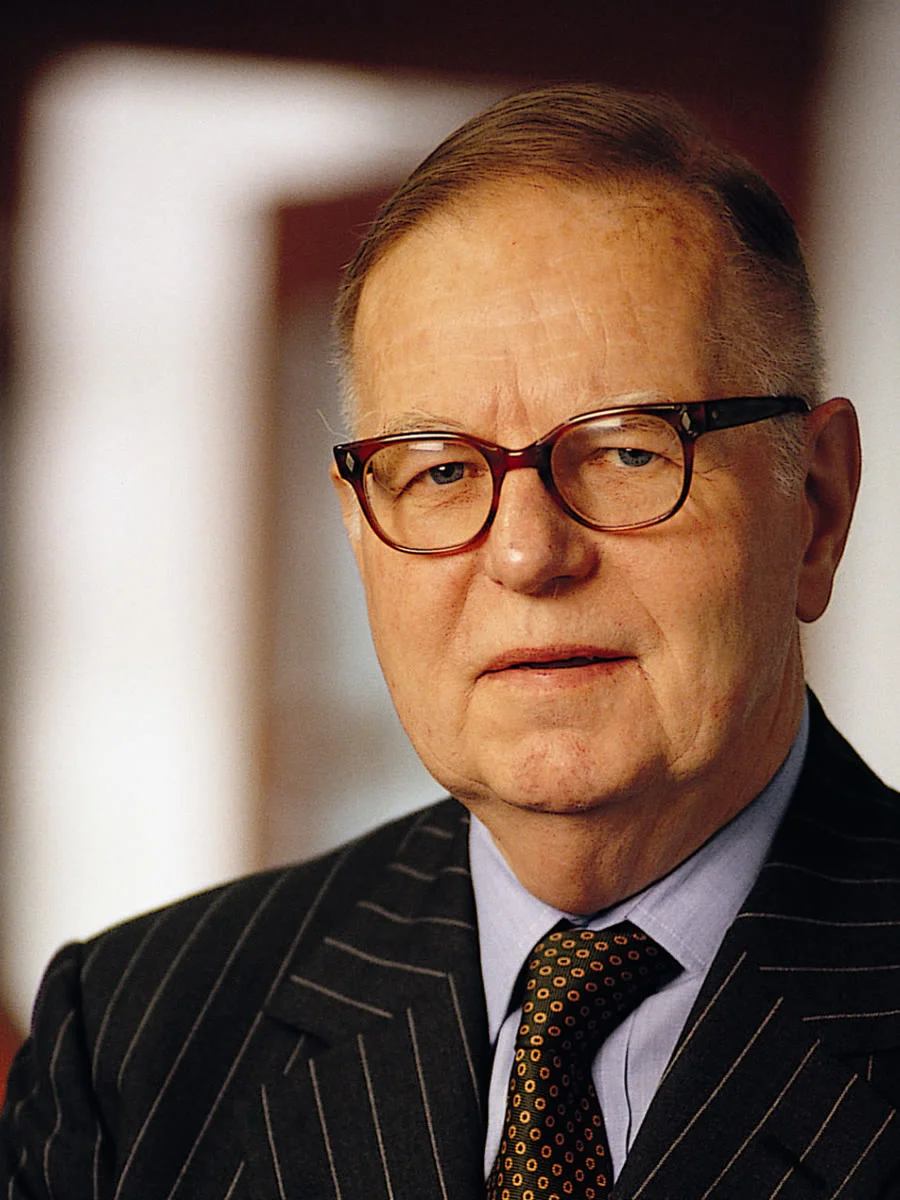
Peter Brooke
Built venture lending at Bank of Boston, then TA and Advent; exported VC to Europe.
1929–1956 — learning to see institutions before investments
Peter Albert Brooke was born in Worcester, Massachusetts, on 6 October 1929. He attended Fessenden and Phillips Exeter, graduated from Harvard College, and earned an HBS MBA in 1954. CHM oral history, printed pp. 1–10 · HBS award register, 2000 table The strongest target-specific records support Albert, not the unsupported task variant “Adams.” UK Companies House officer record
Brooke later recalled attending George Marshall's 1947 Harvard address with his father and repeatedly used the Marshall Plan as an analogy for spreading private-capital capability. [researcher inference · strong] The recurrence establishes Brooke's later self-conception; it does not prove that one speech caused a five-decade career or that private ownership replicated a public reconstruction program. CHM oral history, printed pp. 51–53 · A Vision, introduction, printed pp. xiv–xvi
After HBS he served in the Army Audit Agency, reviewing military contracts at Raytheon, Sylvania, and related electronics businesses. [researcher inference · moderate] This was a plausible bridge from accounting and contracts to regional technology finance, but the record shows exposure—not a documented investing doctrine formed in advance. CHM oral history, printed p. 15
1956–1961 — the bank loan book as a market map
Brooke joined First National Bank of Boston in 1956 and dated its focused high-technology lending effort to 1958. He later said he wrote an internal paper proposing a separately managed technology allocation and named Bill Ray and Bill Brown as receptive senior bankers. The paper has not surfaced; his accounts give a roughly $20 million proposed allocation, while Brooke-derived secondary material reports a $10 million loan book and $15,000 loss over four years. [retrospective witness · provisional] None of those figures is an audited commitment or loss schedule. CHM oral history, printed pp. 16–21 · Florida/Kenney, printed pp. 115–116
The mechanism was more durable than the numbers. Brooke said the bank accepted assigned federal research contracts as collateral, offered attractive credit, observed a broad borrower set, and retained relationships with companies it judged strongest. [investor-stated · moderate] Credit was both financing and an information channel; the bank still owned the capital and approval. No borrower denominator, default file, covenant schedule, or comparison with rejected borrowers proves selection efficacy. Concord transcript, paragraphs beginning “The department that I started” and “The policy paper that I put”
Wang Laboratories makes the episode concrete and warns against collapsing roles. Brooke remembered financing Wang in 1959 or 1960, negotiating more credit, a lower rate, and removal of Dr. Wang's personal endorsement. He later joined Wang's board around 1963 and remained through growth, succession conflict, Chapter 11, and sale. [investor-stated · moderate] The bank relationship was not a TA or Advent equity investment, and later board service does not establish control or a personal return. CHM oral history, printed pp. 27–32 · Wang bankruptcy report
[researcher inference · moderate] The formative lesson was not “take more risk.” It was: use an institution's existing balance sheet and local knowledge to observe how a young company behaves before taking a less protected claim. The bank decision lab also shows the limit: collateral and seniority cannot create product demand or prevent strategic obsolescence.
1961–1968 — from creditor to apprentice owner to partnership founder
In 1961 Brooke moved to the Phipps family's Bessemer investment organization after bringing capital-constrained borrowers to Rockefeller, Whitney, and Phipps family offices. He described Bessemer as the place where he learned private-company investing and board work. [researcher inference · strong] This was apprenticeship inside existing family capital, not a Brooke-created vehicle. Paul Bancroft's witness account also keeps Charlie Lea visible in the pre-Brooke and Bessemer network. CHM oral history, printed pp. 21–26 · Bancroft oral history, printed pp. 45 and 59
Brooke joined Tucker Anthony & R. L. Day in 1963 and took over its Bessemer regional-management relationship after Lea. He later said a private-placement affiliate sometimes accepted stock as fees; after part of that stock was liquidated and obligations met, remaining proceeds capitalized an investment pool he called Advent Company under a new TA Associates management company. [investor-stated · provisional] The story explains a path from transactional fees to pooled risk capital, but formation papers, tax records, partnership agreements, and capital accounts are absent. CHM oral history, printed pp. 25–27
The chronology itself is contested: Brooke and institutional accounts variously point to 1966, 1967, 1968, or 1971 for TA activity, legal formation, or program management. [researcher inference · strong] These may describe different milestones, but no public legal record reconciles them; 1968 is the most common institutional founding date, not proof of a single operative start. Concord transcript, TA passages · Florida/Kenney, printed pp. 117 and 119 · TA memorial
1968–1984 — building TA, then delegating the domestic machine
Brooke founded the platform, but his own account says he delegated much of TA's domestic investment work early while pursuing international affiliates. CHM oral history, printed pp. 26–27 T. Bondurant French later credited Kevin Landry and partners with TA's systematic development. Jacqui Morby said Brooke hired her and supported experimentation, but she devised the outbound software-sourcing workflow, brought leads to Landry, and explicitly denied material Brooke involvement in that system. [researcher inference · strong] Brooke's supported role is founder and culture/institution sponsor, not inventor of every later TA practice. French oral history, printed pp. 59–61 · Morby exact MP3, 15:15–17:28 and 32:59–35:18
The legal record reinforces team attribution. A 1975 notice for Devonshire Capital lists Boston University, Advent II, and Advent (Bermuda) Company II as shareholders, identifies TA only as investment adviser under written contract, and names corporate officers who do not include Brooke; Devonshire was a corporation, not a partnership with TA as general partner. Separately, a 1981 Advent IV notice identifies SBIPCo as general partner and names Brooke, Landry, David Croll, and E. Roe Stamps IV as partners of that general partner. [contemporaneous record · strong] These notices establish entities, roles, and proposed capital, not individual deal selection or returns. 1975 Federal Register, printed p. 42805 · 1981 Federal Register, printed p. 52267
TA's financing practice responded to its market. In June 1975 Brooke said the firm had shifted toward notes plus common equity so company operations could return capital rather than relying only on a weak new-issues market. Pete Bancroft immediately objected that loans could be unsuitable for cash-poor start-ups. [investor-stated · strong] The juxtaposition makes cash stage a boundary condition, not a universal debt preference. Commercial and Financial Chronicle, printed/PDF p. 6
Brooke also recalled that TA worked roughly ten or eleven years before substantial gains were realized and that the 1979–1981 public-market reopening released accumulated value. [investor-stated · strong] Concord transcript, paragraphs beginning “Going back a little bit” and “It wasn’t until the late ‘70s” Selection, operating work, and exit-market beta should therefore be tested as separate inputs rather than assumed to be one cause. [researcher inference · strong] Deal-forensics method
The celebrated deal stories further narrow personal credit. Brooke said Federal Express was Charlie Lea's deal and that another TA colleague increased exposure in the final round; Lea separately identified himself as principal lead. Biogen appears as an early TA position and an [investor-stated · provisional] reported: ~50x (Boston Globe obituary, 2020), but a filed biography places Landry on Biogen's board and no public record shows Brooke's underwriting, ownership, or cash flow. [researcher inference · strong] Institutional success is not personal deal attribution. CHM oral history, printed pp. 38–40 · Lea oral history, Tape 4 00:02:36–00:04:06 · Biogen attribution controls
1971–1984 — the international hypothesis begins inside TA
Brooke connected the French opportunity to an Arthur D. Little study and meetings with French public officials. Later archival scholarship credits Christian Marbach and Thierry Gaudin with the public 1971 white paper and Arthur D. Little with Boston introductions; no Brooke-authored section has surfaced. [retrospective witness · provisional] A separate memo or subcontract remains possible, but Brooke cannot be credited with the public artifact. Concord transcript, French-ministry paragraph · Devaux, section 1.2
Brooke and institutional accounts place Sofinnova's launch in 1972 or 1973. French public institutions and local managers supplied capital, authority, and execution; Brooke's role was network builder, board participant, and TA link. [researcher inference · strong] The episode supports a local-capability thesis, not a claim that Brooke or TA owned the French institution's work. CHM oral history, printed pp. 35–36 · A Vision, printed p. 43
The emerging theory was that a credible local manager could supply culture, market knowledge, relationships, and execution while a wider network supplied capital, cross-market technical comparison, and governance standards. [investor-stated · moderate] It was a hypothesis under construction, not a proven formula; the later record includes Japan, INF, ChinaVest, and Hong Kong failures. Florida/Kenney, printed pp. 119–123
1984/85–1997 — Advent and the difficulty of making local knowledge scalable
Advent and BPEA use 1984 for Advent International's founding; Brooke's later oral history says 1985. He said TA's partners declined to finance the global strategy, international relationships moved to Advent, Landry continued TA's domestic platform, and Brooke rebuilt a U.S. team. [researcher inference · strong] This was an institutional fork involving people, assets, and relationships—not a one-person renaming. CHM oral history, printed pp. 40–43 · Advent history · French oral history, printed pp. 59–61
Constantine Anagnostopoulos supplies a conflicting participant account. He said he helped create Advent UK with Monsanto and university-linked capital, recruited David Cooksey with Brooke, proposed the corporate-account model, and served as cofounder/director. [retrospective witness · moderate] The account is interested and does not settle legal founder status, but it makes a Brooke-only origin untenable without incorporation, subscription, and board records. Anagnostopoulos synchronized transcript/audio, 01:28:00–01:38:00
The network eventually spanned local affiliates, management companies, corporate accounts, country funds, and pooled institutional vehicles. Brooke's accounts use 23 affiliates, 25 locations, and $1.5 billion under management at different dates. [researcher inference · strong] Affiliate, office, asset, fund, and common-ownership counts are not interchangeable. The DEALS audit found 25 named vehicle/mandate families searched, only four with narrow public capitalization or reported-economics evidence, and zero supporting a Brooke-personal return. Vehicle denominator
The model changed as weaknesses appeared. The memoir describes a move from affiliates operating in their own ways toward shared Boston/local analysis and a more centralized investment committee. [investor-stated · moderate] The coherent design is local context plus common evidence and explicit rights; the unresolved question is whether centralization repaired information quality or diluted local ownership. A Vision, printed pp. 102–113
Failure supplied the harshest evidence. Brooke called venture capital in Japan a distinct failure and said early-stage technology investing outside the United States worked only in Israel; elsewhere the strategy was usually expansion capital. The memoir says the 1987 International Network Fund produced weaker results partly because it took too much early-stage risk. Martin Tang recalled leaving a Hong Kong technology-transfer concept after expected Advent/TA support and co-investment did not arrive. [researcher inference · strong] These cases show three different problems—market/entrepreneur fit, mandate drift, and uncontracted sponsor obligations—and should not be reduced to one “culture” explanation. CHM oral history, printed pp. 44–47 · A Vision, printed p. 114 · Tang transcript, printed pp. 69–72
Two Brooke-era fund observations are directionally favorable but bounded: ESSF (1989), reported: 31% gross IRR / 2.7x gross and 17% net IRR / 2.2x net / 2.2x DPI (Advent presentation, PDF p. 17, 2022; as of 2021); and GPE II (1993), reported: 38% gross IRR / 2.4x gross and 22% net IRR / 2.0x net / 2.0x DPI (Advent presentation, PDF p. 17, 2022; as of 2021). [documented behavior · strong] Advent presented the figures; [investor-stated · provisional] for manager-reported, unaudited performance. They are team-and-LP fund results, not Brooke-personal performance, and no company bridge explains them. [researcher inference · strong]
Succession also has competing dates. Brooke resigned as an Advent International Limited director in January 1995; Aspen's prospectus says Douglas Brown became president and CEO in January 1996; Brooke later remembered leaving the CEO role in 1997. [researcher inference · strong] Different legal and operating roles may reconcile the sequence, but the contemporaneous filing is strongest for Brown's title. Companies House · Aspen 424B4, “Management” · CHM oral history, printed p. 58
1995–2020 — later vehicles, public argument, and contested memory
A 2006 corporate announcement says Peter and John Brooke founded Brooke Private Equity Advisors in 2002 after a Brooke Family Limited Partnership formed in 1995. [contemporaneous record · provisional] It is a useful dated lead, not formation proof or permission to import TA/Advent results into a family vehicle. Brook Venture announcement
In 2007 and 2009 Brooke entered public debates about buyouts, debt, labor, carried interest, and regulation. He defended operating improvement over leverage alone, admitted overleveraging and asset stripping could destroy value, advocated union dialogue, accepted registration/reporting, conceded tax-fairness logic, resisted regulators choosing investments or fixed leverage rules, and warned that self-dealing could delegitimize the field. [investor-stated · strong] His “majority good actors” and job-creation claims lack a denominator; labor, academic, caller, and tax-policy countervoices prevent a portfolio-wide conclusion. [researcher inference · strong] WBUR 2007 exact MP3, 09:36–15:53, 18:56–24:10, and 33:19–38:32 · WBUR 2009 exact MP3, 03:58–11:28, 23:19–33:01, and 35:00–38:06
The 2009 A Vision for Venture Capital, written with Daniel Penrice and developed with Winthrop, organized Brooke's history into an economic-development mission, operating doctrine, and institutional lessons. The accessible record is partial and retrospectively selected. Brooke convened participants in 2010 to challenge it; David Cooksey disputed Brooke's account of his departure, and no recording adjudicates the disagreement. [researcher inference · strong] The book is essential evidence of Brooke's developed worldview, not final authority on other participants' motives or on returns. Winthrop project · CHM follow-up, printed pp. 59–62
BPEA says Brooke remained Advent chair through December 2015. He died on 1 April 2020 at age 90. BPEA memorial · Boston Globe obituary Memorials preserve institutional regard, but they are interested retrospective sources for investment claims.
A testable account of the edge
Proposed edge — [researcher inference · moderate]: Brooke repeatedly translated opportunity across institutional boundaries. He recognized a regional technical-credit niche, moved from bank observation to family-office equity and pooled partnerships, and then tried to combine locally generated information with cross-border capital, comparison, and governance. His advantage was not a disclosed valuation formula or sole-deal genius; it was designing and connecting institutions around a decision process. Concord transcript · CHM oral history, printed pp. 16–50
The proposed causal chain is:
- local technical and institutional exposure → a narrower opportunity map;
- relationships and staged capital → behavior and information before full risk;
- candor, current expertise, and dissent → better selection and updating;
- appropriate vehicle, decision rights, and support → capacity to act;
- operating and governance interventions → company milestones;
- exit markets and realized cash flows → investor outcome.
Every arrow is [researcher inference · moderate], not settled causation. Bank files, investment memos, board votes, intervention baselines, and cash flows are missing; access, partner work, market regime, and luck can explain the same sequence. Public-record denominator and retrieval ledger
Predicted evidence — [researcher inference · moderate]: unseen ordinary-case files should repeatedly show locally sourced facts changing approval or terms; stage-matched capital; named dissent; explicit local/central authority; operating milestones with owners; and stronger ordinary outcomes when those mechanisms were present. Candidate records and falsification routes
Falsifiers — [researcher inference · strong]: the edge weakens if original records show generic deal selection, partner-led execution with little Brooke input, no link between local knowledge and decisions, governance interventions that did not change outcomes, weak results excluding the top winner, or returns explained primarily by privileged access, leverage, IPO reopening, and successor teams. The searched public record contains 17 named company/opportunity candidates but 0/17 complete Brooke-attributable entry-to-exit reconstructions. Denominator
People, capital, and influence map
| actor / institution | supported contribution | attribution boundary |
|---|---|---|
| Bill Ray, Bill Brown, Bank of Boston | [retrospective witness · moderate] Brooke credits Ray and Brown with sponsoring or approving the technology-lending experiment; the bank supplied balance-sheet capital. CHM, printed pp. 16–21 | [researcher inference · strong] Paper, credit votes, staff, borrowers, defaults, and economics are missing. |
| Phipps/Bessemer and Charlie Lea | [retrospective witness · strong] Existing family-capital apprenticeship and regional network; Lea preceded Brooke and later led Federal Express. Bancroft, printed pp. 45 and 59 · Lea oral history, Tape 4 00:02:36–00:04:06 | [researcher inference · strong] Brooke did not found Bessemer or lead Federal Express. |
| Kevin Landry, Jacqui Morby, TA partners | [retrospective witness · strong] Landry led domestic investing/system development; Morby created and taught outbound software sourcing; partner teams governed TA. French, printed pp. 59–61 · Morby, 15:15–17:28 | [researcher inference · strong] Founder culture is not sourcing, approval, board work, or return credit. |
| Christian Marbach, Thierry Gaudin, French institutions, Sofinnova managers | [documented behavior · strong] French policy work, public/institutional sponsorship, local capital, management, and execution. Devaux, section 1.2 | [researcher inference · strong] Brooke's missing subcontract and network role do not confer authorship or deal ownership. |
| Constantine Anagnostopoulos, David Cooksey, Monsanto, Oxford/Cambridge-linked capital | [retrospective witness · moderate] Participant-reported UK capital, corporate-account design, recruiting, management, and board roles. Anagnostopoulos, 01:28:00–01:38:00 | [researcher inference · strong] Incorporation, currency, subscriptions, rights, and disputed departure remain unresolved. |
| Local affiliate managers / corporate and public LPs | [investor-stated · moderate] Local sourcing, diligence, governance, company work, and capital across countries. CHM, printed pp. 43–50 | [researcher inference · strong] “Advent network” does not prove common ownership, strategy, or returns. |
| Douglas Brown and successor Advent team | [contemporaneous record · strong] Brown was an Aspen director from 1986 and Advent's CEO by January 1996. Aspen 424B4, “Management” | [researcher inference · strong] Successor outcomes and later funds are not Brooke-personal performance. |
| Founders, executives, workers, boards, and co-investors | [investor-stated · strong] Brooke called the entrepreneur the hero and bounded the investor as an enabler. CHM, printed pp. 11–12 and 34–35 | [researcher inference · strong] Company creation, execution, governance, financing, and outcomes have multiple contributors; investor advice and capital are only inputs. |
Skill, access, team, vehicle, era, and luck
| explanation | evidence for it | evidence against overclaim |
|---|---|---|
| Skill | [researcher inference · moderate] Repeated selection framework, vehicle adaptation, network building, candor/dissent emphasis, and admitted failures. Core philosophy evidence | [researcher inference · strong] No complete personal cash-flow denominator or matched ordinary-case comparison. Reconciliation |
| Access | [researcher inference · strong] Elite education, bank platform, Bessemer/Phipps, Tucker, corporate/government sponsors, and early industry networks. CHM, printed pp. 1–27 | [researcher inference · strong] Access does not explain which relationships were converted into durable institutions; the conversion still requires work. Public-record boundary |
| Team | [researcher inference · strong] Lea, Landry, Morby, Anagnostopoulos, Cooksey, Brown, local managers, and company teams own material actions. People map | [researcher inference · strong] Brooke did hire, sponsor, connect, and design; team correction should not erase documented founder-level work. Team evidence |
| Vehicle | [researcher inference · strong] Bank, family office, pooled partnerships, SBICs, affiliates, accounts, country funds, and LP funds changed feasible risk and governance. Vehicle map | [researcher inference · strong] Agreements and economics are incomplete, so causal effects remain partly inferred. Vehicle retrieval ledger |
| Era | [researcher inference · strong] Federal R&D, thin conventional finance, 1970s exit drought, pension-rule change, IPO reopening, foreign state sponsorship, and later credit cycles shaped outcomes. Historical context | [researcher inference · strong] Brooke's explicit adaptation to those conditions may itself be part of the skill thesis. Concord transcript, regional and exit-market paragraphs |
| Luck / outlier | [investor-stated · strong] Brooke called success random; Biogen is the only named multiple claim, unranked and unreconciled. CHM, printed p. 11 | [researcher inference · strong] Two Brooke-era Advent funds have positive manager-reported results, but team attribution and selection mechanisms remain unresolved. Reported fund controls |
[researcher inference · strong] The fairest conclusion is institutional achievement with unproven personal alpha. Brooke helped build repeat organizations and a cross-border governance experiment; the available record cannot compute his return, hit rate, or share of value creation. Named-deal and vehicle denominators
Failure, change, and unresolved contradiction
- Wang — [researcher inference · strong]: long relationships and board tenure did not create control over founder succession or technology transition. Wang lab
- TA teamwork — [investor-stated · moderate]: Brooke later said he failed to build teamwork and good people left; this supports shared ownership, apprenticeship, and succession as investment infrastructure, but allocation/employment records are absent. A Vision, printed pp. 176–193
- Japan — [researcher inference · strong]: locally credible sponsorship did not solve diligence, governance, scale, exit, or entrepreneur-model mismatch; no Japanese countervoice adjudicates cause. Japan lab
- INF — [researcher inference · moderate]: a global mission without stage and manager-maturity risk budgets reportedly produced weaker results. INF lab
- ChinaVest / currency crisis — [researcher inference · moderate]: platform execution and macro/currency risk must be separated; company cash flows are missing. A Vision, printed pp. 124–127
- Hong Kong — [researcher inference · strong]: sponsor help and co-investment must be underwritten obligations, not narrative assumptions. Hong Kong lab
- Private-equity debate — [researcher inference · strong]: operating value, debt discipline, employee effects, tax, reporting, investment freedom, and activity boundaries are separate tests; “good actor” cannot be self-certified. WBUR 2007, 09:36–15:53, 18:56–24:10, and 33:19–38:32 · WBUR 2009, 03:58–11:28, 23:19–33:01, and 35:00–38:06
The biography's persistent tensions are not cleanly resolved: random success versus concentrated conviction; investor humility versus active intervention; local autonomy versus central standards; mission versus LP return; institution-building versus founder credit; disclosure and regulation versus resistance to risk mandates. [researcher inference · strong] Spoken evolution · written evolution
Sourced chronology and learning path
Chronology provenance key: exact public filings, statutes, and dated trade press are [contemporaneous record · strong] for the fact they state; Brooke's later memories are [retrospective witness · moderate] unless independently controlled; participant memories are [retrospective witness · provisional/moderate] as marked in the narrative; manager-presented performance is [investor-stated · provisional]; and reconciliation of conflicting milestones is [researcher inference · strong for the existence of conflict, insufficient public record for one final date].
| date | event and evidence status |
|---|---|
| 1929–1954 | Born 1929; Harvard College and HBS MBA 1954. CHM, printed pp. 1–10 |
| 1954–1956 | Army Audit Agency electronics-contract exposure. CHM, printed p. 15 |
| 1956 / 1958–1961 | Joined Bank of Boston; focused technology-lending effort reported from 1958. Missing paper and loan ledger. CHM, printed pp. 16–21 |
| 1959/60 | Wang lending begins by Brooke's memory. CHM, printed pp. 27–30 |
| 1961–1963 | Bessemer/Phipps apprenticeship; existing family-capital platform. CHM, printed pp. 21–26 |
| 1963 | Tucker Anthony; later board roles and early vehicle formation. CHM, printed pp. 25–33 |
| 1966/67/68/71 | Conflicting TA milestones; do not collapse activity, legal formation, and program management. Concord, paragraph beginning “I started TA Associates” · Florida/Kenney, printed p. 117 / PDF p. 117 |
| 1972/73 | Conflicting Sofinnova launch dates; French institutions/local actors share credit. CHM, printed pp. 35–36 · A Vision, printed p. 43 |
| 1975 | Contemporaneous note-plus-common statement; illiquid exit context. Trade press, printed/PDF p. 6 |
| 1979–1981 | Brooke-reported IPO reopening after a long realization drought. Concord, paragraphs beginning “Going back a little bit” and “It wasn’t until the late ‘70s” |
| 1984/85 | Advent formation/institutional fork; official 1984 versus Brooke 1985. Advent · CHM, printed pp. 40–43 |
| 1987 | International Network Fund raised; later stage-risk postmortem. Advent · A Vision, printed p. 114 |
| 1989 / 1993 | ESSF and GPE II vintages; later manager-reported fund controls. Advent presentation, PDF p. 17 |
| 1995/96/97 | UK-board resignation, Brown CEO filing, and Brooke's remembered retirement are distinct succession markers. Companies House · Aspen 424B4, “Management” · CHM, printed p. 58 |
| 2002 | BPEA founding reported by an interested 2006 announcement. Brook Venture |
| 2007–2009 | Public operating-value, debt, stakeholder, tax, and regulatory arguments. WBUR 2007, 09:36–15:53, 18:56–24:10, and 33:19–38:32 · WBUR 2009, 03:58–11:28, 23:19–33:01, and 35:00–38:06 |
| 2009–2010 | Collaborative memoir published; Cooksey dispute preserved, not resolved. Winthrop · CHM, printed pp. 59–62 |
| 2020 | Died 1 April 2020. BPEA memorial |
Read next in this order: written corpus → spoken corpus → Pareto and denominator → nine decision labs → operating system → mental-model field guide. The order deliberately puts evidence and ex-ante replay before maxims.
Snapshot and testable edge thesis
| question | evidence-backed answer |
|---|---|
| Who and where | [documented behavior · strong] Peter Albert Brooke (1929–2020) worked through First National Bank of Boston, the Phipps family's Bessemer organization, Tucker Anthony, TA Associates, Advent International, and later Brooke-family vehicles. [researcher inference · strong] Each supplied different capital and decision rights; they are not one Brooke portfolio. CHM oral history, printed pp. 16–47 · UK Companies House officer record · vehicle ledger |
| Proposed edge | [researcher inference · moderate] Brooke's most defensible edge was institutional translation: identify a region or sector with real technical/commercial advantage, enter through relationships that reveal behavior before a high-risk commitment, select candid managers, then adapt the capital vehicle, governance, and operating support to the opportunity. Concord transcript, comparative-advantage and policy-paper paragraphs · CHM transcript, printed pp. 22–24 and 36–47 |
| Mechanism | [researcher inference · moderate] Local relationships improve access and context; staged or cash-flow-matched capital buys information; candid management and outside dissent reduce avoidable error; active governance helps with people and strategy; a suitable vehicle supplies duration and incentives. The mechanism is supported in pieces, not as one audited causal chain. 1975 article, printed/PDF p. 6 · A Vision, printed pp. 65–79 and 176–193 |
| Domain and period | [researcher inference · moderate] The thesis fits relationship-intensive growth and private-company investing from the 1950s through Brooke's operating handoff in the mid-1990s, especially Boston technology finance and cross-border expansion capital. Brooke himself said early-stage technology investing outside the United States worked only in Israel, sharply limiting any universal global-venture claim. CHM transcript, printed pp. 44–47 |
| Supporting observations | [researcher inference · moderate] The bank program, repeated vehicle changes, Sofinnova/Advent institution-building, active board episodes, and manager-reported ESSF/GPE II results are directionally consistent with institutional translation. None supplies a Brooke-personal return bridge. Decision labs · Advent presentation, PDF p. 17 |
| Disconfirming observations | [researcher inference · strong] Japan failed; the International Network Fund reportedly took excessive early-stage risk; Tang reports promised Hong Kong support did not arrive; Wang shows the limit of board influence; TA sourcing and several celebrated deals belong substantially to partners. Japan/INF/Hong Kong labs · Morby exact MP3, 15:15–17:28 |
| Prediction | [researcher inference · moderate] If the edge was real and repeatable, unseen ordinary-case files should show locally generated information changing a dated underwriting decision; explicit local/central rights; stage-matched instruments; named dissent; operating milestones; and better ordinary outcomes where those mechanisms were present than where they were absent. Falsification and retrieval routes |
| Falsifiers | [researcher inference · strong] The thesis weakens if original memos show generic deal selection, partner-led execution with little Brooke input, no link between local information and decisions, governance support that did not change milestones, weak ex-outlier results, or performance explained mainly by access, exit windows, leverage, and successor teams. The 17-company searched public name set has 0/17 complete Brooke-attributable cash-flow reconstructions, so the present thesis remains moderate rather than strong. Denominator reconciliation |
Core philosophy
Brooke's direct voice begins with humility about agency and uncertainty. He said the entrepreneur is the protagonist, the investor an enabler; called success random; denied being a risk-taker; and described reading people as the job. [investor-stated · strong] Those statements support selection, assistance, and portfolio humility—not passivity or proof of superior judgment. [researcher inference · strong] CHM transcript, printed pp. 6, 11–12, and 22
His most specific selection chain was to seek a growing sector, defensible technology, management able to commercialize it, current outside technical expertise, and dissent strong enough to challenge the financial sponsor. [investor-stated · strong] The public record does not establish how consistently the chain was applied or whether it outperformed. [researcher inference · strong] CHM transcript, printed pp. 36–40
[researcher inference · moderate] The operating system is therefore conditional: source where knowledge is real; use an instrument the company can survive; choose candid, adaptable people; keep negative information moving; intervene only through an explicit governance right and measurable mechanism; separate mission from economics; and change the vehicle when capital, geography, or incentives no longer fit. That synthesis is reconstructed from the record, not a Brooke-authored checklist. Written-corpus decision playbook · evidence-backed deal rules
Sourcing
- Relationship before transaction. [investor-stated · moderate] Brooke described using the bank's broad borrower funnel to observe companies before retaining the strongest relationships, and the memoir's visible passages reuse contacts formed at the bank, Bessemer, and Tucker Anthony. No source-to-close or source-to-return denominator survives. Concord transcript, policy-paper paragraph · A Vision, printed pp. 9, 25, and 27
- Map comparative advantage. [investor-stated · strong] Brooke's regional and international rule was to finance where technical, market, or institutional knowledge created an advantage. The rule narrows the search space; it does not prove that a cluster, university, or famous sponsor creates alpha. Concord transcript, paragraph beginning “It seemed to me”
- Use a locally accountable source. [investor-stated · moderate] The global model favored a “local champion” with market knowledge and local relationships. Japan and Tang's Hong Kong account show that a champion without aligned economics, authority, and committed support is not a repeatable sourcing engine. A Vision, printed pp. 65–71 and 97–98 · Tang transcript, printed pp. 69–72
- Do not back-attribute the later TA machine. [retrospective witness · strong] Jacqui Morby says she built the magazine/Dun & Bradstreet/cold-call workflow, took leads to Kevin Landry, and that Brooke was not materially involved in it. Brooke's supported contribution was hiring and cultural permission. Morby exact MP3, 15:15–17:28 and 32:59–35:18
Decision use — [researcher inference · moderate]: name the opportunity's knowledge advantage, source owner, relationship history, information acquired before the financing, conflicts, and conversion denominator. Kill the “proprietary” claim when the advantage is only reputation or geography. Sourcing model and boundary cases
Picking
Brooke's best-supported founder screen is behavioral rather than biographical. He said he tested business-plan assumptions through founders' responses: candor about an unknown improved trust; evasion damaged the future working relationship. [investor-stated · strong] CHM transcript, printed pp. 22–24
| dimension | supported rule | evidence boundary |
|---|---|---|
| Market | [investor-stated · strong] Start with a growing sector or a location with comparative advantage. CHM, printed pp. 36–40 | [researcher inference · strong] Growth alone does not establish entry price, capture, or exit. Denominator boundary |
| Product/technology | [investor-stated · strong] Seek defensibility and test it with current technical experts. CHM, printed pp. 36–40 | [researcher inference · strong] Unitrode is a retrospective illustration; no original technical memo survives. Unitrode lab |
| Management | [investor-stated · strong] Judge candor and ability to turn technology into a company; management gaps can justify recruitment or replacement. CHM, printed pp. 22–24 and 32–35 | [researcher inference · strong] Wang shows that diagnosis and board tenure do not guarantee adaptation. Wang lab |
| Revenue and cash stage | [investor-stated · moderate] The memoir's TA account favored revenue-generating, profitable or near-profitable companies and diversified protection. A Vision, printed p. 26 | [researcher inference · strong] The record lacks a complete TA portfolio and loss schedule. Reconciliation |
| Dissent | [investor-stated · strong] Add an independent technical voice and surface all material information to the investment committee. CHM, printed pp. 36–40 · A Vision, printed p. 182 | [researcher inference · strong] A risk slide created after commitment is not dissent. Dissent model |
Red flags — [researcher inference · moderate]: evasive founders; no independent validation of the technical claim; cash needs that exceed the proposed instrument and reserves; founder succession without an executable plan; a local manager without authority; and an “operating value” story without owner, cost, baseline, or milestone. Wang, Unitrode, Aspen, Japan, and INF labs
Deal and portfolio mechanics
- Instrument. [investor-stated · strong] In 1975 Brooke described notes plus common equity as an alternative to straight equity when exits were weak; Pete Bancroft immediately supplied the start-up cash-flow boundary. 1975 article, printed/PDF p. 6
- Ownership and price. [researcher inference · insufficient public record] No universal Brooke ownership target, valuation rule, liquidation preference, dilution policy, or price discipline surfaced. [contemporaneous record · strong] A Unitrode proxy records less than 1% beneficial ownership in 1995, including options, but not 1961 cost basis or holding continuity. Unitrode 1995 proxy, “Security Ownership of Certain Beneficial Owners and Management” table
- Reserves and follow-ons. [researcher inference · insufficient public record] Federal Express supplies a vivid last-round conviction story, but Brooke credits Charlie Lea and another TA colleague; the record lacks the partnership, check, reserve, concentration, and proceeds. Lea oral history, Tape 4 00:02:36–00:04:06 · CHM, printed pp. 38–40
- Portfolio construction. [investor-stated · moderate] Diversify stage exposure when the capital provider requires prudence, and separate early venture, expansion, corporate accounts, country funds, and buyouts. The INF postmortem is evidence that an undisciplined early-stage overlay can corrupt a global mandate. CHM, printed pp. 6 and 22–24 · A Vision, printed pp. 114–117
- Exits. [investor-stated · strong] Brooke's 1970s realization drought separates company progress from realizable return; a reopened IPO market in 1979–1981 was part of the outcome mechanism. Concord transcript, paragraphs beginning “Going back a little bit” and “It wasn’t until the late ‘70s”
[researcher inference · strong] The public record supports an instrument-and-mandate philosophy more strongly than a complete ownership, reserve, concentration, or sell discipline. Any modern use should begin with the missing fields rather than infer them from famous outcomes. Deal-forensics boundaries
Vehicle and incentive fit
| era / vehicle | strategic enablement | constraint and attribution |
|---|---|---|
| Bank of Boston, 1956–1961 | [investor-stated · moderate] A bank balance sheet and contract collateral enabled an observation-rich technology-loan program. CHM, printed pp. 16–21 | [researcher inference · strong] Bank officers and credit approval controlled capital; no paper, loan ledger, loss denominator, or Brooke economics survives. Vehicle retrieval ledger |
| Bessemer, 1961–1963 | [retrospective witness · moderate] Family capital supplied patient private-company apprenticeship and board exposure. Bancroft, printed pp. 45 and 59 | [researcher inference · strong] Existing Phipps platform; Charlie Lea and others constrain Brooke-founder attribution. People map |
| Tucker/TA, 1963–1984 | [investor-stated · provisional] Stock received for private-placement fees reportedly capitalized a pooled vehicle; later partnerships and SBIC structures institutionalized repeat investing. CHM, printed pp. 25–27 · 1981 federal notice, printed p. 52267 | [researcher inference · strong] Legal start dates conflict; Landry, Morby, Lea, and partners own substantial operating/deal credit; agreements and carry schedules are absent. Vehicle retrieval ledger |
| Advent network, 1984/85–mid-1990s | [investor-stated · moderate] Local affiliates, corporate accounts, country funds, and later regional/global pools matched distinct capital sources and geographies. CHM, printed pp. 40–50 | [researcher inference · strong] Affiliate ownership, committee rights, retained corporate economics, regulation, liquidity, and incentives varied; Japan, INF, and Hong Kong expose failures. Vehicle and failure records |
| Succession | [documented behavior · strong] A filing places Douglas Brown as Advent president and CEO in January 1996. Aspen 424B4, “Management” | [researcher inference · strong] Brooke’s 1997 memory and 1995 UK-board resignation require role separation. Key-person continuity is an investment term, not a clean date. Succession chronology |
Brooke's memoir criticizes manager compensation that can enrich the manager without commensurate fund success and describes retained corporate economics and shared ownership as institution-building tools. [investor-stated · moderate] A Vision, printed pp. 54, 79, 166, and 187–188 Without agreements, fee offsets, carry allocations, clawbacks, GP commitments, and LP cash flows, alignment remains a stated design rather than verified effect. [researcher inference · strong] Vehicle-economics retrieval ledger
Team attribution and work with founders
| work | supported allocation | unresolved boundary |
|---|---|---|
| Bank sponsorship | [retrospective witness · moderate] Brooke says Bill Ray and Bill Brown backed the experiment; the bank supplied capital. CHM, printed pp. 16–21 | [researcher inference · strong] Policy approval, individual underwriting, and losses remain missing. Retrieval ledger |
| TA domestic system | [retrospective witness · strong] Brooke founded the platform; French credits Landry and partners; Morby credits herself with outbound software sourcing and Landry with investing authority. French, printed pp. 59–61 · Morby, 15:15–17:28 | [researcher inference · strong] Partnership votes, allocation, committee records, and economics remain missing. Retrieval ledger |
| Federal Express | [retrospective witness · strong] Charlie Lea identifies himself as principal lead; another TA colleague owned the last-round increase; Brooke does not claim either action. Lea oral history, Tape 4 00:02:36–00:04:06 · CHM, printed pp. 38–40 | [researcher inference · strong] TA vehicle, votes, stake, distributions, and Brooke’s narrower role remain unresolved. Federal Express lab |
| Biogen | [contemporaneous record · strong] TA appears as investor and Kevin Landry as former director. [investor-stated · provisional] reported: ~50x (Boston Globe obituary, 2020), unranked and unaudited. [researcher inference · strong] The estimate does not prove Brooke underwriting. BHR study, printed p. 203 n. 71/PDF p. 18 · Landry SEC biography, “Kevin G. Landry” paragraph |
[researcher inference · strong] Memo, round, ownership, board work, distributions, and gross/net basis remain missing. Biogen lab |
| Advent UK/global design | [retrospective witness · moderate] Anagnostopoulos claims capital, corporate-account design, recruiting, cofounder, and board work; Cooksey disputed Brooke's departure account. Anagnostopoulos, 01:28:00–01:38:00 · CHM follow-up, printed pp. 59–62 | [researcher inference · strong] Incorporation, subscriptions, votes, ownership, and contemporaneous participant records remain missing. Vehicle retrieval ledger |
| Portfolio governance | [investor-stated · moderate] Brooke reports management/strategy work at Wang, Unitrode, and Adams Russell. [contemporaneous record · strong] Aspen's filing independently names Douglas Brown as director from 1986. CHM, printed pp. 27–35 · Aspen 424B4, “Management” | [researcher inference · strong] Board minutes, votes, intervention owners, costs, causal outcomes, and returns remain missing. Governance retrieval ledger |
[researcher inference · strong] Brooke's most supportable founder contribution is bounded enablement: relationship access, financing architecture, recruitment, strategy, and institutional support. It is not sole causation, and Wang shows that long service cannot substitute for control or adaptation. People and decision map · Wang decision lab
Views on the craft
- Power law and luck. Brooke called success random and favored diversification. [investor-stated · strong] CHM, printed pp. 11 and 22–24 The public deal record contains only one unranked numerical deal-return estimate—[investor-stated · provisional]
reported: ~50x(Boston Globe obituary, 2020)—and no Brooke-personal denominator. [researcher inference · strong] Economic sensitivity - Access versus selection. [researcher inference · moderate] Relationships and clusters created access; observation, candor, and technical dissent were intended to select. Missing funnel data prevent measuring either contribution. Concord transcript, paragraphs beginning “The department that I started” and “It seemed to me” · reconciliation
- Fund size and mandate. [investor-stated · moderate] Separate stages and vehicles rather than let a global mission create uncontrolled early-stage exposure. INF is the negative control. A Vision, printed pp. 114–117
- Governance. [investor-stated · strong] Investors are useful in strategy, management structure, recruiting, financing, and sale negotiation, but cannot manufacture a good company from a bad idea or team. CHM, printed pp. 30–35
- Operating value and exits. Durable operating improvement, not leverage alone, is Brooke's claimed engine. [investor-stated · strong] WBUR 2007, Brooke 10:00–11:16 Exit markets remain an independent return input. [researcher inference · strong] Concord transcript, paragraphs beginning “Going back a little bit” and “It wasn’t until the late ‘70s”
- Great investor. [researcher inference · moderate] The record implies a selector and institution-builder who subordinates ego, develops people, adapts vehicles, and admits failure. It does not support a timeless seer, sole dealmaker, or audited personal performance claim. Profile edge test · evidence boundary
Signature bets and decision process
The decision evidence belongs in the no-hindsight labs rather than in retrospective victory stories. [researcher inference · strong] Decision-lab method
- Bank technology lending — can credit structure buy observation without hiding default risk?
- Wang — when do relationship access and board service fail to create control?
- Unitrode — what evidence justifies management change, and who actually owns it?
- Federal Express — what new evidence justifies reserve concentration, and whose decision was it?
- Biogen — can the investment be evaluated without the later multiple?
- Aspen Technology — can each claimed value-creation mechanism be pre-registered and measured?
- Japan — are local/central rights and stop gates investable before launch?
- International Network Fund — can a global pool absorb different stage and manager risks?
- Hong Kong concept — are sponsor support and co-investment documented obligations or hopes?
[researcher inference · strong] The cases show a decision system more clearly than they show personal economics. The correct replay order is ex-ante information → decision rights and instrument → milestone/follow-on → actual outcome → counterfactual, never outcome first. Nine no-hindsight labs · economic boundary
Mental models and maxims
[researcher inference · strong] The reconciled inventory contains thirteen supported or explicitly bounded models; synonyms are merged, credit-as-information remains distinct from instrument fit, and mission/return scorecards remain cross-cutting doctrine rather than a model because three Brooke-attributable applications did not survive. Model reconciliation and exhausted routes
- Use credit as an information option only when observation changes the next decision.
- Match the instrument to cash stage; separate security protection from company risk.
- Map comparative advantage, then build the relationship funnel around it.
- Test candor and commercializing management, not founder polish.
- Pair a local champion with shared standards, explicit authority, and contracted support.
- Make negative information and outside dissent travel.
- Enable through the board without confusing influence with control.
- Pre-register operating value; do not substitute leverage or narrative.
- Separate mandates and risk budgets; treat exit liquidity as a portfolio input.
- Develop whole-job investors and make team succession visible.
- Match vehicle, incentives, authority, and duration to the strategy.
- Ledger person, vehicle, instrument, and decision separately.
- Predefine defeat, follow-on gates, and the learning budget.
Evolution and contradictions
| period | durable idea or change | unresolved tension |
|---|---|---|
| 1954–1961 | [researcher inference · moderate] Army electronics exposure and bank lending preceded Brooke’s later credit-first, observation-rich regional method; Brooke later linked the episodes, but no causal bridge shows that they formed the method. CHM, printed pp. 15–21 | [researcher inference · strong] The missing paper/loan ledger means later memory may overstate novelty, allocation, performance, or causality. Bank-paper route |
| 1961–1968 | [researcher inference · moderate] Brooke moved through family capital and brokerage/private-placement relationships toward a pooled vehicle. CHM, printed pp. 21–27 | [researcher inference · strong] Formation dates and ownership conflict; apprenticeship and existing networks constrain founder mythology. Vehicle controls |
| 1968–1984 | [researcher inference · strong] TA became an institution; Brooke delegated domestic work while pursuing a cross-border model. CHM, printed pp. 26–27 and 35–43 | [researcher inference · strong] Brooke’s later teamwork admission and Landry/Morby/Lea evidence narrow individual credit. Team attribution |
| 1975 | [investor-stated · strong] Note-plus-common financing responded to illiquidity. 1975 article, printed/PDF p. 6 | [contemporaneous record · strong] Bancroft’s adjacent objection shows that the instrument may injure a cash-poor start-up. 1975 article, printed/PDF p. 6 |
| 1984/85–mid-1990s | [researcher inference · moderate] Advent shifted from affiliate heterogeneity toward more common committee standards and integrated funds. A Vision, printed pp. 102–113 | [researcher inference · strong] Local autonomy versus Boston authority remained unresolved; Japan, INF, ChinaVest, and Hong Kong show distinct failure modes. Failure labs |
| 2007–2010 | [investor-stated · strong] Brooke defended operating value while admitting destructive leverage, accepting disclosure, and moving from study-before-tax-change toward conceding the carried-interest fairness argument. WBUR 2007, 22:44–24:10 · WBUR 2009, 27:23–28:51 | [researcher inference · strong] Self-policing, market discipline, activity boundaries, tax, and regulation imply different remedies that he did not fully reconcile. Spoken evolution |
Three contradictions are productive analytical tests, not drafting defects. [researcher inference · strong] Dated evidence table
- Diversification versus conviction — [researcher inference · strong]. Brooke called success random and favored prudent stage diversification, yet praised “faith” and a concentrated final Federal Express follow-on he did not personally lead. CHM, printed pp. 11, 22–24, and 38–40
- Investor humility versus active intervention — [researcher inference · strong]. He called investors enablers while describing management and strategy work at Wang, Unitrode, and Adams Russell. The coherent boundary is help on a viable company, not omnipotence—but board records are missing. CHM, printed pp. 11–12 and 27–35
- Local autonomy versus integrated control — [researcher inference · strong]. The network needed local information but moved toward common committee standards; Japan and Tang show that neither decentralization nor sponsorship alone solved authority and support. A Vision, printed pp. 97–113 · Tang, printed pp. 69–72
Failures and limits
| failure / limit | supported lesson | boundary |
|---|---|---|
| Wang | [researcher inference · strong] Relationship access and advice are not control; succession and technology transition need executable milestones. Wang lab | [researcher inference · insufficient public record] Board votes, ownership, alternatives, and feasible counterfactual are absent. Retrieval ledger |
| Japan | [researcher inference · strong] Local/central authority, economics, diligence, and termination gates belong in the vehicle design. Japan lab | [researcher inference · insufficient public record] No Japanese countervoice, company ledger, capital, or write-offs survives; culture is not adjudicated causation. Retrieval ledger |
| International Network Fund | [researcher inference · moderate] Stage, geography, manager maturity, and reserves need separate loss budgets. INF lab | [researcher inference · insufficient public record] No audited fund cash flows or company contribution bridge survives. Retrieval ledger |
| ChinaVest / Asian crisis | [researcher inference · moderate] Separate partner execution from currency and system risk. A Vision, printed pp. 124–127 | [researcher inference · insufficient public record] No deal/fund ledger can allocate avoidable and systemic loss. Retrieval ledger |
| Hong Kong concept | [researcher inference · strong] Sponsor support and co-investment require named, funded obligations. Hong Kong lab | [retrospective witness · moderate] Tang is one interested participant and no deployed capital is shown. Tang, printed pp. 69–72 |
| TA teamwork | [investor-stated · moderate] Shared ownership, role clarity, apprenticeship, and succession are investment infrastructure. A Vision, printed pp. 176–193 | [researcher inference · insufficient public record] Employment, allocation, departure, and key-person records are absent. Retrieval ledger |
| Record-wide selection bias | [researcher inference · strong] Famous survivors dominate; the 17-company public name set contains zero complete Brooke-attributable reconstructions. Denominator | [researcher inference · insufficient public record] Personal hit rate, loss rate, return, outlier concentration, and benchmark are not computable. Evidence boundary |
Historical operating environment
- 1958 statute — [contemporaneous record · strong]. The Small Business Investment Act created an SBIC framework. 1958 statute Bank method — [investor-stated · moderate]. Brooke later recalled a distinct program using assignable federal contracts when young technical firms lacked conventional assets. Concord transcript, paragraphs beginning “The department that I started” and “The policy paper that I put”
- Defense, electronics, and Route 128 — [investor-stated · moderate]. Military R&D contracts and university-linked technical labor made New England unusually legible to a local lender; later semiconductor migration and minicomputer decline show that a regional advantage can expire. CHM, printed pp. 15–21 · Concord transcript, paragraphs beginning “The leaders of industry” and “That advance obsoleted”
- 1970s illiquidity — [contemporaneous record · strong]. Weak new issues, diminished institutional supply, longer holds, and follow-on needs framed the note-plus-common response. 1975 article, printed/PDF pp. 5–7 [investor-stated · strong] Brooke separately remembered roughly a decade without substantial realizations. Concord transcript, paragraphs beginning “Going back a little bit” and “It wasn’t until the late ‘70s”
- Pension regulation — [contemporaneous record · strong]. The 1979 ERISA prudence rule evaluated an investment in portfolio context and diversification; it should not be reduced to “venture became legal.” 44 FR 37221
- Cross-border institution building — [researcher inference · strong]. French public institutions, corporate sponsors, IFC, local managers, currency exposure, thin exits, and uneven legal/governance systems shaped what global venture could mean. Vehicle evidence [documented behavior · strong] A September 1996 IFC retrospective analysis reported: −5.0% aggregate IRR for 21 early funds (IFC Note 90, printed p. 2, 1996; observation as of June 1983). [researcher inference · strong] The report does not identify INF as part of that set. INF boundary
[researcher inference · strong] Brooke’s strategy cannot be lifted out of these conditions. Contract collateral, family-office apprenticeship, thin early fund competition, public-institution sponsorship, and later exit openings were enabling inputs, not incidental scenery or causally identified returns. Historical record · vehicle boundaries
Modern VC translation (as of 2026-08-18)
The 2026 NVCA Yearbook reports that 487 $100-million-plus rounds were 3.2% of 2025 deal count but 67% of value, while two-thirds of unicorn IPOs priced below their last private valuation. [contemporaneous record · strong] 2026 NVCA Yearbook Those observations do not validate a Brooke rule; they make denominator, refinancing, reserve, and exit assumptions more important. [researcher inference · strong] Mandate-and-exit model
| major lesson | what transfers / what does not | observable applicability signals | likely misuse and current application |
|---|---|---|---|
| Credit as information — [researcher inference · moderate] | [researcher inference · moderate] Observation through protected financing transfers only when it changes a dated next decision; bank contract assignment does not transfer mechanically. Model 1 | [researcher inference · moderate] Defined learning facts, collateral/recovery, reassessment date, and exposure cap are the observable tests. Model 1 | [researcher inference · moderate] Misuse: debt as a trial for pre-revenue science. Model 1 |
| Stage-matched instrument — [researcher inference · moderate] | [researcher inference · moderate] Cash-flow matching transfers; 1950s contract assignment and 1975 note terms do not transfer mechanically. Model 2 | [researcher inference · moderate] Recurring gross profit, cash conversion, debt service, maturity wall, covenants, and downside runway test applicability. Model 2 | [researcher inference · moderate] Misuse: calling debt non-dilutive. Model 2 |
| Comparative-advantage sourcing — [researcher inference · moderate] | [researcher inference · moderate] Current domain and local knowledge transfer; prestige, geography, or logo access do not. Model 3 | [researcher inference · moderate] Source-to-close/outcome data, reference access, regulatory knowledge, and current technical edge test applicability. Model 3 | [researcher inference · moderate] Misuse: calling every cluster proprietary. Model 3 |
| Candor and commercialization — [researcher inference · moderate] | [researcher inference · moderate] Evidence updates and role-specific execution transfer; personality intuition alone does not. Model 4 | [researcher inference · moderate] Falsifiable assumptions, an unknowns log, work samples, references, and a management-gap threshold test applicability. Model 4 | [researcher inference · moderate] Misuse: rewarding agreeable fluency. Model 4 |
| Local champion plus contracted support — [researcher inference · moderate] | [researcher inference · moderate] Local authorship, common evidence, explicit rights, and funded sponsor obligations transfer; ceremonial coverage does not. Model 5 | [researcher inference · moderate] Local memo ownership, central/local vetoes, allocation, support budget, response time, and a termination gate test applicability. Model 5 | [researcher inference · moderate] Misuse: a global logo plus partner travel. Model 5 |
| Negative information and dissent — [researcher inference · moderate] | [researcher inference · moderate] Unedited challenge and complete IC packets transfer; a cosmetic risk page does not. Model 6 | [researcher inference · moderate] An independent reviewer, missing-data log, dissent text, sponsor response, and recorded vote test applicability. Model 6 | [researcher inference · moderate] Misuse: automated risks without an owner or evidence threshold. Model 6 |
| Bounded board agency — [researcher inference · strong] | [researcher inference · strong] Named governance mechanisms transfer; causal credit from tenure or a board seat does not. Model 7 | [researcher inference · strong] A decision right, baseline, owner, milestone, vote, and counterfactual test applicability. Model 7 | [researcher inference · strong] Misuse: branding all company progress as investor value-add. Model 7 |
| Operating value before leverage — [researcher inference · moderate] | [researcher inference · moderate] Product, market, management, and working-capital mechanisms transfer; cheap-credit multiple expansion does not. Model 8 | [researcher inference · moderate] Initiative owner, cost, timing, KPI, downside, and a realized bridge test applicability. Model 8 | [researcher inference · moderate] Misuse: labeling cost cuts as durable value. Model 8 |
| Separate mandates, risk budgets, and exits — [researcher inference · strong] | [researcher inference · strong] Stage/geography/manager sleeves, reserve limits, and exit assumptions transfer; one global denominator does not. Model 9 | [researcher inference · strong] Count/capital weights, stage, geography, reserves, loss budget, exit path, and ex-outlier result test applicability. Model 9 | [researcher inference · strong] Misuse: calling dollar growth broad health. Model 9 |
| Whole-job team and succession — [researcher inference · moderate] | [researcher inference · moderate] Role progression, workload, shared economics, and tested succession transfer; culture language alone does not. Model 10 | [researcher inference · moderate] Sourcing/diligence/board roles, workload, advancement, carry/vesting, and key-person depth test applicability. Model 10 | [researcher inference · moderate] Misuse: the founder gets wins while the team owns losses. Model 10 |
| Vehicle fit — [researcher inference · moderate] | [researcher inference · moderate] Capital owner, duration, mandate, governance, economics, geography, and termination must fit strategy. Model 11 | [researcher inference · moderate] Legal form, approvals/vetoes, allocation, reserves, reporting, liquidity, and key-person terms test applicability. Model 11 | [researcher inference · moderate] Misuse: treating related brands as common economics. Model 11 |
| Attribution ledger — [researcher inference · strong] | [researcher inference · strong] Person, vehicle, instrument, decision, board work, and cash flow remain separate. Model 12 | [researcher inference · strong] Legal investor, capital owner, source, approver, sponsor, security, stake, follow-on, and exit test applicability. Model 12 | [researcher inference · strong] Misuse: converting “we” or a portfolio logo into personal return. Model 12 |
| Predefine defeat and learning budget — [researcher inference · moderate] | [researcher inference · moderate] Thesis-kill evidence, capped follow-ons, stop authority, and postmortem change transfer; strategic learning without a limit does not. Model 13 | [researcher inference · moderate] A falsifier, milestone date, reserve cap, stop/restructure owner, recovery route, and postmortem action test applicability. Model 13 | [researcher inference · moderate] Misuse: extending runway because the category remains fashionable. Model 13 |
[researcher inference · insufficient public record] Mission and financial scorecards remain a cross-cutting anti-confusion rule, not a supported Brooke model: the searched record has aspiration, manager-reported fund economics, and public counterargument, but not three Brooke-attributable applications. Exhausted-route ledger
Comparison with completed peers
[researcher inference · strong] These three comparators are defensible because all are completed pioneer profiles with different capital forms and overlapping problems of technical access, patient ownership, governance, and attribution. The comparison is of mechanisms—not rank or return. Doriot canon · Rockefeller canon · Dennis canon
| dimension | Brooke | Georges Doriot | Laurance Rockefeller | Reid Dennis |
|---|---|---|---|---|
| Capital / vehicle | [researcher inference · moderate] Bank → family office → broker-seeded pool/LPs → affiliates and global funds. vehicle record | [researcher inference · moderate] ARD's public closed-end corporation broadened capital but impaired incentives and distributed authority. canon page · House hearing, printed pp. 339–340 | [researcher inference · moderate] Personal/family assets → optional family-office subscriptions → family LP with professional partners. canon page · Nicholas, limited-preview printed pp. 167–170 | [researcher inference · moderate] Personal/trust → informal syndicate → insurer capital → LP partnerships. canon page · Dennis oral history, printed pp. 13–28 |
| Sourcing / picking | [researcher inference · moderate] Relationships and comparative advantage; candor plus technical dissent; no funnel denominator. Brooke sourcing | [researcher inference · strong] MIT/HBS/bank/broker networks plus a reported 6,884-proposal denominator; people, technical wedge, and whole company. canon page · Hsu/Kenney, Table 2 | [researcher inference · moderate] Family, state, technical, and public networks routed opportunities to staff; patient capital and specialist diligence, but thin funnel data. canon page · Kenney, printed pp. 1683–1692 | [researcher inference · moderate] Referrals, brokers, Stanford/engineering networks, competence boundaries, and syndication; funnel incomplete. canon page · Dennis oral history, printed pp. 13–28 |
| Ownership / portfolio / governance | [researcher inference · strong] Instrument and mandate fit are visible; universal ownership/reserve rules are not. Board work is active but explicitly bounded. Brooke mechanics | [researcher inference · strong] Mixed debt/equity, staged DEC ambition, and patient active ownership; the public vehicle limited incentives and geography. canon page · Hsu/Kenney, Table 3 | [researcher inference · moderate] Flexible securities, reported minority posture, staging, family duration, and staff/board work; rescue patience could escalate loss. canon page · Walkowicz, printed p. 32736 | [researcher inference · moderate] Flexible checks and rights, sponsor boards, team consensus with exceptions, and explicit company-versus-fund duration conflict. canon page · Dennis oral history, printed pp. 87–94 |
| Failure / outlier control | [researcher inference · strong] Japan, INF, Hong Kong, Wang, and the missing denominator prevent a computed personal return. Brooke failures | [researcher inference · strong] DEC dominates the reported results: reported: 14.7% compound with DEC and 7.4% without, versus reported: 12.8% DJIA (Hsu and Kenney, printed p. 599, 2005). canon page | [researcher inference · strong] Early Venrock performance was reported: 26.8% gross IRR with Apple and 3.4% without (Nicholas, limited-preview printed pp. 171–172, 2019); family duration could hide weak rescues. canon page | [researcher inference · moderate] Ampex access, partner outcomes, Apple valuation error, Reference timing failure, and one-LP fund data make personal repeatability uncertain. canon page |
| Distinct lesson | [researcher inference · moderate] Vehicle and governance adaptation across borders is central, but local/central execution is the failure point. Brooke failures | [researcher inference · moderate] Institution can broaden capital yet defeat its own incentives. Doriot vehicle evidence | [researcher inference · moderate] Long family duration helps only when each continuation buys evidence. Rockefeller contradictions | [researcher inference · moderate] Technical translation and networks need explicit competence, role, and liquidity boundaries. Dennis skeptical case |
Comparability boundary — [researcher inference · strong]: Doriot has a much stronger portfolio denominator; Rockefeller and Dennis have better documented personal/family-capital transitions in selected cases. None supplies a directly comparable Brooke-personal return series, so the table does not rank performance. Doriot denominator · Rockefeller capital record · Dennis capital record · Brooke evidence boundary
The strongest case against greatness
[researcher inference · strong] The skeptical thesis is that Brooke was a talented narrator and institutional connector whose reputation combines inherited institutional access, partner work, successor performance, favorable liquidity windows, and selected survivor stories without enough public evidence to demonstrate repeatable personal investing skill. Edge decomposition · searched-denominator boundary
- Access and privilege. [researcher inference · moderate] Exeter, Harvard/HBS, Bank of Boston, Bessemer/Phipps, Tucker Anthony, government and corporate sponsors supplied unusually rich access and capital. The edge may be access conversion rather than selection. CHM, printed pp. 3–27
- Team misattribution. [researcher inference · strong] Lea owns the Federal Express lead; Landry and Morby own later TA investing/sourcing; Anagnostopoulos claims material Advent design/capital/recruiting; Brown appears in Aspen and succession records; local managers executed abroad. People map
- Missing denominator and survivorship. [researcher inference · strong] The public name set is 17/17 searched and 0/17 fully reconstructed; passes, write-offs, reserves, ownership, and cash flows are absent. Denominator
- One-outlier and successor laundering. The only named numerical deal-return estimate is [investor-stated · provisional]
reported: ~50x(Boston Globe obituary, 2020). No public record connects it to Brooke-specific underwriting or cash flow, and later Advent scale or GPE III cannot be assigned backward. [researcher inference · strong] Biogen lab · fund controls - Era and exit effects. Brooke reports a decade-long realization drought followed by an IPO reopening. [investor-stated · strong] Concord transcript, paragraphs beginning “Going back a little bit” and “It wasn’t until the late ‘70s” Observed results combine company development and market timing. [researcher inference · strong] Exit-market model
- Global model failures. [researcher inference · strong] Japan, INF, ChinaVest, and Hong Kong weaken the idea that a local network plus Boston knowledge was reliably portable. Failures
- Contradictory rhetoric and behavior. [researcher inference · moderate] Humble enabler versus active intervener; diversification versus follow-on faith; local autonomy versus central committee; stakeholder mission versus uncertain job/return evidence. Evolution
- Memoir and memory risk. [researcher inference · strong] The 2009 book was collaboratively developed, partially accessible, and challenged by Cooksey; formation and succession dates conflict across later accounts. Winthrop project · CHM follow-up, printed pp. 59–62
The favorable thesis wins if ordinary, unseen decision files repeatedly connect Brooke-specific local information, vehicle design, candid-manager judgment, and governance actions to better outcomes after controlling for access, partners, stage, vintage, exit markets, and the top winner. The skeptical thesis wins if the missing files show generic selection, partner-led execution, weak ex-outlier economics, nonbinding governance, or returns driven primarily by market reopening and successor teams. [researcher inference · strong] Profile falsifiers · retrieval ledger
Analyst study guide, glossary, and go deeper
Recommended learning path
- Read the final profile for chronology, people, vehicles, and the falsifiable edge.
- Read the written corpus for direct arguments, access boundaries, and intellectual evolution.
- Read the spoken corpus for Brooke's selection chain, admissions, and participant countervoices.
- Work the nine no-hindsight decision labs before reading each actual outcome. Include the failure sequence Japan → INF → Hong Kong.
- Use the mental-model field guide to turn the historical record into IC procedures, exceptions, and current transfer tests.
- Finish with the evidence boundary; do not fill archival gaps with intuition.
Investor-specific glossary
| term | meaning in this dossier |
|---|---|
| Bank technology-loan book | First National Bank of Boston capital lent to young technical companies; not a TA/Advent equity fund. [researcher inference · strong] Vehicle ledger |
| Advent Company / numbered Advent partnerships | Early TA-associated pools or entities; names do not imply later Advent International ownership. [researcher inference · strong] Vehicle ledger |
| TA Associates | Brooke-founded U.S. platform whose domestic investing and sourcing increasingly belonged to Landry, Morby, Lea, and partner teams. [researcher inference · strong] People map |
| Advent International | Brooke-led institution formed in 1984/85 from a global strategy and transferred relationships; not one homogeneous fund or portfolio. [researcher inference · strong] Vehicle ledger |
| Local champion | Accountable in-country manager intended to supply context, relationships, and execution—not a ceremonial adviser. [investor-stated · moderate] A Vision, printed pp. 65–71 and 97–98 |
| Corporate account | Separately mandated corporate capital, often strategic; not interchangeable with LP-fund capital or performance. [researcher inference · strong] Vehicle ledger |
| INF | The International Network Fund, raised in 1987, is described in the memoir as weaker and excessively early-stage. [investor-stated · provisional] Audited cash flows are absent. [researcher inference · insufficient public record] A Vision, printed pp. 114–117 · INF lab |
| ESSF / GPE II | Advent presented results for its 1989 and 1993 funds. [documented behavior · strong] The figures are manager-reported, not audited Brooke-personal returns. [investor-stated · provisional] Advent presentation, PDF p. 17 |
| Reported | Publicly stated but not audited or independently verified in the available record. [researcher inference · strong] Fund-control method |
| Attribution ledger | Separate source, sponsor, diligence, approval, negotiation, board work, follow-on, exit, vehicle, ownership, and later narrator. [researcher inference · strong] Model 12 |
Reusable checklists
Sourcing
- [researcher inference · moderate] Name the comparative advantage and the dated information the channel uniquely supplied. Model 3
- [researcher inference · strong] Record introducer, source owner, relationship duration, conflicts, funnel counts, and outcome by source. Model 12
- [researcher inference · moderate] Require a local sponsor with written authority, economics, references, and post-investment responsibility. Model 5
Diligence and IC
- [researcher inference · moderate] Test market growth, defensibility, commercializing management, candor, current technical validation, and explicit dissent. CHM, printed pp. 22–24 and 36–40
- [researcher inference · strong] Match instrument to cash stage; model company failure separately from security recovery. Model 2
- [researcher inference · moderate] Write thesis-kill criteria, evidence threshold, next-check milestone, and follow-on owner before approval. Model 13
- [researcher inference · moderate] Give the dissenting/local view an unedited section and record the committee response. Model 6
Portfolio and vehicle
- [researcher inference · strong] Keep legal entity, mandate, stage, geography, vintage, reserves, fees/carry, and cash flows separate. Model 12
- [researcher inference · strong] Show count and capital weights, losses, passes, results excluding the top winner, and exit-market assumptions. Model 9
- [researcher inference · moderate] Test partner workload, local/central authority, key-person triggers, succession, and committed support. Models 5, 10, and 11
Governance and value creation
- [researcher inference · strong] Pre-register owner, right, baseline, cost, milestone, time, downside, and counterfactual for every claimed intervention. Models 7 and 8
- [researcher inference · strong] Distinguish advice, board vote, management execution, and outcome; do not convert “we” into personal credit. Model 12
- [researcher inference · moderate] Surface bad news early, cap rescue capital, and document the stop or restructure decision. Models 6 and 13
- [researcher inference · moderate] Report financial returns and mission/stakeholder outcomes on separate scorecards. Candidate-model boundary
Ranked sources
- CHM/NVCA Brooke oral history, printed pp. 1–63 — fullest direct account of Brooke's decision chain, attribution admissions, failures, and contradictions. [researcher inference · strong]
- Concord oral history, paragraphs beginning “The department that I started,” “It seemed to me,” “Going back a little bit,” and “It wasn’t until the late ‘70s” — earlier direct account of bank sourcing, comparative advantage, and the exit drought. [researcher inference · strong]
- 1975 Commercial and Financial Chronicle, printed/PDF pp. 5–7 — rare contemporaneous capital-structure statement with an immediate peer counterargument. [researcher inference · strong]
- A Vision for Venture Capital, visible printed pp. 9–27, 65–127, and 166–193 — broadest operating synthesis, but partial access, collaborative production, and witness disputes require caution. [researcher inference · moderate] CHM follow-up, printed pp. 59–62
- Florida/Kenney, printed pp. 114–123 — interview-derived bank/global mechanism and Aspen case, with author superlatives and source-mix limits. [researcher inference · moderate]
- WBUR 2007, Brooke 10:00–11:16 and 22:44–24:10 and WBUR 2009, Brooke 06:55–11:28 and 27:23–28:51 — exact-audio controls on operating value, leverage, stakeholders, tax, and regulation. [researcher inference · strong]
- Anagnostopoulos, 01:28:00–01:38:00, Tang, printed pp. 69–72, French, printed pp. 59–61, and Morby, 15:15–17:28 and 32:59–35:18 — essential participant controls against lone-founder attribution. [researcher inference · strong]
The highest-value missing sources remain the bank policy/loan files, the 1971 and 1973 article bodies, both Done Deals chapters, continuous access to A Vision, and TA/Advent agreements, IC materials, LP reports, board records, passes, write-offs, and cash flows. [researcher inference · strong] Retrieval ledger
Pareto 80/20 — what drove the record
Researcher inference · strong. No defensible lifetime 80/20 percentage can be calculated from the public record. Brooke moved through a bank loan book, Bessemer family capital, Tucker Anthony private placements, several TA partnerships and SBICs, Advent management companies, corporate accounts, country affiliates, and institutional funds. The available figures mix loan balances, company outcomes, a single-source attributed deal-multiple estimate, manager-reported whole-fund returns, and firm-wide assets. They cannot be added into a personal track record. Brooke oral history, printed pp. 16–47 · vehicle controls
Economic contribution — ranked within evidence class, not across unlike measures
Researcher inference · strong. No named Brooke-associated deal can be ranked by economic contribution from the public record. Biogen appears only as an unranked sensitivity sentinel; GPE II and ESSF remain separately ranked whole-fund controls. A remembered gross company estimate is not comparable with a fund's net IRR or multiple. Boston Globe obituary · Advent presentation, methodology and PDF p. 17 · reconciliation counts
| rank | basis / measure | attribution | confidence | proposed mechanism | denominator caveat | case |
|---|---|---|---|---|---|---|
| Unranked sentinel · Biogen | reported: ~50x (Boston Globe obituary, 2020), a single-source estimate attributed to Brooke. | a 1980 shareholder-letter reference identifies TA as an investor, while a filed biography identifies Kevin Landry as a former Biogen director; neither establishes Brooke's deal role. BHR study, printed p. 203 n. 71 / PDF p. 18 · Landry SEC biography, “Kevin G. Landry” paragraph | Investor-stated · provisional for the estimate; researcher inference · insufficient public record for contribution | no public underwriting or cash-flow evidence establishes a mechanism | the only named public deal-multiple claim; unaudited, unreconciled and excluded from ranking | lab |
| F1 · GPE II | reported: 38% gross IRR / 2.4x gross and 22% net IRR / 2.0x net / 2.0x DPI (Advent presentation, PDF p. 17, 2022; as of 2021). | Advent team and LP capital; Brooke led the institution during part of the fund's life, not every investment | Documented behavior · strong that Advent presented the figures in 2022; investor-stated · provisional for unaudited performance | Researcher inference · moderate: mature cross-border buyout and expansion practice rather than one founder-picked deal | whole fund, includes realized and unrealized investments; no Brooke-only allocation or company bridge | fund control |
| F2 · ESSF | reported: 31% gross IRR / 2.7x gross and 17% net IRR / 2.2x net / 2.2x DPI (Advent presentation, PDF p. 17, 2022; as of 2021). | Advent team, European offices and LP capital; no personal attribution schedule | Documented behavior · strong that Advent presented the figures in 2022; investor-stated · provisional for unaudited performance | Researcher inference · moderate: a more integrated European platform followed the looser affiliate model | same manager-reported, unaudited whole-fund boundary; company contributions unavailable | fund control |
Dominant-outlier tests. Researcher inference · strong. Removing the Biogen sentinel leaves zero named Brooke-associated deals with any public return-multiple claim. Removing either GPE II or ESSF from the separate whole-fund controls leaves only the other reported institutional observation; the canonical figures and their common manager-source boundary appear in the fund control. That sensitivity cannot establish repeatable Brooke selection or a literal “20% of deals produced 80% of returns” result.
Historical importance — ranked independently of return
| rank / case | historical basis | attribution | confidence | mechanism | denominator caveat | reconstruction |
|---|---|---|---|---|---|---|
| 1 · Bank technology-lending program | converted federal-contract collateral and a regional borrower funnel into an observation-and-selection system. CHM pp. 16–21 | Bank capital and credit approval; Brooke designed and ran the program by his account | Investor-stated · moderate | Researcher inference · moderate: structured credit bought information and time before equity selection | missing policy paper, borrower ledger and default schedule; $10m/$20m claims conflict | lab |
| 2 · TA vehicle and team formation | moved from bank/family/brokerage capital toward repeat pooled partnerships and proactive sourcing. CHM pp. 25–27 | Tucker/TA sponsors, Brooke as founder, then Landry and a partner team for the later domestic model. French pp. 59–61 | Retrospective witness · moderate | Researcher inference · strong: institutionalizing sourcing mattered more than a single visible deal | activity/formation dates and first-fund legal identity conflict; no partnership agreements | vehicles |
| 3 · Wang and Unitrode governance | long board relationships expose the difference between financing, governance, succession and company outcome. CHM pp. 27–33 | Brooke reports active board work; Unitrode's 1995 proxy independently records his director/holding status. Unitrode 1995 proxy, “Election of Directors” and “Security Ownership of Certain Beneficial Owners and Management” tables | Investor-stated · moderate | Researcher inference · moderate: investors can influence management and structure without controlling technology or markets | no board minutes, vote records or Brooke cash-flow bridge | Wang · Unitrode |
| 4 · Advent global platform / International Network Fund | made local-manager and cross-border governance design itself an investment problem. Advent history | Brooke, local affiliates, corporate sponsors, investment committees and later Advent partners | Investor-stated · moderate | Researcher inference · strong: local information had to be paired with capital, incentives and central review | affiliate, office, fund and common-ownership counts are not interchangeable; INF cash flows absent. A Vision p. 114 | Japan |
| 5 · ESSF and GPE II | supplied the earliest surviving Brooke-era institutional performance observations. RI presentation p. 17 | Advent team and LPs; Brooke was institutional leader, not demonstrated deal owner | Investor-stated · provisional | Researcher inference · moderate: integrated regional teams and operating work may have improved scalability | two manager-reported fund rows are not a lifetime or personal denominator | fund controls |
Decision-learning value — ranked for replayability
| rank / case | observable decision tension | attribution | confidence | mechanism to test | denominator caveat | reconstruction |
|---|---|---|---|---|---|---|
| 1 · Wang | favorable lending and long board service versus founder succession, platform transition and bankruptcy. CHM pp. 27–32 | Brooke for the stated bank negotiation and board account; Dr. Wang, Fred Wang, management and other directors for company decisions | Investor-stated · moderate; contemporaneous record · strong for bankruptcy. NYT | Researcher inference · strong: relationship access does not create authority or technological adaptability | ownership, votes and counterfactual plans unavailable | lab |
| 2 · Japan | global replication thesis versus incompatible diligence, governance and entrepreneur model. CHM pp. 46–47 | Brooke/Advent account; local managers and LP records absent | Investor-stated · moderate | Researcher inference · strong: define local decision rights and stop rules before transferring a model | no vehicle, portfolio, invested capital, write-offs or Japanese countervoice. A Vision pp. 97–98 | lab |
| 3 · Federal Express | severe downside and a final down round versus syndicate conviction and reserve concentration. court chronology | Lea calls himself principal lead; another TA colleague increased exposure; Brooke does not claim either lead action. Lea oral history, printed p. 77; Tape 4, 00:02:36–00:04:06 | Retrospective witness · strong for Lea's role | Researcher inference · strong: require named sponsor, dissent record and reserve decision owner | no TA vehicle, check, ownership, distribution or Brooke action ledger | lab |
| 4 · Aspen Technology | cross-border operating interventions versus undefined outcome measures and causal credit. Florida/Kenney pp. 122–123 | founder presentation reports 1986 Advent financing; Brown was a director from 1986; Brooke later says “we”; management executed. Aspen founder presentation, PDF p. 17 · Aspen 424B4, “Management” | Investor-stated · provisional; documented behavior · strong for Brown's role | Researcher inference · moderate: pre-specify acquisition, team and market-expansion milestones and costs | investing vehicle, stake, vote, proceeds and “volume/value” definitions absent | lab |
| 5 · Hong Kong concept | attractive technology-transfer thesis versus promised sponsor/co-investment support that did not arrive. Tang pp. 69–72 | Tang's participant account; Advent and TA responses absent | Retrospective witness · moderate | Researcher inference · strong: commitments need owners, amounts, dates and escalation rights before launch | no evidence that investee capital was deployed; this is a platform miss, not a realized deal loss | lab |
Evidence boundary and searched denominator
Scope and inclusion rules
- Vehicles stay separate. Researcher inference · strong. A bank loan, Bessemer family position, Tucker placement, numbered TA partnership, SBIC, Advent corporate account, country affiliate, institutional fund and Brooke-family successor investment are different capital accounts unless a source proves continuity. CHM, printed pp. 16–47 · 1975 notice, printed p. 42805 · vehicle ledger
- A company enters the discovery ledger only through a target-specific source. Researcher inference · strong. Inclusion requires Brooke direct testimony, named participant testimony, a Brooke/TA/Advent institutional record, or a filing/press record tied to an already authenticated claim. Current selected portfolio pages do not backfill a Brooke portfolio. CHM, printed pp. 27–47 · Morby exact MP3, 15:15–29:22 · source-map coverage assessment
- Company outcomes are not investor returns. Researcher inference · strong. Bankruptcy, IPO, spin-off or acquisition proves a company event; without ownership, follow-ons, distributions, fees and dates it does not establish proceeds or a multiple for Brooke or a vehicle. Unitrode 1995 proxy, ownership table · Advent presentation, PDF p. 17 · deal ledger
- Roles do not collapse. Researcher inference · strong. Sourcing, sponsorship, diligence, approval, negotiation, board work, recruitment, follow-on decisions and exit work are credited separately. Founder status is not blanket deal attribution. Lea, printed p. 77; Tape 4, 00:02:36–00:04:06 · Aspen filing, “Management” · people map
- Outcome labels remain literal. Researcher inference · strong. “Reported” accompanies every unaudited multiple or IRR. Paper value, gross deal multiple, net fund multiple, net IRR, DPI and firm AUM are never summed. Boston Globe obituary · Advent presentation, methodology and PDF p. 17
Reconciliation counts
| denominator state | count | definition |
|---|---|---|
| publicly named company/opportunity candidates | 17 | 11 Brooke-linked financing/investee relationships, successor-era Terapia, and five named TA software win/pass controls |
| searched and entered in ledger | 17 / 17 | each named candidate was routed through the Brooke corpus plus company, filing, press, archive and vehicle combinations |
| researched to the public-record boundary | 17 / 17 | every named candidate was tested for vehicle, capital, ownership, decision role, outcome, cash flow, criticism and loss/pass evidence |
| core Brooke-linked qualitative rows | 11 / 17 | Wang, Damon, Unitrode, NEBS, Adams Russell, Federal Express, Continental Cablevision, Genzyme, Biogen, Aspen Technology and Oxford Oligosystems |
| explicit attribution/era controls | 6 / 17 | Terapia is successor-era; Digital Research, SSA, Sierra, Oracle and Microsoft belong to Morby/Landry/team evidence, not a Brooke personal return |
| sufficiently reconstructed entry-to-exit cases | 0 / 17 | none supplies legal vehicle, dated checks, fully diluted ownership, follow-ons, decision rights, complete distributions and person-level role evidence |
| unresolved after research | 17 / 17 | every named candidate retains at least one material ownership, cash-flow, vehicle, role or outcome gap |
| scope-excluded from the 17-name denominator | 0 / 17 | Terapia and the five TA software cases remain explicit era/team controls rather than being discarded from discovery coverage |
| excluded from a computed Brooke return | 17 / 17 | every row lacks the complete Brooke-attributable cash-flow and ownership chain |
Researcher inference · strong. Coverage of Brooke's true investment population is not computable. Seventeen is a fully searched public name set, not the number of companies financed across the bank book, TA partnerships, Advent accounts or affiliates. Six additional program/platform/failure controls—the Bank loan book, Japan, INF, ChinaVest, the Hong Kong concept, and two unnamed failed software startups treated as one anonymous family—are analyzed separately and are not silently converted into company rows. The absence of a name from this ledger is not evidence that it was not funded. CHM, printed pp. 16–47 · Morby exact MP3, 17:28–29:22 · Tang, printed pp. 69–72 · program controls
Reproducible search boundary
Researcher inference · strong. The bounded search covered activity described from Brooke's 1956 bank start through the January 1996 contemporaneous CEO-succession record, with later outcome and retrieval sources checked through 18 August 2026. Name variants were paired with Bank of Boston, Bessemer, Tucker Anthony, TA Associates, Advent, each candidate company, fund aliases, investment, director, proxy, prospectus, merger, bankruptcy, failure, write-off, litigation, sanction, and return. Repositories included CHM/NVCA, Concord, HBS Baker Library, SEC EDGAR, GovInfo/Federal Register, Companies House, IFC/World Bank, public-LP materials, firm sites and contemporary press. Source-map attempted-route ledger
Historical market, regulatory, and base-rate context
- 1950s credit versus equity. Contemporaneous record · strong. The 1958 Small Business Investment Act created an SBIC framework; it did not itself create Brooke's bank mandate or approve any named loan. Brooke's reported use of assigned federal contracts as collateral was a credit response to young companies with brains and contracts but few conventional assets. Investor-stated · moderate. 1958 statute · Concord transcript, paragraphs beginning “The department that I started” and “The policy paper that I put”
- 1970s realization drought. Investor-stated · strong. Brooke says TA worked roughly ten to eleven years before substantial gains because public markets were largely closed; he dates meaningful liquidity to the 1979–1981 reopening. Researcher inference · strong: operating progress and exit-market timing are separate causal inputs. Concord transcript
- Security design under illiquidity. Investor-stated · strong. In 1975 Brooke described combining notes with common equity when new-issue markets and institutional supply were weak, creating a contractual repayment route instead of relying only on an IPO. Researcher inference · moderate: debt can reduce exit dependence but can also increase company fragility. 1975 trade-press passage, printed/PDF p. 6
- Pension capital. Contemporaneous record · strong. The 1979 ERISA final rule evaluated prudence in the context of the portfolio and diversification; reducing it to “venture capital became legal” would overstate the rule. 44 Federal Register 37221
- Emerging-market base rate. Contemporaneous record · strong. The IFC document records reported: −5.0% aggregate IRR for 21 early funds (IFC Note 90, printed p. 2, 1996; observed June 1983) and later identifies management quality, fund size, legal structure, exit markets, and local acceptance as recurring constraints. The same report lists SEFINNOVA, SEAVI, and an Advent private-equity fund among IFC-backed market-entry vehicles, but it does not isolate Brooke-era Advent returns. IFC Note 90, printed pp. 1–4
Vehicles, economics, and incentive boundaries
Researcher inference · strong. The source corpus exposes 25 distinct named vehicle/mandate rows or families, all searched: Bank technology lending; Bessemer Securities; Tucker Anthony; Advent I; Advent II; Advent (Bermuda) II; Devonshire Capital; Advent III; Advent IV partnership; Advent IV Capital; Advent V; Sofinnova; Advent Ltd./UK; the first Japan fund/affiliate; SEAVIC/SEAVI; Advent International Corporation; the Nabisco account; Microsoft/other corporate accounts; International Network Fund; ESSF; GPE II; first LAPEF; ChinaVest; Brooke Family LP/BPEA; and Vectis I/II. Four have hard public capitalization or narrow fund-economics evidence sufficient for the claim made—Devonshire, Advent IV Capital, ESSF and GPE II; 21/25 remain retrieval-only for economics, and 0/25 supports a Brooke-personal return. The table groups legally related rows for readability, not economic aggregation. 1975 notice, printed p. 42805 · 1981 notice, printed p. 52267 · Advent presentation, PDF p. 17 · source-map vehicle boundary
Researcher inference · strong. The nine reported corporate accounts and 23-affiliate network contain unnamed entities, so the actual vehicle total is not computable. Onshore/offshore partnerships, SBICs, management companies, client accounts, country funds and affiliates are never added as one pool. Anagnostopoulos, 01:28–01:38 · Florida/Kenney pp. 120–121
| vehicle / period | capital and legal boundary | public economics | Brooke / team boundary | evidence ceiling |
|---|---|---|---|---|
| Bank technology-loan book · 1956/58–1961 | bank balance sheet and credit approvals; federal contracts reportedly assigned as collateral | $10m versus $20m portfolio claims; a later book reports only $15k loss over four years | Brooke says he designed/ran program; committee approvals and staff roles absent | Investor-stated · provisional; CHM pp. 16–21 · Florida/Kenney p. 116 |
| Bessemer Securities · 1961–1962/63 | Phipps-family investment office capital, not Brooke personal capital | no public fund, fee or cash-flow ledger | Brooke evaluated positions and held boards; Charlie Lea preceded him | Investor-stated · moderate for role; CHM pp. 24–26 and 32–33 |
| Tucker Anthony / early TA · 1963–late 1960s | brokerage/private-placement platform; activity and legal-formation dates conflict | no agreement or account schedule | Brooke originated the program; later domestic investing became team-led | Investor-stated · provisional; CHM pp. 25–27 |
| Advent Company / first TA-associated pool · late 1960s/early 1970s | retrospectively reported $6m pool; exact entity/date unresolved | about $150k annual management fee, equal to 2.5% of $6m by researcher calculation; carry absent | Brooke reports raising it; allocation and partner ownership absent | Investor-stated · provisional; A Vision, pp. 22 and 24 |
| Devonshire Capital · 1975 | $1.25m SBIC applicant: Boston University 60%, Advent II 32.4%, Advent Bermuda II 7.6%; TA adviser | management fee/carry and portfolio absent | notice names Landry, Wilson and Egan as officers; Brooke is not named | Contemporaneous record · strong; Federal Register, printed p. 42805 |
| Advent IV Capital · 1981 | $6.025m SBIC applicant; SBIPCo general partner | fee/carry, portfolio and realized proceeds absent | Brooke, Landry, Croll and Stamps are named partners of the GP | Contemporaneous record · strong; Federal Register, printed p. 52267 |
| Other TA partnerships | separate numbered pools and LP capital | only retrospective size claims; no audited early series | Landry and partners led much domestic investing; Brooke founder credit is not deal credit | Retrospective witness · moderate; French pp. 59–61 |
| Sofinnova / Advent Ltd. / country affiliates | local funds and management companies with different owners and decision rights | country-level economics unavailable | local champions, corporate sponsors, Brooke and other directors shared roles | Investor-stated · provisional; A Vision pp. 43 and 54 |
| Advent International management platform · 1984/85 onward | management company coordinating accounts, affiliates and funds; not one investment pool | retained institutional economics and partner ownership described, agreements absent | Brooke led platform; Cooksey, Brown, Anagnostopoulos, local managers and committees had distinct roles | Researcher inference · strong for separation; A Vision pp. 78–80 |
| Corporate separate accounts · early/mid-1980s | sponsor-specific capital and strategic objectives | Florida/Kenney report roughly $245m AUM; clients/cash flows not fully enumerated | Anagnostopoulos describes proposing the model; Advent teams managed | Retrospective witness · provisional; Anagnostopoulos 01:28–01:38 · Florida/Kenney pp. 120–121 |
| International Network Fund · 1987 | firm calls it first major institutional/global fund; public size not reconciled here | no public cash-flow series; memoir says results were weaker partly from early-stage risk | multi-country team and affiliates; no person-level return allocation | Investor-stated · provisional; Advent history · A Vision p. 114 |
| ESSF · 1989 | $231m European program | reported: 31% gross IRR / 2.7x gross and 17% net IRR / 2.2x net / 2.2x DPI (Advent presentation, PDF p. 17, 2022; as of 2021) | institutional team result | Investor-stated · provisional; manager-reported and unaudited, not a Brooke-personal return |
| GPE II · 1993 presentation row | reported $314m global program; no legal fund record was available to reconcile labels or parallels | reported: 38% gross IRR / 2.4x gross and 22% net IRR / 2.0x net / 2.0x DPI (Advent presentation, PDF p. 17, 2022; as of 2021) | institutional team result during part of Brooke's leadership | Investor-stated · provisional; manager-reported and unaudited, not a Brooke-personal return |
| GPE III · 1997 | $1.0bn program at CEO-transition boundary; transition comparator outside the 25-row operating-era vehicle denominator | reported: 19% gross IRR / 2.1x gross and 11% net IRR / 1.7x net / 1.7x DPI (Advent presentation, PDF p. 17, 2022; as of 2021) | not a clean Brooke operating-era observation | Investor-stated · provisional for performance; researcher inference · strong for exclusion |
| BPEA / Brooke family platform · 1995/2002 onward | family and successor-firm capital | no Brooke-era TA/Advent relevance | Peter and John Brooke; separate institution | Researcher inference · strong for exclusion; Brook Venture record |
Incentive lesson. Researcher inference · moderate. A reported $150,000 fee on a $6 million early pool could sustain a very small team but created pressure to raise more capital; later Brooke described retaining some economics inside Advent to finance the network and criticized compensation detached from LP outcomes. The agreement-level carry, vesting, fee offsets, clawbacks and partner allocations remain unavailable, so this is a candidate mechanism rather than a proven causal account. A Vision, pp. 24, 79, 166 and 187–188
Dimension-matched contemporary LP-fund benchmark — as of 2026-08-18
Researcher inference · strong. This is a contract-dimension comparison, not a claim that Brooke-era vehicles had modern terms or that all current venture funds follow one template. The contemporary column uses ILPA's current published best-practice principles and definitions; those are recommendations, not law or a measured market average. ILPA Principles 3.0, printed pp. 10–22 and glossary p. 41
| dimension | Brooke-era public evidence | contemporary institutional LP-backed venture-fund benchmark | transfer limit |
|---|---|---|---|
| capital source | bank balance sheet, family capital, brokerage accounts, corporate sponsors and separate LP pools changed by vehicle | LPs make contractual commitments; the GP calls capital under the LPA | Researcher inference · strong: never merge account/fund AUM or import ownership across vehicles |
| duration / liquidity | early partnership terms and extensions unavailable; Brooke reports a decade-long realization drought | closed-end interests are illiquid; ILPA recommends only two one-year extensions, with LPAC then supermajority approval | Researcher inference · moderate: long duration makes exit-market and extension governance part of underwriting |
| decision rights | notices identify some GPs/officers, but IC, veto, removal and LP rights are mostly missing | GP ordinarily selects investments; LPAC and LP consent address conflicts, extensions and specified governance events | Researcher inference · strong: an institutional title does not prove a deal vote |
| fundraising pressure | reported $150k fee on $6m implies 2.5% by simple calculation; actual agreement and step-down absent | management fees, investment period, successor fund and extension economics should be explicit and conflict-aware | Researcher inference · moderate: the incentive mechanism is plausible, not proved without the LPA |
| fees / carry | fee, carry, vesting, offsets and clawback largely unavailable | LPA defines management fee, carried interest, waterfall, offsets and clawback; ILPA recommends whole-fund alignment and transparent economics | Researcher inference · strong: do not assume “2 and 20” or net economics for an early Brooke vehicle |
| reserves / follow-ons | FedEx shows a reported concentration decision, but reserve policy and decision owner are absent | LPA/investment policy and IC process should bound reserves, recycling and cross-fund exposure | Researcher inference · moderate: a famous follow-on cannot substitute for portfolio policy |
| geography / mandate | local affiliates, corporate accounts and global funds had different owners and authority | a fund mandate should specify strategy/geography; parallel and co-investment vehicles require allocation/conflict rules | Researcher inference · strong: compare mandate to mandate, not “global network” to one pooled fund |
| succession / key person | TA/Advent ownership, departures and Brooke's handoff are only partly documented | ILPA recommends named key persons, time commitments, triggers, cure process, GP removal/replacement and ownership-change disclosure | Researcher inference · strong: key-person continuity is investable governance, not biography |
| performance reporting | no audited early cash-flow series; later Advent presentation is manager-reported and unaudited | LP reporting should separate contributions, distributions, fees, expenses, valuation and realized/unrealized performance under the governing documents | Researcher inference · strong: reported fund IRR cannot become a founder or deal return |
People, capital, and influence map
| case | source / sponsor | diligence / approval | negotiation / board / recruit | follow-on / exit | narrator and confidence |
|---|---|---|---|---|---|
| Bank loan book | regional technology borrowers; Bank capital; Brooke program sponsor | contract collateral and observation by Brooke's account; credit committee unknown | Brooke negotiated Wang terms; broader roles unknown | repayment/default ledger absent | Investor-stated · moderate. CHM pp. 16–21 |
| Wang | Brooke sourced bank relationship | Brooke evaluated credit; later equity/vehicle approval unknown | Brooke reports favorable loan negotiation and long board/succession work; Dr. Wang controlled company | financing path and sale proceeds absent | Investor-stated · moderate for Brooke's account; contemporaneous record · strong for bankruptcy. CHM pp. 27–32 · NYT |
| Unitrode | source unknown; vehicle and basis unknown | approval and co-investors unknown | Brooke and an unnamed director report management change; 1995 proxy lists Brooke as director since 1962 | 36,000 beneficial shares, less than 1%, including 20,000 options observed 1995-04-14; continuity to 1999 absent | Investor-stated · moderate for intervention; contemporaneous record · strong for the observed holding. Unitrode 1995 proxy, “Election of Directors” and “Security Ownership of Certain Beneficial Owners and Management” tables |
| Adams Russell | source, vehicle and approval unknown | no memo or vote | Brooke reports proposing separation; board/company implemented if account is accurate | public spin-off/sale outcome exists, Brooke proceeds unknown | Investor-stated · provisional for Brooke's role; contemporaneous record · moderate for company events. CHM p. 32 |
| Federal Express | Lea identifies himself as principal lead; TA participated | 1973–74 financings involved banks and investor syndicates; TA votes/dissent absent | Brooke also credits Lea; another TA colleague increased final-round exposure | exit allocation absent | Retrospective witness · strong for Lea's own role; contemporaneous record · strong for court-described financings. Lea oral history, printed p. 77; Tape 4, 00:02:36–00:04:06 · court chronology |
| Biogen | TA named as an early investor in a 1980 shareholder-letter reference | approval, diligence and vehicle unknown | filed biography places Kevin Landry on the board; no Brooke decision evidence | reported: ~50x (Boston Globe obituary, 2020); distribution basis absent | Investor-stated · provisional for estimate; documented behavior · strong for Landry's filed biography; researcher inference · moderate for the scholarship's shareholder-letter route. BHR printed p. 203 n. 71 / PDF p. 18 · Landry SEC biography, “Kevin G. Landry” paragraph |
| Genzyme | staff presented opportunity around 1982 | Anagnostopoulos says Brooke decided and board was largely acquiescent; vehicle unknown | operating and board roles unknown | follow-on/exit absent | Retrospective witness · provisional. Synchronized transcript/audio, 02:00:48–02:04 |
| Aspen | founder presentation reports $2.6m from Advent in 1986; legal vehicle unknown | committee and terms absent | Douglas Brown director from 1986; Brooke reports acquisitions, introductions, local team and downsizing | no Advent sale/distribution bridge | Investor-stated · provisional for Brooke; documented behavior · strong for Brown's filed role. Aspen founder presentation, PDF p. 17 · Aspen 424B4, “Management” |
| Japan / INF / affiliates | local managers and corporate/institutional sponsors | local and Boston committees evolved; agreements absent | Brooke platform sponsor; local champions executed | Japan ended after first fund; INF weaker by memoir; cash losses absent | Investor-stated · moderate for Brooke's retrospective account. A Vision, pp. 97–127 |
| Hong Kong concept | Tang and local technology-transfer thesis | support and co-investment expectations not formalized in public record | Tang exited after perceived non-support | no deployed-capital outcome found | Retrospective witness · moderate. Tang pp. 69–72 |
Comprehensive discovered-deal ledger
Researcher inference · strong. The ledger contains the 17 named company/opportunity candidates plus the Bank program as a separately counted context row. “Win,” “pass,” or “failure” records only the witness's classification; it does not establish a Brooke decision or return. CHM, printed pp. 16–47 · Morby exact MP3, 17:28–29:22 · Tang, printed pp. 69–72 · reconciliation counts
| company / program | date and stage | entry thesis and instrument | ownership / vehicle | role attribution | outcome and evidence ceiling |
|---|---|---|---|---|---|
| Bank technology-loan book | focused effort reported 1958–1961; young contract-backed technology companies | lend against assigned federal R&D contracts, then observe borrowers; debt, sometimes later equity elsewhere | Bank; reported $10m/$20m book | Brooke program lead; credit committee/staff unknown | reported $15k loss over four years is secondary and unaudited. Investor-stated · provisional. CHM pp. 16–21 · Florida/Kenney p. 116 |
| Wang Laboratories | loan 1959/60; board around 1963; later mature public company | more credit, no personal guarantee and lower rate by Brooke account; later governance | Bank loan; later Bessemer/TA/Advent or personal interests not proved | Brooke banker/director; Dr. Wang founder; Fred Wang succession; other buyer's 25% stake is not Brooke's | Chapter 11 in 1992 and later sale; no Brooke return. Investor-stated · moderate; contemporaneous record · strong for bankruptcy. CHM pp. 27–32 · NYT |
| Damon | early clinical-testing company; date/stage unclear | Brooke calls it a successful selected relationship | instrument and vehicle unknown | Brooke relationship; approval/board unknown | Corning reports a 1993 acquisition of about $405m including expenses and refinancing about $167m of debt; FTC records add company-level acquisition/physician-referral allegations and restrictions. Neither proves Brooke continuity, return, participation or misconduct. Investor-stated · provisional for Brooke; contemporaneous record · strong for filed company events/allegations. Concord transcript · Corning S-3/A, “Acquisition of Damon” · FTC notice, printed p. 35660 |
| Unitrode | Brooke reports investing in 1961; proxy says director since 1962 | semiconductor/power-integrated-circuit capability; original terms absent | vehicle/basis unknown; 36,000 beneficial shares, less than 1%, including 20,000 exercisable options observed 1995-04-14 | Brooke and unnamed co-director in intervention account; later board ran merger process | no proof the observed 1995 holding survived to 1999, so no return. Investor-stated · moderate for intervention; contemporaneous record · strong for observed holding. CHM pp. 32–33 · Unitrode 1995 proxy, “Election of Directors” and “Security Ownership of Certain Beneficial Owners and Management” tables |
| New England Business Service | early Groton company; date/stage unclear | Brooke says he financed it and it became large | instrument/vehicle/ownership unknown | 1995 Unitrode proxy identifies Brooke as an NEBS director; approval map absent | Deluxe paid $44 per share and recorded $639.789m total purchase price in 2004; no Brooke holding at exit shown. Investor-stated · provisional; documented behavior · strong for filed roles/acquisition. Concord transcript · Deluxe 10-K, Note 4 |
| Adams Russell | established defense-electronics/cable company; board intervention date unclear | separate businesses with different capital-market audiences | vehicle/ownership unknown | Brooke reports proposing separation; board and management deserve implementation credit | 1986 trade press reports the electronics spin-off; 1987 reporting records the cable transaction path. No Brooke proceeds or causal proof. Investor-stated · provisional; contemporaneous record · moderate for company events. CHM p. 32 · 1986 report, printed p. 57, “Electronics bolts” · 1987 report, printed p. 96, “Cablevision Systems, Adelphia make major acquisitions” |
| Continental Cablevision | TA-era growth company | no decision-date thesis in processed record | TA vehicle unknown | Florida/Kenney call it a hit; personal sponsor absent | no TA/Brooke cash-flow evidence. Researcher inference · insufficient public record. Florida/Kenney p. 117 |
| Federal Express | 1973–74 financings and a later severe down round | air-freight network; court record describes May 1973 aircraft loan, November 1973 $24.5m investor financing and 1974 follow-ons | TA participated; exact partnership/check/stake absent | Lea calls himself principal lead and spent five years on the investment; Brooke credits Lea and an unidentified TA follow-on decision maker | company success does not reveal TA or Brooke return. Retrospective witness · strong for Lea's role; contemporaneous record · strong for court-described financing; economics insufficient. Lea oral history, printed p. 77; Tape 4, 00:02:36–00:04:06 · court chronology · CHM pp. 38–40 |
| Biogen | early biotechnology investment; exact round absent | no decision-date memo, science thesis or terms | TA named as 1980 investor; partnership/stake unknown | filed biography places Kevin Landry on board; no Brooke decision evidence | reported: ~50x (Boston Globe obituary, 2020), single-source, unaudited, and unranked. Investor-stated · provisional; researcher inference · insufficient public record for contribution. BHR printed p. 203 n. 71 / PDF p. 18 · Landry SEC biography, “Kevin G. Landry” paragraph |
| Genzyme | around 1982, before official Advent chronology | participant recalls a staff-presented biotechnology opportunity | investing entity unresolved | Anagnostopoulos says Brooke decided; staff prepared; board largely acquiesced | no terms, ownership or proceeds. Retrospective witness · provisional. Anagnostopoulos 02:00:48–02:04 |
| Aspen Technology | founder presentation reports $2.6m Advent financing in 1986; Brooke later says around 1988 | expand internationally through acquisition, introductions and local hiring | legal fund/stake absent | management executed; Brown director from 1986; Brooke narrates platform help | timing conflict preserved; reported ~$4m “volume” to ~$40m “value” remains undefined, with no return. Retrospective witness · moderate for founder financing account; investor-stated · provisional for Brooke's account. Aspen founder presentation, PDF p. 17 · Florida/Kenney pp. 122–123 · Aspen 424B4, “Management” |
| Oxford Oligosystems | Advent UK externalization case; date/stage unresolved | witness says Advent UK created the company | entity, subscription and ownership absent | Anagnostopoulos account; no Brooke decision record | no incorporation, board, exit or cash flows surfaced. Retrospective witness · provisional. Synchronized transcript/audio, UK-vehicle discussion 01:28–01:38 |
| Digital Research | TA software sourcing period | Morby classifies it as a selected software win | TA vehicle and terms absent | Morby/Landry/team control; Morby says Brooke was not materially involved in her sourcing system | no Brooke action or complete cash flows. Retrospective witness · moderate. Exact MP3, 17:28–24:48 |
| SSA | TA software sourcing period | Morby classifies it as a selected software win | TA vehicle and terms absent | Morby/Landry/team control, not Brooke personal attribution | no Brooke action or complete cash flows. Retrospective witness · moderate. Exact MP3, 17:28–24:48 |
| Sierra | TA software sourcing period | Morby classifies it as a selected software win | TA vehicle and terms absent | Morby/Landry/team control, not Brooke personal attribution | no Brooke action or complete cash flows. Retrospective witness · moderate. Exact MP3, 17:28–24:48 |
| Oracle | TA software sourcing period | Morby classifies it as a pass/miss | opportunity terms and voting record absent | Morby/Landry/team context; no Brooke decision evidence | a later company outcome cannot create missed-return arithmetic. Retrospective witness · provisional. Exact MP3, 17:28–24:48 |
| Microsoft | TA software pass and later separate-account client are distinct relationships | Morby classifies the first as a pass; Anagnostopoulos names a later corporate mandate | no opportunity terms or account economics | Morby/Landry/team for the pass; later Advent account team separately | do not merge the missed investment with client AUM or attribute either to Brooke personally. Retrospective witness · provisional. Exact MP3, 28:09–29:22 · synchronized account discussion, 01:28–01:38 |
| Terapia | 2003 successor-era Romanian transaction | IFC reports a $49.5m leveraged public-to-private; management/environmental/governance work followed | successor Advent vehicle; Brooke no longer CEO | no Brooke decision map | successor-firm learning case only; not Brooke performance and no fund return inferred. Contemporaneous record · strong for IFC's account; researcher inference · strong for era exclusion. IFC case, printed p. 32 onward |
Program, platform, and anonymous-failure controls outside the 17-company denominator
| control | evidence | attribution and use |
|---|---|---|
| Bank technology-loan book | borrower names and cash flows are incomplete | program-level context, not one investee. Investor-stated · provisional. Decision lab 1 |
| Japan first fund/affiliate | Brooke calls the model a failure; vehicle and portfolio are missing | global-governance failure control. Investor-stated · moderate. Decision lab 7 |
| International Network Fund | memoir reports weaker results and too much early-stage risk; cash flows absent | mandate/stage-risk control, not a named deal. Investor-stated · moderate. Decision lab 8 |
| ChinaVest | memoir says the intended direct platform did not materialize and later regional portfolios met the Asian currency crisis | institution/macro attribution control; no company loss ledger. Investor-stated · provisional. A Vision, pp. 124–127 |
| Hong Kong technology-transfer concept | Tang says expected sponsor/co-investment support did not arrive; deployed capital not shown | abandoned-platform/commitment control, not a realized deal loss. Retrospective witness · moderate. Decision lab 9 |
| Two unnamed software startups | Morby recounts two failures without supplying names or complete cash flows | anonymous TA failure family; cannot enter the named denominator or Brooke record. Retrospective witness · moderate. Morby note |
Decision labs
Decision lab 1: Bank technology lending — underwriting a contract-backed credit program
- Decision-date freeze — researcher reconstruction; investor-stated premises · moderate. Young New England technology companies had federal R&D contracts but little conventional collateral. Assume contract payments can be assigned, but the policy paper, approval thresholds, borrower ledger, recovery priority, and loss history are unavailable. Concord transcript, paragraphs beginning “The department that I started” and “The policy paper that I put”
- Reader exercise — researcher-created, no hindsight. Would you approve the program then? Decide using federal-contract receivables and young-company credit quality. What would kill it? Unassignable contracts, weak recovery priority, borrower concentration, or a loss rate above the bank's threshold. What ownership/terms fit the risk? Senior contract-backed credit with covenants; equity only through a separately approved vehicle. What evidence unlocks the next check? Repayment history, contract quality, milestone delivery, exposure-at-default and committee approval.
- Sourced reveal — actual decision and outcome. Investor-stated · provisional. Brooke says the bank adopted contract-assignment lending, offered more favorable credit, observed borrowers for one or two years, and later retained selected relationships. He describes mutually unreconciled $10m/$20m exposure variants; the later $15k-loss claim is unaudited, and no company-level denominator survives. CHM, printed pp. 16–21 · Florida/Kenney, printed p. 116
- Post-reveal replay rule. Researcher inference · moderate. Senior debt and contract collateral can buy learning time only when recoveries, transferred exposures, later equity, and committee votes remain visible; otherwise favorable terms can magnify adverse selection.
Decision lab 2: Wang — underwriting a growing computer borrower and later governance
- Decision-date freeze — researcher reconstruction; investor-stated premises · moderate. A growing computer company has government-related receivables and seeks working capital. Treat the 1959/60 credit decision separately from any later equity or governance decision; equity, formal authority, board votes, succession alternatives, and platform-transition plans are unavailable. CHM, printed pp. 27–30
- Reader exercise — researcher-created, no hindsight. Would you extend credit or later invest then? What would kill it? Customer concentration, unfinanceable working capital, founder dependence, or no credible platform succession. What ownership/terms fit the risk? Loan covenants first; any equity requires explicit governance and succession rights. What evidence unlocks the next check? Aged receivables, backlog, cash conversion, product roadmap and an agreed succession milestone.
- Sourced reveal — actual decision and outcome. Investor-stated · moderate; contemporaneous record · strong for bankruptcy. Brooke reports offering more credit, a lower rate, and removal of Dr. Wang's personal endorsement; the bank financed Wang, and Brooke later joined the board and pressed succession. Wang filed Chapter 11 in 1992. No Brooke-attributable return is known. CHM, printed pp. 27–32 · New York Times, 19 August 1992
- Post-reveal falsification test. Researcher inference · strong. Board minutes and strategy papers should show a timely, technically credible transition plan sponsored by Brooke and rejected for identifiable reasons. Without them, “succession failure caused collapse” remains a participant interpretation; a long relationship and active director do not establish control.
Decision lab 3: Unitrode — underwriting a semiconductor position and management needs
- Decision-date freeze — researcher reconstruction; investor-stated premises · moderate. Assume a semiconductor company has a defensible power-integrated-circuit position and a material management gap. The original terms, co-director identity, board vote, candidate slate, compensation, customer validation, and operating plan are unavailable. CHM, printed pp. 32–33
- Reader exercise — researcher-created, no hindsight. Would you invest then? What would kill it? No independent validation of product advantage, an unfixable management gap, or board inability to recruit. What ownership/terms fit the risk? Enough equity and board rights to fund and govern a leadership transition without assuming control. What evidence unlocks the next check? Customer design wins, unit economics, candidate references and post-hire operating milestones.
- Sourced reveal — actual decision and outcome. Investor-stated · moderate; contemporaneous record · strong for the observed holding and merger process. Brooke claims a 1961 investment and says he and another director recruited new management. The 1995 proxy records his 36,000-share beneficial position, less than 1%, including 20,000 exercisable options; a separate 1999 board process produced TI's stock-for-stock acquisition. Holding continuity and return remain unknown. CHM, printed pp. 32–33 · Unitrode 1995 proxy, “Election of Directors” and “Security Ownership of Certain Beneficial Owners and Management” tables · TI–Unitrode joint proxy/prospectus, “The Merger — Background” and “Reasons for the Merger,” printed pp. 25–34
- Post-reveal replay rule. Researcher inference · moderate. Write the management gap, decision owner, candidate evidence and post-hire milestones before acting; record every director's contribution and do not let a favorable exit retroactively prove the diagnosis.
Decision lab 4: Federal Express — underwriting a distressed follow-on
- Decision-date freeze — researcher reconstruction; investor-stated premises · moderate. A capital-intensive air-freight network is near failure, senior financing is uncertain, and a down round is proposed. The sponsor, dissent, updated evidence, runway, ownership gained, portfolio concentration, and stop condition are not supplied in the surviving TA record. CHM, printed pp. 38–40
- Reader exercise — researcher-created, no hindsight. Would you fund or follow on then? Decide from route economics, aircraft financing and runway. What would kill it? Unit economics that worsen with scale, unavailable aircraft debt, missed network milestones, or a financing gap beyond reserves. What ownership/terms fit the risk? Staged preferred equity/subordinated debt with milestone releases, information rights and concentration limits. What evidence unlocks the next check? Load factors, contribution margin by route, cash burn, debt availability and signed customer demand.
- Sourced reveal — actual decision and outcome. Retrospective witness · strong for Lea's role; contemporaneous record · strong for court-described financings. Lea says he was principal lead and spent five years on Federal Express; the court record describes the 1973–74 financings; Brooke credits Lea and says an unidentified TA colleague increased the final-round exposure. TA participated, but no source shows Brooke led or supplies TA cash flows. Lea oral history, printed p. 77; Tape 4, 00:02:36–00:04:06 · court chronology · CHM, printed pp. 38–40
- Post-reveal replay rule. Researcher inference · strong. Sponsor persistence plus reserves can preserve nonlinear upside when evidence improves, but it can magnify loss when faith substitutes for milestones; every follow-on memo should name sponsor, decision owner, dissent, new evidence, concentration, and stop condition.
Decision lab 5: Biogen — biotechnology decision under an absent underwriting record
- Decision-date freeze — researcher reconstruction · insufficient public record. Treat this as an unidentified early biotechnology opportunity. No public source in the bounded search establishes the science thesis, source, TA partnership, round, check, ownership, board role, follow-ons, regulatory plan, exit dates, or gross/net definition; do not use any later multiple in the decision.
- Reader exercise — researcher-created, no hindsight. Would you invest then? Assess the science, intellectual property, team and capital plan. What would kill it? Irreproducible biology, weak patent position, no development path, or financing needs beyond the vehicle. What ownership/terms fit the risk? Staged equity tied to scientific and clinical milestones with syndicate reserves. What evidence unlocks the next check? Replication data, patent review, development milestones, regulatory plan and a costed financing schedule.
- Sourced reveal — actual decision and outcome. Researcher inference · insufficient public record; investor-stated · provisional for the estimate. The actual TA approval and Brooke's role remain unestablished. A 1980 shareholder-letter reference identifies TA participation, and a filed biography identifies Landry's board role. The only return figure is reported: ~50x (Boston Globe obituary, 2020), single-source, unaudited and unranked. BHR study, printed p. 203 n. 71 / PDF p. 18 · Landry SEC biography, “Kevin G. Landry” paragraph
- Post-reveal lesson. Researcher inference · strong. The case supports only the possibility of an important outlier, not a reusable biotechnology method. The next required evidence is the original TA memo and cash-flow schedule, not a richer retrospective story.
Decision lab 6: Aspen Technology — underwriting international expansion
- Decision-date freeze — researcher reconstruction; retrospective witness · moderate. A founder recalls Aspen as dangerously short of cash in 1986; Brooke later described a U.S.-only software company of roughly $4m “volume” and a thesis to expand internationally. The legal vehicle, stake, product retention, margins, acquisition budget, and causal operating plan are unavailable. Aspen founder presentation, PDF p. 17 · Florida/Kenney, printed pp. 122–123
- Reader exercise — researcher-created, no hindsight. Would you invest then? Underwrite the U.S. software base and international thesis. What would kill it? Weak retention, no repeatable sales motion, acquisition dependence without integration capacity, or negative unit economics. What ownership/terms fit the risk? Growth equity with board information rights and milestone-based acquisition capital. What evidence unlocks the next check? Cohort retention, margins, pipeline conversion, acquisition budget and named operating owners.
- Sourced reveal — actual decision and outcome. Retrospective witness · moderate for founder financing; investor-stated · provisional for Brooke's operating account; contemporaneous record · strong for Brown's role. The founder presentation reports $2.6m from Advent in 1986; Brooke later dates an investment around 1988 and attributes a British acquisition, Asian introductions and hiring, and a European acquisition/downsizing to Advent. The prospectus places Douglas Brown on the board from 1986. “Volume” and “value” remain undefined; costs, organic/acquired split, stake, proceeds, and a causal return bridge are absent. Aspen founder presentation, PDF p. 17 · Florida/Kenney, printed pp. 122–123 · Aspen 424B4, “Management”
- Post-reveal replay rule. Researcher inference · moderate. Pre-register baseline revenue, geography, acquisition price, integration cost, management owner, milestone, and counterfactual before calling internationalization investor value-add; management execution, market growth, and acquired revenue remain alternatives.
Decision lab 7: Japan — testing a cross-border affiliate model
- Decision-date freeze — researcher reconstruction; investor-stated premises · moderate. The proposed model pairs a credible local champion and local knowledge with shared venture standards and institutional capital. The public record does not supply the legal vehicle, portfolio, invested capital, committee contract, incentive schedule, exit map, or Japanese participant account. A Vision, printed pp. 65–71
- Reader exercise — researcher-created, no hindsight. Would you launch then? What would kill it? No aligned manager, ambiguous vetoes, inadequate fund scale, weak exits or entrepreneur resistance. What ownership/terms fit the risk? A staged local vehicle with explicit economics, information rights, central/local authority and a termination gate. What evidence unlocks the next check? Signed manager commitments, pipeline quality, LP close, decision matrix and test investments.
- Sourced reveal — actual decision and outcome. Investor-stated · moderate. Brooke says Advent launched the relationship/fund and later ended it, calling Japan a venture-capital failure; the memoir attributes the end to incompatible diligence and governance. Vehicle, capital, company outcomes, returns, committee record, and local countervoice remain absent. CHM, printed pp. 46–47 · A Vision, printed pp. 97–98
- Post-reveal countercase and replay rule. Researcher inference · strong. Culture is one interested explanation, not an adjudicated cause. Before launch, specify local sourcing authority, central veto, information rights, ownership, incentives, minimum viable scale, portfolio limits, and stop/restructure gates.
Decision lab 8: International Network Fund — allocating risk in a global pool
- Decision-date freeze — researcher reconstruction; investor-stated premise · moderate. Advent positioned the 1987 fund as a global institutional platform. Assume different country, manager, stage, and exit risks must coexist in one pool; the public record supplies no audited cash flows, sleeve limits, reserve policy, or company bridge. Advent history, “1987” milestone
- Reader exercise — researcher-created, no hindsight. Would you commit then? Test whether a single global pool can absorb different market and stage risks. What would kill it? Immature managers, weak exits, uncontrolled early-stage concentration or no comparable reporting. What ownership/terms fit the risk? Stage/geography sleeves, reserve limits, common reporting and committee escalation rights. What evidence unlocks the next check? Pipeline by stage, manager track record, exit map, loss budget and portfolio-construction model.
- Sourced reveal — actual decision and outcome. Investor-stated · moderate. Advent says the fund was raised in 1987; Brooke's memoir reports weaker results and excessive early-stage risk. No audited cash flows or company bridge surfaced. Advent history, “1987” milestone · A Vision, printed p. 114
- Post-reveal base-rate control and replay rule. Contemporaneous record · strong; researcher inference · moderate. IFC later identified small funds, inexperienced managers, weak exits, and one-tier governance as recurring emerging-market problems, but did not identify INF as part of its observed early-fund set. Allocate explicit risk budgets by stage, geography, and manager maturity; keep learning capital separate from core return capital. IFC Note 90, printed pp. 2–4
Decision lab 9: Hong Kong fund concept — underwriting sponsor commitments
- Decision-date freeze — researcher reconstruction; retrospective witness · moderate. Tang describes a proposed technology-transfer fund that depends on Advent/TA support and co-investment. Treat sponsor attention, staffing, technical help, and follow-on capacity as unproven until documented; no agreement, authority matrix, budget, pipeline, or deployment record survives. Tang transcript, printed pp. 69–72
- Reader exercise — researcher-created, no hindsight. Would you launch then? What would kill it? Unowned support obligations, missing local capital, no investable pipeline or irreconcilable sponsor priorities. What ownership/terms fit the risk? A separately governed vehicle with committed budgets, co-investment rights and termination remedies. What evidence unlocks the next check? Signed support schedule, capital commitments, pipeline, decision rights and escalation path.
- Sourced reveal — actual decision and outcome. Retrospective witness · moderate. Tang says the expected backing did not materialize and he left; Advent/TA records or responses were not accessible. No public evidence shows deployed capital, so this is an organizational commitment failure or abandoned platform rather than a realized investment loss. Tang transcript, printed pp. 69–72
- Post-reveal replay rule. Researcher inference · strong. Put sponsor attention, co-investment capacity, staffing, technical help, named owners, budgets, response times, escalation, and termination rights into the underwriting record.
Reported fund-level controls
| program | vintage / size | reported performance | use and limit |
|---|---|---|---|
| ESSF | 1989 / $231m | reported: 31% gross IRR / 2.7x gross and 17% net IRR / 2.2x net / 2.2x DPI (Advent presentation, PDF p. 17, 2022; as of 2021) | Investor-stated · provisional: Brooke-era institutional control, not personal return. |
| GPE II | 1993 / $314m | reported: 38% gross IRR / 2.4x gross and 22% net IRR / 2.0x net / 2.0x DPI (Advent presentation, PDF p. 17, 2022; as of 2021) | Investor-stated · provisional: no company contribution bridge. |
| GPE III | 1997 / $1.0bn | reported: 19% gross IRR / 2.1x gross and 11% net IRR / 1.7x net / 1.7x DPI (Advent presentation, PDF p. 17, 2022; as of 2021) | Investor-stated · provisional for performance; researcher inference · strong for transition/post-operating exclusion. |
Documented behavior · strong that Advent presented these figures in 2022; investor-stated · provisional for the unaudited manager-reported performance. Its methodology says net IRR uses LP contributions and distributions net of fees, expenses and carry, and that current values follow Advent's valuation policy; it also says the information was not audited or independently verified. Researcher inference · strong: the table is useful institutional evidence but cannot validate Brooke's personal economics, an early TA record, or a named deal. Presentation front methodology and p. 17
Portfolio-level forensics
- Selection versus exposure. Researcher inference · strong. The public record contains memorable survivors and one unranked reported multiple estimate but no complete portfolio or loss schedule. Hit frequency, loss ratio, sector attribution and vintage contribution cannot be calculated. Denominator and search boundary
- Liquidity dependence. Investor-stated · strong. A decade-long realization drought followed by a 1979–1981 window means observed proceeds depended on capital markets as well as company building. Concord transcript
- Stage drift. Investor-stated · moderate. Brooke's later postmortem says excessive early-stage risk weakened INF; his broader Asian account favors expansion capital outside the few ecosystems where technology venture worked. A Vision pp. 76 and 114–117
- Geographic heterogeneity. Researcher inference · strong. Sofinnova, SEAVI, Japan, corporate accounts, ESSF and GPE II had different owners, stages and governance. A “global network” aggregate would erase the mechanisms the evidence is trying to test. Advent history · IFC Note 90
- Operating value versus leverage. Investor-stated · moderate. Brooke's writings prefer acquisitions, market development, management work and conservative free-cash-flow underwriting over leverage alone. Researcher inference · insufficient public record: no portfolio bridge quantifies which mechanism produced the reported fund outcomes. A Vision pp. 157–167
- Attribution concentration. Researcher inference · strong. Brooke designed institutions, but Federal Express belongs first to Lea and the TA follow-on decision maker; later TA sourcing to Landry/Morby/team; Aspen operating credit to Brown, management and others; global cases to local managers and committees. A founder-only record contradicts the institution-building thesis itself. Lea oral history, printed p. 77; Tape 4, 00:02:36–00:04:06 · Morby exact MP3, 15:15–17:28 · Aspen 424B4, “Management”
Failures, misses, and anti-portfolio
| failure / miss | original thesis | warning signs | capital / governance response | stop, exit, or outcome | claimed lesson / reader inference | documented later process change | counterfactual uncertainty |
|---|---|---|---|---|---|---|---|
| Wang | finance a growing computer borrower; later use board influence | founder dependence, succession and minicomputer-platform transition | Brooke says he pressed succession; votes, ownership and capital responses unknown | Chapter 11 in 1992. Contemporaneous record · strong. NYT | No Brooke-claimed lesson surfaced; reader inference: separate relationship access and advice from control. Researcher inference · strong. | No dated post-failure process change is documented after the logged public routes. Retrieval ledger | no board record shows which alternative strategy was feasible or whether Brooke could change it |
| Japan | transfer the local-champion/network model | Brooke later cites incompatible diligence/governance and limited entrepreneurial fit | first relationship reportedly ended; invested capital, restructurings and committee actions unknown | Brooke calls the venture model a failure. Investor-stated · moderate. CHM pp. 46–47 | Brooke called the transferred model a failure but gave no explicit process-adoption account; reader inference: pre-contract local/central rights and stop gates. Researcher inference · strong. | No dated post-failure process change is documented after the logged public routes. Retrieval ledger | no vehicle, portfolio, write-offs or Japanese countervoice adjudicates culture versus design |
| International Network Fund | combine institutional capital with a global network | memoir later says the portfolio took too much early-stage risk | reserve, stage-limit and follow-on responses are not public | weaker results reported; no audited return. Investor-stated · moderate. A Vision p. 114 | Brooke attributed weaker results partly to excessive early-stage risk; reader inference: separate loss budgets by stage, geography and manager maturity. Researcher inference · moderate. | No dated post-failure process change is documented after the logged public routes. Retrieval ledger | company contributions, benchmark and market-cycle effects are unknown |
| ChinaVest / Asian currency crisis | build a direct regional platform | intended institutionalization did not emerge; later macro shock impaired regional portfolios | partner, currency, reserves and committee responses unavailable | platform and portfolio effects are described retrospectively, without loss schedule. Investor-stated · provisional. A Vision pp. 124–127 | No Brooke-claimed process lesson surfaced; reader inference: separate partner execution from currency/system risk. Researcher inference · moderate. | No dated post-failure process change is documented after the logged public routes. Retrieval ledger | no company/fund ledger identifies avoidable versus systemic loss |
| Hong Kong concept | transfer technology with Advent/TA support and co-investment | Tang says promised resources did not arrive | he left; no sponsor response, budget or deployed-capital record surfaced | abandoned or unsupported platform, not a realized deal loss. Retrospective witness · moderate. Tang pp. 69–72 | Tang's account supplies no Brooke-claimed lesson; reader inference: make support commitments underwritten terms. Researcher inference · strong. | No dated post-failure process change is documented after the logged public routes. Retrieval ledger | Advent/TA records could show different commitments or reasons for non-launch |
| TA teamwork | build a repeatable team institution | Brooke later says he failed to build teamwork and good people left | ownership allocation, role changes and departure decisions unavailable | institutional attrition admitted, not quantified. Investor-stated · moderate. A Vision pp. 176–193 | Brooke claimed a teamwork failure; reader inference: shared ownership, role clarity and succession are portfolio infrastructure. Researcher inference · moderate. | No dated post-failure process change is documented after the logged public routes. Retrieval ledger | employment and allocation records may separate founder error from normal partnership turnover |
| Damon company-level control | Brooke retrospectively calls the financed company successful | acquisition-led growth, leverage and FTC scrutiny qualify a clean success narrative | no Brooke-specific board/capital response is public | Corning reports about $405m acquisition cost including expenses and about $167m debt refinancing; FTC records allegations/restrictions. Contemporaneous record · strong for filings, not Brooke misconduct. Corning S-3/A, “Acquisition of Damon” · FTC notice, printed p. 35660 | No Brooke-specific claimed lesson surfaced; reader inference: test leverage, regulation and holding continuity before calling an early relationship a success. Researcher inference · strong. | No dated post-failure process change is documented after the logged public routes. Retrieval ledger | no entry stake, holding continuity, personal participation or cash flow links Brooke to later events |
| Partial anti-portfolio / software controls | Morby's TA process sought repeatable packaged-software businesses | Oracle and Microsoft are named passes; two unnamed startup-software investments failed to grow | proposed terms, voters, allocations and reserve/stop decisions absent | participant-stated partial set, not a complete firm log or Brooke record. Retrospective witness · provisional. Exact MP3, 17:28–29:22 | Morby identified passes and failures, not a Brooke-claimed lesson; reader inference: retain named passes/failures without inventing counterfactual returns. Researcher inference · strong. | No dated post-failure process change is documented after the logged public routes. Retrieval ledger | later company outcomes cannot recover opportunity terms, ownership or foregone portfolio economics |
Researcher inference · strong. The negative record is materially less complete than the success record. Morby supplies a partial named pass/failure set, but no audited write-off schedule, complete pass log, reserve history or litigation-by-investment ledger surfaced. “No substantiated personal venture-related sanction found” is a bounded search result, not proof of absence. Source-map critical coverage
Evidence-backed decision rules
- Use structure to buy learning time. — Researcher inference · moderate. Contract-backed credit can create an information option before equity risk, but only if defaults, collateral and later exposure remain visible. Bank lab
- Map comparative advantage before financing. — Investor-stated · strong. Brooke repeatedly favors sectors and locations with real knowledge or capability advantages. Concord transcript
- Separate sponsor conviction from institutional decision. — Researcher inference · strong. Federal Express shows why the person who sources, holds the syndicate, approves and follows on must be named separately. Lea oral history, printed p. 77; Tape 4, 00:02:36–00:04:06 · CHM pp. 38–40
- Board activity is bounded help. — Researcher inference · strong. Unitrode supports management intervention; Wang shows that an active director may still fail to change succession or platform trajectory. Unitrode 1995 proxy, “Election of Directors” and “Security Ownership of Certain Beneficial Owners and Management” tables · Wang bankruptcy
- Globalization is a governance design, not a geography count. — Researcher inference · strong. Local information, ownership, incentives, central veto and support commitments must fit together; Japan and Hong Kong are the controls. A Vision pp. 97–127 · Tang pp. 69–72
- Risk-budget learning capital. — Researcher inference · moderate. INF's reported stage drift and IFC's poor early base rate argue for explicit loss limits by stage, manager maturity and exit-market depth. A Vision p. 114 · IFC Note 90, pp. 2–4
- Pre-register operating value. — Researcher inference · moderate. Aspen's mechanisms are plausible only when baseline, owner, cost, milestone, timing and counterfactual are written before results. Florida/Kenney pp. 122–123 · Aspen 424B4, “Management”
- Never infer personal returns from company fame or fund AUM. — Researcher inference · strong. Biogen, FedEx, Unitrode and later Advent scale each demonstrate a different denominator trap. Biogen control · Unitrode 1995 proxy, “Election of Directors” and “Security Ownership of Certain Beneficial Owners and Management” tables · RI presentation p. 17
Uncertainty and retrieval ledger
| missing evidence | routes exhausted or located | why it matters | next lawful retrieval |
|---|---|---|---|
| Bank policy, borrower and loss ledger | CHM, Concord, Florida/Kenney, Bank archive discovery | resolves $10m/$20m, $15k loss, selection and defaults | Bank of America Corporate Archives / acquired FleetBoston files |
| Bessemer and Tucker positions | Brooke testimony, company and partner searches | identifies capital owner, check, stake and approval | Bessemer family-office and Tucker Anthony archives |
| TA partnership agreements/cash flows | federal notices, firm histories, public-LP and exact vehicle searches | ties Biogen/FedEx/Continental and losses to a fund and person | TA legal/LP records and investment-committee files |
| Wang financing and board record | HBS finding aid located; public body not digitized | separates bank, Wang-family, Tucker, TA and Advent interests and tests succession account | HBS Baker Library Mss: 6592 1948–1992 W246, subseries IIB |
| Unitrode entry, basis and holding continuity | 1995 proxy establishes director tenure and an observed 36,000-share beneficial position; TI merger record establishes later company transaction | tests 1961 vehicle/basis, co-director, exercises/sales and whether any position reached exit | 1961 subscription, Bessemer records, minutes and 1996–99 Forms 4/5/proxies |
| Biogen reported: ~50x (Boston Globe obituary, 2020) | Globe estimate, BHR shareholder-letter reference, and Landry filed biography located | only named-deal multiple claim; team controls found, Brooke decision/economics still absent | original TA memo, capitalization, board/allocation record, and complete distributions |
| Aspen investment bridge | founder presentation reports $2.6m Advent financing in 1986; 1996 424B4 and Brooke-derived account located | reconciles date/vehicle, ownership, interventions and proceeds | pre-IPO cap tables, subscription, board minutes and Advent fund statements |
| Japan / INF / ChinaVest losses | partial memoir snippets, CHM, IFC base-rate reports | turns qualitative failure into capital, decisions and learning | full book/case files, fund statements, local-manager and IC records |
| Hong Kong support dispute | Tang transcript and Brooke/TA/Advent searches | adjudicates promised resources and whether money was invested | sponsor correspondence, term sheet, budgets and participant response |
| complete passes and write-offs | Morby supplies Oracle/Microsoft passes and two unnamed failures; firm, oral-history, press, litigation and sanction routes checked | partial anti-portfolio found; full hit rate, error taxonomy and economics remain impossible | investment-committee decline log, write-off schedule, terms, voters, allocations and LP letters |
Researcher inference · strong. Most remaining gaps are archival or owner-controlled after the logged open-web, filing, fund, company and direct-voice routes were attempted. The public record supports a bounded dossier but not a computed personal track record. CHM oral history, printed pp. 16–47 · Morby exact MP3, 17:28–29:22 · Tang transcript, printed pp. 69–72 · Source-map attempted-route ledger
Bottom line
Researcher inference · strong. Brooke's most defensible investment achievement is institutional: he repeatedly changed the vehicle—credit program, family-office investing, pooled TA partnerships, and a cross-border Advent platform—to match a changing opportunity set. The surviving economics are directionally favorable but thin: one unranked, single-source Biogen multiple estimate and two manager-reported institutional funds. The strongest learning comes from the frictions: Wang limits board power; Federal Express limits founder credit; Japan and Hong Kong limit easy replication; INF limits unconstrained learning capital; and Aspen limits retrospective value-creation claims. A complete personal return, hit rate, or 80/20 distribution is not supported by the public record. CHM oral history, printed pp. 16–47 · Lea oral history, printed p. 77 and Tape 4, 00:02:36–00:04:06 · Morby exact MP3, 15:15–17:28 · Tang transcript, printed pp. 69–72 · Advent presentation, PDF p. 17 · Reconciliation counts · failures, misses, and anti-portfolio
Coverage and evidence base
Literal priority-source reconciliation
At the WRITINGS cutoff, the source map contained 68 priority rows: 32 ★★★ and 36 ★★. T005.4 added 16 DEALS-routed priority rows; the live map now has 84 priority rows: 41 ★★★ and 43 ★★, reconciling exactly as 8 WRITINGS + 11 TALKS + 39 DEALS + 26 PROFILE/SYNTH = 84. Routing identifies primary phase ownership; it does not claim that a gated body was read. A source can still constrain another phase—for example, the Brooke oral histories are TALKS records but also prove that two claimed papers remain missing, while the Winthrop and Devaux records constrain authorship without becoming Brooke writings.
| destination | count | every priority row routed there |
|---|---|---|
| WRITINGS | 8 | A Vision for Venture Capital; “How a Private Venture Capital Firm Operates”; “Should Pension Funds Participate in Venture Capital?”; “Histórico da TA Associates”; “The venture capital industry's troubled psyche”; Done Deals Brooke chapter; Done Deals Landry chapter; Financiers of Innovation |
| TALKS | 11 | 2009 WBUR Private Equity Now; 2007 WBUR Big deals in private equity; Brooke–McGuire event; Advent 40-year video; Jacqui Morby podcast; Brooke CHM oral history; Brooke Concord oral history; T. Bondurant French oral history; Constantine Anagnostopoulos oral history; Martin Tang oral history; Paul Bancroft oral history |
| DEALS | 39 | Wang archive; Devonshire SBIC notice; Advent IV SBIC notice; Excelsior prospectus; Aspen prospectus; Advent International Ltd. overview and officer register; Advent about and portfolio pages; TA about and portfolio pages; BPEA portfolio; SEAVI Advent; New Hampshire LP materials; GPE IX memo; GPE X memo and presentation; University of Houston minutes; IFC 2001 portfolio report; IFC eight-fund evaluation; IFC emerging-market lessons; Wang bankruptcy report; Sandvik opinion; Unitrode 1995 proxy and TI merger filing; Charles Lea oral history; FedEx court chronology; Deluxe/NEBS filing; Corning/Damon filing; two Damon FTC records; Terapia IFC case; Aspen founder presentation; Landry filed biography; Vectis Form D; Biogen shareholder-letter scholarship route; two contemporaneous Adams Russell transaction reports; and ILPA Principles 3.0 |
| PROFILE / SYNTH | 26 | NVCA collection announcement; Winthrop book-development project; HBS award register; Nicholas history; Latin America case; Kenney high-technology paper; Devaux's French archival study; Boston Globe obituary; family obituary; TA memorial; BPEA memorial; Brook Venture announcement; Harvard gift report; Washington Post TA profile; Forbes TA history; El País International Network Fund report; 2012 Advent fund report; Landry obituary; Small Business Investment Act; 1979 investment-duties rule; Marshall Plan speech; IFC institutional history; CHM industry history; Le Cahier de l'Innovation; Fleischer carried-interest paper; GAO leveraged-buyout report |
The four ★ rows are outside the literal priority denominator. They remain mapped for later use: the Endeavor and McGuire-event recaps are contextual, the Advent ESG publication is later institutional memory, and the Institutional Investor pioneer profile is a chronology-error lead. None is needed to complete the written-record accounting.
The 8 WRITINGS-routed priority rows reconcile as 2 full + 1 partial + 5 inaccessible/metadata-only: the full targets are the 1975 article and bounded Financiers section; A Vision is partial; the 1971, 1973, 1981, and two Done Deals bodies are blocked. Two further self-attested artifact leads—the Bank paper and claimed French subsection—were discovered inside TALK-routed oral histories. They are included in the note-backed artifact denominator below, but do not inflate the written priority-row count.
Written-record denominator
This phase produced 10 source notes for 10 distinct artifact or control families. Six are authenticated or claimed Brooke-authored works; four are edited-interview, reported-quotation, or scholarly controls needed to avoid mistaking another person's framing for Brooke's prose. The access accounting is complete:
| access state | items | exact records |
|---|---|---|
| full target body | 2 | 1975 Commercial and Financial Chronicle article; Brooke section and endnotes in the accessible 1997 Financiers of Innovation manuscript |
| partial body | 1 | A Vision for Venture Capital: complete front matter and contents plus discontinuous indexed page snippets, not continuous chapters |
| inaccessible or metadata/description only | 7 | reported Bank of Boston policy paper; 1971 Business Lawyer article; 1973 Pensions article; claimed Arthur D. Little Route 128 subsection; 1981 CODIMEC contribution; Done Deals Brooke chapter; Done Deals Landry chapter |
| deep analysis completed to the stated access boundary | 3/3 accessible | each full or partial source has a six-section note and a source-specific analysis below; all seven blocked records have six-section notes that inventory access without inferring unseen content |
The Brooke-authored or Brooke-claimed-artifact candidate sub-denominator is 6 = 0 full + 1 partial + 5 blocked. The partial work is A Vision for Venture Capital, which credits Brooke with Daniel Penrice and discloses Winthrop research/development/writing assistance. The five blocked candidates are the Bank policy paper, 1971 article, 1973 article, claimed French study subsection, and 1981 CODIMEC contribution. The 1975 article contains a reported Brooke quotation rather than Brooke-authored prose; Done Deals is edited interview material; Florida and Kenney wrote the manuscript section.
Exact access boundaries for the blocked record
| item | material actually available | material unavailable and defensible use |
|---|---|---|
| Bank of Boston policy paper | Brooke's 1994 and 2010 recollections of an internal paper, proposal, colleagues, and a reported $20 million allocation | no title, date, copy, recipient, approval, evidence, borrower schedule, or independent witness; the two interviews are one participant family |
| 1971 Business Lawyer article | authoritative author/title/journal/volume/issue/date/pages/DOI metadata: 26(3):735–738 | subscription-gated body; no thesis, example, rule, firm scope, or quotation inferred from the title or neighboring symposium |
| 1973 Pensions article | official 1975 Canadian bibliography: author, title, periodical string, city, September/October 1973 | original serial identity, publisher, issue, pages, body, and even Brooke's answer to the title question remain unknown |
| Arthur D. Little Route 128 study | Brooke's 1994 recollection; Devaux's independent archival reconstruction of Marbach, Gaudin, Arthur D. Little introductions, and the ministry white paper | no identified Brooke memo, contract, byline, subsection, or body; no basis to conflate a possible separate contribution with Le Cahier de l'Innovation |
| 1981 CODIMEC contribution | later FGV-hosted bibliography crediting “P. Brooke,” plus independent confirmation that the 1981 seminar occurred | no original program or proceedings, page range, body, or proof whether it was prose, translation, slides, or edited speech |
| Done Deals — Brooke | lawful contents identify Advent International/Peter Brooke, printed pp. 245–258 | controlled loan required; no chapter claim or quotation used; unauthorized mirror excluded |
| Done Deals — Landry | lawful contents identify TA Associates/Kevin Landry, printed pp. 259–268 | controlled loan required; no Landry claim used; external French testimony remains a retrieval rationale, not chapter content |
Researcher inference · moderate: the sweep found a thin but larger written footprint than the original source map suggested. Three newly authenticated Brooke-attributed publication records—1971, 1973, and 1981—remain body-blocked. No public LP-letter series, personal memo archive, investment-committee corpus, portfolio review series, or audited early-fund cash-flow record surfaced. The only remaining high-value open-body lead would require new access rather than more ordinary web searching. Source-map attempted-route and archive audit
What the surviving written record actually establishes
The strongest contemporaneous direct evidence is narrow. In June 1975, amid weak public exits and longer holding periods, Brooke told a reporter that TA was using notes plus common equity rather than straight equity, so operating cash might provide a repayment path. Investor-stated · strong for the attributed financing adaptation; researcher inference · moderate for its downside logic; researcher inference · insufficient public record for issuer terms, prevalence, defaults, or returns. Pete Bancroft's adjacent objection—that debt is ill-suited to cash-poor startups—makes company stage an explicit boundary. Commercial and Financial Chronicle, printed/PDF p. 6
The partial 2009 memoir supports a much broader, but retrospective and collaboratively produced, system: relationship-led sourcing; selection tilted toward revenue and survivability; accountable local champions; local diligence paired with cross-market comparison; a later shift from loosely coordinated affiliates toward stronger central investment-committee authority; active ownership and operating improvement; management and information quality; admission of failure; and concern that leverage or compensation can detach returns from value creation. Investor-stated · moderate for the visible claims; researcher inference · insufficient public record for consistent execution or performance. A Vision, printed pp. 25–27, 65, 102–116, 152–188 · authorship/access note
Florida and Kenney's accessible 1997 manuscript section, drawing heavily on 1987 and 1993 Brooke interviews, independently preserves the local-plus-global operating hypothesis and Brooke's own qualification that Advent still had to prove the network generated better analysis. It also exposes attribution problems: the authors supply the largest/first superlatives; Brooke supplies selected recollections; other figures come from Joseph Powell, George Kenney, and firm brochures. Retrospective witness · moderate for the Brooke-attributed mechanism; researcher inference · strong that this is not independent corroboration of claims repeated from Brooke interviews. Financiers of Innovation, printed/PDF pp. 114–123 and endnotes 154–168
Overall boundary — researcher inference · strong: the surviving written record supports a stage-sensitive financing instinct, local-information thesis, evolving governance model, operating-value preference, transparency norm, team-development logic, and a mission larger than financial return. It does not establish Brooke's full sourcing funnel, valuation method, ownership targets, position sizing, reserve policy, board cadence, exit rules, person-level deal attribution, or audited performance across Bank of Boston, Bessemer, TA, Advent, country funds, corporate accounts, SEAVI, or BPEA. 1975 article, printed/PDF p. 6 · A Vision note · Financiers note
Source-by-source analysis
John Thackray — “The venture capital industry's troubled psyche” (1975)
Context, authorship, and access. The complete John Thackray article is visible in a FRASER scan of the June 16, 1975 Commercial and Financial Chronicle, printed/PDF pp. 5–7. Brooke is a quoted TA participant, not the author. The article combines market reporting, a price table, and comments from several venture investors. Full article, printed/PDF pp. 5–7 · source note
Central argument and reasoning. Thackray describes a venture market in which the new-issues outlet had weakened, institutional supply had receded, holdings lasted longer, and portfolio companies consumed more follow-on capital. Brooke's reported response was to combine notes and common equity, allowing company operations rather than an IPO alone to return capital. Investor-stated · strong for Brooke's attributed choice; researcher inference · moderate for the reconstructed chain: poor exit liquidity increases duration, duration increases financing exposure, and a contractual claim may create an alternate repayment path. Brooke passage, printed/PDF p. 6
Evidence, assumptions, and operational rule. The article gives no named Brooke transaction, security terms, maturity, covenant, seniority, cash-flow forecast, or realized result. Bancroft's immediate objection supplies the key assumption: debt works only if the company can service it without starving growth. Researcher inference · moderate: the transferable historical rule is not “use debt in venture”; it is “match repayment claims to stage and conservative operating cash.” Contrasting Brooke/Bancroft passages, printed/PDF p. 6
Actual decision, biography, and contradiction. The article identifies Brooke with TA in June 1975 but does not identify which partnership supplied capital or who approved a policy. The memoir's later warning that leverage alone cannot reproduce returns may be evolution, a distinction between moderate structured growth capital and buyout leverage, or simply different market contexts. The public record cannot choose among those explanations. Researcher inference · moderate. 1975 article, printed/PDF p. 6 · A Vision, printed p. 167
Brooke/Penrice — A Vision for Venture Capital (2009)
Context, authorship, and access. The title page credits Peter A. Brooke with Daniel Penrice; Brooke holds copyright, and the acknowledgments plus Winthrop's project page disclose research, development, interviews, and writing assistance. This is the developed Brooke/Penrice account, not a raw transcript or a basis for attributing every sentence solely to Brooke. Access was partial: front matter, contents, and discontinuous indexed snippets, not continuous chapters. Contemporaneous record · strong for authorship metadata; researcher inference · strong for the access boundary. Title/copyright, printed pp. iii–iv · acknowledgments, printed pp. 223–224 · Winthrop project
Publication context. The book appeared in 2009 after a credit cycle in which a 2008 GAO review had already highlighted leverage, underwriting, transparency, and oversight risks in large buyouts. The visible book's leverage critique fits that setting, but proximity does not prove the crisis caused Brooke's view or that his own earlier vehicles had the same exposure. Researcher inference · moderate. GAO-08-885, highlights and report · A Vision, printed p. 167
Central argument and reasoning chain. The visible record argues that venture and private-equity capability can contribute to economic development when locally informed investors combine capital, ideas, management development, governance, and international comparison. The Marshall Plan is an analogy, not the same institutional mechanism, and the authors concede the globalization project was only partly realized. Investor-stated · moderate for the mission and self-qualification; researcher inference · insufficient public record for causal or distributional proof. Introduction, printed pp. xiv–xvi · self-assessment, printed p. 146
Sourcing, picking, and portfolio logic. Relationships built before a financing need and credible local champions are the strongest visible sourcing signals. At TA, the authors describe most candidates as revenue-generating and profitable or near profitability, combined with diversification and investment protection. That supports a survivability-oriented growth model, not an audited claim that it outperformed early-stage power-law portfolios. Investor-stated · moderate. Printed pp. 25–27 · printed p. 26
Governance and information. The international narrative favors local knowledge but records a shift from affiliates operating in their own ways to a more Boston-centered committee that combined home-office and local analysis. Later chapters emphasize active ownership, apprenticeship across diligence/portfolio/exits/fundraising, full investment-committee information, and admitting defeat. Investor-stated · moderate for the visible model; researcher inference · strong that “local” and “central” are complements only when decision rights and escalation rules are explicit. Printed pp. 102, 110, and 113 · printed pp. 176–182
Value creation, incentives, and evidence. The visible cases favor operational improvement, conservative free-cash-flow underwriting, close monitoring, and management/environment/governance diligence over returns attributed to leverage alone. The authors also criticize manager wealth that can detach from fund performance and describe Brooke sacrificing personal carry allocations to build Advent. These are selected and self-reported; no partnership agreements or net cash flows test the incentive claims. Investor-stated · moderate. Printed pp. 116 and 157–167 · printed pp. 166 and 187–188
Actual decisions, biography, and contradictions. The book identifies an early $6 million Advent-named pool, a shared European management-company ownership design, later centralized Advent economics, Japan and ChinaVest disappointments, and Brooke's failure to create teamwork at TA. But its dates conflict with other records, its family tree is lineage rather than common ownership, and David Cooksey later disputed the account of his departure. Investor-stated · provisional for vehicle figures and selected explanations; retrospective witness · strong that an unresolved participant dispute exists. Printed pp. 22, 54, 78–80, 97–127, and 193 · 2010 Brooke oral-history addendum, printed pp. 60–61
Florida/Kenney — Financiers of Innovation, Brooke section (1997 manuscript)
Context, authorship, and access. The host exposes a complete 372-page February 1997 manuscript with draft placeholders and a “forthcoming” Princeton notice; no final published edition was verified. This phase analyzed the complete Brooke target at printed/PDF pp. 114–123 and its endnotes 154–168 on pp. 354–355, stopping where the next section begins. Florida and Kenney authored the prose; quotation marks and endnotes distinguish Brooke's 1987/1993 interviews from Powell, George Kenney, brochures, and author synthesis. Manuscript and front matter · target and notes · source note
Central argument and reasoning. Florida and Kenney use Brooke's career to tell a Boston-to-global institutional story: regional technology lending leads to TA's professional process, then to an Advent network that combines local market knowledge with international technology and competitor analysis. They supply the “first,” “most important,” and “world's largest” formulations; Brooke's attributed 1993 testimony explains the mechanism but says the network still had a long way to go and had to prove it produced better analysis. His Aspen example then names acquisitions, introductions, and local hiring as the claimed operating channels. Retrospective witness · moderate for the mechanism; researcher inference · strong against adopting the superlatives. Printed/PDF pp. 115 and 119–123
Evidence, assumptions, and operational rule. The Bank narrative assumes federal contracts can act as credit evidence; the TA narrative describes written qualification memoranda and three-person teams; the Advent narrative describes local investment committees, mixed diligence teams, and selected operating interventions. The pages expose no sample of rejected deals, comparative decision accuracy, affiliate control contracts, or net performance. Researcher inference · moderate: the defensible rule is to combine local context with cross-market comparison and documented team review, not to assume a global network creates an advantage. Printed/PDF pp. 115–123
Actual decisions, biography, and attribution. The source distinguishes Bank loans, another buyer's Wang equity, TA partnerships, Advent affiliates, institutional pools, and corporate separate accounts, but its narrative sometimes recombines them rhetorically. It reports $10 million of bank lending and $15,000 of loss from George Kenney's book, not a bank ledger; it calls Federal Express a Brooke hit although Brooke later credited Charlie Lea's syndicate leadership and another TA colleague's final-round decision. In the Aspen example, “we” leaves the legal investor and decision makers unnamed, while “volume” is undefined and the scale/geographic figures are unaudited. Researcher inference · strong that person, instrument, vehicle, and operating contribution must remain separate. Printed/PDF pp. 116–123 and notes 158–168 · Brooke oral history, printed pp. 39–40
Contradictions and missing witnesses. The manuscript itself gives TA start dates of 1966 and 1968 and Sofinnova dates of 1971 and 1972. It lacks Landry, Cooksey, local affiliate managers, LPs, failed-company leaders, and the underlying Brooke interview recordings. Those conflicts are useful evidence about source limitations, not minor editorial noise to average away. Researcher inference · strong. Printed/PDF pp. 117–119 and endnotes
Cross-source synthesis
Capital structure is stage-dependent, not ideological
The remembered Bank paper treats contracted research revenue as potential loan collateral; the 1975 article records note-plus-common structures during weak exit markets; the memoir later warns that leverage alone cannot reproduce attractive returns and favors conservative free-cash-flow underwriting. Researcher inference · moderate: the stable principle may be instrument fit—use repayment claims only when cash generation and downside terms can support them—rather than a move from pro-debt to anti-debt. The missing bank memo, transaction terms, and outcome ledger prevent a stronger conclusion. Bank-paper note · 1975 article, printed/PDF p. 6 · A Vision, printed pp. 116 and 167
Local knowledge requires shared standards and explicit authority
Both retrospective sources make the local champion central: local teams understand people, culture, regulation, and opportunity; the center contributes comparative technology and market knowledge. The memoir also records weak coordination and a later centralized investment committee. Researcher inference · strong: decentralization without common evidence standards can fragment judgment, while centralization without local veto or context can erase the claimed advantage. Neither source exposes the contracts and committee records needed to test the balance. A Vision, printed pp. 65, 71, 102–113 · Financiers, printed/PDF pp. 119–123
Operating help is a mechanism claim, not causal proof
The memoir selects operating improvement over leverage alone; the Florida/Kenney section records Brooke crediting Advent with acquisitions, Asian introductions, local hiring, and restructuring in Aspen Technology's expansion. Retrospective witness · provisional for the Aspen recollection; researcher inference · moderate that these are testable mechanisms; researcher inference · insufficient public record that they caused the reported scale or geographic mix. “We” leaves the investing vehicle and decision makers unidentified, while the section supplies no cost, margin, cash-flow, ownership, exit, or counterfactual ledger. A Vision, printed pp. 157–167 · Financiers, printed/PDF pp. 122–123
Bad-news transmission is a core governance mechanism
The memoir condemns withholding information from the investment committee and urges admitting defeat; Florida/Kenney's 1993 passage records Brooke qualifying his own network claim before proof existed. Researcher inference · moderate: the coherent operating norm is to preserve adverse evidence from local team through committee, define escalation, and stop when the thesis fails. The record does not show whether Brooke or his organizations applied that norm consistently. A Vision, printed pp. 177 and 182 · Financiers, printed/PDF p. 122
Institution-building and individual credit pull in opposite directions
The writings celebrate an institution that apprentices investors, reserves ownership for recruits, retains economics for expansion, and uses teams. Yet retrospective narratives repeatedly center Brooke and compress the bank, Bessemer, TA, Advent, affiliates, and later firms; the Aspen example says “we” without identifying the vehicle or individual decisions. Researcher inference · strong: if the institution-building claim is true, founder-only deal attribution becomes less—not more—credible. Landry, Cooksey, local managers, investment committees, and legal vehicles must remain visible. A Vision, printed pp. 54, 79, 176–193 · Financiers, printed/PDF pp. 117–123
Mission is explicit; causal and return evidence is not
The memoir links venture capability to jobs, companies, and economic development; Florida/Kenney frame Advent as a global institutional innovation. The same corpus admits disappointing Japan and broader Asian outcomes, limited non-U.S. venture returns outside Israel, and only partial realization of the mission. Investor-stated · moderate for the stated purpose and admissions; researcher inference · insufficient public record for incremental jobs, local spillovers, distribution, or net risk-adjusted performance. A Vision, printed pp. 76, 97–127, 146, and 149 · Financiers, printed/PDF pp. 119–123
The public corpus describes judgment more richly than it proves action
| function | strongest surviving signal | boundary |
|---|---|---|
| sourcing | Investor-stated · moderate: relationships before need and credible local champions. A Vision, pp. 25–27 and 71 | Insufficient public record: no funnel, channel conversion, pass set, or local-team comparison. |
| picking | Investor-stated · moderate: revenue/survivability, management quality, and hard information. A Vision, pp. 26 and 152 | Insufficient public record: no scored cases, error analysis, or decision denominator. |
| pricing / structure | Investor-stated · strong: notes plus common in 1975; investor-stated · moderate: conservative free-cash-flow debt. 1975 article, p. 6 · A Vision, p. 116 | Insufficient public record: no valuations, terms, covenants, defaults, or security-level returns. |
| portfolio | Investor-stated · moderate: diversification, capital protection, and mandate/stage separation. A Vision, pp. 26 and 114–117 | Insufficient public record: no position sizes, reserves, concentrations, loss ledger, or cash-flow denominator. |
| boards / governance | Investor-stated · moderate: active ownership, mixed teams, full committee information, local/central review, and named intervention types in the Aspen recollection. A Vision, pp. 165–182 · Financiers, pp. 121–123 | Insufficient public record: no minutes, escalation log, board intervention sample, cost/outcome bridge, or causal test. |
| people / incentives | Investor-stated · moderate: shared ownership, apprenticeship, teamwork, and performance-linked economics. A Vision, pp. 54, 166, 176–193 | Insufficient public record: no agreements, allocation schedules, partner cohort results, or independent witness set. |
| risk / failure | Contemporaneous record · strong: debt-stage objection; investor-stated · moderate: surface bad news and admit defeat. 1975 article, p. 6 · A Vision, p. 177 | Insufficient public record: no pre-mortems, stop decisions, write-offs, or counterfactual capital saved. |
| exits | Investor-stated · provisional: train investors to manage exits and build buyer networks. A Vision, pp. 97, 138, and 176 | Insufficient public record: no entry-to-exit ledger, dilution, proceeds, holding period, fees, or attribution. |
Intellectual chronology, evolution, and contradictions
| date | surviving written signal | what appears stable or changed | evidence and influence boundary |
|---|---|---|---|
| circa 1956–1961 | missing Bank of Boston policy paper reportedly proposes a segregated technology-loan allocation using federal contracts as credit support | earliest claimed regional-development and structured-risk idea | Retrospective witness · provisional: two later Brooke interviews, no artifact or independent approval record. Bank-paper note |
| circa 1971 | Brooke later claims an Arthur D. Little subcontract on Route 128; a four-page Business Lawyer article is bibliographically authenticated | public interest shifts from bank program to venture-firm operation and international policy transfer | Insufficient public record: both bodies unavailable; Devaux credits Marbach/Gaudin for the ministry white paper and Arthur D. Little for introductions, leaving a separate Brooke contribution possible but unverified. French-study note · 1971 article note |
| September/October 1973 | official bibliography records a Brooke article asking whether pension funds should participate in venture capital | possible move toward institutional-capital policy | Insufficient public record: title cannot reveal Brooke's answer, reasoning, or role; serial identity and body remain unresolved. 1973 route note |
| June 1975 | direct reported response favors notes plus common during an exit drought | financing instrument becomes an explicit response to duration and liquidity | Investor-stated · strong for wording; insufficient public record for use and results. Bancroft supplies a contemporaneous startup-stage limit. Article, printed/PDF p. 6 |
| 1981 | later bibliography credits Brooke with a TA history at a Brazilian international venture-capital seminar | institutional history may have become a vehicle for cross-border diffusion | Insufficient public record: original format, translation, program, pages, and contents missing. CODIMEC note |
| 1987 and 1993 | Brooke interviews later embedded in Florida/Kenney describe bank lending, TA process, local/global Advent structure, and an Aspen operating example | network design and claimed intervention channels become explicit; by 1993 Brooke says it still must prove better analysis | Retrospective witness · moderate for attributed mechanism; author synthesis, missing recordings, undefined Aspen vehicle/metrics, and contradictory dates limit biography and outcomes. Financiers, pp. 114–123 |
| 2000 | adjacent Done Deals chapters promise Brooke/Advent and Landry/TA accounts | potentially important team and spinout comparison | Insufficient public record: controlled bodies unavailable; adjacency cannot establish agreement or rebuttal. Brooke note · Landry note |
| 2009 | collaboratively developed memoir turns career narrative into an explicit operating and economic-development philosophy | clearest visible synthesis; acknowledges governance correction, failures, leverage limits, and incentive risk | Investor-stated · moderate for visible snippets; hindsight, partial access, selected cases, and no outcome denominator remain. A Vision note |
| 2010 | Brooke convenes participants to challenge the book; Cooksey disputes Brooke's account of his departure | late self-correction process surfaces a material witness conflict without resolving it | Retrospective witness · strong that the disagreement existed; no recording or Cooksey text adjudicates it. Brooke oral history, printed pp. 60–61 |
Five tensions should remain explicit:
- Debt as protection versus debt as fragility. — Researcher inference · moderate. The 1975 structure seeks operating repayment; Bancroft says startups cannot repay; the memoir later warns about leverage. Stage and cash profile may reconcile the views, but no transaction series proves that interpretation. 1975 article, printed/PDF p. 6 · A Vision, printed p. 167
- Local autonomy versus central authority. — Researcher inference · strong. The global thesis depends on local judgment; the later governance correction centralizes committee control. The correct balance is not recoverable without affiliate agreements and minutes. A Vision, printed pp. 65, 102–113
- Mission versus fiduciary result. — Investor-stated · moderate; outcome evidence insufficient. Brooke maintains that international participation produces learning and development even when many investors may lose money. The writings provide no capital-at-risk budget or threshold at which learning ceases to justify loss. A Vision, printed pp. 76, 146, and 194
- Team institution versus founder narrative. — Researcher inference · strong. Shared ownership, apprenticeship, committees, and the unidentified “we” in the Aspen example conflict with retrospective assignment of entire firms and portfolios to Brooke. This is an attribution problem, not a reason to erase his role. A Vision, printed pp. 54 and 176–193 · Financiers, printed/PDF pp. 117–123
- Authored doctrine versus mediated memory. — Researcher inference · strong. The richest visible work is coauthored and professionally developed; the scholarly section relies on interviews; the direct 1971/1973/1981 bodies are blocked. Confidence must therefore attach claim by claim, not to “Brooke's philosophy” as a single primary document. A Vision authorship note · Financiers authorship note · blocked-record table
Decision playbook reconstructed from the written record
This is an analyst reconstruction, not a Brooke-authored checklist. Each rule preserves its evidence grade and its failure boundary.
Match instrument to cash-generation stage. — Researcher inference · moderate. Ask whether conservative operating cash can service principal, interest, covenants, and growth needs before adding a repayment claim. Failure mode: importing a note-plus-equity structure into a pre-revenue company because it sounds protective. 1975 article, printed/PDF p. 6
Underwrite company economics separately from security protection. — Researcher inference · moderate. A senior claim can improve recovery while weakening the underlying company; record both enterprise downside and instrument downside. Failure mode: mistaking contractual priority for low business risk. Bank-paper note · A Vision, printed p. 116
Enter a geography through an accountable local champion. — Investor-stated · moderate. Ask who has local reputation, sourcing reach, operating judgment, economics, and decision responsibility. Failure mode: using a nominal affiliate or expatriate team as a substitute for locally embedded capability. A Vision, printed pp. 65 and 71
Pair local context with cross-market comparison and written decision rights. — Researcher inference · moderate. Require local and central analyses, define veto/escalation authority, and record disagreements. Failure mode: either central override without context or decentralized inconsistency without shared standards. A Vision, printed pp. 102–113 · Financiers, printed/PDF pp. 121–123
Make negative information travel intact. — Investor-stated · moderate. Put disconfirming facts, missing data, and local objections into the same committee packet as the upside case. Failure mode: filtering evidence to what a sponsor thinks the committee needs. A Vision, printed pp. 177 and 182
Underwrite and train the people who will own the whole job. — Investor-stated · moderate. Evaluate management, then apprentice investors across diligence, portfolio work, exits, and fundraising rather than rewarding isolated origination. Failure mode: star culture that hides weak teamwork or creates key-person dependence. A Vision, printed pp. 152 and 176–193
Name the operating value-creation mechanism before relying on leverage. — Investor-stated · moderate. Specify product, pricing, route-to-market, management, governance, or cost changes and the owner responsible. Failure mode: accepting a selected acquisition-and-expansion story as causal proof without identifying vehicle, costs, management contribution, or counterfactual. A Vision, printed pp. 157–167 · Financiers, printed/PDF pp. 122–123
Separate mandates and risk budgets by stage. — Researcher inference · moderate. Keep early venture, growth, restructuring, corporate strategic accounts, and country funds distinct; measure concentration and reserves within each. Failure mode: aggregating unlike pools into one global success narrative. A Vision, printed pp. 26 and 114–117 · Financiers, printed/PDF pp. 120–121
Align personal economics with fund and institution outcomes. — Investor-stated · moderate. Trace management fees, carry, retained corporate economics, ownership, and forfeiture through the actual agreements. Failure mode: accepting a retrospective sacrifice or alignment story without allocation schedules and LP cash flows. A Vision, printed pp. 166 and 187–188
Predefine defeat and run a falsifiable postmortem. — Researcher inference · moderate. State what evidence kills the thesis, who can stop follow-ons, and how failures update geography, stage, team, and governance choices. Failure mode: converting every loss into an unfalsifiable “learning investment.” A Vision, printed pp. 97–127 and 177
Ledger person, vehicle, instrument, and decision separately. — Researcher inference · strong. For each check, record legal investor, partnership, approvers, syndicate lead, board representative, security, ownership, follow-ons, and exit. Failure mode: assigning Bank capital, a team decision, an affiliate deal, or an unidentified “we” result to Brooke personally. Financiers, printed/PDF pp. 116–123
Measure mission and financial performance on separate scorecards. — Researcher inference · strong. Track jobs, capability transfer, local ownership, company outcomes, gross/net cash flows, risk, and benchmark separately. Failure mode: using economic-development rhetoric to imply fund performance, or weak returns to erase genuine capability building. A Vision, printed pp. 76, 146, 149, and 194
Modern VC translation (as of 2026-08-02)
Contemporaneous record · moderate: the Q2 2026 PitchBook-NVCA Venture Monitor says first-half U.S. startup investment exceeded $400 billion, while AI, mega-rounds, established managers, and a relatively small set of exits dominated the recovery. The 2026 NVCA Yearbook reports that in 2025, 487 $100 million-plus rounds were 3.2% of deal count but 67% of deal value, and two-thirds of unicorn IPOs priced below their last private valuation. These association/data-provider observations establish current concentration and uneven liquidity; they do not validate a Brooke rule or predict any company. Q2 2026 Venture Monitor · 2026 NVCA Yearbook
The blocked 1973 pension article contributes no modern pension rule. Current U.S. ERISA investment duties require plan fiduciaries to evaluate portfolio role, risk/return relative to alternatives, diversification, liquidity, current return, projected return, and funding objectives; a title from 1973 cannot replace that current analysis. Contemporaneous record · strong. 29 CFR §2550.404a-1(b)
Each of the 12 reconstructed historical rules maps once below. Current examples that are not directly evidenced are explicitly labeled hypotheses.
| historical rule | what transfers or fails | observable applicability signals | likely misuse and grounded translation |
|---|---|---|---|
| 1. Instrument fits cash stage — researcher inference · moderate | Repayment capacity remains company-specific; “venture debt,” SAFEs, preferred equity, and structured growth capital are labels, not risk answers. | recurring gross profit, cash conversion, burn, debt service, maturity wall, covenants, downside runway | Misuse: calling debt non-dilutive without modeling default and foregone growth. Analyst-created hypothetical: compare a contracted software company whose base-case cash services a note with a pre-revenue model lab dependent on another round. Current exit concentration makes refinancing assumptions explicit, not automatic. Historical basis: 1975 article, p. 6 · Current premise: Venture Monitor |
| 2. Company risk differs from security protection — researcher inference · moderate | Priority can change recovery distribution but cannot create product demand or solvency. | enterprise value under downside cases; liquidation stack; guarantees; covenants; dilution; operating impact of cash payments | Misuse: treating seniority as proof the company is safe. Analyst-created hypothetical: model a 1x senior preference and a loan against the same downside enterprise value; do not count both at face value. Historical basis: Bank-paper note |
| 3. Accountable local champion — researcher inference · moderate | Local networks and regulatory context transfer; a famous global logo or occasional visitor does not. NVCA's current policy summary reports tighter U.S. scrutiny of some cross-border capital flows, but application is jurisdiction- and transaction-specific. | named local decision maker, tenure, references, sourcing share, economics, regulatory capability, and authority | Misuse: using “local partner” as ceremonial coverage. Analyst-created hypothetical: require the country lead to own the diligence memo and post-investment escalation path, not just introductions. Historical basis: A Vision, p. 71 · Current premise: 2026 NVCA Yearbook, policy landscape |
| 4. Local context plus common standards — researcher inference · moderate | Distributed teams need a shared evidence schema and explicit votes; central templates should not erase locally relevant risks. | paired local/global memos, disagreement log, veto rules, decision latency, postmortem by source of error | Misuse: interpreting consistency as central control or autonomy as no standards. Analyst-created hypothetical: require both a local regulatory memo and a global comparable set before a country-fund vote. Historical basis: A Vision, pp. 102–113 |
| 5. Negative information travels — researcher inference · moderate | The norm transfers directly. Analyst-created hypothesis: concentrated mega-round markets can intensify sponsor pressure; the relationship must be tested deal by deal. | red-team appendix, missing-data register, source provenance, dissent, thesis-kill criteria, changes between draft and final memo | Misuse: adding a cosmetic risks slide after terms are agreed. Analyst-created hypothetical: give the dissenting local partner an unedited section in the IC packet and record the committee response. Historical basis: A Vision, p. 182 · Current concentration premise: 2026 NVCA Yearbook |
| 6. Whole-job people and apprenticeship — researcher inference · moderate | Domain expertise and partner development transfer; founder halo and single-partner franchises create succession and board-load risk. | attribution across sourcing/diligence/board/exit; active board load; partner cohort progression; team departures; key-person clauses | Misuse: crediting every outcome to the senior sponsor. Analyst-created hypothetical: score a deal team separately at sourcing, underwriting, intervention, and exit rather than assigning one logo-level owner. Historical basis: A Vision, pp. 176–193 |
| 7. Operating value before leverage — researcher inference · moderate | Explicit operating mechanisms transfer; multiple expansion and cheap financing remain scenario variables, not actions. The Aspen recollection illustrates what to test, not proof that the investor caused growth. | owner, baseline, milestone, cost, timing, evidence, downside, and realized bridge for each initiative | Misuse: labeling margin compression or head-count cuts “value creation” without testing durability. Analyst-created hypothetical: underwrite a pricing experiment and channel expansion with named operators before including exit-multiple upside. Historical basis: A Vision, pp. 157–167 · Financiers, pp. 122–123 |
| 8. Separate mandate and stage risk — researcher inference · strong | Capital concentration makes aggregation especially misleading. The Yearbook's 487 mega-deals drove 67% of 2025 value; count and dollar views tell different stories. | capital and count weights; stage/sector/geography; reserve load; dominant-company contribution; results with and without top winner | Misuse: calling a headline boom broad-based. Apply separate early, later, growth, and AI-overlay denominators before interpreting the market or a fund. Historical basis: A Vision, pp. 114–117 · Current premise: 2026 Yearbook |
| 9. Economics align with outcomes — researcher inference · moderate | Carry, management fees, continuation/secondary economics, recycling, and management-company ownership need agreement-level tracing. The 2026 Yearbook documents large 2025 secondary activity and GP-led continuation vehicles, making pricing and conflicts a current evidence need. | fee/carry waterfalls; GP commitment; clawback; realized/unrealized split; continuation pricing; team allocation and vesting | Misuse: equating a founder's stated sacrifice with durable alignment. Analyst-created hypothetical: compare partner economics if the fund returns capital but misses carry versus if fees persist through a delayed exit. Historical basis: A Vision, pp. 166 and 187–188 · Current premise: 2026 NVCA Yearbook, printed pp. 40 and 69 |
| 10. Predefine defeat — researcher inference · moderate | Stop rules transfer; “strategic learning” needs a capped budget and a decision it will change. | falsifiable milestones, follow-on gates, write-down timing, bridge frequency, ownership preserved per dollar, postmortem actions | Misuse: keeping a company alive because a large round or category narrative provides social proof. Uneven 2026 liquidity makes runway and follow-on gates observable necessities. Historical basis: A Vision, p. 177 · Current premise: Venture Monitor |
| 11. Entity/person/instrument ledger — researcher inference · strong | The 2026 Yearbook documents SPVs, GP-led continuation vehicles, and syndicates, each capable of separating legal entity from a firm-level story. Analyst-created scenario: an opportunity vehicle or cross-fund follow-on adds the same attribution problem; no prevalence claim is made for those structures here. | dated approval, legal entity, check, security, ownership, board seat, reserve, follow-on, transfer, proceeds, named decision makers | Misuse: assigning a syndicate, firm, or successor-fund result to one person. Analyst-created hypothetical: record Fund A's initial preferred check separately from Opportunity Fund B's structured follow-on and the partner's board vote. Historical basis: Financiers, pp. 116–123 · Current premise: 2026 NVCA Yearbook, printed pp. 40, 67, 69, and 83 |
| 12. Mission and returns separate — researcher inference · strong | Both scorecards transfer; neither is a residual explanation for the other. | local hiring and ownership, capability transfer, survival, follow-on independence, gross/net DPI/TVPI/IRR, benchmark, loss and spillover estimates | Misuse: treating jobs or geographic reach as proof of LP return—or a write-off as proof no capability was built. Analyst-created hypothetical: report a country program's trained local team and company survival alongside, not inside, its net cash-flow result. Historical basis: A Vision, pp. 76, 146, and 194 |
Five writings to read or retrieve first
Ranking method — researcher inference · moderate: prioritize contemporaneity, Brooke attribution, decision usefulness, adversarial value, access completeness, and ability to change the synthesis. This is a research order, not a performance or literary ranking.
- “The venture capital industry's troubled psyche” (1975) — available in full. It is the clearest contemporaneous Brooke decision signal and includes Bancroft's immediate stage-based counterargument. Full scan, printed/PDF pp. 5–7 · note
- A Vision for Venture Capital (2009) — only partially available in this run. It is the broadest operating and intellectual synthesis, but must be read as Brooke/Penrice/Winthrop-developed retrospective work and checked against participant disputes and outcomes. Google Books record · note
- Financiers of Innovation, Brooke section (1997 manuscript) — target available in full. It preserves the 1987/1993 interview-based local/global mechanism and Aspen operating example and, crucially, separates Brooke testimony from author superlatives and mixed-source figures. Target, printed/PDF pp. 114–123 · note
- “How a Private Venture Capital Firm Operates” (1971) — retrieve; body inaccessible. This four-page sole-authored article is the highest-value missing direct work because it may reveal an early operating doctrine before later institutional hindsight. JSTOR record · route note
- “Should Pension Funds Participate in Venture Capital?” (1973) — retrieve; body inaccessible. It may precede and clarify later pension-capital advocacy, but the title currently supports no answer or policy claim. Official bibliography, printed p. 75/PDF p. 85 · route note
The 1981 CODIMEC contribution ranks immediately after these five because it may reveal how Brooke presented TA to a non-U.S. audience before the TA–Advent separation. Its form and body are less securely established than the 1971 and 1973 records. CODIMEC route note
Unresolved written record and retrieval agenda
Planning label — researcher inference · moderate: priority reflects expected ability to change the synthesis, not certainty that the named repository holds the record.
- Retrieve the 1971 article. Use JSTOR, HeinOnline, the ABA archive, interlibrary loan, or a physical Business Lawyer 26(3), pp. 735–738. Capture role line, examples, rules, and every page. Route note
- Resolve and retrieve the 1973 article. Identify the exact Pensions serial, publisher, issue, and pages through union catalogs and pension-industry archives; do not normalize it to Pensions & Investments without evidence. Route note
- Recover the Bank policy paper and decision trail. Begin with a targeted request to Bank of America Corporate Archives' restricted FleetBoston/acquired-institution holdings, then search Bank of Boston/First National Bank records, Bill Ray and Bill Brown papers, executive and credit-committee minutes, borrower files, and Brooke family materials. Reconcile the reported $10 million and $20 million portfolio figures with an actual ledger. Bank-paper note
- Resolve the French artifact family. Begin with MIT's Arthur D. Little records MC-0579, then inspect SAEF 1A127/3, Archives nationales 19820043/1, the full Le Cahier de l'Innovation, and ministry contracts. Determine whether Brooke supplied a separate memo, interview, appendix, or translated section rather than assuming authorship of the white paper. French-study note
- Locate the 1981 CODIMEC proceedings. Search CODIMEC/CODEMEC, ACRJ, FIESP, CVM, FGV, Biblioteca Nacional, and participant archives for the program and white paper; establish language, editor, translator, pages, and Brooke review. CODIMEC note
- Borrow both Done Deals chapters lawfully. Process Brooke pp. 245–258 and Landry pp. 259–268 together, recording interview date, editor/voice boundaries, vehicle chronology, partner attribution, claims, and contradictions. Brooke route · Landry route
- Obtain continuous access to A Vision. Read all 275 pages rather than extending discontinuous snippets; reconcile every case, date, failure, partner claim, ownership statement, and reported return with external records. Partial-access note
- Recover the absent operating record. TA/Advent partnership agreements, investment memoranda, committee minutes, LP letters, board records, portfolio reviews, passes, write-offs, exits, and cash flows are required to test whether the written principles governed decisions and produced results. Source-map denominator audit
Researcher inference · strong: until those records are recovered, the sharpest defensible conclusion is bounded. Brooke's surviving written record describes how stage, instrument, local knowledge, comparative judgment, governance, people, incentives, failure, and economic mission might interact. It does not prove a complete personal investment system or its returns. 1975 trade-press scan, printed/PDF pp. 5–7 · Financiers of Innovation, printed pp. 114–123 · A Vision partial-access note · written-record denominator · retrieval agenda
Coverage and evidence base
The TALKS corpus contains 11 deduplicated priority families, all represented by one source note: 6 full oral-history transcripts, 3 full exact-file audio appearances, 1 full exact-file anniversary video with captions, and 1 forum family with partial contemporaneous reporting but no authenticated stage audio or transcript. Contemporaneous record · strong for the inventory and access states; researcher inference · strong for the family boundaries. Source map
| processed state | count | families |
|---|---|---|
| full transcript, deeply analyzed | 6 | Brooke CHM/NVCA; Brooke Concord; T. Bondurant French; Constantine Anagnostopoulos; Martin Tang; Paul Bancroft |
| full exact audio, deeply analyzed | 3 | WBUR 2007; WBUR 2009; Jacqui Morby 2025 |
| full exact video/caption body, deeply analyzed | 1 | Advent 2024 anniversary witnesses |
| partial contemporaneous reporting; authenticated event media unavailable | 1 | Brooke–Terry McGuire/Xconomy forum |
| source notes | 11/11 | one notes/t-*.md file per family |
The WBUR and Morby files are bound by canonical page, direct asset URL, retrieval date, bytes, runtime, and SHA-256. OpenAI API transcription was used only as a locator aid; material speaker identities were normalized from introductions, official guest lists, continuous turns, and context. No raw transcript, audio, caption, or API response is stored in the repository. The 2009 WBUR page displays 24:22 while its live Megaphone asset runs 46:41.946; every locator therefore binds to the exact fingerprinted MP3, not the page display. WBUR 2007 note · WBUR 2009 note · Morby note
Four neighboring source-map records are controls rather than appearances: the NVCA collection announcement, Wang finding aid, Winthrop memoir page, and HBS award register. The 1975 trade-press quotation, two Done Deals interview chapters, and interview-derived Financiers of Innovation material remain in the written corpus and are not double-counted. Researcher inference · strong. Source map
Source-by-source guide
Peter Brooke — Concord Oral History Program (1994)
Brooke links contract-backed technology lending, observation before equity investment, comparative advantage, the 1970s realization drought, and international affiliates. He says TA worked roughly ten or eleven years before substantial gains, separating company development from exit-market timing; he also uses both 1967 and 1971 around TA, preserving rather than resolving a formation-date conflict. Investor-stated · strong for his 1994 recollection; researcher inference · insufficient public record for legal dates, cash flows, and causal performance. Concord transcript, paragraphs beginning “The department that I started,” “Going back a little bit,” and “My firm TA Associates began” · note
His most decision-useful chain is stage-specific: lend against observable contracts, learn through the customer relationship, and finance where a region has genuine knowledge advantage. The transcript supplies no underwriting thresholds, rejected-company denominator, losses, or ownership schedule. Investor-stated · moderate. Concord transcript, paragraphs beginning “The policy paper that I put” and “It seemed to me”
Peter Brooke — CHM/NVCA oral history (2010)
The 69-page interview is the corpus anchor. Brooke distinguishes selecting risk from enjoying risk; calls entrepreneurs the protagonists and investors enablers; and describes a five-part pattern: growth sector, defensible technology, commercializing management, current technical expertise, and outside dissent. Investor-stated · strong for the articulated framework; researcher inference · provisional for consistent application or efficacy. CHM transcript, printed pp. 6, 11–12, 22–24, and 36–40 · note
The same source limits Brooke-wide credit and borderless-network mythology. He assigns Federal Express to Charlie Lea, distinguishes Bank lending from later board and TA roles, credits Landry in the TA–Advent split, says overseas early-stage technology worked only in Israel, and calls Japan a failure. The follow-up records David Cooksey's objection without an independent Cooksey account or recording. Investor-stated · strong for Brooke's admissions and attribution; researcher inference · insufficient public record for legal decision rights, full losses, and disputed history. CHM transcript, printed pp. 27–47 and 59–62
T. Bondurant French — CHM/NVCA oral history (2018)
French assigns the later systematic TA model to Kevin Landry and a partner team, discusses spinouts and the International Network Fund, and separates TA's domestic continuation from Brooke's Advent path. Retrospective witness · moderate: this constrains founder-wide credit but does not replace partnership, allocation, committee, or fund records. French transcript, printed pp. 59–61 · note
Constantine Anagnostopoulos — Science History Institute oral history (2012)
Anagnostopoulos says he helped build Advent UK with corporate and university-linked capital, recruited David Cooksey, proposed a corporate-account model, and held cofounder/director roles. He also places a Genzyme-related decision around 1982, before official Advent International chronology. Retrospective witness · moderate: the participant account makes a Brooke-only origin story untenable, while incorporation, subscription, board, and vehicle records remain necessary to allocate legal credit. Synchronized transcript/audio, 01:28:00–01:38:00 and 02:00:48–02:04:00 · note
Martin Tang — MIT oral history (2021–2022)
Tang recalls a Hong Kong technology-transfer vehicle that did not receive the Advent/TA support or co-investment he expected. Retrospective witness · moderate: this is material negative evidence against a frictionless local-plus-global network, but requested capital, entity boundary, committee reasoning, and financial outcome are unavailable. MIT transcript, printed pp. 69–72 · note
Paul Bancroft III — Bancroft Library oral history (2010)
Bancroft narrows Brooke's pre-Bancroft Bessemer role, keeps Charlie Lea visible, and places both inside a wider early venture network. Retrospective witness · moderate: this is useful credit-assignment evidence, not a Bessemer deal ledger or return history. Bancroft transcript, printed pp. 45 and 59 · note
WBUR — Big Deals in Private Equity (2007)
Brooke argues that legitimate private equity improves operations rather than merely adding leverage; warns that cheap debt, rate changes, and bank liquidity can create danger; condemns asset stripping; and proposes union dialogue during restructuring. He nevertheless defends a majority of managers without a cited denominator and asks for job/value study before carried-interest reform. Investor-stated · strong for his positions; researcher inference · insufficient public record for prevalence, causality, or policy effect. Exact 43:43.216 MP3, Brooke, 09:36–15:53, 18:56–24:10, and 33:19–38:32 · note
The countervoices are central evidence, not scenery. Stephen Lerner challenges opacity, debt-loaded nondistressed service buyouts, and worker distribution; Colin Blaydon separates purchase price, leverage, and cash-flow improvement; callers describe human costs; Roben Farzad frames cheap debt, layoffs, fees, and the industry's operating-change defense. Contemporaneous record · strong for their stated arguments; researcher inference · insufficient public record for unnamed deals and aggregate effects. Exact MP3, 01:26–08:28, 16:34–18:40, 20:34–22:04, 24:13–36:35
Brooke–Terry McGuire Xconomy forum family (2009)
A recovered September 24 Xconomy article says reporter Robert Buderi spoke with Brooke the previous day. Brooke's reporter-attributed positions favor constructive company-building, expect some regulation, warn against a response driven by bad actors, and distinguish private-equity efficiency from venture creation. This is a separate September 23 reporter contact, not October 21 stage testimony. Investor-stated · moderate. Recovered source coordinates and route ledger
The October 20 preview quotes McGuire, the October 29 gallery confirms the event and promised a later writeup/video, and Steven Dickman's attendee account reports LP-allocation pressure. The promised authenticated stage package did not surface in the recorded public routes. Contemporaneous record · strong for occurrence and publication plan; contemporaneous record · provisional for the attendee account; researcher inference · insufficient public record for Brooke's complete stage remarks. Route note
WBUR — Peter Brooke: Private Equity Now (2009)
Brooke separates equity-funded venture from leveraged buyouts, claims operating value and job creation, admits early layoffs and destructive ownership, condemns Simmons, and acknowledges a large debt overhang. His job-growth and majority-good-actor claims have no supplied dataset. Investor-stated · strong for the distinctions and admissions; researcher inference · insufficient public record for quantities and prevalence. Exact 46:41.946 MP3, Brooke, 02:29–11:28 · note
His regulatory stance is modular: accept SEC registration/reporting, resist regulators choosing investment risks, consider narrow activity boundaries when PE crosses into banks or hedge funds, concede Fleischer's tax-fairness point, and resist fixed leverage rules. Fleischer argues for systemic reporting and ordinary-income treatment of carry; Tan Keng Boon describes a regulated, equity-focused affiliated Asian model. Investor-stated · strong for Brooke's responses; contemporaneous record · strong for Fleischer's proposal; investor-stated · moderate for Tan's affiliated account; researcher inference · insufficient public record for efficacy. Exact MP3, 23:19–33:01 and 41:09–45:55
Advent International — 40th-anniversary witness video (2024)
Six people shown as Advent managing partners narrate the 2024 anniversary. James Brocklebank's continuous segment recalls Brooke describing Advent as a “noble experiment” built around locally rooted firms and economic development. This is Brocklebank's later recollection, not Brooke audio, formation proof, or evidence about every vehicle. Retrospective witness · moderate. LinkedIn video, Brocklebank, 00:28.640–00:48.890 · speaker/version note
Jacqui Morby — The Queen of Software (2025)
Morby remembers a roughly ten-person TA with Brooke running the firm and Kevin Landry heading investing. She says Brooke hired her and encouraged openness, while she devised and taught the outbound magazine/Dun & Bradstreet/cold-call workflow and brought leads to Landry; she explicitly says Brooke was not much involved in that system. Retrospective witness · strong for Morby's own process; retrospective witness · moderate for colleagues' roles. Exact 40:06.478 MP3, Morby, 08:46–10:00, 15:15–17:28, and 32:59–35:18 · note
Her software screen emphasized repeatable products, observable adoption, customers, and references; she also admits failed startup investments and named misses. These are Morby's later-TA rules, not Brooke or Advent rules, and the episode lacks the full opportunity/return denominator. Retrospective witness · strong for her stated process; researcher inference · insufficient public record for efficacy. Exact MP3, 23:53–29:22
Recurring frameworks and strongest counterarguments
Selection and staged information
Brooke consistently frames venture work as selection and staged exposure rather than appetite for danger: observe contract-backed borrowers, test management candor, add current outside expertise, and preserve dissent. Investor-stated · strong for the framework; researcher inference · provisional for actual use or results because declined-company, loss, and cash-flow denominators are missing. Concord transcript · CHM transcript, printed pp. 6 and 22–24
Operating value must be separated from leverage and distribution
The WBUR record provides a practical falsification test: separate entry price, debt, fee extraction, operating cash-flow improvement, product/R&D investment, employment, and exit-market beta. Brooke's operating-value defense survives only deal by deal; his own admissions about overleverage and asset stripping, Lerner's worker critique, Blaydon's return decomposition, and callers' accounts prevent a portfolio-wide inference. Researcher inference · strong. WBUR 2007 exact MP3, 09:36–15:53 and 16:34–36:35 · WBUR 2009 exact MP3, 03:58–11:28 and 20:22–38:06
Brooke's German union-dialogue example sits in tension with his later framing of pensions and employee benefits as a separate system question. The positions are not logically incompatible, but the category boundary weakens his broad stakeholder defense. Researcher inference · strong. WBUR 2007 exact MP3, 18:56–20:22 and 31:49–33:19
Institution-building is a team outcome
Brooke names Lea and Landry; French credits Landry and partners; Anagnostopoulos claims capital/model/board/recruiting work; Bancroft narrows the Bessemer role; Morby assigns herself the outbound system while distinguishing Brooke's culture from Landry's investing authority. Researcher inference · strong: the public testimony rejects a lone-genius account, though legal decision rights remain unknown. CHM transcript, printed pp. 38–43 · French transcript, printed pp. 59–61 · Anagnostopoulos, 01:28:00–01:38:00 · Morby exact MP3, 08:46–17:28
Local knowledge is not a substitute for explicit decision rights
The favorable theory combines local information with cross-market learning. Brooke's Japan admission, Tang's weak-support account, Anagnostopoulos's locally designed capital model, and Tan's affiliated equity-first description show that “global network” covered different strategies and governance arrangements. Researcher inference · strong for heterogeneity; researcher inference · insufficient public record for which design produced better net returns. CHM transcript, printed pp. 44–47 · Tang transcript, printed pp. 69–72 · WBUR 2009 exact MP3, 41:09–45:55
Exit markets are part of the return mechanism
Brooke's 1994 account separates company-building from realization: a long 1970s drought preceded stronger 1979–1981 public exits. Investor-stated · moderate for his sequence; researcher inference · insufficient public record for how much outcome came from selection, operations, leverage, price, or market reopening. Concord transcript, paragraphs beginning “Going back a little bit” and “It wasn’t until the late ‘70s”
Intellectual evolution and unresolved contradictions
| period | evidence | evolution or tension |
|---|---|---|
| 1994 | Concord transcript | Brooke emphasizes contract-backed observation, comparative advantage, exit drought, and affiliates; the account already admits regional technological displacement and conflicting TA dates. |
| June 2007 | WBUR exact MP3, 09:36–24:10 | He defends operating value, warns about debt, advocates labor dialogue, and asks for job/value study before carried-interest change. |
| September–October 2009 | Xconomy recovered-source note | A separate reporter interview anticipates regulation and frames recovery through company-building; the October stage body remains unavailable. |
| November 2009 | WBUR exact MP3, 23:19–38:06 | He accepts reporting, allows narrow activity boundaries, resists regulator risk substitution and leverage caps, and concedes Fleischer's tax-fairness point. This is movement from study-before-tax-change toward fairness concession, not a complete tax platform. |
| 2010 | CHM transcript, printed pp. 22–47 and 59–62 | The memoir-era framework becomes more explicit about selection, team credit, Japan, overseas technology limits, and the Cooksey dispute, while still lacking cash flows and adjudicating records. |
| 2010–2025 witnesses | Bancroft · Anagnostopoulos · French · Tang · Advent · Morby | Participant accounts narrow founder credit, expose governance/support failures, and show how the successor institution curates continuity. All remain retrospective and interested. |
Researcher inference · strong: the regulation record is not a pro/anti binary. Reporting, systemic monitoring, regulator investment judgment, activity boundaries, leverage caps, carried-interest taxation, labor protections, and self-policing are distinct choices. Brooke changes position or emphasis across some dimensions while remaining consistently resistant to blunt, ex-ante rules. WBUR 2007 exact MP3, 22:44–24:10 and 36:35–38:32 · WBUR 2009 exact MP3, 23:19–38:06
The sharpest chronology conflicts remain unresolved: TA activity/formation appears as 1967, 1968, or 1971; Sofinnova as 1972 or 1973; Advent as 1984 or 1985; and the CEO handoff across 1995–1997. These require record-type reconciliation rather than majority vote. Researcher inference · strong. Concord transcript · CHM transcript, printed pp. 35–43 and 58 · Anagnostopoulos, 01:28:00–01:38:00
Biography, deals, vehicles, and attribution leads
| lead | spoken evidence | disciplined use |
|---|---|---|
| Bank technology lending | Concord transcript; CHM, pp. 16–21 | Separate contract-backed bank lending from equity; recover policy, credit, and loss files. |
| Wang, Unitrode, Adams Russell | CHM, pp. 27–35 | Separate banker, director, vehicle, syndicate, and company actions before assigning returns or causal credit. |
| Federal Express | CHM, pp. 38–40 | Credit Charlie Lea for the lead; identify the TA vehicle and follow-on decision makers. |
| Sofinnova/European affiliates | CHM, pp. 35–36; Anagnostopoulos, 01:28–01:38 | Separate French institutions, Brooke's network role, local managers, corporate/university capital, and legal entities. |
| Genzyme | Anagnostopoulos, 02:00:48–02:04 | Identify the pre-1984 vehicle and decision makers before applying a later Advent label. |
| TA outbound/software process | Morby exact MP3, 15:15–17:28 and 23:53–27:27 | Credit Morby as operator/teacher, Landry as investing gate, and Brooke as hiring/culture witness; recover deal and vehicle records. |
| Hong Kong fund | Tang, pp. 69–72 | Treat as a governance/support-failure lead until proposal, committee, capital, and outcome records surface. |
Five sources to study first
- Brooke CHM/NVCA oral history — richest direct record for process, deals, team culture, global limits, succession, and the Cooksey dispute.
- Brooke Concord oral history — earlier memory checkpoint for contract-backed observation, comparative advantage, exit drought, and date tensions.
- WBUR Big Deals in Private Equity — strongest contemporaneous adversarial test of operating value, leverage, labor, distribution, tax, and self-policing.
- WBUR Peter Brooke: Private Equity Now — best evidence of Brooke's post-crisis leverage admissions and modular regulation/tax position.
- Anagnostopoulos oral history — strongest capital/cofounder/country-fund counterweight to a Brooke-only Advent history.
Morby is the next attribution control because it cleanly separates Brooke's culture, Landry's investing authority, and Morby's operating system. French, Tang, and Bancroft provide compact team, failure, and apprenticeship controls.
Evidence still missing
- No authenticated audio, transcript, or promised full writeup for the October 21 Xconomy stage discussion surfaced; the separate reporter interview, preview, gallery, and attendee account cannot substitute for it. Exhausted route ledger
- Incorporation, board, partnership, subscription, asset-transfer, investment-committee, employment, and correspondence records are required to adjudicate Cooksey, Anagnostopoulos, Landry/team, Morby, and Tang accounts.
- No public corpus of Brooke speeches, LP communications, investment-committee recordings, annual-meeting remarks, or standalone testimony surfaced. The mapped 1971/1973/1981 writing-or-speech artifacts remain body-blocked in the written corpus.
- Vehicle cash flows, leverage, fees, reinvestment, employment, failed/unexited deals, and benchmark denominators are still required before treating Brooke's operating-value, job-creation, global-success, or majority-good-actor claims as measured results.
Researcher inference · strong: the spoken record supports a bounded portrait—selection, comparative advantage, local information, outside expertise, active but limited investor help, institution-building, and mission—alongside slow realizations, debt harms, Japan, overseas technology limits, labor/distribution tensions, and disputed founder credit. It does not prove a complete personal investment system, a uniform global model, founder-exclusive credit, or audited performance. CHM oral history, printed pp. 11, 22–24, and 44–47 · WBUR 2007 exact MP3, 09:36–15:53 and 31:49–38:32 · Morby exact MP3, 15:15–17:28 and 32:59–35:18 · coverage denominator · missing evidence
1. Use credit as an information option only when observation changes the next decision
- Rule — [researcher inference · moderate] A protected financing relationship can buy time and behavioral information before a higher-risk commitment, but only if the lender defines what it will learn, when it will reassess, and how it will cap credit exposure.
- Evidence status — [retrospective witness · moderate] Brooke twice described the bank program as attracting a broad technology-company set, observing borrowers, and retaining selected relationships; [researcher inference · insufficient public record] for its selection efficacy because the paper, borrower funnel, defaults, and later investment outcomes are missing. Concord transcript, paragraphs beginning “The department that I started” and “The policy paper that I put” · CHM transcript, printed pp. 16–21
- Provenance and origin — [investor-stated · moderate] The earliest supportable use is Brooke's remembered 1958-focused Bank of Boston program: lend against assigned federal contracts, observe companies for one or two years, and preserve relationships with the strongest. The internal paper is missing, so no wording is attributed to it. Concord transcript, paragraphs beginning “The department that I started” and “The policy paper that I put”
- Mechanism and reasoning — [researcher inference · moderate] A live credit relationship reveals repayment behavior, cash conversion, customer concentration, reporting quality, and management candor before equity selection; seniority limits loss distribution but does not remove company risk. Bank-paper note · Wang lab
- Historical and vehicle context — [investor-stated · moderate] Brooke recalled that young technical companies lacked conventional assets and that federal contracts could support assignment-based lending; the bank—not Brooke personally—owned the balance sheet and approval. [contemporaneous record · strong] The 1958 Small Business Investment Act created a separate SBIC framework and did not authorize the bank program. CHM transcript, printed pp. 16–21 · 1958 statute
- When to use — [researcher inference · moderate] Use when a company has verifiable contracted cash flow, the credit period will expose a decision-relevant behavior, and downside can be bounded. Do not use for pre-revenue science, structurally negative cash flow, or when lender covenants would suppress the very experiment being evaluated.
- How to apply it — [researcher inference · moderate] (1) define collateral and recovery; (2) list the three facts the relationship must reveal; (3) set reporting/covenants; (4) cap exposure and concentration; (5) pre-set the equity or renewal decision date; (6) require changed evidence rather than relationship familiarity. Bank decision lab
- Examples
- Bank technology-loan book — [documented application, investor-stated · moderate]. Brooke described contract-backed credit as both financing and an observation funnel; the reported $10m/$20m/$15k figures remain unreconciled. CHM, printed pp. 16–21 · Florida/Kenney, printed pp. 115–116
- Wang — [documented application, investor-stated · moderate]. The bank relationship generated access and later board involvement, but the subsequent succession/platform failure shows that accumulated information is not control. CHM, printed pp. 27–32 · NYT bankruptcy report
- Biogen — researcher-applied boundary. [researcher inference · strong] A later single-source multiple estimate cannot substitute for an original learning path, scientific evidence, or staged decision record; no credit-first application is claimed. Biogen lab
- Evidence — [researcher inference · moderate] The mechanism has two separate Brooke accounts plus the Wang outcome control; it lacks contemporaneous bank files, a complete funnel, and an equity-conversion ledger. Concord transcript, paragraphs beginning “The department that I started” and “The policy paper that I put” · CHM, printed pp. 16–21 and 27–32 · HBS Wang finding aid, subseries IIB
- Limits, failure modes, and exception ledger — [researcher inference · strong] Relationship familiarity can masquerade as learning; collateral can create false confidence; a lender may learn but lack equity rights; and credit can damage a cash-poor company. Missing routes: Bank of America Corporate Archives/FleetBoston holdings, Bank executive and credit-committee minutes, borrower files, Bill Ray/Brown papers, and Wang investment records. Retrieval ledger
- Evolution and contradictions — [researcher inference · moderate] Brooke later moved from bank observation to private equity and pooled funds, but no evidence shows a formal credit-to-equity pipeline. His later claim that risk remains partly unknowable also limits any promise that observation completes underwriting. WBUR 2009, 10:49–11:28 and 27:43–28:21
- Modern VC translation (as of 2026-08-18) — [researcher inference · moderate] Treat venture debt, revenue-based finance, and customer contracts as information-bearing only when repayment and learning milestones are explicit. Analyst-created hypothetical: finance a contracted software vendor through a six-month reporting gate, but do not use debt as a “trial” for a pre-revenue model lab. Current uneven liquidity makes refinancing an assumption to test, not a fallback. Q2 2026 Venture Monitor
2. Match the instrument to cash stage; separate security protection from company risk
- Rule — [researcher inference · strong] Choose debt, preferred, common, or a blend from the company's ability to service fixed claims and the investor's downside objective; never infer that a senior security makes the underlying company safe.
- Evidence status — [investor-stated · strong] for Brooke's 1975 note-plus-common response; [contemporaneous record · strong] for Bancroft's adjacent start-up objection; [researcher inference · moderate] for the generalized rule. 1975 article, printed/PDF p. 6
- Provenance and origin — [investor-stated · strong] In June 1975 Brooke said TA was using notes plus common rather than straight equity amid weak exits. The statement is contemporaneous, but names no company or terms. 1975 article, printed/PDF p. 6
- Mechanism and reasoning — [researcher inference · moderate] A note can create contractual repayment and priority; common preserves upside. The blend works only if cash generation supports debt without starving product, market, or hiring investment. Brooke later made that operating-capacity boundary explicit for buyout leverage. WBUR 2009 exact MP3, 08:19–11:28
- Historical and vehicle context — [contemporaneous record · strong] The 1975 article describes a weak new-issues market, reduced institutional supply, longer holds, and higher follow-on needs. TA exact partnerships and issuers are absent, so this is a market response, not a firm-wide return result. 1975 article, printed/PDF pp. 5–7
- When to use — [researcher inference · moderate] Use debt or blended claims for companies with durable cash flow, measurable coverage, and a repayment path not dependent on a new round. Use equity for uncertainty that cannot bear fixed service. Do not use preference stacks to disguise insolvency or cyclicality.
- How to apply it — [researcher inference · moderate] Model base/downside enterprise value, cash conversion, interest/coverage, maturity, covenants, liquidation stack, dilution, and operating opportunity cost; then test whether the company survives the security under the downside case. Writings modern translation
- Examples
- 1975 TA financing family — [documented application, investor-stated · strong]. Brooke described notes plus common; issuer, cash stage, and outcomes are unknown. Trade-press scan, printed/PDF p. 6
- Bank program — researcher-applied illustration. [researcher inference · moderate] Federal-contract collateral could support credit, but the missing default and covenant ledger prevents proof that the security matched every borrower. CHM, printed pp. 17–21
- Simmons / overleveraged buyouts — [documented boundary, investor-stated · strong]. Brooke condemned serial leverage and admitted debt can prevent products and markets from being funded. WBUR 2009, 06:55–11:28
- Evidence — [researcher inference · strong] Independent 1975 trade press and exact 2009 audio support the stage/capacity boundary; no security-level TA ledger tests performance. 1975 article, printed/PDF p. 6 · WBUR 2009, 06:55–11:28
- Limits, failure modes, and exception ledger — [researcher inference · strong] Priority can redistribute recovery but cannot create demand; debt can make a viable high-growth company fragile; common can overpay for distant upside. Missing TA memos, covenants, defaults, recovery, and cash flows block a universal Brooke policy. Written-record boundary
- Evolution and contradictions — [researcher inference · moderate] The 1975 blend and 2009 anti-overleverage view are compatible when stage differs; without the issuer ledger, they could also reflect a genuine tightening after later credit cycles. Spoken evolution
- Modern VC translation (as of 2026-08-18) — [researcher inference · moderate] What survives is an integrated downside waterfall; what changes is the wider mix of SAFEs, preferred, venture debt, and structured growth capital amid uneven liquidity. Applicability signals are revenue durability, runway, covenant headroom, refinancing access, and downside recovery; likely misuse is calling debt non-dilutive or a 1x preference “protected” without modeling failure value and foregone growth. Analyst-created hypothetical: compare a revenue-stage software company's preferred round with venture debt under a 12-month liquidity delay, killing the debt option if required product investment breaches covenant headroom. 2026 NVCA Yearbook, financing context
3. Map comparative advantage, then build the relationship funnel around it
- Rule — [investor-stated · strong] Concentrate sourcing where a region, sector, or team has current knowledge and access advantage; build relationships before capital is urgent, then measure whether the channel produces decision-relevant information rather than prestige.
- Evidence status — [investor-stated · strong] for Brooke's comparative-advantage statement and bank funnel; [researcher inference · moderate] for repeatability and performance. Concord transcript, paragraphs beginning “It seemed to me” and “The policy paper”
- Provenance and origin — [investor-stated · moderate] The earliest observed use is Boston technology lending around MIT/Harvard, federal R&D, and regional companies; Brooke later stated the rule directly: finance where the location provides comparative advantage. Concord transcript, paragraphs beginning “The department that I started” and “It seemed to me”
- Mechanism and reasoning — [researcher inference · moderate] Specialized networks lower discovery and diligence costs, improve reference access, and surface change earlier. The advantage decays when the technology base moves, local information becomes commoditized, or the network selects for familiarity rather than truth. CHM, printed pp. 24 and 44–49
- Historical and vehicle context — [investor-stated · moderate] Postwar defense/electronics contracting made Boston technical borrowers unusually visible; later semiconductor migration and minicomputer decline weakened New England knowledge position. Concord transcript, paragraphs beginning “The leaders of industry” and “That advance obsoleted”
- When to use — [researcher inference · moderate] Use when expertise is current, reference networks reach users and operators, and the advantage can be named and tested. Do not use a city, university, family, or firm logo as a proxy for a live edge.
- How to apply it — [researcher inference · moderate] Define the knowledge map; list sources and blind spots; record each source-to-decision fact; compare sourced and non-sourced opportunities; audit conversion and outcomes; retire the thesis when the technical/customer center moves. Sourcing playbook
- Examples
- Boston bank funnel — [documented application, investor-stated · moderate]. Brooke targeted knowledge-based regional firms and used federal-contract lending to establish relationships. Concord transcript, paragraphs beginning “The department that I started” and “The policy paper that I put”
- France/Sofinnova — researcher-applied illustration. [researcher inference · moderate] French public institutions and local managers supplied the local leg; Brooke/TA supplied relationships and an international link. The missing Brooke study and disputed dates prevent a cleaner causal claim. Devaux, section 1.2 · CHM, printed pp. 35–36
- New England platform decline — [documented counterexample, investor-stated · moderate]. Wang and the minicomputer ecosystem show that yesterday’s cluster advantage can become a liability when semiconductor and personal-computer expertise moves. Concord transcript, paragraphs beginning “The leaders of industry” and “That advance obsoleted” · Wang bankruptcy
- Evidence — [researcher inference · strong] Concord and CHM are separate Brooke interview occasions, not independent voices; Devaux supplies external archival scholarship that narrows the France story. No source-to-close or source-to-return ledger survives. Concord transcript, paragraphs beginning “The department that I started,” “It seemed to me,” and “The leaders of industry” · CHM, printed pp. 24 and 35–49 · Devaux
- Limits, failure modes, and exception ledger — [researcher inference · strong] Network homophily, stale expertise, sponsor prestige, geographic essentialism, and selection bias can mimic advantage. Morby's later TA workflow is an explicit non-attribution control: Brooke enabled her hiring, but she built the outbound system. Morby, 15:15–17:28
- Evolution and contradictions — [researcher inference · strong] Brooke expanded the rule from Boston sectors to country affiliates, yet later admitted early-stage technology venture worked abroad mainly in Israel. “Comparative advantage” became stage- and country-specific rather than globally uniform. CHM, printed pp. 44–47
- Modern VC translation (as of 2026-08-18) — [researcher inference · moderate] A modern sector or geography thesis should predict unique references, data, talent, regulatory interpretation, and decision speed. Likely misuse: branding AI concentration as universal opportunity quality; the 2026 Yearbook's count/value divergence requires a funnel denominator, not a logo narrative. 2026 NVCA Yearbook
4. Test candor and commercializing management, not founder polish
- Rule — [investor-stated · strong] Prefer managers who identify what they do not know, update under challenge, turn technical advantage into a business, and treat evasion as a partnership risk. [researcher inference · moderate] Résumé polish is insufficient unless role-specific evidence supports it. CHM, printed pp. 22–24 and 36–40
- Evidence status — [investor-stated · strong] for the articulated founder-response and management framework; [researcher inference · provisional] for consistent application or predictive efficacy. CHM, printed pp. 22–24 and 36–40
- Provenance and origin — [investor-stated · moderate] Brooke linked the people-reading skill to early private-company work and described testing plan assumptions through founder answers. His later claim that reading people was “really the job” is retrospective, not a contemporaneous rubric. CHM, printed pp. 22–24
- Mechanism and reasoning — [researcher inference · moderate] Candor improves information flow; adaptability lets management revise a flawed plan; commercializing skill connects technology to customers, operations, and finance. The rule fails when interpersonal confidence is mistaken for role competence. A Vision, printed p. 152
- Historical and vehicle context — [researcher inference · moderate] Thin private-company disclosure and long board relationships made management assessment unusually important, but also concentrated judgment in senior sponsors without a visible scoring or bias audit. CHM, printed pp. 22–35
- When to use — [researcher inference · moderate] Use in founder diligence, management succession, and post-investment diagnosis. Do not use social ease, elite credentials, shared background, or agreeable answers as substitutes for work samples and references.
- How to apply it — [researcher inference · moderate] Challenge three load-bearing assumptions; ask what evidence would change each; record unknowns and updates; reference role-specific execution; define the management gap and hire/replace threshold before investing. Unitrode and Wang labs
- Examples
- Business-plan questioning — [documented application, investor-stated · strong]. Brooke says candor about an unknown improved trust while evasion harmed the prospective partnership. CHM, printed pp. 22–24
- Unitrode — researcher-applied illustration. [researcher inference · moderate] Brooke and another director reportedly diagnosed a management gap and recruited a leader; the later TI exit does not prove the original diagnosis or sole Brooke causation. CHM, printed pp. 32–33 · TI–Unitrode joint proxy/prospectus, “The Merger — Background” and “Reasons for the Merger,” printed pp. 25–34
- Wang — [documented boundary, investor-stated · moderate]. A long founder relationship and succession objection did not prevent bankruptcy or platform decline. CHM, printed pp. 27–32 · NYT
- Evidence — [researcher inference · moderate] CHM direct testimony, memoir snippets, and independent company outcomes establish a management/candor theme but not its hit rate. CHM, printed pp. 22–24 and 27–35 · A Vision, printed p. 152 · deal labs
- Limits, failure modes, and exception ledger — [researcher inference · strong] Halo, similarity bias, gender/class filters, hindsight, and board frustration can convert intuition into unjustified certainty. [researcher inference · insufficient public record] This model is below the normal three-distinct-case bar: the generic founder-questioning practice, Unitrode illustration, and Wang boundary are the full surviving set. CHM, the accessible memoir, all 17 named opportunities, company filings, board-record finding aids, and management-change routes were searched; no interview rubric, candidate slate, rejected-manager denominator, or post-hire scorecard surfaced. Deal and retrieval ledger
- Evolution and contradictions — [researcher inference · strong] Brooke called the entrepreneur the hero and investor an enabler, yet described investor-led management changes. The narrow reconciliation is bounded intervention after a defined gap—not a license to override operators whenever performance disappoints. CHM, printed pp. 11–12 and 30–35
- Modern VC translation (as of 2026-08-18) — [researcher inference · moderate] Candor and commercialization tests survive; AI-assisted storytelling, remote references, and data-governance obligations raise the cost of trusting polish. Applicability signals are explicit assumption updates, customer evidence, reference variance, role simulations, and a written management-gap test; likely misuse is rewarding fluent AI narratives or shared credentials. Analyst-created hypothetical: require an AI-infrastructure founder to revise a sales and data-rights thesis after two contrary customer calls; kill the process if the contradiction is hidden rather than explained. Modern application boundary
5. Pair a local champion with shared standards, explicit authority, and contracted support
- Rule — [researcher inference · strong] Cross-border investing requires a locally accountable decision owner, a common evidence schema, explicit local/central rights, aligned economics, and enforceable support obligations; a brand affiliation or informal promise is not governance.
- Evidence status — [investor-stated · moderate] for local-champion and evolving committee design; [retrospective witness · moderate] for Tang's support failure; [researcher inference · strong] for the combined rule. A Vision, printed pp. 65–71 and 102–113 · Tang, printed pp. 69–72
- Provenance and origin — [investor-stated · moderate] The early international thesis favored locally rooted firms and an accountable champion; later memoir passages describe movement toward paired home-office/local analysis and more central committee authority. A Vision, printed pp. 65–71 and 102–113
- Mechanism and reasoning — [researcher inference · strong] Local teams detect context and relationships; shared standards make cases comparable; explicit votes prevent responsibility gaps; contracted budgets/co-investment make global support credible. Florida/Kenney, printed pp. 119–123 · Hong Kong lab
- Historical and vehicle context — [researcher inference · strong] Sofinnova, Advent UK, country funds, corporate accounts, INF, and pooled regional funds had different capital, owners, mandates, and committees. “Global network” did not denote one legal or economic structure. Vehicle map
- When to use — [researcher inference · moderate] Use for multi-country funds, distributed sector teams, affiliates, and sponsor-supported platforms. Do not launch if the local owner is ceremonial, vetoes conflict, support lacks a budget, or the market lacks viable exits.
- How to apply it — [researcher inference · strong] Write local and central memos; assign sourcing/diligence/board owners; define vetoes, escalation, allocation, reserves, co-investment, response times, information rights, and termination; run a small test before scaling. Japan and Hong Kong labs
- Examples
- Sofinnova/France — researcher-applied illustration. [researcher inference · moderate] Local public institutions and managers combined with Brooke/TA network links; date, ownership, and decision rights remain disputed. CHM, printed pp. 35–36 · Devaux, section 1.2
- Japan — [documented counterexample, investor-stated · moderate]. Brooke called the model a failure and attributed the first relationship's end to incompatible diligence/governance; the local countervoice and financial ledger are missing. CHM, printed pp. 46–47 · A Vision, printed pp. 97–98
- Hong Kong concept — [documented counterexample, retrospective witness · moderate]. Tang says sponsor support and co-investment did not arrive; no public evidence shows deployed capital. Tang, printed pp. 69–72
- Evidence — [researcher inference · strong] The model draws on Brooke’s memoir/direct testimony, Florida/Kenney’s interview synthesis, and independent participant testimony from Tang and Anagnostopoulos. Florida/Kenney, printed pp. 119–123 · Tang, printed pp. 69–72 · Anagnostopoulos, 01:28:00–01:38:00
- Limits, failure modes, and exception ledger — [researcher inference · strong] Centralization can erase local signal; autonomy can fragment evidence and incentives; culture can become a residual explanation; sponsor promises can remain unfunded. Agreements, fund statements, committee minutes, support budgets, and local-manager testimony remain absent for most vehicles after the recorded archive/company/vehicle routes were attempted. Retrieval ledger
- Evolution and contradictions — [researcher inference · strong] The design shifted from affiliate-centered heterogeneity toward integration, but Brooke continued to praise local knowledge. The tension is manageable only through explicit rights, not by choosing “central” or “local” as an ideology. A Vision, printed pp. 102–113
- Modern VC translation (as of 2026-08-18) — [researcher inference · moderate] Require jurisdiction-specific legal review, data/reporting compatibility, named local ownership, and funded platform commitments. Likely misuse: a global logo plus occasional partner travel. Current U.S. cross-border policy complexity makes the rights matrix transaction-specific. 2026 NVCA Yearbook, policy landscape
6. Make negative information and outside dissent travel
- Rule — [researcher inference · strong] A decision process must preserve bad news, unknowns, and independent challenge from source to final vote; the senior sponsor may respond but may not edit away the dissent.
- Evidence status — [investor-stated · strong] for Brooke's founder-candor and outside-expertise framework; [investor-stated · moderate] for the memoir's committee-information lesson; [researcher inference · provisional] for consistent application. CHM, printed pp. 22–24 and 36–40 · A Vision, printed p. 182
- Provenance and origin — [investor-stated · strong] Brooke's direct framework pairs candid founder answers with current outside technical expertise and dissent; the memoir later condemns withholding information from an IC. CHM, printed pp. 22–24 and 36–40
- Mechanism and reasoning — [researcher inference · moderate] Independent challenge counters stale domain knowledge, sponsor attachment, and consensus pressure; complete packets make decision rights meaningful and preserve error attribution. Federal Express lab
- Historical and vehicle context — [researcher inference · moderate] As TA/Advent added partners, countries, and committees, information became organizational rather than personal. Shared standards could improve transmission, but hierarchy and distance could filter local warnings. A Vision, printed pp. 102–113 and 176–182
- When to use — [researcher inference · strong] Use in every underwriting, follow-on, valuation, management-change, and exit decision. Do not treat a cosmetic risk page or post-terms red team as dissent.
- How to apply it — [researcher inference · strong] Assign an independent reviewer; show missing evidence and source provenance; preserve the dissenter's words; pre-register kill criteria; record the sponsor response, vote, exception, and later postmortem. Decision checklist
- Examples
- Founder assumption test — [documented application, investor-stated · strong]. Brooke says an honest unknown improved trust while evasion weakened it. CHM, printed pp. 22–24
- Federal Express follow-on — researcher-applied illustration. [researcher inference · moderate] The story has strong conviction and a named lead, but no dissent/vote/reserve memo; that absence is exactly what the model requires. Lea oral history, Tape 4 00:02:36–00:04:06 · CHM, printed pp. 38–40
- Japan — [documented counterexample, investor-stated · moderate]. Brooke attributed the first relationship’s end to incompatible diligence and governance. [researcher inference · moderate] The absent local countervoice and decision record make the case a boundary on bad-news transmission, not proof of the witnessed cause. A Vision, printed pp. 97–98
- Evidence — [researcher inference · moderate] Two Brooke direct-voice sources establish the norm; Lea and Japan provide distinct decision boundaries. No complete IC packet or vote log verifies practice. CHM, printed pp. 22–24 and 36–40 · A Vision, printed pp. 97–98 and 176–182 · Lea, Tape 4 00:02:36–00:04:06
- Limits, failure modes, and exception ledger — [researcher inference · strong] Dissent can be low-quality, strategic, or paralyzing; confidentiality can restrict circulation; central templates can erase local nuance. [researcher inference · insufficient public record] This model is below the normal three-distinct-case bar: generic founder questioning, the Federal Express boundary, and Japan are the full surviving set. TA/Advent memos, committee packs, votes, declined-deal logs, Cooksey follow-up material, and the 17-name deal routes were searched; no third named Brooke decision with preserved dissent surfaced. Deal and retrieval ledger
- Evolution and contradictions — [researcher inference · moderate] Brooke promoted outside challenge yet later maintained his Cooksey account after an unrecorded dispute. Preserving the disagreement is evidence of openness; inability to adjudicate it is also a warning about narrative control. CHM follow-up, printed pp. 59–62
- Modern VC translation (as of 2026-08-18) — [researcher inference · moderate] Independent dissent survives; distributed committees and machine-generated analysis make provenance and decision ownership newly important. Applicability signals are materially different local/domain views, changed forecast inputs, and unresolved model uncertainty; likely misuse is automated risk generation with no evidence threshold. Analyst-created hypothetical: preserve a security specialist's unedited objection to an AI-agent investment, assign an owner to each disputed fact, and defer the vote until the attack-surface test resolves the disagreement. Historical-to-modern boundary
7. Enable through the board without confusing influence with control
- Rule — [researcher inference · strong] Use governance rights for specific, measurable strategy, financing, management, and exit decisions while preserving operator agency; never infer control or causal credit from tenure, advice, or a later successful outcome.
- Evidence status — [investor-stated · strong] for Brooke's enabler framing and claimed board interventions; [documented behavior · strong] for selected director/company events; [researcher inference · moderate] for causal value. CHM, printed pp. 11–12 and 27–35 · Unitrode proxy, “Security Ownership of Certain Beneficial Owners and Management” table
- Provenance and origin — [investor-stated · moderate] Brooke linked his Bessemer move to learning equity ownership and board work, then later articulated the investor-as-enabler boundary. CHM, printed pp. 21–26 and 34–35
- Mechanism and reasoning — [researcher inference · moderate] A board can recruit, structure decisions, finance, and negotiate; it cannot command customers, technology shifts, or founder behavior without actual rights and coalition support. Wang and Unitrode labs
- Historical and vehicle context — [researcher inference · strong] Bank lender, Bessemer representative, TA partner, affiliate sponsor, and Advent director are different roles. A board seat's authority depends on legal owner, security, votes, and fellow directors. People map
- When to use — [researcher inference · strong] Use when a specific intervention fits the board's information, competence, rights, and capacity. Do not intervene merely because the investor is senior, the company is below plan, or hindsight makes another strategy obvious.
- How to apply it — [researcher inference · strong] Name the problem, decision owner, board right, evidence, alternatives, vote, implementation owner, milestone, cost, and exit/stop; separate advice from execution and outcome. Governance checklist
- Examples
- Unitrode — [documented application, investor-stated · moderate]. Brooke and another director reportedly recruited new management; the co-director and board vote are missing, and the later TI deal is not causal proof. CHM, printed pp. 32–33 · TI–Unitrode joint proxy/prospectus, “The Merger — Background” and “Reasons for the Merger,” printed pp. 25–34
- Adams Russell — [documented application, investor-stated · provisional]. Brooke says he proposed separating electronics and cable; contemporaneous reports show company events, not Brooke's implementation or proceeds. CHM, printed p. 32 · 1986 report, printed p. 57
- Wang — [documented counterexample, investor-stated · moderate]. Long service and succession advocacy did not prevent platform decline and bankruptcy; formal authority and feasible alternatives are unknown. CHM, printed pp. 27–32 · NYT
- Evidence — [researcher inference · strong] CHM direct testimony is triangulated with Unitrode filings, Adams Russell transaction reporting, and Wang bankruptcy reporting. The intervention-to-outcome bridge remains incomplete. CHM, printed pp. 27–35 · Unitrode proxy, “Security Ownership of Certain Beneficial Owners and Management” table · Adams Russell report, 30 June 1986, printed p. 57 · Wang bankruptcy report, 19 August 1992
- Limits, failure modes, and exception ledger — [researcher inference · strong] Board theater, sponsor overreach, management scapegoating, unclear votes, insufficient domain competence, and outcome attribution are core risks. Missing minutes, cap tables, votes, intervention budgets, and counterfactual plans block efficacy claims after the board/archive routes were attempted. Retrieval ledger
- Evolution and contradictions — [researcher inference · strong] Brooke's “enabler” humility and active interventions are compatible only if help remains bounded and attributed. Aspen's “we” narrative and Brown's filed board role show why institutional language is not individual causation. Florida/Kenney, printed pp. 122–123 · Aspen 424B4, “Management”
- Modern VC translation (as of 2026-08-18) — [researcher inference · strong] Bounded board help survives; larger platform teams and denser service claims make owner, baseline, cost, right, and counterfactual more important. Applicability signals are a named company need, board authority, measurable milestone, and management consent; likely misuse is marketing access or recruiting as value creation without causal evidence. Analyst-created hypothetical: pre-register a pricing intervention for a vertical-software company and reject sponsor credit unless the board-approved owner, cohort baseline, cost, and six-month milestone are recorded. Governance evidence
8. Pre-register operating value; do not substitute leverage or narrative
- Rule — [researcher inference · strong] Underwrite product, market, management, working-capital, and strategic actions before entry; treat leverage, entry price, fees, market beta, and exit multiple as separate return components.
- Evidence status — [investor-stated · strong] for Brooke's operating-value and leverage boundaries; [researcher inference · insufficient public record] for portfolio-wide efficacy. WBUR 2007, Brooke 09:36–15:53 · WBUR 2009, Brooke 02:29–11:28
- Provenance and origin — [investor-stated · provisional] Brooke’s 1993 Aspen account named acquisitions, introductions, hiring, and downsizing; the 2007/09 audio later stated the broader operating-value-versus-leverage rule. Florida/Kenney, printed pp. 122–123 · WBUR 2007, 09:36–15:53
- Mechanism and reasoning — [researcher inference · strong] Only an action with a baseline, responsible owner, cost, timing, milestone, and counterfactual can support causal value; leverage and market reopening may amplify return without improving the company. Blaydon independently decomposed buying price, debt, and cash-flow improvement. WBUR 2007, 27:43–29:59
- Historical and vehicle context — [investor-stated · strong] Brooke spoke after a cheap-credit buyout boom and before/after the financial crisis; he distinguished venture equity, expansion/private equity, and leveraged buyouts. These were different capital structures, not one industry mechanism. WBUR 2009, 02:29–11:28
- When to use — [researcher inference · strong] Use in every buyout, growth, board-value, platform, and international-expansion case. Do not count multiple expansion, refinancing, layoffs, or a company acquisition as value creation without the operating bridge.
- How to apply it — [researcher inference · strong] Decompose entry price, financing, fees, operations, organic/acquired growth, employment/product investment, market movement, and exit; pre-register each initiative; compare plan with realized KPI and cost. Aspen lab
- Examples
- Aspen — [documented application claim, investor-stated · provisional]. Brooke attributed cross-border actions to Advent, while Brown's board role and management execution constrain credit; no causal return bridge exists. Florida/Kenney, printed pp. 122–123 · Aspen filing, “Management”
- Terapia — researcher-applied successor illustration. [researcher inference · moderate] IFC describes management, environmental, and governance work in a 2003 successor-era deal; it tests the mechanism but is excluded from Brooke performance. IFC case, printed/PDF p. 32 onward
- Simmons / caller companies — [documented counterexamples, contemporaneous record · moderate]. Debt and fees depleted companies in the panel accounts; Brooke called such conduct indefensible. Unnamed cases lack audit-level facts. WBUR 2009, 06:55–09:22 and 33:08–38:06
- Evidence — [researcher inference · strong] Two exact-audio programs, Florida/Kenney, an SEC filing, and IFC establish mechanisms and counterarguments; no portfolio decomposition establishes prevalence or return attribution. WBUR 2007, 09:36–15:53, 18:56–24:10, and 33:19–38:32 · WBUR 2009, 03:58–11:28, 23:19–33:01, and 35:00–38:06 · IFC Terapia, printed/PDF p. 32 onward
- Limits, failure modes, and exception ledger — [researcher inference · strong] Sponsor self-report, selection of winners, undefined “value,” hidden acquisition cost, employment displacement, underinvestment, and market beta can launder causation. Missing Advent initiative ledgers and portfolio cash-flow bridges prevent validation after interview, filing, public-LP, and board-record routes were attempted. Retrieval ledger
- Evolution and contradictions — [researcher inference · moderate] The 1975 use of debt and later anti-overleverage stance can coexist when cash stage differs. Brooke also defended a majority of managers without data while admitting destructive cases, leaving prevalence unresolved. WBUR 2007, 11:30–15:53 and 33:39–34:20
- Modern VC translation (as of 2026-08-18) — [researcher inference · moderate] Initiative-level attribution survives; AI automation, add-on acquisitions, and constrained refinancing add labor-transfer, integration, and capital-structure assumptions. Applicability signals are a pre-action KPI baseline, named owner, cost, product/customer effects, and a separable exit case; likely misuse is calling cuts or acquisitions durable value without those bridges. Analyst-created hypothetical: underwrite an AI support rollout only after separating gross-margin improvement from churn, implementation cost, displaced labor, leverage, and exit-multiple change. Operating-value boundary
9. Separate mandates and risk budgets; treat exit liquidity as a portfolio input
- Rule — [researcher inference · strong] Keep early venture, growth, buyout, corporate strategic, geography, and learning capital in explicit sleeves with their own loss limits, reserves, manager capacity, and exit assumptions; test results with and without the dominant winner.
- Evidence status — [investor-stated · moderate] for diversified/stage-separated practice and INF stage-drift postmortem; [investor-stated · strong] for exit drought; [researcher inference · strong] for the combined portfolio rule. A Vision, printed pp. 26 and 114–117 · Concord transcript, paragraphs beginning “Going back a little bit” and “It wasn’t until the late ‘70s”
- Provenance and origin — [investor-stated · moderate] The memoir attributes a diversified, revenue-oriented TA posture to the early platform; Brooke’s 1994 interview separately makes exit windows part of realized performance. A Vision, printed p. 26 · Concord transcript, paragraphs beginning “Going back a little bit” and “It wasn’t until the late ‘70s”
- Mechanism and reasoning — [researcher inference · strong] Separating sleeves prevents a mission or hot stage from importing unpriced risk; reserves and manager maturity become constraints; exit assumptions connect company value to realizable cash. INF lab
- Historical and vehicle context — [documented behavior · strong] A September 1996 IFC retrospective analysis reported poor aggregate early emerging-market fund outcomes and linked small funds, inexperienced managers, weak exits, and governance to problems. [researcher inference · strong] The later analysis does not prove INF belonged to its sample or describe contemporaneous INF underwriting. IFC Note 90, printed pp. 2–4, September 1996
- When to use — [researcher inference · strong] Use whenever one fund mixes stages, countries, experimental mandates, or strategic capital. Do not aggregate unlike vehicles or infer liquidity from a company's operating progress.
- How to apply it — [researcher inference · strong] Define sleeve capital/count, expected loss, reserves, manager capacity, ownership, exit path, and stop gate; report gross/net and realized/unrealized separately; calculate ex-top-winner sensitivity when denominators permit. Portfolio forensics
- Examples
- 1970s TA portfolio — [documented boundary, investor-stated · strong]. Brooke remembered ten to eleven years without substantial realization before 1979–1981 reopening. Concord transcript, paragraphs beginning “Going back a little bit” and “It wasn’t until the late ‘70s”
- INF — [documented counterexample, investor-stated · moderate]. Memoir says a global pool took too much early-stage risk and produced weaker results; no audited cash flows survive. A Vision, printed p. 114
- ESSF/GPE II — [institutional controls, investor-stated · provisional]. Manager-reported net results are positive but whole-fund, team, and unaudited; no company or Brooke bridge exists. Advent presentation, PDF p. 17
- Evidence — [researcher inference · strong] Brooke’s two direct corpora, IFC, and manager-reported fund controls provide independent boundaries; the true Brooke deal/portfolio denominator is not computable. Concord transcript, paragraphs beginning “Going back a little bit” and “It wasn’t until the late ‘70s” · IFC Note 90, printed pp. 2–4, September 1996 · denominator
- Limits, failure modes, and exception ledger — [researcher inference · strong] Sleeve labels can conceal correlated risks; reported IRR can obscure DPI, fees, and marks; reserves can become escalation. Twenty-five vehicle families yield zero Brooke-personal returns, and 17 named opportunities yield zero complete reconstructions. Vehicle and deal denominators
- Evolution and contradictions — [researcher inference · strong] Brooke's diversification/randomness language sits beside Federal Express follow-on faith. Conviction is compatible only when a named sleeve, reserve owner, new evidence, and loss budget permit the exception. CHM, printed pp. 11, 22–24, and 38–40
- Modern VC translation (as of 2026-08-18) — [researcher inference · strong] Report count and capital concentration separately; model AI/mega-round exposure, reserves, and exits as explicit overlays. The 2026 Yearbook's 3.2%-of-count/67%-of-value mega-deal split illustrates why a dollar boom is not broad-based. 2026 NVCA Yearbook
10. Develop whole-job investors and make team succession visible
- Rule — [researcher inference · moderate] Develop investors across sourcing, diligence, portfolio work, exits, and fundraising; make role progression, shared economics, failure rehabilitation, confidence checks, and succession explicit so the institution can outlive a founder.
- Evidence status — [investor-stated · strong] for Brooke's coaching and whole-job claims; [retrospective witness · strong] for Morby's role boundary; [researcher inference · provisional] for institutional efficacy. CHM, printed pp. 42–43 and 53–54 · Morby, 08:46–17:28
- Provenance and origin — [investor-stated · moderate] Brooke later connected team chemistry to school sports and described coaching investors through both failure and early success. The causal link from sports is unproved; the management rule is direct. CHM, printed pp. 5–6, 42–43, and 53–54
- Mechanism and reasoning — [researcher inference · moderate] Rotations build judgment and attribution; shared upside improves retention; visible succession prevents founder bottlenecks; coaching prevents one loss or win from dominating behavior. A Vision, printed pp. 176–193
- Historical and vehicle context — [retrospective witness · moderate] TA’s later domestic system developed under Landry and partners; Advent had to rebuild a U.S. team; compensation and ownership schedules remain private. French, printed pp. 59–61 · CHM, printed pp. 40–43
- When to use — [researcher inference · strong] Use before scaling fund size, sectors, boards, or geographies. Do not rely on culture slogans when partner capacity, ownership, advancement, or key-person transitions are opaque.
- How to apply it — [researcher inference · moderate] Record roles by decision stage; rotate whole-job work; cap board load; pair success/failure reviews with specific development; publish advancement criteria; test succession before key-person departure. Team map
- Examples
- Morby at TA — [documented application, retrospective witness · strong]. Brooke hired and enabled; Morby created/taught sourcing; Landry reviewed investments. The explicit division is the model's attribution requirement. Morby, 08:46–17:28 and 32:59–35:18
- TA teamwork failure — [documented counterexample, investor-stated · moderate]. Brooke later said failure to build teamwork contributed to good people leaving; employment/economics records are missing. A Vision, printed p. 193
- Advent succession — [documented boundary, contemporaneous record · strong]. Brown became CEO in January 1996 by filing, while Brooke remembered 1997; role transitions need legal and operating dates. Aspen 424B4, “Management” · CHM, printed p. 58
- Evidence — [researcher inference · strong] CHM, memoir, French, Morby, and a contemporaneous SEC filing supply independent role/succession evidence; compensation, promotion, retention, and performance denominators remain absent. French, printed pp. 59–61 · Morby, 08:46–17:28 and 32:59–35:18 · Aspen filing, “Management”
- Limits, failure modes, and exception ledger — [researcher inference · strong] Rotations can produce generalists without edge; shared economics can entrench incumbents; mentoring can become patronage; succession titles can precede real authority. Partnership agreements, carry/vesting, departure reasons, and workload histories remain missing after employment, oral-history, filing, and agreement routes were attempted. Retrieval ledger
- Evolution and contradictions — [researcher inference · strong] Brooke advocated teamwork while admitting failure at TA; founding Advent required another team rebuild. The contradiction supports process humility, not proof that later Advent solved every incentive problem. CHM, printed pp. 40–43 · A Vision, printed p. 193
- Modern VC translation (as of 2026-08-18) — [researcher inference · moderate] Audit deals/partner, active boards, sector competence, source credit, carry/vesting, and next-generation votes before fund growth. Likely misuse: assigning all wins to a brand-name founder while describing losses as team decisions. ILPA Principles 3.0, alignment and key-person guidance, printed pp. 10–22 and glossary p. 41
11. Match vehicle, incentives, authority, and duration to the strategy
- Rule — [researcher inference · strong] Select the capital form, fund life, mandate, governance, economics, geographic rights, regulation, liquidity, and succession terms that permit the strategy; change the vehicle when those conditions no longer fit.
- Evidence status — [documented behavior · strong] for Brooke's passage through distinct institutions and filed entities; [researcher inference · moderate] for why each transition occurred and affected outcomes. CHM, printed pp. 16–50 · federal notices
- Provenance and origin — [researcher inference · moderate] The earliest observed transition is bank debt to Bessemer family equity in 1961; later Tucker/TA pooling and Advent's cross-border fork expanded capital and authority. Brooke narrated these moves retrospectively. CHM, printed pp. 21–27 and 40–43
- Mechanism and reasoning — [researcher inference · strong] Vehicle design determines who supplies capital, time horizon, approval, geography, reserves, information, compensation, liquidity, and key-person continuity; a philosophical strategy cannot override incompatible legal/economic incentives. Vehicle analysis
- Historical and vehicle context — [contemporaneous record · strong] Devonshire and Advent IV notices show different capital owners and partners. 1975 notice, printed p. 42805 · 1981 notice, printed p. 52267 [retrospective witness · moderate] Anagnostopoulos adds participant-reported Advent UK/global forms; together the records show heterogeneity, not a consolidated Brooke vehicle. Anagnostopoulos, 01:28:00–01:38:00
- When to use — [researcher inference · strong] Use before every new strategy, geography, account, annex, SPV, continuation, or successor fund. Do not infer common economics or authority from a shared brand.
- How to apply it — [researcher inference · strong] Build a term matrix for capital owner, legal form, duration, fees/carry, GP commitment, decisions/vetoes, allocation, reserves, liquidity, reporting, geography, regulation, key person, succession, and termination; test each against the strategy. Vehicle ledger
- Examples
- Bank to Bessemer — [documented behavior, investor-stated · moderate]. Role shifted from creditor inside bank approval to employee/director inside family capital; personal ownership remains unknown. CHM, printed pp. 16–26
- TA to Advent — [documented transition, retrospective witness · moderate]. Partners rejected the global path; relationships and people split; Landry continued TA. Agreements and asset allocations are absent. CHM, printed pp. 40–43 · French, printed pp. 59–61
- Hong Kong concept — [documented counterexample, retrospective witness · moderate]. Tang says he withdrew after expected sponsor support and co-investment did not arrive. No deployment, agreement, committee record, or authority document survives, so the witness account does not establish a single cause. Tang, printed pp. 69–72
- Evidence — [researcher inference · strong] Oral histories, federal notices, UK filings, SEC filings, and participant testimony establish vehicle heterogeneity; 25 named families were searched, four permit narrow hard observations, and zero supports a Brooke-personal return. 1975 notice, printed p. 42805 · 1981 notice, printed p. 52267 · vehicle denominator
- Limits, failure modes, and exception ledger — [researcher inference · strong] Brand continuity, affiliate labels, AUM, or founder title can hide different owners and rights. Partnership agreements, allocation policies, fee/carry schedules, LP cash flows, key-person terms, and formation files remain missing after federal, UK-company, SEC, participant, archive, and public-LP routes were attempted. Vehicle retrieval ledger
- Evolution and contradictions — [researcher inference · strong] Brooke's institution-building required delegation, yet voting control and centralization appear in later accounts. Local entrepreneurship and founder continuity remained in tension with scalable governance. A Vision, printed pp. 54, 79, and 102–113
- Modern VC translation (as of 2026-08-18) — [researcher inference · moderate] Treat SPVs, opportunity funds, continuation vehicles, and regional affiliates as separate incentive systems. Likely misuse: assigning successor-fund or co-investment results to a founder. Use ILPA's alignment, governance, reporting, and key-person questions as diligence prompts, not laws or market averages. ILPA Principles 3.0, printed pp. 10–22 and glossary p. 41
12. Ledger person, vehicle, instrument, and decision separately
- Rule — [researcher inference · strong] For every opportunity, record the legal investor, capital owner, source, sponsor, diligence, approval, negotiation, board work, follow-on, exit, security, ownership, cash flow, and later narrator separately; never turn “we,” a firm logo, or founder status into personal attribution.
- Evidence status — [researcher inference · strong] The rule is reconstructed from repeated attribution conflicts across direct testimony, participant accounts, and filings; it is not a Brooke-stated maxim. People map · ledger
- Provenance and origin — [researcher inference · strong] The earliest record-wide need appears when Bank capital, Bessemer work, and later board roles are collapsed; FedEx, Biogen, Morby, Advent UK, and Aspen make the rule unavoidable. CHM, printed pp. 27–43
- Mechanism and reasoning — [researcher inference · strong] Role separation prevents hero stories, clarifies decision rights, connects economics to the correct entity, and makes learning assignable. Without it, neither skill nor accountability can be tested.
- Historical and vehicle context — [contemporaneous record · strong] Federal notices, proxies, prospectuses, and public-LP materials expose distinct legal owners and entities. Unitrode proxy, “Security Ownership of Certain Beneficial Owners and Management” table · Advent presentation, PDF p. 17 [retrospective witness · moderate] Oral histories add actor claims that require separate attribution; disciplined “unknown” remains essential. People map
- When to use — [researcher inference · strong] Use for every deal, fund, board claim, return, pass, and successor narrative. Do not use a company outcome to infer investor proceeds or a board seat to infer sourcing.
- How to apply it — [researcher inference · strong] Create dated rows for entity, check, security, stake, approvers/objectors, sponsor, board representative, reserves, follow-ons, transfers, distributions, and narrator; reconcile aliases and successor vehicles before calculating. Denominator method
- Examples
- Federal Express — [documented correction, retrospective witness · strong]. Lea was principal lead; another TA colleague increased the final-round position; Brooke does not claim either. Lea oral history, Tape 4 00:02:36–00:04:06 · CHM, printed pp. 38–40
- Biogen. [contemporaneous record · strong] TA participated and Landry had a filed board role. [investor-stated · provisional] reported: ~50x (Boston Globe obituary, 2020), unranked and unaudited. [researcher inference · strong] No Brooke decision or cash-flow proof survives. BHR study, printed p. 203 n. 71/PDF p. 18 · Landry SEC biography, “Kevin G. Landry” paragraph
- Aspen. [investor-stated · provisional] Brooke said “we.” [retrospective witness · moderate] A founder reports Advent financing. [contemporaneous record · strong] A filing names Brown as director. [researcher inference · strong] No personal Brooke return or causal bridge survives. Florida/Kenney, printed pp. 122–123 · Aspen filing, “Management”
- Evidence — [researcher inference · strong] Lea, Morby, Anagnostopoulos, French, company filings, and fund records are independent controls against founder-wide attribution. Morby, 15:15–17:28 · Anagnostopoulos, 01:28:00–01:38:00 · French, printed pp. 59–61
- Limits, failure modes, and exception ledger — [researcher inference · strong] Records may omit informal influence; legal ownership may not equal decision work; witnesses may self-credit. The answer is parallel fields and uncertainty, not choosing one narrator. Seventeen named opportunities and 25 vehicle families still yield zero personal return reconstructions. Evidence boundary
- Evolution and contradictions — [researcher inference · strong] Brooke often credited others and called investors enablers, yet retrospective institutional narratives still use “we” and founder-centered shorthand. The rule preserves his humility more faithfully than assigning all branded outcomes to him. CHM, printed pp. 11–12 and 38–43
- Modern VC translation (as of 2026-08-18) — [researcher inference · strong] The attribution ledger survives; proliferating SPVs, opportunity funds, continuations, personal positions, and operating teams create more allocation and conflict boundaries. Applicability signals are overlapping vehicles, shared deals, partner transitions, co-investment, or brand-level claims; likely misuse is treating a portfolio page or partner bio as cash-flow proof. Analyst-created hypothetical: for a continuation transaction, record the selling and buying vehicles, decision voters, personal interests, operating work, price process, and distributions before assigning the result to any partner. 2026 NVCA Yearbook, vehicle context
13. Predefine defeat, follow-on gates, and the learning budget
- Rule — [researcher inference · strong] Before entry, define evidence that kills or narrows the thesis, who can stop follow-ons, how much capital may be spent learning, and which postmortem change must follow failure.
- Evidence status — [investor-stated · moderate] for admitting defeat, Japan, and INF postmortems; [retrospective witness · moderate] for Hong Kong; [researcher inference · moderate] for a consistent historical stop process. A Vision, printed pp. 97–127 and 177 · Tang, printed pp. 69–72
- Provenance and origin — [investor-stated · moderate] The developed memoir says managers should admit defeat rather than hide it and offers Japan/INF/team failures; no earlier formal stop rubric surfaced. A Vision, printed p. 177
- Mechanism and reasoning — [researcher inference · strong] Precommitment limits escalation, distinguishes learning from rationalization, preserves reserves, and forces evidence to update stage/geography/team design. Failure matrix
- Historical and vehicle context — [researcher inference · strong] Cross-border experiments combined uncertain managers, thin exits, currency risk, and mission pressure; without sleeve limits, a learning rationale could consume core return capital. IFC Note 90, printed pp. 2–4, September 1996
- When to use — [researcher inference · strong] Use for every initial check, reserve, bridge, rescue, new geography, and platform commitment. Do not let category prestige, sunk cost, or sponsor reputation replace changed evidence.
- How to apply it — [researcher inference · strong] List thesis falsifiers, milestone date, evidence owner, reserve ceiling, stop/restructure authority, recovery options, and postmortem output; every follow-on memo must compare new evidence with the original gate. Failure decision labs
- Examples
- Japan — [documented counterexample, investor-stated · moderate]. The first relationship ended and Brooke called the model a failure; invested capital and stop decision are unknown. CHM, printed pp. 46–47 · A Vision, printed pp. 97–98
- INF — [documented counterexample, investor-stated · moderate]. Excess early-stage risk reportedly weakened results; no stage limit or reserve record survives. A Vision, printed p. 114
- Hong Kong concept — [documented boundary, retrospective witness · moderate]. Tang left after expected support failed; no deployed capital is shown, making this an organizational stop rather than a realized loss. Tang, printed pp. 69–72
- Evidence — [researcher inference · strong] Memoir, CHM, Tang, and IFC provide multiple sources and distinct failures; no complete write-off, reserve, bridge, or pass ledger establishes routine application. CHM, printed pp. 38–47 · Tang, printed pp. 69–72 · IFC Note 90, printed pp. 2–4, September 1996
- Limits, failure modes, and exception ledger — [researcher inference · strong] Premature stopping can destroy option value; milestones can be gamed; learning can be unfalsifiable. Vehicle cash flows, IC minutes, write-down dates, rescue decisions, and postmortem changes remain missing after memoir, archive, fund, participant, and filing routes were attempted, keeping the model moderate. Retrieval ledger
- Evolution and contradictions — [researcher inference · strong] Brooke praised Federal Express conviction while later emphasizing defeat. The coherent boundary is evidence-backed persistence inside a predeclared reserve—not faith after the learning budget is exhausted. CHM, printed pp. 38–40 · A Vision, printed p. 177
- Modern VC translation (as of 2026-08-18) — [researcher inference · moderate] Require a capped bridge budget, milestone evidence, ownership gained per dollar, and explicit write-down/stop authority. Likely misuse: calling repeated insider bridges “learning” while liquidity and concentration worsen. Q2 2026 Venture Monitor
Evidence gaps and candidate models
The thirteen models reconcile the distinct rules supported across the note files, written corpus, spoken corpus, deal forensics, and philosophy index. [researcher inference · strong] Credit-as-information is separate from instrument fit because the first concerns learning and the second fixed-claim survivability; local champion, shared standards, and sponsor support remain one governance system because each is necessary to make distributed authority executable.
Plausible candidates excluded from the model inventory:
| candidate | why excluded | exact missing proof / attempted routes |
|---|---|---|
| Separate mission and financial scorecards | [researcher inference · insufficient public record] The Brooke mission and partial self-assessment support a doctrine, but public doctrine is not a documented application: the controls are an aspiration, unaudited whole-fund finance, and stakeholder counterargument—not three Brooke-attributable decisions. | A Vision mission and outcome passages, exact 2007/2009 WBUR audio and countervoices, IFC history and case records, the Advent public-LP presentation, all 17 named opportunities, and the 25-vehicle ledger were searched. No predeclared impact metric, employment or spillover series, distribution test, LP cash-flow bridge, or mission-versus-return adjudication surfaced. Vehicle ledger |
| A universal valuation or price-discipline formula | [researcher inference · insufficient public record] No Brooke-authored method, hurdle, comparable framework, or deal-price series surfaced. | 1971 article, 1973 article, Done Deals, A Vision, TA/Advent memos, filings, oral histories, and company searches were attempted; bodies/records remain gated or absent. Written retrieval agenda |
| A universal ownership or reserve target | [researcher inference · insufficient public record] Unitrode offers one observed holding; FedEx offers an unattributed follow-on story; neither establishes a policy. | Partnership agreements, cap tables, allocation schedules, reserve policies, Forms 4/5, fund statements, and IC files remain missing. Deal retrieval ledger |
| A Brooke-specific biotechnology model | [researcher inference · insufficient public record] Biogen and Genzyme lack original thesis, vehicle, science diligence, terms, and Brooke role evidence. | BHR shareholder-letter route, Landry filing, Anagnostopoulos transcript, obituary, company/SEC searches, and archive routes were attempted. Biogen lab |
| TA outbound software sourcing as a Brooke model | [retrospective witness · strong] Explicitly excluded: Morby attributes the workflow to herself and investing authority to Landry, with Brooke chiefly enabling culture. | Exact publisher audio was processed and rechecked through an OpenAI API locator pass; no Brooke authorship evidence surfaced. Morby note |
| “Faith” as a follow-on rule | [researcher inference · insufficient public record] Federal Express outcome and recollection do not supply a falsifiable method, and Brooke did not own the lead/follow-on attribution. | Lea and Brooke oral histories plus court financing chronology were processed; TA memo, vote, ownership, reserve, and distribution records remain missing. FedEx lab |
| A fixed regulatory ideology | [researcher inference · strong] Brooke separated disclosure, regulator risk judgment, leverage rules, activity boundaries, labor, tax fairness, and self-policing; collapsing them would erase real evolution. | Both exact WBUR audios and Xconomy reporting were processed; the authenticated October 2009 forum body remains unavailable. Spoken evolution |
[researcher inference · strong] The public record is exhausted enough to keep these as exclusions rather than unfinished models: the highest-value remaining evidence is archival or owner-controlled. Recovery of the 1971/1973 bodies, bank files, TA/Advent agreements and IC records, complete A Vision text, both Done Deals chapters, board records, passes, write-offs, and cash flows could add, merge, split, or materially downgrade models. Source-map coverage assessment
What the evidence supports
[researcher inference · strong] The public record supports an institution-builder thesis more strongly than a personal-alpha thesis. Brooke repeatedly moved among a bank credit program, an existing family office, TA partnerships, and a cross-border Advent platform, while the surviving evidence separates those vehicles and names the partners, local managers, executives, and boards who owned material work. The same record does not provide a complete Brooke-personal cash-flow series, hit rate, or attribution bridge. Profile edge and decomposition · vehicle and deal denominators
[researcher inference · strong] The source base is unusually explicit about its limits: 88 mapped source rows comprise 41 ★★★, 43 ★★, and 4 ★ items; 84 priority rows reconcile to phase ownership. The WRITINGS record contains ten note families but only two full target bodies and one partial body; the TALKS record contains eleven priority families, including six full oral-history transcripts, three exact-file audio appearances, one exact-file captioned video, and one forum family with no authenticated stage body. These are coverage denominators, not independent-source counts or proof that inaccessible bodies say what their titles imply. Source-map coverage · written-record denominator · spoken-corpus coverage
The best-supported decision lessons are bounded rather than heroic:
- Stage and instrument — [investor-stated · strong; researcher inference · moderate]. Brooke's 1975 note-plus-common response is real, while Bancroft's adjacent objection makes cash stage a necessary boundary; no issuer-level outcome ledger proves a universal policy. 1975 article, printed/PDF p. 6
- Local information plus explicit authority — [investor-stated · moderate; researcher inference · strong]. Brooke's local/global hypothesis survives as a governance question, not a return theorem; Japan, INF, ChinaVest, and Tang's Hong Kong account are the controls. CHM oral history, printed pp. 44–47 · Tang oral history, printed pp. 69–72
- Team attribution — [researcher inference · strong]. Lea, Landry, Morby, Anagnostopoulos, Cooksey, Brown, local managers, founders, and boards cannot be collapsed into Brooke or an Advent logo. People map
- Operating value — [investor-stated · strong; researcher inference · insufficient public record]. Brooke argued for operating improvement and against leverage-only narratives, but his own admissions and WBUR countervoices require a deal-level bridge from baseline to action to outcome. WBUR 2007 exact MP3, 09:36–15:53 and 16:34–36:35 · WBUR 2009 exact MP3, 03:58–11:28 and 20:22–38:06
What could falsify the thesis
The favorable thesis predicts that unseen ordinary-case files will repeatedly show Brooke-specific local information changing approvals or terms, stage-matched capital, named dissent, explicit local/central authority, operating milestones with owners, and better ordinary outcomes when those mechanisms were present. [researcher inference · moderate] Profile predicted evidence
It weakens or fails if original records instead show generic selection, partner-led execution with little Brooke input, no decision effect from local information, interventions that did not change outcomes, weak results excluding the top winner, or economics driven mainly by privileged access, leverage, the 1979–1981 reopening, and successor teams. [researcher inference · strong] The current 17-company/opportunity set has zero complete Brooke-attributable entry-to-exit reconstructions, so the public record cannot decide that contest. Denominator reconciliation · strongest skeptical case
The thesis is also vulnerable to three non-return tests:
- Causal chronology: Bank, Army, Marshall Plan, or Bessemer exposure must not be treated as proof of a later doctrine without a dated bridge. Profile formative boundary
- Portable governance: a local champion must have documented economics, authority, escalation, and support; a flag on a map is not a replicated capability. Model 5
- Institutional persistence: successor scale or later-fund results must not be assigned backward to Brooke without role, period, legal-entity, and cash-flow continuity. Model 12
Attribution and denominator audit
| layer | mechanically reconciled public record | acceptance conclusion |
|---|---|---|
| Named company/opportunity set | 17/17 public candidates searched; 0/17 has Brooke-attributable entry, ownership, follow-ons, decision rights, and exit cash flow. Reconciliation | [researcher inference · strong] No personal hit rate, contribution ranking, or literal 80/20 split is computable. |
| Program controls | Bank lending, Japan, INF, ChinaVest, Hong Kong, and two unnamed Morby failures remain outside the 17-company denominator. Program controls | They are learning and failure evidence, not extra named deals or realized-loss estimates. |
| Vehicle families | 25 named vehicle/mandate families searched; four permit only narrow capitalization or fund observations; zero supports a Brooke-personal return. Vehicle ledger | Bank, Bessemer, Tucker, TA, SBIC, affiliate, account, country-fund, pooled-fund, and later family vehicles remain separate. |
| Economic controls | Biogen is an unranked single-source sentinel; ESSF, GPE II, and GPE III are manager-presented institutional controls with period and transition boundaries. Fund controls | Every numeric return is treated as reported, source-bound, unaudited where applicable, and not personal performance. |
| Decision labs | Nine labs each freeze an ex-ante record, ask invest/kill/terms/next-check questions, and reveal the actual decision/outcome separately. Decision labs | The sequence includes wins, ordinary/uncertain cases, and failure/platform controls; gaps remain explicit. |
| Failure set | Eight rows cover Wang, Japan, INF, ChinaVest/currency, Hong Kong, TA teamwork, Damon, and the partial software anti-portfolio. Failure matrix | Analyst-derived lessons are not evidence that Brooke or the institution adopted a later process change; no such adoption is publicly established unless separately cited. |
The five material attribution checks required by REVIEW pass with bounded conclusions: Federal Express belongs first to Charlie Lea and the later TA follow-on decision maker; later TA sourcing belongs to Morby/Landry/team; Biogen has TA and Landry controls but no Brooke underwriting/cash-flow proof; Aspen includes Brown, management, and an Advent vehicle without a personal causal bridge; Sofinnova and Advent UK require local/institutional co-credit. Lea oral history, Tape 4 00:02:36–00:04:06 · Morby exact MP3, 15:15–17:28 · Landry filed biography, “Kevin G. Landry” paragraph · Aspen filing, “Management” · Anagnostopoulos, 01:28:00–01:38:00
Transfer limits for modern VCs
[researcher inference · strong] The package transfers procedures, not historical performance claims. A current analyst can use the stage/instrument test, attribution ledger, dissent channel, local/central rights map, operating-value bridge, vehicle fit test, and predeclared stop gates. The analyst cannot import Brooke-era bank collateral, thin 1970s exit markets, family-office duration, SBIC structures, country-affiliate authority, or a manager's later fund economics as present-day base rates. Philosophy modern translation · mental-model field guide
Current-market premises are dated and used narrowly. The Q2 2026 Venture Monitor and 2026 NVCA Yearbook establish concentration and uneven liquidity observations, not the truth or efficacy of a Brooke rule. ILPA Principles 3.0 supplies best-practice comparison dimensions, not law or a measured market average. [researcher inference · strong] Writings translation, as of 2026-08-02 · dimension-matched benchmark
Likely modern misuses are: calling debt non-dilutive without downside coverage; treating a famous local partner as authority; converting a board seat into causation; pooling unlike mandates; reading IRR without DPI, marks, fees, and period; assigning a firm result to one person; or laundering mission into return. The reusable checklists explicitly guard those errors. Analyst checklists
Unresolved evidence
The remaining evidence gaps are material, named, and mostly archival or owner-controlled after the documented public-route sweep:
- Bank policy, credit-committee, borrower, default, recovery, and later-equity records;
- Bessemer/Tucker holdings and TA/Advent agreements, IC votes, allocations, LP reports, passes, write-offs, reserves, and cash flows;
- continuous access to A Vision, the 1971 and 1973 article bodies, the CODIMEC proceedings, both Done Deals chapters, and any separate French/Arthur D. Little artifact;
- Wang, Unitrode, Biogen, Aspen, Japan, INF, ChinaVest, and Hong Kong decision/ownership/cash-flow bridges; and
- independent countervoices for disputed local-manager and departure accounts.
Written retrieval agenda · deal retrieval ledger · source-map archive routes
[researcher inference · strong] These gaps do not justify a filler continuation: the package names the legitimate routes tried, the access barrier, and the claim each missing record could change. They do prohibit a computed personal record, audited causal attribution, and a universal Brooke doctrine. Written routes · deal routes · source-map routes
Central-claim citation audit trail
| high-risk claim family | documents/sections inspected | source and locator reopened or cross-checked | result |
|---|---|---|---|
| Identity, education, and early chronology | profile opening and sourced chronology | CHM, printed pp. 1–15; HBS award table; Companies House, Peter Albert Brooke officer record | Pass: Albert, not Adams; dates remain source-specific. |
| Formative causal links | profile 1929–1961 and writings chronology | CHM, printed pp. 15–21; Concord, “The department that I started” / “The policy paper that I put” | Pass: exposure and remembered analogy remain inference, not proved causation. |
| Edge, mechanism, predicted evidence, falsifiers | profile edge and philosophy edge | CHM, printed pp. 16–50; Concord oral history; denominator; retrieval ledger | Pass: precise, bounded, testable, and explicitly vulnerable to access/team/era alternatives. |
| Direct quotations | profile, writings, talks, investments, philosophy, models, and source map | CHM transcript; WBUR 2007 exact asset; WBUR 2009 exact asset; Morby exact asset; 1975 scan, printed/PDF pp. 5–7 | Pass: no long quotation or unlocated material quotation detected; paraphrase dominates. |
| Pareto/economic ranking | investments Pareto and fund controls | Advent presentation, methodology/PDF p. 17; Boston Globe obituary; BHR, printed p. 203 n. 71/PDF p. 18 | Corrected: every numeric return uses exact reported/source/year syntax; no unsupported literal 80/20. |
| Portfolio denominator | source coverage, investments reconciliation, profile falsifiers, and philosophy skeptical case | 17-company ledger; program controls; vehicle ledger | Pass: candidate, program, vehicle, unresolved, and excluded scopes are not mixed. |
| Vehicle economics and incentives | investments vehicle chapter and philosophy vehicle fit | 1975 Federal Register, printed p. 42805; 1981 Federal Register, printed p. 52267; Companies House officers; ILPA Principles 3.0, printed pp. 10–22 and glossary p. 41 | Pass: legal forms and current comparison stay dimension-matched; missing agreements remain explicit. |
| Partner/team credit | profile people map, talks team section, investments map, and philosophy team section | Lea, Tape 4 00:02:36–00:04:06; French, printed pp. 59–61; Morby, 15:15–17:28; Anagnostopoulos, 01:28:00–01:38:00; Landry filed biography, “Kevin G. Landry” paragraph; Aspen, “Management” | Pass: five-plus material attributions independently controlled where the record permits. |
| Signature-deal rationales | nine decision labs and philosophy cross-links | Unitrode proxy, ownership table; FedEx court chronology; Aspen, “Management”; Tang, printed pp. 69–72 | Pass: ex-ante evidence is separated from outcome; absent motives are not invented. |
| Failure lessons and process adoption | investments failure matrix, profile failures, philosophy failures, and model 13 | CHM, printed pp. 44–47; Tang, printed pp. 69–72; A Vision, visible printed pp. 97–127 and 176–193; Morby, 17:28–29:22 | Corrected: eight reader lessons are labeled inference; a separate field records that no dated later process adoption is public. |
| Historical and base-rate premises | investments historical context and philosophy environment | 1958 statute; 1979 rule; 1975 scan, printed/PDF pp. 5–7; IFC Note 90, printed pp. 1–4 | Corrected: IFC return uses reported/source/year/observation-date syntax; later context remains labeled. |
| WRITINGS coverage | sources writings inventory, ten w-notes, and writings reconciliation | 1975 scan, printed/PDF pp. 5–7; Financiers, printed pp. 114–123; A Vision access note; blocked-record table | Pass: 2 full + 1 partial + 7 blocked note families; no blocked body treated as read. |
| TALKS coverage | sources talks inventory, eleven t-notes, and talks reconciliation | WBUR 2007 bound note; WBUR 2009 bound note; Morby bound note; forum route ledger | Pass: 11/11 priority families represented; API-assisted location, material speech manually checked against exact bound assets, and no raw transcript committed. |
| Philosophy completeness | all 17 philosophy sections | profile, writings, talks, investments, and models | Pass: all required operating-system sections are substantive and linked. |
| Completed-peer comparisons | philosophy peer table | Doriot philosophy; Rockefeller philosophy; Dennis philosophy; Hsu/Kenney, printed p. 599; Nicholas, limited-preview printed pp. 171–172 | Pass: three completed pioneers are mechanism comparators; no cross-person performance ranking. |
| Modern factual premises | writings translation, philosophy translation, and model translations | Q2 2026 Venture Monitor; 2026 NVCA Yearbook; 29 CFR §2550.404a-1(b); ILPA Principles 3.0, printed pp. 10–22 and glossary p. 41 | Corrected/pass: the Yearbook population is two-thirds of unicorn IPOs, and recommendations remain distinct from law/base rates. |
| Mental-model inventory | philosophy model index, phase evidence, talks, investments, and 13-model file | candidate-model ledger | Pass: 13 supported models; plausible exclusions are disclosed rather than inflated into models. |
| Mental-model evidence depth | every model | M4 exhausted-route ledger; M6 exhausted-route ledger; candidate ledger | Pass: each model has 12/12 labeled fields and exactly three example bullets; M4 and M6 explicitly invoke below-target grounded-case exceptions with model-specific attempted-route ledgers, while the other eleven meet the grounded-case default. |
| Decision labs and learning architecture | nine labs and study guide/glossary/checklists | Bank lab; Japan lab; Hong Kong lab | Pass: all nine have no-hindsight questions and separate reveals, including failure/miss exercises. |
| Hallucination tells | all root documents, reported fund controls, source access boundaries, and attribution map | return controls; quote/source notes; retrieval ledger | Corrected/pass: unsupported bare returns removed or normalized; round-number and omniscient-narrative boundaries remain explicit. |
Ordinary-claim citation sample
Sampling rule: within each of the seven pre-review root documents, enumerate externally checkable, claim-bearing blocks with a claim-local link in source order after excluding headings, navigation-only lines, and central claims already audited above; inspect the first block at or after 25% and the first block at or after 75% of that document's eligible sequence. This deterministic spread yields two claims per document (14 total).
| document / claim | source and locator | disposition |
|---|---|---|
_profile.md — the 1975 notice names TA/Advent entities and officers excluding Brooke |
Federal Register, printed p. 42805 | Pass: filing supports the entity/role boundary, not investment selection. |
_profile.md — Brown was an Aspen director from 1986 and Advent CEO by January 1996 |
Aspen 424B4, “Management” | Pass: exact section supports both titles/dates. |
sources.md — the 1971 ministry publication metadata supplies no Brooke credit |
Persée authority record | Pass: used only as metadata/authorship control. |
sources.md — the Sandvik appeal did not decide the underlying fraud/contract merits |
Sandvik opinion | Pass: scope is bounded to adjudicative posture and institutional authority. |
writings.md — the 1975 scan identifies Brooke as quoted participant, not author |
CFC, printed/PDF pp. 5–7 | Pass: authorship and access boundary are accurate. |
writings.md — the 1973 title supplies no modern pension rule |
official bibliography, printed p. 75/PDF p. 85 | Pass: metadata is not treated as body content. |
talks.md — Bancroft keeps Charlie Lea visible in Brooke's earlier network |
Bancroft, printed pp. 45 and 59 | Pass: witness credit is bounded, not a return ledger. |
talks.md — the 2024 video contains Brocklebank's recollection, not Brooke audio |
LinkedIn video, 00:28.640–00:48.890 | Pass: speaker/version boundary is explicit. |
investments.md — Devonshire reported $1.25m capitalization and named officers excluding Brooke |
Federal Register, printed p. 42805 | Pass: capital/entity facts are filing-supported; no deal inference is added. |
investments.md — Unitrode's 1995 proxy reports 36,000 beneficial shares including 20,000 exercisable options |
Unitrode DEF 14A, ownership table | Pass: point-in-time ownership is not extended to merger proceeds. |
investmentphilosophy.md — the local-champion glossary definition is Brooke/Penrice-derived |
A Vision, printed pp. 65–71 and 97–98 | Pass: investor-stated/moderate and partial-access boundaries are retained. |
investmentphilosophy.md — the checklist separates company failure from security recovery |
Model 2 | Pass: relative link resolves and the model states the boundary. |
mental-models.md — the Simmons case is a boundary against overleverage |
WBUR 2009 exact MP3, 06:55–11:28 | Pass: exact audio supports Brooke's stated criticism; no aggregate effect is inferred. |
mental-models.md — the 1981 SBIC notice names Brooke, Landry, Croll, and Stamps at the GP |
Federal Register, printed p. 52267 | Pass: named legal roles are not converted into personal investment returns. |
Twenty-point acceptance evidence
| # | required improvement | pass/fail | document / section inspected | correction or continuation required |
|---|---|---|---|---|
| 1 | Deep chronological investment biography | Pass | profile narrative and chronology | No continuation; causal arrows remain labeled. |
| 2 | Falsifiable thesis of the edge | Pass | profile edge and philosophy edge | No continuation; predictions, alternatives, and falsifiers are explicit. |
| 3 | Ex-ante deal reconstruction | Pass | nine decision labs | No continuation; unknowns and disputed facts are retained. |
| 4 | Pareto economic, historical, and learning analysis | Pass | investments first H2 | Bare return expressions corrected; no literal 80/20 claim. |
| 5 | No premature completion or placeholders | Pass | profile, sources, writings, talks, investments, philosophy, models, and review | No placeholder or workflow preamble; all are substantive. |
| 6 | Searched portfolio denominator and coverage | Pass | evidence boundary and reconciliation | 17 candidates, separate program controls, 25 vehicle families, and non-computable personal record reconcile. |
| 7 | Comprehensive source-by-source writings | Pass | writings synthesis, sources, and ten w-notes | Three accessible bodies analyzed to boundary; seven blocked families precisely logged. |
| 8 | Detailed, cited mental models | Pass | all 13 model H2s and candidate ledger | Each has twelve fields and exactly three example bullets; M4/M6 use explicit below-target grounded-case exceptions with model-specific attempted-route ledgers. |
| 9 | Dated modern-VC translation | Pass | writings translation, philosophy translation, and models | Current premises dated; inference/hypothetical labels and misuse tests present. |
| 10 | Full failure postmortems | Pass | failure matrix and labs 2/7/8/9 | Eight reader lessons are separated from a distinct field recording that later process adoption is not documented. |
| 11 | Partner, team, and decision-rights attribution | Pass | profile map, investments map, and talk controls | At least five material deals/roles independently checked; unknown roles remain unknown. |
| 12 | Vehicle economics and incentive analysis | Pass | investments vehicles and philosophy vehicle fit | 25-family separation and agreement-level gaps are explicit; current benchmark is dimension-matched. |
| 13 | Historical market, regulatory, and base-rate context | Pass | investments history and philosophy environment | IFC return syntax corrected; no unsourced numerical base rate. |
| 14 | Direct voice and primary-archive exhaustion | Pass | sources coverage, writings routes, and talks routes | Legitimate public routes and exact barriers are named; no filler continuation warranted. |
| 15 | Pinpoint citations | Pass | all roots plus note metadata | Pages, printed pages, headings, paragraphs, timestamps, filing sections/tables, and archive routes are claim-local. |
| 16 | Explicit attribution and evidence labels | Pass | writings, talks, investments, profile, philosophy, and models | Investor, record, witness, behavior, and inference remain distinct with support grades. |
| 17 | Strongest case against greatness | Pass | profile decomposition, philosophy skeptical case, and review falsifiers | Access, team, outlier, denominator, era, economics, and memoir risk are steelmanned. |
| 18 | Comparison with completed peers | Pass | philosophy peer table | Doriot, Rockefeller, and Dennis are completed, mechanism-matched, and source-linked. |
| 19 | Investment-committee decision exercises | Pass | nine labs and study path | Each has invest/kill/terms/next-check prompts and a separate outcome reveal; failure exercises included. |
| 20 | Reader learning architecture | Pass | profile chronology, study guide/glossary/checklists, and relative-link audit | Learning path and Markdown maps work without bespoke components; no continuation. |
Source-ranking protocol
Priority is retrieval order, not an endorsement: ★★★ must process; ★★ should process; ★ process if time. Reliability A denotes direct testimony or an authoritative record, B an institutional or quality secondary account, and C a discovery lead, interested paraphrase, or unprocessed restricted source. Access and locator notes record what was actually inspected during SCOUT.
Writings
- ★★★ | A Vision for Venture Capital: Realizing the Promise of Global Venture Capital and Private Equity | https://www.econbiz.de/10009139826 | 2009 | coauthored book catalog and partial preview; reliability C until full text | ISBN 9781584657996, xviii plus 275 pp.; Brooke and Daniel Penrice are credited, only partial text was accessible, and later witness challenges require page-level checking.
- ★★★ | How a Private Venture Capital Firm Operates | https://www.jstor.org/stable/40685219 | 1971-01 | The Business Lawyer 26(3), pp. 735–738; reliability A for publisher metadata | JSTOR's citation record credits Peter A. Brooke alone and supplies DOI 10.2307/40685219; the body remains subscription-gated, so the title cannot substitute for its argument.
- ★★★ | Should Pension Funds Participate in Venture Capital? | https://publications.gc.ca/collections/collection_2023/isde-ised/ST31-4-1975-eng.pdf | 1973-09/10 | original article reported in a 1975 Government of Canada bibliography; reliability A for the citation | Printed p. 75/PDF p. 85 credits Peter A. Brooke and Pensions, New York; the serial identity, pagination, and body remain unresolved and must not be normalized to Pensions & Investments.
- ★★ | Histórico da TA Associates | https://repositorio.fgv.br/bitstreams/6e9e7b7b-e9e6-4f55-80b8-06fc20fd5cc1/download | 1981 | later FGV-hosted academic bibliography; reliability C for original contribution | Credits “P. Brooke” in CODIMEC's 1° Seminário Internacional sobre Venture Capital white paper, but no original proceedings, page range, or evidence distinguishing authored paper, translation, slides, or edited speech surfaced; upgrade only if the original confirms a Brooke paper.
Talks and video
- ★★★ | Peter Brooke: Private Equity Now | https://www.wbur.org/onpoint/2009/11/24/peter-brooke | 2009-11-24 | radio interview/panel and downloadable audio; reliability A for participant speech | The live Megaphone MP3 is 22,467,013 bytes, runs 46:41.946, and has SHA-256
95e7f28d9abff91c1a29f8795f5cad37a735b48f4742166158786b28d04fe34e; WBUR displays 24:22, so every timestamp binds to the exact MP3 rather than the unresolved page duration. - ★★★ | Big deals in private equity | https://www.wbur.org/onpoint/2007/06/25/big-deals-in-private-equity | 2007-06-25 | radio panel and audio; reliability A for participant speech | The live Megaphone MP3 is 21,037,435 bytes, runs 43:43.216, and has SHA-256
4399badb5a63b95804bdd0823feabcd0d8507b7be0ad0796d786882eae6b371f; Brooke appears with labor, policy, academic, reporter, and caller countervoices. - ★★ | Peter Brooke and Terry McGuire discuss a global vision for venture capital and private equity | https://www.wilmerhale.com/en/insights/events/xconomy-peter-brooke-and-terry-mcguire-discuss-a-global-vision-for-venture-capital-and-private-equity-october-21-2009 | 2009-10-21 | WilmerHale sponsor record plus recovered contemporaneous Xconomy reporting; reliability B | Xconomy presented the forum; WilmerHale sponsored it and provided the venue. A complete 2009-09-24 Xconomy announcement contains a separate 2009-09-23 reporter interview with Brooke; the complete 2009-10-20 preview, complete 2009-10-29 post-event gallery, and a named attendee recap also survive. The September interview is not October 21 stage testimony or a separate priority-appearance family; authenticated forum audio/transcript remains unavailable.
- ★★ | 40 years of growth, 40 years of partnership | https://www.linkedin.com/posts/advent-international_40-years-of-growth-40-years-of-partnership-activity-7238844902153883648-LP8Y | 2024-09-09 | full 03:14.880 corporate-anniversary video, on-screen speaker cards, and platform VTT; reliability B | Six named Managing Partners narrate Advent's institutional memory. James Brocklebank, not Brooke, delivers the continuous 00:28.640–00:48.890 segment recalling Brooke's “noble experiment” wording. Exact MP4/VTT hashes preserve version identity; the promotional retrospective does not establish 1984 ownership, capital, governance, or deal credit.
- ★★ | Jacqui Morby: The Queen of Software | https://colossus.com/episode/the-queen-of-software/ | 2025-02-24 | full publisher podcast audio and show notes; reliability B | The exact MP3 is 39,000,262 bytes, runs 40:06.478, and has SHA-256
53a8da6ce20db4f99804851a8922f47b8798f78ffdef6da392851e5a8b6bccda; the RSS duration says 40:36 and the account-gated transcript was not used. Morby attributes TA's outbound software-sourcing workflow to herself, investing authority to Kevin Landry, and Brooke's role chiefly to hiring, autonomy, and culture. - ★★★ | The venture capital industry's troubled psyche | https://fraser.stlouisfed.org/docs/publications/cfc/cfc_19750616.pdf | 1975-06-16 | contemporaneous trade-press scan; reliability B with direct quotation | John Thackray article starts printed p. 5 and Brooke quotation continues on printed/PDF p. 6, supplying rare contemporaneous direct voice on the industry's condition.
Oral histories and archives
- ★★★ | Oral History of Peter A. Brooke | https://archive.computerhistory.org/resources/access/text/2019/03/102740499-05-01-acc.pdf | interviews 2010-04-06 and 2010-09-01 | 69-page CHM/NVCA transcript, reference X8628.208; reliability A for Brooke's account | Core full-text source for chronology, vehicles, deals, Japan failure, succession, and the Cooksey dispute; printed pp. 1–63 provide stable locators.
- ★★★ | Peter Brooke Concord Oral History Program | https://concordlibrary.org/special-collections/oral-history/Brooke | 1994-10-22 | transcript and MP3 under one archive record; reliability A for Brooke's account | Age-65 interview by Renee Garrelick supplies earlier recollections, local context, TA date variants, exit-market drought, and a cross-check against the 2010 transcript.
- ★★ | NVCA Venture Capital Oral History Collection | https://computerhistory.org/press-releases/nvca-collection/ | collection announcement 2019 | archive collection metadata; reliability A for provenance | Establishes CHM custody and collection scope and routes to peer interviews; it does not independently validate interview claims.
- ★★★ | Oral History of T. Bondurant French | https://archive.computerhistory.org/resources/access/text/2021/09/102792280-05-01-acc.pdf | 2018 | CHM/NVCA witness transcript; reliability A for French's account | Printed pp. 59–61 discuss Brooke, Kevin Landry, TA's team model, spinouts, Advent, and the International Network Fund.
- ★★★ | Oral history interview with Constantine E. Anagnostopoulos | https://digital.sciencehistory.org/works/gl5p69o | 2012-08-06 | Science History Institute synchronized transcript and audio; reliability A for witness testimony | Passages at 01:20:51, 01:28–01:38, and 02:00:48 cover Monsanto's capital, Advent UK, Brooke, Cooksey, Advent International cofounder and board claims, country funds, and Genzyme attribution.
- ★★★ | Martin Y. Tang interviewed by Peter E. Hamilton | https://dome.mit.edu/handle/1721.3/204571 | interviews 2021-12–2022-01 | MIT catalog and linked 4.94 MB transcript; reliability A for Tang's account, direct bitstream resolved in reviewer QA | Hong Kong fund passage around printed pp. 69–72 describes the technology-transfer model and Tang's dissatisfaction with Advent and TA support; bind quotations to the downloaded transcript.
- ★★ | Paul Bancroft III: Early Bay Area Venture Capitalists | https://digicoll.lib.berkeley.edu/record/103596/files/bancroft_pete.pdf | 2010 | Bancroft Library witness transcript; reliability A for Bancroft's account | Printed p. 45 identifies Brooke's modest pre-Bancroft Bessemer role and Charlie Lea; printed p. 59 places both men in a wider early-industry network.
- ★★★ | Charles L. Lea Jr. oral history | https://digicoll.lib.berkeley.edu/record/103633/files/vcg-lea.pdf | oral history published through the Bancroft Library/NVCA collection | participant transcript; reliability A for Lea's account | “The Federal Express Story,” printed pp. 77 onward, and Tape 4 around 00:02:36–00:04:06 identify Lea as principal lead investor, report a first round near $23 million equity plus roughly $90 million bank borrowing, and say he spent five years making it work. This independently defeats personal Brooke-lead attribution.
- ★★★ | Wang Laboratories, Inc. records, 1948–1992 | https://id.lib.harvard.edu/ead/bak00209/catalog | 1948–1992 holdings | HBS Baker Library finding aid, call Mss: 6592 1948-1992 W246; reliability A for metadata | Subseries IIB Investment records, 1955–1986, routes to annual reports, prospectuses, shareholder letters, and Wang Family Trust interests in Tucker, TA, and Advent vehicles.
- ★★ | Peter Brooke book-development project | https://winthropgroup.com/client-portfolio/detail/peter-brooke-advent-international | project completed before 2009 publication | editorial project record; reliability B | Documents Winthrop's research and developmental-writing role, a necessary authorship boundary for the coauthored memoir.
- ★★ | Alumni Achievement Awards | https://www.alumni.hbs.edu/news-insights/alumni-achievement-awards | accessed 2026-08-02 | current HBS recipient register; reliability A for award and degree metadata | The 2000 table identifies Peter A. Brooke, MBA 1954; it confirms the honor and degree only, not the investment biography or returns.
Books and scholarship
- ★★★ | Peter Brooke chapter in Done Deals | https://archive.org/details/donedealsventure00gupt/page/244/mode/2up | 2000 | controlled-borrowing interview book; reliability A for attributed interview | Udayan Gupta chapter opens around printed p. 245; controlled access prevented full processing, so quotations and page claims remain a priority retrieval.
- ★★★ | Kevin Landry chapter in Done Deals | https://archive.org/details/donedealsventure00gupt/page/258/mode/2up | 2000 | controlled-borrowing interview book; reliability A for attributed interview | Adjacent witness chapter is essential for testing who transformed TA into its later growth-equity model and for countering Brooke-wide credit.
- ★★★ | Financiers of Innovation | https://creativeclass.com/articles/Financiers%20of%20Innovation.pdf | manuscript 1997; book 1998 | interview-based scholarly manuscript; reliability B | Complete Brooke target printed pp. 114–123 and endnotes 154–168 on pp. 354–355 rely heavily on 1987 and 1993 Brooke interviews while supplying fund-size, network, partner, and Aspen operating-example leads.
- ★★ | Venture Capital: An American History | https://books.google.com/books?id=uSmWDwAAQBAJ | 2019 | scholarly book with limited preview; reliability B | Tom Nicholas supplies long-run institutional context and comparison points; preview access is insufficient for unverified Brooke-specific claims.
- ★★ | The Advent of Venture Capital in Latin America | https://books.google.com/books/about/The_Advent_of_Venture_Capital_in_Latin_A.html?id=dPG3AAAAIAAJ | 1997 | restricted HBS case metadata; reliability C | Elizabeth B. Stein's 20-page case is a high-value route to Advent's regional model, but full text and exhibits were not accessible.
- ★★ | Venture Capital and High Technology Entrepreneurship | https://kenney.faculty.ucdavis.edu/wp-content/uploads/sites/332/2018/03/Venture-Capital-and-High-Technology-Entrepreneurship.pdf | 1988 | scholarly article manuscript; reliability B | Regional-history comparator contains Brooke and Bank of Boston claims but compresses dates, requiring control against direct and contemporaneous records.
- ★★★ | Une fabrique publique d’entrepreneurs schumpétériens en France (1971–1978) | https://journals.openedition.org/nrt/13460 | 2023 | peer-reviewed archival scholarship; reliability B | Jean-Baptiste Devaux assigns the 1971 innovation white paper to Christian Marbach and Thierry Gaudin, describes Arthur D. Little as making Boston introductions, and records Marbach's meeting with Brooke; this complicates, but does not disprove, Brooke's claim of a separate subcontracted venture-capital section.
- ★★ | Translating emergent technologies into novel therapeutics | https://orca.cardiff.ac.uk/id/eprint/179347/1/translating-emergent-technologies-into-novel-therapeutics-tracing-complementarity-and-co-evolution-in-the-cambridge-boston-innovation-ecosystem.pdf | 2025 | scholarly study; reliability B | Printed p. 203 note 71 / PDF p. 18 cites a 1980 Biogen shareholder letter identifying TA Associates as an investor. It is a route/control for TA participation, not the original letter, Brooke decision evidence, or a return record.
Press
- ★★★ | Peter Brooke, dean of Boston's venture capitalists, dies at 90 | https://www.bostonglobe.com/2020/04/07/metro/peter-brooke-dean-bostons-venture-capitalists-dies-90/ | 2020-04-07 | reported obituary; reliability B | Bryan Marquard gives Peter Albert Brooke's identity, witnesses, a 1995 CEO handoff, Wang governance, and a reported Biogen gain that remains unaudited.
- ★★ | Peter Brooke obituary | https://www.legacy.com/us/obituaries/bostonglobe/name/peter-brooke-obituary?id=2246273 | 2020-04 | family obituary; reliability B | Family, education, Army, TA, Advent, chair, and death chronology; interested and derivative for investment claims.
- ★★ | TA Associates reflects on the life of founder Peter Brooke | https://www.ta.com/news/ta-associates-reflects-on-the-life-of-founder-peter-brooke/ | 2020-04-10 | firm memorial; reliability B | Official TA founder and succession narrative, useful for dates and witnesses but promotional and not an independent performance source.
- ★★ | Peter Brooke memorial biography | https://www.bpea-pe.com/team/peter-brooke/ | accessed 2026-08-02 | successor-firm biography; reliability B | Concise 1961, 1963, 1966, 1968, 1973, 1984, 1996, and 2015 chronology plus education; interested institutional family.
- ★★ | Brook announces that John Brooke is appointed as an advisor to Brook II | https://www.brookventure.com/brook-announces-that-john-brooke-is-appointed-as-an-advisor-to-brook-ii/ | 2006-02-09 | corporate announcement; reliability B | Paragraph beginning “John and Peter Brooke” reports BPEA's 2002 founding and the Brooke Family Limited Partnership's 1995 predecessor date; interested and not formation-record proof.
- ★★ | Peter and Anne Brooke give collection to Harvard Art Museums | https://news.harvard.edu/gazette/story/2007/09/peter-and-anne-brooke-give-collection-to-huam/ | 2007-09 | university news; reliability B | Contemporary institutional affiliation, philanthropy, and family lead; does not validate venture returns.
- ★★★ | Venture capital firm leads way to new kinds of lending | https://www.washingtonpost.com/archive/business/1990/03/07/venture-capital-firm-leads-way-to-new-kinds-of-lending/013f1628-b944-4bb3-b6d6-edb3260ca10d/ | 1990-03-07 | contemporaneous business report; reliability B | David Warsh documents TA's shift and Kevin Landry's role, providing an external check on founder-centered institutional history.
- ★★ | Adams Russell electronics spin-off report | https://www.worldradiohistory.com/Archive-All-BC/Broadcasting-Magazine/BC-1986/BC-1986-06-30.pdf | 1986-06-30 | contemporaneous trade-press scan; reliability B | Reports the board-approved separation/spin-off sequence for Adams Russell's electronics operations; company chronology does not prove Brooke's causal role, ownership, or proceeds.
- ★★ | Adams Russell cable transaction report | https://www.worldradiohistory.com/Archive-All-BC/Broadcasting-Magazine/BC-1987/BC-1987-07-27.pdf | 1987-07-27 | contemporaneous trade-press scan; reliability B | Reports the later cable-system transaction path. Use with Brooke's retrospective proposal account; do not convert the company transaction into a Brooke return.
- ★★ | Venture's New Grail | https://www.forbes.com/forbes/2009/0216/046.html | 2009-01-29 | business feature; reliability B | Later account of TA outbound sourcing and growth strategy centers team and Landry; useful but retrospective.
- ★ | Selfless endeavor | https://www.forbes.com/global/2000/0221/0304064a.html | 2000-02-21 | business feature; reliability B | Context for Brooke's Endeavor advisory role; peripheral to portfolio performance.
- ★★★ | Un fondo internacional de capital-riesgo invertirá 25.000 millones de pesetas en empresas españolas | https://elpais.com/diario/1988/02/28/economia/573001203_850215.html | 1988-02-28 | contemporaneous Spanish report; reliability B | Identifies the International Network Fund's reported scale and Spanish participants, useful for entity and geography reconstruction.
- ★★ | Advent International raises $10.8 billion buyout fund | https://www.bostonglobe.com/business/2012/11/15/advent-international-boston-private-equity-firm-raises-bilion-buyout-fund/qmWJo2iwoiV8oC3jNawzIK/story.html | 2012-11-15 | contemporaneous business report; reliability B | Later-firm scale and Brooke remarks, to be separated from his operating-era funds and personal track record.
- ★★ | Kevin Landry, Boston private equity executive, dies | https://www.bostonglobe.com/business/2013/08/05/kevin-landry-boston-private-equity-executive-known-for-his-personality-and-zeal-for-work-and-life/LlQzEMDjV0BUVFFjQlevZL/story.html | 2013-08-05 | reported obituary; reliability B | Independent witness and chronology route for Landry's TA leadership and the Brooke-to-Landry attribution boundary.
- ★ | Clouds over the VC sky | https://bostonbiotechwatch.com/tag/private-equity/ | 2009-10-26 | attendee recap; reliability C | Partial recap of the Brooke–McGuire forum and fundraising pessimism; locate by title on the tag page and do not quote as a transcript.
Deal data and filings
- ★★★ | Devonshire Capital Corp. application for an SBIC license | https://www.govinfo.gov/content/pkg/FR-1975-09-16/pdf/FR-1975-09-16.pdf | 1975-09-16 | Federal Register notice; reliability A | Printed p. 42805 gives $1.25 million capitalization, Advent II and Bermuda ownership, Boston University stake, TA advisory role, and named officers excluding Brooke.
- ★★★ | Advent IV Capital Co. application for an SBIC license | https://www.govinfo.gov/content/pkg/FR-1981-10-26/pdf/FR-1981-10-26.pdf | 1981-10-26 | Federal Register notice; reliability A | Printed p. 52267 gives $6.025 million capitalization, SBIPCo. as general partner, and Brooke, Landry, Croll, and Stamps as partners of that general partner.
- ★★★ | Excelsior Buyout Investors prospectus | https://www.sec.gov/Archives/edgar/data/1213980/000119312504100166/d486bpos.htm | 2004-06-08 | SEC-filed prospectus; reliability A for filing content | Underlying-fund Advent section gives a 1984 TA spinout narrative, reported capital raised since 1985, strategy, and later organization; claims originate with fund materials.
- ★★★ | Aspen Technology final prospectus | https://www.sec.gov/Archives/edgar/data/929940/000095013596002588/0000950135-96-002588.txt | 1996-06-11 | SEC-filed 424B4; reliability A | Management section says Douglas Brown had been a director since 1986 and became president and CEO in January 1996, a succession control against Brooke's 1997 recollection.
- ★★★ | Unitrode Corporation 1995 proxy statement | https://www.sec.gov/Archives/edgar/data/101911/000095013595001016/0000950135-95-001016.txt | filed 1995-04-28 | SEC-filed DEF 14A; reliability A | Election-of-directors table identifies Peter A. Brooke as a director since 1962, Advent chair, and NEBS director; securities-ownership table as of 1995-04-14 reports 36,000 beneficial Unitrode shares, less than 1%, including options exercisable for 20,000. This is observed point-in-time ownership, not an exit holding or return.
- ★★★ | Texas Instruments–Unitrode merger registration statement | https://investor.ti.com/sec-filings/sec-filing/s-4/0000950134-99-008312 | filed 1999-09 | TI-hosted SEC Form S-4, accession 0000950134-99-008312; reliability A for filing content | Merger materials set the stock consideration and use a maximum 35,511,855 Unitrode shares with a 1999-09-09 reference price of $44.28; TI's later company record says the acquisition closed in October 1999. The filing does not prove Brooke retained his 1995 position through closing.
- ★★★ | Federal Express financing chronology | https://law.justia.com/cases/federal/district-courts/FSupp/645/1281/1499387/ | 1986 federal district-court opinion recounting 1973–74 financings | adjudicative record transcription; reliability A for the court record | Describes the May 1973 aircraft financing, November 1973 $24.5 million financing from 24 investors, and March/September 1974 follow-ons. It does not identify Brooke as lead or supply TA's check, stake, or proceeds.
- ★★★ | Deluxe acquisition of New England Business Service | https://www.sec.gov/Archives/edgar/data/27996/000089710105000730/deluxe050979_10k.htm | filed 2005 | SEC-filed Deluxe Form 10-K; reliability A | Note 4 says Deluxe acquired all outstanding NEBS common stock on 2004-06-25 for $44 per share and records total purchase price of $639.789 million. It establishes company exit terms, not Brooke's holding or proceeds.
- ★★★ | Corning acquisition of Damon | https://www.sec.gov/Archives/edgar/data/24741/0000950146-94-000007.txt | filed 1994-01-18 | SEC-filed Corning Form S-3/A, accession 0000950146-94-000007; reliability A for filing content | “Acquisition of Damon” says Corning acquired all outstanding Damon shares on 1993-08-04 for approximately $405 million including expenses and refinanced about $167 million of Damon debt. It does not establish continuity from Brooke's early financing to the exit.
- ★★★ | Damon Corporation proposed FTC consent order | https://www.govinfo.gov/content/pkg/FR-1977-07-11/pdf/FR-1977-07-11.pdf | 1977-07-11 | Federal Register notice, 42 FR 35660; reliability A for agency record and allegations | Printed p. 35660 describes proposed acquisition restrictions and alleges physician-referral payment practices from at least 1971 to mid-1975. Treat allegations/order history as company-level counterevidence, not proof of Brooke's participation.
- ★★★ | Damon Corporation FTC order-modification decision | https://www.ftc.gov/sites/default/files/documents/commission_decision_volumes/volume-101/ftc_volume_decision_101_january_-_june_1983pages_687-839.pdf | 1983-03-29 | official FTC decision volume, 101 F.T.C. 689; reliability A | Printed pp. 689–694 contain the order-to-show-cause disposition and competing commissioner views on acquisition restrictions and competitive effects. Use to qualify Damon's growth-by-acquisition narrative; it is not personal Brooke misconduct evidence.
- ★★★ | Terapia sustainable private-equity case study | https://documents1.worldbank.org/curated/en/456971468324046031/pdf/382170Promise01ity0Nov200601PUBLIC1.pdf | 2006 | IFC/World Bank case-study publication; reliability A for IFC's institutional account | Printed pp. 32 onward identify Advent's 2003 $49.5 million leveraged public-to-private transaction and describe environmental, governance, and operating work. The transaction is successor-era and must not enter Brooke's operating track record.
- ★★ | Aspen Technology founder presentation | https://cache.org/sites/default/files/Evans%20-%20CACHE%20Presentation%2008-08-09.pdf | 2009-08 | founder/company-history presentation; reliability B for retrospective participant account | AspenTech history slides report that the company, dangerously short of cash, raised $2.6 million from Advent in 1986. Use with the 1996 SEC prospectus; the slides do not identify vehicle ownership or realized proceeds.
- ★★ | Kevin Landry board-history control | https://www.sec.gov/Archives/edgar/data/1283699/000095013407008244/d42548a3exv99w1.htm | filed 2007 | SEC-filed MetroPCS exhibit; reliability A for filed biography | Identifies Kevin Landry as a former director of Biogen and Continental Cablevision. This supports team-attribution caution and does not by itself prove the investing vehicle, check, or return.
- ★★ | Vectis Healthcare & Life Sciences Fund II Form D | https://www.sec.gov/Archives/edgar/data/1444009/000144400909000002/xslFormDX01/primary_doc.xml | filed 2009 | SEC Form D; reliability A for filed notice, subject to the SEC's non-review warning | Identifies Vectis II as a Delaware limited partnership organized in 2008, lists the Brooke Private Equity Advisors address, and names Vectis II GP, L.P. as promoter. This is a later BPEA entity-control row, not Brooke-era TA/Advent performance.
- ★★ | ILPA Principles 3.0 | https://ilpa.org/wp-content/uploads/2019/06/ILPA-Principles-3.0_2019.pdf | current published principles accessed 2026-08-18 | Institutional Limited Partners Association best-practice guidance; reliability A for ILPA's recommendations | Printed pp. 10–22 and glossary p. 41 provide a current LP-fund comparison for economics, term extensions, conflicts, key-person provisions, GP ownership and definitions. These are recommendations, not law or a measured market average, and are not imputed to Brooke-era agreements.
- ★★★ | Advent International Limited company overview | https://find-and-update.company-information.service.gov.uk/company/02342186 | incorporated 1989-02-03 | UK Companies House record; reliability A | Establishes the UK entity's company number, incorporation, status, and filings; it is not proof that the global firm began in 1989.
- ★★★ | Advent International Limited officers | https://find-and-update.company-information.service.gov.uk/company/02342186/officers | officer records from 1989 onward | UK Companies House register; reliability A | Identifies Peter Albert Brooke and role dates, providing identity and UK-precursor controls distinct from U.S. Advent's 1984 or 1985 formation.
- ★★ | About Advent International | https://www.adventinternational.com/about-us/ | accessed 2026-08-02 | current firm history; reliability B | Official 1984 founding, team, global scale, and strategy; promotional, drift-prone, and not an early fund ledger.
- ★★ | Advent investments | https://www.adventinternational.com/investments/ | accessed 2026-08-02 | current selected portfolio; reliability B | Candidate company enumeration only; may omit losses, exited legacy investments, local affiliate deals, and investments outside the displayed strategy.
- ★★ | About TA | https://www.ta.com/about/ | accessed 2026-08-02 | current firm history; reliability B | Firm-reported strategy and scale, useful for lineage but not Brooke-era economics or individual attribution.
- ★★ | TA portfolio | https://www.ta.com/portfolio/ | accessed 2026-08-02 | current selected portfolio; reliability B | Candidate company list requiring vintage, vehicle, partner, loss, and exit reconciliation before inclusion in a Brooke denominator.
- ★★ | BPEA portfolio | https://www.bpea-pe.com/portfolio/ | accessed 2026-08-02 | current successor-firm portfolio; reliability B | Separates later BPEA activity from TA and Advent; selected-list and attribution limits remain.
- ★★ | SEAVI Advent | https://www.seaviadvent.com/ | accessed 2026-08-02 | current regional firm site; reliability B | Route to Southeast Asian entity lineage, team, and candidate portfolio; do not assume common ownership or Brooke selection across all vintages.
- ★★ | New Hampshire Retirement System investment committee materials | https://www.nhrs.org/docs/default-source/iic-public-materials/iic-public-materials---june-2025.pdf?sfvrsn=b59314b4_3 | 2025-06 | public-LP meeting materials; reliability A for LP record, B for manager claims | Later Advent organization and fund-underwriting route; snapshot is far outside Brooke's operating era and not personal performance evidence.
- ★★ | Advent International GPE IX investment memorandum | https://data.treasury.ri.gov/dataset/7c2eed50-9cae-46f0-b320-34bd911d3450/resource/4be2e34a-b879-4b4e-8305-f6420f3e2f0b/download/Cliffwater-RISIC-Advent-International-GPE-IX-Memo-031819.pdf | 2019-03-18 | Rhode Island public-LP consultant memo; reliability A for dated record | Later-fund strategy and performance route; its “formed in 1994” statement conflicts with stronger founding evidence and demonstrates secondary memo error.
- ★★ | Advent International GPE X Cliffwater memorandum | https://data.treasury.ri.gov/dataset/44f0a63a-fb87-4461-a655-2f43c58eea40/resource/bbf046a8-15fd-4c46-b0a5-8e6ce375f800/download/3B-Advent-GPE-X-Cliffwater-RISIC-Memo-04152022.pdf | 2022-04-15 | Rhode Island public-LP consultant memo; reliability A for dated record | Says founded in 1984 and records later strategy, terms, and performance claims; not an audited Brooke-era denominator.
- ★★ | Advent International GPE X Rhode Island presentation | https://data.treasury.ri.gov/dataset/44f0a63a-fb87-4461-a655-2f43c58eea40/resource/d17ca5b0-f427-42fc-b68a-537fdde36fcd/download/3c-advent-international-gpe-xrhode-islandapril-272022final.pdf | 2022-04-27 | manager presentation to public LP; reliability B | Pages 3, 15, and 17 report ESSF, GPE II, and GPE III history or economics; firm-supplied and unaudited, but useful as denominator leads.
- ★★ | University of Houston Endowment Management Committee minutes | https://uhsystem.edu/board-of-regents/documents/minutes/11-19-15-Endow%20Minutes.pdf | 2015-11-19 | public-institution minutes; reliability A for decision record | Advent GPE VIII recommendation and later firm/fund assertions provide a dated LP route, not early vehicle cash flows.
- ★★ | IFC Annual Report 2001, volume 2 | https://www.ifc.org/content/dam/ifc/doc/mgrt/ar2001-english-vol2.pdf | 2001 | official institutional portfolio report; reliability A | SEAVI and regional project entries help reconstruct country vehicles and institutional capital without assigning the whole portfolio to Brooke.
- ★ | Advent ESG Overview 2023 | https://www.adventinternational.com/wp-content/uploads/2024/09/Advent_ESG-Overview_2023.pdf | 2024 | corporate retrospective; reliability B | Brooke quotation and current firm narrative are useful only as later institutional memory, not as independent chronology or performance proof.
Historical context
- ★★★ | Small Business Investment Act of 1958 | https://www.govinfo.gov/content/pkg/STATUTE-72/pdf/STATUTE-72-Pg689.pdf | 1958-08-21 | enacted federal statute; reliability A | Primary legal context for SBIC formation and financing; do not infer that it alone caused TA's vehicles or outcomes.
- ★★★ | Investment Duties final rule, 44 Federal Register 37221 | https://archives.federalregister.gov/issue_slice/1979/6/26/37221-37229.pdf | 1979-06-26 | final federal regulation; reliability A | Primary prudent-investor rule text; it changed fiduciary analysis but should not be summarized as simply “legalizing venture capital.”
- ★★ | The Marshall Plan speech | https://www.marshallfoundation.org/the-marshall-plan/speech/ | 1947-06-05 | institutional transcript of public address; reliability A | Controls the content of the Harvard speech Brooke later cited as formative; no direct causal link to his career is documented.
- ★★★ | IFC: The First Six Decades | https://documents1.worldbank.org/curated/en/668851478627391927/pdf/109806-WP-IFC-History-Book-Web-Version-OUO-9.pdf | 2016 | official institutional history; reliability B | Page 47 discusses SEFINNOVA and supplies institutional context for early cross-border venture vehicles and IFC participation.
- ★★ | The Next New Thing: A History of the Venture Capital Industry | https://computerhistory.org/stories/the-next-new-thing/ | accessed 2026-08-02 | CHM historical synthesis; reliability B | Broad early-industry and oral-history context for comparison, not an independent Brooke deal ledger.
- ★★★ | Le Cahier de l'Innovation | https://www.persee.fr/authority/610047 | 1971 | French institutional publication catalog; reliability A for metadata | SUDOC 002091496 attributes the 189-page publication to the Ministère du développement industriel et scientifique with a François-Xavier Ortoli preface; the catalog supplies no Brooke credit or body, so it is an authorship-control route rather than Brooke prose.
Criticism and skeptical evidence
- ★★★ | Venture capital companies: an evaluation of eight early funds | https://documents.worldbank.org/en/publication/documents-reports/documentdetail/870201468156255238 | 1993 | official IFC evaluation; reliability A | Evaluates eight venture-capital companies launched from 1976–1986 and reports mixed or poor early results, a direct control against frictionless global diffusion claims.
- ★★★ | Venture capital funds in emerging markets: lessons from IFC's investments | https://documents.worldbank.org/en/publication/documents-reports/documentdetail/166371468782154146 | 1996 | official IFC Note 90; reliability A | Barger, Carter, and Kuczynski identify structural and performance problems in emerging-market funds; context, not proof about every Advent affiliate.
- ★★ | Two and Twenty: Taxing Partnership Profits in Private Equity Funds | https://papers.ssrn.com/sol3/papers.cfm?abstract_id=892440 | 2006 | legal scholarship preprint; reliability B | Victor Fleischer's carried-interest critique supplies the framework behind his WBUR counterpoint and separates tax advantage from investing skill.
- ★★★ | Wang Laboratories files for bankruptcy | https://www.nytimes.com/1992/08/19/business/wang-laboratories-files-for-bankruptcy.html | 1992-08-19 | contemporaneous business report; reliability B | Chapter 11 control for Brooke's long board relationship and succession narrative; bankruptcy is not by itself proof of his personal causation.
- ★★ | Private Equity: Recent Growth in Leveraged Buyouts Exposed Risks That Warrant Continued Attention | https://www.gao.gov/products/gao-08-885 | 2008-09-09 | U.S. government report; reliability A | Sector-level leverage, transparency, and oversight critique contemporaneous with Brooke's later advocacy; mostly post-operating-era context.
- ★ | Venture Capital's Early Pioneers | https://www.institutionalinvestor.com/article/2btgdtwr5w5i99g1zmm0w/portfolio/venture-capitals-early-pioneers | 2010-02-06 | trade-press history; reliability B | Interview-derived pioneer narrative contains compressed entity and chronology claims to test rather than inherit.
- ★★ | Sandvik AB v. Advent International Corp. | https://law.justia.com/cases/federal/appellate-courts/F3/220/99/625483/ | 2000 | federal appellate opinion transcription; reliability A for the adjudicative record | Records a post-Brooke dispute over affiliate authority and contract formation; the court did not decide the underlying fraud or contract merits, and the case is not personal evidence about Brooke.
Coverage assessment
- Source-map protocol: every row remains
[ ]because SCOUT maps and inspects access without claiming later source-level processing. ★★★ is the highest retrieval queue, followed by ★★ and ★. Reliability concerns both provenance and the exact claim: a filing is authoritative for what was filed, not necessarily for manager-supplied history embedded inside it. - Corpus shape: this map contains 88 source rows and 88 unique retrieval URLs across direct speech, Brooke oral histories and claimed writings, witness testimony, archives, books, contemporaneous press, federal and corporate records, public-LP documents, scholarship, and skeptical institutional evaluations. Institutional clusters—especially CHM/NVCA/Bancroft, HBS, TA, Advent/BPEA, WBUR, Rhode Island, IFC, the Unitrode/TI and Damon/FTC transaction families, the French ministry/Devaux record, and the Boston Globe—are not independent merely because they have separate URLs; roughly 68 source families remain after those clusters and the two Done Deals chapters are reconciled.
- Priority and category totals: 41 ★★★, 43 ★★, and 4 ★ items. Categories contain 4 writings; 6 talks/video or contemporaneous direct-voice items; 11 oral-history/archive items; 8 books/scholarship items; 15 press items; 31 deal/filing and fund-governance items; 6 historical-context items; and 7 criticism/skeptical items.
- Identity and namesake sweep: Peter A. Brooke, Peter Albert Brooke, Peter Brooke, P. A. Brooke, and the unsupported Peter Adams Brooke variant were paired with Bank of Boston, Bessemer, Tucker Anthony, TA Associates, Advent, Sofinnova, SEAVI, Wang, Unitrode, Genzyme, Biogen, and partner names. Sir Peter Brooke the British politician, the South African Old Mutual executive, the painter, Peter Brooke Scott, and unrelated engineering or academic namesakes were excluded.
- Attempted-route ledger: direct voice was searched through CHM/NVCA, Concord, WBUR and its Megaphone assets, HBS, C-SPAN, YouTube, Colossus/RSS, podcasts, LinkedIn's public VideoObject/MP4/VTT routes, Xconomy and WilmerHale event archives, Common Crawl historical indexes and byte-range ARC/WARC retrieval, Boston Biotech Watch, and exact-title searches; writings through exact titles and variants, JSTOR, HeinOnline, ABA, Government of Canada, FGV, CODIMEC/CODEMEC, ACRJ, FIESP, publishers, library catalogs, controlled lending, Google Books, Internet Archive, HathiTrust-style routes, repository searches, and Arthur D. Little or bank-paper variants; French authorship through SUDOC, Persée, OpenEdition, archive call numbers, ministry names, Marbach, and Gaudin; vehicles and deals through GovInfo, SEC, Companies House, HBS, IFC/World Bank, public-LP records, firm sites, country names, and company or partner combinations; criticism through bankruptcy, failure, litigation, sanction, carried-interest, regulation, leverage, and dissent terms. The bounded sweep found no public congressional testimony, LP-letter corpus, standalone papers archive, audited early fund series, substantiated personal sanction, or authenticated Brooke–McGuire forum audio/transcript.
- Direct voice and access: the 69-page CHM/NVCA transcript and 1994 Concord transcript plus audio are the richest Brooke oral histories. WBUR's 2007 exact MP3 runs 43:43.216; its 2009 live MP3 runs 46:41.946 while the page displays 24:22, so every WBUR locator binds to a hashed file version. Morby's full 40:06.478 publisher MP3 is accessible, while the account-gated transcript was not used. Advent's full 03:14.880 LinkedIn video and VTT preserve named later-witness testimony but no Brooke recording. For the Brooke–McGuire family, three complete Xconomy article bodies and a named attendee recap were recovered; the separate 2009-09-23 Brooke interview is not October 21 stage testimony, the priority-appearance denominator remains 11, and authenticated forum audio/transcript is unavailable. Of the recovered written record, only the 1975 trade-press article and the bounded Florida/Kenney manuscript section are fully readable; the 2009 book is partial-only; the 1971 and 1973 articles, 1981 CODIMEC contribution, reported bank paper and French study, and both Done Deals chapters lack a lawful body. No public corpus of LP letters, investment memoranda, correspondence, or standalone Brooke papers surfaced.
- Archive routes: CHM reference X8628.208, Concord Special Collections, HBS Wang call Mss: 6592 1948-1992 W246 subseries IIB, Bank of America Corporate Archives' restricted FleetBoston/acquired-institution holdings, MIT Arthur D. Little records MC-0579, Science History Institute audio/transcript, MIT's Tang record, Berkeley's Bancroft transcript, French economic archive SAEF 1A127/3, and Archives nationales 19820043/1 are actionable. MIT exposes the Tang catalog and linked 4.94 MB transcript; the direct bitstream resolved, and printed pp. 69–72 are fully analyzed with claim-local citations in the TALKS corpus. The Bank policy paper, a distinct Arthur D. Little Route 128 report, original CODIMEC proceedings, Bank credit files, Tucker/TA formation papers, Bessemer files, early LP statements, and the cited French archive files remain missing or inaccessible.
- Chronology conflicts: preserve Bank portfolio $10 million versus $20 million variants; Wang's reported $150,000 facility versus $50,000 plus a $100,000 credit line; TA activity or formation in 1966, 1967, 1968, or 1971; Sofinnova in 1972 or 1973; Advent in 1984 or 1985; the UK entity as a later or precursor legal route rather than the global founding date; and the CEO handoff in 1995, 1996, or 1997. Aspen's filing places Douglas Brown in the CEO role in January 1996. Genzyme vehicle/date claims and any “first global” claim remain provisional.
- Vehicle and attribution boundary: The corpus exposes 25 named vehicle/mandate rows or families; 25/25 were searched, 4 support only narrow hard capitalization or reported fund-economics claims, 21 remain retrieval-only for economics, and 0 supports a Brooke-personal return. Bank lending, Bessemer family capital, Tucker activity, each TA partnership/SBIC, Advent management companies, country funds, corporate accounts, INF, ESSF/GPE funds, SEAVI, and BPEA/Vectis remain separate. Lea identifies himself as principal FedEx lead; a filed biography places Landry on Biogen and Continental boards; Morby reserves her sourcing method to herself/Landry/team. Researcher inference · strong for the separation and denominator; source-level testimony/filings retain their own grades.
- Completed-peer comparison: Georges Doriot operated through publicly traded ARD; Laurance Rockefeller deployed inherited family capital through a family investment platform; and Reid Dennis moved from personal and insurer capital into limited partnerships. Brooke instead moved from bank lending through a family investment office into successive partnerships and an international affiliate network. Later phases should compare sourcing channels, ownership, governance, incentives, portfolio construction, and failures using each peer's underlying evidence; this is a vehicle-and-access scaffold, not a ranking or proof that any person was first.
- Candidate denominator: 17/17 publicly named company/opportunity candidates were searched and entered; 0/17 has a complete Brooke-attributable entry, ownership, follow-on, decision-rights, and exit-cash-flow reconstruction. Eleven are core Brooke-linked qualitative rows and six are era/team controls. Bank/Japan/INF/ChinaVest/Hong Kong/anonymous-failure evidence remains separately counted program context, not silently added as companies. No audited early TA/Advent portfolio, complete loss/pass log, fee/carry schedule, or Brooke-personal denominator surfaced; firm-supplied GPE performance remains unaudited. Researcher inference · strong.
- Critical and negative coverage: Brooke directly acknowledges a long 1970s realization drought, Wang's collapse, failure of the affiliate model in Japan, and limited technology success outside the U.S. except Israel. Tang describes insufficient support for a Hong Kong concept; IFC reports mixed early emerging-market VC outcomes; Cooksey disputes Brooke's account of his departure; and Landry/team sources resist founder-wide attribution. A Sandvik court matter surfaced only as a post-Brooke institutional-control lead and is not evidence about Brooke personally. No substantiated personal criminal conviction or venture-related regulatory sanction surfaced in this bounded sweep, but that result is not proof of absence.
- Highest-value retrievals: (1) Bank policy/credit-committee and borrower files; (2) the 1971 Business Lawyer and 1973 Pensions bodies; (3) original CODIMEC proceedings and the alleged ADL/French archive bodies; (4) TA/Advent partnership, LP, IC, allocation and cash-flow records; (5) Wang HBS materials; (6) Unitrode's 1961 subscription/basis and 1996–99 Forms 4/5 or holder continuity; (7) Biogen's original TA memo/capitalization/distributions beyond the BHR/Landry controls; (8) Aspen's 1986 subscription/cap table beyond the founder presentation and 424B4; (9) Genzyme, Federal Express, Damon, NEBS and Adams Russell entry-to-exit holding records; and (10) complete pass, write-off, reserve and litigation ledgers beyond Morby's partial set.
Source notes
t Advent International — 40 years of growth, 40 years of partnership
- URL: https://www.linkedin.com/posts/advent-international_40-years-of-growth-40-years-of-partnership-activity-7238844902153883648-LP8Y | Published: 2024-09-09 | Format: corporate anniversary video, on-screen speaker cards, and platform VTT | Reliability: B for named witness recollection; C for institutional self-assessment | Access: full public 03:14.880 video and caption body; no Brooke recording | Accessed: 2026-08-18 | Locator scheme: named speaker + timestamp against the fingerprinted MP4 below
- Version binding: MP4 16,910,898 bytes | 00:03:14.880 | SHA-256 c6ddced0076116be6b1002305401006ee20bc704bf1200500333981f534d1e40; LinkedIn VTT 4,551 bytes | SHA-256 e7ce45026d313d6c8106e31ca5ae805e835ef153a23bbfebbd8abc3cfd2b4c25
Takeaways (evidence-complete bullets in your words; no arbitrary count)
- James Brocklebank says Brooke described founding Advent as a “noble experiment” because no one had built comparable local firms across regions and used venture capital for economic development. A second OpenAI API pass over the exact 00:24–00:56 source clip confirmed the phrase and its speaker context. This is Brocklebank's later recollection of Brooke's words, not surviving Brooke audio or contemporaneous formation proof. Retrospective witness · moderate. LinkedIn video, Brocklebank, 00:28.640–00:48.890
- Six people shown as Advent managing partners in the 2024 video narrate the anniversary: John Maldonado, James Brocklebank, David Mussafer, Shweta Jalan, Patrice Etlin, and Jeff Paduch. Their accounts show the successor institution's 2024 memory and values; they do not allocate 1984 legal ownership, capital, governance, or deal credit. Contemporaneous record · strong for identities and the 2024 institutional framing; retrospective witness · provisional for founding causation. LinkedIn video, 00:16–02:14
- The video moves from the founding idea to partnership, sector expertise, local presence, and adaptation. Because it is a three-minute anniversary production made four decades later, the selection process favors continuity and omits failed affiliates, disputes, returns, and dissent. Researcher inference · strong. LinkedIn video, 00:00–03:14.880
Speaker and locator ledger
| speaker | on-screen role | stable locator | evidentiary boundary |
|---|---|---|---|
| John Maldonado | Managing Partner | title card about 00:16 | Present-day institutional witness; not direct evidence of 1984 decisions. |
| James Brocklebank | Managing Partner | title card about 00:34; continuous turn 00:28.640–00:48.890 | Attributes the “noble experiment” wording to Brooke retrospectively. |
| David Mussafer | Managing Partner | title card about 00:50 | Later participant memory and institutional interpretation. |
| Shweta Jalan | Managing Partner | title card about 01:40 | Later regional/partnership interpretation. |
| Patrice Etlin | Managing Partner | title card about 01:58 | Later regional/partnership interpretation. |
| Jeff Paduch | Managing Partner | title card about 02:14 | Later institutional interpretation. |
The six identities and roles come from the video frames, not from unstable automatic speaker labels. The VTT supplies time boundaries but visibly misrecognizes some names and terms, so it is a locator aid rather than quote authority. Contemporaneous record · strong. LinkedIn video
Quotes (each ≤25 words, verbatim, with timestamp or paragraph anchor)
- Brocklebank's two-word recollection of Brooke's description: “noble experiment.” Retrospective witness · moderate. LinkedIn video, Brocklebank, 00:28.640–00:48.890
Biography and decision evidence (dated facts, ex-ante information, people/vehicle attribution)
- Brocklebank's account supports that the founding was remembered internally as an experiment in building locally rooted firms across multiple regions and using venture capital for economic development. It does not establish the date on which an entity formed, who owned transferred assets, or which participants supplied capital and decision rights. Retrospective witness · moderate. LinkedIn video, 00:28.640–00:48.890
- The other speakers connect the institution's growth to long-duration partnership, local teams, specialization, and adaptation. Those are 2024 institutional self-descriptions, not audited evidence that every affiliate or vehicle followed the model. Contemporaneous record · moderate. LinkedIn video, 00:49–03:14.880
Philosophy signals (tags: sourcing / picking / portfolio / boards / risk / exits / people / macro)
- Tags: institution-building / local knowledge / global network / partnership / specialization / adaptation / succession.
- Brooke-specific evidence stops at Brocklebank's attributed recollection. The remaining principles belong to named later Advent speakers or the corporate edit and must not be back-attributed to Brooke. Researcher inference · strong. LinkedIn video, 00:00–03:14.880
Contradictions, counterevidence, and access limits
- Constantine Anagnostopoulos's participant account assigns meaningful UK capital, model, recruiting, and board work to actors besides Brooke; David Cooksey disputed Brooke's later account; Martin Tang recalls weak network support in Hong Kong. The anniversary video does not engage those counteraccounts. Researcher inference · strong that it cannot sustain a lone-founder or frictionless-network account. Anagnostopoulos note · Brooke CHM note · Tang note
- The public page exposed an exact 720p MP4 and platform VTT on 2026-08-18. The local verification copies remain outside the repository; no audio, raw transcript, caption file, or API response is committed.
Source ledger
- Canonical post: LinkedIn
VideoObject, upload date2024-09-09T09:45:15.893Z, duration194.88seconds. Public post - Exact media: LinkedIn 720p MP4, 16,910,898 bytes, SHA-256
c6ddced0076116be6b1002305401006ee20bc704bf1200500333981f534d1e40. - Locator aid: LinkedIn automatic VTT, 4,551 bytes, SHA-256
e7ce45026d313d6c8106e31ca5ae805e835ef153a23bbfebbd8abc3cfd2b4c25.
Open questions
- Which contemporaneous incorporation, board, subscription, employment, and asset-transfer records allocate the 1984 founding work?
- Which speakers had direct knowledge of each historical episode rather than inheriting institutional memory?
- What failed vehicles, country-fund disputes, cash flows, and dissent were excluded from the anniversary edit?
t Oral History Interview with Constantine E. Anagnostopoulos
- URL: https://digital.sciencehistory.org/works/gl5p69o | Published: interview 2012-08-06 | Format: synchronized transcript and audio | Reliability: A for Anagnostopoulos's recollection; B for disputed institutional claims | Access: full | Accessed: 2026-08-18 | Locator scheme: synchronized timestamps 01:20:51, 01:28:00–01:38:00, and 02:00:48–02:04:00
Takeaways (evidence-complete bullets in your words; no arbitrary count)
- Retrospective witness · moderate: Anagnostopoulos describes corporate capital and a European vehicle before the official Advent International founding date, including Monsanto and university-linked capital in the Advent UK story (01:28:00–01:38:00). Synchronized transcript/audio
- Retrospective witness · moderate: He claims a cofounder and board role and says he proposed a corporate-account model later associated with Advent International. Researcher inference · strong: Those first-hand claims make a Brooke-only founding narrative untenable without legal records, but they do not settle legal founder status by themselves. Synchronized transcript/audio
- Retrospective witness · provisional: His Genzyme recollection falls around 1982. Researcher inference · strong: The investing vehicle and decision makers must be identified rather than backdating later Advent International attribution (02:00:48–02:04:00). Synchronized transcript/audio
Quotes (each ≤25 words, verbatim, with timestamp or paragraph anchor)
- None used; disputed claims are paraphrased with synchronized timestamps. Synchronized transcript/audio
Biography and decision evidence (dated facts, ex-ante information, people/vehicle attribution)
- Retrospective witness · moderate: The interview supplies named collaborators, capital sources, recruitment of David Cooksey, a country-fund model, and a pre-1984 chronology. These are material people, capital, and vehicle leads; legal, board, subscription, and investment records remain necessary. Synchronized transcript/audio
Philosophy signals (tags: sourcing / picking / portfolio / boards / risk / exits / people / macro)
- Tags: corporate capital / country funds / cofounder attribution / governance / cross-border institution-building.
- Retrospective witness · moderate: the account is detailed and first-hand but interested; incorporation, board, subscription, and investment records are needed for strong conclusions. Synchronized transcript/audio
Contradictions, counterevidence, and access limits
- Researcher inference · strong: Brooke's own accounts center his network-building role; Anagnostopoulos assigns himself material design, capital, board, and recruiting work. Preserve both rather than averaging them. Synchronized transcript/audio
- Retrospective witness · insufficient public record: The interview does not provide audited fund economics or a complete decision ledger. Synchronized transcript/audio
Open questions
- Which entity held the capital described, in what currency, and under whose investment authority?
- What do incorporation, board, and subscription records show about founder and director status?
t Oral History of T. Bondurant French
- URL: https://archive.computerhistory.org/resources/access/text/2021/09/102792280-05-01-acc.pdf | Published: interview 2018; archive edition 2021 | Format: CHM/NVCA oral-history transcript | Reliability: A for French's recollection; B for claims about other participants | Access: full | Accessed: 2026-08-18 | Locator scheme: printed transcript pages; target pp. 59–61
Takeaways (evidence-complete bullets in your words; no arbitrary count)
- Retrospective witness · moderate: French identifies Kevin Landry and the partner team as central to TA's systematic development, a necessary correction to founder-centered history (printed pp. 59–61). French transcript
- Retrospective witness · moderate: His account separates TA's continuing domestic platform from Brooke's Advent/global path and identifies spinouts and the International Network Fund as institutional events involving multiple people. French transcript
- Retrospective witness · moderate: The testimony is retrospective and interested; it supports attribution boundaries but does not replace partnership agreements, investment-committee records, or fund cash flows. French transcript
Quotes (each ≤25 words, verbatim, with timestamp or paragraph anchor)
- None used in the synthesis; the note relies on paraphrase with printed-page locators. French transcript
Biography and decision evidence (dated facts, ex-ante information, people/vehicle attribution)
- Retrospective witness · moderate: The target passage places Landry, Brooke, TA, Advent, and the International Network Fund in one participant narrative. Researcher inference · moderate: It supports treating the organizational fork as a multi-person institutional event rather than a one-person rebranding. French transcript
Philosophy signals (tags: sourcing / picking / portfolio / boards / risk / exits / people / macro)
- Tags: team construction / outbound sourcing / institutional fork / succession / attribution.
- Retrospective witness · moderate: French's participant account strongly constrains lone-founder credit but does not adjudicate legal ownership or every disputed date. French transcript
Contradictions, counterevidence, and access limits
- Researcher inference · strong: Compare French's account with Brooke's CHM account at printed pp. 40–43 and Concord's 1967/1971 formation variants. French's around-1985 memory does not erase official 1984 chronology. French transcript
- Retrospective witness · insufficient public record: The testimony offers no complete denominator for TA or Advent results. French transcript
Open questions
- Which agreements allocated firms, people, assets, and economics at separation?
- Which specific sourcing and portfolio systems are attributable to Landry, French, Morby, and other partners?
t Oral History of Peter A. Brooke
- URL: https://archive.computerhistory.org/resources/access/text/2019/03/102740499-05-01-acc.pdf | Published: interviews 2010-04-06 and 2010-09-01; archive edition 2019 | Format: edited oral-history transcript | Reliability: A for Brooke's recollection, not independent validation | Access: full | Accessed: 2026-08-18 | Locator scheme: printed transcript page (PDF page is six pages higher after the cover matter); CHM reference X8628.208
Takeaways (evidence-complete bullets in your words; no arbitrary count)
- Investor-stated · strong: Brooke distinguishes risk selection from risk appetite. He says he kept his Tucker Anthony position until TA was underway, diversified stages to fit institutional prudence, and viewed selection of candid people plus solvable problems as the venture capitalist's craft (printed pp. 6, 22–24). This is unusually direct process evidence, but its efficacy is researcher inference · insufficient public record without loss rates or portfolio cash flows. CHM transcript
- Investor-stated · strong: His repeated underwriting chain is: choose a growing sector; identify a company with a defensible technological advantage; test whether management can turn technology into a business; supplement financial investors with current technical expertise; and preserve outside dissent rather than assuming internal expertise is enough (printed pp. 36–40). CHM transcript
- Investor-stated · strong: He rejects the heroic-investor story. Entrepreneurs take the primary risk and remain the protagonists; investors select, enable, advise in areas of competence, and sometimes help recruit or replace management, but usually cannot rescue a bad idea or bad team (printed pp. 11–12, 34–35). CHM transcript
- Brooke says technology investing outside the United States worked only in Israel; elsewhere Advent often supplied expansion capital and operating advice to established businesses selected around local comparative advantage. Investor-stated · strong. The claimed global model was therefore not uniform venture investing, which cuts against shorthand that one U.S. formula was replicated worldwide. Researcher inference · strong. (Printed pp. 44–46.) CHM transcript
- Investor-stated · strong: He names a real failure: Japan did not support the individual-entrepreneur premise underlying the model despite elite relationships and institutional backing (printed pp. 46–47). A financial postmortem remains researcher inference · insufficient public record because he does not provide the vehicle, investments, amounts, write-offs, or stop decisions. CHM transcript
- Brooke describes himself as Bank of Boston lender, later Wang director, co-director in a Unitrode management change, board strategist at Adams Russell, and TA syndicate participant in a Federal Express deal he assigns to Charlie Lea. Investor-stated · moderate. Treating those as distinct, unverified attribution layers rather than one Brooke investment record is researcher inference · strong. (Printed pp. 27–40.) CHM transcript
- Brooke says TA partners would not follow the global plan, Kevin Landry succeeded him, and Advent had to rebuild a U.S. team. Investor-stated · moderate. Describing this as an institutional rupture rather than seamless founder expansion is researcher inference · strong; agreements, allocations, and other partners' testimony remain researcher inference · insufficient public record. (Printed pp. 41–43.) CHM transcript
- Investor-stated · strong: Brooke treats team development as part of the product: a senior partner should rehabilitate capable investors after failure, restrain confidence after an early win, make mobility visible, spread rewards, and keep the team employed through fee droughts (printed pp. 42–43, 53–54). Actual compensation and retention outcomes remain researcher inference · insufficient public record. CHM transcript
- Contemporaneous record · strong: The 2010 follow-up records Brooke saying that David Cooksey objected to the book's treatment of his departure. Investor-stated · provisional: The London discussion was not recorded, Cooksey's independent account is absent from this source, and Brooke maintained his version (printed pp. 59–62). The transcript preserves the dispute but cannot adjudicate it. CHM transcript
Quotes (each ≤25 words, verbatim, with timestamp or paragraph anchor)
- “I would never claim that I was a risk-taker.” — Peter Brooke, printed p. 6. Investor-stated · strong. CHM transcript
- “I think the entrepreneur is the hero; we’re enablers.” — Peter Brooke, printed p. 11. Investor-stated · strong. CHM transcript
- “To me success is a random event.” — Peter Brooke, printed p. 11. Investor-stated · strong. CHM transcript
- “I was good at reading people, which is really the job.” — Peter Brooke, printed p. 22. Investor-stated · strong. CHM transcript
- “The venture capitalist is not the star of the play.” — Peter Brooke, printed p. 35. Investor-stated · strong. CHM transcript
- “Federal was Charlie’s deal.” — Peter Brooke, printed p. 39. Investor-stated · strong. CHM transcript
- “Venture capital was a distinct failure in Japan.” — Peter Brooke, printed p. 47. Investor-stated · strong. CHM transcript
Biography and decision evidence (dated facts, ex-ante information, people/vehicle attribution)
- Investor-stated · moderate: Brooke connects his team emphasis to team sports and coaching at Exeter and Harvard, saying the lesson was chemistry and common purpose rather than individual talent (printed pp. 5–6). Treating this self-explanation as causal remains researcher inference · insufficient public record. CHM transcript
- Investor-stated · provisional: He dates the First National Bank of Boston policy effort to his 1956–1961 tenure and recalls a paper proposing $20 million of segregated lending capital, with Bill Ray and Bill Brown as receptive bank sponsors (printed pp. 16–20). The paper and approval record were not produced; other Brooke accounts give a $10 million figure. CHM transcript
- Investor-stated · moderate: He says the bank used federal research contracts as collateral, Bessemer recruited him after seeing his regional investment analysis, and the move in 1961 changed his role from creditor to equity owner/director (printed pp. 17–24). The narrative identifies institutional capital owners rather than treating the money as Brooke's. CHM transcript
- Investor-stated · provisional: TA emerged from Tucker Anthony & Co. Inc.'s private-placement fees taken in stock: the shell was liquidated, taxes and partner distributions were paid, and remaining proceeds entered Advent Company under a new TA Associates management company (printed pp. 26–27). Partnership and corporate records are still required to settle formation dates and ownership. CHM transcript
- Investor-stated · moderate: Brooke says he quickly delegated TA investment operations to an early associate while building the international affiliate system (printed p. 27). Researcher inference · strong: That admission materially narrows personal credit for the domestic portfolio. CHM transcript
- Investor-stated · provisional: Wang: Brooke recalls winning the bank account in 1959 or 1960 by doubling a small credit line, dropping Dr. Wang's personal endorsement, and lowering the rate; after leaving the bank he joined the board around 1963 and later opposed Fred Wang's succession while remaining through Chapter 11 and sale (printed pp. 28–32). Terms, dates, and board dissent require bank and company records. CHM transcript
- Investor-stated · provisional: Unitrode: Brooke says he and another director engineered a management change and that Texas Instruments later approached the company because it wanted Unitrode's power-integrated-circuit position (printed pp. 32–33). The other director, vehicle, ownership, and transaction economics are not identified. CHM transcript
- Investor-stated · provisional: Adams Russell: he recalls proposing a separation of defense electronics and cable, followed by an IPO of the former and sale of the latter (printed p. 32). No contemporaneous board or transaction record in this source establishes implementation or causal credit. CHM transcript
- Investor-stated · moderate: Brooke says Charlie Lea led the Federal Express syndicate and that an unidentified TA colleague tripled down in the final down round. Investor-stated · insufficient public record: His claim that “we” made a good investment supplies no vehicle, check, ownership, proceeds, or personal Brooke action (printed pp. 38–40). CHM transcript
- Investor-stated · moderate: Advent: Brooke describes inherited foreign affiliates, a rebuilt U.S. investment team, operational middle-market positioning, careful avoidance of heavy fixed-asset exposure in China, and expansion-capital rather than technology-startup investing across much of Asia (printed pp. 41–47). CHM transcript
- Investor-stated · provisional: Brooke says he left TA as it became profitable in 1985 and retired as Advent CEO in 1997 as that business became profitable; this is self-reported personal-economics testimony, not fund-performance evidence. Contemporaneous record · strong: Aspen Technology's 1996 prospectus places Douglas Brown in the CEO role in January 1996, preserving a succession-date conflict (printed pp. 57–58). CHM transcript
Philosophy signals (tags: sourcing / picking / portfolio / boards / risk / exits / people / macro)
- Investor-stated · strong: sourcing: map sectors and companies systematically, use local comparative advantage, and establish relationships before capital becomes abundant (printed pp. 24, 28, 44–49). CHM transcript
- Investor-stated · strong: picking: test business-plan assumptions through founder responses; candor about unknowns is a positive signal, while evasion undermines the future partnership (printed pp. 22–23). CHM transcript
- Investor-stated · strong: portfolio: diversify early-stage, emerging, expansion, and buyout exposures when the capital provider requires a prudent portfolio, while acknowledging that technology and markets can invalidate selection (printed pp. 11, 22–23). CHM transcript
- Investor-stated · strong: boards: stay useful in strategy, management structure, recruitment, financing, and sale negotiation, but do not claim the investor manufactured success (printed pp. 30–35). CHM transcript
- Investor-stated · strong: risk: distinguish a growing sector, competitive advantage, management adaptability, external technical diligence, and syndicate dissent; do not confuse senior-investor confidence with knowledge (printed pp. 36–40). CHM transcript
- Investor-stated · moderate: exits: operating value may remain unrealized through market droughts; Brooke's separate 1994 history dates substantial liquidity to the late-1970s public-market reopening, while this transcript supplies company-sale examples without proceeds. CHM transcript
- Investor-stated · strong: people: like people, establish candor and trust, subordinate investor ego, coach investors through both failure and success, and make succession and shared rewards visible (printed pp. 22, 34–35, 42–43, 53–54). CHM transcript
- Investor-stated · moderate: macro: capital is an economic-development tool only when local people retain agency and the investment fits local institutions; Japan is the stated counterexample (printed pp. 16–24, 44–49). CHM transcript
Contradictions, counterevidence, and access limits
- The transcript is lightly edited by the oral-history project and is retrospective, mostly decades after the events. It records memory and self-interpretation, not a decision-date investment memo, fund ledger, or independent witness finding. CHM transcript
- Researcher inference · strong: It dates TA to 1968, Sofinnova to 1973, Advent to 1985, and Brooke's CEO exit to 1997 (printed pp. 26, 35, 42, 57). Corporate and filing sources support competing 1967/1968/1971, 1972/1973, 1984/1985, and 1995/1996/1997 dates; activity, legal formation, and role changes must not be collapsed. CHM transcript
- Researcher inference · strong: The $20 million bank allocation on printed p. 19 conflicts with a $10 million figure in other Brooke-derived material. Neither is verified by the missing policy paper or loan ledger. CHM transcript
- Researcher inference · strong: Brooke calls success random and urges diversification (printed pp. 11, 22–23), yet uses intuition and faith to describe late-round Federal Express underwriting (printed pp. 39–40). That is a real tension between portfolio risk control and company-level conviction, not a resolved formula. CHM transcript
- Researcher inference · strong: Brooke says investors add value only at the margin and should stay out of founders' way (printed pp. 11–12, 34–35), but also claims meaningful management and strategic intervention at Wang, Unitrode, and Adams Russell (printed pp. 30–33). The record may distinguish bad-idea rescue from governance work at viable companies, but contemporaneous records are needed. CHM transcript
- Researcher inference · strong: Brooke's global trust narrative is interested testimony. The failure in Japan, restriction of successful overseas technology investing largely to Israel, Cooksey's objection, and later Tang testimony about weak support are material counterevidence. CHM transcript
- No audio timecodes are available from this PDF. Printed pages are stable; the cover matter makes PDF-page fragments ambiguous unless explicitly converted. CHM transcript
Open questions
- Where are the bank policy paper, credit approvals, borrower ledger, loss experience, and records explaining the $10 million/$20 million discrepancy?
- Which legal entities, partners, and capital accounts owned each TA and Advent investment; who sourced, underwrote, voted, governed, followed on, and exited it?
- What do Cooksey's account and records say about his departure, and do any attendee notes survive from the unrecorded 13 April 2010 London dinner?
- What were the Japanese vehicle, portfolio, write-offs, decision gates, and documented process changes after failure?
- Do Wang, Unitrode, Adams Russell, and Federal Express board, financing, and transaction records support Brooke's intervention and attribution claims?
- Were TA/Advent succession, flat compensation, mobility, and retention encoded in actual agreements and allocation schedules?
t Peter Brooke Concord Oral History Program
- URL: https://concordlibrary.org/special-collections/oral-history/Brooke | Published: interview 1994-10-22 | Format: public transcript and MP3 | Reliability: A for Brooke's recollection, not independent validation | Access: full transcript; audio offered by archive but transcript used for this note | Accessed: 2026-08-18 | Locator scheme: transcript paragraph beginning with quoted words; page supplies no stable paragraph numbers
Takeaways (evidence-complete bullets in your words; no arbitrary count)
- The 1994 account predates the 2009 memoir and 2010 CHM interview. Contemporaneous record · strong for that chronology; using it as a memory cross-check is researcher inference · strong. Brooke describes lending cheaply against federal research contracts, capturing the regional technology-company funnel, and retaining selected borrowers after one or two years of observation. Investor-stated · moderate. (Paragraphs beginning “The department that I started” and “The policy paper that I put.”) Concord transcript
- Investor-stated · strong: Brooke says TA worked for roughly a decade before substantial realizations because public markets were largely closed, and that the 1979–1981 reopening converted accumulated company value into investor liquidity (paragraphs beginning “Going back a little bit” and “It wasn’t until the late ‘70s”). Researcher inference · strong: Operating work and exit-market timing are separate causal inputs. Concord transcript
- Investor-stated · strong: Brooke's comparative-advantage rule appears at regional and country levels: finance knowledge-based activity where the location has an edge, then support industries that can add value rather than preserve obsolete employment (paragraphs beginning “It seemed to me”, “With that change in attitude”, and “We are going through a financial revolution”). Concord transcript
- Investor-stated · moderate: He describes New England's missed semiconductor/personal-computer transition as a structural failure of incumbent leaders and the regional knowledge base, linking Wang's bankruptcy and minicomputer decline to lost semiconductor expertise rather than claiming board investors could reverse the platform shift (paragraphs beginning “The leaders of industry” and “That advance obsoleted”). Concord transcript
- Investor-stated · provisional: Brooke says the international affiliates became too numerous and complex for TA, prompting a spinout into Advent, and reports $1.5 billion managed in 25 locations by 1994 (paragraphs beginning “With that change in attitude” and “It’s grown from nothing”). These entity-boundary and scale claims are not audited. Concord transcript
Quotes (each ≤25 words, verbatim, with timestamp or paragraph anchor)
- “You finance in an area that would give you a comparative advantage over others.” — Peter Brooke, paragraph beginning “It seemed to me.” Investor-stated · strong. Concord transcript
- “It wasn’t any stroke of genius to know the potential of these companies.” — Peter Brooke, paragraph beginning with that sentence. Investor-stated · strong. Concord transcript
- “We secured the loans by taking the contracts as collateral.” — Peter Brooke, paragraph beginning “The department that I started.” Investor-stated · strong. Concord transcript
- “We worked for 10-11 years before any substantial gains were realized.” — Peter Brooke, paragraph beginning “Going back a little bit.” Investor-stated · strong. Concord transcript
- “A business is a biological thing, it is made up of people.” — Peter Brooke, paragraph beginning “We are going through a financial revolution.” Investor-stated · strong. Concord transcript
Biography and decision evidence (dated facts, ex-ante information, people/vehicle attribution)
- Investor-stated · provisional: Brooke says he began high-technology lending in 1958, moved to Bessemer in 1961, remained in Massachusetts in 1962, and started TA in 1967 before later describing 1971 as the year TA became a venture-program manager. Researcher inference · strong: The internal date tension must be preserved. (Paragraphs beginning “We’re talking about the period”, “When I joined Bessemer,” “I made the best decision,” “My firm TA Associates began,” and “Going back a little bit.”) Concord transcript
- Investor-stated · moderate: He recalls financing Wang in 1959, investing in Unitrode and joining its board in 1961, and financing New England Business Services; vehicle and exact credit/equity boundaries differ by company and are not fully specified (paragraphs beginning “The one company I identified” and “Unitrode, which is the only semiconductor”). Concord transcript
- Investor-stated · provisional: The bank policy was to offer more money at a lower rate, use the captured customer set as an observation funnel, and retain the companies judged highest quality (paragraph beginning “The policy paper that I put”). The missing policy paper, approval file, and losses prevent testing whether that selection claim held for the full portfolio. Concord transcript
- Investor-stated · provisional: Brooke says Arthur D. Little subcontracted to him a venture-capital section of a French Route 128 study, which introduced him to ministry officials and led to a Sofinnova directorship and TA advisory role (paragraphs beginning “Arthur D. Little was given” and “Through that contract”). Researcher inference · strong: Later French archival scholarship attributes the public white paper to Marbach and Gaudin and does not identify Brooke's section; a distinct report may exist. Concord transcript
- Researcher inference · strong: Brooke says 23 affiliates existed by Advent's formation in the later 2010 account but says 25 locations by 1994 here. Affiliate, office, legal-entity, and managed-capital denominators are not interchangeable. Concord transcript
Philosophy signals (tags: sourcing / picking / portfolio / boards / risk / exits / people / macro)
- Investor-stated · strong: sourcing: win the whole emerging-company banking funnel, observe borrowers over time, and retain selected relationships; use institutional and academic ecosystems as the raw source of opportunity. Concord transcript
- Investor-stated · moderate: picking: local brainpower and contract-backed cash flows supported the initial credit thesis; later investment selection required separating durable technology capability from declining regional platforms. Concord transcript
- Investor-stated · strong: portfolio: the 1970s realization drought shows that company-building and realizable price are different; portfolio results depend on exit windows as well as operating progress. Concord transcript
- Investor-stated · moderate: boards: the transcript identifies long service at Unitrode and involvement with Wang but gives far less governance detail than the 2010 CHM account. Concord transcript
- Investor-stated · strong: risk: lend against assigned government contracts rather than treating young technology companies as unsecured venture equity; distinguish security design from company potential. Concord transcript
- Researcher inference · moderate: exits: public-market reopening in 1979–1981 is presented as the liquidity catalyst for a decade-old portfolio, a warning against attributing realized gains solely to selection. Concord transcript
- Investor-stated · moderate: people: the account locates regional advantage in trained people and treats business adaptation as collective behavior, but it does not give a decision-rights or partner-attribution map. Concord transcript
- Investor-stated · moderate: macro: defense research, Sputnik, regional deindustrialization, public-market cycles, semiconductor migration, and privatization changed the feasible opportunity set. Concord transcript
Contradictions, counterevidence, and access limits
- The transcript is direct voice but retrospective and contains no interviewer challenge on portfolio losses, Brooke's personal economics, affiliate returns, or partner credit. Concord transcript
- Researcher inference · strong: It says TA began in 1967, later says “going back” to 1971, describes Sofinnova encouragement in 1972, and calls Advent a 1985 start. These do not resolve legal formation versus operating milestones. Concord transcript
- Investor-stated · provisional: Brooke characterizes the Arthur D. Little study as proving venture capital's role. Researcher inference · strong: The allegedly subcontracted section is absent from the accessible record, while the public French white-paper authorship points elsewhere. Concord transcript
- Investor-stated · insufficient public record: Brooke's claim that the bank “ended up with a very high quality portfolio” cannot be tested without the denominator, underwriting files, defaults, and later transfers. Concord transcript
- Investor-stated · provisional: The transcript's broad claim that output from named U.S. universities closed the technology gap with the Soviet Union is too expansive for this testimony alone. Concord transcript
- The source has an archive MP3, but this note uses the displayed transcript and therefore cites stable paragraph openings rather than unverified timestamps. Concord transcript
Open questions
- Can the missing bank paper and loan ledger establish the committed amount, collateral structure, companies retained or rejected, defaults, and realized economics?
- Which 1967, 1968, and 1971 events correspond to TA activity, management-company formation, and first managed pool?
- Does a separate Arthur D. Little subcontract, memo, appendix, or archive file preserve Brooke's actual French contribution?
- Which legal entities and economics sat behind the 25 “locations” and reported $1.5 billion in 1994?
- Which contemporaneous board records test Brooke's explanation of Wang's decline and his role at Unitrode?
t Jacqui Morby: The Queen of Software
- URL: https://colossus.com/episode/the-queen-of-software/ | RSS: https://feeds.megaphone.fm/aoi | Audio: https://traffic.megaphone.fm/CLS8120795224.mp3?updated=1740352646 | Published: 2025-02-24 | Format: 40-minute witness podcast, show notes, and MP3 | Reliability: A for Morby's own career recollection; B for claims about colleagues and institutional causation | Access: full audio — the account-gated transcript was not used; the publisher MP3 was transcribed only through the OpenAI API in five 600-second-or-shorter windows, with speaker names normalized from introductions and turn context; no raw transcript is committed | Accessed: 2026-08-18 | Locator scheme: timestamps bind to the exact MP3 below, not to the RSS duration
- Version binding: 39,000,262 bytes | 00:40:06.478 | SHA-256 53a8da6ce20db4f99804851a8922f47b8798f78ffdef6da392851e5a8b6bccda | RSS GUID db740ff0-f23a-11ef-88dd-f7a0fefe5e98 | RSS duration 00:40:36 conflicts with the live asset; the file checksum/runtime control all locators
- Quote verification: a 75.096-second source-file clip beginning at 15:15 was derived from the version-bound MP3 and retranscribed in a second OpenAI API pass; it independently returned the wording quoted below. No clip or API response is committed.
Takeaways (evidence-complete bullets in your words; no arbitrary count)
- Morby supplies a precise role boundary for 1978 TA. She remembers a roughly ten-person firm with Peter Brooke running it and Kevin Landry heading investing. Brooke brought her in; Landry was the investing gatekeeper. Headcount and fund number remain estimates, but the leadership split is explicit. Retrospective witness · moderate. Exact MP3, 08:46–10:00
- The outbound system was not Brooke's personal method. Morby says she devised magazine/Dun & Bradstreet searches and cold calls in response to lacking an old-boy network, took leads to Landry, and taught associates to scale the practice. Her short attribution boundary — “Peter Brooke was never involved very much in this” — was confirmed in a second OpenAI API pass over the original-file clip. Retrospective witness · strong for her own process; moderate for colleagues' roles. Exact MP3, 15:15–17:28
- Morby credits Brooke with hiring her and setting an environment open to new fields and approaches, and credits both Brooke and Landry with autonomy. Retrospective witness · moderate. The supported contribution is cultural rather than operational and cannot be expanded into invention of cold calling, growth equity, or her software screen. Researcher inference · strong. Exact MP3, 32:59–35:18
- Morby describes a market-led software rule: seek repeatable packaged products, observe customers and references, and separate product businesses from custom problem solving; she also admits two startup-software investments failed to grow. Retrospective witness · strong for her stated rule. This is later-TA practice and negative evidence, not a Brooke rule or proof of portfolio efficacy. Researcher inference · insufficient public record for outcomes. Exact MP3, 23:53–27:27
Quotes (each ≤25 words, verbatim, with timestamp or paragraph anchor)
- Morby on Brooke's role in the outbound method: “Peter Brooke was never involved very much in this.” Retrospective witness · strong for explicit non-attribution. Exact MP3, 15:15–15:37; wording independently confirmed by the second API pass
Biography and decision evidence (dated facts, ex-ante information, people/vehicle attribution)
- Morby says her husband secured an introduction, Brooke offered an internship after hearing her background, and she later asked Brooke to remain at TA. This supports Brooke's hiring role but not the terms, date, or partnership decision without employment records. Retrospective witness · moderate. Exact MP3, 08:46–10:49
- Her process chain is unusually concrete: publication leads → Dun & Bradstreet reports → direct calls → founder-specific capital/liquidity pitch → visits → associates trained to repeat it. Landry reviewed leads and joined important follow-ups; Morby says she invented and taught the calls. Retrospective witness · strong for the described workflow. Exact MP3, 15:15–17:28
- Morby presents Oracle and Microsoft as misses shaped by a return threshold and competing attention, while Digital Research, SSA, and Sierra appear as selected wins. Retrospective witness · provisional. The episode provides no term sheets, vehicle identities, checks, ownership, full searched denominator, or cash flows, so none can establish ex-ante decision quality or returns. Researcher inference · insufficient public record. Exact MP3, 17:28–24:48 and 28:09–29:22
Philosophy signals (tags: sourcing / picking / portfolio / boards / risk / exits / people / macro)
- Tags: outbound sourcing / old-boy-network constraint / autonomy / productization / market references / team attribution / misses.
- Brooke-specific signal: select outsiders and permit experimentation. Morby's account supports Brooke as a culture-setter, not the designer of later TA sourcing. Retrospective witness · moderate for the culture signal; researcher inference · insufficient public record for institution-wide practice. Exact MP3, 32:59–35:18
- Morby-specific signal: use observable adoption and repeatability when technical expertise is limited; seek a founder's actual need rather than assume a financing pitch. Retrospective witness · strong for the stated process. Do not back-attribute this rule to Brooke or Advent. Researcher inference · strong. Exact MP3, 16:39–17:28 and 25:57–27:27
Contradictions, counterevidence, and access limits
- The hosts frame Morby as inventing cold calling, growth equity, and software investing. Contemporaneous record · strong for the editorial framing. Morby's narrower first-person account supports invention and scaling of a TA outbound workflow, not ownership of an industry category. Researcher inference · strong. Colossus page, introduction and show notes · exact MP3, 13:43–17:28
- Host-read passages from an earlier article supply board/IPO counts and company figures; a host also recounts a Landry story while unable to remember its source. Contemporaneous record · moderate for what the hosts said. Excluding those nested claims from Morby's testimony and verified facts is researcher inference · strong. Exact MP3, 22:13–23:53 and 31:43–32:59
- Morby's Digital Research discussion includes a serious third-party copying allegation. Retrospective witness · provisional. It is uncorroborated and excluded from the synthesis rather than repeated as fact. Researcher inference · strong. Exact MP3, 20:30–21:46
- The 45-plus-year retrospective and survivor selection remain material. Her admitted failed startups and missed Oracle/Microsoft access help, but they do not recover the full opportunity or loss set. Researcher inference · strong. Exact MP3, 17:28–29:22
Open questions
- Do employment, partnership, investment-committee, travel, or Dun & Bradstreet records confirm the Brooke/Landry/Morby allocation and chronology?
- Which vehicles, terms, ownership, follow-ons, and realized cash flows correspond to the named investments and misses?
- Did TA's outbound and packaged-software screens outperform a documented contemporaneous alternative across the full denominator?
t Martin Y. Tang interviewed by Peter E. Hamilton
- URL: https://dome.mit.edu/handle/1721.3/204571 | Published: interviews 2021-12 through 2022-01 | Format: MIT oral-history catalog with linked transcript | Reliability: A for Tang's recollection; B for claims about Advent/TA decisions | Access: full transcript | Accessed: 2026-08-18 | Locator scheme: printed transcript pp. 69–72 in the linked bitstream
Takeaways (evidence-complete bullets in your words; no arbitrary count)
- Retrospective witness · moderate: Tang describes a Hong Kong technology-transfer fund concept and says Advent and TA did not provide the support or co-investment commitment he expected (printed pp. 69–72). MIT transcript
- Researcher inference · strong: This negative participant evidence challenges a frictionless global-network narrative. Retrospective witness · moderate: Tang's account indicates that local ambition, U.S. sponsorship, ownership, and follow-on authority did not automatically align. MIT transcript
- Retrospective witness · insufficient public record: The account is a process-failure lead, not a financial loss ledger. It does not establish invested capital, rejected checks, write-offs, or the counterparty's reasons. MIT transcript
Quotes (each ≤25 words, verbatim, with timestamp or paragraph anchor)
- None used; the synthesis paraphrases the witness account with printed-page locators. MIT transcript
Biography and decision evidence (dated facts, ex-ante information, people/vehicle attribution)
- Researcher inference · moderate: Tang's testimony places TA and Advent on different sides of an institutional-support problem and shows that nominal network affiliation did not guarantee capital or governance backing. MIT transcript
Philosophy signals (tags: sourcing / picking / portfolio / boards / risk / exits / people / macro)
- Tags: global network / local authority / co-investment / technology transfer / failure / institutional support.
- Retrospective witness · moderate: the direct participant account is material counterevidence; absent vehicle and committee records limit causal conclusions. MIT transcript
Contradictions, counterevidence, and access limits
- Researcher inference · provisional: Compare Brooke's local-plus-global ideal with Tang's experience of weak support. Vehicle boundaries, strategy, governance, or retrospective disagreement may explain the contradiction; the public record cannot yet choose. MIT transcript
- Exact fund documents, proposals, minutes, and correspondence remain unavailable. MIT transcript
Open questions
- What capital was committed, by whom, and under which entity?
- What support was requested, what was refused, and what outcome followed?
t Paul Bancroft III: Early Bay Area Venture Capitalists
- URL: https://digicoll.lib.berkeley.edu/record/103596/files/bancroft_pete.pdf | Published: 2010 | Format: Bancroft Library oral-history transcript | Reliability: A for Bancroft's recollection; B for claims about Brooke and Bessemer | Access: full | Accessed: 2026-08-18 | Locator scheme: printed pp. 45 and 59
Takeaways (evidence-complete bullets in your words; no arbitrary count)
- Retrospective witness · moderate: Bancroft's printed p. 45 account constrains Brooke's Bessemer role and keeps Charlie Lea visible in the pre-Bancroft history. Bancroft transcript
- Retrospective witness · moderate: Printed p. 59 places Brooke in the wider early-industry network. Researcher inference · strong: The evidence does not support treating him as an isolated inventor of the craft. Bancroft transcript
- Retrospective witness · insufficient public record: The testimony is useful mainly for credit assignment. It does not establish Bessemer deal ownership, returns, or Brooke's full responsibilities. Bancroft transcript
Quotes (each ≤25 words, verbatim, with timestamp or paragraph anchor)
- None used; claims are paraphrased with printed-page locators. Bancroft transcript
Biography and decision evidence (dated facts, ex-ante information, people/vehicle attribution)
- Researcher inference · moderate: The testimony supports describing Brooke's 1961–1963 Bessemer period as an apprenticeship inside an existing family-capital organization and avoiding claims that he created the platform. Bancroft transcript
Philosophy signals (tags: sourcing / picking / portfolio / boards / risk / exits / people / macro)
- Tags: apprenticeship / family capital / network / role attribution / institutional lineage.
- Retrospective witness · moderate: Bancroft's account is an independent participant-family control, but personnel and investment files are needed to define Brooke's exact work. Bancroft transcript
Contradictions, counterevidence, and access limits
- Researcher inference · strong: Later Brooke-centered biographies compress the Bessemer period. Bancroft's testimony requires narrower attribution and an explicit role for Charlie Lea. Bancroft transcript
- The source supplies no deal-level denominator or decision-rights map for the period. Bancroft transcript
Open questions
- Which companies did Brooke source, diligence, finance, or govern at Bessemer?
- What do Bessemer personnel, board, and investment files show about Brooke and Lea?
t Big Deals in Private Equity
- URL: https://www.wbur.org/onpoint/2007/06/25/big-deals-in-private-equity | Audio: https://traffic.megaphone.fm/BUR5179238202.mp3 | Published: 2007-06-25 | Format: radio panel and MP3 | Reliability: A for participant speech; B for host, reporter, and caller framing | Access: full — official page, guest list, and MP3 are public; no public transcript exists, so the exact audio was transcribed only through the OpenAI API in five 600-second-or-shorter windows; names were normalized from introductions and conversational turns because machine speaker letters drift | Accessed: 2026-08-18 | Locator scheme: named speaker + timestamp against the exact MP3 below
- Version binding: 21,037,435 bytes | 00:43:43.216 | SHA-256 4399badb5a63b95804bdd0823feabcd0d8507b7be0ad0796d786882eae6b371f | WBUR player displays 00:43:43, consistent with the retrieved asset
Takeaways (evidence-complete bullets in your words; no arbitrary count)
- Brooke defines defensible private-equity value as operating improvement rather than leverage alone: buy at a sensible price, expand internationally, advise strategy, remove nonperforming assets, grow earnings/employment/products/markets, then sell. Investor-stated · strong for the stated rule. The episode supplies no deal denominator or return decomposition. Researcher inference · insufficient public record for prevalence or efficacy. Exact MP3, 10:00–11:16
- He draws a good-actor/bad-actor boundary while acknowledging genuine damage. Brooke calls overleveraging dangerous, anticipates rate/liquidity stress, and later concedes that some managers add debt, cut employment, and dispose of assets in ways that destroy value. Investor-stated · strong for the admissions. His repeated “vast majority” defense has no cited dataset. Researcher inference · insufficient public record for industry prevalence. Exact MP3, 11:30–12:44, 15:09–15:53, and 33:39–34:20
- Brooke offers German union cooperation as a model, later treats employee-benefit coverage as a separate system question, and asks for study before tax reform. Investor-stated · strong. Exact MP3, Brooke, 18:56–20:22, 22:44–24:10, and 31:49–33:19 Stephen Lerner ties buyouts to health insurance, pensions, and union recognition. Contemporaneous record · strong for his stated critique. Exact MP3, Lerner, 20:34–22:04 Together the positions create a real tension between stakeholder dialogue and a narrower industry-responsibility boundary. Researcher inference · strong.
- Brooke worries that conspicuous extraction and a widening wealth gap can delegitimize capitalism, urges self-policing, favors contribution over personal take, and resists carried-interest change until job/value effects are studied. Investor-stated · strong. Exact MP3, Brooke, 22:44–24:10, 36:35–38:32, and 41:15–42:07 Treating that combination as conditional reform rather than simple anti-regulation is researcher inference · strong.
Quotes (each ≤25 words, verbatim, with timestamp or paragraph anchor)
- No verbatim Brooke quote is required for the synthesis. The source is used through claim-local paraphrase because the public record supplies audio but no authenticated human transcript, and machine speaker labels sometimes merge host and guest turns.
Biography and decision evidence (dated facts, ex-ante information, people/vehicle attribution)
- The appearance shows Brooke publicly criticizing parts of the buyout industry in 2007 while defending venture capital and operating-oriented private equity. Contemporaneous record · strong. It does not establish that Brooke or Advent executed any named restructuring successfully. Researcher inference · insufficient public record. Exact MP3, Brooke, 09:36–15:53 and 33:19–38:32
- Brooke invokes Federal Express, Intel, and Google as examples of venture-backed contribution; the host links Brooke to Federal Express. Contemporaneous record · strong for what was invoked. This program does not establish Brooke's personal lead, vehicle, ownership, or return, so later deal work must preserve Charlie Lea and syndicate attribution. Researcher inference · insufficient public record for deal credit. Exact MP3, 14:02–14:50
Philosophy signals (tags: sourcing / picking / portfolio / boards / risk / exits / people / macro)
- Tags: operating value / leverage limits / liquidity risk / labor dialogue / legitimacy / carried interest / self-policing / regulation.
- Decision rule: judge the manager by durable operating contribution and employment/product/market growth, not leverage or fee extraction. Investor-stated · strong for the stated rule; researcher inference · insufficient public record for prevalence or efficacy. Exact MP3, 10:00–11:16
- Governance rule: preserve investment flexibility, but do not confuse flexibility with permission to overleverage and strip assets. Investor-stated · strong for Brooke's boundary. The audio states the boundary more clearly than an enforceable mechanism. Researcher inference · moderate. Exact MP3, 15:09–15:53 and 33:39–34:20
- Legitimacy rule: Brooke warns that failure to self-police invites blunt legislation. Investor-stated · strong for the warning; researcher inference · insufficient public record for the policy effect. Exact MP3, Brooke, 36:35–38:32 Blaydon separately warns that tax changes may reach pension and endowment investors. Contemporaneous record · moderate. Exact MP3, Blaydon, 42:40–43:18
Strongest counterarguments
- BusinessWeek reporter Roben Farzad describes cheap debt, balance-sheet leverage, operating advisers, layoffs, and the industry's “change agent” defense. He also notes that returns and public-market support do not prove where value came from. Contemporaneous record · moderate. Exact MP3, 01:26–08:28
- Labor representative Stephen Lerner argues that disclosure is controlled by private funds, that nondistressed service companies can be loaded with debt, and that workers without pensions, insurance, or union recognition may not share the claimed value. Contemporaneous record · strong for his stated critique; researcher inference · insufficient public record for quantities. Exact MP3, 16:34–18:40 and 20:34–22:04
- Tuck professor Colin Blaydon separates three return levers—buying well, debt, and improving cash flow—and later agrees that recent wealth gains had concentrated at the top while workers felt excluded. Contemporaneous record · moderate. His decomposition weakens any inference that manager skill or operating change alone caused returns. Researcher inference · strong. Exact MP3, 27:43–29:59 and 35:15–36:35
- Callers add human-cost and distribution challenges: dislocation, mental-health/substance-abuse spillovers, weak wage/job security, and whether efficiency shifts income away from employees. Contemporaneous record · provisional for anecdotal testimony; researcher inference · insufficient public record for causal estimates. Exact MP3, 24:13–26:48 and 31:14–32:00
Contradictions, counterevidence, and access limits
- Brooke's call for labor partnership sits in tension with—but does not logically contradict—his later framing of pensions and long-term employee benefits as a system-level issue outside private equity. Union dialogue can coexist with that boundary, but the boundary weakens his broad benefit defense. Researcher inference · strong. Exact MP3, 18:56–20:22 and 31:49–33:19
- His majority-good-actors claim and job-creation examples lack a cited dataset. The episode cannot establish how much return came from entry price, cheap debt, market beta, fees, operations, or exit timing. Researcher inference · strong. Exact MP3, 11:30–15:53
- Speaker identities were normalized from the official guest list, introductions, and turn structure; raw API speaker letters were not treated as identity because they reset by chunk and occasionally joined two voices. No raw transcript or audio is committed.
Open questions
- What comprehensive value-creation/destruction dataset could test Brooke's majority-good-actors assertion, and does it include failed, liquidated, and unexited investments?
- Which German restructurings support his union-dialogue account, with what pre/post employment, debt, investment, and return outcomes?
- What carried-interest, leverage-disclosure, employee-benefit, or governance rule would distinguish the admitted transgressors without relying on manager self-classification?
t Peter Brooke: Private Equity Now
- URL: https://www.wbur.org/onpoint/2009/11/24/peter-brooke | Audio: https://traffic.megaphone.fm/BUR3284346161.mp3 | Published: 2009-11-24 | Format: radio interview/panel and MP3 | Reliability: A for participant speech; B for host and caller framing | Access: full live audio — no public transcript exists, so the exact MP3 was transcribed only through the OpenAI API in five 600-second-or-shorter windows; speaker names were normalized from introductions and turns because machine letters drift | Accessed: 2026-08-18 | Locator scheme: named speaker + timestamp against the exact MP3 below
- Version binding: 22,467,013 bytes | 00:46:41.946 | SHA-256 95e7f28d9abff91c1a29f8795f5cad37a735b48f4742166158786b28d04fe34e | WBUR's page still displays 00:24:22; the live page's own Megaphone URL serves the 46:41.946 file, and no historical 24:22 asset surfaced, so the discrepancy remains unresolved rather than silently normalized
Takeaways (evidence-complete bullets in your words; no arbitrary count)
- Brooke sharply separates venture capital from leveraged buyouts. He says venture uses equity rather than debt and credits it with major job creation, while private equity is defensible only when managers improve established companies. Investor-stated · strong for the distinction. The episode supplies no data for his “50 percent” job-growth claim or repeated majority-good-actor assertion. Researcher inference · insufficient public record for quantities or prevalence. Exact MP3, 02:29–06:21
- He admits early layoffs, destructive asset stripping, Simmons's serial leveraged ownership and bankruptcy, and a large debt overhang that could threaten companies and banks. Brooke says associated firms used debt only where cash flow could repay it without sacrificing products or markets. Investor-stated · strong for the admissions and self-assessment. No portfolio or leverage denominator audits the firm-specific defense. Researcher inference · insufficient public record. Exact MP3, 03:58–04:58 and 06:55–09:22
- Brooke accepts SEC registration and disclosure; resists regulators choosing investment risks or fixed leverage rules; concedes Victor Fleischer's carried-interest fairness argument despite preferring 15 percent; accepts possible activity boundaries when PE crosses into hedge funds or banking; and later describes destructive leverage as a moral/cultural failure that regulation cannot easily repair. Investor-stated · strong. Treating these as a multidimensional, internally tensioned position is researcher inference · strong. Exact MP3, 10:00–11:28, 27:23–33:01, and 35:00–38:06
- Tan Keng Boon describes a regulated, equity-focused Asian affiliate model centered on outside-director help and strong balance sheets rather than financial engineering. Brooke identifies Tan's organization as Advent's first Asian affiliate, calls it successful and profitable, and argues that cross-border capital creates relationships and social benefit. Investor-stated · moderate for both affiliated participants' accounts. The episode supplies no independent cash flows or outcome denominator. Researcher inference · insufficient public record for performance. Exact MP3, 41:09–45:55
Quotes (each ≤25 words, verbatim, with timestamp or paragraph anchor)
- No verbatim quotation is required for the synthesis. Claim-local paraphrases preserve the no-human-transcript limitation and avoid treating unstable machine speaker letters as identity.
Biography and decision evidence (dated facts, ex-ante information, people/vehicle attribution)
- The 2009 appearance is a contemporaneous checkpoint in Brooke's memoir year: he presents venture as mission-driven institution-building, criticizes a newer money-first generation, and argues that leadership must align managers and workers around a company mission. This is his moral narrative, not proof that early investors lacked economic motives or that his institutions achieved the claimed alignment. Investor-stated · strong for the stated worldview. Exact MP3, 14:32–18:16
- Brooke says even after roughly fifty years he cannot reliably identify every risk before investing and discovers additional risks after entry. Investor-stated · strong. That admission supports adaptive governance and weakens claims that experienced managers can fully specify risk ex ante. Researcher inference · moderate. Exact MP3, 10:49–11:28 and 27:43–28:21
- The program does not identify the deals behind Brooke's firm-level debt claim, Tan's affiliate economics, or the alleged recovery/job statistics. These remain leads for vehicle, covenant, employment, and cash-flow records.
Philosophy signals (tags: sourcing / picking / portfolio / boards / risk / exits / people / macro)
- Tags: mission / operating value / debt capacity / adaptive risk / disclosure / carried interest / activity boundaries / self-policing / global capital.
- Capital-structure rule: debt must leave capacity for products, markets, and competitive growth; cheap credit can cause managers to overpay and inhibit change. Investor-stated · strong for the stated rule; researcher inference · insufficient public record for firm-wide observance. Exact MP3, 08:19–11:28
- Institution rule: company mission and shared success should precede individual compensation; abuse by a minority can delegitimize the field. Investor-stated · strong for the norm. No compensation/performance test is supplied. Researcher inference · insufficient public record for conduct or effect. Exact MP3, 14:32–18:16
- Regulation rule: Fleischer proposes registration, systemic reporting, and ordinary-income treatment of carry. Contemporaneous record · strong. Brooke accepts reporting and tax fairness, resists regulator risk substitution and fixed leverage rules, and allows possible cross-business activity boundaries. Investor-stated · strong. Separating these policy dimensions is researcher inference · strong. Exact MP3, 10:00–11:28 and 23:19–33:01
Contradictions, counterevidence, and access limits
- A caller who serviced Northeastern industrial companies says financially controlled buyouts repeatedly weakened technology and R&D competitiveness. Brooke says there is no defense for such conduct but again asks the public to distinguish constructive managers. Contemporaneous record · moderate: first-hand commercial observation, not a verified representative sample. Exact MP3, 20:22–23:07
- Fleischer proposes minimal registration/systemic-risk reporting and ordinary-income treatment of carried interest. He accepts operating value and rejects government deal management; his critique therefore targets opacity and tax classification rather than private equity's existence. Contemporaneous record · strong for the stated counterproposal. Exact MP3, 23:19–27:10 and 30:04–34:54
- Another caller describes a stable company depleted by leverage and transaction fees until it lacked operating cash. Fleischer says disclosure matters but a regulator-set leverage cap is probably unwise; Brooke calls the described conduct indefensible, then relies on market correction and moral self-restraint. Contemporaneous record · moderate for the reported experience and stated responses; researcher inference · insufficient public record for the unnamed transaction. Exact MP3, 33:08–38:06
- Tan describes a registered, lower-leverage regional model. Investor-stated · moderate. Treating it as a design counterexample to U.S.-style financial engineering is researcher inference · moderate; because Tan was Brooke's affiliate and no independent outcomes are supplied, validation remains researcher inference · insufficient public record. Exact MP3, 41:09–43:17
Intellectual evolution and contradictions
- In 2007 Brooke asked Congress to study job/value effects before changing carried-interest taxation. In 2009 he still warns against blunt rules but says he cannot argue with Fleischer's fairness point. Investor-stated · strong for the two positions. Interpreting this as movement toward tax concession, not a complete policy endorsement, is researcher inference · strong. WBUR 2007 exact MP3, 22:44–24:10 · WBUR 2009 exact MP3, 27:23–28:51
- His 2009 praise for a profitable Asian affiliate and global capital's social benefits sits beside the 2010 CHM claim that early-stage technology investing outside the United States worked only in Israel, and Tang's later negative Hong Kong account. Strategy, stage, vehicle, and time may reconcile the statements; the public record does not. Researcher inference · strong that “global success” is scope-dependent. Exact MP3, 41:09–45:55 · CHM transcript, printed pp. 44–47 · Tang transcript, printed pp. 69–72
- Brooke calls destructive leverage a regulatory risk, a market-cycle problem, and a moral/spiritual failure. Investor-stated · strong. Those mechanisms imply different remedies, and the interview does not resolve which should dominate. Researcher inference · strong. Exact MP3, 08:19–11:28, 31:28–33:01, and 35:00–38:06
Open questions
- Which venture/job-growth and post-restructuring employment studies did Brooke mean, and do they include failed, unexited, and debt-distressed cases?
- What were Advent and affiliate deal-level leverage, reinvestment, employment, ownership, and realized-return distributions?
- Which disclosure, activity-boundary, tax, fiduciary, covenant, or employee-protection rules would address the admitted failures without relying on manager self-identification?
t Peter Brooke and Terry McGuire discuss a global vision for venture capital and private equity
- URL: https://www.wilmerhale.com/en/insights/events/xconomy-peter-brooke-and-terry-mcguire-discuss-a-global-vision-for-venture-capital-and-private-equity-october-21-2009 | Published: event 2009-10-21; related records 2009-09-24, 2009-10-20, 2009-10-26, and 2009-10-29 | Format: event record, pre-event reporter interview/preview, post-event gallery, and attendee recap | Reliability: A for official event/publication metadata; B for reported speech | Access: partial — contemporaneous reporting recovered; authenticated forum audio/transcript unavailable | Accessed: 2026-08-18 | Locator scheme: article byline/date + body paragraph/photo caption; Common Crawl timestamp/digest/object/byte range
Coverage accounting
- This remains one priority-appearance family in the 11-family TALKS denominator. The September 23 reporter contact promoted the October 21 forum; no evidence shows that it was separately staged, published as audio/video, or a long-form appearance. Researcher inference · strong.
- Coverage is partial — contemporaneous reporting recovered; authenticated forum audio/transcript unavailable. The September 23 interview, October 20 preview, October 21 stage event, October 26 attendee recap, and October 29 gallery remain attribution-separated.
Source and route ledger
WilmerHale event record
- Canonical URL: https://www.wilmerhale.com/en/insights/events/xconomy-peter-brooke-and-terry-mcguire-discuss-a-global-vision-for-venture-capital-and-private-equity-october-21-2009
- The page says Xconomy would present the 2009-10-21 forum and WilmerHale sponsored it. It identifies Peter Brooke, Terry McGuire, and planned subjects, but contains no stage speech, recording, or transcript.
- Contemporaneous record · strong for sponsor, date, participants, and planned subject matter.
Xconomy announcement and separate Brooke interview
- Canonical URL: http://www.xconomy.com/boston/2009/09/24/peter-brooke-and-terry-mcguire-team-up-for-unprecedented-discussion-of-venture-capital-and-private-equity-sign-up-fast-for-the-next-xconomy-forum/
- Common Crawl index: https://index.commoncrawl.org/CC-MAIN-2009-2010-index?url=xconomy.com%2Fboston%2F2009%2F09%2F24%2Fpeter-brooke-and-terry-mcguire-team-up-for-unprecedented-discussion-of-venture-capital-and-private-equity-sign-up-fast-for-the-next-xconomy-forum%2F&output=json
- Archive object: https://data.commoncrawl.org/crawl-002/2010/01/07/20/1262859660526_20.arc.gz
- Capture:
20091121202123| digestGQMNILWKSTRZQVEXF3GZASAAS2TX7SUP| ARC offset91709622| length10614| HTTP byte range91709622-91720235. - Complete body: Robert Buderi, 2009-09-24, paragraphs 4–9; regulation at paragraphs 5–7 and recovery at paragraphs 8–9.
- Buderi says he spoke with Brooke the previous day. The direct quotations therefore come from a separate 2009-09-23 reporter interview embedded in promotion, not October 21 stage testimony.
- Investor-stated · moderate for reporter-attributed Brooke positions without surviving audio.
Xconomy pre-event preview
- Canonical URL: http://www.xconomy.com/boston/2009/10/20/the-past-and-future-of-venture-capital/
- Common Crawl index: https://index.commoncrawl.org/CC-MAIN-2013-20-index?url=xconomy.com%2Fboston%2F2009%2F10%2F20%2Fthe-past-and-future-of-venture-capital%2F&output=json
- Archive object: https://data.commoncrawl.org/crawl-data/CC-MAIN-2013-20/segments/1368706082529/warc/CC-MAIN-20130516120802-00052-ip-10-60-113-184.ec2.internal.warc.gz
- Capture:
20130525181452| digest7LC2C2JHO4VTLC4GYBB5K4X2L42NAHOQ| WARC offset830274112| length17232| HTTP byte range830274112-830291343. - Complete body: Robert Buderi, 2009-10-20, paragraphs 1–5. Paragraph 3 gives the planned session; paragraph 4 gives McGuire's planned questions.
- The preview quotes McGuire, not Brooke, and cannot establish what either participant ultimately said on stage. The original Xconomy URL now redirects to BioXconomy and ends at a 404.
- Contemporaneous record · moderate for the planned agenda; researcher inference · insufficient public record for completed remarks.
Xconomy post-event gallery
- Canonical URL: http://www.xconomy.com/boston/2009/10/29/xconomy-hosts-investing-legend-peter-brooke-the-photo-gallery/
- Common Crawl index: https://index.commoncrawl.org/CC-MAIN-2009-2010-index?url=xconomy.com%2Fboston%2F2009%2F10%2F29%2Fxconomy-hosts-investing-legend-peter-brooke-the-photo-gallery%2F&output=json
- Archive object: https://data.commoncrawl.org/crawl-002/2010/01/07/20/1262859660526_20.arc.gz
- Capture:
20091121173117| digestEA5AUU42NL3UGERNELCOWFH3U2LXANUQ| ARC offset92206511| length10673| HTTP byte range92206511-92217183. - Complete body: Wade Roush, 2009-10-29, paragraphs 1–3 and photo captions
brooke6,brooke7,brooke8, andbrooke14. - Xconomy says the event occurred at WilmerHale and promised a later full writeup and video. The recovered body contains photographs, not that promised package.
- Contemporaneous record · strong for occurrence, venue, publication plan, and captions; contemporaneous record · moderate for Xconomy's broad editorial summary.
Contemporaneous attendee recap
- URL: https://bostonbiotechwatch.com/2009/10/26/clouds-over-the-vc-sky/
- Complete live body: Steven Dickman, 2009-10-26, paragraphs 1 and 7–11; rendered-page lines 24 and 32–36.
- Dickman identifies himself as an attendee and reports remarks by Brooke and McGuire. No recording surfaced in the attempted public routes against which to authenticate exact wording, context, or omissions.
- Contemporaneous record · provisional as one named attendee's account, not an authenticated transcript.
Takeaways (evidence-complete bullets in your words; no arbitrary count)
- In the separate September 23 reporter interview, Brooke argued that misconduct by some private-equity managers could trigger overly restrictive regulation. He favored explaining the industry's constructive company-building role while expecting more regulation. This is Buderi's contemporaneous quotation, not October 21 stage speech. Investor-stated · moderate. Common Crawl 9/24 index and record coordinates
- In the same contact, Brooke connected private equity with improving existing-business efficiency and venture capital with creating new businesses, presenting both as contributors to recovery. Investor-stated · moderate. Common Crawl 9/24 index and record coordinates
- The October 20 preview planned Brooke on VC/PE evolution, McGuire on the current venture market, a McGuire interview of Brooke, and audience interaction. McGuire particularly wanted lessons from past recessions. This establishes an agenda, not completed remarks. Contemporaneous record · moderate. Common Crawl 10/20 index and record coordinates
- The October 29 gallery confirms Brooke and McGuire appeared together and that Brooke answered questions from McGuire and the audience, but its captions do not preserve the answers. Contemporaneous record · strong. Common Crawl 10/29 index and record coordinates
- Dickman reports Brooke discussing LP reallocations, declining venture allocations, and institutional-liquidity pressure. Exact stage wording and full context remain unavailable. Contemporaneous record · provisional. Dickman attendee recap, paragraphs 7–11
Quotes (each ≤25 words, verbatim, with timestamp or paragraph anchor)
- “I would hate to see that good work derailed.” — Brooke, quoted by Buderi in the September 24 article, paragraph 7. Nine words; investor-stated · moderate; September 23 reporter interview, not October 21 stage testimony. Common Crawl 9/24 record coordinates
- “It’s the key to a more efficient operation of existing business units.” — Brooke, quoted by Buderi in paragraph 9. Twelve words; investor-stated · moderate; same separate interview. Common Crawl 9/24 record coordinates
- The two excerpts from the September 24 Xconomy source total 21 words. No attendee-reported wording is promoted to authenticated Brooke speech.
Biography and decision evidence (dated facts, ex-ante information, people/vehicle attribution)
- Brooke was publicly discussing regulation and recovery before an October forum about recessions and global VC/PE, with Terry McGuire scheduled as interviewer. Contemporaneous record · moderate. WilmerHale event record · Common Crawl 9/24 index
- The family establishes no transaction, fund return, historical agreement between the speakers, or exact October 21 answer. Researcher inference · insufficient public record.
Philosophy signals (tags: sourcing / picking / portfolio / boards / risk / exits / people / macro)
- Tags: regulation / company-building / operational efficiency / new-business creation / LP capital supply / downturns / globalization / institutional development.
- Brooke's September interview supports regulation and recovery positions subject to reporter transcription, not authenticated audio. Investor-stated · moderate. Common Crawl 9/24 record coordinates
- Dickman's attendee recap supports an LP-liquidity and capital-supply concern, but not exact or complete stage testimony. Contemporaneous record · provisional. Attendee recap
Contradictions, counterevidence, and access limits
- Xconomy's October 29 article says that a full writeup and video were planned, while the complete recovered gallery contains only text and photographs. Contemporaneous record · strong. Treating that mismatch as the strongest first-party access barrier is researcher inference · strong.
- Exact-title, participant-name, transcript, recording, audio, video, and Xconomy-domain searches did not surface the promised package. Historical Common Crawl routes recovered the announcement, preview, and gallery, but no authenticated forum media; a Wayback CDX wildcard request timed out without resolving whether a capture exists.
- The September 24 Brooke quotations are from the separate September 23 reporter interview and cannot fill the October 21 stage-body gap.
- The October 20 article quotes McGuire rather than Brooke; WilmerHale supplies sponsor/event metadata; Dickman remains one attendee without audio verification.
- Do not treat the event title, planned agenda, gallery summary, or McGuire's statements as positions Brooke endorsed in full.
Open questions
- Did Xconomy publish the promised full writeup or video under another title?
- Do BioXconomy/Informa, WilmerHale, either speaker's estate, the photographer, or an attendee retain the recording?
- Did the stage discussion address failures in Japan, country-fund governance, or differences between venture and buyout models?
[w] A Vision for Venture Capital: Realizing the Promise of Global Venture Capital and Private Equity
- URL: https://books.google.com/books?id=PLxUVVjvkxoC | Published: 2009 | Format: book / collaboratively developed retrospective memoir | Reliability: A for the exact attributed text displayed; C for uncorroborated historical and causal claims | Access: partial (public front matter, contents, and isolated indexed snippets; no continuous chapter or full ebook) | Accessed: 2026-08-02 | Locator scheme: printed page and Google Books page ID (PR = roman-numbered preliminary page; PA = body page); supplementary printed page, webpage heading, catalog field, or none available
Takeaways (evidence-complete bullets in your words; no arbitrary count)
- Access and structure. The legitimate text available in this run consists of the title and copyright pages, complete contents, selected front and back matter, and discontinuous Google Books search snippets tied to printed pages. It does not permit reading a case from beginning to end. The contents divide the book into seven retrospective chapters, pp. 3–146, and three prescriptive chapters, pp. 149–222; that structure supports analysis of the claims actually visible but not reconstruction of omitted reasoning. Google Books, contents, printed p. vii/PR7 · Library of Congress MARC record, 505 contents field
- Economic-development mission. [investor-stated | moderate] The coauthored introduction frames private actors who can deploy capital and ideas as important to durable economic development, and uses the postwar Marshall Plan as Brooke's model for taking venture capital abroad. Chapter 8 restates the desired bargain: investor wealth should follow from benefits shared with companies, workers, and economies. This is the book's normative thesis, not demonstrated causal evidence that Brooke's vehicles produced those outcomes. Google Books, introduction, printed pp. xiv–xvi/PR14–PR16 · Google Books, printed p. 149/PA149
- The analogy has an admitted limit. [investor-stated | moderate] The introduction treats the Marshall Plan as an analogy for venture finance rather than the same institutional mechanism; by p. 146 the authors ask whether the global ambition was realized and answer only partially. The self-audit is more qualified than the subtitle's promise, but the visible snippets still do not compare public aid, private ownership, risk-adjusted returns, or distributional effects. Google Books, printed pp. xv–xvi/PR15–PR16 · Google Books, printed p. 146/PA146
- Source relationships before narrow deal hunting. The visible early chapters describe Brooke reusing relationships developed at the bank, Bessemer, and Tucker Anthony, while the TA account presents active origination and the ability to understand finance, markets, entrepreneurs, and information-sharing relationships as learned capabilities. [investor-stated | moderate] Taken together, the visible claims support a relationship-led sourcing model. [researcher inference | moderate] They do not show a complete funnel, pass rate, or counterfactual advantage over inbound sourcing. [researcher inference | insufficient public record] Google Books, printed pp. 9, 25, and 27/PA9, PA25, PA27
- Pick for survivability and diversify the underwriting. The TA chapter describes a portfolio approach built around diversification and investment protection, with most companies already earning revenue and either profitable or approaching profitability. [investor-stated | moderate] That profile is closer to risk-controlled growth investing than an all-or-nothing early-stage model. [researcher inference | moderate] Because only the claim is visible, neither actual concentration nor the loss denominator is established. [researcher inference | insufficient public record] Google Books, printed p. 26/PA26
- Local capability was the core globalization hypothesis. [investor-stated | moderate] The narrative repeatedly favors an accountable local champion, locally informed sourcing and management, and training in diligence and monitoring over expatriate selection from Boston. The account also records long trial-and-error periods before competent teams emerged. These are retrospective operating lessons, not proof that every affiliate shared economics, control, or performance. Google Books, printed pp. 65 and 71/PA65, PA71 · Google Books, printed pp. 102 and 121/PA102, PA121
- The network design evolved after weak coordination. The book says the early system relied on affiliates with their own ways of operating, while later funds shifted authority toward a Boston-centered investment committee and combined home-office and local analysis. [investor-stated | moderate] Reading that sequence as an acknowledged governance correction is analytical synthesis. [researcher inference | moderate] The snippets do not establish which legal entities, veto rights, or economics changed at each step. [researcher inference | insufficient public record] Google Books, printed pp. 102, 110, and 113/PA102, PA110, PA113
- Share ownership and retain institutional capital. One early European management company reserved ownership for future recruits, and Advent later routed part of carried interest to the corporation to fund network building; the account also says Brooke retained voting control in the later structure. [investor-stated | moderate] Interpreting employee equity and retained economics as linked institution-building mechanisms is supported synthesis. [researcher inference | moderate] The arrangements are not evidence of identical partner ownership across TA, Advent, or local affiliates. [researcher inference | strong] Google Books, printed pp. 54 and 79/PA54, PA79
- Operational improvement, not debt alone, is the claimed return engine. [investor-stated | moderate] Chapters 6 and 8 contrast operating improvement, product or market development, conservative free-cash-flow underwriting, and close monitoring with returns produced mainly by cheap leverage or cost reduction. The Terapia example adds environmental, management, and governance diligence to that model. These are selected retrospective cases; no full portfolio comparison tests whether the described mechanisms explain returns. Google Books, printed pp. 116, 157, and 165/PA116, PA157, PA165 · Google Books, printed pp. 162–163/PA162–PA163
- Management quality and information quality are decision variables. [investor-stated | moderate] The prescriptive chapters make management decisive, describe partner apprenticeship through diligence, portfolio work, exits, and fundraising, and reject a manager's decision to withhold information from the investment committee. The operating rule supported by the visible text is to surface bad news and give decision makers the full case; its effectiveness is not independently measured. Google Books, printed p. 152/PA152 · Google Books, printed pp. 176–177 and 182/PA176–PA177, PA182
- Failure should change both strategy and culture. [investor-stated | moderate] The authors attribute the first Japan effort's end to incompatible diligence and governance practices, describe weaker International Network Fund results partly as excessive early-stage risk, and say Brooke's failure to build teamwork at TA contributed to good people leaving. The visible record therefore contains self-criticism and strategic change, but its broad cultural explanation for Japan needs local-witness and contemporaneous-record testing. Google Books, printed pp. 97–98/PA97–PA98 · Google Books, printed p. 114/PA114 · Google Books, printed p. 193/PA193
- Incentives can detach manager wealth from LP success. [investor-stated | moderate] The book criticizes compensation that can enrich managers without commensurate fund performance and argues that such incentives reduce attention to adding value. It also describes Brooke initially forgoing personal carried-interest allocations to build Advent. Both are author-reported; fund agreements, fee offsets, and realized LP cash flows were not available here. Google Books, printed pp. 166, 187–188/PA166, PA187–PA188
- Mission and returns remain in tension. The book reports that non-U.S. venture returns, except Israel, had not matched the best U.S. periods, while still advocating global diffusion. Later it warns that many investors in China and India may lose money but says participation is necessary to learn. [investor-stated | provisional] Reading those claims as an exploration-versus-prudence trade-off is analytical synthesis. [researcher inference | moderate] The snippets do not establish how much capital to risk or when learning justifies loss. [researcher inference | insufficient public record] Google Books, printed p. 76/PA76 · Google Books, printed p. 194/PA194
- Authorship boundary. [contemporaneous record | strong] The title page credits Peter A. Brooke as principal author and Daniel Penrice as collaborator; Brooke holds the copyright. In the acknowledgments Brooke says Davis Dyer and Penrice persuaded him to undertake the project and guided him through it, while other participants supplied recollections or spoke with Penrice. Winthrop separately describes its role as research, development, and writing assistance. This is a professionally researched and developed memoir centered on Brooke's account—not an unedited transcript, and not a basis for assigning every sentence solely to Brooke. Google Books, title and copyright pages, printed pp. iii–iv/PR3–PR4 · Google Books, acknowledgments, printed pp. 223–224/PA223–PA224 · Winthrop Group, Peter Brooke project, heading “Peter A Brooke”
Quotes (each ≤25 words, verbatim, with timestamp or paragraph anchor)
- [investor-stated | strong] Exact attributed wording only: “the use of leverage alone ... will not yield the returns” — Google Books indexed snippet, printed p. 167/PA167.
- [investor-stated | strong] Exact attributed wording only: “admit defeat rather than try to cover it up” — Google Books indexed snippet, printed p. 177/PA177.
Biography and decision evidence (dated facts, ex-ante information, people/vehicle attribution)
- The book says Brooke raised $6 million for the first TA-associated fund, named Advent Company, and that its management fee was about $150,000 annually. These are retrospective figures without an audited capital-account or cash-flow schedule; they identify a candidate vehicle, not Brooke's personal return. [investor-stated | provisional] Google Books, printed pp. 22 and 24/PA22, PA24
- The book's p. 43 says Sofinnova was officially launched in 1972 with 22 million francs and places Brooke and Christian Marbach on its board. This conflicts with the 1973 date favored by Brooke's 2010 oral history and the BPEA memorial, so 1972 should not silently become the canonical legal-formation date. [investor-stated | provisional] Google Books, printed p. 43/PA43 · Brooke oral history, printed pp. 35–36 · BPEA memorial, timeline entry “1973”
- The Advent Ltd. passage allocates management-company ownership among Brooke, David Cooksey, Michael Stoddart, and a future-recruit pool; it also says Brooke's interest was assigned to TA Associates and Cooksey became managing director. This is evidence against treating Brooke as sole owner or sole operator of the British venture. [investor-stated | moderate] Google Books, printed p. 54/PA54
- The narrative says TA's partners stopped financing the global expansion and that Brooke created Advent International after separating from the firm he had founded. It also identifies Kevin Landry as leader of TA's domestic investment team. The investing vehicles, ownership, dates, and decision rights still require partnership records; founder status alone does not transfer team decisions or later TA results to Brooke. [investor-stated | provisional] Google Books, printed pp. 74 and 78–80/PA74, PA78–PA80
- The Asia chapters record failures rather than only successful expansion: the Japanese affiliate relationship ended after its first fund; the Asian currency crisis impaired regional portfolios; and ChinaVest did not become the intended direct Asian platform. These are selected retrospective explanations, with responsibility distributed among local managers, committees, macro shocks, and Advent. [investor-stated | moderate] Google Books, printed pp. 97–98, 122, and 124–127/PA97–PA98, PA122, PA124–PA127
- The family tree on p. 197 is the book's selected representation of firms descended from Brooke's work. It is a lineage and identity lead, not proof of common ownership, common capital, Brooke deal attribution, or a consolidated performance denominator. [researcher inference | strong] Google Books, printed p. 197/PA197
- Brooke convened people named in the book after publication and asked them to correct his recollections. The 2010 oral-history addendum says David Cooksey disputed the account of his departure from Advent and the disagreement remained unresolved. That later witness challenge makes the book reliable as Brooke's developed account but not final authority over another participant's motive or conduct. [retrospective witness | strong] Brooke oral history, interview of 2010-09-01, printed pp. 60–61
Philosophy signals (tags: sourcing / picking / portfolio / boards / risk / exits / people / macro)
- sourcing — [investor-stated | moderate]: build relationships before a financing need, originate proactively, and enter a country only with a credible local champion; the snippets do not provide a conversion denominator. Google Books, printed pp. 9, 25–27, and 71/PA9, PA25–PA27, PA71
- picking — [investor-stated | moderate]: favor management quality, viable revenue economics, and a relationship in which hard information can travel; selected later cases also require environmental and governance diligence. Google Books, printed pp. 26–27, 152, and 162–163/PA26–PA27, PA152, PA162–PA163
- portfolio — [investor-stated | moderate]: diversify and protect capital, distinguish early-stage risk from restructuring and expansion finance, and judge international mission separately from relative return performance. Google Books, printed pp. 26, 76, and 114–117/PA26, PA76, PA114–PA117
- boards — [investor-stated | moderate]: use active ownership, close monitoring, transparent committee information, and experienced operating partners between the management team and private-equity firm. Google Books, printed pp. 165, 172–174, and 182/PA165, PA172–PA174, PA182
- risk — [investor-stated | moderate]: size debt to conservative free cash flow, investigate nonfinancial liabilities, recognize macro and currency exposure, and surface a failing deal early enough to learn. Google Books, printed pp. 116, 122–123, 162–163, and 177/PA116, PA122–PA123, PA162–PA163, PA177
- exits — [investor-stated | provisional]: train investors to manage exits and build local/global buyer networks; the accessible snippets contain no complete realization ledger with entry, dilution, proceeds, holding period, fees, or write-offs. Google Books, printed pp. 97, 138, and 176/PA97, PA138, PA176
- people — [investor-stated | moderate]: reserve management-company equity for recruits, apprentice investors across the whole job, use teamwork rather than isolated stars, and align compensation with LP and company outcomes. Google Books, printed pp. 54, 166, 176–188, and 193/PA54, PA166, PA176–PA188, PA193
- macro — [investor-stated | provisional]: treat venture and private-equity capability as part of economic infrastructure and participate locally to learn, while recognizing that institutions, exit markets, currency crises, and cheap-credit cycles can dominate outcomes. Google Books, printed pp. xvi, 76, 97–98, 122–123, 146, and 194/PR16, PA76, PA97–PA98, PA122–PA123, PA146, PA194
Contradictions, counterevidence, and access limits
- Authorship and hindsight. [researcher inference | strong] The Brooke copyright, Penrice collaboration, Winthrop research/development/writing role, and participant recollections make this a primary source for the developed Brooke/Penrice account, not a contemporaneous investment memo or an unmediated transcript. It was published amid the aftermath of the 2007–2009 credit crisis; that is material context for its attack on cheap debt and financial engineering but does not prove the crisis caused Brooke's view. Google Books, printed pp. iii–iv and 223–224/PR3–PR4, PA223–PA224 · GAO-08-885, 2008 leverage-risk context · Harvard Magazine, “Off the Shelf,” item beginning with the book title
- Chronology conflicts remain open. [researcher inference | strong] The book's 1972 Sofinnova date conflicts with later Brooke oral-history and official memorial accounts favoring 1973; the wider record also contains 1967/1968/1971 TA and 1984/1985 Advent variants. The book's dates identify claims to test, not automatic resolutions. Google Books, printed p. 43/PA43 · Brooke oral history, printed pp. 35–43 · BPEA memorial, timeline entry “1973” · Advent, “We were founded in 1984”
- Claims of pioneering and development impact are provisional. The book's Marshall analogy, international “first” claims, return characterizations, and benefits to economies are retrospective and selected. An IFC institutional history later repeats the book's account of SEFINNOVA, but cites Brooke rather than independently validating it; repetition by the institution is therefore not independent corroboration. [researcher inference | strong] IFC history, printed p. 47 · Google Books, notes, printed p. 237/PA237
- Performance evidence is incomplete. Claims about strong first-fund performance, superior later funds, or lower global venture returns lack complete vehicle cash flows, benchmark definitions, fee/carry treatment, loss and pass denominators, and person-level attribution in the accessible text. The p. 76 comparison also contrasts the rest of the world with only the most profitable U.S. periods, not a matched-vintage benchmark. [researcher inference | strong] Google Books, printed pp. 30, 62, 76, and 116/PA30, PA62, PA76, PA116
- People and culture explanations need countervoices. [researcher inference | moderate] The book's broad account of Japanese culture, local-manager quality, and affiliate failures may combine genuine operating constraints with hindsight and home-office framing. The Cooksey dispute demonstrates that at least one participant rejected a personnel account; no Cooksey response or Japanese-affiliate witness was accessible here. Google Books, printed pp. 95–98 and 121–127/PA95–PA98, PA121–PA127 · Brooke oral history, printed pp. 60–61
- Google Books — partial text. The direct volume returned the cover, selected pages, front matter, full contents, index, and isolated
SearchWithinVolume2snippets with page IDs. It also said no ebook was available. Searches covered authorship, chapter structure, Marshall Plan, sourcing, portfolio construction, local champions, ownership, affiliates, due diligence, investment committees, governance, debt/leverage, fees/carry, compensation, returns, exits, Japan, ChinaVest, currency crisis, teamwork, failure, emerging markets, and acknowledgments. No chapter was treated as continuously read. The separate Google Books API ISBN request returned HTTP 429 with exhausted quota in this environment. - Open Library — metadata only. The ISBN API record, edition page, and edition JSON confirmed the title statement, publisher, identifiers, contents, bibliography/index note, and pagination of xviii + 275 pages plus plates. Search data reported no ebook, no public scan, and no Internet Archive identifier; no book text was analyzed from this route.
- Internet Archive — no matching item found. Official advanced searches by ISBN and exact title each returned zero items. Thus no open or controlled-access scan was available under those tested keys.
- HathiTrust — no matching digital volume found. Its official brief APIs returned empty records for ISBN 9781584657996, OCLC 419264193, and LCCN 2009026505; a title search also yielded no matching accessible record in this environment.
- Library catalogs — metadata and holdings only. The Library of Congress record and MARCXML supplied the byline, LCCN, ISBNs, OCLC, pagination, contents, and two shelf holdings, but no digitized text. WorldCat's ISBN search required JavaScript or returned HTTP 403, as did direct OCLC-title routes. EconBiz's persistent record was visible through indexed catalog data but the live page returned an Anubis denial; its HBZ Digitool table-of-contents route on port 1801 timed out over both HTTP and HTTPS.
- Publisher and web archive — dead route. The copyright page's former UPNE product URL now redirects to an unrelated restaurant domain and returned HTTP 403, so current content was not trusted. The Wayback availability API reported saved HTTP-200 snapshots from 2009, 2012, and 2016, but snapshot replay timed out in this environment; no archived publisher prose was read.
- Winthrop — official project description, not book text. The selected-work page and print portfolio describe the project's research, development, writing, and industry-reappraisal purpose. They clarify editorial provenance but expose no chapter excerpt.
- Reviews and book-launch material — partial context only. Harvard Magazine's capsule and PDF identify memoir, development, debt, and financial-engineering themes, but do not reproduce a substantive excerpt. WBUR's 2009 book-launch interview page identifies the book and guests and provides audio but no transcript; the page player showed 24:22 while the resolved audio file ran 46:41.95, so no quotation or timestamped claim was extracted. The CHM/NVCA Brooke oral history was fully accessible and is used only for its explicit references to the book and the post-publication Cooksey dispute.
- Retail, review, and author-record sweep — metadata or publisher copy only. Goodreads, AbeBooks, PangoBooks, Walmart, and FYB's capsule exposed catalog data, ratings, author biography, or publisher synopsis but no substantive book pages or independent detailed review. Winthrop's Amazon link failed to render, and OBNB's Brooke and Penrice pages supplied author metadata only.
- Rights boundary. A suspicious PDF-host result and unrelated document-mirror results surfaced in search. They were not opened or used. No paywall, loan control, access challenge, or copyright restriction was bypassed.
Open questions
- Obtain a lawful physical or interlibrary-loan copy—Library of Congress reports two shelf copies—and verify every cited snippet in continuous page context, especially the start and end of each argument.
- Inspect the full case evidence and notes behind the portfolio, Sofinnova, Japan, International Network Fund, ESSF, ChinaVest, Terapia, AspenTech, Endeavor, and Vectis passages; reconcile each vehicle and participant before turning an anecdote into a rule.
- Retrieve the underlying partnership agreements, audited fund cash flows, LP reports, and deal-level attribution needed to test the book's return, diversification, leverage, value-add, and international-impact claims.
- Ask Winthrop or the relevant archive whether project files preserve interview lists, drafts, fact-checking correspondence, source notes, or a record of which passages Penrice, Dyer, Brooke, and witnesses originated or revised.
- Retrieve Cooksey's version of his Advent departure and local-manager or investment-committee testimony from Japan, Southeast Asia, ChinaVest, and the European affiliates.
- Resolve the TA, Sofinnova, and Advent formation-date variants with contemporaneous legal and fund records rather than later institutional timelines.
- Obtain a stable transcript or reconcile the two runtimes for the 2009 WBUR book-launch program before using Brooke's interview statements or assigning timestamps.
- Retry the 2009 UPNE Wayback snapshots and the EconBiz/HBZ contents link from an environment that can replay them; record whether either exposes editorial description or additional pages, without treating publisher copy as independent review.
[w] First National Bank of Boston technology-lending policy paper — title unknown
- URL: https://archive.computerhistory.org/resources/access/text/2019/03/102740499-05-01-acc.pdf | Published: date unknown; described as written during Brooke's 1956–1961 bank tenure | Format: reported internal policy paper | Reliability: A for Brooke's testimony, C for artifact metadata | Access: inaccessible (artifact missing; descriptions only) | Accessed: 2026-08-02 | Locator scheme: CHM oral history printed pp. 17–19; Concord transcript paragraphs beginning “It wasn't any stroke of genius” and “The policy paper”; no paper locator exists
Takeaways (evidence-complete bullets in your words; no arbitrary count)
[retrospective witness | moderate]In 2010 Brooke recalled writing an internal paper at First National Bank of Boston arguing that a small segregated portion of the loan portfolio could finance young technology companies whose federal research contracts, rather than conventional assets, could serve as collateral. He explicitly said he no longer had a copy. This establishes a participant-reported artifact and remembered proposal, not recovered paper text. Brooke oral history, printed pp. 17–19[retrospective witness | provisional]Brooke remembered the proposed allocation as $20 million and said the project became a major bank division. No surviving paper, bank authorization, dated loan-book schedule, loss ledger, or independent witness in the current public record verifies the amount, scope, or causal sequence. Brooke oral history, printed p. 19[retrospective witness | moderate]In the earlier 1994 Concord interview, Brooke described the proposed policy as using relatively cheap, generous lending to attract a broad set of knowledge-based companies, then retaining the strongest borrowers. That is Brooke's later characterization of the paper and program; it cannot be represented as wording from the missing document. Concord transcript, policy-paper paragraph[researcher inference | insufficient public record]The public record cannot reconstruct the paper's central argument beyond Brooke's two recollections, because its title, exact date, byline, length, evidence, company sample, risk model, approval history, revisions, and text remain unknown.
Quotes (each ≤25 words, verbatim, with timestamp or paragraph anchor)
[researcher inference | insufficient public record]No quotation from the paper is available. Brooke's oral-history descriptions are not represented as paper text. CHM oral history, printed pp. 17–19
Biography and decision evidence (dated facts, ex-ante information, people/vehicle attribution)
[retrospective witness | moderate]Brooke identifies Bill Ray and Bill Brown as the bank colleagues he expected to be receptive and says the paper supplied an intellectual rationale for the program. The bank, not Brooke personally or a TA partnership, supplied the loan capital; the paper does not establish who approved individual credits. Brooke oral history, printed p. 19[retrospective witness | moderate]The remembered proposal links Brooke's regional economic-development concern to an institutional experiment before his move to Bessemer in 1961. Chronological proximity supports a formative episode, but without the paper or contemporaneous files it does not prove that every later TA or Advent practice descended from it. Brooke oral history, printed pp. 16–21
Philosophy signals (tags: sourcing / picking / portfolio / boards / risk / exits / people / macro)
[retrospective witness | moderate]sourcing / macro: Brooke later described a market-capture strategy focused on local technology borrowers and regional job creation. This is a remembered program rationale, not a recoverable paper rule. Concord transcript, technology-lending paragraphs[retrospective witness | moderate]risk / picking: federal research contracts reportedly substituted for hard-asset collateral, while a broader initial borrower set allowed later sorting. The surviving testimony does not reveal underwriting ratios, concentration limits, pricing, default triggers, or observed losses. Brooke oral history, printed pp. 17–19 · Concord transcript, policy-paper paragraph[researcher inference | insufficient public record]portfolio / boards / exits / people: no paper-level rule can be assigned for ownership, portfolio reserves, governance, exits, or management selection.
Contradictions, counterevidence, and access limits
[researcher inference | strong]Two interviews by the same participant are repeated testimony, not independent corroboration. Their agreement on a paper and policy improves narrative consistency but does not authenticate the artifact or its remembered amount.[researcher inference | strong]The reported use of government contracts as loan collateral may explain how debt could reach asset-light research companies; it does not make the loans venture-equity investments, prove low risk, or establish a TA/Advent track record. Brooke oral history, printed pp. 17–21[researcher inference | insufficient public record]No catalog record, public bank archive, digitized credit-committee file, Brooke papers collection, or copy of the policy paper surfaced in the bounded title, phrase, institution, person, and archive sweep. The missing body cannot be content-analyzed.- The strongest newly identified custody lead is Bank of America Corporate Archives, whose restricted holdings include FleetBoston and acquired institutions and whose directory entry describes case-by-case external requests. This is a collection-level route, not evidence that the paper is present. Society of American Archivists, corporate-archives directory, Bank of America entry
Open questions
- Request a targeted search from Bank of America Corporate Archives, then search Bank of Boston/First National Bank executive and credit-committee minutes, Bill Ray and Bill Brown papers, Brooke family files, and local business archives for a title, date, draft, circulation list, and response.
- Reconcile the proposed allocation with annual loan-book totals, borrower and loss ledgers, pricing, collateral assignments, and later high-technology-group records.
- Determine whether the paper preceded the first documented program approval and whether any contemporaneous recipient independently described its influence.
[w] Histórico da TA Associates
- URL: https://repositorio.fgv.br/bitstreams/6e9e7b7b-e9e6-4f55-80b8-06fc20fd5cc1/download | Published: 1981 | Format: later-attributed contribution to conference proceedings | Reliability: B for later academic bibliography; unknown for original contribution | Access: metadata-only (original proceedings/body not located) | Accessed: 2026-08-02 | Locator scheme: later bibliography entry; no original page or paragraph locator available
Takeaways (evidence-complete bullets in your words; no arbitrary count)
- An FGV-hosted academic bibliography credits “P. Brooke” with “Histórico da TA Associates” in the white paper/proceedings of CODIMEC's 1° Seminário Internacional sobre Venture Capital (1981). This is a later bibliographic attribution, not the original proceedings, and does not establish whether the contribution was authored prose, a translated prepared paper, slides, or an edited transcript. FGV repository bitstream
- A separate 2024–25 Brazilian capital-markets retrospective confirms that a first international venture-capital seminar was held in 1981 at ACRJ and FIESP. It corroborates event context only; it does not name Brooke, reproduce the program, or authenticate his contribution. Revista RI, Thomas Tosta de Sá recollection, paragraph beginning “Realizamos juntos”
- No thesis, TA chronology, example, investment rule, quotation, or outcome is extracted from the absent body. [researcher inference | insufficient public record]
Quotes (each ≤25 words, verbatim, with timestamp or paragraph anchor)
- None. The original contribution was not accessible; its Portuguese title is bibliographic metadata rather than body text.
Biography and decision evidence (dated facts, ex-ante information, people/vehicle attribution)
- The later attribution is consistent with Brooke presenting TA's history in a Brazilian venture-capital forum in 1981, before the commonly reported 1984 TA–Advent separation. It does not prove attendance, delivery, authorship, translation approval, or which TA partnerships and people were covered. [researcher inference | provisional]
- Any eventual TA history must retain team and vehicle boundaries; a Brooke-attributed institutional history would not make all TA deals, funds, or later strategy his personal work. [researcher inference | strong]
Philosophy signals (tags: sourcing / picking / portfolio / boards / risk / exits / people / macro)
- tags: none assigned — an unseen title and later bibliography cannot support a philosophy signal.
Contradictions, counterevidence, and access limits
- The FGV download route intermittently returned an access/Anubis challenge. Repository searches, exact-title searches in Portuguese and English, CODIMEC/CODEMEC variants, ACRJ/FIESP histories, Brazilian library catalogs, Google Books, Internet Archive, and event-program searches did not surface the original proceedings or a stable page range.
- The bibliography spells the organizer CODIMEC, while current institutional references often use CODEMEC. That variance may reflect a historical name, typographical error, or catalog normalization; it remains unresolved.
- The 2024–25 retrospective is an event witness more than four decades later and does not independently validate Brooke's byline or contribution. [retrospective witness | provisional] Revista RI, 1981 seminar recollection
Open questions
- Locate the 1981 program and white paper through CODIMEC/CODEMEC, ACRJ, FIESP, CVM, FGV, Biblioteca Nacional, and participant archives.
- Establish Brooke's full name, role, language, delivery format, translator/editor, page range, and whether the printed contribution was reviewed by him.
- Compare any recovered TA chronology and claimed results with partnership agreements, SBIC records, contemporaneous press, and Kevin Landry or other partner testimony.
[w] The venture capital industry's troubled psyche
- URL: https://fraser.stlouisfed.org/docs/publications/cfc/cfc_19750616.pdf | Published: 1975-06-16 | Format: reported trade-press article with attributed Brooke quotation | Reliability: B | Access: full | Accessed: 2026-08-02 | Locator scheme: printed and PDF pp. 5–7; Brooke passage on printed/PDF p. 6
Takeaways (evidence-complete bullets in your words; no arbitrary count)
[contemporaneous record | strong]John Thackray describes the 1975 venture market as constrained by a weak new-issues market, diminished institutional funding, longer holding periods, and portfolio companies requiring larger capital inputs. The article's table compares offering prices, 1971–75 highs and lows, and June 11, 1975 bid prices for a broad named-company sample; it is a dated market snapshot, not a return ledger for TA Associates or Peter Brooke. Article opening and table, printed/PDF pp. 5–6[investor-stated | strong]Brooke's reported response to that liquidity and financing environment was to structure TA deals with debt and common equity so capital might be repaid from company operations, rather than buying only common equity. This is rare contemporaneous evidence of a financing adaptation, but the passage supplies no issuer, terms, loss rate, ownership, realized proceeds, or proof that the approach improved fund returns. Brooke passage, printed/PDF p. 6[researcher inference | moderate]The mechanism appears to exchange some pure-equity upside for a contractual repayment path when public exits are unreliable. Whether that reduces risk depends on company cash generation, seniority, covenants, maturity, refinancing capacity, and the probability that debt service damages a young company; none of those fields is disclosed here. Brooke passage and Bancroft counterpoint, printed/PDF p. 6[contemporaneous record | strong]Pete Bancroft immediately offers a counterposition: loans make little sense for start-ups expected to return capital before they can generate it. The juxtaposition shows that financing structure depended on company stage and cash profile even among 1975 peers; it does not establish a settled industry rule. Bancroft passage following Brooke, printed/PDF p. 6
Quotes (each ≤25 words, verbatim, with timestamp or paragraph anchor)
[investor-stated | strong]“We are inclined to take a combination of notes and common. We are not buying straight equities, like in the past.” — Peter Brooke, printed/PDF p. 6. FRASER scan
Biography and decision evidence (dated facts, ex-ante information, people/vehicle attribution)
[contemporaneous record | strong]The article identifies Brooke with TA Associates in June 1975 and attributes the financing statement to him. It does not identify whether Brooke originated the policy, whether TA's investment committee approved it, which TA or Advent-named partnership supplied capital, or which partners executed the deals. Brooke passage, printed/PDF p. 6[contemporaneous record | moderate]The article names several peer organizations and speakers, including Bessemer's Bancroft and Sprout Capital's Dean Fenton, and reports that venture managers sought legislative and regulatory relief through the National Venture Capital Association. This establishes an industry debate around liquidity, pension capital, taxes, and financing structures; it does not assign Brooke personal authorship of the association's agenda. Political and financing discussion, printed/PDF pp. 6–7
Philosophy signals (tags: sourcing / picking / portfolio / boards / risk / exits / people / macro)
[investor-stated | moderate]risk / exits / macro: when exit liquidity is poor, build a potential operating-company repayment path into financing rather than relying exclusively on public-market appreciation. The statement is direct, but one reported passage cannot establish the full rule, its prevalence, or its results. Brooke passage, printed/PDF p. 6[researcher inference | moderate]picking / portfolio: a note-plus-equity structure is only coherent when the company can service the instrument without starving operations; stage, cash conversion, downside priority, and refinancing risk therefore become part of selection and portfolio construction. This is an analyst-derived implication, not a Brooke quotation. Brooke and Bancroft passages, printed/PDF p. 6[researcher inference | insufficient public record]sourcing / boards / people: the article does not reveal TA's sourcing method, governance interventions, partner roles, or founder criteria.
Contradictions, counterevidence, and access limits
[contemporaneous record | strong]Bancroft's adjacent objection supplies an explicit boundary case: a repayment claim can be unsuitable for a start-up without operating cash. Brooke does not answer that objection in the article. Contrasting passages, printed/PDF p. 6[researcher inference | strong]The article's distressed-market framing does not prove that every named portfolio company, venture pool, or TA vehicle was distressed. Its price table omits ownership, dilution, dividends, follow-on capital, write-offs, fees, and distributions, so it cannot support fund or person-level returns. Article table, printed/PDF pp. 5–6[researcher inference | moderate]The 2009 memoir's accessible snippets later emphasize leverage hazards and operating value. That may be an evolution from the 1975 structure or merely a different response to a different stage and credit regime; the public record does not yet show a continuous TA instrument ledger that resolves the relationship. A Vision for Venture Capital note
Open questions
- Which 1974–76 TA or Advent-named investments used notes plus common equity, and what were their security terms, company cash flows, ownership, defaults, follow-ons, and realized outcomes?
- Was the structure limited to later-stage or cash-generating companies, as Bancroft's objection implies, or applied to start-ups as well?
- Do TA partnership letters, investment memoranda, or committee minutes show who proposed, approved, and monitored the structure and whether it persisted after exit markets reopened?
[w] Done Deals — Kevin Landry: TA Associates
- URL: https://archive.org/details/donedealsventure00gupt/page/258/mode/2up | Published: 2000-09-01 | Format: book-chapter | Reliability: A | Access: partial (metadata-only; controlled borrowing) | Accessed: 2026-08-02 | Locator scheme: printed page from table of contents; chapter text unavailable
Takeaways (evidence-complete bullets in your words; no arbitrary count)
- The lawful table of contents identifies a TA Associates / Kevin Landry entry beginning on printed p. 259 and assigns it 10 pages, which implies printed pp. 259–268. It immediately follows the 14-page Advent International / Peter Brooke entry on pp. 245–258. BiggerBooks table of contents, Advent and TA rows
- Attribution boundary — metadata only. The accessible records support describing this as a Gupta-edited, Landry-attributed interview chapter. Reliability A applies only to speech that a lawful copy can verify as Landry-attributed; Gupta's framing would remain secondary. It is neither Brooke-authored text nor automatically reliable counterevidence about Brooke, and the exact editing and factual-approval process remain unseen. [researcher inference · strong] Google Books, editor and first-person-account description
- The chapter was prioritized as a witness/control route because later direct testimony by TA limited partner T. Bondurant French separately describes Brooke and Landry as running early TA, Landry as a major driver of its late-stage focus, and Brooke as leaving to build Advent. That is French's retrospective witness account, not evidence extracted from Landry's inaccessible chapter. [retrospective witness · moderate] French oral history, printed pp. 59–61
- No Landry-chapter thesis, explanation of TA's strategy, statement about Brooke, example, chronology, decision rule, criticism, or return claim is content-analyzed here. A future comparison must quote and locate each chapter separately rather than treating the book's sequencing as a rebuttal. [researcher inference · strong]
Quotes (each ≤25 words, verbatim, with timestamp or paragraph anchor)
- None. No legitimate Landry-chapter page was accessible, so no wording is quoted or attributed to Landry.
Biography and decision evidence (dated facts, ex-ante information, people/vehicle attribution)
- Catalog evidence associates the entry with Kevin Landry and TA Associates and places it in the East Coast section; it supplies no dated employment, partnership, fund, investment, governance, or performance evidence. Miami University bookstore, East Coast / TA Associates table-of-contents row
- French's later testimony is a retrieval rationale and an external cross-check only. Until pp. 259–268 are read, none of French's claims may be attributed to Landry or to Done Deals. [researcher inference · strong] French oral history, printed pp. 59–61
Philosophy signals (tags: sourcing / picking / portfolio / boards / risk / exits / people / macro)
- tags: none assigned — metadata-only access cannot support a Landry philosophy signal or a Brooke-versus-Landry comparison.
Contradictions, counterevidence, and access limits
- Internet Archive marks the item access-restricted; its plaintext PDF, OCR, EPUB, and page-image derivatives are private, while the downloadable reading files are encrypted. The unauthenticated BookReader marks the substantive pages, including printed pp. 259–268, unviewable. Internet Archive item metadata, files and access-restricted-item fields
- Open Library offers Borrow, not open full text. No borrowing credentials or active loan were available, and the access control was not bypassed. Open Library edition record, Borrow and edition identifiers
- Both known Google Books volume records returned
searchable:falsefor public in-volume searches. The book record supplies metadata and a general description, not Landry's pages. Google Books, volumeZdG3wAEACAAJin-volume query · alternate volumexU7f9Jtq-3UCin-volume query · book record - The Miami University bookstore exposes the contents and only a Benchmark chapter-one excerpt; it lists the eBook as unavailable. Its page-count data corroborate the chapter span but cannot corroborate any chapter claim. Miami University bookstore, eBook status, contents, and excerpt
- A HathiTrust ISBN catalog attempt was stopped by its access challenge; WorldCat and national-library routes yielded metadata/holdings only. An apparent unauthorized full-text mirror surfaced in search and was excluded. No mirror text or search snippet is used as chapter evidence.
- The strongest current counterevidence is therefore outside this note's source: French's retrospective witness transcript. It is useful for framing retrieval questions but cannot substitute for Landry's own attributed chapter. [researcher inference · strong] French oral history, printed pp. 59–61
Open questions
- Obtain lawful access to printed pp. 259–268 and record the exact boundary between Gupta's framing and Landry's attributed speech.
- What does Landry say, if anything, about Brooke's role, the 1967/1968 TA start, team formation, outbound sourcing, fund scaling, and the TA–Advent separation?
- Does Landry distinguish early-stage venture, late-stage growth equity, media, real estate, and international vehicles, or does the edited chapter collapse them?
- Compare Landry's dated claims with Brooke's chapter, French's witness account, partnership agreements, SBIC notices, and contemporaneous TA records before assigning institutional change to either person.
[w] Done Deals — Peter Brooke: Advent International
- URL: https://archive.org/details/donedealsventure00gupt/page/244/mode/2up | Published: 2000-09-01 | Format: book-chapter | Reliability: A | Access: partial (metadata-only; controlled borrowing) | Accessed: 2026-08-02 | Locator scheme: printed page from table of contents; chapter text unavailable
Takeaways (evidence-complete bullets in your words; no arbitrary count)
- The lawful table of contents identifies an Advent International / Peter Brooke entry beginning on printed p. 245 and assigns it 14 pages, which implies printed pp. 245–258; the immediately following TA Associates / Kevin Landry entry begins on p. 259. This is bibliographic evidence only, not evidence of what either chapter says. BiggerBooks table of contents, Advent and TA rows
- Google Books identifies Done Deals: Venture Capitalists Tell Their Stories as a Harvard Business School Press book edited by Udayan Gupta, published in 2000, ISBN 0875849385 / 9780875849386, with 415 printed pages. Its description characterizes the volume as first-person accounts, but exposes no Brooke chapter pages. Google Books record, bibliographic information and description
- Attribution boundary — metadata only. The available records support describing this as a Gupta-edited, Brooke-attributed interview chapter, not a Peter Brooke-authored essay. Reliability A applies only to speech that a lawful copy can verify as Brooke-attributed; Gupta's framing would remain secondary. The exact division among framing, transcription, paraphrase, and subject-approved editing cannot be established without the chapter. [researcher inference · strong] Google Books, editor and first-person-account description
- No central argument, reasoning chain, example, decision rule, biographical claim, investment claim, or return figure is extracted from the chapter. The chapter's adjacency to Landry's entry makes it a valuable comparison route, but adjacency alone is not counterevidence and cannot establish disagreement. [researcher inference · strong] Miami University bookstore, table-of-contents rows “Advent International” and “TA Associates”
Quotes (each ≤25 words, verbatim, with timestamp or paragraph anchor)
- None. No legitimate Brooke-chapter page was accessible, so no wording is quoted or attributed to Brooke.
Biography and decision evidence (dated facts, ex-ante information, people/vehicle attribution)
- Catalog evidence associates the entry with Peter Brooke and Advent International and places it in the book's East Coast section; it does not establish any dated Brooke decision, fund, partner role, deal, or performance result. BiggerBooks table of contents, East Coast / Advent International row
- Nothing in the legitimately visible material permits assigning TA or Advent investments to Brooke personally. The adjacent Landry chapter should be retrieved before using the book for the TA-to-Advent split or for founder-versus-team credit. [researcher inference · strong] Miami University bookstore, East Coast table-of-contents rows
Philosophy signals (tags: sourcing / picking / portfolio / boards / risk / exits / people / macro)
- tags: none assigned — metadata-only access cannot support a Brooke philosophy signal.
Contradictions, counterevidence, and access limits
- Internet Archive marks the item access-restricted; its plaintext PDF, OCR, EPUB, and page-image derivatives are private, while the downloadable reading files are encrypted. The unauthenticated BookReader exposes front matter but marks substantive pages, including printed pp. 245–258, unviewable. Internet Archive item metadata, files and access-restricted-item fields
- Open Library offers Borrow, not open full text. No borrowing credentials or active loan were available in this run, and the access control was not bypassed. Open Library edition record, Borrow and edition identifiers
- Both known Google Books volume records returned
searchable:falsefor public in-volume searches, and the public book page says no eBook is available. Google Books, volumeZdG3wAEACAAJin-volume query · alternate volumexU7f9Jtq-3UCin-volume query · book record, “No eBook available” - The Miami University bookstore exposes the table of contents and only a Benchmark chapter-one excerpt; it explicitly lists the eBook as unavailable and exposes no Brooke pages. Miami University bookstore, eBook status, contents, and excerpt
- A HathiTrust ISBN catalog attempt was stopped by its access challenge, so that route yielded neither a record nor text. WorldCat and national-library records exposed holdings and metadata only. An apparent unauthorized full-text mirror surfaced in search and was deliberately excluded; none of its chapter text informs this note.
- Catalog pagination varies: Google Books and national-library records report viii + 415 printed pages, while Open Library's physical-object record reports 448 pages. The p. 245–258 locator here follows the two matching lawful tables of contents, not scan-leaf numbering. Google Books bibliographic information · Open Library physical-object record · BiggerBooks table of contents
Open questions
- Obtain a lawful Internet Archive/Open Library loan or a physical/library copy and inspect every page in printed pp. 245–258.
- Record the chapter's exact interview date, headings, footnotes, editorial framing, and voice transitions before calling any sentence Brooke's own words.
- Compare every dated vehicle, partner, deal, fund-size, and performance claim against formation documents, contemporaneous filings, and the adjacent Landry chapter.
- Determine whether Brooke reviewed or materially rewrote the edited narrative; the visible catalog descriptions do not answer that authorship question.
[w] Financiers of Innovation — “From Bank of Boston to the World's Largest Venture Fund: The Role of Peter Brooke”
- URL: https://creativeclass.com/articles/Financiers%20of%20Innovation.pdf | Published: 1997-02 manuscript | Format: scholarly book-manuscript section | Reliability: B | Access: full assigned target (complete manuscript downloadable; analysis bounded to Brooke section) | Accessed: 2026-08-02 | Locator scheme: printed page/PDF page (aligned in processed range) and numbered endnote
Takeaways (evidence-complete bullets in your words; no arbitrary count)
- Access and publication boundary. The host provides an unencrypted 372-page PDF titled Financiers of Innovation: Venture Capital, Technological Change, and Industrial Development, dated February 1997. Its second page says “Princeton University Press, 1998, forthcoming,” while draft placeholders remain in the front matter and endnotes; this run did not verify a published Princeton edition. The full PDF was downloadable, and surrounding pages were extracted only to verify alignment and section boundaries. This note content-analyzes the complete Brooke target at printed/PDF pp. 114–123 and its endnotes 154–168 on pp. 354–355; p. 123 was followed through the Aspen example and stopped where the next section begins. PDF, title page and front matter, pp. 1–7 · Brooke target, pp. 114–123
- Authorship and voice boundary. Richard Florida and Martin Kenney wrote the section. There is no Brooke-authored prose here. Narrative statements are Florida/Kenney synthesis; material inside quotation marks is Brooke as attributed through their interviews. Endnotes identify Brooke interviews on 23 June 1987 (notes 157, 159, 162–164) and 3 December 1993 (note 168), Joseph Powell as a separate 1987 witness (notes 154 and 160), George Kenney's Riding a Runaway Horse as a secondary source (notes 158 and 161), and TA/industry brochures as institutional sources (notes 165–167). PDF, endnotes 154–168, printed/PDF pp. 354–355
- Printed p. 114 frames the Brooke section through an author-created Boston lineage: ARD alumni formed venture firms and ARD-backed companies seeded Route 128. The page contains no Brooke testimony; it is context for Florida and Kenney's argument that institutions generate both companies and later financiers. [researcher inference · moderate] PDF, printed/PDF p. 114
- On p. 115, the authors present Brooke's career as a lens on Boston and U.S. venture-capital evolution and call him the architect of “arguably” the world's largest venture fund. The superlative is their synthesis, not Brooke's statement, and the processed pages provide no fund universe, common entity boundary, or audited denominator with which to test it. [researcher inference · strong] PDF, printed/PDF p. 115
- Bank-era investment logic, attributed to the 1987 Brooke interview: the authors say Brooke viewed MIT-linked technology companies as unusually promising and believed military contracts could serve as collateral, making fledgling firms appear close to riskless. This is a retrospective account of his lending thesis, not a recovered 1950s credit memorandum; the “virtually risk-less” framing should not be generalized to equity venture risk. [investor-stated · moderate] PDF, printed/PDF p. 115 and endnote 157 on p. 354
- The p. 116 Wang account mixes sources and instruments: Florida and Kenney say Brooke found a Cleveland machine-tool buyer for 25% of Wang at $50,000 plus a $100,000 credit line and report that this stake later became worth $100 million. Endnote 158 attributes the claim to George Kenney's 1992 book, not to Brooke's interview. It is a reported third-party outcome for another buyer, not a Brooke, Bank of Boston, TA, or Advent return. [researcher inference · strong] PDF, printed/PDF p. 116 and endnote 158 on p. 354
- The same page reports $10 million of technology-company loans and only $15,000 lost over four years. [retrospective witness | provisional] for the figures as transmitted through Florida/Kenney's citation to George Kenney's book. No bank ledger, loan denominator, definition of loss, or time-value basis appears in the assigned pages, so the figures remain unaudited single-source evidence. [researcher inference | strong] PDF, printed/PDF p. 116 and endnote 161 on p. 354
- Florida and Kenney state that Brooke joined Bessemer Securities in 1961 and Tucker, Anthony and R. L. Day in 1963; endnotes 162–163 attribute those statements to the June 1987 Brooke interview. These are Brooke-attributed retrospective chronology, not employment or partnership records. PDF, printed/PDF p. 116 and endnotes 162–163 on p. 354
- On p. 117 the authors state that Brooke formed TA Associates in 1968 with $6 million, list later fund sizes, and describe Continental Cablevision and Federal Express as hits. The processed page does not attach a discrete endnote to the formation/fund-size/deal paragraph. These are Florida/Kenney synthesis claims, not audited vehicle data or proof of Brooke's personal deal leadership. [researcher inference · strong] PDF, printed/PDF p. 117
- The p. 117–118 organizational discussion describes TA's growing professional staff, written deal-qualification memoranda, broad internal circulation, and three-person teams. It presents institutional process, not a solo-founder method. Citation 164 points to the 1987 Brooke interview, while some nearby staffing descriptions are dated 1996; the visible endnote placement does not cleanly resolve the source for every 1996 detail. [researcher inference · moderate] PDF, printed/PDF pp. 117–118 and endnote 164 on p. 355
- Florida and Kenney interpret TA's move toward first-institutional capital for established companies, media investments, and leveraged buyouts as a shift from venture capital toward private investment banking. Endnote 165 cites a 1996 TA brochure and Bygrave/Timmons; this is the authors' institutional synthesis, not Brooke's personal philosophy or independent proof that TA was first. [researcher inference · moderate] PDF, printed/PDF p. 118 and endnote 165 on p. 355
- Global-network thesis, Florida/Kenney synthesis: the authors characterize Advent as a major innovation in globalizing venture capital and make “first” and “most important” claims. Those claims are not comparative findings in the processed section and depend on unstable boundaries among TA, Advent International, local management companies, affiliates, funds, corporate accounts, and direct offices. [researcher inference · provisional] PDF, printed/PDF p. 119
- Global-network mechanism, Brooke via the 1993 interview: Brooke describes a core company coordinating locally staffed affiliates; local teams would supply cultural and market knowledge, while Advent supplied cross-market technology and competitive analysis. He also describes partial ownership in local management companies, investment-committee seats, and mixed diligence teams. This supports an operating hypothesis—combine local information with global comparison—rather than evidence that the model generated superior returns. [investor-stated · moderate] PDF, printed/PDF pp. 119–123 and endnote 168 on p. 355
- Brooke's attributed account separates institutional capital for global, mainly later-stage private-equity deals from corporate separate accounts aimed at strategic sectors and more early-stage investing. It names corporate clients and reports $245 million under management in those accounts, but supplies no account dates, contracts, gross/net return series, or independent corroboration. [investor-stated · provisional] PDF, printed/PDF pp. 120–121
- Brooke claims the network has unmatched infrastructure, but in the same p. 122 passage says it still must prove it can produce better analysis and has a long way to go. The latter is valuable contemporaneous-to-1993 self-qualification against the authors' confident superlatives. [investor-stated · strong] PDF, printed/PDF p. 122
- Aspen example, Brooke via the 1993 interview: on pp. 122–123, Brooke recalls investing roughly five years earlier when Aspen Technology had about $4 million in “volume,” all in the United States, and reaching about $40 million in “value” with an approximate 40% Europe / 40% United States / 20% Asia mix. He attributes that change to Advent helping with a British acquisition, Asian introductions and local hiring, and a European acquisition followed by downsizing. [investor-stated · provisional] for the attributed recollection. “We” does not identify the legal investor, neither “volume” nor “value” is defined as revenue, and the section supplies no entry check, ownership, governance rights, acquisition terms, costs, margins, cash flow, exit, comparator, or independent attribution ledger. [researcher inference · insufficient public record] for the implied causal value-add claim. PDF, printed/PDF pp. 122–123 and endnote 168 on p. 355
Quotes (each ≤25 words, verbatim, with timestamp or paragraph anchor)
- “architect of what is arguably the world's largest venture capital fund” — Florida/Kenney synthesis, printed/PDF p. 115; not Brooke's words. PDF p. 115
- “I put the network together.” — Brooke as attributed from the 3 December 1993 interview, printed/PDF p. 119; endnote 168 on p. 355. PDF p. 119
- “That's why I started Advent International.” — Brooke as attributed from the 1993 interview, printed/PDF p. 120. PDF p. 120
- “we've got a long way to go.” — Brooke as attributed from the 1993 interview, printed/PDF p. 122. PDF p. 122
- “We create value by helping.” — Brooke as attributed from the 1993 interview, printed/PDF p. 122. PDF p. 122
Biography and decision evidence (dated facts, ex-ante information, people/vehicle attribution)
- 1950s–early 1960s, Brooke-attributed retrospective evidence: the Bank of Boston thesis was regional—finance technical capability around MIT/Harvard and use contract revenue as a credit signal. The actual lender was the bank, and its credit approvals and balance sheet must not be recast as Brooke's personal capital. [investor-stated · moderate] PDF, printed/PDF pp. 115–116 and endnotes 157 and 159
- Wang, mixed attribution: the authors credit Brooke with networking and long board service, but the reported $50,000 equity purchase belonged to a Cleveland machine-tool company and the $100,000 item was a credit line. The section does not identify a Brooke-owned stake or a TA/Advent investment. [researcher inference · provisional] PDF, printed/PDF p. 116 and endnote 158
- TA, vehicle boundary: the section supplies retrospective partnership sizes and institutional staffing but not partnership agreements, capital calls, investment-committee minutes, ownership, carried-interest allocation, or cash flows. “Brooke formed TA” is founder attribution; it does not make every TA investment a Brooke decision. [researcher inference · strong] PDF, printed/PDF pp. 117–118
- Advent, organization boundary: Brooke's 1993 account distinguishes local affiliates, Advent offices, institutional pools, and corporate separate accounts. Each requires its own capital, governance, and return ledger; the passage does not justify aggregating all affiliated assets or deals into Brooke's personal record. The Aspen example compounds the boundary because Brooke says “we” without naming the investing vehicle, check, owners, approvers, or board representative. [researcher inference · strong] PDF, printed/PDF pp. 119–123
- The source is retrospective: the 1987 interview looks back on decisions from the 1950s onward, and the 1993 interview recounts the 1970s–1990 network. It preserves Brooke's explanations but not the information set, rejected alternatives, or partner views available when each decision was made. [researcher inference · strong] PDF, endnotes 157–168, printed/PDF pp. 354–355
Philosophy signals (tags: sourcing / picking / portfolio / boards / risk / exits / people / macro)
- sourcing / risk: use regional technical clusters and contracted revenue as sourcing and credit signals; the “virtually risk-less” language is a historical lending belief, not a transferable rule for venture equity. [investor-stated · moderate] PDF, printed/PDF p. 115
- picking / boards: combine local cultural knowledge with centralized technology and competitive diligence, then join local investment committees. This is Brooke's stated operating model; the pages do not show a decision sample or comparative accuracy. [investor-stated · moderate] PDF, printed/PDF pp. 121–122
- portfolio: separate institutional and corporate-account mandates by stage and strategic purpose. The account describes capital buckets, not concentration limits, reserve policy, loss tolerance, or portfolio construction. [investor-stated · provisional] PDF, printed/PDF pp. 120–121
- people / macro: build with national managers rather than export a wholly foreign team, while using a coordinating network to transfer methods and businesses across markets. The source does not test whether partial ownership and shared committees preserved local autonomy. [investor-stated · moderate] PDF, printed/PDF pp. 119–123
- boards / people: the Aspen recollection selects acquisitions, introductions, a new local team, and downsizing as operating mechanisms. [investor-stated · provisional] The source does not isolate Advent's contribution from management execution, capital, market growth, or acquisition effects. [researcher inference · insufficient public record] PDF, printed/PDF pp. 122–123
- exits: no explicit exit discipline is stated in the processed Brooke window. [researcher inference · strong] PDF, printed/PDF pp. 114–123
Contradictions, counterevidence, and access limits
- TA date conflict inside one source: Florida/Kenney's narrative says Brooke formed TA in 1968 (p. 117), while the long Brooke-attributed passage says he started it in 1966 (p. 119). The manuscript does not reconcile legal formation, operating start, or first fund close. [researcher inference · strong] PDF, printed/PDF pp. 117 and 119
- French-company date conflict inside one source: the authors' p. 118 parenthetical says Sofinnova was established in 1971, while Brooke's p. 119 account says he started a French venture-capital company in 1972. Endnote 166 points to an Advent article and BED brochure but the section does not reconcile the dates or distinguish incorporation, capital commitment, and operating launch. [researcher inference · strong] PDF, printed/PDF pp. 118–119 and endnote 166 on p. 355
- Federal Express credit conflict: Florida and Kenney call Federal Express perhaps Brooke's biggest hit on p. 117. In Brooke's later CHM oral history, he says Charlie Lea's leadership held the syndicate together, TA participated, and another TA colleague increased the final-round position. The later direct account makes personal Brooke deal attribution unsupported. [researcher inference · strong] Florida/Kenney PDF, printed/PDF p. 117 · Brooke CHM oral history, printed pp. 39–40
- Author superlatives versus Brooke's qualification: “world's largest,” “first global network,” and “most important” are Florida/Kenney formulations without a comparative denominator in this section. Brooke's own p. 122 statement that the organization still had much to prove is narrower and should travel with any claim about model superiority. [researcher inference · strong] PDF, printed/PDF pp. 115, 119, and 122
- Source-mix limit: key figures come variously from Brooke, Powell, George Kenney, firm brochures, and the authors' unfootnoted narrative. They are not independent corroboration merely because they appear in one scholarly manuscript, and none is an audited early-fund series. [researcher inference · strong] PDF, endnotes 157–168, printed/PDF pp. 354–355
- Witness counterevidence remains incomplete: Powell corroborates some bank-era networking through note 160, but the processed pages do not include Landry, Cooksey, local affiliate managers, entrepreneurs, limited partners, or failed-company witnesses. The adjacent Done Deals Landry chapter remains controlled-borrowing and metadata-only; it cannot yet be used to validate or rebut this account. [researcher inference · strong] Florida/Kenney PDF, endnote 160 on printed/PDF p. 354 · Open Library, Done Deals Borrow record
- Draft and scope limits: the PDF is an accessible manuscript with visible draft markers, not a verified final published edition. The assigned Brooke target was followed through the end of the Aspen example on p. 123 and endnote 168; analysis stops where the new “Venture Capital and High-Technology Development in Boston” section begins. The rest of the book was not content-analyzed. [researcher inference · strong] PDF, front matter and printed/PDF p. 123
Open questions
- Did Princeton University Press publish a revised edition, and if so, what changed in pp. 114–123, the endnotes, dates, and “first/largest” language?
- Can the original 23 June 1987 and 3 December 1993 interview recordings, transcripts, notes, or consent edits be recovered so Brooke's exact words can be separated from smoothing and selection?
- Which Bank of Boston credit files verify the lending mandate, $10 million portfolio, $15,000 loss, Wang financing structure, and decision rights?
- Which TA formation records and partnership agreements resolve 1966 versus 1968, the reported fund sizes, partner economics, and individual deal attribution?
- Which Sofinnova, Advent, and affiliate records resolve 1971/1972/1973, ownership, investment committees, corporate accounts, local autonomy, fees, and common return economics?
- Retrieve the lawful Done Deals Brooke and Landry chapters and partner testimony before interpreting the TA–Advent split or assigning TA's later strategy to Brooke.
- Which Aspen Technology filings, cap tables, board records, acquisition documents, operating statements, and participant accounts identify the investing vehicle and test the reported scale, geographic mix, interventions, costs, and causal contribution?
[w] How a Private Venture Capital Firm Operates
- URL: https://www.jstor.org/stable/40685219 | Published: 1971-01 | Format: journal article | Reliability: A for publisher metadata; unknown for uninspected body | Access: metadata-only (subscription-gated body) | Accessed: 2026-08-02 | Locator scheme: The Business Lawyer 26(3), printed pp. 735–738; no body locator available
Takeaways (evidence-complete bullets in your words; no arbitrary count)
- The JSTOR citation record identifies Peter A. Brooke as sole author of “How a Private Venture Capital Firm Operates,” published by the American Bar Association in The Business Lawyer, volume 26, issue 3, January 1971, pp. 735–738, ISSN 0007-6899, stable item 40685219 and DOI 10.2307/40685219. This authenticates a four-page publication and its byline; it does not reveal the article's thesis, examples, evidence, or rules. JSTOR stable record · JSTOR RIS citation
- The article falls inside the journal's 1971 small-business venture-finance symposium. That neighboring context cannot be used to infer Brooke's position or wording. [researcher inference | strong] ABA retrospective, symposium citation to 26 Bus. Law. 721 (1971)
- No argument, decision rule, company, vehicle, deal, performance claim, or quotation is extracted from the unavailable body. [researcher inference | insufficient public record]
Quotes (each ≤25 words, verbatim, with timestamp or paragraph anchor)
- None. No lawful body page was accessible, and the title is bibliographic metadata rather than evidence of the article's contents.
Biography and decision evidence (dated facts, ex-ante information, people/vehicle attribution)
- The record establishes that Brooke published on venture-firm operation by January 1971. It does not identify his institutional title in the article, the firm or partnership described, collaborators, editorial review, or whether any practice was his personal decision rather than TA policy. JSTOR RIS citation
- The publication is contemporaneous with early TA activity, but chronology alone cannot connect its unseen statements to any TA partnership, Advent-named pool, investment committee, or outcome. [researcher inference | strong]
Philosophy signals (tags: sourcing / picking / portfolio / boards / risk / exits / people / macro)
- tags: none assigned — the title cannot support a philosophy claim, and the body was not inspected.
Contradictions, counterevidence, and access limits
- JSTOR exposed authoritative citation metadata but gated the page images/body. HeinOnline exposed a volume landing route, not public article text. Exact-title, DOI, author-title, ABA, library-catalog, Google Books, Internet Archive, HathiTrust, repository, and reprint searches produced metadata or citations only; no lawful open manuscript or author reprint surfaced. JSTOR stable record · HeinOnline volume route
- A later bibliography independently repeats the author, title, journal, date, and pages, but bibliographic repetition is not an independent reading or validation of the article's claims. Baker, The Cost and Availability of Credit and Venture Capital bibliography
- No search snippet, neighboring symposium paper, secondary paraphrase, or title-derived inference is treated as Brooke's content. [researcher inference | strong]
Open questions
- Obtain the four pages through JSTOR, HeinOnline, an ABA archive, interlibrary loan, or a physical volume and capture every page with stable printed locators.
- Identify the article's role line, firm/vehicle scope, examples, evidentiary basis, and exact operational rules before comparing it with Brooke's later memoir.
- Test any recovered claims against 1971 TA partnership records, investment memoranda, committee minutes, and contemporaneous outcomes.
[w] Arthur D. Little Route 128 venture-capital study — claimed Brooke subsection, title unknown
- URL: https://concordlibrary.org/uploads/scollect/OH_Texts/Brooke.html | Published: circa 1971 (claimed); exact date unknown | Format: participant-reported consulting study or subsection | Reliability: A for Brooke's 1994 recollection; C for artifact identity and authorship | Access: inaccessible (artifact not identified or located) | Accessed: 2026-08-02 | Locator scheme: Concord transcript paragraph beginning “The French Minister of Industry”; Devaux 2023 web paragraphs 15–19; no artifact locator exists
Takeaways (evidence-complete bullets in your words; no arbitrary count)
- Brooke recalled in 1994 that the French Ministry of Industry commissioned Arthur D. Little to study Route 128, that Arthur D. Little subcontracted the venture-capital portion to him, and that the resulting work showed venture capital's importance. This is participant testimony about a missing artifact, not recovered text, contract, byline, or proof of the claimed conclusion. [retrospective witness | provisional] Concord oral-history transcript, paragraph beginning “The French Minister of Industry”
- Jean-Baptiste Devaux's 2023 archival study reconstructs a related but not necessarily identical 1971 French ministry project: Christian Marbach and Thierry Gaudin worked on the Livre blanc de l'innovation; Arthur D. Little personnel introduced them to Boston-area actors; Marbach met Brooke; and Gaudin wrote much of the white paper. Nothing in that account credits Brooke with a subsection. [researcher inference | moderate] Devaux, section 1.2, paragraphs 15–18
- The public evidence therefore supports a meeting and Arthur D. Little's intermediary role, but not collapsing Brooke's claimed subcontract into the ministry's published Le Cahier de l'Innovation. A separate Arthur D. Little background report, appendix, memo, or interview contribution remains possible. [researcher inference | moderate]
- No Brooke-authored argument, evidence, quotation, decision rule, or causal finding is extracted from the alleged study. [researcher inference | insufficient public record]
Quotes (each ≤25 words, verbatim, with timestamp or paragraph anchor)
- None from the missing study. Brooke's later recollection and Devaux's 2023 analysis are not represented as study text.
Biography and decision evidence (dated facts, ex-ante information, people/vehicle attribution)
- Devaux's reconstruction places Marbach's Boston visit, Arthur D. Little introductions, and meeting with Brooke in the 1971 policy-development process. It supports contact and knowledge transfer, not ownership of the French policy, formation of Sofinnova, or authorship of the white paper. Devaux, paragraphs 15–18
- Brooke's testimony is consistent with supplying venture-capital perspective while others held ministry authority and drafted the policy document. Without the contract and artifact, even that narrower role remains provisional. [researcher inference | moderate]
Philosophy signals (tags: sourcing / picking / portfolio / boards / risk / exits / people / macro)
- macro — [retrospective witness | provisional]: Brooke remembered arguing that venture-capital infrastructure helped explain Route 128's development. The missing body does not show his causal model, comparisons, evidence, qualifications, or policy recommendation. Concord transcript, French-ministry paragraph
- sourcing / picking / portfolio / boards / risk / exits / people — [researcher inference | insufficient public record]: no artifact-level rule can be assigned.
Contradictions, counterevidence, and access limits
- Devaux assigns the 1971 white paper to Marbach and Gaudin and says Gaudin wrote much of it; Arthur D. Little supplied introductions. Comparing that account with Brooke's recollection materially counters any claim that Brooke authored Le Cahier de l'Innovation, but it does not disprove a separate subcontracted report or contribution. [researcher inference | strong] Devaux, paragraphs 15–18 and 24
- The published institutional record is Le Cahier de l'Innovation, attributed to the Ministère du développement industriel et scientifique, prefaced by François-Xavier Ortoli, issued by La Documentation française in 1971, 189 pages, SUDOC 002091496. Catalog metadata does not expose its body or a Brooke credit. Persée authority/catalog route
- Devaux cites archival files SAEF 1A127/3 and Archives nationales 19820043/1. The current run did not inspect those physical archival files, so his reconstruction is independent published scholarship, not a substitute for the underlying records. Devaux, notes and source list
- Exact-title, ministry, Route 128, Arthur D. Little, Brooke, Marbach, Gaudin, Sofinnova, SUDOC, Persée, archival-catalog, Google Books, Internet Archive, HathiTrust, French library, and bilingual search routes did not locate a distinct Brooke byline or lawful body.
- MIT's Arthur D. Little, Inc. records, MC-0579, cover 1909–2000 and include directors' files and consulting technical reports. Item searches found no Brooke/Marbach/Gaudin/Route 128/French-ministry match, but the collection is the strongest identified U.S. request route. The Library of Congress Arthur D. Little papers' indexed special reports end in 1948, making that collection a weak 1971 lead. MIT collection guide, MC-0579 · Library of Congress collection guide, MSS30312
Open questions
- Request MIT MC-0579 consulting-report and directors' files, then retrieve SAEF 1A127/3, Archives nationales 19820043/1, the full Le Cahier de l'Innovation, and ministry contract files.
- Determine whether Brooke produced a memo, interview, appendix, translated section, or separate report; establish title, date, commissioner, byline, editor, and exact relationship to the white paper.
- Compare Brooke's remembered causal claim with Marbach, Gaudin, Arthur D. Little participants, ministry records, and the published document before crediting authorship or policy influence.
[w] Should Pension Funds Participate in Venture Capital?
- URL: https://publications.gc.ca/collections/collection_2023/isde-ised/ST31-4-1975-eng.pdf | Published: 1973-09/10 | Format: periodical article reported in an official bibliography | Reliability: A for the 1975 government bibliography; unknown for uninspected body | Access: metadata-only (original periodical and body unresolved) | Accessed: 2026-08-02 | Locator scheme: bibliography printed p. 75/PDF p. 85; no original article locator available
Takeaways (evidence-complete bullets in your words; no arbitrary count)
- A 1975 Government of Canada report's bibliography credits Peter A. Brooke with “Should Pension Funds Participate in Venture Capital?” in Pensions, New York, September/October 1973. The official French edition independently reproduces the citation. This supports the existence, attributed author, title, periodical string, city, and date as bibliographic facts—not the article's answer, reasoning, or recommendations. English edition, printed p. 75/PDF p. 85 · French edition, printed p. 77/PDF p. 87
- The original periodical's publisher, volume, issue, pagination, ISSN, editorial form, and body remain unresolved. No argument, asset-allocation proposal, legal claim, statistic, or quotation is extracted. [researcher inference | insufficient public record]
- The question mark in the title does not reveal whether Brooke answered yes, no, or conditionally. Inferring a policy stance from it would be circular. [researcher inference | strong]
Quotes (each ≤25 words, verbatim, with timestamp or paragraph anchor)
- None. The only visible wording is the title in a later bibliography; no article text was accessible.
Biography and decision evidence (dated facts, ex-ante information, people/vehicle attribution)
- The bibliography places a Brooke-attributed pension/venture publication before the 1974–75 liquidity debate and before the 1977–79 federal pension-rule changes. It does not establish Brooke's association role, his vehicle's capital sources, or his influence on any statute, regulation, pension plan, or allocation. [researcher inference | strong] Government of Canada bibliography, printed p. 75/PDF p. 85
- The later Canadian report discusses pension capital in its own voice. Its analysis and recommendations cannot be attributed backward to Brooke merely because it cites his article. [researcher inference | strong]
Philosophy signals (tags: sourcing / picking / portfolio / boards / risk / exits / people / macro)
- tags: none assigned — metadata-only access cannot establish Brooke's pension-capital thesis or any investing rule.
Contradictions, counterevidence, and access limits
- The citation says Pensions, New York, September/October 1973. No authoritative catalog or original issue located in this run connects that string to Pensions & Investments, and available volume searches did not connect Brooke to that title. The serial identity therefore remains unresolved.
- Exact-title, title-fragment, author, TA Associates, periodical, pension-library, WorldCat, Google Books, Internet Archive, HathiTrust, ProQuest-style discovery, and government-bibliography searches yielded no lawful original body, table of contents, or scan. The English and French government citations are repetitions within one publishing institution, not two independent readings.
- The article's title is relevant to later ERISA narratives, but without its body it cannot establish what Brooke advocated, what evidence he used, or whether his view evolved. [researcher inference | strong]
Open questions
- Resolve the exact Pensions serial, publisher, volume, issue, and page range through New York periodical directories, union catalogs, pension-industry archives, and physical holdings.
- Retrieve the article and separate Brooke's argument, evidence, caveats, and institutional role from the later Canadian report that cites it.
- Compare the recovered text with the 1974–79 legislative and regulatory record before assigning Brooke a causal role in pension-fund access to venture capital.