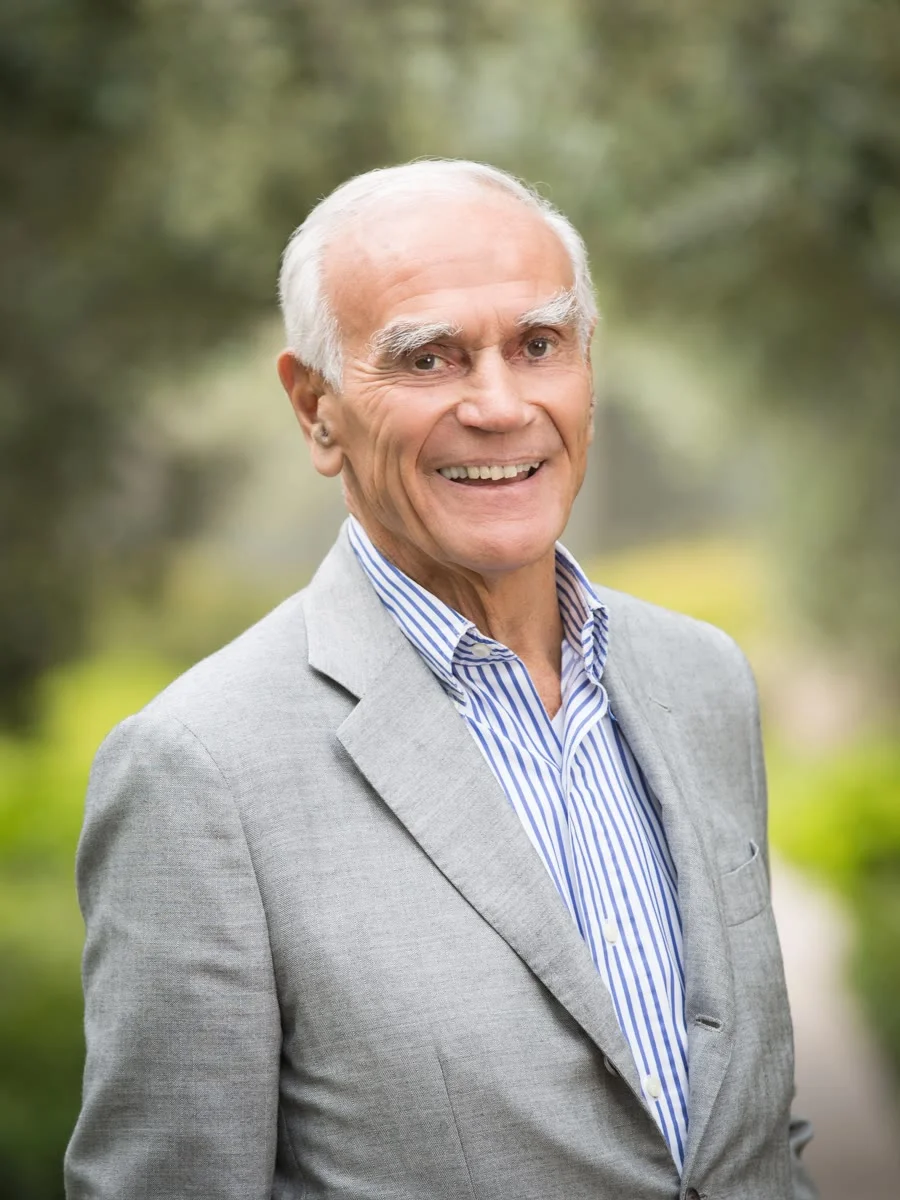
Bill Draper
Second-generation VC; co-founded Sutter Hill and later ran the UN Development Programme.
Verified chronology
- 1928-01-01 — identity. William Henry Draper III was born in White Plains, New York. The target is the venture capitalist later associated with Draper & Johnson and Sutter Hill—not his father, William H. Draper Jr., or his son, Tim Draper. Reagan nomination, Bill Draper paragraph · Bancroft oral history, printed pp. 1–13
- 1940s–1954 — education and military service. Draper attended Yale, served as an infantry officer in Korea, and graduated from HBS in 1954 after studying with Georges Doriot. The inspected record supports sequence and experience, but not a causal claim that any one episode produced his later investment method. Bancroft, printed pp. 1–22 · Something Ventured transcript, PDF pp. 2–3
- 1954–1959 — operating apprenticeship. Draper worked in sales at Inland Steel in East Chicago; the contemporary nomination fixes the employment interval, while later interviews describe executive-training and budgeting experience. Reagan nomination, Bill Draper paragraph · Bancroft, printed pp. 13–22
- 1958/1959–1962 — Draper, Gaither & Anderson. HBS/Bancroft accounts use 1958 for the firm's beginnings, while academic histories use an August 1959 launch and the Reagan record places Bill's associate tenure in 1959–1962. The public record may be separating organization, launch, and Bill's arrival; it does not justify one harmonized date. The GPs were his father, Rowan Gaither, and Fred Anderson; firm activity must not be converted into Bill-personal investing without deal-specific evidence. Bancroft, printed pp. 13–23 · Reagan nomination, Bill Draper paragraph
- 1962 — Draper & Johnson. Draper and Franklin “Pitch” Johnson formed Draper & Johnson Investment Company after meeting at Inland Steel. Draper recalls an SBIC capitalized with $150,000 plus a $300,000 government loan; that is a vehicle-level recollection, not Bill's personal check or a return ledger. Bancroft, printed pp. 23–27
- 1964/1965 — Sutter Hill transition. Draper & Johnson merged with a real-estate-sponsored SBIC called Sutter Hill Capital; Draper then worked with Paul Wythes and later formed an LP called Sutter Hill Ventures. Public sources use 1964, 1965, or “three years later,” and the surviving evidence does not justify forcing one date across merger, SBIC, and LP formation events. Bancroft, printed pp. 23–38 · HBS exhibit, career chronology
- 1967 — political setback. Draper ran for Congress in a special election and lost. The episode belongs in the biography as an unsuccessful public-service attempt, not as evidence of investment skill. Bancroft, printed pp. 47–48 · Reagan nomination, political-activity paragraph
- 1960s–1970s — Sutter Hill company-building era. Direct and participant accounts connect Draper or Sutter Hill to Measurex, Electroglas, Qume, Activision, Apollo Computer, Hybritech, LSI Logic, Ingres, Priam, and other companies. These names are candidate families, not a complete portfolio or person-level return denominator. Bancroft, printed pp. 23–59 and 83–97 · Poduska oral history, printed p. 37
- 1970 — field influence. Brook Byers recalls a Stanford brown-bag panel with Draper, Pitch Johnson, and Reid Dennis as a turning point in his own career. This is a later witness account of audience impact, not a transcript of Draper's remarks. Byers oral history, printed pp. 5–6/PDF pp. 15–16
- 1981-07-14–1986-02-28 — Export-Import Bank. Draper left his active Sutter Hill role for confirmed service as president and chair of the U.S. Export-Import Bank. Public records also preserve controversies over subsidy, small-business exposure, sovereign risk, and political pressure; they require policy-level analysis rather than an assumption that public finance was venture capital at state scale. EXIM official history, leadership timeline · Reagan successor nomination, Draper service paragraph
- 1985 — Activision litigation control. A federal opinion recorded Draper's prior Activision board role, 3.9% stock ownership, and control-person allegations, allowed claims against him to proceed at the pleading stage, and struck the allegation that he remained a Sutter Hill general partner as “patently false.” This procedural ruling is not a merits finding of liability. In re Activision Securities Litigation, 621 F. Supp. 415, “Liability of William Draper III”
- 1986-05-01–1993-07-15 — UNDP. Draper served as Administrator of the United Nations Development Programme. Official appointment, extension, and appreciation/end records control the exact span; HBS says 1995 and Bridgespan says 1994, neither of which overrides the contemporaneous UN record. General Assembly record A/40/PV.123 · ECOSOC E/1993/L.24, effective-departure sentence
- 1986–1993 — public-development record and criticism. Draper described fundraising, opening offices in newly independent Central Asian republics, and separating aid from politics. Contemporary and later critics instead questioned UNDP bureaucracy, strategic clarity, and response speed; those critiques concern a large institution and do not by themselves prove personal misconduct. Bancroft, printed pp. 60–68 · Heritage UNDP critique
- 1994/1995 onward — Draper International formation and India fund. After public service, Draper and Robin Richards raised an India-focused fund with OPIC participation. Formation accounts vary, contemporary reporting shows operations in 1998, and a 2003 filing still shows Draper-India ownership in Rediff. Draper later described distance, bureaucracy, sourcing, and winding the vehicle down; exact fund economics and complete company outcomes remain unlocated. Bancroft, printed pp. 69–82 · Rediff 20-F, principal-holder and director sections
- 1996 onward — Draper Richards and later vehicles. The Bancroft front matter dates Draper Richards to 1996, while later institutional pages use different formation narratives for Draper Richards, Draper Investment Company, and the 2002 foundation. Those entities, partners, and capital pools must remain separate until governing documents resolve legal continuity and investment allocation. Bancroft, front matter and printed pp. 69–82 · DRK history, “Our history”
- 2002 — philanthropic vehicle. Bill and Robin Richards formed the Draper Richards Foundation with family-supported capital; Kaplan was added later. Grants and nonprofit board support belong to a philanthropic denominator, not venture-return analysis. DRK history, founding paragraphs · DRK financials
- 2002 — industry memory on film. Draper joined Pitch Johnson, Burton McMurtry, Tom Perkins, Arthur Rock, and Don Valentine for CHM's Pioneers of Venture Capital. The catalog's machine text is unlabeled and its last segment begins after the stated archival extent, so exact quotation and speaker attribution require video checking. CHM event · CHM catalog 102706131
- 2005–2011 — oral-history and book record. NVCA, Bancroft, Something Ventured, HBS, and CHM collected overlapping retrospective accounts, and Draper published The Startup Game. Institutional duplication does not make repeated stories independent confirmation; the book body remains a licensed/borrowing retrieval question. NVCA transcript · Bancroft catalog · Open Library book record
- 2005 — Skype outcome control. eBay agreed to acquire Skype for $2.6 billion in initial consideration plus potential performance-based consideration. The filing does not identify Bill Draper's vehicle allocation, cost basis, ownership, or realized proceeds, so it cannot support a personal return. eBay 8-K, Item 1.01 · Bancroft, printed pp. 69–82
- 2006–2009 — filing controls for later investments. Filings show small Draper Richards positions in OpenTable, athenahealth, and DivX alongside much larger Tim-linked DFJ/Zone/Draper Atlantic holdings in athenahealth and DivX. This is mixed vehicle attribution, not evidence that Bill or Tim alone “backed” the companies. OpenTable S-1/A, selling-stockholder table · athenahealth 2008 S-1/A, principal-holder table · DivX S-1/A, principal/selling-holder table and notes 2/18
- 2017 — three-generation retrospective. Bill, Tim, and the elder Draper legacy were presented together at CHM. The event is useful for disambiguation and family influence but must not transfer Tim's investments, misses, or politics to Bill. CHM, “Venture Capital in the Blood”
- 2019 — later public appearance. CHM convened Draper with Pitch Johnson and Dick Kramlich. The recap is a retrieval route for late reflection, not evidence of earlier conduct unless the underlying media body is inspected. CHM event recap
Identity and scope boundary
The target is William Henry Draper III, also indexed as Bill Draper, William H. Draper III, William Henry Draper III, and Ambassador William H. Draper III. His father William H. Draper Jr. helped form Draper, Gaither & Anderson after military and government service. His son Timothy C. Draper is associated with Draper Fisher Jurvetson, Draper Associates, Draper University, and later political initiatives. A family name, shared “Draper” brand, board overlap, or later retelling is not sufficient to assign a deal, view, or result to Bill. Reagan nomination · CHM family event · Tim Draper official bio
Vehicle and role boundaries
| entity or institution | period in the public record | Bill Draper's supported role | unresolved boundary |
|---|---|---|---|
| Draper, Gaither & Anderson | 1958/59–1962 | associate; son of one founder | individual decisions, capital, ownership, and carry are not public Reagan nomination |
| Draper & Johnson Investment Company | 1962–mid-1960s | cofounder with Pitch Johnson; SBIC participant | portfolio, allocations, exact merger date, and economics remain incomplete Bancroft, printed pp. 23–38 |
| Sutter Hill Capital / Sutter Hill Ventures | mid-1960s–1981 for Bill's active era | builder and senior partner with Paul Wythes; later partners and LPs supplied work and capital | SBIC, corporate, evergreen, and LP phases are not one undifferentiated fund Something Ventured, PDF pp. 27–28 |
| Export-Import Bank | 1981–1986 | president and chair | sovereign lending and policy outcomes belong to the agency, board, Congress, exporters, and counterparties EXIM history |
| UNDP | 1986–1993 | Administrator | development-program results belong to the institution, member states, staff, donors, and executing agencies UNDP administrators |
| Draper International | formation dated 1994/1995; active by 1998; Rediff holding documented 2003 | cofounder/manager with Robin Richards | OPIC leverage, legal structure, company schedule, and cash flows require records Bancroft, printed pp. 69–82 · Rediff 20-F |
| Draper Richards / Draper Investment Company | from the mid-1990s | later venture manager; partner roles vary by period | must not be merged with DFJ, Draper Associates, or personal/family capital OpenTable S-1/A |
| Draper Richards Kaplan Foundation | from 2002 | cofounder and philanthropic backer | grants and nonprofit support are separate from venture investments DRK history |
Candidate company and opportunity denominator
SCOUT searched and routed 37 named or deliberately anonymous opportunity/control families once into three exclusive buckets:
- 33 provisional Bill/Bill-vehicle-associated candidates: Corbin-Farnsworth, Electroglas, Measurex, Plantronics, Apollo Computer, LSI Logic, Hybritech, Century Data, Priam, Quantum, Activision, Qume, Ingres, Atari, Magnuson Systems, ROLM, PowerTel Boca, Geometric Software, CMM, Query Soft, SaveSmart, Rediff, Selectica, Ramp Networks, Indus League, one unnamed movie investment, one unnamed clothing investment, Skype, athenahealth, OpenTable, DivX, Zappos, and Prolacta. Bancroft, printed pp. 23–59 and 69–97 · Business Standard, named India holdings
- 3 remembered passes/opportunities, excluded from funded companies: Apple, Yahoo, and Microsoft. Something Ventured, PDF p. 45 · CHM oral history, printed pp. 24–25
- 1 family-name identity control, excluded absent Bill-specific evidence: Hotmail, which the inspected public trail associates with Tim/DFJ rather than Bill. Tim Draper official history
All 37/37 were searched and assigned to a bucket; 0/33 provisional Bill/Bill-vehicle candidates has a complete public chain of exact vehicle, Bill-era decision right, security, check, ownership, follow-ons, exit/write-off, and cash flows. The other four are deliberately passes or an identity control. This is therefore not a funded-company count, return denominator, or complete portfolio. One legal company is counted once; follow-ons, acquisitions, aliases, and later manifestations do not create additional families. Later phases must separate sourcing, selection, capital, board work, follow-on, exit, and narration.
The broader vehicle denominators are also only self-reported or promotional: D&J 10–15 investments; Sutter Hill 150 companies financed by 1981 with an unclear definition; Draper International 25 investments and about six losses; Draper Richards about 40 by 2008. None has a retrieved complete schedule or audited cash-flow ledger. CHM oral history, printed pp. 9–19 · Reagan nomination, Bill paragraph · Bancroft, printed pp. 69–93
People and institutions to trace
- Family and formative: William H. Draper Jr.; Dorothy Draper; Phyllis Culbertson Draper; Tim Draper; Georges Doriot; Yale; HBS; U.S. Army; Inland Steel.
- Early firms and capital: Rowan Gaither; Fred Anderson; Don Lucas; Crawford Cooley; Larry Duerig; Pitch Johnson; Paul Wythes; Greg Poole/Sutter Hill real estate interests; Genstar; the SBA/SBIC program; early university and corporate LPs.
- Company builders and syndicators: Dave Bossen and Pete Bancroft at Measurex; Chuck Gravelle at Electroglas; David Lee at Qume; Activision founders; John Poduska and Apollo co-investors; Hybritech operators; Reid Dennis; Rockefeller-family capital representatives; later Sutter Hill partners.
- Public service: Ronald Reagan; George H. W. Bush; EXIM directors and career staff; Congress; exporters and sovereign borrowers; Javier Pérez de Cuéllar; Boutros Boutros-Ghali; UNDP staff, donors, and recipient-country institutions.
- Later vehicles: Robin Richards; Howard Hartenbaum; Tim Draper and DFJ; William McGlashan where supported; OPIC; Skype founders and investors; OpenTable and Athenahealth teams; DRK partners and grantees.
- Completed comparison routes: Georges Doriot for teacher, public-corporation/permanent-capital, centralized decision authority, ownership, incentives, and failure comparison; Arthur Rock for contemporary sourcing, people judgment, Apple, governance, finite partnership/person-dependent vehicles, and adverse cases; Reid Dennis for same-region syndication, Measurex team attribution, portfolio construction, governance, vehicle evolution, incentives, and ordinary-outcome gaps.
Open biographical questions
- Which primary records fix Draper & Johnson's formation, the Sutter Hill Capital merger, and Sutter Hill Ventures LP dates separately?
- What did Bill personally commit, own, approve, source, negotiate, recruit, govern, follow on, and exit in each candidate company, and what belonged to Wythes, Johnson, later partners, LPs, or syndicates?
- Can Sutter Hill's SBIC, Genstar-backed, university/corporate-LP, and evergreen arrangements be reconstructed from agreements, annual reports, capital accounts, and distribution records?
- Which Startup Game passages are direct historical evidence, edited recollection, or later doctrine, and what lawful full-body route is available?
- What do the complete 2002, 2017, and 2019 event media add beyond repeated oral-history stories?
- Which EXIM board minutes, transaction files, inspector reports, and congressional records separate Draper's decision authority from presidential, board, statutory, and staff roles?
- Which UNDP Executive Board records and evaluations distinguish institutional outcomes, policy disputes, and Draper's own decisions during the official 1986–1993 tenure?
- What happened in the Activision litigation after the 1985 pleading-stage ruling, and do later orders or settlements change the procedural boundary?
- Which companies and cash flows belong to Draper International, Draper Richards, Draper Investment Company, personal/family capital, Tim/DFJ, and the DRK Foundation?
- What full portfolio, pass, write-off, and ordinary-outcome records would overturn a fame- and survivor-biased narrative built mostly from Qume, Measurex, Activision, Apollo, Skype, and OpenTable?
Coverage and evidence base
- This synthesis processes all 31 priority written families in the frozen corpus: 8 ★★★ and 23 ★★, with one linked note and one source-owned subsection per family. Current priority access is 13 full, 9 partial, and 9 body barriers. [researcher inference · strong] (frozen written-artifact ledger; 31 writing notes)
- The nine partial families are the official-Spanish-only DP/1992/12 introduction and eight illustrated openings: 1985 and Towards the 1990s; A Better Environment for Development; Creating a Better Climate for Private Enterprise; Development for the Urban Future; Forty Years of World Development; Putting People First; The Challenge of the Environment; and Human Development at Work. For DP/1992/12, the Spanish body and Administrator-office heading are available but the English original is not; for each illustrated report, catalog fields and snippet-visible title/page/sign-off evidence are available but the complete opening and page images are not. [researcher inference · strong] (DP/1992/12 official Spanish body, Administrator heading and paras. 1–27; title/report-year/publication/corporate-author fields for 1985 and Towards the 1990s, A Better Environment for Development, Creating a Better Climate for Private Enterprise, Development for the Urban Future, Forty Years of World Development, Putting People First, The Challenge of the Environment, Google Books catalog/SearchWithin only, and Human Development at Work)
- Body-analysis depth: 14 reproducible bodies receive substantive content analysis—the 13 currently full priority bodies plus the complete official-Spanish DP/1992/12 translation. The eight illustrated openings are processed only to exposed title/page/sign-off fragments, and the nine barriers only to identity, attribution, and access limits. Earlier Breakfast body analysis was withdrawn after both official routes failed final link QA. [researcher inference · strong] (current access ledger; DP/1992/12 Spanish body; Breakfast author announcement, no body)
- The nine body barriers are The Startup Game, Breakfast With Pops, the Houston Chronicle op-ed, the citation-only 1989 ECOSOC statement, and five metadata-only DP introductions: DP/1987/12, DP/1988/18, DP/1989/13, DP/1990/17, and DP/1991/10. Available material is limited respectively to publisher/catalog framing, author-announcement and edition metadata, title/byline/date metadata, the ECOSOC footnote, or UN title/date/corporate-author/extent fields; none supplies inspectable body prose. [researcher inference · strong] (Macmillan “About This Book” and “Book Details,” body unavailable; Breakfast author announcement, no body; Houston title/byline/date route, body paywalled; ECOSOC citation, footnote 40; DP/1987/12 title/date/corporate-author/extent fields; DP/1988/18 title/date/corporate-author/extent fields; DP/1989/13 title/date/corporate-author/extent fields; DP/1990/17 title/date/corporate-author/extent fields; DP/1991/10 title/date/corporate-author/extent fields)
- The broader inventory contains 34 written artifacts. Three routine signed EXIM administrative letters are ★ inventory-only and full-access, so current total-artifact access is 16 full, 9 partial, and 9 barriers; those three low-priority letters do not receive notes or source subsections here. [researcher inference · strong] (written-artifact ledger)
- Attribution is not uniform. Signed forewords, named prepared statements, joint or co-credited works, office-attributed UNDP introductions, and snippet-visible public-report sign-offs carry different authorship strength. Office tenure or publication credit never becomes sentence-level personal drafting without evidence. [researcher inference · strong] (HDR 1990 foreword, printed pp. iii–iv; DP/1993/10 office heading and paras. 1–27; Breakfast author framing, paragraphs 1–3)
- “Bill Draper” here means William Henry Draper III. Father William H. Draper Jr.; son Tim Draper; DFJ, Draper Associates, Draper University, and later-generation company marketing; and Adam-only narration or prose are excluded from Bill attribution unless a source expressly assigns Bill a role. Breakfast With Pops is a co-credited edition with an unavailable body, not an exception to sentence-level voice separation. [researcher inference · strong] (source-map identity sweep; Adam's authorship/origin framing; edition co-credit fields)
- The strongest recurring pattern is capacity before capital: bounded finance, institutional capability, named decision rights, and feedback recur across otherwise different settings. That recurrence supports a research hypothesis, not proof that Bill applied one invariant playbook to venture deals. [researcher inference · moderate] (1987 UN statement, printed pp. 36648–36649; DP/1993/10, paras. 7–27)
1. Export-Import Bank proposal of credit to Brazil and Mexico (1983)
- Deep note. The prepared statement defines a bounded public instrument: up to $1.5 billion for Brazil and $500 million for Mexico, tied to specific U.S. exports and implemented through bank finance, guarantees, and insurance rather than unrestricted government cash advances. [investor-stated · strong] (prepared statement, printed pp. 40–43)
- Its reasoning chain runs from falling exports and threatened jobs to catalytic facilities, private-bank origination, IMF compliance, creditor burden sharing, and repayment assurance. The product attachment turns the proposal into maturities and eligible categories, but neither the jobs forecast nor the sovereign-risk judgment is independently tested in the submission. [researcher inference · moderate] (prepared statement and attachment, printed pp. 41–45)
- Modern transfer as of 2026-08-20: cap exposure, name each risk bearer, and state conditions before deployment. This structural analogy is not evidence that Draper used sovereign-credit mechanics in D&J, Sutter Hill, or a portfolio company. [researcher inference · provisional] (prepared statement, printed pp. 40–45)
2. Export Promotion and Small Business prepared statement (1983)
- Deep note. This submission treats access as a product-and-distribution problem: a discount-loan program is combined with insurance, working-capital guarantees, private intermediaries, counseling, hotlines, workshops, and referrals. [investor-stated · strong] (prepared statement, printed pp. 393–396)
- The adverse evidence is unusually useful: only $23.1 million of a requested $100 million authorization was used after demand weakened. That separates available capacity from actual uptake and motivates measuring indirect participation through suppliers rather than counting only direct borrowers. [contemporaneous record · moderate] (prepared statement, printed pp. 394–395)
- Modern transfer as of 2026-08-20: instrument referral source, onboarding friction, product use, and indirect reach before calling an access program successful. The source reports activity and examples, not defaults, incremental jobs, or a counterfactual without EXIM. [researcher inference · provisional] (prepared statement, printed pp. 393–396)
3. Tied-aid appropriations prepared statement (1985)
- Deep note. Draper endorses a deliberately exceptional countermeasure: a $300 million grant pool would combine with ordinary export credit or private finance to deter foreign tied-aid practices while negotiations sought to eliminate them. [investor-stated · strong] (prepared statement, printed pp. 63–67)
- The core tension is explicit—fight a subsidy with a threatened subsidy. Selective use, Treasury separation from normal EXIM programs, a target set based on negotiating leverage, and a negotiated sunset are the proposed safeguards. [researcher inference · strong] (prepared statement, printed pp. 63–69)
- Outcome evidence is incomplete: 30 competitions were reviewed, about 12 countered, 3 won, and 4 remained pending; the remaining mapping, losses, costs, and causal counterfactual are undisclosed. The projected $1 billion of credit and $2–3 billion of offers are leverage forecasts, not realized exposure or return. [contemporaneous record · moderate] (prepared statement, printed pp. 66–68)
4. House EXIM charter-renewal prepared statement (1986)
- Deep note. The House submission integrates five-year charter renewal, private funding through I-MATCH II, small-business product redesign, retained guarantees, and the tied-aid countermeasure into one institutional program. [investor-stated · strong] (prepared statement, printed pp. 7–16)
- Its most portable risk distinction is liquidity versus insolvency: EXIM remained open in Mexico and Brazil because the institution judged the problem temporary. Product feedback from banks and exporters then altered assignability, drawdown, and repricing mechanics before expanded authority was requested. [investor-stated · strong] (prepared statement, printed pp. 10, 14–15)
- The claimed move toward private capital does not eliminate public exposure; guarantees and interest buy-downs change its form. “Only the subsidy element” is a budget presentation, not a full expected-loss measure including guarantees, administration, recoveries, and discount assumptions. [researcher inference · moderate] (prepared statement, printed pp. 8–9, 13–14)
5. Senate EXIM Act-renewal prepared statement (1986)
- Deep note. The Senate text repeats the House submission's authorities, internal figures, liquidity thesis, small-business mechanics, I-MATCH II design, and tied-aid deterrence logic. The repetition establishes cross-chamber institutional consistency, not an independent fifth doctrine or validation sample. [researcher inference · strong] (Senate statement, printed pp. 9–14; House statement, printed pp. 7–16)
- This family is still separately processed because it is an expressly reproduced writing with its own hearing boundary. Oral testimony and written responses on later pages are separate evidence layers, and neither the repeated language nor the official heading identifies the sentence-level drafter. [researcher inference · strong] (bridge and prepared statement, printed pp. 8–14)
6. 1985 and Towards the 1990s — Administrator message (published 1986)
- Deep note. The illustrated public report places “A Message From the Administrator” on printed pp. 2–3; a visible fragment says Draper took office in May 1986 and p. 3 shows his sign-off. Those fragments support publication-level endorsement and timing, not the missing argument. [contemporaneous record · moderate] (Google Books SearchWithin, printed pp. 2–3; 1985 and Towards the 1990s, title/report-year/publication-date/corporate-author fields)
- DP/1986/11 is a distinct, pre-tenure, office-attributed document issued on 1986-03-24; a council report says the Associate Administrator presented that annual report orally but does not assign him authorship. [contemporaneous record · strong] (DP/1986/11, title/date/corporate-author fields; E/1986/29, printed p. 25, paras. 62–63)
- No prose may be transferred between DP/1986/11 and Draper's later signed public-report opening. [researcher inference · strong] (DP/1986/11 title/date/corporate-author fields; 1985 and Towards the 1990s, Google Books SearchWithin printed pp. 2–3)
7. DP/1987/12 — 1986 annual-report foreword
- Deep note. The UN record establishes an eleven-page “foreword / by the Administrator,” issued 1987-04-24, but exposes no body, signature, or drafting trail. It is an Administrator-office publication during Draper's tenure, not verified Bill-personal prose. [contemporaneous record · strong] (DP/1987/12, title/date/corporate-author/extent fields)
- Page count and genre do not license content inference. The later signed HDR forewords, illustrated public report, and 1987 named UN statement are distinct works and cannot backfill this barrier. [researcher inference · strong] (DP/1987/12 title/date/corporate-author/extent fields; A Better Environment for Development, report year 1986/publication 1987/corporate-author fields; 1987 statement, printed pp. 36648–36649; HDR 1990 foreword, printed pp. iii–iv)
8. A Better Environment for Development — public-report statement (1986 report)
- Deep note. The catalog and scan locate an Administrator's Statement on printed p. 1, where SearchWithin exposes “William H. Draper III — Administrator.” That is stronger than office-only metadata but still insufficient for thesis, examples, or personal drafting. [contemporaneous record · moderate] (Google Books SearchWithin, printed p. 1; A Better Environment for Development, title/report-year/publication/corporate-author fields)
- “Environment” cannot be decoded as economic, institutional, or ecological from the title. This public opening is separate from the eleven-page DP/1987/12 foreword. [researcher inference · strong] (A Better Environment for Development, report year 1986/publication 1987/corporate-author fields; DP/1987/12 title/date/corporate-author/extent fields)
9. Statement to the UN General Assembly Second Committee (1987)
- Deep note. This full named statement combines structural adjustment with social cushioning: reform pace should fit local politics, leading indicators should track effects, and health, nutrition, and education should be protected. [investor-stated · strong] (Congressional Record reprint, printed p. 36648)
- Its operating chain is capacity plus capital: integrate technical assistance, coordinate donors through country Round Tables, support private enterprise, and treat human, technical, and managerial systems as determinants of capital productivity. [investor-stated · strong] (Congressional Record reprint, printed pp. 36648–36649)
- The Action Committee and planned increase in delegated field approval from $400,000 to $700,000 show a central-review/bounded-delegation design. These are institutional claims in a formal statement, not proof that Draper personally approved every project or that reported country outcomes were independently validated. [contemporaneous record · moderate] (Congressional Record reprint, printed p. 36649)
10. DP/1988/18 — 1987 annual-report introduction
- Deep note. The official record identifies a twelve-page “Introduction / by the Administrator,” issued 1988-04-28, but supplies metadata only. Neither title nor tenure establishes Draper's personal drafting, reasoning, or decision rights. [contemporaneous record · strong] (DP/1988/18, title/date/corporate-author/extent fields)
- The accessible 1987 Second Committee statement is a separate named family. Its people-and-capacity doctrine cannot be imported into DP/1988/18 until the latter's body is retrieved. [researcher inference · strong] (DP/1988/18 title/date/corporate-author/extent fields; separate 1987 statement, printed pp. 36648–36649)
11. Creating a Better Climate for Private Enterprise — public-report statement (1987 report)
- Deep note. The public-report catalog and p. 2 sign-off establish a Bill-endorsed institutional opening whose advertised frame is private enterprise. The inaccessible body prevents recovery of its conditions, reasoning, examples, or policy prescriptions. [contemporaneous record · moderate] (Google Books SearchWithin, printed p. 2; Creating a Better Climate for Private Enterprise, title/report-year/publication-date/corporate-author fields)
- Publication dating is unresolved across the catalog routes, and title-level alignment with the 1987 UN statement is not independent doctrinal evidence. It is also distinct from DP/1988/18, whose twelve-page body is separately unavailable. [researcher inference · strong] (Creating a Better Climate for Private Enterprise, report-year/publication-date/corporate-author fields; 1987 statement, printed pp. 36648–36649; DP/1988/18 title/date/corporate-author/extent fields)
12. DP/1989/13 — 1988 annual-report introduction
- Deep note. The UN record identifies a fourteen-page Administrator introduction issued 1989-04-19. Corporate authorship and tenure overlap establish an institutional writing family, not a signature, personal prose, or any recoverable development thesis. [contemporaneous record · strong] (DP/1989/13, title/date/corporate-author/extent fields)
- The nearby ECOSOC citation cannot supply this missing body. Retrieval, not analogy, is the next research action. [researcher inference · strong] (DP/1989/13 title/date/corporate-author/extent fields; separate ECOSOC citation, footnote 40)
13. Development for the Urban Future — joint public-report opening (1988 report)
- Deep note. SearchWithin exposes a joint p. 2 closing for Associate Administrator G. Arthur Brown and Administrator William H. Draper III. Every unseen sentence therefore remains joint institutional voice unless drafts separate the contributors. [contemporaneous record · moderate] (Google Books SearchWithin, printed p. 2; Development for the Urban Future, title/report-year/publication/corporate-author fields)
- The title cannot establish an urban-development thesis, and the opening is not a manifestation of the separate metadata-only DP/1989/13 introduction. A physical or ILL copy is required before synthesis. [researcher inference · strong] (Development for the Urban Future, report year 1988/publication 1989/corporate-author fields; DP/1989/13 title/date/corporate-author/extent fields)
14. Statement at ECOSOC's second regular session (1989)
- Deep note. An official report's footnote 40 establishes speaker, venue, and date—William H. Draper III, ECOSOC's second regular session, 1989-07-06—but the statement body was not retrieved. [contemporaneous record · strong] (official citing report, footnote 40)
- The citing report is not a surrogate transcript. No thesis, philosophy, example, drafting allocation, or wording is assigned to Draper from surrounding prose or later works. [researcher inference · strong] (official citing report, footnote 40)
15. DP/1990/17 — A Watershed for Technical Co-operation
- Deep note. The record establishes a thirteen-page office-attributed introduction issued 1990-03-16. “Watershed” is title metadata: without the body it cannot be mapped to decentralization, aid reform, national ownership, or any other doctrine. [contemporaneous record · strong] (DP/1990/17, A Watershed for Technical Co-operation, title/date/corporate-author/extent fields)
- The separately signed HDR 1990 foreword is a different work and cannot fill this access barrier. Tenure overlap remains weaker than signature or drafting evidence. [researcher inference · strong] (DP/1990/17, title/date/corporate-author/extent fields; HDR 1990 foreword, printed pp. iii–iv)
16. Forty Years of World Development — public-report opening (1989 report)
- Deep note. The public report locates an Administrator opening on printed pp. 1–2, with Draper's sign-off visible on p. 2. The retrospective title does not expose its periodization, selected failures, evidence, or recommendations. [contemporaneous record · moderate] (Google Books SearchWithin, printed pp. 1–2; Forty Years of World Development, title/report-year/publication/corporate-author fields)
- The work is distinct from DP/1990/17. Neither inaccessible opening can corroborate the other, and a physical copy is needed before comparing their accounts of the reporting year. [researcher inference · strong] (Forty Years of World Development, report year 1989/publication 1990/corporate-author fields; DP/1990/17 title/date/corporate-author/extent fields)
17. Human Development Report 1990 foreword
- Deep note. Draper makes human capability—not GDP alone—the objective: longevity, knowledge, freedom, security, participation, and rights are distinct outcomes, while growth remains necessary but insufficient. The analytical question is conversion efficiency: why do similar resources produce different human results? [investor-stated · strong] (signed foreword, printed p. iii)
- He treats comparative indicators as a practical learning and accountability system and commits UNDP to improving missing data. [investor-stated · strong] (signed foreword, printed pp. iii–iv)
- A two-layer decision rule—measure output, then investigate the institution converting it into capability—is a researcher synthesis from that framing. [researcher inference · moderate] (signed foreword, printed pp. iii–iv)
- The governance boundary is as important as the thesis: the foreword expressly assigns analysis to Mahbub ul Haq's team and protects its independence from UNDP, its council, and governments. [contemporaneous record · strong] (signed foreword, printed p. iv)
18. DP/1991/10 — 1990 annual-report introduction
- Deep note. The official record establishes a thirteen-page Administrator introduction issued 1991-04-29 but reveals no prose, signature, drafter, or approval history. No doctrine is coded from metadata. [contemporaneous record · strong] (DP/1991/10, title/date/corporate-author/extent fields)
- It remains distinct from the signed HDR 1991 foreword; the foreword's content may not be projected backward into the inaccessible DP introduction. [researcher inference · strong] (DP/1991/10 title/date/corporate-author/extent fields; HDR 1991 foreword, printed pp. iii–iv)
19. Putting People First — public-report opening (1990 report)
- Deep note. The May 1991 public report locates a signed Administrator opening on printed pp. 1–2. Its title resembles the 1990 HDR foreword's people-centered objective, but snippets provide no definition, mechanism, examples, or independent repetition. [contemporaneous record · moderate] (Google Books SearchWithin, printed pp. 1–2; HDR 1990 foreword, printed p. iii)
- This opening, DP/1991/10, and the signed HDR 1991 foreword are three separate families. A thematic title cannot deduplicate them or become a venture people-picking rule. [researcher inference · strong] (Putting People First, report year 1990/publication May 1991/corporate-author fields; DP/1991/10 title/date/corporate-author/extent fields; HDR 1991 foreword, printed pp. iii–iv)
20. Human Development Report 1991 foreword
- Deep note. After the Gulf War, Draper places peace before development and frames scarcity as a question of political allocation as well as total resources: military spending, inefficient enterprises, prestige projects, capital flight, and corruption can crowd out human priorities. [investor-stated · strong] (signed foreword, printed p. iii)
- The mechanism is participatory reallocation within an enabling policy framework, not spending alone. Markets and private initiative matter, but so do country strategy, data, monitoring, and broad participation. [investor-stated · strong] (signed foreword, printed pp. iii–iv)
- Compared with 1990, the unit of analysis shifts from measuring resource-to-capability conversion toward diagnosing allocation, authority, and adoption. The same independence boundary still assigns the report analysis to Mahbub ul Haq's team rather than Draper. [researcher inference · strong] (1990 foreword, printed pp. iii–iv; 1991 foreword, printed p. iv)
21. DP/1992/12 — 1991 annual-report introduction
- Deep note. The complete official Spanish translation frames technical cooperation around national ownership: national goals set the reference frame, outside inputs should be limited to what is necessary, and intervention should leave lasting local capability. [contemporaneous record · strong] (official Spanish translation, paras. 5–9, printed pp. 2–3)
- The program approach shifts evaluation from delivered inputs to development impact. Bounded projects retain budgets and accountability, but they should align vertically to national goals and horizontally to related work rather than become rigid islands. [contemporaneous record · strong] (official Spanish translation, paras. 8–14, printed pp. 3–4)
- Delegation is conditional: management, accounting, audit, and reporting capacity must exist or be built; headquarters retains policy, finance, personnel, and external-relations controls while field authority expands with feedback. [contemporaneous record · strong] (official Spanish translation, paras. 15–16 and 26–27, printed pp. 4–5, 8–9)
- This is office-attributed institutional text, not personally signed Draper prose, and the available body is a translation rather than the English original. English paraphrases preserve meaning but cannot establish Draper's exact words. [researcher inference · strong] (DP/1992/12 official Spanish body, Administrator heading and paras. 1–27)
22. The Challenge of the Environment — public-report opening (1991 report)
- Deep note. Google Books identifies an Administrator opening across printed pp. 1–2 and exposes Draper's p. 2 sign-off. No canonical UN Digital Library record or complete body surfaced, making custody support weaker than for the other public reports. [contemporaneous record · moderate] (Google Books catalog and SearchWithin, printed pp. 1–2)
- “Environment” cannot be resolved as ecological risk, institutional context, or both from the title. The opening is distinct from DP/1992/12, whose official Spanish body was inspected; neither may substitute for the other. [researcher inference · strong] (Google Books catalog/SearchWithin, printed pp. 1–2 sign-off snippets but no complete opening or UNDL file; DP/1992/12 title/date/corporate-author fields and Spanish file)
23. Human Development Report 1992 foreword
- Deep note. Draper pairs competitive markets with political agency: markets can unleash creative energy, while participation gives people influence over the direction of development. [investor-stated · strong] (signed foreword, printed p. iii)
- The foreword adds an external-constraint diagnosis. Domestic liberalization can be frustrated by restricted trade, migration, finance, and market access, so human-capital investment and access—not aid alone—shape whether countries diversify and reduce dependence. [investor-stated · strong] (signed foreword, printed p. iii)
- Compared with 1991's allocation emphasis, the 1992 text broadens the causal map across borders. Its strong market language is not laissez-faire: the same source calls for international support, open markets, human-capital investment, participation, and independent analysis. [researcher inference · moderate] (1991 foreword, printed p. iii; 1992 foreword, printed pp. iii–iv)
24. DP/1993/10 — 1992 annual-report introduction
- Deep note. The full English office-attributed introduction evaluates growth against welfare, gender equity, governance, rights, and environmental sustainability, then names political commitment, national ownership/capacity, and a supportive global environment as enabling conditions. [contemporaneous record · strong] (DP/1993/10, paras. 1–6, printed pp. 1–2)
- Its operating chain is explicit: define human outcomes, identify national priorities, add complementary external inputs, build institutions, connect projects into programs, coordinate comparative advantages, delegate with feedback, and preserve central accountability. [contemporaneous record · strong] (DP/1993/10, paras. 7–27, printed pp. 2–8)
- National execution and decentralization are paired with retained policy and financial controls; resident representatives receive wider authority, including the described $1 million approval threshold. The source states institutional design, not audited implementation success. [contemporaneous record · moderate] (DP/1993/10, paras. 15–27, printed pp. 5–8)
- The heading reads “INTRODUCTION BY THE ADMINISTRATOR” without personal name or signature. Full English access resolves content but not personal authorship or staff drafting. [researcher inference · strong] (DP/1993/10, heading and paras. 1–27)
25. Human Development at Work: Translating Hope into Reality — public-report opening (1992 report)
- Deep note. The public report locates “The Report of the Administrator” on printed pp. 5–6, and SearchWithin exposes Draper's p. 6 sign-off. The implementation-oriented title supplies no recoverable mechanism, evidence, or failures. [contemporaneous record · moderate] (Google Books SearchWithin, printed pp. 5–6; Human Development at Work, title/report-year/publication/corporate-author fields)
- This opening and DP/1993/10 are distinct publications. The public title may not be used as corroboration for the full office introduction, nor may DP/1993/10 fill the missing illustrated-report body. [researcher inference · strong] (Human Development at Work, report year 1992/publication June 1993/corporate-author fields; DP/1993/10 title/date/corporate-author fields and full English body)
26. Human Development Report 1993 foreword
- Deep note. Draper defines democracy as an everyday institutional practice rather than one election and connects participation to land, water, work, housing, services, and personal security. [investor-stated · strong] (signed foreword, printed p. iii)
- He endorses decentralization, enterprise, competition, innovation, and risk-taking while naming inflation, unemployment, lost subsidies, unrest, violence, and disintegration as transition hazards. The text therefore requires a transition-risk lens, not a one-directional pro-market reading. [researcher inference · moderate] (signed foreword, printed p. iii)
- Across the four HDR forewords, the arc moves from measurement and human capability (1990), through allocation and participation (1991), to cross-border market access (1992), and finally to institutionalized participation and transition risk (1993). Each foreword also preserves analytical independence for the named report team. [researcher inference · strong] (1990, printed pp. iii–iv; 1991, printed pp. iii–iv; 1992, printed pp. iii–iv; 1993, printed pp. iii–iv)
27. “The Fighting Ambassador” contribution (2008)
- Deep note. In this retrospective memorial, Draper recounts helping move Evan “Van” Galbraith into consideration as Reagan's ambassador to France. His stated screen combines relevant international experience, intelligence, wit, dedication, and contextual fit. [investor-stated · moderate] (National Review, “Bill Draper” contribution)
- The appointment story is a coalition process, not a lone-actor success: William F. Buckley Jr. proposes Galbraith; Draper relays the case; Baker, Meese, Deaver, and Buckley help advance it. That supports separating originator, sponsor, recommender, and final decision-maker. [retrospective witness · moderate] (National Review, paragraphs beginning “It wasn't my idea” and describing White House personnel meetings)
- This is affectionate writing published roughly 27 years after the staffing process, without an alternative-candidate set or contemporaneous memo. It routes a talent-matching hypothesis but does not prove that Draper used the same method in venture selection. [researcher inference · moderate] (National Review, “Bill Draper” contribution)
28. The Measure of America foreword (2008)
- Deep note. Draper restates the capability thesis for the United States: growth, trade, and investment are necessary but insufficient; development should expand choices in health, education, participation, safety, livelihood, community, and creativity. [investor-stated · strong] (signed foreword, printed p. xiii)
- The new biographical contribution is a first-person sponsorship account: Mahbub ul Haq proposed the first HDR, and Draper says he supplied resources, editorial independence, and intellectual freedom to a team including Amartya Sen. This supports governance enablement, not authorship of the index or report analysis. [investor-stated · moderate] (signed foreword, printed p. xiii)
- Sen's adjacent foreword identifies Draper's support as important while assigning the intellectual project to Haq and the team. [retrospective witness · moderate] (Sen foreword, printed p. xii)
- That is participant corroboration within one publication, not an independent archival record; Draper's broader claims about accountability and changed fund allocation remain unquantified. [researcher inference · moderate] (Sen and Draper forewords, printed pp. xii–xiv)
- Compared with 1990, the thesis is stable, but the 2008 foreword adds a U.S. application, competitiveness through broad capability formation, social entrepreneurship, and the retrospective origin story. [researcher inference · strong] (HDR 1990 foreword, printed pp. iii–iv; Measure foreword, printed pp. xiii–xiv)
29. The Startup Game (2011)
- Deep note. Macmillan attributes the 272-page book to William H. Draper and frames the venture capitalist as investor, coach, and ally in a partnership with entrepreneurs. That is publisher scope and marketing, not inspected book argument. [contemporaneous record · moderate] (Macmillan, “About This Book” and “Book Details”)
- No book prose was lawfully inspected in this run. Company names on the publisher page do not prove Bill's personal sourcing, vehicle, ownership, board work, or return, especially where family members or later-generation vehicles may be involved. [researcher inference · strong] (Macmillan, company list in “About This Book”)
- Because the body is a barrier, no chapter-level rule, quotation, evolution claim, or modern checklist is derived here. Licensed borrowing or a lawful full text with stable pages is the gating next step. [researcher inference · insufficient public record] (Macmillan “About This Book” and “Book Details,” no book prose inspected)
30. “The Export-Import Bank costs nothing and boosts U.S. jobs” (2018)
- Deep note. The Houston Chronicle record establishes a 2018-01-06 article, its categorical headline, and a joint William Draper–John D. Macomber byline. The paywalled body was not inspected, and neither title authorship nor drafting division is known. [contemporaneous record · strong] (Houston Chronicle record, title/byline/date fields; body paywalled)
- “Costs nothing” and “boosts U.S. jobs” are advocacy claims in an authorship-unknown headline, not settled findings or Bill-only prose. They require audited cost, guarantee-loss, recovery, accounting-method, and employment controls before use. [researcher inference · moderate] (Houston Chronicle record, headline field; no body paragraph locator)
- Without body access no reasoning, evidence, or comparison can be recovered, and no 1980s statement may be substituted. [researcher inference · insufficient public record] (Houston Chronicle record, title/byline/date fields; body paywalled)
31. Breakfast With Pops: A Venture Capital Handbook (2023)
- Deep note. Adam says he wrote the book to distill venture knowledge passed by his grandfather across more than 100 breakfasts; edition records co-credit Adam Draper and William H. Draper III. That proves the work and family-transmission frame, not Bill's sentence-level authorship. [contemporaneous record · strong] (Adam Draper, “I Wrote A Book,” paragraphs 1–3; AbeBooks authors/publisher/year/ISBN fields)
- The official digital page and CC-BY-SA PDF both returned 404 during final QA, and no stable lawful full-body archive surfaced. The prior page-level doctrine, quotation, deal, and return extracts were therefore removed instead of being redirected to metadata pages that do not support them. [researcher inference · strong] (live author announcement, no downloadable body; Goodreads edition page, metadata and synopsis only)
- The family can re-enter body-level synthesis only after a licensed copy or stable lawful archive restores internal voice markers and page-level verification. [researcher inference · strong] (AbeBooks ISBN edition and physical-copy route; live author announcement)
Chronology and evolution
- 1983–1986 — instrument design and risk allocation. The EXIM statements progress from country facilities and small-business access products to a targeted tied-aid countermeasure and an integrated charter-renewal case. Across them, the repeated logic is to define the financing gap, cap or segment the instrument, enlist private intermediaries, respond to user friction, and state who retains which risk. [researcher inference · strong] (Brazil/Mexico, printed pp. 40–45; small business, pp. 393–396; tied aid, pp. 63–69; House renewal, pp. 7–16)
- 1987 — capital becomes explicitly subordinate to capacity. The UN statement retains economic adjustment and private enterprise but puts monitoring, technical assistance, managerial capability, donor coordination, social cushioning, and bounded field delegation in the causal chain. [investor-stated · strong] (Second Committee statement, printed pp. 36648–36649)
- 1990–1993 — from measurement to institutional transition. The signed HDR forewords move from human capability and comparative measurement, through political allocation and participation, to global market access, and then to democracy as continuous participation with explicit transition hazards. [researcher inference · strong] (HDR 1990, printed pp. iii–iv; 1991, printed pp. iii–iv; 1992, printed pp. iii–iv; 1993, printed pp. iii–iv)
- 1992–1993 — operating architecture becomes legible. The two accessible DP introductions add national ownership, program-level coordination, bounded projects, conditional delegation, feedback, and retained central accountability. This is institutional voice rather than signed personal prose, but it is the corpus's clearest operating-system layer. [contemporaneous record · strong] (DP/1992/12, paras. 5–27; DP/1993/10, paras. 7–27)
- 2008–2023 — retrospective application and family transmission. The 2008 Measure foreword explains sponsorship-with-independence; the 2008 memorial records talent matching and coalition sponsorship; and the 2011 and 2023 books are now body barriers. The 2023 author announcement establishes family transmission but not Bill-attributed venture rules. [researcher inference · moderate] (Measure, printed pp. xiii–xiv; National Review, “Bill Draper” contribution; Macmillan “About This Book” and “Book Details,” no book prose inspected; Breakfast author announcement, paragraphs 1–3)
Tensions and counterevidence across the corpus
- Public intervention versus market restoration. EXIM uses guarantees, insurance, interest buy-downs, and even threatened subsidies while describing private finance and undistorted trade as the destination. The supportable principle is bounded additionality with an exit condition, not “government always withdraws” or “subsidy always works.” [researcher inference · moderate] (tied-aid statement, printed pp. 63–69; House renewal, printed pp. 8–15)
- Growth and markets versus human outcomes and transition loss. Draper consistently treats growth as necessary and markets as productive, yet rejects output as a sufficient objective and names dislocation, exclusion, and social fracture as real risks. This is a conditional pro-market stance rather than laissez-faire or anti-growth doctrine. [researcher inference · strong] (HDR 1990, printed p. iii; HDR 1992, p. iii; HDR 1993, p. iii)
- Local ownership versus central accountability. The DP texts push execution outward but retain policy, finance, personnel, audit, and reporting controls at headquarters. Conditional delegation is the proposed bridge; the sources do not independently prove that the balance worked. [researcher inference · moderate] (DP/1992/12, paras. 15–16, 26–27; DP/1993/10, paras. 15–27)
- Sponsorship versus intellectual ownership. The HDR forewords and the 2008 Measure account value Draper's provision of institutional cover while assigning analytical authorship to Haq, Sen, and the teams. Sponsor, editor, funder, named officeholder, and intellectual author are not interchangeable roles. [researcher inference · strong] (HDR 1990, printed p. iv; Measure, printed pp. xii–xiii)
- Consistency versus independent validation. Near-identical House and Senate submissions confirm a stable institutional case but do not multiply evidentiary support for internal figures, accounting, or outcomes. Recurring public-report titles likewise require underlying-body or independent-record checks. [researcher inference · strong] (House, printed pp. 7–16; Senate, printed pp. 9–14; A Better Environment for Development, report year 1986/publication 1987/corporate-author fields; Development for the Urban Future, report year 1988/publication 1989/corporate-author fields)
Decision playbook — analyst translation as of 2026-08-20
- Diagnose the bottleneck before choosing capital. Separate liquidity, solvency, capability, distribution, policy, and demand problems; the small-business utilization shortfall and the UN capacity argument show why funding alone can miss the constraint. [researcher inference · moderate] (small-business statement, printed pp. 393–396; 1987 UN statement, printed p. 36649)
- Define a bounded instrument and its end state. State maximum exposure, eligible uses, pricing, milestones, and the condition under which exceptional support sunsets. [researcher inference · moderate] (Brazil/Mexico statement and attachment, printed pp. 40–45; tied aid, pp. 63–69)
- Map risk and decision rights explicitly. Identify who originates, guarantees, funds, approves, monitors, and absorbs residual loss; do not describe a transfer of principal funding as disappearance of public exposure. [researcher inference · strong] (House renewal, printed pp. 13–15; DP/1993/10, paras. 15–27)
- Build capability before expanding autonomy. Test management, accounting, reporting, and technical capacity; delegate within a threshold; and pair autonomy with fast feedback and retained accountability. [researcher inference · strong] (DP/1992/12, paras. 15–16 and 26–27; DP/1993/10, paras. 15–27)
- Protect independent analysis from the sponsor. Name who owns the research, preserve the right to publish adverse findings, and do not convert sponsorship into analytical authorship. [researcher inference · strong] (HDR 1990, printed p. iv; Measure, printed p. xiii)
- Instrument outcomes, not announcements. Track utilization, conversion, losses, recoveries, human outcomes, and counterfactuals; preserve nested denominators and distinguish projections from realized results. [researcher inference · strong] (small-business statement, printed p. 394; tied aid, printed pp. 66–68; HDR 1990, printed pp. iii–iv)
Modern VC transfer tests (as of 2026-08-20)
- Diagnose the bottleneck before financing. Target: post-seed through growth companies, especially capital-intensive or regulated businesses in any geography with observable commercial channels. Survives: distinguish liquidity, solvency, capability, distribution, policy, and demand. Changed assumption: startup runway and product-market evidence replace sovereign-credit judgments. Diagnostic question: what constraint would still bind if cash arrived tomorrow? Causal chain: correct diagnosis → matched instrument → actual uptake → operating outcome. Signals: net burn/runway, gross retention, onboarding conversion, and finance-close cadence. Falsifier: retention and unit economics keep worsening after the claimed temporary liquidity shock passes. Rule: bridge only when a dated recovery mechanism and next-check evidence are explicit. Misuse: funding structural insolvency because cash is the visible symptom. Grounded application remains unproved for Draper venture deals; use a clearly labeled hypothetical bridge-stage hardware company. [researcher inference · provisional] (small-business statement, printed pp. 393–396; House renewal, printed pp. 10, 13–15)
- Bound the instrument and its end state. Target: bridge, project-finance-like, or incentive-heavy rounds in regulated or subsidy-exposed markets. Survives: exposure caps, eligible uses, milestones, risk ownership, and sunset conditions. Changed assumption: venture investors use equity, debt, tranches, and covenants rather than sovereign guarantees. Diagnostic question: which milestone ends exceptional support, and who bears loss if it is missed? Causal chain: bounded support → specific constraint relieved → milestone reached → exceptional support ends. Signals: tranche utilization, milestone completion, insider participation, and post-close runway. Falsifier: additional capital does not move the named milestone. Rule: no follow-on without a new decision and explicit residual-risk owner. Misuse: making subsidy or insider support permanent. Hypothetical: a climate-hardware bridge tied to certification and customer acceptance. [researcher inference · provisional] (Brazil/Mexico statement, printed pp. 40–45; tied-aid statement, printed pp. 63–69)
- Map decision rights and residual risk. Target: syndicated or structured rounds from Series A onward, across geographies. Survives: name who sources, diligences, funds, approves, monitors, guarantees, and absorbs loss. Changed assumption: modern reserved matters, information rights, and board duties replace public-agency authority. Diagnostic question: do cash, authority, information, and residual downside sit with the same actors? Causal chain: explicit rights → faster escalation → accountable intervention → bounded downside. Signals: reporting latency, reserved-matter breaches, board attendance, and ownership concentration. Falsifier: repeated surprises despite formally adequate rights. Rule: do not equate transferred principal funding with transferred downside. Misuse: centralizing every operating decision at the board. Hypothetical: a multi-investor fintech round with one lead and named compliance owner. [researcher inference · provisional] (House renewal, printed pp. 13–15; DP/1993/10, paras. 15–27)
- Earn autonomy through operating capability. Target: newly institutionalizing companies from Series A through growth, particularly cross-border teams. Survives: conditional delegation with finance, accounting, audit, reporting, and technical capacity. Changed assumption: autonomy belongs to company management under corporate law, not country-execution units. Diagnostic question: which control or skill must pass before authority expands? Causal chain: capability built → authority delegated → feedback arrives quickly → scope expands. Signals: close-cycle time, forecast variance, control exceptions, and incident-response latency. Falsifier: control failures persist after people and systems are installed. Rule: expand budget or board autonomy only after named capabilities pass a threshold. Misuse: using “capacity” as an excuse for investor micromanagement. Hypothetical: a Series B company opening a regulated foreign subsidiary. [researcher inference · provisional] (DP/1992/12, paras. 15–16, 26–27; DP/1993/10, paras. 15–27)
- Protect independent analysis from its sponsor. Target: any stage where customer harm, safety, impact, or technical uncertainty can be suppressed by financing incentives. Survives: named analytical owner, editorial independence, and permission to report adverse findings. Changed assumption: boards still retain fiduciary judgment and cannot outsource accountability to a study. Diagnostic question: can the analyst publish a conclusion the sponsor dislikes? Causal chain: protected inquiry → credible adverse evidence → decision update → safer allocation. Signals: preregistered scope, reviewer independence, disclosed conflicts, and publication of negative findings. Falsifier: sponsor edits conclusions or withholds material results. Rule: fund the review only with a documented independence charter. Misuse: treating independence as automatic truth or public-relations cover. Hypothetical: an independent model-safety review before an AI company's growth round. [researcher inference · provisional] (HDR 1990 foreword, printed p. iv; Measure forewords, printed pp. xii–xiii)
- Instrument outcomes and counterfactuals. Target: portfolio-support programs, platform services, and staged capital at any company stage. Survives: preserve nested denominators and separate availability, utilization, conversion, loss, recovery, and user outcome. Changed assumption: company KPIs and fund ownership replace public-program employment and country outcomes. Diagnostic question: what changed versus a credible counterfactual, for whom, and over what window? Causal chain: explicit denominator → comparable observations → causal challenge → continuation or stop. Signals: eligible versus reached users, activation, retention, loss/recovery, and outcome lift. Falsifier: activity rises while the intended outcome stays flat. Rule: no success claim without denominator, time window, and counterfactual. Misuse: optimizing an easy activity proxy. Hypothetical: a portfolio recruiting program judged on retained hires, not introductions. [researcher inference · provisional] (small-business statement, printed pp. 394–395; tied-aid statement, printed pp. 66–68; HDR 1990, printed pp. iii–iv)
- Underwrite market access and transition loss separately from team quality. Target: cross-border companies in emerging or reforming markets from seed through growth. Survives: map trade access, permissions, talent mobility, financing channels, local ownership, and losers from change. Changed assumption: company-specific regulatory and distribution evidence replaces country-level advocacy. Diagnostic question: which access path must work on the investment timeline, and who can block it? Causal chain: access path + local capability + transition mitigation → adoption → durable market entry. Signals: license lead time, talent/FX constraints, channel conversion, and stakeholder opposition. Falsifier: a required permission or distribution path remains unavailable on the investment timeline. Rule: do not let a strong team stand in for a credible access path. Misuse: treating macro complexity as a single country-risk score. Hypothetical: a fintech entering a newly liberalized payment market. [researcher inference · provisional] (HDR 1992, printed p. iii; HDR 1993, printed p. iii)
Best five processed writings
- 1987 UN Second Committee statement: the richest contemporaneous bridge from public philosophy to operating design—adjustment, social cushioning, capacity, central review, and field delegation in two inspectable pages. [researcher inference · strong] (printed pp. 36648–36649)
- HDR 1990 foreword: the clearest signed statement of outcome-versus-output reasoning and sponsor-protected analytical independence. [researcher inference · strong] (printed pp. iii–iv)
- DP/1993/10: the most complete institutional operating chain—national priorities, capability, program coordination, delegation, feedback, and accountability—while preserving the office-authorship boundary. [researcher inference · strong] (paras. 1–27, printed pp. 1–8)
- The Measure of America foreword: the strongest signed retrospective account of how Draper understood sponsorship, editorial freedom, and measurement as an accountability tool. [researcher inference · strong] (printed pp. xiii–xiv)
- 1986 House charter-renewal statement: the most complete written EXIM instrument-design case, integrating additionality, private-bank participation, exposure, pricing, governance, and the limits of projected outcomes. [researcher inference · strong] (prepared statement, printed pp. 7–16)
Unresolved evidence priorities
- Retrieve licensed, page-stable bodies for The Startup Game, Breakfast With Pops, the Houston Chronicle op-ed, and the 1989 ECOSOC statement before extracting any doctrine, quotation, or evolution claim. The Breakfast author announcement remains live, but its former official page and PDF are not. [researcher inference · strong] (Macmillan “About This Book” and “Book Details,” no book prose inspected; Breakfast author announcement, no book body; Houston title/byline/date route, body paywalled; ECOSOC citation, footnote 40)
- Obtain the five metadata-only DP introductions and physical/ILL copies of all eight illustrated public-report openings. Keep the two annual-report series separate even when year and titles appear thematically aligned. [researcher inference · strong] (DP/1987/12 title/date/corporate-author/extent; DP/1988/18 title/date/corporate-author/extent; DP/1989/13 title/date/corporate-author/extent; DP/1990/17 title/date/corporate-author/extent; DP/1991/10 title/date/corporate-author/extent; title/report-year/publication/corporate-author fields for 1985 and Towards the 1990s, A Better Environment for Development, Creating a Better Climate for Private Enterprise, Development for the Urban Future, Forty Years of World Development, Putting People First, and Human Development at Work, plus The Challenge of the Environment, Google Books catalog/SearchWithin pp. 1–2 snippets, no complete opening)
- Recover drafts, cover memoranda, and editorial files to separate personal drafting from endorsement in congressional prepared statements, office-attributed UN texts, joint writing, and the family handbook. [researcher inference · strong] (House prepared-statement heading, printed pp. 6–7; DP/1993/10 heading; Breakfast authorship/origin framing)
- Test EXIM advocacy against transaction-level authorizations, utilization, defaults, recoveries, subsidy and guarantee costs, employment estimates, and counterfactual private finance. [researcher inference · strong] (Brazil/Mexico, printed pp. 40–45; House renewal, pp. 8–15)
- Test later family and memorial recollections against firm records, board minutes, capitalization tables, cash flows, partner attribution, and failed cases. No performance conclusion should rest on a currently inaccessible family handbook. [researcher inference · strong] (Breakfast author announcement, no body; National Review, “Bill Draper” contribution, no stable paragraph numbers)
Direct voice, books, interviews, and public appearances
- ★★★ | William H. Draper III: Early Bay Area Venture Capitalists oral history | https://digicoll.lib.berkeley.edu/record/218454 | interviews 2008-04-07, 2008-04-14, 2008-04-22, and 2008-05-15; published 2009 | Bancroft/UC Berkeley catalog with full 104-PDF-page transcript and four video-disc records; reliability A for custody and attributed speech, B for retrospective accuracy | The most comprehensive direct account: printed pp. 1–22 cover family, Yale, Army/Korea, HBS, Inland Steel, and DGA; pp. 23–46 D&J/SBIC/Sutter Hill and deals; pp. 47–68 EXIM/UNDP; pp. 69–97 later vehicles, India, Skype, misses, and foundation. The catalog and
record/103600PDF are manifestations of one work, not independent sources. - ★★★ | William H. Draper III Venture Capital Greats oral history | https://digicoll.lib.berkeley.edu/record/103633/files/draper_william_donated.pdf | interviews 2005-10-24 and 2005-11-02 | full 97-page NVCA oral-history transcript; reliability A for custody and attributed speech, B for memory; research use is open but quotation/publication rights are restricted | Direct treatment of family, Doriot, DGA, D&J, Sutter Hill structure, sourcing, stage preference, people judgment, company examples, public service, and later vehicles; process for research and paraphrase, not unrestricted republication.
- ★★★ | Venture Voices: A Conversation with Bill Draper and Pete Bancroft | https://digicoll.lib.berkeley.edu/nanna/record/103633/files/draper_bancroft_donated.pdf?registerDownload=1&version=1&withMetadata=0&withWatermark=0 | interviewed 2008-09-22; published 2009 | full 20-page NVCA “Tape 3” transcript; reliability A for custody and attributed speech, B for memory; quotation/publication permission restricted | Distinct joint interview on company-building, syndication, valuation inflation, founder selection, trust, and early NVCA; not a manifestation of the four-session Bancroft oral history.
- ★★★ | William H. Draper III — HBS Entrepreneurs oral history | https://www.library.hbs.edu/special-collections-and-archives/exhibits/entrepreneurs/william-h-draper-iii | interview 2010-12; current exhibit accessed 2026-08-20 | official HBS exhibit with 48:04 video and transcript asset; reliability A for attributed speech and B for exhibit framing | Direct career narrative and investment criteria. The stable exhibit is canonical; the older
/content/download/60439/PDF is dead, while the current asset is dynamically hosted. Its “UNDP through 1995” statement conflicts with official 1993 records. - ★★★ | Oral History of William H. Draper III | https://archive.computerhistory.org/resources/access/text/2013/04/102743096-05-01-acc.pdf | recorded 2011-04-14 | official CHM 26-page transcript, ref. X6084.2011; reliability A for custody and attributed speech, B for memory | Full direct interview by John Hollar on Doriot, DGA, D&J/Sutter Hill, decision authority, entrepreneurs, public service, and later institutions; distinct interview but narratively overlapping with Bancroft/NVCA/HBS.
- ★★★ | Something Ventured interview with Bill Draper | https://purl.stanford.edu/mt286bv2494 | Smithsonian family date 2009-09-24; Stanford resource date 2009 | official Stanford PURL to a full 72-page raw interview transcript; reliability A for custody and attributed speech, B for retrospective accuracy | Direct PDF
https://stacks.stanford.edu/file/mt286bv2494/Bill_Draper_Transcript.pdf; locators include Doriot pp. 2–3, Apollo p. 23, Measurex p. 24, Activision p. 25, evergreen structure pp. 27–28, Skype p. 39, Apple miss p. 45, India pp. 48 and 56–62, and EXIM/UNDP p. 55. - ★★★ | Pioneers of Venture Capital | https://computerhistory.org/events/pioneers-venture-capital/ | event 2002-09-30 | official CHM event and full panel-video family, catalog 102706131/X4859.2009; reliability A for custody and B for content after speaker control | Gordon Davidson moderates Draper, Pitch Johnson, Burton McMurtry, Tom Perkins, Arthur Rock, and Don Valentine. The catalog has 1,478 unlabeled machine-text segments; exact Draper wording requires video validation and the final segment start is not verified runtime.
- ★★ | Venture Capital in the Blood: Three Generations of Drapers in Silicon Valley | https://computerhistory.org/blog/venture-capital-in-the-blood-three-generations-of-drapers-in-silicon-valley/ | event 2017-04-19; recap 2017 | official CHM recap with embedded family-event media; reliability A for event identity and B for edited framing | Bill, Tim, and their family legacy appear together. Use to separate generations, extract only validated speaker turns, and avoid assigning Tim's misses, investments, or politics to Bill.
- ★★ | Blazing a Trail: Venture Capital Pioneers Reflect on the Industry | https://computerhistory.org/blog/blazing-a-trail-venture-capital-pioneers-reflect-on-the-industry/ | event 2019-03-28 | official CHM event recap with media route; reliability A for event metadata and B for edited framing | Later discussion with Draper, Pitch Johnson, and Dick Kramlich; useful for late intellectual chronology after full media/speaker inspection, not independent proof of early events.
- ★★ | VCs and the Sustainable Development Goals | https://www.undp.org/policy-centre/singapore/events/past-event-17-dec-8am-pst-join-undp-administrator-draper-university-founder-and-others-learn-how-vcs-can-help-address | 2020-12-17 | official UNDP event page and livestream route; reliability A for participant/date metadata and B for program framing | Lists Bill as a former 1986–1993 UNDP Administrator and DRK founder alongside current UNDP leadership; the associated media must be inspected before content analysis and “Draper University” belongs to Tim.
- ★★ | Q&A with Bill Draper on venture capital, startups, and Skype | https://fortune.com/2011/01/21/qa-with-bill-draper-on-venture-capital-startups-and-skype/ | 2011-01-21 | edited Fortune interview; reliability B | Book-launch-period direct voice on firm history, company building, Skype, and misses; publisher access and editorial selection must be disclosed in later processing.
- ★★ | Inside the Mind of an Investor | https://www.inc.com/magazine/20101201/inside-the-mind-of-an-investor.html | 2010-12-01 | full edited Inc. interview by Leigh Buchanan; reliability B | Direct advice on sourcing, founder diligence, references, lawsuits, people, and financing; later doctrine rather than contemporaneous proof of early application.
- ★★★ | The Startup Game: Inside the Partnership Between Venture Capitalists and Entrepreneurs | https://us.macmillan.com/books/9780230339941/thestartupgame/ | first edition 2011-01-04; paperback 2012-06-19 | official publisher record for William H. Draper's authored book; reliability A for metadata and B for edited retrospective content; body not publicly open | Mandatory WRITINGS family. Open Library
OL24914022M, OCLC 642511388, and ISBN 9780230104860 supply catalog/borrowing routes; obtain a lawful copy and do not infer prose from metadata or snippets. - ★★ | The Export-Import Bank costs nothing and boosts U.S. jobs | https://www.houstonchronicle.com/opinion/outlook/article/The-Export-Import-Bank-costs-nothing-and-boost-12478830.php | 2018-01-06 | Houston Chronicle op-ed under William Draper and John D. Macomber bylines; reliability B | Named coauthored policy writing on EXIM's rationale; full-text/paywall access and sentence-level joint authorship require explicit handling.
- ★★★ | Human Development Report 1990 — Foreword | https://hdr.undp.org/content/human-development-report-1990 | foreword signed 1990-05-01 | official UNDP report with Draper-signed foreword; reliability A for attribution and body; report analysis is independently/team authored | Direct contemporaneous writing on people-centered development and the limits of GDP; attribute only the foreword to Draper and preserve the report's intellectual-independence boundary.
- ★★ | Human Development Report 1991 — Foreword | https://hdr.undp.org/content/human-development-report-1991 | foreword signed 1991-05-01 | official UNDP report with Draper-signed foreword; reliability A for attribution and body | Direct writing on budget priorities, political commitment, and financing human development; the underlying report remains team authored.
- ★★ | Human Development Report 1992 — Foreword | https://hdr.undp.org/content/human-development-report-1992 | foreword signed 1992-03-02 | official UNDP report with Draper-signed foreword; reliability A for attribution and body | Direct writing on global markets and market/state relationships near the end of his tenure; not evidence that Draper authored the report's analysis.
- ★★ | Human Development Report 1993 — Foreword | https://hdr.undp.org/content/human-development-report-1993 | foreword signed 1993-03-17 | official UNDP report with Draper-signed foreword; reliability A for attribution and body | Final verified annual foreword, covering participation and governance; useful for end-of-tenure intellectual chronology.
- ★★★ | Statement by William H. Draper III to the UN Second Committee | https://www.govinfo.gov/content/pkg/GPO-CRECB-1987-pt25/pdf/GPO-CRECB-1987-pt25-7-3.pdf | delivered 1987-11; reprinted 1987-12-18/19 | official Congressional Record reprint of a named prepared statement; reliability A | Direct contemporaneous UNDP voice on reform, private enterprise, adjustment costs, technical assistance, and donor confidence.
- ★★★ | Oversight Activities of the Export-Import Bank — hearing statement and Q&A | https://books.google.com/books?id=5M8PAAAAIAAJ | hearing 1985-02-05; published 1985 | official Senate hearing volume, 161 pages, full-view scan; reliability A for recorded speech, not personal drafting | Draper's hearing statement begins printed p. 13 and runs through p. 19, followed by Q&A; the volume does not label his statement prepared/submitted and contains no oath or sworn language. Route as TALKS/transcript, not mandatory WRITINGS.
- ★★ | Bill Draper has an Eye for Social Entrepreneurs | https://www.bridgespan.org/insights/bill-draper | 2013-11-27 | Bridgespan profile plus 20 short direct-video modules; reliability B; page body and module index open | Organized later direct voice on social-entrepreneur selection, rejection, scaling, Kiva, grants, and support; its 1986–1994 UNDP chronology conflicts with official records.
- ★★ | William H. Draper III in Conversation with Dave Iverson | https://www.youtube.com/watch?v=xkFKnZ8_W2A | recorded 2011-02-10 | official CHM/KQED long-form event video, 1:00:30; reliability A for custody and speaker identity | Book-era direct interview; the 53:22 upload
aD2vPxoDeb8is an edit/manifestation of the same event, not an independent source. A transcript was not captured in SCOUT. - ★★★ | Bill Draper: The Rise of Sand Hill Road and Silicon Valley | https://www.youtube.com/watch?v=KxDxRUYEMXg | 2016-05-31 | official Stanford course video, 48:58; reliability A for event custody and speaker identity | Distinct teaching session on institutional origins and Sand Hill Road; transcript snippets were discoverable but a complete validated text layer was not captured in SCOUT.
- ★★★ | Bill Draper: The Early Days of Silicon Valley | https://www.youtube.com/watch?v=tE0IkKMaE0Y | 2016-08-30 | official Stanford MS&E 476 video, 1:04:58; reliability A for event custody and speaker identity | Direct teaching/Q&A route on teams, empathy, diligence, coaching, capital abundance, immigration, and women in venture; later-phase transcript required.
- ★★★ | Bill Draper: The Origins of Venture Capital in Silicon Valley | https://www.youtube.com/watch?v=QqwKuKKWiJ4 | 2017-01-09 | official Stanford fireside/course video, 51:12; reliability A for event custody and speaker identity | Third distinct Stanford session for late intellectual chronology; do not count it as a repost merely because its themes overlap.
- ★★★ | Breakfast With Pops: A Venture Capital Handbook | https://www.adamdraper.vc/p/i-wrote-a-book | 2023-02-13 | live author announcement plus edition metadata; current body barrier after the official author page and 129-PDF-page CC-BY-SA file returned 404 in final QA; reliability A for Adam's account of the book's origin and B for edition metadata | Adam says he wrote the book to distill venture knowledge passed by Bill across 100-plus breakfasts. Goodreads and ISBN 9798987992814 edition records co-credit Adam Draper and William H. Draper III, but no stable lawful full-body or archived route surfaced. Prior page-level extracts are not used in synthesis; retrieve a licensed copy before analyzing doctrine, quotations, or reported performance.
- ★★ | The Fighting Ambassador | https://www.nationalreview.com/2008/01/fighting-ambassador-nro-symposium/amp/ | 2008-01-23 | full National Review memorial-symposium page with direct author heading and bio; reliability B | Attribute only the short section from heading
Bill Draperthrough the William H. Draper III author bio; direct authored prose about Evan Galbraith/public service, not investing doctrine and not the other symposium contributors. - ★★ | The Measure of America — Foreword by William H. Draper III | https://measureofamerica.org/file/Forewords_-_The_Measure_of_America.pdf | 2008-07 | official Measure of America full-forewords PDF plus Columbia UP metadata; reliability A for body/attribution | Draper's signed foreword is printed pp. xiii–xiv; attribute only those two pages, not Amartya Sen's preceding foreword or the report by Burd-Sharps, Lewis, and Martins. Publisher:
https://cup.columbia.edu/book/the-measure-of-america/9780231154956/. - ★★ | Statement of William H. Draper III at the second regular session of ECOSOC | https://digitallibrary.un.org/nanna/record/94638/files/E_CN-4_Sub-2_1990_19-EN.pdf?registerDownload=1&version=1&withMetadata=0&withWatermark=0 | delivered 1989-07-06 | official UN report cites the named statement in footnote 40; reliability A for existence/date but body unavailable | Metadata/citation-only writing lead; do not infer content from the surrounding report or analyze prose until the statement body is retrieved.
- ★★★ | Export-Import Bank Proposal of Credit to Brazil and Mexico — prepared statement of William H. Draper III | https://books.google.com/books?id=GKrTAlxuUrIC | delivered 1983-09-14; published 1983 | official Senate hearing volume in full-view public-domain scan; reliability A for recorded body/attribution | Draper's oral testimony begins printed p. 38; his separately reproduced prepared statement is printed pp. 40–45, followed by Q&A. Analyze the prepared statement as WRITINGS and keep oral Q&A as TALKS/transcript.
- ★★ | Export Promotion and Small Business — prepared statement of William H. Draper III | https://books.google.com/books?id=k073XzJckT8C | delivered 1983-10-26; published 1984 | official House hearing volume in full-view public-domain scan; reliability A for recorded body/attribution | Washington-session testimony begins printed p. 391; expressly labeled
PREPARED STATEMENT OF WILLIAM H. DRAPER IIIbegins p. 393 and ends p. 396 immediately before Mr. IRELAND; oral questioning begins lower on p. 396 and continues thereafter. Written statement and oral exchange are separate evidence layers. - ★★★ | To Authorize Appropriations for Tied Aid Credit — prepared statement of William H. Draper III | https://books.google.com/books?id=FmAzAAAAIAAJ | delivered 1985-10-16; hearing series published 1986 | official House hearing volume in full-view public-domain scan; reliability A for recorded body/attribution | Draper's testimony begins printed p. 60; contents identify his prepared statement at p. 63 and his submitted response at p. 87. Analyze the prepared statement; keep Q&A and follow-up responses distinctly labeled.
- ★★★ | The Charter Renewal of the Export-Import Bank — prepared statement of William H. Draper III | https://books.google.com/books?id=PSIgAAAAMAAJ | delivered 1986-02-05; published 1986 | official House hearing volume in full-view public-domain scan; reliability A for recorded body/attribution | Draper's testimony begins printed p. 3; printed p. 6 bridges from the oral statement to the separately headed prepared-statement core at printed pp. 7–16, followed by attachments before Q&A.
- ★★★ | Renewal of the Export-Import Bank Act of 1945 — prepared statement of William H. Draper III | https://books.google.com/books?id=AVVHUc-ct4QC | delivered 1986-02-07; published 1986 | official Senate hearing volume in full-view public-domain scan; reliability A for recorded body/attribution | Draper's oral statement begins printed p. 4; the volume says
complete prepared statement followsat p. 8, with written responses at pp. 89 and 113. Distinct submission from the February 5 House statement; compare before claiming unique doctrine. - ★★ | Annual report of the Administrator for 1986 — Foreword by the Administrator | https://digitallibrary.un.org/record/142653 | 1987-04-24 | official UN Digital Library record DP/1987/12; reliability A for metadata/corporate authorship, body unavailable | Eleven-page foreword attributed to
UNDP. Administratorduring Draper's tenure; metadata-only, no signature/name or public body surfaced, so do not infer prose or call it personal authorship. - ★★ | Annual report of the Administrator for 1987 — Introduction by the Administrator | https://digitallibrary.un.org/record/40237 | 1988-04-28 | official UN Digital Library record DP/1988/18; reliability A for metadata/corporate authorship, body unavailable | Twelve-page office-attributed introduction during Draper's tenure; metadata-only and not evidence of personal drafting or personal views.
- ★★ | Annual report of the Administrator for 1988 — Introduction by the Administrator | https://digitallibrary.un.org/record/63447 | 1989-04-19 | official UN Digital Library record DP/1989/13; reliability A for metadata/corporate authorship, body unavailable | Fourteen-page office-attributed introduction during Draper's tenure; metadata-only and not personally signed in the accessible record.
- ★★ | A Watershed for Technical Co-operation — Introduction by the Administrator | https://digitallibrary.un.org/record/90854 | 1990-03-16 | official UN Digital Library record DP/1990/17; reliability A for metadata/corporate authorship, body unavailable | Thirteen-page introduction to the annual report for 1989, attributed to the Administrator's office; title is visible, but body, drafting, and signature are not.
- ★★ | Annual report of the Administrator for 1990 — Introduction by the Administrator | https://digitallibrary.un.org/record/115010 | 1991-04-29 | official UN Digital Library record DP/1991/10; reliability A for metadata/corporate authorship, body unavailable | Thirteen-page office-attributed introduction during Draper's tenure; preserve the metadata-only barrier and do not backfill text from summaries.
- ★★ | Annual report of the Administrator for 1991 — Introduction by the Administrator | https://digitallibrary.un.org/record/143319 | 1992-03-31 | official UN Digital Library record DP/1992/12 with complete Spanish translation; reliability A for official translation/corporate attribution | English original is cataloged but not publicly exposed in the located route; official Spanish PDF
https://digitallibrary.un.org/record/143319/files/DP_1992_12-ES.pdfis a translation-only partial for English research. Header attributes the introduction to the Administrator, without a personal signature. - ★★ | Annual report of the Administrator for 1992 — Introduction by the Administrator | https://digitallibrary.un.org/record/166579 | 1993-05-04 | official UN Digital Library record DP/1993/10 with full English PDF; reliability A for body/corporate attribution | Full PDF
https://digitallibrary.un.org/record/166579/files/DP_1993_10-EN.pdf; printed p. 1 heading isINTRODUCTION BY THE ADMINISTRATOR, with no personal name or signature. Analyze as institutional Administrator voice, not Bill-sole-authored prose. - ★★ | A Better Environment for Development — Administrator's Statement | https://digitallibrary.un.org/record/150872 | report year 1986; published [1987] | official UNDL corporate report record plus Google Books searchable scan
https://books.google.com/books?id=cCUmAQAAMAAJ; reliability A for publication custody and B for snippet-level named sign-off | Contents locatesAdministrator's Statementat printed p. 1; SearchWithinDraperandAdministratorexposes its closingWilliam H. Draper III — Administratoron p. 1. Bill-sole-signed institutional opening, but full prose and page image are unavailable; treat as partial and route a physical copy or ILL. - ★★ | Creating a Better Climate for Private Enterprise — Administrator's Statement | https://digitallibrary.un.org/record/150871 | report year 1987; publication date unresolved (official record says [1991], Google catalogs say 1987) | official UNDL corporate report record plus Google Books searchable scan
https://books.google.com/books?id=MCXsAAAAMAAJ; reliability A for custody/title and B for snippet/sign-off/date | Contents locatesAdministrator's Statementat printed p. 2; SearchWithin exposes the endingWilliam H. Draper III — Administratoron p. 2. Bill-sole-signed institutional opening; full prose and page image are unavailable, so treat as partial. - ★★ | Development for the Urban Future — Report of the Administration | https://digitallibrary.un.org/record/152374 | report year 1988; published [1989] | official UNDL corporate report record plus Google Books searchable scan
https://books.google.com/books?id=OyXsAAAAMAAJ; reliability A for custody and B for snippet-level text/credit | Printed p. 2 contains the opening and closes withG. Arthur Brown — Associate AdministratorandWilliam H. Draper III — Administrator. Joint signed institutional prose, not Bill sole; full opening and page image are unavailable, so treat as partial. - ★★ | Forty Years of World Development — Report of the Administrator | https://digitallibrary.un.org/record/152423 | report year 1989; published [1990] | official UNDL corporate report record plus Google Books searchable scan
https://books.google.com/books?id=TyXsAAAAMAAJ; reliability A for custody and B for snippet-level text/sign-off | Contents locatesReport of the Administratorat printed p. 1; the statement spans pp. 1–2 and SearchWithin exposesWilliam H. Draper III — Administratoron p. 2. Bill-sole-signed institutional opening; full prose and page images are unavailable, so treat as partial. - ★★ | Putting People First — The Report of the Administrator | https://digitallibrary.un.org/record/147033 | report year 1990; published May 1991 | official UNDL corporate report record (duplicate catalog
https://digitallibrary.un.org/record/668005) plus Google Books searchable scanhttps://books.google.com/books?id=XyXsAAAAMAAJ; reliability A for custody and B for snippet-level text/sign-off | Heading begins printed p. 1; the opening spans pp. 1–2 and endsWilliam H. Draper III — Administratoron p. 2. Bill-sole-signed institutional opening; full prose and page images are unavailable, so treat as partial. - ★★ | The Challenge of the Environment — The Report of the Administrator | https://books.google.com/books?id=ZyXsAAAAMAAJ | report year 1991; published May 1992 | Google Books corporate-report catalog/searchable scan plus independent UN publication citations; reliability B because no canonical UNDL record/file surfaced | Heading begins printed p. 1; the opening spans pp. 1–2 and ends
William H. Draper III — Administratoron p. 2. Bill-sole-signed institutional opening; only search snippets, not full prose or page images, are exposed, so treat as partial and route a library or ILL copy. - ★★ | Human Development at Work: Translating Hope into Reality — The Report of the Administrator | https://digitallibrary.un.org/record/668006 | report year 1992; published June 1993 | official UNDL corporate report record plus Google Books searchable scan
https://books.google.com/books?id=mcSGHwFdXtYC; reliability A for custody and B for snippet-level text/sign-off | Contents locatesThe Report of the Administratorat printed pp. 5–6; SearchWithin exposes the closing Bill name and Administrator credit on p. 6. Bill-sole-signed institutional opening; full prose and page images are unavailable, so treat as partial. - ★★ | 1985 and Towards the 1990s — A Message From the Administrator | https://digitallibrary.un.org/record/150873 | report year 1985; published October 1986 | official UNDL corporate annual-report record plus Google Books searchable scan
https://books.google.com/books?id=ISXsAAAAMAAJ; reliability A for custody/date and B for snippet-level text/signature | Contents locatesA Message From the Administratorat printed pp. 2–3; p. 2 explicitly saysWhen I took office as Administrator in May 1986, and p. 3 closesWilliam H. Draper III. Bill-sole-signed institutional opening; complete prose and page images are unavailable, so treat as partial and route a physical or ILL copy.
Participant, team, founder, and influence controls
- ★★★ | Dave Bossen oral history | https://digicoll.lib.berkeley.edu/record/103597/files/bossen_dave.pdf | interviews 2008; published 2009 | full Bancroft participant transcript; reliability A for custody and B for memory | Printed p. 20/PDF p. 26 gives the Measurex sourcing and financing chain: Draper/Wythes, Pete Bancroft, Reid Dennis, Peggy Dennis, and others in distinct roles; prevents lone-investor credit.
- ★★★ | Oral History of John William Poduska Sr. | https://archive.computerhistory.org/resources/access/text/2012/06/102658256-05-01-acc.pdf | recorded 2002 | official CHM founder transcript, 49 pages; reliability A for attributed participant speech, B for memory | Printed p. 37 says Draper committed Sutter Hill to Apollo, brought in H&Q, and distinguishes Dave Anderson, Paul Wythes, and other investors; company-founder counterevidence to generic Sutter Hill credit.
- ★★ | Oral History of Larry Rowe | https://archive.computerhistory.org/resources/access/text/2012/12/102702321-05-01-acc.pdf | recorded 2007 | official CHM founder/operator transcript; reliability A for attributed speech and B for memory | Names Draper as an early Ingres board member, then describes Sutter Hill partner succession and founder hostility around management change; adverse governance witness rather than Bill-only narration.
- ★★ | Brook Byers Venture Capital Greats oral history | https://digicoll.lib.berkeley.edu/record/218191/files/byers_brook.pdf | interview 2009; published 2010 | full Bancroft/NVCA transcript; reliability A for custody and B for memory | Printed pp. 5–6/PDF pp. 15–16 recall a spring-1970 Stanford panel with Draper, Pitch Johnson, and Reid Dennis inspiring Byers; evidence of audience impact, not surviving Draper speech.
- ★★ | Oral History with David F. Marquardt | https://archive.computerhistory.org/resources/access/text/2021/05/102792229-05-01-acc.pdf | recorded 2020 | official CHM/NVCA transcript; reliability A for custody and B for memory | Printed p. 17 records Marquardt's summer work at Sutter Hill and memory that Draper knew him; later career witness and potential route to Microsoft/Yahoo miss narratives, not Bill-deal proof by itself.
- ★★★ | Pitch Johnson oral history | https://archive.computerhistory.org/resources/access/text/2020/05/102795131-05-01-acc.pdf | recorded 2019; published 2020 | official CHM participant transcript; reliability A for attributed speech and B for memory | Independent cofounder account of Draper & Johnson formation, strategy, capital, and the split; critical constraint on Bill-only credit and SBIC recollections.
Identity, public service, and institutional records
- ★★★ | Nomination of William H. Draper III to lead the Export-Import Bank | https://www.reaganlibrary.gov/archives/speech/nominations-march-18-1981 | 1981-03-18 | official Reagan Presidential Library nomination notice; reliability A | Bill-specific paragraph fixes birth, Yale/HBS, Inland Steel 1954–59, DGA 1959–62, Sutter Hill and company-board roles, politics, and identity; contemporaneous control against later family conflation.
- ★★★ | Export-Import Bank history | https://www.exim.gov/about-exim/history | official timeline accessed 2026-08-20 | official EXIM institutional history; reliability A for agency chronology | Gives the bank's statutory and program context; use with appointment/successor records for Draper's exact 1981-07-14 to 1986-02-28 tenure rather than relying on retrospective profiles.
- ★ | Export-Import Bank financing notification for Indonesian Boeing jetfoils | https://www.govinfo.gov/content/pkg/GPO-CRECB-1984-pt2/pdf/GPO-CRECB-1984-pt2-8.pdf | signed 1984-01-31; reprinted 1984-02-21 | official Congressional Record reproduction of Draper-signed statutory notification; reliability A | Full statement at Congressional Record pp. 2790–2791 describes transaction, financing, repayment, parties, goods, and employment and ends
WILLIAM H. DRAPER III; signed institutional transaction notice, not personal doctrine. - ★ | Export-Import Bank notification on additional Carbocol financing | https://iiif.library.cmu.edu/file/Heinz_box00119_fld00023_bdl0006_doc0005/Heinz_box00119_fld00023_bdl0006_doc0005.pdf | 1985-03-14 | full two-page official archival scan in the John Heinz papers; reliability A for custody/body/signature | Institutional letter to George Bush as President of the Senate; project and financing details span pp. 1–2 and Draper's signature appears p. 2. Do not treat routine statutory notification as personal investment doctrine.
- ★ | Export-Import Bank draft-legislation transmittal to the President of the Senate | https://www.govinfo.gov/content/pkg/GPO-CRECB-1986-pt2/pdf/GPO-CRECB-1986-pt2-3-1.pdf | signed 1986-02-04; reprinted 1986-02-06 | official Congressional Record reproduction of Draper-signed transmittal; reliability A | At Congressional Record p. 1899, Draper submits draft EXIM reauthorization legislation and summarizes proposed I-MATCH, fee, holdover-director, and extension provisions; signed office correspondence, while the bill and section analysis are institutional attachments.
- ★★★ | Nomination of John A. Bohn Jr. to succeed William Draper | https://www.reaganlibrary.gov/research/speeches/21886c | 1986-02-18 | official Reagan Presidential Library nomination notice; reliability A | Contemporaneous endpoint control for Draper's EXIM service before UNDP; avoids rounded or overlapping tenure dates.
- ★★ | WHORM Federal Government Organizations finding aid, EXIM FG126 | https://www.reaganlibrary.gov/archives/subject/whorm-federal-government-organizations-fg065-fg999 | 1981–1989 records; finding aid accessed 2026-08-20 | official Reagan Library box-level archival route; reliability A for custody/metadata | Boxes 55–56 route appointment/resignation, funding, reauthorization, country, aircraft, nuclear, Mexico/Egypt, and Iraq materials; metadata only until the specific files are inspected.
- ★★★ | UNDP past administrators | https://www.undp.org/our-leadership/past-administrators | official page accessed 2026-08-20 | official UNDP leadership roster; reliability A for office chronology, B for promotional biography | Fixes Draper's tenure at 1986–1993. The page also contains a misspelling and associates later events with his era, so it is not granular proof of each claimed achievement.
- ★★★ | General Assembly confirmation of William H. Draper III as UNDP Administrator | https://digitallibrary.un.org/record/115228/files/A_40_PV.123-EN.pdf | 1986-04-28; term began 1986-05-01 | official UN General Assembly record A/40/PV.123; reliability A | Contemporaneous starting-date control for the Administrator role; use with the 1990 extension and 1993 appreciation/end records.
- ★★★ | UNDP Executive Board decision 93/9, appreciation to William H. Draper III | https://digitallibrary.un.org/record/177385?ln=en | adopted 1993-06-16 | official UN Digital Library decision record, symbol DP/DEC/93/9; reliability A | Contemporaneous office-end and institutional-evaluation control; use the record and linked official document, not HBS's 1995 endpoint.
- ★★ | Appointment of the Administrator of UNDP | https://documents.un.org/doc/undoc/gen/n90/007/42/pdf/n9000742.pdf?OpenElement= | appointment effective 1990-01-01 for four years | official UN appointment document; reliability A | Independent term evidence supporting service through 1993; controls HBS/Bridgespan/secondary 1994–1995 variants without averaging them.
- ★★ | Report of the Governing Council of UNDP, 1993 | https://digitallibrary.un.org/record/177370/files/E_1993_35-EN.pdf?ln=ru | 1993 | official UN report, E/1993/35; reliability A | Printed p. 46 records the leadership transition context and belongs to the primary public-service corpus; institutional record, not venture evidence.
- ★★★ | Appreciation to William H. Draper III and effective departure date | https://digitallibrary.un.org/record/170531/files/E_1993_L.24-EN.pdf | 1993-06-16; departure effective 1993-07-15 | official UN ECOSOC document E/1993/L.24; reliability A | Contemporaneous endpoint control fixing July 15, 1993; distinct from the catalog-level appreciation decision and superior to later 1994/1995 biographies.
- ★★ | William H. Draper III — DRK Foundation | https://www.drkfoundation.org/team-member/william-h-draper/ | current page accessed 2026-08-20 | official foundation biography; reliability B | Current institutional chronology and role inventory; promotional claims require primary company, vehicle, and public-service controls.
- ★★ | DRK Foundation history | https://www.drkfoundation.org/about-us/ | current page accessed 2026-08-20 | official foundation history; reliability B | Separates Bill/Robin investing beginning in 1994, foundation formation in 2002, and Kaplan's later addition; aggregate portfolio counts span philanthropic years and are not Bill's venture-return denominator.
- ★★ | DRK Foundation financials | https://www.drkfoundation.org/about/financials/ | current page accessed 2026-08-20 | official nonprofit financial-report and Form 990 route; reliability A for filed reports, B for page framing | Primary route for foundation assets, grants, expenses, and governance; nonprofit economics must stay separate from venture funds.
- ★ | Tim Draper official biography | https://www.draper.vc/tim-draper | current page accessed 2026-08-20 | official Tim Draper biography; reliability B | Identity and entity boundary only: DFJ, Draper Associates, Draper University, and Tim's deals or political projects cannot be assigned to Bill.
- ★ | Draper Associates history | https://www.draper.vc/history | current page accessed 2026-08-20 | official Draper Associates brand history; reliability B | Family-brand/entity boundary: the later Tim-led organization is not proof of Bill's vehicle, ownership, or decision role.
Transaction, company, filing, and litigation records
- ★★★ | OpenTable registration statement amendment | https://www.sec.gov/Archives/edgar/data/1125914/000104746909008442/a2194571zs-1a.htm | 2009-09-18 | SEC-filed S-1/A; reliability A | Selling-stockholder lines 3508 and 3603–3605 identify Draper Richards LP with 123,122 shares, 82,081 offered, and 41,041 afterward; proves vehicle ownership, not Bill's check, allocation, or realized return.
- ★★★ | athenahealth registration statement | https://www.sec.gov/Archives/edgar/data/1131096/000095013507003806/b65346s1sv1.htm | 2007-06-29 | SEC-filed S-1; reliability A | Principal-stockholder lines 3564–3566 and 3636 identify Draper Associates/DFJ VI/partners rather than Draper Richards; key family-vehicle attribution control.
- ★★★ | athenahealth registration statement amendment | https://www.sec.gov/Archives/edgar/data/1131096/000095013508000073/b67592aisv1.htm | 2008-01-11 | SEC-filed S-1/A; reliability A | Principal-holder table identifies Draper Richards with 318,183 shares under one percent while DFJ affiliates held about 12.3%; proves mixed Bill-associated/Tim-associated vehicle presence and prevents either from absorbing the other.
- ★★★ | eBay agreement to acquire Skype | https://www.sec.gov/Archives/edgar/data/1065088/000089161805000726/f12571e8vk.htm | 2005-09-12 | SEC-filed eBay Form 8-K, Item 1.01; reliability A | Records $2.6 billion initial acquisition consideration plus possible performance consideration, but no Bill/Draper Richards allocation, cost basis, seller proceeds, or personal return.
- ★★★ | Rediff.com India annual report | https://www.sec.gov/Archives/edgar/data/1103783/000104746903031149/a2118852z20-f.htm | 2003-09-29 | SEC-filed Form 20-F; reliability A | Principal-holder and director sections identify Draper-India International with 2.2 million shares/17.2% and Abhay Havaldar's board/management-LP connection; strongest India vehicle/company control.
- ★★★ | DivX registration statement amendment | https://www.sec.gov/Archives/edgar/data/1342960/000104746906011936/a2171057zs-1a.htm | 2006-08-30 | SEC-filed S-1/A; reliability A | Principal/selling-holder table and notes 2/18 show Draper Richards at 268,858 shares/1.0% pre-offering with Bill voting power, while Tim-linked Zone/Draper Atlantic entities held 29.7% pre-offering.
- ★★★ | In re Activision Securities Litigation | https://law.justia.com/cases/federal/district-courts/FSupp/621/415/1368334/ | 1985-10-07 | published federal district-court opinion, 621 F. Supp. 415; reliability A for procedural record | “Liability of William Draper III” records 3.9% ownership, prior Activision/Sutter Hill directorship, contractual allegations, denial of a dismissal motion, and striking a false general-partner allegation; pleading-stage ruling, not merits liability.
- ★★ | Activision litigation document binder | https://ipmall.info/sites/default/files/hosted_resources/Activision_Litigation_Documents/Binders/Briody-Levy_Activision_1985.pdf | 1985 | litigation-document scan hosted by IP Mall; reliability A for the reproduced record and B until exhibit/provenance is pinned | Witness/case evidence concerning a Draper handshake commitment and later financing change; exact deponent, exhibit, page, and disposition must be established before substantive use.
- ★★ | Venture capital and Magnuson Systems in the Congressional Record | https://www.congress.gov/96/crecb/1979/06/18/GPO-CRECB-1979-pt12-4-1.pdf | 1979-06-18 | official Congressional Record scan reproducing contemporaneous press; reliability A for custody and B for the inserted article | Contemporary account reports a $300,000 Draper investment in Magnuson and a comment about missing winners; requires exact printed-page and vehicle verification before entering a funded denominator.
Press, criticism, and adverse public-service controls
- ★★ | Bush and others said to have pressed EXIM to aid Iraq | https://www.washingtonpost.com/archive/politics/1992/02/25/bush-others-said-to-have-repeatedly-pressed-bank-to-aid-iraq/8f9a37d8-d244-408e-b840-b385c25799a5/ | 1992-02-25 | Washington Post investigation; reliability B | Reports political pressure on Draper during EXIM service; an allegation/context route requiring agency and archival records, not a finding of personal wrongdoing.
- ★★ | Eximbank's curious loan guarantees | https://www.csmonitor.com/1983/0819/081907.html | 1983-08-19 | contemporaneous Christian Science Monitor report; reliability B | Adverse policy coverage of EXIM guarantees during Draper's tenure; distinguish statutory mandate, board/administration choices, and Draper's own role.
- ★★ | Export-Import Bank Amendments of 1983, S. Rep. 98-111 | https://www.govinfo.gov/content/pkg/SERIALSET-13507_00_00-005-0111-0000/pdf/SERIALSET-13507_00_00-005-0111-0000.pdf | 1983-05-16 | official U.S. Senate committee report in the Serial Set; reliability A | Printed pp. 3–5 frame the competitive mandate, self-sufficiency, subsidy, and governance tradeoffs surrounding the Draper-era bank.
- ★★ | Congressional Record on EXIM small-business exposure | https://www.govinfo.gov/content/pkg/GPO-CRECB-1983-pt15/pdf/GPO-CRECB-1983-pt15-4-2.pdf | 1983 | official Congressional Record; reliability A for the debate record | Records criticism that small-business exposure was below three percent; policy metric needs fiscal-year, denominator, and program controls before personal attribution.
- ★★ | EXIM president defends loan-guarantee budget | https://www.upi.com/Archives/1985/02/13/US-Export-Import-Bank-president-William-Draper-said-Wednesday-his/9886477118800/ | 1985-02-13 | contemporaneous UPI report; reliability B | Draper's direct public defense of EXIM financing amid budget debate; press summary, not the full testimony or audited program record.
- ★★★ | Financial Condition of the Export-Import Bank | https://www.gao.gov/products/129329 | 1986-03-13 | GAO report AFMD-86-29; reliability A | Institutional adverse control estimating a $378 million FY1985 net operating loss and criticizing loan-loss accounting/problem loans; agency-level evidence during Draper's chairmanship, not a personal-misconduct finding.
- ★★★ | Guess Who Lost Big on the Zappos Deal? | https://techcrunch.com/2009/07/22/guess-who-lost-big-on-the-zappos-deal/ | 2009-07-22 | contemporaneous technology press; reliability B with unnamed-source caveat | Reports a roughly $250,000 Draper Richards loan, repayment demand, and no equity at Amazon's exit; adverse foregone-upside control requiring note documents and founder corroboration.
- ★★★ | Draper International to spread local operations | https://www.business-standard.com/article/specials/draper-international-to-spread-local-operations-198021201093_1.html | 1998-02-12 | contemporaneous Business Standard report; reliability B | Reports fund/allocation/deployment figures and names PowerTel Boca, Geometric Software, CMM, Query Soft, and SaveSmart; route to an atomic India candidate ledger rather than “Draper International companies.”
- ★★★ | High-Tech Fears over India | https://www.wired.com/1998/05/high-tech-fears-over-india/ | 1998-05 | contemporaneous Wired report; reliability B | Reports India nuclear-test sanctions stopping new OPIC-backed projects and exposes sovereign, regulatory, leverage, and policy dependence; preserve conflicting fund-size/deployment wording rather than harmonizing it.
- ★★ | Howard Hartenbaum biography | https://www.augustcap.com/team/howard-hartenbaum/ | current page accessed 2026-08-20 | official firm biography; reliability B for historical role and C for promotion | Identifies Hartenbaum's Skype sourcing/investor/board role; use with founder testimony and filings to split Howard's work, Bill-associated capital, Tim's referral/DFJ follow-on, and founder execution.
- ★★ | Reforming the United Nations Development Program | https://www.heritage.org/report/reforming-the-united-nations-development-program | 1987 | Heritage Foundation policy critique; reliability C for ideological interpretation and B for named institutional claims requiring checking | Adverse contemporary view of UNDP bureaucracy, delivery, and strategy early in Draper's tenure; institutional critique, not proof of personal wrongdoing.
- ★★ | UNDP and population assistance | https://www.csmonitor.com/1986/1216/oseed.html | 1986-12-16 | contemporaneous Christian Science Monitor report; reliability B | Public-development context and policy controversy near the start of Draper's tenure; use with UN records and donor/recipient evidence.
Scholarship, historical context, and base-rate controls
- ★★★ | Small Business Investment Act of 1958 | https://www.govinfo.gov/content/pkg/COMPS-1835/pdf/COMPS-1835.pdf | enacted 1958; current compilation accessed 2026-08-20 | official statutory compilation; reliability A | Governing SBIC context for Draper & Johnson and Sutter Hill Capital; statute does not prove a specific draw, repayment, investment, or return.
- ★★ | The Economics of the Private Equity Market | https://www.federalreserve.gov/pubs/staffstudies/168/ss168.pdf | 1995 | Federal Reserve Staff Study 168; reliability A | Official institutional history of ARD, SBICs, limited partnerships, incentives, information problems, fundraising, and returns; system comparator, not a Draper fund audit.
- ★★ | Employee Retirement Income Security Act prudent-man clarification | https://www.govinfo.gov/content/pkg/FR-1979-06-26/pdf/FR-1979-06-26.pdf | 1979-06-26 | official Federal Register rule and preamble; reliability A | Later institutional-capital context; causal application to Sutter Hill requires dated LP and governing-agreement evidence.
- ★★ | VC: An American History | https://books.google.com/books/about/VC.html?id=uSmWDwAAQBAJ | 2019 | Tom Nicholas scholarly history; reliability B | Historical framing for Doriot, DGA/D&J/Sutter Hill, SBICs, partnerships, public policy, and venture ecosystems; trace company and economics claims to underlying records.
- ★★ | How Venture Capital Became a Component of the U.S. National System of Innovation | https://kenney.faculty.ucdavis.edu/wp-content/uploads/sites/332/2018/03/how-venture-capital-became-a-component-of.pdf | scholarly article accessed 2026-08-20 | peer-reviewed institutional history by Martin Kenney; reliability B | Base-rate and institutional context for SBIC outcomes, independent partnerships, ERISA, and regional scale; prevents attributing a system to one family or firm.
- ★★ | Paths and Regions: The Creation and Growth of Silicon Valley | https://kenney.faculty.ucdavis.edu/wp-content/uploads/sites/332/2018/03/Paths-and-Regions-The-Creation-and-Growth-of-Silicon-Valley.pdf | scholarly paper accessed 2026-08-20 | academic regional history by Martin Kenney and Urs von Burg; reliability B | Regional network, firm, labor, university, and financing context for DGA/D&J/Sutter Hill; use primary records for Bill-specific role and vehicle claims.
- ★★ | The Power Law | https://books.google.com/books/about/The_Power_Law.html?id=FqVPEAAAQBAJ | 2022 | Sebastian Mallaby researched narrative history; reliability B | Modern venture narrative and source trail; licensed body and endnotes are needed, and its anecdotes cannot replace vehicle/company records.
- ★★ | Private Equity Performance: Returns, Persistence and Capital | https://www.nber.org/papers/w9807 | 2003/2005 | NBER working paper and later Journal of Finance article; reliability A for its defined sample | Later quantitative selection, heterogeneity, persistence, and fundraising control; not a direct estimate of Sutter Hill, D&J, or Bill-personal performance.
- ★★ | Solving the problem of abundance: venture capital and asset-driven inequalities | https://researchonline.lse.ac.uk/id/eprint/125890/1/Solving_the_problem_of_abundance_venture_capital_and_the_making_of_asset-driven_inequalities.pdf | 2026 | academic working paper; reliability B | Skeptical institutional narrative that treats early SBICs and DGA performance critically; inspect its underlying citations before adopting any firm-level claim.
Archive, catalog, and unresolved-record routes
- ★ | Thomas H. Anderson papers — William H. Draper correspondence | https://oac.cdlib.org/findaid/ark:/13030/c8gt5vsp_aspace_a93b5b64ce84216b875e82174b3e67c8 | holdings accessed 2026-08-20 | Hoover Institution/OAC folder-level finding-aid route; reliability A for metadata | Box 622, folder 14 routes a Draper letter in Anderson's papers; body remains uninspected/on-site and cannot support content claims.
- ★ | David A. Hamburg papers — William Draper correspondence | https://findingaids.library.columbia.edu/pdf/cul-5419526.pdf | holdings accessed 2026-08-20 | Columbia finding aid; reliability A for metadata | Box 262, folder 7 lists Draper correspondence from 1989–1992; request/on-site route only until the items are inspected.
- ★ | Reagan Library EXIM appointment and policy files | https://www.reaganlibrary.gov/archives/whorm-subject-file-1981-1989/whorm-fed-govt-org-categories/fg010-whorm-federal-government | 1981–1989 holdings; accessed 2026-08-20 | official NARA/Reagan Library archival index; reliability A for custody/metadata | Route to appointment, resignation, Cabinet, and agency-policy records; requires item-level retrieval and must not be treated as an inspected body.
- ★ | Something Ventured collection NMAH.AC.1467 | https://sova.si.edu/record/NMAH.AC.1467 | collection dates 2008–2010; catalog accessed 2026-08-20 | official Smithsonian finding aid; reliability A for custody/metadata | Collection-level route confirming raw interview families and the Bill Draper 2009-09-24 session; use the Stanford PURL for the full transcript and do not count both as independent works.
Coverage assessment
Mechanical coverage
The map contains 107 rows and 107 unique canonical URLs: 41 ★★★ / 57 ★★ / 9 ★. Exclusive section totals are 49 direct voice/books/appearances/writings; 6 participant/team controls; 18 identity/public-service/institutional records; 9 transaction/company/filing/legal records; 12 press/criticism/adverse controls; 9 scholarship/historical/base-rate controls; and 4 archive/catalog routes. Every row has exactly six fields. Mirrors and manifestations are described inside annotations rather than counted independently. The WRITINGS inventory is 34 artifacts = 31 priority works (8 ★★★ / 23 ★★) plus 3 ★ signed administrative letters; processing checkboxes apply only after a priority work has its required note and synthesis subsection.
Identity and name-variant sweep
Searches used William H. Draper III, William Henry Draper III, Bill Draper, W. H. Draper III, Ambassador Draper, Draper & Johnson, Sutter Hill, Draper International, Draper Richards, company names, public offices, and archive/filing combinations. The target is separated from father William H. Draper Jr., son Tim Draper, Draper Fisher Jurvetson, Draper Associates, Draper University, and generic family/firm branding. Reagan nomination · CHM family event · Tim Draper bio
Direct voice and writing access
The direct spine is the full four-session Bancroft history, the separate NVCA Draper/Bancroft Tape 3, the NVCA Venture Capital Greats interview, HBS, CHM, and Something Ventured; the CHM 2002/2011/2017/2019 families; three distinct Stanford course talks; and the 2020 UNDP route. The written corpus adds two books, two public essays, five separately prepared EXIM statements, one full and one citation-only UN statement, four signed HDR forewords, one signed American Human Development foreword, seven UNDP Administrator Governing Council introductions, eight distinct signed public annual-report openings, and three routine signed EXIM letters. Across those 34 written artifacts, 16 bodies are currently full, 9 are partial, and 9 are body barriers or metadata-only. The eight public annual-report openings are snippet-level partials; their named sign-offs and publication identities are visible, but full prose and page images require a physical or interlibrary-loan copy. The Startup Game, Breakfast With Pops, the Houston Chronicle op-ed, the 1989 ECOSOC statement, and five Governing Council introductions lack a reproducible public body; no prose is inferred from metadata, publisher framing, prior extracts, or third-party summaries. The official Breakfast page and CC-BY-SA PDF were inspected earlier in the run but both returned 404 during final link QA; Adam's live author announcement and edition records preserve identity only, and the body analysis was withdrawn. The 1985 oversight hearing is recorded speech—not labeled prepared, submitted, or sworn—and routes to TALKS rather than WRITINGS. Bancroft's two Berkeley record paths are one work. Smithsonian metadata and Stanford PURL describe one 2009 session. HBS's stable exhibit is public, but its “Download Full Transcript” uses a short-lived signed asset and an unsigned static route returned 403 in this sweep. NVCA/Bancroft bodies are full for research but restrict quotation/publication. No audio/video was locally transcribed, no archive/person was contacted, and metadata-only items are not content-analyzed.
The formal pre-tenure DP/1986/11 report, unproved EXIM prepared submissions, a visibly draft 1989 conference invitation, archive-folder correspondence metadata, blurbs, third-party quotations, interviews, and father/Tim/Adam-only prose are outside the mandatory WRITINGS denominator. Repeated routine UNDP financial transmittals and certifications remain administrative-series controls, so the 34-item inventory is not presented as a census of every signature-bearing form.
Chronology and vehicle conflicts
- DGA: sources use a 1958 firm start and 1959 start for Bill's associate tenure. Bill was an associate, not one of the three GP founders.
- D&J/Sutter Hill: D&J begins in 1962; the Sutter Hill transition is variously 1964, 1965, or “three years later.” SBIC merger, Sutter Hill Capital, and later LP formation may be distinct events.
- SBIC capital: Bancroft reports $150,000 plus a $300,000 government loan; other recollections may use $450,000 without separating equity and debt. Later work must preserve bases.
- EXIM: official service is 1981-07-14 to 1986-02-28; retrospective sources often round to five years.
- UNDP: official appointment/extension/end records support 1986-05-01–1993-07-15; HBS says through 1995 and Bridgespan through 1994, neither controlling.
- Later entities: Draper International, Draper Investment Company, Draper Richards, Draper Associates, DFJ, and DRK are not one continuous vehicle. Formation-year and partner accounts remain to be reconciled from governing documents.
Candidate portfolio and attribution denominator
SCOUT searched and routed 37 named or deliberately anonymous opportunity/control families once: 33 provisional Bill/Bill-vehicle-associated candidates (Corbin-Farnsworth, Electroglas, Measurex, Plantronics, Apollo, LSI Logic, Hybritech, Century Data, Priam, Quantum, Activision, Qume, Ingres, Atari, Magnuson, ROLM, PowerTel Boca, Geometric Software, CMM, Query Soft, SaveSmart, Rediff, Selectica, Ramp Networks, Indus League, one unnamed movie investment, one unnamed clothing investment, Skype, athenahealth, OpenTable, DivX, Zappos, Prolacta); 3 passes/opportunities excluded from funded companies (Apple, Yahoo, Microsoft); and 1 Tim/DFJ identity control excluded absent Bill evidence (Hotmail). 37/37 were assigned to a bucket; 0/33 provisional candidates has a complete public vehicle-to-cash-flow chain. One legal company is counted once; aliases, follow-ons, acquisitions, and later manifestations do not create extra families.
This named roster is not the full vehicle denominator. Public/self-reported candidate totals are D&J 10–15; Sutter Hill 150 companies financed by 1981 with an unclear definition; Draper International 25 investments/about six losses; and Draper Richards about 40 by 2008. No complete schedule or audited cash-flow ledger surfaced for any vehicle, so coverage fractions and portfolio returns are not computable. CHM, printed pp. 9–19 · Reagan nomination, Bill paragraph · Bancroft, printed pp. 69–93
Sourcing, investing, syndication, board service, management replacement, lending, public office, philanthropy, and later narration are separate roles. Measurex belongs to Bossen, Draper/Wythes, Bancroft/Bessemer, Reid and Peggy Dennis, and others in distinct capacities. Apollo belongs to Poduska's team, Sutter Hill, H&Q, and others. Skype attribution must separate Hartenbaum's sourcing/work, Tim/DFJ referral or later scale capital, Bill-associated capital, founders/operators, and eBay's acquisition. OpenTable, athenahealth, and DivX filings prove small Draper Richards positions; athenahealth and DivX also show much larger Tim-linked positions, so both are mixed vehicle-attribution candidates rather than Bill exclusions.
Adversarial, failure, miss, and ordinary-outcome sweep
Searches combined Bill's exact names, each vehicle, company candidates, EXIM, UNDP, criticism, underperformance, loss, write-off, bankruptcy, litigation, fraud, SEC, DOJ, GAO, inspector general, conflict, and policy-pressure terms. The bounded public result found no verified Bill-specific SEC/DOJ sanction. It did find the procedural Activision opinion; Zappos foregone upside; a founder-governance complaint in the Ingres witness record; EXIM loss/accounting, political-pressure, subsidy, small-business, sovereign-risk, and budget criticism; UNDP effectiveness criticism; India nuclear-sanctions/OPIC dependence; and Bill's Apple/Yahoo/Microsoft misses and company-loss accounts. Absence of a located sanction is not proof none exists. Institutional criticism is not automatically personal fault, and a pleading-stage ruling is not a merits finding.
Historical and regulatory coverage
The official SBIC statute, Federal Reserve institutional study, 1979 prudent-man clarification, congressional/EXIM materials, and academic histories frame postwar family/corporate capital, SBIC leverage, Silicon Valley networks, early institutional LPs, later regulatory change, and public development finance. These controls prevent policy, timing, government programs, founder skill, university networks, syndicated capital, and exit markets from being silently assigned to Draper.
Archive and route barriers
The Bancroft/NVCA/CHM/Stanford public bodies were retrieved without contacting anyone. Reagan/EXIM files, Anderson correspondence, Hamburg correspondence, and some UN documents remain item-level retrieval or on-site/request routes; the Reagan appointee-file finding aid, William H. Draper III entry marks that entry CLOSED. No dedicated Bill Draper personal-papers or Sutter Hill partnership-record finding aid surfaced in the OAC/Stanford/Hoover/Columbia/HBS/Baker sweep. This is an absence in searched public interfaces, not proof the records do not exist.
Completed peers for later comparison
- Georges Doriot is the teacher and ARD public-corporation/permanent-capital contrast: compare sourcing and centralized Boston approval, technical/people picking, ownership, concentrated construction, governance, compensation/incentives, and failures against Draper's SBIC/LP/evergreen recollections. Draper's CHM oral history, printed pp. 3–6 supplies the underlying decision-authority evidence.
- Arthur Rock is the closest contemporary people-selection, Apple, syndication, governance, finite-partnership/person-dependent vehicle, incentive, and adverse-case contrast. Use Rock's Apple filing, SEC PDF pp. 33, 36–38, 57 against Draper's team-pass memory; do not treat fame, sourcing, ownership, board work, or vehicle economics as equivalent.
- Reid Dennis is the same-region syndication, Measurex team-attribution, portfolio-construction, governance, vehicle-evolution, incentive, and ordinary-outcome comparator. The Bossen oral history, printed p. 20/PDF p. 26 gives shared underlying capital-role evidence.
These are completed, evidence-backed comparators, not rankings or claims that their entities, incentives, periods, or outcomes were equivalent.
Highest-value retrievals for later phases
- Lawfully obtain and process The Startup Game, the Houston Chronicle op-ed, the cited 1989 ECOSOC statement, the five metadata-only Governing Council introductions, and complete copies of the eight snippet-only public annual-report openings; preserve the exact authorship and office-attribution boundaries already enumerated for all 34 written artifacts.
- Validate every Draper speaker turn in the CHM 2002/2011/2017/2019 and three Stanford media families, retrieve the 2020 UNDP route, resolve lower-priority Duke/Fast Forward/Boost/RealClear/Frontier/clip families, and reconcile repeated stories without counting repetition as independence.
- Retrieve D&J formation/SBIC records, the Sutter Hill Capital merger, Sutter Hill Ventures LP agreements, Genstar documents, LP letters, capital accounts, annual reports, investment schedules, and distributions; resolve 1964/1965 and evergreen/legal-vehicle chronology.
- Build a company-by-company ledger that separates Bill, DGA, D&J, Sutter Hill partners/LPs, Draper International, Draper Richards, personal/family capital, Tim/DFJ/Draper Associates, founders, boards, syndicates, and acquirers.
- Reconstruct Measurex, Electroglas, Qume, Activision, Apollo, Hybritech, LSI Logic, Ingres, Priam, Plantronics, Magnuson, Prolacta, India holdings, Skype, OpenTable, and any ordinary/failure cases from decision-date documents, securities, cap tables, follow-ons, boards, and outcomes.
- Locate later Activision orders/settlement and inspect the Briody/Levy binder precisely; preserve pleading, allegation, testimony, ruling, merits, and outcome as separate evidence states.
- Retrieve EXIM board minutes, audited financials, GAO/inspector work, congressional testimony, sovereign transaction files, and Reagan WHORM records; distinguish Bill authority from statute, board, staff, White House, exporter, and borrower roles.
- Retrieve UNDP Governing Council/Executive Board documents, evaluations, budgets, donor and recipient records, and the full attributed speech bodies; test both promotional and critical institutional accounts within the official 1986–1993 tenure.
- Resolve Draper International and later vehicle dates, partners, OPIC exposure, company schedules, and cash flows; keep DRK grants outside venture-return analysis.
- Seek the missing complete portfolio, pass, write-off, ordinary-outcome, and audited cash-flow evidence before making any return, edge, concentration, or Pareto claim.
Source notes
[w] Breakfast With Pops: A Venture Capital Handbook
- URL: https://www.adamdraper.vc/p/i-wrote-a-book | Published: 2023 | Format: author announcement plus print-edition metadata for a handbook attributed to Adam Draper and William H. Draper III | Reliability: A for Adam's account of the book's origin; B for third-party edition metadata; insufficient public record for body content | Access: body barrier—the official digital page and 129-PDF-page CC-BY-SA file were inspected earlier on 2026-08-20 but both returned HTTP 404 during final QA; no stable lawful full-body archive surfaced | Accessed: 2026-08-20 | Locator scheme: live author-post paragraphs and edition fields only; prior PDF-page extracts are intentionally withdrawn
Takeaways (evidence-complete bullets in your words; no arbitrary count)
- Adam Draper's live announcement says he wrote Breakfast With Pops to distill venture-capital knowledge passed by his grandfather Bill across more than 100 breakfasts. That supports an Adam-mediated family-transmission setting, not Bill's sentence-level authorship or any particular investing rule. [contemporaneous record · strong] (Adam Draper, “I Wrote A Book,” paragraphs 1–3)
- Public edition records list Adam Draper and William H. Draper III and identify the 2023 Altamira Studio paperback, ISBN 9798987992814. Co-credit establishes edition identity, not which person drafted any sentence. [contemporaneous record · moderate] (AbeBooks edition fields: authors, publisher, year, ISBN)
- The public full-body routes are no longer reproducible. No doctrine, quotation, deal history, or performance figure from the previously inspected PDF is retained as supported evidence in this note or the synthesis. [researcher inference · strong] (live author announcement and waitlist route, no book body; Goodreads edition page, metadata and synopsis only)
Quotes (each ≤25 words, verbatim, with timestamp or paragraph anchor)
- “I wrote a book titled, ‘Breakfast With Pops.’” — Adam Draper, not Bill, in the live author announcement. [contemporaneous record · strong] (“I Wrote A Book,” first body paragraph)
Biography and decision evidence (dated facts, ex-ante information, people/vehicle attribution)
- Adam identifies Bill as his grandfather and “Pops” and describes recurring breakfasts as the book's source setting. This supports the family relationship and retrospective transmission context only; it does not establish a Bill-controlled research or investment vehicle. [contemporaneous record · strong] (“I Wrote A Book,” first two body paragraphs)
- The live records supply no reproducible body evidence for a Bill decision, investment, board action, ownership position, or return. Those questions remain routed to direct oral histories, filings, and company records. [researcher inference · strong] (author announcement, body unavailable; edition metadata and synopsis)
Philosophy signals (tags: sourcing / picking / portfolio / boards / risk / exits / people / macro)
- people / transmission: the only supportable signal is that Adam frames the work as knowledge passed through repeated breakfasts. Treating that framing as a Bill-authored rule would exceed the current evidence. [researcher inference · insufficient public record] (Adam's origin description, paragraphs 1–3)
- modern translation (as of 2026-08-20): co-credited family narratives require sentence-level voice control and a live body before they can enter an investment checklist. [researcher inference · strong] (author announcement; edition co-credit fields)
Contradictions, counterevidence, and access limits
- The official
breakfastwithpops.com/digital-versionpage and its Squarespace CC-BY-SA PDF both returned HTTP 404 during final QA on 2026-08-20. Common Crawl and Internet Archive catalog searches did not surface a stable full-body capture; the live Adam Draper post offers only an announcement and waitlist. [researcher inference · strong] (live author announcement, no downloadable body) - Goodreads and AbeBooks co-credit Adam and Bill, while Adam's own announcement says he wrote the book and distilled Bill's knowledge. That unresolved authorship layering prevents sentence-level Bill attribution without the book body and its internal voice markers. [researcher inference · strong] (Adam's authorship framing; AbeBooks co-credit and edition fields)
- Earlier page-level research notes were deliberately removed rather than redirected to metadata pages that do not support them. A licensed print copy or stable lawful full-body archive is required to reinstate those claims. [researcher inference · strong] (AbeBooks ISBN edition and physical-copy route; live author announcement)
Open questions
- Can a licensed print copy or stable lawful archive restore the page-level body and internal voice markers?
- Which passages, if any, are explicitly Bill's words rather than Adam's narration or synthesis?
- Which primary records could independently test any investment, board, or performance claims in the book?
[w] Statement of William H. Draper III at the second regular session of ECOSOC
- URL: https://digitallibrary.un.org/nanna/record/94638/files/E_CN-4_Sub-2_1990_19-EN.pdf?registerDownload=1&version=1&withMetadata=0&withWatermark=0 | Published: delivered 1989-07-06; cited in 1990 UN report | Format: named statement cited by an official UN report | Reliability: A for existence, speaker, venue, and date; statement body unavailable | Access: citation-only/body barrier | Accessed: 2026-08-20 | Locator scheme: citing report footnote 40; no statement-body locator
Takeaways (evidence-complete bullets in your words; no arbitrary count)
- [contemporaneous record · strong] An official UN report's footnote 40 establishes that William H. Draper III made a statement at ECOSOC's second regular session on 1989-07-06 (citing report, footnote 40).
- [researcher inference · strong] The citation does not expose the statement text. No thesis, reasoning, example, assumption, implication, philosophy, or wording is inferred from the surrounding report. (official citing report, footnote 40)
- [researcher inference · strong] The surrounding report is a citing source, not a surrogate transcript. Its claims cannot be assigned to Draper merely because it references his statement. (official citing report, footnote 40)
Quotes (each ≤25 words, verbatim, with timestamp or paragraph anchor)
- No quotation is available because the named statement body was not retrieved. [researcher inference · insufficient public record] (official citing report, footnote 40)
Biography and decision evidence (dated facts, ex-ante information, people/vehicle attribution)
- The dated citation places Draper in a formal ECOSOC setting during his UNDP tenure (citing report, footnote 40). [contemporaneous record · strong]
- [researcher inference · insufficient public record] The record does not establish whether the statement was prepared for publication, who drafted it, what role staff played, or what decisions it advocated. (official citing report, footnote 40)
- The citation supplies no venture vehicle, company, board, ownership, or return evidence. [researcher inference · strong] (official citing report, footnote 40)
Philosophy signals (tags: sourcing / picking / portfolio / boards / risk / exits / people / macro)
- [researcher inference · insufficient public record] No philosophy signal is coded without the statement body. (official citing report, footnote 40)
Contradictions, counterevidence, and access limits
- [contemporaneous record · strong] Existence, venue, and date are supported only to the level of the official citation (citing report, footnote 40).
- [researcher inference · strong] Search snippets, later summaries, and nearby report prose are not substituted for the missing statement. (official citing report, footnote 40)
- Authorship and access are distinct: a named statement can be confidently attributed at event level while its body remains wholly unavailable. [researcher inference · moderate] (official citing report, footnote 40)
Open questions
- Does the UN archive, ECOSOC verbatim record, or UNDP records series hold a copy of the prepared statement?
- Was the statement distributed under a separate UN document symbol?
- Which language editions, drafts, or press summaries survive?
[w] Export-Import Bank Proposal of Credit to Brazil and Mexico — prepared statement of William H. Draper III
- URL: https://books.google.com/books?id=GKrTAlxuUrIC | Published: delivered 1983-09-14; hearing volume published 1983 | Format: expressly reproduced congressional prepared statement with product-list attachment | Reliability: A for official scan and submission attribution; institutional claims require independent testing | Access: full public-domain scan | Accessed: 2026-08-20 | Locator scheme: printed hearing pages 40–45; oral testimony and Q&A excluded
Takeaways (evidence-complete bullets in your words; no arbitrary count)
- [investor-stated · strong] The prepared statement proposes up to $1.5 billion for Brazil and $500 million for Mexico through medium-term guarantees and short- and medium-term insurance. Each authorization must support a specific U.S. export; the facilities are not cash advances to either government for balance-of-payments support (prepared statement, printed p. 40).
- [investor-stated · moderate] Its problem diagnosis is a sharp first-half-1983 fall in U.S. exports to both countries, said to endanger U.S. jobs. Those trade and employment claims are contemporaneous agency advocacy, not independently tested results (prepared statement, printed p. 41).
- [investor-stated · strong] The facilities are designed as a catalyst, not the whole rescue: they should support exporters and unlock multilateral, bilateral, and commercial-bank financing while Brazil and Mexico recover (prepared statement, printed pp. 41–42).
- [investor-stated · strong] The risk-allocation chain is explicit. Commercial banks finance individual exports under EXIM guarantees or insurance; beyond already committed sums, added commercial-bank lending remains at those banks' own risk (prepared statement, printed pp. 42–43).
- [investor-stated · strong] Support is conditional on shared burden: debtor countries must comply with IMF programs, public and private lender countries must add financing, and other creditor nations should contribute comparably (prepared statement, printed p. 43).
- [investor-stated · moderate] The statement judges repayment reasonably assured from the countries' prospects and imposed conditions. It does not provide a probability, downside case, or independent sovereign-risk test (prepared statement, printed p. 44).
- [contemporaneous record · strong] The attachment makes implementation concrete by listing eligible export categories and normal financing terms, from 180-day food and chemical credits to machinery of up to five years and aircraft of up to seven (product-list attachment, printed p. 45).
Quotes (each ≤25 words, verbatim, with timestamp or paragraph anchor)
- “They in no way constitute an advance of funds by the U.S. Government” (prepared statement, printed p. 40). [investor-stated · strong]
- “the commercial banks will be the primary source of new financing” (prepared statement, printed p. 43). [investor-stated · strong]
Biography and decision evidence (dated facts, ex-ante information, people/vehicle attribution)
- The written layer is separately reproduced under Draper's name and EXIM title after the chair says his statement will follow. It runs printed pp. 40–44, followed by a product-list attachment on p. 45 (heading, printed p. 40). Staff drafting and sentence-level authorship are not disclosed. [researcher inference · strong]
- [documented behavior · strong] As EXIM chairman in September 1983, Draper endorsed a bounded instrument with named limits, eligible export categories, repayment terms, private-bank participation, and burden-sharing conditions (prepared statement and attachment, printed pp. 40–45).
- The oral testimony begins on printed p. 38 and Q&A follows the submitted pages. Neither is analyzed as written prose in this note (hearing transition, printed p. 39). [contemporaneous record · strong]
- This is public-finance decision evidence, not evidence about D&J, Sutter Hill, a venture-company selection, or an investment return. [researcher inference · strong] (prepared statement, printed pp. 40–45)
Philosophy signals (tags: sourcing / picking / portfolio / boards / risk / exits / people / macro)
- [investor-stated · strong] risk / macro: define the financing gap narrowly, cap the public instrument, and leave origination and residual exposure with commercial lenders where possible (prepared statement, printed pp. 40, 42–43).
- [investor-stated · strong] portfolio / risk: require multiple parties to share the burden rather than let one institution finance the entire recovery program (prepared statement, printed p. 43).
- [researcher inference · provisional] modern translation (as of 2026-08-20): a VC syndicate could specify which risk each participant bears, the maximum exposure, and milestones that must hold before follow-on. This is an analyst-created analogy; sovereign export credit and venture equity have different mandates and payoffs. (prepared statement, printed pp. 40–45)
Contradictions, counterevidence, and access limits
- [researcher inference · moderate] The statement calls EXIM a catalyst while authorizing substantial sovereign-linked capacity. Whether it crowded in rather than displaced private credit requires transaction-level counterfactual evidence not supplied by the submission. (prepared statement, printed pp. 40–45)
- [researcher inference · moderate] Repayment assurance rests partly on conditions and projected recovery, but no stress case quantifies recession, policy noncompliance, or correlated country risk (prepared statement, printed pp. 43–44).
- The export, employment, funding-gap, and repayment claims are agency representations. The official scan proves what was submitted, not that each forecast was accurate. [researcher inference · moderate] (prepared statement, printed pp. 40–45)
- Attachments and institutional statistics may have been prepared by staff. The named submission supports an endorsed institutional position, not proof that Draper personally drafted each sentence. [researcher inference · moderate] (prepared statement, printed pp. 40–45)
Open questions
- What transaction-level authorizations, defaults, recoveries, and private-bank exposures followed from the two facilities?
- Did IMF compliance and creditor burden-sharing conditions operate as described?
- Which staff memoranda or drafts show Draper's personal role in structuring limits, terms, and conditions?
[w] The Charter Renewal of the Export-Import Bank — prepared statement of William H. Draper III
- URL: https://books.google.com/books?id=PSIgAAAAMAAJ | Published: delivered 1986-02-05; hearing volume published 1986 | Format: expressly reproduced congressional prepared statement with attachments | Reliability: A for official scan and submission attribution; agency analysis and forecasts require independent testing | Access: full public-domain scan | Accessed: 2026-08-20 | Locator scheme: core prepared statement printed pp. 7–16; bridge at p. 6; attachments follow; oral testimony and Q&A excluded
Takeaways (evidence-complete bullets in your words; no arbitrary count)
- [investor-stated · strong] The submission asks Congress for a five-year charter renewal through September 1991, authority for I-MATCH II to buy privately funded export loans down to OECD minimum rates, and a $300 million mixed-credit fund (prepared statement, printed p. 7).
- [investor-stated · moderate] A retrospective internal analysis of fiscal 1983–1985 says EXIM offered $15.1 billion in direct credits; $4.6 billion was canceled or deferred, $10.5 billion went forward, and the United States won nearly half. Nearly half the winning orders used private finance instead of offered direct loans. These nested agency figures are not an audited causal test (prepared statement, printed pp. 8–9).
- [investor-stated · moderate] Exporter reports are cited to attribute 93% of lost orders to price or nonfinancial reasons and 6% to foreign concessional aid, mostly mixed or tied aid. The self-reported classification method and remaining share are not explained (prepared statement, printed p. 9).
- [investor-stated · strong] The core role is reframed from direct lending toward risk protection. The statement says EXIM kept programs open in Mexico and Brazil when foreign agencies withdrew because it viewed the sovereign problem as illiquidity rather than insolvency (prepared statement, printed p. 10).
- [investor-stated · strong] Small-business changes combine product design and distribution: multibuyer insurance built with 15 exporters, lower minimum premiums, $300,000 delegated working-capital guarantees, and outreach. The statement reports 13% of authorizations and more than 20% of supported business value aided small firms, against an 8% set-aside (prepared statement, printed pp. 11–12).
- [investor-stated · strong] I-MATCH II shifts principal funding to private lenders. EXIM guarantees the loan and pays the spread between a competitive market benchmark and the OECD fixed-rate note; only the interest subsidy is represented as a budget cost (prepared statement, printed pp. 13–14).
- [investor-stated · strong] The product was redesigned after banker and exporter feedback: make guarantees assignable, eliminate funding-to-disbursement warehousing risk, use a one-time lender drawdown, and reset medium-term markup every six months (prepared statement, printed pp. 14–15).
- [investor-stated · strong] The mixed-credit request repeats the deterrence theory of the October 1985 prepared statement, printed pp. 63–69: target countries blocking OECD restrictions, keep pressure until an agreement is executed, and use a grant alongside standard export credit only when needed (House prepared statement, printed pp. 15–16).
Quotes (each ≤25 words, verbatim, with timestamp or paragraph anchor)
- “we have accomplished our stated purpose, which is to put the financing of exports more and more into the private sector” (prepared statement, printed p. 9). [investor-stated · strong]
- “We view their problems as those of illiquidity rather than insolvency.” (prepared statement, printed p. 10). [investor-stated · strong]
Biography and decision evidence (dated facts, ex-ante information, people/vehicle attribution)
- The oral opening ends on printed p. 6, where the hearing states that Draper's prepared statement with attachments follows. The separately headed core runs pp. 7–16 and ends by inviting questions (bridge, printed p. 6; terminal page, p. 16). [contemporaneous record · strong]
- [documented behavior · strong] Draper endorsed a transition from direct government funding toward private origination backed by guarantees and explicit interest buy-downs, while retaining political and commercial risk capacity (prepared statement, printed pp. 8–15).
- [documented behavior · strong] The submission treats product feedback as design input: banks and exporters identify technical barriers, and the institution changes assignment, drawdown, and repricing mechanics before seeking expanded authority (prepared statement, printed pp. 14–15).
- Attachments after p. 16 are part of the submitted record but are institutional unless individually attributed; this note does not assign their prose to Draper. Q&A begins later and routes to TALKS. [researcher inference · strong] (prepared statement, printed pp. 7–16)
- Nothing in the submission proves application of these rules to Draper's venture vehicles or companies. [researcher inference · strong] (prepared statement, printed pp. 7–16)
Philosophy signals (tags: sourcing / picking / portfolio / boards / risk / exits / people / macro)
- [investor-stated · strong] risk / macro: distinguish temporary liquidity stress from insolvency before deciding whether to maintain exposure (prepared statement, printed p. 10).
- [investor-stated · strong] risk / portfolio: move fundable exposure to private lenders while paying only the defined spread and retaining guarantee risk (prepared statement, printed pp. 13–15).
- [investor-stated · strong] people / sourcing: redesign products using practitioner and customer feedback, then measure take-up rather than assuming technical soundness (prepared statement, printed pp. 11, 14–15).
- [researcher inference · provisional] modern translation (as of 2026-08-20): a fund considering bridge capital could separate liquidity from solvency, specify which risk remains with private participants, and fix product friction before scaling. This is analyst-created and does not equate sovereign credit with startup equity. (prepared statement, printed pp. 7–16)
Contradictions, counterevidence, and access limits
- [researcher inference · moderate] The submission celebrates lower direct-loan utilization as private-sector migration while seeking larger guarantee and interest-matching authority. Public exposure changes form rather than necessarily disappearing (prepared statement, printed pp. 8–9, 13–14).
- [researcher inference · moderate] The claim that only the subsidy element hits the budget is an accounting position, not a complete lifetime-risk measure; guarantee losses, administrative costs, recoveries, and discount conventions require independent controls (prepared statement, printed pp. 13–14).
- [researcher inference · moderate] Calling Mexico and Brazil illiquid rather than insolvent is a consequential risk judgment; the prepared statement supplies no probability distribution or stress test (prepared statement, printed p. 10).
- Agency analysis, exporter surveys, and program examples establish the contemporaneous case presented to Congress, not independently verified outcomes. [researcher inference · moderate] (prepared statement, printed pp. 7–16)
- The named submission proves endorsement, not personal drafting. Attachments require their own attribution and are not silently treated as Draper prose. [researcher inference · moderate] (prepared statement, printed pp. 7–16)
Open questions
- Did I-MATCH II reduce total expected public cost after guarantees, subsidies, administration, and recoveries?
- Were the Mexico and Brazil illiquidity judgments borne out by repayment and recovery experience?
- Which House submission attachments were drafted by EXIM staff, Treasury, or external parties?
[w] The Export-Import Bank costs nothing and boosts U.S. jobs
- URL: https://www.houstonchronicle.com/opinion/outlook/article/The-Export-Import-Bank-costs-nothing-and-boost-12478830.php | Published: 2018-01-06 | Format: coauthored newspaper op-ed | Reliability: B for title, date, and joint byline only; body inaccessible behind a paywall in this run | Access: metadata-only/paywall barrier; body uninspected | Accessed: 2026-08-20 | Locator scheme: canonical article record only
Takeaways (evidence-complete bullets in your words; no arbitrary count)
- The canonical record establishes a policy-opinion article with a categorical EXIM claim in its title and a joint William Draper–John D. Macomber byline. It does not reveal which author originated the title or any underlying argument. [contemporaneous record · strong] (Houston Chronicle title, joint byline, and 2018-01-06 date; body paywalled)
- No body-level thesis, reasoning, example, statistic, or comparison is extracted because the lawful route encountered in this run did not expose the article text. [researcher inference · strong] (Houston Chronicle title, joint byline, and 2018-01-06 date; body paywalled)
Quotes (each ≤25 words, verbatim, with timestamp or paragraph anchor)
- No body quotation is included. The article body was not inspected through the canonical paywalled route. [researcher inference · insufficient public record] (Houston Chronicle title, joint byline, and 2018-01-06 date; body paywalled)
Biography and decision evidence (dated facts, ex-ante information, people/vehicle attribution)
- The canonical record names William Draper and John D. Macomber as joint authors on 2018-01-06. That is evidence of article-level attribution only; drafting division and title authorship remain unknown. [contemporaneous record · strong] (Houston Chronicle title, joint byline, and 2018-01-06 date; body paywalled)
- The item postdates Draper's 1981–1986 EXIM tenure by more than three decades, but the inaccessible body cannot establish how he described that experience. [contemporaneous record · strong] (Houston Chronicle title, joint byline, and 2018-01-06 date; body paywalled)
- The metadata is not evidence of a venture investment, return, or decision process. [researcher inference · strong] (Houston Chronicle title, joint byline, and 2018-01-06 date; body paywalled)
Philosophy signals (tags: sourcing / picking / portfolio / boards / risk / exits / people / macro)
- macro: the jointly bylined article title presents a pro-EXIM cost-and-employment claim, but title authorship is unknown and without the body no underlying decision rule can be recovered. [contemporaneous record · provisional] (Houston Chronicle title, joint byline, and 2018-01-06 date; body paywalled)
- No sourcing, picking, portfolio, boards, risk, exits, or people doctrine is coded from inaccessible text. [researcher inference · provisional] (Houston Chronicle title, joint byline, and 2018-01-06 date; body paywalled)
Contradictions, counterevidence, and access limits
- The canonical page is paywalled in this research run. Search-result fragments or remembered wording are not substituted for inspected body text. [researcher inference · moderate] (Houston Chronicle title, joint byline, and 2018-01-06 date; body paywalled)
- The headline's “costs nothing” and “boosts U.S. jobs” are advocacy claims, not settled findings. Testing them requires contemporaneous audited EXIM data and the source map's GAO/accounting-method controls. [researcher inference · moderate] (Houston Chronicle title, joint byline, and 2018-01-06 date; body paywalled)
- Joint authorship means that even a later lawful body retrieval would support a jointly endorsed position; it would not permit sentence-level attribution to Draper without drafting evidence. [researcher inference · moderate] (Houston Chronicle title, joint byline, and 2018-01-06 date; body paywalled)
Open questions
- Can a licensed library/database route expose the complete body lawfully and reproducibly?
- What draft or author note would separate Draper's contribution from Macomber's?
- How do official audited cost, subsidy, default, and employment measures compare with the title's claims under different accounting methods?
[w] Renewal of the Export-Import Bank Act of 1945 — prepared statement of William H. Draper III
- URL: https://books.google.com/books?id=AVVHUc-ct4QC | Published: delivered 1986-02-07; hearing volume published 1986 | Format: expressly reproduced congressional prepared statement | Reliability: A for official scan and submission attribution; agency analysis and forecasts require independent testing | Access: full public-domain scan | Accessed: 2026-08-20 | Locator scheme: bridge at printed p. 8; complete prepared statement printed pp. 9–14; written responses at pp. 89 and 113 excluded
Takeaways (evidence-complete bullets in your words; no arbitrary count)
- [investor-stated · strong] The Senate submission asks for the same three authorities presented to the House two days earlier: five-year charter renewal, I-MATCH II private funding with an interest buy-down, and a $300 million mixed-credit fund (prepared statement, printed p. 9).
- [researcher inference · strong] The inspected core is substantively near-duplicate of the February 5 House prepared statement, not an independent fifth doctrine. The structure, figures, examples, and policy sequence repeat across the two official submissions (Senate statement, printed pp. 9–14; House statement, printed pp. 7–16).
- [investor-stated · moderate] It repeats the fiscal 1983–1985 internal analysis: $15.1 billion of offered direct credits, $4.6 billion canceled or deferred, $10.5 billion proceeding, nearly half won by U.S. exporters, and nearly half of those wins privately financed. The figures remain agency analysis rather than independent proof of additionality (prepared statement, printed pp. 9–10).
- [investor-stated · strong] The risk thesis also repeats: transition export financing toward private sources while EXIM retains insurance and guarantees, and keep exposure open when a country is judged illiquid rather than insolvent (prepared statement, printed p. 10).
- [investor-stated · strong] Product and access changes cover multibuyer insurance, lower premiums, delegated working-capital guarantees up to $300,000, small-business outreach, user fees for communications, and director continuity (prepared statement, printed pp. 11–12).
- [investor-stated · strong] I-MATCH II obtains private fixed-rate funding, guarantees it, and pays the difference between a market benchmark and the OECD note rate. Banker feedback leads to assignability, a one-time drawdown, and periodic repricing; the statement says only the subsidy element hits the budget (prepared statement, printed pp. 12–13).
- [investor-stated · strong] The closing tied-aid section repeats the targeted-deterrence logic: use mixed-credit capacity against countries impeding negotiations and keep pressure until an agreement is final (prepared statement, printed pp. 13–14).
Quotes (each ≤25 words, verbatim, with timestamp or paragraph anchor)
- “This policy features what the exporting community asked for.” (prepared statement, printed p. 11). [investor-stated · strong]
- “Under the I-MATCH II program only the subsidy element in the interest rate on these loans hits the budget.” (prepared statement, printed p. 12). [investor-stated · strong]
Biography and decision evidence (dated facts, ex-ante information, people/vehicle attribution)
- The oral statement ends on printed p. 8 with the bridge “[The complete prepared statement follows:].” The written heading begins on p. 9, and the core ends on p. 14 before the committee resumes (bridge, printed p. 8; terminal page, p. 14). [contemporaneous record · strong]
- [documented behavior · strong] By submitting the same integrated charter, market-transition, product-design, and tied-aid case to both chambers within two days, Draper maintained a consistent institutional position across the renewal process (Senate submission, printed pp. 9–14; House submission, printed pp. 7–16).
- Written responses at printed p. 89 and printed p. 113 are separate submissions and are not folded into this prepared-statement note. Oral testimony and Q&A, separated from the written body at the printed-p. 8 bridge, likewise route to TALKS. [researcher inference · strong]
- Consistency of submission does not reveal which language Draper personally drafted or which staff produced the underlying analysis. [researcher inference · strong] (prepared statement, printed pp. 9–14)
Philosophy signals (tags: sourcing / picking / portfolio / boards / risk / exits / people / macro)
- [investor-stated · strong] risk / macro: use government capacity for risks or pricing gaps the private market will not carry, but migrate principal funding back to private institutions when possible (prepared statement, printed pp. 9–13).
- [investor-stated · strong] people / sourcing: incorporate feedback from banks and exporters into product mechanics before expanding scale (prepared statement, printed pp. 11–13).
- [investor-stated · strong] risk: distinguish illiquidity from insolvency, then keep or withdraw capacity accordingly (prepared statement, printed p. 10).
- [researcher inference · provisional] modern translation (as of 2026-08-20): repeated memos should count as evidence of commitment and communication consistency, not as independent validation of the rule. This is an analyst-created corpus-reading discipline. (prepared statement, printed pp. 9–14)
Contradictions, counterevidence, and access limits
- [researcher inference · strong] Repetition across House and Senate increases confidence that the institution endorsed the position, but supplies no independent corroboration of its figures, causal claims, or fiscal accounting (Senate submission, printed pp. 9–14; House submission, printed pp. 7–16).
- [researcher inference · moderate] “Only the subsidy element” is a narrow budget claim; it does not settle expected guarantee losses, recoveries, administration, discount rates, or full-lifecycle cost (prepared statement, printed p. 12).
- The Senate scan reformats multiple submission pages onto single hearing pages. Pinpoints here use printed hearing pages and do not invent missing pagination. [researcher inference · moderate] (prepared statement, printed pp. 9–14)
- Named submission proves endorsement, not sentence-level personal drafting. Staff contributions remain undisclosed. [researcher inference · moderate] (prepared statement, printed pp. 9–14)
Open questions
- Was the Senate text formally identical to the House draft, and what revision history survives?
- Which later authorization and audited cost records test the claimed private-funding and budget benefits?
- What additional evidence appears in the separately submitted written responses at pp. 89 and 113?
[w] Export Promotion and Small Business — prepared statement of William H. Draper III
- URL: https://books.google.com/books?id=k073XzJckT8C | Published: delivered 1983-10-26; hearing volume published 1984 | Format: expressly labeled congressional prepared statement | Reliability: A for official scan and submission attribution; program claims are agency representations | Access: full public-domain scan | Accessed: 2026-08-20 | Locator scheme: printed hearing pages 393–396; oral testimony and Q&A excluded
Takeaways (evidence-complete bullets in your words; no arbitrary count)
- [investor-stated · strong] The statement diagnoses a distribution and risk problem: small exporters may need longer-term finance that commercial banks will not provide because EXIM assumes repayment risk, while EXIM's general programs do not fit every small exporter (prepared statement, printed p. 393).
- [investor-stated · strong] Its principal product is a small-manufacturers discount-loan program for exports normally sold on one- to five-year terms. Eligibility is generally capped at $2.5 million contract value, rates are set against a foreign purchaser's local currency, proof of subsidized foreign competition is not required, and EXIM covers 85% of contract value (prepared statement, printed p. 393).
- [contemporaneous record · moderate] A requested $100 million budget produced only $23.1 million of use after a worldwide demand decline. That shortfall is adverse operating evidence against assuming capacity automatically creates uptake (prepared statement, printed p. 394).
- [investor-stated · strong] The response is a product stack rather than one loan: discount lending, medium-term insurance with transition pricing, Export Trading Company Act working-capital guarantees, agency arrangements with private insurers, bank credit-line guarantees, outreach, counseling, and referrals (prepared statement, printed pp. 393–396).
- [contemporaneous record · moderate] Named examples show different instruments and intermediaries: a $3 million irrigation-pump sale by M&W Pump, a $750,000 exporter cutoff for a new insurance policy, and bank credit-line guarantees for production equipment. These are agency examples, not independently verified outcomes (prepared statement, printed p. 394).
- [investor-stated · strong] Measurement tries to include indirect participation. The statement proposes firm-size rules by industry, approved exporter lists, transaction estimates when lists are unavailable, and large-contractor reporting because small firms often appear as suppliers rather than direct EXIM users (prepared statement, printed p. 395).
- [contemporaneous record · moderate] A Boeing example reports more than 2,600 small businesses across the country and identifies 89 firms—39% by volume—on one $32 million subcontract. The denominator and method are not independently audited here (prepared statement, printed p. 395).
- [investor-stated · strong] Noncapital support is part of the operating model: SBA coordination, counseling on export licensing and payment terms, a hotline said to average 1,073 calls a month, newsletters, conferences, bank workshops, and board oversight (prepared statement, printed pp. 395–396).
Quotes (each ≤25 words, verbatim, with timestamp or paragraph anchor)
- “we do not require proof of subsidized foreign competition, and we cover 85 percent of the contract value of the sale” (prepared statement, printed p. 393). [investor-stated · strong]
- “we must use all available resources to assist us in reaching this business community” (prepared statement, printed pp. 394–395). [investor-stated · strong]
Biography and decision evidence (dated facts, ex-ante information, people/vehicle attribution)
- The exact heading “PREPARED STATEMENT OF WILLIAM H. DRAPER III” begins printed p. 393 after an oral exchange; the prepared text ends on p. 396 before Mr. Ireland speaks. Q&A continues from p. 396 and is outside this WRITINGS note (heading and boundary, printed pp. 393, 396). [researcher inference · strong]
- [documented behavior · strong] As EXIM chairman, Draper endorsed program redesign around small-exporter eligibility, delegated private delivery, indirect-participation measurement, education, and a named board overseer (prepared statement, printed pp. 393–396).
- The statement names director James Yonge, a former small businessman, as responsible for small-business activities; this separates program oversight from Draper's own chair role (prepared statement, printed p. 396). [contemporaneous record · strong]
- This is institutional program evidence, not proof of venture sourcing, portfolio-company assistance, ownership, or returns. [researcher inference · strong] (prepared statement, printed pp. 393–396)
Philosophy signals (tags: sourcing / picking / portfolio / boards / risk / exits / people / macro)
- [investor-stated · strong] sourcing / people: reduce access friction through counseling, hotlines, conferences, banks, and trade associations rather than wait for eligible users to self-identify (prepared statement, printed pp. 395–396).
- [investor-stated · strong] risk / portfolio: segment users and instruments; set contract caps, coverage percentages, maturities, and pricing transitions instead of treating “small business” as one risk class (prepared statement, printed pp. 393–394).
- [investor-stated · strong] people / boards: assign a responsible director and integrate customer feedback into program design (prepared statement, printed pp. 395–396).
- [researcher inference · provisional] modern translation (as of 2026-08-20): a fund serving underrepresented founders could instrument referral sources, indirect participation, onboarding friction, and product utilization—not just commitments announced. This is an analyst-created analogy. (prepared statement, printed pp. 393–396)
Contradictions, counterevidence, and access limits
- [contemporaneous record · moderate] The $23.1 million use of a requested $100 million authorization shows that supply was not the only bottleneck; weak demand or program fit constrained deployment (prepared statement, printed p. 394).
- The source mixes forecast, program description, output counts, and anecdotal examples. It does not show defaults, subsidy cost, exporter survival, incremental jobs, or the counterfactual without EXIM. [researcher inference · moderate] (prepared statement, printed pp. 393–396)
- Measurement of indirect small-business involvement is explicitly estimated when exporter lists are unavailable, limiting precision (prepared statement, printed p. 395). [researcher inference · moderate]
- Staff drafting is undisclosed. The named prepared statement supports Draper's endorsed institutional position, not personal sentence-by-sentence authorship. [researcher inference · moderate] (prepared statement, printed pp. 393–396)
Open questions
- What were program utilization, default, recovery, subsidy, and exporter-outcome results after 1983?
- Did the new size rules and exporter lists materially improve small-business measurement?
- Which outreach channels produced incremental qualified users rather than contacts alone?
[w] To Authorize Appropriations for Tied Aid Credit — prepared statement of William H. Draper III
- URL: https://books.google.com/books?id=FmAzAAAAIAAJ | Published: delivered 1985-10-16; hearing series published 1986 | Format: expressly reproduced congressional prepared statement | Reliability: A for official scan and submission attribution; agency figures and forecasts require independent testing | Access: full public-domain scan | Accessed: 2026-08-20 | Locator scheme: printed hearing pages 63–69; oral testimony, Q&A, and separately submitted p. 87 response excluded
Takeaways (evidence-complete bullets in your words; no arbitrary count)
- [investor-stated · strong] The statement supports a $300 million grant fund that, combined with regular export credit or private financing, is projected to support $1 billion in tied-aid credits and extend the basis for $2–3 billion in competitive offers. Its intended payoff is negotiating leverage against aid-linked foreign export orders, not a permanent subsidy program (prepared statement, printed p. 63).
- [investor-stated · strong] The normative position is deliberately paradoxical: blending development aid with export credit is called a distortion of both aid and trade, yet a U.S. matching capacity is proposed because multilateral negotiations have not ended the practice (prepared statement, printed pp. 63–64).
- [investor-stated · strong] The preferred rule is to raise the OECD minimum grant element for commercial tied aid to 50%, making the instrument expensive enough to deter use and reserve concessional funds for projects that need them (prepared statement, printed pp. 64–65).
- [investor-stated · moderate] The leverage arithmetic assumes a 30% average grant element: $300 million supplies that portion while regular EXIM or private sources supply 70%, creating about $1 billion of financing. Because many bids do not become orders, the statement extrapolates to $2–3 billion of offers. Those conversion assumptions are forecasts, not audited outcomes (prepared statement, printed pp. 66–67).
- [investor-stated · strong] To avoid normalizing mixed credit, the statement places the fund under Treasury rather than EXIM and describes it as distinct from ordinary export-credit programs (prepared statement, printed p. 67).
- [contemporaneous record · moderate] The existing selective program had reviewed 30 confirmed mixed-credit competitions worth $1.1 billion, countered about a dozen worth more than $400 million, won three, and had four pending. These are agency-reported pipeline and outcome counts without independent denominator or cost validation (prepared statement, printed p. 68).
- [investor-stated · strong] The threatened strategy is case-specific escalation: match offers where negotiating damage is largest, initiate credits in markets competitors assume they control, and make rivals either lose the order or pay more to retain it (prepared statement, printed pp. 68–69).
Quotes (each ≤25 words, verbatim, with timestamp or paragraph anchor)
- “The use of developmental funds to win commercial export orders is a distortion of both aid and trade.” (prepared statement, printed p. 63). [investor-stated · strong]
- “either the American exporter will get the order, or it will cost the competition a lot more to keep the business” (prepared statement, printed p. 69). [investor-stated · strong]
Biography and decision evidence (dated facts, ex-ante information, people/vehicle attribution)
- The hearing bridge says Draper's prepared statement follows; a separately headed written body begins printed p. 63 and ends p. 69 before the next witness at p. 70 (heading, printed p. 63; next witness, p. 70). [contemporaneous record · strong]
- [documented behavior · strong] As EXIM chairman, Draper endorsed a capped, strategically allocated countermeasure with a governance separation from ordinary programs and an intended diplomatic exit condition (prepared statement, printed pp. 63–69).
- A separately submitted response appears at printed p. 87 and is not merged into this core prepared-statement family. Oral testimony beginning printed p. 60 and later Q&A are likewise separate evidence layers. [researcher inference · strong]
- The statement concerns public export finance, not a personal or venture-fund position. [researcher inference · strong] (prepared statement, printed pp. 63–69)
Philosophy signals (tags: sourcing / picking / portfolio / boards / risk / exits / people / macro)
- [investor-stated · strong] risk / macro: use a countermeasure only when a rival distortion is material, and define an exit condition—successful negotiation to eliminate the underlying practice (prepared statement, printed pp. 63–64, 67).
- [investor-stated · strong] picking / portfolio: concentrate scarce capacity on competitions that create negotiating leverage rather than match every foreign offer (prepared statement, printed pp. 68–69).
- [investor-stated · strong] risk: separate an exceptional instrument from the normal program so emergency practice does not silently become the baseline (prepared statement, printed p. 67).
- [researcher inference · provisional] modern translation (as of 2026-08-20): an investor facing subsidized competitors could cap tactical incentives, target cases with observable leverage, and set a sunset tied to market normalization. This is analyst-created; trade-policy retaliation and venture competition differ materially. (prepared statement, printed pp. 63–69)
Contradictions, counterevidence, and access limits
- [researcher inference · moderate] The deterrence strategy fights a subsidy by threatening more subsidy. The statement acknowledges the tension and answers it with selectivity, separate governance, and a negotiated end state, but success depends on rivals responding as predicted (prepared statement, printed pp. 63–69).
- [contemporaneous record · moderate] The selective program reports 30 reviewed competitions, about 12 countered, 3 won, and 4 pending; it does not map the remainder or show losses, costs, causality, or the counterfactual without matching (prepared statement, printed p. 68).
- The $1 billion credit and $2–3 billion offer estimates depend on grant share and bid-conversion assumptions. They are leverage projections, not realized exposure or return. [researcher inference · moderate] (prepared statement, printed pp. 63–69)
- Staff drafting is unknown; the named submission supports an endorsed institutional position, not personal authorship of every sentence. [researcher inference · moderate] (prepared statement, printed pp. 63–69)
Open questions
- Did the proposed fund change OECD rules, rival behavior, or U.S. win rates, and at what fiscal cost?
- What were the full outcomes for all 30 reviewed competitions, not only the three wins and four pending?
- How often were matched offers authorized but never converted, and how should that unused capacity be valued?
[w] The Fighting Ambassador — Bill Draper contribution
- URL: https://www.nationalreview.com/2008/01/fighting-ambassador-nro-symposium/amp/ | Published: 2008-01-23 | Format: named contribution to a multi-author memorial symposium | Reliability: A for the published Bill-attributed segment; B for retrospective memory | Access: full | Accessed: 2026-08-20 | Locator scheme: contributor heading “Bill Draper”; interface has no stable paragraph numbers
Takeaways (evidence-complete bullets in your words; no arbitrary count)
- Draper's short tribute recounts helping place Yale friend Evan “Van” Galbraith as Reagan's ambassador to France. He describes a candidate screen based on relevant international experience, intelligence, wit, and dedication, then a coalition process through Bill Buckley and senior Reagan advisers. [investor-stated · moderate] (“Bill Draper” contribution through author bio)
- The source is evidence of talent matching, network access, and institutional persuasion in public-service staffing. It is not a venture-investment essay and does not prove that Draper used the same process in company selection. [researcher inference · strong] (“Bill Draper” contribution through author bio)
- The account distributes credit: Buckley originated the suggestion; Draper passed it along; Baker, Meese, Deaver, and later Buckley helped advance it. That makes it a useful counterexample to lone-actor storytelling. [investor-stated · moderate] (“Bill Draper” contribution through author bio)
Quotes (each ≤25 words, verbatim, with timestamp or paragraph anchor)
- “Who else but Van for ambassador to France?” — Bill Draper contribution, paragraph describing the candidate fit. [investor-stated · moderate] (“Bill Draper” contribution through author bio)
- “It wasn't my idea, though.” — Bill Draper contribution, paragraph assigning the original suggestion to William F. Buckley Jr. [investor-stated · moderate] (“Bill Draper” contribution through author bio)
Biography and decision evidence (dated facts, ex-ante information, people/vehicle attribution)
- Draper retrospectively identifies himself as Penn James's deputy in White House personnel and describes participation in daily meetings with Baker, Meese, and Deaver. [investor-stated · moderate] (“Bill Draper” contribution through author bio)
- He retrospectively dates the friendship to Yale's Class of 1950 and recalls Galbraith's finance career and French experience as inputs to the appointment recommendation. [investor-stated · moderate] (“Bill Draper” contribution through author bio)
- The memorial was published about 27 years after the appointment process; chronology and causality are retrospective. [researcher inference · strong] (“Bill Draper” contribution through author bio)
Philosophy signals (tags: sourcing / picking / portfolio / boards / risk / exits / people / macro)
- people / picking: match a person's demonstrated context, temperament, and commitment to a role rather than rely on a generic résumé. [investor-stated · moderate] (“Bill Draper” contribution through author bio)
- boards / people: the later account suggests building support through the actual decision network and crediting the idea's originator; it is not a contemporaneous staffing record. [retrospective witness · moderate] (“Bill Draper” contribution through author bio)
- modern translation (as of 2026-08-20): for an executive search, write the role-specific evidence, map who can approve or block the appointment, and separate nominator, sponsor, and final decision-maker. This is an analyst-created hypothetical. [researcher inference · provisional] (“Bill Draper” contribution through author bio)
Contradictions, counterevidence, and access limits
- The tribute is affectionate memorial writing and therefore selected toward positive traits and successful outcome. [researcher inference · moderate] (“Bill Draper” contribution through author bio)
- It supplies no alternative-candidate set, contemporaneous staffing memo, or evidence about Galbraith's later performance beyond Draper's praise. [researcher inference · moderate] (“Bill Draper” contribution through author bio)
- It has little direct bearing on venture portfolio mechanics; its value is biographical and decision-rights evidence. [researcher inference · moderate] (“Bill Draper” contribution through author bio)
Open questions
- Do Reagan personnel files preserve the contemporaneous recommendation and approval chain?
- Did Draper ever explicitly connect public-service talent matching to founder or partner selection?
- Were there failed staffing recommendations that would test this favorable story?
[w] Human Development Report 1990 — Foreword
- URL: https://hdr.undp.org/content/human-development-report-1990 | Published: signed 1990-05-01 | Format: signed foreword to an official UNDP report | Reliability: A for the signed foreword and its stated authorship boundary | Access: full | Accessed: 2026-08-20 | Locator scheme: foreword printed pp. iii–iv; PDF pp. 3–4; official English PDF linked from landing page
Takeaways (evidence-complete bullets in your words; no arbitrary count)
- Draper argues that development should enlarge people's options and cannot be reduced to income or GDP. He names longevity, knowledge, freedom, security, participation, and rights as coequal dimensions (printed p. iii). [investor-stated · strong]
- He treats economic growth as necessary but not sufficient and asks why comparable income or growth produces different human outcomes. The reasoning moves from aggregate output to a conversion question: what policies turn resources into capabilities? (printed p. iii). [investor-stated · strong]
- He presents the report as practical comparative learning rather than a single prescribed model, and commits UNDP to improve missing data so the indicators can become a standard reference (printed pp. iii–iv). [investor-stated · strong]
- The foreword expressly assigns the report to Mahbub ul Haq's team and says its views are not necessarily UNDP's, its council's, or member governments'. That boundary is part of Draper's writing, not a caveat imposed later (printed p. iv). [contemporaneous record · strong]
Quotes (each ≤25 words, verbatim, with timestamp or paragraph anchor)
- “People cannot be reduced to a single dimension as economic creatures.” — Draper foreword, printed p. iii. [investor-stated · strong]
- “The essence of any such report must be its independence and its intellectual integrity.” — Draper foreword, printed p. iv. [investor-stated · strong]
Biography and decision evidence (dated facts, ex-ante information, people/vehicle attribution)
- Draper signs as UNDP Administrator in New York on May 1, 1990 (printed p. iv). [contemporaneous record · strong]
- The foreword documents sponsorship of an annual Human Development Report, commitment to a comparable-indicator program, and operational country support. It does not establish that Draper devised the Human Development Index or authored the report body. [researcher inference · strong] (official foreword, printed pp. iii–iv)
- Mahbub ul Haq is named project director and special adviser; the report team and outside panel are listed separately (printed p. iv). [contemporaneous record · strong]
Philosophy signals (tags: sourcing / picking / portfolio / boards / risk / exits / people / macro)
- picking / people: judge a system by the capabilities and choices it produces, not one headline output. [investor-stated · strong] (official foreword, printed pp. iii–iv)
- risk / portfolio: compare conversion efficiency across cases and investigate why equal resources yield unequal outcomes. [researcher inference · moderate] (official foreword, printed pp. iii–iv)
- boards / people: preserve independent analysis even when the sponsor funds and operationalizes it. [investor-stated · strong] (official foreword, printed pp. iii–iv)
- modern translation (as of 2026-08-20): a VC could pair valuation and revenue with customer capability, worker retention, governance, and access measures, while pre-registering who owns the analysis. This is an analyst-created hypothetical, not Draper's stated investing checklist. [researcher inference · provisional] (official foreword, printed pp. iii–iv)
Contradictions, counterevidence, and access limits
- GDP is “absolutely necessary” in the foreword's wording, even as Draper rejects it as a complete objective. The source supports a both/and position, not an anti-growth one. [researcher inference · moderate] (official foreword, printed pp. iii–iv)
- The report body's statistics, framework, and conclusions belong to the named team. Only the foreword is processed as Draper's writing here. [researcher inference · moderate] (official foreword, printed pp. iii–iv)
- The accessible scan's OCR contains typographical noise; locators and short quotations were checked against the page image. [researcher inference · moderate] (official foreword, printed pp. iii–iv)
Open questions
- What drafting correspondence survives between Draper, Mahbub ul Haq, and the report team?
- Did Draper apply the conversion-from-resources test in a documented investment or board decision?
- Which later writings preserve or modify the independence boundary?
[w] Human Development Report 1991 — Foreword
- URL: https://hdr.undp.org/content/human-development-report-1991 | Published: signed 1991-05-01 | Format: signed foreword to an official UNDP report | Reliability: A for the signed foreword and its stated authorship boundary | Access: full | Accessed: 2026-08-20 | Locator scheme: foreword printed pp. iii–iv; PDF pp. 3–4; official English PDF linked from landing page
Takeaways (evidence-complete bullets in your words; no arbitrary count)
- Draper frames peace as a precondition for development after the Gulf War and places the United Nations as the cooperation platform for security and development (printed p. iii). [investor-stated · strong]
- He presents resource allocation as political choice: military spending, inefficient public enterprises, prestige projects, capital flight, and corruption can crowd out human priorities. The foreword says the constraint is often commitment rather than total financial resources (printed p. iii). [investor-stated · strong]
- The mechanism is participatory reallocation, not spending alone. Draper links well-functioning markets and private initiative to an enabling policy framework and broad participation, then calls for country strategies, data, and monitoring (printed pp. iii–iv). [investor-stated · strong]
- As in 1990, he protects the report team's independence and says its views are not necessarily those of UNDP, its council, or member governments (printed p. iv). [contemporaneous record · strong]
Quotes (each ≤25 words, verbatim, with timestamp or paragraph anchor)
- “Development needs peace.” — Draper foreword, printed p. iii. [investor-stated · strong]
- “Participatory development is the key to economic growth and human development.” — Draper foreword, printed p. iii. [investor-stated · strong]
Biography and decision evidence (dated facts, ex-ante information, people/vehicle attribution)
- Draper signs the foreword in New York on May 1, 1991 (printed p. iv). [contemporaneous record · strong]
- The foreword documents his public endorsement of budget restructuring, participation, markets within an enabling framework, monitoring, and aid-policy dialogue. [contemporaneous record · strong] (official foreword, printed pp. iii–iv)
- Mahbub ul Haq is identified as project director and Draper's special adviser; the foreword assigns the report analysis to the team, not Draper. [contemporaneous record · strong] (official foreword, printed pp. iii–iv)
Philosophy signals (tags: sourcing / picking / portfolio / boards / risk / exits / people / macro)
- portfolio / risk: scarcity can reflect priorities and governance rather than absolute capital; inspect where resources actually go. [investor-stated · strong] (official foreword, printed pp. iii–iv)
- people / boards: participation is both an objective and an implementation mechanism; concentrated directives can fail at adoption. [investor-stated · strong] (official foreword, printed pp. iii–iv)
- modern translation (as of 2026-08-20): an IC considering a capital-intensive company should ask whether the bottleneck is cash, commitment, authority, or misallocated spend and set a nonfinancial adoption milestone before funding more. This is an analyst-created hypothetical. [researcher inference · provisional] (official foreword, printed pp. iii–iv)
Contradictions, counterevidence, and access limits
- The foreword criticizes inefficient public enterprises while relying on public budgets, aid programs, and UN coordination. The supportable principle is institutional fit and allocation quality, not blanket privatization. [researcher inference · moderate] (official foreword, printed pp. iii–iv)
- The claimed scope for reallocation belongs partly to the independently authored report. This note does not treat its body or numbers as Draper's analysis. [researcher inference · moderate] (official foreword, printed pp. iii–iv)
- The OCR is noisy; short quotations were checked against the scan. [researcher inference · moderate] (official foreword, printed pp. iii–iv)
Open questions
- Which country programs tested the budget-reallocation argument during Draper's tenure, and with what independent results?
- Did his later venture or philanthropic writing distinguish capital scarcity from execution commitment in the same terms?
- Who drafted the signed foreword?
[w] Human Development Report 1992 — Foreword
- URL: https://hdr.undp.org/content/human-development-report-1992 | Published: signed 1992-03-02 | Format: signed foreword to an official UNDP report | Reliability: A for the signed foreword and its stated authorship boundary | Access: full | Accessed: 2026-08-20 | Locator scheme: foreword printed pp. iii–iv; PDF pp. 3–4; official English PDF linked from landing page
Takeaways (evidence-complete bullets in your words; no arbitrary count)
- Draper pairs competitive markets with democratic participation: economic development should unleash creative energy, while political development gives people agency over their direction (printed p. iii). [investor-stated · strong]
- He identifies an asymmetry between liberalizing national markets and restricted global markets. Trade barriers, immigration limits, debt, and unequal access constrain what domestic reform can achieve (printed p. iii). [investor-stated · strong]
- The response is not aid alone. Draper argues for greater market access and investment in human capital so developing countries can reduce dependence on commodities and aid (printed p. iii). [investor-stated · strong]
- The foreword again states that the report team's analysis is professionally independent and not necessarily the view of UNDP, its council, or member governments (printed p. iv). [contemporaneous record · strong]
Quotes (each ≤25 words, verbatim, with timestamp or paragraph anchor)
- “Competitive markets are the best guarantee for human development.” — Draper foreword, printed p. iii. [investor-stated · strong]
- “The usefulness of a report such as this continues to depend on its professional independence and intellectual integrity.” — Draper foreword, printed p. iv. [investor-stated · strong]
Biography and decision evidence (dated facts, ex-ante information, people/vehicle attribution)
- Draper signs in New York on March 2, 1992 (printed p. iv). [contemporaneous record · strong]
- The foreword documents a more explicit market-access and human-capital position than the 1990 foreword, while retaining participation and independent analysis. [contemporaneous record · strong] (official foreword, printed pp. iii–iv)
- Mahbub ul Haq remains special adviser; the listed team and consultant panel own the report body. [contemporaneous record · strong] (official foreword, printed pp. iii–iv)
Philosophy signals (tags: sourcing / picking / portfolio / boards / risk / exits / people / macro)
- macro / sourcing: translating the foreword into opportunity analysis suggests that local entrepreneurial capacity is not enough when external market access is closed; ecosystem and policy become part of opportunity quality. [researcher inference · moderate] (official foreword, printed pp. iii–iv)
- risk / picking: distinguish firm execution from constraints imposed by trade, migration, debt, and regulation. [researcher inference · moderate] (official foreword, printed pp. iii–iv)
- modern translation (as of 2026-08-20): for a cross-border startup, map the permissions, talent mobility, distribution access, and financing channels required for the thesis; a strong team cannot by itself open a closed market. This is an analyst-created hypothetical. [researcher inference · provisional] (official foreword, printed pp. iii–iv)
Contradictions, counterevidence, and access limits
- The statement that competitive markets are the “best guarantee” is strong rhetoric, but the same foreword calls for international support, market opening, and human-capital investment. It is not evidence for laissez-faire without institutions. [researcher inference · moderate] (official foreword, printed pp. iii–iv)
- The foreword cites report figures on barriers and remittances; this note does not attribute the underlying analysis or estimates to Draper. [researcher inference · moderate] (official foreword, printed pp. iii–iv)
- The scan OCR is noisy; quotes were verified against the page image. [researcher inference · moderate] (official foreword, printed pp. iii–iv)
Open questions
- Did the 1992 framing shape Draper International's later India thesis, or is the chronology only coincidental?
- Which contemporaneous records show how Draper balanced market opening with social or regulatory safeguards?
- Who drafted the signed foreword?
[w] Human Development Report 1993 — Foreword
- URL: https://hdr.undp.org/content/human-development-report-1993 | Published: signed 1993-03-17 | Format: signed foreword to an official UNDP report | Reliability: A for the signed foreword and its stated authorship boundary | Access: full | Accessed: 2026-08-20 | Locator scheme: foreword printed pp. iii–iv; PDF pp. 3–4; official English PDF linked from landing page
Takeaways (evidence-complete bullets in your words; no arbitrary count)
- Draper defines democracy as an institutional practice rather than a one-time election and connects participation to ordinary opportunities—land, water, work, housing, and services (printed p. iii). [investor-stated · strong]
- He favors decentralization, enterprise, risk-taking, competition, and innovation, but recognizes inflation, unemployment, lost subsidies, unrest, violence, and disintegration as transition hazards (printed p. iii). [investor-stated · strong]
- The foreword shifts security's unit from territory toward people and asks development cooperation to focus on people rather than only nation-states (printed p. iii). [investor-stated · strong]
- Draper again preserves the report team's independence; its analysis is not automatically his or UNDP's institutional view (printed pp. iii–iv). [contemporaneous record · strong]
Quotes (each ≤25 words, verbatim, with timestamp or paragraph anchor)
- “Democracy is a way of life.” — Draper foreword, printed p. iii. [investor-stated · strong]
- “The best route is to unleash people's entrepreneurial spirit.” — Draper foreword, printed p. iii. [investor-stated · strong]
Biography and decision evidence (dated facts, ex-ante information, people/vehicle attribution)
- Draper signs in New York on March 17, 1993, four months before the official end of his UNDP tenure (foreword, printed p. iv; E/1993/L.24, departure effective 1993-07-15). [contemporaneous record · strong]
- The foreword is direct evidence of his end-of-tenure emphasis on participation, decentralized authority, entrepreneurship, and human-centered security. [contemporaneous record · strong] (official foreword, printed pp. iii–iv; E/1993/L.24, departure effective 1993-07-15)
- Mahbub ul Haq is named chief architect and special adviser; the team owns the report's professional analysis. [contemporaneous record · strong] (official foreword, printed pp. iii–iv)
Philosophy signals (tags: sourcing / picking / portfolio / boards / risk / exits / people / macro)
- people / boards: participation must be built into institutional life rather than treated as one approval event. [investor-stated · strong] (official foreword, printed pp. iii–iv)
- macro / risk: the foreword describes entrepreneurial transition as creating both vitality and social fracture; turning that tension into an opportunity-level transition-risk ledger is a researcher translation. [researcher inference · moderate] (official foreword, printed pp. iii–iv)
- modern translation (as of 2026-08-20): a platform or fintech thesis in a reforming market should test whether users gain real decision power, who loses an existing subsidy or status, and what governance contains the transition shock. This is an analyst-created hypothetical. [researcher inference · provisional] (official foreword, printed pp. iii–iv)
Contradictions, counterevidence, and access limits
- The foreword celebrates markets and enterprise but acknowledges that rapid transition can bring severe hardship. It does not provide a quantitative rule for trading speed against protection. [researcher inference · moderate] (official foreword, printed pp. iii–iv)
- The report's poverty, income, gender, and representation figures belong to the team and are not treated as Draper's independently verified calculations. [researcher inference · moderate] (official foreword, printed pp. iii–iv)
- The OCR is noisy; short quotes and signature were checked against the scan. [researcher inference · moderate] (official foreword, printed pp. iii–iv)
Open questions
- What documented process did Draper favor when participation delayed or opposed a program?
- Did later philanthropy preserve the participation-as-governance idea?
- Who drafted the signed foreword, and what edits can be attributed personally to Draper?
[w] The Measure of America — Foreword
- URL: https://measureofamerica.org/file/Forewords_-_The_Measure_of_America.pdf | Published: 2008-07 | Format: signed foreword to the American Human Development Report 2008–2009 | Reliability: A for Draper's signed text and Columbia University Press attribution; B for retrospective impact claims | Access: full | Accessed: 2026-08-20 | Locator scheme: printed pp. xiii–xiv; PDF pp. 3–4 in the official forewords extract
Takeaways (evidence-complete bullets in your words; no arbitrary count)
- Draper restates the human-development distinction: growth, trade, and investment are necessary but insufficient; development should enlarge people's choices in health, education, participation, safety, community, livelihood, and creativity (printed p. xiii). [investor-stated · strong]
- He gives a specific account of how the first Human Development Report was enabled: Mahbub ul Haq proposed the project, and Draper says he provided financial resources, editorial independence, and intellectual freedom for a team that included Amartya Sen (printed p. xiii). This supports a sponsor-and-governance role, not authorship of the team's index or analysis. [investor-stated · moderate]
- The claimed mechanism is accountability through comparative measurement: expose cases where high income fails to convert into human progress, ask what policies explain the gap, and give citizens a basis to assess government (printed pp. xiii–xiv). [investor-stated · moderate]
- In the U.S. context, he ties human capability to future economic competitiveness and calls for investment in children and adults, public/private/nonprofit policy experiments, corporate responsibility, and social entrepreneurship (printed p. xiv). [investor-stated · strong]
- Compared with the 1990 foreword, printed pp. iii–iv, the 2008 foreword, printed pp. xiii–xiv keeps the measurement thesis but adds a first-person sponsorship account and a domestic U.S. application. [researcher inference · strong]
Quotes (each ≤25 words, verbatim, with timestamp or paragraph anchor)
- “People must be at the center of development.” — Draper foreword, printed p. xiii. [investor-stated · strong]
- “The good news is that progress is possible.” — Draper foreword, printed p. xiv. [investor-stated · strong]
- “The skills needed to compete tomorrow require concerted national investment in children and adults alike today.” — Draper foreword, printed p. xiv. [investor-stated · strong]
Biography and decision evidence (dated facts, ex-ante information, people/vehicle attribution)
- Columbia University Press credits separate forewords to Amartya Sen and William H. Draper III; Draper's segment is signed “William H. Draper III / Draper Richards L.P.” [contemporaneous record · strong] (Draper foreword, printed pp. xiii–xiv)
- Draper retrospectively dates his UNDP service to 1986–1993 and names Mahbub ul Haq as the economist who brought the annual-report idea to him (printed p. xiii). [investor-stated · moderate]
- Sen's adjacent foreword identifies Draper's support as crucial to the project's beginning while assigning the intellectual project to Haq and the report team (printed p. xii). [retrospective witness · moderate]
- Because Sen and Draper appear in the same publication, that corroboration is not independent underlying evidence. [researcher inference · strong] (forewords extract, printed pp. xii–xiv)
Philosophy signals (tags: sourcing / picking / portfolio / boards / risk / exits / people / macro)
- boards / people: sponsor ambitious analytical work by funding it and protecting its editorial freedom; distinguish governance enablement from intellectual authorship. [investor-stated · moderate] (Draper foreword, printed pp. xiii–xiv)
- picking / portfolio: the foreword's human-development measurement can be translated into comparing how inputs convert into outcomes and investigating outliers rather than ranking only by financial output; that venture application is not Draper's stated investing rule. [researcher inference · moderate] (Draper foreword, printed pp. xiii–xiv)
- macro / risk: long-run competitiveness depends on broad capability formation, not only current output. [investor-stated · strong] (Draper foreword, printed pp. xiii–xiv)
- modern translation (as of 2026-08-20): a venture board can fund an independent customer, safety, or impact review with authority to publish adverse findings and compare resource inputs with user outcomes. This is an analyst-created hypothetical. [researcher inference · provisional] (Draper foreword, printed pp. xiii–xiv)
Contradictions, counterevidence, and access limits
- Draper's causal claim that the report made governments more accountable and affected fund allocation is retrospective and unquantified in this foreword; independent evaluation is required. [researcher inference · moderate] (Draper foreword, printed pp. xiii–xiv)
- The foreword praises corporate social responsibility and social entrepreneurship without specifying selection criteria, costs, counterfactuals, or failed cases. [researcher inference · moderate] (Draper foreword, printed pp. xiii–xiv)
- The report body is written, compiled, and edited by Sarah Burd-Sharps, Kristen Lewis, and Eduardo Borges Martins. It is not processed as Draper's writing. [researcher inference · moderate] (Draper foreword, printed pp. xiii–xiv)
Open questions
- What contemporaneous record shows the budget, editorial safeguards, and decision rights Draper granted the 1990 report team?
- Which governments changed allocation because of the Human Development Reports, and what competing explanations exist?
- Did Draper use the same sponsor-with-independence design at Draper Richards, Draper International, or DRK?
[w] The Startup Game: Inside the Partnership Between Venture Capitalists and Entrepreneurs
- URL: https://us.macmillan.com/books/9780230339941/thestartupgame/ | Published: first edition 2011-01-04; publisher page lists paperback 2012-06-19 | Format: authored book | Reliability: A for publisher metadata; B for marketing description and retrospective content | Access: metadata/description-only; body inaccessible in this run | Accessed: 2026-08-20 | Locator scheme: publisher headings “About This Book,” “Book Details,” and “In The News”; no book-page locators available from inspected material
Takeaways (evidence-complete bullets in your words; no arbitrary count)
- The official publisher attributes the 272-page book to William H. Draper with a foreword by Eric Schmidt and describes its subject as the relationship between venture capitalists and entrepreneurs. That establishes scope, not the book's detailed argument. [contemporaneous record · strong] (Macmillan, “About the Book” and book details)
- Publisher copy frames the VC as investor, coach, and ally and says the book explores evaluation of ideas and entrepreneurs through company and policy stories. Those are promotional summaries; they cannot substitute for reading the body. [contemporaneous record · moderate] (Macmillan, “About the Book” and book details)
- The publisher names Skype, Apollo Computer, Hotmail, OpenTable, Yahoo, Zappos, Baidu, Tesla, Activision, and Measurex. The list does not prove Bill's personal sourcing, vehicle, ownership, board work, or return in any company, and Hotmail/Tesla/Baidu are especially vulnerable to family-name or later-generation transfer. [researcher inference · strong] (Macmillan, “About the Book” and book details)
- The book cannot yet support chapter-level decision rules, examples, evolution, or quotations. Any such content must wait for lawful full-text access or a clearly attributable excerpt with page numbers. [researcher inference · strong] (Macmillan, “About the Book” and book details)
Quotes (each ≤25 words, verbatim, with timestamp or paragraph anchor)
- No book-body quote is included. Publisher blurbs and descriptions are not substituted for Draper's prose. [researcher inference · insufficient public record] (Macmillan, “About the Book” and book details)
Biography and decision evidence (dated facts, ex-ante information, people/vehicle attribution)
- The publisher record establishes an authored book released in 2011, during the period when several retrospective interviews also appeared. [contemporaneous record · strong] (Macmillan, “About the Book” and book details)
- It describes a career spanning Silicon Valley venture capital, public service, and social entrepreneurship, but publisher copy is not an independent biographical check. [researcher inference · strong] (Macmillan, “About the Book” and book details)
- Open Library record OL24914022M, cataloged with OCLC 642511388 and ISBN 9780230104860, is a lawful catalog/borrowing route; neither it nor the Macmillan book record supplied an inspected complete body in this run. [contemporaneous record · strong]
Philosophy signals (tags: sourcing / picking / portfolio / boards / risk / exits / people / macro)
- people / boards: the publisher's framing makes the VC–entrepreneur partnership the book's organizing subject. Detailed rules remain unavailable. [contemporaneous record · insufficient public record] (Macmillan, “About the Book” and book details)
- modern translation (as of 2026-08-20): no translation is warranted from metadata alone. The proper analyst action is to retrieve the licensed body before operationalizing its claims. [researcher inference · strong] (Macmillan, “About the Book” and book details)
Contradictions, counterevidence, and access limits
- Access is metadata/description-only. No book prose was inspected, and this note does not claim to have processed the book's chapters. [researcher inference · moderate] (Macmillan, “About the Book” and book details)
- Publisher marketing credits Bill broadly with companies that may involve his son, partners, firms, or adjacent vehicles. Each requires deal-level attribution controls. [researcher inference · moderate] (Macmillan, “About the Book” and book details)
- Reviews and endorsements on the publisher page are third-party appraisals, not Draper's argument and not independent outcome audits. [researcher inference · moderate] (Macmillan, “About the Book” and book details)
Open questions
- What are the book's exact chapter-level rules, case evidence, and page-numbered claims?
- Which companies does Draper explicitly claim as his own work, and how does he define vehicle/team credit?
- Does the book distinguish contemporaneous investment rationale from later outcome knowledge?
[w] Statement to the UN General Assembly Second Committee
- URL: https://www.govinfo.gov/content/pkg/GPO-CRECB-1987-pt25/pdf/GPO-CRECB-1987-pt25-7-3.pdf | Published: delivered 1987-11-06; Congressional Record reprint 1987-12-19 | Format: named formal statement reprinted in the Congressional Record | Reliability: A for official text and attribution; B for UNDP performance claims not independently audited here | Access: full | Accessed: 2026-08-20 | Locator scheme: Congressional Record printed pp. 36648–36649; PDF pp. 3–4
Takeaways (evidence-complete bullets in your words; no arbitrary count)
- Draper opens from a people-centered objective but does not reject economic adjustment. He supports exchange-rate, fiscal, price, civil-service, and public-enterprise reform while insisting that pace fit local politics and that health, nutrition, and education be cushioned (printed p. 36648). [investor-stated · strong]
- The statement's operating logic is sequencing plus capacity: monitor leading indicators, measure social effects, integrate technical assistance with capital, and coordinate donors through country Round Tables (printed p. 36648). [investor-stated · strong]
- He assigns private enterprise a central role and cites tax, licensing, investment, and export-policy work in Argentina, Bangladesh, Ghana, and Sri Lanka. These are agency claims and examples, not independently reconstructed country outcomes (printed p. 36648). [investor-stated · moderate]
- Draper rejects capital-only aid. He calls for debt relief and greater development assistance, then argues that human, technical, and managerial systems determine whether new capital is used effectively (printed p. 36649). [investor-stated · strong]
- He describes an internal Action Committee reviewing projects of $400,000 or more weekly and plans to nearly double delegated field approval from $400,000 to $700,000 (printed p. 36649). That gives rare contemporaneous evidence of a central review/delegation design, but not his sole personal approval of 60–70 projects per month. [contemporaneous record · moderate]
- The closing joins efficiency, proximity to beneficiaries, NGOs, women's participation, private-sector growth, and self-reliance rather than reducing development to one ideology or metric (printed p. 36649). [investor-stated · strong]
Quotes (each ≤25 words, verbatim, with timestamp or paragraph anchor)
- “Development begins and ends with people.” — Draper statement, printed p. 36648. [investor-stated · strong]
- “Throwing money at the problem is not enough.” — Draper statement, printed p. 36649. [investor-stated · strong]
- “Better co-ordination at the country level offers donors and recipients higher returns on their development funds.” — Draper statement, printed p. 36649. [investor-stated · strong]
Biography and decision evidence (dated facts, ex-ante information, people/vehicle attribution)
- Representative Gus Yatron identifies the text as Draper's November 6, 1987 statement before the Second Committee; the reprint runs across printed pp. 36648–36649. [contemporaneous record · strong]
- The 1987 statement documents Draper's public-development operating agenda: adjustment support, technical-assistance capacity, private-sector policy, donor coordination, internal project review, and field delegation. [contemporaneous record · strong] (Congressional Record, printed pp. 36648–36649)
- The speech reports programs and institutional results in first-person plural. “We” is UNDP-level attribution; it must not be converted into Bill-personal execution or impact. [researcher inference · strong] (Congressional Record, printed pp. 36648–36649)
Philosophy signals (tags: sourcing / picking / portfolio / boards / risk / exits / people / macro)
- macro / risk: support necessary reform, but monitor social costs and adapt pace to political reality. [investor-stated · strong] (Congressional Record, printed pp. 36648–36649)
- boards / portfolio: combine centralized scrutiny for large commitments with bounded field authority and regular review. [documented behavior · moderate] (Congressional Record, printed pp. 36648–36649)
- people / picking: capital works only with human, technical, and managerial capacity. [investor-stated · strong] (Congressional Record, printed pp. 36648–36649)
- modern translation (as of 2026-08-20): for a frontier-market startup, an IC should map regulatory reform, technical capacity, social downside, local decision authority, and the next measurable milestone separately from the financing need. This is an analyst-created hypothetical. [researcher inference · provisional] (Congressional Record, printed pp. 36648–36649)
Contradictions, counterevidence, and access limits
- The speech supports market liberalization and public-enterprise restructuring while also advocating aid, debt relief, social cushioning, coordination, and public programs. Treating it as either pure market fundamentalism or pure state planning would erase the text's central tension. [researcher inference · moderate] (Congressional Record, printed pp. 36648–36649)
- The document is an advocacy statement by the agency head. Its project counts, leverage, contributions, and country-outcome examples are not independent evaluations. [researcher inference · moderate] (Congressional Record, printed pp. 36648–36649)
- The Congressional reprint establishes the statement text and attribution; it does not disclose staff drafting, delivery deviations, or Q&A. [researcher inference · moderate] (Congressional Record, printed pp. 36648–36649)
Open questions
- Do UN audio, meeting records, or drafts preserve the delivered version and authorship trail?
- Did independent evaluations support the Action Committee, Round Table leverage, and country examples?
- How did this public-service operating model influence later Draper International or DRK decisions, if at all?
[w] Annual report of the Administrator for 1986 — Foreword by the Administrator
- URL: https://digitallibrary.un.org/record/142653 | Published: 1987-04-24 | Format: UNDP annual-report foreword, document DP/1987/12 | Reliability: A for official metadata and office attribution; body unavailable | Access: metadata-only; no public body inspected | Accessed: 2026-08-20 | Locator scheme: UN Digital Library record fields
Takeaways (evidence-complete bullets in your words; no arbitrary count)
- The official record establishes an eleven-page “foreword / by the Administrator” to UNDP's report for 1986. It does not expose the foreword text, a personal signature, or drafting evidence. [contemporaneous record · strong] (UN Digital Library metadata: DP/1987/12 title, corporate author, 1987-04-24 issue date, and 11-page extent; body unavailable)
- Because the record credits the office rather than William H. Draper III personally, this family is evidence of an Administrator-era institutional publication, not Bill-sole-authored prose. [researcher inference · strong] (UN Digital Library metadata: DP/1987/12 title, corporate author, 1987-04-24 issue date, and 11-page extent; body unavailable)
- No thesis, reasoning chain, example, assumption, implication, or development doctrine is inferred from the title or from later annual introductions. [researcher inference · strong] (UN Digital Library metadata: DP/1987/12 title, corporate author, 1987-04-24 issue date, and 11-page extent; body unavailable)
Quotes (each ≤25 words, verbatim, with timestamp or paragraph anchor)
- No body quotation is available from the inspected metadata record. [researcher inference · insufficient public record] (UN Digital Library metadata: DP/1987/12 title, corporate author, 1987-04-24 issue date, and 11-page extent; body unavailable)
Biography and decision evidence (dated facts, ex-ante information, people/vehicle attribution)
- DP/1987/12 was issued on 1987-04-24 during Draper's UNDP tenure and records an Administrator-office publication for the 1986 reporting year. [contemporaneous record · strong] (UN Digital Library metadata: DP/1987/12 title, corporate author, 1987-04-24 issue date, and 11-page extent; body unavailable)
- The metadata does not establish Draper's personal drafting, approval process, staff contributions, or individual decision rights. [researcher inference · strong] (UN Digital Library metadata: DP/1987/12 title, corporate author, 1987-04-24 issue date, and 11-page extent; body unavailable)
- The item supplies no venture-company, fund, ownership, board, or return evidence. [researcher inference · strong] (UN Digital Library metadata: DP/1987/12 title, corporate author, 1987-04-24 issue date, and 11-page extent; body unavailable)
Philosophy signals (tags: sourcing / picking / portfolio / boards / risk / exits / people / macro)
- No philosophy signal is coded from inaccessible prose. The title and office credit alone cannot support macro, people, risk, or portfolio doctrine. [researcher inference · insufficient public record] (UN Digital Library metadata: DP/1987/12 title, corporate author, 1987-04-24 issue date, and 11-page extent; body unavailable)
Contradictions, counterevidence, and access limits
- The eleven-page extent signals a substantial family, but page count is not a substitute for content access. [researcher inference · moderate] (UN Digital Library metadata: DP/1987/12 title, corporate author, 1987-04-24 issue date, and 11-page extent; body unavailable)
- “By the Administrator” is corporate/office attribution. It must not be silently converted into a personal Bill Draper signature or verbatim belief. [researcher inference · moderate] (UN Digital Library metadata: DP/1987/12 title, corporate author, 1987-04-24 issue date, and 11-page extent; body unavailable)
- Later accessible annual introductions cannot be backfilled into this earlier document. [researcher inference · moderate] (UN Digital Library metadata: DP/1987/12 title, corporate author, 1987-04-24 issue date, and 11-page extent; body unavailable)
- The formal DP/1987/12 office foreword, title/date/corporate-author/extent fields and the illustrated A Better Environment for Development, report year 1986/publication 1987/corporate-author fields are distinct families; neither record supplies the other's missing body. [researcher inference · strong]
Open questions
- Can the English body be retrieved from UN archives, a deposit library, or an authenticated document request?
- Does the original contain a personal signature, named acknowledgments, or a drafting note?
- What themes, if any, recur independently in Draper's signed 1990–1993 Human Development Report forewords?
[w] Annual report of the Administrator for 1987 — Introduction by the Administrator
- URL: https://digitallibrary.un.org/record/40237 | Published: 1988-04-28 | Format: UNDP annual-report introduction, document DP/1988/18 | Reliability: A for official metadata and office attribution; body unavailable | Access: metadata-only; no public body inspected | Accessed: 2026-08-20 | Locator scheme: UN Digital Library record fields
Takeaways (evidence-complete bullets in your words; no arbitrary count)
- The official record establishes a twelve-page “Introduction / by the Administrator” to UNDP's report for 1987. The public route provides metadata, not the introduction's prose. [contemporaneous record · strong] (UN Digital Library metadata: DP/1988/18 title, corporate author, 1988-04-28 issue date, and 12-page extent; body unavailable)
- Attribution is to UNDP. Administrator; neither personal signature nor drafting allocation is visible. This is an officeholder-era record, not verified Bill-sole-authored writing. [researcher inference · strong] (UN Digital Library metadata: DP/1988/18 title, corporate author, 1988-04-28 issue date, and 12-page extent; body unavailable)
- No content claim is derived from adjacent records, later reports, or the annual-report genre. [researcher inference · strong] (UN Digital Library metadata: DP/1988/18 title, corporate author, 1988-04-28 issue date, and 12-page extent; body unavailable)
Quotes (each ≤25 words, verbatim, with timestamp or paragraph anchor)
- No body quotation is available from the inspected metadata record. [researcher inference · insufficient public record] (UN Digital Library metadata: DP/1988/18 title, corporate author, 1988-04-28 issue date, and 12-page extent; body unavailable)
Biography and decision evidence (dated facts, ex-ante information, people/vehicle attribution)
- DP/1988/18 was issued on 1988-04-28 during Draper's UNDP tenure and covers the institution's 1987 reporting year. [contemporaneous record · strong] (UN Digital Library metadata: DP/1988/18 title, corporate author, 1988-04-28 issue date, and 12-page extent; body unavailable)
- The record does not disclose whether Draper drafted, edited, approved, or merely held the office credited on the document. [researcher inference · strong] (UN Digital Library metadata: DP/1988/18 title, corporate author, 1988-04-28 issue date, and 12-page extent; body unavailable)
- No venture-vehicle or investment-decision evidence appears in accessible metadata. [researcher inference · strong] (UN Digital Library metadata: DP/1988/18 title, corporate author, 1988-04-28 issue date, and 12-page extent; body unavailable)
Philosophy signals (tags: sourcing / picking / portfolio / boards / risk / exits / people / macro)
- No sourcing, picking, portfolio, boards, risk, exits, people, or macro signal is coded without body access. [researcher inference · insufficient public record] (UN Digital Library metadata: DP/1988/18 title, corporate author, 1988-04-28 issue date, and 12-page extent; body unavailable)
Contradictions, counterevidence, and access limits
- Office attribution and tenure overlap are not proof of personal authorship. [researcher inference · moderate] (UN Digital Library metadata: DP/1988/18 title, corporate author, 1988-04-28 issue date, and 12-page extent; body unavailable)
- The twelve-page extent cannot justify content inference. [researcher inference · moderate] (UN Digital Library metadata: DP/1988/18 title, corporate author, 1988-04-28 issue date, and 12-page extent; body unavailable)
- The DP/1988/18 metadata record and the separately named 1987 UN Second Committee statement, Congressional Record printed pp. 36648–36649 are distinct families; the latter must not be used as a surrogate body for the former. [researcher inference · moderate]
- The formal DP/1988/18 office introduction, title/date/corporate-author/extent fields and the illustrated Creating a Better Climate for Private Enterprise, report-year/publication-date/corporate-author fields are distinct families; neither record supplies the other's missing body. [researcher inference · strong]
Open questions
- Can a lawful full English copy be retrieved?
- Does the document contain a signature or named editorial responsibility?
- How does its actual argument compare with the separately attributed 1987 UN statement?
[w] Annual report of the Administrator for 1988 — Introduction by the Administrator
- URL: https://digitallibrary.un.org/record/63447 | Published: 1989-04-19 | Format: UNDP annual-report introduction, document DP/1989/13 | Reliability: A for official metadata and office attribution; body unavailable | Access: metadata-only; no public body inspected | Accessed: 2026-08-20 | Locator scheme: UN Digital Library record fields
Takeaways (evidence-complete bullets in your words; no arbitrary count)
- The UN record identifies a fourteen-page Administrator introduction to the annual report for 1988, issued as DP/1989/13. The body is not present in the accessible route. [contemporaneous record · strong] (UN Digital Library metadata: DP/1989/13 title, corporate author, 1989-04-19 issue date, and 14-page extent; body unavailable)
- Corporate author UNDP. Administrator supports institutional attribution during Draper's tenure, but no personal signature or individual drafting proof. [researcher inference · strong] (UN Digital Library metadata: DP/1989/13 title, corporate author, 1989-04-19 issue date, and 14-page extent; body unavailable)
- The record cannot support a claim about the introduction's development philosophy, priorities, examples, or implications. [researcher inference · strong] (UN Digital Library metadata: DP/1989/13 title, corporate author, 1989-04-19 issue date, and 14-page extent; body unavailable)
Quotes (each ≤25 words, verbatim, with timestamp or paragraph anchor)
- No body quotation is available from the inspected metadata record. [researcher inference · insufficient public record] (UN Digital Library metadata: DP/1989/13 title, corporate author, 1989-04-19 issue date, and 14-page extent; body unavailable)
Biography and decision evidence (dated facts, ex-ante information, people/vehicle attribution)
- The document was issued on 1989-04-19 for reporting year 1988 while Draper occupied the Administrator role. [contemporaneous record · strong] (UN Digital Library metadata: DP/1989/13 title, corporate author, 1989-04-19 issue date, and 14-page extent; body unavailable)
- It establishes an office-produced writing family, not Draper's personal prose or sole authority over the institution's decisions. [researcher inference · strong] (UN Digital Library metadata: DP/1989/13 title, corporate author, 1989-04-19 issue date, and 14-page extent; body unavailable)
- The metadata supplies no deal, fund, board, investment, or outcome evidence. [contemporaneous record · strong] (UN Digital Library metadata: DP/1989/13 title, corporate author, 1989-04-19 issue date, and 14-page extent; body unavailable)
Philosophy signals (tags: sourcing / picking / portfolio / boards / risk / exits / people / macro)
- No philosophy tags are assigned from metadata alone. [researcher inference · insufficient public record] (UN Digital Library metadata: DP/1989/13 title, corporate author, 1989-04-19 issue date, and 14-page extent; body unavailable)
Contradictions, counterevidence, and access limits
- A fourteen-page extent makes retrieval valuable but does not make the body partially inspected. [researcher inference · moderate] (UN Digital Library metadata: DP/1989/13 title, corporate author, 1989-04-19 issue date, and 14-page extent; body unavailable)
- The DP/1989/13 metadata record and the separately named 1989 ECOSOC statement, citing-report footnote 40 are distinct families; the citation-only statement cannot supply the introduction's content. [researcher inference · moderate]
- Repetition across annual-report titles would not prove repeated doctrine without text. [researcher inference · moderate] (UN Digital Library metadata: DP/1989/13 title, corporate author, 1989-04-19 issue date, and 14-page extent; body unavailable)
- The formal DP/1989/13 office introduction, title/date/corporate-author/extent fields and the illustrated Development for the Urban Future, report year 1988/publication 1989/corporate-author fields are distinct families; neither record supplies the other's missing body. [researcher inference · strong]
Open questions
- Can the body be obtained from UN document services or a deposit library?
- Is any name, signature, staff credit, or approval history printed in the original?
- Does it foreshadow the program-approach language visible in the 1991 and 1992 report introductions?
[w] A Watershed for Technical Co-operation — Introduction by the Administrator
- URL: https://digitallibrary.un.org/record/90854 | Published: 1990-03-16 | Format: UNDP annual-report introduction, document DP/1990/17 | Reliability: A for official metadata and office attribution; body unavailable | Access: metadata-only; no public body inspected | Accessed: 2026-08-20 | Locator scheme: UN Digital Library record fields
Takeaways (evidence-complete bullets in your words; no arbitrary count)
- The official record establishes a thirteen-page office-attributed introduction to the 1989 annual report titled “A watershed for technical co-operation.” Only the title and metadata are accessible. [contemporaneous record · strong] (UN Digital Library metadata: DP/1990/17 title, corporate author, 1990-03-16 issue date, and 13-page extent; body unavailable)
- The title signals that the publication framed the period as consequential, but it does not reveal why, by what evidence, or with what proposed action. No substantive watershed thesis is inferred. [researcher inference · strong] (UN Digital Library metadata: DP/1990/17 title, corporate author, 1990-03-16 issue date, and 13-page extent; body unavailable)
- UNDP. Administrator is institutional authorship; the record does not prove personal drafting or signature by Draper. [researcher inference · strong] (UN Digital Library metadata: DP/1990/17 title, corporate author, 1990-03-16 issue date, and 13-page extent; body unavailable)
Quotes (each ≤25 words, verbatim, with timestamp or paragraph anchor)
- No body quotation is available. The title is metadata and is not treated as an excerpt from the inaccessible prose. [researcher inference · insufficient public record] (UN Digital Library metadata: DP/1990/17 title, corporate author, 1990-03-16 issue date, and 13-page extent; body unavailable)
Biography and decision evidence (dated facts, ex-ante information, people/vehicle attribution)
- DP/1990/17 was issued on 1990-03-16 during Draper's UNDP tenure and concerns reporting year 1989. [contemporaneous record · strong] (UN Digital Library metadata: DP/1990/17 title, corporate author, 1990-03-16 issue date, and 13-page extent; body unavailable)
- The accessible record cannot establish who chose the title, developed the analysis, or approved operational recommendations. [researcher inference · strong] (UN Digital Library metadata: DP/1990/17 title, corporate author, 1990-03-16 issue date, and 13-page extent; body unavailable)
- It contains no accessible venture-vehicle or company-decision evidence. [contemporaneous record · strong] (UN Digital Library metadata: DP/1990/17 title, corporate author, 1990-03-16 issue date, and 13-page extent; body unavailable)
Philosophy signals (tags: sourcing / picking / portfolio / boards / risk / exits / people / macro)
- No philosophy signal is coded from the evocative title alone. [researcher inference · insufficient public record] (UN Digital Library metadata: DP/1990/17 title, corporate author, 1990-03-16 issue date, and 13-page extent; body unavailable)
Contradictions, counterevidence, and access limits
- Calling the period a “watershed” may invite narrative overreach; without the body, the term cannot be mapped to decentralization, ownership, aid reform, or any other theme. [researcher inference · moderate] (UN Digital Library metadata: DP/1990/17 title, corporate author, 1990-03-16 issue date, and 13-page extent; body unavailable)
- The metadata-only DP/1990/17 introduction and the separately signed Human Development Report 1990 foreword, printed pp. iii–iv are distinct works; the latter cannot stand in for the former. [researcher inference · moderate]
- Tenure overlap remains weaker than personal signature or drafting evidence. [researcher inference · moderate] (UN Digital Library metadata: DP/1990/17 title, corporate author, 1990-03-16 issue date, and 13-page extent; body unavailable)
- The formal DP/1990/17 office introduction, title/date/corporate-author/extent fields and the illustrated Forty Years of World Development, report year 1989/publication 1990/corporate-author fields are distinct families; neither record supplies the other's missing body. [researcher inference · strong]
Open questions
- What event or institutional change did the body call a watershed?
- Is there a complete language edition in a deposit library or UN archive?
- Does the original name Draper, collaborators, or drafting staff?
[w] Annual report of the Administrator for 1990 — Introduction by the Administrator
- URL: https://digitallibrary.un.org/record/115010 | Published: 1991-04-29 | Format: UNDP annual-report introduction, document DP/1991/10 | Reliability: A for official metadata and office attribution; body unavailable | Access: metadata-only; no public body inspected | Accessed: 2026-08-20 | Locator scheme: UN Digital Library record fields
Takeaways (evidence-complete bullets in your words; no arbitrary count)
- The official record establishes a thirteen-page Administrator introduction to the annual report for 1990. Its body is unavailable through the located public route. [contemporaneous record · strong] (UN Digital Library metadata: DP/1991/10 title, corporate author, 1991-04-29 issue date, and 13-page extent; body unavailable)
- The office attribution occurs during Draper's tenure, but no signature, named drafter, or approval history is visible. [researcher inference · strong] (UN Digital Library metadata: DP/1991/10 title, corporate author, 1991-04-29 issue date, and 13-page extent; body unavailable)
- No prose is reconstructed in DP/1991/10 from the separately signed HDR 1991 foreword, printed pp. iii–iv; they are separate works. [researcher inference · strong]
Quotes (each ≤25 words, verbatim, with timestamp or paragraph anchor)
- No body quotation is available from the inspected metadata record. [researcher inference · insufficient public record] (UN Digital Library metadata: DP/1991/10 title, corporate author, 1991-04-29 issue date, and 13-page extent; body unavailable)
Biography and decision evidence (dated facts, ex-ante information, people/vehicle attribution)
- DP/1991/10 was issued on 1991-04-29 for the 1990 reporting year while Draper was UNDP Administrator. [contemporaneous record · strong] (UN Digital Library metadata: DP/1991/10 title, corporate author, 1991-04-29 issue date, and 13-page extent; body unavailable)
- The record documents an institutional publication family, not an individually verified decision by Draper. [researcher inference · strong] (UN Digital Library metadata: DP/1991/10 title, corporate author, 1991-04-29 issue date, and 13-page extent; body unavailable)
- No venture sourcing, capital allocation, board, exit, or return fact is available. [researcher inference · strong] (UN Digital Library metadata: DP/1991/10 title, corporate author, 1991-04-29 issue date, and 13-page extent; body unavailable)
Philosophy signals (tags: sourcing / picking / portfolio / boards / risk / exits / people / macro)
- No philosophy signal is coded from the metadata-only record. [researcher inference · insufficient public record] (UN Digital Library metadata: DP/1991/10 title, corporate author, 1991-04-29 issue date, and 13-page extent; body unavailable)
Contradictions, counterevidence, and access limits
- The inaccessible thirteen-page body may contain material doctrine, but absence of access is not partial access. [researcher inference · moderate] (UN Digital Library metadata: DP/1991/10 title, corporate author, 1991-04-29 issue date, and 13-page extent; body unavailable)
- Office authorship in DP/1991/10 must remain distinct from Draper's signed HDR 1991 foreword, printed pp. iii–iv, even though both were published during the same year. [researcher inference · moderate]
- Later program-approach language cannot be projected backward into this document. [researcher inference · moderate] (UN Digital Library metadata: DP/1991/10 title, corporate author, 1991-04-29 issue date, and 13-page extent; body unavailable)
- The formal DP/1991/10 office introduction, title/date/corporate-author/extent fields and the illustrated Putting People First, report year 1990/publication May 1991/corporate-author fields are distinct families; neither record supplies the other's missing body. [researcher inference · strong]
Open questions
- Can a complete English or official translation be retrieved?
- Does the original carry a signature or explain staff participation?
- Which themes, if any, recur in the accessible 1991 and 1992 annual-report introductions?
[w] Annual report of the Administrator for 1991 — Introduction by the Administrator
- URL: https://digitallibrary.un.org/record/143319 | Published: 1992-03-31 | Format: UNDP annual-report introduction, document DP/1992/12 | Reliability: A for official record, official Spanish translation, and office attribution; personal drafting unresolved | Access: partial for English-language research—complete official Spanish translation inspected, English original inaccessible | Accessed: 2026-08-20 | Locator scheme: numbered paragraphs and printed Spanish pages in https://digitallibrary.un.org/record/143319/files/DP_1992_12-ES.pdf
Takeaways (evidence-complete bullets in your words; no arbitrary count)
- The introduction frames technical cooperation around national ownership: national goals and plans set the reference frame, governments hold primary responsibility, programs should build lasting national capacity, and outside inputs should be limited to what is necessary (paras. 5–6, printed pp. 2–3). [contemporaneous record · strong]
- It shifts evaluation from delivered inputs or isolated outputs toward development impact. A “program approach” is defined from the recipient country's national or regional program rather than the donor's portfolio (paras. 8–11, pp. 3–4). [contemporaneous record · strong] (DP/1992/12, paras. 1–27, printed pp. 1–9)
- Projects remain useful when bounded by duration, budgets, and accountability, but the document criticizes projects that become rigid, narrow, or detached from national priorities. It proposes vertical alignment to national goals and horizontal connection to related activities (paras. 12–14, p. 4). [contemporaneous record · strong] (DP/1992/12, paras. 1–27, printed pp. 1–9)
- National execution is conditional, not automatic: countries need management, accounting, audit, and reporting capacity; where essential capability is absent, capacity building precedes or accompanies delegation (paras. 15–16, pp. 4–5). [contemporaneous record · strong] (DP/1992/12, paras. 1–27, printed pp. 1–9)
- Decentralization delegates program functions while retaining policy, external relations, finance, and personnel at headquarters, backed by frequent reporting and capacity-sensitive delegation (paras. 26–27, pp. 8–9). [contemporaneous record · strong] (DP/1992/12, paras. 1–27, printed pp. 1–9)
- These are office-attributed institutional positions. The PDF heading does not personally sign William H. Draper III, and the inspected body is an official Spanish translation, so neither personal prose nor exact English wording is recoverable here. [researcher inference · strong] (DP/1992/12, paras. 1–27, printed pp. 1–9)
Quotes (each ≤25 words, verbatim, with timestamp or paragraph anchor)
- “Los objetivos y planes nacionales constituyen el único marco de referencia viable para la cooperación técnica.” — official Spanish translation, para. 5(a), printed p. 2. [contemporaneous record · strong]
- “El objetivo será mantener la responsabilidad financiera y mejorar a la vez la responsabilidad por los resultados.” — official Spanish translation, para. 14, printed p. 4. [contemporaneous record · strong]
Biography and decision evidence (dated facts, ex-ante information, people/vehicle attribution)
- DP/1992/12 was issued on 1992-03-31 for reporting year 1991 during Draper's UNDP tenure. The corporate author is UNDP. Administrator; no personal signature appears in the inspected translation. [contemporaneous record · strong] (DP/1992/12, paras. 1–27, printed pp. 1–9)
- The document records institutional design choices—program alignment, national execution, conditional delegation, feedback, and retained central controls—not evidence that Draper personally made each operational decision. [researcher inference · strong] (DP/1992/12, paras. 1–27, printed pp. 1–9)
- The analysis concerns development administration, not a Draper venture vehicle, portfolio company, or investment return. [researcher inference · strong] (DP/1992/12, paras. 1–27, printed pp. 1–9)
Philosophy signals (tags: sourcing / picking / portfolio / boards / risk / exits / people / macro)
- people / macro: capital or technical inputs should build local capability rather than replace it. [contemporaneous record · strong] (DP/1992/12, paras. 1–27, printed pp. 1–9)
- portfolio / boards: coordinate individual projects inside a national program while keeping each project's budget and accountability legible. The VC analogy is structural, not stated in the document. [researcher inference · moderate] (DP/1992/12, paras. 1–27, printed pp. 1–9)
- risk / people: delegate execution only when management and control capacity can carry it; build that capacity when missing. [contemporaneous record · strong] (DP/1992/12, paras. 1–27, printed pp. 1–9)
- modern translation (as of 2026-08-20): a fund could assess a company's finance, reporting, and operating capability before expanding board or budget autonomy. This is an analyst-created transfer, not UNDP's stated venture rule. [researcher inference · provisional] (DP/1992/12, paras. 1–27, printed pp. 1–9)
Contradictions, counterevidence, and access limits
- National ownership pulls authority outward, while financial accountability and retained headquarters functions pull control inward. The document treats conditional delegation and reporting as the bridge, but does not eliminate the tension. [researcher inference · moderate] (DP/1992/12, paras. 1–27, printed pp. 1–9)
- The complete accessible text is an official Spanish translation. English paraphrases in this note describe translated meaning and are not presented as original English quotations. [researcher inference · moderate] (DP/1992/12, paras. 1–27, printed pp. 1–9)
- The Administrator heading is institutional rather than personally signed. Staff drafting, edits, and Draper's individual contribution remain unknown. [researcher inference · moderate] (DP/1992/12, paras. 1–27, printed pp. 1–9)
- The program approach should not be conflated with venture portfolio construction; beneficiaries, objectives, governance, and risk are different. [researcher inference · moderate] (DP/1992/12, paras. 1–27, printed pp. 1–9)
- The formal DP/1992/12 office introduction, Administrator heading and paras. 1–27 and the illustrated The Challenge of the Environment, Google Books catalog/SearchWithin printed pp. 1–2 snippets are distinct families; neither supplies the other's body. [researcher inference · strong]
Open questions
- Can the English original be retrieved to verify terminology and quotations?
- Which named staff or governing-body records document drafting and approval?
- Did evaluations show that national execution and decentralization improved outcomes without weakening financial control?
[w] Annual report of the Administrator for 1992 — Introduction by the Administrator
- URL: https://digitallibrary.un.org/record/166579 | Published: 1993-05-04 | Format: UNDP annual-report introduction, document DP/1993/10 | Reliability: A for official full English body and office attribution; personal drafting unresolved | Access: full official English body | Accessed: 2026-08-20 | Locator scheme: numbered paragraphs and printed pages in https://digitallibrary.un.org/record/166579/files/DP_1993_10-EN.pdf
Takeaways (evidence-complete bullets in your words; no arbitrary count)
- The introduction tests economic growth against human welfare, gender equity, governance, rights, and environmental sustainability. It names three enabling conditions: multisector political commitment, national ownership and capacity, and a supportive global environment (paras. 1–6, printed pp. 1–2). [contemporaneous record · strong]
- External cooperation should reinforce rather than replace national effort. It must target national priorities, account for opportunity cost, and leave durable capability after the outside input ends (paras. 7–9, pp. 2–3). [contemporaneous record · strong] (DP/1993/10, paras. 1–27, printed pp. 1–8)
- The program approach connects projects to national policy, locally managed institutions, flexible management, feedback, donor coordination, and each organization's comparative advantage (paras. 10–13, pp. 3–4). [contemporaneous record · strong] (DP/1993/10, paras. 1–27, printed pp. 1–8)
- National execution and harmonized procedures are paired with decentralization. Resident representatives receive broader authority, including approval up to $1 million in described cases, while headquarters retains policy and accountability functions (paras. 15–27, pp. 5–8). The threshold is an institutional statement, not independently audited implementation evidence. [contemporaneous record · moderate] (DP/1993/10, paras. 1–27, printed pp. 1–8)
- The institutional operating chain is coherent: define human outcomes, locate national priorities, choose complementary external inputs, build institutions, coordinate projects as a program, delegate with feedback, and preserve accountability. [contemporaneous record · strong] (DP/1993/10, paras. 1–27, printed pp. 1–8)
- Applying that chain to venture investing is a separate researcher translation, not a rule stated by UNDP or Draper personally. [researcher inference · provisional] (DP/1993/10, paras. 1–27, printed pp. 1–8)
- The printed heading reads “INTRODUCTION BY THE ADMINISTRATOR” and carries no personal name or signature. It is not Bill-sole-authored prose absent drafting evidence. [researcher inference · strong] (DP/1993/10, paras. 1–27, printed pp. 1–8)
Quotes (each ≤25 words, verbatim, with timestamp or paragraph anchor)
- “External help can contribute positively to national development provided that it is carefully conceived and targeted.” — para. 7, printed p. 2. [contemporaneous record · strong]
- “Cooperation must be targeted at national priorities for maximum impact and be cost-effective.” — para. 9, printed p. 3. [contemporaneous record · strong]
Biography and decision evidence (dated facts, ex-ante information, people/vehicle attribution)
- DP/1993/10 was issued on 1993-05-04 for reporting year 1992. It is attributed to the Administrator's office, not personally signed. [contemporaneous record · strong] (DP/1993/10, paras. 1–27, printed pp. 1–8)
- The text documents an Administrator-era institutional operating model: national execution, program integration, delegation, feedback, comparative advantage, and central accountability. [contemporaneous record · strong] (DP/1993/10, paras. 1–27, printed pp. 1–8)
- It does not establish Draper's sole authority, personal drafting, venture-company decisions, or investment performance. [researcher inference · strong] (DP/1993/10, paras. 1–27, printed pp. 1–8)
Philosophy signals (tags: sourcing / picking / portfolio / boards / risk / exits / people / macro)
- people / macro: evaluate growth by human outcomes and build national capability rather than dependence on outside execution. [contemporaneous record · strong] (DP/1993/10, paras. 1–27, printed pp. 1–8)
- portfolio: coordinate bounded projects around a larger national program, with explicit comparative advantage among contributors. [contemporaneous record · strong] (DP/1993/10, paras. 1–27, printed pp. 1–8)
- risk / boards: delegate operating authority alongside feedback and central accountability. [contemporaneous record · strong] (DP/1993/10, paras. 1–27, printed pp. 1–8)
- modern translation (as of 2026-08-20): an investor could tie follow-on autonomy to locally owned operating capacity, measurable outcomes, and fast reporting rather than to spending alone. This is analyst-created. [researcher inference · provisional] (DP/1993/10, paras. 1–27, printed pp. 1–8)
Contradictions, counterevidence, and access limits
- Local ownership and decentralized authority coexist with headquarters policy control and financial accountability; implementation evidence is needed to know whether the balance worked. [researcher inference · moderate] (DP/1993/10, paras. 1–27, printed pp. 1–8)
- The document advocates coordination and comparative advantage, but does not prove donors actually avoided duplication or aligned incentives. [researcher inference · moderate] (DP/1993/10, paras. 1–27, printed pp. 1–8)
- Full English access does not solve authorship: the office heading, missing signature, and unknown staff drafting prevent personal-prose attribution. [researcher inference · moderate] (DP/1993/10, paras. 1–27, printed pp. 1–8)
- Institutional development administration is not equivalent to venture portfolio governance; any transfer requires explicit assumptions. [researcher inference · moderate] (DP/1993/10, paras. 1–27, printed pp. 1–8)
- The formal DP/1993/10 office introduction, heading and paras. 1–27 and the illustrated Human Development at Work, report year 1992/publication June 1993/corporate-author fields are distinct families; neither supplies the other's body. [researcher inference · strong]
Open questions
- Which staff drafted and revised DP/1993/10, and what did Draper personally approve?
- Did later evaluations validate the described national-execution and decentralization reforms?
- How did the $1 million delegated-approval threshold operate in practice, including exceptions and failure cases?
[w] 1985 and Towards the 1990s — A Message From the Administrator
- URL: https://digitallibrary.un.org/record/150873 | Published: October 1986 | Format: signed institutional opening in illustrated UNDP public annual report | Reliability: A for official custody/date; B for snippet-level text/signature | Access: partial—contents and SearchWithin snippets only; full prose/page images unavailable | Accessed: 2026-08-20 | Locator scheme: printed pp. 2–3 in https://books.google.com/books?id=ISXsAAAAMAAJ
Takeaways (evidence-complete bullets in your words; no arbitrary count)
- [contemporaneous record · strong] The official record establishes the 1985 public annual report, and the scan contents locate “A Message From the Administrator” on printed pp. 2–3 (UN Digital Library metadata: report title, corporate author, and October 1986 publication date; scan, printed p. 2).
- [contemporaneous record · moderate] A visible p. 2 fragment says Draper took office as Administrator in May 1986, while p. 3 exposes his name as sign-off. This supports named institutional attribution, not complete-body analysis (scan snippets, printed pp. 2–3).
- The October 1986 public opening, printed pp. 2–3 is a Draper-signed entry message after he took office and is distinct from the pre-tenure formal DP/1986/11 report. [researcher inference · strong]
- DP/1986/11 was issued 1986-03-24 and is office-attributed to the Administrator; its accessible metadata does not support Bill-personal prose. [contemporaneous record · strong]
- The Associate Administrator presented the formal report orally and is not identified as its author (E/1986/29, printed p. 25, paras. 62–63). [contemporaneous record · strong]
Quotes (each ≤25 words, verbatim, with timestamp or paragraph anchor)
- “When I took office as Administrator in May 1986” (scan snippet, printed p. 2). [investor-stated · moderate]
Biography and decision evidence (dated facts, ex-ante information, people/vehicle attribution)
- [contemporaneous record · moderate] The visible opening fragment dates Draper's assumption of the Administrator role to May 1986 and the p. 3 sign-off names him (scan snippets, printed pp. 2–3).
- [researcher inference · insufficient public record] Snippets do not disclose the complete message, staff drafting, approval path, examples, or decisions (Google Books SearchWithin, incomplete snippets only; complete printed pp. 2–3 unavailable).
- The item supplies no venture-vehicle, portfolio-company, ownership, board, or return evidence. [researcher inference · strong] (UN Digital Library metadata: report title, corporate author, and October 1986 publication date)
Philosophy signals (tags: sourcing / picking / portfolio / boards / risk / exits / people / macro)
- [researcher inference · insufficient public record] No philosophy signal is coded from the title, one visible clause, or signature fragment (Google Books SearchWithin route, printed pp. 2–3; full page images unavailable).
Contradictions, counterevidence, and access limits
- [researcher inference · strong] Snippets establish identity and timing but cannot establish a central argument, reasoning chain, evidence set, or doctrine (Google Books SearchWithin route, printed pp. 2–3; full page images unavailable).
- [contemporaneous record · moderate] The sign-off supports a Bill-signed institutional opening; it does not prove personal drafting of each sentence (scan, printed p. 3).
- A physical or interlibrary-loan copy is required for lawful full-body processing (UN Digital Library metadata: report title, corporate author, and October 1986 publication date). [researcher inference · moderate]
Open questions
- What complete argument follows the visible first-person tenure fragment?
- Does the physical copy identify staff, editors, or image/text contributors?
- Which themes, if any, continue into the distinct 1986 public-report statement?
[w] A Better Environment for Development — Administrator's Statement
- URL: https://digitallibrary.un.org/record/150872 | Published: report year 1986; published 1987 | Format: signed institutional opening in illustrated UNDP public annual report | Reliability: A for official custody/title; B for snippet-level sign-off | Access: partial—contents and SearchWithin snippets only; full prose/page image unavailable | Accessed: 2026-08-20 | Locator scheme: printed p. 1 in https://books.google.com/books?id=cCUmAQAAMAAJ
Takeaways (evidence-complete bullets in your words; no arbitrary count)
- [contemporaneous record · strong] The official catalog identifies the 1986 public annual report, while the scan contents locate “Administrator's Statement” on printed p. 1 (UN Digital Library metadata: report title, corporate author, and 1987 publication date; scan, p. 1).
- [contemporaneous record · moderate] SearchWithin exposes the closing “William H. Draper III — Administrator,” supporting a Bill-signed institutional opening but not access to its complete argument (scan snippet, p. 1).
- [researcher inference · strong] The title “A Better Environment for Development” is publication metadata. It cannot establish whether “environment” is institutional, economic, ecological, or another frame without the missing body (UN Digital Library metadata: report title, corporate author, and 1987 publication date).
Quotes (each ≤25 words, verbatim, with timestamp or paragraph anchor)
- “William H. Draper III — Administrator” (closing snippet, printed p. 1). [contemporaneous record · moderate]
Biography and decision evidence (dated facts, ex-ante information, people/vehicle attribution)
- [contemporaneous record · moderate] The report documents a Draper-signed Administrator statement for reporting year 1986 (UN Digital Library title/report-year/publication metadata; closing sign-off snippet, printed p. 1).
- [researcher inference · insufficient public record] The accessible fragments do not establish personal drafting, staff roles, or any decision advocated in the opening (Google Books SearchWithin route, printed p. 1; full page image unavailable).
- It is not venture-investment evidence. [researcher inference · strong] (UN Digital Library metadata: report title, corporate author, and 1987 publication date)
Philosophy signals (tags: sourcing / picking / portfolio / boards / risk / exits / people / macro)
- [researcher inference · insufficient public record] No doctrine is inferred from the title or sign-off fragment (Google Books SearchWithin route, printed p. 1; full page image unavailable).
Contradictions, counterevidence, and access limits
- [researcher inference · strong] Bill's sign-off is stronger attribution than an office-only heading, but full prose and sentence-level authorship remain unavailable (scan snippet, p. 1).
- The signed public opening documented by the UN Digital Library title/report-year/publication metadata and Google Books closing snippet, printed p. 1 is distinct from DP/1987/12, eleven-page metadata record, the separate Governing Council foreword. [researcher inference · moderate]
- A physical or ILL copy is required before content synthesis (UN Digital Library metadata: report title, corporate author, and 1987 publication date). [researcher inference · moderate]
Open questions
- What does “environment” mean in the complete statement?
- Who drafted or edited the one-page opening?
- How does it relate to, but remain distinct from, DP/1987/12?
[w] Creating a Better Climate for Private Enterprise — Administrator's Statement
- URL: https://digitallibrary.un.org/record/150871 | Published: report year 1987; publication date unresolved | Format: signed institutional opening in illustrated UNDP public annual report | Reliability: A for custody/title; B for snippet/sign-off and unresolved publication date | Access: partial—contents and SearchWithin snippets only; full prose/page image unavailable | Accessed: 2026-08-20 | Locator scheme: printed p. 2 in https://books.google.com/books?id=MCXsAAAAMAAJ
Takeaways (evidence-complete bullets in your words; no arbitrary count)
- [contemporaneous record · strong] The official record and scan identify “Creating a Better Climate for Private Enterprise,” with an Administrator's Statement at printed p. 2 (UN Digital Library metadata: report title, corporate author, and unresolved publication date; scan, p. 2).
- [contemporaneous record · moderate] The exposed closing names William H. Draper III as Administrator, supporting Bill-signed institutional attribution only (scan snippet, p. 2).
- [researcher inference · strong] The title signals private enterprise as the report's advertised frame, but the inaccessible statement cannot establish Draper's reasoning, conditions, evidence, or policy prescriptions (UN Digital Library metadata: report title, corporate author, and unresolved publication date).
Quotes (each ≤25 words, verbatim, with timestamp or paragraph anchor)
- “William H. Draper III — Administrator” (closing snippet, printed p. 2). [contemporaneous record · moderate]
Biography and decision evidence (dated facts, ex-ante information, people/vehicle attribution)
- [contemporaneous record · moderate] The report records a Bill-signed institutional statement for reporting year 1987 (UN Digital Library metadata: report title, corporate author, and unresolved publication date).
- [researcher inference · insufficient public record] The official catalog says 1991 while Google catalogs associate the report with 1987; publication timing remains unresolved, and body-level decisions remain inaccessible (UN Digital Library metadata: report title, corporate author, and unresolved publication date; Google Books SearchWithin route, printed p. 2; full page image unavailable).
- The item does not prove private-enterprise investment activity by Draper. [researcher inference · strong] (UN Digital Library metadata: report title, corporate author, and unresolved publication date)
Philosophy signals (tags: sourcing / picking / portfolio / boards / risk / exits / people / macro)
- [researcher inference · insufficient public record] Private-enterprise doctrine cannot be derived from the title alone (Google Books SearchWithin route, printed p. 2; full page image unavailable).
Contradictions, counterevidence, and access limits
- [researcher inference · strong] Title-level alignment with Draper's full 1987 UN Second Committee statement is not independent evidence that the two works make the same argument (Google Books SearchWithin route, printed p. 2; full page image unavailable; separate UN statement).
- The signed public-report opening, printed p. 2 is also distinct from the metadata-only DP/1988/18 introduction; neither may supply the other's missing body. [researcher inference · strong]
- Sign-off proves endorsement at publication level, not sentence-level drafting. [researcher inference · moderate] (UN Digital Library metadata: report title, corporate author, and unresolved publication date)
- Retrieve a physical or ILL copy before comparison or quotation. [researcher inference · moderate] (UN Digital Library metadata: report title, corporate author, and unresolved publication date)
Open questions
- What conditions does the complete statement place on private enterprise?
- What is the correct publication date and edition history?
- Does its wording overlap the separately full 1987 UN statement?
[w] Development for the Urban Future — Report of the Administration
- URL: https://digitallibrary.un.org/record/152374 | Published: report year 1988; published 1989 | Format: jointly signed institutional opening in illustrated UNDP public annual report | Reliability: A for custody/title; B for snippet-level text and credits | Access: partial—SearchWithin snippets only; full opening/page image unavailable | Accessed: 2026-08-20 | Locator scheme: printed p. 2 in https://books.google.com/books?id=OyXsAAAAMAAJ
Takeaways (evidence-complete bullets in your words; no arbitrary count)
- [contemporaneous record · strong] The official record identifies “Development for the Urban Future,” and the scan locates the institutional opening on printed p. 2 (UN Digital Library metadata: report title, corporate author, and 1989 publication date; scan, p. 2).
- [contemporaneous record · moderate] The visible closing jointly credits G. Arthur Brown as Associate Administrator and William H. Draper III as Administrator. Every inaccessible sentence must therefore remain joint institutional voice unless drafting evidence separates it (scan snippet, p. 2).
- [researcher inference · strong] The urban-future title cannot establish the opening's thesis, examples, allocation rules, or investment implications without full prose (UN Digital Library metadata: report title, corporate author, and 1989 publication date).
Quotes (each ≤25 words, verbatim, with timestamp or paragraph anchor)
- “G. Arthur Brown — Associate Administrator / William H. Draper III — Administrator” (closing snippet, printed p. 2). [contemporaneous record · moderate]
Biography and decision evidence (dated facts, ex-ante information, people/vehicle attribution)
- [contemporaneous record · moderate] This 1988 report family is the only located public opening in the series jointly credited to Brown and Draper (UN Digital Library title/report-year/publication metadata; joint Brown–Draper closing snippet, printed p. 2).
- [researcher inference · insufficient public record] Snippets do not allocate drafting, ideas, examples, or decisions between the two named officials or staff (Google Books SearchWithin route, printed p. 2; full page image unavailable).
- The report is not evidence of a venture-company urban investment. [researcher inference · strong] (UN Digital Library metadata: report title, corporate author, and 1989 publication date)
Philosophy signals (tags: sourcing / picking / portfolio / boards / risk / exits / people / macro)
- [researcher inference · insufficient public record] No urban-development or venture philosophy is coded from the title and joint sign-off alone (Google Books SearchWithin route, printed p. 2; full page image unavailable).
Contradictions, counterevidence, and access limits
- [researcher inference · strong] Joint credit blocks Bill-sole attribution even if a full body is later obtained; sentence-level separation would still require drafting evidence (scan snippet, p. 2).
- The joint signed public-report opening, printed p. 2 is distinct from metadata-only DP/1989/13 and cannot serve as its body. [researcher inference · moderate]
- A physical or ILL copy is required for substantive processing (UN Digital Library metadata: report title, corporate author, and 1989 publication date). [researcher inference · moderate]
Open questions
- What portion, if any, can be attributed to Brown or Draper individually?
- What argument does the complete opening make about urbanization?
- Are drafts or editorial files preserved in UNDP archives?
[w] Forty Years of World Development — Report of the Administrator
- URL: https://digitallibrary.un.org/record/152423 | Published: report year 1989; published 1990 | Format: signed institutional opening in illustrated UNDP public annual report | Reliability: A for custody/title; B for snippet-level text/sign-off | Access: partial—contents and SearchWithin snippets only; full prose/page images unavailable | Accessed: 2026-08-20 | Locator scheme: printed pp. 1–2 in https://books.google.com/books?id=TyXsAAAAMAAJ
Takeaways (evidence-complete bullets in your words; no arbitrary count)
- [contemporaneous record · strong] The official record identifies “Forty Years of World Development,” and the scan contents locate “Report of the Administrator” on printed pp. 1–2 (UN Digital Library metadata: report title, corporate author, and 1990 publication date; scan, p. 1).
- [contemporaneous record · moderate] SearchWithin exposes “William H. Draper III — Administrator” at the p. 2 close, supporting a Bill-signed institutional opening but not its unseen reasoning (scan snippet, p. 2).
- [researcher inference · strong] The forty-year retrospective frame does not reveal which periodization, evidence, failures, or recommendations the opening uses (UN Digital Library metadata: report title, corporate author, and 1990 publication date).
Quotes (each ≤25 words, verbatim, with timestamp or paragraph anchor)
- “William H. Draper III — Administrator” (closing snippet, printed p. 2). [contemporaneous record · moderate]
Biography and decision evidence (dated facts, ex-ante information, people/vehicle attribution)
- [contemporaneous record · moderate] The sign-off associates Draper with the institution's 1989 public-report opening during his Administrator tenure (UN Digital Library metadata: report title, corporate author, and 1990 publication date).
- [researcher inference · insufficient public record] The fragments do not show personal drafting, staff roles, historical judgments, or advocated decisions (Google Books SearchWithin route, printed pp. 1–2; full page images unavailable).
- This is institutional-history metadata, not venture-track-record evidence. [researcher inference · strong] (UN Digital Library metadata: report title, corporate author, and 1990 publication date)
Philosophy signals (tags: sourcing / picking / portfolio / boards / risk / exits / people / macro)
- [researcher inference · insufficient public record] No macro or people doctrine is inferred from a retrospective title and sign-off (Google Books SearchWithin route, printed pp. 1–2; full page images unavailable).
Contradictions, counterevidence, and access limits
- [researcher inference · strong] A retrospective frame could contain evaluative claims, but no such claim is recoverable from the exposed fragments (Google Books SearchWithin route, printed pp. 1–2; full page images unavailable).
- The signed public opening, printed pp. 1–2 is distinct from DP/1990/17, “A Watershed for Technical Co-operation”, whose body is separately unavailable. [researcher inference · moderate]
- Physical or ILL access is required before comparing the two 1989-report families (UN Digital Library metadata: report title, corporate author, and 1990 publication date). [researcher inference · moderate]
Open questions
- Which milestones and failures does the complete opening select across forty years?
- Does it overlap the separate DP/1990/17 introduction?
- Who drafted and edited the retrospective?
[w] Putting People First — The Report of the Administrator
- URL: https://digitallibrary.un.org/record/147033 | Published: report year 1990; May 1991 | Format: signed institutional opening in illustrated UNDP public annual report | Reliability: A for custody/title; B for snippet-level text/sign-off | Access: partial—SearchWithin snippets only; full prose/page images unavailable | Accessed: 2026-08-20 | Locator scheme: printed pp. 1–2 in https://books.google.com/books?id=XyXsAAAAMAAJ
Takeaways (evidence-complete bullets in your words; no arbitrary count)
- [contemporaneous record · strong] The official record identifies “Putting People First,” and the scan locates “The Report of the Administrator” on printed pp. 1–2 (UN Digital Library metadata: report title, corporate author, and May 1991 publication date; scan, p. 1).
- [contemporaneous record · moderate] The visible p. 2 close names William H. Draper III as Administrator, establishing a Bill-signed institutional opening (scan snippet, p. 2).
- [researcher inference · strong] The title resembles the signed HDR 1990 foreword's people-centered emphasis, but without body text it cannot establish shared wording, reasoning, or independent repetition (Google Books SearchWithin route, printed pp. 1–2; full page images unavailable; separate HDR 1990 report).
Quotes (each ≤25 words, verbatim, with timestamp or paragraph anchor)
- “William H. Draper III — Administrator” (closing snippet, printed p. 2). [contemporaneous record · moderate]
Biography and decision evidence (dated facts, ex-ante information, people/vehicle attribution)
- [researcher inference · strong] The May 1991 public-report record and Draper's separately signed HDR 1991 foreword, printed pp. iii–iv document distinct works; the available metadata cannot establish overlap.
- [researcher inference · insufficient public record] Snippets do not reveal drafting responsibility, definitions, examples, or decisions (Google Books SearchWithin route, printed pp. 1–2; full page images unavailable).
- The item does not support a people-picking rule for venture investing. [researcher inference · strong] (UN Digital Library metadata: report title, corporate author, and May 1991 publication date)
Philosophy signals (tags: sourcing / picking / portfolio / boards / risk / exits / people / macro)
- [researcher inference · insufficient public record] “Putting People First” is not expanded into a decision rule without the opening's body (UN Digital Library metadata: report title, corporate author, and May 1991 publication date).
Contradictions, counterevidence, and access limits
- [researcher inference · strong] A thematic title is weaker than inspected prose; it cannot be counted as an independent doctrinal observation (Google Books SearchWithin route, printed pp. 1–2; full page images unavailable).
- The public report record is distinct from metadata-only DP/1991/10 and from the accessible signed HDR 1990 and HDR 1991 forewords. [researcher inference · moderate]
- A physical or ILL copy is needed to test genuine overlap (UN Digital Library metadata: report title, corporate author, and May 1991 publication date). [researcher inference · moderate]
Open questions
- How does the complete opening define “people first” operationally?
- Does it share language with the HDR 1990 or 1991 forewords?
- Which staff or report team produced the text?
[w] The Challenge of the Environment — The Report of the Administrator
- URL: https://books.google.com/books?id=ZyXsAAAAMAAJ | Published: report year 1991; May 1992 | Format: signed institutional opening in illustrated UNDP public annual report | Reliability: B; Google Books corporate-report catalog/search snippets and independent publication citations, but no canonical UNDL record surfaced | Access: partial—SearchWithin snippets only; full prose/page images unavailable | Accessed: 2026-08-20 | Locator scheme: printed pp. 1–2
Takeaways (evidence-complete bullets in your words; no arbitrary count)
- [contemporaneous record · moderate] The catalog identifies “The Challenge of the Environment” and locates “The Report of the Administrator” across printed pp. 1–2 (scan, p. 1).
- [contemporaneous record · moderate] The exposed p. 2 close names William H. Draper III as Administrator, supporting a Bill-signed institutional opening (scan snippet, p. 2).
- [researcher inference · strong] The title does not disclose whether the complete opening treats ecological risk, institutional context, or both, nor what causal claims it makes (Google Books catalog and SearchWithin route, printed pp. 1–2; full page images unavailable).
Quotes (each ≤25 words, verbatim, with timestamp or paragraph anchor)
- “William H. Draper III — Administrator” (closing snippet, printed p. 2). [contemporaneous record · moderate]
Biography and decision evidence (dated facts, ex-ante information, people/vehicle attribution)
- [contemporaneous record · moderate] The report associates Draper with a May 1992 public opening during his UNDP tenure (Google Books catalog and SearchWithin route, printed pp. 1–2; full page images unavailable).
- [researcher inference · insufficient public record] No full prose, canonical UNDL file, drafting record, or body-level decision evidence surfaced (Google Books catalog/SearchWithin, no complete opening or UNDL file; physical-copy route).
- The title is not evidence of environmental venture investment. [researcher inference · strong] (Google Books catalog and SearchWithin route, printed pp. 1–2; full page images unavailable)
Philosophy signals (tags: sourcing / picking / portfolio / boards / risk / exits / people / macro)
- [researcher inference · insufficient public record] No environmental-risk doctrine is derived from the title and sign-off alone (Google Books catalog and SearchWithin route, printed pp. 1–2; full page images unavailable).
Contradictions, counterevidence, and access limits
- [researcher inference · strong] This family has weaker custody support than the other public reports because no canonical UNDL record/file surfaced; the report identity is still visible in the catalog (Google Books catalog and SearchWithin route, printed pp. 1–2; full page images unavailable).
- The signed public-report opening, printed pp. 1–2 is distinct from DP/1992/12, whose complete official Spanish translation was inspected. [researcher inference · moderate]
- Obtain a physical or ILL copy and locate an official catalog/file before substantive synthesis. [researcher inference · moderate] (Google Books catalog and SearchWithin route, printed pp. 1–2; full page images unavailable)
Open questions
- Can an official UNDL record or full language edition be located?
- What “environment” does the complete opening analyze?
- Does its body connect to the distinct DP/1992/12 program-approach introduction?
[w] Human Development at Work: Translating Hope into Reality — The Report of the Administrator
- URL: https://digitallibrary.un.org/record/668006 | Published: report year 1992; June 1993 | Format: signed institutional opening in illustrated UNDP public annual report | Reliability: A for custody/title; B for snippet-level text/sign-off | Access: partial—contents and SearchWithin snippets only; full prose/page images unavailable | Accessed: 2026-08-20 | Locator scheme: printed pp. 5–6 in https://books.google.com/books?id=mcSGHwFdXtYC
Takeaways (evidence-complete bullets in your words; no arbitrary count)
- [contemporaneous record · strong] The official record identifies “Human Development at Work: Translating Hope into Reality,” and the scan contents locate “The Report of the Administrator” on printed pp. 5–6 (UN Digital Library metadata: report title, corporate author, and June 1993 publication date; scan, p. 5).
- [contemporaneous record · moderate] SearchWithin exposes Draper's name and Administrator credit at the p. 6 close, supporting a Bill-signed institutional opening (scan snippet, p. 6).
- [researcher inference · strong] The title advertises implementation, but inaccessible prose prevents any claim about which mechanisms, outcomes, evidence, or failures the opening discusses (UN Digital Library metadata: report title, corporate author, and June 1993 publication date).
Quotes (each ≤25 words, verbatim, with timestamp or paragraph anchor)
- “William H. Draper III — Administrator” (closing snippet, printed p. 6). [contemporaneous record · moderate]
Biography and decision evidence (dated facts, ex-ante information, people/vehicle attribution)
- [contemporaneous record · moderate] The June 1993 report supplies a named public opening credited to Draper as Administrator (UN Digital Library metadata: report title, corporate author, and June 1993 publication date; closing sign-off snippet, printed p. 6).
- [researcher inference · insufficient public record] Snippets do not reveal drafting, implementation claims, examples, or decision ownership (Google Books SearchWithin route, printed pp. 5–6; full page images unavailable).
- The item is not evidence of a Draper venture investment or outcome. [researcher inference · strong] (UN Digital Library metadata: report title, corporate author, and June 1993 publication date)
Philosophy signals (tags: sourcing / picking / portfolio / boards / risk / exits / people / macro)
- [researcher inference · insufficient public record] “At work” and “translating hope” do not establish an operating model without body access (UN Digital Library metadata: report title, corporate author, and June 1993 publication date).
Contradictions, counterevidence, and access limits
- [researcher inference · strong] The implementation-oriented title may invite synthesis with full DP/1993/10, but the two are distinct works and one cannot substitute for the other's body (UN Digital Library metadata: report title, corporate author, and June 1993 publication date; separate DP/1993/10 record).
- Sign-off supports publication-level endorsement, not sentence-level personal drafting. [researcher inference · moderate] (UN Digital Library metadata: report title, corporate author, and June 1993 publication date)
- Retrieve a physical or ILL copy before content analysis. [researcher inference · moderate] (UN Digital Library metadata: report title, corporate author, and June 1993 publication date)
Open questions
- Which program results and failures does the complete opening cite?
- Does it repeat or simplify the distinct DP/1993/10 program/decentralization analysis?
- What evidence identifies the drafting team?