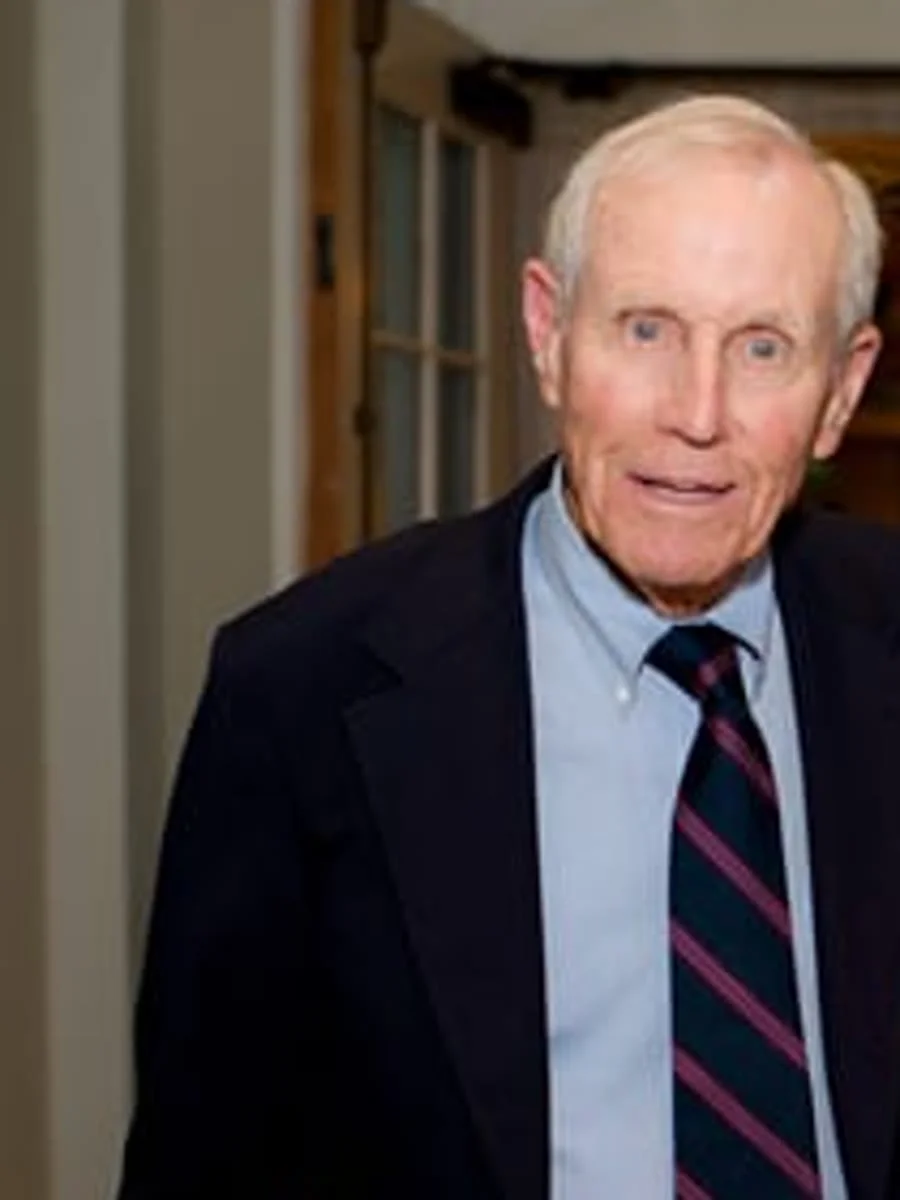
Peter Crisp
Institutionalized Rockefeller venture capital at Venrock; longtime Apple and Thermo Electron director.
From liberal-arts generalist to Rockefeller apprentice, 1932–1960
Peter Ottley Crisp was born in New York City on August 9, 1932, grew up on Long Island, attended Hotchkiss and Hebron Academy, and graduated from Yale in 1955 with a history degree. Both long oral histories stress that he entered technology investing without engineering training. That makes his later system more plausibly an organizational one—finding technical judgment, interpreting people, and working through boards—than a claim to personal scientific foresight. The causal link remains researcher inference · moderate, not something chronology proves. NVCA oral history, printed pp. 1–12 · CHM oral history, printed pp. 2–4
After a short Owens-Corning training-program stint, Crisp served from 1955 to 1958 as a U.S. Air Force intelligence officer in Strategic Air Command and Tactical Air Command. The record supports exposure to aviation, electronics, briefings, and planning; it does not show that military work generated a measurable investing advantage. Researcher inference · provisional. NVCA oral history, printed pp. 12–20 · CHM oral history, printed pp. 4–7
At Harvard Business School, Crisp read TIME's 1959 profile of Laurance Rockefeller while on a Swissair assignment, wrote to Rockefeller without an introduction, and joined his staff after graduating in 1960. The original letter is not public, so the episode shows initiative and access conversion in Crisp's late memory, not the exact reason he was hired. Rockefeller already had capital, reputation, staff, and a portfolio before Crisp arrived. Retrospective witness · moderate for the approach; contemporaneous record · strong for the pre-existing platform. TIME, “Space-Age Risk Capitalist” · HBS Crisp papers, biographical note
Learning inside a staffed family office, 1960–1969
Crisp's own account does not begin with autonomous deal picking. Randolph Marston, Harper Woodward, Theodore Walkowicz, J. Richardson Dilworth, Charles B. Smith, and Laurance Rockefeller appear as senior screeners, technical advisers, governance actors, and approvers, while Crisp initially organized records, screened proposals, researched companies, and supported boards. The environment supplied a privileged funnel and institutional apprenticeship that most contemporary entrants could not reproduce. Retrospective witness · strong for the role map; exact votes and compensation are insufficient public record. NVCA oral history, printed pp. 24–38 · HBS collection scope
New England Nuclear became the first company Crisp remembers recommending and the first board he joined. Bob Waterman and Jimmy Walker belong to the relationship and decision environment, while the family-office subscribers and senior approvals remain unknown. Contemporary reporting places DuPont's acquisition in 1981 at about $430 million in stock, correcting Crisp's later 1972/~$250 million memory. A company transaction value is not a Rockefeller-program or Crisp return. Retrospective witness · moderate for sponsorship; contemporaneous record · moderate for the exit. New England Nuclear lab
Intel sets a second attribution boundary. Its October 1968 financing preceded Venrock's formation; the company statement records $2.5 million of aggregate debentures but not a Rockefeller allocation. Arthur Rock organized the financing and Charles B. Smith—not Crisp—is the supported Rockefeller-side board actor. No inspected record establishes Crisp as source, lead, personal investor, or Intel director. Contemporaneous record · strong. Intel 1968 financial statement, pp. 2–3 and 6
Building Venrock as durable institutional capital, 1969–1978
In 1969, Rockefeller family interests moved from optional deal-by-deal subscriptions toward Venrock Associates, contributing holdings and capital to a partnership. Crisp's 2008 and 2018 recollections conflict on whether five or seven holdings entered, which siblings participated, and whether the call was $1.5 million or $2.5 million; both remember about $7.5 million total. The partnership agreement, contribution schedule, voting rights, fees/carry, reserves, and distribution terms were not inspected. Retrospective witness · moderate for the institutional shift; insufficient public record for its exact economics. TALKS conflict table
HBS identifies Laurance Rockefeller, Crisp, Charles Smith, Harper Woodward, Cornelius Borman, and Dilworth among the founders. Later partners—including Anthony Evnin, Ted McCourtney, Tony Sun, David Hathaway, and Ray Rothrock—brought specialization that a liberal-arts generalist and small early staff could not supply alone. The plausible institution-building mechanism was durable capital plus distributed expertise and long governance. It is not Crisp-exclusive. Researcher inference · moderate. HBS collection · Evnin oral history, printed pp. 19–21 and 61–63
The reported five-company European experiment provides a necessary ordinary-period control. Crisp remembers four losses, alleged bookkeeping fraud in two Italian companies, and one Israeli medical-electronics survivor. Because names, legal records, checks, team roles, and overlap are unavailable, it supports a cohort-level failure pattern—not accusations against identified firms or exact economics. No documented process change after the losses surfaced. Retrospective witness · provisional. Europe decision lab
Apple: shared sourcing, staged capital, and later governance, 1978–1996
Apple is the strongest visible economic candidate and the clearest test of star attribution. Mike Markkula identifies the younger Henry S. “Hank” Smith as his Venrock contact and the initial Venrock board representative. Apple's prospectus records Venrock purchases in January and September 1978 totaling $499,998, and 3,801,822 split-adjusted shares, or 7.6% before the IPO. Crisp participated in the partnership decision and replaced Smith on the board in October 1980. Documented behavior · strong for vehicle/date/stake/succession; the source, attendee, vote, second-check milestone, and Crisp economics remain unknown. Apple prospectus, printed pp. 21–28 · Markkula oral history, printed pp. 25–27
This sequence overturns the simplified 1979 “gut feeling” story. The surviving derivative video summary compresses partnership work into intuition; the filing reveals staging and corrects amount/date/ownership. Yet staging alone does not prove a Crisp milestone rule because the original memo and follow-on decision are absent. Researcher inference · strong. OneWire route note · Apple decision lab
Crisp's sixteen-year board tenure shows duration, not automatically value creation. Apple's 1994 proxy disclosed a one-month-late Section 16 report for three trust sales in which he disclaimed beneficial interest. In 1996, the Los Angeles Times contemporaneously reported that Crisp and other directors deferred to Markkula; shareholder litigation later alleged mismanagement, and Crisp left in June 1996. These are disclosure facts, contemporaneous records, allegations, and settlement-related governance—not adjudicated personal wrongdoing. They weaken any claim that long board tenure was uniformly effective. Apple 1994 proxy, Section 16 disclosure · Los Angeles Times, “A Question of Leadership” · SFGate departure report, opening paragraphs · Apple 1998 10-K405, litigation section
Leadership, specialization, and adverse controls, 1980–1997
The HBS archival biography records Crisp as Venrock president from 1980 to 1997 and chairman from 1995 to 1997; HBS's 2024 award page instead says president through 1995. The package preserves that institutional discrepancy and uses the archive chronology provisionally pending personnel records. HBS collection biographical note · HBS 2024 award page Public biographies associate him with Thermo Electron and spinouts, American Superconductor, and many other boards, but a board list is not an investment ledger. The expanded public universe contains eighteen named company/relationship labels, five named passes, plus five unnamed European slots with unresolved overlap; only Apple is sufficiently reconstructed even at a bounded entry/board level. Researcher inference · strong. Searched denominator
Advent filed Chapter 11 in 1981, contradicting Crisp's later categorical memory that no Venrock company went bankrupt. Evans & Sutherland failed to meet his later expectations. These cases show that the surviving spoken record selects stories and can be wrong on denominators; they do not establish avoidability or total loss without original memos, recovery records, and roles. Contemporaneous record · strong for Advent bankruptcy; retrospective witness · provisional for E&S. Advent lab · failure postmortems
IDEXX founder David Shaw credits Crisp with access and mentorship, a plausible example of network opening and founder support. The public memorial does not allocate the Venrock sponsor, terms, board role, follow-ons, or cash flows. American Superconductor filings establish Crisp's board service from 1987; later securities litigation named him and settled without a finding of personal wrongdoing. Both episodes are useful governance evidence but incomplete investment evidence. Shaw memorial · AMSC 2011 10-K · Lenartz order
Later stewardship, public memory, and death, 1997–2026
Crisp retired from Venrock in 1997, served as Rockefeller Financial Services vice chairman until 2004, and continued family-trust, board, philanthropic, and advisory work. NVCA recognized him in 2004; he recorded substantial oral histories in 2008 and 2018 and received HBS's Alumni Achievement Award in 2024. The 2008 transcript is paraphrase-only for publication without written NVCA permission. Later recognition supplies a legacy narrative, not audited performance. HBS biography · HBS 2024 award · TALKS corpus accounting
Peter Crisp died on August 4, 2026, aged 93. The family notice controls the date; tributes from institutions and founders are interested retrospective evidence. Family notice via Legacy · Black Point memorial
People, capital, and influence map
| Layer | Actors | Supported influence | Boundary |
|---|---|---|---|
| Sponsor/capital | Laurance Rockefeller, family subscribers, trusts/nonprofits | Platform, brand, long-duration capital, approvals | Capital and outcomes are not Crisp personal. |
| Pre-Venrock staff | Marston, Woodward, Walkowicz, Dilworth, Charles B. Smith | Screening, technical work, governance, apprenticeship | Company-level votes and economics largely unknown. |
| Crisp | Screener, sponsor, partner, leader, board member, later narrator | Institution continuity, selected sponsorship, governance | Source, vote, intervention, follow-on, exit, carry, and personal returns must be proved case by case. |
| Later partners | Evnin, McCourtney, Sun, Hathaway, Rothrock | Specialist judgment and portfolio work | Firm success is not Crisp-only skill. |
| Apple network | Markkula, younger Hank Smith, Jobs, Wozniak, Scott, Rock/Kramlich, Venrock partners | Referral, operation, financing, board succession | Smith preceded Crisp; founders/operators created the company. |
| Intel network | Noyce, Moore, Arthur Rock, Charles B. Smith, financing participants | Formation, financing, board | No Crisp source/lead/board role established. |
| Founders/operators | Waterman/Walker network, Hatsopoulos, Shaw, company teams | Technical and commercial execution | Board presence is not operating causality. |
A falsifiable thesis of the edge
Thesis — researcher inference · moderate: from roughly 1960 to 1997, Crisp's plausible repeatable advantage was institutional orchestration: use Rockefeller-derived patient capital and relationship access to source early U.S. technology and health-care opportunities, apply a people-plus-market screen with specialist partners, then support selected companies through identifiable governance mechanisms. This is not a claim of personal technical foresight, lone sourcing, or audited alpha.
The thesis predicts that unseen Crisp-attributed files should show his pre-outcome referral or sponsorship; explicit management/integrity and market tests; assignment of relevant specialists; staged follow-ons; and concrete recruiting, financing, audit, succession, or strategy interventions. Crisp-sponsored cases should outperform matched same-vintage/stage/sector opportunities after controlling for Rockefeller access, vehicle duration, partner, and syndicate. Vehicle records should show genuinely longer duration/reserves that changed decisions. Failure records should show stop rules or process changes after Advent, Europe, or E&S.
It would weaken or fail if original memos show other partners sourced, underwrote, and governed the famous cases; people/market criteria appear only in retrospective winners; ex-Apple cash flows are weak against matched peers; board minutes show ceremonial or delayed intervention; Rockefeller access, founders, co-investors, and specialists explain outcomes without incremental Crisp contribution; patient-capital terms were not meaningfully different; or failures produced no learning. DEALS uncertainty ledger
Skill, access, vehicle, team, era, luck, and outlier audit
| Explanation | Evidence for | Evidence against / missing |
|---|---|---|
| Crisp skill | Early sponsorship claim, institution leadership, long boards, stable people/market rhetoric | No complete personal ledger, matched cases, contemporaneous criteria, or cash flows |
| Access | Rockefeller brand/capital and relationship referrals plainly expanded the funnel | Access does not decide which opportunity to fund or govern well |
| Vehicle | Long-duration partnership plausibly reduced liquidity pressure | Terms, reserves, opportunity cost, and counterfactual outcomes unavailable |
| Team | Senior staff, specialist partners, co-investors, founders, and operators are visible | Deal-by-deal division of labor mostly unavailable |
| Era | Scarce early venture supply and network syndication could magnify access | No dimension-matched base rate in the inspected record |
| Luck/outlier | Apple may dominate visible economics | No ex-Apple cash-flow series; exact contribution not computable |
| Governance | Long service creates opportunities to help | Apple criticism and AMSC adversity challenge uniform effectiveness |
The strongest skeptical reading is that Crisp was an effective steward within an extraordinarily advantaged platform, while Rockefeller resources, partners, co-investors, founders, and Apple explain most visible value. That thesis currently fits the missing denominator and attribution evidence at least as well as personal-alpha greatness. Complete cash flows with and without Apple, original memos/votes, matched partner cohorts, and board intervention records would discriminate them. Researcher inference · strong.
Sourced chronology
| Date | Event | Evidence boundary |
|---|---|---|
| 1932-08-09 | Born in New York City | NVCA transcript, p. 1 |
| 1955 | Yale history degree | CHM, pp. 2–4 |
| 1955–1958 | Air Force intelligence | CHM, pp. 4–7 |
| 1960 | HBS MBA; joined Rockefeller staff | HBS |
| Early 1960s–1981 | New England Nuclear sponsorship/board; DuPont exit | case |
| 1968 | Intel financing before Venrock; no Crisp board role established | Intel 1968 financial statement, pp. 2–3 and 6 |
| 1969 | Venrock Associates formed | HBS |
| 1978 | Venrock made two Apple purchases | Apple prospectus |
| 1980-10 | Crisp replaced Hank Smith on Apple board | Apple prospectus |
| 1980–1997 | Venrock president; chairman 1995–1997 | HBS |
| 1981 | Advent Chapter 11 | court record |
| 1987 onward | AMSC board | AMSC filing |
| 1996-06 | Left Apple board amid governance turmoil | SFGate |
| 1997–2004 | Rockefeller Financial Services vice chairman | HBS |
| 2008 / 2018 | Recorded two distinct long oral histories | TALKS |
| 2024 | HBS Alumni Achievement Award | HBS |
| 2026-08-04 | Died aged 93 | family notice |
Learning path
Read the source map for the evidence boundary, writings for the inaccessible written corpus, talks for the two-transcript direct-voice record, and investments for the denominator and no-hindsight labs. Then use the operating system, mental models, followed by the adversarial acceptance record. The recommended first decision exercise is Apple; Advent is the mandatory failure exercise.
1. Snapshot and testable edge thesis
| Dimension | Evidence-bounded answer |
|---|---|
| Person / institution | Peter O. Crisp; Rockefeller staff from 1960; Venrock founding/managing partner and later president/chairman; retired 1997. HBS biography |
| Era / domain | Roughly 1960–1997; early/private U.S. technology and health care with East Coast capital and West Coast syndication |
| Proposed edge | Researcher inference · moderate: institutional orchestration—patient Rockefeller-derived capital and relationship access, a people-plus-market screen, specialist partners, and identifiable long-board governance. |
| What it is not | Personal technical prediction, sole sourcing, personal capital, or audited personal alpha |
| Evidence status | Strong for institutional chronology and Apple entry/board sequence; moderate for stated preferences; insufficient for complete denominator, contemporaneous IC implementation, and returns |
The thesis predicts that unseen Crisp-sponsored files will contain his pre-outcome referral/sponsorship, explicit people/integrity and market-size tests, relevant specialist assignment, staged follow-ons, and specific board interventions. It predicts matched Crisp-sponsored results superior to same-vintage/stage/sector opportunities after controlling for Rockefeller access, vehicle, partner, and syndicate. It predicts partnership terms and reserves that actually changed company-duration decisions. Profile thesis
It is falsified or materially weakened if other partners own the famous decisions; the screen appears only in retrospective winners; ex-Apple cash flows are weak; board minutes show ceremonial or delayed intervention; vehicle terms were ordinary; or failures produced no stop rules or learning. The public record cannot presently decide between the favorable thesis and advantaged-platform stewardship. Researcher inference · strong. Retrieval ledger
2. Core philosophy
Crisp's cleanest quotable late statement is that people come first, alongside the requirement for a large market. Investor-stated · strong for the preference; insufficient public record for predictive efficacy. CHM oral history, printed p. 16
His broader 2008 account—paraphrased because NVCA restricts publication quotation—repeatedly returns to management integrity/persistence, patient capital, partner expertise, boards, and service. Those late themes form a stable retrospective philosophy, not proof of stable contemporaneous execution. Researcher inference · moderate. NVCA note · TALKS evolution
The bounded synthesis is: obtain relationship-based access; test people and market separately; put the appropriate specialist on the case; finance with capital whose duration fits the company; define board work as mechanisms rather than status; and keep losses and conflicting records visible. The first five are plausible Crisp models; the last is an analyst control required by the record.
3. Sourcing
How opportunities arrived
- Rockefeller brand and pre-existing funnel. The platform preceded Crisp and supplied staff, reputation, family capital, and portfolio relationships. Contemporaneous record · strong. TIME, 1959
- Direct initiative. Crisp's unsolicited 1959 approach turned a public article into institutional access. Retrospective witness · moderate; the original letter remains unavailable. CHM, pp. 7–9
- Trusted referrals and syndication. Markkula reached Venrock through younger Hank Smith; Arthur Rock organized Intel; Bob Waterman/Jimmy Walker appear around New England Nuclear; Shaw credits Crisp with IDEXX access. Retrospective witness · moderate except Apple's filed transaction. Markkula, pp. 25–27 · Shaw memorial
The repeatable part is tracing and cultivating trusted technical, financial, and founder relationships. The non-repeatable part is Rockefeller's name, balance sheet, historical position, and access. A modern analyst should record introducer, information advantage, conflicts, and whether the case would survive without the relationship. Researcher inference · strong.
4. Picking
Investor-stated · moderate: Crisp's late screen combines people—integrity, capability, persistence—with a large market and relevant technical judgment. CHM, pp. 12–17
What the public record does not establish is equally important: founder-reference procedure, market-sizing method, red flags, pricing thresholds, comparison set, pass reasons, kill criteria, IC quorum/vote, or calibration across ordinary cases. Apple is a documented investment but its original rationale is absent; Europe and Advent show that the screen did not eliminate integrity and insolvency risk. Researcher inference · strong. Apple lab · Europe lab
A disciplined reconstruction therefore asks two independent questions: “Do we have job-relevant evidence that this team can learn and act with integrity?” and “Is there a large, reachable customer problem under dated market conditions?” Passing one does not compensate automatically for failing the other.
5. Deal and portfolio mechanics
The only well-bounded entry is Apple: two 1978 purchases totaling $499,998 and 7.6% pre-IPO. Staging is behavior; no inspected source connects the second purchase to a named milestone or Crisp rule. Documented behavior · strong for transaction facts; insufficient public record for rationale. Apple prospectus, pp. 21–28
Price discipline, security preference, target ownership, reserves, follow-on formula, concentration, distribution, and exit rules remain unavailable. The visible eighteen-label universe, five named passes, plus five unresolved European slots is not a portfolio denominator; Apple is only a provisional economic leader and no Crisp/fund MOIC, IRR, or PME is published here. Pareto analysis
The supportable operating rule is narrower: stage capital only against explicit evidence, but do not attribute that rule historically to Crisp until original follow-on records are found. Researcher inference · strong as modern process; insufficient public record as Crisp doctrine.
6. Vehicle and incentive fit
| Vehicle regime | Strategy effect | Evidence boundary |
|---|---|---|
| Pre-1969 deal-by-deal family subscriptions | Flexible access and senior family choice; uncertain reserve continuity | Subscriber schedules, votes, and compensation unavailable |
| 1969 Venrock Associates | Contributed assets and committed capital plausibly enabled patience and long boards | Exact LP/GP, call, fees/carry, duration, reserves, liquidity, succession unavailable |
| Later Venrock funds | More partners/specialization and possibly outside capital | Do not back-project current fund structure or ADV entities |
| Trusts/nonprofits/family interests | Stakeholder and distribution objectives may differ from conventional LP funds | Beneficial ownership and governance unavailable |
| Crisp personally | Reputation, employment, partner, board, and trust incentives may coexist | Personal checks, carry, pay, holdings, and proceeds unavailable |
Researcher inference · moderate: capital duration can be an investment capability only if legal duration, reserves, stakeholder patience, and opportunity cost actually support the next decision. “Patient” cannot mean funding without milestones. Vehicle analysis
Compared with a modern fixed-life fund, the supported difference is lower visible fundraising/liquidity pressure; fees, carry, term, recycling, reserve ratio, and performance remain unavailable. Current vehicles are not valid proxies for the 1969 partnership.
Geographic authority, partnership regulatory status, succession allocation, and key-person clauses are insufficient public record; the European experiment establishes activity, not formal territorial authority. Public-board duties are visible, while the 1958 SBIC regime remains context rather than a Venrock classification. Detailed vehicle audit
7. Team attribution and work with founders
Crisp's record is institutionally collective. Laurance Rockefeller and family interests supplied the platform/capital; senior staff screened and governed; later partners specialized; founders operated; syndicate investors financed; and board representatives changed. Researcher inference · strong. People/capital map
Apple illustrates the rule: Markkula introduced the opportunity to younger Hank Smith, Venrock owned the position, partnership participants decided, Smith initially served on the board, and Crisp succeeded him in 1980. Intel illustrates the negative boundary: Arthur Rock and Charles B. Smith are supported actors; Crisp is not the source or director. Apple attribution grid · Intel statement
Founder work should be described mechanistically—access, recruiting, financing, audit, succession, strategy, or monitoring—and sourced to a decision. Shaw's IDEXX testimony supports access/mentorship but not the check, vote, board work, or economics. IDEXX route
8. Views on the craft
- Access versus selection: the record proves advantaged access more readily than incremental selection skill. Researcher inference · strong.
- Power law / concentration: Apple may dominate visible economics, but the missing cash-flow denominator prevents a literal power-law or 80/20 claim. Pareto
- Governance: long board service creates opportunities to help and to fail; title and tenure are not mechanisms. Apple adverse record
- Fund size and patience: durable capital can support longer horizons, but only with legal/economic terms and milestones. Investor-stated · moderate; researcher inference · provisional for performance.
- Exits: no general Crisp exit doctrine is established; a company acquisition or IPO does not reveal investor return.
- Greatness: the public record supports institution building and stewardship more strongly than personal alpha. Researcher inference · strong.
9. Signature bets and decision process
Use the no-hindsight labs rather than outcome summaries:
- Apple: shared referral, staged 1978 financing, Smith-to-Crisp board succession, and unresolved economics.
- New England Nuclear: first reported sponsorship under predecessor capital and a later memory correction.
- Advent: a mandatory failure lab where the present invest/pass answer is “insufficient evidence.”
- European experiment: cohort failure, cross-border controls, and allegation boundaries.
Each ends with invest/pass, kill criteria, ownership/terms, next-check milestones, and the sourced actual outcome. None supplies an omniscient historical rationale.
10. Mental models and maxims
The reconciled inventory contains five supportable models; slogans, outcomes, and analyst controls are excluded rather than inflated.
- Trace the introducer; separate access from selection — origin: Rockefeller approach and repeated referral chains.
- Require both people evidence and a reachable large market — origin: Crisp's 2018 direct statement, bounded by failures.
- Match capital duration to company duration — origin: Venrock formation and late capital-duration account.
- Match specialist expertise to the case — origin: staffed Rockefeller apprenticeship and later partner specialization.
- Specify the governance mechanism; never count the board title — origin: repeated long-board practice plus Apple/AMSC counterevidence.
Excluded candidates include “gut feeling,” generic stage financing, “learn, earn, return,” geography, price discipline, ownership targets, reserve formulas, exit doctrine, and power-law construction. Model gaps
11. Evolution and contradictions
| Date | Stated/observed emphasis | Tension |
|---|---|---|
| 1960s–1970s | Staff apprenticeship, family subscriptions, institution formation | Contemporaneous memos/criteria largely unavailable |
| 1978–1980 | Apple staged financing and board succession | Later 1979/amount/10% memories conflict with filing |
| 1981 | Public “no big blooper” framing near Advent bankruptcy | Later absolute no-bankruptcy memory fails |
| 2008 | Broad career, patient capital, boards, wins/losses | Publication quotes restricted; dates and denominator errors |
| 2018 | People first, large market, specialization | Isolated 1968 start-year slip; same late narrator |
| 2018–2024 | Service, mentorship, legacy | Institutional/editorial settings, not performance audit |
The philosophy appears rhetorically stable, but no public record shows a dated rule change after Advent, Europe, E&S, or Apple criticism. Stability of recollection is not stability of application. Researcher inference · strong. TALKS evolution
12. Failures and limits
- Advent: documented Chapter 11; thesis, capital response, recovery, and Crisp role absent. postmortem
- Europe: four of five reported losses and two bookkeeping allegations; names/legal records absent. Europe lab
- Evans & Sutherland: reported disappointment with incomplete funding/economic reconstruction.
- Apple governance: late disclosure, reported deference, allegations, and departure challenge a uniformly successful board story; no adjudicated personal wrongdoing.
- AMSC governance: litigation/settlement is adverse board evidence, not proof of a Venrock investment or personal misconduct.
- Selection bias: the denominator lacks ordinary companies, passes, follow-ons, write-offs, and cash flows.
- Era dependence: scarce capital, relationship syndication, and Rockefeller access are not modern base rates.
No documented post-failure process change surfaced. That absence is not proof none occurred; the HBS archive is the decisive route.
13. Historical operating environment
The 1958 SBIC statute expanded organized risk-capital policy, while Rockefeller's family program used its own capital and should not be labeled an SBIC. The 1959 TIME profile documents a scarce, relationship-driven field and an established Rockefeller platform. Intel's 1968 convertible financing shows syndication before Venrock; the 1969 partnership institutionalized a longer-duration pool. SBIC statute · TIME, 1959 · Intel memorandum
The 1979 prudent-man change belongs to the later institutional-capital expansion and cannot explain the 1969 formation. By the 1980s–1990s, specialist teams, larger capital supply, public-market liquidity, and public-board duties changed the environment. No inspected dimension-matched vintage/sector/stage base-rate series supports a numerical alpha claim. Researcher inference · moderate. Federal Register, 1979
14. Modern VC translation (as of 2026-08-20)
| Lesson | What transfers | What changed / fails | Observable applicability signals | Likely misuse | Modern application |
|---|---|---|---|---|---|
| Trace access | Referral provenance and conflicts remain essential | Analyst assumption: networks are broader, faster, and more intermediated | Unique information, trusted history, reference quality | Calling prestige “selection skill” | Researcher hypothetical: score source advantage separately from underwriting. |
| People + market | Job-relevant founder evidence and reachable demand remain distinct gates | Analyst assumption: software/AI iteration can change product/market evidence faster | Learning speed, reference integrity, usage, budget, retention | Charisma or TAM slogans | Researcher hypothetical: require a disconfirming reference and dated customer evidence. |
| Duration fit | Company/fund duration and reserves still constrain strategy | Analyst assumption: fixed-life funds, continuation vehicles, secondaries, and rapid mark changes add paths/conflicts | Runway, reserve capacity, term/extensions, LP liquidity | “Patient” as no kill criteria | Researcher hypothetical: pre-agree milestone, reserve, stop, and liquidity scenarios. |
| Specialist assignment | Regulated/deep-tech cases still need domain judgment | Analyst assumption: expertise can become consensus/cognitive capture | Named technical/regulatory unknowns and independent experts | Delegating the investment decision to experts | Researcher hypothetical: pair specialist evidence with customer/economic ownership. |
| Governance mechanism | Boards still need explicit jobs and feedback loops | Analyst assumption: information velocity and founder control vary widely | Audit quality, recruiting gaps, capital plan, succession risk | Treating a seat or tenure as value | Researcher hypothetical: write the intervention hypothesis and measure outcome each quarter. |
These are researcher inference · moderate, not claims that Crisp used current tools. The public sources establish current factual premises only weakly; applications are labeled hypotheticals and should be adapted to the analyst's actual vehicle, regulation, stage, and market.
15. Comparison with completed peers
| Dimension | Crisp | Laurance Rockefeller | Arthur Rock | Reid Dennis |
|---|---|---|---|---|
| Why comparable | Target | Same institution and sponsor/capital layer | Apple/Intel co-investor and governance control | Same-era relationship sourcing, syndication, boards, vehicle evolution |
| Sourcing | Rockefeller platform and relationship referrals | Created/financed the platform | Personal founder/co-investor networks | Technical-financial network and syndicates |
| Picking | Late people + market screen; implementation thin | Sponsor-level portfolio and public-purpose framing | Concentrated people judgment | People/technology/customer translation |
| Ownership | Apple vehicle stake is bounded; other ownership is absent | Sponsor/family interests must stay separate from Crisp | Deal ownership often central, but Apple/Intel credit remains shared | Early ownership and dilution were explicit fund questions |
| Portfolio construction | Complete weights and loss ratio unavailable; Apple may dominate | Family-office/purpose mix differs from a conventional fund | Concentration is visible but not a Crisp template | Fund construction and liquidity conflicts are more directly comparable |
| Vehicle | Family office → durable Venrock partnership | Family capital/institution design | Personal/partnership structures with finite capital | Personal syndicate → IVA/IVP LP funds |
| Incentives | Compensation/carry, personal checks, and board pay unavailable | Sponsor objectives and family/nonprofit stakeholders | Personal/partnership incentives differ from Venrock | LP-fund duration and ownership make incentive comparisons more direct |
| Governance | Long boards; mechanisms incompletely documented | Sponsor and institutional influence | Long, concentrated company work | Long boards plus fund-liquidity conflict |
| Failure controls | Europe, Advent, E&S, Apple/AMSC adversity | Institutional attribution/selected histories | Diasonics and passes | Collagen, Reference Technology, Applied conflict |
| Attribution limit | Cannot claim Rockefeller/Venrock/team outcomes personally | Overlapping evidence is not independent validation | Intel/Apple credit must stay separate | Different vehicle/geography prevents generic ranking |
The Laurance comparison is grounded in the 1959 TIME platform profile; Arthur Rock in the Intel financing record and Markkula Apple testimony; and Reid Dennis in his Berkeley oral history, printed pp. 22–40 and 49–68. Researcher inference · moderate.
Crisp appears more an institutional integrator than Rock’s person-centered financier or Dennis’s technical-financial selector. Laurance is the essential sponsor comparator, not a rival. The comparison is dimensional, not a greatness ranking. Researcher inference · moderate.
16. The strongest case against greatness
The skeptical thesis is that Crisp was an able steward and narrator inside an extraordinarily advantaged Rockefeller platform, not a demonstrably superior personal investor. Rockefeller supplied brand, patient capital, staff, and access; senior colleagues and later partners supplied judgment; founders and co-investors built companies. Apple came through Markkula and Hank Smith, with Crisp joining the board later. Intel predates Venrock and has no documented Crisp lead or board role. Board biographies are easily mistaken for funded deals, and the public denominator/cash flows are missing. Late recollections contain material date, amount, and bankruptcy errors. Europe, Advent, E&S, Apple criticism, and AMSC adversity weaken a seamless-excellence story. Researcher inference · strong. Profile audit
The favorable thesis wins only if original memos/votes show repeatable Crisp sponsorship and criteria, matched outcomes show incremental results, vehicle terms changed decisions, and board minutes show useful interventions. The skeptical thesis wins if Apple dominates, other partners own the work, ex-Apple performance is weak, board work is ceremonial/delayed, or failures produced no learning. Today both remain live; the public record favors institution-building evidence over personal-alpha evidence.
17. Analyst study guide, glossary, and go deeper
Recommended path
- Profile for chronology and the testable thesis.
- Source map, writings, and talks for access, rights, and memory boundaries.
- Investments for the denominator, vehicle map, and four decision labs—Apple first, Advent as the failure lab.
- Mental models for five evidence-bounded checklists.
- Read the adversarial acceptance record.
Glossary
| Term | Meaning here |
|---|---|
| Rockefeller program / RBI / RF&A | Pre-1969 staffed family-office/predecessor activities; not automatically Venrock |
| Venrock Associates | 1969 partnership of contributed assets and capital; exact terms unavailable |
| Later Venrock funds | Subsequent vehicles; do not project their economics backward |
| Source / sponsor / approver | Distinct roles: introduction, internal advocacy, and decision authority |
| Board mechanism | Identifiable recruiting, financing, audit, succession, strategy, or monitoring action—not the seat itself |
| Candidate denominator | Eighteen named labels, five named passes, plus five unresolved Europe slots; not a funded portfolio |
| Reported economics | A sourced claim lacking complete cash-flow/audit basis; none supports Crisp personal return here |
Reusable checklists
- Sourcing: who introduced it; why they had access; conflicts; independent channel; would the case survive without prestige?
- Diligence: job-relevant people evidence; integrity/reference disconfirmation; reachable market; technical/regulatory expert; dated risks; alternatives.
- IC: invest/pass; kill criteria; security/ownership; reserves; decision owner/dissent; next-check milestones; vehicle duration and LP constraints.
- Governance: explicit intervention hypothesis; information rights; recruiting/audit/capital/succession tasks; cadence; escalation/stop rule; measured result.
- Attribution/economics: source, sponsor, diligence, approval, negotiation, board, follow-on, exit; vehicle; ownership/dilution; dated cash flows; fees/carry; benchmark.
Best sources and retrieval priorities
The 2008 NVCA oral history is broadest but paraphrase-only; the 2018 CHM history is the clearest concise statement; the Apple prospectus is the best contemporaneous transaction control; and the HBS Peter O. Crisp papers, call Mss:784 1946-2008 C932, are the decisive unresolved route. Retrieve partnership/cash-flow records, original memos/votes, board minutes, and failure files before upgrading the thesis.
Pareto 80/20 — what drove the record
The public record does not support a literal 80/20 calculation, a complete Venrock portfolio ranking, or a Peter Crisp personal return. It exposes eighteen named company/relationship labels, five named passes, plus five unnamed European venture slots, with unresolved overlap, and mixes financed companies, predecessor capital, board-only relationships, and favorable retrospectives. Apple is the only defensible provisional economic leader because its entry basis and ownership are in a primary filing; even there, realized cash flows, disposition dates, fees, carry, and Crisp's personal economics are absent. Researcher inference · strong. Apple prospectus, printed pp. 21–28 · Venrock portfolio disclaimer
| View and rank | Candidate | Basis or measure | Attribution | Support | Mechanism and denominator caveat |
|---|---|---|---|---|---|
| Economic 1 | Apple | $499,998 Venrock basis and 7.6% pre-IPO stake are documented; no realized cash flows | Venrock vehicle; Markkula referral; younger Hank Smith contact/first nominee; partnership decision; Crisp board from Oct. 1980 | Documented behavior · strong for entry; insufficient public record for return | Large public-company outcome plausibly dominates the visible cohort, but no MOIC/IRR or Crisp return is calculated. ledger |
| Economic 2, not ordinally comparable | New England Nuclear | Company sold to DuPont in 1981 for reported ~$430m stock; entry ownership/basis missing | Pre-Venrock Rockefeller capital; Crisp claims recommendation and first board; other staff/family roles unresolved | Retrospective witness · moderate for Crisp role; contemporaneous record · moderate for exit | A company exit value is not an investor return. case |
| Economic unranked | Thermo family, IDEXX, AMSC, Israeli European survivor | Favorable company/board narratives but no comparable vehicle cash flows | Mixed partners, vehicles, founders, and board actors | Insufficient public record | Cannot rank against Apple or one another. |
| Historical 1 | Apple | Helped bind East Coast family capital to the personal-computer ecosystem and gave Crisp sixteen years of governance | Shared referral, vehicle, founder, co-investor, and board credit | Documented behavior · strong | Historical importance does not equal economic contribution or effective governance. |
| Historical 2 | Intel | Rockefeller-side participation in foundational 1968 financing | Arthur Rock organized; Charles B. Smith supported board actor; no Crisp board/source role | Contemporaneous record · strong for aggregate financing; insufficient for Crisp | Important to institutional lineage, not a Crisp deal. |
| Historical 3 | Venrock formation / contributed portfolio | Converted optional subscriptions and holdings into a durable partnership | Rockefeller family, Laurance, named founders, staff, and partners | Retrospective witness · moderate; partnership terms unavailable | Institution design may matter more than any ordinary deal, but is not itself a company return. |
| Learning 1 | Apple | Filing-versus-memory test; referral, ownership, and board succession can be separated | Team/vehicle map | Researcher inference · strong | Best lab for resisting star-attribution and hindsight. case |
| Learning 2 | Europe cohort | Five reported ventures, four losses, alleged bookkeeping fraud in two Italian companies | Names, sponsors, vehicle, and outcomes unresolved | Retrospective witness · provisional | Best integrity, geography, and cohort-selection failure control. case |
| Learning 3 | Advent | Documented 1981 Chapter 11 defeats a categorical no-bankruptcy recollection | Venrock association; Crisp role/economics unknown | Contemporaneous record · strong for bankruptcy | Best memory/denominator check. case |
Ex-Apple stress test: no inspected cash-flow schedule allows a return measure for the record with or without Apple. Removing Apple leaves one reported company exit value and selected success/failure narratives, not a rankable fund. Nicholas's reported Apple-exclusion analysis remains unusable until its table, notes, cash-flow dates, benchmark, and gross/net method are inspected lawfully. Researcher inference · strong. VC: An American History access note
Evidence boundary and searched denominator
Scope and inclusion rules
The searched universe covers Crisp's 1960–1997 Rockefeller/Venrock investing career and named late board relationships. Searches and source inspection included both Crisp oral histories, HBS/Rockefeller archive catalogs, Apple/Intel/AMSC filings, court records, partner/founder oral histories, contemporaneous press, selected firm history, and the current Venrock disclaimer. An issuer enters the candidate ledger if a reviewed source reports financing, a portfolio relationship, or a potentially relevant board relationship; each row is then classified rather than presumed funded. Researcher inference · strong. Source-map coverage
| Reconciliation state | Count | Definition and result |
|---|---|---|
| Publicly named company/relationship labels | 18 | Apple, Intel, New England Nuclear, Thermo Electron, Thermedics, ThermoTrex, Thermo Power, American Superconductor, Evans & Sutherland, Itek, IDEXX, Galileo Electro-Optics, Echelon, Advent, Acadia Risk Management, U.S. Trust, Coherent Radiation, and BioSurface Technologies. |
| Named passes/misses | 5 | Xerox/Haloid, Tandem, Genentech, Amgen, and Compaq; all are retrospective pass accounts, not proof that each was a financeable proposal on known terms. |
| Unnamed European slots | 5 | Participant-reported cohort; overlap with named labels unresolved. Do not add these mechanically to eighteen as distinct companies. |
| Searched | 18 labels + 5 named passes + cohort | All were classified against the existing mapped record; search did not establish a complete firm or Crisp opportunity set. |
| Researched to at least one material source | 18 labels + 5 named passes + cohort | Depth varies sharply; board listings alone are not investment reconstruction. |
| Sufficiently reconstructed | 1 | Apple meets a bounded entry/board-sequence standard; even Apple lacks full ownership-to-distribution economics and IC evidence. |
| Partially reconstructed named funded/participant-reported candidates | 4 | New England Nuclear, Intel, Advent, and IDEXX. |
| Participant-reported shared-deal candidates | 2 | Coherent Radiation and BioSurface Technologies; Franklin Pitcher Johnson attributes shared Rockefeller-office deals, but exact vehicle, sponsor, terms, governance, and economics remain unresolved. |
| Board/relationship-only or funding unverified | 11 labels | Thermo family (4), AMSC, Evans & Sutherland, Itek, Galileo, Echelon, Acadia Risk Management, and U.S. Trust; Apple (1) + four named partial candidates + two shared-deal candidates + eleven unverified labels reconcile to eighteen; the five-slot Europe cohort is separate because names and overlap are unresolved. |
| Excluded from funded denominator | 11 board-only/unverified labels, 5 named passes, and philanthropy until proven otherwise | Board service, a pass recollection, recognition, trusts, and institutional philanthropy are not checks. |
Coverage fraction: not computable. The denominator of funded Crisp-linked companies is unknown; five European slots may duplicate named issuers; the current firm site disclaims completeness and positive-performance selection; follow-ons and spinouts are not deduplicated; five named passes are known but the complete opportunity and ordinary-outcome set is missing. Researcher inference · strong. Venrock disclosure · HBS archive route
What the denominator is not
- The reported “43 public/private boards” is a company-biography claim, not forty-three investments. AMSC 2011 10-K, director biography
- Current Venrock-selected companies are not a historical portfolio ledger. Venrock disclaimer
- Intel's aggregate $2.5m debentures are not a Rockefeller allocation or Crisp check. Intel 1968 financial statement, pp. 2–3 and 6
- Apple vehicle holdings are not Crisp personal holdings or realized proceeds. Apple prospectus, pp. 21–28
- Board service, philanthropy, and later family-trust work do not enter the funded denominator without a transaction record.
Historical market, regulatory, and base-rate context
1959–1968: scarce organized venture supply and relationship syndication
The 1959 TIME profile shows that Rockefeller already employed a staffed, high-risk investment program before Crisp arrived. The 1958 Small Business Investment Act expanded an adjacent policy channel, but no evidence makes the Rockefeller program an SBIC. Semiconductor formation relied on small professional networks, corporate spinouts, convertibles, and syndication; Intel's 1968 note financing predates Venrock. Contemporaneous record · strong for the institutional setting; researcher inference · moderate for how it shaped Crisp's opportunity set. TIME, 1959 profile · Small Business Investment Act · Intel financing memorandum
1969–1981: durable family capital meets expanding technology markets
Venrock's formation pooled holdings and committed capital into a partnership that Crisp describes as patient. That could reduce fundraising and forced-liquidity pressure relative to a fixed-life LP fund, while concentrating family governance and making public performance comparison difficult. The 1979 prudent-man rule change sits inside the later institutional-capital expansion, but it did not cause the 1969 formation. Investor-stated · moderate for capital duration; researcher inference · moderate for incentive effects. CHM interview, printed pp. 12–16 · 1979 Federal Register
Apple in 1978 was a private personal-computer company with material product and distribution uncertainty; the prospectus later documents staged Venrock purchases, not a single hindsight-free certainty. Advent's 1981 bankruptcy and contemporary venture boom reporting warn against inferring a universally favorable base rate from famous survivors. Apple prospectus, pp. 21–28 · TIME, 1981
1980s–1990s: specialization, public markets, and governance exposure
Venture capital supply, technology sectors, and institutional LP participation expanded. Venrock added specialist partners, while Crisp accumulated long public/private board tenures. Public-company directorship created audit, disclosure, compensation, succession, and litigation exposure absent from an entry-only narrative. Apple's 1994 late report and 1996 board criticism are therefore part of the historical governance record, not side notes. Researcher inference · moderate. Apple 1994 proxy, Section 16 disclosure · Los Angeles Times, 1996
No public contemporary dataset in the inspected corpus supplies a dimension-matched vintage/sector/stage base rate. Qualitative context is used rather than manufacturing one.
Vehicle economics and incentives
| Regime | Capital and legal form | Supported incentives/constraints | Unknowns that block economics |
|---|---|---|---|
| Pre-1969 Rockefeller staff / RBI / RF&A | Family-office staff screened deals; family members could subscribe deal by deal | Long relationships and access; senior approval; uneven family participation | Subscriber schedules, compensation, votes, reserves, ownership, distributions |
| 1969 Venrock Associates | Partnership of contributed holdings and capital associated with family/nonprofit interests | More durable pool; capacity for follow-ons and long boards; lower visible fundraising pressure | Partnership agreement, exact contributed assets/call, LP/GP rights, fees/carry, key-person and liquidity terms |
| Later Venrock funds/entities | Later outside-capital vehicles and partner teams | Greater scale/specialization; conventional fund constraints may emerge | Fund-by-fund boundaries during Crisp tenure, allocation, reserves, performance |
| Trusts/nonprofits/family capital | Family and institutional beneficiaries may own interests | Stakeholder and philanthropic objectives may differ from GP maximization | Beneficial ownership, governance, tax, distribution policy |
| Crisp personally | Salary/partner/board/trust roles potentially distinct | Reputation and long governance incentives | Personal checks, carry, compensation, board pay, holdings, realized proceeds |
| Post-1997 Rockefeller Financial Services | Advisory/family-trust work after Venrock retirement | Continuity with Rockefeller institutions, not necessarily venture investing | Mandates, decision rights, compensation, investment scope |
Geographic authority: the reported European experiment proves cross-border activity, but no inspected agreement allocates geographic authority among Crisp, partners, family subscribers, or vehicles; insufficient public record. Regulation: the 1958 SBIC regime is context, not proof Venrock was an SBIC; public-board securities and disclosure duties are visible in Apple/AMSC filings, while partnership regulatory status is insufficient public record. Succession and key-person continuity: HBS documents senior predecessors, later specialist partners, and Crisp's 1980–1997 leadership, but no key-person clause, removal right, ownership transition, or succession allocation was inspected. Researcher inference · moderate for chronology linkage and insufficient public record for contractual effects. HBS collection · Apple 1994 proxy, Section 16 disclosure
Researcher inference · moderate: durable capital plausibly enabled patience, but “patient” is not economically meaningful without duration, reserve, liquidity, and opportunity-cost records. A modern fixed-life LP fund is comparable only on those dimensions; current management entities must not be projected backward. HBS biography/collection · CHM interview, pp. 21–23
People, capital, and influence map
| Actor | Supported role | Decision or capital boundary |
|---|---|---|
| Laurance Rockefeller / family subscribers | Sponsor, family capital, high-level approval and institution building | Do not assign family assets or decisions to Crisp. |
| Marston, Woodward, Walkowicz, Dilworth, Charles B. Smith | Senior screening, technical, governance, and predecessor-program roles named in the histories | Deal-level allocation remains unknown; Charles Smith is the supported Intel-side board actor. |
| Peter Crisp | Early screener/supporter; later sponsor, partner, board member, president/chairman, narrator | Complete source, vote, check, carry, follow-on, exit, and personal-economics ledger absent. |
| Younger Henry S. “Hank” Smith | Markkula's Venrock contact and initial Apple nominee | Distinct from older Henry Smith and from Charles B. Smith; Apple sourcing/board credit precedes Crisp. |
| Evnin, McCourtney, Sun, Hathaway, Rothrock | Later specialist partners | Firm outcomes cannot be credited to Crisp without company-level evidence. |
| Founders/operators | Product, hiring, sales, execution, financing participation | Company success is not created by the board or financing alone. |
| Co-investors (including Arthur Rock) | Syndication, financing, governance | Intel and Apple require co-investor-specific role separation. |
Eight-role attribution grid for material cases
| Company | Referral/source | Sponsor | Diligence | Approval | Negotiation | Board | Follow-on | Exit/economics |
|---|---|---|---|---|---|---|---|---|
| Apple | Markkula → younger Hank Smith/Venrock | Smith and partnership; Crisp participation reported | Partnership attendees unknown | Vote unknown | Unknown | Smith first; Crisp from Oct. 1980 | Unknown | Venrock ownership documented; disposition/Crisp economics unknown |
| Intel | Noyce/Moore → Arthur Rock; Rockefeller capital route | Rock; Rockefeller actor(s) | Unknown | Unknown | Rock and counsel/participants | Charles B. Smith supported on Rockefeller side | Unknown | Aggregate financing only; Crisp economics none established |
| New England Nuclear | Crisp claims recommendation; Waterman/Walker network | Crisp reported; senior/family approvals unknown | Unknown | Unknown | Unknown | Crisp claims first board | Unknown | DuPont transaction value known; investor cash flows unknown |
| IDEXX | Shaw credits Crisp with access | Venrock/partner unknown | Unknown | Unknown | Unknown | Unknown | Unknown | Unknown |
| Advent | Unknown | Unknown | Unknown | Unknown | Unknown | Unknown | Unknown | Chapter 11 documented; recovery/write-off unknown |
| Europe cohort | Unknown company by company | Unknown | Unknown | Unknown | Unknown | Unknown | Unknown | Four losses reported; exact cash flows unknown |
Comprehensive deal ledger
| Company / cohort | Date / stage | Status | Vehicle | Contemporaneous thesis | Check / ownership | Crisp/team role | Governance / outcome | Evidence and uncertainty |
|---|---|---|---|---|---|---|---|---|
| New England Nuclear | Early 1960s; private | Participant-reported investment | Pre-Venrock Rockefeller program | Nuclear medicine/health-care rationale only retrospectively described | Unknown | Crisp claims first recommendation/board; Waterman, Walker, senior staff/family roles | Acquired by DuPont in 1981 for reported ~$430m stock | Retrospective witness · moderate; contemporaneous record · moderate. case |
| Intel | Oct. 1968; formation financing | Confirmed aggregate financing, Rockefeller allocation unquantified | Pre-Venrock predecessor capital | Semiconductor opportunity; Crisp-specific thesis unavailable | $2.5m aggregate debentures; Rockefeller allocation unknown | Rock organized; Charles Smith board; no Crisp lead/board/check | Major company outcome; investor cash flows unavailable | Contemporaneous record · strong for financing. Intel 1968 financial statement, pp. 2–3 and 6 |
| Apple | Jan./Sep. 1978; private | Confirmed Venrock investment | Venrock Associates | Original memo absent; participant accounts emphasize people/product/market, retrospectively | $499,998; 3,801,822 split-adjusted shares/7.6% pre-IPO | Markkula referral; Hank Smith contact/first nominee; Crisp partnership participation/later board | Crisp board Oct. 1980–Jun. 1996; disposition unknown | Documented behavior · strong for filing facts. case |
| Advent | Pre-1981 | Venrock-associated failure | Venrock vehicle not fully established | Unknown | Unknown | Unknown | Chapter 11 filed 1981-03-17 | Contemporaneous record · strong for bankruptcy only. case |
| Europe cohort (5) | 1970s/early 1980s, dates unknown | Participant-reported cohort | Vehicle(s) unknown | Geographic expansion; company theses unknown | Unknown | Unknown partners/company roles | Four losses; alleged bookkeeping fraud in two Italian issuers; one Israeli medical-electronics survivor | Retrospective witness · provisional. Names/overlap unresolved. case |
| IDEXX | 1980s, stage unknown | Founder-witness financing relationship | Venrock vehicle unknown | Animal-health diagnostics rationale not reconstructed ex ante | Unknown | Shaw credits Crisp with access/mentorship; sponsor/approval unknown | Favorable survivor; board/economics unknown | Retrospective witness · moderate. Shaw memorial |
| Evans & Sutherland | Date/stage unknown | Participant-reported relationship; funding details unresolved | Unknown | Computer graphics; original thesis absent | Unknown | Unknown | Crisp later characterized the outcome as disappointing | Retrospective witness · provisional. NVCA note |
| Thermo Electron | Date/stage unknown | Board/relationship candidate | Funding vehicle unknown | Unknown | Unknown | Long Crisp board association; founder George Hatsopoulos central | Company/spinout family; economics unknown | Documented behavior · moderate for board via biographies; funding unverified. HBS biography |
| Thermedics | Unknown | Board/relationship candidate | Unknown | Unknown | Unknown | Crisp board association reported | Spinout/family outcome not reconstructed | Insufficient public record. HBS biography |
| ThermoTrex | Unknown | Board/relationship candidate | Unknown | Unknown | Unknown | Crisp board association reported | Spinout/family outcome not reconstructed | Insufficient public record. HBS biography |
| Thermo Power | Unknown | Board/relationship candidate | Unknown | Unknown | Unknown | Crisp board association reported | Spinout/family outcome not reconstructed | Insufficient public record. HBS biography |
| American Superconductor | By 1987 | Board/relationship candidate | Funding unverified | Unknown | Unknown | Crisp director from 1987 | Later securities litigation settled without adjudicated personal wrongdoing | Documented behavior · strong for board. 2011 10-K |
| Itek | Earlier Rockefeller relationship | Relationship candidate; Crisp says not his project | Pre-Venrock | Unknown | Unknown | Crisp explicitly disclaims project ownership | Outcome/economics not reconstructed | Retrospective witness · moderate for boundary. NVCA note |
| Galileo Electro-Optics | Unknown | Named candidate; funding unverified | Unknown | Unknown | Unknown | Unknown | Unknown | Insufficient public record. HBS collection scope |
| Echelon | Unknown | Named candidate; funding unverified | Unknown | Unknown | Unknown | Unknown | Unknown | Insufficient public record. HBS collection scope |
| Acadia Risk Management | Unknown | Board/relationship-only candidate | Unknown | Unknown | Unknown | Board association reported | Unknown | Insufficient public record for funding/economics. HBS biography |
| U.S. Trust | Unknown | Board/relationship-only candidate | Unknown | Unknown | Unknown | Board association reported | Unknown | Insufficient public record for funding/economics. HBS biography |
| Coherent Radiation | Late 1960s/early 1970s | Participant-reported shared deal | Rockefeller office/Venrock with Asset Management; exact vehicle unknown | Laser opportunity; dated thesis absent | Unknown | Johnson says a Rockefeller introduction to McCourtney, Crisp, Smith, and others led to the shared deal; sponsor/vote unknown | Outcome/economics unknown | Retrospective witness · moderate. Franklin Pitcher Johnson oral history, printed pp. 31–32 |
| BioSurface Technologies | Date/stage unknown | Participant-reported shared deal | Rockefeller office/Venrock with Asset Management; exact vehicle unknown | Regenerative-tissue opportunity; dated thesis absent | Unknown | Same Johnson relationship; Crisp-specific role unknown | Johnson reports later Genzyme sale; investor economics unknown | Retrospective witness · moderate. Franklin Pitcher Johnson oral history, printed pp. 31–32 |
Thermo companies remain separate issuer rows but one linked parent/spinout family until securities and capitalization records establish investments and deduplication. The five European slots remain a cohort, not five additive named companies.
Pass and miss ledger
| Company | Reported decision | Attribution and learning boundary | Evidence |
|---|---|---|---|
| Xerox/Haloid | Predecessor staff declined the opportunity | Crisp attributes a negative memorandum and senior concurrence; exact date, proposal, terms, and his decision role are unavailable | Retrospective witness · moderate. Crisp 2008 oral history, pass discussion at printed pp. 66–69 |
| Tandem | Venrock reportedly passed, in part under conflict policy | No proposal, decision maker, terms, or foregone ownership is public | Retrospective witness · moderate. Crisp CHM, printed pp. 23–24 |
| Genentech | Venrock reportedly declined therapeutics before later biotechnology specialization | Supports a changing sector boundary, not a calculable missed return | Retrospective witness · moderate. Crisp CHM, printed pp. 23–24 |
| Amgen | Reported pass under conflict/sector constraints | Financeable proposal, decision rights, and terms remain unknown | Retrospective witness · moderate. Crisp CHM, printed pp. 23–24 |
| Compaq | Reported pass | The record does not establish date, internal advocate, terms, or whether Crisp voted | Retrospective witness · moderate. Crisp 2008 oral history, printed pp. 66–69 |
These five names are an anti-portfolio sample, not a complete pass denominator. No missed-return figure is calculated. The record also reports a change from reluctance toward therapeutics to later specialist biotechnology investing, but it does not establish a dated Crisp-authored rule change. Researcher inference · moderate.
Ex-ante forensic case studies and decision labs
Case 1: Apple — referral, staged financing, and board succession
Information before the January 1978 purchase. Markkula had joined Jobs and Wozniak, developed the plan, and used the younger Hank Smith/Venrock connection. The public record does not expose Venrock's original memo, customer evidence, forecasts, valuation debate, attendee list, dissent, or vote. Retrospective witness · moderate for referral; insufficient public record for IC mechanics. Markkula oral history, printed pp. 25–27
Dated decisions. Venrock bought in January and September 1978; the two purchases totalled $499,998. The prospectus records 3,801,822 split-adjusted shares/7.6% before the IPO, Hank Smith's prior directorship, and Crisp's October 1980 appointment. Staging is documented; the milestones unlocking the second purchase are not. Documented behavior · strong. Apple prospectus, printed pp. 21–28
Risks and alternatives then. A no-hindsight IC would have tested product reliability, manufacturing, distribution, working capital, founder/management fit, market size, competition, security terms, reserves, and whether the partnership could support governance. The surviving evidence does not identify historical kill criteria. Researcher inference · strong as method, not historical fact.
Outcome and governance. Apple went public in 1980; Crisp served until June 1996. Later board criticism, a late Section 16 report, shareholder allegations, and settlement-related governance changes prevent treating tenure as uniformly effective. None is an adjudicated finding that Crisp committed fraud. Apple 1994 proxy, Section 16 disclosure · Los Angeles Times, “A Question of Leadership” · SFGate, opening departure paragraphs · Apple 1998 10-K405, litigation section
Decision exercise — before outcome:
- Invest/pass: decide on the January 1978 evidence only; state the missing fact that determines the vote.
- Kill criteria: product reliability, manufacturing, distribution, management conflict, or cash evidence below a stated threshold.
- Ownership/terms: choose security, target ownership, governance/information rights, reserve, and dilution tolerance appropriate to the risk.
- Next-check milestones: specify customer, product, team, manufacturing, and cash evidence required before the September check.
Actual decision/outcome: Venrock staged two 1978 purchases and held the disclosed pre-IPO stake; Crisp later succeeded Smith on the board. Realized partnership and personal economics remain unknown. Documented behavior · strong.
Case 2: New England Nuclear — first sponsorship under predecessor capital
Information and decision boundary. Crisp remembers this as his first recommendation and first board, within the Rockefeller program rather than Venrock. Bob Waterman, Jimmy Walker, senior staff, and family subscribers belong in the decision environment. The original proposal, science/regulatory diligence, security, allocation, board minutes, and decision are absent. Retrospective witness · moderate. NVCA note
Outcome after the frozen decision. Contemporary reporting places DuPont's acquisition in 1981 at roughly $430m in stock, correcting Crisp's later 1972/~$250m memory. The transaction value does not reveal predecessor ownership, dilution, distributions, or Crisp economics. Washington Post, 1981
Decision exercise — before outcome:
- Invest/pass: decide using only early-1960s scientific, regulatory, team, and customer evidence.
- Kill criteria: failed validation, unsafe or regulatorily blocked product, weak hospital demand, or financing need beyond vehicle capacity.
- Ownership/terms: specify security, downside protection, board/information rights, ownership, and reserve for technical risk.
- Next-check milestones: define validation, hospital adoption, regulatory, team, and cash thresholds for follow-ons.
Actual decision/outcome: Crisp reports sponsorship/board service; Rockefeller capital participated; DuPont later acquired the company. Exact return and causality remain unavailable.
Case 3: Advent — bankruptcy versus the no-bankruptcy memory
Information before financing. The present public record does not supply Advent's original thesis, sponsor, security, ownership, forecasts, cash plan, reserves, or board interventions. That absence prevents an omniscient failure narrative. Insufficient public record.
Outcome. Advent filed voluntary Chapter 11 on March 17, 1981. This defeats Crisp's later categorical memory that no Venrock company went bankrupt, while leaving check, write-off, recovery, and Crisp role unknown. Contemporaneous record · strong. In re Advent Corp., opening factual paragraph
Decision exercise — before outcome:
- Invest/pass:
pass / insufficient evidence; state the minimum evidence needed to reconsider. - Kill criteria: customer concentration, gross margin, burn, working capital, covenant, or refinancing metrics outside pre-agreed bounds.
- Ownership/terms: require a security, information/covenant package, board rights, ownership, and reserve sized to insolvency risk.
- Next-check milestones: demand validated orders, margin/cash conversion, runway, covenant compliance, and committed refinancing before rescue capital.
Actual decision/outcome: Venrock was associated with Advent and the company entered Chapter 11. No documented subsequent Crisp process change surfaced.
Case 4: The European experiment — cohort failure and integrity risk
Original thesis and portfolio choice. Crisp reports a deliberate five-company European experiment; the likely thesis was geographic diversification/access, but company names, local partners, checks, approval records, and dated theses are unavailable. Retrospective witness · provisional for the cohort; researcher inference · provisional for motive. NVCA note
Warnings, capital response, and outcome. He remembers four losses, suspected bookkeeping fraud in two Italian companies, and one Israeli medical-electronics winner. “Fraud” remains a participant allegation absent company and legal records. There is no public follow-on/stop ledger or documented later process change. Retrospective witness · provisional.
Decision exercise — before outcome:
- Invest/pass: pass unless local audit, governance, legal, currency, reporting, and partner capability meet named thresholds.
- Kill criteria: unexplained accounting differences, unverifiable customers/cash, related-party conflicts, or denied information rights.
- Ownership/terms: specify staged securities, audit/information/board rights, control protections, currency limits, ownership, and reserve.
- Next-check milestones: require clean audited reporting, customer verification, legal compliance, governance recruitment, and operating targets before follow-ons.
Actual decision/outcome: The reported cohort produced four losses and one winner; exact companies, overlap, capital, and recoveries remain unresolved.
Portfolio-level forensics
| Dimension | Supported observation | What cannot be concluded |
|---|---|---|
| Stage | Visible cases include formation/early private financing and long public-board service | Complete stage mix or opportunity funnel |
| Sector | Technology and health care dominate the selected record | Sector allocation, comparative hit rates, or intentional portfolio weights |
| Geography | U.S. East/West syndication plus an unsuccessful reported European experiment | Complete geographic exposure or Europe loss amount |
| Check size | Apple vehicle basis is known; Intel aggregate financing is known | Typical Crisp/Venrock check, ownership target, or personal check |
| Ownership | Apple 7.6% pre-IPO is documented | Ownership through exit, dilution, distributions, or portfolio concentration |
| Reserves/follow-ons | Apple purchases were staged | Reserve policy, pro rata behavior, follow-on decision rules |
| Governance | Long boards recur | Board mechanism, intervention frequency, causal effectiveness |
| Outcomes | Apple success, New England Nuclear exit, Advent bankruptcy, Europe losses, selected survivors/disappointments | Fund hit rate, loss ratio, gross/net return, PME, or complete write-off record |
The observed denominator is the bounded candidate ledger above, not a fund. Selection and survivorship bias are severe. Public promotional claims—aggregate companies, revenue, market cap, or CAGR—lack person attribution, cash-flow timing, fee/carry basis, benchmark, and complete denominator and are not used. Researcher inference · strong.
Failure, miss, and anti-portfolio postmortems
Advent
- Original thesis/evidence: unavailable. Insufficient public record.
- Warnings and capital response: unavailable. Insufficient public record.
- Governance/stop: unavailable. Insufficient public record.
- Outcome: Chapter 11 in 1981. Contemporaneous record · strong. In re Advent, opening factual paragraph
- Claimed lesson/process change: none documented; later no-bankruptcy memory conflicts with the case.
- Counterfactual: without the original memo and recovery record, neither avoidability nor total loss is established.
European cohort
- Original thesis/evidence: geographic experiment reported; company-level theses absent. Retrospective witness · provisional. NVCA note
- Warnings: two Italian-company bookkeeping/integrity allegations; exact timing and verification absent. Retrospective witness · provisional. NVCA note
- Capital/governance/stop: unavailable. Insufficient public record.
- Outcome: four losses, one Israeli survivor, all participant-reported. Retrospective witness · provisional. NVCA note
- Claimed lesson: cross-border monitoring and accounting risk are implicit; no documented process change. Researcher inference · provisional. NVCA note
- Counterfactual: local partners, audit rights, staged capital, or different selection might have mattered, but the record cannot test them.
Evans & Sutherland
- Original thesis/evidence: technology relationship named; dated memo absent. Retrospective witness · provisional. NVCA note
- Warnings/capital/governance: unavailable. Insufficient public record.
- Outcome: Crisp later characterized the outcome as disappointing; return and even precise funded relationship remain unresolved. Retrospective witness · provisional. NVCA note
- Lesson/process change: no documented change. Insufficient public record.
Apple governance adverse record
- Investment outcome versus board quality: a famous company outcome does not settle whether the board governed well in 1994–1996. Researcher inference · strong. Apple prospectus, printed pp. 21–28 · Los Angeles Times, “A Question of Leadership”
- Warning evidence: late Section 16 report, contemporary criticism of deference, board turnover, and shareholder allegations. Contemporaneous record · strong for filing and tenure; contemporaneous record · moderate for deference. Apple 1994 proxy, Section 16 disclosure · Los Angeles Times, “A Question of Leadership”
- Disposition: Crisp left in June 1996; later settlement materials record governance actions, not adjudicated Crisp misconduct. Contemporaneous record · moderate. SFGate, opening departure paragraphs · Apple 1998 10-K405, litigation section
- Lesson: investment selection, long tenure, compliance, monitoring, succession, and board effectiveness require separate evaluation. Researcher inference · strong. Apple 1994 proxy, Section 16 disclosure · Apple 1998 10-K405, litigation section
American Superconductor governance adverse record
- Investment status: funding unverified; treat as board evidence. Documented behavior · strong for board service only. AMSC 2011 10-K
- Outcome: securities litigation named directors including Crisp and settled for $10m. Contemporaneous record · strong for case and settlement, not wrongdoing. Lenartz order · settlement notice
- Boundary: allegations/settlement are not findings of personal wrongdoing and do not establish Venrock loss or Crisp return. Researcher inference · strong. Lenartz order · settlement notice
Uncertainty and retrieval ledger
- Complete denominator: obtain the HBS company list, rejected proposals, opening contributed-asset schedule, follow-on ledger, write-offs, exits, and later fund-by-fund allocations; deduplicate issuers, spinouts, and the Europe cohort.
- Economics: retrieve dated calls/distributions, securities, ownership, dilution, fees, carry, residual values, benchmarks, and audit basis before computing company/fund/person MOIC, IRR, PME, or Pareto contribution.
- Vehicle documents: partnership agreements and amendments for 1969 Venrock and later vehicles; family/nonprofit interests; governance, reserves, duration, liquidity, succession, and key-person provisions.
- Decision rights: original memos, partner attendees/votes, dissent, negotiation, information rights, board minutes, follow-ons, recruiting, stop decisions, and exits for every material case.
- Apple: purchaser schedules through disposition, Venrock IC files, both Smith identities, second-check milestone, board minutes, committee files, compensation, and settlement record.
- New England Nuclear: subscription, capitalization, board, acquisition, and distribution records to reconcile the retrospective date/value error.
- Intel: Rockefeller subscriber allocation and board records; no Crisp role should be inferred without them.
- Failures: Advent proof of claim/recovery and board files; identities/legal records for all five Europe slots; Evans & Sutherland security and outcome records.
- Thermo/IDEXX/AMSC and board-only candidates: prove or exclude transaction, vehicle, sponsor, ownership, follow-on, disposition, and personal interest; link parent/spinouts before counting.
- Performance scholarship: lawfully inspect VC: An American History pp. 167–172, underlying HBS tables/notes, and any reported Apple-exclusion measure with complete methodology.
The most defensible assessment is narrower than the legend: Crisp helped institutionalize durable Rockefeller venture capital, participated in Apple's partnership decision and long governance, and operated inside a specialist team with privileged access. The public record does not establish a complete Crisp portfolio, person-level economics, a literal Pareto split, or causality between his board presence and company outcomes. Researcher inference · strong.
Coverage and evidence base
The priority WRITINGS inventory reconciles to five ★★★/★★ rows but three underlying source families: (1) the Done Deals Crisp/Venrock chapter and its retailer manifestation; (2) the HBS Peter O. Crisp papers and their Venrock child series; and (3) Tom Nicholas's secondary VC: An American History. Source-map writings section
| Source family | Priority rows | Attributable Crisp body accessible | Deeply content-analyzed | Exact boundary |
|---|---|---|---|---|
| Done Deals, Peter Crisp/Venrock chapter | 2 | 0 | 0 | Catalogs establish an edited first-person chapter at printed pp. 107–112; inspected public routes expose no licensed body. Google Books · licensed retailer contents |
| Peter O. Crisp papers / Venrock series | 2 | 0 | 0 | Public finding aids expose collection/component metadata; most bodies require HarvardKey, digitization, or reading-room access, and item-level authorship is unresolved. HBS collection · Venrock series |
| VC: An American History | 1 | not applicable | 0 as Crisp writing | Nicholas is a secondary author; relevant pp. 167–172 are a future contextual/control route, not Crisp prose. Google Books |
Accessible attributable Crisp written-body denominator: 0. Deep-analysis numerator: 0. A percentage is not meaningful because the archive's 74 components are catalog units rather than a verified writings count. The public record searched in SCOUT did not establish a standalone Crisp book, essay archive, firm-post series, public LP/shareholder letters, or sole-authored published paper. HBS scope and content
The HBS 2024 award page/brochure, Jupiter donor profile, oral histories, podcasts, OneWire summary, CHM clips, filings, press, and memorials remain outside this denominator: they are editorial profiles, spoken evidence, institutional records, or secondary reporting rather than Crisp-authored writing. HBS award page · Jupiter profile
Source-by-source access and analytical record
Done Deals: Peter Crisp / Venrock Associates (2000)
The lawful catalog record supports only publication metadata: Udayan Gupta edited a collection of first-person venture accounts and assigned the Venrock chapter to Peter Crisp at printed pp. 107–112. BiggerBooks, summary and table of contents The inspected Google route states that no ebook is available and exposes no chapter body. Google Books record
- Argument and reasoning: insufficient public record; no lawful body was read.
- Evidence and examples: insufficient public record; no claim is imported from search snippets or unauthorized mirrors.
- Assumptions and decision rules: insufficient public record.
- Operational implications: only a retrieval rule is supportable—obtain the licensed six-page chapter before attributing doctrine.
- Biography/evolution: publication in 2000 places the edited recollection after Crisp's 1997 Venrock retirement, so it is retrospective by construction; that chronology does not reveal its actual content. HBS chronology
- Authorship: edited first-person participant account, not safely classifiable as sole-authored prose or a verbatim transcript.
- Evidence label: contemporaneous record · strong for metadata; researcher inference · insufficient public record for content.
Peter O. Crisp papers and Venrock series (1946–2008)
HBS describes the collection as 1.5 linear feet in three boxes/six folders with records concerning investments, performance and partner analyses, Crisp notes, speeches, and Rockefeller/Venrock history. HBS finding aid, “Scope and content” The Venrock series is a component view of that same archive. HBS Venrock series
- Argument and reasoning: not content-analyzable from container descriptions.
- Evidence and examples: the catalog proves categories of records exist, not what any document says.
- Assumptions and decision rules: cannot be inferred from file titles, custody, or later oral history.
- Operational implications: build an item ledger before reading; distinguish authored, received, collaborative, institutional, and administrative documents.
- Biography/evolution: the date span could support a contemporaneous intellectual chronology after retrieval, but chronological proximity alone is not causation or authorship.
- Access boundary: item bodies are largely reading-room, HarvardKey, or digitization dependent. No outreach, paid order, or archive visit was authorized. Finding-aid or body access would not itself confer copyright, quotation, or reproduction permission; rights require item-level review.
- Evidence label: contemporaneous record · strong for custody/metadata; insufficient public record for content.
VC: An American History (2019)
Tom Nicholas's study is secondary analysis that draws on the Crisp papers; it belongs in the control layer, not the Crisp-writing numerator. Google Books record, relevant pp. 167–172 Any portfolio or Apple-exclusion result must be reproduced from the full table, notes, cash flows, dates, benchmark, and gross/net definition before use.
- Argument/reasoning/evidence: partial-preview secondary material; not analyzed as a Crisp work.
- Operational implication: use it to locate primary boxes/tables and test interpretations, never to convert archive-based scholarship into Crisp's own words.
- Evidence label: researcher inference · moderate as historical control; not applicable as Crisp-authored evidence.
Cross-source synthesis: what the written record can and cannot establish
There is no accessible written corpus from which to infer Crisp's philosophy, intellectual evolution, or writing-specific contradictions. Repetition between late oral histories and secondary books would not cure that absence because those are different evidence types and often depend on the same archival or participant source. Evidence label: researcher inference · strong for the source-accounting conclusion, based on the reconciled catalog and access routes above.
Three defensible conclusions follow:
- Crisp's public legacy is oral- and archive-heavy, not publication-heavy. This is a statement about the located record, not a claim that he did not write privately. HBS collection scope
- Editorial voice must remain separate from authored prose. Done Deals is edited first-person; HBS award copy and donor profiles are institutional/editorial; neither can silently become a Crisp essay. BiggerBooks summary · HBS award page
- The archive may test or resolve later recollection. Contemporaneous notes, partner analyses, and performance files could resolve chronology, attribution, and economics conflicts identified in SCOUT, but unseen records cannot be presumed to support either favorable or skeptical narratives. HBS finding aid
Intellectual chronology, evolution, and contradictions
A writing-derived intellectual chronology is not currently constructible. The archive spans 1946–2008, Done Deals appeared in 2000, and Nicholas published in 2019, but dates alone do not disclose Crisp's arguments or how they changed. HBS finding aid Later phases may compare lawfully retrieved prepared speeches/memos with dated oral histories and deal records; until then, any narrative of stable patient capital, people-first selection, or governance evolution would be imported from spoken/secondary evidence rather than WRITINGS.
The most important contradiction is methodological: the record is rich enough to tempt synthesis yet too inaccessible to support writing-specific doctrine. The correct result is an explicit gap, not a compressed proxy analysis.
Corpus-handling and research rules
Rule 1 — Freeze the corpus before interpreting it
- Research rule (analyst): count underlying works, not catalogs, mirrors, or child finding aids.
- Diagnostic questions: Is the body visible? Who authored it? Is the text edited, transcribed, signed, or merely housed in the person's papers? Can every claim receive a page/section locator?
- Kill criterion: if only metadata or snippets are accessible, stop content analysis.
- Evidence label: researcher inference · strong, derived from the reconciled access record.
- Modern VC translation (as of 2026-08-20): the rule transfers directly to internal memos, newsletters, and AI-indexed archives. Searchability is not body access, custody is not authorship, and a model-generated summary is not a source. A modern analyst should require the original memo plus version/author provenance before treating it as an investor rule.
Rule 2 — Keep oral, editorial, and written evidence separate
- Research rule (analyst): an edited first-person chapter, interview transcript, institutional profile, and authored memo answer different questions.
- Diagnostic questions: Who selected and rewrote the language? Was the participant reviewing a past outcome? Are quotation rights restricted? Is there contemporaneous corroboration?
- Failure mode: laundering an interviewer's framing or editor's prose into an investor maxim.
- Evidence label: researcher inference · strong from the documented source types. Done Deals catalog · NVCA oral-history rights page
- Modern VC translation (as of 2026-08-20): retain source-type fields in knowledge systems; quote only from permitted originals and label retrospective accounts at the point of use.
Rule 3 — Treat unavailable primary records as falsifiers, not decoration
- Research rule (analyst): name the exact boxes, folders, tables, and agreements that could change the thesis.
- Diagnostic questions: Would original cash flows alter the Apple-outlier conclusion? Would partner memos move sourcing credit from Crisp? Would a prepared speech show that a purported rule existed before the result?
- Evidence label: researcher inference · moderate because the archive categories are known but bodies are unseen. HBS scope and content
- Modern VC translation (as of 2026-08-20): an IC should separate “not found,” “not accessible,” and “does not exist.” The likely misuse is calling an evidence gap neutral when the missing memo or denominator could reverse the decision.
Best writings and unresolved record
Because no attributable Crisp body was accessible, this is a ranked retrieval list, not a fabricated “five best writings” ranking:
- Peter Crisp/Venrock chapter in Done Deals, printed pp. 107–112 — only located long-form chapter attributed to Crisp; obtain a licensed copy. Catalog
- Catalog-described notes and speeches in Mss:784 1946-2008 C932, potentially attributable to Crisp — highest potential for contemporaneous philosophy and evolution; item-level authorship/body access unresolved. HBS collection
- Venrock partner analyses and investment-performance records — highest potential to compare rhetoric with decisions/economics; these may be institutional or collaborative rather than Crisp-authored. HBS Venrock series Unranked lead: Crisp's 1959 letter to Laurance Rockefeller remains unverified outside the ranked corpus until its existence and custody are established.
Unresolved work is precise: obtain a lawful Done Deals body; build an item-level HBS ledger with title/date/container/author/addressee/access; request only authorized digitization or conduct reading-room research; verify whether the 1959 letter survives; and identify prepared speech texts separately from event records. Until then, the WRITINGS phase supports source discipline and access boundaries—not a Crisp philosophy distilled from prose.
Literal corpus reconciliation
The ten direct-voice rows in the source map collapse to six route families and only two fully accessible, distinct long-form Crisp transcripts. This count separates works from mirrors, clips, editorial packaging, and uncaptured media. It is an inventory, not a completeness percentage. Researcher inference · strong. Annotated source map
| Route family | Source-map rows | Body actually inspected | Directness and access | Treatment |
|---|---|---|---|---|
| 2008 NVCA/Bancroft oral history | 2 | Full 78-page Berkeley transcript | Crisp direct voice; full | One work. The dead CHM preservation route is a duplicate. Paraphrase only: NVCA permission is required to quote for publication. note |
| 2018 CHM oral history | 1, plus possible exhibit excerpt | Full 27-page transcript | Crisp direct voice; full | Independent interview, though correlated late memory. The exhibit exposed no distinct parent-asset or caption fingerprint, so its clip remains an unverified manifestation. note |
| HBS 2024 award media | 3 | Award page, brochure, and 2:51 video route; podcast bodies not captured | Edited institutional family; partial | Linked story IDs 9430 and 9453 returned HTTP 403. Count the page, brochure, video, and two podcast routes as one family until bodies, segments, and rights establish distinct works. note |
| Jupiter donor profile | 1 | Full edited profile | Edited direct remarks; full text | Use for self-conception and philanthropy, not deal performance. note |
| OneWire/Open Door Apple | 1 | Derivative summary only | Original direct voice uncaptured | Do not quote or treat the derivative's wording/numbers as controlling. note |
| IDEXX film route | 1 | Earlier memorial account; Crisp film body uncaptured | Third-party witness plus candidate direct media | Recheck rejected the exact route at the browser safety layer; bounded exact-domain search found no separate film/transcript. Keep the film as retrieval work, not processed Crisp speech. note |
The accessible spoken denominator is therefore 10 rows → 6 route families → 2 full independent long transcripts. A coverage fraction is not computable because the HBS program may contain multiple distinct works and no complete universe of private speeches, appearances, or recordings is public. Researcher inference · strong. HBS award-media boundary
Dated source-by-source guide
2008 — NVCA/Bancroft oral history
This is the richest public Crisp body: biography, Rockefeller apprenticeship, early investments, Venrock formation, Apple, the European experiment, boards, failures, and industry change. Its value is decision density; its limits are late memory, absent deal records, selection, and an explicit publication-rights restriction. No verbatim Crisp language from it appears in this package. Retrospective witness · moderate. Full note
Circa 2013 — OneWire/Open Door Apple route
Only a derivative summary survives in the inspected route. It presents a compressed Apple story centered on intuition and remembered stake/date shorthand. The primary prospectus—not the retelling—controls the 1978 purchases, $499,998 aggregate basis, pre-IPO position, Hank Smith's earlier board representation, and Crisp's October 1980 succession. Retrospective witness · provisional for the derivative account; documented behavior · strong for the filing. Route note · Apple 1980 prospectus, printed pp. 21–28
2018 — CHM oral history
The shorter later interview makes Crisp's people-first and large-market screens explicit, revisits stable capital and specialization, and clarifies that Charles B. Smith—not Crisp—was the supported Rockefeller-side Intel board actor. It also contains a likely 1968/1960 chronology error and uncertain monetary memories. Investor-stated · strong for stated preferences; Retrospective witness · moderate for historical execution; Retrospective witness · provisional for uncorroborated figures. Full note
2018 — Jupiter donor profile
The profile explains Crisp's “learn, earn, return” frame and later health-care service. It is useful for how he wanted service and philanthropy understood, but its institutional donor setting and editing limit its use as investment evidence. Investor-stated · moderate. Full note
2024 — HBS award-media family
HBS packages a late-life award profile, brochure, a 2:51 recipient-video route, and podcast links around achievement, company building, mentorship, and service. Award metadata is strong; editorial praise and aggregate career claims are not independent performance evidence. The two linked story bodies returned HTTP 403, so uninspected segments are excluded from content synthesis rather than represented by titles. Page access does not establish transcript or reproduction rights for linked media, and the separate NVCA restriction does not automatically govern this HBS family. Contemporaneous record · strong for the award; Insufficient public record for the media bodies. Family note
Current exhibit / 2026 memorial routes
CHM's The Next New Thing is a museum-context route and possible excerpt manifestation, not another Crisp interview: the inspected page exposed no distinct parent-asset or caption fingerprint. David Shaw's memorial is a favorable founder witness, not Crisp speech; the exact route recheck was rejected by the browser safety layer, and bounded exact-domain search exposed no separate film or transcript. These routes improve context and retrieval, not the independent direct-voice denominator. Researcher inference · strong. CHM note · IDEXX route note
Recurring frameworks and their strongest limits
People first, but not people alone
Crisp explicitly places people first and market size alongside them. Across the two long interviews, the reported screen includes management quality, integrity, persistence, a large market, technical competence, and capacity for a board relationship. Investor-stated · strong for the stated rule; researcher inference · insufficient public record for its calibration, rejection rate, or incremental predictive value. CHM transcript, printed pp. 12–17 · 2008 note
The strongest limit is selection bias: the public stories disproportionately feature New England Nuclear, Apple, Intel, Thermo Electron, and later favorable outcomes. Advent, Evans & Sutherland, Europe, and ordinary portfolio companies show that the screen did not eliminate product, timing, governance, or integrity failure. TIME, “Boom Time in Venture Capital” · 2008 note, failures
Patient capital as an institutional capability
Crisp repeatedly contrasts Rockefeller/Venrock capital with short fundraising and liquidity clocks. That design plausibly supported long board service and follow-on patience. It was an institutional resource supplied by family and nonprofit-linked capital, not a personal trait or proof of high return. Exact term, reserve, distribution, compensation, and decision-right provisions remain in uninspected partnership/archive records. Investor-stated · moderate for the preference; researcher inference · provisional for causality. CHM transcript, printed pp. 12–16 and 21–23 · HBS Crisp papers
Boards as the operating interface
Crisp's stories emphasize governance more than operating control: early support roles, New England Nuclear, sixteen years at Apple, Thermo companies, health institutions, and American Superconductor. The mechanism could include management assessment, recruiting, financing, and institutional continuity, but a board title does not identify a specific intervention or cause an outcome. Apple's 1996 criticism and later shareholder allegations are material counterevidence to a uniformly effective governance narrative. Researcher inference · moderate. Apple 1995 proxy · Los Angeles Times, “A Question of Leadership”
Specialist teams beat a lone generalist
Both long interviews name senior Rockefeller colleagues and later Venrock partners. The described transition from a generalist family office to partner specialization supports a team-based account of technology and health-care investing. Retrospective witness · moderate. It does not allocate sourcing, diligence, approval, board work, follow-ons, exits, or carry deal by deal. CHM transcript, printed pp. 20–21 · Anthony Evnin oral history, printed pp. 19–21 and 61–63
Intuition is a compressed label, not a process record
The derivative Apple route frames the decision as “gut feeling,” while the fuller corpus points to Markkula's referral, Hank Smith's access, partnership discussion, technical/product evaluation, and staged purchases. Researcher inference · strong: later intuition language cannot replace a dated memorandum, dissent record, terms, milestones, or partner vote. OneWire route note · Mike Markkula oral history, printed pp. 25–27
Intellectual evolution and stable tensions
| Period | Spoken emphasis | Evidence-bounded interpretation |
|---|---|---|
| 2008 | Institutional formation, career chronology, deals, losses, boards | Researcher inference · moderate. Broadest narrative, but some categorical claims and dates conflict with public records. note |
| Circa 2013 | Apple intuition and remembered economics | Researcher inference · provisional. A compressed public story; original body absent and filing evidence controls. note |
| 2018 | People, market, patient capital, partner specialization, later career | Researcher inference · moderate. The selection doctrine becomes clearer, while chronology and numbers remain unstable. note |
| 2018–2024 | Return/service, mentorship, philanthropy, legacy | Researcher inference · moderate. Institutional contexts increasingly foreground social contribution and recognition, not a new auditable investment system. Jupiter · HBS |
The defensible conclusion is rhetorical stability—not proven execution stability. People, large markets, patient capital, boards, teams, and service recur across late accounts. Missing contemporaneous memos and the same narrator's repeated stories prevent using repetition as independent confirmation or efficacy evidence. Researcher inference · strong.
Recollection versus contemporaneous control
| Claim in the spoken record | Controlling or conflicting evidence | Resolution |
|---|---|---|
| Joined Rockefeller in 1960 / isolated 1968 wording | HBS chronology says 1960 | Preserve the isolated 1968 phrase as a likely memory/transcript error; do not silently change the transcript. HBS |
| Venrock began with five or seven holdings, $1.5m or $2.5m call, about $7.5m total | No inspected governing agreement or contribution schedule | Preserve variants; do not average or derive economics. 2008 · 2018 |
| Apple investment in 1979 / remembered $200k–$300k or 10% | Prospectus: Jan/Sep 1978, $499,998 basis, 3,801,822 shares/7.6% pre-IPO | Filing controls date, basis, stake, and board succession. Do not convert vehicle economics to Crisp personal return. prospectus, pp. 21–28 |
| Intel amount and Crisp proximity | Financing was October 1968; primary record gives only aggregate $2.5m; Charles Smith was Rockefeller-side board actor | No Crisp personal check, source/lead, or board role established. Intel financial statement, pp. 2–3, 6 |
| New England Nuclear sold in 1972 for about $250m | Contemporaneous record: DuPont acquisition in 1981 for about $430m in stock | Contemporaneous record controls transaction date/value; no Venrock return inferred. Washington Post |
| No Venrock company ever went bankrupt | Advent filed Chapter 11 in 1981 | Categorical recollection fails; retain it as evidence of memory limits. In re Advent |
| Only sued as an Apple director | Later AMSC litigation named Crisp | Time-bound the 2008 statement; later events do not make it false when spoken. Neither matter is a finding of personal wrongdoing. Lenartz order |
Biography, deal, and attribution leads
| Lead | What speech supports | What remains unavailable |
|---|---|---|
| Rockefeller approach | Crisp read the 1959 TIME profile, wrote without an introduction, and joined in 1960. Retrospective witness · moderate. | Original letter, interview notes, personnel decision. chronology |
| New England Nuclear | Crisp remembers first recommendation and first board. Retrospective witness · moderate. | Security, check, ownership, IC approval, board acts, distributions. |
| Venrock formation | Contributed assets and long-duration capital replaced deal-by-deal family subscription. Retrospective witness · moderate. | Partnership agreement, exact assets/call, LP/GP rights, fees/carry, votes. |
| Apple | Crisp participated in the partnership decision and later joined the board. Documented behavior · strong for the vehicle/date/board facts. | Crisp-specific diligence, vote, negotiation, personal interest, disposition, causal board work. |
| Intel | Crisp narrates Rock/Rockefeller participation but identifies no supported personal board role. Retrospective witness · moderate. | Rockefeller allocation and exact Crisp role, if any. |
| Europe | Four losses among five ventures and alleged bookkeeping fraud in two. Retrospective witness · provisional. | Company identities, legal proceedings, invested/write-off amounts, team decisions. |
| IDEXX | Shaw credits Crisp with access and mentorship. Retrospective witness · moderate. | Full film, sponsor/approval map, terms, governance, cash flows. route |
Reconstructed spoken-record playbook
This is an analyst reconstruction, not a Crisp-authored checklist. Every step is researcher inference · moderate and should be tested against dated deal records.
- Name the capital and decision body. Separate Rockefeller staff, family subscribers, Venrock partnership assets, later funds, trusts, and Crisp personally.
- Trace the referral. Identify the introducer, relationship advantage, sponsor, and evidence available before the result.
- Test people and market independently. Record management references, integrity evidence, customer need, market size, competition, and disconfirming facts.
- Match expertise to the case. Assign a partner or adviser with the relevant technical/health-care competence; do not infer expertise from a title.
- Stage capital against milestones. Recover the security, ownership, reserves, follow-ons, dilution, and next-check evidence rather than treating patience as unlimited funding.
- Specify the board mechanism. State whether governance meant recruiting, financing, audit, succession, strategy, or monitoring; board membership alone is not contribution.
- Keep an exception ledger. Record Advent, Europe, Evans & Sutherland, challenged Apple governance, ordinary outcomes, and passes alongside famous winners.
- Separate company outcome from vehicle return. Require cash flows, ownership, timing, fees, carry, and distributions before stating economics.
Five records to study first
- 2008 NVCA/Bancroft oral history — broadest career, institution, deal, and failure record; paraphrase only.
- 2018 CHM oral history — clearest concise statement of the people/market screen and team evolution.
- Apple prospectus — contemporaneous control that corrects the most repeated spoken deal story.
- Mike Markkula oral history — participant countervoice for the Apple referral and Hank Smith attribution.
- Jupiter donor profile — best compact source for late service/philanthropy self-conception, read with its promotional boundary.
Unresolved spoken record and retrieval agenda
- Resolve the HTTP-403 HBS “Origin Stories” and “On the Job” routes and capture the 2:51 award-video body lawfully; record episode identities, speakers, runtimes, segments, transcripts, and media-specific rights before deciding whether they are distinct works.
- Recover the original OneWire/Open Door video and reconcile its complete Apple account with the prospectus and Markkula testimony.
- Resolve the IDEXX route safety rejection and locate a separate authorized film asset; only then transcribe it, separate Crisp speech from Shaw narration, and identify the recording date and rights.
- Fingerprint the CHM exhibit clip to its parent interview and record exact clocks; count it only as a manifestation if duplicated.
- Obtain lawful access to catalog-described HBS speeches, interview recordings, release forms, and corrections under Mss:784 1946-2008 C932; access does not itself grant quotation or reproduction permission.
- Retrieve partnership and company records for New England Nuclear, Venrock formation, Apple, Intel, Europe, Advent, Thermo Electron, and IDEXX to test retrospective rationales and role claims.
- Repeat exact-title, archive, event, and transcript searches when collections change. Six located route families are not proof that no other speech or interview exists.
Researcher inference · strong: the spoken record supports a stable late-life account of relationship-based sourcing, people-and-market selection, patient institutional capital, specialist teamwork, long governance, and service. It does not establish a complete deal denominator, personal economics, consistent execution, or Crisp-only causality.
Trace the introducer and separate access from selection
- Rule: Map every referral chain and the information or trust it contributed; judge access quality separately from underwriting quality and outcome.
- Evidence status: Researcher inference · moderate. Crisp repeatedly benefited from relationship paths, but no inspected source records this as his formal rule or measures predictive value.
- Provenance and origin: The earliest personal example is Crisp's 1959 unsolicited approach after reading about Rockefeller; the operating platform predates him. Retrospective witness · moderate for the approach and contemporaneous record · strong for the platform. TIME, 1959 · CHM, pp. 7–9
- Mechanism and reasoning: Trusted intermediaries can lower search cost, establish identity, reveal work history, and make scarce opportunities reachable. They can also create correlated judgment, prestige bias, conflicts, and false comfort. Name the incremental information and rerun the case without the relationship halo.
- Historical and vehicle context: In a small 1960s venture field, Rockefeller's name, family capital, staff, and syndication ties created access uncommon to a new investor. That was a platform asset, not solely Crisp's repeatable skill. Researcher inference · strong. Rockefeller platform evidence
- When to use: Use for founder referrals, insider networks, repeat entrepreneurs, co-investor introductions, proprietary-sourcing claims, and any decision where prestige affects pace. Do not use trust as a substitute for customer, technical, legal, or integrity evidence.
- How to apply it: (1) name every introducer; (2) record relationship duration and incentives; (3) state the non-public information contributed; (4) identify conflicts and missing independent channels; (5) write the underwriting case without names; (6) set a disconfirming reference/data threshold; (7) kill or slow the deal if access is the only evidence.
- Examples:
- Crisp → Rockefeller: reading a public article and writing directly created career access, but the original letter and hiring reasons are absent. Retrospective witness · moderate. CHM, pp. 7–9
- Markkula → younger Hank Smith → Venrock → Crisp: the chain separates Apple access, partnership ownership, initial board representation, and later Crisp governance. Documented behavior · strong. Markkula, pp. 25–27 · Apple prospectus, pp. 21–28
- Shaw → Crisp/Venrock: the founder credits Crisp with access and mentorship, but sponsor, decision, terms, board work, and economics remain unknown. Retrospective witness · moderate. Shaw memorial
- Boundary—Intel: Arthur Rock and Charles B. Smith are supported financing/board actors; proximity does not make Intel a Crisp-sourced deal. Contemporaneous record · strong. Intel 1968 financial statement, pp. 2–3 and 6
- Evidence: The Apple filing and Markkula testimony independently establish the strongest application; TIME, CHM, and Shaw supply other relationship families. The evidence supports the diagnostic, not a quantified sourcing edge. Sourcing analysis
- Limits, failure modes, and exception ledger: Relationships can exclude outsiders, recycle consensus, hide misconduct, and shift credit to the most famous participant. Europe shows institutional access did not eliminate integrity risk. The missing opportunity/pass ledger prevents comparing referred and non-referred outcomes. Europe lab
- Evolution and contradictions: Crisp's public memory increasingly compresses Apple's shared chain into a “gut feeling” story. The filing and Markkula record restore multiple actors and staging; the derivative OneWire body cannot establish an intuition rule. OneWire note
- Modern VC translation (as of 2026-08-20): Researcher inference · moderate; conditional hypothetical; current-condition premises are assumptions, not verified facts. The referral map transfers; closed Rockefeller-style scarcity does not. Applicable signals are unique verifiable information, trusted work, and aligned incentives. Likely misuse is equating a prestigious source with a good company. Record source advantage separately, require an independent channel, and run a name-blind memo; a current-company example would be hypothetical without new research.
Require both people evidence and a reachable large market
- Rule: Approve only when job-relevant evidence supports the team and dated evidence supports a large, reachable customer problem; neither charismatic people nor abstract market size compensates automatically for failure of the other gate.
- Evidence status: Investor-stated · strong for Crisp's 2018 preference; researcher inference · provisional for consistent application and efficacy.
- Provenance and origin: Crisp says people come first and immediately adds the need for a large market. The earliest mapped public articulation is the 2018 CHM interview, not a contemporaneous 1960s memo. CHM transcript, printed pp. 12–17
- Mechanism and reasoning: People determine learning, hiring, integrity, and adaptation; reachable-market evidence determines whether successful execution can create scale. Requiring both reduces charisma-only and TAM-only errors, but still leaves timing, product, financing, terms, and competition.
- Historical and vehicle context: Early technical companies had scarce management depth, uncertain markets, long development, and limited capital. A family-backed vehicle could wait longer, while privileged access could bias personal judgment. Researcher inference · moderate. Historical context
- When to use: Use at seed/early growth, leadership changes, follow-ons, and any high-uncertainty market. Do not use appearance, social similarity, confidence, or reputation as people evidence; do not use top-down TAM without customer reachability.
- How to apply it: (1) define founder jobs; (2) collect direct-work and disconfirming references; (3) test integrity through inconsistencies and bad-news behavior; (4) identify customer, budget, urgency, and distribution; (5) quantify reachable market; (6) set independent people/market kill criteria; (7) name next-check evidence.
- Examples:
- Apple—researcher inference · provisional: Markkula, Jobs, Wozniak, product planning, and an emerging market made both gates relevant, but Venrock's dated evaluation is missing. Apple lab
- New England Nuclear—researcher inference · provisional: a technical/health-care team and hospital/regulatory market required separate tests; the original memo is absent. NEN lab
- Europe—retrospective witness · provisional: four reported losses and two bookkeeping allegations show that name/reputation and market narratives cannot replace verified integrity, reporting, and local controls. Retrospective witness · provisional. NVCA note
- Advent—contemporaneous record · strong for outcome; application insufficient public record: bankruptcy demonstrates that a funded company can fail; original people/market work is unavailable, so the model cannot be retrofitted. court record
- Evidence: CHM authenticates the statement; the Apple prospectus, Markkula history, court record, and NVCA failure account provide independent outcomes and limits, not documented applications. TALKS framework
- Limits, failure modes, and exception ledger: The rule lacks operational thresholds, contemporaneous applications, a pass ledger, and matched outcomes. Great people can enter small or badly timed markets; large markets attract competition and weak teams. An analyst can redefine either gate after outcome.
- Evolution and contradictions: The language is crisp in 2018 but the 2008 history contains more institutional narrative than a recorded scorecard. No public evidence shows Advent, Europe, or E&S caused a changed screen. Researcher inference · strong. TALKS evolution
- Modern VC translation (as of 2026-08-20): Researcher inference · moderate; conditional hypothetical; current-condition premises are assumptions, not verified facts. The dual gate transfers. Faster software/AI iteration changes evidence cadence, not the need for integrity, learning, budgets, retention, and distribution. Applicable signals are direct-work references, honest updating, usage/retention, customer budget, and efficient reach. Likely misuse is charisma plus enormous slide-deck TAM. Set written thresholds before the partner meeting; any present-day example is a labeled hypothetical absent current research.
Match capital duration to company duration
- Rule: Finance only when the vehicle’s legal duration, reserves, stakeholder liquidity, and follow-on authority fit the company’s development path.
- Evidence status: Researcher inference · moderate for the duration-fit model. Crisp retrospectively states a patient-capital preference (investor-stated · moderate); milestone/stop gating is researcher inference · strong as an analyst control, not Crisp doctrine.
- Provenance and origin: The 1969 partnership shift is the earliest supported institutional event; Crisp's late histories conflict on exact assets and calls but describe a more durable pool. CHM, pp. 12–16 · TALKS conflicts
- Mechanism and reasoning: Duration fit can prevent forced exits and underfunding; reserves buy learning. Without milestones, patience can fund denial, crowd out alternatives, and conceal weak marks. The causal chain requires actual terms, reserves, decisions, and counterfactuals—not the label “evergreen.”
- Historical and vehicle context: Pre-1969 family subscribers chose deal by deal; the partnership pooled assets/capital; later Venrock funds and trusts may have different rules. The exact 1969 term, fees/carry, liquidity, and succession remain unavailable. Vehicle table
- When to use: Use for deep technology, health care, regulated products, hardware/manufacturing, long adoption, and follow-on/rescue decisions. Do not use “long term” to waive product, solvency, integrity, or opportunity-cost thresholds.
- How to apply it: (1) as a researcher control, map company milestones/downside duration; (2) map fund term, extensions, reserves, recycling, LP liquidity, and authority; (3) model base/downside follow-ons; (4) define ownership/dilution; (5) set kill/re-underwrite thresholds; (6) reserve only when next evidence can change the decision; (7) plan secondary, sale, distribution, or stop paths.
- Examples:
- Venrock formation—documented behavior · moderate: contributed assets and calls plausibly reduced deal-by-deal discontinuity; exact incentive effects remain untested. HBS collection
- Apple—documented behavior · strong; rule application insufficient public record: two 1978 purchases show separate capital decisions; no public milestone explains the second. Apple prospectus, pp. 21–28
- New England Nuclear—researcher inference · provisional: a long scientific/regulatory path plausibly benefits from duration fit, but entry/follow-on records are absent. NEN lab
- Advent—contemporaneous record · strong for outcome; application insufficient public record: Chapter 11 shows patient capital cannot abolish insolvency and rescue decisions need evidence; capital response is unknown. Advent lab
- Evidence: HBS and CHM establish the institutional story; Apple's filing and Advent's court record independently show staged capital and failure. They do not prove a Crisp milestone system or superior return. Philosophy vehicle analysis
- Limits, failure modes, and exception ledger: Missing partnership terms, reserves, calls/distributions, follow-on decisions, and matched fixed-life outcomes keep support moderate. Long duration can create soft budgets, stale marks, entrenchment, and key-person risk. Apple cannot validate all patience; Advent prevents that inference.
- Evolution and contradictions: Crisp consistently praised patient capital, but the public corpus records no specific liquidity doctrine or process change after failures. Later vehicles cannot infer 1969 rules. Researcher inference · strong.
- Modern VC translation (as of 2026-08-20): Researcher inference · moderate; conditional hypothetical; current-condition premises are assumptions, not verified facts. Duration fit remains crucial, while fixed-life funds, continuation vehicles, secondaries, and frequent mark cycles add options/conflicts. Signals include time-to-proof, reserve capacity, term/extensions, LP liquidity, and market dependence. Likely misuse is calling unlimited follow-ons “patient.” Approve company and vehicle milestones together and require a stop/secondary scenario; a current example would be hypothetical here.
Match specialist expertise to the case
- Rule: Assign a person with relevant technical, clinical, regulatory, or commercial expertise to challenge the case, while keeping final underwriting and attribution collective and explicit.
- Evidence status: Researcher inference · provisional for the specialist-assignment model and deal-level efficacy; retrospective witness · moderate only for the underlying staffed-apprenticeship and later-specialization record.
- Provenance and origin: Crisp's 1960s account names senior technical/governance colleagues before he held authority; later histories name specialist partners including Evnin and others. NVCA history, printed pp. 24–38 · Evnin, pp. 19–21 and 61–63
- Mechanism and reasoning: Specialists identify failure modes, ask higher-resolution questions, access expert networks, and monitor domain milestones. They can create authority bias and attribution confusion. The model works when experts expose assumptions rather than decide by credential.
- Historical and vehicle context: A liberal-arts generalist investing across aviation, semiconductors, nuclear medicine, biotechnology, and computing needed distributed expertise. Durable capital and a growing partnership could support it; staffing costs, authority, and allocations are unavailable. Researcher inference · moderate.
- When to use: Use in deep tech, health care, regulated markets, unfamiliar geographies, and any case where a generalist cannot test the central risk. Do not outsource customer truth, capital allocation, ethics, or the final decision.
- How to apply it: (1) list thesis-critical unknowns; (2) assign an accountable domain lead; (3) obtain an independent expert; (4) record assumptions/conflicts/confidence; (5) translate technical evidence into customer, regulatory, capital, and timing consequences; (6) preserve dissent; (7) attribute sourcing, diligence, vote, and board work separately.
- Examples:
- New England Nuclear—researcher inference · provisional: technical/health-care diligence was central, while Waterman/Walker and staff roles remain incomplete. NEN lab
- Intel—contemporaneous record · strong: Rock organized financing and Charles B. Smith held the supported Rockefeller-side board role; sector importance does not make Crisp the specialist. Intel 1968 financial statement, pp. 2–3 and 6
- IDEXX—retrospective witness · moderate: Shaw supports access/mentorship, but sponsoring specialist and diligence are unknown. IDEXX note
- Europe—retrospective witness · provisional: alleged bookkeeping problems show market expertise without local audit/legal/governance capability is insufficient. Europe lab
- Evidence: Crisp and Evnin are related participant sources but different perspectives; Intel's primary statement, Shaw, and Europe bound applications. The record supports organizational need more strongly than a repeatable Crisp assignment method. Team attribution
- Limits, failure modes, and exception ledger: Deal-level assignments, expert reports, partner votes, misses, and outcomes are missing. Experts can be overconfident, correlated, late, conflicted, or unable to translate science into markets. A specialist partner's good work is not Crisp personal skill.
- Evolution and contradictions: The organization reportedly moved from a small generalist staff toward sector specialization, but titles do not establish decision rights. Crisp acknowledges team growth while legacy summaries compress it into individual leadership. Researcher inference · strong.
- Modern VC translation (as of 2026-08-20): Researcher inference · moderate; conditional hypothetical; current-condition premises are assumptions, not verified facts. Specialist review transfers, while online expert access and denser sector funds reduce scarcity. Signals are a thesis hinging on facts the IC cannot explain. Likely misuse is credential worship. Require the specialist to state falsifiers and the generalist to translate them into market, capital, and governance terms; current examples are hypothetical absent sourced 2026 cases.
Specify the governance mechanism; never count the board title
- Rule: Before taking or crediting a board role, name the intervention—recruiting, financing, audit, succession, strategy, or monitoring—the authority/information required, outcome measure, and escalation condition.
- Evidence status: Long board service is documented behavior · strong in selected cases; the mechanism-first rule is researcher inference · moderate because company-level interventions are usually absent.
- Provenance and origin: Crisp describes early board support and New England Nuclear as his first board; filings document Apple and AMSC tenure. The rule arises from comparing titles with missing actions and adverse governance evidence. HBS biography · Apple 1994 proxy
- Mechanism and reasoning: A board can improve information flow, leadership, capital planning, controls, and accountability. A title without time, authority, data, independence, and action can be ceremonial or harmful. Causal credit requires a dated problem, intervention, alternative, and result.
- Historical and vehicle context: Long-duration capital made extended boards feasible; public-company roles added disclosure, audit, committee, fiduciary, and litigation exposure. Rights, compensation, conflicts, and fund/person allocations remain incomplete. Vehicle/board context
- When to use: Use before accepting a seat, in quarterly planning, financing stress, executive succession, audit/control problems, and value-add claims. Do not use tenure, attendance, or company appreciation as a proxy for contribution.
- How to apply it: (1) state the board's current job; (2) establish information/authority; (3) assign owner/deadline; (4) define intervention/alternatives; (5) record dissent/conflicts; (6) measure result; (7) escalate, recruit, finance, stop, or leave at thresholds; (8) attribute execution to operators.
- Examples:
- Apple—documented behavior · strong for tenure; researcher inference · provisional for intervention: Crisp replaced Hank Smith in 1980 and served to 1996; criticism/disclosure adversity prevent a uniformly effective narrative. Apple prospectus, printed pp. 21–28 · Los Angeles Times, “A Question of Leadership”
- New England Nuclear—retrospective witness · moderate: Crisp's role is retrospective and specific interventions are absent; the company sale cannot prove causality. NEN lab
- AMSC—documented behavior · strong for board; contemporaneous record · strong for legal exposure: filings establish tenure; litigation/settlement establish exposure, not personal wrongdoing or return. AMSC 2011 10-K · Lenartz order
- IDEXX—retrospective witness · moderate: Shaw supports mentorship/access, but no board mechanism or economics are reconstructed. Shaw memorial
- Evidence: Apple and AMSC filings are independent primary records; contemporary criticism, Crisp's history, and Shaw supply distinct perspectives. They establish tenure/counterevidence more strongly than positive intervention causality. Governance postmortems
- Limits, failure modes, and exception ledger: Missing minutes, committee records, management testimony, alternative actions, and outcome measures make value-add claims provisional. Failure modes include deference, stale information, groupthink, conflict, delayed succession, compliance lapses, overreach, and credit capture. Company success and investor return diverge.
- Evolution and contradictions: Crisp's late narrative celebrates long boards; the 1994–1996 Apple record and later AMSC case demand a conditional rule. No public evidence shows criticism changed his process. Researcher inference · strong.
- Modern VC translation (as of 2026-08-20): Researcher inference · moderate; conditional hypothetical; current-condition premises are assumptions, not verified facts. Mechanism-first governance transfers; faster data, founder control, remote boards, and larger portfolios can reduce attention/authority. Signals are named information, hiring, audit, capital, or succession gaps the board can affect. Likely misuse is marketing seat count. Use an intervention charter, quarterly evidence, and exit/escalation threshold; a current example here would be hypothetical.
Evidence gaps and candidate models
The inventory excludes attractive slogans and analyst controls that the historical record does not establish as Crisp models:
- “Gut feeling.” Only a derivative OneWire summary survives; original media, wording, context, and decision process are uncaptured. route note
- Stage capital against milestones — analyst control merged with the duration model, not Crisp doctrine. Apple has two purchases, but no source ties the second to a named milestone or general Crisp rule. Retrieve approval memos/partner records. Apple filing
- “Learn, earn, return.” A service/life maxim in an edited donor context, not a demonstrated investment rule. Jupiter note
- Failure/exception ledger, company-versus-investor-return separation, and eight-role attribution. Necessary analyst controls, not Crisp doctrine.
- Geographic diversification/local-partner rule. Europe supplies a failed experiment, not a stable pre-stated rule.
- Price discipline, ownership target, reserve formula, exit doctrine, and power-law construction. No public writing, transcript, memo, or ledger supplies a reusable rule or three grounded applications.
- Board tenure equals value. Tenure is an input; Apple and AMSC prevent treating it as an outcome or model.
- Apple success / Intel investment. Outcomes and associations are not rules; Intel is not a documented Crisp deal.
Model-specific retrieval routes attempted are recorded in sources, writings, talks, and investments. The decisive missing bodies are HBS Mss:784 1946-2008 C932 writings, company/partner memos and votes, partnership/cash-flow records, board minutes, failure files, original OneWire video, and uncaptured HBS/IDEXX media. Until those records yield repeatable rules and applications, exclusion is stronger than padding.
What the evidence supports
The defensible favorable case is narrower than a conventional “great investor” biography. From roughly 1960 to 1997, Crisp plausibly helped orchestrate a durable Rockefeller-derived venture institution: relationship access fed opportunities into a staffed platform, long-duration capital reduced some fundraising pressure, specialists divided work, and board service created opportunities to help. Researcher inference · moderate. This is a falsifiable mechanism, not evidence of superior personal selection, a Crisp-only track record, or audited alpha. Profile thesis · vehicle audit
Apple is the strongest visible economic candidate only at the vehicle level. The prospectus records January and September 1978 Venrock purchases totaling $499,998 and a 3,801,822-share, 7.6% pre-IPO position. Markkula identifies the younger Hank Smith as the referral contact; the filing shows Smith preceded Crisp as the Venrock board nominee and Crisp succeeded him in October 1980. Documented behavior · strong. No inspected record supplies realized Venrock cash flows, a Crisp personal stake, or his incremental contribution. Apple prospectus, printed pp. 21–28 · Markkula oral history, printed pp. 25–27
Intel supports institutional lineage, not Crisp deal credit. The October 1968 financing predates Venrock; the statement gives $2.5 million of aggregate debentures but no Rockefeller allocation. Arthur Rock organized the financing, and Charles B. Smith is the supported Rockefeller-side board actor. Contemporaneous record · strong for the financing; insufficient public record for a Crisp source, check, lead, or board role. Intel 1968 financial statement, pp. 2–3 and 6 · Crisp CHM oral history, printed pp. 18–20
The strongest supported operating rule is the people-plus-reachable-market screen. Relationship sourcing, duration fit, specialist assignment, and mechanism-first governance are researcher reconstructions whose application remains incomplete. Investor-stated · strong for the screen; researcher inference · moderate for the conceptual mechanisms and researcher inference · provisional for most deal-level applications. CHM oral history, printed pp. 12–17 · five-model guide
What could falsify the thesis
The favorable thesis predicts that unseen pre-outcome files will repeatedly show Crisp sourcing or sponsoring opportunities, applying management/integrity and market tests, assigning relevant specialists, reserving or following on for duration reasons, and causing identifiable recruiting, financing, audit, succession, strategy, or monitoring interventions. It predicts better matched outcomes after controlling for Rockefeller access, vehicle duration, partner, sector, vintage, stage, and syndicate. Researcher inference · moderate.
It would fail or weaken if memoranda and votes assign celebrated work to other partners; the people/market screen appears only in late winner narratives; ex-Apple cash flows underperform matched cases; boards show ceremonial or delayed intervention; vehicle terms were not meaningfully patient; founders, co-investors, specialists, or platform access explain outcomes without incremental Crisp contribution; or failures produced no learning. Retrieval ledger
The strongest skeptical explanation presently fits at least as well: Crisp was an effective steward inside an unusually advantaged Rockefeller platform, while access, team members, founders, co-investors, and one conspicuous Apple outlier explain most visible value. The missing opportunity denominator and cash-flow ledger prevent choosing among institutional skill, personal selection, and outlier luck. Researcher inference · strong. Profile audit · case against greatness
Attribution and denominator audit
The final inventory is a candidate ledger, not a portfolio: eighteen named company/relationship labels, five named passes, and five unnamed European slots whose overlap is unresolved. Apple alone is sufficiently reconstructed at a bounded entry/board-sequence level; four named cases are partial; two shared-deal candidates come from Franklin Pitcher Johnson; eleven are board/relationship-only or funding-unverified. Researcher inference · strong. A funded coverage fraction is not computable because issuers, follow-ons, spinouts, ordinary outcomes, rejects, vehicles, and cash flows are incomplete. Mechanical reconciliation · Venrock disclosure
Crisp personally is not the Rockefeller family office, RBI/RF&A, Venrock Associates, later funds, trusts, Rockefeller Financial Services, or a board biography. Sourcing, sponsorship, diligence, approval, negotiation, board work, follow-on, exit, and economics are separate roles; unknowns remain unknown. Eight-role grid
The failure and anti-portfolio record prevents winner-only synthesis. Advent entered Chapter 11 in 1981; Crisp retrospectively reported four losses in a five-company European experiment and characterized Evans & Sutherland as disappointing; Apple and AMSC add adverse governance evidence without findings of personal wrongdoing. Xerox/Haloid, Tandem, Genentech, Amgen, and Compaq form an incomplete pass ledger. Contemporaneous record · strong for Advent and legal/filing facts; retrospective witness · provisional for Europe/E&S; retrospective witness · moderate for named pass accounts. Postmortems · pass ledger
Transfer limits for modern VCs
The five models transfer as questions, not proof of historical alpha: trace the introducer, test people and reachable market, match capital and company duration, assign specialist expertise, and specify the governance mechanism. Model inventory Their 2026-08-20 translations are conditional analyst assumptions or hypotheticals because this run did not independently establish current claims about AI cadence, secondaries, online networks, sector-fund density, remote boards, or founder control. Researcher inference · provisional.
The largest misuse is to translate Rockefeller privilege into generic “network skill,” long-lived family capital into a fixed-life fund rule, or board tenure into value creation. A modern analyst should record referral source, security/ownership, reserve/liquidity constraints, specialist assignment, decision rights, and specific governance acts before claiming transferability. Researcher inference · strong. Modern matrix
Unresolved evidence
The decisive legitimate retrievals remain the HBS Peter O. Crisp papers, call number Mss:784 1946-2008 C932; a lawful copy of Crisp's Done Deals chapter at printed pp. 107–112; vehicle agreements and cash-flow schedules; deal memoranda/votes/board minutes; and company records. Archive custody is not authorship, body access, copyright, quotation, or reproduction permission. HBS finding aid · written-corpus accounting
The direct-voice inventory is ten mapped rows collapsing to six route families and two full independent transcripts. The 2008 NVCA/Bancroft body is paraphrase-only absent written NVCA permission. HBS podcast bodies returned HTTP 403; the CHM exhibit exposed no inspected parent fingerprint; the IDEXX film route yielded no separate lawful media asset; and the original OneWire body remains unavailable. Page/brochure, memorial, and derivative text were processed; uncaptured wording was excluded. Researcher inference · strong. TALKS reconciliation · HBS route · CHM route · IDEXX route
Central-claim citation audit
| Claim family | Document / locator | Controlling evidence | Verdict |
|---|---|---|---|
| Institutional orchestration, not personal alpha | Profile thesis; philosophy §1/§16 | HBS finding aid; CHM pp. 12–23; attribution/denominator | Pass. Mechanism, period, domain, predictions, alternatives, and falsifiers are explicit. |
| Apple economics and credit | Profile Apple chapter; investments case 1 | Prospectus pp. 21–28; Markkula pp. 25–27 | Pass. 1978/$499,998/3,801,822/7.6%, Smith first and Crisp later; no personal return. |
| Intel lineage | Profile early career; investments ledger | Intel pp. 2–3, 6; CHM pp. 18–20 | Pass. Pre-Venrock, Rock/Charles Smith; no Crisp board/check/lead. |
| New England Nuclear | Profile; investments case 2 | Crisp participant note; 1981 acquisition report | Pass with boundary. Sponsorship is retrospective; ~$430m is company value, not return. |
| Candidate denominator | Sources coverage; investments reconciliation | 53-row map; ledger; Venrock disclosure | Pass. 18 labels + 5 passes + 5-slot cohort; fraction not computable. |
| Vehicle/incentives | Investments vehicle chapter; philosophy §6 | HBS; CHM; Apple/AMSC records | Pass. Form, duration, economics gaps, geography, regulation, succession, and key-person are explicit. |
| Failure/pass universe | Investments pass ledger/postmortems | Advent court; oral histories; filings | Pass. Failures, adversity, and five passes are distinct; no anti-portfolio total. |
| Direct voice and rights | Talks corpus; notes | Family reconciliation; NVCA rights; access attempts | Pass. 10→6→2, duplicate collapse, restricted/uncaptured wording excluded. |
| Written corpus | Writings accounting | Done Deals metadata; HBS finding aid; Nicholas preview | Pass. Six rows/three families; two Crisp-related candidates; zero accessible/analyzed Crisp bodies. |
| Five models | Mental models; philosophy §10 | CHM, participant controls, filings, failures | Pass. Exactly five with twelve fields; only people/market is investor-stated as a model. |
| Completed peers | Philosophy §15 | Rockefeller TIME; Apple/Intel; Dennis oral history | Pass. Three peers and eight matched dimensions, with underlying sources. |
| Modern translation | Philosophy §14; model endings | Dated historical evidence and conditional assumptions | Pass. Current premises are hypotheses, not unverified facts. |
| Adverse governance | Profile Apple chapter; investments | Apple proxy/10-K; press; AMSC court/filings | Pass. Records, criticism, allegations, and settlements remain distinct from wrongdoing findings. |
Ordinary-claim citation audit
The sample was fixed across every core document before the completion-state change.
| Claim | Core document | Source / locator | Result |
|---|---|---|---|
| Born 1932-08-09; Yale degree 1955 | _profile.md |
NVCA p. 1; CHM pp. 2–4 | Pass. |
| Died 2026-08-04 aged 93 | _profile.md |
Family notice, full notice | Pass. |
| Source map has 53 processed rows | sources.md |
Mechanical 10+6+13+8+9+7; 20/28/5 priorities | Pass. |
| HBS papers are Mss:784, 1.5 feet, 3 boxes/6 folders | writings.md |
HBS scope/container metadata | Pass. Metadata is not body analysis. |
| Written accounting is 6 rows/3 families, zero accessible Crisp bodies | writings.md |
Family reconciliation | Pass. |
| TALKS is 10 rows→6 families→2 transcripts | talks.md |
Source rows and route notes | Pass. |
| Apple memory says 1979; filing says 1978 | talks.md |
Prospectus pp. 21–28 | Pass. Filing controls. |
| Apple basis/stake | investments.md |
Prospectus pp. 21–28 | Pass. |
| Advent filed Chapter 11 on 1981-03-17 | investments.md |
In re Advent, opening paragraph | Pass. |
| 1979 prudent-man change did not cause 1969 formation | investmentphilosophy.md |
Federal Register; HBS chronology | Pass. |
| People-plus-market is earliest explicit screen mapped | mental-models.md |
CHM pp. 12–17 | Pass. Articulation is separate from application. |
| Apple referral tests access versus selection | mental-models.md |
Markkula pp. 25–27; prospectus pp. 21–28 | Pass. |
| Review denominator matches deal table | review.md |
Investments reconciliation | Pass. 1+4+2+11=18; passes/cohort separate. |
Independent deal and team cross-check
| Case | Independent control | Attribution result |
|---|---|---|
| Apple | Prospectus plus Markkula | Referral, vehicle, board succession, and Crisp participation separated. |
| Intel | Intel statement plus Crisp CHM | Rock organized; Charles Smith board role; Crisp non-credit survives. |
| New England Nuclear | Crisp plus 1981 reporting | Sponsorship retrospective; exit corrected; ownership/return unknown. |
| Advent | Court record plus later Crisp memory | Bankruptcy controls the memory conflict; sponsor/economics unknown. |
| IDEXX | Shaw memorial plus role records | Access/mentorship is witness evidence; sponsor, terms, board, economics unknown. |
| Coherent/BioSurface | Franklin Johnson plus people map | Shared-deal route supported; vehicle, Crisp role, security, governance, cash flow unresolved. |
Twenty-point acceptance evidence
| # | Requirement | Document / section | Acceptance evidence |
|---|---|---|---|
| 1 | Deep biography | Profile | Pass. Substantive chronology, apprenticeship, cases, leadership, setbacks, later life, causal labels. |
| 2 | Falsifiable edge | Profile thesis; philosophy §1/§16 | Pass. Mechanism, domain/period, predictions, alternatives, denominator, overturning evidence. |
| 3 | Ex-ante cases | Investments cases 1–4 | Pass. Information frozen before outcome; risks, terms, governance and stop gaps. |
| 4 | Pareto | First H2 of investments | Pass. Economic/historical/learning ranks, Apple-only lead, ex-Apple test, no unsupported percentage. |
| 5 | No placeholders | Eight core docs and notes | Pass. All substantive; inaccessible fields say insufficient public record; no stubs. |
| 6 | Denominator | Investments evidence boundary | Pass. 18 labels, five passes, five Europe slots, rules, vehicles, duplicates, bias, states, exclusions, not-computable fraction. |
| 7 | Writings | Writings and three notes | Pass. Routes processed at access parity; inaccessible bodies not analyzed or quoted. |
| 8 | Mental models | Mental models; philosophy §10 | Pass. Five-model parity, twelve fields, cases/failures, distributed citations, bounded exceptions. |
| 9 | Dated translation | Philosophy §14; model endings | Pass. 2026-08-20, transfer/failure/signals/misuse, conditional examples. |
| 10 | Failures | Investments labs/ledger/postmortems | Pass. Advent, Europe, E&S, Apple/AMSC and passes; process gaps and uncertainty explicit. |
| 11 | Team rights | Profile map; investments grid | Pass. Sponsor, family, staff, Smiths, partners, founders, co-investors, unknowns. |
| 12 | Vehicle | Investments; philosophy §6 | Pass. Form, duration, pressure, economics, governance, geography, liquidity, regulation, reserves, stakeholders, succession/key person. |
| 13 | Context | Sources; investments; philosophy §13 | Pass. 1958/1968/1969/1979 controls; no invented base rate. |
| 14 | Voice/archive | Sources, writings, talks, notes | Pass. Legitimate routes processed or exact rights/access/fingerprint/technical barrier logged. |
| 15 | Pinpoints | Audits above | Pass. Printed pages, filing sections, article locations, archive call number, disclosed locator gaps. |
| 16 | Labels | All reader-facing docs | Pass. Canonical attribution and grades distinguish statement, behavior, witness, record, inference. |
| 17 | Skeptical case | Profile; philosophy §16; review | Pass. Access, team, vehicle, luck, survivorship, denominator, economics, era, failures, discriminators. |
| 18 | Peers | Philosophy §15 | Pass. Rockefeller, Rock, Dennis only; sourcing, picking, ownership, construction, governance, vehicle, incentives, failures. |
| 19 | IC exercises | Four investments cases | Pass. Invest/pass, kill, ownership/terms, milestones, separate outcome; failures included. |
| 20 | Learning path | Profile; philosophy §17; cross-links | Pass. Chronology, reading order, glossary, checklists, maps, case links, this review. |
All twenty conditions pass after correction. This acceptance applies to the bounded public record; it does not convert missing archives, cash flows, or person-level economics into evidence.
Every - [x] row was processed to the access boundary shown and reconciled into the package; the marker does not imply that an inaccessible body was read or that a source independently corroborates its own claim.
Direct voice, interviews, and public appearances
- ★★★ | Peter O. Crisp: Venture Capital Greats oral history | https://digicoll.lib.berkeley.edu/record/103633/files/vcg-crisp.pdf | interviewed 2008-10-21; published 2009 | full 78-page NVCA/Bancroft transcript; reliability A for custody and attributed speech, B for retrospective accuracy | Richest first-person body on life, Rockefeller staffing, Venrock, deals, misses, governance, and philosophy. Front matter permits research use but bars quotation for publication without written NVCA permission: paraphrase only.
- ★ | CHM preservation route for the 2008 NVCA oral history | https://archive.computerhistory.org/resources/access/text/2019/03/102740500-05-01-acc.pdf | preserved 2019; interview 2008 | duplicate manifestation; current route returned 404; reliability A for catalog identity | Do not count independently from the Berkeley/NVCA transcript; retain as a dead-link/manifestation control.
- ★★★ | Oral History of Peter Crisp | https://archive.computerhistory.org/resources/access/text/2019/04/102717367-05-01-acc.pdf | recorded 2018-08-30; published 2019 | full CHM 27-page transcript, ref. X8765.2019; reliability A for custody and speech, B for memory | Distinct later interview; printed pp. 8–9 cover career start/New England Nuclear, pp. 12–16 Venrock and criteria, pp. 15–21 Apple/Intel, pp. 23–24 misses and market change.
- ★★★ | HBS 2024 Alumni Achievement Awards — Peter O. Crisp | https://www.alumni.hbs.edu/awards/Pages/default.aspx?year=2024 | 2024-05-23 | official HBS profile with linked video/podcasts; reliability A for award/career metadata, B for edited framing | Current institutional chronology, board claims, recognition, and direct-media routes; award page, brochure, video, and podcasts form one editorial family.
- ★★ | HBS 2024 award recipient brochure | https://www.alumni.hbs.edu/Documents/Awards/AAA24_Brochure.pdf | 2024 | official HBS PDF; access full; reliability B | Edited Crisp profile and selected direct remarks; process separately only where its written body differs from the award page.
- ★★ | Jupiter Medical Center Foundation donor profile | https://www.jmcfoundation.org/donor-stories/peter-crisp | fall 2018 | edited donor interview/profile; access full; reliability B | Direct remarks on “learn, earn, return,” Rockefeller contact, career, and health-care philanthropy; promotional setting requires corroboration.
- ★★ | OneWire/Open Door Apple interview — surviving summary | https://www.wallstreetoasis.com/forum/off-topic/early-apple-investor-why-my-team-went-with-our-gut-feeling-to-give-steve-jobs | circa 2013 | derivative summary/embedded-video route; original video provenance incomplete; reliability C for summary, A/B if original recovered | Routes Crisp's Apple story and remembered $300,000/10%/1979 shorthand; the 1980 prospectus controls chronology and economics.
- ★★ | Computer History Museum — The Next New Thing | https://computerhistory.org/stories/the-next-new-thing/ | current exhibit, accessed 2026-08-20 | official CHM exhibit with embedded Crisp oral-history video; reliability A for custody, B for framing | Short direct-video route and historical context; do not count excerpts as independent from the source oral history.
- ★★ | HBS Skydeck — 2024 award recipient podcast routes | https://www.alumni.hbs.edu/awards/Pages/default.aspx?year=2024 | 2024 | official HBS page linking Origin Stories and On the Job; partial route, audio/transcript not captured | The two linked story routes returned HTTP 403 during the 2026-08-20 recheck. Treat the award page, video, and podcasts as one program family until bodies, clocks, and separate media rights are verified; the NVCA transcript restriction does not govern this HBS family.
- ★★ | IDEXX founder memorial and film route | https://www.blackpointgroup.com/entrepreneurship/remembering-peter-o-crisp/ | 2026-08-08 | founder memorial with embedded/linked film; reliability B for witness memory | The exact route was rejected by the browser safety layer during the 2026-08-20 recheck, and a bounded exact-domain search exposed no separate film or transcript asset. Retain the earlier captured memorial account as retrospective witness evidence; do not represent the film body as inspected.
Writings, books, and archival collections
- ★★★ | Peter O. Crisp papers, 1946–2008 | https://hollisarchives.lib.harvard.edu/catalog/bak00213 | collection Mss:784 1946-2008 C932 | HBS Baker Library finding aid, 1.5 linear ft., 3 boxes/6 folders and 74 components; catalog full, bodies mostly on-site/HarvardKey | Highest-value route to investment performance/partner analyses, Crisp notes and speeches, Rockefeller/Venrock records, and a defensible portfolio denominator; do not imply unseen bodies were read.
- ★★★ | Peter O. Crisp papers — Venrock Associates series | https://hollisarchives.lib.harvard.edu/catalog/bak00213_bak00213c00001 | records circa 1946–2008 | HBS component-level finding aid; metadata access, bodies restricted/on-site | Routes original company, portfolio, performance, and partnership files; later phases must name the exact component and access boundary.
- ★★★ | Done Deals: Peter Crisp/Venrock chapter | https://books.google.com/books/about/Done_Deals.html?id=ZdG3wAEACAAJ | 2000; Crisp chapter at printed pp. 107–112 | catalog metadata only; Udayan Gupta is editor; licensed chapter body required | Confirms editor, title, contributor, and printed-page span only. It supports no chapter-body claim about philosophy, deals, vehicle design, or performance until a lawful copy is inspected.
- ★★ | Done Deals publisher/catalog route | https://www.biggerbooks.com/done-deals-gupta-udayan/bk/9780875849386 | 2000 | licensed-book metadata/contents; partial access | Confirms Crisp's inclusion and lawful retrieval path; same underlying work as the Google Books record, not independent evidence.
- ★★ | VC: An American History | https://books.google.com/books/about/VC.html?id=uSmWDwAAQBAJ | 2019; relevant discussion pp. 167–172 | scholarly secondary based partly on HBS records; partial preview; reliability B | Best analytical route to Venrock's early portfolio, Hank Smith's Apple role, and reported PME excluding Apple; retrieve tables, footnotes, and methodology before using economics.
- ★ | HBS Crisp papers PDF/finding-aid download route | https://hollisarchives.lib.harvard.edu/catalog/bak00213 | current | archive metadata/reading-room route; body access partial | Later phases should request lawful reading-room or digitization access only with separate authorization; no outreach was made in this run.
Company filings and deal records
- ★★★ | Apple Computer 1980 prospectus | https://www.sec.gov/files/18-02062-FOIA.pdf | 1980-12 | SEC-hosted primary prospectus; full | Controls Venrock's January/September 1978 purchases, $499,998 basis, 3,801,822 shares/7.6% pre-IPO, Henry S. Smith's prior board role, and Crisp's October 1980 succession.
- ★★★ | Apple Computer 1980 prospectus — stable historical scan | https://deramp.com/swtpc.com/Apple/Apple_IPO.pdf | 1980-12 | full historical scan; reliability A for reproduced filing | Printed pp. 21–28 are a practical locator mirror of the SEC-hosted filing; one underlying work, not independent evidence.
- ★★★ | Apple 1994 definitive proxy | https://www.sec.gov/Archives/edgar/data/320193/0000891618-94-000258.txt | 1994-12-12 | SEC filing; full | Confirms Crisp as director since 1980 and records the one-month-late Section 16 report involving trust sales and disclaimed beneficial interest.
- ★★★ | Apple 1995 definitive proxy | https://www.sec.gov/Archives/edgar/data/320193/0000891618-95-000750.txt | 1995-12-19 | SEC filing; full | Confirms Crisp remained a director and supplies board/committee context near the end of his tenure.
- ★★ | Apple 1996 definitive proxy | https://www.sec.gov/Archives/edgar/data/320193/000091205796030278/0000912057-96-030278.txt | 1996-12-27 | SEC filing; full | Crisp's omission helps bound the board endpoint; use with contemporaneous departure reporting rather than inferring the exact date from absence alone.
- ★★★ | Apple 1998 Form 10-K405 | https://www.sec.gov/Archives/edgar/data/320193/000104746998044981/0001047469-98-044981-index.htm | 1998-12-23 | SEC filing; full index/document route | Primary litigation-status control for shareholder allegations connected to prior board conduct; allegations are not findings.
- ★★★ | Intel 1968 convertible-note memorandum | https://law.stanford.edu/wp-content/uploads/2023/01/Intel-Convertible-Note-220920.pdf | 1968 | archival primary transaction document; full | Controls financing structure and participants; Intel financing predates Venrock, and no inspected record establishes a Crisp personal check or Intel board role.
- ★★★ | Intel 1968 financial statement | https://www.intel.com/content/dam/www/central-libraries/us/en/documents/2025-05/history-1968-financial-statement.pdf | 1968; official historical release | Intel-hosted primary financial statement; full | Records aggregate $2.5 million convertible debentures; does not allocate Rockefeller/Crisp economics.
- ★★★ | American Superconductor 2011 Form 10-K | https://www.sec.gov/Archives/edgar/data/880807/000095012311086249/b85132be10vk.htm | 2011 | SEC filing; full; director section lines 4415–4422 | Controls Crisp's board tenure, later Rockefeller role, and the company's claim that he served on 43 public/private boards; board count is not an investment denominator.
- ★★ | American Superconductor 1998 proxy | https://ir.amsc.com/static-files/077d345e-a885-4820-ba8b-d687269e886c | 1998 | company-filed Schedule 14A; full | Contemporary biography and board-role cross-check after Crisp's Venrock retirement.
- ★★ | Lenartz v. American Superconductor order | https://cases.justia.com/federal/district-courts/massachusetts/madce/1%3A2011cv10582/135654/92/0.pdf | 2012 | federal-court order; full | Controls the claims and procedural posture naming directors including Crisp; not a finding of Crisp wrongdoing.
- ★★ | American Superconductor settlement notice | https://veritaglobal.net/Documents/ALZ0001/ALZ_NOT-POC2.pdf | 2013 | court-approved settlement notice; full | Records the $10 million settlement and terms; must preserve non-adjudication and insurance/payment boundaries.
- ★★ | In re Advent Corp. | https://www.casemine.com/judgement/us/59149090add7b04934578e65 | 1981 | bankruptcy decision reproduction; full/partial locator | Confirms Advent's March 17, 1981 Chapter 11 filing and challenges Crisp's later categorical no-bankruptcy recollection.
Participant, founder, partner, and team controls
- ★★★ | Mike Markkula oral history | https://archive.computerhistory.org/resources/access/text/2012/08/102746385-05-01-acc.pdf | recorded 2009; published 2012 | CHM participant transcript; full; reliability A for custody, B for memory | Printed pp. 25–27 distinguish the two Henry/Hank Smiths, identify the younger Smith as Apple's Venrock contact, and constrain Crisp-only sourcing credit.
- ★★★ | Anthony B. Evnin oral history | https://digicoll.lib.berkeley.edu/record/103633/files/evnin_anthony_donated.pdf | interviewed 2009 | full Bancroft/NVCA transcript; reliability A for custody, B for memory | Independent partner evidence on hiring, mentoring, people judgment, biotechnology specialization, IDEXX, and team/vehicle structure.
- ★★ | Franklin Pitcher Johnson oral history | https://digicoll.lib.berkeley.edu/record/103604/files/johnson_franklin.pdf | interviewed 2008; published 2009 | full Berkeley participant transcript; reliability A for custody, B for retrospective accuracy; quotation restricted | Printed pp. 31–32 support an introduction to McCourtney, Crisp, Smith, and the Rockefeller office followed by shared Coherent Radiation and BioSurface Technologies relationships. They do not allocate sourcing, approval, board work, vehicle, terms, or returns to Crisp.
- ★★ | C. Richard Kramlich oral history | https://archive.computerhistory.org/resources/access/text/2016/03/102740064-05-01-acc.pdf | recorded earlier; preserved 2016 | CHM participant transcript; full | Cross-checks Apple referral/financing and identifies Charles Smith as a key Rockefeller-side Intel-era actor; retrospective and sometimes imprecise.
- ★★ | Michael C. Brooks oral history | https://archive.computerhistory.org/resources/access/text/2019/03/102740498-05-01-acc.pdf | recorded earlier; preserved 2019 | CHM/NVCA transcript; full | Independent Apple financing/intermediary evidence, including Morgan Stanley and Venrock contact paths.
- ★★ | Robert Higgins HBS Entrepreneurs oral history | https://www.library.hbs.edu/content/download/60446/file/Higgins_Robert.pdf | 2010-era interview | official HBS transcript; full | Witness evidence of Crisp's mentoring and advice to a prospective venture entrant; not deal-performance proof.
- ★★ | T. Bondurant French oral history | https://archive.computerhistory.org/resources/access/text/2021/09/102792280-05-01-acc.pdf | preserved 2021 | CHM/NVCA transcript; full | Controls later Venrock outside-capital evolution and cautions against projecting current fund structure backward.
- ★★ | David Shaw memorial of Peter Crisp | https://www.blackpointgroup.com/entrepreneurship/remembering-peter-o-crisp/ | 2026-08-08 | founder/portfolio-company witness; full | IDEXX access, mentoring, Apple board claim, and recent death confirmation; laudatory retrospective with attribution limits.
Contemporary press, criticism, memorials, and context
- ★★★ | TIME — Space-Age Risk Capitalist | https://time.com/archive/6802473/business-space-age-risk-capitalist/ | 1959 | contemporary magazine profile of Laurance Rockefeller; full/archival | The article Crisp says prompted his letter; controls the public ideas available to him in 1959 and Rockefeller's pre-Crisp program.
- ★★★ | TIME — Boom Time in Venture Capital | https://time.com/archive/6700583/boom-time-in-venture-capital/ | 1981-08-10 | contemporary magazine report; full | Reports Advent's bankruptcy while quoting Crisp's no-major-blooper claim; also supplies contemporary capital-market and regulatory context.
- ★★ | Washington Post — Du Pont Gives Harvard $6 Million | https://www.washingtonpost.com/archive/business/1981/06/30/du-pont-gives-harvard-6-million/c94ef7d7-fab6-4de0-a400-a765bc349cbd/ | 1981-06-30 | contemporary press; access partial/full by route; reliability B | Dates and sizes the New England Nuclear acquisition at about $430 million in stock, correcting Crisp's later memory without implying Venrock proceeds.
- ★★★ | Los Angeles Times — A Question of Leadership | https://www.latimes.com/archives/la-xpm-1996-01-24-fi-28113-story.html | 1996-01-24 | contemporary reported criticism; full | Strong adverse source on Apple's board, including the claim that Crisp and other directors deferred to Markkula; allegation/witness reporting, not adjudication.
- ★★ | San Francisco Chronicle — Apple Loses Yet Another Top Official | https://www.sfgate.com/business/article/Apple-Loses-Yet-Another-Top-Official-Longtime-2979301.php | 1996 | contemporary press; full | Bounds Crisp's Apple departure and board crisis context.
- ★★ | Peter O. Crisp family death notice | https://www.legacy.com/us/obituaries/nytimes/name/peter-crisp-obituary?id=62200231 | published 2026-08-16; death 2026-08-04 | family notice carried by NYT/Legacy; full; reliability A for family-supplied dates, B for career claims | Current identity/death control and late-life chronology; promotional aggregate achievements require independent support.
- ★★ | Axios Pro Rata — Peter Crisp death and Venrock statement | https://www.axios.com/newsletters/axios-pro-rata-67141a7b-cecf-4f59-a3e9-70d7283a1bf8 | 2026-08-06 | current newsletter; reliability B | Independent current reporting of death and a quoted Venrock memorial; board-tenure shorthand remains secondary.
- ★★ | Venrock — current portfolio disclaimer | https://www.venrock.com/contact | current, accessed 2026-08-20 | official firm disclosure; full | States displayed investments are incomplete/selected in part for positive performance, so the current site cannot supply a historical denominator.
- ★ | NVCA Lifetime Achievement award reference | https://nvca.org/press_releases/dixon-doll-presented-with-lifetime-achievement-in-venture-capital-award/ | current archive | official association award list; full | Corroborates Crisp's 2004 award; recognition is not track-record evidence.
Historical context and completed-peer controls
- ★★★ | HBS — Peter O. Crisp papers biographical/historical note | https://hollisarchives.lib.harvard.edu/catalog/bak00213 | current finding aid | official archive context | Defines the Rockefeller Brothers/RBI-to-Venrock institutional chronology and cofounders; same collection family as the archival rows above.
- ★★ | CHM — The Next New Thing venture timeline | https://computerhistory.org/stories/the-next-new-thing/ | current exhibit | official museum synthesis with primary clips; reliability B for historical framing | Routes postwar VC, ARD, Rockefeller, Rock, and contemporaries; verify claims against underlying records.
- ★★ | Laurance Rockefeller completed canon package | ../003-laurance-rockefeller/_profile.md | repository peer, reviewed/complete | local synthesis with underlying citations | Primary comparator for sponsor, family capital, RBI/Venrock formation, philanthropy, and attribution boundaries.
- ★★ | Arthur Rock completed canon package | ../006-arthur-rock/_profile.md | repository peer, reviewed/complete | local synthesis with underlying citations | Comparator and transaction control for Intel/Apple syndication, boards, selection, and personal-partnership structure.
- ★★ | Reid Dennis completed canon package | ../004-reid-dennis/_profile.md | repository peer, reviewed/complete | local synthesis with underlying citations | Same-era comparator for syndication, long governance, sourcing, and vehicle evolution; confirm live completion before SYNTH.
- ★ | Small Business Investment Act historical record | https://www.govinfo.gov/content/pkg/STATUTE-72/pdf/STATUTE-72-Pg689.pdf | 1958 | official statute; full | Controls the SBIC policy backdrop; Crisp's family capital did not make Venrock an SBIC by implication.
- ★ | ERISA prudent-man rule amendment history | https://www.govinfo.gov/content/pkg/FR-1979-06-26/pdf/FR-1979-06-26.pdf | 1979-06-26 | Federal Register; full | Context for the institutional-capital expansion Crisp later described; do not assign causation without further evidence.
Coverage assessment
Inventory and access accounting
- Inventory: 53 rows across direct voice/appearances (10), writings/archives (6), filings/deal records (13), participant/team controls (8), press/adverse/context (9), and historical/peer controls (7). Mirrors and manifestations are retained only when labeled as one source family.
- Priority: 20 ★★★ must-process, 28 ★★ should-process, and 5 ★ retrieval/control rows. Recount mechanically before later phase closeout if rows change.
- Access as of 2026-08-20: two full, distinct Crisp oral-history bodies are public; the 2008 body is paraphrase-only absent NVCA permission. Most filings and court/press controls are public. Done Deals requires lawful licensed access. The HBS Crisp papers are cataloged but much of the body requires HarvardKey, digitization, or reading-room access; no outreach or archive visit was attempted or authorized.
Search scope, variants, and identity controls
Searches covered Peter O. Crisp, Peter Ottley Crisp, Peter Crisp with Venrock, Rockefeller, Apple, Intel, Thermo Electron, American Superconductor, IDEXX, oral history, interview, speech, paper, writing, lawsuit, SEC, criticism, failure, bankruptcy, and obituary. Laurance Rockefeller was searched with the correct spelling and the common Laurence error. Results for the Australian politician/councillor, metaphor scholar, UK legal educator, plant scientist, author, and unrelated Australian entities were excluded.
Direct voice and archive routes
The direct-voice denominator currently contains two independent long oral histories, one donor interview, the HBS award media family, the OneWire/Open Door route, CHM exhibit clips, and an IDEXX film lead. The 2008 Berkeley and dead CHM preservation URLs are one work. The HBS papers—call number Mss:784 1946-2008 C932—remain the decisive route to Crisp's unpublished notes, speeches, partner analyses, company files, and reported performance; metadata is not content analysis.
Candidate portfolio denominator and attribution boundaries
The scoped public candidate universe contains 18 named company or relationship labels: Apple, Intel/predecessor capital, New England Nuclear, Advent, IDEXX, Evans & Sutherland, Thermo Electron, Thermedics, ThermoTrex, Thermo Power, American Superconductor, Itek, Galileo Electro-Optics, Echelon, Acadia Risk Management, U.S. Trust, Coherent Radiation, and BioSurface Technologies. It also contains five named passes—Xerox/Haloid, Tandem, Genentech, Amgen, and Compaq—and a separately reported five-slot European cohort whose names and overlap are unresolved. The labels are positively selected and mix Crisp-sponsored deals, partner or syndicate relationships, predecessor-family capital, board-only associations, and firm-wide outcomes; the passes are opportunity controls, not funded portfolio companies. The current firm site explicitly disclaims completeness. A coverage fraction is therefore not computable until the HBS schedules and vehicle/company records yield a deduplicated opportunity and cash-flow ledger. Keep personal, Rockefeller-family, RBI/RF&A, 1969 Venrock, later funds, trusts, and board-service evidence separate.
Conflicts, adverse evidence, and unresolved controls
Later phases must preserve rather than average conflicts over Crisp's 1960/1968 start-year slip; five versus seven contributed holdings; $1.5 million versus $2.5 million capital call; Apple 1978 primary dates versus remembered 1979; New England Nuclear timing/value; and the no-bankruptcy recollection versus Advent. Apple board criticism, Section 16 lateness, Apple shareholder allegations/settlement, and Lenartz/AMSC settlement are bounded adverse evidence, not findings of personal wrongdoing. No bounded search surfaced a Crisp-specific criminal or regulatory sanction; absence is not proof.
Historical context and peer routes
Context routes cover the 1958 SBIC statute, 1979 prudent-man change, postwar technology/defense environment, scarce early venture supply, family-office syndication, and later institutional-capital expansion. The closest currently completed comparison routes are Laurance Rockefeller for sponsor/vehicle/philanthropy, Arthur Rock for Intel/Apple syndication and boards, and Reid Dennis for same-era sourcing/governance/vehicle evolution. Bill Draper remains active and is not eligible as a completed peer.
Highest-value retrievals
- Inspect the HBS Crisp collection component bodies and reconstruct the 1969 partnership asset/capital mechanics, complete company denominator, and cash-flow/performance schedules.
- Obtain a licensed Done Deals chapter and create a paraphrase-only source note with printed-page locators and editor/authorship boundaries.
- Acquire exact HBS podcast/video clocks, the original OneWire video, and the IDEXX film; distinguish replays and summaries from originals.
- Retrieve Apple board minutes/Kostick settlement materials, original Venrock approval memoranda, and company filings for every claimed Crisp board/deal.
- Reproduce any Nicholas PME claim from its table, footnotes, cash flows, benchmark, dates, gross/net basis, and Apple-exclusion method before using it.
Source notes
[t] Peter O. Crisp — CHM “The Next New Thing” excerpt
- URL: official CHM exhibit | Published: current exhibit | Format: museum synthesis with embedded oral-history excerpt | Reliability: A for CHM custody; B for editorial framing | Access: full exhibit; excerpt only | Accessed: 2026-08-20 | Locator scheme: Crisp excerpt; no distinct parent asset or caption fingerprint exposed
Takeaways
- [contemporaneous record | strong] The exhibit places Crisp inside a broader postwar venture timeline and provides a short direct-video route.
- [researcher inference | strong] The Crisp clip is a derivative excerpt from an oral-history family, not an independent interview or corroborating witness.
Quotes
- No quote is reproduced; use the complete underlying oral-history transcript for context and locators.
Biography and decision evidence
- The exhibit is valuable for contextual navigation, not transaction terms, partner decisions, or returns.
Philosophy signals
- Tags:
historical context,venture formation,institution building.
Contradictions, counterevidence, and access limits
- Museum selection compresses the record; event-family duplication must not inflate corpus breadth. The inspected route exposed neither a distinct parent-media identifier nor a caption/transcript fingerprint, so the excerpt remains a manifestation rather than another work.
Open questions
- What parent interview, asset identifier, runtime, and exact clocks produced the Crisp excerpt?
- Does CHM expose captions or a transcript that can fingerprint the clip against the 2018 interview?
[t] Peter O. Crisp — Computer History Museum oral history (2018)
- URL: full transcript PDF | Published: 2019 (recorded 2018-08-30) | Format: 27-page CHM transcript, ref. X8765.2019 | Reliability: A for custody and attributed speech; B for memory | Access: full | Accessed: 2026-08-20 | Locator scheme: printed pp. 7–24
Takeaways
- [retrospective witness | moderate] Crisp again describes the 1959 Rockefeller approach, family-office apprenticeship, Venrock formation, Apple, Intel, partner hiring, failures, and the industry's capital expansion (printed pp. 7–24).
- [investor-stated | moderate] He emphasizes management quality, market size, persistence, board engagement, and the advantage of capital without a conventional fundraising clock. These are stated preferences, not measured predictors (printed pp. 12–17 and 23–24).
- [retrospective witness | moderate] He distinguishes Arthur Rock's Intel role and Charles B. Smith's Rockefeller-side board role; the account does not establish Crisp as Intel source, lead, check writer, or director (printed pp. 18–20).
- [retrospective witness | provisional] The printed-page statement that he served “from 1968” before Venrock conflicts with his repeated 1960 start and the HBS chronology; treat it as memory/transcript error absent a personnel record (printed pp. 8 and 22).
Quotes
- [investor-stated | strong] “The first thing is the people.” (printed p. 16)
- [investor-stated | moderate] “You've got to have a big market.” (printed p. 16)
Biography and decision evidence
- [retrospective witness | moderate] The source identifies later partners and explicitly separates an early generalist partnership from later technology and health-care specialization (printed pp. 20–21).
- [retrospective witness | provisional] Its remembered Intel amount is expressed with uncertainty and cannot be used as a Rockefeller allocation or Crisp personal check.
Philosophy signals
- Tags:
people,market,boards,capital duration,specialization,syndication,exits. - [researcher inference | moderate] The later interview makes the people-and-market screen more explicit than the 2008 history but offers little evidence that the screen was consistently recorded or calibrated.
Contradictions, counterevidence, and access limits
- This is independent as an interview event from the 2008 NVCA history, but the same late-life narrator and overlapping stories make it correlated evidence. Apple dates, Venrock mechanics, and New England Nuclear memories remain controlled by contemporaneous records.
Open questions
- Can personnel records resolve the isolated 1968 wording against the repeated 1960 start?
- Which governing documents reconcile the remembered Venrock capitalization variants?
- Which contemporaneous deal files test the stated people-and-market screen against passes and failures?
[t] Peter O. Crisp — HBS Alumni Achievement Award media family (2024)
- URL: official award page · official brochure | Published: 2024-05-23 | Format: edited profile, 2:51 recipient-video route, and linked podcast routes | Reliability: A for HBS custody and award metadata; B for edited career framing | Access: page and brochure full; linked story IDs 9430 and 9453 returned HTTP 403; media bodies/transcripts uninspected | Accessed: 2026-08-20 | Locator scheme: Crisp recipient block and linked video/podcast routes
Takeaways
- [contemporaneous record | strong] HBS selected Crisp for its 2024 alumni award and presented a compact career/board-service narrative. The award family is institutional recognition, not independent performance verification.
- [investor-stated | provisional] Direct remarks embedded in the editorial family reinforce service, mentorship, and company-building themes, but no complete transcript was available to establish the full context.
Quotes
- No quotation is reproduced because the complete direct-media body and exact clock were not captured.
Biography and decision evidence
- The family is useful for late-life chronology and retrieval routes, not for reconstructing historical investment decisions or returns.
Philosophy signals
- Tags:
service,mentorship,company building,philanthropy.
Contradictions, counterevidence, and access limits
- Count the page, brochure, video, “Origin Stories,” and “On the Job” links as one HBS editorial family until the distinct media bodies, speakers, and runtimes are acquired. Access to the page does not establish permission to reproduce or transcribe the linked media; their rights remain unverified. The separate NVCA oral-history quotation restriction applies only to that 2008 source family, not automatically to HBS media.
Open questions
- Can the two HTTP-403 story bodies be retrieved lawfully with episode identities, speakers, runtimes, clocks, and transcripts?
- What usage or transcription rights govern the HBS video and podcasts?
- Are the linked items distinct works or edited manifestations of the award interview?
[t] Peter O. Crisp — IDEXX memorial film route
- URL: David Shaw/Black Point memorial and film route | Published: 2026-08-08 | Format: founder memorial with embedded/linked film route | Reliability: B for witness memory and route; tribute setting | Access: memorial account previously inspected; recheck rejected the exact route at the browser safety layer, and bounded exact-domain search found no separate film or transcript | Accessed: 2026-08-20 | Locator scheme: memorial film route; no transcript or clocks captured
Takeaways
- [retrospective witness | moderate] Shaw says Crisp created access, mentored him, and helped connect IDEXX to Venrock; this is founder-witness evidence rather than Crisp's own transaction proof.
- [researcher inference | moderate] The episode is consistent with network opening and governance support, but the public route does not allocate sourcing, partnership approval, terms, follow-ons, board work, or realized economics.
Quotes
- No Crisp quotation is reproduced because the complete film body and exact clock were not captured.
Biography and decision evidence
- The memorial confirms Crisp's August 2026 death and supplies a high-value route to later direct remarks and an operator witness.
Philosophy signals
- Tags:
access,mentorship,founder support,health care.
Contradictions, counterevidence, and access limits
- Tribute testimony is selected after a favorable outcome. The exact route was rejected by the browser safety layer during recheck, and a bounded exact-domain search surfaced no separate film or transcript asset. Recover the film lawfully plus Venrock and company records before treating the episode as a direct-voice source or investment case.
Open questions
- What is the direct film asset URL, runtime, recording date, speaker sequence, and rights status?
- Can a lawful transcript separate Crisp speech from Shaw narration?
- Which company and Venrock records allocate sourcing, approval, governance work, and economics?
[t] Peter O. Crisp — Jupiter Medical Center Foundation donor profile (2018)
- URL: full donor profile | Published: fall 2018 | Format: edited donor interview/profile | Reliability: B for attributed remarks and institutional biography; C for promotional causal framing | Access: full | Accessed: 2026-08-20 | Locator scheme: Peter Crisp donor story
Takeaways
- [investor-stated | moderate] Crisp frames his life as “learn, earn, return,” links the Rockefeller approach to public service, and describes health-care governance and philanthropy.
- [researcher inference | strong] The donor setting explains the emphasis and cannot establish venture selection skill, deal economics, or causality.
Quotes
- [investor-stated | moderate] “Learn, earn, return.” (profile)
Biography and decision evidence
- The source supports later health-care service and self-conception; it contains no independently auditable investment memorandum or cash-flow record.
Philosophy signals
- Tags:
service,health care,governance,philanthropy.
Contradictions, counterevidence, and access limits
- Treat career totals and celebratory descriptions as interested institutional claims requiring filings or archive records.
Open questions
- Is an unedited interview recording or transcript available?
- Which contemporaneous board records test the service and governance narrative?
[t] Peter O. Crisp — NVCA/Bancroft oral history (2008)
- URL: full transcript PDF | Published: 2009 (interviewed 2008-10-21) | Format: 78-page interviewee-reviewed oral-history transcript | Reliability: A for custody and attributed speech; B for retrospective chronology, causal claims, and unaudited economics | Access: full for research; paraphrase only because quotation for publication requires written NVCA permission | Accessed: 2026-08-20 | Locator scheme: printed transcript pages
Takeaways
- [retrospective witness | strong] Crisp reconstructs his education, Air Force service, unsolicited approach to Laurance Rockefeller, and 1960 entry into a staffed family-office investing program. He names senior screeners, technical advisers, decision makers, and board actors, constraining any lone-investor account (printed pp. 1–32).
- [retrospective witness | moderate] He describes New England Nuclear as his first recommended investment and board, then narrates the 1969 conversion of contributed holdings and cash into Venrock. Exact capitalization, family participants, and dates vary elsewhere and lack inspected governing records (printed pp. 28–42).
- [investor-stated | moderate] The recurring operating logic is patient capital, repeated screening, small-company board engagement, and sector learning through specialists. The transcript does not supply a complete opportunity set, rejection ledger, partner votes, or audited returns (printed pp. 37–58).
- [retrospective witness | provisional] Crisp remembers Apple as a 1979 investment and broadly recalls that no Venrock company went bankrupt. The Apple prospectus fixes the purchases in 1978, while Advent filed Chapter 11 in 1981; both memories require correction rather than harmonization (printed pp. 40–43 and 60–69).
- [retrospective witness | moderate] The European experiment supplies unusually direct failure evidence: five companies, four losses, and suspected bookkeeping fraud at two Italian companies. The account lacks a legal-entity ledger and loss records, so it supports the failure pattern but not exact economics (printed pp. 49–53).
Quotes
- [contemporaneous record | strong] No verbatim Crisp quotation is reproduced. The transcript's rights statement requires written NVCA permission for quotation in publication (rights page).
Biography and decision evidence
- [retrospective witness | moderate] The source connects Crisp's early work to file organization, proposal screening, research, and board support before later sponsorship and firm leadership; titles alone do not establish deal-level decision rights (printed pp. 24–38).
- [retrospective witness | provisional] Deal figures, opening-pool amounts, dates, and broad batting-average claims are remembered decades after the events and are not accompanied by securities, cash-flow, or partnership schedules.
Philosophy signals
- Tags:
sourcing,people,boards,patient capital,team,risk,failures. - [researcher inference | moderate] The evidence supports a reusable hypothesis—stable capital plus specialist partners enabled long governance—but not proof that this mechanism produced excess returns.
Contradictions, counterevidence, and access limits
- Apple 1978/1979, New England Nuclear exit date/value, Venrock opening capitalization, and the bankruptcy claim conflict with contemporaneous or later records. The transcript is one participant's retrospective family, not an independent confirmation of the 2018 interview.
Open questions
- Can governing agreements and cash-flow schedules resolve the opening-capital and performance variants?
- Which company and board records allocate sourcing, approval, intervention, and exit work deal by deal?
- Can the named European companies and alleged bookkeeping events be identified from legal or portfolio records?
[t] Peter O. Crisp — OneWire/Open Door Apple interview route
- URL: surviving derivative summary | Published: circa 2013 | Format: derivative summary/embedded-video route | Reliability: C for the summary; original-interview provenance incomplete | Access: partial | Accessed: 2026-08-20 | Locator scheme: derivative Apple summary; original runtime and clocks unavailable
Takeaways
- [retrospective witness | provisional] The route preserves Crisp's remembered Apple shorthand—roughly $300,000, 10%, and 1979—and a “gut feeling” framing. Apple's prospectus instead records Venrock's 1978 purchases totaling $499,998 and 7.6% immediately before the IPO.
Quotes
- No quote is reproduced from the incomplete derivative route.
Biography and decision evidence
- The route establishes a later public retelling, not Crisp-only sourcing, personal ownership, or exact economics; Markkula and the prospectus identify Hank Smith's earlier Venrock contact/board role.
Philosophy signals
- Tags:
intuition,people,Apple,retrospective compression.
Contradictions, counterevidence, and access limits
- Recover the original media, date, runtime, interviewer, and transcript before using tone or exact language. Contemporaneous filing evidence controls the chronology and stake.
Open questions
- What is the original OneWire/Open Door media URL, publication date, runtime, and complete transcript?
- Which words are Crisp speech rather than derivative editorial summary?
[w] Done Deals — Peter Crisp: Venrock Associates
- URL: https://books.google.com/books/about/Done_Deals.html?id=ZdG3wAEACAAJ | Published: 2000 | Format: edited first-person book chapter | Reliability: B | Access: partial (metadata and contents only; no licensed chapter body in the inspected public route) | Accessed: 2026-08-20 | Locator scheme: chapter listed at printed pp. 107–112; body locators unavailable
Takeaways
- The licensed catalog establishes a Peter Crisp/Venrock chapter in Udayan Gupta's edited collection, beginning at printed p. 107 and spanning about six pages; it does not expose the chapter body. BiggerBooks table of contents, “Venrock Associates / Peter Crisp”
- The book is marketed as edited first-person accounts. That supports an editorial/participant-voice classification, not sole Crisp authorship or verbatim-transcript status. BiggerBooks summary
- Evidence label: contemporaneous record · strong for metadata and page range; researcher inference · insufficient public record for arguments, reasoning, examples, rules, or evolution because no lawful public body was inspected.
Quotes
- None. No body was lawfully accessible, and no wording is inferred from snippets or unauthorized reproductions.
Biography and decision evidence
- Metadata establishes only that Gupta's 2000 collection includes Crisp speaking for the Venrock chapter. It does not independently prove any deal, role, or return.
Philosophy signals
- Tags:
people/portfolio/governance/risk— candidate tags only from the cataloged subject and surrounding source map; none is content-validated for this chapter.
Contradictions, counterevidence, and access limits
- Google Books states no ebook is available in the inspected route. The retailer page is a second retrieval manifestation of the same work, not independent evidence.
- Search-result and piracy mirrors expose fragments, but copyright and source-integrity rules bar using those routes as a substitute for a licensed copy.
- Later phases must not call this a Crisp-authored essay, quote it, or analyze its doctrine until the six-page body is lawfully read.
Open questions
- Obtain a purchased, borrowed, or library copy; record exact printed-page locators, editor framing, whether speech was transcribed or rewritten, and any explicit deal/return claims.
[w] Peter O. Crisp papers, 1946–2008
- URL: https://hollisarchives.lib.harvard.edu/catalog/bak00213 | Published: collection created 1946–2008; finding aid current | Format: archival collection/finding aid | Reliability: A | Access: partial (catalog and component metadata; most bodies reading-room, digitization, or HarvardKey dependent) | Accessed: 2026-08-20 | Locator scheme: call number Mss:784 1946-2008 C932; 1.5 linear feet, 3 boxes/6 folders; item-level locators require retrieval
Takeaways
- The finding aid describes investment-performance and partner analyses, Crisp notes, speeches, and Rockefeller/Venrock company records. HBS finding aid, “Scope and content”
- The Venrock series is a child view inside this collection, not an independent writing. HBS Venrock series
- The catalog's 74 described components are archival units, not 74 Crisp-authored writings. Authorship, drafting role, body access, and document type must be verified item by item.
- Evidence label: contemporaneous record · strong for collection custody and container metadata; researcher inference · insufficient public record for any doctrine attributed to unseen bodies.
Quotes
- None. No unpublished body was inspected.
Biography and decision evidence
- The collection is the highest-value route to contemporaneous role, company, partnership, performance, and speech evidence, but catalog descriptions alone cannot support the content of a memo, a deal rationale, or a return.
Philosophy signals
- Tags:
sourcing/picking/portfolio/boards/risk/exits/people/macro— retrieval categories only, not established Crisp rules.
Contradictions, counterevidence, and access limits
- The collection mixes Crisp-authored, received, collaborative, partnership, family-office, company, and administrative records. Container custody is not authorship.
- Speeches enter WRITINGS only if a prepared text survives; recordings or event transcripts belong to TALKS.
- No archive outreach, paid retrieval, or physical visit was authorized in this run. Metadata or body access would not confer copyright, quotation, or reproduction permission; rights require item-level review.
Open questions
- Build an item-level ledger with title, date, box/folder/component, author/addressee, format, access status, and relationship to the deal denominator before analyzing any body.
[w] VC: An American History — Venrock discussion
- URL: https://books.google.com/books/about/VC.html?id=uSmWDwAAQBAJ | Published: 2019 | Format: scholarly secondary book | Reliability: B | Access: partial preview | Accessed: 2026-08-20 | Locator scheme: relevant printed pp. 167–172; notes/table locators must be checked in a lawful full copy
Takeaways
- Tom Nicholas uses the Peter Crisp papers to analyze Venrock and Apple; this is an external scholar's reconstruction, not Crisp-authored writing. Google Books record
- The visible route identifies a returns figure/table and Apple-exclusion analysis, but the cash flows, benchmark, dates, fee basis, and complete footnotes were not fully reproducible from the inspected preview.
- Evidence label: researcher inference · moderate for historical framing; insufficient public record for importing any performance number before the underlying table and method are reproduced.
Quotes
- None.
Biography and decision evidence
- The work is a control for future archival interpretation and Apple/Hank Smith attribution, not part of Crisp's own written corpus.
Philosophy signals
- Tags:
portfolio/exits/people/historical context— secondary analytical signals only.
Contradictions, counterevidence, and access limits
- A preview or search snippet cannot establish the full argument, sensitivity analysis, or primary-source footnote chain.
- Do not count this book toward accessible Crisp-authored works or use it as independent evidence from the HBS records it analyzes.
Open questions
- Retrieve printed pp. 167–172, figure/table source notes, cash-flow dates, benchmark construction, gross/net status, and Apple-exclusion method from a lawful full copy.