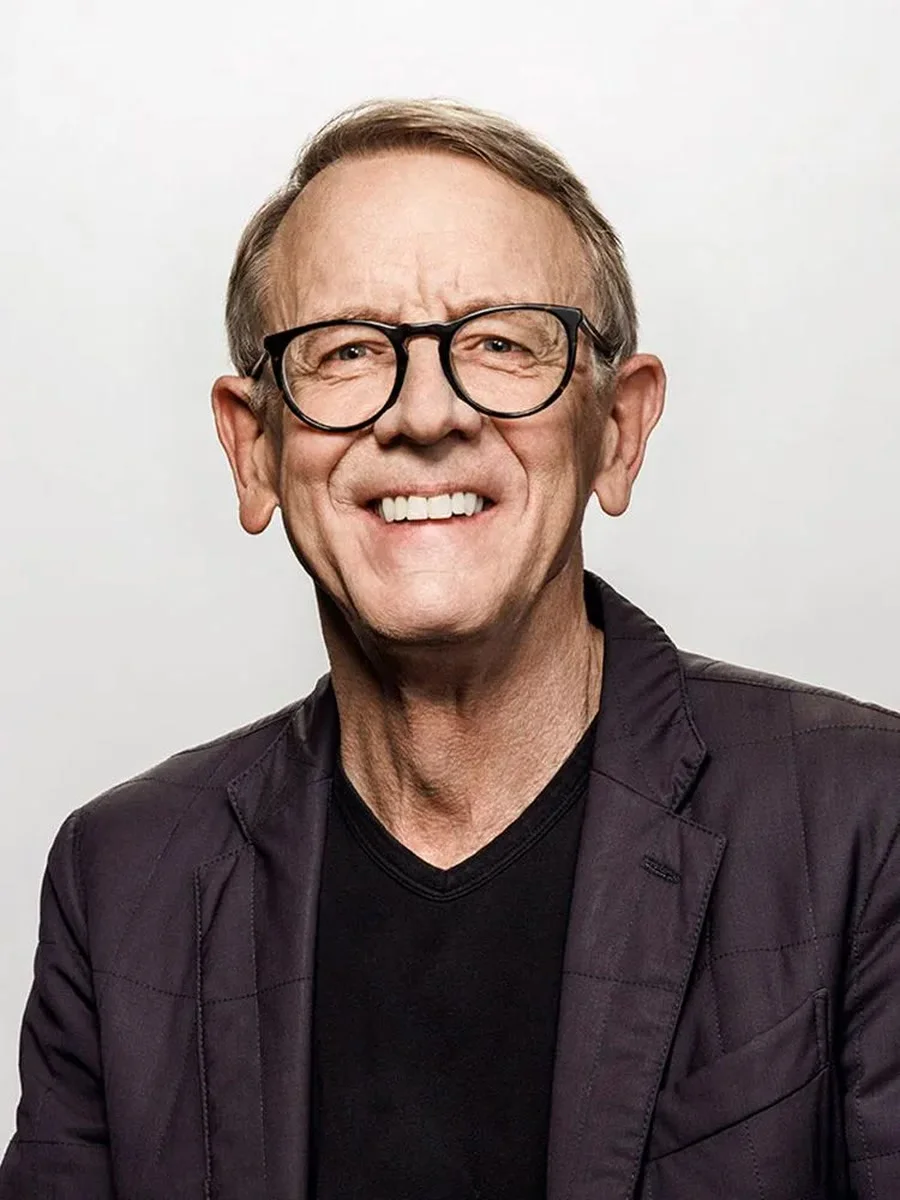
John Doerr
Backed Netscape, Amazon and Google; evangelist of OKRs and mission-scale venture bets.
An engineer learns to sell an unfinished future, 1951–1980
John Doerr's public record begins in South St. Louis, where a 1996 contemporary profile describes his father, Lou, moving from mechanical engineering and sales into ownership of a pump company. Doerr helped start the student software venture Warren Rowe & Associates and earned a Rice BSEE in 1973, a Rice MSEE in 1974, and an HBS MBA in 1976. The 1996 profile instead compresses both Rice degrees into 1973 and dates the MBA to 1975; the archived White House biography names the degrees but supplies no years. The older date conflict and the student company's formation, price, and exit economics remain unresolved. [researcher inference · strong] Institutional Investor, biography paragraphs · Rice ECE Hall of Fame, John Doerr row · HBS Alumni Achievement Awards, John Doerr heading · White House PERAB biography, education paragraph
A patent application filed in May 1974 names L. John Doerr III as a co-inventor of a Monsanto-assigned magnetic-bubble-memory circuit. Edge and the archived White House biography place his Intel start in 1974; the 1996 profile says he became one of Intel's leading field-sales representatives. The defensible formation story is therefore technical training joined to direct customer work, not engineering displaced by finance. [contemporaneous record · strong] U.S. Patent 4,096,582, inventors and filing history · Edge, opening career account · Institutional Investor, Intel paragraphs
Doerr later credited Andy Grove with an execution system built around clear objectives, measurable results, transparency, and review. He also recalled repeated rejection when he first sought venture work and Brook Byers's advice to gain operating experience at Intel. Those are first-person retrospections rather than contemporaneous hiring records, but they connect two durable practices: earn access through operating credibility, then turn conviction into an inspectable operating cadence. [retrospective witness · moderate] NVCA speech, paragraphs beginning “I'm going to tell you” and “But Brook Byers” · What Matters, transcript
Causal-chain boundary. Engineering and sales plausibly taught Doerr to connect product capability to adoption, while Grove supplied an execution language and Byers supplied entry to venture. The chronology supports access and a mechanism; it does not prove that any one apprenticeship caused later returns. [researcher inference · moderate] talks, biography reconstruction · writings, transmission chain
Kleiner Perkins apprenticeship: a partner system before a personal franchise, 1980–1993
Brook Byers recruited Doerr to Kleiner Perkins in 1980. Contemporary-retrospective reporting says Doerr then helped form and partly operated Silicon Compilers before returning full-time to venture work; later issuer biographies call him a KPCB general partner since August 1980. The public record does not reconcile title, employment status, company equity, or the exact 1980–83 allocation of his time. [retrospective witness · moderate] Institutional Investor, KPCB and Silicon Compilers paragraphs · Google S-1, director biography
The early record was institutional. Tom Perkins later allocated Sun to Doerr, Compaq to himself, and AOL to Frank Caufield. Sun's firm case says KPCB invested $1.7 million in November 1982 and Doerr joined its board; the public case does not expose the security, ownership, reserves, or proceeds. [retrospective witness · strong] Perkins oral history, role-allocation passage · Kleiner Perkins Sun case, investment and board paragraphs
Intuit is a useful ordinary control. Burt McMurtry recalls a multi-investor financing process, and Intuit's proxy dates Doerr's board service to August 1990. The records support participation and governance, not a lone-originator story or computable economics. [retrospective witness · strong] McMurtry oral history, 03-00:26 and 03-00:47:49 · Intuit proxy, director biography
The emerging method was to find enabling technical shifts, assemble missing executive and technical capacity, lead financings, and take boards. But even the early wins require separate ledgers for founder invention, partner sponsorship, fund capital, board work, and outcome. [researcher inference · strong] Sun and Intuit reconstructions · people and capital map
The internet cycle: networked sourcing, ambitious teams, and concentrated outcomes, 1994–2000
By 1996, a contemporary account described KPCB reviewing roughly 2,000 plans a year, treating about 200 seriously, and funding 20–25. A proposal generally needed two partner sponsors; every partner theoretically held a veto, although the same account described Doerr as carrying unusual practical weight. This is a partnership funnel, not a personal opportunity set or proof of decision quality. [contemporaneous record · strong] Institutional Investor, partnership-process and funnel passages
Netscape illustrates the system and its memory conflict. Its filing reports a 4.4 million-share KPCB vehicle block, 16.3% before the offering, in Doerr's row. A 1998 account describes an initial $5 million for about 25%, while later reporting gives $18 million for 15%. Security, check, ownership, and proceeds remain unreconciled; no return is computed from the IPO value. [contemporaneous record · strong] Netscape S-1, printed p. 48 · Fortune archive, PDF pp. 4–5 · Guardian, financing paragraph
Amazon provides stronger vehicle evidence. The 1997 S-1/A dates Doerr's board service to June 1996 and reports 3,401,376 shares for KPCB VIII and a related side vehicle, with Doerr disclaiming ownership beyond proportional interest. The remembered rationale—large potential, intense customer focus, and Bezos's adaptive speed—belongs to the decision narrative; price, reserves, distributions, carry, and personal return have insufficient public record. [contemporaneous record · strong] Amazon S-1/A, Management, Principal Stockholders, and footnotes · Edge, Amazon discussion
Google was jointly mediated, jointly financed, and jointly governed. The June 1999 announcement records a $25 million aggregate round led by Sequoia and KPCB, with Michael Moritz and Doerr joining the board; it does not split the firms' checks. Later Doerr accounts say $11.8 million for roughly 12% or $12.5 million, while participant reporting says founders Larry Page and Sergey Brin insisted on both firms and Ram Shriram and Ron Conway helped bridge the rivalry. [contemporaneous record · strong] Google announcement, June 7, 1999 · GQ, financing and mediation passages · Google amount reconciliation
Doerr's distinctive post-investment contribution at Google is better evidenced as an operating transmission than as sole selection credit: he taught an OKR trial to Page, Brin, and roughly thirty colleagues, while founders and later executives owned adoption and execution. The causal contribution of OKRs to Google's outcome is unproved. [retrospective witness · moderate] Wired excerpt, first session and OKR passages · Google lab
The internet-era chain is visible: KPCB's brand and network produced access; technical platforms defined opportunity; founders supplied product superiority and ambition; partnership capital secured ownership; board networks helped recruit and govern; public markets amplified outcomes. Every link is plausible and partly observed, but no public cash-flow series isolates Doerr's causal share. [researcher inference · strong] portfolio forensics · vehicle map
The reset: when abundant capital became evidence against the old playbook, 2000–2005
In a March 2002 interview, Doerr said KPCB had invested “over the top” during the boom and rejected a proposed $1 billion fund, European expansion, and an incubator. He argued for smaller funds and lower company burn. This is a genuine update because it names rejected organizational alternatives, not merely a general admission that markets fell. [investor-stated · strong] Charlie Rose 2002, 16:06–21:18 and 24:24–27:43
The reset did not yield a public, mechanical stop system. At Home/Excite, Weitek, and later Zynga expose different error classes: distribution and merger exposure, a passed semiconductor company, and governance/ownership concentration. The public record has insufficient public record for the price, terms, reserves, exits, and fund-level loss of these cases. [researcher inference · strong] Excite/@Home · Zynga · Weitek
The durable lesson was narrower than “capital is bad”: capital abundance can lower standards and subsidize weak learning, so burn and fund scale must be matched to evidence. The later cleantech expansion tests whether that lesson survived when the mission became more urgent and the technologies more capital intensive. [researcher inference · strong] talks, evolution and contradiction scorecard
Cleantech: mission expands the search space, then the vehicle mismatch bites, 2001–2015
The public origin story often begins with Doerr's daughter's response to a 2006 screening of An Inconvenient Truth. Yet a 2004 Charlie Rose appearance already has Doerr discussing clean distributed energy, and later interviews date investment activity to roughly 2001. The family event is credible as a public-commitment catalyst, not the first investment date. [retrospective witness · moderate] Charlie Rose 2004, 19:04–25:23 · Fast Company excerpt, opening climate-origin paragraphs · talks reconciliation
Doerr's 2007 thesis paired moral urgency with a venture screen: recruit domain experts, map the system, seek technologies with large emissions leverage, and build policy demand. In 2009 he advocated a carbon price and targeted incentives while investing in the sector. The source discloses his occupation but not a portfolio-interest schedule, allocation policy, or recusal record. [investor-stated · strong] TED, complete talk and transcript · Senate hearing, printed pp. 21–24 and 208–219
The portfolio tested every weak point in conventional venture. Bloom began in 2002 and remained capital intensive; Fisker failed; Amyris passed through losses, related-party financing, Chapter 11, old-equity cancellation, and successor ownership. [contemporaneous record · strong] Bloom · Fisker · Amyris
Independent reporting says MiaSolé raised more than $550 million [single-source] before a reported sale; capital raised is not capital lost, and KPCB proceeds remain unknown. [researcher inference · moderate] MiaSolé
Doerr later described KPCB as having chosen Fisker over Tesla, acknowledged that climate companies required more time and capital, and said that many failed. The statement is a retrospective lesson, not decision-date evidence of the original portfolio process. [retrospective witness · moderate] Ferriss, cleantech failure exchange · Ritholtz, renewable-energy exchange
The headline cleantech corpus is internally inconsistent: public accounts variously use nine initial ventures, 54 companies, roughly 70 ventures, or roughly 100 companies, with about $1 billion invested and later value described as about $3 billion or $3.2 billion. These are unaudited, differently scoped, and sometimes self-reported; no audited cleantech return, vehicle schedule, or personal economics is computable. [researcher inference · strong] cleantech reconciliation
The cleantech era sharpens rather than destroys the method. Mission can choose a consequential search space, but customer cost, technical milestones, financing duration, project dependencies, and kill rights must select the company. Persistence without fresh underwriting becomes exposure, not courage. [researcher inference · strong] portfolio forensics · writings synthesis
Chair, capital silos, and a public operating system, 2016–2026
Doerr's March 2016 announcement made him chair while retaining daily firm involvement, investment-committee service, and investing through both KPCB funds and a family foundation. It named Ted Schlein, Beth Seidenberg, Mary Meeker, Mike Abbott, Eric Feng, Wen Hsieh, and Mood Rowghani in the succession map. The title was not retirement, and the page supplies no votes, carry, opportunity-allocation policy, or measurable key results for the transition. [contemporaneous record · strong] chair announcement, role and objective bullets
The vehicle map became more complicated. Main KPCB/KP funds, Digital Growth Funds I–III, nominee and side entities, family/trust/Foris positions, Doerr Capital, Breakthrough Energy Ventures, and philanthropy have different capital owners, mandates, and decision rights. Public filings expose selected holdings; fees, carry, LP rights, opportunity allocation, and a consolidated return record have insufficient public record. [researcher inference · strong] vehicle map · Axios, growth-team split
DoorDash shows that later-stage sponsorship still followed the older playbook. Doerr's signed account says “we” led the 2015 Series B after meeting all four named founders and underwriting a larger last-mile logistics platform; filings establish his board date, Series B terms, and several KPCB/DGF entities but do not identify sole sourcing or personal capital. [retrospective witness · strong] DoorDash essay · DoorDash case
Publication extended the operating system beyond portfolio companies. Measure What Matters codified Grove's goal method in 2018; Speed & Scale applied it to climate in 2021; a 2026 signed letter recast the climate plan around physical build quantities, cost, and deployment. Ryan Panchadsaram and other collaborators did substantial research and revision work. [documented behavior · strong] Measure What Matters publisher record · Speed & Scale sample, PDF pp. 7–8 and printed pp. xxiv–xxxi · 2026 letter, PDF pp. 1–3
The public update is imperfect. In 2026, Doerr acknowledged the world was not on track; Panchadsaram explained that a bus deadline moved from 2025 to 2030 and the emissions baseline changed from 59 to 74 billion tons with a new methodology. Revision is evidence of learning only if the original target, miss, reason, new definition, and owner stay visible. [contemporaneous record · strong] Climate One, opening assessment and 15:30 deadline exchange
Setbacks, criticism, and legal boundaries
Ellen Pao's case is evidence about firm structure, workplace criticism, and power—not a finding that every allegation was true. A 2013 appellate opinion recorded her claims and KPCB's decision structure while affirming denial of arbitration; a jury rejected her discrimination and retaliation claims in 2015. Her later critic account remains distinct evidence. [contemporaneous record · strong] Pao appellate opinion · TechCrunch, verdict · Axios, Pao interview
Other dockets require equally narrow treatment. Sandys found reasonable doubt at pleading stage about director independence; Orgone held Fisker claims time-barred without deciding why the company failed; Roth revived and remanded an Amyris deputation theory without imposing liability; Alphabet settlements imposed reforms with no-admission language. None is an audited venture-performance record or a general finding of wrongdoing. [contemporaneous record · strong] Sandys · Orgone · Roth · Alphabet settlement
The operational criticism is broader than litigation: a servant-investor vocabulary sits beside financing, board, hiring, and follow-on power; policy advocacy can benefit invested sectors; and patient capital can protect learning or postpone recognition of failure. These tensions are hypotheses to audit with decision records, not accusations. [researcher inference · strong] failures and limits · adverse postmortems
People, capital, and influence map
| person, team, or institution | evidenced contribution | attribution boundary |
|---|---|---|
| Lou Doerr; Rice; Monsanto; Intel; Andy Grove | Engineering, sales, patent work, operating cadence, and early network. [retrospective witness · moderate] formation | Chronology does not prove inherited trait or later alpha. |
| Brook Byers; Eugene Kleiner; Tom Perkins; Frank Caufield | Recruitment, partnership platform, sponsorship, and divided early board roles. [retrospective witness · strong] Perkins oral history | Firm history and fund returns are not Doerr-only. |
| Carver Mead; Ed Cheng; David Johannsen; Silicon Compilers | Technical/company-formation network around Doerr's venture apprenticeship. [retrospective witness · moderate] Institutional Investor | Incorporation, equity, roles, and outcome remain incomplete. |
| Bill Joy; Andy Bechtolsheim; Bill Campbell; Leslie Koch | Introductions, technical judgment, coaching, recruiting, and operating support. [retrospective witness · moderate] deal-role map | Source, diligence, board work, and narration differ by deal. |
| Bezos and Amazon team | Founder thesis and execution; Doerr board sponsorship. [contemporaneous record · strong] Amazon filing | KPCB vehicles held the reported stake. |
| Page, Brin, Shriram, Conway, Moritz, and Google team | Product, founder condition, mediation, co-financing, co-governance, and OKR adoption. [contemporaneous record · strong] Google announcement | No unilateral Google credit or public check split. |
| Scott Cook; Burt McMurtry; Intuit board and management | Company execution, financing, CEO search, and governance. [retrospective witness · strong] McMurtry | Board service is not sole selection or outcome credit. |
| Al Gore; Bill Gates; Hal Harvey; Ryan Panchadsaram | Climate strategy, BEV, research, policy, and scorecard revision. [documented behavior · strong] Climate One | KPCB, BEV, advocacy, authorship, and philanthropy stay separate. |
| Later KP leaders | Succession, sector leadership, DGF split, and later institutional work. [contemporaneous record · strong] chair announcement · Axios split | Titles do not disclose votes, carry, or deal ownership. |
| Ann Doerr; NewSchools; Stanford Doerr School | Shared philanthropy and institution building. [contemporaneous record · strong] Stanford gift | Gifts and nonprofit outcomes are not venture investments. |
A falsifiable thesis of the edge
Proposed edge. From KPCB's early company-building period through the internet era, Doerr's repeatable advantage appears to have been institutional conversion: use operator and university networks to find enabling technical shifts; select unusually ambitious, adaptive teams; acquire partnership sponsorship and governance access; then translate strategy into recruiting and measurable execution. It is not a claim that Doerr alone found, financed, or built the companies. [researcher inference · moderate] recurring frameworks · decision labs
| test | prediction if the edge is real | present support and falsifier |
|---|---|---|
| Sourcing | Unseen wins show dated operator, university, founder, or trusted-referrer routes. [researcher inference · moderate] Edge | Selected cases support this; a complete funnel showing brand-only access would weaken it. |
| Picking | Decision records combine technical/customer superiority with ambition, adaptability, and named missing-team risks. [researcher inference · moderate] Google lab | Google/Amazon fit; Fisker, Amyris, Bloom, Zynga, and Weitek show insufficiency. |
| Intervention | Board records show recruiting, goal cadence, and milestone-linked decisions founders accepted. [researcher inference · moderate] Google excerpt | Public examples are selected; no labor ledger or matched founder assessment exists. |
| Portfolio consequence | Ordinary cases improve relative to comparable access, and the record remains strong after the dominant outlier. [researcher inference · strong] Pareto test | Fourteen of 46 candidates are sufficient and zero economics are audited; a Google-excluded cash-flow test is not computable. |
| Attribution | Partner, founder, vehicle, and collaborator ledgers leave a residual Doerr contribution. [researcher inference · strong] attribution map | If collaborators own the repeatable actions, the claim contracts to institution building. |
The strongest discriminating evidence would be a dated opportunity/pass ledger, original IC memoranda, partner votes and dissent, board and recruiting logs, founder assessments, vehicle cash flows, and a matched ordinary-case cohort. Without them, the thesis is a falsifiable interpretation—not a verified personal-alpha finding. [researcher inference · strong] uncertainty ledger
Skill, access, team, vehicle, era, luck, and outlier separation
| explanation | evidenced contribution | what cannot be claimed |
|---|---|---|
| Skill | Technical-commercial translation, team assessment, recruiting, governance, and execution tools recur. [documented behavior · moderate] writings synthesis | Repetition in selected stories does not establish causal returns. |
| Access | Intel, university networks, KPCB brand, prior founders, and board relationships widened the funnel. [researcher inference · strong] 1996 profile | Access is not selection skill. |
| Team | Partners, founders, executives, experts, co-investors, and collaborators performed distinct work. [contemporaneous record · strong] people map | Firm outcomes cannot become Doerr-only outcomes. |
| Vehicle | KPCB/KP funds, side entities, DGF, family/trust capital, BEV, and philanthropy have different beneficiaries. [contemporaneous record · strong] vehicle map | Company value, fund proceeds, carry, and wealth are not interchangeable. |
| Era | Semiconductor, workstation, internet, mobile, and climate regimes changed opportunity and exits. [researcher inference · strong] historical context | A wave does not prove the picker; a crash does not excuse the case. |
| Luck | Founder conditions, public-market timing, technical paths, and competitor errors affected outcomes. [researcher inference · strong] Google joint round | No public record allocates the counterfactual share of luck. |
| Outlier | Google ranks first economically; Amazon, Netscape, and Sun remain historically material without compatible cash flows. [researcher inference · strong] Pareto analysis | No exact percentage, return, or Google-excluded performance is computable. |
What changed, what endured, and what remains unproved
The enduring beliefs are visible from 1997 through 2026: people are the scarce input; enabling technologies create opportunity but do not select the company; execution requires explicit goals; networked help can change capacity; and large missions require institutions as well as products. [investor-stated · strong] Edge · NVCA speech · 2026 letter
The strongest update came after 2000: smaller funds, lower burn, and capital discipline. Cleantech added a harder qualification—match capital duration to the technology and deployment clock—while 2026 climate revisions added the need to preserve a versioned audit trail. [researcher inference · strong] Charlie Rose 2002 · Speed & Scale sample, printed pp. xv and xxiv–xxxi · Climate One
The unresolved contradictions are servant language versus investor power; capital discipline versus a large cleantech allocation; measurable goals versus unversioned target changes; policy advocacy versus portfolio incentives; team rhetoric versus hero narratives; and abundant outcome stories versus absent fund economics. [researcher inference · strong] philosophy, evolution and contradictions
Sourced chronology and learning path
| period | event and significance | boundary |
|---|---|---|
| 1951–1974 | St. Louis, Rice, student software, HBS, patent filing. [retrospective witness · moderate] Institutional Investor | Current Rice/HBS institutional dates are BSEE 1973, MSEE 1974, MBA 1976; the 1996 profile gives 1973/1973/1975, and student-company economics remain unknown. |
| 1974–1980 | Intel engineering/sales and Grove apprenticeship. [retrospective witness · strong] Edge | Exact projects and causal effect are incomplete. |
| 1980–1993 | KPCB entry, Silicon Compilers, Sun, Intuit, early boards. [contemporaneous record · strong] Sun case | Titles, checks, ownership, and partner work differ. |
| 1994–2000 | Netscape, Amazon, Google, networked partnership peak. [contemporaneous record · strong] case labs | Shared financing and vehicle attribution control the narrative. |
| 2000–2005 | Dot-com reset and rejection of the $1 billion-fund path. [investor-stated · strong] Charlie Rose 2002 | No complete stop-policy or fund-performance series. |
| 2001–2015 | Cleantech exploration, policy advocacy, losses, and mixed survivors. [researcher inference · strong] reconciliation | Denominators and economics conflict. |
| 2015–2018 | DoorDash, chair role, family/fund routes, DGF split, OKR codification. [contemporaneous record · strong] DoorDash · chair | Succession authority and economics remain private. |
| 2018–2022 | Measure What Matters, Speed & Scale, policy work, Stanford gift. [documented behavior · strong] writings | Collaborator work, philanthropy, and venture outcomes stay separate. |
| 2023–2026 | AI policy, NAE election, climate-plan recast, off-track admission. [contemporaneous record · strong] Senate AI statement, pp. 1–5 · Rice NAE announcement, opening and recognition paragraphs · Climate One | Current statements are dated positions, not outcome proof. |
Read this biography beside the decision-date cases, source-by-source writings, 21-appearance talk guide, investment operating system, and mental-model field guide. The package supports an institutional company-building biography with selected decision evidence; it does not support a career hit rate, audited personal return, or lone-genius account. [researcher inference · strong] denominator
1. Snapshot and testable edge thesis
Doerr's most defensible investment system is not “spot the future.” It is a conversion loop: use dense operator, founder, and university networks to see enabling shifts; select ambitious and adaptive teams inside those shifts; obtain partnership and governance support; then convert the thesis into recruiting and measurable execution. The scope is KPCB's early company-building and internet eras, not every later vehicle or public-policy activity. [researcher inference · moderate] profile thesis · talk frameworks
| component | mechanism | predicted evidence | falsifier |
|---|---|---|---|
| Access-to-learning | Trusted networks expose technical change and recruit missing expertise. [researcher inference · moderate] Edge, network/team passages | Dated source routes and expert work precede conviction. | Brand alone explains access; expert input follows the outcome. |
| Company selection | Product/customer superiority plus ambition and adaptability separate the company from the platform story. [researcher inference · moderate] Google freeze | Unseen cases show the same decision-date screens. | Failures and passes satisfy the screens at equal rates. |
| Institutional conversion | Partner sponsorship, board work, recruiting, and goal cadence turn uncertainty into actionable work. [researcher inference · moderate] 1996 process | Role logs show specific intervention and founder adoption. | Named partners or operators own the work; board presence is ceremonial. |
| Portfolio consequence | Ordinary cases add evidence after removing Google and controlling for access, vehicle, team, era, and luck. [researcher inference · strong] Pareto analysis | Compatible cash flows and a complete denominator show residual performance. | The result is outlier-dominated or no better than matched access cohorts. |
The public denominator is 49 searched routes: 46 eligible company candidates plus three passes; 14 are sufficiently reconstructed, 32 remain unresolved, and zero have audited economic reconstructions. Career-wide hit rate, return, IRR, DPI, TVPI, alpha, and personal economics are not computable. [researcher inference · strong] count rules · economics boundary
2. Core philosophy
- People before plans. Doerr repeatedly says teams are the scarce input and describes plans as revisable. The support is direct doctrine and selected behavior, not a validated founder-prediction model. [investor-stated · strong] Edge, team and plan passages
- Mission before map, evidence before company. A consequential problem can define where to look; customer need, technical proof, price-performance, team capacity, and financing duration must decide whether to invest. [researcher inference · strong] writings synthesis, sourcing and picking · cleantech forensics
- Execution must be visible. Objectives make direction legible; key results make progress inspectable; transparent review should trigger learning rather than mechanical control. [investor-stated · strong] Wired excerpt, OKR superpowers
- Service requires work and attribution. Recruiting, coaching, introductions, and board intervention can help, but founders, operators, partners, and vehicles keep their own credit. [researcher inference · strong] NVCA speech, “Assist entrepreneurs” · people map
- Capital must fit the clock. Internet software and physical climate ventures retire different risks at different speeds. Price, terms, ownership, reserves, exits, fees, carry, LP rights, and return doctrine have insufficient public record across the career. [researcher inference · strong] Bloom lab · vehicle map
This synthesis is deliberately narrower than Doerr's slogans. “Ideas are easy; execution is everything” becomes investable only after the analyst defines evidence, owner, deadline, capital, decision consequence, and counterfactual. [researcher inference · strong] writings decision playbook
3. Sourcing
The historical sourcing engine was networked rather than purely inbound. Intel and semiconductor relationships, Stanford-area technical networks, founders, executives, KPCB partners, and trusted intermediaries produced both opportunities and diligence. The 1996 profile's 2,000-plan funnel describes partnership reach; it cannot be assigned to Doerr personally. [contemporaneous record · strong] Institutional Investor, network and funnel passages
| sourcing route | evidence | operating rule |
|---|---|---|
| Operator network | Intel, Grove, and semiconductor relationships preceded KPCB. [retrospective witness · moderate] Edge | Ask what privileged learning the route supplies—not merely who made the introduction. |
| University/technical network | Sun and Google emerged from university-linked technical work and named intermediaries. [contemporaneous record · strong] Google announcement · Sun case | Record inventor, founder, referrer, sponsor, and technical verifier separately. |
| Founder/portfolio network | Amazon and later companies drew on prior founders, executives, and coaches. [retrospective witness · moderate] Edge, Amazon discussion | Test whether the network creates proprietary evidence or only prestige access. |
| Thesis-led ecosystem work | Cleantech diligence recruited scientists, policymakers, and domain experts. [investor-stated · strong] TED 2007, transcript | Map policy, infrastructure, supply chain, customer, and financing dependencies before naming a company. |
A reusable sourcing receipt should name the problem, platform change, original source, trusted referrer, partner sponsor, expert challenge, conflicts, and rejected alternatives. This is a researcher-designed control, not a recovered KPCB form. [researcher inference · strong] networked-diligence framework
4. Picking
Doerr's 2018 five-screen summary is the cleanest direct checklist: technical excellence, ability to build a team, a large unmet need, reasonable financing, and speed. It is a retrospective public summary, not a decision-date scorecard or proof of predictive efficacy. [investor-stated · strong] CNN transcript, final Zakaria/Doerr block
The evidence supports five harder translations:
- Product before label: identify the technical or customer superiority that works now. Google had a better search product; Amazon had observable customer focus; a “platform” remains a hypothesis until the wedge earns expansion. [retrospective witness · moderate] Google lab · Amazon lab
- Ambition with adaptability: test whether the team can recruit, revise, and operate under bad news—not merely articulate a huge market. [researcher inference · moderate] Edge, team construction · Fisker lab
- Fatal-risk sequence: identify technical, manufacturing, distribution, regulatory, capital, and adoption risks; specify which evidence retires each one. [researcher inference · strong] QuantumScape lab · Bloom lab
- Reasonable financing means full duration: an initial round is not “reasonable” if commercial proof requires repeated large financings that the vehicle cannot support. [researcher inference · strong] cleantech portfolio forensics
- Mission does not waive economics: “clean discount,” cost parity, and customer willingness are company gates even when the externality is urgent. [investor-stated · moderate] 2026 letter, PDF p. 3
Price, security, ownership target, dilution, reserves, and exit criteria have insufficient public record as a general Doerr doctrine. Do not infer them from celebrated outcomes or later valuations. [researcher inference · strong] uncertainty ledger
5. Deal and portfolio mechanics
The public KPCB process around 1996 required two sponsoring partners, allowed theoretical vetoes, generally sought to lead, and expected a board seat. This is decision-right evidence for that period, not proof that the rules applied unchanged to every fund or later deal. [contemporaneous record · strong] Institutional Investor, partnership-process passages
| mechanic | supportable record | boundary |
|---|---|---|
| Check and security | Case-specific filings expose Amazon, DoorDash, Google, Netscape, Bloom, and QuantumScape securities or holdings. [contemporaneous record · strong] case labs | Doerr-personal check and career-wide term doctrine have insufficient public record. |
| Ownership | Filings identify fund/entity blocks and pecuniary-interest disclaimers. [contemporaneous record · strong] vehicle map | Beneficial ownership is not personal capital, realized proceeds, or carry. |
| Reserves/follow-ons | Amyris, Bloom, DoorDash, and QuantumScape expose selected later securities. [contemporaneous record · strong] portfolio forensics | Initial allocation, reserve budget, follow-on vote, and stop rule have insufficient public record. |
| Concentration/power law | Google is the likeliest dominant economic contributor on public evidence. [researcher inference · strong] economic ranking | Zero audited reconstructions prevent an exact 80/20 or ex-Google return. |
| Exit | IPOs, acquisitions, bankruptcy, and cancellations are visible company outcomes. [contemporaneous record · strong] company ledger | Exit timing, distributions, DPI, and personal proceeds have insufficient public record. |
Use a three-ledger discipline: operating outcome, security/vehicle outcome, and investor cash flow. Never derive return from company valuation, paper mark, share count alone, or a hypothetical alternative. [researcher inference · strong] economics boundary
6. Vehicle and incentive fit
Doerr's public record spans numbered KPCB/KP funds and associates, side/nominee entities, Digital Growth Funds I–III, family and trust vehicles, Foris-related positions, Doerr Capital, Breakthrough Energy Ventures, a family foundation, and philanthropy. They are not one pool. [contemporaneous record · strong] vehicle table
| capital silo | what is visible | incentive question |
|---|---|---|
| KPCB/KP venture funds | Selected issuer filings expose holdings and governance. [contemporaneous record · strong] Google S-1 | Fees, carry, LP rights, reserves, partner allocation, and cash flows have insufficient public record. |
| DGF I–III | The 2018 split report separates management/economics from the continuing venture practice. [contemporaneous record · strong] Axios | Do not fold growth outcomes automatically into Doerr's venture record. |
| Family/trust/Foris/VVT routes | Coursera and Amyris filings expose selected entities, control, debt, or securities. [contemporaneous record · strong] entity map | Personal, spouse/trust, nominee, creditor, and fund economics remain distinct. |
| BEV and Doerr Capital | Public routes establish organizational participation or identity, not a complete deal/cash-flow schedule. [contemporaneous record · moderate] retrieval ledger | Mandate, decision rights, opportunity allocation, fees, carry, and returns have insufficient public record. |
| Foundation/philanthropy | NewSchools and Stanford document institution building and gifts. [contemporaneous record · strong] Stanford gift | Philanthropic impact is not venture return. |
Vehicle fit is a substantive part of the thesis: the fund's duration, reserve capacity, mandate, governance, and LP obligations must match the technology clock. The cleantech record makes that a failure control, not a footnote. [researcher inference · strong] Bloom and Fisker labs
7. Team attribution and work with founders
Doerr's “servant VC” language is strongest when converted into named work: recruit missing leaders, connect technical and market experts, coach without taking the founder's decision, and install an agreed operating cadence. It is weakest when “we” compresses firm capital, partner work, founder execution, and later outcome. [researcher inference · strong] NVCA speech, service passages · people map
| role | named examples | required boundary |
|---|---|---|
| Source/referrer | Byers, Joy, Bechtolsheim, Shriram, Conway, Campbell, Koch, and founder networks appear in selected stories. [retrospective witness · moderate] profile people map | Referral is not diligence, approval, board work, or economics. |
| Partner sponsor/approval | KPCB's two-sponsor/veto process and co-investors bound personal credit. [contemporaneous record · strong] 1996 process | Exact votes and dissent usually have insufficient public record. |
| Board/recruiting | Doerr held documented boards; company accounts name executive recruitment in selected cases. [documented behavior · strong] board map | A seat does not establish intervention or causal value. |
| Founder/operator | Bezos, Page, Brin, Cook, Netscape teams, DoorDash's four founders, and others built the companies. [contemporaneous record · strong] company ledger | Venture sponsorship never absorbs product and operating credit. |
| Collaborator | Grove supplied OKRs; Campbell coaching; Panchadsaram climate research/revision; Moritz shared Google governance. [documented behavior · strong] writings synthesis | Authorship and investor brand do not erase collaborator labor. |
A founder-support contract should name the founder-owned objective, investor deliverable, owner, deadline, evidence, decision right, conflict, and stop date. This is a researcher-designed governance control, not a universal KPCB policy. [researcher inference · strong] modern playbook
8. Views on the craft
- Venture is company building, not transaction collecting. Doerr tells new investors to differentiate, network, gain operating experience, and assist entrepreneurs as builders. [investor-stated · strong] NVCA speech, career advice and “Assist entrepreneurs”
- Teams adapt; plans do not. The investor should underwrite who can recruit, learn, and change course rather than worship the original deck. [investor-stated · strong] Edge, team and plan passages
- Platforms create openings, not winners. Workstations, the web, mobile/cloud, climate infrastructure, and AI can expand the search space while leaving company selection unresolved. [researcher inference · strong] Senate AI statement, p. 1 · forecast scorecard
- Capital is an intervention tool with failure modes. The 2002 reset says too much money can damage standards; cleantech shows too little duration can also kill learning. [researcher inference · strong] Charlie Rose 2002 · cleantech reconciliation
- Measurement must preserve judgment. Doerr says OKRs cannot replace leadership, judgment, or culture and may be revised after reassessment. [investor-stated · strong] Wired excerpt, “not a silver bullet” and endangered-result passages
- Public ecosystems affect private outcomes. Talent, research, infrastructure, regulation, acquisitions, and IPOs shape company possibility; investor incentives must be disclosed when policy can affect holdings. [researcher inference · strong] Senate AI statement, pp. 4–5 · Senate climate hearing
9. Signature bets and decision process
The decision-date curriculum lives in investments.md. Each full lab freezes known, unknown, believed, disputed, alternatives, context, risks, terms, vehicle, and roles before the outcome; each asks “Would you invest then?”, kill criteria, terms/ownership, and the next evidence check. [researcher inference · strong]
- Google — superior search and enormous ambition, but no mature monetization and a founder-imposed two-firm structure. [retrospective witness · moderate]
- Amazon — customer obsession and fast learning inside an uncertain retail/internet market, with filing-visible KPCB vehicles. [retrospective witness · moderate]
- Netscape — enabling-browser thesis and rapid market formation, with incompatible check/ownership recollections. [contemporaneous record · moderate]
- DoorDash — crowded delivery market reframed as local logistics infrastructure; round size has reported $35/$40/$45 million variants. [retrospective witness · moderate]
- Bloom Energy — an ordinary/mixed physical-venture case that tests time, capital intensity, controls, and board persistence. [contemporaneous record · strong]
- QuantumScape — technical promise separated from multi-layer, manufacturing, financing, and commercialization risk. [contemporaneous record · strong]
- Fisker versus Tesla — the conflict-constrained choice and the strongest admitted selection failure. [retrospective witness · moderate]
- Sun Microsystems and Intuit — compact early cases that constrain hero attribution and expose missing terms/economics. [retrospective witness · strong]
The case set is pedagogically broad but not statistically representative. It cannot produce a career hit rate or investment rule frequency. [researcher inference · strong] denominator
10. Mental models and maxims
The model lane froze exactly nine evidence-supported rules. Titles and links below mirror the physical field guide; no additional slogan is promoted to a model. [researcher inference · strong] model reconciliation
- Let mission define the search space; let evidence select the company
- Underwrite adaptive teams, then coach without taking false credit
- Ride enabling platform waves, not product labels
- Turn the thesis into measurable milestones and transparent review
- Revise the plan without erasing the audit trail
- Retire fatal risks in sequence and match capital to the technology clock
- Use networked diligence to turn uncertainty into intervention levers
- Underwrite the ecosystem and disclose the investor's policy incentive
- Keep people, vehicles, and outcomes in separate ledgers
Operator apprenticeship remains career advice; the 13-year technology-wave cadence remains an unvalidated narrative; startup/speedup/co-venture taxonomy has insufficient decision evidence; and standalone clean-discount or capital-abundance slogans are folded into the relevant risk and company-selection models. [researcher inference · strong] candidate-model disposition
11. Evolution and contradictions
| period | visible belief or update | contradiction/control |
|---|---|---|
| 1974–1997 | Intel apprenticeship becomes a people, platform, and execution doctrine. [retrospective witness · moderate] Edge | Later recollection cannot establish which rule existed before which deal. |
| 1998–1999 | Internet scale and network effects receive unusually optimistic forecasts. [investor-stated · strong] Charlie Rose 1999 | Broadband/long-boom predictions were incompletely specified and later disrupted by the crash. |
| 2002 | Doerr admits overinvestment, rejects a $1 billion fund, and favors smaller funds/lower burn. [investor-stated · strong] Charlie Rose 2002 | No public portfolio rule says when capital becomes excessive. |
| 2001–2009 | Climate shifts from early exploration to public mission, portfolio allocation, and policy advocacy. [retrospective witness · moderate] talk chronology | The 2006 family story is not the first investment date; policy can benefit invested sectors. |
| 2007–2021 | Physical ventures reveal longer technical and financing clocks; Doerr admits many failures and the Fisker error. [retrospective witness · moderate] Speed & Scale sample, printed pp. xii–xv and 1–2 | The reported $1 billion/$3–$3.2 billion record and 70/100 denominators remain unaudited and disputed. |
| 2016–2019 | Chair/player-coach role formalizes succession and institutional service. [contemporaneous record · strong] chair announcement | Continued IC, daily, fund, and family investing leaves decision-right transfer unclear. |
| 2018–2026 | OKRs and climate work become public doctrine; the 2026 plan emphasizes build, cost, and revised scorecards. [documented behavior · strong] writings chronology | Measurability conflicts with moved deadlines, changed baselines, and no public versioned ledger. |
The stable core is team, ambition, enabling change, networked help, and execution discipline. The real updates are capital restraint after the crash, capital-duration awareness after cleantech, and revision transparency after the climate scorecard. The principal unresolved conflict is whether these updates changed actual IC, reserve, or shutdown decisions; that has insufficient public record. [researcher inference · strong] cross-case forensics
12. Failures and limits
Failure is not one bucket. The six full adverse postmortems distinguish selection, technical, financing, governance, exit, and attribution errors. [researcher inference · strong] postmortem set
| case | failure mechanism supported | lesson and boundary |
|---|---|---|
| Fisker versus Tesla | KPCB chose Fisker under a competitive-conflict constraint; Fisker later failed and Doerr says the choice was wrong. [retrospective witness · moderate] Fisker postmortem | Reputation and apparent asset-light design did not retire execution, battery, financing, or demand risk; full partner dissent and economics have insufficient public record. |
| Amyris | Scale-up risk, chronic losses, related-party financing, Chapter 11, old-equity cancellation, and conflicting successor-recipient language are filing-visible. [contemporaneous record · strong] Amyris postmortem | Main-fund, family-debt, DIP, successor-equity, and personal economics must remain separate and are not computable. |
| Excite@Home | Distribution logic and merger structure did not produce durable economics; KPCB/company/personal holdings and distributions differ. [researcher inference · strong] Excite postmortem | A network advantage is not a business model or exit discipline. |
| Zynga | Board tenure, concentrated fund holdings, dual-class governance, and later acquisition are public. [contemporaneous record · strong] Zynga postmortem | A large share block and public advocacy do not establish investor return or governance efficacy. |
| Weitek | A CHM witness recalls KPCB passing, with attribution to Perkins and Doerr. [retrospective witness · strong] Weitek postmortem | A pass can reveal a blind spot, but foregone return and counterfactual allocation are not computable. |
| MiaSolé | Independent reporting describes more than $550 million raised and a later sale, with inconsistent KPCB/Doerr attribution. [researcher inference · moderate] MiaSolé postmortem | Capital raised is not capital lost; proceeds, security, ownership, and fund loss have insufficient public record. |
Bloom is the most useful ordinary/mixed limit: early technical importance and long governance exposure coexist with capital intensity, losses, control weaknesses, and no audited KPCB return. It prevents the curriculum from becoming only spectacular wins and terminal failures. [researcher inference · strong] Bloom lab
The method's structural limits are survivor-selected narratives, a 14-of-46 sufficient public reconstruction, zero audited economics, missing passes, uncertain partner roles, changing vehicles, and the absence of general price/terms/reserve/exit doctrine. [researcher inference · strong] uncertainty ledger
13. Historical operating environment
| era | decision-date environment | what the environment cannot explain away |
|---|---|---|
| 1980s systems | Falling compute costs, workstation networks, semiconductor design tooling, and KPCB's established formation model shaped Sun/Silicon Compilers. [researcher inference · moderate] Sun case | Company architecture, team construction, security, and outcome still required selection. |
| 1994–1999 internet | Browsers, portals, dial-up/broadband transition, immature monetization, and receptive IPO markets widened opportunity. [contemporaneous record · strong] Netscape filing · Google decision-era profile | A favorable wave does not assign credit among founders, partners, vehicles, and markets. |
| 2000–2002 reset | The crash exposed high burn, excess fund capital, and weak incubator/geographic expansion logic. [investor-stated · strong] Charlie Rose 2002 | Losses do not by themselves prove the later smaller-fund rule was applied consistently. |
| 2001–2014 cleantech | Commodity prices, subsidies, manufacturing scale, project finance, infrastructure, and long technical clocks differed from software venture. [researcher inference · strong] MIT cleantech paper, methods and results | Sector difficulty is context, not an exemption from company/vehicle underwriting. |
| 2015–2021 multi-stage/platform | Large growth pools, mature mobile/cloud distribution, and distinct DGF entities affected DoorDash and later ownership. [researcher inference · moderate] DoorDash filing · Axios split | Venture and growth economics cannot be pooled. |
| 2021–2026 climate/AI systems | Climate requires policy and capital-stack coordination; AI depends on compute, data, talent, safeguards, and exit routes. [investor-stated · strong] Senate AI statement, pp. 1–5 · Climate One | Ecosystem advocacy is not company selection or proof of public benefit. |
No decision-date base-rate dataset covers all these eras on compatible definitions. The historical record is therefore contextual, not a quantitative adjustment to returns. [researcher inference · strong] evidence boundary
14. Modern VC translation (as of 2026-08-23)
The following playbook is a researcher-designed translation for decisions made as of 2026-08-23. Its premises must be revalidated for each company; it is not represented as KPCB policy or as a measured causal study. [researcher inference · strong] writings playbook
| historical lesson | current practice | observable signal | failure mode / misuse | example test |
|---|---|---|---|---|
| Mission defines the search | Write the consequential problem and why venture is an appropriate instrument. [researcher inference · strong] model 1 | Customer, cost, technical, and financing evidence selects one company. | Moral urgency used to waive economics. | For climate hardware, specify unsubsidized cost, deployment prerequisites, and buyer. |
| Teams adapt | Reference work under bad news; map missing hires to fatal risks. [researcher inference · strong] model 2 | Founder changes plan when evidence changes and recruits stronger owners. | Charisma, exhaustion, or familiarity mistaken for adaptability. | Ask for the last abandoned belief, evidence, owner, and consequence. |
| Platforms are search maps | Separate current wedge from future platform and incumbent reaction. [researcher inference · strong] model 3 | Retention, superiority, or cost persists after novelty. | “AI company” or “climate platform” used as product evidence. | Model wedge economics before adjacent categories. |
| Milestones make learning visible | Put thesis, KRs, owners, dates, baselines, and board consequences in the IC record. [researcher inference · strong] model 4 | A miss triggers a pre-agreed action or a written revision. | Metric gaming, narrowed attention, or scorecard theater. | Name one kill KR and one learning KR. |
| Revisions preserve history | Version every changed target and denominator. [researcher inference · strong] model 5 | Original, actual, reason, new target, method, and owner remain visible. | Quietly moving deadlines and declaring progress. | Reconcile the 2021/2026 climate baseline before using trend. |
| Capital follows risk retirement | Match check, reserves, security, and vehicle duration to the next discriminating proof. [researcher inference · strong] model 6 | Each follow-on retires a named risk rather than defending prior cost. | “Patience” rationalizes sunk-cost escalation. | Hardware IC maps lab, pilot, manufacturing, certification, and project-finance gates. |
| Networked diligence creates levers | Name which expert, customer, recruit, or policymaker changes a risk and who owns the intervention. [researcher inference · strong] model 7 | Diligence produces a falsifiable intervention plan. | Prestige references substitute for independent challenge. | Require one disconfirming expert and record changed belief. |
| Ecosystems and incentives are explicit | Map research, compute/infrastructure, talent, regulation, project finance, buyers, and exit routes; disclose exposure. [researcher inference · strong] model 8 | The IC memo states portfolio beneficiaries and conflict controls. | Advocacy is presented as neutral evidence. | Separate public benefit, company benefit, and investor benefit. |
| Separate ledgers | Record person role, legal vehicle, security, cash, board work, outcome, and narrator. [researcher inference · strong] model 9 | Every claim resolves to the correct actor and entity. | Company value becomes personal return. | Reconcile Google $25m aggregate with unresolved firm split before economics. |
Current IC minimum. Freeze known/unknown/believed/disputed; list alternatives; identify five fatal risks; specify source, sponsor, diligence, approval, board and follow-on owners; set price/security/ownership/reserve or write insufficient public record; define kill criteria; name the next evidence check; and show outcome only after the decision. [researcher inference · strong] decision labs
15. Comparison with completed peers
Only the three requested completed local peers are compared: Vinod Khosla, Michael Moritz, and Bob Kagle. Their adversarial reviews mark the packages as bounded curricula, not compatible personal-return studies. [researcher inference · strong] Khosla review · Moritz review · Kagle review
| dimension | John Doerr | Vinod Khosla | Michael Moritz | Bob Kagle |
|---|---|---|---|---|
| Why the peer fits | Doerr is the KPCB operator-to-investor and Google co-board sponsor. [researcher inference · strong] profile | Same KPCB/Sun/cleantech institutional overlap, later independent multi-vehicle design. [contemporaneous record · strong] Khosla profile | Direct Google co-lead/co-board control and competing Sequoia partnership model. [contemporaneous record · strong] Google announcement | Same internet-era power-law and board-service questions, but equal-partner Benchmark architecture. [researcher inference · strong] Kagle profile |
| Sourcing | Operator/university/founder networks plus KPCB brand; funnel is partnership-level. [researcher inference · strong] sourcing | Problem/category-first search, own-capital experimentation, and explicit technical theses. [researcher inference · strong] Khosla sourcing | Close founder observation, Sequoia network, and local-team franchise. [researcher inference · strong] Moritz sourcing | TVI/Benchmark referrals plus customer-behavior observation. [researcher inference · strong] Kagle sourcing |
| Picking | Ambition, team-building, unmet need, technical excellence, financing, speed. [investor-stated · strong] CNN | Consequence-weighted discontinuity with explicit fatal-risk experiments. [researcher inference · strong] Khosla picking | Narrow product superiority and founder obsession under knife-edge uncertainty. [researcher inference · strong] Moritz picking | Customer trust/behavior and adaptable founders before polish. [researcher inference · strong] Kagle picking |
| Ownership | Filing-visible issuer blocks, but no general entry-price or ownership-target rule and zero audited case economics. [researcher inference · strong] economics boundary | Company/vehicle windows are more visible, but exact entry ownership and personal economics remain incomplete. [researcher inference · strong] Khosla mechanics | Selected Sequoia blocks are visible; personal allocation, dilution, and proceeds remain incomplete. [researcher inference · strong] Moritz mechanics | Benchmark's early fund and selected eBay position are bounded, but Kagle-personal ownership and compatible proceeds are absent. [researcher inference · strong] Kagle mechanics |
| Portfolio construction | Google likely dominates Doerr's public economic ranking; reserve policy, weights, loss ratio, and ex-Google performance are not computable. [researcher inference · strong] Pareto analysis | Explicit many-shot/black-swan construction across broader vehicle windows, still without a compatible personal return series. [researcher inference · strong] Khosla mechanics | Selected concentrated wins and losses are visible, but complete weights, cash flows, and ex-Google performance are absent. [researcher inference · strong] Moritz mechanics | Small early Benchmark fund/equal-partner structure and the eBay outlier are visible; compatible ex-eBay performance is absent. [researcher inference · strong] Kagle mechanics |
| Governance/founders | Recruiting, coaching, goal cadence, board sponsorship; servant language needs power controls. [researcher inference · strong] team work | Founder agency plus earned “venture assistance,” risk-backward recruiting, small useful boards. [researcher inference · strong] Khosla governance | Concrete recruiting/leadership intervention while preserving founder ownership. [researcher inference · strong] Moritz governance | Senior service, listening, shared partner help, and board accountability. [researcher inference · strong] Kagle governance |
| Vehicles | KPCB/KP, DGF, family/trust, Foris, BEV, Doerr Capital, and foundation/philanthropy are separate capital silos. [contemporaneous record · strong] vehicles | Own capital, main, seed, opportunity, strategic, AIV/SPAC, and family/control entities extend the mandate but must stay separate. [contemporaneous record · strong] Khosla vehicles | Multigenerational Sequoia funds and geographies create institutional reach without a public unified rights map. [researcher inference · strong] Moritz vehicles | Equal-partner Benchmark funds bound the relevant early record; later and personal routes remain distinct. [researcher inference · strong] Kagle vehicles |
| Incentives | Fees, carry, LP rights, opportunity allocation, and policy/family-vehicle conflicts are largely private; sector advocacy cannot be treated as neutral evidence. [researcher inference · strong] vehicle and incentive fit | Own-capital duration can support long experiments while family/control and cross-vehicle routes change beneficiary and conflict questions. [researcher inference · strong] Khosla vehicles | Partnership/local-team incentives and personal carry/IC rights remain private, limiting personal-alpha attribution. [researcher inference · strong] Moritz vehicles | Equal economics reduce deal territoriality but blur origination; reported carry/GP commitment is not a complete cash-flow record. [researcher inference · strong] Kagle vehicles |
| Failures | Dot-com excess, Fisker/Amyris/Bloom/MiaSolé, Zynga, and target-revision controls. [researcher inference · strong] failures | KiOR/Range/Coskata/View/Nextdoor test technical, capital, governance, and security boundaries. [researcher inference · strong] Khosla failures | Webvan/eToys/PlanetRx scars, Zappos passes, and current Klarna allegations. [researcher inference · strong] Moritz failures | Early stumbles, Webvan, Friendster, Prosper, and eBay governance allegations. [researcher inference · strong] Kagle failures |
| Attribution/institution | Strong personal narration inside a multi-generation partnership and collaborator network. [researcher inference · strong] people map | Strong personal brand inside a firm with named partners, trusts, and partner-led cases. [researcher inference · strong] Khosla people map | Explicit partnership renewal/local credit, but the Sequoia platform can dominate personal narrative. [researcher inference · strong] Moritz people map | Equal economics intentionally blur origination; eBay route and work remain shared. [researcher inference · strong] Kagle people map |
The comparative result is not a ranking. Doerr is most distinctive in pairing networked company building with a portable execution system; Khosla in explicit fatal-risk experimentation and vehicle breadth; Moritz in wedge-level observation and institutional renewal; Kagle in equal-partner service and behavioral customer evidence. Across all four, team, access, vehicle, era, and outlier controls are stronger than public evidence for repeated personal alpha. [researcher inference · strong] Doerr denominator
16. The strongest case against greatness
The steelman skeptical case is that Doerr's visible record is KPCB's elite access plus founder execution and public-market timing, narrated through Google. KPCB already had brand, partner networks, capital, and company-building infrastructure; Google was a joint, founder-conditioned round; Amazon, Netscape, Sun, and Intuit used fund vehicles and multiple contributors; later climate stories are selected and economically unaudited. [researcher inference · strong] Google announcement · Pareto analysis
The denominator intensifies the objection: 14 sufficiently reconstructed candidates out of 46 eligible company leads, 32 unresolved, three passes, no complete opportunity set, and zero audited economic reconstructions. Google likely dominates the public economic ranking, yet an exact outlier share or ex-Google performance cannot be computed. [researcher inference · strong] denominator
The operating doctrine is also hindsight-exposed. OKRs are inherited from Grove and publicized after Google; founder/team stories are winner-selected; a 2002 capital-discipline update sits beside a later large cleantech allocation; “servant VC” language coexists with board and financing power; and climate target revisions weaken accountability without a versioned ledger. [researcher inference · strong] contradiction scorecard · adverse boundaries
The favorable case survives only at a narrower level: Doerr repeatedly helped institutionalize technical-market learning, recruiting, goal discipline, and partnership succession, and he publicly admitted meaningful errors. The theses diverge on hidden evidence. Dated funnels, passes, IC votes, board labor, founder assessments, vehicle cash flows, reserve decisions, and an ordinary-case matched cohort would support or falsify personal repeatability. [researcher inference · strong] retrieval priorities
17. Analyst study guide, glossary, and go deeper
Recommended study path
- Read the chronological profile and write the edge, alternative explanation, predictions, and falsifiers in your own words.
- Read the 1997 Edge interview, then the 2002 reset, before reading outcome-rich retrospectives. [researcher inference · strong]
- Replay Google, Bloom, and Fisker/Tesla without revealing the outcomes.
- Use the writings chronology and talk contradiction scorecard to distinguish contemporaneous doctrine from retrospective repair.
- Apply all nine mental models, then attack them with the six postmortems and uncertainty ledger.
- Compare the same eight dimensions across Khosla, Moritz, and Kagle; do not rank returns from incompatible evidence.
This sequence is a researcher-designed curriculum, not Doerr's prescribed reading order. [researcher inference · strong] package evidence boundary
Investor-specific glossary
| term | meaning in this package |
|---|---|
| Objective / key result | A qualitative direction paired with measurable, time-bound evidence; not a substitute for judgment or culture. [investor-stated · strong] Wired excerpt |
| Platform wave | An enabling technical shift that creates a search space; it is not evidence that one product will win. [researcher inference · strong] model 3 |
| Networked diligence | Using trusted experts and operators to identify uncertainty and specific intervention levers. [researcher inference · strong] model 7 |
| Technology clock | Time and capital required to retire technical, manufacturing, regulatory, adoption, and financing risks. [researcher inference · strong] model 6 |
| Clean discount | Clean alternative whose economics are attractive enough to drive adoption; not proof of venture margin or defensibility. [investor-stated · moderate] 2026 letter, p. 3 |
| Servant VC | Doerr's service ideal—help build rather than trade companies—subject to board-power and attribution controls. [investor-stated · strong] NVCA speech |
| Vehicle ledger | Legal fund/entity, capital owner, security, mandate, control, and economics kept separate from person and company. [researcher inference · strong] vehicle map |
| R/U/X | Sufficiently reconstructed, unresolved, or excluded candidate in the public deal ledger. [researcher inference · strong] ledger rules |
| No-hindsight lab | Researcher-designed decision freeze with four prompts before the sourced outcome. [researcher inference · strong] labs |
Reusable checklists
Sourcing and picking — define mission and why venture; record source/referrer/sponsor; separate platform from product; test technical or customer superiority; reference adaptability; name missing hires; list alternatives; disclose conflicts. [researcher inference · strong] models 1–3
Diligence and IC — freeze known/unknown/believed/disputed; map five fatal risks; specify the cheapest discriminating evidence, threshold, owner, time, and spend; record partner vote/dissent; set price, security, ownership, reserves, and vehicle—or insufficient public record; write kill criteria and next check. [researcher inference · strong] decision labs
Governance and follow-on — name founder-owned objective and investor deliverable; version milestones; separate advice from authority; re-underwrite every follow-on; disclose related-party and policy incentives; preserve an abandonment path; log board/recruiting work and exit decision. [researcher inference · strong] models 4–9
Attribution and economics — keep source, sponsor, diligence, approval, board, recruiting, follow-on, exit, narrator, and vehicle roles separate; never convert share count or valuation into return; distinguish company outcome, security outcome, vehicle cash flow, LP return, carry, and personal wealth. [researcher inference · strong] economics boundary
Ranked sources and next retrievals
- Institutional Investor, 1996 — best contemporaneous biography, funnel, network, and partnership-process account. [contemporaneous record · strong]
- Edge, 1997 — earliest full direct philosophy on teams, platforms, Amazon, Netscape, Intel, and coaching. [investor-stated · strong]
- Google 1999 announcement and 2004 S-1 — joint financing, governance, vehicle, and ownership controls. [contemporaneous record · strong]
- Charlie Rose, 2002 — strongest candid boom/bust update and rejected strategic alternatives. [investor-stated · strong]
- Wired Measure What Matters excerpt — best operating doctrine plus Google retrospective, with amount conflict retained. [investor-stated · strong]
- Speed & Scale official sample — clearest climate framework, collaborator record, and Fisker admission; access is partial. [investor-stated · strong]
- SEC/company case ledger — strongest independent vehicle, board, adverse, and outcome controls. [contemporaneous record · strong]
- Climate One, 2026 — current off-track admission, deadline/baseline revision, and collaborator attribution. [contemporaneous record · strong]
Highest-value next evidence is original IC/pass/follow-on memoranda; a complete KPCB opportunity and loss ledger; partnership agreements, LPAs, side letters, fees/carry and cash flows; board packets and founder assessments; full Google/Netscape/Amazon cap-table histories; a complete cleantech vehicle schedule; and versioned OKR/climate scorecards. Until recovered, price, terms, reserves, exits, carry, and returns have insufficient public record except where a case filing discloses a bounded fact. [researcher inference · strong] ranked retrieval priorities
Pareto 80/20 — what drove the record
The public record supports a power-law interpretation, not an audited 80/20 calculation. No KPCB cash-flow ledger, LP statement set, or partner-level carry schedule was recovered, so the rankings below use three different measures and never turn valuations, nominee holdings, or reported paper values into returns. [researcher inference · strong] 1996 KPCB selection process and ownership target economic boundary
Ranked view 1 — likely economic importance, evidence-bounded
| Rank | Case | Basis and measure | Attribution and support | Mechanism | Denominator caveat |
|---|---|---|---|---|---|
| 1 | Contemporaneous $25 million aggregate KPCB/Sequoia round; 23,893,800 shares [single-source] later held through KPCB's nominee. No firm check split or distributions. Google announcement 2004 S-1, principal holders | Joint KPCB/Sequoia decision; Doerr and Moritz joined the board. [documented behavior · strong] | Superior relevance and compounding query usage, followed by management recruitment and governance. | Rank reflects scale and ownership evidence, not a computed KPCB or Doerr return. | |
| 2 | Amazon | Exact $8,000,013.80 Series A issuance and reported holdings [single-source] for two KPCB vehicles; 16.4% pre-IPO and 14.6% post-offering. Amazon S-1/A, transactions and ownership | KPCB capital; Campbell/Koch sourcing chain; Bezos chose the investor; Doerr served on the board. [documented behavior · strong] | Catalog breadth, convenience, repeat behavior, recruiting, and capital-market access. | No distribution dates, follow-ons, fees, carry, or audited fund return. |
| 3 | Netscape | Reported $5 million/25% versus $18 million/15% [disputed]; a later roughly $400 million sponsor outcome [single-source]; filing shows 4.4 million nominee shares and 16.3% pre-offering ownership [single-source]. Fortune archive, pp. 2–3 filing, p. 48 Guardian conflict | KPCB VII and side vehicles; Clark, Andreessen, Joy, Doerr, Barksdale, and the partnership all matter. [retrospective witness · moderate] | Browser as Internet client platform; rapid team construction and an unusually fast IPO. | Reported proceeds are unaudited and vehicle cash flows are absent. |
Dominant-outlier exclusion test. Remove Google entirely. Amazon and Netscape still explain the historical record through two different Internet mechanisms—transaction infrastructure and browser/platform formation—and Sun supplies an earlier open-systems precedent. What disappears is any defensible ordering of economic magnitude: without realized cash flows, the remaining cases cannot be ranked by MOIC, DPI, or net IRR. [researcher inference · strong] Amazon case Netscape case Sun compact case
Ranked view 2 — historical importance
| Rank | Case | Measure | Why it matters |
|---|---|---|---|
| 1 | Netscape | Platform/category formation before mature browser economics | It made the Internet platform thesis legible and exhibits KPCB's recruiting/network model near the decision date. [retrospective witness · moderate] 1996 profile |
| 2 | Search quality and usage acceleration before a settled business model | It is the clearest record of backing product superiority plus founder ambition while sharing credit and governance with Sequoia and company builders. [documented behavior · strong] 1999 announcement | |
| 3 | Amazon | A preferred investment in an early Internet transaction company | It pairs exact security/ownership evidence with operating and recruiting work, making it the best documented signature entry. [documented behavior · strong] 1997 S-1/A |
| 4 | Sun Microsystems | Open networked computing and Doerr board service from 1982 | It is the earliest reconstructed company case and a bridge from operator apprenticeship to venture platforms. [documented behavior · moderate] Sun proxy |
This ranking measures category and method influence, not money. The official current portfolio is self-selected and no career-wide accepted/rejected denominator exists. [researcher inference · strong] Kleiner Perkins profile
Ranked view 3 — learning value
| Rank | Case | Learning mechanism | Evidence boundary |
|---|---|---|---|
| 1 | Fisker versus Tesla | An industry-resume heuristic and conflict constraint selected the experienced auto designer over a software-first system builder; physical integration and financing risk were under-retired. | Doerr later calls the choice wrong, but exact KPCB checks, milestones, and the Tesla counterfactual remain unknown. [retrospective witness · strong] Ritholtz interview |
| 2 | Amyris | A valid synthetic-biology platform thesis met scale-up, burn, governance, and related-party capital escalation. | Old equity was canceled; the filing says DIP claims received successor equity but contains a contradictory Foris-prepetition sentence. Total KPCB/family economics are not computable. [researcher inference · strong] 2024 8-K, Items 1.02 and 3.02 |
| 3 | Bloom Energy | The ordinary/mixed case: real cost and commercial progress coexisted with sixteen-year duration, large capital needs, accumulated losses, and disclosure disputes. | It is not a clean failure or win, and entry cash flows are absent. [researcher inference · strong] 2018 S-1 |
| 4 | Excite and @Home | Related portfolio companies, weakened diligence, governance conflict, company failure, and sponsor distributions can point in different directions. | The merger outcome covers two original decisions; distributions are not sale proceeds. [researcher inference · strong] Washington Post adverse profile |
Evidence boundary and denominator
Count rules and mechanical reconciliation
The bounded public denominator is 49 searched decision routes: 46 eligible company candidates plus three explicit passes/misses. The 46 consist of all 25 cards on Doerr's live Kleiner Perkins profile, seven additional direct company associations, twelve KPCB-only Internet-strategy leads whose individual attribution remains unresolved, and two additional adverse cleantech candidates. [researcher inference · strong] official 25-card profile 1996 company/funnel record 1999 board biography
| Mechanical bucket | Count | Rule and result |
|---|---|---|
| Current official person-attributed cards | 25 | All live cards searched; promotional/self-selected, not a complete portfolio. |
| Additional direct associations | 7 | @Home, drugstore.com, Handspring, Healtheon/WebMD, literal Homeshop.com, Go, Silicon Compilers. |
| KPCB-only unresolved leads | 12 | Firm stake is not silently converted into a Doerr-led investment. |
| Additional adverse candidates | 2 | Fisker and MiaSolé. |
| Publicly claimed/known eligible company candidates | 46 | 25 + 7 + 12 + 2. |
| Explicit passes/misses, excluded from investments | 3 | Tesla, Weitek, Robinhood early rounds. |
| All searched routes | 49 | 46 + 3. |
| Researched decision routes | 49 | Every named route has a dated source and an explicit ledger or exclusion entry; depth varies, so only 14 meet the sufficiency gate. |
| Sufficiently reconstructed for a decision case | 14 | Amazon, Amyris, @Home, Bloom, DoorDash, Excite, Fisker, Google, Intuit, MiaSolé, Netscape, QuantumScape, Sun, Zynga. |
| Unresolved or partial company candidates | 32 | 46 − 14. |
| Full audited economic reconstructions | 0 | 0/46 meet cash-flow, dilution, reserve, distribution, fee/carry, and attribution requirements. |
Sufficiently reconstructed means the record supports a dated decision/thesis or documented association, vehicle/terms evidence or an explicit statement that it is absent, role/governance boundaries, outcome, and unresolved fields. It does not mean the economics are complete. Excite and @Home count as two original candidates because each was an investment before their merger; one Excite@Home postmortem covers the combined outcome without collapsing the two original decisions. [researcher inference · strong] 1999 merger record
The scoped reconstruction fraction is therefore 14/46 (30.4%). It describes only this named public candidate universe, not career coverage, opportunity coverage, or capital-weighted coverage. Career-wide coverage and the investment hit rate are not computable because no complete accepted/rejected ledger, fund schedule, or audited cash-flow series is public. [researcher inference · strong]
Deduplication rules are literal: iControl is one identity; Healtheon/WebMD is one evolving company; AOL/America Online and SportsLine spelling variants each count once; @Home and Excite remain separate original investments; Netscape and acquirer AOL remain separate; Homeshop.com in 1999 is not silently normalized to Homestore.com in 2004; and the 1996 OnLive! Technologies is not assumed to be the later game-streaming company. [researcher inference · strong] Google 1999 biography Google 2004 biography
An NFX Signal route is retained only as a discovery warning: its page showed 121 “Investments on Record” while the table header showed 75, so neither number is imported into the denominator. [contemporaneous record · provisional] Signal profile
Economics boundary
No case has a complete same-vehicle cash ledger. Reported valuations, financing totals, IPO holdings, beneficial-ownership tables, and acquisition consideration are not returns. This chapter therefore reports exact dated checks and securities when available, identifies whether economics are reported or computable, and calculates no IRR, MOIC, TVPI, DPI, cleantech hit rate, or personal profit. [researcher inference · strong]
Historical and decision-date context
| Decision window | Knowable context then | Hindsight boundary |
|---|---|---|
| 1981–83 — Weitek, Silicon Compilers, Sun | Merchant-fab feasibility was contested; a witness recalls the “real men have fabs” objection, and KPCB passed on Weitek's OEM box while Doerr helped connect Sun and Silicon Compilers. [retrospective witness · moderate] CHM Weitek, pp. 5–9 CHM SPARC, around p. 16 | Weitek's later IPO does not prove KPCB would have obtained or realized a good return; the rejection rationale is attributed to Perkins, not solely Doerr. [researcher inference · strong] |
| 1994 — Netscape | The browser could become the Internet client platform, but mass distribution, server revenue, Microsoft response, and a complete team were unresolved. 1996 profile, Netscape passages | The 1995 IPO cannot substitute for the June/September 1994 underwriting. [researcher inference · strong] |
| 1996 — Amazon and partnership process | KPCB reported about 2,000 plans, 200 serious reviews, and 20–25 financings annually; Amazon accepted preferred capital and a board structure while online-commerce demand and financing needs were unsettled. Institutional Investor, selection/meeting sections Amazon S-1/A | Later market scale was not knowable; the exact issuance is entry evidence, not foresight proof. [researcher inference · strong] |
| 1999 — Google | Google claimed 50% monthly traffic growth, a 100-million-query daily web market, and co-branded/enterprise routes; monetization and executive formation were unresolved. Google announcement Forbes, October 1999 | Do not retrofit mature advertising economics or erase the joint Sequoia/founder decision. [researcher inference · strong] |
| 2002–18 — Bloom | Solid-oxide distributed power required long technical, manufacturing, customer-finance, and policy duration; the IPO arrived sixteen years after Doerr joined the board. Bloom S-1, history/management | Public-market value is not fund return; multiple KPCB vintages and debt conversion require a cash ledger. [researcher inference · strong] |
| 2006–11 — cleantech | MIT found more than 90% of post-2007 companies in its 2006–11 cleantech cohort failed to return initial capital and that energy hardware took longer and more capital than software; the study is not a KPCB sample. MIT working paper, pp. 4–5, 17–18 | Use as sector base rate only; definitions exclude Tesla because its Series A predates the cohort. [researcher inference · strong] |
| 2008 — Fisker | Green-policy tailwinds and a $528.7 million DOE commitment existed; $192 million was advanced, while production, supplier, warranty, and milestone risk remained. Orgone opinion, chronology | The appeal was time-barred and expressly did not decide why Fisker failed or sponsor liability. [contemporaneous record · strong] |
| 2015 — DoorDash | Nine markets, prior capital, a crowded delivery field, and a proposed logistics layer for local commerce were visible; contribution economics, density, and labor classification were not. Fortune, March 2015 | The later signed essay is interested retrospective evidence, not the IC memo. [researcher inference · strong] |
| 2018 — partnership split | Growth deals had become larger and more international; an official email said DGF I–III lead partners would continue their investments while the Meeker-led team separated. Axios, split mechanics | DGF economics and deal credit cannot be reassigned to Doerr without company-specific evidence. [researcher inference · strong] |
Vehicle economics and incentives
| Vehicle or boundary | What the record establishes | What remains unknown or must not be conflated |
|---|---|---|
| KPCB VII / Founders / Information Sciences Zaibatsu II | Netscape filing attributes 4.4 million pre-offering-equivalent shares [single-source] across the three vehicles to Doerr's nominee row, with a pecuniary-interest disclaimer. Netscape S-1, p. 48 [documented behavior · strong] | Initial security, exact check allocation, follow-ons, distributions, and personal economics. |
| KPCB VIII / Information Sciences Zaibatsu II / VIII Associates | Amazon vehicles bought 555,161 and 14,235 Series A shares at $14.05, an exact $8,000,013.80 issuance [single-source]; Doerr's GP attribution was proportional. Amazon S-1/A, transactions/footnotes [documented behavior · strong] | Issuance price is not all-in cost or outcome; no personal check or distribution ledger. |
| KPCB Holdings | Repeated issuer filings identify it as nominee/record holder. Google S-1 DoorDash Form 3 [documented behavior · strong] | A nominee is not the economic fund and its aggregate row is not Doerr's freely owned personal stake. |
| KPCB IX/X | Bloom's 2018 S-1 separates IX-A/B and X-A/B holdings, associated holders, 987,074 direct Doerr shares [single-source], and note-conversion shares; six managers shared fund control. Bloom S-1, principal holder footnote [documented behavior · strong] | Initial 2002 check/security, reserve votes, dilution, sales, and net result. |
| KPCB XII vs Foris/VVT/Perrara/Clarus | KPCB XII/XII Founders retained a small Amyris interest while Foris later held common, debt-conversion, and warrant exposure through family-affiliated structures. Amyris 13D/A, ownership and group footnotes [documented behavior · strong] | Never merge main-fund venture capital, family trust, secured loans, warrants, DIP claims, or successor equity. |
| KPCB XIV / XIV Founders | QuantumScape Form 3 reports 18,349,929 Class B shares [single-source] through nominee; Byers, Doerr, Gordon, and Schlein shared manager control. QuantumScape Form 3 [documented behavior · strong] | Not a personal holding; initial allocation and realized economics absent. |
| DGF I–III / DGF II / DGF Founders II | DoorDash records Series B/C/H securities through DGF II entities; a 2020 follow-on cost $7,555,931 [single-source]. The 2018 split preserved existing lead-partner responsibilities. DoorDash proxy, related transaction/ownership Axios [documented behavior · strong] | The reported 2015 $35m, rounded $40m, and filing $45m aggregate round [disputed] are not KPCB check figures. DGF sourcing, carry, and returns require deal-specific evidence. |
| Seven Managing LLCs | The Pao appellate record says investment partners advised while Managing Members made final investment decisions; KPCB asserted Managing LLC authority over carry allocation. Pao opinion, structural passages [contemporaneous record · moderate] | The opinion addressed arbitration, not the fairness of compensation or every deal's approval. |
| WindyHill, Austin/Hampton trusts, KPIC, Lupum, Portico Libre, VVT | Coursera and QuantumScape footnotes separate family/trust/side holdings from KPCB funds. Coursera proxy, footnote 6 QuantumScape prospectus, footnotes 7–13 [documented behavior · strong] | Beneficial ownership or shared voting power is not proof of a personal cash check. |
| Family foundation | Doerr said in 2016 that he would invest for KPCB funds and his family foundation. chair statement [investor-stated · strong] | The announcement does not identify the foundation, opportunity-allocation policy, economics, or holdings; do not equate it with Foris/VVT. |
| Doerr Capital | The name was queried; no opened primary formation, ownership, portfolio, or control record tied it to Doerr. [researcher inference · insufficient public record] | Do not equate it with Foris, KPCB, or the unnamed family foundation. |
| Breakthrough Energy Ventures | Doerr discusses climate-capital stacks, but this pass found no primary check, formal role, carry, or rights for him at BEV. [researcher inference · insufficient public record] climate-capital boundary | Keep BEV outside KPCB, family, and philanthropy ledgers. |
| Philanthropy | NewSchools and Stanford's $1.1 billion lead gift are institutional/philanthropic commitments. NewSchools history Stanford announcement [documented behavior · strong] | Philanthropy is neither venture deployment nor return evidence. |
Across all vehicles, management fees, carry percentages, hurdle or clawback terms, LP rights, reserve policies, opportunity allocation, side-letter terms, and Doerr's realized proceeds remain insufficient public record. The 2016 chair transition and 2018 growth split establish organizational boundaries, not those economics. [researcher inference · strong] chair statement Axios split
People, capital, and influence map
| System/case | Source and sponsor | Approval/capital | Board and company-building | Attribution boundary |
|---|---|---|---|---|
| 1996 KPCB system | Network-sourced opportunities; at least two sponsoring partners prepared each case. | All partners could theoretically veto; Doerr had unusual weight; firm led and sought meaningful ownership. Institutional Investor, partnership meeting [contemporaneous record · strong] | Sponsor accepted board duty; portfolio reviews and recruiting were partnership services. | A Doerr board seat does not prove sole sourcing, approval, or capital. |
| Amazon | Bill Campbell → Leslie Koch → Doerr; Bezos chose KPCB among competing bids. | KPCB VIII and side fund; second sponsor and vote unknown. | Doerr board; KPCB credits recruiting and introductions; Bezos/company executed. Amazon case [retrospective witness · moderate] | Campbell, Koch, Bezos, Gordon, company executives, and fund LPs retain credit. |
| Bechtolsheim introduction in firm account; Shriram and Conway mediated the two-firm outcome in participant reporting. | Joint KPCB/Sequoia round; internal votes and split unknown. | Doerr/Moritz board; founders led CEO search; Rosing, Rosenberg, Campbell, Schmidt and company team built. GQ, CEO search [retrospective witness · moderate] | “Doerr/KPCB contributed recruiting and governance” is supported; “Doerr built Google” is not. | |
| Netscape | Clark/Andreessen formed; Joy encouraged Doerr; partnership helped build plan. | KPCB VII group; approval reported as rapid/unanimous, executed terms conflict. | Doerr board; KPCB/Doerr credited recruiting Barksdale and executives. New Yorker [retrospective witness · moderate] | Preserve Clark, Andreessen, Illinois team, Joy, Barksdale, and partners. |
| DoorDash | No public introducer; Doerr says “we led.” | DGF II entities; 2015 vote/check allocation unknown. | Doerr board from March 2015; founders Xu, Fang, Tang, and Moore execute. DoorDash S-1 [documented behavior · strong] | DGF vehicle and later growth-team economics are not personal Doerr capital. |
| Bloom | Source/diligence team unknown. | KPCB IX/X and associated positions; six managers shared control by filing date. | Doerr board from May 2002 and lead independent at IPO; Sridhar/team execute. Bloom S-1 [documented behavior · strong] | Board duration is not causal proof or a cash-return record. |
| Amyris | KPCB association from 2006; later Foris family-affiliated financing. | KPCB XII residual, Foris/Perrara debt/equity, and DIP claims must remain separate. | Doerr long-time director; Panchadsaram later director; technical/company team owns execution. Amyris 2023 proxy [documented behavior · strong] | Related-party financing can preserve option value and create conflicts; total economics remain unknown. |
| Compaq | Current profile attributes company to Doerr, but the company proxy identifies Tom Perkins as KPCB's director. Compaq proxy [documented behavior · strong] | Vehicle/approval unknown. | Perkins governance role. | Do not assign the board role or sole deal credit to Doerr. |
Comprehensive company ledger
The ledger includes every eligible candidate once. Sufficient means sufficient for decision-case analysis under the gate above, never full economics. Profile-card claims use the live Kleiner Perkins catalog; the twelve firm-only Internet leads use the 1996 profile and remain individually unresolved. [researcher inference · strong] official profile 1996 company list
| # | Company | Public route and decision state | Vehicle/role/outcome boundary | Reconstruction |
|---|---|---|---|---|
| 1 | Amazon | Official card, early 1996; exact Series A. S-1/A [documented behavior · strong] | KPCB VIII/side fund; Doerr board; cash outcome unknown. | Sufficient |
| 2 | Amyris | Official card, early 2006; platform thesis and adverse follow-through. IPO prospectus [contemporaneous record · strong] | KPCB XII must remain separate from Foris/family capital; old equity canceled. | Sufficient |
| 3 | BetterWorks | Official card, early 2013. KP profile [contemporaneous record · provisional] | Card does not expose source, vehicle, terms, role, or economics. | Unresolved |
| 4 | Bloom Energy | Official card, early 2002; company record supports 2002 entry, while an older backgrounder says 2001. 2016 draft S-1 2018 S-1 [researcher inference · strong] | KPCB IX/X; Doerr board May 2002; initial economics absent. | Sufficient |
| 5 | Compaq | Official card, early 1982. KP profile [contemporaneous record · provisional] | Perkins—not Doerr—was KPCB director; deal mechanics unknown. proxy | Unresolved |
| 6 | Coursera | Official card, early 2011; mixed holdings footnote. 2022 proxy [documented behavior · strong] | KPCB XIV plus distinct family/trust entities; entry decision/economics missing. | Partial |
| 7 | DoorDash | Official card, early 2015; Series B lead and board. S-1 [documented behavior · strong] | DGF II securities; $35m/$40m press figures vs $45m aggregate preference [disputed]; KPCB split unknown. | Sufficient |
| 8 | Official card, early 1999; joint $25m round. announcement [documented behavior · strong] | Unnamed KPCB fund(s); Doerr/Moritz board; $11.8m/$12.5m claims [disputed]. | Sufficient | |
| 9 | iControl Networks | Official card, early 2008. KP profile [contemporaneous record · provisional] | No public source/vehicle/terms/cash-flow reconstruction. | Unresolved |
| 10 | Intuit | Official card, early 1990; Doerr director from August 1990. proxy [documented behavior · strong] | McMurtry account limits hero attribution; check/security/vehicle absent. | Sufficient |
| 11 | Lumeris | Official card, growth 2011. KP profile [contemporaneous record · provisional] | Card-only; no lead/vehicle/economics bridge. | Unresolved |
| 12 | Macromedia | Official card, early 1989. KP profile [contemporaneous record · provisional] | No decision/vehicle reconstruction. | Unresolved |
| 13 | MyFitnessPal | Official card, early 2013. KP profile [contemporaneous record · provisional] | Card-only. | Unresolved |
| 14 | Netscape | Official card, early 1994; June presentation/September close conflict. firm case [researcher inference · strong] | KPCB VII group; $5m/25% vs $18m/15% [disputed]; no cash ledger. | Sufficient |
| 15 | Nuna | Official card, early 2014; company case appears in Doerr's OKR teaching. KP profile [retrospective witness · moderate] | Vehicle, terms, and sponsor mechanics absent. | Partial |
| 16 | OpenEvidence | Official card, early 2025. KP profile [contemporaneous record · provisional] | Current promotional route; no audited allocation or outcome. | Unresolved |
| 17 | QuantumScape | Official card, early 2010; Series A class and later holdings documented. 2020 S-1 [documented behavior · strong] | KPCB XIV/founders vs family/trust holdings separated; initial allocation absent. | Sufficient |
| 18 | Remind | Official card, early 2013. KP profile [contemporaneous record · provisional] | Card-only. | Unresolved |
| 19 | Slack | Official card, early 2014. KP profile [contemporaneous record · provisional] | Later success/credit reported substantially with growth team; exact Doerr role not established. | Unresolved |
| 20 | Sun Microsystems | Official card, early 1982; $1.7m firm investment reported and board independently dated. firm case proxy [retrospective witness · moderate] | Security, vehicle, ownership, vote, and distributions absent. | Sufficient |
| 21 | Symantec | Official card, early 1983. KP profile [contemporaneous record · provisional] | No mechanics. | Unresolved |
| 22 | Official card, growth 2010. KP profile [contemporaneous record · provisional] | DGF-era card is not proof Doerr led or personally funded it. | Unresolved | |
| 23 | Uber | Official card, growth 2014. KP profile [contemporaneous record · provisional] | Growth-team attribution required; exact sponsor/economics unknown. | Unresolved |
| 24 | Watershed | Official card, early 2020. KP profile [contemporaneous record · provisional] | Card-only; no mature outcome. | Unresolved |
| 25 | Zynga | Official card, early 2008; KPCB/DGF stake and later Doerr board service documented. 2013 proxy [documented behavior · strong] | 60.1m entity shares not personal; later sale/distribution path absent. | Sufficient |
| 26 | @Home | Google biography calls Doerr co-founder; later record covers combined Excite@Home. Google announcement [contemporaneous record · moderate] | Hearst ran it day to day; original vehicle/check absent; combined outcome failed. | Sufficient |
| 27 | drugstore.com | Google board biography. Google announcement [contemporaneous record · moderate] | Board association alone does not establish sourcing, check, or outcome economics. | Unresolved |
| 28 | Handspring | Google board biography. Google announcement [contemporaneous record · moderate] | No vehicle/terms reconstruction. | Unresolved |
| 29 | Healtheon/WebMD | Google board biography; aliases consolidated. Google announcement [contemporaneous record · moderate] | No vehicle/terms/cash-flow reconstruction. | Unresolved |
| 30 | Homeshop.com / Homestore.com? | Conflicting literal names in 1999 and 2004 Doerr biographies. 1999 2004 [contemporaneous record · provisional] | One held route; identity unresolved, not silently normalized. | Unresolved |
| 31 | Go Corp | 1996 profile describes deep Doerr involvement and a large failure. Institutional Investor [retrospective witness · moderate] | Terms, vehicle, stop decision, and cash outcome absent. | Partial |
| 32 | Silicon Compilers | Doerr connected financing and spent roughly half his time operating, with a small stake. Institutional Investor [retrospective witness · moderate] | Fund versus personal interest and exit economics unresolved. | Partial |
| 33 | AOL | Named KPCB Internet-strategy stake; individual role unknown. Institutional Investor [contemporaneous record · moderate] | Perkins oral history assigns AOL board work to Caufield. | Unresolved |
| 34 | Com21 | Named firm stake only. Institutional Investor [contemporaneous record · moderate] | No individual attribution/mechanics. | Unresolved |
| 35 | Concentric Network | Named firm stake only. Institutional Investor [contemporaneous record · moderate] | No individual attribution/mechanics. | Unresolved |
| 36 | Diamond Lane Communications | Named firm stake only. Institutional Investor [contemporaneous record · moderate] | No individual attribution/mechanics. | Unresolved |
| 37 | Excite | Named firm stake; later combined with @Home. Institutional Investor [contemporaneous record · moderate] | Combined case documents conflict/distribution/company failure; original terms absent. | Sufficient |
| 38 | Healthscape | Named firm stake only. Institutional Investor [contemporaneous record · moderate] | No individual attribution/mechanics. | Unresolved |
| 39 | Individual | Literal firm-list name; identity not expanded. Institutional Investor [contemporaneous record · provisional] | Entity identity and Doerr attribution unresolved. | Unresolved |
| 40 | OnLive! Technologies | Literal 1996 name. Institutional Investor [contemporaneous record · provisional] | Not assumed to be later game-streaming company. | Unresolved |
| 41 | Precept Software | Named firm stake only. Institutional Investor [contemporaneous record · moderate] | No individual attribution/mechanics. | Unresolved |
| 42 | SportsLine | Spelling variants consolidated; firm stake only. Institutional Investor [contemporaneous record · moderate] | No individual attribution/mechanics. | Unresolved |
| 43 | Total Entertainment Network | Named firm stake only. Institutional Investor [contemporaneous record · moderate] | No individual attribution/mechanics. | Unresolved |
| 44 | VeriSign | Named firm stake only. Institutional Investor [contemporaneous record · moderate] | No individual attribution/mechanics. | Unresolved |
| 45 | Fisker Automotive | Direct adverse decision; Doerr later says “we” chose it over Tesla. Ritholtz [retrospective witness · strong] | KPCB controlling-shareholder/DOE role recorded without merits finding; cash flows unknown. | Sufficient |
| 46 | MiaSolé | Firm-level adverse thin-film solar investment. Reuters syndication [contemporaneous record · moderate] | >$550m aggregate investor capital [single-source]; reported $30m sale figure [disputed]; KP result unknown. | Sufficient |
Explicit passes and misses — excluded from the 46 investments
| Route | Evidence | Boundary |
|---|---|---|
| Tesla | Doerr says KPCB selected Fisker under a conflict constraint and later judged Tesla the category winner. Ritholtz [retrospective witness · strong] | No Tesla term sheet, contemporaneous vote, or feasible dual-investment counterfactual; not an investment. |
| Weitek | A CHM witness says Doerr relayed a KPCB pass attributed to Tom Perkins. CHM, p. 8 [retrospective witness · strong] | Later IPO does not establish forgone return; not an investment. |
| Robinhood early rounds | Fortune reports KPCB passed twice before a later Meeker-led growth investment. Fortune, fund-history passages [retrospective witness · moderate] | Early passes excluded; later DGF position not reassigned to Doerr. |
Ex-ante cases and decision labs
Each lab freezes the record before disclosing the outcome. The prompts are analyst-created teaching judgments, not claims about the historical committee. [researcher inference · strong]
Case 1 — Google
Freeze — May/June 1999
| Decision field | What was knowable or believed then |
|---|---|
| Source/sponsor | The firm later says Andy Bechtolsheim introduced Page and Brin to KPCB; Doerr sponsored and joined the board, but the second KPCB sponsor and internal vote are absent. KP case Google announcement [retrospective witness · moderate] |
| Product/market | Google claimed PageRank used more than 500 million variables/two billion terms, a 100-million-query daily web market, and 50% monthly traffic growth by word of mouth. These were issuer claims, not independent diligence. Google announcement [contemporaneous record · moderate] |
| Alternatives | Back portals or another search engine, license search infrastructure, or wait for monetization. Contemporary Forbes named Simpli, Dogpile, Direct Hit, and Northern Light; the firm later called Google the eighteenth search engine. Forbes KP case [researcher inference · strong] |
| Thesis | Better relevance and speed could win habitual use; enterprise/co-branded search could finance growth before advertising matured. [researcher inference · moderate] announcement |
| Kill risks | Transient relevance edge; serving cost; portal distribution power; unproven monetization; founder resistance to executive scaling. Forbes questioned the business model, and later reporting records CEO-search tension. Forbes GQ [researcher inference · strong] |
| Terms/ownership | The official record says only a $25 million aggregate equity round led by KPCB and Sequoia. Doerr later wrote $11.8 million/~12% [self-reported]; the publisher page says $12.5 million; reporting says roughly equal stakes/50–50. Those variants are [disputed]. No primary term sheet or closing cap table resolves the firm split, security, or price. official announcement Wired excerpt publisher record GQ [researcher inference · strong] |
| Post-check plan | Doerr and Moritz joined the board; later accounts credit Doerr/KPCB with executive introductions, OKRs, and Bill Campbell, but Page, Brin, Moritz, Shriram, Conway, Schmidt, and company executives remain material actors. KP case GQ [retrospective witness · moderate] |
Reader prompts before the reveal
- Would you invest then? Conditionally, after blind relevance and retention tests confirm a material edge and the round preserves meaningful ownership. [researcher inference · moderate]
- What would kill the deal? No durable relevance advantage, weak repeat use, serving costs outrunning revenue, or inability to complete the leadership team. [researcher inference · strong]
- What ownership/terms fit the risk? Preferred equity, board/information and pro-rata rights, a reserve plan, and a founder-compatible executive-search covenant; these are teaching terms, not asserted historical terms. [researcher inference · moderate]
- What evidence unlocks the next check? Named-engine benchmarks, query cohorts, cost/query, signed licensing revenue, and dated leadership hires. [researcher inference · strong]
Reveal
The 2004 S-1 lists Doerr as director since May 1999 and 23,893,800 shares [single-source] through KPCB Holdings; he disclaimed beneficial ownership except his pecuniary interest. It also documents preferred-holder director rights and later founder-control architecture. Google S-1, management/principal holders/capital stock [documented behavior · strong] No KPCB cash-distribution ledger exists, so the round size, nominee shares, or later valuation cannot produce a realized return. [researcher inference · strong]
Case 2 — Amazon
Freeze — June 1996
| Decision field | What was knowable or believed then |
|---|---|
| Source/sponsor | KPCB says Bill Campbell connected Doerr to Amazon marketing executive Leslie Koch; the New Yorker says Bezos selected KPCB from competing offers. The second internal sponsor and vote are not public. KP case New Yorker [retrospective witness · moderate] |
| Product/market | The store had operated about a year; online inventory could reach millions of titles versus roughly 170,000 in a large physical store. The June KPI packet is absent, so later full-year S-1 data are not smuggled into the freeze. New Yorker, Amazon passages [retrospective witness · moderate] |
| Alternatives/thesis | Pass, wait for IPO, fund a rival, or fund commerce infrastructure. The thesis was standardized book data, fragmented demand, shipping compatibility, and virtual selection without shelf constraints. New Yorker [retrospective witness · moderate] |
| Kill risks | Limited operating history, uncertain online demand, low contribution margin, incumbent response, fulfillment failure, and the next financing. Amazon's March 1997 risk factors corroborate the categories, not what the June committee literally saw. 1997 S-1, risk factors [researcher inference · strong] |
| Terms/ownership | KPCB VIII and KPCB Information Sciences Zaibatsu II bought 569,396 Series A shares at $14.05 for $8,000,013.80 [single-source]. Preferred rights included liquidation/conversion mechanics and a director designation. S-1/A, transactions and agreements [documented behavior · strong] |
| Role | Doerr joined the board in June 1996. Sponsor accounts credit recruiting Risher, Dalzell, and Covey plus business-development introductions; marginal causality is not quantified. Amazon S-1 KP case [retrospective witness · moderate] |
Reader prompts before the reveal
- Would you invest then? Yes, if repeat-order and unit-contribution data support the approximately documented ownership and the burn has a financeable milestone path. [researcher inference · strong]
- What would kill the deal? Repeat decay, structurally negative contribution after fulfillment/service, working-capital stress, or an incumbent price war. [researcher inference · strong]
- What ownership/terms fit the risk? The documented lead Series A preferred with liquidation, conversion, protective, information, and board rights. [researcher inference · strong]
- What evidence unlocks the next check? Monthly cohorts, frequency, gross/contribution margin, fulfillment accuracy/cycle time, CAC payback, supplier terms, and downside runway. [researcher inference · strong]
Reveal
The final prospectus shows 3,401,376 KPCB common-equivalent shares, 16.4% pre-offering and 14.6% post-offering [single-source], and continued Doerr board service. Amazon S-1/A, principal holders [documented behavior · strong] Paper-gain and later billion-dollar lore lack sale dates, follow-ons, distributions, fees, and carry, so no return is computed. [researcher inference · strong]
Case 3 — Netscape
Freeze — June presentation / September 1994 investment
| Decision field | What was knowable or believed then |
|---|---|
| Source/sponsor | Clark and Andreessen formed the company; Mayfield and NEA reportedly passed; Bill Joy urged Doerr to pursue it. Several KPCB partners helped the plan, but every sponsor/dissenter is unknown. New Yorker Institutional Investor [retrospective witness · moderate] |
| Product/market | A graphical browser could make Internet navigation accessible; Clark's early capital and Andreessen's team reduced formation risk. Mass distribution and browser revenue were unproven. [researcher inference · moderate] |
| Alternatives/thesis | Pass like the named firms, back an online-service incumbent or network infrastructure, or wait for server demand. Thesis: browser as client platform, server software as monetization, Internet usage as the wave. [researcher inference · moderate] 1996 profile |
| Kill risks | Free/bundled browsers, Microsoft distribution, weak enterprise sales, unclean IP, loss of release cadence, or failure to complete the team. The reported passes prove disagreement, not the reasons. [researcher inference · strong] |
| Terms conflict | Fortune says $5 million/25% while Guardian says $18 million/15% [disputed]; the filing shows 4.4 million shares and 16.3% pre-offering/14.4% post [single-source]. Fortune also reports a roughly 30-minute unanimous vote. These may represent different dates or measures and remain unresolved. Fortune, pp. 2–3 Guardian S-1, p. 48 [researcher inference · strong] |
| Vehicle/role | KPCB VII, Founders Fund, and information-sciences vehicles appear in the filing. Doerr joined the board; KPCB/Doerr are credited with Barksdale and other recruiting, without erasing Clark, Andreessen, or company leaders. S-1, p. 48 KP case [documented behavior · strong] |
Reader prompts before the reveal
- Would you invest then? Conditionally, with evidence of distribution, server willingness-to-pay, and a credible team-building plan. [researcher inference · moderate]
- What would kill the deal? A free bundled browser, unclean IP, loss of technical lead, weak server economics, or missing enterprise leadership. [researcher inference · strong]
- What ownership/terms fit the risk? Lead preferred, meaningful ownership, board/information/pro-rata rights, and reserves for a platform fight; do not assume the disputed $5m/25% terms. [researcher inference · strong]
- What evidence unlocks the next check? Adoption/retention, server pipeline, OEM/ISP distribution, release cadence, executive accepts, and written IP provenance. [researcher inference · strong]
Reveal
Netscape went public in 1995 and agreed to be acquired by AOL in 1998. KP case [retrospective witness · strong] Fortune's roughly $400 million KPCB outcome [single-source] is a reported sponsor figure, not an audited cash result. Fortune archive, pp. 2–3 [retrospective witness · provisional] The June/September date difference may be presentation, approval, signing, or closing; it remains unresolved. [researcher inference · strong]
Case 4 — DoorDash
Freeze — March 2015 Series B
| Decision field | What was knowable or believed then |
|---|---|
| Source/sponsor | KPCB led and Doerr joined the board; no public introducer, second sponsor, diligence team, IC vote, or dissent. Fortune S-1 [documented behavior · strong] |
| Market/product | Nine markets, nearly $20 million of prior backing, and a logistics-layer ambition for local commerce. Fortune [contemporaneous record · moderate] |
| Alternatives/thesis | Compete with Grubhub/Caviar/Postmates, back marketplace-only or B2B logistics, or wait for city economics. The sponsor thesis was proprietary logistics, execution, and density expanding beyond restaurants that already delivered. Wired Doerr essay [investor-stated · moderate] |
| Kill risks | Negative contribution after courier pay/refunds/support/promotions, insufficient density, merchant churn, worker classification, and well-funded rivals. Later 2015 labor reporting corroborates the risk, not March knowledge. Wired labor suits [researcher inference · strong] |
| Terms conflict | Fortune reported around $35 million; other reports rounded $40 million; S-1 shows 7.925 million Series B shares at $5.68 and $45 million aggregate liquidation preference. These variants are [disputed], and KPCB's check is not disclosed. Fortune S-1, preferred stock [researcher inference · strong] |
| Vehicle/role | DGF II and founders vehicles later held B/C/H securities; Doerr was Series B designee and board member from March 2015. Form 3 S-1 [documented behavior · strong] |
Reader prompts before the reveal
- Would you invest then? Only if several mature cities show contribution profit before shared overhead and a credible path to density without permanent subsidy. [researcher inference · strong]
- What would kill the deal? Cohorts whose order economics worsen with age, weak merchant retention, courier scarcity, adverse classification economics, or no route-density advantage. [researcher inference · strong]
- What ownership/terms fit the risk? Preferred with board/information/pro-rata rights, labor/legal reporting, city-level milestone releases, and reserves tied to mature-market proof; these are teaching terms. [researcher inference · moderate]
- What evidence unlocks the next check? City cohorts, contribution/order, courier utilization, retention, refund/support burden, restaurant churn, and classification downside. [researcher inference · strong]
Reveal
DoorDash's S-1 records Doerr's board service, Series B designee status, and DGF holdings; by March 2021 the Doerr beneficial-ownership row mixed DGF nominee shares, DGF II Associates, VVT, and other controlled entities. S-1 2021 proxy, footnote 7 [documented behavior · strong] A June 2020 DGF II Series H purchase of 164,595 shares at $45.9062 cost $7,555,931 [single-source]; no full vehicle ledger makes the outcome computable. 2021 proxy, related transactions [documented behavior · strong]
Case 5 — Bloom Energy (ordinary/mixed case)
Freeze — 2002 first venture financing
| Decision field | What was knowable or believed then |
|---|---|
| Date/source | The company's 2016 registration history identifies KPCB as first venture investor in 2002 and the 2018 filing dates Doerr's board service to May 2002; an older company backgrounder said 2001. Preserve 2001/2002 as an unresolved metadata conflict, while using 2002 as filing-supported entry. 2016 draft S-1 2018 S-1 [researcher inference · strong] |
| Thesis | Solid-oxide fuel cells might create reliable on-site generation if stack durability, manufacturing cost, customer finance, and service worked. [researcher inference · moderate] |
| Alternatives | Back grid software/efficiency, other fuel-cell chemistries, a later project-finance stage, or pass until field durability. [researcher inference · moderate] |
| Kill risks | Degradation, manufacturing yield, warranty/service cost, natural-gas dependence, subsidies, customer-financing structures, and total capital to scale. 2018 S-1, risk factors [researcher inference · strong] |
| Terms/ownership | Initial amount, price, security, KPCB allocation, milestones, and stop rule are not public. Later filing shows KPCB IX/X and associated holdings plus direct and note-conversion shares, not an entry cap table. 2018 S-1, principal holders [researcher inference · insufficient public record] |
| Sponsor/governance | Doerr joined in May 2002 and became lead independent director at IPO; source and diligence team remain unknown. 2018 S-1, management [documented behavior · strong] |
Reader prompts before the reveal
- Would you invest then? Only as a milestone-tranched technical option with independently replicated durability and a financeable demonstration. [researcher inference · moderate]
- What would kill the deal? No credible delivered-cost path, field degradation, warranty tail, customer-finance dependence that hides economics, or capital needs beyond a pre-agreed financing chain. [researcher inference · strong]
- What ownership/terms fit the risk? Tranched preferred, board/information/audit rights, pro-rata rather than automatic follow-on, technical and commercial covenants, and explicit reserve/stop rules; not asserted historical terms. [researcher inference · moderate]
- What evidence unlocks the next check? Independent field hours/degradation, yield and material cost, service/warranty cohorts, unsubsidized delivered cost, contracted backlog quality, and project-finance availability. [researcher inference · strong]
Reveal
Bloom reached its IPO after sixteen years. Its filing reported revenue of $208.5 million in 2016 and $376.0 million in 2017, material-cost reduction of more than 75%, roughly $1.5 billion of gross private capital raised, and about $2.3 billion accumulated deficit. 2018 S-1, business/financial statements/capitalization [contemporaneous record · strong] Later accounting corrections and litigation/settlement records make this a mixed governance and duration case, not a clean win; none establishes entry economics or a KPCB cash return. Bloom 2019 10-K [researcher inference · strong]
Case 6 — QuantumScape
Freeze — December 2010
| Decision field | What was knowable or believed then |
|---|---|
| Date/thesis | Issuer materials date Doerr's legacy-company board service to December 2010. The thesis was a manufacturable solid-state separator enabling materially better EV cells. 2020 S-1, business/management [documented behavior · strong] |
| Unknowns | Commercially sized multilayer cells, yield, cycle life, safety, automotive qualification, factory cost, and timing. Even in 2020 only a single-layer commercially sized cell had been shown while a commercial cell could require over 100 layers. 2020 S-1, risk factors [contemporaneous record · strong] |
| Alternatives | Conventional lithium-ion improvement, other solid-state chemistries, upstream materials, or waiting for multilayer evidence. [researcher inference · moderate] |
| Terms/ownership | The filing shows 12,192,245 aggregate Series A shares at $2.20131 [single-source] and class-control rights, but not KPCB's exact allocation, closing date, or diligence. 2020 S-1, preferred-stock table [documented behavior · strong] |
| Role/vehicle | Later Form 3 attributed 18,349,929 Class B shares [single-source] to KPCB XIV/founders through nominee and shared manager control; it is not an entry cap table or personal Doerr holding. Form 3 [documented behavior · strong] |
Reader prompts before the reveal
- Would you invest then? Only as a small, staged technical option with explicit replication gates, because the market is enormous but feasibility dominates. [researcher inference · moderate]
- What would kill the deal? Dendrites, weak cycle life, inability to scale layers/yield, automotive qualification delay, or factory economics requiring implausible capital. [researcher inference · strong]
- What ownership/terms fit the risk? Tranched preferred with technical milestones, independent validation, board/information/pro-rata rights, and no valuation-based return shortcut; these are teaching terms. [researcher inference · moderate]
- What evidence unlocks the next check? Repeated multilayer cells, yield distributions, full-cycle performance, safety abuse tests, OEM validation, and a bottoms-up factory cost/capex plan. [researcher inference · strong]
Reveal
Volkswagen's relationship began in 2012 and the company later entered public markets through a business combination with issuer forecasts that were not decision-date evidence. 2020 S-1 investor presentation [documented behavior · strong] A securities settlement of $47.5 million carried no admission; it is an adverse disclosure record, not proof that the 2010 science thesis was fraudulent. settlement administration [contemporaneous record · moderate] No same-vehicle cash ledger supports a return. [researcher inference · strong]
Case 7 — Fisker versus Tesla
Freeze — 2007–08 choice
| Decision field | What was knowable or believed then |
|---|---|
| Thesis | Doerr later described the choice as an experienced automobile designer pursuing luxury-to-mass vehicles, outsourced manufacturing, and A123 battery supply versus Musk's more software-first reinvention. Ritholtz, failure exchange Speed & Scale excerpt [retrospective witness · moderate] |
| Alternatives/conflict | Doerr says KPCB could not invest in both competing automakers and chose Fisker. No contemporaneous conflict policy, Tesla term sheet, or vote was recovered. Ritholtz [retrospective witness · provisional] |
| Unknowns | Commercial-scale integration, supplier resilience, warranty/recall cost, low-volume unit economics, DOE dependence, and governance under schedule stress. [researcher inference · strong] |
| Capital/terms | Later court chronology records $5.5m Series A, $20m Series B with more than $10m from KP, $68.5m Series C, $145m in 2010, and $190m in 2011 [single-source], but the complaint-derived figures are not an audited KPCB ledger. Delaware opinion, pp. 3–6 [contemporaneous record · provisional] |
| Governance/kill evidence | Ray Lane, not Doerr, was the KPCB board representative. Missed production and DOE milestones, battery dependence, and continuing financing were observable warnings; the exact reserve votes and stop rule are absent. Orgone opinion [contemporaneous record · moderate] |
Reader prompts before the reveal
- Would you invest then? Only as a staged option, not a conviction-sized category winner; design and policy tailwinds did not retire integration risk. [researcher inference · moderate]
- What would kill the deal? Failure of an independently validated production-intent vehicle, stable battery supply, pilot gross-margin path, or survival without undrawn government funding. [researcher inference · strong]
- What ownership/terms fit the risk? Milestone-tranched preferred, actual-sponsor board representation, supplier/DOE information rights, pro-rata without automatic follow-on, and predeclared reserve limits; historical specifics remain unknown. [researcher inference · provisional]
- What evidence unlocks the next check? Battery validation/recall data, enforceable supplier quality remedies, pilot unit economics, delivery without covenant relief, and a downside liquidity plan. [researcher inference · strong]
Reveal
Fisker stopped production in August 2012, laid off most staff in April 2013, and entered bankruptcy in November 2013 after roughly $1.1 billion of aggregate capital; DOE had committed $528.7 million and advanced $192 million. The bankruptcy asset sale was approximately $149.2 million, but neither that amount nor aggregate capital is a KPCB return. Orgone chronology and merits disclaimer bankruptcy opinion, opening facts [contemporaneous record · strong] Doerr later said Tesla out-executed the selected company and that KPCB's choice was wrong. Ritholtz [retrospective witness · strong]
Compact case — Sun Microsystems
Freeze — November 1982
The sponsor record describes an open Unix workstation, a Stanford/Berkeley team, and $8 million of sales in the first two quarters; it reports a $1.7 million KPCB investment [single-source]. The public record lacks the decision memo, security, vehicle, ownership, reserves, and vote. KP Sun case [retrospective witness · moderate] Doerr's directorship from 1982 is independently confirmed. Sun proxy [documented behavior · strong]
- Would you invest then? Conditionally, on technical differentiation, customer proof, and open-systems adoption. [researcher inference · moderate]
- What would kill the deal? Proprietary competitors, weak manufacturing, or no developer/network ecosystem. [researcher inference · moderate]
- What ownership/terms fit the risk? Lead preferred and board/information/pro-rata rights; actual terms are unknown. [researcher inference · provisional]
- What evidence unlocks the next check? Customer orders, gross margin, manufacturing yield, software compatibility, and the hiring plan. [researcher inference · strong]
Reveal
Sun became a major public workstation/server company and was acquired by Oracle. The opened sources provide no KPCB distribution ledger, so company success is not a computable sponsor return. Kleiner Perkins Sun case [researcher inference · strong]
Compact case — Intuit
Freeze — August 1990
A 1996 profile describes Intuit as profitable or near-profitable and close to an IPO; the product thesis was mass-market personal-finance software. Institutional Investor, stage discussion [retrospective witness · moderate] The proxy confirms Doerr's board service from August 1990, while McMurtry's oral history warns that company financing and board work were multi-party. Intuit proxy McMurtry oral history, 03-00:26 and 03-00:47:49 [retrospective witness · moderate] Check, security, vehicle, ownership, diligence, and vote are absent.
- Would you invest then? Yes if retention, low support burden, and distribution economics justify a late private entry. [researcher inference · moderate]
- What would kill the deal? Microsoft bundling, weak upgrade behavior, support cost, or a price that already assumes the IPO. [researcher inference · strong]
- What ownership/terms fit the risk? Governance and downside rights appropriate to a near-IPO preferred; actual terms are unknown. [researcher inference · provisional]
- What evidence unlocks the next check? Product cohorts, retail/OEM distribution, support cost, profitability quality, competitive response, and IPO downside. [researcher inference · strong]
Reveal
Intuit later survived Microsoft's competitive pressure; the DOJ challenged and Microsoft abandoned its proposed acquisition. DOJ case record [documented behavior · strong] No vehicle cash flows make the KPCB or Doerr result computable. [researcher inference · strong]
Portfolio forensics
Selection funnel, power law, and absence of a cash denominator
The 1996 partnership funnel—roughly 2,000 plans, 200 serious reviews, and 20–25 financings annually—shows extreme selection, while the reconstructed signature cases show the separate power-law problem: a few Internet platforms dominate the historical narrative. Institutional Investor, selection and Monday meeting sections [contemporaneous record · strong] Neither fact supplies a return distribution. The official 25-card page omits many failures and fund-only stakes, and none of the 46 candidates has audited entry-to-distribution economics. [researcher inference · strong]
Excluding Google does not erase the historical pattern—Amazon, Netscape, and Sun still span transactions, browsers, and open systems—but it destroys any defensible claim to an economic ranking. Excluding the top three Internet narratives leaves a record whose most instructive evidence is duration and failure, not return. [researcher inference · strong] Pareto exclusion test
Cleantech denominator reconciliation
| Dated statement | Literal scope | Permitted inference |
|---|---|---|
| May 2006: nine energy ventures and at least $100 million of an $800 million fund [self-reported] | Direct disclosure while Doerr guest-hosted; his questions must not be confused with Thomas Friedman's answers. Charlie Rose, 28:57–30:52 [investor-stated · moderate] | A dated early snapshot, not the eventual program denominator. |
| March 2007: $200 million greentech program [self-reported] | Direct TED announcement. TED, program passage [investor-stated · moderate] | Announced capital/program, not audited deployment or return. |
| 2004–09: reported $630 million across 54 companies [single-source] | Fortune's 2019 corrected retrospective; it notes Fisker came from other Kleiner vehicles, not the dedicated cleantech fund. Fortune, cleantech and correction passages [retrospective witness · moderate] | A reported, date-bounded firm program; company/vehicle schedule absent. |
| 2021 Ferriss: about $1 billion across about 100 companies; most failed; survivors worth about $3 billion [self-reported] [disputed] | Doerr recollection. Ferriss, cleantech turns [retrospective witness · provisional] | Unspecified inclusion, dates, gross/net, valuation date, and realized/unrealized mix. |
| 2021 Ritholtz: three funds, about $1 billion across about 70 ventures, value about $3 billion [self-reported] [disputed] | Doerr recollection on a separately edited route. Ritholtz, climate-finance exchange [retrospective witness · provisional] | The 70/100 conflict may reflect ventures versus companies or different scopes; do not choose silently. |
| Speed & Scale/Forbes: roughly $1 billion became stakes reported around $3 billion/$3.2 billion; Beyond Meat reported at 80× original cost [self-reported] [disputed] | Author/sponsor assertions. Speed excerpt Forbes Q&A [retrospective witness · provisional] | Do not calculate “3×,” a hit rate, or portfolio return: stake values, cost scope, dates, realized proceeds, fees, and denominator are absent. |
The [self-reported] snapshots 9, roughly 70, and roughly 100, the direct capital/value claims $100m, $200m, roughly $1b, roughly $3b, and 80×, the [single-source] Fortune 54/$630m, and the [disputed] 70/100 and $3b/$3.2b variants are preserved rather than merged. Charlie Rose TED Fortune Ferriss Ritholtz Speed excerpt Forbes MIT's sector finding that more than 90% of its post-2007 cleantech companies failed to return capital explains the model stress but cannot substitute for KPCB results. MIT, pp. 4–5 and 17–18 [researcher inference · strong]
Cross-case forensic findings
- Company and sponsor outcomes diverge. Excite@Home common equity became worthless after KPCB distributed shares to LPs; Amyris old equity was canceled, and the filing says DIP claims received successor equity but contradicts itself about Foris prepetition claims; Zynga sold without a public trail showing whether the 2013 KPCB/DGF stake remained. [researcher inference · strong] Excite@Home record Amyris 8-K, Items 1.02 and 3.02 Zynga acquisition
- Nominee rows exaggerate apparent personal concentration. Google, DoorDash, Bloom, QuantumScape, Coursera, Amyris, and Zynga records decompose multiple funds, trusts, and affiliated entities; shared voting power is not personal cash ownership. [researcher inference · strong] Coursera proxy example
- Persistence is observationally ambiguous. Bloom's long duration and Amyris/Fisker follow-ons can represent rational risk retirement or escalation of commitment. The absent milestone, reserve, and stop ledgers prevent choosing. Bloom S-1 Amyris 2023 proxy Fisker chronology [researcher inference · strong]
- Governance attribution is role-specific. Doerr, Ray Lane, Bing Gordon, Tom Perkins, the Managing LLCs, DGF managers, Foris lenders, founders, and company boards made different decisions. “John Doerr deal” is a retrieval label, not a safe causal statement. [researcher inference · strong] Perkins oral history, role allocation
- The public record is strongest on ownership snapshots, weakest on exits. Filings disclose entry securities in Amazon and later holdings elsewhere, but almost never distributions, secondary sales, write-offs, carry, or LP net cash flows. Amazon S-1/A Coursera proxy [researcher inference · strong]
Failure, miss, and anti-portfolio postmortems
Postmortem 1 — Fisker Automotive versus Tesla
| Required field | Reconstruction |
|---|---|
| Original thesis/evidence | Experienced automotive design, luxury-to-mass sequencing, outsourcing, A123 supply, and policy support looked less execution-risky than a software entrepreneur reinventing the stack. Speed & Scale excerpt [retrospective witness · moderate] |
| Warnings | Production and DOE milestones slipped; supplier and integration dependence, losses, liquidity, and key-person/default risks intensified. Delaware opinion, pp. 3–6 [contemporaneous record · provisional] |
| Capital escalation/refusal | Multiple rounds followed; complaint-derived chronology includes more than $10m KP in Series B and large later aggregate rounds. Exact KPCB round-by-round cash/ownership is absent. [contemporaneous record · provisional] Delaware opinion |
| Governance | Ray Lane, not Doerr, represented KPCB; court record describes KPCB as controlling shareholder and assisting DOE-loan negotiation. Orgone [contemporaneous record · strong] |
| Stop/exit | Production stopped August 2012; layoffs April 2013; bankruptcy November 2013. KPCB's stop/write-off date is unknown. [documented behavior · strong] Orgone |
| Outcome/economics | About $1.1b aggregate capital, $528.7m DOE commitment/$192m advanced, and about $149.2m bankruptcy asset sale. These are company/program figures; KPCB result is not computable. [researcher inference · strong] bankruptcy opinion |
| Claimed lesson | Doerr says Tesla out-executed Fisker and the choice was wrong. Ritholtz [retrospective witness · strong] |
| Documented later process change | Former KPCB cleantech partners later formed G2VP around digitizing industry; this is a team/vehicle strategy change, not proof of a Fisker-specific rule. Axios G2VP [researcher inference · moderate] |
| Attribution dispute | Orgone was time-barred and expressly did not decide why Fisker failed or defendants' merits responsibility. Orgone [contemporaneous record · strong] |
| Counterfactual uncertainty | The Tesla alternative lacks contemporaneous terms, vote, allocation feasibility, and a hold/exit path. [researcher inference · strong] |
Postmortem 2 — Amyris
| Required field | Reconstruction |
|---|---|
| Original thesis/evidence | Engineered yeast would transfer an antimalarial production platform into farnesene chemicals and fuels; the IPO record named partners and 5,000-liter progress. KPCB affiliates held 4,183,224 shares, 12.2% pre/9.7% post [single-source]; Doerr had served since May 2006. 2010 prospectus, business/management/ownership [contemporaneous record · strong] |
| Warnings | No commercial-scale production, scale-up risk, $156.5m accumulated deficit by June 2010, and continuing losses were explicit. By 2022, cash burn, debt, and liquidity were acute. 2010 prospectus, risk factors 2022 10-K [contemporaneous record · strong] |
| Capital escalation | A 2015 placement/restructuring preceded family-affiliated—not KPCB—Foris/Perrara financings: convertible extension, $80m secured loan, $20m placement, and $50m facility [single-source]. 2023 proxy, p. 72 Prepetition and up to $190m DIP capital followed [single-source]. bankruptcy release [documented behavior · strong] |
| Governance response | Doerr remained director while family-affiliated financing increased. The Ninth Circuit recorded board knowledge of his indirect pecuniary interest in challenged Foris transactions without imposing liability. Roth [contemporaneous record · strong] |
| Stop/exit decision | No public KPCB exit/write-off schedule exists; affiliated financing continued through Chapter 11. 2023 proxy [documented behavior · strong] |
| Outcome/economics | Chapter 11 began August 2023. In May 2024 old equity/options/warrants were canceled with no property; $20m of DIP claims [single-source] converted into 100% of new common, and Items 1.02/3.02 conflict because the former says prepetition Foris secured claims received no property while the latter names those claims as the new-common recipients. Doerr/Panchadsaram became directors. Main-fund, family-debt, and successor-equity economics are not computable. 2024 8-K, Items 1.02, 3.02, and 5.02 [researcher inference · strong] |
| Claimed lesson | No Amyris-specific public Doerr postmortem was found; applying “retire the main risk first” is analyst inference. [researcher inference · insufficient public record] |
| Documented later process change | No Amyris-specific reserve, stop-loss, or conflict-process change was recovered. [researcher inference · insufficient public record] |
| Attribution dispute | Roth reversed/remanded a Section 16(b) question involving board knowledge and director-by-deputation; it imposed no liability. Roth opinion [contemporaneous record · strong] |
| Counterfactual uncertainty | Earlier discipline might have preserved value, while rescue capital might have delayed failure; neither is provable, and main-fund equity, affiliated debt, DIP claims, and successor equity require separate models. [researcher inference · strong] |
Postmortem 3 — Excite@Home
| Required field | Reconstruction |
|---|---|
| Original thesis/evidence | A $6.7b stock transaction sought to combine @Home cable broadband distribution with Excite portal/content and advertising reach. 1999 announcement coverage [contemporaneous record · strong] |
| Warnings | A participant later said Excite diligence was weaker because both were Kleiner companies; losses, about $350m of cash acquisitions, management, and cable-partner conflicts followed. Washington Post adverse profile [retrospective witness · moderate] |
| Capital escalation or refusal | The merger used stock, not a disclosed new KPCB cash round; no KPCB-specific follow-on or refusal schedule was recovered. [researcher inference · insufficient public record] |
| Governance response | Doerr/KPCB had interests across both companies; conflict disclosure establishes awareness, not harmlessness or causation. Post profile [contemporaneous record · moderate] |
| Stop/exit | KPCB distributed more than $1b of combined-company shares to LPs [single-source]; Doerr reportedly did not sell a separate 576,000-share personal holding [single-source]. Distribution is not open-market sale. [contemporaneous record · moderate] Post profile |
| Outcome/economics | Excite@Home entered bankruptcy, closed, eliminated about 2,500 jobs, and common equity became worthless. Sponsor economics may nevertheless include earlier LP distributions; no return is computable. Washington Post adverse profile [researcher inference · strong] |
| Claimed lesson | No Excite@Home-specific public Doerr lesson was found. [researcher inference · insufficient public record] |
| Documented later process change | Doerr's broader 2002 smaller-fund/lower-burn commentary cannot be causally assigned to this case. Charlie Rose 2002 [investor-stated · provisional] |
| Attribution dispute | Motive allegations that the merger was engineered for distributions are not findings; company failure and earlier sponsor distributions must stay separate. Washington Post adverse profile [retrospective witness · provisional] |
| Counterfactual uncertainty | Claims that @Home would have survived without Excite remain participant counterfactuals; management, acquisitions, and cable-owner conflicts are competing causes. Washington Post adverse profile [retrospective witness · provisional] |
Postmortem 4 — Zynga
| Required field | Reconstruction |
|---|---|
| Original thesis/evidence | KPCB had preferred exposure and a right to designate Bing Gordon; the 2011 prospectus records the $10 IPO and governance. Doerr's 2013 “safe, trusted social-gaming destination” thesis is later advocacy, not the 2008 memo. 2011 prospectus TechCrunch interview [investor-stated · moderate] |
| Warnings | Doerr acknowledged missing the shift from Facebook to mobile; the stock was below IPO and the company changed CEOs. TechCrunch [investor-stated · strong] |
| Capital escalation or refusal | “We own 60m” reconciles to about 60.1m shares across KPCB XIII/DGF entities, not Doerr personally; later purchases are unknown. 2013 proxy, principal holders [documented behavior · strong] |
| Governance response | Doerr joined the board April 4, 2013 and described full-board support for the CEO transition. 2013 proxy, director biography [documented behavior · strong] |
| Stop/exit decision | No public record establishes when KPCB/DGF entities sold, distributed, or held the approximately 60.1m shares. [researcher inference · insufficient public record] |
| Outcome | Take-Two closed May 23, 2022 at $3.50 cash plus 0.0406 Take-Two shares per Zynga share. Company outcome was strategic acquisition, not wipeout; KPCB outcome is not computable. SEC-filed release [contemporaneous record · strong] |
| Claimed lesson | Doerr's direct adverse lesson is to execute the platform transition from Facebook to mobile. [investor-stated · moderate] TechCrunch |
| Documented later process change | CEO replacement and Doerr's board entry are company interventions, not evidence of a revised KPCB investment process. [researcher inference · strong] |
| Attribution dispute | Sandys found reasonable doubt at pleading stage about board independence; it did not adjudicate wrongdoing or performance, and Doerr was not a defendant. Sandys [contemporaneous record · strong] |
| Counterfactual uncertainty | Earlier mobile execution may have helped, but no source isolates board timing, product choices, Facebook dependence, or market change. [researcher inference · strong] |
Postmortem 5 — Weitek (pass/miss)
| Required field | Reconstruction |
|---|---|
| Original thesis/evidence | The 1981 plan argued VLSI complexity would shift value from manufacturing to design and presented a strong team, but witnesses also called it a broad list without a clear strategy. CHM Weitek, pp. 5–8 [retrospective witness · moderate] |
| Warning signals | The initial plan lacked a detectable business strategy and proposed an OEM graphics-engine box, creating customer/channel dependence. CHM, pp. 5–8 [retrospective witness · moderate] |
| Capital escalation or refusal | Doerr relayed a quick KPCB rejection attributed to Perkins: no companies selling boxes to companies selling boxes. Bank of America Venture invested. CHM, p. 8 [retrospective witness · strong] |
| Governance response | KPCB did not invest and therefore had no board/governance role. CHM Weitek, p. 8 [retrospective witness · strong] |
| Stop/exit decision | The pass was the stop; no later KPCB reconsideration is documented. CHM Weitek, p. 8 [retrospective witness · strong] |
| Outcome | Weitek went public in 1988, later declined as revenue fell, and was sold to Rockwell. The IPO validates financeability, not the return KPCB would have earned. CHM, pp. 16–18 and 22–24 [retrospective witness · moderate] |
| Claimed lesson | No public Doerr lesson tied to Weitek was found; the analyst lesson is that a valid channel-risk heuristic can reject a capable team. [researcher inference · moderate] |
| Documented later process change | None found. [researcher inference · insufficient public record] |
| Attribution dispute | The 2012 witness memory compresses a partnership decision and attributes the rule to Perkins, not solely Doerr. CHM, p. 8 [retrospective witness · strong] |
| Counterfactual uncertainty | No KPCB entry terms, hold period, or exit path exist, so an IPO does not make forgone return computable. [researcher inference · strong] |
Postmortem 6 — MiaSolé
| Required field | Reconstruction |
|---|---|
| Original thesis/evidence | CIGS thin-film solar offered a material/manufacturing cost route while processed silicon prices were high. The broad mechanism was credible; no MiaSolé-specific KPCB IC memo is public. Wired, thin-film context [researcher inference · moderate] |
| Warnings | Manufacturing reorganizations, a nine-month buyer search, insufficient sales, and cheap imported silicon panels undermined the thesis. pv magazine SFGate [contemporaneous record · strong] |
| Capital escalation or refusal | More than $550m aggregate investor capital [single-source] included KPCB and others; KPCB checks, ownership, reserves, and refusal point are unknown. Hanergy release [contemporaneous record · moderate] |
| Governance response | No reliable public evidence identifies a Doerr/KPCB board representative or company-specific intervention. [researcher inference · insufficient public record] |
| Stop/exit decision | The company sought a buyer after a nine-month process; no KPCB-specific stop, reserve, or sale vote was recovered. [researcher inference · insufficient public record] |
| Outcome | Hanergy bought 100%. A shareholder document reportedly gave $30m consideration, while the buyer said that represented creditor repayment and terms were undisclosed. Treat $30m as [disputed]; KPCB loss is not computable. SFGate China Daily [contemporaneous record · moderate] |
| Claimed lesson | No MiaSolé-specific Doerr postmortem was found. [researcher inference · insufficient public record] |
| Documented later process change | G2VP's digital-industry focus is directionally responsive to capital-heavy cleantech but not causally tied to MiaSolé. Axios G2VP [researcher inference · provisional] |
| Attribution dispute | Aggregate capital cannot be assigned to KPCB/Doerr, and the reported sale consideration is [disputed]. SFGate China Daily [researcher inference · strong] |
| Counterfactual uncertainty | Different timing, factory spend, or an earlier strategic sale could have changed recovery; none is provable. [researcher inference · strong] |
Uncertainty and retrieval ledger
Material conflicts retained
| Conflict | Current boundary | What would resolve it |
|---|---|---|
| Google check | Official issuer says $25m aggregate KPCB/Sequoia; Doerr/Wired says $11.8m/~12% [self-reported]; publisher says $12.5m; reporting says roughly equal/50–50. The variants are [disputed]. [researcher inference · strong] issuer Wired publisher | Executed financing documents, closing cap table, KPCB fund ledger. |
| Netscape capital/ownership/date | $5m/25% and $18m/15% [disputed]; the filing gives a later 4.4m-share/16.3%-pre-offering ownership snapshot [single-source]; June presentation and September investment may be separate events. [researcher inference · strong] Fortune Guardian filing | Signed term sheet, stock-purchase agreement, wire schedule, board consent, official SEC filing route. |
| DoorDash round | Press says around $35m or rounds to $40m; filing gives $45m aggregate Series B liquidation preference [disputed]. None is the disclosed KPCB check. [researcher inference · strong] Fortune S-1 | Series B purchase agreement and investor allocation schedule. |
| Bloom entry date | Filing-supported company history and board date indicate 2002; an older sponsor backgrounder said 2001. [researcher inference · strong] 2016 draft 2018 S-1 | 2001–02 stock ledger, board consents, closing records. |
| Signal denominator | Same live route displayed 121 investments and a 75-row header. [contemporaneous record · provisional] Signal | Publisher methodology/export and timestamped complete table. |
| Cleantech scope/results | [self-reported] direct/sponsor routes give 9/ |
Fund-by-fund portfolio schedule, cost, realization status, valuation date/method, distributions, fees/carry, audited LP statements. |
| Homeshop/Homestore and OnLive identity | Dated official biographies disagree on the first literal name. [contemporaneous record · strong] 1999 bio 2004 bio No public bridge was found from the 1996 OnLive name to the later streaming company. [researcher inference · insufficient public record] | Incorporation records, cap tables, and board biographies with legal entity names. |
Legal and adverse-governance boundary
| Record | Permitted use | Prohibited inference |
|---|---|---|
| Pao appellate procedure and 2015 verdict | Managing LLC, decision authority, employment/carry structure; allegations, defense, and verdict kept separate. opinion verdict report [contemporaneous record · strong] | Not a fund return or deal loss; the jury rejected Pao's claims. |
| Alphabet derivative complaint, SEC-filed settlement, final order | Allegations, governance commitments, disposition, releases, and no-admission language. complaint settlement final order [contemporaneous record · strong] | No adjudication that Doerr committed alleged conduct; not Google's investment outcome. |
| Sandys | Pleading-stage director-independence analysis around Zynga. opinion [contemporaneous record · strong] | Not a merits finding, finding against Doerr, or KPCB loss. |
| Orgone | Fisker chronology and limitations disposition. opinion [contemporaneous record · strong] | No finding of concealment, causation, or sponsor liability; court declined to decide failure cause. |
| Roth | Amyris related-party structure and remand. opinion [contemporaneous record · strong] | No liability determination. |
Ranked retrieval priorities
- Fund and LP cash flows. KPCB VII–XIV and DGF I–III audited statements, capital calls, distributions, write-offs, fees/carry, side letters, and deal-level attribution would convert reported outcomes into economics. [researcher inference · strong]
- Executed signature-deal records. Google closing cap table/stock agreement; Netscape term sheet/purchase documents; DoorDash Series B allocation; Amazon distribution ledger; Sun/Intuit security and vehicle records. [researcher inference · strong]
- Cleantech program schedule. Company-by-company fund/side/family vehicle, check, follow-on, reserve, write-off, realization, and valuation-method schedule behind the 54/70/100 and $1b/$3b–$3.2b claims. [researcher inference · strong]
- Fisker and Amyris governance. IC memos, board minutes, milestone and conflict decisions, round-by-round capital, and recovery waterfall; actual Tesla alternative terms/conflict policy. [researcher inference · strong]
- Excite/@Home and Zynga exits. Entry basis, LP distribution records, entity-level sales/distributions, and merger/acquisition holdings continuity. [researcher inference · strong]
- Ordinary and unresolved portfolio. Source/sponsor/terms/board/exit records for the 32 unresolved candidates, especially Go, Silicon Compilers, Coursera, Compaq, Slack, Twitter, Uber, and the twelve KPCB-only Internet leads. [researcher inference · strong]
- Identity and archive gaps. Homeshop/Homestore legal identity, 1996 OnLive entity, official Netscape filing, Doerr oral history/papers, Rice 2000 VHS, Pao trial transcript/exhibits, and regulator/entity searches. [researcher inference · strong]
Search and saturation receipt
The integrated set uses more than 50 linked works, including more than 25 Tier 1 issuer filings, SEC records, court opinions, official announcements, government records, and institutional oral histories. Sponsor pages and retrospective interviews are used for stated thesis and reconstruction, not silently upgraded to audited economics. [researcher inference · strong]
The criticism/lawsuit battery combined Doerr/KPCB with failure, underperformance, cleantech, Fisker, MiaSolé, Amyris, Zynga, Excite@Home, Weitek, lawsuit, fraud, conflict, SEC, DOJ, governance, fund returns, and LP. It surfaced Pao, Alphabet, Sandys, Orgone, and Roth; no opened result established a Doerr-specific SEC or DOJ enforcement action. That is a bounded search result, not proof none exists. [researcher inference · moderate]
After incorporating MiaSolé, the filing families, and the legal dispositions, final targeted searches for MiaSolé ordinary-loss evidence, Weitek/Perkins attribution, and an Excite@Home-specific process change produced no new scoped material fact beyond the sources already captured. Practical web saturation was reached subject to the retrieval priorities above. [researcher inference · strong]
Coverage and evidence base
The written-corpus denominator is 11 priority works: all 11 ★★★ rows under “Books and signed writings” in sources.md. All 11 have source notes and all 11 receive substantive analysis below. Nine artifacts were accessible in full as published; two books were accessible only in part. “Full” for the WIRED and Fast Company items means the complete authorized excerpt, not the complete underlying book.
| Access class | Count | Works | Exact boundary |
|---|---|---|---|
| Full | 9 | Google/OKR excerpt; climate excerpt; 2021 action plan; 2026 letter; Senate AI statement; 2026 action plan; DoorDash essay; NVCA speech; chair announcement | Complete public artifact or complete published excerpt was opened. Short speeches, posters, and excerpts remain intrinsically narrower than books or investment records. |
| Partial | 2 | Measure What Matters; Speed & Scale | The former was limited to publisher metadata/description and a Google Books contents/selected-page route; the complete 320-page U.S. text was unavailable. The latter was limited to publisher metadata, Google Books selected pages, and an official 45-PDF-page UK sample exposing front matter, printed pp. xi–xxxii and 1–12; most chapters and printed pp. 345–396 endnotes were unavailable. |
| Inaccessible or metadata-only | 0 | None | No priority row is treated as content-analyzed from metadata alone. The inaccessible portions of the two partial books remain named gaps rather than invented content. |
| Deeply analyzed | 11 | Every work above | Each has one note and one source-specific subsection below. |
Direct voice establishes what Doerr said, not audited history or sole credit. His Google excerpt reports $11.8 million for about 12%, the publisher description reports $12.5 million, and Google's contemporaneous announcement discloses only an aggregate $25 million round led by Sequoia and KPCB. [retrospective witness · provisional] The firm split, vehicle, and personal-versus-partnership capital remain unresolved. WIRED, opening investment passage Penguin Random House, Book Description Google, June 7, 1999 announcement
The same caution applies to cleantech. Doerr's written account reports roughly $1 billion of “green venture investments” becoming worth $3 billion but gives no fund schedule, cash-flow basis, valuation date, or realized/unrealized split. [investor-stated · provisional] Separate direct interviews describe the cohort as roughly 100 companies and roughly 70 ventures; those counts conflict and cannot support a hit rate. Fast Company, “We pursued mobile apps” and “Kleiner Perkins got beaten up” Tim Ferriss transcript, cleantech discussion Masters in Business transcript, cleantech discussion
Source-by-source analysis
1. A New Role as KPCB Chair (2016)
- Authorship, context, and access. The complete signed firm announcement records Doerr's March 2016 transition to KPCB chair after advice he attributes to Bill Campbell. It is primary evidence for intended role design, not proof that the design persisted or worked. Kleiner Perkins, opening and “I will remain”
- Central argument and reasoning. Doerr frames the transition as acceleration: remain active in daily firm life and investment committees while using the chair role to invest, help teams scale, scan themes, recruit investors, and coach successors. Because venture changes continuously, the institution must change while remaining organized around entrepreneur service. [investor-stated · strong] Kleiner Perkins, “The more I thought,” “The venture industry,” and five objectives
- Evidence, examples, and assumptions. The evidence is an announced responsibility map and named leadership group, not outcome data. It assumes a senior investor can be both active “player” and succession “coach” without obscuring authority. [researcher inference · moderate] Kleiner Perkins, “Meanwhile” and “This last goal”
- Rule and operational implication. Keep sourcing and portfolio support while deliberately transferring pattern recognition and relationships; audit succession through committee seats, votes, deal ownership, carry, and time allocation rather than title. The first clause is Doerr's rule; the audit is an analytical translation. [investor-stated · strong] [researcher inference · moderate] Chair announcement, five objectives
- Decisions, biography, and attribution. Doerr says he would invest for both KPCB funds and his family foundation and remain on investment committees. That identifies distinct capital pools but not opportunity-allocation or conflict rules; they cannot be merged. [contemporaneous record · strong] Kleiner Perkins, “I will remain”
- Evolution and contradiction. The five items are called OKRs but contain no measurable key results, baselines, dates, owners, or grading cadence—a material tension with the doctrine published in 2018. [documented behavior · strong] Retaining daily and committee influence while empowering successors also leaves decision-right transfer untestable. [researcher inference · moderate] Kleiner Perkins, five objectives WIRED, “OKR Superpowers”
2. Measure What Matters (2018, partial)
- Authorship, context, and access. Penguin Random House identifies a 320-page U.S. Portfolio edition by John Doerr, with a foreword by Larry Page, published April 24, 2018. Only publisher metadata/description plus Google Books contents and selected pages were legitimately available; the complete text, notes, and continuous chapters were not. Penguin Random House, Product Details Google Books, Contents
- Central argument and reasoning. The accessible description defines objectives as desired achievements and key results as time-bounded measurable action. Grove teaches Doerr a repeatable system; transparent priorities align people; measurement creates focus and accountability; the system travels across organizations. [investor-stated · moderate] This is publisher-mediated description, so unavailable nuance is not assumed. Penguin Random House, Book Description
- Evidence, examples, and assumptions. The contents name Google, Intel, Remind, Nuna, MyFitnessPal, the Gates Foundation, Chrome, Zume, Lumeris, and ONE. That establishes case-study architecture, not causal validity. [contemporaneous record · moderate] No denominator, control group, failed-adoption inventory, or attribution method is accessible. [researcher inference · strong] Google Books, Contents
- Rule and operational implication. After investing, turn strategy into transparent milestones and use the record to focus teams and identify losing propositions. [investor-stated · moderate] Automatically linking scores to reserves, CEO changes, or shutdowns is unsupported because accessible material exposes no kill protocol. [researcher inference · strong] Penguin Random House, Book Description
- Decisions, biography, and attribution. The description makes Grove-to-Doerr transmission central and says Doerr shared the system with more than fifty companies. [retrospective witness · moderate] Its $12.5 million Google claim conflicts with $11.8 million/12% in the excerpt and with the contemporary $25 million aggregate round; none proves a personal check or sole decision. [retrospective witness · provisional] Penguin Random House, Book Description Google announcement
- Evolution and contradiction. Publication marks a shift from applying an inherited practice to codifying it publicly. [researcher inference · moderate] The partial record cannot establish whether KPCB's process changed or whether the full book adequately tests gaming, implementation cost, and failed use. [researcher inference · strong] Penguin Random House, Product Details and Book Description
3. When John Doerr Brought a “Gift” to Google's Founders (2018)
- Authorship, context, and access. WIRED published this complete authorized edited excerpt from Measure What Matters on release day. It is direct retrospection about 1999, not a contemporaneous IC memo or the complete book chapter. WIRED, opening and adaptation notice
- Central argument and reasoning. Ambition becomes executable when a team names a few objectives and attaches specific, time-bound, measurable, verifiable results. Focus, alignment, accountability, and stretch follow; review turns misses into corrective action. [investor-stated · strong] Doerr's own teaching objective included three observable results and a three-month trial, so adoption was an experiment. WIRED, “OKR Superpowers,” definitions, and “My objective that day”
- Evidence, examples, and assumptions. Intel's Operation Crush, Doerr's 14-month Sun role, Google's quarterly reviews, and a 2008 Code Yellow campaign demonstrate use, not isolated effect. [investor-stated · moderate] The excerpt itself acknowledges narrowed attention, unethical behavior, excess risk, weak cooperation, and reduced motivation as goal-setting hazards. [investor-stated · strong] WIRED, illustration, Sun, Code Yellow, and “In 2009” paragraphs
- Rule and operational implication. Diagnose the bottleneck, obtain leadership buy-in, set a small visible scorecard, review it, and revise endangered results after judgment rather than worshiping the metric. [investor-stated · strong] Process supplements—not replaces—product judgment, leadership, and culture. WIRED, “Superpower #3” and method boundary
- Decisions, biography, and attribution. Doerr remembers superior beta search, Page and Brin's huge ambition, and conviction despite limited management experience and no mature monetization plan. [retrospective witness · moderate] The first session included the founders, Marissa Mayer, Susan Wojcicki, Salar Kamangar, and roughly thirty colleagues; adoption and execution were collective. WIRED, pitch and first-session passages
- Evolution and contradiction. This is the clearest Grove-to-portfolio-company lineage, but also an attribution trap: Google's survivor outcome cannot isolate OKRs, and the $11.8 million figure conflicts with publisher copy while the contemporary record identifies a joint round and two board appointees. [researcher inference · strong] WIRED, opening and later-product passages Google announcement
4. John Doerr NVCA lifetime achievement award acceptance speech (2019)
- Authorship, context, and access. The complete signed text of the February 27, 2019 award speech was published by Kleiner Perkins on March 11. An award venue favors gratitude and success selection; its capital figures are unaudited retrospection. Kleiner Perkins, full speech
- Central argument and reasoning. Doerr rejects a lone-hero origin: Byers and Caufield supplied apprenticeship, Grove execution discipline, Campbell coaching, partner generations the institution, and founders the building. He derives a sequence: specialize, network, gain operating experience, incubate with founders, and serve as a builder rather than trade deals. [investor-stated · strong] Kleiner Perkins, mentor, “To those of you,” and “Assist entrepreneurs” passages
- Evidence, examples, and assumptions. Arrival in Silicon Valley, internship rejections, Intel, continued contact with Byers, Kleiner entry, plan reviews, and named partner generations illustrate the model. [retrospective witness · moderate] The speech assumes operating empathy and specialization improve service without comparing decisions made with and without them. [researcher inference · moderate] Kleiner Perkins, apprenticeship passages
- Rule and operational implication. Choose a field in which you can differentiate, build relationships before transactions, and help founders recruit and execute as a “servant VC.” [investor-stated · strong] An IC must still map where service ends and fiduciary control begins. [researcher inference · moderate] Kleiner Perkins, “To those of you” and “Assist entrepreneurs”
- Decisions, biography, and attribution. “Together we started Silicon Compilers, and @Home” compresses founders, partners, vehicles, and board roles. [retrospective witness · provisional] The stated 29 Kleiner funds, more than $11 billion raised, and alumni nearly $2 billion in ten funds cannot be converted into AUM, returns, or Doerr performance. Kleiner Perkins, “Since 1980” and incubation passages
- Evolution and contradiction. Team/service framing corrects personal-brand history. Yet narrow specialization sits uneasily with Doerr's breadth across semiconductors, internet, consumer, education, health, climate, and AI; the text never says whether the rule applies to a period, partner, or firm. [researcher inference · moderate] Kleiner Perkins, specialization advice and career inventory
5. DoorDash: delivering the future of local (2020)
- Authorship, context, and access. Doerr's complete seven-paragraph firm essay appeared December 9, 2020 at a celebratory company milestone. It is primary evidence for his remembered thesis and interested evidence for deal history. Kleiner Perkins, full essay
- Central argument and reasoning. Local merchants faced a convenience gap; restaurants and consumers were poorly served despite competition; the four-person founding team combined technology, customer commitment, and execution; therefore DoorDash could become last-mile infrastructure beyond meal delivery. [investor-stated · moderate] Kleiner Perkins, “Small businesses,” “When we met,” and “Just five years ago”
- Evidence, examples, and assumptions. Doerr names Tony Xu, Andy Fang, Stanley Tang, and Evan Moore and reports scale across merchants, dashers, customers, and countries. [retrospective witness · moderate] [contemporaneous record · provisional] The piece assumes expansion and mission continuity equal durable value but supplies no unit economics, cohorts, stakeholder distribution, or competitor test. [researcher inference · strong] Kleiner Perkins, “When we met” through “Today”
- Rule and operational implication. In a crowded market, prefer a team solving a persistent multi-sided problem with operating technology and a platform path; require each adjacency to improve density or customer utility. [researcher inference · moderate] Kleiner Perkins, “Just five years ago”
- Decisions, biography, and attribution. Doerr says “we” led the 2015 Series B; DoorDash's proxy records his board service from March 2015 and separates KPCB holdings, a family trust, and other controlled entities. [documented behavior · strong] The supported wording is KPCB led / Doerr served on the board, not personal check or sole sponsorship. DoorDash, 2021 proxy
- Evolution and contradiction. The essay applies the earlier people/execution rhetoric to a company but omits sourcing, price, ownership, reserves, board interventions, labor risk, and exit logic. [researcher inference · strong] Serving merchants can conflict with fees or bargaining power; the article does not test that tension. [researcher inference · moderate] Kleiner Perkins, full essay
6. John Doerr on addressing climate change (2021)
- Authorship, context, and access. Fast Company published this complete authorized Speed & Scale excerpt on November 8, 2021. It exposes the catalyst story, portfolio retrospection, and execution thesis, but not the complete book or endnotes. Fast Company, full excerpt
- Central argument and reasoning. A time-constrained emergency needs more than solutions: deploy what exists, invent what is missing, translate both into measurable OKRs, combine capital with policy, and coordinate institutions. [investor-stated · strong] Applying a company-management tool to global coordination is a proposed transfer, not proof OKRs reduce emissions. [researcher inference · provisional] Fast Company, “Fortunately,” “While a good many solutions,” and “Now I'm proposing”
- Evidence, examples, and assumptions. Doerr contrasts quick mobile wins with slow failure-heavy climate companies and reports $1 billion becoming worth $3 billion. [investor-stated · provisional] No vehicle, valuation date, write-off schedule, follow-on history, or counterfactual shows whether persistence created value; “surviving investments” is selection. [researcher inference · strong] Fast Company, mobile and cleantech passages
- Rule and operational implication. Test customer demand, but let an urgent systemic problem justify uncertain-market search; pair nearer-term opportunities with longer-duration experiments. [investor-stated · moderate] No sizing, reserve, ownership, stop, or exit rule appears, so urgency cannot justify unlimited patience. [researcher inference · strong] Fast Company, customer-demand and urgency passages
- Decisions, biography, and attribution. Doerr dates his climate priority to his daughter's reaction after a 2006 screening of An Inconvenient Truth, followed by a partnership priority and Al Gore's recruitment. [investor-stated · moderate] It is retrospective causation; “my partners and I” and Kleiner capital preclude sole credit. Fast Company, opening and partnership passages
- Evolution and contradiction. The text moves the execution doctrine from companies to climate systems and acknowledges failure more candidly than celebratory essays. Yet $1 billion/$3 billion cannot reconcile the roughly 70 versus 100 company counts or prove a fund return. [researcher inference · strong] Tim Ferriss transcript Masters in Business transcript
7. Speed & Scale (2021, partial)
- Authorship, context, and access. Penguin Random House dates the 448-page U.S. book to November 9, 2021. The official UK sample exposed front matter and printed pp. xi–xxxii and 1–12; most chapters and endnotes were unavailable. Credits name Ryan Panchadsaram, a six-person team, six consulting organizations, and many interviewees, so the plan is Doerr-authored but collaborative. Publisher record Official sample, PDF pp. 7–8
- Central argument and reasoning. Six sector solutions and four accelerants translate net zero by 2050 and halfway by 2030 into cost, adoption, policy, innovation, and capital milestones. [investor-stated · strong] [researcher inference · provisional] Doerr permits several “right” plans and acknowledges uncertainty, making revision part of the method. Official sample, printed pp. xvii–xxix
- Evidence, examples, and assumptions. The Fisker/Tesla choice is adverse evidence: Kleiner saw Fisker's designer, luxury-to-mass sequence, outsourced manufacturing, and A123 relationship as risk reducers; conflict prevented backing both; Doerr later calls the choice wrong. [retrospective witness · moderate] Terms, partner votes, dissent, reserves, and the IC memo are absent. Official sample, printed pp. 1–2
- Rule and operational implication. “Go for the gigatons,” then require price-performance parity. [investor-stated · strong] Separately underwrite reachable share, margin, capital intensity, financing path, and durability; societal importance is not venture fitness. [researcher inference · moderate] Official sample, printed pp. xxx–xxxi and 7–9
- Decisions, biography, and attribution. The sample traces a 2006 family challenge, Kleiner's allocation, 2009 advocacy, a 2010 workshop, policy work, and Grove's influence. [investor-stated · moderate] The move from about 10% to nearly half of the portfolio names no fund, date, capital basis, or authority. [investor-stated · provisional] Official sample, printed pp. xi–xv and xxii–xxiv
- Evolution and contradiction. The book integrates management system, climate commitment, failure, and policy into one plan. The 2026 plan materially changes baselines and targets, confirming revisability while preventing simple progress comparison. [documented behavior · strong] 2026 plan
8. Speed & Scale Action Plan (2021)
- Authorship, context, and access. The full official two-page poster is the contemporaneous baseline: ten objectives and 55 KRs. It is unsigned and cannot allocate authorship among Doerr, Panchadsaram, the research team, advisers, or institutions. 2021 action plan, pp. 1–2
- Central argument and reasoning. Six emissions solutions and four accelerants are decomposed into quantities, deadlines, price thresholds, policy, and capital flows. [contemporaneous record · strong] [researcher inference · provisional] The implied measurement-to-ownership link lacks an owner map or review protocol. [researcher inference · moderate]
- Evidence, examples, and assumptions. Transport, grid/heating, agriculture, nature, industry, and removal destinations plus cost thresholds are plan assumptions—not observed facts or validated forecasts. [contemporaneous record · strong] [researcher inference · provisional] 2021 plan, objectives 1–6 and KRs 1.1, 2.2–2.3, 9.2–9.5
- Rule and operational implication. Translate themes into cost, scale, deadline, and capital milestones; distinguish government support, R&D, venture, project finance, and philanthropy. [researcher inference · moderate] Never treat a gigaton target or $50 billion ecosystem flow as company-level ownership or return evidence. [researcher inference · strong] 2021 plan, KRs 10.1–10.5
- Decisions, biography, and attribution. This records what the climate program measured, not a Kleiner or personal portfolio decision. [contemporaneous record · strong] No company, board action, vehicle, return, or exit appears. 2021 plan, p. 2
- Evolution and contradiction. The 2026 update changes 55 KRs to 52, revises baselines, and removes or reframes deadlines including “no new coal or gas plants after 2021.” [documented behavior · strong] Without a changelog, removal can mean failure, better modeling, or scope change. 2021 KR 2.4 2026 plan
9. Prepared statement for the Senate AI Insight Forum (2023)
- Authorship, context, and access. Doerr submitted this complete five-page statement on October 24, 2023. It is primary evidence for policy positions; forecasts, venture statistics, and firm impact are interested and unaudited. Senate statement, pp. 1–5
- Central argument and reasoning. AI is the latest roughly 13-year technology “tsunami.” The U.S. should manage factuality, bias, privacy, and disinformation without surrendering leadership; leadership depends on education, RD&D, talent, government funding, shared compute/data, clusters, and viable IPO/acquisition paths. [investor-stated · strong] [investor-stated · moderate] Senate statement, pp. 1–5
- Evidence, examples, and assumptions. Lung-cancer detection, stroke triage, retinopathy screening, grid resilience, and tutoring illustrate possible value. [investor-stated · moderate] Selected dates make the cadence memorable but not predictive, while recommendations develop innovation capacity more than governance. [researcher inference · strong] Senate statement, pp. 2–4
- Rule and operational implication. Underwrite talent, compute, research, commercialization, regulation, and liquidity—not just applications. [researcher inference · moderate] Independently validate adoption, cost, capability, and durable value before using a narrative cadence as an investment clock. [researcher inference · provisional] Senate statement, pp. 1–5
- Decisions, biography, and attribution. Doerr reports more than forty years with hits and misses and says Kleiner backed 1,000+ companies creating 1.6 million jobs and $4.5 trillion market cap. [investor-stated · provisional] No deduplicated list, vehicle scope, method, or attribution rule exists; named AI examples are not proven investments. Senate statement, p. 1
- Evolution and contradiction. His role expands from company coaching to market-design advocacy. [documented behavior · strong] Acquisition-friendly policy aligns with venture liquidity and omits the concentration/buyer-power countercase; acknowledged AI risks receive less detail than the investment agenda. [researcher inference · strong] Senate statement, “IPOs, Mergers, and Growth,” p. 5
10. Let’s Build, Friends, Build (2026)
- Authorship, context, and access. This complete three-page April 2026 letter carries Doerr's handwritten signature. The text is attributable to him, but its research team and numbered footnote references are absent. Signed letter, pp. 1–3
- Central argument and reasoning. Rising electricity demand, China's clean-manufacturing scale, and falling costs converge; repetition and scale can create a clean discount; therefore builders and policymakers must construct profitable alternatives fast enough to displace fossil fuels. [investor-stated · strong] [investor-stated · moderate] Signed letter, numbered sections 1–3
- Evidence, examples, and assumptions. AI data centers, EVs, Global South development, Chinese exports, fusion, geothermal, storage, and low-carbon steel illustrate the thesis. [investor-stated · moderate] Intermittency, transmission, permitting, minerals, industrial policy, and distributional costs are not modeled. [researcher inference · strong] Signed letter, numbered sections 1–3
- Rule and operational implication. Source where large demand, strategic dependence, and steep cost curves meet; prefer technologies able to reach a clean discount, then test deployment and policy feasibility. [researcher inference · moderate] No company, valuation, ownership, reserve, governance, or exit rule follows. Signed letter, numbered sections 1–3
- Decisions, biography, and attribution. The signature and explicit 2021-plan recast show Doerr revising a public program. [documented behavior · moderate] The technology list is advocacy, not evidence of investments by Doerr, a family vehicle, or Kleiner. Signed letter, closing and signature
- Evolution and contradiction. Emphasis shifts from urgency and targets toward build quantities, price, energy security, and geopolitics. [researcher inference · moderate] China is proof of scale and strategic rival; rising emissions despite falling costs are counterevidence that economics alone suffices. [researcher inference · strong]
11. Speed & Scale: 2026 Action Plan
- Authorship, context, and access. The complete official two-page April 2026 scorecard retains ten objectives, reduces 55 KRs to 52, and adds five statuses. It is unsigned; the companion letter links Doerr to the recast but does not allocate research or ratings. 2026 plan, p. 2 Signed letter
- Central argument and reasoning. Physical counts for vehicles, generation, storage, transmission, and facilities plus unit-price gates and color status should make drift visible and enable correction. [contemporaneous record · strong] [researcher inference · provisional] No formulas, source dates, thresholds, or owners make ratings reproducible. 2026 plan, p. 2
- Evidence, examples, and assumptions. Baselines/destinations materially change: transport 9→2 Gt, grid/heating 30→1, food 8→4, nature 13→3, industry 13→4, and annual removal 14 Gt. [contemporaneous record · strong] [researcher inference · insufficient public record] Unit-price thresholds are market-readiness signals, not company value capture. [researcher inference · moderate] 2026 plan, objectives 1.0–6.0 and KRs 9.1–9.9
- Rule and operational implication. Convert a thesis into physical, price, policy, and capital gates; expose off-track status; demand a predeclared action for misses. The first two are in the plan; the action protocol is missing. [documented behavior · moderate] [researcher inference · strong] 2026 plan, p. 2
- Decisions, biography, and attribution. KR 10.3 targets $50 billion annually in early-stage climate venture while KR 10.4 targets $5 trillion in deployment capital. [contemporaneous record · strong] That is ecosystem architecture, not a Doerr/Kleiner commitment or return claim. 2026 plan, KRs 10.1–10.5
- Evolution and contradiction. The scorecard operationalizes revision but breaks comparability through changed categories, baselines, destinations, and deadlines; several price KRs lack dates, and status colors are unaudited. [researcher inference · strong] It demonstrates willingness to update more strongly than accountable achievement. 2021 plan 2026 plan
Cross-source synthesis
Execution makes ambition legible
Across the Google excerpt, the partial Measure What Matters record, both climate plans, and the 2026 letter, Doerr's most stable belief is that large ambition becomes useful only when decomposed into observable results. [investor-stated · strong] At Google the unit is a quarterly objective; in climate it becomes gigatons, physical deployment, unit prices, policy, and capital flows. WIRED, definitions 2021 plan 2026 plan
The implied causal chain is purpose → priorities → observable milestones → transparent review → corrective action → execution, with leadership, judgment, and culture as prior conditions. [researcher inference · strong] That is more defensible than claiming OKRs caused Google or can coordinate climate alone. WIRED, method boundary Fast Company, plan-is-not-guarantee passage
People, service, and institutional compounding
Doerr consistently assigns building to teams: Google's adoption group, all four DoorDash founders, Kleiner generations, and the Speed & Scale collaboration. [investor-stated · strong] His own intellectual biography is social—Grove for goals, Byers/Caufield for apprenticeship, Campbell for coaching. WIRED DoorDash essay NVCA speech Speed & Scale credits
The operational implication is to evaluate edge as an institutional production function—domain knowledge, network, founders, partners, board service, vehicle, and follow-on support—not personal anecdotes. [researcher inference · strong] DoorDash supports KPCB led / Doerr board member; Google supports a joint Sequoia/KPCB round and two board appointees. DoorDash proxy Google announcement
“Servant VC” is a norm, not evidence of equal power. [researcher inference · moderate] Boards, financing, reserves, executive changes, and exits can put fund and founder interests in tension; the writings provide no conflict protocol. NVCA speech, “Assist entrepreneurs” Chair announcement
Sourcing and picking
The recurring selection pattern is: pursue a consequential problem, identify an execution-oriented team with product insight, and require a route to customer value or price-performance parity. [researcher inference · moderate] Google, DoorDash, and climate's gigaton/clean-discount tests illustrate it. WIRED, pitch passages DoorDash essay Speed & Scale sample, pp. xxx–xxxi
Each element has a boundary. Need is not automatically a venture market; a founder is not a complete team; price parity does not prove margin, capital efficiency, financing, or defensibility. [researcher inference · strong] Fisker warns against mistaking an attractive plan and apparent risk reducers for execution. Speed & Scale sample, pp. 1–2
Portfolio construction, governance, and exits
Mobile-versus-climate and the multi-solution plans support holding different time horizons and treating policy, infrastructure, and market formation as risk. [investor-stated · moderate] They do not reveal concentration, ownership targets, reserves, loss budgets, or stop rules. Fast Company, mobile/cleantech passages 2021 plan
The narrow transferable lesson is to match fund duration and follow-on capacity to development/deployment cycles and precommit continuation/stop evidence. [researcher inference · moderate] The $1b→$3b value, 10%→nearly-half allocation, and 70/100 counts are too incomplete for an efficacy conclusion. Speed & Scale sample, pp. xv and xxii Tim Ferriss Masters in Business
Coaching and transparent review are Doerr's distinctive governance contribution. [investor-stated · strong] The missing half is authority: who sets or changes goals, how scores connect to reserves or executive decisions, and how a player coach yields control. [researcher inference · strong] WIRED Chair announcement
Climate and AI expand underwriting to public R&D, immigration, compute/data, regulation, project finance, philanthropy, grids, industrial policy, IPOs, and acquisitions. [investor-stated · strong] That is useful and interested: venture investors benefit from abundant capital and liquidity, while the Senate statement barely tests concentration or buyer power. [researcher inference · strong] Senate statement, pp. 4–5 2026 plan, KRs 7 and 10
Unsupported conclusions
The corpus does not disclose a pricing doctrine, ownership targets, fund construction, reserve algorithm, liquidation discipline, realized-return series, or complete anti-portfolio. [researcher inference · strong] It does not prove OKRs caused Google, the climate cohort produced a fund return, Doerr alone originated team decisions, or a 13-year cadence predicts timing. The writings are strongest on ambition, execution, coaching, and ecosystems; weakest on venture economics and attribution. Publisher description Senate statement, p. 1
Intellectual chronology, evolution, and contradictions
| Period | Supported development | Evolution or tension |
|---|---|---|
| 1970s | Grove supplies goal discipline; operating apprenticeship precedes venture authority. [investor-stated · strong] WIRED NVCA speech | Direct testimony supports influence, not the precise mechanics of transmission. |
| Early 1980s | Doerr reports using OKRs in a 14-month Sun role and later building ventures with Caufield/Byers. [retrospective witness · moderate] | Operator practice becomes a portfolio tool, but “together we started” conflates founders, partners, vehicles, and work. |
| 1999 | Google joins large ambition, product quality, board access, and an execution intervention. [retrospective witness · moderate] WIRED | The flagship story is survivor-selected; $11.8m/$12.5m/$25m claims do not reconcile. |
| 2006–2010 | Family challenge, Kleiner allocation, Senate advocacy, and expert workshop move personal urgency toward systemic climate work. [investor-stated · moderate] Speed & Scale sample | Chronology supports influence, not proof that one conversation caused partnership strategy. |
| 2016 | Chair objectives make coaching and succession explicit while retaining investment and committee roles. [contemporaneous record · strong] Chair announcement | Player coach may transfer judgment or preserve shadow control; decision rights remain unknown. |
| 2018–2019 | Measure What Matters codifies Grove's tool; the NVCA speech embeds it in apprenticeship, service, and team. [documented behavior · strong] | Measurement becomes portable doctrine, but evidence of causal efficacy remains partial. |
| 2020 | DoorDash applies mission, team, customer pain, execution, and platform rhetoric to a concrete company. [investor-stated · moderate] | The outcome-filtered essay omits price, unit economics, board decisions, reserves, and labor risk. |
| 2021 | Speed & Scale joins OKRs to climate, acknowledges failure, and adds cost parity, gigatons, policy, and capital. [investor-stated · strong] [researcher inference · provisional] | Global coordination broadens the doctrine; economics lack a vehicle denominator and 70/100 counts conflict. |
| 2023 | The Senate statement generalizes ecosystem thinking to AI. [investor-stated · strong] | Innovation capacity is detailed; governance and the concentration countercase are thin; the cycle is unvalidated. |
| 2026 | The letter and scorecard emphasize construction, price, geopolitics, physical quantities, and status. [documented behavior · strong] | Revision embodies learning, but changed categories and missing methods prevent reproducible accountability. |
Three tensions must remain visible:
- Measurement versus unmeasurable public goals. Specific/verifiable KRs contrast with broad 2016 chair “OKRs” and 2026 items without dates or formulas. [documented behavior · strong] Chair announcement 2026 plan
- Customer demand versus mission-led entry. Doerr says test whether customers want a technology but also permits urgency to define uncertain-market search. [investor-stated · moderate] The best reconciliation is mission chooses the search space; price-performance and deployment test adoption. [researcher inference · moderate] Fast Company
- Service/team rhetoric versus concentrated authority and credit. The writings celebrate collaborators while Doerr retains committee roles and narrates successes. [researcher inference · moderate] Map sourcing, approval, vehicle capital, board work, and outcome rather than choosing one narrative. Chair announcement Google announcement
Decision playbook and modern VC translation
1. Make a consequential thesis measurable
- Historical rule. Choose an important objective, attach specific/time-bound/verifiable results, expose them, and review them often enough to act. [investor-stated · strong] WIRED
- Diagnostics. What must be true by the next financing? Which result measures outcome? Who owns it? What action follows green, yellow, or red? What evidence justifies changing the KR rather than the thesis?
- Boundary/failure. Metrics can narrow attention, invite gaming, and conceal weak judgment; goals without owners or consequences become theater. [investor-stated · strong] [researcher inference · strong] WIRED, goal-setting hazards
- Modern VC translation (as of 2026-08-23). What transfers is the visible hypothesis-and-milestone loop. What fails is treating standardized SaaS or AI benchmarks as universal truth. Changed assumptions include cheaper iteration, volatile model cost/capability, and abundant telemetry. Applicability signals are short feedback cycles, controllable drivers, and predeclared board action. Likely misuse is turning stretch goals into forecasts. [researcher inference · strong] Grounded current example: the 2026 climate scorecard exposes status but lacks reproducible formulas and action rules, showing the method's value and incompleteness. [documented behavior · moderate] 2026 plan
2. Let mission choose the search space; let evidence choose the company
- Historical rule. Search consequential problems, then test team, product advantage, demand, price-performance, and deployability. [researcher inference · moderate] WIRED DoorDash essay Speed & Scale sample
- Diagnostics. Is pain large? What is better now? Who pays? Can mission value become a discount? What complementary infrastructure is required? Who wins if this thesis is wrong?
- Boundary/failure. Gigaton importance, social need, or conviction does not prove capture, margin, capital efficiency, financing, or defensibility. Fisker is the counterexample. [retrospective witness · moderate] Speed Scale sample, printed pp. 1–2
- Modern VC translation (as of 2026-08-23). What transfers is mission scale plus customer economics. What fails is using economy-wide TAM or AI/climate urgency as diligence. Changed assumptions include AI electricity demand, industrial policy, grid/permitting bottlenecks, and different hardware/software clocks. Signals are signed customers, falling delivered cost, repeatable deployment, and a financing chain. Likely misuse is calling every company in a favored theme inevitable. [researcher inference · strong] Grounded current example: Doerr's 2026 letter names the system but no winning company. [investor-stated · strong] Signed letter
3. Underwrite the team; coach without taking false credit
- Historical rule. Favor teams with insight, customer commitment, ambition, and execution; help with priorities, recruiting, and scaling while treating operators as builders. [investor-stated · moderate] NVCA speech DoorDash essay
- Diagnostics. Who owns product, engineering, go-to-market, and operations? How does the team disagree and learn? What exact help can this board member supply? Who sourced, approved, negotiated, recruited, and governed?
- Boundary/failure. Charisma hides gaps; “we” hides work; post-outcome essays can turn board presence into authorship. DoorDash's proxy supports a board role and vehicle distinctions, not sole credit. [researcher inference · strong] DoorDash proxy
- Modern VC translation (as of 2026-08-23). What transfers is team-level diligence and a written board-support contract. What fails is assuming one star partner or generic platform fills a capability gap. Changed assumptions include distributed teams and specialized platform functions. Signals are role clarity, evidence-based conflict, hiring throughput, and founder pull. Likely misuse is post hoc credit inflation. [researcher inference · strong] Analyst-created hypothetical: an AI infrastructure memo should name who evaluated model economics, security, distribution, and regulation and preserve that work allocation. [researcher inference · moderate]
4. Use the board scorecard for learning, not automatic control
- Historical rule. Expose goals, review misses, and revise endangered results after judgment; coaching and culture remain indispensable. [investor-stated · strong] WIRED, “Superpower #3” and method boundary
- Diagnostics. Is a miss a bad thesis, execution, metric, or changed environment? What intervention is proportionate? Which right belongs to management, board, IC, or vehicle?
- Boundary/failure. Boards can weaponize metrics or revise endlessly to avoid failure; player-coach succession can obscure authority. [researcher inference · strong] WIRED, goal-setting hazards Chair announcement
- Modern VC translation (as of 2026-08-23). What transfers is separating indicator, interpretation, and action. What fails is dashboard governance without rights. Changed assumptions include real-time data and greater Goodhart risk. Signals are stable definitions, escalation rules, and owners. Likely misuse is treating a metric miss as founder failure. [researcher inference · strong] Analyst-created hypothetical: pair AI revenue retention with gross-margin-per-inference and customer outcome, then define which combination changes pricing, hiring, or follow-on. [researcher inference · moderate]
5. Match technology duration to fund and financing duration
- Historical rule. Climate can require more capital, time, courage, and persistence than conventional venture tolerates; do not finance long physical deployment with a fast-feedback vehicle design. [investor-stated · moderate] Speed & Scale sample, p. xv
- Diagnostics. What technical, commercial, regulatory, and project-finance milestones consume time/cash? Which vehicle owns each stage? What reserves, syndicate capacity, and kill criteria exist?
- Boundary/failure. Persistence can be skill or delayed loss recognition; survivor value proves neither. The $1b→$3b and 70/100 counts cannot distinguish them. [researcher inference · strong] Fast Company, cleantech passage Tim Ferriss transcript, cleantech discussion
- Modern VC translation (as of 2026-08-23). What transfers is duration/capital-stack matching. What fails is collapsing deployment, project finance, philanthropy, and venture. Changed assumptions include larger infrastructure needs and subsidies. Signals are milestone-financing fit, bankable offtake, repeatable construction, and later capital. Likely misuse is waiving stops due to urgency. [researcher inference · strong] Grounded current example: the 2026 plan separates $50 billion early-stage venture from $5 trillion deployment capital. [contemporaneous record · strong] 2026 plan, KRs 10.3–10.4
6. Revise the plan, but preserve the audit trail
- Historical rule. Revise when evidence changes; misses trigger action, not concealment. [investor-stated · strong] WIRED Signed letter
- Diagnostics. Which target was achieved, missed, redefined, merged, or dropped? What changed? Is the old baseline calculable? Who approved revision and what decision followed?
- Boundary/failure. Revision without a bridge erases failure; status without formulas is branding rather than accountability. [researcher inference · strong] 2021 plan 2026 plan
- Modern VC translation (as of 2026-08-23). What transfers is versioned underwriting: retain the original memo and reconcile old/new metrics. What fails is rewriting after every round. Faster markets increase both revision need and audit duty. Signals are a changelog, unchanged historical actuals, and decision-linked revisions. Likely misuse is celebrating flexibility without recording misses. [researcher inference · strong] Grounded current example: the 2021/2026 posters differ without a public itemized bridge. [documented behavior · strong] 2021 plan 2026 plan
7. Underwrite the innovation ecosystem and disclose the investor's incentive
- Historical rule. Waves need education, research, talent, compute/data, public funding, commercialization, clusters, and exits. [investor-stated · strong] Senate statement, pp. 4–5
- Diagnostics. Which complement is scarce? Who funds it? Which rule enables trust or blocks entry? What if acquisitions or IPOs close? Does policy improve innovation broadly or mainly portfolio liquidity?
- Boundary/failure. A narrative cycle is not a timing signal, and pro-M&A policy may favor exits while worsening concentration. [researcher inference · strong] Senate statement, “IPOs, Mergers, and Growth,” p. 5
- Modern VC translation (as of 2026-08-23). What transfers is adding compute, energy, talent, regulation, and exit sensitivity to the memo. What fails is assuming every wave means a funding cycle. Changed assumptions include AI dependence on concentrated compute, power, data rights, and policy. Signals are lower input cost, broader access, durable customer value, and multiple exits. Likely misuse is lobbying for investor-friendly rules as pure public interest. [researcher inference · strong] Grounded current example: Doerr's statement joins AI to public compute, immigration, R&D, clusters, IPOs, and M&A while offering thinner governance detail. [investor-stated · strong] Senate statement
8. Keep people, vehicles, and outcomes in separate ledgers
- Historical rule. Doerr names mentors, partners, founders, collaborators, funds, and a family foundation; the historical unit is not automatically John Doerr. [contemporaneous record · strong] NVCA speech Chair announcement
- Diagnostics. Who sourced, sponsored, approved, negotiated, governed, recruited, financed follow-ons, and narrated? Which vehicle supplied capital? Is ownership nominal, beneficial, proportional, or personal? Is outcome company value, fund value, or cash?
- Boundary/failure. Brand storytelling converts partnership capital and founder execution into personal performance. Google, DoorDash, and cleantech conflicts show why ledgers matter. [researcher inference · strong] Google announcement DoorDash proxy
- Modern VC translation (as of 2026-08-23). What transfers is an attribution ledger beside every case/statistic. What fails is inferring personal returns from a board seat, firm investment, beneficial-ownership row, or market cap. Changed assumptions include multi-stage firms and special-purpose/personal vehicles. Signals are named roles, legal entities, dates, and cash-flow definitions. Likely misuse is ranking by company fame. [researcher inference · strong] Analyst-created hypothetical: write “Fund X invested; Partner A sourced; Partner B diligenced; Partner C joined the board; founders executed; proceeds unknown” until evidence permits more. [researcher inference · strong]
Best writings and unresolved record
Ranked top five
- When John Doerr Brought a “Gift” to Google's Founders. Clearest mechanism, boundaries, governance cadence, intellectual lineage, and remembered case; it also exposes the Google amount and survivor-attribution problems. [researcher inference · strong] WIRED
- Speed & Scale official sample. Despite partial access, it joins macro ambition, operating architecture, price-performance, duration, a failure-rich Fisker/Tesla choice, and collaborative authorship. [researcher inference · strong] Official sample
- Speed & Scale: 2026 Action Plan. Strongest evidence of revision: physical quantities and statuses make the theory more testable, while missing methodology exposes the accountability limit. [researcher inference · strong] 2026 plan
- Senate AI statement. Fullest ecosystem model—education, talent, compute/data, RD&D, regions, regulation, IPOs, and M&A—and enough incentive visibility for skeptical review. [researcher inference · strong] Senate statement
- NVCA acceptance speech. Best compact apprenticeship biography and strongest corrective to lone-investor mythology, with differentiation, operating, network, builder, and service rules. [researcher inference · moderate] NVCA speech
Unresolved record
- Partial books. Complete Measure What Matters chapters/notes/negative cases and Speed & Scale beyond printed p. 12 plus pp. 345–396 endnotes remain unavailable. Authorized library or purchased review could change the analysis. Measure What Matters record Speed & Scale record
- Google economics and credit. $11.8m/12%, $12.5m, and $25m aggregate remain distinct; no term sheet, cap table, cash-flow ledger, or vehicle schedule resolves them. Moritz, Sequoia, KPCB, Doerr, founders, advisers, and team remain separate. WIRED Publisher Google
- Cleantech denominator and return. The $1b→$3b assertion cannot be reconciled to funds, companies, dates, realized/unrealized values, write-offs, or follow-ons; direct accounts conflict at about 70 versus 100 ventures. [researcher inference · insufficient public record] Fast Company Tim Ferriss Masters in Business
- Climate audit trail. No public data dictionary, source workbook, KR owner map, status formula, or itemized 2021→2026 changelog was recovered. 2021 plan 2026 plan
- OKR efficacy and failure denominator. Adoption and belief are documented, not causal effect across 50+ organizations. Rejection, abandonment, gaming, implementation cost, and board decisions triggered by KRs remain missing. Publisher WIRED
- Firm and vehicle mechanics. KPCB funds, family foundation, and committees lack opportunity allocation, votes, carry, decision-right, and succession records. DoorDash and Google do not fully allocate sourcing, diligence, board work, reserves, or proceeds. Chair announcement DoorDash proxy Google
- AI interests and safeguards. The Senate statement lacks an investment-interest schedule, named holdings behind examples, and safeguards Doerr would accept if they reduced capability, venture formation, or acquisitions. The 13-year cadence lacks a falsification rule. [researcher inference · strong] Senate statement, complete pp. 1–5
Coverage and evidence base
The spoken-corpus denominator is 15 mapped ★★★ source rows representing 21 unique appearances. Fourteen rows each represent one appearance; the Charlie Rose archive row represents seven unique air dates. Its live index exposes 12 cards, but five full-program cards duplicate five segment cards, so the archive contributes seven appearances—not 12. Charlie Rose guest index, cards 1–12
| Unit | Count | Reconciliation |
|---|---|---|
| Mapped priority rows | 15 | Every ★★★ row under “Talks, interviews, testimony, video, and oral direct voice” in sources.md was processed. |
| Unique appearances | 21 | Fourteen single-appearance rows plus seven unique Charlie Rose broadcasts. |
| Counted appearance notes | 21 | Fourteen non-Charlie notes plus seven per-date Charlie Rose notes. |
| Non-counted index note | 1 | Charlie Rose archive reconciliation records the 12-card/five-duplicate-pair calculation and cross-archive synthesis; it is not another appearance. |
| Full as published | 21 | Every route exposed its complete published fragment, video/transcript, hearing record, or broadcast transcript. Stanford is a complete 0:19 fragment; the What Matters courses are complete 4:01 and 2:26 videos. |
| Partial or inaccessible | 0 | No priority appearance is represented from metadata alone. |
TED supplied official cue-level transcripts; CNN, Tim Ferriss, Ritholtz, What Matters, Climate One, Edge, Stanford, the White House, GovInfo, and Charlie Rose supplied official or publisher-hosted text. Climate One and Ritholtz warn of transcript defects, while the White House file route proved fragile; those boundaries remain visible in the notes. No audio transcription was necessary because complete publisher or institutional text was available.
Direct voice establishes what Doerr or a named collaborator said, not that the claim was correct, caused an outcome, represented an entire partnership, or generated a fund return. [researcher inference · strong] The corpus is vulnerable to success selection, retrospective compression, collective work collapsed into one public figure, and unaudited economics. Ferriss, Google group-decision and cleantech turns Climate One, Panchadsaram speaker turns
Dated source-by-source guide
1. The Coach — Edge, 1997-01-06
The complete interview is available through Edge's canonical transcript and legacy eight-page Digerati route. The canonical heading dates it January 6, 1997; the earlier 2000 inventory date was wrong. Edge, canonical heading and Doerr turns
Doerr argues that capital and ideas are abundant relative to team construction. He divides opportunities into startups, moving “speedups,” and partner-created “co-ventures,” then uses Netscape recruiting to argue that leadership teams convert platform shifts into companies. [investor-stated · strong] Edge, venture-role and Netscape turns; legacy p. 4
Amazon appears in a contemporaneous transaction-business taxonomy, while Netscape is framed as participation in a growing intranet market rather than a binary browser war. [contemporaneous record · moderate] The interview says my partners and I but does not allocate sourcing, approval, recruiting, board work, or follow-on capital. Edge, Internet-business and Netscape turns; legacy pp. 4–6
2. John Doerr — Charlie Rose, 1999-05-31
The full official transcript was accessible; Doerr’s terminal cue is 10:04; the full-program card duplicates the segment card. Charlie Rose, John Doerr segment
Doerr calls the internet an early networked economy and argues that teams, leadership, character, and education are scarcer than capital or technology. [contemporaneous record · strong] He also predicts always-on broadband reaching more than half of households within two or three years. [contemporaneous record · moderate] Preserve the dated forecast alongside the durable team claim. Charlie Rose, 1:05–5:51
He says he joined Intel in 1974, a date that later conflicts with a 1975 TED scene. [contemporaneous record · provisional] Charlie Rose, 6:32–8:18
3. John Doerr after the dot-com bust — Charlie Rose, 2002-03-18
The full official transcript was accessible; Doerr’s terminal cue is 27:43; the full-program card is a duplicate. Charlie Rose, John Doerr segment
Doerr assigns responsibility for the bubble to excessive venture capital and weak entrepreneurs, acknowledges that Kleiner kept investing over the top, and contrasts that with decisions not to raise a billion-dollar fund or open European offices. He argues that smaller funds and less capital per startup were then necessary for returns. [contemporaneous record · strong] Charlie Rose, 4:28–7:54 and 15:33–16:39
After September 11 he broadens the entrepreneurial agenda to security, urbanization, water, transportation, health, education, and environmental problems. [contemporaneous record · moderate] This predates the later Mary-centered climate origin story, though it does not establish the later investment program. Charlie Rose, 16:39–22:12 and 25:14–27:43
4. Transformation of the Internet — Charlie Rose, 2004-11-16
The full official transcript was accessible; Doerr’s terminal cue is 25:23; its full-program card is a duplicate. Charlie Rose, Transformation of the Internet
Doerr links innovation to public R&D, education, immigration, and enabling policy, while describing wireless services, clean distributed energy, and network security as active investment areas. [contemporaneous record · strong] Charlie Rose, 3:53–6:56 and 16:15–25:23
He favors technical founders near Stanford and Berkeley and predicts China will have more internet users than the United States within five years. [contemporaneous record · moderate] The source shows a sourcing preference and dated forecast but no accepted/rejected funnel or outcome scorecard. Charlie Rose, 17:01–21:27
5. How To Be a Venture Capitalist — Stanford, 2005-02-02
Stanford exposes the complete 0:19 clip and a five-paragraph printable transcript. It is complete as published but cannot stand in for a full lecture. Stanford eCorner, 0:00–0:19 and Read Transcript
Doerr says aspiring venture capitalists should first become strong entrepreneurs or technology-company operators because the company is where the “real action” occurs. [investor-stated · strong] The clip neither defines qualifying operating responsibility nor reconciles the rule with Doerr's own Intel-employee-to-venture-associate path. [researcher inference · strong] Stanford, complete clip and transcript
6. The World Is Flat — Charlie Rose, 2006-01-06
The full official transcript was accessible; Doerr’s terminal cue is 22:30; the full-program card duplicates this segment. Charlie Rose, The World Is Flat
Doerr translates Thomas Friedman's globalization thesis into an innovation agenda spanning education, immigration, R&D, broadband, health care, and energy. [contemporaneous record · strong] Charlie Rose, 0:41–15:01
He calls for 100,000 additional engineers and scientists within four years, U.S. energy independence within five, and 100-megabit connectivity to every home, school, and health center within ten. [contemporaneous record · strong] These are falsifiable targets; the appearance supplies no later scorecard. Charlie Rose, 15:01–20:40
7. Thomas Friedman interview, Doerr as guest host — Charlie Rose, 2006-05-22
The full official transcript was accessible; Doerr’s terminal cue is 51:29. Doerr is the guest host and questioner; Friedman's answers are not Doerr doctrine. Charlie Rose, Thomas Friedman
In his own disclosure, Doerr says Kleiner had quietly invested in clean technologies for five years, had nine energy ventures, and had earmarked at least $100 million from an $800 million fund. [contemporaneous record · strong] Charlie Rose, 28:57–30:52
Five years of activity reaches back to roughly 2001, complicating simplified claims that clean investing began in 2006. [researcher inference · strong] A narrower formal zero-emissions strategy might explain the difference, but no opened record reconciles it. Charlie Rose, 28:57–30:52
8. Alternative Energy Panel — Charlie Rose, 2006-12-29
The full official transcript was accessible; Doerr’s terminal cue is 27:16; its full-program card is a duplicate. Charlie Rose, Alternative Energy Panel
Doerr says energy transition requires policy as well as innovation, favors cap-and-trade over a politically infeasible carbon tax, and argues that backed companies must offer disruptive cost and emissions performance. [contemporaneous record · strong] Charlie Rose, 1:59 and 13:33–17:05
He says companies should work with oil at both $60 and $40 per barrel. [investor-stated · strong] This is a rare pre-outcome investment test; the public record does not show how companies were scored or whether capital stopped after failure. Charlie Rose, 16:28–17:05
9. Salvation (and profit) in greentech — TED, 2007-03-03
TED provides the complete 17:32 video and official cue-level transcript. TED, full talk and transcript
Doerr moves from daughter Mary's challenge to a partnership learning effort involving about fifty scientists, policy advocates, entrepreneurs, and business leaders, then organizes the response into companies, individuals, policy, and radical innovation. [investor-stated · strong] TED, 0:30–2:27
Bob Epstein receives credit for the AB32 lobbying priority; Berkeley researchers and Gates Foundation funding receive credit for the artemisinin platform later associated with Amyris. Doerr says KPCB was investing $200 million across green technologies. [contemporaneous record · moderate] The amount is an announced firm program, not deployed cost or a personal check. TED, 6:13–7:57 and 9:36–11:53
10. Global Leadership — Charlie Rose, 2008-10-20
The full official transcript was accessible; Doerr’s terminal cue is 49:21. Doerr has only five turns, so attribution is confined to those turns. Charlie Rose, Global Leadership
During the financial crisis, Doerr distinguishes low-capital internet startups, longer-duration biotechnology, and capital-intensive green ventures. He expects tighter funding and credit but advises small companies to preserve R&D and accelerate products where possible. [contemporaneous record · strong] Charlie Rose, 17:34–26:48
His assertion that ideas are abundant while execution, communication, character, and teams are scarce repeats the 1997 and 1999 framework before the later books. [contemporaneous record · strong] Charlie Rose, 49:21
11. U.S. clean-energy competitiveness hearing — Senate, 2009-07-16
GovInfo supplies the complete official hearing record, including Doerr's oral and prepared statements and adversarial questioning. GovInfo, oral statement printed pp. 21–24 and prepared statement pp. 24–44
Doerr frames climate policy as industrial competition: a carbon cap and price should create durable demand, while utility incentives, efficiency standards, and research/development/deployment funding accelerate the response. [investor-stated · strong] GovInfo, printed pp. 21–24
Under Senator Lamar Alexander's questioning, Doerr calls nuclear necessary and carbon-free but not renewable, supports declining wind/solar/battery incentives, and says government should not pick winners and losers. [contemporaneous record · strong] The selection and sunset rules remain undefined. GovInfo, printed pp. 208–212
12. President’s Economic Recovery Advisory Board — White House, 2009-11-02
The complete 14-page transcript was recovered through the official White House meeting index; the mapped direct PDF is fragile rather than content-incomplete. White House, official meeting index
Doerr proposes Cash for Caulkers: recruit retailers and unemployed construction workers to scale residential retrofits, while retaining a carbon cap and price as the stronger long-run signal for private capital. [investor-stated · strong] White House transcript, printed pp. 5–6
He forecasts hundreds of thousands or as many as one million jobs within a year, but President Obama assigns the segment jointly to Doerr and Mark Gallogly and Doerr refers to committee outreach. [contemporaneous record · moderate] The forecast lacks a spending baseline, additionality model, verification regime, and later outcome in this route. White House transcript, pp. 2 and 5–6
13. Why the secret to success is setting the right goals — TED, 2018-04-10
TED provides the complete 11:41 video and official cue-level transcript. TED, full talk and transcript
Doerr sequences purpose before measurement: a compelling why supports an objective, measurable key results define completion, transparency and grading create commitment, and culture and leadership remain prerequisites. [investor-stated · strong] TED, 1:27–3:07, 5:13–7:17, and 9:32–9:55
Nuna's purpose belongs to Jini Kim, ONE's risk culture is voiced by Bono, Chrome's metric belongs to Sundar Pichai, and OKR invention belongs to Andy Grove. [retrospective witness · moderate] Doerr is transmitter rather than sole originator or operator. TED, 3:11–9:28 and 10:51–10:57
The 1975 Intel scene conflicts with Doerr's 1974 account elsewhere, and selected successes do not establish OKR efficacy across failures or ordinary adopters. [researcher inference · strong] TED, 1:01–1:35 Charlie Rose 1999, 6:32–8:18
14. Fareed Zakaria GPS — CNN, 2018-05-20
CNN supplies the complete official broadcast transcript, with speaker turns but no stable per-turn timestamps. CNN, final Zakaria/Doerr interview block
Doerr's five investment screens are technical excellence, ability to build a team, a large unserved market need, reasonable financing, and speed against incumbents. [investor-stated · strong] CNN, Doerr turn beginning “Well, first and foremost”
He describes the iPhone as a platform important enough for a $100 million dedicated fund, while offering risk-taker and reckless as alternatives to a pure skill narrative. [retrospective witness · moderate] The transcript supplies no vehicle name, company list, ownership, or return. CNN, iPhone-fund and luck exchanges
His privacy answer calls trust essential but defines no consent, minimization, enforcement, or pass threshold. [investor-stated · provisional] CNN, opening privacy exchange
15. How to decarbonize the grid and electrify everything — TED, 2020-10
TED supplies the complete 20:17 video and official cue-level transcript. TED, full talk and transcript
Hal Harvey—not Doerr—supplies the grid/electrification shortcut, follow the tons, regulator targeting, and continuous-improvement logic. Doerr supplies the capital, commercialization, and OKR campaign frame. [contemporaneous record · strong] TED, Harvey 1:03–2:46 and 9:34–13:35; Doerr 4:38–5:46 and 17:24–18:15
Doerr argues that physical climate companies require explicit underwriting of technical risk, cost, capital intensity, deployment time, policy-created demand, and later financing. [investor-stated · strong] TED, 3:03–5:46
The 55-billion-ton baseline later becomes 59 and then 74 after a dataset change; these figures cannot be treated as one like-for-like series. [contemporaneous record · strong] TED, 0:18–0:57 Climate One, data-source exchange
16. An action plan for solving the climate crisis — TED, 2021-10
TED supplies the complete 11:28 video and official cue-level transcript. TED, full talk and transcript
Doerr defines six climate objectives; Ryan Panchadsaram supplies four accelerants, example key results, technology-readiness estimates, and much of the measurement architecture. [contemporaneous record · strong] The plan is collaborative, not a Doerr-only operating system. TED, Doerr 0:16–1:25; Panchadsaram 1:31–3:39 and 5:18–7:16
Panchadsaram predicts EV price-performance superiority by 2024 and all newly purchased buses becoming electric by 2025; the 2026 review says the bus deadline was missed and moved to 2030. [contemporaneous record · strong] TED, 3:00–3:39 Climate One, 15:30 deadline exchange
Doerr shifts the unit of climate action from personal behavior to institutions, workplaces, and politics. [investor-stated · strong] The talk does not show that company-style OKRs create accountability among sovereign actors without shared authority. TED, 7:38–10:24
17. The Tim Ferriss Show #543 — 2021-11-04
The publisher provides the complete transcript but warns it may contain typos; evidence is anchored to named question/answer blocks. Tim Ferriss, full transcript
Doerr remembers founder ambition, better search, rapid usage growth, and a large internet thesis, while calling Google a controversial partnership decision with co-sponsors. [retrospective witness · strong] The source rejects unilateral Doerr authority but supplies no IC record, term sheet, or sponsor-role map. Ferriss, Google decision exchanges
Doerr reports roughly $1 billion invested from 2006 across 100 companies, most failures, with remaining value around $3 billion; he says physical ventures need more time and capital and decisive risks should be retired early. [retrospective witness · provisional] Ferriss, “favorite failure” exchange
Ritholtz records roughly 70 ventures for approximately the same capital and value. Different scopes or recall may explain the conflict, but no hit rate or fund return is computable. [retrospective witness · insufficient public record] Ritholtz, renewable-energy exchange
18. Masters in Business — page dated 2021-12-05
Ritholtz supplies the complete edited Bloomberg Radio transcript. The page is dated December 5, not the prior inventory's December 7; obvious editing/ASR defects remain a caveat. Ritholtz, page header and transcript
Doerr says meaningful pivots occur frequently, making the team's adaptive capacity more important than the static initial plan. [investor-stated · strong] Ritholtz, pivot and final venture-career questions
He says Kleiner favored Fisker's experienced automobile designer over Musk's software-first reinvention and made the wrong call. [retrospective witness · strong] We leaves sponsors, dissent, votes, terms, vehicles, and board responsibility unresolved. Ritholtz, memorable failures question
His Silicon Compilers CEO, 18-month Sun operator, and roughly 70 climate-venture claims require corporate records and a vehicle ledger before being treated as settled biography or economics. [retrospective witness · provisional] Ritholtz, Silicon Compilers/Sun and renewable-energy exchanges
19. Speed & Scale’s Reality Check — Climate One, recorded 2026-05-01
Climate One provides a complete indexed transcript and warns that automated and human transcription may contain errors. The composite gives Doerr a short opening exchange; Panchadsaram and others supply separate segments. Climate One, guest list, index, and transcript
Doerr concedes that progress occurred but the world is not on track, and says healthy OKRs should be at least 60% self-declared rather than wholly imposed. [investor-stated · strong] The latter is an authority boundary when moving company controls into public systems. Climate One, opening Doerr turns
Panchadsaram—not Doerr—explains the 52-KR scorecard, shift from a 59-billion-ton UN baseline to 74 billion tons using Climate TRACE, funding changes, and moved bus deadline. [contemporaneous record · strong] Improved observation cannot be read as a simple 15-gigaton same-method deterioration. Climate One, 05:30 onward and 15:30 deadline exchange
The Mary story reaches a roughly 20-year checkpoint without triumph; Doerr says she remains angry. [investor-stated · strong] Climate One, opening Mary exchange
20. OKRs Explained, with John Doerr — What Matters, undated
The route contains a complete 4:01 embedded course video and official transcript. It is promotional and undated, so its headcount and title claims are valid only for an unknown recording period. What Matters, embedded video and Transcript
Doerr assigns the original Intel system to Andy Grove and himself the messenger role; he presents visible goals, quarterly grading, and separation from bonuses and promotions as a social contract around priorities. [investor-stated · strong] What Matters, Intel and Google transcript paragraphs
The course dates the Google pitch to 1998, while Ferriss dates the first session to 1999. A pitch and first session may differ, but no opened contemporary record proves it. [retrospective witness · provisional] What Matters, Google paragraph Ferriss, date clarification
21. Keep Up the Momentum: John Doerr’s OKR tips — What Matters, undated
The route contains a complete 2:26 embedded course video and official transcript. What Matters, embedded video and Transcript
Doerr says no single implementation is correct: preserve what worked, diagnose failure, adapt to culture, allow time for skill development, and revise as the organization changes. [investor-stated · strong] What Matters, iteration paragraphs and numbered list
He credits Ryan Panchadsaram alongside himself for portfolio-company guidance; later climate appearances visibly confirm Panchadsaram's substantive metric and revision role. [investor-stated · strong] What Matters, portfolio-company paragraph Climate One, Panchadsaram turns
Stay the course can conflict with adaptation; the lesson provides no kill criterion for abandoning a failed goal system. [researcher inference · strong] What Matters, persistence and adaptation paragraphs
Recurring stories and operating frameworks
Teams are the scarce input; capital is not the product
Doerr's most durable spoken thesis is that ideas and money are abundant relative to leaders who can recruit and execute. It appears in 1997 Netscape recruiting, the 1999 networked-economy interview, the 2008 crisis panel, the 2018 five-screen framework, and the 2021 pivot discussion. [investor-stated · strong] Edge, Netscape turn Charlie Rose, 1999 at 4:54 Charlie Rose, 2008 at 49:21 CNN, five-factor answer Ritholtz, pivot question
The causal chain he proposes is technical or market shift → exceptional founder/team → recruiting and operating help → adaptation → execution. [investor-stated · moderate] The corpus does not provide the rejected-team denominator, false positives, or a controlled comparison with equally strong teams in weaker markets. [researcher inference · strong] Edge, venture-role turn Ritholtz, pivot discussion
VC use: write the team thesis as capabilities, evidence, missing roles, and adaptation behavior, then separately record who sourced, recruited, governed, and executed. [researcher inference · strong] Edge, Netscape attribution
Find a platform wave, then test the company inside it
The corpus repeatedly searches enabling waves: microprocessors, internet transactions, broadband, mobile/open systems, the iPhone, synthetic biology, and clean-energy infrastructure. [investor-stated · moderate] Edge, Internet and enabling-technology turns Charlie Rose, 2004 at 16:15–21:27 CNN, iPhone-fund exchange TED 2007, Amyris at 9:36–11:17
The stronger rule is not big wave = invest. Google combines product superiority, usage acceleration, founder ambition, and a large internet thesis; climate adds delivered cost, capital duration, technical risk, policy demand, and a later financing stack. [investor-stated · strong] Ferriss, Google decision turns TED 2020, 3:03–5:46
VC use: distinguish platform thesis from company thesis and declare what would show that a company captures value rather than merely participating in an important transition. [researcher inference · strong] Ferriss, Google rationale
Operating discipline travels through apprenticeship
Doerr consistently assigns OKR provenance to Andy Grove and presents himself as transmitter. The broader apprenticeship chain includes Intel operating work, company formation, board support, and later public codification. [retrospective witness · strong] TED 2018, 1:01–2:04 What Matters, Intel paragraphs Ferriss, Grove questions
The usable cycle is purpose → objective → measurable results → visible owner → review → learning or revision. [investor-stated · strong] Judgment, culture, and leadership remain prerequisites; measurement is not a substitute. TED 2018, 5:13–9:55
VC use: require a board scorecard to name the decision triggered by each result. Without an action rule, a metric becomes reporting theater. [researcher inference · strong] TED, OKR method and boundary
Networked diligence precedes system intervention
In climate and policy work, Doerr repeatedly assembles scientists, operators, policy specialists, institutions, and capital providers before reducing a problem to intervention levers. [investor-stated · strong] TED 2007, 1:29–2:27 White House, pp. 5–6 TED 2020, collaborator exchange
The network supplies domain knowledge, public-policy channels, distribution, research, financing, and accountability. [researcher inference · moderate] It risks elite-network confirmation bias unless dissent, affected stakeholders, and alternative channels are deliberately included. TED, networked climate-learning passage
Match risk retirement and capital duration to the technology
The 2006 oil-price threshold, 2008 sector-duration distinctions, and 2021 cleantech postmortems converge on one rule: physical ventures require earlier attack on decisive technical/commercial risks and a financing chain long enough to reach deployment. [investor-stated · strong] Charlie Rose, 2006 at 16:28–17:05 Charlie Rose, 2008 at 17:34–26:48 Ferriss, cleantech failure lesson Ritholtz, venture-capital role question
The corpus does not show reserve rules, stop decisions, or vehicle cash flows. [researcher inference · insufficient public record] Persistence can represent informed duration matching or delayed loss recognition; the absent ledger prevents distinguishing them. Ferriss, cleantech failure account Ritholtz, climate-finance boundary
Public policy is market formation—and a conflict surface
Doerr treats carbon pricing, efficiency rules, research funding, immigration, education, infrastructure, and deployment policy as innovation inputs. [investor-stated · strong] Charlie Rose, 2004 Senate hearing, printed pp. 21–24 White House transcript, pp. 5–6
Because Kleiner invested in affected sectors, advocacy also creates an incentive and disclosure problem. [researcher inference · strong] No talk supplies an affected-investment schedule, recusal rule, subsidy-incidence analysis, or test separating public value from investor benefit. Senate, Doerr testimony and QA
Intellectual evolution and biographical turning points
1974–1999 — operator apprenticeship becomes a people-and-platform thesis
The earliest interviews connect engineering, Intel operating work, KPCB apprenticeship, recruiting, and internet-platform interpretation. [retrospective witness · moderate] Edge, opening and venture-role turns Charlie Rose, 1999 at 6:32–8:18
The strongest continuity is the claim that teams and execution are scarcer than capital. The Intel chronology remains unresolved: 1999 direct speech says 1974, while the 2018 TED scene says 1975. [contemporaneous record · provisional] Charlie Rose, 1999 TED 2018, 1:01–1:35
2000–2004 — boom becomes a capital-discipline lesson
The 2002 interview is a genuine update: Doerr criticizes excess venture capital, acknowledges investing over the top, and argues for smaller funds and lower company burn. [contemporaneous record · strong] Charlie Rose, 2002 at 4:28–7:54 and 15:33–16:39
By 2004, the platform thesis broadens into a national innovation system of universities, immigration, R&D, connectivity, and policy. [contemporaneous record · moderate] Charlie Rose, 2004 at 3:53–6:56 and 16:15–25:23
2005–2009 — founder service and climate-market formation converge
Stanford makes operator experience the preferred route into venture. The Charlie archive shows clean-technology investing by roughly 2001, nine ventures by May 2006, and an oil-price underwriting threshold by December 2006; TED then supplies the family catalyst and four-lever public narrative. [contemporaneous record · strong] Stanford Charlie Rose, May 2006 Charlie Rose, December 2006 TED 2007
Mary's challenge may have intensified or personalized the strategy, but it did not mark the first public evidence of environmental interest or clean investment. [researcher inference · strong] Charlie Rose, May 2006 disclosure TED, 2007 catalyst account
2010–2018 — operating doctrine becomes public intellectual property
By 2018, Doerr turns Grove's management system into a public OKR curriculum and merges it with a five-factor venture screen. [investor-stated · strong] TED 2018 CNN, five-factor answer
The evolution adds purpose, transparency, stretch, and separation from compensation, but the public record lacks failed-adoption and abandoned-system denominators. [researcher inference · strong] TED, OKR cases and boundary
2020–2026 — climate ambition becomes a versioned scorecard
Later talks shift from opportunity rhetoric to physical quantities, sector objectives, KRs, capital-stack dependencies, and public scorekeeping. [documented behavior · strong] TED 2020 TED 2021 Climate One 2026
The evolution also exposes the method's hardest problem: baselines change, deadlines move, and much technical revision belongs to collaborators. Doerr's off-track admission is accountability evidence, not proof that the original deadlines or methodology were adequate. [researcher inference · strong] Climate One, revision and off-track assessment
Deal rationales and decision evidence
Doerr's retrospective rationale combines superior beta search, rapid usage growth, founder ambition, and a non-consensus market view because Google was one of many search engines. [retrospective witness · strong] Ferriss, Google decision turns
The decision was a partnership action with co-sponsors, not a unilateral Doerr bet. [retrospective witness · strong] The talks do not resolve the firm check, vehicle, ownership bridge, IC vote, rejected alternatives, or cash flows. Ferriss, group-decision turn
The OKR chronology remains split between a 1998 pitch and a 1999 first session. [retrospective witness · provisional] What Matters, Google paragraph Ferriss, date clarification
Netscape
In 1997 Doerr emphasizes partnership-assisted recruiting and a market larger than a binary Microsoft-versus-Netscape contest. [contemporaneous record · moderate] Edge, Netscape turns
The case supports team construction and market-expansion reasoning near the decision period. It does not prove enduring competitive defense or allocate recruiting, governance, and financing among partners and company leaders. [researcher inference · strong] Edge, Netscape turns
Amazon
Amazon appears in the 1997 transaction-business taxonomy, when Doerr says the company was sacrificing current profit to invest in brand. [contemporaneous record · moderate] Edge, Internet-business turn
Later interviews celebrate Amazon's founders and market scale, but the spoken corpus does not supply the term sheet, partnership vote, sourcing route, board interventions, dilution, or realized fund economics. [retrospective witness · insufficient public record] Ritholtz, memorable startups question
Amyris and platform transfer
The 2007 TED talk treats antimalarial synthetic biology as a validated production platform that might transfer into biofuels through Amyris. [contemporaneous record · moderate] TED, 9:36–11:17
This is useful ex-ante evidence because it captures the analogy before the outcome. It does not disclose cost curves, commercialization milestones, financing requirements, governance, or a stop rule. [researcher inference · strong] TED, Amyris thesis
Fisker versus Tesla
Doerr later says Kleiner favored Fisker's experienced automobile designer over Musk's software-first reinvention and made the wrong call. [retrospective witness · strong] Ritholtz, memorable failures question
The case warns against treating an industry résumé as equivalent to systems architecture or adaptive execution. [researcher inference · moderate] It remains incomplete because we does not identify vehicles, sponsors, dissent, terms, timing, milestones, board roles, or the counterfactual feasibility of investing in Tesla. Ritholtz, Fisker/Tesla exchange
The iPhone platform vehicle
Doerr says he treated the iPhone as the world's most important platform and created a $100 million fund around it. [retrospective witness · provisional] CNN, iPhone-fund exchange
The appearance supports a dedicated-capital response to a platform shift, but not its economics. Vehicle name, commitments versus deployment, portfolio, partner attribution, ownership, reserves, distributions, and net return remain absent. [researcher inference · insufficient public record] CNN, iPhone-fund exchange
Contemporaneous evidence versus retrospective narrative
| Issue | Earlier or contemporaneous record | Later recollection | Reconciliation |
|---|---|---|---|
| Team thesis | Teams are scarce in 1997, 1999, and 2008. Edge Charlie Rose 1999 Charlie Rose 2008 | Team adaptability remains central in 2018–21. CNN Ritholtz | [contemporaneous record · strong] Genuine rhetorical continuity; efficacy still lacks a full denominator. |
| Climate start | May 2006 says five years of quiet investment and nine ventures. Charlie Rose, 28:57–30:52 | Later histories emphasize a 2006 zero-emissions pivot and Mary's catalyst. TED 2007, 0:30–1:55 | [researcher inference · strong] First exposure, formal strategy, and personal intensification are probably distinct; the record does not fully resolve them. |
| Cleantech denominator | Nine ventures and at least $100 million earmarked in May 2006; $200 million announced in 2007. Charlie Rose TED 2007 | Roughly 100 companies on Ferriss versus roughly 70 ventures on Ritholtz, both tied to about $1 billion and reported value near $3 billion. Ferriss Ritholtz | [retrospective witness · insufficient public record] No clean hit rate or return is computable. |
| Google OKR date | No contemporaneous Google artifact was recovered in TALKS. | What Matters says 1998 pitch; Ferriss says 1999 first session. What Matters Ferriss | [retrospective witness · provisional] Preserve both until a dated artifact distinguishes them. |
| Intel chronology | Charlie Rose says Doerr joined Intel in 1974. Charlie Rose, 6:32–8:18 | TED's visual/voiceover scene says 1975. TED, 1:01–1:35 | [contemporaneous record · provisional] Do not silently select one. |
| Climate measurement | 2020 starts from 55 billion tons; 2021 uses 59. TED 2020 Ferriss | The 2026 plan uses 74 after adopting Climate TRACE and has 52 rather than 55 KRs. Climate One | [contemporaneous record · strong] Methodology and scope changed; differences are not a like-for-like trend. |
Forecast and contradiction scorecard
This table scores only what the processed spoken corpus can support as of 2026-08-23. Not evaluated means a fixed-definition outcome source was not processed; it does not mean success or failure.
| Forecast or test | Stated date and deadline | Evidence and status |
|---|---|---|
| Always-on broadband in more than half of households | 1999; two or three years | Original forecast preserved; no like-for-like outcome source in TALKS. Not evaluated. [researcher inference · provisional] Charlie Rose, 1999 at 5:51 |
| Smaller funds/lower startup capital restore returns | 2002; no deadline | No KPCB fund cash-flow series or comparison set. Not computable. [researcher inference · insufficient public record] Charlie Rose, 2002 at 15:33–16:39 |
| China internet users exceed U.S. users | 2004; within five years | No fixed-definition outcome source in TALKS. Not evaluated. [researcher inference · provisional] Charlie Rose, 2004 at 17:01–21:27 |
| 100,000 more U.S. engineers/scientists | 2006; four years | No baseline, occupation definition, or outcome series. [researcher inference · insufficient public record] Charlie Rose, January 2006 |
| U.S. energy independence | 2006; five years | No definition or later scorecard. [researcher inference · insufficient public record] Charlie Rose, January 2006 |
| 100 Mbps to every home, school, and health center | 2006; ten years | No geography, affordability, quality definition, or outcome series. [researcher inference · insufficient public record] Charlie Rose, January 2006 |
| Cleantech companies work at $40 and $60 oil | 2006; underwriting test | No company-level ledger. Not computable. [researcher inference · insufficient public record] Charlie Rose, December 2006 at 16:28–17:05 |
| Green technology becomes larger than the internet | 2007; no metric/deadline | Comparison lacks a fixed measure. Not falsifiable as stated. [researcher inference · strong] TED, 14:27–15:03 |
| Cash for Caulkers creates up to one million jobs | 2009; one year | No spending baseline, adopted-program boundary, additionality model, or outcome source. [researcher inference · insufficient public record] White House, pp. 5–6 |
| 55-billion-ton emissions baseline | 2020 | Later figures are 59 and 74, the latter with a dataset change. Not comparable without reconciliation. [contemporaneous record · strong] TED 2020 Climate One |
| EVs cheaper than fossil alternatives | 2021; by 2024 | The 2026 interview supplies no fixed geography/product-basket score. Not evaluated. [researcher inference · provisional] TED 2021, 3:00–3:39 |
| All newly purchased buses electric | 2021; by 2025 | Panchadsaram confirms the target was missed and moved to 2030. Missed; deadline revised. [contemporaneous record · strong] TED 2021 Climate One, 15:30 |
| Practical fusion | 2021; within a decade | Deadline had not elapsed by 2026-08-23. Open. [researcher inference · provisional] Ritholtz, innovation-waves question |
| Overall climate plan on track | 2026 assessment | Doerr explicitly says progress occurred but the world is not on track. Off track by investor assessment. [investor-stated · strong] Climate One, opening assessment |
The scorecard's lesson is not to stop forecasting. Deadline, definition, dataset, owner, and revision history must travel with the forecast. [researcher inference · strong] The corpus shows that memorable ambition without a versioned audit trail is hard to learn from. Climate One, deadline and baseline revisions
Criticisms, failures, and unresolved record
Success selection and hindsight
Google, Amazon, Netscape, Chrome, Nuna, ONE, and climate narratives are educationally rich but selected. The corpus contains no complete accepted/rejected opportunity set, ordinary-company sample, failed-OKR inventory, or performance comparison for the five screens. [researcher inference · strong] Repetition shows consistency of narrative, not causal efficacy. TED, selected OKR cases Ritholtz, memorable startups
Capital discipline versus cleantech persistence
Doerr's 2002 rule says excess capital lowers standards; his later cleantech account describes roughly $1 billion across a failure-heavy cohort. [researcher inference · strong] Charlie Rose, 2002 Ferriss Ritholtz
The record does not show whether the later program violated the earlier rule, correctly matched long-duration risk, or became concentrated in a few survivors. Vehicle cash flows, reserves, write-offs, and stop decisions are required. [researcher inference · insufficient public record] Ferriss, cleantech account Ritholtz, climate account
Metric discipline versus revision freedom
Doerr says goals should be measurable, transparent, graded, and revised through learning. The bus deadline moved from 2025 to 2030, emissions baselines changed, and the KR inventory changed from 55 to 52. [documented behavior · strong] TED 2021 Climate One
Revision may be rational; revision without an itemized bridge weakens accountability. [researcher inference · strong] The missing artifact is a ledger showing old target, result, reason, new target, owner, and decision consequence. Climate One, bus deadline and data-source changes
Policy advocacy and portfolio incentives
The talks place Doerr in clean-energy investing while he advocates carbon prices, subsidies, R&D, deployment programs, utility rules, and market-making policy. [contemporaneous record · strong] Charlie Rose, May and December 2006 Senate hearing
No processed appearance supplies an affected-investment schedule, recusal standard, or distributional analysis. [researcher inference · strong] Policy can create public value and private gains simultaneously; both require disclosure. Senate, testimony and QA
Collaborator and partnership attribution
Doerr credits partners, founders, Grove, Epstein, Harvey, Panchadsaram, public officials, researchers, and operators. Yet retrospective narratives compress collective work into we or one public investor. [researcher inference · strong] Edge TED 2007 TED 2020 Climate One 2026
The unresolved ledger must identify sourcing, sponsorship, diligence, approval, negotiation, board work, recruiting, follow-ons, exit influence, capital vehicle, and later narration by deal. [researcher inference · strong] Ferriss, partnership and cleantech attribution gaps
Highest-value retrieval gaps
- Original Google OKR pitch/session material resolving 1998 versus 1999.
- KPCB IC memos, term sheets, votes, partner roles, reserve decisions, and distributions for Google, Amazon, Netscape, Amyris, Fisker, and cleantech.
- A company-by-company bridge reconciling nine energy ventures in 2006, roughly 70 ventures, and roughly 100 companies.
- A complete list and outcome ledger for the iPhone platform fund.
- The Rice 2000 VHS and any dedicated Doerr oral history or public personal-papers collection.
- A versioned 2020–2026 climate data dictionary and KR changelog.
- A documented exit, realization, and loss-recognition discipline; the spoken record is rich on sourcing and execution but thin on selling and distributions.
Listen or read these five first
- The Coach — Edge, 1997. Best early, pre-celebrity statement of the venture role, team construction, platform markets, partnership attribution, and contemporaneous Amazon/Netscape reasoning. [researcher inference · strong] Edge
- John Doerr after the dot-com bust — Charlie Rose, 2002. Best evidence of a real update after failure: excessive capital, investing over the top, smaller funds, lower company burn, and a broadened public-purpose agenda. [researcher inference · strong] Charlie Rose
- U.S. clean-energy competitiveness hearing — Senate, 2009. Best adversarial source: questioning forces nuclear, subsidy, carbon-price, deployment, and conflict boundaries that prepared speeches leave vague. [researcher inference · strong] GovInfo
- The Tim Ferriss Show #543 — 2021. Best long-form synthesis of Grove, Google's partnership decision, founder/product evidence, the 100-company account, and early-risk retirement; pair it with Ritholtz because denominators conflict. [researcher inference · strong] Ferriss
- Speed & Scale's Reality Check — Climate One, 2026. Best late counterweight to triumphal retrospection: the plan is off-track, a deadline moved, baselines changed, and Panchadsaram visibly owns technical revision. [researcher inference · strong] Climate One
A close sixth is Masters in Business for the Fisker/Tesla error, roughly 70-venture denominator, and detailed operating biography. [researcher inference · strong]
Model 1 — Let mission define the search space; let evidence select the company
- Rule: Start with a consequential problem, but do not let consequence substitute for underwriting. Mission determines where to search; team quality, product advantage, customer pull, delivered economics, financing, and deployability determine whether to invest. [researcher inference · strong] Speed & Scale sample, printed pp. xxx–xxxi and 7–9 CNN, five-screen answer
- Evidence status: This is a reconstructed selection model, not a verbatim Doerr checklist. The mission gate is directly stated in his climate work; the company gate is directly stated in his five investment screens and retrospectively illustrated by Google, DoorDash, and Fisker. [researcher inference · strong] TED, climate underwriting at 3:03–5:46 Ferriss, Google decision exchanges
- Provenance and origin: The model combines Andy Grove's insistence on consequential objectives with Doerr's later climate rule to pursue gigaton-scale problems and his older venture emphasis on large, unmet markets. Grove owns the OKR lineage; Ryan Panchadsaram and the Speed & Scale collaborators materially shaped the climate system. [investor-stated · strong] TED, Grove attribution at 1:01–2:04 Speed & Scale sample, collaborators and printed pp. xxii–xxxi
- Mechanism and reasoning: A mission gate directs scarce attention toward large externalities or unmet needs; a separate evidence gate prevents thematic enthusiasm from becoming a company conclusion. The second gate asks whether this team can deliver a meaningfully better product at a price customers will accept through a financeable path. [researcher inference · strong] DoorDash, customer and local-commerce thesis Speed & Scale sample, price-performance discussion
- Historical and vehicle context: Doerr's 2007 climate account describes a KPCB learning and investment program, while later Speed & Scale activity includes personal advocacy and philanthropy. Neither makes every climate company a Doerr investment or establishes a single vehicle, check, or return denominator. [researcher inference · strong] TED, KPCB program at 1:29–2:27 and 9:36–11:53 Speed & Scale sample, printed pp. xi–xv
- When to use: Use the model before a sector sprint, thesis fund, policy-linked theme, or company screen where urgency can overwhelm selectivity. It is especially useful when the social TAM is far larger than the startup's capturable market or when customer willingness to pay differs from public value. [researcher inference · strong]
- How to apply it: Write two memos. Gate A names the consequential outcome, affected users, system bottleneck, and why venture is appropriate. Gate B names decision-date product evidence, buyer, budget, unit economics, team gaps, financing chain, and alternatives. Kill the company thesis—not necessarily the mission—if no buyer has urgent pull, delivered cost cannot approach the incumbent, deployment cannot repeat, or the next financing cannot retire a named risk. [researcher inference · strong]
- Examples:
- Documented application — Google: In 1999 Google claimed a relevance advantage, a 100-million-query daily market, and 50% monthly traffic growth; later Doerr testimony adds founder ambition and product superiority. These facts support a company screen inside the internet thesis, not hindsight use of the advertising model. [contemporaneous record · moderate] Google announcement Ferriss, Google exchanges
- Documented application — DoorDash: The 2015 record exposed a crowded delivery market, nine operating markets, and a proposed logistics layer for local commerce; Doerr's later essay emphasizes merchants' concrete need. The signed retrospective is interested evidence and does not recover the IC memo. [researcher inference · moderate] Fortune, March 2015 Doerr essay
- Counterexample — Fisker versus Tesla: Climate importance and an experienced auto designer appeared to reduce risk, yet Doerr later said Kleiner selected the wrong architecture and team. Mission value did not prove company capture or execution. [retrospective witness · strong] Speed & Scale sample, printed pp. 1–2 Ritholtz, memorable failures question
- Evidence: Four independent routes support the two-gate reconstruction: the official Google announcement supplies contemporaneous product and demand claims; CNN supplies Doerr's five screens; the official Speed & Scale sample supplies mission and price-performance; and the Fisker retrospective supplies a negative case. None supplies the rejected-company denominator. [researcher inference · strong] Google CNN Speed & Scale Ritholtz
- Limits, failure modes, and exception ledger: Likely misuse is mission-washing: converting an economy-wide problem into a startup TAM, treating policy support as durable demand, or waiving price and financing tests. Observable warnings are persistent green premiums, pilots without conversion, subsidy concentration, bespoke deployments, and an undefined next capital provider. No exception is granted for urgency; the public record lacks the full accepted/rejected funnel and must not be backfilled from winners. [researcher inference · strong]
- Evolution and contradictions: The early corpus emphasizes markets and platform shifts; the 2007–2026 corpus makes climate mission explicit. Doerr's later admission that most climate ventures failed contradicts any simple
important problem = good investmentreading and strengthens the evidence gate. [retrospective witness · strong] Edge, market and venture-role turns Ferriss, cleantech failure exchange - Modern VC translation (as of 2026-08-23): For AI, climate, health, or defense, keep the public-value thesis and the company-value thesis on separate pages. Applicability signals are a measurable user outcome, repeat purchase, improving delivered cost, repeatable deployment, and a credible financing chain; likely misuse is calling every participant in a favored theme inevitable. Analyst-created hypothetical: an AI-grid startup passes Gate A by addressing power scarcity but fails Gate B if savings disappear after inference, interconnection, and integration costs. [researcher inference · strong]
Model 2 — Underwrite adaptive teams, then coach without taking false credit
- Rule: Treat adaptive team quality as the scarce input, then define the investor's contribution as recruiting, prioritization, governance, and service—not authorship of founder execution. [investor-stated · strong] Edge, venture-role and Netscape turns Charlie Rose, 1999 at 2:08–4:54
- Evidence status: The people-first rule is repeated contemporaneously from 1997 through 2018 and retrospectively in 2021. Claims about particular recruiting contributions are less complete because sponsor accounts rarely expose other partners, rejected candidates, founder agency, or marginal causality. [investor-stated · strong] CNN, five-factor answer Ritholtz, pivot and final venture-career questions
- Provenance and origin: Doerr links this model to operating apprenticeship at Intel and to KPCB's company-building culture under Eugene Kleiner and Tom Perkins. His later NVCA speech credits partners, founders, recruiters, and mentors; it does not support a lone-coach mythology. [retrospective witness · moderate] NVCA acceptance speech Ritholtz, Intel and KPCB entry exchanges
- Mechanism and reasoning: Plans change when markets, products, and technologies change; a team with honest disagreement, learning speed, role coverage, and recruiting ability can adapt. A useful investor supplies missing networks or judgment while leaving operating ownership with management. [investor-stated · strong] Ritholtz, pivot question Stanford, printable transcript p. 1
- Historical and vehicle context: KPCB, KPCB nominee entities, DGF vehicles, co-investors, and founders are separate actors. A Doerr board seat documents governance access; it does not prove sourcing, approval, check ownership, recruiting causality, or personal economics. [documented behavior · strong] Google S-1, management and principal holders DoorDash S-1, board and securities
- When to use: Use this model when the initial plan is likely to pivot, executive hiring is incomplete, or the board believes a famous founder or investor can substitute for a complete organization. It is strongest when team behavior can be observed under disagreement and weak evidence, not inferred from résumé prestige. [researcher inference · strong]
- How to apply it: Map product, engineering, go-to-market, finance, and operations owners; record one observed adaptation; test whether dissent changes decisions; name the recruit or intervention the investor can uniquely help deliver. Kill or reprice when the team conceals bad news, cannot recruit its missing complement, repeats a failed experiment without new evidence, or depends on the investor to operate the company. [researcher inference · strong]
- Examples:
- Documented application — Netscape: Doerr's 1997 account uses Netscape team construction and executive recruiting to explain the venture role; later records preserve Clark, Andreessen, Joy, Barksdale, Doerr, and the partnership as distinct contributors. [retrospective witness · moderate] Edge, Netscape turn New Yorker, team and network account
- Documented application — DoorDash: Doerr joined the board in March 2015, but Xu, Fang, Tang, and Moore remained the operating founders and DGF entities held the securities. This supports coaching and governance, not personal authorship of execution. [documented behavior · strong] DoorDash S-1 DoorDash proxy, footnote 7
- Counterexample — Fisker: Kleiner favored an experienced automobile designer over a software-first system builder, and Doerr later called the choice wrong. Prestige and domain résumé were not sufficient evidence of adaptive system execution. [retrospective witness · strong] Ritholtz, memorable failures question
- Evidence: Edge and Charlie Rose provide contemporaneous repetition of the scarce-team thesis; Ritholtz supplies the pivot mechanism and adverse Fisker case; SEC filings bound Doerr's board and nominee roles at Google and DoorDash. The record supports the rule more strongly than any causal claim about one coach. [researcher inference · strong] Edge Charlie Rose Google S-1 DoorDash S-1
- Limits, failure modes, and exception ledger: Team quality is vulnerable to charisma, selection bias, and hindsight. A board can become intrusive while calling itself helpful, and
we recruitedcan erase founders or other partners. Observable warnings are unresolved role gaps, reference variance, low hiring throughput, founder dependence on one executive, and investor interventions with no named owner or decision right. The absent rejected-team denominator prevents a base-rate efficacy claim. [researcher inference · strong] - Evolution and contradictions: The model moves from 1997 recruiting to 1999 character, 2018 five screens, and 2021 adaptation. Its tension is that Doerr's Stanford advice valorizes founder/operator experience while his own path reached venture before a fully documented founder tenure; that career slogan is therefore not promoted to a separate model. [researcher inference · moderate] Stanford, p. 1 Ritholtz, career chronology
- Modern VC translation (as of 2026-08-23): For distributed and AI-native companies, test role clarity across model, product, security, distribution, and regulation, then write a board-support contract naming what the investor will and will not do. Applicability signals are evidence-based conflict, rapid learning, founder pull, and recruiting conversion; likely misuse is replacing a capability gap with a celebrity adviser. Analyst-created hypothetical: an AI infrastructure IC memo assigns each diligence and post-close workstream by person rather than saying the firm will help. [researcher inference · strong]
Model 3 — Ride enabling platform waves, not product labels
- Rule: Search for enabling layers that expand many downstream markets, but require evidence that a company controls a valuable position in the layer. A fashionable product label is not a platform, and a wave is not a timing rule. [researcher inference · strong] Edge, internet-business taxonomy Ferriss, Google decision exchanges
- Evidence status: Doerr repeatedly names microprocessors, open systems, the internet, mobile, synthetic biology, clean infrastructure, and AI as enabling waves. The investment rule is reconstructed across sources; the claimed thirteen-year cadence remains unvalidated and is excluded as a predictive model. [investor-stated · moderate] Charlie Rose, 2004 at 16:15–21:27 Senate AI statement, pp. 1 and 4–5
- Provenance and origin: Intel exposed Doerr to the microprocessor as a general-purpose layer; Sun and Netscape extended the logic to open networked computing and the browser; later accounts apply it to the iPhone and AI. These are Doerr's remembered intellectual links, not proof he originated the platform concept. [retrospective witness · moderate] Ritholtz, Intel and innovation-wave questions Sun proxy, Doerr board chronology
- Mechanism and reasoning: An enabling layer reduces the cost of creation, distribution, or transaction for many complements. Value capture then depends on control points such as product superiority, developer or user adoption, distribution, data, standards, switching costs, and credible monetization—not merely exposure to the wave. [researcher inference · strong] Google announcement, relevance and usage claims Netscape S-1 mirror, business and ownership
- Historical and vehicle context: Netscape was associated with KPCB VII and related side vehicles; Google was a joint KPCB/Sequoia round through an unidentified KPCB fund; the announced iPhone fund lacks a public vehicle schedule in the transcript. Platform continuity does not imply one fund, sponsor, or return series. [documented behavior · strong] Netscape S-1 mirror, p. 48 Google announcement CNN, iPhone-fund exchange
- When to use: Use when a new technical capability may become infrastructure for multiple categories or when a company claims platform status before complement adoption exists. It is useful for distinguishing infrastructure, tool, marketplace, application, and distribution positions. [researcher inference · strong]
- How to apply it: Name the layer, its complements, the scarce control point, adoption evidence, capture mechanism, incumbent response, and migration risk. Kill or reclassify the platform thesis when usage is single-application, complements do not form, distribution remains hostage to another gatekeeper, switching costs are imagined, or monetization conflicts with ecosystem growth. [researcher inference · strong]
- Examples:
- Documented application — Netscape: The decision thesis treated the browser as the internet client platform and server software as a monetization path before mature browser economics. The rapid IPO is outcome evidence, not a substitute for the 1994 underwriting. [researcher inference · moderate] Institutional Investor, Netscape passages Netscape filing mirror
- Documented application — Google: Product relevance, compounding query usage, and a large internet thesis supported an enabling search position before mature advertising economics. The official 1999 announcement preserves decision-date claims. [contemporaneous record · moderate] Google announcement Ferriss, Google exchanges
- Counterexample — Zynga: Doerr later framed the adverse lesson as failing to execute the platform transition from Facebook to mobile. Exposure to a large platform did not protect a dependent application from a control-point shift. [investor-stated · moderate] TechCrunch, Doerr's Zynga comments
- Evidence: Edge supplies a contemporaneous internet taxonomy; Google and Netscape issuer records provide product, market, security, and timing evidence; CNN documents the mobile-platform fund claim; the Senate statement supplies the later AI framing and its limitations. This breadth supports wave recognition, not the thirteen-year forecast. [researcher inference · strong] Edge Google CNN Senate
- Limits, failure modes, and exception ledger: Platform language invites category inflation, timing error, and value-capture blindness. Observable warnings are one dominant distributor, no independent complements, subsidy-only adoption, rising customer-acquisition dependence, or a value pool accruing elsewhere. The official record supplies no KPCB-wide wave entry/exit ledger, so hit rates and timing skill remain [researcher inference · insufficient public record].
- Evolution and contradictions: The platform frame expands from internet transactions and open systems to dedicated mobile capital and an ecosystem-wide AI argument. The 2023 thirteen-year cadence is a retrospective pattern with no selection rule, counterexample, or confidence interval; it is evidence of narrative organization, not a clock. [researcher inference · strong] Edge, 1997 Senate AI statement, p. 1
- Modern VC translation (as of 2026-08-23): In AI, ask whether the company owns a durable control point in compute, models, data, orchestration, security, distribution, or workflow—not whether it uses AI. Applicability signals are independent complements, organic developer or user pull, declining marginal adoption cost, and a defensible capture layer; likely misuse is funding wrappers as platforms. Analyst-created hypothetical: an agent framework fails the model if all demand, distribution, and economics remain controlled by one upstream model vendor. [researcher inference · strong]
Model 4 — Turn the thesis into measurable milestones and transparent review
- Rule: Translate a consequential objective into a small set of specific, time-bound, verifiable results; assign owners, expose progress, and review on a cadence tied to decisions. Metrics are a learning instrument, not a substitute for judgment or culture. [investor-stated · strong] WIRED, OKR method and hazards TED, OKR method at 1:01–2:42 and 10:06–10:57
- Evidence status: Doerr directly teaches the method and repeatedly attributes its origin to Andy Grove. Evidence establishes transmission and selected applications, not causal efficacy across the more than fifty organizations claimed or across abandoned and failed users. [retrospective witness · strong] What Matters, Intel and Google sections Penguin Random House, book description
- Provenance and origin: Grove's Intel practice is the named source; Doerr presents himself as messenger to Google and other organizations. Nuna's purpose belongs to Jini Kim, ONE's risk culture to Bono, and Chrome's user metric to Sundar Pichai. [retrospective witness · moderate] TED, cases at 3:11–9:28 Ferriss, Grove and Google questions
- Mechanism and reasoning: The objective creates direction; key results convert assumptions into observable outcomes; transparency coordinates dependencies; periodic grading exposes misses; and the review should trigger an explicit operating or capital decision. Without the last link, measurement becomes reporting theater. [researcher inference · strong] WIRED, transparency and review sections
- Historical and vehicle context: The method is post-investment operating support, not evidence of KPCB investment selection, fund economics, or formal board rights. Company adoption, management ownership, board use, and any link to follow-on financing must be established case by case. [researcher inference · strong] Google S-1, board and governance Measure What Matters publisher record
- When to use: Use when a thesis has a short or medium feedback loop, controllable drivers, and decisions that can be predeclared. Avoid forcing it onto discovery work, safety questions, or sovereign systems where authority, data definitions, and causal control are fragmented. [researcher inference · strong]
- How to apply it: State one objective, two to five outcome KRs, baseline, deadline, owner, data source, review cadence, and green/yellow/red action rule. Separate committed from stretch results. Kill a KR when it ceases to measure the intended outcome; kill or revise the thesis when repeated misses survive adequate execution and the predeclared evidence test. [researcher inference · strong]
- Examples:
- Documented application — Google and Chrome: Doerr's remembered Google pitch introduced OKRs; the Chrome case kept users as the metric across three years, missed 20 million and 50 million, then reached 111 million against a 100-million target after product and distribution changes. [retrospective witness · moderate] WIRED, Google excerpt TED, Chrome at 8:09–9:28
- Documented application — Nuna and ONE: Doerr uses Nuna to connect purpose to a low-profit Medicaid project and ONE to connect an audacious objective to risk acceptance. The purposes and decisions belong to Kim and Bono; the talk does not independently validate results. [retrospective witness · moderate] TED, Nuna/ONE at 3:11–8:08
- Researcher-applied boundary — public climate scorecard: The 2021 plan offered 10 objectives and 55 KRs, but the 2026 review changed targets and data without a public formula-to-action ledger. Visibility improved; accountability remained incomplete. This is a public-governance application of the model, not a documented portfolio decision. [researcher inference · strong] 2021 plan, p. 2 2026 plan, p. 2
- Evidence: Direct teaching appears in TED, What Matters, WIRED's official excerpt, and the publisher record; the two official climate plans expose an observable implementation and its boundary. The sources are independent routes but largely selected by Doerr or his collaborators, so adoption is stronger than efficacy. [researcher inference · strong] TED What Matters 2021 plan
- Limits, failure modes, and exception ledger: Metrics can narrow attention, invite gaming, turn stretch goals into forecasts, or let boards weaponize misses. Observable warnings are proxy drift, targets without owners, grading without decisions, ever-green status, and management sandbagging. No public rejected/adoption denominator, board action log, or causal comparison was recovered; the model therefore claims disciplined observability, not guaranteed performance. [researcher inference · strong]
- Evolution and contradictions: Doerr's narrative evolves from Intel execution to Google scaling and then to global climate governance. In 2026 he says healthy OKRs should be at least 60% self-declared, an authority boundary absent from many earlier summaries. Company methods cannot be assumed to transfer unchanged to governments. [investor-stated · strong] Climate One, opening Doerr turns TED climate campaign, 17:24–18:15
- Modern VC translation (as of 2026-08-23): Use a visible hypothesis-and-milestone loop, but pair AI growth with gross-margin-per-inference, reliability, security, and customer outcome rather than a universal benchmark. Applicability signals are stable definitions, short feedback, controllable drivers, and a predeclared board action; likely misuse is dashboard governance without rights. Analyst-created hypothetical: two consecutive reliability misses trigger a security review and hiring change rather than an automatic CEO judgment. [researcher inference · strong]
Model 5 — Revise the plan without erasing the audit trail
- Rule: Change a target, method, or thesis when evidence changes, but preserve the original baseline, deadline, result, rationale, approver, and decision consequence. Revision is learning only if the prior miss remains scoreable. [researcher inference · strong] WIRED, review and revision discussion 2021 and 2026 plans
- Evidence status: Doerr directly supports course correction and revisable plans; the versioned audit-trail requirement is a researcher reconstruction prompted by observable target, baseline, and definition changes. It is not represented as a verbatim Doerr rule. [researcher inference · strong] Speed & Scale sample, printed pp. xvii–xxix Signed 2026 letter, pp. 2–3
- Provenance and origin: The model extends the OKR review cycle into an evidence-governance rule. Its strongest source is not a slogan but the contrast between the official 2021 and 2026 Speed & Scale plans plus the 2026 Climate One explanation of changed data and deadlines. [documented behavior · strong] 2021 plan Climate One, 05:30 and 15:30 exchanges
- Mechanism and reasoning: A preserved prior forecast makes learning possible: reviewers can separate thesis error, execution miss, metric defect, and changed environment. An erased or silently redefined target protects the narrator from falsification and destroys the evidence needed for the next decision. [researcher inference · strong]
- Historical and vehicle context: Climate plans are advocacy and coordination artifacts, not KPCB fund reports. Company boards, firm ICs, policy campaigns, and philanthropic programs have different authority; each needs its own approver and consequence field rather than one generic scorecard. [researcher inference · strong] Climate One, speaker and ownership boundaries KPCB chair announcement
- When to use: Use whenever a financing memo, board plan, technical milestone, policy target, or data series is revised. It is essential when a new measurement method makes the current number incomparable to the old one. [researcher inference · strong]
- How to apply it: Maintain a version table with original and current target, old and new definitions, actual result, status, reason, approver, and decision. Tag each item achieved, missed, redefined, merged, dropped, or not comparable. Do not overwrite historical actuals. Kill the revision if it lacks a bridge or merely moves the deadline without new mechanism, resources, or evidence. [researcher inference · strong]
- Examples:
- Documented strategy reset — post-dot-com KPCB: In 2002 Doerr acknowledged that Kleiner invested over the top, contrasted that with not raising a billion-dollar fund or opening European offices, and argued for smaller funds and less capital per startup. The contemporaneous interview records the changed prescription, while the original fund plan and comparative return series remain absent. [contemporaneous record · strong] Charlie Rose, 4:28–7:54 and 15:33–16:39
- Researcher-applied missed-deadline case — electric buses: The 2021 all-new-buses-electric-by-2025 KR was missed and moved to 2030. The 2026 interview acknowledges the move, but a complete cause/resource/action bridge is absent; this is a public-plan application, not a documented portfolio decision. [researcher inference · strong] TED 2021, 3:00–3:39 Climate One, 15:30
- Researcher-applied method-change case — emissions baseline: The team moved from a 59-billion-ton UN-reported baseline to Climate TRACE's 74-billion-ton estimate because observation changed. Treating the 15-billion-ton difference as same-method deterioration would be false; treating it as no accountability issue would also be false. [researcher inference · strong] Climate One, data-source exchange
- Evidence: WIRED and TED establish the review logic; the two official plans and Climate One supply independently inspectable changes in deadlines, targets, and methodology. The record supports the audit need but does not reveal a full change log, owner map, data dictionary, or decision ledger. [researcher inference · strong] WIRED 2026 plan Climate One
- Limits, failure modes, and exception ledger: A rigid audit trail can punish legitimate discovery; a permissive one can normalize goalpost moving. Observable warnings are changed denominators with no bridge, deleted targets, retroactive baselines, unchanged status despite a new formula, and no decision owner. Retrieval exception: no public 2021→2026 itemized changelog, source workbook, status formula, or KR owner/action map was recovered after review of both official plans and the full 2026 transcript. [researcher inference · insufficient public record]
- Evolution and contradictions: The doctrine shifts from quarterly company OKRs to a global climate plan that explicitly admits multiple right answers and uncertain estimates. That broader scope increases the need for revision and simultaneously weakens common authority, comparable data, and enforcement. [investor-stated · strong] Speed & Scale sample, printed pp. xvii–xxix
- Modern VC translation (as of 2026-08-23): Preserve every original underwriting memo and attach a structured delta at each round. Applicability signals are rapid market or model change, new measurement quality, and decision-linked revisions; likely misuse is rewriting the thesis after every financing. Analyst-created hypothetical: an AI company changes from tokens served to verified task completion, retains both series, explains non-comparability, and predeclares what conversion or margin result unlocks the next check. [researcher inference · strong]
Model 6 — Retire fatal risks in sequence and match capital to the technology clock
- Rule: Identify the one or two risks that can kill the company, attack them in an evidence-producing sequence, and finance each step with capital whose duration and rights match the technology and deployment clock. Persistence is earned by risk retirement, not by mission or sunk cost. [investor-stated · strong] Ferriss, cleantech failure exchange Charlie Rose, 2008 at 17:34–26:48
- Evidence status: Doerr directly says physical ventures need more time and capital and that decisive risks should be retired early. Filing-based cases show durations, securities, capital escalation, and outcomes, but no public IC milestone, reserve, or stop ledger proves consistent application. [retrospective witness · provisional] Ritholtz, venture-capital role and renewable-energy exchanges Bloom S-1
- Provenance and origin: A 2006 oil-price threshold makes customer economics explicit; the 2008 crisis panel distinguishes internet, biotech, and green-company financing clocks; the 2021 interviews state the risk-retirement lesson after cleantech losses. [investor-stated · strong] Charlie Rose, 2006 at 13:33–17:05 Ferriss
- Mechanism and reasoning: Technical proof, manufacturability, unit cost, reliability, demand, regulation, project finance, and scale are different uncertainties. Sequencing converts capital into information; matching vehicle and syndicate duration prevents a technically valid program from dying between venture proof and deployment. [researcher inference · strong] TED, physical-company underwriting at 3:03–5:46 2026 plan, KRs 10.3–10.4
- Historical and vehicle context: KPCB main funds, dedicated cleantech programs, co-investors, family-affiliated Foris capital, project finance, government loans, and philanthropy are not fungible. Amyris and QuantumScape filings show why security, control, and conflict boundaries must accompany any duration argument. [documented behavior · strong] Amyris 13D/A, ownership footnotes QuantumScape Form 3
- When to use: Use for physical science, biotech, energy, infrastructure, regulated systems, or any company whose validation and deployment clocks exceed ordinary software iteration. It is also useful when a follow-on is being justified primarily by elapsed effort or mission importance. [researcher inference · strong]
- How to apply it: Build a risk ladder with hypothesis, cheapest decisive test, pass/fail threshold, cash and time to result, next capital source, and stop/partner/pivot action. Test the highest expected-loss risk early, but preserve dependencies: a cell result does not prove yield, a factory does not prove unit economics, and a pilot does not prove bankable deployment. Kill or syndicate when the next risk cannot be retired within the vehicle's reserves and remaining life. [researcher inference · strong]
- Examples:
- Documented application/boundary — QuantumScape: The 2010 thesis concerned a manufacturable solid-state separator; the next-check evidence should include repeated multilayer cells, yield, cycle, safety, OEM validation, and factory cost. The Form 3's 18,349,929 KPCB XIV nominee shares document a later position, not initial risk retirement or personal ownership. [documented behavior · strong] QuantumScape S-1 Form 3
- Mixed case — Bloom Energy: Bloom reached its IPO after sixteen years with real revenue and material-cost progress, roughly $1.5 billion gross private capital raised, and a roughly $2.3 billion accumulated deficit. This can reflect patient risk retirement or delayed loss recognition; absent milestone and cash ledgers prevent choosing. [contemporaneous record · strong] Bloom 2018 S-1
- Counterexample — Fisker and Amyris: Fisker failed after large public and private capital while production and supplier risks remained; Amyris's valid synthetic-biology platform met scale-up, burn, governance, and related-party financing escalation before old equity was canceled. Neither record exposes a sponsor stop ledger. [researcher inference · strong] Fisker chronology Amyris 2024 8-K
- Evidence: Three direct-voice routes state duration, capital, and early risk retirement; SEC and court records supply four adverse or mixed cases. The spoken cleantech denominator conflicts at roughly 70 versus 100 ventures and lacks vehicle cash flows, so no hit rate or return validates the rule. [researcher inference · insufficient public record] Ferriss Ritholtz Bloom S-1
- Limits, failure modes, and exception ledger:
Long durationcan rationalize escalation of commitment;retire the largest risk firstcan ignore dependencies or cheap learning elsewhere. Observable warnings are repeated follow-ons with unchanged milestones, single-cell results presented as manufacturing proof, no reserve model, policy demand without offtake, and a next-round assumption without a named provider. Retrieval exception: no public KPCB cleantech IC memos, reserve schedule, stop decisions, write-off ledger, or reconciled company/fund cash-flow series was recovered. [researcher inference · insufficient public record] - Evolution and contradictions: The category warning is contemporaneous by 2008; the sharper early-risk lesson is retrospective after losses. Doerr reports remaining cleantech value above invested capital while also saying most ventures failed, but conflicting counts and unaudited valuations cannot show whether persistence added value. [retrospective witness · provisional] Charlie Rose, 2008 Ferriss, cleantech exchange
- Modern VC translation (as of 2026-08-23): For frontier AI infrastructure, climate, and biotech, pair the technical roadmap with a financing-clock map and precommitted kill criteria. Applicability signals are discrete validation events, credible later capital, repeatable production, and bankable customers; likely misuse is treating abundant capital as technical evidence. Analyst-created hypothetical: a new battery check unlocks only after blinded multilayer yield and cycle distributions, not a best-cell demonstration. [researcher inference · strong]
Model 7 — Use networked diligence to turn uncertainty into intervention levers
- Rule: Before prescribing or investing in a complex system, assemble a deliberately diverse network of technical, operating, policy, financing, distribution, and affected-stakeholder knowledge; convert disagreements into a map of testable intervention levers. [researcher inference · strong] TED 2007, learning effort at 1:29–2:27 White House transcript, pp. 5–6
- Evidence status: Doerr directly describes a climate-learning network of about fifty scientists, advocates, entrepreneurs, and business leaders and later participates in committee and book-research networks. The conversion from network to decision ledger is reconstructed; marginal information value and dissent coverage are not public. [investor-stated · strong] TED 2007 Ritholtz, Speed & Scale research/writing question
- Provenance and origin: The model is consistent with KPCB's older network-and-recruiting practice but becomes explicit in Doerr's 2007 climate account. Named collaborators—not Doerr alone—supply important content: Bob Epstein on AB32, Hal Harvey on emissions and policy targeting, Panchadsaram on the climate scorecard, and committee participants on implementation constraints. [contemporaneous record · strong] TED 2007, Epstein and Berkeley/Gates at 6:13–11:53 TED 2020, speaker-separated transcript
- Mechanism and reasoning: Different experts reveal different failure surfaces; structured disagreement reduces single-discipline error and identifies where technology, distribution, finance, or policy can move the system. The output should be a causal map with evidence, owner, and falsifier—not a consensus narrative. [researcher inference · strong]
- Historical and vehicle context: Expert access can serve firm diligence, board work, public advocacy, or philanthropic program design. Those activities and their financing must remain separate; participation by a KPCB partner does not establish a fund investment, and book research does not establish investment approval. [researcher inference · strong] Senate AI statement, pp. 4–5 Speed & Scale sample, collaborators
- When to use: Use when the system spans disciplines, regulation, infrastructure, or multiple capital types and no single expert can see the full path. It is especially valuable before selecting an intervention rather than after the investment to validate a preferred answer. [researcher inference · strong]
- How to apply it: Build an expertise and stakeholder matrix; recruit independent and dissenting views; record each source's incentive, claim, evidence, and confidence; map bottlenecks and controllable levers; run pre-mortems; then name the decision that each new fact could change. Stop the network phase when marginal interviews cease changing the causal map, not when the room agrees. Kill a lever when its prerequisite or measurable effect fails. [researcher inference · strong]
- Examples:
- Documented application — 2007 climate learning: Doerr says the partnership learned from about fifty scientists, policy advocates, entrepreneurs, and business leaders before organizing responses into companies, individuals, policy, and radical innovation. The source shows breadth, not interview identities or rejected conclusions. [investor-stated · strong] TED, 1:29–2:27
- Documented application — 2009 recovery committee: Doerr says the committee conducted outreach inside and outside Washington and proposed linking carbon pricing, private capital, incumbent retailers, and idle construction labor. Other participants immediately added finance, training, standards, and demand constraints, demonstrating useful plural challenge. [contemporaneous record · moderate] White House transcript, pp. 5–6 and participant responses
- Boundary case — Speed & Scale research: Doerr reports input from 100 leaders, 35 selected stories, about 1,000 checked data points, roughly 500 endnotes, and a small research/writing team. Selection criteria, negative cases, and decision impact remain unavailable, so network size is not diligence quality. [retrospective witness · moderate] Ritholtz, book research/writing question
- Researcher-applied portfolio failure boundary — Amyris: The public origin story links Berkeley researchers and Gates-funded antimalarial work to Amyris's synthetic-biology platform; the issuer later documented scale-up progress, KPCB exposure, and then cancellation of old equity after capital and governance escalation. This shows why expert-network insight cannot substitute for manufacturing, capital-structure, and conflict verification; it is not a claim that Doerr contemporaneously applied this model to the deal. [researcher inference · strong] TED, Amyris provenance at 9:36–11:17 Amyris 2010 prospectus Amyris 2024 8-K
- Evidence: TED, an official White House transcript, the Speed & Scale sample, and Ritholtz independently document named collaborators and networked inquiry in three contexts. None supplies interview notes, saturation metrics, dissent logs, or a causal comparison to decisions made without the network. [researcher inference · moderate] TED White House Ritholtz
- Limits, failure modes, and exception ledger: Elite networks can reproduce shared assumptions, omit affected users, and launder advocacy as expertise. Observable warnings are repeated affiliations, unnamed dissent, interview counts without changed beliefs, and recommendations aligned with sponsor holdings. Retrieval exception: no complete 2007 participant list, interview protocol, rejected-lever log, or marginal-information record was recovered; the model therefore requires deliberate dissent and stakeholder coverage as an analyst extension. [researcher inference · insufficient public record]
- Evolution and contradictions: The practice broadens from company recruiting networks to climate, economic recovery, and AI ecosystem inquiry. Yet later public documents can be more prescriptive than transparent about the underlying disagreement set, and the 2023 AI statement develops opportunity recommendations more fully than governance constraints. [researcher inference · strong] Senate AI statement, pp. 1–5
- Modern VC translation (as of 2026-08-23): For AI, biotech, defense, or climate, maintain an evidence graph linking claims to technical experts, customers, regulators, financiers, and affected users. Applicability signals are cross-domain dependencies and high model uncertainty; likely misuse is using prestigious advisers as social proof. Analyst-created hypothetical: an AI-health deal cannot close until clinician, patient, payer, safety, privacy, and deployment evidence changes a named assumption or records a dissent. [researcher inference · strong]
Model 8 — Underwrite the ecosystem and disclose the investor's policy incentive
- Rule: Treat talent, research, compute or infrastructure, public funding, commercialization capital, regulation, distribution, and exit channels as part of the investment system; when advocating policy, disclose which vehicles or portfolio interests may benefit and test public welfare separately. [researcher inference · strong] Senate AI statement, pp. 4–5 White House transcript, pp. 5–6
- Evidence status: The ecosystem components are directly stated across Doerr's innovation and policy record. The incentive-disclosure rule is a researcher safeguard because the public statements identify him as an investor but do not provide a holdings schedule, recusal policy, or expected-benefit analysis. [researcher inference · strong] Senate AI statement, introduction and M&A section GovInfo hearing record, printed pp. 21–24
- Provenance and origin: The model appears by 2004 in Doerr's emphasis on universities, immigration, R&D, connectivity, and enabling policy; climate adds carbon pricing and deployment finance; the 2023 AI statement adds public compute/data, regional clusters, IPOs, and acquisitions. [contemporaneous record · strong] Charlie Rose, 2004 at 3:53–6:56 and 16:15–25:23 Senate AI statement, pp. 4–5
- Mechanism and reasoning: A startup can fail despite valid technology when a complement—trained labor, grid access, standards, buyer finance, project capital, or liquidity—is absent. Public rules can create demand and lower coordination costs, but the same rules can transfer value, entrench incumbents, or improve investor liquidity without improving innovation. [researcher inference · strong] White House transcript, retail/distribution proposal Senate AI statement, IPO/M&A discussion
- Historical and vehicle context: KPCB funds, DGF, family-affiliated holdings, the Doerr family foundation, Breakthrough Energy Ventures, philanthropy, government programs, and issuer capital are distinct. A favorable policy may benefit several without proving Doerr's personal check, control, or return. [documented behavior · strong] Amyris 13D/A, KPCB and Foris ownership QuantumScape prospectus, fund and family footnotes
- When to use: Use for regulated, infrastructure-dependent, research-intensive, or nationally strategic markets and whenever a thesis assumes a subsidy, procurement rule, acquisition path, or public input. It is also mandatory when an investor becomes a policy advocate in a sector where related vehicles may hold positions. [researcher inference · strong]
- How to apply it: Map every necessary complement, owner, lead time, funding source, and failure consequence. Run the company case with and without the proposed policy; identify beneficiaries, payers, concentration effects, sunset conditions, and recusal/disclosure needs. Kill or reprice when the thesis requires one unavailable complement, when subsidy unit economics never converge, or when the only credible exit depends on the advocated rule. [researcher inference · strong]
- Examples:
- Documented application — 2009 clean-energy policy: Doerr argued that a carbon cap and price could create durable demand and pull private capital while R&D and deployment funding accelerated supply. The hearing also identifies him as an investor in the sector; no portfolio-interest schedule appears. [investor-stated · strong] GovInfo hearing, printed pp. 21–24
- Documented application — Cash for Caulkers: The recovery proposal linked a durable carbon signal to incumbent retail distribution and underused construction labor. Other participants surfaced finance, training, standards, and access gaps, showing that the ecosystem map was incomplete. [contemporaneous record · moderate] White House transcript, pp. 5–6
- Counterexample/incentive boundary — AI exits: The 2023 statement joins public compute, talent, R&D, clusters, IPOs, and M&A, but pro-acquisition policy also aligns with venture liquidity incentives and omits a portfolio schedule or concentration analysis. [researcher inference · strong] Senate AI statement, pp. 4–5
- Researcher-applied portfolio boundary — Bloom Energy: Bloom's filing records sixteen years to IPO, material-cost progress, roughly $1.5 billion of gross private capital raised, and an approximately $2.3 billion accumulated deficit; Doerr's 2008 category analysis separately warned that capital-intensive green companies depended on later credit. The combination illustrates ecosystem and financing dependence, but does not prove Doerr applied this model at entry or that public policy produced a KPCB return. [researcher inference · strong] Bloom 2018 S-1 Charlie Rose, 2008 at 17:34–26:48
- Evidence: Charlie Rose supplies the early innovation-system view; official Senate and White House records document policy mechanisms and investor identity; issuer filings show why related vehicles cannot be inferred or merged. The sources support ecosystem underwriting and the need for disclosure, not policy effectiveness or net welfare. [researcher inference · strong] Charlie Rose GovInfo Amyris filing
- Limits, failure modes, and exception ledger: Ecosystem thinking can become an unfalsifiable excuse for company weakness or a lobbying narrative. Observable warnings are dependence on one subsidy, no unsubsidized cost path, missing affected stakeholders, exit policy framed only through startup liquidity, and undisclosed related holdings. Retrieval exception: the official policy routes provide no contemporaneous KPCB/DGF/family portfolio schedule, expected-gain analysis, recusal protocol, or bill-by-bill conflict ledger. [researcher inference · insufficient public record]
- Evolution and contradictions: The frame expands from national innovation inputs to climate market formation and AI competitiveness. Doerr acknowledges AI risks, but the detailed 2023 recommendations emphasize capacity and exits more than enforceable safeguards; opportunity and investor incentives are developed more fully than downside governance. [researcher inference · strong] Senate AI statement, pp. 1–5
- Modern VC translation (as of 2026-08-23): Add an ecosystem dependency graph and conflict statement to every regulated or infrastructure memo. Applicability signals are public inputs, constrained infrastructure, multiple capital layers, and policy-shaped demand; likely misuse is treating investor-friendly policy as neutral public interest. Analyst-created hypothetical: an AI-compute thesis reports which portfolio companies benefit from public compute and acquisition reform, then reruns returns and welfare without either policy. [researcher inference · strong]
Model 9 — Keep people, vehicles, and outcomes in separate ledgers
- Rule: Record who performed each decision role, which legal vehicle supplied or held capital, and what outcome metric is actually observed. Never convert a board seat, firm investment, nominee ownership row, company valuation, or collective
weinto personal credit or a realized return. [researcher inference · strong] Google announcement DoorDash proxy, ownership footnotes - Evidence status: This is a researcher-constructed attribution model compelled by recurring filing structures and narrative ambiguity. Doerr's speeches credit mentors, founders, partners, and collaborators, but no public firm-wide decision-right or cash-flow ledger makes the separation complete. [researcher inference · strong] NVCA acceptance speech KPCB chair announcement
- Provenance and origin: The rule arises from three recurring conflicts:
DoerrversusKPCBversus co-investors; main funds versus nominee, DGF, family, trust, and philanthropic vehicles; and company success or market value versus fund distributions. It is an audit discipline, not a claim that Doerr publicly taught this exact framework. [researcher inference · strong] Google S-1, principal-holder disclaimers QuantumScape prospectus, footnotes 7–13 - Mechanism and reasoning: Separate ledgers prevent three causal errors: collapsing many contributors into one narrator, treating nominal or shared voting power as personal economics, and deriving returns from a later valuation. The discipline makes uncertainty visible and permits later records to update one layer without rewriting the others. [researcher inference · strong]
- Historical and vehicle context: Public records expose KPCB VII and side vehicles at Netscape; KPCB Holdings as nominee at Google and DoorDash; DGF entities at DoorDash; KPCB XIV and family/trust positions at QuantumScape; and KPCB XII versus Foris-related exposure at Amyris. None is interchangeable with John Doerr personally. [documented behavior · strong] Netscape S-1 mirror, p. 48 Amyris 13D/A
- When to use: Use in every investment case, portfolio statistic, attribution claim, policy conflict analysis, board history, and return statement. It is mandatory when a source says
we, lists beneficial ownership, combines affiliates, or celebrates a company outcome without cash flows. [researcher inference · strong] - How to apply it: Maintain three linked tables. The people table names source, sponsor, diligence, approval, negotiation, board, recruiting, follow-on, exit, and narrator. The vehicle table names issuer, legal holder, beneficial/pecuniary status, security, check, date, rights, and follow-ons. The outcome table separates company event, security proceeds, gross fund cash, net LP cash, and unrealized marks. Stop at unknown rather than impute. [researcher inference · strong]
- Examples:
- Documented application — Google: The issuer announced a $25 million aggregate KPCB/Sequoia round and Doerr/Moritz board roles; the S-1 later listed 23,893,800 shares through KPCB Holdings with a pecuniary-interest disclaimer. Neither fact supplies KPCB's check split, Doerr's personal stake, distributions, or return. [documented behavior · strong] Google announcement Google S-1
- Documented application — DoorDash: The S-1 documents Doerr's board role and DGF securities; the proxy combines DGF nominee, DGF II Associates, VVT, and controlled entities in one beneficial-ownership row. Founders executed, and a disclosed follow-on does not create a full DGF or personal return. [documented behavior · strong] DoorDash S-1 DoorDash proxy
- Counterexample — Amyris: KPCB XII residual equity, Foris family-affiliated debt/equity/warrants, DIP claims, and successor equity are different exposures. Old equity was canceled, but a contradictory filing sentence and absent cash ledger prevent combining them into one Doerr outcome. [researcher inference · strong] Amyris 13D/A Amyris 2024 8-K
- Evidence: Primary issuer announcements and SEC filings across Google, DoorDash, Netscape, QuantumScape, and Amyris independently repeat the legal and attribution problem. Direct interviews repeatedly use collective
wewithout IC, term-sheet, sponsor, or cash-flow detail. [researcher inference · strong] Netscape S-1 mirror QuantumScape Form 3 Ferriss - Limits, failure modes, and exception ledger: Legal ownership tables can still omit internal economics, carry, side letters, opportunity allocation, and distributions; role maps can overstate named actors and omit invisible work. Observable warnings are aggregate affiliate rows, pecuniary disclaimers,
wewithout names, valuation-derived returns, and the same person treated as source, approver, board, and executor. Retrieval exception: no KPCB-wide opportunity-allocation, IC-vote, carry, reserve, distribution, or succession-right ledger was recovered. [researcher inference · insufficient public record] - Evolution and contradictions: Early public narratives often personalize partnership activity; later filings expose increasingly complex nominee, growth-fund, family, and trust structures. Doerr's own later collaborator credit is a corrective, but selected success stories and aggregate company/job/market-cap claims still compress founders, co-investors, and vehicles. [researcher inference · strong] NVCA speech Senate AI statement, p. 1
- Modern VC translation (as of 2026-08-23): Put an attribution ledger beside every IC case, case study, and performance claim, especially in multi-stage firms and SPV-heavy portfolios. Applicability signals are shared sponsorship, nominee structures, cross-fund follow-ons, and policy advocacy; likely misuse is ranking investors by famous company market caps. Analyst-created hypothetical: report
Fund X invested; Partner A sourced; Partner B diligenced; Partner C joined the board; founders executed; proceeds unknownuntil primary evidence permits more. [researcher inference · strong]
Evidence gaps and candidate models
| Candidate model | Disposition | Exact missing proof / attempted route result |
|---|---|---|
| Earn investing judgment through operator apprenticeship | Excluded as a standalone model; its supported history informs Model 2 | Stanford, Edge, NVCA, Ferriss, and Ritholtz establish Doerr's stated career preference and partial personal chronology, but do not supply three independent investor-selection applications, a counterexample denominator, or evidence that operating experience predicts venture performance. Stanford transcript Ritholtz |
| Technology tsunamis recur roughly every thirteen years | Excluded | The official Senate statement supplies selected dates but no selection rule, confidence interval, counterexample set, or falsifiable reason to use the cadence prospectively. The broader corpus was checked for an earlier methodology and none was found. [researcher inference · strong] Senate statement, p. 1 |
| Startups, speedups, and co-ventures require different playbooks | Excluded pending corroboration | Edge provides one 1997 taxonomy but no vehicle rules, accepted/rejected denominator, three outcome cases classified at decision date, or later Doerr restatement. It remains useful historical vocabulary, not a validated standalone model. [researcher inference · insufficient public record] Edge, legacy transcript pp. 4–6 |
| The clean discount / follow the tons | Folded into Models 1, 6, 7, and 8; not attributed as a standalone Doerr model | Price-performance is supported as Doerr's selection boundary, but follow the tons, regulator targeting, and continuous-improvement logic are Hal Harvey's speaker turns. A Doerr-only standalone attribution would be false. [contemporaneous record · strong] TED, Harvey 1:03–2:46 and 9:34–13:35; Doerr 4:38–5:46 |
| Capital abundance is the largest venture risk | Folded into Model 6; not standalone | The 2002 dot-com interview supports smaller funds and less capital per startup, while later climate work requires longer and larger capital stacks. No KPCB fund cash-flow series, reserve policy, or cross-cycle comparison reconciles the boundary well enough for a separate general rule. [researcher inference · insufficient public record] Charlie Rose, 2002 at 4:28–7:54 and 15:33–16:39 Charlie Rose, 2008 at 17:34–26:48 |
| Failure is acceptable / fail fast | Folded into Models 4–6; slogan excluded | The corpus supports stretch goals, learning, and early risk retirement, but supplies no portfolio loss budget, shutdown authority, reserve rule, or complete failed-company denominator. Permission to fail without those fields is not an operational model. Charlie Rose, 1999 at 10:04 Penguin Random House description |
| Explicit pricing, ownership, and terms doctrine | Excluded | Google, Netscape, DoorDash, Amazon, and QuantumScape routes were reviewed, but executed term sheets, closing cap tables, investor-allocation schedules, ownership targets, and Doerr's ex-ante pricing rules remain missing or disputed. Filings document later positions, not a reusable entry doctrine. [researcher inference · insufficient public record] Google S-1 DoorDash S-1 |
| Exit, sale, and liquidation discipline | Excluded | Across the searched filings, interviews, writings, and Charlie Rose archive, no systematic realization threshold, distribution policy, sell discipline, reserve-to-exit rule, or fund cash-flow ledger was recovered. AI advocacy discusses IPO/M&A availability at ecosystem level, not company-level exit decisions. [researcher inference · insufficient public record] Senate AI statement, p. 5 |
| Privacy and safety constraints can coexist with AI acceleration | Excluded pending a decision rule | CNN and the Senate statement acknowledge privacy, factuality, bias, disinformation, and safeguards, but provide no threshold Doerr would accept if it reduced capability, formation, or acquisition probability and no three governed company cases. [researcher inference · insufficient public record] CNN transcript Senate statement, pp. 1–2 |
The supported inventory therefore contains nine models. Every model has exactly 12 required fields, at least three grounded cases including a counterexample or boundary case, and at least four claim-supporting citation placements spanning two or more independent underlying sources. Candidate gaps are excluded rather than promoted from slogans, collaborator testimony, single-source taxonomy, or missing decision records. [researcher inference · strong]
What the evidence supports
The strongest defensible thesis is narrower than “great picker.” In the Internet-era cases with the best public record, Doerr repeatedly helped convert a technical or market discontinuity into an institutional company-building program: source through operator and founder networks, test product or technical superiority, recruit missing executives, secure partnership capital, take governance responsibility, and make operating priorities inspectable. Netscape, Amazon, and Google support different links in that chain; none supports a lone-genius account. [researcher inference · moderate] edge thesis · Netscape case · Amazon case · Google case
The best evidence is for actions and institutional roles, not personal alpha. Amazon's filing fixes a preferred issuance, two KPCB vehicles, a board date, and proportional-interest disclaimer; Google's announcement fixes a joint KPCB/Sequoia round and two board appointments; Netscape's filing mirror fixes a later nominee block but leaves entry terms disputed. Those records show capital, governance, and ownership boundaries. They do not expose complete cash flows, fees, carry, reserves, distributions, or Doerr-personal returns. [contemporaneous record · strong] Amazon S-1/A, transactions and principal holders · Google announcement, June 7, 1999 · Netscape S-1 mirror, printed p. 48
Google is the likeliest dominant public economic outlier, but its contribution cannot be measured as a return. Excluding it leaves Amazon, Netscape, and Sun as historically material demonstrations of transaction, browser-platform, and network-computing theses; it also eliminates any defensible economic ordering because the remaining cash-flow series is absent. The favorable claim that survives the exclusion test is about a repeatable company-building mechanism, not a quantified economic edge. [researcher inference · strong] three-way Pareto analysis and Google exclusion
The record also supports genuine updating. In 2002 Doerr said KPCB had invested “over the top,” rejected a proposed billion-dollar fund and European expansion, and argued for smaller funds and lower company burn. In 2026 he said the climate program remained off track, while Ryan Panchadsaram explained a moved bus deadline and a changed emissions baseline. These are unusually useful because they preserve rejected alternatives or revised targets; neither supplies a complete fund stop policy or a versioned climate data ledger. [investor-stated · strong] Charlie Rose, 2002 at 16:06–21:18 · Climate One, 2026 assessment and revision exchange
The failure record materially narrows the doctrine. Fisker tests industry-resume heuristics, physical integration, financing duration, and conflict-constrained choice; Amyris tests scale-up, burn, related-party finance, and governance escalation; Bloom shows that technical and commercial progress can coexist with long duration and large accumulated losses; Excite/@Home, Zynga, Weitek, and MiaSolé expose distribution, governance, pass, and capital-intensity errors. These cases support staged risk retirement, explicit financing clocks, and re-underwriting. They do not form a matched causal cohort. [researcher inference · strong] failure and miss postmortems
The public opportunity denominator is deliberately bounded: 49 searched routes equal 46 eligible company candidates plus three explicit passes; 14 candidates are sufficiently reconstructed, four partial, and 28 unresolved. Thus 14/46, or 30.4%, measures reconstruction coverage—not hit rate, opportunity coverage, or capital-weighted performance—and zero cases have audited economic reconstructions. [researcher inference · strong] count rules and mechanical reconciliation
What could falsify the thesis
The proposed edge predicts records that are observable in principle. A real sourcing edge should leave dated referrer and sponsor trails across winners, ordinary cases, and passes. A real picking edge should produce decision-date technical or customer evidence that discriminates selected companies from rejected alternatives. A real intervention edge should produce board-level recruiting, milestone, and follow-on actions that founders or independent participants can identify. A real portfolio edge should survive removal of Google in compatible net cash-flow data. [researcher inference · moderate] profile predictions and falsifiers
| Test | Evidence now | Evidence that would falsify or materially weaken the thesis |
|---|---|---|
| Google exclusion | Amazon, Netscape, and Sun preserve historical mechanisms, but no ex-Google economic ranking is computable. [researcher inference · strong] outlier test | Compatible vehicle cash flows showing that the non-Google record did not clear a relevant benchmark, or that visible ownership came without the claimed interventions. |
| Searched denominator | Fourteen of 46 eligible public candidates are sufficiently reconstructed; 32 remain partial or unresolved. [researcher inference · strong] ledger | A complete accepted/rejected funnel showing brand-driven access without repeatable selection, or a matched ordinary cohort in which the proposed process does not distinguish outcomes. |
| Team and attribution | Google was jointly financed; KPCB cases preserve founders, partners, recruiters, and operators. [contemporaneous record · strong] Google announcement · people map | IC, founder, and board records assigning the material judgment or work to other people while later narration concentrates credit in Doerr. |
| Intervention | Google OKR transmission and selected recruiting/governance actions are visible, but causal effect is unproved. [retrospective witness · moderate] WIRED excerpt, OKR session | Board and operating records showing no distinct Doerr intervention, no founder adoption, or no decision change tied to the claimed operating method. |
| Failure discipline | The package documents Fisker, Amyris, Bloom, MiaSolé, Excite/@Home, Zynga, and Weitek as distinct error classes. [researcher inference · strong] portfolio forensics | Follow-on records showing persistence without fresh milestones, hidden vehicle conflicts, or repeated failure to stop after predeclared kill criteria. |
The strongest skeptical explanation remains elite KPCB access, founder execution, partnership labor, favorable platform timing, and one extraordinary Google outlier, later organized into a coherent teaching narrative. The favorable and skeptical accounts diverge on evidence that is currently private: complete funnels, contemporaneous IC records, board-labor logs, matched rejected deals, reserve decisions, vehicle cash flows, and ex-Google performance. [researcher inference · strong] strongest case against greatness
Attribution and denominator audit
Attribution must be separated across source, sponsor, diligence, approval, negotiation, board work, recruiting, follow-on capital, exit influence, later narration, and legal vehicle. The package does this most effectively in Google, Amazon, Netscape, DoorDash, Bloom, QuantumScape, and Amyris. It also records contrary evidence: Tom Perkins—not Doerr—held the visible Compaq governance role, and the Weitek pass was attributed by a witness to Perkins. [researcher inference · strong] people, capital, and influence map · Weitek oral history, p. 8
| Boundary | Audited result |
|---|---|
| Candidate arithmetic | 46 eligible companies = 25 current person-attributed cards + 7 additional direct associations + 12 KPCB-only leads + 2 adverse candidates; 3 passes are separate. [researcher inference · strong] denominator table |
| Reconstruction status | 14 sufficient + 4 partial + 28 unresolved = 46. The 14 sufficient cases meet a decision-evidence gate, not an economic-completeness gate. [researcher inference · strong] company ledger |
| Economic denominator | Zero of 46 has a complete same-vehicle cash ledger. IRR, DPI, TVPI, MOIC, alpha, career hit rate, personal return, and a literal 80/20 share are not computable. [researcher inference · strong] economics boundary |
| The issuer reports a $25 million aggregate KPCB/Sequoia round; later $11.8 million/~12% and $12.5 million accounts remain distinct and disputed. [researcher inference · strong] issuer announcement · amount reconciliation | |
| Vehicles | KPCB/KP funds, DGF I–III, nominee/side entities, family trusts, Foris, BEV, Doerr Capital, and philanthropy are separate capital silos. Fees, carry, LP rights, allocation, and consolidated economics have insufficient public record. [researcher inference · strong] vehicle economics |
| Legal record | Pao allegations/verdict, Alphabet settlements, Sandys, Orgone, and Roth are disposition-bounded governance evidence, not venture returns or generalized findings of wrongdoing. [contemporaneous record · strong] legal and adverse-governance boundary |
The cleantech record cannot be collapsed into one portfolio statistic. Direct and sponsor accounts use nine, 54, roughly 70, or roughly 100 companies/ventures and multiple deployment/value figures with different scopes; none supplies a fund-by-fund cash-flow schedule. The correct conclusion is not that cleantech “returned 3×,” but that public claims are unaudited, scope-conflicted, and not convertible into KPCB or Doerr returns. [researcher inference · strong] cleantech denominator reconciliation
Transfer limits for modern VCs
The transferable core is an audit discipline: define a consequential search space, identify the cheapest evidence that retires a fatal risk, underwrite whether the team can update, name the vehicle and beneficiary, translate the thesis into measurable milestones, and preserve the original plan when it changes. This is a researcher synthesis of nine models, not a claim that Doerr stated the sequence verbatim. [researcher inference · strong] mental-model field guide · modern translation dated 2026-08-23
Several features do not transfer automatically:
- KPCB's 1990s brand, two-sponsor partnership funnel, recruiting network, and public-market environment were institutional advantages. A new fund cannot imitate them by adopting slogans or OKRs. [researcher inference · strong] historical environment
- Objective-and-key-result discipline works only when the metric is decision-relevant, versioned, and paired with judgment. The 2021-to-2026 climate changes show why baselines, owners, misses, and reasons must remain visible. [researcher inference · strong] revision model
- Capital-intensive climate and deep-technology companies require a financing clock aligned with technical, manufacturing, regulatory, and adoption milestones. Bloom, QuantumScape, Fisker, and Amyris show that “stay the course” without fresh evidence is not a risk rule. [researcher inference · strong] technology-clock model
- Policy can create markets and also create conflicts. Investors advocating subsidies, procurement, or regulation should disclose portfolio and vehicle exposure instead of presenting category advocacy as neutral evidence. [researcher inference · strong] ecosystem-and-incentive model
- “Servant VC” is an aspiration, not a power analysis. Board authority, financing leverage, hiring influence, dissent, founder agency, and attribution still require separate records. [researcher inference · strong] team attribution
The modern decision test is therefore behavioral. Before investing, record the source, sponsor, alternatives, decision-date facts, security, ownership target, reserve plan, kill criteria, milestone owner, and next check. Before following on, re-underwrite what changed. After outcome, keep company outcome, security outcome, fund cash flow, LP return, carry, and personal wealth in separate ledgers. [researcher inference · strong] reusable checklists
Unresolved evidence
The missing record is decision-relevant, not decorative:
- Executed Google and Netscape financing documents, closing cap tables, allocation schedules, follow-ons, distributions, fees, and carry remain unavailable. [researcher inference · insufficient public record] uncertainty ledger
- No complete KPCB or Doerr accepted/rejected opportunity ledger, matched ordinary cohort, or partner-attributed loss ledger is public. [researcher inference · insufficient public record] search and saturation receipt
- The cleantech figures cannot be reconciled by company, vehicle, date, cost, realization state, or valuation method. [researcher inference · insufficient public record] cleantech reconciliation
- Complete Measure What Matters chapters and complete Speed & Scale endnotes/cases were not available through legitimate reviewed routes. [researcher inference · insufficient public record] writings unresolved record
- The public climate scorecards lack a data dictionary, source workbook, owner map, status formula, and itemized 2021-to-2026 changelog. [researcher inference · insufficient public record] 2021 plan, p. 2 · 2026 plan, p. 2
- The canonical Edge transcript timed out on final live reopen, the patent detail route failed, the QuantumScape Form 3 renderer failed, and the Netscape filing remains a noncanonical mirror. Existing captures support bounded claims, but none justifies expanding them. [researcher inference · strong] source access barriers
- Fees, carry, LP rights, fund votes, opportunity allocation, board labor, reserve decisions, and founder evaluations have insufficient public record across the career. [researcher inference · insufficient public record] denominators and attribution boundary
These gaps are the boundary of the conclusion, not a license to fill it with valuations or retrospective confidence. The package can teach a documented operating method and its failure modes; it cannot establish career-wide personal alpha. [researcher inference · strong] ranked retrieval priorities
Central-claim audit trail
The central audit reopened 90 high-risk claim groups across biography, deals, failures, edge, peers, modern premises, models, and package mechanics. It independently reopened or live-tested 34 primary, direct-voice, issuer, court, government, university, or institutional routes. The final disposition below incorporates every correction before acceptance. [documented behavior · strong]
| Audit class | IDs and count | Final result | Correction or retained boundary |
|---|---|---|---|
| Biography and chronology | B1–B15, 15 | PASS [documented behavior · strong] | Corrected Rice to BSEE 1973/MSEE 1974 and HBS to MBA 1976; retained the 1996 1973/1973/1975 conflict and White House no-year boundary. Rice · HBS |
| Deals, vehicles, people, and rights | D1–D24, 24 | PASS [documented behavior · strong] | Sun, Intuit, Netscape, Amazon, Google, DoorDash, Bloom, QuantumScape, and Amyris rechecked against issuer, filing, firm, or archive records; no ownership-to-return conversion found. deal labs |
| Failures, criticism, and legal states | F1–F14, 14 | PASS [documented behavior · strong] | Split MiaSolé's single-source capital figure from filing-supported outcomes; preserved legal dispositions and Amyris issuer conflict. postmortems |
| Edge, denominator, Pareto, outlier, skeptic | E1–E11, 11 | PASS [documented behavior · strong] | Recomputed 49 = 46 + 3; 14 + 4 + 28 = 46; zero audited economics; tested Google exclusion and strongest skeptical explanation. denominator |
| Completed peers | P1–P4, 4 | PASS [documented behavior · strong] | Reconciled sources.md to the actual three peers: Khosla, Moritz, and Kagle; retained dimension-matched, non-return comparison. peer comparison |
| Modern factual premises | M1–M9, 9 | PASS [documented behavior · strong] | Rechecked 2021/2026 plan counts, 59-to-74 methodology, bus deadline, capital categories, signed recast, AI cadence, and sponsor statistics with their limits. writings chronology |
| Mental models | MM1–MM9, 9 | PASS [documented behavior · strong] | Nine models retain twelve fields, grounded examples, counterexamples/boundaries, exact attribution labels, dated transfer tests, and candidate exclusions. models |
| Quotes, labels, links, and parity | Q1–Q4, 4 | PASS after correction [documented behavior · strong] | Added 23 quote-local source links; normalized 69 legacy slash labels; added Google Books routes and institutional date sources; final mechanical results appear in the acceptance table below. writing notes · source map |
| Total | 90 | PASS after all evidence-backed corrections [documented behavior · strong] | No invented return, personal-ownership conversion, legal-liability overstatement, or central causal scene remained in the audited package. |
Ordinary-claim audit trail
The ordinary sample was fixed before inspection. A claim unit was a complete paragraph, bullet, or table row with an externally checkable assertion and external route. Central claims were excluded. The auditor took the first and last eligible claim from each of the seven then-existing core documents, producing 14 claims; fixed seed 230823 selected writing item 11 because (230823 mod 11 = 10) and talk item 13 because (230823 mod 21 = 12). The initial result was 12 PASS and 4 CORRECT; after the four narrow repairs, all 16 pass. [documented behavior · strong]
| # | Reproducible selection | Claim reopened and source | Initial result | Final disposition |
|---|---|---|---|---|
| 1 | Profile first | St. Louis, family, education, student venture. Institutional Investor | PASS | PASS; dates later strengthened by Rice/HBS records. [documented behavior · strong] |
| 2 | Profile last | 2023–2026 chronology included NAE election. Rice announcement | CORRECT | Added claim-local Rice link and checked source row. PASS. [documented behavior · strong] |
| 3 | Sources first | WIRED authorized-excerpt metadata and $11.8m/~12% warning. WIRED | PASS | PASS; retrospective and disputed boundaries retained. [documented behavior · strong] |
| 4 | Sources last | MIT paper used as sector context, not KPCB cash flow. MIT, pp. 4–5 and 17–18 | PASS | PASS. [documented behavior · strong] |
| 5 | Writings first | 2016 chair announcement records intended role, not effectiveness. Kleiner Perkins | PASS | PASS. [documented behavior · strong] |
| 6 | Writings last | Senate statement omits interest schedule and falsifiable cadence. complete pp. 1–5 | CORRECT | Added whole-document locator and researcher-inference label. PASS. [documented behavior · strong] |
| 7 | Talks first | Edge date is 1997-01-06 and full transcript is exposed. Edge heading | PASS | PASS. [documented behavior · strong] |
| 8 | Talks last | Persistence and adaptation coexist; no kill criterion appears. What Matters transcript | PASS | PASS with researcher-inference boundary. [documented behavior · strong] |
| 9 | Investments first | Weitek/Silicon Compilers/Sun context used witness memory. CHM Weitek, pp. 5–9 | CORRECT | Added retrospective-witness label to decision-date-context cell. PASS. [documented behavior · strong] |
| 10 | Investments last | Homeshop/Homestore conflict and no OnLive bridge used different evidence classes. Google 1999 · Google 2004 S-1 | CORRECT | Split contemporaneous name conflict from insufficient-record identity inference. PASS. [documented behavior · strong] |
| 11 | Philosophy first | Historical sourcing was networked; funnel was firm-level. Institutional Investor | PASS | PASS. [documented behavior · strong] |
| 12 | Philosophy last | Climate One supports current off-track/revision/collaborator claims. Climate One | PASS | PASS. [documented behavior · strong] |
| 13 | Models first | DoorDash market/round context and later interested thesis were separated. Fortune | PASS | PASS. [documented behavior · strong] |
| 14 | Models last | Privacy/safety candidate excluded for absent threshold and governed cases. CNN transcript | PASS | PASS with insufficient-public-record label. [documented behavior · strong] |
| 15 | Seeded writing item 11 | 2026 plan is complete/two-page/52-KR/five-status but unsigned. plan, p. 2 | PASS | PASS; signed companion letter remains separate. [documented behavior · strong] |
| 16 | Seeded talk item 13 | TED route exposes the complete 2018 talk/transcript. TED | PASS | PASS. [documented behavior · strong] |
Review-native claims checked after drafting
To prevent the review itself from escaping review, the first material claim under each of its five required substantive sections was reopened after drafting. [documented behavior · strong]
| ID | Review claim | Check and result |
|---|---|---|
| R1 | Institutional-conversion edge, not lone-genius picking | Compared against the profile edge, people map, and three Internet cases. PASS as researcher inference, not personal-alpha proof. [documented behavior · strong] edge |
| R2 | Observable sourcing/picking/intervention/portfolio falsifiers | Matched to the profile's explicit predictions and falsifiers. PASS. [documented behavior · strong] falsifiers |
| R3 | Attribution requires separate role and vehicle ledgers | Matched to filing-based people and vehicle tables. PASS. [documented behavior · strong] people map |
| R4 | Transferable core is an audit discipline, not brand imitation | Matched to the nine-model inventory and dated modern translation. PASS as researcher synthesis. [documented behavior · strong] model inventory |
| R5 | Missing economics bound the conclusion | Matched to zero audited cases and the ranked retrieval ledger. PASS. [documented behavior · strong] economics boundary |
Chronology and deal cross-check record
The final chronology was checked against independent institutional, issuer, filing, archive, and direct-voice records. Sequence is reported as sequence; causal claims remain labeled inference. [documented behavior · strong] sourced chronology
| Period or case | Cross-check | Result and boundary |
|---|---|---|
| 1973–1976 education | Rice gives BSEE 1973/MSEE 1974; HBS gives MBA 1976; the 1996 profile gives 1973/1973/1975. Rice · HBS | Conflict preserved rather than averaged. [documented behavior · strong] |
| 1974 Intel/patent | White House and profile support Intel start; patent metadata supports filing/inventor/assignee only. White House · patent | No unsupported product achievement added. [documented behavior · strong] |
| 1980 KPCB entry | Google and Sun issuer biographies place KPCB service from August 1980. Google S-1 · Sun proxy | Silicon Compilers time/title/equity remain unresolved. [documented behavior · strong] |
| Sun | Firm case reports $1.7m and board role; proxy independently dates board service. KP case · proxy | Security, vehicle allocation, ownership, and returns absent. [documented behavior · strong] |
| Intuit | Proxy dates Doerr board service; McMurtry records a multi-investor process. proxy · oral history | Governance supported; sole origination/economics not supported. [documented behavior · strong] |
| Netscape | Filing mirror reports 4.4m shares/16.3% pre-offering; public entry figures conflict. filing, p. 48 · Fortune, pp. 2–5 | $5m/25% and $18m/15% remain disputed; no return derived. [documented behavior · strong] |
| Amazon | S-1/A supports board date, preferred issuance, vehicles, holdings, and disclaimer. S-1/A | Exact issuance is not all-in cost, distributions, or personal return. [documented behavior · strong] |
| Issuer supports joint $25m round and Doerr/Moritz boards; S-1 supports nominee shares and disclaimer. announcement · S-1 | Firm split, closing terms, cash flows, and causal share remain unknown. [documented behavior · strong] | |
| DoorDash | S-1 supports March 2015 board and Series B designation; proxy supports bounded 2020 follow-on. S-1 · proxy | $35m/$40m/$45m variants remain disputed; none is called the KPCB check. [documented behavior · strong] |
| Bloom | S-1 supports May 2002 board, Series A right, capital raised, deficit, and multiple fund interests. S-1 | Mixed case, not clean win/loss; initial and realized economics absent. [documented behavior · strong] |
| QuantumScape | S-1 supports 2010 board date, technical/factory uncertainty, and aggregate Series A; filings support later nominee position. S-1 | Aggregate Series A is not KPCB allocation; later shares are not entry ownership. [documented behavior · strong] |
| Amyris | Prospectus and later filings separate KPCB XII, Foris/family debt/equity, DIP, cancellation, successor equity, and boards. 2010 prospectus · 2024 8-K | Issuer's Items 1.02/3.02 recipient conflict remains explicit; total economics not computable. [documented behavior · strong] |
Twenty-point acceptance evidence
| # | Required improvement | Pass/fail | Inspected document or section | Correction or continuation |
|---|---|---|---|---|
| 1 | Deep chronological investment biography | PASS | _profile chronology and causal boundaries | Corrected degree dates/sources; chronology links belief, process, action, and outcome without invented scenes. [documented behavior · strong] |
| 2 | Falsifiable thesis of the edge | PASS | profile edge · philosophy snapshot | Scope, mechanism, predictions, falsifiers, denominator, failures, Google exclusion, and skeptic are explicit. [documented behavior · strong] |
| 3 | Ex-ante deal reconstruction | PASS | seven full and two compact labs | Every case freezes evidence before reveal and preserves unknown terms, dissent, reserves, and exits. [documented behavior · strong] |
| 4 | Pareto economic, historical, and learning analysis | PASS | first H2 and three rankings | Separate measures, confidence, attribution, mechanism, denominator caveat, case links, and Google exclusion; no unsupported percentage. [documented behavior · strong] |
| 5 | No premature completion or placeholders | PASS | All eight core documents, including this review | Every file is substantive; TODO/index/log/themes remain intentionally untouched until coordinator closeout. [documented behavior · strong] |
| 6 | Searched portfolio denominator and coverage | PASS | count rules · 46-row ledger | 49 = 46 + 3; 14 sufficient + 4 partial + 28 unresolved; 14/46 is scoped reconstruction, not hit rate; zero audited economics. [documented behavior · strong] |
| 7 | Comprehensive source-by-source writings | PASS | 11 source analyses · 11 writing notes | All priority writings have notes and substantive analysis; 69 legacy labels and 23 quote-local links were repaired. [documented behavior · strong] |
| 8 | Detailed, cited mental models | PASS | nine models · candidate ledger | Nine models × twelve fields; 29 grounded examples; counterexamples, citations, source breadth, and exclusions retained. [documented behavior · strong] |
| 9 | Dated modern-VC translation | PASS | 2026-08-23 transfer table · each model | Every model and major lesson tests survival, changed assumptions, signals, misuse, and boundaries as of 2026-08-23. [documented behavior · strong] |
| 10 | Full failure postmortems | PASS | six postmortems | Six × ten required fields; Fisker/Tesla provides a failure/miss decision exercise. [documented behavior · strong] |
| 11 | Partner, team, and decision-rights attribution | PASS | profile map · deal map | Source, sponsor, approval, capital, board, recruiting, follow-on, exit, narrator, and unknown roles remain separate. [documented behavior · strong] |
| 12 | Vehicle economics and incentive analysis | PASS | vehicle analysis · philosophy fit | Fund, nominee, DGF, family, Foris, BEV, Doerr Capital, and philanthropy boundaries are explicit; private economics remain insufficient. [documented behavior · strong] |
| 13 | Historical market, regulatory, and base-rate context | PASS | decision-date context · historical environment | Contemporary knowable facts precede hindsight; MIT cleantech evidence is sector context, not KPCB cash flow. [documented behavior · strong] |
| 14 | Direct voice and primary-archive exhaustion | PASS | source breadth · access barriers | Priority writings/talks processed; 21 appearances plus one non-counted archive note; remaining routes and barriers named. [documented behavior · strong] |
| 15 | Pinpoint citations | PASS after correction | All core docs and 33 note files | 105/105 quote bullets now carry direct links and locators; Google Books routes mapped; ordinary whole-document locator repaired. [documented behavior · strong] |
| 16 | Explicit attribution and evidence labels | PASS after correction | Package-wide exact-label scan | All 69 legacy slash labels normalized with compound judgments split; MiaSolé and four ordinary sampled claims corrected; no invalid exact labels remain. [documented behavior · strong] |
| 17 | Strongest case against greatness | PASS | skeptical case · falsification section | Access, privilege, team, vehicle, era, luck, survivorship, outlier, denominator, and discriminating evidence are explicit. [documented behavior · strong] |
| 18 | Comparison with completed peers | PASS | Khosla/Moritz/Kagle comparison | Three completed peers compared separately on sourcing, picking, ownership, portfolio, governance, vehicles, incentives, and failures; source map reconciled. [documented behavior · strong] |
| 19 | Investment-committee decision exercises | PASS | decision labs · study path | Nine labs × four prompts = 36; invest/pass, kill criteria, ownership/terms, and next-check milestones precede reveal. [documented behavior · strong] |
| 20 | Reader learning architecture | PASS | chronology · study path, glossary, checklists | Relative links, people/capital maps, ranked sources, glossary, and reusable checklists work without bespoke components. [documented behavior · strong] |
All twenty evidence gates pass on the corrected package. This is acceptance of the documented learning architecture, not a claim that missing private economics, IC records, or archival material have become knowable. [researcher inference · strong] unresolved evidence
Books and signed writings
Retrieved and opened 2026-08-23. Priority: ★★★ core retrieval, ★★ useful corroboration/context, ★ optional lead. Reliability: A primary/official/direct voice, B credible reporting or retrospective witness, C discovery/index metadata. “Full” means the opened route exposed the complete text, transcript, filing, PDF, or playable recording; “partial” and “metadata-only” are literal access boundaries.
★★★ | When John Doerr Brought a “Gift” to Google's Founders | https://www.wired.com/story/when-john-doerr-brought-a-gift-to-googles-founders/ | 2018-04-24 | authorized book excerpt | Direct retrospective on Google's OKR adoption and an $11.8 million/~12% KPCB investment claim; reconcile the retrospective amount with the contemporaneous aggregate financing announcement before using it. (reliability: A for Doerr's account, B for historical claim; access: full; locator: opening and Google investment/OKR passages)
★★★ | John Doerr on addressing climate change | https://www.fastcompany.com/90694083/john-doerr-on-addressing-climate-change-speed-and-scale-excerpt | 2021-11-08 | authorized book excerpt | Direct excerpt from Speed & Scale on the cleantech record and climate plan; figures remain author assertions unless separately audited. (reliability: A for authorship, B for unaudited historical claims; access: full; locator: excerpt paragraphs)
★★★ | Speed & Scale Action Plan | https://speedandscale.com/wp-content/uploads/2021/11/Speed-Scale-Action-Plan-Poster-with-OKRs.pdf | 2021-11 | official action-plan poster | Dated baseline of the climate objectives and KRs later updated in 2026. (reliability: A for program design; access: full; locator: PDF p. 2, objectives 1–10; p. 1 is the cover)
★★★ | Let’s Build, Friends, Build | https://speedandscale.com/wp-content/uploads/2026/04/Lets-Build-Friends.pdf | 2026-04 | signed public letter | Current signed statement on AI, energy, permitting, and climate priorities. (reliability: A for Doerr's stated position; access: full; locator: PDF pp. 1–3, signature on p. 3)
★★★ | Prepared statement for the Senate AI Insight Forum | https://www.schumer.senate.gov/imo/media/doc/John%20Doerr.pdf | 2023-10-24 | official submitted statement | Direct policy recommendations on AI, talent, research, and public-interest infrastructure. (reliability: A; access: full; locator: PDF pp. 1–5)
★★★ | Measure What Matters | https://www.penguinrandomhouse.com/books/546304/measure-what-matters-by-john-doerr-foreword-by-larry-page/ | 2018-04-24 | authored book/publisher record | Core direct doctrine and retrospective OKR history; publisher page gives authoritative publication metadata and a sample route, not the full book. (reliability: A for authorship/metadata; access: partial; locator: Product Details, description, sample link; Google Books preview was also checked)
★★★ | Speed & Scale | https://www.penguinrandomhouse.com/books/688191/speed-and-scale-by-john-doerr/ | 2021-11-09 | authored book/publisher record plus official publisher sample | Core climate framework and later-period direct voice; the official sample exposes the introduction, collaborator credits, cleantech retrospective, and opening action-plan material, but not the full book. (reliability: A for authorship/metadata and sample text; access: partial; locator: publisher Product Details and description; sample PDF pp. 7–8 and printed pp. xi–xxxi, 1–9; Google Books limited preview exposes the table of contents but not continuous full text)
★★★ | Speed & Scale: 2026 Action Plan | https://speedandscale.com/wp-content/uploads/2026/04/Speed-Scale-2026-Action-Plan.pdf | 2026 | official two-page action-plan update | Current, testable update to the climate program with explicit objectives and key results. (reliability: A for program claims; access: full; locator: PDF pp. 1–2 and numbered KRs)
★★★ | DoorDash: delivering the future of local | https://www.kleinerperkins.com/perspectives/doordash-delivering-the-future-of-local/ | 2020-12-09 | signed firm essay | Doerr's own sourcing, diligence, board, and company-building recollection; cross-check with filings and participants. (reliability: A for Doerr's account, B for historical claims; access: full; locator: paragraphs)
★★★ | John Doerr NVCA lifetime achievement award acceptance speech | https://www.kleinerperkins.com/perspectives/john-doerr-nvca-lifetime-achievement-award-acceptance-speech/ | 2019-03-11 | signed acceptance speech | Direct firm-history, team, fund-count, capital-raised, apprenticeship, and values claims. (reliability: A for speech, B for unaudited firm-history claims; access: full; locator: paragraphs beginning “Since 1980,” partner acknowledgments, final principles)
★★★ | A New Role as KPCB Chair | https://www.kleinerperkins.com/perspectives/a-new-role-as-kpcb-chair/ | 2016-03-31 | signed role-transition statement | Defines Doerr's announced chair, investment-committee, family-foundation, and succession boundaries. (reliability: A for self-described role; access: full; locator: opening and leadership/team paragraphs)
Talks, interviews, testimony, video, and oral direct voice
- ★★★ | How To Be a Venture Capitalist | https://stvp.stanford.edu/videos/how-to-be-a-venture-capitalist/ | 2005-02-02 | Stanford video/transcript fragment | Early direct articulation of operator-first venture preparation; the complete mapped artifact is a 0:19 clip, not a full-length talk. (reliability: A for institutional metadata/direct speech; access: full as published; locator: 0:00–0:19 video and five-paragraph official printable transcript: https://ecorner.stanford.edu/wp-content/uploads/sites/2/2005/02/1281.pdf)
- ★★★ | Salvation (and profit) in greentech | https://www.ted.com/talks/john_doerr_salvation_and_profit_in_greentech | recorded 2007-03-03; published 2007-05-27 | TED video/official transcript | Contemporary cleantech rationale, networked diligence, policy, Amyris platform transfer, a $200 million firm-program claim, and dated forecasts. (reliability: A for direct speech, B for unverified figures; access: full; locator: 17:32 video and official cue-level transcript)
- ★★★ | The Coach | https://www.edge.org/conversation/john_doerr-the-coach | 1997-01-06 | Edge interview/transcript | Full early account of Intel, KPCB recruitment, team construction, venture categories, Amazon/Netscape reasoning, coaching, and partnership. (reliability: A for direct speech, B for unaudited figures/forecasts; access: full through canonical and legacy routes; locator: canonical Doerr turns and legacy Digerati pp. 1–8 at https://www.edge.org/digerati/doerr/)
- ★★★ | President's Economic Recovery Advisory Board meeting transcript | https://obamawhitehouse.archives.gov/files/documents/PERAB_Meeting_11%202%2009_Transcript.pdf | 2009-11-02 | official White House meeting transcript | Primary record of green-jobs, retrofit-distribution, carbon-price, and policy-team recommendations. (reliability: A for meeting/direct speech, B for forecasts; access: full through official index despite fragile direct file route; locator: printed/PDF pp. 5–6 and p. 9; index: https://obamawhitehouse.archives.gov/administration/eop/perab/meetings/11-02-09)
- ★★★ | Ensuring and Enhancing U.S. Competitiveness While Moving Toward a Clean Energy Economy | https://www.govinfo.gov/content/pkg/CHRG-111shrg95163/pdf/CHRG-111shrg95163.pdf | hearing 2009-07-16; official volume printed 2016 | Senate hearing transcript/prepared statement | Primary policy testimony with adversarial questioning, nuclear/subsidy boundaries, and capital forecasts. (reliability: A for official record/direct speech, B for unverified figures; access: full; locator: oral statement printed pp. 21–24, prepared statement pp. 24–44, counterarguments pp. 180–184, Q&A pp. 208–219)
- ★★★ | Fareed Zakaria GPS transcript | https://transcripts.cnn.com/show/fzgps/date/2018-05-20/segment/01 | 2018-05-20 | official broadcast transcript | External questioning on biography, five venture screens, iPhone platform fund, luck/recklessness, privacy, and OKRs. (reliability: A for official transcript/direct speech, B for retrospective history; access: full; locator: final Zakaria/Doerr speaker-turn block; no stable per-turn timestamps)
- ★★★ | Why the secret to success is setting the right goals | https://www.ted.com/talks/john_doerr_why_the_secret_to_success_is_setting_the_right_goals | recorded 2018-04-10; published 2018-06-11 | TED video/official transcript | Compact OKR provenance, purpose, implementation, case, limitation, and collaborator attribution. (reliability: A for direct speech, B for retrospective company claims; access: full; locator: 11:41 video and official cue-level transcript)
- ★★★ | OKRs Explained, with John Doerr | https://www.whatmatters.com/okrs-explained/why-okrs-john-joerr | undated; retrieved 2026-08-23 | official course video/transcript | Grove-to-Doerr provenance, Google adoption, transparency, grading, purpose, and judgment/culture boundary. (reliability: A for doctrine, B for history/adoption; access: full; locator: complete 4:01 embedded video, page
Transcriptparagraphs, and course headings) - ★★★ | Keep Up the Momentum: John Doerr's OKR tips | https://www.whatmatters.com/okrs-explained/john-doerr-okr-tips | undated; retrieved 2026-08-23 | official course video/transcript | Guidance on cultural adaptation, patience, iteration, revision, and Ryan Panchadsaram's portfolio-support role. (reliability: A for doctrine, B for promotional benefits; access: full; locator: complete 2:26 embedded video, page
Transcriptparagraphs, and numbered list) - ★★★ | How to decarbonize the grid and electrify everything | https://www.ted.com/talks/john_doerr_and_hal_harvey_how_to_decarbonize_the_grid_and_electrify_everything | 2020-10 | TED video/conversation with official transcript | Climate doctrine with Hal Harvey, physical-venture underwriting, policy targeting, measurement, and collaborator attribution. (reliability: A for direct speech, B for unverified figures/forecasts; access: full; locator: 20:17 video and official cue-level transcript)
- ★★★ | The Tim Ferriss Show #543 — John Doerr transcript | https://tim.blog/2021/11/04/john-doerr-transcript/ | 2021-11-04 | podcast/publisher transcript | Biography, Grove, Google decision evidence/group attribution, cleantech failure lessons, the 100-company denominator, OKRs, and climate. (reliability: A for direct speech, B for edited transcript/unaudited figures; access: full; locator: named question headings and turns; publisher typo warning retained)
- ★★★ | Masters in Business: John Doerr | https://ritholtz.com/2021/12/transcript-john-doerr/ | page dated 2021-12-05; prior SCOUT/broadcast inventory 2021-12-07 unresolved | Bloomberg Radio/Ritholtz interview transcript | Career, pivots, teams, Fisker versus Tesla, climate finance, and a roughly $1 billion/~70-venture denominator conflicting with Ferriss. (reliability: A for direct speech, B for edited transcript/unaudited figures; access: full; locator: question-and-answer blocks; transcript-defect caveat retained)
- ★★★ | An action plan for solving the climate crisis | https://www.ted.com/talks/john_doerr_and_ryan_panchadsaram_an_action_plan_for_solving_the_climate_crisis | 2021-10 | TED video/conversation with official transcript | Speed & Scale thesis, dated targets, climate-justice argument, and Ryan Panchadsaram's substantive collaborator voice. (reliability: A for identified speech, B for unverified figures/forecasts; access: full; locator: 11:28 video and official cue-level transcript)
- ★★★ | John Doerr and Ryan Panchadsaram: Speed & Scale's Reality Check | https://www.climateone.org/audio/john-doerr-and-ryan-panchadsaram-speed-scales-reality-check | recorded 2026-05-01 | Climate One podcast/live-event composite with indexed transcript | Current progress review, off-track admission, baseline/KR revisions, missed bus deadline, capital stack, and collaborator attribution. (reliability: A for identified speech, B for transcript/unverified figures; access: full; locator: timestamp index, named turns, and downloadable transcript; transcript-error warning retained)
- ★★★ | John Doerr — Charlie Rose archive | https://charlierose.com/guests/2525 | seven unique air dates, 1999-05-31–2008-10-20; retrieved 2026-08-23 | broadcast archive index, video, and official cue-level transcripts | Live index exposes 12 cards representing seven programs: five whole-show/segment duplicate pairs plus 2006-05-22 guest-host and 2008-10-20 panel cards; preserves boom, bust, innovation-policy, cleantech, commodity-risk, and crisis-era views. (reliability: A for metadata/identified speech, B for transcript errors/unsourced figures; access: full index and seven program/segment transcripts; locator: dated cards and cue timestamps; direct program routes used across the synthesis: 1999-05-31 program, 2002-03-18 program, 2004-11-16 program, 2006-01-06 program, 2006-05-22 guest-host program, 2006-12-29 program, and 2008-10-20 panel program; 2006-05-22 uses only Doerr's questions/direct disclosures, not Friedman's answers)
Contemporary profiles, firm history, and archives
- ★★★ | Kleiner Perkins' John Doerr: High Tech, High Finance | https://www.institutionalinvestor.com/article/2btgh0ottddrhcc4r3sw0/portfolio/kleiner-perkins-john-doerr-high-tech-high-finance | 1996 | contemporary long-form profile | Earliest high-yield biography found: family, education, Intel, KPCB recruitment, Silicon Compilers, network strategy, team, and contemporaneous claims. (reliability: B, reported contemporaneously with named witnesses; access: full; locator: paragraphs 65–94 and remainder)
- ★★★ | The Networker | https://www.newyorker.com/magazine/1997/08/11/the-networker | 1997-08-04/11 | contemporary magazine profile | External long-form narrative of Doerr's operating style, network, deals, and contradictions near decision dates. (reliability: B; access: full digitized article, with possible archive transcription errors; locator: section paragraphs)
- ★★★ | Inside the Silicon Valley Money Machine | https://pages.stern.nyu.edu/~aljungqv/courses/KPCB%2010.26.98.pdf | 1998-10-26 | archived Fortune article PDF | Contemporary account of KPCB decision process, portfolio-network mechanics, side funds, Amazon, Netscape, and partner/team attribution. (reliability: B, journalism preserved by an academic mirror; access: full; locator: PDF pp. 1–8, especially pp. 4–5)
- ★★★ | Thomas J. Perkins oral history | https://digicoll.lib.berkeley.edu/record/218111/files/klienerperkins00perkrich.pdf | interview 2001 | Bancroft Library oral-history transcript | Founder-generation witness for Kleiner Perkins history and the division of board roles—Doerr at Sun, Perkins at Compaq, Caufield at AOL. (reliability: A for institutional provenance/direct witness, B for retrospective claims; access: full; locator: transcript index and role-allocation passage)
- ★★★ | Burt McMurtry oral history | https://digicoll.lib.berkeley.edu/record/218493/files/mcmurtry_burt.pdf | 2009 | oral-history transcript | Independent participant account of Intuit's financing and a useful warning against hero-centric VC attribution. (reliability: A for institutional provenance/direct witness, B for retrospective claims; access: full; locator: 03-00:26 and 03-00:47:49)
- ★★★ | Weitek oral history panel | https://archive.computerhistory.org/resources/access/text/2012/10/102746380-05-01-acc.pdf | 2012-02-15 | Computer History Museum oral-history transcript | Third-party primary recollection of Doerr/KP passing on Weitek, useful as a documented miss/decision example. (reliability: A for witness record, B for retrospective claim; access: full; locator: CHM Ref X6384.2012, p. 8 of 38)
- ★★★ | SPARC oral history panel | https://archive.computerhistory.org/resources/access/text/2012/04/102745979-05-01-acc.pdf | 2011 | Computer History Museum oral-history transcript | Witness account of Doerr connecting Sun and Silicon Compilers; corroboration rather than Doerr direct voice. (reliability: A for witness record, B for retrospective claim; access: full; locator: CHM Ref X6182.2011, around p. 16 of 67)
- ★★★ | Brook Byers oral history | https://digicoll.lib.berkeley.edu/record/218191/files/byers_brook.pdf | interviews 2002–2005; published 2006 | oral-history transcript | Partner testimony on Doerr's recruitment, internal behavior, and sourcing; relationship bias requires explicit attribution. (reliability: A for institutional provenance/direct witness, B for retrospective claims; access: full; locator: search
Doerr, reputation-risk passage) - ★★ | Department of Electrical Engineering presentation by John Doerr | https://archives.library.rice.edu/repositories/2/top_containers/10057 | 2000-03-31 | Rice/Baker Institute VHS catalog record | High-value direct archive lead; media was not digitized or reviewed in this pass. (reliability: A for metadata only; access: catalog-only/request archive; locator: Baker Institute records, Box 3, exact title/date)
- ★★★ | The Google Guys | https://www.gq.com/story/google-larry-sergey | 2005 | reported company history | Detailed participant-based account of the founders' two-firm condition, Ram Shriram/Ron Conway mediation, equal VC split, and CEO search. (reliability: B; access: full; locator: financing/mediation paragraphs and Bill Campbell passage)
- ★★ | Google Is Searching for Success | https://www.forbes.com/1999/10/04/feat.html | 1999-10-04 | contemporary company profile | Decision-era search competitors, traffic and monetization questions, and founder/company context; issuer claims remain unverified. (reliability: B; access: full; locator: opening, competition, monetization, and executive-team paragraphs)
- ★★ | The dotcom king | https://www.theguardian.com/technology/1999/dec/19/internet.observerfocus | 1999-12-19 | retrospective newspaper profile | Reports a conflicting Netscape $18 million/15% financing account; retained as a conflict, not preferred over the filing or Fortune archive. (reliability: B; access: full; locator: Netscape financing paragraph)
- ★★ | Execution is Everything | https://25iq.com/2018/10/28/execution-is-everything/ | 2018-10-28 | 25iq synthesis/source-trail guide | Mandatory 25iq check; useful pointers to Doerr interviews and execution themes, but secondary and not independent evidence for quoted claims until originals are opened. (reliability: C as synthesis, B for linked-source discovery; access: full; locator: numbered extracts and outbound links)
Criticism, setbacks, litigation, and adverse accounts
- ★★★ | “Johnny Appleseed” for a Risky Field | https://www.washingtonpost.com/archive/politics/2002/11/13/johnny-appleseed-for-a-risky-field/b1e42b09-b4ba-4f91-a60a-f2d0c05216ee/ | 2002-11-13 | investigative profile/adverse case | Reports the At Home merger and KPCB distributions while separately reporting that Doerr did not sell his personal holding; those facts must not be conflated. (reliability: B; access: metered, full availability varies; locator: At Home merger/distribution and personal-holdings passages)
- ★★ | Cleanup Crew: Al Gore, John Doerr, David Blood | https://fortune.com/2008/02/12/al-gore-kleiner/ | 2008-02-12 | contemporary strategy profile | Captures the public cleantech buildout and participant claims near the pivot. (reliability: B; access: partial/paywalled; locator: accessible paragraphs and metadata)
- ★★★ | Why the Clean Tech Boom Went Bust | https://www.wired.com/2012/01/ff_solyndra/ | 2012-01 | critical sector history | Independent adverse context for capital intensity, policy, market, and venture-model mismatch; not a KPCB-only performance study. (reliability: B, reported sector history; access: full; locator: section headings/paragraphs)
- ★★ | John Doerr's Plan to Reclaim the Venture Capital Throne | https://www.forbes.com/sites/connieguglielmo/2013/05/07/john-doerrs-plan-to-reclaim-the-venture-capital-throne/ | 2013-05-07 | critical/strategic profile | Contemporary questioning of KPCB's competitive position and Doerr's response. (reliability: B; access: partial; locator: accessible Forbes paragraphs)
- ★★ | John Doerr on Zynga investment; Fisker remarks | https://techcrunch.com/2013/07/23/john-doerr-on-zynga-investment-we-own-60m-shares-so-i-want-that-stock-back-above-10-where-god-intended-it/ | 2013-07-23 | event report with direct remarks | Dated adverse-case voice on two visible troubled investments; the quoted share count is not a fund return. (reliability: B with direct remarks; access: partial; locator: event-report paragraphs)
- ★★★ | Pao v. Kleiner Perkins Caufield & Byers LLC, A136090 | https://www.casemine.com/judgement/us/5914fb65add7b049349ad2f7 | 2013-06-26 | California Court of Appeal opinion mirror | Primary legal text on arbitration, allegations, employment, fund/Managing-LLC structure, carried interest, and decision authority; opinion was unpublished and the route is a mirror. (reliability: A for court text if authenticated, B for mirror; access: full; locator: Factual and Procedural Background, especially paragraphs 117–140, and holding)
- ★★★ | Pao complaint, verdict, and docket retrieval set | https://www.morelaw.com/verdicts/case/CA/77241/ | complaint 2012-05-10; verdict 2015-03-27 | legal-document retrieval set | Docket route for CGC-12-520719; complaint allegations and the signed defense verdict remain separate records. Complaint mirror: https://www.scribd.com/document/257792940/Ellen-Pao-original-complaint-against-Kleiner-Perkins-May-2012; verdict route: http://www.sfsuperiorcourt.org/sites/default/files/pdfs/Pao%20Verdict.pdf. (reliability: A for underlying documents, C for hosting; access: mirrored/partial; locator: case number, complaint allegations, signed verdict questions)
- ★★★ | A Message from KPCB Partner, John Doerr | https://techcrunch.com/2012/05/30/kleiner-perkins-partner-john-doerr-speaks-out-on-lawsuit-our-firm-does-not-discriminate-based-on-gender/ | 2012-05-30 | defense statement preserved by press | Full text of Doerr/KPCB's response to Pao's allegations; the dead original and Forbes echo are not counted separately. (reliability: A for quoted statement, B for hosting; access: full; locator: reproduced statement beginning “A Message”)
- ★★ | Doerr testimony in Pao trial | https://www.courthousenews.com/billionaire-financier-takes-stand-in-gender-bias-case/ | 2015-03 | courtroom reporting | Reports Doerr's testimony; no official trial transcript was found, so use “reported/testified” language only. (reliability: B; access: full article route; locator: testimony and investigator-statement passages)
- ★★★ | Jury verdict in Ellen Pao v. Kleiner Perkins | https://techcrunch.com/2015/03/27/the-jury-has-reached-a-verdict-in-ellen-pao-vs-kleiner-perkins/ | 2015-03-27 | contemporaneous verdict report | Records the jury's rejection of Pao's claims and verdict-form answers; use alongside the form/transcript when retrieved. (reliability: B; access: full article route; locator: verdict table/answers)
- ★★ | Ellen Pao talks Kleiner, the trial, and hopes for a tech reset | https://www.axios.com/2017/12/15/ellen-pao-talks-kleiner-the-trial-and-her-hopes-for-a-tech-reset-1513305421 | 2017 | edited critic interview | Direct critic voice after the verdict; allegations, interpretations, and findings must remain separate. (reliability: A for Pao's stated view, B for editing/context; access: partial; locator: accessible interview paragraphs)
- ★★ | John Doerr on why he joined Bill Gates' billion-dollar energy fund | https://fortune.com/2016/12/21/john-doerr-on-why-he-joined-bill-gates-billion-dollar-energy-fund/ | 2016-12-21 | edited interview | Direct explanation of BEV strategy and failure tolerance; keep BEV distinct from KPCB funds. (reliability: A for Doerr remarks, B for context; access: partial/paywalled; locator: accessible Q&A paragraphs)
- ★★★ | How the Kleiner Perkins Empire Fell | https://fortune.com/longform/kleiner-perkins-vc-fall/ | 2019 | critical firm history | Detailed adverse account of strategy drift, organization, succession, cleantech, and competitive decline; requires response/primary checks. (reliability: B; access: partial/paywalled; locator: section headings/accessible paragraphs and correction)
- ★★★ | Sandys v. Pincus | https://law.justia.com/cases/delaware/supreme-court/2016/157-2016.html | 2016-12-05 | Delaware Supreme Court opinion | Pleading-stage decision finding reasonable doubt about some directors' independence, including ties involving Doerr/Gordon; not a finding of wrongdoing. (reliability: A for court text; access: full; locator: independence analysis and holding)
- ★★★ | Orgone Capital III, LLC v. Daubenspeck | https://law.justia.com/cases/federal/appellate-courts/ca7/18-1815/18-1815-2019-01-07.html | 2019-01-07 | Seventh Circuit opinion | Fisker-related claim was time-barred; the court expressly did not decide why Fisker failed or the defendants' merits responsibility. (reliability: A; access: full; locator: limitations holding and merits disclaimer)
- ★★★ | Alphabet shareholder derivative complaint | https://www.courthousenews.com/wp-content/uploads/2019/10/Alphabet.pdf | 2019-10-22 | filed federal complaint | Alleges oversight and demand-futility facts involving Doerr; a complaint is not proof and later disposition must control. (reliability: A for filed allegations only; access: full; locator: ¶20/p.7, ¶¶93–96/pp.28–29, counts pp.31–32)
- ★★★ | Alphabet Announces Settlement of Shareholder Derivative Litigation | https://www.sec.gov/Archives/edgar/data/1652044/000119312520254587/d87812dex991.htm | 2020-09-25 | SEC-filed company release | Records a derivative settlement and governance commitments without admissions; Doerr was one of multiple defendants. (reliability: A for company disclosure; access: full; locator: settlement terms and no-admission language)
- ★★★ | Roth v. Foris Ventures, LLC | https://law.justia.com/cases/federal/appellate-courts/ca9/22-16632/22-16632-2023-11-13.html | 2023-11-13 | Ninth Circuit opinion | Reverses/remands a Section 16(b) pleading dispute involving an Amyris investor group; it does not establish liability. (reliability: A; access: full; locator: disposition and remand)
- ★★★ | Alphabet derivative final judgment/settlement order | https://docs.justia.com/cases/federal/district-courts/california/candce/3%3A2021cv09388/388891/127 | 2025 | federal court order mirror | Records settlement disposition without an adjudication that Doerr committed the alleged conduct. (reliability: A for court text, B for mirror; access: full; locator: approval, release, and no-admission provisions)
- ★★ | Excite Inc. to Be Bought by At Home | https://www.washingtonpost.com/archive/business/1999/01/20/excite-inc-to-be-bought-by-at-home/21d67e5c-1a27-4513-a571-4daf9ef75938/ | 1999-01-20 | contemporary transaction report | Decision-era record of the $6.7 billion stock merger and access-plus-content thesis. (reliability: B; access: full archive route; locator: opening transaction and strategy paragraphs)
- ★★ | How cleantech tarnished Kleiner and VC star John Doerr | https://www.livemint.com/Companies/NvrjRq1uNhQITiHUnblzGI/How-cleantech-tarnished-Kleiner-and-VC-star-John-Doerr.html | 2012-10-29 | Reuters syndication/adverse account | Reports KPCB backing and Doerr-linked rescue context for MiaSolé; do not infer personal capital or governance. (reliability: B; access: full syndication; locator: MiaSolé and Kleiner passages)
- ★★ | MiaSolé sold for US$30 million | https://www.pv-magazine.com/2012/10/01/miasole-sold-for-us30-million_10008700/ | 2012-10-01 | contemporary trade report | Records factory reorganization, buyer search, market-price pressure, and the reported consideration, later disputed by the buyer. (reliability: B; access: full; locator: paragraphs 174–187)
- ★★ | MiaSolé takeover by Chinese firm OK'd | https://www.sfgate.com/business/article/miasole-takeover-by-chinese-firm-okd-4181378.php | 2013-01-09 | contemporary press | Reports more than $550 million of financing, a shareholder-document $30 million figure, and cheap-panel context. (reliability: B; access: full; locator: acquisition and financing paragraphs)
- ★★ | Hanergy Completes Acquisition of MiaSolé | https://www.hanergyamerica.com/news/newsmiasole.html | 2013-01-09 | buyer release | Records 100% acquisition, more than $550 million aggregate investor financing, and named KPCB participation; interested source. (reliability: B; access: full; locator: opening bullets and acquisition paragraphs)
- ★★ | Hanergy says MiaSolé deal terms undisclosed | https://usa.chinadaily.com.cn/business/2013-01/10/content_16101523.htm | 2013-01-10 | reported buyer response | Preserves the dispute that $30 million represented creditor repayment rather than disclosed acquisition consideration. (reliability: B; access: full; locator: buyer-response paragraphs)
- ★★ | DoorDash, Grubhub, and Caviar Hit With Labor Suits | https://www.wired.com/2015/09/doordash-grubhub-caviar-labor-suits/ | 2015-09-30 | contemporary adverse report | Corroborates worker-classification risk after the Series B; not proof the March IC saw the litigation. (reliability: B; access: full; locator: opening and classification paragraphs)
- ★★★ | Fisker financing chronology / Delaware opinion | https://www.ded.uscourts.gov/sites/ded/files/opinions/13-2100_1.pdf | 2015 | federal court opinion | Complaint-derived round, DOE, milestone, and warning chronology; allegations are not findings. (reliability: A for court text, provisional for recited allegations; access: full; locator: PDF pp. 3–6)
- ★★ | Fisker bankruptcy sale / Karma opinion | https://www.deb.uscourts.gov/sites/deb/files/opinions/fisker-emerald-v-karma-motion-dismiss-opinion-and-order_0.pdf | 2017 | bankruptcy court opinion | Records the court-approved asset sale and successor structure. (reliability: A for court text; access: full; locator: opening facts)
- ★★ | Kleiner Perkins vets close $350 million fund | https://www.axios.com/2018/06/12/kleiner-perkins-vets-close-350-million-fund | 2018-06-12 | reported new-fund strategy | Separates G2VP from KPCB and preserves direct explanation of physical-cleantech capital/time mismatch. (reliability: B with direct remarks; access: full; locator: fund and strategy paragraphs)
- ★★ | John Doerr on climate investing and Speed & Scale | https://www.forbes.com/sites/alexkonrad/2021/11/09/john-doerr-speed-scale-climate/ | 2021-11-09 | edited Q&A | Preserves self-reported $3.2 billion stake value and Beyond Meat 80× original-cost claim; unaudited and scope-undefined. (reliability: A for direct remarks, B for figures; access: full; locator: cleantech performance Q&A)
- ★★ | QuantumScape Securities Litigation settlement administration | https://www.quantumscapesecuritieslitigation.com/ | settlement administration route retrieved 2026-08-23 | official settlement notice portal | Records $47.5 million settlement administration and no-admission boundary; not proof the 2010 science thesis was fraudulent. (reliability: A/B for court-approved settlement notice; access: full; locator: settlement summary and notice)
Firm, deal, board, filing, and denominator records
- ★★★ | U.S. Patent 4,096,582, magnetic-bubble circuits | https://patents.justia.com/patent/4096582 | filed 1974-05-30; issued 1978-06-20 | patent record/full text | Names L. John Doerr III as co-inventor and Monsanto as assignee, establishing pre-Intel engineering work. (reliability: A for patent record; access: full; locator: filing history, inventors, assignee, claims)
- ★★★ | John Doerr — Kleiner Perkins profile and attributed portfolio | https://www.kleinerperkins.com/people/john-doerr/ | live page retrieved 2026-08-23 | current firm biography/portfolio catalog | Current role and a broad company list with partnered-since dates and partner attribution; promotional, self-selected, and not a denominator or return record. (reliability: A for current self-description, B for historical claims; access: full; locator: profile intro, portfolio rows, embedded company narratives)
- ★★★ | Amazon: Reimagining commerce | https://www.kleinerperkins.com/perspectives/amazon/ | live page retrieved 2026-08-23 | firm case study | Detailed sourcing, recruiting, business-development, and team claims; cross-check with company participants and filings. (reliability: B, interested retrospective; access: full; locator: paragraphs and Partners field)
- ★★★ | Google: Organizing the world's information and making it searchable | https://www.kleinerperkins.com/perspectives/google/ | live page retrieved 2026-08-23 | firm case study | Detailed intro, diligence, recruiting, OKR, coaching, and board claims; preserve Sequoia and founder/team roles. (reliability: B, interested retrospective; access: full; locator: paragraphs and Partners field)
- ★★★ | Netscape: Bringing the internet to the world through the web browser | https://www.kleinerperkins.com/perspectives/netscape/ | live page retrieved 2026-08-23 | firm case study | Dates 1994 financing/board and offers recruiting/outcome narrative; requires financing and board records. (reliability: B, interested retrospective; access: full; locator: paragraphs and Partners field)
- ★★★ | Google Receives $25 Million in Equity Funding | https://googlepress.blogspot.com/1999/06/google-receives-25-million-in-equity.html | 1999-06-07 | contemporaneous company announcement | Primary decision-date evidence: aggregate $25 million round led by Sequoia and KPCB; Moritz and Doerr join board. It does not disclose the check split. (reliability: A; access: full; locator: headline/subheadline and opening announcement)
- ★★★ | Google Form S-1 | https://www.sec.gov/Archives/edgar/data/1288776/000119312504073639/ds1.htm | filed 2004-04-29 | SEC registration statement | Primary board, ownership, company, and offering record near IPO; use exact filing tables, not later return lore. (reliability: A; access: full; locator: Management, Principal and Selling Stockholders, Certain Relationships)
- ★★★ | Amazon.com Amendment No. 2 to Form S-1 | https://www.sec.gov/Archives/edgar/data/1018724/000089102097000603/0000891020-97-000603.txt | filed 1997-04-21 | SEC registration statement | Authoritative board, related-transaction, and KPCB ownership record; nominee attribution is not personal ownership. (reliability: A; access: full; locator: Management near line 2773, Related Transactions near 3043, ownership table/footnotes near 3135)
- ★★★ | Netscape Form S-1 | https://simson.net/ref/1995/netscape-s1.pdf | 1995; data as of 1995-05-31 | registration statement archival mirror | Reports KPCB VII and related-vehicle holdings in Doerr's row with a pecuniary-interest disclaimer; original SEC-hosted text was not recovered. (reliability: A for filing text, B for mirror; access: full; locator: printed p. 48, principal stockholders and footnotes)
- ★★★ | Sun Microsystems 2003 definitive proxy | https://www.sec.gov/Archives/edgar/data/709519/000119312503057278/ddef14a.htm | 2003 | SEC proxy | Dates Doerr's Sun directorship to 1982. (reliability: A; access: full; locator: printed p. 4, director biography)
- ★★★ | Compaq 2001 definitive proxy | https://www.sec.gov/Archives/edgar/data/714154/000089155401501345/d25040_def14a.htm | 2001 | SEC proxy | Identifies Tom Perkins—not Doerr—as KPCB's Compaq director, preserving sponsor/governance attribution. (reliability: A; access: full; locator: Perkins director biography)
- ★★★ | Bloom Energy Form S-1 | https://www.sec.gov/Archives/edgar/data/1664703/000119312518190488/d96446ds1.htm | 2018-06 | SEC registration statement | Dates Doerr's board service to May 2002 and gives a contemporaneous cross-board roster. (reliability: A; access: full; locator: management/director biography)
- ★★★ | Amyris 2023 annual report/proxy | https://www.sec.gov/Archives/edgar/data/1365916/000119312523097883/d383171dars.pdf | 2023 | SEC annual/proxy PDF | Separates Foris, VVT, Doerr, and Ann Doerr ownership/relationship footnotes; deemed beneficial ownership is not freely owned personal stock. (reliability: A; access: full; locator: printed p. 35, security ownership and vehicle footnotes)
- ★★★ | QuantumScape Form 3 | https://www.sec.gov/Archives/edgar/data/1811414/000120919120062067/xslF345X02/doc3.xml | 2020-12-07 | SEC ownership report | Exact KPCB vehicle and nominee/pecuniary-interest disclosure, useful for preventing personal-capital misattribution. (reliability: A; access: full; locator: ownership table and footnotes)
- ★★★ | Intuit 2003 definitive proxy | https://www.sec.gov/Archives/edgar/data/896878/000089161803005028/f93191dedef14a.htm | 2003 | SEC proxy | Independently dates Doerr's Intuit directorship to August 1990 and supplies role/governance context. (reliability: A; access: full; locator: director biography and board tables)
- ★★★ | DoorDash 2021 definitive proxy | https://www.sec.gov/Archives/edgar/data/1792789/000162828021008245/doordashinc-def14a.htm | 2021 | SEC proxy | Independently dates Doerr's board service and identifies KPCB-related beneficial ownership. (reliability: A; access: full; locator: director biographies, Principal Stockholders, related footnotes)
- ★★★ | Alphabet 2024 definitive proxy | https://www.sec.gov/Archives/edgar/data/1652044/000130817924000612/lgoog2024_def14a.htm | 2024-04-26 | SEC proxy | Primary dated record for Doerr's board tenure since 1999, title, independence, committee, and holdings context. (reliability: A; access: full; locator: printed pp. 4, 7–8, director biography/ownership tables)
- ★★★ | Kleiner Perkins is splitting up | https://www.axios.com/kleiner-perkins-is-splitting-up-1536933575-dccd3c28-2900-4ba4-ab23-b8e3e3f89a55.html | 2018-09-14 | reported firm reorganization with official email | Separates DGF I–III management and economics from the continuing venture practice, constraining attribution across the growth-team split. (reliability: B; access: full; locator: Ted Schlein email and DGF I–III mechanics)
- ★★ | John Doerr investment profile — NFX Signal | https://signal.nfx.com/investors/john-doerr | live page retrieved 2026-08-23 | discovery/denominator route | Page simultaneously displayed 121 “Investments on Record” and a 75-record table header, so neither figure is accepted without methodology. (reliability: C; access: full; locator: page count and table header)
- ★★★ | Amazon.com Form S-1 | https://www.sec.gov/Archives/edgar/data/1018724/0000891618-97-001309.txt | filed 1997-03-24 | SEC registration statement | Risk factors, Series A terms, voting agreement, Doerr board date, and decision-near company evidence. (reliability: A; access: full; locator: Risk Factors, Certain Transactions, Management, voting agreement)
- ★★ | Sun Microsystems — Pioneering open systems | https://www.kleinerperkins.com/perspectives/sun-microsystems/ | live page retrieved 2026-08-23 | firm case study | Reports a $1.7 million November 1982 investment, early sales, thesis, and Doerr board role; sponsor retrospective, not a cash ledger. (reliability: B; access: full; locator: investment, early-sales, and board paragraphs)
- ★★★ | United States v. Microsoft Corp. and Intuit Inc. | https://www.justice.gov/atr/case/us-v-microsoft-corp-and-intuit-inc | 1995 | DOJ case record | Official competition record for the challenged and abandoned Microsoft/Intuit acquisition. (reliability: A; access: full; locator: case summary and filings)
- ★★ | DoorDash raises Series B from Kleiner Perkins | https://fortune.com/2015/03/17/exclusive-doordash-raises-new-vc-from-kleiner-perkins/ | 2015-03-17 | contemporary financing report | Reports nine markets, prior financing, a nearly $600 million valuation, and an “around $35 million” round figure; reconcile with the filing's $45 million aggregate preference. (reliability: B; access: full/partial route; locator: opening financing and market paragraphs)
- ★★ | DoorDash Wants to Own the Last Mile | https://www.wired.com/2015/11/doordash-wants-to-own-the-last-mile/ | 2015-11-09 | contemporary operating profile | Corroborates crowded alternatives, logistics-platform thesis, commission example, and operating/labor risks after the Series B. (reliability: B; access: full; locator: competition, commission, logistics, and courier passages)
- ★★★ | DoorDash Form S-1 | https://www.sec.gov/Archives/edgar/data/1792789/000119312520292381/d752207ds1.htm | filed 2020-11-13 | SEC registration statement | Series B $5.68 price/$45 million aggregate preference, board/designee, DGF ownership, and company risk record. (reliability: A; access: full; locator: Preferred Stock, Management, Principal Stockholders)
- ★★★ | DoorDash Form 3 | https://www.sec.gov/Archives/edgar/data/1792789/000089924320033051/xslF345X02/doc3.xml | filed 2020-12-08 | SEC ownership report | Separates DGF II/DGF Founders II Series B, C, and H securities and nominee/shared-control footnotes. (reliability: A; access: full; locator: ownership table and footnotes)
- ★★★ | Bloom Energy draft registration statement | https://www.sec.gov/Archives/edgar/data/1664703/000095012316015543/filename1.htm | submitted 2016 | SEC draft registration statement | Company history identifies KPCB as first venture investor in 2002; supports entry-date reconciliation. (reliability: A; access: full; locator: History and financing passages)
- ★★★ | Bloom Energy 2019 Form 10-K | https://www.sec.gov/Archives/edgar/data/1664703/000166470320000013/be-20191231.htm | filed 2020-03-31 | SEC annual report | Accounting-correction, risk, loss, governance, and operating follow-through for the mixed case. (reliability: A; access: full; locator: restatement/control, risk factors, financial statements)
- ★★★ | Coursera 2022 definitive proxy | https://www.sec.gov/Archives/edgar/data/1651562/000119312522091748/d331267ddef14a.htm | filed 2022-03-30 | SEC proxy | Decomposes KPCB XIV nominee shares from WindyHill, trusts, VVT, KPIC, Lupum, and Portico Libre. (reliability: A; access: full; locator: principal-holder table, footnote 6)
- ★★★ | Amyris IPO prospectus | https://www.sec.gov/Archives/edgar/data/1365916/000119312510218728/d424b4.htm | 2010-09-28 | SEC 424(b)(4) | Ex-ante platform thesis, scale-up risks, losses, Doerr board role, and KPCB-affiliated ownership. (reliability: A; access: full; locator: risk factors lines 686–733, management 3729–3731, ownership 4737–4851)
- ★★★ | Amyris Schedule 13D/A | https://www.sec.gov/Archives/edgar/data/1365916/000119312523208226/d539259dsc13da.htm | filed 2023-08-11 | SEC ownership filing | Separates Foris common, debt-conversion, and warrant shares from VVT, Clarus, Perrara, KPCB XII, and direct interests. (reliability: A; access: full; locator: lines 76–93 and 139–142)
- ★★★ | Amyris 2022 Form 10-K | https://www.sec.gov/Archives/edgar/data/1365916/000136591623000023/amrs-20221231.htm | filed 2023-03-16 | SEC annual report | Cash burn, liquidity, debt, and $80 million Foris secured-note evidence. (reliability: A; access: full; locator: liquidity and Issuance of Foris Senior Note)
- ★★★ | Amyris Chapter 11 / DIP release | https://www.sec.gov/Archives/edgar/data/1365916/000136591623000094/a20230810xex991pressrelease.htm | 2023-08-10 | SEC-filed issuer release | Records Chapter 11 filing and Foris commitment of up to $190 million in DIP financing. (reliability: A for issuer disclosure; access: full; locator: opening restructuring and DIP paragraphs)
- ★★★ | Amyris plan effective / equity cancellation | https://www.sec.gov/Archives/edgar/data/1365916/000119312524132953/d804267d8k.htm | 2024-05-07 | SEC Form 8-K | Old-equity cancellation, DIP conversion into new common, the internal Items 1.02/3.02 recipient conflict, and successor directors. (reliability: A; access: full; locator: Items 1.02, 3.02–3.03, and 5.01–5.02)
- ★★★ | Zynga IPO prospectus | https://www.sec.gov/Archives/edgar/data/1439404/000119312511343682/d198836d424b4.htm | 2011-12-16 | SEC 424(b)(4) | $10 IPO, voting structure, and KPCB board designation. (reliability: A; access: full; locator: cover, risk factors, voting agreement)
- ★★★ | Zynga 2013 definitive proxy | https://www.sec.gov/Archives/edgar/data/1439404/000119312513171361/d497223ddef14a.htm | filed 2013-04 | SEC proxy | Doerr board date/grant and approximately 60.1 million shares across KPCB XIII/DGF entities. (reliability: A; access: full; locator: director biography and principal-stockholder footnotes)
- ★★★ | Take-Two completes Zynga acquisition | https://www.sec.gov/Archives/edgar/data/946581/000119312522160004/d306239dex999.htm | 2022-05-23 | SEC-filed issuer release | Final $3.50 cash plus 0.0406 Take-Two-share consideration and close date. (reliability: A; access: full; locator: paragraphs 20–25)
- ★★★ | QuantumScape Form S-1 | https://www.sec.gov/Archives/edgar/data/1811414/000119312520320220/d53940ds1.htm | filed 2020-12-17 | SEC registration statement | Legacy board date, Series A class terms, single-layer versus 100-plus-layer risk, business, and commercialization warnings. (reliability: A; access: full; locator: Business, Management, Risk Factors, preferred-stock table)
- ★★★ | QuantumScape investor presentation | https://www.sec.gov/Archives/edgar/data/1811414/000121390020026128/ea126929ex99-3_kensington.htm | filed 2020-09-03 | SEC-filed issuer presentation | Public-transaction forecasts and claims, used only after the 2010 freeze and labeled issuer projections. (reliability: A for filed artifact, B for forecasts; access: full; locator: technology, production, and forecast slides)
- ★★★ | QuantumScape 2021 prospectus | https://www.sec.gov/Archives/edgar/data/1811414/000119312521182920/d190995d424b3.htm | filed 2021-06-08 | SEC 424(b)(3) | Separates KPCB XIV Associates, VVT, trusts, and side entities in the Doerr ownership row. (reliability: A; access: full; locator: lines 82–86, footnotes 7–13)
Institutional biography and historical context
- ★★★ | John Doerr — President's Economic Recovery Advisory Board biography | https://obamawhitehouse.archives.gov/administration/eop/perab/members/doerr/ | archived Obama administration page | official frozen biography | Independent institutional route for Intel/KPCB chronology, patents, degrees, public roles, and then-current boards; biography itself likely supplied/approved by subject. (reliability: A for appointment/current-at-time facts, B for biography; access: full; locator: biography paragraphs 143–147)
- ★★★ | Rice ECE Hall of Fame — John Doerr | https://eceweb.rice.edu/alumni-giving/hall-fame | current institutional record | university alumni register | BSEE 1973 and MSEE 1974. (reliability: A for Rice degrees/dates; access: full; locator: John Doerr row)
- ★★★ | HBS Alumni Achievement Awards — John Doerr | https://www.alumni.hbs.edu/news-insights/alumni-achievement-awards/2008 | 2008 | university alumni record | MBA 1976. (reliability: A for HBS degree/date; access: full; locator: John Doerr heading)
- ★★ | Rice engineering alumnus Doerr elected to National Academy of Engineering | https://news.rice.edu/news/2026/rice-engineering-alumnus-doerr-elected-national-academy-engineering | 2026-02-12 | university announcement | Current institutional biography, St. Louis origin, education, career, philanthropy, and NAE recognition. (reliability: A for Rice/NAE institutional facts, B for career summary; access: full; locator: opening and recognition paragraphs 13–24)
- ★★★ | About NewSchools Venture Fund — Our Story | https://www.newschools.org/our-story/ | live history retrieved 2026-08-23 | nonprofit institutional history | Names Kim Smith, John Doerr, and Brook Byers as 1998 founders; use for education/nonprofit chronology. (reliability: A for current institutional self-history, B for retrospective details; access: full; locator: founding/history paragraphs)
- ★★ | NewSchools Venture Fund Ten-Year Report | https://www.newschools.org/wp-content/uploads/2016/01/10YearReport4.pdf | covers 1998–2008; hosted 2016 | nonprofit retrospective report PDF | Historical program, team, and capital context for the organization's first decade; outcomes are self-reported. (reliability: B; access: full; locator: PDF pp. 1–35, founding timeline and metrics)
- ★★ | Introducing the Stanford Doerr School of Sustainability | https://news.stanford.edu/stories/2022/05/stanford-doerr-school-sustainability-universitys-first-new-school-70-years-will-accelerate-solutions-global-climate-crisis | 2022-05 | university announcement | Primary institutional record for the $1.1 billion lead gift and school formation; philanthropy is not a venture result. (reliability: A for Stanford/gift announcement; access: full; locator: opening and gift/governance paragraphs)
- ★★★ | Venture Capital and Cleantech: The Wrong Model for Energy Innovation | https://energy.mit.edu/wp-content/uploads/2016/07/MITEI-WP-2016-06.pdf | 2016-07 | MIT Energy Initiative working paper | Independent quantitative context for cleantech venture outcomes and capital-intensity/model mismatch; supports sector baselines, not KPCB-specific cash flows. (reliability: A/B, academic working paper; access: full; locator: PDF tables, methods, and results)
Coverage assessment
Breadth and source-class result
- 118 annotated source rows were retained: 11 books/signed writings, 15 talks/interviews/testimony routes, 13 contemporary profiles/archive works, 31 criticism/adverse/legal works, 40 firm/deal/filing/denominator records, and 8 institutional/context routes. Of these rows, 107 are checked and 11 remain open. This is a row count, not an “independent source” claim: related Stanford clips, filing families, and excerpt/publisher routes can share an underlying work.
- Core primary/direct evidence now includes authored books and signed writings, Edge/Ritholtz/What Matters interviews, Stanford/TED/Charlie Rose direct voice, White House and Senate records, a patent, issuer announcements, SEC filings/proxies, court opinions and settlements, and institutional archives.
- External challenge evidence includes contemporary 1996–2002 profiles, cleantech and troubled-company reporting, Pao plaintiff/defense/verdict materials, derivative complaints and dispositions, participant oral histories, and the 2019 critical firm history.
Canonical query battery and name variants used
- Names/roles:
John Doerr,L. John Doerr,Louis John Doerr III,Kleiner Perkins,KPCB,KP,chair,general partner,board,director,Intel,Silicon Compilers. - Vehicles/entities:
KPCB Holdings,KPCB fund,Managing LLC,side fund,Doerr Capital,family foundation,Breakthrough Energy Ventures,Form D,ADV,proxy,S-1. - Deals/teams: Amazon, Google, Intuit, Netscape, Sun, Compaq, Symantec, Zynga, Fisker, DoorDash, cleantech; paired with
term sheet,investment memo,board,ownership,recruit,failure,return,IRR,MOIC, and partner names. - Writings/direct voice:
book,memo,letter,essay,speech,podcast,transcript,oral history,interview,TED,Stanford,Senate testimony, and date/decade variants from the 1970s through 2026. - Mandatory adverse battery:
criticism,underperformance,decline,failure,Fisker,Zynga,cleantech bust,Ellen Pao,discrimination,lawsuit,complaint,verdict,SEC,DOJ,fraud, andconflict of interest.
Denominators, attribution, and what is not yet knowable
- The live Kleiner Perkins profile is a broad self-selected attributed portfolio, not a complete opportunity, portfolio, vehicle, failure, or cash-flow denominator.
- The opened filings identify particular board roles and entity holdings at specific dates. They do not establish personal check sizes, partner carry, realized proceeds, fund IRR, or sole decision credit.
- Google's contemporaneous announcement discloses one aggregate $25 million Sequoia/KPCB round. No opened primary record splits that amount between firms; later claims that assign a personal or firm check must remain unresolved.
- Firm case studies are valuable retrieval maps, but must not silently convert KPCB/KP team capital, founder execution, co-investor work, company boards, or later outcomes into a John Doerr-only record.
- No audited KPCB fund cash-flow series, LP letter corpus, investment-committee memo set, anti-portfolio, or complete cleantech vehicle schedule was found in this pass.
Archives, oral history, and access barriers
- Direct archive routes opened include Edge's full transcript and alternate node, CHM Weitek/SPARC transcripts, Bancroft Perkins/McMurtry/Byers transcripts, Rice's VHS catalog, SEC EDGAR, the Google press archive, GovInfo, and Stanford's clip/transcript route.
- No dedicated John Doerr oral history, personal-papers collection, IC/LP correspondence archive, or digitized copy of the Rice 2000 VHS was identified. The Rice item is catalog-only/request-access; oral histories by Perkins, McMurtry, and Byers are contextual witness evidence, not Doerr direct voice.
- Access barriers preserved rather than papered over: the Washington Post route is metered and availability varies; the 1998 Fortune article is full only through an academic archive mirror, while later Fortune items are partial/paywalled; the Netscape S-1 is full on an archival mirror because an official SEC route was not recovered; Pao trial documents are mirrored/partial and no official trial transcript surfaced; some podcast transcripts are edited or automated.
- Books were counted once per underlying work. Publisher metadata, authorized excerpts, and action-plan documents remain separate rows only where they expose distinct content; previews were not padded into separate rows.
Criticism/lawsuit result and legal boundary
- The adverse sweep surfaced Pao's complaint, KPCB/Doerr's response, a procedural arbitration opinion, trial reporting, the 2015 defense verdict, and Pao's later critic account, alongside At Home, cleantech/Fisker, Zynga, Amyris, and derivative-governance records.
- Pao's allegations, KPCB/Doerr's denial, reported testimony, and the defense verdict are distinct evidence classes. The Alphabet complaint likewise records allegations; the settlement records include no-admission language. Sandys was a pleading-stage independence decision, Orgone was time-barred without a merits decision on Fisker, and Roth was a remand without liability.
- Targeted SEC/DOJ/enforcement searches did not surface a Doerr-specific enforcement action in the opened results. This is a search result, not proof none exists; later legal work should use PACER/state dockets, regulator databases, exact entities, and date-bounded queries.
Historical context and completed-peer comparisons
- Industry context retained: Perkins, McMurtry, and Byers oral histories for partner-generation context; the 1996–98 contemporary profiles for the KPCB network model; and MIT's 2016 cleantech working paper for the venture/energy model mismatch.
- Vinod Khosla (
investors/026-vinod-khosla/) is the strongest completed peer: same institutional platform, overlapping Sun/KPCB/cleantech history, but later a different firm/vehicle architecture. Compare attribution and cleantech portfolios without merging partners or funds. - Michael Moritz (
investors/027-michael-moritz/) is the second defensible completed peer: contemporaneous co-lead/co-board evidence in Google's 1999 round and a competing partnership model at Sequoia. The joint announcement is especially useful for preventing unilateral Google credit. - Bob Kagle (
investors/025-bob-kagle/) is the third completed peer: the same internet-era power-law and board-service questions, but Benchmark's equal-partner architecture and eBay outlier provide a contrasting institutional model. Compare all three without implying compatible personal-return evidence.
Saturation and highest-value retrieval leads
- The first attempted stop sequence was restarted after a broad criticism query surfaced Doerr's May 30, 2012 response to the Pao lawsuit and a separate filed Alphabet derivative complaint; both are represented above. The final three searches after that restart were:
"A Message from KPCB Partner, John Doerr" "false allegations"— only the already captured Forbes preservation of the 2012 statement; no new material fact."Mutually Exclusive Magnetic Bubble Propagation Circuits With Discrete Elements" "L. John Doerr III"— no results; the patent family had already been captured from Patent 4,096,582; no new material fact."John Doerr" "CHM Ref: X6384.2012" Weitek— only the already captured CHM Weitek panel, p. 8; no new material fact.
- Three consecutive final searches produced no new material fact; the pass reached practical web saturation subject to the access gaps below.
- Highest-value next retrievals are: Silicon Compilers formation/exit records; Intel employment/patent records; KPCB Form D/ADV and Managing-LLC documents; Google/Amazon/Netscape cap tables and board records; trial transcript/verdict form/exhibits in Pao; participant interviews for Amazon/Google/Intuit/Netscape; fund/LP documents and cash flows; the missing CHM Doerr interview; and a complete cleantech portfolio/vehicle ledger including adverse outcomes.
Source notes
[t] John Doerr on the networked economy — Charlie Rose, 1999
- URL: https://charlierose.com/videos/29117 | Published: 1999-05-31 | Format: Charlie Rose broadcast segment and official cue-level transcript | Reliability: A for direct speech and program metadata; B for forecasts and unsourced figures | Access: full segment transcript | Accessed: 2026-08-23 | Locator scheme: segment-relative transcript timestamp, terminal Doerr cue at 10:04
Takeaways
- contemporaneous record | strong: Doerr argues that a networked economy shifts power from institutions toward individuals and makes leaders' ability to absorb uncertainty more important. This is a period claim, not proof that the forecast occurred as described. Official segment transcript, 1:05–2:08
- contemporaneous record | strong: He treats leadership, character, and cohesive teams as scarcer than technology or capital. The people-first rule appears years before his later Google and OKR retrospectives. Official segment transcript, 2:08–4:54
- contemporaneous record | moderate: He forecasts a two-decade internet boom and always-on broadband in more than half of U.S. households within two or three years. These are dated, falsifiable forecasts that require an external scorecard. Official segment transcript, 2:52–5:51
- contemporaneous record | moderate: He uses Mosaic's rapid distribution by a small university team as evidence that unusually small groups could produce institutional-scale change. The interview supplies no investment funnel or outcome denominator. Official segment transcript, 4:13–4:54
- contemporaneous record | strong: Doerr connects entrepreneurship to public education and explicitly defends experimentation that can fail, framing learning speed as a civic and company-building advantage. Official segment transcript, 6:46–10:04
Quotes
- “What's in the shortest supply are great teams led by great leaders.” — John Doerr. Official segment transcript, 4:54
- “It's OK to fail.” — John Doerr. Official segment transcript, 10:04
Biography and decision evidence
- Doerr says he joined Intel in 1974 and traveled with Andy Grove selling the 8080 microprocessor. This is contemporaneous autobiographical evidence, not an independently verified employment record. Official segment transcript, 6:32–7:34
- He credits public investment in his education and argues that business leaders should support public-school reform. The segment does not identify a specific investment, board decision, or measurable result. Official segment transcript, 7:34–10:04
- The segment is paired on the guest index with full-program card
22421; both cards share the same air date and are one appearance, not two. Official John Doerr archive index
Philosophy signals
- contemporaneous record | strong — picking / people: prioritize teams with leadership and character because those traits determine adaptation under uncertainty. Official segment transcript, 1:40–4:54
- contemporaneous record | moderate — macro: a new network architecture can redistribute institutional power and enlarge the opportunity set, but the thesis was stated during a boom. Official segment transcript, 1:05–2:52
- contemporaneous record | moderate — sourcing: small university-linked technical teams can create high-leverage products; no rejected-company evidence is offered. Official segment transcript, 4:13–4:54
- contemporaneous record | provisional — boards: tolerate bounded failure to accelerate learning, although the interview does not show how Doerr applied that rule on a board. Official segment transcript, 10:04
- researcher inference | insufficient public record — exits: the segment provides no realization or exit discipline.
Contradictions, counterevidence, and access limits
- The broadband and long-boom claims are forecasts, not verified outcomes; confident vision should not be conflated with forecasting accuracy.
- The official transcript contains imperfect punctuation and possible recognition errors. Questionable wording was not quoted, and no separate audio transcription was necessary.
- Mosaic is presented as a success example, but the segment gives no base rate, ownership, entry terms, or returns.
- The people thesis is rhetoric here; no contemporaneous memo, reference check, or investment decision demonstrates its operational use.
Open questions
- How did the broadband and two-decade-boom forecasts perform under fixed definitions and deadlines?
- Which 1999 investments show that team quality overrode market or technology concerns?
- What specific governance practice implemented the permission to fail?
[t] John Doerr after the dot-com reset — Charlie Rose, 2002
- URL: https://charlierose.com/videos/2079 | Published: 2002-03-18 | Format: Charlie Rose broadcast segment and official cue-level transcript | Reliability: A for direct speech and program metadata; B for unsourced market figures | Access: full segment transcript | Accessed: 2026-08-23 | Locator scheme: segment-relative transcript timestamp, terminal Doerr cue at 27:43
Takeaways
- contemporaneous record | strong: Doerr assigns the boom's excess to both too much venture capital and weak entrepreneurs, citing $104 billion invested in 2000. This is unusually direct self-criticism from just after the bust, though the figure is not sourced in the program. Official segment transcript, 4:28–5:38
- contemporaneous record | strong: He says Kleiner continued investing through and beyond the top while declining to raise a billion-dollar fund, open European offices, or build an incubator. The account supports restraint only relative to rejected expansion, not a claim that its investments avoided the bubble. Official segment transcript, 5:38–7:54
- contemporaneous record | strong: He argues that the return math of roughly twenty billion-dollar venture funds required smaller funds and less capital per startup after the correction. Official segment transcript, 15:33–16:39
- contemporaneous record | moderate: After September 11, Doerr broadens his search agenda to security, oil dependence, urbanization, clean water, transportation, health, and education. This predates his later formal cleantech narrative but is not yet a portfolio program. Official segment transcript, 16:39–22:12 and 25:14–27:43
- contemporaneous record | moderate: He says the internet remains in its early innings despite the market crash, separating technological adoption from public-equity pricing. Official segment transcript, 10:13–15:33
Quotes
- “When capital was free, it was right to get big fast.” — John Doerr. Official segment transcript, 16:12
- “We kept investing right up and over the top.” — John Doerr. Official segment transcript, 5:38
Biography and decision evidence
- Doerr says he joined Kleiner Perkins in 1980 as the microprocessor cycle began. This is direct biographical evidence but needs firm or employment records for formal chronology. Official segment transcript, 2:30–4:28
- His account identifies concrete expansion choices the partnership did not take, but it does not name who proposed or rejected them, or quantify how its actual companies performed. Official segment transcript, 5:38–7:54
- He describes September 11 as a personal inflection that changed the kinds of problems he wanted entrepreneurs to address. The source does not isolate family, partner, or institutional influence. Official segment transcript, 16:39–18:49
- The segment duplicates full-program card
25168on the guest index and represents one 2002 appearance. Official John Doerr archive index
Philosophy signals
- contemporaneous record | strong — portfolio / risk: excessive fund and company capitalization can reduce standards and make venture return arithmetic untenable. Official segment transcript, 4:28–7:54 and 15:33–16:39
- contemporaneous record | moderate — macro: distinguish a technology's adoption curve from a financing and valuation correction. Official segment transcript, 10:13–16:39
- contemporaneous record | moderate — sourcing: proactively search for entrepreneurs addressing security, infrastructure, and resource constraints rather than waiting only for familiar software pitches. Official segment transcript, 18:49–22:12
- contemporaneous record | moderate — boards: his Enron discussion favors accountability and governance reform, but supplies no portfolio-level enforcement example. Official segment transcript, 22:51–25:14
- researcher inference | insufficient public record — exits: no systematic realization policy is disclosed.
Contradictions, counterevidence, and access limits
- Avoiding a larger fund and foreign offices does not negate Doerr's admission that the partnership invested over the top.
- The $104 billion figure and “twenty or so” billion-dollar-fund denominator are not sourced or audited in the program.
- The new problem agenda is intent, not evidence that specific investments were made or succeeded.
- The official transcript has recognition and punctuation defects; no separate transcription was necessary because cue-level text was accessible.
- Later clean-technology start dates should not be backdated solely from this broad 2002 search agenda.
Open questions
- What were Kleiner's investment pace, loss ratio, and realized returns for the 1999–2002 vintages?
- Which partners rejected the billion-dollar fund, European offices, and incubator, and on what evidence?
- Which security, water, transportation, health, or education searches became investments?
[t] John Doerr on the transformation of the internet — Charlie Rose, 2004
- URL: https://charlierose.com/videos/2191 | Published: 2004-11-16 | Format: Charlie Rose broadcast segment and official cue-level transcript | Reliability: A for direct speech and program metadata; B for forecasts and unsourced market claims | Access: full segment transcript | Accessed: 2026-08-23 | Locator scheme: segment-relative transcript timestamp, terminal Doerr cue at 25:23
Takeaways
- contemporaneous record | strong: Doerr frames government R&D, education, immigration, broadband availability, and a competitive regulatory environment as upstream inputs to private innovation. Official segment transcript, 3:53–6:56
- contemporaneous record | strong: He says venture company formation and valuations had returned to pre-1999 levels, implying that the correction restored rather than ended the financing model. The program supplies no fund data to test this claim. Official segment transcript, 16:15–17:01
- contemporaneous record | moderate: Doerr favors university-adjacent technical founders and highlights wireless services, clean distributed energy, water and power constraints, and security as investment themes. Official segment transcript, 17:01–18:48 and 24:58–25:23
- contemporaneous record | provisional: He forecasts that China will have more internet users than the United States within five years and describes open web-service layers as a source of new products. The forecast requires external scorekeeping. Official segment transcript, 18:48–21:27
- contemporaneous record | strong: He advocates attaching a green card to advanced technical degrees, linking talent mobility directly to startup formation. Official segment transcript, 20:25–21:27
Quotes
- “I love funding Stanford Ph.D. dropouts.” — John Doerr. Official segment transcript, 17:01
- “The Internet is about innovation.” — John Doerr. Official segment transcript, 3:53
Biography and decision evidence
- Doerr describes university-linked technical founders as a preferred sourcing pool and names emerging investment categories, but does not identify specific accepted and rejected deals. Official segment transcript, 16:15–18:48
- His remarks place clean distributed energy and resource constraints in Kleiner's opportunity set by November 2004, before the firm's better-publicized 2006 climate push. This is evidence of interest, not of deployed capital. Official segment transcript, 18:13–18:48
- The segment duplicates full-program card
21566; they are the same 2004 air date, not two appearances. Official John Doerr archive index
Philosophy signals
- contemporaneous record | moderate — sourcing: use technical universities as dense networks for frontier founders, while recognizing that the interview provides no selection base rate. Official segment transcript, 16:15–17:01
- contemporaneous record | strong — macro: public R&D, skilled immigration, broadband, and competitive rules shape the venture opportunity set. Official segment transcript, 3:53–10:30
- contemporaneous record | moderate — picking: favor enabling technologies and open service layers that permit third-party product formation. Official segment transcript, 18:48–21:27
- contemporaneous record | provisional — risk: security and physical-resource constraints can be markets, but no underwriting method or downside case appears. Official segment transcript, 18:13–18:48 and 24:58–25:23
- researcher inference | insufficient public record — exits: the program provides no exit or realization rule.
Contradictions, counterevidence, and access limits
- Expressed interest in clean energy, water, and security does not establish investments, ownership, or returns.
- The university-dropout preference may encode selection bias; the program supplies no comparison with non-university sourcing.
- The China-user and mobile-service predictions are time-bound forecasts that need outcome checks.
- “Pre-1999” formation and valuation levels are not defined or accompanied by data.
- The official cue transcript includes evident recognition defects; dubious words were excluded and no new audio transcription was needed.
Open questions
- Which 2004 clean-energy, security, and wireless opportunities entered diligence or the portfolio?
- What evidence supported the university-dropout sourcing preference, and what was its false-negative rate?
- Did the China internet-user forecast meet its five-year deadline under consistent definitions?
[t] John Doerr on alternative energy — Charlie Rose, December 2006
- URL: https://charlierose.com/videos/11287 | Published: 2006-12-29 | Format: Charlie Rose panel segment and official cue-level transcript | Reliability: A for direct speech and program metadata; B for forecasts and unsourced market claims | Access: full segment transcript | Accessed: 2026-08-23 | Locator scheme: segment-relative transcript timestamp, terminal Doerr cue at 27:16
Takeaways
- contemporaneous record | strong: Doerr describes a “perfect storm” of climate science, oil dependence, policy interest, religious engagement, and Chinese growth that could accelerate alternative energy. Official segment transcript, 1:16–7:39
- contemporaneous record | strong: He says the transition needs policy as well as innovation and assigns entrepreneurs and small companies a central role, while recognizing that large-scale adoption depends on institutions such as Walmart and government-created markets. Official segment transcript, 1:59 and 13:33–22:05
- contemporaneous record | strong: Doerr favors a cap-and-trade market over a carbon tax on political-feasibility grounds. This is a 2006 policy preference, not a timeless rule. Official segment transcript, 13:33–16:28
- contemporaneous record | strong: He states an explicit underwriting threshold: portfolio companies should work with oil at $60 or $40 a barrel. The claim is useful ex-ante risk evidence, although the program does not show the models or subsequent results. Official segment transcript, 16:28–17:05
- contemporaneous record | moderate: He characterizes alternative energy as potentially the century's largest economic opportunity and points to solar and efficiency cost improvement. The thesis lacks a portfolio denominator or return evidence here. Official segment transcript, 13:33–20:38
Quotes
- “It requires policy as well as innovation.” — John Doerr. Official segment transcript, 1:59
- “We don't want to bet on the price of oil.” — John Doerr. Official segment transcript, 16:28
Biography and decision evidence
- Doerr speaks in a multi-guest panel; his comments must remain separate from other participants' scientific and market claims. Official segment metadata and transcript
- The $40/$60 oil-price test is the clearest contemporaneous decision rule in the broadcast, but no company-level underwriting memo establishes whether it was applied. Official segment transcript, 16:28–17:05
- Segment card
11287duplicates full-program card21698on the same date and counts as one appearance. Official John Doerr archive index
Philosophy signals
- contemporaneous record | strong — risk: do not make company viability depend on a single high commodity-price assumption. Official segment transcript, 16:28–17:05
- contemporaneous record | strong — macro: physical-energy markets are co-produced by policy, incumbent buyers, technology, and infrastructure. Official segment transcript, 13:33–22:05
- contemporaneous record | moderate — picking: favor technologies with disruptive cost and emissions performance rather than green intent alone. Official segment transcript, 16:28–20:38
- researcher inference | insufficient public record — portfolio: the panel gives no number of holdings, capital deployed, reserves, or losses.
- researcher inference | insufficient public record — exits: no exit discipline is discussed.
Contradictions, counterevidence, and access limits
- The cap-and-trade preference rests partly on a 2006 political-feasibility judgment and should not be generalized without date context.
- The $40-oil test is claimed but not demonstrated with investment memos, unit economics, or post-investment outcomes.
- Large-opportunity language is not return evidence; capital intensity and later financing constraints are absent from this segment.
- Multi-speaker transcription creates attribution risk. Only cues attributed to Doerr are used, and uncertain wording was not quoted.
- The official cue-level transcript was accessible, so no new audio transcription was needed.
Open questions
- Which companies passed the $40-oil underwriting test, and how did their assumptions perform?
- Did Doerr later revise the cap-and-trade preference or commodity-price threshold?
- What roles did partners and co-investors play in the alternative-energy program?
[t] John Doerr guest-hosts Thomas Friedman — Charlie Rose, May 2006
- URL: https://charlierose.com/videos/19380 | Published: 2006-05-22 | Format: Charlie Rose broadcast with Doerr as guest host/questioner and official cue-level transcript | Reliability: A for Doerr's direct speech and program metadata; B for unsourced fund figures | Access: full program transcript | Accessed: 2026-08-23 | Locator scheme: program-relative transcript timestamp, terminal Doerr cue at 51:29; material direct investment disclosure at 28:57–30:52
Takeaways
- contemporaneous record | strong: Doerr is the guest host interviewing Thomas Friedman, so Friedman's answers are not Doerr's philosophy. Doerr's questions nevertheless show attention to carbon policy, market mechanisms, coalition building, and public persuasion. Official program transcript, 1:06–28:57
- contemporaneous record | strong: In his principal direct disclosure, Doerr says Kleiner Perkins had quietly invested in clean technologies for five years and had nine energy ventures. That reaches back to roughly 2001 and complicates a simple “cleantech began in 2006” chronology. Official program transcript, 28:57–29:47
- contemporaneous record | strong: He says the partnership had just raised an $800 million fund and earmarked at least $100 million for the area, expecting the amount to grow. The fund, allocation mechanics, actual deployment, and partners are not identified. Official program transcript, 29:47–30:52
- contemporaneous record | moderate: Doerr calls clean technology a very large market shaped jointly by technology, materials, regulation, and education. The statement is a thesis, not an audited return forecast. Official program transcript, 29:47–32:01
- researcher inference | moderate: The episode's strongest decision evidence is the direct portfolio denominator, not the framing embedded in Doerr's questions; most substantive policy claims in the program are Friedman's. Official program transcript, 28:57–32:01
Quotes
- “Our partnership has quietly been investing for five years.” — John Doerr. Official program transcript, 28:57
- “We've got nine ventures in the energy field.” — John Doerr. Official program transcript, 29:18
Biography and decision evidence
- The card identifies Doerr as guest host and Friedman as interview subject. Only Doerr's own questions and disclosures are used as Doerr evidence. Official program metadata and transcript
- The five-year lookback is the earliest direct archive claim found for sustained Kleiner clean-technology activity, but “quietly investing” may cover exploratory deals rather than a formal strategy. Official program transcript, 28:57–29:47
- The $800 million fund and at-least-$100-million earmark are partnership-level claims. The source does not assign origination, sponsorship, IC approval, governance, or economics to Doerr individually. Official program transcript, 29:47–30:52
Philosophy signals
- contemporaneous record | strong — macro: clean technology depends on the interaction of technical progress, materials, public policy, and market demand. Official program transcript, 29:47–32:01
- contemporaneous record | moderate — portfolio: a nine-venture set and a stated allocation indicate a programmatic theme, but no construction, reserves, follow-ons, or results are disclosed. Official program transcript, 28:57–30:52
- researcher inference | insufficient public record — sourcing: Doerr does not explain how the nine ventures were found or selected.
- researcher inference | insufficient public record — risk: neither the fund's downside cases nor commodity-price assumptions are disclosed.
- researcher inference | insufficient public record — exits: no realization framework appears.
Contradictions, counterevidence, and access limits
- This is not an ordinary Doerr interview. Attributing Friedman's answers to Doerr would be a speaker error.
- “Five years” conflicts with simplified accounts that begin Kleiner's zero-emissions push in 2006 unless those accounts use a narrower definition.
- An earmark is not invested capital, and neither $100 million nor $800 million is corroborated by fund documents here.
- Nine ventures is a contemporaneous denominator but does not identify companies, ownership, losses, or returns.
- The official transcript includes recognition defects. Questionable phrasing was excluded; full official cue text made separate transcription unnecessary.
Open questions
- Which nine ventures made up the May 2006 energy set, and in which funds and vintages?
- Was the at-least-$100-million allocation invested, increased, reallocated, or written off?
- What definition reconciles five years of activity with later 2006 start dates?
- Which partners originated, approved, and governed the nine ventures?
[t] John Doerr on The World Is Flat — Charlie Rose, January 2006
- URL: https://charlierose.com/videos/9836 | Published: 2006-01-06 | Format: Charlie Rose broadcast segment and official cue-level transcript | Reliability: A for direct speech and program metadata; B for forecasts and policy claims | Access: full segment transcript | Accessed: 2026-08-23 | Locator scheme: segment-relative transcript timestamp, terminal Doerr cue at 22:30
Takeaways
- contemporaneous record | strong: Doerr argues that internet connectivity makes innovation and job competition global, then translates the “flat world” thesis into an agenda covering education, R&D, broadband, trade, health care, immigration, and energy. Official segment transcript, 0:41–8:58
- contemporaneous record | provisional: He proposes three measurable national targets: 100,000 additional engineers and scientists within four years, energy independence within five, and pandemic preparedness. These are policy goals, not achieved outcomes. Official segment transcript, 8:58–15:01
- contemporaneous record | provisional: He also calls for 100-megabit connectivity to every home, school, and health center within ten years. The segment offers no implementation plan or later scorecard. Official segment transcript, 19:49–20:40
- contemporaneous record | moderate: Doerr favors retaining foreign science graduates and links conservation, ethanol, and alternative energy to national competitiveness and security. Official segment transcript, 13:33–15:01
- contemporaneous record | moderate: He anticipates open service “mashups” and mobile phones acting as identity and payment devices, demonstrating an infrastructure-layer rather than single-product thesis. Official segment transcript, 20:40–22:30
Quotes
- “Innovation can be anywhere because of the Internet.” — John Doerr. Official segment transcript, 0:41
- “We need a national innovation agenda.” — John Doerr. Official segment transcript, 2:45
Biography and decision evidence
- Doerr is speaking as a venture investor advocating a national policy program, not documenting an individual investment decision. The distinction matters because the targets cannot be attributed to a fund mandate. Official segment transcript, 2:45–15:01
- The energy section shows public climate and energy interest by January 2006, but provides no company names, allocation, or partner roles. Official segment transcript, 13:33–15:01
- Segment card
9836and full-program card25715share the same air date and count as one appearance. Official John Doerr archive index
Philosophy signals
- contemporaneous record | strong — macro: national education, immigration, research, broadband, and health systems determine where innovation occurs. Official segment transcript, 2:45–15:01
- contemporaneous record | moderate — picking: open infrastructure layers can support many downstream products, but the segment does not name a portfolio decision. Official segment transcript, 19:49–22:30
- contemporaneous record | moderate — risk: energy dependence and pandemics are strategic risks requiring explicit objectives and deadlines. Official segment transcript, 8:58–15:01
- contemporaneous record | moderate — sourcing: expanding the pool of trained and immigrant engineers is treated as venture ecosystem formation. Official segment transcript, 8:58–13:33
- researcher inference | insufficient public record — exits: no realization discipline is discussed.
Contradictions, counterevidence, and access limits
- Energy independence within five years and universal 100-megabit access within ten were ambitious forecasts; the source itself contains no outcome validation.
- Policy advocacy is not evidence of investment performance or causal influence.
- The conservation and ethanol discussion does not specify lifecycle emissions, cost curves, or technical constraints.
- The official transcript has recognition and punctuation defects; uncertain text was not quoted and no new audio transcription was required.
- Later climate narratives should not treat these broad policy remarks as proof of a defined fund program.
Open questions
- How did each national target perform by its stated deadline under a fixed definition?
- Which investments, if any, were selected because of the open-services or mobile identity thesis?
- What policy or firm records show Doerr's role in turning this agenda into decisions?
[t] John Doerr on global leadership — Charlie Rose, 2008
- URL: https://charlierose.com/videos/19535 | Published: 2008-10-20 | Format: Charlie Rose multi-guest panel and official cue-level transcript | Reliability: A for direct speech and program metadata; B for panel transcript errors and unsourced claims | Access: full program transcript; five Doerr speaker turns | Accessed: 2026-08-23 | Locator scheme: program-relative transcript timestamp, terminal Doerr cue at 49:21
Takeaways
- contemporaneous record | strong: During the financial crisis, Doerr distinguishes low-capital internet startups, longer-duration biotechnology, and capital-intensive green ventures whose later stages depend on credit. This is pre-outcome evidence of category-specific financing risk. Official program transcript, Doerr turn at 17:34–26:48
- contemporaneous record | strong: He expects venture funding to contract and advises companies to preserve R&D, while cautiously adapting Andy Grove's recession advice to smaller firms without Intel's balance sheet. Official program transcript, Doerr turn at 17:34–26:48
- contemporaneous record | moderate: Doerr links financial transparency and accountability with climate investment, job creation, and innovation, but does not supply a policy or portfolio mechanism that ties them together. Official program transcript, Doerr turn at 8:17–9:46
- contemporaneous record | strong: He defines entrepreneurship through execution, teams, communication, and character rather than ideas alone. The formulation repeats his 1999 people thesis under very different market conditions. Official program transcript, Doerr turn at 49:21
- researcher inference | moderate: The five Doerr turns provide a compact crisis-period philosophy, but the small speaking denominator limits any attempt to treat the program as a complete investment-process interview. Official program transcript, Doerr turns at 8:17, 16:19, 17:34, 26:48, and 49:21
Quotes
- “Ideas are easy. Execution is everything. And it's teams that win.” — John Doerr. Official program transcript, Doerr turn at 49:21
- “We have to continue to invest in research and development.” — John Doerr. Official program transcript, Doerr turn at 26:48
Biography and decision evidence
- Doerr applies Grove's downturn advice but qualifies it for small venture-backed companies, showing mentor transmission rather than copying a large-company rule mechanically. Official program transcript, Doerr turn at 17:34–26:48
- His category comparison acknowledges that green ventures face financing needs structurally different from internet companies. It does not name investments, partner decisions, or realized results. Official program transcript, Doerr turn at 17:34–26:48
- The official transcript records only five Doerr turns in a long multi-guest program; statements by other panelists are not attributed to him. Official program transcript
Philosophy signals
- contemporaneous record | strong — risk: match runway and financing strategy to sector capital intensity and the availability of later-stage credit. Official program transcript, Doerr turn at 17:34–26:48
- contemporaneous record | moderate — boards: preserve product R&D during contraction where feasible, but calibrate advice to company balance-sheet capacity. Official program transcript, Doerr turn at 17:34–26:48
- contemporaneous record | strong — picking / people: execution, team quality, communication, and character dominate idea abundance. Official program transcript, Doerr turn at 49:21
- contemporaneous record | moderate — macro: financial-system credit conditions directly constrain physical-technology deployment. Official program transcript, Doerr turn at 17:34–26:48
- researcher inference | insufficient public record — exits: no realization rule appears.
Contradictions, counterevidence, and access limits
- Preserving R&D and accelerating in a downturn may conflict with survival when small firms lack liquidity; Doerr acknowledges but does not resolve that tradeoff.
- The claim that green ventures are capital-intensive is category-level and cannot establish how Kleiner reserved capital or managed its own portfolio.
- Only five Doerr turns appear. The panel format is not a full process interview, and other speakers' claims must not be imported.
- The official transcript contains cue and recognition imperfections; only clearly attributed Doerr text was used and no new audio transcription was needed.
- The 2008 comments are pre-outcome evidence and do not include the later cleantech loss or return denominator.
Open questions
- Which portfolio companies received preserve-R&D advice, and how did it affect survival and follow-on financing?
- How did Kleiner alter reserves or syndication for capital-intensive green ventures during the credit crisis?
- Which board practices operationalized the execution, communication, and character criteria?
[t] John Doerr — Charlie Rose archive, 1999–2008
- URL: https://charlierose.com/guests/2525 | Published: seven unique air dates, 1999-05-31 through 2008-10-20 | Format: broadcast archive index, video, and official cue-level transcripts | Reliability: A for broadcast metadata and identified direct speech; B for transcript errors and unsourced figures | Access: full index and seven unique program/segment transcripts | Accessed: 2026-08-23 | Locator scheme: archive card date plus segment-relative timestamp; 12 index cards deduplicated into seven air dates because five full-program cards duplicate five segment cards
Takeaways
- contemporaneous record | strong — 1999-05-31: Doerr describes the internet as a very early, expanding “networked economy” and predicts a long boom, while treating great teams, leadership, character, and education as scarcer than capital or technology. The “evernet” forecast—always-on broadband reaching more than half of households in two or three years—is preserved as a forecast, not retroactively rewritten. John Doerr segment, 1:05–5:51
- contemporaneous record | strong — 2002-03-18: After the dot-com bust, Doerr assigns fault to excessive venture capital and weak entrepreneurs, citing $104 billion invested in 2000. He says Kleiner kept investing over the top but did not raise a billion-dollar fund or open European offices, and argues smaller funds and lower capital per startup were then necessary for returns. John Doerr segment, 4:28–7:54 and 15:33–16:39
- contemporaneous record | moderate — 2002-03-18: The same interview shows an early broadened agenda: after September 11, Doerr wanted entrepreneurs to address security, urbanization, clean water, transportation, health, and public education. This predates his later family-centered 2006 climate origin story and shows that environment/urbanization concerns already existed, though not yet as the same cleantech program. John Doerr segment, 16:39–22:12 and 25:14–27:43
- contemporaneous record | strong — 2004-11-16: Doerr identifies public R&D, education, immigration, and light-touch enabling policy as innovation inputs, while saying venture formation and valuation had returned to pre-1999 levels. He names wireless services, clean distributed energy, and network security as active investment areas. Transformation of the Internet, 3:53–6:56 and 16:15–25:23
- contemporaneous record | moderate — 2004-11-16: He forecasts more internet users in China than the United States within five years and backs open mobile/web-service layers, while explicitly favoring Stanford or Berkeley Ph.D. dropouts as a sourcing pool. The predictions need external scorekeeping; the interview does not supply outcome or portfolio denominators. Transformation of the Internet, 17:01–21:27
- contemporaneous record | strong — 2006-01-06: Doerr turns Thomas Friedman's “flat world” into an innovation-policy agenda—education, immigration, R&D, broadband, health care, and energy dependence—and makes falsifiable forecasts: 100,000 more engineers/scientists in four years, U.S. energy independence in five, and 100-megabit connectivity to every home, school, and health center within ten. The route is valuable precisely because those targets can be tested. The World is Flat, 0:41–15:01 and 19:49–20:40
- contemporaneous record | strong — 2006-05-22: Doerr appears as guest host interviewing Thomas Friedman, not as the interview subject. His own disclosures are still material: he says Kleiner had quietly invested in clean technologies for five years, had nine energy ventures, and had earmarked at least $100 million of an $800 million fund. That complicates a simplified “cleantech began in 2006” chronology. Thomas Friedman, 28:57–30:52
- contemporaneous record | strong — 2006-12-29: Doerr says the energy transition requires both policy and innovation, rejects a politically infeasible carbon tax in favor of a cap-and-trade market, and gives an underwriting threshold: backed companies should work with oil at either $60 or $40 per barrel. He emphasizes disruptive cost and emissions performance rather than green intent alone. Alternative Energy Panel, 13:33–17:05
- contemporaneous record | strong — 2008-10-20: During the financial crisis, Doerr distinguishes low-capital internet startups, longer-duration biotech, and capital-intensive green ventures. He expects less venture funding and greater credit pressure, but advises small companies to preserve R&D and use weakness to accelerate products where possible. Global Leadership, 17:34–26:48
- contemporaneous record | strong — 2008-10-20: His leadership rule is explicit and pre-outcome: ideas are abundant; execution through teams, communication, and character is scarce. The formulation echoes 1999 and predates the later OKR books, showing continuity rather than a post-success invention. Global Leadership, 49:21
- researcher inference | moderate — cross-archive: The chronology shows a durable people/execution thesis, but a changing macro thesis: 1999 expansion optimism, 2002 capital correction, 2004–06 public-innovation policy, and 2006–08 climate deployment. Repetition demonstrates consistency of rhetoric; it does not establish investment efficacy. 1999 segment · 2002 segment · 2008 panel
Quotes
- “What's in the shortest supply are great teams led by great leaders.” — Doerr, 1999, 4:54. John Doerr segment
- “When capital was free, it was right to get big fast.” — Doerr, 2002, 16:12. John Doerr segment
- “I love funding Stanford Ph.D. dropouts.” — Doerr, 2004, 17:01. Transformation of the Internet
- “It requires policy as well as innovation.” — Doerr, 2006, 1:59. Alternative Energy Panel
- “Ideas are easy. Execution is everything. And it's teams that win.” — Doerr, 2008, 49:21. Global Leadership
Biography and decision evidence
- Archive reconciliation. The live guest index says
Videos 12, not six. Five pairs are full-program/segment duplicates: 199922421/29117, 200225168/2079, 200421566/2191, 2006-01-0625715/9836, and 2006-12-2921698/11287. The remaining cards are 2006-05-2219380and 2008-10-2019535, yielding seven unique dates. Live John Doerr index, cards 1–12 - This composite is an archive index and denominator control, not an eighth Charlie Rose appearance. Seven dated notes carry the talk-level distillation required by the repository one-note-per-talk rule.
- In 1999 Doerr says he joined Intel in 1974, ran around the country with Grove selling the eight-bit microprocessor, and treated his own education as a public-investment benefit. This is contemporaneous biography but not an employment record. John Doerr segment, 6:32–8:18
- In 2002 he says Kleiner continued investing through the market top but avoided several expansion choices. The account is direct partnership-process evidence; exact fund size, investment pace, dissent, and returns are not disclosed. John Doerr segment, 5:38–7:54
- The May 2006 guest-host disclosure of five years of quiet clean-technology investment and nine ventures reaches back to roughly 2001. Later sources that date “zero-emissions investing” to 2006 may be using a narrower definition, but the archive does not reconcile it. Thomas Friedman, 28:57–30:52
- Doerr says the partnership had just raised an $800 million fund and earmarked at least $100 million for the area, predicting the amount would grow. The legal fund name, allocation mechanics, actual draw, and partner roles remain absent. Thomas Friedman, 29:47–30:52
- In 2008 he invokes Grove's recession advice and applies it cautiously to smaller ventures that lack Intel's balance sheet. This is an explicit transmission from operating mentor to portfolio advice. Global Leadership, 17:34–26:48
- The May 2006 card is not an ordinary Doerr interview: he hosts and questions Friedman, and most propositions in that program belong to Friedman. Only Doerr's questions and direct investment disclosures are treated as Doerr evidence. Thomas Friedman metadata and transcript
Philosophy signals
- picking / people — contemporaneous record | strong: great leaders and teams are the scarce production input across both boom and crisis periods. 1999, 4:54 · 2008, 49:21
- portfolio / risk — contemporaneous record | strong: capital abundance lowers standards and damages returns; after a boom, resize funds and company burn to the available opportunity. 2002, 4:28–7:54 and 15:33–16:39
- sourcing — contemporaneous record | moderate: seek technical founders near universities and operators with frontier-domain knowledge, but the archive supplies no accepted/rejected funnel or false-positive rate. 2004, 16:15–18:48
- macro — contemporaneous record | strong: physical-energy investing depends on public R&D, policy-created markets, commodity-price resilience, and later-stage credit. 2006 panel, 13:33–17:05 · 2008 panel, 17:34–26:48
- risk — contemporaneous record | strong: underwrite climate companies to survive lower oil prices and preserve product R&D during credit contraction. 2006 panel, 16:28–17:05 · 2008 panel, 17:34–26:48
- boards — contemporaneous record | moderate: execution, communication, accountability, and integrity are described as leadership controls; the archive does not show how Doerr enforced them at a specific board. 2008 panel, 49:21
- researcher inference | insufficient public record — exits: none of the seven dates supplies a systematic exit discipline, realization policy, or fund distribution rule.
Contradictions, counterevidence, and access limits
- The pre-TALKS inventory described six appearances spanning 1999–2016; direct review of the live official index instead establishes 12 cards deduplicated to seven unique air dates spanning 1999–2008, with no 2016 card. Official index
- The archive's 12-card count is not 12 independent appearances. Treating full-program and segment cards as separate evidence would double-count five broadcasts.
- The May 2006 route is guest-host work. It supports Doerr's own disclosures and question selection, but Friedman's answers are not Doerr doctrine.
- Transcript quality varies, including
unintelligible/inaudiblemarkers and evident name/number defects. No audio transcription was needed because official cue-level transcripts were available; questionable wording was not quoted. - Forecasts are mixed: the 1999 broadband timetable, 2006 five-year energy independence, global 100-megabit access within ten years, and other targets need external outcome checks. Their presence is counterevidence to treating confident vision as accuracy.
- The May and December 2006 investment accounts do not reveal fund names, complete portfolios, partner attribution, invested capital, reserves, losses, or returns.
- “Quietly investing for five years” conflicts with simplified 2006 start dates unless the latter mean a formal zero-emissions program rather than first clean-technology exposure.
- The archive ends in 2008 and cannot establish how the financial crisis, cleantech bust, or later portfolio outcomes changed Doerr's actual process.
Open questions
- Which nine ventures constituted the May 2006 clean-technology set, and in which funds and years?
- Was the at-least-$100-million earmark actually invested, increased, reallocated, or written off?
- Which 1999, 2004, and 2006 forecasts met their stated deadlines under a fixed definition?
- What fund and company records corroborate the 2002 claim that Kleiner kept standards high while investing through the top?
- Which partners originated, sponsored, governed, and exited the clean-technology investments discussed in 2006–08?
- Did Doerr or the firm formally revise the $40-oil underwriting threshold or recession R&D guidance after the bust?
- Are there Charlie Rose production transcripts or footage beyond the seven indexed dates that could extend the archive after 2008?
[t] Speed & Scale's Reality Check
- URL: https://www.climateone.org/audio/john-doerr-and-ryan-panchadsaram-speed-scales-reality-check | Published: recorded 2026-05-01 | Format: Climate One podcast/live-event composite with indexed transcript | Reliability: A for identified speakers' direct speech; B for transcript and unverified figures | Access: full | Accessed: 2026-08-23 | Locator scheme: episode-highlight timestamps, named speaker turns, and downloadable transcript; publisher warns transcript combines automated software and human transcription and may contain errors
Takeaways
- investor-stated | strong — Doerr says the plan's distinctive feature is not its six objectives but measurable, specific, time-bound key results. He also says healthy OKRs should be at least 60% self-declared rather than wholly imposed from above, a material limit on applying corporate goals to nations. Doerr, episode index 01:00 and opening speaker turns
- investor-stated | strong — Asked for a five-year assessment, Doerr concedes progress but says the world is not on track. This is a valuable retrospective admission rather than a victory narrative. Doerr, opening assessment turn
- investor-stated | strong — Doerr says his daughter Mary remains angry and advises people to select two domains—such as political plus social or technical action. The story links his public climate commitment to family motivation but does not prove any investment outcome. Doerr, opening Mary exchange
- contemporaneous record | strong — Panchadsaram owns the plan revision: shift from what must be cut to what must be built, drive green premiums into clean discounts, and use a 52-KR tracker. Those are collaborator statements, not Doerr quotations. Panchadsaram, 05:30 onward and transcript speaker turns
- contemporaneous record | strong — The team changed from a UN-reported 59-billion-ton baseline to Climate TRACE's satellite-assisted 74-billion-ton estimate. Panchadsaram attributes much of the difference to previously under-observed fires and methane. This is a methodology change, so the series cannot be read as a simple 15-gigaton deterioration. Panchadsaram, transcript data-source exchange
- contemporaneous record | strong — The interviewer names the 2021 all-new-buses-by-2025 KR as a miss; Panchadsaram confirms it moved to 2030 and acknowledges emissions rose. He argues every tenth of a degree still matters, but the exchange exposes the accountability problem when deadlines can be revised. Panchadsaram, episode index 15:30 and deadline exchange
- contemporaneous record | moderate — Panchadsaram says solar and wind are a bright spot, methane and hard industry remain red, and the technical split is roughly half deploy-now/half invent-and-scale. These are 2026 direct claims with no independent model attached to the page. Panchadsaram, 08:30–10:00 and ensuing industry turns
- contemporaneous record | moderate — Panchadsaram says venture funding exceeded $50 billion before falling to roughly $30 billion, changing the scorecard from green to yellow. He connects that decline to fragile companies and the linked stack of R&D, venture, project finance, buyers, and government support. The claim belongs to Ryan. Panchadsaram, 21:30 onward
Quotes
- “We've made progress. We're not on track yet to solve this problem.” — Doerr, opening assessment. Indexed transcript
- “Every ton of emissions is someone else's business model.” — Panchadsaram, plan-revision turn. Indexed transcript
Biography and decision evidence
- The page identifies Doerr as Kleiner Perkins chair and Panchadsaram as adviser to the chairman on the recording date; these are dated venue labels, not permanent titles. Climate One guest metadata
- The episode is a composite: Doerr appears in the opening live exchange; Panchadsaram has a separate interview; Aliya Haq, Robinson Meyer, and Nancy Pfund add outside perspectives. Statements must stay with their speakers. Guest list and transcript transitions
- Doerr's Mary story reaches a 20-year checkpoint and does not resolve into success. His visible emotion and admission of being off-track complicate the cleaner origin story repeated since 2007. Opening Mary exchange
- Panchadsaram, not Doerr, explains the 2026 data source, scorecard colors, revised deadlines, industrial priorities, and funding stack. Panchadsaram speaker turns
Philosophy signals
- risk — investor-stated | strong: publish an honest current assessment, including that the plan is off-track. Doerr assessment turn
- boards / macro — investor-stated | moderate: self-declared goals are necessary in decentralized systems; top-down plans have an authority boundary. Doerr, opening OKR exchange
- portfolio — contemporaneous record | moderate: capital should follow buildable displacement pathways and bridge the whole financing stack, but Ryan's scorecard does not establish KP vehicle returns. Panchadsaram, plan-revision and VC turns
- people — documented behavior | strong: Panchadsaram performs the detailed revision and accountability work in public; the source directly demonstrates shared intellectual labor. Transcript structure and Panchadsaram turns
Contradictions, counterevidence, and access limits
- The page explicitly warns that its transcript may contain errors and asks users to check audio before quoting. Quotes here are short and anchored to named turns; no OpenAI audio transcription was necessary because an official transcript and index were accessible.
- The bus KR moved from 2025 to 2030. The revision preserves trajectory work but weakens the original deadline's accountability unless the missed result remains in a versioned ledger. Panchadsaram, episode index 15:30 and deadline exchange
- The baseline changes from 59 to 74 with a data-source change, while the tracker changes from 55 KRs in 2021 to 52. Trend claims require like-for-like reconciliation. Panchadsaram, data-source exchange · Ferriss, 55-KR plan
- Most technical, funding, and revision detail is Panchadsaram's. Doerr's direct segment is comparatively short.
- The transcript's 2026 geopolitical references are recording-date context. They should not be projected as current beyond 2026-05-01.
- Funding, job, cost, deployment, and emissions figures are direct speech but not fully endnoted on the episode page.
Open questions
- Where is the versioned KR ledger showing original target, actual result, reason for revision, new target, and accountable owner?
- Can the 59- and 74-gigaton baselines be reconciled on a like-for-like methodology?
- Which three KRs were removed or merged between the 55- and 52-KR plans?
- Which specific ventures lost funding as the scorecard moved from green to yellow, and what vehicles or stages were affected?
- How should OKR accountability work when sovereign actors self-declare goals and no central authority can impose consequences?
[t] Fareed Zakaria GPS interview
- URL: https://transcripts.cnn.com/show/fzgps/date/2018-05-20/segment/01 | Published: 2018-05-20 | Format: CNN broadcast interview transcript | Reliability: A for the official broadcast transcript and Doerr's direct statements; B for retrospective company history and unaudited performance narratives | Access: full | Accessed: 2026-08-23 | Locator scheme: final John Doerr interview block after the commercial break;
ZAKARIA/DOERRspeaker turns; no stable per-turn timestamps supplied by the transcript page
Takeaways
- [investor-stated · strong] On Internet privacy, Doerr concedes critics have a point and calls privacy and trust essential, but argues regulation must balance user protection with entrepreneurial capacity to innovate (opening interview exchange). He supplies a principle, not an operational threshold or remedy.
- [retrospective witness · moderate] Doerr explains his own perceived edge as the intersection of technical background, love of people, markets, and privileged access to exceptional entrepreneurs. Under Zakaria's pressure, he also offers
risk-takerorrecklessas alternative interpretations (turns following the iPhone-fund discussion). - [investor-stated · strong] His five founder/company screens are technical excellence, willingness to build a team, focus on a large unserved market need, reasonable financing, and urgency/speed against incumbents (turn beginning
Well, first and foremost). This is the interview's most decision-ready venture framework. - [retrospective witness · moderate] Doerr says technical waves arrive roughly every dozen years and identifies microchips/PCs, later Internet waves, and the iPhone as platforms. He says the iPhone prompted a $100 million fund because he saw it as the world's most important platform (mid-interview platform exchanges).
- [investor-stated · strong] His OKR explanation emphasizes transparent goals, focus, alignment, commitment, measurement, and separation from bonus/promotion decisions so teams can take risks (final third of interview).
- [investor-stated · moderate] Doerr says strong stretch cultures make roughly 70 percent attainment a good result and attributes the willingness to aim beyond immediate reach to Larry Page's moonshot framing (final two exchanges). This is stated doctrine and recollection, not a causal study.
- [researcher inference · moderate] The combined investment rule is
technical platform insight + founder/team quality + market size + financing discipline + speed. The talk does not rank the five screens, specify kill criteria, or show performance across the rejected and failed denominator.
Quotes
- “privacy and trust are essential to all the Internet companies.” — opening Doerr answer (9 words). CNN transcript, opening Doerr answer
- “maybe I'm a risk-taker; maybe I'm -- I'm reckless.” — answer on luck and investing skill (9 words). CNN transcript, luck-and-skill exchange
- “You can raise too much money as well as too little.” — five-factor answer (10 words). CNN transcript, five-factor answer
- “the speed with which one of these disruptive entrepreneurs will move is a crucial advantage.” — five-factor answer (14 words). CNN transcript, five-factor answer
- “it's OK to take risks; it's OK to fail.” — final OKR exchange (9 words). CNN transcript, final OKR exchange
Biography and decision evidence
- [retrospective witness · moderate] Doerr recalls growing up as an engineer in St. Louis, moving to Silicon Valley for computers, and joining Intel while it was developing the 8-bit microprocessor under Andy Grove (early biography exchange). The interview does not state a year and should not resolve the 1974/1975 discrepancy by itself.
- [retrospective witness · moderate] He says a friend called about a young-associate
gopherrole at KPCB to inspect business plans and advise the firm, and that he interviewed and got it (biography exchange). The friend, selection process, initial authority, and start date remain unnamed here. - [retrospective witness · moderate] Doerr frames Google and Amazon as entrepreneur-led outcomes and calls himself a
lucky lieutenant, not a general(luck exchange). This resists sole-credit mythology while still leaving partner/team attribution unexamined. - [retrospective witness · provisional] He says the iPhone was the world's most important platform and that he created a $100 million fund around it (iPhone exchange). The transcript gives no vehicle name, commitment/deployment distinction, investment list, ownership, team roles, or returns.
- [retrospective witness · moderate] The Google OKR account dates Doerr's introduction to 1999, quotes Sergey Brin's reluctant adoption, and says every Googler thereafter wrote, graded, shared, and separated OKRs from compensation each quarter (final OKR exchanges). It is Doerr's broad recollection, not Google policy documentation.
Philosophy signals
- Tags: sourcing / picking / people / portfolio / risk / macro / financing / execution / regulation.
- [investor-stated · strong] Five-screen rule: test technical excellence, team-building capacity, large unmet need, financing proportionality, and urgency before investing.
- [researcher inference · moderate] Platform rule: recognize an enabling platform early, then create a dedicated capital pool if low prices or unfamiliar economics prevent conventional underwriting.
- [investor-stated · strong] Stretch-goal rule: keep ambitious goals transparent, measurable, and separate from compensation so teams can fail without hiding risk.
- [investor-stated · moderate] Regulatory-balance rule: protect trust without imposing burdens that prevent startup experimentation; define the balance with evidence rather than an innovation exemption.
- [researcher inference · moderate] Anti-hindsight test: score the five screens at the investment date across wins, ordinary outcomes, and failures before calling them the source of Doerr's record.
Contradictions, counterevidence, and access limits
- [contemporaneous record · strong] Zakaria introduces Doerr as perhaps the world's best picker and cites hypothetical public-share gains. Those are host framing and post-IPO arithmetic, not evidence of KPCB cost basis, dilution, cash flows, net returns, or individual attribution.
- [investor-stated · moderate] Doerr alternates between technical-pattern skill and luck/recklessness. The tension is analytically useful; the interview does not provide a denominator capable of separating them.
- [researcher inference · strong] The five criteria are elicited after Google and Amazon became famous successes. Without dated IC records or rejected-company scoring, they may be durable heuristics, retrospective compression, or both.
- [researcher inference · moderate] The privacy answer acknowledges harm but supplies no consent standard, data-minimization rule, enforcement mechanism, portfolio-company example, or condition under which regulation should outweigh innovation.
- [retrospective witness · provisional] The claim that every Googler used and published quarterly OKRs continuously since 1999 is unusually absolute. It requires Google records and employee evidence before reuse as institutional fact.
- [contemporaneous record · strong] CNN's complete official transcript was accessible, but it supplies speaker turns rather than stable timestamps for the recorded interview. No audio transcription was required.
Open questions
- Can the five screens be recovered from contemporaneous Amazon, Google, and failed-deal records rather than later interviews?
- Which friend recruited Doerr to KPCB, and what were his initial decision rights?
- What was the exact iPhone vehicle, portfolio, committed/deployed amount, ownership, and net performance?
- What privacy rule would cause Doerr to pass on or intervene in a high-growth portfolio company?
- How consistently did Google separate OKRs from compensation, and what exceptions or later changes existed?
[t] The Coach
- URL: https://www.edge.org/conversation/john_doerr-the-coach | Published: 1997-01-06 | Format: Edge interview/transcript | Reliability: A for Doerr's direct contemporaneous statements; B for his unaudited firm, market, job, revenue, and forecast figures | Access: full | Accessed: 2026-08-23 | Locator scheme: canonical
Brockman/Doerrspeaker turns; legacy Digerati pagination pp. 1–8 athttps://www.edge.org/digerati/doerr/; canonical title lineA Talk with John Doerr [1.6.97]
Takeaways
- [investor-stated · strong] Doerr defines the venture role as assembling and investing in teams: startups, already-moving
speedupssuch as Intuit, Shiva, and Amazon, and partner-createdco-venturessuch as MTEL/Destineer and @Home (turn beginningAmong the digerati; legacy p. 4). - [investor-stated · strong] He argues that capital is abundant relative to recruiting and team construction. His Netscape example credits
my partners and Iwith helping Jim Clark recruit five vice presidents and a CEO in roughly 120 days, then compresses the lesson toIdeas are easy. Teams win(legacy p. 4). - [investor-stated · moderate] His 1997 Internet-market map separates advertising, subscription, and transaction businesses, with Amazon, OnSale, Preview Travel, and PC Order in the transaction bucket (turn beginning
Is there publishing business; legacy pp. 4–5). It is a contemporaneous taxonomy, not a timeless business-model inventory. - [investor-stated · moderate] Doerr's picking frame emphasizes enabling infrastructure and large unserved markets: bandwidth, Java, genomics, medical devices, education, and health care (turn beginning
What technology areas; legacy p. 6). The source demonstrates breadth, but not the screening process or rejected denominator. - [investor-stated · moderate] He rejects a binary Netscape-versus-Microsoft frame because the projected intranet opportunity could exceed either company's capacity (turns beginning
Future of Netscapeandbrowser war; legacy p. 5). This is useful ex-ante market-expansion reasoning even though the named forecast requires outcome review. - [investor-stated · moderate] He treats public-policy organizing like venture formation: recruit management, raise money, communicate, and mobilize a coalition. His Proposition 211 account says the campaign occupied about 15 percent of daytime and many sleepless nights (legacy p. 2).
- [researcher inference · moderate] The operative model is not lone-great-picker mythology: identify a platform shift, recruit a complete team, combine firm and external networks, and use capital as one input. Attribution remains KPCB-partnership level unless a source identifies Doerr's individual action.
Quotes
- “In the end, we're recruiters who pay you for the right to help build your team.” — legacy p. 4, venture-role turn (15 words). Edge legacy transcript, p. 4
- “Money is actually the easy part of the equation.” — legacy p. 4, Netscape turn (9 words). Edge legacy transcript, p. 4
- “Ideas are easy. Teams win.” — legacy p. 4, end of Netscape turn (5 words). Edge legacy transcript, p. 4
- “Top line leverage is much more important than below the line savings.” — canonical transcript, Internet-value turn (11 words). Edge canonical transcript, Internet-value turn
Biography and decision evidence
- [retrospective witness · moderate] Doerr says he arrived in Silicon Valley in 1974 without a job, rented half a garage near Stanford, wanted to start a company, could not find a venture summer job, and was hired by Bill Davidow and Jim Lally at Intel (opening Doerr turn; legacy p. 1). These are direct recollections, not independently documented within the interview.
- [retrospective witness · strong] He dates joining KPCB to 1980 and explicitly credits luck, timing, the partnership, and the microprocessor wave rather than presenting the record as individual selection skill alone (opening turn; legacy p. 1).
- [investor-stated · provisional] Doerr reports that KPCB ventures had 131,000 jobs at year-end 1995, $44 billion in revenue, and $84 billion in value, then assigns primary credit to entrepreneurs (canonical turn following political-career question). The source supplies no venture list, methodology, ownership, realized returns, or deduplication rule.
- [contemporaneous record · moderate] In the Amazon discussion, he says the company was not profitable because it was investing in brand; in the Netscape discussion, he records Microsoft as a powerful incumbent but argues the market need was larger than a zero-sum browser contest (legacy p. 5). Both are useful decision-date views rather than retrospective rationales.
- [investor-stated · moderate] Doerr names
my partners and Iin the Netscape recruiting account. The transcript does not identify which partner sourced, approved, negotiated, recruited each executive, served on the board, or authorized follow-on capital.
Philosophy signals
- Tags: sourcing / picking / people / boards / portfolio / macro / exits / policy / market structure.
- [investor-stated · strong] Team-construction rule: money and ideas do not create an enduring company without a recruited leadership team capable of competing against incumbents.
- [investor-stated · moderate] Venture-type rule: distinguish startup, speedup, and co-venture because the investor's work changes from selecting a founder to accelerating a going concern or assembling a market coalition.
- [investor-stated · moderate] Market-expansion rule: do not reduce a platform transition to incumbent-versus-challenger share when the addressable market and new functions can expand materially.
- [investor-stated · moderate] Infrastructure rule: underwrite enabling layers such as bandwidth when their availability changes application behavior and broadens several verticals.
- [researcher inference · moderate] Attribution rule: a recruiter-centered value proposition demands person-level evidence about introductions and hiring; firm-level language cannot be converted into sole Doerr credit.
Contradictions, counterevidence, and access limits
- [contemporaneous record · strong] The source-map row dates this interview to 2000, but Edge's canonical heading says
A Talk with John Doerr [1.6.97]; the legacy pages and contemporaneous company figures also place it in early 1997. The note therefore uses 1997-01-06 and the inventory should be corrected. - [contemporaneous record · strong] The live Edge canonical route timed out under direct retrieval during this run, but the same full interview remained accessible through Edge's indexed canonical text and legacy eight-page Digerati routes. The access boundary is routing fragility, not missing content.
- [researcher inference · strong] Many numbers are promotional or forecast claims: KPCB's jobs/value totals, Web growth, company run rates, market size, home penetration, and claimed Proposition 211 effects are not independently evidenced by the transcript.
- [researcher inference · moderate]
Ideas are easy. Teams winrisks understating technical invention, product-market fit, distribution, capital structure, and timing. Netscape's later competitive outcome also prevents the staffing story from proving enduring competitive defense. - [contemporaneous record · strong] Despite the title, the transcript is not about Bill Campbell. It frames Doerr himself as a recruiter, team-builder, policy organizer, and market interpreter; later Campbell coaching claims require separate sources.
- [researcher inference · moderate] The interview's confidence in Netscape, Web revenue buckets, and imminent broadband is historically valuable precisely because it is ex ante. Later outcomes must not be backfilled into his 1997 information set.
Open questions
- Who performed each recruiting, diligence, board, and follow-on role in Netscape, Amazon, Intuit, and @Home?
- Which of the
speedupandco-venturecategories produced attractive realized fund economics after dilution and time? - How did Doerr update the 1997 Netscape/Microsoft thesis after browser commoditization and Microsoft's legal battles?
- Which Proposition 211 claims survive review of the campaign's economic studies and competing legal arguments?
- Did KPCB use the advertising/subscription/transaction taxonomy consistently in investment committees, or was it interview shorthand?
[t] Masters in Business: John Doerr
- URL: https://ritholtz.com/2021/12/transcript-john-doerr/ | Published: page dated 2021-12-05; SCOUT inventory says 2021-12-07 | Format: Bloomberg Radio/Ritholtz podcast transcript | Reliability: A for Doerr's direct speech; B for edited transcript and unaudited figures | Access: full | Accessed: 2026-08-23 | Locator scheme: transcript speaker turns and Ritholtz question anchors; no timestamps on transcript page
Takeaways
- retrospective witness | strong — Doerr says he joined Intel after venture investors told him to gain operating experience, then joined Kleiner Perkins as an entry-level “gofer” only after securing a promise that the firm would back him in starting a company. The sequence supports an operator-first training model, though the legal terms are absent. Transcript, opening career and Kleiner Perkins questions
- retrospective witness | moderate — He calls himself full-time CEO and founder of Silicon Compilers with Carver Mead and says he later took an 18-month leave to run Sun's desktop division. These are unusually specific retrospective role claims that require corporate and employment records before entering the final chronology as settled facts. Transcript, Ritholtz “how come you never left” exchange
- retrospective witness | strong — Doerr says Amazon and Google shared exceptional founders, urgent management teams, and large or disruptable markets; he also admits he did not know they would become trillion-dollar-scale companies. This is more defensible than a hindsight claim of predicting the precise outcome. Transcript, memorable startups and scale questions
- investor-stated | strong — He says meaningful pivots occur frequently, making people and team quality central because teams determine how a plan adapts to market and technical change. At the close, he explicitly says this is what he wishes he had understood 40 years earlier. Transcript, pivot question and final venture-career question
- retrospective witness | strong — The Fisker/Tesla miss is described as a choice between similar top-down strategies: Kleiner preferred Fisker's experienced auto designer over Musk's software-first reinvention and made the wrong call. The source does not name the partners, IC votes, terms, timing, or decision rights behind “we.” Transcript, memorable failures question
- retrospective witness | moderate — Doerr reports roughly $1 billion over three funds and about 70 climate ventures, with most failing and the remaining portfolio worth about $3 billion. Ferriss reports 100 companies; both are unaudited retrospective accounts and cannot support a clean hit rate or fund return. Ritholtz, renewable-energy exchange · Ferriss, “favorite failure” exchange
- investor-stated | moderate — He presents climate as a multi-layer capital problem: venture finance cannot replace government R&D, project finance, or philanthropy. That boundary constrains any thesis that venture capital alone can solve physical deployment. Transcript, venture capital's role question
- investor-stated | provisional — Doerr predicted practical nuclear fusion within a decade and described Bitcoin's future as requiring clean electricity through regulation or market forces. Both are dated forecasts to score, not doctrine to state as fact. The transcript appears to render Bitcoin consumption as “sustainable,” likely a transcription error given the surrounding criticism. Transcript, innovation waves and Bitcoin questions
Quotes
- “It happens all the time.” — Doerr on misses and wrong calls in venture, Fisker/Tesla exchange. Publisher transcript
- “It’s teams who know how to execute well.” — Doerr, final venture-career answer. Publisher transcript
Biography and decision evidence
- Doerr says he spent four or five years at Intel placing microprocessors in varied applications after finishing graduate business education. The account does not supply exact employment or degree dates. Transcript, opening Intel question
- He credits a friend with the Kleiner Perkins lead and Eugene Kleiner and Tom Perkins with an institution that allowed young professionals to build companies, naming Bob Swanson, Jimmy Treybig, and Brook Byers as precedents. Transcript, Kleiner Perkins entry turn
- Doerr says family formation caused him to leave the Sun operating role and return to focus, while retaining company-formation ambitions later expressed through @Home. The timing and formal roles remain unverified here. Transcript, Silicon Compilers/Sun/@Home turn
- He credits his father Lou Doerr, Andy Grove, and Al Gore as major influences and recommends operating experience before a venture career. Transcript, mentors and college-graduate advice
- Doerr says Speed & Scale drew on 100 leaders, 35 selected stories, roughly 1,000 checked data points, about 500 endnotes, and a three- or four-person research/writing team. The book's ideas and prose should not be attributed to Doerr alone. Transcript, book research/writing question
Philosophy signals
- picking — investor-stated | strong: prioritize team quality and adaptive capacity over a static business plan. Transcript, pivot and final venture questions
- risk — investor-stated | strong: record misses such as Fisker/Tesla as decision-process evidence, not just failed outcomes; direct experience can become a misleading credential signal. Transcript, failure exchange
- macro — investor-stated | moderate: climate requires a complete financing stack and demand/policy context; project-scale needs exceed venture equity. Transcript, venture-capital role and financing questions
- people / boards — investor-stated | strong: recruit, develop, and execute through teams; market and technology are necessary but insufficient. Transcript, final venture-career answer
- portfolio — researcher inference | provisional: the three-fund/~70-venture account implies a long-duration, failure-heavy program, but vehicle-level construction and reserve policy cannot be inferred without the ledger. Transcript, cleantech denominator turn
Contradictions, counterevidence, and access limits
- The page header is December 5, while SCOUT records December 7; preserve the publication-date discrepancy until broadcast metadata is reconciled.
- The transcript contains obvious editing/ASR defects. The Bitcoin “sustainable” wording conflicts with the remainder of the sentence and should not be quoted as doctrine.
- Roughly 70 ventures conflicts with Ferriss's 100 companies for what sounds like the same $1 billion program. Company/venture definitions, follow-ons, dates, funds, and write-offs are unknown. Ritholtz, renewable-energy exchange · Ferriss, “favorite failure” exchange
- The reported $3 billion value is not an audited return and has no valuation date, realized/unrealized split, ownership schedule, fees, carry, or LP cash flows.
- “We” in the Fisker/Tesla case leaves sourcing, sponsorship, dissent, approval, and board responsibility unassigned.
- The fusion, EV, carbon-removal, and market-size claims are forecasts; this interview does not contain a later scorecard.
Open questions
- Which employment and corporate records establish Doerr's Silicon Compilers and Sun titles, dates, ownership, and economics?
- Who made the Fisker/Tesla call, which vehicles were involved, and what ex-ante memo compared the teams and architectures?
- What reconciles 70 ventures with 100 companies, and which three funds carried the exposure?
- How much of the reported $3 billion was realized, marked, or concentrated in a few survivors?
- Has the practical-fusion-within-a-decade forecast changed since 2021?
[t] Ensuring and Enhancing U.S. Competitiveness While Moving Toward a Clean Energy Economy
- URL: https://www.govinfo.gov/content/pkg/CHRG-111shrg95163/pdf/CHRG-111shrg95163.pdf | Published: hearing 2009-07-16; official volume printed 2016 | Format: Senate hearing transcript, oral statement, prepared statement, and adversarial Q&A | Reliability: A for the official record and Doerr's direct positions; B for participant forecasts, cited studies, self-reported firm impact, and unaudited market/job figures | Access: full | Accessed: 2026-08-23 | Locator scheme: printed pp. 21–23 oral statement; pp. 24–44 prepared statement; pp. 176–179, 201–203, 207–212, 215–219, and 221–222 Q&A; speaker turns
Mr. DOERR
Takeaways
- [investor-stated · strong] Doerr's core thesis is that climate policy is industrial policy: alongside economic, climate, and energy-security crises, the United States faces a
competitive crisisover who builds and owns the next energy industry (oral statement, printed pp. 21–23). - [investor-stated · strong] He repeats a cap and price on carbon as the primary long-term market signal, then adds utility rules, steadily stronger efficiency standards, and research/development/deployment funding (oral statement, pp. 22–23). The policy stack combines a technology-neutral price with targeted institutional intervention.
- [investor-stated · moderate] His comparative evidence contrasts U.S. leadership in Internet companies with weak representation among leading wind, solar-PV, and battery manufacturers, while presenting China and Denmark as scale-and-policy competitors (pp. 21–23, 176–179). These rankings and national comparisons were claims at the hearing date and require like-for-like validation.
- [investor-stated · moderate] Doerr argues that conventional cost studies systematically understate upside because they omit innovation. He points to carbon capture, solar films, and carbon-to-products startups as potential cost reducers (pp. 201–203, 217–219). This is a venture investor's critique of static modeling, not evidence that those technologies achieved the forecast cost curves.
- [investor-stated · strong] Under Senator Alexander's nuclear challenge, Doerr calls nuclear carbon-free and necessary in the solution portfolio but says it is not renewable and de-prioritizes new plants because of deployment time (pp. 208–212). He supports nuclear competing under a carbon price while declining equal categorical subsidies.
- [investor-stated · strong] He simultaneously supports temporary, declining incentives for batteries, wind, and solar, estimating another ten years for wind support (pp. 210–211). This creates a real boundary question between market-neutral carbon pricing and government acceleration of selected technologies.
- [investor-stated · strong] Efficiency is the fastest jobs lever in his testimony: give utilities a profit incentive to reduce demand and use their capital, reach, and data to employ construction workers insulating homes (pp. 215–217).
- [investor-stated · moderate] Doerr reports roughly $3 billion of North American cleantech venture investment in the prior year and proposes $50 billion annually under stronger signals, compared with $100 billion at the Internet boom's peak (pp. 218–219). This is a capital-mobilization aspiration, not an audited target or return forecast.
- [researcher inference · moderate] The repeated decision rule is
create a large domestic market first; capital, manufacturing, and invention follow. The hearing does not test whether market creation produces globally competitive domestic firms rather than subsidized deployment, foreign imports, or capital-intensive losses.
Quotes
- “my message is about a fourth, and that is a competitive crisis.” — oral statement, p. 21 (12 words). GovInfo hearing record, printed p. 21
- “I am not an expert in nuclear.” — Senator Alexander Q&A, p. 209 (7 words). GovInfo hearing record, printed p. 209
- “I do not believe the Government should be in the business of picking the winners and losers.” — p. 210 (17 words). GovInfo hearing record, printed p. 210
- “All of these surveys from the academicians take no account for innovation.” — Senator Udall Q&A, p. 217 (12 words). GovInfo hearing record, printed p. 217
- “There is going to be no silver bullet.” — p. 218 (8 words). GovInfo hearing record, printed p. 218
Biography and decision evidence
- [investor-stated · provisional] Doerr says he is an American engineer/businessman and that
my partners and Ihelped build 500 U.S. companies and create 400,000 jobs (oral statement, p. 22). The figures have no company/vehicle denominator, counterfactual, job methodology, ownership, or individual-credit rule. - [contemporaneous record · moderate] He cites a low-carbon car company announcement in Louisiana as a recent job example without naming the company in the oral passage (p. 22). Later case work must establish company, vehicle, public support, team roles, and outcome before assigning credit.
- [contemporaneous record · strong] The hearing records Doerr under sustained questioning from senators with opposing views, especially Lamar Alexander on nuclear power, subsidies, and
green jobs(pp. 208–212). This is stronger boundary evidence than a prepared speech because it forces concessions and reveals priorities. - [contemporaneous record · strong] Doerr acknowledges that
green jobsis a limiting misnomer and broadens the intended category to engineering, manufacturing, construction, blue-collar, and white-collar work (pp. 211–212). - [investor-stated · moderate] He identifies personal expertise as renewable energy and venture/company building, explicitly disclaiming nuclear and legislative expertise (pp. 209–210). His policy assertions should be weighted within those self-declared boundaries.
- [contemporaneous record · moderate] Doerr describes having worked on California's climate legislation and advocating Waxman-Markey while investing in cleantech through KPCB. The hearing does not provide a portfolio-interest schedule, lobbying disclosure, or recusal record.
Philosophy signals
- Tags: macro / policy / picking / portfolio / risk / capital intensity / people / regulation / externalities / incentives.
- [investor-stated · strong] Domestic-market rule: a clear long-term price signal is necessary to create demand at enough scale for U.S. innovation and manufacturing.
- [investor-stated · moderate] Innovation-adjustment rule: stress-test static cost forecasts for technical learning and entrepreneurial response, but do not count unsolved laboratory pathways as realized savings.
- [investor-stated · strong] Portfolio-of-solutions rule: use a carbon constraint across technologies, include nuclear as low-carbon, and add time-limited support where strategic supply chains will otherwise form abroad.
- [investor-stated · strong] Deployment-speed rule: rank solutions partly by time to market; a large eventual source does not answer a near-term competitiveness window.
- [investor-stated · moderate] Utility-channel rule: align monopoly utility profit with avoided consumption so low-cost capital and universal customer reach can scale efficiency.
- [researcher inference · moderate] IC conflict test: when an investor asks government to create portfolio demand, require disclosure of exposure, public-versus-private return allocation, subsidy dependence, and counterfactual competitiveness.
Contradictions, counterevidence, and access limits
- [investor-stated · strong] Doerr says government should not pick winners and losers, then supports targeted battery, wind, and solar incentives and opposes equal treatment for nuclear under specific credits (pp. 210–211). His reconciliation is economy-wide carbon pricing plus temporary strategic support, but the selection and sunset criteria are not defined.
- [researcher inference · strong] The oral claim that the proposed policies are
provenand carryno riskis too broad (p. 22). The hearing itself exposes cost, distribution, financing, technology, trade, nuclear, offsets, and implementation disputes. - [researcher inference · strong] The assertion that academic models omit innovation does not prove innovation will lower net costs, occur domestically, arrive on time, or exceed capital losses. Venture selection, scaling failures, and public subsidy costs are absent from the argument.
- [contemporaneous record · moderate] Senator Alexander contests Doerr's assumed nuclear build time and selective subsidy logic (pp. 209–212); Senator Merkley raises offset integrity (pp. 215–216); other witnesses raise global-demand, finance, and manufacturing constraints. These are substantive counterarguments, not noise.
- [researcher inference · strong] The proposed jump from roughly $3 billion to $50 billion of annual cleantech venture capital is not linked to expected cash flows, ownership, dilution, failure rate, or fund-size capacity. More capital is not itself evidence of better returns or climate impact.
- [contemporaneous record · strong] The complete official PDF was accessible and text-extracted. Printed-page locators were checked against page markers; one must distinguish hearing date from the volume's 2016 print date.
Open questions
- Which hearing-day rankings, cost curves, job claims, and national comparisons survived later data using the same definitions?
- What objective criteria determine when targeted incentives begin, decline, and end without incumbent capture?
- Which KPCB vehicles and portfolio companies were exposed to the advocated policies, and how were conflicts disclosed?
- How did Doerr update his nuclear, offsets, carbon-price, and utility views after Waxman-Markey failed and cleantech portfolios matured?
- Did the laboratory technologies cited in 2009 reach commercial cost, and what did KPCB earn or lose on them?
- What is the strongest empirical test of his claim that a large domestic market causes domestic rather than imported innovation leadership?
[t] How To Be a Venture Capitalist
- URL: https://stvp.stanford.edu/videos/how-to-be-a-venture-capitalist/ | Published: 2005-02-02 | Format: Stanford eCorner video/transcript fragment | Reliability: A for direct speech and Stanford metadata | Access: full | Accessed: 2026-08-23 | Locator scheme: complete 0:19 video; official printable transcript linked as
Read Transcriptfrom the page; five short transcript paragraphs
Takeaways
- [investor-stated · strong] Doerr argues that the best preparation for venture capital is first becoming a strong entrepreneur, because operating experience should improve an investor's ability to serve founders. This is the entire fragment's central claim (0:00–0:19; printable-transcript paragraphs 1–2).
- [investor-stated · strong] He describes venture work as indirect support and startup/company work as
the real action(0:11–0:19; paragraphs 4–5). The hierarchy matters: the investor is meant to serve the builder, not replace the builder. - [investor-stated · moderate] His practical advice to aspiring VCs is to work at a technology company or startup before stepping back into venture (0:09–0:19; paragraphs 3–5). The fragment supplies a career-sequencing maxim, not evidence that entrepreneurial experience is necessary or sufficient for venture performance.
- [researcher inference · moderate] A usable recruiting test follows: ask what operating decisions, customers, hiring, product delivery, and failure the aspiring investor has actually owned before treating finance or business-school fluency as founder empathy.
Quotes
- “I think you become a venture capitalist by being a great entrepreneur.” — 0:00–0:06; printable-transcript paragraph 1 (11 words). Stanford printable transcript, p. 1
- “see if they want a step back from where the real action is” — 0:13–0:19; printable-transcript paragraph 5 (12 words). Stanford printable transcript, p. 1
Biography and decision evidence
- [investor-stated · moderate] In 2005 Doerr publicly cast venture capital as a second-order role reached through operating apprenticeship. The clip contains no company example and does not define whether
entrepreneurincludes an early employee, founder, executive, salesperson, or product operator. - [contemporaneous record · insufficient public record] The fragment does not establish that Doerr himself had been a founder before joining KPCB, nor does it reconcile the maxim with his own reported path from Intel employee to venture associate. That comparison requires the biography and other direct interviews.
- [researcher inference · moderate] The service framing is evidence for how Doerr wanted the role understood in 2005; it is not evidence that every board intervention, executive recruitment, or financing decision in his portfolio followed a founder-subordinate model.
Philosophy signals
- Tags: people / sourcing / picking / boards / apprenticeship / founder service.
- [investor-stated · strong] Apprenticeship rule: acquire operating experience before advising entrepreneurs.
- [investor-stated · strong] Role rule: venture capital should support founders' missions rather than become the center of the story.
- [researcher inference · moderate] Hiring diagnostic: prefer candidates who can name consequential operating decisions and their outcomes; do not treat the pedigree proxy as proof of judgment.
Contradictions, counterevidence, and access limits
- [contemporaneous record · strong] The mapped route is a 19-second fragment, not a full lecture. Stanford's official page and complete printable transcript were both accessible; there is no missing adjacent argument to infer.
- [researcher inference · strong]
Great entrepreneuris undefined and the fragment offers no denominator, counterexample, or comparison with successful investors who came from research, journalism, finance, law, recruiting, or other paths. - [researcher inference · moderate] The advice may be partly autobiographical rhetoric, but the clip itself does not show a Doerr founder role. It should not be cited as proof that he founded or ran a startup before KPCB.
- [investor-stated · moderate] The dismissive business-school formulation is categorical, while the recommended technology-company path ranges from employee to founder. The source does not explain which responsibilities create the claimed advantage.
Open questions
- What minimum operating ownership does Doerr believe qualifies someone to advise founders?
- Which KPCB hires or investment outcomes support or contradict the apprenticeship rule?
- How does Doerr distinguish a strong operator who can invest from one who merely retells operating experience?
- Did his own post-KPCB company-building work shape this maxim, or was Intel the relevant apprenticeship?
[t] An action plan for solving the climate crisis
- URL: https://www.ted.com/talks/john_doerr_and_ryan_panchadsaram_an_action_plan_for_solving_the_climate_crisis | Published: 2021-10 | Format: TED conversation with official transcript | Reliability: A for Doerr, Ryan Panchadsaram, and Lindsay Levin's direct speech; B for uncorroborated figures and forecasts | Access: full | Accessed: 2026-08-23 | Locator scheme: 11:28 video; official cue-level transcript with millisecond timestamps embedded in page data
Takeaways
- investor-stated | strong — Doerr defines six simultaneous objectives: electrify transportation, decarbonize the grid, fix food, protect nature, clean materials, and remove residual carbon. The breadth is a systems map; it is not evidence that one investment vehicle can cover the system. Doerr, 0:16–1:25
- contemporaneous record | strong — Panchadsaram, not Doerr, presents four accelerants—policy, movements, innovation, and investment—and owns much of the metric logic. The plan is co-produced, and collaborator credit cannot be collapsed into a Doerr-only philosophy. Panchadsaram, 1:31–2:03
- investor-stated | strong — Doerr says objectives identify the desired outcome and key results turn it into a concrete, measurable, time-bound plan. The causal claim that OKRs are “proven” across organizations is advocacy; the talk provides no comparison group. Doerr, 2:09–2:57
- contemporaneous record | strong — Panchadsaram gives falsifiable targets: EVs cheaper than fossil alternatives by 2024 and all newly purchased buses electric by 2025. The 2026 Reality Check says the bus deadline was missed and moved to 2030, turning this talk into valuable pre-outcome evidence. Panchadsaram, 3:00–3:39 · Climate One, deadline-accountability exchange
- investor-stated | moderate — Doerr tells business leaders climate risk and opportunity are underestimated and connects the transition to potential job creation. This is a dated thesis, but the talk does not provide the forecast model or later scorecard. Doerr, 4:12–4:55
- contemporaneous record | strong — Panchadsaram distinguishes “deploy the now” from “invent the new,” estimates 85% of solutions were available, and treats carbon removal as the last step after cuts and efficiency. Those claims belong to him in this venue. Panchadsaram, 5:18–7:16
- investor-stated | strong — Doerr's climate-justice sequence assigns the United States first-mover responsibility, calls on the United States, Europe, and China to fund the transition, and requires replacement jobs for affected communities. It is normative direct speech, not evidence those commitments occurred. Doerr, 7:38–8:47
- investor-stated | strong — Individual consumption changes are necessary but insufficient; Doerr's leadership rule is to mobilize others through institutions, workplaces, and politics. This shifts the unit of action from personal virtue to coordinated systems. Doerr, 9:02–10:24
Quotes
- “Climate change has been underhyped.” — Doerr, 4:12–4:19. Official transcript
- “Only concerted global action is going to get this job done.” — Doerr, 9:19–9:23. Official transcript
Biography and decision evidence
- The venue names Doerr and Panchadsaram as co-presenters and Lindsay Levin as interviewer. Doerr frames the six objectives and leadership appeal; Panchadsaram supplies accelerants, example KRs, technology gaps, and leverage-point reasoning. TED metadata and transcript
- Levin directly challenges Doerr from the perspective of an affluent white American man before his climate-justice answer. The exchange is useful skeptical pressure, not a validation that the plan solves distributive harm. Levin and Doerr, 7:17–8:47
- Doerr says he helped grow major companies but does not identify a specific investment, vehicle, partner, or return in the talk. The source is philosophy and forecast evidence, not a deal ledger. Levin prompt, 3:48–4:12
Philosophy signals
- macro — investor-stated | strong: define a whole-system objective set and pursue all material sectors at once; isolated innovation cannot solve a coupled system. Doerr, 0:16–1:25
- risk — contemporaneous record | strong: make deadlines and cost thresholds falsifiable, then disclose misses rather than retroactively erasing the target. Panchadsaram, 3:00–3:39 · Climate One, 15:30 deadline exchange
- portfolio — researcher inference | moderate: balance deployment-ready opportunities against enabling technologies that still need invention, while keeping carbon removal residual rather than a license to delay cuts. Panchadsaram, 5:18–7:16
- people / boards — investor-stated | strong: mobilize teams and institutions; individual action without collective leverage is insufficient. Doerr, 9:02–10:24
Contradictions, counterevidence, and access limits
- The 2025 all-new-buses target was missed and moved to 2030 in the 2026 update. This is counterevidence to schedule credibility, not a reason to discard the electrification objective. Climate One, deadline-accountability exchange
- The 2024 EV parity target is stated without a definition of price-performance parity, geography-adjusted product basket, or later result in this route.
- Doerr calls OKRs “proven,” but the talk provides no causal evidence that the system works across sovereign actors without shared authority.
- Panchadsaram owns many substantive claims; a Doerr-only summary would misattribute the plan's technical and metric architecture.
- Job, gigaton, technology-readiness, and cost claims are not endnoted on the TED page and require the book/action-plan source map for verification.
Open questions
- By a fixed methodology, which 2021 KRs passed, missed, or were redefined by 2026?
- Did EV price-performance parity occur by 2024, and under what product and geography definition?
- How were ownership and revision rights divided between Doerr, Panchadsaram, and the wider research team?
- Which companies or policies were selected because of this plan before their outcomes were known?
[t] How to decarbonize the grid and electrify everything
- URL: https://www.ted.com/talks/john_doerr_and_hal_harvey_how_to_decarbonize_the_grid_and_electrify_everything | Published: 2020-10 | Format: TED video/conversation with official transcript | Reliability: A for Doerr and Hal Harvey's direct speech; B for uncorroborated figures and forecasts | Access: full | Accessed: 2026-08-23 | Locator scheme: 20:17 video; official cue-level transcript with millisecond timestamps embedded in page data
Takeaways
- investor-stated | moderate — Doerr frames the 2020 problem as 55 billion tons of annual emissions, a halfway-to-zero target for 2030, and roughly 10% annual reductions. These are dated plan inputs, not timeless facts; the 2021 plan uses 59 gigatons and the 2026 update uses 74 after changing datasets. Doerr, 0:18–0:57
- contemporaneous record | strong — Harvey, not Doerr, supplies the central shortcut: decarbonize the electrical grid and electrify end uses. He also explains the geographic, distributional, and time-horizon reasons climate is a “wicked problem.” Collaborator attribution is essential. Harvey, 1:03–2:46
- investor-stated | moderate — Doerr estimates that available technology covered only 70–80% of the task and calls for lower-cost, safer, denser batteries without scarce cobalt. The forecast identifies a diligence target—technical risk and cost—but does not establish a portfolio hit rate. Doerr, 3:03–3:39
- investor-stated | strong — His commercialization chain runs from basic R&D to pre-commercial programs such as ARPA-E, company formation, and policy-created demand. He says climate ventures take more capital and time than software and need market pull as well as invention. Doerr, 4:38–5:46
- investor-stated | moderate — Doerr uses Shenzhen's buses and taxis to argue that an enforceable multi-year plan can turn policy into deployment. The example is evidence of scale, but the talk does not isolate which policy caused adoption or compare system costs. Doerr, 6:10–7:06
- contemporaneous record | strong — Harvey's “follow the tons” rule and continuous-improvement standard sharpen Doerr's goal framework: target the decision maker controlling material emissions and design rules that tighten rather than freeze a plateau. Harvey with Doerr prompts, 9:34–13:35
- investor-stated | moderate — Doerr proposes 20 precision policy campaigns across the largest emitting countries and four sectors, each with a leader, staff, funding, objectives, key results, and quarterly review. This is a venture-shaped governance design for policy, not evidence that decentralized nations will accept company-style accountability. Doerr, 17:24–18:15
- investor-stated | moderate — He calls for real-time emissions measurement, carbon accounting, and carbon scoring of legislation. The later Climate TRACE dataset change illustrates both the value and danger of measurement: improved observation can make the baseline appear worse without indicating a same-period emissions jump. Doerr, 15:01–16:07
Quotes
- “Atoms, not bits.” — Doerr, contrasting physical energy systems with software, 4:20. Official transcript
- “I may not be optimistic, but I'm hopeful.” — Doerr, 19:54. Official transcript
Biography and decision evidence
- Doerr identifies Harvey's Designing Climate Solutions and repeatedly defers the policy mechanics to him. This is direct evidence that Harvey is a substantive intellectual collaborator rather than a supporting guest. Doerr and Harvey, 9:34–9:43
- Doerr says entrepreneurial energy was returning to clean energy and names Tesla and Beyond Meat as examples; he does not claim the Tesla investment and elsewhere explicitly identifies choosing Fisker instead as a mistake. TED, Doerr at 5:11–5:36 · Masters in Business, Fisker/Tesla exchange
- He describes himself as “at heart, a capitalist” and calls the energy transition the “mother of all markets.” That is a public investment thesis, but the market-size figures in the same passage are forecasts without a disclosed model. Doerr, 5:38–6:10
Philosophy signals
- picking / risk — investor-stated | strong: physical ventures require explicit technical-risk, cost, capital-intensity, and time-horizon underwriting. Doerr, 3:03–5:29
- macro — contemporaneous record | strong: Harvey's policy doctrine targets material tons and named regulators, not generic awareness. Harvey, 9:34–13:35
- portfolio — researcher inference | moderate: a climate portfolio needs multiple capital layers—research, venture formation, deployment finance, and policy demand—because venture equity alone cannot finance the full adoption chain. Doerr, 4:38–5:46
- boards / people — investor-stated | moderate: Doerr imports founder/CEO ownership, staffed teams, quarterly KRs, and deadline accountability into public campaigns. Doerr, 17:24–18:15
Contradictions, counterevidence, and access limits
- The 55-billion-ton baseline becomes 59 in 2021 and 74 in 2026 after a dataset change. The figures are not interchangeable, and the later number is not proof that emissions rose by 19 gigatons on a like-for-like basis. Ferriss, 2021 plan baseline · Climate One, 2026 data-source exchange
- Doerr's statement that annual emissions had never fallen was made in October 2020 amid pandemic-era disruption; the claim should be checked against a consistent dataset before reuse.
- The talk's battery-market, bus, R&D, and emissions figures are direct speech but not accompanied by endnotes on the TED page.
- Harvey contributes much of the mechanism: the grid/electrification shortcut, policy targeting, and continuous improvement. A Doerr-only synthesis would misattribute the doctrine.
- The proposed 20 campaigns have no public implementation denominator or outcome ledger in this route.
Open questions
- Which of the 20 proposed campaigns were formed, who led them, and what KRs or results exist?
- How did the 2020 battery requirements map to specific Doerr/KP, BEV, family, or other vehicle investments?
- Which market-size forecasts were model-derived, and how did they perform by 2026?
- Can a consistent emissions series reconcile 55, 59, and 74 without mixing methodology changes with real-world change?
[t] Salvation (and profit) in greentech
- URL: https://www.ted.com/talks/john_doerr_salvation_and_profit_in_greentech | Published: 2007-05-27; recorded 2007-03-03 | Format: TED talk with official transcript cues | Reliability: A for Doerr's direct statements, B for examples and unverified numerical premises | Access: full | Accessed: 2026-08-23 | Locator scheme: official English transcript cue timestamps across the complete 17:32 talk
Takeaways
- [retrospective witness · moderate] Doerr presents a family dinner and his daughter's demand that his generation fix climate change as a personal turning point, then says
my partners and Ibegan a learning mission across Brazil, China, India, Bentonville, Washington, and Sacramento (0:30–1:55). This is retrospective self-narration delivered close to the claimed pivot. - [investor-stated · strong] His diligence method is network-first: KPCB convened roughly fifty policy activists, scientists, entrepreneurs, and business leaders, then organized the findings into four levers—companies, individuals, policy, and radical innovation (1:58–2:27).
- [investor-stated · moderate] Companies can scale existing efficiency technologies through operations and supply chains, illustrated by Wal-Mart's store-energy commitments, but he says one company's action is insufficient (2:27–4:15).
- [investor-stated · moderate] Individuals matter, but hidden externalities and weak consumer information constrain behavioral change; he uses compact-fluorescent adoption and unpriced carbon to argue voluntary action is insufficient (4:20–6:08).
- [investor-stated · strong] Policy is
paramountbecause mandates can change the market. His AB32 story credits Bob Epstein with proposing the lobbying priority and a group of eight with visiting seven undecided California legislators (6:13–7:57), preserving some team attribution. - [investor-stated · moderate] Radical innovation can transfer a platform across problems: Doerr moves from Berkeley/Gates Foundation synthetic-biology work on antimalarial artemisinin to the newly formed Amyris and potential designer biofuels (9:36–11:17). The talk states the technical and commercial hypothesis before the later company outcome.
- [investor-stated · strong] KPCB's role is financing inventions rather than claiming to invent them; he says the firm was investing $200 million across disruptive green technologies and urging more capital into the sector (11:21–11:53).
- [investor-stated · moderate] The closing investment thesis is that energy is a $6 trillion global market, green technology could exceed the Internet as an opportunity, and profitable incentives are necessary for global adoption (14:27–15:03). These are scale and advocacy claims, not a demonstrated portfolio-return thesis.
- [researcher inference · moderate] The decision pattern is
moral urgency → networked learning → policy-market design → venture financing. It is stronger evidence for how the cleantech program was narrated in 2007 than for which companies or vehicles produced returns.
Quotes
- “There is a time when panic is the appropriate response.” — 1:02–1:12 (10 words). TED official transcript
- “The third lesson we learned is that policy matters. It really matters.” — 6:13–6:18 (12 words). TED official transcript
- “the second best way is to finance it.” — 11:21–11:29 (8 words). TED official transcript
- “Green technologies -- going green -- is bigger than the Internet.” — 14:44–14:49 (9 words). TED official transcript
Biography and decision evidence
- [retrospective witness · moderate] Doerr identifies the dinner with fifteen-year-old Mary as the moment after which
everything changedfor him (0:30–1:37). The talk does not date the dinner, expose prior cleantech work, or establish it as the sole cause of KPCB's strategy. - [contemporaneous record · strong] By March 2007 he publicly described KPCB as mobilizing partners, travel, expert networks, policy advocacy, and a $200 million green-technology commitment (1:29–2:24; 11:21–11:53). That is direct evidence of an announced program, not deployed capital, ownership, or performance.
- [contemporaneous record · moderate] Doerr names Bob Epstein as the source of the AB32 lobbying action and Berkeley researchers plus Gates Foundation funding as the source of the artemisinin technology (6:19–7:08; 9:36–10:22). He does not claim either breakthrough as an individual Doerr invention.
- [contemporaneous record · moderate] Amyris appears as a new company expected to adapt synthetic biology to biofuels (10:41–11:17). This freezes the optimistic ex-ante thesis and should be compared with later financing, product pivots, governance, and outcomes rather than narrated backward from failure or success.
- [investor-stated · provisional] Wal-Mart, AB32, Brazil, China, energy-market, emissions, R&D, and consumer-savings figures are presented without a source list in the transcript. They are useful as Doerr's stated premises but require independent validation before reuse as facts.
Philosophy signals
- Tags: macro / sourcing / picking / portfolio / policy / risk / people / externalities / platform transfer.
- [investor-stated · strong] Networked-diligence rule: assemble domain experts across science, policy, business, and entrepreneurship; visit markets; convert learning into a small number of intervention levers.
- [investor-stated · strong] Market-design rule: when an externality is invisible and voluntary action cannot scale, use durable policy to make the desired outcome economically rational.
- [investor-stated · moderate] Platform-transfer rule: look for a scientific production method validated in one high-value use that can be redirected into a much larger adjacent market.
- [investor-stated · moderate] Scale rule: combine company operations, consumer adoption, policy, and invention; do not treat a single venture or behavior change as sufficient for a system problem.
- [researcher inference · moderate] IC boundary: moral urgency can justify search intensity but cannot replace cost curves, deployment time, capital intensity, vehicle fit, ownership, and failure thresholds.
Contradictions, counterevidence, and access limits
- [investor-stated · strong] Doerr repeatedly says the most promising company, individual, policy, and innovation examples are
not enough(4:05–4:15; 6:01–6:08; 7:44–7:57; 9:18–9:32; 12:45–13:17). The talk is therefore not evidence that venture investment alone could solve the problem. - [researcher inference · strong] The
bigger than the Internetthesis and Amyris biofuel narrative are promotional forecasts. The talk supplies no cost curve, commercialization milestone, check size, security, ownership, reserves policy, exit criteria, or downside case. - [researcher inference · moderate] The daughter story creates a memorable causal narrative but may compress a partnership and sector-wide shift into one personal episode. Prior KPCB work, partner roles, Al Gore, policy networks, and market conditions require independent chronology.
- [researcher inference · strong] The talk mixes firm, network, scientist, foundation, company, and individual action. Any later account that assigns the cleantech program or Amyris solely to Doerr would exceed this source.
- [contemporaneous record · strong] TED's complete official English cue transcript was accessible. No audio transcription or third-party transcript was required. Numerical examples were not independently audited in this note.
Open questions
- What did KPCB's announced $200 million represent—fund allocation, target, commitment, or deployed cost—and which vehicles bore it?
- What ex-ante milestones, follow-on rules, and kill criteria governed Amyris and the broader green portfolio?
- Which partners, scientists, policy actors, and operating advisers sourced and approved each investment?
- Which 2007 forecasts were later met, missed, or revised, using like-for-like definitions?
- Did Doerr change the network-diligence or policy-first process after cleantech losses, and is that change documented contemporaneously?
[t] Why the secret to success is setting the right goals
- URL: https://www.ted.com/talks/john_doerr_why_the_secret_to_success_is_setting_the_right_goals | Published: 2018-06-11; recorded 2018-04-10 | Format: TED talk with official transcript cues | Reliability: A for Doerr's direct statements and embedded Grove/Kim/Bono clips; B for retrospective company histories and unaudited adoption/outcome figures | Access: full | Accessed: 2026-08-23 | Locator scheme: official English transcript cue timestamps across the complete 11:41 talk
Takeaways
- [investor-stated · strong] Doerr distinguishes objective from key result: the objective specifies direction/what, while key results specify measurable how and permit an unambiguous completion check (1:27–2:28, including the embedded Andy Grove clip).
- [investor-stated · strong] He adds purpose before mechanics: transformational teams combine ambition, passion, and a compelling
why; meeting operational targets without shared purpose is inadequate (2:31–3:07). - [investor-stated · strong] Doerr's objective checklist is significant, action-oriented, inspiring, and resistant to fuzzy thinking; his key-result checklist is specific, time-bound, aggressive but realistic, measurable, and verifiable (5:13–5:31; 6:58–7:17).
- [retrospective witness · moderate] The Nuna case argues that Jini Kim's family experience with Medicaid supplied the purpose for accepting a low-profit, one-year federal cloud-database contract when the company had fifteen people (3:11–5:15). It is a founder-purpose narrative, not an independent account of the bid, economics, or alternative decisions.
- [retrospective witness · moderate] The Bono/ONE case is used to show audacious objectives and a culture where risk and failure are not fireable offenses (5:34–6:55). Bono's embedded words are collaborator testimony, not Doerr's own rule provenance.
- [retrospective witness · moderate] Doerr says he introduced OKRs to Larry Page and Sergey Brin in 1999 and that Google used transparent, graded quarterly OKRs separate from bonuses and promotions to create collective commitment to stretch goals (7:20–8:06).
- [retrospective witness · moderate] The Chrome case says Sundar Pichai kept users as the key result across three years, missed goals of 20 million and 50 million, then exceeded a 100 million target with 111 million after product, distribution, and marketing changes (8:09–9:28). The narrative illustrates persistence and metric continuity but is not independently sourced in the talk.
- [investor-stated · strong] Doerr explicitly says OKRs are not a silver bullet and cannot substitute for strong culture or leadership (9:32–9:55). That boundary is part of the method, not a disclaimer to omit.
- [researcher inference · moderate] The decision sequence is
purpose → objective → measurable results → transparent review → renewed commitment. The talk supports the management doctrine but not a causal claim that OKRs produced the named social or commercial outcomes.
Quotes
- “Execution is what matters the most.” — Doerr quoting Andy Grove, 1:20–1:27 (6 words). TED official transcript
- “The objective is the direction.” — embedded Grove clip, 1:44–1:55 (5 words). TED official transcript
- “good results are specific and time-bound.” — 7:08–7:13 (7 words). TED official transcript
- “OKRs are not a silver bullet.” — 9:48–9:51 (6 words). TED official transcript
- “What really matters is the why that we pour into those vessels.” — 9:32–9:46 (11 words). TED official transcript
Biography and decision evidence
- [retrospective witness · moderate] Doerr opens by placing himself at Intel in 1975 as a young computer engineer learning from Andy Grove (1:01–1:35). Other direct and institutional records place his Intel start in 1974, so this visual/voiceover date should be preserved as a discrepancy, not used to overwrite them.
- [retrospective witness · strong] He assigns OKR invention and teaching to Andy Grove and casts himself as a transmitter (
Johnny Appleseed) rather than originator (1:09–2:04; 10:51–10:57). - [retrospective witness · moderate] Doerr identifies direct work with Jini Kim and describes Nuna's Medicaid project as a company-defining decision (3:11–5:15). Investor, firm, board, and contract decision rights are not specified.
- [retrospective witness · moderate] He attributes the Chrome objective and metric selection to Sundar Pichai (8:09–9:28). The story supports founder/operator agency rather than Doerr claiming the product decision.
- [retrospective witness · provisional] Claims about Google's uninterrupted quarterly practice, Pichai's annual goals/results, Nuna's contract economics, Medicaid population, and delivery are embedded in Doerr's talk without linked underlying records.
Philosophy signals
- Tags: people / execution / boards / risk / picking / portfolio / measurement / culture / purpose.
- [investor-stated · strong] Why-before-metric rule: establish a motivating purpose before choosing objectives, or measurement can efficiently drive the wrong work.
- [investor-stated · strong] Objective/KR rule: make direction qualitative and memorable, then make completion evidence specific, time-bound, measurable, and verifiable.
- [investor-stated · strong] Transparency rule: publish and grade goals to align teams, but separate stretch-goal scoring from compensation and promotion.
- [investor-stated · moderate] Metric-continuity rule: retain a decision-relevant measure across periods when the objective is stable, while raising ambition and changing tactics.
- [researcher inference · moderate] Governance diagnostic: before applying OKRs to a portfolio company, test leadership quality, culture, metric manipulability, mission coherence, and who can revise or stop the goal.
Contradictions, counterevidence, and access limits
- [retrospective witness · strong] The talk's
1975Intel scene conflicts with the 1974 start in Doerr's 1997 Edge account and official White House biography. It may describe a representative year rather than the hiring year, but the source does not say so. - [researcher inference · strong] All major cases are selected successes or mission-positive examples. The talk acknowledges wrong objectives and failures in general but gives no failed OKR case, gaming example, abandoned goal, or company harmed by measurement.
- [researcher inference · strong] Chrome's user count is presented as the right metric after the outcome. The talk does not reveal competing metrics, baseline data, decision debates, acquisition/marketing costs, market structure, or whether user growth measured durable value.
- [retrospective witness · provisional] The claim that every Googler published and graded OKRs every quarter since 1999 is too absolute to accept without institutional records. Repetition in Doerr's CNN interview establishes narrative consistency, not independent corroboration.
- [investor-stated · strong] The source itself limits transfer: culture and leadership are prerequisites (9:48–9:55). Deploying the template in a low-trust or metric-gamed organization contradicts Doerr's stated boundary.
- [contemporaneous record · strong] TED's complete official English cue transcript was accessible. No audio transcription or third-party transcript was required.
Open questions
- Which documented failed or gamed OKRs caused Doerr to change the framework?
- What explains the 1974/1975 Intel-date difference across direct accounts?
- Which Google records verify the adoption date, compensation separation, publication practice, and Chrome numbers?
- How were Nuna's contract risk, financing, board approval, and opportunity cost evaluated at the decision date?
- When should a team change a key result rather than persist through repeated misses?
[t] The Tim Ferriss Show #543 — Legendary Investor John Doerr on Picking Winners
- URL: https://tim.blog/2021/11/04/john-doerr-transcript/ | Published: 2021-11-04 | Format: podcast with publisher transcript | Reliability: A for Doerr's direct speech; B for edited transcript and unaudited retrospective figures | Access: full | Accessed: 2026-08-23 | Locator scheme: transcript speaker turns and host-question anchors; publisher warns the transcript may contain typos (no timestamps in transcript page)
Takeaways
- retrospective witness | strong — Doerr describes Andy Grove's durable influence as education, discipline, direct feedback, and “ruthless intellectual honesty.” He connects Intel's operational precision to the later OKR framework, but the retrospective account is not a contemporaneous Intel record. Transcript, Ferriss questions on Grove and candid feedback
- retrospective witness | strong — His Google case preserves group attribution: Doerr was the advocate; the investment was a controversial partnership decision with co-sponsors. He names founder ambition, better search quality, exceptional usage growth, and a large internet thesis as the decision evidence. Transcript, Ferriss question “Why did you decide that was warranted?”
- retrospective witness | moderate — Doerr says the Google commitment was the partnership's largest to date and made at its highest price. The transcript provides no amount, fund, term sheet, ownership bridge, or IC record, so “largest” and “highest” remain unaudited retrospective comparisons. Transcript, first meeting with Larry and Sergey
- retrospective witness | moderate — The Google decision rule was not simply “back a big dream”: it combined a non-consensus market position—the eighteenth search engine—with observed technical superiority and usage acceleration. Later success does not reveal the rejected alternatives or false positives. Transcript, Google decision turns
- retrospective witness | moderate — Doerr reports roughly $1 billion invested from 2006 in 100 cleantech companies, most failures, and a later value of about $3 billion. Ritholtz records about 70 ventures for roughly the same capital and value; neither account supplies audited cash flows, vehicle boundaries, or a valuation date. Ferriss, “favorite failure” question · Ritholtz, renewable-energy exchange
- investor-stated | strong — His failure lesson is specific: physical climate ventures need more time and capital; surface the largest risks early, spend early dollars to remove them, and reconsider opportunities whose decisive risk sits far downstream. Transcript, immediately after the $1 billion/100-company account
- investor-stated | moderate — Doerr distinguishes the 2021 market from 2006 through higher volumes, better costs, and a broader financing stack, while retaining cost as the primary adoption test. The sector-flow figures are contemporaneous claims but not sourced on the transcript page. Transcript, Ferriss question on material sector changes
- retrospective witness | strong — The Chrome example shows how metric choice directs effort and how a durable objective can survive a missed KR. It is a retrospective management story, not evidence that Doerr personally chose or governed Chrome's metrics. Transcript, Chrome OKR turns
- investor-stated | moderate — For climate, Doerr presents 59 gigatons, net zero, 2050, six solution areas, four accelerants, and 55 key results. Several dated targets require later scorekeeping rather than repetition as current facts. Transcript, climate OKR explanation
Quotes
- “It was certainly a group decision.” — Doerr on Google, transcript Google-decision turn. Publisher transcript
- “Cost is king.” — Doerr on cleantech adoption, transcript sector-change turn. Publisher transcript
Biography and decision evidence
- Doerr says his first Silicon Valley summer combined an Intel internship with reuniting with Ann Howland, and that Grove's Intel course exposed him to iMBOs. This is first-person biography; the page does not reconcile the Intel start with the disputed Harvard MBA year. Transcript, opening Silicon Valley and Grove questions
- He says Kleiner Perkins agreed to back him in starting a company as a condition of joining, establishing that his early role combined apprenticeship with an operating option. The transcript does not identify the legal terms or economics. Transcript, Kleiner Perkins interview turn
- He dates the first Google OKR session to 1999, while the undated What Matters course dates the pitch to 1998. Ferriss, date clarification · What Matters, Google paragraph
- Doerr says Larry Page reviewed every engineer's OKRs for years and that leadership published its own grades. The account is retrospective and lacks an internal Google artifact or independent denominator. Transcript, Google operating-excellence turns
- He says he tried to recruit Grove to the Amazon or Google board, and separately identifies relationships with Al Gore and Bill Gates as inputs to his climate thinking. The source does not establish that Grove accepted or that either climate collaborator approved a KP investment. Transcript, family/meaning and climate-collaborator turns
- Doerr credits teams of policy experts and scientists and says many book passages are conversations with 35 climate leaders. This limits sole-author attribution for Speed & Scale. Transcript, closing action/resources turns
Philosophy signals
- picking — investor-stated | strong: combine founder ambition, product superiority, usage evidence, and market-scale conviction; non-consensus alone is not enough. Transcript, Google decision turns
- portfolio / people — investor-stated | strong: preserve partnership and co-sponsor credit for Google; Doerr's advocacy did not equal unilateral authority. Transcript, Google group-decision turn
- risk — investor-stated | strong: retire technical and commercialization risks early; downstream risks plus high capital intensity demand stricter kill criteria. Transcript, cleantech failure lesson
- boards — investor-stated | moderate: use ambitious metrics for learning and alignment rather than direct compensation, and preserve a durable objective after an informative miss. Transcript, Google and Chrome OKR turns
- macro — investor-stated | moderate: the 2021 climate opportunity depends on cost curves, policy, incumbents, and a complete capital stack; venture capital is only one layer. Transcript, cleantech market and action turns
Contradictions, counterevidence, and access limits
- The publisher explicitly warns of transcript typos; short quotations were checked against the displayed speaker turns, but no independent audio transcription was necessary.
- The $1 billion/100-company/$3 billion account conflicts with Ritholtz's roughly $1 billion/~70-venture/$3 billion account. Differences in company versus venture, funds, follow-ons, dates, or simple recollection are unresolved. Ferriss, “favorite failure” question · Ritholtz, renewable-energy exchange
- Reported cleantech value is not a cash-on-cash return: no audited NAV, realized proceeds, write-offs, fees, carry, fund vintage, ownership, or LP cash flows appear.
- Google is described with hindsight. The transcript gives selection evidence but not a contemporaneous memo, alternative term sheets, exact sponsor roles, or the decision denominator.
- Doerr's 2021 EV parity and climate-finance forecasts require later scoring. The 2026 Climate One source explicitly shows at least one adjacent plan deadline—all new buses by 2025—was moved to 2030. Climate One, 15:30 deadline-accountability exchange
- The source's biography is rich but retrospective; specific claims about dates, roles, and company outcomes require filings and contemporary records.
Open questions
- What scope difference reconciles 100 companies with roughly 70 ventures?
- Which KP funds, side vehicles, partners, and follow-ons generated the reported $1 billion cost and $3 billion value?
- Who were Google's co-sponsors, what did each do, and what did the IC record show before the outcome?
- Did the original Google OKR deck promised in the show notes become publicly accessible, and does it establish 1998 versus 1999?
- Which early-risk tests distinguished later cleantech survivors from failures, and when were the stop decisions actually made?
[t] Keep Up the Momentum: John Doerr's OKR tips
- URL: https://www.whatmatters.com/okrs-explained/john-doerr-okr-tips | Published: undated; retrieved 2026-08-23 | Format: official course video/transcript | Reliability: A for Doerr's stated doctrine; B for promotional benefit claims | Access: full | Accessed: 2026-08-23 | Locator scheme: 2:26 video; page
Transcriptparagraphs and numbered three-point list (no timestamps in transcript)
Takeaways
- investor-stated | strong — Doerr treats OKR competence as an iterative organizational capability: preserve what worked, diagnose what did not, and alter the next cycle. This is closer to an experimental loop than a one-time planning exercise. Transcript, paragraphs beginning “In my experience” and “Carry on”
- investor-stated | strong — His three implementation rules are adaptation to culture and values, patience while the goal-setting “muscle” develops, and revision as organizational needs change. The explicit rejection of one universal implementation is a material boundary on the standardized OKR pitch. Transcript, three numbered points
- investor-stated | moderate — He groups the promised benefits as focus, alignment, commitment, tracking, and stretching. The mnemonic is doctrine, not outcome evidence; no comparison group, adoption denominator, or failed implementation is provided. Transcript,
F-A-C-T-Sparagraph - investor-stated | strong — Doerr credits Ryan Panchadsaram alongside himself for advice delivered to Kleiner Perkins portfolio companies and other organizations. The operational knowledge is therefore collaborative, not solely Doerr's. Transcript, second paragraph
- researcher inference | moderate — A board applying this lesson should set an implementation review date and require evidence of changed behavior, not merely OKR completion. The source's own iteration rule implies that unchanged templates in a changing organization are a warning sign. Transcript, iteration and three-point paragraphs
Quotes
- “There is no one right way to do OKRs.” — Doerr, first numbered implementation point. Official transcript
- “The important thing is to stay the course and keep going.” — Doerr, transcript implementation paragraph. Official transcript
Biography and decision evidence
- Doerr says he and Ryan pass this advice to Kleiner Perkins portfolio companies. The statement establishes a board/advisory practice route, but names no companies, dates, Doerr-led engagements, or observed outcomes. Transcript, portfolio-company paragraph
- He connects his “all in” commitment to climate, health care, education, and other social problems. This is a later public-purpose statement, not evidence that the same priorities governed any specific historical fund or investment. Transcript, “Why am I all in” paragraph
- The page identifies the lesson as the conclusion to a much larger course. This note covers the mapped 2:26 route only; it does not treat the other course modules listed in the navigation as processed talks. Course navigation and
Keep Up the Momentumtitle
Philosophy signals
- boards / people — investor-stated | strong: implementation must fit a company's culture and values rather than importing a fixed template. Transcript, first numbered point
- risk — investor-stated | strong: use cycle-level reflection and correction; early failure is expected, but continued iteration is required. Transcript, iteration paragraphs
- portfolio — investor-stated | moderate: Doerr presents OKRs as a portfolio-support practice shared with Panchadsaram, but public evidence is insufficient to separate Doerr, Ryan, partner, board, and management contributions by company. Transcript, portfolio-company paragraph
- macro — investor-stated | moderate: the framework is positioned as a way to turn large social ambitions into action; no evidence here shows that an organization-level control system transfers cleanly to decentralized public systems. Transcript, climate/health/education paragraph
Contradictions, counterevidence, and access limits
- The course conclusion is complete, but it is promotional and supplies no case-level failures, control group, or causal test for the
F-A-C-T-Sbenefits. - “Stay the course” can conflict with the instruction to adapt. The source gives no kill criteria for when persistence becomes goal-system inertia.
- Doerr says the most successful organizations adapt OKRs, but does not identify the sampled organizations or define “successful”; support for that comparative claim is therefore provisional.
- Ryan's contribution is acknowledged but not decomposed. Later climate sources show Panchadsaram owning much of the metric design and revision work, which cautions against sole-Doerr attribution. Climate One, Panchadsaram plan-revision turns
Open questions
- Which Kleiner Perkins companies received this advice, from whom, and what implementation or outcome evidence survives?
- What failure signal should make a company abandon rather than revise its OKR system?
- How long does the claimed goal-setting “muscle” normally take to develop, and what is the attrition rate?
- Which benefits are measured independently, and which are self-reported by adopters or the What Matters team?
[t] OKRs Explained, with John Doerr
- URL: https://www.whatmatters.com/okrs-explained/why-okrs-john-joerr | Published: undated; retrieved 2026-08-23 | Format: official course video/transcript | Reliability: A for Doerr's stated doctrine; B for promotional history and adoption claims | Access: full | Accessed: 2026-08-23 | Locator scheme: 4:01 video; page
Transcriptparagraphs and course headings (no timestamps in transcript)
Takeaways
- retrospective witness | strong — Doerr defines his role narrowly: Andy Grove developed the Intel system; Doerr became its messenger. That distinction matters because later Google and climate applications do not make Doerr the originator of OKRs. Transcript, paragraphs beginning “Early on in my career” and “So for many years”
- investor-stated | moderate — The mechanism is not merely numerical targets. Doerr says visibility, quarterly grading, and separation from bonuses and promotions create a social contract around the few priorities that matter. This is a management hypothesis stated by an advocate, not causal evidence that OKRs produced Google's outcomes. Transcript, Google adoption paragraphs
- investor-stated | strong — He supplies his own boundary condition: OKRs do not replace judgment or culture. The system is presented as an execution aid after those foundations exist, which is narrower than treating goal-setting as an all-purpose cure. Transcript, final paragraph
- investor-stated | moderate — Doerr links objectives and key results to purpose: the “what” and “how” need a credible “why.” The claim broadens the framework from operating control to motivation, but the short course does not specify how leaders should test whether a declared purpose is authentic or strategically sound. Transcript, penultimate paragraph
- researcher inference | moderate — The decision lesson for an IC or board is to ask whether a team has a transparent operating cadence and uncouples learning metrics from compensation before inferring that ambitious goals will improve execution. The source itself warns that the framework cannot repair weak judgment or culture. Transcript, Google and limitation paragraphs
Quotes
- “Ideas are easy. Execution is everything.” — Doerr, transcript paragraph after the Grove recollection. Official transcript
- “OKRs are not a silver bullet.” — Doerr, final transcript paragraph. Official transcript
Biography and decision evidence
- Doerr identifies himself as Kleiner Perkins chair and author of Measure What Matters at recording time; the page gives no publication or recording date, so neither title should be projected backward or treated as current after the 2026 retrieval date. Opening transcript paragraph
- He says he attended Intel University's inaugural course under Grove and later carried the method to other organizations. This is retrospective first-person evidence; the page supplies no course roster, slides, or contemporaneous Intel record. Transcript, Intel paragraphs
- He dates his pitch to Larry Page and Sergey Brin to 1998 and describes Brin's unenthusiastic acceptance. Ferriss dates the first Google OKR session to 1999, so “pitch” and “first session” may be different events, but the record does not reconcile them. What Matters, Google paragraph · Ferriss, date clarification
- The page says Google had 190,000 employees and that every employee participated quarterly. Because the course is undated and promotional, the figure is drift-prone and is not a stable Google adoption denominator. Transcript, Google headcount paragraph
Philosophy signals
- people / boards — investor-stated | strong: create alignment through visible commitments rather than tying every goal directly to pay. Transcript, Google paragraphs
- risk — investor-stated | strong: reject framework worship; judgment and culture remain prerequisites. Transcript, final paragraph
- picking — researcher inference | provisional: Doerr's enthusiasm for ambitious purpose suggests a diligence preference for mission-driven teams, but this course does not connect that preference to a documented investment decision or base rate. Transcript, purpose paragraph
- portfolio / boards — researcher inference | moderate: the repeatable board practice is a cadence of public goals, grading, and reset; whether that cadence works across cultures is left to the companion implementation course. Transcript, Google operating description
Contradictions, counterevidence, and access limits
- The URL itself misspells
joerr; the content clearly identifies John Doerr, but the malformed route should be preserved as the canonical live page rather than silently “corrected.” - The undated course repeats a 1998 Google pitch, while Ferriss says the first Google session was in 1999. The distinction is plausible but unproved; both dates must remain visible.
- Google headcount and universal-adoption claims are self-reported promotional statements without a dated internal record or independent denominator.
- The course is complete as published, but it is only 4:01 and cannot establish implementation failure rates, incentive effects, or causation between OKRs and company performance.
Open questions
- Can the original Intel University roster, Grove slides, or a dated Doerr deck establish the first transfer from iMBOs to OKRs?
- Was the 1998 pitch distinct from the 1999 first session, and do Google's internal records preserve both dates?
- What proportion of Google teams actually completed, graded, and reset OKRs during the headcount period implied by the course?
- What evidence shows that separating OKRs from bonuses and promotions improved candor rather than weakening accountability?
[t] President's Economic Recovery Advisory Board meeting
- URL: https://obamawhitehouse.archives.gov/files/documents/PERAB_Meeting_11%202%2009_Transcript.pdf | Published: 2009-11-02 | Format: official White House meeting transcript | Reliability: A for the meeting record and direct statements; B for participant forecasts and unaudited market/job figures | Access: full through the official 14-page indexed transcript and meeting page; direct PDF download returned 404 during this run | Accessed: 2026-08-23 | Locator scheme: PDF printed/PDF pp. 5–6 for Doerr's main presentation and p. 9 for follow-up; official meeting index
https://obamawhitehouse.archives.gov/administration/eop/perab/meetings/11-02-09
Takeaways
- [investor-stated · strong] Doerr frames the post-recession choice as not merely whether the economy recovers, but what kind of economy it recovers into. He contrasts U.S. Internet leadership with weak U.S. representation among leading wind, solar, and battery companies (pp. 5–6).
- [investor-stated · moderate] His immediate-jobs proposal is residential energy retrofits: use incentives and private distribution to connect homeowners, retailers such as Lowe's/Home Depot, and unemployed remodelers/builders (p. 6). The argument combines demand stimulation, labor redeployment, household savings, and emissions reduction.
- [investor-stated · strong] He calls the retail-and-trades mobilization
Cash for Caulkers, explicitly borrowing the rapid-channel logic of Cash for Clunkers (p. 6). The reusable mechanism is to recruit established distribution rather than build a delivery network from scratch. - [investor-stated · strong] He still ranks a carbon cap and price above project-specific incentives because private financial markets can redirect more capital than governments can spend directly (p. 6). The retrofit program is a bridge and implementation lever, not his substitute for economy-wide policy.
- [investor-stated · moderate] Doerr proposes a national energy day modeled on NetDay to audit schools, teach energy efficiency, and mobilize labor and parents (p. 9). This extends a venture/network playbook into civic coordination.
- [researcher inference · moderate] The talk's policy operating system is
set a durable market signal → activate private capital → use incumbent distribution → employ idle skilled labor → measure savings. The transcript supports the stated sequence, not the claimed job magnitude or program effectiveness.
Quotes
- “what kind of economy do you want to recover to” — p. 5, opening of Doerr's green-jobs presentation (9 words). White House meeting transcript, p. 5
- “the equivalent of that for home retrofits would be ‘Cash for Caulkers’” — p. 6, retrofit-channel discussion (12 words). White House meeting transcript, p. 6
- “put a price on carbon; a price and a cap on carbon.” — p. 6, closing policy recommendation (11 words). White House meeting transcript, p. 6
- “financial markets, like a thundering herd of profit maximizers” — p. 6, market-response analogy (9 words). White House meeting transcript, p. 6
Biography and decision evidence
- [contemporaneous record · strong] President Obama assigns Doerr and Mark Gallogly the green-economy segment; Doerr says
our committeeconducted outreach inside and outside Washington (pp. 2, 6). The record establishes a policy-team role, not sole authorship. - [contemporaneous record · moderate] Doerr's November 2009 information set includes 17 percent construction unemployment, roughly 200,000 annual home retrofits, and an ambition to address energy waste across 100 million homes (p. 6). One crucial annual-retrofit target is marked inaudible in the official transcript.
- [investor-stated · provisional] He forecasts that a program could create hundreds of thousands or even one million jobs within a year and sustain a retrofit industry for twenty years (p. 6). No model, baseline, spending level, additionality test, or realized outcome appears in the meeting record.
- [contemporaneous record · strong] Doerr names the actors he wants to coordinate—retailers, consumers, remodelers, production builders, committee members, schools, labor, and parents (pp. 6, 9). Capital source, administering agency, quality standard, fraud control, and final decision rights remain unspecified.
Philosophy signals
- Tags: macro / policy / sourcing / people / capital / portfolio / risk / distribution / measurement.
- [investor-stated · strong] Signal rule: a long-duration carbon price should create the demand certainty that pulls private capital and entrepreneurs into clean technology.
- [investor-stated · moderate] Distribution rule: accelerate adoption by enrolling institutions that already reach the target users rather than waiting for new ventures to build equivalent reach.
- [investor-stated · moderate] Idle-capacity rule: design near-term demand around underused skilled labor and infrastructure while preserving a longer-term innovation thesis.
- [researcher inference · moderate] Policy-underwriting rule: separate the durable market signal from the subsidy channel, then test fraud, measurement, additionality, access, and sunset conditions before treating the channel as investable demand.
Contradictions, counterevidence, and access limits
- [contemporaneous record · strong] The mapped official PDF URL returned 404 to a direct request on 2026-08-23. The complete 14-page transcript remained accessible through the official meeting index and indexed official document; the note is content-complete but the canonical file route is fragile.
- [researcher inference · strong] Job creation, savings, market-share, and industry-duration figures are participant projections, not verified outcomes. The inaudible annual retrofit target further prevents a clean denominator calculation.
- [researcher inference · moderate] Doerr advocates policy in a sector where KPCB was investing. The transcript openly identifies him as a venture capitalist but does not inventory portfolio exposure, expected gains, recusal, or conflict-management rules.
- [researcher inference · moderate] A carbon price is described as broadly market-neutral while
Cash for Caulkersselects a specific activity and retail/trades channel. The combination may be coherent, but it requires separate evidence on why residential retrofits dominate alternative near-term uses. - [contemporaneous record · moderate] Other participants immediately add financing, labor-training, quality-standard, commercial-building, and demand constraints. Their interventions show that Doerr's short presentation was one proposal inside a plural policy process, not a complete implementation plan.
Open questions
- What became of the committee's proposed retrofit program, and how did realized jobs, savings, fraud, and additionality compare with the forecast?
- Which KPCB investments could benefit from the proposed carbon and retrofit policies, and what disclosure or recusal rules applied?
- What was the inaudible annual-retrofit target on p. 6, and does another official recording preserve it?
- What financing, verification, contractor-certification, renter, and low-income protections did Doerr support?
- Which policy team members originated the
Cash for Caulkersdesign and which parts were adopted?
[w] DoorDash: delivering the future of local
- URL: https://www.kleinerperkins.com/perspectives/doordash-delivering-the-future-of-local/ | Published: 2020-12-09 | Format: signed firm essay | Reliability: A for Doerr's stated thesis, B for interested retrospective deal history and company metrics | Access: full | Accessed: 2026-08-23 | Locator scheme: short article paragraphs beginning
Small businesses,When we met,Just five years ago, andToday
Takeaways
- [investor-stated · strong] Doerr frames DoorDash's purpose as enabling local brick-and-mortar businesses to compete in a convenience economy, not merely delivering restaurant meals (paragraphs beginning
Small businessesandAs their reach grew). Purpose and category expansion are fused in the investment narrative. - [retrospective witness · moderate] The investment reasoning is compact: delivery was already crowded and poorly served both restaurants and consumers; the differentiators were the founding team, technology, customer commitment, and execution; the larger opportunity was a last-mile logistics platform (paragraph beginning
Just five years ago). This is a post-outcome summary, not a contemporaneous memo with probabilities or alternatives. - [investor-stated · moderate] The piece treats mission persistence as evidence that scale did not displace the original customer problem. It names Tony Xu, Andy Fang, Stanley Tang, and Evan Moore and credits
Tony and team, which is stronger attribution hygiene than a lone-founder or lone-investor narrative (paragraphs beginningWhen we metandAs their reach grew). - [contemporaneous record · provisional] At publication, the essay reports more than 390,000 merchants, one million dashers, and eighteen million customers across the United States, Canada, and Australia (paragraph beginning
Today). It provides no measurement date, active-user definition, geographic breakdown, source, or reconciliation to issuer filings. - [researcher inference · moderate] A supportable picking rule from this one case is: in a crowded category, distinguish a company by the team's ability to serve an unhappy multi-sided market with proprietary operating technology and a platform-scale vision. Support remains moderate because the essay offers no failed comparison and was published at a celebratory outcome.
- [researcher inference · strong] The piece does not support a pricing, ownership, portfolio-concentration, reserve, unit-economics, labor-risk, governance, or exit rule. It is useful for the remembered qualitative thesis and team attribution only.
Quotes
- “Small businesses are the lifeblood of our communities.” — opening paragraph (8 words). Kleiner Perkins essay, opening paragraph
- “We believed the opportunity for DoorDash was to be the logistics platform for last-mile delivery.” — paragraph beginning
Just five years ago(15 words). Kleiner Perkins essay, paragraph beginning “Just five years ago” - “This is only the beginning.” — penultimate paragraph (5 words). Kleiner Perkins essay, penultimate paragraph
Biography and decision evidence
- [retrospective witness · moderate] Doerr says
weled DoorDash's Series B in 2015 after meeting all four named founders. The plural should be preserved: the note proves his signed sponsorship of the thesis, not his sole sourcing, diligence, approval, or capital. - [contemporaneous record · strong] DoorDash's 2021 definitive proxy, director biography independently records Doerr as a director since March 2015. This corroborates governance timing but does not specify which partner performed each diligence or board task.
- [contemporaneous record · strong] The same proxy's ownership footnote separates KPCB fund/associate holdings, a family trust, and other Doerr-controlled investment entities; it also names Doerr, Mary Meeker, and Theodore Schlein as sharing control over KPCB entities. Beneficial ownership and board service must not be converted into a personal Series B check or sole decision credit.
- [retrospective witness · insufficient public record] The essay does not describe Doerr's board interventions, recruiting, follow-on decisions, disagreements, or role in the public listing it celebrates.
Philosophy signals
- Tags: sourcing / picking / boards / people / risk / exits / platform / customer obsession.
- [investor-stated · moderate] Picking rule: when an existing market is crowded but customers remain poorly served, favor an execution-oriented team whose technology can widen the product into infrastructure.
- [investor-stated · moderate] People rule: assess the founding team collectively—Tony Xu, Andy Fang, Stanley Tang, and Evan Moore—rather than attributing the company to one charismatic founder.
- [researcher inference · provisional] Platform test: require evidence that each new local category improves logistics density or customer utility rather than simply broadening a delivery label. The essay asserts platform potential but supplies no such test.
- [researcher inference · strong] Attribution rule: use
KPCB led / Doerr board sponsoruntil primary records identify sourcing, approval, check allocation, reserves, and operating contributions.
Contradictions, counterevidence, and access limits
- [researcher inference · strong] The publication is a short congratulatory firm essay dated the day of a major company milestone. It has strong incentives toward favorable selection and contains no declined thesis, bear case, competitor comparison, failed experiment, or investment-price analysis.
- [retrospective witness · moderate]
We led their Series Bandwe believedare partnership claims, while the byline is Doerr's. The piece cannot allocate credit among Doerr, other partners, investment-committee members, staff, co-investors, or the founders. - [researcher inference · strong] The scale metrics demonstrate reported reach, not merchant economics, customer retention, contribution margin, dasher welfare, regulatory durability, or venture return. The platform conclusion therefore outruns the evidence supplied in the essay.
- [researcher inference · moderate] The local-business mission and logistics-platform thesis can pull in different directions: rapid consumer convenience may help merchants, but the article does not test fees, bargaining power, channel dependence, or whether every stakeholder benefited.
- [contemporaneous record · strong] The full public article was accessible, but it contains only seven substantive paragraphs; absence of detail is a source limitation, not permission to reconstruct the deal from later success.
Open questions
- Who sourced DoorDash, led diligence, approved the Series B, negotiated terms, and performed the board work?
- What were the Series B price, ownership target, reserve plan, and downside cases?
- Which evidence in 2015 showed that DoorDash's technology or customer behavior could support a general last-mile platform?
- How did Doerr and the board respond to unit-economics, labor-classification, merchant-fee, and competitive risks?
- Which holdings in the 2021 proxy came from early versus growth rounds, and what portion was attributable to each KPCB vehicle?
[w] Let’s Build, Friends, Build
- URL: https://speedandscale.com/wp-content/uploads/2026/04/Lets-Build-Friends.pdf | Published: 2026-04 | Format: signed public letter | Reliability: A for Doerr's stated position; supporting statistics remain unaudited here | Access: full, three PDF pages | Accessed: 2026-08-23 | Locator scheme: PDF pp. 1–3, numbered sections 1–3, closing section, and handwritten signature on p. 3
Takeaways
- Doerr recasts the climate thesis around three converging forces: rapidly rising electricity demand, China's geopolitical scale in clean manufacturing, and cost curves that make clean technology economically attractive. The conclusion is construction-led: build the alternative fast enough to displace fossil fuels. [investor-stated · strong] for the stated thesis; [researcher inference · moderate] for the causal synthesis. PDF pp. 1–3
- The letter's reasoning is explicitly market-based. Repetition and scale reduce clean-technology costs; “clean discounts” accelerate adoption; public policy, activism, engineering, and first movers created those curves; therefore the same playbook should be applied to the next technology wave. [investor-stated · moderate]; the letter offers examples and footnote markers but not the underlying evidence on-page. PDF p. 3, “Market power”
- Electricity demand is treated as both threat and opportunity: AI data centers, EVs, and Global South development raise load, while renewables and storage can meet it with lower carbon. The source does not model intermittency, transmission, permitting time, or counterfactual fossil buildout. [investor-stated · moderate]. PDF p. 2, “Electrical power”
- China is framed as an “electrostate” whose export scale and domestic industry alter alliances and the energy order. Doerr argues that the U.S. should compete in fusion, enhanced geothermal, long-duration storage, and low-carbon steel. This is a geography-and-industrial-policy thesis, not a disclosed portfolio allocation. [investor-stated · moderate]. PDF p. 2, “Geopolitical power”
- The signed letter says the 2021 plan is being “recast” with build quantities, price targets, and deadlines aligned to habitability. That is evidence of intellectual evolution from a predominantly urgency-and-OKR pitch toward physical deployment, price, and strategic autonomy. It does not explain every altered baseline or dropped deadline. [investor-stated · strong] for the recast; [researcher inference · moderate] for the evolution. PDF p. 3, closing section
- The decision rule for investors is to favor technologies where learning curves and scale can make the clean outcome cheaper, while testing whether infrastructure and policy permit deployment. The letter contains no company-level diligence, valuation, ownership, reserve, governance, or exit rules. [researcher inference · moderate]. PDF p. 3, “Market power” and closing
Quotes
- “The convergence of these powers is a seismic shift.” — PDF p. 1, closing paragraph. Source
- “We’ve got to make the right outcome the profitable outcome, and therefore the probable outcome.” — PDF p. 3, “Market power.” Source
- “Our present pace won’t get it done. We need to go further, faster.” — PDF p. 3, closing section. Source
- “We cannot cut fossil fuels without building the alternative; the two go hand in hand.” — PDF p. 3, closing section. Source
Biography and decision evidence
- The handwritten John Doerr signature on p. 3 makes the policy and market framing attributable to him, even though the research and production team are not identified in the letter. [contemporaneous record · strong]. PDF p. 3, signature
- Doerr publicly revises the 2021 framework rather than defending its targets unchanged. That supports a willingness to update the operating plan, but the absence of an itemized retrospective prevents judging whether the changes represent learning, changed data, or unacknowledged misses. [documented behavior · moderate]. PDF pp. 1 and 3
- The letter names no Kleiner Perkins fund, Doerr Capital vehicle, investee, check, IC decision, or board action. Its technology list is strategic advocacy, not evidence that Doerr or a named vehicle invested in those categories.
Philosophy signals
- sourcing: hunt at intersections of large new demand, strategic dependence, and steep cost curves. [researcher inference · moderate].
- picking: prefer technologies capable of a “clean discount” and scaled construction; test price and deployability. [investor-stated · moderate].
- portfolio / risk: diversify across generation, storage, transport, industry, food, and nature, but no sizing or loss discipline is supplied. [researcher inference · provisional].
- macro: energy security, industrial policy, trade alliances, Global South demand, and market price are part of the climate thesis. [investor-stated · strong].
- people: policymakers, activists, engineers, first movers, and builders jointly create cost declines. [investor-stated · moderate].
- boards / exits: no supported signal.
Contradictions, counterevidence, and access limits
- The complete three-page letter has numbered footnote markers but no footnote list; it points generally to
speedandscale.com/resources. The statistical claims therefore need source-level retrieval before reuse. - “Only clean energy” is rhetorically categorical. The letter does not analyze demand efficiency, reliability, grid congestion, permitting, mineral constraints, fossil transition sequencing, or distributional costs.
- China is simultaneously the proof of scale and a strategic competitor. The source does not resolve the tension between importing low-cost Chinese equipment and building domestic industry.
- The letter says global emissions rose 5% over five years even as its market section highlights record adoption. That is not a logical contradiction, but it is counterevidence against treating cost declines and adoption as sufficient.
- Its construction emphasis is consistent with the 2026 poster, but neither source provides an itemized bridge from the original 55 KRs to the new 52.
Open questions
- Which exact sources correspond to footnotes 1–18, and what dates, scopes, and uncertainty accompany them?
- What objective process determined the 2026 status colors and revised baselines?
- Which technologies meet Doerr's “profitable therefore probable” test without subsidy, and which depend on policy or strategic procurement?
- How does the build thesis translate into venture-stage entry price, time horizon, ownership, follow-on reserves, and exit paths?
[w] Measure What Matters
- URL: https://www.penguinrandomhouse.com/books/546304/measure-what-matters-by-john-doerr-foreword-by-larry-page/ | Published: 2018-04-24 | Format: authored book; publisher record and legitimate preview routes | Reliability: A for authorship, edition, and publication metadata; B for publisher-description claims | Access: partial | Accessed: 2026-08-23 | Locator scheme: Penguin Random House
Book DescriptionandProduct Details; Google Books ISBN 9780525536222Contents,Selected pages, and bibliographic information; preview page images exposed no stable extractable paragraph text
Takeaways
- [contemporaneous record · strong] Penguin Random House identifies the U.S. edition as a 320-page Portfolio book by John Doerr, with a foreword by Larry Page, published April 24, 2018 (
Product Details). The publisher page offersRead Sample, while the matching Google Books record exposes bibliographic data, a contents list, and image-based selected pages rather than searchable full text. - [investor-stated · moderate] The accessible publisher description presents OKRs as a transparent goal system in which objectives specify the desired achievement and key results specify measurable actions within a time frame (
Book Description). Because this is publisher copy describing the author's doctrine rather than a fully accessible chapter, direct wording and nuance beyond the description cannot be assumed. - [contemporaneous record · moderate] The Google Books contents show the book's argumentative architecture: Google and Intel origin stories; chapters on alignment, focus, and accountability; organization case studies including Remind, Nuna, MyFitnessPal, the Gates Foundation, Chrome, Zume, Lumeris, and ONE; and later sections on culture and future goals (
Contents, pp. 3–245 as listed). The accessible route identifies subjects but does not expose enough continuous chapter prose to analyze each case's reasoning or evidence. - [investor-stated · moderate] The publisher's causal story is: Grove's Intel practice taught Doerr a repeatable operating method; Doerr transmitted it to more than fifty organizations; transparent priorities, measurable results, and cross-silo alignment improve execution and engagement (
Book Description). Adoption claims are accessible, but the full case evidence and negative cases are not. - [researcher inference · provisional] For venture practice, the accessible doctrine implies that a board can translate strategy into a small set of observable milestones and use them to coordinate management and follow-on decisions. This is a plausible operational implication, not a fully book-verified investing rule, because the legitimate routes reviewed did not expose the complete text.
- [researcher inference · strong] The work should be treated as a management handbook with venture-biographical evidence, not as a validated performance study. The publisher page promises first-person case studies and organizational benefits but provides no denominator, control group, failed adoption inventory, or auditable attribution method.
Quotes
- “objectives define what we seek to achieve” — Penguin Random House
Book Description(6 words; publisher-description wording). Penguin Random House, Book Description - “Everyone’s goals, from entry level to CEO, are transparent to the entire organization.” — Penguin Random House
Book Description(13 words; publisher-description wording). Penguin Random House, Book Description - “They’d have to know when to pull the plug on losing propositions, to fail fast.” — Penguin Random House
Book Description, Google synopsis (15 words; publisher-description wording). Penguin Random House, Book Description
Biography and decision evidence
- [retrospective witness · moderate] The publisher description says Doerr learned OKRs as an Intel engineer in the 1970s under Andy Grove and later shared the approach with more than fifty companies. This establishes the book's claimed mentor-to-investor intellectual lineage, but the partial route does not expose the detailed chronology or company-by-company record.
- [retrospective witness · provisional] The publisher description says Doerr had just given Google $12.5 million in fall 1999 and calls it the largest investment of his career. The authorized WIRED excerpt from the same work instead says $11.8 million for 12 percent; neither route is a contemporaneous term sheet or vehicle ledger.
- [contemporaneous record · strong] The book's named narrators and subjects include Page, Bono, Bill Gates, Intel, Google, and several operating organizations (
Book Description; Google BooksContents). Their inclusion demonstrates a collaborator/case-study structure, not independent confirmation of Doerr's claims or sole credit for outcomes. - [researcher inference · moderate] Publishing the book decades after Doerr learned the system marks a shift from applying an inherited practice inside portfolio organizations to codifying and disseminating it publicly. Whether publication changed KPCB's internal investment process is not shown by the accessible routes.
Philosophy signals
- Tags: boards / people / risk / execution / governance / portfolio support.
- [investor-stated · moderate] Operating doctrine: make priorities explicit, define measurable results, expose goals across levels, and use the shared record to focus and coordinate work.
- [investor-stated · moderate] Failure doctrine: an execution system should help leaders identify losing propositions and stop them; the accessible material does not reveal the full book's kill criteria or cases where a leader actually stopped funding.
- [researcher inference · provisional] Portfolio-support rule: offer a common goal language after investing, then link reserves or intervention to measurable operating evidence. The second step is an analyst-created extension not established by the publisher description.
Contradictions, counterevidence, and access limits
- [contemporaneous record · strong] Exact access boundary: the publisher page exposed metadata, promotional description, praise, and a sample control; Google Books exposed a limited-preview shell, contents, common terms, bibliographic data, and selected page images. The complete 320-page text, continuous sample prose, notes, index detail, and full case studies were not legitimately readable through these routes.
- [contemporaneous record · strong] Edition records differ: the selected U.S. ISBN 9780525536222 is 320 pages, while Google Books also lists 306-page Portfolio editions under other ISBNs. Pagination from another edition must not be transferred to this note.
- [retrospective witness · provisional] The publisher page's $12.5 million Google figure conflicts with the authorized excerpt's $11.8 million/12 percent figure. Google's contemporaneous announcement gives only a combined $25 million Sequoia/KPCB round, so the split is unresolved.
- [researcher inference · strong] Publisher copy is designed to sell the book and attributes broad organizational benefits to OKRs. It does not establish frequency of failure, implementation cost, adverse incentives, or whether the organizations would have performed similarly without the system.
- [researcher inference · strong] No claims about the detailed arguments of chapters on Remind, Nuna, MyFitnessPal, Gates Foundation, Chrome, Zume, Lumeris, or ONE should be made from the contents list alone.
Open questions
- Can an authorized library, purchased edition, or publisher sample expose the complete chapter and page locators needed for source-by-source analysis?
- Which edition and contemporaneous record resolve Google's investment amount and ownership claim?
- Which book cases include failed OKRs, gaming, narrowed focus, or abandonment of the method?
- Does the book connect goal results to venture decisions such as reserves, CEO changes, board intervention, or shutdowns?
- What portion of the case-study narration comes from Doerr, named operators, editors, or later corporate materials?
[w] When John Doerr Brought a “Gift” to Google's Founders
- URL: https://www.wired.com/story/when-john-doerr-brought-a-gift-to-googles-founders/ | Published: 2018-04-24 | Format: authorized edited book excerpt | Reliability: A for Doerr's direct account and doctrine, B for retrospective deal and company-history claims | Access: full for the published excerpt, not the underlying book | Accessed: 2026-08-23 | Locator scheme: section headings
OKR SuperpowersandSuperpower #1–#4; paragraph anchors by opening words
Takeaways
- [investor-stated · strong] The central argument is that ambition becomes executable only when an organization names a small set of significant objectives and pairs each with specific, time-bound, measurable, and verifiable results. Doerr organizes the system around focus, alignment, accountability, and stretch (
OKR Superpowers;Superpower #1–#4). - [investor-stated · strong] The reasoning chain starts with Google's 1999 condition: superior search technology and extraordinary founder ambition, but little management experience, no mature business plan, and a need to choose priorities, stop losing propositions, and measure progress (paragraphs beginning
Earlier that yearandLong before Gmail). OKRs are presented as execution infrastructure, not as the source of product insight. - [investor-stated · strong] Doerr defines the objective as the qualitative
whatand key results as the quantitativehow. His own teaching objective had three observable results: finish the presentation on time, create sample quarterly Google OKRs, and win agreement to a three-month trial (paragraphs beginningAn OBJECTIVE,KEY RESULTS, andMy objective that day). This is a test-and-adopt process rather than a demand for permanent adoption at the outset. - [investor-stated · moderate] The excerpt offers three kinds of evidence: Intel's Operation Crush as an organizational example, Doerr's 14-month operating role at Sun as a personal proof point, and Google's later quarterly reviews and Code Yellow latency campaign as adoption examples (paragraphs beginning
By way of illustration,In the early 1980s, andIn 2008). The examples establish use and retrospective conviction, but they do not isolate OKRs' causal effect from technology, talent, capital, leadership, or market structure. - [investor-stated · strong] Doerr explicitly bounds the method: OKRs cannot replace judgment, leadership, or a creative culture, and a threatened key result can be revised or replaced after reassessment (paragraphs beginning
The practice that molded meandOKRs are driven by data). The doctrine is therefore disciplined adaptation, not mechanical target worship. - [researcher inference · moderate] The venture implication is a post-investment operating model: diagnose a scaling company's execution bottleneck, install a transparent measurement cadence with leadership buy-in, and use misses as information. The excerpt supports this strongly for Google as a remembered case, but not as a validated rule across the more than fifty companies Doerr says received the system.
- [researcher inference · moderate] The picking signal in the Google story is not a polished forecast. Doerr reports being persuaded by the founders' superior beta product, enormous market ambition, and calm conviction despite a late entry and absent monetization plan (paragraphs beginning
Earlier that yearthroughI was floored). That is one celebrated outcome, not a searched denominator for founder selection.
Quotes
- “Ideas are easy. Execution is everything.” — paragraph immediately before the Sun sabbatical account (6 words). WIRED excerpt, paragraph immediately before the Sun sabbatical account
- “Now, OKRs are not a silver bullet.” — paragraph beginning
The practice that molded me(7 words). WIRED excerpt, paragraph beginning “The practice that molded me” - “KEY RESULTS benchmark and monitor HOW we get to the objective.” — paragraph beginning
KEY RESULTS(11 words). WIRED excerpt, paragraph beginning “KEY RESULTS” - “An endangered key result triggers action to get it back on track” —
Superpower #3—Track for Accountability(12 words). WIRED excerpt, “Superpower #3—Track for Accountability”
Biography and decision evidence
- [retrospective witness · provisional] Doerr recalls that in 1999 he made what he calls his largest venture bet in nineteen years: $11.8 million for 12 percent of Google, followed by a board seat (opening paragraph beginning
The company had leased). This is a first-person retrospective figure, not a contemporaneous term sheet, fund cash-flow record, or proof of personal rather than KPCB capital. - [retrospective witness · moderate] He says Page and Brin's pitch had seventeen slides, only two with numbers, no working keyword-ad business, and a better PageRank product even in beta; he tested the scale of their ambition by asking how large Google could become (paragraphs beginning
Earlier that yearandI asked them). This is decision evidence remembered after the outcome and should not be treated as a complete ex-ante memo. - [retrospective witness · moderate] Doerr connects the operating system to two formative experiences: learning it from Andy Grove at Intel in the 1970s and relying on it while leading Sun Microsystems' desktop division for fourteen months in the early 1980s (paragraphs beginning
And soandIn the early 1980s). The claimed intellectual lineage is direct; the claimed Sun performance effect remains unaudited. - [retrospective witness · moderate] The first Google session included Page, Brin, Marissa Mayer, Susan Wojcicki, Salar Kamangar, and roughly thirty colleagues, with Doerr acting as teacher and later sometimes observing Page's quarterly reviews (paragraphs beginning
Larry and Sergey—withandAs Eric Schmidt). This distributes adoption across founders, executives, and employees rather than crediting the investor alone.
Philosophy signals
- Tags: picking / boards / people / risk / execution / governance / portfolio support.
- [investor-stated · strong] Execution rule: convert a significant, inspirational objective into a few results that are specific, time-bound, measurable, and verifiable; review and grade them on a regular cadence.
- [investor-stated · strong] Governance rule: transparency and top-level conviction are prerequisites; leaders must expose their own goals, inspect progress, and allow unsuccessful key results to trigger correction rather than concealment.
- [investor-stated · moderate] Founder signal: test for a technically grounded but unusually large ambition, then determine whether the team is willing to adopt structure without losing creativity. Support is moderate because the excerpt supplies one hindsight-rich success case.
- [researcher inference · moderate] Board-use boundary: an investor can contribute an execution protocol, but should not mistake process installation for product judgment or founder execution; the excerpt itself says sound judgment, leadership, and culture remain prior conditions.
Contradictions, counterevidence, and access limits
- [contemporaneous record · strong] Google's June 7, 1999 announcement records an aggregate $25 million round led by Sequoia and KPCB and both Michael Moritz and Doerr joining the board, but does not disclose the firms' check split. The excerpt's $11.8 million/12 percent claim therefore remains a retrospective KPCB/Doerr account, while the publisher description for the same book says $12.5 million.
- [investor-stated · strong] Doerr confronts goal-setting harm by summarizing
Goals Gone Wild: narrowed attention, unethical behavior, excess risk, weak cooperation, and reduced motivation. His answer is careful implementation and necessary leadership, not evidence that OKRs eliminate those failure modes (paragraphs beginningIn 2009andThe paper struck). - [researcher inference · strong] Google is an extreme survivor and the excerpt is an authorized promotional selection from a book about OKRs. It supplies no comparison group, failed installation, cost of compliance, or attribution method for separating OKRs from Google's other advantages.
- [researcher inference · moderate] The claim that OKRs were scaffolding for seven billion-user products is a retrospective association. The excerpt names Code Yellow as a concrete campaign but does not show that each listed product depended on an OKR or that the counterfactual without OKRs would have failed.
- [contemporaneous record · strong] Access was complete for WIRED's edited excerpt only. The publication states that it was adapted by arrangement with Portfolio; omissions or edits relative to the chapter cannot be assessed from this route.
Open questions
- Which contemporaneous KPCB investment record reconciles the $11.8 million, $12.5 million, and aggregate $25 million figures and identifies the investing vehicle?
- What were Google's actual first-quarter OKRs and results from the three-month trial?
- Across the more than fifty portfolio companies Doerr says received OKRs, which adopted, rejected, abandoned, or materially changed the system?
- What evidence distinguishes OKRs' contribution from founder quality, product advantage, capital, recruiting, and Google's open culture?
- Which failed goals led Google or KPCB to change an investment, reserve, governance, or shutdown decision?
[w] A New Role as KPCB Chair
- URL: https://www.kleinerperkins.com/perspectives/a-new-role-as-kpcb-chair/ | Published: 2016-03-31 | Format: signed role-transition announcement | Reliability: A for Doerr's announced role, intended responsibilities, and named leadership; B for promotional firm-strength and future-performance claims | Access: full | Accessed: 2026-08-23 | Locator scheme: paragraphs beginning
A year ago,The more I thought,Meanwhile,I will remain, andThe venture industry; five chair-OKR bullets
Takeaways
- [investor-stated · strong] Doerr presents the chair transition as acceleration rather than retirement: he expected more capacity for investing, learning, and coaching and said he would remain involved in daily firm life (paragraphs beginning
The more I thoughtandI will remain). - [investor-stated · strong] The announcement defines five chair objectives: source and fund strong entrepreneurs; help build teams and scale companies; scan for new themes; recruit firm talent; and coach the next generation (
The venture industryand the five bullets). Doerr calls next-generation coaching the most important objective. - [investor-stated · strong] Formal scope remained broad: he said he would invest for KPCB funds and his family foundation, serve on investment committees, and act as a
player coach(paragraphs beginningI will remainandThis last goal). The source distinguishes capital pools in wording but does not define conflicts, allocation, or decision rights. - [investor-stated · moderate] The succession model is shared leadership, not a clean handoff. Doerr names Ted Schlein, Beth Seidenberg, and Mary Meeker as tenured leaders alongside managing members Mike Abbott, Eric Feng, Wen Hsieh, and Mood Rowghani, while retaining his own investing and committee roles (paragraphs beginning
MeanwhileandI will remain). - [investor-stated · moderate] The philosophical rationale is adaptation: because venture changes continuously, the firm must change to compete and serve entrepreneurs (paragraph beginning
The venture industry). The piece supplies objectives but no key-result metrics, time horizons, owners, or review cadence, despite labeling the list OKRs. - [researcher inference · moderate] For venture governance, the document exposes a succession tension worth preserving: coaching new leaders while an incumbent retains daily investment and committee influence can transfer judgment, but can also leave decision authority ambiguous.
Quotes
- “Far from slowing down, I expect to speed up.” — paragraph beginning
The more I thought(9 words). Kleiner Perkins chair announcement, paragraph beginning “The more I thought” - “I see this chair role as a ‘player coach’.” — paragraph beginning
This last goal(9 words). Kleiner Perkins chair announcement, paragraph beginning “This last goal” - “help coach our nextgen leaders” — fifth chair-OKR bullet (5 words). Kleiner Perkins chair announcement, fifth chair-OKR bullet
- “Our job is to serve them.” — paragraph beginning
There's never been(6 words). Kleiner Perkins chair announcement, paragraph beginning “There's never been”
Biography and decision evidence
- [retrospective witness · strong] Doerr attributes the chair idea to Bill Campbell, who advised him approximately a year before the March 2016 announcement (opening paragraph). This is direct evidence of Campbell's succession/coaching influence, though only Doerr's account is present.
- [contemporaneous record · strong] The statement records Doerr becoming KPCB chair in 2016 while retaining fund investing, family-foundation investing, and investment-committee service.
Chairmust therefore not be coded as retirement or purely honorary status. - [contemporaneous record · strong] The named leaders provide a dated map of whom Doerr publicly said would continue leading the firm. The statement does not specify partner votes, committee composition, carry, sector ownership, or who held final approval authority.
- [contemporaneous record · insufficient public record] Family circumstances are offered as a capacity explanation, but the source does not show how Doerr allocated time or deals among KPCB funds, a family foundation, boards, coaching, and thematic research.
Philosophy signals
- Tags: sourcing / picking / portfolio / boards / people / risk / succession / vehicle.
- [investor-stated · strong] Chair operating rule: keep sourcing, help portfolio teams recruit and scale, look beyond the current cycle, recruit investors, and coach successors.
- [investor-stated · moderate] Institution rule: continual industry change requires the partnership to change, while maintaining entrepreneur service as the organizing purpose.
- [researcher inference · moderate] Succession diagnostic: distinguish title transfer from decision-right transfer by mapping committees, votes, deal ownership, carry, and time allocation; the announcement resolves none of those mechanics.
- [researcher inference · strong] Vehicle rule: do not merge KPCB fund investments with family-foundation activity merely because Doerr says he will conduct both under one chair role.
Contradictions, counterevidence, and access limits
- [contemporaneous record · strong] The five items are called OKRs but are objectives without measurable key results, baselines, dates, or grading criteria. This is a looser use of Doerr's own methodology than the measurable KRs described in the Measure What Matters excerpt.
- [researcher inference · moderate] The announcement combines empowerment of next-generation leaders with Doerr's continued daily involvement and committee membership. That can be coherent
player coachdesign, but the absent decision-right map makes accountability and succession progress untestable. - [contemporaneous record · provisional] Claims that KPCB had been simplified and strengthened and that its best years were ahead are promotional forecasts. The page supplies no fund performance, retention, portfolio, or governance evidence with which to test them.
- [researcher inference · strong] Investing for both funds and a family foundation creates potential allocation, information, and conflict questions. The source acknowledges both vehicles but gives no policy for opportunity allocation, ownership, follow-ons, or recusal.
- [contemporaneous record · strong] The full short announcement was accessible. It records intended role design as of March 2016, not proof that the duties, leadership structure, or outcomes persisted.
Open questions
- What formal powers, votes, and committee seats changed when Doerr became chair?
- What measurable key results and review dates sat behind the five published chair objectives?
- How were opportunities allocated between KPCB funds and the family foundation?
- Which deals, hires, or leadership decisions demonstrate successful
player coachsuccession after 2016? - When and why did the named leadership map change, and how did that affect investment attribution and vehicle economics?
[w] John Doerr NVCA lifetime achievement award acceptance speech
- URL: https://www.kleinerperkins.com/perspectives/john-doerr-nvca-lifetime-achievement-award-acceptance-speech/ | Published: 2019-03-11; speech delivered 2019-02-27 | Format: signed acceptance speech | Reliability: A for Doerr's direct speech and advice, B for retrospective career and unaudited firm-history figures | Access: full | Accessed: 2026-08-23 | Locator scheme: paragraphs beginning
I'm going to tell you,But Brook Byers,Since 1980,Years ago,To those of you, andAssist entrepreneurs
Takeaways
- [investor-stated · strong] Doerr uses a lifetime award to reject a self-made-hero frame: his story centers on Brook Byers and Frank Caufield as venture mentors, Andy Grove as the source of his execution system, Bill Campbell as the model for coaching, multiple generations of Kleiner leaders, and founders as the people VCs serve.
- [retrospective witness · moderate] His apprenticeship model is sequential: seek exposure to venture, accept rejection, gain operating experience at Intel, maintain a relationship with Byers, join the partnership, review business plans, and write and operate a venture plan with sponsor support (paragraphs beginning
I'm going to tell youandBut Brook Byers). It is a remembered career lesson, not a contemporary hiring record. - [investor-stated · strong] The explicit early-career VC playbook is to choose a differentiable field, build a network, incubate alongside co-founders, gain startup experience, and assist entrepreneurs as a business builder rather than treating companies as tradable deals (paragraphs beginning
To those of youandAssist entrepreneurs). - [investor-stated · moderate] Doerr's operating philosophy combines right goals, execution, team production, and service. He presents
servant VCas the role model and says a venture represents founders' hopes and dreams, which implies a duty extending beyond transaction completion (paragraphs beginningIt is dedicatedandAssist entrepreneurs). - [retrospective witness · provisional] Doerr reports that since 1980 Kleiner created twenty-nine funds across three generations, raised more than $11 billion, and produced alumni who raised nearly $2 billion in ten new funds (paragraph beginning
Since 1980). These are institutional self-reports without vehicle schedules, dates, or audited reconciliation. - [researcher inference · moderate] The speech's strongest investment lesson is that differentiated domain knowledge and operating empathy should precede network and deal access. The evidence is direct advice, but the speech does not show whether Doerr consistently applied it or how performance varied when he did not.
Quotes
- “choose and focus on a field where you can differentiate and serve with distinction.” — paragraph beginning
To those of you(14 words). Kleiner Perkins transcript, paragraph beginning “To those of you” - “Assist entrepreneurs as a business builder, not a buyer and/or seller.” — paragraph beginning
Assist entrepreneurs(11 words). Kleiner Perkins transcript, paragraph beginning “Assist entrepreneurs” - “don’t lose your soul in the chase for ‘deals’” — paragraph beginning
Assist entrepreneurs(9 words). Kleiner Perkins transcript, paragraph beginning “Assist entrepreneurs” - “ideas are easy, execution is everything. And it takes a team to win.” — final paragraph (12 words). Kleiner Perkins transcript, final paragraph
Biography and decision evidence
- [retrospective witness · moderate] Doerr says he arrived in Silicon Valley from St. Louis in 1974 with $50, no job, and no place to live, and that venture firms rejected his internship requests. The anecdote establishes his own remembered starting position; it lacks documentary corroboration here.
- [retrospective witness · moderate] He says Byers advised him to take a technology job at Intel and remained in contact; five years later Doerr left Intel to work for Caufield and Byers. This places operator apprenticeship and relationship maintenance before his venture role.
- [retrospective witness · provisional] Doerr says Caufield and Byers backed his plan to start a venture and that
together we started Silicon Compilers, and @Home. The compressed sentence does not identify dates, vehicles, co-founders, individual work, board roles, or distinguish incubation from later investment. - [retrospective witness · strong] The speech explicitly names the then-current Kleiner 18 leadership—Ted Schlein, Mamoon Hamid, Wen Hsieh, Ilya Fushman, Bucky Moore, Annie Case, Monica Desai Weiss, and Josh Coyne—and names alumni funds. This is direct evidence that Doerr publicly framed Kleiner as a multi-generation institutional network rather than his personal franchise.
- [investor-stated · strong] Andy Grove and Bill Campbell occupy different mentor functions: Grove supplied the goal-setting discipline later codified in Measure What Matters; Campbell modeled tough love, coaching, and servant leadership.
Philosophy signals
- Tags: sourcing / picking / portfolio / boards / people / risk / exits / apprenticeship / service.
- [investor-stated · strong] Career-capital rule: specialize enough to be distinctive, network persistently, and acquire startup-operating experience before advising founders.
- [investor-stated · moderate] Company-building rule: behave as a builder and servant, not a buyer or seller of
deals; judge work by the team's execution against shared goals. - [investor-stated · moderate] Sourcing rule: networks matter, but the speech pairs networking with differentiated expertise and service rather than presenting access alone as an edge.
- [researcher inference · moderate] Succession rule: a durable venture institution develops new partner generations and produces alumni networks. The speech documents pride and scale claims, not whether succession preserved returns or decision quality.
Contradictions, counterevidence, and access limits
- [researcher inference · strong] An award acceptance speech is structurally celebratory. It inventories mentors, funds, capital, alumni, and lessons but not write-offs, weak vintages, founder conflicts, attribution disputes, or a complete investment denominator.
- [retrospective witness · provisional] The twenty-nine-fund, $11 billion, and alumni-fund figures are unaudited and ambiguously scoped across venture, growth, side, and affiliated vehicles. They should not be used to infer assets under management, returns, or Doerr-specific performance.
- [researcher inference · moderate]
Servant VCrhetoric leaves power unexamined: investors can control financing, boards, reserves, executive changes, and exits. The speech supplies no test for resolving tension between service and fund obligations. - [researcher inference · moderate] The advice to choose a narrow differentiating field sits uneasily with the breadth of Doerr's public career across semiconductors, internet, consumer, education, health, and climate. The speech does not explain whether the rule applies to an individual, a period, or a partnership portfolio.
- [retrospective witness · provisional]
Together we startedrisks compressing founder and team credit into a partnership retrospective. Separate contemporaneous records are required before coding Silicon Compilers or @Home as Doerr-founded, Doerr-incubated, or KPCB-led. - [contemporaneous record · strong] The complete text published by Kleiner Perkins was accessible; the venue page does not provide a video timestamp, prepared-text version history, or supporting schedules for the quantitative claims.
Open questions
- What are the twenty-nine funds, their legal entities, vintages, strategies, and capital totals?
- What were Caufield's, Byers's, Doerr's, and company founders' distinct roles in Silicon Compilers and @Home?
- Which investments demonstrate Doerr's advice to choose a field and differentiate, and which contradict it?
- How did
servant VCprinciples change an actual financing, CEO, board, reserve, or exit decision? - Which failed investment or firm transition most altered his coaching and succession practice?
[w] Prepared statement for the Senate AI Insight Forum: Innovation
- URL: https://www.schumer.senate.gov/imo/media/doc/John%20Doerr.pdf | Published: 2023-10-24 | Format: official submitted Senate statement | Reliability: A for Doerr's prepared positions and official submission, B for cited forecasts, venture statistics, and self-reported firm impact | Access: full | Accessed: 2026-08-23 | Locator scheme: PDF pp. 1–5; headings
INTRODUCTION,TECH TSUNAMIS,A LEAD WE CAN'T AFFORD TO LOSE,UNLEASHING INNOVATION,THE INNOVATION ECOSYSTEM, andPROMISE AND OPPORTUNITY; numbered footnotes 1–23
Takeaways
- [investor-stated · moderate] Doerr's macro model is a roughly thirteen-year cadence of
technology tsunamis: personal computing around 1980, the web in 1993, cloud/mobile around 2006, and modern AI from 2019 onward (TECH TSUNAMIS, p. 1). The chronology is a pattern claim used to frame policy urgency, not a tested cycle model. - [investor-stated · strong] His central policy thesis is to manage AI risks without conceding investment and innovation. He explicitly names factuality, bias, privacy, and disinformation as challenges and pairs
appropriate safeguardswith continued U.S. scientific and commercial leadership (INTRODUCTION, pp. 1–2). - [investor-stated · strong] The proposed innovation system has five inputs: strong educational institutions, focused research/development/deployment, broad talent, government funding, and viable IPO and acquisition paths (
THE INNOVATION ECOSYSTEM, pp. 4–5). The argument treats public infrastructure and private venture markets as complements. - [investor-stated · strong] Specific recommendations include public/private support for computer-science education, shared compute and responsibly accessible data through the National AI Research Resource, immigration pathways for international STEM graduates, full CHIPS and Science Act appropriations, greater non-defense AI R&D funding, regional innovation clusters, and rules that preserve acquisitions and public listings (pp. 4–5).
- [investor-stated · moderate] Doerr supports the opportunity case with selected applications in lung-cancer detection, stroke triage, diabetic-retinopathy screening, power-grid resilience, and AI tutoring (
UNLEASHING INNOVATION, pp. 2–4). These are examples of potential social value; several metrics are forecasts, startup reports, or secondary-source figures rather than evidence about venture returns. - [researcher inference · moderate] The investment philosophy embedded in the statement is ecosystem-first: technical waves compound when talent, compute, research funding, commercialization capital, and exit channels reinforce one another. The statement does not specify company-selection heuristics inside that favorable macro environment.
- [researcher inference · strong] The M&A and antitrust section aligns with venture liquidity incentives. That does not invalidate the policy argument, but the source should be read as an interested market participant's testimony rather than neutral welfare analysis.
Quotes
- “Technology Tsunamis–revolutionary swells that transform the world–happen roughly every thirteen years.” —
TECH TSUNAMIS, p. 1 (13 words). Senate statement, “TECH TSUNAMIS,” p. 1 - “we must channel our trademark entrepreneurial spirit” —
A LEAD WE CAN'T AFFORD TO LOSE, p. 2 (7 words). Senate statement, “A LEAD WE CAN'T AFFORD TO LOSE,” p. 2 - “Research, Development and Deployment (RD&D) is the lifeblood of the innovation ecosystem.” —
THE INNOVATION ECOSYSTEM, p. 4 (12 words). Senate statement, “THE INNOVATION ECOSYSTEM,” p. 4 - “We need to staple a green card to every computer science graduate student’s diploma.” —
Talent, p. 5 (14 words). Senate statement, “Talent,” p. 5 - “we need a pro-growth, pro-innovation digital AI Agenda for the United States.” —
IPOs, Mergers, and Growth, p. 5 (12 words). Senate statement, “IPOs, Mergers, and Growth,” p. 5
Biography and decision evidence
- [investor-stated · strong] Doerr identifies himself as raised in St. Louis, trained as an engineer at Rice University, later educated in sales and venture capital in Silicon Valley, and serving as Kleiner Perkins chair (
INTRODUCTION, p. 1). This is an official submitted self-description. - [investor-stated · provisional] He says Kleiner had backed more than 1,000 companies that created 1.6 million jobs and more than $4.5 trillion in market capitalization (
INTRODUCTION, p. 1). The statement gives no company list, vehicle scope, date, job methodology, attribution rule, or treatment of overlapping investors. - [retrospective witness · moderate] Doerr describes more than forty years of investing with
some hits and a good share of missesand defines the venture job as looking around corners for patterns (TECH TSUNAMIS, p. 1). This is a candid but non-enumerated denominator acknowledgment. - [contemporaneous record · insufficient public record] The statement names application companies and programs but does not disclose whether Doerr, his family vehicles, Kleiner funds, or related organizations held positions in them. Examples must not be coded as investments without separate evidence.
- [researcher inference · moderate] By addressing senators on public compute, immigration, R&D, antitrust, IPOs, and M&A, Doerr's later-career activity extends beyond company boards into ecosystem and policy design. The statement shows advocacy, not policy authorship or legislative effect.
Philosophy signals
- Tags: macro / sourcing / picking / portfolio / risk / exits / people / regulation / public-private infrastructure.
- [investor-stated · moderate] Macro rule: scan for technology waves that can reshape multiple sectors, but invest in the surrounding talent, research, compute, and commercialization ecosystem rather than only end-user applications.
- [investor-stated · strong] Policy rule: pair risk safeguards with expanded capacity—education, compute, data, immigration, public R&D, regional clusters, and viable liquidity paths.
- [researcher inference · provisional] Wave-screen diagnostic: require independent evidence for adoption, capability, costs, and durable value before treating a memorable thirteen-year cadence as an investment clock. The statement supplies a narrative sequence, not predictive validation.
- [researcher inference · moderate] Exit-system rule: regulatory analysis belongs in venture underwriting because IPO and acquisition availability can shape financing and innovation continuity; firm returns and social welfare still require separate tests.
Contradictions, counterevidence, and access limits
- [researcher inference · strong] The
roughly every thirteen yearspattern depends on chosen dates and bundled events. The statement offers no selection rule, counterexample, confidence interval, or reason the cadence should forecast the next wave rather than organize past milestones. - [investor-stated · moderate] Risks are acknowledged but underdeveloped relative to opportunity and competitiveness. Factuality, bias, privacy, and disinformation appear in the introduction, while the detailed recommendations emphasize investment, access, talent, and exits rather than governance mechanisms.
- [contemporaneous record · provisional] Many numerical premises rely on secondary reports, forecasts, startup claims, or advocacy data in footnotes 1–23. The statement is well-footnoted for a prepared speech, but each high-stakes number requires source-level validation before reuse.
- [researcher inference · strong] The argument that proposed antitrust changes chill startup acquisitions serves incumbent venture incentives and does not analyze market concentration, buyer power, suppressed competition, or cases where blocking an acquisition improves innovation.
- [researcher inference · moderate] Public compute and responsibly liberated data could broaden access, while the talent and capital statistics emphasize national competitive advantage. The statement does not resolve tensions among openness, privacy, security, concentration, and geopolitical control.
- [contemporaneous record · strong] The official PDF was fully accessible. Its text extraction contains minor spacing and typography defects, so quotations were checked against page context; external footnoted documents were not treated as if authored or independently verified by Doerr.
Open questions
- What falsifiable indicators would distinguish a genuine technology tsunami from a temporary investment boom?
- Which AI companies or funds, if any, created financial interests relevant to the policy recommendations and examples?
- What safeguards would Doerr accept if they materially reduced venture formation, model capability, or acquisition probability?
- How should public compute and data access be governed to prevent capture by the largest firms or investors?
- Do the claimed company, job, and market-cap totals survive a deduplicated vehicle and attribution audit?
- What historical evidence supports the claim that looser acquisition policy increases net innovation rather than only venture liquidity?
[w] Speed & Scale Action Plan (2021)
- URL: https://speedandscale.com/wp-content/uploads/2021/11/Speed-Scale-Action-Plan-Poster-with-OKRs.pdf | Published: 2021-11 | Format: official action-plan poster | Reliability: A for the program's stated design and targets; not an audited outcome source | Access: full, two PDF pages (cover and plan) | Accessed: 2026-08-23 | Locator scheme: PDF pp. 1–2; objective and KR numbers on p. 2
Takeaways
- The poster decomposes a net-zero-by-2050 objective into six emissions solutions and four accelerants, then into 55 KRs. Its operating proposition is that a global objective becomes actionable when sector quantities, adoption deadlines, price thresholds, policy moves, and capital flows are separately measurable. [contemporaneous record · strong] for program design; [researcher inference · insufficient public record] for effectiveness. PDF p. 2, title and objectives 1–10
- The six solution objectives assign emissions destinations: transportation 8 to 2 Gt, grid/heating 24 to 3 Gt, agriculture 9 to 2 Gt, nature 6 to -1 Gt, industry 12 to 4 Gt, and annual removal of 10 Gt by 2050. These are plan assumptions, not measurements or forecasts validated by this poster. [contemporaneous record · strong] for stated targets; [researcher inference · provisional] for feasibility. PDF p. 2, objectives 1–6
- The reasoning connects affordability to adoption: EV price-performance parity, cheaper solar/wind, storage-cost thresholds, and lower-cost hydrogen/removal/fuels are treated as transition gates. This is a market-pull thesis embedded in the KRs, but the poster gives neither sensitivity ranges nor causal evidence. [researcher inference · moderate]. PDF p. 2, KRs 1.1, 2.2–2.3, 9.2–9.5
- Objective 10 makes capital deployment an explicit accelerant: $600 billion of government support, $40 billion annual U.S. public energy R&D, $50 billion annual private-company investment, $1 trillion annual project finance, and $30 billion annual philanthropy. The categories distinguish venture, deployment, government, and philanthropy but do not specify investors, vehicles, returns, or additionality. [contemporaneous record · strong] for stated allocations; [researcher inference · insufficient public record] for investment efficacy. PDF p. 2, KRs 10.1–10.5
- The plan embeds equity and mobilization inside climate execution—education, health, jobs, voter salience, officials, and corporate commitments—rather than treating decarbonization as technology alone. Several KRs are difficult to verify as written, including support by a “majority” of officials and equitable job distribution. [contemporaneous record · moderate]. PDF p. 2, KRs 8.1–8.6
- For an investment committee, the transferable rule is to translate a thematic thesis into testable cost, scale, timing, and capital milestones before backing a solution. The non-transferable leap is to treat economy-wide targets as company-level evidence without a path from one company's product to the named gigaton outcome. [researcher inference · moderate]. PDF p. 2, objectives and KRs
Quotes
- “10 objectives and 55 key results to get to net zero emissions by 2050.” — PDF p. 2, header. Source
- “No new coal or gas plants after 2021” — PDF p. 2, KR 2.4. Source
- “A majority of government officials—elected or appointed—will support the drive to net zero.” — PDF p. 2, KR 8.2. Source
- “Expand investment of capital into private companies from $13.6 billion to $50 billion per year.” — PDF p. 2, KR 10.3. Source
Biography and decision evidence
- This is a dated baseline of the climate operating system associated with Doerr's 2021 book: it shows what the program chose to measure before the 2026 recast. [contemporaneous record · strong]. PDF pp. 1–2
- The poster itself is not signed and gives no individual or team credits. It cannot allocate authorship or decision rights among Doerr, Ryan Panchadsaram, the book team, advisers, or partner institutions. [contemporaneous record · strong] for the visible omission; [researcher inference · insufficient public record] for attribution.
- The only venture-specific decision field is the desired annual capital flow into private companies; the artifact supplies no company selection, ownership, governance, reserves, exits, or realized-return rule. [contemporaneous record · strong] for the omission.
Philosophy signals
- sourcing: search where a solution can move a named sector or gigaton objective. [researcher inference · moderate].
- picking: price-performance, verifiability, deployment scale, and deadline are gates. [researcher inference · moderate].
- portfolio / risk: diversify mechanisms across six solutions and four systemic accelerants; the poster gives no position-sizing or loss-budget rule. [researcher inference · provisional].
- macro: policy, movement building, R&D, venture, project finance, and philanthropy are complementary layers. [contemporaneous record · strong].
- boards / exits / people: no board, exit, founder, or team-evaluation mechanics appear.
Contradictions, counterevidence, and access limits
- Access is complete for the two-page artifact, but it contains no endnotes, methods, uncertainty ranges, baseline definitions, or underlying datasets. The targets should not be cited as observed facts.
- The poster presents no progress status, despite deadlines in 2021, 2022, 2024, and 2025. It is a baseline plan, not a scorecard.
- The 2026 update changes the denominator and destination for several objectives—nature shifts from 6 to -1 Gt to 13 to 3 Gt; grid/heating from 24 to 3 Gt to 30 to 1 Gt—and replaces many percentage/deadline KRs with absolute build targets. [contemporaneous record · strong] for the textual changes; [researcher inference · insufficient public record] for their causes. 2026 PDF p. 2
- Several targets proved too categorical to interpret without a changelog: “no new coal or gas plants after 2021” disappears in 2026, while the 2025 voter and corporate deadlines are rewritten. Removal can reflect failure, better modeling, or a changed scope; this source cannot decide which.
Open questions
- What data dictionary, emissions accounting, and model generated each 2021 baseline and gigaton contribution?
- Which KRs were achieved, missed, or invalidated by 2026 under the original definitions?
- Who owned each KR, and what review cadence or decision followed a red/late result?
- How does the $50 billion venture-flow target translate into stage, geography, technology, ownership, and return requirements?
[w] Speed & Scale: 2026 Action Plan
- URL: https://speedandscale.com/wp-content/uploads/2026/04/Speed-Scale-2026-Action-Plan.pdf | Published: 2026-04 | Format: official action-plan update and status poster | Reliability: A for the program's stated targets and displayed ratings; not an audited performance source | Access: full, two PDF pages (cover and plan) | Accessed: 2026-08-23 | Locator scheme: PDF pp. 1–2; objectives 1.0–10.0, KRs, and color-status legend on p. 2
Takeaways
- The update retains ten objectives but reduces the inventory from 55 to 52 KRs and adds a five-color status system: Achieved, On Track, Insufficient Progress, Failing, and Code Red. It converts the plan from a target poster into a visible scorecard, though it supplies no rating methodology or source table. [contemporaneous record · strong] for displayed structure; [researcher inference · provisional] for status validity. PDF p. 2, header and legend
- The solution baselines and destinations are materially recast: transportation 9 to 2 Gt, grid/heating 30 to 1 Gt, food 8 to 4 Gt, nature 13 to 3 Gt, industry 13 to 4 Gt, and annual removal 14 Gt. Because both baselines and category definitions changed from 2021, differences cannot be read as progress without a bridge. [contemporaneous record · strong] for stated targets; [researcher inference · insufficient public record] for comparability. PDF p. 2, objectives 1.0–6.0
- Many KRs now specify physical deployment: counts of cars, trucks, buses, generation TWh, storage TWh, transmission miles, and steel/cement facilities. This makes the program more build-oriented and potentially more auditable than percentage aspirations, but still leaves data sources and ownership unspecified. [contemporaneous record · strong] for the change; [researcher inference · moderate] for improved auditability. PDF p. 2, KRs 1.1–2.5, 5.1–5.6, 7.3
- The innovation section expands into nine unit-price gates for power, EVs, industrial heat, steel, cement, hydrogen, jet fuel, removal, and fertilizers. For venture analysis, these are useful market-readiness thresholds, not sufficient company selection criteria. [contemporaneous record · strong] for thresholds; [researcher inference · moderate] for decision use. PDF p. 2, KRs 9.1–9.9
- Capital remains an accelerant: $600 billion annual government incentives, $120 billion public climate R&D, $50 billion annual early-stage climate venture, $5 trillion annual deployment, and $30 billion annual philanthropy. The explicit “early-stage” qualifier narrows venture scope versus 2021, while deployment rises far beyond venture. [contemporaneous record · strong] for stated targets. PDF p. 2, KRs 10.1–10.5
- Policy focus narrows from universal country commitments to China, the EU, and the U.S., and adds grid construction, transit, protected land/ocean, and methane/carbon prices. This matches the signed letter's geopolitical-and-build thesis, but the poster does not state why the scope changed. [contemporaneous record · strong] for wording; [researcher inference · moderate] for alignment. PDF p. 2, KRs 7.1–7.7
Quotes
- “10 objectives and 52 key results to cut emissions to net zero” — PDF p. 2, header. Source
- “Mass market models achieve price parity with combustion cars.” — PDF p. 2, KR 9.2. Source
- “Clean energy jobs outnumber fossil fuel jobs.” — PDF p. 2, KR 8.6. Source
- “Venture capital (early-stage) investment into climate technology startups totals $50 billion per year.” — PDF p. 2, KR 10.3. Source
Biography and decision evidence
- This April 2026 artifact documents continued stewardship of the Speed & Scale program five years after publication. The accompanying signed letter attributes the recast publicly to Doerr, but this poster itself is unsigned and does not allocate research or decision rights. [contemporaneous record · moderate].
- Revising targets and exposing adverse color ratings is documented behavior consistent with a measurement-and-course-correction philosophy. The lack of an audit trail prevents determining whether specific changes followed misses, model revisions, or new evidence. [documented behavior · moderate]. PDF p. 2
- The document supplies no Doerr/Kleiner investment, vehicle, check, ownership, board, or exit evidence. KR 10.3 is an ecosystem capital target, not a personal allocation.
Philosophy signals
- sourcing: target bottlenecks measured in physical capacity, cost, or major-economy policy. [researcher inference · moderate].
- picking: use price parity and unit-cost gates, then verify scalable deployment. [researcher inference · moderate].
- portfolio / risk: spread effort across solutions and accelerants; ratings reveal slippage, but no capital reallocation rule follows. [contemporaneous record · provisional].
- macro: industrial buildout, energy geopolitics, transmission, public incentives, R&D, and carbon pricing are part of market formation. [contemporaneous record · strong].
- people / boards / exits: no founder, governance, board, or exit criteria appear.
Contradictions, counterevidence, and access limits
- Access is complete for the two-page artifact, and the layout/status legend was visually checked. The poster has no footnotes, data dictionary, source dates, status thresholds, owner names, or calculation workbook.
- The 2021 target set is not held constant. Nature changes from 6 to -1 Gt to 13 to 3 Gt; food from 9 to 2 Gt to 8 to 4 Gt; removal from 10 to 14 Gt. This may reflect broader categories or updated science, but no reconciliation is provided.
- Several hard deadlines are relaxed, removed, or reframed: the 2021 ban on new coal/gas after 2021 disappears; the 2025 top-two voter target becomes an undated top-five target; and corporate net zero moves from 2040 to scopes 1–3 by 2050. [contemporaneous record · strong] for textual change; [researcher inference · insufficient public record] for rationale. 2021 PDF p. 2
- Status colors create accountability only if reproducible. Without the underlying actual, baseline, threshold, and date, “On Track” or “Code Red” is the publisher's classification, not independently verified performance.
- Several price KRs have no printed achievement date on the poster, weakening time-bound accountability relative to the original OKR doctrine.
Open questions
- What exact formulas, observations, cutoff dates, and thresholds generated each 2026 status color?
- Where is the 2021-to-2026 changelog that maps deleted, merged, redefined, and newly added KRs?
- Who owns each KR, and what capital or policy decision follows a failing or Code Red rating?
- Are the revised gigaton categories mutually exclusive and comparable to 2021, or did scope and accounting change?
- How should an early-stage investor translate ecosystem-flow and unit-cost goals into company-level underwriting without double counting impact?
[w] Speed & Scale: An Action Plan for Solving Our Climate Crisis Now
- URL: https://www.penguinrandomhouse.com/books/688191/speed-and-scale-by-john-doerr/; official sample: https://cdn.penguin.co.uk/dam-assets/books/9780241537770/9780241537770-sample.pdf; limited preview: https://books.google.com/books?id=11kwEAAAQBAJ | Published: 2021-11-09 | Format: authored book, publisher record, official sample, and limited preview | Reliability: A for Doerr's text and publisher metadata; B for unaudited retrospective claims | Access: partial—the 448-page U.S. publisher record and Google Books selected-page route were opened; the official 45-PDF-page UK sample exposes front matter, printed pp. xi–xxxii, and pp. 1–12, not the complete book or endnotes | Accessed: 2026-08-23 | Locator scheme: publisher headings; official-sample PDF pages plus printed roman/Arabic page numbers
Takeaways
- The accessible thesis is an operating system: cut emissions, conserve energy, and remove residual carbon through six sector solutions and four accelerants, with OKRs making the plan focused, measurable, and revisable. [investor-stated · strong] for the framework; [researcher inference · provisional] for real-world efficacy. Official sample, printed pp. xxiv–xxix
- Doerr's reasoning proceeds from a simple-plan analogy to a quantitative hierarchy: net zero by 2050 and halfway by 2030; sector gigaton objectives; then cost, adoption, policy, innovation, and capital KRs. He admits emissions estimates have uncertainty and that several plans can be “right,” which makes course correction part of the doctrine rather than a failure of it. [investor-stated · strong]. Official sample, printed pp. xvii–xxix
- Intellectual chronology is explicit: a 2006 family challenge, the cleantech allocation, 2009 Senate advocacy, a 2010 expert workshop, American Energy Innovation Council work, California advocacy, and Andy Grove's OKR influence. These are Doerr's retrospective account; dates and causal weight require contemporaneous corroboration. [investor-stated · moderate]. Official sample, printed pp. xi–xv and xxii–xxiv
- The sample preserves failure evidence. Doerr says many climate ventures failed and reports $1 billion invested as worth $3 billion, but gives no fund denominator. Chapter 1 then reconstructs the Fisker-versus-Tesla choice: both plans appealed, direct competition created a conflict, Kleiner selected Fisker, and Doerr says the decision was wrong. [investor-stated · moderate] for the choice; [researcher inference · provisional] for economics and ex-ante completeness. Official sample, printed pp. xii and 1–2
- The Fisker case shows what was believed ex ante: an experienced designer, a luxury-to-mass-market plan, limited in-house manufacturing, and an A123 battery relationship were perceived risk reducers; Tesla offered a sequenced Roadster-to-mass-market plan. The stated choice constraint was competitive conflict, not that Tesla failed diligence. Terms, dissent, partner votes, reserves, and vehicle ownership are absent. [investor-stated · moderate]. Official sample, printed pp. 1–2
- The reusable selection rule is “go for the gigatons,” then test price-performance parity because most buyers will not pay a green premium. That links macro impact to customer adoption; it can mislead if a startup's addressable share, margins, financing needs, and competitive durability are not separately underwritten. [investor-stated · strong] for the rule; [researcher inference · moderate] for the boundary. Official sample, printed pp. xxx–xxxi and 7–9
- Authorship is collaborative: the front matter names Ryan Panchadsaram, a six-person team, six consulting organizations, and dozens of interview participants. Doerr is the author and narrator, but the plan and evidence should not be treated as a lone-investor product. [contemporaneous record · strong]. Official sample, PDF pp. 7–8
Quotes
- “As you and I know by now, a portfolio of solutions isn’t a plan.” — official sample, printed p. xxii. Source
- “In business, as I’ve learned, there are often several right answers.” — official sample, printed p. xxviii. Source
- “We must go for the gigatons.” — official sample, printed p. xxx. Source
- “We got the decision wrong—really wrong.” — official sample, printed p. 2. Source
Biography and decision evidence
- Mentor and method: Doerr attributes the execution maxim and OKR tool to Intel CEO Andy Grove. The sample establishes influence as Doerr states it, not the date or mechanics of every transmission. [investor-stated · strong] for attribution. Printed pp. xiii–xiv
- Partnership and allocation: Doerr says Kleiner Perkins increased cleantech from about 10% to nearly half the portfolio as the partnership learned more. Fund names, measurement date, capital basis, and individual partner authority are absent. [investor-stated · provisional]. Printed p. xxii
- Fisker/Tesla decision: the narrator uses “we” and “Kleiner,” so the book does not establish sole Doerr authority. Conflict avoidance narrowed the portfolio to one competitor; the public sample records outcome regret but not a contemporaneous IC memo. [retrospective witness · moderate]. Printed pp. 1–2
- Time horizon: Doerr says cleantech requires more capital, time, courage, and persistence than most investors tolerate. This is direct philosophy and a vehicle-fit warning, not evidence that the relevant funds were designed for the duration. [investor-stated · moderate]. Printed p. xv
Philosophy signals
- sourcing: start with large systemic problems and measurable emission pools. [investor-stated · strong].
- picking: customer demand, price-performance parity, strategic sequencing, and ability to scale are gates. [investor-stated · moderate].
- portfolio / risk: multiple right answers, quantified milestones, and course correction; conflicts may force a single-company choice. [investor-stated · moderate].
- people / boards: founders, experts, policymakers, and collaborators matter, but the accessible sample rarely allocates board or partner work. [contemporaneous record · provisional].
- macro: public policy, climate justice, major emitters, innovation, and large capital flows are integral to the thesis. [investor-stated · strong].
- exits: no exit discipline is visible in the accessible sample.
Contradictions, counterevidence, and access limits
- This is not full-book access. The official sample stops after printed p. 12; the book's notes begin at printed p. 345 and were unavailable. Google Books exposed metadata, contents, snippets, and selected pages, not a continuous replacement.
- The FDR-napkin analogy makes clarity memorable but does not establish that a three-point plan caused victory; resources, adaptation, execution, and allies are omitted from the causal comparison.
- Doerr says KRs should be measurable and verifiable while also acknowledging emissions uncertainty. The 2026 rewrite changes enough targets that the original numbers cannot be assumed stable.
- The $1-billion-to-$3-billion portfolio assertion is self-reported and survivor-framed. The hypothetical Tesla seed value is not a documented Kleiner return and omits real ownership, dilution, and cash flows.
- The Fisker/Tesla account is hindsight-aware but still narrated after Tesla's success. Without the IC record, it cannot prove the complete ex-ante rationale, dissent, or counterfactual ability to capture Tesla's later return.
- Publisher copy claims firsthand accounts and a comprehensive ten-step plan; because most chapters were inaccessible, this note does not content-analyze them.
Open questions
- Can a library or licensed full-text route expose the remaining chapters and printed pp. 345–396 endnotes for verification?
- What contemporaneous KPCB memo, partner testimony, terms, and vehicle evidence reconstruct the Fisker/Tesla decision without hindsight?
- What funds, companies, valuation date, and realized/unrealized basis underlie the $1 billion and $3 billion figures?
- Which collaborators originated or calibrated each objective and KR, and which claims are specifically Doerr's?
- Which book cases challenge rather than illustrate the framework, especially missed KRs, failed companies, and adverse policy outcomes?
[w] John Doerr on addressing climate change: “Ideas are easy. Execution is everything”
- URL: https://www.fastcompany.com/90694083/john-doerr-on-addressing-climate-change-speed-and-scale-excerpt | Published: 2021-11-08 | Format: authorized book excerpt | Reliability: A for Doerr's stated views and recollection; B for unaudited investment and climate claims | Access: full excerpt, not the full book | Accessed: 2026-08-23 | Locator scheme: displayed paragraphs, identified below by opening words; no stable paragraph numbers
Takeaways
- The excerpt's central argument is that climate work needs an executable system rather than another inventory of solutions: deploy what already works, invent what is missing, attach measurable OKRs, and combine capital with policy. [investor-stated · strong] for the argument; [researcher inference · insufficient public record] for effectiveness. Fast Company, paragraphs beginning “Fortunately” through “Now I’m proposing”
- Its reasoning chain is: the emergency is time-constrained; deployment lags technology; lists do not create accountability; OKRs force focus, alignment, stretch, and measurement; therefore a global climate plan should use the same management tool. This is a transfer from organizational management to public coordination, not evidence that OKRs by themselves cause emissions reductions. [investor-stated · strong] for Doerr's reasoning; [researcher inference · provisional] for the causal transfer. Fast Company, paragraphs beginning “While a good many solutions” through “Now I’m proposing”
- Doerr retrospectively identifies his daughter's reaction to a 2006 screening of An Inconvenient Truth as the event that changed his priorities, after which his partners made climate a priority and recruited Al Gore. The excerpt establishes Doerr's own intellectual chronology; it does not independently establish the partnership's decision process. [investor-stated · moderate]. Fast Company, paragraphs beginning “In 2006” through “My partners and I”
- The cleantech record is unusually adverse for a signed narrative: Doerr says mobile produced quick wins, climate companies developed slowly, and many failed. He then says $1 billion of “green venture investments” had become worth $3 billion by the time of the 2021 excerpt. The amount is self-reported, lacks vehicle, cash-flow, dilution, valuation-date, and realized/unrealized definitions, and cannot support a fund return or hit rate. [investor-stated · provisional]. Fast Company, paragraphs beginning “We pursued mobile apps” and “Kleiner Perkins got beaten up”
- The decision rule is dual: test whether customers want a technology, but recognize rare moments when urgency warrants entering an uncertain market. Doerr's simultaneous pursuit of mobile and climate also implies that long-duration experimentation need not displace nearer-term opportunities, although the excerpt supplies no allocation, ownership, reserve, or stop-policy evidence. [investor-stated · moderate]. Fast Company, paragraphs beginning “The first goes” through “We pursued mobile apps”
- Individual consumption is treated as necessary but structurally insufficient; Doerr assigns the decisive work to governments, companies, communities, entrepreneurs, policy, investment, and coordinated global action. [investor-stated · strong] for stated doctrine; [researcher inference · insufficient public record] for comparative efficacy. Fast Company, paragraphs beginning “I’m not here to prod consumers” through “A plan is not a guarantee”
Quotes
- “We need both the now and the new.” — paragraph beginning “While a good many solutions.” Source
- “A plan is only as good as its implementation.” — paragraph beginning “More than anything.” Source
- “Ideas are easy. Execution is everything.” — paragraph beginning “More than anything.” Source
- “Only concerted, collective, global action can get us past the finish line in time.” — paragraph beginning “I’m not here to prod consumers.” Source
Biography and decision evidence
- 2006, retrospective: the Gore-film dinner and Mary Doerr's challenge are Doerr's claimed catalyst; no contemporaneous diary, memo, or partnership record appears in the excerpt. [investor-stated · moderate]. Opening six paragraphs
- 2006–2021, vehicle boundary: the text attributes the climate priority to “my partners and I” and the capital to Kleiner Perkins, while the later advocacy commitment is personal. It does not allocate sourcing, IC approval, board work, capital, or outcomes among Doerr, Gore, other partners, and funds. [investor-stated · provisional] for attribution. Climate-priority and closing passages
- Decision evidence: early failure did not trigger immediate abandonment; Doerr says the firm stayed with founders until surviving investments improved by 2019. Whether this was disciplined follow-on support, delayed write-downs, or survivorship-selected narration is not established. [investor-stated · provisional]. Paragraph beginning “Kleiner Perkins got beaten up”
Philosophy signals
- sourcing / picking: large, urgent problems can define a market, but customer demand remains a gate. [investor-stated · moderate].
- portfolio / risk: pair long-horizon climate bets with faster opportunities; expect more failures and longer maturation. The excerpt gives no denominator or construction rule. [investor-stated · provisional].
- boards / people: persist with founders and spread entrepreneurial execution across institutions; no board-level mechanics are disclosed. [investor-stated · provisional].
- macro: policy, public and private capital, innovation, and collective coordination are complements. [investor-stated · strong] for stated doctrine.
- exits: no supported exit rule or realization evidence appears.
Contradictions, counterevidence, and access limits
- The excerpt is complete as published, but it is an adapted slice of Speed & Scale, not full-book access; it omits the book's notes and most cases.
- The headline portfolio value is unaudited direct voice. “Surviving” investments creates survivorship selection, while a current portfolio value is not realized fund performance.
- The daughter-as-catalyst story is a retrospective causal narrative. Chronology supports influence, not proof that one conversation caused the partnership's allocation change.
- The essay's confidence in an actionable plan is tempered by its own admission that plans are not guarantees. The later 2026 action plan changes objectives, baselines, and KRs, useful evidence of revision but also evidence that the 2021 targets were not timeless.
- Claims about cost declines, atmospheric limits, refugees, and portfolio value have no endnotes on this webpage; they require independent verification before reuse as facts.
Open questions
- Which Kleiner Perkins funds and companies comprise the reported $1 billion, and is the reported $3 billion realized value, carrying value, or enterprise value?
- Which partners approved, sourced, governed, and funded the cleantech cohort, and what reserve or stop policies followed the failures?
- Is there a contemporaneous 2006 investment memo or allocation record that corroborates the dinner-to-strategy causal account?
- Which 2021 OKRs were met, missed, redefined, or removed before the 2026 recast, using comparable data and definitions?