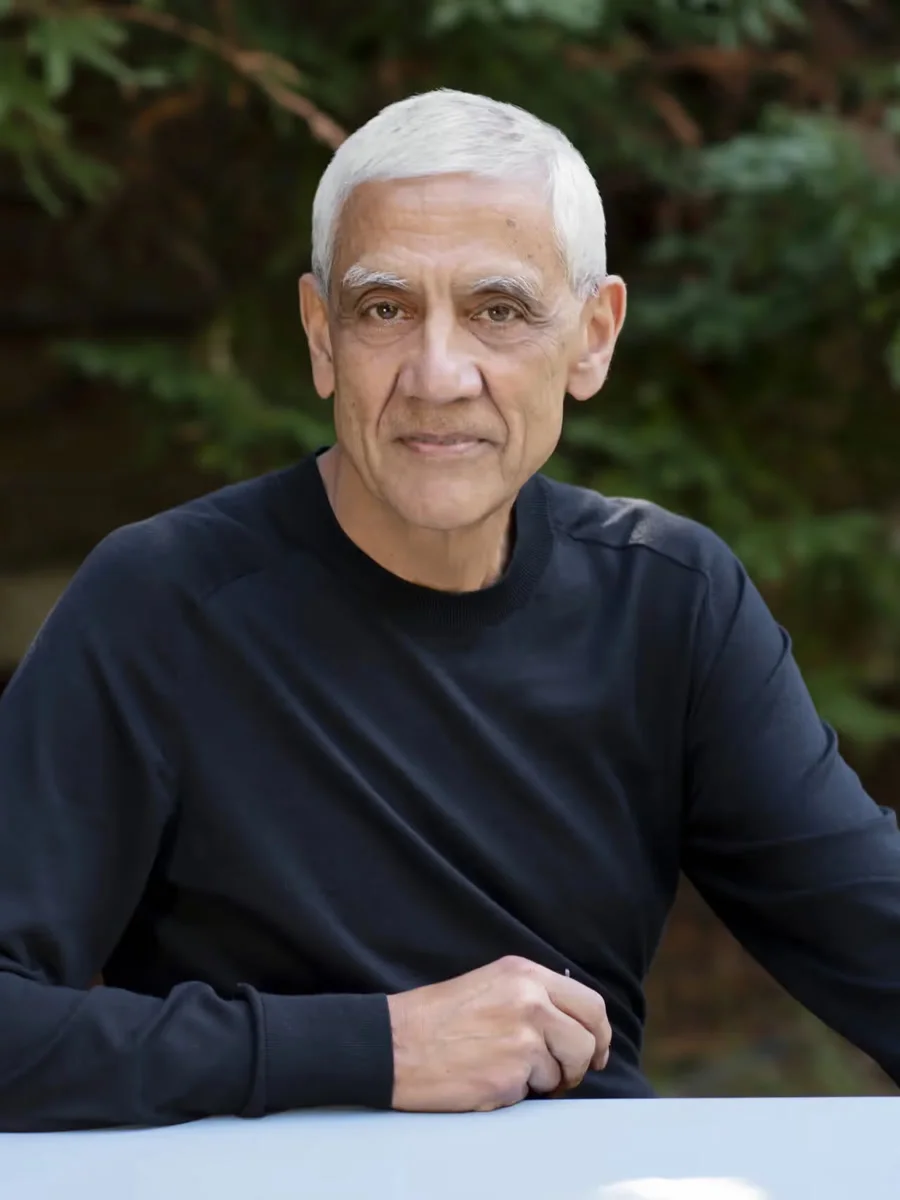
Vinod Khosla
Sun co-founder turned investor; funds improbable science and 'black swan' technology risk.
From mobility to an appetite for discontinuity, 1955–1980
Vinod Khosla was born in Pune on January 28, 1955 and grew up in an Indian Army household that moved repeatedly. IIT Delhi records his 1976 electrical-engineering degree; Carnegie Mellon identifies him with its 1978 biomedical-engineering class; Stanford records an MBA in 1980. IIT Delhi, biography and education · Carnegie Mellon, alumni profile · Stanford, biography [retrospective witness · moderate]
The current Khosla Ventures biography says Khosla encountered Intel at about sixteen. The stable fact is the later recollection of discovering a new technical industry without family access to it; the exact age and any causal effect on later investing remain unresolved. KV biography, opening [retrospective witness · moderate]
Khosla later connected Army-household mobility, educational migration, rejection, and outsider status to comfort with unfamiliar problems. The record supports a repeated self-description, not a natural experiment proving risk tolerance. Generalist correspondence, part I · Hack the North, 04:47–07:10 and 09:24–11:50 [retrospective witness · moderate] A more testable inheritance from this period is learning across electrical engineering, biomedical engineering, business, and geography; later evidence should show unusually fast domain entry rather than merely broad interests. [researcher inference · moderate]
Sun: architecture joined to a company system, 1981–1986
Before Sun, Khosla worked at Daisy Systems and describes a short failed effort called Data Dump with Scott McNealy. Stanford entrepreneurship text, p. 13 · IIT Delhi fireside, Data Dump block [retrospective witness · moderate] The precise incorporation and role record is incomplete. [researcher inference · insufficient public record]
The strongest decision-date artifact is the May 1982 Sun/VLSI business plan. It joined modular networked workstations, open standards, an OEM distribution wedge, cost-performance targets, dated hiring, manufacturing, software and financing plans. It assigns Andreas Bechtolsheim engineering and product definition, Khosla overall management, finance and strategy, and McNealy operations; Bill Joy joined the technical founding group. Sun plan, PDF pp. 1–12 / exhibit pp. 23–34 Bechtolsheim's sworn testimony independently separates his workstation design from Khosla's company-building role. FTC testimony, pp. 12–13 [contemporaneous record · strong]
The formative investing lesson is therefore narrower than “founder intuition.” Khosla had practiced connecting architecture, standards, price, distribution, team and working capital before becoming a venture capitalist. [researcher inference · strong] The plan's forecasts were not all outcome-verified, and famous later success cannot validate every assumption. Writings analysis, Sun plan
A 2012 Computer History Museum panel retrospectively recalls Khosla championing a separate SPARC architecture effort in 1984. It supports strategic advocacy, not sole technical authorship or contemporaneous proof. CHM transcript, recorded 2012, pp. 3–4 [retrospective witness · moderate]
KPCB: company formation, concentrated stories, and a consequential miss, 1986–2004
A Juniper filing dates Khosla's KPCB general-partner role to February 1986. Juniper 2003 10-K, director biography [contemporaneous record · strong] The public KPCB record is strongest where Khosla helped form companies rather than merely buy securities. [researcher inference · moderate]
For Juniper, Kleiner Perkins says Pradeep Sindhu met Khosla in 1995, the firm invested in 1996, and Khosla helped recruit Scott Kriens and the initial team; the 1999 S-1/A confirms incorporation, product and ownership context. KPCB case, Research/Decision/Results · Juniper S-1/A, Business and Principal Stockholders [contemporaneous record · strong] The KPCB result is reported: 2,500x (KPCB case, outcome passage, retrieved 2026-08-22) [retrospective witness · insufficient public record]; it remains an interested firm claim without audited cash flows. [researcher inference · insufficient public record]
For Cerent, a contemporary Wall Street Journal account attributes opportunity design, recruiting and CEO selection to Khosla. Cisco announced roughly 100 million shares worth about $6.9 billion at the August 25, 1999 close, while today's KV biography uses $7.8 billion. Neither number is KPCB proceeds. archived WSJ account · Cisco announcement, 1999-08-26 [contemporaneous record · strong]
The Excite/Google episode is the counterweight. Khosla says he pressed Excite to acquire Google; participant recollections strongly support that no deal occurred but only moderately support the disputed $750,000, $1.6 million and $350,000 terms. Khosla/Page/Brin discussion, 01:22–03:44 · George Bell interview, price and management passages [retrospective witness · moderate] The learning value is option preservation when a new product threatens an incumbent business model; no foregone return is computable. No-hindsight case [researcher inference · strong]
These visible cases support a company-formation capability but not a KPCB-wide or personal return record. Partner labor, vehicle economics, rejected deals and ordinary outcomes are mostly absent. KPCB economics retrieval ledger [researcher inference · strong]
Khosla Ventures: own-capital experiment to multi-vehicle institution, 2004–2009
Founding history is source-dependent. The current KV biography says Vinod “founded” the firm; New Jersey's 2023 diligence memo calls Vinod Khosla, Samir Kaul and David Weiden co-founders and says they initially invested their own capital. The title/history conflict remains unresolved. KV biography · NJ DOI memo, p. 4 [contemporaneous record · strong]
The early vehicle choice plausibly enabled bets that conventional funds might reject because Vinod and the other named principals initially bore the capital risk. That is a vehicle-fit hypothesis, not proof that personal capital improved selection. [researcher inference · moderate] By 2009, KV III's Form D and contemporary reporting show the move to outside capital; later main, seed, opportunity, strategic, AIV and SPAC vehicles brought different mandates and stakeholders. KV III Form D, issuer/related persons · Vehicle analysis
Public-LP windows demonstrate that vehicle outcomes differ and cannot be pooled. NJ, CalPERS and North Dakota figures are dated, net, mandate-specific snapshots; the live 2026 ADV has 31 non-additive schedules that are neither returns nor investable capital. Public-LP table · ADV Schedule D §7.B.(1) [contemporaneous record · strong]
Cleantech as the hardest test of the method, 2006–2014
The climate program was unusually public. Senate testimony in 2006–07 argued for cellulosic fuels, declining incentives and large market signals; Appendix B disclosed a portfolio including Mascoma, Range, Coskata, LS9, Gevo, Amyris and LanzaTech. Senate Foreign Relations transcript, oral pp. 6–10 / prepared statement from p. 11 · Senate Finance statement, pp. 1–5 and Appendix B pp. 29–30 [investor-stated · strong]
The 2007 FRONTLINE interview gave the screen a memorable economic test: infrastructure-scale technologies should reach an unsubsidized “Chindia price,” not depend on a green premium. [investor-stated · strong] It also preserved a two-to-four-year cellulosic maturation forecast and an explicit admission of uncertainty. FRONTLINE, questions “The Chindia price” and “What's the future of ethanol?” [investor-stated · provisional]
The adverse cases expose coupled risks. KiOR combined laboratory-to-plant scale-up, policy, public debt, KV fund equity, KFT trust debt, a VNK note and governance; it entered Chapter 11 with no expected common recovery. The SEC charged KiOR and its former CEO—not Khosla or KV—and Mississippi's later opinion was procedural. KiOR case and legal posture [contemporaneous record · strong] Range and Coskata likewise show that technology, construction, utilization, feedstock, project finance and policy can remain correlated instead of retiring in sequence. Range case · Coskata case [researcher inference · strong]
In 2011–15 the public doctrine became more explicit: accept low success probability only for consequential outcomes, define fatal risks, and tie experiments to time and capital. Black Swans, PDF pp. 2–6 · Risk Matrix, physical pp. 3–10 [contemporaneous record · strong] What remains unproved is whether cleantech losses caused a named change in reserve, governance or stop policy; public retrospection cannot substitute for dated IC records. Failure postmortems [researcher inference · insufficient public record]
Turning venture assistance into an operating system, 2012–2018
Khosla's founder work became codified in essays on CEO succession, boards, recruiting, gene-pool engineering and technical risk. The board essay says founders should retain decisions while investors earn influence through useful assistance. Venture Assistance, “Decision-making” and “venture assistants” sections [investor-stated · strong]
The 2015 recruiting work treats a company as the people it hires and tells teams to recruit backward from the risks that could kill the plan. Gene Pool Engineering, seven-step process · Pioneers of AI, “designing the right team for risk” [investor-stated · strong] Juniper and Cerent offer independently bounded formation examples; Rocket Lab's record instead points to Sven Strohband's board role, showing why firm doctrine cannot become Vinod-only attribution. People/capital map [contemporaneous record · strong]
The philosophy has a governance boundary. View's company SEC order concerned warranty-liability disclosure and imposed no civil penalty; roughly $28 million was the restatement delta, not a fine. The separate former-CFO case was dismissed in 2026. SEC company order, pp. 1–6 · SEC dismissal, disposition Nextdoor's SPAC sponsor, PIPE, forward-purchase and public-holder incentives must likewise remain separate. Nextdoor case [contemporaneous record · strong] Helpful advice is an operating philosophy, not a complete account of formal board authority, governing law, corporate or financing documents, disclosure controls, or minority-holder treatment. [researcher inference · strong]
Martins Beach is personal legal/governance context, not a venture result. California's appellate court held that closing access required a coastal-development permit but did not resolve every access or dedication question. California Court of Appeal, holding [contemporaneous record · strong]
AI, healthcare, and the expansion from product to societal system, 2012–2026
The health corpus begins in 2012 with task decomposition and “bionic” software, develops through the 2016 paper and 2019 deck, and reaches a 2025 Vinod/Neal Khosla essay and a 2026 four-author JAMA argument. 2012 Doctors or Algorithms · 2016 paper · 2025 joint essay · JAMA abstract, 2026-08-17 [investor-stated · strong] Autonomous-care efficacy, safety, liability and access outcomes remain prospective. [researcher inference · provisional]
OpenAI is the most prominent recent case and the clearest timing caution. Khosla retrospectively dates the decision to late 2018, while interviews report $50 million in early 2019. OpenAI case, decision and reported-closing clocks [retrospective witness · moderate] OpenAI's March 11, 2019 post contemporaneously named Khosla Ventures as an investor. OpenAI LP, named-investor paragraph [contemporaneous record · strong]
No executed closing record, security, ownership path or realized proceeds are public. OpenAI case, unknown fields [researcher inference · insufficient public record] A later self-claim is reported: >100x (SparX, 00:38:55–00:39:34, 2026); it is not audited performance. [retrospective witness · insufficient public record]
By 2024–26, Khosla's direct voice joined AI capability, labor displacement, India access, energy demand, national competition, copyright and transition policy. AI: Dystopia or Utopia? · AI for India, H2 “What's possible by 2030?” [investor-stated · strong] Many outcome claims remain forecasts with limited realized evidence. [researcher inference · provisional] The corpus genuinely widens from company architecture to deployment systems, but also becomes more forecast- and advocacy-heavy. [researcher inference · strong]
People, capital, and influence map
| person, institution or vehicle | evidenced role | what must remain separate |
|---|---|---|
| Andy Bechtolsheim, Bill Joy, Scott McNealy | Sun technical and operating founding team; Khosla handled management, finance and strategy in the 1982 plan. Sun plan, p. 6 | technical invention, executive work, equity and later narration. [contemporaneous record · strong] |
| John Doerr and KPCB partners | institutional platform during Khosla's 1986–2004 era. Juniper 10-K, biography | Khosla's work, partnership approval, fund capital, carry and company execution. [researcher inference · strong] |
| Samir Kaul and David Weiden | NJ calls both KV co-founders; issuer and official records show sector/board roles. NJ memo, p. 4 | founder-title conflict, sourcing, diligence, board work and economics. [contemporaneous record · strong] |
| Sven Strohband | Rocket Lab board and KV V vehicle evidence. Rocket Lab S-1/A, Directors | partner-led governance versus Vinod/firm brand. [contemporaneous record · strong] |
| Keith Rabois | official bio credits first institutional DoorDash, Affirm and Faire rounds, early Stripe and Opendoor co-founding. Keith Rabois bio, investment paragraph | Keith, team and vehicle credit versus Vinod. [contemporaneous record · strong] |
| KFT, VNK, VK Services and family entities | selected trust, note and voting/control records in KiOR and RingCentral. Entity map | direct personal ownership, beneficial control, trust capital and fund capital. [contemporaneous record · strong] |
| Main, Seed, Opportunity, Strategic and AIV funds | 31 live ADV schedules and selected Form Ds expose legal vehicles. ADV table | gross assets, offering amount, company allocation, return and partner authority. [contemporaneous record · strong] |
| Khosla Impact and Khosla Labs | separate impact and incubation routes. retrieval ledger | KV portfolio, personal holdings, incubated projects and spun-out financings. [researcher inference · strong] |
| SPAC sponsors, PIPE and public trust | KVSA/KVSB/KVSC instruments and incentives. SPAC vehicle row | sponsor promote, venture ownership, PIPE capital and public-holder outcome. [contemporaneous record · strong] |
A falsifiable thesis of the edge
Proposed edge. From KPCB company formation in the mid-1990s through KV's multi-domain practice, Khosla's repeatable advantage appears to be a coupled system: search for high-consequence discontinuities before categories are legible; use first-principles outsiders to challenge incumbent assumptions; decompose fatal risks; buy information with staged experiments; recruit backward from the risk map; and supply founder assistance through a vehicle able to wait. Black Swans, pp. 2–6 · Risk Matrix, pp. 3–10 · Venture Assistance, decision sections [researcher inference · moderate]
Domain and mechanism. The thesis should work best in early company formation where technical capability is improving nonlinearly, incumbents are constrained by installed products, milestones can retire uncertainty before full scale, a tailored team can be recruited, and a venture-scale outcome can matter to the vehicle. It should weaken where risks are common-cause, capital arrives in irreversible plants, regulation or trust dominates, valuation eliminates option value, or the board cannot observe truthful evidence. Decision playbook · Cleantech base-rate context [researcher inference · strong]
Supporting evidence. Sun's contemporaneous plan, Juniper's formation record and Cerent's contemporary company-building account show system design rather than pure security selection. OpenAI and Impossible fit the stated high-consequence search but rely more heavily on retrospective rationale and incomplete economics. Sun plan · Juniper case · Cerent case · Impossible case [researcher inference · moderate]
Disconfirming evidence. KiOR, Range and Coskata show that audacity plus technical evidence can still fail when scale, finance, policy and operations are correlated. View and Nextdoor test governance and vehicle incentives. RingCentral shows how little person-level decision evidence exists for an ordinary visible case. Failure postmortems · RingCentral case [researcher inference · strong]
Denominator. The searched public lead set is 168 identities: 116 current spotlight names plus 52 outside leads; 27 are sufficiently reconstructed, 134 unresolved and seven excluded. The scoped reconstruction rate is 27/161, or 16.8%, not career coverage or a hit rate. Ledger reconciliation [researcher inference · strong]
Predictions. Unseen dated IC and board records should show nonconsensus category theses before market recognition, explicit fatal-risk registers, small early checks relative to later follow-ons, funding tied to discriminating milestones, risk-specific recruiting, and documented abandonment when evidence fails. Matched companies with those mechanisms should outperform comparable KV attempts without them after stage, sector, price, partner and vintage controls. Model register · cross-case process evidence [researcher inference · moderate]
Falsifiers. The thesis weakens if categories were named only after success; decision files lack risk decomposition and kill criteria; follow-ons correlate with sunk cost rather than improved evidence; ordinary outcomes do not improve when assistance is present; partner/team work explains the visible wins; or audited returns disappear outside one or two outliers. A complete funnel, attribution ledger and cash-flow series would decide more than another retrospective interview. Uncertainty ledger [researcher inference · strong]
Skill, access, vehicle, era, team, luck, and adverse audit
| alternative explanation | present evidence | discriminating record |
|---|---|---|
| Skill | repeated formation, risk and recruiting mechanisms across decades. talks frameworks | matched decision/outcome sample with dated process evidence. [researcher inference · moderate] |
| Access and brand | KPCB, Sun, Stanford, LP and founder networks can improve deal flow independent of selection. people map | source-channel funnel and same-deal competitor records. [researcher inference · strong] |
| Vehicle | initial own capital, outside funds, trusts, AIVs, opportunity funds and SPACs have different constraints. vehicle chapter | company-to-vehicle allocation, LPA, reserve and cash-flow records. [researcher inference · strong] |
| Team | Samir, David, Sven, Keith, advisers, founders and boards performed material work. team map | IC minutes, partner carry, board packets and founder testimony. [researcher inference · strong] |
| Era | Internet, cheap computing, cleantech policy, private-capital abundance and AI scaling created distinct opportunity sets. historical context | vintage-, sector-, stage- and price-matched comparison. [researcher inference · strong] |
| Luck and outliers | Juniper, Cerent and OpenAI can dominate narrative; contribution cannot be computed. dominant-outlier test | audited company and fund cash flows with counterfactual exclusion. [researcher inference · strong] |
| Survivorship | the current 116-card spotlight omits a complete historical failure/ordinary denominator. source coverage | dated full portfolio exports including write-offs and passes. [researcher inference · strong] |
| Adverse governance | KiOR, View, Nextdoor and Martins Beach constrain hero narratives without proving one general moral. legal boundaries | final dockets, board records and transaction-specific authority. [researcher inference · strong] |
The public record supports an unusually explicit and durable decision doctrine plus several consequential formation roles. It does not establish comparative personal alpha, a complete firm return, or that the doctrine caused the visible outcomes. Cross-case process evidence · searched denominator [researcher inference · strong]
Verified chronology
| date | event and evidentiary meaning |
|---|---|
| 1955–1980 | Pune birth; Army-household mobility; IIT Delhi, Carnegie Mellon and Stanford. IIT Delhi |
| 1981–1982 | Daisy/Data Dump period; Sun plan joins architecture, economics, distribution and team. Sun plan |
| 1984 | retrospective SPARC advocacy. CHM panel, transcript pp. 3–4 |
| 1986 | joins KPCB as general partner. Juniper 10-K |
| 1995–1999 | Juniper and Cerent company-formation cases; Excite/Google miss. Juniper · Cerent · Excite/Google |
| 2004 | KV founding/co-founding account and own-capital beginning. NJ memo, p. 4 |
| 2006–2011 | public cleantech forecasts, portfolio disclosure and Black Swan formalization. Senate Finance |
| 2009 onward | outside-fund, seed, opportunity, AIV, strategic and later SPAC architecture. vehicles |
| 2011–2014 | KiOR scale-up, insider financing, bankruptcy and later bounded legal proceedings. KiOR case |
| 2012–2018 | venture-assistance, risk, recruiting and societal-infrastructure doctrine becomes explicit. writings evolution |
| late 2018–2019 | reported OpenAI decision/closing clocks; security and economics absent. OpenAI case |
| 2021–2026 | SPAC record, current multi-generation vehicles, AI/health/climate expansion and founder-assistance teaching. talks evolution |
| 2026-08-22 | public snapshot: 413 research routes, 62 writings, 193 spoken works and 168 searched deal leads. sources coverage |
Learning path
Start with the 1982 Sun plan analysis, then read the spoken framework synthesis. Replay Juniper, KiOR, OpenAI and Excite/Google without hindsight. Then use the investment philosophy and mental-model field guide as checklists, keeping the source coverage limits beside them.
1. Snapshot and testable edge thesis
Vinod Khosla was a Sun co-founder and KPCB general partner before building Khosla Ventures from an initially own-capital arrangement into a multi-vehicle firm. The legal and economic actors include KPCB funds, KV main/seed/opportunity/strategic/AIV vehicles, personal and family entities, Khosla Impact, Khosla Labs, and SPAC sponsors; none is interchangeable. Final biography · capital silos [contemporaneous record · strong]
Testable edge thesis. In early company formation from the mid-1990s through 2026, Khosla's proposed repeatable advantage is a coupled search-and-building system: seek high-consequence discontinuities before categories are obvious; prefer first-principles founders; decompose fatal risks; spend first on discriminating evidence; recruit backward from the risk map; and use patient, assistance-heavy capital to preserve the successful tail. Black Swans, PDF pp. 2–6 · Risk Matrix, physical pp. 3–10 · Venture Assistance, decision sections [researcher inference · moderate]
The mechanism should be strongest when capability curves are nonlinear, incumbent incentives suppress a new architecture, uncertainty can be retired before irreversible scale, and one outcome can matter to the vehicle. It should be weakest when technical, construction, regulatory, financing and adoption risks are common-cause or when entry price, dilution and duration absorb the upside. Cleantech cases [researcher inference · strong]
The favorable thesis predicts dated category work before consensus, explicit risk registers, small first checks relative to evidence-backed follow-ons, risk-specific recruiting, and documented abandonment after failed milestones. It is falsified if these appear only in retrospective winners, ordinary outcomes do not improve when the mechanisms are present, follow-ons follow sunk cost, partner work explains the visible record, or audited economics disappear outside one or two outliers. Falsifiable profile [researcher inference · strong]
The searched denominator is 168 public leads: 27 sufficiently reconstructed, 134 unresolved and seven excluded; 27/161 = 16.8% is only an eligible-public-lead reconstruction rate. It is not career coverage, a hit rate or a return sample. Ledger reconciliation [researcher inference · strong]
2. Core philosophy
Khosla's own doctrine begins with consequence rather than consensus probability. A qualifying attempt should attack a material problem, create a non-incremental state, and have a path to scale economics; accepting a high probability of failure is defensible only when success changes the system. Black Swans, pp. 2–6 [investor-stated · strong]
The second layer makes audacity operational. Identify what kills the plan, quantify criticality and uncertainty, map milestones to risk reduction, and show the time and capital required. Risk Matrix, Steps 1–5 [contemporaneous record · strong] The artifact is KV-branded institutional guidance; its personal authorship and adoption denominator are unknown. [researcher inference · insufficient public record]
The third layer is human. Khosla repeatedly values learning velocity, recruits from organizations that solved each relevant subsystem, and asks investors to earn influence through assistance while preserving founder agency. Gene Pool Engineering, seven-step process · Pioneers of AI, team-risk H2 · board essay, decision-making passages [investor-stated · strong]
The synthesis is not “be reckless.” It is: buy asymmetric option value, but make every early dollar purchase information; raise burn only after uncertainty falls; preserve an abandonment path; and separate social consequence from LP return. Intelligent Failure, “90-percent” passage · Company Building 102, 00:05:49–00:10:25 [researcher inference · strong]
3. Sourcing
Problem and category first. The 1982 Sun plan starts with a cost-performance and OEM-system wedge, not a generic founder funnel. Later work searches infrastructure-scale health, energy, transport and AI problems where conventional supply cannot meet demand. Sun plan, pp. 1–3 / exhibit pp. 23–25 · Reinventing Societal Infrastructure, opening and “necessary, though not sufficient” [contemporaneous record · strong]
Instigators and outsiders. Familiar categories can be a warning because incumbents and experts often extrapolate from installed products. The investable interpretation is conditional: outsiders own the hypothesis, while experts test physics, regulation, safety and scale. Peak XV, 00:01:09–00:04:09 · Udacity, outsider/incumbent blocks [investor-stated · strong]
Access advantage. Sun, Stanford, KPCB, founders, LPs, advisers and the KV brand create privileged referral and recruiting networks. The 116-card current portfolio is curated marketing and cannot show whether category-first search generated a superior or repeatable funnel. Current portfolio denominator [researcher inference · strong]
Repeatability test. A complete source-channel ledger should distinguish founder/referrer, proactive thesis search, partner, Labs/Impact, personal and inbound routes; match them by stage, sector and vintage; then compare pass and outcome distributions. No such ledger is public. Attribution retrieval boundary [researcher inference · insufficient public record]
4. Picking
The core selection pair is a founder with high learning velocity and an important future category that others do not yet recognize. Khosla follows capability curves and talent migration rather than demanding a finished market map. Pioneers of AI, learning-rate and OpenAI H2s · Peak XV, 00:03:31–00:09:30 [investor-stated · strong]
Founder assessment is incomplete without a risk map. The founder must identify the five ways the plan dies, learn faster than those risks change, recruit missing capability, and change tactics without abandoning the mission. Company Building 102, 00:02:00–00:10:25 [investor-stated · strong]
Technical novelty is necessary but not sufficient in health, climate, transport and regulated infrastructure. Diligence must include manufacturing, distribution, reimbursement or offtake, permits, safety, trust, security, supply chain and capital formation. Societal Infrastructure · KiOR decision freeze [researcher inference · strong]
Red flags are irreversible scale before integrated proof, milestones defined as activity, expert dismissal without a falsifier, teams hired from comfort rather than risk, mission rhetoric without unit economics, and a board that cannot surface bad news. Risk Matrix, Steps 1–5 · Coskata case [researcher inference · strong]
Decision rights remain incompletely public. Firm biographies and issuer filings identify selected partner and board roles, but IC vote, veto, allocation and dissent records are missing for most names. People map [researcher inference · insufficient public record]
5. Deal and portfolio mechanics
Khosla's public doctrine prefers many shots at fund-material outcomes over high-confidence incremental outcomes. Black Swans, p. 3 [investor-stated · strong] That is a power-law selection claim, not evidence of a literal 80/20 split or superior net return. Pareto boundary [researcher inference · insufficient public record]
A disciplined implementation separates four decisions. This is a researcher-designed transfer from the fatal-risk model and vehicle/decision-rights ledger, not a recovered Khosla IC checklist. [researcher inference · strong]
- Entry: consequence if right, fatal risks, cheapest proof, price, ownership and check size. Fatal-risk decomposition · discriminating experiment · option sizing [researcher inference · strong]
- Reserve: what milestone earns the next dollar and whether the fund can preserve meaningful ownership. Staged capital · fresh re-underwriting · fund constraint [researcher inference · strong]
- Governance: who owns each decision, what information rights exist, and how conflicts are handled. Founder agency and earned assistance · capital silos and decision rights [researcher inference · strong]
- Liquidity: company duration, vehicle life, distributions, secondary options and stakeholder incentives. Patient-capital boundary · vehicle economics [researcher inference · strong]
Public records expose only fragments. Rocket Lab's 13D traces aggregate Series A–E/E1 purchases; Square's S-1 shows KV III ownership; KiOR exposes fund, trust and VNK instruments; RingCentral separates VNK direct shares from Vinod's indirect control. None gives a complete decision-to-cash-flow chain. Rocket Lab 13D, Items 3/5/6 · Square S-1, Principal Stockholders · ownership controls [contemporaneous record · strong]
Price is not irrelevant. Consequence and option size must be separated from security, dilution, reserve burden and fund materiality. Public direct voice supports tolerance for uncertainty, but complete entry-price and IRR calculations are unavailable. Vator post-seed note · AI valuation note [investor-stated · provisional]
6. Vehicle and incentive fit
| dimension | public record | analytical implication |
|---|---|---|
| Capital source/form | initial principal capital; later main, seed, opportunity, strategic, AIV and sponsor vehicles; personal/trust/Impact/Labs routes remain separate. NJ memo, pp. 1–4 | long-duration freedom and stakeholder obligations changed across eras. [researcher inference · strong] |
| Duration/fundraising | dated Form Ds and public-LP vintages; most LPAs unavailable. vehicle table | patience is bounded by fund life, reserves, recycling and fundraising even when company duration is long. [researcher inference · strong] |
| Compensation/carry | NJ discloses proposal terms for selected funds; partner carry and company attribution absent. NJ memo, pp. 1–2 | personal voice cannot be converted into personal economics. [researcher inference · strong] |
| Governance/decision rights | manager, GP and ownership records exist for selected entities. ADV, Schedule D | legal control, IC authority, board work and beneficial ownership are distinct. [researcher inference · strong] |
| Geography/regulation | U.S. adviser/fund records, India impact/personal cases and global companies. source coverage | mandate, securities law, foreign policy and local operating permission can constrain the same thesis differently. [researcher inference · strong] |
| Liquidity/reserves | public holdings and LP snapshots are dated and incomplete. public-LP windows | NAV, DPI, TVPI and IRR cannot be pooled across dates or vehicles. [researcher inference · strong] |
| Stakeholders | founders, LPs, trusts, public subsidy providers, SPAC holders, PIPEs and minority investors. Nextdoor case | stakeholder governance, disclosures, related-party financing and conflicts must be analyzed separately from the founder-friendly philosophy; the cited record is case-specific. [researcher inference · strong] |
| Succession/key person | current team biographies and 31 schedules show institutional breadth; private succession terms absent. team map | the brand may outlive individual decision authority, but that is not yet demonstrated. [researcher inference · moderate] |
The strategy fits patient capital only if reserves, liquidity and governance are designed for long technical clocks. It misfits any vehicle whose life, concentration or stakeholder obligations force scale before proof. Vehicle economics and incentives [researcher inference · strong]
7. Team attribution and work with founders
Vinod has unusually strong formation evidence for Sun, Juniper and Cerent, but even those cases are team outcomes. Bechtolsheim, Joy and McNealy own distinct Sun roles; Pradeep Sindhu and Scott Kriens built Juniper; Cerent required founders, recruited executives, KPCB and Cisco. People map in biography [contemporaneous record · strong]
KV attribution is more distributed. NJ names Samir Kaul and David Weiden as co-founders; Sven Strohband is linked to Rocket Lab; Keith Rabois's official biography credits DoorDash, Affirm, Faire, Stripe and Opendoor. NJ memo, p. 4 · Sven/Rocket evidence · Keith biography [contemporaneous record · strong]
The claimed founder contract is high-candor assistance without shadow management: recruit, question, expose tradeoffs and let the founder decide. Venture Assistance · Upfront, 06:47–07:39 and 19:01–21:36 [investor-stated · strong]
Governance is the limit. View, KiOR and Nextdoor show why formal governance, disclosures, related-party financing, independent challenge and minority-holder treatment must be analyzed separately from the earned-influence philosophy. Adverse cases [researcher inference · strong] No public advice denominator shows what help was offered, accepted, rejected or causally useful. [researcher inference · insufficient public record]
8. Views on the craft
- Power law: a small number of consequential successes must justify many failures, but social impact, gross deal multiple, fund return and personal return are separate. Black Swans, p. 3 [investor-stated · strong]
- Fund size: an opportunity must be material to the vehicle; no public universal check-size or concentration formula is recovered. 20VC, risk/IRR blocks [investor-stated · moderate]
- Access versus selection: brand and networks matter, but unfamiliar categories and ignored founders can create search advantage; no source-channel outcome study exists. Peak XV, 00:01:09–00:09:30 [researcher inference · moderate]
- Governance: boards should focus on unresolved questions and assistance, not reporting theater; this direct-voice source states an operating philosophy, not formal authority under governing law or corporate documents. Company Building 102, 00:33:45–00:40:57 [investor-stated · strong]
- Exits: create fundamental value rather than an early exit plan; vehicle duration and stakeholder liquidity still require explicit underwriting. Pioneers of AI, long-term-investor H2 [investor-stated · moderate]
- Great investor: searches nonconsensus futures, helps the team learn and recruits against risk. Whether that produced comparative alpha is not computable. talks framework [researcher inference · strong]
9. Signature bets and decision process
The decision process is best studied by freezing evidence before outcome. The method is a researcher audit protocol, not a recovered Khosla rule. Fourteen case freezes and exercises [researcher inference · strong]
- Juniper: architecture and customer-consensus challenge; formation/recruiting evidence is strong, economics unaudited. [researcher inference · strong]
- Cerent: explicit market design and team formation; acquisition value is not KPCB proceeds. [contemporaneous record · strong]
- Square / Block: adaptive plan and ownership evidence; “we” and board stories require actor controls. [researcher inference · strong]
- Impossible Foods: consequential mission and patient financing through the mapped March 2020 record; allocation and realization economics remain incomplete. [researcher inference · moderate]
- OpenAI: capability-curve conviction under extreme uncertainty; decision and closing clocks are retrospective. [retrospective witness · moderate]
- KiOR: the strongest scale-up, rescue-capital and governance stress test. [contemporaneous record · strong]
- Range Fuels: a created/financed scale-up case with incomplete vehicle and stop records. [researcher inference · moderate]
- Coskata: integrated-process and project-finance risk with Samir Kaul board attribution. [contemporaneous record · strong]
- View: governance/control and disclosure evidence, with the company order distinct from the dismissed CFO case. [contemporaneous record · strong]
- Nextdoor / KVSB: SPAC sponsor, PIPE, forward-purchase and public-holder incentives. [contemporaneous record · strong]
- Excite/Google: option-preservation miss with disputed remembered terms. [retrospective witness · moderate]
- Rocket Lab: patient follow-on and Sven Strohband attribution. [contemporaneous record · strong]
- RingCentral: ownership/control ontology without a recovered initial rationale. [contemporaneous record · strong]
- SKS Microfinance: personal/family capital and social-license risk, not a KV or Impact return. [contemporaneous record · strong]
All 14 cases end with invest/pass, kill criteria, ownership/terms and next-check prompts before the actual result. They are researcher-designed exercises, not recovered IC rules. Case-by-case list above [researcher inference · strong]
10. Mental models and maxims
The field guide reconciles the complete note and phase corpus into 18 distinct reusable rules. Twelve navigation families keep related mechanisms together without erasing different decisions, evidence thresholds or failure modes. Eighteen-model field guide [researcher inference · strong]
The index merges slogans that share a mechanism and discloses six candidate exclusions plus one researcher-only protocol rather than inflating a top-N list. Every retained model carries provenance, evidence status, mechanism, context, use conditions, procedure, grounded cases, an exception, evidence placements, evolution and a dated modern translation. Models 13 and 17 remain explicitly provisional one-stream rules; Model 18 is strong forecast practice but has unproved predictive validity. [researcher inference · strong]
11. Evolution and contradictions
| era | durable element | change or unresolved tension |
|---|---|---|
| 1982–2004 | systems architecture, cost-performance, category formation and recruiting. Sun plan, pp. 1–5; Juniper case | evidence is concentrated in a few KPCB winners and retrospective accounts. [researcher inference · strong] |
| 2004–2011 | own-capital latitude, infrastructure scale, cost parity and many technical shots. NJ memo, pp. 1–4; Senate Finance, pp. 2–5 | policy advocacy and invested capital create incentive bias; biofuel clocks missed. [researcher inference · strong] |
| 2011–2018 | black-swan doctrine becomes risk matrix, intelligent failure, recruiting and board tools. Black Swans; Risk Matrix; Venture Assistance | no public evidence shows formal adoption, calibration or a dated process change after losses. [researcher inference · strong] |
| 2018–2023 | AI/health and societal infrastructure add institutions, trust, governance and geopolitics. Societal Infrastructure; health chronology | broader causal claims become more forecast-heavy. [researcher inference · strong] |
| 2024–2026 | AI abundance, task autonomy, India deployment and energy demand dominate. AI: Dystopia or Utopia?; AI for India | current predictions are too recent for realized scoring and sometimes rely on partial sources. [researcher inference · strong] |
The central contradictions remain failure tolerance versus capital discipline; founder agency versus board duty; unsubsidized economics versus catalytic policy; open access versus strategic restriction; abundance versus distribution; and autonomy forecasts versus clinical or safety evidence. Writings contradictions [researcher inference · strong]
12. Failures and limits
KiOR, Range and Coskata show that the rule fails when integrated scale, financing and policy risks cannot be separated. View and Nextdoor add disclosure, control and security-incentive limits. Excite/Google is a miss rather than a loss. SKS is personal capital and exposes social-license risk; it is not a KV or Khosla Impact return. Failure table [researcher inference · strong]
No named, dated KV policy change is public after these outcomes. “Intelligent failure” is therefore a doctrine and a testable interpretation, not proof that every loss bought useful information or improved later results. Uncertainty and retrieval ledger [researcher inference · insufficient public record]
Selection and survivorship bias are material: the current spotlight is a 116-card curated list, while 134 of 168 searched leads remain unresolved. Denominator The record cannot compute career hit rate, firm MOIC/IRR, Vinod-personal return, partner carry or dominant-outlier contribution. [researcher inference · strong]
13. Historical operating environment
| period | decision-date environment | interpretation boundary |
|---|---|---|
| 1980s workstation market | declining component costs, UNIX/Ethernet/open standards and OEM channels enabled Sun's integration thesis. Sun plan, pp. 1–5 | later Internet success cannot be leaked backward. [researcher inference · strong] |
| 1990s Internet infrastructure | ISP growth and incumbent routing architecture made Juniper's category plausible but uncertain. Juniper S-1/A, Business | KPCB's reported multiple is retrospective. [researcher inference · strong] |
| 2006–2011 cleantech | policy mandates, subsidies, commodity exposure, first-of-kind plants and project finance shaped risk. Senate Finance, pp. 3–5 | later MIT/NBER cohorts are retrospective base-rate context. [researcher inference · strong] |
| 2009–2021 private-capital expansion | outside funds, later opportunity vehicles and SPAC markets increased capital and instrument complexity. vehicle chapter | offering amount and GAV are not return. [researcher inference · strong] |
| 2018–2026 AI | scaling capability, talent migration, cloud/model platforms, energy demand, security and regulation changed opportunity and adoption clocks. AI chronology | current forecasts have limited realized-outcome evidence. [researcher inference · strong] |
MIT reports more than $25 billion entered cleantech startups in 2006–11 and investors lost more than half; NBER and Brookings add later cohort context. Those data help interpret capital intensity but are not information Khosla possessed in final form at decision dates. Historical/base-rate chapter [researcher inference · strong]
14. Modern VC translation (as of 2026-08-22)
| lesson | what transfers | what changed or fails | observable applicability signal | likely misuse and adaptation |
|---|---|---|---|---|
| Consequence-weighted selection | compare success consequence separately from probability. Model 1 | larger funds, higher prices and longer private rounds can erase option value. | credible path to fund-material ownership after dilution. | “big TAM” without a fatal-risk map; require check/ownership/reserve math. [researcher inference · strong] |
| Future-back search | map capability curves and prerequisite states before market consensus. Model 2 | AI forecasts can move faster than regulation, trust and deployment. | leading capability plus identified adoption bottleneck. | storytelling as evidence; keep dated definitions and falsifiers. [researcher inference · strong] |
| Outsider hypothesis | challenge incumbent incentive and architecture assumptions. Model 4 | regulated science and safety require domain evidence. | outsider thesis survives adversarial expert tests. | anti-expert identity; make experts falsifiers, not automatic vetoes. [researcher inference · strong] |
| Risk matrix | turn uncertainty into proofs, spend and decisions. Model 5 | software, model and data risks can drift after launch. | milestones change posterior and next capital decision. | false numerical precision; preserve dependencies and uncertainty bands. [researcher inference · strong] |
| Intelligent experiment | buy information cheaply before scale. Model 6 | fast AI iteration can hide downstream safety or unit-cost risk. | reversible test with threshold, kill rule and follow-up. | celebrating any failure; require decision-relevant learning. [researcher inference · strong] |
| Risk-backward team | hire for fatal risks and learning velocity. Model 8 | global/remote access broadens talent and reference noise. | each leader owns a named risk and raises adjacent functions. | prestige hiring; use adversarial references and work samples. [researcher inference · strong] |
| Venture assistance | use questions, recruiting and context without shadow management. Model 9 | governance, cyber, AI safety and minority duties are more complex. | founder requests help and decisions/outcomes are logged. | “founder-friendly” as no accountability; define authority and conflicts. [researcher inference · strong] |
| Cost parity | underwrite unit economics without permanent premium. Model 14 | externalities and policy remain real; grid, permits and supply chains bind. | declining unsubsidized cost with validated lifecycle performance. | treating a pilot cost as scaled cost; model full deployment system. [researcher inference · strong] |
| Task decomposition | measure professional work before granting autonomy. Model 16 | model drift, liability, privacy and distribution shift can dominate benchmarks. | prospective outcomes, escalation and rollback perform under shift. | benchmark-to-product leap; stage autonomy by task and risk. [researcher inference · strong] |
| Patient capital | re-underwrite through cycles when evidence improves. Model 12 | fund duration, reserves and stakeholder liquidity remain finite. | risk-adjusted evidence improves faster than burn. | sunk-cost persistence; force a fresh follow-on memo and counterfactual pass. [researcher inference · strong] |
Present-day examples remain case-specific: current Rocket Lab filings show long-duration follow-ons; 2025–26 AI/health works show recent task and workflow theses; neither proves that every translation produces excess return. [researcher inference · strong]
15. Comparison with completed peers
Arthur Rock is the closest company-formation and governance comparator; Doug Leone is the closest institutional multi-generation partner comparator; Brad Feld is the closest technical-founder, explicit-framework and founder-support comparator. All three packages are complete and have adversarial reviews. Rock philosophy and review · Leone philosophy and review · Feld philosophy and review [researcher inference · strong]
| dimension | Vinod Khosla | Arthur Rock | Doug Leone | Brad Feld |
|---|---|---|---|---|
| Sourcing | category/problem-first, nonconsensus technical futures; funnel unobserved. sourcing · Sun plan, pp. 1–3 | trusted intermediaries and proven teams. Rock philosophy · HBR, closing sourcing passage | global Sequoia brand, outbound work and institutional networks. Leone philosophy · Stanford GSB, 00:28:28–00:36:51 | themes, product curiosity, Techstars and partner-fund network. Feld philosophy · Foundry themes, named theme sections and closing paragraphs · Techstars “Our History” timeline · network-driven investing, named network sections and fund-history paragraph [researcher inference · strong] |
| Picking | consequence, learning velocity, fatal-risk plan and scale economics. picking · Company Building 102, 00:02:00–00:10:25 | people, intellectual honesty and execution. Rock picking · HBR, résumé/listening/belief passages | founder quality, market and company-building under institutional pattern memory. Leone picking · Stanford GSB, 00:15:13–00:20:08 · Universal Laws, “Ideal gas law” through “Summary” | direct product use, theme fit and independent partner judgment. Feld picking · product-use essay, paragraphs beginning “I love to invest,” “An example,” and “When I think back” · independent-decision essay, web lines 15–30 and decision/counterexample passages [researcher inference · strong] |
| Product/customer evidence | prerequisite-tree and fatal-risk proofs; direct customer/economics denominator incomplete. model 15 · Square S-1, Business/Risk | customer references and operating evidence before governance commitment. Rock philosophy · Apple offering memo, printed pp. 1–24 | reference work, market evidence and partner judgment inside an institutional process. Leone philosophy · ServiceNow transcript, Grady 2008 contact, 2009 customer-reference visit and Series D discussion | direct product use and founder/customer feedback. Feld philosophy · product-use essay, paragraphs beginning “I love to invest,” “An example,” and “When I think back” [researcher inference · strong] |
| Contrarianism/updating | first-principles outsider hypothesis plus expert falsification and intelligent failure. models 4 and 6 · Intelligent Failure, expert-skepticism paragraph | contrarian company formation bounded by management/accounting control. Rock models · HBR, adaptation and control passages | nonconsensus conviction disciplined by partnership pattern memory. Leone models · Meraki history, paragraphs 1–4 | prepared-mind themes, direct truth and explicit postmortems. Feld models · theme definition, named theme sections and closing paragraphs · FG Angels postmortem, paragraphs 1–3 / web lines 7–10 [researcher inference · strong] |
| Ownership/price | security and price record incomplete; option consequence emphasized. mechanics · Rocket Lab 13D, Items 3/5/6 | bespoke formation securities and finite pools. Rock mechanics · Intel financing memo, pp. 2–3 | ownership and reserve discipline inside a large franchise. Leone mechanics · ServiceNow S-1, Principal Stockholders | meaningful ownership and explicit seed/full-commitment doctrine. Feld mechanics · seed policy, paragraphs 8–19 · Next 2018 ownership discussion, web lines 15–31 / fund-history and strategy passages [researcher inference · strong] |
| Portfolio construction | many high-consequence shots; contribution uncomputable. Pareto · Black Swans, p. 3 | small concentrated governance portfolio. Rock models · HBS, pp. 8–9 and 15–16 | stage and sector breadth through institutional funds. Leone philosophy · Sequoia Fund vehicle announcement, opening and vehicle-structure paragraphs | themes plus seed/main/Select/Next and partner-fund sleeves. Feld profile · Select, mandate paragraph · Next 2018, web lines 15–31 / fund-history and strategy passages [researcher inference · strong] |
| Governance/founder work | earned influence, recruiting and founder agency; adverse controls matter. team · Venture Assistance, decision-making sections | concentrated board, accounting and management intervention. Rock profile · Moore–Rock, printed pp. 19–31 | company-building platform and partner sponsorship. Leone philosophy · PlanGrid transcript, “problem you have today” | CEO support, direct truth and collective partnership. Feld philosophy · EFI interview, 04:39 [researcher inference · strong] |
| Vehicle/incentives | own capital to many funds, trusts, Impact/Labs and SPACs. vehicles · NJ memo, pp. 1–4 | finite Davis & Rock, later personal/partner entities. Rock vehicles · Bancroft oral history, p. 38 | Sequoia generational franchise and role transition. Leone vehicles · Acquired, 00:21:32–00:28:03 · Colossus, 55:21–1:02:18 | equal-partner finite funds, growth and partner-fund vehicles, final fund. Feld vehicles · Next 2018, web lines 15–31 / fund-history and strategy passages · final-fund announcement, opening and portfolio-work paragraphs [researcher inference · strong] |
| Failure/stop discipline | intelligent-failure doctrine; no formal post-loss rule change recovered. failures · Intelligent Failure, “90-percent” paragraph | Diasonics, passes and follow-on dissent expose governance/stop rules. Rock failures · Bancroft, Diasonics pp. 63–68 | generational transitions and selected misses; denominator limits remain. Leone failures · Acquired, Facebook 01:01:40–01:02:47 | Mobius, FG Angels and final-fund stops make capacity explicit. Feld failures · FG Angels postmortem, paragraphs 1–3 / web lines 7–10 · final-fund announcement, opening and portfolio-work paragraphs [researcher inference · strong] |
| Attribution/succession | strong personal brand, but Samir/David/Sven/Keith and vehicles require separation; succession private. people map · NJ memo, p. 4 · Rocket Lab S-1/A, Directors | person-centered and incomplete succession record. Rock profile · Kramlich, printed pp. 4–7 | institutional team and generational leadership are central. Leone profile · Colossus, succession/economics 55:21–1:02:18 | explicit equal-partner team and planned non-generational end. Feld final-fund profile · Foundry “Who Are We,” Brad and team-history paragraphs · final-fund announcement, opening and portfolio-work paragraphs [researcher inference · strong] |
Khosla differs most in the breadth of sector forecasts and explicit tolerance for technical failure; Rock in concentrated formation governance, Leone in institutional continuity, and Feld in public mechanics and stopping architecture provide the most useful controls. These are dimension-matched comparisons, not a ranking of returns. Rock controls · Leone controls · Feld controls [researcher inference · strong]
16. The strongest case against greatness
The skeptical thesis is that the visible record can be explained by privileged access, era, team labor, founder execution, vehicle flexibility, marketing selection and a few outliers rather than repeatable personal selection alpha. Sun and KPCB supplied network and credibility; KV's own-capital start bought unusual freedom; later institutional funds, partners and brand widened opportunity. The current portfolio spotlights survivors, while 134 of 168 searched leads remain unresolved. Denominator [researcher inference · strong]
The Juniper result is reported: 2,500x (KPCB case, outcome passage, retrieved 2026-08-22) [retrospective witness · insufficient public record]; the OpenAI result is reported: >100x (SparX, 00:38:55–00:39:34, 2026) [retrospective witness · insufficient public record]. Those figures and Cerent's announcement value dominate the narrative but cannot be translated into audited KPCB/KV or personal economics. Economic ranking KiOR, Range and Coskata show that black-swan rhetoric can rationalize correlated capital-intensive loss; View and Nextdoor test governance and security incentives. Failure cases [researcher inference · strong]
The favorable thesis survives only if hidden records show its mechanisms before outcomes and across ordinary cases: nonconsensus category work, explicit fatal-risk tests, disciplined first checks, evidence-backed follow-ons, risk-specific recruiting and useful founder assistance. It fails if those records do not exist, if partner attribution dominates, if passes and failures met the same criteria, or if matched economics do not improve. Model register · cross-case process evidence [researcher inference · strong]
The deciding evidence is a dated funnel and pass ledger, IC and board records, person/vehicle attribution, complete cash flows, reserve/stop decisions, independent founder reports and an ex-outlier return test. Until then, Khosla is best described as an unusually explicit and consequential company-building investor whose comparative alpha remains unproved. Uncertainty and retrieval ledger · review falsifiers [researcher inference · strong]
17. Analyst study guide, glossary, and go deeper
Recommended reading path
- Read the final biography for chronology and falsifiers.
- Read the Sun plan, Black Swans, Risk Matrix and Venture Assistance.
- Use the spoken framework synthesis to see repetition and memory controls.
- Replay Juniper, OpenAI, KiOR and Excite/Google through their no-hindsight exercises.
- Apply the mental models, then attack them with the failure and evidence-gap ledgers.
Investor-specific glossary
- Black Swan: Khosla's prospective label for a low-probability technology whose success changes scale or economics; not Taleb's unforeseeable-event usage. Black Swans, p. 3 [investor-stated · strong]
- Chindia price: cost low enough for India/China-scale adoption without a permanent green premium. FRONTLINE/World, Chindia-cost passage [investor-stated · strong]
- Instigator: founder who attempts a discontinuity rather than extrapolating an incumbent plan. 12 Instigators, opening definition [investor-stated · strong]
- Intelligent failure: bounded experiment that produces decision-relevant learning; not any ambitious loss. Intelligent Failure, definition and 90-percent passages [investor-stated · strong]
- Risk matrix: KV method that weights failure-mode criticality, uncertainty, milestone risk reduction, time and spend. Risk Matrix, matrix-field definitions [contemporaneous record · strong]
- Venture assistance: claimed post-investment product of questions, recruiting and context while the founder decides. Venture Assistance, board-role and decision sections [investor-stated · strong]
- Main/Seed/Opportunity/Strategic/AIV: different KV legal/mandate vehicles, not one economic pool. Vehicle map [researcher inference · strong]
- KFT/VNK/VK Services: family, investment and control entities exposed in selected filings; not interchangeable with KV funds or direct personal ownership. Capital-silo map [researcher inference · strong]
- R/U/X: sufficiently reconstructed, unresolved or excluded lead in the public deal ledger. Ledger method [researcher inference · strong]
- No-hindsight exercise: researcher-designed invest/pass, kill, ownership and next-check prompts shown before the sourced outcome. Juniper no-hindsight example [researcher inference · strong]
Reusable sourcing checklist
The five rules below are a researcher-designed transfer from future-back search, problem-first sourcing, portfolio materiality and forecast clocks; they are not a Khosla-authored checklist. [researcher inference · strong]
- Define the high-consequence problem and the incumbent assumption that may be wrong. Future-back search · problem-first sourcing [researcher inference · strong]
- Record proactive thesis, founder/referrer and partner route before the outcome is known. Problem-first sourcing · people and route ledger [researcher inference · strong]
- Map capability, adoption and financing clocks separately. Capability and adoption clocks [researcher inference · strong]
- Ask what source-channel advantage exists and whether it is repeatable without brand. Problem-first sourcing · searched denominator [researcher inference · strong]
- Preserve passes, ordinary outcomes and failures beside wins. Many-shot portfolio · comprehensive ledger [researcher inference · strong]
Reusable diligence and IC checklist
The seven rules below operationalize the risk matrix, discriminating experiment, staged capital, risk-backward hiring and deployment tree; they are researcher-designed IC controls. [researcher inference · strong]
- Name the five fatal risks and their dependencies. Fatal-risk decomposition [researcher inference · strong]
- Specify the cheapest discriminating test, threshold, time, spend and decision consequence. Discriminating experiment [researcher inference · strong]
- Separate technical proof from manufacturing, regulation, distribution, trust and unit economics. Deployment prerequisite tree [researcher inference · strong]
- Identify which hire owns each risk and test learning velocity with work and references. Risk-backward hiring [researcher inference · strong]
- Model security, valuation, ownership, dilution, reserves, duration and ex-outlier fund materiality. Option sizing · vehicle economics [researcher inference · strong]
- Write kill criteria and the next re-underwriting date before investing. Staged capital · fresh re-underwriting [researcher inference · strong]
- Label every rationale by attribution—investor-stated, contemporaneous record, documented behavior, retrospective witness, or researcher inference—and by support—strong, moderate, provisional, or insufficient public record. Central-claim audit [researcher inference · strong]
Reusable governance and follow-on checklist
The six rules below are researcher-designed controls derived from founder agency and earned assistance, fresh follow-on underwriting and the capital-silo map, not a universal statement of law or firm policy. [researcher inference · strong]
- Document founder, board, manager, sponsor, LP and minority-holder rights. Capital silos and decision rights [researcher inference · strong]
- Keep personal, trust, fund, Impact, Labs, AIV and SPAC capital separate. Capital silos and decision rights [researcher inference · strong]
- Log advice offered, founder decision, dissent, conflict, milestone and outcome. Founder agency and earned assistance [researcher inference · strong]
- Require independent challenge for related-party finance, accounting and disclosure. Founder-agency boundary · adverse and legal records [researcher inference · strong]
- Re-underwrite every follow-on against current evidence and a counterfactual pass. Fresh follow-on underwriting [researcher inference · strong]
- Preserve a safe abandonment path and a stakeholder communication plan. Staged abandonment · patient-capital boundary [researcher inference · strong]
Ranked primary and secondary sources
- Sun plan, PDF pp. 1–12 — best contemporaneous operating artifact.
- Black Swans, PDF pp. 2–6 — clearest selection and portfolio doctrine.
- Risk Matrix, physical pp. 3–10 — most explicit evidence-and-capital tool.
- Venture Assistance, decision sections — founder/investor contract.
- Senate Finance, pp. 1–5 and 29–30 — decision-era forecasts, policy and disclosed holdings.
- NJ DOI memo, pp. 1–4 — strongest public vehicle, team and dated performance window.
- Issuer and legal case ledger — strongest independent attribution/economics controls.
- Pioneers of AI transcript — current direct voice with structured locators.
Go deeper by obtaining dated IC/pass/follow-on memoranda, the reported OpenAI LP letter, company allocation and cash-flow ledgers, LPAs and side letters, partner attribution/carry, board packets, full rejected/failed portfolio exports, independent founder surveys, and unchanged forecast scorecards. Uncertainty ledger
Pareto 80/20 — what drove the record
The public record is consistent with a power-law franchise, but it does not support a literal “80% from 20%” calculation. Company transaction values, IPO ownership snapshots, fund marks, and retrospective multiples use different numerators and clocks. The three rankings below answer different questions and never collapse KPCB, Khosla Ventures, personal/trust capital, Khosla Impact, Khosla Labs, SPAC sponsors, or partner-led cases.
Economic contribution — ranked by defensible evidence, not computed proceeds
| rank | case and basis | vehicle / attribution | mechanism | evidence label / support | economic caveat |
|---|---|---|---|---|---|
| 1 | Juniper case · 1999 S-1/A, index and linked Business/ownership sections, invested 1996 and IPO 1999 | KPCB; Vinod credited with company formation, recruiting, and board work | identified routing-architecture gap, recruited Scott Kriens, financed into public-market validation | documented behavior / strong | “2,500x” is a current interested KPCB/KV claim; original KPCB cash flows, dilution, fees, carry, realization, and Vinod economics are unavailable. |
| 2 | Cerent case · Cisco announcement, opening transaction terms, Cisco acquisition | KPCB company formation; Vinod-specific operating account | built around optical-networking gap, recruited team, chose strategic-stock exit over IPO | contemporaneous record / strong | About $6.9bn at Cisco’s Aug. 25 close, the combined $7.4bn headline, and KV’s later $7.8bn shorthand are different clocks; none is KPCB proceeds. |
| 3 | OpenAI case · OpenAI LP, Structure/Returns/named-investor paragraph · SparX, 00:04:06–00:07:09 · TIME, OpenAI investment question, late-2018 decision / early-2019 reported investment | Khosla Ventures; Vinod narrates the decision, but security and vehicle are undisclosed | concentrated technical talent, compute scale, and nonprofit-controlled capped-profit structure | retrospective witness / moderate; issuer independently documents structure | Reported $50m and “more than 100x” remain interested retrospective claims. The general first-round 100x cap does not establish KV’s contract, realization, gross/net convention, or current contribution. |
| 4 | Square / Block case · Square S-1, Principal Stockholders · TechCrunch, round/investor attribution, 2015 IPO ownership | KV III; Gideon Yu is the strongest public sourcing lead; Vinod/VK Services had voting control | simplified merchant acceptance and scaled software/payment network | contemporaneous record / strong | KV III held 50,522,780 shares/17.3% pre-offering; this is not Vinod direct ownership, cost basis, distributions, or net return. |
| 5 | Impossible Foods case · 2020 Form D, offering/first-sale fields · Our Debut, Pat Brown sequence · Series F, opening/investor list, repeated early/follow-on support | KV and disclosed follow-on vehicles; person-level source/IC split unknown | molecular product thesis plus patient manufacturing and consumer adoption financing | contemporaneous record / moderate | Financing totals are not KV ownership or proceeds; private marks, dilution, SPV economics, and realization are unavailable. |
| 6 | Rocket Lab case · Rocket Lab 13D, Items 3/5/6 and RingCentral case · RingCentral 13G/A, Items 4–5 as ordinary controls | Rocket Lab: KV V/Sven Strohband; RingCentral: VNK/VK Services/David Weiden attribution | long-duration follow-ons and board/control work | contemporaneous record / strong | These constrain attribution but do not establish rankable contribution: Rocket purchases are aggregate across rounds; RingCentral reporting separates direct VNK from Vinod indirect control/disclaimers. |
Economic rank is therefore a research priority order, not a contribution waterfall. Source date, measurement date, metric convention, gross/net status, realized/unrealized split, and missing cash-flow inputs are stated in each row; none supports aggregating a personal or firm track record. case ledger; retrieval boundary [researcher inference; strong]
Historical importance — ranked by effect on the investing franchise
| rank | case | why it matters | attribution / support | boundary |
|---|---|---|---|---|
| 1 | OpenAI case · OpenAI LP, Structure/Returns/named-investor paragraph · SparX, 00:04:06–00:07:09 · TIME, OpenAI investment question | Best current example of willingness to fund a non-consensus institutional form around a technical team before commercial proof. | retrospective witness / moderate; issuer separately names KV | Later valuation and AI dominance cannot be imported into the 2018 decision packet. |
| 2 | Juniper case · KPCB case, Research/Decision/Results | Canonical company-creation case joining market architecture, recruiting, governance, and venture financing. | documented behavior / strong | Institutional KPCB outcome, not KV or personal return. |
| 3 | Cerent case · Cisco completion, opening | Shows active formation and an explicit IPO-versus-strategic-exit fork. | retrospective witness / moderate | Acquirer value is not investor proceeds. |
| 4 | Square / Block case · Square S-1, Principal Stockholders · TechCrunch, round/investor attribution | Demonstrates concentrated institutional ownership in a mainstream financial network. | contemporaneous record / strong; Gideon Yu sourcing separately reported | Voting control and beneficial ownership are not direct personal ownership. |
| 5 | Impossible Foods case · Series F, opening/investor list · Our Debut, Pat Brown sequence | Bridges the first cleantech wave to biology-led climate/food investing and repeated financing. | contemporaneous record / moderate | Private financing is not an outcome. |
| 6 | View case · Delaware opinion, ownership/voting history and Nextdoor case · Nextdoor proxy, sponsor/PIPE/redemptions · dismissal, pp. 12–15 | Force governance and vehicle analysis into the franchise history: concentrated control in View; sponsor/PIPE/public-shareholder incentive separation in Nextdoor. | contemporaneous record / strong | Legal posture and SPAC economics are case-specific, not evidence about every KV deal. |
Decision-learning value — ranked by information gained from mistakes and constraints
| rank | case | learning mechanism | attribution / support | caveat |
|---|---|---|---|---|
| 1 | KiOR case · bankruptcy exhibit, opening/no-common-recovery · 2011 S-1, Business/Risk/ownership · SEC release, defendants/settlement | Separates formation equity from later rescue capital, and makes technical milestones, public subsidies, insider debt, governance, and stop rules inspectable. | contemporaneous record / strong | SEC charged KiOR/former CEO, not Khosla/KV; Mississippi opinion is procedural. |
| 2 | Nextdoor/KVSB case · Nextdoor proxy, sponsor/PIPE/redemptions · dismissal, pp. 12–15 | Shows why sponsor promote, PIPE, forward purchase, redemption, target valuation, and venture ownership must be modeled separately. | contemporaneous record / strong | Later dismissal was with leave to amend, not a merits vindication of every allegation. |
| 3 | Excite / Google case · participant exchange, 01:22–03:44 · Bell interview, replacement/price passages | Best anti-portfolio case: strategic fit and search economics were judged under an incumbent portal model. | retrospective witness / moderate | Prices conflict across memories; no acquisition occurred. |
| 4 | Range Fuels case · DOE outcome, project-history/existing-facility | Tests first-of-kind scale-up, milestone finance, public guarantees, and whether capital follows evidence or sunk cost. | contemporaneous record / strong | Exact KV capital stack and recovery remain incomplete. |
| 5 | Coskata case · Coskata S-1/A, Business/Risk/USDA | Contrasts pilot evidence with an untested commercial configuration and an unissued conditional federal commitment. | contemporaneous record / strong | Do not confuse its $87.9m conditional commitment with Range’s issued $80m guarantee. |
| 6 | View case · SEC order, pp. 1–6 ¶¶2–5/24/33–35 | Connects concentrated governance with disclosure controls and independent-board challenge. | contemporaneous record / strong | The SEC imposed no civil penalty; about $28m is the liability-restatement delta, not a fine. |
Dominant-outlier sensitivity
A defensible exclusion test would recompute fund and career returns after removing Juniper, Cerent, OpenAI, Square, and Impossible one at a time, then jointly. That requires each vehicle’s cash-in, follow-ons, dilution, cash-out, residual value, fees/carry, and time-weighted clocks. Those inputs are absent. Dominant-outlier contribution is not computable, and no marquee anecdote is converted into a portfolio multiple. case ledger; public-LP windows [researcher inference; strong]
Evidence boundary and searched denominator
| measure | count | exact boundary |
|---|---|---|
| Publicly known/claimed leads | 168 | 116 live official spotlight identities plus 52 outside leads. |
| Searched | 168 | Every identity received route, alias, status, attribution, and adverse searches. |
| Researched | 168 | Every row has at least card/source evidence and an explicit boundary. |
| Sufficiently reconstructed | 27 | 12 current + 15 outside have identity plus at least two independent decision/economic/status fields. |
| Unresolved | 134 | 104 current + 30 outside still lack material date/stage/vehicle/actor/security/outcome fields. |
| Excluded | 7 | All outside: failed opportunity, operating role, terminated transaction, personal property, or organization/incubator identity rather than completed venture investment. |
| Reconciliation | 168 | 27 + 134 + 7 = 168; 116 + 52 = 168. |
Among the 161 eligible public leads, 27/161 = 16.8% meet only this scoped public-lead reconstruction threshold. It is not historical coverage, a hit rate, return coverage, or a Vinod-personal denominator. Complete career count, historical/person coverage fraction, firmwide return, and Vinod-personal return are not computable. ledger reconciliation; source-map retrieval boundary [researcher inference; strong]
The spotlight snapshot was retrieved 2026-08-22: 116 cards, 116 outbound routes, nine category pages, 131 assignments, and 15 cross-classified identities—Upstart, Rubrik, Rocket Lab, QuantumScape, Okta, Instacart, Oscar, DoorDash, BlackBerry/Cylance, Affirm, Guardant, Blue River Technology, Block, GitLab, and Nutanix. The curated page is selection- and survivorship-biased. Aliases stay within one issuer; follow-ons, conversions, distributions, listings, and acquisitions are events, not new deals. Contrail is a Juniper acquisition relationship, not another Khosla investment. Nextdoor sponsor and PIPE instruments remain separate events within one target identity. source-map portfolio reconciliation [contemporaneous record; strong]
Evidence labels use two axes: type—investor-stated, contemporaneous record, documented behavior, retrospective witness, researcher inference, or insufficient public record—and support—strong, moderate, provisional, or insufficient public record. Repetition across Khosla/KV appearances is one interested stream, not independent corroboration. The underlying route map is sources.md; direct written and spoken evolution is in writings.md and talks.md. method boundary [researcher inference; strong]
Historical market, regulatory, and base-rate context
| decision era | information available then | financing / regulatory constraint | hindsight boundary | claim-local evidence / support |
|---|---|---|---|---|
| 1995–99 networking/telecom | ISP growth, Cisco’s acquisition engine, carrier qualification risk, and public-market appetite made architecture and recruiting core underwriting questions. | IPO and strategic-stock sale were genuine alternatives; customer concentration and interoperability were kill criteria. | Dot-com outcomes and later KPCB lore cannot be imported into a 1995 memo. | Juniper KPCB case, Research/Decision; Cerent Forbes board deliberation [retrospective witness; moderate] |
| 2006–11 cleantech | RFS2/policy demand and DOE/USDA support coexisted with warnings that advanced biofuels were unproven at commercial scale and hard to finance. | First-of-kind plants required milestone grants, guarantees, project finance, feedstock contracts, yields, uptime, and working capital. | Later sector-loss studies evaluate the cohort; they do not prove the IC knew their later samples. | DOE review, printed pp. iii–iv and 20–22 [contemporaneous record; strong] |
| 2009 payments | Smartphones enabled software-led acceptance, but acquiring/network relationships, fraud, hardware, settlement, and compliance remained gating. | Growth capital had to fund both software and payment-network risk. | Cash App and Block’s later ecosystem are outcome evidence, not original evidence. | Square S-1, Our Business/Risk Factors [researcher inference; moderate] |
| 2010 alternative protein | The case depended on heme/biology, sensory performance, manufacturing scale, regulatory clearance, and willingness to switch foods. | Multiple private rounds funded science and capacity before mature unit economics. | Later restaurant adoption and financing cannot substitute for 2010 product proof. | Our Debut, Pat Brown/no-product sequence; Series F release, opening/investor list [retrospective witness; moderate] |
| 2018–19 AI | OpenAI had concentrated talent, rising compute requirements, nonprofit control, and a new capped-profit structure. | Mission control, cap mechanics, compute financing, and talent retention were nonstandard terms. | Generative-AI adoption and later valuations were unknowable at the decision date. | OpenAI LP announcement, Structure/Returns/Why [contemporaneous record; strong] |
| 2021 SPAC | $10 public/PIPE capital, redemption rights, sponsor promotes, pandemic-cohort usage, and negotiated projections shaped incentives. | Sponsor, PIPE, forward-purchase, public-holder, and legacy-VC securities needed separate models. | Post-close trading and litigation do not retroactively settle the sponsor’s ex-ante case. | Nextdoor/KVSB proxy, Summary/Risk/redemptions/PIPE [contemporaneous record; strong] |
| 2006–12 Indian microfinance | Inclusion demand and high repayment coexisted with borrower protection, state concentration, funding, and political-permission risks. | Regulation and collections practices could impair social license and economics. | IPO access and later crisis evidence must be time-frozen; SKS was personal capital, not KV. | SEBI prospectus, Business/Risk Factors/Share capital; Stanford microfinance report, paragraphs 3–6 and 9–10 [contemporaneous record; strong] |
Retrospective base-rate context is severe but dated. MIT’s 2016 study says more than $25bn entered cleantech startups in 2006–11 and investors lost over half (study landing) (contemporaneous record / strong; retrospective base-rate use). NBER’s 2000–20 sample covers about 149,358 startups and reports clean-energy share falling from 4.9% before the 2009 shock to 3.7% after, while finding demand and outlier-potential differences (paper abstract/PDF) (contemporaneous record / moderate; retrospective base-rate use). Brookings reports 2011–16 dollars falling from $7.5bn to $5.24bn, deals from 649 to 455, sector VC share from 16.8% to 7.6%, and 87% of 2016 dollars in late stage (numbered findings) (contemporaneous record / moderate; retrospective base-rate use). No numeric base rate is manufactured for eras without a defensible sample.
Vehicle economics and incentives
Capital silos and decision rights
| silo | capital / duration evidence | incentive and governance evidence | hard limit | claim-local evidence / support |
|---|---|---|---|---|
| KPCB partnership | Institutional context for NexGen, Juniper, Cerent, and Excite/Google. | Company formation, partner sponsorship, board and recruiting evidence exists case by case. | KPCB proceeds and opportunity costs are not KV or Vinod-personal returns. | Juniper KPCB case, Research/Decision/Results; Cerent archived WSJ, lines 9–35 [documented behavior; moderate] |
| Initial KV own-capital period | NJ memo p. 4 says Vinod, Samir Kaul, and David Weiden co-founded KV in 2004 and initially invested their own capital; current KV branding calls Vinod founder. | Exact pool, governance, and end date are unknown; 2009 KV III/Seed filings safely mark an outside-fund era, not necessarily its first day. | Preserve the founder-history conflict and do not allocate “own capital” among individuals. | NJ memo, p. 4; current Vinod biography [contemporaneous record; strong] |
| Main, Seed, Opportunity LP funds | ADV shows 31 schedules; Form Ds show offering windows; official How We Decide describes mandates. | NJ alone exposes proposal fee/carry/offset terms. Reserves, recycling, waterfall, hurdle, clawback, most durations, key-person/removal, LPAC, and side letters remain unknown. | ADV GAV is non-additive and not return; Form D amount is fundraising, not NAV or performance. | ADV Schedule D §7.B.(1); How We Decide; NJ memo, pp. 1–2 [contemporaneous record; strong] |
| SPV/AIV/strategic sleeves | ADV and VI AIV, VIII/IX Strategic, OAI, CFS, Excelsior, and IFSPV records show distinct legal containers. | Related-person percentages and owners are regulatory fields, not a carry split or company allocation. | Do not double-count overlapping strategies or sum GAV. | ADV Schedule D §7.B.(1) [contemporaneous record; strong] |
| KFT, VNK, VK Services and family entities | KiOR and RingCentral filings expose security-specific trust/entity positions. | KFT’s $25m KiOR loan carried 16%; VNK had a $21.25m KiOR note; VK Services appears in voting/control chains. | Trust, service-company, and grouped reporting are not direct personal ownership. | KiOR KFT loan, Item 1.01; VNK note, table/footnotes; RingCentral 13G/A, Items 4–5 [contemporaneous record; strong] |
| SPAC sponsor / PIPE / public trust | KVSA/KVSB/KVSC filings separate sponsor shares, PIPE/forward purchase, trust capital, redemptions, and target securities. | Promote and redemption incentives differ from venture cost basis. | Nextdoor closed; Valo terminated; KVSC liquidated. None yields a complete sponsor return without every cash flow. | Nextdoor proxy, sponsor/PIPE/redemptions; Valo termination exhibit; KVSC liquidation 8-K [contemporaneous record; strong] |
| Khosla Impact | iMerit, SunFunder and several contemporary reports establish a separate label. | Complete legal vehicle, capital source, fees/carry, duration, reserves, governance, and returns remain unavailable. | Never merge Impact into KV or treat “personal fund” press wording as a legal map. | iMerit release; Mirova/SunFunder report, Series A/history; source-map retrieval boundary [contemporaneous record; moderate] |
| Khosla Labs | Official route describes ideate/prototype/validate/launch and possible later KV Seed funding. | Incubation can precede or occur without financing. | A financing/ownership record is required before calling a Labs project a KV investment. | Khosla Labs process page [contemporaneous record; strong] |
The 2026-05-20 Form ADV has 31 Schedule D §7.B.(1) private-fund schedules. They enumerate containers and GAV, owner counts, and related-person percentages. Those values are not added: AIVs/SPVs and strategies may overlap, and GAV is neither committed capital, realizable NAV, nor return. The form does not disclose reserves, investment periods, liquidity, distributions, carry splits, or key-person rights. (contemporaneous record / strong)
Current SEC Form ADV private-fund schedules — 31
The 2026-05-20 Other-Than-Annual Amendment, Schedule D §7.B.(1), reports the following containers. GAV is the filing’s gross asset value; owners are approximate beneficial-owner counts; related is the approximate adviser/related-person ownership percentage. These values must not be summed as AUM or performance because AIVs, SPVs, and strategies can overlap. [contemporaneous record; strong]
| vehicle | PFID | GP / manager | GAV ($) | owners | related |
|---|---|---|---|---|---|
| Khosla Ventures CFS SPV, LLC | 805-6758417987 | Khosla Ventures CFS SPV Associates, LLC | 165,996,882 | 8 | 18% |
| Khosla Ventures Excelsior, L.P. | 805-2848065405 | Khosla Ventures Excelsior Associates, LLC | 747,968,097 | 2 | 0% |
| Khosla Ventures IFSPV I, LLC | 805-3013975765 | Khosla Ventures IFSPV Associates I, LLC | 51,672,504 | 8 | 41% |
| Khosla Ventures IFSPV II, LLC | 805-7372862902 | Khosla Ventures IFSPV Associates II, LLC | 6,799,364 | 3 | 42% |
| Khosla Ventures IFSPV II-A, LLC | 805-4722875117 | Khosla Ventures IFSPV Associates II, LLC | 51,913,440 | 8 | 3% |
| Khosla Ventures IFSPV II-B, LLC | 805-9802782024 | Khosla Ventures IFSPV Associates II, LLC | 2,818,961 | 2 | 0% |
| Khosla Ventures II, L.P. | 805-2660076658 | Khosla Ventures Associates II, LLC | 95,792,944 | 8 | 93% |
| Khosla Ventures III, L.P. | 805-9158420927 | Khosla Ventures Associates III, LLC | 63,121,935 | 82 | 9% |
| Khosla Ventures IV (CF), L.P. | 805-6601093378 | Khosla Ventures Associates IV, LLC | 43,531,529 | 2 | 0% |
| Khosla Ventures IV, L.P. | 805-4730654728 | Khosla Ventures Associates IV, LLC | 681,956,927 | 77 | 11% |
| Khosla Ventures IX Strategic, L.P. | 805-2042592476 | Khosla Ventures Associates IX, LLC | 5,444,378 | 18 | 0% |
| Khosla Ventures IX, L.P. | 805-5779646642 | Khosla Ventures Associates IX, LLC | 372,641,645 | 187 | 0% |
| Khosla Ventures OAI, LLC | 805-8786665634 | Khosla Ventures OAI Associates, LLC | 1,041,303,564 | 21 | 0% |
| Khosla Ventures Opportunity I, L.P. | 805-8686482291 | KV Opportunity Associates I, LLC | 893,738,182 | 35 | 18% |
| Khosla Ventures Opportunity II, L.P. | 805-8512228999 | KV Opportunity Associates II, LLC | 926,998,540 | 128 | 6% |
| Khosla Ventures Opportunity III, L.P. | 805-6870909636 | KV Opportunity Associates III, LLC | 295,165,637 | 174 | 0% |
| Khosla Ventures Seed B (CF), L.P. | 805-5666423947 | KV Seed Associates B, LLC | 9,391,301 | 2 | 6% |
| Khosla Ventures Seed B, L.P. | 805-2190143495 | KV Seed Associates B, LLC | 167,136,787 | 61 | 27% |
| Khosla Ventures Seed C, L.P. | 805-9195876924 | KV Associates Seed C, LLC | 765,023,631 | 46 | 27% |
| Khosla Ventures Seed D, L.P. | 805-6981969146 | KV Seed Associates D, LLC | 885,575,415 | 57 | 33% |
| Khosla Ventures Seed E, L.P. | 805-2836597361 | KV Seed Associates E, LLC | 704,332,596 | 58 | 30% |
| Khosla Ventures Seed F, L.P. | 805-7263594555 | KV Seed Associates F, LLC | 444,652,551 | 99 | 16% |
| Khosla Ventures Seed G, L.P. | 805-9383054229 | KV Seed Associates G, LLC | 124,472,699 | 177 | 0% |
| Khosla Ventures Seed Side Fund, L.P. | 805-4711030995 | KV Seed Side Fund Associates, LLC | 96,840,938 | 4 | 0% |
| Khosla Ventures Seed, L.P. | 805-2516749299 | KV Seed Associates, LLC | 185,304,397 | 69 | 0% |
| Khosla Ventures V, L.P. | 805-1614490046 | KV Associates V, LLC | 987,097,215 | 67 | 11% |
| Khosla Ventures VI (AIV), L.P. | 805-1139050221 | KV Associates VI, LLC | 4,167,234,627 | 10 | 0% |
| Khosla Ventures VI, L.P. | 805-2988864574 | KV Associates VI, LLC | 4,720,914,942 | 90 | 10% |
| Khosla Ventures VII, L.P. | 805-1422655450 | KV Associates VII, LLC | 1,352,567,944 | 88 | 9% |
| Khosla Ventures VIII Strategic, L.P. | 805-4084168176 | KV Associates VIII, LLC | 7,718,439 | 14 | 0% |
| Khosla Ventures VIII, L.P. | 805-5548608056 | KV Associates VIII, LLC | 1,662,071,644 | 174 | 5% |
Every schedule reports a routine outside-investor minimum commitment of $100,000. That field is not the actual commitment of every LP. The ADV does not disclose fund-level fee/carry, investment period, reserves, liquidity, key-person clause, LPAC rights, or distributions. ADV Schedule D §7.B.(1) [contemporaneous record; strong]
Selected Form D formation/offering windows
Each filing row below is contemporaneous formation/offering evidence; every interpretation-limit cell is a researcher boundary, not a filed fund term. source-map Form D routes [contemporaneous record; strong]
| vehicle | filing/date | disclosed offering field and people | interpretation limit |
|---|---|---|---|
| KV III | 2009 Form D | Outside-fund-era baseline; related persons/issuer fields. | Notice, not LPA or performance. |
| KV VI | 2018-03-20 Form D | $1.0bn offering; Vinod and Samir related persons; Samir signed as MD of GP. | Initial offering, not final close or NAV. |
| KV VI AIV | 2019 Form D | Separate AIV and related-person control. | Do not add to VI as independent strategy without LPA. |
| KV VII | 2020-10-14 Form D | Vinod and Samir related persons; Peter Buckland signed as COO. | Formation notice; fund terms absent. |
| KV VIII | 2023-12-21 Form D | Main-fund issuer/related persons. | Pair with NJ’s approximately $1.5bn target, not as final close proof. |
| Opportunity II | 2023-01-06 Form D | Vinod/Samir MDs of GP; 2022 entity formation. | Pair with NJ’s approximately $1bn target. |
| Seed G | 2025-07-02 Form D | $750m offering; Peter Buckland signed. Filing renders Vinod’s name incorrectly as “Khosla Khosla,” so do not reproduce that data error as identity. | First-sale-yet-to-occur notice. |
| KV IX | 2025-07-02 Form D | $1.95bn offering; Vinod, Samir, Sven, Keith and David listed; Peter signed. | Filing role is not deal-by-deal sourcing. |
| Opportunity III | 2025-07-02 Form D | $1.25bn offering; Vinod/Samir/Sven/Keith MDs of GP; David partner; Peter signed. | First-sale-yet-to-occur notice. |
| IX Strategic | 2025-11-26 Form D | $31.58m offering; same five investment principals; John Demeter signed as GC. | Strategic suffix is a separate vehicle, not proof of company allocation. |
A 2026 Vinod Khosla SEC power of attorney supplies the broadest legal-name reconciliation: KV I–IX; IV CF; VIII/IX Strategic; Seed, Seed Side, Seed B/B CF/C/D/E/F/G; Opportunity I–III; Excelsior. It is an authorization/inventory route, not a complete fund ledger and omits the ADV’s transaction-specific SPVs/OAI. [contemporaneous record; strong]
Fees, carry, and alignment
The 2023 New Jersey memo, pp. 1–2 reports these proposed terms: Seed F target $400m, 2.5% management fee and 30% incentive allocation; VIII about $1.5bn, 2% and 30%; Opportunity II about $1bn, 1% and 20%; each has 100% management-fee offset. It reports a minimum $200m GP commitment across the proposal, with allocation and capital source undisclosed. These are incentive terms, not returns, and the memo is not the LPA. (contemporaneous record / strong; KV-supplied through public LP)
Public-LP windows — never pooled
New Jersey, as of 2022-06-30 (KV-supplied, not represented as audited):
| vehicle | net IRR | TVPI | DPI |
|---|---|---|---|
| IV | 25.1% | 4.51x | 2.80x |
| V | 26.2% | 3.36x | 1.25x |
| VI | 25.8% | 1.64x | not available |
| VII | 14.9% | 1.08x | not available |
| Seed C | 29.5% | 4.19x | 0.18x |
| Seed D | 46.6% | 2.37x | not available |
| Seed E | 76.4% | 1.37x | not available |
| Opportunity I | 14.1% | 1.10x | not available |
Source: NJ diligence memo, pp. 1–4. Young-fund IRR/TVPI is mark-sensitive; “not available” is not zero. (contemporaneous record / strong; KV-supplied through public LP)
New Jersey, as of 2026-04-30:
| vehicle | commitment | contributed | unfunded | market value | distributed | total value | multiple |
|---|---|---|---|---|---|---|---|
| IV | $25.0m | $24.540550m | $0.475m | $12.318486m | $86.640384m | $98.958870m | 4.03x |
| IX | $40.0m | $12.8m | $27.2m | $12.475750m | $0 | $12.475750m | 0.97x |
| Opportunity III | $40.0m | $15.6m | $24.4m | $15.263196m | $0 | $15.263196m | 0.98x |
| Seed G | $20.0m | $6.1m | $13.9m | $6.138430m | $0 | $6.138430m | 1.01x |
| Seed F | $20.0m | $15.8m | $4.2m | $18.500315m | $0 | $18.500315m | 1.17x |
| VIII | $80.0m | $62.4m | $17.6m | $87.590693m | $0 | $87.590693m | 1.40x |
| Opportunity II | $100.0m | $91.0m | $9.0m | $106.787044m | $0 | $106.787044m | 1.17x |
Source: NJ April 2026 Director’s Report, pp. 18–19. Private values generally use manager latest-quarter marks—mostly December 2025 here—adjusted for later cash flows. Young zero-distribution funds are not realized outcomes. (contemporaneous record / strong)
CalPERS version clocks: the current extract, whose exact valuation quarter is not exposed, reports KV III $200m commitment/cash in, $362,846,119 cash out, $369,852,581 total value, 9.7% net IRR and 1.8x; Seed $60m commitment/cash in, $12,484,329 cash out, $71,183,741 total value, 1.4% net IRR and 1.2x. The 2024 report reports III 1.88x/9.9% and Seed 1.53x/3.9%. The 2017 report reports III $195m contributed, $165,090,556 distributed, $254,007,653 total, $103,963,600 NAV, 1.30x and 5.1%; Seed $60m contributed, $10,504,328 distributed, $50,242,151 total, 0.84x and -3.4%. These clocks and methods must not be averaged. (contemporaneous record / strong)
North Dakota: the 2023-12-31 report lists “Khosla Ventures Fund VII Composite,” vintage 2023, $35m commitment, $2.765m paid in, zero distributed, $2,386,792 value, 0.86x, IRR not meaningful. The vehicle/vintage mismatch remains unresolved; an immature mark is not a realized loss. (contemporaneous record / strong)
A registered-fund N-CSR exposes one Opportunity III LP position—$1.5m cost, $1.474m fair value, $3.5m unfunded at 2026-03-31, no redemption, ten-year term plus possible extensions. It does not establish every LP’s rights or another vehicle’s duration. (contemporaneous record / strong)
People, capital, and influence map
The current team index lists five managing directors: David Weiden, Keith Rabois, Samir Kaul, Sven Strohband, and Vinod Khosla. A current title is not an IC charter.
| actor / entity | capital/role evidence | named cases and documented influence | unknown or prohibited inference | claim-local evidence / support |
|---|---|---|---|---|
| Vinod Khosla | Founder in current KV branding; co-founder/MD in NJ; KPCB partner 1986–2004; personal/trust/entity routes in selected filings. | Juniper/Cerent company formation; OpenAI retrospective decision; SKS personal holding; later narration. | Sourcing, diligence, approval, negotiation, follow-on authority, and economics are unknown for most firm cards. | KV biography; NJ memo, p. 4; SKS prospectus, Principal Shareholders [contemporaneous record; strong] |
| Samir Kaul | NJ co-founder/MD; healthcare lead; Form D related person/signatory. | Guardant, Nutanix, Oscar, QuantumScape, Granular, SLD, NanoH2O, Iora, Raxium; KiOR/Amyris board/control evidence. | Biography credit does not reveal vehicle, personal capital, sole approval, or carry. LS9 prior-Flagship attribution remains ambiguous. | Samir biography, investment list; KiOR S-1, Directors/Principal Stockholders [contemporaneous record; strong] |
| David Weiden | NJ co-founder/MD; current software/services role. | Official bio credits Okta, RingCentral, Upstart. | Exact source, security, IC vote, and economics unknown unless filed. | David biography, portfolio paragraph; RingCentral 13G/A, Items 4–5 [contemporaneous record; strong] |
| Sven Strohband | MD/partner; official early-investment and board biography. | Rocket Lab, GitLab, Hermeus, Berkshire Grey; Waabi/ThoughtSpot board roles. | Board work is influence, not necessarily sourcing or ownership. | Sven biography, early investments/boards; Rocket Lab S-1/A, Directors [contemporaneous record; strong] |
| Keith Rabois | MD; first-institutional/early claims in official bio. | DoorDash, Affirm, Faire, Stripe; Opendoor co-founding. | Opendoor operating role is not a KV investment and is excluded absent capital evidence. | Keith biography, investment and operating-role paragraphs [contemporaneous record; moderate] |
| Peter Buckland | Partner/MD/COO; fundraising and operations; Form D signatory. | Vehicle formation/administration. | Signature does not prove selection or personal capital. | KV IX Form D, related persons/signature [contemporaneous record; strong] |
| John Demeter | General counsel/signatory in IX Strategic Form D. | Legal execution. | No investment-sourcing inference. | IX Strategic Form D, related persons/signature [contemporaneous record; strong] |
| KFT / VNK / VK Services / Neeru and family entities | Security-specific issuer filings and ownership disclaimers. | KiOR and RingCentral. | Shared control, marriage, trust status, or POA is not direct beneficial ownership without filing support. | KiOR KFT loan, Item 1.01; VNK note, table/footnotes; RingCentral 13G/A, Items 4–5 [contemporaneous record; strong] |
| KPCB partnership | Institutional sponsor for pre-2004 cases. | NexGen, Juniper, Cerent, Excite/Google miss. | No conversion to KV/personal economics. | Juniper KPCB case, Research/Decision/Results; Cerent archived WSJ, lines 9–35 [documented behavior; moderate] |
| Khosla Impact | Separate impact label with incomplete official archive. | iMerit, SunFunder, Lookup and unresolved leads. | No merger with KV or claim of a complete portfolio. | iMerit acquisition release; Mirova/SunFunder report, Series A/history [contemporaneous record; moderate] |
| Khosla Labs | Incubation/product-building channel. | Novopay, Clutch AI, Aadhaar Bridge, disputed PhonePe identity. | Incubation does not prove financing. | Labs process page; Swiss ecosystem report, Khosla Labs row [contemporaneous record; moderate] |
| Public LPs | NJ, CalPERS, North Dakota, registered-fund filing. | Vehicle-level capital and marks. | Different dates/methods cannot be pooled or projected to the firm. | NJ April 2026, pp. 18–19; CalPERS current extract; North Dakota 2023 Q4 report [contemporaneous record; strong] |
For the 14 material cases, the public role map is deliberately sparse:
| case | source/sponsor | diligence/approval | negotiation/board/recruiting | follow-on/exit influence | later narration | claim-local evidence / support |
|---|---|---|---|---|---|---|
| Juniper | Vinod/KPCB documented | exact IC vote unknown | Vinod company formation, recruiting and board documented | realization influence unknown | Vinod/KPCB interested account | KPCB case, Research/Decision/Results; 2003 10-K, Directors [documented behavior; strong] |
| Cerent | Vinod/KPCB documented | exact IC vote unknown | company formation and board alternative documented | IPO-versus-Cisco board choice documented | Vinod/KV interested account | archived WSJ, lines 9–35; Cisco completion release, opening [retrospective witness; moderate] |
| Square | Gideon Yu strongest sourcing lead; KV III sponsor | approval unknown | VK Services voting control; board/negotiation unknown | distributions/exit unknown | Vinod narrative secondary to filing | TechCrunch, round/investor attribution; Square S-1, Principal Stockholders [contemporaneous record; strong] |
| Impossible | KV sponsor; person source unknown | unknown | board/governance unknown | repeated financing documented, authority unknown | repeated Vinod/KV narration | Our Debut, Pat Brown sequence; Series F release, investor list [retrospective witness; moderate] |
| OpenAI | Vinod describes decision; KV named investor | IC/terms unknown | governance controlled through issuer structure, KV rights unknown | follow-on/realization unknown | repeated Vinod/KV narration | OpenAI LP announcement, Structure/Returns/named investor; SparX, 00:04:06–00:07:09 [retrospective witness; moderate] |
| KiOR | KV funds plus KFT/VNK later instruments | exact IC votes unknown | Samir board; exact vetoes incomplete | rescue instruments and affiliate bid documented | later lessons interested | KiOR S-1, Directors/Principal Stockholders; KFT loan, Item 1.01; VNK note, table/footnotes [contemporaneous record; strong] |
| Range | KV-created/financed claim | IC/terms unknown | board/control incomplete | capital escalation and stop decision incomplete | later Vinod stop-rule narration | Senate testimony, Appendix B, PDF pp. 29–30; KV retrospective, Range/planned-failure Q&A [retrospective witness; moderate] |
| Coskata | KV funds; source unknown | IC/terms unknown | Samir board documented | follow-on/exit unknown | later Vinod narration | Coskata S-1/A, Directors/Series B/Principal Stockholders [contemporaneous record; strong] |
| View | Sigma/KV sponsorship documented | approval unknown | concentrated ownership/control in court record | exit/realization unknown | mixed court, SEC, and interested accounts | Delaware opinion, ownership/voting history; SEC company order, pp. 1–6 [contemporaneous record; strong] |
| Nextdoor | KVSB sponsor; team allocation unknown | SPAC approval structure filed | sponsor/board/conflicts documented | close and instruments filed | later narration not needed for economics | merger proxy, sponsor/PIPE/redemptions; resale prospectus, Founder Shares [contemporaneous record; strong] |
| Excite/Google | KPCB/Excite opportunity | no completed deal | participant accounts on negotiation conflict | no investment/exit | disputed retrospective memories | KV founders chat, Excite/price exchange; George Bell interview, replacement/price blocks [retrospective witness; strong] |
| Rocket Lab | Sven/KV V partner-led | committee vote unknown | Sven board role documented | aggregate rounds and distributions filed | firm narrative subordinate to filings | Rocket Lab 13D, Items 3/5/6; S-1/A, Directors [contemporaneous record; strong] |
| RingCentral | David credit; VNK position | initial decision unknown | reporting/control chain filed | realization unknown | little direct narrative | David biography, portfolio paragraph; 13G/A, Items 4–5 [contemporaneous record; strong] |
| SKS | Vinod personal holding | personal decision details unknown | no board/control claim here | not an IPO seller; later realization unknown | personal microfinance thesis in writings | SEBI prospectus, Share capital/Principal and Selling Shareholders; Stanford microfinance report, paragraphs 3–6 and 9–10 [contemporaneous record; strong] |
Comprehensive deal ledger
The ledger is a searched-lead register, not a track record. Current-card membership is fixed by the official 2026-08-22 spotlight snapshot; each current row preserves that card's outbound identity route, while outside rows use the strongest mapped evidence. The 116 outbound company routes are identity locators and are deliberately not duplicated as separate research-source rows in sources.md; this route-class exception does not apply to substantive evidence. source-map portfolio reconciliation [contemporaneous record; strong] R means sufficiently reconstructed for a bounded narrative, U unresolved material fields, and X excluded from completed-investment coverage. M/S is research materiality, not outcome quality.
Current official spotlight — 116 unique identities
Consumer & Retail — 13
| # | issuer / alias | official route | bounded status, stage, vehicle, attribution, and economics | M/S | disp. | evidence type / support |
|---|---|---|---|---|---|---|
| 1 | DoorDash | https://www.doordash.com/ | Current public company (NASDAQ: DASH); official Keith Rabois bio credits him with the first institutional round; exact KV vehicle/entry cost unknown. | M | R | contemporaneous record / strong |
| 2 | Eight / Eight Sleep | https://eightsleep.com/ | Current private-company route; card does not disclose investment date, stage, or vehicle. | S | U | contemporaneous record / provisional |
| 3 | Instacart / Maplebear | https://www.instacart.com/ | Current public company (NASDAQ: CART); card uses consumer brand, not issuer legal name; KV entry/vehicle unknown here. | M | U | contemporaneous record / provisional |
| 4 | Emergent | https://app.emergent.sh/ | Current private-company route; date/stage/vehicle unknown. | S | U | contemporaneous record / provisional |
| 5 | Honey Homes | https://www.honeyhomes.com/ | Current private-company route; date/stage/vehicle unknown. | S | U | contemporaneous record / provisional |
| 6 | Impossible Foods | https://www.impossiblefoods.com/ | Current private-company route; repeated firm/direct-voice case, but card supplies no round, vehicle, or economics. | M | U | contemporaneous record / provisional |
| 7 | Inkitt | https://www.inkitt.com/ | Current private-company route; date/stage/vehicle unknown. | S | U | contemporaneous record / provisional |
| 8 | Lovable | https://lovable.dev | Current private-company route; date/stage/vehicle unknown. | S | U | contemporaneous record / provisional |
| 9 | Outsmart College | https://outsmartcollege.com/ | Current private-company route; date/stage/vehicle unknown. | S | U | contemporaneous record / provisional |
| 10 | Sabi | https://sabi.com/ | Current private-company route; the card describes a brain-computer-interface company; do not merge with similarly named African commerce company. | S | U | contemporaneous record / provisional |
| 11 | Speak | https://www.speak.com/ | Current private-company route; date/stage/vehicle unknown. | S | U | contemporaneous record / provisional |
| 12 | Tolan | https://www.tolans.com/ | Current private-company route; date/stage/vehicle unknown. | S | U | contemporaneous record / provisional |
| 13 | Worldcoin / World | https://worldcoin.org/ | Current private project/company ecosystem; card retains “Worldcoin”; legal entity, security, vehicle, and rebrand treatment unresolved. | M | U | contemporaneous record / provisional |
Enterprise — 22
| # | issuer / alias | official route | bounded status, stage, vehicle, attribution, and economics | M/S | disp. | evidence type / support |
|---|---|---|---|---|---|---|
| 14 | Cognition | https://www.cognition.ai/ | Current private-company route; date/stage/vehicle unknown. | S | U | contemporaneous record / provisional |
| 15 | Sakana AI | https://sakana.ai/ | Current private-company route; date/stage/vehicle unknown. | S | U | contemporaneous record / provisional |
| 16 | OpenAI | https://openai.com/ | Current private-company route; the issuer announcement names KV on 2019-03-11, while late-2018 decision and early-2019 reported-funding clocks are retrospective; security/vehicle/economics remain unknown. | M | R | retrospective witness / moderate |
| 17 | GitLab | https://about.gitlab.com/ | Current public company (NASDAQ: GTLB); official Sven Strohband bio credits him with an early investment; exact vehicle/economics unresolved. | M | R | contemporaneous record / strong |
| 18 | Neon | https://neon.tech/ | Current card route; investment date/stage/vehicle and present ownership status not established by the card. | S | U | contemporaneous record / provisional |
| 19 | Distyl AI | https://distyl.ai/ | Current private-company route; date/stage/vehicle unknown. | S | U | contemporaneous record / provisional |
| 20 | Basis | https://www.getbasis.ai/ | Current private-company route; distinguish generic name through domain; date/stage/vehicle unknown. | S | U | contemporaneous record / provisional |
| 21 | Norm AI | https://www.norm.ai/ | Current private-company route; official Samir Kaul bio credits him with leading the investment; date/vehicle unknown. | M | U | contemporaneous record / provisional |
| 22 | Factory | https://factory.ai/ | Current private-company route; distinguish generic name through domain; date/stage/vehicle unknown. | S | U | contemporaneous record / provisional |
| 23 | Vercel | https://vercel.com/ | Current private-company route; date/stage/vehicle unknown. | M | U | contemporaneous record / provisional |
| 24 | Twenty | https://twenty.io/ | Current private-company route; card’s cyber-warfare description controls identity, not similarly named CRM projects. | S | U | contemporaneous record / provisional |
| 25 | Oratomic | https://www.oratomic.com/ | Current private-company route; date/stage/vehicle unknown. | S | U | contemporaneous record / provisional |
| 26 | Highlight AI | https://highlightai.com/ | Current private-company route; distinguish from unrelated Highlight products; date/stage/vehicle unknown. | S | U | contemporaneous record / provisional |
| 27 | Spellbook | https://www.spellbook.legal/ | Current private-company route; date/stage/vehicle unknown. | S | U | contemporaneous record / provisional |
| 28 | ClickHouse | https://clickhouse.com/ | Current private-company route; date/stage/vehicle unknown. | M | U | contemporaneous record / provisional |
| 29 | Parallel | https://www.parallel.ai/ | Current private-company route; distinguish through domain; date/stage/vehicle unknown. | S | U | contemporaneous record / provisional |
| 30 | Sarvam AI | https://www.sarvam.ai/ | Current private-company route; date/stage/vehicle unknown. | M | U | contemporaneous record / provisional |
| 31 | Kiddom | http://www.kiddom.co/ | Current private-company route; card uses HTTP; date/stage/vehicle unknown. | S | U | contemporaneous record / provisional |
| 32 | Rubrik | https://www.rubrik.com/ | Current public company (NYSE: RBRK); date/stage/vehicle/economics unknown in card. | M | U | contemporaneous record / provisional |
| 33 | Okta | https://www.okta.com/ | Current public company (NASDAQ: OKTA); official David Weiden bio credits his investment; exact entry/vehicle/economics unresolved. | M | R | contemporaneous record / strong |
| 34 | Nutanix | http://www.nutanix.com | Current public company (NASDAQ: NTNX); official Samir Kaul bio credits his investment; exact vehicle/economics unresolved. | M | R | contemporaneous record / strong |
| 35 | Cylance / BlackBerry Cylance | https://www.blackberry.com/ | Card asset says Cylance but route is acquirer BlackBerry; acquired 2019. Treat as one spotlight identity, not BlackBerry investment. | M | U | contemporaneous record / provisional |
Fintech — 11
| # | issuer / alias | official route | bounded status, stage, vehicle, attribution, and economics | M/S | disp. | evidence type / support |
|---|---|---|---|---|---|---|
| 36 | Block / Square | https://block.xyz/ | Public (NYSE: XYZ; formerly Square). 2015 S-1 shows KV III with 50,522,780 shares/17.3% pre-offering and VK Services voting control; no proof of personal capital/sourcing. | M | R | contemporaneous record / strong |
| 37 | Stripe | https://stripe.com/ | Current private company; official Keith Rabois bio credits an early investment, not Vinod; vehicle/terms unknown. | M | U | contemporaneous record / provisional |
| 38 | Aven | https://aven.com/ | Current private-company route; date/stage/vehicle unknown. | S | U | contemporaneous record / provisional |
| 39 | Affirm | https://www.affirm.com/ | Public (NASDAQ: AFRM); official Keith Rabois bio credits first institutional round; exact KV vehicle/economics unresolved. | M | R | contemporaneous record / strong |
| 40 | Slash | https://www.slash.com/ | Current private-company route; date/stage/vehicle unknown. | S | U | contemporaneous record / provisional |
| 41 | Lead Bank | https://www.lead.bank/ | Current private bank route; investment security, regulatory entity, date, and vehicle unknown. | S | U | contemporaneous record / provisional |
| 42 | Splitpay / Split Pay | https://splitpay.com/ | Current private-company route; official Samir Kaul bio spells “Split Pay” and credits him; exact date/vehicle unknown. | M | U | contemporaneous record / provisional |
| 43 | Imprint | https://imprint.co/ | Current private-company route; date/stage/vehicle unknown. | S | U | contemporaneous record / provisional |
| 44 | Ramp | https://ramp.com/welcome | Current private-company route; date/stage/vehicle unknown. | M | U | contemporaneous record / provisional |
| 45 | Credit Genie | https://creditgenie.com/ | Current private-company route; date/stage/vehicle unknown. | S | U | contemporaneous record / provisional |
| 46 | Upstart | https://www.upstart.com/ | Public (NASDAQ: UPST); official David Weiden bio credits his investment; exact entry/vehicle/economics unresolved. | M | R | contemporaneous record / strong |
Frontier — 18
| # | issuer / alias | official route | bounded status, stage, vehicle, attribution, and economics | M/S | disp. | evidence type / support |
|---|---|---|---|---|---|---|
| 47 | Rocket Lab | https://www.rocketlabusa.com/ | Public (NASDAQ: RKLB). 2025 Schedule 13D traces Series A–E/E1 during 2013–20; 2022 S-1/A shows KV affiliates about 31.7% and Sven Strohband’s board role. | M | R | contemporaneous record / strong |
| 48 | General Intuition | https://www.generalintuition.com/ | Current private-company route; date/stage/vehicle unknown. | S | U | contemporaneous record / provisional |
| 49 | Waabi | https://waabi.ai/ | Current private company; Sven Strohband’s official bio identifies a board role, not necessarily sole sourcing; vehicle/terms unknown. | M | U | contemporaneous record / provisional |
| 50 | Hermeus | https://www.hermeus.com/ | Current private company; official Sven Strohband bio credits an early investment; date/vehicle/economics unresolved. | M | U | contemporaneous record / provisional |
| 51 | Field AI | https://fieldai.com/ | Current private-company route; date/stage/vehicle unknown. | S | U | contemporaneous record / provisional |
| 52 | Monumental | https://www.monumental.co/ | Current private-company route; date/stage/vehicle unknown. | S | U | contemporaneous record / provisional |
| 53 | Genesis AI | https://www.genesis.ai/ | Current private-company route; date/stage/vehicle unknown. | S | U | contemporaneous record / provisional |
| 54 | AIM | https://aim.vision/ | Current private-company route; generic name controlled by domain and earthmoving description; date/stage/vehicle unknown. | S | U | contemporaneous record / provisional |
| 55 | Rhoda | https://www.rhoda.ai/ | Current private company; official Samir Kaul bio credits him with leading the investment; date/vehicle unknown. | M | U | contemporaneous record / provisional |
| 56 | PrismML | https://prismml.com/ | Current private-company route; date/stage/vehicle unknown. | S | U | contemporaneous record / provisional |
| 57 | Reflex Robotics | https://reflexrobotics.com | Current private-company route; date/stage/vehicle unknown. | S | U | contemporaneous record / provisional |
| 58 | Vinci | https://www.getvinci.ai/ | Current private-company route; distinguish through domain; date/stage/vehicle unknown. | S | U | contemporaneous record / provisional |
| 59 | Mach Industries | https://www.machindustries.com/ | Current private-company route; date/stage/vehicle unknown. | M | U | contemporaneous record / provisional |
| 60 | Physical Intelligence | https://www.physicalintelligence.company/ | Current private-company route; date/stage/vehicle unknown. | M | U | contemporaneous record / provisional |
| 61 | WindBorne Systems | https://windbornesystems.com/ | Current private-company route; date/stage/vehicle unknown. | S | U | contemporaneous record / provisional |
| 62 | Vayu Robotics | https://www.vayurobotics.com/ | Current private-company route; date/stage/vehicle unknown. | S | U | contemporaneous record / provisional |
| 63 | Sagence AI | https://www.sagence-ai.com/ | Current private-company route; date/stage/vehicle unknown. | S | U | contemporaneous record / provisional |
| 64 | Varda Space Industries | https://varda.com/ | Current private company; official Samir Kaul bio credits him with leading the investment; date/vehicle unknown. | M | U | contemporaneous record / provisional |
Sustainability — 14
| # | issuer / alias | official route | bounded status, stage, vehicle, attribution, and economics | M/S | disp. | evidence type / support |
|---|---|---|---|---|---|---|
| 65 | Commonwealth Fusion Systems / CFS | https://cfs.energy/ | Current private-company route; repeated direct-voice case, but card gives no date/stage/vehicle/economics. | M | U | contemporaneous record / provisional |
| 66 | Fortera | https://forterausa.com/ | Current private-company route; date/stage/vehicle unknown. | S | U | contemporaneous record / provisional |
| 67 | Glydways | https://www.glydways.com/ | Current private-company route; date/stage/vehicle unknown. | S | U | contemporaneous record / provisional |
| 68 | Hertha Metals | https://herthametals.com/ | Current private-company route; date/stage/vehicle unknown. | S | U | contemporaneous record / provisional |
| 69 | Terra AI | https://terraai.com/ | Current private-company route; distinguish through domain; date/stage/vehicle unknown. | S | U | contemporaneous record / provisional |
| 70 | Mazama Energy | https://mazamaenergy.com/ | Current private-company route; 2025 company/KV technical announcement is claim evidence, not independent validation or investment terms. | M | U | contemporaneous record / provisional |
| 71 | Mariana Minerals | https://marianaminerals.com/ | Current private company; official Samir Kaul bio credits him with leading the investment; date/vehicle unknown. | M | U | contemporaneous record / provisional |
| 72 | Enzymit | https://www.enzymit.com/ | Current private-company route; date/stage/vehicle unknown. | S | U | contemporaneous record / provisional |
| 73 | Realta Fusion | https://realtafusion.com/ | Current private-company route; date/stage/vehicle unknown. | S | U | contemporaneous record / provisional |
| 74 | RedoxBlox | https://redoxblox.com/ | Current private-company route; date/stage/vehicle unknown. | S | U | contemporaneous record / provisional |
| 75 | QuantumScape | https://www.quantumscape.com/ | Public (NYSE: QS); official Samir Kaul bio credits his investment; card/biography do not establish entry cost, vehicle, or net economics. | M | R | contemporaneous record / strong |
| 76 | Mainspring Energy | https://www.mainspringenergy.com/ | Current private company; official Samir Kaul bio credits him with leading the investment; date/vehicle unknown. | M | U | contemporaneous record / provisional |
| 77 | Blue River Technology | https://bluerivertechnology.com/ | Acquired by Deere in 2017; transaction value is not KV proceeds and card gives no vehicle/cost. | M | U | contemporaneous record / provisional |
| 78 | LanzaTech | https://lanzatech.com/ | Public (NASDAQ: LNZA) after SPAC combination; exact KV entry, vehicle, and net realization unresolved. | M | U | contemporaneous record / provisional |
Digital Health — 13
| # | issuer / alias | official route | bounded status, stage, vehicle, attribution, and economics | M/S | disp. | evidence type / support |
|---|---|---|---|---|---|---|
| 79 | Sword Health | https://swordhealth.com/ | Current private-company route; date/stage/vehicle unknown. | M | U | contemporaneous record / provisional |
| 80 | Limbic AI | https://limbic.ai/ | Current private-company route; date/stage/vehicle unknown. | S | U | contemporaneous record / provisional |
| 81 | Abridge | https://www.abridge.com/ | Current private-company route; date/stage/vehicle unknown. | M | U | contemporaneous record / provisional |
| 82 | AliveCor | https://www.alivecor.com/ | Current private-company route; date/stage/vehicle unknown. | M | U | contemporaneous record / provisional |
| 83 | Radical Health | https://radicalhealth.ai/ | Current private-company route; distinguish through domain; date/stage/vehicle unknown. | S | U | contemporaneous record / provisional |
| 84 | Rad AI | https://www.radai.com/ | Current private-company route; date/stage/vehicle unknown. | S | U | contemporaneous record / provisional |
| 85 | Curai Health | http://curai.com | Current private-company route; card uses HTTP; date/stage/vehicle unknown. | M | U | contemporaneous record / provisional |
| 86 | Ellipsis Health | http://www.ellipsishealth.com/ | Current private-company route; card uses HTTP; date/stage/vehicle unknown. | S | U | contemporaneous record / provisional |
| 87 | Rightway | http://rightwayhealthcare.com | Current private company; official Samir Kaul bio credits him with leading the investment; date/vehicle unknown. | M | U | contemporaneous record / provisional |
| 88 | Headspace Health / Headspace | https://www.headspacehealth.com/ | Current card uses Headspace Health route; merger/entity and KV security history are not resolved by card. | M | U | contemporaneous record / provisional |
| 89 | Zocdoc | https://www.zocdoc.com/ | Current private-company route; date/stage/vehicle unknown. | M | U | contemporaneous record / provisional |
| 90 | Even | https://even.in/ | Current private-company route; distinguish Indian health-coverage company through domain; date/stage/vehicle unknown. | S | U | contemporaneous record / provisional |
| 91 | Oscar Health | https://www.hioscar.com/ | Public (NYSE: OSCR); official Samir Kaul bio credits his investment; exact entry/vehicle/economics unresolved. | M | R | contemporaneous record / strong |
MedTech & Diagnostics — 12
| # | issuer / alias | official route | bounded status, stage, vehicle, attribution, and economics | M/S | disp. | evidence type / support |
|---|---|---|---|---|---|---|
| 92 | Vivodyne | https://www.vivodyne.com/ | Current private-company route; date/stage/vehicle unknown. | S | U | contemporaneous record / provisional |
| 93 | Ultima Genomics | https://www.ultimagenomics.com/ | Current private company; card asset says “UltimaGenetics” but route and company name control; Samir Kaul bio credits his investment. | M | U | contemporaneous record / provisional |
| 94 | Opentrons | https://opentrons.com/ | Current private-company route; date/stage/vehicle unknown. | S | U | contemporaneous record / provisional |
| 95 | Inflammatix | http://inflammatix.com/ | Current private-company route; card uses HTTP; date/stage/vehicle unknown. | S | U | contemporaneous record / provisional |
| 96 | Guardant Health | https://guardanthealth.com/ | Public (NASDAQ: GH); official Samir Kaul bio credits his investment; exact entry/vehicle/economics unresolved. | M | R | contemporaneous record / strong |
| 97 | Bunkerhill Health | https://www.bunkerhillhealth.com/ | Current private-company route; date/stage/vehicle unknown. | S | U | contemporaneous record / provisional |
| 98 | Science Corp. | https://science.xyz/ | Current private-company route; generic name controlled by domain; date/stage/vehicle unknown. | M | U | contemporaneous record / provisional |
| 99 | Vitara | https://www.vitara.com/ | Current private-company route; date/stage/vehicle unknown. | S | U | contemporaneous record / provisional |
| 100 | Karius | http://www.kariusdx.com | Current private-company route; card uses HTTP; date/stage/vehicle unknown. | S | U | contemporaneous record / provisional |
| 101 | Flow Neuroscience | http://www.flowneuroscience.com | Current private-company route; card uses HTTP; date/stage/vehicle unknown. | S | U | contemporaneous record / provisional |
| 102 | Overture Life | https://www.overture.life/ | Current private-company route; date/stage/vehicle unknown. | S | U | contemporaneous record / provisional |
| 103 | Synchron | https://synchron.com/ | Current private-company route; date/stage/vehicle unknown. | M | U | contemporaneous record / provisional |
Therapeutics — 13
| # | issuer / alias | official route | bounded status, stage, vehicle, attribution, and economics | M/S | disp. | evidence type / support |
|---|---|---|---|---|---|---|
| 104 | Kamau Therapeutics | https://kamautx.com/ | Current private-company route; date/stage/vehicle unknown. | S | U | contemporaneous record / provisional |
| 105 | Stylus Medicine | https://www.stylusmedicine.com/ | Current private-company route; date/stage/vehicle unknown. | S | U | contemporaneous record / provisional |
| 106 | Loyal | https://loyalfordogs.com/ | Current private-company route; date/stage/vehicle unknown. | S | U | contemporaneous record / provisional |
| 107 | Excelsior Sciences | https://excelsiorsci.com/ | Current private-company route; do not infer identity with Khosla Ventures Excelsior, L.P.; date/stage/vehicle unknown. | S | U | contemporaneous record / provisional |
| 108 | Somite AI | https://www.somite.ai/ | Current private-company route; card asset says “Cellular”; company/domain controls. | S | U | contemporaneous record / provisional |
| 109 | Moonwalk Biosciences | https://moonwalk.bio/ | Current private-company route; date/stage/vehicle unknown. | S | U | contemporaneous record / provisional |
| 110 | EveryONE Medicines | https://www.everyonemedicines.com/ | Current private-company route; date/stage/vehicle unknown. | S | U | contemporaneous record / provisional |
| 111 | Liberate Bio | https://www.liberatebio.com/ | Current private-company route; date/stage/vehicle unknown. | S | U | contemporaneous record / provisional |
| 112 | Pearl Bio | https://pearlbio.com/ | Current private-company route; date/stage/vehicle unknown. | S | U | contemporaneous record / provisional |
| 113 | eGenesis | http://www.egenesisbio.com/ | Current private-company route; card uses HTTP; date/stage/vehicle unknown. | M | U | contemporaneous record / provisional |
| 114 | Rubedo Life Sciences | https://www.rubedolife.com/ | Current private-company route; asset filename typo “Rubdeo” is not a second identity. | S | U | contemporaneous record / provisional |
| 115 | Ukko | https://www.ukko.us/ | Current private-company route; date/stage/vehicle unknown. | S | U | contemporaneous record / provisional |
| 116 | Cellino Biotech | https://www.cellinobio.com/ | Current private-company route; date/stage/vehicle unknown. | S | U | contemporaneous record / provisional |
Outside current spotlight — 52 public leads
These rows do not form a complete historical portfolio. KPCB, early KV, personal/trust, Khosla Impact, Khosla Labs, and SPAC cases remain distinct.
| # | identity / alias | silo | dated evidence, status, attribution and economics boundary | disp. | evidence type / support |
|---|---|---|---|---|---|
| 1 | NexGen | KPCB era | AMD 1996 8-K verifies acquisition; current KV bio calls Khosla a founding investor. KPCB vehicle/cost/proceeds remain unknown. | R | contemporaneous record / strong |
| 2 | Juniper Networks | KPCB era | Kleiner Perkins says introduced 1995, invested 1996, IPO 1999 and credits Khosla’s company-building; “2,500x” remains an interested firm claim, not audited personal/net performance. | R | contemporaneous record / strong |
| 3 | Cerent | KPCB era | Contemporary company-building evidence and Cisco’s 1999-08-26 release establish acquisition structure and about $6.9bn at the August 25 close; neither proves KPCB proceeds. | R | contemporaneous record / strong |
| 4 | Excite / Google opportunity | KPCB-era miss | 2014 direct discussion corroborates a failed opportunity but disputed remembered prices and no completed deal. | X | researcher inference / strong |
| 5 | Mascoma | early KV cleantech | Listed as a KV holding in Senate Finance testimony, Appendix B, PDF pp. 29–30; date/stage/vehicle/cost/outcome not reconstructed. | U | insufficient public record / provisional |
| 6 | Celunol | early KV cleantech | Same 2007 Senate Appendix B primary list, PDF pp. 29–30; later corporate history, vehicle, and economics unresolved. | U | insufficient public record / provisional |
| 7 | Range / Range Fuels / formerly Kergy | early KV cleantech | Same 2007 Senate Appendix B, PDF pp. 29–30; later failure is documented in reporting and public-program records, but exact KV capital stack, vehicle, loss and decision rights remain incomplete. | U | insufficient public record / provisional |
| 8 | Coskata | early KV cleantech | Same 2007 Senate Appendix B, PDF pp. 29–30; date/stage/vehicle and realized outcome unresolved. | U | insufficient public record / provisional |
| 9 | Altra | early KV cleantech | Same 2007 Senate Appendix B, PDF pp. 29–30; do not merge with similarly named issuers; date/stage/vehicle/outcome unresolved. | U | insufficient public record / provisional |
| 10 | Cilion | early KV cleantech | Same 2007 Senate Appendix B, PDF pp. 29–30; date/stage/vehicle/outcome unresolved. | U | insufficient public record / provisional |
| 11 | Hawaii Bio / HBE | early KV cleantech | Same 2007 Senate Appendix B, PDF pp. 29–30; legal entity, date/stage/vehicle/outcome unresolved. | U | insufficient public record / provisional |
| 12 | Brenco | early KV cleantech | Same 2007 Senate Appendix B, PDF pp. 29–30; legal entity and outcome require Brazilian records. | U | insufficient public record / provisional |
| 13 | LS9 | early KV cleantech | Same 2007 Senate Appendix B, PDF pp. 29–30; Samir Kaul’s current bio also names an LS9 investment from his prior Flagship context, so institutional attribution is unresolved. | U | insufficient public record / provisional |
| 14 | Gevo | early KV cleantech | Same 2007 Senate Appendix B, PDF pp. 29–30; a later issuer proxy records Samir’s board service, but entry vehicle/economics remain unresolved. | U | insufficient public record / provisional |
| 15 | Amyris | early KV cleantech | 2007 Appendix B plus 2012 SEC ownership filing map KV II/III, VK Services, Vinod/Samir shared control, and disclaimers. | R | contemporaneous record / strong |
| 16 | Transonic | early KV efficiency | Same 2007 Senate Appendix B, PDF pp. 29–30; date/stage/vehicle/outcome unresolved. | U | insufficient public record / provisional |
| 17 | KiOR | KV funds + family/trust | 10-K, KFT loan, VNK note and bankruptcy exhibit separate funds, trust debt, personal-related note, affiliate bid, and no expected common recovery. SEC release, defendants/settlement charged KiOR/former CEO, not Khosla/KV. | R | contemporaneous record / strong |
| 18 | View / Sigma | KV governance/adverse | Delaware opinion records 2007 investment and later ownership/control; 2023 SEC company order is distinct from the former-CFO case dismissed in 2026. | R | contemporaneous record / strong |
| 19 | RingCentral | family/trust/control + KV | 2018 13G/A, Items 4–5 separates VK Services, KFT, VNK and Vinod and says Vinod held no securities directly; David Weiden’s official bio, investment paragraph credits his investment. | R | contemporaneous record / strong |
| 20 | Nextdoor | SPAC target | 2021 merger proxy, sponsor/PIPE/redemptions and 2022 resale prospectus, Founder Shares expose sponsor economics; the closing filing records the 2021-11-05 close. | R | contemporaneous record / strong |
| 21 | Faire | partner-attributed KV | Keith Rabois bio credits him with the first institutional round; exact date, vehicle, security and current outcome not reconstructed. | U | insufficient public record / provisional |
| 22 | Opendoor | Keith operating history | Keith biography, operating-role paragraph says Keith co-founded Opendoor; it does not by itself establish a KV investment, so this is not counted as a deal. | X | researcher inference / strong |
| 23 | Granular | partner-attributed KV | Samir Kaul bio credits his investment and an exit to DuPont; exact cost/proceeds/vehicle unknown. | R | contemporaneous record / strong |
| 24 | SLD | partner-attributed KV | Same Samir biography, portfolio paragraph credits Samir and acquisition by Kyocera; exact date/cost/proceeds/vehicle unknown. | R | contemporaneous record / strong |
| 25 | NanoH2O | partner-attributed KV | Same Samir biography, portfolio paragraph credits Samir and acquisition by LG Chem; exact date/cost/proceeds/vehicle unknown. | R | contemporaneous record / strong |
| 26 | Iora Health | partner-attributed KV | Same Samir biography, portfolio paragraph credits Samir and acquisition by One Medical; exact date/cost/proceeds/vehicle unknown. | R | contemporaneous record / strong |
| 27 | Raxium | partner-attributed KV | Same Samir biography, portfolio paragraph credits Samir and acquisition by Google; exact date/cost/proceeds/vehicle unknown. | R | contemporaneous record / strong |
| 28 | Reevo | partner-attributed KV | Same Samir biography, portfolio paragraph credits Samir; current route, date, legal entity, vehicle and status require reconstruction. | U | insufficient public record / provisional |
| 29 | Primer | partner-attributed KV | Same Samir biography, portfolio paragraph credits Samir; date/stage/vehicle/outcome unresolved. | U | insufficient public record / provisional |
| 30 | Hook | partner-attributed KV | Same Samir biography, portfolio paragraph credits Samir; generic name/legal entity and date/stage/vehicle/outcome unresolved. | U | insufficient public record / provisional |
| 31 | Berkshire Grey | partner-attributed KV | Sven Strohband bio credits an early investment; date/vehicle and full public-to-private outcome require issuer filings. | U | insufficient public record / provisional |
| 32 | ThoughtSpot | partner board route | Sven’s biography, board paragraph records a current board role; board service alone does not prove sourcing, capital source, or ownership. | U | insufficient public record / provisional |
| 33 | Valo Health | SPAC target, terminated | 2021-11-15 SEC exhibit says KVSA and Valo mutually terminated their combination. Not a completed deal. | X | researcher inference / strong |
| 34 | SKS Microfinance | personal | SEBI prospectus identifies Mr. Vinod Khosla personally with 4,238,866 shares/5.9% after the offer and details issuances from 2006; do not relabel this holding KV or Khosla Impact. | R | contemporaneous record / strong |
| 35 | Martins Beach | personal property/adverse | California appellate opinion, facts/analysis/disposition concerns property access and Khosla-associated ownership; this is not a venture investment. | X | researcher inference / strong |
| 36 | iMerit | Khosla Impact | iMerit’s own 2021 release names Khosla Impact among investors; EXL records acquisition completion 2026-08-03. Entry terms and proceeds remain unknown. | R | contemporaneous record / strong |
| 37 | SunFunder | Khosla Impact | Mirova/SunFunder history, PDF says a Series A was led by Khosla Impact; exact vehicle, amount and realization unresolved. | U | insufficient public record / provisional |
| 38 | Babajob | Khosla Impact lead | Third-party portfolio databases/reporting attribute an August 2012 round; official Khosla Impact domain is unavailable and exact vehicle/security remains unverified. source-map Impact/retrieval boundary | U | insufficient public record / provisional |
| 39 | Lookup | Khosla Impact / personal-fund description | Business Standard reports a 2015 $2.5m round led by “Vinod Khosla’s personal fund Khosla Impact”; legal vehicle and security unresolved. | U | insufficient public record / provisional |
| 40 | Driptech | Khosla Impact | Contemporary secondary/policy routes attribute a Series A to Vinod/Khosla Impact; exact primary closing document and entity remain unresolved. source-map Impact/retrieval boundary | U | insufficient public record / provisional |
| 41 | Numberz | Khosla Impact | Secondary reporting attributes a 2016 seed round, but no mapped primary closing route established the amount, security, or exact vehicle. source-map retrieval boundary | U | insufficient public record / provisional |
| 42 | Smile ID | Khosla Impact | Third-party database attributes a 2021 Series A; official Impact archive/vehicle and closing evidence are unavailable. source-map Impact/retrieval boundary | U | insufficient public record / provisional |
| 43 | NeoGrowth | Khosla Impact | Third-party database attributes 2018 Series D participation; exact vehicle, amount and security remain unresolved. source-map Impact/retrieval boundary | U | insufficient public record / provisional |
| 44 | Branch | Khosla Impact | Secondary databases attribute investment; no primary Impact archive or closing document was recovered. source-map Impact/retrieval boundary | U | insufficient public record / provisional |
| 45 | Bboxx | Khosla Impact | A secondary attribution was encountered, but no mapped primary closing route established the investor entity, deal terms, or vehicle; this remains unresolved. source-map retrieval boundary | U | insufficient public record / provisional |
| 46 | Kopo Kopo | Khosla Impact | Secondary portfolio sources attribute the company; official archive and primary closing terms are unavailable. source-map Impact/retrieval boundary | U | insufficient public record / provisional |
| 47 | Khosla Impact organization | separate capital silo | Official domain/portfolio is unavailable; external databases disagree on size and count. Organization is a search route, not an investee. source-map Impact/retrieval boundary | X | researcher inference / strong |
| 48 | Novopay | Khosla Labs/incubator | Business Standard records incubation in 2014 and says KV funding would follow traction; incubation is not proof funding occurred. | U | insufficient public record / provisional |
| 49 | Clutch AI | Khosla Labs/incubator | Swiss government ecosystem report, Khosla Labs row lists it as portfolio; date, legal entity and funding unresolved. | U | insufficient public record / provisional |
| 50 | Aadhaar Bridge | Khosla Labs/incubator | Same Swiss ecosystem report, Khosla Labs row lists it; exact legal entity, date, spinout and funding unresolved. | U | insufficient public record / provisional |
| 51 | PhonePe | Khosla Labs claim needing identity control | Same Swiss ecosystem report, Khosla Labs row lists “Phone Pe,” but this is insufficient to establish incubation/investment in the well-known PhonePe entity. | X | researcher inference / strong |
| 52 | Khosla Labs Private Limited | incubator organization | Official site search recovery describes ideate/prototype/validate/launch and possible later KV Seed funding; organization is not an investee case. | X | researcher inference / strong |
Ledger reconciliation
The current spotlight tables contain 12 R + 104 U = 116. The outside table contains 15 R + 30 U + 7 X = 52. Combined: 27 R + 134 U + 7 X = 168. Current-card materiality is 47 M + 69 S = 116. Cross-category assignment duplicates do not create new ledger rows. current ledger; outside ledger [researcher inference; strong]
The 13-company 2007 Senate Appendix B has 12 companies outside today’s spotlight; LanzaTech is the one current-card overlap and is counted once. Khosla Impact’s named leads are discovery coverage, not a complete denominator. Khosla Labs project names remain incubation leads until financing/ownership is evidenced. Senate Appendix B, PDF pp. 29–30; official portfolio snapshot [researcher inference; strong]
Case 1 — Juniper Networks (KPCB, 1995–96)
Decision freeze
Decision date. Andy Bechtolsheim introduced KPCB to Pradeep Sindhu in 1995; after roughly six months of work, KPCB invested in June 1996. The filing records a June 11, 1996 sale of 1,578,418 Series A shares to a group of private investors at $1.00 per share; a separate registration-rights exhibit identifies KPCB VII and affiliated vehicles across common and Series A/B holdings, without allocating the group sale's cash by investor. (KPCB case, “A Vision for the Future”/“Research”/“KPCB’s Decision”/“An Entrepreneur Emerges”; 1999 S-1/A, Business/Related-Party/Principal Stockholders; Peak XV, 00:01:51–00:03:48 and 00:15:30–00:16:45) [contemporaneous record; strong]
Known then. Internet-service providers were growing, routers were a critical bottleneck, Cisco was the dominant incumbent, Sindhu proposed a purpose-built packet-forwarding architecture, and @Home supplied a realistic prospective-customer diligence route. The filing says Juniper was incorporated in February 1996; it later described a purpose-built ISP-router market and Cisco displacement. (KPCB case, “A Vision for the Future”/“Research”/“KPCB’s Decision”/“An Entrepreneur Emerges”; 1999 S-1/A, Business/Related-Party/Principal Stockholders; Peak XV, 00:01:51–00:03:48 and 00:15:30–00:16:45) [contemporaneous record; strong]
Unknown/disputed then. Whether a start-up could produce carrier-grade reliability; whether customer surveys reflected real willingness to switch; time to silicon and operating software; Cisco's likely response; and whether the Internet growth forecast would convert into Juniper revenue. KPCB's later “2,500x” is not decision-date evidence. (KPCB case, “A Vision for the Future”/“Research”/“KPCB’s Decision”/“An Entrepreneur Emerges”; 1999 S-1/A, Business/Related-Party/Principal Stockholders; Peak XV, 00:01:51–00:03:48 and 00:15:30–00:16:45) [researcher inference; strong]
Thesis and alternatives. Khosla says he preferred a technical architecture and founder capable of changing the router cost/performance frontier despite discouraging customer research. Alternatives were pass, fund an adjacent component vendor, or wait for a working system—each reduced technical risk but surrendered the architecture/control position. (Peak XV interview note, Juniper at 00:01:51–00:03:48 and 00:15:30–00:16:45; KPCB case, “KPCB’s Decision”) [investor-stated; moderate]
Risks/kill criteria visible then. Product tape-out/software integration, carrier reliability, inability to recruit a commercial CEO, customer unwillingness to qualify a second vendor, and Cisco price bundling. The six-month diligence and recruitment of Scott Kriens are documented; formal IC kill criteria are not. (KPCB case, “A Vision for the Future”/“Research”/“KPCB’s Decision”/“An Entrepreneur Emerges”; 1999 S-1/A, Business/Related-Party/Principal Stockholders; Peak XV, 00:01:51–00:03:48 and 00:15:30–00:16:45) [retrospective witness; moderate]
Terms, ownership, governance, attribution. The registration-rights exhibit identifies KPCB VII and affiliated vehicles—not Khosla personally—as holders of common and Series A/B securities; it does not allocate the group Series A sale's cash by investor. Khosla and Brook Byers/Hearst-related KPCB governance must not be collapsed into a personal check; Khosla served on Juniper's board from February 1996. Exact partner carry, reserves, later sales, distributions and dilution-adjusted cost are absent. (KPCB case, “A Vision for the Future”/“Research”/“KPCB’s Decision”/“An Entrepreneur Emerges”; 1999 S-1/A, Business/Related-Party/Principal Stockholders; Peak XV, 00:01:51–00:03:48 and 00:15:30–00:16:45) [contemporaneous record; strong]
Outcome and process lesson
Juniper went public in June 1999. KPCB later described the investment as 2,500x, but no audited deal cash-flow series was located. The researcher-derived lesson is not “ignore customers”; it is to test whether customer answers are constrained by the incumbent product definition, then replace survey confidence with technical milestones and a design partner. (KPCB case, outcome/2,500x passage; 1999 S-1/A, prospectus cover) [researcher inference; moderate]
No-hindsight exercise
The four prompts below are researcher-designed from the cited decision predicate; they are not recovered IC rules. Juniper KPCB case, Research/Decision [researcher inference; moderate]
- Would you invest then? Decide using only founder/architecture evidence and the @Home diligence—not the IPO.
- What would kill the deal? Specify the date by which forwarding silicon, operating-system stability, and a carrier-design partner must be demonstrated.
- What ownership/terms fit the risk? Price a tranche that preserves meaningful KPCB ownership but releases later capital only against system-level tests.
- What evidence unlocks the next check? Working prototype; independent reliability test; recruited CEO; first paid carrier deployment.
Actual decision/result: KPCB invested in 1996, helped recruit Kriens, and Juniper completed a 1999 IPO. The multiple remains a firm claim, not an audited return. (KPCB case, outcome/2,500x passage; 1999 S-1/A, prospectus cover) [documented behavior; strong]
Case 2 — Cerent (KPCB company formation, 1996–99)
Decision freeze
Decision date. Late 1996, when Khosla conceived a metropolitan optical-networking company and recruited the first engineers. The Wall Street Journal reported that KPCB paid about $8m for a 30% stake; it did not disaggregate financing rounds or prove cash returned. (archived WSJ, lines 9–35; Forbes, board-deliberation paragraphs) [contemporaneous record; moderate]
Known then. Metro fiber rings had to carry both telephone traffic and fast-growing data traffic; telecom carriers faced a transition from circuit to packet networks; Khosla could recruit technical founders and temporarily perform the CEO role. (archived WSJ, lines 9–35; Forbes, board-deliberation paragraphs) [contemporaneous record; moderate]
Unknown/disputed then. Product-market timing, carrier qualification cycles, incumbent response, optical-capex durability, and whether an IPO or strategic sale would dominate. The record is retrospective at announcement, not an IC memo. (archived WSJ, lines 9–35; Forbes, board-deliberation paragraphs) [researcher inference; moderate]
Thesis and alternatives. Build a company around a specific network-architecture gap instead of waiting for an inbound pitch. Alternatives were a passive investment in an existing optical vendor, incubation with fewer operating duties, an IPO, or sale. By August 1999 Cerent's board considered the IPO route and accepted Cisco's 100m-share offer as financially compelling. (Forbes, “High-stakes poker in networking land”) [retrospective witness; moderate]
Risks/kill criteria. Recruiting a complete team, constraining feature creep, shipping on carrier schedules, and avoiding dependence on a single consolidator. A founder later said too many Khosla-proposed features could have slowed launch—a useful counterweight to the “venture assistance” narrative. (archived WSJ, lines 9–35; Forbes, board-deliberation paragraphs) [retrospective witness; moderate]
Terms, ownership, governance, attribution. Khosla was described as concept originator, recruiter, CEO for 1.5 years and chairman. The security terms, KPCB fund identity, later dilution, partner allocation and proceeds are not public. The 30%/$8m figures are press-reported, not an issuer filing. (archived WSJ, lines 9–35; Forbes, board-deliberation paragraphs) [contemporaneous record; moderate]
Outcome and process lesson
Cisco announced on August 26, 1999 that it would exchange 100m Cisco shares for Cerent shares it did not already own. Using Cisco's August 25 close yielded about $6.9bn; Cisco's combined press headline included Monterey and $7.4bn, so neither number should be called KPCB proceeds. (Cisco release) [contemporaneous record; strong]
No-hindsight exercise
The four prompts below are researcher-designed from the cited decision predicate; they are not recovered IC rules. Cerent archived WSJ, lines 9–35 [researcher inference; moderate]
- Would you invest then? Decide whether company formation compensates for the absence of an established founding team.
- What would kill the deal? Team assembled, carrier-grade prototype, and first design win by fixed dates; stop if feature expansion repeatedly delays the core path.
- What ownership/terms fit the risk? Demand governance matching the incubation work while budgeting founder/employee dilution.
- What evidence unlocks the next check? CEO handoff, optical-system validation, carrier trial, IPO-readiness versus strategic bids.
Actual decision/result: Khosla/KPCB formed and operated Cerent; its board chose Cisco stock over the IPO. The transaction was spectacular, but KPCB's realized return is unavailable. (archived WSJ, lines 9–35; Forbes, board-deliberation paragraphs; Cisco completion release, opening) [documented behavior; strong]
Case 3 — Square / Block (KV III, 2009 onward)
Decision freeze
Decision date. November–December 2009 Series A. Contemporary reporting described a $10m round at a roughly $40m–$45m valuation, mostly/led by Khosla Ventures; these are press figures, not executed financing documents. (TechCrunch, 2009-12-01) [contemporaneous record; moderate]
Known then. Square began in February 2009 to let anyone accept card payments with a mobile device. The product made acquiring simpler for small sellers, but the public launch was not yet mature when the Series A was reported. The addressable wedge was card acceptance; Cash App did not yet exist. (TechCrunch, 2009 round/valuation/investor-attribution; Square S-1, Our Business/Risk Factors/Principal Stockholders) [contemporaneous record; strong]
Unknown/disputed then. Fraud/chargebacks, network and bank relationships, hardware reliability, merchant acquisition cost, regulatory obligations, unit economics, and whether the company could expand beyond a reader. Khosla's later Cash App narrative is outcome knowledge. (TechCrunch, 2009 round/valuation/investor-attribution; Square S-1, Our Business/Risk Factors/Principal Stockholders) [researcher inference; strong]
Thesis and alternatives. The strongest reconstructed thesis is founder quality plus a simple inclusion wedge into a vast, regulated network—not a 2009 thesis that Square would become a consumer bank. Alternatives: pass because payments infrastructure was crowded/regulatory; back merchant software without acquiring risk; or wait for loss-rate and activation cohorts. (TechCrunch, 2009 round/valuation/investor-attribution; Square S-1, Our Business/Risk Factors/Principal Stockholders) [researcher inference; moderate]
Risks/kill criteria. Seller activation and retention; fraud loss per GPV; gross-margin/payback after processing costs; bank/network continuity; product reliability. The 2015 S-1 reported a four-to-five-quarter seller payback and that payments/POS still produced about 95% of revenue; those validate metrics but were unknown in 2009. (TechCrunch, 2009 round/valuation/investor-attribution; Square S-1, Our Business/Risk Factors/Principal Stockholders) [contemporaneous record; strong]
Terms, ownership, governance, attribution. The S-1 records Khosla Ventures III, LP with 50,522,780 shares/17.3% before the IPO, controlled through VK Services. This is fund ownership, not personal capital. TechCrunch called the round Gideon Yu's first investment after joining KV; later KV pages associate Vinod with Block. Sourcing/sponsorship is therefore not cleanly Vinod-only. Later participation and board influence are incompletely public. (TechCrunch, 2009 round/valuation/investor-attribution; Square S-1, Our Business/Risk Factors/Principal Stockholders) [contemporaneous record; strong]
Outcome and process lesson
Square launched Cash in November 2013 and had transferred more than $1bn by its 2015 S-1; it completed its IPO in November 2015 and later became Block. The disciplined lesson is to underwrite the wedge and option value separately: fund card acceptance on its own merits, while using bounded experiments to discover adjacent businesses. Khosla later said the board resisted Square Cash and he supported testing it; that is self-reported governance, not board minutes. (Company Building 102, linked-video Cash discussion; S-1, Business and Square Cash) [investor-stated; moderate]
No-hindsight exercise
The four prompts below are researcher-designed from the cited decision predicate; they are not recovered IC rules. Square S-1, Our Business/Risk Factors [researcher inference; moderate]
- Would you invest then? Underwrite mobile acquiring without assuming Cash App or banking adjacencies.
- What would kill the deal? Fraud-adjusted gross margin, repeat GPV cohorts, network compliance, and seller payback outside an agreed ceiling.
- What ownership/terms fit the risk? Set reserves for regulatory/product iteration and avoid confusing voting control with personal ownership.
- What evidence unlocks the next check? Public launch, active-seller retention, fraud loss, bank-partner stability, then a separately budgeted consumer experiment.
Actual decision/result: Contemporary press reported that KV led the 2009 Series A; the 2015 S-1 records KV III's 17.3% pre-offering holding, and Square/Cash/IPO followed. The mapped record does not establish every intervening follow-on or a deal-level realized return. (TechCrunch, round/valuation/investor-attribution; Square S-1, Principal Stockholders/offering cover) (Square S-1, Square Cash/Principal Stockholders/offering cover; Company Building 102, 00:13:57–00:14:23) [documented behavior; strong]
Case 4 — Impossible Foods (KV, 2010–present)
Decision freeze
Decision date. Pat Brown first approached Khosla in 2010; company financing is reported in 2011. Brown says there was no company, deck, product or sample at the first meeting. Brown and Mallaby separately report an initial $3m commitment/seed financing. (KV “Our Debut” transcript, Brown segment; Our Debut transcript, Pat Brown/Mallaby sequence) [retrospective witness; moderate]
Known then. Brown was a respected scientist with a mission to displace animal agriculture; the environmental consequence could be enormous; technical work had not yet produced a commercial food. (Our Debut transcript, Pat Brown and “really improbable” sequences) [retrospective witness; moderate]
Unknown/disputed then. Product taste, texture, nutrition, regulatory treatment, production cost, manufacturing scale, consumer adoption, incumbent response and financing intensity. Exact initial security, valuation, ownership and board terms are unavailable. (Our Debut transcript, Pat Brown and “really improbable” sequences) [researcher inference; strong]
Thesis and alternatives. Khosla describes the decision as buying an option on an improbable but very large consequence and prioritizing founder ambition over a polished plan. Alternatives included a research grant, milestone-based seed, waiting for a prototype, or backing enabling ingredients rather than a branded food company. (Our Debut transcript, Pat Brown and “really improbable” sequences) [investor-stated; moderate]
Risks/kill criteria. A defensible ex-ante gate would require blinded sensory performance, ingredient/regulatory path, reproducible pilot process, cost-down curve and evidence that consumers repurchase without permanent subsidy. No public record proves these were KV's actual gates. (Our Debut transcript, Pat Brown and “really improbable” sequences) [researcher inference; moderate]
Terms, ownership, governance, attribution. This is a KV relationship publicly associated with Vinod. The $3m figure is repeated by Brown/Mallaby, but no closing document establishes security or ownership. A March 2020 company release says a $500m Series F included existing investor KV and brought cumulative funding since 2011 to nearly $1.3bn; it does not disclose KV's share. (company Series F release; 2020 SEC Form D) [contemporaneous record; strong]
Outcome and process lesson
By March 2020, Impossible had commercialized plant-based meat and reported cumulative financing near $1.3bn; the mapped record does not establish a public exit, realized return, or current KV ownership. The lesson is about structuring scientific option value, not declaring a financial win from financing marks. (Series F release, opening/investor list; 2020 Form D, offering/first-sale/related-person fields) [documented behavior; strong]
No-hindsight exercise
The four prompts below are researcher-designed from the cited decision predicate; they are not recovered IC rules. Our Debut, Pat Brown/no-product sequence [researcher inference; moderate]
- Would you invest then? Decide whether mission/founder quality justifies funding before a sample exists.
- What would kill the deal? Blinded taste threshold, safety/regulatory path, pilot yield and cost-down milestones.
- What ownership/terms fit the risk? Use staged capital with enough ownership for the scientific risk, while reserving heavily for manufacturing rounds.
- What evidence unlocks the next check? Prototype, repeatable pilot batch, regulator engagement, paid launch and repeat purchase.
Actual decision/result: Retrospective accounts identify early KV capital, and the March 2020 issuer release names KV in the Series F; by that clock the company had commercialized products. The mapped record does not establish a later exit or financial outcome. (Series F release, opening/investor list; 2020 Form D, offering/first-sale/related-person fields) [documented behavior; strong]
Case 5 — OpenAI (KV, late 2018 / early 2019)
Decision freeze
Decision date. Khosla consistently dates the commitment decision to late 2018; TIME and later interviews report a $50m investment in early 2019. No executed closing record, security, valuation, ownership or side letter is public. The decision clock and closing clock must remain separate. (TIME interview, publisher intro and OpenAI question; SparX interview, 00:04:06–00:07:09) [investor-stated; moderate]
Known then. OpenAI was organized as a nonprofit research lab, had concentrated technical talent, required increasing compute, and was preparing a new legal/economic structure. On March 11, 2019 OpenAI announced a capped-profit LP: returns for first-round investors were capped at 100x, while governance remained tied to the nonprofit mission. Khosla Ventures was named as an investor. (OpenAI LP announcement, Structure/Returns/Why/named investor; SparX, 00:04:06–00:10:36; Peak XV, 00:02:19–00:03:01) [contemporaneous record; strong]
Unknown/disputed then. Whether scaling laws would continue; the route to revenue; compute and talent costs; governance stability; the exact security and cap applicable to KV; dilution; safety/regulatory shocks; and whether an investor could ever realize liquidity. Khosla describes the organization as nearly impossible to diligence and says he apologized to LPs for making a check about twice his normal maximum. The apology letter itself was not publicly recovered. (OpenAI LP announcement, Structure/Returns/Why/named investor; SparX, 00:04:06–00:10:36; Peak XV, 00:02:19–00:03:01) [investor-stated; moderate]
Thesis and alternatives. The reconstructed thesis was not a conventional SaaS forecast: concentrate exceptional research talent, treat compute as a scale input, and buy exposure to a radically nonlinear technical trajectory. Alternatives were pass because of nonprofit control, invest a smaller option-sized check, finance a commercial application company, or wait for product/revenue evidence. (OpenAI LP announcement, Structure/Returns/Why/named investor; SparX, 00:04:06–00:10:36; Peak XV, 00:02:19–00:03:01) [researcher inference; moderate]
Risks/kill criteria. Technical progress per compute dollar, talent retention, governance enforceability, commercialization rights, future capital intensity and safety/regulatory constraints. Traditional revenue milestones were a poor early fit, but legal rights and mission/control provisions were unusually important. No public record establishes KV's actual kill criteria. (OpenAI LP announcement, Structure/Returns/Why/named investor; SparX, 00:04:06–00:10:36; Peak XV, 00:02:19–00:03:01) [researcher inference; strong]
Terms, ownership, governance, attribution. OpenAI's announcement names Khosla Ventures and states the general first-round framework; separately, Khosla retrospectively describes making the decision and a reported $50m size. That does not establish personal capital, board rights or a standard equity security. The announced 100x cap applies to the first round generally, but without KV's contract it cannot be used to calculate KV economics. (OpenAI LP announcement, Structure/Returns/Why/named investor; SparX, 00:04:06–00:10:36; Peak XV, 00:02:19–00:03:01) [contemporaneous record; strong]
Outcome and process lesson
Khosla later called it a >100x outcome and projected much more value; those are retrospective, unaudited claims and may refer to marks rather than distributions. Current governance or valuation cannot be projected backward into the 2019 contract. The process lesson is that unconventional governance is itself an underwriting dimension: conviction in technology does not substitute for mapping control, caps and conversion rights. (SparX retrospective, 00:38:55–00:39:34) [investor-stated; provisional]
No-hindsight exercise
The four prompts below are researcher-designed from the cited decision predicate; they are not recovered IC rules. OpenAI LP announcement, Structure/Returns [researcher inference; moderate]
- Would you invest then? Decide whether talent/technical trajectory offsets the nonprofit-controlled and pre-product structure.
- What would kill the deal? Define technical, governance and key-person failure states; do not force fake near-term revenue targets.
- What ownership/terms fit the risk? Require an explicit cap, information rights, dilution/conversion treatment and mission-control map.
- What evidence unlocks the next check? Measured capability progress, compute efficiency, talent retention, commercial structure and credible funding runway.
Actual decision/result: Khosla retrospectively dates his decision to late 2018 and a reported $50m investment to early 2019; OpenAI separately named KV on March 11, 2019. Later multiples are self-reported claims, not audited cash returns. (OpenAI LP announcement, named-investor paragraph; SparX, 00:04:06–00:07:09 and 00:38:55–00:39:34) [documented behavior; moderate]
Case 6 — KiOR (KV II/III, KFT Trust, VNK; 2007–14)
Decision freeze A: formation and early equity
Decision date. KiOR was incorporated in July 2007 as a joint venture between Khosla Ventures and BIOeCON. At formation/2007–08, filings show $4.4m Series A at $0.3625, then about $10m Series A-1 at $0.9725; a $15m 2009 KV note converted in 2010, and KV participated in the 2010 Series B. (2011 S-1, Organization and Related-Party Transactions) [contemporaneous record; strong]
Known then. The concept combined catalytic-cracking methods from petroleum refining with proprietary catalysts to convert cellulosic biomass to a renewable crude compatible with existing refining/distribution. Federal RFS2 created demand and credit value; Mississippi was willing to extend a $75m state loan for a first commercial plant. KiOR remained a development-stage, first-of-kind scale-up. (KiOR 2011 S-1, Business/technology/regulation/Mississippi loan/Risk Factors/Directors/Principal Stockholders; KV Q&A, Range/planned-failure passage) [contemporaneous record; strong]
Unknown/disputed then. Whether lab/demo yields would persist at a 500 bone-dry-ton/day plant; catalyst durability; uptime, throughput, product mix and cash cost; true capital needed; and whether RIN/offtake economics could compensate for process unreliability. These were not generic “market” risks but integrated-plant risks. (KiOR 2011 S-1, Business/technology/regulation/Mississippi loan/Risk Factors/Directors/Principal Stockholders; KV Q&A, Range/planned-failure passage) [contemporaneous record; strong]
Thesis and alternatives. Khosla's public strategy was to fund parallel biofuel approaches and select the winner after technical evidence. Alternatives were laboratory-only option capital, a smaller demonstration plant, project finance after independent engineering validation, licensing to an incumbent, or continued support for Range/Coskata rather than concentration in KiOR. (KiOR 2011 S-1, Business/technology/regulation/Mississippi loan/Risk Factors/Directors/Principal Stockholders; KV Q&A, Range/planned-failure passage) [investor-stated; moderate]
Risks/kill criteria. The decisive gates should have been continuous throughput, yield, on-stream percentage, specification mix, feedstock logistics, working-capital burn and financing without circular sponsor support. Public filings do not expose the original IC gates. (KiOR 2011 S-1, Business/technology/regulation/Mississippi loan/Risk Factors/Directors/Principal Stockholders; KV Q&A, Range/planned-failure passage) [researcher inference; strong]
Terms, ownership, governance, attribution. Samir Kaul joined the board in November 2007 and represented KV through multiple financings. Before/after the 2011 IPO, KV entities controlled the company through dual-class voting; this is both a Vinod/VK Services control route and a Samir governance route, not a lone-person decision. The 2011 filing records about 54% pre-offering beneficial ownership for KV II and related holdings. (KiOR 2011 S-1, Business/technology/regulation/Mississippi loan/Risk Factors/Directors/Principal Stockholders; KV Q&A, Range/planned-failure passage) [contemporaneous record; strong]
Decision freeze B: rescue capital after commercialization risk was visible
January 2012 KFT loan. KFT Trust, with Vinod Khosla as trustee, lent $25m alongside $50m from Alberta lenders. The secured loan bore 16% interest, amortized from August 2013 to February 2016, had prepayment premiums/end charge, warrants and a security interest in substantially all assets. It also conditioned Newton capex on new equity. This is trust capital, not KV-fund equity. (2012 8-K, Item 1.01, lines 75–102) [contemporaneous record; strong]
October 2013 VNK note. VNK Management directly held a $21.25m senior secured convertible note at $2.897/share; the filing states that Vinod sometimes recommended specific VNK investments but VNK disclaimed group status. This is a separate vehicle and a different risk/priority layer. (Form 3/A, derivative table and footnotes) [contemporaneous record; strong]
What was known by March 2014. Columbus had not reached steady state; structural bottlenecks limited feed; yields were low; hydrotreater reliability and product mix were poor; the plant had been idled; KiOR recorded a $185m plant impairment; 2013 product revenue was only $1.5m; and the company had no committed near-term finance beyond a conditional Khosla commitment up to $25m in monthly tranches tied to future milestones. (2013 10-K, Business lines 321–36; Risk Factors lines 721–97; liquidity lines 1696–1706) [contemporaneous record; strong]
Outcome, failure postmortem and process change
KiOR filed Chapter 11 on November 9, 2014; Khosla affiliates bid for assets and offered up to $15m DIP financing. The company expected no recovery for common shareholders. (bankruptcy exhibit, opening/no-common-recovery; Mississippi auditor, Failed Projects chart/KiOR narrative; SEC release, defendants/allegations/settlement; Mississippi opinion, facts/procedure/holding) Mississippi's later auditor report recorded a $76.25m public loss. The SEC's 2016 case named KiOR and former CEO Fred Cannon—not Khosla/KV—and the company settled without admission or denial; Mississippi litigation against Khosla had a procedural appellate history, not a merits liability holding. [contemporaneous record; strong]
Warning signs and capital response. Warning signs were not subtle by 2013–14: missed steady state, first-of-kind bottlenecks, adverse mix, limited revenues, repeated need for sponsor-linked secured finance, and going-concern doubt. The response moved from equity/control to high-cost secured trust/VNK/DIP instruments. That protected priority differently from common equity but also extended the experiment. (KiOR 2013 10-K, Business lines 321–336/Risk 721–797/liquidity 1696–1706; KFT loan, Item 1.01; VNK note, derivative table/footnotes; bankruptcy exhibit, opening/no-common-recovery) [documented behavior; strong]
Claimed lesson versus later fact. In a 2013 interview Khosla called KiOR a huge success and contrasted it with Range; KiOR failed the next year. That quote is a vivid warning against treating interim public marks/technical selection as realized success. (KV Q&A, KiOR/Range passage) [investor-stated; strong]
Process-change evidence. Later rhetoric stresses milestone-conditioned tranches and “intelligent failure,” but no public KV policy links a specific formal process change to KiOR. The March 2014 commitment itself contemplated monthly amounts conditioned on mutually agreed performance milestones, which is documented behavior but arrived after severe impairment. (KiOR 2013 10-K, Business lines 321–336/Risk 721–797/liquidity 1696–1706; KFT loan, Item 1.01; VNK note, derivative table/footnotes; bankruptcy exhibit, opening/no-common-recovery) [contemporaneous record; moderate]
No-hindsight exercise
The four prompts below are researcher-designed from the cited decision predicate; they are not recovered IC rules. KiOR 2011 S-1, Business/Risk Factors [researcher inference; moderate]
- Would you invest then? At formation, decide if the catalyst/FCC approach merits an option; re-decide separately before the 2012 secured loan.
- What would kill the deal? Continuous nameplate throughput, minimum yield/product mix, cash cost before scale-up, and a stop if sponsor capital is the only available financing.
- What ownership/terms fit the risk? Map KV II/III equity, KFT debt/warrants, VNK convertible debt and DIP priority separately; model no common recovery.
- What evidence unlocks the next check? Independent mass-balance test, 30/90-day on-stream performance, customer-qualified fuel, working-capital need and third-party project finance.
Actual decision/result: KV formed and controlled KiOR, multiple affiliated vehicles followed on, the plant failed to reach steady state, and Chapter 11 left no expected common recovery. Exact vehicle-level recoveries remain unavailable. (KiOR 2013 10-K, Business lines 321–336/Risk 721–797/liquidity 1696–1706; KFT loan, Item 1.01; VNK note, derivative table/footnotes; bankruptcy exhibit, opening/no-common-recovery) [documented behavior; strong]
Case 7 — Range Fuels (KV-created/financed, 2006–11)
Decision freeze
Decision date. The 2007 Senate Appendix B lists Range/Kergy among Khosla's holdings, and the contemporaneous DOE review describes the woody-biomass project. The mapped record does not recover an exact investment date, signed Series A, KV amount, ownership, or decision authority. (Senate testimony, Appendix B, PDF pp. 29–30; DOE review, printed pp. iii–iv and 20–22) [contemporaneous record; moderate]
Known then. Woody biomass was abundant, federal policy targeted advanced-biofuel adoption, and the technology proposed gasification followed by catalytic conversion into alcohols. DOE selected Range for a grant up to $76m, and the project planned an initial commercial-scale Georgia plant. The 2008 DOE industry review simultaneously warned that advanced biofuels were unproven at commercial scale and hard to finance. (DOE 2007 Year in Review, PDF pp. iii, 20–22, Range profile) [contemporaneous record; strong]
Unknown/disputed then. Integrated gasifier/catalyst yield, alcohol product mix, continuous uptime, delivered feedstock cost, construction cost, qualifying-fuel status, and whether forecast production dates were credible. (Senate testimony, Appendix B, PDF pp. 29–30; DOE review, printed pp. iii–iv and 20–22; KV Q&A, Range/planned-failure passage) [researcher inference; strong]
Market/financing/regulatory context. The contemporaneous DOE review records a federal grant and a planned commercial plant; the later official project history records public guaranteed financing and default. Those public instruments did not remove technology or completion risk. Exact private-round sizes and KV allocation are not established by the mapped sources. (DOE review, printed pp. iii–iv and 20–22; DOE/LanzaTech record, project history) [contemporaneous record; strong]
Thesis and alternatives. Khosla later described Range as one of four technologies run in parallel, with an intent to stop the non-winners. Alternatives were continued pilot validation, a smaller modular plant, a strategic partner with operating expertise, or allocating more capital only after continuous fuel-grade output. (Senate testimony, Appendix B, PDF pp. 29–30; DOE review, printed pp. iii–iv and 20–22; KV Q&A, Range/planned-failure passage) [investor-stated; moderate]
Risks/kill criteria. DOE grant milestones, continuous syngas quality, fuel-grade alcohol yield, qualifying RIN generation, total installed cost, feedstock contracts and non-sponsor project finance. No actual KV IC kill sheet is public. (Senate testimony, Appendix B, PDF pp. 29–30; DOE review, printed pp. iii–iv and 20–22; KV Q&A, Range/planned-failure passage) [researcher inference; strong]
Terms, ownership, governance, attribution. The Senate appendix identifies Range as a Khosla holding, and Khosla later described it as one of several parallel bets. The mapped record does not establish source, signed security, KV ownership, board votes, reserve releases, or recovery; public grants/guarantees are not KV capital. (Senate testimony, Appendix B, PDF pp. 29–30; DOE review, printed pp. iii–iv and 20–22; KV Q&A, Range/planned-failure passage) [contemporaneous record; moderate]
Outcome, failure postmortem and process change
The official later project history says Range could not meet its obligations, defaulted, never reached full scale, and that LanzaTech acquired the facility in January 2012. It does not establish KV's loss or recovery. (DOE/LanzaTech record, project history/existing-facility sections) [contemporaneous record; strong]
Claimed lesson/counterevidence. Khosla later called Range an “almost planned failure” in a parallel race and said funding stopped when KiOR looked best. That explains portfolio logic, but it does not make the capital loss ex ante harmless—especially because KiOR subsequently failed. The stronger lesson is to precommit comparative milestones and a portfolio-wide stop rule before any contender becomes the favored narrative. (KV canonical Q&A, Range/planned-failure passage) [investor-stated; strong]
No-hindsight exercise
The four prompts below are researcher-designed from the cited decision predicate; they are not recovered IC rules. DOE review, pp. iii–iv and 20–22 [researcher inference; moderate]
- Would you invest then? Decide whether parallel option value justifies financing Range independently of KiOR.
- What would kill the deal? Fuel-grade continuous output, yield/cost, qualifying credits and a hard ceiling on public-plus-private capital before proof.
- What ownership/terms fit the risk? Separate KV equity from grants and guaranteed debt; do not count taxpayer support as de-risked technology.
- What evidence unlocks the next check? Integrated pilot, 30-day run, product certification, feedstock delivery, EPC budget and third-party project finance.
Actual decision/result: KV and others financed Range; public agencies added grants/guarantees; commercial claims were not achieved and the plant closed/sold. Exact KV loss is not publicly audited. (DOE/LanzaTech record, project history/existing facility; KV Q&A, Range/planned-failure passage) [documented behavior; strong]
Case 8 — Coskata (KV funds; Samir Kaul board, 2006–13)
Decision freeze
Decision date. Samir Kaul served as director from June 2006. In January/February 2008 Coskata sold about $20m of Series B at $5.26/share to investors including KV and ATV funds. This supports a KV-team/Kaul case; it does not establish Vinod as sole sponsor. (Coskata S-1/A, Business—Lighthouse/Flagship, Risk Factors, USDA Loan Guarantee, Series B, Principal Stockholders, Management) [contemporaneous record; strong]
Known then. Coskata combined gasification/cleaning with proprietary anaerobic fermentation. By 2012 its Lighthouse demonstration facility had more than 15,000 operating hours and produced ASTM-conforming ethanol; it had feedstock and offtake agreements and proposed a phased Alabama “Flagship” plant. (Coskata S-1/A, Business—Lighthouse/Flagship, Risk Factors, USDA Loan Guarantee, Series B, Principal Stockholders, Management) [contemporaneous record; strong]
Unknown/disputed then. The planned commercial plant substituted an indirect gasifier that had never been tested together with Coskata's cleaning system for fuels production. Coskata had no commercial-scale operating experience, limited revenue, continuing losses, feedstock/offtake and construction risks, and required project finance. The 15,000-hour figure therefore validated a different configuration, not the full Flagship system. (S-1/A, Risk Factors lines 563–610) [contemporaneous record; strong]
Market/financing/regulatory context. A June 2011 USDA conditional commitment proposed a 90% guarantee for $87.9m of debt. It required at least 50% project equity, feedstock/offtake, collateral coverage and other conditions; the filing said only feedstock/offtake were satisfied and the guarantee was necessary. (S-1/A, USDA Loan Guarantee lines 2088–92) [contemporaneous record; strong]
Thesis and alternatives. The thesis was feedstock flexibility plus biological conversion at potentially low cost, supported by modular pilot evidence. Alternatives were a natural-gas-first plant, licensing, a smaller integrated indirect-gasifier demo, or waiting until all USDA conditions and project-equity partners were signed. (Coskata S-1/A, Business—Lighthouse/Flagship, Risk Factors, USDA Loan Guarantee, Series B, Principal Stockholders, Management) [researcher inference; moderate]
Risks/kill criteria. Integrated commercial-configuration test; full mass/energy balance; $/gallon including co-products; 50% equity condition; firm EPC and feedstock/offtake credit quality. The company advertised a firm-price/date-certain construction strategy, but schedule certainty does not resolve untested-process risk. (Coskata S-1/A, Business—Lighthouse/Flagship, Risk Factors, USDA Loan Guarantee, Series B, Principal Stockholders, Management) [contemporaneous record; strong]
Terms, ownership, governance, attribution. The S-1 identifies KV funds as >5% holders, Series B shares/pricing, and Kaul's board role. Exact KV allocation within the $20m round, later purchases, ownership after offering, Vinod's role, and any exit proceeds are incomplete. (Coskata S-1/A, Business—Lighthouse/Flagship, Risk Factors, USDA Loan Guarantee, Series B, Principal Stockholders, Management) [contemporaneous record; strong]
Outcome, failure postmortem and process change
Coskata did not complete its proposed 2012 IPO; it withdrew the offering in July 2013 citing market conditions, and shifted emphasis toward natural gas. The Washington Post reported that it never made commercial biomass volumes. (Washington Post) [contemporaneous record; moderate]
The process lesson is unusually specific: diligence must validate the production configuration that consumes the growth capital, not a nearby pilot configuration with an impressive hour count. No public source shows a formal KV process change after Coskata. (Coskata S-1/A, Business/Risk/Series B/Directors; Washington Post, accessible Coskata outcome section) [researcher inference; strong]
No-hindsight exercise
The four prompts below are researcher-designed from the cited decision predicate; they are not recovered IC rules. Coskata S-1/A, Business/Risk Factors/USDA [researcher inference; moderate]
- Would you invest then? Decide whether the demonstration record justifies funding before the new gasifier is integrated.
- What would kill the deal? No Flagship construction until the actual gasifier/cleaning/fermentation stack completes a continuous integrated run.
- What ownership/terms fit the risk? Tranche equity around technical validation and require financing commitments that do not depend circularly on an unfinished guarantee.
- What evidence unlocks the next check? Integrated demo, independent mass balance, equity partner, USDA conditions, EPC certainty and binding customer credit.
Actual decision/result: KV participated and Kaul governed; the commercial biomass configuration did not scale, the IPO was withdrawn, and deal-level recovery is unavailable. (Coskata S-1/A, Business/Risk/Series B/Directors; Washington Post, accessible Coskata outcome section) [documented behavior; strong]
Case 9 — View / Soladigm (Sigma + KV, 2007 onward)
Decision freeze
Decision date. In 2007 Sigma Partners and KV jointly financed the Series A at a $5m pre-money valuation. Together—not KV alone—they initially held 50% fully diluted/62% outstanding and, after another purchase nine months later, 56% fully diluted/68% outstanding. (Nguyen v. View, lines 60–68) [contemporaneous record; strong]
Known then. The company developed electrochromic glass intended to reduce building energy use while improving comfort. A capital-intensive materials/manufacturing path and long building qualification cycles were inherent. Mike Scobey was to replace founder Paul Nguyen as CEO. (Delaware opinion, factual background—product/CEO/ownership/voting/authorization) [contemporaneous record; strong]
Unknown/disputed then. Manufacturing yield, field reliability, installation/channel adoption, full capital required, customer-payback evidence, and whether founder/VC governance could function after the CEO change. (Delaware opinion, factual background—product/CEO/ownership/voting/authorization) [researcher inference; strong]
Thesis and alternatives. The likely thesis was that a materials breakthrough could turn a passive building component into an energy-control system in a large market. Alternatives included licensing to glass incumbents, a pilot/JV rather than owned manufacturing, smaller tranches, or founder-led continuation. No public IC memo proves the chosen framing. (Delaware opinion, factual background—product/CEO/ownership/voting/authorization) [researcher inference; moderate]
Risks/kill criteria. Accelerated-life testing, warranty reserves, factory yield, installed economics, financing need, founder/IP continuity and governance authorization. These span technical and corporate-process risk; the latter became material before the later public-company accounting issue. (Delaware opinion, factual background—product/CEO/ownership/voting/authorization) [researcher inference; strong]
Terms, ownership, governance, attribution. The Sigma/KV voting agreement controlled corporate structure, board composition and CEO selection; the two investors controlled four of five board seats and had vetoes on major acts. The court opinion later described founder-consent and Series B authorization disputes, including an arbitrator's ruling that the Series B was void/invalid. These are findings/procedural history in the opinion, not proof that Vinod personally made each act. (Delaware opinion, factual background—product/CEO/ownership/voting/authorization) [contemporaneous record; strong]
Outcome, failure postmortem and process change
The Delaware opinion records later private financing while the governance dispute continued. A separate 2023 SEC order found that View materially understated 2019–21 warranty liabilities: disclosed $22m–$25m versus approximately $48m–$53m including installation. The company settled without admitting or denying the findings, self-reported, cooperated and improved controls. The SEC explicitly imposed no civil penalty. The commonly repeated “$28m penalty” is wrong; roughly $28m is the increase from the originally reported 2019 liability to the $53m restated amount. (SEC order, PDF pp. 1–6, especially ¶¶2–5, 24, 33–35) [contemporaneous record; strong]
The SEC's case against the former CFO was dismissed with prejudice in February 2026 after evidence review; that does not erase the separate company order and does not name Khosla as a charged party. (SEC dismissal release) [contemporaneous record; strong]
Process lesson. Technical ambition needs founder-rights hygiene, valid corporate authorizations and product-liability controls. No public evidence shows that KV adopted a specific post-View process change. (Delaware opinion, ownership/authorization history; SEC company order, pp. 1–6 ¶¶2–5/24/33–35; SEC former-CFO dismissal, disposition) [researcher inference; strong]
No-hindsight exercise
The four prompts below are researcher-designed from the cited decision predicate; they are not recovered IC rules. View Delaware opinion, factual background [researcher inference; moderate]
- Would you invest then? Decide if electrochromic performance justifies owning scale-up risk rather than licensing.
- What would kill the deal? Accelerated failure rate, installed payback, factory yield, warranty accrual adequacy and valid governance approvals.
- What ownership/terms fit the risk? Model Sigma and KV jointly; preserve founder/IP rights and require independent audit/warranty controls before later financing.
- What evidence unlocks the next check? Pilot installations, reliability cohort, cost/yield, customer renewals, board authorizations and financing runway.
Actual decision/result: Sigma/KV took joint control; later financing, governance litigation, and a settled SEC company accounting order are documented. Deal-level KV recovery is unavailable. (Delaware opinion, ownership/authorization history; SEC company order, pp. 1–6 ¶¶2–5/24/33–35; SEC former-CFO dismissal, disposition) [documented behavior; strong]
Case 10 — Nextdoor via KVSB (SPAC sponsor/PIPE, 2021)
Decision freeze
Decision date. July 6, 2021 merger announcement; October 21 proxy; November 5 close. This is a Khosla Ventures Acquisition Co. II sponsor decision, not the original Nextdoor venture investment and not a generic KV fund deal. (Nextdoor/KVSB proxy, Summary—Business Combination; closing filing, opening/conversion) [contemporaneous record; strong]
Known then. Nextdoor's 2020 weekly active users grew about 37% to nearly 27m and ARPU rose from $4.23 to $4.62 during pandemic shelter-in-place behavior. Revenue was predominantly advertising; the investor case asserted a large monetization gap versus Twitter/Snap and projected over 40% annual revenue growth. The proxy defined active users to include people opening monetizable emails. (Nextdoor/KVSB proxy, Summary/metrics/WAU/Risk Factors/projections/redemptions/PIPE) [contemporaneous record; strong]
Unknown/disputed then. How much engagement was pandemic-pulled forward, whether email-open users generated comparable inventory, local-network retention after reopening, ad-market cyclicality, and the durability of >40% growth. The later complaint alleged misstatements; allegations are not facts. (Nextdoor proxy, Risk Factors/metrics; dismissal order, allegations at pp. 1–2) [contemporaneous record; strong]
Market/financing context. Public holders could redeem near $10. The transaction had a $400m minimum-cash condition, a $270m PIPE at $10/share, and a sponsor forward-purchase backstop in the maximum-redemption scenario. The proxy modeled up to 24,832,599 redemptions while preserving the condition; actual redemptions were much lower. (Nextdoor/KVSB proxy, Summary/metrics/WAU/Risk Factors/projections/redemptions/PIPE) [contemporaneous record; strong]
Thesis and alternatives. The published thesis was that a verified-neighbor network had durable engagement and material ARPU expansion. Alternatives were pass, delay until post-pandemic cohorts matured, reduce valuation, or structure more sponsor economics against realized user/ARPU targets. (Nextdoor/KVSB proxy, Summary/metrics/WAU/Risk Factors/projections/redemptions/PIPE) [contemporaneous record; strong]
Risks/kill criteria. Cohort-level app engagement excluding email opens, post-reopening WAU/DAU, advertiser retention, ARPU quality, valuation under no pandemic lift, redemption level and dilution. (Nextdoor/KVSB proxy, Summary/metrics/WAU/Risk Factors/projections/redemptions/PIPE) [researcher inference; strong]
Terms, ownership, governance, attribution. The sponsor bought 10m founder shares for $25,000: 5m Class B and 5m Class K. At closing they converted into 7,347,249 and 3,061,354 Class A shares, respectively. Sponsor-related investors also bought 750,000 PIPE shares for $7.5m; a conditional forward purchase could add 1m shares. Sponsor/PIPE economics must be evaluated separately from Nextdoor legacy holders and KV venture funds. (2022 resale prospectus, “KVSB Related Party Transactions—Founder Shares”) [contemporaneous record; strong]
Outcome, adverse record and process lesson
The combination closed on November 5, 2021. A plaintiff later alleged a 90% class-period value loss. On May 19, 2025 the federal court dismissed the claims with leave to amend: most statements for lack of plaintiff standing and the surviving May 2022 statement for failure to plead a material misstatement. It was not a merits exoneration of every business forecast and not a finding that the allegations were true. (closing filing, opening/conversion; dismissal order, PDF pp. 1–2 and 12–15) [contemporaneous record; strong]
Process lesson. A SPAC sponsor's near-zero-cost founder shares create a payoff unlike a $10 public share. Decision review should separately score target quality, public-share value, sponsor dilution and disclosure risk; pandemic cohorts need a reopening stress test. (2022 resale prospectus, Founder Shares; closing filing, closing/conversion; 2025 dismissal, pp. 12–15) [researcher inference; strong]
No-hindsight exercise
The four prompts below are researcher-designed from the cited decision predicate; they are not recovered IC rules. Nextdoor proxy, metrics/risk/redemptions [researcher inference; moderate]
- Would you invest then? Decide at $10 using only July/October 2021 cohorts and explicit user definitions.
- What would kill the deal? Post-reopening app engagement, ARPU quality, forecast miss bands, redemption ceiling and independent disclosure review.
- What ownership/terms fit the risk? Put founder shares, Class K conversion, PIPE and forward purchase in a fully diluted waterfall.
- What evidence unlocks the next check? Quarterly non-email WAU, advertiser retention, ARPU, cash burn and sponsor-share lockup/conversion.
Actual decision/result: KVSB sponsored and closed the merger; Nextdoor obtained public capital, and later securities claims were dismissed with leave to amend. Sponsor and fund economics remain distinct. (2022 resale prospectus, Founder Shares; closing filing, closing/conversion; 2025 dismissal, pp. 12–15) [documented behavior; strong]
Case 11 — Excite/Google acquisition miss (KPCB/Excite, 1999)
Decision freeze
Decision date. 1999 discussions among Google founders, Excite management and Khosla. No signed acquisition agreement existed. Price recollections conflict: Khosla later said $750,000; a 2014 Page/Brin/Khosla exchange discussed Khosla's $350,000 memory and a fake $1.6m “acceptance”; Excite CEO George Bell recalled $750,000 cash plus roughly 1% of Excite. (KV founders chat, 01:22–03:44; George Bell interview, search-quality/replacement/price passages) [retrospective witness; strong]
Known then. Excite was a major portal/search business with hundreds of engineers and its own technology. Google's founders had a demonstrably different ranking system but the perceived result difference was not yet dramatic to Excite. Khosla was an Excite backer/adviser, not the CEO with unilateral acquisition authority. (KV founders chat, 01:22–03:44; George Bell interview, search-quality/replacement/price passages) [retrospective witness; moderate]
Unknown/disputed then. Search's future profit pool, advertising auction economics, Google's eventual distribution/brand, and the cost of integrating or replacing Excite's stack. The exact cash/equity ask and meeting sequence remain disputed. (KV founders chat, 01:22–03:44; George Bell interview, search-quality/replacement/price passages) [retrospective witness; strong]
Thesis and alternatives. The simplified hindsight story is “buy Google cheaply.” Bell's named-participant account adds the actual organizational trade: Page required Excite to remove its search technology and install Google's, creating engineering/cultural switching cost. Alternatives included technology license, A/B traffic test, minority investment, staged acquisition, independent technical benchmark, or rejection. (KV founders chat, 01:22–03:44; George Bell interview, search-quality/replacement/price passages) [retrospective witness; strong]
Risks/kill criteria. Search-quality lift, latency/cost, revenue impact, talent retention, integration authority and cultural disruption. A staged live-traffic experiment could have converted disputed quality into data without accepting a full immediate replacement. (KV founders chat, 01:22–03:44; George Bell interview, search-quality/replacement/price passages) [researcher inference; strong]
Terms, ownership, governance, attribution. This was a missed corporate acquisition by Excite, not a missed personal/KPCB venture check. No security, ownership or cash flow was created. Khosla appears as advocate/negotiator; Bell retained management authority and says he rejected the replacement condition. (KV founders chat, 01:22–03:44; George Bell interview, search-quality/replacement/price passages) [retrospective witness; strong]
Outcome and process lesson
No deal occurred. Google became enormously valuable; Excite@Home later entered bankruptcy, but those outcomes were unknowable in 1999. The lesson is to capture asymmetric technical option value with a reversible experiment and to document non-price conditions. Calling it a “$750k miss” erases the integration decision and price disagreement. WIRED's 2002 Excite@Home postmortem supplies near-period corporate context but not a settled Google price. (WIRED postmortem) [researcher inference; strong]
No-hindsight exercise
The four prompts below are researcher-designed from the cited decision predicate; they are not recovered IC rules. George Bell interview, replacement/price passages [researcher inference; moderate]
- Would you invest then? Decide whether the quality evidence warrants a staged deal without knowing Google's future.
- What would kill the deal? No degradation in retention/revenue/latency; key Google engineers remain; integration is reversible.
- What ownership/terms fit the risk? Compare license, minority stake, earn-out and acquisition with explicit technology-replacement conditions.
- What evidence unlocks the next check? Blind quality benchmark, 1% traffic test, commercial impact, integration plan and founder retention.
Actual decision/result: Khosla advocated; Excite management did not accept the deal/technology condition; no transaction closed. Exact price remains disputed. (KV founders chat, 01:22–03:44; George Bell interview, condition/price passages) [retrospective witness; strong]
Case 12 — Rocket Lab (Khosla Ventures V; partner-led control case, 2013–2025)
Decision freeze
Decision date. The surviving ownership filing says Khosla Ventures V began buying Rocket Lab preferred stock in August 2013. It aggregates purchases through May 2020 rather than isolating the first-check amount or valuation. (2025 Schedule 13D, Item 3) [contemporaneous record; strong]
Known then. Rocket Lab was pursuing a dedicated small-launch vehicle in a business where reliability, launch cadence, regulatory approvals and manufacturing scale all had to work. Sven Strohband—not Vinod Khosla—joined the board in August 2013 and remained the clearest documented KV governance actor. (2022 S-1/A, “Management—Board of Directors”) [contemporaneous record; strong]
Unknown/disputed then. The public record does not recover the 2013 investment memo, competing term sheets, initial valuation, ownership target, launch-failure tolerance, or whether Vinod personally sourced or approved the deal. Future launch cadence, government demand, unit economics and later SPAC availability were unknown. (Rocket Lab 13D, Items 3/5/6; 2022 S-1/A, Business/Risk Factors/Directors/Principal Stockholders) [researcher inference; insufficient public record]
Thesis and alternatives. A plausible thesis was that smaller satellites would value a dedicated, frequent launch service rather than waiting for rideshare capacity. That is a researcher reconstruction from the business model, not a recovered IC thesis. Alternatives were pass, milestone-based tranches, invest in satellite/software infrastructure, or wait for a successful orbital launch. (Rocket Lab 13D, Items 3/5/6; 2022 S-1/A, Business/Risk Factors/Directors/Principal Stockholders) [researcher inference; provisional]
Risks/kill criteria. Repeated launch failure, inability to reach orbital cadence, manufacturing bottlenecks, regulatory delay, insufficient contracted backlog, or capital needs that made ownership maintenance uneconomic. Exact KV kill criteria were not published. (Rocket Lab 13D, Items 3/5/6; 2022 S-1/A, Business/Risk Factors/Directors/Principal Stockholders) [researcher inference; moderate]
Terms, ownership, follow-on and attribution. KV V acquired Series A, B, C, D, E and E-1 securities from August 2013 through May 2020 for approximately $28.2m in aggregate; this is not an initial-check figure. At the 2021 SPAC closing, those securities converted into 115,004,795 common shares. A 2025 filing reports later distributions and 36,593,470 shares then deemed beneficially owned across KV V and VK Services; it also says Khosla held no shares directly and disclaimed beneficial ownership except any pecuniary interest. The filings support firm/vehicle ownership and Strohband governance, not a Vinod-solo deal narrative. (2025 Schedule 13D, Items 3, 5 and 6) [contemporaneous record; strong]
Outcome and process lesson
Rocket Lab completed the Vector Acquisition SPAC combination in 2021. The conversion and later distributions establish liquidity pathways, but they do not establish realized fund return: the public record lacks the complete distribution dates, prices, remaining cost basis, dilution and cash-flow ledger. (Rocket Lab 13D, Items 3/5/6; S-1/A, Directors) [contemporaneous record; strong]
Process lesson. This is a useful attribution control. A publicly prominent KV outcome can show a liquidity path while its economic contribution remains uncomputable; the public evidence points to a partner board role and a fund vehicle, not personal ownership or sole sponsorship. The investment also illustrates follow-on endurance, but whether that was planned reserve discipline or path dependence is not publicly resolved. (Rocket Lab 13D, Items 3/5/6; S-1/A, Directors) [researcher inference; moderate]
No-hindsight exercise
The four prompts below are researcher-designed from the cited decision predicate; they are not recovered IC rules. Rocket Lab S-1/A, Business/Risk Factors [researcher inference; moderate]
- Would you invest then? Decide in August 2013 before orbital proof, using only addressable launch demand, team capability and a capital plan.
- What would kill the deal? Define failure-count, schedule, backlog, burn and regulatory milestones before funding.
- What ownership/terms fit the risk? Specify initial ownership, milestone tranches, pro-rata reserves and dilution tolerance; do not substitute the later aggregate $28.2m for first-check economics.
- What evidence unlocks the next check? Engine/vehicle tests, first orbit, cadence, contracted backlog, gross margin path and capital required per launch.
Actual decision/result: KV V invested across six preferred series, Strohband served on the board, and the stake converted in the 2021 SPAC. Later share distributions occurred; an audited realized multiple is not public. (Rocket Lab 13D, Items 3/5/6; S-1/A, Directors) [documented behavior; strong]
Case 13 — RingCentral (VNK ownership-control case; initial decision not recovered)
Decision freeze
Decision date. Not recovered from the searched public record. The earliest decision date, security, price, valuation and initial vehicle allocation remain unknown; the surviving evidence is a later beneficial-ownership filing. (RingCentral 13G/A, Items 4–5 and reporting-person footnotes; source-map retrieval boundary) [researcher inference; insufficient public record]
Known then. No contemporaneous investment memo or dated announcement was recovered, so the memo does not backfill a cloud-communications thesis from RingCentral's later success. (RingCentral 13G/A, Items 4–5 and reporting-person footnotes; source-map retrieval boundary) [researcher inference; insufficient public record]
Unknown/disputed then. Sourcing, sponsor, diligence, approval, check size, competing alternatives, governance rights, follow-on decisions and the original risk model are all unresolved. This absence is itself the reason for including an ordinary-case control: public survivor stories systematically contain more detail than non-iconic holdings. (RingCentral 13G/A, Items 4–5 and reporting-person footnotes; source-map retrieval boundary) [researcher inference; strong]
Thesis and alternatives. No investor-stated ex-ante thesis was recovered. A generic “cloud communications” rationale would be title/sector inference and is therefore not used as evidence. The decision alternatives and rejected terms are also unknown. (RingCentral 13G/A, Items 4–5 and reporting-person footnotes; source-map retrieval boundary) [researcher inference; insufficient public record]
Risks/kill criteria. No contemporaneous KV kill criteria were recovered. Relevant business risks cannot be represented as the firm's actual checklist without a dated memo, testimony or board record. (RingCentral 13G/A, Items 4–5 and reporting-person footnotes; source-map retrieval boundary) [researcher inference; insufficient public record]
Terms, ownership and attribution. A February 2018 Schedule 13G/A reports VNK Management, L.L.C. as the direct owner of 1,030,033 shares and Vinod Khosla as the indirect beneficial owner of 1,032,033 shares, or 1.6%, while disclaiming beneficial ownership except to the extent of pecuniary interest; Khosla Family Trust reported zero shares. It also says the reporting persons ceased to be above 5% on November 6, 2017. This is a VNK-position record, not proof of personal title, Khosla Ventures fund ownership or sole deal sponsorship. (2018 Schedule 13G/A, Items 4–5) [contemporaneous record; strong]
Outcome and process lesson
The public filing shows a listed-company position and a drop below the 5% reporting threshold. It does not disclose sale proceeds, distributions, original cost, dilution or realized return, so no multiple can be calculated. (RingCentral 13G/A, Items 4–5 and footnotes; source-map retrieval boundary) [contemporaneous record; strong]
Process lesson. Denominator discipline requires incomplete, ordinary cases. If thesis quality can only be narrated for the famous winners and failures, the sample cannot support claims about a repeatable selection process. The next research priority is the earliest 13D/G chain and any pre-IPO offering document identifying original securities. (RingCentral 13G/A, Items 4–5 and footnotes; source-map retrieval boundary) [researcher inference; strong]
No-hindsight exercise
The four prompts below are researcher-designed from the cited decision predicate; they are not recovered IC rules. RingCentral 13G/A, Items 4–5 [researcher inference; moderate]
- Would you invest then? Mark “insufficient evidence” rather than inventing a historical decision packet.
- What would kill the deal? Require a dated product, retention, sales-efficiency and financing plan before evaluating a hypothetical investment.
- What ownership/terms fit the risk? Recover the first security, price, valuation, vehicle and dilution waterfall; the 2018 balance is not a substitute.
- What evidence unlocks the next check? Earliest ownership filing, prospectus principal-holder table, board history and cash-distribution ledger.
Actual decision/result: The filing reports Vinod with a 1.6% indirect beneficial position, while VNK directly held 1,030,033 shares; the reporting group had fallen below 5%. The initial investment decision and audited economics remain unrecovered. (RingCentral 13G/A, Items 4–5 and footnotes; source-map retrieval boundary) [contemporaneous record; strong]
Case 14 — SKS Microfinance (personal Vinod Khosla investment; 2006–10 public-record case)
Decision freeze
Decision date. The SKS prospectus records Vinod Khosla's first personal allotment on March 27, 2006, followed by additional personal allotments. It must not be relabeled as a Khosla Ventures or Khosla Impact fund investment. (SEBI SKS prospectus, “History and Certain Corporate Matters—Share capital history” and “Principal Shareholders”) [contemporaneous record; strong]
Known then. SKS was scaling group-based microcredit to underserved Indian borrowers. The decision combined a large addressable financial-inclusion need with a model whose economics depended on repayment discipline, field execution and political permission. The prospectus later documented Khosla's personal ownership; it does not recover his 2006 memo or diligence record. (SEBI prospectus, Our Business/Risk Factors/Share capital/Principal and Selling Shareholders; Stanford microfinance report, paragraphs 3–6 and 9–10; official microfinance deck, slides 4–21) [contemporaneous record; moderate]
Unknown/disputed then. The investor's precise social-versus-financial objective, pricing assumptions, borrower-welfare safeguards, governance influence, liquidity plan and response thresholds are not public. The later Andhra Pradesh policy shock and industry crisis were not known outcomes, although regulatory and mission-drift risks were foreseeable categories. (SEBI prospectus, Our Business/Risk Factors/Share capital/Principal and Selling Shareholders; Stanford microfinance report, paragraphs 3–6 and 9–10; official microfinance deck, slides 4–21) [researcher inference; moderate]
Thesis and alternatives. The defensible high-level thesis was that scaled, professionally financed microcredit could expand access beyond charity-sized programs. Alternatives included nonprofit funding, slower state-by-state scaling, bank partnerships, stronger customer-protection covenants, or pass. The exact Khosla thesis and alternative set are not recovered. (SEBI prospectus, Our Business/Risk Factors/Share capital/Principal and Selling Shareholders; Stanford microfinance report, paragraphs 3–6 and 9–10; official microfinance deck, slides 4–21) [researcher inference; provisional]
Risks/kill criteria. Over-indebtedness, coercive collections, political backlash, state concentration, rapid loan-officer growth, funding mismatch and mission drift. A no-hindsight committee should require borrower-outcome and collections metrics alongside repayment and growth; there is no evidence these were Khosla's written 2006 criteria. (SEBI prospectus, Our Business/Risk Factors/Share capital/Principal and Selling Shareholders; Stanford microfinance report, paragraphs 3–6 and 9–10; official microfinance deck, slides 4–21) [researcher inference; strong]
Terms, ownership, governance and attribution. The prospectus reports 4,238,866 shares held personally by Vinod Khosla, 6.60% before the IPO. The public record searched here does not establish his board seat or approval authority over operating policy; the prospectus identifies him as not an IPO selling shareholder, while any later sale quantity and cash realization remain unknown. A prospectus mark is not a realized return. (SEBI SKS prospectus, “Principal Shareholders”) [contemporaneous record; strong]
Outcome and process lesson
CGAP reported SKS as India's first microfinance IPO, with about 5.8m clients, roughly 13-times subscription, and an approximately $1.5bn valuation. That establishes market reception, not Khosla's proceeds. The mapped sources do not provide a sufficiently complete post-IPO operating or realization record, so later crisis figures are not used here. (CGAP IPO/ownership/impact analysis; source-map retrieval boundary) [retrospective witness; moderate]
Process lesson. Social-impact underwriting needs two scorecards: enterprise economics and beneficiary/political legitimacy. High reported repayment is insufficient if customer harm, concentration, or regulatory permission can invalidate the operating model. Whether Khosla changed a later process because of SKS is not publicly documented. (SEBI prospectus, Share capital/Principal and Selling Shareholders; CGAP IPO/ownership/impact analysis) [researcher inference; strong]
No-hindsight exercise
The four prompts below are researcher-designed from the cited decision predicate; they are not recovered IC rules. SEBI prospectus, Business/Risk Factors [researcher inference; moderate]
- Would you invest then? Decide in March 2006 using growth, repayment, borrower outcomes, state concentration and governance—not the later IPO.
- What would kill the deal? Cap customer over-indebtedness, coercive collections, state concentration, funding mismatch and complaints; specify independent audits.
- What ownership/terms fit the risk? Separate personal shares from any firm vehicle and require governance/customer-protection rights plus a dilution and liquidity plan.
- What evidence unlocks the next check? Borrower-outcome sampling, repeat-loan burden, complaints, collection conduct, state mix, capital adequacy and funding tenor.
Actual decision/result: Khosla invested personally beginning in 2006, held 6.60% pre-IPO, and was not an IPO selling shareholder; the IPO was heavily subscribed. Later personal sales, cash flows, and realized return are not public. (SEBI prospectus, Share capital/Principal and Selling Shareholders; CGAP IPO/ownership/impact analysis) [documented behavior; strong]
Portfolio-level forensics
What the observed denominator can and cannot say
| dimension | observable signal | defensible inference | missing-data bias | claim-local evidence / support |
|---|---|---|---|---|
| Sector | 116 current cards span nine live categories, creating 131 assignments because 15 identities cross categories. | Current firm strategy is deliberately multi-domain and deep-technology-heavy. | Historical exits, failures, abandoned themes, and former category labels can disappear. | official portfolio snapshot, retrieved 2026-08-22; source-map denominator reconciliation [contemporaneous record; strong] |
| Stage | Official Seed/Main/Opportunity pages describe multi-stage mandates; only a minority of company rounds are filed or attributed. | The franchise can fund formation through follow-on. | No stage distribution or stage-adjusted hit rate is computable. | How We Decide, mandate paragraphs; ADV §7.B.(1) [contemporaneous record; moderate] |
| Geography | Routes include US and non-US companies and India-specific Impact/Labs work. | Geographic reach is broader than Silicon Valley. | Domicile, operating market, and legal issuer are absent for many cards; no reliable geography count. | searched lead ledger; source-map retrieval boundary [researcher inference; moderate] |
| Check size | Form Ds disclose vehicle offerings; selected issuer filings disclose round totals; NJ discloses LP fund proposals. | Capital capacity expanded across seed, main, opportunity, SPV, and strategic sleeves. | Fund offering, company round, and investor check are different fields; most first checks are unknown. | NJ memo, pp. 1–2; KV IX Form D, offering field [contemporaneous record; strong] |
| Ownership | Square, Rocket Lab, RingCentral, Amyris, KiOR, View, and SKS have useful security/ownership records. | Concentrated positions and governance existed in selected cases. | No full ownership, dilution, reserve, or distribution ledger. | Square S-1, Principal Stockholders; Rocket Lab 13D, Items 3–6; case ledger [contemporaneous record; strong] |
| Concentration | Marquee narratives cluster around a handful of outcomes; CalPERS/NJ reveal fund-level dispersion but not company attribution. | Outliers probably matter materially. | Dominant-outlier contribution cannot be measured without company cash flows. | NJ memo, pp. 1–4; dominant-outlier boundary [researcher inference; moderate] |
| Reserves/follow-ons | Rocket Lab, KiOR, Impossible, and ADV SPVs show repeated capital paths. | The firm can support long-duration bets. | Planned reserve policy versus sunk-cost escalation is not public. | Rocket Lab 13D, Item 3; KiOR rescue instruments; ADV §7.B.(1) [documented behavior; strong] |
| Governance | Juniper/Cerent recruiting, Samir/Sven board roles, View control, and SPAC filings show heterogeneous influence. | “Venture assistance” varies from operating formation to ordinary board work. | No IC minutes, board packet, veto ledger, or consistent counterfactual. | people and influence map; View opinion, voting/board history [documented behavior; strong] |
| Exits/liquidity | IPOs, acquisitions, SPAC conversion, sponsor liquidation, and private marks appear. | Liquidity mechanism must be security-specific. | Transaction value is not investor proceeds; realized/unrealized split is mostly unknown. | Cisco Cerent completion; Nextdoor closing; Rocket Lab 13D, Items 3/6 [contemporaneous record; strong] |
| Hits/misses | 27 leads are narratively reconstructable; 134 remain unresolved; 7 excluded. | Case studies support process hypotheses. | This evidence-selected subset cannot estimate hit, loss, or return rates. | ledger reconciliation; source-map retrieval boundary [researcher inference; strong] |
The most important control is an ordinary-case sample. Sort eligible non-marquee leads deterministically by normalized issuer name, exclude the 14 teaching cases, and select every k-th row until 20–30 companies are reached; then reconstruct the same fields—date, stage, vehicle, source/sponsor, ownership, reserves, governance, outcome, and cash flow. Repeat with a second deterministic offset. This can test whether lessons survive outside famous anecdotes. It must never be promoted into a fund-return estimate because the historical denominator and selection probabilities remain unknown.
Cross-case process evidence
- Square/Block documents tolerance for a bounded product experiment after the initial thesis changed; it does not show unconditional support for every pivot. Square case; Company Building 102, 00:13:57–00:14:23 (documented behavior / strong)
- Khosla describes parallel technical bets and willingness to accept failure. KiOR/Range are consistent with that portfolio design, but no public record proves either failure produced a tighter later reserve, governance, or stop-loss rule. KV Q&A, Range/planned-failure passage; retrieval boundary (retrospective witness / moderate)
- Juniper/Cerent have unusually strong Vinod operating evidence; Rocket Lab points to Sven; SKS is personal; Nextdoor mixes sponsor/PIPE; View has joint control; KiOR mixes fund, trust, and VNK instruments. people and influence map; case-role map (contemporaneous record / strong)
- OpenAI’s later value, Google’s later dominance, Impossible’s later financing, and Rocket Lab’s public liquidity are outcomes, never inputs to their decision freezes. OpenAI case; Impossible case; Rocket Lab case (researcher inference / strong)
- No complete rejected-deal or middling-holdings ledger exists. RingCentral shows how thin an ordinary public case can be, so broad claims about selection skill remain provisional. RingCentral case; source-map retrieval boundary [researcher inference; strong]
Failure, miss, and anti-portfolio postmortems
| case | original thesis/evidence | warning indicators visible then | capital and governance response | stop/exit and outcome | claimed lesson / documented process change | attribution and counterfactual | evidence / support |
|---|---|---|---|---|---|---|---|
| KiOR | Catalytic conversion, pilot evidence, low-cost cellulosic fuel, policy demand. 2011 S-1, Business/technology | Commercial yield/uptime, plant commissioning, working capital, related-party financing. 2011 S-1, Risk Factors | KV II/III equity; KFT $25m/16% loan; VNK $21.25m note; Samir board; later affiliate bid. KFT loan, Item 1.01; VNK note, table/footnotes | Plant failed steady-state operation; Chapter 11; no expected common recovery. bankruptcy exhibit, opening/no-common-recovery | Stage technical proof before full plant; no named, dated KV policy change found. retrieval boundary | SEC charged the company/former CEO, not Khosla/KV; Mississippi ruling was procedural; vehicle recoveries unknown. SEC release, defendants/settlement; Mississippi opinion, facts/procedure/holding | contemporaneous record / strong |
| Range Fuels | Woody-biomass gasification, policy demand, DOE support, commercial Georgia plant. DOE review, pp. iii–iv and 20–22 | Unproven commercial scale, syngas/yield risk, installed cost, feedstock, project-finance dependence. DOE review, commercial-scale/finance caveats | Public and private capital supported the project; mapped records do not allocate exact KV security or loss. Senate Appendix B, pp. 29–30; DOE outcome history | Could not meet obligations; defaulted; plant never reached full scale and was acquired by LanzaTech in 2012. DOE outcome, project-history/existing-facility sections | Milestone public/private capital against integrated output; no formal later KV change found. retrieval boundary | Exact KV cost/recovery and personal exposure absent; do not call public support a KV loss. source-map boundary | contemporaneous record / strong |
| Coskata | Feedstock-flexible gasification/fermentation; 15,000 pilot hours; proposed Flagship plant. S-1/A, Business—Lighthouse/Flagship | Commercial configuration combined equipment never tested together; continuing losses and project-finance dependence. S-1/A, Risk Factors lines 563–610 | KV funds invested; Samir served on the board; USDA issued a conditional $87.9m guarantee commitment that was not funded. S-1/A, Series B/Directors/USDA | Commercial biomass scale did not materialize and the IPO plan was abandoned. Washington Post, accessible Coskata outcome section | Validate the exact production configuration consuming growth capital; no formal later KV change found. S-1/A, configuration risk; retrieval boundary | Exact KV allocation and recovery absent; never confuse the conditional commitment with Range’s public financing. | contemporaneous record / strong; outcome reporting moderate |
| View / Soladigm | Dynamic glass, energy savings, large-building market, manufacturing scale. Delaware opinion, factual background | Capital intensity, warranty assumptions, related financing, concentrated control and board independence. Delaware opinion, ownership/voting/authorization; SEC order, pp. 1–6 | Sigma/KV invested and later held concentrated joint control. Delaware opinion, ownership/voting agreement | Governance litigation and a 2023 SEC company accounting order. SEC order, ¶¶2–5/24/33–35 | Independent challenge and disclosure control matter under concentrated ownership; no firmwide KV change found. retrieval boundary | SEC imposed no civil penalty; ~$28m is the liability-restatement delta; former-CFO case dismissed separately in 2026. SEC order, pp. 1–6; SEC dismissal, disposition | contemporaneous record / strong |
| Nextdoor / KVSB | Neighborhood network, pandemic engagement, public growth capital. proxy, Summary/selected information | Redemption, sponsor promote, projections, pandemic engagement, instrument conflicts. proxy, Risk Factors/redemptions/projections | Sponsor shares, PIPE, forward purchase, and public trust had separate incentives; merger closed. resale prospectus, Founder Shares; closing filing | Securities claims were later dismissed with leave to amend. dismissal order, pp. 12–15 | Model every security and downside case separately; no complete sponsor-return ledger. retrieval boundary | Dismissal with leave is not factual exoneration; SPAC sponsor economics are not VC returns. dismissal order, holdings | contemporaneous record / strong |
| Excite / Google | Potential search technology/acquisition within a portal incumbent. participant exchange, 01:22–03:44 | Business-model conflict, management incentives, user diversion, uncertain terms. Bell interview, replacement/price passages | Khosla advocated; Excite management did not complete the transaction. Bell interview, management-authority passage | No acquisition occurred; later company outcomes are hindsight. | Preserve option value where a product threatens the incumbent model; no evidence of a formal KPCB rule change. retrieval boundary | Recollections disagree on $750k/$1.6m/$350k; no literal transaction price or foregone return is computable. two participant accounts | retrospective witness / strong for no-deal; moderate for price |
| SKS Microfinance | Financial inclusion, repayment, scaled distribution, IPO access. Stanford report, paragraphs 3–6 and 9–10; SEBI prospectus, Business | Borrower protection, collections, state concentration, political/regulatory permission. prospectus, Risk Factors | Vinod invested personally beginning in 2006; 4,238,866 shares, 6.6% pre-/5.9% post-offer; not an IPO seller. prospectus, Share capital/Principal and Selling Shareholders | IPO reception is documented; mapped sources do not establish later personal realization or a complete post-IPO outcome. CGAP IPO analysis; retrieval boundary | Social license is an operating and valuation risk; no documented KV process change because this was personal capital. | Not KV/Impact; complete personal cash flows and return unavailable. | contemporaneous record / strong; later outcome insufficient public record |
These postmortems are not moral verdicts or proof of negligence. The original thesis, contemporaneous warnings, later outcome, and legal posture are separated. Martins Beach is excluded from venture performance and appears only in profile governance context.
Uncertainty and retrieval ledger
| unresolved question | routes actually searched / result | next record that could change the conclusion | claim-local evidence / support |
|---|---|---|---|
| Complete historical investment denominator | Official 116-card portfolio, nine category pages, 2007 Senate Appendix B, partner bios, issuer filings, Impact/Labs routes; no complete historical list surfaced. | Dated internal portfolio export, audited fund schedule, or authorized LP letter covering all realized, written-off, and active names. | official portfolio; Senate Appendix B, pp. 29–30; source-map retrieval boundary [insufficient public record; strong] |
| Company-to-vehicle allocation | 31 ADV schedules, selected Form Ds, issuer ownership filings, SEC POA; only a small set maps securities to a vehicle. | Subscription/stock-purchase agreements, cap tables, allocation memos, and fund financial statements. | ADV Schedule D §7.B.(1); SEC POA, vehicle list/signature [insufficient public record; strong] |
| Company cash flows and dominant outliers | IPO/ownership snapshots, acquisition announcements, LP fund windows, retrospective claims; no complete deal cash-in/out series. | Audited deal ledger with follow-ons, dilution, distributions, residuals, dates, fees, and carry. | public-LP windows; dominant-outlier boundary [insufficient public record; strong] |
| Person/team attribution | Current team and partner bios, board/ownership filings, interviews; IC votes and many source/sponsor roles absent. | Investment memo, IC minutes, partner attribution/carry schedule, board packets. | people/capital map; source-map attribution controls [insufficient public record; strong] |
| Reserve and stop policy | Follow-on filings and retrospective failure lessons; no formal reserve or stop-loss policy found. | Fund reserve model, quarterly portfolio reviews, written milestone/kill memoranda. | Rocket Lab 13D, Item 3; KiOR 10-K, liquidity; source-map boundary [insufficient public record; strong] |
| Fund contracts and incentives | NJ proposal terms, one N-CSR term, ADV/Form D; LPAs and side letters unavailable. | Executed LPA, amendments, side letters, LPAC minutes, waterfall/clawback and key-person provisions. | NJ memo, pp. 1–2; N-CSR, Khosla Opportunity III/footnotes; ADV [insufficient public record; strong] |
| Khosla Impact | iMerit, SunFunder, Lookup and secondary leads; official domain/archive unavailable and external counts conflict. | Authoritative legal-vehicle list, dated portfolio, audited accounts, archived official site. | iMerit release; Mirova/SunFunder report; source-map boundary [insufficient public record; strong] |
| Khosla Labs conversion | Official process page plus Novopay/Swiss routes; incubation-to-financing conversion remains case-specific. | Spinout incorporation, financing, shareholder, and intercompany records. | Labs process page; Novopay incubation report; Swiss report, Labs row [insufficient public record; moderate] |
| KPCB economics | Juniper/Cerent/NexGen issuer and firm history; no KPCB fund cash flows. | KPCB fund statements and company-level distribution ledger. | Juniper KPCB case, Results; Cisco Cerent completion [insufficient public record; strong] |
| Public-LP comparability | NJ 2022/2026, CalPERS 2017/2024/current and partnership report, North Dakota, N-CSR; dates/methods differ. | Same-date, same-method net cash-flow histories and valuation policies for every vehicle. | NJ April 2026, pp. 18–19; CalPERS current extract; North Dakota 2023 Q4 [insufficient public record; strong] |
| Legal/adverse completion | KiOR filings/SEC/court, View order/CFO dismissal, Nextdoor order, Martins Beach opinions; some litigation/status may evolve. | Final docket dispositions and later issuer disclosures, always kept separate from investment economics. | SEC KiOR release; View company order; Nextdoor dismissal; Martins Beach opinion [insufficient public record; strong] |
Public discovery included current and historical KV pages; all nine portfolio category pages; current IAPD/ADV; EDGAR Form D indexes/documents and issuer registration, ownership, current-report, merger, bankruptcy, and litigation exhibits; NJ, CalPERS, North Dakota, and registered-fund reports; SEC releases/orders/complaints; Delaware, Mississippi, California, and federal opinions; DOE/USDA records; SEBI; KPCB/company histories; Khosla Impact and Labs entity/name variants; and named adverse, return, write-off, board, founder, acquisition, and bankruptcy queries. No archive or person was contacted. source-map inventory and coverage [researcher inference; strong]
The remaining conclusions are literal. They follow from the ledger reconciliation, public-LP comparability limits, and source-map retrieval boundary, not from assumed private data. [researcher inference; strong]
- Complete career investment count: not computable.
- Historical and person-level coverage fraction: not computable.
- Firmwide hit rate, loss rate, gross/net MOIC, IRR, and total value: not computable.
- Vinod-personal return and partner carry: not computable.
- Juniper 2,500x, OpenAI “more than 100x,” Cerent KPCB proceeds, and cleantech aggregate multiple: not independently computable.
- Realized versus unrealized contribution of marquee cases: not computable.
- Scoped eligible-public-lead reconstruction is only 27/161 = 16.8%.
- Source and method details remain auditable in sources.md, while thesis evolution and repeated interested narratives are bounded in writings.md and talks.md.
Asymmetric experiments, operating assistance, and auditable limits
Across six decades, Khosla’s writing converges on a decision system: seek non-incremental technical outcomes, expose fatal risks early, buy information with bounded experiments, stage capital behind evidence, and help founders recruit or decide without confusing advice with operational control. Eighteen-model synthesis [researcher inference · strong]
This synthesis tests that system across 62 distinct works = 44 ★★★ core + 18 ★★ supplementary, supported by 48 full + 13 partial + 1 unavailable work records and 62 unique notes. Six ★ announcement or version routes do not create additional works. Source-map inventory and access reconciliation [contemporaneous record · strong] Access permits analysis of the declared text; it does not make company claims audited, prove returns, or assign firm activity to Vinod personally. The unavailable Innovator’s Ecosystem remains bibliographic only, and no missing or paywalled body is reconstructed. [researcher inference · strong]
Source-by-source analysis
1. Sun Microsystems Business Plan (1982)
Argument, reasoning, and evidence. The plan begins with a narrow OEM wedge: modular, networked CAD/CAM workstations built from open standards, sold at a fraction of incumbent prices, then extended into a compatible family. It joins architecture, university visibility, cost reduction, staffing, patents, manufacturing, and financing in one dated operating model. Its 500-unit/$4 million first-year and 1,500-unit/$10 million second-year figures are forecasts, not results. Primary work; PDF page and exhibit printed page (PDF pp. 1–12 / exhibit pp. 23–34) · pinpoint evidence note [contemporaneous record · strong]
Assumptions and decision implications. It assumes standards-based integration can beat vertically integrated incumbents and OEM distribution can deliver scale without surrendering product advantage. The durable diligence rule is to test deep technology as a coupled system—technical edge, cost-performance, channel, working capital, hiring, and milestones—rather than underwrite invention alone. Source-note evidence · open questions [researcher inference · moderate]
Evolution and contradictions. Later writings preserve open architectures, cost advantage, and talent density, but add power-law risk and board assistance. Sun’s later fame must not backfill every 1982 projection as correct; actual plan-versus-result reconciliation remains missing. Source-note contradiction and version ledger [researcher inference · moderate]
Access, authorship, and conflicts. The full image-only HBS exhibit was inspected. The landing labels Khosla as author, while the plan itself has no sole byline and assigns Bechtolsheim product/engineering, Khosla management/finance/strategy, and McNealy operations. Use it as an early-team record, with Khosla’s role bounded accordingly. Source note
2. The Entrepreneurial Roller Coaster (first version reported 1986; composite public deck through 2002)
Argument, reasoning, and evidence. Khosla’s early operating model combines people, leverage, an implemented customer value proposition, urgency, managed conflict, tolerance for mistakes, and transition from exploration to execution. The startup sequence is technology change → market wave → diverse team → rule change → leveraged wedge → long-term defensibility; the KPCB appendix adds unfair advantage, “risk up front,” and home-run ambition. Primary work; slide number · pinpoint evidence note [investor-stated · moderate]
Assumptions and decision implications. Diversity and argument are assumed to improve risk coverage, while an early wedge is assumed to compound into an asset. Investors can translate this into a risk-to-hire map and explicit wedge-to-moat test; “organized chaos” should end where evidence, budget, and execution discipline begin. Source-note evidence · open questions [researcher inference · moderate]
Evolution and contradictions. The deck foreshadows intelligent failure, gene-pool engineering, and founder assistance. Its tolerance-for-error slogans lack loss budgets and stopping rules, a gap later partly addressed by the Risk Matrix but never resolved at fund-denominator level. Source-note contradiction and version ledger [researcher inference · moderate]
Access, authorship, and conflicts. The accessible deck is complete but chronologically composite: Khosla later dates its origin to 1986, the landing says 2001, and the appendix contains end-2002 KPCB statistics. Those statistics are firm-level self-report, not Vinod-only return evidence. Source note
3. RISC: A Model for Implementing the Bicycle Commute Economy (2003)
Argument, reasoning, and evidence. Khosla and Atanu Dey propose about 5,000 rural hubs within bicycle reach, aggregating demand for power, broadband, buildings, markets, finance, education, health, and government services. The mechanism is minimum viable density: shared infrastructure lowers unit cost; competing public, private, and nonprofit providers populate a service layer. Primary work; PDF printed page numbers 1–39; landing by paragraph under title · pinpoint evidence note [contemporaneous record · strong]
Assumptions and decision implications. The authors explicitly call RISC necessary but insufficient and concede that an entrepreneurial 5% generating gains for the other 95% is arbitrary. Modern infrastructure diligence should test utilization, travel radius, willingness to pay, inclusion, and unit economics before extrapolating development impact from platform density. Source-note evidence · open questions [researcher inference · moderate]
Evolution and contradictions. This is an early version of Khosla’s resource-multiplier thesis, later expanded to health, AI, and societal infrastructure. It resists technology-only development claims, yet offers no implementation results showing the proposed centers improved income or distribution. Source-note contradiction and version ledger [researcher inference · moderate]
Access, authorship, and conflicts. The full 39-page paper is available through the current official route; the landing is only partial and misspells Dey’s name. Attribution is joint, the November 2003 paper predates the 2006 landing, and the 2024-regenerated PDF is a recovered version—not a new work. Source note
4. The Device That Used to Be Your Phone (landing 2004; later-revision evidence)
Argument, reasoning, and evidence. The deck treats mobile as a platform across transport, ads, payments, software portability, media, diagnostics, translation, and machine-to-machine services rather than as a handset. Its strongest reasoning identifies who pays and what constrains adoption: data pricing and battery life can block otherwise plausible products. Primary work; slides 1–45; landing/revision clock warning · pinpoint evidence note [investor-stated · moderate]
Assumptions and decision implications. Forecast categories mix installed services, near-term products, and speculation. A modern investor should score direction, timing, economics, bottleneck resolution, and value capture separately; a correct prediction that a product appears does not identify its winning company. Source-note evidence · open questions [researcher inference · moderate]
Evolution and contradictions. The platform-and-bottleneck approach recurs in later AI and climate maps. Directional hits such as mobile money cannot validate uncited market-size estimates or obscure misses on schedule and ownership. Source-note contradiction and version ledger [researcher inference · moderate]
Access, authorship, and conflicts. The complete current official CDN deck spans slides 1–45 and uses a KV email, but the 2004 landing conflicts with 2006–07 data in the asset. It is a later revision, not a clean 2004 forecast set, and its examples reveal no vehicle, ownership, or return. Source note
5. Microfinance: Enabling the Power of Ideas and Entrepreneurial Energy for the Other Half (2004)
Argument, reasoning, and evidence. Khosla frames microfinance as institution building: professional boards, audits, ratings, market-priced funding, incentives, securitization, and technology should make entrepreneurial lending scalable rather than permanently subsidized. SHARE, Grameen, SKS, and campaign data illustrate client growth, leverage, and financial self-sufficiency. Primary work; slides 1–36; saved official landing-to-CDN link · pinpoint evidence note [investor-stated · moderate]
Assumptions and decision implications. Repayment and scale are assumed to coexist with beneficiary welfare, but Khosla explicitly flags exclusion of the poorest, mission drift, loss of services, and outside control. Impact underwriting should therefore put sustainability, borrower outcomes, local governance, pricing, and securitization incentives in one scorecard. Source-note evidence · open questions [researcher inference · moderate]
Evolution and contradictions. The later Architecture of Audacity adds network reporting and a clearer correlation-not-causation warning. Subsequent SKS controversy means the 2004 “do well by doing good” frame is a hypothesis requiring outcome records, not validation. Source-note contradiction and version ledger [researcher inference · moderate]
Access, authorship, and conflicts. The complete official CDN deck spans slides 1–36, identifies Khosla through a KPCB email, and predates Khosla Impact; it must not be assigned to that later vehicle. The canonical landing returned 404 on final live check, but its saved official HTML preserves the live CDN asset link. Company/campaign figures are mixed-source and targets for 2004–08 are plans, not achieved results. Source note
6. The Architecture of Audacity (2007)
Argument, reasoning, and evidence. Susan Davis and Khosla analyze the Microcredit Summit Campaign as an organization and movement: an audacious numeric goal, priorities for the poorest and women, financial sustainability, convening, tools, and public reporting mobilized an ecosystem. Survey, interview, and campaign records support increased participation and legitimacy, while the authors explicitly state that correlation is not causation. Primary work; PDF pp. 1–22 / printed pp. 159–180 · pinpoint evidence note [investor-stated · moderate]
Assumptions and decision implications. The causal claim depends on an unobservable counterfactual and potentially selective reporting. The transferable ecosystem rule is measurable shared goals plus reporting and network bridges, paired with beneficiary-level metrics and an explicit test of what would have happened without the coordinating institution. Source-note evidence · open questions [researcher inference · moderate]
Evolution and contradictions. Compared with the 2004 deck, the paper is more cautious about commercialization crowding out client transformation. It still calls the campaign highly successful despite conceding limited impact validation, so later borrower evidence and crises must remain outside the authors’ 2007 window. Source-note contradiction and version ledger [researcher inference · moderate]
Access, authorship, and conflicts. The complete current official CDN paper spans PDF pp. 1–22 / printed pp. 159–180. The byline is Susan Davis then Vinod Khosla, and Grameen Foundation roles/support materially shape the perspective. It is not sole Khosla authorship, independent campaign validation, or a Khosla Impact investment record. Source note
7. A Simpler Path to Cutting Carbon Emissions (2010)
Argument, reasoning, and evidence. Khosla argues a weak carbon price would entrench incrementalism; five years of technology development and technology-neutral performance standards could instead produce electricity, fuel, vehicle, and efficiency solutions with materially lower emissions. He proposes an updating fee-bate and a 2020 electricity target, treating policy as insurance against climate risk. Primary work; HTML paragraph by unique opening phrase · pinpoint evidence note [investor-stated · strong]
Assumptions and decision implications. The approach assumes radical cost declines arrive within the innovation window and that performance standards preserve architectural competition. Investors should test whether a company can meet an outcome threshold without permanent category privilege, while modeling permitting, infrastructure, financing, and near-term lock-in. Source-note evidence · open questions [researcher inference · moderate]
Evolution and contradictions. The essay says government should stop picking winners while advocating standards, credits, guarantees, and fee-bates. The coherent distinction is neutrality among qualifying technologies, not absence of intervention; the unresolved risk is emissions lost if breakthroughs arrive late. Source-note contradiction and version ledger [researcher inference · moderate]
Access, authorship, and conflicts. The full KV mirror preserves Khosla’s Washington Post op-ed. Its $40 carbon threshold, emissions shares, and 2020 target lack reproduced methods, and no portfolio company, vehicle, or ownership is disclosed. Source note
8. Innovation and Innovators (2010)
Argument, reasoning, and evidence. The 65-slide deck begins with expert forecast failures and assumption inversion, then favors hard technical problems, early iteration, dissent, and new capabilities over top-down market sizing, customer wish lists, or stage-gate discovery. “Being right” is insufficient if a company merely joins a crowded bandwagon; the investable case needs a differentiating contribution. Primary work; slides 1–65 · pinpoint evidence note [investor-stated · moderate]
Assumptions and decision implications. Khosla assumes technical discontinuity plus winner-take-most structure can dominate conventional forecast error. The usable rule is to map consensus assumptions, specify the measurable break, and fund cheap tests; rejecting NPV during discovery cannot waive unit economics and capital discipline after uncertainty falls. Source-note evidence · open questions [researcher inference · moderate]
Evolution and contradictions. This deck anticipates intelligent failure and black-swan selection. It criticizes expertise while relying on external charts and selected companies, so the proper reading is adversarial technical diligence—not anti-expert intuition. Source-note contradiction and version ledger [researcher inference · moderate]
Access, authorship, and conflicts. The complete current official CDN deck supports locators across slides 1–65, but many charts are thinly sourced. Passif, Square, SKS, Soraa, and others are live examples without vehicles, ownership, partner credit, or outcomes; SKS is a required counterexample, not an impact proof. Source note
9. Corn Ethanol: Time to Move On (2010)
Argument, reasoning, and evidence. Khosla argues corn-ethanol tax support had completed its incubation job and should expire. His general rule funds technologies with societal benefit, remaining technical/scale risk, and a path to competitiveness for roughly five to seven years, then sunsets support as a class reaches scale. Primary work; unique paragraph openings and footnotes (1)–(3) · pinpoint evidence note [investor-stated · moderate]
Assumptions and decision implications. Subsidy becomes a temporary bridge rather than durable revenue. Investors should model the cliff, learning curve, externality, public additionality, and lobbying response before treating protected demand as company value. Source-note evidence · open questions [researcher inference · moderate]
Evolution and contradictions. The essay predicts several KV biofuel companies could reach unsubsidized economics, while allowing that some would fail. KiOR, Range, Amyris, and other later outcomes make the December 2010 predictions scoreable and expose the difference between policy logic, technical deployment, and LP return. Source-note contradiction and version ledger [researcher inference · moderate]
Access, authorship, and conflicts. The full mirror names HCL, KiOR, Coskata, Lanza, Range, Gevo, LS9, and Amyris as a firm portfolio. Khosla expressly acknowledges that reallocating support away from corn could benefit his interests; disclosure does not independently validate lifecycle, cost, or public-value claims. Source note
10. Foreign Policy: Long Shots (2010)
Argument, reasoning, and evidence. Khosla defines climate innovation as a portfolio of high-failure-probability technologies with enormous potential cost and emissions discontinuities. A few Google-like outcomes can dominate thousands of failures; current technologies may be deployed for learning, while economics—not permanent subsidy—must drive global adoption. Primary work; HTML paragraph by unique opening phrase · pinpoint evidence note [investor-stated · moderate]
Assumptions and decision implications. The model assumes independent shots, bounded experiment costs, extreme positive skew, and eventual unsubsidized scale. A modern portfolio needs technical milestones, capital-at-risk limits, ownership math, and kill criteria so “chaos” does not rationalize unbounded follow-ons. Source-note evidence · open questions [researcher inference · moderate]
Evolution and contradictions. This is the concise precursor to the 2011 black-swan paper and 2020 instigator thesis. It preserves a real policy tension: limited near-term deployment may conserve innovation capital but creates emissions and lock-in risk if breakthroughs miss their schedule. Source-note contradiction and version ledger [researcher inference · moderate]
Access, authorship, and conflicts. Full mirror access supports the argument, but market forecasts and examples were not methodologically reproduced. The “10 of 10,000” line is illustrative, not KV’s disclosed denominator, and unnamed portfolio claims cannot support personal attribution or returns. Source note
11. Black Swans Thesis of Energy Transformation (2011)
Argument, reasoning, and evidence. Khosla defines an energy “black swan” as a technology that can compete without subsidy at global scale and at prices relevant to China and India. Because most candidates will fail, the paper argues for thousands of technically distinct attempts so that a small number of extreme winners can materially change deployment; incremental technologies still matter as components and learning steps, but are not the portfolio’s intended endpoint. Primary work; PDF printed pages 1–40; landing by unique paragraph phrase · pinpoint evidence note [investor-stated · strong]
Assumptions and decision implications. The model assumes power-law technical outcomes, sufficiently independent experiments, and disciplined follow-on capital. Its practical test is ex-ante: ask whether a proposal can reach unsubsidized cost, scale, and material emissions impact, then size an early experiment cheaply enough that a roughly 90% failure expectation is survivable. Source-note evidence · open questions [researcher inference · moderate]
Evolution and contradictions. This is the clearest early statement of the doctrine later applied to climate, health, and AI, but it repurposes Taleb’s retrospective term as a prospective search strategy. The paper supplies neither an audited portfolio denominator nor realized return evidence; later company outcomes and Khosla’s dated 2020–25 forecasts must therefore score the framework rather than be used as proof of it. Source-note contradiction and version ledger [researcher inference · moderate]
Access, authorship, and conflicts. The official paper is fully accessible and attributed to Vinod Khosla; the current PDF appears regenerated while retaining a 2011 work date. Portfolio examples and outcome characterizations are interested evidence from an investor advocating the strategy, not independent validation. Source note
12. The Innovator’s Ecosystem (2011/2012 route)
Argument, reasoning, and evidence. No substantive argument can be responsibly reconstructed: the canonical PDF and the discovered dated route are unavailable, and only bibliographic traces remain. The title suggests an ecosystem thesis, but that inference is not evidence and is deliberately excluded from the analytical corpus. Primary work; no body locator available; legacy filename/version route only · pinpoint evidence note [researcher inference · insufficient public record]
Assumptions and decision implications. The decision-relevant lesson is evidentiary, not thematic. A bibliography or filename can establish that a work was referenced, but cannot support claims about its reasoning, recommendations, examples, or relationship to Khosla’s investment process. Source-note evidence · open questions [researcher inference · insufficient public record]
Evolution and contradictions. The official filename points to 2011-12-19 while a legacy dated route places the work in 2012, so both clocks remain unresolved. Live retrieval yielded no body from either route; the analysis should change only after recovering a complete artifact or reliable archive copy. Source-note contradiction and version ledger [researcher inference · insufficient public record]
Access, authorship, and conflicts. This is the corpus’s one unavailable work and a bibliographic-only recovery target. No quotation, thesis, or personal-authorship claim is drawn from the missing body. Source note
13. Guide for Performance Management (2012)
Argument, reasoning, and evidence. The guide treats performance management as a continuous evidence system: align expectations, collect feedback upward, downward, and across peers, compare it with self-assessment, and deliver themes close enough to the behavior to enable correction. Its templates emphasize purpose-specific cadence, documented disagreement, and avoiding end-of-cycle surprises. Primary work; PDF printed pages 1–3 and named sections · pinpoint evidence note [contemporaneous record · strong]
Assumptions and decision implications. It assumes multi-rater observation improves calibration and that managers can preserve candor without turning anonymous feedback into politics. For company-building diligence, the useful tests are whether expectations are explicit, feedback is timely, conflicting accounts are reconciled, and development actions are actually followed. Source-note evidence · open questions [researcher inference · moderate]
Evolution and contradictions. The operating specificity anticipates Khosla Ventures’ later “venture assistance” materials, but the document offers no causal evidence that its process improves retention or performance. Anonymous feedback can introduce bias or retaliation risk, and the embedded legal caution is historical language rather than current legal advice. Source-note contradiction and version ledger [researcher inference · moderate]
Access, authorship, and conflicts. The official landing and document are fully accessible as institutional Khosla Ventures guidance. The landing associates the material with Vinod, while the PDF lacks a clear personal byline and carries Deborah Biondolillo metadata; authorship should therefore remain firm-level unless independently resolved. Source note
14. Do We Need Doctors or Algorithms? (2012)
Argument, reasoning, and evidence. Khosla proposes a staged medical-automation path: systems first assist clinicians, then offer second opinions, become decision support and first opinions, and ultimately refer only hard cases to humans. The reasoning is comparative—software can integrate more data than the median practitioner—while preserving a role for the best 10–20% of doctors during a projected ten-to-fifteen-year transition. Primary work; unique section phrases and intact paragraphs; exclude the corrupted passage identified below · pinpoint evidence note [investor-stated · moderate]
Assumptions and decision implications. The thesis assumes data quality, prospective validation, workflow adoption, and regulation advance with model capability. An investable version should stage autonomy behind measurable clinical evidence, define escalation and liability boundaries, and separate task substitution from the much stronger claim that whole professions disappear. Source-note evidence · open questions [researcher inference · provisional]
Evolution and contradictions. This is the early outline later elaborated in the 2014 reinvention essay and the 2016/2019 “20 Percent Doctor” works. The timetable and top-percentile claims were not operationally defined, while recent joint work with Neal Khosla places greater weight on risk-bearing deployment and system incentives. Source-note contradiction and version ledger [researcher inference · provisional]
Access, authorship, and conflicts. The migrated official HTML is only partially usable because one passage is corrupted and contains unrelated links; that passage is excluded. Vinod is the named author, and his Jawbone interest is disclosed without resolving whether it was a personal or fund vehicle holding. Source note
15. Will We Need Teachers or Algorithms? (2012)
Argument, reasoning, and evidence. The essay argues that software can make mastery the fixed variable and time the flexible one, taking over instruction and adaptation while teachers become mentors and coaches. CK-12, Khan Academy, low-cost online experiments, and learner telemetry are offered as mechanisms, while peer interaction and social development remain explicitly human. Primary work; named section phrases and unique paragraph openings · pinpoint evidence note [investor-stated · strong]
Assumptions and decision implications. It assumes usage telemetry maps to genuine learning and that personalization can scale without worsening access or privacy problems. Investors should require learning outcomes rather than engagement proxies, compare cohorts against credible baselines, and test whether software complements or merely shifts work onto teachers. Source-note evidence · open questions [researcher inference · moderate]
Evolution and contradictions. The essay extends Khosla’s medical-automation logic to education, but its “top 20%/80%” framing is undefined and the examples do not establish causality. Later AI-abundance writing broadens the access thesis while making governance, connectivity, and institutional trust more visible constraints. Source-note contradiction and version ledger [researcher inference · moderate]
Access, authorship, and conflicts. The full official essay is accessible and attributed to Vinod as the third TechCrunch installment. CK-12 is connected to his family through his wife’s organization, a material relationship when weighing the example. Source note
16. Maintain the Silicon Valley Vision (2012)
Argument, reasoning, and evidence. Khosla distinguishes founders pursuing a durable mission from teams built primarily for acquisition, arguing that acquisition should remain an option rather than the founding objective. Retrospective Sun, Juniper, and Cisco counterfactuals support a broader claim that ambitious companies can create platforms and ecosystems beyond the original product. Primary work; KV mirror by unique paragraph opening; original New York Times publisher context only partly exposed · pinpoint evidence note [investor-stated · moderate]
Assumptions and decision implications. The thesis assumes founder motivation is legible and predictive. In diligence, it is better tested through repeated resource choices, recruiting, product scope, and willingness to endure setbacks than through mission rhetoric alone; an investor should also model when a sale is rational despite authentic ambition. Source-note evidence · open questions [researcher inference · provisional]
Evolution and contradictions. The missionary-versus-mercenary distinction recurs in later founder-mode and recruiting work, but the evidence is survivor-selected and the Juniper/Cisco stories are retrospective. A company can hold a large vision and still destroy capital, while a disciplined acquisition can be the highest-value outcome. Source-note contradiction and version ledger [researcher inference · provisional]
Access, authorship, and conflicts. The New York Times publisher context is only partially available, but the visible official mirror preserves the authored opinion. John Doerr’s views and deal anecdotes remain participant accounts rather than contemporaneous transaction records. Source note
17. Do You Need to Be a Jerk to Be a Successful Entrepreneur? (2012)
Argument, reasoning, and evidence. The essay separates demanding standards from personal denigration: critique the work, preserve fairness and ethics, and remain obstinate about vision but flexible about tactics. Team quality and loyalty are presented as strategic assets, supported by Sun’s equal-equity origin story and Khosla’s account of repeated recruiting dinners. Primary work; unique paragraph openings and numbered Steve Jobs examples 1–4 · pinpoint evidence note [investor-stated · strong]
Assumptions and decision implications. It assumes boards and teams can distinguish productive candor from abuse before damage compounds. A diligence process should therefore examine attrition, complaint handling, promotion fairness, reference patterns, and whether pressure improves decisions rather than relying on a founder’s self-description. Source-note evidence · open questions [researcher inference · moderate]
Evolution and contradictions. The argument complements later recruiting and leadership work, yet its personality labels are undefined, its Steve Jobs discussion is speculative, and it offers no governance mechanism or causal evidence. High standards can coexist with misconduct, making observable controls more reliable than archetypes. Source-note contradiction and version ledger [researcher inference · moderate]
Access, authorship, and conflicts. The full official essay is accessible and attributed to Vinod. The Sun anecdotes are retrospective self-report and should not be treated as independent evidence about team dynamics or ownership fairness. Source note
18. If, When and How to Avoid Hiring a CEO (2012)
Argument, reasoning, and evidence. Khosla favors keeping a capable founder as CEO, surrounding that person with complementary operators, 360-degree feedback, and coaching. He distinguishes exploratory markets, where founder judgment matters most, from known operating playbooks, while reserving CEO hiring and firing as the board’s exceptional decision. Primary work; named sections and unique paragraph openings · pinpoint evidence note [investor-stated · strong]
Assumptions and decision implications. The model assumes role fit changes as product, commercialization, and organizational complexity change. Boards should diagnose missing capabilities explicitly, test whether they can be added around the founder, and define milestones that would make a leadership transition necessary rather than importing a generic “professional CEO.” Source-note evidence · open questions [researcher inference · moderate]
Evolution and contradictions. This founder-first doctrine connects to the later CEO-signals essay and 2024 hiring guidance, but it provides no base rates or decision thresholds. Its narrow operating description is not a complete account of formal board authority, governing law, or corporate and financing documents. Source-note contradiction and version ledger [researcher inference · moderate]
Access, authorship, and conflicts. The full official essay is accessible and attributed to Vinod. Lookout, Square, and personnel examples involve Khosla Ventures relationships; firm, team-member, and Vinod-specific contributions must remain separated. Source note
19. Signs It Might Be Time to Consider Hiring a CEO (2012)
Argument, reasoning, and evidence. The follow-up identifies organizational signals for a transition: a hub-and-spoke founder structure may work below roughly 30–40 people, but coordination, orchestration, and commercialization eventually become distinct jobs. It advises hiring before the problem becomes acute, prioritizing shared values and complementary skill, and treating the choice as reversible. Primary work; growth stages 1–3, named section “Avoiding Common Pitfalls Of Management Transitions,” and unique paragraph openings · pinpoint evidence note [investor-stated · strong]
Assumptions and decision implications. The framework assumes stage and task, not prestige, determine fit; it also cites an approximately 30% outside-hire failure rate without supplying a denominator. A board can convert the heuristics into a dashboard of decision bottlenecks, executive gaps, sales repeatability, attrition, and founder learning rate. Source-note evidence · open questions [researcher inference · moderate]
Evolution and contradictions. The essay makes the prior founder-first stance more conditional and anticipates the 2024 CEO-quality checklist. Thresholds remain heuristic and sector-dependent, while LanzaTech and Soraa are selected illustrations rather than comparative evidence. Source-note contradiction and version ledger [researcher inference · moderate]
Access, authorship, and conflicts. The full official essay is accessible and attributed to Vinod. Statements from participating executives are evidence of their views, not Khosla’s independent verification of company performance or hiring outcomes. Source note
20. The Big Green Opportunity (landing 2012-11-27; PDF 2012-11-24)
Argument, reasoning, and evidence. Khosla argues that climate technologies must become competitive “main tech,” not subsidy-dependent niches, with costs relevant to China and India. The portfolio method is diversification plus staged capital: make small early bets, fund follow-ons only as technical and market risks fall, and abandon projects that cannot establish durable differentiation. Primary work; HTML section heading and paragraph; linked PDF page · pinpoint evidence note [investor-stated · moderate]
Assumptions and decision implications. The method assumes technical milestones are informative, follow-on discipline survives sunk-cost bias, and public policy does not mask weak unit economics. Investors should separate science, scale-up, financing, and adoption risks; predefine kill criteria; and test unsubsidized cost rather than extrapolating a laboratory result. Source-note evidence · open questions [researcher inference · moderate]
Evolution and contradictions. The presentation is a bridge from the 2011 black-swan thesis to later climate forecasts, contrasting projects such as Range Fuels, KiOR, Ausra, and Stion. Its self-reported clean-tech return comparison and claims about eleven financings and roughly $500 million are unaudited, while later company outcomes provide counterevidence to promotional framing. Source-note contradiction and version ledger [researcher inference · moderate]
Access, authorship, and conflicts. The official landing and PDF are fully accessible, with a live landing date of 2012-11-27 and PDF date of 2012-11-24 despite catalog-date conflict. Examples and economics are firm-level, interested claims; they do not establish Vinod’s personal capital, sourcing, or realized proceeds. Source note
21. Technology Will Replace 80% of What Doctors Do (2012)
Argument, reasoning, and evidence. Khosla decomposes medicine into tasks and argues that data-rich systems can replace much routine diagnosis and treatment while humans remain the patient-facing layer. He expects outsiders to build the disruptive stack and accepts a high innovator failure rate, using examples such as Lifecom to illustrate components rather than a complete autonomous system. Primary work; named sections and unique paragraph openings · pinpoint evidence note [investor-stated · moderate]
Assumptions and decision implications. The argument assumes clinical work is sufficiently decomposable, machine evidence can generalize, and patients and regulators will accept new accountability structures. Investors should underwrite specific tasks, prospective outcomes, escalation rules, and workflow economics instead of treating “80% of doctors” as a measurable product milestone. Source-note evidence · open questions [researcher inference · moderate]
Evolution and contradictions. This sharper occupational claim follows the earlier staged algorithm essay and precedes the more detailed v0–v7 framework. The rhetorical profession-level forecast conflicts with later task-level caveats, and the cited products do not establish the safety, adoption, or timing of wholesale substitution. Source-note contradiction and version ledger [researcher inference · moderate]
Access, authorship, and conflicts. The full official mirror is accessible and attributed to Vinod. Portfolio-company references are selected interested examples; a lost migration asterisk appears to have carried investment disclosure, so the surviving page cannot support precise vehicle attribution. Source note
22. Venture Assistance: What Boards Should and Should Not Do (2013)
Argument, reasoning, and evidence. Khosla defines a board as an active source of recruiting, strategy, introductions, and difficult debate, while leaving operating decisions to management except for selecting or removing the CEO. The essay is unusually procedural: assistance should be requested and useful, disagreement should be explicit, and directors should avoid converting advice into control. Primary work; HTML section and distinctive opening phrase · pinpoint evidence note [investor-stated · strong]
Assumptions and decision implications. The model assumes founders can reject advice without hidden financing penalties and directors can distinguish influence from authority. Its diligence tests are concrete: record who proposed major decisions, whether alternatives were debated, whether help produced observable results, and whether management retained real agency. Source-note evidence · open questions [researcher inference · moderate]
Evolution and contradictions. This is the governance core of later “venture assistance” marketing and the 2026 Q&A. Khosla’s claim that he has never needed to vote against a founder is self-report. The essay's operating/non-operating division is philosophy, not a complete account of formal board authority, governing law, or contractual rights. Primary essay, “Decision-making should be a sharp line” · source-note contradiction and version ledger [researcher inference · strong]
Access, authorship, and conflicts. The full official HTML essay is accessible and attributed to Vinod. It describes an intended board philosophy, not audited evidence that every Khosla Ventures director or portfolio relationship followed it. Source note
23. Designing the Future: Making Technology More Accessible (2014)
Argument, reasoning, and evidence. The paper treats design as an operating capability that converts technical possibility into understandable, usable, and desirable products. Irene Au’s operating-partner role and a network of practitioner advisers illustrate a firm-level mechanism for embedding design expertise in portfolio work rather than reserving it for late-stage polish. Primary work; unique paragraph openings 1–6 · pinpoint evidence note [contemporaneous record · moderate]
Assumptions and decision implications. The framework assumes better user research and interface decisions translate into adoption and defensibility. Investors can test whether design is represented in product discovery, whether accessibility and usability have measured outcomes, and whether advisory support changes decisions rather than merely supplying branding. Source-note evidence · open questions [researcher inference · moderate]
Evolution and contradictions. It broadens the firm’s assistance thesis from boards and recruiting to a functional center of excellence. The examples are selected and provide no counterfactual performance evidence; despite the title, “accessible” primarily means broad usability and market reach, not a documented disability-access program. Source-note contradiction and version ledger [researcher inference · moderate]
Access, authorship, and conflicts. The official work is fully accessible as Khosla Ventures material, but personal authorship is not established merely by its placement in Vinod’s archive. Adviser roles and company examples are firm-level relationships and should not be converted into Vinod-specific contribution claims. Source note
24. The Case for Intelligent Failure to Invent the Future (2014)
Argument, reasoning, and evidence. Khosla argues that consequential invention requires ambitious experiments whose individual failure probability can approach 90%, provided each failure is designed to produce information. He contrasts controllable execution risk with genuine invention risk and suggests retaining roughly 30–40% control over outcome variables while accepting uncertainty elsewhere. Primary work; HTML paragraph and distinctive opening phrase · pinpoint evidence note [investor-stated · strong]
Assumptions and decision implications. Intelligent failure requires bounded loss, explicit hypotheses, measurable milestones, and a rule for stopping or redirecting capital. A portfolio should therefore budget failure ex ante and distinguish learning that changes the next decision from retrospective storytelling that merely relabels a loss. Source-note evidence · open questions [researcher inference · moderate]
Evolution and contradictions. The essay generalizes the energy black-swan doctrine into a company-building philosophy and later recurs in AI and climate. It supplies no denominator showing which failures produced transferable learning, and a culture celebrating failure can weaken accountability unless kill criteria and follow-on discipline are observable. Source-note contradiction and version ledger [researcher inference · moderate]
Access, authorship, and conflicts. The full official essay is accessible and attributed to Vinod. Portfolio examples and the 90% framing express his investment philosophy, not audited loss rates, ownership economics, or proof that unsuccessful investments were intentionally structured experiments. Source note
25. The Reinvention of Medicine: Dr. Algorithm v0–v7 and Beyond (2014)
Argument, reasoning, and evidence. The essay reframes medicine from practice toward data-driven science through successive “Dr. Algorithm” versions: narrow assistance, integrated decision support, increasingly autonomous recommendations, and eventual referral of exceptional cases. A five-by-five matrix of specialties and functions turns a sweeping thesis into investable wedges, with outsiders expected to move faster than incumbents. Primary work; HTML paragraph and v0–v7 transition passages · pinpoint evidence note [investor-stated · strong]
Assumptions and decision implications. The sequence assumes data access, validation, regulation, reimbursement, trust, and workflow integration improve together. Investors should fund bounded clinical wedges, specify the evidence required before each autonomy step, and price adoption and liability risk separately from raw model performance. Source-note evidence · open questions [researcher inference · moderate]
Evolution and contradictions. It is more operational than the 2012 essays and becomes the template for the 2016 paper and 2019 deck. The version ladder creates scoreable forecasts, but many examples are demonstrations or portfolio claims rather than outcomes, and the timetable does not itself answer distribution shift or patient-safety questions. Source-note contradiction and version ledger [researcher inference · moderate]
Access, authorship, and conflicts. The full official HTML is accessible and attributed to Vinod. Named health companies illustrate an investor’s thesis and may involve Khosla Ventures interests; their inclusion does not independently validate product efficacy or establish personal deal attribution. Source note
26. The Next Technology Revolution Will Drive Abundance and Income Disparity (2014)
Argument, reasoning, and evidence. Khosla predicts that machine expertise will make many goods and services abundant while reducing the market value of routine human labor, producing prosperity and inequality at the same time. The essay links automation across medicine, education, transport, and professional services to a political need for redistribution and transition support. Primary work; canonical suffixed-route title/byline/date/summary; complete unsuffixed-route body by unique paragraph opening; migrated-title warning · pinpoint evidence note [investor-stated · moderate]
Assumptions and decision implications. The thesis assumes capability improvement converts into broad substitution, productivity gains lower prices, and ownership remains concentrated enough to widen income disparity. Investment cases should model sector-specific demand elasticity, adoption friction, labor complements, and who captures savings rather than inferring economics directly from technical capability. Source-note evidence · open questions [researcher inference · moderate]
Evolution and contradictions. Written before modern generative AI, it establishes the abundance-versus-displacement tension later developed in AI: Dystopia or Utopia? and A Roadmap to AI Utopia. Its occupational generalizations remain under-specified, and abundance can increase demand for human complements rather than reduce total employment. Source-note contradiction and version ledger [researcher inference · moderate]
Access, authorship, and conflicts. Paired official KV routes provide full work access: the canonical suffixed route preserves the correct title, Vinod byline, date, and summary, while the unsuffixed route preserves the complete body under the wrong migrated title. The version warning remains material. Vinod is the attributed author, but forward-looking social claims are forecasts rather than verified portfolio evidence. Source note
27. The Risk Matrix (2015)
Argument, reasoning, and evidence. The framework requires a company to enumerate failure modes, score probability and consequence, identify milestones that retire each risk, and graph the time and capital needed. It shifts planning from a single optimistic roadmap to an explicit portfolio of technical, market, team, regulatory, and financing uncertainties. Primary work; PDF physical pages 1–10 and printed labels “PAGE 1 of 9” through erroneous “PAGE 10 of 9”; Steps 1–5 · pinpoint evidence note [contemporaneous record · strong]
Assumptions and decision implications. The matrix assumes scores are directionally calibrated, risks can be decomposed, and milestones provide genuine information. Its strongest use is comparative: expose hidden assumptions, sequence the cheapest discriminating tests, reserve capital for correlated failures, and update scores when evidence arrives. Source-note evidence · open questions [researcher inference · moderate]
Evolution and contradictions. This is the operating counterpart to intelligent failure—failure is acceptable only when experiments retire named risks. Numeric scores can create false precision, dependencies can invalidate additive rankings, and the document supplies neither validation data nor proof that portfolio follow-ons consistently followed the method. Source-note contradiction and version ledger [researcher inference · moderate]
Access, authorship, and conflicts. The official guide is fully accessible as Khosla Ventures material, but personal authorship is not clearly established. Treat it as institutional process guidance and keep portfolio outcomes separate from the framework’s descriptive claims. Source note
28. Team 360 Reviews (2015)
Argument, reasoning, and evidence. The guide combines stakeholder interviews, self-assessment, cultural themes, and a value-versus-performance matrix to diagnose an executive team. It asks reviewers to convert patterns into a small set of actions and revisit progress, making the exercise a development and team-design tool rather than a one-time score. Primary work; PDF printed pages 1–3; named blocks “Who,” “What,” “Review,” “How,” “Key questions,” and page-3 matrix · pinpoint evidence note [contemporaneous record · strong]
Assumptions and decision implications. The process assumes respondents speak candidly and facilitators can distinguish signal from coalition politics. Useful controls include representative sampling, protected reporting, evidence for high-impact claims, an appeals path, and separation of development feedback from decisions with legal consequences. Source-note evidence · open questions [researcher inference · moderate]
Evolution and contradictions. It extends the 2012 performance guide into a team-wide intervention and complements recruiting and CEO-transition work. Anonymity can protect candor but also conceal bias; the value/performance grid risks oversimplifying context, and no evidence is offered that the method predicts company results. Source-note contradiction and version ledger [researcher inference · moderate]
Access, authorship, and conflicts. The official document is fully accessible as institutional Khosla Ventures guidance; it does not establish Vinod as sole author or facilitator. The templates are historical operating material, not current employment or legal advice. Source note
29. The Art, Science and Labor of Recruiting (2015)
Argument, reasoning, and evidence. Khosla treats recruiting as a founder-led, high-volume search rather than delegation to a recruiter. The process broadens the funnel, evaluates actual contributions instead of titles, tests whether candidates can recruit others, and uses adversarial references to discover failure patterns; the Dynabook story illustrates the cost of underbuilding the team. Primary work; HTML heading and numbered interview prompts · pinpoint evidence note [investor-stated · strong]
Assumptions and decision implications. The approach assumes intensive reference work predicts performance and founders can allocate the required time without narrowing diversity through network bias. Investors can audit funnel breadth, evidence behind scorecards, reference independence, closing ownership, and post-hire outcomes by role. Source-note evidence · open questions [researcher inference · moderate]
Evolution and contradictions. The essay operationalizes the people side of “venture assistance” and feeds directly into gene-pool engineering and later hiring work. Its anecdotes are retrospective, the labor intensity may not scale, and no comparative hiring denominator shows which practices caused better outcomes. Source-note contradiction and version ledger [researcher inference · moderate]
Access, authorship, and conflicts. The full official essay is accessible and attributed to Vinod. Dynabook and other examples are his recollections; they are useful process evidence but not independent proof of causation or company performance. Source note
30. Gene Pool Engineering for Entrepreneurs (2015)
Argument, reasoning, and evidence. Khosla asks founders to name the five risks most likely to kill the company and the five opportunities most likely to transform it, then recruit “centers of excellence” around both lists. Diverse experience is framed as a way to expand the organization’s problem-solving gene pool rather than merely fill a conventional org chart. Primary work; HTML heading and seven-step numbered process · pinpoint evidence note [investor-stated · strong]
Assumptions and decision implications. The method assumes talent gaps can be inferred from strategic risks and that diversity of relevant cognition improves decisions. A board can map each critical uncertainty to accountable expertise, test whether hires change milestone velocity, and avoid confusing recognizable pedigree with the needed capability. Source-note evidence · open questions [researcher inference · moderate]
Evolution and contradictions. This converts the risk matrix into a human-capital plan and extends the recruiting essay’s emphasis on contribution over title. The anonymized ePowersoft case limits verification, while analogies involving age, language, or “genes” can encode stereotypes unless selection criteria are explicit and job-related. Source-note contradiction and version ledger [researcher inference · moderate]
Access, authorship, and conflicts. The official work is fully accessible and attributed to Vinod; HTML and document versions are the same underlying work. Company details are anonymized, so the account cannot be independently matched or used as outcome proof. Source note
31. Is Majoring in Liberal Arts a Mistake for Students? (2016)
Argument, reasoning, and evidence. Khosla argues for a “modern thinking” foundation—quantitative reasoning, scientific method, economics, psychology, and epistemic discipline—before broad cross-domain study. The target is not the humanities themselves but curricula that, in his view, leave students unable to test claims or adapt to technical change; personal education and hiring anecdotes supply most of the support. Primary work; named headings, unique paragraph openings, and “Additional Responses to Comments and Questions” prompts · pinpoint evidence note [investor-stated · moderate]
Assumptions and decision implications. The argument assumes degree labels proxy for reasoning skill and that a common analytical core improves adaptability. Hiring or founder assessment should test actual learning velocity, numerical literacy, causal reasoning, and cross-domain synthesis rather than using major choice as a shortcut. Source-note evidence · open questions [researcher inference · moderate]
Evolution and contradictions. The essay connects Khosla’s systems-thinking style to later calls for AI-era reskilling, but it admits anecdotal grounding and never establishes the claimed median-performance gap. Its title risks a binary conclusion that the body partly retreats from by endorsing interdisciplinary breadth. Source-note contradiction and version ledger [researcher inference · moderate]
Access, authorship, and conflicts. The full official essay is accessible and attributed to Vinod. The proposed curriculum and employer judgments are normative arguments, not controlled evidence about graduate outcomes. Source note
32. “20 Percent Doctor Included” & Dr. Algorithm (2016)
Argument, reasoning, and evidence. The long paper predicts a progression in which algorithms assist, learn from, amplify, and ultimately perform most clinical tasks, leaving roughly 20% of the doctor role. It combines a v0–v7 capability ladder, a specialty/function matrix, consumer control of health data, and a claim that outsiders—under clinician oversight—will build more radical systems. Primary work; printed page and PDF page; current official linked PDF asset · pinpoint evidence note [investor-stated · strong]
Assumptions and decision implications. The thesis depends on interoperable data, robust prospective evidence, regulatory permission, reimbursement, trust, and safe escalation. Investors should map each product to a bounded task and version, demand outcome evidence before expanding autonomy, and distinguish clinical utility from a profession-level substitution forecast. Source-note evidence · open questions [researcher inference · moderate]
Evolution and contradictions. This is the most complete early health-automation statement, extending the 2012 and 2014 essays and enabling comparison with the 2019 deck and 2025 joint article. Its timetable and “20%” endpoint remain rhetorical, while the later work gives more attention to incentives and deployment architecture. Source-note contradiction and version ledger [researcher inference · moderate]
Access, authorship, and conflicts. The mapped legacy URL is the canonical route; a current official CDN copy supplied the full recoverable paper when the legacy route failed. Vinod is the author, and company examples are thesis evidence from an interested investor rather than independent clinical validation. Source note
33. AI: Scary for the Right Reasons (2017)
Argument, reasoning, and evidence. Khosla redirects AI risk from speculative machine consciousness toward nearer threats: cyberattack, automated persuasion, concentrated state power, geopolitical competition, and labor displacement. Capability diffusion can create both social abundance and asymmetric misuse, so the essay favors attention to concrete attack surfaces and transition costs. Primary work; HTML paragraph and distinctive opening phrase · pinpoint evidence note [investor-stated · strong]
Assumptions and decision implications. The analysis assumes near-term deployment and human misuse dominate tail-risk scenarios. Investors should threat-model abuse, data access, political capture, labor exposure, and dual-use pathways alongside product performance, while demanding explicit evidence for claims that openness or restriction will reduce net risk. Source-note evidence · open questions [researcher inference · moderate]
Evolution and contradictions. It anticipates the geopolitical framing of the 2023 AI-war essay and the risk taxonomy of AI: Dystopia or Utopia?. The preference for broad innovation and access later conflicts with calls for export controls and strategic restriction; the corpus never fully resolves when openness helps defense more than offense. Source-note contradiction and version ledger [researcher inference · moderate]
Access, authorship, and conflicts. The full official essay is accessible and attributed to Vinod. It is a foresight argument, not a security audit or empirical probability estimate, and any relevance to portfolio companies must be established separately. Source note
34. Reinventing Societal Infrastructure with Technology (2018)
Argument, reasoning, and evidence. Khosla presents technology as a resource multiplier across health, education, finance, food, transport, and public services. Progress comes from “instigators” who make an initially implausible system work, after which institutions and incumbents can scale it; technology is described as necessary but not sufficient for social change. Primary work; HTML paragraph and distinctive opening phrase · pinpoint evidence note [investor-stated · strong]
Assumptions and decision implications. The framework assumes a technical wedge can alter entrenched cost or access curves and that complementary policy, capital, trust, and distribution will follow. Investors should identify the bottleneck being multiplied, define the institutional complements, and test whether a startup changes system economics rather than simply digitizing an incumbent workflow. Source-note evidence · open questions [researcher inference · moderate]
Evolution and contradictions. This broadens sector essays into a unified infrastructure thesis and foreshadows the “instigator” framing in the 2020 climate paper and AI-for-India essay. Its breadth supplies a search map, not evidence that any specific intervention works, and it under-specifies political economy and distribution. Source-note contradiction and version ledger [researcher inference · moderate]
Access, authorship, and conflicts. The full official essay and associated document are accessible and attributed to Vinod. It contains conceptual and illustrative claims rather than deal evidence; no company should be credited with impact without independent outcome support. Source note
35. 20 Percent Doctor Included — Exponential Medicine Deck (2019)
Argument, reasoning, and evidence. The deck updates the health thesis as a dated v0–v7 roadmap, placing v0 in 2017 and v7 in 2036, and maps portfolio examples across a five-by-five specialty/function grid. It continues to argue that outsiders can assemble an algorithmic care stack and that clinical work will migrate from assistance toward autonomy. Primary work; PDF slide number · pinpoint evidence note [investor-stated · strong]
Assumptions and decision implications. The dated versions make the thesis auditable: assess which capabilities arrived, which produced validated outcomes, and which remained demos. Portfolio construction should separate model capability, regulatory clearance, provider adoption, reimbursement, and patient trust rather than treating one company’s launch as proof of the system forecast. Source-note evidence · open questions [researcher inference · moderate]
Evolution and contradictions. Compared with the 2016 paper, the deck is more portfolio-specific and gives later forecast clocks, but slide compression reduces caveats. Its examples show investment exposure, not clinical success, and the endpoint can move if each version is redefined after the fact. Source-note contradiction and version ledger [researcher inference · moderate]
Access, authorship, and conflicts. The canonical legacy URL is retained while a current official CDN copy provided full slide access. The deck is attributed to Vinod; portfolio placement and company claims are interested evidence, not personal-deal attribution or independent medical verification. Source note
36. A Few Critical Climate Technology Breakthroughs Multiplied by “Instigators” (2020)
Argument, reasoning, and evidence. Khosla argues that roughly twelve to fifteen breakthrough technologies, driven initially by entrepreneurial “instigators,” can reach cost parity and then be scaled by incumbents. He separates proof around 2025 from widespread adoption nearer 2040 and names sector-specific technical and cost targets. Primary work; HTML numbered examples and distinctive opening phrase · pinpoint evidence note [investor-stated · strong]
Assumptions and decision implications. The model assumes a small Pareto set of innovations can cover most emissions and that cost parity unlocks financing, infrastructure, and adoption. Each opportunity should therefore have a dated technical milestone, unsubsidized cost target, deployment bottleneck, incumbent handoff path, and explicit failure condition. Source-note evidence · open questions [researcher inference · moderate]
Evolution and contradictions. This translates the black-swan doctrine into a scoreable climate roadmap and later underlies fusion, geothermal, and anti-green arguments. The selected examples create portfolio bias, and reaching a prototype milestone does not establish manufacturing scale, project finance, permitting, or emissions impact. Source-note contradiction and version ledger [researcher inference · moderate]
Access, authorship, and conflicts. The full official essay is accessible and attributed to Vinod, with a 2020-07-15 date. Named technologies and companies may overlap Khosla Ventures interests, so forecast scoring must use independent deployment and economics evidence. Source note
37. Stop Asking Me About the Markets (2022)
Argument, reasoning, and evidence. The recoverable record supports only an authored opinion’s title, byline context, and a brief official summary indicating that Khosla prefers company-building questions to short-term market forecasting. The publisher body is not available, so its reasoning, examples, and any qualifications cannot be reconstructed. Primary work; publisher byline/paywall notice and KV landing summary; no article locator available · pinpoint evidence note [investor-stated · provisional]
Assumptions and decision implications. The visible premise suggests a process preference for controllable operating variables over macro timing. It is usable only as a bounded orientation; it cannot support claims about valuation discipline, cycle behavior, portfolio construction, or what Khosla would do under specific market conditions. Source-note evidence · open questions [researcher inference · provisional]
Evolution and contradictions. The stance is consistent with founder-assistance writing and outlier selection, yet other works discuss financing markets, capital intensity, and geopolitical policy. Without the full text, apparent tensions cannot be resolved and silence cannot be converted into a doctrine. Source-note contradiction and version ledger [researcher inference · provisional]
Access, authorship, and conflicts. This is a partial official mirror of a 2022-01-31 The Information authored opinion, not an interview. The canonical KV URL is preserved, and no unseen publisher content is paraphrased. Source note
38. AI and Climate Investors Can Help Western Values Win Out (2022)
Argument, reasoning, and evidence. Only the title and short visible summary are recoverable, supporting a bounded claim that investment in AI and climate technology is framed as strategically important to western values. The article body is unavailable, so the causal chain, policy prescriptions, examples, and caveats remain unknown. Primary work; KV title, author chips, date, and summary paragraph; FT canonical UUID landing/paywall boundary · pinpoint evidence note [investor-stated · provisional]
Assumptions and decision implications. Any investment implication is provisional: geopolitical relevance does not establish commercial quality, and values alignment requires an explicit definition. Diligence should separate technical advantage, market economics, national-security exposure, and normative claims rather than using the title as a thesis. Source-note evidence · open questions [researcher inference · provisional]
Evolution and contradictions. The visible framing bridges the 2017 AI-risk essay and the 2023 techno-economic-war argument, but body-level evolution cannot be assessed. It may also conflict with global-access goals; the missing text prevents determining how the authors balance openness and strategic restriction. Source-note contradiction and version ledger [researcher inference · provisional]
Access, authorship, and conflicts. The KV route is partial. CMS attribution chips name Vinod Khosla and Richard Waters while the underlying Financial Times byline/body was not recovered, so sole authorship is not asserted and no unseen text is reconstructed. Source note
39. Vinod Khosla Wants More Crypto Regulation—Now (2022)
Argument, reasoning, and evidence. The accessible material is a one-paragraph post-FTX excerpt calling for stronger and faster SEC action. It establishes the direction of Khosla’s view but not a detailed regulatory architecture, allocation of jurisdiction, treatment of tokens, or reasoning beyond the immediate failure context. Primary work; KV excerpt paragraph 1 and “Read the full article”; The Information landing title/byline/paywall boundary · pinpoint evidence note [investor-stated · provisional]
Assumptions and decision implications. The excerpt assumes more enforcement or rulemaking would reduce harm without specifying tradeoffs. It can prompt diligence on custody, conflicts, leverage, disclosure, and regulatory perimeter, but cannot support a comprehensive Khosla crypto framework. Source-note evidence · open questions [researcher inference · provisional]
Evolution and contradictions. This is a narrow exception to an archive otherwise focused on technology creation and AI/climate policy. Because only an excerpt survives, it is impossible to assess whether the position changed with later market structure or how it fits his general preference for entrepreneurial freedom. Source-note contradiction and version ledger [researcher inference · provisional]
Access, authorship, and conflicts. The official KV page is partial and derives from a The Information item. Vinod is the attributed speaker/authorial voice of the excerpt; missing publisher material is not inferred. Source note
40. What Is at Stake in This AI-Based Techno-Economic War Between the West and China? (2023)
Argument, reasoning, and evidence. Khosla frames AI leadership as a contest over economic capacity and political values, advocating skilled immigration, domestic innovation, strategic export controls, and safety work that does not concede capability leadership. Automation of much routine cognitive work supplies the economic premise; state competition supplies the urgency. Primary work; sequential HTML paragraphs; paragraphs beginning “The nation,” “While this techno-economic war,” “What can the West do,” and “Are the risks” · pinpoint evidence note [investor-stated · strong]
Assumptions and decision implications. The case assumes national AI leadership is coherent, restrictions slow rivals more than domestic firms, and innovation can advance alongside meaningful safeguards. Investment analysis should test supply-chain exposure, talent mobility, compute dependence, dual-use risk, and policy sensitivity instead of treating geopolitical importance as a substitute for product economics. Source-note evidence · open questions [researcher inference · moderate]
Evolution and contradictions. The essay develops the 2017 misuse thesis and the 2022 western-values framing into explicit policy. Its restriction agenda conflicts with universal-access and open-innovation rhetoric, while the “80% of 80%” labor claim remains a forecast rather than measured adoption. Source-note contradiction and version ledger [researcher inference · moderate]
Access, authorship, and conflicts. The full official essay is accessible and attributed to Vinod. It is advocacy by an AI investor with economic exposure to the sector; national-security and labor claims require independent evidence. Source note
41. Where AI Meets Copyright Law, Present and Future (2023)
Argument, reasoning, and evidence. Khosla argues that copyright analysis should focus on output similarity and substitution rather than the mere fact that a model learned from protected works. He analogizes training to human learning, supports crawler opt-outs, and places liability for infringing outputs on the relevant tool provider or user depending on control. Primary work; headings “Copyright Infringement in AI Training” and “AI as an Author and User Liability”; sequential paragraphs within each heading · pinpoint evidence note [investor-stated · strong]
Assumptions and decision implications. The proposal assumes training and memorization can be distinguished, opt-outs are technically enforceable, and output tests preserve incentives without blocking general learning. Investors should diligence dataset provenance, memorization rates, rights controls, indemnities, output filters, and exposure by jurisdiction rather than relying on a broad fair-use analogy. Source-note evidence · open questions [researcher inference · moderate]
Evolution and contradictions. The essay adds a concrete legal-policy layer to Khosla’s pro-innovation AI agenda. Its balance between open training and creator control remains unsettled by courts and legislation, and the human-learning analogy may fail where models reproduce market-substituting content at scale. Source-note contradiction and version ledger [researcher inference · moderate]
Access, authorship, and conflicts. The full official essay is accessible and attributed to Vinod. It is policy advocacy, not a judicial holding or legal advice, and the author’s AI investment interests are material context. Source note
42. OpenAI’s Board Set Back the Promise of Artificial Intelligence (2023)
Argument, reasoning, and evidence. The available two-paragraph excerpt argues that OpenAI’s board structure and effective-altruist influence endangered AI’s promise during the 2023 leadership crisis. It also presents Khosla as the company’s first venture investor, but the missing publisher body leaves the detailed governance case and evidence unavailable. Primary work; two exposed paragraphs beginning “I was the first” and “OpenAI’s board”; publisher link after excerpt · pinpoint evidence note [investor-stated · provisional]
Assumptions and decision implications. The excerpt assumes the board’s actions reflected structural ideology rather than information unavailable to outside observers. The investable lesson is to map control rights, mission constraints, removal procedures, conflicts, and capital-provider remedies before a crisis; it is not to infer that investor control is inherently superior. Source-note evidence · open questions [researcher inference · provisional]
Evolution and contradictions. The criticism is in tension with Khosla’s founder-autonomy board doctrine and shows that mission structures can shift power away from both founders and investors. Because the board’s contemporaneous account and full article are absent, causal judgments must remain provisional. Source-note contradiction and version ledger [researcher inference · provisional]
Access, authorship, and conflicts. The canonical KV route is a partial excerpt of an authored The Information opinion. Vinod’s economic relationship with OpenAI is a direct conflict, and the first-investor claim is self-report rather than transaction-record proof. Source note
43. How AI Will Change Our Relationship With Computers (2024)
Argument, reasoning, and evidence. The recoverable paragraph predicts that low-latency voice interaction will become the primary computing interface and that devices will recede into supporting roles. It establishes a directional product thesis but supplies no architecture, adoption data, economics, or boundary conditions. Primary work; sole exposed paragraph beginning “There’s a lot of buzz”; publisher link immediately after excerpt · pinpoint evidence note [investor-stated · provisional]
Assumptions and decision implications. The view assumes speech systems become fast, reliable, private, and socially acceptable across contexts. Investors should test latency, task completion, error recovery, privacy, multilingual performance, and whether voice expands use or merely replaces an efficient screen workflow. Source-note evidence · open questions [researcher inference · provisional]
Evolution and contradictions. The prediction updates the 2004 post-phone device thesis for generative AI, shifting the interface from mobile applications toward conversational agents. A one-paragraph excerpt cannot show how Khosla handles environments where visual precision, discretion, or accessibility favors other modalities. Source-note contradiction and version ledger [researcher inference · provisional]
Access, authorship, and conflicts. The official KV page is a partial mirror of a The Information authored opinion. Vinod is attributed, but no missing publisher text is inferred and no portfolio product is treated as validation. Source note
44. The US Is Right to Target TikTok (2024)
Argument, reasoning, and evidence. Khosla supports forced divestiture rather than a content ban, arguing that AI-mediated persuasion creates a national-security risk beyond conventional data privacy. Foreign control of a mass recommendation system is the central concern, with ownership change presented as a narrower remedy than prohibiting the service. Primary work; sequential HTML paragraphs; paragraphs beginning “The US House,” “This TikTok divestiture,” “Some argue,” and “Second, a forced divestiture” · pinpoint evidence note [investor-stated · strong]
Assumptions and decision implications. The case assumes control can translate into covert influence, divestiture can produce genuine operational independence, and the remedy survives legal scrutiny. Platform diligence should examine governance, algorithm access, data localization, update control, influence operations, and jurisdiction-specific remedies. Source-note evidence · open questions [researcher inference · moderate]
Evolution and contradictions. The article applies the techno-economic-war framework to a consumer platform and favors restriction despite Khosla’s broader openness rhetoric. Claims about state influence and legal necessity require independent evidence; divestiture also may not eliminate technical or informational dependencies. Source-note contradiction and version ledger [researcher inference · moderate]
Access, authorship, and conflicts. The full official mirror of the 2024-04-09 Financial Times opinion is accessible and attributed to Vinod. It is advocacy, not a court finding or verified account of Chinese government conduct. Source note
45. The Generalist: Four Correspondences with Vinod Khosla (2024)
Argument, reasoning, and evidence. Across four edited correspondences, Khosla links Sun-era recruiting and repeated questioning to a “venture assistant” identity, founder tenacity, and willingness to pursue unpopular markets. The format develops operating principles through biographical episodes, including interactions with John Doerr and Mackenzie, rather than presenting a formal investment framework. Primary work; Part I–IV; “Mario’s letter,” “Vinod’s response,” subject, sender, recipient, and internal date · pinpoint evidence note [retrospective witness · moderate]
Assumptions and decision implications. The series assumes retrospective founder episodes reveal repeatable selection and assistance skill. Readers should extract falsifiable practices—reference depth, question quality, recruiting ownership, and response to setbacks—while keeping outcome stories separate from ex-ante evidence. Source-note evidence · open questions [researcher inference · provisional]
Evolution and contradictions. It is a late synthesis of themes present since the business plan and 2012–15 operating essays. Winner selection, memory compression, and editorial construction can make the philosophy appear more coherent than it was at decision time; return anecdotes also lack transaction-level substantiation. Source-note contradiction and version ledger [researcher inference · provisional]
Access, authorship, and conflicts. The partially accessible four-part series and its index are one underlying work, co-constructed by Mario Gabriele and Vinod Khosla. Editorial narration, Khosla’s direct voice, and third-party claims must remain distinct. Source note
46. Plausible Tomorrows (2024)
Argument, reasoning, and evidence. The evolving deck organizes fourteen forecasts across AI, health, climate, transport, robotics, and infrastructure as a search map for discontinuous change. It pairs each “plausible tomorrow” with technical direction and examples, encouraging portfolio breadth rather than confidence in one deterministic future. Primary work; landing paragraph and May-v2 PDF slide number · pinpoint evidence note [investor-stated · moderate]
Assumptions and decision implications. The useful investment move is to translate each forecast into a prerequisite tree, dated milestones, counter-signals, and exposure limits. Plausibility alone is not probability; capital intensity, regulation, adoption, and value capture must be underwritten independently. Source-note evidence · open questions [researcher inference · provisional]
Evolution and contradictions. The work compresses decades of Khosla’s sector theses into a modern cross-domain roadmap and overlaps the TED predictions without being the same work. April and May versions evolved, but only the later recoverable deck was analyzed fully, so changes between versions cannot be characterized. Source-note contradiction and version ledger [researcher inference · provisional]
Access, authorship, and conflicts. The official landing is partial as a version history even though the May v2 deck was accessible. Vinod is attributed; portfolio examples and forecasts are interested thesis material, not verified outcomes. Source note
47. How to Hire a CEO (2024-07-03)
Argument, reasoning, and evidence. Khosla proposes eight CEO qualities: founder alignment, a record of real value creation, skepticism toward polished search-firm packaging, technical-athlete learning, team building, sustained growth velocity, strategic synthesis, and fundraising capacity. The role is evaluated against the company’s next constraints rather than a universal executive archetype. Primary work; numbered headings 1–8 and unique paragraph openings · pinpoint evidence note [investor-stated · strong]
Assumptions and decision implications. The checklist assumes past contributions can be separated from institutional halo and that references reveal the candidate’s causal role. Boards should define the next value-creation state, score evidence behind each quality, use adversarial references, and precommit transition milestones and decision rights. Source-note evidence · open questions [researcher inference · insufficient public record]
Evolution and contradictions. The work updates the 2012 founder-versus-CEO essays by focusing on selection after the need for a CEO is established. Eight broad virtues can still invite confirmation bias, and the article offers no denominator comparing hires selected with or without the framework. Source-note contradiction and version ledger [researcher inference · insufficient public record]
Access, authorship, and conflicts. The current official landing is fully accessible and dated 2024-07-03; that date differs from older catalog metadata. Vinod is the attributed author; company and executive anecdotes remain participant evidence rather than verified performance attribution. Source note
48. How a California Bill Could Affect the US Tech Race With China (2024)
Argument, reasoning, and evidence. In the visible five-paragraph excerpt, Khosla opposes California’s SB 1047 and argues that frontier-AI safety should be handled federally because state rules could impair the US technology race with China. The excerpt establishes position and framing, but not the full statutory analysis or proposed alternative. Primary work; five exposed paragraphs beginning “A California bill,” “Senate Bill 1047,” “Commercial interests,” and “Because of national security”; publisher link after excerpt · pinpoint evidence note [investor-stated · provisional]
Assumptions and decision implications. The position assumes the bill’s burden would materially reduce domestic capability and that federal action would be timely and better calibrated. Investors should model compliance scope, developer liability, compute thresholds, jurisdictional fragmentation, and geopolitical effects without treating competitiveness as dispositive of safety design. Source-note evidence · open questions [researcher inference · provisional]
Evolution and contradictions. The argument is consistent with the AI-war essay’s emphasis on leadership but presses against Khosla’s stated concern about near-term misuse. The partial text cannot reveal whether he distinguishes safety evaluation from liability or what evidence would justify stronger constraints. Source-note contradiction and version ledger [researcher inference · provisional]
Access, authorship, and conflicts. The official page is a partial excerpt attributed to Vinod and dated 2024-09-10. It is policy advocacy by an AI investor; unseen material is not reconstructed and statutory claims require primary legal sources. Source note
49. AI: Dystopia or Utopia? (2024)
Argument, reasoning, and evidence. The long essay argues that AI will multiply access to expertise and produce abundance while also threatening jobs, political stability, security, and concentrated power. Khosla treats high venture failure as compatible with a few transformative successes and assigns policy the job of managing transition rather than stopping capability development. Primary work; numbered section and lettered subsection · pinpoint evidence note [investor-stated · strong]
Assumptions and decision implications. The thesis depends on rapid capability diffusion, falling service costs, sufficient demand elasticity, and workable redistribution and governance. Investors should model technical milestones, deployment complements, labor substitution versus creation, concentration, misuse, and policy response as separate uncertainties. Source-note evidence · open questions [researcher inference · moderate]
Evolution and contradictions. This is the most comprehensive current synthesis of the 2014 abundance thesis, 2017 risk essay, and sector forecasts. Its repeated “80%” formulations remain weakly defined; the essay supports both broad access and strategic restriction, and it offers optimism about policy without an implementation denominator. Source-note contradiction and version ledger [researcher inference · moderate]
Access, authorship, and conflicts. The full roughly 13,150-word official essay is accessible and attributed to Vinod; a shorter summary is a derivative version, not another work. Portfolio examples and forward claims come from an investor with sector exposure and require independent scoring. Source note
50. Ride-Sharing Robo-Pods Are the Future of Cities (2024)
Argument, reasoning, and evidence. Khosla proposes small autonomous electric pods operating on dedicated lanes as a lower-energy, higher-throughput urban transport layer. He contrasts a claimed roughly 50 watt-hours per passenger-mile with 200–600 for alternatives and presents Glydways as an implementation pathway. Primary work; sequential HTML paragraphs; paragraphs beginning “Self-driving,” “The energy use,” “PRT pods,” and “A version of the pods” · pinpoint evidence note [investor-stated · strong]
Assumptions and decision implications. The model depends on public right-of-way, high utilization, station and lane economics, safety approval, network density, and credible energy comparisons. Investors should underwrite a corridor’s complete capital stack and counterfactual mode share, not only vehicle efficiency. Source-note evidence · open questions [researcher inference · moderate]
Evolution and contradictions. The essay updates his transport-abundance thesis from general automation to a concrete infrastructure design. Dedicated lanes can improve operations but create permitting and opportunity-cost barriers, while efficiency claims need common occupancy and system-boundary assumptions. Source-note contradiction and version ledger [researcher inference · moderate]
Access, authorship, and conflicts. The full official essay is accessible and attributed to Vinod. He calls himself an investor in Glydways, but the text does not resolve the holding vehicle; company metrics and energy claims are not independently verified. Source note
51. How to Hire (2024)
Argument, reasoning, and evidence. Part I starts hiring from the company’s required state: value creation, value protection, strategy formation, or turnaround. Khosla then evaluates candidates against eight qualities and insists on evidence of actual contribution rather than title, using adversarial references and role-specific scorecards. Primary work; HTML Part I headings and numbered qualities; announced internal Parts II–III are outside this denominator work · pinpoint evidence note [investor-stated · strong]
Assumptions and decision implications. The process assumes the board can diagnose the state correctly and references can isolate causal contribution. A defensible search should write the value-creation mandate first, weight competencies before meeting candidates, sample disconfirming references, and track post-hire outcomes against the mandate. Source-note evidence · open questions [researcher inference · moderate]
Evolution and contradictions. The work consolidates the 2012 CEO essays and 2015 recruiting methods into a general selection architecture. Broad qualities can still be scored subjectively, and Parts II and III are internal/nonpublic, so the published work does not reveal the complete execution procedure. Source-note contradiction and version ledger [researcher inference · moderate]
Access, authorship, and conflicts. The mapped denominator work is the fully accessible published Part I, attributed to Vinod. Announced internal Parts II and III remain access gaps outside this declared work rather than making Part I partial. Company examples are selected advisory experience rather than comparative hiring evidence. Source note
52. Venture Assistance Blog (2024 update)
Argument, reasoning, and evidence. The firm’s case-study compilation presents venture assistance as practical work across recruiting, pricing, sales, product, financing, and crises, including examples where founders accepted or rejected advice. It argues that investor value should be judged by company-building contribution rather than capital or brand alone. Primary work; named sections and company case-study headings · pinpoint evidence note [investor-stated · moderate]
Assumptions and decision implications. The blog assumes selected founder accounts represent the wider portfolio and that advice can be causally linked to outcomes. A stronger assistance ledger would record the request, adviser, recommendation, founder decision, timing, cost, and measurable result—including cases where advice harmed or had no effect. Source-note evidence · open questions [researcher inference · moderate]
Evolution and contradictions. The compilation operationalizes the 2013 board philosophy but shifts from normative doctrine to marketing evidence. The inclusion of rejected advice is useful, yet selection bias and absent denominators prevent conclusions about frequency, causation, or whether the model travels beyond particular partners. Source-note contradiction and version ledger [researcher inference · moderate]
Access, authorship, and conflicts. The full official firm post is accessible as a 2024 update, but it is institutional marketing rather than a solely authored Vinod essay. Its SVB personal-loan and operating-impact claims are self-reported and unaudited; trailing migrated code was excluded. Source note
53. A Roadmap to AI Utopia (2024)
Argument, reasoning, and evidence. Khosla describes a path from near-free expertise and automation toward broad abundance, while acknowledging labor disruption, concentration, security, and political instability. He proposes managing the transition through redistribution and public policy rather than slowing the underlying capability frontier. Primary work; sequential HTML paragraphs; opening steam-engine analogy; paragraphs beginning “For the next five to 10 years,” “Let’s continue this thought experiment,” and “Ultimately, the future” · pinpoint evidence note [investor-stated · strong]
Assumptions and decision implications. The roadmap assumes AI services become cheap and reliable, productivity gains pass through to users, demand expands, and governments can finance and administer transition support. Investors should model value capture, substitution, complements, distribution, and regulation separately from headline capability. Source-note evidence · open questions [researcher inference · moderate]
Evolution and contradictions. This is a more policy-oriented derivative of the 2024 utopia/dystopia thesis, with the familiar “80% of 80%” automation claim and greater emphasis on transition mechanisms. Deflation and abundance do not automatically produce equitable access, and the proposed social response lacks an implementation or fiscal denominator. Source-note contradiction and version ledger [researcher inference · moderate]
Access, authorship, and conflicts. The full official 2024-11-11 essay is accessible and attributed to Vinod. It is a forward-looking policy argument by an AI investor; forecasts and portfolio examples require independent evidence. Source note
54. Is the World Ready for the Transformational Power of Fusion? (2025)
Argument, reasoning, and evidence. Bob Mumgaard and Vinod Khosla argue that advances at Commonwealth Fusion Systems can make commercial fusion plausible, pointing to SPARC operation targeted for 2027 and an early-2030s ARC plant planned around 400 megawatts. They link technical progress to abundant clean power and model large system savings. Primary work; author/affiliation block; opening scenario; headings “The race for the Wright Brothers' moment,” “From one power plant,” and “The fusion map of the world” · pinpoint evidence note [investor-stated · provisional]
Assumptions and decision implications. The thesis depends on magnet and plasma performance, construction schedule, plant reliability, regulatory approval, supply chain, cost of capital, and repeatable project economics. Investors should gate physics proof, engineering integration, net-energy performance, plant cost, and bankability separately. Source-note evidence · open questions [researcher inference · moderate]
Evolution and contradictions. Fusion is a current instantiation of the 2011 black-swan and 2020 climate-breakthrough frameworks. A milestone announcement is not commercial validation, and modeled savings can be dominated by deployment timing, learning curves, grid alternatives, and financing assumptions. Source-note contradiction and version ledger [researcher inference · moderate]
Access, authorship, and conflicts. The full World Economic Forum article dated 2025-01-07 is jointly authored by CFS CEO Bob Mumgaard and Vinod Khosla. Both have promotional or economic interests in the company, so targets and savings are claims, not independently verified outcomes. Source note
55. The Opportunity for AI in Healthcare Is Here Now (2025)
Argument, reasoning, and evidence. Vinod Khosla and Neal Khosla argue that recent comparative benchmarks make AI-enabled care deployable now, with an “AI intern” progressing toward greater autonomy over five to seven years. They emphasize risk-bearing, value-based organizations as the deployment channel because those organizations can capture savings from better decisions. Primary work; Roman-numbered HTML section · pinpoint evidence note [investor-stated · strong]
Assumptions and decision implications. The case assumes benchmarks predict real clinical outcomes, workflow integration is safe, and incentive alignment overcomes provider resistance. Investors should demand prospective comparisons, calibrated escalation, liability allocation, cohort economics, reimbursement durability, and evidence that savings do not come from undertreatment. Source-note evidence · open questions [researcher inference · moderate]
Evolution and contradictions. The article updates the 2012–19 doctor-automation sequence with deployment incentives and a shorter near-term clock. Its company metrics, anonymized examples, and trillion-dollar opportunity estimate do not independently establish causation, generalization, or total addressable value. Source-note contradiction and version ledger [researcher inference · moderate]
Access, authorship, and conflicts. The full official 2025-01-31 essay is jointly authored by Vinod Khosla and Neal Khosla; neither contribution should be silently assigned to the other. Portfolio and company claims come from interested parties and remain unverified. Source note
56. How the Anti-Green Agenda Could Help Climate Tech (2025)
Argument, reasoning, and evidence. The accessible Economist opinion excerpt argues that political hostility to “green” policy can force climate technologies to compete as industrial technologies, with China-and-India-relevant costs and offtake preceding subsidy exit. It invokes a portfolio of roughly a dozen breakthrough categories but does not expose the full argument. Primary work; KV excerpt paragraph and publisher link · pinpoint evidence note [investor-stated · provisional]
Assumptions and decision implications. The visible thesis assumes policy withdrawal improves discipline without destroying the demonstration and infrastructure support needed for scale. Underwriting should separate temporary offtake, tax credits, regulated demand, learning-curve economics, and genuinely unsubsidized competitiveness. Source-note evidence · open questions [researcher inference · provisional]
Evolution and contradictions. It reprises the 2011 and 2012 main-tech standard under a changed political frame. The argument can conflict with the capital and policy complements acknowledged elsewhere, and a short excerpt cannot establish which subsidies are catalytic versus permanently masking cost. Source-note contradiction and version ledger [researcher inference · provisional]
Access, authorship, and conflicts. The canonical official page preserves a bounded excerpt of Vinod’s 2025-07-09 Economist op-ed, not an interview. His climate portfolio exposure is a direct conflict; unseen publisher text and company economics are not reconstructed. Source note
57. Are AI Valuations Bonkers? (2025)
Argument, reasoning, and evidence. The short excerpt concedes that most AI valuations are “bonkers” while arguing that a small number of outliers can justify selective high prices and cover many losses. It is a power-law defense, not a disclosed valuation method. Primary work; four exposed paragraphs beginning “To many investors,” “The lower valuations,” “Why did,” and “Increased valuations”; publisher link after excerpt · pinpoint evidence note [investor-stated · provisional]
Assumptions and decision implications. The view assumes an investor can identify exceptional companies with enough edge and ownership for outlier outcomes to dominate. A usable decision rule still needs entry price, dilution, reserve strategy, probability-weighted exits, ownership, and fund-return contribution rather than category enthusiasm. Source-note evidence · open questions [researcher inference · provisional]
Evolution and contradictions. The excerpt applies the black-swan portfolio doctrine to an expensive consensus market, but it does not reconcile paying up with base rates or show whether prior success creates an institutional feedback loop. Without criteria or realized economics, selectivity is asserted rather than demonstrated. Source-note contradiction and version ledger [researcher inference · provisional]
Access, authorship, and conflicts. The official KV page is a partial excerpt of Vinod’s 2025-09-10 The Information opinion. As an active AI investor discussing valuations, he has an economic conflict; no unseen article detail or return result is inferred. Source note
58. Mazama Energy Unveils the World’s Hottest Enhanced Geothermal System (2025)
Argument, reasoning, and evidence. The announcement reports a 629°F/331°C enhanced-geothermal result at 10,200 feet and presents high-temperature rock connectivity as a path toward lower-cost, scalable power. It pairs the technical result with company claims of tenfold improvement, major drilling-cost reductions, sub-five-cent power, and a 15-to-200-megawatt scale path. Primary work; paragraphs beginning “Almost all geothermal startups,” “Mazama Energy,” and “During the technical demonstration”; headings “A New Era for Data Center Energy,” “Thermal Lattice,” and “SuperHot 750 °F” · pinpoint evidence note [investor-stated · provisional]
Assumptions and decision implications. The economics depend on repeatable reservoir creation, flow rate, decline curve, drilling learning, water and induced-seismicity management, permitting, and project finance. Investors should treat temperature as one milestone and require sustained flow, full-system cost, and replicated-site evidence before extrapolating. Source-note evidence · open questions [researcher inference · moderate]
Evolution and contradictions. Mazama is a direct 2025 test of the climate-instigator framework: a startup pursues an extreme technical wedge intended for incumbent-scale energy markets. The announcement does not verify the projected cost curve or commercial scale, and demand from AI does not remove resource or financing risk. Source-note contradiction and version ledger [researcher inference · moderate]
Access, authorship, and conflicts. The full official 2025-10-28 post is attributed to Vinod but functions as a Khosla Ventures portfolio-company announcement. KV says it incubated Mazama, making every company performance and cost claim promotional until independently corroborated. Source note
59. AI as an Enabler of Universal Access and Equity for India (2026)
Argument, reasoning, and evidence. Khosla argues that regional-language AI can widen access to education, health, law, government services, and entertainment in India, potentially through a personal Aadhaar-linked portal. The essay combines a 2030–35 capability roadmap with constraints around labor transition, compute, energy, institutional trust, and deployment. Primary work; H2 heading and labeled service paragraph · pinpoint evidence note [investor-stated · strong]
Assumptions and decision implications. The opportunity depends on multilingual quality, identity and consent safeguards, connectivity, service integration, grievance mechanisms, and public legitimacy. Investors should evaluate outcome equity, privacy, fraud, exclusion errors, unit economics, and accountability rather than using user reach as the impact metric. Source-note evidence · open questions [researcher inference · moderate]
Evolution and contradictions. This localizes the abundance thesis and makes complementary infrastructure more explicit than earlier automation essays. Aadhaar integration can lower friction while increasing surveillance and exclusion risk, and universal access conflicts with geopolitical restriction unless data and governance boundaries are credible. Source-note contradiction and version ledger [researcher inference · moderate]
Access, authorship, and conflicts. The full official HTML essay dated 2026-01-20 is accessible and attributed to Vinod; no separate document or media asset exists. Named service categories are forecasts, not deployed-outcome evidence. Source note
60. When SVB Fell, “Founder-Friendly” Was Put on Trial (2026 retrospective; 2023 embedded posts)
Argument, reasoning, and evidence. The 2026 retrospective uses preserved March 2023 posts to argue that investor alignment during Silicon Valley Bank’s failure required direct founder support, including an expressed willingness to make personal loans, while keeping LP capital separate. It also stresses contacting founders, avoiding blame, supporting government action, and signaling stability. Primary work; H2 heading and embedded status IDs 1634737634907127810, 1634742543534673920, 1634740918841651202, 1634740457069760513, 1634739215857782784, 1634391256028839936 · pinpoint evidence note [retrospective witness · moderate]
Assumptions and decision implications. The account assumes public commitments reduced panic and that personal assistance could be delivered quickly and fairly. A crisis protocol should predefine communication ownership, liquidity triage, legal and conflict review, the boundary between personal and fund capital, and an auditable record of offers and completed support. Source-note evidence · open questions [researcher inference · moderate]
Evolution and contradictions. The episode is presented as lived proof of venture assistance, but intention, outreach, loan execution, terms, and founder outcomes are different claims. The 2023 posts are contemporaneous evidence of statements; the 2026 narrative is retrospective interpretation and cannot independently verify wires or loans. Source-note contradiction and version ledger [researcher inference · moderate]
Access, authorship, and conflicts. The full official 2026-03-10 essay preserves embedded 2023 post text and dates. Vinod is the author of most posts; the joint stability statement has separate authorship, and neither the page nor social posts verify every claimed transaction. Source note
61. Venture Assistance: Entrepreneur Q&A Session (2026)
Argument, reasoning, and evidence. In a published anonymized Q&A excerpt, Khosla presses founders to express contribution margin in dollars, measure CAC payback and sales cohorts, manage runway and burn, and define competition from the customer’s perspective. The method turns strategy conversation into a sequence of falsifiable operating questions. Primary work; speaker label and unique opening phrase · pinpoint evidence note [investor-stated · moderate]
Assumptions and decision implications. The questioning assumes the disclosed metrics are comparable and that cohort behavior predicts scaling. Investors should reconcile reported definitions to source data, stress-test retention and working capital, distinguish gross margin from contribution margin, and record how answers change the next financing or operating decision. Source-note evidence · open questions [researcher inference · moderate]
Evolution and contradictions. The exchange is the most current direct example of the venture-assistance style described in 2013 and marketed in 2024. One edited session cannot establish the quality or frequency of assistance across the portfolio, and anonymization prevents outcome verification. Source-note contradiction and version ledger [researcher inference · moderate]
Access, authorship, and conflicts. The full published excerpt dated 2026-04-09 is accessible, but it is not the complete meeting; speaker labels and unique opening phrases provide locators. The company and other participants are anonymized, so claims and effects cannot be independently matched. Source note
62. Will Autonomous AI Exceed AI-Aided Physicians as the Best Medical Care? (2026)
Argument, reasoning, and evidence. The accessible opening challenges the emerging consensus that AI should remain only an aid to physicians and asks whether autonomous systems may eventually deliver better care. It marks a sharper current claim than simple augmentation, but the body’s evidence, qualifications, recommendations, and disclosures are unavailable. Primary work; publisher metadata; author/affiliation block; opening paragraph beginning “The prevailing view” · pinpoint evidence note [investor-stated · provisional]
Assumptions and decision implications. The question turns on comparative patient outcomes, calibrated uncertainty, escalation, accountability, distribution shift, equity, and cost. Investors should require prospective head-to-head evaluation and a defined operating boundary before using autonomy as either a product claim or valuation premium. Source-note evidence · open questions [researcher inference · provisional]
Evolution and contradictions. The Perspective brings the 2012–19 automation thesis into a 2026 clinical-policy forum, now framed explicitly against AI-aided physicians. Because only the abstract opening was recovered, it is not possible to determine how the authors revised earlier timelines or handled contrary safety evidence. Source-note contradiction and version ledger [researcher inference · provisional]
Access, authorship, and conflicts. The partial JAMA abstract page is dated 2026-08-17 and jointly authored by Ezekiel Emanuel, Abe Baker-Butler, Neal Khosla, and Vinod Khosla. A Perspective is not a clinical trial, and the missing body and disclosure section are not reconstructed. Source note
Cross-corpus evolution
| Era | Dominant question | Methodological development | Main evidence boundary |
|---|---|---|---|
| 1982–2009 | How can a technical founder create and organize a new market? | The Sun plan starts with architecture, ecosystem, distribution, and hiring; later mobile and microfinance works extend systems reasoning beyond computing. [researcher inference · moderate] | Contemporaneous operating material is strongest for Sun; later origin stories are retrospective and frequently self-reported. [researcher inference · strong] |
| 2010–2017 | How should an investor pursue extreme technical outcomes without confusing audacity with recklessness? | Black swans, intelligent failure, and the risk matrix form a chain from selection to experiment design to capital gating; board, recruiting, and health works add operating mechanisms. [researcher inference · strong] | Frameworks are detailed, but portfolio denominators, counterfactuals, and audited economics are absent. [researcher inference · strong] |
| 2018–2023 | Can the same method reinvent social systems, and what risks accompany AI diffusion? | Societal infrastructure makes institutional complements explicit; AI writing expands from labor displacement to security, copyright, governance, and geopolitical competition. [researcher inference · moderate] | Broader claims rely more on forecast and advocacy than contemporaneous investment records. [researcher inference · strong] |
| 2024–2026 | How should abundant AI expertise be deployed, governed, and financed now? | AI: Dystopia or Utopia?, the health update, India roadmap, and current Q&A combine technology forecasts with transition policy and operating metrics. [researcher inference · moderate] | Current works are unusually direct but remain interested, sometimes excerpt-only, and too recent for realized-outcome scoring. [researcher inference · strong] |
The stable architecture is more important than any sector prediction: set a large endpoint, decompose it into independent risks, buy information with the cheapest discriminating experiment, reserve follow-on capital for evidence, and help the founder recruit or decide. What changes over time is the constraint set. Early writing emphasizes technical architecture and market creation; the 2010s add portfolio math and organizational assistance; current work increasingly admits regulation, trust, energy, identity, geopolitics, and distribution as coequal adoption risks. Model registry and evidence boundaries [researcher inference · strong]
That evolution is real but not linear. The corpus repeatedly returns to the same power-law justification, often without the transaction-level denominator needed to test it. The best reading is therefore a decision system with scoreable predictions—not a verified track record embedded in prose. Investment-economics boundary [researcher inference · strong]
Contradictions and counterevidence
- Failure tolerance versus capital discipline. Intelligent failure celebrates high failure rates; the risk matrix requires bounded, information-producing experiments. A loss is consistent with the doctrine only if the hypothesis, budget, milestone, and stopping rule were recorded ex ante. [researcher inference · strong]
- Founder autonomy versus board responsibility. The board essay leaves operations to founders, while the OpenAI excerpt criticizes a board exercising mission-based control. Neither source supplies a complete account of formal board authority, governing law, corporate or financing documents, information rights, or crisis governance. [researcher inference · strong]
- Unsubsidized economics versus enabling policy. The Big Green Opportunity and the anti-green excerpt demand main-tech competitiveness, yet fusion, geothermal, and infrastructure deployment can depend on public research, permitting, offtake, credits, and financing. The relevant distinction is catalytic support versus permanent economic dependence. [researcher inference · strong]
- Open access versus strategic restriction. AI: Scary for the Right Reasons favors attention to misuse while the AI-war essay and TikTok opinion endorse restrictions; AI for India seeks universal access. The corpus does not supply a rule for when diffusion or control produces the safer outcome. [researcher inference · moderate]
- Abundance versus distribution. The 2014 technology-revolution essay predicts abundance and labor devaluation simultaneously. The AI roadmap assigns the gap to transition policy, but offers no fiscal, administrative, or political implementation test. [researcher inference · strong]
- Autonomy forecasts versus clinical evidence. The 2016 doctor paper and 2026 JAMA opening move toward autonomous care. Benchmarks and capability ladders are not substitutes for prospective patient outcomes, liability design, distribution-shift testing, and escalation performance. [researcher inference · strong]
- Personal voice versus institutional results. Many essays are Vinod’s; many examples, tools, and outcomes are Khosla Ventures, partner, adviser, or portfolio-company claims. Authorship, board service, voting control, entity ownership, personal capital, sourcing, and fund return are different facts and should never be collapsed. Attribution controls [researcher inference · strong]
- Forecast revision versus moving goalposts. The dated climate and doctor ladders are valuable because they can be scored. Later versions should be compared against the original definitions; relabeling a capability stage after the date passes would convert a falsifiable forecast into narrative. Spoken forecast scorecard [researcher inference · strong]
Decision playbook
- Define the non-incremental endpoint. Use the black-swan tests: material scale, durable advantage, and economics that survive without a protected niche. [researcher inference · strong]
- Name the five ways the thesis dies. Convert technical, market, team, regulatory, financing, and adoption uncertainty into a risk matrix, including dependencies rather than treating scores as independent. [researcher inference · strong]
- Buy information before scale. For every risk, specify the cheapest experiment, success threshold, time, capital, and what decision follows. Call a failure “intelligent” only when it changes the posterior or stops waste. Intelligent Failure, opening and “90-percent” paragraphs [researcher inference · strong]
- Stage capital and preserve abandonment. Reserve follow-on funding for evidence, not enthusiasm; model dilution, ownership, project finance, and the option value of waiting. Power-law outcomes do not excuse an undefined entry price. Vehicle and reserve evidence boundary [researcher inference · strong]
- Engineer the team against the risk map. Apply gene-pool engineering: recruit accountable expertise for both fatal risks and transformative upside, then verify actual contribution through adversarial references. [researcher inference · strong]
- Make assistance observable. Under the board philosophy, log who asked, who advised, alternatives considered, founder choice, and measured outcome. Preserve founder agency while documenting legal duties and conflicts. [researcher inference · strong]
- Underwrite the deployment system. Health, climate, transport, and AI require regulation, reimbursement or offtake, infrastructure, trust, and distribution. A technical milestone is one node in the prerequisite tree, not evidence of commercial completion. Societal Infrastructure, technology “necessary, though not sufficient” [researcher inference · strong]
- Keep two audit ledgers. One scores dated forecasts against unchanged definitions; the other separates self-report, company claim, third-party evidence, filing, and audited economics. This prevents retrospective coherence and attribution drift. Source-map evidence controls [researcher inference · strong]
Five most useful works
- Sun Microsystems Business Plan. The highest-value artifact because it is contemporaneous with company formation and exposes actual assumptions about product architecture, ecosystem, distribution, competition, organization, and capital—not a later success story. Use when evaluating whether a deep-tech founding plan joins invention to a credible operating system. [researcher inference · strong]
- Black Swans Thesis of Energy Transformation. The clearest statement of Khosla’s selection logic: extreme technical upside, high expected failure, scale economics, and a portfolio broad enough to make outliers possible. Use when designing a power-law search strategy, but treat it as a hypothesis pending denominator and return evidence. [researcher inference · strong]
- The Risk Matrix. The most transferable operating tool because it converts rhetoric about audacity into named failure modes, evidence milestones, sequencing, and capital requirements. Use when converting a visionary pitch into an experiment and reserve-capital plan. [researcher inference · strong]
- Venture Assistance: What Boards Should and Should Not Do. The best primary statement of the claimed investor–founder contract. Use when setting board expectations or testing actual conduct against the promised balance of assistance and founder agency. [researcher inference · strong]
- AI: Dystopia or Utopia?. The most complete current cross-sector thesis, integrating abundance, labor, security, concentration, and policy. Use when building a modern Khosla forecast ledger, not as proof that the predicted transitions will occur. [researcher inference · moderate]
Open gaps
- Investment economics: no complete transaction ledger, audited deal-level cash flows, ownership-through-time tables, reserve history, write-off denominator, or attribution of sourcing and board work across Vinod, partners, entities, trusts, and funds. Retrieval ledger [researcher inference · strong]
- Fund evidence: no authored LP letters, personal newsletter, book or memoir, or accessible internal investment-committee memoranda surfaced. Public fund snapshots and company filings can triangulate vehicles, but do not reveal the full decision record. Exhausted public barriers [researcher inference · strong]
- Missing and partial texts: The Innovator’s Ecosystem needs a recoverable artifact. Full publisher bodies are still needed for the market, crypto, FT climate, OpenAI-board, computer-interface, SB 1047, valuation, and JAMA works; internal Parts II–III of How to Hire also remain unavailable. Written-work access ledger [researcher inference · strong]
- Advice denominator: the archive needs a complete ledger of assistance offered, accepted, rejected, and later evaluated—including adverse cases—to test whether the board philosophy is partner-independent and causally useful. Attribution controls [researcher inference · strong]
- Forecast audit: the 2016/2019 doctor ladders, 2020 climate targets, 2024 plausible tomorrows, and 2025–26 AI clocks should be scored against contemporaneous definitions and external outcome data, including failed or delayed predictions. Spoken forecast scorecard [researcher inference · strong]
- Governance and legal counterevidence: the writing corpus should be read beside primary records on KiOR, View, Nextdoor, SPAC incentives, and Martins Beach so that philosophy is not mistaken for observed conduct or legal resolution. Failure and legal records [researcher inference · strong]
- Authorship and version control: institutional tools need creator attribution; joint works need contribution boundaries; revised decks and migrated pages need version diffs. A current official mirror can preserve access without becoming an independent source or changing the original clock. Source-map date/version controls [researcher inference · strong]
Coverage and evidence base
This synthesis covers 193 distinct spoken-work identities: 128 ★★★ and 65 ★★, each represented by one deep note. Work-level access is 149 full / 42 partial / 2 unavailable. The current broader research map contains 413 annotated routes—17 biography/archive, 68 writings/decks, 228 talks/interviews/testimony, 73 firm/deal/vehicle/ownership, and 27 failure/legal/context—with route-level priority 288 ★★★ / 118 ★★ / 7 ★ and access 296 full / 114 partial / 3 unavailable. The spoken denominator collapses 228 talk routes into 193 works because 35 landing, transcript, caption, video, or multipart paths are access routes to an existing appearance. Contemporaneous record · strong for the mechanical inventory; researcher inference · strong for work-family boundaries. Annotated source map, inventory and access
| processed state | count | scope |
|---|---|---|
| ★★★ appearances represented | 128/128 | every core spoken work has a note and ledger row |
| ★★ appearances represented | 65/65 | every supplementary spoken work has a note and ledger row |
| full work-level access | 149 | complete transcript, captioned recording, or complete legitimate publisher body |
| partial work-level access | 42 | excerpt, report, untranscribed recording, inaccessible remainder, or unstable speech locator |
| unavailable work-level access | 2 | title/identity survives but no legitimate source body was recovered |
| source notes and ledger identities | 193/193 | one note and one row per deduplicated appearance |
The identity rule counts a substantive talk, interview, hearing appearance, podcast, or sufficiently detailed contemporaneous host report once. Mirrors, clips, replays, landing/transcript/video pairs, and multipart installments do not create new works; the five surviving Stanford clip pages are fragments of one 2002 appearance. A work inherits the best legitimate mapped asset, so a partial landing paired with a complete captioned video can be full. An untranscribed player is not full merely because it plays. The frozen public-search boundary includes all 368 official KV /posts/ pages, 108 linked YouTube identities, official/government archives, and external venue/title/date variants through 2026-08-22; it does not imply that private, deleted, paywalled, or unindexed appearances do not exist. Researcher inference · strong. Coverage controls and exclusions
Evidence quality is two-dimensional. “Investor-stated” records Khosla's stated belief or memory, not whether it was correct; “documented behavior” requires a record of action; “contemporaneous record” freezes what was knowable at the time; and “researcher inference” marks synthesis. Strength then reflects source proximity and completeness. Exact quotations are restricted to authenticated transcripts, uploaded subtitles, or audio-checked passages; automatic captions alone are navigation evidence, not quote-grade. Every ledger row links the full note containing the claim-local timestamp, page, speaker block, paragraph, or explicit no-body boundary. Repetition across appearances establishes consistency, never truth or economic performance.
Attribution remains narrow throughout. “We,” a KV-branded stage, firm portfolio membership, or a fund-controlled security does not establish Vinod-only sourcing, diligence, approval, board work, capital, ownership, carry, or proceeds. Partner, trust, personal-capital, fund, sponsor, and incubator actions remain separate unless a filing or named participant joins them. Host introductions and edited summaries are not silently converted into Khosla testimony. Retrospective memories—especially Sun, KPCB, Juniper, Cerent, cleantech, Impossible Foods, Square, and OpenAI—are useful witness accounts but require contemporaneous records and counterparties. Chronology and attribution scaffold · written-corpus synthesis
Dated appearance and access ledger
This ledger is also the source-by-source guide: its final column states the primary analytical use and preserves the note's two-axis evidence label plus its most specific public locator. Dates retain recording, event, publication, upload, and migration clocks when they differ. “Full,” “partial,” and “unavailable” are work-level states under the rule above, not judgments about whether every private underlying artifact exists.
| Date / publication clock | Priority | Access | Appearance and primary route | Primary analytical use |
|---|---|---|---|---|
| 2000-07-01 | ★★★ | partial | Harvard Business Review: Starting Up in High Gear · source | contemporaneous record / moderate: HBR's abstract says Khosla saw abundant venture capital as accelerating technological innovation while also increasing greed and weakening company-building discipline. (Product Description paragraph 1) |
| one Stanford appearance 2002-04-24; transcript files regenerated under 2024-09 paths but now fail; surviving video uploads 2011-10-17, 2012-04-05, and 2013-08-28 | ★★★ | partial | Stanford Career and Entrepreneurial Lessons (2002; five archived fragments) · source | No evidence-complete direct-voice takeaway is recoverable from the accessible record. Stanford’s clip titles and summaries are not used as substitutes for the missing speech. (five Stanford fragment landing summaries; no speech locator available) |
| report dated 2004-05-01; report says the remarks were delivered at a May 19 conference but does not state the event year | ★★ | partial | Stanford GSB: Microlending to End Poverty · source | investor-stated / moderate: Khosla presents microfinance as scalable when group liability and community pressure reduce default and when the lending organization operates on commercial terms. (report paragraphs 3–6) |
| event held 2006-03-29; video uploaded 2007-10-09 | ★★★ | full | Google TechTalk: Biofuels — Think Outside the Barrel · source | investor-stated / provisional: Khosla argues that flex-fuel vehicles and existing liquid-fuel infrastructure could make ethanol a near-term petroleum substitute without redesigning the transport system. (uploaded subtitles 00:02:18–00:09:49) |
| hearing 2006-05-16; transcript production footer 2007-04-20 | ★★★ | full | Senate Foreign Relations: Energy Security in the 21st Century · source | investor-stated / strong: Khosla framed biofuel adoption as a market-formation problem: policy should make demand large and durable enough for private risk capital, then reduce support as the industry scales. (oral statement, PDF pp. 10–11 / printed pp. 6–7) |
| 2006-07-31 | ★★★ | partial | Resilience: A Conversation with Vinod Khosla · source | contemporaneous record / moderate: Robert Rapier reports that Khosla framed corn ethanol as a transitional market-building step toward cellulosic ethanol or butanol, even accepting several critiques of corn ethanol. (“The Conversation,” paragraphs on EROI and corn transition) |
| 2007-04-19 | ★★★ | full | Senate Finance: Grains, Cane, and Automobiles · source | investor-stated / strong: Khosla tied breakthrough-energy investment to a large, credible market signal and argued for an ambitious renewable-fuels standard with an automatic consumer-protection valve. (PDF pp. 3–4, recommendations 1–3) |
| 2007-09-25 | ★★★ | full | Senate EPW: Green Jobs Created by Global Warming Initiatives · source | investor-stated / strong: Khosla argued for climate legislation on competition, national-security, job, and GDP grounds, not only environmental grounds. (oral statement, PDF pp. 95–96 / printed pp. 91–92) |
| recorded 2007-09-26 | ★★ | partial | Big Think Multipart Interview: New Technologies · source | investor-stated / moderate: Khosla expects communications technology to change behavior and social patterns, not merely deliver websites or information. (transcript answer paragraph 1) |
| interview conducted 2007-09-28; edited transcript/program publication 2008-10-21 | ★★ | partial | PBS FRONTLINE Heat Interview · source | investor-stated / strong: Khosla’s “Chindia price” makes unsubsidized cost competitiveness in India and China the adoption gate, not willingness to pay a green premium. (question “The Chindia price—explain”) |
| 2008-06-02 | ★★ | partial | PBS NewsHour Extended Interview · source | investor-stated / strong: Khosla distinguished investable “nice markets” from infrastructure-changing opportunities in engines, lighting, cement, glass, fuels, and utility power. (question “Where do you think clean tech or green tech is right now?”) |
| 2008-10-22 | ★★★ | partial | Stanford: Black Swans and Radical Energy Innovation · source | No evidence-complete direct-voice takeaway is recoverable. The live landing’s title and summary are not used as evidence of the full argument. (Stanford landing title, summary, and 58:13 duration; no speech locator available) |
| 2008-12-01 | ★★ | partial | Harvard Business Review: Reasons for Long-Term Optimism About Technology and the Economy · source | investor-stated / strong: Khosla argues that technological discontinuities can invalidate economic forecasts, making long-term extrapolation from current inputs unreliable. (question “Do you see the current downturn differently from how other people do?”, answer paragraphs 1–2) |
| lecture and video 2009-01-21 | ★★★ | full | Stanford GSB: Green Tech Must First Make Economic Sense · source | investor-stated / strong: Khosla rejects symbolic environmentalism and screens technologies on total system cost, carbon trajectory, scaling potential, capital formation, adoption risk, and option value. (19:50–35:45) |
| event held 2009-04-22; video uploaded 2009-05-14 | ★★★ | full | Talks at Google: Impactful Renewable Energy · source | investor-stated / moderate: Khosla rejects energy forecasts as a basis for investing because technology discontinuities, rather than extrapolated demand and prices, determine what becomes feasible. (automatic captions 00:05:55–00:13:06) |
| 2009-06-03 | ★★ | partial | TechCrunch: Vinod Khosla, Risk Junkie · source | investor-stated / provisional: Khosla predicts that cleantech could produce ten Google-scale companies because the opportunity requires re-architecting social infrastructure, not optimizing a single energy vertical. (article paragraph 7, reporter-attributed) |
| recorded 2009-06-25; transcript published 2009-07-01 | ★★★ | full | Fresh Dialogues Interview · source | investor-stated / strong: Khosla says he began searching in 2000 for a large field amenable to technology disruption, leading from telecom to clean technology. (question “Can you talk about where that motivation came from?”) |
| 2009-09-12 | ★★★ | full | TechCrunch: Vinod Khosla Is on the Hunt for Great Technologies · source | investor-stated / moderate: Khosla argues that renewable ventures span the same capital-intensity distribution as conventional venture, and that licensing or component models can avoid owning full infrastructure. (transcript, questions on renewable versus Web companies and water startups) |
| landing 2010-05-25; video uploaded 2014-05-17 | ★★★ | full | From One Entrepreneur to Another · source | investor-stated / strong: Khosla treats audacious goals, willingness to fail, and persistent improvisation as prerequisites for non-consensus company building. (40:35–45:05) |
| landing 2010-05-25; video uploaded 2014-05-17 | ★★ | full | Gene Pool Engineering, Cycle Times and Risk · source | investor-stated / strong: Recruit against the venture’s largest specific risks before filling a conventional organization chart. (02:19–03:14) |
| landing 2010-05-25; video uploaded 2014-05-17 | ★★★ | full | People, Leadership and Startups · source | contemporaneous record / strong: Campbell argues that founders preserve vision and culture, while operating leaders translate that vision into teams, processes, and products; Khosla explicitly chooses this founder-role question to open the session. (04:35–12:50) |
| landing 2010-05-25; video uploaded 2014-05-17 | ★★ | full | Risk Management · source | investor-stated / strong: A CEO manages total risk by trading technical, market, financial, people, and timing exposures rather than minimizing any one category. (00:01–03:47) |
| event and report 2010-09-29 | ★★ | partial | VentureBeat: GreenTech Gurus Panel at TechCrunch Disrupt · source | investor-stated / moderate: Khosla compares cleantech with IT venture investing and argues that a ten-year route to liquidity is not unique to energy startups. (“On investment in cleantech,” paragraph 1) |
| event excerpt published 2010-10-07 | ★★ | partial | Venture Hacks: Vinod Khosla on Recruiting · source | investor-stated / moderate: Khosla ranks clarity of vision first and team construction second, warning that founders default to nearby acquaintances rather than the best candidate. The published excerpt is complete, but the larger appearance is not. (quoted excerpt paragraphs 1–2; source timestamp 19:20) |
| 2011-01-01 | ★★ | partial | Scientific American: In Search of the Radical Solution · source | investor-stated / strong: Khosla rejects marginal clean-tech improvements in favor of “main tech” that can alter mainstream infrastructure economics without permanent subsidy. (questions “If it doesn’t scale” and “Don’t invest in clean tech”) |
| landing 2011-05-05; video uploaded 2011-05-16 | ★★★ | full | Invent the Future You Want · source | investor-stated / strong: Khosla seeks high-consequence attempts rather than a high win rate: failure is acceptable only when the successful outcome would be materially valuable. (04:47–06:00) |
| landing 2011-05-10; video uploaded 2014-05-17 | ★★★ | full | Company Building “Dozen” · source | investor-stated / strong: Mission conviction should coexist with paranoia: founders remain obstinate about the goal while inviting challenge to tactics, assumptions, and execution. (01:53–04:30) |
| event and report 2011-09-13 | ★★ | partial | TechCrunch: The Post-PC Era and Stealth Hamburger Companies · source | investor-stated / moderate: Khosla describes mobile as the mechanism driving a post-PC transition while emphasizing that the resulting product domain is difficult to predict. (article paragraph 3) |
| video 2011-09-21 | ★★ | full | Forbes: The Fail Strategy · source | investor-stated / strong: Khosla’s black-swan strategy accepts frequent losses if a rare winner can have fund-scale consequences. (02:59–04:35) |
| recorded 2011-10-06; landing JSON-LD published 2011-12-19; migrated video uploaded 2023-06-05 | ★★ | full | TechCrunch: Vinod Khosla on the Changes in Entrepreneurship · source | investor-stated / moderate: Khosla says entrepreneurship moved from an unusual business-school choice to an accepted ambition, with more young founders and a wider range of participants. (automatic captions 00:30–00:02:04) |
| video uploaded 2011-11-04 | ★★★ | full | FailCon 2011: Fireside Chat · source | investor-stated / moderate: Khosla rejects undifferentiated risk reduction because removing the large risks can also remove the sources of extraordinary upside. (auto-captions 00:03:22–00:04:17, Khosla answer) |
| landing 2012-01-01; video uploaded 2014-05-17 | ★★★ | full | Harker: Failing to Succeed · source | investor-stated / strong: Failure is valuable only when it follows serious attempts, produces learning, and does not cause abandonment of the underlying mission. (01:25–03:25; 37:05–38:40) |
| landing 2012-05-21; video uploaded 2014-05-17 | ★★★ | full | Fireside Chat with Bill Gates · source | investor-stated / strong: Khosla explicitly describes portfolio construction as bias-dependent and proposes many independently biased portfolios to generate more non-correlated attempts at global problems. (12:29–13:28) |
| landing 2012-05-22; video uploaded 2014-05-17 | ★★★ | full | Lessons from Screwing Up · source | investor-stated / strong: Under extreme uncertainty, management should preserve an audacious goal while building low-cost plateaus from which the company can retrench and learn. (02:35–04:00) |
| video 2012-06-08 | ★★★ | full | Launch Silicon Valley · source | investor-stated / strong: Founder-investor fit and long-term support matter more than winning an auction at the highest valuation; an inflated round can impair morale and later financing. (07:17–09:27; 10:13–12:39) |
| recorded and originally published 2012-09-12; migrated video uploaded 2023-06-04 | ★★ | full | TechCrunch: Backstage with Vinod Khosla (2012) · source | investor-stated / moderate: Khosla evaluates achievement relative to opportunity rather than credentials alone, arguing that similar accomplishments can signal more drive from a candidate who lacked elite-school advantages. (automatic captions 00:00:52–00:01:40) |
| video 2012-09-21 | ★★★ | full | TechCrunch Disrupt with Michael Arrington · source | investor-stated / strong: Khosla prefers being the first institutional investor because early engagement allows team construction and strategy change, not merely cash provision. (02:57–04:10) |
| original video uploaded 2012-10-18; KV archival landing 2022-10-18 | ★★★ | full | Strata Rx 2012 — A Conversation with Vinod Khosla · source | investor-stated / strong: Khosla argues that high-dimensional patient data will exceed unaided human integration and that early systems should assist top physicians before later systems automate much diagnosis and prescription. (00:48–03:03; 18:55–20:02) |
| landing 2013-01-07; video uploaded 2013-01-08 | ★★★ | full | Entrepreneurship and Much More · source | investor-stated / strong: At a company’s earliest stage, Khosla backs founder quality, ambitious possibility, and option creation rather than a forecastable market or IRR. (00:46–01:23; 03:29–04:25) |
| event, KV landing, and Carnegie Mellon YouTube upload 2013-04-25 | ★★ | full | Carnegie Mellon Innovators Forum · source | investor-stated / moderate: Khosla links entrepreneurship to challenging authority, conventional wisdom, and expert forecasts rather than extrapolating accepted views. (auto-captions 00:03:54–00:10:48) |
| KV landing 2013-05-21; YouTube upload 2014-05-17 | ★★ | full | Failure as a Tool · source | investor-stated / moderate: Khosla presents failure as a necessary instrument for attempting non-incremental change, while warning that repeated identical mistakes are not learning. (auto-captions 00:07:01–00:09:38) |
| landing 2013-07-31; video uploaded 2013-08-01 | ★★★ | partial | Startup Grind Silicon Valley · source | contemporaneous record / strong: Startup Grind identifies this as a Vinod Khosla appearance and supplies a 61:16 recording with a one-day landing/upload clock difference. (locator boundary: YouTube metadata/description only; no content locator available) |
| landing and video 2013-09-11 | ★★★ | full | TechCrunch Disrupt — Vinod Khosla Keeps It Real · source | investor-stated / strong: Founders should choose advice by both adviser and topic, hear the board without surrendering agency, and treat uncertainty about advice quality as a central operating risk. (03:38–04:21) |
| 2013-12-07 | ★★ | full | Outlook Business: Make a Great Company and the Money Takes Care of Itself · source | investor-stated / strong: Khosla describes asymmetric venture math as accepting complete loss while requiring a plausible 10x outcome, rather than optimizing to avoid loss or settle for 2x. (questions “How does that influence investing?” and “Isn’t that too simple”) |
| event identified by KV as 2013; KV landing 2014-02-12; YouTube upload 2014-05-17 | ★★ | full | Rockefeller University Insight Lecture: Healthcare in 2030 · source | investor-stated / moderate: Khosla says his lack of healthcare training is intended to reduce inherited institutional bias; that outsider posture is a thesis-generation method, not proof of correctness. (auto-captions 00:04:29–00:05:56) |
| landing 2014-05-20; video uploaded 2014-05-30 | ★★★ | full | Company Building · source | investor-stated / strong: Company building should preserve a large destination while advancing through small, cheap experiments that validate assumptions and keep failure non-catastrophic. (02:03–03:24; 09:13–09:30) |
| landing and video 2014-07-03 | ★★★ | full | Fireside Chat with Google Co-Founders Sergey Brin and Larry Page · source | contemporaneous record / strong: Page confirms that an Excite acquisition of Google did not occur and recounts a fake $1.6 million acceptance sent among the founders; Khosla separately recalls agreement around $350,000. (01:22–03:44) |
| recorded and originally published 2014-09-09; migrated video uploaded 2023-06-04 | ★★ | full | TechCrunch: Vinod Khosla Backstage Interview (2014) · source | investor-stated / provisional: Khosla expects automation to increase income disparity by devaluing labor relative to technology and capital while also producing greater abundance and productivity. (automatic captions 00:00:27–00:01:03) |
| landing 2015-02-11; video uploaded 2015-02-13 | ★★★ | full | Startup Grind — Fearing Failure as an Entrepreneur · source | investor-stated / strong: Smart failure combines asymmetric upside with bounded downside; individual experiments should teach without consuming the company. (07:35–08:20) |
| KV landing/appearance 2015-05-01; Stanford GSB YouTube upload 2015-05-11 | ★★ | full | Stanford GSB View from the Top: Failure Does Not Matter, Success Matters · source | investor-stated / strong: Khosla frames conviction as an obligation to act and says customer requests should not substitute for product judgment. (creator subtitles 00:01:15–00:02:39) |
| recorded and originally published 2015-09-23; migrated video uploaded 2023-06-05 | ★★ | full | TechCrunch: Backstage with Vinod Khosla (2015) · source | investor-stated / moderate: Khosla dismisses generalized pressure for private companies to go public and instead urges entrepreneurs to prepare multiple strategies that can change quickly with conditions. (automatic captions 00:00:05–00:01:03) |
| landing and video 2015-10-22 | ★★★ | full | TechCrunch Disrupt — A Talk with Vinod Khosla · source | investor-stated / strong: The right investor contributes recruiting and decision support, not only money; founders should optimize for the assistance required to make the company succeed. (04:23–05:19) |
| original video uploaded 2015-11-09; KV archival landing 2022-11-01 | ★★★ | full | Money20/20 — Patrick Collison and Vinod Khosla · source | contemporaneous record / strong: Collison explains Stripe as lowering the activation energy for internet commerce and then building a vertical software-and-services layer above established payment rails. (01:46–05:24; 22:31–22:54) |
| event 2015; transcript published 2016-01-06 | ★★★ | full | Vator — Vinod Khosla at Post Seed 2015 · source | investor-stated / strong: Khosla treats valuation as peripheral to the durable assets a company is building, including proprietary advantage, team, offering, and technology. (opening valuation/core-business exchange) |
| video uploaded 2016-03-01 | ★★★ | full | Startup Grind Global — Vinod Khosla · source | investor-stated / strong: Khosla says early investors matter less for their money than for the questions, advice, and networks that expose risks founders have not considered. (02:25–05:32) |
| landing 2016-09-30; video uploaded 2019-08-18 | ★★★ | full | 20 Percent Doctor Included & Dr. Algorithm · source | investor-stated / strong: Khosla expects machine systems to integrate far more clinical signals and literature than individual specialists, moving care from fragmented expertise toward continuously learning models. (04:36–05:40) |
| landing 2016-10-31; video uploaded 2016-10-30 | ★★★ | full | Bloomberg Studio 1.0 — Vinod Khosla · source | investor-stated / strong: Early financial success at Daisy gave Khosla freedom to join Kleiner Perkins and focus on mentoring entrepreneurs rather than maximizing personal wealth. (03:06–03:35) |
| 2017-04-10 | ★★★ | full | Color/Medium — Chrissy Farr Interviews Vinod Khosla at Sequenced · source | investor-stated / strong: Khosla expects data science and machine learning to produce a small number of healthcare breakthroughs from a much larger experimental set; he estimates only 20–30 of 1,000 attempts may work. The canonical route currently errors, but the complete host transcript was recovered through a full-page renderer. (Farr question on separating AI hype from reality; Khosla answer) |
| 2017-05-31 | ★★ | full | Stanford Startup School: How to Build and Manage Teams · source | investor-stated / strong: Khosla argues that early hires dominate the eventual company because they make derivative decisions and recruit the next layers after plans change. (creator subtitles 00:01:38–00:04:06) |
| landing 2017-09-13; video uploaded 2017-09-20 | ★★★ | full | Economics of AI Workshop — AI: Musings of a Technology Optimist · source | investor-stated / moderate: Khosla predicts that AI will make a majority of tasks in most large job categories replaceable, creating productivity and abundance alongside severe income disparity. (03:36–03:52; 28:53–29:03) |
| 2017-10-05 | ★★ | unavailable | Digital Medicine Conference 2017 — Fireside Chat with Vinod Khosla · source | contemporaneous record / strong: The official KV archive establishes that a Vinod Khosla fireside chat was associated with the 2017 Digital Medicine Conference. (locator boundary: official landing title/date only; no spoken-content locator available) |
| landing and video 2017-10-06 | ★★★ | full | AIMA 2nd US–India Conference — Imagine Harnessing Tech to Make a Better World · source | investor-stated / strong: Khosla frames his role as pushing high-potential people beyond self-imposed limits while continuously retraining himself across technical disciplines. (02:27–04:05) |
| video uploaded 2017-12-05 | ★★★ | full | Slush: Reinventing Societal Infrastructure with Technology · source | investor-stated / moderate: Khosla frames major societal systems as targets for technology-led reinvention and assigns entrepreneurs, not incumbent institutions, the central role. (auto-captions 00:00:36–00:03:28) |
| interview/transcript 2018-02-09; host page also displays 2020-05-13 | ★★★ | full | Eric Topol — The Future of Medicine, From a Leader in Venture Capital · source | investor-stated / strong: Khosla distinguishes replacing much of doctors' task load from replacing human care: assistant technology should handle repeatable work and free clinicians for patient interaction. (Topol question clarifying the “80% of doctors” attribution; Khosla answer) |
| KV essay landing 2018-04-22; video uploaded 2018-07-13 | ★★★ | full | KV CEO Summit: Reinventing Societal Infrastructure with Technology · source | investor-stated / moderate: Khosla argues that founder-led startups are better positioned than incumbents to pursue discontinuous improvements in societal infrastructure. (auto-captions 00:04:48–00:06:00) |
| video uploaded 2018-09-24 | ★★★ | full | MIT Sloan: Georges Doriot Lectureship · source | investor-stated / moderate: Khosla connects entrepreneurship to the reinvention of societal infrastructure and prioritizes entrepreneurs willing to pursue unreasonable goals. (auto-captions 00:07:16–00:12:09) |
| landing 2018-09-30; video uploaded 2018-10-01 | ★★★ | full | Stanford Seminar in Artificial Intelligence in Healthcare · source | investor-stated / strong: Khosla traces his healthcare thesis to inconsistent recommendations after a 2011 injury and to the impossibility of scaling U.S.-style physician ratios globally. (00:21–02:20) |
| 2019-01-09 | ★★ | full | How to Build the Future, with Sam Altman · source | investor-stated / strong: Khosla says a large vision changes the people, capital, and interim milestones a founder selects; teams, not fixed business plans, become the company. (paired video 00:42–01:50) |
| landing and video 2019-03-11 | ★★★ | full | David J. Rose Lecture — Innovation and Entrepreneurship in Energy Development · source | investor-stated / strong: Khosla chooses problems by consequence of success before probability of success, especially when energy abundance could unlock water, food, transport, and materials. (15:00–16:28) |
| landing 2019-05-20; video uploaded 2019-07-18 | ★★★ | full | Amazing — What KV Founders Are Doing · source | investor-stated / strong: The talk maps a firm-wide search for non-incremental change across healthcare, food, climate, transport, manufacturing, enterprise software, and AI. (01:40–22:50) |
| landing 2019-05-21; video uploaded 2019-08-01 | ★★★ | full | A Glimpse into the Future · source | contemporaneous record / strong: Altman describes OpenAI's goal, corporate design, scaling thesis, and vertical-AI opportunity; these are Altman's claims, not Khosla's investment record. (00:00–02:20; 04:45–05:08) |
| landing 2019-05-21; video uploaded 2019-07-18 | ★★★ | full | Pitch the Way VCs Think — Presenting with Emotion · source | investor-stated / strong: The first pitch should earn deeper work, not close the investment; founders must create curiosity before introducing complexity. (04:27–05:27) |
| 2019-10-24 | ★★★ | full | IIT Delhi Alumni Interaction Series — Fireside Chat with Vinod Khosla · source | investor-stated / strong: Khosla connects IIT Delhi’s cross-disciplinary engineering curriculum to a reusable habit of building multiple mental models and learning unfamiliar domains from first principles. (Official transcript, moderator question beginning “Can you tell us something” and Vinod Khosla block beginning “Well IIT Delhi was just a beautiful experience”) |
| landing and video 2019-11-01 | ★★★ | full | Tough Tech Summit — Vinod Khosla with Katie Rae · source | investor-stated / strong: Tough-tech selection begins with a large consequence of success and asks whether technology can deliver order-of-magnitude improvements across major parts of GDP. (01:58–02:53) |
| event 2019-11-06; posted 2019-11-12 | ★★ | partial | U.S. Space Force/DVIDS — Space Pitch Day Fireside Chat, Part 3 of 3 · source | contemporaneous record / strong: DVIDS says the two-day Air Force event was designed to demonstrate work with non-traditional startups. (official synopsis, line 105) |
| 2019-11-11 | ★★★ | full | Udacity Thought Leader Series — How Startups and Entrepreneurs Are Disrupting Industries · source | investor-stated / strong: Khosla’s opportunity map starts with large resource constraints. He asks whether technology can multiply health, education, housing, transport, energy, and legal services enough to serve seven billion people without proportionally increasing material use. (Official transcript, Vinod Khosla block beginning “Okay. So let me actually go there”) |
| landing and video 2019-12-27 | ★★★ | full | MIS2019 — Fireside Chat with Vinod Khosla and Dr. Toby Cosgrove · source | investor-stated / strong: Khosla says inconsistent treatment after an ACL injury and the inability to scale physician supply to India pushed him toward nonlinear, AI-mediated care. (00:56–02:39) |
| 2020-02-24 | ★★★ | full | The Twenty Minute VC with Vinod Khosla · source | investor-stated / strong: Khosla defines venture assistance as filling a founder’s weak dimensions—especially recruiting, risk identification, and unconventional strategic challenge—rather than maximizing spreadsheeted return. (Official transcript, Harry Stebbings question beginning “When it comes to working with those founders” and Vinod Khosla reply) |
| 2020-03-03 | ★★★ | full | ApplySci Silicon Valley — Deep Tech Health · source | investor-stated / strong: Khosla’s health thesis begins with measurement: sensors and high-dimensional biomarkers should generate data that machines can use even when humans cannot interpret each feature. (Official transcript, Vinod Khosla blocks beginning “We have nowhere near the right amount of data” and “If you look at a company like SomaLogic”) |
| event 2020-12-06; SlidesLive route uploaded 2023-10-20 | ★★ | full | NeurIPS — AI, Can It Be a Climate Changer? · source | investor-stated / strong: Khosla filters climate work for scalable solutions that can become unsubsidized-market competitive; he treats a declining “green premium” as the bridge from invention to adoption. (Official English captions, 00:01:36–00:02:25 and 00:40:52–00:42:30) |
| 2021-12; exact event day not exposed | ★★ | partial | DevRev — The Future of Programming · source | contemporaneous record / strong: DevRev frames the appearance as a fireside chat with Khosla about the future of programming. (Vimeo title metadata) |
| landing and video 2021-01-14 | ★★★ | full | Startup Health — Investing in the Future of Healthcare and Moonshot Thinking · source | investor-stated / strong: The pandemic is treated as evidence that health systems can experiment and change faster than institutional assumptions suggested, though emergency conditions are not a normal baseline. (03:20–06:08) |
| landing and video 2021-02-11 | ★★★ | full | Hack the North — Keynote with Vinod Khosla and Chamath Palihapitiya · source | investor-stated / strong: Khosla frames curiosity, role models, and persistent attempts as compounding advantages, illustrated by reading about Andy Grove and repeatedly pursuing Stanford admission. (04:47–07:10; 09:24–11:50) |
| landing and video 2021-02-11 | ★★★ | full | Stanford Talk — Future Founders Advice · source | investor-stated / strong: Khosla looks first at team openness and the richness of the problem space, not a fixed initial market plan, because founders must iterate toward larger opportunities. (01:09–01:40) |
| landing and video 2021-05-04 | ★★ | full | Fortune Brainstorm Health — Investing in Resilience · source | investor-stated / strong: Khosla says the pandemic reinforced, rather than changed, a firm mission that weighs positive social impact alongside financial return. (02:21–03:13) |
| 2021-09-13 | ★★ | partial | Vinod Khosla — Hubris and Paranoia · source | contemporaneous record / strong: The official synopsis says Khosla discussed the difference between the practice and science of medicine with Christine Winoto. (official landing synopsis, sentence 1) |
| landing and video 2021-09-17 | ★★★ | full | Moonfare — Deal Talk with Vinod Khosla · source | investor-stated / strong: KV's stated business model is technology-based economic disruption in large markets, often seeking tenfold resource or cost improvement. (04:31–07:03) |
| 2021-10-21 | ★★★ | full | SOSV Climate Tech Summit — Searching for the Instigators Who Will Make a Difference · source | investor-stated / strong: Climate breakthroughs are geographically distributed because specialized technical talent, rather than Silicon Valley location alone, drives the work. (01:25–03:11) |
| 2021-11-10 | ★★★ | full | Freakonomics Radio — Is Venture Capital the Secret Sauce of the American Economy? · source | investor-stated / strong: Khosla accepts high failure probability when the successful outcome can transform a large system, using Impossible Foods and fusion as examples. (official transcript: Khosla risk block after the Pat Brown pitch, lines 63–76) |
| 2021-12-13 | ★★★ | full | Fixing Healthcare #40 — Vinod Khosla · source | investor-stated / strong: Khosla identifies scarce expertise as healthcare's expensive component and sees AI as leverage that lets specialists serve more patients. (PDF p. 1, opening Khosla answer) |
| 2022-03-30 | ★★★ | full | Instigators of Change — Our Debut: Vinod Khosla · source | investor-stated / strong: Khosla frames early venture investment as purchasing an option on a very large consequence, not calculating a conventional rate of return; the probability can be single-digit if the success state creates an enormous company or social effect. (Official transcript, Vinod Khosla block beginning “When somebody’s talking about something really improbable”) |
| 2022-04-16 | ★★ | full | MIT Media Lab — AI for Impact · source | investor-stated / strong: Khosla starts from a resource constraint: extending a rich-country lifestyle to billions requires radically more output per doctor, teacher, unit of energy, and material. (paired video 01:10–02:06; 05:22–06:23) |
| recorded 2022-05-11; KV landing and Bloomberg publication 2022-06-15 | ★★ | partial | Bloomberg Wealth: Vinod Khosla · source | No speech-derived takeaway is recorded: the accessible landing supplies only a one-paragraph program summary, and no transcript, captions, or stable speech locator was publicly recovered. (landing body paragraph and linked Bloomberg route; no speech body) |
| landing 2022-05-23; video uploaded 2022-08-05 | ★★★ | full | COVID Capitulation — Where Are We and What Can We Expect? · source | contemporaneous record / strong: Topol provides the substantive epidemiology, long-COVID, vaccine, and therapeutic analysis; those medical claims are his, not Khosla's. (00:55–04:38; 09:29–13:50; identified Topol turns) |
| KV archival landing 2022-05-23; video uploaded 2022-07-29 | ★★★ | full | Getting to the Impossible · source | investor-stated / strong: Khosla defines the target as work “beyond the reasonable” that could invent a different future, then demonstrates the thesis with a rapid firm-portfolio tour. (01:11–01:26) |
| KV archival landing 2022-05-24; video uploaded 2022-08-08 | ★★★ | full | The Role of Venture Capital in Society · source | contemporaneous record / strong: Mallaby argues that West Coast venture culture contributed to Silicon Valley by accepting zeroes and power-law outcomes, while ideas, people, universities, and capital remain complementary inputs. (03:52–05:26; 13:20–18:33) |
| KV archival landing and video upload 2022-08-04 | ★★★ | full | Can We Replace Every Coal Plant by 2040? · source | investor-stated / strong: Khosla describes his initial fusion decision as consequence-weighted: the climate importance justified an attempt without requiring a high probability of success. (00:19–01:05) |
| KV archival landing and video upload 2022-12-15 | ★★★ | full | Money20/20 — Building Through Cycles of Uncertainty · source | investor-stated / strong: Khosla splits crypto into speculation-heavy “crypto for crypto” and applications serving real-world functions, with compliance and consumer protection as prerequisites for the latter. (05:11–09:08) |
| KV landing 2023-03-02; video uploaded 2023-03-20 | ★★ | full | Upfront Summit — The Venture Assistance Business · source | investor-stated / strong: Khosla frames sourcing as finding technological axes before categories become fashionable, then accepting long development periods in fusion, batteries, and aviation fuel. (paired video 01:46–02:31; 05:36–06:16; 09:31–10:24) |
| 2023-03-29 | ★★ | partial | Semafor — How AI Will “Free Humanity From the Need to Work” · source | contemporaneous record / moderate: The teaser positions Khosla's AI interest as long-running rather than a reaction to ChatGPT and points readers to an earlier body of his writing. (canonical landing, teaser paragraph 1) |
| 2023-04-21 | ★★ | full | ARPA-E Energy Innovation Summit Keynote · source | investor-stated / strong: Khosla defines climate technology as a resource multiplier and seeks radical improvements in physical output rather than incremental efficiency. (paired video 01:17–01:46) |
| KV archival landing 2023-05-16; video uploaded 2023-05-17 | ★★★ | full | Imagination in Action — Vinod Khosla's Vision for Artificial Intelligence · source | investor-stated / strong: Khosla forecasts from a desired future backward, arguing that extrapolation from the current model generation produces incremental rather than category-scale ideas. (00:20–00:30) |
| KV archival landing 2023-05-22; video uploaded 2023-07-05 | ★★★ | full | Rethinking the Good Life · source | contemporaneous record / strong: Harris separates the good life into personal attention and wellbeing versus system-level incentives, arguing that both must be designed rather than assumed to align. (01:46–05:23) |
| KV archival landing 2023-05-23; video uploaded 2023-06-28 | ★★★ | full | 2040s — A Lookback · source | investor-stated / moderate: Khosla uses a future-retrospective frame to recast COVID and the Ukraine war as accelerants of supply-chain, energy, and geopolitical change despite their human costs. (00:25–04:43) |
| KV archival landing 2023-05-23; video uploaded 2023-07-20 | ★★★ | full | Winning as an Outsider — Building Something So Good It Can't Be Ignored · source | contemporaneous record / strong: Bento argues that outsider naivete enabled a home-first care model because it bypassed inherited hospital-first assumptions and forced first-principles focus on patient value. (03:46–05:56) |
| 2023-05-25 | ★★ | full | TEDxBoston: World Needs 12 Good Instigators to Address Climate Change · source | investor-stated / moderate: Khosla decomposes climate into roughly twelve large emissions categories and argues that a small number of high-agency technical instigators can catalyze a solution in each. (auto-captions 00:00:44–00:03:40) |
| event 2023-07-06; video upload 2023-07-07 | ★★ | full | Moneycontrol Startup Conclave: View from Silicon Valley · source | investor-stated / moderate: Khosla treats the funding downturn as a better hiring and investment environment for strong founders because capital and talent become less indiscriminate. (auto-captions 00:01:17–00:03:06) |
| updated 2023-07-14 23:00 IST | ★★ | partial | ET Now — Vinod Khosla Exclusive · source | investor-stated / moderate: Khosla says talent leaving large companies can help startups and that funding scarcity is also scarcity for competitors. (publisher summary, sentences 2–3) |
| 2023-07-31 | ★★ | partial | On with Kara Swisher: Vinod Khosla’s View of the Future, From AI to China · source | No speech-derived takeaway is recorded: the accessible landing supplies only editorial topic framing, and no transcript, captions, or stable speech locator was publicly recovered. (landing body paragraph and Apple Podcasts link; no transcript body) |
| 2023-08-07 | ★★ | partial | 20VC: AI, Healthcare, Education, Inequality, Geopolitics, Music, and Climate · source | No direct-voice takeaway is included. The accessible KV page supplies one generic sentence and the original page supplies only discussion prompts; neither establishes Khosla’s answers. (KV landing generic sentence and linked 20VC agenda headings; no speech locator) |
| page 2023-08-28; summit 2023-09-26–27; linked video uploaded 2023-09-27 | ★★★ | full | SOSV — Veterans of the Long March in Climate Tech · source | investor-stated / moderate: Khosla rejects a blanket “climate 1.0 failed” verdict by pointing to patient holdings that retained multi-billion-dollar public or private value. Those are selected survivors, not a cohort return. (linked video 00:47–02:27) |
| 2023-09-26 | ★★★ | full | All-In Summit: In Conversation with Vinod Khosla · source | investor-stated / moderate: Khosla reconstructs Juniper as an anti-consensus infrastructure bet made while incumbents rejected TCP/IP routing, and reports an approximately 2,500x Kleiner return. (auto-captions 00:06:06–00:07:09) |
| event/KV archival landing 2023-10-02; video upload 2023-10-11 | ★★★ | full | Fortune Global Sustainability Forum 2023 · source | investor-stated / moderate: Khosla separates broad sustainability activity from climate technology that directly reduces atmospheric carbon, then maps investment to major emissions categories. (Khosla segment, auto-captions 00:42:36–00:45:30) |
| KV archival landing 2023-10-11; Bloomberg Originals upload 2023-10-12 | ★★★ | full | Exponentially: Inside Tech’s Fight Against Climate Change · source | investor-stated / moderate: Khosla says he began treating climate as a technology-scale problem in the late 1990s, asking how billions of people could obtain infrastructure without multiplying incumbent resource use. (auto-captions 00:02:00–00:03:38) |
| 2023-10-17 | ★★ | partial | WSJ Tech Live: AI and the Tech Economy · source | No direct-voice takeaway is included. The landing lists topics but does not expose Khosla’s answers or a transcript. (KV landing topic list; no speech locator) |
| 2023-10-18 | ★★★ | full | Washington Post Live — This Is Climate: Innovating Solutions · source | investor-stated / strong: Khosla argues that venture and university research must originate large technical breakthroughs, while policy facilitates early development; he rejects both technology-only and policy-only accounts. (Khosla opening answer on technology and policy) |
| event/KV archival landing 2023-10-19; video upload 2023-11-08 | ★★★ | full | DevRev Effortless: Efforts in Multi-Modal GenAI · source | investor-stated / moderate: Khosla describes himself as an entrepreneur’s assistant and connects higher risk tolerance to early backing of deep learning and OpenAI. (auto-captions 00:00:36–00:01:57) |
| 2023-10-19 | ★★★ | full | Unplugged Insights with Vinod Khosla · source | investor-stated / moderate: Khosla treats willingness to fail as a consequence of taking venture-scale risk, not an intrinsic objective; the desired result is progress that low-risk plans cannot produce. (auto-captions 00:13:18–00:16:46) |
| 2023-10-27 | ★★ | partial | Danny in the Valley: AI Chats with Vinod Khosla and Tyler Cowen · source | No direct-voice takeaway is included. The accessible page summarizes proposed topics for Khosla and Tyler Cowen but supplies neither guest’s actual responses. (KV landing paragraph and linked Apple episode summary; no speech locator) |
| 2023-11-12 | ★★★ | full | The Aarthi and Sriram Show: The Predictions of an Optimistic Investor · source | investor-stated / moderate: Khosla calls himself a “possibilist” and says optimism becomes investable only when he funds specific technical pieces that could make a forecast happen. (auto-captions 00:03:43–00:04:08 and 00:13:03–00:15:31) |
| event 2023-11-15; underlying video uploaded 2023-11-28; KV landing and Newcomer article 2023-11-30 | ★★ | full | Cerebral Valley: Vinod Khosla on the Future of AI · source | investor-stated / moderate: Khosla contrasts fundamentals-based investing with momentum following and says KV kept its deployment rate broadly steady across the market cycle. (linked-video auto-captions 00:00:46–00:02:50, Khosla answers) |
| 2023-11-27 | ★★ | partial | How to Spot Innovations That Will Shape the Future: Vinod Khosla and Inka Mero · source | investor-stated / strong: Khosla defines an “instigator” as someone who changes collective expectations enough to mobilize talent and competing efforts, even if that person’s own company does not ultimately scale. (section before “Transformative technologies create a fear of missing out”) |
| video uploaded 2023-12-29 | ★★★ | full | Startup World Cup — Fireside Chat with Vinod Khosla · source | investor-stated / strong: Advice is valuable only when the adviser has relevant operating experience; founders should evaluate who is qualified on each topic rather than defer to titles. (video 07:39–09:15, Khosla on earning the right to advise) |
| event/ACM archive 2024-01-24; KV landing and video upload 2024-04-01 | ★★★ | full | Association for Computing Machinery: Fireside Chat with Vinod Khosla · source | investor-stated / moderate: Khosla treats expert forecasts as extrapolations of existing institutions and gives entrepreneurs the role of creating discontinuities that forecasts miss. (underlying-video auto-captions 00:07:27–00:13:25) |
| meeting 2024-01-31; minutes PDF created 2024-04-25 | ★★★ | partial | New Jersey State Investment Council — 2024 Annual Meeting with Vinod Khosla · source | contemporaneous record / moderate: The official minutes characterize Khosla's presentation as linking technological innovation to both societal effects and investment opportunities. The record provides no specific thesis mechanics. (PDF p. 1, “Speaker, Vinod Khosla of Khosla Ventures,” paragraph 1) |
| 2024-03-12 | ★★★ | full | Into the SingleVerse: Visionary to Venture Capitalist · source | investor-stated / moderate: Khosla traces Sun and Juniper to network-computing theses that sounded implausible when proposed, using them as examples of architecture-first investing. (auto-captions 00:01:07–00:06:58) |
| 2024-03-14 | ★★ | full | SXSW 2024 — What Does an AI Utopia Look Like? · source | investor-stated / strong: Khosla works backward from fixed urban constraints—especially street width—to on-demand, high-throughput transit and service infrastructure. (official-video captions 00:02:14–00:06:50) |
| 2024-03-21 | ★★ | partial | Marketplace: What It Means for Nations to Have AI Sovereignty · source | investor-stated / strong: Khosla argues that local language, mixed-language usage, and cultural context justify country-specific AI capacity beyond English-centered models. (opening answer) |
| 2024-03-21 | ★★★ | full | Stay Tuned with Preet: Innovation and the Future of AI · source | investor-stated / strong: Khosla defines venture as portfolio-level asymmetric success: accept frequent complete losses for a small chance of a world-changing outcome. (turn beginning “There’s a Harvard Business School case”) |
| event/KV landing 2024-04-15; video uploaded 2024-04-16 | ★★★ | full | ASU+GSV 2024: Tech Legend and AI Visionary Vinod Khosla · source | investor-stated / provisional: Khosla argues personal AI tutors can outperform class-size reduction by adapting to each learner, while the talk provides no controlled comparison. (auto-captions 00:03:26–00:05:10 and 00:13:43–00:17:31) |
| 2024-04-16 | ★★ | full | TED — 12 Predictions for the Future of Technology · source | investor-stated / strong: Khosla explicitly pairs techno-optimism with empathy: abundance forecasts require redistribution and care for displaced workers. (uploaded subtitles 00:04–00:12 and 03:16–03:31) |
| KV landing and video upload 2024-04-22 | ★★★ | full | Building with AI: Vinod’s Advice for Entrepreneurs Innovating with AI · source | investor-stated / strong: Khosla says he chooses large problems and accepts projects with a high probability of failure when success would matter greatly. (auto-captions 00:06:12–00:07:45 and 00:11:31–00:12:42) |
| 2024-04-30 | ★★ | full | Turpentine VC — The Vinod Khosla Interview · source | investor-stated / strong: Khosla treats venture as buying a bounded-loss option on a very large technical outcome, then using recruiting, strategy, and risk work to expand the upside. (linked-video captions 00:34:30–00:36:09) |
| KV landing and video upload 2024-05-09 | ★★ | full | Bloomberg Technology Summit: Vinod Khosla’s View on the Global Race in AI · source | investor-stated / provisional: Khosla proposes AI-provided primary care and tutors with human oversight as a route to much broader service access. (auto-captions 00:01:42–00:04:16) |
| KV landing 2024-05-21; video uploaded 2024-06-02 | ★★★ | full | Plausible Tomorrows · source | investor-stated / moderate: Khosla asks entrepreneurs to pursue technically plausible but conventionally improbable futures, because experts tend to extrapolate existing systems. (auto-captions 00:02:13–00:05:49 and 00:23:52–00:24:34) |
| article and linked video uploaded 2024-06-14 | ★★★ | full | The Information: Apple, OpenAI, and the Future of Seed Investing · source | investor-stated / moderate: Khosla prefers differentiated technical approaches over crowded consensus, naming non-transformer work as the kind of high-risk research KV will back. (underlying-video auto-captions 00:12:27–00:13:56) |
| KV landing and video upload 2024-06-27 | ★★★ | full | Innovation Unleashed: Vinod Khosla at Berkeley SkyDeck · source | investor-stated / strong: Khosla underwrites the magnitude of a possible outcome before trying to eliminate risk and says a high failure probability is acceptable when the prize is large. (auto-captions 00:17:10–00:18:19) |
| 2024-07-11 | ★★★ | full | TechSurge: Plausible Tomorrows—What’s Ahead in the Age of AI · source | investor-stated / provisional: Khosla expects AI to make professional expertise and, through robotics, physical labor dramatically cheaper, but gives wide timing ranges. (Transcription, VK blocks after MM prompts on expertise becoming free and labor becoming near-free) |
| 2024-07-22 | ★★★ | partial | Heart of Healthcare — When Computers Learn Humans · source | contemporaneous record / moderate: The episode revisits Khosla's 2012 prediction that AI could replace most physician work and extends it toward more frequent patient interactions. The landing does not preserve the supporting argument. (host-page introduction and “We cover” item 1) |
| conducted 2024-08; published 2024-09-22 | ★★★ | partial | TIME100 AI — Why Vinod Khosla Is All In on AI · source | investor-stated / strong: Khosla’s selection rule is “bold, early, and impactful,” with OpenAI presented as a rare conviction-sized exception to his normal initial check. (question “Khosla Ventures has been at the forefront”; answer beginning “I first mentioned AI publicly”) |
| KV landing/event 2024-09-26; video uploaded 2024-11-04 | ★★★ | full | Heartland Summit: Preparing for a Future in Healthcare Shaped by AI · source | investor-stated / moderate: Khosla treats healthcare incumbency as vulnerable to AI because labor and data intensity create scope for large productivity changes. (auto-captions 00:16:53–00:18:31) |
| 2024-10-02 | ★★ | partial | Wall Street Journal: AI Will Drive Broad Deflation · source | investor-stated / strong: Khosla expects AI substitution for substantial human labor to reduce the cost of healthcare, education, and other expertise-heavy services. (landing body paragraphs 2–3) |
| 2024-10-09 | ★★ | full | Semafor: OpenAI, National Security, and AI’s Climate Impact · source | investor-stated / moderate: Khosla argues that private capital is better suited than government to uncertain, fast-changing infrastructure bets, while admitting private capital can move too quickly. (Q&A blocks 1–2, questions beginning “These AI models” and “If you’re building”) |
| KV landing 2024-10-22; video uploaded 2024-10-23 | ★★★ | full | In Good Company: Vinod Khosla with Nicolai Tangen · source | investor-stated / strong: Khosla seeks low-probability, high-impact outcomes and evaluates founder persistence, learning speed, and adaptation rather than relying on prior experience. (auto-captions 00:07:26–00:09:15) |
| event, publisher page, and linked video 2024-10-28 | ★★★ | full | TechCrunch Disrupt 2024: Looking into the Past to See the Future of AI · source | investor-stated / provisional: Khosla expects AI and robotics to make expertise and labor dramatically cheaper, producing abundance alongside greater income inequality. (linked-video auto-captions 00:02:47–00:04:33, Khosla answer) |
| 2024-11-06 | ★★ | partial | Fixing Healthcare #153: AI, Disruption, and the Future of Medicine · source · official episode/audio | No direct-speech takeaway is extracted. The correct host page exposes complete 50:50 audio and three editorial summary themes, but no transcript, captions, or stable speech locator; the KV mirror's “full episode” link incorrectly points to episode #40. (official episode page, “three key insights” introduction and numbered items 1–3; editorial summary and audio player, no speech locator) |
| KV landing and video upload 2024-11-15 | ★★★ | full | Masters of Scale Summit: 12 Entrepreneurs Can Address Society’s Toughest Issues · source | investor-stated / moderate: Khosla separates climate from broader sustainability and argues a small set of technology categories, each led by determined entrepreneurs, could address most emissions. (auto-captions 00:00:25–00:03:09) |
| KV landing and video upload 2025-02-25 | ★★ | full | Humans in AI with Vinod Khosla · source | investor-stated / provisional: Khosla forecasts AI-driven abundance across healthcare, education, entertainment, and labor while presenting social choices as the determinant of use. (auto-captions 00:01:09–00:03:47 and 00:06:48–00:08:43) |
| recorded 2025-03-11; video uploaded 2025-04-01 | ★★★ | full | Peter Diamandis: Vinod Khosla on the Next Ten Years · source | investor-stated / provisional: Khosla expects intelligent robots to create a labor market larger than the automobile industry and frames the incumbent auto industry's inattention as an opportunity. (auto-captions 00:03:01–00:04:26, Khosla answer) |
| recorded 2025-02; landing 2025-03-19; linked video uploaded 2025-03-20 | ★★★ | full | Peak XV — Bold Bets, Building Enduring Companies · source | investor-stated / strong: Khosla’s selection pair is a founder he trusts and an important category few others yet recognize; familiarity is a warning rather than validation. (linked-video captions 00:01:09–00:01:24 and 00:08:53–00:09:30) |
| KV landing and video upload 2025-03-19 | ★★★ | full | Upfront Summit: AI and the New Age of Abundance · source | investor-stated / moderate: Khosla separates the size of AI’s opportunity from current company valuations and expects most high-priced entrants to lose investor money. (auto-captions 00:05:26–00:08:07) |
| KV landing and video upload 2025-04-02 | ★★★ | full | Minus One: Why I Backed OpenAI, AGI, and the Zero-to-One Team · source | investor-stated / strong: Khosla prioritizes the team over the initial plan because a capable team can iterate when the original market or product thesis is wrong. (auto-captions 00:04:40–00:05:19 and 00:09:24–00:10:22) |
| KV landing and video upload 2025-04-22 | ★★★ | full | Mario Nawfal: Vinod Khosla on AI and the Future · source | investor-stated / moderate: Khosla pairs techno-optimism with responsibility for people disrupted during adoption and treats distribution as a policy problem rather than an automatic outcome. (auto-captions 00:02:33–00:04:48 and 00:07:42–00:09:07) |
| 2025-05-14 | ★★★ | full | Pioneers of AI — Investing in the Age of AI, Part 1 · source | investor-stated / strong: Khosla evaluates founder learning rate over current knowledge and constructs teams around the particular risks most likely to break a company. (H2 “Why startup success depends on designing the right team for risk”; KHOSLA blocks beginning “Well, so when you’re doing the startup” and “Well, if I am looking”) |
| KV landing 2025-05-19; video uploaded 2025-09-15 | ★★★ | full | The View from 2035 · source | investor-stated / strong: Khosla uses Juniper to argue that an incumbent transition can appear gradual and then become abrupt, creating asymmetric returns for the enabling startup. (auto-captions 00:13:43–00:16:24) |
| KV landing 2025-05-20; video uploaded 2025-06-06 | ★★★ | full | Nail Your Raise: Luring VCs · source | investor-stated / strong: Khosla tells founders to align the management team before fundraising and surface hidden anxieties rather than let inconsistent answers undermine diligence. (auto-captions 00:00:49–00:03:12) |
| KV landing 2025-05-20; video uploaded 2025-06-06 | ★★★ | full | The Coming AI Clash: Utopia or Dystopia? · source | investor-stated / moderate: Khosla frames AI as a multiplier of cognition analogous to machines multiplying muscle, then evaluates downside before upside. (auto-captions 00:02:03–00:05:17) |
| KV landing 2025-05-20; video uploaded 2025-09-08 | ★★★ | full | Where Is AI Taking Us? · source | investor-stated / provisional: Khosla expects most current companies to adapt too slowly to an AI transition, especially where new entrants can build around the capability from inception. (auto-captions 00:03:33–00:04:09, Khosla turn) |
| KV landing and video upload 2025-06-03 | ★★★ | full | Creating Stars in a Bottle: The Race to Commercialize Fusion Energy · source | investor-stated / moderate: Khosla says the 2018 OpenAI and Commonwealth Fusion bets were independently important; he does not claim he foresaw AI’s later power demand. (auto-captions 00:08:35–00:10:15, Khosla answer) |
| 2025-06-04 | ★★ | partial | Divot: AI, Work, and the Future of Life · source | No direct-speech takeaway is extracted. The landing and Apple page provide editorial themes and chapter timestamps, but no transcript or caption track with which to verify Khosla’s wording or qualifications. (KV landing and linked Apple chapter list; no transcript locator) |
| KV landing and video upload 2025-07-01 | ★★ | full | Uncapped — Predicting the Future with Vinod Khosla · source | investor-stated / strong: Khosla’s forecast method follows capability-improvement rates and talent inflow, then waits for a team able to pursue a socially consequential outcome. (paired-video captions 00:27:24–00:31:24) |
| event 2025-07-10; institutional recap published 2025 | ★★ | partial | Wharton Global Forum: Leadership at the Edge of Disruption · source | No speech-derived takeaway is recorded because the institutional recap summarizes themes without exposing Khosla's words or a stable speech locator. (recap section “Leadership at the Edge of Disruption,” paragraphs 1–2) |
| 2025-07-15 | ★★★ | full | Bloomberg Green — Vinod Khosla on Green-Tech Investment · source | investor-stated / strong: Khosla wants deployment subsidies to decline after a technology gains initial share, redirecting support toward harder technical breakthroughs. (uploaded subtitles 00:00:58–00:01:34) |
| KV landing 2025-08-01; video uploaded 2025-08-02 | ★★★ | full | People by WTF: College Degrees Are Becoming Useless · source | investor-stated / strong: Khosla distinguishes useful uncertainty from risk-avoiding certainty and argues that avoiding failure forecloses meaningful novelty. (uploaded subtitles 00:08:22–00:10:27) |
| KV landing and video upload 2025-08-19 | ★★★ | full | Agentic AI Summit: Fireside Chat with Vinod Khosla · source | investor-stated / strong: Khosla follows capability improvement rates rather than static error snapshots or expert opinion when assessing emerging technology. (uploaded subtitles 00:08:34–00:10:06) |
| Part 1 KV landing and upload 2025-09-02; Part 2 uploaded 2025-09-03; Part 3 uploaded 2025-09-05 | ★★★ | full | Plausible Tomorrows with Vinod Khosla and Bilawal Sidhu: Three-Part Conversation · source | investor-stated / provisional: Khosla expects domain-specific AI systems to make expertise broadly available, with personalization rather than a single generic model as the value proposition. (P1 auto-captions 00:00:27–00:07:30, Khosla answers) |
| KV archival landing and video upload 2025-09-12 | ★★★ | full | Deus Ex Medicina: Vinod Khosla, Bob Kocher, and Annie Lamont · source | investor-stated / moderate: Khosla argues that application companies can retain defensible value above general-purpose models when they integrate specialized workflows, records, billing, or regulated actions. (auto-captions 00:27:41–00:30:27, Khosla answer) |
| 2025-10-26 | ★★★ | partial | The Information TITV: Vinod Khosla on AI Power and New AI Services · source | No speech-derived takeaway is recorded because the publisher transcript was not publicly accessible and no alternate authorized body or stable speech locator was recovered. (publisher title/date metadata and paywall boundary) |
| event 2025-10-27–2025-10-29 | ★★★ | partial | TechCrunch Disrupt 2025: Softening the Blow from AGI and Other Future Bets · source | No speech-derived takeaway is recorded because no complete transcript, caption track, or stable speech locator was publicly recovered. (publisher title, event clock, episode-summary boundary, and audio landing) |
| event 2024; host recap updated 2025-10-31 | ★★ | partial | DevRev Effortless Bay Area: Vinod Khosla’s Take on AI · source | No speech-derived takeaway is recorded because no transcript, caption track, recording, or stable speech locator was publicly recovered. (host page title and 2025-10-31 update clock; security-checkpoint boundary) |
| video uploaded 2025-11-05 | ★★★ | full | SOSV Climate Tech Summit: The Climate OG VC Is Undaunted · source | investor-stated / moderate: Khosla concentrates climate underwriting on a small set of material sectors and requires a path to unsubsidized cost competitiveness in India and China. (auto-captions 00:00:57–00:04:28, Khosla answer) |
| 2025-12-15 | ★★ | partial | Qualcomm Ventures: Insights from Vinod Khosla · source | No speech-derived takeaway is recorded because the original video is unavailable and no transcript, captions, or stable speech locator was publicly recovered. (Vinod Khosla index card, title/date description, and unavailable-media boundary) |
| 2025-12-18 | ★★★ | partial | TowerBrook: Incumbents & Insurgents with Vinod Khosla · source | No speech-derived takeaway is recorded because no transcript, captions, or stable speech locator was publicly recovered. (episode date and summary paragraph; direct-speech body unavailable) |
| 2026-01-19 | ★★★ | full | OpenAI Podcast: State of the AI Industry · source | investor-stated / moderate: Khosla distinguishes a usage bubble from price volatility and proposes API-call growth, rather than public or private valuation, as the relevant adoption measure. (uploaded subtitles 00:17:43–00:20:49, Khosla answer) |
| video uploaded 2026-01-21; transcript page published 2026-01-30 | ★★★ | full | Uncapped #40: Vinod Khosla and Keith Rabois on Investing in the AI Era · source | investor-stated / moderate: Khosla says a partnership works when disagreements can be reduced to first-principles variables, and he treats directness as a cultural mechanism that prevents internal ambiguity. (transcript “How Keith and Vinod Work Together,” Khosla turns after Altman's questions on working style and debate) |
| video uploaded 2026-02-17 | ★★ | full | Moneycontrol: India AI Impact Summit Interview · source | investor-stated / moderate: Khosla says he expects frontier-model leadership to change because talent is mobile, making today's rankings a weak basis for long-horizon prediction. (auto-captions 00:00:25–00:00:37, Khosla answer) |
| video uploaded 2026-02-18 | ★★ | full | DeKoder: India’s AI Opportunity · source | investor-stated / provisional: Khosla predicts broadly available, nearly free AI education and healthcare before 2030 and presents India as a deployment venue where access gains could exceed incremental productivity gains. (auto-captions 00:00:59–00:03:02) |
| event held 2026-02-19; transcript page accessed 2026-08-22 | ★★★ | full | Digital Watch: India AI Impact Summit Keynote · source | investor-stated / moderate: Khosla sets distributional impact as the test for Indian AI deployment, arguing that immediate applications should benefit the bottom half of the population. (DiploAI sentences 7–13, Khosla, displayed 00:56) |
| event held 2026-02-20; transcript page accessed 2026-08-22 | ★★★ | full | Digital Watch: Invest India Fireside Chat · source | investor-stated / moderate: Khosla says the compute build is justified only if AI is widely deployed, and identifies political acceptance—not raw technical capability—as the more likely adoption constraint. (DiploAI sentences 118–136, Khosla, displayed 10:18) |
| event held 2026-02-20; video uploaded 2026-02-23 | ★★★ | full | IIT Delhi: Vinod Khosla and Sam Altman Fireside Chat · source | investor-stated / provisional: Khosla expects a sharply deflationary economy by 2035 and uses a century-bond example to argue that markets underprice the magnitude of the transition. (auto-captions 00:12:02–00:12:45, Khosla turn before Altman's response) |
| 2026-02-23 | ★★★ | partial | Economic Times: Vinod Khosla on India’s AI Future · source | No speech-derived takeaway is recorded because no transcript, caption track, or stable speech locator was publicly recovered. (publisher URL, date, duration, headline, and no-transcript boundary) |
| video uploaded 2026-03-02 | ★★★ | full | Signal Dialogues #01: Vinod Khosla and Mukund Jha on AI, India, and the Future · source | investor-stated / moderate: Khosla treats visible Indian success as a mechanism for expanding founder ambition: companies should be built from India for global markets, with billion-dollar revenue—not valuation—as the aspiration. (auto-captions 00:03:07–00:06:46, Khosla turns) |
| event dated 2026-03-03; video listed 2026-03-30 | ★★ | unavailable | Shaper: Vinod Khosla Interview · source | No speech-derived takeaway is recorded because the original video is unavailable and no transcript, caption track, or stable speech locator was publicly recovered. (former YouTube ID NwOby0ghBT8, title/event/listing clocks, and unavailable-body boundary) |
| video uploaded 2026-03-04 | ★★★ | full | Fortune Titans and Disruptors: Vinod Khosla · source | investor-stated / provisional: Khosla expects free or near-free expertise and labor by 2040, with deflation making current income comparisons misleading; he acknowledges that government policy determines distribution. (uploaded subtitles 00:03:12–00:05:40 and 00:11:53–00:19:26, Khosla answers) |
| video uploaded 2026-03-24 | ★★ | full | Bloomberg Hill & Valley Forum: China Technology Competition · source | investor-stated / moderate: Khosla argues that supplying advanced technology will not reduce China's incentive to build domestic capability and therefore favors the most restrictive feasible export posture. (uploaded subtitles 00:00:23–00:03:18, Khosla answers) |
| 2026-04-15 | ★★ | partial | Bloomberg Deals: OpenAI’s $852 Billion Valuation Is Not Too High · source | No speech-derived takeaway is recorded because no transcript, caption track, or stable speech locator was publicly recovered. (Bloomberg title/date/duration metadata and no-transcript boundary) |
| video uploaded 2026-04-17 | ★★★ | full | Global Space Innovation Forum: Vinod Khosla Fireside Chat · source | investor-stated / provisional: Khosla says users employ only a fraction of current AI capability and predicts the next year's advance will exceed the change of the prior three years. (auto-captions 00:02:38–00:04:00, Khosla answer) |
| broadcast 2026-05-12 | ★★ | full | CNN Interview: OpenAI, Defense, and AI Regulation · source | investor-stated / moderate: Khosla says OpenAI's technology progress and worldwide adoption matter more to him than IPO timing. (CNN segment 12, Khosla blocks after Sanchez's IPO question, show clock 15:50–15:55) |
| video uploaded 2026-05-12 | ★★★ | full | Newcomer: Vinod Khosla on AI, Venture Capital, and the Future · source | investor-stated / provisional: Khosla expects AI-driven abundance to replace subsistence work with self-directed activity, but makes government-provided baseline services a necessary distribution layer rather than assuming market diffusion alone. (published chapters “What We Program Kids For” and “Post-Capitalism and Abundance,” auto-captions 00:06:32–00:13:28) |
| landing 2026-05-19; linked video uploaded 2026-06-18 | ★★★ | full | Company Building 102 · source | investor-stated / strong: Founders should be obstinate about mission but flexible about tactics, keep burn low enough to experiment, and surface nagging assumptions through psychological safety. (linked-video captions 00:02:00–00:04:23 and 00:15:18–00:15:39) |
| 2026-06-10 | ★★ | full | TBPN Digest: Auto-Formalization and Pramaana Labs · source | investor-stated / provisional: Khosla identifies auto-formalization as an under-discussed layer for converting ambiguous human intent into machine-checkable representations. (transcript Speaker 10 block after host's recent-deal question) |
| video uploaded 2026-06-13 | ★★★ | full | SparX: Vinod Khosla · source | investor-stated / strong: Khosla says KV targets technologies that could become consequential within roughly ten years but are not yet expected, while avoiding spreadsheet return forecasts when the outcome distribution cannot be modeled. (published chapters “Investing in Breakthrough Technologies” and “Why VC Forecasts are Often Misleading,” auto-captions 00:07:09–00:10:36) |
| published by 2026-08-22; exact publication clock not exposed in public access | ★★★ | partial | Wall Street Journal Money Interview: Vinod Khosla · source | No speech-derived takeaway is recorded because the complete interview body, transcript, caption track, and stable speech locators were not publicly accessible. (WSJ title/URL metadata and paywall boundary) |
Recurring stories and decision frameworks
Maximize consequence, then bound the cost of being wrong
The most stable selection rule is to separate the probability of success from the consequence of success. Khosla accepts a low hit probability when the successful state creates a category, changes a system, or can return the fund; he then tries to cap the loss through small initial checks, milestone financing, low early burn, and rapid recognition of failure. Investor-stated · strong for the repeated doctrine; researcher inference · insufficient public record for realized efficacy because no complete decision ledger or anti-portfolio is public. 20VC, risk and IRR blocks · Our Debut, option logic · Peak XV, 00:19:24–00:20:54 · SparX, 00:37:32–00:44:10
This is not simply “take more risk.” The operating form is to identify the largest technical, product, market, financing, people, or timing risk; test the most consequential uncertainty while cumulative spend is smallest; and raise burn only after uncertainty falls. Investor-stated · strong. A major counterexample is first-wave cleantech, where laboratory feasibility, plant construction, commodity exposure, policy, and financing duration often compounded rather than retired sequentially. Researcher inference · strong. Company Building 102, 00:05:49–00:10:25 · 20VC, risk-tradeoff speaker blocks · MIT cleantech base-rate route
Design the team backward from the risk map
Khosla repeatedly treats learning velocity as more valuable than static expertise and asks which missing person reduces which failure mode. Recruiting is therefore not a generic service: candidates are sought from organizations that have already solved a relevant subsystem, and each senior hire should raise the quality of adjacent functions. Investor-stated · strong for method; researcher inference · provisional for predictive validity. Pioneers of AI, H2 “designing the right team for risk” · Peak XV, 00:15:30–00:16:45 · Company Building 102, 00:26:21–00:27:17
The selection implication is “team over initial plan,” but not “team without evidence.” Khosla's Square and Juniper stories depend on plan evolution and risk-specific recruitment; the missing control is the population of impressive, fast-learning teams that still failed, including cases in which market, science, or financing may have dominated. Researcher inference · moderate. Minus One, 00:04:40–00:10:22 · Udacity, Square Series A speaker blocks
Prefer outsiders, but use experts as falsifiers
The spoken corpus consistently favors founders who challenge inherited assumptions and treats incumbents' career incentives, installed businesses, and consensus processes as brakes on radical change. Investor-stated · strong. The more defensible version is conditional: outsiders own the vision, while domain experts test physics, safety, regulation, and scale. Khosla's later biotech exception and his reliance on technical diligence weaken any universal “experts never innovate” rule. Researcher inference · strong. Udacity, outsider/incumbent speaker blocks · TED, 00:01:10–00:01:52 · NeurIPS, expert qualification in Q&A
For an investment committee, unfamiliarity is a search signal, not validation. The appropriate translation is to record the consensus view, specify what must be false for the outsider to win, and solicit adversarial expertise without giving consensus an automatic veto. Researcher inference · strong. Peak XV, 00:01:09–00:04:09
Treat venture assistance as the product after capital
Khosla distinguishes financing from post-investment assistance: recruit the missing team, challenge assumptions privately, help stage risk, and let the founder retain decision ownership. He prefers two or three unresolved questions to reporting-heavy board meetings and says direct influence matters more than formal votes. Investor-stated · strong for philosophy, not for service quality or causal contribution. 20VC, venture-assistance and board speaker blocks · Upfront, 06:47–07:39 and 19:01–21:36 · Company Building 102, 00:33:45–00:40:57
The tension is governance. Founder agency and candid advice can improve speed, but formal governance, related-party controls, disclosures and minority-holder treatment sit outside the earned-influence doctrine and must be analyzed separately; the cited View, KiOR, Nextdoor and SPAC records are case-specific tests, not a universal legal rule. Researcher inference · strong. Firm/deal/vehicle controls · Failure and legal controls
Win on unsubsidized economics and installed-base leverage
From biofuels to geothermal, steel, cement, and transit, Khosla asks whether a solution can scale without a durable green premium, reuse existing infrastructure, and reduce unit cost as deployment grows. Policy may create the initial market or protect against manipulation, but support should decline once the technology can compete. Investor-stated · strong for the recurring screen. FRONTLINE, “Chindia price” question · Google TechTalk, 00:15:02–00:23:39 · Bloomberg Green, 00:00:58–00:20:19
Cost parity is a necessary underwriting question, not evidence that a specific plant, process, or company reached it. The 2006–07 cellulosic forecasts and later bankruptcies show why scale-up, construction, yield, utilization, and financing must be separately gated. Researcher inference · strong. Senate Finance forecast and holdings appendix · KiOR bankruptcy exhibit
Use technology as a resource multiplier, then confront distribution
The macro story expands from “Chindia price” to abundance: AI doctors, tutors, lawyers, transport, and public-service agents could increase access without proportionally increasing scarce labor or materials. By 2024–26, Khosla more explicitly pairs this forecast with redistribution, public baseline services, and empathy for displaced workers. Investor-stated · strong for the stated evolution; investor-stated · provisional for outcomes. Udacity, resource-constraint block · SXSW, 00:09:56–00:17:38 · TED, 00:02:05–00:08:43 · AI for India note
The unresolved mechanism is who captures the surplus. Lower technical cost does not guarantee lower delivered price, universal access, safe service, competitive markets, or political redistribution. A modern thesis must model ownership, procurement, liability, labor transition, market power, and public finance—not only capability curves. Researcher inference · strong. TIME100, near-term interns versus long-run labor substitution
Evolution across the spoken record, 2000–2026
| period | dominant emphasis | what changed or stayed stable | evidence boundary |
|---|---|---|---|
| 2000–05 | Founder/company-building discipline amid abundant venture capital; microfinance as scalable market infrastructure. | The capital-versus-building distinction appears before KV's outside-fund era. Researcher inference · moderate. | HBR is abstract-only and Stanford microfinance is an institutional report, so both are partial. HBR note · Stanford microfinance note |
| 2006–10 | Biofuels, climate-market formation, declining subsidy, installed-base leverage, and radical cost curves. | Khosla moves from specific ethanol transition forecasts toward a broader black-swan portfolio logic; public advocacy names holdings and conflicts. Researcher inference · strong. | Senate records are contemporaneous and full; company economics are not independently validated. Foreign Relations · Finance · EPW |
| 2011–17 | Failure as an instrument, risk-specific hiring, outsider founders, and algorithmic medicine. | The core risk doctrine becomes operational: survive, iterate, recruit, and enter incumbent systems from neglected edges. Researcher inference · strong. | Healthcare percentages and timing remain forecasts; failed-company process changes are mostly retrospective. Strata Rx · 20 Percent Doctor talk · Startup School teams |
| 2018–22 | Societal-infrastructure reinvention, AI as a cross-sector layer, and venture assistance as firm identity. | OpenAI becomes the flagship example; Impossible Foods illustrates instigator-led option logic; the portfolio narrative broadens beyond cleantech. Researcher inference · moderate. | Later success shapes reconstruction, and most examples are firm-level. Udacity · Our Debut · Getting to the Impossible |
| 2023–26 | AI workers, abundance, national competition, domain assurance, founder-mode operating advice, and renewed climate/fusion optimism. | The near-term claim narrows to supervised AI workers while the long-term vision expands to low-cost expertise and reduced compulsory work; redistribution and safety layers become more explicit. Researcher inference · moderate. | Most economic and social claims remain prospective. TIME100 · Pioneers · SparX |
The durable core is not a sector view but a decision architecture: find a non-consensus technical axis, select a learning-oriented founder, decompose risk, stage capital, recruit around bottlenecks, and seek cost structures that permit mass adoption. Researcher inference · strong. The important evolution is a wider recognition of distribution and governance: early talks often imply that cheaper technology diffuses; later talks increasingly acknowledge inequality, national power, safety, and public provision. That update remains incomplete because concrete distribution mechanisms lag the forecasts. Researcher inference · moderate. TED, empathy and redistribution · TIME100, human supervision and national models
Biographical turning points and memory controls
- Andy Grove and technical education. Khosla repeatedly says an engineering-magazine story about Grove gave him a Silicon Valley ambition, while IIT taught him to learn across systems, controls, materials, and machining. Retrospective witness · moderate. The age is recalled as fourteen in one source and sixteen in the current firm biography, so the mechanism is more stable than the clock. 20VC, block beginning “Well, I was 15 or 16” · IIT Delhi, opening education block · profile date control
- Daisy/Data Dump and Sun. Khosla uses a failed attempt beside Sun to normalize failure and later credits risk-specific recruiting and company formation. Retrospective witness · moderate. Bechtolsheim, Joy, McNealy, and Khosla had distinct technical and operating roles; a “lone founder” story is unsupported. IIT Delhi, Data Dump block · Sun formation controls
- KPCB, Juniper, and Cerent. The oral story emphasizes six months of thesis work, contrarianism, and team design at Juniper, then recruiting and company building at Cerent. Investor-stated · moderate. SEC and acquirer records establish dates and transaction context, not Khosla's reported 2,500x, personal proceeds, or every partner's contribution. Peak XV, 00:01:51–00:03:48 · Juniper/Cerent chronology
- Khosla Ventures. Talks describe a 2004 “venture assistance” identity and initial own-capital flexibility. Investor-stated · strong for current self-description. The current firm bio says Vinod founded KV, while New Jersey's 2023 diligence memo calls Vinod, Samir Kaul, and David Weiden co-founders; outside-fund vehicles begin in the public filing record by 2009. 20VC · NJ DOI, p. 4
- Post-sixty societal review. Khosla says reviewing GDP after age sixty pushed him toward health, education, transport, housing, food, and climate infrastructure. Retrospective witness · moderate. The sequence is a coherent self-explanation, not proof that the exercise caused later investments. Our Debut, block beginning “Let me give you a personal episode”
- OpenAI. Later accounts turn late-2018 capability curves, talent movement, a reported $50 million early-2019 investment, and an LP apology letter into the canonical high-consequence bet. Investor-stated · strong for the remembered rationale; researcher inference · insufficient public record for closing, vehicle, ownership, dilution, realizations, and other decision-makers. Pioneers, OpenAI H2 · TIME100, OpenAI question · OpenAI filing/source boundary
Decision and deal rationales with attribution limits
| case | supported spoken rationale | attribution and economics boundary |
|---|---|---|
| Juniper | Packet networking was treated as an emerging technical curve despite negative customer surveys; Khosla says he developed the thesis with Pradeep Sindhu and recruited around systems, silicon, protocols, and operations. Investor-stated · moderate. Peak XV | KPCB and issuer records establish role/date windows; the reported 2,500x remains a firm/self claim without cash flows, dilution, carry, or net-fund proof. Juniper source controls |
| Cerent | The supported public story is opportunity design, recruiting, and CEO selection. Contemporaneous record · moderate. archived WSJ account | Cisco announced roughly $6.9bn at the August 25 close; KV now uses $7.8bn. Valuation-date variance is not KPCB proceeds. Cisco release |
| Excite/Google | Khosla, Page, and Brin corroborate a missed acquisition opportunity and no completed deal. Retrospective witness · strong. 2014 fireside, 01:22–03:44 | Remembered terms conflict: $750,000 elsewhere, $350,000 from Khosla in the fireside, and Page's fake $1.6m acceptance. No single “purchase price” is established. |
| Square / Block | The initial hardware-dongle thesis evolved; Cash App is used as evidence for bounded experimentation and planning to re-plan. Investor-stated · moderate. Udacity, Square blocks · Company Building 102, 00:13:57–00:14:23 | Square's S-1 shows KV III ownership and VK Services control, not Vinod's personal capital, sole sourcing, or the precise Cash App governance narrative. Square S-1 |
| Impossible Foods | Khosla says Pat Brown arrived without a company, deck, product, or sample; the wager was on a mission and a very large consequence. Mallaby supplies the reported $3m check in the firm podcast. Retrospective witness · moderate. Our Debut | The episode does not establish vehicle, security, ownership, approval, follow-ons, or realized economics; Khosla, host, and journalist roles remain separate. |
| OpenAI | Capability curves, talent movement, an unusual nonprofit/no-product structure, and a high-consequence outcome explain the remembered decision. Investor-stated · strong. Pioneers · Peak XV, 00:02:19–00:03:01 | Late-2018 decision and January-2019 funding are reported retrospective clocks. The $50m and projected 100x claims are unaudited firm/self reports, not realized personal return. TIME100 · SparX, 00:04:06–00:07:09 and 00:38:55–00:39:34 |
| Climate portfolio | The rationale combines policy-created markets, technical discontinuity, broad option sets, and cost parity. Investor-stated · strong. The 2007 Finance appendix is unusually useful because it names holdings at decision time. Senate Finance, pp. 2–5 and 29–30 | Appendix membership is firm association, not Vinod-only sourcing or a return denominator. KiOR, Range, and Coskata demonstrate severe downside; surviving valuations do not settle fund performance. Adverse controls |
Official partner evidence prevents brand-based reassignment: Keith Rabois is credited with DoorDash, Affirm, Faire, Stripe, and Opendoor roles; Rocket Lab filings identify Sven Strohband; Amyris, KiOR, and New Jersey records identify Samir Kaul and other partners. Contemporaneous record · strong for those bounded roles. Keith Rabois biography · Rocket Lab S-1/A · Amyris ownership filing
Contemporaneous testimony versus retrospective memory
| evidence pair | what can be used | what must remain unresolved |
|---|---|---|
| 2006–07 Senate testimony versus later cleantech retrospectives | The hearings freeze policy proposals, named holdings, cost targets, production clocks, and conflicts before outcomes. Contemporaneous record · strong. Foreign Relations · Finance · EPW | Later claims that the portfolio worked or that failures were intelligent require company and fund cash flows; hindsight cannot rewrite the original targets. |
| 1981–86 company formation recalled in 2019–26 | IIT, 20VC, Peak XV, and Company Building 102 provide direct memories of failure, Sun recruiting, and risk design. Retrospective witness · moderate. | Exact incorporation, founder roles, equity, SPARC contributions, and causal lessons require contemporaneous corporate and participant records. profile controls |
| Excite/Google recalled in 2010 and 2014 | A failed opportunity is corroborated by direct participants. Retrospective witness · strong. Google founders note | Price, structure, authority, and counterfactual completion remain disputed. |
| OpenAI recalled from 2024 onward | Multiple direct accounts consistently describe high uncertainty, a large initial check, and an LP apology letter. Investor-stated · strong for current memory. TIME100 · Pioneers | Repetition is not an independent closing record or return audit; the unrecovered letter, allocation record, security, and cash flows are decisive. |
| 2025 Bloomberg Green correction | Khosla narrows the host's “fusion plant within five years” restatement to viability and known economics by 2028–29. Investor-stated · strong. Bloomberg Green, 00:04:42–00:05:45 | Neither version is yet outcome evidence; the narrower statement must be the one scored. |
Forecast and contradiction scorecard
| dated claim or tension | status as of the evidence cutoff | disciplined interpretation |
|---|---|---|
| 2006–07 cellulosic production, yield, and cost forecasts | Contradicted in important named cases / incomplete sector score. KiOR entered bankruptcy with no expected common recovery, and the Mississippi State Auditor recorded a $76.25m public loss; reporting also records problems at Range and Coskata. Researcher inference · strong. | Score each original numerical clock against plant-level output and cost. Do not infer that every company failed or that no learning occurred. Senate Finance forecast note · KiOR bankruptcy · Mississippi report |
| “Chindia price” and unsubsidized-cost screen | Stable doctrine, not a verified result. It recurs from 2007 through 2025. Researcher inference · strong. | A repeated gate is useful for underwriting, but every claimed steel, cement, fuel, geothermal, or fusion cost still needs an independent model and realized utilization. FRONTLINE · Bloomberg Green |
| 2012–19 automation of most physician tasks | Unresolved; percentage and timing unverified. Researcher inference · strong. | The original claims lack prospective safety, liability, reimbursement, and task-denominator definitions. Score assistance, autonomous task completion, adoption, outcomes, and cost separately. Strata Rx · 20 Percent Doctor talk · written evolution |
| 2024–26 near-free expertise, AI interns, and eventual labor substitution | Open forecast with materially different horizons. Researcher inference · moderate. | Preserve Khosla's near-term supervised-worker claim separately from long-run disappearance-of-work scenarios; model distribution and public-service mechanisms. TIME100 · TED |
| Fusion viability/economics by 2028–29 | Open and often misquoted. Researcher inference · strong. | Score technical viability and known economics by the stated deadline, not existence of a commercial plant; require dated engineering and cost milestones. Bloomberg Green |
| OpenAI as a high-consequence investment | Not independently scored here; economics remain unverified. Researcher inference · strong. | Later capability and adoption do not prove the reported check, ownership, projected multiple, realized proceeds, or personal return. Pioneers · SparX |
| Experts do not create radical innovation | Overbroad; later qualified. Researcher inference · strong. | Treat outsider status as a sourcing advantage only when adversarial domain work survives; Khosla's biotech exception and reliance on experts are counterevidence. TED · NeurIPS |
| Excite could have bought Google for one settled price | Contradicted by the direct discussion. Retrospective witness · strong. | The miss is supported; $350k, $750k, and the fake $1.6m acceptance are incompatible memories, and no transaction closed. Google founders, 01:22–03:44 |
| Cerent sold for one settled headline value | Source-dependent. Contemporaneous record · strong. | Cisco's roughly $6.9bn-at-close and KV's $7.8bn can reflect different clocks; neither is KPCB proceeds. Cisco release |
Criticism, failure, and legal-status boundaries
- Cleantech and KiOR. The public record supports a severe technical, financing, bankruptcy, and public-loss case, not a generic fraud finding against Khosla. The 2016 SEC action named KiOR and former CEO Fred Cannon—not Khosla/KV—and settled without admission or denial; the Mississippi Supreme Court opinion is procedural, not a merits liability ruling. Contemporaneous record · strong. KiOR bankruptcy exhibit · SEC release · Mississippi opinion
- View. View settled a 2023 SEC company order concerning warranty-liability disclosure without admission or denial. The separate former-CFO civil case was dismissed with prejudice in 2026 after evidence review; that dismissal does not erase the company order, and neither action charged Khosla. Contemporaneous record · strong. SEC company order · CFO-case dismissal
- Nextdoor and SPAC incentives. Sponsor shares, conversions, redemptions, and litigation allegations are distinct from ordinary VC returns. The 2024 10-K reported pending Delaware complaints; a later federal order dismissed separate securities allegations with leave to amend, not as a merits exoneration of every asserted fact. Contemporaneous record · strong. merger proxy · 2024 10-K · dismissal order
- Martins Beach. The California appellate court held that closing access required a Coastal Act permit while leaving other access/dedication questions unresolved; a later agency release records new allegations, not a final judgment. This is a legal and reputation timeline, not investment-performance evidence. Contemporaneous record · strong. appellate opinion · agency release
- Microfinance and SKS. Khosla's spoken impact narrative must be separated from Khosla Impact, KV, personal holdings, and selling-shareholder economics. The SEBI prospectus controls ownership; CGAP supplies independent impact/economics context. Contemporaneous record · strong for the prospectus; researcher inference · moderate for social-impact interpretation. SKS prospectus · CGAP analysis
These adverse records matter because the spoken corpus is heavily survivor-selected and firm-produced. They do not justify collapsing every company failure into personal fault, but they prevent “intelligent failure,” founder autonomy, or current valuation from ending the analysis. A defensible assessment asks whether the original risk map, stop rule, governance, follow-on, disclosure, and public/private downside were explicit at decision time. Researcher inference · strong. Full adverse source ledger
Listen or read these five first
- Senate Finance — Grains, Cane, and Automobiles (2007). Best ex-ante record: policy design, numerical forecasts, analogies, and an appendix naming portfolio exposure before outcomes. Use it to test later clean-tech narratives against original assumptions. Researcher inference · strong. read the official-note map
- 20VC with Vinod Khosla (2020). Best compact investor-operating syllabus: probability versus consequence, risk tradeoffs, recruiting, boards, values, burn, plan evolution, Square, and OpenAI. The full official transcript makes claims easy to audit. Researcher inference · strong. read the note
- Udacity Thought Leader Series (2019). Best bridge from biography to system-level opportunity selection: resource constraints, outsiders, survival, energy-portfolio self-report, Square, and OpenAI appear in one complete official transcript. Researcher inference · strong. read the note
- Our Debut — Instigators of Change (2022). Best explanation of the option-on-consequence idea and the capital-versus-assistance distinction; the Impossible Foods reconstruction also makes speaker and hindsight boundaries visible. It is firm-produced and should be paired with filings and counterparties. Researcher inference · moderate. read the note
- Pioneers of AI, Part 1 (2025). Best current synthesis of founder learning rate, risk-engineered teams, OpenAI reasoning, AI workers, and long holding periods. The official transcript is auto-generated, so use the note's speaker-block locators and preserve host/Khosla separation. Researcher inference · moderate. read the note
Together these five span contemporaneous advocacy, investment process, biographical/system formation, one signature company reconstruction, and the current AI thesis. They are an entry path, not a substitute for the 193-work ledger or the adverse/filing controls. Researcher inference · strong.
Remaining gaps
- Recover the two unavailable bodies and the 42 partial works, prioritizing HBR 2000, Stanford 2002 fragments, Stanford Black Swans 2008, untranscribed long-form podcasts, paid Information/WSJ material, and original recordings behind edited interviews. Do not infer missing speech from titles or host summaries. access ledger above
- Obtain the OpenAI LP apology letter, closing/security records, allocation approval, vehicle path, follow-ons, dilution, transfers, distributions, and audited residual value. Current $50m and 100x claims remain interested reports. OpenAI source boundary
- Build a complete, vehicle-specific investment and write-off denominator across personal/family capital, KPCB, each KV fund/AIV/opportunity vehicle, SPAC sponsors, Khosla Impact, and Khosla Labs. The current 116-card portfolio is a curated firm spotlight, not that denominator. portfolio and vehicle assessment
- Recover decision-date memos, board materials, and stop-rule evidence for Juniper, Cerent, Excite/Google, Square, Impossible Foods, OpenAI, KiOR, Range, Coskata, View, and Nextdoor. Retrospective coherence is not process evidence.
- Score the Senate biofuel forecasts, physician-task automation, transit, fusion, geothermal, steel, cement, AI-worker, deflation, and labor-displacement predictions against frozen definitions, milestones, base rates, and current independent outcomes. written-corpus open gaps
- Interview or recover records from cofounders, CEOs, scientists, failed founders, LPs, public counterparties, and KV/KPCB partners. Successful founders on firm stages cannot establish service quality or causal value across the denominator.
- Test whether venture assistance transfers beyond Khosla's personal time: measure which operating services were delivered by partners/platform staff, how founders used or rejected them, and whether governance outcomes differed from comparable firms.
- Preserve litigation states mechanically—allegation, complaint, settlement, holding, dismissal, and no-charge—and update them only from later filings or orders. No current synthesis should broaden these records into personal liability or blanket exoneration.
The public spoken record is saturated enough to support a disciplined thesis, but not an audited track record. Its strongest contribution is a falsifiable decision vocabulary; its largest remaining risk is that a persuasive, repeated success narrative substitutes for the missing person-level attribution, failed-case denominator, and cash-flow evidence. Researcher inference · strong for corpus coverage and decision-language synthesis; researcher inference · insufficient public record for track-record efficacy. coverage and denominator controls
1. Consequence-weighted black-swan selection
- Rule — Rank an opportunity by the scale and consequence of the successful state as well as its probability; take the risk only when the loss is survivable and the success can matter.
- Evidence status — The doctrine is [investor-stated · strong]; comparative selection efficacy and realized contribution are [researcher inference · insufficient public record] because no complete attempt or cash-flow denominator exists.
- Provenance and origin — Khosla's 2011 Black Swans paper says, “Improbable is not unimportant,” and requires scale plus a path to unsubsidized economics. Black Swans, PDF pp. 2–6
- Mechanism and reasoning — Venture losses are bounded while equity upside is convex; evaluating consequence prevents a low consensus probability from automatically vetoing a category-creating outcome. This works only if ownership, dilution, capital intensity, correlation and duration preserve the tail. [researcher inference · strong]
- Historical and vehicle context — The rule emerged from 2000s cleantech and initially principal-backed KV experimentation, then moved into outside funds with fund-level reserve and duration constraints. NJ memo, p. 4 The vehicle transition is necessary context, not proof.
- When to use — Use at initial opportunity triage when the successful state is non-incremental and a small check can preserve exposure. Do not use for irreversible plants, correlated portfolios, small outcomes, or prices that eliminate fund-material upside.
- How to apply it — Write the success state, probability range, loss budget, fully diluted ownership path, follow-on need and fund contribution; reject if the tail is not fund-material or loss is not bounded; send the case to fatal-risk and experiment analysis before approval.
- Examples
- Retrospective application — Juniper: Khosla and KPCB later framed a purpose-built router as an architecture-changing bet; formation is documented, while the result is reported: 2,500x (KPCB case, outcome passage, retrieved 2026-08-22), without audited cash flows. [retrospective witness · insufficient public record] Juniper case
- Retrospective application — Impossible Foods: Khosla describes the first financing as an option on replacing animal agriculture; check size and outcome remain incomplete. Impossible case
- Retrospective application — OpenAI: the unusual structure and lack of product/revenue fit the uncertainty claim, but timing, $50 million and later multiple are interested recollections. OpenAI case
- Counterexample — KiOR: enormous consequence did not prevent coupled plant-scale, financing and governance failure. KiOR case
- Evidence — The 2011 paper establishes doctrine; the 2014 essay adds learning logic; issuer, bankruptcy and formation records independently bound applications. Intelligent Failure, “90-percent” paragraph · KiOR bankruptcy exhibit, opening/no-common-recovery
- Limits, failure modes, and exception ledger — Large social consequence can still be immaterial to a fund after dilution, capital calls and time; “90% failure” is uncalibrated; visible winners and firm-selected stories create survivorship bias; correlation can make many shots one macro bet. Dominant-outlier boundary
- Evolution and contradictions — The 2014 intelligent-failure essay and 2020–26 talks add loss bounding and fund framing, but no dated portfolio rule reconciles extreme failure tolerance with actual reserves and stops. Talks framework
- Modern VC translation (as of 2026-08-22) — Preserve the consequence/probability split, but add entry price, ownership, reserve and correlation math. AI makes prototypes cheap while later private prices can erase convexity; the likely misuse is calling every large TAM a black swan. OpenAI is a grounded retrospective test, not proof of a current pricing rule. [researcher inference · strong]
2. Future-back discontinuity search, not trend extrapolation
- Rule — Begin with a plausible non-incremental future state, identify the enabling discontinuities and work backward to decision-date tests; do not make the incumbent curve the only forecast.
- Evidence status — The search heuristic is [investor-stated · strong]; forecasting accuracy is [researcher inference · insufficient public record] because dated misses and moving definitions require external scoring.
- Provenance and origin — The earliest intact formulation is the 2012 Doctors essay: “The best way to predict this future is not to extrapolate the past.” Doctors or Algorithms, final intact paragraph
- Mechanism and reasoning — Working backward exposes which capability curve, cost decline, regulatory change or distribution shift must occur. It creates testable prerequisites, while trend extrapolation can miss architecture changes. [researcher inference · strong]
- Historical and vehicle context — Sun and Juniper arose amid falling compute/network costs; healthcare and AI forecasts span regulated, data-dependent deployment. A long-duration fund can wait, but duration does not improve a wrong premise.
- When to use — Use for technical architecture, category design and long-horizon thesis generation where leading indicators exist. Do not use as a substitute for near-term adoption, cash, safety or regulatory diligence.
- How to apply it — Define the future state and date; list necessary discontinuities; assign present observables and falsifiers; distinguish capability, deployment, adoption and economics; reject or resize when a necessary link lacks a test.
- Examples
- Documented operating antecedent — Sun: the 1982 plan joined open standards, cost-performance and OEM distribution before the category matured. Sun plan, pp. 1–5
- Retrospective application — Juniper: a purpose-built ISP router challenged customer extrapolation from Cisco. Juniper decision freeze
- Investor-stated application — healthcare automation: 2012–26 writings work backward from scarce professional labor to task automation. Healthcare writing sequence
- Counterexample — biofuel clocks: 2006–07 cellulosic production forecasts illustrate timing failure despite a directionally plausible future. Senate Finance, pp. 2–4
- Evidence — The 2012 essay supplies the rule; 2014 Intelligent Failure restates discontinuity; the 2024 Plausible Tomorrows deck preserves versioned scenarios; contemporaneous Sun and Senate records prevent retrospective smoothing. Intelligent Failure, opening · Plausible Tomorrows, May v2 slide 3
- Limits, failure modes, and exception ledger — Future-back stories can select any desired endpoint, omit political or behavioral constraints and move dates after failure. A capability curve is not delivered value, and a technical forecast is not a portfolio return.
- Evolution and contradictions — The method expands from product/health forecasts to 2024–26 societal scenarios; later work admits distribution and policy constraints, but broadening can reduce falsifiability. Forecast scorecard
- Modern VC translation (as of 2026-08-22) — Use scenario trees with frozen dates, observable leading indicators and explicit adoption gates. In current AI, model capability can outrun enterprise integration, energy, trust and regulation; misuse is turning a speculative endpoint into an inevitable TAM. [researcher inference · strong]
3. Problem/category-first sourcing and instigator founders
- Rule — Map a large unsolved system and an enabling technology first, then find or help assemble founders able to create the category instead of waiting only for legible inbound deals.
- Evidence status — This is [documented behavior · moderate] and [investor-stated · strong] as a search method; repeatable funnel advantage is [researcher inference · insufficient public record].
- Provenance and origin — The 1982 Sun plan starts with architecture, cost-performance, an OEM wedge and team design rather than an established category. Sun plan, pp. 1–6 / exhibit pp. 23–28
- Mechanism and reasoning — Problem maps reveal where resource, cost or incumbent constraints create valuable white space; active formation can pair technical insight with missing commercial leadership before consensus competition.
- Historical and vehicle context — KPCB supplied networks and formation capital for 1990s infrastructure; own-capital KV widened technical search; later funds and specialist partners increased reach. Access, brand and partner labor can mimic a sourcing edge. People map
- When to use — Use when enabling science exists but company/category architecture is incomplete. Do not use when founder agency is absent, the problem lacks value capture, or institutional prerequisites dominate technical formation.
- How to apply it — Size the problem; name incumbent constraints; map enabling technologies and missing roles; search labs, operators and adjacent firms; test founder learning and mission; record whether the lead was proactive, referred, Labs/Impact or inbound.
- Examples
- Documented application — Cerent: contemporary reporting attributes opportunity design, recruiting and CEO selection to Khosla. Cerent case
- Retrospective application — Impossible Foods: Khosla describes backing a scientific mission before a conventional product/company existed. Our Debut, Pat Brown sequence
- Investor-stated application — climate pathways: Senate Appendix B discloses a portfolio organized across competing fuel routes. Senate Finance, Appendix B pp. 29–30
- Counterexample: huge social need does not prove deployment, unit economics or firm return; Range and Coskata did not reach the intended commercial scale. Failure table
- Evidence — Sun and Cerent offer contemporaneous formation evidence; the 2018 Societal Infrastructure essay admits technology is necessary, not sufficient; issuer/outcome records independently bound climate cases. Societal Infrastructure, opening
- Limits, failure modes, and exception ledger — Problem importance can become impact theater; proactive formation may create confirmation bias; curated company stories omit failed category maps; the source-channel denominator is absent.
- Evolution and contradictions — The method moves from computing architecture to energy, food, health and AI. The “instigator” vocabulary increases, while later writing concedes that institutions, distribution and policy can dominate.
- Modern VC translation (as of 2026-08-22) — Build a problem map and source-channel ledger before founders are famous; require an explicit value-capture and deployment path. Current AI/energy convergence is a grounded search area, but the analyst must separate technical need from investable ownership. [researcher inference · strong]
4. First-principles outsiders, with experts used as falsifiers
- Rule — Let outsiders challenge inherited assumptions, but require adversarial experts to test physics, safety, regulation and scale; unfamiliarity is a search signal, never validation.
- Evidence status — The outsider doctrine is [investor-stated · strong]; the qualified expert-falsifier rule is [researcher inference · strong] and corrects Khosla's overbroad slogans.
- Provenance and origin — The 2014 Intelligent Failure essay expresses skepticism about expert extrapolation; Peak XV repeats the case at 00:01:09–00:04:09. Intelligent Failure, expert-skepticism paragraph · Peak XV note
- Mechanism and reasoning — Outsiders have fewer installed-business and career constraints, while experts know failure modes. Separating hypothesis ownership from falsification prevents consensus veto and anti-expert credulity.
- Historical and vehicle context — Internet architecture rewarded new designs; cleantech and medicine punish ignored domain constraints. A fund's loss tolerance cannot substitute for safety or public obligations.
- When to use — Use for architecture discontinuities and incumbent conflict. Do not use where the founder cannot engage with adverse evidence or where clinical, physical or regulatory thresholds are non-negotiable.
- How to apply it — Record incumbent consensus; state what must be false; recruit independent domain falsifiers; predefine proof thresholds; distinguish “expert incentive” from the evidence itself; stop if the thesis cannot survive replication.
- Examples
- Retrospective application — Juniper: Khosla says customer surveys favored Cisco, while the team pursued a new architecture. Peak XV, 00:01:51–00:03:48
- Retrospective application — OpenAI: the nonprofit/no-product structure was unconventional, but the exact technical thesis is later narration. OpenAI case
- Researcher-applied illustration — healthcare: task-level evidence can challenge professional custom without dismissing clinical validation. Doctors or Algorithms
- Counterexample — Coskata/KiOR: outsider conviction did not overcome integrated-scale and financing risk. Coskata S-1/A, Business/Risk
- Evidence — Direct doctrine appears in 2014, Udacity, TED and Peak XV; NeurIPS and later biotech/health remarks qualify it; issuer filings supply independent adverse controls. Udacity note, outsider blocks · NeurIPS note, expert qualification
- Limits, failure modes, and exception ledger — “Experts never innovate” is rejected. Outsider status can correlate with ignorance, fraud or avoidable safety error; selection stories are outcome-aware; adverse experts may be right for reasons unrelated to incumbent incentives.
- Evolution and contradictions — The early rhetoric is categorical, while later domain-specific remarks depend more on specialist proof. The tension resolves only as outsider hypothesis plus expert falsification, not as a universal anti-expert rule.
- Modern VC translation (as of 2026-08-22) — Run an outsider/expert two-key review: the founder owns the new model, an independent expert owns the kill test. In AI health and climate hardware, misuse is treating model demos or laboratory records as exemption from validation. [researcher inference · strong]
5. Explicit fatal-risk decomposition
- Rule — Break the product and deployment system into failure modes, rank criticality and evidence, and make the next milestone retire the most consequential uncertainty.
- Evidence status — The method is [contemporaneous record · strong] as a KV institutional artifact; Vinod's authorship and predictive calibration are [researcher inference · insufficient public record].
- Provenance and origin — The 2015 Risk Matrix says “Understand and quantify your major risks” and maps Steps 1–5 from failure modes through spend and revised risk curves. Risk Matrix, physical pp. 3–10
- Mechanism and reasoning — Decomposition makes hidden assumptions explicit and directs scarce capital to fatal uncertainty rather than visible activity. It fails if risks are correlated or scores manufacture precision.
- Historical and vehicle context — The artifact follows first-wave cleantech scale failures and uses a technical product example; later talks extend it to people, market, finance and timing. No adoption or company denominator is public.
- When to use — Use before initial funding, each material follow-on and irreversible scale. Do not average away a single catastrophic risk or use scores where evidence cannot distinguish probabilities.
- How to apply it — Map components and deployment nodes; list failure modes; grade consequence, evidence and dependence; name the cheapest proof; set pass/kill thresholds; update after results; make the decision owner and capital consequence explicit.
- Examples
- Documented antecedent — Sun: the plan separately schedules architecture, software, manufacturing, distribution, hiring and cash. Sun plan, pp. 7–12
- Researcher-applied illustration — Coskata: its filing says the intended commercial configuration had not operated together, a fatal integration risk. Coskata S-1/A, Risk Factors lines 563–610
- Researcher-applied illustration — Rocket Lab: launch reliability, cadence, regulation and capital can be separated, while Sven's role controls attribution. Rocket Lab S-1/A, Business/Risk/Directors
- Counterexample — KiOR: correlated yield, uptime, commissioning and liquidity risks defeated a clean weighted-average story. KiOR 10-K, Business/Risk/liquidity
- Evidence — Risk Matrix supplies the tool; Company Building 102 supplies current burn/risk logic; three issuer filings independently expose the failure modes the framework should capture. Company Building 102, 00:05:49–00:10:25
- Limits, failure modes, and exception ledger — Scores mix probability, consequence and workaround; dependencies, replication, measurement error and negative milestones are underspecified; the tool emphasizes technology more than markets, people or law.
- Evolution and contradictions — Later speech broadens the matrix, but no versioned institutional artifact or calibration set proves the expansion. High failure tolerance conflicts with risk scoring unless the matrix changes capital decisions.
- Modern VC translation (as of 2026-08-22) — Add data/model drift, cyber, safety, regulation and financing dependencies; keep raw evidence and ranges beside scores. A current AI agent should not earn scale funding until evaluation, rollback and unit-cost risks are separately retired. [researcher inference · strong]
6. Cheapest discriminating experiment and intelligent failure
- Rule — Spend the least time and capital needed to produce decision-changing evidence; failure is intelligent only when it resolves a hypothesis, updates the decision or stops waste.
- Evidence status — The doctrine is [investor-stated · strong]; ex-ante preregistration and causal efficacy across the portfolio are [researcher inference · insufficient public record].
- Provenance and origin — Direct failure doctrine appears in the 2011 FailCon record; the 2014 essay says a 90% failure probability can be acceptable for a world-changing goal. Intelligent Failure, “90-percent” paragraph
- Mechanism and reasoning — Small reversible tests maximize information per dollar and preserve options; calling a loss intelligent after the fact creates no information advantage.
- Historical and vehicle context — Own capital can tolerate unconventional experiments; outside funds require opportunity-cost and reserve discipline. Capital-intensive plants reduce reversibility.
- When to use — Use when a decisive uncertainty can be tested cheaply and safely. Do not use to excuse irreversible buildout, safety shortcuts, undefined hypotheses or continued funding without improved evidence.
- How to apply it — Write hypothesis, competing explanations, test, threshold, maximum loss, decision date and next action; fund only the minimum; replicate material results; stop or redesign when the threshold fails.
- Examples
- Retrospective application — Impossible: Khosla frames the early $3 million as an option, not a full commitment. Impossible decision freeze
- Retrospective application — Square Cash: Khosla says he supported bounded product tests despite board resistance; filings do not verify the meeting. Company Building 102, 00:13:57–00:14:23
- Investor-stated application — Range: it was described as one parallel technical bet, but the exact KV loss budget is absent. Range case
- Counterexample — KiOR rescue: KFT and VNK financing followed material commercialization risk, testing whether loss bounding survived sunk costs. KFT loan, Item 1.01
- Evidence — Intelligent Failure and the Risk Matrix establish doctrine; Impossible and Square are interested applications; KiOR's financing/bankruptcy records independently constrain behavior. Risk Matrix, Steps 1–5 · bankruptcy exhibit
- Limits, failure modes, and exception ledger — Experiments can be uninformative, correlated, unsafe or too late; social benefit from one success does not ensure LP return; no public experiment ledger distinguishes preregistered failure from rationalization.
- Evolution and contradictions — The rhetoric moves from celebrating failure to specifying risk/cost and abandonment. No named post-KiOR process change is documented.
- Modern VC translation (as of 2026-08-22) — Require a decision-changing eval, maximum loss and rollback before scaling an AI, biotech or climate test. Cheap software iteration does not excuse downstream safety, privacy or distribution risk. [researcher inference · strong]
7. Stage capital, keep exploratory burn low, and preserve abandonment
- Rule — Match burn and financing to evidence maturity, reserve later capital for retired risk, and preserve a credible stop option.
- Evidence status — Selected behavior is [documented behavior · strong]; firmwide reserve policy and kill discipline are [researcher inference · insufficient public record].
- Provenance and origin — The 1982 Sun plan specifies a bounded February–May financing need and dated work plans; the contemporary operating version appears in Company Building 102. Sun plan, pp. 7–12 · Company Building 102, 00:05:49–00:10:25
- Mechanism and reasoning — Low early burn preserves runway for iteration; evidence-gated follow-ons concentrate capital after uncertainty falls; an abandonment option limits loss and opportunity cost.
- Historical and vehicle context — Seed/main/opportunity vehicles, AIVs and personal/trust capital can fund different stages and priorities. Without allocation and reserve rules, apparent staging may reflect financing availability rather than design.
- When to use — Use from formation through every follow-on, especially before facilities, large teams or regulatory programs. Do not starve a known critical path or confuse cheapness with progress.
- How to apply it — Build a cumulative burn/risk curve; define milestone, evidence threshold and next check; reserve capital under dilution scenarios; identify abandonment value and liabilities; require fresh approval at each stage.
- Examples
- Retrospective application — Impossible: initial financing preserved an option before full scale. Impossible case
- Documented behavior — Rocket Lab: six preferred-series histories show repeated financing, though decision criteria are absent. Rocket Lab 13D, Item 3
- Researcher-applied illustration — Square: the early company wedge and later ownership show staged exposure; exact initial security is incomplete. Square case
- Counterexample — KiOR: secured and affiliate capital changed priority but may reflect path dependence after impairment. KiOR case, Decision freeze B
- Evidence — Sun and Company Building supply doctrine; Rocket, Square and KiOR filings independently expose financing stages and their limits. Square S-1, Principal Stockholders
- Limits, failure modes, and exception ledger — Low burn can delay essential proof; reserve scarcity can force abandonment of improving cases; priority instruments shift risk; no counterfactual shows whether later capital was optimal.
- Evolution and contradictions — “Agility, not religion” in 2012 and risk-curve language in 2026 sharpen the rule, while KiOR prevents assuming it governed difficult follow-ons. Big Green, “Focus on main tech”
- Modern VC translation (as of 2026-08-22) — Tie AI compute, clinical trials and climate scale-up to evidence thresholds, but budget the true critical path. The misuse is vanity low burn or bridge financing without a fresh thesis. [researcher inference · strong]
8. Learning velocity and risk-backward gene-pool engineering
- Rule — Prefer demonstrated learning capacity over static tenure, then design each senior hire around a named fatal risk and adjacent organizations that have solved it.
- Evidence status — The people doctrine is [investor-stated · strong]; documented application is [documented behavior · moderate] and comparative hiring efficacy is unavailable.
- Provenance and origin — The 2015 Gene Pool essay says, “A company becomes the people it hires,” and gives a seven-step risk-based process. Gene Pool Engineering, seven-step process
- Mechanism and reasoning — Learning velocity helps a team update in unknown markets; risk-backward hiring converts an abstract weakness into accountable expertise and raises adjacent functions.
- Historical and vehicle context — Khosla's Sun role included recruiting and company design; modern KV has partners and advisers whose labor cannot be assigned automatically to Vinod. Hiring doctrine also sits within employment-law and bias constraints.
- When to use — Use in founder assessment, first-ten hiring and every scale transition. Do not use learning rhetoric to ignore domain, ethics, safety or demonstrated management capacity.
- How to apply it — Name the risk; identify companies that solved it; define scorecard and work sample; run adversarial references; test learning from a real error; assign decision owner and 90-day evidence; reassess founder/CEO fit at stage transitions.
- Examples
- Documented application — Juniper: Khosla helped recruit Scott Kriens and assemble complementary technical/operating roles. KPCB case, team passages
- Documented application — Cerent: contemporary reporting attributes team and CEO formation work to Khosla. Cerent case
- Attribution control — Rocket Lab: filings document Sven Strohband's board role, not a Vinod-only team process. Rocket Lab S-1/A, Directors
- Counterexample — KiOR: expertise and board presence did not prevent scale/governance failure. KiOR 10-K, Directors/Business/Risk
- Evidence — Gene Pool and the 2024 CEO essay establish procedure; Pioneers adds learning-rate wording; independent company/filing records bound cases. How to Hire a CEO, §§1–5 · Pioneers, team-risk H2
- Limits, failure modes, and exception ledger — Success stories omit failed hires; “gene pool” and age language can encode bias; learning cannot replace domain proof; investor recruiting may be partner/platform work; no full hiring/outcome denominator exists.
- Evolution and contradictions — Early company formation becomes explicit 2015–25 tooling. Later biotech/health evidence qualifies blanket outsider preference with specialist need.
- Modern VC translation (as of 2026-08-22) — Use job-relevant learning and risk ownership, never demographic pattern matching. Current AI teams need evaluation, security, inference-economics and workflow owners; misuse is hiring prestige logos without risk reduction. [researcher inference · strong]
9. Founder agency, earned venture assistance, and small useful boards
- Rule — Investors should surface risks, recruit, connect and challenge while founders retain operating decisions; the philosophy is not a complete account of formal board authority, governing law, corporate or financing documents, or crisis governance.
- Evidence status — The philosophy is [investor-stated · strong]; service quality and causal outcome are [researcher inference · insufficient public record].
- Provenance and origin — The 2013 board essay says, “Decision-making should be a sharp line no board should cross,” and describes investors as venture assistants. Board essay, decision-making and venture-assistant sections
- Mechanism and reasoning — Founder decision ownership can preserve speed and accountability; candid questions and recruiting expand the information set; small boards reduce ceremony. Formal authority, governing law, and corporate documents sit outside the essay’s evidence.
- Historical and vehicle context — Company-formation roles at KPCB and KV make assistance plausible, but current partner/platform labor, security rights and sponsor incentives vary by vehicle.
- When to use — Use for private-company strategy, recruiting and risk discussion where the founder can decide. Do not use this philosophy as a complete account of disclosure controls, conflicts, minority-holder treatment, regulated safety, or formal board authority.
- How to apply it — Agree roles before investment; put two unresolved questions on each agenda; record advice, alternatives, founder choice and outcome; disclose conflicts; trigger formal vote only under defined authority; evaluate assistance from founder-side evidence.
- Examples
- Documented application — Juniper: KPCB records Khosla's recruiting/company-building work. Juniper case
- Documented application — Cerent: contemporary evidence supports active team formation. Cerent case
- Retrospective application — Square Cash: Khosla says he supported experiments while the founder retained action. Company Building 102, 00:13:57–00:14:23
- Counter-ledger — View/KiOR/Nextdoor: concentrated control, related financing and sponsor incentives require more than informal influence. Adverse postmortems
- Evidence — The board essay, 20VC and Upfront establish direct doctrine; Juniper/Cerent and legal/issuer records independently constrain conduct. 20VC note, board/assistance blocks · Upfront, 06:47–07:39 and 19:01–21:36
- Limits, failure modes, and exception ledger — Firm-selected testimonials are not independent; advice can become coercion; minimal boards can weaken information and controls; founder agency may conflict with stakeholder duty; no accepted/rejected/harmful-assistance denominator exists.
- Evolution and contradictions — The doctrine remains stable through 2026, while the OpenAI board critique and View/Nextdoor records expose unresolved thresholds for mission control and board action. Writings contradictions
- Modern VC translation (as of 2026-08-22) — Make assistance observable and authority explicit. AI safety, cybersecurity and complex capital stacks increase the need for independent challenge; misuse is calling non-accountability founder-friendly. [researcher inference · strong]
10. Mission persistence with flexible tactics
- Rule — Hold the non-incremental mission stable while changing product, sequence, team and tactics as evidence changes; persist only while survival and option value remain.
- Evidence status — The doctrine is [investor-stated · moderate] because the earliest clock is disputed; selected applications are retrospective and stop thresholds remain unavailable.
- Provenance and origin — Entrepreneurial Roller Coaster is described as first written in 1986 but survives as a 2001–02 composite; the safer explicit rule is 2012 Big Green: “Agility, not religion, is often the key.” Big Green, “Focus on main tech”
- Mechanism and reasoning — Stable mission protects long-term value while tactical updating prevents identity from freezing a bad plan. Survival and reversible options turn persistence into repeated learning rather than sunk cost.
- Historical and vehicle context — Long technical cycles reward endurance, while finite funds and irreversible capital punish stubbornness. The public record does not expose formal KV persistence/stop criteria.
- When to use — Use after a failed tactic when mission importance, new evidence and financing runway remain. Do not use when a fatal assumption fails, stakeholder harm rises or the next dollar has lower expected value than alternatives.
- How to apply it — Separate mission from current tactic; identify failed assumption; list three alternatives; set runway and kill date; require evidence for the new path; compare to liquidation/pass; document who decides.
- Examples
- Retrospective application — Impossible: the mission persisted through a long product/science path. Impossible case
- Retrospective application — Square: the plan evolved across payment products; exact decision ownership remains bounded. Square case
- Documented behavior — Rocket Lab: repeated financing and long board duration show persistence, not its ex-ante rule. Rocket Lab 13D, Item 3
- Counterexample — KiOR: persistence and rescue capital may represent escalation after evidence weakened. KiOR Decision freeze B
- Evidence — Big Green and Company Building 102 establish direct doctrine; issuer filings supply independent duration/financing controls. Company Building 102, 00:02:00–00:10:25
- Limits, failure modes, and exception ledger — Mission can rationalize sunk cost; pivoting can erase the original thesis; survivors make persistence look causal; bankruptcy, safety and formal authority can end the option. This evidence set does not establish a universal legal rule.
- Evolution and contradictions — The public language moves from personal persistence stories to mission/tactic separation and burn controls. No named post-cleantech process change fixes the stop threshold.
- Modern VC translation (as of 2026-08-22) — Require a written mission/tactic split and fresh option-value memo at every pivot. Current AI companies can change product quickly, but model commoditization may invalidate value capture; misuse is endless pivoting under a heroic mission. [researcher inference · strong]
11. Power-law many-shot portfolio with a fund-materiality filter
- Rule — Take enough sufficiently independent shots at large outcomes for a few winners to matter to the vehicle; reject opportunities that cannot be material after ownership, dilution and capital need.
- Evidence status — The portfolio doctrine is [investor-stated · strong]; optimum breadth, correlation and contribution are [researcher inference · insufficient public record].
- Provenance and origin — In a 2009 Stanford talk Khosla says, “We need more at bats, more shots on goal” at 43:16–43:24; Black Swans formalizes the portfolio claim. Stanford Green Tech note · Black Swans, p. 3
- Mechanism and reasoning — More independent options raise the chance of a tail outcome, while fund-materiality prevents attention on successes too small to offset losses. Correlation and follow-on demand can break the math.
- Historical and vehicle context — Initial own capital and later multiple funds enabled breadth; 31 ADV schedules are non-additive and public-LP windows cannot be pooled. ADV table
- When to use — Use for portfolio construction after each company passes its own risk gate. Do not diversify across names that share the same policy, commodity, platform or financing risk.
- How to apply it — Estimate independent risk clusters, initial and reserve capital, target ownership, dilution and contribution threshold; cap correlated exposure; recompute after each follow-on and dominant-outlier exclusion.
- Examples
- Selected positive — Juniper: firm-reported extreme outcome, unaudited. KPCB Results
- Selected positive — OpenAI: high-consequence current narrative with incomplete security/economics. OpenAI case
- Selected positive — Impossible: long-duration private financing, contribution unknown. Impossible case
- Countercluster — KiOR/Range/Coskata: multiple names shared scale, policy and project-finance exposure. Failure table
- Evidence — Stanford and Black Swans provide doctrine; the 168-lead ledger and public-LP sources independently expose denominator and performance limits. Ledger reconciliation · public-LP windows
- Limits, failure modes, and exception ledger — Names are not independent bets; small ownership or extreme dilution can make wins immaterial; many shots can exceed partner attention; no full historical, write-off or company-cash-flow ledger exists.
- Evolution and contradictions — Later AI rhetoric repeats power law but adds fund-materiality. Venture assistance and large follow-ons can conflict with broad option count because partner time and reserves are finite.
- Modern VC translation (as of 2026-08-22) — Build a correlation and ownership matrix, not a logo count. AI portfolios may share foundation-model, compute, regulation and distribution dependencies; misuse is calling thematic concentration diversified. [researcher inference · strong]
12. Patient capital through cycles, with fresh re-underwriting
- Rule — Do not let short-term sentiment erase a long-duration technical thesis, but make every follow-on a new decision against current evidence and opportunity cost.
- Evidence status — Patience is [investor-stated · strong]; fresh re-underwriting is [researcher inference · strong] and no public reserve/continuation ledger proves implementation.
- Provenance and origin — Black Swans assumes long technical horizons; 2012 Big Green says disruption does not stop because Wall Street sentiment turns negative. Big Green, “The nature of disruption”
- Mechanism and reasoning — Financing cycles can be noise relative to technical progress, so patient reserves preserve good options; fresh review prevents patience from becoming escalation.
- Historical and vehicle context — Cleantech droughts, private-capital cycles and multi-round rockets/food companies make duration salient. Closed-end fund life, LP liquidity and opportunity cost remain binding.
- When to use — Use when evidence improves but markets close. Do not use when fatal risk is unchanged, company governance deteriorates, or reserve demand threatens the portfolio.
- How to apply it — Rebuild the memo from current evidence; compare fund/pass/liquidate; update ownership and runway; set the next proof and maximum loss; exclude prior spend from the decision; document dissent.
- Examples
- Documented behavior — Rocket Lab: financing continued across Series A–E/E1 and public liquidity. Rocket Lab 13D, Item 3
- Documented behavior — Impossible: multiple financings support long duration, while KV allocation remains incomplete. Series F, investor list
- Investor-stated application — climate drought: Big Green argues sentiment should not stop disruption. Big Green
- Counterexample — KiOR: later trust/entity financing tests whether new evidence justified continuation. KiOR case
- Evidence — Direct climate doctrine, Rocket/Impossible financing records and KiOR adverse records provide multiple streams; none exposes the internal follow-on rule.
- Limits, failure modes, and exception ledger — Sunk costs, insider priority shifts, stale marks and fundraising incentives can mimic patience; company survival is not return; no reserves, LPA or opportunity-cost record is public.
- Evolution and contradictions — The doctrine survives into long-horizon AI speech; company-building language adds risk/burn controls, but no formal re-underwriting template is published.
- Modern VC translation (as of 2026-08-22) — Maintain reserves for evidence-improving companies, but zero-base every follow-on. Current long AI/climate/biotech clocks compete with fund life and compute/facility burn; misuse is financing survival rather than learning. [researcher inference · strong]
13. Separate valuation from consequence; size the option to the fund constraint
- Rule — Evaluate consequence separately from price, then size entry and reserves so an error is survivable and success can matter; never treat valuation as irrelevant.
- Evidence status — This model is [investor-stated · provisional] and remains one interested stream; no independent pricing/outcome sample meets the normal evidence bar.
- Provenance and origin — The earliest safe direct support is the 2015 Vator post-seed discussion; later Cerebral Valley and Information seed appearances separate fundamentals, momentum and opportunity. Vator post-seed note, speaker blocks
- Mechanism and reasoning — Consequence answers whether an option is worth owning; valuation and ownership determine how much of it reaches the fund; sizing contains error without denying convexity. [researcher inference · strong]
- Historical and vehicle context — Seed, late-stage AI and opportunity vehicles face different ownership and reserve constraints. The partial 2022 market opinion cannot supply unseen reasoning, and public OpenAI security/economics are absent.
- When to use — Use at entry, reserve allocation and crowded-category repricing. Do not use to justify price indifference, undefined IRR, or a check whose fully diluted upside is immaterial.
- How to apply it — Separate technical consequence from current terms; model ownership/dilution and fund contribution; cap maximum loss; compare alternatives; set price/ownership walk-away; re-underwrite follow-ons without momentum.
- Examples
- Retrospective company example — OpenAI: the reported $50 million commitment is described as a high-consequence option; security, ownership and cash flows are missing. OpenAI case
- Direct decision context — post-seed: Khosla discusses opportunity and fund relevance, but the source does not expose a completed company outcome. Vator note
- Direct market context — AI valuations: the 2025 excerpt distinguishes long-term value from current heat; full publisher body is partial. AI Valuations note
- Counterexample: without entry and realization data, a famous company can be a poor or immaterial investment; no firmwide price-discipline series is public. Economic evidence boundary
- Evidence — Direct placements include Vator, Cerebral Valley, Information seed and AI valuation remarks; the OpenAI issuer announcement independently confirms KV identity, not price discipline. Cerebral Valley note · Information seed note · OpenAI LP, named investors
- Limits, failure modes, and exception ledger — Attempted-route ledger: the Vator recording/note, Cerebral Valley captions, Information seed appearance, partial Stop Asking Markets and AI Valuations texts, OpenAI announcement/TIME/SparX, Square S-1, Rocket 13D, ADV and public-LP windows were examined. They do not reveal a portfolio entry-price series, ownership-at-entry, reserve calculus, walk-away rules, realized cash flows or matched outcomes. The normal three-company/two-independent-efficacy-stream bar is not met.
- Evolution and contradictions — Later statements sound more price-tolerant in high-consequence AI, while seed remarks still imply fund sizing. Do not infer “no IRR” or “ignore markets” from partial rhetoric.
- Modern VC translation (as of 2026-08-22) — Use a two-column IC: technical consequence and investment terms. Current AI momentum makes this separation more important; the grounded OpenAI example remains too incomplete to validate pricing skill. [researcher inference · provisional]
14. Win on unsubsidized cost parity, resource multiplication, and installed-base leverage
- Rule — Require a path to globally competitive unit economics at relevant scale; prefer solutions that multiply scarce resources and reuse infrastructure or existing adoption behavior.
- Evidence status — The screen is [investor-stated · strong]; documented outcomes are mixed and company-specific.
- Provenance and origin — Sun's 1982 plan targets cost-performance and OEM leverage; energy doctrine later calls for Chindia price and subsidy-free scale. Sun plan, pp. 1–5 · Black Swans, p. 6
- Mechanism and reasoning — Lower delivered cost creates adoption pull; infrastructure reuse reduces capital and behavior change; resource multiplication expands supply without linear labor/material growth.
- Historical and vehicle context — This spans workstations, fuels, geothermal, fusion and AI services. Public R&D, mandates, permitting and offtake can enable a market without proving permanent unsubsidized economics.
- When to use — Use for infrastructure and labor-substituting technologies. Do not use a pilot cost, modeled learning curve or externality-free price as proof of scaled delivered economics.
- How to apply it — Define incumbent delivered cost and service; model yield, uptime, utilization, capex, finance, supply chain and infrastructure changes; specify subsidy sunset; require replicated scale evidence and customer pull.
- Examples
- Documented operating application — Sun: the plan targets a large cost-performance advantage through standards and OEMs. Sun plan, pp. 1–3
- Investor-stated application — biofuels: Google TechTalk emphasizes fuel compatibility and installed infrastructure. Google TechTalk, 00:15:02–00:23:39
- Current investor-stated application — geothermal/repowering: modern climate remarks use firm power and existing assets; outcomes remain early. Bloomberg Green note, 00:00:58–00:20:19
- Counterexamples — Range/KiOR/Coskata: projected cost paths failed to overcome integrated scale and finance. Failure table
- Evidence — Sun is contemporaneous; 2006 Google and 2007 FRONTLINE establish direct screen; bankruptcy/DOE/issuer records independently test outcomes. FRONTLINE, Chindia questions
- Limits, failure modes, and exception ledger — Costs may exclude externalities, financing, maintenance, intermittency, safety or distribution; installed-base compatibility can constrain performance; policy and public capital complicate “unsubsidized.”
- Evolution and contradictions — The screen persists from Sun to climate and AI; later anti-subsidy rhetoric conflicts with grants, guarantees and enabling policy. Treat catalytic support under deployment underwriting, not as proof or disproof of unit economics.
- Modern VC translation (as of 2026-08-22) — Demand a delivered-cost bridge from pilot to scale, including financing and infrastructure. In AI data centers and climate repowering, misuse is quoting component cost while ignoring grid, energy and adoption bottlenecks. [researcher inference · strong]
15. Underwrite the whole deployment prerequisite tree
- Rule — Treat technical feasibility as one node; map regulation, reimbursement or offtake, infrastructure, financing, trust, distribution, security and stakeholder incentives before calling a technology commercial.
- Evidence status — The complete tree is [researcher inference · strong], synthesized from direct writings and independent deal records; it is not a verbatim Khosla checklist.
- Provenance and origin — The 1982 Sun plan couples architecture, standards, OEM distribution, organization and working capital; the 2018 Societal Infrastructure essay says technology is necessary but not sufficient. Sun plan, pp. 1–12 · Societal Infrastructure, opening
- Mechanism and reasoning — Commercial outcomes require every necessary node; one missing prerequisite can dominate technical excellence. Mapping the tree prevents a milestone in one node from being misread as system readiness.
- Historical and vehicle context — Climate project finance, payments regulation, SPAC securities, healthcare reimbursement and AI trust use different capital and institutions. Catalytic policy belongs here, separate from permanent economics.
- When to use — Use before funding regulated, infrastructure, marketplace, healthcare or AI deployment. Do not turn the tree into a checklist where a fatal missing node is averaged away.
- How to apply it — Draw nodes and dependencies; identify owner, authority, evidence and clock for each; mark fatal paths; run stakeholder and financing scenarios; fund the cheapest critical proof; update after policy or market change.
- Examples
- Researcher-applied illustration — Square: payments required bank, network, merchant, compliance and product nodes. Square S-1, Business/Risk
- Researcher-applied illustration — Nextdoor: engagement definition, advertising, sponsor/PIPE and public-holder incentives shaped deployment and finance. Nextdoor proxy, Summary/Risk/redemptions
- Researcher-applied illustration — first-wave cleantech: permits, offtake, construction and project finance accompanied technical risk. Historical context
- Counterexample: a technically plausible plant can fail when one integrated configuration or financing node is absent. Coskata S-1/A, Risk Factors
- Evidence — Sun and 2018 writing supply direct system logic; Square, Nextdoor, Coskata and KiOR filings independently expose deployment nodes and failure.
- Limits, failure modes, and exception ledger — Node lists can become endless, hide sequencing or double-count risks; policy can change; actors may lack control; firm hindsight can retrofit a comprehensive tree never used ex ante.
- Evolution and contradictions — Later health, India, climate and AI materials add reimbursement, identity, energy, transition support and legitimacy. This qualifies earlier technology-centric rhetoric.
- Modern VC translation (as of 2026-08-22) — Require a deployment graph beside the product roadmap. For current AI health, capability without workflow, liability, reimbursement, privacy and escalation is not commercialization; misuse is calling a benchmark a business. [researcher inference · strong]
16. Decompose professions into measurable tasks; stage autonomy with escalation
- Rule — Break expert work into tasks, automate or augment only those with observable feedback and sufficient data, and preserve human escalation for ambiguity, safety, empathy and liability.
- Evidence status — The thesis is [investor-stated · strong]; outcome and safety claims are [investor-stated · provisional] because the evidence stream is interested and lacks prospective denominators.
- Provenance and origin — The 2012 Doctors essay describes “Bionic software,” decomposes workflows and forecasts eventual replacement of the median provider. Doctors or Algorithms, intact task sections
- Mechanism and reasoning — Task decomposition reveals where labels, feedback and repeatability favor software; staged autonomy contains rare/high-cost errors; escalation preserves judgment where measurement is weak.
- Historical and vehicle context — The rule spans 2012–26 healthcare versions, education and AI agents. Clinical liability, reimbursement, privacy and distribution shift make deployment slower than capability.
- When to use — Use in professional workflows with measurable tasks and safe escalation. Do not automate where feedback is sparse, harm irreversible, population shift untested or responsibility unclear.
- How to apply it — Inventory tasks; grade data and feedback; define baseline and harm metric; choose assist/supervise/autonomous stage; validate prospectively; set escalation/rollback; assign liability and monitor drift.
- Examples
- Investor-stated portfolio illustration — healthcare: monitoring/diagnostic examples are used to argue measurement loops, but company outcomes require independent validation. 2016 paper, relevant sections
- Investor-stated domain extension — education: tutors and algorithms apply the task logic to scarce teaching. Teachers or Algorithms
- Investor-stated current extension — AI agents: recent talks distinguish copilots from supervised workers. Pioneers, AI-worker H2
- Counterexample: benchmark disagreement among doctors does not establish superior patient outcomes, escalation or liability performance. JAMA abstract, 2026-08-17
- Evidence — Separate 2012, 2016, 2019, 2025 and 2026 works establish evolution; JAMA and external clinical requirements constrain inference. Healthcare writing chronology
- Limits, failure modes, and exception ledger — Labels can encode past practice; feedback may be delayed; rare harms evade averages; automation bias and liability remain; access and delivered price can fail even when capability improves.
- Evolution and contradictions — The thesis moves from augmentation toward supervised and autonomous care. Forecast versions must not be merged; stronger autonomy claims require stronger prospective evidence.
- Modern VC translation (as of 2026-08-22) — Underwrite task-level evaluations, drift, escalation, rollback and liability before workflow autonomy. Current AI agents make the rule timely, but misuse is promoting a demo or benchmark to full professional replacement. [researcher inference · strong]
17. Prefer vertical workflow and application specialization over generic model exposure
- Rule — Above a portable base model, seek workflow-specific products whose data, evaluation, error controls, distribution and domain integration create defensible value.
- Evidence status — This model is [investor-stated · provisional], one recent interested stream with no mature independent outcome record.
- Provenance and origin — The earliest supportable placement is the 2025 Deus ex Medicina appearance, which discusses workflow depth, specialized data, portability and adoption. Deus ex Medicina note, source-body locators
- Mechanism and reasoning — Base-model capability diffuses; durable value may remain in proprietary workflow evidence, distribution, evaluation and integration. Portability is also the counterforce: the base layer may absorb application features.
- Historical and vehicle context — The thesis emerges after foundation models became broadly available and before most application-layer cohorts have mature returns. Current KV portfolio identity does not establish Vinod sourcing or value capture.
- When to use — Use for AI application selection when workflow ownership, evaluation and distribution are observable. Do not use where a thin wrapper lacks proprietary evidence or where the base model can absorb the function.
- How to apply it — Map workflow and buyer; identify proprietary data rights; define evaluation and error cost; test portability across models; measure integration and distribution; set a moat falsifier and recheck after each base-model release.
- Examples
- Investor-stated example — healthcare delivery: workflow and adoption depth are emphasized, but no mature independent outcome is supplied. Deus ex Medicina note
- Investor-stated example — Pramaana/formalization: machine-checkable domains are offered as a specialization route; company economics are unavailable. TBPN note, Pramaana blocks
- Investor-stated example — AI-native services: platform/application separation is discussed in 2026; no realized cohort exists. OpenAI podcast note, platform-layer blocks
- Counterforce: improving base models and portability can commoditize application logic; this is a thesis falsifier, not yet a scored outcome.
- Evidence — Three current direct appearances provide distinct placements but remain one Khosla/KV doctrine stream; no issuer, customer, retention, security or audited return evidence independently establishes the model.
- Limits, failure modes, and exception ledger — Attempted-route ledger: full available caption/transcript bodies for Deus ex Medicina, the 2026 OpenAI podcast and TBPN/Pramaana; related AI writings, current portfolio identities, sources-map company/filing routes and named workflow/application queries were reviewed. They surfaced no mature company cohort, allocation/entry record, workflow-level customer outcome, retention/economics, independent moat test or realized return. The normal independent-source and realized-case bar is not met.
- Evolution and contradictions — This 2025–26 thesis is too recent to show evolution. It conflicts with rapid base-model improvement and broad AI access; future evidence must show durable workflow advantage after model substitution.
- Modern VC translation (as of 2026-08-22) — Treat specialization as a falsifiable moat: switch the underlying model and measure performance, cost and retention. Pramaana is a grounded direct example, not validated economics; misuse is relabeling every wrapper “vertical AI.” [researcher inference · provisional]
18. Separate capability clocks from adoption clocks and preserve forecast definitions
- Rule — Score technical capability, deployment, adoption and economic impact on separate clocks, preserving original dates and definitions rather than moving milestones after the fact.
- Evidence status — Direct forecast practice is [investor-stated · strong]; the audit rule is [researcher inference · strong]; predictive skill remains [researcher inference · insufficient public record] without external scoring.
- Provenance and origin — A 2007 Big Think appearance discusses second-order adoption; the 2012/2016/2019 doctor works create versioned clocks. Big Think note, adoption blocks · 2016 doctor paper
- Mechanism and reasoning — Separate clocks prevent a benchmark, pilot or approval from becoming delivered adoption; frozen definitions make updating honest and forecast skill measurable.
- Historical and vehicle context — Biofuels, healthcare, autonomous transport, fusion, geothermal and AI have different infrastructure, regulatory and financing lags. A ten-year fund clock can differ from social deployment.
- When to use — Use for thesis timing, reserves, follow-ons and public forecast audits. Do not score vague possibilities or silently substitute a broader/narrower milestone.
- How to apply it — Archive original claim; define capability, deployment, adoption and economics; attach date/range and base rate; record revisions without deleting old versions; score outcomes externally; change capital only when the relevant clock moves.
- Examples
- Forecast family — doctors: 2012, 2016, 2019, 2025 and 2026 versions must be scored separately. Writings health sequence
- Forecast family — transport: robo-pod and autonomous-mobility scenarios distinguish capability from city adoption. Robo-pods essay
- Forecast family — climate infrastructure: geothermal, fusion, steel and cement claims require plant and economics clocks. Bloomberg Green note, 00:04:42–00:05:45
- Counterexample — biofuels: dated 2006–07 cellulosic maturation/production claims expose missed or ambiguous clocks. FRONTLINE, future-of-ethanol question
- Evidence — Versioned writings, Senate testimony and direct talks establish dated claims; issuer/regulator/outcome sources are required for scoring. Senate Finance, numerical forecasts pp. 2–4 · Forecast scorecard
- Limits, failure modes, and exception ledger — Many claims are broad ranges or partial sources; adoption data can be endogenous to definitions; forecast success does not prove investment return; current claims are too recent.
- Evolution and contradictions — Forecasts increasingly separate capability and deployment, but revisions can also move goalposts. The rule requires preserving every original version beside the update.
- Modern VC translation (as of 2026-08-22) — Maintain a frozen forecast ledger with independent outcome data and capital consequences. Current AI capability moves faster than enterprise, clinical and regulatory adoption; misuse is calling technical progress a validated market timetable. [researcher inference · strong]
Evidence gaps and candidate models
The 18 retained identities separate selection, hypothesis generation, risk identification, experiment choice, financing, people, governance, portfolio breadth, follow-on duration, economics, deployment, automation, value capture and forecast audit. Repetition across 62 writings and 193 spoken works establishes consistency within one interested Khosla/KV stream; it does not create independent corroboration or prove efficacy.
| candidate | disposition | exact missing proof |
|---|---|---|
| Abundance plus redistribution | philosophy/forecast boundary inside Models 15 and 18 | delivered-price, access, competition, transition-policy implementation and outcome evidence |
| Catalytic or time-limited policy | merge into Models 14 and 15 | security/project capital stacks that separate R&D, grants, guarantees, credits, offtake and permanent subsidy |
| Strategic/geographic resilience and technology sovereignty | candidate gap | dated allocation behavior, stable diffusion/control threshold and independent results beyond 2023–26 advocacy |
| Founder-investor fit/direct-feedback calibration | merge into Models 8 and 9 | repeatable pre-investment partner-fit test distinct from post-investment assistance |
| Access/ignored-market wedge | merge by mechanism into Models 3, 14 or 16 | evidence that underserved importance became durable value capture rather than only social consequence |
| Persistence/luck/survival | merge into Model 10 when a decision procedure exists | ex-ante stop threshold and matched failed/surviving cases |
| Two audit ledgers | excluded | this is the researcher's evidence-control protocol in writings.md, not a Khosla-authored investing rule |
Highest-value missing records are a complete investment/pass/write-off denominator; dated IC and follow-on memoranda; company-to-vehicle allocations; reserve, ownership and cash-flow histories; the reported OpenAI apology letter and security; partner-role/carry records; independent founder assistance evidence; and externally scored, frozen forecasts. Uncertainty ledger
What the evidence supports
The strongest defensible conclusion is narrower than “legendary picker.” The record supports Vinod Khosla as an unusually explicit company builder whose durable public method is to search for consequential technical discontinuities, decompose fatal risks, buy information through staged experiments, recruit against the remaining risks, and assist founders without claiming operating control. The strongest evidence is the combination of the 1982 Sun plan, PDF pp. 1–12 and exhibit pp. 23–34, the 2011 Black Swans paper, PDF pp. 2–6, the 2013 Venture Assistance essay, “Decision-making” and “venture assistants”, and the 2015 Risk Matrix, physical PDF pp. 3–10. [researcher inference · strong]
The Sun record is the cleanest bridge from doctrine to action. [researcher inference · strong] The plan joins standards-based architecture, OEM distribution, cost-performance, staffing, dated milestones, financing needs, and role allocation before the outcome; it assigns Andreas Bechtolsheim product and engineering, Khosla management, finance and strategy, and Scott McNealy operations. Sun plan, “Current Team,” PDF p. 6 / exhibit p. 28 [contemporaneous record · strong] Bechtolsheim’s later testimony confirms his workstation-design role; the combination prevents a founder story from becoming sole technical authorship. FTC testimony, transcript pp. 12–13 [researcher inference · strong]
Juniper and Cerent extend the formation pattern, but both are team cases. [researcher inference · strong] The Juniper filing establishes Khosla’s KPCB partnership clock and board role, while the issuer’s 1999 S-1/A supplies business and ownership controls. Juniper 2003 filing, director biography · Juniper 1999 S-1/A index [contemporaneous record · strong] The reported 2,500x remains an interested KPCB retrospective without security-level cash flows. KPCB case, outcome passage · Case 1 boundary [retrospective witness · insufficient public record] Cisco’s Cerent announcement supports about $6.9 billion at the August 25 share-price clock and a $7.4 billion combined headline, not $7.8 billion of KPCB proceeds; the current KV shorthand is a different retrospective clock. Cisco release, opening transaction terms [contemporaneous record · strong]
The own-capital origin is a plausible vehicle fit for a wider search mandate, not proof that personal capital caused superior selection. [researcher inference · moderate] The 2023 New Jersey diligence memo retrospectively calls Khosla, Samir Kaul and David Weiden co-founders, says they initially invested their own capital, and reports dated, KV-supplied fund results; the current KV biography instead calls Vinod the founder. NJ memo, pp. 1–4 · founder-title conflict [retrospective witness · moderate] Later Form D and ADV records show an institution with multiple funds and 31 non-additive private-fund schedules, not an all-personal-capital continuation. Vehicle and incentive ledger [contemporaneous record · strong]
The direct-voice corpus shows doctrine continuity rather than a single retrospective slogan. Sixty-two substantive written works and 193 spoken appearances trace consequence weighting, outsider search, intelligent failure, founder agency, talent systems, climate cost parity, and AI task decomposition across 1982–2026. Writing coverage · spoken coverage Repetition remains one interested stream; it supports stability of stated method, not efficacy. [researcher inference · strong]
The Rocket Lab record supports institutional duration and partner labor, not Vinod-only sourcing or personal ownership. [researcher inference · strong] The 2025 13D traces Khosla Ventures vehicles across financing rounds, and the S-1/A identifies Sven Strohband’s board role. Rocket Lab 13D, Items 3, 5 and 6 · Rocket Lab S-1/A, directors and principal stockholders [contemporaneous record · strong]
The tested edge is therefore a process claim: Khosla’s public record is consistent with a repeatable system for forming and helping companies around high-consequence discontinuities. It is not a demonstrated personal-alpha claim. The 168-lead ledger reconstructs only 27 eligible public leads sufficiently, leaves 134 unresolved, and excludes seven; the scoped 27/161 rate is research coverage, not a hit rate or career denominator. Evidence boundary and denominator [researcher inference · strong]
What could falsify the thesis
The favorable thesis predicts more than charismatic post-hoc stories. Original opportunity and investment records should show that the same problem-first search, fatal-risk decomposition, staged experiments, team design and abandonment rules were written before outcomes. Ordinary and failed investments should show the same process, and independent founders or board participants should identify specific assistance that changed a decision. Fund cash flows should remain attractive after the largest outlier is removed and after controlling for vintage, stage, sector, access and partner labor. Model register · uncertainty ledger [researcher inference · strong]
| Testable prediction | Evidence that would support it | Evidence that would falsify or materially weaken it | Current result |
|---|---|---|---|
| Doctrine preceded selection | Dated opportunity logs, IC memos and pass records naming consequence, fatal risk and experiment design | Rules first appear after winners or are absent from contemporaneous decisions | Sun is strong; most venture cases lack original IC records. Uncertainty ledger [researcher inference · provisional] |
| Staging bought useful information | Round-by-round budgets, milestones, killed branches and re-underwriting records | Follow-ons track sunk cost, signaling or market availability rather than retired risk | Rocket Lab shows duration; KiOR shows the unresolved sunk-cost boundary. KiOR freezes A and B [researcher inference · moderate] |
| Venture assistance improved decisions | Founder-side records of advice, adoption, counterfactual and outcome across successes and failures | Marketing testimonials only, or matched companies perform no differently | Public advice denominator is unavailable. Philosophy, team and founder work [researcher inference · insufficient public record] |
| Personal selection mattered beyond access and team | Person-level sourcing and decision credit across a complete opportunity set | Partner sourcing, brand access and founder execution explain the visible cases | Square, Rocket Lab and RingCentral materially credit Gideon Yu, Sven Strohband and David Weiden. People map [contemporaneous record · strong] |
| Power-law construction produced attractive fund economics | Security-level contributions, distributions, NAV, fees and carry by fund; ex-outlier TVPI/DPI/IRR | Performance collapses after Juniper, Cerent, OpenAI or another dominant position is removed | Public LP windows are dated and non-comparable; contribution is not computable. Dominant-outlier sensitivity [researcher inference · insufficient public record] |
| Forecast discipline improved over time | Preserved definitions and externally scored forecast panels with documented process changes | Moving definitions, missed clocks and no recorded update after failures | Definitions are preserved, but predictive validity has not been externally scored. Forecast scorecard [researcher inference · moderate] |
The strongest rival explanation is institutional privilege plus survivor selection. KPCB and KV had brand, networks, follow-on capacity, technical partners, recruiting support and repeated access to exceptional founders. A few visible outliers can dominate a power-law narrative; current portfolio cards preferentially display active or strategically useful relationships; failed and ordinary cases yield less source material; repeated Khosla or KV accounts are not independent witnesses. Strongest skeptical case [researcher inference · strong]
Era exposure is another viable confound. Networking in the 1990s, first-wave cleantech in the 2000s, mobile/payments in the 2010s, 2021 SPAC conditions and the 2018–26 AI cycle supplied different technical, financing and regulatory opportunity sets. A durable vocabulary across eras does not by itself prove calibrated selection within each era. Historical context [researcher inference · strong]
The failure record does not yet document a formal process change. KiOR, Range Fuels and Coskata show scale, financing, common-cause and deployment failure modes; View and Nextdoor show governance or incentive complications; the Excite/Google miss shows authority and recollection problems. The package reconstructs lessons, but no recovered IC manual says which rule changed, on what date, and who approved it. Failure postmortems [researcher inference · strong]
Attribution and denominator audit
The package maintains separate ontologies for person, team, institution, vehicle, trust, incubator and sponsor. That separation is not cosmetic: it changes who sourced the opportunity, whose capital was at risk, who held the security, who exercised governance rights, and whose return could be measured. Capital silos and decision rights · people map [researcher inference · strong]
| Layer | What the public record supports | What it does not support |
|---|---|---|
| Vinod Khosla | Sun management/finance/strategy; KPCB partnership and selected board or formation roles; direct public doctrine; some personal or trust activity | Automatic personal credit for every KV card, partner-led deal, fund security, voting chain or reported firm result. People map [researcher inference · strong] |
| KPCB | Juniper and Cerent institutional participation during Khosla’s partnership | KPCB proceeds as Vinod proceeds; firm result as sole selection credit. Cases 1–2 [contemporaneous record · strong] |
| Khosla Ventures funds | Fund-level securities and financing histories in Square, Rocket Lab, KiOR, View and other records | Personal capital, personal sourcing, partner-only credit or realized return without cash-flow evidence. Capital silos [contemporaneous record · strong] |
| Partners and platform | Samir Kaul, David Weiden, Sven Strohband, Keith Rabois, Gideon Yu and others have specific formation, sourcing, board or company credits | A generic “Khosla bet” shorthand that erases partner labor. People, capital and influence map [contemporaneous record · strong] |
| Personal, KFT, VNK and VK Services | KiOR and RingCentral filings expose trust, entity, control and disclaimer relationships | Voting control as direct personal ownership; trust financing as a KV fund investment. RingCentral case [contemporaneous record · strong] |
| Khosla Impact | Separate impact-investment identity is visible in public routes | Merger into the KV return denominator without vehicle and cash-flow evidence. Outside-spotlight ledger [researcher inference · moderate] |
| Khosla Labs | Incubator says projects may be funded by KV seed vehicles and spun out | Treating every Labs project as a KV portfolio company or Vinod-selected deal. Khosla Labs official route [contemporaneous record · moderate] |
| SPAC sponsors | KVSB/Nextdoor filings expose sponsor, PIPE, founder-share and conflict economics | Treating sponsor economics as ordinary VC returns or public-holder outcomes. Nextdoor merger proxy, sponsor and conflicts [contemporaneous record · strong] |
The source map has 413 unique routes: 17 biography, 68 writing, 228 spoken, 73 firm/deal and 27 adverse; priority is 288 ★★★, 118 ★★ and seven ★; access is 296 full, 114 partial and three unavailable. Inventory, priority and access [contemporaneous record · strong] Those are routes, not independent sources: mirrors, landing pages, underlying videos, repeated stories and versioned works are not double-counted as independent evidence.
The current official KV spotlight reconciles nine category pages into 131 assignments, 116 unique cards and 15 cross-category duplicates. It is a curated present-day firm marketing universe, not a historical portfolio, person-attribution, failure, ownership or return denominator. Portfolio denominator controls [contemporaneous record · strong]
The comprehensive research ledger contains 168 identities: 116 current cards and 52 outside leads. Twenty-seven are sufficiently reconstructed, 134 remain unresolved and seven are excluded; 27/161, or 16.8%, describes eligible public-lead reconstruction only. Career coverage, hit rate, loss rate, personal contribution and economic coverage are not computable. Ledger reconciliation [researcher inference · strong]
The deal curriculum contains 14 cases, 15 ex-ante decision freezes because KiOR has two decision moments, and 14 four-prompt no-hindsight labs with separately sourced outcomes. Case sequence The three Pareto views rank research importance and defensibility, not proceeds or a literal 80/20 split. Pareto boundary [researcher inference · strong]
Public LP evidence remains windowed. NJ, CalPERS, North Dakota and N-CSR figures differ by date, net/gross presentation, contribution, distribution, NAV and manager-mark lag; they are never pooled into a synthetic return series. The live 2026 ADV’s 31 schedules describe private funds and are non-additive and non-return evidence. Public-LP windows · ADV schedules [contemporaneous record · strong]
Legal posture is similarly separated. The 2016 KiOR SEC action named the company and former CEO, not Khosla or KV; settlement language is not an admission. SEC KiOR release, defendants and settlement View’s 2023 company order imposed no civil penalty; roughly $28 million was a warranty-liability restatement delta, while the former CFO’s separate case was dismissed with prejudice in 2026. SEC View order, pp. 1–6 · SEC dismissal, disposition The Martins Beach appellate holding required a coastal-development permit for closure but did not decide every access or dedication question. California appellate opinion, holding [contemporaneous record · strong]
Transfer limits for modern VCs
The durable contribution is a decision architecture, not permission to imitate the portfolio. Each rule transfers only when the evidence threshold, vehicle and failure mode transfer with it. Modern VC translation · model field guide [researcher inference · strong]
| Transferable rule | Current use | Boundary and likely misuse | Evidence |
|---|---|---|---|
| Weight consequence, then bound loss | Search for non-incremental outcomes whose first check preserves a fund-material option | “Black swan” cannot waive price, dilution, correlation, capital intensity or ownership math | Model 1 [researcher inference · strong] |
| Search future-back | Write the discontinuous end state, then identify prerequisites and disconfirmers | Long-range imagination becomes unfalsifiable if clocks and definitions move | Model 2 [researcher inference · strong] |
| Decompose fatal risks | Rank technical, team, market, regulatory, financing and deployment failure modes | A tidy matrix can miss correlations and common-cause failure | Model 5 [researcher inference · strong] |
| Buy the cheapest discriminating evidence | Fund experiments that can change the next decision; predefine kill and follow-on rules | “Intelligent failure” is not a defense for activity without information gain | Model 6 [researcher inference · strong] |
| Recruit backward from risk | Hire the owner of the largest unresolved risk and test learning velocity with work samples | Outsider preference can discard essential regulatory, clinical or safety knowledge | Model 8 [researcher inference · strong] |
| Earn influence through assistance | Agree service scope, decision rights, response times and founder-side evaluation before investment | Philosophy is not a complete account of formal authority, governing law, corporate documents or crisis governance | Model 9 [researcher inference · strong] |
| Test unsubsidized cost and deployment prerequisites | Model landed cost, scale, supply chain, permitting, offtake, financing and installed-base leverage | Cost parity at one component does not prove a bankable, adoptable system | Models 14–15 [researcher inference · strong] |
| Decompose professional tasks | Stage measurement, support, bounded autonomy and escalation; test real workflow outcomes | Benchmark capability is not prospective safety, adoption or liability evidence | Model 16 [researcher inference · strong] |
| Separate capability and adoption clocks | Preserve dated forecast definitions and score timing, economics and value capture separately | A directionally correct forecast does not identify the winning company or return | Model 18 [researcher inference · moderate] |
Models 13 and 17 are explicitly provisional. The public record does not expose a comparable series of entry prices, ownership, reserves and outcomes for the valuation-versus-consequence rule, and vertical workflow specialization is a recent interested AI stream without a mature cohort. Their attempted-route ledgers are part of the model, not waivers from the evidence bar. Model 13 exception ledger · Model 17 exception ledger [researcher inference · provisional]
The completed-peer comparison helps locate what is distinctive. Arthur Rock supplies a governance-and-financing control, Doug Leone a customer/GTM and partnership control, and Brad Feld an ecosystem/theme and public-learning control. Across ten named dimensions, Khosla is most differentiated by consequence-weighted technical search and a public risk/assistance toolkit; none of the four has a public person-level cash-flow denominator that permits return ranking. Peer comparison and underlying controls [researcher inference · strong]
A modern analyst should therefore use the package as a sequence: begin with the chronological biography, study the source and access controls, read the written and spoken priority sets, freeze decisions in the 14-case lab, then test the 18-model field guide against the skeptical case. [researcher inference · strong]
Unresolved evidence
- Opportunity and pass denominator. No dated, comprehensive KPCB/KV opportunity log, pass ledger or rejected-company outcome series was recovered. Without it, selection accuracy, missed-opportunity cost and channel quality are not computable. Retrieval ledger [researcher inference · insufficient public record]
- Person-level decision rights. Public records rarely expose who originated, sponsored, approved, sized, priced, reserved, followed on or voted within the investment committee. Board service and voting control are not substitutes. People and decision-rights boundary [researcher inference · insufficient public record]
- Security-level economics. Entry security, price, ownership, dilution, distributions, fees, carry and write-offs are incomplete for most cases. The reported Juniper 2,500x and OpenAI greater-than-100x figures are interested retrospectives, not audited personal or fund cash flows. Economic boundary [retrospective witness · insufficient public record]
- Advice efficacy. The venture-assistance corpus gives detailed doctrine and self-selected cases but no complete advice/adoption/control denominator or independent founder-side outcome study. Founder-work boundary [researcher inference · insufficient public record]
- Failure-driven process change. KiOR, Range Fuels, Coskata, View, Nextdoor and Excite identify failure modes, but no recovered dated policy or IC artifact proves what changed afterward. Postmortems [researcher inference · insufficient public record]
- Forecast scoring. The package preserves Senate, climate, medicine, labor, transport and AI forecast clocks, but no external panel has scored definition, timing, adoption, economics and value capture consistently. Forecast scorecard [researcher inference · moderate]
- Incomplete written and spoken bodies. One substantive written identity remains unavailable and 13 partial; 42 spoken identities are partial and two unavailable. The gaps include inaccessible paywalled bodies, failed legacy assets, metadata-only landings and recordings without stable speech locators. Writing open gaps · Talk gaps [contemporaneous record · strong]
- Historical portfolio completeness. The 116-card current spotlight is curated and the 52 outside leads are discovery-bounded; 134 of 168 identities remain unresolved. No claim should convert this into a complete historical portfolio. Comprehensive ledger [researcher inference · strong]
- Independent archive routes. No authored book or memoir, dedicated oral history, LP-letter series or personal newsletter was recovered; archive, filing and media attempts are logged rather than treated as nonexistent. Comparative and retrieval boundaries [researcher inference · moderate]
- Model efficacy. The 18 models are supported as rules and research translations, but their comparative predictive validity awaits a matched external outcome study. Models 13 and 17 remain one-stream/provisional; model 18 is strong forecast practice but not proof of forecast accuracy. Evidence gaps and candidate models [researcher inference · moderate]
Central-claim citation audit
Every high-risk claim below was re-opened against the controlling source rather than accepted from narrative repetition.
| Claim | Document and section | Controlling source and pinpoint locator | Result |
|---|---|---|---|
| Education chronology | _profile, first chapter | IIT biography/education; CMU alumni profile; Stanford biography | Pass: institutional chronology only; no causal inflation. [researcher inference · strong] |
| Intel exposure age | _profile, first chapter | Current KV biography, opening; failed older transcript routes | Pass after correction: current retrospective age about 16; earlier exact age unresolved. [retrospective witness · moderate] |
| Mobility and rejection caused risk tolerance | _profile, first chapter | Generalist Part I; Hack the North, 04:47–07:10 and 09:24–11:50 | Pass as retrospective self-description; causal natural-experiment claim rejected. [retrospective witness · moderate] |
| Sun role division | _profile, Sun | Sun plan, PDF p. 6 / exhibit p. 28; FTC testimony, transcript pp. 12–13 | Pass: Khosla management/finance/strategy, Bechtolsheim product/engineering, McNealy operations. [contemporaneous record · strong] |
| SPARC advocacy | _profile, Sun | CHM panel, transcript pp. 3–4, recorded 2012-02-10 | Pass as retrospective participant witness, not contemporaneous sole-inventor evidence. [retrospective witness · moderate] |
| KPCB partnership clock | _profile, KPCB | Juniper 2003 filing, director biography | Pass: February 1986. [contemporaneous record · strong] |
| Juniper formation and 2,500x | _profile, KPCB; Case 1 | KPCB case, Research/Decision/Results; Juniper 1999 S-1/A, Business/Principal Stockholders | Pass with downgrade: formation bounded; multiple is interested, unaudited and not personal proceeds. Formation [contemporaneous record · strong]; multiple [retrospective witness · insufficient public record] |
| Cerent value and credit | _profile, KPCB; Case 2 | Cisco release, opening terms | Pass: $6.9bn share-price clock, $7.4bn combined headline and $7.8bn shorthand kept separate; none is KPCB proceeds. Transaction terms [contemporaneous record · strong]; proceeds boundary [researcher inference · strong] |
| Excite/Google miss | _profile, KPCB; Case 11 | Page/Brin/Khosla, 01:22–03:44; George Bell, replacement/price/authority passages | Pass: no deal strong; $350k/$750k/$1.6m terms disputed; no foregone return. [retrospective witness · moderate] |
| KV founder title and own-capital origin | _profile, KV | Current KV biography, firm history versus NJ memo, p. 4 | Pass: source conflict preserved; own-capital effect remains inference, not causal fact. [retrospective witness · moderate] |
| Cleantech screen and forecasts | _profile, cleantech; forecast table | Senate Foreign Relations, oral pp. 6–10/prepared from p. 11; Senate Finance, pp. 1–5/Appendix B pp. 29–30; FRONTLINE, “Chindia price” and “future of ethanol” | Pass: ex-ante clocks preserved; outcomes not imported into the decision. [investor-stated · provisional] |
| KiOR legal and economic posture | Case 6 | KiOR S-1, Business/Risk/ownership; 2013 10-K, operating/liquidity; bankruptcy exhibit, opening/no-common-recovery; SEC release, defendants/settlement; Mississippi opinion, facts/procedure/holding | Pass: company/former CEO charged, not Khosla/KV; public loss, bankruptcy and procedure separated. [contemporaneous record · strong] |
| View order and $28m | _profile, governance; Case 9 | SEC order, pp. 1–6; 2026 dismissal, disposition | Pass after correction: no civil penalty; $28m is restatement delta; CFO dismissal separate. [contemporaneous record · strong] |
| Martins Beach | _profile, governance | California appellate opinion, holding | Pass: coastal-permit holding only; unresolved access/dedication questions; not performance. [contemporaneous record · strong] |
| OpenAI decision, amount, issuer date and multiple | _profile, AI; Case 5 | SparX, 00:04:06–07:09 and 00:38:55–39:34; OpenAI LP, named-investor paragraph, 2019-03-11 | Corrected: late-2018 decision/$50m retrospective-moderate; issuer naming contemporaneous-strong; closing/security/ownership/proceeds absent; >100x interested and unaudited. Decision and amount [retrospective witness · moderate]; issuer naming [contemporaneous record · strong]; missing economics and multiple [retrospective witness · insufficient public record] |
| Rocket Lab partner and vehicle | Case 12 | Rocket Lab S-1/A, Directors/Principal Stockholders; 2025 13D, Items 3, 5 and 6 | Pass: Sven board; KV V; control chain/disclaimer; no personal ownership or sole-sponsor story. [contemporaneous record · strong] |
| RingCentral ownership and David Weiden | Case 13 | RingCentral 13G/A, Items 4–5/footnotes; David Weiden biography, investment paragraph | Pass: VNK 1,030,033 direct; Vinod 1,032,033/1.6% indirect with disclaimer; KFT zero; David credit separate. [contemporaneous record · strong] |
| Square ownership and sourcing | Case 3 | Square S-1, Principal Stockholders; TechCrunch 2009 financing/investor paragraphs | Pass: KV III 50,522,780/17.3%; Gideon Yu strongest public sourcing lead; voting control is not direct ownership. [contemporaneous record · strong] |
| Public-LP performance windows | Vehicle section | NJ 2023, pp. 1–4/as of 2022-06-30; NJ April 2026, pp. 18–19; CalPERS current; ND 2023 Q4; N-CSR holding | Pass: date, net/gross, contribution/distribution/NAV and mark-lag labels preserved; windows never pooled. [contemporaneous record · strong] |
| Pareto views | First investments H2 | Economic view; historical view; learning view | Pass: research-priority ranking only; no proceeds waterfall; ex-outlier recomputation not computable. [researcher inference · strong] |
| Spotlight and deal denominators | Sources denominator; investments boundary | Official portfolio snapshot/category pages, retrieved 2026-08-22; ledger reconciliation | Pass: 116 cards/131 assignments/15 duplicates; 168=116+52=27R+134U+7X. [researcher inference · strong] |
| Edge thesis | _profile falsifier section | Sun plan; Juniper case; Cisco Cerent release; OpenAI issuer announcement; failure controls | Pass as falsifiable process thesis; comparative personal alpha unproved. [researcher inference · strong] |
| Peer conclusions | Philosophy §15 | Rock HBR, printed pp. 63–67; Leone Stanford, 00:15:13–00:20:08 and 00:28:28–00:36:51 and Universal Laws, “Ideal gas law” through “Summary”; Feld seed essay, paragraphs 8–19 and FG Angels postmortem, paragraphs 1–3 | Pass: three valid completed peers and ten dimensions; no return ranking. [researcher inference · moderate] |
| Mental models 13, 17 and 18 | Models 13, 17 and 18 | Vator 2015, valuation/fund-size speaker blocks; Deus ex Medicina, workflow/data/portability blocks; forecast scorecard; named attempted-route ledgers in each model | Pass with boundary: 13/17 provisional; 18 supports forecast practice, not externally scored predictive validity. [researcher inference · provisional] |
| Writings and talks coverage | Writings coverage; Talks coverage | 62 source-by-source writing subsections; 193 dated appearance identities; source-map access controls | Pass after remediation: 186 writing-analysis paragraphs linked/labeled; all priority appearances mapped; partial/unavailable bodies bounded. [contemporaneous record · strong] |
| Failure-driven process change | Postmortems | KiOR S-1, decision-era risk; View SEC order; Nextdoor merger proxy; Excite/Google witness set; retrieval ledger | Downgrade retained: lessons are reconstructed; no dated formal process-change artifact recovered. [researcher inference · insufficient public record] |
| Legal status and board-philosophy boundary | Biography governance chapter; Model 9 | KiOR SEC release; View order and dismissal; Martins Beach holding; Venture Assistance, named sections; Company Building 102, 00:33:45–00:40:57 | Corrected: orders, settlements, dismissals and holdings separate; philosophy is not a complete account of formal authority, governing law or corporate documents. Records [contemporaneous record · strong]; philosophy boundary [researcher inference · strong] |
Reproducible ordinary-claim sample
Selection rule: before assigning verdicts, take a fixed judgment-stratified quota of two externally checkable non-central claims per document—one source/artifact fact and one later interpretation or boundary. The resulting 16-row table makes coverage and verdicts independently checkable; claim selection remains judgmental and non-random.
| Claim | Document | Source and locator | Result |
|---|---|---|---|
| Data Dump is a bounded pre-Sun failure recollection | _profile, Sun | Stanford text, p. 13; IIT Delhi fireside, Data Dump block | Pass: the failed effort and McNealy association are supported; incorporation and role detail remain incomplete. [researcher inference · moderate] |
| Health-thesis corpus runs from 2012 through the 2026 four-author JAMA opening | _profile, AI and healthcare | 2012 essay, opening and named sections; 2016 paper, title/summary; 2025 joint essay, byline/§I; JAMA 2026 author block/opening | Pass as chronology and authorship control, not proof of clinical efficacy. [researcher inference · strong] |
| AMD’s NexGen acquisition record does not expose individual venture economics | sources, biography records | AMD Form 8-K, Item 2 and exhibits | Pass: acquisition record strong; KPCB/Vinod cost and proceeds absent. [contemporaneous record · strong] |
| Khosla Ventures is an exempt reporting adviser, not a registered adviser | sources, firm records | SEC IAPD firm summary, status fields | Pass at the 2026-08-22 retrieval clock. [contemporaneous record · strong] |
| Sun projected 500 units at $8,000 ASP and 1,500 units/$10m in year two | writings, Work 1 | Sun plan, PDF p. 1 / exhibit p. 23 | Pass as ex-ante projections, not results. [contemporaneous record · strong] |
| Generalist is one edited four-correspondence work with distinct author and publication clocks | writings, Generalist work | Part I, letter labels/dates; source note, Parts I–IV clocks | Pass: Gabriele narration and Khosla responses remain separate. [contemporaneous record · strong] |
| HBR’s 2000 appearance is an edited article, not a verbatim transcript | talks, dated ledger | HBR product metadata/abstract; evidence note, printed pp. 101–110 / scanned pp. 2–11 | Pass within the edited-article access boundary. [contemporaneous record · moderate] |
| Scarce expertise is identified as a healthcare cost in the Fixing Healthcare transcript | talks, recurring frameworks | Fixing Healthcare transcript, PDF p. 1 opening Khosla answer | Pass as direct doctrine, not measured healthcare economics. [investor-stated · strong] |
| QuantumScape is credited to Samir Kaul in the official team biography | investments, current-card ledger | Samir Kaul biography, investment list | Pass as interested role attribution; entry, vehicle and net economics remain unresolved. [contemporaneous record · moderate] |
| DOE selected Range Fuels for a grant of up to $76 million while warning of commercial-scale and financing risk | investments, Case 7 | DOE 2007 Year in Review, executive summary printed p. iii / physical PDF p. 7; Table 3.1 printed p. 22 / physical PDF p. 30 | Pass: public-support and risk facts do not establish KV capital or recovery. [contemporaneous record · strong] |
| Risk Matrix is a five-step KV-branded diligence artifact with unresolved personal authorship and adoption | philosophy, core philosophy | Risk Matrix, “General approach,” physical PDF pp. 3–10 | Pass: procedure strong; firmwide use and sole authorship insufficient. [contemporaneous record · moderate] |
| Later MIT evidence reports more than $25bn invested in 2006–11 cleantech and losses above half | philosophy, historical environment | MIT Energy Initiative study landing/findings | Pass as retrospective base-rate context, not decision-date knowledge. [contemporaneous record · moderate] |
| Model 1 originates in the 2011 Black Swans paper | mental models, Model 1 | Black Swans, PDF pp. 2–6 | Pass for doctrine; efficacy remains uncomputed. [investor-stated · strong] |
| Model 10’s safer explicit flexibility clock is the 2012 Big Green rule | mental models, Model 10 | Big Green, “Focus on main tech,” landing 2012-11-27 / linked PDF 2012-11-24 | Pass; the earlier Roller Coaster origin remains disputed. [investor-stated · moderate] |
| The package source map contains 413 routes | this review, attribution audit | Sources inventory | Pass: 17+68+228+73+27=413. [researcher inference · strong] |
| One written body is unavailable; 13 are partial; 42 spoken bodies are partial and two unavailable | this review, unresolved evidence | Writings open gaps; talks remaining gaps | Pass: access counts reconcile and are not treated as content evidence. [researcher inference · strong] |
Twenty-point acceptance evidence
| # | Requirement from §11.1 | Document and section inspected | Acceptance evidence and correction | Result |
|---|---|---|---|---|
| 1 | Deep chronology | _profile, 12 chapters | Institutional dates, contemporaneous Sun record, era changes, retrospective-memory controls and verified chronology; age and causal claims narrowed. | Pass [researcher inference · strong] |
| 2 | Falsifiable edge | _profile, edge and falsifiers | Mechanism, domain, supporting/disconfirming cases, alternatives, predictions, falsifiers and denominator; personal alpha expressly unproved. | Pass [researcher inference · strong] |
| 3 | Ex-ante deal reconstruction | Investments, 14 cases | Fifteen freezes across 14 cases preserve known/unknown/thesis/terms/governance before outcome; KiOR has two distinct decisions. | Pass [researcher inference · strong] |
| 4 | Three Pareto views | Investments, first H2 | Separate economic, historical and learning rankings; attribution, mechanism, caveat and dominant-outlier boundary. | Pass [researcher inference · strong] |
| 5 | No placeholders or premature completion | All eight core documents | Eight substantive documents exist; no TODO/TBD/placeholder or workflow preamble. | Pass [researcher inference · strong] |
| 6 | Searched denominator | Investments, evidence boundary | 168=116+52=27R+134U+7X; aliases, follow-ons, curation bias and 16.8% scoped-only coverage explained. | Pass [researcher inference · strong] |
| 7 | Comprehensive writings | Writings, 62-source guide | 62 identities/notes; 186 argument/assumption/evolution paragraphs now have claim-local links and two-axis labels; access/coauthor/version boundaries preserved. | Pass [researcher inference · strong] |
| 8 | Mental models | Mental models, 18 identities | Eighteen distinct models, 216 required fields and 72 examples/counterexamples; no arbitrary cap; six exclusions disclosed. | Pass [researcher inference · strong] |
| 9 | Dated modern translation | Philosophy §14; all models | Current market, fund, technology and regulatory conditions; observable signals, misuse and evidence bounds dated 2026-08-22. | Pass [researcher inference · strong] |
| 10 | Failure postmortems | Investments, postmortems | KiOR, Range, Coskata, View, Nextdoor, Excite and SKS/legal controls; formal process change remains an explicit gap. | Pass [researcher inference · strong] |
| 11 | Partner, team and rights | People map | Sun, Juniper, Cerent, Square, Rocket Lab and RingCentral credits rechecked; person/firm/vehicle/control/ownership separated. | Pass [researcher inference · strong] |
| 12 | Vehicle economics | Vehicle section | Capital silos, 31 ADV schedules, Form D windows, fee/carry unknowns and dated LP evidence; no pooled synthetic return. | Pass [researcher inference · strong] |
| 13 | Historical and base-rate context | Historical context | Seven decision eras, regulation/financing conditions and later outcome controls; no hindsight leakage into freezes. | Pass [researcher inference · strong] |
| 14 | Direct voice and archive exhaustion | Sources coverage; talk ledger | 413 routes, 62 writings and 193 talks; mirrors/versions deduped; exact partial/unavailable barriers and archive attempts recorded. | Pass [researcher inference · strong] |
| 15 | Pinpoint citations | Central audit; ordinary sample | Every high-risk central claim audited; sixteen independently checkable ordinary claims span all eight documents; writing and talk notes carry claim-local locators. | Pass [researcher inference · strong] |
| 16 | Two-axis evidence labels | Writings; philosophy; models | Attribution type and support grade separated; mixed OpenAI, return, legal and inference claims split claim-locally. | Pass [researcher inference · strong] |
| 17 | Strongest skeptical case | What could falsify; philosophy §16 | Access, team, vehicle, era, outlier and survivorship explanations steelmanned; deciding evidence named. | Pass [researcher inference · strong] |
| 18 | Completed-peer comparison | Philosophy §15 | Arthur Rock, Doug Leone and Brad Feld compared on ten named dimensions using canon pages and underlying primary controls. | Pass [researcher inference · strong] |
| 19 | IC exercises | Investments, case labs | Fourteen four-prompt no-hindsight labs with separately sourced outcomes; failures and miss included. | Pass [researcher inference · strong] |
| 20 | Learning architecture | Profile learning path; philosophy study guide | Chronology, source controls, priority readings, deal freezes, model field guide, glossary and reusable checklists form a linked sequence. | Pass [researcher inference · strong] |
The favorable and skeptical accounts remain distinguishable. The public record passes the package acceptance bar for a disciplined, falsifiable study of Khosla’s company-building method. It does not close the opportunity, attribution or cash-flow gaps required to claim repeatable personal investment alpha. Central claim audit · attribution and denominator audit [researcher inference · strong]
Biography, institutions, archives, and historical formation
- ★★★ | Khosla Ventures — Vinod Khosla biography | https://www.khoslaventures.com/team/vinod-khosla | current, retrieved 2026-08-22 | official biography | Baseline self/firm account for childhood, Sun, KPCB, KV, and reported headline investments; interested retrospective source whose 14/16, Cerent, founder-title, and OpenAI claims require controls. (reliability: A for firm claims, not independent verification; access: full; locator: section headings and portfolio links)
- ★★★ | IIT Delhi — Distinguished Alumni Award: Vinod Khosla | https://alumni.iitd.ac.in/distinguished-alum-award/303 | award 1993; page current | institutional biography | Fixes birth date/place, degree year, and alumni recognition. (reliability: A for institutional record; access: full; locator: biography and award fields)
- ★★★ | Stanford Technology Ventures Program — Vinod Khosla | https://stvp.stanford.edu/people/vinod-khosla | current | institutional biography | Stanford MBA and career baseline; useful identity control, not a deal-economics source. (reliability: A for institutional affiliation; access: full; locator: biography paragraphs)
- ★★★ | Carnegie Mellon — An Entrepreneur for the Future | https://www.cmu.edu/homepage/environment/2013/summer/vinod-khosla.shtml | 2013 | institutional interview/profile | Verifies CMU biomedical-engineering affiliation and captures Khosla's retrospective view of adaptability. (reliability: A/B, direct remarks in institutional profile; access: full; locator: interview paragraphs)
- ★★★ | Stanford — Technology Ventures: From Idea to Enterprise, chapter 1 | https://web.stanford.edu/group/techventures/resources/dor29222_ch01.pdf | 2005 edition | textbook/case PDF | Compact third-party chronology of Daisy and Sun formation, including January 1982 sequence. (reliability: B, Stanford textbook; access: full; locator: PDF p. 13)
- ★★★ | FTC — Andy Bechtolsheim sworn testimony | https://www.ftc.gov/sites/default/files/documents/cases/2004/02/printed-06182003-bechtelsheim-5730-5981-public.pdf | testimony 2003-06-18; filed 2004 | sworn transcript PDF | Participant evidence separating Sun's technical invention from Khosla's company-building role. (reliability: A, sworn primary testimony; access: full; locator: transcript pp. 12–13)
- ★★★ | Computer History Museum — SPARC oral-history panel | https://archive.computerhistory.org/resources/access/text/2013/05/102746231-05-01-acc.pdf | first panel 2011-06-09; recorded 2012-02-10; archive file 2013 | participant oral-history transcript | Retrospective participant account of the 1984 SPARC architecture debate; not contemporaneous evidence. (reliability: A for direct recollection, memory-limited; access: full; locator: transcript pp. 3–4)
- ★★ | Fortune/CNN — Sun's founding team interview | https://money.cnn.com/2006/02/07/news/newsmakers/sun_interview_fortune/index.htm | 2006-02-07 | edited group interview | Cross-founder retrospective on Sun's formation and roles. (reliability: B, named participants; access: full; locator: speaker-labeled transcript)
- ★★★ | Kleiner Perkins — Juniper Networks case history | https://www.kleinerperkins.com/perspectives/juniper-networks/ | current retrospective | firm-authored deal history | Names Sindhu, Khosla, Kriens, dates, operating help, and reported 2,500x; economics remain self/firm-reported. (reliability: A for firm account, not audited return; access: full; locator: story paragraphs)
- ★★★ | Cisco — Cerent and Monterey acquisition announcement | https://newsroom.cisco.com/c/r/newsroom/en/us/a/y1999/m08/cisco-systems-to-acquire-cerent-corporation-and-monterey-networks-for-combined-7-4-billion.html | 1999-08-26 | company release | Contemporaneous 100-million-share and approximately $6.9bn-at-August-25-close terms, a control on KV's $7.8bn shorthand; neither equals KPCB proceeds. (reliability: A, acquirer record; access: full; locator: opening transaction paragraphs)
- ★★★ | AMD — NexGen acquisition Form 8-K | https://ir.amd.com/financial-information/sec-filings/content/0000898430-96-000281/8-K.txt | 1996-01-17 | SEC filing text | Primary transaction record for AMD/NexGen; does not itself establish individual venture economics. (reliability: A, issuer filing; access: full; locator: Item 2 and exhibits)
- ★★ | Wall Street Journal archive mirror — The Guy Who Sees Tomorrow | https://web.stanford.edu/class/e145/2008_winter/materials/vinod_wsj.html | 1999-09-07 | archived newspaper profile | Contemporaneous Cerent company-building account and recruiting detail; archive mirror is the accessible portion. (reliability: B, named-sourcing journalism; access: partial; locator: article paragraphs)
- ★★ | Forbes — The Best Venture Capitalist | https://www.forbes.com/forbes/2001/0219/086.html | 2001-02-19 | magazine profile | Contemporary reputation frame after networking-cycle wins; editorial profile, not portfolio denominator. (reliability: B; access: partial; locator: article body/snippet boundary)
- ★★★ | Juniper Networks — 2003 Form 10-K/proxy | https://www.sec.gov/Archives/edgar/data/1043604/000089161803001207/f88273e10vk.htm | 2003 | SEC filing | Establishes Khosla as KPCB GP from February 1986 and Juniper director from February 1996; no support for 2,500x. (reliability: A; access: full; locator: directors/biographies)
- ★★ | Amar Bhidé catalog — Vinod Khosla and Sun Microsystems cases A/B | https://sites.tufts.edu/amarbhide/publications/hbs-cases-and-notes/ | catalog current; cases 1989–90 | author catalog metadata | Identifies HBS case A 390-049 and B 390-050, including publication history; catalog-only retrieval lead. (reliability: B for metadata; access: partial; locator: HBS cases list)
- ★ | Harvard Business Review store — Vinod Khosla and Sun Microsystems (B) | https://store.hbr.org/product/vinod-khosla-and-sun-microsystems-b/390050 | 1989-09-28 | case-catalog/product page | Official metadata and acquisition route for case B; content paywalled and not treated as read. (reliability: A for catalog metadata; access: partial; locator: product metadata)
- ★★★ | Computer History Museum — Sun Founders Panel | https://computerhistory.org/events/sun-founders-panel/ | event 2006-01-11 | group oral-history event page/video | Direct founder-panel route for division of labor and contested memories. (reliability: A for participant statements; access: partial; locator: event chapters/video)
Writings, essays, papers, decks, and operating documents
- ★★★ | Reinventing Societal Infrastructure with Technology | https://www.khoslaventures.com/posts/reinventing-societal-infrastructure-with-technology | 2018-04-22 | essay/document | Broad synthesis of Khosla's multi-sector technological-reinvention framework. (reliability: A, own words; access: full; locator: document sections)
- ★★★ | Black Swans Thesis of Energy Transformation | https://www.khoslaventures.com/posts/forbes-black-swans-thesis-of-energy-transformation | 2011-08-28 | essay/document | Fullest early statement of outlier technology selection and energy portfolio logic. (reliability: A; access: full; locator: headings/paragraphs)
- ★★★ | AI: Dystopia or Utopia? | https://www.khoslaventures.com/posts/ai-dystopia-or-utopia | 2024-09-20 | long essay | Main current direct-voice thesis on AI, abundance, labor, inequality, medicine, education, and geopolitics. (reliability: A; access: full; locator: numbered sections)
- ★★★ | The Entrepreneurial Roller Coaster: High Highs, Low Lows | https://www.khoslaventures.com/posts/the-entrepreneurial-roller-coaster-high-highs-low-lows | landing 2001-04-01; Khosla later says first written 1986 | essay/deck | Foundational failure/founder doctrine; preserve the authored-versus-posted date conflict. (reliability: A; access: full; locator: landing metadata and sections)
- ★★★ | The Innovator's Ecosystem | https://www.khoslaventures.com/wp-content/uploads/InnovatorsEcosystem_12_19_111.pdf | filename indicates 2011-12-19; dated legacy path places upload in 2012-02 | deck PDF, bibliographic record only | Title and filename identify a recovery target, but both the mapped and dated
/2012/02/official routes return KV 404 HTML; no complete, version-verifiable body was recovered. (reliability: A if recovered; current evidence bibliographic only; access: unavailable; locator: legacy filename and dated path only; no body or slide locator) - ★★★ | 20 Percent Doctor Included — 2019 Exponential Medicine deck | https://cdn.prod.website-files.com/675c812bdbda0c0936ed3866/679d0d0f56c08c822bf53cd0_675b8eb82caee164e917b6d1_20-Percent-Doctor-Included-2019-Exponential-Medicine-1-compressed.pdf | 2019 | deck PDF | Later version of health-automation predictions; canonical current official Slides asset, with the legacy wp-content route retained only as 404 version evidence; keep distinct from the 2016 paper. (reliability: A; access: full; locator: slide numbers)
- ★★★ | Technology Will Replace 80% of What Doctors Do | https://www.khoslaventures.com/posts/fortune-technology-will-replace-80-of-what-doctors-do | 2012-12-04 | op-ed | High-specificity health automation prediction suitable for ex-ante scoring. (reliability: A; access: full; locator: paragraphs)
- ★★ | Maintain the Silicon Valley Vision | https://www.khoslaventures.com/posts/the-new-york-times-maintain-the-silicon-valley-vision | 2012-07-13 | op-ed mirror | Policy/innovation stance preserved through the KV route; original-publisher context is only partly exposed. (reliability: A for attributed op-ed; access: partial; locator: paragraphs and landing metadata)
- ★★★ | The Case for Intelligent Failure to Invent the Future | https://www.khoslaventures.com/posts/the-case-for-intelligent-failure-to-invent-the-future | 2014-09-02 | essay | Canonical experimentation and risk doctrine, to test against actual failures. (reliability: A; access: full; locator: headings)
- ★★★ | How to Hire | https://www.khoslaventures.com/posts/how-to-hire | 2024-10-31 | operating essay, part I | Current hiring method; parts II/III are described as internal/nonpublic and remain outside the accessible denominator. (reliability: A; access: full; locator: headings)
- ★★★ | The Art, Science and Labor of Recruiting | https://www.khoslaventures.com/posts/the-art-science-and-labor-of-recruiting | 2015-05-11 | operating essay | Detailed recruiting playbook and venture-assistance evidence. (reliability: A; access: full; locator: headings)
- ★★★ | How to Hire a CEO | https://www.khoslaventures.com/posts/how-to-hire-a-ceo | 2024-07-03 | operating essay | Current eight-part CEO-selection framework; no distinct 2012 version of this work was recovered, and the November 2012 TechCrunch two-part founder/CEO series is separately mapped. (reliability: A; access: full; locator: numbered headings 1–8; version uncertainty: linked Medium copy was not compared)
- ★★★ | If, When and How to Avoid Hiring a CEO | https://www.khoslaventures.com/posts/if-when-and-how-to-avoid-hiring-a-ceo | 2012-11-10 | operating essay | Part I of founder-versus-professional-CEO framework. (reliability: A; access: full; locator: headings)
- ★★★ | Venture Assistance: A Philosophical View of What Boards Should and Should Not Do | https://www.khoslaventures.com/posts/venture-assistance-a-philosophical-view-of-what-boards-should-and-should-not-do | 2013-02-26 | full HTML essay | Definitive board and venture-assistance model, required to test later company-building claims against governance practice. (reliability: A; access: full; locator: section headings and board-do/should-not-do passages)
- ★★ | The Big Green Opportunity: Transforming Clean Tech into Main Tech | https://www.khoslaventures.com/posts/the-big-green-opportunity-transforming-clean-tech-into-main-tech | landing 2012-11-27; linked PDF 2012-11-24 | full HTML essay and linked four-page PDF | Climate-market thesis and adoption assumptions, including staged-capital and portfolio-return claims. (reliability: A for Khosla's thesis; self-reported firm performance remains unverified; access: full; locator: HTML section headings/paragraphs and linked PDF pp. 1–4)
- ★★★ | A Few Critical Climate Technology Breakthroughs Multiplied by Instigators Is Desperately Needed | https://www.khoslaventures.com/posts/a-few-critical-climate-technology-breakthroughs-multiplied-by-instigators-is-desperately-needed | 2020-07-15 | essay | Updated climate selection doctrine and explicit breakthrough framing. (reliability: A; access: full; locator: headings)
- ★★ | How the Anti-Green Agenda Could Help Climate Tech | https://www.khoslaventures.com/posts/vinod-khosla-on-how-the-anti-green-agenda-could-help-climate-tech | 2025-07-09 | authored Economist op-ed excerpt | Current policy-cycle argument by Vinod; the substantial KV excerpt and linked Economist version are one work, and the inaccessible remainder is not reconstructed. (reliability: A for attributed argument; access: partial; locator: excerpt paragraphs/linked full op-ed)
- ★★★ | AI for India: Universal Access, Equity and Global Influence | https://www.khoslaventures.com/posts/ai-an-enabler-of-universal-access-increased-equity-and-global-influence-for-india | 2026-01-20 | full HTML essay | Current direct voice on India deployment, access, labor, and geopolitical influence; no separate media/text asset and template downloads are dummy links. (reliability: A; access: full; locator: H2s “What’s possible by 2030?”, “2030-35+:”, “Not so simple factors:”; labeled paragraphs Education, Healthcare, legal rights, Aadhaar AI portal, Entertainment)
- ★★★ | March 10, 2023: When SVB Fell, Founder-Friendly Was Put on Trial | https://www.khoslaventures.com/posts/march-10-2023-when-svb-fell-founder-friendly-was-put-on-trial | 2026-03-10 | retrospective essay with embedded 2023 posts | Full HTML preserves contemporaneous post text/dates but does not independently verify every loan or wire; no separate media/text asset. (reliability: A for self-report; access: full; locator: H2s Crisis Removes Marketing, Alignment Is Not Using LP Capital, Investors Need to be Value-Add, Do Not Blame Founders, Government Has a Role. So Do We., Signaling Stability Matters – But Wires Matter More, The Lesson Founders Should Remember; embedded status IDs 1634737634907127810, 1634742543534673920, 1634740918841651202, 1634740457069760513, 1634739215857782784, 1634391256028839936)
- ★★★ | Venture Assistance — Entrepreneur Q&A Session | https://www.khoslaventures.com/posts/venture-assistance-entrepreneur-q-a-session | 2026-04-09 | published anonymized Q&A excerpt | Full published HTML excerpt on CAC/LTV, runway, burn, risk, and founder assistance, not a full meeting record; anonymization limits company context. (reliability: A for published dialogue; access: full; locator: speaker labels and unique opening phrase)
- ★★ | Stop Asking Me About the Markets | https://www.khoslaventures.com/posts/vinod-khosla-stop-asking-me-about-the-markets | 2022-01-31 | authored Information opinion-article excerpt | Vinod's venture-versus-public-market argument is accessible only as the KV excerpt; the paywalled publisher remainder is not reconstructed. (reliability: A for attributed argument; access: partial; locator: landing metadata/excerpt)
- ★★★ | Sun Microsystems Business Plan | https://www.khoslaventures.com/posts/sun-microsystems-business-plan | 1982-05-17 | original plan/PDF landing | Foundational contemporaneous market, product, and strategy record; separate authorship/contribution from later recollection. (reliability: A; access: full; locator: PDF page/section)
- ★★★ | RISC Architecture and the Bicycle Commute Economy | https://www.khoslaventures.com/posts/a-model-for-implementing-the-bicycle-commute-economy | paper dated 2003-11; landing 2006-04-01; CDN PDF regenerated 2024-12-13 | coauthored 39-page paper PDF with later HTML landing | Core systems/policy reasoning with Atanu Dey; the current landing links the full official CDN PDF, while the dead legacy WordPress RISCNov.2003.pdf URL remains version evidence rather than a second work. (reliability: A for attributed text; access: full; locator: PDF printed pp. 1–39/landing paragraphs/legacy-URL-versus-current-CDN version note)
- ★★★ | A Simpler Path to Cutting Carbon Emissions | https://www.khoslaventures.com/posts/a-simpler-path-to-cutting-carbon-emissions | 2010-07-02 | op-ed | Carbon-policy and technology-selection logic; Washington Post and KV versions are one work. (reliability: A; access: full; locator: paragraphs)
- ★★★ | Foreign Policy: Long Shots | https://www.khoslaventures.com/posts/foreign-policy-long-shots | 2010-12-10 | op-ed | Explains long-shot energy portfolio logic and policy leverage. (reliability: A; access: full; locator: paragraphs)
- ★★★ | Do We Need Doctors or Algorithms? | https://www.khoslaventures.com/posts/techcrunch-do-we-need-doctors-or-algorithms | 2012-01-10 | essay | Early AI-health thesis; migrated copy contains a corrupted/spam-linked passage, so later analysis must isolate intact text. (reliability: A for intact text; access: partial; locator: intact paragraph headings)
- ★★★ | Will We Need Teachers or Algorithms? | https://www.khoslaventures.com/posts/techcrunch-will-we-need-teachers-or-algorithms | 2012-01-15 | essay | Parallel early AI/education thesis with testable substitution claims. (reliability: A; access: full; locator: paragraphs)
- ★★★ | Signs It Might Be Time to Consider Hiring a CEO | https://www.khoslaventures.com/posts/techcrunch-signs-it-might-be-time-to-consider-hiring-a-ceo | 2012-11-11 | operating essay | Core Part II diagnostic complement to the founder-CEO essay. (reliability: A; access: full; locator: numbered signs)
- ★★★ | The Next Technology Revolution Will Drive Abundance and Income Disparity | https://www.khoslaventures.com/posts/the-next-technology-revolution-will-drive-abundance-and-income-disparity-2 | 2014-11-06 | full essay recovered across paired official HTML routes | The canonical suffixed route preserves the correct title, byline, date, and summary; the unsuffixed official route preserves the complete body under the wrong migrated title and does not create another work. (reliability: A for text; access: full; locator: suffixed-route metadata plus unsuffixed-route paragraphs beginning “There have been,” “While the future,” and “In past economic history”)
- ★★★ | The Reinvention of Medicine: Dr. Algorithm v0–v7 and Beyond | https://www.khoslaventures.com/posts/techcrunch-the-reinvention-of-medicine-dr-algorithm-v0-v7-and-beyond | 2014-09-22 | essay | Detailed algorithmic-medicine model and version ladder. (reliability: A; access: full; locator: version headings)
- ★★★ | Gene Pool Engineering for Entrepreneurs | https://www.khoslaventures.com/posts/gene-pool-engineering-for-entrepreneurs | 2015-05-14 | paper/HTML | Talent, network, and culture framework; PDF and HTML are one underlying work. (reliability: A; access: full; locator: headings)
- ★★★ | 20 Percent Doctor Included — 2016 paper | https://www.khoslaventures.com/posts/20-percent-doctor-included-speculations-and-musings-of-a-technology-optimist | 2016-09-30 | long paper PDF | Definitive long-form health-automation thesis, distinct from the 2019 deck; canonical live landing links the complete official Document asset, while the legacy wp-content route returns 404. (reliability: A; access: full; locator: printed/PDF pages)
- ★★★ | AI: Scary for the Right Reasons | https://www.khoslaventures.com/posts/ai-scary-for-the-right-reasons | 2017-09-12 | essay | Labor-displacement and inequality risk argument before the generative-AI cycle. (reliability: A; access: full; locator: headings)
- ★ | The Generalist: Letters to a Young Founder — KV series index | https://www.khoslaventures.com/posts/the-generalist-letters-to-a-young-founder-vinod-khosla | 2024-04-09 | four-part edited series landing | Version-control route for the ★★★ Generalist work above: four parts and the KV index count once in the direct-voice denominator. (reliability: A/B; access: partial; locator: four linked parts)
- ★★★ | Plausible Tomorrows | https://www.khoslaventures.com/posts/plausible-tomorrows | 2024-05-21 | evolving deck landing | April/May PDFs are versions of one evolving work; preserves current multi-sector forecasts. (reliability: A; access: partial; locator: versioned asset links/slides)
- ★★★ | The Opportunity for AI in Healthcare Is Here Now | https://www.khoslaventures.com/posts/the-opportunity-for-ai-in-healthcare-is-here-now | 2025-01-31 | joint essay | Current health-AI thesis jointly attributed to Vinod and Neal Khosla; do not convert joint authorship into Vinod-only evidence. (reliability: A; access: full; locator: headings)
- ★★ | Microfinance: Enabling the Power of Ideas and Entrepreneurial Energy for the Other Half | https://www.khoslaventures.com/posts/microfinance-enabling-the-power-of-ideas-entrepreneurial-energy-for-the-other-half | 2004-05-01 | deck | Complete 36-slide official CDN deck supports the early impact/microfinance thesis and separate-vehicle lead; the canonical landing returned 404 on final live check, but its saved official HTML supplies the CDN link. (reliability: A; access: full; locator: linked official CDN deck slides 1–36)
- ★★ | The Device That Used to Be Your Phone | https://www.khoslaventures.com/posts/the-device-that-used-to-be-your-phone | landing 2004-01-01; current deck contains 2006–07 data | deck | Complete 45-slide official CDN deck supports prediction scoring, but it is a later revision rather than a clean 2004 forecast set. (reliability: A; access: full; locator: linked official CDN deck slides 1–45)
- ★★ | The Architecture of Audacity | https://www.khoslaventures.com/posts/the-architecture-of-audacity | 2007-01-01 | coauthored paper | Complete 22-page official CDN paper supports the impact/microcredit framework jointly authored by Susan Davis and Vinod Khosla. (reliability: A; access: full; locator: linked official CDN PDF pp. 1–22 / printed pp. 159–180)
- ★★ | Innovation and Innovators | https://www.khoslaventures.com/posts/innovation-innovators | 2010-11-01 | deck | Complete 65-slide official CDN deck preserves founder and innovation criteria in compact form. (reliability: A; access: full; locator: linked official CDN deck slides 1–65)
- ★★ | Do You Need to Be a Jerk to Be a Successful Entrepreneur? | https://www.khoslaventures.com/posts/techcrunch-do-you-need-to-be-a-jerk-to-be-a-successful-entrepreneur | 2012-09-09 | essay | Ethics, intensity, and leadership boundary conditions. (reliability: A; access: full; locator: paragraphs)
- ★★★ | The Generalist — Letters to a Young Founder: Vinod Khosla, Part I | https://www.generalist.com/p/vinod-khosla-1 | published 2024-04-09; Vinod response dated 2024-03-26 | edited written correspondence, part I of four | Mario Gabriele and Vinod Khosla's four publications/eight letters/12,000-plus words count once; post-outcome recollections require contemporaneous checks. (reliability: A for attributed letters; access: partial; locator: letter headings)
- ★★ | Financial Times — AI and Climate Investors Can Help Western Values Win Out | https://www.khoslaventures.com/posts/vinod-khosla-ai-and-climate-investors-can-help-western-values-win-out | 2022-06-30 | op-ed landing | Vinod's geopolitical case for AI/climate investment; KV CMS also displays Richard Waters, so editorial/co-byline ambiguity is preserved. FT and KV are one work. (reliability: A for attributed argument; access: partial; locator: landing excerpt/FT link)
- ★★★ | JAMA — Will Autonomous AI Exceed AI-Aided Physicians as the Best Medical Care? | https://jamanetwork.com/journals/jama/article-abstract/2852952 | 2026-08-17 | coauthored JAMA Perspective | Ezekiel J. Emanuel, Abe Baker-Butler, Neal Khosla, and Vinod Khosla argue for autonomous-AI care; preserve Curai/OpenAI interests and DOI 10.1001/jama.2026.15380. (reliability: A for the published argument; access: partial; locator: citation/accessible introduction)
- ★★★ | Mazama Energy Unveils the World's Hottest Enhanced Geothermal System | https://www.khoslaventures.com/posts/mazama-energy-unveils-the-worlds-hottest-enhanced-geothermal-system-a-629-degf-331-degc-breakthrough-at-newberry-oregon-ideal-for-powering-ai | 2025-10-28 | signed technical/portfolio essay | Vinod gives testable temperature, cost, water, well, and scale claims; KV incubation and ownership are material conflicts. (reliability: A for own claims, B pending independent technical checks; access: full; locator: headings/metrics)
- ★★★ | The Information — Are AI Valuations Bonkers? | https://www.khoslaventures.com/posts/the-information-are-ai-valuations-bonkers | 2025-09-10 | authored op-ed excerpt | Vinod states a current valuation and power-law decision rule; the publisher remainder is paywalled. (reliability: A for attributed argument; access: partial; locator: accessible excerpt/linked full op-ed)
- ★★★ | Is the World Ready for the Transformational Power of Fusion? | https://www.weforum.org/stories/2025/01/fusion-energy-future/ | 2025-01-07 | coauthored World Economic Forum essay | Bob Mumgaard and Vinod Khosla make testable commercialization forecasts; preserve the Commonwealth Fusion Systems/KV portfolio conflict. (reliability: A for attributed thesis, B pending technical checks; access: full; locator: headings)
- ★★★ | A Roadmap to AI Utopia | https://www.khoslaventures.com/posts/a-roadmap-to-ai-utopia | 2024-11-11 | signed long-form essay/Time mirror | Vinod's policy and abundance roadmap is distinct from AI: Dystopia or Utopia? despite thematic overlap. (reliability: A; access: full; locator: headings/paragraphs)
- ★★★ | Venture Assistance Blog | https://www.khoslaventures.com/posts/venture-assistance-blog-2 | 2024-11-08 | signed long-form update/case-study essay | Vinod updates the 2013 board essay with named cases and counterexamples; cross-link the evolution rather than collapsing the works. (reliability: A for self-report; access: full; locator: headings/case studies)
- ★★★ | Ride-Sharing Robo-Pods Are the Future of Cities | https://www.khoslaventures.com/posts/ride-sharing-robo-pods-are-the-future-of-cities | 2024-10-27 | signed Financial Times op-ed mirror | Vinod gives a testable transport and energy thesis and discloses his Glydways investment. (reliability: A for attributed view; access: full; locator: paragraphs/quantified forecasts)
- ★★★ | How a California Bill Could Have National Implications in the US Tech Race With China | https://www.khoslaventures.com/posts/how-a-california-bill-could-have-national-implications-in-us-tech-race-with-china | 2024-09-10 | authored Sacramento Bee op-ed excerpt | Vinod argues against SB 1047 and for federal AI regulation; the publisher remainder is not reconstructed. (reliability: A for attributed view; access: partial; locator: accessible excerpt/linked full article)
- ★★ | Financial Times — The US Is Right to Target TikTok | https://www.khoslaventures.com/posts/financial-times-the-us-is-right-to-target-tiktok | 2024-04-09 | signed Financial Times op-ed mirror | Vinod makes a full national-security and regulatory argument and states that neither he nor KV has an economic interest in the bill's outcome. (reliability: A for attributed view; access: full; locator: paragraphs)
- ★★ | The Information — How AI Will Change Our Relationship With Computers | https://www.khoslaventures.com/posts/the-information-how-ai-will-change-our-relationship-with-computers | 2024-02-22 | authored op-ed excerpt | Vinod's low-latency voice and device-interface thesis is available only as a short excerpt. (reliability: A for attributed view; access: partial; locator: accessible excerpt/linked full article)
- ★★★ | The Information — OpenAI's Board Set Back the Promise of Artificial Intelligence | https://www.khoslaventures.com/posts/the-information-openais-board-set-back-the-promise-of-artificial-intelligence | 2023-11-20 | authored op-ed excerpt | Vinod's governance argument and first-venture-investor claim require external checks; the publisher remainder is paywalled. (reliability: A for attributed view; access: partial; locator: accessible excerpt/linked full article)
- ★★★ | Where AI Meets Copyright Law, Present and Future | https://www.khoslaventures.com/posts/where-ai-meets-copyright-law-present-and-future | 2023-10-19 | signed legal-policy essay/Medium mirror | Vinod gives a full training, output, fair-use, and liability argument; it is an investor's view, not legal authority. (reliability: A for attributed view; access: full; locator: section headings/paragraphs)
- ★★★ | What Is at Stake in This AI-Based Techno-Economic War Between the West and China? | https://www.khoslaventures.com/posts/what-is-at-stake-in-this-ai-based-techno-economic-war-between-the-west-and-china | 2023-09-11 | signed policy essay/Medium mirror | Vinod's full geopolitical and regulatory thesis includes testable labor forecasts. (reliability: A for attributed view; access: full; locator: paragraphs)
- ★★ | The Information — Vinod Khosla Wants More Crypto Regulation—Now | https://www.khoslaventures.com/posts/the-information-vinod-khosla-wants-more-crypto-regulation-now | 2022-11-17 | authored op-ed excerpt | Vinod's post-FTX regulatory stance is available only as a short excerpt. (reliability: A for attributed view; access: partial; locator: accessible excerpt/linked full article)
- ★★★ | Greentech Media — Corn Ethanol: Time to Move On | https://www.khoslaventures.com/posts/greentechmedia-corn-ethanol-time-to-move-on | 2010-12-03 | signed op-ed mirror | Vinod's full subsidy and cost-curve thesis includes an explicit portfolio-conflict disclosure and testable forecasts. (reliability: A for attributed view; access: full; locator: paragraphs/footnotes)
- ★★ | Is Majoring in Liberal Arts a Mistake for Students? | https://www.khoslaventures.com/posts/is-majoring-in-liberal-arts-a-mistake-for-students | 2016-02-10 | signed long essay/Medium mirror | Vinod's substantive education and decision-process philosophy. (reliability: A; access: full; locator: headings/paragraphs)
- ★★ | Guide for Performance Management | https://www.khoslaventures.com/posts/guide-for-performance-management | 2012-01-01 | signed operating guide with linked PDF | Full official guide to feedback and performance review; the linked PDF was live when checked. (reliability: A; access: full; locator: PDF pages/HTML headings)
- ★★ | Designing the Future: Making Technology More Accessible | https://www.khoslaventures.com/posts/designing-the-future-making-technology-more-accessible | 2014-04-22 | signed design/operating essay | Vinod's design doctrine accompanies the Irene Au announcement and supplies lower-priority operating evidence. (reliability: A; access: full; locator: paragraphs)
- ★★ | Team 360 Reviews | https://www.khoslaventures.com/posts/team-360-reviews | 2015-05-11 | signed operating document with linked PDF | Full official CEO and team review framework; the linked PDF was live when checked. (reliability: A; access: full; locator: headings/PDF pages)
- ★★ | The Risk Matrix | https://www.khoslaventures.com/posts/risk-matrix | 2015-05-11 | signed operating framework with linked PDF | Full five-step risk-reduction framework and concrete decision tool; the linked PDF was live when checked. (reliability: A; access: full; locator: numbered steps/PDF pages)
- ★ | Announcing Our Partnership With Series Z | https://www.khoslaventures.com/posts/announcing-our-partnership-with-series-z | 2024-06-24 | one-paragraph firm/vendor announcement | Useful context for storytelling assistance but too thin for a substantive WRITINGS note. (reliability: A; access: full; locator: sole paragraph)
- ★ | The Microcredit Summit Campaign as a Social Movement | https://www.khoslaventures.com/the-microcredit-summit-campaign-as-a-social-movement/ | 2006-03-14 | executive-summary/prepublication route | Same underlying Susan Davis/Vinod Khosla research later published as The Architecture of Audacity; version control only. (reliability: A; access: partial; locator: summary paragraphs/download route)
- ★ | The Generalist — Letters to a Young Founder, Part II | https://www.generalist.com/p/vinod-khosla-2 | 2024-05-28 | correspondence version route | Second publication in the one four-part Mario Gabriele/Vinod Khosla work. (reliability: A for attributed letters; access: partial; locator: letter headings)
- ★ | The Generalist — Letters to a Young Founder, Part III | https://www.generalist.com/p/vinod-khosla-3 | 2024-08-13 | correspondence version route | Third publication in the one four-part Mario Gabriele/Vinod Khosla work. (reliability: A for attributed letters; access: partial; locator: letter headings)
- ★ | The Generalist — Letters to a Young Founder, Part IV | https://www.generalist.com/p/vinod-khoslas-founder-mode | published 2024-10-01; Vinod response dated 2024-09-25 | correspondence version route | Fourth publication in the one four-part Mario Gabriele/Vinod Khosla work. (reliability: A for attributed letters; access: partial; locator: letter headings)
Talks, interviews, testimony, video, and oral direct voice
★★★ | Company Building 102 | https://www.khoslaventures.com/posts/company-building-102 | landing 2026-05-19; linked video uploaded 2026-06-18 | official talk/video landing | The linked 42:32 video was retrieved with full auto captions; no creator subtitles, chapters, deck, or text transcript surfaced. (reliability: A for talk; access: partial; locator: landing links and auto-caption timestamps)
★★★ | Stanford eCorner — Career: Learning from Failure Early On | https://stvp.stanford.edu/av/career-learning-failure-early | 2002-04-24 | institutional clip landing | Early autobiography and risk/failure remarks from one 2002 appearance. The former
19-1.pdftranscript route now fails, and the live 3:47 clip exposes no verified captions. (reliability: A for institutional metadata/summary; access: partial; locator: title, date, duration, and summary; legacy transcript PDF unavailable)★★ | Stanford — Entrepreneurship Is the Driving Engine of the Economy | https://stvp.stanford.edu/av/entrepreneurship-driving-engine-economy | 2002-04-24 | institutional clip landing | Supplementary articulation of entrepreneurship's social function from the same 2002 appearance. The archive transcript PDF now fails and the 3:28 clip has no verified captions. (reliability: A for institutional metadata/summary; access: partial; locator: title, date, duration, and summary; legacy transcript PDF unavailable)
★★ | Stanford — Taking Risks | https://stvp.stanford.edu/av/taking-risks-0 | 2002-04-24 | institutional clip landing | Supplementary direct risk-taking doctrine from the same 2002 appearance. The archive transcript PDF now fails and the 2:33 clip has no verified captions. (reliability: A for institutional metadata/summary; access: partial; locator: title, date, duration, and summary; legacy transcript PDF unavailable)
★★★ | Stanford — Envisioning the Future | https://stvp.stanford.edu/videos/vinod-khosla-envisioning-the-future/ | 2002-04-24 | institutional clip landing | Includes forecast-method and then-current sector-selection evidence; compare its indexed age recollection with the current bio. The archive transcript PDF now fails and the 3:42 clip has no verified captions. (reliability: A for institutional metadata/summary; access: partial; locator: title, date, duration, and summary; legacy transcript PDF unavailable)
★★ | Stanford — Company Building to Change the World | https://stvp.stanford.edu/av/company-building-change-world | 2002-04-24 | institutional clip landing | Supplementary agency and mission doctrine from the same 2002 appearance. The archive transcript PDF now fails and the 1:39 clip has no verified captions. (reliability: A for institutional metadata/summary; access: partial; locator: title, date, duration, and summary; legacy transcript PDF unavailable)
★★ | PBS FRONTLINE Heat — Vinod Khosla interview | https://www.pbs.org/wgbh/frontline/wgbh/pages/frontline/heat/interviews/khosla.html | conducted 2007-09-28; posted/program 2008-10-21 | edited transcript | Supplementary contemporary cleantech motives, forecasts, and conflicts; preserve both recording and publication clocks. (reliability: A for edited direct voice; access: partial; locator: question/answer paragraphs)
★★ | PBS NewsHour — Extended interview with Vinod Khosla | https://www.pbs.org/newshour/show/extended-interview-venture-capitalist-vinod-khosla | 2008-06-02 | edited transcript | Supplementary contemporary energy-investing discussion; page exposes transcript but automated retrieval is brittle/403. (reliability: A; access: partial; locator: speaker transcript)
★★ | Scientific American — In Search of the Radical Solution | https://www.scientificamerican.com/article/in-search-of-the-radical-solution/ | 2011-01-01 | edited Q&A | Supplementary external questioning of radical-solution thesis, useful against firm-controlled presentation. (reliability: B, edited direct interview; access: partial; locator: Q&A paragraphs)
★★ | Outlook Business — Make a Great Company and the Money Takes Care of Itself | https://www.khoslaventures.com/posts/make-a-great-company-and-the-money-takes-care-of-itself | 2013-12-07 | full edited interview | Direct investing, risk, failure, and return claims; migrated KV copy is one work with publisher version. (reliability: A/B; access: full; locator: Q&A headings)
★★★ | Udacity Thought Leader Series | https://www.khoslaventures.com/posts/udacity-thought-leader-series-how-startups-entrepreneurs-are-disrupting-industries | 2019-11-11 | full transcript | Long direct-voice coverage of cleantech, AI, founders, and firm process. (reliability: A; access: full; locator: speaker transcript)
★★★ | The Twenty Minute VC with Vinod Khosla | https://www.khoslaventures.com/posts/the-twenty-minute-vc-with-vinod-khosla | 2020-02-24 | full transcript | High-yield direct voice on risk, IRR, pro rata, boards, and values. (reliability: A; access: full; locator: timestamped transcript)
★★ | Upfront Summit — The Venture Assistance Business | https://www.khoslaventures.com/posts/upfront-summit-vinod-khosla-on-the-venture-assistance-business | event/landing 2023-03-02; linked video uploaded 2023-03-20 | video landing | Spoken version of board/assistance model and firm-service claims. (reliability: A; access: partial; locator: landing metadata and linked-video timestamps)
★★ | Turpentine VC — The Vinod Khosla Interview | https://www.khoslaventures.com/posts/turpentine-vc-the-vinod-khosla-interview | 2024-04-30 | podcast landing | Current venture construction, technology, and AI narrative; the canonical page exposes no complete transcript, while its linked full official video has complete automatic captions and is mapped separately. (reliability: A; access: partial; locator: landing metadata and linked-video pointer)
★★ | Turpentine VC — underlying video/captions | https://www.youtube.com/watch?v=5AuzAV2KVFk | 2024-04-30 | YouTube video/audio | Paired official access route with complete approximately 1:00:05 automatic captions and no creator subtitles; one work with the KV landing. (reliability: A for direct speech; access: full; locator: automatic-caption timestamps and Torenberg/Khosla turns)
★★ | SXSW 2024 — What Does an AI Utopia Look Like? | https://www.khoslaventures.com/posts/sxsw-2024-what-does-an-ai-utopia-look-like | event/KV landing 2024-03-14; official SXSW video uploaded 2024-03-27 | talk/session landing | Spoken bridge to the 2024 AI essay; the linked full official session has complete automatic captions and is mapped separately, while the canonical page exposes no transcript. (reliability: A; access: partial; locator: landing metadata and linked-video pointer)
★★ | SXSW 2024 — underlying session video/captions | https://www.youtube.com/watch?v=H9XVfQaWtGc | event/KV landing 2024-03-14; official SXSW video uploaded 2024-03-27 | YouTube video/audio | Paired official 55:25 session with complete automatic captions; one work with the KV landing. (reliability: A for direct speech; access: full; locator: automatic-caption timestamps and interviewer/Khosla turns)
★★★ | TIME100 AI — Vinod Khosla interview | https://time.com/7023237/vinod-khosla-interview/ | interview conducted 2024-08; published 2024-09-22 | edited interview | Late-2018 OpenAI decision recollection and current AI views; publisher access is partial and this is not a transaction record. (reliability: B with direct remarks; access: partial; locator: accessible interview paragraphs)
★★ | Uncapped — Predicting the Future with Vinod Khosla | https://www.khoslaventures.com/posts/uncapped-predicting-the-future-with-vinod-khosla | landing/podcast published 2025-07-01 | podcast landing | Forecasting method, contrarianism, and retrospective case claims; the original 1:19:55 video was uploaded the same day. (reliability: A; access: partial; locator: landing metadata and linked-video timestamps)
★★★ | Peak XV — Bold Bets, Building Enduring Companies | https://www.khoslaventures.com/posts/from-sun-microsystems-to-openai-vinod-khosla-on-bold-bets-building-enduring-companies | recorded 2025-02; landing 2025-03-19; linked video uploaded 2025-03-20 | video landing | Linked 27:54 video has complete automatic captions but no creator subtitles or chapters; biography, failure, and OpenAI claims require timestamped external checks. (reliability: A; access: partial; locator: landing metadata and linked-video caption timestamps)
★★★ | Pioneers of AI — Investing in the Age of AI, Part 1 | https://www.khoslaventures.com/posts/pioneers-of-ai-investing-in-the-age-of-ai-part-1-vinod-khosla | 2025-05-14 | official mirror landing | Underlying Masters of Scale page provides a full official auto-generated transcript plus audio/video; current investing doctrine. (reliability: A; access: full; locator: transcript speaker blocks)
★★★ | Bloomberg Green — Vinod Khosla on Green-Tech Investment | https://www.khoslaventures.com/posts/bloomberg-green-vinod-khosla-on-green-tech-investment | 2025-07-15 | video landing | Underlying video has uploaded English subtitles and chapters, permitting exact climate-investing locators. (reliability: A; access: full; locator: chapter and subtitle timestamps)
★★★ | U.S. Senate Committee on Foreign Relations — Energy Security and Oil Dependence | https://www.foreign.senate.gov/download/hearing-transcript-051606 | 2006-05-16 | hearing transcript and prepared statement | Primary public testimony for ethanol forecasts, policy prescriptions, and then-current holdings; oral testimony pp. 6–10 and prepared statement from p. 11. (reliability: A; access: full; locator: printed/PDF pp. 6–11 onward)
★★★ | Peak XV Bold Bets — underlying video/captions | https://www.youtube.com/watch?v=xeGK83CdusI | recorded 2025-02; KV landing 2025-03-19; video uploaded 2025-03-20 | YouTube video/audio | Paired access route with complete 27:54 automatic captions; no creator subtitles or chapters, and one underlying work with the KV landing. (reliability: A for direct speech; access: full; locator: automatic-caption timestamps)
★★★ | Masters of Scale — Pioneers of AI, Part 1 | https://mastersofscale.com/investing-in-the-age-of-ai-part-1/ | 2025-05-14 | official transcript/audio/video | Paired original-venue route with full official auto-generated transcript; one underlying work with the KV mirror. (reliability: A; access: full; locator: transcript speaker blocks)
★★★ | Bloomberg Green — underlying video/subtitles | https://www.youtube.com/watch?v=b4r2J69JbpQ | 2025-07-15 | YouTube video | Paired access route with uploaded English subtitles and chapters; one underlying work with the KV landing. (reliability: A; access: full; locator: chapters and subtitle timestamps)
★★★ | Company Building 102 — underlying video/captions | https://www.youtube.com/watch?v=9SX0b15Lk-c | uploaded 2026-06-18 | YouTube video/audio | Paired access route with complete 42:32 automatic captions; no creator subtitles, chapters, deck, or text transcript, and one work with the KV landing. (reliability: A; access: full; locator: automatic-caption timestamps)
★★★ | Senate Finance — Grains, Cane, and Automobiles: Vinod Khosla statement | https://www.finance.senate.gov/download/2007/04/19/vinod-kholsa%26download%3D1 | 2007-04-19 | official testimony PDF | Decision-era cellulosic production/cost forecasts and Appendix B KV holdings; official URL misspells Khosla. (reliability: A; access: full; locator: 40-page statement, forecasts and Appendix B)
★★★ | Senate EPW — Green Jobs Created by Global Warming Initiatives | https://www.govinfo.gov/content/pkg/CHRG-110shrg73571/pdf/CHRG-110shrg73571.pdf | 2007-09-25 | official hearing transcript PDF | Additional decision-era testimony on oil, biofuels, solar, policy, and then-current assumptions. (reliability: A; access: full; locator: Khosla oral statement p. 91, prepared statement pp. 93–106)
★★★ | Stanford eCorner — The Black Swans of Energy Invention | https://stvp.stanford.edu/av/black-swans-energy-invention | 2008-10-22 | institutional podcast landing | Canonical spoken energy/black-swan doctrine and a distinct talk, although repetition with the later essay does not create independent corroboration. The former
2082.pdfroute now fails; no complete transcript or captioned video was recovered. (reliability: A for institutional metadata/summary; access: partial; locator: title, date, 58:13 duration, and summary; legacy transcript PDF unavailable)★★★ | Fresh Dialogues — Vinod Khosla interview transcript | https://www.freshdialogues.com/2009/07/01/vinod-khosla-transcript-of-fresh-dialogues-interview/ | recorded 2009-06-25; published 2009-07-01 | third-party full transcript | Contemporary cleantech motivation, venture assistance, Bloom, and fuels. (reliability: B, full named interview; access: full; locator: Q&A paragraphs)
★★ | Carnegie Mellon — Innovation and Entrepreneurship | https://www.khoslaventures.com/posts/innovation-and-entrepreneurship | 2013-04-25 | moderated-talk landing | Direct talk on innovation criteria and founder agency; later caption retrieval needed. (reliability: A; access: partial; locator: media timestamps)
★★ | Failure as a Tool | https://www.khoslaventures.com/posts/failure-as-a-tool | 2013-05-21 | talk landing | Spoken complement to the intelligent-failure essay and useful pre/post outcome comparison. (reliability: A; access: partial; locator: media timestamps)
★★ | Rockefeller University — Insight Lecture 2030 | https://www.khoslaventures.com/posts/rockefeller-lecture-2013 | 2014-02-12 | lecture/video landing | Early bridge from sector forecasting to the later 20%-doctor thesis. (reliability: A; access: partial; locator: video timestamps)
★★ | Stanford GSB — View From the Top: On Failure and Success | https://www.khoslaventures.com/posts/stanford-view-from-the-top-on-failure-and-success | 2015-05-01 | talk/video landing | Supplementary autobiography, risk, and failure narrative in institutional setting. (reliability: A; access: partial; locator: video timestamps)
★★ | Stanford Startup School — How to Build and Manage Teams | https://www.khoslaventures.com/posts/stanford-startup-school-how-to-build-and-manage-teams | 2017-05-31 | talk/video landing | Supplementary operating evidence on recruiting, teams, and management intervention. (reliability: A; access: partial; locator: video timestamps)
★★ | How to Build the Future, with Sam Altman | https://www.khoslaventures.com/posts/vinod-khosla-on-how-to-build-the-future | 2019-01-09 | interview/video landing | Supplementary long-horizon venture selection immediately around the reported OpenAI decision period. (reliability: A; access: partial; locator: video timestamps)
★★★ | IIT Delhi Alumni Fireside Chat | https://www.khoslaventures.com/posts/iit-delhi-alumni-interaction-series-a-fireside-chat-with-vinod-khosla | 2019-10-24 | full embedded transcript | Detailed biography, learning, luck, failure, and Data Dump recollection. (reliability: A; access: full; locator: speaker transcript)
★★★ | ApplySci Silicon Valley — Deep Tech Health | https://www.khoslaventures.com/posts/applysci-silicon-valley-vinod-khosla-and-lisa-weiner-intrator-on-deep-tech-health | 2020-03-03 | full transcript | Health/AI investing direct voice with moderator Lisa Weiner Intrator. (reliability: A; access: full; locator: speaker transcript)
★★ | NeurIPS — AI, Can It Be a Climate Changer? | https://www.khoslaventures.com/posts/fireside-chat-ai-can-it-be-a-climate-changer | event 2020-12-06; linked SlidesLive route uploaded 2023-10-20 | fireside-video landing | Connects AI and climate investing in a technical-conference setting; the linked 52:21 SlidesLive recording has complete official English captions and is mapped separately. (reliability: A; access: partial; locator: landing metadata and linked-video pointer)
★★ | NeurIPS — underlying SlidesLive recording/captions | https://slideslive.com/38947473 | event 2020-12-06; SlidesLive route uploaded 2023-10-20 | SlidesLive video/audio with official English captions | Paired 52:21 conference recording with complete official English captions; one work with the KV landing. (reliability: A for direct speech; access: full; locator: official-English-caption timestamps and moderator/Khosla turns)
★★★ | Our Debut: Vinod Khosla | https://www.khoslaventures.com/posts/our-debut-vinod-khosla | 2022-03-30 | full transcript | Direct account of Impossible Foods, failure tolerance, and venture assistance. (reliability: A; access: full; locator: speaker transcript)
★★ | MIT Media Lab — AI for Impact | https://www.khoslaventures.com/posts/mit-media-lab-ai-for-impact-with-vinod-khosla | 2022-04-16 | talk/interview landing | AI/social-impact bridge and current institution-level deployment ideas. (reliability: A; access: partial; locator: video timestamps)
★★ | ARPA-E Energy Innovation Summit keynote | https://www.khoslaventures.com/posts/arpa-e-energy-innovation-summit-vinod-khosla | 2023-04-21 | keynote/video landing | Current energy thesis before a public R&D audience. (reliability: A; access: partial; locator: video timestamps)
★★ | TED — 12 Predictions for the Future of Technology | https://www.khoslaventures.com/posts/ted-12-predictions-for-the-future-of-technology | talk/KV landing 2024-04-16; official TED video uploaded 2024-06-08 | TED talk landing | Supplementary compressed public version of plausible-tomorrows thesis, counted as a distinct talk rather than a deck mirror; the linked official TED video has creator-uploaded English subtitles and is mapped separately. (reliability: A; access: partial; locator: landing metadata and linked-video pointer)
★★ | TED — 12 Predictions underlying video/subtitles | https://www.youtube.com/watch?v=Pj9QnO9rZkE | talk/KV landing 2024-04-16; official TED video uploaded 2024-06-08 | YouTube video/audio | Paired official approximately 9:26 talk with creator-uploaded English subtitles; one work with the KV landing. (reliability: A for direct speech and uploaded subtitles; access: full; locator: uploaded-subtitle timestamps)
★★★ | Stanford Graduate School of Business: Green Tech Must First Make Economic Sense | https://www.youtube.com/watch?v=ZcmECJWMH6c | KV archival landing January 21, 2009; video uploaded 2009-01-21 | video/audio with caption track | Direct voice on climate/energy technology selection, scaling assumptions, and policy. (reliability: A for direct speech; access: full; locator: caption timestamps)
★★★ | From One Entrepreneur to Another | https://www.youtube.com/watch?v=5qjCaqfj8Ts | KV archival landing May 25, 2010; video uploaded 2014-05-17 | video/audio with caption track | Direct operating and investment evidence on founders, teams, risk, and company building. (reliability: A for direct speech; access: full; locator: caption timestamps)
★★ | Gene Pool Engineering, Cycle Times and Risk | https://www.youtube.com/watch?v=9_OIHghgbPc | KV archival landing May 25, 2010; video uploaded 2014-05-17 | video/audio with caption track | Direct primary voice for chronology, investing method, and retrospective claims. (reliability: A for direct speech; access: full; locator: caption timestamps)
★★★ | People, Leadership and Startups | https://www.youtube.com/watch?v=GHLg1wDuc10 | KV archival landing May 25, 2010; video uploaded 2014-05-17 | video/audio with caption track | Direct operating and investment evidence on founders, teams, risk, and company building. (reliability: A for direct speech; access: full; locator: caption timestamps)
★★ | Risk Management | https://www.youtube.com/watch?v=eX5UGaVHjmQ | KV archival landing May 25, 2010; video uploaded 2014-05-17 | video/audio with caption track | Direct primary voice for chronology, investing method, and retrospective claims. (reliability: A for direct speech; access: full; locator: caption timestamps)
★★★ | Invent the Future you Want | https://www.youtube.com/watch?v=YxYVOMj6F2U | KV archival landing May 5, 2011; video uploaded 2011-05-16 | video/audio with caption track | Direct voice on high-consequence failure, expert skepticism, talent, and climate economics. (reliability: A for direct speech; access: full; locator: caption timestamps)
★★★ | Company Building "Dozen" | https://www.youtube.com/watch?v=uopFc9MKqM0 | KV archival landing May 10, 2011; video uploaded 2014-05-17 | video/audio with caption track | Direct operating and investment evidence on founders, teams, risk, and company building. (reliability: A for direct speech; access: full; locator: caption timestamps)
★★ | Forbes — Vinod Khosla’s “Fail” Strategy | https://www.youtube.com/watch?v=FRwYVgFRmUg | KV archival landing September 21, 2011; video uploaded 2011-09-21 | video/audio with caption track | Direct operating and investment evidence on failure, experts, and risk. (reliability: A for direct speech; access: full; locator: caption timestamps)
★★★ | Harker Research Symposium — Failing to Succeed: A Message to High Scholars | https://www.youtube.com/watch?v=BngjYRLruTw | KV archival landing January 1, 2012; video uploaded 2014-05-17 | video/audio with caption track | Direct operating evidence on failure, resilience, and entrepreneurial agency. (reliability: A for direct speech; access: full; locator: caption timestamps)
★★★ | Fireside Chat with Bill Gates | https://www.youtube.com/watch?v=8bOSQKgKkLo | KV archival landing May 21, 2012; video uploaded 2014-05-17 | video/audio with caption track | Direct primary voice for chronology, investing method, and retrospective claims. (reliability: A for direct speech; access: full; locator: caption timestamps)
★★★ | Lessons from Screwing Up | https://www.youtube.com/watch?v=1N7dPYhU-MA | KV archival landing May 22, 2012; video uploaded 2014-05-17 | video/audio with caption track | Direct primary voice for chronology, investing method, and retrospective claims. (reliability: A for direct speech; access: full; locator: caption timestamps)
★★★ | Launch Silicon Valley — Interview with Vinod Khosla and Forbes' Eric Savitz | https://www.youtube.com/watch?v=xFubLsVAxWw | KV archival landing June 8, 2012; video uploaded 2012-06-08 | video/audio with caption track | Direct primary voice for chronology, investing method, and retrospective claims. (reliability: A for direct speech; access: full; locator: caption timestamps)
★★★ | TechCrunch Disrupt — Q&A with Vinod Khosla and Michael Arrington | https://www.youtube.com/watch?v=0czAp5NAfwg | KV archival landing September 21, 2012; video uploaded 2012-09-21 | video/audio with caption track | Direct primary voice for chronology, investing method, and retrospective claims. (reliability: A for direct speech; access: full; locator: caption timestamps)
★★★ | Entrepreneurship and Much More | https://www.youtube.com/watch?v=zysxVXXcOv8 | KV archival landing January 7, 2013; video uploaded 2013-01-08 | video/audio with caption track | Direct operating and investment evidence on founders, teams, risk, and company building. (reliability: A for direct speech; access: full; locator: caption timestamps)
★★★ | Startup Grind Silicon Valley — Vinod Khosla | https://www.youtube.com/watch?v=U5J7bd7nzmw | KV archival landing July 31, 2013; video uploaded 2013-08-01 | video/audio without a verified transcript or caption track | Direct operating and investment evidence on founders, teams, risk, and company building. (reliability: A for direct speech; access: partial; locator: video timestamps)
★★★ | TechCrunch Disrupt — Vinod Khosla Keeps it Real | https://www.youtube.com/watch?v=s2mo5Qjkx28 | KV archival landing September 11, 2013; video uploaded 2013-09-11 | video/audio with caption track | Direct primary voice for chronology, investing method, and retrospective claims. (reliability: A for direct speech; access: full; locator: caption timestamps)
★★★ | Company Building | https://www.youtube.com/watch?v=bRCoBgC_n1Q | KV archival landing May 20, 2014; video uploaded 2014-05-30 | video/audio with caption track | Direct operating and investment evidence on founders, teams, risk, and company building. (reliability: A for direct speech; access: full; locator: caption timestamps)
★★★ | Fireside Chat with Google Co-Founders, Sergey Brin and Larry Page | https://www.youtube.com/watch?v=Wdnp_7atZ0M | KV archival landing July 3, 2014; video uploaded 2014-07-03 | video/audio with caption track | Direct primary voice for chronology, investing method, and retrospective claims. (reliability: A for direct speech; access: full; locator: caption timestamps)
★★★ | Startup Grind — Fearing Failure as an Entrepreneur | https://www.youtube.com/watch?v=y5TUBhGp7Y8 | KV archival landing February 11, 2015; video uploaded 2015-02-13 | video/audio with caption track | Direct voice on asymmetric failure, founder agency, board boundaries, flexible planning, risk, and the Excite/Google miss. (reliability: A for direct speech; access: full; locator: caption timestamps)
★★★ | TechCrunch Disrupt — A Talk with Vinod Khosla | https://www.youtube.com/watch?v=uN6nzN6VEtk | KV archival landing October 22, 2015; video uploaded 2015-10-22 | video/audio with caption track | Direct primary voice for chronology, investing method, and retrospective claims. (reliability: A for direct speech; access: full; locator: caption timestamps)
★★★ | 20 Percent Doctor Included & Dr. Algorithm | https://www.youtube.com/watch?v=tBcMxiTF2pM | KV archival landing September 30, 2016; video uploaded 2019-08-18 | video/audio with caption track | Direct voice on healthcare/AI assumptions, sector selection, and deployment constraints. (reliability: A for direct speech; access: full; locator: caption timestamps)
★★★ | Bloomberg Studio 1.0 — Vinod Khosla | https://www.youtube.com/watch?v=uJboXgDoE1Y | KV archival landing October 31, 2016; video uploaded 2016-10-30 | video/audio with caption track | Direct primary voice for chronology, investing method, and retrospective claims. (reliability: A for direct speech; access: full; locator: caption timestamps)
★★★ | Economics of AI Workshop — AI: Musings of a Technology Optimist | https://www.youtube.com/watch?v=PQ5rOoAXeFQ | KV archival landing September 13, 2017; video uploaded 2017-09-20 | video/audio with caption track | Direct voice on AI trajectory, investment theses, and policy assumptions. (reliability: A for direct speech; access: full; locator: caption timestamps)
★★ | Digital Medicine Conference 2017: Fireside Chat with Vinod Khosla | https://www.khoslaventures.com/posts/digital-medicine-conference-2017-fireside-chat-with-vinod-khosla | October 5, 2017 | archival event landing | The event is bibliographically verified, but the live KV page exposes only a dead legacy shortcode; no recording or transcript was recovered. (reliability: A for event/direct speech; access: unavailable; locator: archival landing with dead legacy video shortcode)
★★★ | AIMA: 2nd US - India Conference — Imagine Harnessing Tech to make a Better World with Vinod Khosla and Sunil Kant Munjal | https://www.youtube.com/watch?v=PR0h7inFXyY | KV archival landing October 6, 2017; video uploaded 2017-10-06 | video/audio with caption track | Direct voice on AI trajectory, investment theses, and policy assumptions. (reliability: A for direct speech; access: full; locator: caption timestamps)
★★★ | Stanford Seminar in Artificial Intelligence in Healthcare with Vinod Khosla | https://www.youtube.com/watch?v=taigNFbAyYY | KV archival landing September 30, 2018; video uploaded 2018-10-01 | video/audio with caption track | Direct voice on healthcare/AI assumptions, sector selection, and deployment constraints. (reliability: A for direct speech; access: full; locator: caption timestamps)
★★★ | David J Rose Lecture — Innovation & Entrepreneurship in Energy Development with Vinod Khosla | https://www.youtube.com/watch?v=GJIlPdKSO_k | KV archival landing March 11, 2019; video uploaded 2019-03-11 | video/audio with caption track | Direct voice on climate/energy technology selection, scaling assumptions, and policy. (reliability: A for direct speech; access: full; locator: caption timestamps)
★★★ | Amazing: What KV Founders are Doing | https://www.youtube.com/watch?v=B-Bv_9nDxl0 | KV archival landing May 20, 2019; video uploaded 2019-07-18 | video/audio with caption track | Direct primary voice for chronology, investing method, and retrospective claims. (reliability: A for direct speech; access: full; locator: caption timestamps)
★★★ | A Glimpse into the Future | https://www.youtube.com/watch?v=7jXiZ88Dm-k | KV archival landing May 21, 2019; video uploaded 2019-08-01 | video/audio with caption track | Direct voice on AI trajectory, investment theses, and policy assumptions. (reliability: A for direct speech; access: full; locator: caption timestamps)
★★★ | Pitch the Way VCs think: Presenting with Emotion | https://www.youtube.com/watch?v=smDjGO7ID2c | KV archival landing May 21, 2019; video uploaded 2019-07-18 | video/audio with caption track | Direct operating and investment evidence on founders, teams, risk, and company building. (reliability: A for direct speech; access: full; locator: caption timestamps)
★★★ | Tough Tech Summit — Vinod Khosla chat with Katie Rae | https://www.youtube.com/watch?v=PgUhxe_850w | KV archival landing November 1, 2019; video uploaded 2019-11-01 | video/audio with caption track | Direct primary voice for chronology, investing method, and retrospective claims. (reliability: A for direct speech; access: full; locator: caption timestamps)
★★★ | MIS2019 — Fireside Chat with Vinod Khosla & Dr. Toby Cosgrove | https://www.youtube.com/watch?v=JSOiW21U8RI | KV archival landing December 27, 2019; video uploaded 2019-12-27 | video/audio with caption track | Direct primary voice for chronology, investing method, and retrospective claims. (reliability: A for direct speech; access: full; locator: caption timestamps)
★★★ | Startup Health — Investing in the Future of Healthcare & Moonshot Thinking | https://www.youtube.com/watch?v=lwlhi4hNzaU | KV archival landing January 14, 2021; video uploaded 2021-01-14 | video/audio with caption track | Direct voice on healthcare/AI assumptions, sector selection, and deployment constraints. (reliability: A for direct speech; access: full; locator: caption timestamps)
★★★ | Hack the North — Keynote with Vinod Khosla & Chamath Palihapitiya | https://www.youtube.com/watch?v=TzPya9r4kW4 | KV archival landing February 11, 2021; video uploaded 2021-02-11 | video/audio with caption track | Direct primary voice for chronology, investing method, and retrospective claims. (reliability: A for direct speech; access: full; locator: caption timestamps)
★★★ | Stanford Talk — Future Founders Advice | https://www.youtube.com/watch?v=qugJozKDWwg | KV archival landing February 11, 2021; video uploaded 2021-02-11 | video/audio with caption track | Direct voice on team design, problem-space selection, investor-risk alignment, gene-pool engineering, and criticism. (reliability: A for direct speech; access: full; locator: caption timestamps)
★★ | Fortune Brainstorm Health — Investing in Resilience | https://www.youtube.com/watch?v=pY5iwVbB5Qs | KV archival landing May 4, 2021; video uploaded 2021-05-04 | video/audio with caption track | Direct voice on healthcare/AI assumptions, sector selection, and deployment constraints. (reliability: A for direct speech; access: full; locator: caption timestamps)
★★ | Vinod Khosla: Hubris and Paranoia — UCSF The Health Technology Podcast | https://www.khoslaventures.com/posts/vinod-khosla-hubris-and-paranoia-ucsf-the-health-technology-podcast | September 13, 2021 | official episode/edited-interview landing | Direct voice on healthcare/AI assumptions, sector selection, and deployment constraints. (reliability: A/B for attributed direct remarks; access: partial; locator: landing text and linked-media timestamps)
★★★ | Moonfare — Deal Talk with Vinod Khosla | https://www.youtube.com/watch?v=R0BGdEPuKQI | KV archival landing September 17, 2021; video uploaded 2021-09-17 | video/audio with caption track | Direct primary voice for chronology, investing method, and retrospective claims. (reliability: A for direct speech; access: full; locator: caption timestamps)
★★★ | Freakonomics Podcast — Is Venture Capital the Secret Sauce of the American Economy? | https://freakonomics.com/podcast/is-venture-capital-the-secret-sauce-of-the-american-economy/ | November 10, 2021 | official transcript/audio | Direct operating and investment evidence on founders, teams, risk, and company building. (reliability: A for event/direct speech; access: full; locator: official episode transcript speaker blocks)
★★★ | Covid. Capitulation: Where Are We And What Can We Expect? | https://www.youtube.com/watch?v=kQpWocKOIrs | KV archival landing May 23, 2022; video uploaded 2022-08-05 | video/audio with caption track | Direct voice on healthcare/AI assumptions, sector selection, and deployment constraints. (reliability: A for direct speech; access: full; locator: caption timestamps)
★★★ | Getting to the Impossible | https://www.youtube.com/watch?v=46THcZ8fhWo | KV archival landing May 23, 2022; video uploaded 2022-07-29 | video/audio with caption track | Direct primary voice for chronology, investing method, and retrospective claims. (reliability: A for direct speech; access: full; locator: caption timestamps)
★★★ | The Role of Venture Capital in Society | https://www.youtube.com/watch?v=pgDY3jdmPug | KV archival landing May 24, 2022; video uploaded 2022-08-08 | video/audio with caption track | Direct operating and investment evidence on founders, teams, risk, and company building. (reliability: A for direct speech; access: full; locator: caption timestamps)
★★★ | Can We Replace Every Coal Plant by 2040? | https://www.youtube.com/watch?v=gn4x-LQM3_k | KV archival landing August 4, 2022; video uploaded 2022-08-04 | video/audio with caption track | Direct voice on climate/energy technology selection, scaling assumptions, and policy. (reliability: A for direct speech; access: full; locator: caption timestamps)
★★★ | Strata Rx — A Conversation with Vinod Khosla and Tim O'Reilly | https://www.youtube.com/watch?v=Bg2umTdHzN0 | KV archival landing October 18, 2022; video uploaded 2012-10-18 | video/audio with caption track | Direct primary voice for chronology, investing method, and retrospective claims. (reliability: A for direct speech; access: full; locator: caption timestamps)
★★★ | Money 20/20 — Patrick Collison & Vinod Khosla | https://www.youtube.com/watch?v=SDvF1oVbqLw | KV archival landing November 1, 2022; video uploaded 2015-11-09 | video/audio with caption track | Direct primary voice for chronology, investing method, and retrospective claims. (reliability: A for direct speech; access: full; locator: caption timestamps)
★★★ | Money20/20 — Building Through Cycles of Uncertainty | https://www.youtube.com/watch?v=ZByYi75PIx4 | KV archival landing December 15, 2022; video uploaded 2022-12-15 | video/audio with caption track | Direct voice on crypto/fintech, compliance, capital scarcity, and building through cycles. (reliability: A for direct speech; access: full; locator: caption timestamps)
★★ | Semafor — Vinod Khosla on how AI will ‘free humanity from the need to work’ | https://www.khoslaventures.com/posts/semafor-vinod-khosla-on-how-ai-will-free-humanity-from-the-need-to-work | March 29, 2023 | official episode/edited-interview landing | Direct voice on AI trajectory, investment theses, and policy assumptions. (reliability: A/B for attributed direct remarks; access: partial; locator: landing text and linked-media timestamps)
★★★ | Imagination in Action — Vinod's vision for Artificial Intelligence | https://www.youtube.com/watch?v=J5oa0q4Mkfw | KV archival landing May 16, 2023; video uploaded 2023-05-17 | video/audio with caption track | Direct primary voice for chronology, investing method, and retrospective claims. (reliability: A for direct speech; access: full; locator: caption timestamps)
★★★ | Rethinking the Good Life | https://www.youtube.com/watch?v=g2LGunjy4Qo | KV archival landing May 22, 2023; video uploaded 2023-07-05 | video/audio with caption track | Direct primary voice for chronology, investing method, and retrospective claims. (reliability: A for direct speech; access: full; locator: caption timestamps)
★★★ | 2040s: A Lookback | https://www.youtube.com/watch?v=biLNOTqMT_U | KV archival landing May 23, 2023; video uploaded 2023-06-28 | video/audio with caption track | Direct voice on AI trajectory, investment theses, and policy assumptions. (reliability: A for direct speech; access: full; locator: caption timestamps)
★★★ | Winning as an Outsider: Building Something So Good It Can’t Be Ignored | https://www.youtube.com/watch?v=aSteBcgAEbI | KV archival landing May 23, 2023; video uploaded 2023-07-20 | video/audio with caption track | Direct primary voice for chronology, investing method, and retrospective claims. (reliability: A for direct speech; access: full; locator: caption timestamps)
★★ | TEDxBoston — World Needs 12 Good Instigators to Address Climate Change | https://www.youtube.com/watch?v=8PO-A8X1_qY | KV archival landing May 25, 2023; video uploaded 2023-05-25 | video/audio with caption track | Direct voice on climate/energy technology selection, scaling assumptions, and policy. (reliability: A for direct speech; access: full; locator: caption timestamps)
★★ | Moneycontrol Startup Conclave — View from Silicon Valley with Vinod Khosla | https://www.youtube.com/watch?v=_G1z7AjgQIE | KV archival landing July 6, 2023; video uploaded 2023-07-07 | video/audio with caption track | Direct operating and investment evidence on founders, teams, risk, and company building. (reliability: A for direct speech; access: full; locator: caption timestamps)
★★ | 20VC: Vinod Khosla on How AI Impacts The Future of Healthcare, Education, Income Equality, Geo-Politics, Music and Climate Change | https://www.khoslaventures.com/posts/20vc-vinod-khosla-on-how-ai-impacts-the-future-of-healthcare-education-income-equality-geo-politics-music-and-climate-change | August 7, 2023 | official episode/edited-interview landing | Direct voice on climate/energy technology selection, scaling assumptions, and policy. (reliability: A/B for attributed direct remarks; access: partial; locator: landing text and linked-media timestamps)
★★★ | All-In Summit: In conversation with Vinod Khosla | https://www.youtube.com/watch?v=EIjxJM_KPsM | KV archival landing September 26, 2023; video uploaded 2023-09-26 | video/audio with caption track | Direct primary voice for chronology, investing method, and retrospective claims. (reliability: A for direct speech; access: full; locator: caption timestamps)
★★★ | Fortune — Global Sustainability Forum 2023 | https://www.youtube.com/watch?v=MUKYXS5gtlQ | KV archival landing October 2, 2023; video uploaded 2023-10-11 | video/audio with caption track | Direct voice on climate/energy technology selection, scaling assumptions, and policy. (reliability: A for direct speech; access: full; locator: caption timestamps)
★★★ | Exponentially — Inside Tech’s Fight Against Climate Change — Exponentially with Azeem Azhar | https://www.youtube.com/watch?v=KCwtb7qoSY0 | KV archival landing October 11, 2023; video uploaded 2023-10-12 | video/audio with caption track | Direct voice on climate/energy technology selection, scaling assumptions, and policy. (reliability: A for direct speech; access: full; locator: caption timestamps)
★★ | WSJ Tech Live — AI and the Tech Economy | https://www.khoslaventures.com/posts/wsj-tech-live-ai-and-the-tech-economy | October 17, 2023 | official episode/edited-interview landing | Direct voice on AI trajectory, investment theses, and policy assumptions. (reliability: A/B for attributed direct remarks; access: partial; locator: landing text and linked-media timestamps)
★★★ | DevRev Effortless — Efforts in Multi-Modal GenAI | https://www.youtube.com/watch?v=9kcYxtZvTug | KV archival landing October 19, 2023; video uploaded 2023-11-08 | video/audio with caption track | Direct voice on AI trajectory, investment theses, and policy assumptions. (reliability: A for direct speech; access: full; locator: caption timestamps)
★★★ | Unplugged Insights with Vinod Khosla | https://www.youtube.com/watch?v=s58AdQdyOLw | KV archival landing October 19, 2023; video uploaded 2023-10-19 | video/audio with caption track | Direct primary voice for chronology, investing method, and retrospective claims. (reliability: A for direct speech; access: full; locator: caption timestamps)
★★ | Danny in the Valley — AI Chats with Vinod Khosla and Tyler Cowen | https://www.khoslaventures.com/posts/danny-in-the-valley-ai-chats-with-vinod-khosla-and-tyler-cowen | October 27, 2023 | official episode/edited-interview landing | Direct voice on AI trajectory, investment theses, and policy assumptions. (reliability: A/B for attributed direct remarks; access: partial; locator: landing text and linked-media timestamps)
★★★ | The Aarthi and Sriram Show — The Predictions of an Optimistic Investor — Ep. 64 | https://www.youtube.com/watch?v=RlKvUHZxOs8 | KV archival landing November 12, 2023; video uploaded 2023-11-12 | video/audio with caption track | Direct primary voice for chronology, investing method, and retrospective claims. (reliability: A for direct speech; access: full; locator: caption timestamps)
★★ | How to spot the innovations that will shape the future: a discussion with Vinod Khosla and Inka Mero | https://www.khoslaventures.com/posts/how-to-spot-the-innovations-that-will-shape-the-future-a-discussion-with-vinod-khosla-and-inka-mero | November 27, 2023 | official episode/edited-interview landing | Direct voice on AI trajectory, investment theses, and policy assumptions. (reliability: A/B for attributed direct remarks; access: partial; locator: landing text and linked-media timestamps)
★★★ | Into the SingleVerse: Visionary to Venture Capitalist: Vinod Khosla’s Technology Journey | https://www.youtube.com/watch?v=yeUlYt3ErUg | KV archival landing March 12, 2024; video uploaded 2024-03-12 | video/audio with caption track | Direct operating and investment evidence on founders, teams, risk, and company building. (reliability: A for direct speech; access: full; locator: caption timestamps)
★★ | Marketplace — What it means for nations to have “AI sovereignty” | https://www.khoslaventures.com/posts/marketplace-what-it-means-for-nations-to-have-ai-sovereignty | March 21, 2024 | official episode/edited-interview landing | Direct voice on AI trajectory, investment theses, and policy assumptions. (reliability: A/B for attributed direct remarks; access: partial; locator: landing text and linked-media timestamps)
★★★ | Stay Tuned with Preet — Innovation and the Future of AI | https://cafe.com/stay-tuned/innovation-artificial-intelligence-vinod-khosla/ | March 21, 2024 | official transcript/audio | Direct voice on AI trajectory, investment theses, and policy assumptions. (reliability: A for event/direct speech; access: full; locator: official episode transcript speaker blocks)
★★★ | Association for Computing Machinery — Fireside Chat with Vinod Khosla | https://www.khoslaventures.com/posts/association-for-computing-machinery-fireside-chat-with-vinod-khosla | event/ACM archive 2024-01-24; KV landing 2024-04-01 | official video landing | The mapped landing is partial; later note-level validation recovered the paired full 53:07 ACM video with complete automatic captions. (reliability: A for event/direct speech; access: partial; locator: landing metadata and embedded-media pointer)
★★★ | ASU+GSV 2024 — Tech Legend and AI Visionary Vinod Khosla with Forbes’ Rich Karlgaard | https://www.youtube.com/watch?v=Mip3qP2hrDI | KV archival landing April 15, 2024; video uploaded 2024-04-16 | video/audio with caption track | Direct voice on AI trajectory, investment theses, and policy assumptions. (reliability: A for direct speech; access: full; locator: caption timestamps)
★★★ | Building with AI — Vinod’s advice for entrepreneurs innovating with AI | https://www.youtube.com/watch?v=Je9DngnBzV0 | KV archival landing April 22, 2024; video uploaded 2024-04-22 | video/audio with caption track | Direct voice on AI trajectory, investment theses, and policy assumptions. (reliability: A for direct speech; access: full; locator: caption timestamps)
★★ | Bloomberg Technology Summit — Vinod Khosla’s View on the Global Race in AI | https://www.youtube.com/watch?v=BFgMmtx-2aE | KV archival landing May 9, 2024; video uploaded 2024-05-09 | video/audio with caption track | Direct voice on AI trajectory, investment theses, and policy assumptions. (reliability: A for direct speech; access: full; locator: caption timestamps)
★★★ | Plausible Tomorrows | https://www.youtube.com/watch?v=Ti6Gft5xO1s | KV archival landing May 21, 2024; video uploaded 2024-06-02 | video/audio with caption track | Direct primary voice for chronology, investing method, and retrospective claims. (reliability: A for direct speech; access: full; locator: caption timestamps)
★★★ | The Information — In Conversation With Vinod Khosla: Apple, OpenAI and the Future of Seed Investing | https://www.theinformation.com/articles/in-conversation-with-vinod-khosla-apple-openai-and-the-future-of-seed-investing/ | June 14, 2024 | official transcript/audio | Direct voice on AI trajectory, investment theses, and policy assumptions. (reliability: A for event/direct speech; access: full; locator: publisher transcript speaker blocks)
★★★ | Innovation Unleashed — Vinod Khosla Fireside Chat at Berkeley SkyDeck | https://www.youtube.com/watch?v=cAayx-tPNqY | KV archival landing June 27, 2024; video uploaded 2024-06-27 | video/audio with caption track | Direct primary voice for chronology, investing method, and retrospective claims. (reliability: A for direct speech; access: full; locator: caption timestamps)
★★★ | Heartland Summit — Preparing for a Future in Healthcare Shaped by AI | https://www.youtube.com/watch?v=xiU3vEgJXY0 | KV archival landing September 26, 2024; video uploaded 2024-11-04 | video/audio with caption track | Direct voice on healthcare/AI assumptions, sector selection, and deployment constraints. (reliability: A for direct speech; access: full; locator: caption timestamps)
★★ | Semafor — Vinod Khosla on OpenAI, national security and AI’s climate impact | https://www.khoslaventures.com/posts/semafor-vinod-khosla-on-openai-national-security-and-ais-climate-impact | October 9, 2024 | official episode/edited-interview landing | The mapped KV mirror is partial; its linked Semafor original exposes the complete publisher-edited Q&A. (reliability: A/B for attributed direct remarks; access: partial; locator: landing text and linked Q&A)
★★★ | In Good Company — Vinod Khosla & Nicolai Tangen, CEO of Norges Bank Investment Management | https://www.youtube.com/watch?v=2VfNXLvPJ8w | KV archival landing October 22, 2024; video uploaded 2024-10-23 | video/audio with caption track | Direct voice on AI trajectory, investment theses, and policy assumptions. (reliability: A for direct speech; access: full; locator: caption timestamps)
★★ | Fixing Healthcare — FHC #153: Vinod Khosla on AI, disruption & the future of medicine | https://www.khoslaventures.com/posts/fixing-healthcare-fhc-153-vinod-khosla-on-ai-disruption-the-future-of-medicine | 2024-11-06 | official KV mirror landing | The hidden Transcript field is empty and the “full episode” link incorrectly points to episode #40; the correct #153 official host page/audio is mapped separately. (reliability: A for KV metadata, B for editorial summary; access: partial; locator: landing paragraph, empty Transcript block, and mislinked final paragraph)
★★ | Fixing Healthcare #153 — official episode page and audio | https://www.fixinghealthcarepodcast.com/2024/11/06/fhc-153-vinod-khosla/ | 2024-11-06 | official host landing with 50:50 podcast audio | Correct paired route for #153; the complete 3,050.71-second audio and three-item editorial summary are public, but no transcript, captions, or stable speech locator surfaced, so the work remains partial. (reliability: A for episode identity/recording, B for editorial summary; access: partial; locator: title/date, numbered insights 1–3, audio player/download link, and measured duration)
★★★ | Masters of Scale — 12 entrepreneurs can address society’s toughest issues | https://www.youtube.com/watch?v=iRJSAcCF3Ic | KV archival landing November 15, 2024; video uploaded 2024-11-15 | video/audio with caption track | Direct operating and investment evidence on founders, teams, risk, and company building. (reliability: A for direct speech; access: full; locator: caption timestamps)
★★ | Humans in AI with Vinod Khosla | https://www.youtube.com/watch?v=h7cJiYTI2vM | KV archival landing February 25, 2025; video uploaded 2025-02-25 | video/audio with caption track | Direct voice on AI trajectory, investment theses, and policy assumptions. (reliability: A for direct speech; access: full; locator: caption timestamps)
★★★ | Upfront Summit — AI and the New Age of Abundance with Vinod Khosla | https://www.youtube.com/watch?v=IBxCrH_DCDA | KV archival landing March 19, 2025; video uploaded 2025-03-19 | video/audio with caption track | Direct voice on AI trajectory, investment theses, and policy assumptions. (reliability: A for direct speech; access: full; locator: caption timestamps)
★★★ | Minus One — Why I Backed OpenAI, AGI, & the Zero to One Team | https://www.youtube.com/watch?v=shMMW_RhztA | KV archival landing April 2, 2025; video uploaded 2025-04-02 | video/audio with caption track | Direct voice on AI trajectory, investment theses, and policy assumptions. (reliability: A for direct speech; access: full; locator: caption timestamps)
★★★ | OpenAI's Investor Vinod Khosla On AI, Future & More — Mario Nawfal | https://www.youtube.com/watch?v=jjwNVWJAx84 | KV archival landing April 22, 2025; video uploaded 2025-04-22 | video/audio with caption track | Direct voice on AI trajectory, investment theses, and policy assumptions. (reliability: A for direct speech; access: full; locator: caption timestamps)
★★★ | The View from 2035 | https://www.youtube.com/watch?v=9rqfDAaLy8k | KV archival landing May 19, 2025; video uploaded 2025-09-15 | video/audio with caption track | Direct voice on AI trajectory, investment theses, and policy assumptions. (reliability: A for direct speech; access: full; locator: caption timestamps)
★★★ | Nail Your Raise: Luring VCs | https://www.youtube.com/watch?v=mikw_w6De1g | KV archival landing May 20, 2025; video uploaded 2025-06-06 | video/audio with caption track | Direct voice on fundraising alignment, risk, milestones, pitch construction, and team quality. (reliability: A for direct speech; access: full; locator: caption timestamps)
★★★ | The Coming AI Clash: Utopia or Dystopia? | https://www.youtube.com/watch?v=wf74VXKTXZw | KV archival landing May 20, 2025; video uploaded 2025-06-06 | video/audio with caption track | Direct voice on AI trajectory, investment theses, and policy assumptions. (reliability: A for direct speech; access: full; locator: caption timestamps)
★★★ | Where is AI Taking Us? | https://www.youtube.com/watch?v=6NwK-uq16U8 | KV archival landing May 20, 2025; video uploaded 2025-09-08 | video/audio with caption track | Direct voice on AI trajectory, investment theses, and policy assumptions. (reliability: A for direct speech; access: full; locator: caption timestamps)
★★★ | Creating Stars in a Bottle: The Race to Commercialize Fusion Energy — Vinod Khosla & Bob Mumgaard | https://www.youtube.com/watch?v=tiOWy6_-NkY | KV archival landing June 3, 2025; video uploaded 2025-06-03 | video/audio with caption track | Direct voice on climate/energy technology selection, scaling assumptions, and policy. (reliability: A for direct speech; access: full; locator: caption timestamps)
★★ | Divot — AI, Work, and the Future of Life: Lessons on Success, Resilience, and Reinvention | https://www.khoslaventures.com/posts/divot-ai-work-and-the-future-of-life-lessons-on-success-resilience-and-reinvention | June 4, 2025 | official episode/edited-interview landing | Direct voice on AI trajectory, investment theses, and policy assumptions. (reliability: A/B for attributed direct remarks; access: partial; locator: landing text and linked-media timestamps)
★★★ | People by WTF — Episode 12: College Degrees Are Becoming Useless | https://www.youtube.com/watch?v=O7O204wD82s | KV archival landing August 1, 2025; video uploaded 2025-08-02 | video/audio with caption track | Direct primary voice for chronology, investing method, and retrospective claims. (reliability: A for direct speech; access: full; locator: caption timestamps)
★★★ | Agentic AI Summit — Fireside Chat with Vinod Khosla | https://www.youtube.com/watch?v=gUDsKu9k1l8 | KV archival landing August 19, 2025; video uploaded 2025-08-19 | video/audio with caption track | Direct voice on AI trajectory, investment theses, and policy assumptions. (reliability: A for direct speech; access: full; locator: caption timestamps)
★★★ | Plausible Tomorrows w/ Vinod Khosla & Bilawal Sidhu | https://www.youtube.com/watch?v=WuauLWFLM5M | KV archival landing September 2, 2025; video uploaded 2025-09-02 | video/audio with caption track | Direct primary voice for chronology, investing method, and retrospective claims. (reliability: A for direct speech; access: full; locator: caption timestamps)
★★★ | From Deus Ex Medicina: Vinod Khosla, Bob Kocher & Annie Lamont | https://www.youtube.com/watch?v=Tb7gurqTrtA | KV archival landing September 12, 2025; video uploaded 2025-09-12 | video/audio with caption track | Direct primary voice for chronology, investing method, and retrospective claims. (reliability: A for direct speech; access: full; locator: caption timestamps)
★★★ | FailCon 2011 — Fireside Chat | https://www.youtube.com/watch?v=9rI-FFzgcqE | video uploaded 2011-11-04 | video/audio with caption track | Direct operating evidence on failure, hiring, and venture assistance; the KV migration page also hosts a written essay and does not create another spoken work. (reliability: A for direct speech; access: full; locator: caption timestamps)
★★★ | Slush — Reinventing Societal Infrastructure with Technology | https://www.youtube.com/watch?v=e3aU51PUGmU | video uploaded 2017-12-05 | video/audio with caption track | Spoken version of the societal-reinvention thesis; one of three distinct talks embedded on the later KV essay page. (reliability: A for direct speech; access: full; locator: caption timestamps)
★★★ | KV CEO Summit — Reinventing Societal Infrastructure with Technology | https://www.youtube.com/watch?v=STtAsDCKEck | KV essay landing 2018-04-22; video uploaded 2018-07-13 | video/audio with caption track | A distinct firm-stage talk, not a mirror of the Slush or MIT appearances embedded on the same essay page. (reliability: A for direct speech; access: full; locator: caption timestamps)
★★★ | MIT Sloan — Georges Doriot Lectureship | https://www.youtube.com/watch?v=UCpUk0A_858 | video uploaded 2018-09-24 | video/audio with caption track | A distinct institutional lecture on technology, venture, and societal reinvention. (reliability: A for direct speech; access: full; locator: caption timestamps)
★★ | Harvard Business Review — Reasons for Long-Term Optimism About Technology and the Economy | https://www.khoslaventures.com/posts/harvard-business-review-reasons-for-long-term-optimism-about-technology-and-the-economy | 2008-12-01 | edited-interview landing | Contemporaneous direct remarks on the financial crisis and long-cycle technology optimism; the public migration page is excerpt-level. (reliability: A/B for attributed remarks; access: partial; locator: accessible interview paragraphs)
★★ | Bloomberg Wealth — Vinod Khosla | https://www.khoslaventures.com/posts/bloomberg-wealth-vinod-khosla | 2022-06-15 | interview/video landing | Direct remarks on wealth, risk, and technology investing; no complete public transcript surfaced. (reliability: A/B for attributed remarks; access: partial; locator: landing and linked-video timestamps)
★★ | On with Kara Swisher — Vinod Khosla’s View of the Future, From AI to China | https://www.khoslaventures.com/posts/on-with-kara-swisher-vinod-khoslas-view-of-the-future-from-ai-to-china | 2023-07-31 | official podcast landing | Long-form direct voice on AI, climate, regulation, and China; audio is public but the KV mirror exposes no complete transcript. (reliability: A; access: partial; locator: audio timestamps)
★★ | Cerebral Valley — Two Titans on the Future of AI | https://www.khoslaventures.com/posts/cerebral-valley-two-titans-on-the-future-of-ai-with-reid-hoffman-vinod-khosla | 2023-11-30 | panel/podcast landing | The mapped landing is partial; its linked Newcomer page embeds the full 21:01 Khosla segment, now mapped as a paired captioned-video route. (reliability: A; access: partial; locator: landing and linked-media metadata)
★★★ | TechSurge — Plausible Tomorrows: What’s Ahead in the Age of AI | https://www.techsurgepodcast.com/podcasts/plausible-tomorrows-whats-ahead-in-the-age-of-ai | 2024-07-11 | official podcast page with AI-generated transcript | Long-form direct voice on AI cycles, founder advice, and 25-year forecasts; transcript is labeled AI-generated. (reliability: A for audio, transcript requires spot-checking; access: full; locator: transcript speaker blocks/audio timestamps)
★★ | Wall Street Journal — AI Will Drive Broad Deflation | https://www.khoslaventures.com/posts/the-wall-street-journal-ai-will-drive-broad-deflation-silicon-valley-pioneer-vinod-khosla-says | 2024-10-02 | edited-interview landing | Direct macro and AI-deflation claims; migrated excerpt does not establish a complete transcript. (reliability: A/B for attributed remarks; access: partial; locator: accessible interview paragraphs)
★★★ | Carnegie Mellon Innovation and Entrepreneurship — underlying video/captions | https://www.youtube.com/watch?v=A-lkJF1WvDQ | video uploaded 2013-04-25 | YouTube video/audio | Paired access route with automatic captions; one work with the KV landing. (reliability: A for direct speech; access: full; locator: caption timestamps)
★★★ | Failure as a Tool — underlying video/captions | https://www.youtube.com/watch?v=MLtw31CGTHc | KV landing 2013-05-21; video uploaded 2014-05-17 | YouTube video/audio | Paired access route with automatic captions; one work with the KV landing. (reliability: A for direct speech; access: full; locator: caption timestamps)
★★★ | Rockefeller Insight Lecture — underlying video/captions | https://www.youtube.com/watch?v=MRsTBGcDWSI | event/landing 2014-02-12; video uploaded 2014-05-17 | YouTube video/audio | Paired access route with automatic captions; one work with the KV landing. (reliability: A for direct speech; access: full; locator: caption timestamps)
★★★ | Stanford View From the Top — underlying video/subtitles | https://www.youtube.com/watch?v=HZcXup7p5-8 | 2015-05-01; video uploaded 2015-05-11 | YouTube video/audio | Paired access route with uploaded subtitles and automatic captions; one work with the KV landing. (reliability: A for direct speech; access: full; locator: subtitle timestamps)
★★★ | Stanford Startup School Teams — underlying video/subtitles | https://www.youtube.com/watch?v=alqHBCkSN8I | video uploaded 2017-05-31 | YouTube video/audio | Paired access route with uploaded subtitles; one work with the KV landing. (reliability: A for direct speech; access: full; locator: subtitle timestamps)
★★★ | How to Build the Future — underlying video/captions | https://www.youtube.com/watch?v=TYt5yuiGk9E | 2019-01-09 | YouTube video/audio | Paired access route with automatic captions; one work with the KV landing. (reliability: A for direct speech; access: full; locator: caption timestamps)
★★★ | MIT Media Lab AI for Impact — underlying video/captions | https://www.youtube.com/watch?v=5EZtzZsgZ3E | KV landing 2022-04-16; video uploaded 2022-04-17 | YouTube video/audio | Paired access route with automatic captions; one work with the KV landing. (reliability: A for direct speech; access: full; locator: caption timestamps)
★★★ | Upfront 2023 Venture Assistance — underlying video/captions | https://www.youtube.com/watch?v=uoeZhK6VrAA | event/landing 2023-03-02; video uploaded 2023-03-20 | YouTube video/audio | Paired access route with automatic captions; one work with the KV landing. (reliability: A for direct speech; access: full; locator: caption timestamps)
★★ | ARPA-E 2023 keynote — underlying video/captions | https://www.youtube.com/watch?v=nSSNLFy8L44 | event/landing 2023-04-21; video uploaded 2023-04-21 | YouTube video/audio | Paired 14:41 access route with automatic captions; one work with the KV landing. (reliability: A for direct speech; access: full; locator: caption timestamps)
★★★ | Uncapped #15 — underlying video/captions | https://www.youtube.com/watch?v=KZ9cYDeum4U | podcast/video uploaded 2025-07-01 | YouTube video/audio | Paired 1:19:55 access route with automatic captions; one work with the KV landing, whose former 2024 clock was erroneous. (reliability: A for direct speech; access: full; locator: caption timestamps)
★★★ | Plausible Tomorrows with Bilawal Sidhu — Part 2 access route | https://www.youtube.com/watch?v=-JRsg0RO1Qw | uploaded 2025-09-03 | YouTube video/audio | Second installment of one three-part conversation, with automatic captions. (reliability: A for direct speech; access: full; locator: caption timestamps)
★★★ | Plausible Tomorrows with Bilawal Sidhu — Part 3 access route | https://www.youtube.com/watch?v=zm9neimxcrA | uploaded 2025-09-05 | YouTube video/audio | Third installment of one three-part conversation, with automatic captions. (reliability: A for direct speech; access: full; locator: caption timestamps)
★★★ | Association for Computing Machinery Fireside Chat — underlying video/captions | https://www.youtube.com/watch?v=_bNV5EYdkUk | event 2024-01-24; video uploaded 2024-04-01 | YouTube video/audio | Paired 53:07 access route with complete automatic captions; one work with the partial KV landing. (reliability: A for direct speech; access: full; locator: automatic-caption timestamps and speaker turns)
★★ | Semafor OpenAI, National Security, and AI’s Climate Impact — original Q&A | https://www.semafor.com/article/10/09/2024/vinod-khosla-on-openai-national-security-and-ais-climate-impact | 2024-10-09 | complete publisher-edited Q&A | Paired original-publisher route; one work with the partial KV mirror, with raw recording and editorial omissions unavailable. (reliability: A/B for attributed direct remarks; access: full; locator: speaker-labeled question/answer blocks)
★★ | Cerebral Valley — underlying Khosla video/captions | https://www.youtube.com/watch?v=TVrqJGidzMc | video uploaded 2023-11-28; KV landing 2023-11-30 | YouTube video/audio | Paired 21:01 Khosla segment with complete automatic captions; one work with the partial KV/Newcomer landing chain. (reliability: A for direct speech; access: full; locator: automatic-caption timestamps and interviewer/Khosla turns)
★★★ | TechCrunch Disrupt 2024 — underlying video/captions | https://www.youtube.com/watch?v=B41F8Ub0_9Q | 2024-10-28 | YouTube video/audio | Paired 29:25 publisher video with complete original-English automatic captions; one work with the partial TechCrunch landing. (reliability: A for direct speech; access: full; locator: automatic-caption timestamps and interviewer/Khosla turns)
★★★ | SOSV — Holding Fast: Climate Veteran VCs Vinod Khosla and Sean O'Sullivan — underlying video/captions | https://www.youtube.com/watch?v=eaJxHvb22nw | summit 2023-09-26–27; video uploaded 2023-09-27 | YouTube video/audio | Paired 32:01 access route with complete original-English automatic captions; one work with the partial SOSV landing. (reliability: A for direct speech; access: full; locator: automatic-caption timestamps and Khosla/O'Sullivan speaker turns)
★★ | TechCrunch — Changes in Entrepreneurship — underlying video/captions | https://www.youtube.com/watch?v=fDTak3nDpgU | recorded 2011-10-06; landing published 2011-12-19; video uploaded 2023-06-05 | official TechCrunch YouTube video/audio | Paired 7:58 unlisted access route with complete automatic captions; one work with the migrated TechCrunch landing. (reliability: A for direct speech; access: full; locator: automatic-caption timestamps and interviewer/Khosla turns)
★★ | TechCrunch — Backstage with Vinod Khosla (2012) — underlying video/captions | https://www.youtube.com/watch?v=Y4myP5HqCC0 | original publication 2012-09-12; video uploaded 2023-06-04 | official TechCrunch YouTube video/audio | Paired 8:31 unlisted access route with complete automatic captions; one work with the migrated TechCrunch landing. (reliability: A for direct speech; access: full; locator: automatic-caption timestamps and interviewer/Khosla turns)
★★ | TechCrunch — Vinod Khosla Backstage Interview (2014) — underlying video/captions | https://www.youtube.com/watch?v=jkktCsCbfr0 | original publication 2014-09-09; video uploaded 2023-06-04 | official TechCrunch YouTube video/audio | Paired 4:01 unlisted access route with complete automatic captions; one work with the migrated TechCrunch landing. (reliability: A for direct speech; access: full; locator: automatic-caption timestamps and interviewer/Khosla turns)
★★ | TechCrunch — Backstage with Vinod Khosla (2015) — underlying video/captions | https://www.youtube.com/watch?v=bgZxDz5vgdk | original publication 2015-09-23; video uploaded 2023-06-05 | official TechCrunch YouTube video/audio | Paired 4:27 unlisted access route with complete automatic captions; one work with the migrated TechCrunch landing. (reliability: A for direct speech; access: full; locator: automatic-caption timestamps and interviewer/Khosla turns)
★★★ | Harvard Business Review — Starting Up in High Gear | https://store.hbr.org/product/starting-up-in-high-gear-an-interview-with-venture-capitalist-vinod-khosla/R00403 | 2000-07-01 | edited-interview product page | Early KPCB-era operating and venture perspective; the publisher verifies the interview but the full text requires authorized paid access. (reliability: A/B for attributed interview; access: partial; locator: product metadata and abstract)
★★ | Stanford GSB — Microlending to End Poverty | https://www.gsb.stanford.edu/insights/vinod-khosla-microlending-end-poverty | 2004-05-01 | institutional talk report | Contemporary social-investing remarks before later SKS outcomes; this is a Stanford report, not a complete transcript. (reliability: A for event, B for reported remarks; access: partial; locator: report paragraphs and attributed quotations)
★★★ | Biofuels: Think Outside The Barrel | https://www.youtube.com/watch?v=SpaKlyyGJLU | event 2006-03-29; video uploaded 2007-10-09 | video/audio with uploaded subtitles and auto captions | Long-form biofuels, energy-policy, technology-economics, and deployment discussion; the prior generic Google TechTalk title was erroneous. (reliability: A for direct speech; access: full; locator: uploaded-subtitle timestamps; duration 1:08:43)
★★★ | Energy Bulletin/Resilience — A Conversation with Vinod Khosla | https://www.resilience.org/stories/2006-07-31/conversation-vinod-khosla/ | 2006-07-31 | participant notes/report | Skeptical contemporary exchange on ethanol and energy claims; useful counterweight but explicitly not a verbatim transcript. (reliability: B for participant account; access: partial; locator: question/topic sections and attributed remarks)
★★ | Big Think — Vinod Khosla multipart interview: New Technologies | https://bigthink.com/videos/new-technologies/ | recorded 2007-09-26 | multipart edited-interview segment | One representative route into a linked multi-segment interview with question-and-answer text; no consolidated version was recovered. (reliability: A/B for attributed interview; access: partial; locator: question, transcript, and related-video links)
★★★ | Talks at Google — Vinod Khosla | https://www.youtube.com/watch?v=euXfy9c3Vuw | event 2009-04-22; video uploaded 2009-05-14 | video/audio with auto captions | Long-form energy, company-building, and investment discussion at Google. (reliability: A for direct speech; access: full; locator: auto-caption timestamps)
★★ | TechCrunch — Vinod Khosla, Risk Junkie | https://techcrunch.com/2009/06/03/vinod-khosla-risk-junkie/ | 2009-06-03 | three-part edited interview/article | Contemporary risk, cleantech, and venture-assistance remarks; migrated embeds and article excerpts do not establish a complete transcript. (reliability: B with direct remarks; access: partial; locator: article paragraphs and segment labels)
★★★ | TechCrunch — Vinod Khosla Is on the Hunt for Great Technologies | https://techcrunch.com/2009/09/12/interview-vinod-khosla-is-on-the-hunt-for-great-technologies/ | 2009-09-12 | full edited-interview transcript | Twenty-five-minute interview on technology selection, risk, and cleantech economics. (reliability: B, publisher transcript; access: full; locator: speaker dialogue)
★★ | VentureBeat — GreenTech Gurus panel at TechCrunch Disrupt | https://venturebeat.com/ai/venture-capitalist-khosla-sour-on-electric-cars-at-disrupts-green-panel | 2010-09-29 | contemporaneous event report | External account of Khosla's electric-car and green-investing claims; a report with direct quotations, not a full panel transcript. (reliability: B; access: partial; locator: article paragraphs and quotations)
★★ | Venture Hacks — Vinod Khosla on recruiting | https://venturehacks.com/khosla-recruiter | 2010-10-07 | event excerpt with timestamp | Focused recruiting excerpt from a TechCrunch appearance; useful operating evidence but not the complete appearance. (reliability: B with direct excerpt; access: partial; locator: excerpt and cited timestamp)
★★ | TechCrunch — Meat 2.0 and the Post-PC era | https://techcrunch.com/2011/09/13/meat-two-point-o/ | 2011-09-13 | contemporaneous stage-report/article | Direct remarks on technology transitions and food investing; no complete stage transcript surfaced. (reliability: B with direct remarks; access: partial; locator: article paragraphs and quotations)
★★ | TechCrunch — Vinod Khosla on the Changes in Entrepreneurship | https://techcrunch.com/video/vinod-khosla-on-the-changes-in-entrepreneurship/ | recorded 2011-10-06; landing JSON-LD published 2011-12-19; video uploaded/migrated 2023-06-05 | migrated interview-video landing | The mapped landing is partial; its official paired 7:58 unlisted video has complete automatic captions and is mapped separately. (reliability: A/B for direct interview; access: partial; locator: landing metadata and embedded-video pointer)
★★ | TechCrunch — Backstage with Vinod Khosla | https://techcrunch.com/video/backstage-with-vinod-khosla/ | original publication 2012-09-12; video uploaded/migrated 2023-06-04 | migrated interview-video landing | The mapped landing is partial; its official paired 8:31 unlisted video has complete automatic captions and is mapped separately. (reliability: A/B for direct interview; access: partial; locator: landing metadata and embedded-video pointer)
★★ | TechCrunch — Vinod Khosla Backstage Interview | https://techcrunch.com/video/vinod-khosla-backstage-interview/ | original publication 2014-09-09; video uploaded/migrated 2023-06-04 | migrated interview-video landing | The mapped landing is partial; its official paired 4:01 unlisted video has complete automatic captions and is mapped separately. (reliability: A/B for direct interview; access: partial; locator: landing metadata and embedded-video pointer)
★★ | TechCrunch — Backstage with Vinod Khosla (2015) | https://techcrunch.com/video/backstage-with-vinod-khosla-2/ | original publication 2015-09-23; video uploaded/migrated 2023-06-05 | migrated interview-video landing | The mapped landing is partial; its official paired 4:27 unlisted video has complete automatic captions and is mapped separately. (reliability: A/B for direct interview; access: partial; locator: landing metadata and embedded-video pointer)
★★★ | Vator — Vinod Khosla at Post Seed 2015 | https://vator.tv/2016-01-06-transcript-vinod-khosla-at-post-seed-2015/ | event 2015; transcript published 2016-01-06 | full event transcript | Long-form seed, risk, fund construction, and founder-selection discussion. (reliability: B, publisher transcript; access: full; locator: speaker-labeled transcript)
★★★ | Startup Grind Global — Vinod Khosla | https://www.youtube.com/watch?v=RWTGtjDRLmk | video uploaded 2016-03-01 | video/audio with auto captions | Global-conference conversation on risk, founders, and venture method, distinct from the 2013 and 2015 Startup Grind appearances. (reliability: A for direct speech; access: full; locator: auto-caption timestamps; duration 32:16)
★★★ | Color/Medium — Full transcript: Chrissy Farr interviews Vinod Khosla at Sequenced | https://medium.com/color-genomics/full-transcript-chrissy-farr-interviews-vinod-khosla-on-sequenced-42d354bdfc12 | 2017-04-10 | host-published speaker-labeled transcript | Complete host transcript recovered through a full-page renderer despite the canonical route's current error response; no original audio was recovered for quote spot-checking. (reliability: B for attributed publisher transcript; access: full; locator: named Farr question followed by Khosla answer block; canonical-error/renderer provenance preserved)
★★★ | Eric Topol — The Future of Medicine from a Leader in Venture Capital | https://drerictopol.com/the-future-of-medicine-from-a-leader-in-venture-capital/ | interview/transcript 2018-02-09; host also displays 2020-05-13 | interview landing and transcript pointer | Canonical host pointer to the original Medscape transcript and 25:09 video; this landing remains partial, while the complete linked publisher transcript is separately mapped. (reliability: A for event, B for linked publication; access: partial; locator: episode metadata, two displayed clocks, summary, and Medscape link)
★★★ | Medscape — The Future of Medicine, From a Leader in Venture Capital | https://www.medscape.com/viewarticle/892034 | 2018-02-09 | complete speaker-labeled publisher transcript and 25:09 video | Paired original-publisher access route linked by Eric Topol's host page; full transcript recovered through a full-page renderer, with Topol/Khosla names and disclosures preserved. (reliability: A/B for publisher-attributed dialogue; access: full; locator: named Topol question followed by Khosla answer block and Authors and Disclosures section)
★★ | U.S. Space Force/DVIDS — Space Pitch Day fireside chat, part 3 of 3 | https://www.dvidshub.net/video/721542/space-pitch-day-day-2-fireside-chat-with-vinod-khosla-part-3-3 | event 2019-11-06; posted 2019-11-12 | official government video landing | Short public-sector fireside segment on space investment; no transcript or caption track surfaced. (reliability: A for official event/video; access: partial; locator: 8:38 video metadata)
★★★ | SOSV Climate Tech Summit — Searching for the Instigators Who Will Make a Difference | https://www.youtube.com/watch?v=YsYgfSAuuAg | 2021-10-21 | video/audio with auto captions | Climate-tech selection, founder agency, and capital-allocation discussion. (reliability: A for direct speech; access: full; locator: auto-caption timestamps; duration 21:27)
★★ | DevRev — The Future of Programming | https://vimeo.com/637230674 | 2021-12; exact event day not exposed | host video route | Direct discussion of software and AI futures; the host page renders, but the Vimeo media endpoint rejected retrieval and no transcript was recovered. (reliability: A for host attribution; access: partial; locator: title, host metadata, and embedded-video pointer)
★★★ | Fixing Healthcare #40 — Vinod Khosla | https://www.fixinghealthcarepodcast.com/wp-content/uploads/2021/12/Fixing-Healthcare-Transcript_Vinod-Khosla_Episode-40.pdf | 2021-12-13 | full podcast transcript PDF | Earlier Fixing Healthcare conversation on disruption, care delivery, and algorithmic medicine. (reliability: A/B, host transcript; access: full; locator: PDF speaker blocks/pages)
★★ | ET Now — Vinod Khosla exclusive | https://www.etnownews.com/videos/silicon-valley-investor-vinod-khosla-of-khosla-ventures-exclusive-on-et-now-business-news-video-101765922 | 2023-07-14 | publisher video landing | India, AI, entrepreneurship, and investing remarks; no transcript or caption file was recovered. (reliability: A/B for direct interview; access: partial; locator: video and publisher metadata)
★★★ | SOSV — Veterans of the Long March in Climate Tech | https://sosv.com/veterans-of-the-long-march-in-climate-tech-a-conversation-with-vinod-khosla-and-sean-osullivan/ | page 2023-08-28; summit 2023-09-26–27 | host session landing | The mapped landing is partial; its “Catch the full session” link resolves to the paired 32:01 captioned video now mapped separately. (reliability: A for host/event; access: partial; locator: session description and linked-media pointer)
★★★ | Washington Post Live — This Is Climate: Innovating Solutions | https://www.washingtonpost.com/washington-post-live/2023/10/18/transcript-this-is-climate-innovating-solutions/ | 2023-10-18 | publisher event transcript | Climate-technology economics, policy, and investing claims under external questioning. (reliability: A/B, publisher transcript; access: full; locator: speaker-labeled transcript)
★★★ | Startup World Cup — Fireside Chat with Vinod Khosla | https://www.youtube.com/watch?v=2rfpPZDCV6g | video uploaded 2023-12-29 | video/audio with auto captions | Founder selection, venture strategy, and technology forecasts. (reliability: A for direct speech; access: full; locator: auto-caption timestamps; duration 38:54)
★★★ | New Jersey State Investment Council — 2024 annual meeting with Vinod Khosla | https://nj.gov/treasury/doinvest/pdf/SICAgenda/MinutesoftheAnnualMeeting12024.pdf | meeting 2024-01-31 | official public-LP meeting minutes PDF | Institutional summary of Khosla's LP-facing technology and investment discussion; minutes are not a verbatim transcript. (reliability: A for official meeting record; access: partial; locator: agenda item and Khosla presentation summary)
★★★ | Heart of Healthcare — Vinod Khosla on Healthcare and AI | https://www.heartofhealthcarepodcast.com/episodes/vinod-khosla-healthcare-ai | 2024-07-22 | host podcast/audio page | Long-form healthcare and AI interview; full audio is public, but no complete transcript surfaced. (reliability: A for direct audio; access: partial; locator: episode summary and audio timestamps)
★★ | DevRev Effortless Bay Area — Vinod Khosla's Take on AI | https://devrev.ai/blog/vinod-khoslas-take-on-ai | event 2024; host recap updated 2025-10-31 | host event recap | Distinct Effortless Bay Area appearance on AI and company building; the linked event route now redirects and no full recording or transcript was recovered. (reliability: B, host recap; access: partial; locator: recap headings and attributed remarks)
★★★ | TechCrunch Disrupt 2024 — Looking into the Past to See the Future of AI | https://techcrunch.com/video/vinod-khosla-legendary-vc-looks-into-the-past-to-see-the-future-of-ai/ | 2024-10-28 | publisher stage-video landing | The mapped landing is partial; its embedded full 29:25 publisher video with complete automatic captions is mapped separately as a paired route. (reliability: A/B for direct video; access: partial; locator: video and publisher metadata)
★★★ | Peter Diamandis — Vinod Khosla on the Next 10 Years | https://www.youtube.com/watch?v=_P_-DGzB9bo | recorded 2025-03-11; video uploaded 2025-04-01 | video/audio with auto captions | Thirty-minute interview on AI, robotics, energy, and abundance. (reliability: A for direct speech; access: full; locator: auto-caption timestamps; duration 30:30)
★★ | Wharton Global Forum — Leadership at the Edge of Disruption | https://alumni.wharton.upenn.edu/global-forum/san-francisco-gf/inventing-whats-next-wharton-leaders-explore-innovation-in-a-changing-world/ | event 2025-07-10; recap published 2025 | institutional event recap | Dean Erika James and Khosla on risk, uncertainty, and reinvention; no direct recording, transcript, or verbatim remarks surfaced. (reliability: A for event, B for summary; access: partial; locator: Leadership at the Edge of Disruption recap paragraphs)
★★★ | The Information TITV — Vinod Khosla on AI Power and New AI Services | https://www.theinformation.com/articles/vinod-khosla-talks-ai-power-businesses-struggle-new-ai-services/ | 2025-10-26 | lightly edited publisher transcript | AI infrastructure and business-model discussion; the transcript is publisher-verified but paywalled in current access. (reliability: A/B, publisher transcript; access: partial; locator: accessible metadata/excerpts; full text requires authorized access)
★★★ | TechCrunch Disrupt 2025 — Softening the Blow from AGI and Other Future Bets | https://techcrunch.com/podcast/vinod-khosla-on-softening-the-blow-from-agi-and-other-future-bets/ | event 2025-10-27–29 | publisher podcast/audio landing | AGI, labor, and future-bet discussion; no complete public transcript surfaced. (reliability: A/B for publisher audio; access: partial; locator: episode summary and audio timestamps)
★★★ | SOSV Climate Tech Summit — The Climate OG VC Is Undaunted | https://www.youtube.com/watch?v=iX4MAYBttfI | video uploaded 2025-11-05 | video/audio with auto captions | Climate-cycle postmortem and current climate-investing doctrine. (reliability: A for direct speech; access: full; locator: auto-caption timestamps; duration 24:38)
★★ | Qualcomm Ventures — Insights from Vinod Khosla | https://www.qualcommventures.com/insights/videos/ | 2025-12-15 | host video index/landing | Host metadata verifies the interview, but the linked original video is now unavailable and no transcript was recovered. (reliability: A for host attribution; access: partial; locator: Vinod Khosla card and description; underlying media unavailable)
★★★ | TowerBrook — Incumbents & Insurgents with Vinod Khosla | https://www.towerbrook.com/podcast/vinod-khosla/ | 2025-12-18 | official podcast landing | Long-form discussion of incumbency, disruption, and venture investing; no complete transcript surfaced on the host page. (reliability: A for host attribution/audio; access: partial; locator: episode metadata, summary, and audio controls)
★★★ | OpenAI Podcast — Vinod Khosla | https://www.youtube.com/watch?v=Z3D2UmAesN4 | 2026-01-19 | video/audio with uploaded subtitles and auto captions | Long-form OpenAI/AGI, investment, and public-policy discussion. (reliability: A for direct speech; access: full; locator: uploaded-subtitle timestamps; duration 49:42)
★★★ | Uncapped #40 — Vinod Khosla and Keith Rabois on Investing in the AI Era | https://uncappedpod.com/p/vinod-khosla-and-keith-rabois-on | video uploaded 2026-01-21; transcript page 2026-01-30 | host video/audio and AI-assisted transcript | Distinct later Uncapped conversation with a complete lightly edited, AI-assisted transcript; not a replay of episode #15. (reliability: A for audio, transcript requires spot-checking; access: full; locator: speaker blocks and video timestamps)
★★ | Moneycontrol — Vinod Khosla at the India AI Impact Summit | https://www.youtube.com/watch?v=vtwZtvERuL8 | 2026-02-17 | video/audio with auto captions | Short summit interview on India's AI opportunity and deployment. (reliability: A for direct speech; access: full; locator: auto-caption timestamps; duration 6:52)
★★ | DeKoder — Vinod Khosla on India's AI Opportunity | https://www.youtube.com/watch?v=cqdZsPpNZFs | 2026-02-18 | video/audio with auto captions | Short IndiaAI interview distinct from the Moneycontrol segment. (reliability: A for direct speech; access: full; locator: auto-caption timestamps; duration 5:38)
★★★ | Digital Watch Observatory — India AI Impact Summit keynote | https://dig.watch/event/india-ai-impact-summit-2026/keynote-vinod-khosla | event 2026-02-19 | complete event transcript | Keynote on AI abundance, labor, and national strategy. (reliability: A/B, event transcript; access: full; locator: complete speaker transcript)
★★★ | Digital Watch Observatory — Invest India fireside chat | https://dig.watch/event/india-ai-impact-summit-2026/invest-india-fireside-chat | event 2026-02-20 | complete event transcript | Distinct summit fireside on entrepreneurship, capital, and India's technology opportunity. (reliability: A/B, event transcript; access: full; locator: complete speaker transcript)
★★★ | IIT Delhi — Vinod Khosla fireside chat | https://www.youtube.com/watch?v=UiZcfqcJ-kU | event 2026-02-20; video uploaded 2026-02-23 | video/audio with auto captions | Alumni-stage discussion on technology, India, risk, and entrepreneurship. (reliability: A for direct speech; access: full; locator: auto-caption timestamps; duration 52:49)
★★★ | Economic Times — Vinod Khosla on India's AI Future | https://economictimes.indiatimes.com/ai/ai-insights/vinod-khosla-on-why-most-indians-wont-care-for-jobs-by-2024/videoshow/128650244.cms | 2026-02-23 | publisher video landing | Twenty-two-minute interview; the URL slug's “by 2024” conflicts with the live headline's “by 2047” and is preserved as a route artifact, not treated as the event clock. No transcript surfaced. (reliability: A/B for direct video; access: partial; locator: publisher date, video, and headline; duration 22:17)
★★★ | Signal — Vinod Khosla on AI, India, and the Future | https://www.youtube.com/watch?v=Uzjq6ltX3cw | 2026-03-02 | video/audio with auto captions | Long-form discussion of AI, national strategy, labor, and venture investing. (reliability: A for direct speech; access: full; locator: auto-caption timestamps; duration 54:10)
★★ | Shaper — Vinod Khosla interview | https://www.youtube.com/watch?v=NwOby0ghBT8 | event 2026-03-03; video listed 2026-03-30 | deleted video bibliographic route | Host/participant evidence confirms the appearance, but the original video is now unavailable and no transcript or legitimate complete mirror surfaced. (reliability: B for event identity; access: unavailable; locator: former video ID, title/date metadata, and host references only)
★★★ | Fortune — Titans and Disruptors: Vinod Khosla | https://www.youtube.com/watch?v=cSWvm7nu1rI | 2026-03-04 | video/audio with uploaded subtitles and auto captions | Long-form AI, markets, and venture discussion under external questioning. (reliability: A for direct speech; access: full; locator: uploaded-subtitle timestamps; duration 37:04)
★★ | Bloomberg — Hill & Valley Forum: China Technology Competition | https://www.youtube.com/watch?v=wbTF4cB_7-4 | 2026-03-24 | video/audio with uploaded subtitles and auto captions | Policy-focused interview on the U.S.-China technology race. (reliability: A for direct speech; access: full; locator: uploaded-subtitle timestamps; duration 13:25)
★★ | Bloomberg Deals — OpenAI's $852 Billion Valuation Is Not Too High | https://www.bloomberg.com/news/videos/2026-04-15/openai-s-852b-valuation-not-too-high-vinod-khosla-video | 2026-04-15 | publisher video landing | Short valuation and AI-investment interview; no transcript or caption file was recovered. (reliability: A/B for direct video; access: partial; locator: 10:12 video and publisher metadata)
★★★ | Global Space Innovation Forum — Vinod Khosla fireside chat | https://www.youtube.com/watch?v=f1cwwvbFCSs | 2026-04-17 | video/audio with auto captions | Space, frontier-technology, and venture-selection discussion. (reliability: A for direct speech; access: full; locator: auto-caption timestamps; duration 30:25)
★★★ | Newcomer — Vinod Khosla on AI, Venture Capital, and the Future | https://www.youtube.com/watch?v=NJ3IDtwqBc8 | 2026-05-12 | video/audio with auto captions | Long-form current investing doctrine and retrospective claims. (reliability: A for direct speech; access: full; locator: auto-caption timestamps; duration 1:05:27)
★★ | CNN — Interview with Vinod Khosla | https://transcripts.cnn.com/show/cnc/date/2026-05-12/segment/12 | 2026-05-12 | network transcript | Complete broadcast transcript on AI, the economy, and labor. (reliability: A/B, network transcript; access: full; locator: Khosla speaker blocks)
★★ | TBPN Digest — Vinod Khosla on Auto-Formalization and Pramaana Labs | https://www.tbpndigest.com/story/2026-06-10/vinod-khosla-on-auto-formalization-as-the-next-ai-frontier-and-his-investment-in-pramaana-labs/transcript | 2026-06-10 | AI-generated show transcript | Distinct interview segment with sequential auto-generated Speaker 2/Speaker 10 blocks, an explicit error warning, and a later host statement that he could not hear the segment because of technical difficulties; no timestamp or quote-grade access is claimed. (reliability: A for show provenance, transcript requires verification; access: full; locator: sequential Speaker 2/Speaker 10 blocks; no timestamps)
★★★ | SparX — Vinod Khosla | https://www.youtube.com/watch?v=pfGAdzo09xw | 2026-06-13 | video/audio with auto captions | Long-form biography, technology forecasts, and current venture doctrine. (reliability: A for direct speech; access: full; locator: auto-caption timestamps; duration 51:33)
★★★ | Wall Street Journal Money Interview — Vinod Khosla | https://www.wsj.com/business/venture-capitalist-vinod-khosla-wsj-money-interview-5ca5a2a5 | published by 2026-08-22; exact clock not exposed | publisher interview/video page | Current investment and market discussion; publisher route is paywalled and exposes no complete transcript or exact publication clock in public access. (reliability: A/B for publisher interview; access: partial; locator: title, accessible metadata, and paywall boundary)
Firm, portfolio, deal, vehicle, ownership, and attribution records
★★★ | Khosla Ventures portfolio spotlight | https://www.khoslaventures.com/portfolio | current, retrieved 2026-08-22 | official portfolio index | Curated firm-level spotlight: 116 cards and 116 unique outbound routes. Nine category pages contain 131 assignments to those 116 destinations, so 15 assignments are cross-category duplicates; this is not a complete historical portfolio or Vinod-only denominator. (reliability: A for current displayed list; access: partial; locator: main card grid plus nine category pages; mechanical route/category join)
★★★ | Khosla Ventures — What We Work On | https://www.khoslaventures.com/about/what-we-work-on | current | official strategy page | Current sector taxonomy and firm mandate; use to classify public portfolio, not infer historical thesis. (reliability: A; access: full; locator: sector headings)
★★★ | SEC IAPD — Khosla Ventures LLC, CRD 162910 | https://adviserinfo.sec.gov/firm/summary/162910 | current, retrieved 2026-08-22 | regulator database | Identifies SEC file 802-76280 and exempt-reporting-adviser status; do not call the firm registered. (reliability: A; access: full; locator: firm summary/status fields)
★★★ | Khosla Ventures LLC — Form ADV | https://reports.adviserinfo.sec.gov/reports/ADV/162910/PDF/162910.pdf | Other-Than-Annual Amendment filed 2026-05-20 | regulator filing PDF | Current adviser, ownership, and private-fund inventory. The 31 Schedule D §7.B.(1) schedules are non-additive regulatory records, not a return series; GAV must not be summed into firmwide AUM or performance. (reliability: A; access: full; locator: cover/filing header, Schedule A, and 31 Schedule D §7.B.(1) private-fund schedules)
★★★ | Khosla Ventures III — Form D | https://www.sec.gov/Archives/edgar/data/1471809/000147180909000001/xslFormDX02/primary_doc.xml | 2009 | SEC Form D XML | Historical outside-fund vehicle baseline and related persons, matching the formation-era filing cited in the chronology. (reliability: A; access: full; locator: issuer, offering, and related-person fields)
★★★ | Khosla Ventures VI AIV — Form D | https://www.sec.gov/Archives/edgar/data/1778468/000177846819000001/xslFormDX08/primary_doc.xml | 2019 | SEC Form D XML | Later AIV structure and related-person control. (reliability: A; access: full; locator: issuer/related-person fields)
★★ | TechCrunch — Khosla Ventures Raises $1.1 Billion | https://techcrunch.com/2009/09/01/khosla-ventures-raises-11-billion-its-for-more-than-just-clean-tech/ | 2009-09-01 | fundraising report | Contemporary main/seed fundraising account used in the chronology; press figure is not a filing-level fund ledger. (reliability: B; access: partial; locator: accessible article paragraphs)
★★★ | CalPERS — Private Equity Program Fund Performance | https://www.calpers.ca.gov/investments/about-investment-office/investment-organization/pep-fund-performance | current extract retrieved 2026-08-22; exact valuation quarter not exposed | public-LP performance database | KV III: $200m commitment/cash in, $362,846,119 cash out, $369,852,581 total value, 9.7% net IRR, 1.8x; Seed: $60m commitment/cash in, $12,484,329 cash out, $71,183,741 total value, 1.4% net IRR, 1.2x. GP-reported valuations and reporting lag apply; this covers active partnerships only. (reliability: A for LP disclosure, valuations GP-supplied; access: full; locator: Khosla Ventures III and Khosla Ventures Seed rows plus methodology; measurement-quarter gap explicit)
★★★ | North Dakota Board of University and School Lands — 2023 Q4 report | https://www.land.nd.gov/sites/www/files/documents/Financial%20Services/InvestmentReports/2023Q4%20NDBUSL%20Board%20Report%20%28Final%29.pdf | 2023-12-31 | public-LP report PDF | “Khosla Ventures Fund VII Composite” shows a $35m commitment, $2.765m paid in, zero distributed, $2,386,792 value, 0.86x and IRR not meaningful. Its displayed 2023 vintage conflicts with the vehicle name and remains unresolved; this is not firmwide performance. (reliability: A for LP disclosure; access: full; locator: private-equity manager table, Fund VII Composite row)
★★ | Khosla Ventures — OpenAI portfolio page | https://www.khoslaventures.com/portfolio/openai | current | official company spotlight | Partial firm self-claim and portfolio relationship; no security, ownership, realized return, or Vinod-only attribution. (reliability: A for firm claim; access: partial; locator: card/body metadata)
★★★ | Juniper Networks — 2000 note-offering registration index | https://www.sec.gov/Archives/edgar/data/1043604/0000891618-00-000519-index.htm | 2000-02-14 | SEC filing index | Later convertible-note offering accession retained as a separate chronology route; it is not the 1999 IPO S-1/A and does not establish KPCB original cost or current self-reported multiple. (reliability: A; access: partial; locator: registration index and linked note-offering documents)
★★★ | Rocket Lab — Schedule 13D | https://www.sec.gov/Archives/edgar/data/1819994/000119312525290125/xslSCHEDULE_13D_X01/primary_doc.xml | 2025 | SEC ownership filing | Series A–E/E1 history from 2013–20, entity/control mapping, and current beneficial ownership. (reliability: A; access: full; locator: Items 3–6 and exhibits)
★★★ | 20VC — Samir Kaul on Khosla Ventures | https://www.thetwentyminutevc.com/samirkaul | 2020-01-12 | partner interview/show notes | Partner direct voice on decision process and role allocation, needed to resist lone-person attribution. (reliability: A for Kaul's account; access: partial; locator: show-note questions/audio timestamps)
★★★ | KV Acquisition IV — S-1/A | https://www.sec.gov/Archives/edgar/data/1847037/000119312521236487/d18072ds1a.htm | 2021-08-06 | SEC SPAC filing | Sponsor economics, management, conflicts, and decision rights for the distinct vehicle currently named KV Acquisition IV in the issuer record. (reliability: A; access: full; locator: cover, sponsor, management, conflicts, principal stockholders)
★★★ | New Jersey Division of Investment — Khosla Ventures diligence memo | https://www.nj.gov/treasury/doinvest/pdf/AlternativeInvestments/PrivateEquity/KhoslaVentures.pdf | 2023-01-18/20; performance as of 2022-06-30 | government diligence PDF | $200m proposal, fund terms, $15bn AUM, team/cofounder account, GP commitment, and net IRR/TVPI/DPI; KV-supplied and dated, not represented as audited. (reliability: A/B, public LP memo using GP data; access: full; locator: PDF pp. 1–4)
★★★ | Khosla Ventures VIII — Form D | https://www.sec.gov/Archives/edgar/data/1958968/000195896823000003/xslFormDX01/primary_doc.xml | signed 2023-12-21 | SEC Form D XML | Current main-fund issuer and related-person record. (reliability: A; access: full; locator: issuer/offering/related-person fields)
★★★ | Khosla Ventures Seed G — Form D | https://www.sec.gov/Archives/edgar/data/2074203/000207420325000001/xslFormDX08/primary_doc.xml | signed 2025-07-02 | SEC Form D XML | Current seed vehicle and Peter Buckland signature date. (reliability: A; access: full; locator: issuer/offering fields and signature line 267)
★★★ | Khosla Ventures IX Strategic — Form D | https://www.sec.gov/Archives/edgar/data/2097668/000209766825000001/xslFormDX08/primary_doc.xml | 2025-11-26 | SEC Form D XML | Newest strategic vehicle route and related-person inventory. (reliability: A; access: full; locator: issuer/offering/related-person fields)
★★★ | Square — Form S-1 | https://www.sec.gov/Archives/edgar/data/1512673/000119312515343733/d937622ds1.htm | 2015 | SEC registration statement | KV III held 50,522,780 shares/17.3% pre-offering; Vinod control via VK Services is entity holding, not proof of personal capital or sourcing. (reliability: A; access: full; locator: principal stockholders and footnotes)
★★★ | Rocket Lab — Form S-1/A | https://www.sec.gov/Archives/edgar/data/1819994/000119312522157742/d311567ds1a.htm | 2022 | SEC registration statement | Affiliates held approximately 31.7%; Sven Strohband board role establishes team attribution. (reliability: A; access: full; locator: principal stockholders/directors)
★★★ | RingCentral — Schedule 13G/A | https://www.sec.gov/Archives/edgar/data/1384905/000119312518040338/d538061dsc13ga.htm | 2018-02-12 | SEC ownership filing | Separates VK Services, KFT, VNK, and Vinod: VNK directly held 1,030,033 shares; Vinod reported 1,032,033 indirectly/1.6% with a pecuniary-interest disclaimer; KFT reported zero. Control reporting is not direct personal ownership or deal sourcing. (reliability: A; access: full; locator: Item 4 and reporting-person footnotes)
★★★ | Amyris — ownership filing | https://www.sec.gov/Archives/edgar/vprr/1202/12026512.pdf | 2012 | SEC filing PDF | Maps KV II/III, VK Services, Vinod/Samir shared control, and ownership disclaimers. (reliability: A; access: full; locator: reporting-person tables and footnotes)
★★★ | Nextdoor/KVSB — merger proxy | https://www.sec.gov/Archives/edgar/data/1846069/000162828021020334/nextdoorinc424b3.htm | 2021-10-21 | SEC 424B3 | Sponsor economics, conflicts, redemptions, PIPE, and conversions for the SPAC combination. (reliability: A; access: full; locator: sponsor/conflicts/business combination sections)
★★★ | Nextdoor — resale prospectus | https://www.sec.gov/Archives/edgar/data/1846069/000162828022006792/nextdoorinc424b3.htm | 2022 | SEC 424B3 | Founder shares purchased for $25,000 and converted; separates SPAC incentive from VC returns. (reliability: A; access: full; locator: selling holders/sponsor-share footnotes)
★★★ | Nextdoor — 2024 Form 10-K | https://www.sec.gov/Archives/edgar/data/1846069/000184606925000049/form10-kye2024.pdf | filed 2025 | SEC annual report PDF | Discloses October 2024 Delaware Chancery complaints as allegations pending at filing, not adjudicated facts. (reliability: A; access: full; locator: legal proceedings/contingencies)
★★★ | Khosla Ventures — Keith Rabois biography | https://www.khoslaventures.com/team/keith-rabois | current | official partner biography | Credits first institutional DoorDash/Affirm/Faire rounds, early Stripe, and Opendoor cofounding to Keith; mandatory attribution control. (reliability: A for firm attribution; access: full; locator: biography paragraphs)
★★ | Khosla Labs — official organization site | https://www.khoslalabs.com/ | captured 2021/current route | incubator page | States projects may receive KV seed funding and spin out; a distinct sourcing/incubation route outside the KV spotlight denominator. (reliability: A for organization claim; access: partial; locator: about/process text)
★★ | TechCrunch — How Khosla's $750,000 Google/Excite Recollection Goes | https://techcrunch.com/2010/09/29/google-excite/ | 2010-09-29 | reported/direct recollection | Khosla's $750,000 version of the failed opportunity; publisher access is partial, and the claim must be compared with Page/Brin, Bell, and WIRED. (reliability: B with direct recollection; access: partial; locator: accessible article paragraphs)
★★★ | Fireside Chat with Sergey Brin and Larry Page | https://www.khoslaventures.com/posts/fireside-chat-with-google-co-founders-sergey-brin-and-larry-page | 2014-07-03 | full direct-discussion transcript | Three participants discuss fake $1.6m acceptance, $350k memory, and no completed deal; best direct disagreement record. (reliability: A; access: full; locator: Excite/price exchange)
★★ | Internet History Podcast — George Bell on Excite and Google | https://www.internethistorypodcast.com/2014/11/the-real-reason-excite-turned-down-buying-google-for-750000-in-1999/ | 2014-11-18 | executive interview | Management-side retrospective explaining why Excite did not buy Google and challenging simplified folklore. (reliability: B, named participant; access: full; locator: interview transcript/audio)
★★ | WIRED — Excite@Home postmortem | https://www.wired.com/2002/01/excite/ | 2002-01-01 | magazine postmortem | Nearer-period corporate context for Excite's incentives and failure; not a settled transaction-price source. (reliability: B; access: partial; locator: article sections)
★★★ | Khosla Ventures VI — Form D | https://www.sec.gov/Archives/edgar/data/1734961/000173496118000001/xslFormDX01/primary_doc.xml | signed 2018-03-20 | SEC Form D XML | Records the $1bn offering amount and related persons; fundraising evidence, not fund performance. (reliability: A; access: full; locator: issuer, offering, related persons, signature)
★★★ | Khosla Ventures VII — Form D | https://www.sec.gov/Archives/edgar/data/1828214/000182821420000001/xslFormDX01/primary_doc.xml | signed 2020-10-14 | SEC Form D XML | Records issuer and related-person roster for the seventh main-fund generation; not a return record. (reliability: A; access: full; locator: issuer, offering, related persons, signature)
★★★ | Khosla Ventures Opportunity II — Form D | https://www.sec.gov/Archives/edgar/data/1959115/000195911523000001/xslFormDX01/primary_doc.xml | signed 2023-01-06 | SEC Form D XML | Records the 2022-formed opportunity vehicle and related persons; no company allocation or performance follows from the filing. (reliability: A; access: full; locator: issuer, offering, related persons, signature)
★★★ | Khosla Ventures IX — Form D document | https://www.sec.gov/Archives/edgar/data/2074230/000207423025000001/xslFormDX08/primary_doc.xml | signed 2025-07-02 | SEC Form D XML | Records a $1.95bn offering and principal roster; amount offered is fundraising, not NAV or realized value. (reliability: A; access: full; locator: offering amount, related persons, signature)
★★★ | Khosla Ventures Opportunity III — Form D document | https://www.sec.gov/Archives/edgar/data/2074231/000207423125000001/xslFormDX01/primary_doc.xml | signed 2025-07-02 | SEC Form D XML | Records a $1.25bn offering and principal roster; no security-level portfolio allocation or return is disclosed. (reliability: A; access: full; locator: offering amount, related persons, signature)
★★★ | Vinod Khosla — SEC power of attorney | https://www.sec.gov/Archives/edgar/data/1032453/000119312526285502/ck0002048951-ex24.htm | authorized 2026 | SEC exhibit | Enumerates legal vehicle names for reporting authority; it maps control/reporting entities, not capital contribution or beneficial economics. (reliability: A; access: full; locator: vehicle-name list and authorization signature block)
★★★ | Juniper Networks — 1999 S-1/A index | https://www.sec.gov/Archives/edgar/data/1043604/000089161899001770/0000891618-99-001770-index.html | filed 1999-04-23 | SEC filing index | Correct IPO-era accession for board, related-party, and principal-holder evidence; the index alone does not verify KPCB proceeds or the later 2,500x claim. (reliability: A; access: partial; locator: accession metadata and linked S-1/A documents)
★★★ | CalPERS — partnership report | https://www.calpers.ca.gov/documents/perf-portfolio-partnership-report-as-of-june-30-2025/download | as of 2025-06-30 | public-LP report PDF | Dated partnership rows for KV III and Seed with time-weighted-return headings; methodology differs from net-IRR tables and must not be pooled mechanically. (reliability: A for LP disclosure, valuations GP-supplied; access: full; locator: Khosla rows and performance-column headers)
★★★ | Registered-fund holding in Khosla Ventures Opportunity III | https://www.sec.gov/Archives/edgar/data/1864609/000121390026066320/ea0289743-01_ncsr.htm | filed 2026 | SEC N-CSR | Exposes one allocator holding with cost, fair value, unfunded commitment, no-redemption language, and a ten-year term; it is one LP position, not the whole fund. (reliability: A; access: full; locator: search “Khosla Ventures Opportunity III” and investment footnotes)
★★★ | Khosla Ventures — current team index | https://www.khoslaventures.com/team | current, retrieved 2026-08-22 | official team page | Current five-person managing-director role denominator and broader team roster; titles do not prove company-level sourcing or IC votes. (reliability: A for firm roster; access: full; locator: Managing Directors section)
★★★ | Khosla Ventures — Samir Kaul biography | https://www.khoslaventures.com/team/samir-kaul | current | official partner biography | Names prior/current company credits needed to separate Samir-led work from Vinod narration; interested firm attribution, not IC minutes. (reliability: A for firm attribution; access: full; locator: prior-investments and current-investments paragraphs)
★★★ | Khosla Ventures — David Weiden biography | https://www.khoslaventures.com/team/david-weiden | current | official partner biography | Credits Okta, RingCentral, and Upstart roles; protects against firm-to-person attribution leakage. (reliability: A for firm attribution; access: full; locator: investment biography paragraph)
★★★ | Khosla Ventures — Sven Strohband biography | https://www.khoslaventures.com/team/sven-strohband | current | official partner biography | Identifies early investments and board work, including the partner-control context for Rocket Lab. (reliability: A for firm attribution; access: full; locator: early-investment and board paragraphs)
★★★ | Khosla Ventures — Peter Buckland biography | https://www.khoslaventures.com/team/peter-buckland | current | official partner biography | Records partner/MD/COO and fundraising/operations roles; those functions do not establish a specific company investment decision. (reliability: A for firm attribution; access: full; locator: biography, fundraising, operations paragraphs)
★★★ | Khosla Ventures — How We Decide | https://www.khoslaventures.com/about/how-we-decide | current | official process page | Firm description of Seed/Main selection, round size, and sole-investor willingness; philosophy evidence, not contractual IC rights. (reliability: A for stated process; access: full; locator: Seed and Main headings, round-size/sole-investor paragraphs)
★★★ | Khosla Ventures — Seed Fund | https://www.khoslaventures.com/about/seed-fund | current | official strategy page | Describes the current seed-stage mandate; no security, company allocation, or performance denominator is disclosed. (reliability: A for stated mandate; access: full; locator: strategy text)
★★★ | Khosla Ventures — Main Fund | https://www.khoslaventures.com/about/main-fund | current | official strategy page | Describes the main-fund mandate; marketing language cannot fill company-to-vehicle or ownership gaps. (reliability: A for stated mandate; access: full; locator: strategy text)
★★★ | Khosla Ventures — Opportunity Fund | https://www.khoslaventures.com/about/opportunity-fund | current | official strategy page | Describes later-stage/follow-on mandate; it does not identify reserves, allocation rules, or realized returns. (reliability: A for stated mandate; access: full; locator: strategy text)
★★★ | Khosla Ventures — How We Work | https://www.khoslaventures.com/about/how-we-work | current | official company-building page | States company-building, partner, and board philosophy; not a contract or evidence that every spotlight company received Vinod assistance. (reliability: A for stated philosophy; access: full; locator: company-building and board paragraphs)
★★★ | Valo Health/KVSA — transaction termination | https://www.sec.gov/Archives/edgar/data/1841873/000119312521330189/d258448dex991.htm | 2021-11-15 | SEC exhibit/company release | Records mutual termination of the KV Acquisition Corp./Valo combination; a transaction outcome, not a complete sponsor-return calculation. (reliability: A; access: full; locator: opening termination paragraph and conditions)
★★★ | Nextdoor/KVSB — business-combination closing | https://www.sec.gov/Archives/edgar/data/1846069/000162828021024323/nextdoorinc424.htm | 2021-11-05 | SEC current-report text | Fixes the close clock and converted instruments; separate sponsor, PIPE, and ordinary KV economics. (reliability: A; access: full; locator: closing and security-conversion paragraphs)
★★★ | KVSC — liquidation | https://www.sec.gov/Archives/edgar/data/1846068/000119312523079759/d805215d8k.htm | 2023-03-27 | SEC Form 8-K | Records redemption/liquidation without a business combination; expenses and sponsor capital remain separate from KV venture-fund returns. (reliability: A; access: full; locator: Item 8.01 liquidation and redemption paragraphs)
★★★ | iMerit — Khosla Impact investor release | https://imerit.net/?p=15662 | 2021 | company release | Names Khosla Impact as an investor; it does not establish legal vehicle, check size, governance, or proceeds. (reliability: A/B for company claim; access: full; locator: investor paragraph)
★★★ | EXL — iMerit acquisition completion | https://ir.exlservice.com/news-releases/news-release-details/exl-completes-acquisition-imerit-accelerating-enterprise-ai | 2026-08-03 | acquirer release | Establishes acquisition completion but discloses no Khosla Impact cost basis, ownership, or investor proceeds. (reliability: A for issuer event; access: full; locator: completion and transaction-description paragraphs)
★★★ | Mirova SunFunder — ten-year impact report | https://www.mirova.com/sites/default/files/2023-03/Mirova-SunFunder-10-year-impact-report.pdf | 2023 | institutional impact report PDF | Timeline identifies Khosla Impact in SunFunder Series A; attribution remains Impact, not KV, and complete economics are absent. (reliability: A/B for institutional retrospective; access: full; locator: timeline and Series A entry)
★★ | Business Standard — Lookup Series A | https://www.business-standard.com/amp/article/companies/lookup-raises-2-5-mn-in-vinod-khosla-led-series-a-funding-115101401037_1.html | 2015-10-14 | contemporary financing report | Reports a $2.5m Vinod-led round and calls the capital his personal fund Khosla Impact; the legal vehicle and signed terms remain unresolved. (reliability: B; access: full; locator: opening and investor-attribution paragraphs)
★★ | Business Standard — Novopay incubation | https://www.business-standard.com/article/companies/khosla-incubates-start-up-to-enable-bank-transcations-via-kirana-stores-114110400013_1.html | 2014-11-04 | contemporary company report | Describes Khosla Labs incubation and conditional future funding; incubation is not proof of a KV investment. (reliability: B; access: full; locator: incubation and conditional-funding paragraphs)
★★★ | Switzerland Global Enterprise — India startup ecosystem | https://www.s-ge.com/sites/default/files/publication/free/startup-ecosystem-india-incubators-accelerators-23-01-2019.pdf | 2019-01-23 | government-linked market report PDF | Lists Khosla Labs examples including Novopay, Clutch AI, Aadhaar Bridge, and “Phone Pe”; spellings, identity, and funding require issuer confirmation. (reliability: A/B; access: full; locator: Khosla Labs row)
★★★ | DPIIT — Khosla Labs FDI route | https://www.dpiit.gov.in/static/uploads/2025/07/0e1a466b18b544b4c2944b714cbd451e.pdf | published 2025-07 | government PDF | Names Khosla Labs Private Limited and KV Seed B (CF), L.P.; units and table context must be inspected before any amount is stated. (reliability: A; access: full; locator: search both legal names and inspect table headers)
★★ | Forbes — Cerent IPO-versus-Cisco board alternative | https://www.forbes.com/1999/08/27/mu5.html | 1999-08-27 | contemporary business report | Reports the board alternative between an IPO and Cisco stock consideration; not a term sheet or evidence of KPCB proceeds. (reliability: B; access: partial; locator: accessible board-deliberation paragraphs)
★★ | TechCrunch — Square prelaunch financing | https://techcrunch.com/2009/12/01/square-worth-40-million-before-launch/ | 2009-12-01 | contemporary financing report | Reports round/valuation context and Gideon Yu attribution; not a filed term sheet or Vinod-sourced-deal record. (reliability: B; access: partial; locator: round, valuation, and investor-attribution paragraphs)
★★★ | OpenAI — capped-profit LP structure | https://openai.com/index/openai-lp/ | 2019-03-11 | issuer structure announcement | Names Khosla Ventures and describes nonprofit control plus a 100x cap for first-round investors generally; it does not disclose KV contract terms, realization, or return. (reliability: A for issuer structure; access: full; locator: Structure, Returns for investors, Why we chose this structure)
★★★ | Impossible Foods — Series F announcement | https://assets.ctfassets.net/hhv516v5f7sj/3etLr8jiBWJzudEVTgMwN0/e6185e5574e9d07482e621de21b6b54f/03_2020_IF_SERIES_F__2_.pdf | 2020-03-16 | company release PDF | Names the Series F and financing total; financing raised is not KV ownership, proceeds, or return. (reliability: A for issuer announcement; access: full; locator: opening financing paragraphs and investor list)
★★★ | Impossible Foods — Form D | https://www.sec.gov/Archives/edgar/data/1580614/000094787120000242/xslFormDX08/primary_doc.xml | filed 2020-03-17 | SEC Form D XML | Regulatory financing denominator for the Series F; the filing does not allocate round proceeds or ownership to KV. (reliability: A; access: full; locator: offering amount, first-sale date, related persons)
★★★ | DOE — 2007 Ethanol Year in Review | https://www1.eere.energy.gov/bioenergy/pdfs/2007ethanolreview.pdf | 2008 publication covering 2007 | federal program review PDF | Contemporaneous advanced-biofuel project and market context, including warnings that commercial scale was unproven and financing expertise scarce. (reliability: A; access: full; locator: PDF pp. iii–iv and project profiles)
★★★ | Coskata — S-1/A | https://www.sec.gov/Archives/edgar/data/1536893/000119312512208576/d267854ds1a.htm | filed 2012-05-04 | SEC registration statement | Records pilot evidence, untested commercial configuration, financing, and Samir Kaul board attribution; no complete KV cash-flow outcome. (reliability: A; access: full; locator: business, risks, financing, principal holders, directors)
★★★ | KV IX — Form D index | https://www.sec.gov/Archives/edgar/data/2074230/0002074230-25-000001-index.htm | filed 2025-07-02 | SEC filing index | Separate accession route for the current vehicle document and filing metadata. (reliability: A; access: partial; locator: accession metadata and linked primary document)
★★★ | Khosla Ventures Opportunity III — Form D index | https://www.sec.gov/Archives/edgar/data/2074231/000207423125000001/0002074231-25-000001-index.html | filed 2025-07-02 | SEC filing index | Separate accession route for the current opportunity vehicle and filing metadata. (reliability: A; access: partial; locator: accession metadata and linked primary document)
★★★ | New Jersey DOI — April 2026 Director's Report | https://www.nj.gov/treasury/doinvest/pdf/DirectorsReport/2026/April-2026.pdf | holdings as of 2026-04-30 | public-LP report PDF | Contributions, distributions, market value, unfunded commitment, and total-value multiples for seven KV vehicles; most private marks use manager latest-quarter values adjusted for cash flows. (reliability: A for LP disclosure, valuations manager-supplied; access: full; locator: PDF pp. 18–19, Khosla rows and valuation-method note)
★★★ | CalPERS — November 2024 private-equity report | https://www.calpers.ca.gov/docs/board-agendas/202411/invest/item04f-01_a.pdf | 2024 report | public-LP report PDF | Dated comparison for KV III and Seed: 1.88x/9.9% and 1.53x/3.9%, respectively; do not pool with different clocks or methods. (reliability: A for LP disclosure, valuations GP-supplied; access: full; locator: Khosla Ventures rows)
★★★ | CalPERS — December 2017 private-equity report | https://www.calpers.ca.gov/sites/default/files/spf/docs/board-agendas/201712/invest/item04f-01.pdf | 2017 report | public-LP report PDF | Earlier KV III and Seed paid-in, distributions, NAV, multiple, and net-IRR window; useful for version-clock evolution, not firmwide performance. (reliability: A for LP disclosure, valuations GP-supplied; access: full; locator: Khosla Ventures rows)
★★★ | Cisco — Cerent acquisition completion | https://newsroom.cisco.com/c/r/newsroom/en/us/a/y1999/m11/cisco-completes-the-acquisition-of-cerent-corporation.html | 1999-11-01 | acquirer release | Establishes closing clock and transaction completion; Cisco value is not KPCB proceeds, and announcement-date values remain separate. (reliability: A for issuer event; access: full; locator: opening completion paragraph)
Failures, criticism, legal records, regulation, and historical context
★★★ | Surfrider Foundation v. Martins Beach — California Court of Appeal | https://law.justia.com/cases/california/court-of-appeal/2017/a144268.html | 2017-08-09 | published appellate opinion mirror | Holds that closing access required a Coastal Act permit while leaving other access/dedication questions unresolved. (reliability: A for opinion text; access: full; locator: facts, analysis, disposition)
★★★ | KiOR — 2013 Form 10-K | https://www.sec.gov/Archives/edgar/data/1418862/000143774914004398/kior20131231_10k.htm | filed 2014-03-17 | SEC annual report | Primary operating, financing, holder, trust/personal mix, and Samir Kaul board record before bankruptcy. (reliability: A; access: full; locator: business, risk factors, related parties, principal stockholders)
★★★ | KiOR — initial Form 3 | https://www.sec.gov/Archives/edgar/data/1501927/000120919111036145/xslF345X02/c19170_3x1.xml | 2011 | SEC ownership filing | Establishes early KV II ownership route and reporting-person ontology. (reliability: A; access: full; locator: ownership tables and footnotes)
★★★ | Khosla Ventures Acquisition Co. — Form S-1 | https://www.sec.gov/Archives/edgar/data/1841873/000119312521041902/d32231ds1.htm | 2021-02-12 | SEC SPAC filing | Discloses defendants in the Mississippi KiOR litigation plus SPAC structure/conflicts; disclosure is not a merits ruling. (reliability: A; access: full; locator: risk factors, legal proceedings, conflicts)
★★ | Washington Post — Khosla's Biofuel Dreams Fail to Catch Fire | https://www.washingtonpost.com/business/economy/billionaire-vinod-khoslas-big-dreams-for-biofuels-fail-to-catch-fire/2014/11/27/04899d12-69d7-11e4-9fb4-a622dae742a2_story.html | 2014-11-28 | investigative feature | Named-source KiOR/Range/Coskata failure context; publisher access is partial and figures require filing controls. (reliability: B; access: partial; locator: accessible sections and named-source paragraphs)
★★ | Fortune — A Biofuel Dream Gone Bad | https://fortune.com/longform/kior-vinod-khosla-clean-tech/ | 2016-03-04 | long-form investigation | Detailed KiOR technical and governance postmortem with participant interviews; distinguish allegations and recollections from filings/holdings. (reliability: B; access: partial; locator: article sections/excerpts)
★★★ | Mississippi State Auditor — Failed Economic-Incentive Projects | https://www.osa.ms.gov/sites/default/files/2024-08/Mississippi%2520Economic%2520Incentives%2520Failed%2520Projects%2520Report.pdf | 2018 | government report PDF | Records $76.25m KiOR public loss, planned jobs/investment, default and bankruptcy; not a finding of investor fraud. (reliability: A; access: full; locator: Failed Projects chart and KiOR narrative)
★★ | Surfrider Foundation — Martins Beach access case history | https://www.surfrider.org/news/it-is-a-matter-of-principle-fighting-to-protect-beach-access-for-all-people | 2018-09-25 | advocacy chronology | Party/advocacy account of attempts, litigation, and access dispute; use only with court and agency records. (reliability: B/C, interested party; access: full; locator: chronology headings)
★★★ | California Coastal Commission and State Lands Commission — Martins Beach suit release | https://documents.coastal.ca.gov/assets/press-releases/martins-beach/MartinsJointPressRelease_1-6-20.pdf | 2020-01-06 | government release PDF | Records new suit allegations and posture, not a judgment or complete access-right ruling. (reliability: A for agency action; access: full; locator: PDF paragraphs)
★★★ | MIT Energy Initiative — Venture Capital and Cleantech: The Wrong Model | https://energy.mit.edu/publication/venture-capital-cleantech/ | 2016 | academic report landing | Independent sector/base-rate route on capital intensity, time-to-scale, and first cleantech wave losses; row is the landing/summary, with the paper linked separately. (reliability: A/B, academic study; access: partial; locator: landing findings and paper link)
★★ | NBER — The Role of Venture Capital and Governments in Clean Energy | https://www.nber.org/papers/w29919 | 2022-04 | working-paper landing | Later 150,000-company analysis tests competing explanations for cleantech VC underperformance; row exposes abstract and PDF route rather than a page-level transcript. (reliability: A/B, academic working paper; access: partial; locator: abstract and PDF link)
★★ | Brookings — Cleantech VC: Continued Declines and Narrow Geography | https://www.brookings.edu/articles/cleantech-venture-capital-continued-declines-and-narrow-geography-limit-prospects/ | 2017-05-16 | policy/data analysis | Historical cohort context for sector funding, stage, geography, and post-2011 contraction. (reliability: B; access: full; locator: findings and numbered sections)
★★★ | Hollingsworth v. Nextdoor — order granting dismissal with leave to amend | https://www.lit-sl.aoshearman.com/siteFiles/51156/%5BSecurities%201%5D%20Hollingsworth%20v.%20Nextdoor%20Holdings%2C%20Inc.pdf | 2025-05-19 | federal court order PDF | Defines securities allegations and dismissal posture for Nextdoor/Khosla defendants; dismissal with leave is not merits exoneration of every alleged fact. (reliability: A, court order; access: full; locator: pp. 1–2 and holdings)
★★★ | KiOR — KFT $25m loan Form 8-K | https://www.sec.gov/Archives/edgar/data/1418862/000119312512026061/d290496d8k.htm | 2012-01 | SEC current report | Separates a $25m KFT trust loan at 16% from fund equity and personal capital. (reliability: A; access: full; locator: Item 1.01 and loan exhibit)
★★★ | KiOR — Form 3/A for VNK note | https://www.sec.gov/Archives/edgar/data/1418862/000120919113051465/xslF345X02/c624315_3ax0.xml | 2013-11-08 | SEC ownership filing | Records $21.25m VNK note and grouped-investor language; essential entity/control distinction. (reliability: A; access: full; locator: derivative-security table and footnotes)
★★★ | KiOR — bankruptcy 8-K exhibit | https://www.sec.gov/Archives/edgar/data/1418862/000119312514404429/d818984dex991.htm | 2014-11-09 | SEC exhibit/company release | Chapter 11, Khosla-affiliate asset bid, and no expected common-stock recovery. (reliability: A; access: full; locator: opening and bankruptcy paragraphs)
★★★ | SEC — KiOR litigation release | https://www.sec.gov/litigation/litreleases/2016/lr23655.htm | 2016-09-27 | regulator release | Identifies KiOR/former CEO Fred Cannon, not Khosla/KV, and company settlement without admission or denial. (reliability: A; access: full; locator: defendants, allegations, settlement paragraph)
★★★ | SEC v. Fred Cannon — complaint | https://www.sec.gov/files/Comp16-cv-02880Cannon.pdf | 2016-09-26 | regulator complaint PDF | Primary allegations against former CEO; complaint is allegation evidence only and does not name Khosla as defendant. (reliability: A for filed allegations; access: full; locator: complaint pp. 1–7)
★★★ | Khosla v. Mississippi ex rel. Hood | https://law.justia.com/cases/mississippi/supreme-court/2019/2017-ia-01637-sct.html | 2019 | state supreme court opinion mirror | Records $75m loan, complaint allegations, assignment/transfer posture, and procedural holding—not a merits liability finding. (reliability: A for opinion text; access: full; locator: facts, procedural history, holding)
★★★ | Paul Nguyen v. View, Inc. — Delaware Chancery opinion | https://law.justia.com/cases/delaware/court-of-chancery/2017/ca-11138-vcs.html | 2017-06-06 | court opinion mirror | Records 2007 Sigma/KV investment, later 56% fully diluted/68% outstanding, governance and control history. (reliability: A for opinion text; access: full; locator: factual findings)
★★★ | SEC — View settled company order | https://www.sec.gov/files/litigation/admin/2023/33-11208.pdf | 2023-07-03 | regulator order PDF | Company order accepted without admission or denial: View restated its 2019 warranty liability from about $25m to about $53m. The roughly $28m figure is the restatement delta, not a fine; the SEC imposed no civil penalty because of cooperation. This is separate from the CFO case and not a charge against Khosla. (reliability: A; access: full; locator: order pp. 1–6, findings and final remedies/cooperation section)
★★★ | SEC — View former-CFO litigation release | https://www.sec.gov/enforcement-litigation/litigation-releases/lr-25766 | 2023-07-03 | regulator release | Frames the former CFO civil complaint allegations; pair with the later dismissal. (reliability: A for regulator action/allegations; access: full; locator: defendants and allegations)
★★★ | SEC — View former-CFO case dismissal | https://www.sec.gov/enforcement-litigation/litigation-releases/lr-26495 | 2026-02-27 | regulator release | Civil case dismissed with prejudice after evidence review; does not undo the separate 2023 company order. (reliability: A; access: full; locator: disposition paragraph)
★★★ | SKS Microfinance — red herring prospectus | https://www.sebi.gov.in/sebi_data/attachdocs/1287744508760.pdf | 2010-08-05 | SEBI issuer prospectus PDF | Supports a personal Vinod Khosla holding of 4,238,866 shares, 6.6% pre-offer/5.9% post-offer; he was not an IPO selling shareholder. Do not relabel the position as KV or Khosla Impact capital or infer realized return. (reliability: A; access: full; locator: capital, principal-holder, and selling-shareholder tables)
★★ | CGAP — Indian Microfinance Goes Public: The SKS IPO | https://www.cgap.org/research/publication/indian-microfinance-goes-public-sks-initial-public-offering | 2010-09 | policy-analysis landing | Independent social-impact and economics context for SKS; access is partial to the landing/analysis route, and Khosla Impact remains separate from KV. (reliability: B; access: partial; locator: ownership/impact analysis sections)
★★★ | KiOR — 2011 Form S-1 | https://www.sec.gov/Archives/edgar/data/1418862/000095012311034676/h80686sv1.htm | filed 2011-04-11 | SEC registration statement | Ex-ante Series A/A-1, note, principal-holder, and governance record; later bankruptcy and allegations must not be imported into this decision-date source. (reliability: A; access: full; locator: capitalization, related transactions, principal stockholders, directors)
★★★ | DOE/USDA — Range Fuels facility outcome | https://www.energy.gov/sites/default/files/2021-04/final-ea-2143-LanzaTech-Freedom-Pines-Fuels-LLC-2021-02.pdf | 2021-02 | federal environmental assessment PDF | Official history says Range became unable to meet obligations in 2011, defaulted, and LanzaTech acquired the plant in January 2012; the plant never reached full scale. It does not establish complete KV loss or personal liability. (reliability: A; access: full; locator: project-history and existing-facility sections)
Coverage assessment
Inventory, priority, and access
- Route inventory: 413 annotated source routes: 17 biography/institution/archive, 68 writings/decks, 228 talks/interviews/testimony, 73 firm/deal/vehicle/ownership, and 27 failure/legal/regulatory/context. Priority distribution is exactly 288 ★★★ / 118 ★★ / 7 ★; access distribution is 296 full / 114 partial / 3 unavailable. Every row has one URL and one access state; paired filing-index/document or landing/asset routes remain separate routes but do not inflate work or deal identities. “Full” means the mapped public text, filing, report, or caption asset was retrievable, not that private LPAs, IC records, or complete cash flows are public.
- Written-work denominator: exact 62/62 parity = 44 ★★★ core + 18 ★★ supplementary, calculated as the prior 40 substantive writings plus 22 material additions/reclassifications. Access is 48 full / 13 partial / 1 unavailable. The writing section's six ★ routes are announcement or version-control routes and do not inflate the denominator: the Generalist four publications plus KV index are one work; the 2006 microcredit summary is a version of The Architecture of Audacity; Series Z is a one-paragraph announcement. KV/original-publisher mirrors, the full and summary versions of AI: Dystopia or Utopia?, April/May Plausible Tomorrows decks, 20 Percent Doctor HTML/PDF routes, and RISC HTML/dead-PDF routes likewise do not create additional works. Unavailability does not remove The Innovator's Ecosystem from the 62-work denominator; it remains a bibliographic recovery target.
- Spoken-work denominator: 193 distinct appearances = 149 full / 42 partial / 2 unavailable, collapsed from 228 talk routes. Thirty-five route-level duplicates are useful landing/transcript/video/part access routes, not additional works; the five current Stanford clip landings are fragments of one April 24, 2002 appearance. The official-archive sweep added 102 new works and 16 supplemental routes, while the external sweep added 57 new works with one canonical route each. Access is assigned at the work level from the best legitimate mapped asset; a captioned video, complete linked Q&A/transcript, or complete legitimate publisher body recovered through a renderer can make a work full even when its paired landing remains partial.
- Direct-voice absences: searches of the official KV archive, author/title variants, podcast/video venues, library/catalog routes, and government archives surfaced no authored book or memoir, public LP letter, dedicated single-subject oral history, personal newsletter, or fourth congressional record beyond the 2006 Foreign Relations and 2007 Finance/EPW materials mapped here. The Sun founders and SPARC panels are group oral histories, not dedicated Khosla oral histories.
- Access-audit controls: Peak XV is a 27:54 video with auto captions; Pioneers of AI has a full official auto-generated transcript plus audio/video; Bloomberg Green has uploaded English subtitles and chapters. AI for India, the SVB retrospective, and Venture Assistance Q&A are full HTML, but the Q&A is an anonymized published excerpt rather than a full meeting. Company Building 102 is a partial landing whose linked 42:32 video was retrieved with full auto captions. Later note-level validation recovered full paired routes for the 2024 ACM fireside chat, the 2024 Semafor Q&A, the 2023 Cerebral Valley Khosla segment, the 2024 TechCrunch Disrupt interview, the 2023 SOSV Veterans/Holding Fast session, four 2011–2015 TechCrunch interviews, the 2018 Medscape transcript, the 2020 NeurIPS fireside, the 2024 SXSW session, the 2024 TED talk, and the 2024 Turpentine VC interview; it also recovered the complete 2017 Color/Sequenced publisher transcript through a full-page renderer without adding a route. Fixing Healthcare #153 remains partial: KV's full-episode link points to #40, while the separately mapped official #153 page exposes 50:50 audio and no transcript or stable speech locator. These objects are not independent merely because two venues or access paths expose them.
Biography, archives, names, and dates
- Biography routes attempted: current KV and university biographies; Stanford case/textbook and transcript archives; FTC testimony; CHM SPARC and Sun-founder panels; contemporary/archived press; HBS author catalog and official HBR product route. HBS cases 390-049/390-050 remain paywalled/catalog-only. RISC's current official landing links the full 39-page CDN PDF; its dead legacy WordPress URL, 2003 printed date, 2006 landing date, and 2024 CDN regeneration are preserved as version evidence, so no annotated route is classified unavailable.
- Name/entity variants searched: Vinod Khosla, V. Khosla, Khosla, KPCB/Kleiner Perkins, Khosla Ventures/KV, Khosla Ventures LLC, fund numbers and seed/AIV/opportunity/strategic vehicles, VK Services, VNK Management, KFT Trust, KV Acquisition/SPAC sponsors, Khosla Impact, and Khosla Labs. Company names and former names were paired with SEC, complaint, lawsuit, bankruptcy, return, write-off, board, founder, and interview queries.
- Date/version controls: age fourteen versus sixteen for Intel; Sun concept/company formation in 1981–82; SPARC events in 1984 recalled in 2011/2012; FRONTLINE conducted 2007-09-28 versus posted/program 2008-10-21; OpenAI late-2018 decision versus reported January-2019 investment; the roller-coaster work's claimed 1986 origin versus 2001 landing; RISC 2003 filename versus 2006 landing; and the separate 2016 paper/2019 deck for 20 Percent Doctor Included.
- Khosla Impact and Labs: Khosla Impact's former official-domain route was unavailable in current public access and archive discovery did not establish a complete vehicle ledger. The added iMerit, SunFunder, and Lookup routes establish isolated interested-source or contemporary claims, not a denominator, legal-vehicle map, or returns; Impact remains separate from KV. Khosla Labs incubation and FDI routes are likewise outside the official spotlight and do not prove that every incubated project became a KV investment.
Portfolio, vehicles, economics, and attribution
- Current spotlight denominator: the 2026-08-22 snapshot has 116 cards and 116 unique outbound routes. Nine category pages produce 131 assignments to 116 unique destinations, with 15 cross-category duplicates. The duplicates are Upstart, Rubrik, Rocket Lab, QuantumScape, Okta, Instacart, Oscar, DoorDash, BlackBerry/Cylance, Affirm, Guardant, Blue River Technology, Block, GitLab, and Nutanix. This is curated firm marketing, neither a complete historical portfolio nor a Vinod-only list.
- Outbound identity-route exception: the 116 card destinations are preserved once per identity in
investments.mdas ledger locators but are not duplicated here as 116 research-source rows. The official portfolio snapshot and nine category pages establish membership; issuer destinations do not establish date, stage, vehicle, actor, security, outcome, or economics. Every substantive evidentiary route remains subject to source-map parity. - Vehicle routes attempted: SEC IAPD and the 2026-05-20 ADV; KV III, VI, VI AIV, VII, VIII, IX, IX Strategic, Seed G, Opportunity II/III, AIV/registered-fund, POA, and SPAC records; CalPERS/NJ/ND public-LP windows; and issuer ownership/governance filings. The ADV exposes 31 private-fund schedules, which are non-additive regulatory disclosures and not returns. Form D amounts are fundraising, not performance. The evidence distinguishes own/family/trust capital, KPCB, LP-fund capital, sponsor/PIPE economics, Impact, Labs, voting control, direct ownership, and partner roles. No public record supplies a complete deal ledger, partner carry, LPAs, side letters, all distributions, or audited personal returns.
- Attribution controls: the current official portfolio is firm-level. Keith Rabois's official bio assigns DoorDash, Affirm, Faire, Stripe, and Opendoor roles; Rocket Lab filings identify Sven Strohband; Amyris/KiOR and NJ records identify Samir Kaul and other partners. Vinod or VK Services voting control is not direct personal ownership, and firm branding is not proof that Vinod sourced, sponsored, diligenced, approved, governed, or realized each deal.
- Economics controls: New Jersey's 2023 memo reports KV-supplied net IRR/TVPI/DPI as of 2022-06-30 and is not represented as audited; its April 2026 report separately shows contribution/distribution/value multiples as of 2026-04-30, generally using manager latest-quarter marks adjusted for cash flows. CalPERS current, 2024, and 2017 windows have different dates/methods, and its live extract does not expose an exact valuation quarter. North Dakota's 2023 “Fund VII Composite” vintage mismatch remains unresolved. None can be pooled into firmwide returns. Cisco acquisition values do not establish KPCB proceeds; Juniper 2,500x and OpenAI success figures remain interested self/firm claims absent full security, dilution, cash-flow, and realization records.
Failures, criticism, legal status, and context
- Adverse routes attempted: criticism/loss/lawsuit/SEC searches covered KiOR, Range Fuels, Coskata, View, Nextdoor/SPACs, Martins Beach, SKS/microfinance, and broader cleantech cohorts. KiOR has ex-ante registration, financing, bankruptcy, SEC, and court routes; Range has an official DOE/USDA outcome history; Coskata has an issuer S-1/A plus named-source outcome reporting. Lilliputian and Gevo searches did not surface equally specific Vinod-level decision-right or complete-economics evidence and remain unresolved leads, not asserted postmortems.
- Legal-status controls: KiOR filings establish financing and bankruptcy; the 2016 SEC action named the company and former CEO, not Khosla/KV, and settled without admission or denial. Mississippi's opinion is procedural, not a merits holding. View's 2023 company order remains distinct from the former-CFO case dismissed with prejudice in 2026. Nextdoor complaints were allegations pending at the 2024 10-K date; the mapped federal order dismissed with leave to amend. Martins Beach appellate and agency records do not resolve every public-access/dedication question.
- Historical/base-rate context: Senate testimony and contemporaneous interviews freeze Khosla's ex-ante forecasts; MIT, NBER, and Brookings supply later cohort evidence on first-wave cleantech capital, timing, demand, geography, and outcomes. Later statistical work is context, not evidence Khosla knew those base rates at decision time.
Comparative and retrieval boundaries
- Completed-peer candidates: Arthur Rock is the strongest operator-to-investor and semiconductor/company-formation comparison; Doug Leone tests person-versus-franchise attribution and multi-cycle institutional scaling; Brad Feld tests public operating doctrine, board practice, and ecosystem-building. These are candidates for SYNTH, not completed comparisons in this scaffold; unfinished John Doerr/KPCB work is not used as a completed peer.
- Talk-corpus boundary: all 368 official
/posts/pages in the 2026-08-22 KV sitemap were fetched and classified, 199 Vinod candidates and 123 media candidates were inspected, and metadata for 108 unique linked YouTube assets was checked. External discovery then saturated year-, title-, host-, event-, podcast-, transcript-, and video-variant searches across Stanford/eCorner, HBR, Google Talks, PBS, Big Think, TechCrunch, SOSV, ACM, Wharton, government-hearing, public-LP, broadcaster, and podcast-host archives. Later note-level validation added fourteen paired full-access routes and one paired partial route without adding work identities, and recovered one additional canonical transcript body through a full-page renderer. The work rule includes substantive direct interviews, talks, testimony, complete transcripts/captions, and sufficiently detailed contemporaneous host reports; it collapses mirrors, replays, clips, multipart installments, and landing/transcript/video pairs, and excludes agendas or publicity pages that establish attendance but expose no material remarks. No-more-material-works is a defensible public-search boundary as of 2026-08-22, not a claim that private, deleted, paywalled, or unindexed recordings do not exist. - Exhausted public barriers: the HBS cases require paid acquisition; RISC's legacy WordPress PDF URL remains dead, but the current official landing links the full CDN PDF; both mapped official legacy routes for The Innovator's Ecosystem return KV 404 HTML and no complete current CDN or legitimate archival copy surfaced; Khosla Impact lacks a current authoritative vehicle archive; private KPCB/KV IC records, LP letters, allocation memos, carry schedules, and complete cash-flow ledgers are not public. No archive or person was contacted.
- Deal-lead reconciliation: the searched public lead set contains 168 identities = 116 current spotlight + 52 outside. Exactly 27 are sufficiently reconstructed, 134 remain unresolved, and 7 are excluded; therefore 27/161 = 16.8% is only a scoped eligible-public-lead reconstruction rate. Historical/person-level coverage, hit rate, firmwide return, Vinod-personal return, and dominant-outlier contribution remain not computable. Identities collapse aliases and do not recount follow-ons, conversions, listings, distributions, or acquisitions as new deals.
Source notes
20 Percent Doctor Included & Dr. Algorithm
- URL: https://www.youtube.com/watch?v=tBcMxiTF2pM | Published: landing 2016-09-30; video uploaded 2019-08-18 | Format: healthcare keynote with slides | Reliability: A for direct speech; B for company, clinical-performance, cost, and timing claims | Access: full video/audio with complete automatic captions; no separate event transcript recovered | Accessed: 2026-08-22 | Locator scheme: automatic-caption timestamp and visible slide
Takeaways
- investor-stated / strong: Khosla expects machine systems to integrate far more clinical signals and literature than individual specialists, moving care from fragmented expertise toward continuously learning models. (04:36–05:40)
- investor-stated / moderate: He forecasts automation of most physician tasks while retaining humans for communication and care; the percentages and timing are explicitly speculative rather than demonstrated outcomes. (06:14–07:10; 09:03–09:13)
- investor-stated / strong: He distinguishes ongoing incremental improvement in traditional medicine from a separate data-driven curve that could lower errors, cost, and access barriers. (15:04–16:09)
- investor-stated / moderate: His investment invitation targets AI specialists, cheap longitudinal measurement, and consumer-first delivery, especially approaches likely to develop outside incumbent healthcare systems. (11:17–14:49; 16:49–17:03)
Quotes
- No verbatim quotation is retained: the only text route is automatic captions, and the audio was not independently spot-checked for quote-grade wording.
Biography and decision evidence
- investor-stated / moderate: Khosla links the talk to his earlier “Do We Need Doctors?” essay and “20 Percent Doctor Included” paper, showing a multi-year effort to develop and recruit around the same thesis. (07:43–07:55; 10:57–11:51; 17:32–17:42)
- investor-stated / moderate: He names portfolio or market examples across monitoring, radiology, proteomics, cognition, and drug discovery. Unless the talk identifies a personal action, these are firm-level thesis examples rather than Vinod-specific deal attribution. (07:43–14:49)
- investor-stated / strong: He openly solicits founders pursuing an AI oncologist or universal AI primary care. That is direct sourcing intent, not evidence that a resulting company was funded or succeeded. (11:17–11:51; 14:33–14:49)
Philosophy signals
- researcher inference / moderate: tags: healthcare / AI / thesis formation / access / sourcing; integrative models, continuous learning, task decomposition, cheap measurement, incumbent bypass, human communication. (localized evidence premises)
Contradictions, counterevidence, and access limits
- researcher inference / moderate: “Eighty percent” task replacement and 10–15-year deployment windows are forecasts. The talk provides no prospective validation protocol, regulatory pathway, liability allocation, or clinical denominator. The replacement and timing language appears at 06:14–07:10 and 10:57–11:51. (same-appearance timestamps stated in this bullet).
- researcher inference / moderate: Product, diagnostic, and cost claims are presentation examples, not independent clinical evidence. Each requires primary study and regulatory review before use as outcome evidence. Representative examples run at 07:43–14:49. (same-appearance timestamps stated in this bullet).
- contemporaneous record / strong: The 2019 upload is later than the 2016 landing. Complete automatic captions contain technical-name and number errors; referenced slides are visible but no separate deck was recovered. No exact quotation is retained without an audio spot-check. (appearance route and access metadata; Published, Format, Access, Accessed, and Locator scheme fields above).
Open questions
- Which forecasts can now be scored against 2026 adoption, safety, reimbursement, and physician-task evidence?
- Which investments originated from this thesis, which partner led them, and what realized outcomes distinguish access gains from demos?
2040s — A Lookback
- URL: https://www.youtube.com/watch?v=biLNOTqMT_U | Published: KV archival landing 2023-05-23; video uploaded 2023-06-28 | Format: Khosla presentation and audience Q&A | Reliability: A for direct speech; B for forecasts, historical statistics, and portfolio-adjacent claims | Access: full 31:09 video/audio with complete automatic captions | Accessed: 2026-08-22 | Locator scheme: automatic-caption timestamp and audience-question turn
Takeaways
- investor-stated / moderate: Khosla uses a future-retrospective frame to recast COVID and the Ukraine war as accelerants of supply-chain, energy, and geopolitical change despite their human costs. (00:25–04:43)
- investor-stated / strong: He reduces climate action to a small number of decisive technical areas and instigators, with some solutions deployed, some being de-risked, and others still absent. (05:36–06:59)
- investor-stated / moderate: He forecasts AI capability across 64 percent of work, near-universal expert services, and an eventual end to economically necessary work, paired with inequality and UBI. (08:05–13:10)
- investor-stated / strong: He proposes human triage as a deployment bridge when AI diagnosis is uncertain, explicitly separating technical performance from society's tolerance of machine error. (23:52–26:26)
Quotes
- No quotation is used: the available automatic captions support timestamped paraphrase but were not treated as quote-grade without an audio spot-check.
Biography and decision evidence
- investor-stated / moderate: Khosla presents Elon Musk, Pat Brown, and Bob Mumgaard as instigators who moved electric vehicles, plant protein, and fusion; this shows his person-centric change model but not his ownership or decision role in every example. (05:36–06:30)
- investor-stated / moderate: He says forty-plus years in innovation produced no major innovation from large institutions and assigns the burden of change to the entrepreneurs present. This is a categorical direct claim, not demonstrated denominator research. (09:17–10:20)
- investor-stated / moderate: He dates his “entrepreneurial roller coaster” presentation to 1986 and summarizes its neglected downside: the highs are high and the lows are low. (27:49–28:15)
Philosophy signals
- researcher inference / moderate: tags: future-back / AI / climate / instigators / abundance / inequality / triage; exponential change, expert skepticism, founder agency, geopolitical competition, messy optimism. (localized evidence premises)
Contradictions, counterevidence, and access limits
- researcher inference / moderate: The claim that major innovation never comes from institutions is contradicted by the talk's own reliance on government policy, basic research, regulatory approval, and public infrastructure. (02:01–04:43; 09:17–10:20)
- researcher inference / moderate: The 64-percent work, four-percent GDP growth, UBI affordability, and pre-2050 work-elimination scenarios are forecasts without model definitions or probability ranges. (08:48–17:07)
- researcher inference / moderate: An audience member invokes Keynes's failed leisure prediction; Khosla answers with faith in democratic correction, not evidence that UBI produces purpose or equitable distribution. (29:31–31:03)
- contemporaneous record / strong: Automatic captions garble some names and numbers; no verbatim quotation is retained without an audio spot-check. (appearance route and access metadata; Published, Format, Access, Accessed, and Locator scheme fields above).
Open questions
- What explicit milestones and probabilities would falsify the 2040s employment, GDP, climate, and UBI scenarios?
- Which institutional and public inputs are necessary for the founder-led transitions Khosla presents as entrepreneur-dependent?
20VC: AI, Healthcare, Education, Inequality, Geopolitics, Music, and Climate
- URL: https://www.khoslaventures.com/posts/20vc-vinod-khosla-on-how-ai-impacts-the-future-of-healthcare-education-income-equality-geo-politics-music-and-climate-change | Published: 2023-08-07 | Format: official KV episode landing linked to 20VC audio; agenda only, no transcript body | Reliability: A for provenance; unavailable for speech verification | Access: partial (public episode/agenda and audio route; no transcript or stable textual speech locators recovered) | Accessed: 2026-08-22 | Locator scheme: KV landing and linked 20VC agenda headings only; no speech locator
Takeaways
- No direct-voice takeaway is included. The accessible KV page supplies one generic sentence and the original page supplies only discussion prompts; neither establishes Khosla’s answers. (KV landing generic sentence and linked 20VC agenda headings; no speech locator)
Quotes
- No quote is included because no transcript, caption track, or stable speech locator was publicly recovered.
Biography and decision evidence
- contemporaneous record / moderate: The 20VC publisher identifies Khosla as founder of Khosla Ventures, a Daisy Systems cofounder, and Sun’s founding CEO; these are publisher-supplied biography, not Khosla speech or transaction evidence. (20VC episode landing, host biography paragraph)
- contemporaneous record / moderate: The publisher lists OpenAI, Stripe, DoorDash, and Commonwealth Fusion Systems as firm investments. That list does not establish Vinod-only sourcing, vehicle, check, ownership, or returns. (20VC episode landing, host portfolio list)
Philosophy signals
- tags: none assigned from direct speech; agenda topics are not treated as positions.
Contradictions, counterevidence, and access limits
- contemporaneous record / strong: The KV page visually labels a “Transcript” area but exposes no transcript body; the linked original page is an agenda, not a transcript. (appearance route and access metadata; Published, Format, Access, Accessed, and Locator scheme fields above).
- contemporaneous record / strong: No claim is inferred from the title, topic list, or questions such as the fusion and UBI prompts. (appearance route and access metadata; Published, Format, Access, Accessed, and Locator scheme fields above).
Open questions
- Can 20VC provide a full transcript or stable chapter timestamps for the August 2023 episode?
The Twenty Minute VC with Vinod Khosla
- URL: https://www.khoslaventures.com/posts/the-twenty-minute-vc-with-vinod-khosla | Published: 2020-02-24 | Format: podcast with full official transcript | Reliability: A for direct speech | Access: full | Accessed: 2026-08-22 | Locator scheme: speaker label plus unique opening phrase; official transcript exposes no timestamps
Takeaways
- investor-stated / strong: Khosla defines venture assistance as filling a founder’s weak dimensions—especially recruiting, risk identification, and unconventional strategic challenge—rather than maximizing spreadsheeted return. (Official transcript, Harry Stebbings question beginning “When it comes to working with those founders” and Vinod Khosla reply)
- investor-stated / strong: His risk framework distinguishes probability of success from consequence of success and treats product, engineering, market, time, and financing risks as tradeoffs rather than one scalar. (Official transcript, Vinod Khosla blocks beginning “One of the problems I have” and “So risk is absolutely one of those things”)
- investor-stated / moderate: He says founders should use boards for two or three hard questions, align investor and founder goals, and preserve the founder as CEO when that person can recruit the missing operating capabilities. (Official transcript, Vinod Khosla block beginning “The first question you have to ask as a founder”)
- investor-stated / provisional: He claims KV does not use IRR calculations when deciding investments and has passed on major profits for its values. The transcript provides policy claims, not committee records or a denominator of decisions. (Official transcript, Vinod Khosla blocks beginning “Well, I always say my willingness to fail” and “This is a hard thing”)
Quotes
- “Skeptics never do the impossible.” (Vinod Khosla quick-fire answer)
- “The team you build is the company you build, not the business plan you make.” (turn beginning “So almost always”)
- “More risk is a good thing, not a bad thing.” (turn beginning “More risk”)
Biography and decision evidence
- investor-stated / moderate: On his sixty-fifth birthday, Khosla again traces his entrepreneurial ambition to reading about Andy Grove as a teenager; this is direct retrospective memory. (Official transcript, Vinod Khosla block beginning “Well, I was 15 or 16”)
- investor-stated / moderate: He says KV’s 2004 tagline was “venture assistance,” that he personally interviewed eight to ten portfolio candidates weekly, and that recruiting consumed more calendar time than any other single activity. No activity log or partner comparison is supplied. (Official transcript, Vinod Khosla reply to “When it comes to working with those founders”)
- investor-stated / moderate: He describes Square as a hardware-dongle thesis that evolved and calls OpenAI his most recent publicly announced investment. The talk establishes neither exact investment clock nor vehicle economics. (Official transcript, Vinod Khosla blocks beginning “Time is a bigger killer” and “We like really large breakthroughs”)
Philosophy signals
- researcher inference / moderate: tags: picking / portfolio / boards / risk / exits / people; high-consequence risk, mission alignment, founder-led companies, advice calibration, recruiting, board focus, values screens. (localized evidence premises)
Contradictions, counterevidence, and access limits
- researcher inference / moderate: The transcript records Khosla’s private-board philosophy; it does not establish governing law, corporate documents, formal authority, or actual board conduct. (Official transcript, Vinod Khosla block beginning “The first question you have to ask as a founder”).
- researcher inference / moderate: “No IRR calculations” and the pro-rata critique can coexist with portfolio construction, but the transcript does not explain reserves, concentration, ownership, or fund-return constraints. (localized same-appearance premises; attribution and denominator absence is limited to this appearance).
- researcher inference / moderate: Company and firm outcomes are self-reported and frequently attributed to “we”; they do not establish Vinod-only sourcing, capital, board work, or proceeds. (localized same-appearance premises; attribution and denominator absence is limited to this appearance).
Open questions
- Obtain committee and reserve evidence that can test the no-IRR and pro-rata claims in actual fund decisions.
- Which specific investments were rejected on values grounds, and can the foregone economics and decision authority be independently established?
The Aarthi and Sriram Show: The Predictions of an Optimistic Investor
- URL: https://www.youtube.com/watch?v=RlKvUHZxOs8 | Published: 2023-11-12 | Format: 00:51:15 episode with complete auto-caption track | Reliability: A for direct speech; B for auto-caption wording | Access: full (video and complete original-English auto-captions; no creator subtitles) | Accessed: 2026-08-22 | Locator scheme: YouTube RlKvUHZxOs8 auto-caption timestamp and speaker boundary
Takeaways
- investor-stated / moderate: Khosla calls himself a “possibilist” and says optimism becomes investable only when he funds specific technical pieces that could make a forecast happen. (auto-captions 00:03:43–00:04:08 and 00:13:03–00:15:31)
- investor-stated / provisional: He forecasts AI-mediated access to doctors, tutors, legal help, and creative tools while acknowledging both transition risk and uncertainty. (00:23:11–00:27:21 and 00:33:15–00:35:38)
- investor-stated / moderate: He opposes broadly open-sourcing frontier AI on national-security grounds while supporting greater safety research; the argument prioritizes geopolitical misuse risk. (00:36:25–00:45:11)
- investor-stated / moderate: His preferred founder has a clear independent view, debates advisers, and does not become compliant simply because an investor is experienced. (00:48:31–00:50:43)
- investor-stated / moderate: He distinguishes obstinacy about mission from adaptability about tactics and team construction. (00:48:48–00:50:54)
Quotes
- No verbatim quote is included because the only text track is auto-generated.
Biography and decision evidence
- investor-stated / moderate: Khosla refers to KV as among OpenAI’s first investors and names portfolio work in AI music, tutors, and discovery. “We” remains firm attribution; no vehicle, check, ownership, or return is supplied. (00:30:15–00:36:31)
- investor-stated / moderate: He says he uses AI frequently, but the episode supplies examples rather than a measured workflow. (00:30:37 onward)
Philosophy signals
- researcher inference / moderate: tags: sourcing / picking / risk / people / macro; operational optimism, thesis-to-investment bridge, founder independence, geopolitical AI risk, service abundance. (localized evidence premises)
Contradictions, counterevidence, and access limits
- researcher inference / moderate: The utopian scenario depends on politics, safety, distribution, and adoption; the source does not model those constraints. (localized same-appearance premises and exact locators).
- researcher inference / moderate: Khosla’s frontier-open-source position is a normative security judgment, not a settled empirical result. (localized same-appearance premises and exact locators).
- contemporaneous record / strong: Auto-captions support bounded paraphrase but not exact wording. (appearance route and access metadata; Published, Format, Access, Accessed, and Locator scheme fields above).
Open questions
- Which specific portfolio investments correspond to each forecast, by vehicle and decision date?
- What evidence would cause Khosla to revise the frontier-model open-source position?
Association for Computing Machinery: Fireside Chat with Vinod Khosla
- URL: https://www.khoslaventures.com/posts/association-for-computing-machinery-fireside-chat-with-vinod-khosla | Paired video: https://www.youtube.com/watch?v=_bNV5EYdkUk | Published: event/ACM archive 2024-01-24; KV landing and video upload 2024-04-01 | Format: 00:53:07 event video with complete auto-caption track | Reliability: A for direct speech; B for auto-caption wording | Access: partial mapped KV landing | Paired ACM video full via complete original-English auto-captions, with no creator subtitles | Accessed: 2026-08-22 | Locator scheme: KV landing metadata plus YouTube _bNV5EYdkUk auto-caption timestamp and speaker boundary
Takeaways
- investor-stated / moderate: Khosla treats expert forecasts as extrapolations of existing institutions and gives entrepreneurs the role of creating discontinuities that forecasts miss. (underlying-video auto-captions 00:07:27–00:13:25)
- investor-stated / provisional: He predicts AI-enabled primary care and tutoring can expand access at software-like marginal cost, but supplies no deployment or outcome study here. (00:19:31–00:25:04)
- investor-stated / provisional: He forecasts AI-led productivity growth could create resources for broader redistribution; the growth and distribution assumptions remain untested in the appearance. (00:31:45–00:33:13)
- investor-stated / moderate: He distinguishes durable technological use from volatile market pricing, using internet traffic during the dot-com cycle as the analogy. (00:43:52–00:45:00)
Quotes
- No verbatim quote is included because the only complete text track is auto-generated.
Biography and decision evidence
- investor-stated / moderate: Khosla says “we” invested in OpenAI in 2018 before it was fashionable. This supports a firm-level timing claim only; the appearance gives no vehicle, check size, ownership, or return. (00:02:10–00:02:29)
- investor-stated / moderate: He links his Sun and Juniper experience to repeated underestimation of email, broadband, and network change; these are retrospective operating examples, not independently verified performance claims. (00:11:24–00:13:25)
Philosophy signals
- researcher inference / moderate: tags: picking / sourcing / risk / macro / technology cycles; anti-extrapolation, discontinuity seeking, service abundance, adoption-versus-market-price distinction. (localized evidence premises)
Contradictions, counterevidence, and access limits
- contemporaneous record / strong: The mapped KV landing alone is partial; access was recovered through its underlying ACM YouTube asset. (appearance route and access metadata; Published, Format, Access, Accessed, and Locator scheme fields above).
- researcher inference / moderate: The optimism about AI productivity, care, and tutoring is scenario evidence rather than realized outcomes. (localized same-appearance premises and exact locators).
- contemporaneous record / strong: Auto-captions support bounded paraphrase but not exact wording. (appearance route and access metadata; Published, Format, Access, Accessed, and Locator scheme fields above).
Open questions
- Which OpenAI vehicle made the 2018 investment, on what decision date, and with what ownership?
- What measurable access and quality thresholds would falsify the care and tutoring forecasts?
Agentic AI Summit: Fireside Chat with Vinod Khosla
- URL: https://www.youtube.com/watch?v=gUDsKu9k1l8 | Published: KV landing and video upload 2025-08-19 | Format: 00:29:10 fireside-chat video with uploaded English subtitles and auto-captions | Reliability: A for direct speech; A/B for uploaded subtitle wording | Access: full (video, complete uploaded English subtitles, and auto-captions) | Accessed: 2026-08-22 | Locator scheme: YouTube gUDsKu9k1l8 uploaded English-subtitle timestamp and labeled speaker boundary
Takeaways
- investor-stated / strong: Khosla follows capability improvement rates rather than static error snapshots or expert opinion when assessing emerging technology. (uploaded subtitles 00:08:34–00:10:06)
- investor-stated / moderate: He expects large labs to optimize known methods but looks for higher-risk, higher-upside alternatives to prevailing transformer approaches. (00:03:58–00:05:00)
- investor-stated / moderate: He separates application timing, where mindshare matters, from foundational research that can be early if it unlocks a distinct path. (00:13:18–00:15:12)
- investor-stated / moderate: He defines his work as helping entrepreneurs innovate rather than allocating a fixed AI fund across categories. (00:16:06–00:16:40)
- investor-stated / provisional: He separates capability arrival from deployment, expecting adoption speed to vary by country, industry, and competitive pressure. (00:22:57–00:23:27)
Quotes
- “I've never called myself an investor, ever.” (uploaded English subtitles, Khosla turn, 00:16:13–00:16:20)
- “Deployment is a separate thing from the capability being available.” (uploaded English subtitles, Khosla turn, 00:23:17–00:23:22)
Biography and decision evidence
- investor-stated / moderate: Khosla says KV began serious AI work around 2011–2012, made early investments around 2014 that did not work, and invested in OpenAI in 2018. These are firm-level clocks without vehicles, checks, ownership, or losses. (00:01:48–00:02:17 and 00:07:20–00:10:06)
- investor-stated / moderate: He says the 2018 OpenAI thesis centered on a small, strong, fast-moving team offering a third vector beyond Google and Baidu. (00:07:20–00:08:34)
- investor-stated / moderate: He names Synchron while arguing current brain-computer-interface approaches may soon be obsolete; this is an interested investor’s forward-looking judgment, not a realized impairment. (00:16:49–00:17:31)
Philosophy signals
- researcher inference / moderate: tags: picking / risk / people / timing / technology cycles; rate-of-change analysis, alternative architectures, team speed, capability-versus-deployment. (localized evidence premises)
Contradictions, counterevidence, and access limits
- researcher inference / moderate: The appearance admits early AI investments failed but gives no names, loss amounts, or denominator. (localized same-appearance premises; attribution and denominator absence is limited to this appearance).
- researcher inference / moderate: Claims that named interface approaches will become obsolete are forecasts and may conflict with later technical evidence. (localized same-appearance premises and exact locators).
- contemporaneous record / strong: Uploaded subtitles include speaker labels for key turns but may still contain transcription errors; short quotes are locally coherent. (appearance route and access metadata; Published, Format, Access, Accessed, and Locator scheme fields above).
Open questions
- Which 2014-era investments failed and what changed in KV’s 2018 underwriting?
- Which non-transformer approaches meet the firm’s risk/upside threshold today?
AIMA 2nd US–India Conference — Imagine Harnessing Tech to Make a Better World
- URL: https://www.youtube.com/watch?v=PR0h7inFXyY | Published: landing and video 2017-10-06 | Format: on-stage conversation with Sunil Kant Munjal | Reliability: A for identified direct speech; B for retrospective biography, government, company, and timing claims | Access: full video/audio with complete automatic captions | Accessed: 2026-08-22 | Locator scheme: automatic-caption timestamp and speaker turn
Takeaways
- investor-stated / strong: Khosla frames his role as pushing high-potential people beyond self-imposed limits while continuously retraining himself across technical disciplines. (02:27–04:05)
- investor-stated / moderate: For India, he distinguishes enabling public infrastructure from top-down industry initiatives: government should supply trusted rails, then let edge experimentation determine applications. (18:27–21:40)
- investor-stated / moderate: He expects AI to expand healthcare and other services while displacing routine work; in the long run he reframes the problem as income distribution and meaning, not job preservation alone. (08:10–10:48; 22:22–24:48)
- investor-stated / strong: Young people should optimize for learning how to learn and crossing domains, a direct extension of his own Santa Fe Institute retraining story. (35:27–35:50)
Quotes
- No verbatim quotation is retained: the only text route is automatic captions, and the audio was not independently spot-checked for quote-grade wording.
Biography and decision evidence
- investor-stated / moderate: Khosla says he remains a heavy reader of raw research, describes becoming a Santa Fe Institute postdoc during a sabbatical, and says he hired a mathematics tutor to enter complex-systems work. These are retrospective learning-history claims. (03:39–04:05; 12:27–13:28; 35:27–35:50)
- investor-stated / moderate: He again recounts trying to get Excite to acquire Google for “a few hundred thousand dollars” and later investing through Kleiner Perkins. The miss is corroborated elsewhere, but price and terms vary across his retellings. (11:14–11:53)
- investor-stated / moderate: He names company examples in radiology, agriculture, transportation, and healthcare using “we.” These are firm or thesis examples unless separate records establish Vinod's personal decision and vehicle. (22:22–29:28)
Philosophy signals
- researcher inference / moderate: tags: India / learning / AI / public infrastructure / failure; demanding mentorship, edge experimentation, cross-domain retraining, trusted rails, abundance, safety nets. (localized evidence premises)
Contradictions, counterevidence, and access limits
- researcher inference / moderate: Khosla explicitly calls his India policy views naive because he does not live there or understand all details; this materially bounds the recommendations. The limitation is stated at 16:33–16:44. (same-appearance timestamps stated in this bullet).
- researcher inference / moderate: Predictions of free universal AI care and human removal from medical workflows omit regulation, safety, accountability, and implementation costs. The healthcare forecast runs at 22:22–24:48. (same-appearance timestamps stated in this bullet).
- contemporaneous record / strong: The talk contains a second participant and complete automatic captions with name and technical-term errors. Participant questions and Munjal's views are not Khosla's claims. No exact quotation is retained without an audio spot-check. (appearance route and access metadata; Published, Format, Access, Accessed, and Locator scheme fields above).
Open questions
- Which Indian digital-public-infrastructure predictions proved economically or institutionally correct, and which were constrained by privacy, exclusion, or implementation?
- How did Khosla's own retraining change actual investment decisions rather than only broaden the sectors discussed?
All-In Summit: In Conversation with Vinod Khosla
- URL: https://www.youtube.com/watch?v=EIjxJM_KPsM | Published: 2023-09-26 | Format: 00:36:49 stage interview with complete auto-caption track | Reliability: A for direct speech; B for auto-caption wording | Access: full (video and complete original-English auto-captions; no creator subtitles) | Accessed: 2026-08-22 | Locator scheme: YouTube EIjxJM_KPsM auto-caption timestamp
Takeaways
- investor-stated / moderate: Khosla reconstructs Juniper as an anti-consensus infrastructure bet made while incumbents rejected TCP/IP routing, and reports an approximately 2,500x Kleiner return. (auto-captions 00:06:06–00:07:09)
- investor-stated / moderate: He describes the OpenAI commitment as roughly twice his largest prior investment and pairs it with fusion as a high-consequence bet. (00:08:19–00:09:28)
- investor-stated / moderate: He evaluates large technical projects through team quality and whether milestone progress continues to justify follow-on capital, not only the original idea. (00:24:34–00:26:15)
- investor-stated / moderate: He argues that uncertain climate bets can be rational when successful outcomes are enormous, while acknowledging many will fail. (00:33:52–00:34:54)
Quotes
- No verbatim quote is included because the only complete text track is auto-generated and contains material name and number transcription risk.
Biography and decision evidence
- investor-stated / moderate: Khosla attributes Juniper’s investment and return to Kleiner using “we”; the figure is an oral retrospective claim and is not treated as a Vinod-only realized return. (00:06:06–00:07:09)
- investor-stated / moderate: He describes the OpenAI investment in first-person size terms but does not identify whether that comparison concerns personal authority, a KV vehicle, or total firm exposure. (00:08:19–00:09:28)
- researcher inference / moderate: The interviewer’s opening return figures are not silently attributed to Khosla. (auto-captions 00:01:43–00:01:54, interviewer introduction)
Philosophy signals
- researcher inference / moderate: tags: sourcing / picking / portfolio / risk / people; infrastructure inflection, anti-consensus entry, concentrated conviction, milestone-based follow-on, high-consequence uncertainty. (localized evidence premises)
Contradictions, counterevidence, and access limits
- researcher inference / moderate: Reported return multiples lack cash-flow dates, dilution, fund ownership, and realization status. (localized same-appearance premises; attribution and denominator absence is limited to this appearance).
- researcher inference / moderate: A very large OpenAI check can evidence conviction but does not alone establish the quality of the original underwriting. (localized same-appearance premises and exact locators).
- contemporaneous record / strong: Auto-captions support paraphrase, not exact wording or number-sensitive quotation. (appearance route and access metadata; Published, Format, Access, Accessed, and Locator scheme fields above).
Open questions
- What fund documents verify Juniper’s cited multiple and Khosla’s individual decision role?
- Which KV vehicle made each OpenAI commitment, on what dates and terms?
Amazing — What KV Founders Are Doing
- URL: https://www.youtube.com/watch?v=B-Bv_9nDxl0 | Published: landing 2019-05-20; video uploaded 2019-07-18 | Format: KV founder-summit portfolio showcase with slides | Reliability: A for Khosla's direct speech; B for firm portfolio status and company performance claims | Access: full video/audio with complete automatic captions; no separate slide deck recovered | Accessed: 2026-08-22 | Locator scheme: automatic-caption timestamp and visible company slide
Takeaways
- investor-stated / strong: The talk maps a firm-wide search for non-incremental change across healthcare, food, climate, transport, manufacturing, enterprise software, and AI. (01:40–22:50)
- investor-stated / moderate: Khosla repeatedly prefers vertical stacks outside incumbent systems, automation of expensive expertise, and order-of-magnitude reductions in cost or resource intensity. (02:12–05:43; 08:39–18:38)
- investor-stated / strong: He explicitly frames many projects as contingent—“if it works”—and argues that attempts matter even when probability is low. (05:11–06:00)
- researcher inference / moderate: The hundred-example format demonstrates portfolio breadth but not selection quality, ownership, survival, or return; it omits conventional enterprise companies by design. (00:53–01:43; 19:57–23:06)
Quotes
- No verbatim quotation is retained: the only text route is automatic captions, and the audio was not independently spot-checked for quote-grade wording.
Biography and decision evidence
- investor-stated / moderate: Khosla presents roughly one hundred firm-associated projects to a KV founder audience and says he excluded categories other venture firms also cover. This is a deliberate portfolio narrative, not a complete denominator. (00:53–01:43; 04:46–04:49; 19:57–23:06)
- investor-stated / moderate: He identifies newly made and prior firm investments, including OpenAI, using collective language. The talk cannot assign sourcing, board work, or economics to Vinod without partner and filing evidence. (22:44–22:50)
- investor-stated / moderate: He includes a company compared with Theranos and says problems should be confronted directly. The mention records his contemporaneous framing, not proof that the model or controls were sound. (05:44–06:00)
Philosophy signals
- researcher inference / moderate: tags: portfolio / climate / healthcare / AI / industrials; vertical integration, expert automation, radical cost curves, breadth, conditional bets, founder ambition. (localized evidence premises)
Contradictions, counterevidence, and access limits
- researcher inference / moderate: A celebratory founder summit has selection and survival bias. It presents aspirations and product claims without failures, ownership weights, or audited outcomes. The curated scope is stated at 00:53–01:43 and the omitted portfolio breadth at 22:50–23:06. (localized same-appearance premises; attribution and denominator absence is limited to this appearance).
- researcher inference / moderate: Some companies were pre-commercial, and some technical or medical claims were contingent. Later shutdowns, pivots, regulation, and write-offs must be paired before judging thesis accuracy. The conditional framing appears at 05:11–05:32. (same-appearance timestamps stated in this bullet).
- contemporaneous record / strong: Complete automatic captions heavily distort company names and numbers; slides help identify examples but no separate deck was recovered. The visible company slides run throughout 01:40–22:50; no exact quotation is retained without an audio spot-check. (appearance route and access metadata; Published, Format, Access, Accessed, and Locator scheme fields above).
Open questions
- What is the outcome of every showcased company, weighted by invested capital and ownership rather than slide count?
- Which examples were Vinod-led, partner-led, incubated, or held through separate vehicles?
ApplySci Silicon Valley — Deep Tech Health
- URL: https://www.khoslaventures.com/posts/applysci-silicon-valley-vinod-khosla-and-lisa-weiner-intrator-on-deep-tech-health | Published: 2020-03-03 | Format: moderated technical Q&A with full official transcript | Reliability: A for direct speech | Access: full | Accessed: 2026-08-22 | Locator scheme: speaker label plus moderator question or unique opening phrase; no stable timestamps exposed
Takeaways
- investor-stated / strong: Khosla’s health thesis begins with measurement: sensors and high-dimensional biomarkers should generate data that machines can use even when humans cannot interpret each feature. (Official transcript, Vinod Khosla blocks beginning “We have nowhere near the right amount of data” and “If you look at a company like SomaLogic”)
- investor-stated / strong: He distinguishes blind search from directed search. Quantitative outcomes and closed feedback loops allow treatment systems to learn faster than episodic clinical practice. (Official transcript, Vinod Khosla block beginning “Well, there’s two ways”)
- investor-stated / moderate: He proposes alternate deployment channels—employers, uninsured populations, and consumer-controlled data—to learn faster than slow provider adoption, while acknowledging that high-risk interventions still need conventional trials. (Official transcript, clinician question followed by Vinod Khosla blocks beginning “That’s a very important question” and “They go to employers”)
- investor-stated / provisional: Numerous sensitivity, specificity, adherence, cost, and adoption claims concern KV-related companies or research recollections and are not independently verified in the appearance. (Official transcript, Lisa Weiner Intrator prompt followed by Vinod Khosla blocks beginning “One of the fundamental things” and “If you look at a company like SomaLogic”)
Quotes
- “We have nowhere near the right amount of data.” (Vinod Khosla turn beginning “The first thing to understand”)
- “Directed search with feedback loops or closed loops is what we need for rapid progress.” (turn beginning “Well, there’s two ways”)
- “Most good progress happens at the edges of the system in unconventional ways.” (turn beginning “Even five years ago”)
Biography and decision evidence
- contemporaneous record / moderate: Lisa Weiner Intrator says this was Khosla’s fourth ApplySci appearance and dates his public AI-in-medicine argument to eight years earlier; this is moderator framing, not an independently audited first-articulation date. (Official transcript, Lisa Weiner Intrator block beginning “First of all, thank you” and dialogue beginning “Oddly, you mentioned eight years ago”)
- investor-stated / moderate: Khosla repeatedly identifies companies as “we are investors” or “we have a company,” including health and sensor ventures. The transcript does not allocate each decision among Vinod, Neal Khosla, other partners, funds, or personal capital. (Official transcript, speaker blocks beginning “We are investors in Mary Lou’s” and “If we have a company that”)
- investor-stated / moderate: His early-coronavirus sensing example is explicitly labeled speculation in March 2020 and should remain a contemporaneous hypothesis, not a validated prediction. (Official transcript, Vinod Khosla block beginning “It’s very, very clear now”)
Philosophy signals
- researcher inference / moderate: tags: picking / portfolio / risk / people / macro; measurement-first health, high-dimensional data, closed loops, alternative channels, scientific fringe, patient outcomes, outsider innovation. (localized evidence premises)
Contradictions, counterevidence, and access limits
- researcher inference / moderate: The claim that blockchain had proven effectively unhackable is much stronger than the evidence presented and should not be generalized into a security rule. (localized same-appearance premises and exact locators).
- researcher inference / moderate: Khosla values randomized trials for some interventions while encouraging opportunistic deployment elsewhere; the boundary depends on harm, measurability, and the alternative standard of care but remains qualitative. (localized same-appearance premises and exact locators).
- contemporaneous record / strong: The official transcript is complete but contains occasional transcription defects and no timestamps; exact quotes avoid visibly garbled passages. (appearance route and access metadata; Published, Format, Access, Accessed, and Locator scheme fields above).
Open questions
- Match each cited health company to its investing vehicle, lead partner, contemporaneous clinical evidence, and later outcome.
- What explicit harm threshold separates rapid-learning deployment from conventional trial requirements in Khosla’s model?
ARPA-E Energy Innovation Summit Keynote
- URL: https://www.khoslaventures.com/posts/arpa-e-energy-innovation-summit-vinod-khosla | Paired video: https://www.youtube.com/watch?v=nSSNLFy8L44 | Published: 2023-04-21 | Format: keynote/video | Reliability: A for direct speech; automatic captions require audio spot-checking | Access: partial landing | Paired video full via complete automatic captions | Accessed: 2026-08-22 | Locator scheme: paired-video automatic-caption timestamp
Takeaways
- investor-stated / strong: Khosla defines climate technology as a resource multiplier and seeks radical improvements in physical output rather than incremental efficiency. (paired video 01:17–01:46)
- investor-stated / strong: His commercialization sequence is patient capital, small technical proof, staged pilots, bankability, and repeated pivots as markets change while the end-state remains fixed. (paired video 06:48–07:57)
- investor-stated / moderate: Risk order should follow what most cheaply improves the next financing decision, not the laboratory’s natural development order. (paired video 09:32–09:38)
- investor-stated / provisional: He contests the clean-tech-1.0 failure narrative with selected early holdings and current value claims, without fund cash flows, dilution, losses, or a complete cohort. (paired video 05:34–06:26)
Quotes
- No verbatim quotation is retained: the available track is machine-generated captions, and this review did not independently verify the candidate wording against the audio.
Biography and decision evidence
- investor-stated / moderate: Khosla says he met Commonwealth Fusion’s Bob Mumgaard about five years earlier while Mumgaard was an MIT Plasma Fusion Lab fellow with no company or business plan; this is retrospective sourcing evidence. (paired video 03:48–04:10)
- investor-stated / moderate: He cites early Impossible Foods, LanzaTech, QuantumScape, and three successor efforts from “Khosla Ventures” as evidence of patience. Firm-level “we” does not establish Vinod-only work or realized proceeds. (paired video 05:45–06:39)
- investor-stated / moderate: He admits early clean-tech investors underweighted bankability and pilot-sizing, presenting later staging practices as learned corrections. (paired video 07:33–07:57; 09:13–09:27)
Philosophy signals
- researcher inference / moderate: tags: sourcing / picking / portfolio / risk / exits / macro; instigator founders, radical solutions, staged de-risking, patient capital, bankability, first-principles outsiders. (localized evidence premises)
Contradictions, counterevidence, and access limits
- researcher inference / moderate: His dismissal of failure probabilities is bounded by later insistence on risk sequencing, small proofs, and financeability; it means consequence-weighted selection, not indifference to capital loss. (localized same-appearance premises and exact locators).
- researcher inference / moderate: Declaring clean-tech 1.0 successful “for us” cannot be verified from named survivors or valuation marks; outcomes need realized cash flows and the failed-company denominator. (localized same-appearance premises; attribution and denominator absence is limited to this appearance).
- contemporaneous record / strong: The KV page is partial. The linked video has complete machine captions with errors in names and sector terms; caption-derived claims are paraphrased and no verbatim caption wording is retained. (appearance route and access metadata; Published, Format, Access, Accessed, and Locator scheme fields above).
Open questions
- Recover the dated memo and financing sequence for Commonwealth Fusion and compare it with the five-year recollection.
- Which clean-tech-1.0 losses caused the claimed changes in bankability, pilot sizing, and capital staging?
ASU+GSV 2024: Tech Legend and AI Visionary Vinod Khosla
- URL: https://www.youtube.com/watch?v=Mip3qP2hrDI | Published: event/KV landing 2024-04-15; video uploaded 2024-04-16 | Format: 00:31:44 stage interview with complete auto-caption track | Reliability: A for direct speech; B for auto-caption wording | Access: full (video and complete original-English auto-captions; no creator subtitles) | Accessed: 2026-08-22 | Locator scheme: YouTube Mip3qP2hrDI auto-caption timestamp and speaker boundary
Takeaways
- investor-stated / provisional: Khosla argues personal AI tutors can outperform class-size reduction by adapting to each learner, while the talk provides no controlled comparison. (auto-captions 00:03:26–00:05:10 and 00:13:43–00:17:31)
- investor-stated / provisional: He expects the form and capability of AI to change sharply within five years because many capable teams are experimenting in parallel. (00:11:38–00:13:08)
- investor-stated / moderate: He frames software marginal cost and CK-12’s nonprofit model as the distribution mechanism for broadly available tutoring. (00:16:53–00:17:31)
- investor-stated / provisional: He proposes evaluating students from their full interaction history with a tutor rather than only an end assignment. (00:27:54–00:29:14)
Quotes
- No verbatim quote is included because the only text track is auto-generated.
Biography and decision evidence
- contemporaneous record / moderate: The interviewer identifies Khosla as an early OpenAI funder; Khosla does not add a vehicle, check size, ownership, or return in the adjacent exchange. Treat the investment detail as interviewer premise here. (00:07:37–00:08:01)
- investor-stated / moderate: Khosla says his wife founded CK-12 and that the organization began work on an AI tutor more than five years earlier; the talk does not isolate his own operating role. (00:03:43–00:04:31)
Philosophy signals
- researcher inference / moderate: tags: picking / macro / education / distribution; personalized expertise, rapid capability curves, marginal-cost access, continuous assessment. (localized evidence premises)
Contradictions, counterevidence, and access limits
- researcher inference / moderate: The talk presents expectations and CK-12 examples, not independent evidence that AI tutoring is superior across classrooms. (localized same-appearance premises and exact locators).
- researcher inference / moderate: Claims about bias reduction and student outcomes require source-level validation beyond the appearance. (00:22:41–00:23:30)
- contemporaneous record / strong: Auto-captions support bounded paraphrase but not exact wording. (appearance route and access metadata; Published, Format, Access, Accessed, and Locator scheme fields above).
Open questions
- What controlled outcomes does CK-12 report across grade levels and student groups?
- Which risks—privacy, hallucination, overreliance, or teacher displacement—change Khosla’s deployment case?
Big Think Multipart Interview: New Technologies
- URL: https://bigthink.com/videos/new-technologies/ | Published: recorded 2007-09-26 | Format: short edited-interview segment with question-and-answer transcript, linked within a multipart interview | Reliability: A/B for publisher-attributed direct interview | Access: partial (canonical segment transcript accessible; no consolidated transcript or complete route set for the multipart interview recovered) | Accessed: 2026-08-22 | Locator scheme: Big Think “New Technologies” transcript, question “What are exciting technologies on the horizon?”, paragraphs 1–4
Takeaways
- investor-stated / moderate: Khosla expects communications technology to change behavior and social patterns, not merely deliver websites or information. (transcript answer paragraph 1)
- investor-stated / moderate: He identifies mobility, personalized information, personalized products, and transformed education as major application directions. (answer paragraph 2)
- investor-stated / provisional: His forecasting heuristic is to compare the coming twenty-five years with the preceding century, expecting 2040 to be as different from 2007 as the early twentieth century was. (answer paragraphs 3–4)
Quotes
- “We haven’t begun to see the real impact.” (Big Think transcript, answer paragraph 1)
- “Mobility, absolutely a key technology.” (answer paragraph 2)
Biography and decision evidence
- contemporaneous record / moderate: Big Think's host bio identifies Khosla as Daisy cofounder, Sun's founding CEO, and a venture capitalist. The segment itself contains no investment decision, company, vehicle, check, ownership, or return evidence. (Big Think guest biography and “New Technologies” transcript)
Philosophy signals
- researcher inference / moderate: tags: technology forecasting / behavior / mobility / education / personalization; second-order adoption effects, behavioral change, personalized information, historical analogy. (localized evidence premises)
Contradictions, counterevidence, and access limits
- researcher inference / moderate: The historical-analogy forecast is directional and does not define measurable milestones, sector weights, or a falsification test. (localized same-appearance premises and exact locators).
- contemporaneous record / strong: The canonical segment body is available, but related multipart interview routes are not consolidated; coverage cannot be assumed beyond this question. (related-video links and question-level transcript boundary) (appearance route and access metadata; Published, Format, Access, Accessed, and Locator scheme fields above).
- contemporaneous record / strong: Publisher editing may remove pauses or qualifications from the underlying recording. (appearance route and access metadata; Published, Format, Access, Accessed, and Locator scheme fields above).
Open questions
- What were the other question routes in the 2007 multipart interview, and do they materially qualify this forecast?
- Which 2007 personalization and education predictions became durable business or investment theses?
Bloomberg Deals: OpenAI’s $852 Billion Valuation Is Not Too High
- URL: https://www.bloomberg.com/news/videos/2026-04-15/openai-s-852b-valuation-not-too-high-vinod-khosla-video | Published: 2026-04-15 | Format: 00:10:12 publisher video landing | Reliability: A/B for publisher attribution and direct video | Access: partial (publisher video and metadata; no transcript or caption file recovered) | Accessed: 2026-08-22 | Locator scheme: Bloomberg title/date/duration metadata and no-transcript boundary
Takeaways
- No speech-derived takeaway is recorded because no transcript, caption track, or stable speech locator was publicly recovered. (Bloomberg title/date/duration metadata and no-transcript boundary)
Quotes
- No verbatim quote is included because no accessible textual speech body was recovered.
Biography and decision evidence
- contemporaneous record / strong: Bloomberg identifies Khosla as the subject of a distinct valuation and AI-investment interview. The public metadata supplies no transaction, vehicle, ownership, or return evidence. (Bloomberg title/date/duration metadata)
Philosophy signals
- No philosophy signal is coded from the publisher headline alone.
Contradictions, counterevidence, and access limits
- contemporaneous record / strong: The title contains a valuation judgment, but a headline is not treated as Khosla's exact words, reasoning, or investable evidence. (appearance route and access metadata; Published, Format, Access, Accessed, and Locator scheme fields above).
- contemporaneous record / strong: A publisher video without a transcript or stable speech locator establishes appearance identity but not qualifications, time horizon, or valuation method. (appearance route and access metadata; Published, Format, Access, Accessed, and Locator scheme fields above).
Open questions
- Can Bloomberg expose a transcript or caption file with speaker and timestamp locators?
- Did the underlying answer refer to enterprise value, equity value, fully diluted value, or a specific financing instrument?
Bloomberg Technology Summit: Vinod Khosla’s View on the Global Race in AI
- URL: https://www.youtube.com/watch?v=BFgMmtx-2aE | Published: KV landing and video upload 2024-05-09 | Format: 00:15:46 stage interview with complete auto-caption track | Reliability: A for direct speech; B for auto-caption wording | Access: full (video and complete original-English auto-captions; no creator subtitles) | Accessed: 2026-08-22 | Locator scheme: YouTube BFgMmtx-2aE auto-caption timestamp and speaker boundary
Takeaways
- investor-stated / provisional: Khosla proposes AI-provided primary care and tutors with human oversight as a route to much broader service access. (auto-captions 00:01:42–00:04:16)
- investor-stated / provisional: He expects a small number of frontier models alongside regional models adapted to language, script, and context. (00:04:37–00:06:17)
- investor-stated / moderate: He frames frontier-model leadership as a long-run U.S.–China strategic contest and uses persuasive AI to explain his TikTok position. (00:06:17–00:08:03)
- investor-stated / provisional: He expects the interface direction to reverse: instead of people learning software, AI systems will learn users and coordinate tasks. (00:11:53–00:13:14)
Quotes
- No verbatim quote is included because the only text track is auto-generated.
Biography and decision evidence
- researcher inference / moderate: The interviewer calls Khosla OpenAI’s first investor and says he invests across models globally; the first-investor wording is an interviewer premise, while Khosla names firm investments in Sakana and Sarvam. No vehicle, check, ownership, or return is given. (00:04:12–00:05:35)
- investor-stated / moderate: His political fundraiser and election-targeting comments concern personal civic activity, not KV investment process. (00:00:17–00:01:42)
Philosophy signals
- researcher inference / moderate: tags: picking / macro / regulation / geopolitics; service abundance, model-layer concentration, regional adaptation, strategic technology competition. (localized evidence premises)
Contradictions, counterevidence, and access limits
- researcher inference / moderate: Predictions about model concentration and health outcomes are scenarios, not observed portfolio results. (localized same-appearance premises and exact locators).
- researcher inference / moderate: The strategic framing does not quantify tradeoffs from model restriction or establish that TikTok influence differs from other platforms. (localized same-appearance premises and exact locators).
- contemporaneous record / strong: Auto-captions support bounded paraphrase but not exact wording. (appearance route and access metadata; Published, Format, Access, Accessed, and Locator scheme fields above).
Open questions
- Which KV vehicles and decision dates underlie the named model investments?
- What evidence would distinguish beneficial human oversight from a bottleneck that prevents access gains?
Bloomberg Green — Vinod Khosla on Green-Tech Investment
- URL: https://www.khoslaventures.com/posts/bloomberg-green-vinod-khosla-on-green-tech-investment | Paired access route: https://www.youtube.com/watch?v=b4r2J69JbpQ | Published: 2025-07-15 | Format: live Zero podcast interview/video | Reliability: A for direct speech; B for interviewer claims | Access: full via paired video with uploaded English subtitles and chapters | Accessed: 2026-08-22 | Locator scheme: chapter and uploaded-subtitle timestamp
Takeaways
- investor-stated / strong: Khosla wants deployment subsidies to decline after a technology gains initial share, redirecting support toward harder technical breakthroughs. (uploaded subtitles 00:00:58–00:01:34)
- investor-stated / strong: The adoption gate is cheaper unsubsidized output, not merely lower carbon; higher technical failure risk is acceptable when a successful process wins without a green premium. (uploaded subtitles 00:15:20–00:17:15)
- investor-stated / moderate: He separates small, risky technical-development checks from the much larger deployment capital needed after proof. (uploaded subtitles 00:17:00–00:17:15 and 00:19:30–00:20:19)
- investor-stated / provisional: Fusion, superhot geothermal, steel, and cement timelines are confident portfolio forecasts without technical data or independent cost audits in the interview. (uploaded subtitles 00:02:42–00:05:45 and 00:15:20–00:16:59)
Quotes
- “The problem isn’t geothermal. The problem is the economics of geothermal.” (03:43–03:49)
- “Talent drives everything, maybe even more than energy.” (13:16–13:20)
- “I don’t mind the probability of failure, but I want the consequences of success to be consequential.” (19:48–19:59)
Biography and decision evidence
- investor-stated / moderate: When the host restates a 2024 forecast as a fusion plant within five years, Khosla corrects it to demonstrated viability and known economics by 2028–29. Preserve this narrower claim. (uploaded subtitles 00:04:42–00:05:45)
- investor-stated / moderate: He says KV’s climate spending has remained “pretty consistent” despite falling aggregate climate investment, but gives no yearly amounts, vehicle boundaries, or partner allocation. (uploaded subtitles 00:14:34–00:14:55)
- investor-stated / moderate: He says portfolio steel and cement approaches should undercut incumbent cost while cutting carbon. These are investor/company projections, not verified unit economics. (uploaded subtitles 00:15:20–00:16:59)
Philosophy signals
- researcher inference / moderate: tags: sourcing / picking / portfolio / risk / macro; subsidy graduation, technical-risk concentration, cost parity, talent attraction, proof before deployment capital. (localized evidence premises)
Contradictions, counterevidence, and access limits
- researcher inference / moderate: The host presents policy and market counterevidence throughout; Khosla’s preference for breakthroughs over near-term deployment remains a contested allocation choice, not settled fact. (localized same-appearance premises and exact locators).
- researcher inference / moderate: His fusion forecast is frequently broadened in retelling; the direct exchange expressly rejects the claim that a commercial plant must exist by the deadline. (localized same-appearance premises and exact locators).
- contemporaneous record / strong: The paired Bloomberg video, English subtitles, and chapters are full. Some subtitle names and figures are erroneous, so only clear audio-aligned spans are quoted. (appearance route and access metadata; Published, Format, Access, Accessed, and Locator scheme fields above).
Open questions
- What milestone and independent cost model would establish the promised steel, cement, fusion, and geothermal economics?
- How have KV climate commitments changed by vintage, stage, vehicle, and realized loss since clean-tech 1.0?
Bloomberg Hill & Valley Forum: China Technology Competition
- URL: https://www.youtube.com/watch?v=wbTF4cB_7-4 | Published: video uploaded 2026-03-24 | Format: 00:13:25 policy interview with creator-uploaded English subtitles and complete auto-captions | Reliability: A for direct speech and uploaded subtitles | Access: full (video, uploaded English subtitles, and complete auto-caption track) | Accessed: 2026-08-22 | Locator scheme: YouTube wbTF4cB_7-4 uploaded-subtitle timestamp and Bloomberg interviewer/Khosla speaker boundary
Takeaways
- investor-stated / moderate: Khosla argues that supplying advanced technology will not reduce China's incentive to build domestic capability and therefore favors the most restrictive feasible export posture. (uploaded subtitles 00:00:23–00:03:18, Khosla answers)
- investor-stated / moderate: He treats Gulf access as a balancing problem because refusing supply may push buyers toward China while permissive access creates diffusion risk. (00:03:27–00:04:21)
- investor-stated / strong: On firm liquidity, he says KV does not attempt to predict exit markets at investment and instead plans companies for resilience across longer or shorter time-to-liquidity. (00:06:18–00:07:06)
- investor-stated / moderate: He argues that visible consumer benefits should precede broader AI acceptance, then proposes equal tax treatment for capital gains and labor income as a response to labor displacement. (00:10:04–00:13:24)
Quotes
- “I never worry about timing in our business.” (uploaded subtitles 00:06:18–00:06:27, Khosla answer)
- “We don't take money from China or Russia.” (00:05:22–00:05:25, Khosla answer)
Biography and decision evidence
- investor-stated / moderate: Khosla says KV's LP base is broadly distributed, that Gulf capital is important but not materially dominant, and that a Gulf funding contraction would not materially affect the firm. This is unaudited manager testimony with no LP or commitment denominator. (00:05:13–00:06:00)
- investor-stated / moderate: He confirms KV is not invested in Anthropic and refers to the firm's 2018 OpenAI commitment. Neither statement includes vehicle, check, ownership, or return. (00:06:31–00:07:25)
- investor-stated / moderate: His comments on Dario Amodei, Nvidia, OpenAI, and military deployment are personal policy judgments; they do not establish portfolio-company policy. (uploaded subtitles 00:00:23–00:07:25)
Philosophy signals
- researcher inference / moderate: tags: geopolitics / portfolio construction / liquidity / policy / AI; restrictive China posture, resilience over timing, distributed LP base, user-benefit legitimacy, capital-labor rebalancing. (localized evidence premises)
Contradictions, counterevidence, and access limits
- researcher inference / moderate: The export-control argument acknowledges that restrictions may accelerate Chinese substitution but does not quantify whether delay, denial, or domestic scale dominates. (localized same-appearance premises and exact locators).
- researcher inference / moderate: LP concentration and liquidity claims are interested-manager statements without fund documents. (localized same-appearance premises; attribution and denominator absence is limited to this appearance).
- contemporaneous record / strong: The uploaded subtitle file is complete but contains occasional recognition errors; short quotes above are restricted to locally coherent wording. (appearance route and access metadata; Published, Format, Access, Accessed, and Locator scheme fields above).
Open questions
- What share of KV commitments and portfolio financing is directly or indirectly exposed to Gulf capital?
- Which export-control outcomes would show that restriction delayed capability more than it accelerated substitution?
Bloomberg Studio 1.0 — Vinod Khosla
- URL: https://www.youtube.com/watch?v=uJboXgDoE1Y | Published: landing 2016-10-31; video uploaded 2016-10-30 | Format: long-form studio interview | Reliability: A for direct speech; B for retrospective biography, firm, portfolio, and performance claims | Access: full video/audio with complete automatic captions | Accessed: 2026-08-22 | Locator scheme: automatic-caption timestamp
Takeaways
- investor-stated / strong: Early financial success at Daisy gave Khosla freedom to join Kleiner Perkins and focus on mentoring entrepreneurs rather than maximizing personal wealth. (03:06–03:35)
- investor-stated / strong: He argues that board membership does not create advisory competence; useful challenge requires operating empathy and should preserve founder decision authority. (09:29–10:56)
- investor-stated / moderate: KV's breadth—from software and food to rockets, medicine, and nuclear technology—is framed as repeated learning in unfamiliar domains, with success judged partly by learning before outcomes are known. (08:44–09:14; 12:09–12:36)
- investor-stated / moderate: He treats climate investment as insurance against severe societal risk and favors ending support once technologies reach scale, but the talk supplies no portfolio-level return denominator. (21:46–22:44)
Quotes
- No verbatim quotation is retained: the only text route is automatic captions, and the audio was not independently spot-checked for quote-grade wording.
Biography and decision evidence
- investor-stated / moderate: Khosla recounts growing up in an Indian Army household, being inspired by Andy Grove at fifteen, attempting a soy-milk venture, co-founding Data Dump shortly before Sun, and previously starting Daisy Systems. (01:17–03:03)
- investor-stated / moderate: He says Daisy's 1986 public offering generated more personal wealth than he needed, after which he joined Kleiner Perkins, a Daisy investor, to mentor and help entrepreneurs. These are direct retrospective claims, not contemporaneous records. (03:06–03:35)
- investor-stated / moderate: He discusses Hampton Creek governance and says team support is a key test of a CEO. His defense of the company was an interested contemporaneous judgment amid adverse reporting, not independent verification. (17:37–20:59)
Philosophy signals
- researcher inference / moderate: tags: biography / boards / failure / climate / learning; radical change, luck acknowledgment, founder empathy, challenge without control, cross-domain exploration, risk insurance. (localized evidence premises)
Contradictions, counterevidence, and access limits
- researcher inference / moderate: Khosla says KV had done “okay” in cleantech and cites possible billion-dollar companies; these were unrealized, self-reported expectations, not audited net returns. The cleantech self-assessment appears at 21:46–22:44. (localized same-appearance premises; attribution and denominator absence is limited to this appearance).
- researcher inference / moderate: The rule against voting against entrepreneurs is retrospective and omits the CEO-selection exception described elsewhere. Board minutes would be needed to test it. The broad board claim appears at 10:09–10:56. (localized same-appearance premises; attribution and denominator absence is limited to this appearance).
- contemporaneous record / strong: Complete automatic captions contain name and number errors. Named investments and firm breadth do not establish Vinod's personal sourcing, vehicle capital, or realized economics. No exact quotation is retained without an audio spot-check. (appearance route and access metadata; Published, Format, Access, Accessed, and Locator scheme fields above).
Open questions
- What contemporaneous Daisy and Kleiner records clarify the financial and career transition described here?
- How did the six cleantech companies then described as potential billion-dollar outcomes ultimately affect fund DPI, write-offs, and decision rules?
Bloomberg Wealth: Vinod Khosla
- URL: https://www.khoslaventures.com/posts/bloomberg-wealth-vinod-khosla | Published: recorded 2022-05-11; KV landing and Bloomberg publication 2022-06-15 | Format: official interview/video landing with linked Bloomberg publisher route | Reliability: A for official metadata; direct speech not text-verified | Access: partial (landing summary and publisher link; no complete public transcript, caption track, or stable speech locator recovered) | Accessed: 2026-08-22 | Locator scheme: landing body paragraph and publisher link
Takeaways
- No speech-derived takeaway is recorded: the accessible landing supplies only a one-paragraph program summary, and no transcript, captions, or stable speech locator was publicly recovered. (landing body paragraph and linked Bloomberg route; no speech body)
Quotes
- No verbatim quote is included because no public transcript or caption track was recovered.
Biography and decision evidence
- contemporaneous record / strong: The landing identifies Khosla as Khosla Ventures founder and says the interview was recorded in Menlo Park on 2022-05-11. This is program metadata, not investment-decision evidence. (landing body paragraph)
Philosophy signals
- No direct philosophy signal is coded from the landing summary alone.
Contradictions, counterevidence, and access limits
- contemporaneous record / strong: The landing names green technology, venture returns, and successful investing as topics, but topic metadata is not treated as Khosla's words or substantive evidence. (appearance route and access metadata; Published, Format, Access, Accessed, and Locator scheme fields above).
- contemporaneous record / strong: The linked Bloomberg route returned an access challenge and exposed no transcript or caption asset; therefore no content claim is made from the interview. (appearance route and access metadata; Published, Format, Access, Accessed, and Locator scheme fields above).
Open questions
- Does Bloomberg maintain an authorized transcript or caption file with stable locators?
- What exact claims did Khosla make about venture-return expectations, and what denominator did he use?
Building with AI: Vinod’s Advice for Entrepreneurs Innovating with AI
- URL: https://www.youtube.com/watch?v=Je9DngnBzV0 | Published: KV landing and video upload 2024-04-22 | Format: 00:52:43 podcast video with complete auto-caption track | Reliability: A for direct speech; B for auto-caption wording | Access: full (video and complete original-English auto-captions; no creator subtitles) | Accessed: 2026-08-22 | Locator scheme: YouTube Je9DngnBzV0 auto-caption timestamp and speaker boundary
Takeaways
- investor-stated / strong: Khosla says he chooses large problems and accepts projects with a high probability of failure when success would matter greatly. (auto-captions 00:06:12–00:07:45 and 00:11:31–00:12:42)
- investor-stated / moderate: He treats expert forecasts as constraint-setting extrapolations and asks entrepreneurs to invent a technically feasible, socially desirable future. (00:09:51–00:11:31)
- investor-stated / provisional: He sees AI as a way to make scarce expertise widely available, with policy still necessary for distribution and social benefit. (00:14:54–00:15:33 and 00:19:54–00:21:26)
- investor-stated / moderate: He supports open source generally but carves out frontier models when he believes release could transfer strategic capability to China. (00:29:43–00:31:42)
- investor-stated / provisional: His working definition of superintelligence is task-economic: an AI able to perform most of most economically valuable jobs. (00:47:54–00:48:31)
Quotes
- No verbatim quote is included because the only text track is auto-generated.
Biography and decision evidence
- investor-stated / moderate: Khosla says Daisy Systems’ success made him financially independent in his twenties, giving him freedom to choose problems rather than follow expected career progression. (00:06:12–00:07:18)
- investor-stated / moderate: He presents climate and poverty as the large problems he chose to pursue after reassessing his priorities. (00:13:15–00:15:33)
Philosophy signals
- researcher inference / moderate: tags: risk / picking / people / macro / regulation; asymmetric outcomes, mission selection, founder agency, expertise abundance, qualified open source. (localized evidence premises)
Contradictions, counterevidence, and access limits
- researcher inference / moderate: The risk framework describes willingness, not a denominator of attempted projects or realized fund returns. (localized same-appearance premises; attribution and denominator absence is limited to this appearance).
- researcher inference / moderate: The frontier-model exception is a geopolitical judgment and leaves unresolved how openness, safety, and competition should be balanced. (localized same-appearance premises and exact locators).
- contemporaneous record / strong: Auto-captions support bounded paraphrase but not exact wording. (appearance route and access metadata; Published, Format, Access, Accessed, and Locator scheme fields above).
Open questions
- How does KV distinguish a valuable high-failure experiment from an undisciplined one at underwriting?
- What model-capability threshold triggers Khosla’s proposed open-source restriction?
Carnegie Mellon Innovators Forum
- URL: https://www.khoslaventures.com/posts/innovation-and-entrepreneurship | Paired access route: https://www.youtube.com/watch?v=A-lkJF1WvDQ | Published: event, KV landing, and Carnegie Mellon YouTube upload 2013-04-25 | Format: moderated university talk; official landing plus 01:05:23 video | Reliability: A for official event/landing provenance; B for auto-captioned speech | Access: partial landing; paired video full via complete automatic captions, with no creator transcript or subtitles | Accessed: 2026-08-22 | Locator scheme: paired-video automatic-caption timestamp; KV landing description for event context
Takeaways
- investor-stated / moderate: Khosla links entrepreneurship to challenging authority, conventional wisdom, and expert forecasts rather than extrapolating accepted views. (auto-captions 00:03:54–00:10:48)
- investor-stated / moderate: He frames willingness to attempt high-risk projects as the source of unusual outcomes, emphasizing consequence of success rather than probability of failure. (auto-captions 00:17:21–00:18:10)
- investor-stated / moderate: He argues that large organizations’ aversion to visible failure pushes them toward incremental risks, while startups can run small experiments, learn, and pivot. (auto-captions 00:45:47–00:46:40)
- investor-stated / provisional: He uses energy-market forecasts to demonstrate that expert consensus can change quickly; the captions establish his claim, not the accuracy of either forecast. (auto-captions 00:11:21–00:15:21)
Quotes
- No verbatim quote is included. The only complete text track is auto-generated and contains evident name and terminology errors; it is adequate for bounded paraphrase, not the exact-quote gate.
Biography and decision evidence
- contemporaneous record / strong: Carnegie Mellon provost Mark Kamlet moderates the Innovators Forum appearance. Speaker identity and event context are official; speech wording comes from auto-captions. (KV landing event description; paired video 00:00:00–00:01:48)
- investor-stated / moderate: Khosla invokes Sun’s choices around open systems and RISC processors as retrospective innovation examples. The captions do not supply transaction-level investment evidence. (auto-captions around 00:01:48)
Philosophy signals
- researcher inference / moderate: tags: picking / risk / people / macro; authority challenge, anti-consensus reasoning, high-consequence experimentation, small failures, startup-versus-incumbent incentives. (localized evidence premises)
Contradictions, counterevidence, and access limits
- researcher inference / moderate: Expert skepticism can motivate inquiry but is not evidence that a contrary thesis is correct; the talk does not provide a denominator for his own forecasts. (localized same-appearance premises and exact locators).
- contemporaneous record / strong: The KV landing summarizes themes but is not a transcript. Generic footer quotations on the page are excluded as template content unrelated to this appearance. (appearance route and access metadata; Published, Format, Access, Accessed, and Locator scheme fields above).
- contemporaneous record / strong: Auto-captions visibly misspell names and technical terms. No quote or precise factual attribution rests solely on their exact wording. (appearance route and access metadata; Published, Format, Access, Accessed, and Locator scheme fields above).
Open questions
- Is there a Carnegie Mellon creator transcript or subtitle track that can replace the auto-captions?
- Which ex-ante investment memos distinguish productive anti-consensus reasoning from contrarian error?
Cerebral Valley: Vinod Khosla on the Future of AI
- URL: https://www.khoslaventures.com/posts/cerebral-valley-two-titans-on-the-future-of-ai-with-reid-hoffman-vinod-khosla | Published: event 2023-11-15; underlying video uploaded 2023-11-28; KV landing and Newcomer article 2023-11-30 | Format: official mirror linking a Newcomer edited article and 00:21:01 Khosla-stage video with complete auto-captions | Reliability: A for direct speech; B for auto-caption wording and edited article | Access: full via linked publisher route (complete video and original-English auto-captions; no creator subtitles); KV landing itself partial | Accessed: 2026-08-22 | Locator scheme: linked YouTube TVrqJGidzMc auto-caption timestamp and Khosla/Newcomer speaker boundary; Newcomer article Khosla section
Takeaways
- investor-stated / moderate: Khosla contrasts fundamentals-based investing with momentum following and says KV kept its deployment rate broadly steady across the market cycle. (linked-video auto-captions 00:00:46–00:02:50, Khosla answers)
- investor-stated / moderate: He describes the 2018 OpenAI decision as asymmetric: many losses could be tolerated against a sufficiently large winner, while emphasizing prior AI conviction and team assessment. (00:03:01–00:06:55)
- investor-stated / moderate: He says a high entry valuation can still be rational when the prospective market and success outcome dominate the price, but differentiates that from copying others' marks. (00:07:45–00:09:27)
- investor-stated / provisional: He prioritizes biosecurity, cyber risk, and competition with China over near-term sentient-AI extinction scenarios. (00:09:36–00:14:49)
- investor-stated / moderate: He evaluates AI startups against future model capabilities and asks whether the application will become obsolete as the underlying platform advances. (00:17:16–00:18:19)
Quotes
- No verbatim quote is included because the complete speech track is auto-generated; the linked article is edited rather than a full transcript.
Biography and decision evidence
- investor-stated / provisional: Khosla says KV began Instacart and DoorDash with roughly $1 million at roughly $10 million post-money valuations; this is an oral recollection without source documents, ownership adjustments, or realized-return accounting. (00:01:39–00:02:50)
- investor-stated / provisional: He characterizes the OpenAI investment as $50 million with a hypothetical/public capped outcome. The appearance does not establish the vehicle, close documents, distributions, or current mark. (00:03:01–00:06:55)
- investor-stated / moderate: He says he plans to remain an active investor for another 25 years and describes working roughly 80 hours weekly; these are self-reported intentions, not decision records. (00:16:02–00:16:55)
Philosophy signals
- researcher inference / moderate: tags: picking / risk / valuation / people / cycles / geopolitics; fundamentals over momentum, asymmetric payoff, platform-aware underwriting, selective aggression. (localized evidence premises)
Contradictions, counterevidence, and access limits
- contemporaneous record / strong: The Newcomer page includes a separate Reid Hoffman appearance; Hoffman's claims are not Khosla evidence, and only the Khosla video is analyzed. (appearance route and access metadata; Published, Format, Access, Accessed, and Locator scheme fields above).
- contemporaneous record / strong: Auto-captions can corrupt proper nouns and numbers. Transaction figures remain recollections until matched to contemporaneous records. (appearance route and access metadata; Published, Format, Access, Accessed, and Locator scheme fields above).
- researcher inference / moderate: Khosla's anti-open-source position in AI is explicitly geopolitical, while he cites earlier support for open-source software; the domain and security distinction matters. (00:18:48–00:20:28)
Open questions
- Which KV vehicles funded the OpenAI, Instacart, and DoorDash investments, and what were the audited cash flows?
- What tests distinguish an application with durable workflow value from one likely to be absorbed by a future model release?
CNN Interview: OpenAI, Defense, and AI Regulation
- URL: https://transcripts.cnn.com/show/cnc/date/2026-05-12/segment/12 | Published: broadcast 2026-05-12 | Format: complete network broadcast transcript of a multi-host interview | Reliability: A/B for network transcript and direct attributed speech | Access: full (CNN transcript with named speaker blocks) | Accessed: 2026-08-22 | Locator scheme: CNN segment 12 show clock and Khosla speaker block following each Keilar or Sanchez question
Takeaways
- investor-stated / moderate: Khosla says OpenAI's technology progress and worldwide adoption matter more to him than IPO timing. (CNN segment 12, Khosla blocks after Sanchez's IPO question, show clock 15:50–15:55)
- investor-stated / moderate: He defends nonprofit ownership of a for-profit subsidiary as a conventional capital-formation structure and argues that commercial funding was necessary for OpenAI's mission. (Khosla block after Keilar's nonprofit-mission question, 15:55 block)
- investor-stated / moderate: He would allow AI suppliers to require lawful military use but assigns deployment choices to elected government rather than private CEOs. (Khosla blocks after Sanchez's military-control question and Keilar's legal-firewall follow-up, 15:55 block)
- investor-stated / strong: For medical and mental-health AI, he favors existing FDA safety authority, with Congress clarifying that authority where necessary. (Khosla blocks after Sanchez's regulation question, 16:00 block)
Quotes
- “I'm not as focused on the IPO or the timing of the IPO.” (CNN transcript, Khosla clarification after Keilar, 15:55 block)
- “That's their job.” (Khosla on FDA authorization, 16:00 block)
Biography and decision evidence
- contemporaneous record / moderate: CNN identifies Khosla as an early OpenAI investor and founder of Khosla Ventures. This is network attribution, not transaction documentation. (Keilar introduction before first Khosla block, 15:50 block)
- investor-stated / moderate: Khosla speaks as an interested OpenAI investor but discloses no check, vehicle, ownership, governance role, dilution, or return. (CNN segment 12, Khosla blocks at show clocks 15:50–16:00)
Philosophy signals
- researcher inference / moderate: tags: AI / regulation / governance / portfolio advocacy / liquidity; impact over IPO timing, capital formation, public authority over military use, sector-specific safety regulation. (localized evidence premises)
Contradictions, counterevidence, and access limits
- researcher inference / moderate: The interview records Khosla’s allegation about Musk’s motives; it does not adjudicate motive or establish litigation facts beyond the interview. (CNN segment 12, Khosla block after the Musk-motive question, 15:50 block).
- researcher inference / moderate: The interview does not resolve how a supplier should respond when it believes government conduct is unlawful or when judicial and legislative review is delayed. (localized same-appearance premises and exact locators).
- contemporaneous record / strong: CNN's transcript is publisher-authenticated but lacks sentence numbering; question and named-speaker blocks are the stable locator. (appearance route and access metadata; Published, Format, Access, Accessed, and Locator scheme fields above).
Open questions
- What governance rights, if any, does KV retain in OpenAI independent of economic ownership?
- What clinical-evidence standard should the FDA apply before authorizing autonomous AI diagnosis or therapy?
Color/Medium — Chrissy Farr Interviews Vinod Khosla at Sequenced
- URL: https://medium.com/color-genomics/full-transcript-chrissy-farr-interviews-vinod-khosla-on-sequenced-42d354bdfc12 | Published: 2017-04-10 | Format: host-published speaker-labeled podcast transcript | Reliability: B for the recovered publisher transcript and attributed speech; B/C for clinical, cost, and forecast claims | Access: partial canonical access; canonical body returns an error, but a complete full-page renderer copy of the host transcript was recovered | Accessed: 2026-08-22 | Locator scheme: named Farr question followed by Khosla answer block in the recovered host transcript
Takeaways
- investor-stated / strong: Khosla expects data science and machine learning to produce a small number of healthcare breakthroughs from a much larger experimental set; he estimates only 20–30 of 1,000 attempts may work. (Farr question on separating AI hype from reality; Khosla answer)
- investor-stated / strong: He wants patients to control risk and treatment trade-offs, while doctors emphasize human care and decision support rather than paternalistic diagnosis. (Farr questions on AI hype and the doctor-patient relationship; Khosla answers)
- investor-stated / strong: His data thesis favors collecting biomarkers before clinicians know how to use them, then applying algorithms to detect disease earlier than symptom-led practice. (Farr question on data silos and available data; Khosla answer)
- investor-stated / strong: He expects adoption to begin where medical need is high and incumbent access is weak, then accelerate as successful examples create new founders and models. (Farr questions on regulation and healthcare outside the United States; Khosla answers)
Quotes
- “the patient will become the CEO of their own health” (Farr question on separating AI hype from reality; Khosla answer)
Biography and decision evidence
- investor-stated / moderate: Asked for a portfolio example, Khosla presents Color's BRCA1 test as a cost-curve case. This establishes his portfolio narrative, not the investment vehicle, check, clinical accuracy, or realized economics. (Farr affordability challenge and portfolio-example question; Khosla answers)
- investor-stated / moderate: He says he looks for entrepreneurs who will force change from outside the medical establishment and is discouraged by healthcare-industry CEOs on disruptive teams. This is a direct selection claim, not a portfolio-wide outcome denominator. (Farr questions on specialties, technical founders, and healthcare experience; Khosla answers)
- investor-stated / moderate: He cites health startups seen at Y Combinator in India and Africa as early adoption evidence, without naming companies or results. (Farr question on venture activity outside the United States; Khosla answer)
Philosophy signals
- researcher inference / moderate: tags: healthcare / AI / diagnostics / adoption / founders; high-failure experimentation, patient agency, machine decision support, proactive measurement, fringe-first adoption, outsider teams. (localized evidence premises)
Contradictions, counterevidence, and access limits
- researcher inference / moderate: The transcript attributes 55% accuracy on easy diagnostic cases and 6% on hard cases to a JAMA study, but supplies no citation; those figures require source-level verification. (Farr follow-up on shared decision-making; Khosla answer) (localized same-appearance premises and exact locators).
- researcher inference / moderate: Khosla says radiologists should be obsolete within five years. That 2017 clock elapsed by 2022, and this transcript provides no later outcome audit. (Farr question on data silos and available data; Khosla answer)
- researcher inference / moderate: Premium-first diffusion and patient-controlled risk may enable experimentation while also worsening access or shifting clinical risk to patients; the interview does not resolve those trade-offs. (Farr AI-hype and affordability questions; Khosla answers)
- contemporaneous record / strong: The canonical Medium route is unavailable. The complete speaker sequence survives through a full-page renderer copy and may contain transcription errors; no original audio was recovered for quote spot-checking. (appearance route and access metadata; Published, Format, Access, Accessed, and Locator scheme fields above).
Open questions
- Which clinical and economic outcomes validated the named diagnostic and algorithmic claims after the interview?
- Did the five-year radiology forecast, outsider-team preference, and fringe-first adoption thesis hold across a defined company or care-delivery denominator?
The Coming AI Clash: Utopia or Dystopia?
- URL: https://www.youtube.com/watch?v=wf74VXKTXZw | Published: KV landing 2025-05-20; video uploaded 2025-06-06 | Format: 00:28:15 KV keynote with complete auto-caption track | Reliability: A for direct speech; B for auto-caption wording | Access: full (video and complete original-English auto-captions; no creator subtitles) | Accessed: 2026-08-22 | Locator scheme: YouTube wf74VXKTXZw auto-caption timestamp
Takeaways
- investor-stated / moderate: Khosla frames AI as a multiplier of cognition analogous to machines multiplying muscle, then evaluates downside before upside. (auto-captions 00:02:03–00:05:17)
- investor-stated / moderate: He ranks job loss and inequality among the largest transition risks and expects countries to choose different adoption paths. (00:06:28–00:08:22)
- investor-stated / moderate: He argues social manipulation and bias are policy-manageable rather than reasons to stop development, while leaving enforcement detail open. (00:08:48–00:10:45)
- investor-stated / provisional: He forecasts near-free expertise and AI interns under human oversight before broader job replacement. (00:12:34–00:15:40)
- investor-stated / provisional: He expects AI-led abundance to shift emphasis from output measures toward well-being and help accelerate climate solutions. (00:19:56–00:20:29)
Quotes
- No verbatim quote is included because the only complete text track is auto-generated.
Biography and decision evidence
- investor-stated / moderate: Khosla speaks to a KV portfolio audience and cites portfolio teams building profession-specific AI systems. This is firm-level thematic evidence; no company, vehicle, ownership, check, or return is disclosed. (00:02:03–00:02:30 and 00:14:24–00:15:40)
- investor-stated / moderate: The keynote revisits his 2012 healthcare prediction as a thesis-history claim, not independent evidence that the forecast has been realized. (00:13:43–00:14:29)
Philosophy signals
- researcher inference / moderate: tags: macro / risk / regulation / portfolio construction / healthcare; cognition multiplier, downside-first optimism, human-oversight transition, abundance. (localized evidence premises)
Contradictions, counterevidence, and access limits
- researcher inference / moderate: The job and cost timelines are very aggressive forecasts without adoption, regulation, or error-rate models. (localized same-appearance premises and exact locators).
- researcher inference / moderate: Treating manipulation and bias as manageable does not establish that existing institutions can enforce the required controls. (localized same-appearance premises and exact locators).
- contemporaneous record / strong: Auto-captions support bounded paraphrase but not exact wording. (appearance route and access metadata; Published, Format, Access, Accessed, and Locator scheme fields above).
Open questions
- Which portfolio evidence supports the pre-2030 job-performance timeline?
- What concrete redistribution and safety mechanisms does Khosla regard as necessary rather than optional?
Company Building 102
- URL: https://www.khoslaventures.com/posts/company-building-102 | Paired access route: https://www.youtube.com/watch?v=9SX0b15Lk-c | Published: landing 2026-05-19; linked video uploaded 2026-06-18 | Format: operating lecture and Q&A | Reliability: A for direct speech; automatic captions require audio spot-checking | Access: partial landing; linked 42:32 video full via complete automatic captions | Accessed: 2026-08-22 | Locator scheme: linked-video automatic-caption timestamp
Takeaways
- investor-stated / strong: Founders should be obstinate about mission but flexible about tactics, keep burn low enough to experiment, and surface nagging assumptions through psychological safety. (linked-video captions 00:02:00–00:04:23 and 00:15:18–00:15:39)
- investor-stated / strong: Company plans should walk down a risk curve: test the most consequential uncertainty while cumulative spend is smallest, then raise burn only after risk falls. (linked-video captions 00:05:49–00:10:25)
- investor-stated / strong: Recruiting begins with the first ten people and venture-specific risks; each leader should raise other functions’ thinking, not merely fill a role. (linked-video captions 00:26:21–00:27:17)
- investor-stated / moderate: The useful adviser asks uncomfortable questions and prompts debate, while the founder decides; formal board focus can suppress valuable exploration. (linked-video captions 00:33:45–00:34:22 and 00:40:39–00:40:57)
Quotes
- No verbatim quotation is retained: the available track is machine-generated captions, and this review did not independently verify the candidate wording against the audio.
Biography and decision evidence
- investor-stated / moderate: Khosla says he spent about 40% of his time recruiting at age twenty-five and describes risk-specific recruiting at Sun; these are retrospective operating recollections. (linked-video captions 00:26:21–00:27:17)
- investor-stated / provisional: He says Block’s board opposed Square Cash while he favored a set of bounded experiments, and that Square Cash later represented most company value. Filings and product economics must test the account. (linked-video captions 00:13:57–00:14:23)
- researcher inference / moderate: Current portfolio-company examples use “our” and often omit names; they cannot assign Vinod-only decisions, capital, or outcomes. (linked-video captions 00:13:57–00:14:23 and 00:26:21–00:27:17)
Philosophy signals
- researcher inference / moderate: tags: boards / risk / people / exits; mission persistence, experimental slack, non-catastrophic failure, total-risk tradeoffs, risk-based burn, cross-functional recruiting. (localized evidence premises)
Contradictions, counterevidence, and access limits
- researcher inference / moderate: His deliberately provocative rejection of early profitability is later bounded by survival and braking capacity; it applies to opportunity-rich venture companies, not a universal financial rule. (localized same-appearance premises and exact locators).
- researcher inference / moderate: His dislike of board voting does not displace governance obligations, and the Square story is selective, retrospective, and outcome-aware. (localized same-appearance premises and exact locators).
- contemporaneous record / strong: The landing contains no transcript body. The linked video has complete automatic captions but no creator subtitles, chapters, deck, or text transcript; obvious caption errors were excluded. (appearance route and access metadata; Published, Format, Access, Accessed, and Locator scheme fields above).
Open questions
- Can Block records establish the Square Cash proposal, board positions, capital at risk, and value contribution?
- Which portfolio failures show that the risk-curve and burn framework was applied early but still produced loss?
Company Building
- URL: https://www.youtube.com/watch?v=bRCoBgC_n1Q | Published: landing 2014-05-20; video uploaded 2014-05-30 | Format: operating lecture with slides | Reliability: A for direct speech; B for retrospective operating examples and generalizations | Access: full video/audio with complete automatic captions; referenced slides visible but no separate deck recovered | Accessed: 2026-08-22 | Locator scheme: automatic-caption timestamp and visible slide title
Takeaways
- investor-stated / strong: Company building should preserve a large destination while advancing through small, cheap experiments that validate assumptions and keep failure non-catastrophic. (02:03–03:24; 09:13–09:30)
- investor-stated / strong: Burn should rise only as identified risks fall; management should define contingencies and risk triggers rather than treating the budget and schedule as the plan. (07:38–08:37)
- investor-stated / strong: People determine the company that emerges, so recruiting begins with the risks a team must solve, then target companies, named candidates, and explicit priorities. (09:43–10:01; 17:16–18:00)
- investor-stated / moderate: A chief executive should retain meaningful proactive time and combine visionary and managerial capacities; the numeric threshold offered is a heuristic, not validated causality. (10:22–12:00; 14:12–14:27)
Quotes
- No verbatim quotation is retained: the only text route is automatic captions, and the audio was not independently spot-checked for quote-grade wording.
Biography and decision evidence
- investor-stated / strong: Khosla reuses a Daisy Systems business-plan slide and says its principles remained useful decades later. This is direct evidence of continuity in his operating doctrine, not proof that every application worked. (00:47–01:05)
- investor-stated / strong: He describes recruiting as a sequence from company risks to target organizations and individual candidates, giving a concrete decision procedure rather than a generic talent slogan. (17:16–18:00)
- researcher inference / moderate: Company examples are presented as Khosla or firm experience. Without board records, partner biographies, and vehicle filings, they cannot all be assigned to Vinod personally. (23:43–24:38)
Philosophy signals
- researcher inference / moderate: tags: company building / risk / people / burn / leadership; think big-act small, risk-triggered capital, contingency planning, gene-pool engineering, founder-led execution. (localized evidence premises)
Contradictions, counterevidence, and access limits
- researcher inference / moderate: The lecture's preference for founder CEOs is bounded by Khosla's own exception for CEO hiring or replacement; founder control and professional management are therefore contingent, not absolute. The preference and exception are discussed at 14:12–15:05. (same-appearance timestamps stated in this bullet).
- researcher inference / moderate: Quantitative claims about company scale and venture-capital value are presentation heuristics or uncited estimates. Automatic captions also garble several numbers, so they are not quoted here. The risk-return heuristic appears at 09:13–09:30; the caption-number limits recur at 10:22–10:41. (same-appearance timestamps stated in this bullet).
- contemporaneous record / strong: The complete caption track captures the talk, but the separate slide deck was not recovered and retrospective examples are not audited outcomes. No exact quotation is retained without an audio spot-check. (appearance route and access metadata; Published, Format, Access, Accessed, and Locator scheme fields above).
Open questions
- Which portfolio companies used explicit risk-versus-burn plans, and did those plans improve survival or merely defer difficult shutdown decisions?
- How does Khosla determine when founder development has failed and CEO replacement preserves more value than continued support?
Company Building “Dozen”
- URL: https://www.youtube.com/watch?v=uopFc9MKqM0 | Published: landing 2011-05-10; video uploaded 2014-05-17 | Format: portfolio-company operating lecture | Reliability: A for direct speech; B for uncited retrospective portfolio statistics | Access: full video/audio with complete automatic captions | Accessed: 2026-08-22 | Locator scheme: automatic-caption timestamp
Takeaways
- investor-stated / strong: Mission conviction should coexist with paranoia: founders remain obstinate about the goal while inviting challenge to tactics, assumptions, and execution. (01:53–04:30)
- investor-stated / strong: The CEO is the chief recruiting officer; hiring should engineer expertise and diverse failure histories around the venture’s risks. (05:02–07:10)
- investor-stated / strong: Plans should express ranges and allow rapid movement between best and worst cases; burn rises only when exploration has reduced the important uncertainties. (13:56–16:40; 26:20–27:40)
- investor-stated / moderate: Scarcity can sharpen company and investor attention, while too much capital can delay scrutiny and weaken risk discipline. (18:00–20:20)
Quotes
- No quotation is used: the automatic captions provide timestamped content access but were not independently audio-verified for verbatim accuracy.
Biography and decision evidence
- investor-stated / moderate: Khosla says he spent about 40% of his entrepreneurial time recruiting and describes interviewing beyond a candidate to map additional talent. This is retrospective operating evidence, not a calendar audit. (05:02–05:50)
- investor-stated / moderate: He reports reviewing roughly twenty years of investments and finding an approximately 80% correlation between investing less and making more absolute dollars. No sample, method, vehicle split, or confounder adjustment is provided. (18:00–19:05)
- investor-stated / strong: He says he tells unfunded founders to solicit many investor critiques and then decline the money if unnecessary. This is a concrete venture-assistance tactic built around cheap adversarial feedback. (20:55–22:15)
Philosophy signals
- researcher inference / moderate: tags: boards / people / risk / portfolio / operations; mission conviction, paranoia, gene-pool engineering, probabilistic planning, low-burn exploration, scarcity, adversarial critique. (localized evidence premises)
Contradictions, counterevidence, and access limits
- researcher inference / moderate: Religious mission belief can conflict with the demand to credit challenges. Khosla resolves this verbally by separating goals from tactics, but the talk supplies no governance mechanism for when that separation fails. (01:53–04:30)
- researcher inference / moderate: The inverse capital/outcome correlation is an investor recollection and may reflect selection, era, ownership, or company-quality effects; it is not causal evidence that less funding improves returns. (18:00–19:05) (localized same-appearance premises; attribution and denominator absence is limited to this appearance).
- contemporaneous record / strong: The video was uploaded three years after the event. Automatic captions are complete but imperfect, and the title’s “dozen” does not provide a stable numbered taxonomy in captions. No exact quotation is retained without an audio spot-check. (appearance route and access metadata; Published, Format, Access, Accessed, and Locator scheme fields above).
Open questions
- Can portfolio budgets and milestone records test whether lower burn improved learning rather than merely delaying failure?
- Which companies changed plans after external critique, and did Khosla accept challenges to his own preferred strategy?
COVID Capitulation — Where Are We and What Can We Expect?
- URL: https://www.youtube.com/watch?v=kQpWocKOIrs | Published: landing 2022-05-23; video uploaded 2022-08-05 | Format: Khosla-moderated expert session with Eric Topol and audience Q&A | Reliability: A for identified direct speech; B for time-sensitive medical and portfolio claims | Access: full video/audio with complete automatic captions | Accessed: 2026-08-22 | Locator scheme: automatic-caption timestamp and identified speaker turn
Takeaways
- contemporaneous record / strong: Topol provides the substantive epidemiology, long-COVID, vaccine, and therapeutic analysis; those medical claims are his, not Khosla's. (00:55–04:38; 09:29–13:50; identified Topol turns)
- investor-stated / strong: Khosla structures the session around what is unknown, how to suppress the virus, and which technologies could alter the response rather than offering himself as the clinical expert. (00:05–00:55; 09:24–09:29; 12:27–12:49)
- investor-stated / moderate: He mentions a firm-associated pan-SARS protease-inhibitor program as an example of an under-supported countermeasure; development status is a contemporaneous portfolio claim. (12:28–12:49)
- contemporaneous record / strong: Topol resists normalization of uncontrolled transmission and proposes accelerated work on mucosal vaccines, broad coronavirus vaccines, and therapeutics. (10:38–13:50)
Quotes
- No verbatim quotation is retained: the only text route is automatic captions, and the audio was not independently spot-checked for quote-grade wording.
Biography and decision evidence
- investor-stated / strong: Khosla introduces Topol as the subject expert and mostly asks questions, offering evidence of expert selection and thesis exploration rather than direct medical authority. (00:05–00:55; 09:24–09:29)
- investor-stated / moderate: He refers to “we” having a protease inhibitor in phase-two trials after its founder left the session. This is firm/portfolio attribution, not verification of efficacy, ownership, or Vinod's personal role. (12:28–12:49)
- researcher inference / moderate: The session's placement in a firm event shows COVID and healthcare infrastructure remained active topics in 2022, but it does not establish an investment decision. (landing title/date; video opening 00:05–00:55)
Philosophy signals
- researcher inference / moderate: tags: healthcare / experts / pandemic / portfolio / uncertainty; expert-led inquiry, suppression over capitulation, accelerated platforms, countermeasure gaps. (localized evidence premises)
Contradictions, counterevidence, and access limits
- researcher inference / moderate: Epidemiology and treatment statements are dated to May 2022 and may be obsolete; they must not be presented as current medical guidance. (00:55–04:38; 09:29–13:50)
- contemporaneous record / strong: Automatic captions frequently garble variant, drug, and company names. Exact medical claims require the underlying studies and current public-health evidence. (appearance route and access metadata; Published, Format, Access, Accessed, and Locator scheme fields above).
- researcher inference / moderate: Topol's views dominate the content and remain separate from Khosla; the recording is not evidence that a portfolio therapeutic was safe or effective. (00:55–12:27; 13:50–33:40; identified Topol turns) (localized same-appearance premises; attribution and denominator absence is limited to this appearance).
Open questions
- What was the named protease-inhibitor company, which vehicle funded it, and what happened in clinical trials?
- Which May 2022 forecasts and intervention priorities were supported or falsified by subsequent evidence?
Danny in the Valley: AI Chats with Vinod Khosla and Tyler Cowen
- URL: https://www.khoslaventures.com/posts/danny-in-the-valley-ai-chats-with-vinod-khosla-and-tyler-cowen | Published: 2023-10-27 | Format: two-guest podcast landing linked to public Apple Podcasts audio; no transcript body | Reliability: A for provenance; unavailable for speech verification | Access: partial (summary and audio route; no transcript, captions, or stable speech locators recovered) | Accessed: 2026-08-22 | Locator scheme: KV landing paragraph and guest-order boundary only; no speech locator
Takeaways
- No direct-voice takeaway is included. The accessible page summarizes proposed topics for Khosla and Tyler Cowen but supplies neither guest’s actual responses. (KV landing paragraph and linked Apple episode summary; no speech locator)
Quotes
- No quote is included because no transcript or caption body was accessible.
Biography and decision evidence
- contemporaneous record / strong: The page identifies Danny Fortson as host and separates Khosla’s segment from Tyler Cowen’s later segment. It contains no transaction evidence. (KV landing paragraph and linked Apple guest-order summary)
Philosophy signals
- tags: none assigned from direct speech; the episode blurb is not a position statement.
Contradictions, counterevidence, and access limits
- contemporaneous record / strong: This is a two-guest work. Topic summaries and the generic KV footer aphorism are not attributed as Khosla speech. (appearance route and access metadata; Published, Format, Access, Accessed, and Locator scheme fields above).
- contemporaneous record / strong: The linked Apple Podcasts route is public audio, but no transcript, caption track, or stable speech locator was publicly recovered; therefore no quotes or content claims are included. (appearance route and access metadata; Published, Format, Access, Accessed, and Locator scheme fields above).
Open questions
- Can the publisher provide a transcript or chapter timestamps separating the Khosla and Cowen segments?
David J. Rose Lecture — Innovation and Entrepreneurship in Energy Development
- URL: https://www.youtube.com/watch?v=GJIlPdKSO_k | Published: landing and video 2019-03-11 | Format: MIT fireside lecture and Q&A | Reliability: A for Khosla and host direct speech; B for retrospective investment, company, and forecast claims | Access: full video/audio with complete automatic captions | Accessed: 2026-08-22 | Locator scheme: automatic-caption timestamp and speaker turn
Takeaways
- investor-stated / strong: Khosla chooses problems by consequence of success before probability of success, especially when energy abundance could unlock water, food, transport, and materials. (15:00–16:28)
- investor-stated / strong: Cross-domain learning is an investment tool: importing models from complex systems, biology, or computation can expose assumptions domain experts take for granted. (06:44–07:21; 10:39–11:18)
- investor-stated / strong: Expert disagreement is more useful than expert consensus; multiple independent teams can map different risks, after which a founder can answer each objection. (27:37–29:08)
- retrospective witness / moderate: The fusion host says Khosla's challenge changed how the research team framed failure and technical pathways, providing participant corroboration of intervention but not commercial success. (14:56–17:45)
Quotes
- No verbatim quotation is retained: the only text route is automatic captions, and the audio was not independently spot-checked for quote-grade wording.
Biography and decision evidence
- investor-stated / moderate: Khosla describes a 2001 Santa Fe Institute sabbatical as changing how he thought about medicine through network theory. This supports cross-domain learning as a persistent method. (06:44–07:21; 10:39–11:18)
- investor-stated / moderate: He says Dennis Whyte's fusion pitch led him to help instigate the effort despite low odds. The host corroborates Khosla's early involvement with the team; financing amount, vehicle, and later economics require separate records. (14:56–17:45)
- investor-stated / moderate: He distinguishes personal motivation from universal rules and says he rarely acts for “business purposes.” That is self-description, not a capital-allocation audit. (04:57–05:07)
Philosophy signals
- researcher inference / moderate: tags: climate / energy / picking / experts / failure; consequence-first selection, resource multiplication, cross-domain transfer, dissenting expert panels, evolutionary entrepreneurship. (localized evidence premises)
Contradictions, counterevidence, and access limits
- researcher inference / moderate: Consequence-first reasoning can underweight cost, dilution, technical dependency, and portfolio concentration. The talk offers risk characterization but no denominator of similar high-consequence bets. The underwriting frame appears at 15:00–16:28 and the risk discussion at 27:37–29:08. (localized same-appearance premises; attribution and denominator absence is limited to this appearance).
- researcher inference / moderate: Claims about incumbents being irrelevant and specific projects succeeding or failing are forecasts, not settled evidence. Representative incumbent and project forecasts appear at 25:55–27:08. (same-appearance timestamps stated in this bullet).
- researcher inference / moderate: Complete automatic captions contain technical-name errors. Host praise is an informed participant account but not independent proof of investment return or causal impact. The host corroboration appears at 17:37–17:45; no exact quotation is retained without an audio spot-check. (localized same-appearance premises; attribution and denominator absence is limited to this appearance).
Open questions
- What contemporaneous memos, expert reports, and financing records document Khosla's fusion underwriting and changes after diligence?
- Across high-consequence energy bets, how often did expert disagreement reveal manageable risk versus merely restate unresolved science?
DeKoder: India’s AI Opportunity
- URL: https://www.youtube.com/watch?v=cqdZsPpNZFs | Published: video uploaded 2026-02-18 | Format: 00:05:38 direct-to-camera interview excerpt with complete original-English auto-captions | Reliability: A for direct speech; B for auto-caption wording | Access: full (video and complete auto-caption track; no creator subtitles) | Accessed: 2026-08-22 | Locator scheme: YouTube cqdZsPpNZFs auto-caption timestamp
Takeaways
- investor-stated / provisional: Khosla predicts broadly available, nearly free AI education and healthcare before 2030 and presents India as a deployment venue where access gains could exceed incremental productivity gains. (auto-captions 00:00:59–00:03:02)
- investor-stated / provisional: He asserts that AI already exceeds clinicians on complex diagnosis, but the short appearance supplies no benchmark, comparison cohort, error rate, or validation study. (00:03:45–00:04:20)
- investor-stated / moderate: He proposes an Aadhaar- and UPI-like public-delivery layer for AI services, indicating a preference for population-scale infrastructure rather than isolated applications. (00:04:22–00:05:25)
Quotes
- No verbatim quote is included because the complete text track is auto-generated.
Biography and decision evidence
- contemporaneous record / strong: The appearance identifies Khosla as an investor and former operator but contains no independently testable investment decision, vehicle, check, ownership, or return evidence. (YouTube title/description and Khosla turns at 00:00:59–00:05:25)
- investor-stated / moderate: His public-infrastructure proposal is personal policy advocacy; it is not evidence that Khosla Ventures or a portfolio company has authority to implement it. (00:04:22–00:05:25)
Philosophy signals
- researcher inference / moderate: tags: AI / India / healthcare / education / infrastructure; abundance framing, access-first deployment, population-scale rails, aggressive capability forecasts. (localized evidence premises)
Contradictions, counterevidence, and access limits
- researcher inference / moderate: Claims that AI is already better at difficult diagnosis require task-specific clinical evidence and cannot be generalized from an unsourced interview assertion. (localized same-appearance premises and exact locators).
- researcher inference / moderate: The 2030 clock does not specify regulatory approval, liability, hardware access, language coverage, or service-quality thresholds. (localized same-appearance premises and exact locators).
- contemporaneous record / strong: Auto-captions support topic and timing locators but not exact wording. (appearance route and access metadata; Published, Format, Access, Accessed, and Locator scheme fields above).
Open questions
- Which clinical tasks, datasets, and prospective evaluations support the diagnostic-superiority claim?
- Who would fund, govern, audit, and assume liability for an Aadhaar-linked AI service layer?
Deus Ex Medicina: Vinod Khosla, Bob Kocher, and Annie Lamont
- URL: https://www.youtube.com/watch?v=Tb7gurqTrtA | Published: KV archival landing and video upload 2025-09-12 | Format: 00:43:29 multi-speaker panel with complete auto-caption track | Reliability: A for direct speech; B for auto-caption wording | Access: full (video and complete original-English auto-captions; no creator subtitles) | Accessed: 2026-08-22 | Locator scheme: YouTube Tb7gurqTrtA auto-caption timestamp and speaker boundary for Vinod Khosla, Bob Kocher, Annie Lamont, and the moderator
Takeaways
- investor-stated / moderate: Khosla argues that application companies can retain defensible value above general-purpose models when they integrate specialized workflows, records, billing, or regulated actions. (auto-captions 00:27:41–00:30:27, Khosla answer)
- investor-stated / provisional: He cites Sword Health and AliveCor as examples of application-layer value that he does not expect model providers to reproduce in full. (00:29:41–00:32:50, Khosla turn)
- investor-stated / provisional: He presents AI-assisted diagnosis as potentially more accurate than unaided clinicians, while acknowledging that implementation depends on who controls the decision process. (00:33:24–00:35:12, Khosla turn)
- investor-stated / provisional: He expects regulation and government adoption, rather than core technical capability alone, to constrain the pace of healthcare AI deployment. (00:37:03–00:42:00, Khosla answers)
Quotes
- No verbatim quote is included because the only complete text track is auto-generated.
Biography and decision evidence
- researcher inference / moderate: The moderator identifies Khosla as an early investor in OpenAI; Khosla describes KV as an investor in Sword Health and AliveCor. These are appearance-level person/firm claims, not evidence of vehicle, check size, ownership, or return. (00:27:41–00:30:27; 00:31:02–00:32:50)
- investor-stated / moderate: Khosla references his 2016 medical-AI paper and correspondence with Mehmet Oz. The appearance does not expose the correspondence or independently validate the recollection. (00:39:09–00:39:38)
Philosophy signals
- researcher inference / moderate: tags: picking / healthcare / AI / regulation / defensibility; application-layer workflow depth, specialized data, model portability, adoption constraints. (localized evidence premises)
Contradictions, counterevidence, and access limits
- researcher inference / moderate: This is a four-voice panel. Claims by Kocher, Lamont, or the moderator are not treated as Khosla evidence; only clearly bounded Khosla turns are used. (localized same-appearance premises and exact locators).
- contemporaneous record / strong: The diagnostic-performance figures are Khosla's oral characterization of a study, not a review of that study, and the auto-caption track may corrupt names and numbers. (appearance route and access metadata; Published, Format, Access, Accessed, and Locator scheme fields above).
- researcher inference / moderate: Portfolio-company examples demonstrate interest and thesis fit, not realized outcomes or durable moats. (localized same-appearance premises; attribution and denominator absence is limited to this appearance).
Open questions
- Which workflow, distribution, and regulatory assets does KV require before treating a healthcare application as defensible from model providers?
- Which published study supports the diagnostic-performance figures, and do its task design and comparator match clinical practice?
DevRev Effortless Bay Area: Vinod Khosla’s Take on AI
- URL: https://devrev.ai/blog/vinod-khoslas-take-on-ai | Published: event 2024; host recap updated 2025-10-31 | Format: host event-recap route | Reliability: B for host event metadata | Access: partial (current route resolves to a security checkpoint; no transcript, caption track, recording, or stable speech locator publicly recovered) | Accessed: 2026-08-22 | Locator scheme: page title and event/update clocks only; speech body unavailable
Takeaways
- No speech-derived takeaway is recorded because no transcript, caption track, recording, or stable speech locator was publicly recovered. (host page title and 2025-10-31 update clock; security-checkpoint boundary)
Quotes
- No verbatim quote is included because no accessible direct-speech body was recovered.
Biography and decision evidence
- contemporaneous record / strong: The host route and title identify a distinct Effortless Bay Area appearance by Khosla. They provide no transaction, vehicle, ownership, or return evidence. (host page title and event/update metadata)
Philosophy signals
- No philosophy signal is coded from the title or inaccessible recap.
Contradictions, counterevidence, and access limits
- researcher inference / moderate: The event clock and the recap's 2025 update clock are different; the update is not treated as a second appearance. (localized same-appearance premises and exact locators).
- contemporaneous record / strong: A host recap, even if recovered, would remain editorially summarized evidence unless attributed remarks or the underlying media were accessible. (appearance route and access metadata; Published, Format, Access, Accessed, and Locator scheme fields above).
- contemporaneous record / strong: No content claim is inferred from the title or host description. (appearance route and access metadata; Published, Format, Access, Accessed, and Locator scheme fields above).
Open questions
- Does DevRev retain the full Effortless Bay Area recording or a transcript with stable locators?
- What was the exact event date and session format?
DevRev Effortless: Efforts in Multi-Modal GenAI
- URL: https://www.youtube.com/watch?v=9kcYxtZvTug | Published: event/KV archival landing 2023-10-19; video upload 2023-11-08 | Format: 00:23:34 Ely Greenfield conversation with complete auto-caption track | Reliability: A for direct speech; B for auto-caption wording | Access: full (video and complete original-English auto-captions; no creator subtitles) | Accessed: 2026-08-22 | Locator scheme: YouTube 9kcYxtZvTug auto-caption timestamp and speaker turn
Takeaways
- investor-stated / moderate: Khosla describes himself as an entrepreneur’s assistant and connects higher risk tolerance to early backing of deep learning and OpenAI. (auto-captions 00:00:36–00:01:57)
- investor-stated / moderate: He distinguishes data access from knowledge creation and sees multimodal systems as tools for analysis and creative synthesis rather than mere publishing. (00:02:01–00:05:12)
- investor-stated / moderate: In music, he favors models trained on licensed or public-domain material and distinguishes restrictions on inputs from ownership of outputs. (00:03:44–00:09:17)
- investor-stated / moderate: For AI safety, he prioritizes detection, provenance, and verifiable chains of evidence alongside research rather than relying on broad transparency slogans. (00:10:58–00:15:14)
- investor-stated / provisional: He frames abundant AI as potentially utopian if institutions and policy distribute capability; that is a normative forecast, not an observed outcome. (00:17:05–00:23:27)
Quotes
- No verbatim quote is included because the only complete text track is auto-generated.
Biography and decision evidence
- investor-stated / moderate: Khosla says “we” invested in a deep-learning startup five years before OpenAI and names a music-model company in the portfolio. Auto-caption spelling is not trusted for definitive company identification. (00:01:23–00:01:40 and 00:03:52–00:06:24)
- researcher inference / moderate: The discussion establishes firm involvement, not vehicle, check, ownership, board work, or realization. (00:01:23–00:06:24)
Philosophy signals
- researcher inference / moderate: tags: sourcing / picking / risk / people / macro; entrepreneur assistance, early technical bets, licensed-data design, provenance, safety research, abundance. (localized evidence premises)
Contradictions, counterevidence, and access limits
- researcher inference / moderate: Khosla’s policy preferences around training data and outputs are his interpretation, not a statement of settled copyright law. (localized same-appearance premises and exact locators).
- researcher inference / moderate: The optimistic distribution thesis depends on policy and institutional execution that the interview does not specify. (localized same-appearance premises and exact locators).
- contemporaneous record / strong: Auto-captions contain evident errors; claims are paraphrased and no exact quotes are used. (appearance route and access metadata; Published, Format, Access, Accessed, and Locator scheme fields above).
Open questions
- Which earlier deep-learning company and vehicle does the five-year-before-OpenAI reference identify?
- How does KV diligence training-data rights and provenance risk before investment?
DevRev — The Future of Programming
- URL: https://vimeo.com/637230674 | Published: 2021-12; exact event day not exposed | Format: host-attributed Vimeo video route | Reliability: A for host attribution and title; unavailable for exact speech | Access: partial; the host page renders, but the media endpoint rejected retrieval and no transcript or caption track was recovered | Accessed: 2026-08-22 | Locator scheme: Vimeo title, host metadata, and embedded-video pointer
Takeaways
- contemporaneous record / strong: DevRev frames the appearance as a fireside chat with Khosla about the future of programming. (Vimeo title metadata)
- contemporaneous record / insufficient public record: The surviving route does not expose Khosla's argument, examples, assumptions, or investment implications, so none are inferred from the title. (locator boundary: media endpoint rejected retrieval)
- contemporaneous record / insufficient public record: No claim about AI, developers, software economics, or DevRev is coded without a transcript or playable record. (locator boundary: no transcript or captions recovered)
Quotes
- No verified quotation is available because the media and transcript body were not recovered.
Biography and decision evidence
- contemporaneous record / strong: The route establishes a DevRev-hosted Khosla appearance in December 2021, but provides no decision, company-attribution, or investment evidence. (Vimeo title and date metadata)
Philosophy signals
- tags: software / programming / archival gap; no substantive philosophy signal is inferred beyond the publisher's subject label.
Contradictions, counterevidence, and access limits
- contemporaneous record / strong: The exact December event day is not exposed on the surviving route. The month is preserved without manufacturing day-level precision. (appearance route and access metadata; Published, Format, Access, Accessed, and Locator scheme fields above).
- researcher inference / moderate: Related DevRev appearances and Khosla's written AI claims cannot substitute for the missing content of this distinct work. (localized same-appearance premises and exact locators).
Open questions
- Can DevRev or Vimeo restore the video, creator captions, or event transcript?
- What claims in this appearance were specific to programming rather than broader AI forecasts?
Peter Diamandis: Vinod Khosla on the Next Ten Years
- URL: https://www.youtube.com/watch?v=_P_-DGzB9bo | Published: recorded 2025-03-11; video uploaded 2025-04-01 | Format: 00:30:30 stage interview with complete auto-caption track | Reliability: A for direct speech; B for auto-caption wording | Access: full (video and complete original-English auto-captions; no creator subtitles) | Accessed: 2026-08-22 | Locator scheme: YouTube P-DGzB9bo auto-caption timestamp and Diamandis/Khosla speaker boundary
Takeaways
- investor-stated / provisional: Khosla expects intelligent robots to create a labor market larger than the automobile industry and frames the incumbent auto industry's inattention as an opportunity. (auto-captions 00:03:01–00:04:26, Khosla answer)
- investor-stated / moderate: He uses occupational categories with more than 100,000 workers as a coarse screen for AI applications that replicate expertise. (00:05:18–00:05:49)
- investor-stated / moderate: He asks boards to redesign healthcare from the premise that expertise is free rather than merely automate today's workflow. (00:06:27–00:07:12)
- investor-stated / provisional: He expects fusion and superhot geothermal to change energy supply before 2030, emphasizing retrofit paths and drilling constraints. (00:21:03–00:25:27)
Quotes
- No verbatim quote is included because the complete text track is auto-generated.
Biography and decision evidence
- investor-stated / moderate: Khosla says the 2018 OpenAI commitment was his largest initial venture investment by more than twofold. This is a personal oral recollection without vehicle, amount, ownership, or audited outcome. (00:11:21–00:12:02)
- investor-stated / moderate: He says the OpenAI and Commonwealth Fusion investments occurred in 2018 but explicitly denies that he connected AI's future energy demand to fusion. This limits an integrated-thesis retrospective. (00:21:16–00:21:39)
- investor-stated / moderate: He says he has not called himself an investor in forty years, preferring an entrepreneur/company-builder identity. This is self-conception, not a role or performance metric. (00:01:35–00:02:00)
Philosophy signals
- researcher inference / moderate: tags: picking / market sizing / systems design / climate / identity; occupational-volume screen, ground-up redesign, infrastructure retrofit, company-builder framing. (localized evidence premises)
Contradictions, counterevidence, and access limits
- researcher inference / moderate: The occupational-volume screen measures potential task supply, not feasibility, willingness to pay, regulation, or defensibility. (localized same-appearance premises and exact locators).
- researcher inference / moderate: Energy timelines and economics are Khosla's forecasts about portfolio sectors and require independent technical and commercial checks. (localized same-appearance premises and exact locators).
- contemporaneous record / strong: Auto-captions can corrupt names and numbers; no exact wording is retained. (appearance route and access metadata; Published, Format, Access, Accessed, and Locator scheme fields above).
Open questions
- How does KV convert occupational headcount into a market, margin, and moat underwriting model?
- Which dated investment documents establish the OpenAI check-size comparison and CFS decision thesis?
Digital Medicine Conference 2017 — Fireside Chat with Vinod Khosla
- URL: https://www.khoslaventures.com/posts/digital-medicine-conference-2017-fireside-chat-with-vinod-khosla | Published: 2017-10-05 | Format: archival event landing with dead legacy video shortcode | Reliability: A for event identity and page metadata; unavailable for speech content | Access: unavailable; no recording, transcript, captions, slides, or playable media recovered | Accessed: 2026-08-22 | Locator scheme: landing title/date and dead legacy shortcode only
Takeaways
- contemporaneous record / strong: The official KV archive establishes that a Vinod Khosla fireside chat was associated with the 2017 Digital Medicine Conference. (locator boundary: official landing title/date only; no spoken-content locator available)
- contemporaneous record / insufficient public record: No argument, forecast, decision rule, or company claim can be recovered from the accessible artifact without inferring from the title. (locator boundary: dead legacy shortcode; no recording or transcript content available)
Quotes
- No verified quotation is available because the live page exposes no playable recording, transcript, or caption track.
Biography and decision evidence
- contemporaneous record / strong: The event belongs in the appearance chronology, but the surviving landing supplies no usable evidence about Khosla's actions, investments, or stated reasoning. (locator boundary: event chronology only; no speech content recovered)
Philosophy signals
- tags: healthcare / archival gap; event identity only, no recoverable philosophy content.
Contradictions, counterevidence, and access limits
- contemporaneous record / strong: The official page's legacy media shortcode is dead. Search and page inspection did not recover a primary recording or transcript, so content cannot be reconstructed from neighboring healthcare talks. (appearance route and access metadata; Published, Format, Access, Accessed, and Locator scheme fields above).
- contemporaneous record / strong: The title does not establish what Khosla said, whether another participant spoke, or whether this appearance materially differed from his 2016 and 2018 healthcare talks. (appearance route and access metadata; Published, Format, Access, Accessed, and Locator scheme fields above).
Open questions
- Does the conference organizer, Internet Archive, or original video host retain a recording, agenda, or transcript keyed to the event date?
- Who moderated the session, and were slides or contemporaneous program notes preserved?
Digital Watch: India AI Impact Summit Keynote
- URL: https://dig.watch/event/india-ai-impact-summit-2026/keynote-vinod-khosla | Published: event held 2026-02-19; transcript page accessed 2026-08-22 | Format: complete DiploAI-generated event transcript of a keynote | Reliability: A for event identity; B for machine-generated transcript | Access: full transcript (DiploAI-generated from the audiovisual recording; not an official session record) | Accessed: 2026-08-22 | Locator scheme: DiploAI transcript sentence ID, named speaker, and displayed timestamp
Takeaways
- investor-stated / moderate: Khosla sets distributional impact as the test for Indian AI deployment, arguing that immediate applications should benefit the bottom half of the population. (DiploAI sentences 7–13, Khosla, displayed 00:56)
- investor-stated / provisional: He promotes AI tutors, doctors, and agronomists as services technically deployable now or within a few years, while the transcript provides claims rather than independent efficacy evidence. (sentences 13–18, 46–58, and 68–70, Khosla, displayed 00:56)
- investor-stated / moderate: His delivery proposal is a Section 8 nonprofit that would build, operate, localize, and transfer services into an Aadhaar-like public layer. (sentences 60–66, Khosla, displayed 00:56)
- investor-stated / provisional: He says early deployment should retain physician approval before supervision becomes unnecessary in two or three years, creating a concrete but unsupported autonomy clock. (sentences 80–86, Khosla, displayed 00:56)
Quotes
- No verbatim quote is included because Digital Watch states that DiploAI generated the transcript from audiovisual recordings and that it may contain errors.
Biography and decision evidence
- investor-stated / provisional: Khosla identifies CK-12 as a nonprofit run by his wife and gives student-use figures for its AI tutor. These are interested-party adoption claims without an analytics definition or independent audit. (sentences 24–31, Khosla, displayed 00:56)
- investor-stated / moderate: He references technology developed over five years and adaptation with Sarvam, but the transcript does not establish legal ownership, financing, commercial terms, or KV vehicle exposure. (sentences 80–86, Khosla, displayed 00:56)
Philosophy signals
- researcher inference / moderate: tags: AI / India / public infrastructure / healthcare / education; bottom-half impact, build-operate-transfer, local-language iteration, supervised-to-autonomous rollout. (localized evidence premises)
Contradictions, counterevidence, and access limits
- contemporaneous record / strong: Digital Watch labels the transcript an AI-generated resource, not an official session record; all wording and sentence boundaries remain subject to transcription error. (appearance route and access metadata; Published, Format, Access, Accessed, and Locator scheme fields above).
- contemporaneous record / strong: The page's displayed timestamp is coarse: most Khosla sentences share 00:56, so sentence IDs provide the primary locator and the timestamp should not be read as sentence-level timing. (appearance route and access metadata; Published, Format, Access, Accessed, and Locator scheme fields above).
- researcher inference / moderate: CK-12 adoption, diagnostic capability, and supervision forecasts are speaker claims and require independent usage, clinical, safety, and governance evidence. (localized same-appearance premises and exact locators).
Open questions
- What measured learning and clinical outcomes would govern movement from supervised to autonomous operation?
- What entity would own, audit, finance, and maintain the proposed services after a transfer to public infrastructure?
Digital Watch: Invest India Fireside Chat
- URL: https://dig.watch/event/india-ai-impact-summit-2026/invest-india-fireside-chat | Published: event held 2026-02-20; transcript page accessed 2026-08-22 | Format: complete DiploAI-generated multi-speaker event transcript | Reliability: A for event identity; B for machine-generated transcript | Access: full transcript (DiploAI-generated from the audiovisual recording; not an official session record) | Accessed: 2026-08-22 | Locator scheme: DiploAI transcript sentence ID, named speaker, and displayed timestamp; moderator and Khosla turns separated
Takeaways
- investor-stated / moderate: Khosla says the compute build is justified only if AI is widely deployed, and identifies political acceptance—not raw technical capability—as the more likely adoption constraint. (DiploAI sentences 118–136, Khosla, displayed 10:18)
- investor-stated / moderate: He argues that benefits must reach ordinary users early and connects Aadhaar-based tutors, doctors, and agronomists to political legitimacy for AI deployment. (sentences 145–162, Khosla, displayed 10:18)
- investor-stated / provisional: He expects most intellectual work to become automatable on a five-to-ten-year horizon and treats compute-efficiency changes as capable of radically altering power-demand forecasts. (sentences 182–218, Khosla, displayed 18:09–20:37)
- investor-stated / moderate: He criticizes the Indian venture market as risk-averse and revenue-plan focused, linking large innovation to willingness to accept large failure risk. (sentences 341–364, Khosla, displayed 34:20)
- investor-stated / provisional: He expects traditional BPO and IT services to contract while India can export new AI-enabled services, but offers a broad 2027–2035 transition range. (sentences 266–287, Khosla, displayed 26:43)
Quotes
- No verbatim quote is included because Digital Watch states that DiploAI generated the transcript from audiovisual recordings and that it may contain errors.
Biography and decision evidence
- investor-stated / moderate: Khosla says KV invests in compute efficiency and references Sarvam; these are firm-level statements without vehicle, check, ownership, or outcome disclosure. (sentences 173–203, Khosla, displayed 16:03–18:09)
- investor-stated / moderate: He invokes an HBS case about his willingness to fail as personal operating evidence. The underlying case, rather than this machine transcript, is the appropriate source for its exact wording and history. (sentences 341–350, Khosla, displayed 34:20)
- contemporaneous record / moderate: Nivruthi Rai's opening biography and company list are moderator claims and are not treated as Khosla's decision evidence. (DiploAI transcript opening Rai turn, before Khosla's first answer)
Philosophy signals
- researcher inference / moderate: tags: picking / risk / AI / India / infrastructure; deployment-conditioned compute, political legitimacy, compute-efficiency uncertainty, high-failure innovation, services transition. (localized evidence premises)
Contradictions, counterevidence, and access limits
- contemporaneous record / strong: Digital Watch calls the transcript AI-generated and not an official session record; wording may contain recognition errors, especially company names and technical terms. (appearance route and access metadata; Published, Format, Access, Accessed, and Locator scheme fields above).
- researcher inference / moderate: Capability, employment, compute, and power claims are forecasts rather than measured portfolio results; the wide clocks make them difficult to falsify promptly. (localized same-appearance premises and exact locators).
- researcher inference / moderate: Moderator questions, introductory biography, and Rai's semiconductor analysis remain separate from Khosla's statements. (localized same-appearance premises and exact locators).
Open questions
- Which utilization and revenue thresholds would make the current compute build economically justified?
- What leading indicators distinguish an AI-enabled services expansion from a net contraction in Indian IT and BPO employment?
Divot: AI, Work, and the Future of Life
- URL: https://www.khoslaventures.com/posts/divot-ai-work-and-the-future-of-life-lessons-on-success-resilience-and-reinvention | Published: 2025-06-04 | Format: official mirror landing linked to 00:52 podcast audio | Reliability: A for the recording; B for publisher description | Access: partial (complete audio is public, but no transcript, caption track, or stable speech locator was publicly recovered) | Accessed: 2026-08-22 | Locator scheme: KV landing paragraphs and Apple Podcasts episode metadata; no speech locator
Takeaways
- No direct-speech takeaway is extracted. The landing and Apple page provide editorial themes and chapter timestamps, but no transcript or caption track with which to verify Khosla’s wording or qualifications. (KV landing and linked Apple chapter list; no transcript locator)
Quotes
- No verbatim quote is included because no transcript, caption track, or stable speech locator was publicly recovered.
Biography and decision evidence
- contemporaneous record / moderate: The description references company building, resilience, and Khosla’s life choices, but these publisher summaries are not converted into biography or investment evidence. (KV landing and linked Apple episode description)
- researcher inference / moderate: No person, firm, vehicle, check, ownership, decision-date, or return evidence is recoverable from the accessible text. (same landing/description; no transaction fields)
Philosophy signals
- researcher inference / moderate: tags: access boundary / AI / work / resilience; no investor-stated signal coded from metadata-only text. (localized evidence premises)
Contradictions, counterevidence, and access limits
- contemporaneous record / strong: The canonical page displays a “Transcript” label with no transcript body and links only to the public audio episode. (appearance route and access metadata; Published, Format, Access, Accessed, and Locator scheme fields above).
- contemporaneous record / strong: Apple’s chapter list supplies topic clocks, not speech text; title, description, and chapter headings are not treated as Khosla claims. (appearance route and access metadata; Published, Format, Access, Accessed, and Locator scheme fields above).
Open questions
- Does Divot publish a captioned video or complete transcript for episode 13/14?
- Which investment examples and counterarguments appear within the audio?
Economic Times: Vinod Khosla on India’s AI Future
- URL: https://economictimes.indiatimes.com/ai/ai-insights/vinod-khosla-on-why-most-indians-wont-care-for-jobs-by-2024/videoshow/128650244.cms | Published: 2026-02-23 | Format: publisher video landing for a twenty-two-minute interview | Reliability: A/B for publisher attribution and direct video | Access: partial (publisher landing/video metadata; no transcript, caption track, or stable speech locator publicly recovered) | Accessed: 2026-08-22 | Locator scheme: publisher URL slug containing “by 2024”; live headline containing “by 2047”; date, 22:17 duration, and no-transcript boundary
Takeaways
- No speech-derived takeaway is recorded because no transcript, caption track, or stable speech locator was publicly recovered. (publisher URL, date, duration, headline, and no-transcript boundary)
Quotes
- No verbatim quote is included because no accessible textual speech body was recovered.
Biography and decision evidence
- contemporaneous record / strong: The publisher identifies Khosla as the subject of a distinct twenty-two-minute interview. The public metadata supplies no transaction, vehicle, ownership, or return evidence. (publisher URL/date/duration metadata)
Philosophy signals
- No philosophy signal is coded from the publisher headline alone.
Contradictions, counterevidence, and access limits
- contemporaneous record / strong: The URL slug’s “by 2024” conflicts with the live headline’s “by 2047” and is preserved as a route artifact, not treated as the event or forecast clock. (publisher URL slug and live headline metadata) (appearance route and access metadata; Published, Format, Access, Accessed, and Locator scheme fields above).
- contemporaneous record / strong: A playable or indexed video without a transcript or stable speech locator can establish appearance identity, not the substance or qualifications of Khosla's answers. (appearance route and access metadata; Published, Format, Access, Accessed, and Locator scheme fields above).
Open questions
- Can Economic Times publish a transcript or caption track with speaker and timestamp locators?
- What date did Khosla actually state for the headline forecast?
Economics of AI Workshop — AI: Musings of a Technology Optimist
- URL: https://www.youtube.com/watch?v=PQ5rOoAXeFQ | Published: landing 2017-09-13; video uploaded 2017-09-20 | Format: research-workshop lecture and discussion | Reliability: A for direct speech and discussant counterargument; B for company, labor, security, and return claims | Access: full video/audio with complete automatic captions | Accessed: 2026-08-22 | Locator scheme: automatic-caption timestamp and speaker turn
Takeaways
- investor-stated / moderate: Khosla predicts that AI will make a majority of tasks in most large job categories replaceable, creating productivity and abundance alongside severe income disparity. (03:36–03:52; 28:53–29:03)
- investor-stated / strong: He separates technical replaceability from diffusion: investment relevance lies at the edges where labor content falls enough to overcome institutional resistance. (28:53–29:49)
- investor-stated / moderate: Ideas become a more important production input than labor or capital, while democratic legitimacy constrains capitalism if gains do not reach most people. (03:10–03:18; 19:49–20:10)
- contemporaneous record / strong: A discussant reports that historical occupation data did not yet show above-normal churn; Khosla answers that the technology is too immature for backward-looking data to capture the break. (24:43–29:49)
Quotes
- No verbatim quotation is retained: the only text route is automatic captions, and the audio was not independently spot-checked for quote-grade wording.
Biography and decision evidence
- investor-stated / moderate: Khosla uses firm-backed or observed companies as examples across agriculture, robotics, retail, healthcare, finance, and security. These illustrate his selection map but do not attribute each deal or result to him personally. (04:01–12:56)
- investor-stated / provisional: He repeats a Juniper return claim of roughly 2,500 times and about $7 billion profit from a $5 million Kleiner Perkins investment. It is an investor self-report, not verified fund economics; the issuer record supports his early board role but not that multiple. (23:39–23:53)
- investor-stated / strong: His practical deployment trigger is roughly halving human labor in a workflow. That converts the macro thesis into a company-selection heuristic, though it omits implementation and quality costs. (28:53–29:49)
Philosophy signals
- researcher inference / moderate: tags: AI / labor / deployment / society / security; task replaceability, edge adoption, institutional friction, ideas economy, distribution, discontinuity over extrapolation. (localized evidence premises)
Contradictions, counterevidence, and access limits
- researcher inference / moderate: The discussant offers unusually direct empirical counterevidence: occupational churn had not accelerated beyond historical norms. Khosla relies on a discontinuity argument that could defer falsification if timelines slip. The empirical challenge and response run at 24:43–29:49. (same-appearance timestamps stated in this bullet).
- researcher inference / moderate: Several 2017 near-term forecasts, including autonomous trucking, can be evaluated retrospectively and should not be treated as validated merely because technical demonstrations existed. The autonomous-trucking forecast appears at 05:38–06:10. (same-appearance timestamps stated in this bullet).
- researcher inference / moderate: Complete automatic captions garble numbers and company names. Slides, portfolio examples, and the Juniper multiple are not audited records. The Juniper claim appears at 23:39–23:53; no exact quotation is retained without an audio spot-check. (localized same-appearance premises; attribution and denominator absence is limited to this appearance).
Open questions
- Using the discussant's proposed test, did 2017–27 occupational destruction exceed historical norms in the top twenty job categories?
- Which investments were explicitly underwritten on a 50% labor-cost threshold, and did quality, regulation, and deployment costs preserve the expected economics?
Entrepreneurship and Much More
- URL: https://www.youtube.com/watch?v=zysxVXXcOv8 | Published: landing 2013-01-07; video uploaded 2013-01-08 | Format: long-form interview | Reliability: A for direct speech; B for retrospective deal claims | Access: full video/audio with complete automatic captions | Accessed: 2026-08-22 | Locator scheme: automatic-caption timestamp
Takeaways
- investor-stated / strong: At a company’s earliest stage, Khosla backs founder quality, ambitious possibility, and option creation rather than a forecastable market or IRR. (00:46–01:23; 03:29–04:25)
- investor-stated / strong: His diligence uses reputation checks and a short sponsoring-partner rationale—love of the person, idea, or consequence—while a tenfold plan and talent list reveal how founders reason about risk. (07:33–08:38; 13:29–14:17)
- investor-stated / strong: He says the firm should challenge a plan toward a much larger outcome and recruit risk-specific talent, while the founder retains the decision. (07:33–08:38)
- investor-stated / provisional: Rapid decisions on dermatology AI and KiOR are presented as examples of recognizing non-consensus potential; later outcomes must score the thesis, not the speed. (09:01–10:30; 11:58–12:49)
Quotes
- No verbatim quotation is retained: the only text route is automatic captions, and the audio was not independently spot-checked for quote-grade wording.
Biography and decision evidence
- investor-stated / moderate: Khosla says “we” backed Jack Dorsey and Square at Series A, describes the early hardware-dongle concept, and says the bet followed confidence in Dorsey’s product vision. SEC ownership records establish the KV entity, not personal capital. (03:29–04:33; 04:49–05:36)
- investor-stated / moderate: He says he agreed within about an hour to a $750,000 dermatology-AI investment and within half an hour to fund the scientist who became KiOR, despite experts assigning failure. These are direct decision accounts without committee records. (09:01–10:30; 11:58–12:49)
- investor-stated / moderate: He says he was Excite’s largest shareholder and tried five times to have it buy Google, here recalling a $350,000 agreement. Other accounts use $750,000, while Larry Page later described a fake higher acceptance and no completed transaction; the failed opportunity is corroborated, exact terms are not. (14:31–16:21)
Philosophy signals
- researcher inference / moderate: tags: picking / people / misses / risk / boards; founder-first selection, option creation, sparse paperwork, personal references, tenfold reframing, non-consensus speed, founder decision authority. (localized evidence premises)
Contradictions, counterevidence, and access limits
- researcher inference / strong: KiOR’s later bankruptcy and lack of common recovery are counterevidence to the rapid black-swan decision story; the SEC action named the company and former executives, not Khosla or KV. (KiOR bankruptcy exhibit, opening and no-common-recovery notice; Mississippi auditor, Failed Projects and KiOR; SEC release, defendants and settlement; decision account 11:58–12:49).
- researcher inference / moderate: “I never force entrepreneurs” sits beside very forceful coaching and governance influence; later work must separate persuasion, voting control, and formal authority. The statement and immediate Excite context appear at 16:00–16:21. (same-appearance timestamps stated in this bullet).
- researcher inference / moderate: Automatic captions are complete but misrecognize names and numbers. The Google/Excite and investment terms are recollection-based and internally inconsistent across Khosla’s own appearances. The conflicting $350,000 recollection appears at 15:10–16:21; no exact quotation is retained without an audio spot-check. (localized same-appearance premises; attribution and denominator absence is limited to this appearance).
Open questions
- Can committee materials establish the Square, dermatology-AI, and KiOR decision clocks, sponsor, alternatives, and expected downside?
- What Excite records explain the five attempts and reconcile the $350,000, $750,000, and fake higher-price recollections?
Eric Topol — The Future of Medicine, From a Leader in Venture Capital
- URL: https://drerictopol.com/the-future-of-medicine-from-a-leader-in-venture-capital/ | Published: interview/transcript 2018-02-09; host page also displays 2020-05-13 | Format: host landing linked to a speaker-labeled Medscape transcript and 25:09 video | Reliability: A/B for the publisher transcript and attributed dialogue; B/C for clinical, company, and forecast claims | Access: canonical host landing partial; complete linked Medscape transcript recovered through a full-page renderer | Accessed: 2026-08-22 | Locator scheme: named Topol question followed by Khosla answer block in the linked Medscape transcript
Takeaways
- investor-stated / strong: Khosla distinguishes replacing much of doctors' task load from replacing human care: assistant technology should handle repeatable work and free clinicians for patient interaction. (Topol question clarifying the “80% of doctors” attribution; Khosla answer)
- investor-stated / strong: He expects medicine to become more quantitative and proactive by measuring data humans cannot yet interpret, then converting patterns into individualized probabilities and early warnings. (Topol questions on exciting opportunities, digitizing people, and new measurements; Khosla answers)
- investor-stated / strong: Major delivery changes are expected to start at underserved or premium fringes because institutions at the center lack incentives to disrupt themselves. (Topol question on adoption obstacles; Khosla answer)
- investor-stated / strong: He explicitly treats technology futures as directional speculation: the broad shift may be right while particular products, uses, and timing are wrong. (Topol question on where change will originate and closing question on human care; Khosla answers)
Quotes
- “I do not predict anything; I speculate.” (Topol closing question on restoring human-to-human care; Khosla answer)
Biography and decision evidence
- investor-stated / moderate: Khosla describes starting a computer-science program at IIT, studying biomedical engineering at Carnegie Mellon, and co-founding Sun Microsystems. These are interview self-reports, not contemporaneous records. (Topol opening biography questions; Khosla answers)
- investor-stated / moderate: He uses Sun's distributed-computing path and his 2004 phone presentation to explain why direction can be clearer than implementation. (Topol questions on Sun and the source of healthcare change; Khosla answers)
- contemporaneous record / moderate: The publisher disclosure identifies him as Khosla Ventures' founder and reports a relationship with the firm; it does not disclose companies, vehicles, checks, exits, or returns. (Medscape “Authors and Disclosures,” Vinod Khosla block)
Philosophy signals
- researcher inference / moderate: tags: healthcare / AI / measurement / adoption / speculation; task-level automation, human care, quantitative medicine, proactive monitoring, fringe-first disruption, directional conviction with timing humility. (localized evidence premises)
Contradictions, counterevidence, and access limits
- researcher inference / moderate: Khosla calls machine radiology already more accurate and describes continued human reading as harmful, but the interview supplies no study, deployment denominator, or adverse-event comparison. (Topol questions on inequity and imaging; Khosla answer)
- researcher inference / moderate: He expects abundance from free AI expertise while naming income disparity as the largest resulting problem; access, governance, and distribution mechanisms remain unspecified. (Topol question on technology and inequity; Khosla answer)
- contemporaneous record / strong: The displayed host date line contains 2018-02-09 and 2020-05-13 without labeling the latter; 2018-02-09 is the Medscape publication clock and the later date is preserved as an unlabeled host-page clock, not a second interview. (appearance route and access metadata; Published, Format, Access, Accessed, and Locator scheme fields above).
- contemporaneous record / strong: The canonical host page is only a pointer. Transcript evidence comes from its linked Medscape publisher route through a full-page renderer; clinical and market claims were not independently validated. (appearance route and access metadata; Published, Format, Access, Accessed, and Locator scheme fields above).
Open questions
- Which task-level automation claims were prospectively validated, and how did clinician oversight affect safety, access, and cost?
- Which healthcare investments expressed the fringe-first thesis, and what cohort outcomes support or contradict it?
ET Now — Vinod Khosla Exclusive
- URL: https://www.etnownews.com/videos/silicon-valley-investor-vinod-khosla-of-khosla-ventures-exclusive-on-et-now-business-news-video-101765922 | Published: updated 2023-07-14 23:00 IST | Format: publisher video landing and summary | Reliability: A/B for publisher-attributed remarks; unavailable for complete interview wording | Access: partial; the full-page renderer exposes the publisher summary, but no transcript or caption file was recovered | Accessed: 2026-08-22 | Locator scheme: title, update clock, publisher-summary sentence, and video pointer
Takeaways
- investor-stated / moderate: Khosla says talent leaving large companies can help startups and that funding scarcity is also scarcity for competitors. (publisher summary, sentences 2–3)
- investor-stated / moderate: He frames a downturn as a period when investors can build larger and better teams rather than only reduce activity. (publisher summary, sentence 3)
- investor-stated / moderate: He characterizes Indian entrepreneurs as strong at resource-constrained jugaad innovation. This is a broad cultural generalization, not comparative evidence. (publisher summary, sentence 4)
- investor-stated / moderate: He connects post-COVID supply-chain diversification with India's opportunity to build alternatives to China. (publisher summary, sentences 5–6)
Quotes
- No verbatim quotation is retained because the complete video transcript/caption body was not recovered; publisher-summary sentences are paraphrased only.
Biography and decision evidence
- contemporaneous record / moderate: ET Now identifies Khosla as Khosla Ventures' founder and managing director in a dated exclusive interview. This is publisher role metadata, not a governance filing. (title and publisher introduction)
- contemporaneous record / moderate: The surviving summary shows him applying a Silicon Valley talent-and-cycle lens to India, but supplies no named deal, check, partner, vehicle, or realized result. (publisher summary)
Philosophy signals
- researcher inference / moderate: tags: India / cycles / talent / supply chains / founders; countercyclical team building, competitor symmetry, resource-constrained innovation, geopolitical diversification. (localized evidence premises)
Contradictions, counterevidence, and access limits
- researcher inference / moderate: Funding scarcity can weaken competitors but also shortens portfolio runway and reduces follow-on availability; the summary preserves only the optimistic side of the trade-off. (publisher summary, sentences 2–3) (localized same-appearance premises and exact locators).
- researcher inference / moderate: The jugaad and India-as-China-alternative claims need sector, infrastructure, policy, and outcome evidence; the landing supplies none. (publisher summary, sentences 4–6) (localized same-appearance premises and exact locators).
- contemporaneous record / strong: No complete interview body, duration, speaker sequence, or caption track was recovered, so the summary cannot support a full thesis reconstruction. (appearance route and access metadata; Published, Format, Access, Accessed, and Locator scheme fields above).
Open questions
- Which India investments expressed this supply-chain thesis, and how did they perform relative to non-India alternatives?
- What runway and reserve rules accompanied the countercyclical team-building advice?
Exponentially: Inside Tech’s Fight Against Climate Change
- URL: https://www.youtube.com/watch?v=KCwtb7qoSY0 | Published: KV archival landing 2023-10-11; Bloomberg Originals upload 2023-10-12 | Format: 00:24:00 Azeem Azhar interview with complete auto-caption track | Reliability: A for direct speech; B for auto-caption wording | Access: full (video and complete original-English auto-captions; no creator subtitles) | Accessed: 2026-08-22 | Locator scheme: YouTube KCwtb7qoSY0 auto-caption timestamp and interviewer/speaker boundary
Takeaways
- investor-stated / moderate: Khosla says he began treating climate as a technology-scale problem in the late 1990s, asking how billions of people could obtain infrastructure without multiplying incumbent resource use. (auto-captions 00:02:00–00:03:38)
- investor-stated / moderate: He uses Juniper as the template for accepting higher technical risk when incumbents dismiss a new architecture and the upside can be category-defining. (00:04:53–00:05:39)
- investor-stated / moderate: His climate portfolio construction maps approximately twelve major emitters to multiple competing technical approaches, including fuels, cement, geothermal, and fusion. (00:06:39–00:12:02)
- investor-stated / moderate: He describes milestone financing in fusion: fund a magnet as a key early risk, then update the probability and capital commitment after the experiment. (00:12:24–00:18:01)
- investor-stated / provisional: He expects fusion or geothermal heat to retrofit fossil infrastructure rather than require wholesale plant replacement; the episode records a deployment thesis, not validated economics. (00:09:03–00:10:46 and 00:15:08–00:18:01)
Quotes
- No verbatim quote is included because the only full text track is auto-generated and repeatedly mistranscribes technical and company names.
Biography and decision evidence
- investor-stated / provisional: Khosla reports that a roughly $3–4 million Kleiner investment in Juniper produced a very large return. This is retrospective, firm-attributed, and not supported by cash-flow records here. (00:04:53–00:05:39)
- investor-stated / moderate: He identifies Commonwealth Fusion Systems, LanzaTech, and a newly funded fusion effort as “we” investments; vehicle, security, ownership, and return remain unknown. (00:08:25–00:13:21)
Philosophy signals
- researcher inference / moderate: tags: sourcing / picking / portfolio / risk / macro; emissions mapping, technical-option portfolio, milestone de-risking, retrofit thesis, affordability. (localized evidence premises)
Contradictions, counterevidence, and access limits
- researcher inference / moderate: The host’s introductory return claims and Khosla’s later remarks are separate attribution layers. (localized same-appearance premises; attribution and denominator absence is limited to this appearance).
- researcher inference / moderate: Multiple fusion approaches diversify technical hypotheses but can compound capital and follow-on exposure; the interview supplies no reserve budget. (localized same-appearance premises and exact locators).
- contemporaneous record / strong: Auto-captions are complete but insufficient for exact quotation or spelling-sensitive attribution. (appearance route and access metadata; Published, Format, Access, Accessed, and Locator scheme fields above).
Open questions
- What milestone memo and follow-on schedule governed each fusion commitment?
- Which climate bets falsified their thesis and were stopped?
FailCon 2011: Fireside Chat
- URL: https://www.youtube.com/watch?v=9rI-FFzgcqE | Published: video uploaded 2011-11-04 | Format: 00:45:57 moderated fireside chat with complete auto-caption track | Reliability: A for direct speech; B for auto-caption wording | Access: full (video and complete original-English auto-captions; no creator subtitles) | Accessed: 2026-08-22 | Locator scheme: YouTube 9rI-FFzgcqE auto-caption timestamp and speaker boundary
Takeaways
- investor-stated / moderate: Khosla rejects undifferentiated risk reduction because removing the large risks can also remove the sources of extraordinary upside. (auto-captions 00:03:22–00:04:17, Khosla answer)
- investor-stated / moderate: He favors sequencing experiments so a company tests its largest uncertainty early and contains the cost of each failure. (00:06:47–00:08:35, Khosla turn)
- investor-stated / moderate: He distinguishes useful failure, which produces learning and remains bounded, from obstinacy that repeats a disproven course. (00:22:12–00:23:05, Khosla answer)
- investor-stated / provisional: His operating model treats entrepreneurial progress as repeated hypothesis testing rather than adherence to the original plan. (00:06:47–00:08:35; 00:22:12–00:23:05)
Quotes
- No verbatim quote is included because the only complete text track is auto-generated.
Biography and decision evidence
- investor-stated / moderate: Khosla discusses failure as both a founder and venture investor, but the appearance does not provide a transaction record, portfolio denominator, or independently measured failure rate. (Khosla answers at 00:03:22–00:08:35 and 00:22:12–00:23:05)
- contemporaneous record / strong: The appearance is a distinct spoken work. The later KV migration page's written essay is not treated as another transcript of this chat. (YouTube title/upload metadata; KV written-work route tracked separately)
Philosophy signals
- researcher inference / moderate: tags: risk / failure / experimentation / company building; preserve asymmetric upside, test fatal assumptions early, bound losses, update after evidence. (localized evidence premises)
Contradictions, counterevidence, and access limits
- researcher inference / moderate: The talk celebrates failure as a learning mechanism; it does not quantify when repeated experiments become wasteful or how portfolio losses affect limited partners. (localized same-appearance premises and exact locators).
- contemporaneous record / strong: Auto-captions are not a verbatim transcript and speaker labels are incomplete, so no exact quotation is retained. (appearance route and access metadata; Published, Format, Access, Accessed, and Locator scheme fields above).
- researcher inference / moderate: Advice delivered at a conference about failure is normative and retrospective, not evidence that every KV company followed the process. (localized same-appearance premises and exact locators).
Open questions
- What empirical thresholds distinguish a productive experiment from persistence after disconfirmation?
- How did KV encode this sequencing doctrine in investment memos, reserves, and board decisions in 2011?
Failure as a Tool
- URL: https://www.khoslaventures.com/posts/failure-as-a-tool | Paired access route: https://www.youtube.com/watch?v=MLtw31CGTHc | Published: KV landing 2013-05-21; YouTube upload 2014-05-17 | Format: conference presentation; official landing plus 00:52:48 video | Reliability: A for KV provenance; B for auto-captioned speech | Access: partial landing; paired video full via complete automatic captions, with no creator transcript or subtitles | Accessed: 2026-08-22 | Locator scheme: paired-video automatic-caption timestamp; KV landing description for publication context
Takeaways
- investor-stated / moderate: Khosla presents failure as a necessary instrument for attempting non-incremental change, while warning that repeated identical mistakes are not learning. (auto-captions 00:07:01–00:09:38)
- investor-stated / moderate: He rejects romanticizing failure: it is undesirable, but avoiding it entirely prevents meaningful experimentation. (auto-captions 00:12:11–00:12:24)
- investor-stated / moderate: Plans should reveal thinking and resource logic, not pretend the startup already knows an executable path; he instead advocates iterative “flexi-planning.” (auto-captions 00:10:49–00:12:00 and 00:23:48–00:25:31)
- investor-stated / moderate: A fixed experimental budget should buy several small learning attempts rather than one monolithic bet, making failure information cheaper and recovery possible. (auto-captions around 00:21:49–00:22:38)
- investor-stated / moderate: Early effort should maximize learning about risks, opportunities, and market problems before locking into scale execution. (auto-captions 00:26:32–00:27:10)
Quotes
- No verbatim quote is included. The only complete text track is YouTube auto-captioning with evident transcription errors, so exact wording cannot clear the quote-fidelity gate.
Biography and decision evidence
- researcher inference / moderate: The talk is presented in the first person and published by Khosla Ventures, but it does not identify a complete portfolio denominator or investment vehicle. (KV landing description and paired video 00:00:00–00:52:48; no vehicle-specific speaker block)
- investor-stated / moderate: Khosla describes having a large personal “library” of failures and learning by avoiding the same mistake; this is retrospective self-characterization rather than a named decision ledger. (auto-captions 00:09:07–00:09:38)
Philosophy signals
- researcher inference / moderate: tags: picking / portfolio / risk / people; staged experimentation, cheap failure, iterative planning, learning velocity, anti-incrementalism, recovery design. (localized evidence premises)
Contradictions, counterevidence, and access limits
- researcher inference / moderate: Treating failure as information can coexist with discipline, but the captions do not define stop-loss rules, portfolio budgets, or when persistence becomes escalation of commitment. (localized same-appearance premises and exact locators).
- contemporaneous record / strong: The landing’s opening Wall Street Journal quotation is not Khosla speech and is excluded; generic KV footer quotations are also not part of this appearance. (appearance route and access metadata; Published, Format, Access, Accessed, and Locator scheme fields above).
- contemporaneous record / strong: The 2013 landing clock precedes the 2014 YouTube upload; neither date is silently substituted for the event date. (appearance route and access metadata; Published, Format, Access, Accessed, and Locator scheme fields above).
Open questions
- Can a creator transcript or original event record establish exact wording and the event date?
- What named investments demonstrate that experimental budgets and stop rules were set ex ante rather than narrated after failure?
Fireside Chat with Bill Gates
- URL: https://www.youtube.com/watch?v=8bOSQKgKkLo | Published: landing 2012-05-21; video uploaded 2014-05-17 | Format: Khosla-moderated conversation with Bill Gates | Reliability: A for each speaker’s direct speech; B for portfolio self-assessment | Access: full video/audio with complete automatic captions | Accessed: 2026-08-22 | Locator scheme: automatic-caption timestamp with clear question-answer speaker turns
Takeaways
- investor-stated / strong: Khosla explicitly describes portfolio construction as bias-dependent and proposes many independently biased portfolios to generate more non-correlated attempts at global problems. (12:29–13:28)
- investor-stated / moderate: His stylized model—10,000 companies with 1% transformative successes—makes the black-swan denominator concrete but does not specify capital, dependence, or return distribution. (12:29–13:28)
- investor-stated / strong: He presents for-profit impact investing as a scaling tool for services to the poorest three billion while acknowledging market mechanisms cannot solve every need. (19:00–20:10)
- contemporaneous record / strong: Gates agrees more innovation is needed but warns that multiplying companies inside the same technical category may deliver diminishing social benefit. (13:20–15:30)
Quotes
- No quotation is used: the automatic captions provide timestamped content access but were not independently audio-verified for verbatim accuracy.
Biography and decision evidence
- investor-stated / moderate: Khosla says other voices prevailed against an investment in Sanergy and identifies it as a regret after the company won MIT’s 100K competition. This is direct miss evidence, but the rejected terms and later economics are absent. (18:13–18:55)
- investor-stated / moderate: He describes an “impact fund” serving the bottom three billion, distinct in purpose from the featured Khosla Ventures portfolio. The appearance does not establish its legal vehicle, investors, or realized returns. (19:00–20:10)
- retrospective witness / moderate: Gates calls the displayed portfolio unusually strong, but this is qualitative praise from an invited participant after a curated showcase—not independent performance verification. (13:20–13:55)
Philosophy signals
- researcher inference / moderate: tags: portfolio / impact / misses / climate / risk; independent biases, many attempts, power-law consequence, market-based scaling, category saturation, explicit regret. (localized evidence premises)
Contradictions, counterevidence, and access limits
- researcher inference / moderate: Khosla’s call for many portfolios clashes with Gates’s category-saturation warning; genuine independence must come from different technical hypotheses, not merely more companies. (12:29–15:30)
- researcher inference / moderate: The 1% example conflates societal transformation with venture return and omits total capital loss, time, follow-on needs, and correlations. (12:29–13:28) (localized same-appearance premises; attribution and denominator absence is limited to this appearance).
- contemporaneous record / strong: Most substantive answers belong to Gates. Automatic captions do not label speakers, so the note uses only clear question-answer transitions and does not attribute Gates’s claims to Khosla. No exact quotation is retained without an audio spot-check. (appearance route and access metadata; Published, Format, Access, Accessed, and Locator scheme fields above).
Open questions
- What decision record explains the Sanergy rejection, and what subsequent evidence makes it a genuine economic or impact miss?
- How was the impact fund legally and economically separated from Khosla Ventures’ main vehicles?
Fireside Chat with Google Co-Founders Sergey Brin and Larry Page
- URL: https://www.youtube.com/watch?v=Wdnp_7atZ0M | Published: landing and video 2014-07-03 | Format: moderated founder conversation | Reliability: A for each participant's direct speech; B for retrospective deal terms and forecasts | Access: full video/audio with complete automatic captions | Accessed: 2026-08-22 | Locator scheme: automatic-caption timestamp and identified speaker turn
Takeaways
- retrospective witness / moderate: Page confirms that an Excite acquisition of Google did not occur and recounts a fake $1.6 million acceptance sent among the founders; Khosla separately recalls agreement around $350,000. (01:22–03:44)
- investor-stated / strong: The paired accounts corroborate a failed acquisition opportunity but conflict on proposed terms, so the episode should be treated as recollection evidence rather than a completed transaction. (01:22–03:44)
- contemporaneous record / strong: Page and Brin describe long-horizon project selection, founder involvement, and experimental portfolios; those answers are theirs and should not be converted into Khosla's investing doctrine. (05:17–09:22; 27:34–28:22)
- investor-stated / moderate: Khosla argues that ideas and machine learning will displace labor and capital as economic constraints, but this is a forecast without a base-rate or timing model in the talk. (19:53–20:08)
Quotes
- No verbatim quotation is retained: the only text route is automatic captions, and the audio was not independently spot-checked for quote-grade wording.
Biography and decision evidence
- investor-stated / moderate: Khosla moderates the session and says he tried to persuade Excite management to acquire Google. Page identifies Khosla as the interested Excite investor, while also saying the deal never closed. (01:22–03:44)
- investor-stated / moderate: Khosla's $350,000 recollection differs from the $750,000 account he gave elsewhere and from Page's $1.6 million anecdote. The decision fact is the miss; the exact price remains disputed. (01:56–03:44)
- researcher inference / moderate: This appearance does not establish Khosla personal economics, sourcing, or ownership in the later Kleiner Perkins Google investment; no such transaction claim appears in the complete caption record. (locator boundary: complete automatic-caption search; no matching spoken claim)
Philosophy signals
- researcher inference / moderate: tags: misses / founders / AI / long horizon / attribution; counterfactual humility, disputed deal memory, founder agency, ideas economy, automation forecast. (localized evidence premises)
Contradictions, counterevidence, and access limits
- researcher inference / moderate: The exchange rejects a neat “Google was sold for X” story: no acquisition occurred, and direct participants provide incompatible price memories. The incompatible direct accounts appear at 01:56–03:44. (same-appearance timestamps stated in this bullet).
- researcher inference / moderate: Company and healthcare examples introduced by Khosla include predictive claims that require later operating, clinical, and financial evidence. Khosla introduces the ideas-economy forecast at 19:53–20:08 and later health predictions at 28:52–32:54. (same-appearance timestamps stated in this bullet).
- contemporaneous record / strong: Automatic captions are complete but do not label every speaker mechanically. Speaker attribution here follows visible turn-taking and the spoken exchange; Page and Brin's answers remain separate from Khosla's claims. The Excite exchange is at 01:22–03:44; no exact quotation is retained without an audio spot-check. (appearance route and access metadata; Published, Format, Access, Accessed, and Locator scheme fields above).
Open questions
- Do contemporaneous Excite board materials or correspondence establish the proposed structure, price, and Khosla's authority to negotiate?
- Which long-horizon project-selection rules described by Page and Brin, if any, were independently adopted by Khosla rather than inferred after this conversation?
Fixing Healthcare #153: AI, Disruption, and the Future of Medicine
- URL: https://www.khoslaventures.com/posts/fixing-healthcare-fhc-153-vinod-khosla-on-ai-disruption-the-future-of-medicine | Published: 2024-11-06 | Format: official mirror landing; separately recovered official episode page and 00:50:50 podcast audio | Reliability: A for the recording; B for publisher summary | Access: partial (complete audio is public, but no transcript, caption track, or stable speech locator was publicly recovered) | Accessed: 2026-08-22 | Locator scheme: KV landing paragraph plus official episode-page numbered summary item; no speech locator
Takeaways
- No direct-speech takeaway is extracted. The publisher supplies three editorial summary themes, but without a transcript they cannot be converted into Khosla-stated evidence. (official episode page, “three key insights” introduction and numbered items 1–3; editorial summary, no speech locator)
Quotes
- No verbatim quote is included because no publisher transcript or caption track surfaced and the audio was not transcribed.
Biography and decision evidence
- contemporaneous record / moderate: The landing calls Khosla an early OpenAI investor, but this is publisher framing and supplies no person, firm, vehicle, check, ownership, decision-date, or return detail. (KV landing paragraph 1)
- researcher inference / moderate: No investable decision evidence can be recovered from the accessible text without inferring from the episode description. (official episode page, numbered summary items 1–3; no deal detail or speech locator)
Philosophy signals
- researcher inference / moderate: tags: healthcare / AI / access boundary; no investor-stated philosophy signal coded from the metadata-only route. (localized evidence premises)
Contradictions, counterevidence, and access limits
- contemporaneous record / strong: The KV mirror's hidden “Transcript” field is empty, and its “full episode” link incorrectly routes to episode #40; the official #153 host page and 50:50 audio were recovered separately. (KV landing hidden Transcript block and final paragraph; official episode #153 audio player) (appearance route and access metadata; Published, Format, Access, Accessed, and Locator scheme fields above).
- contemporaneous record / strong: The publisher summary characterizes AI interns, continuous monitoring, and startup-led innovation; these are not used as direct Khosla evidence. (appearance route and access metadata; Published, Format, Access, Accessed, and Locator scheme fields above).
- contemporaneous record / strong: No transcript, caption track, or stable speech locator was publicly recovered; therefore title and blurbs were not treated as speech. (appearance route and access metadata; Published, Format, Access, Accessed, and Locator scheme fields above).
Open questions
- Does Fixing Healthcare hold a complete episode transcript or captioned video for episode 153?
- What claims, examples, and qualifications appear in the audio beyond the editorial summary?
Fixing Healthcare #40 — Vinod Khosla
- URL: https://www.fixinghealthcarepodcast.com/wp-content/uploads/2021/12/Fixing-Healthcare-Transcript_Vinod-Khosla_Episode-40.pdf | Published: 2021-12-13 | Format: host podcast transcript PDF | Reliability: A/B for host transcription and attributed dialogue; B/C for product, clinical, cost, and forecast claims | Access: full 12-page transcript PDF with stable page boundaries | Accessed: 2026-08-22 | Locator scheme: PDF page and speaker block
Takeaways
- investor-stated / strong: Khosla identifies scarce expertise as healthcare's expensive component and sees AI as leverage that lets specialists serve more patients. (PDF p. 1, opening Khosla answer)
- investor-stated / strong: Useful clinical AI requires interaction data and staged deployment through screening, summarization, and clinician support rather than an immediate autonomous replacement. (PDF pp. 2–3, primary-care and psychiatry sequence)
- investor-stated / strong: Adoption is expected to enter through lower-friction edge tasks and vertically redesigned care models that can change workflow and economics. (PDF pp. 3–5, imaging and vertical-care sequence)
- investor-stated / strong: For the next five to ten years, Khosla expects Western clinical AI to remain mediated by licensed clinicians because tolerance for machine error is lower. (PDF p. 6, self-driving-car analogy and oversight answer)
Quotes
- “The most expensive part of the system is expertise.” (PDF p. 1, opening Khosla answer)
Biography and decision evidence
- investor-stated / moderate: Khosla identifies Curai as one of his companies while discussing lower-cost primary care. This is a personal/portfolio association claim, not vehicle or realized-return evidence. (PDF p. 7, rural-care answer)
- investor-stated / moderate: He uses Caption Health, AliveCor, Sword Health, and other companies as evidence for the thesis. Their efficacy and cost claims require clinical and operating records beyond this interview. (PDF pp. 3–7)
- investor-stated / moderate: He revisits “20 Percent Doctor Included” roughly seven years after writing it and presents the paper as a staged transition thesis. (PDF pp. 8–9, EHR and medical-education sequence)
Philosophy signals
- researcher inference / moderate: tags: healthcare / AI / adoption / workflow / access; expertise leverage, interaction-data flywheel, staged autonomy, vertical delivery, clinician mediation, lower-cost access. (localized evidence premises)
Contradictions, counterevidence, and access limits
- researcher inference / moderate: Khosla explicitly labels the illustrative one-percent monthly improvement rate as made up; it is a deployment heuristic, not observed performance. (PDF p. 2, learning-system answer)
- researcher inference / moderate: He predicts newer players will hollow out or bankrupt traditional systems while also acknowledging EHR incumbents' legacy-data stickiness. The disruption clock is therefore uncertain. (PDF pp. 8–9)
- researcher inference / moderate: Portfolio clinical, usage, and cost figures are attributed interview claims, not independently validated trials or audited economics. The transcript includes inaudible and apparent name-recognition errors. (localized same-appearance premises; attribution and denominator absence is limited to this appearance).
Open questions
- Which clinical and economic endpoints from the named companies were independently replicated after the interview?
- Did staged clinician-mediated deployment improve safety and adoption relative to autonomous or incumbent-integrated alternatives?
Forbes: The Fail Strategy
- URL: https://www.youtube.com/watch?v=FRwYVgFRmUg | Published: video 2011-09-21 | Format: edited interview | Reliability: A for direct speech; B for self-reported portfolio outcomes | Access: full video/audio with complete automatic captions | Accessed: 2026-08-22 | Locator scheme: automatic-caption timestamp
Takeaways
- investor-stated / strong: Khosla’s black-swan strategy accepts frequent losses if a rare winner can have fund-scale consequences. (02:59–04:35)
- investor-stated / strong: He advocates parallel bets across different technical pathways when the winning method cannot be forecast, then carrying lessons from early failures into later selections. (02:59–04:35)
- investor-stated / moderate: Economic scalability is a gating condition; incremental green technologies that require permanent exemption from market economics are dismissed as immaterial. (02:08–02:59)
- investor-stated / provisional: He says three of eight second-generation biofuel companies had IPOs and a winner could return the fund. IPO occurrence does not establish investor proceeds or durable success. (02:59–03:40)
Quotes
- No quotation is used: the automatic captions provide timestamped content access but were not independently audio-verified for verbatim accuracy.
Biography and decision evidence
- investor-stated / moderate: Khosla says the firm reviewed possible biofuel-production approaches and invested in eight, describing a deliberate technology-portfolio design rather than one concentrated prediction. (02:59–03:40)
- investor-stated / provisional: He characterizes losses of $10–20 million as an “expensive education” if the resulting knowledge supports a later $200 million gain. Those round numbers are a decision heuristic, not disclosed transaction economics. (04:04–04:38)
- researcher inference / moderate: The interview was recorded while KiOR, Gevo, and Amyris IPOs were recent, capturing an ex-ante-to-later-outcome checkpoint. Later failure evidence—especially KiOR’s bankruptcy—must remain attached to any evaluation. (02:59–04:38)
Philosophy signals
- researcher inference / moderate: tags: portfolio / risk / climate / failure / evidence; black-swan payoff, parallel pathways, learning from losses, economic scale, consequence over hit rate. (localized evidence premises)
Contradictions, counterevidence, and access limits
- researcher inference / moderate: Counting IPOs as positive evidence risks confusing liquidity events with durable operating or fund outcomes. The talk predates adverse later records and supplies no distributions, write-offs, or net-return denominator. (02:59–04:38) (localized same-appearance premises; attribution and denominator absence is limited to this appearance).
- researcher inference / moderate: “Failures didn’t matter” is only defensible under bounded position sizing and genuine knowledge transfer; neither is demonstrated company by company. (03:18–04:38)
- contemporaneous record / strong: The clip is edited and short. Automatic captions are complete for the published clip but not evidence that the underlying interview was unabridged. No exact quotation is retained without an audio spot-check. (appearance route and access metadata; Published, Format, Access, Accessed, and Locator scheme fields above).
Open questions
- What were check sizes, ownership, reserves, losses, and distributions across the eight-company biofuel set?
- Which later investment can be causally linked to a documented lesson from an earlier failure?
Fortune Global Sustainability Forum 2023
- URL: https://www.youtube.com/watch?v=MUKYXS5gtlQ | Published: event/KV archival landing 2023-10-02; video upload 2023-10-11 | Format: multi-speaker forum video; Khosla segment begins about 00:40:39; complete auto-caption track | Reliability: A for direct speech; B for auto-caption wording | Access: full (video and complete original-English auto-captions; no creator subtitles) | Accessed: 2026-08-22 | Locator scheme: YouTube MUKYXS5gtlQ auto-caption timestamp; speaker boundary required
Takeaways
- investor-stated / moderate: Khosla separates broad sustainability activity from climate technology that directly reduces atmospheric carbon, then maps investment to major emissions categories. (Khosla segment, auto-captions 00:42:36–00:45:30)
- investor-stated / moderate: He describes climate venture as buying technical options with asymmetric outcomes rather than applying conventional IRR-style underwriting to mature projects. (00:47:24–00:48:40)
- investor-stated / moderate: He treats investor cyclicality as a financing risk: capital arrived in one boom, disappeared after losses, and later returned, while technical programs required continuity. (00:48:48–00:49:58)
- investor-stated / provisional: He expects fusion progress to make coal- and gas-plant replacement plausible and names multiple fusion efforts; this is a dated forecast, not demonstrated deployment. (00:50:17–00:53:21)
- investor-stated / moderate: He argues cost-reducing technology is the scale gate for cement and other hard-to-abate sectors rather than relying on a green premium. (00:55:40–00:56:20)
Quotes
- No verbatim quote is included because the only complete text track is auto-generated and visibly mistranscribes organization and company names.
Biography and decision evidence
- investor-stated / moderate: Khosla names Commonwealth Fusion Systems and other climate companies as firm investments, but company names in auto-captions require spelling verification and “we” remains firm attribution. (00:48:10–00:53:17)
- researcher inference / moderate: The earlier panel contains other speakers; none of its claims is attributed to Khosla. (00:00:00–00:40:38)
Philosophy signals
- researcher inference / moderate: tags: sourcing / picking / portfolio / risk / macro; emissions-category map, technical option value, capital-cycle persistence, cost parity, high-impact climate bets. (localized evidence premises)
Contradictions, counterevidence, and access limits
- contemporaneous record / strong: The forum combines several speakers. The Khosla evidence boundary starts around 00:40:39. (appearance route and access metadata; Published, Format, Access, Accessed, and Locator scheme fields above).
- researcher inference / moderate: Fusion timing and economics are forecasts from an interested investor, not independent engineering validation. (localized same-appearance premises; attribution and denominator absence is limited to this appearance).
- contemporaneous record / strong: Auto-captions support bounded timestamped paraphrase but no exact quotation. (appearance route and access metadata; Published, Format, Access, Accessed, and Locator scheme fields above).
Open questions
- Which named climate investments were held by which vehicle at the forum clock?
- What technical milestones and financing plan underpinned the fusion replacement forecast?
Fortune Brainstorm Health — Investing in Resilience
- URL: https://www.youtube.com/watch?v=pY5iwVbB5Qs | Published: landing and video 2021-05-04 | Format: virtual stage interview | Reliability: A for direct speech; B for firm mission, portfolio, cost, and deployment claims | Access: full video/audio with complete automatic captions | Accessed: 2026-08-22 | Locator scheme: automatic-caption timestamp and speaker turn
Takeaways
- investor-stated / strong: Khosla says the pandemic reinforced, rather than changed, a firm mission that weighs positive social impact alongside financial return. (02:21–03:13)
- investor-stated / moderate: Technology is the preferred leverage for global health gaps because it can make expertise pervasive, cheap, and continuously available. (02:55–03:08; 08:37–10:35)
- investor-stated / strong: He separates human care from professional expertise, arguing the latter can increasingly be captured in AI while the human interface remains. (08:37–09:34; 12:21–12:26)
- investor-stated / moderate: The core access test is a tenfold cost reduction, not merely adding premium digital tools for wealthy users. (10:40–12:26)
Quotes
- No verbatim quotation is retained: the only text route is automatic captions, and the audio was not independently spot-checked for quote-grade wording.
Biography and decision evidence
- investor-stated / moderate: Khosla says he was working with GiveIndia and others on oxygen logistics during India's COVID crisis. This is a contemporaneous activity claim, not verified relief delivery or investment activity. (01:21–01:49)
- investor-stated / moderate: He names Color, Opentrons, and other companies as participating in pandemic testing and drug work. These are firm portfolio claims unless partner, vehicle, and operating records assign Vinod's role. (03:18–03:52)
- investor-stated / moderate: His “social impact as important as IRR” language is mission evidence, not fund-governance proof; LP documents and realized portfolio allocation are needed to test it. (02:21–03:13)
Philosophy signals
- researcher inference / moderate: tags: healthcare / impact / AI / access / climate; social mission, technology leverage, task separation, tenfold affordability, universal access. (localized evidence premises)
Contradictions, counterevidence, and access limits
- researcher inference / moderate: Social-impact priority may conflict with fiduciary return objectives and can be difficult to measure; the interview supplies neither impact metrics nor fund-level trade-offs. (02:21–03:13) (localized same-appearance premises; attribution and denominator absence is limited to this appearance).
- researcher inference / moderate: The interviewer explicitly raises digital exclusion. Khosla answers through lower cost, but bandwidth, device, trust, and clinical-safety barriers remain. (10:40–12:26)
- researcher inference / moderate: Complete automatic captions contain names and technical-term errors. Portfolio participation and cost claims are not audited here. (localized same-appearance premises; attribution and denominator absence is limited to this appearance).
Open questions
- What fund documents, capital allocation, and measured outcomes test the claimed parity between social impact and IRR?
- Did the named pandemic programs reach underserved populations at the cost and quality claimed?
Fortune Titans and Disruptors: Vinod Khosla
- URL: https://www.youtube.com/watch?v=cSWvm7nu1rI | Published: video uploaded 2026-03-04 | Format: 00:37:04 publisher interview with creator-uploaded English subtitles and complete auto-captions | Reliability: A for direct speech and uploaded subtitles | Access: full (video, uploaded English subtitles, and complete auto-caption track) | Accessed: 2026-08-22 | Locator scheme: YouTube cSWvm7nu1rI uploaded-subtitle timestamp and Shontell/Khosla/narrator speaker boundary
Takeaways
- investor-stated / provisional: Khosla expects free or near-free expertise and labor by 2040, with deflation making current income comparisons misleading; he acknowledges that government policy determines distribution. (uploaded subtitles 00:03:12–00:05:40 and 00:11:53–00:19:26, Khosla answers)
- investor-stated / moderate: He defines agency, resilience, and permission to think outside conventional constraints as the transferable lessons from his operating and investing career. (00:08:45–00:09:57)
- investor-stated / strong: He says the OpenAI decision rested on the consequence of success and team quality, while describing it as his largest initial bet in forty years by a factor of two. (00:26:33–00:30:17)
- investor-stated / moderate: He treats founder values as a selection input because mission and ethics help attract stronger teams, while cautioning that frontier-model leadership can change on a roughly six-month cadence. (00:30:47–00:34:08)
- investor-stated / provisional: He sees AI leadership as a techno-economic contest that determines global influence and prioritizes winning it even while opposing much of the current administration. (00:21:40–00:24:05)
Quotes
- “The race is far from over.” (uploaded subtitles 00:30:47–00:30:55, Khosla answer)
- “Values matter. People's values matter.” (00:32:28–00:32:39, Khosla answer)
Biography and decision evidence
- investor-stated / moderate: Khosla says he arrived in the United States in 1976, that his family had neither television nor telephone, and that he never held a regular job or prepared a résumé. These are first-person recollections. (00:06:26–00:07:39)
- investor-stated / provisional: He gives the OpenAI initial check as $50 million at a $1 billion valuation and says it was twice KV's previous largest initial bet. He also says he sent LPs an apology letter. These are unusually specific but still unaudited interested-party claims without vehicle, ownership, dilution, or current realization. (00:29:14–00:30:17)
- investor-stated / moderate: He praises Elon Musk's operating achievements while explicitly disclaiming firsthand knowledge of the earlier OpenAI control dispute. (00:26:54–00:29:14)
Philosophy signals
- researcher inference / moderate: tags: picking / people / macro / values / policy; consequence-of-success underwriting, agency, resilience, founder ethics, changing model leadership, abundance conditioned on distribution. (localized evidence premises)
Contradictions, counterevidence, and access limits
- researcher inference / moderate: The 2030–2040 labor, price, energy, and education forecasts are sweeping and lack task definitions, adoption curves, and policy constraints sufficient for near-term falsification. (localized same-appearance premises and exact locators).
- researcher inference / moderate: Fortune's narrator and Alyson Shontell supply several biography and performance assertions; they are not treated as Khosla's statements unless he expressly confirms them. (localized same-appearance premises and exact locators).
- researcher inference / moderate: The OpenAI valuation comparison uses a current private-company value without an audited liquidity or dilution analysis. (localized same-appearance premises and exact locators).
Open questions
- Which KV vehicle made the $50 million OpenAI investment, and what were the subsequent dilution, distributions, and residual mark?
- How would the no-income-tax-below-$100,000 proposal remain revenue-neutral across economic cycles and jurisdictions?
Freakonomics Radio — Is Venture Capital the Secret Sauce of the American Economy?
- URL: https://freakonomics.com/podcast/is-venture-capital-the-secret-sauce-of-the-american-economy/ | Published: 2021-11-10 | Format: edited audio documentary with official speaker-labeled transcript | Reliability: A for attributed speech; A/B for cited research and historical context; B for Khosla's retrospective deal and return claims | Access: full official transcript and audio | Accessed: 2026-08-22 | Locator scheme: official transcript speaker blocks and section sequence
Takeaways
- investor-stated / strong: Khosla accepts high failure probability when the successful outcome can transform a large system, using Impossible Foods and fusion as examples. (official transcript: Khosla risk block after the Pat Brown pitch, lines 63–76)
- contemporaneous record / strong: Ufuk Akcigit presents matched-company research associating venture funding with stronger employment and patent growth, supplying evidence beyond investor anecdotes. (official transcript: Akcigit matched-company method and results blocks, lines 108–133)
- contemporaneous record / strong: Mariana Mazzucato and Bill Janeway argue that state-funded platforms and downstream support co-create private innovation; this directly qualifies Khosla's institution-free account. (official transcript: Mazzucato and Janeway public-platform blocks, lines 163–177)
- contemporaneous record / strong: Akcigit separates firm innovation from social efficiency, warning that venture capital may not allocate the right amount to the right sectors. (official transcript: Akcigit sector-allocation block, lines 178–179)
Quotes
- Vinod Khosla: “I don’t mind a 90 percent chance of failure if the consequences of success are consequential.” (opening Khosla risk block)
- Vinod Khosla: “I have not found one large innovation that came from institutions of any sort.” (mid-episode Khosla institution block)
- Ufuk Akcigit: “This does not necessarily mean that this is good for the society.” (sector-allocation counterevidence block)
Biography and decision evidence
- investor-stated / moderate: Khosla recounts being inspired by Andy Grove in India, failing to start a soy-milk company, and moving toward Silicon Valley. These are direct retrospective biography claims. (official transcript opening Khosla biography exchange, lines 57–62)
- investor-stated / moderate: He says the Pat Brown pitch took about half an hour to back based on mission, passion, and credentials. Brown separately describes his naive pitch, providing participant corroboration of the encounter but not exact financing terms. (official transcript Pat Brown/Khosla pitch exchange, lines 63–69)
- researcher inference / moderate: The episode reports broader venture data and outside expert interpretations, which makes it unusually useful for testing Khosla's causal claims rather than merely repeating them. (official transcript research and counterevidence sequence, lines 108–179)
Philosophy signals
- researcher inference / moderate: tags: venture capital / picking / institutions / impact / failure; asymmetric payoff, mission and credentials, unreasonable founders, long-duration capital, institutional counterevidence. (localized evidence premises)
Contradictions, counterevidence, and access limits
- researcher inference / moderate: Khosla's categorical claim that institutions do not produce major innovation conflicts with the documented public funding and platform role described by Mazzucato and Janeway. (official transcript Khosla institution block and Mazzucato/Janeway counterblocks, lines 151–177)
- researcher inference / moderate: The narrator's contemporary Impossible Foods valuation is not a realized return, and the episode's confident future-payback language is editorial, not audited economics. (official transcript narrator valuation statement, lines 63–70) (localized same-appearance premises; attribution and denominator absence is limited to this appearance).
- contemporaneous record / strong: The transcript is edited: it preserves speaker language but not necessarily the complete interviews. Research statistics should be checked against the underlying papers before reuse. (appearance route and access metadata; Published, Format, Access, Accessed, and Locator scheme fields above).
Open questions
- How much of KV's value creation reflects selection, capital, active assistance, public infrastructure, or other investors?
- What happened to the episode's named ventures and valuation claims after 2021, measured in realized proceeds and social outcomes?
Fresh Dialogues Interview
- URL: https://www.freshdialogues.com/2009/07/01/vinod-khosla-transcript-of-fresh-dialogues-interview/ | Published: recorded 2009-06-25; transcript published 2009-07-01 | Format: third-party interview transcript | Reliability: B for attributed direct voice; no raw-media alignment performed | Access: full | Accessed: 2026-08-22 | Locator scheme: interviewer question opening phrase and speaker label; page exposes no timestamps or paragraph IDs
Takeaways
- investor-stated / strong: Khosla says he began searching in 2000 for a large field amenable to technology disruption, leading from telecom to clean technology. (question “Can you talk about where that motivation came from?”)
- investor-stated / moderate: He identifies Bloom Energy and KR Sridhar as the first clean-technology investment he pursued at Kleiner in 2001, while calling funding and valuation only a precursor to success. (questions “What was the first company” and “Is that looking good?”)
- investor-stated / strong: He defines “venture assistance” as coaching and mentoring entrepreneurs, with money incidental at that stage of his career. (question “Can you talk about how you’ve helped them?”)
- investor-stated / strong: He rejects the interviewer’s premise that he backed biodiesel, says he favored cellulosic fuels, and opposes food-based fuels. (biodiesel exchange)
- investor-stated / moderate: He saw a clean-energy bubble risk but said the downturn had reduced it; he treated technology rushes and greed as recurring bubble mechanisms. (questions beginning “some people have already been talking”)
Quotes
- “in 2000, I started looking for something new, something different and something large, and something amenable to technology disruption” (motivation question)
- “we’re not in the venture capital business, we’re in the venture assistance business.” (entrepreneur-help question)
- “I’m generally against all food based fuels.” (biodiesel exchange)
Biography and decision evidence
- investor-stated / moderate: Khosla dates his search for a post-telecom domain to 2000 and says Bloom Energy at Kleiner in 2001 was among the first clean-tech investments he pursued. This is direct retrospective memory without committee records. (questions “Can you talk about where that motivation came from?” and “What was the first company?”)
- investor-stated / moderate: He attributes the Bloom investment to “we” at Kleiner and says he pursued it; the source does not establish individual capital, ownership, board role, or exit economics. (question “What was the first company?”, Khosla response)
- investor-stated / moderate: He describes AUSRA as a portfolio investment and explains the attraction of both a small add-on to an existing plant and a 200-megawatt plant. The result remained “early” and merely optimistic at the interview clock. (questions “What about AUSRA?” and “Is that looking good?”)
Philosophy signals
- researcher inference / moderate: tags: sourcing / picking / boards / risk / people / macro; domain search, technology disruption, coaching, scale flexibility, bubble caution, problem-driven investing. (localized evidence premises)
Contradictions, counterevidence, and access limits
- researcher inference / moderate: The interviewer’s biodiesel premise is explicitly corrected; later synthesis must not preserve the false premise as biography. (localized same-appearance premises and exact locators).
- researcher inference / moderate: “Doing extremely well” and “great valuations” are interim company signals, which Khosla himself calls only precursors to success. (localized same-appearance premises and exact locators).
- contemporaneous record / strong: This is a host-produced transcript without timestamps. Short quotations are anchored by questions, but the audio was not independently aligned. (appearance route and access metadata; Published, Format, Access, Accessed, and Locator scheme fields above).
Open questions
- Do contemporaneous Kleiner records confirm Khosla’s exact role, investment date, and decision authority in Bloom?
- What subsequent outcome evidence tests the AUSRA optimism and 2009 bubble assessment?
From One Entrepreneur to Another
- URL: https://www.youtube.com/watch?v=5qjCaqfj8Ts | Published: landing 2010-05-25; video uploaded 2014-05-17 | Format: autobiographical keynote | Reliability: A for direct speech; B for retrospective deal claims without records | Access: full video/audio with complete automatic captions | Accessed: 2026-08-22 | Locator scheme: automatic-caption timestamp
Takeaways
- investor-stated / strong: Khosla treats audacious goals, willingness to fail, and persistent improvisation as prerequisites for non-consensus company building. (40:35–45:05)
- investor-stated / strong: A team’s response under trouble matters more to him than a polished plan; exceptional people should be recruited even before a conventional role exists. (51:28–53:25)
- investor-stated / moderate: The Sun/ComputerVision story argues for reframing a loss: giving technology away could deny Apollo a standard-setting win and preserve Sun’s option to recover. (19:41–27:15)
- investor-stated / provisional: Juniper, SKS, Excite, and Google anecdotes illustrate his philosophy but use selective retrospective clocks and economics that require documentary reconciliation. (29:49–39:20; 42:18–50:55)
Quotes
- No quotation is used: the automatic captions provide timestamped content access but were not independently audio-verified for verbatim accuracy.
Biography and decision evidence
- investor-stated / moderate: Khosla traces his entrepreneurial ambition to reading about Intel and Andy Grove as a teenager in India, then describes an unsuccessful attempt to build a shelf-stable soy-milk business. Both are direct retrospective memories. (02:28–04:15)
- investor-stated / moderate: He recounts personally challenging ComputerVision’s choice of Apollo, flying overnight, waiting in its lobby, and offering Sun technology free. The talk supports his claimed role and reasoning, but not the full contract or competitive outcome. (19:41–27:15)
- investor-stated / provisional: He says he met Google’s founders while on Excite’s board, discusses SKS as an investment first treated as charity, and claims a roughly $7 billion Juniper outcome from $7–10 million. These are self-reports; disputed Google terms and entity-level proceeds must be tested elsewhere. (36:54–39:20; 47:19–48:58; 49:04–50:55)
Philosophy signals
- researcher inference / moderate: tags: biography / picking / people / risk / misses / exits; audacity, persistence, strategic reframing, trouble-tested teams, talent collection, willingness to be wrong. (localized evidence premises)
Contradictions, counterevidence, and access limits
- researcher inference / moderate: “Risk” is celebrated rhetorically, while the Sun story is actually a bounded downside-reframing exercise. Later work should distinguish appetite for uncertainty from disciplined exposure sizing. (localized same-appearance premises and exact locators).
- researcher inference / moderate: The Google/Excite account is a corroborated missed opportunity with recollection-based, disputed terms; it was not a completed transaction. The Juniper number is not proof of KPCB or personal proceeds. (localized same-appearance premises; attribution and denominator absence is limited to this appearance).
- researcher inference / moderate: The recording was uploaded four years after the event. Automatic captions contain errors, and the talk’s autobiographical structure encourages survivorship and hindsight selection. No exact quotation is retained without an audio spot-check. (localized same-appearance premises; attribution and denominator absence is limited to this appearance).
Open questions
- What contemporaneous Sun, Excite, SKS, and Juniper records establish decision authority, terms, capital source, and realized economics?
- Which similarly audacious decisions failed, and did Khosla apply the same team and downside criteria before those outcomes?
Creating Stars in a Bottle: The Race to Commercialize Fusion Energy
- URL: https://www.youtube.com/watch?v=tiOWy6_-NkY | Published: KV landing and video upload 2025-06-03 | Format: 00:55:13 multi-speaker video interview with complete auto-caption track | Reliability: A for direct speech; B for auto-caption wording | Access: full (video and complete original-English auto-captions; no creator subtitles) | Accessed: 2026-08-22 | Locator scheme: YouTube tiOWy6_-NkY auto-caption timestamp and speaker boundary for Vinod Khosla, Bob Mumgaard, and Mario Gabriele
Takeaways
- investor-stated / moderate: Khosla says the 2018 OpenAI and Commonwealth Fusion bets were independently important; he does not claim he foresaw AI’s later power demand. (auto-captions 00:08:35–00:10:15, Khosla answer)
- investor-stated / moderate: He treats founder agency as the mechanism that compresses technical timelines compared with institutional forecasts. (00:13:41–00:14:51, Khosla turn)
- investor-stated / moderate: He links commercial viability to deployment design, favoring repowering existing plants over building an entire fleet from scratch. (00:33:57–00:35:05, Khosla turn)
- investor-stated / provisional: He sees abundant fusion as enabling new industrial and AI possibilities, but the panel does not establish a commercial completion date. (00:46:12–00:50:43, Khosla answer)
Quotes
- No verbatim quote is included because the only complete text track is auto-generated.
Biography and decision evidence
- researcher inference / moderate: The host says Khosla invested in the for-profit OpenAI arm and CFS in the same year; Khosla confirms the thematic decision but supplies no vehicle, check, ownership, or return. (00:08:31–00:10:15)
- researcher inference / moderate: Khosla describes the founder plan and enabling magnet technology as central to his interest in CFS; Mumgaard supplies the technical history, which remains co-speaker evidence. (00:12:27–00:18:09)
Philosophy signals
- researcher inference / moderate: tags: picking / risk / people / climate / scaling; founder-led acceleration, enabling-technology inflection, deployment reuse, commercial scale. (localized evidence premises)
Contradictions, counterevidence, and access limits
- researcher inference / moderate: Khosla explicitly disclaims foresight about AI’s energy load, limiting retrospective claims that the two 2018 bets formed one integrated thesis. (localized same-appearance premises and exact locators).
- researcher inference / moderate: Fusion timeline and economics remain forward-looking; Mumgaard is an interested company founder. (localized same-appearance premises and exact locators).
- contemporaneous record / strong: Auto-captions are not diarized; technical claims from Mumgaard and prompts from Gabriele are not attributed to Khosla. (appearance route and access metadata; Published, Format, Access, Accessed, and Locator scheme fields above).
Open questions
- Which KV vehicle and decision memo document the CFS investment and magnet-risk thesis?
- What cost, permitting, and reliability thresholds must be met for repowering to beat new-build alternatives?
Gene Pool Engineering, Cycle Times and Risk
- URL: https://www.youtube.com/watch?v=9_OIHghgbPc | Published: landing 2010-05-25; video uploaded 2014-05-17 | Format: operating lecture | Reliability: A for direct speech | Access: full video/audio with complete automatic captions | Accessed: 2026-08-22 | Locator scheme: automatic-caption timestamp
Takeaways
- investor-stated / strong: Recruit against the venture’s largest specific risks before filling a conventional organization chart. (02:19–03:14)
- investor-stated / strong: For each risk, map centers of excellence and individual experts; diversify prior employers so the team imports different failure histories and biases. (02:48–03:14; 05:39–06:31)
- investor-stated / strong: The relevant asset is not merely expertise but the set of failed approaches a person has observed, which can shorten future problem-solving cycles. (05:39–06:31)
- investor-stated / moderate: Cross-industry candidates can reduce groupthink because important innovations often combine ideas from different domains. (06:48–07:28)
Quotes
- No quotation is used: the automatic captions provide timestamped content access but were not independently audio-verified for verbatim accuracy.
Biography and decision evidence
- investor-stated / moderate: Khosla presents a live recruiting exercise for a power-electronics company and says its first twenty people might omit standard VP roles. The example establishes his operating prescription, not that every portfolio company followed it. (02:19–07:28)
- investor-stated / moderate: He says that in 95% of portfolio companies, the problems causing delay and cost increases differ from the risks founders first expect. This is an uncited firm-level estimate rather than an audited denominator. (07:38–08:30)
- researcher inference / moderate: The talk connects recruiting choices to cycle time: diverse mistake sets can prevent repeated dead ends, a testable mechanism for venture assistance. (05:39–07:28)
Philosophy signals
- researcher inference / moderate: tags: people / risk / boards / operations; risk-first hiring, centers-of-excellence mapping, failure-set diversity, cross-domain search, faster learning cycles. (localized evidence premises)
Contradictions, counterevidence, and access limits
- researcher inference / moderate: Hiring outside the standard org chart can reduce technical uncertainty while increasing coordination, leadership, and burn risk; the talk does not quantify that tradeoff. (localized same-appearance premises and exact locators).
- researcher inference / moderate: The “95%” observation has no case list, measurement definition, or comparison group. It should not be presented as a verified portfolio statistic. (localized same-appearance premises; attribution and denominator absence is limited to this appearance).
- contemporaneous record / strong: Automatic captions contain company-name and technical-term errors. The recording supplies the spoken framework but not the referenced slides or hiring outcomes. No exact quotation is retained without an audio spot-check. (appearance route and access metadata; Published, Format, Access, Accessed, and Locator scheme fields above).
Open questions
- Can portfolio hiring plans show whether risk maps changed who was recruited and reduced development time?
- When did cross-domain hiring create avoidable integration problems rather than useful diversity?
Getting to the Impossible
- URL: https://www.youtube.com/watch?v=46THcZ8fhWo | Published: KV archival landing 2022-05-23; video uploaded 2022-07-29 | Format: portfolio-founder presentation | Reliability: A for Khosla's direct speech; B for portfolio status, technical performance, and ranking claims | Access: full 25:12 video/audio with complete automatic captions | Accessed: 2026-08-22 | Locator scheme: automatic-caption timestamp
Takeaways
- investor-stated / strong: Khosla defines the target as work “beyond the reasonable” that could invent a different future, then demonstrates the thesis with a rapid firm-portfolio tour. (01:11–01:26)
- investor-stated / moderate: The portfolio is presented as a collection of technical wedges across health, sustainability, robotics, AI, space, and infrastructure rather than a sector-concentrated strategy. (01:31–24:35)
- investor-stated / moderate: Many examples combine a hard technical claim with an economic or deployment claim: cheaper MRI, AI-only nutrition, drop-in aviation fuel, factory automation, or repurposed communications infrastructure. (01:31–21:53)
- investor-stated / provisional: Khosla invokes a Crunchbase decacorn-investor ranking as validation; the talk neither identifies the methodology nor separates individual from firm contribution. (00:33–00:57)
Quotes
- No verbatim quotation is retained: the only text route is automatic captions, and the audio was not independently spot-checked for quote-grade wording.
Biography and decision evidence
- investor-stated / moderate: The address is to a gathering of founders and repeatedly says “our portfolio.” It is direct evidence of the firm narrative and Khosla's technology interests, not a deal-by-deal record of his sourcing or personal capital. (00:05–00:30; 24:22–25:12)
- researcher inference / moderate: The breadth of named examples shows how he communicates a portfolio as linked attempts to remake systems. It does not establish which partner led each investment, the vehicle, entry price, follow-ons, or outcomes. (01:31–24:35)
- investor-stated / moderate: His live DALL-E 2 anecdote and AI examples place generative systems inside the investment narrative by mid-2022, while the upload clock postdates the KV landing by two months. (19:11–19:18)
Philosophy signals
- researcher inference / moderate: tags: deep tech / portfolio / systems change / AI / climate / health; consequential upside, technical wedge, cost reduction, cross-sector optionality, founder mission. (localized evidence premises)
Contradictions, counterevidence, and access limits
- researcher inference / moderate: This is a celebratory, survivor-selected portfolio presentation. Company capabilities, approvals, rankings, and future scale are contemporaneous claims, not independently verified results. (localized same-appearance premises; attribution and denominator absence is limited to this appearance).
- researcher inference / moderate: Automatic captions garble several company and technical names; exact company attribution requires the underlying slide deck, financing records, and official technical disclosures. (localized same-appearance premises; attribution and denominator absence is limited to this appearance).
- researcher inference / moderate: The education claim is categorical and assumes AI instruction can scale while human teachers specialize in motivation; the talk supplies no learning-outcome evidence. (localized same-appearance premises and exact locators).
- contemporaneous record / strong: No exact quotation is retained without an audio spot-check. (appearance route and access metadata; Published, Format, Access, Accessed, and Locator scheme fields above).
Open questions
- Which named companies were Vinod-led decisions, which were led by other KV partners, and which vehicles funded them?
- What proportion of the showcased attempts achieved the stated cost, approval, production, or market milestones?
A Glimpse into the Future
- URL: https://www.youtube.com/watch?v=7jXiZ88Dm-k | Published: landing 2019-05-21; video uploaded 2019-08-01 | Format: Khosla-moderated conversation with Sam Altman | Reliability: A for identified direct speech; B for forecasts, company claims, and investment generalizations | Access: full video/audio with complete automatic captions | Accessed: 2026-08-22 | Locator scheme: automatic-caption timestamp and identified speaker turn
Takeaways
- contemporaneous record / strong: Altman describes OpenAI's goal, corporate design, scaling thesis, and vertical-AI opportunity; these are Altman's claims, not Khosla's investment record. (00:00–02:20; 04:45–05:08)
- investor-stated / moderate: Khosla narrows AGI to economically valuable human functions and treats even a long-dated chance of transformative capability as sufficient reason for major effort. (03:46–04:20; 17:05–17:36)
- contemporaneous record / strong: Altman distinguishes technical replaceability from social adaptation and admits uncertainty about whether humans will create new work quickly enough. (06:54–07:43)
- investor-stated / moderate: Khosla links AI to universal professional services and creative personalization, extending his healthcare and abundance theses while relying on ex-ante demonstrations. (10:30–13:30)
Quotes
- No verbatim quotation is retained: the only text route is automatic captions, and the audio was not independently spot-checked for quote-grade wording.
Biography and decision evidence
- researcher inference / moderate: Khosla moderates and frames OpenAI as the closing focus of a KV founder event. Altman supplies the detailed company history, technical roadmap, and corporate-structure rationale. (00:00–02:20)
- investor-stated / strong: Khosla asks for economically useful definitions and deployment consequences rather than philosophical intelligence alone, showing how he turns a frontier thesis into investable task categories. (03:46–04:20; 08:49–09:09)
- researcher inference / moderate: The conversation establishes access and intellectual engagement with OpenAI, not the date, amount, vehicle, terms, or realized economics of KV's investment. (00:00–18:00; locator boundary: no financing terms are stated)
Philosophy signals
- researcher inference / moderate: tags: AI / OpenAI / picking / society / attribution; economically useful tasks, transformative consequence, vertical applications, abundance, long horizon, uncertainty. (localized evidence premises)
Contradictions, counterevidence, and access limits
- researcher inference / moderate: Altman's 2019 technical and timing forecasts are primary ex-ante evidence but not validation. Several claims can now be scored against subsequent model capability and deployment. The labor uncertainty appears at 06:54–07:43 and capability forecasts at 15:45–17:36. (same-appearance timestamps stated in this bullet).
- researcher inference / moderate: Khosla's urgency rests partly on probability estimates he dismisses as unreliable; consequence may justify research without resolving valuation or governance risk. The probability-and-consequence argument appears at 16:39–17:36. (same-appearance timestamps stated in this bullet).
- contemporaneous record / strong: Complete automatic captions do not label speakers. Attribution follows visible question-and-answer turns; Altman's statements remain separate from Khosla and KV. The participant turns are visible throughout 00:00–18:00; no exact quotation is retained without an audio spot-check. (appearance route and access metadata; Published, Format, Access, Accessed, and Locator scheme fields above).
Open questions
- What contemporaneous investment memo connected these technical beliefs to KV's actual OpenAI terms and downside cases?
- Which 2019 capability and labor forecasts were realized, delayed, or falsified by 2026 evidence?
Global Space Innovation Forum: Vinod Khosla Fireside Chat
- URL: https://www.youtube.com/watch?v=f1cwwvbFCSs | Published: video uploaded 2026-04-17 | Format: 00:30:25 remote fireside chat with complete original-English auto-captions | Reliability: A for direct speech; B for auto-caption wording | Access: full (video and complete auto-caption track; no creator subtitles) | Accessed: 2026-08-22 | Locator scheme: YouTube f1cwwvbFCSs auto-caption timestamp and Soulé/Khosla speaker boundary
Takeaways
- investor-stated / provisional: Khosla says users employ only a fraction of current AI capability and predicts the next year's advance will exceed the change of the prior three years. (auto-captions 00:02:38–00:04:00, Khosla answer)
- investor-stated / provisional: He expects simple service categories such as customer support and BPO to disappear within two or three years and AI scientists to become a major frontier within four years. (00:04:14–00:06:35)
- investor-stated / moderate: He expects ambitious companies to emerge globally but credits Silicon Valley's culture with expanding what founders believe they can attempt. (00:09:31–00:10:42)
- investor-stated / moderate: His climate filter is that the cheapest technology must also become the sustainable choice, with fusion, superhot geothermal, steel, cement, and autonomous public transit among the small number of material categories. (00:19:36–00:26:49)
- investor-stated / strong: He urges work on valuable hard problems because technical risk can create a breakthrough rather than incremental improvement. (00:27:10–00:30:04)
Quotes
- No verbatim quote is included because the complete text track is auto-generated.
Biography and decision evidence
- investor-stated / moderate: Khosla says he submitted a paper to JAMA arguing that AI doctors already outperform human doctors and explicitly notes that acceptance is pending. This is research-process evidence, not a peer-reviewed result. (00:11:29–00:12:34)
- investor-stated / moderate: He says a nonprofit Indian program is combining Western foundation models with local language and voice models for primary care. The appearance provides no legal entity, financing, clinical protocol, or deployment result. (00:16:10–00:18:31)
- investor-stated / moderate: He describes Commonwealth Fusion as a 2018 effort initially rejected by every consulted expert, including Department of Energy contacts, and points to later fusion startups as a role-model effect. This is interested-party recollection. (00:29:14–00:29:55)
Philosophy signals
- researcher inference / moderate: tags: picking / climate / healthcare / AI / risk; leading-edge use, material-sector focus, culture-driven ambition, Chindia cost parity, hard-problem selection. (localized evidence premises)
Contradictions, counterevidence, and access limits
- researcher inference / moderate: A submitted but unaccepted medical paper cannot support clinical superiority until methods, comparators, and peer review are public. (localized same-appearance premises and exact locators).
- researcher inference / moderate: Service-displacement, fusion, and AI-scientist clocks are aggressive forecasts and lack adoption or technical milestone definitions. (localized same-appearance premises and exact locators).
- contemporaneous record / strong: The moderator's portfolio list and framing are not Khosla statements. Auto-captions are not quote-grade and occasionally garble technical terms. (appearance route and access metadata; Published, Format, Access, Accessed, and Locator scheme fields above).
Open questions
- What are the preregistered endpoints and independent validation results for the submitted AI-doctor study?
- Which cost, reliability, and construction milestones would establish Chindia parity for fusion or superhot geothermal?
Google TechTalk: Biofuels — Think Outside the Barrel
- URL: https://www.youtube.com/watch?v=SpaKlyyGJLU | Published: event held 2006-03-29; video uploaded 2007-10-09 | Format: 01:08:43 presentation and audience Q&A with creator-uploaded English subtitles and complete auto-captions | Reliability: A for direct speech and uploaded subtitles | Access: full (video, uploaded English subtitles, and complete auto-caption track) | Accessed: 2026-08-22 | Locator scheme: YouTube SpaKlyyGJLU uploaded-subtitle timestamp and presentation/Q&A boundary
Takeaways
- investor-stated / provisional: Khosla argues that flex-fuel vehicles and existing liquid-fuel infrastructure could make ethanol a near-term petroleum substitute without redesigning the transport system. (uploaded subtitles 00:02:18–00:09:49)
- investor-stated / strong: His policy design aims to make private investment self-reinforcing: require flex-fuel capability and limited E85 distribution, then protect against strategic oil-price manipulation rather than subsidize ordinary production. (00:15:02–00:19:21)
- investor-stated / moderate: He distinguishes transitional corn ethanol from cellulosic fuels and would redirect or condition subsidies toward new capacity, energy crops, and technology demonstration. (00:19:24–00:23:39)
- investor-stated / provisional: He expects cellulosic fuels to win because they become cheaper, making environmental benefit an economic by-product rather than a premium feature. (Q&A 00:57:45–00:58:34)
Quotes
- “I'm never a fan of subsidies.” (uploaded subtitles 00:20:52–00:21:05)
- “I don't give investment advice.” (Q&A 00:55:42–00:55:51)
Biography and decision evidence
- contemporaneous record / moderate: The Google description identifies Khosla as a Sun cofounder, KPCB general partner from 1986, and founder of Khosla Ventures in 2004. These are host metadata, not fund records. (YouTube description, Khosla biography block)
- investor-stated / moderate: Khosla says he examines ethanol plants but names no company, vehicle, check, ownership, or return. (uploaded subtitles 00:06:28–00:07:04)
- investor-stated / moderate: He describes co-chairing a California ballot initiative and solicits campaign funding and a blogging effort. This is policy activity, not venture-vehicle evidence. (00:54:34–00:55:35; 01:08:10–01:08:36)
Philosophy signals
- researcher inference / moderate: tags: climate / policy / scaling / infrastructure / cost; installed-base leverage, market kick-start, anti-subsidy preference, price-manipulation hedge, cost-led sustainability. (localized evidence premises)
Contradictions, counterevidence, and access limits
- contemporaneous record / moderate: A contemporaneous skeptical participant account says Khosla accepted that its Brazil petroleum-displacement figure might need correction, weakening the presentation’s 40% claim. (Resilience participant report, “The Conversation,” Brazil paragraphs).
- researcher inference / moderate: Five-year transition, production-cost, land-yield, and emissions claims require outcome and lifecycle validation not supplied by the talk. (localized same-appearance premises and exact locators).
Open questions
- Which 2006 cost and yield assumptions proved durable at commercial cellulosic scale?
- What happened to the proposed flex-fuel, E85-distribution, and California ballot-policy mechanisms?
Hack the North — Keynote with Vinod Khosla and Chamath Palihapitiya
- URL: https://www.youtube.com/watch?v=TzPya9r4kW4 | Published: landing and video 2021-02-11 | Format: joint virtual keynote and Q&A | Reliability: A for identified participant speech; B for retrospective biography, company, and performance claims | Access: full video/audio with complete automatic captions | Accessed: 2026-08-22 | Locator scheme: automatic-caption timestamp and speaker turn
Takeaways
- investor-stated / strong: Khosla frames curiosity, role models, and persistent attempts as compounding advantages, illustrated by reading about Andy Grove and repeatedly pursuing Stanford admission. (04:47–07:10; 09:24–11:50)
- investor-stated / strong: Failure should be sized so it does not end the career or company; long-run upside is remembered while manageable losses become learning. (17:52–18:23)
- investor-stated / strong: Sun taught him that unusually strong, diverse early hires create future options before their precise jobs exist. (19:54–23:49)
- retrospective witness / moderate: Palihapitiya offers his own immigrant and risk framework; it corroborates some themes but cannot be attributed to Khosla. (00:40–04:40; participant turns identified in captions)
Quotes
- No verbatim quotation is retained: the only text route is automatic captions, and the audio was not independently spot-checked for quote-grade wording.
Biography and decision evidence
- investor-stated / moderate: Khosla recounts reading about Andy Grove at fifteen, moving his family to India in 1993 while at Kleiner Perkins, and using long flights to study the emerging internet. (04:47–07:10)
- investor-stated / moderate: He gives a detailed account of two Stanford rejections, two full-time jobs during his Carnegie Mellon degree, a wait-list campaign, and arriving after a place opened. It is direct retrospective evidence without admissions records. (09:24–11:50)
- investor-stated / moderate: He says Data Dump and Sun began about a month apart with the same founders, using the forgotten failure to illustrate bounded risk. He also recounts offering Andy Bechtolsheim equity rather than licensing the workstation design. (17:29–18:23; 22:17–23:49)
Philosophy signals
- researcher inference / moderate: tags: biography / failure / people / persistence / learning; role models, bounded downside, repeated attempts, early talent density, equity for generative capability. (localized evidence premises)
Contradictions, counterevidence, and access limits
- researcher inference / moderate: Detailed origin stories are retrospective and may compress dates or motives. Admissions, employment, and incorporation records are needed for exact chronology. (04:47–11:50; 17:29–18:23)
- researcher inference / moderate: Successful Sun hiring creates survivorship bias; the talk does not provide comparable early teams from failed ventures. (19:54–23:49) (localized same-appearance premises; attribution and denominator absence is limited to this appearance).
- contemporaneous record / strong: Complete automatic captions contain name and number errors. Chamath's experiences and views remain separate from Khosla's evidence. (appearance route and access metadata; Published, Format, Access, Accessed, and Locator scheme fields above).
Open questions
- Which contemporaneous records establish the Stanford, Data Dump, and Sun sequence and decision terms?
- Across unsuccessful companies, did early elite hiring preserve option value or increase burn and loss severity?
Harker: Failing to Succeed
- URL: https://www.youtube.com/watch?v=BngjYRLruTw | Published: landing 2012-01-01; video uploaded 2014-05-17 | Format: school keynote and audience Q&A | Reliability: A for direct speech; B for retrospective anecdotes and forecasts | Access: full video/audio with complete automatic captions | Accessed: 2026-08-22 | Locator scheme: automatic-caption timestamp
Takeaways
- investor-stated / strong: Failure is valuable only when it follows serious attempts, produces learning, and does not cause abandonment of the underlying mission. (01:25–03:25; 37:05–38:40)
- investor-stated / strong: Khosla separates durable goals from disposable tactics: admit tactical error quickly while remaining persistent about the desired future. (37:05–38:40)
- investor-stated / moderate: He urges students to choose goals whose successful consequence matters rather than lowering ambition to protect a success rate. (16:12–17:15)
- investor-stated / provisional: Predictions that software would remove the need for most doctors and teachers in ten to fifteen years illustrate his willingness to state falsifiable extremes, not a demonstrated investment result. (24:44–25:17; 38:35–39:00)
Quotes
- No quotation is used: the automatic captions provide timestamped content access but were not independently audio-verified for verbatim accuracy.
Biography and decision evidence
- investor-stated / moderate: Khosla says he and Scott McNealy started the failed Data Dump venture about three months before Sun. The proximity supplies direct retrospective evidence that a visible win can obscure adjacent losses. (03:02–03:25)
- investor-stated / moderate: He says a torn ACL prompted him to write the doctors and teachers essays. This is a direct composition-history recollection, though it does not validate the forecasts. (24:44–25:17)
- researcher inference / moderate: The speech is aimed at school students and emphasizes life choices more than fund selection. Its strongest investment relevance is the goal-versus-tactics distinction. (00:40–40:00)
Philosophy signals
- researcher inference / moderate: tags: biography / failure / risk / mental models; consequential ambition, tactical flexibility, persistence, learning, expert skepticism, falsifiable forecasts. (localized evidence premises)
Contradictions, counterevidence, and access limits
- researcher inference / moderate: The talk’s claim that people forget failures describes reputational visibility, not economic cost to founders, employees, creditors, governments, or limited partners. (03:02–03:25)
- researcher inference / moderate: Its doctors-and-teachers forecast was rhetorically extreme and time-bound; later research must score the stated horizon rather than soften it into a general AI trend. (24:44–25:17; 38:35–39:00)
- contemporaneous record / strong: The recording was uploaded more than two years after the landing date. Automatic captions are complete but imperfect, and some quotations on slides are third-party words rather than Khosla’s. No exact quotation is retained without an audio spot-check. (appearance route and access metadata; Published, Format, Access, Accessed, and Locator scheme fields above).
Open questions
- How did Khosla’s portfolio process distinguish intelligent failure from repeated capital-intensive error?
- Which 2012 forecasts reached their stated horizon, and which changed in later writings?
Harvard Business Review: Reasons for Long-Term Optimism About Technology and the Economy
- URL: https://www.khoslaventures.com/posts/harvard-business-review-reasons-for-long-term-optimism-about-technology-and-the-economy | Published: 2008-12-01 | Format: KV-hosted edited Q&A excerpt by Alison Berkley Wagonfeld | Reliability: A/B for attributed direct remarks in an edited interview | Access: partial (accessible Q&A paragraphs; publisher edition not independently recovered) | Accessed: 2026-08-22 | Locator scheme: question heading and answer paragraph
Takeaways
- investor-stated / strong: Khosla argues that technological discontinuities can invalidate economic forecasts, making long-term extrapolation from current inputs unreliable. (question “Do you see the current downturn differently from how other people do?”, answer paragraphs 1–2)
- investor-stated / strong: He underwrites solar thermal and cellulosic biofuels on cost and adoption compatibility, favoring technologies that do not require consumers to change routines. (question “Which technologies give you the greatest hope?”, answer paragraphs 1–2)
- investor-stated / strong: He identifies follow-on financing, investor risk aversion, and policy resistance as material cleantech risks during the financial downturn. (question “Will the world’s current financial state delay development of some critically important technologies?”, answer paragraphs 1–2)
- investor-stated / strong: He frames freedom to fail as the counterpart of pursuing technology outcomes with unusually large upside. (same question, final answer paragraph)
Quotes
- “There are no historical rules on what will and won’t work.” (question “Will the world’s current financial state delay development of some critically important technologies?”, final answer paragraph)
- “The freedom to fail gives us the freedom to succeed.” (same locator)
Biography and decision evidence
- contemporaneous record / moderate: Wagonfeld's introduction says Khosla founded his firm in 2004 and describes a roughly 65-company portfolio, about 45 in cleantech. This is contemporaneous edited-profile context, not a current or audited holdings denominator. (introduction paragraph)
- investor-stated / moderate: Khosla names biofuels and solar thermal as then-current firm investment areas, without vehicle, check, ownership, or realized-return data. (question “Which technologies give you the greatest hope?”, answers)
Philosophy signals
- researcher inference / moderate: tags: picking / risk / climate / adoption / cycles; technology discontinuity, cost-first selection, behavior-compatible deployment, failure tolerance. (localized evidence premises)
Contradictions, counterevidence, and access limits
- researcher inference / moderate: The forecast that most fossil fuels could be replaced within 25 years and the dollar-per-gallon biofuel claim are forward-looking 2008 statements, not realized outcomes. (question “Which technologies give you the greatest hope?”, answers)
- contemporaneous record / strong: His positive description of biofuels' financial and adoption risks sits beside concern that cleantech companies need substantial follow-on financing; technology-level and financing risk should remain separate. (appearance route and access metadata; Published, Format, Access, Accessed, and Locator scheme fields above).
- contemporaneous record / strong: The KV page is an edited mirror/excerpt. Completeness against the original HBR publication was not established. (appearance route and access metadata; Published, Format, Access, Accessed, and Locator scheme fields above).
Open questions
- Which 2008 solar-thermal and cellulosic-biofuel investments met or missed the stated cost thresholds?
- How did the financial crisis change KV follow-on reserves, company survival, and realized cleantech returns?
Harvard Business Review: Starting Up in High Gear
- URL: https://store.hbr.org/product/starting-up-in-high-gear-an-interview-with-venture-capitalist-vinod-khosla/R00403 | Published: 2000-07-01 | Format: edited-interview product page and publisher abstract | Reliability: A/B for publisher-attributed interview; full wording not inspected | Access: partial (product metadata and abstract; full paid article not accessed) | Accessed: 2026-08-22 | Locator scheme: HBR product R00403, Product Description paragraphs 1–2, and paid-body boundary
Takeaways
- contemporaneous record / moderate: HBR's abstract says Khosla saw abundant venture capital as accelerating technological innovation while also increasing greed and weakening company-building discipline. (Product Description paragraph 1)
- contemporaneous record / moderate: The abstract attributes to him a critique of fast funding without an honest, painstaking challenge to a business plan, which can keep strong ideas from reaching their potential. (Product Description paragraph 2)
- contemporaneous record / provisional: The full interview reportedly covers entrepreneurial qualities, incumbent adaptation to the internet, and methods for identifying major technologies, but the abstract does not expose those arguments. (Product Description final sentences)
Quotes
- No verbatim quote is included because only the publisher abstract—not the paid interview body—was inspected.
Biography and decision evidence
- contemporaneous record / moderate: HBR identifies Khosla as both an accomplished entrepreneur and venture capitalist and includes him among the bylined contributors. The abstract provides no transaction, fund, check, ownership, or return evidence. (product title/byline and Product Description paragraph 1)
- researcher inference / moderate: The 2000 publication clock places the interview in his KPCB period, but the accessible product page does not name a specific firm decision. (product publication date and paid-body boundary)
Philosophy signals
- researcher inference / moderate: tags: company building / diligence / capital cycles / technology selection; honest critique, capital-abundance discipline, founder development, incumbent adaptation. (localized evidence premises)
Contradictions, counterevidence, and access limits
- researcher inference / moderate: The 40% technology-sector share of U.S. GDP growth appears only as a Khosla-attributed abstract claim; no method or source is visible. (Product Description paragraph 1)
- contemporaneous record / strong: The product abstract is editorial compression and cannot reveal qualifications, interviewer challenges, or exact wording from the paid body. (appearance route and access metadata; Published, Format, Access, Accessed, and Locator scheme fields above).
- researcher inference / moderate: Rapid funding may correlate with weak critique without causing it; the abstract supplies no comparison cohort or outcome denominator. (localized same-appearance premises; attribution and denominator absence is limited to this appearance).
Open questions
- What concrete diligence practices and entrepreneur attributes did Khosla specify in the full interview?
- Which contemporaneous deals or failures informed his warning about excess venture capital and greed?
Heart of Healthcare — When Computers Learn Humans
- URL: https://www.heartofhealthcarepodcast.com/episodes/vinod-khosla-healthcare-ai | Published: 2024-07-22 | Format: 44:03 host podcast/audio page with episode synopsis and topic list | Reliability: A for identified direct audio and host-selected excerpt; B for host summary of interview topics; C for unverified forecast, product, and clinical claims | Access: partial; full audio is public, but no complete host transcript or timestamped chapters surfaced | Accessed: 2026-08-22 | Locator scheme: host-page introduction, highlighted quotation, “We cover” bullet ordinal, and show-note item
Takeaways
- contemporaneous record / moderate: The episode revisits Khosla's 2012 prediction that AI could replace most physician work and extends it toward more frequent patient interactions. The landing does not preserve the supporting argument. (host-page introduction and “We cover” item 1)
- contemporaneous record / moderate: Khosla's adoption thesis has computers adapt to people while replicating expertise, reducing misdiagnosis, and guiding treatment; these are proposed capabilities, not validated clinical outcomes on this page. (host-page “We cover” items 2–3)
- contemporaneous record / moderate: Reimbursement design is presented as an adoption constraint: changing billing codes is described as important to deploying AI in healthcare. (host-page “We cover” item 4)
- contemporaneous record / moderate: The discussion pairs concrete use cases with guardrails and vigilance about unintended consequences, rather than treating faster model capability as sufficient for safe adoption. (host-page “We cover” items 5–6)
Quotes
- “Not all hard things are valuable, but most valuable things are hard.” (host-page highlighted quotation)
Biography and decision evidence
- contemporaneous record / moderate: The host biography identifies Khosla as Khosla Ventures' founder and describes his operating and investing history. It is publisher-supplied biography, not primary evidence of checks, vehicles, governance, or returns. (host-page “About our guest” section)
- contemporaneous record / moderate: The host describes the interview as covering Khosla's advice to healthcare founders on solving hard problems, but the landing does not expose his specific decision rules. (host-page “We cover” item 7)
- contemporaneous record / moderate: The show notes link his 2012 doctors-or-algorithms essay and 2024 TED predictions, demonstrating that the episode revisits a long-running public thesis rather than creating an independent forecast record. (host-page show-note items 1–2)
Philosophy signals
- researcher inference / moderate: tags: healthcare / AI / access / reimbursement / safety; expertise replication, human-adaptive interfaces, frequent patient touchpoints, workflow economics, guardrails, hard-problem persistence. (localized evidence premises)
Contradictions, counterevidence, and access limits
- researcher inference / moderate: The page's phrase “reduce misdiagnosis” and examples of AI use are host summaries; it gives no study design, comparator, endpoint, or adverse-event evidence. (host-page “We cover” items 3 and 5) (localized same-appearance premises and exact locators).
- researcher inference / moderate: The vision of highly frequent AI-patient touchpoints may improve access while increasing automation bias, false reassurance, surveillance, and unnecessary utilization; the landing does not resolve those trade-offs. (host-page introduction and “We cover” item 6) (localized same-appearance premises and exact locators).
- contemporaneous record / strong: No complete host transcript, caption track, or timestamped chapter list surfaced; therefore, except for the host-selected excerpt above, no exact speech or audio timestamp is asserted. (appearance route and access metadata; Published, Format, Access, Accessed, and Locator scheme fields above).
Open questions
- Which named clinical systems supported the diagnosis, treatment, and touchpoint claims, and what independent prospective evidence exists?
- What reimbursement changes would reward verified patient outcomes without encouraging low-value automated encounters?
Heartland Summit: Preparing for a Future in Healthcare Shaped by AI
- URL: https://www.youtube.com/watch?v=xiU3vEgJXY0 | Published: KV landing/event 2024-09-26; video uploaded 2024-11-04 | Format: 00:41:09 stage interview with complete auto-caption track | Reliability: A for direct speech; B for auto-caption wording | Access: full (video and complete original-English auto-captions; no creator subtitles) | Accessed: 2026-08-22 | Locator scheme: YouTube xiU3vEgJXY0 auto-caption timestamp and speaker boundary
Takeaways
- investor-stated / moderate: Khosla treats healthcare incumbency as vulnerable to AI because labor and data intensity create scope for large productivity changes. (auto-captions 00:16:53–00:18:31)
- investor-stated / moderate: He urges health systems to balance near-term iteration with a radically different five- to ten-year operating model rather than abandoning present workflows immediately. (00:12:55–00:15:27)
- investor-stated / provisional: He expects AI assistance to multiply patient touchpoints at equal or lower cost, especially under value-based reimbursement. (00:20:26–00:22:24)
- investor-stated / provisional: He proposes clinicians overseeing AI-delivered mental-health interactions, but the talk does not establish clinical efficacy or safety across populations. (00:25:57–00:27:18)
Quotes
- No verbatim quote is included because the only complete text track is auto-generated.
Biography and decision evidence
- investor-stated / moderate: Khosla recounts a Juniper investment and a roughly 2,500-times outcome over five or six years as an analogy for improbable shifts. The captions do not clearly establish person, firm, and vehicle boundaries, so the claim remains unverified retrospective evidence. (00:02:31–00:04:26)
- investor-stated / moderate: He uses repeated firm language for health and AI theses but provides no fund allocation, company-level ownership, or return denominator. (00:12:55–00:27:18)
Philosophy signals
- researcher inference / moderate: tags: picking / risk / healthcare / company building / macro; incumbency disruption, iterative adoption, workflow redesign, reimbursement alignment. (localized evidence premises)
Contradictions, counterevidence, and access limits
- researcher inference / moderate: The appearance contains forward-looking capability claims and selected demonstrations, not comparative clinical trials. (localized same-appearance premises and exact locators).
- researcher inference / moderate: Some labor-force, data-volume, and historical-return figures are spoken without citations and need independent validation. (localized same-appearance premises and exact locators).
- contemporaneous record / strong: Auto-captions support bounded paraphrase but not exact wording. (appearance route and access metadata; Published, Format, Access, Accessed, and Locator scheme fields above).
Open questions
- Which healthcare portfolio companies test the touchpoint and cost claims, and with what outcomes?
- How would Khosla change the thesis under fee-for-service incentives or adverse clinical evidence?
How to Build the Future, with Sam Altman
- URL: https://www.khoslaventures.com/posts/vinod-khosla-on-how-to-build-the-future | Paired video: https://www.youtube.com/watch?v=TYt5yuiGk9E | Published: 2019-01-09 | Format: video interview | Reliability: A for direct speech; automatic captions require audio spot-checking | Access: partial landing | Paired video full via complete automatic captions | Accessed: 2026-08-22 | Locator scheme: paired-video automatic-caption timestamp
Takeaways
- investor-stated / strong: Khosla says a large vision changes the people, capital, and interim milestones a founder selects; teams, not fixed business plans, become the company. (paired video 00:42–01:50)
- investor-stated / strong: Vision should remain obstinate while tactics remain flexible. The operating test is a credible first three steps that reveal the largest risks through action. (paired video 02:11–03:30; 29:54–30:27)
- investor-stated / moderate: Advice is topic-specific: founders should prefer people who have built through analogous uncertainty and learning rates over prestigious incumbency. (paired video 07:45–11:08)
- investor-stated / provisional: He estimates 90% of investors add no value and 70% add negative value. The appearance supplies neither a sample nor outcome data. (paired video 03:47–04:07)
Quotes
- No verbatim quotation is retained: the available track is machine-generated captions, and this review did not independently verify the candidate wording against the audio.
Biography and decision evidence
- investor-stated / moderate: Khosla retrospectively says Sun repeatedly neared bankruptcy, including a three-month period tied to failing Philips monitors. This is decision-context testimony, not a contemporaneous record. (paired video 04:55–05:22)
- investor-stated / moderate: He recalls advising Excite cofounder Joe Kraus on advice selection and moving Scott McNealy from manufacturing to sales before McNealy became CEO; roles and timing require archival corroboration. (paired video 07:45–09:19)
- investor-stated / moderate: He names early Sun recruits Eric Schmidt, Carol Bartz, and Bill Joy as evidence that ambition attracts an unusually capable team. The account is selective and retrospective. (paired video 14:54–15:29)
- investor-stated / moderate: He says Pat Brown’s animal-husbandry mission made Impossible Foods too important not to attempt in their first meeting; it does not establish vehicle, price, or sole attribution. (paired video 33:22–33:54)
Philosophy signals
- researcher inference / moderate: tags: picking / boards / risk / people; mission scale, people-first company building, milestone-based discovery, learning rate, advice calibration, long-term capital. (localized evidence premises)
Contradictions, counterevidence, and access limits
- researcher inference / moderate: The anti-investor percentages are rhetoric without a denominator, while the talk itself assigns great value to well-matched investors; usefulness is conditional, not universally absent. (localized same-appearance premises and exact locators).
- researcher inference / moderate: His dismissal of experience is narrowed elsewhere in the same answer: relevant company-building scars and domain-specific advice can matter, while prestige and incremental experience may mislead. (localized same-appearance premises and exact locators).
- contemporaneous record / strong: The KV page is a partial landing. Analysis used the linked video's complete machine-generated captions; apparent number and name errors were excluded, and no verbatim caption wording is retained without independent audio verification. (appearance route and access metadata; Published, Format, Access, Accessed, and Locator scheme fields above).
Open questions
- Which Sun records corroborate the near-bankruptcy episode, McNealy role changes, and recruitment sequence?
Vinod Khosla — Hubris and Paranoia
- URL: https://www.khoslaventures.com/posts/vinod-khosla-hubris-and-paranoia-ucsf-the-health-technology-podcast | Published: 2021-09-13 | Format: official episode landing and publisher synopsis | Reliability: A for event identity, participants, date, and synopsis; unavailable for exact speech | Access: partial; KV summary and link survive, but the host URL now redirects to a shutdown notice and no transcript or playable episode was recovered | Accessed: 2026-08-22 | Locator scheme: landing title, byline, date, synopsis, and outbound host link
Takeaways
- contemporaneous record / strong: The official synopsis says Khosla discussed the difference between the practice and science of medicine with Christine Winoto. (official landing synopsis, sentence 1)
- contemporaneous record / strong: The synopsis identifies “hubris and paranoia” as paired extremes explored in the episode. (official landing synopsis, phrase “hubris and paranoia”)
- contemporaneous record / insufficient public record: The surviving artifact does not disclose Khosla's reasoning, examples, decision rules, or exact claims, so no substantive conclusion is inferred. (locator boundary: no audio, transcript, captions, or substantive excerpt recovered)
Quotes
- No verified quotation is available from the surviving landing. The site-wide Khosla tagline is not treated as an episode quotation.
Biography and decision evidence
- contemporaneous record / strong: The official page establishes a dated UCSF-affiliated appearance with Christine Winoto, but supplies no recoverable decision or investment evidence beyond the publisher's topical synopsis. (official landing title, byline, date, and synopsis)
Philosophy signals
- tags: healthcare / decision style / archival gap; practice-versus-science and hubris-versus-paranoia are publisher-described topics only.
Contradictions, counterevidence, and access limits
- contemporaneous record / strong: The KV page has no transcript body. Its outbound Rosenman Institute link now resolves to an institute shutdown notice rather than the episode. (KV landing body and outbound Rosenman Institute link) (appearance route and access metadata; Published, Format, Access, Accessed, and Locator scheme fields above).
- contemporaneous record / strong: Without audio, transcript, or captions, neighboring talks cannot be used to reconstruct what was said here, and no title-derived quote is permissible. (locator boundary: no episode body recovered) (appearance route and access metadata; Published, Format, Access, Accessed, and Locator scheme fields above).
Open questions
- Does an archived podcast feed, audio CDN, Apple Podcasts record, or Internet Archive capture preserve the full episode?
- If recovered, how did Khosla define productive hubris and productive paranoia, and what examples tested the distinction?
Humans in AI with Vinod Khosla
- URL: https://www.youtube.com/watch?v=h7cJiYTI2vM | Published: KV landing and video upload 2025-02-25 | Format: 00:13:15 interview video with complete auto-caption track | Reliability: A for direct speech; B for auto-caption wording | Access: full (video and complete original-English auto-captions; no creator subtitles) | Accessed: 2026-08-22 | Locator scheme: YouTube h7cJiYTI2vM auto-caption timestamp and speaker boundary
Takeaways
- investor-stated / provisional: Khosla forecasts AI-driven abundance across healthcare, education, entertainment, and labor while presenting social choices as the determinant of use. (auto-captions 00:01:09–00:03:47 and 00:06:48–00:08:43)
- investor-stated / moderate: He treats non-consensus bets as attractive when conventional valuation and technical skepticism obscure a large possible outcome. (00:03:51–00:05:09)
- investor-stated / moderate: He separates short-term overvaluation from long-term underestimation of AI, implying that theme conviction does not justify every company price. (00:11:45–00:12:13)
- investor-stated / moderate: He worries about strategic replication of U.S. AI technology by China while still expecting different countries to develop specialized models. (00:08:43–00:10:45)
Quotes
- No verbatim quote is included because the only complete text track is auto-generated.
Biography and decision evidence
- investor-stated / moderate: Khosla says the OpenAI investment was twice his prior largest initial investment and refers to a contemporaneous letter to limited partners. No dollar amount, vehicle, ownership, or realized return is given here. (00:03:51–00:05:09)
- investor-stated / moderate: He describes a firm investment in an AI system for scientific or engineering work, but the captions do not reliably preserve the company name; it is not attributed beyond the firm. (00:05:18–00:06:13)
Philosophy signals
- researcher inference / moderate: tags: picking / price / macro / regulation / risk; contrarian scale, valuation-versus-thesis separation, abundance, geopolitical model competition. (localized evidence premises)
Contradictions, counterevidence, and access limits
- researcher inference / moderate: The short interview compresses long-horizon forecasts and supplies little counterevidence or implementation detail. (localized same-appearance premises and exact locators).
- researcher inference / moderate: The OpenAI size claim is relative and unaudited; the referenced LP letter was not part of this appearance. (localized same-appearance premises and exact locators).
- contemporaneous record / strong: Auto-captions support bounded paraphrase but not exact wording. (appearance route and access metadata; Published, Format, Access, Accessed, and Locator scheme fields above).
Open questions
- Which LP letter and vehicle document the OpenAI decision and initial check?
- Which AI categories does Khosla view as overvalued despite the long-term theme?
IIT Delhi Alumni Interaction Series — Fireside Chat with Vinod Khosla
- URL: https://www.khoslaventures.com/posts/iit-delhi-alumni-interaction-series-a-fireside-chat-with-vinod-khosla | Published: 2019-10-24 | Format: fireside chat with full official transcript | Reliability: A for direct speech; B for moderator assertions | Access: full | Accessed: 2026-08-22 | Locator scheme: speaker label plus unique opening phrase; no stable timestamps exposed
Takeaways
- investor-stated / strong: Khosla connects IIT Delhi’s cross-disciplinary engineering curriculum to a reusable habit of building multiple mental models and learning unfamiliar domains from first principles. (Official transcript, moderator question beginning “Can you tell us something” and Vinod Khosla block beginning “Well IIT Delhi was just a beautiful experience”)
- investor-stated / strong: He separates education needs by problem difficulty: basic internet businesses may not require advanced credentials, while biomedicine and new materials often require serious technical training. (Official transcript, moderator question beginning “One of the things, many students are confused” and Vinod Khosla reply “So it depends on the area”)
- investor-stated / moderate: He reframes luck as repeated probabilistic exposure—do the right things, iterate, and survive long enough for external conditions to align—rather than passive fate. (Official transcript, Vinod Khosla blocks beginning “Yeah, so my view” and “No, it’s not. Look”)
- investor-stated / moderate: He uses Data Dump’s failure beside Sun’s success to argue that public memory is survivor-biased and that failed attempts can produce learning without becoming reputationally terminal. (Official transcript, moderator question beginning “Before you started Sun Microsystems” and Vinod Khosla reply “Let me ask how many people”)
Quotes
- “At least 80% of my life is about luck.” (Vinod Khosla turn beginning “Yeah, so my view”)
- “People remember your successes, but not your failures.” (turn beginning “Let me ask how many people”)
- “A company is much more education than an MBA.” (turn beginning “Yeah, so my view”)
Biography and decision evidence
- investor-stated / moderate: Khosla says he entered IIT Delhi at sixteen and credits systems simulation, controls, materials work, and machining with teaching him how to learn across domains. This is retrospective causal interpretation. (Official transcript, Vinod Khosla block beginning “Well IIT Delhi was just a beautiful experience”)
- investor-stated / moderate: He says Data Dump and Sun were started about two months apart by himself and Scott McNealy, with one failing and one succeeding. The chronology and founding-team description require contemporaneous corporate and oral-history reconciliation. (Official transcript, Vinod Khosla block beginning “Let me ask how many people”)
- contemporaneous record / moderate: The moderator’s claims about one meal per day and monthly walking are not adopted as biography because they are unsourced moderator observations rather than Khosla’s own verified account. (Official transcript, moderator introductory block beginning “One of the things”)
Philosophy signals
- researcher inference / moderate: tags: picking / risk / people / macro; interdisciplinary models, technical depth, probabilistic luck, survival, failure learning, accessibility curves, advice-source matching. (localized evidence premises)
Contradictions, counterevidence, and access limits
- researcher inference / moderate: “Failure is where you learn the most” is a general retrospective rule; the transcript does not show what Data Dump taught, what process changed, or whether failed portfolio companies received equal analysis. (localized same-appearance premises and exact locators).
- researcher inference / moderate: His anti-MBA and anti-incumbent rhetoric is conditional in the body but can read as categorical; the same appearance emphasizes extensive formal technical education. (localized same-appearance premises and exact locators).
- contemporaneous record / strong: The official transcript has no stable timestamps and includes run-together speaker text in places. Quotes use intact, uniquely locatable turns. (appearance route and access metadata; Published, Format, Access, Accessed, and Locator scheme fields above).
Open questions
- Reconcile Data Dump’s entity, founders, dates, financing, and failure mechanics with contemporaneous records.
- Which specific IIT-derived mental models can be linked to documented investment decisions rather than chronological coincidence?
IIT Delhi: Vinod Khosla and Sam Altman Fireside Chat
- URL: https://www.youtube.com/watch?v=UiZcfqcJ-kU | Published: event held 2026-02-20; video uploaded 2026-02-23 | Format: 00:52:49 multi-speaker fireside chat and student Q&A with complete original-English auto-captions | Reliability: A for direct speech; B for auto-caption wording | Access: full (video and complete auto-caption track; no creator subtitles) | Accessed: 2026-08-22 | Locator scheme: YouTube UiZcfqcJ-kU auto-caption timestamp and Khosla/Altman/moderator/student turn boundary
Takeaways
- investor-stated / provisional: Khosla expects a sharply deflationary economy by 2035 and uses a century-bond example to argue that markets underprice the magnitude of the transition. (auto-captions 00:12:02–00:12:45, Khosla turn before Altman's response)
- investor-stated / moderate: He tells students to optimize for fast learning rather than a fixed technical specialty, arguing that current domain knowledge will lose its scarcity value. (00:14:30–00:15:47, Khosla answer before Altman distinguishes technical skills from meta-skills)
- investor-stated / moderate: He identifies curiosity and agency as the most important things to cultivate and frames invention as choosing the future one wants. (00:18:36–00:18:47 and 00:20:34–00:20:56, Khosla prompts/comments)
Quotes
- No verbatim quote is included because the complete text track is auto-generated.
Biography and decision evidence
- contemporaneous record / moderate: The IIT Delhi director dates Khosla's attendance to 1971–1976 and describes an early computer laboratory and a 2004 gift; these are host claims, not Khosla's account or documentary donation evidence. (00:05:47–00:06:29)
- investor-stated / moderate: Khosla closes by saying “we” are trying to develop a cap that can read thought and input it into computers within four years. The unidentified collective makes this venture-adjacent, not attributable to a particular firm, vehicle, or company. (00:51:49–00:52:06)
- researcher inference / moderate: Most of the session's product, company, and labor comments are Sam Altman's answers. They are kept outside Khosla's evidence. (Altman turns throughout 00:06:44–00:51:35; Khosla turns separately identified above)
Philosophy signals
- researcher inference / moderate: tags: learning / people / AI / macro / agency; rapid learning, meta-skills over static expertise, deflation, curiosity, invention as agency. (localized evidence premises)
Contradictions, counterevidence, and access limits
- researcher inference / moderate: The event is a joint appearance in which Khosla largely interviews Altman; Altman's forecasts and OpenAI operating claims are not treated as Khosla's statements. (localized same-appearance premises and exact locators).
- researcher inference / moderate: The 2035 deflation claim supplies no price index, productivity path, fiscal response, or asset-pricing model. (localized same-appearance premises and exact locators).
- contemporaneous record / strong: Auto-captions omit speaker labels and occasionally garble names, so only turns identifiable from the dialogue sequence are coded. (appearance route and access metadata; Published, Format, Access, Accessed, and Locator scheme fields above).
Open questions
- What observable price, wage, and productivity thresholds would confirm or falsify the 2035 deflation thesis?
- Which entity and technical program does Khosla's final brain-interface “we” refer to?
Imagination in Action — Vinod Khosla's Vision for Artificial Intelligence
- URL: https://www.youtube.com/watch?v=J5oa0q4Mkfw | Published: KV archival landing 2023-05-16; video uploaded 2023-05-17 | Format: MIT-stage interview with Khosla | Reliability: A for direct speech; B for retrospective investment claims and forecasts | Access: full 28:26 video/audio with complete automatic captions | Accessed: 2026-08-22 | Locator scheme: automatic-caption timestamp and speaker turn
Takeaways
- investor-stated / strong: Khosla forecasts from a desired future backward, arguing that extrapolation from the current model generation produces incremental rather than category-scale ideas. (00:20–00:30)
- investor-stated / strong: For defensibility, he recommends teams combining real AI depth and founder-level product judgment, a five-year vertical vision, and preparation for capabilities beyond current LLMs. (07:31–15:17)
- investor-stated / moderate: He predicts AI could perform 64 percent of economically valuable work and enable AI-only medical care, abundance, and severe transitional inequality. (00:30–02:20; 16:33–20:58)
- investor-stated / moderate: He distinguishes AI's broad role in information work from climate, where he sees hard science as primary and AI mainly as an enabling tool in materials or biology. (23:47–26:50)
Quotes
- No verbatim quotation is retained: the only text route is automatic captions, and the audio was not independently spot-checked for quote-grade wording.
Biography and decision evidence
- investor-stated / moderate: Khosla says KV invested in OpenAI in “2018 or ’19” and calls the firm the first venture investor. His own uncertainty creates a reported date range, not a closing record. (06:22–06:49)
- investor-stated / moderate: He links the decision to an expected exponential capability increase and low consensus, giving an ex-ante thesis but no security, price, vehicle, allocation, ownership, or proceeds. (04:02–06:49)
- investor-stated / moderate: He contrasts that current bet with KPCB-era Netscape, Amazon, and network investments. Those older “we” statements belong to Kleiner Perkins and must not be attributed to KV. (04:48–05:39)
Philosophy signals
- researcher inference / moderate: tags: AI / defensibility / teams / non-consensus / exponential change / inequality; backward forecasting, long-duration product path, founder authority, alternatives to LLM scaling. (localized evidence premises)
Contradictions, counterevidence, and access limits
- researcher inference / moderate: The 64-percent job estimate and five-year AI-doctor prediction are unsupported forecasts. Capability, regulatory approval, clinical safety, adoption, and labor substitution are separate clocks. (localized same-appearance premises and exact locators).
- researcher inference / moderate: Khosla says current AI is the largest opportunity he can imagine while conceding that simple wrappers can be obsoleted by one platform feature; this raises platform-dependency risk inside the thesis. (localized same-appearance premises and exact locators).
- researcher inference / moderate: His geopolitical “war” framing is normative and strategic, not evidence that either AI or fusion determines political influence by itself. Automatic captions garble several proper names and model labels. (localized same-appearance premises and exact locators).
- contemporaneous record / strong: No exact quotation is retained without an audio spot-check. (appearance route and access metadata; Published, Format, Access, Accessed, and Locator scheme fields above).
Open questions
- Did the AI-only physician, employment, and model-capability forecasts meet measurable milestones by their implied dates?
- What primary OpenAI transaction evidence resolves the 2018/2019 clock and separates Vinod, KV, co-investors, and vehicle economics?
In Good Company: Vinod Khosla with Nicolai Tangen
- URL: https://www.youtube.com/watch?v=2VfNXLvPJ8w | Published: KV landing 2024-10-22; video uploaded 2024-10-23 | Format: 00:40:33 institutional-investor interview with complete auto-caption track | Reliability: A for direct speech; B for auto-caption wording | Access: full (video and complete original-English auto-captions; no creator subtitles) | Accessed: 2026-08-22 | Locator scheme: YouTube 2VfNXLvPJ8w auto-caption timestamp and speaker boundary
Takeaways
- investor-stated / strong: Khosla seeks low-probability, high-impact outcomes and evaluates founder persistence, learning speed, and adaptation rather than relying on prior experience. (auto-captions 00:07:26–00:09:15)
- investor-stated / moderate: He says an exponential trend can be identifiable even when the timing and form of a breakthrough are not. (00:01:56–00:03:18)
- investor-stated / provisional: He forecasts AI making expertise cheap and producing beneficial deflation, while acknowledging job displacement and political resistance can alter timing. (00:11:59–00:15:26 and 00:20:56–00:21:28)
- investor-stated / moderate: He describes more “shots on goal” at important improbables as the portfolio response to not knowing which one will work. (00:36:57–00:37:27)
Quotes
- No verbatim quote is included because the only complete text track is auto-generated.
Biography and decision evidence
- investor-stated / moderate: Khosla says “we” committed to invest in OpenAI in 2018 based on an exponential capability trend rather than a predictable breakthrough date. This establishes a firm-level decision clock only; no vehicle, check, ownership, or return is supplied. (00:01:56–00:03:18)
- investor-stated / provisional: He says the team’s 1996 Juniper investment returned about 2,500 times over roughly five years and specifies approximately $8 billion on $3 million. This is an unaudited retrospective claim and the person/firm/vehicle attribution is not resolved. (00:05:24–00:06:25)
- investor-stated / strong: When asked for his best investments, he begins by emphasizing that investing is done as a team. (00:05:24–00:05:42)
Philosophy signals
- researcher inference / moderate: tags: picking / risk / people / portfolio construction / macro; exponential trends, adaptive founders, high-impact improbables, shots on goal, abundance. (localized evidence premises)
Contradictions, counterevidence, and access limits
- researcher inference / moderate: The selected Juniper result lacks a failed-bet denominator and should not be generalized into a fund return. (localized same-appearance premises; attribution and denominator absence is limited to this appearance).
- researcher inference / moderate: AI adoption and deflation timelines are scenarios subject to regulation, labor response, and technical reliability. (localized same-appearance premises and exact locators).
- contemporaneous record / strong: Auto-captions support bounded paraphrase but not exact wording. (appearance route and access metadata; Published, Format, Access, Accessed, and Locator scheme fields above).
Open questions
- Which entity and fund own the Juniper result, and is the stated multiple gross, realized, and cash-on-cash?
- What portfolio concentration rules limit the “more shots on goal” strategy?
The Information: Apple, OpenAI, and the Future of Seed Investing
- URL: https://www.theinformation.com/articles/in-conversation-with-vinod-khosla-apple-openai-and-the-future-of-seed-investing/ | Published: article and linked video uploaded 2024-06-14 | Format: paywalled publisher transcript plus 00:58:05 publisher-linked podcast video with complete auto-caption track | Reliability: A for direct speech; B for auto-caption wording | Access: full via publisher-linked video (article transcript is paywalled; complete video and original-English auto-captions; no creator subtitles) | Accessed: 2026-08-22 | Locator scheme: publisher page access boundary plus YouTube oP4dEDMAPR0 auto-caption timestamp and speaker boundary
Takeaways
- investor-stated / moderate: Khosla prefers differentiated technical approaches over crowded consensus, naming non-transformer work as the kind of high-risk research KV will back. (underlying-video auto-captions 00:12:27–00:13:56)
- investor-stated / moderate: He rejects commodity GPU-cloud startups while seeing domain-specific AI applications as a large opportunity because workflows and specialized inputs differ. (00:14:03–00:18:00)
- investor-stated / moderate: He says seed investing remains viable, but following celebrated researchers or prevailing themes without differentiation is a poor strategy. (00:24:21–00:26:22)
- investor-stated / provisional: He forecasts cheap expertise and broad deflation as AI removes labor content, while acknowledging that consumption and business models are hard to predict. (00:14:28–00:18:57)
Quotes
- No verbatim quote is included because the publicly accessible complete text track is auto-generated; the publisher transcript is subscriber-only.
Biography and decision evidence
- investor-stated / moderate: Khosla identifies Symbolica as a recent firm investment in an alternative mathematical approach and says it was a large bet placed roughly 15–18 months earlier. “We” remains firm attribution; no vehicle, check, ownership, or return is provided. (00:12:27–00:13:56)
- investor-stated / moderate: He names a recent investment in an AI structural engineer and contrasts it with developer-assistance tools. The company and transaction terms are not established in the appearance. (00:14:28–00:16:46)
- contemporaneous record / moderate: The hosts call Khosla OpenAI’s first venture-capital investor; this is interviewer framing in this source, not a new Khosla-authored transaction record. (00:01:47–00:01:59)
Philosophy signals
- researcher inference / moderate: tags: picking / sourcing / risk / price / macro; non-consensus technique, application-layer specialization, seed discipline, labor-cost deflation. (localized evidence premises)
Contradictions, counterevidence, and access limits
- contemporaneous record / strong: The canonical article advertises a full transcript but currently locks it behind subscription; evidence here comes from its linked full video and auto-captions. (appearance route and access metadata; Published, Format, Access, Accessed, and Locator scheme fields above).
- researcher inference / moderate: Market-size and deflation scenarios are forecasts, not realized portfolio or economy-wide results. (localized same-appearance premises and exact locators).
- contemporaneous record / strong: Auto-captions support bounded paraphrase but not exact wording. (appearance route and access metadata; Published, Format, Access, Accessed, and Locator scheme fields above).
Open questions
- What proportion of KV seed deals fits the valuation and check-size ranges discussed later in the episode?
- What defensibility tests does KV use for domain-specific AI applications built on shared foundation models?
The Information TITV: Vinod Khosla on AI Power and New AI Services
- URL: https://www.theinformation.com/articles/vinod-khosla-talks-ai-power-businesses-struggle-new-ai-services/ | Published: 2025-10-26 | Format: lightly edited publisher transcript behind authorized-access boundary | Reliability: A/B for publisher-verified direct interview | Access: partial (title and public metadata only; complete transcript requires authorized access) | Accessed: 2026-08-22 | Locator scheme: publisher title/date metadata and paywall boundary
Takeaways
- No speech-derived takeaway is recorded because the publisher transcript was not publicly accessible and no alternate authorized body or stable speech locator was recovered. (publisher title/date metadata and paywall boundary)
Quotes
- No verbatim quote is included because the transcript body was not read.
Biography and decision evidence
- contemporaneous record / strong: Public metadata identifies Khosla as the interview subject. It provides no transaction, vehicle, ownership, or return evidence. (publisher title/date metadata)
Philosophy signals
- No direct philosophy signal is coded from title or paywall metadata.
Contradictions, counterevidence, and access limits
- contemporaneous record / strong: The title names AI power and business difficulty with new AI services, but titles are not treated as Khosla's words or as substantive evidence. (appearance route and access metadata; Published, Format, Access, Accessed, and Locator scheme fields above).
- contemporaneous record / strong: A paywalled transcript is not unavailable in principle; it is outside the public-access boundary documented here. (appearance route and access metadata; Published, Format, Access, Accessed, and Locator scheme fields above).
Open questions
- What complete remarks and qualifications appear in the publisher transcript?
- Did Khosla separate power-demand forecasts from application-company economics and firm holdings?
How to Spot Innovations That Will Shape the Future: Vinod Khosla and Inka Mero
- URL: https://www.khoslaventures.com/posts/how-to-spot-the-innovations-that-will-shape-the-future-a-discussion-with-vinod-khosla-and-inka-mero | Published: 2023-11-27 | Format: edited two-investor article/interview, co-published with Millennium Technology Prize | Reliability: A/B for attributed remarks; editorial narration remains secondary | Access: partial (complete published edited article; raw interview and omissions unavailable) | Accessed: 2026-08-22 | Locator scheme: article H2 plus attributed paragraph opening phrase
Takeaways
- investor-stated / strong: Khosla defines an “instigator” as someone who changes collective expectations enough to mobilize talent and competing efforts, even if that person’s own company does not ultimately scale. (section before “Transformative technologies create a fear of missing out”)
- investor-stated / moderate: He says the nonprofit structure did not deter the OpenAI investment because the technology’s potential social adoption mattered more than the initial financial form. (paragraph beginning “There have been times”)
- investor-stated / strong: He credits Pat Brown and Bob Mumgaard as perception-changing examples and says Mumgaard could deserve causal credit even if another fusion company wins. (same opening section)
- investor-stated / moderate: He treats U.S. optimism, respected role models, persistence through ridicule, and surviving long enough for luck as parts of the innovation ecosystem. (section “Sceptics never do the impossible”)
Quotes
- “People are not limited by what they can do but what they think they can do.” (opening section, repeated Khosla attribution)
- “I believed that financial structures didn’t matter if this technology will help AI to take off and gain widespread acceptance.” (paragraph beginning “There have been times”)
- “Sceptics never do the impossible” (section of the same name)
Biography and decision evidence
- contemporaneous record / moderate: The article says Khosla invested in “ChatGPT” five years earlier and quotes his nonprofit-structure rationale. Because ChatGPT is a product, later work should verify whether this means the 2018 OpenAI investment and which vehicle. (paragraph beginning “There have been times”)
- researcher inference / moderate: Pat Brown, Bob Mumgaard, and Elon Musk are used as instigator examples; the article does not itself establish investment terms or Vinod-only sourcing. (opening section and section “Sceptics never do the impossible”)
Philosophy signals
- researcher inference / moderate: tags: sourcing / picking / portfolio / risk / people; instigator identification, psychology shift, structure tolerance, ecosystem formation, persistence. (localized evidence premises)
Contradictions, counterevidence, and access limits
- researcher inference / moderate: Inka Mero’s deep-tech sourcing, FOMO, university, and scaling claims are hers and are not attributed to Khosla. (localized same-appearance premises and exact locators).
- contemporaneous record / strong: The edited article blends narration and quotations; only explicitly attributed language is treated as direct speech. (appearance route and access metadata; Published, Format, Access, Accessed, and Locator scheme fields above).
- researcher inference / moderate: Movement creation can indicate adoption but can also accompany bubbles; the article does not define a false-positive screen. (localized same-appearance premises and exact locators).
Open questions
- What exact security and governance analysis supported investing in OpenAI’s then-nonprofit structure?
- How does KV distinguish an instigator who creates durable ecosystem value from one who creates only attention?
Invent the Future You Want
- URL: https://www.youtube.com/watch?v=YxYVOMj6F2U | Published: landing 2011-05-05; video uploaded 2011-05-16 | Format: keynote and audience Q&A | Reliability: A for direct speech; B for retrospective deal economics | Access: full video/audio with complete automatic captions | Accessed: 2026-08-22 | Locator scheme: automatic-caption timestamp
Takeaways
- investor-stated / strong: Khosla seeks high-consequence attempts rather than a high win rate: failure is acceptable only when the successful outcome would be materially valuable. (04:47–06:00)
- investor-stated / strong: Experts are useful for identifying real obstacles but poor veto authorities; committed founders may discover solutions only after those obstacles become unavoidable. (14:55–18:20)
- investor-stated / strong: Talent collection, persistent selling, and premature confidence are presented as mechanisms for surviving unknown unknowns. (22:55–30:10)
- investor-stated / moderate: In climate investing, he requires eventual unsubsidized competitiveness in large developing markets while treating policy as an accelerator rather than the core case. (34:24–35:40)
Quotes
- No quotation is used: the automatic captions provide timestamped content access but were not independently audio-verified for verbatim accuracy.
Biography and decision evidence
- investor-stated / moderate: Khosla recalls starting Daisy Systems, then an “abysmal” Data Dump venture with Scott McNealy about ninety days before Sun. These are direct retrospective memories that broaden the visible failure set. (13:30–14:10)
- investor-stated / provisional: He recounts rejecting reported $300 million and $700 million offers for Cerent before accepting a later offer he states as $7.7 billion, and gives ownership and invested-capital estimates. Cisco’s contemporaneous announcement used about $6.9 billion at its stated share-price clock; neither number proves KPCB proceeds. (21:38–22:50)
- investor-stated / moderate: He says the first twenty people collected at Sun later founded many companies and describes hiring exceptional talent without a defined job. That supports his people doctrine but not the claimed downstream count without a roster. (22:55–25:00)
Philosophy signals
- researcher inference / moderate: tags: biography / picking / people / risk / climate / exits; consequential success, expert skepticism, persistence, unknown unknowns, talent collection, unsubsidized economics. (localized evidence premises)
Contradictions, counterevidence, and access limits
- researcher inference / moderate: “Ignore experts” is bounded in the talk: he says experts are often right about the obstacles. The prescription is to reject their deterministic conclusion, not their factual diligence. (14:55–18:20)
- researcher inference / moderate: The Cerent value uses a retrospective transaction clock that differs from Cisco’s announcement value and cannot be converted into investor return without cap-table and distribution records. (21:38–22:50) (localized same-appearance premises; attribution and denominator absence is limited to this appearance).
- contemporaneous record / strong: The automatic captions misrecognize company and technical names. The speech is complete, but slides and cited expert-forecast research were not independently audited in this note. No exact quotation is retained without an audio spot-check. (appearance route and access metadata; Published, Format, Access, Accessed, and Locator scheme fields above).
Open questions
- Which failed ventures or investments followed the same high-consequence selection logic, and what was the aggregate capital cost?
- What contemporaneous Cerent documents establish decision authority, ownership by vehicle, dilution, and realized proceeds?
KV CEO Summit: Reinventing Societal Infrastructure with Technology
- URL: https://www.youtube.com/watch?v=STtAsDCKEck | Published: KV essay landing 2018-04-22; video uploaded 2018-07-13 | Format: 00:31:53 firm-stage keynote with complete auto-caption track | Reliability: A for direct speech; B for auto-caption wording | Access: full (video and complete original-English auto-captions; no creator subtitles) | Accessed: 2026-08-22 | Locator scheme: YouTube STtAsDCKEck auto-caption timestamp
Takeaways
- investor-stated / moderate: Khosla argues that founder-led startups are better positioned than incumbents to pursue discontinuous improvements in societal infrastructure. (auto-captions 00:04:48–00:06:00)
- investor-stated / moderate: He seeks innovations that are several-fold better, rather than incremental efficiency, because large performance gaps can overcome adoption barriers. (00:04:48–00:08:04)
- investor-stated / provisional: He presents broad sector and technical diversity as a way to pursue many independent routes to infrastructure change. (00:01:56–00:03:38; 00:08:04–00:20:00)
- investor-stated / moderate: He again accepts a high failure share and warns that hype, fear, and greed distort technology decisions. (00:23:05–00:23:14; 00:25:59–00:27:54)
Quotes
- No verbatim quote is included because the only complete text track is auto-generated.
Biography and decision evidence
- investor-stated / moderate: Speaking to a KV CEO audience, Khosla uses firm portfolio examples to illustrate the societal-infrastructure thesis. Mention does not establish vehicle, ownership, entry valuation, or return. (00:01:56–00:20:00)
- researcher inference / moderate: The firm-controlled setting makes this strong evidence of declared KV doctrine but weaker independent evidence of portfolio performance. (YouTube/KV CEO Summit title and channel metadata; 00:01:56–00:03:38)
Philosophy signals
- researcher inference / moderate: tags: picking / portfolio construction / founders / scaling / hype; non-incremental advantage, founder-led disruption, cross-sector optionality, disciplined skepticism. (localized evidence premises)
Contradictions, counterevidence, and access limits
- researcher inference / moderate: The breadth of cited portfolio examples can illustrate thematic reach without proving diversification across underlying technical or market risks. (localized same-appearance premises; attribution and denominator absence is limited to this appearance).
- researcher inference / moderate: The high-failure claim lacks a measured portfolio denominator and can conceal survivorship selection in examples. (localized same-appearance premises; attribution and denominator absence is limited to this appearance).
- contemporaneous record / strong: The essay landing, Slush video, and MIT lecture are related thesis versions but distinct spoken appearances. (appearance route and access metadata; Published, Format, Access, Accessed, and Locator scheme fields above).
Open questions
- What minimum performance multiple and adoption evidence did KV require at each stage?
- How correlated were the portfolio's infrastructure bets by policy, commodity, and capital-market exposure?
Launch Silicon Valley
- URL: https://www.youtube.com/watch?v=xFubLsVAxWw | Published: video 2012-06-08 | Format: fireside interview with Eric Savitz | Reliability: A for direct speech; B for self-reported returns and firm behavior | Access: full video/audio with complete automatic captions | Accessed: 2026-08-22 | Locator scheme: automatic-caption timestamp
Takeaways
- investor-stated / strong: Founder-investor fit and long-term support matter more than winning an auction at the highest valuation; an inflated round can impair morale and later financing. (07:17–09:27; 10:13–12:39)
- investor-stated / strong: Khosla argues for small initial rounds that test assumptions and bring the investor close to company formation, with large capital deployed only after uncertainty falls. (15:34–16:00; 20:00–21:36)
- investor-stated / moderate: He describes voluntarily lowering valuation for new investors—and accepting dilution—to preserve later alignment. The specific cases are unnamed and unverified. (11:04–12:39)
- investor-stated / strong: Advice must be calibrated by topic; Khosla says even his own ad hoc impressions should not be taken seriously without relevant understanding. (24:19–25:50)
Quotes
- No verbatim quotation is retained: the only text route is automatic captions, and the audio was not independently spot-checked for quote-grade wording.
Biography and decision evidence
- investor-stated / moderate: Khosla says he would not compete in term-sheet auctions and instead asked founders to choose their preferred partner before negotiating a reasonable valuation. This is a stated sourcing practice, not a complete deal denominator. (07:17–09:27)
- investor-stated / provisional: He reports that an analysis of all his Kleiner Perkins investments found more absolute dollars when initial investment was under $2 million than over $10 million. No workpaper, vintage adjustment, ownership control, or failed-deal sample is supplied. (19:58–21:36)
- investor-stated / provisional: He says the then-closed $1 billion Khosla Ventures fund drew subscriptions despite cleantech skepticism and infers that fundraising demonstrated good performance. Fundraising demand is not net-return verification. (27:53–28:49)
Philosophy signals
- researcher inference / moderate: tags: picking / portfolio / venture assistance / risk / boards; partner fit, valuation restraint, small-round learning, founder alignment, fee skepticism, calibrated advice. (localized evidence premises)
Contradictions, counterevidence, and access limits
- researcher inference / moderate: His claim that public-market prices are largely irrelevant conflicts with the need for realizable exit value; operating usage and market price answer different questions. The claim is stated at 06:31–06:49. (same-appearance timestamps stated in this bullet).
- researcher inference / moderate: The assertion that roughly 90% of local VC firms were fee-driven is unsupported, and the small-check return comparison may reflect era, selection, or company-quality effects. The fee claim appears at 14:48–15:55; the small-check comparison at 19:58–21:36. (localized same-appearance premises; attribution and denominator absence is limited to this appearance).
- contemporaneous record / strong: Complete automatic captions preserve the published interview but sometimes misrecognize names. Unnamed financing and valuation interventions cannot be independently checked from this source. No exact quotation is retained without an audio spot-check. (appearance route and access metadata; Published, Format, Access, Accessed, and Locator scheme fields above).
Open questions
- Which three financings were repriced retroactively, and do board and round documents confirm Khosla’s role and rationale?
- Can the Kleiner Perkins small-check analysis be reconstructed by vintage, invested capital, ownership, loss rate, and proceeds?
Lessons from Screwing Up
- URL: https://www.youtube.com/watch?v=1N7dPYhU-MA | Published: landing 2012-05-22; video uploaded 2014-05-17 | Format: portfolio-company operating lecture | Reliability: A for direct speech; B for retrospective company and portfolio claims | Access: full video/audio with complete automatic captions | Accessed: 2026-08-22 | Locator scheme: automatic-caption timestamp
Takeaways
- investor-stated / strong: Under extreme uncertainty, management should preserve an audacious goal while building low-cost plateaus from which the company can retrench and learn. (02:35–04:00)
- investor-stated / strong: Burn should step up at risk-reduction inflection points, not calendar milestones; low burn preserves the option to explore several paths before commitment. (05:18–06:54)
- investor-stated / strong: Fast, small failures and tenfold-faster experimentation increase learning, while organizations should optimize for adaptability rather than one fixed plan. (11:19–13:47; 20:31–22:15)
- investor-stated / strong: Leaders must explicitly choose whose judgment to trust by topic and create managed conflict that surfaces liabilities before internal salesmanship becomes belief. (14:08–14:43; 15:45–16:48; 24:22–26:22)
Quotes
- No verbatim quotation is retained: the only text route is automatic captions, and the audio was not independently spot-checked for quote-grade wording.
Biography and decision evidence
- investor-stated / moderate: Khosla says KiOR passed on a pre-IPO opportunity he describes as $1 billion of annual revenue because the team expected a better future negotiating position. The later bankruptcy makes this a decision claim requiring contract, margin, and board-record scrutiny—not a success anecdote. (04:30–04:58)
- investor-stated / moderate: He says early Sun recruiting consumed roughly 30–40% of his time and that he personally mapped about 200 executives across competitors. These are direct retrospective operating claims without a calendar or roster. (33:14–34:09)
- investor-stated / moderate: He describes himself as highly critical in portfolio discussions and says this is intended to produce better decisions. That establishes intervention style, not that the criticism was accurate. (16:03–16:48)
Philosophy signals
- researcher inference / moderate: tags: failure / risk / people / boards / portfolio; audacious goals, fallback plateaus, risk-triggered burn, optionality, cheap experiments, calibrated advice, managed conflict. (localized evidence premises)
Contradictions, counterevidence, and access limits
- researcher inference / strong: The 2012 KiOR courage story is bounded by the later bankruptcy and lack of common recovery; the SEC action named the company and former executives, not Khosla or KV. (KiOR bankruptcy exhibit, opening and no-common-recovery notice; Mississippi auditor, Failed Projects and KiOR; SEC release, defendants and settlement; underlying decision account 04:34–04:58).
- researcher inference / moderate: Flexibility can become drift, while courage can become escalation. The talk gives no stopping rule beyond keeping individual failures small. (localized same-appearance premises and exact locators).
- contemporaneous record / strong: Automatic captions are complete but contain company-name errors. The recording was uploaded two years after the event and referenced slides were not separately available. No exact quotation is retained without an audio spot-check. (appearance route and access metadata; Published, Format, Access, Accessed, and Locator scheme fields above).
Open questions
- What did KiOR’s rejected contract actually commit, and who approved the decision after considering margins, financing, and downside?
- Which portfolio companies used explicit risk triggers for burn, and how often did exploration improve outcomes versus extend losses?
Mario Nawfal: Vinod Khosla on AI and the Future
- URL: https://www.youtube.com/watch?v=jjwNVWJAx84 | Published: KV landing and video upload 2025-04-22 | Format: 01:15:15 multi-host interview video with complete auto-caption track | Reliability: A for direct speech; B for auto-caption wording | Access: full (video and complete original-English auto-captions; no creator subtitles) | Accessed: 2026-08-22 | Locator scheme: YouTube jjwNVWJAx84 auto-caption timestamp and speaker boundary
Takeaways
- investor-stated / moderate: Khosla pairs techno-optimism with responsibility for people disrupted during adoption and treats distribution as a policy problem rather than an automatic outcome. (auto-captions 00:02:33–00:04:48 and 00:07:42–00:09:07)
- investor-stated / provisional: He expects rapid capability growth before 2030 followed by slower physical-world adoption, making technical timing and social timing distinct. (00:03:23–00:05:31)
- investor-stated / moderate: He ranks malicious or state use of AI above sentient-system risk while acknowledging both are uncertain and real. (00:09:16–00:13:18)
- investor-stated / provisional: He expects personal agents to defend users’ goals against commercial persuasion, a forecast that assumes trustworthy alignment and distribution. (00:20:44–00:22:02)
- investor-stated / moderate: He prefers AI as a participant rather than final controller in high-stakes governance decisions. (00:15:36–00:16:31)
Quotes
- No verbatim quote is included because the only complete text track is auto-generated.
Biography and decision evidence
- contemporaneous record / moderate: The introduction describes Khosla as OpenAI’s first venture investor; this is host framing and supplies no vehicle, check, ownership, or return. (00:01:01–00:01:20)
- investor-stated / moderate: Khosla recalls putting email on his business card around 1982 and being mocked, using it as a personal example of technology adoption lag. (00:30:58–00:31:30)
Philosophy signals
- researcher inference / moderate: tags: macro / regulation / risk / technology cycles / governance; adoption lag, distribution policy, comparative-risk ranking, user-aligned agents. (localized evidence premises)
Contradictions, counterevidence, and access limits
- researcher inference / moderate: The long-range abundance and agent-alignment forecasts are scenarios, not measured outcomes. (localized same-appearance premises and exact locators).
- researcher inference / moderate: Risk rankings depend on uncertain probabilities and Khosla acknowledges imperfect recall in one comparison. (localized same-appearance premises and exact locators).
- contemporaneous record / strong: Multiple hosts speak; only turns identifiable as Khosla’s are coded, and auto-captions support paraphrase rather than exact wording. (appearance route and access metadata; Published, Format, Access, Accessed, and Locator scheme fields above).
Open questions
- What measurable indicators would cause Khosla to elevate loss-of-control risk above state misuse?
- Which policies distribute AI productivity gains without slowing beneficial adoption?
Marketplace: What It Means for Nations to Have AI Sovereignty
- URL: https://www.khoslaventures.com/posts/marketplace-what-it-means-for-nations-to-have-ai-sovereignty | Published: 2024-03-21 | Format: KV landing linked to Marketplace edited interview transcript | Reliability: A for attributed direct speech; edited | Access: partial (complete published edited transcript on linked original page; raw interview and omissions unavailable) | Accessed: 2026-08-22 | Locator scheme: Marketplace speaker label and interviewer question opening phrase
Takeaways
- investor-stated / strong: Khosla argues that local language, mixed-language usage, and cultural context justify country-specific AI capacity beyond English-centered models. (opening answer)
- investor-stated / strong: He treats sovereign AI as national-security resilience against embargoes or model access being used as geopolitical leverage. (question “There is a huge political overlay”)
- investor-stated / strong: Sovereignty does not mean exclusivity: he expects countries such as India and Japan to combine local, foreign, and open-source models by application. (question “why you think it is important for each country”)
- investor-stated / provisional: He expects faster progress in reasoning, logic, robotics, and non-LLM methods but explicitly anticipates unpredictable surprises. (question “what do you think might come next?” onward)
Quotes
- “every country will need some level of national security independence in AI.” (question on the political overlay)
- “AI has surprised us in the last two years.” (question on what comes next)
- “And of course, I’ll be surprised.” (final Khosla response)
Biography and decision evidence
- contemporaneous record / moderate: Marketplace calls Khosla an early AI participant, but the edited exchange names no investment, security, vehicle, check, ownership, or return. (Marketplace introduction)
- investor-stated / moderate: His China stance is explicitly personal and hawkish; it is a policy view, not firmwide investment-policy documentation. (question beginning “There is a huge political overlay”)
Philosophy signals
- researcher inference / moderate: tags: picking / portfolio / risk / macro; localization, model diversity, geopolitical resilience, method plurality, forecast humility. (localized evidence premises)
Contradictions, counterevidence, and access limits
- researcher inference / moderate: Sovereign capacity can diversify dependency while also fragmenting standards and duplicating capital; the interview does not quantify that tradeoff. (localized same-appearance premises and exact locators).
- researcher inference / moderate: The KV footer quotation about replacing doctors is template content unrelated to this interview and is excluded. (localized same-appearance premises and exact locators).
- contemporaneous record / strong: Marketplace calls its transcript edited; raw context and omitted dialogue cannot be audited. (appearance route and access metadata; Published, Format, Access, Accessed, and Locator scheme fields above).
Open questions
- What minimum compute, data, and model-control threshold would qualify as sovereign AI?
- Which investments, if any, implement this localization thesis without creating surveillance or censorship risk?
Masters of Scale Summit: 12 Entrepreneurs Can Address Society’s Toughest Issues
- URL: https://www.youtube.com/watch?v=iRJSAcCF3Ic | Published: KV landing and video upload 2024-11-15 | Format: 00:22:43 stage interview with complete auto-caption track | Reliability: A for direct speech; B for auto-caption wording | Access: full (video and complete original-English auto-captions; no creator subtitles) | Accessed: 2026-08-22 | Locator scheme: YouTube iRJSAcCF3Ic auto-caption timestamp and speaker boundary
Takeaways
- investor-stated / moderate: Khosla separates climate from broader sustainability and argues a small set of technology categories, each led by determined entrepreneurs, could address most emissions. (auto-captions 00:00:25–00:03:09)
- investor-stated / provisional: He expects multiple fusion approaches to provide portfolio resilience and frames much remaining climate risk as engineering and scaling risk. (00:04:18–00:06:07)
- investor-stated / moderate: He rejects generic AI-for-climate efficiency claims when they do not materially change emissions, while accepting AI as a control or discovery tool inside specific systems. (00:06:26–00:08:44)
- investor-stated / provisional: He extends the same entrepreneurial-disruption thesis to healthcare and professional expertise, subject to regulation and adoption. (00:08:48–00:16:16)
Quotes
- No verbatim quote is included because the only complete text track is auto-generated.
Biography and decision evidence
- investor-stated / moderate: Khosla says “we” invested in Commonwealth Fusion Systems and OpenAI in the same year, then references additional fusion approaches. This establishes firm-level thesis evidence, not vehicle, check, ownership, or return. (00:04:18–00:05:39)
- investor-stated / moderate: He says climate became his largest issue and distinguishes that priority from party identity. This is personal allocation intent, not a measured portfolio exposure. (00:18:50–00:19:19)
Philosophy signals
- researcher inference / moderate: tags: picking / risk / climate / portfolio construction / regulation; concentrated problem taxonomy, multiple technical shots, materiality threshold, founder-led disruption. (localized evidence premises)
Contradictions, counterevidence, and access limits
- researcher inference / moderate: The “12 entrepreneurs” framing is a strategic simplification, not an emissions model or portfolio denominator. (localized same-appearance premises; attribution and denominator absence is limited to this appearance).
- researcher inference / moderate: Fusion and AI forecasts lack probability, time-to-scale, and independent validation in the appearance. (localized same-appearance premises and exact locators).
- contemporaneous record / strong: Auto-captions support bounded paraphrase but not exact wording. (appearance route and access metadata; Published, Format, Access, Accessed, and Locator scheme fields above).
Open questions
- What are the complete twelve technology categories and their underwriting thresholds?
- How does KV allocate among competing fusion approaches and manage correlated technical risk?
Minus One: Why I Backed OpenAI, AGI, and the Zero-to-One Team
- URL: https://www.youtube.com/watch?v=shMMW_RhztA | Published: KV landing and video upload 2025-04-02 | Format: 00:56:21 founder interview video with complete auto-caption track | Reliability: A for direct speech; B for auto-caption wording | Access: full (video and complete original-English auto-captions; no creator subtitles) | Accessed: 2026-08-22 | Locator scheme: YouTube shMMW_RhztA auto-caption timestamp and speaker boundary
Takeaways
- investor-stated / strong: Khosla prioritizes the team over the initial plan because a capable team can iterate when the original market or product thesis is wrong. (auto-captions 00:04:40–00:05:19 and 00:09:24–00:10:22)
- investor-stated / moderate: He distinguishes founder authority from immunity to challenge and values investors and colleagues who surface disagreement. (00:11:44–00:13:57 and 00:18:57–00:19:31)
- investor-stated / moderate: At pre-seed, he emphasizes founder quality, resilience, and a plausible dimension of major improvement rather than a complete organization. (00:14:11–00:16:22)
- investor-stated / strong: He links willingness to fail to meaningful risk-taking and advises founders to reason from first principles rather than optimize incremental differences. (00:00:39–00:00:53 and 00:09:24–00:10:07)
Quotes
- No verbatim quote is included because the only complete text track is auto-generated.
Biography and decision evidence
- investor-stated / moderate: Khosla recounts rejecting a cash offer during Daisy’s formation so that a key contributor would join as a co-founder, using it as an early team-building lesson. (00:03:25–00:05:19)
- investor-stated / moderate: He names Fred Adler as Daisy’s investor and describes the help he did and did not receive; this is retrospective founder experience, not current KV process. (00:02:45–00:03:31)
- researcher inference / moderate: References to investments in prominent founders are selective examples and do not identify vehicles, decision dates, checks, or returns. (00:12:39–00:13:57)
Philosophy signals
- researcher inference / moderate: tags: people / risk / sourcing / company building / governance; team-over-plan, first-principles founders, productive dissent, incomplete-but-exceptional teams. (localized evidence premises)
Contradictions, counterevidence, and access limits
- researcher inference / moderate: The team-first rule can conflict with evidence that markets and timing dominate; the appearance does not quantify relative contributions. (localized same-appearance premises and exact locators).
- researcher inference / moderate: Famous founder examples create survivorship bias and do not reveal rejected or failed teams. (localized same-appearance premises; attribution and denominator absence is limited to this appearance).
- contemporaneous record / strong: Auto-captions support bounded paraphrase but not exact wording. (appearance route and access metadata; Published, Format, Access, Accessed, and Locator scheme fields above).
Open questions
- What structured evidence does KV collect to test resilience and learning speed before a pre-seed decision?
- When does founder authority become a governance risk that warrants intervention?
MIS2019 — Fireside Chat with Vinod Khosla and Dr. Toby Cosgrove
- URL: https://www.youtube.com/watch?v=JSOiW21U8RI | Published: landing and video 2019-12-27 | Format: healthcare fireside interview | Reliability: A for identified Khosla and Cosgrove speech; B for retrospective decisions, company claims, and predictions | Access: full video/audio with complete automatic captions | Accessed: 2026-08-22 | Locator scheme: automatic-caption timestamp and speaker turn
Takeaways
- investor-stated / strong: Khosla says inconsistent treatment after an ACL injury and the inability to scale physician supply to India pushed him toward nonlinear, AI-mediated care. (00:56–02:39)
- investor-stated / moderate: He believes founder-driven outsiders produce radical innovation while incumbents are better at incremental adoption; the historical generalization is broad and selectively illustrated. (10:41–15:10; 21:45–22:24)
- investor-stated / strong: His screening tolerates being wrong often but starts with degree of change and patient impact, then maps scientific, clinical, organizational, and incentive failure modes. (20:06–21:51)
- contemporaneous record / strong: Cosgrove challenges the doctor-replacement thesis and asks whether large technology companies still have a role, supplying live counterpressure rather than independent outcome evidence. (09:52–12:02)
Quotes
- No verbatim quotation is retained: the only text route is automatic captions, and the audio was not independently spot-checked for quote-grade wording.
Biography and decision evidence
- investor-stated / moderate: Khosla connects the 2011 injury story to his “Do We Need Doctors?” essay and later “20 Percent Doctor Included” paper, providing a dated thesis-evolution account. (00:56–04:25)
- investor-stated / moderate: He identifies former Kleiner Perkins associate Bob Swanson and other outsider examples to support incumbent skepticism. These examples require historical verification and do not establish a universal base rate. (10:41–11:55)
- investor-stated / moderate: He says he does not start with reimbursement codes and prefers patient impact. That is a stated filter, not evidence that reimbursement and adoption risk were ignored in final underwriting. (20:06–21:51)
Philosophy signals
- researcher inference / moderate: tags: healthcare / AI / picking / incumbents / risk; nonlinear scaling, patient impact, outsider founders, failure-mode mapping, ambiguity tolerance. (localized evidence premises)
Contradictions, counterevidence, and access limits
- researcher inference / moderate: Cosgrove's clinical perspective exposes a central tension: radical reinvention still needs procedural skill, system adoption, and safety governance. (09:52–12:02)
- researcher inference / moderate: Khosla's claim that major innovation rarely comes from incumbents uses selected examples and blurs startup origin, founder-led projects inside large firms, acquisition, and scaled deployment. (10:41–12:02) (localized same-appearance premises; attribution and denominator absence is limited to this appearance).
- researcher inference / moderate: Complete automatic captions garble company and medical terms. Company performance and clinical claims are not independently validated here. (localized same-appearance premises; attribution and denominator absence is limited to this appearance).
Open questions
- Which healthcare investments passed the high-change filter but failed due to science, incentives, or implementation?
- What comparable sample tests Khosla's outsider-innovation claim against incumbent-origin breakthroughs and acquired startups?
MIT Media Lab — AI for Impact
- URL: https://www.khoslaventures.com/posts/mit-media-lab-ai-for-impact-with-vinod-khosla | Paired video: https://www.youtube.com/watch?v=5EZtzZsgZ3E | Published: 2022-04-16 | Format: classroom guest talk and Q&A | Reliability: A for direct speech; automatic captions require audio spot-checking | Access: partial landing | Paired video full via complete automatic captions | Accessed: 2026-08-22 | Locator scheme: paired-video automatic-caption timestamp
Takeaways
- investor-stated / strong: Khosla starts from a resource constraint: extending a rich-country lifestyle to billions requires radically more output per doctor, teacher, unit of energy, and material. (paired video 01:10–02:06; 05:22–06:23)
- investor-stated / moderate: He proposes AI doctors and tutors as marginal-cost access infrastructure, arguing that quality and reach can improve together rather than trading off. (paired video 20:02–21:24)
- investor-stated / moderate: For adoption, he urges startups to begin outside slow incumbent systems, establish demand, and return with evidence rather than wait for institutional permission. (paired video 32:47–35:37)
- investor-stated / provisional: His health, education, land-use, and abundance forecasts are possibility claims; the talk supplies examples but no comparative deployment or outcome study. (paired video 07:29–12:14; 20:02–35:37)
Quotes
- No verbatim quotation is retained: the available track is machine-generated captions, and this review did not independently verify the candidate wording against the audio.
Biography and decision evidence
- investor-stated / moderate: Khosla says this agenda emerged after age sixty when he asked what he should work on; the clock is retrospective and refers to his societal-infrastructure essay. (paired video 07:29–12:26)
- investor-stated / moderate: He dates his first startup to 1980 and later uses Sun’s defiance of established computer makers to illustrate how naivety and hubris can help. (paired video 03:18–03:40; 54:51–55:24)
- investor-stated / moderate: He cites Ginger.io/Headspace as an example of going outside incumbent health systems after slow adoption and mentions his son’s AI-doctor company. Both require conflict and partner attribution. (paired video 20:39–20:46; 32:47–35:37)
Philosophy signals
- researcher inference / moderate: tags: sourcing / picking / risk / people / macro; resource multiplication, universal access, outside-in adoption, nonconsensus founders, first-principles sector redesign. (localized evidence premises)
Contradictions, counterevidence, and access limits
- researcher inference / moderate: His sweeping dismissal of adding or improving teachers, and his claim that AI is the only access route, are unsupported by comparative evidence here. (localized same-appearance premises and exact locators).
- researcher inference / moderate: His anti-expert stance is an innovation heuristic, not a reason to omit clinical, scientific, or regulatory expertise; later in the talk he values experts below the founder level. (localized same-appearance premises and exact locators).
- contemporaneous record / strong: The KV page is partial. The linked video has complete automatic captions, but recognition errors and an informal post-class segment make precise audio verification necessary; no verbatim caption wording is retained. (appearance route and access metadata; Published, Format, Access, Accessed, and Locator scheme fields above).
Open questions
- What independent health and education outcomes support the claimed simultaneous quality, cost, and access improvement?
- How were family relationships, KV capital, and decision authority handled in investments connected to his son?
MIT Sloan: Georges Doriot Lectureship
- URL: https://www.youtube.com/watch?v=UCpUk0A_858 | Published: video uploaded 2018-09-24 | Format: 00:52:36 institutional lecture with complete auto-caption track | Reliability: A for direct speech; B for auto-caption wording | Access: full (video and complete original-English auto-captions; no creator subtitles) | Accessed: 2026-08-22 | Locator scheme: YouTube UCpUk0A_858 auto-caption timestamp and audience-question boundary
Takeaways
- investor-stated / moderate: Khosla connects entrepreneurship to the reinvention of societal infrastructure and prioritizes entrepreneurs willing to pursue unreasonable goals. (auto-captions 00:07:16–00:12:09)
- investor-stated / moderate: He argues that incumbents usually optimize existing systems while founders are structurally freer to attempt discontinuous change. (00:13:59–00:16:35)
- investor-stated / provisional: He expects AI and new care models to shift medical tasks away from traditional professional delivery, but the forecast lacks a deployment timetable. (00:18:10–00:24:44)
- investor-stated / moderate: He treats very high failure tolerance as compatible with venture success when rare outcomes can be unusually large. (00:48:12–00:48:24)
Quotes
- No verbatim quote is included because the only complete text track is auto-generated.
Biography and decision evidence
- investor-stated / moderate: Khosla describes the work of his team as helping entrepreneurs and company builders, reinforcing the venture-assistance identity. The lecture does not measure the service or attribute outcomes between founder and firm. (00:51:17–00:52:22)
- researcher inference / moderate: Portfolio and sector examples are direct evidence of his stated selection logic, not a complete holdings or realized-return record. (00:07:16–00:24:44; 00:48:12–00:52:22)
Philosophy signals
- researcher inference / moderate: tags: picking / founders / failure / healthcare / venture assistance; unreasonable missions, discontinuous change, asymmetric portfolios, active company support. (localized evidence premises)
Contradictions, counterevidence, and access limits
- researcher inference / moderate: The institutional lecture repeats elements of the Slush and KV CEO Summit thesis, so repetition is not independent corroboration. (localized same-appearance premises; attribution and denominator absence is limited to this appearance).
- researcher inference / moderate: Healthcare forecasts are directional and omit regulatory, liability, and adoption baselines. (localized same-appearance premises and exact locators).
- contemporaneous record / strong: Auto-captions support timestamped paraphrase but not exact wording. (appearance route and access metadata; Published, Format, Access, Accessed, and Locator scheme fields above).
Open questions
- Which Doriot principles does Khosla retain, and which does he reject for current venture markets?
- What contemporaneous investment decisions best test whether the lecture's healthcare forecast guided capital allocation?
Money20/20 — Building Through Cycles of Uncertainty
- URL: https://www.youtube.com/watch?v=ZByYi75PIx4 | Published: KV archival landing and video upload 2022-12-15 | Format: Zach Pettit interview with Vinod Khosla | Reliability: A for identified direct speech; B for portfolio, market-share, and forward claims | Access: full 29:55 video/audio with complete automatic captions | Accessed: 2026-08-22 | Locator scheme: automatic-caption timestamp and speaker turn
Takeaways
- investor-stated / strong: Khosla splits crypto into speculation-heavy “crypto for crypto” and applications serving real-world functions, with compliance and consumer protection as prerequisites for the latter. (05:11–09:08)
- investor-stated / strong: He treats funding scarcity as strategically useful: less capital can reduce overfunded competitors, extend the decision horizon, and force more efficient company building. (20:33–21:58)
- investor-stated / moderate: His fintech thesis targets high-cost intermediaries in banking, insurance, identity, and capital formation, while retaining KYC/AML and national-law constraints. (02:39–05:07; 07:24–08:56; 25:34–27:59)
- investor-stated / moderate: He presents hard problems plus social impact—not a particular asset class—as the link among fintech, fusion, medicine, and aerospace interests. (27:02–28:58)
Quotes
- No verbatim quotation is retained: the only text route is automatic captions, and the audio was not independently spot-checked for quote-grade wording.
Biography and decision evidence
- investor-stated / moderate: Khosla says “we” invested in Square, Stripe, Affirm, Upstart, Funbox, Anchorage, Lead Bank, Worldcoin, and other companies. These are firm-level recollections, not proof that Vinod sourced each deal or that one vehicle held them. (02:39–03:51; 09:08–18:32)
- investor-stated / strong: He calls the Square/Stripe-era selections “very lucky,” a useful direct concession against purely skill-based retrospective narratives. (03:38–03:51)
- investor-stated / moderate: The interview records a 2022 preference for compliant infrastructure over token promotion and rapid selling, but does not disclose transaction terms, token holdings, exits, or fund returns. (05:11–09:08; 17:52–18:32)
Philosophy signals
- researcher inference / moderate: tags: fintech / crypto / cycles / regulation / infrastructure / social impact; scarcity discipline, real-world utility, clear rules, lower intermediation, long view. (localized evidence premises)
Contradictions, counterevidence, and access limits
- researcher inference / moderate: Claims about Helium, Worldcoin, distributed trust, and blockchain-based mortgages are contemporaneous opportunity claims; this talk does not test later adoption, privacy, governance, fraud, or token-incentive failure. (localized same-appearance premises and exact locators).
- researcher inference / moderate: Khosla's estimate that fintech captures more than 15 percent of corporate profits is unsourced in the recording and cannot support the closing redistribution target without denominator evidence. (localized same-appearance premises; attribution and denominator absence is limited to this appearance).
- researcher inference / moderate: Regulatory compliance and anonymity can conflict. The conversation names both goals but does not resolve access control, identity leakage, or cross-border enforcement. (localized same-appearance premises and exact locators).
- contemporaneous record / strong: No exact quotation is retained without an audio spot-check. (appearance route and access metadata; Published, Format, Access, Accessed, and Locator scheme fields above).
Open questions
- Which named fintech and crypto positions were Vinod-led, which vehicles held them, and what were their realized economics after the 2022 cycle?
- Did difficult financing conditions improve KV portfolio efficiency and survival relative to the earlier overfunded cohort?
Money20/20 — Patrick Collison and Vinod Khosla
- URL: https://www.youtube.com/watch?v=SDvF1oVbqLw | Published: original video uploaded 2015-11-09; KV archival landing 2022-11-01 | Format: Khosla interview with Stripe cofounder Patrick Collison | Reliability: A for identified direct speech; B for company traction, market-size, and retrospective investment claims | Access: full 37:48 video/audio with complete automatic captions | Accessed: 2026-08-22 | Locator scheme: automatic-caption timestamp and speaker turn
Takeaways
- contemporaneous record / strong: Collison explains Stripe as lowering the activation energy for internet commerce and then building a vertical software-and-services layer above established payment rails. (01:46–05:24; 22:31–22:54)
- contemporaneous record / moderate: Stripe's strategy is to cooperate with incumbents where their infrastructure works while competing at the API and technology layer, avoiding a simplistic disruption narrative. (12:14–15:09)
- contemporaneous record / strong: Collison says product breakthrough is necessary but insufficient because technological gains commoditize; founders must also reason about where durable value can accrue. (32:38–37:45)
- investor-stated / moderate: Khosla's questions emphasize expanding from a narrow wedge, consumer focus, machine learning, and the boundary between replacing and partnering with incumbents. (09:17–11:07; 12:10–15:09; 23:28–27:08)
Quotes
- No verbatim quotation is retained: the only text route is automatic captions, and the audio was not independently spot-checked for quote-grade wording.
Biography and decision evidence
- investor-stated / moderate: Khosla says “we” invested in Amazon when it sold only a few million dollars of books. Given the date, this implies his KPCB era, not KV or personal capital; the talk provides no filing or return evidence. (19:20–19:40)
- retrospective witness / moderate: Collison says Peter Thiel was Stripe's first major outside investor. The discussion does not say Khosla or KV led Stripe's first institutional round, so it cannot support that attribution. (15:50–16:18)
- researcher inference / moderate: Khosla functions primarily as interviewer and thesis interpreter. Most company-building evidence belongs to Collison, including Stripe's product decisions, partner approach, and machine-learning deployment. (01:28–37:48)
Philosophy signals
- researcher inference / moderate: tags: fintech / infrastructure / platform / founder strategy / incumbents / activation energy; narrow wedge, vertical depth, enablement, cooperation by stack layer. (localized evidence premises)
Contradictions, counterevidence, and access limits
- researcher inference / moderate: Stripe traction, customer, spending-share, and technical claims are contemporaneous company statements without independent financial or performance evidence in the recording. (localized same-appearance premises and exact locators).
- researcher inference / moderate: Collison's 2015 caution distinguishes useful distributed rails from speculative cryptocurrency narratives; later outcomes are needed to assess how that view evolved. (localized same-appearance premises and exact locators).
- contemporaneous record / strong: The original 2015 upload predates the 2022 KV archival landing by nearly seven years. Automatic captions lack speaker labels, so attribution follows the interview turn structure and was checked conservatively. (appearance route and access metadata; Published, Format, Access, Accessed, and Locator scheme fields above).
- contemporaneous record / strong: No exact quotation is retained without an audio spot-check. (appearance route and access metadata; Published, Format, Access, Accessed, and Locator scheme fields above).
Open questions
- Which KV partner and vehicle sourced or held Stripe, at what terms, and what realized or current economics resulted?
- Which elements of the 2015 full-stack and incumbent-partnership thesis persisted as Stripe expanded?
Moneycontrol: India AI Impact Summit Interview
- URL: https://www.youtube.com/watch?v=vtwZtvERuL8 | Published: video uploaded 2026-02-17 | Format: 00:06:52 news interview with complete original-English auto-captions | Reliability: A for direct speech; B for auto-caption wording | Access: full (video and complete auto-caption track; no creator subtitles) | Accessed: 2026-08-22 | Locator scheme: YouTube vtwZtvERuL8 auto-caption timestamp and interviewer/Khosla speaker boundary
Takeaways
- investor-stated / moderate: Khosla says he expects frontier-model leadership to change because talent is mobile, making today's rankings a weak basis for long-horizon prediction. (auto-captions 00:00:25–00:00:37, Khosla answer)
- investor-stated / moderate: He reduces early-stage selection to two primary questions—founder quality and market importance—and says KV does not actively source Indian deals; founders approach the firm. (00:02:03–00:03:40, Khosla answers)
- investor-stated / provisional: He expects AI to displace much traditional IT and BPO work while creating an export opportunity for new AI-native services, but gives a wide 2030–2035 transition window rather than an investable timing forecast. (00:03:43–00:05:33)
- investor-stated / moderate: His public-service thesis centers on low-cost tutors, doctors, and agronomy delivered broadly rather than AI confined to enterprise productivity. (00:05:34–00:06:16)
Quotes
- No verbatim quote is included because the complete text track is auto-generated.
Biography and decision evidence
- investor-stated / moderate: Khosla names Sarvam and Embibe when asked about Indian investments. The short answer does not establish vehicle, amount, round, ownership, or outcome. (00:02:27–00:03:07)
- investor-stated / moderate: He describes KV's inbound sourcing practice and founder/market screen at firm level; this is process testimony, not evidence that every partner or vehicle follows the same rule. (00:02:03–00:03:40)
Philosophy signals
- researcher inference / moderate: tags: picking / people / market sizing / India / AI; mobile-talent skepticism, inbound sourcing, founder-plus-market screen, AI-native services, public-service deployment. (localized evidence premises)
Contradictions, counterevidence, and access limits
- researcher inference / moderate: The forecast for IT-services displacement is a directional claim with a wide clock and no adoption, cost, regulation, or customer-transition model. (localized same-appearance premises and exact locators).
- researcher inference / moderate: Portfolio examples are interested-party references and are not accompanied by investment documents or outcome data. (localized same-appearance premises; attribution and denominator absence is limited to this appearance).
- contemporaneous record / strong: Auto-captions are complete enough for content mapping but not reliable enough for verbatim quotation. (appearance route and access metadata; Published, Format, Access, Accessed, and Locator scheme fields above).
Open questions
- What measurable milestones would falsify the 2030–2035 IT/BPO displacement thesis?
- How does an inbound-only sourcing posture affect geographic, network, and founder-selection bias in India?
Moneycontrol Startup Conclave: View from Silicon Valley
- URL: https://www.youtube.com/watch?v=_G1z7AjgQIE | Published: event 2023-07-06; video upload 2023-07-07 | Format: 00:19:45 remote interview with complete auto-caption track | Reliability: A for direct speech; B for auto-caption wording | Access: full (video and complete original-English auto-captions; no creator subtitles) | Accessed: 2026-08-22 | Locator scheme: YouTube _G1z7AjgQIE auto-caption timestamp
Takeaways
- investor-stated / moderate: Khosla treats the funding downturn as a better hiring and investment environment for strong founders because capital and talent become less indiscriminate. (auto-captions 00:01:17–00:03:06)
- investor-stated / moderate: He says OpenAI looked foolish to most observers when KV invested roughly five years earlier, using it as an anti-consensus example rather than proof that every contrarian AI bet works. (00:06:29–00:07:18)
- investor-stated / moderate: He argues that founder-friendly investing requires candid challenge, not automatic agreement, and compares good investor behavior to coaching. (00:11:26–00:13:44)
- investor-stated / moderate: He says many Indian investors reduce risk until successful outcomes become inconsequential, while his preferred model tolerates higher failure for consequential upside. (00:16:23–00:17:00)
- investor-stated / provisional: He sees India’s technical talent and manufacturing orientation as a basis for globally oriented companies; the interview records optimism, not outcome evidence. (00:03:32–00:04:25 and 00:16:55–00:17:27)
Quotes
- No verbatim quote is included because only error-prone auto-captions are available.
Biography and decision evidence
- investor-stated / moderate: Khosla describes OpenAI as a KV investment made about five years before the interview. The source does not supply the exact security, vehicle, check, ownership, or investment date. (00:06:29–00:07:18)
- investor-stated / moderate: He contrasts nearly twenty years of KV activity with Indian market practice, but the captions do not expose a portfolio denominator or comparable return series. (00:09:45–00:11:09)
Philosophy signals
- researcher inference / moderate: tags: picking / portfolio / risk / people / macro; downturn deployment, anti-consensus selection, founder challenge, consequential upside, global company ambition. (localized evidence premises)
Contradictions, counterevidence, and access limits
- researcher inference / moderate: The interview’s India-wide statements are investor generalizations, not a systematic sample of Indian founders or funds. (localized same-appearance premises; attribution and denominator absence is limited to this appearance).
- researcher inference / moderate: “Founder friendly” is expressly not founder deference; synthesis should preserve that qualification. (localized same-appearance premises and exact locators).
- contemporaneous record / strong: Auto-captions contain evident errors and support only bounded paraphrase. (appearance route and access metadata; Published, Format, Access, Accessed, and Locator scheme fields above).
Open questions
- Which KV India investments and outcomes support the claims about local risk appetite and global-company potential?
- What dated OpenAI investment record tests the “five years ago” recollection?
Moonfare — Deal Talk with Vinod Khosla
- URL: https://www.youtube.com/watch?v=R0BGdEPuKQI | Published: landing and video 2021-09-17 | Format: virtual investor interview and Q&A | Reliability: A for direct speech; B for firm attribution, valuations, portfolio outcomes, and return claims | Access: full video/audio with complete automatic captions | Accessed: 2026-08-22 | Locator scheme: automatic-caption timestamp and speaker turn
Takeaways
- investor-stated / strong: KV's stated business model is technology-based economic disruption in large markets, often seeking tenfold resource or cost improvement. (04:31–07:03)
- investor-stated / strong: Khosla contrasts IRR-based investing with option-value investing: downside is capped at one times capital while rare technical breakthroughs can return many multiples. (32:30–37:25)
- investor-stated / strong: The firm deliberately enters categories not traditionally open to venture capital, explores them over years, and treats category creation as part of the process. (12:20–15:25)
- investor-stated / moderate: He links social consequence and large market size rather than treating impact and financial opportunity as separate screens. (04:31–07:03)
Quotes
- No verbatim quotation is retained: the only text route is automatic captions, and the audio was not independently spot-checked for quote-grade wording.
Biography and decision evidence
- investor-stated / moderate: Khosla says the firm began climate investing around 2006, entered fintech around 2010, and backed food and space before those were conventional venture categories. These are firm-level retrospective claims requiring deal and partner attribution. (12:41–15:25)
- investor-stated / provisional: He claims a roughly 2,500-times Juniper return and about $7.5 billion returned to Kleiner Perkins from a few-million-dollar investment. This is a self-report, not verified fund economics. (33:22–34:38)
- investor-stated / moderate: He describes OpenAI and Vicarious as different approaches to general intelligence. “We invested” does not establish the vehicle, date, terms, or Vinod's personal capital. (18:06–18:35)
Philosophy signals
- researcher inference / moderate: tags: option value / portfolio / climate / AI / impact; capped downside, convex upside, category creation, resource multiplication, large-market disruption. (localized evidence premises)
Contradictions, counterevidence, and access limits
- researcher inference / moderate: Option language can hide dilution, follow-on reserves, time, and opportunity cost; losses are not always limited to the initial check when a firm continues financing. (32:30–37:25)
- researcher inference / moderate: Public-market capitalization and private valuation examples are snapshots, not realized venture returns. Several named successes were still unrealized at the talk date. (12:41–15:25) (localized same-appearance premises; attribution and denominator absence is limited to this appearance).
- researcher inference / moderate: Complete automatic captions garble company names and figures. Claims about Juniper, fund returns, and partner sourcing require filings and LP records. (localized same-appearance premises; attribution and denominator absence is limited to this appearance).
Open questions
- What percentage of invested capital, not company count, went to option-value bets, and what were their gross and net loss distributions?
- Which partner led each named category-creating investment, and how were reserves and stopping rules determined?
Nail Your Raise: Luring VCs
- URL: https://www.youtube.com/watch?v=mikw_w6De1g | Published: KV landing 2025-05-20; video uploaded 2025-06-06 | Format: 01:03:51 founder-pitch workshop with complete auto-caption track | Reliability: A for direct speech; B for auto-caption wording | Access: full (video and complete original-English auto-captions; no creator subtitles) | Accessed: 2026-08-22 | Locator scheme: YouTube mikw_w6De1g auto-caption timestamp
Takeaways
- investor-stated / strong: Khosla tells founders to align the management team before fundraising and surface hidden anxieties rather than let inconsistent answers undermine diligence. (auto-captions 00:00:49–00:03:12)
- investor-stated / strong: He frames investor decisions as fear and greed, advising founders to combine ambition with transparent treatment of reasons the company could fail. (00:03:12–00:05:16 and 00:08:43–00:13:47)
- investor-stated / moderate: He maps each financing stage to specific risks retired and milestones reached rather than treating valuation as a storytelling goal by itself. (00:09:15–00:11:34 and 00:48:37–00:51:41)
- investor-stated / strong: He advocates one clear message per slide, tested for comprehension within seconds, and removes visual detail that does not advance the narrative. (00:19:32–00:24:32)
- investor-stated / moderate: A team slide should explain why particular people fit the task, not merely list credentials. (00:52:57–00:55:17)
Quotes
- No verbatim quote is included because the only complete text track is auto-generated.
Biography and decision evidence
- investor-stated / strong: Khosla presents the workshop as an investor’s decision process and critiques real pitch-deck examples; company examples are teaching material, not disclosed KV investment recommendations. (representative critiques 00:08:43–00:24:32 and 00:48:37–00:55:17)
- investor-stated / strong: He distinguishes pitches aimed at himself from pitches aimed at another investor, indicating investor-specific risk tolerance matters. (00:50:21–00:50:53)
Philosophy signals
- researcher inference / moderate: tags: sourcing / risk / price / people / company building; team alignment, fear-and-greed framing, milestone de-risking, message discipline. (localized evidence premises)
Contradictions, counterevidence, and access limits
- researcher inference / moderate: Pitch optimization can improve communication without improving underlying business quality; the workshop does not claim otherwise. (localized same-appearance premises and exact locators).
- researcher inference / moderate: Emotional-decision framing is a heuristic, not a measured model of all investment committees. (localized same-appearance premises and exact locators).
- contemporaneous record / strong: Auto-captions support bounded paraphrase but not exact wording; slide numbers are not stable in the caption track, so timestamps are primary. (appearance route and access metadata; Published, Format, Access, Accessed, and Locator scheme fields above).
Open questions
- How does KV formally map milestones to valuation and follow-on reserve decisions?
- Which disclosure crosses from useful risk transparency into avoidable fundraising harm?
NeurIPS — AI, Can It Be a Climate Changer?
- URL: https://www.khoslaventures.com/posts/fireside-chat-ai-can-it-be-a-climate-changer | Published: event 2020-12-06; SlidesLive route uploaded 2023-10-20 | Format: invited talk and Q&A | Reliability: A for direct speech | Access: partial landing; linked SlidesLive recording and official English captions full | Accessed: 2026-08-22 | Locator scheme: official-caption timestamp
Takeaways
- investor-stated / strong: Khosla filters climate work for scalable solutions that can become unsubsidized-market competitive; he treats a declining “green premium” as the bridge from invention to adoption. (Official English captions, 00:01:36–00:02:25 and 00:40:52–00:42:30)
- investor-stated / strong: He places AI’s highest leverage in materials design, high-dimensional systems, and hard-to-model physics, chemistry, and biology—not generic prediction or efficiency work. (Official English captions, 00:12:15–00:12:47 and 00:16:25–00:17:34)
- investor-stated / moderate: Capital should be staged: risk-tolerant money funds technical demonstrations; larger pools enter after uncertainty falls and deployment becomes financeable. (Official English captions, 00:36:19–00:37:03)
- investor-stated / provisional: His hypothetical 10,000-startup portfolio accepts 9,990 failures if ten paradigm-changing successes solve major climate domains. It is a normative model, not observed performance. (Official English captions, 00:44:26–00:44:56)
Quotes
- “We need scalable solutions.” (01:36–01:49)
- “AI is a scarce resource.” (25:12–25:18)
- “Technology is not sufficient, but it is absolutely necessary.” (25:28–25:34)
Biography and decision evidence
- investor-stated / moderate: Khosla describes Pat Brown as the 2011 “instigator” for plant-based meat and uses the story to separate category creation from which company ultimately wins. (Official English captions, 00:09:47–00:10:01)
- investor-stated / moderate: He says he spends substantial time helping portfolio founders sequence technical proof and outside capital. The appearance does not identify a specific company decision or partner allocation. (Official English captions, 00:36:19–00:37:03)
- investor-stated / moderate: He distinguishes approximately 100 KV sustainability companies from a hypothetical 10,000-startup ecosystem; neither number is a verified personal-investment denominator. (Official English captions, 00:44:26–00:44:56)
Philosophy signals
- researcher inference / moderate: tags: picking / portfolio / risk / macro; impact materiality, unsubsidized competitiveness, technological convergence, milestone financing, many-shot experimentation. (localized evidence premises)
Contradictions, counterevidence, and access limits
- researcher inference / moderate: He sharply dismisses much AI-for-climate work, then acknowledges AI can improve models; his actual boundary is material carbon impact, not that modeling has no value. (localized same-appearance premises and exact locators).
- researcher inference / moderate: His anti-expert argument is qualified in Q&A: domain experts should challenge founders and reduce mistakes but should not dominate the vision. This nuance limits the slogan. (localized same-appearance premises and exact locators).
- contemporaneous record / strong: The canonical KV page is a landing. The linked official recording and English VTT are full, but caption errors—including Khosla’s name—require audio checks before using ambiguous words. (appearance route and access metadata; Published, Format, Access, Accessed, and Locator scheme fields above).
Open questions
- Which AI-assisted materials or process investments met the stated unsubsidized cost thresholds, on what ex-ante milestones?
- Compare the hypothetical many-shot portfolio with actual KV climate company outcomes, capital loss, time, and ownership.
Newcomer: Vinod Khosla on AI, Venture Capital, and the Future
- URL: https://www.youtube.com/watch?v=NJ3IDtwqBc8 | Published: video uploaded 2026-05-12 | Format: 01:05:27 long-form interview with complete original-English auto-captions | Reliability: A for direct speech; B for auto-caption wording | Access: full (video and complete auto-caption track; no creator subtitles) | Accessed: 2026-08-22 | Locator scheme: YouTube NJ3IDtwqBc8 auto-caption timestamp, published chapter, and Newcomer interviewer/Khosla speaker boundary
Takeaways
- investor-stated / provisional: Khosla expects AI-driven abundance to replace subsistence work with self-directed activity, but makes government-provided baseline services a necessary distribution layer rather than assuming market diffusion alone. (published chapters “What We Program Kids For” and “Post-Capitalism and Abundance,” auto-captions 00:06:32–00:13:28)
- investor-stated / provisional: He predicts a fourfold or greater reduction in employees per large enterprise and tens of millions of micro-entrepreneurs by 2035 as AI absorbs administrative work. (“The Age of the Micro Entrepreneur,” 00:16:55–00:20:20)
- investor-stated / strong: His proposed transition bargain permits companies to automate and lay off workers while equalizing taxation of labor and capital, removing special breaks, and funding displacement support. (“Single Payer and the Silicon Valley New Deal” and “Token Tax on AI,” 00:25:47–00:39:19)
- investor-stated / moderate: He rejects public-market price as operating reality and says he focuses on helping companies rather than trading or timing valuation cycles. (“Elon Musk and Silicon Valley,” 00:46:51–00:48:33)
- investor-stated / strong: His climate doctrine requires cost competitiveness with fossil incumbents and targets material systems—fusion, superhot geothermal, steel, and cement—rather than conservation alone. (“Climate Tech and Next Bets,” 00:52:21–00:54:08)
Quotes
- No verbatim quote is included because the complete text track is auto-generated.
Biography and decision evidence
- investor-stated / provisional: Khosla says KV sold only a tiny OpenAI amount long ago, mostly through transfers between its funds, and calls the remaining investment a fabulous return without figures. This is direct but unaudited firm-level evidence. (00:48:35–00:49:31)
- investor-stated / provisional: He says Juniper returned 2,500 times a $3 million investment and identifies it as his best percentage return. The claim belongs to his Kleiner history, not KV, and lacks fund cash-flow records. (00:49:31–00:50:25)
- investor-stated / moderate: Khosla says he and KV have declined National Venture Capital Association membership for more than twenty years because it advocates special tax treatment for carried interest. (00:34:29–00:35:08)
- investor-stated / moderate: He identifies specific current interest in inference efficiency, model compression, alternatives to GPUs and language models, world models, robotics, and renewed quantum prospects, while withholding some company names. (00:62:19–00:64:41)
Philosophy signals
- researcher inference / moderate: tags: picking / taxation / firm identity / climate / AI; venture assistance over trading, automation with redistribution, micro-entrepreneurship, cost-parity climate, architecture-level AI bets. (localized evidence premises)
Contradictions, counterevidence, and access limits
- researcher inference / moderate: The interviewer actively challenges Khosla's policy and political consistency; those prompts are not treated as Khosla claims. (localized same-appearance premises and exact locators).
- researcher inference / moderate: OpenAI and Juniper return statements lack vehicle-level cost, dilution, distribution, and residual-value evidence. (localized same-appearance premises; attribution and denominator absence is limited to this appearance).
- researcher inference / moderate: The 2035 and 2050 abundance claims depend on technical, regulatory, fiscal, and behavioral assumptions that the appearance does not model. Auto-captions are not quote-grade. (localized same-appearance premises and exact locators).
Open questions
- What fund documents substantiate KV's OpenAI transfers, current ownership, distributions, and remaining mark?
- How would a token tax measure intelligence usage without suppressing productive adoption or inviting jurisdictional arbitrage?
New Jersey State Investment Council — 2024 Annual Meeting with Vinod Khosla
- URL: https://nj.gov/treasury/doinvest/pdf/SICAgenda/MinutesoftheAnnualMeeting12024.pdf | Published: meeting 2024-01-31; minutes PDF created 2024-04-25 | Format: official public-LP meeting minutes PDF | Reliability: A for meeting occurrence, participants, and official summary; unavailable for exact speech | Access: partial; full two-page minutes, but Khosla's presentation is summarized in one nonverbatim paragraph | Accessed: 2026-08-22 | Locator scheme: PDF page, agenda item, and paragraph
Takeaways
- contemporaneous record / moderate: The official minutes characterize Khosla's presentation as linking technological innovation to both societal effects and investment opportunities. The record provides no specific thesis mechanics. (PDF p. 1, “Speaker, Vinod Khosla of Khosla Ventures,” paragraph 1)
- contemporaneous record / moderate: His long-term forecasts covered sustainable energy, mineral production, robotics, healthcare, and education, indicating a cross-sector technology horizon rather than a narrow software remit. (PDF p. 1, Khosla presentation paragraph, sentences 2–3)
- contemporaneous record / moderate: In council questions, he discussed factors for venture-capital investment and technology's effects on labor and the environment; the minutes do not preserve the factors or answers. (PDF p. 1, Khosla presentation paragraph, final sentence)
Quotes
- No verbatim quotation is retained because the official minutes summarize Khosla's presentation and question period rather than transcribe them.
Biography and decision evidence
- contemporaneous record / moderate: Chair Deepak Raj introduced Khosla as Khosla Ventures' founder at the New Jersey State Investment Council annual meeting. This confirms the LP-facing appearance, not fund governance or personal ownership. (PDF p. 1, “Speaker, Vinod Khosla of Khosla Ventures,” sentences 1–2)
- contemporaneous record / moderate: Council members Leonard Carr, Vaughn Crowe, and Adam Liebtag questioned him about venture investing and technology's consequences, providing evidence of institutional scrutiny but not the substance needed to evaluate his answers. (PDF p. 1, Khosla presentation paragraph, final sentence)
Philosophy signals
- researcher inference / moderate: tags: LP communication / technology / venture / labor / environment; long-horizon cross-sector forecasting and societal-impact framing, with insufficient detail to reconstruct selection rules. (localized evidence premises)
Contradictions, counterevidence, and access limits
- researcher inference / moderate: The minutes confirm topics, not positions, evidence, confidence levels, examples, or responses. They cannot support detailed claims about what Khosla predicted or recommended. (localized same-appearance premises and exact locators).
- researcher inference / moderate: An official meeting record is strong evidence that the exchange occurred but is not a verbatim or independently evaluated account of investment performance. (localized same-appearance premises and exact locators).
- contemporaneous record / strong: The PDF's first page contains the full Khosla summary; no recording, slide deck, prepared remarks, or separate transcript surfaced through the canonical route. (appearance route and access metadata; Published, Format, Access, Accessed, and Locator scheme fields above).
Open questions
- Is a recording, slide deck, or written presentation retained by the council or Division of Investment?
- Which venture-capital factors did Khosla give the council, and how did they relate to the state's actual fund commitment and diligence?
On with Kara Swisher: Vinod Khosla’s View of the Future, From AI to China
- URL: https://www.khoslaventures.com/posts/on-with-kara-swisher-vinod-khoslas-view-of-the-future-from-ai-to-china | Published: 2023-07-31 | Format: official podcast landing linking the public Apple Podcasts episode | Reliability: A for official metadata; direct speech not text-verified | Access: partial (landing summary and public audio link; no complete transcript, caption track, or stable speech locator recovered) | Accessed: 2026-08-22 | Locator scheme: landing body paragraph and Apple Podcasts link
Takeaways
- No speech-derived takeaway is recorded: the accessible landing supplies only editorial topic framing, and no transcript, captions, or stable speech locator was publicly recovered. (landing body paragraph and Apple Podcasts link; no transcript body)
Quotes
- No verbatim quote is included because no public transcript or caption track was recovered.
Biography and decision evidence
- contemporaneous record / moderate: The landing identifies Khosla as the episode's guest and as a longtime venture capitalist. It provides no transaction, vehicle, check, ownership, or return evidence. (landing body paragraph)
Philosophy signals
- No direct philosophy signal is coded from the editorial summary alone.
Contradictions, counterevidence, and access limits
- contemporaneous record / strong: The landing attributes a short AI-and-work proposition to Khosla and names climate, China, and technology policy as topics, but it does not expose the surrounding exchange; none is used as substantive evidence. (appearance route and access metadata; Published, Format, Access, Accessed, and Locator scheme fields above).
- contemporaneous record / strong: Public audio without a stable speech locator is insufficient for exact quotation or auditable content claims here. (appearance route and access metadata; Published, Format, Access, Accessed, and Locator scheme fields above).
Open questions
- Is an authorized, diarized transcript available from the publisher or production feed?
- How did Khosla distinguish personal forecasts, firm theses, and policy preferences in the full exchange?
OpenAI Podcast: State of the AI Industry
- URL: https://www.youtube.com/watch?v=Z3D2UmAesN4 | Published: 2026-01-19 | Format: 00:49:42 multi-speaker video podcast with creator-uploaded English subtitles and complete auto-captions | Reliability: A for direct speech and uploaded subtitles | Access: full (video, uploaded English subtitles, and original-English auto-captions) | Accessed: 2026-08-22 | Locator scheme: YouTube Z3D2UmAesN4 uploaded-subtitle timestamp and speaker boundary for Vinod Khosla, Sarah Friar, and Andrew Mayne
Takeaways
- investor-stated / moderate: Khosla distinguishes a usage bubble from price volatility and proposes API-call growth, rather than public or private valuation, as the relevant adoption measure. (uploaded subtitles 00:17:43–00:20:49, Khosla answer)
- investor-stated / moderate: He says the original OpenAI underwriting rested on the magnitude of success if systems approached human intelligence, not product plans or financial projections. (00:18:02–00:18:59)
- investor-stated / moderate: He expects startups to remain viable above improving base models when they add specialization, workflow, permissions, company context, or other non-intelligence components. (00:39:45–00:43:26, Khosla and Friar turns separated)
- investor-stated / moderate: He prioritizes founder agency over prior domain experience and sees robotics as a market larger than automobiles. (00:43:30–00:45:19, Khosla answers)
Quotes
- “The reality is the underlying number of API calls.” (uploaded subtitles 00:19:42–00:19:49, Khosla turn)
- “The hardest thing is great people, always.” (00:43:30–00:43:38, Khosla answer)
Biography and decision evidence
- investor-stated / moderate: Khosla recounts the early OpenAI decision but supplies no vehicle, check, ownership, governance right, or return. (00:18:02–00:18:59)
- researcher inference / moderate: The host identifies him as an early investor; Sarah Friar's compute, revenue, and product figures remain OpenAI management evidence, not Khosla's statements. (00:12:16–00:17:29; 00:18:02)
Philosophy signals
- researcher inference / moderate: tags: picking / valuation / people / market sizing / platform layers; consequence-of-success underwriting, usage over price, specialization above models, founder agency. (localized evidence premises)
Contradictions, counterevidence, and access limits
- researcher inference / moderate: Khosla's API-call metric captures usage but not unit economics, capital intensity, substitution, customer concentration, or investment return. (localized same-appearance premises; attribution and denominator absence is limited to this appearance).
- researcher inference / moderate: The appearance is hosted by a portfolio company and includes its CFO, creating interested-party incentives around demand and bubble claims. (localized same-appearance premises; attribution and denominator absence is limited to this appearance).
- researcher inference / moderate: Multi-speaker boundaries are preserved: Friar's operating figures and examples are not attributed to Khosla. (localized same-appearance premises; attribution and denominator absence is limited to this appearance).
Open questions
- Which economic metrics should complement API calls to test whether AI demand produces durable returns on compute investment?
- What evidence of specialization and workflow ownership keeps an application from being absorbed by base-model expansion?
Instigators of Change — Our Debut: Vinod Khosla
- URL: https://www.khoslaventures.com/posts/our-debut-vinod-khosla | Published: 2022-03-30 | Format: firm podcast with full official transcript | Reliability: A for Khosla’s speech; B for host and Sebastian Mallaby narration | Access: full | Accessed: 2026-08-22 | Locator scheme: speaker label plus unique opening phrase; no stable timestamps exposed
Takeaways
- investor-stated / strong: Khosla frames early venture investment as purchasing an option on a very large consequence, not calculating a conventional rate of return; the probability can be single-digit if the success state creates an enormous company or social effect. (Official transcript, Vinod Khosla block beginning “When somebody’s talking about something really improbable”)
- investor-stated / strong: He distinguishes capital from assistance: investing is a transaction, while venture assistance helps a founder recruit, test, and build the dream after financing. (Official transcript, Vinod Khosla block beginning “That to me, is that transaction”)
- investor-stated / moderate: He expects outsiders to produce radical innovation because experts optimize existing systems, and he ties abundance to dematerialization and resource multipliers rather than reduced consumption. (Official transcript, Vinod Khosla blocks beginning “In that 40 some years” and “15 or 20 years ago, it was hard to imagine”)
- researcher inference / moderate: The Impossible Foods story illustrates the option logic, but the causal and economic record is mixed across Khosla, host Kara Miller, and journalist Sebastian Mallaby; their roles must not be collapsed. (Official transcript, sequence beginning with Vinod Khosla “When Pat Brown came to me,” Kara Miller “Patrick Brown, then a renowned scientist,” and Sebastian Mallaby “Okay, supposing this improbable”)
Quotes
- “The capital part of venture capital is mostly inconsequential.” (Vinod Khosla turn beginning “That to me”)
- “It’s somebody’s dream we help them build.” (same turn)
- “We are guessing at which improbable is more probable than a less likely improbable.” (turn beginning “Look, one of the things”)
Biography and decision evidence
- researcher inference / moderate: Khosla recalls Pat Brown arriving by bicycle in 2010 with no company, deck, product, or sample and a mission to change animal husbandry. Mallaby supplies the reported $3 million check and market framing; the episode does not identify the vehicle, security, ownership, or approval process. (Official transcript, sequence beginning with Vinod Khosla “When Pat Brown came to me” and Sebastian Mallaby “Okay, supposing this improbable”)
- investor-stated / moderate: Khosla says his post-sixty review of GDP led him toward societal-infrastructure problems. This is retrospective self-explanation, not proof that the exercise caused individual investments. (Official transcript, Vinod Khosla block beginning “Let me give you a personal episode”)
- investor-stated / provisional: He calls Cleantech 1.0 companies QuantumScape, LanzaTech, and Impossible Foods major or prospective fund-return drivers. These are firm-level, interested claims made before final realization. (Official transcript, Vinod Khosla block beginning “So most people think of Cleantech 1.0 as having failed”)
Philosophy signals
- researcher inference / moderate: tags: sourcing / picking / portfolio / boards / risk / people / macro; improbable options, consequences of success, outsider founders, venture assistance, dematerialization, climate policy, patient capital. (localized evidence premises)
Contradictions, counterevidence, and access limits
- researcher inference / moderate: The favorable treatment of unchecked founder power and inevitable fraud under high experimentation can underweight governance, victims, and asymmetric downside; Theranos is mentioned but not analyzed as a board or diligence failure. (localized same-appearance premises and exact locators).
- researcher inference / moderate: “Capital is inconsequential” is rhetorical: ownership, follow-ons, financing survival, and fund structure remain necessary to capture or sustain the option. (localized same-appearance premises; attribution and denominator absence is limited to this appearance).
- researcher inference / moderate: This is a Khosla Ventures-produced debut episode. Editorial selection, narrator framing, and portfolio examples create promotional and survivorship bias even though the full transcript is available. (localized same-appearance premises; attribution and denominator absence is limited to this appearance).
Open questions
- Reconstruct Impossible Foods ex ante from 2010 records, including the actual investor, terms, milestones, follow-ons, board role, and outcome economics.
- Test the claimed Cleantech 1.0 return drivers against fund cash flows and failures rather than market capitalization or current valuation.
Outlook Business: Make a Great Company and the Money Takes Care of Itself
- URL: https://www.khoslaventures.com/posts/make-a-great-company-and-the-money-takes-care-of-itself | Published: 2013-12-07 | Format: full edited interview reposted by Khosla Ventures from Outlook Business | Reliability: A for attributed direct voice; publisher introduction is secondary | Access: full | Accessed: 2026-08-22 | Locator scheme: bold interview question opening phrase and Khosla response paragraph
Takeaways
- investor-stated / strong: Khosla describes asymmetric venture math as accepting complete loss while requiring a plausible 10x outcome, rather than optimizing to avoid loss or settle for 2x. (questions “How does that influence investing?” and “Isn’t that too simple”)
- investor-stated / strong: He says consensus investing should produce normalized returns, while non-consensus bets reveal whether judgment is genuinely differentiated. (question “Isn’t that too simple”)
- investor-stated / strong: He defines the investor role as assisting, mentoring, and coaching entrepreneurs, and says company-building quality precedes financial return. (question “How would you describe your investment philosophy?”)
- investor-stated / moderate: He says the firm refuses profitable opportunities it would not be proud to own, naming dirty technology and gambling as exclusions. No decision list or foregone-return evidence is supplied. (same philosophy question)
- investor-stated / strong: He prefers independent founders who challenge advice and describes his own portfolio work as strategic product management and recruiting rather than spreadsheet review. (questions about entrepreneur traits and involvement)
Quotes
- “you can only lose 1 times your money and you can only lose once.” (question “How does that influence investing?”)
- “I want to either lose my money or make 10 times my money.” (question “Isn’t that too simple an approach?”)
- “I’ve never calculated IRR when I’ve made an investment.” (same response)
Biography and decision evidence
- investor-stated / moderate: Khosla says Range Fuels lost substantial money but characterizes it as one of four parallel biofuel technologies stopped after KiOR appeared best. This is retrospective portfolio narrative, not verified cost, vehicle, or outcome evidence. (question on Range Fuels and planned failure, Khosla response)
- investor-stated / moderate: He says more regrettable failures resulted from inattention, a wrong team, wrong action, or wrong advice. The companies are unnamed, so the admission cannot yet be matched to decisions. (same failure-regret question sequence)
- contemporaneous record / moderate: The publisher introduction says Khosla Ventures began in 2004 with family funds and gives approximate sustainability and infotech portfolio counts. Those are editorial claims, not a fund document. (publisher introduction, opening profile paragraphs)
- investor-stated / moderate: Khosla describes interviewing engineers and focusing on products, logos, and chief architects; no activity log establishes frequency or comparative effect. (questions about entrepreneur traits and Khosla’s involvement)
Philosophy signals
- researcher inference / moderate: tags: picking / portfolio / boards / risk / people / macro; 10x asymmetry, non-consensus selection, founder independence, venture assistance, values screen, recruiting and product focus. (localized evidence premises)
Contradictions, counterevidence, and access limits
- researcher inference / moderate: “I never call myself an investor” and “never calculated IRR” are identity and process claims, not proof that fund economics, ownership, reserves, or exits were irrelevant to KV. (localized same-appearance premises; attribution and denominator absence is limited to this appearance).
- researcher inference / moderate: Calling Range Fuels “logical, almost planned failure” is retrospective framing; the interview supplies no ex-ante memo showing the four-bet design or stop rule. (localized same-appearance premises and exact locators).
- researcher inference / moderate: The source records Khosla’s then-belief that KiOR worked, not KiOR’s ultimate outcome. (localized same-appearance premises and exact locators).
- contemporaneous record / strong: The text is an edited interview repost; the original Outlook link is supplied, but raw audio and cut material are unavailable. (appearance route and access metadata; Published, Format, Access, Accessed, and Locator scheme fields above).
Open questions
- Can contemporaneous memos verify the four-company biofuel race, its planned failure budget, and its stopping criteria?
- Which declined “dirty” or gambling opportunities substantiate the values screen, and what returns were foregone?
PBS FRONTLINE Heat Interview
- URL: https://www.pbs.org/wgbh/frontline/wgbh/pages/frontline/heat/interviews/khosla.html | Published: interview conducted 2007-09-28; edited transcript/program publication 2008-10-21 | Format: edited interview transcript | Reliability: A for attributed direct voice; edited rather than raw | Access: partial (complete published edited transcript; raw recording and omissions unavailable) | Accessed: 2026-08-22 | Locator scheme: interviewer question opening phrase and Khosla response opening phrase; page exposes no timestamps or paragraph IDs
Takeaways
- investor-stated / strong: Khosla’s “Chindia price” makes unsubsidized cost competitiveness in India and China the adoption gate, not willingness to pay a green premium. (question “The Chindia price—explain”)
- investor-stated / strong: He targets infrastructure-scale categories—oil, coal, cement and steel, internal-combustion engines, and lighting—and rejects attractive niche growth as insufficient climate impact. (question “Are we talking about something very revolutionary here?”)
- investor-stated / strong: He described a portfolio across oil alternatives, coal replacement, efficiency, and materials, using multiple competing technical approaches because he could not know the winner ex ante. (questions “How do you narrow it down?” and “Does your investment in technologies skew your objectivity?”)
- investor-stated / provisional: He expected cellulosic technology to mature within two to four years and acknowledged he could be completely wrong. Those statements preserve the original forecast and uncertainty, not an outcome. (question “What’s the future of ethanol?” and conflict sequence)
Quotes
- “I believe there’s a price I call the ‘Chindia’ price” (question “How do you define ‘affordable’?”)
- “I want real-world solutions that have high rates of return” (question “How do you narrow it down?”)
- “And I could be completely wrong. I acknowledge that.” (question “Does your investment in technologies skew your objectivity?”)
Biography and decision evidence
- contemporaneous record / moderate: PBS’s introduction says Khosla invested hundreds of millions of dollars of personal wealth in green startups and formed Khosla Ventures in 2004; this is PBS narration, not Khosla testimony or a vehicle-level audit. (PBS introduction, opening paragraph)
- investor-stated / moderate: Khosla says the portfolio invested across ethanol, butanol, cellulosic gasoline and diesel, batteries, solar, solar thermal, and engine efficiency. The interview identifies strategy breadth but not dates, checks, ownership, or returns. (question “How do you narrow it down?”, Khosla response)
- investor-stated / moderate: He identifies the larger share of “our investment” as cellulosic products and admits a belief precedes his investment. “Our” must remain firm/portfolio attribution rather than Vinod-only credit. (question “Does your investment in technologies skew your objectivity?”, Khosla response)
Philosophy signals
- researcher inference / moderate: tags: picking / portfolio / risk / macro; infrastructure-scale markets, cost-curve adoption, competing technical options, explicit forecast uncertainty, market-pulled capital. (localized evidence premises)
Contradictions, counterevidence, and access limits
- researcher inference / moderate: FRONTLINE directly presses the conflict between public advocacy and invested capital. Khosla answers that belief caused the investment and diversification protects against error; that does not eliminate incentive bias. (localized same-appearance premises and exact locators).
- contemporaneous record / strong: The page is an edited transcript, so question anchors are stable but completeness and exact cuts cannot be audited against raw media. (appearance route and access metadata; Published, Format, Access, Accessed, and Locator scheme fields above).
- researcher inference / moderate: His confidence about biofuel economics and four-year maturation sits beside his explicit admission that he could be wrong; later outcome evidence is needed to resolve the tension. (localized same-appearance premises and exact locators).
Open questions
- Which technologies in the stated option set were funded before versus after the interview, and with whose capital?
- How did the two-to-four-year cellulosic maturation forecast perform?
PBS NewsHour Extended Interview
- URL: https://www.pbs.org/newshour/show/extended-interview-venture-capitalist-vinod-khosla | Published: 2008-06-02 | Format: PBS interview page with full lightly edited transcript | Reliability: A for attributed direct voice; transcript carries PBS machine/human-generation warning | Access: partial (complete published transcript; raw interview and timestamps unavailable) | Accessed: 2026-08-22 | Locator scheme: interviewer question opening phrase and speaker label; page exposes no timestamp or paragraph IDs
Takeaways
- investor-stated / strong: Khosla distinguished investable “nice markets” from infrastructure-changing opportunities in engines, lighting, cement, glass, fuels, and utility power. (question “Where do you think clean tech or green tech is right now?”)
- investor-stated / strong: He treated cost below fossil alternatives—the Chindia price—as the route to voluntary global adoption rather than green preference. (same opening response)
- investor-stated / moderate: He expected speculative price bubbles around clean energy but separated those cycles from continuing development and usage of the underlying technologies. (question “it sounds to me…that that’s a boom”)
- investor-stated / strong: His dot-com comparison says stock-market dislocation can coexist with uninterrupted infrastructure adoption, so operating reality should dominate price sentiment. (final response)
Quotes
- “the real big opportunities are changing the infrastructure of society.” (opening Khosla response)
- “I suspect sometime in the next 10 years we’ll see a bubble on stock prices.” (response to boom question)
- “Internet traffic didn’t follow stock prices.” (final Khosla response)
Biography and decision evidence
- contemporaneous record / moderate: PBS’s introduction identifies Khosla as a Sun cofounder, former Kleiner Perkins partner, and 2004 founder of Khosla Ventures. Those are publisher-supplied biography, not evidence of individual deal attribution. (PBS introduction, opening paragraph)
- researcher inference / moderate: The transcript names no specific KV company, security, vehicle, check, ownership, or exit; it is market-selection philosophy rather than transaction evidence. (full published transcript, all Khosla speaker blocks; no transaction-specific locator)
Philosophy signals
- researcher inference / moderate: tags: picking / portfolio / risk / macro; market size, infrastructure replacement, unsubsidized economics, long-duration adoption, bubble-versus-fundamental separation. (localized evidence premises)
Contradictions, counterevidence, and access limits
- contemporaneous record / strong: PBS labels the page “Full Transcript” but warns that transcripts are machine and human generated and lightly edited; exact wording should be checked against media if used beyond these short passages. (appearance route and access metadata; Published, Format, Access, Accessed, and Locator scheme fields above).
- researcher inference / moderate: The predicted bubble window and 25-year infrastructure outlook are ex-ante claims, not demonstrated foresight within this source. (localized same-appearance premises and exact locators).
- researcher inference / moderate: PBS’s introductory claim that Kleiner Perkins “helped fund Google and Amazon” is firm-level narration and is not attributed to Khosla. (localized same-appearance premises; attribution and denominator absence is limited to this appearance).
Open questions
- What portfolio decisions operationalized the infrastructure-scale screen in 2008?
- Did Khosla define an observable threshold for separating underlying adoption from speculative pricing?
Peak XV — Bold Bets, Building Enduring Companies
- URL: https://www.khoslaventures.com/posts/from-sun-microsystems-to-openai-vinod-khosla-on-bold-bets-building-enduring-companies | Paired access route: https://www.youtube.com/watch?v=xeGK83CdusI | Published: recorded 2025-02; landing 2025-03-19; linked video uploaded 2025-03-20 | Format: conference interview/video | Reliability: A for direct speech; automatic captions require audio spot-checking | Access: partial landing; linked 27:54 video full via complete automatic captions | Accessed: 2026-08-22 | Locator scheme: linked-video automatic-caption timestamp
Takeaways
- investor-stated / strong: Khosla’s selection pair is a founder he trusts and an important category few others yet recognize; familiarity is a warning rather than validation. (linked-video captions 00:01:09–00:01:24 and 00:08:53–00:09:30)
- investor-stated / strong: He follows observed adoption or capability curves and talent influx, then tolerates being early when the consequence of success is large. (linked-video captions 00:03:31–00:04:09 and 00:08:26–00:08:34)
- investor-stated / strong: Teams should be engineered backward from venture-specific risks: identify relevant companies and candidates for each risk rather than hire from personal networks. (linked-video captions 00:15:30–00:16:45)
- investor-stated / moderate: Intelligent failure requires early recognition and small loss per attempt; boldness is controllable, while any individual outcome is not. (linked-video captions 00:19:24–00:20:54)
Quotes
- No verbatim quotation is retained: the available track is machine-generated captions, and this review did not independently verify the candidate wording against the audio.
Biography and decision evidence
- investor-stated / moderate: Khosla says OpenAI was the only investment for which he sent LPs an advance apology letter, because the nonprofit had no product, revenue, or business plan. The letter remains unrecovered. (linked-video captions 00:02:19–00:03:01)
- investor-stated / moderate: He describes six months developing Juniper’s thesis with Pradeep Sindhu against customer surveys and later designing the team around systems, silicon, protocol, and operations risks. (linked-video captions 00:01:51–00:02:02, 00:03:31–00:03:48, and 00:16:22–00:16:45)
- investor-stated / moderate: He uses Jack Dorsey’s reported prior failures and Square’s then-undefined category to illustrate founder judgment. Filing evidence is still needed for vehicle and partner attribution. (linked-video captions 00:06:47–00:07:16 and 00:08:26–00:09:07)
Philosophy signals
- researcher inference / moderate: tags: sourcing / picking / portfolio / risk / people; unknown-category search, founder clarity, capability curves, risk-engineered teams, small intelligent failures. (localized evidence premises)
Contradictions, counterevidence, and access limits
- researcher inference / moderate: The talk’s success cases are outcome-aware and firm-level; categories such as fintech and DevOps are named retrospectively, and the complete failed-company list is not given. (localized same-appearance premises; attribution and denominator absence is limited to this appearance).
- researcher inference / moderate: Ignoring expert and customer consensus worked in selected stories but can also suppress adverse evidence; the data series and contrary cases must be recovered. (localized same-appearance premises and exact locators).
- contemporaneous record / strong: The KV page is partial. The linked video has complete automatic captions but no creator subtitles or chapters; ambiguous names and numbers were excluded, and no verbatim caption wording is retained. (appearance route and access metadata; Published, Format, Access, Accessed, and Locator scheme fields above).
Open questions
- Recover the OpenAI LP letter and the dated Juniper work product to test the ex-ante reconstruction.
- Which discarded bets met the same founder-plus-unknown-category criteria, and why were their losses cut?
People by WTF: College Degrees Are Becoming Useless
- URL: https://www.youtube.com/watch?v=O7O204wD82s | Published: KV landing 2025-08-01; video uploaded 2025-08-02 | Format: 01:22:10 long-form interview with uploaded English (India) subtitles and auto-captions | Reliability: A for direct speech; A/B for uploaded subtitle wording | Access: full (video, complete uploaded English subtitles, and auto-captions) | Accessed: 2026-08-22 | Locator scheme: YouTube O7O204wD82s uploaded English-subtitle timestamp and speaker boundary
Takeaways
- investor-stated / strong: Khosla distinguishes useful uncertainty from risk-avoiding certainty and argues that avoiding failure forecloses meaningful novelty. (uploaded subtitles 00:08:22–00:10:27)
- investor-stated / moderate: He describes his role as imagining technically possible outcomes and helping founders pursue them, rather than conventional asset allocation. (00:09:57–00:10:27 and 00:17:32–00:18:01)
- investor-stated / strong: He requires adequate fund returns because they preserve the ability to finance additional hard problems, explicitly linking mission and capital stewardship. (00:26:28–00:26:56)
- investor-stated / moderate: For near-term career durability, he emphasizes generalism, learning speed, and effective AI use over static occupational knowledge. (00:39:57–00:40:26 and 00:59:57–01:00:27)
- investor-stated / moderate: He prefers personalized services in exchange for data, a personal tradeoff that does not resolve privacy risks for others. (00:49:59–00:50:25)
Quotes
- “That certainty is of very little value to me.” (uploaded English subtitles 00:08:49–00:08:58)
- “Imagine the possible and try and make it happen.” (uploaded English subtitles 00:17:47–00:17:52)
Biography and decision evidence
- investor-stated / moderate: Khosla cites Daisy Systems and Sun as repeated examples of continuing through several potential failure points. (00:17:32–00:18:19)
- investor-stated / moderate: He says a personal priority document at age 60 defined hard problems and that the portfolio largely reflected those areas a decade later. This is thematic attribution, not a vehicle allocation or performance report. (00:24:43–00:26:56)
- contemporaneous record / moderate: The host’s characterization of a hundred bets and ninety-five failures is a question premise, not Khosla’s disclosed portfolio denominator. (00:13:52–00:14:24)
Philosophy signals
- researcher inference / moderate: tags: risk / people / portfolio construction / learning / macro; productive uncertainty, mission additionality, fund-return constraint, adaptive generalism. (localized evidence premises)
Contradictions, counterevidence, and access limits
- researcher inference / moderate: Personal willingness to exchange data for customization is not evidence that the tradeoff is safe, voluntary, or equitable at population scale. (localized same-appearance premises and exact locators).
- contemporaneous record / strong: The subtitle track is creator-uploaded but still may contain transcription errors; quoted passages are short and locally coherent. (appearance route and access metadata; Published, Format, Access, Accessed, and Locator scheme fields above).
- researcher inference / moderate: The interview covers many life and policy topics; only direct, investment-relevant turns are coded. (localized same-appearance premises and exact locators).
Open questions
- What minimum return and reserve thresholds does Khosla mean by “decent fund returns”?
- How does KV measure additionality when another investor or founder might pursue the same hard problem?
People, Leadership and Startups
- URL: https://www.youtube.com/watch?v=GHLg1wDuc10 | Published: landing 2010-05-25; video uploaded 2014-05-17 | Format: Khosla-moderated conversation with Bill Campbell | Reliability: A for each speaker’s direct speech; B for retrospective anecdotes | Access: full video/audio with complete automatic captions | Accessed: 2026-08-22 | Locator scheme: automatic-caption timestamp with speaker attribution inferred only at clear turn boundaries
Takeaways
- contemporaneous record / strong: Campbell argues that founders preserve vision and culture, while operating leaders translate that vision into teams, processes, and products; Khosla explicitly chooses this founder-role question to open the session. (04:35–12:50)
- contemporaneous record / strong: Campbell distinguishes leadership from charisma and recommends small boards with useful operators rather than prestige names. (14:20–16:10; 28:08–30:10)
- contemporaneous record / strong: Outlier technical talent merits wider boundaries but not permission to abuse colleagues; leadership seeks the best idea rather than consensus. (31:20–34:25)
- investor-stated / moderate: Khosla’s prompts concentrate on founder continuity, operational leadership, coaching, board composition, and difficult technologists—evidence of the operating topics he wanted portfolio CEOs to examine, not automatic adoption of every Campbell answer. (04:35–34:25)
Quotes
- No quotation is used: the automatic captions provide timestamped content access but were not independently audio-verified for verbatim accuracy.
Biography and decision evidence
- investor-stated / moderate: Khosla says he and Campbell met in the 1980s around Go and uses “we” when discussing money lost there. This is direct retrospective failure evidence but does not identify the investment vehicle or exact loss. (00:43–01:15)
- investor-stated / moderate: He recounts Campbell’s extraordinary loyalty to Go’s team and introduces Campbell as a coach to major founders. These stories explain why Khosla invited an operator voice into a portfolio-company forum. (01:35–04:10)
- retrospective witness / moderate: Campbell says his philosophy on founder roles partly came from working with Khosla at Go. That is retrospective participant testimony, not an independent contemporary record. (04:35–05:15)
Philosophy signals
- researcher inference / moderate: tags: people / boards / failure / venture assistance; founder continuity, operator complementarity, small useful boards, coaching, dissent, bounded exceptionalism. (localized evidence premises)
Contradictions, counterevidence, and access limits
- researcher inference / moderate: Most substantive answers are Campbell’s, not Khosla’s. They cannot be quoted as Khosla doctrine merely because he moderated or appeared on a Khosla Ventures recording. (localized same-appearance premises and exact locators).
- researcher inference / moderate: Campbell’s claim that founder vision is crucial is balanced by the need for operating discipline; the session offers no rule for when a founder should cease being CEO. (localized same-appearance premises and exact locators).
- contemporaneous record / strong: Automatic captions do not label speakers. Attribution is limited to clear question-answer transitions and cross-checked contextual identities; ambiguous turns were excluded. No exact quotation is retained without an audio spot-check. (appearance route and access metadata; Published, Format, Access, Accessed, and Locator scheme fields above).
Open questions
- What Go board or fund records quantify the failure and Khosla’s decision role?
- In which portfolio transitions did Khosla preserve a founder in a non-operating role, and what were the outcomes versus replacement?
Pioneers of AI — Investing in the Age of AI, Part 1
- URL: https://www.khoslaventures.com/posts/pioneers-of-ai-investing-in-the-age-of-ai-part-1-vinod-khosla | Paired original-venue route: https://mastersofscale.com/investing-in-the-age-of-ai-part-1/ | Published: 2025-05-14 | Format: podcast interview | Reliability: A for Khosla’s direct speech; B for host and expert narration | Access: full via paired Masters of Scale audio/video and official auto-generated transcript | Accessed: 2026-08-22 | Locator scheme: original transcript H2 plus speaker label
Takeaways
- investor-stated / strong: Khosla evaluates founder learning rate over current knowledge and constructs teams around the particular risks most likely to break a company. (H2 “Why startup success depends on designing the right team for risk”; KHOSLA blocks beginning “Well, so when you’re doing the startup” and “Well, if I am looking”)
- investor-stated / strong: His OpenAI reconstruction follows exponential capability progress and talent movement, not a precise model-architecture prediction or market consensus. (H2 “How first principles led to an early conviction in OpenAI”; KHOSLA block beginning “I will tell you first how uncertain it was”)
- investor-stated / moderate: KV’s stated AI thesis shifted from human copilots toward supervised AI workers, making job ownership—not just productivity assistance—the investment end state. (H2 “Why AI workers may matter more than AI copilots”; KHOSLA block beginning “Oh, so there’s two modes”)
- investor-stated / moderate: Venture holding periods make current tariffs, prices, and sentiment secondary; a mission to create fundamental value matters more than an early exit plan. (H2 “How long term investors ignore noise and back world changing ideas”; KHOSLA block beginning “So tell me why that matters”)
Quotes
- “My life is mostly about an addiction to learning new things.” (transcript opener)
- “Learning rate is much more important than absolute knowledge.” (H2 “designing the right team for risk”)
- “Entrepreneurs create the world they imagine.” (H2 “long term investors ignore noise”)
Biography and decision evidence
- researcher inference / moderate: Khosla again says the OpenAI bet was the only one accompanied by an LP apology letter. Host Rana el Kaliouby supplies the $50 million, 2018 commitment, and 2019 investment clocks. (H2 “How first principles led to an early conviction in OpenAI”; EL KALIOUBY question and KHOSLA answer beginning “I will tell you first how uncertain it was”)
- investor-stated / moderate: He links his 1982 Sun TCP/IP experience, 1996 Juniper thesis, 2012 AI essays, and 2018 OpenAI decision as one prepared-mind sequence. Later success may shape that reconstruction. (same H2; KHOSLA answer spanning “At Sun in 1982” through “by 2018, when I talked to Sam”)
- contemporaneous record / moderate: DoorDash, Stripe, and Headspace credits in the introduction are host/firm-level statements, not evidence of Vinod-only sourcing or board work. (transcript preamble; EL KALIOUBY block beginning “Vinod Khosla is one of the leading investors”)
Philosophy signals
- researcher inference / moderate: tags: sourcing / picking / portfolio / risk / people / exits / macro; learning velocity, risk-specific recruiting, first principles, exponential change, long-horizon value creation. (localized evidence premises)
Contradictions, counterevidence, and access limits
- researcher inference / moderate: The episode includes a separate current-affairs segment with Fortune’s Jeremy Kahn; it is not Khosla’s direct evidence and does not independently verify his investment economics. (localized same-appearance premises; attribution and denominator absence is limited to this appearance).
- researcher inference / moderate: Khosla’s Juniper and OpenAI return implications remain self-reported or host-reported, with no closing records, ownership path, dilution, or realized-proceeds denominator. (localized same-appearance premises; attribution and denominator absence is limited to this appearance).
- contemporaneous record / strong: The official transcript is complete but explicitly auto-generated and not fully corrected; quotes use clear speaker blocks, and the KV mirror and original count as one appearance. (appearance route and access metadata; Published, Format, Access, Accessed, and Locator scheme fields above).
Open questions
- What evidence caused KV to shift from copilot to worker theses, and which company results could falsify the shift?
- How does founder learning rate get measured consistently before investment rather than narrated after success?
Pitch the Way VCs Think — Presenting with Emotion
- URL: https://www.youtube.com/watch?v=smDjGO7ID2c | Published: landing 2019-05-21; video uploaded 2019-07-18 | Format: founder-summit operating lecture with slides | Reliability: A for direct speech; B for generalizations about investor psychology | Access: full video/audio with complete automatic captions; no separate deck recovered | Accessed: 2026-08-22 | Locator scheme: automatic-caption timestamp and visible slide
Takeaways
- investor-stated / strong: The first pitch should earn deeper work, not close the investment; founders must create curiosity before introducing complexity. (04:27–05:27)
- investor-stated / strong: A pitch should surface objections, show contingency preparation, and explain which risk the next financing round removes. (04:49–05:27; 07:55–08:08; 18:55–19:38)
- investor-stated / strong: Founders are indirectly pitching the full partnership, so they should equip a sponsor to reproduce the case and answer objections when the founder is absent. (11:22–12:38)
- investor-stated / moderate: Because investors decide emotionally and rationalize later, narrative and visceral headlines matter; this is a psychology heuristic rather than measured behavior. (01:04–01:35; 21:17–22:07)
Quotes
- No verbatim quotation is retained: the only text route is automatic captions, and the audio was not independently spot-checked for quote-grade wording.
Biography and decision evidence
- investor-stated / strong: Khosla says he hears more than ten pitches in a typical week and uses early complexity, hidden objections, and inflated certainty as reasons to lower priority. This is a direct description of screening practice. (04:57–05:27)
- investor-stated / strong: He says he sometimes raises objections he does not believe to test a founder's response, echoing his board practice of arguing a missing perspective rather than revealing conviction. (19:28–19:38)
- researcher inference / moderate: The lecture is addressed to KV founders and describes partnership dynamics generally. It does not identify which partner sponsored or rejected particular deals. (11:22–12:38; locator boundary: no specific sponsored or rejected deal is identified)
Philosophy signals
- researcher inference / moderate: tags: pitching / picking / risk / partnership / communication; curiosity first, steer into objections, staged de-risking, sponsor enablement, emotional narrative, prepared transparency. (localized evidence premises)
Contradictions, counterevidence, and access limits
- researcher inference / moderate: Designing for investor emotion can reward presentation skill over business quality. The talk offers no evidence that its preferred pitch style predicts returns. The heuristic is stated at 01:04–01:35 and operationalized at 21:17–22:07. (localized same-appearance premises; attribution and denominator absence is limited to this appearance).
- researcher inference / moderate: Deliberately advancing objections one does not believe can test adaptability but can also obscure the investor's true view and introduce noise. The test is described at 19:28–19:38. (same-appearance timestamps stated in this bullet).
- contemporaneous record / strong: Complete automatic captions contain some garbled references. Slides are visible, but the separate deck promised in the talk was not recovered here. No exact quotation is retained without an audio spot-check. (appearance route and access metadata; Published, Format, Access, Accessed, and Locator scheme fields above).
Open questions
- Do KV investment outcomes show that founders who used this method outperformed otherwise similar companies?
- How do different KV partners alter the sponsor email, risk hierarchy, and emotional framing for the same opportunity?
Plausible Tomorrows
- URL: https://www.youtube.com/watch?v=Ti6Gft5xO1s | Published: KV landing 2024-05-21; video uploaded 2024-06-02 | Format: 00:32:20 keynote video with complete auto-caption track | Reliability: A for direct speech; B for auto-caption wording | Access: full (video and complete original-English auto-captions; no creator subtitles) | Accessed: 2026-08-22 | Locator scheme: YouTube Ti6Gft5xO1s auto-caption timestamp
Takeaways
- investor-stated / moderate: Khosla asks entrepreneurs to pursue technically plausible but conventionally improbable futures, because experts tend to extrapolate existing systems. (auto-captions 00:02:13–00:05:49 and 00:23:52–00:24:34)
- investor-stated / provisional: He forecasts AI making expertise, tutoring, primary care, and mental-health support broadly available while reducing the labor cost of many services. (00:06:43–00:09:35)
- investor-stated / provisional: He connects abundance to sector-specific technical redesigns in medicine, food, transport, aviation fuel, and fusion rather than to AI alone. (00:11:59–00:20:20)
- investor-stated / moderate: His climate posture combines urgency with industrial scaling analogies; it does not present a probability-weighted portfolio construction method. (00:18:52–00:20:20 and 00:27:55–00:29:15)
Quotes
- No verbatim quote is included because the only text track is auto-generated.
Biography and decision evidence
- investor-stated / moderate: Khosla recounts spending time in Bangladesh on microfinance before shifting his focus toward climate because he judged the time constraint more acute. This is a personal-priority narrative, not vehicle-level allocation data. (00:27:55–00:28:32)
- researcher inference / moderate: The talk repeatedly addresses KV-affiliated entrepreneurs collectively; it does not identify which claim maps to which portfolio company or fund. (00:02:13–00:20:20 and 00:23:52–00:29:15)
Philosophy signals
- researcher inference / moderate: tags: picking / risk / macro / climate / people; possibility seeking, expert skepticism, technical redesign, abundance, mission urgency. (localized evidence premises)
Contradictions, counterevidence, and access limits
- researcher inference / moderate: Many “plausible tomorrows” are explicitly improbable; the talk does not supply base rates, capital requirements, or failure denominators. (localized same-appearance premises; attribution and denominator absence is limited to this appearance).
- researcher inference / moderate: Sector examples are advocacy and forecast evidence, not independent proof of commercial deployment. (localized same-appearance premises; attribution and denominator absence is limited to this appearance).
- contemporaneous record / strong: Auto-captions support bounded paraphrase but not exact wording. (appearance route and access metadata; Published, Format, Access, Accessed, and Locator scheme fields above).
Open questions
- Which scenarios are actual KV underwriting theses, and which are broader personal hopes?
- How does Khosla rank climate interventions by probability, time to scale, and capital intensity?
Plausible Tomorrows with Vinod Khosla and Bilawal Sidhu: Three-Part Conversation
- URL: https://www.youtube.com/watch?v=WuauLWFLM5M | Paired routes: Part 2 https://www.youtube.com/watch?v=-JRsg0RO1Qw; Part 3 https://www.youtube.com/watch?v=zm9neimxcrA | Published: Part 1 KV landing and upload 2025-09-02; Part 2 uploaded 2025-09-03; Part 3 uploaded 2025-09-05 | Format: three-part two-person video conversation (42:45; 20:04; 33:06) with complete auto-caption tracks | Reliability: A for direct speech; B for auto-caption wording | Access: full (all three videos and complete original-English auto-captions; no creator subtitles) | Accessed: 2026-08-22 | Locator scheme: P1/WuauLWFLM5M, P2/-JRsg0RO1Qw, or P3/zm9neimxcrA auto-caption timestamp and alternating-speaker boundary
Takeaways
- investor-stated / provisional: Khosla expects domain-specific AI systems to make expertise broadly available, with personalization rather than a single generic model as the value proposition. (P1 auto-captions 00:00:27–00:07:30, Khosla answers)
- investor-stated / moderate: He favors redesigning a service around AI over adding isolated productivity features to the incumbent workflow. (P1 00:08:07–00:09:34)
- investor-stated / moderate: He treats technology adoption as iterative: deploy, observe failure modes, and improve, rather than wait for a risk-free endpoint. (P1 00:20:26–00:22:05)
- investor-stated / moderate: He proposes personal AI agents as defenses against attention-manipulating platforms and pairs that product idea with policy limits. (P2 auto-captions 00:05:32–00:07:28, Khosla answer)
- investor-stated / provisional: He expects AI abundance to make GDP and income incomplete welfare measures, while assigning distributional outcomes to democratic policy. (P2 00:12:33–00:14:29)
- investor-stated / moderate: He applies a venture portfolio logic to climate and infrastructure: fund enough technically and economically plausible shots because one breakthrough can transform an industry. (P3 auto-captions 00:22:15–00:24:07, Khosla answer)
- investor-stated / provisional: He treats the AI race with China as strategically decisive but rejects the assumption that scaling one model architecture is the only route to advanced intelligence. (P3 00:28:21–00:32:54)
Quotes
- No verbatim quote is included because the only complete text track is auto-generated.
Biography and decision evidence
- investor-stated / moderate: Khosla identifies CK-12 as his wife’s nonprofit and describes its free AI tutoring route; this does not establish his operating role or a KV investment. (P1 00:13:18–00:15:57)
- investor-stated / moderate: In Part 3 he names Impossible Foods and multiple climate categories as examples of a many-shots approach; none establishes a vehicle, check, ownership, or return. (P3 00:19:41–00:24:07)
Philosophy signals
- researcher inference / moderate: tags: picking / portfolio construction / company building / healthcare / climate / regulation; domain specialization, ground-up redesign, iterative deployment, many-shot asymmetry, distributional policy. (localized evidence premises)
Contradictions, counterevidence, and access limits
- researcher inference / moderate: The healthcare, education, labor, climate, and AGI claims remain forecasts without comparative outcome evidence in the conversation. (localized same-appearance premises and exact locators).
- researcher inference / moderate: Iterative deployment is harder to justify in high-stakes domains where early errors can cause irreversible harm. (localized same-appearance premises and exact locators).
- researcher inference / moderate: The three installments are publication slices of one underlying conversation, not three independent appearances or corroborating observations. (localized same-appearance premises and exact locators).
- contemporaneous record / strong: Auto-captions are not diarized; only turns identifiable as Khosla’s are coded, and no exact wording is quoted. (Part 1 appearance route and access metadata; Published, Format, Access, Accessed, and Locator scheme fields above).
Open questions
- What evidence threshold should precede deployment rather than follow iteration in clinical uses?
- What underwriting thresholds determine how many shots KV takes within each climate or infrastructure category?
- Which distribution policies preserve incentives while realizing the abundance scenario described in Part 2?
Qualcomm Ventures: Insights from Vinod Khosla
- URL: https://www.qualcommventures.com/insights/videos/ | Published: 2025-12-15 | Format: host video-index card with unavailable underlying media | Reliability: A for host attribution and metadata | Access: partial (host card/index; original video unavailable and no transcript or legitimate complete mirror recovered) | Accessed: 2026-08-22 | Locator scheme: Vinod Khosla card, title/date description, and unavailable-media boundary
Takeaways
- No speech-derived takeaway is recorded because the original video is unavailable and no transcript, captions, or stable speech locator was publicly recovered. (Vinod Khosla index card, title/date description, and unavailable-media boundary)
Quotes
- No verbatim quote is included because no accessible direct-speech body was recovered.
Biography and decision evidence
- contemporaneous record / strong: The host index attributes a distinct interview to Khosla. It supplies no transaction, vehicle, ownership, or return evidence. (Vinod Khosla index card and description)
Philosophy signals
- No direct philosophy signal is coded from the card title or description alone.
Contradictions, counterevidence, and access limits
- contemporaneous record / strong: The index currently exposes unavailable YouTube routes; neither provides a recoverable speech body. (appearance route and access metadata; Published, Format, Access, Accessed, and Locator scheme fields above).
- contemporaneous record / strong: Host attribution establishes appearance identity, not the content of Khosla's answers. (appearance route and access metadata; Published, Format, Access, Accessed, and Locator scheme fields above).
Open questions
- Can Qualcomm Ventures restore the original video or publish a transcript and exact interview clock?
- Which interviewer and event produced the session?
Can We Replace Every Coal Plant by 2040?
- URL: https://www.youtube.com/watch?v=gn4x-LQM3_k | Published: KV archival landing and video upload 2022-08-04 | Format: Vinod Khosla interview with Commonwealth Fusion Systems cofounder Bob Mumgaard | Reliability: A for identified direct speech; B for company technical claims, timelines, and scale forecasts | Access: full 27:59 video/audio with complete automatic captions | Accessed: 2026-08-22 | Locator scheme: automatic-caption timestamp and speaker turn
Takeaways
- investor-stated / strong: Khosla describes his initial fusion decision as consequence-weighted: the climate importance justified an attempt without requiring a high probability of success. (00:19–01:05)
- contemporaneous record / moderate: Mumgaard frames high-temperature superconducting magnets as the enabling technical discontinuity and decomposes the program into magnet, net-energy machine, and commercial plant milestones. (05:21–08:24; 12:35–17:12)
- contemporaneous record / moderate: The downside case was not wholly binary because the magnet program could advance other applications even if fusion failed. (09:47–10:31)
- contemporaneous record / moderate: The proposed adoption strategy preserves grids, sites, turbines, workforce, and power-plant finance while replacing the heat source with a “fusion boiler.” (17:14–23:12)
Quotes
- No verbatim quotation is retained: the only text route is automatic captions, and the audio was not independently spot-checked for quote-grade wording.
Biography and decision evidence
- investor-stated / moderate: Khosla says he met Mumgaard and Dennis Whyte at MIT's plasma-fusion lab and was inspired by their “simple” reasoning. The recording supports an encounter and decision rationale, not the investment date, size, vehicle, or allocation process. (00:19–00:36)
- investor-stated / strong: He repeatedly asks which risk has been retired and what remains, showing a milestone-based diligence language even while accepting very low ex-ante probability. (08:05–08:24; 12:35–13:24)
- researcher inference / moderate: Mumgaard—not Khosla—provides the physics, engineering plan, regulatory work, stakeholder strategy, and deployment forecast. Company statements are not independent technical validation. (01:25–23:06)
Philosophy signals
- researcher inference / moderate: tags: climate / fusion / consequence weighting / risk retirement / repowering / scaling; enabling-material discontinuity, staged de-risking, downside optionality, coalition building. (localized evidence premises)
Contradictions, counterevidence, and access limits
- researcher inference / moderate: The 2022 plan forecast a net-energy machine in 2025 and a first plant around 2030. These are dated forward claims and need subsequent milestone evidence; the talk does not establish achievement. (localized same-appearance premises and exact locators).
- contemporaneous record / strong: Khosla's suggestion that repowering implies little or no permitting is optimistic relative to Mumgaard's own description of new rules, legislation, siting, and community consent. (appearance route and access metadata; Published, Format, Access, Accessed, and Locator scheme fields above).
- researcher inference / moderate: Comparisons with Liberty ships and French nuclear deployment are analogies, not proof that thousands of commercial fusion plants can be financed and built by 2040. (localized same-appearance premises and exact locators).
- contemporaneous record / strong: No exact quotation is retained without an audio spot-check. (appearance route and access metadata; Published, Format, Access, Accessed, and Locator scheme fields above).
Open questions
- Did the magnet, SPARC, and ARC milestones meet their stated technical, cost, and schedule thresholds?
- What ownership, follow-on, governance, and realized-return evidence links Vinod or specific KV vehicles to Commonwealth Fusion Systems?
Resilience: A Conversation with Vinod Khosla
- URL: https://www.resilience.org/stories/2006-07-31/conversation-vinod-khosla/ | Published: 2006-07-31 | Format: participant's detailed notes and critical report on a ninety-minute call | Reliability: B for contemporaneous participant account; not a verbatim transcript | Access: partial (complete report; underlying call recording and verbatim transcript unavailable) | Accessed: 2026-08-22 | Locator scheme: named report section and paragraph under “The Conversation” or “Areas of Agreement and Disagreement”
Takeaways
- contemporaneous record / moderate: Robert Rapier reports that Khosla framed corn ethanol as a transitional market-building step toward cellulosic ethanol or butanol, even accepting several critiques of corn ethanol. (“The Conversation,” paragraphs on EROI and corn transition)
- contemporaneous record / moderate: The report says Khosla saw practical compatibility with existing engines as a decisive adoption constraint and expected electrification to proceed through hybrids and improved batteries. (“The Conversation,” paragraphs on practical solutions and battery technology)
- contemporaneous record / moderate: Khosla reportedly supported a carbon tax in principle but doubted its political feasibility, preferring action constrained by what could pass. (“The Conversation,” carbon-tax paragraphs)
- contemporaneous record / provisional: Rapier says Khosla justified aggressive cellulosic forecasts with nonpublic research and comparisons to earlier contrarian technology investments. (“The Conversation,” cellulosic-projection paragraphs)
Quotes
- No verbatim quote is included because the author explicitly reconstructed the call from notes rather than a recording or transcript.
Biography and decision evidence
- retrospective witness / moderate: Rapier reports that Khosla was building ethanol plants and investing in battery technology, but the account does not reliably identify companies, vehicles, checks, ownership, or outcomes. (“The Conversation,” ethanol-plant and battery paragraphs)
- retrospective witness / moderate: Khosla encouraged publication and offered to help reproduce details, according to the author. That supports a participant-sanctioned report, not verbatim accuracy. (Introduction and Background paragraphs 2–3)
Philosophy signals
- researcher inference / moderate: tags: climate / transition / pragmatism / policy / technical risk; installed-base compatibility, transitional technologies, politically feasible action, research-backed contrarian bets. (localized evidence premises)
Contradictions, counterevidence, and access limits
- researcher inference / moderate: Rapier records material disagreements over food versus fuel, oil-industry rhetoric, renewable electricity, commercial timing, and the consequences of failure. (“Areas of Agreement and Disagreement” lists) (localized same-appearance premises and exact locators).
- researcher inference / moderate: The account says Khosla was willing to revise the Brazil petroleum-displacement number if shown contrary data, directly qualifying a headline statistic in his Google presentation. (“The Conversation,” Brazil paragraph)
- researcher inference / moderate: The author did not capture the entire call and sometimes labels his own guesses; those passages are not used as Khosla evidence. (localized same-appearance premises and exact locators).
Open questions
- Which claims did Khosla correct after Rapier sent the promised Brazil and energy-supply data?
- Which cellulosic projects and battery investments underlay the nonpublic technical confidence described in the call?
Rethinking the Good Life
- URL: https://www.youtube.com/watch?v=g2LGunjy4Qo | Published: KV archival landing 2023-05-22; video uploaded 2023-07-05 | Format: Khosla-hosted conversation with Sam Harris and audience Q&A | Reliability: A for identified direct speech; B for philosophical and economic claims | Access: full 59:43 video/audio with complete automatic captions | Accessed: 2026-08-22 | Locator scheme: automatic-caption timestamp and speaker turn
Takeaways
- contemporaneous record / strong: Harris separates the good life into personal attention and wellbeing versus system-level incentives, arguing that both must be designed rather than assumed to align. (01:46–05:23)
- contemporaneous record / strong: He treats luck as pervasive and asks privileged actors to design institutions that spread it without requiring constant moral heroism. (45:08–48:14)
- investor-stated / strong: Khosla says good fortune creates an obligation to apply powerful technologies to large problems, then asks how that obligation changes when the technologies themselves create risk. (54:13–54:47)
- contemporaneous record / strong: Harris warns that an AI arms race combined with a gold rush may undermine alignment work, challenging an acceleration-only technology posture. (54:47–58:33)
Quotes
- No quotation is used: the available automatic captions were reviewed for content and timestamps but were not treated as quote-grade without an audio spot-check.
Biography and decision evidence
- investor-stated / moderate: Khosla says he has been an atheist since youth and that Harris's book Lying pushed him toward more direct, sometimes “brutal,” honesty. This is direct retrospective self-description. (00:18–01:11)
- researcher inference / moderate: The event shows him selecting an author outside venture and technology as a discussion partner, then connecting ethics and incentive design back to the leverage of the founders in the room. (00:18–01:30; 54:13–54:47)
- investor-stated / moderate: Khosla closes with a GDP-growth thought experiment to quantify technology's possible social stakes; it is a motivational calculation, not a fund or investment forecast. (58:35–59:30)
Philosophy signals
- researcher inference / moderate: tags: ethics / luck / incentives / AI risk / responsibility / wellbeing; examined life, system design, technology leverage, abundance, alignment counterweight. (localized evidence premises)
Contradictions, counterevidence, and access limits
- researcher inference / moderate: Most substantive philosophy belongs to Harris, not Khosla. The appearance should not turn Harris's views on consciousness, free will, capitalism, or AI alignment into Khosla doctrine. (01:33–58:33)
- researcher inference / moderate: Khosla's per-capita-income scenarios omit productivity pass-through, distribution, inflation, population, and policy assumptions; arithmetic alone does not establish welfare. (58:38–59:30)
- contemporaneous record / strong: The captions sometimes garble book titles and names. Because the audio was not independently spot-checked for exact wording, no verbatim quotation is retained. (appearance route and access metadata; Published, Format, Access, Accessed, and Locator scheme fields above).
Open questions
- How have Harris's alignment concerns affected Khosla's actual pacing, governance, or safety diligence in AI investments?
- Which operating or investment decisions demonstrate the stated obligation to spread luck rather than merely increasing aggregate output?
Risk Management
- URL: https://www.youtube.com/watch?v=eX5UGaVHjmQ | Published: landing 2010-05-25; video uploaded 2014-05-17 | Format: operating lecture | Reliability: A for direct speech | Access: full video/audio with complete automatic captions | Accessed: 2026-08-22 | Locator scheme: automatic-caption timestamp
Takeaways
- investor-stated / strong: A CEO manages total risk by trading technical, market, financial, people, and timing exposures rather than minimizing any one category. (00:01–03:47)
- investor-stated / strong: Headcount and burn should increase at measured risk-inflection points, not on a calendar; spending before a milestone raises financial risk without reducing technical risk. (03:52–04:29)
- investor-stated / strong: Faster experimental cycles create more chances to exhaust wrong paths; asking for tenfold throughput forces process redesign rather than proportional hiring. (05:44–06:58)
- investor-stated / strong: Market risk concentrates in the dynamics of getting started, and criticism from dissenters or investors can cheaply expose hidden assumptions. (06:56–09:05)
Quotes
- No quotation is used: the automatic captions provide timestamped content access but were not independently audio-verified for verbatim accuracy.
Biography and decision evidence
- investor-stated / strong: Khosla says he repeatedly asks entrepreneurs how to conduct ten times more experiments, describing a specific intervention intended to shorten technical learning cycles. (05:44–06:58)
- investor-stated / strong: He advises companies to pitch investors even when not raising, using their objections as an adversarial sample. This is direct venture-assistance practice, not evidence that the feedback is unbiased or correct. (07:37–09:05)
- investor-stated / moderate: His risk-inflection prescription is operationally testable against hiring dates, burn, technical milestones, and financing history in individual portfolio companies. (03:52–04:29)
Philosophy signals
- researcher inference / moderate: tags: risk / people / portfolio / evidence; total-risk optimization, milestone-based burn, dynamic contingencies, fast experiments, adversarial feedback, managed conflict. (localized evidence premises)
Contradictions, counterevidence, and access limits
- researcher inference / moderate: The talk says investors are “predictably irrational” yet recommends them as critics; the useful interpretation is to harvest objections, not defer to investor judgment. (07:37–09:05)
- researcher inference / moderate: Tenfold experimentation may be infeasible in capital-intensive or regulated work, and maximizing cycle speed can degrade measurement quality. The talk provides no boundary conditions. (localized same-appearance premises and exact locators).
- researcher inference / moderate: Automatic captions are complete but imperfect. The recording does not include company-level before-and-after evidence or the detailed three-hour risk framework Khosla says he could give. No exact quotation is retained without an audio spot-check. (localized same-appearance premises and exact locators).
Open questions
- Which portfolio companies tied spend to explicit risk-inflection points, and did that improve survival or capital efficiency?
- How did Khosla distinguish valuable dissent from objections rooted in the investor biases he describes?
Rockefeller University Insight Lecture: Healthcare in 2030
- URL: https://www.khoslaventures.com/posts/rockefeller-lecture-2013 | Paired access route: https://www.youtube.com/watch?v=MRsTBGcDWSI | Published: event identified by KV as 2013; KV landing 2014-02-12; YouTube upload 2014-05-17 | Format: university lecture and Q&A; official landing plus 01:16:31 video | Reliability: A for publisher/event provenance; B for auto-captioned speech | Access: partial landing; paired video full via complete automatic captions, with no creator transcript or subtitles | Accessed: 2026-08-22 | Locator scheme: paired-video automatic-caption timestamp; KV landing description for event/publication clocks
Takeaways
- investor-stated / moderate: Khosla says his lack of healthcare training is intended to reduce inherited institutional bias; that outsider posture is a thesis-generation method, not proof of correctness. (auto-captions 00:04:29–00:05:56)
- investor-stated / moderate: He argues that individual clinicians face literature, recall, questioning, and consistency limits that data systems could reduce. (auto-captions 00:07:04–00:18:57)
- investor-stated / moderate: His future model makes the patient the decision center, informed by longitudinal real-world data rather than episodic snapshots. (auto-captions 00:18:57–00:20:22)
- investor-stated / moderate: Continuous sensors and large longitudinal datasets could expose patterns, re-run studies across real populations, and support personalized decisions. (auto-captions 00:25:28–00:30:22)
- investor-stated / moderate: He describes a staged role for algorithms: initially assist and amplify clinicians, with top practitioners training systems rather than an immediate undifferentiated replacement claim. (auto-captions 00:33:32–00:33:56)
Quotes
- No verbatim quote is included. The only full text track is error-prone auto-captioning, and medical claims require a higher exactness threshold.
Biography and decision evidence
- investor-stated / moderate: Khosla reports wearing a sensor watch for 48 hours and collecting 20 million data points as an example of longitudinal measurement; product identity and independent validation are not established here. (auto-captions 00:27:23–00:27:45)
- researcher inference / moderate: The talk contains technology examples but does not consistently distinguish KV holdings from outside examples; no company is credited as a Vinod-only investment without a separate disclosure. (paired video 00:04:29–00:33:56, technology-example sequence)
Philosophy signals
- researcher inference / moderate: tags: sourcing / picking / risk / people / macro; outsider framing, data-over-anecdote, continuous measurement, algorithmic assistance, scale access. (localized evidence premises)
Contradictions, counterevidence, and access limits
- researcher inference / moderate: Khosla explicitly says doctors are not bad, unintelligent, or selfish and instead attributes limits to the system; later synthesis should preserve that qualifier. (auto-captions 00:18:38–00:18:57)
- researcher inference / moderate: Claims about diagnosis, screening, and future care are historical investor arguments, not current medical guidance; cited studies and clinical performance were not independently revalidated in this note. (localized same-appearance premises and exact locators).
- contemporaneous record / strong: The KV landing is a brief summary, and template footer quotations are excluded. The 2013 event label, 2014 landing, and 2014 video upload are distinct clocks. (appearance route and access metadata; Published, Format, Access, Accessed, and Locator scheme fields above).
Open questions
- Can Rockefeller supply a human transcript and exact 2013 event date?
- Which examples were KV holdings at the event clock, and what clinical validation and investment outcomes followed?
The Role of Venture Capital in Society
- URL: https://www.youtube.com/watch?v=pgDY3jdmPug | Published: KV archival landing 2022-05-24; video uploaded 2022-08-08 | Format: Sebastian Mallaby presentation and dialogue with Vinod Khosla | Reliability: A for identified direct speech; A/B for Mallaby's historical synthesis; B for retrospective and quantitative claims | Access: full 1:02:01 video/audio with complete automatic captions | Accessed: 2026-08-22 | Locator scheme: automatic-caption timestamp and speaker turn
Takeaways
- contemporaneous record / strong: Mallaby argues that West Coast venture culture contributed to Silicon Valley by accepting zeroes and power-law outcomes, while ideas, people, universities, and capital remain complementary inputs. (03:52–05:26; 13:20–18:33)
- investor-stated / strong: Khosla says his firm does not use IRR as the operating lens and instead treats early investments as options on large outcomes. (22:45–23:42)
- investor-stated / moderate: Khosla attributes major innovation to startups and cultures that reward intelligent failure, making institutional inability to tolerate failure a selection variable. (06:35–09:26; 24:31–26:57)
- contemporaneous record / moderate: Mallaby identifies four repeatable firm capabilities: network construction, bias-aware selection, post-deal value-add, and a partnership culture that trains new investors. (19:12–21:28; 29:17–40:52)
Quotes
- No verbatim quotation is retained: the only text route is automatic captions, and the audio was not independently spot-checked for quote-grade wording.
Biography and decision evidence
- investor-stated / moderate: Khosla says his first startup was in 1980 and that Andy Grove inspired him at sixteen. These are retrospective direct-voice claims, not contemporaneous records. (06:28–06:46; 55:10–55:37)
- investor-stated / moderate: His firm-level “no IRRs” statement is evidence about a decision heuristic, not proof that the funds do not calculate, report, or owe LPs conventional return metrics. (22:45–23:42)
- investor-stated / moderate: The India discussion says KV had done only a few investments there and emphasizes role-model and ecosystem formation. “We” is firm attribution; no specific vehicle or Vinod-led deal is established. (54:26–56:42)
Philosophy signals
- researcher inference / moderate: tags: power law / option value / intelligent failure / institutions / ecosystems / India; consequences over probability, repeat-game reputation, network density, venture assistance. (localized evidence premises)
Contradictions, counterevidence, and access limits
- researcher inference / moderate: Khosla's claim that he cannot find a major innovation from an established company in forty years is categorical and unsupported here; Mallaby's own account assigns universities, basic science, and policy meaningful roles. (localized same-appearance premises and exact locators).
- contemporaneous record / strong: Several headline statistics—including venture-backed firms' share of market capitalization—are spoken without an on-screen source in the captions and require checking against the book's notes. (appearance route and access metadata; Published, Format, Access, Accessed, and Locator scheme fields above).
- contemporaneous record / strong: Mallaby supplies much of the framework and evidence. His views must not be collapsed into Khosla's, and automatic captions are imperfect around names and numbers. (appearance route and access metadata; Published, Format, Access, Accessed, and Locator scheme fields above).
- contemporaneous record / strong: No exact quotation is retained without an audio spot-check. (appearance route and access metadata; Published, Format, Access, Accessed, and Locator scheme fields above).
Open questions
- How do KV's fund-level IRR, TVPI, DPI, loss ratio, and holding periods compare with the option-value rhetoric?
- Can firm attribution and realized economics identify whether post-deal assistance improved outcomes beyond selection and ecosystem effects?
Scientific American: In Search of the Radical Solution
- URL: https://www.scientificamerican.com/article/in-search-of-the-radical-solution/ | Published: 2011-01-01 | Format: edited public-interview Q&A | Reliability: A for attributed direct voice; edited excerpts | Access: partial (complete published excerpts; full event recording and omitted dialogue unavailable) | Accessed: 2026-08-22 | Locator scheme: italicized question opening phrase and Khosla response paragraph
Takeaways
- investor-stated / strong: Khosla rejects marginal clean-tech improvements in favor of “main tech” that can alter mainstream infrastructure economics without permanent subsidy. (questions “If it doesn’t scale” and “Don’t invest in clean tech”)
- investor-stated / strong: He links a high ex-ante failure probability to the possibility of a quantum performance jump and calls that tail-seeking approach his black-swan energy thesis. (question “Biofuel investments were big two years ago”)
- investor-stated / strong: His screening includes a concrete talent-density heuristic: count Ph.D.s and ask CEOs how many they hired in the prior month. (question about the two new funds)
- investor-stated / moderate: He says capital requirements across the main-tech portfolio resembled historical IT, telecom, enterprise-software, and biotech distributions, rejecting the claim that clean technology was categorically more capital intensive. (question “You say there’s plenty of money”)
- investor-stated / strong: He favors a technology-neutral low-carbon electricity standard so sources compete on emissions rather than receive category-specific mandates. (question “Capital is crucial. But what about legislation”)
Quotes
- “Economic gravity always wins.” (question “Biofuel investments were big two years ago”)
- “If an innovative idea has a 90 percent probability of failing, then I like it.” (same response)
- “I call every CEO and ask, ‘How many Ph.D.s did you hire last month?’” (question about the two new funds)
Biography and decision evidence
- contemporaneous record / moderate: The editor identifies Khosla as a magazine adviser and says the exchange occurred before an audience at the GoingGreen conference; the published date is not necessarily the event date. (editor’s introduction)
- investor-stated / moderate: Khosla names EcoMotors, Caitin, and several battery approaches as firm investments. “We” establishes portfolio association, not Vinod-only sourcing, security, vehicle, check, or return. (questions “Biofuel investments were big two years ago” and “You say there’s plenty of money,” Khosla responses)
- contemporaneous record / moderate: The interviewer describes two funds as $1 billion for energy/information technology and $300 million for high-risk experiments. Because that wording is the interviewer’s, fund identity and close dates require primary fund records. (question introducing “the two new funds”)
Philosophy signals
- researcher inference / moderate: tags: sourcing / picking / portfolio / risk / people / macro; radical-versus-marginal innovation, unsubsidized scale, tail risk, technical talent density, technology-neutral policy. (localized evidence premises)
Contradictions, counterevidence, and access limits
- researcher inference / moderate: The Q&A consists of edited excerpts, and Khosla’s disclosed adviser role creates an affiliation boundary even though Scientific American controlled publication. (localized same-appearance premises; attribution and denominator absence is limited to this appearance).
- researcher inference / moderate: He predicts traditional bulk lithium-ion batteries will disappear within 15 years and oil will fall to $30 in 2006 dollars by 2030; neither is validated by this 2011 source. (localized same-appearance premises and exact locators).
- researcher inference / moderate: “Plenty of money” is an investor assessment, while the stated comparability of capital needs lacks a portfolio denominator or company-level cash-flow evidence. (localized same-appearance premises; attribution and denominator absence is limited to this appearance).
Open questions
- How did the named radical battery, engine, thermodynamic-cycle, and biofuel bets perform against their stated probability and timing?
- What dataset supported the claimed similarity between main-tech and earlier venture-capital requirements?
Semafor — How AI Will “Free Humanity From the Need to Work”
- URL: https://www.khoslaventures.com/posts/semafor-vinod-khosla-on-how-ai-will-free-humanity-from-the-need-to-work | Published: 2023-03-29 | Format: KV landing excerpt of Reed Albergotti's Semafor interview/article | Reliability: A/B for the existence and attribution of the linked article; B for editorial biography and investment claims | Access: partial; three-paragraph editorial teaser and outbound publisher link, no interview transcript or direct-answer text | Accessed: 2026-08-22 | Locator scheme: canonical landing title, byline, date, and three teaser paragraphs
Takeaways
- contemporaneous record / moderate: The teaser positions Khosla's AI interest as long-running rather than a reaction to ChatGPT and points readers to an earlier body of his writing. (canonical landing, teaser paragraph 1)
- contemporaneous record / moderate: It reports that Khosla was OpenAI's first venture-capital investor when the organization adopted a commercial structure in 2019. (canonical landing, teaser paragraph 2)
- contemporaneous record / insufficient public record: The canonical KV page does not expose the interview questions, Khosla's answers, evidence behind the title forecast, or the full Semafor analysis. (canonical landing, title/byline/date and all three teaser paragraphs)
Quotes
- No verified direct Khosla quotation is recoverable from the canonical excerpt; the quoted title phrase is not enough to reconstruct his underlying argument.
Biography and decision evidence
- contemporaneous record / moderate: Albergotti describes Khosla as nearly seventy and an early AI observer. This is a journalist's 2023 framing, not Khosla's direct biography. (canonical landing, teaser paragraph 1)
- contemporaneous record / moderate: The OpenAI statement is useful as a secondary attribution lead, but the excerpt does not identify date, amount, security, vehicle, partner role, ownership, dilution, or realized value. (canonical landing, teaser paragraph 2)
- researcher inference / moderate: The page supplies no evidence for the economic outcome of the OpenAI investment and cannot validate later self-reported return claims. (canonical landing, all three teaser paragraphs; no transaction or economics fields)
Philosophy signals
- researcher inference / moderate: tags: AI / labor / abundance / OpenAI / early thesis; long-horizon forecasting and automation are suggested by the headline, but the reasoning is inaccessible here. (localized evidence premises)
Contradictions, counterevidence, and access limits
- contemporaneous record / strong: The landing is an editorial teaser by Reed Albergotti, not an authored Khosla essay or full transcript. Its claims should not be rewritten as direct speech. (appearance route and access metadata; Published, Format, Access, Accessed, and Locator scheme fields above).
- contemporaneous record / strong: The headline's “free humanity” framing omits displacement, transition, distribution, safety, and political assumptions that may appear in the inaccessible article. (appearance route and access metadata; Published, Format, Access, Accessed, and Locator scheme fields above).
- researcher inference / moderate: Being “first venture capital investor” does not by itself establish sole sourcing, individual capital, closing chronology, or superior realized economics. (localized same-appearance premises and exact locators).
Open questions
- Can the complete publisher article or an authorized transcript recover Khosla's exact argument and the interview's counterquestions?
- Which primary transaction records establish the 2019 OpenAI investment clock, security, vehicle, and decision attribution?
Semafor: OpenAI, National Security, and AI’s Climate Impact
- URL: https://www.khoslaventures.com/posts/semafor-vinod-khosla-on-openai-national-security-and-ais-climate-impact | Linked Q&A: https://www.semafor.com/article/10/09/2024/vinod-khosla-on-openai-national-security-and-ais-climate-impact | Published: 2024-10-09 | Format: official mirror landing linked to complete edited publisher Q&A | Reliability: A/B for attributed direct remarks in an edited Q&A | Access: partial mapped KV mirror; linked Semafor Q&A full but publisher-edited | Accessed: 2026-08-22 | Locator scheme: Semafor Q&A question/answer blocks, beginning “These AI models are getting so big” through “Did you see this switch”
Takeaways
- investor-stated / moderate: Khosla argues that private capital is better suited than government to uncertain, fast-changing infrastructure bets, while admitting private capital can move too quickly. (Q&A blocks 1–2, questions beginning “These AI models” and “If you’re building”)
- investor-stated / moderate: He separates siting a data center abroad from transferring frontier training technology and advocates caution on the latter for national-security reasons. (Q&A block beginning “I met with some people in the UAE”)
- investor-stated / provisional: For data-center power, he favors scalable solar in the near term and super-hot geothermal and fusion over small modular nuclear because he expects nuclear permitting to be slower. (Q&A blocks beginning “You talked about solar” and “Brad Smith”)
- investor-stated / moderate: His preferred climate technologies must also be economic; the interview does not treat emissions reduction alone as sufficient. (Q&A block beginning “Your view seems to be very US-centric”)
Quotes
- “There is a lot of risk being taken, which is best done by capitalists, not by government[s].” (Semafor Q&A, first answer, paragraph 4)
- “The economics have to work too, from a pragmatic point of view.” (Semafor Q&A, question beginning “Your view seems to be very US-centric,” answer)
Biography and decision evidence
- investor-stated / moderate: Khosla says “we” invested in OpenAI, Commonwealth Fusion, and a public-transit system in 2018 and 2019, describing all three as once-dismissed and now attractive. This is firm-level retrospective judgment; no vehicle, check, ownership, or realized return is supplied. (Q&A block beginning “If you’re building,” answer paragraphs 1–2)
- investor-stated / moderate: He names TerraPower as another firm investment while explaining why he is less bullish on new nuclear deployment timing. (Q&A block beginning “Brad Smith”)
- investor-stated / moderate: He says he was not the worried OpenAI investor cited in a report and expresses confidence in the company’s talent depth; this is opinion from an interested investor. (Q&A blocks beginning “You’re one of the first investors” through “People like Jakub Pachocki”)
Philosophy signals
- researcher inference / moderate: tags: risk / picking / macro / regulation / climate; private-capital experimentation, national-security boundary, permitting realism, economic climate solutions. (localized evidence premises)
Contradictions, counterevidence, and access limits
- researcher inference / moderate: The Q&A is complete and speaker-attributed but publisher-edited; recording-level wording was not compared. (localized same-appearance premises and exact locators).
- researcher inference / moderate: Khosla’s positive assessment of OpenAI and named bets carries financial-interest bias and is not a return record. (localized same-appearance premises; attribution and denominator absence is limited to this appearance).
- researcher inference / moderate: His government-capacity critique understates roles such as permitting, grid coordination, basic research, and procurement that the same infrastructure scenarios may require. (localized same-appearance premises and exact locators).
Open questions
- Which vehicles made the three 2018–2019 investments, and which outcome measures support the “awesome bets” assessment?
- What evidence would change his ranking of fusion, super-hot geothermal, and modular nuclear?
Senate EPW: Green Jobs Created by Global Warming Initiatives
- URL: https://www.govinfo.gov/content/pkg/CHRG-110shrg73571/pdf/CHRG-110shrg73571.pdf | Published: 2007-09-25 | Format: official hearing record containing oral statement, prepared statement, and questioning | Reliability: A | Access: full | Accessed: 2026-08-22 | Locator scheme: physical PDF page plus printed hearing page and section; oral PDF pp. 95–97 (printed pp. 91–93), prepared statement PDF pp. 97–110 (printed pp. 93–106), questioning PDF pp. 154–159 (printed pp. 150–155)
Takeaways
- investor-stated / strong: Khosla argued for climate legislation on competition, national-security, job, and GDP grounds, not only environmental grounds. (oral statement, PDF pp. 95–96 / printed pp. 91–92)
- investor-stated / strong: His market design combines an initial legislative push with time-limited subsidy and safety valves for consumer prices. (Lautenberg questioning, PDF pp. 157–158 / printed pp. 153–154)
- investor-stated / provisional: He predicted sub-coal solar-thermal costs and near-term, dollar-per-gallon cellulosic ethanol, using AUSRA and Range Fuels—both portfolio companies—as examples. (oral statement, PDF pp. 96–97 / printed pp. 92–93)
- investor-stated / moderate: He preferred company-specific job evidence to aggregate econometric claims while acknowledging that modeling results depend on assumptions. (Klobuchar questioning, PDF p. 159 / printed p. 155)
Quotes
- “I come before you here today not to make an environmental case for climate change legislation, but rather an economic one.” (oral statement, PDF p. 95 / printed p. 91)
- “No sane CEO would bet that no climate change legislation will be enacted in the next 50 years” (oral statement, PDF p. 97 / printed p. 93)
- “I am a fan of safety valves.” (Lautenberg questioning, PDF p. 157 / printed p. 153)
Biography and decision evidence
- investor-stated / moderate: Khosla explicitly labels AUSRA and Range Fuels as “one of our investments” while using their projected costs and jobs in his case. This establishes firm association and a conflict boundary, not Vinod-only sourcing or validated outcomes. (oral statement, PDF pp. 96–97 / printed pp. 92–93)
- investor-stated / moderate: In questioning, he links his cost-curve intuition to co-founding Sun Microsystems in 1982 and to a prior telecom forecast. These are retrospective analogies, not contemporaneous investment records. (PDF p. 158 / printed p. 154)
Philosophy signals
- researcher inference / moderate: tags: picking / portfolio / risk / macro; innovation-driven cost decline, competitive market design, bounded subsidy, safety valves, company-level evidence, policy-risk reduction. (localized evidence premises)
Contradictions, counterevidence, and access limits
- contemporaneous record / strong: Prepared-statement material is not treated as oral delivery unless it also appears in the spoken transcript. (appearance route and access metadata; Published, Format, Access, Accessed, and Locator scheme fields above).
- researcher inference / moderate: Company forecasts are offered by an investor in the named companies. Disclosure is clear, but independent cost, construction, and job validation is outside this record. (localized same-appearance premises and exact locators).
- researcher inference / moderate: Khosla criticized econometric sensitivity yet relied on portfolio-company estimates; the hearing does not reconcile the evidentiary standards. (localized same-appearance premises and exact locators).
Open questions
- Did AUSRA and Range Fuels meet the specific cost, production, and job forecasts stated here?
- Which proposed subsidy sunset and safety-valve designs were later reflected in KV underwriting?
Senate Finance: Grains, Cane, and Automobiles
- URL: https://www.finance.senate.gov/download/2007/04/19/vinod-kholsa%26download%3D1 | Published: 2007-04-19 | Format: official 40-page prepared statement and appendices; canonical filename misspells Khosla as “Kholsa” | Reliability: A | Access: full | Accessed: 2026-08-22 | Locator scheme: physical PDF page; main statement pp. 1–12, Appendix B portfolio disclosure begins p. 29
Takeaways
- investor-stated / strong: Khosla tied breakthrough-energy investment to a large, credible market signal and argued for an ambitious renewable-fuels standard with an automatic consumer-protection valve. (PDF pp. 3–4, recommendations 1–3)
- investor-stated / strong: He proposed declining and expiring incentives rather than permanent support, and screened feedstocks for their plausible long-run share of gasoline replacement. (PDF pp. 4–5, recommendations 4 and 9)
- investor-stated / provisional: His case relied on forecasts for cellulosic production timing, per-acre yield, and nationwide substitution. The submission labels several as his analysis or best estimate. (PDF pp. 2–4)
- investor-stated / strong: Appendix B makes the advocacy conflict unusually inspectable by naming KV holdings across cellulosic, corn/sugar, and “future fuels.” (PDF pp. 29–30)
Quotes
- “The country that first finds solutions to these crises will be the leading economic power in the 21st century.” (PDF p. 1, opening)
- “Some of the optimists in the startup world will surely be wrong, but will dozens of efforts all fail?” (PDF p. 3)
- “The Khosla Ventures investments in cellulosic and corn ethanol are shown in Appendix B.” (PDF p. 2)
Biography and decision evidence
- investor-stated / moderate: Khosla identifies starting Sun Microsystems in 1982, briefing nine major media-company CEOs in 1996, and helping start Juniper as prior disruption analogies. These are retrospective self-reports, not independently documented decisions in this source. (PDF pp. 1–2)
- investor-stated / moderate: Appendix B names Mascoma, Celunol, Range, Coskata, Altra, Cilion, Hawaii Bio, Brenco, LS9, Gevo, Amyris, and LanzaTech. It establishes portfolio association as of the submission, not Vinod-only sourcing, vehicle attribution, cost basis, or outcome. (PDF pp. 29–30)
Philosophy signals
- researcher inference / moderate: tags: sourcing / picking / portfolio / risk / macro; contrarian technical founders, policy-conditioned market creation, scale threshold, broad option set, disclosed portfolio exposure. (localized evidence premises)
Contradictions, counterevidence, and access limits
- contemporaneous record / strong: This asset is a prepared submission; it does not establish which sentences were delivered orally or challenged in contemporaneous questioning. (appearance route and access metadata; Published, Format, Access, Accessed, and Locator scheme fields above).
- researcher inference / moderate: Advocacy, forecasts, and portfolio descriptions come from an interested investor. Appendix B improves conflict transparency but does not independently validate technology or economics. (localized same-appearance premises; attribution and denominator absence is limited to this appearance).
- researcher inference / moderate: The statement’s 2009 production and 2017/2027 volume forecasts require outcome research outside this appearance before they can be treated as demonstrated judgment. (localized same-appearance premises and exact locators).
Open questions
- Which Appendix B companies received capital from which KV vehicle, and what were the realized and unrealized outcomes?
- How did actual cellulosic production, acreage, and cost compare with the dated forecasts?
Senate Foreign Relations: Energy Security in the 21st Century
- URL: https://www.foreign.senate.gov/download/hearing-transcript-051606 | Published: hearing 2006-05-16; transcript production footer 2007-04-20 | Format: official hearing transcript containing oral statement, prepared statement, and questioning | Reliability: A | Access: full | Accessed: 2026-08-22 | Locator scheme: physical PDF page plus printed hearing page and section; oral statement PDF pp. 7–11 (printed pp. 3–7), prepared statement begins PDF p. 12, questioning includes PDF p. 47 (printed p. 43)
Takeaways
- investor-stated / strong: Khosla framed biofuel adoption as a market-formation problem: policy should make demand large and durable enough for private risk capital, then reduce support as the industry scales. (oral statement, PDF pp. 10–11 / printed pp. 6–7)
- investor-stated / strong: His three primary mechanisms were a flex-fuel vehicle mandate, minimum E85 distribution, and a variable ethanol credit designed to insure investors against oil-price manipulation. (oral statement, PDF pp. 10–11 / printed pp. 6–7)
- investor-stated / provisional: He forecast that biofuels could become mainstream and put the United States irreversibly on an energy-independence path within seven years. The hearing records the forecast, not its realization. (oral statement, PDF pp. 7–8 / printed pp. 3–4)
- investor-stated / moderate: In questioning, he characterized government’s highest-leverage role as signaling Wall Street rather than directly supplying capital. (Biden questioning, PDF p. 47 / printed p. 43)
Quotes
- “Risk capital from investors is probably the only solution to the oil stranglehold we are in.” (oral statement, PDF p. 10 / printed p. 6)
- “I do believe such credits should expire once ethanol capacity exceeds 15 billion gallons in this country.” (oral statement, PDF p. 11 / printed p. 7)
- “the most important role Government can do is send the right signal, and that signal to Wall Street will serve all our purposes.” (Biden questioning, PDF p. 47 / printed p. 43)
Biography and decision evidence
- investor-stated / moderate: Khosla invoked his experience with transitions in computing, the Internet, and telecommunications as the basis for his confidence; this is self-attributed analogy, not transaction-level proof. (oral statement, PDF p. 7 / printed p. 3)
- investor-stated / moderate: He recounted an unnamed major-oil-company executive approaching him after a January Davos talk and threatening to lower gasoline prices against ethanol producers. The transcript supplies no identity or corroboration. (oral statement, PDF p. 11 / printed p. 7)
- investor-stated / moderate: His policy advocacy directly concerned markets in which Khosla Ventures had invested. The hearing therefore supplies philosophy and disclosure context, not an independent evaluation of those investments. (committee introduction, PDF p. 6 / printed p. 2; oral statement, PDF pp. 7–11 / printed pp. 3–7)
Philosophy signals
- researcher inference / moderate: tags: sourcing / picking / portfolio / risk / macro; policy-created demand, scale economics, private risk capital, technology-transition analogy, commodity-price risk, time-limited subsidy. (localized evidence premises)
Contradictions, counterevidence, and access limits
- contemporaneous record / strong: The oral and prepared statements are separate evidence layers; wording in the prepared submission is not represented as spoken unless it also appears in the oral transcript. (appearance route and access metadata; Published, Format, Access, Accessed, and Locator scheme fields above).
- researcher inference / moderate: Aggressive acreage, yield, cost, and adoption estimates are Khosla forecasts. The hearing itself does not test their later accuracy. (localized same-appearance premises and exact locators).
- researcher inference / moderate: The transcript discloses advocacy around holdings but does not provide fund vehicle, check size, ownership, reserves, or realized-return evidence. (localized same-appearance premises; attribution and denominator absence is limited to this appearance).
Open questions
- Which of the seven-year transition, cost, yield, and adoption forecasts were met on their stated clocks?
- What investment-committee records show how the proposed policy signals changed KV underwriting or reserve decisions?
Shaper: Vinod Khosla Interview
- URL: https://www.youtube.com/watch?v=NwOby0ghBT8 | Published: event dated 2026-03-03; video listed 2026-03-30 | Format: deleted YouTube video bibliographic route | Reliability: B for appearance identity from host/participant references | Access: unavailable (original video reports unavailable; no transcript, captions, or legitimate complete mirror recovered) | Accessed: 2026-08-22 | Locator scheme: former YouTube ID NwOby0ghBT8, title/event/listing clocks, host references, and unavailable-body boundary
Takeaways
- No speech-derived takeaway is recorded because the original video is unavailable and no transcript, caption track, or stable speech locator was publicly recovered. (former YouTube ID NwOby0ghBT8, title/event/listing clocks, and unavailable-body boundary)
Quotes
- No verbatim quote is included because no accessible direct-speech body was recovered.
Biography and decision evidence
- contemporaneous record / strong: Host and participant references support a distinct appearance by Khosla but provide no transaction, vehicle, ownership, return, or speech evidence. (host/participant references and former YouTube ID)
Philosophy signals
- No philosophy signal is coded from the title or host references alone.
Contradictions, counterevidence, and access limits
- contemporaneous record / strong: The former YouTube route currently reports that the video is unavailable. (appearance route and access metadata; Published, Format, Access, Accessed, and Locator scheme fields above).
- contemporaneous record / strong: Event and listing clocks differ; both are retained because neither an accessible video description nor transcript resolves the upload chronology. (appearance route and access metadata; Published, Format, Access, Accessed, and Locator scheme fields above).
- researcher inference / moderate: Bibliographic evidence establishes that an appearance occurred, not what Khosla said. (localized same-appearance premises and exact locators).
Open questions
- Can Shaper restore the original video, publish a transcript, or identify an authorized complete archive?
- What was the interview's exact event venue and interviewer?
Signal Dialogues #01: Vinod Khosla and Mukund Jha on AI, India, and the Future
- URL: https://www.youtube.com/watch?v=Uzjq6ltX3cw | Published: video uploaded 2026-03-02 | Format: 00:54:10 multi-speaker interview with complete original-English auto-captions | Reliability: A for direct speech; B for auto-caption wording | Access: full (video and complete auto-caption track; no creator subtitles) | Accessed: 2026-08-22 | Locator scheme: YouTube Uzjq6ltX3cw auto-caption timestamp, published chapter, and Khosla/Jha/Vaish speaker boundary
Takeaways
- investor-stated / moderate: Khosla treats visible Indian success as a mechanism for expanding founder ambition: companies should be built from India for global markets, with billion-dollar revenue—not valuation—as the aspiration. (auto-captions 00:03:07–00:06:46, Khosla turns)
- investor-stated / moderate: His company-building advice is to plan only the next three to six months, expect pivots, and hire an unusually strong initial team rather than protecting founder equity from talent. (00:04:09–00:04:58 and 00:25:47–00:26:27)
- investor-stated / strong: He explains the Juniper thesis as a first-principles bet that public networks needed resilient TCP/IP routers despite carrier and incumbent skepticism. (published chapter “The $3M Bet That Built the Internet,” 00:27:13–00:32:00)
- investor-stated / moderate: He connects his OpenAI decision to team quality and consequence-of-success impact, not a product or return forecast, and says a great team can make an initially impossible objective feasible. (00:32:55–00:36:52)
- investor-stated / provisional: He expects AI to outperform humans across physical and knowledge tasks by 2030 and sees freedom from subsistence work as the eventual consequence. (published chapter “$100B AI Company From India?,” 00:48:36–00:52:18)
Quotes
- No verbatim quote is included because the complete text track is auto-generated.
Biography and decision evidence
- investor-stated / provisional: Khosla says Juniper produced a 2,500-times return on a $3 million investment, or $7.5 billion, while discussing his Kleiner period. This is an unaudited oral claim; it must not be attributed to KV and does not specify gross/net, cash/mark, ownership, or vehicle. (00:27:13–00:31:31)
- investor-stated / moderate: He says he read about Andy Grove at sixteen in Delhi and chose Grove as a role model. This is first-person chronology, not independent archival confirmation. (00:05:33–00:06:20)
- investor-stated / moderate: Khosla recounts instigating Bob Mumgaard to form Commonwealth Fusion and says KV backed OpenAI and fusion in 2018. The account omits legal formation, exact transaction clock, vehicle, and ownership. (00:37:30–00:41:13)
- investor-stated / moderate: He says the firm funded Glideways in 2018 after a first-principles transportation analysis and claims it had not lost a decided bid it entered. This is interested-party operating evidence without a bid denominator or contracts. (00:41:16–00:43:20)
Philosophy signals
- researcher inference / moderate: tags: picking / people / first principles / India / venture assistance; role-model effects, revenue-scale ambition, short planning cycles, elite early teams, technical contrarianism, consequence-of-success underwriting. (localized evidence premises)
Contradictions, counterevidence, and access limits
- researcher inference / moderate: Mukund Jha's growth, hiring, and product claims belong to Emergent; moderator Aakrit Vaish's descriptions and questions are not Khosla evidence. (localized same-appearance premises; attribution and denominator absence is limited to this appearance).
- researcher inference / moderate: Juniper, Commonwealth Fusion, Glideways, and OpenAI claims come from an interested investor and require transaction records, bid data, and outcome denominators. (localized same-appearance premises; attribution and denominator absence is limited to this appearance).
- researcher inference / moderate: The 2030 labor/capability thesis is a forecast with no benchmark definition or deployment path. Auto-captions are complete but not quote-grade. (localized same-appearance premises and exact locators).
Open questions
- What fund documents substantiate the Juniper cost basis, cash distributions, and residual value?
- Which empirical milestones would distinguish a globally durable Indian software company from a short period of rapid revenue growth?
Into the SingleVerse: Visionary to Venture Capitalist
- URL: https://www.youtube.com/watch?v=yeUlYt3ErUg | Published: 2024-03-12 | Format: 00:38:57 interview with complete auto-caption track | Reliability: A for direct speech; B for auto-caption wording | Access: full (video and complete original-English auto-captions; no creator subtitles) | Accessed: 2026-08-22 | Locator scheme: YouTube yeUlYt3ErUg auto-caption timestamp and speaker boundary
Takeaways
- investor-stated / moderate: Khosla traces Sun and Juniper to network-computing theses that sounded implausible when proposed, using them as examples of architecture-first investing. (auto-captions 00:01:07–00:06:58)
- investor-stated / moderate: He describes entrepreneurs as stubborn about a destination but rapid learners about tactics, and says they should hire people stronger than themselves. (00:15:43–00:17:37)
- investor-stated / moderate: He sizes experiments so a failed attempt does not destroy the company, while preserving large upside through repeated asymmetric risks. (00:18:30–00:20:38)
- investor-stated / moderate: He says the AI portfolio extends beyond large language models into symbolic, probabilistic, and supporting techniques. (00:21:01–00:24:51)
- investor-stated / moderate: In diligence, he examines whom founders can recruit and why those people would follow, treating the future team as decision evidence. (00:35:45–00:37:51)
Quotes
- No verbatim quote is included because the full text track is auto-generated and corrupts names and numbers.
Biography and decision evidence
- investor-stated / moderate: Khosla recounts Daisy Systems, Sun’s origin, mandatory email at Sun, and Juniper as a successor networking thesis. These are direct retrospective memories. (00:01:07–00:06:58)
- investor-stated / provisional: He reports an initial Juniper investment of about $3 million and about $7 billion in return. The captioned number is an unaudited firm-level claim, not Vinod-only proceeds. (00:06:46–00:06:58)
- investor-stated / moderate: He describes “we” investments in OpenAI and several AI methods without vehicle or ownership details. (00:21:12–00:24:51)
Philosophy signals
- researcher inference / moderate: tags: sourcing / picking / portfolio / risk / people; architecture thesis, adaptive obstinacy, survivable experiments, method diversification, recruiting diligence. (localized evidence premises)
Contradictions, counterevidence, and access limits
- researcher inference / moderate: Repeated Juniper success narration lacks a denominator of failed architecture-first investments. (localized same-appearance premises; attribution and denominator absence is limited to this appearance).
- researcher inference / moderate: A survivable experiment rule can conflict with concentrated follow-on capital; no reserve or stop-rule data is supplied. (localized same-appearance premises; attribution and denominator absence is limited to this appearance).
- contemporaneous record / strong: Auto-captions prevent exact quotation and reliable spelling-sensitive attribution. (appearance route and access metadata; Published, Format, Access, Accessed, and Locator scheme fields above).
Open questions
- Which contemporaneous records verify the Juniper cash-flow claim and Khosla’s decision role?
- How are symbolic and probabilistic AI bets sized relative to LLM exposure?
Innovation Unleashed: Vinod Khosla at Berkeley SkyDeck
- URL: https://www.youtube.com/watch?v=cAayx-tPNqY | Published: KV landing and video upload 2024-06-27 | Format: 00:58:05 founder fireside chat with complete auto-caption track | Reliability: A for direct speech; B for auto-caption wording | Access: full (video and complete original-English auto-captions; no creator subtitles) | Accessed: 2026-08-22 | Locator scheme: YouTube cAayx-tPNqY auto-caption timestamp and speaker boundary
Takeaways
- investor-stated / strong: Khosla underwrites the magnitude of a possible outcome before trying to eliminate risk and says a high failure probability is acceptable when the prize is large. (auto-captions 00:17:10–00:18:19)
- investor-stated / moderate: He looks for founder conviction that survives volatility while remaining receptive to information and able to change tactics quickly. (00:14:55–00:17:05)
- investor-stated / moderate: He advises founders to hire for the future company rather than the current task and treats team construction as company construction. (00:20:16–00:26:32 and 00:46:58–00:47:28)
- investor-stated / moderate: For enterprise products, he prioritizes accelerating the customer’s project and capital velocity before simply lowering price. (00:34:55–00:35:27)
Quotes
- No verbatim quote is included because the only complete text track is auto-generated.
Biography and decision evidence
- investor-stated / moderate: Khosla says KV decided in 2018 to invest in OpenAI despite its nonprofit history, unusual structure, absent business plan, and uncertain revenue; he says his initial investment was twice his prior largest. No vehicle or dollar amount is given here. (00:08:45–00:09:48)
- investor-stated / moderate: He describes Commonwealth Fusion Systems and a public-transit system as similarly improbable firm bets, then discusses their subsequent milestones without audited returns. (00:10:09–00:13:55)
- researcher inference / moderate: The host supplies the cold-email origin of an AI physical-therapy investment; Khosla’s answer focuses on founder evaluation, not verified transaction terms. (00:14:01–00:17:05)
Philosophy signals
- researcher inference / moderate: tags: sourcing / picking / risk / people / company building; outcome-first underwriting, conviction with adaptability, future-state hiring, customer velocity. (localized evidence premises)
Contradictions, counterevidence, and access limits
- researcher inference / moderate: The retrospective selects bets that now appear promising and does not supply the failed-bet denominator. (localized same-appearance premises; attribution and denominator absence is limited to this appearance).
- researcher inference / moderate: The OpenAI size comparison is relative to Khosla’s prior investments, not an independently verified check or vehicle record. (localized same-appearance premises; attribution and denominator absence is limited to this appearance).
- contemporaneous record / strong: Auto-captions support bounded paraphrase but not exact wording. (appearance route and access metadata; Published, Format, Access, Accessed, and Locator scheme fields above).
Open questions
- Which fund made the 2018 OpenAI commitment and how was the governance risk documented?
- How does KV score conviction separately from rigidity during diligence?
Slush: Reinventing Societal Infrastructure with Technology
- URL: https://www.youtube.com/watch?v=e3aU51PUGmU | Published: video uploaded 2017-12-05 | Format: 00:31:55 keynote with complete auto-caption track | Reliability: A for direct speech; B for auto-caption wording | Access: full (video and complete original-English auto-captions; no creator subtitles) | Accessed: 2026-08-22 | Locator scheme: YouTube e3aU51PUGmU auto-caption timestamp
Takeaways
- investor-stated / moderate: Khosla frames major societal systems as targets for technology-led reinvention and assigns entrepreneurs, not incumbent institutions, the central role. (auto-captions 00:00:36–00:03:28)
- investor-stated / moderate: He prefers high-impact, improbable projects because conventional projects cannot generate the magnitude of change he seeks. (00:05:48–00:10:31)
- investor-stated / moderate: He says a portfolio can tolerate very high failure if the few successes are sufficiently consequential. (00:20:29–00:20:38)
- investor-stated / moderate: He advises founders to identify and test the largest risk first, before optimizing easier parts of the business. (00:27:45–00:28:29)
Quotes
- No verbatim quote is included because the only complete text track is auto-generated.
Biography and decision evidence
- investor-stated / moderate: Khosla describes himself as a venture assistant and frames his role as helping entrepreneurs build companies; this supports his preferred service identity, not a founder-satisfaction or outcome measure. (00:25:02–00:25:31)
- investor-stated / moderate: He identifies hiring as a particularly difficult company-building problem. The talk supplies operating doctrine but no company-level hiring record. (00:25:40–00:27:45)
Philosophy signals
- researcher inference / moderate: tags: picking / risk / people / company building / portfolio construction; improbable missions, founder agency, power-law tolerance, fatal-risk sequencing. (localized evidence premises)
Contradictions, counterevidence, and access limits
- researcher inference / moderate: A stated willingness to tolerate roughly nine failures in ten is not a measured KV portfolio loss ratio and lacks vintage, stage, and return denominator. (localized same-appearance premises; attribution and denominator absence is limited to this appearance).
- researcher inference / moderate: The societal-infrastructure thesis is broad; the appearance does not define investable screening rules for each sector. (localized same-appearance premises and exact locators).
- contemporaneous record / strong: This is distinct from the later KV CEO Summit and MIT appearances embedded on the same KV essay page. (appearance route and access metadata; Published, Format, Access, Accessed, and Locator scheme fields above).
Open questions
- Which sectors and technical milestones made an improbable project fundable in 2017?
- How did KV measure whether venture assistance improved hiring or company outcomes?
SOSV Climate Tech Summit: The Climate OG VC Is Undaunted
- URL: https://www.youtube.com/watch?v=iX4MAYBttfI | Published: video uploaded 2025-11-05 | Format: 00:24:38 moderated summit interview with complete auto-caption track | Reliability: A for direct speech; B for auto-caption wording | Access: full (video and complete original-English auto-captions; no creator subtitles) | Accessed: 2026-08-22 | Locator scheme: YouTube iX4MAYBttfI auto-caption timestamp and moderator/Khosla speaker boundary
Takeaways
- investor-stated / moderate: Khosla concentrates climate underwriting on a small set of material sectors and requires a path to unsubsidized cost competitiveness in India and China. (auto-captions 00:00:57–00:04:28, Khosla answer)
- investor-stated / moderate: He argues cleantech 1.0 was less uniformly unsuccessful than commonly portrayed, while conceding that technologies took much longer than expected. (00:05:02–00:07:20)
- investor-stated / moderate: He favors consequential technical risk over marginal efficiency and rejects projects that cannot become cheaper than fossil comparators at scale. (00:08:26–00:13:45)
- investor-stated / provisional: He remains bullish on food technology despite a financing contraction, attributing the pullback partly to hype-phase valuations and marginal products. (00:18:19–00:20:38)
Quotes
- No verbatim quote is included because the complete text track is auto-generated.
Biography and decision evidence
- investor-stated / provisional: Khosla claims KV made money in QuantumScape and plant proteins, citing early entry for the latter. These are unquantified oral firm-level claims without vehicle, cash-flow, ownership, or realized/unrealized separation. (00:04:55–00:05:43)
- investor-stated / moderate: He describes working with Bob Mumgaard around the creation of Commonwealth Fusion Systems after a 2018 investment. The account does not expose the legal formation or financing documents. (00:07:29–00:08:07)
Philosophy signals
- researcher inference / moderate: tags: picking / climate / risk / pricing / cycles; material-sector focus, Chindia-price threshold, unsubsidized scale, consequential technical bets. (localized evidence premises)
Contradictions, counterevidence, and access limits
- researcher inference / moderate: Reported QuantumScape and plant-protein gains are not a cleantech portfolio denominator and may mix realized and marked value. (localized same-appearance premises; attribution and denominator absence is limited to this appearance).
- researcher inference / moderate: Khosla's rejection of long-tail or marginal projects is a venture-return and materiality filter; such projects may still have policy or cumulative emissions value. (localized same-appearance premises and exact locators).
- researcher inference / moderate: Energy and cost forecasts are portfolio-adjacent claims and require independent technical validation. (localized same-appearance premises and exact locators).
Open questions
- What were KV's audited cash flows and remaining marks across the cleantech 1.0 cohort?
- How is the Chindia-price threshold modeled for capital intensity, learning curves, and deployment time?
SOSV Climate Tech Summit — Searching for the Instigators Who Will Make a Difference
- URL: https://www.youtube.com/watch?v=YsYgfSAuuAg | Published: 2021-10-21 | Format: climate-tech summit interview | Reliability: A for identified direct speech; B for portfolio, valuation, return, and technology claims | Access: full video/audio with complete automatic captions | Accessed: 2026-08-22 | Locator scheme: automatic-caption timestamp and identified interviewer/Khosla turn
Takeaways
- investor-stated / strong: Climate breakthroughs are geographically distributed because specialized technical talent, rather than Silicon Valley location alone, drives the work. (01:25–03:11)
- investor-stated / strong: KV says it diversified technology risk within the same fund, pairing bets such as QuantumScape with software/fintech holdings such as Square rather than creating a climate-only vehicle. (04:16–05:07)
- investor-stated / strong: Khosla selects high-risk technologies aimed at very large markets but requires a path to unsubsidized cost competitiveness at scale. (05:09–07:35)
- investor-stated / strong: He treats climate like biotech: many failures, long development cycles, and a small number of outcomes capable of returning the fund. (10:44–12:41)
Quotes
- No verbatim quotation is retained: the only text route is automatic captions, and the audio was not independently spot-checked for quote-grade wording.
Biography and decision evidence
- investor-stated / moderate: Khosla says KV invested in Commonwealth Fusion Systems about three years earlier and identifies an achieved technical milestone as retirement of a major diligence risk. This is retrospective firm-process evidence, not technical verification. (06:57–07:58)
- investor-stated / moderate: He cites QuantumScape, LanzaTech, and other climate companies as examples of large-market, high-risk selection. These remain firm-level examples unless partner and vehicle records allocate the decisions. (05:09–07:35)
- investor-stated / moderate: He discusses the QuantumScape SPAC and retail-market volatility separately from the firm's venture return. That distinction is useful, but neither is audited here. (12:58–14:50)
Philosophy signals
- researcher inference / moderate: tags: climate / portfolio construction / cost curves / power law / time horizon; geographic talent, cross-sector diversification, unsubsidized economics, technical-risk retirement, fund-returning winners. (localized evidence premises)
Contradictions, counterevidence, and access limits
- researcher inference / moderate: Public-company market capitalization is not realized venture proceeds; the discussion moves between venture cost basis, SPAC gains, and retail prices without a reconciled cash-return bridge. (12:58–14:50) (localized same-appearance premises; attribution and denominator absence is limited to this appearance).
- researcher inference / moderate: A power-law portfolio can tolerate failures, but the talk gives no complete company, invested-capital, reserve, write-off, or net-return denominator. (10:44–12:41) (localized same-appearance premises; attribution and denominator absence is limited to this appearance).
- contemporaneous record / strong: Complete automatic captions garble technical names and figures. No caption-derived exact quotation is retained without an independent audio spot-check. (appearance route and access metadata; Published, Format, Access, Accessed, and Locator scheme fields above).
Open questions
- What were each climate investment's gross and net cash returns, loss ratios, hold periods, and reserve requirements?
- Which diligence risk named for Commonwealth Fusion was retired, and how did the remaining probability distribution change afterward?
SOSV — Veterans of the Long March in Climate Tech
- URL: https://sosv.com/veterans-of-the-long-march-in-climate-tech-a-conversation-with-vinod-khosla-and-sean-osullivan/ | Published: page 2023-08-28; summit 2023-09-26–27; linked video uploaded 2023-09-27 | Format: host session landing linked to 32:01 full video | Reliability: A for identified participant speech; B for portfolio, return, technology, and market claims | Access: canonical host page partial; linked full video https://www.youtube.com/watch?v=eaJxHvb22nw has complete automatic captions | Accessed: 2026-08-22 | Locator scheme: host-page line/section and linked-video automatic-caption timestamp with participant turn
Takeaways
- investor-stated / moderate: Khosla rejects a blanket “climate 1.0 failed” verdict by pointing to patient holdings that retained multi-billion-dollar public or private value. Those are selected survivors, not a cohort return. (linked video 00:47–02:27)
- investor-stated / strong: He separates a small number of major emissions problems requiring deep technology from incremental efficiency efforts that may matter less at system scale. (linked video 02:40–07:59)
- investor-stated / strong: Climate technology is modeled as a long development phase followed by potentially exponential adoption once cost and performance cross market thresholds. (linked video 08:12–16:14)
- investor-stated / strong: A good climate technology should decline in cost with scale and become unsubsidized after early penetration, rather than depend permanently on policy support. (linked video 25:00–27:05)
Quotes
- No verbatim quotation is retained: the linked text route is automatic captions, and the audio was not independently spot-checked for quote-grade wording.
Biography and decision evidence
- investor-stated / moderate: Khosla says KV invested at seed in Commonwealth Fusion and later in Realta, using their development cycles to explain delayed liquidity. These are firm-level retrospective claims. (linked video 03:00–03:59)
- investor-stated / moderate: He describes QuantumScape and biofuel investments as examples where target markets or approaches evolved after technical disappointment. (linked video 06:50–07:39)
- investor-stated / moderate: He names LanzaTech, QuantumScape, Impossible Foods, Mainspring, and Calera spinouts as climate-1.0 positions KV continued supporting, with some triage when funding disappeared. (linked video 30:35–31:20)
Philosophy signals
- researcher inference / moderate: tags: climate / deep tech / cost curves / patience / portfolio; major-versus-minor emissions triage, long development, exponential adoption, subsidy exit, continued support through capital droughts. (localized evidence premises)
Contradictions, counterevidence, and access limits
- researcher inference / moderate: Selected public valuations and claimed multiples do not establish net fund performance or realized proceeds; failed and written-off companies remain outside the cited survivor set. (linked video 00:47–02:27) (localized same-appearance premises; attribution and denominator absence is limited to this appearance).
- researcher inference / moderate: Khosla estimates that most climate startups are marginal while disclaiming a precise percentage. The judgment lacks a defined screened-company denominator. (linked video 27:58–29:16) (localized same-appearance premises; attribution and denominator absence is limited to this appearance).
- contemporaneous record / strong: The host landing is partial, but its full-session link resolves to the official 32:01 video with complete automatic captions. No exact caption-derived quote is retained, and captions contain technical-name errors. (appearance route and access metadata; Published, Format, Access, Accessed, and Locator scheme fields above).
Open questions
- What is the invested-capital-weighted return and loss denominator for KV's climate-1.0 cohort?
- Which technologies achieved unsubsidized economics after the first five percent of penetration, and which remained policy-dependent?
U.S. Space Force/DVIDS — Space Pitch Day Fireside Chat, Part 3 of 3
- URL: https://www.dvidshub.net/video/721542/space-pitch-day-day-2-fireside-chat-with-vinod-khosla-part-3-3 | Published: event 2019-11-06; posted 2019-11-12 | Format: official government video landing | Reliability: A for event identity, participants, date, duration, and official synopsis; unavailable for exact speech | Access: partial; the 8:38 video landing is public, but no transcript or caption track surfaced | Accessed: 2026-08-22 | Locator scheme: DVIDS title, event metadata, synopsis, participant block, and video-info block
Takeaways
- contemporaneous record / strong: DVIDS says the two-day Air Force event was designed to demonstrate work with non-traditional startups. (official synopsis, line 105)
- contemporaneous record / strong: The official synopsis limits this segment's described topics to employment, innovation, resources, and infrastructure. (official synopsis, line 105)
- contemporaneous record / insufficient public record: The landing does not expose the participants' reasoning or claims, so no space-investing doctrine is inferred from the event title. (locator boundary: no transcript or captions on the video page)
Quotes
- No verified quotation is retained because no transcript or caption track surfaced and the video audio was not independently transcribed.
Biography and decision evidence
- contemporaneous record / strong: DVIDS identifies Khosla as the interviewee and Khosla Ventures founder, with Van Espahbodi of Starburst as moderator. (participant block, lines 106–112)
- contemporaneous record / strong: The record establishes an 8:38 official public-sector appearance at Los Angeles AFB on 2019-11-06, posted six days later. (event and video-info blocks, lines 92–121)
Philosophy signals
- tags: space / government / startups / archival gap; only publisher-described themes are coded, not unobserved speech.
Contradictions, counterevidence, and access limits
- contemporaneous record / strong: The page categorizes the asset as B-roll even though its title and synopsis describe a fireside chat; neither label supplies a verbatim record. (video-info category, lines 113–121) (appearance route and access metadata; Published, Format, Access, Accessed, and Locator scheme fields above).
- researcher inference / moderate: This is part 3 of 3. Treating it as the entire conversation would omit the other segments, and no claims from those parts are imported here. (localized same-appearance premises and exact locators).
Open questions
- Can DVIDS expose a public transcript or caption track with stable speaker and timestamp locators?
- What investment, procurement, or company examples appeared in parts 1 and 2, and were they attributable to Khosla?
SparX: Vinod Khosla
- URL: https://www.youtube.com/watch?v=pfGAdzo09xw | Published: video uploaded 2026-06-13 | Format: 00:51:33 long-form interview with complete original-English auto-captions | Reliability: A for direct speech; B for auto-caption wording | Access: full (video and complete auto-caption track; no creator subtitles) | Accessed: 2026-08-22 | Locator scheme: YouTube pfGAdzo09xw auto-caption timestamp, published chapter, and Bansal/Khosla speaker boundary
Takeaways
- investor-stated / strong: Khosla says KV targets technologies that could become consequential within roughly ten years but are not yet expected, while avoiding spreadsheet return forecasts when the outcome distribution cannot be modeled. (published chapters “Investing in Breakthrough Technologies” and “Why VC Forecasts are Often Misleading,” auto-captions 00:07:09–00:10:36)
- investor-stated / moderate: He distinguishes token-volume growth, intelligence per token, and cost per token, expecting demand to expand as cost falls without requiring a single new breakthrough. (“The Future of AI Scaling and Intelligence,” 00:10:41–00:13:40)
- investor-stated / moderate: He says critical domains need specialized assurance layers above general models because error tolerance differs across healthcare, defense, finance, and ordinary applications. (“AI Safety and Domain-Specific Guardrails,” 00:16:36–00:20:03)
- investor-stated / strong: His fusion underwriting combines disagreement among teams, a technological “why now,” founder judgment, and an asymmetric payoff where losses are capped and successes can return one hundred times. (“Betting on Fusion Energy,” 00:37:32–00:44:10)
- investor-stated / provisional: He expects energy to constrain AI for about five years, after which new generation and equipment capacity should reduce the bottleneck. (“Energy as a Short-Term AI Bottleneck,” 00:46:40–00:47:45)
Quotes
- No verbatim quote is included because the complete text track is auto-generated.
Biography and decision evidence
- investor-stated / moderate: Khosla says KV committed to OpenAI in 2018 and closed in early 2019 with a $50 million initial check, twice his prior maximum, plus an apology letter to LPs. This is specific interested-party evidence without vehicle, ownership, or source document. (published chapter “The 2019 OpenAI Investment Story,” 00:04:06–00:07:09)
- investor-stated / moderate: He says KV made contemporaneous bets in fusion, public transit, and hypersonic aircraft, illustrating a portfolio pattern but not providing dates or terms for each beyond the 2018 fusion clock. (00:07:09–00:08:25)
- investor-stated / provisional: He claims the OpenAI investment should return more than one hundred times. This is a forward-looking, unaudited gross firm-level claim without realized/unrealized separation. (00:38:55–00:39:34)
- investor-stated / moderate: Khosla recounts meeting Bob Mumgaard at the MIT plasma-fusion lab and treating expert diligence as confirmation after KV's own technical assessment. The account lacks formation and financing documents. (00:41:27–00:44:10)
Philosophy signals
- researcher inference / moderate: tags: picking / first principles / team / asymmetric payoff / AI / energy; consequence within ten years, unforecastable outcomes, domain assurance, technological why-now, founder-plus-technology underwriting. (localized evidence premises)
Contradictions, counterevidence, and access limits
- researcher inference / moderate: The OpenAI and projected hundred-times return figures are self-reported and may mix fund vehicles, internal transfers, remaining marks, and distributions. (localized same-appearance premises; attribution and denominator absence is limited to this appearance).
- researcher inference / moderate: Khosla's personal wrist-care example is anecdotal and cannot establish general medical safety or effectiveness. (00:14:47–00:16:17)
- researcher inference / moderate: Fusion probability, AI-doctor, and power-bottleneck clocks are forecasts; the appearance supplies no independent technical or clinical validation. Auto-captions are not quote-grade. (localized same-appearance premises and exact locators).
Open questions
- Which KV fund made the OpenAI commitment, and what audited cash flows support the projected hundred-times claim?
- What dated engineering and cost milestones would falsify the fusion “works” and “works economically” gates?
Stanford Seminar in Artificial Intelligence in Healthcare
- URL: https://www.youtube.com/watch?v=taigNFbAyYY | Published: landing 2018-09-30; video uploaded 2018-10-01 | Format: seminar conversation and audience Q&A | Reliability: A for direct speech; B for retrospective medical, company, cost, and performance claims | Access: full video/audio with complete automatic captions | Accessed: 2026-08-22 | Locator scheme: automatic-caption timestamp and speaker turn
Takeaways
- investor-stated / strong: Khosla traces his healthcare thesis to inconsistent recommendations after a 2011 injury and to the impossibility of scaling U.S.-style physician ratios globally. (00:21–02:20)
- investor-stated / moderate: He expects AI to replicate specialist expertise while shifting human clinical work toward intervention and empathy; clinical validity and timing remain forecast questions. (21:33–21:52; 26:24–29:48)
- investor-stated / strong: He searches specialty by specialty for tasks that data science could reinvent, using cheap measurement, continuous interpretation, and non-incumbent delivery as opportunity filters. (21:08–29:48)
- investor-stated / moderate: He prefers founding teams not anchored in incumbent healthcare because expertise can pull solutions back toward existing workflows; the categorical preference risks discarding essential clinical knowledge. (22:48–23:58)
Quotes
- No verbatim quotation is retained: the only text route is automatic captions, and the audio was not independently spot-checked for quote-grade wording.
Biography and decision evidence
- investor-stated / moderate: Khosla dates the origin of his health investing to December 2011, when three orthopedic opinions on the same MRI differed, while he was researching global physician supply. This is a specific retrospective decision narrative. (00:21–06:14)
- investor-stated / moderate: He recounts challenging a Stanford emergency-room decision despite not being a physician and seeking another attending's view. The story shows intervention style but is not evidence that his preferred clinical decision was generally superior. (04:43–05:43)
- investor-stated / moderate: He names numerous companies and says his son was working on AI primary care. Family, firm, and portfolio roles must remain distinct; the talk does not establish each investment's lead partner or economics. (09:23–10:25; 26:24–29:48)
Philosophy signals
- researcher inference / moderate: tags: healthcare / AI / sourcing / experts / access; thesis from anomaly, task decomposition, non-incumbent teams, cheap measurement, patient agency, global scalability. (localized evidence premises)
Contradictions, counterevidence, and access limits
- researcher inference / moderate: Inconsistent physician opinions do not alone prove that AI will be safer or more accurate. Model bias, missing data, clinical liability, and prospective validation remain unresolved. The origin anecdote appears at 00:21–01:24. (same-appearance timestamps stated in this bullet).
- researcher inference / moderate: The preference for no healthcare insider on a founding team conflicts with the need for domain knowledge, regulatory competence, and patient-safety systems. The categorical team rule appears at 22:48–23:58. (same-appearance timestamps stated in this bullet).
- researcher inference / moderate: Complete automatic captions garble medical and company names. Product performance and cost claims are investor statements, not clinical-trial or regulatory evidence. No exact quotation is retained without an audio spot-check. (localized same-appearance premises; attribution and denominator absence is limited to this appearance).
Open questions
- Which healthcare investments originated directly from the 2011 decision, and what partner, vehicle, and outcome records establish attribution?
- How did teams balance outsider originality with clinical expertise, and which approach produced validated patient outcomes?
Stanford: Black Swans and Radical Energy Innovation
- URL: https://stvp.stanford.edu/av/black-swans-energy-invention | Published: 2008-10-22 | Format: Stanford eCorner institutional podcast landing for a 58:13 appearance | Reliability: A for Stanford metadata and summary; speech body unverified | Access: partial (live metadata/summary page; former
2082.pdftranscript fails; no complete transcript or captioned full video recovered) | Accessed: 2026-08-22 | Locator scheme: title, date, duration, and summary only; no speech locator available
Takeaways
- No evidence-complete direct-voice takeaway is recoverable. The live landing’s title and summary are not used as evidence of the full argument. (Stanford landing title, summary, and 58:13 duration; no speech locator available)
Quotes
- No quote is included because no body with a stable page, paragraph, or timestamp locator was accessible.
Biography and decision evidence
- contemporaneous record / strong: Stanford dates the 58:13 appearance to 2008-10-22. The unavailable speech body cannot support biographical, firm, or transaction claims. (Stanford landing date and duration metadata; failed transcript-PDF boundary)
Philosophy signals
- tags: none assigned; the unavailable speech body cannot support classification.
Contradictions, counterevidence, and access limits
- contemporaneous record / strong: The current Stanford landing is accessible, but the former transcript PDF returns HTTP 403. That present failure prevents page-level speech verification but does not prove the file was never publicly available. (appearance route and access metadata; Published, Format, Access, Accessed, and Locator scheme fields above).
- contemporaneous record / strong: Search did not recover a complete legitimate transcript mirror, full official video, or caption route matched to this appearance. (appearance route and access metadata; Published, Format, Access, Accessed, and Locator scheme fields above).
Open questions
- Can Stanford restore the legacy transcript or identify a captioned full recording of the 2008-10-22 appearance?
Stanford Career and Entrepreneurial Lessons (2002; five archived fragments)
- URL: https://stvp.stanford.edu/av/career-learning-failure-early | Fragment routes: https://stvp.stanford.edu/av/entrepreneurship-driving-engine-economy, https://stvp.stanford.edu/av/taking-risks-0, https://stvp.stanford.edu/videos/vinod-khosla-envisioning-the-future/, https://stvp.stanford.edu/av/company-building-change-world | Published: one Stanford appearance 2002-04-24; transcript files regenerated under 2024-09 paths but now fail; surviving video uploads 2011-10-17, 2012-04-05, and 2013-08-28 | Format: five institutional clip landings and four playable video fragments from one appearance | Reliability: A for Stanford metadata and summaries; B for two Entrepreneurship.org video mirrors | Access: partial (five live landing/summary pages; legacy transcript PDFs fail; four playable videos expose no verified captions or transcripts) | Accessed: 2026-08-22 | Locator scheme: landing title/date/duration/summary; fragment video metadata/duration only—SWhL5zrs2cE 03:25, jY1-aetEb58 02:30, aIkL_L3PZx0 03:36, nGh6Y96Esrw 00:57; no speech locator
Takeaways
- No evidence-complete direct-voice takeaway is recoverable from the accessible record. Stanford’s clip titles and summaries are not used as substitutes for the missing speech. (five Stanford fragment landing summaries; no speech locator available)
Quotes
- No quote is included: the canonical Stanford transcript and four excerpt transcripts could not be opened, while the surviving fragment videos expose no caption tracks or stable speech locators.
Biography and decision evidence
- contemporaneous record / strong: Stanford’s current pages date the underlying appearance to 2002-04-24. The 2011–2013 video uploads and 2024 transcript-file paths are archive clocks, not separate appearances or evidence that the talk occurred then. (Stanford landing date metadata; fragment upload and failed transcript-path metadata)
Philosophy signals
- tags: none assigned; the unavailable body cannot support a philosophy classification.
Contradictions, counterevidence, and access limits
- contemporaneous record / strong: The five current Stanford landings expose metadata and short summaries, but their former transcript-file routes return HTTP 403/404. Those present failures do not prove the files were never public. (appearance route and access metadata; Published, Format, Access, Accessed, and Locator scheme fields above).
- contemporaneous record / strong: Stanford eCorner hosts the “Driving Engine” (SWhL5zrs2cE) and “Taking Risks” (jY1-aetEb58) clips; Entrepreneurship.org mirrors “Envisioning” (aIkL_L3PZx0) and “Shaping” (nGh6Y96Esrw). None exposes captions. (appearance route and access metadata; Published, Format, Access, Accessed, and Locator scheme fields above).
- contemporaneous record / strong: The five live landing routes are treated as one work because Stanford identifies them as fragments of the same April 24, 2002 appearance, not five independent events. (appearance route and access metadata; Published, Format, Access, Accessed, and Locator scheme fields above).
Open questions
- Can Stanford restore the transcript files, identify a full recording, or publish caption tracks for the four surviving fragments?
Stanford Talk — Future Founders Advice
- URL: https://www.youtube.com/watch?v=qugJozKDWwg | Published: landing and video 2021-02-11 | Format: virtual founder advice and startup critique | Reliability: A for direct speech; B for startup base rates, company outcomes, and self-reported decisions | Access: full video/audio with complete automatic captions | Accessed: 2026-08-22 | Locator scheme: automatic-caption timestamp and speaker turn
Takeaways
- investor-stated / strong: Khosla looks first at team openness and the richness of the problem space, not a fixed initial market plan, because founders must iterate toward larger opportunities. (01:09–01:40)
- investor-stated / strong: Founders should choose investors whose risk appetite matches their own rather than treating maximum ambition as universally correct. (02:22–06:13)
- investor-stated / strong: Teams should be engineered around unknown failure modes and diverse experience; an incomplete team is preferable to filling a role with the wrong person. (08:56–09:49; 15:11–16:49)
- investor-stated / strong: Conviction must coexist with active search for criticism, summarized as brutal honesty over reassuring politeness. (10:53–12:38)
Quotes
- No verbatim quotation is retained: the only text route is automatic captions, and the audio was not independently spot-checked for quote-grade wording.
Biography and decision evidence
- investor-stated / moderate: Khosla says he mentored the MIT plasma-fusion team into forming Commonwealth Fusion Systems. This is a personal-role claim that still requires company and financing records for attribution and economics. (04:16–04:31)
- investor-stated / moderate: He recalls choosing at Sun to attack DEC rather than sell a lower-risk graphics terminal, presenting founder preference as the reason for the riskier path. (06:26–06:56)
- researcher inference / moderate: The session includes critique of audience startups. Khosla's company-specific reactions are provisional screening judgments, not completed diligence or investment decisions. (27:20–48:20; audience pitches and Khosla response turns)
Philosophy signals
- researcher inference / moderate: tags: founders / picking / people / risk / critique; investor-founder fit, rich spaces, unknown unknowns, gene-pool engineering, asymmetric ambition, brutal honesty. (localized evidence premises)
Contradictions, counterevidence, and access limits
- researcher inference / moderate: Khosla cites a 70–80% startup failure estimate without a defined dataset; it should not be used as an observed base rate. (05:06–05:15)
- researcher inference / moderate: Strong outsider teams may still need domain expertise, while broad criticism can produce indecision. The talk gives no calibrated stopping rule for critique collection. (08:56–16:49)
- contemporaneous record / strong: Complete automatic captions contain proper-name and number errors. Audience company claims and Khosla's reactions lack later outcome reconciliation. (appearance route and access metadata; Published, Format, Access, Accessed, and Locator scheme fields above).
Open questions
- Which investments were rejected because the team was poorly constituted, and did those companies validate or falsify the judgment?
- How does KV distinguish a rich problem space from an unfocused market when setting reserves and milestones?
Stanford GSB: Green Tech Must First Make Economic Sense
- URL: https://www.youtube.com/watch?v=ZcmECJWMH6c | Published: lecture and video 2009-01-21 | Format: lecture and audience Q&A | Reliability: A for direct speech | Access: full video/audio with complete automatic captions | Accessed: 2026-08-22 | Locator scheme: automatic-caption timestamp
Takeaways
- investor-stated / strong: Khosla rejects symbolic environmentalism and screens technologies on total system cost, carbon trajectory, scaling potential, capital formation, adoption risk, and option value. (19:50–35:45)
- investor-stated / strong: He prefers technologies with improving cost and carbon curves to one-time efficiency gains that lock infrastructure into an inadequate endpoint. (20:50–26:30)
- investor-stated / strong: Positive-black-swan investing requires many independent attempts because the winner cannot be selected reliably in advance. (42:47–43:28; 51:10–52:05)
- investor-stated / moderate: He frames climate markets as “main tech”: a candidate must plausibly replace incumbent infrastructure at relevant scale, not capture a green niche. (52:34–54:05)
Quotes
- “We must make economic sense.” (03:43–03:47)
- “It’s cost, carbon, and scaling trajectory.” (35:38–35:44)
- “We need more at bats, more shots on goal.” (43:16–43:24)
Biography and decision evidence
- investor-stated / moderate: Khosla says “we’ve invested” across multiple speculative energy pathways and later across every major “main tech” category he lists. This is direct contemporaneous firm-level portfolio commentary, not proof of his sole selection, the vehicle, ownership, or realized result. (44:24–45:05; 52:34–53:53; 58:35–58:50)
- investor-stated / moderate: His examples expose a 2009 diligence vocabulary—cost curves, lifecycle economics, adoption risk, and capital requirements—that can be tested against then-current investment memoranda and later company outcomes. (19:50–35:45)
- investor-stated / moderate: The talk gives decision-era beliefs about wind, photovoltaics, biofuels, engines, geothermal, storage, and materials. Those technology judgments are forecasts, not verified performance. (44:24–58:50)
Philosophy signals
- researcher inference / moderate: tags: picking / portfolio / risk / climate / evidence; total-system economics, trajectory over point estimates, relevant scale, many shots on goal, anti-fashion diligence, externality pricing. (localized evidence premises)
Contradictions, counterevidence, and access limits
- researcher inference / moderate: His portfolio-wide “black swan” logic does not supply base rates, check sizes, loss rates, follow-on rules, or realized fund economics; many shots can still destroy capital if attempts are correlated or oversized. (localized same-appearance premises; attribution and denominator absence is limited to this appearance).
- researcher inference / moderate: The claim that free-market capital formation can solve climate problems is paired with support for carbon pricing. It is therefore not a pure no-policy thesis. (02:40–03:47; 13:00–15:05)
- contemporaneous record / strong: Automatic captions contain occasional recognition errors. Quotes were checked against adjacent audio/captions, but slides and underlying calculations were not independently audited here. (appearance route and access metadata; Published, Format, Access, Accessed, and Locator scheme fields above).
Open questions
- Which 2009 portfolio companies met the stated cost, carbon, scale, adoption, and capital-formation tests ex ante, and how did each perform?
- Did loss experience later change position sizing or the number-of-at-bats doctrine?
Stanford GSB View from the Top: Failure Does Not Matter, Success Matters
- URL: https://www.khoslaventures.com/posts/stanford-view-from-the-top-on-failure-and-success | Paired video: https://www.youtube.com/watch?v=HZcXup7p5-8 | Published: KV landing/appearance 2015-05-01; Stanford GSB YouTube upload 2015-05-11 | Format: moderated university interview with 00:54:44 video and creator-provided English subtitles | Reliability: A | Access: partial landing | Paired video full via creator-provided English subtitles | Accessed: 2026-08-22 | Locator scheme: YouTube HZcXup7p5-8 creator-subtitle timestamp
Takeaways
- investor-stated / strong: Khosla frames conviction as an obligation to act and says customer requests should not substitute for product judgment. (creator subtitles 00:01:15–00:02:39)
- investor-stated / strong: He emphasizes asymmetric consequence: small failures are option costs, while rare successes should be large enough to matter. (00:03:09–00:04:05 and 00:28:44–00:31:03)
- investor-stated / strong: He says KV does not calculate IRR at investment entry and instead reasons in option value, limited downside, and high-consequence upside. (00:22:27–00:23:59)
- investor-stated / strong: He treats constructive candor as a scarce operating resource but acknowledges that financial freedom makes his own bluntness an indulgence others may not share. (00:12:04–00:16:28)
- investor-stated / moderate: He criticizes most venture capitalists’ operating value and says startup experience should precede venture work. These are industry opinions without a measured denominator. (00:18:39–00:21:10)
Quotes
- “Whatever I believe, I should make happen.” (creator subtitles 00:01:19–00:01:23)
- “failure does not matter, it’s success that matters.” (00:03:09–00:03:17)
- “In making investments, we never calculate an IRR.” (00:22:27–00:22:30)
Biography and decision evidence
- investor-stated / moderate: Khosla recounts refusing to leave a prospective customer’s lobby during Sun’s first year until he obtained a meeting. This is direct retrospective memory; the customer and outcome are described but not independently documented here. (00:00:52–00:02:39)
- investor-stated / moderate: He says Sun missed Cisco when routing software began as an application on a Sun machine, calling it the largest opportunity Sun let escape. This is a specific retrospective mistake admission, not a venture-return record. (00:45:34–00:46:29)
- investor-stated / moderate: References to investments use “we” and option-value language; the talk supplies no vehicle, check, ownership, reserve, or realization detail. (creator subtitles 00:22:27–00:23:59 and 00:28:44–00:31:03)
Philosophy signals
- researcher inference / moderate: tags: picking / portfolio / boards / risk / people; conviction, product judgment, option-value asymmetry, large consequence, constructive honesty, operator experience. (localized evidence premises)
Contradictions, counterevidence, and access limits
- researcher inference / moderate: “Never calculate an IRR” describes entry decision practice; it does not establish that fund construction, ownership, liquidity, or LP reporting ignore returns. (localized same-appearance premises; attribution and denominator absence is limited to this appearance).
- contemporaneous record / strong: Khosla admits bluntness can offend and hurt him, so “brutal honesty” is not presented as costless. The transcript does not measure whether recipients benefited. (appearance route and access metadata; Published, Format, Access, Accessed, and Locator scheme fields above).
- contemporaneous record / strong: Creator subtitles are complete and materially cleaner than auto-captions, but no independent audio alignment was performed for passages beyond the quoted windows. (appearance route and access metadata; Published, Format, Access, Accessed, and Locator scheme fields above).
Open questions
- Which investment memos show option-value reasoning without entry IRR calculations?
- What contemporaneous Sun record can test the Cisco missed-opportunity account and decision authority?
Stanford GSB: Microlending to End Poverty
- URL: https://www.gsb.stanford.edu/insights/vinod-khosla-microlending-end-poverty | Published: report dated 2004-05-01; report says the remarks were delivered at a May 19 conference but does not state the event year | Format: institutional report with attributed remarks, not a complete transcript | Reliability: A for Stanford event identity; B for reported wording and program claims | Access: partial (complete institutional report; underlying talk recording/transcript unavailable) | Accessed: 2026-08-22 | Locator scheme: Stanford report paragraphs 1–10 and attributed Khosla quotations
Takeaways
- investor-stated / moderate: Khosla presents microfinance as scalable when group liability and community pressure reduce default and when the lending organization operates on commercial terms. (report paragraphs 3–6)
- investor-stated / moderate: He treats borrower agency and confidence as outcomes alongside poverty reduction, using the behavior of repeat women borrowers as qualitative evidence. (paragraph 5)
- investor-stated / moderate: His investor case rests on small equity amounts leveraging larger pools of resources through profitable institutions rather than philanthropy alone. (paragraph 6)
- investor-stated / provisional: He advocates accepting high annual interest rates when the realistic alternative is far more expensive informal credit, emphasizing pragmatic access over a superficial rate comparison. (paragraph 9)
Quotes
- “Would you rather have no loan, or an interest rate of 25 percent?” (Stanford report paragraph 9, attributed to Khosla)
Biography and decision evidence
- contemporaneous record / moderate: Stanford identifies Khosla as Sun's founding CEO, a KPCB partner, and MBA ’80. These are institutional biography claims, not transaction records. (report paragraphs 1 and 4)
- investor-stated / moderate: He uses SHARE Micro Finance as the main case and cites $71 million disbursed, 197,000 clients, and poverty outcomes. The report does not say that Khosla or KPCB invested, nor does it provide audited program data. (paragraphs 2–5)
- investor-stated / moderate: Khosla says his attitude changed after a 1993 trip to India left him overwhelmed by the scale of poverty. This is reported first-person chronology. (paragraph 10)
Philosophy signals
- researcher inference / moderate: tags: impact investing / scalability / incentives / access / social proof; commercial discipline, group liability, pragmatic rates, empowerment, small-equity leverage. (localized evidence premises)
Contradictions, counterevidence, and access limits
- researcher inference / moderate: Stanford reports SHARE's repayment and poverty metrics through Khosla; no sampling method, audit, control group, or later borrower-outcome evidence is supplied. (localized same-appearance premises and exact locators).
- researcher inference / moderate: Group pressure can reduce default while also shifting risk to peers; the report does not discuss coercion, over-indebtedness, or selection effects. (localized same-appearance premises and exact locators).
- contemporaneous record / strong: The article is a staff report, not a verbatim transcript; quotation and context fidelity cannot be checked against a recording. (appearance route and access metadata; Published, Format, Access, Accessed, and Locator scheme fields above).
Open questions
- Were SHARE's reported poverty and repayment figures independently audited, and how were “significant reduction” and “no longer poor” defined?
- Did Khosla, KPCB, or another vehicle have any financial or governance relationship with SHARE?
Stanford Startup School: How to Build and Manage Teams
- URL: https://www.khoslaventures.com/posts/stanford-startup-school-how-to-build-and-manage-teams | Paired video: https://www.youtube.com/watch?v=alqHBCkSN8I | Published: 2017-05-31 | Format: Anu Hariharan interview with 00:59:53 Stanford Online video and creator-provided English subtitles | Reliability: A | Access: partial landing | Paired video full via creator-provided English subtitles | Accessed: 2026-08-22 | Locator scheme: YouTube alqHBCkSN8I creator-subtitle timestamp and speaker turn
Takeaways
- investor-stated / strong: Khosla argues that early hires dominate the eventual company because they make derivative decisions and recruit the next layers after plans change. (creator subtitles 00:01:38–00:04:06)
- investor-stated / strong: He starts hiring design from the venture’s top five risks, then recruits skills and diversity of thought against those risks rather than prestige or titles. (00:10:05–00:20:44)
- investor-stated / strong: He says a founder’s nondelegable roles include leadership, assembling a diverse team, persistent recruiting, and selling; at Sun, he says recruiting took roughly 40% of his time. (00:24:00–00:29:18)
- investor-stated / strong: His investment-quality heuristic asks whether strong team members could found companies he would want to back, making demonstrated talent density more important than the current plan. (00:31:29–00:32:20)
- investor-stated / strong: He recommends repeated interviews, deliberate assimilation, and planning for hiring errors rather than assuming one evaluation is reliable. (00:43:47–00:52:53)
- investor-stated / moderate: He says good investors’ principal value is helping build and assimilate the team, while broadly criticizing boards; the transcript does not compare outcomes across investors. (00:21:40–00:23:34 and 00:49:21–00:52:53)
Quotes
- “Your starting plan becomes much less relevant than the people you hired initially, especially the first ten people.” (creator subtitles 00:02:51–00:02:59)
- “When I was a founder, I spent probably 40% of my time recruiting.” (00:24:10–00:24:15)
- “would I want to invest in that company?” (00:31:42–00:31:53)
Biography and decision evidence
- investor-stated / moderate: Khosla says Sun’s first hires included Carol Bartz, Eric Schmidt, and Bill Joy, and that Joy was made a founder retroactively six months after formation. This is direct retrospective memory, not contemporaneous employment documentation. (00:26:43–00:27:15)
- investor-stated / moderate: He says he performs hundreds of interviews annually and sometimes interviews a critical candidate three times. No calendar or portfolio denominator verifies frequency. (00:45:55–00:47:42)
- investor-stated / moderate: He describes investment offers conditioned on reserving cofounder equity for AI talent; the companies, vehicle, amount, and final decisions are not identified. (00:32:27–00:32:48)
Philosophy signals
- researcher inference / moderate: tags: picking / boards / risk / people; talent density, risk-driven hiring, founder leadership, recruiting persistence, equity as talent allocation, repeated evaluation, assimilation. (localized evidence premises)
Contradictions, counterevidence, and access limits
- researcher inference / moderate: Advice to overhire and invent a title can reduce vacancy risk but can also create burn, role ambiguity, and governance costs; the talk does not quantify that tradeoff. (00:48:27–00:50:20)
- researcher inference / moderate: The talk states a broad board philosophy; it does not establish formal duties, governing documents, or behavior in every board role. (creator subtitles 00:21:40–00:22:08).
- researcher inference / moderate: The interview is co-produced with Anu Hariharan; her premises are not silently attributed to Khosla. (localized same-appearance premises and exact locators).
Open questions
- Which portfolio hiring outcomes validate risk-first recruiting, repeated interviews, and deliberate overhiring?
- What exact board roles did Khosla hold when he said he no longer attended board meetings?
Startup Grind — Fearing Failure as an Entrepreneur
- URL: https://www.youtube.com/watch?v=y5TUBhGp7Y8 | Published: landing 2015-02-11; video uploaded 2015-02-13 | Format: stage interview | Reliability: A for direct speech; B for retrospective decisions, prices, and board record | Access: full video/audio with complete automatic captions | Accessed: 2026-08-22 | Locator scheme: automatic-caption timestamp
Takeaways
- investor-stated / strong: Smart failure combines asymmetric upside with bounded downside; individual experiments should teach without consuming the company. (07:35–08:20)
- investor-stated / strong: Founders should remain obstinate about the destination but flexible in tactics, testing assumptions through stepwise “flexi-planning” rather than funding one grand plan. (11:17–13:28)
- investor-stated / strong: A private-company board should challenge a founder from multiple angles but generally leave operating decisions to the founder because directors lack daily context. (05:21–06:48)
- investor-stated / moderate: Khosla attributes his success to willingness to fail, risk-taking, and luck. This is reflective causal interpretation, not a comparative outcome study. (10:01–10:31)
Quotes
- No verbatim quotation is retained: the only text route is automatic captions, and the audio was not independently spot-checked for quote-grade wording.
Biography and decision evidence
- investor-stated / moderate: Khosla recounts trying repeatedly to persuade Excite to buy Google, placing the remembered price at either $350,000 or $1 million. Other direct accounts give different figures; this supports the missed opportunity but not a settled term. (02:58–03:37)
- investor-stated / moderate: He says he had not voted against a founder on a board in thirty years except on hiring or firing a CEO. This is a self-reported governance record requiring minutes or participant corroboration. (04:07–04:41)
- investor-stated / moderate: He describes his job as pushing founders toward more ambitious outcomes while surrounding them with complementary executives. That establishes an intervention philosophy, not outcome causality. (04:07–04:41; 06:43–06:51; 24:16–26:09)
Philosophy signals
- researcher inference / moderate: tags: failure / boards / founders / planning / risk; asymmetric experiments, non-catastrophic loss, founder agency, multi-angle challenge, flexible tactics, luck acknowledgment. (localized evidence premises)
Contradictions, counterevidence, and access limits
- researcher inference / moderate: Khosla's no-board-vote account is both broad and retrospective. It also includes a consequential CEO exception, so it is not evidence of unconditional founder control. The claim and CEO exception appear at 04:07–04:41. (localized same-appearance premises; attribution and denominator absence is limited to this appearance).
- researcher inference / moderate: “Smart failure” can rationalize continued investment after weak evidence. The proposed protection is experiment sizing, but the talk does not define a portfolio-level stopping rule. Experiment sizing is stated at 07:35–08:20. (same-appearance timestamps stated in this bullet).
- researcher inference / moderate: Automatic captions are complete but occasionally misrender names and numbers. Deal prices, board conduct, and success causality remain self-reported. The Excite price range appears at 02:58–03:37; no exact quotation is retained without an audio spot-check. (localized same-appearance premises; attribution and denominator absence is limited to this appearance).
Open questions
- Which board minutes test the claim that Khosla never voted against a founder outside CEO selection?
- How did KV distinguish learning experiments from loss escalation in failed climate and industrial investments?
Startup Grind Global — Vinod Khosla
- URL: https://www.youtube.com/watch?v=RWTGtjDRLmk | Published: video uploaded 2016-03-01 | Format: global-conference interview | Reliability: A for identified direct speech; B for firm process, company, and value-creation claims | Access: full video/audio with complete automatic captions | Accessed: 2026-08-22 | Locator scheme: automatic-caption timestamp and identified speaker turn
Takeaways
- investor-stated / strong: Khosla says early investors matter less for their money than for the questions, advice, and networks that expose risks founders have not considered. (02:25–05:32)
- investor-stated / strong: An investor should challenge a plan aggressively but leave the final decision with the founder; the test is whether dissent sharpens rather than substitutes for judgment. (04:39–06:12)
- investor-stated / strong: KV tries to preserve founder leadership by coaching the founder and building a complementary team, because replacing founder instinct reduces the investment's value. (10:46–13:14)
- investor-stated / strong: Company trajectory is treated as a function of the people hired, so Khosla says he spends substantial time recruiting at every organizational level. (15:24–17:31)
Quotes
- No verbatim quotation is retained: the only text route is automatic captions, and the audio was not independently spot-checked for quote-grade wording.
Biography and decision evidence
- investor-stated / moderate: Khosla says he measures whether a two- or three-hour founder meeting produces enough new insight to increase company value materially. This is his stated assistance standard, not measured causality. (13:34–15:01)
- investor-stated / moderate: He describes voting against management only once while otherwise allowing founders to make disputed operating decisions. The unidentified exception cannot be audited from this talk. (06:45–07:02)
- investor-stated / moderate: He presents recruiting and founder coaching as his preferred work and spreadsheet review as unattractive. This describes personal task preference, not proof that financial controls were absent. (30:14–30:50)
Philosophy signals
- researcher inference / moderate: tags: venture assistance / founders / boards / recruiting / risk; hard questions, founder decision rights, founder-CEO preservation, value-added meetings, people over static plans. (localized evidence premises)
Contradictions, counterevidence, and access limits
- researcher inference / moderate: Strong founder autonomy can preserve insight but can also delay governance intervention; the talk provides one unnamed override and no stopping rule for when challenge becomes control. (06:45–07:02; 10:46–13:14)
- researcher inference / moderate: The claim that an investor can materially increase company value in a meeting is a self-set aspiration, not independently measured attribution. (13:34–15:01) (localized same-appearance premises; attribution and denominator absence is limited to this appearance).
- contemporaneous record / strong: Complete automatic captions include name and wording errors. No caption-derived exact quotation is retained without an independent audio spot-check. (appearance route and access metadata; Published, Format, Access, Accessed, and Locator scheme fields above).
Open questions
- What board records document the one management override and its outcome?
- Can recruiting, founder retention, and milestone outcomes be compared across KV-assisted and otherwise similar companies?
Startup Grind Silicon Valley
- URL: https://www.youtube.com/watch?v=U5J7bd7nzmw | Published: landing 2013-07-31; video uploaded 2013-08-01 | Format: recorded Startup Grind interview | Reliability: B for publisher metadata; direct-speech reliability unassessed | Access: partial; 61:16 video/audio available but no subtitles, automatic captions, chapters, or transcript | Accessed: 2026-08-22 | Locator scheme: YouTube metadata only; no content locator available
Takeaways
- contemporaneous record / strong: Startup Grind identifies this as a Vinod Khosla appearance and supplies a 61:16 recording with a one-day landing/upload clock difference. (locator boundary: YouTube metadata/description only; no content locator available)
- contemporaneous record / insufficient public record: No argument, reasoning chain, decision claim, or investment implication is extracted because no transcript or caption track was available. (locator boundary: YouTube metadata/description only; no content locator available)
- contemporaneous record / insufficient public record: The publisher description is a biographical introduction, not a substitute for the spoken interview. (locator boundary: YouTube metadata/description only; no content locator available)
Quotes
- No quote is used. The canonical video exposes no creator subtitles, automatic captions, chapters, or transcript, so wording and timestamps cannot be validated.
Biography and decision evidence
- contemporaneous record / moderate: The publisher description supplies retrospective claims about Khosla’s childhood, Sun, KPCB, and the formation of Khosla Ventures. Those are third-party metadata and are not treated as direct biographical evidence. (locator boundary: YouTube description only; no spoken-content locator available)
- researcher inference / moderate: The description says the firm began with family funds, while other official diligence records describe multiple co-founders and initially investing their own capital; the title/history variance remains unresolved. (locator boundary: YouTube description only; no spoken-content locator available)
Philosophy signals
- researcher inference / moderate: tags: access gap / biography; no defensible philosophy signal is assigned from the recording title or publisher blurb. (localized evidence premises)
Contradictions, counterevidence, and access limits
- contemporaneous record / strong: The accessible artifact is playable video/audio, but transcript fidelity is the gate for this note. Without a verified text route, even seemingly familiar claims would risk importing content from other appearances. (appearance route and access metadata; Published, Format, Access, Accessed, and Locator scheme fields above).
- contemporaneous record / strong: The description contains promotional and compressed deal language and does not identify sourcing, vehicles, decision authority, or realized proceeds. (appearance route and access metadata; Published, Format, Access, Accessed, and Locator scheme fields above).
Open questions
- Can the original Startup Grind event archive provide a transcript, creator captions, or a time-coded agenda?
- If transcription is later commissioned, which direct statements differ materially from the publisher’s biography and Khosla’s adjacent talks?
Startup Health — Investing in the Future of Healthcare and Moonshot Thinking
- URL: https://www.youtube.com/watch?v=lwlhi4hNzaU | Published: landing and video 2021-01-14 | Format: virtual long-form interview | Reliability: A for identified direct speech; B for market, company, adoption, and return claims | Access: full video/audio with complete automatic captions | Accessed: 2026-08-22 | Locator scheme: automatic-caption timestamp and speaker turn
Takeaways
- investor-stated / strong: The pandemic is treated as evidence that health systems can experiment and change faster than institutional assumptions suggested, though emergency conditions are not a normal baseline. (03:20–06:08)
- investor-stated / strong: Khosla separates easier incremental adoption inside incumbents from higher-impact vertical reinvention with new business models and order-of-magnitude cost change. (10:49–13:37; 15:48–17:10)
- investor-stated / strong: Long-horizon advantage comes from investing in core technology and learning for years; easy short-term improvements may be good businesses without fitting his mandate. (17:13–18:16)
- investor-stated / moderate: AI is expected to create a continuously learning health system and automate most physician tasks, with human care and exceptional expertise retained. (07:58–08:46; 12:48–13:37)
Quotes
- No verbatim quotation is retained: the only text route is automatic captions, and the audio was not independently spot-checked for quote-grade wording.
Biography and decision evidence
- investor-stated / moderate: Khosla again dates his initial doctor-automation essay to 2011 and describes the later hundred-page thesis as a framework for task-by-task reinvention. (07:58–08:46)
- investor-stated / moderate: He distinguishes attractive investments from businesses that merely improve billing or incumbent workflows. This is direct mandate evidence, not proof those filters improved fund returns. (15:48–18:16)
- investor-stated / moderate: He cites European and Silicon Valley risk cultures and his own willingness to fail. These are broad comparative judgments without matched portfolio data. (40:29–43:09)
Philosophy signals
- researcher inference / moderate: tags: healthcare / moonshots / adoption / learning / risk; emergency experimentation, vertical carve-outs, long-horizon learning, cost-curve change, cultural risk tolerance. (localized evidence premises)
Contradictions, counterevidence, and access limits
- researcher inference / moderate: Pandemic-speed vaccine and telehealth adoption depended on emergency financing, regulation, and behavior; durability outside crisis conditions must be tested. (03:20–06:08)
- researcher inference / moderate: He disclaims knowing whether sector investment will compound tenfold while predicting rapid payback and expansion. Directional conviction remains separate from return precision. (14:12–15:16) (localized same-appearance premises; attribution and denominator absence is limited to this appearance).
- researcher inference / moderate: Complete automatic captions contain interruptions and proper-name errors. Market figures and company outcomes are host or investor claims, not audited denominator evidence. (localized same-appearance premises; attribution and denominator absence is limited to this appearance).
Open questions
- Which pandemic-era workflow changes persisted after emergency waivers and funding ended?
- Did long-duration healthcare investments outperform incremental businesses after capital intensity, dilution, and failed moonshots?
Startup World Cup — Fireside Chat with Vinod Khosla
- URL: https://www.youtube.com/watch?v=2rfpPZDCV6g | Published: video uploaded 2023-12-29 | Format: 38:54 event video/audio with complete automatic captions | Reliability: A for identified direct speech; B/C for company, return, market, and forecast claims | Access: full video/audio with complete automatic captions; no creator transcript or subtitles | Accessed: 2026-08-22 | Locator scheme: automatic-caption timestamp and speaker turn
Takeaways
- investor-stated / strong: Advice is valuable only when the adviser has relevant operating experience; founders should evaluate who is qualified on each topic rather than defer to titles. (video 07:39–09:15, Khosla on earning the right to advise)
- investor-stated / strong: Early revenue is a learning instrument, not the objective: it should reveal how to build a durable cost or data advantage rather than mask unprofitable economics. (video 11:38–14:58, anonymized portfolio-company example)
- investor-stated / strong: His founder filter combines strong vision and persistence with rapid learning and selective synthesis of outside input; unquestioning compliance with an investor is negative evidence. (video 16:18–18:48, founder-selection answer)
- investor-stated / strong: He treats hiring and pricing as company-specific design problems, rejecting generic board prescriptions such as “hire experience” or “focus” without stage and context. (video 19:19–25:48, venture-assistance and hiring discussion)
Quotes
- No verbatim quotation is retained: the available text is automatic captions, and the audio was not independently spot-checked for quote-grade wording.
Biography and decision evidence
- investor-stated / moderate: Khosla says the largest block of his 2023 calendar was interviewing candidates for portfolio companies, a direct but unverified description of how he allocated venture-assistance time. (video 20:41–21:12, recruiting discussion)
- investor-stated / provisional: He retrospectively says KV committed $50 million to OpenAI after a 2018 decision because he saw a huge but hard-to-diligence market and a strong team. The timing and amount are self-reported, not closing records. (video 26:34–30:09, OpenAI investment answer)
- investor-stated / moderate: He says the 2018 OpenAI bet followed an AI thesis visible in his 2000 remarks, 2012 essays, and a failed 2013 deep-learning investment. This is a retrospective continuity narrative with selection bias. (video 26:42–32:59, AI-thesis chronology)
- investor-stated / strong: He describes screening inbound founder email personally, routing promising ideas internally, and prioritizing the person and technical approach over a weak initial business plan. (video 35:35–37:56, founder-access answer)
Philosophy signals
- researcher inference / moderate: tags: venture assistance / founders / learning rate / hiring / conviction; earned advice, revenue for learning, contextual judgment, technical-person-first sourcing, concentrated thesis bets. (localized evidence premises)
Contradictions, counterevidence, and access limits
- researcher inference / moderate: Khosla says he sometimes offers advice he does not believe to test whether founders think independently. That may reveal judgment, but it also risks confusing founders and complicates accountability for board advice. (video 17:22–18:28, founder-learning answer)
- researcher inference / moderate: His anonymized company story assigns failure to revenue-focused VCs, but omits the company's identity, competing board account, financing record, and outcome denominator. (video 11:38–14:32) (localized same-appearance premises; attribution and denominator absence is limited to this appearance).
- researcher inference / moderate: The Juniper 2,500-times return and OpenAI economics are retrospective self-reports, not verified proceeds or fund-return evidence. (video 29:39–32:59) (localized same-appearance premises; attribution and denominator absence is limited to this appearance).
- contemporaneous record / strong: Automatic captions contain name and numerical errors. They support timestamped paraphrase, not exact quotation. (appearance route and access metadata; Published, Format, Access, Accessed, and Locator scheme fields above).
Open questions
- How do portfolio founders evaluate Khosla's deliberately contrarian advice and distinguish diagnostic challenge from a genuine recommendation?
- What fraction of KV portfolio recruiting effort led to retained executive hires and improved company outcomes?
Stay Tuned with Preet: Innovation and the Future of AI
- URL: https://cafe.com/stay-tuned/innovation-artificial-intelligence-vinod-khosla/ | Published: 2024-03-21 | Format: official episode page with full published transcript and audio | Reliability: A | Access: full (main-episode transcript; member-only bonus excluded) | Accessed: 2026-08-22 | Locator scheme: speaker turn plus unique opening phrase; page exposes no transcript timestamps
Takeaways
- investor-stated / strong: Khosla defines venture as portfolio-level asymmetric success: accept frequent complete losses for a small chance of a world-changing outcome. (turn beginning “There’s a Harvard Business School case”)
- investor-stated / strong: He separates founder and fund economics: a founder may succeed with an outcome the fund considers inconsequential, and serial attempts plus iteration create a different risk path. (turn beginning “You’re not. But a founder”)
- investor-stated / strong: His selection combines judgment of entrepreneur, market, and technical-breakthrough plausibility rather than a deterministic formula. (turn beginning “We backed Jack Dorsey”)
- investor-stated / moderate: He says backing predictions means financing entrepreneurs with long-term persistence and a technical risk plan, not merely publishing forecasts. (turn beginning “You can hold me to them”)
- investor-stated / provisional: He forecasts AI access to tutors, doctors, lawyers, and therapists, citing family and portfolio efforts; clinical and legal performance claims require independent validation. (turns beginning “Yeah. But look” and “And so my son”)
Quotes
- “I don’t plan on success most of the time. I just plan on asymmetric success once in a while.” (turn beginning “There’s a Harvard Business School case”)
- “What you judge is the entrepreneur, not what happened” (turn beginning “We backed Jack Dorsey”)
- “it’s better to try and fail than fail to try.” (next Khosla turn)
Biography and decision evidence
- investor-stated / moderate: Khosla says KV backed Jack Dorsey at Square in 2010 when the company had roughly four or five people, despite several prior failures and his removal as Twitter CEO. This is direct retrospective memory without deal documents. (turn beginning “We backed Jack Dorsey”)
- researcher inference / moderate: He dates the OpenAI investment to 2018; the host separately characterizes it as $50 million. The amount is host narration and needs security/vehicle confirmation. (host question introducing the 2018 OpenAI investment)
- investor-stated / moderate: He says his son is building a primary-care system and names Limbic Health as another company. Family and firm attribution must remain separate, and performance claims are not independently validated here. (turns beginning “Yeah. But look” and “And so my son”)
Philosophy signals
- researcher inference / moderate: tags: sourcing / picking / portfolio / risk / people / macro; asymmetric success, founder judgment, serial learning, technical risk plans, service access. (localized evidence premises)
Contradictions, counterevidence, and access limits
- researcher inference / moderate: The 90% failure example is philosophy, not a measured KV loss ratio. (localized same-appearance premises and exact locators).
- researcher inference / moderate: Khosla’s clinical accuracy claims concern portfolio/family-adjacent products and require independent study review before use as medical evidence. (localized same-appearance premises and exact locators).
- contemporaneous record / strong: The transcript is full for the public episode, but a member-only continuation is outside the accessible work. (appearance route and access metadata; Published, Format, Access, Accessed, and Locator scheme fields above).
Open questions
- Which vehicle and security correspond to the host’s $50 million OpenAI figure?
- What contemporaneous Square memo records the four-or-five-person entry and failure-tolerant founder assessment?
Strata Rx 2012 — A Conversation with Vinod Khosla
- URL: https://www.youtube.com/watch?v=Bg2umTdHzN0 | Published: original video uploaded 2012-10-18; KV archival landing 2022-10-18 | Format: Tim O'Reilly interview with Khosla and opening slides | Reliability: A for identified direct speech; B for healthcare statistics, efficacy claims, and predictions | Access: full 22:14 video/audio with complete automatic captions | Accessed: 2026-08-22 | Locator scheme: automatic-caption timestamp and speaker turn
Takeaways
- investor-stated / strong: Khosla argues that high-dimensional patient data will exceed unaided human integration and that early systems should assist top physicians before later systems automate much diagnosis and prescription. (00:48–03:03; 18:55–20:02)
- investor-stated / moderate: His proposed entry path starts at neglected populations and peripheral use cases, where incumbents are absent or incentives are less obstructive, then moves toward mainstream care. (10:17–13:35; 17:47–18:39)
- investor-stated / moderate: He treats cognitive bias, longitudinal sensing, and scalable access as the core opportunity rather than digitizing the existing clinical workflow. (02:38–04:14; 14:42–16:08)
- investor-stated / provisional: He predicts large preventive-care cost reductions and calls diagnosis easy with sufficient data, but supplies no prospective clinical validation in the session. (19:45–20:58)
Quotes
- No verbatim quotation is retained: the only text route is automatic captions, and the audio was not independently spot-checked for quote-grade wording.
Biography and decision evidence
- investor-stated / moderate: Khosla says he participated in a Stanford multi-omics study collecting thousands of data points and demonstrates a phone-based ECG case. This is direct evidence of personal experimentation, not product efficacy. (00:03–00:43; 03:03–03:39)
- investor-stated / moderate: He identifies Ginger.io and other examples as investments and says “we” were Series A investors in Square. Those are retrospective firm claims; the recording does not identify the vehicle, partner lead, ownership, or return. (12:27–12:45; 21:36–22:13)
- investor-stated / moderate: His closing describes naivete as an ideation advantage when paired with domain realities, making outsider status an explicit part of the decision process. (21:00–22:13)
Philosophy signals
- researcher inference / moderate: tags: healthcare / algorithms / data / outsider / fringe entry / cognitive bias; bionic assistance, eventual automation, underserved-market wedge, system redesign. (localized evidence premises)
Contradictions, counterevidence, and access limits
- researcher inference / moderate: The source is a 2012 prediction archived by KV in 2022. It contains no trial endpoints, calibration, safety, bias, privacy, or post-deployment outcome evidence. (localized same-appearance premises and exact locators).
- researcher inference / moderate: Khosla explicitly disclaims medical expertise and says he makes examples up. Medical percentages and cost forecasts therefore require original studies and current clinical evidence. (localized same-appearance premises and exact locators).
- researcher inference / moderate: O'Reilly challenges the payment and institutional environment, but the dialogue does not resolve reimbursement, liability, patient consent, or model-failure risks. Captions occasionally garble product names. (localized same-appearance premises and exact locators).
- contemporaneous record / strong: No exact quotation is retained without an audio spot-check. (appearance route and access metadata; Published, Format, Access, Accessed, and Locator scheme fields above).
Open questions
- Which 2012 portfolio examples achieved regulatory authorization and superior patient outcomes at lower total cost?
- How did Khosla revise the 80-percent automation thesis as clinical AI evidence and regulation developed?
SXSW 2024 — What Does an AI Utopia Look Like?
- URL: https://www.khoslaventures.com/posts/sxsw-2024-what-does-an-ai-utopia-look-like | Published: 2024-03-14 | Format: conference interview/video | Reliability: A for direct speech | Access: partial landing; linked video full via automatic captions | Accessed: 2026-08-22 | Locator scheme: linked-video automatic-caption timestamp
Takeaways
- investor-stated / strong: Khosla works backward from fixed urban constraints—especially street width—to on-demand, high-throughput transit and service infrastructure. (official-video captions 00:02:14–00:06:50)
- investor-stated / moderate: AI doctors, tutors, lawyers, and permitting agents are framed as deflationary public infrastructure that can expand access while lowering service costs. (official-video captions 00:09:56–00:13:07)
- investor-stated / moderate: He expects AI-driven productivity to enlarge the redistribution capacity of democratic capitalism, but says policy must address the resulting inequality. (official-video captions 00:14:25–00:17:38)
- investor-stated / provisional: The city, labor, growth, and geopolitical scenarios are forecasts; portfolio examples show what KV is attempting, not that the envisioned system is feasible or adopted. (official-video captions 00:02:14–00:17:38 and 00:20:22–00:31:08)
Quotes
- No verbatim quotation is retained: the available track is machine-generated captions, and this review did not independently verify the candidate wording against the audio.
Biography and decision evidence
- investor-stated / provisional: Khosla says his packet-routing work on Juniper shaped his individual-routing analogy for transit and claims roughly a 2,500-times return. The analogy is direct evidence; the economics remain self-reported. (official-video captions 00:06:17–00:06:50)
- investor-stated / moderate: He says KV invested in OpenAI and Commonwealth Fusion in 2018 and investigated transit around the same time. These are retrospective clocks, not closing documents. (official-video captions 00:27:04–00:27:24)
- researcher inference / moderate: Mentions of his wife’s education nonprofit and portfolio work on AI medicine, transit, housing, cement, and mental health require family, partner, and vehicle separation. (official-video captions 00:10:25–00:13:07 and 00:24:01–00:24:15)
Philosophy signals
- researcher inference / moderate: tags: sourcing / picking / portfolio / risk / macro; constraint-first design, cross-domain analogy, technical feasibility, consequence-weighted bets, abundance with redistribution. (localized evidence premises)
Contradictions, counterevidence, and access limits
- researcher inference / moderate: He presents some service outcomes as already clear while also identifying regulatory, labor, governance, and adoption barriers; the confidence exceeds evidence presented. (localized same-appearance premises and exact locators).
- researcher inference / moderate: His 2,500-times Juniper claim and company progress claims need filings, realized proceeds, and external operating evidence before use as verified outcomes. (localized same-appearance premises and exact locators).
- contemporaneous record / strong: The canonical page is partial. The linked official SXSW video has full automatic captions, not an edited transcript; captions contain name and technical-term errors, so no verbatim caption wording is retained. (appearance route and access metadata; Published, Format, Access, Accessed, and Locator scheme fields above).
Open questions
- What are the unit economics, public procurement status, and realized passenger metrics of the transit projects?
- Which distribution and governance mechanisms would convert AI deflation into equitable access rather than greater concentration?
Talks at Google: Impactful Renewable Energy
- URL: https://www.youtube.com/watch?v=euXfy9c3Vuw | Published: event held 2009-04-22; video uploaded 2009-05-14 | Format: 57:25 presentation and audience Q&A with complete English automatic captions | Reliability: A for direct speech; captions require caution | Access: full (video, description, and complete automatic-caption track) | Accessed: 2026-08-22 | Locator scheme: YouTube euXfy9c3Vuw automatic-caption timestamps and presentation/Q&A turns
Takeaways
- investor-stated / moderate: Khosla rejects energy forecasts as a basis for investing because technology discontinuities, rather than extrapolated demand and prices, determine what becomes feasible. (automatic captions 00:05:55–00:13:06)
- investor-stated / moderate: He screens climate technologies for relevant cost, scale, and adoption, with voluntary unsubsidized competitiveness in India and China within five to seven years as his materiality test. (00:18:57–00:21:03)
- investor-stated / strong: His hardest selection problem is judging whether a technology has a declining cost trajectory at scale; he distinguishes temporary support from solutions that never become competitive. (00:21:27–00:23:30)
- investor-stated / provisional: He prioritizes battery “black swans” for transport and renewable-power storage while admitting the winning chemistry is unknown. (00:18:10–00:18:57)
- investor-stated / moderate: He opposes stacking multiple risky system transitions and argues that disciplined returns and large markets are necessary to mobilize private capital. (00:42:20–00:44:21)
Quotes
- No verbatim quote is used because the only public text track is automatically generated.
Biography and decision evidence
- contemporaneous record / moderate: The Google description says Khosla formed Khosla Ventures in 2004 to fund experimental, for-profit, and social-impact ventures after operating at Daisy and Sun and investing at KPCB. This is publisher biography, not a vehicle record. (YouTube description, Khosla biography block)
- investor-stated / moderate: Khosla describes searching for battery technologies and uses first-person investment-screening criteria, but the talk discloses no check, ownership, fund, cash flow, or realized return. (00:18:10–00:23:30)
- investor-stated / moderate: His preference for distributed scaling models is an operating thesis derived from computing, not evidence that any named portfolio company achieved that scale. (00:21:05–00:21:29)
Philosophy signals
- researcher inference / moderate: tags: climate / picking / risk / policy / scaling / cost; anti-extrapolation, black-swan search, relevant-scale filter, Chindia price, declining cost curves, disciplined returns. (localized evidence premises)
Contradictions, counterevidence, and access limits
- contemporaneous record / strong: Automatic captions contain obvious recognition errors, including the “Chindia” price term; therefore all body evidence is paraphrased and anchored to timestamp windows. (appearance route and access metadata; Published, Format, Access, Accessed, and Locator scheme fields above).
- researcher inference / moderate: Predictions about fuel, battery, wind, and carbon trajectories are ex-ante claims; the appearance provides no later outcome audit or portfolio-level performance denominator. (localized same-appearance premises and exact locators).
- researcher inference / moderate: A low-cost-at-scale filter can exclude technologies whose value depends on regulation, externalities, resilience, or learning that is not visible at the initial screen. (localized same-appearance premises and exact locators).
Open questions
- Which of the technologies screened in 2009 crossed his stated unsubsidized cost and scale thresholds within seven years?
- How did the battery, wind, and biofuel forecasts compare with actual cost curves and Khosla Ventures' realized results?
TBPN Digest: Auto-Formalization and Pramaana Labs
- URL: https://www.tbpndigest.com/story/2026-06-10/vinod-khosla-on-auto-formalization-as-the-next-ai-frontier-and-his-investment-in-pramaana-labs/transcript | Published: 2026-06-10 | Format: short multi-speaker interview segment with complete auto-generated web transcript | Reliability: A for show identity and speaker attribution; B/C for machine-generated wording | Access: full transcript (publisher warns it is auto-generated and may contain errors; no timestamps exposed) | Accessed: 2026-08-22 | Locator scheme: transcript sequential speaker block, with Speaker 10 identified as Khosla by the host introduction and question sequence
Takeaways
- investor-stated / provisional: Khosla identifies auto-formalization as an under-discussed layer for converting ambiguous human intent into machine-checkable representations. (transcript Speaker 10 block after host's recent-deal question)
- investor-stated / moderate: He expects general labs to broaden but still sees venture opportunity in domain-specific reliability, specification, and verification layers. (Speaker 10 blocks after host's competition question)
- investor-stated / provisional: He does not expect hallucination to disappear soon and uses banking, medicine, and tax law as cases where probabilistic answers require added precision. (Speaker 10 blocks after competition and application questions)
- investor-stated / moderate: His application-layer thesis is that specialized systems can preserve general-model capability while formalizing a bounded domain the base model cannot handle precisely. (final substantive Speaker 10 block on tax-law formalization)
Quotes
- No verbatim quote is included because the publisher labels the transcript auto-generated and the hosts acknowledge technical difficulties during the segment.
Biography and decision evidence
- researcher inference / moderate: The publisher title calls Pramaana Labs an investment, while Khosla's machine transcript names the company and category but contains recognition errors. No vehicle, check, round, ownership, or date is disclosed. (publisher title and Speaker 10 block after the host's recent-deal question)
- contemporaneous record / strong: The host introduces Speaker 10 as Vinod Khosla, founder and managing director of Khosla Ventures; later speaker numbering rather than names is a transcript limitation. (host introduction immediately before the first Speaker 10 block)
Philosophy signals
- researcher inference / moderate: tags: picking / AI / application layer / reliability / verification; specification problems, machine-checkable domains, base-model complementarity, specialized error control. (localized evidence premises)
Contradictions, counterevidence, and access limits
- contemporaneous record / strong: TBPN expressly warns that the transcript is auto-generated and may contain errors; company and technical terms are visibly garbled in places. (appearance route and access metadata; Published, Format, Access, Accessed, and Locator scheme fields above).
- researcher inference / moderate: After the segment, a host says he personally could not hear the interview because of technical difficulties. That weakens the case for editorial verification of the transcript. (localized same-appearance premises and exact locators).
- contemporaneous record / strong: The live transcript exposes sequential speaker blocks but no timestamps. No precise audiovisual alignment or quote-grade text is available. (appearance route and access metadata; Published, Format, Access, Accessed, and Locator scheme fields above).
Open questions
- What was KV's exact Pramaana transaction date, vehicle, check, ownership, and underwriting memo?
- Which formalization benchmarks show a durable advantage over constrained decoding, tool use, retrieval, or future base-model improvements?
TechCrunch Disrupt — A Talk with Vinod Khosla
- URL: https://www.youtube.com/watch?v=uN6nzN6VEtk | Published: landing and video 2015-10-22 | Format: stage interview | Reliability: A for direct speech; B for self-reported portfolio, firm, and market claims | Access: full video/audio with complete automatic captions | Accessed: 2026-08-22 | Locator scheme: automatic-caption timestamp
Takeaways
- investor-stated / strong: The right investor contributes recruiting and decision support, not only money; founders should optimize for the assistance required to make the company succeed. (04:23–05:19)
- investor-stated / strong: Under financing uncertainty, companies should raise adequate reserves while maintaining a credible path to reduce burn quickly through explicit if-then contingencies. (06:20–07:36)
- investor-stated / strong: Recruiting is presented as Khosla's largest recurring activity and as the most common constraint on portfolio-company success. (08:00–09:22)
- investor-stated / strong: Advisers add value by surfacing perspectives a founder is biased to miss, while original thinking and rate of learning matter more than inherited industry orthodoxy. (09:44–10:38; 11:37–12:15)
Quotes
- No verbatim quotation is retained: the only text route is automatic captions, and the audio was not independently spot-checked for quote-grade wording.
Biography and decision evidence
- investor-stated / moderate: Khosla says he spends more time recruiting than on any other activity, including identifying and interviewing engineers as well as executives. This is direct activity evidence without a time log or success rate. (08:33–09:22)
- investor-stated / moderate: He discusses Hampton Creek, Square, and other companies during a contentious interview. References to “we,” firm resources, or portfolio holdings do not establish personal sourcing, ownership, or vehicle economics. (00:28–04:18; 14:52–15:20)
- investor-stated / moderate: He says he deliberately advances arguments he may not believe when founders are missing a perspective. That clarifies his challenge function but makes any isolated recommendation an unreliable indicator of his actual conviction. (09:44–10:38)
Philosophy signals
- researcher inference / moderate: tags: venture assistance / recruiting / uncertainty / boards / learning; advice over money, if-then planning, talent leverage, deliberate counterargument, critique-seeking, original thinking. (localized evidence premises)
Contradictions, counterevidence, and access limits
- researcher inference / moderate: The 90%/70% claims about venture-capital value are uncited estimates. The talk provides no denominator or comparison group. The estimates appear at 04:08–04:18. (localized same-appearance premises; attribution and denominator absence is limited to this appearance).
- researcher inference / moderate: Khosla's defense of Hampton Creek is a contemporaneous insider assertion amid adverse reporting, not independent evidence of company condition or governance. The contentious exchange runs at 00:28–03:58. (localized same-appearance premises; attribution and denominator absence is limited to this appearance).
- researcher inference / moderate: Automatic captions are complete but contain interruptions and occasional proper-name errors. Portfolio claims and causal links between help and performance remain unverified. No exact quotation is retained without an audio spot-check. (localized same-appearance premises; attribution and denominator absence is limited to this appearance).
Open questions
- How much of Khosla's reported recruiting work converted into accepted hires, retention, and improved company performance?
- What contemporaneous records distinguish valuable perspective-testing from advice that created distraction or governance conflict?
TechCrunch: Backstage with Vinod Khosla (2012)
- URL: https://techcrunch.com/video/backstage-with-vinod-khosla/ | Published: recorded and originally published 2012-09-12; migrated video uploaded 2023-06-04 | Format: migrated interview-video landing linked to an 08:31 official video | Reliability: A for direct speech; captions require caution | Access: canonical landing partial; linked official YouTube Y4myP5HqCC0 full with complete English automatic captions | Accessed: 2026-08-22 | Locator scheme: TechCrunch landing metadata; linked-video automatic-caption timestamps and Taylor/Khosla turns
Takeaways
- investor-stated / moderate: Khosla evaluates achievement relative to opportunity rather than credentials alone, arguing that similar accomplishments can signal more drive from a candidate who lacked elite-school advantages. (automatic captions 00:00:52–00:01:40)
- investor-stated / moderate: He presents hiring guidance as reusable venture assistance for inexperienced founders who cannot yet calibrate senior functional candidates. (00:01:40–00:02:31)
- investor-stated / moderate: He credits his own cross-disciplinary education with helping him connect fields and advises students to build expertise in substantially different disciplines. (00:02:47–00:04:03)
- investor-stated / provisional: He expects automation to raise output while displacing lower-skill work, making free, flexible education and continual skill development an access priority. (00:04:43–00:07:15)
- investor-stated / strong: He distinguishes a Khosla Ventures Impact Fund focused on products and services for the bottom three billion people from the firm's main technology funds. (00:07:40–00:08:31)
Quotes
- No verbatim quote is used because the only public text track is automatically generated.
Biography and decision evidence
- contemporaneous record / strong: The landing identifies Colleen Taylor as interviewer and dates the Disrupt San Francisco recording to 2012-09-12. (landing description; video opening)
- investor-stated / moderate: Khosla describes bachelor's training in electrical engineering, a master's in biomedical engineering, and an MBA, attributing his cross-field habit partly to luck. This is autobiographical testimony. (00:02:47–00:03:30)
- investor-stated / moderate: He identifies CK-12 as a nonprofit on which his wife works and says he wants free online high-school education; this is family/nonprofit evidence, not a venture investment. (00:06:05–00:07:15)
- investor-stated / moderate: The Impact Fund statement establishes a claimed mandate, but the interview provides no legal vehicle name, vintage, capital, portfolio list, ownership, or returns. (00:07:40–00:08:31)
Philosophy signals
- researcher inference / moderate: tags: people / recruiting / impact / vehicles / technology transitions; opportunity-adjusted talent, codified hiring help, interdisciplinary edges, reskilling, bottom-three-billion mandate. (localized evidence premises)
Contradictions, counterevidence, and access limits
- contemporaneous record / strong: Automatic captions contain name and technical-term errors; all content is paraphrased and no caption-derived quote is used. (appearance route and access metadata; Published, Format, Access, Accessed, and Locator scheme fields above).
- contemporaneous record / strong: The linked official video is https://www.youtube.com/watch?v=Y4myP5HqCC0; the 2023 upload is a migration of the 2012 work, not a distinct appearance. (appearance route and access metadata; Published, Format, Access, Accessed, and Locator scheme fields above).
- researcher inference / moderate: A heuristic favoring achievement without credentials can reveal drive but can also import unverifiable assumptions about opportunity and structural disadvantage. (localized same-appearance premises and exact locators).
- researcher inference / moderate: The automation discussion acknowledges employment losses and distributional tension but offers education mainly as mitigation; it does not test whether reskilling matches the scale or speed of displacement. (localized same-appearance premises and exact locators).
Open questions
- What formal vehicle and portfolio correspond to the 2012 “Impact Fund” description, and what outcomes reached the target population?
- How were the hiring heuristics validated across roles, companies, and candidates from different backgrounds?
TechCrunch: Backstage with Vinod Khosla (2015)
- URL: https://techcrunch.com/video/backstage-with-vinod-khosla-2/ | Published: recorded and originally published 2015-09-23; migrated video uploaded 2023-06-05 | Format: migrated interview-video landing linked to a 04:27 official video | Reliability: A for direct speech; captions require caution | Access: canonical landing partial; linked official YouTube bgZxDz5vgdk full with complete English automatic captions | Accessed: 2026-08-22 | Locator scheme: TechCrunch landing metadata; linked-video automatic-caption timestamps and Buhr/Khosla turns
Takeaways
- investor-stated / moderate: Khosla dismisses generalized pressure for private companies to go public and instead urges entrepreneurs to prepare multiple strategies that can change quickly with conditions. (automatic captions 00:00:05–00:01:03)
- investor-stated / moderate: He treats market timing as unknowable and criticizes pundits who explain shocks after failing to anticipate them. (00:01:03–00:01:43)
- investor-stated / provisional: Defending Hampton Creek, he prioritizes consumer product quality and traction over disputes about the number of plants screened while acknowledging operational issues and that he is not on the board. (00:01:43–00:04:22)
Quotes
- No verbatim quote is used because the only public text track is automatically generated.
Biography and decision evidence
- contemporaneous record / strong: The landing identifies Sarah Buhr as interviewer and dates the Disrupt SF backstage recording to 2015-09-23. (landing description; video opening)
- investor-stated / moderate: Khosla explicitly says he is not on Hampton Creek's board, creating an important boundary between his investor advocacy and access to company operations. (00:01:55–00:02:12; 00:03:03–00:03:11)
- investor-stated / moderate: His support for Hampton Creek establishes a person-level investment view but not the investing entity, vehicle, check, ownership, governance rights, or return. (00:01:43–00:04:22)
Philosophy signals
- researcher inference / moderate: tags: macro / exits / portfolio / boards / risk; scenario planning, rapid pivots, anti-forecasting, product traction, governance boundary. (localized evidence premises)
Contradictions, counterevidence, and access limits
- contemporaneous record / strong: Automatic captions contain recognition errors; all content is paraphrased within timestamp windows and no caption-derived wording is quoted. (appearance route and access metadata; Published, Format, Access, Accessed, and Locator scheme fields above).
- contemporaneous record / strong: The linked official video is https://www.youtube.com/watch?v=bgZxDz5vgdk; the 2023 upload is a migration of the 2015 interview, not a distinct appearance. (appearance route and access metadata; Published, Format, Access, Accessed, and Locator scheme fields above).
- researcher inference / moderate: Buhr directly raises executive departure, internal-source, and data questions. Khosla concedes operational issues may exist but largely redirects to consumer product quality, leaving the governance and data concerns unresolved. (00:02:49–00:04:22)
- researcher inference / moderate: Product ratings and sales traction do not by themselves answer process-integrity, management, regulatory, or governance questions; the interview supplies no independent evidence for Khosla's claims about competitors. (localized same-appearance premises and exact locators).
Open questions
- What information did Khosla have as an investor but non-director when defending Hampton Creek, and which claims were later substantiated?
- How did the investment's entity, vehicle, governance rights, and realized outcome compare with his 2015 confidence?
TechCrunch: Vinod Khosla Backstage Interview (2014)
- URL: https://techcrunch.com/video/vinod-khosla-backstage-interview/ | Published: recorded and originally published 2014-09-09; migrated video uploaded 2023-06-04 | Format: migrated interview-video landing linked to a 04:01 official video | Reliability: A for direct speech; captions require caution | Access: canonical landing partial; linked official YouTube jkktCsCbfr0 full with complete English automatic captions | Accessed: 2026-08-22 | Locator scheme: TechCrunch landing metadata; linked-video automatic-caption timestamps and Shieber/Khosla turns
Takeaways
- investor-stated / provisional: Khosla expects automation to increase income disparity by devaluing labor relative to technology and capital while also producing greater abundance and productivity. (automatic captions 00:00:27–00:01:03)
- investor-stated / provisional: He anticipates that society will need new distribution systems and a broader definition of worthwhile work as automation frees people from unwanted labor. (00:01:03–00:02:20)
- investor-stated / moderate: Asked whether Apple's new watch would destroy other wearables, he argues that a prominent entrant can expand category attention and total market size even as competition increases. (00:02:46–00:03:53)
Quotes
- No verbatim quote is used because the only public text track is automatically generated.
Biography and decision evidence
- contemporaneous record / strong: The landing identifies Jonathan Shieber as interviewer and the recording as a TechCrunch Disrupt 2014 backstage appearance. (landing description)
- investor-stated / moderate: Khosla says the preceding stage discussion was at the Khosla Ventures annual CEO summit with Larry Page and Sergey Brin as invited speakers; this establishes event context, not an investment or governance relationship. (00:00:07–00:00:27)
- investor-stated / moderate: At age fifty-nine, he says he works roughly eighty hours per week because the work is enjoyable and expects to continue. This is autobiographical self-report, not a productivity measure. (00:02:18–00:02:46)
- researcher inference / moderate: The wearables answer names no Khosla Ventures company, position, vehicle, or return and follows his admission that he had only briefly seen the same-day Apple announcement. (00:02:46–00:03:53)
Philosophy signals
- researcher inference / moderate: tags: macro / technology transitions / picking / markets; automation abundance, distributional risk, work redefinition, category expansion, competition as demand creation. (localized evidence premises)
Contradictions, counterevidence, and access limits
- contemporaneous record / strong: Automatic captions are error-prone, so the note uses timestamped paraphrase and no verbatim caption quotations. (appearance route and access metadata; Published, Format, Access, Accessed, and Locator scheme fields above).
- contemporaneous record / strong: The linked official video is https://www.youtube.com/watch?v=jkktCsCbfr0; its 2023 upload preserves a 2014 interview and is not a second work. (appearance route and access metadata; Published, Format, Access, Accessed, and Locator scheme fields above).
- researcher inference / moderate: The wearables view is explicitly preliminary and made hours after the announcement; it should not be treated as a researched investment decision. (localized same-appearance premises and exact locators).
- researcher inference / moderate: The abundance forecast does not specify timing, transition costs, ownership concentration, or a mechanism that ensures displaced workers share productivity gains. (localized same-appearance premises and exact locators).
Open questions
- Which distribution systems did Khosla later support, and what evidence would falsify the predicted abundance/disparity combination?
- Did wearables outside Apple expand as he expected, and did any contemporaneous investment decision rely on this category thesis?
TechCrunch: Vinod Khosla on the Changes in Entrepreneurship
- URL: https://techcrunch.com/video/vinod-khosla-on-the-changes-in-entrepreneurship/ | Published: recorded 2011-10-06; landing JSON-LD published 2011-12-19; migrated video uploaded 2023-06-05 | Format: migrated interview-video landing linked to a 07:58 official video | Reliability: A for direct speech; captions require caution | Access: canonical landing partial; linked official YouTube fDTak3nDpgU full with complete English automatic captions | Accessed: 2026-08-22 | Locator scheme: TechCrunch landing metadata; linked-video automatic-caption timestamps and Rao/Khosla turns
Takeaways
- investor-stated / moderate: Khosla says entrepreneurship moved from an unusual business-school choice to an accepted ambition, with more young founders and a wider range of participants. (automatic captions 00:30–00:02:04)
- investor-stated / moderate: He connects increased experimentation to the low cost of cloud infrastructure, using a remote Indian founder's rapid route through Y Combinator to a term sheet as an example. (00:02:16–00:03:24)
- investor-stated / moderate: He argues that apparently mature categories remain open to innovation when founders begin with user experience, applying that frame to Square and PayNearMe. (00:03:55–00:06:15)
- investor-stated / moderate: His founder advice is to attack conventional wisdom, try ideas cheaply, and regard recoverable failure as the price of ambitious action. (00:06:42–00:07:48)
Quotes
- No verbatim quote is used because the only public text track is automatically generated.
Biography and decision evidence
- contemporaneous record / strong: The landing identifies Leena Rao as interviewer and the recording as a TechCrunch Disrupt backstage appearance. (landing description; video 00:00–00:16)
- investor-stated / moderate: Khosla says Khosla Ventures had recently completed a term sheet with a roughly twenty-two-year-old founder from India who had entered Y Combinator. The captioned account names neither company nor vehicle and gives no ownership or check amount. (00:02:48–00:03:24)
- investor-stated / moderate: He describes meeting Jack Dorsey when Square comprised Dorsey and one partner and names Square and PayNearMe as investments; this is retrospective person-level testimony without transaction documents. (00:03:55–00:06:15)
- investor-stated / provisional: He calls SKS a profitable investment after five years while acknowledging controversy. No entry value, entity, cash flow, or return calculation is supplied. (00:05:48–00:06:12)
Philosophy signals
- researcher inference / moderate: tags: sourcing / picking / risk / people / impact; low-cost experiments, young founders, user-first design, ignored categories, financial inclusion, recoverable failure. (localized evidence premises)
Contradictions, counterevidence, and access limits
- contemporaneous record / strong: Automatic captions contain recognition and punctuation errors; all substantive evidence is paraphrased within timestamp windows and no caption wording is quoted. (appearance route and access metadata; Published, Format, Access, Accessed, and Locator scheme fields above).
- contemporaneous record / strong: The linked official video is https://www.youtube.com/watch?v=fDTak3nDpgU; its 2023 upload preserves a 2011 recording and should not be mistaken for a new interview. (appearance route and access metadata; Published, Format, Access, Accessed, and Locator scheme fields above).
- researcher inference / moderate: The SKS statement is selected, self-reported performance and does not address the nature of the controversy, the investment vehicle, later developments, or the full return denominator. (localized same-appearance premises; attribution and denominator absence is limited to this appearance).
- researcher inference / moderate: The claim that new ideas concentrate under age twenty-five is a broad impression without a sample, base rate, or sector adjustment. (localized same-appearance premises and exact locators).
Open questions
- Which Indian Y Combinator founder received the described term sheet, and what were the final investment terms and outcome?
- What person, entity, and vehicle held the SKS position, and how did audited cash flows compare with the “very profitable” claim?
TechCrunch Disrupt with Michael Arrington
- URL: https://www.youtube.com/watch?v=0czAp5NAfwg | Published: video 2012-09-21 | Format: stage interview | Reliability: A for direct speech; B for self-reported portfolio and firm metrics | Access: full video/audio with complete automatic captions | Accessed: 2026-08-22 | Locator scheme: automatic-caption timestamp
Takeaways
- investor-stated / strong: Khosla prefers being the first institutional investor because early engagement allows team construction and strategy change, not merely cash provision. (02:57–04:10)
- investor-stated / strong: He defines venture assistance as recruiting, sharp feedback, ambitious reframing, and access to an operating team; founders should judge investors on help rather than valuation alone. (03:07–04:10; 26:25–27:14; 32:14–33:10)
- investor-stated / strong: High failure probability is acceptable when successful consequence is large; incremental risk reduction can eliminate the payoff venture requires. (16:47–17:35)
- investor-stated / moderate: In cleantech, he says the firm would back fewer companies with more capital because co-investor supply had fallen—a concentration shift relative to earlier many-shot rhetoric. (05:54–06:26)
Quotes
- No verbatim quotation is retained: the only text route is automatic captions, and the audio was not independently spot-checked for quote-grade wording.
Biography and decision evidence
- investor-stated / moderate: Khosla says he personally spent more time recruiting for portfolio companies than on any other activity and describes a firm operating team spanning recruiting, finance, PR, manufacturing, and other functions. This is an activity claim, not a measured service outcome. (03:27–04:10; 32:14–33:10)
- investor-stated / moderate: He says “we” backed Square’s Series A and names several other investments. These are firm-level statements; they do not alone assign sourcing, capital, ownership, or board work to Vinod. (02:19–02:49; 11:29–12:12)
- investor-stated / moderate: He describes a breath-analysis technology as having a 90% failure chance but worth funding if success mattered. The unnamed-company framing prevents outcome reconciliation here. (14:11–14:38; 16:47–17:35)
Philosophy signals
- researcher inference / moderate: tags: picking / people / risk / climate / venture assistance; first-check preference, team construction, blunt feedback, high-consequence bets, operating support, ambitious reframing. (localized evidence premises)
Contradictions, counterevidence, and access limits
- researcher inference / moderate: Concentrating more capital in fewer cleantech companies can increase consequence but also loss severity, challenging the parallel-pathway diversification described elsewhere. The concentration shift is stated at 05:54–06:26. (same-appearance timestamps stated in this bullet).
- researcher inference / moderate: Portfolio financings, markups, and operating resources are self-reported and do not establish realized net returns or causality between assistance and performance. The named financing and operating-resource claims appear at 02:19–02:49, 11:29–12:12, and 32:14–33:10. (localized same-appearance premises; attribution and denominator absence is limited to this appearance).
- researcher inference / moderate: This is a complete caption track for the published stage interview, not an audited portfolio record. Automatic captions contain proper-name errors. No exact quotation is retained without an audio spot-check. (localized same-appearance premises; attribution and denominator absence is limited to this appearance).
Open questions
- Which partner led each named Series A, and what contemporaneous records distinguish Vinod’s contribution from firm-team work?
- Did the 2012 cleantech concentration shift improve fund-level outcomes after later write-offs and bankruptcies?
TechCrunch Disrupt 2025: Softening the Blow from AGI and Other Future Bets
- URL: https://techcrunch.com/podcast/vinod-khosla-on-softening-the-blow-from-agi-and-other-future-bets/ | Published: event 2025-10-27–2025-10-29 | Format: publisher podcast/audio landing | Reliability: A/B for publisher-hosted appearance metadata | Access: partial (episode summary and show routes; no complete transcript, caption track, or stable speech locator publicly recovered) | Accessed: 2026-08-22 | Locator scheme: publisher title, event clock, episode-summary boundary, and audio landing
Takeaways
- No speech-derived takeaway is recorded because no complete transcript, caption track, or stable speech locator was publicly recovered. (publisher title, event clock, episode-summary boundary, and audio landing)
Quotes
- No verbatim quote is included because no accessible direct-speech text was recovered.
Biography and decision evidence
- contemporaneous record / strong: The publisher route identifies Khosla as the episode subject at TechCrunch Disrupt 2025. It provides no transaction, vehicle, ownership, or return evidence. (publisher title and episode-summary metadata)
Philosophy signals
- No direct philosophy signal is coded from the title or episode summary alone.
Contradictions, counterevidence, and access limits
- contemporaneous record / strong: The event spans 2025-10-27 through 2025-10-29; no exact session or publication clock was established from the public page. (appearance route and access metadata; Published, Format, Access, Accessed, and Locator scheme fields above).
- contemporaneous record / strong: AGI, labor, and future-bet topics in publisher framing are not treated as Khosla's statements. (appearance route and access metadata; Published, Format, Access, Accessed, and Locator scheme fields above).
Open questions
- Does TechCrunch retain a complete transcript, caption file, or time-indexed episode asset?
- What qualifications did Khosla place on AGI timing and social-policy responses?
TechCrunch Disrupt 2024: Looking into the Past to See the Future of AI
- URL: https://techcrunch.com/video/vinod-khosla-legendary-vc-looks-into-the-past-to-see-the-future-of-ai/ | Published: event, publisher page, and linked video 2024-10-28 | Format: 00:29:25 publisher stage interview with complete auto-caption track on linked video | Reliability: A for direct speech; B for auto-caption wording | Access: full via publisher-linked YouTube B41F8Ub0_9Q (complete original-English auto-captions; no creator subtitles) | Accessed: 2026-08-22 | Locator scheme: linked YouTube B41F8Ub0_9Q auto-caption timestamp and interviewer/Khosla speaker boundary
Takeaways
- investor-stated / provisional: Khosla expects AI and robotics to make expertise and labor dramatically cheaper, producing abundance alongside greater income inequality. (linked-video auto-captions 00:02:47–00:04:33, Khosla answer)
- investor-stated / moderate: He says prior published AI conviction made the 2018 OpenAI opportunity directionally easy to accept even though the investment's path was unclear. (00:03:34–00:04:26)
- investor-stated / provisional: He treats adversarial control of strong AI as a larger near-term risk than sentient AI while still assigning policy a material safety role. (00:06:09–00:08:29)
- investor-stated / moderate: He selects for founders who challenge expert extrapolation, think from first principles, persist, and pursue large non-incremental problems. (00:17:41–00:23:18; 00:24:51–00:26:20)
Quotes
- No verbatim quote is included because the complete text track is auto-generated.
Biography and decision evidence
- investor-stated / moderate: Khosla says KV invested in OpenAI, Commonwealth Fusion Systems, and Glydways around 2018. This is firm-level chronology without vehicles, checks, ownership, or returns. (00:23:22–00:24:04)
- investor-stated / moderate: He describes beginning work with Commonwealth Fusion's founder around a new reactor design. This is retrospective selection/process evidence, not an independently verified investment memo. (00:24:17–00:24:50)
Philosophy signals
- researcher inference / moderate: tags: picking / people / risk / AI / climate; expert skepticism, first-principles reframing, persistence, hard-problem ambition, asymmetric uncertainty. (localized evidence premises)
Contradictions, counterevidence, and access limits
- researcher inference / moderate: Categorical claims that entrepreneurs drive nearly all large technological change rely on selected examples and do not define a comparison set. (localized same-appearance premises; attribution and denominator absence is limited to this appearance).
- researcher inference / moderate: Fusion and AI forecasts remain forward-looking and omit calibrated probabilities. (localized same-appearance premises and exact locators).
- contemporaneous record / strong: The TechCrunch page was initially mapped as partial, but its embedded YouTube asset exposes complete auto-captions; those captions support paraphrase, not exact quotation. (appearance route and access metadata; Published, Format, Access, Accessed, and Locator scheme fields above).
Open questions
- What observable founder behaviors distinguish persistence from refusal to update after disconfirmation?
- Which contemporaneous documents establish the 2018 selection criteria for the three cited firm investments?
TechCrunch: Vinod Khosla Is on the Hunt for Great Technologies
- URL: https://techcrunch.com/2009/09/12/interview-vinod-khosla-is-on-the-hunt-for-great-technologies/ | Published: 2009-09-12 | Format: publisher-edited 25-minute telephone-interview transcript | Reliability: B for publisher transcript | Access: full (article introduction and complete speaker-labeled transcript) | Accessed: 2026-08-22 | Locator scheme: TechCrunch “Interview Transcript,” interviewer question and Khosla response blocks
Takeaways
- investor-stated / moderate: Khosla argues that renewable ventures span the same capital-intensity distribution as conventional venture, and that licensing or component models can avoid owning full infrastructure. (transcript, questions on renewable versus Web companies and water startups)
- investor-stated / strong: He separates a speculative seed fund—small tests of radical technical ideas—from a main fund that expects progressively complete teams and businesses across seed through later rounds. (question “what are you looking for,” Khosla responses)
- investor-stated / strong: He treats early exit orientation as a cultural negative and prefers compounding company value while growth remains available, though he will consider a sufficiently attractive offer. (questions on portfolio maturity and when to sell)
- investor-stated / moderate: He says differentiated strategies can still attract LP capital after the financial crisis and expects institutional venture allocations to continue but become more selective. (questions on the $1.1 billion raise and venture allocations)
- investor-stated / moderate: He evaluates margin as a market-penetration choice rather than an intrinsic quality, citing Juniper and Infinera to argue that lower initial margins can accelerate installed-base growth. (question on mature cleantech margins)
Quotes
- “We are looking for great technical ideas and great technologists.” (TechCrunch transcript, question “what are you looking for”)
- “Our focus is not on exit.” (question on portfolio maturity)
Biography and decision evidence
- contemporaneous record / moderate: TechCrunch reports that Khosla left KPCB around 2004, initially invested personal capital through Khosla Ventures, and in 2009 raised $1.1 billion across two funds from outside investors. This is publisher context and first-person discussion, not offering documents. (article introduction; opening question)
- investor-stated / moderate: Khosla says the two new funds would make new investments, while provisions could allow existing portfolio companies and the bulk would be new. He withholds structural details. (transcript, question on follow-ons)
- investor-stated / moderate: He names Aliph, eASIC, iSkoot, RingCentral, WideOrbit, Xobni, and Infinera as examples, but vehicle assignment, ownership, check sizes, and verified return data remain absent. (portfolio-maturity and margin questions)
- investor-stated / provisional: He reports a couple of sales returning a few times invested capital and no home run at that date; this adverse-to-mixed snapshot is self-report without deal identification. (portfolio-maturity question)
Philosophy signals
- researcher inference / moderate: tags: picking / portfolio / risk / exits / people / LPs / scaling; radical seed tests, technical depth, capital-light models, long-term value, deep pockets, margin as strategy. (localized evidence premises)
Contradictions, counterevidence, and access limits
- contemporaneous record / strong: The publisher transcript is edited and contains obvious transcription artifacts; the linked legacy audio player is not needed for access but would be required to verify wording. (appearance route and access metadata; Published, Format, Access, Accessed, and Locator scheme fields above).
- researcher inference / moderate: Khosla's claim that renewable portfolios resemble conventional venture in capital intensity is a forecast; no portfolio distribution or later fund data is supplied. (localized same-appearance premises; attribution and denominator absence is limited to this appearance).
- researcher inference / moderate: His anti-exit posture is qualified by willingness to evaluate strong offers, making it a priority rule rather than an absolute prohibition. (localized same-appearance premises and exact locators).
- researcher inference / moderate: Company examples are selected and sometimes described with stale first-person data; no independent financial reconciliation appears in the interview. (localized same-appearance premises and exact locators).
Open questions
- Which two sales produced the reported “few times” returns, and which person, entity, and vehicle owned each position?
- Did the 2009 seed and main funds preserve the risk, capital-intensity, and new-investment mix described here?
TechCrunch Disrupt — Vinod Khosla Keeps It Real
- URL: https://www.youtube.com/watch?v=s2mo5Qjkx28 | Published: landing and video 2013-09-11 | Format: stage interview | Reliability: A for direct speech; B for self-reported industry and portfolio claims | Access: full video/audio with complete automatic captions | Accessed: 2026-08-22 | Locator scheme: automatic-caption timestamp
Takeaways
- investor-stated / strong: Founders should choose advice by both adviser and topic, hear the board without surrendering agency, and treat uncertainty about advice quality as a central operating risk. (03:38–04:21)
- investor-stated / strong: Khosla defines useful venture assistance as one-to-one mentoring, coaching, and brainstorming rather than governance-by-meeting. (06:04–07:00)
- investor-stated / moderate: He frames machine learning as a substitute for large areas of professional judgment, including medicine, while expressly conceding that these forecasts may be wrong. (14:30–16:32)
- investor-stated / moderate: Adding Keith Rabois and Ben Ling is presented as a way to widen the firm's operating judgment; the talk does not assign every resulting investment or outcome to Khosla. (00:38–02:52)
Quotes
- No verbatim quotation is retained: the only text route is automatic captions, and the audio was not independently spot-checked for quote-grade wording.
Biography and decision evidence
- investor-stated / moderate: Khosla says Keith Rabois had joined the firm and describes Rabois and Ben Ling as complementary sources of help for entrepreneurs. This is direct evidence of team construction, not deal-level attribution. (00:38–02:52)
- investor-stated / moderate: He says he rarely attends board meetings and prefers individual work with founders. That establishes a claimed assistance style; it does not measure time spent or portfolio-company results. (03:04–03:20; 06:04–07:00)
- investor-stated / moderate: He characterizes food, robotics, and machine-learning healthcare as investment areas using “we.” Those are firm-level thesis statements unless company records identify Vinod's personal role, vehicle, and capital. (07:39–11:16; 12:11–16:32)
Philosophy signals
- researcher inference / moderate: tags: boards / venture assistance / people / AI / healthcare; founder agency, adviser-topic matching, mentoring over ceremony, complementary partners, automation of professional judgment. (localized evidence premises)
Contradictions, counterevidence, and access limits
- researcher inference / moderate: His estimates that most venture capitalists add no value and many subtract value are uncited personal judgments, not measured base rates. The uncited estimate appears at 05:43–05:54. (same-appearance timestamps stated in this bullet).
- researcher inference / moderate: The forecast that software could replace most physician work is an ex-ante claim. Later adoption, clinical-safety, reimbursement, and accountability evidence is required before treating it as validated. The forecast and express uncertainty appear at 14:30–16:32. (same-appearance timestamps stated in this bullet).
- researcher inference / moderate: Automatic captions are complete but sometimes distort proper names. The interview supplies direct speech, not independent verification of portfolio performance or causality. No exact quotation is retained without an audio spot-check. (localized same-appearance premises; attribution and denominator absence is limited to this appearance).
Open questions
- Which founders and companies received substantial direct assistance from Vinod, Rabois, or Ling, and what contemporaneous records separate their contributions?
- What outcome measures would distinguish useful contrarian advice from merely forceful advice after the fact?
TechCrunch: The Post-PC Era and Stealth Hamburger Companies
- URL: https://techcrunch.com/2011/09/13/meat-two-point-o/ | Published: event and report 2011-09-13 | Format: contemporaneous report of a stage interview with attributed quotations | Reliability: B for reporter-attributed remarks | Access: partial (complete report accessible; underlying stage transcript/caption track unavailable) | Accessed: 2026-08-22 | Locator scheme: TechCrunch article paragraphs 1–10 and attributed quotation blocks
Takeaways
- investor-stated / moderate: Khosla describes mobile as the mechanism driving a post-PC transition while emphasizing that the resulting product domain is difficult to predict. (article paragraph 3)
- investor-stated / moderate: He rejects the transactional “venture capitalist” label in favor of “venture assistant,” says the partnership bans the word “deal,” and presents recruiting as his principal portfolio-company activity. (paragraphs 5–6)
- contemporaneous record / provisional: The report lists a “cool dozen” of interest areas spanning data, emotion, education, health, utilities, publishing, and interest graphs; the complete list and selection criteria are not reproduced. (paragraph 7)
- investor-stated / provisional: He frames plant-based meat as a technology and conversion-efficiency problem rather than a restaurant concept, while withholding the stealth company's identity. (paragraphs 8–10)
Quotes
- “I object to being called a venture capitalist.” (TechCrunch article paragraph 5, attributed to Khosla)
- “It doesn’t matter what you call it, entrepreneurs need help.” (paragraph 6, attributed to Khosla)
Biography and decision evidence
- contemporaneous record / moderate: TechCrunch identifies Khosla as the Khosla Ventures participant in Erick Schonfeld's Disrupt interview. The report names Square and Ness as investments but gives no vehicle, check, ownership, board role, or outcome. (paragraphs 1 and 4)
- contemporaneous record / moderate: The unnamed “Meat 2.0” company is described as a recent investment. Without contemporaneous identity or transaction records, it cannot be assigned retrospectively to a company or vehicle. (paragraphs 8–10)
- investor-stated / moderate: His claim that he spends most of his time recruiting is person-level operating testimony, not evidence that every Khosla Ventures partner or vehicle follows the same model. (paragraph 6)
Philosophy signals
- researcher inference / moderate: tags: portfolio / people / picking / technology transitions / climate; venture assistance, recruiting, anti-transaction framing, cross-domain search, efficiency-led food technology. (localized evidence premises)
Contradictions, counterevidence, and access limits
- contemporaneous record / strong: The report compresses a broader onstage conversation into highlights; question order, omitted qualifications, and exact audio fidelity cannot be checked without the recording. (appearance route and access metadata; Published, Format, Access, Accessed, and Locator scheme fields above).
- researcher inference / moderate: Calling the role “venture assistance” does not eliminate financing, pricing, governance, or exit incentives; the appearance supplies no evidence about how conflicts are resolved. (localized same-appearance premises and exact locators).
- researcher inference / moderate: The “cool dozen” is incomplete, and the stealth-company evidence is intentionally nonspecific; neither should be treated as a portfolio denominator. (localized same-appearance premises; attribution and denominator absence is limited to this appearance).
Open questions
- Which company did the 2011 “Meat 2.0” reference identify contemporaneously, and which entity or vehicle invested?
- Can the stage recording establish the complete “cool dozen” and the boundary between Khosla's and Schonfeld's claims?
TechCrunch: Vinod Khosla, Risk Junkie
- URL: https://techcrunch.com/2009/06/03/vinod-khosla-risk-junkie/ | Published: 2009-06-03 | Format: article synthesizing a three-segment edited interview with excerpts and segment timestamps | Reliability: B for reporter-attributed remarks | Access: partial (article and excerpts accessible; linked Yahoo segments and complete interview transcript unavailable) | Accessed: 2026-08-22 | Locator scheme: TechCrunch article paragraphs 1–16, named interview segments, and reported 02:15/03:55 timestamps
Takeaways
- investor-stated / provisional: Khosla predicts that cleantech could produce ten Google-scale companies because the opportunity requires re-architecting social infrastructure, not optimizing a single energy vertical. (article paragraph 7, reporter-attributed)
- investor-stated / moderate: He treats science-heavy projects as appropriate venture bets and argues that the industry has shifted from bearing breakthrough risk toward merely deploying capital. (paragraphs 4–5 and 16)
- contemporaneous record / moderate: The third interview segment reportedly uses Aliph's revenue growth as evidence that Khosla still invested in information technology despite a large cleantech portfolio. (paragraphs 14–15; reported segment timestamp 02:15)
Quotes
- “the business is more about ‘capital’ these days and less about ‘venture.’” (TechCrunch paragraph 16, quoting Khosla at reported segment timestamp 03:55)
Biography and decision evidence
- contemporaneous record / moderate: Reporter Sarah Lacy identifies Khosla as a Sun cofounder and venture investor and says the interview was recorded for Yahoo TechTicker after an eight-month effort to secure it. (paragraph 3)
- contemporaneous record / moderate: Lacy counted more than thirty cleantech companies on the Khosla Ventures website; that is a contemporaneous reporter count, not a verified investment or fund-performance ledger. (paragraph 4)
- contemporaneous record / moderate: The article says Khosla cited Aliph's rise from $500,000 revenue in 2006 to $140 million in 2008. The figures are his reported claim and do not establish ownership, fund, cash flow, or return. (paragraphs 14–15)
Philosophy signals
- researcher inference / moderate: tags: risk / picking / climate / portfolio / people; breakthrough risk, science projects, infrastructure-scale ambition, cross-sector openness. (localized evidence premises)
Contradictions, counterevidence, and access limits
- researcher inference / moderate: Lacy explicitly remains skeptical that cleantech will generate a broad wave of venture returns, supplying contemporaneous counterevidence to Khosla's “ten Googles” forecast. (paragraphs 1–2 and 8)
- contemporaneous record / strong: The article summarizes three edited segments; it is neither a full transcript nor an unedited recording, and two linked Yahoo routes are no longer usable evidence bodies. (appearance route and access metadata; Published, Format, Access, Accessed, and Locator scheme fields above).
- researcher inference / moderate: Portfolio-company count and revenue examples are selected successes and say nothing about the denominator, capital invested, dilution, exits, or realized fund returns. (localized same-appearance premises; attribution and denominator absence is limited to this appearance).
Open questions
- Can an archived copy of all three TechTicker segments establish the complete question order and exact language?
- How many of the 2009 cleantech holdings produced venture-scale realized returns, and under which vehicles?
TechSurge: Plausible Tomorrows—What’s Ahead in the Age of AI
- URL: https://www.techsurgepodcast.com/podcasts/plausible-tomorrows-whats-ahead-in-the-age-of-ai | Published: 2024-07-11 | Format: official podcast page with public audio and labeled AI-generated speaker transcript | Reliability: A for the appearance; B for unverified AI-generated transcript wording | Access: full (complete speaker-attributed transcript and public audio) | Accessed: 2026-08-22 | Locator scheme: Transcription section, named VK/MM speaker block and unique preceding MM question
Takeaways
- investor-stated / provisional: Khosla expects AI to make professional expertise and, through robotics, physical labor dramatically cheaper, but gives wide timing ranges. (Transcription, VK blocks after MM prompts on expertise becoming free and labor becoming near-free)
- investor-stated / moderate: He favors applications that replicate a complete body of expertise over incremental copilots, while recognizing the former as the harder technical risk. (VK blocks after MM question on application sectors, then team/domain-knowledge question)
- investor-stated / moderate: He argues large innovations usually come from outsiders rather than domain incumbents and uses that belief to justify financing out-of-the-box founders. (VK/MM exchange beginning “To your question of teams” through the Hermes/Boom examples)
- investor-stated / moderate: He distinguishes platform shifts from sector cycles, describing AI as a general platform that can unlock a larger application surface. (VK blocks after MM question on technology cycles)
- investor-stated / moderate: He defines founder care as candidly sharing adverse analysis and reconsidering it with the founder, rather than automatic agreement or abandonment. (VK blocks after MM prompt on brutal honesty and founder friendliness)
Quotes
- No verbatim quote is included because the publisher labels the transcript AI-generated and no passage was independently aligned to audio.
Biography and decision evidence
- investor-stated / moderate: Khosla recalls co-founding an unsuccessful company called Data Dump shortly before Sun and uses it as evidence of repeated experimentation. This is direct retrospective biography, not an independent company record. (VK answer after MM asks about major things he got wrong)
- investor-stated / moderate: He says biofuels were a wrong forecast because he underestimated one entrepreneur's ability to solve the electric-car and charging-network coordination problem. This is a bounded retrospective concession, not a complete cleantech performance audit. (same answer)
- investor-stated / moderate: He describes reopening a recent follow-on decision after a founder challenged KV's analysis and asking the team to share its internal memo. This is firm-process evidence without the company, vehicle, memo, or final outcome. (VK blocks after MM prompt on founder friendliness)
Philosophy signals
- researcher inference / moderate: tags: picking / people / platforms / failure / boards / follow-ons; outsider advantage, full-task ambition, repeated attempts, candid challenge, reversible review. (localized evidence premises)
Contradictions, counterevidence, and access limits
- contemporaneous record / strong: The transcript is expressly labeled AI-generated and may contain inaccuracies; it supports cautious paraphrase with speaker-block locators, not exact quotation. (appearance route and access metadata; Published, Format, Access, Accessed, and Locator scheme fields above).
- researcher inference / moderate: Khosla's claim that major innovation does not come from domain experts is categorical and rests on selected examples rather than a defined historical sample. (localized same-appearance premises; attribution and denominator absence is limited to this appearance).
- researcher inference / moderate: His founder-care example shows willingness to revisit a decision but not that the firm ultimately financed the company or that memo sharing is standard practice. (localized same-appearance premises and exact locators).
- researcher inference / moderate: AI, labor, and healthcare statements are long-range forecasts whose regulatory, adoption, and distribution assumptions remain unresolved. (localized same-appearance premises and exact locators).
Open questions
- How often has a founder rebuttal reversed a KV follow-on decision, and what were the subsequent outcomes?
- What evidence distinguishes a full-expertise application worth funding from a lower-risk copilot with better near-term distribution?
TED — 12 Predictions for the Future of Technology
- URL: https://www.khoslaventures.com/posts/ted-12-predictions-for-the-future-of-technology | Published: 2024-04-16 | Format: TED talk | Reliability: A for direct speech | Access: partial landing; linked video full with uploaded English subtitles | Accessed: 2026-08-22 | Locator scheme: uploaded-subtitle timestamp
Takeaways
- investor-stated / strong: Khosla explicitly pairs techno-optimism with empathy: abundance forecasts require redistribution and care for displaced workers. (uploaded subtitles 00:04–00:12 and 03:16–03:31)
- investor-stated / moderate: His twelve-scenario set spans near-free expertise and labor, preventive medicine, new proteins and fertilizer, on-demand transit, fusion, geothermal, and carbon-negative materials. (uploaded subtitles 02:05–08:43)
- investor-stated / moderate: The investment filter is scalability: repurpose installed infrastructure, lower unit cost while output grows, and seek one instigator per major emissions category. (uploaded subtitles 06:40–09:01)
- investor-stated / provisional: These are deliberately improbable predictions with few probabilities, milestones, or failure conditions; they are thesis evidence, not forecasts validated by this talk. (uploaded subtitles 00:18–02:13 and 09:01–09:20)
Quotes
- “Techno-optimism should be practiced with both empathy and care.” (00:04–00:12)
- “Most expertise enabled by AI will be free.” (02:13–02:18)
- “That’s what makes these things scalable.” (08:58–09:01)
Biography and decision evidence
- investor-stated / moderate: Khosla describes forty years devoted to innovation and says only biotechnology may be an exception to his outsider-led transformation rule; this is a retrospective generalization. (uploaded subtitles 01:10–01:52)
- investor-stated / moderate: He says the first version of KV-backed transit was being built in San Jose and that a California cement plant had opened the prior week. These are company-progress claims, not verified performance. (uploaded subtitles 06:15–06:47 and 08:21–08:43)
- researcher inference / moderate: “We” references to fusion, geothermal, transport, agriculture, and cement belong to the firm or ecosystem unless a filing or partner record attributes a decision to Vinod. (uploaded subtitles 05:33–08:43)
Philosophy signals
- researcher inference / moderate: tags: sourcing / picking / portfolio / risk / macro; improbable upside, instigator founders, incumbent retrofit, unit-cost scalability, abundance, social mitigation. (localized evidence premises)
Contradictions, counterevidence, and access limits
- researcher inference / moderate: The talk criticizes experts while making technical and timeline forecasts that themselves require expert testing; the biotech exception also weakens the universal rule. (localized same-appearance premises and exact locators).
- researcher inference / moderate: Near-free labor and expertise, fusion retrofits, and car replacement are unsupported by sensitivity cases, regulatory paths, or deployment evidence in the nine-minute format. (localized same-appearance premises and exact locators).
- contemporaneous record / strong: The canonical KV page is partial; the linked TED video and uploaded English subtitles are full. Subtitles are creator-provided but still represent an edited stage presentation. (appearance route and access metadata; Published, Format, Access, Accessed, and Locator scheme fields above).
Open questions
- For each prediction, what dated technical and commercial milestone would falsify or update the thesis?
- Which portfolio companies map to each scenario, and which outcomes belong to other partners or vehicles?
TEDxBoston: World Needs 12 Good Instigators to Address Climate Change
- URL: https://www.youtube.com/watch?v=8PO-A8X1_qY | Published: 2023-05-25 | Format: 00:16:18 TEDx talk with complete auto-caption track | Reliability: A for direct speech; B for auto-caption wording | Access: full (video and complete original-English auto-captions; no creator subtitles) | Accessed: 2026-08-22 | Locator scheme: YouTube 8PO-A8X1_qY auto-caption timestamp
Takeaways
- investor-stated / moderate: Khosla decomposes climate into roughly twelve large emissions categories and argues that a small number of high-agency technical instigators can catalyze a solution in each. (auto-captions 00:00:44–00:03:40)
- investor-stated / moderate: He uses low-carbon cement, fusion, geothermal, alternative proteins, and low-carbon steel to illustrate category-specific replacement technologies rather than one universal climate solution. (00:03:19–00:05:15)
- investor-stated / moderate: He describes long holding periods and power-law venture outcomes, arguing that short-term investor valuation does not determine whether an underlying climate technology succeeds. (00:05:51–00:10:36)
- investor-stated / moderate: He accepts a very high failure rate when the successful outcome could eliminate a major carbon source, and asks institutional capital to fund technical risk. (00:10:48–00:15:06)
Quotes
- No verbatim quote is included because the only text track is auto-generated and visibly mistranscribes company and technology names.
Biography and decision evidence
- investor-stated / moderate: Khosla identifies Commonwealth Fusion Systems and Impossible Foods as “we” investments and gives approximate investment clocks. The talk does not identify vehicle, check, ownership, or realized proceeds. (00:03:34–00:04:48 and 00:06:48–00:08:16)
- investor-stated / provisional: Claimed returns and “one out of 40” portfolio math are retrospective oral claims without a fund denominator or audited cash-flow evidence. (00:07:07–00:08:44)
Philosophy signals
- researcher inference / moderate: tags: sourcing / picking / portfolio / risk / macro; category decomposition, technical instigators, power-law outcomes, patient capital, high-consequence risk. (localized evidence premises)
Contradictions, counterevidence, and access limits
- researcher inference / moderate: The talk’s “twelve” framing is a portfolio heuristic, not a demonstrated exhaustive taxonomy. (localized same-appearance premises; attribution and denominator absence is limited to this appearance).
- researcher inference / moderate: Firm investments are attributed to “we”; no Vinod-only credit or personal-capital inference is made. (localized same-appearance premises; attribution and denominator absence is limited to this appearance).
- contemporaneous record / strong: Auto-captions support timestamped paraphrase but not exact quotation or spelling-sensitive factual claims. (appearance route and access metadata; Published, Format, Access, Accessed, and Locator scheme fields above).
Open questions
- What are the exact twelve categories and contemporaneous portfolio exposures by vehicle?
- Which stated return examples are realized, and what denominator supports the power-law claim?
TIME100 AI — Why Vinod Khosla Is All In on AI
- URL: https://time.com/7023237/vinod-khosla-interview/ | Published: conducted 2024-08; published 2024-09-22 | Format: condensed and edited interview | Reliability: B for edited direct remarks; B for reporter narration | Access: partial (accessible edited interview paragraphs; raw interview, omissions, and complete publisher presentation unavailable) | Accessed: 2026-08-22 | Locator scheme: question heading plus unique opening phrase
Takeaways
- investor-stated / strong: Khosla’s selection rule is “bold, early, and impactful,” with OpenAI presented as a rare conviction-sized exception to his normal initial check. (question “Khosla Ventures has been at the forefront”; answer beginning “I first mentioned AI publicly”)
- investor-stated / moderate: AI safety should receive national university funding, but incomplete explainability should not block deployment; plural model architectures remain worth funding. (question “What risks do you think AI poses”; answer beginning “There was a paper from Anthropic”)
- investor-stated / moderate: He forecasts a decade of human-supervised “AI interns” before much longer-run labor substitution, distinguishing the near-term operating thesis from utopian end states. (questions “You’ve spoken of a future where labor is free” and “That’s interesting because you’re suggesting”; answers beginning “It’s very hard to predict everything” and “I think these will be society’s choices”)
- investor-stated / provisional: He expects national models, automatically broad access, and eventual disappearance of work; the edited interview supplies no probability or counter-scenario. (questions “Can you expand on where you see dominance,” “In thinking about these nation models,” and “That’s interesting because you’re suggesting”)
Quotes
- “Our focus here is on what’s bold, early, and impactful.” (question: “How do you decide”)
- “Humanity faces risks and we have to manage them.” (question: “What role did you play”)
- “Every professional will get an AI intern for the next 10 years.” (question: “future where labor is free”)
Biography and decision evidence
- researcher inference / moderate: Khosla dates the OpenAI commitment decision to late 2018; TIME separately reports a $50 million investment in 2019. These are two retrospective/reporting clocks, not a closing record. (publisher introduction paragraph beginning “One of Silicon Valley’s most prominent figures” and question “Khosla Ventures has been at the forefront”)
- investor-stated / moderate: He says his public AI thesis dates to 2000, his first deep-learning image investment to 2014, and later AI radiology. Each requires an original source and company/partner attribution. (question “Khosla Ventures has been at the forefront”; answer beginning “I first mentioned AI publicly”)
- investor-stated / moderate: He says he supported Sam Altman’s 2023 return but was not pivotal. That restraint should govern later accounts of the episode. (question “What role did you play in bringing Sam Altman back”; answer beginning “I don’t want to go into too much detail”)
Philosophy signals
- researcher inference / moderate: tags: sourcing / picking / portfolio / risk / macro; bold technical experiments, explainability research, architecture pluralism, human oversight, national competition. (localized evidence premises)
Contradictions, counterevidence, and access limits
- researcher inference / moderate: The near-term “intern” model is more bounded than the long-run claim that work disappears; treating both as one forecast would erase his stated time horizons. (localized same-appearance premises and exact locators).
- researcher inference / moderate: TIME’s $50 million/2019 statement and Khosla’s late-2018 decision are not independently verified investment economics or exact closing dates. (localized same-appearance premises; attribution and denominator absence is limited to this appearance).
- contemporaneous record / strong: The interview is explicitly condensed and edited. Accessible interview paragraphs support the quoted passages, but the raw interview, editorial omissions, and complete publisher presentation are unavailable; locators therefore use question headings rather than page lines. (appearance route and access metadata; Published, Format, Access, Accessed, and Locator scheme fields above).
Open questions
- Obtain transaction records for the OpenAI decision, funding clock, vehicle, amount, and participating decision-makers.
- What deployment evidence would cause Khosla to revise the explainability-before-scale tradeoff?
Tough Tech Summit — Vinod Khosla with Katie Rae
- URL: https://www.youtube.com/watch?v=PgUhxe_850w | Published: landing and video 2019-11-01 | Format: stage interview | Reliability: A for identified direct speech; B for investment-process, company, and performance claims | Access: full video/audio with complete automatic captions | Accessed: 2026-08-22 | Locator scheme: automatic-caption timestamp and speaker turn
Takeaways
- investor-stated / strong: Tough-tech selection begins with a large consequence of success and asks whether technology can deliver order-of-magnitude improvements across major parts of GDP. (01:58–02:53)
- investor-stated / strong: Khosla describes more than a year of fusion diligence using three independent expert teams whose different risk maps were shared and debated with the founders. (08:37–10:05)
- investor-stated / strong: The preferred zone is neither expert consensus nor physical impossibility, but disputed feasibility where risks can be identified and engineered down. (08:37–10:05)
- investor-stated / strong: Team quality and openness to critique matter more than a fixed business plan; founders should absorb input and still make their own decision. (14:13–14:48)
Quotes
- No verbatim quotation is retained: the only text route is automatic captions, and the audio was not independently spot-checked for quote-grade wording.
Biography and decision evidence
- investor-stated / moderate: Khosla says he initiated Commonwealth Fusion Systems diligence after meeting Dennis Whyte and hired three technical teams that did not know of one another. This is detailed direct process evidence, though the reports are not attached. (07:44–10:05)
- investor-stated / moderate: He says the partnership had a rule against using spreadsheets to calculate investment returns, while acknowledging LP reporting after the fact. That describes front-end selection rhetoric, not absence of financial management. (00:39–01:09)
- retrospective witness / moderate: Rae says the fusion team reported that Khosla had researched the approach for years. This is participant corroboration of diligence, not proof of technical or financial success. (07:09–07:35)
Philosophy signals
- researcher inference / moderate: tags: tough tech / climate / diligence / teams / risk; consequence-first selection, independent experts, disputed feasibility, order-of-magnitude change, founder judgment. (localized evidence premises)
Contradictions, counterevidence, and access limits
- researcher inference / moderate: Rejecting modeled returns may protect long-horizon bets from false precision, but it can also obscure capital intensity, dilution, time, and opportunity cost. (00:39–01:09) (localized same-appearance premises; attribution and denominator absence is limited to this appearance).
- contemporaneous record / strong: Independent experts reduce correlated error only if their inputs and incentives are genuinely separate; the reports and investment committee record remain unavailable. (08:37–10:05) (appearance route and access metadata; Published, Format, Access, Accessed, and Locator scheme fields above).
- researcher inference / moderate: Complete automatic captions contain technical-name and number errors. Commonwealth Fusion and Impossible Foods examples are Khosla's investment narratives, not audited outcomes. (localized same-appearance premises; attribution and denominator absence is limited to this appearance).
Open questions
- Can the three fusion diligence reports and subsequent risk updates be recovered and compared with realized milestones?
- How does KV price and size high-consequence investments if return spreadsheets are excluded from initial selection?
TowerBrook: Incumbents & Insurgents with Vinod Khosla
- URL: https://www.towerbrook.com/podcast/vinod-khosla/ | Published: 2025-12-18 | Format: official podcast landing and editorial episode summary | Reliability: A for host attribution; B for editorial summary | Access: partial (summary and episode metadata; no transcript, caption track, or stable audio asset publicly recovered) | Accessed: 2026-08-22 | Locator scheme: episode date and summary paragraph; direct-speech body unavailable
Takeaways
- No speech-derived takeaway is recorded because no transcript, captions, or stable speech locator was publicly recovered. (episode date and summary paragraph; direct-speech body unavailable)
Quotes
- No verbatim quote is included because no accessible direct-speech text was recovered.
Biography and decision evidence
- contemporaneous record / moderate: The host page identifies Eric Larsen as interviewer and Khosla as Khosla Ventures founder. It provides no transaction, vehicle, ownership, or return evidence. (episode summary paragraph)
Philosophy signals
- No direct philosophy signal is coded from the editorial summary alone.
Contradictions, counterevidence, and access limits
- contemporaneous record / strong: The summary names healthcare, labor, regulation, and geopolitical competition as topics but does not expose Khosla's complete remarks; none is treated as substantive evidence. (appearance route and access metadata; Published, Format, Access, Accessed, and Locator scheme fields above).
- contemporaneous record / strong: The current page source exposes no stable audio URL despite identifying the page as a podcast episode. (appearance route and access metadata; Published, Format, Access, Accessed, and Locator scheme fields above).
Open questions
- Does TowerBrook retain a public audio feed or transcript with stable speaker locators?
- How did Khosla distinguish incumbent resistance from legitimate medical regulation in the full exchange?
Turpentine VC — The Vinod Khosla Interview
- URL: https://www.khoslaventures.com/posts/turpentine-vc-the-vinod-khosla-interview | Published: 2024-04-30 | Format: podcast/video interview | Reliability: A for direct speech | Access: partial landing; linked video full via automatic captions | Accessed: 2026-08-22 | Locator scheme: linked-video automatic-caption timestamp
Takeaways
- investor-stated / strong: Khosla treats venture as buying a bounded-loss option on a very large technical outcome, then using recruiting, strategy, and risk work to expand the upside. (linked-video captions 00:34:30–00:36:09)
- investor-stated / strong: His contrarian test is to believe something the market does not and remain through cycles; he rejects timing exits around sentiment. (linked-video captions 00:11:32–00:12:15)
- investor-stated / moderate: Fund size follows the number and capital needs of high-impact opportunities in AI, robotics, climate, and biology, not an assets-under-management target. (linked-video captions 00:37:32–00:41:05)
- investor-stated / provisional: He says KV does not calculate deal IRRs and that clean-tech 1.0 produced decent returns; neither claim is supported with records or a complete fund cohort here. (linked-video captions 00:04:47–00:05:20 and 00:09:34–00:10:16)
Quotes
- No verbatim quotation is retained: the available track is machine-generated captions, and this review did not independently verify the candidate wording against the audio.
Biography and decision evidence
- investor-stated / moderate: Khosla says he began the firm from Kleiner Perkins’s offices in 2004, where Samir Kaul and later David Weiden joined him. This supports a co-building account but not a resolved founder-title history. (linked-video captions 00:01:11–00:01:24 and 00:04:31–00:04:38)
- investor-stated / moderate: He says the firm increased its seed fund from $300 million to $400 million, its main fund from $1 billion to $1.5 billion, and added a growth fund. Filings must verify vehicles and close dates. (linked-video captions 00:40:48–00:41:05)
- investor-stated / provisional: Claims about QuantumScape, LanzaTech, solar, batteries, and satisfactory returns are selective firm-level recollections; no ownership, cash-flow, or Vinod-only attribution follows. (linked-video captions 00:09:34–00:10:16)
Philosophy signals
- researcher inference / moderate: tags: sourcing / picking / portfolio / boards / risk / exits / macro; nonconsensus endurance, option value, asymmetric payoff, fund sizing by opportunity, venture assistance. (localized evidence premises)
Contradictions, counterevidence, and access limits
- researcher inference / moderate: His distinction between not maximizing IRR, earning enough IRR, and not calculating IRR shows tension between mission rhetoric and fund obligations rather than literal indifference to returns. (localized same-appearance premises; attribution and denominator absence is limited to this appearance).
- researcher inference / moderate: The appearance records Khosla’s board-attendance claim; it does not establish firm voting rights, formal authority, or other partners’ conduct. (localized board and founder-agency premises; linked-video captions for the board-attendance block).
- contemporaneous record / strong: The KV page is partial. The linked hour-long video has complete automatic captions with material name and number errors; no verbatim caption wording is retained without independent audio verification. (appearance route and access metadata; Published, Format, Access, Accessed, and Locator scheme fields above).
Open questions
- Reconcile the stated fund-size changes with Form D, ADV, and LP records, including opportunity and growth vehicles.
- Test the clean-tech-1.0 return claim with fund-level net cash flows and a complete loss denominator.
Udacity Thought Leader Series — How Startups and Entrepreneurs Are Disrupting Industries
- URL: https://www.khoslaventures.com/posts/udacity-thought-leader-series-how-startups-entrepreneurs-are-disrupting-industries | Published: 2019-11-11 | Format: interview with full official transcript | Reliability: A for direct speech | Access: full | Accessed: 2026-08-22 | Locator scheme: speaker label plus unique opening phrase; no stable timestamps exposed
Takeaways
- investor-stated / strong: Khosla’s opportunity map starts with large resource constraints. He asks whether technology can multiply health, education, housing, transport, energy, and legal services enough to serve seven billion people without proportionally increasing material use. (Official transcript, Vinod Khosla block beginning “Okay. So let me actually go there”)
- investor-stated / strong: He prefers outsiders because they re-test inherited assumptions; incumbents can fund external startups, but their internal incentives, lateral job options, and existing businesses weaken existential experimentation. (Official transcript, Vinod Khosla blocks beginning “Let me put it this way” and “So let me give you a flip example”)
- investor-stated / moderate: He describes venture-scale risk as a choice for lower probability but consequential success, with burn-rate control and repeated plan revision preserving enough time for learning and luck. (Official transcript, Vinod Khosla block beginning “The less resources you have”)
- investor-stated / provisional: He reports that KV triaged its energy portfolio after the financing cycle, that its energy fund had double-digit returns, and that several named companies would become major successes. Those are dated, interested forecasts and fund-level self-report, not verified economics. (Official transcript, Vinod Khosla blocks beginning “Yeah. I do believe the market is large enough” and “So, it is already a unicorn”)
Quotes
- “The less resources you have, the more your probability of success.” (Vinod Khosla turn beginning “The less resources”)
- “Follow your dream is not good advice.” (turn beginning “The message was”)
- “It is boring without risk.” (turn following Sebastian Thrun’s “life without risk” remark)
Biography and decision evidence
- investor-stated / moderate: Khosla retrospectively identifies Andy Grove’s immigrant story, read in rented old engineering magazines in Delhi, as motivation for coming to Silicon Valley; this is direct memory, not a contemporaneous record. (Official transcript, Vinod Khosla block beginning “Well, I think I was very, very lucky”)
- investor-stated / moderate: He says he was a large OpenAI investor by November 2019 and attributes his son’s work to the AI-primary-care thesis. The conversation does not establish transaction date, amount, vehicle, ownership, or which KV partner sourced and governed the investment. (Official transcript, Vinod Khosla block beginning “Well, I am one of the large investors in OpenAI”)
- investor-stated / moderate: He says KV invested in Square’s Series A and describes Cash App as an emergent use not in the original hardware-dongle plan. This supports plan evolution, not personal ownership or audited return. (Official transcript, Vinod Khosla blocks beginning “You haven’t, but you take a small product” and “We invested in the series A of Square”)
Philosophy signals
- researcher inference / moderate: tags: picking / portfolio / risk / people / macro; first-principles outsiders, resource multipliers, iterative plans, survival, high-consequence risk, staged climate capital, societal access. (localized evidence premises)
Contradictions, counterevidence, and access limits
- researcher inference / moderate: The assertion that no large innovation came from industry-experienced people is an intentionally absolute retrospective claim with selected examples, not a searched denominator; it also sits uneasily with the importance he gives deep technical training. (localized same-appearance premises; attribution and denominator absence is limited to this appearance).
- contemporaneous record / strong: The official transcript contains migration or transcription errors in isolated phrases, so quotes above avoid ambiguous passages. It exposes speaker turns but no timestamps. (appearance route and access metadata; Published, Format, Access, Accessed, and Locator scheme fields above).
- researcher inference / moderate: Company valuations, future unicorn predictions, and energy-fund returns are self-reported as of 2019 and require filings, LP records, and later outcomes; repetition here does not verify them. (localized same-appearance premises; attribution and denominator absence is limited to this appearance).
Open questions
- Which KV vehicle and partner made each cited energy, health, Square, and OpenAI decision, and how did the triage rules operate deal by deal?
- Score the four-to-five-year banking, health-cost, and AI-expertise forecasts against unchanged definitions and external outcomes.
Uncapped #40: Vinod Khosla and Keith Rabois on Investing in the AI Era
- URL: https://uncappedpod.com/p/vinod-khosla-and-keith-rabois-on | Published: video uploaded 2026-01-21; transcript page published 2026-01-30 | Format: multi-speaker video podcast and complete AI-assisted, lightly edited web transcript | Reliability: A for appearance identity; B for transcript wording | Access: full transcript (machine-assisted and editorially cleaned; audiovisual wording not independently aligned) | Accessed: 2026-08-22 | Locator scheme: transcript H3 section, named-speaker turn, and sequential paragraph within that section
Takeaways
- investor-stated / moderate: Khosla says a partnership works when disagreements can be reduced to first-principles variables, and he treats directness as a cultural mechanism that prevents internal ambiguity. (transcript “How Keith and Vinod Work Together,” Khosla turns after Altman's questions on working style and debate)
- investor-stated / moderate: He describes venture assistance as the senior partners' central activity: the portfolio comes before new investments, company-building experience earns the right to advise, and strong founders seek candid feedback. (“The Khosla Ventures Philosophy,” Khosla turns after Altman's portfolio, young-investor, and founder-friendly questions)
- investor-stated / moderate: His AI application thesis favors workflow-specific workers rather than generic copilots, while his firm-design comments emphasize rapid learners over incumbency experience. (“The AI Workforce,” Khosla turns on vertical agents and company architecture)
- investor-stated / provisional: He recounts underwriting OpenAI on the consequence of success rather than probability and presents the investment as unusually large by KV's initial-check standards. (“Investing in OpenAI,” Khosla turns on the 2018 decision and partnership approval)
Quotes
- No verbatim quote is included because the publisher labels the transcript AI-assisted and lightly edited, and the wording was not independently aligned to the audiovisual recording.
Biography and decision evidence
- investor-stated / moderate: Khosla dates his venture career to roughly forty years and says he has consistently called himself a venture assistant rather than a venture capitalist. This is self-description, not independent employment evidence. (“The Khosla Ventures Philosophy,” first Khosla turn)
- investor-stated / moderate: He says KV's OpenAI check was twice its next-largest initial investment and that he sent LPs an apology letter in 2018. The account does not disclose vehicle, cash amount, ownership, dilution, or return. (“Investing in OpenAI,” Khosla turns on check size and LP communication)
- investor-stated / provisional: He claims KV bought roughly one-third of Rocket Lab for $5 million and supplies a current-value comparison. Treat both figures as unaudited oral claims without cash-flow or realized/unrealized separation. (“Investing in OpenAI,” subsequent Khosla Rocket Lab comparison)
Philosophy signals
- researcher inference / moderate: tags: picking / people / firm design / AI / directness; first-principles decomposition, venture assistance, candid feedback, consequence-of-success underwriting, workflow-specific agents. (localized evidence premises)
Contradictions, counterevidence, and access limits
- researcher inference / moderate: Keith Rabois's descriptions of portfolio process, founder assessment, and KV's practice are partner testimony, not Khosla's own statements; those turns are not used as Khosla evidence. (localized same-appearance premises; attribution and denominator absence is limited to this appearance).
- contemporaneous record / strong: The transcript is publisher-hosted and complete but expressly machine-assisted and lightly edited. It provides strong topic and turn evidence, not a verbatim record. (appearance route and access metadata; Published, Format, Access, Accessed, and Locator scheme fields above).
- researcher inference / moderate: The OpenAI and Rocket Lab figures are interested-party recollections and lack the fund-level documents needed to verify price, ownership, valuation, and outcome. (localized same-appearance premises; attribution and denominator absence is limited to this appearance).
Open questions
- Which observable operating outcomes distinguish useful venture assistance from advice founders would have received elsewhere?
- How did KV size the OpenAI investment across vehicles, and what portions of any reported value are realized, distributed, or still marked?
Uncapped — Predicting the Future with Vinod Khosla
- URL: https://www.khoslaventures.com/posts/uncapped-predicting-the-future-with-vinod-khosla | Paired video: https://www.youtube.com/watch?v=KZ9cYDeum4U | Published: KV landing and video upload 2025-07-01 | Format: 1:19:55 long-form video interview | Reliability: A for direct speech; automatic captions require audio spot-checking | Access: partial landing | Paired video full via complete automatic captions | Accessed: 2026-08-22 | Locator scheme: paired-video automatic-caption timestamp
Takeaways
- investor-stated / strong: Khosla’s forecast method follows capability-improvement rates and talent inflow, then waits for a team able to pursue a socially consequential outcome. (paired-video captions 00:27:24–00:31:24)
- investor-stated / strong: He reconstructs the OpenAI decision as a prepared-mind bet on talent, progress, and an independent Western AI effort—not a prediction that transformers would win. (paired-video captions 00:29:34–00:32:19)
- investor-stated / strong: His risk rule maximizes consequence of success rather than probability of success; company assistance then targets strategy, recruiting, and small learning steps. (paired-video captions 00:41:30–00:43:16 and 01:09:47–01:10:52)
- investor-stated / provisional: He predicts AI can perform 80% of most economically valuable jobs within five years. The claim is high-confidence rhetoric without a model or base case. (paired-video captions 00:01:49–00:02:14)
Quotes
- No verbatim quotation is retained: the available track is machine-generated captions, and this review did not independently verify the candidate wording against the audio.
Biography and decision evidence
- investor-stated / moderate: Khosla says the OpenAI commitment was decided in 2018, closed in early 2019, and exceeded twice his largest prior initial venture check. This is retrospective, with no amount, vehicle, or documents. (paired-video captions 00:24:15–00:24:22 and 00:32:07–00:32:19)
- investor-stated / provisional: He says Juniper’s thesis took six months of work with Pradeep Sindhu and claims $7 billion from $3 million. The work account is evidence; the 2,500-times economics remain self-reported. (paired-video captions 00:25:18–00:27:11)
- investor-stated / moderate: He says he left Square’s board immediately before the IPO but continued monthly dinners with Jack Dorsey, and quarterly conversations with Max Levchin after Affirm. Exact roles and partner attribution need filings. (paired-video captions 01:09:31–01:10:16)
- investor-stated / moderate: He distinguishes debate from control: management gets the final decision even when he strongly disagrees. Legal duties and voting control can impose a different boundary. (paired-video captions 01:10:28–01:10:52)
Philosophy signals
- researcher inference / moderate: tags: sourcing / picking / portfolio / boards / risk / people / macro; prepared mind, rate-of-change signals, talent migration, consequence-weighted risk, coaching without command. (localized evidence premises)
Contradictions, counterevidence, and access limits
- researcher inference / moderate: Khosla says KV has not calculated an IRR in a decade, yet says OpenAI’s IRR would work out and LPs need an acceptable minimum return. This is mission hierarchy, not absence of economics. (localized same-appearance premises; attribution and denominator absence is limited to this appearance).
- researcher inference / moderate: His OpenAI and Juniper accounts are unusually detailed but retrospective and outcome-aware; the closing records and rejected alternatives are absent. (localized same-appearance premises and exact locators).
- contemporaneous record / strong: The official date is 2025-07-01 on both the current KV page and original Uncapped upload; an earlier KV index snapshot displayed 2024-10-16. Captions are automatic, and no verbatim caption wording is retained without independent audio verification. (appearance route and access metadata; Published, Format, Access, Accessed, and Locator scheme fields above).
Open questions
- Recover the OpenAI memo, closing documents, amount, vehicle, dissent, and alternative investments available in late 2018.
- Test whether capability-rate and talent-inflow signals predicted other successes and failures before outcomes were known.
Unplugged Insights with Vinod Khosla
- URL: https://www.youtube.com/watch?v=s58AdQdyOLw | Published: 2023-10-19 | Format: 00:49:13 long-form interview with complete auto-caption track | Reliability: A for direct speech; B for auto-caption wording | Access: full (video and complete original-English auto-captions; no creator subtitles) | Accessed: 2026-08-22 | Locator scheme: YouTube s58AdQdyOLw auto-caption timestamp and speaker boundary
Takeaways
- investor-stated / moderate: Khosla treats willingness to fail as a consequence of taking venture-scale risk, not an intrinsic objective; the desired result is progress that low-risk plans cannot produce. (auto-captions 00:13:18–00:16:46)
- investor-stated / moderate: He again uses Juniper to illustrate an architectural bet made before demand was obvious and reports a large Kleiner return. (00:17:59–00:18:38)
- investor-stated / moderate: He links OpenAI and another AI company to a thesis of scaling education and other scarce services globally. (00:19:12–00:22:41)
- investor-stated / provisional: He imagines materially higher global consumption without environmental collapse through resource-productivity technology; the source records aspiration, not a validated path. (00:22:16–00:24:47)
- investor-stated / moderate: He says true venture risk requires funding before proof, distinguishing it from later-stage deployment capital. (00:39:03–00:39:18)
Quotes
- No verbatim quote is included because the complete text track is auto-generated and contains material transcription errors.
Biography and decision evidence
- investor-stated / moderate: Khosla recounts Juniper and OpenAI using first-person plural firm language. No individual attribution is inferred beyond his stated involvement. (00:17:59–00:22:41)
- investor-stated / provisional: A reference to helping start and first funding another AI company is too corrupted in the caption track for company attribution; it is preserved only as an unresolved claim. (00:19:12–00:19:47)
Philosophy signals
- researcher inference / moderate: tags: sourcing / picking / portfolio / risk / macro; venture-before-proof, failure tolerance, architectural shifts, abundance, global service scale. (localized evidence premises)
Contradictions, counterevidence, and access limits
- researcher inference / moderate: Large social outcomes are conditional forecasts; the interview does not price transition costs, distribution, or policy failure. (localized same-appearance premises and exact locators).
- researcher inference / moderate: The source repeats familiar success examples without a denominator of failed architectural bets. (localized same-appearance premises; attribution and denominator absence is limited to this appearance).
- contemporaneous record / strong: Auto-caption corruption prevents exact company-name recovery and verbatim quotation. (appearance route and access metadata; Published, Format, Access, Accessed, and Locator scheme fields above).
Open questions
- What company is referenced beside OpenAI at 00:19:12–00:19:47, and what was KV’s exact role?
- What failed pre-proof investments belong in the denominator beside Juniper?
Upfront Summit: AI and the New Age of Abundance
- URL: https://www.youtube.com/watch?v=IBxCrH_DCDA | Published: KV landing and video upload 2025-03-19 | Format: 00:25:34 stage interview with complete auto-caption track | Reliability: A for direct speech; B for auto-caption wording | Access: full (video and complete original-English auto-captions; no creator subtitles) | Accessed: 2026-08-22 | Locator scheme: YouTube IBxCrH_DCDA auto-caption timestamp and speaker boundary
Takeaways
- investor-stated / moderate: Khosla separates the size of AI’s opportunity from current company valuations and expects most high-priced entrants to lose investor money. (auto-captions 00:05:26–00:08:07)
- investor-stated / provisional: He forecasts falling prices for expertise and public services, but says regulation and incumbent choices will affect the speed and distribution of change. (00:03:50–00:05:15 and 00:11:41–00:14:42)
- investor-stated / moderate: He says KV prefers systems that perform jobs or workflows over tools that merely assist a worker. (00:23:55–00:24:40)
- investor-stated / moderate: He frames AI governance through both domestic safety and strategic competition with China, resisting regulation that he thinks freezes incumbency. (00:14:25–00:18:19)
Quotes
- No verbatim quote is included because the only complete text track is auto-generated.
Biography and decision evidence
- investor-stated / moderate: Khosla names Sakana AI as a firm investment tied to Japanese model needs. “We” attribution does not identify vehicle, check, ownership, or return. (00:18:05–00:18:59)
- investor-stated / moderate: Asked about OpenAI’s valuation, he distinguishes platform durability from hardware-layer competition and later describes KV’s application preference. The answer is investment judgment, not a transaction recommendation. (00:20:19–00:24:40)
Philosophy signals
- researcher inference / moderate: tags: price / picking / macro / regulation / portfolio construction; opportunity-versus-valuation, job replacement, incumbent disruption, sovereign models. (localized evidence premises)
Contradictions, counterevidence, and access limits
- researcher inference / moderate: Predicting widespread investor losses does not provide the denominator or identify which KV holdings face the same valuation risk. (localized same-appearance premises; attribution and denominator absence is limited to this appearance).
- researcher inference / moderate: Abundance and free-service forecasts omit transition costs, political constraints, and reliability thresholds. (localized same-appearance premises and exact locators).
- contemporaneous record / strong: Auto-captions support bounded paraphrase but not exact wording. (appearance route and access metadata; Published, Format, Access, Accessed, and Locator scheme fields above).
Open questions
- How does KV price application-layer companies when model capability and input cost change quickly?
- What share of the AI portfolio performs an end job rather than augmenting an incumbent workflow?
Upfront Summit — The Venture Assistance Business
- URL: https://www.khoslaventures.com/posts/upfront-summit-vinod-khosla-on-the-venture-assistance-business | Paired video: https://www.youtube.com/watch?v=uoeZhK6VrAA | Published: KV landing 2023-03-02; video uploaded 2023-03-20 | Format: summit interview/video | Reliability: A for direct speech; automatic captions require audio spot-checking | Access: partial landing | Paired video full via complete automatic captions | Accessed: 2026-08-22 | Locator scheme: paired-video automatic-caption timestamp
Takeaways
- investor-stated / strong: Khosla frames sourcing as finding technological axes before categories become fashionable, then accepting long development periods in fusion, batteries, and aviation fuel. (paired video 01:46–02:31; 05:36–06:16; 09:31–10:24)
- investor-stated / strong: His venture-assistance model combines recruiting, strategy work, incubation, and a firm operating team he says is larger than its investment team. (paired video 06:47–07:39; 12:50–13:41)
- investor-stated / moderate: He prefers influence earned through direct work over board votes, wants founders to retain decision ownership, and describes candid disagreement followed by commitment. (paired video 19:01–21:36)
- investor-stated / provisional: He invokes third-party founder and Crunchbase rankings to support KV’s service and endurance, but the talk does not provide the studies or comparable cohort. (paired video 13:43–15:10)
Quotes
- No verbatim quotation is retained: the available track is machine-generated captions, and this review did not independently verify the candidate wording against the audio.
Biography and decision evidence
- investor-stated / moderate: Khosla says he funded Pat Brown after roughly a half-hour first meeting, offering to form the company and recruit the team if Brown left tenure and his fellowship. This is a retrospective personal account. (paired video 06:47–07:39)
- investor-stated / moderate: He says KV backed fusion knowing first revenue would take more than ten years and treats solid-state batteries and sustainable aviation fuel similarly. No investment memo, exact clock, or vehicle is supplied. (paired video 09:31–10:24)
- investor-stated / moderate: He says recruiting is the largest slice of his calendar and that he often works directly on portfolio-company presentations, while avoiding many formal board seats. (paired video 13:07–13:22; 17:37–18:25)
- researcher inference / moderate: References to Square, Stripe, Affirm, Impossible Foods, Rocket Lab, and OpenAI are firm-level “we” claims; the appearance does not allocate sourcing or work among partners. (paired video 01:46–02:34)
Philosophy signals
- researcher inference / moderate: tags: sourcing / picking / portfolio / boards / risk / people / exits; category creation, incubation, patient capital, recruiting, founder agency, large-success consequences. (localized evidence premises)
Contradictions, counterevidence, and access limits
- researcher inference / moderate: The appearance records Khosla’s earned-influence philosophy; it does not establish firm voting rights, formal authority, or other partners’ conduct. (paired video 19:01–21:36).
- researcher inference / moderate: The clean-tech and portfolio examples emphasize survivors and current valuations; failed investments, dilution, time, and fund-level returns are not supplied. (localized same-appearance premises; attribution and denominator absence is limited to this appearance).
- contemporaneous record / strong: The KV page is a partial landing. The linked video’s complete automatic captions contain name-recognition errors; no verbatim caption wording is retained without independent audio verification. (appearance route and access metadata; Published, Format, Access, Accessed, and Locator scheme fields above).
Open questions
- Can the founder-ranking and Crunchbase comparisons be recovered with methods, dates, and the full peer set?
Vator — Vinod Khosla at Post Seed 2015
- URL: https://vator.tv/2016-01-06-transcript-vinod-khosla-at-post-seed-2015/ | Published: event 2015; transcript published 2016-01-06 | Format: publisher speaker-labeled event transcript | Reliability: B for publisher transcription and attributed speech; B/C for retrospective deal, return, and market claims | Access: complete full-page renderer copy of the publisher transcript; direct page currently presents bot verification | Accessed: 2026-08-22 | Locator scheme: speaker turn plus topic sequence
Takeaways
- investor-stated / strong: Khosla treats valuation as peripheral to the durable assets a company is building, including proprietary advantage, team, offering, and technology. (opening valuation/core-business exchange)
- investor-stated / strong: A thoughtful raise should fund the cheapest sequence for eliminating named risks over the next 12–18 months rather than finance a rigid multiyear plan. (early fundraising and risk-budget exchange)
- investor-stated / strong: The preferred strategy combines an achievable base camp with assets that preserve a path to Everest; safety that makes success inconsequential is a poor trade. (base-camp/Everest sequence)
- investor-stated / strong: The most valuable venture assistance is recruiting the right team and sequencing which technical, market, and financial risks to retire. (VC-selection, recruiting, and risk-sequencing sequence)
Quotes
- “A company doesn’t become the plan it has. The company becomes the people it hires.” (VC-selection and recruiting sequence)
Biography and decision evidence
- investor-stated / moderate: Khosla recalls receiving $375,000 for his first startup and framing his personal downside as student loans. This is retrospective biography, not a financing record. (early-stage-cycle exchange after the board discussion)
- investor-stated / strong: He says KV may reject entrepreneurs whose valuation expectations or listening posture signal poor judgment. That is a direct screening-process claim, not denominator evidence. (valuation and easy-money sequence)
- investor-stated / moderate: He describes avoiding healthcare co-investors for disruptive healthcare startups while distinguishing that preference from a claim that conventional healthcare investing cannot work. (audience healthcare-investor exchange)
Philosophy signals
- researcher inference / moderate: tags: seed / valuation / risk / venture assistance / teams; durable assets over pricing optics, risk-budgeted milestones, base camp with Everest optionality, recruiting leverage, founder-investor fit. (localized evidence premises)
Contradictions, counterevidence, and access limits
- researcher inference / moderate: Khosla criticizes valuation focus while acknowledging that too-high or too-low pricing affects fundraising and his own screening. The distinction is between means and enduring value, not irrelevance. (opening valuation/core-business and fundraising exchanges) (localized same-appearance premises and exact locators).
- researcher inference / moderate: His outsider preference in healthcare can protect against inherited assumptions but may underweight regulation, reimbursement, clinical workflow, and safety; he later acknowledges the need to hire domain knowledge. (audience healthcare-investor exchange) (localized same-appearance premises and exact locators).
- contemporaneous record / strong: The publisher transcript contains inaudible markers and apparent transcription errors. The direct page now presents bot verification; locators therefore use the recovered speaker sequence rather than stable paragraph numbers. (appearance route and access metadata; Published, Format, Access, Accessed, and Locator scheme fields above).
Open questions
- Which investment memos show the 12–18-month risk-elimination budget, and did those risks predict later survival or returns?
- Across KV deals, did “good base camp” companies preserve more upside than licensing-first or revenue-first alternatives after dilution and time?
Venture Hacks: Vinod Khosla on Recruiting
- URL: https://venturehacks.com/khosla-recruiter | Published: event excerpt published 2010-10-07 | Format: publisher-transcribed excerpt from a TechCrunch Disrupt interview with source timestamp | Reliability: B for attributed excerpt | Access: partial (complete excerpt and reported 19:20 source timestamp accessible; linked full interview unavailable) | Accessed: 2026-08-22 | Locator scheme: Venture Hacks quoted excerpt paragraphs 1–4 and reported original-video timestamp 19:20
Takeaways
- investor-stated / moderate: Khosla ranks clarity of vision first and team construction second, warning that founders default to nearby acquaintances rather than the best candidate. (quoted excerpt paragraphs 1–2; source timestamp 19:20)
- investor-stated / moderate: He says he spent more than half his time recruiting while starting his first company and urges entrepreneurs to treat recruitment as a core founder job. (excerpt paragraph 3)
- investor-stated / moderate: He identifies calibration as a novice-founder problem: someone who has never hired a marketer or developer may not know whose judgment to trust. (excerpt paragraph 4)
Quotes
- “I was much more of a glorified recruiter than a CEO, or a founder.” (Venture Hacks excerpt paragraph 3; reported source timestamp 19:20)
Biography and decision evidence
- investor-stated / moderate: Khosla refers to “starting my first company” but does not name it in the excerpt; connecting the remark to a specific company would require the missing full interview context. (excerpt paragraph 3)
- researcher inference / moderate: The passage describes founder behavior, not a Khosla Ventures hiring intervention, board decision, fund vehicle, investment, or outcome. (quoted excerpt paragraphs 1–4)
Philosophy signals
- researcher inference / moderate: tags: people / recruiting / founders / boards; vision protection, talent search beyond immediate networks, founder time allocation, judgment calibration. (localized evidence premises)
Contradictions, counterevidence, and access limits
- contemporaneous record / strong: Venture Hacks preserves a direct-looking block quotation and a 19:20 pointer, but the linked Ustream source is unavailable; wording and surrounding questions cannot be checked against the recording. (appearance route and access metadata; Published, Format, Access, Accessed, and Locator scheme fields above).
- researcher inference / moderate: The publisher adds its own corollary that inability to recruit may justify distorting the vision. That sentence is editorial commentary, not Khosla's claim. (localized same-appearance premises; attribution and denominator absence is limited to this appearance).
- researcher inference / moderate: Spending more than half of founder time on recruiting is autobiographical advice, not a controlled comparison of company outcomes. (localized same-appearance premises and exact locators).
Open questions
- Which first company did Khosla mean, over what period, and what roles did he personally recruit?
- Does an archived full TechCrunch interview preserve the 19:20 passage and any qualification of the 50-percent rule?
VentureBeat: GreenTech Gurus Panel at TechCrunch Disrupt
- URL: https://venturebeat.com/ai/venture-capitalist-khosla-sour-on-electric-cars-at-disrupts-green-panel | Published: event and report 2010-09-29 | Format: contemporaneous report of a multi-speaker panel with attributed quotations | Reliability: B for reporter-attributed remarks | Access: partial (complete report accessible; underlying panel transcript/caption track unavailable) | Accessed: 2026-08-22 | Locator scheme: VentureBeat topic blocks “On investment in cleantech” and “On electric vehicles,” attributed speaker turns
Takeaways
- investor-stated / moderate: Khosla compares cleantech with IT venture investing and argues that a ten-year route to liquidity is not unique to energy startups. (“On investment in cleantech,” paragraph 1)
- investor-stated / moderate: He favors constructing the future over extrapolating historical patterns and uses Amyris's shift from antimalarial work to jet fuel as an adaptability example. (“On investment in cleantech,” paragraphs 1–2)
- investor-stated / provisional: He argues that electric vehicles were too expensive and could shift emissions to coal-fired power, preferring efficient combustion engines while still backing potentially discontinuous battery technologies. (“On electric vehicles,” paragraphs 1–4)
Quotes
- “My view is, don’t extrapolate the past. Invent the future.” (VentureBeat, “On investment in cleantech,” attributed to Khosla)
- “Literally six months later they were producing jet fuels.” (same topic block, attributed to Khosla)
Biography and decision evidence
- contemporaneous record / moderate: VentureBeat identifies Khosla as founder of Khosla Ventures and names Kevin Skillern of GE Energy Financial Services as the other panelist; Skillern's claims are excluded from Khosla evidence. (opening paragraph)
- contemporaneous record / moderate: The report says Khosla was investing in EcoMotors, Sakti3 solid-state batteries, and magnesium-ion battery work. It does not identify the person, vehicle, date, check, ownership, or outcome for those positions. (“On electric vehicles,” paragraphs 3–4)
- contemporaneous record / moderate: Amyris's then-recent IPO is a contemporaneous company event used to illustrate adaptation, not evidence of Khosla's realized return. (“On investment in cleantech,” paragraph 1)
Philosophy signals
- researcher inference / moderate: tags: climate / picking / risk / scaling / exits; invention over extrapolation, startup adaptability, capital efficiency, practical emissions arithmetic, selective technological discontinuity. (localized evidence premises)
Contradictions, counterevidence, and access limits
- contemporaneous record / strong: The report is a compressed journalistic reconstruction, not a transcript; exact question order, qualifications, and non-highlighted remarks are unavailable. (appearance route and access metadata; Published, Format, Access, Accessed, and Locator scheme fields above).
- researcher inference / moderate: Khosla's electric-vehicle case depends on 2010 battery cost and grid-mix assumptions and coexists with battery investments, making the boundary “current mass-market EV economics,” not opposition to electrification in all states. (localized same-appearance premises and exact locators).
- researcher inference / moderate: Reporter descriptions of company emissions and Bill Gates's involvement are not adopted as Khosla's direct claims or validated outcomes. (localized same-appearance premises; attribution and denominator absence is limited to this appearance).
Open questions
- How did his electric-vehicle and battery views change as battery costs and grid mixes evolved?
- Which entities and vehicles held EcoMotors and Sakti3, and what were the realized outcomes?
The View from 2035
- URL: https://www.youtube.com/watch?v=9rqfDAaLy8k | Published: KV landing 2025-05-19; video uploaded 2025-09-15 | Format: 00:34:17 two-person stage conversation with complete auto-caption track | Reliability: A for direct speech; B for auto-caption wording | Access: full (video and complete original-English auto-captions; no creator subtitles) | Accessed: 2026-08-22 | Locator scheme: YouTube 9rqfDAaLy8k auto-caption timestamp and speaker boundary
Takeaways
- investor-stated / strong: Khosla uses Juniper to argue that an incumbent transition can appear gradual and then become abrupt, creating asymmetric returns for the enabling startup. (auto-captions 00:13:43–00:16:24)
- investor-stated / moderate: He makes founder agency central: technical change accelerates when an entrepreneur commits to disrupting a system that institutions treat as fixed. (00:18:28–00:19:27)
- investor-stated / moderate: He criticizes incumbent boards for incremental AI cost-cutting and prefers companies built around new capabilities from inception. (00:19:56–00:25:11)
- investor-stated / provisional: He forecasts profession-specific AI systems surpassing human counterparts within a few years, while acknowledging a potentially discordant transition. (00:27:57–00:28:29)
Quotes
- No verbatim quote is included because the only complete text track is auto-generated.
Biography and decision evidence
- investor-stated / provisional: Khosla says the Juniper TCP/IP investment produced about a 2,500-times return on $3 million. This is an unaudited retrospective claim; the appearance does not resolve person, firm, vehicle, gross/net, realized, or ownership boundaries. (00:15:37–00:16:12)
- investor-stated / moderate: He names Bob Mumgaard’s decision to pursue fusion as the founder-action example; the talk does not identify KV’s transaction terms. (00:18:42–00:19:27)
- researcher inference / moderate: Azeem Azhar’s opening forecasts on token, energy, and job costs remain co-speaker claims and are not attributed to Khosla. (00:01:06–00:13:34)
Philosophy signals
- researcher inference / moderate: tags: picking / risk / people / technology cycles / returns; abrupt transitions, founder agency, incumbent displacement, profession-specific systems. (localized evidence premises)
Contradictions, counterevidence, and access limits
- researcher inference / moderate: The Juniper anecdote is a selected winner without a failed-investment denominator. (localized same-appearance premises; attribution and denominator absence is limited to this appearance).
- researcher inference / moderate: The profession-replacement timeline is a forecast and does not address clinical, legal, or organizational validation. (localized same-appearance premises and exact locators).
- contemporaneous record / strong: Auto-captions and alternating speakers require strict turn-level attribution; Azhar’s claims are excluded from Khosla evidence. (appearance route and access metadata; Published, Format, Access, Accessed, and Locator scheme fields above).
Open questions
- Which vehicle owns the cited Juniper economics and is the multiple gross, realized, and cash-on-cash?
- What observable adoption signal marks the shift from gradual to abrupt displacement in current AI markets?
Washington Post Live — This Is Climate: Innovating Solutions
- URL: https://www.washingtonpost.com/washington-post-live/2023/10/18/transcript-this-is-climate-innovating-solutions/ | Published: 2023-10-18 | Format: publisher event transcript | Reliability: A/B for publisher transcription and attributed dialogue; B/C for return, market, technology, and policy claims | Access: full speaker-labeled transcript of Khosla segment | Accessed: 2026-08-22 | Locator scheme: moderator question topic and Khosla speaker turn
Takeaways
- investor-stated / strong: Khosla argues that venture and university research must originate large technical breakthroughs, while policy facilitates early development; he rejects both technology-only and policy-only accounts. (Khosla opening answer on technology and policy)
- investor-stated / strong: His commercial gate is unsubsidized global affordability: climate products must reach a price buyers in India and China will accept, after which later-stage capital can scale them. (Khosla answer on motivation and “Chindia price”)
- investor-stated / strong: Subsidy is a temporary learning-and-scale bridge. He illustrates support carrying a technology through roughly the first two to four percent of production, then expects unsubsidized competitiveness. (Khosla answers on coal cost and subsidies)
- investor-stated / strong: He applies a power-law logic to climate research: failures are expected, but successful breakthroughs should repay the failed experiments; economic competitiveness remains the exit condition. (Khosla answer on long-horizon risk)
Quotes
- “You can't defy the laws of economic gravity.” (Khosla answer on motivation and investment economics)
Biography and decision evidence
- investor-stated / moderate: Khosla says the Inflation Reduction Act changed KV's ability to invest in radically different steel production and other high-risk industrial technologies. This is a firm-level decision claim, not a disclosed transaction ledger. (Khosla answer on the IRA's investment effects)
- investor-stated / moderate: He identifies Commonwealth Fusion as “our effort” and says KV also has solar investments, illustrating a portfolio across breakthrough and established technologies without naming vehicles, checks, or returns. (Khosla answer on favored technologies)
- investor-stated / moderate: He presents moral concern as a personal motive but makes limited-partner returns a binding constraint on climate investing. (Khosla answer on career and motivation)
Philosophy signals
- researcher inference / moderate: tags: climate / venture / cost curves / policy / scale; breakthrough-first selection, global price parity, temporary subsidy, power-law experimentation, late-capital handoff. (localized evidence premises)
Contradictions, counterevidence, and access limits
- researcher inference / moderate: The long development periods he accepts sit uneasily beside the moderator's evidence of urgency before 2030. The closing answer favors development now and scaling in the 2030s–2040s, leaving near-term emissions reductions underdeveloped. (closing exchange on the 2030 deadline)
- researcher inference / moderate: Claims that environmentalists often damage implementation and that anti-nuclear advocacy caused more coal construction are broad causal assertions without supporting evidence in the interview. (Khosla answers on subsidy allocation and the 2030 deadline)
- contemporaneous record / strong: The publisher transcript appears to mislabel the closing answers as Mr. Puko even though the turn sequence and first-person op-ed reference indicate Khosla; those closing attributions remain an inference pending audio verification. (closing exchange on the 2030 deadline) (appearance route and access metadata; Published, Format, Access, Accessed, and Locator scheme fields above).
- researcher inference / moderate: The transcript is a complete publisher record of the segment, not an audit of portfolio returns, technical feasibility, lifecycle emissions, or subsidy dependence. (localized same-appearance premises; attribution and denominator absence is limited to this appearance).
Open questions
- Which KV climate investments reached unsubsidized parity, and at what cumulative capital, failure rate, and realized return?
- How would this strategy address emissions that must fall before breakthrough technologies scale in the 2030s?
Wharton Global Forum: Leadership at the Edge of Disruption
- URL: https://alumni.wharton.upenn.edu/global-forum/san-francisco-gf/inventing-whats-next-wharton-leaders-explore-innovation-in-a-changing-world/ | Published: event 2025-07-10; institutional recap published 2025 | Format: institutional event recap | Reliability: A for event identity; B for editorial summary | Access: partial (recap paragraphs only; no direct recording, transcript, captions, or verbatim Khosla remarks recovered) | Accessed: 2026-08-22 | Locator scheme: recap section “Leadership at the Edge of Disruption,” paragraphs 1–2
Takeaways
- No speech-derived takeaway is recorded because the institutional recap summarizes themes without exposing Khosla's words or a stable speech locator. (recap section “Leadership at the Edge of Disruption,” paragraphs 1–2)
Quotes
- No verbatim quote is included because no direct-speech body was recovered.
Biography and decision evidence
- contemporaneous record / strong: The recap identifies Khosla as Khosla Ventures founder and records a conversation with Wharton dean Erika James. This is event metadata, not investment-decision evidence. (Leadership section, paragraph 1)
Philosophy signals
- No direct philosophy signal is coded from the recap's editorial themes alone.
Contradictions, counterevidence, and access limits
- researcher inference / moderate: The recap names uncertainty, risk, vision, and reinvention as session themes but does not assign particular propositions to Khosla; none is treated as his statement. (localized same-appearance premises and exact locators).
- researcher inference / moderate: The event date and later recap-publication clock remain separate and do not create two work identities. (localized same-appearance premises and exact locators).
Open questions
- Does Wharton retain a recording, transcript, or contemporaneous session notes with speaker attribution?
- Which specific examples did Khosla use when discussing risk and reinvention?
Where Is AI Taking Us?
- URL: https://www.youtube.com/watch?v=6NwK-uq16U8 | Published: KV landing 2025-05-20; video uploaded 2025-09-08 | Format: 00:56:02 Vinod Khosla–Sam Altman stage conversation with complete auto-caption track | Reliability: A for direct speech; B for auto-caption wording | Access: full (video and complete original-English auto-captions; no creator subtitles) | Accessed: 2026-08-22 | Locator scheme: YouTube 6NwK-uq16U8 auto-caption timestamp and alternating-speaker boundary
Takeaways
- investor-stated / provisional: Khosla expects most current companies to adapt too slowly to an AI transition, especially where new entrants can build around the capability from inception. (auto-captions 00:03:33–00:04:09, Khosla turn)
- investor-stated / provisional: He argues an AI teacher may outperform a human teacher through deeper personalization, while Altman emphasizes that people may still value a human relationship. (00:05:26–00:06:28, alternating turns)
- investor-stated / moderate: Khosla sees orthogonal technical approaches as the entry route for new labs when scaling advantages otherwise reinforce leaders. (00:17:08–00:17:42, Khosla turn)
- investor-stated / moderate: He distinguishes intellectual-work change from slower physical-world change and therefore uses a longer 2035–2050 window for the latter. (00:03:33–00:03:59, alternating turns)
Quotes
- No verbatim quote is included because the only complete text track is auto-generated.
Biography and decision evidence
- investor-stated / moderate: Khosla says “we” are working on orthogonal approaches while asking whether research automation entrenches OpenAI’s lead. This is firm-level thesis evidence; no company, vehicle, check, ownership, or return is disclosed. (00:17:08–00:17:42)
- researcher inference / moderate: Altman’s remarks on OpenAI growth, product retention, research automation, investment returns, and AI science remain co-speaker evidence and are not attributed to Khosla. (00:04:26–00:04:38, 00:14:06–00:16:12, 00:17:56–00:20:31, 00:24:56–00:25:26, and 00:39:57–00:40:23)
Philosophy signals
- researcher inference / moderate: tags: picking / technology cycles / people / competitive advantage / education; entrant advantage, orthogonal research, physical-versus-software adoption, personalization. (localized evidence premises)
Contradictions, counterevidence, and access limits
- researcher inference / moderate: The two speakers disagree about whether human teachers retain relational value; the source preserves that counterevidence rather than resolving it. (localized same-appearance premises and exact locators).
- contemporaneous record / strong: Alternating auto-captions are not diarized; only turns identifiable from questions, replies, and context are coded. (appearance route and access metadata; Published, Format, Access, Accessed, and Locator scheme fields above).
- researcher inference / moderate: Forecasts about incumbent failure and superior AI professionals are not realized performance evidence. (localized same-appearance premises and exact locators).
Open questions
- Which orthogonal approaches did Khosla mean, and which are actual KV investments?
- What human-preference evidence would limit the substitution thesis even if AI task performance is higher?
Winning as an Outsider — Building Something So Good It Can't Be Ignored
- URL: https://www.youtube.com/watch?v=aSteBcgAEbI | Published: KV archival landing 2023-05-23; video uploaded 2023-07-20 | Format: Khosla interview with Sword Health founder Virgílio Bento | Reliability: A for identified direct speech; B for company financial, growth, and performance claims | Access: full 28:32 video/audio with complete automatic captions | Accessed: 2026-08-22 | Locator scheme: automatic-caption timestamp and speaker turn
Takeaways
- retrospective witness / moderate: Bento argues that outsider naivete enabled a home-first care model because it bypassed inherited hospital-first assumptions and forced first-principles focus on patient value. (03:46–05:56)
- retrospective witness / moderate: Scarcity shaped a frugal company, but Bento distinguishes useful research from staying too long in the lab without market feedback. (01:16–03:43; 24:50–26:24)
- retrospective witness / moderate: His scaling system favors internal promotion, rapid correction of bad hires, culture-specific performance standards, and execution speed as a leading quality indicator. (08:15–18:25; 26:25–28:18)
- investor-stated / strong: Khosla pushes founders to launch new S-curves before the current business saturates, even when boards prefer focus on the already successful product. (20:36–21:56)
Quotes
- No quotation is used: automatic captions were used for timestamped analysis but were not independently audio-verified for verbatim accuracy.
Biography and decision evidence
- investor-stated / provisional: Khosla introduces Sword's reported ARR progression from roughly $2 million in 2020 to a projected $193 million in 2023. Those are company/event claims, not audited financials. (00:04–01:07)
- investor-stated / moderate: He says he flew to New York and Bento flew from Portugal for a substantive dinner, evidence of active founder assistance but not proof of causal impact on company performance. (12:35–13:06)
- investor-stated / moderate: Khosla recounts using Sword's remote physical therapy after knee surgery and frames that personal use as product-value evidence. It is an anecdote, not clinical validation. (20:36–21:14)
- retrospective witness / moderate: Bento credits discussions with Khosla and Bruce for thinking beyond the core product into new growth curves; the founder's attribution supports advisory involvement while leaving economics and counterfactual impact unresolved. (21:57–24:48)
Philosophy signals
- researcher inference / moderate: tags: outsider / healthcare / first principles / performance / talent / S-curves / venture assistance; naivete plus learning, urgency, demanding standards, preemptive adjacency. (localized evidence premises)
Contradictions, counterevidence, and access limits
- researcher inference / moderate: Bento acknowledges the high-performance culture became abrasive and that board-driven coaching helped preserve standards with less polarization, qualifying any simple “pressure causes results” claim. (15:37–20:32)
- researcher inference / moderate: Growth, client, round-size, and clinical-value claims come from the founder and moderator; the recording supplies no audited revenue, cohort retention, randomized outcomes, or investment return. (00:34–03:43; 06:44–08:12) (localized same-appearance premises; attribution and denominator absence is limited to this appearance).
- researcher inference / moderate: Khosla's personal-use testimony cannot establish effectiveness, safety, or cost advantage across patient populations. (20:36–21:14)
- contemporaneous record / strong: Automatic captions garble some names and financing figures; no exact quotation is retained without an audio spot-check. (appearance route and access metadata; Published, Format, Access, Accessed, and Locator scheme fields above).
Open questions
- Which KV partner and vehicle invested in Sword, at what stages and terms, and what measurable assistance did the board provide?
- Did the new-product S-curves and 2023 growth claims convert into durable retention, clinical outcomes, and realized economics?
Wall Street Journal: AI Will Drive Broad Deflation
- URL: https://www.khoslaventures.com/posts/the-wall-street-journal-ai-will-drive-broad-deflation-silicon-valley-pioneer-vinod-khosla-says | Published: 2024-10-02 | Format: KV-hosted edited-interview excerpt linking the Wall Street Journal article | Reliability: A/B for attributed direct remarks in an edited excerpt | Access: partial (accessible summary and one attributed passage; complete publisher interview not recovered) | Accessed: 2026-08-22 | Locator scheme: landing body paragraphs 1–3 and linked publisher route
Takeaways
- investor-stated / strong: Khosla expects AI substitution for substantial human labor to reduce the cost of healthcare, education, and other expertise-heavy services. (landing body paragraphs 2–3)
- investor-stated / provisional: He couples job elimination with a forecast that society can fund a stronger safety net, but the excerpt supplies no fiscal mechanism or transition timetable. (paragraph 2)
- investor-stated / strong: He predicts broad access to professional expertise across medicine, engineering, journalism, and teaching. (paragraph 3)
Quotes
- “That expertise will be near-free for all of us to access.” (landing body paragraph 3)
Biography and decision evidence
- contemporaneous record / moderate: The excerpt identifies Khosla as speaking from Khosla Ventures' Sand Hill Road offices. It contains no transaction, vehicle, ownership, or return evidence. (landing body paragraph 3)
Philosophy signals
- researcher inference / moderate: tags: AI / macro / labor / deflation / social policy; expertise commoditization, service-cost compression, redistribution after automation. (localized evidence premises)
Contradictions, counterevidence, and access limits
- researcher inference / moderate: The excerpt gives Khosla's forecast but no price model, adoption curve, labor-demand response, or evidence that lower production cost will pass through to consumers. (localized same-appearance premises and exact locators).
- researcher inference / moderate: Job elimination and a stronger safety net are separate economic and political claims; the second does not follow automatically from the first. (localized same-appearance premises and exact locators).
- contemporaneous record / strong: The accessible KV text is an edited excerpt, not a complete interview, and the linked publisher article was not recovered in full. (appearance route and access metadata; Published, Format, Access, Accessed, and Locator scheme fields above).
Open questions
- What sector-specific assumptions translate lower AI inference costs into consumer price deflation?
- Which tax, transfer, or ownership mechanisms fund the proposed safety net during labor displacement?
Wall Street Journal Money Interview: Vinod Khosla
- URL: https://www.wsj.com/business/venture-capitalist-vinod-khosla-wsj-money-interview-5ca5a2a5 | Published: published by 2026-08-22; exact publication clock not exposed in public access | Format: paywalled publisher interview/video page | Reliability: A/B for publisher attribution and interview identity | Access: partial (title and public metadata; no complete transcript, caption track, or exact publication clock exposed) | Accessed: 2026-08-22 | Locator scheme: WSJ title/URL metadata and paywall boundary
Takeaways
- No speech-derived takeaway is recorded because the complete interview body, transcript, caption track, and stable speech locators were not publicly accessible. (WSJ title/URL metadata and paywall boundary)
Quotes
- No verbatim quote is included because the interview body was not read.
Biography and decision evidence
- contemporaneous record / strong: The Wall Street Journal identifies Khosla as the interview subject. Public metadata supplies no transaction, vehicle, ownership, or return evidence. (WSJ title/URL metadata)
Philosophy signals
- No philosophy signal is coded from the publisher title or paywall metadata alone.
Contradictions, counterevidence, and access limits
- contemporaneous record / strong: The route was public by the 2026-08-22 access date, but its exact publication time was not exposed; no future or inferred clock is assigned. (appearance route and access metadata; Published, Format, Access, Accessed, and Locator scheme fields above).
- contemporaneous record / strong: A paywalled interview is not unavailable in principle. It remains outside the documented public-access boundary, so search snippets and headline framing are not used as content evidence. (appearance route and access metadata; Published, Format, Access, Accessed, and Locator scheme fields above).
Open questions
- What complete questions, answers, and qualifications appear in the authorized WSJ interview?
- Can WSJ expose an exact publication clock and a transcript or caption track with stable locators?
WSJ Tech Live: AI and the Tech Economy
- URL: https://www.khoslaventures.com/posts/wsj-tech-live-ai-and-the-tech-economy | Published: 2023-10-17 | Format: KV archival landing linked to Wall Street Journal video; no transcript body | Reliability: A for provenance; unavailable for speech verification | Access: partial (summary and linked WSJ video route; no captions, transcript, or stable speech locators recovered) | Accessed: 2026-08-22 | Locator scheme: KV landing paragraph and linked-asset URL only; no speech locator
Takeaways
- No direct-voice takeaway is included. The landing lists topics but does not expose Khosla’s answers or a transcript. (KV landing topic list; no speech locator)
Quotes
- No quote is included because no caption or transcript body was accessible.
Biography and decision evidence
- contemporaneous record / moderate: The KV publisher calls Khosla one of OpenAI’s first investors. That is firm-authored narration, not a security-level investment record or Vinod-only attribution. (KV landing introductory paragraph)
Philosophy signals
- tags: none assigned from direct speech; topic labels are not treated as positions.
Contradictions, counterevidence, and access limits
- contemporaneous record / strong: The page shows a “Transcript” label without transcript text and links to a WSJ video route; no stable textual speech locator was publicly recovered. (appearance route and access metadata; Published, Format, Access, Accessed, and Locator scheme fields above).
- researcher inference / moderate: The generic KV footer aphorism is template content and is excluded from this appearance. (localized same-appearance premises and exact locators).
Open questions
- Can WSJ expose a transcript or captioned public video for the 2023 Tech Live interview?
w “20 Percent Doctor Included” & Dr. Algorithm: Speculations and Musings of a Technology Optimist
- URL: https://www.khoslaventures.com/posts/20-percent-doctor-included-speculations-and-musings-of-a-technology-optimist | Published: 2016-09-30 | Format: 101-page paper | Reliability: A | Access: full | Accessed: 2026-08-22 | Locator scheme: printed page and PDF page; current official linked Document asset https://cdn.prod.website-files.com/675c812bdbda0c0936ed3866/679d0d0f56c08c822bf53ccc_675b8eb9c96b2c1cee44f063_20_percent_doctor-compressed.pdf
Takeaways (evidence-complete bullets in your words; no arbitrary count)
- [investor-stated; strong] The paper’s foundation is the 2014 practice-versus-science distinction: partial patient information, human bias, fragmented specialties, and an unmanageable research volume create error; continuous measurement and data science should make care more testable and integrative. (Summary, printed pp. 1–3 / PDF pp. 3–5)
- [investor-stated; moderate] Khosla models progress as v0 through v7 rather than a single leap. Early systems operate in “assist, learn and amplify” mode; repeated software cycles, broader data, and feedback gradually move from point tools to coordinated expertise. (Summary, printed pp. 4–5 / PDF pp. 6–7; “Innovation emerging out of complexity”)
- [investor-stated; provisional] “20 percent doctor” means replacing up to 80% of diagnostic, prescription, and monitoring work, not eliminating 80% of physicians. The retained human role centers on empathy, ethics, persuasion, procedures, and patient preference. (“Replacing 80 Percent of What Doctors Do?”)
- [investor-stated; moderate] The consumer-as-CEO thesis links better information to choice and prevention, while the paper also expects nurses and generalists to perform at specialist levels with machine assistance. This is a redesign of task allocation, not only a model-accuracy prediction. (“This evolution from an entirely human-based healthcare system,” Summary printed pp. 4–5 / PDF pp. 6–7; “consumer the CEO,” printed pp. 98–99 / PDF pp. 100–101)
- [investor-stated; moderate] Khosla expects entrepreneurial outsiders to lead because fee-for-service, hospital revenue, professional boundaries, and pharmaceutical incentives can reward the status quo. He nevertheless needs clinicians, regulators, and researchers to supervise and validate early systems. (“Sources, Timing, Incentives, and Pitfalls”)
- [researcher inference; moderate] The investable sequence is wedge, supervised deployment, data accumulation, clinical benchmark, reimbursement alignment, and broader task authority. A company that skips the supervision and incentive steps does not satisfy the paper’s own transition logic. (researcher-applied sequence; premises in Summary printed pp. 4–5 / PDF pp. 6–7 and “Sources, Timing, Incentives, and Pitfalls of Healthcare Innovation”)
Quotes (each ≤25 words, verbatim, with timestamp or paragraph anchor)
- “They will be in ‘assist, learn and amplify’ mode.” (Summary, printed p. 4 / PDF p. 6)
- “Just because a technology does not exist now does not mean it won’t exist in the future.” (Summary, printed p. 4 / PDF p. 6)
Biography and decision evidence (dated facts, ex-ante information, people/vehicle attribution)
- [researcher inference; strong] The September 2016 paper is Vinod Khosla’s sole-authored, long-form health thesis and gives a pre-generative-AI forecast against which the 2019 deck and 2025 joint essay can be scored. (2016 PDF title page / printed p. 1; 2019 deck, slide 19; 2025 joint essay, title/byline/date)
- [researcher inference; strong] Companies and technologies are examples in Khosla’s argument; the paper is not a deal ledger and does not establish personal sourcing, ownership, investment vehicle, reserves, or realized outcomes. (Summary, printed pp. 4–5 / PDF pp. 6–7, and “Sources, Timing, Incentives, and Pitfalls”; document-wide absence of security, ownership and return fields)
Philosophy signals (tags: sourcing / picking / portfolio / boards / risk / exits / people / macro)
- [researcher inference; moderate] Tags: picking / portfolio / risk / macro; versioned learning, outsider disruption, data compounding, task decomposition, consumer agency, and incentive-aware adoption. (same-note localized Takeaways).
- [researcher inference; moderate] As of 2026-08-22, diligence should translate “80%” into task-level benchmarks, time-to-supervised-use, escalation performance, data rights, liability, reimbursement, and the capital needed for each regulatory generation. (researcher-applied diligence translation; premises in Summary printed pp. 4–5 / PDF pp. 6–7, “Replacing 80 Percent of What Doctors Do?”, and “Sources, Timing, Incentives, and Pitfalls”).
Contradictions, counterevidence, and access limits
- [researcher inference; strong] The paper is heavily referenced, but selected error studies and illustrative products do not validate the aggregate 80% task share, timing, 5x outcomes, or the claim that digital science will outperform biological science in impact. (Summary, printed pp. 1–3 / PDF pp. 3–5).
- [researcher inference; moderate] It criticizes incumbents and experts while depending on clinician oversight, regulatory approval, peer-reviewed evidence, and institutional reimbursement. The tension is productive but unresolved. (researcher-applied diligence translation; premises in Summary printed pp. 4–5 / PDF pp. 6–7, “Replacing 80 Percent of What Doctors Do?”, and “Sources, Timing, Incentives, and Pitfalls”; analyst counterhypothesis or source-internal evidence limit).
- [contemporaneous record; strong] The legacy wp-content PDF route returned 404 on 2026-08-22. The full paper was retrieved through the current official Document asset; that asset is a 2024 recompression of the dated 2016 work, not a new edition. (canonical route and access/version metadata; URL, Published, Access, Accessed, and Locator scheme fields above).
Open questions
- Which paper forecasts have met predefined clinical or adoption milestones, and which named v0 companies failed or changed strategy?
- What evidence would cause Khosla to lower the substitutable-task estimate or extend the transition timetable?
w 20 Percent Doctor Included — 2019 Exponential Medicine Deck
- URL: https://cdn.prod.website-files.com/675c812bdbda0c0936ed3866/679d0d0f56c08c822bf53cd0_675b8eb82caee164e917b6d1_20-Percent-Doctor-Included-2019-Exponential-Medicine-1-compressed.pdf | Published: 2019-03 | Format: 51-slide deck | Reliability: A | Access: full | Accessed: 2026-08-22 | Locator scheme: PDF slide number; current official Slides asset; legacy wp-content route returned 404
Takeaways (evidence-complete bullets in your words; no arbitrary count)
- [investor-stated; strong] The deck compresses the 2016 paper into a diagnostic problem, a staged transition, concrete enabling technologies, and a portfolio map. Human inconsistency and cognitive bias are the starting problem; integrative machine judgment is the proposed solution. (slides 3–18)
- [investor-stated; provisional] It gives Dr. Algorithm generations explicit dates—v0 in 2017 through v7 in 2036—making the transition more scoreable than the 2016 prose while still labeling the timing approximate. (slide 19)
- [investor-stated; moderate] The transition begins with imaging, continuous monitoring, decision support, microbiome analysis, mental-health prediction, and nurse/consumer upskilling; later versions integrate biomarkers, research, and multiple specialties. (slides 21–43)
- [investor-stated; provisional] Khosla retains the directional “5x5” forecast and the claim that machines can replace 80% of current diagnostic, prescription, and monitoring work while humans concentrate on the human element of care. (slides 45–46)
- [investor-stated; moderate] The deck warns against equating “new medicine” with incremental improvement to traditional care and says the change may need to happen outside incumbent systems. Its portfolio slide shows breadth of firm exposure, not outcomes. (slides 47–50)
- [researcher inference; moderate] For venture diligence, the dated generations can become a forecast ledger: define which capability, regulatory, reimbursement, and adoption milestone each company should reach, then update rather than merely rolling the horizon forward. (researcher-applied forecast ledger; premises at slide 19, slides 21–43, and slides 45–50)
Quotes (each ≤25 words, verbatim, with timestamp or paragraph anchor)
- “I will be wrong on the specifics but directionally right.” (slide 44)
- “Let’s not confuse ‘new medicine’ with ‘better’ traditional healthcare.” (slide 48)
Biography and decision evidence (dated facts, ex-ante information, people/vehicle attribution)
- [researcher inference; strong] The March 2019 deck demonstrates that Khosla publicly retained and time-stamped the 2016 thesis before the 2025 joint update. It is a revision artifact, not a separate origin for the underlying 80-percent claim. (title slide; slide 19 dated v0–v7 ladder; slides 45–46 underlying 80-percent claim)
- [researcher inference; strong] Slide 50 lists KV companies across risk bearing, consumer, clinical care, diagnostics, imaging, microbiome, food, and medical science. The list is firm-level exposure and does not establish Vinod’s sourcing, board role, vehicle, position size, or return in each company. (slide 50 portfolio map and document-wide absence of person-level attribution/economics)
Philosophy signals (tags: sourcing / picking / portfolio / boards / risk / exits / people / macro)
- [researcher inference; moderate] Tags: picking / portfolio / risk / macro; forecast ladders, enabling-technology portfolios, outside-system disruption, task substitution, and access/cost equalization. (same-note localized Takeaways).
- [researcher inference; moderate] As of 2026-08-22, the most transferable practice is the dated capability ladder; its misuse is to count a demo as movement to the next generation without clinical, workflow, and economic evidence. (researcher-applied forecast ledger; dated generations at slide 19; clinical, workflow, and economic validation premises at slides 21–50).
Contradictions, counterevidence, and access limits
- [researcher inference; strong] Many clinical statistics and company examples are selective; the deck does not report failed products, false positives, adverse events, or a portfolio denominator. (slide 50 portfolio map and document-wide absence of person-level attribution/economics).
- [researcher inference; strong] Dates on slide 19 and the v8/2050 endpoint are conjectural. Later acceleration claims should be compared to these clocks rather than accepted as retrospective precision. (slide 19).
- [contemporaneous record; strong] The legacy wp-content PDF route returned 404. The complete current official 51-slide Slides asset was retrieved; its file metadata shows a 2024 recompression, while the title slide and content identify the work as March 2019. (canonical route and access/version metadata; URL, Published, Access, Accessed, and Locator scheme fields above).
Open questions
- Which slide-19 generations were reached on schedule under clinical and regulatory definitions, and which were merely technically demonstrated?
- What happened to every company on slide 50, including write-offs and pivots, and which outcomes changed the thesis?
w Where AI Meets Copyright Law, Present and Future
- URL: https://www.khoslaventures.com/posts/where-ai-meets-copyright-law-present-and-future | Published: 2023-10-19 | Format: authored legal-policy essay; Medium version | Reliability: A | Access: full | Accessed: 2026-08-22 | Locator scheme: headings “Copyright Infringement in AI Training” and “AI as an Author and User Liability”; sequential paragraphs within each heading
Takeaways (evidence-complete bullets in your words; no arbitrary count)
- [investor-stated; strong] Khosla argues copyright analysis for model training should focus on output similarity and transformation rather than the learning method, analogizing machine learning to how humans learn from prior works. (“Copyright Infringement in AI Training,” paragraphs beginning “To best think about the copyright issues” and “This is how we should be thinking”)
- [investor-stated; strong] He favors permitting training on copyrighted material under existing transformative-use principles while allowing rights holders to block crawlers or restrict derivative works. (“Copyright Infringement in AI Training,” paragraphs beginning “Training of AI systems should similarly be allowed” and “Lastly, copyright material owners”)
- [investor-stated; strong] For outputs, he treats AI as a tool rather than an author and places authorship and infringement responsibility on the person or entity that uses or commercializes the result. (“AI as an Author and User Liability in AI-Copyright Infringement,” paragraph beginning “In line with the above”)
- [researcher inference; moderate] The policy position is economically enabling for foundation models because it seeks broad training access and shifts scrutiny toward outputs. It also leaves downstream companies with provenance, similarity, indemnity, and user-control risk. (researcher inference from paragraphs beginning “Large models will unlock opportunities” and “In line with the above”)
- [researcher inference; strong] AI diligence should inventory training-data rights, opt-out compliance, memorization tests, output filters, attribution, customer indemnities, jurisdiction, pending claims, and insurance. An investor thesis about socially beneficial transformation is not a substitute for a legal risk matrix. (researcher-applied checklist; premises under both named headings, especially “Lastly, copyright material owners” and “In line with the above”)
Quotes (each ≤25 words, verbatim, with timestamp or paragraph anchor)
- “less focus on the training, more focus on the output.” — “Copyright Infringement in AI Training”
- “AI should be seen as a tool, not an author.” — “AI as an Author and User Liability”
- “Societal benefit should be the overriding goal.” — constitutional-purpose discussion
Biography and decision evidence (dated facts, ex-ante information, people/vehicle attribution)
- [contemporaneous record; strong] The KV page names Vinod Khosla as sole author and identifies a Medium version. (KV landing byline and Medium-version link/chip)
- [researcher inference; strong] The essay is evidence of his preferred policy environment for AI development, not evidence that a court, copyright office, or legislature accepted the theory. (“Copyright Infringement in AI Training” and “AI as an Author and User Liability in AI-Copyright Infringement”; author policy, not external legal acceptance)
- [researcher inference; strong] No specific portfolio company, fund, transaction, or litigation exposure is disclosed in the text, so the economic beneficiaries cannot be attributed from this source alone. (full accessible body under both named headings; document-wide absence of company, fund, transaction and litigation fields)
Philosophy signals (tags: sourcing / picking / portfolio / boards / risk / exits / people / macro)
- [investor-stated; strong] macro: Prefers rules that maximize technological and societal production while retaining targeted protection for creators. (“Copyright Infringement in AI Training,” paragraphs beginning “Training of AI systems should similarly be allowed” and “Lastly, copyright material owners”).
- [investor-stated; strong] risk: Moves principal legal scrutiny from inputs to similarity and commercialization of outputs. (“AI as an Author and User Liability in AI-Copyright Infringement,” paragraph beginning “In line with the above”).
- [investor-stated; moderate] picking: Favors model capabilities that emerge from large, multimodal training corpora. (paragraph beginning “Large models will unlock opportunities”).
- [researcher inference; moderate] portfolio: A permissive training regime would lower input friction for model developers but increase the importance of downstream controls. (researcher inference from “Large models will unlock opportunities,” “Lastly, copyright material owners,” and “In line with the above”).
Contradictions, counterevidence, and access limits
- [researcher inference; strong] The essay supplies no judicial holding applying its analogies to a particular model, dataset, or output. (“Copyright Infringement in AI Training,” paragraphs beginning “To best think about the copyright issues” and “This is how we should be thinking”).
- [researcher inference; strong] The essay’s abstraction account does not establish the absence of memorization or reproduction across architectures, training sets, or outputs. (“Copyright Infringement in AI Training” and “AI as an Author and User Liability in AI-Copyright Infringement”).
- [researcher inference; strong] The proposed crawler exclusions and licenses supply no authority resolving consent, past copies, downstream copies, or statutory rights. (“Copyright Infringement in AI Training,” paragraphs beginning “Training of AI systems should similarly be allowed” and “Lastly, copyright material owners”).
- [contemporaneous record; strong] Full KV text was accessible; the Medium version and cited legal authorities were not exhaustively compared or Shepardized in this note. (canonical route and access/version metadata; URL, Published, Access, Accessed, and Locator scheme fields above).
Open questions
- How would Khosla allocate liability among model developer, deployer, user, and distributor when multiple actors shape an output?
- What compensation or licensing structure would he support when opt-out is technically unavailable or economically coercive?
- Which later cases or statutes accepted or rejected the output-focused framework?
w AI: Dystopia or Utopia?
- URL: https://www.khoslaventures.com/posts/ai-dystopia-or-utopia | Published: 2024-09-20 | Format: 13,150-word essay | Reliability: A | Access: full | Accessed: 2026-08-22 | Locator scheme: numbered section and lettered subsection
Takeaways (evidence-complete bullets in your words; no arbitrary count)
- [investor-stated; strong] Khosla treats AI as an intellectual analogue to the engine: prior platforms amplified human brains, while AI can multiply expertise itself and drive a phase change toward abundance. (“1. Introduction”)
- [investor-stated; strong] The venture portfolio claim is explicitly power-law: most AI ventures will lose money, while a small concentration of world-changing companies should create more aggregate value than the losses. The essay gives no denominator or return math. (“1. Introduction”)
- [investor-stated; moderate] He accepts job loss, inequality, manipulation, bias, autonomy, and existential risk, but argues policy, plural AI systems, technical safety, and democratic choice can manage them. Losing capability leadership to hostile states is treated as the more immediate strategic risk. (“2. Dystopian view of AI”)
- [investor-stated; provisional] The utopian case includes near-free professional expertise, autonomous transport, a billion bipedal robots, improved science and health, abundant personalized media, and reduced compulsory work. Time ranges vary from five years to fifty and are scenario claims, not calibrated forecasts. (“3. Utopian view of AI”)
- [investor-stated; moderate] Khosla’s economic analysis is sector-specific: lower cost may expand preventive health demand but not audit demand; each sector reaches a different equilibrium based on demand elasticity, time, regulation, and preferences for human-made work. (“4. Economic implications”)
- [investor-stated; moderate] The conclusion is possibilist rather than laissez-faire: AI is necessary but insufficient, and technology-enabled policy choices determine distribution, transition support, regulation, and whether abundance improves human flourishing. (“5. We can build the future we want”)
- [researcher inference; moderate] The investment rule is to pair capability upside with a transition ledger: tasks displaced, cost elasticity, adoption owner, regulation, power concentration, misuse surface, and who captures versus bears the value. (researcher-applied transition ledger; premises in §§1–5, especially §2 risks, §3 capability scenarios, §4 sector elasticities, and §5 policy/distribution)
Quotes (each ≤25 words, verbatim, with timestamp or paragraph anchor)
- “Most AI ventures will end in financial loss.” (“1. Introduction”)
- “AI is necessary, but it is not sufficient.” (“5. We can build the future we want”)
Biography and decision evidence (dated facts, ex-ante information, people/vehicle attribution)
- [retrospective witness; moderate] The introduction retrospectively connects Sun, Netscape, Juniper, Amazon, Google, and OpenAI to Khosla’s platform narrative. Those sentences are self-authored memory and use collective “we”; they require deal records before assigning personal credit or economics. (§1 “Introduction,” platform-history paragraphs naming Sun through OpenAI and collective “we”)
- [investor-stated; strong] At age 69, Khosla describes gardening, skiing, hiking, and learning as his own image of post-work flourishing. This is worldview evidence, not an investment criterion. (“H. Human flourishing and well-being”)
Philosophy signals (tags: sourcing / picking / portfolio / boards / risk / exits / people / macro)
- [researcher inference; moderate] Tags: sourcing / picking / portfolio / risk / macro; platform discontinuity, power-law exposure, cognitive abundance, geopolitical competition, sector elasticity, and policy-dependent distribution. (same-note localized Takeaways).
- [researcher inference; moderate] As of 2026-08-22, a modern fund can transfer the power-law logic only with ownership and loss-budget discipline; a huge social future does not guarantee the financed application captures value. (researcher-applied fund translation; power-law premise in §1 “Introduction”; ownership and loss-budget capture limits absent document-wide).
Contradictions, counterevidence, and access limits
- [researcher inference; moderate] The essay acknowledges serious risks while often declaring them manageable without institutional designs or probability estimates. Democratic correction, plural models, and revocable authority are assumptions, not demonstrated safeguards. (“2. Dystopian view of AI”; analyst counterhypothesis or source-internal evidence limit).
- [researcher inference; moderate] It argues regulation is necessary but warns against “regulation before its time”; the trigger for when regulation becomes timely is not operationalized. (“4. Economic implications”; analyst counterhypothesis or source-internal evidence limit).
- [contemporaneous record; strong] The full 13,150-word version was read. The 3,150-word summary is a derivative version of the same work and is not independent evidence. (canonical route and access/version metadata; URL, Published, Access, Accessed, and Locator scheme fields above).
Open questions
- What probability and loss severity does Khosla assign to existential, authoritarian, cyber, labor, and concentration risks?
- How does KV translate “most ventures lose” into entry price, ownership, reserves, concentration, and governance?
w AI, an Enabler of Universal Access, Increased Equity, and Global Influence for India
- URL: https://www.khoslaventures.com/posts/ai-an-enabler-of-universal-access-increased-equity-and-global-influence-for-india | Published: 2026-01-20 | Format: essay | Reliability: A | Access: full | Accessed: 2026-08-22 | Locator scheme: H2 heading and labeled service paragraph
Takeaways (evidence-complete bullets in your words; no arbitrary count)
- [investor-stated; strong] Khosla’s near-term thesis is universal, regional-language access to AI tutors, health expertise, legal help, financial guidance, and navigation at compute-level marginal cost rather than decades of physical professional-capacity buildout. (“What’s possible by 2030?”: Education, Healthcare, legal rights)
- [investor-stated; moderate] He proposes an Aadhaar-linked personal AI portal alongside UPI-like services. Identity can coordinate access, but privacy, security, trust, contestability, and human appeal are necessary constraints rather than implementation details. (“An integrated, low friction access”)
- [investor-stated; moderate] The mid-term labor claim is asymmetric: AI displaces entry-level and service work, yet countries that fail to adopt may lose more jobs; rapid upskilling and an entrepreneurial ecosystem could make India an exporter of AI transformation. (“2030-35+:”)
- [investor-stated; provisional] AI and robotics may lower housing cost, improve mineral discovery and processing, and strengthen defense, but not every infrastructure problem is software-addressable. These are possibility claims with no project economics. (“2030-35+:”)
- [investor-stated; strong] Khosla names the binding complements: mobile access, compute, energy sovereignty, rural infrastructure, public trust, data governance, worker support, regulation, and inclusive ecosystems. (“Not so simple factors:”)
- [researcher inference; moderate] A venture translation is local deployment depth: language performance, distribution through trusted rails, per-user compute/energy cost, human escalation, regulatory permission, and evidence that access improves outcomes rather than only app usage. (researcher-applied deployment tests; premises under “What’s possible by 2030?”, “An integrated, low friction access,” “2030-35+:”, and “Not so simple factors:”)
Quotes (each ≤25 words, verbatim, with timestamp or paragraph anchor)
- “AI is a great disrupter that comes with many opportunities and dangers.” (opening)
- “The future will arrive very unevenly.” (“Not so simple factors:”)
Biography and decision evidence (dated facts, ex-ante information, people/vehicle attribution)
- [retrospective witness; moderate] Khosla recalls concluding in 2006 that even thirty years and a trillion dollars could not build U.S.-like physician capacity in India. This is retrospective intellectual-history evidence, not a contemporaneous cost study. (opening autobiographical paragraph containing the 2006/thirty-years/trillion-dollar recollection)
- [researcher inference; strong] The essay is Vinod’s policy and technology vision. It names no investment, partner, fund, board role, ownership, or realized outcome. (“What’s possible by 2030?”, “An integrated, low friction access,” “2030-35+:”, “Not so simple factors:”, and document-wide absence of investment/vehicle fields)
Philosophy signals (tags: sourcing / picking / portfolio / boards / risk / exits / people / macro)
- [researcher inference; moderate] Tags: sourcing / picking / portfolio / risk / macro; capacity leapfrogging, near-zero marginal expertise, regional-language distribution, public digital rails, and compute/energy sovereignty. (same-note localized Takeaways).
- [researcher inference; moderate] As of 2026-08-22, the transferable rule is to underwrite the complement stack—distribution, trust, infrastructure, appeal, policy, and unit cost—rather than value a model solely on benchmark capability. (researcher-applied complement-stack test; premises under “What’s possible by 2030?”, “An integrated, low friction access,” “2030-35+:”, and “Not so simple factors:”).
Contradictions, counterevidence, and access limits
- [researcher inference; strong] The near-2030 timetable and “10x capability” language are not supported by a costed national deployment plan. Hardware, tests, drugs, surgery, broadband, compute, and energy remain scarce. (researcher-applied deployment tests; premises under “What’s possible by 2030?”, “An integrated, low friction access,” “2030-35+:”, and “Not so simple factors:”).
- [researcher inference; moderate] A state-linked personal portal may expand access while concentrating identity, health, legal, and behavioral data. The essay acknowledges privacy but does not specify governance or remedy. (“An integrated, low friction access”; analyst counterhypothesis or source-internal evidence limit).
- [contemporaneous record; strong] Full HTML was read. The template’s Document/Slides/Listen links are dummy links; no separate asset or transcript exists. (canonical route and access/version metadata; URL, Published, Access, Accessed, and Locator scheme fields above).
Open questions
- Who pays for inference, energy, support, and human escalation at national scale, and what outcome benchmark determines success?
- What data-minimization, appeal, portability, and independent-audit rules would make an Aadhaar AI portal trustworthy?
w The Information | How AI Will Change Our Relationship With Computers
- URL: https://www.khoslaventures.com/posts/the-information-how-ai-will-change-our-relationship-with-computers | Published: 2024-02-22 | Format: authored opinion excerpt; full article at The Information | Reliability: A | Access: partial | Accessed: 2026-08-22 | Locator scheme: sole exposed paragraph beginning “There’s a lot of buzz”; publisher link immediately after excerpt
Takeaways (evidence-complete bullets in your words; no arbitrary count)
- [investor-stated; strong] Khosla rejects “AI hardware” and “gadgets” as the defining category. He treats devices as support infrastructure for an interface shift in which low-latency voice becomes the primary way people interact with intelligent AI. (sole exposed paragraph beginning “There’s a lot of buzz”)
- [researcher inference; moderate] The investable unit in the excerpt is the human-computer interaction stack—not a device form factor alone. Value may accrue across models, inference, microphones and speakers, connectivity, memory, identity, privacy, and agent execution. (researcher inference from the sole exposed paragraph)
- [researcher inference; moderate] Underwriting an AI device should measure end-to-end response latency, conversational accuracy, task completion, retention, battery and connectivity constraints, privacy, distribution, and whether differentiated hardware survives when comparable agents reach existing phones and computers. (researcher-applied checklist using the sole exposed paragraph as premise; no unseen article content)
Quotes (each ≤25 words, verbatim, with timestamp or paragraph anchor)
- “There’s a lot of buzz about ‘AI hardware’ and ‘gadgets.’ I want to discard these terms.” — sole exposed paragraph
- “These devices are support infrastructure.” — sole exposed paragraph
Biography and decision evidence (dated facts, ex-ante information, people/vehicle attribution)
- [contemporaneous record; strong] The KV page names Vinod Khosla as the author of a February 22, 2024 opinion and links The Information for the full article; it is not an interview. (KV landing author/date metadata and publisher link immediately after excerpt)
- [researcher inference; strong] The excerpt captures a forward-looking category view but names no company, investment date, fund, price, ownership, or decision lead. (sole exposed paragraph beginning “There’s a lot of buzz” and publisher-link access boundary)
- [investor-stated; provisional] The phrase “primary way users interact” is a forecast made before the later interface outcomes that should be used to test it. (sole exposed paragraph, phrase “primary way users interact”)
Philosophy signals (tags: sourcing / picking / portfolio / boards / risk / exits / people / macro)
- [researcher inference; moderate] picking: Looks through a fashionable product label to the underlying interaction discontinuity. (sole exposed paragraph beginning “There’s a lot of buzz”).
- [researcher inference; moderate] portfolio: Suggests opportunity across a stack of enabling infrastructure rather than one device category. (researcher inference from the sole exposed paragraph).
- [researcher inference; moderate] risk: Device differentiation may be temporary if the core interaction migrates onto incumbent hardware. (researcher-applied differentiation boundary using the sole exposed paragraph; no unseen body).
- [investor-stated; strong] macro: Predicts voice and AI will alter the dominant interface to computing. (sole exposed paragraph beginning “There’s a lot of buzz”).
Contradictions, counterevidence, and access limits
- [contemporaneous record; strong] Only one paragraph is exposed on KV; no examples, market sizing, hardware architecture, adoption schedule, or conclusion from the paywalled full article is reconstructed. (canonical route and access/version metadata; URL, Published, Access, Accessed, and Locator scheme fields above).
- [researcher inference; moderate] Voice being a primary interface does not imply voice-only use. Privacy, social context, precision input, accessibility, and visual workflows can preserve keyboards, touch, and screens. (sole exposed paragraph beginning “There’s a lot of buzz”; analyst counterhypothesis or source-internal evidence limit).
- [researcher inference; strong] The excerpt establishes Khosla's thesis, not user-adoption or device-return evidence. (researcher inference from the sole exposed paragraph).
Open questions
- Which product categories and companies did the full article identify, if any?
- What latency, cost, privacy, and retention thresholds did Khosla believe would trigger a voice-first transition?
- Which portfolio decisions were made from this thesis before versus after the article?
w AI: Scary for the Right Reasons
- URL: https://www.khoslaventures.com/posts/ai-scary-for-the-right-reasons | Published: 2017-09-12 | Format: essay | Reliability: A | Access: full | Accessed: 2026-08-22 | Locator scheme: HTML paragraph and distinctive opening phrase
Takeaways (evidence-complete bullets in your words; no arbitrary count)
- [investor-stated; strong] Khosla shifts attention from a distant machine-overlord scenario to near-term misuse by governments, criminals, and political actors: automated cyberattacks, synthetic persuasion, surveillance, and asymmetric economic power. (opening through “In the last year alone”)
- [investor-stated; moderate] The essay preserves his 2014 labor thesis: AI can displace both skilled and unskilled work, devalue labor relative to capital, and concentrate wealth geographically even as it creates abundance. (“For background”)
- [investor-stated; moderate] Open Western research, privacy protections, and asymmetric state behavior create a strategic dilemma. Khosla considers NATO/public investment, “white hat” capacity, investor restrictions, and quantum-computing bets, but offers questions rather than a settled program. (final two paragraphs)
- [investor-stated; provisional] He forecasts that AI-enabled cyber and influence threats have a strong chance of materializing within a decade. The text describes mechanisms vividly but supplies no probability, loss estimate, or verification framework. (paragraphs beginning “This danger, unlike the idea of robots taking over” and “The biggest concern in the next decade”)
- [researcher inference; moderate] The venture implication is dual-use underwriting: map how model access, data, autonomy, distribution, and nation-state customers change misuse exposure; budget security and governance before scaling rather than treating them as later compliance. (researcher-applied dual-use checklist; premises from “In the last year alone” through closing “Not taking risks here”)
Quotes (each ≤25 words, verbatim, with timestamp or paragraph anchor)
- “The biggest concern in the next decade is that AI will dramatically worsen today’s cyber security issues.” (penultimate section)
- “Not taking risks here might inadvertently be the largest risk we take.” (closing)
Biography and decision evidence (dated facts, ex-ante information, people/vehicle attribution)
- [researcher inference; strong] The 2017 essay predates Khosla’s reported OpenAI investment and shows his AI enthusiasm already coexisted with concerns about displacement, manipulation, and geopolitical concentration. (landing date; “For background” and threat/displacement closing blocks; OpenAI decision clock)
- [researcher inference; strong] References to OpenAI’s Universe and large technology firms are technology examples, not evidence that Vinod or a KV vehicle owned them at the publication date. (paragraph beginning “In the last year alone” and OpenAI Universe example; full-essay absence of ownership disclosure)
Philosophy signals (tags: sourcing / picking / portfolio / boards / risk / exits / people / macro)
- [researcher inference; moderate] Tags: picking / portfolio / risk / macro; dual-use risk, geopolitical competition, countermeasure investing, open-technology asymmetry, and action under uncertainty. (same-note localized Takeaways).
- [researcher inference; moderate] As of 2026-08-22, the transferable rule is to distinguish capability risk, misuse risk, concentration risk, and distributional risk, then identify which are company-controllable and which require policy or collective infrastructure. (researcher-applied risk decomposition; premises from the opening through “In the last year alone,” “For background,” and the final two paragraphs).
Contradictions, counterevidence, and access limits
- [researcher inference; moderate] The essay advocates openness and privacy while considering nationality-based capital restrictions and government AI programs; it does not resolve how to preserve liberal values while limiting technology transfer. (final two paragraphs; analyst counterhypothesis or source-internal evidence limit).
- [researcher inference; strong] Country-level claims about China and Russia are broad and rhetorically charged. The source provides no comparative state-capability dataset, and subsequent events must be evaluated independently rather than backfilled as proof. (final two paragraphs).
- [contemporaneous record; strong] Full HTML was read. The Hackernoon mirror is the same underlying essay. (canonical route and access/version metadata; URL, Published, Access, Accessed, and Locator scheme fields above).
Open questions
- Which 2017 threat mechanisms materialized by the ten-year horizon, and which countermeasures proved effective?
- How did this risk view affect KV investment exclusions, governance terms, security diligence, or reserves?
w What Is at Stake in This AI-Based Techno-Economic War Between the West and China?
- URL: https://www.khoslaventures.com/posts/what-is-at-stake-in-this-ai-based-techno-economic-war-between-the-west-and-china | Published: 2023-09-11 | Format: authored geopolitical and technology essay; Medium version | Reliability: A | Access: full | Accessed: 2026-08-22 | Locator scheme: sequential HTML paragraphs; paragraphs beginning “The nation,” “While this techno-economic war,” “What can the West do,” and “Are the risks”
Takeaways (evidence-complete bullets in your words; no arbitrary count)
- [investor-stated; strong] Khosla argues that AI leadership will determine economic benefits, geopolitical influence, and which values gain global reach. He therefore treats losing momentum to China as a central risk when evaluating regulation. (paragraph beginning “The nation that emerges as the leader”)
- [investor-stated; strong] His proposed Western response combines skilled immigration, export controls, domestic venture and technology capacity, limits on foreign-company AI research in the US, and much greater investment in safety research without aggressive deployment slowdown. (“What can the West do?” and “To address these risks”)
- [investor-stated; provisional] AI is the decisive multiplier because he expects it to expand labor and expertise across resource discovery, science, content, robotics, transportation, healthcare, and education; he forecasts up to 80% of 80% of economically valuable human functions becoming AI-capable within twenty years. (“While this techno-economic war” through “Imagine exporting near free AI doctors,” plus “Are the risks of this war”)
- [investor-stated; moderate] He rejects global treaties as impractical because AI development and deployment are harder to verify than nuclear or biological weapons. (“Is there an alternative to the AI race?”)
- [researcher inference; strong] AI underwriting should explicitly model export controls, talent access, compute and chip supply, national-security review, cross-border research restrictions, model localization, government procurement, and retaliation. These can determine both capability and exit value. (researcher-applied checklist; premises at “What can the West do?”, “Aggressive AI regulation,” and “To address these risks”)
Quotes (each ≤25 words, verbatim, with timestamp or paragraph anchor)
- “it is chiefly AI that will decide the winner because of its multiplicative power on labor and expertise.” — third substantive section
- “Technological leadership is an existential priority worthy of wartime mobilization.” — “What can the West do?” paragraph
- “we must substantially increase our research and investment in safety technologies” — risk-response paragraph
Biography and decision evidence (dated facts, ex-ante information, people/vehicle attribution)
- [contemporaneous record; strong] The KV page names Vinod Khosla as sole author and identifies a Medium version. (KV landing byline and Medium-version link/chip)
- [researcher inference; strong] The essay predates and provides context for his September 2024 SB 1047 position; the two works are related expressions of one geopolitical hierarchy, not independent confirmation that its forecasts are correct. (2023 landing date and concluding regulatory/geopolitical hierarchy; 2024 SB 1047 note, landing date)
- [researcher inference; strong] No specific deal, fund, security, ownership stake, or realized return is disclosed. It is philosophy and policy evidence. (full accessible essay, especially “What can the West do?” through final risk-response; document-wide absence of deal/fund/security/return fields)
Philosophy signals (tags: sourcing / picking / portfolio / boards / risk / exits / people / macro)
- [investor-stated; strong] macro: Organizes AI opportunity around a West-China technology, economic, and values competition. (paragraph beginning “The nation that emerges as the leader”).
- [investor-stated; moderate] risk: Ranks adversarial state control above the author's estimated probability of sentient-AI catastrophe. (“Are the risks of this war” and “Is there an alternative to the AI race?”).
- [investor-stated; provisional] picking: Values AI applications with multiplicative effects on expertise, productivity, and resource access. (“While this techno-economic war” through “Imagine exporting near free AI doctors,” plus “Are the risks of this war”).
- [researcher inference; moderate] portfolio: Favors exposure to domestic AI, semiconductors, robotics, science, healthcare, and other strategic infrastructure. (researcher-applied exposure map; premises at “What can the West do?”, “Aggressive AI regulation,” and “To address these risks”).
Contradictions, counterevidence, and access limits
- [researcher inference; moderate] The relative probabilities assigned to China, sentient AI, and asteroid risks are author judgments without a common quantified model. (“Are the risks of this war” and “Is there an alternative to the AI race?”; analyst counterhypothesis or source-internal evidence limit).
- [researcher inference; strong] Restricting foreign research, expanding export controls, and accelerating domestic development can carry retaliation, talent, openness, and safety costs that the essay does not fully model. (“What can the West do?” and “To address these risks”).
- [researcher inference; strong] The 80%-of-80% forecast is not accompanied by task definitions, adoption constraints, probability bands, or intermediate milestones. (“Are the risks of this war” and “Is there an alternative to the AI race?”).
- [contemporaneous record; strong] Full KV text was accessible; the Medium version and every linked geopolitical premise were not independently verified in this source note. (canonical route and access/version metadata; URL, Published, Access, Accessed, and Locator scheme fields above).
Open questions
- Which investments were sourced or rejected because of this geopolitical framework, and under which KV vehicles?
- What safety controls would Khosla consider strong enough without materially slowing the race?
- What observable outcomes would cause him to revise the hierarchy between frontier-system, authoritarian-use, and competitive-loss risks?
w The Information | Are AI Valuations Bonkers?
- URL: https://www.khoslaventures.com/posts/the-information-are-ai-valuations-bonkers | Published: 2025-09-10 | Format: authored opinion excerpt; full article at The Information | Reliability: A | Access: partial | Accessed: 2026-08-22 | Locator scheme: four exposed paragraphs beginning “To many investors,” “The lower valuations,” “Why did,” and “Increased valuations”; publisher link after excerpt
Takeaways (evidence-complete bullets in your words; no arbitrary count)
- [investor-stated; strong] Khosla rejects both blanket bubble dismissal and blanket price indifference: he calls most AI valuations excessive while arguing that a very small number of outliers can justify selectively paying high prices. (exposed paragraphs beginning “To many investors” and “The lower valuations”)
- [investor-stated; strong] His exposed causal model is institutional: firms that missed early AI now need category exposure, LP demand makes AI-fund fundraising easier, capital raises prices, paper returns attract more capital, and press hype reinforces the loop. (exposed paragraphs beginning “Why did this bonkers environment happen?” and “Increased valuations”)
- [researcher inference; moderate] The excerpt implies that valuation discipline is inseparable from outlier identification. It does not reveal the full article's criteria for deciding which expensive company qualifies. (researcher inference from all four exposed paragraphs; no unseen article content)
- [researcher inference; moderate] A modern investment memo should separate price from expected-value logic: probability-weight market dominance, dilution and follow-on needs, downside recovery, competitive durability, and fund-return contribution. “Outliers pay for losses” is a portfolio proposition that requires a stated hit-rate and ownership model. (researcher-applied model; first two exposed paragraphs supply the outlier/price premise and latter two the flow-feedback premise)
Quotes (each ≤25 words, verbatim, with timestamp or paragraph anchor)
- “Most valuations are bonkers, yet some valuations, even some apparently high valuations are not bonkers.” — opening paragraph
- “don’t indiscriminately pay up, but extremely selectively do pay up” — second exposed paragraph
Biography and decision evidence (dated facts, ex-ante information, people/vehicle attribution)
- [contemporaneous record; strong] The KV page identifies Vinod Khosla as the author of a September 10, 2025 opinion published in full by The Information; it is not an interview. (KV landing author/date metadata and The Information publisher link after excerpt)
- [researcher inference; strong] The piece records a decision-time response to an AI financing environment, but the exposed excerpt names no specific investment, price, ownership, fund, or realized return. (all four exposed paragraphs and publisher-link boundary; no company, price, ownership, fund or return named)
- [investor-stated; moderate] References to “every limited partner” and fund fundraising describe Khosla's market interpretation; they are not LP survey evidence. (paragraphs beginning “Why did this ‘bonkers environment’ happen?” and “Increased valuations”)
Philosophy signals (tags: sourcing / picking / portfolio / boards / risk / exits / people / macro)
- [investor-stated; strong] picking: Concentrate judgment on the rare company capable of extreme outcome magnitude. (exposed paragraphs beginning “To many investors” and “The lower valuations”).
- [investor-stated; strong] portfolio: A power-law payoff can compensate for numerous losses. (exposed paragraphs beginning “To many investors” and “The lower valuations”).
- [investor-stated; strong] risk: Price discipline is selective, not a universal refusal to invest at high headline valuations. (exposed paragraphs beginning “To many investors” and “The lower valuations”).
- [investor-stated; strong] macro: Capital flows, LP incentives, paper marks, and media attention can form a valuation feedback loop. (exposed paragraphs beginning “Why did this bonkers environment happen?” and “Increased valuations”).
Contradictions, counterevidence, and access limits
- [contemporaneous record; strong] The KV page exposes only a short excerpt and directs readers to The Information for the full op-ed; no unseen selection criteria, examples, caveats, or conclusion are reconstructed. (canonical route and access/version metadata; URL, Published, Access, Accessed, and Locator scheme fields above).
- [researcher inference; strong] The claim that outliers will cover losses is an investor thesis, not denominator-level performance evidence. (exposed paragraphs beginning “To many investors” and “The lower valuations”).
- [researcher inference; strong] High terminal outcomes can still produce poor venture returns when entry price, dilution, ownership, time, or fund size is unfavorable; the excerpt does not quantify those variables. (all four exposed paragraphs and publisher-link boundary; no company, price, ownership, fund or return named).
Open questions
- What concrete moat, market, team, or technical criteria does the full article use to distinguish justified from unjustified high valuations?
- Does Khosla specify acceptable ownership, reserve, or return thresholds at entry?
- Which 2025 investments illustrate the rule ex ante, and how did their later marks and operating results compare?
w How the Anti-Green Agenda Could Help Climate Tech
- URL: https://www.khoslaventures.com/posts/vinod-khosla-on-how-the-anti-green-agenda-could-help-climate-tech | Published: 2025-07-09 | Format: authored Economist op-ed excerpt | Reliability: A for attributed excerpt | Access: partial | Accessed: 2026-08-22 | Locator scheme: KV excerpt paragraph and publisher link
Takeaways (evidence-complete bullets in your words; no arbitrary count)
- [investor-stated; strong] Khosla reframes climate technology as industrial and geopolitical power rather than environmental virtue: leadership in critical energy and materials can restore manufacturing capacity and reduce dependence on China. (opening)
- [investor-stated; strong] “Chindia price” is the adoption test—the unsubsidized cost at which China, India, and other cost-sensitive markets choose the technology. Only roughly a dozen climate technologies that match or beat fossil alternatives are treated as material. (paragraphs 2–4)
- [investor-stated; provisional] Fusion and superhot geothermal are named as potential U.S. advantages within a decade. Khosla proposes government offtake to finance first deployments, with no continuing subsidy after scale. (closing excerpt)
- [investor-stated; moderate] The argument deliberately survives a hostile climate-policy cycle: cost and strategic advantage, not belief in climate change, should create political durability. (opening through “The rationale for scaling does not depend on whether one believes in climate change,” KV excerpt paragraphs 1–4)
- [researcher inference; moderate] For venture diligence, the transfer is a landed-cost and sovereignty memo: compare the technology with the incumbent commodity in cost-sensitive geographies, identify the first-project financing bridge, and test whether policy support ends after scale. (researcher-applied landed-cost memo; premises in KV excerpt paragraphs 2–8 on Chindia price, viable technologies, offtake, and no subsidy after scale)
Quotes (each ≤25 words, verbatim, with timestamp or paragraph anchor)
- “Power will accrue to those who can produce critical energy and industrial commodities at competitive prices.” (opening)
- “The rationale for scaling does not, in other words, depend on whether or not you believe in climate change.” (paragraph 4)
Biography and decision evidence (dated facts, ex-ante information, people/vehicle attribution)
- [retrospective witness; moderate] Khosla discloses that he has invested in many promising climate technologies, “both winners and losers.” The excerpt does not identify vehicles, amounts, ownership, partner attribution, or returns. (excerpt paragraph containing “both winners and losers” and full-excerpt absence of vehicle/economic fields)
- [researcher inference; strong] This is an authored Economist opinion excerpt attributed to Vinod, not an interview. It updates the 2020 cost-parity thesis under the July 2025 U.S. policy environment. (KV byline/date and Economist publisher link; opening through paragraph 4; 2020 cost-parity source)
Philosophy signals (tags: sourcing / picking / portfolio / boards / risk / exits / people / macro)
- [researcher inference; moderate] Tags: picking / portfolio / risk / macro; unsubsidized global cost, industrial sovereignty, concentrated technologies, first-project finance, and policy-cycle robustness. (same-note localized Takeaways).
- [researcher inference; moderate] As of 2026-08-22, “Chindia price” is useful only with a product-specific cost curve, capacity factor, financing cost, supply chain, and local incumbent benchmark—not a founder assertion of eventual parity. (researcher-applied landed-cost test; premises in KV excerpt paragraphs 2–8 on Chindia price, viable technologies, offtake, and subsidy ending after scale).
Contradictions, counterevidence, and access limits
- [contemporaneous record; strong] The KV page exposes a substantial authored excerpt, then links to a paywalled Economist article. Claims or examples beyond the excerpt were not reconstructed. (canonical route and access/version metadata; URL, Published, Access, Accessed, and Locator scheme fields above).
- [researcher inference; strong] Cost projections for fusion and superhot geothermal are Khosla’s judgments and conflict disclosure, not independent engineering or project-finance evidence. (closing excerpt).
- [researcher inference; strong] The essay rejects recurring subsidy but relies on public offtake and deployment support; whether that is economically different depends on contract terms and risk transfer. (researcher-applied landed-cost memo; premises in KV excerpt paragraphs 2–8 on Chindia price, viable technologies, offtake, and no subsidy after scale).
Open questions
- What exact cost, reliability, and deployment milestones define “Chindia price” for each of the dozen technologies?
- Which disclosed winners and losers informed the policy shift, and what did their economics teach?
w The Architecture of Audacity: Assessing the Impact of the Microcredit Summit Campaign
- URL: https://www.khoslaventures.com/posts/the-architecture-of-audacity | Published: 2007-01-01 | Format: coauthored 22-page journal paper | Reliability: A for Davis and Khosla’s analysis; campaign-impact causality remains limited | Access: full current official CDN PDF | Accessed: 2026-08-22 | Locator scheme: PDF pp. 1–22 / printed pp. 159–180
Takeaways (evidence-complete bullets in your words; no arbitrary count)
- [investor-stated; strong] Susan Davis and Khosla analyze the Microcredit Summit Campaign as both an organization and a social movement: an aggressive measurable goal mobilized networks, opened political opportunities, reframed assumptions, and created public monitoring (PDF pp. 1–6 / printed pp. 159–164).
- [investor-stated; strong] The campaign’s design coupled a quantitative target with qualitative constraints: reach the poorest, emphasize women, build financially self-sufficient institutions, and measure impact. The authors argue that refusing to dilute these priorities created focus but also polarization (PDF pp. 4–10 / printed pp. 162–168).
- [investor-stated; moderate] The paper interprets increased MFI reporting, client reach, public legitimacy, convening, tools, and research as evidence of catalytic impact, while explicitly allowing reporting-selection effects and conceding that the counterfactual cannot be observed (PDF pp. 11–14 / printed pp. 169–172).
- [investor-stated; strong] For 2007–15, the authors warn that institutional profit could crowd out client transformation. They recommend passing efficiencies to borrowers, adopting social-performance measures, maintaining broad debate, and distributing tools through an inclusive network (PDF pp. 14–17 / printed pp. 172–175).
- [researcher inference; moderate] Modern VC translation (as of 2026-08-22): ecosystem building needs a measurable goal, shared reporting, network bridges, and an explicit beneficiary metric. The likely misuse is claiming platform causality from simultaneous ecosystem growth without a credible counterfactual. (researcher-applied translation; premises at PDF pp. 4–14 / printed pp. 162–172: campaign goal/constraints, reporting/network effects, and unobservable counterfactual)
Quotes (each ≤25 words, verbatim, with timestamp or paragraph anchor)
- “correlation is not causation.” (PDF p. 13 / printed p. 171, “Synthesis: What Worked and What Didn’t 1997–2006”)
- “The Campaign’s real strength is its capacity to band the industry together in a global cause” (PDF p. 16 / printed p. 174)
- “microfinance is a new breed of capitalism for the poor.” (PDF p. 17 / printed p. 175)
Biography and decision evidence (dated facts, ex-ante information, people/vehicle attribution)
- [contemporaneous record; strong] The paper is jointly authored by Susan Davis and Vinod Khosla, in that byline order. Davis’s Grameen Foundation and social-entrepreneurship roles are material to the work’s institutional knowledge; the argument must not be attributed to Khosla alone (PDF p. 1 / printed p. 159).
- [contemporaneous record; strong] The author note describes Khosla as founder and CEO of Khosla Ventures, founding CEO of Sun Microsystems, and a Kleiner Perkins partner from 1986 (PDF p. 1 / printed p. 159).
- [investor-stated; moderate] The analysis is based partly on a May 2006 survey, thought-leader interviews, Campaign reports, and a Grameen Foundation-supported report; it is not an investment memo or Khosla Impact vehicle record (PDF pp. 12, 17 / printed pp. 170, 175).
Philosophy signals (tags: sourcing / picking / portfolio / boards / risk / exits / people / macro)
- [researcher inference; moderate] Tags: portfolio / boards / risk / people / macro; audacious measurable goals, network effects, institutional entrepreneurship, public accountability, beneficiary-level metrics, and commercialization safeguards. (same-note localized Takeaways).
Contradictions, counterevidence, and access limits
- [researcher inference; strong] The authors criticize anecdotal advocacy and note that microcredit’s impact was not fully validated, yet still describe the campaign as highly successful. Their own causal boundary—no observable counterfactual—must govern later reuse. (PDF pp. 4–10 / printed pp. 162–168).
- [contemporaneous record; strong] MFI-reported reach can increase because actual outreach rises, because more poverty-focused MFIs report, or both; the paper explicitly cannot separate these effects (PDF p. 11 / printed p. 169).
- [researcher inference; strong] The work analyzes campaign process, not borrower welfare or investment returns; outcomes after its 2007 evidence window are outside this source. (PDF pp. 12, 17 / printed pp. 170, 175; document-wide absence of borrower-return and investment-return evidence).
- [researcher inference; strong] Joint authorship and Grameen Foundation support create an attribution and perspective boundary; this is not independent external validation of the campaign. (PDF pp. 12, 17 / printed pp. 170, 175).
Open questions
- How did the campaign perform against its 2015 client-level poverty goal using independently validated measures?
- Which recommendations came primarily from Davis, Khosla, the survey, or other contributors, and how did commercialization change the field after publication?
w The Art, Science and Labor of Recruiting
- URL: https://www.khoslaventures.com/posts/the-art-science-and-labor-of-recruiting | Published: 2015-05-11 | Format: operating essay | Reliability: A | Access: full | Accessed: 2026-08-22 | Locator scheme: HTML heading and numbered interview prompts
Takeaways (evidence-complete bullets in your words; no arbitrary count)
- [investor-stated; strong] Recruiting is presented as a founder’s highest-leverage operating process, not a delegated HR function. For unfamiliar senior roles, founders should recruit domain-qualified assessors and use portfolio or operating networks to learn the job while judging candidates. (“GETTING STARTED”)
- [investor-stated; strong] Candidate sourcing should remain broad even when an attractive candidate appears. Employees, boards, personal networks, sister portfolio companies, sourcers, and search firms are inputs; the founder retains responsibility for screening and selling. (“SOURCING CANDIDATES”)
- [investor-stated; moderate] Interviews should reconstruct actual contribution, context, failures, and decisions rather than accept titles or rehearsed answers. Re-asking questions in different forms and triangulating examples is meant to separate skill from luck and brand halo. (“Why interviewing is difficult”)
- [investor-stated; strong] Every management candidate is evaluated as a future recruiter and team builder. Khosla recommends asking for concrete best, hardest, and prospective hires and inferring standards from the answers. (“Assessing Ability to Hire and Build Teams”)
- [investor-stated; moderate] References are part of hypothesis testing: include unsolicited sources, ask who may hold a less positive view, and match each referee to the dimension they can observe. (“REFERENCE CHECKING”)
- [researcher inference; moderate] The VC implication is to treat executive search as portfolio construction inside the company: define the missing capability, widen the candidate denominator, make trade-offs explicit, and record disconfirming evidence before consensus forms. (researcher-applied framing; premises under “GETTING STARTED,” “SOURCING CANDIDATES,” “Why interviewing is difficult,” “Assessing Ability to Hire and Build Teams,” and “REFERENCE CHECKING”)
Quotes (each ≤25 words, verbatim, with timestamp or paragraph anchor)
- “Be very wary of big titles and perceived authority or experience.” (“Why interviewing is difficult”)
- “Every management candidate should be a great recruiter, no matter what their area of expertise.” (“Assessing Ability to Hire and Build Teams”)
Biography and decision evidence (dated facts, ex-ante information, people/vehicle attribution)
- [retrospective witness; moderate] Khosla uses his failed Dynabook hire of the former IBM PC leader to identify his own confirmation bias and cursory interviewing. The anecdote supplies a process lesson but no independent outcome or candidate record. (“Why interviewing is difficult”)
- [researcher inference; strong] The document distinguishes Khosla’s accumulated techniques from KV resources such as portfolio executives and operating partners; it does not imply Vinod personally executed every portfolio search. (“GETTING STARTED” and “SOURCING CANDIDATES,” passages distinguishing portfolio executives/operating partners and network resources from Khosla’s accumulated technique)
Philosophy signals (tags: sourcing / picking / portfolio / boards / risk / exits / people / macro)
- [researcher inference; moderate] Tags: sourcing / boards / people / risk; wide funnels, role-specific assessment, contribution attribution, adversarial references, and founder-led closing. (same-note localized Takeaways).
- [researcher inference; moderate] As of 2026-08-22, teams can transfer this into a written scorecard with evidence owners, structured work samples, independent references, and a post-hire calibration review. The essay itself offers no validated predictive accuracy. (researcher-applied scorecard; premises under “GETTING STARTED,” “SOURCING CANDIDATES,” “Why interviewing is difficult,” “Assessing Ability to Hire and Build Teams,” and “REFERENCE CHECKING”; predictive accuracy absent document-wide).
Contradictions, counterevidence, and access limits
- [researcher inference; strong] The playbook is rich in prompts but largely experience-derived; no hiring denominator, false-positive rate, retention outcome, or comparison with structured-interview research is reported. (“REFERENCE CHECKING”; document-wide attribution and denominator boundary).
- [researcher inference; moderate] Aggressive pursuit and “no is maybe” persistence can improve access to exceptional candidates but risks ignoring consent boundaries or overweighting charisma unless paired with a disciplined evaluation process. (“GETTING STARTED”; analyst counterhypothesis or source-internal evidence limit).
- [contemporaneous record; strong] Full HTML was read. Embedded footnotes and migrated asset links are supporting routes, not independent validation of the whole method. (canonical route and access/version metadata; URL, Published, Access, Accessed, and Locator scheme fields above).
Open questions
- Which interview questions predicted performance across KV companies, and which produced confident but wrong hires?
- How did KV adapt the method for diversity, remote teams, technical founders, and roles where founder involvement creates bias?
w Will Autonomous AI Exceed AI-Aided Physicians as the Best Medical Care?
- URL: https://jamanetwork.com/journals/jama/article-abstract/2852952 | Published: 2026-08-17 | Format: JAMA Perspective | Reliability: A | Access: partial | Accessed: 2026-08-22 | Locator scheme: publisher metadata; author/affiliation block; opening paragraph beginning “The prevailing view”
Takeaways (evidence-complete bullets in your words; no arbitrary count)
- [investor-stated; strong] The four authors challenge the prevailing professional framing of medical AI as merely assistive and organize the piece around whether autonomous AI can surpass physician-led, AI-aided care. The accessible opening specifically contrasts the American Medical Association and American College of Physicians' supportive-role position with Robert Wachter's AI-aided-physician hierarchy. (publisher opening paragraphs beginning “The prevailing view” and “Similarly, the American College of Physicians”)
- [researcher inference; moderate] For an investor, the title and exposed setup shift the underwriting question from whether software improves clinician productivity to where autonomous delivery can demonstrate superior outcomes, safety, access, and economics. The inaccessible body prevents attributing a particular deployment threshold or commercialization prescription to the authors. (researcher inference from the same two exposed paragraphs only)
- [researcher inference; moderate] Evaluate autonomous-care companies with staged evidence: scoped clinical task, prospective comparison, calibrated abstention and escalation, subgroup performance, adverse-event reporting, regulatory path, and liability allocation. A labor-replacement thesis without those gates outruns this accessible evidence. (researcher-applied checklist using the same two exposed paragraphs as premise; full body unavailable)
Quotes (each ≤25 words, verbatim, with timestamp or paragraph anchor)
- “The prevailing view of artificial intelligence (AI) in medicine is that it will support physician-led care.” — opening paragraph
- “AI-only care will be medicine’s ‘economy class.’” — opening paragraph, summarizing the position the authors set up for examination
Biography and decision evidence (dated facts, ex-ante information, people/vehicle attribution)
- [contemporaneous record; strong] The publisher names Ezekiel J. Emanuel, Abe Baker-Butler, Neal Khosla, and Vinod Khosla as coauthors; the work must not be represented as Vinod's sole thesis. (JAMA publisher author block)
- [contemporaneous record; strong] The affiliations separate the authors' roles: Emanuel and Baker-Butler at the University of Pennsylvania, Neal Khosla at Curai Health, and Vinod Khosla at Khosla Ventures. (JAMA publisher affiliation block)
- [researcher inference; moderate] The August 17, 2026 publication extends Vinod's long-running autonomous-medicine argument into a medical-journal forum, but the accessible page does not disclose which coauthor supplied each argument. (publisher publication date, author/affiliation block and only exposed opening paragraphs beginning “The prevailing view” and “Similarly”; full-body/coauthor-contribution boundary; earlier health-AI work)
Philosophy signals (tags: sourcing / picking / portfolio / boards / risk / exits / people / macro)
- [contemporaneous record; strong] risk: Willingness to question a physician-in-the-loop consensus, while the exposed setup does not establish the authors' safety gates. (publisher opening paragraphs beginning “The prevailing view” and “Similarly, the American College of Physicians”; full body unavailable).
- [researcher inference; moderate] picking: A potential preference for full-stack care delivery over tools sold only as clinician productivity aids. (researcher inference from the same two exposed opening paragraphs only).
- [contemporaneous record; strong] people: Cross-domain collaboration among medical ethics, policy, care delivery, and venture affiliations. (publisher byline and affiliation metadata; no individual-author allocation).
Contradictions, counterevidence, and access limits
- [contemporaneous record; strong] Only metadata and the opening paragraph were accessible without subscription; no claims from the unseen argument, evidence, conclusion, references, or disclosures are reconstructed. (canonical route and access/version metadata; URL, Published, Access, Accessed, and Locator scheme fields above).
- [researcher inference; strong] The opening records direct institutional counterpositions: the AMA emphasizes augmented intelligence, and the ACP says AI should remain supportive and should not replace physician decisions. (publisher opening paragraphs beginning “The prevailing view” and “Similarly, the American College of Physicians”).
- [contemporaneous record; strong] Neal Khosla's Curai Health affiliation and Vinod Khosla's Khosla Ventures affiliation may be economically relevant to the thesis. The accessible excerpt does not expose the full conflict-of-interest statement, so no conflict conclusion is drawn. (canonical route and access/version metadata; URL, Published, Access, Accessed, and Locator scheme fields above).
- [researcher inference; moderate] This is a Perspective, not a trial demonstrating that autonomous AI already produces better medical care. (publisher opening paragraphs beginning “The prevailing view” and “Similarly, the American College of Physicians”; analyst counterhypothesis or source-internal evidence limit).
Open questions
- What clinical domains, evidence thresholds, and failure modes do the authors use to distinguish autonomous from AI-aided care?
- Does the full article specify escalation, accountability, reimbursement, regulation, or informed-consent requirements?
- What author disclosures and relevant portfolio or operating interests appear in the full publication?
w If, When and How to Avoid Hiring a CEO
- URL: https://www.khoslaventures.com/posts/if-when-and-how-to-avoid-hiring-a-ceo | Published: 2012-11-10 | Format: operating essay; KV mirror of TechCrunch Part I | Reliability: A for Khosla’s doctrine and attributed participant comments | Access: full | Accessed: 2026-08-22 | Locator scheme: named sections and unique paragraph openings
Takeaways (evidence-complete bullets in your words; no arbitrary count)
- [investor-stated; strong] Khosla’s default is to help a founder grow into the CEO role because founder vision and culture usually matter more than generic management quality; he expressly treats this as a rebuttable preference (“Though debated” opening).
- [investor-stated; strong] Time can be bought with a complementary operating team: founders should hire people better than themselves in missing disciplines while retaining vision, culture, and performance-standard ownership (“Build A Complementary Team”).
- [investor-stated; strong] Self-assessment should combine a critical inner circle, disinterested external coach, recurring 360 feedback, explicit requests for criticism, and attention to which CEO tasks the founder actually wants to perform (“Assess Yourself”).
- [investor-stated; strong] Khosla’s board doctrine is unusually management-deferential: except for CEO appointment or removal, directors should advise and test confidence rather than decide operating matters (“Engage With Your Board”).
- [investor-stated; strong] He links candid disagreement to trust and personal relationships; unresolved passive aggression, politics, blame, and undermining can become self-reinforcing cultural deterioration (“Monitor Your Company’s Culture”).
- [investor-stated; strong] Founder leadership fits exploratory markets requiring new rules and customer education; professional managers become more useful when the playbook, sales process, and market are known (“Why Am I So Supportive Of Founders?” final third).
- [investor-stated; strong] Risk posture should change as enterprise value accumulates: early experimentation can risk investor money, while later governance must balance creating new value with preserving existing value (“Why Am I So Supportive Of Founders?” paragraph beginning “Of course, nothing prevents”).
- [researcher inference; moderate] Modern VC translation (as of 2026-08-22): evaluate role fit as a time-varying system—market novelty, founder learning velocity, team complements, enterprise value at risk, and succession reversibility—not as founder versus manager identity. (researcher-applied translation; premises under “Build A Complementary Team,” “Assess Yourself,” and “Why Am I So Supportive Of Founders?” final third plus paragraph beginning “Of course, nothing prevents”)
- [researcher inference; moderate] Modern-investing boundary: management autonomy does not eliminate directors’ fiduciary, compliance, audit, safety, financing, or conflict duties. Advice-only rhetoric must be reconciled with governing law and the company’s actual charter. (researcher-applied governance boundary; source premise at “Engage With Your Board”; legal and charter duties require independent evidence)
Quotes (each ≤25 words, verbatim, with timestamp or paragraph anchor)
- “other than hiring or firing a CEO, a board should not make any decisions.” (“Engage With Your Board”).
- “I prefer great vision and bad execution to bad vision and great execution.” (“Why Am I So Supportive Of Founders?”).
- “founders do better when path-to-market is very exploratory” (“Why Am I So Supportive Of Founders?” final third).
Biography and decision evidence (dated facts, ex-ante information, people/vehicle attribution)
- [retrospective witness; moderate] Khosla says “we” invested in Lookout’s Series A and evaluates John Hering’s CEO growth prospect; the source does not give date, amount, ownership, or final outcome (“Build A Complementary Team”).
- [retrospective witness; moderate] He says KV led Square’s Series A, describes Square as starting in late 2009, and dates Keith Rabois’s COO arrival to August 2010; vehicle and economics are unstated (“Build A Complementary Team”).
- [retrospective witness; moderate] Khosla says that in more than 25 years on boards he never voted against management except on whether to change the CEO and had mostly stopped taking board seats (“Engage With Your Board”).
- [retrospective witness; moderate] He says KV may forgo its own board member even with majority ownership when an adequate board exists, as part of “influence without authority”; no company, date, or outcome is identified (“Engage With Your Board”).
- [contemporaneous record; strong] Quotations from David Friedberg, John Hering, Steve Crane, and others are explicitly their observations. Khosla selects and frames them but should not receive sole quotation attribution. (attributed participant quotation blocks under “Build A Complementary Team,” “Assess Yourself,” and “Monitor Your Company’s Culture”)
Philosophy signals (tags: sourcing / picking / portfolio / boards / risk / exits / people / macro)
- [researcher inference; moderate] Tags: picking, boards, risk, people (same-note localized Takeaways).
- [investor-stated; strong] The doctrine privileges vision continuity, learning founders, complementary executives, candid feedback, and management ownership of execution while making CEO replacement the board’s decisive control. (“Though debated” opening; “Build A Complementary Team”; “Assess Yourself”; “Engage With Your Board”; “Why Am I So Supportive Of Founders?”).
- [researcher inference; moderate] It supplies a testable governance model: founders retain authority while boards improve decision coverage through counterargument, coaching, and composition—subject to legal duties and independent risk controls. (researcher-applied governance model; premises under “Build A Complementary Team,” “Assess Yourself,” and “Engage With Your Board”; legal-duty boundary requires independent law or charter evidence).
Contradictions, counterevidence, and access limits
- [researcher inference; strong] Khosla repeatedly labels the framework a generalization and admits circumstances can reverse it, but offers no operational threshold for when exceptions overcome the founder default. (“Though debated” opening).
- [researcher inference; strong] The advice-only division is an operating philosophy, not a complete account of formal authority under governing law, financing agreements, or corporate documents. (“Engage With Your Board”).
- [researcher inference; strong] The essay’s board-voting history and “influence without authority” are Khosla’s retrospective self-report, not independently audited minutes or a complete record of informal influence. (“Engage With Your Board”).
- [researcher inference; strong] Lookout, Square, LightSail, Intuit, and Google are selected examples without a comparison group; their inclusion cannot establish founder-CEO superiority or causal board effects. (“Though debated” opening).
- [researcher inference; strong] “Brutal honesty” can improve error correction or suppress dissent depending on power and process; the article offers relationship advice but no protected escalation or retaliation safeguards. (“Why Am I So Supportive Of Founders?” final third).
- [contemporaneous record; strong] The KV mirror appears text-complete and clearly labels TechCrunch publication, but this note does not establish whether later edits differ from the original publisher version. (canonical route and access/version metadata; URL, Published, Access, Accessed, and Locator scheme fields above).
Open questions
- What were the base rates for founder-CEO retention, replacement, company survival, and returns across KV’s portfolio, controlling for stage and sector?
- How did KV reconcile advice-only board practice with fiduciary, financing, audit, safety, and conflict decisions requiring formal approval?
- Which CEO transitions did Khosla initially resist or support, what evidence existed ex ante, and what were the later operating and investment outcomes?
- What founder-feedback systems produced candid data without exposing employees to retaliation or making the CEO the gatekeeper of criticism?
w The Big Green Opportunity: Transforming Clean Tech into Main Tech
- URL: https://www.khoslaventures.com/posts/the-big-green-opportunity-transforming-clean-tech-into-main-tech | Published: landing 2012-11-27; linked PDF filename dated 2012-11-24 | Format: Forbes op-ed mirror and four-page PDF | Reliability: A for Khosla’s thesis; self-reported firm performance remains unverified | Access: full | Accessed: 2026-08-22 | Locator scheme: HTML section heading and paragraph; linked PDF page
Takeaways (evidence-complete bullets in your words; no arbitrary count)
- [investor-stated; strong] Khosla distinguishes “main tech”—unsubsidized competitiveness in large incumbent markets—from a subsidy-dependent clean-tech niche. His “Chindia Price” asks whether China and India would adopt without subsidy, making cost and scale the adoption test (“Focus on ‘main tech’ creates large option value,” PDF p. 1).
- [investor-stated; strong] The portfolio logic combines category diversification with asymmetric individual bets: small initial investments while technology risk is high, larger follow-ons as the path clears, and willingness to abandon technologies that lose differentiation (“The nature of disruption,” PDF pp. 1–3).
- [investor-stated; moderate] Khosla uses Range Fuels versus KiOR, Ausra, Stion, corn ethanol, Solyndra, A123, and new solar-cell startups to argue that sector failure rates are expected and that technology-level discrimination matters more than the clean-tech label. These case accounts are his retrospective narration, not independently verified postmortems (“The nature of disruption,” PDF pp. 2–3).
- [investor-stated; provisional] The essay says KV’s clean-tech returns exceeded most general venture funds and that eleven 2012 clean-tech financings raised about $500 million of equity, but it discloses no audited return series, fund denominator, ownership, or realized/unrealized split (“Performance to match any benchmark,” PDF pp. 3–4).
- [researcher inference; moderate] Modern VC translation (as of 2026-08-22): underwrite climate technologies against unsubsidized incumbent economics, preserve option value with staged capital, and reserve follow-ons for de-risked technical paths. The likely misuse is calling any capital-intensive contrarian bet “asymmetric” without modeling dilution, follow-on needs, and financing-market survival. (researcher-applied translation; premises under “Focus on ‘main tech’ creates large option value,” PDF p. 1, and “The nature of disruption,” PDF pp. 1–3; financing/dilution control is analyst-added)
Quotes (each ≤25 words, verbatim, with timestamp or paragraph anchor)
- “Agility, not religion, is often the key to a venture’s success” (“Focus on ‘main tech’ creates large option value”)
- “Sometimes we are right in our assessments and sometimes we are dead wrong” (“The nature of disruption”)
- “Disruption opportunities don’t stop just because Wall Street sentiment turns negative.” (“The nature of disruption”)
Biography and decision evidence (dated facts, ex-ante information, people/vehicle attribution)
- [investor-stated; moderate] Khosla says KV stopped funding corn-ethanol technology after recognizing it could not reach the Chindia Price; he also says the firm stopped investing in Range’s approach and urged a fermentation pivot (“The nature of disruption,” PDF p. 2).
- [investor-stated; moderate] He describes a typical investment period of five to seven years and a process of small technology-risk probes followed by larger insider-informed investments as risk declines (“The nature of disruption”; “Performance to match any benchmark,” PDF pp. 2, 4).
- [investor-stated; insufficient public record] These claims concern Khosla Ventures as a firm. The essay does not allocate sourcing, diligence, board work, follow-on decisions, or economics among Khosla, partners, funds, and co-investors. (“The nature of disruption” and “Performance to match any benchmark,” PDF pp. 2–4; document-wide absence of partner/fund/economics allocation)
Philosophy signals (tags: sourcing / picking / portfolio / boards / risk / exits / people / macro)
- [researcher inference; moderate] Tags: picking / portfolio / boards / risk / exits / macro; cost-based adoption, category diversification, differentiation, staged capital, pivot-or-stop discipline, contrarian cycle timing, and long-duration underwriting. (same-note localized Takeaways).
Contradictions, counterevidence, and access limits
- [contemporaneous record; strong] The live landing is dated 2012-11-27 and the linked PDF filename is dated 2012-11-24; the note preserves the landing and asset clocks separately. (canonical route and access/version metadata; URL, Published, Access, Accessed, and Locator scheme fields above).
- [contemporaneous record; strong] The return comparison is self-reported and non-quantified; oversubscription and rising financing valuations are not substitutes for realized fund returns. (canonical route and access/version metadata; URL, Published, Access, Accessed, and Locator scheme fields above).
- [researcher inference; strong] The essay defends failures as normal portfolio mechanics while also saying KV expected losing companies to be a minority. A complete portfolio denominator is needed to test both claims. (“Focus on ‘main tech’ creates large option value,” PDF p. 1).
- [researcher inference; moderate] Later outcomes can challenge the contemporaneous confidence in KiOR, Stion, and other examples; hindsight should be kept separate from what the essay claimed in November 2012. (“The nature of disruption,” PDF pp. 2–3; analyst counterhypothesis or source-internal evidence limit).
Open questions
- What were the clean-tech funds’ audited net and gross returns, loss ratios, reserve use, and concentration by company?
- Which stop, pivot, and follow-on decisions were actually implemented at Range, KiOR, Stion, and the unnamed 2012 solar startups, and by whom?
w Black Swans Thesis of Energy Transformation
- URL: https://www.khoslaventures.com/posts/forbes-black-swans-thesis-of-energy-transformation | Published: 2011-08-28 | Format: essay with 40-page author paper | Reliability: A | Access: full | Accessed: 2026-08-22 | Locator scheme: PDF printed pages 1–40; landing by unique paragraph phrase
Takeaways (evidence-complete bullets in your words; no arbitrary count)
- [investor-stated; strong] Khosla argues that incremental clean-energy improvements cannot provide affluent energy use to billions within environmental constraints; investment should also seek nonlinear technologies that change cost and resource assumptions (PDF pp. 2–4).
- [investor-stated; strong] A qualifying “Black Swan” must become subsidy-free at scale, reach a “Chindia” price affordable in India and China, and be capable of material deployment (PDF pp. 2–3, 5–6).
- [investor-stated; provisional] The portfolio logic accepts up to a 90% failure probability per attempt: several thousand shots could yield at least ten successes whose aggregate impact overwhelms the losses (PDF p. 3).
- [investor-stated; strong] Khosla places adoption economics ahead of exhortation: consumer pull, corporate return thresholds, and encouraging policy matter more than assuming buyers will pay for unpriced externalities (PDF pp. 2, 5–6).
- [investor-stated; strong] He distinguishes long-duration fossil assets by “carbon risk,” arguing that potential carbon rules should raise their risk premium relative to lower-carbon alternatives (PDF p. 4).
- [investor-stated; strong] Incremental technologies remain useful as components, training wheels, and sources of adjacent possibilities; his objection is to funding them instead of searching for assumption-changing breakthroughs (PDF pp. 4–5).
- [researcher inference; moderate] Modern VC translation (as of 2026-08-22): construct a barbell—many technically independent, milestone-gated options plus explicit scale-cost tests—rather than treating “high failure” as permission to ignore portfolio math. (researcher-applied translation; premises at PDF pp. 2–6, especially failure-skew p. 3 and scale/cost tests pp. 5–6; portfolio-independence control is analyst-added)
- [researcher inference; moderate] Modern-investing boundary: market price does not automatically internalize climate and health harms. Policy durability, learning curves, financing costs, and verified lifecycle emissions should be tested separately from the founder’s scale narrative. (researcher-applied boundary; source premise at PDF pp. 2–6; climate, health, and lifecycle externalities require independent evidence)
Quotes (each ≤25 words, verbatim, with timestamp or paragraph anchor)
- “They may have up to a 90% chance of failure, but if they succeed, everything changes.” (PDF p. 3).
- “Improbable is not unimportant in my view.” (PDF p. 3).
- “Any new technology must have a path to unsubsidized market competitiveness” (PDF p. 6).
Biography and decision evidence (dated facts, ex-ante information, people/vehicle attribution)
- [contemporaneous record; strong] The paper is solely bylined Vinod Khosla and dated August 28, 2011; its statements are his thesis, not evidence that every Khosla Ventures investment followed it (PDF p. 1).
- [retrospective witness; moderate] Khosla credits Nassim Nicholas Taleb’s concept and book as inspiration, while adapting “Black Swan” from an event description into a technology-selection metaphor (PDF pp. 2–3 and notes 1–2).
- [investor-stated; provisional] The paper predicts that thousands of attempts will yield at least ten transformative successes, an ex-ante forecast that should be checked against later portfolio and deployment outcomes (PDF p. 3).
Philosophy signals (tags: sourcing / picking / portfolio / boards / risk / exits / people / macro)
- [researcher inference; moderate] Tags: sourcing, picking, portfolio, risk, macro (same-note localized Takeaways).
- [investor-stated; strong] Selection emphasizes huge addressable problems, nonconsensus technical paths, subsidy-free scale economics, and enough independent attempts for asymmetric winners to matter (PDF pp. 2–6).
Contradictions, counterevidence, and access limits
- [researcher inference; strong] “Black Swan” is borrowed from Taleb but used prospectively for a venture strategy; a fund intentionally sourcing speculative technologies is not the same as an unforeseeable event. (PDF pp. 2–3 and notes 1–2).
- [researcher inference; strong] The essay offers a thesis and illustrative forecasts, not audited fund-level loss rates, ownership, reserves, realized returns, or causal evidence that the proposed portfolio generated superior performance. (PDF p. 3).
- [researcher inference; strong] Its 2020–2025 battery example and other 2011 forecasts are now historically testable; this note does not assume they occurred. (PDF p. 1).
- [contemporaneous record; strong] The official landing reproduces the paper and links an official PDF. The PDF metadata says it was regenerated in 2024, while its printed date and landing establish the 2011 version. (canonical route and access/version metadata; URL, Published, Access, Accessed, and Locator scheme fields above).
Open questions
- What were the actual technical-failure, financing-failure, time-to-scale, and return distributions across Khosla Ventures energy bets made under this thesis?
- Which predicted Black Swans reached unsubsidized Chindia pricing, and did lifecycle emissions and deployment scale match the paper’s criteria?
w How a California Bill Could Have National Implications in the US Tech Race With China
- URL: https://www.khoslaventures.com/posts/how-a-california-bill-could-have-national-implications-in-us-tech-race-with-china | Published: 2024-09-10 | Format: authored Sacramento Bee opinion excerpt | Reliability: A | Access: partial | Accessed: 2026-08-22 | Locator scheme: five exposed paragraphs beginning “A California bill,” “Senate Bill 1047,” “Commercial interests,” and “Because of national security”; publisher link after excerpt
Takeaways (evidence-complete bullets in your words; no arbitrary count)
- [investor-stated; strong] Khosla opposes California SB 1047 because he believes model-development requirements misunderstand AI progress and could weaken the West in a values and technology competition with China. (exposed paragraphs beginning “A California bill” and “Senate Bill 1047”)
- [investor-stated; strong] He ranks the risk of Chinese leadership in advanced AI above what he calls small probabilities of sentient AI, making geopolitical asymmetry the central risk-allocation principle. (exposed paragraph beginning “Commercial interests”)
- [investor-stated; strong] He does not argue for no oversight in the exposed text. He prefers federal leadership and cites the US AI Safety Institute access agreement and President Biden's executive-order approach as a better safety-progress balance. (“Because of national security” plus the following paragraph on bipartisan Hill and Valley support)
- [researcher inference; moderate] For investing, regulation is both a portfolio constraint and a competitive-structure variable. Scenario analysis should distinguish model training, deployment, audits, liability, compute thresholds, state preemption, and national-security restrictions instead of treating “regulation” as one binary. (researcher-applied scenario list using all four exposed paragraphs as premises; no unseen article content)
Quotes (each ≤25 words, verbatim, with timestamp or paragraph anchor)
- “More advanced AI in China’s hands is a substantially larger risk to our country” — third exposed paragraph
- “the federal government should lead in regulating the safety of AI.” — fourth exposed paragraph
Biography and decision evidence (dated facts, ex-ante information, people/vehicle attribution)
- [contemporaneous record; strong] The KV page names Vinod Khosla as the author and points to the Sacramento Bee for the full article; this is an authored policy position, not a reported interview. (KV author metadata and Sacramento Bee publisher link after excerpt)
- [researcher inference; strong] The September 2024 excerpt records a decision-era view during the SB 1047 debate. It contains no transaction, fund, ownership, or realized-return evidence. (five exposed paragraphs and landing date; document-wide absence of transaction/fund/ownership/return fields)
- [researcher inference; strong] The policy stance is consistent with Khosla's 2023 techno-economic-war essay, but repetition across two authored works is not independent corroboration. (2024 exposed paragraphs “Commercial interests” and “Because of national security”; 2023 techno-economic-war note and landing)
Philosophy signals (tags: sourcing / picking / portfolio / boards / risk / exits / people / macro)
- [investor-stated; strong] macro: Frames AI policy through US-China technological and values competition. (exposed paragraphs beginning “A California bill” and “Senate Bill 1047”).
- [investor-stated; strong] risk: Ranks geopolitical loss above low-probability frontier-system catastrophe in the exposed argument. (paragraph beginning “Commercial interests”).
- [investor-stated; strong] portfolio: Prefers national rules over fragmented state-level compliance for frontier-model companies. (“Because of national security” plus the following paragraph on bipartisan Hill and Valley support).
- [researcher inference; moderate] picking: Implies that preserving rapid technical progress matters to the opportunity set. (researcher inference from all four exposed paragraphs; no unseen body).
Contradictions, counterevidence, and access limits
- [contemporaneous record; strong] Only the KV excerpt was accessible; no argument, evidence, reply to critics, or caveat in the Sacramento Bee remainder is reconstructed. (canonical route and access/version metadata; URL, Published, Access, Accessed, and Locator scheme fields above).
- [researcher inference; strong] Calling sentient-AI probabilities small is the author's judgment, not a quantified risk estimate in the excerpt. (exposed paragraph beginning “Commercial interests”).
- [researcher inference; strong] Commercial conflicts are alleged generally, but the excerpt supplies no evidence about particular advocates' motives. (exposed paragraph beginning “Commercial interests”).
- [researcher inference; moderate] The later legislative outcome and subsequent empirical safety record are outside this source and require separate current records. (“Because of national security” plus the following paragraph on bipartisan Hill and Valley support; analyst counterhypothesis or source-internal evidence limit).
Open questions
- Which exact SB 1047 provisions did Khosla consider most harmful, and what replacement controls did the full article propose?
- Did KV or its portfolio companies lobby, fund advocacy, or have compliance exposure relevant to the position?
- How did his preferred federal framework evolve after September 2024?
w Corn Ethanol: Time to Move On
- URL: https://www.khoslaventures.com/posts/greentechmedia-corn-ethanol-time-to-move-on | Published: 2010-12-03 | Format: policy op-ed; KV mirror of Greentech Media | Reliability: A for Khosla’s argument and disclosed portfolio; cited statistics require primary-source verification | Access: full | Accessed: 2026-08-22 | Locator scheme: unique paragraph openings and footnotes [1]–[3]
Takeaways (evidence-complete bullets in your words; no arbitrary count)
- [investor-stated; strong] Khosla argues the corn-ethanol tax subsidy had served its incubation purpose and should expire so the mature fuel competes on economic and environmental merit (opening three paragraphs).
- [investor-stated; strong] His general policy rule gives a scaling technology roughly five to seven years of support to descend its cost curve, followed by sunset rather than permanent protection (paragraph beginning “I have always argued”).
- [investor-stated; strong] Eligibility requires clear societal benefit, a credible path to market competitiveness, unresolved technical or scale barriers, and an incentive design that accelerates innovation per public dollar (paragraph beginning “So when should one use subsidies?”).
- [investor-stated; strong] A possible sunset signal is when a technology class reaches a few percent of its market, although Khosla concedes that defining the relevant class is a regulatory judgment (same paragraph and solar/wind discussion).
- [investor-stated; strong] He distinguishes project support for scaling from R&D tax credits or grants for technologies not yet in market, and treats temporary mandates as protected markets that can attract venture capital (paragraph beginning “The question arises”).
- [investor-stated; strong] Khosla says corn ethanol’s scale, limited improvement runway, feedstock constraints, and existing purchase mandate make its additional tax credit low-value and potentially suppressive of next-generation fuels (CBO through RFS paragraphs).
- [investor-stated; provisional] He predicts multiple KV biofuel technologies may become competitive with then-current oil prices without subsidy after commercial plants, while acknowledging that some efforts may fail (portfolio paragraphs).
- [researcher inference; moderate] Modern VC translation (as of 2026-08-22): underwrite policy as a temporary bridge with explicit cost, scale, additionality, and sunset milestones; model a subsidy cliff and incumbent lobbying before counting policy-supported revenue as durable. (researcher-applied translation; premises in opening three paragraphs, paragraph beginning “I have always argued,” “So when should one use subsidies?”, and “The question arises”)
- [researcher inference; moderate] Modern-investing boundary: Khosla’s portfolio benefits from shifting support away from corn ethanol. His declared conflict requires independent lifecycle, cost-curve, counterfactual, and public-value analysis. (researcher-applied conflict boundary; source disclosure at the penultimate paragraph and footnote (3), plus portfolio and subsidy-reallocation paragraphs)
Quotes (each ≤25 words, verbatim, with timestamp or paragraph anchor)
- “all subsidies should come with expiry dates” (penultimate paragraph).
- “subsidies should be a short-term, and not a permanent measure” (paragraph beginning “I have always argued”).
- “Support for corn ethanol should have a 2010 expiration date!” (final paragraph).
Biography and decision evidence (dated facts, ex-ante information, people/vehicle attribution)
- [investor-stated; moderate] Khosla identifies HCL, KiOR, Coskata, Lanza, Range, Gevo, LS9, and Amyris as a diverse Khosla Ventures biofuels portfolio in December 2010; fund vehicles, dates, capital, ownership, and returns are absent (portfolio paragraph; footnote [3]).
- [contemporaneous record; strong] The article records specific ex-ante cost and outcome claims: projects targeting roughly $60–$120 per oil-equivalent barrel and perhaps up to six becoming unsubsidized competitors (portfolio paragraphs).
- [contemporaneous record; strong] Amyris is described as recently public, while other companies are described as building or retrofitting commercial plants; these are 2010 status statements, not evidence of later performance (portfolio paragraph; footnote [3]).
- [investor-stated; moderate] Khosla expressly says the portfolio may make him appear conflicted and argues the reasoning survives that conflict; disclosure does not itself validate the conclusion (penultimate paragraph and footnote [3]).
Philosophy signals (tags: sourcing / picking / portfolio / boards / risk / exits / people / macro)
- [researcher inference; moderate] Tags: sourcing, picking, portfolio, risk, macro (same-note localized Takeaways).
- [investor-stated; strong] Khosla favors technologies with remaining cost-curve slope, feedstock diversity, large displacement potential, and a path to unsubsidized scale while opposing mature beneficiaries that crowd out new entrants. (opening three paragraphs; “I have always argued”; “So when should one use subsidies?”; CBO-through-RFS and portfolio paragraphs).
- [investor-stated; strong] His policy philosophy seeks optionality across competing technology platforms and uses temporary public support to cross commercialization gaps rather than guarantee particular firms. (“So when should one use subsidies?”, paragraph beginning “The question arises,” and portfolio or subsidy-reallocation paragraphs).
Contradictions, counterevidence, and access limits
- [researcher inference; strong] The CBO, NRDC, Iowa State, BP-credit, emissions-cost, and job figures are quoted or linked through the op-ed; their methods and original documents were not independently audited in this note. (CBO through RFS paragraphs).
- [researcher inference; moderate] The claim that corn ethanol had little innovation or environmental upside is an advocacy conclusion and should be compared with later lifecycle analyses, coproduct accounting, farming change, and counterfactual fuel prices. (opening three paragraphs; analyst counterhypothesis or source-internal evidence limit).
- [researcher inference; strong] Khosla’s own portfolio stood to gain from reallocating support. The disclosure is unusually direct, but readers still need an independent policy denominator and competing technologies. (researcher-applied conflict boundary; source disclosure at the penultimate paragraph and footnote (3), plus portfolio and subsidy-reallocation paragraphs; document-wide attribution and denominator boundary).
- [researcher inference; strong] The predictions about commercialization, cost competitiveness, and biofuel impact are not verified outcomes in this 2010 source; project-level failures, dilution, and capital intensity could alter investment returns. (portfolio paragraph; footnote [3]).
- [researcher inference; strong] The five-to-seven-year rule and few-percent-market threshold are heuristics without sensitivity to construction cycles, learning spillovers, financing conditions, or different infrastructure lives. (paragraph beginning “I have always argued”).
- [contemporaneous record; strong] The KV page appears text-complete and preserves footnotes, but this note does not establish whether it differs from the original Greentech Media version. (canonical route and access/version metadata; URL, Published, Access, Accessed, and Locator scheme fields above).
Open questions
- Which named portfolio technologies achieved the predicted unsubsidized cost, scale, emissions, and return thresholds, and by what dates?
- What independent analysis measured the incremental public benefit per subsidy dollar across corn ethanol, cellulosic fuels, storage, wind, and solar?
- How did Khosla or KV manage the disclosed policy conflict while advocating subsidy reallocation?
- Which market-share, cost-curve, and externality metrics would trigger support initiation, reduction, or expiry under this framework today?
w A Few Critical Climate Technology Breakthroughs Multiplied by “Instigators” Is Desperately Needed
- URL: https://www.khoslaventures.com/posts/a-few-critical-climate-technology-breakthroughs-multiplied-by-instigators-is-desperately-needed | Published: 2020-07-15 | Format: essay | Reliability: A | Access: full | Accessed: 2026-08-22 | Locator scheme: HTML numbered examples and distinctive opening phrase
Takeaways (evidence-complete bullets in your words; no arbitrary count)
- [investor-stated; strong] Khosla proposes a Pareto climate strategy: roughly twelve to fifteen entrepreneur-technology combinations can instigate transitions in the emissions-heavy sectors, while the next hundred efforts may matter much less. (opening through “right dozen”)
- [investor-stated; moderate] An instigator need not survive to have impact; Tesla and Impossible Foods illustrate how a founder-led proof changes incumbent planning and consumer expectations, after which traditional industry can scale the direction. (numbered stories 1–2)
- [investor-stated; provisional] His sector map covers vehicles and batteries, food, aviation and shipping, cement, dispatchable power, transit, grid storage, HVAC, industry, fertilizer, water, and steel. Solutions needed material proof by 2025 to drive mass adoption by 2040, making the essay unusually scoreable. (“Here is my list”)
- [investor-stated; moderate] Cost is the adoption gate: the preferred technology ultimately competes without subsidy, though green premiums, offtake, research, and policy may carry it across the valley of death. (“If technology gets these solutions”)
- [investor-stated; moderate] Khosla separates instigation from scale: startups and researchers create the new option; governments accelerate it; incumbents follow once technical and economic direction changes. (“A word on research”)
- [researcher inference; moderate] A venture screen follows: potential share of emissions, credible path to commodity cost, proof deadline, scale bottleneck, policy bridge, and whether one company can shift industry behavior even if its own return case fails. (researcher-applied six-part screen; premises in the opening, numbered Tesla/Impossible examples 1–2, “Here is my list,” the cost-parity paragraph, and “A word on research”)
Quotes (each ≤25 words, verbatim, with timestamp or paragraph anchor)
- “It only needs a handful of instigators and technologists to make the changes society needs.” (“I invite you”)
- “Good is not good enough. Great is barely acceptable in this arena.” (closing)
Biography and decision evidence (dated facts, ex-ante information, people/vehicle attribution)
- [investor-stated; moderate] The essay names QuantumScape, LanzaJet, Fortera, Quaise, Commonwealth Fusion, and other efforts in a first-person investing context. These are thematic and firm-level signals; sourcing, partner, vehicle, ownership, and return need separate records. (“Here is my list” sector/company examples and numbered examples; first-person investing language with no security/vehicle/return fields)
- [investor-stated; moderate] Khosla acknowledges investment in risky projects and uncertainty about winners. The article does not report failed climate-company counts or capital losses. (opening through “right dozen” and “I invite you”/closing uncertainty language; document-wide absence of failed-company count/capital-loss figures)
Philosophy signals (tags: sourcing / picking / portfolio / boards / risk / exits / people / macro)
- [researcher inference; moderate] Tags: sourcing / picking / portfolio / risk / macro; emissions Pareto, instigator economics, cost parity, concentrated breakthroughs, research-to-founder transfer, and policy as bridge. (same-note localized Takeaways).
- [researcher inference; moderate] As of 2026-08-22, every climate memo using this framework should show a sector denominator and why the company can move a material emissions pool—not merely claim a green benefit. (researcher-applied sector-denominator test; premises in the opening or right-dozen passage, numbered Tesla and Impossible stories 1–2, “Here is my list,” and the cost-parity paragraph).
Contradictions, counterevidence, and access limits
- [researcher inference; strong] The “right dozen” disciplines attention but can underweight complementary infrastructure, diffuse efficiency gains, adaptation, and portfolio diversification. Sector importance does not identify the winning company. (researcher-applied sector-denominator test; premises in the opening or right-dozen passage, numbered Tesla and Impossible stories 1–2, “Here is my list,” and the cost-parity paragraph).
- [researcher inference; strong] Tesla, Impossible, and selected portfolio examples create success-selection bias. Several 2025 proof claims were testable by the access date but were not retrospectively scored in this essay. (numbered stories 1–2).
- [contemporaneous record; strong] Full official HTML was read. The Medium mirror is the same underlying work. (canonical route and access/version metadata; URL, Published, Access, Accessed, and Locator scheme fields above).
Open questions
- Which of the twelve sectors met the 2025 proof condition, and how did misses change capital allocation?
- Which instigators changed conventional wisdom but failed to capture value, and were those acceptable fund outcomes?
w Vinod Khosla Wants More Crypto Regulation—Now
- URL: https://www.khoslaventures.com/posts/the-information-vinod-khosla-wants-more-crypto-regulation-now | Published: 2022-11-17 | Format: author excerpt linking paywalled The Information opinion article | Reliability: A for visible Khosla excerpt and original-publisher byline | Access: partial | Accessed: 2026-08-22 | Locator scheme: KV excerpt paragraph 1 and “Read the full article”; The Information landing title/byline/paywall boundary
Takeaways (evidence-complete bullets in your words; no arbitrary count)
- [investor-stated; strong] In the visible excerpt, Khosla treats FTX’s sudden collapse as a possible catalyst for U.S. Securities and Exchange Commission action rather than only as an industry failure (KV paragraph 1).
- [investor-stated; provisional] The title supplies the broad demand for “more crypto regulation—now,” but the accessible body does not reveal which assets, intermediaries, disclosures, custody rules, agencies, or enforcement tools he proposes. (title plus sole exposed paragraph beginning “Last week should have been all about the midterm elections,” bounded by “Read the full article”)
- [researcher inference; moderate] Modern VC translation (as of 2026-08-22): treat custody, related-party exposure, governance, liquidity, jurisdiction, and regulatory change as underwriting risks; this source does not provide a usable Khosla checklist for doing so. (researcher-applied translation; premise limited to title and sole exposed KV paragraph beginning “Last week should have been all about the midterm elections,” bounded by “Read the full article”; the checklist is analyst-added and not attributed to Khosla)
- [researcher inference; insufficient public record] No broader crypto thesis, position on decentralization, transaction, or investment decision can be inferred from one pre-paywall paragraph. (no-inference access boundary: title, sole exposed paragraph, and “Read the full article”; no body-level locator exists)
Quotes (each ≤25 words, verbatim, with timestamp or paragraph anchor)
- “I hope the U.S. Securities and Exchange Commission was paying attention as well.” (KV excerpt, paragraph 1).
- “If it spurs action, this disaster may be a blessing in disguise.” (KV excerpt, paragraph 1).
Biography and decision evidence (dated facts, ex-ante information, people/vehicle attribution)
- [contemporaneous record; strong] The Information’s live landing identifies Vinod Khosla as the article’s bylined author; the KV mirror also lists him alone. (The Information live byline and KV author metadata)
- [contemporaneous record; strong] The November 17, 2022 publication immediately follows the FTX collapse referenced in the opening; it is a contemporaneous response, not a later retrospective. (2022-11-17 landing clock and sole exposed paragraph beginning “Last week should have been all about the midterm elections”)
- [researcher inference; insufficient public record] Neither accessible route names a Khosla or KV crypto holding, fund vehicle, investment date, exposure, return, or conflict. (title, byline, sole exposed paragraph and “Read the full article” boundary)
Philosophy signals (tags: sourcing / picking / portfolio / boards / risk / exits / people / macro)
- [researcher inference; moderate] Tags: risk, macro (same-note localized Takeaways).
- [investor-stated; strong] The supported signal is narrow: Khosla is willing to call for regulatory action after a market failure despite crypto-industry resistance implied by the title. (title and sole exposed KV paragraph beginning “Last week should have been all about the midterm elections,” bounded by “Read the full article”; no broader body).
Contradictions, counterevidence, and access limits
- [contemporaneous record; strong] The KV page reproduces only one substantive paragraph and directs readers to The Information; the original landing is paywalled after title and byline. (canonical route and access/version metadata; URL, Published, Access, Accessed, and Locator scheme fields above).
- [researcher inference; strong] The title may reflect publisher editing. Without the full body, its exact relationship to Khosla’s proposed policy cannot be assessed. (title and sole exposed KV paragraph beginning “Last week should have been all about the midterm elections,” bounded by “Read the full article”; no broader body).
- [researcher inference; moderate] The excerpt offers no causal argument that a particular regulation would have prevented FTX, reduced harm, or avoided countervailing costs. (title plus sole exposed paragraph beginning “Last week should have been all about the midterm elections,” bounded by “Read the full article”; analyst counterhypothesis or source-internal evidence limit).
- [contemporaneous record; strong] Search snippets were not used to reconstruct paywalled prose, and no quotation beyond the visible KV excerpt is included. (canonical route and access/version metadata; URL, Published, Access, Accessed, and Locator scheme fields above).
Open questions
- Which regulatory agency, statutory classification, custody, reserve, disclosure, governance, conflict, or consumer-protection rules did Khosla advocate?
- Did he distinguish centralized exchanges such as FTX from protocols, tokens, stablecoins, or other crypto activities?
- What investments or exposures created a relevant financial-interest disclosure, if any?
- How did his position change after subsequent enforcement, legislation, market structure, and portfolio experience?
w Designing the Future: Making Technology More Accessible
- URL: https://www.khoslaventures.com/posts/designing-the-future-making-technology-more-accessible | Published: 2014-04-22 | Format: operating-partner announcement and design essay | Reliability: A for Khosla/KV statements | Access: full | Accessed: 2026-08-22 | Locator scheme: unique paragraph openings 1–6
Takeaways (evidence-complete bullets in your words; no arbitrary count)
- [retrospective witness; moderate] Khosla says he hired designer David Kelley at Daisy Systems in 1980 despite objections that design wasted scarce venture money, using that experience to frame design as an early operating priority (paragraph 1, beginning “Design matters”).
- [investor-stated; strong] Design is defined beyond aesthetics: it makes complex hardware and software usable, shapes experience, and can produce an organic “pull” brand through users rather than marketer-led “push” branding (paragraphs 1–3).
- [investor-stated; strong] KV uses Nutanix, Jawbone, and Square as portfolio examples and says it recruits design thinkers to work with portfolio companies (paragraph 2).
- [investor-stated; strong] Khosla announces Irene Au as KV’s design operating partner and supports the hire with her described operating history at Netscape, Yahoo, and Google (paragraphs 2–3).
- [investor-stated; strong] The Square example treats design as disciplined omission—doing a few important things well—and uses Jack Dorsey’s term “product editing” rather than product management (paragraph 4).
- [investor-stated; strong] KV’s operating-partner standard is practitioner credibility: advisers should have performed the senior work themselves and deliver specific help rather than fashionable generalities (paragraphs 5–6).
- [researcher inference; moderate] Modern VC translation (as of 2026-08-22): assess whether design changes activation, error rate, task completion, support burden, trust, and retention, and whether portfolio support transfers durable capability to the company. (researcher-applied translation; premises in paragraphs 1–6, especially design-as-use/pull-brand and practitioner-support passages; proposed outcome metrics are analyst-added)
- [researcher inference; moderate] Modern-investing boundary: aesthetic simplicity and brand appeal are not synonymous with accessibility. Disability access, language, affordability, safety, and diverse-user research need explicit requirements and testing. (researcher-applied accessibility boundary; source premises in paragraphs 1–4; disability, language, affordability, and diverse-user requirements need independent standards)
Quotes (each ≤25 words, verbatim, with timestamp or paragraph anchor)
- “Design makes technology accessible and effective.” (paragraph 2).
- “great design is as much, maybe even more, about what one leaves out as what one chooses to include.” (paragraph 4).
- “the best advisors turbo-charge companies, but only if they themselves have done enough to earn the right to advise entrepreneurs.” (paragraph 6).
Biography and decision evidence (dated facts, ex-ante information, people/vehicle attribution)
- [retrospective witness; moderate] The 1980 Daisy Systems designer hire is Khosla’s firsthand account, but the essay provides no contemporaneous hiring record, role definition, budget, or causal outcome (paragraph 1).
- [contemporaneous record; strong] On April 22, 2014, Khosla announced Irene Au’s addition to Khosla Ventures as design operating partner (paragraph 2); this is a dated personnel decision, not an investment.
- [contemporaneous record; strong] Khosla attributes “product editing” to Jack Dorsey and separately describes Au’s Netscape, Yahoo, and Google work; those contributions should not be relabeled as Khosla’s inventions (paragraphs 3–4).
- [contemporaneous record; strong] Nutanix, Jawbone, and Square are called KV portfolio companies, but the source gives no investment dates, vehicles, ownership, or financial outcomes (paragraphs 2 and 4).
- [contemporaneous record; strong] The article speaks in both first-person singular and firm-level “we”; claims about operating-partner resources are attributable to Khosla Ventures’ 2014 model, not necessarily Khosla’s personal delivery in each company. (paragraphs 2–6, especially KV operating-partner/resource “we” passages versus paragraph 1 first-person Daisy recollection)
Philosophy signals (tags: sourcing / picking / portfolio / boards / risk / exits / people / macro)
- [researcher inference; moderate] Tags: picking, portfolio, boards, people (same-note localized Takeaways).
- [investor-stated; strong] Khosla treats design capability as an operating and selection variable because it mediates complex technology adoption, product focus, and bottom-up brand formation. (paragraphs 1–4 on complex use, pull branding, examples, and product editing).
- [investor-stated; strong] Advice legitimacy comes from relevant execution experience, and the investor’s success criterion is expanding a team’s opportunity rather than substituting for it (paragraphs 5–6).
Contradictions, counterevidence, and access limits
- [contemporaneous record; strong] The title’s “accessible” is used broadly for usability; the essay does not discuss disability standards, assistive technology, language access, or representative inclusion. (canonical route and access/version metadata; URL, Published, Access, Accessed, and Locator scheme fields above).
- [researcher inference; strong] Portfolio companies and famous employers are selected examples without comparative metrics; their prominence does not prove design caused adoption, brand strength, or investment return. (researcher-applied translation; premises in paragraphs 1–6, especially design-as-use/pull-brand and practitioner-support passages; proposed outcome metrics are analyst-added).
- [researcher inference; strong] Khosla says senior operating experience earns the right to advise, but past execution can also import outdated patterns; no mechanism for testing adviser fit or founder disagreement is specified. (paragraph 1, beginning “Design matters”).
- [researcher inference; moderate] Yahoo’s later “muddled brand image” is asserted without causal evidence connecting it to loss of design focus. (paragraphs 1–4 on complex use, pull branding, examples, and product editing; analyst counterhypothesis or source-internal evidence limit).
- [researcher inference; strong] The live article is complete, but résumé claims about Au and the 1980 Daisy decision were not independently corroborated from employment or company records in this note. (paragraphs 2–6, especially KV operating-partner/resource “we” passages versus paragraph 1 first-person Daisy recollection).
Open questions
- What measurable product or company outcomes changed after Au or KV’s design resources engaged, relative to a declared counterfactual?
- How were operating-partner recommendations prioritized, accepted, rejected, and evaluated by founders and boards?
- Which design-review standards covered disability, bias, safety, internationalization, and underserved users?
- Did the early Daisy design investment affect customer adoption or economics, and what evidence survives from 1980?
w The Device That Used to Be Your Phone
- URL: https://www.khoslaventures.com/posts/the-device-that-used-to-be-your-phone | Published: landing 2004-01-01; current PDF contains 2006–07 data and is a later revision | Format: 45-slide mobile-technology forecast deck | Reliability: A for Khosla’s stated forecasts; underlying statistics unevenly sourced | Access: full current official CDN deck | Accessed: 2026-08-22 | Locator scheme: slides 1–45; landing/revision clock warning
Takeaways (evidence-complete bullets in your words; no arbitrary count)
- [investor-stated; strong] Khosla organizes the mobile opportunity around transport, advertising, hardware/software inflections, and banking rather than the handset alone. He asks where transport revenue might move, which new businesses hardware unlocks, and what changes when software becomes portable across devices (slides 5–11, 21–31).
- [investor-stated; moderate] The deck forecasts mobile-over-IP, business-sponsored calling, ad-supported IP video, viral mobile applications, micro-content channels, large local storage, projection displays, real-time translation, phone-based diagnostics, machine-to-machine services, and mobile wallets (slides 7–42).
- [investor-stated; moderate] Battery drain and data pricing are identified as bottlenecks: the deck contrasts SMS economics with video-scale data and argues that new power technology is necessary for storage and media ambitions (slides 24–27).
- [researcher inference; moderate] Modern VC translation (as of 2026-08-22): score old forecast decks on direction, timing, economics, and value-capture separately. A correct product direction does not validate the deck’s market-size arithmetic or identify which company captures the value. (researcher-applied forecast audit; premises at slides 5–11, 21–31, and 24–27; no company/value-capture outcome is established)
Quotes (each ≤25 words, verbatim, with timestamp or paragraph anchor)
- “battery life is the biggest obstacle to these technologies” (slide 27)
- “your mobile device as a full-fledged TV!” (slide 30)
- “don’t bet against the net” (slide 45)
Biography and decision evidence (dated facts, ex-ante information, people/vehicle attribution)
- [investor-stated; strong] The title slide carries Khosla’s Khosla Ventures email address, placing the accessible version after the firm’s formation even though the landing is dated January 2004 (slide 1).
- [investor-stated; insufficient public record] The deck names technologies and services as illustrations but does not identify Khosla’s ownership, diligence, board role, or realized result in any example. (slides 7–42 illustrative technologies/services and document-wide absence of ownership/diligence/board/result fields)
Philosophy signals (tags: sourcing / picking / portfolio / boards / risk / exits / people / macro)
- [researcher inference; moderate] Tags: sourcing / picking / risk / macro; hunt for infrastructure inflections, observe adjacent monetization models, identify bottlenecks, and ask who pays rather than assuming the consumer does. (same-note localized Takeaways).
Contradictions, counterevidence, and access limits
- [contemporaneous record; strong] The landing date is 2004-01-01, but the PDF cites 2006 online-ad and SMS revenue and 2007 transport growth. The current asset cannot be treated as a contemporaneous 2004 prediction set. (canonical route and access/version metadata; URL, Published, Access, Accessed, and Locator scheme fields above).
- [researcher inference; strong] Several charts and large opportunity estimates lack visible source notes. Directionally prescient examples such as mobile money or phone-based diagnostics do not validate the uncited $100 billion and similar claims. (slides 7–42).
- [researcher inference; strong] The deck blends existing deployments, near-term product claims, and speculative scenarios without consistently separating their maturity. (researcher-applied forecast audit; premises at slides 5–11, 21–31, and 24–27; no company/value-capture outcome is established).
Open questions
- What was the original publication or presentation date of this PDF revision, and does an authentic 2004 version survive?
- Which forecast categories informed actual investments, and how did Khosla score misses on timing, adoption, and value capture?
w Do We Need Doctors or Algorithms?
- URL: https://www.khoslaventures.com/posts/techcrunch-do-we-need-doctors-or-algorithms | Published: 2012-01-10 | Format: essay; KV mirror of TechCrunch guest post | Reliability: A for intact author text | Access: partial | Accessed: 2026-08-22 | Locator scheme: unique section phrases and intact paragraphs; exclude the corrupted passage identified below
Takeaways (evidence-complete bullets in your words; no arbitrary count)
- [investor-stated; strong] Khosla’s proposed progression is assistance, second opinion, physician support, first opinion, and referral of hard cases to the best human doctors (“Do we Need Doctors or Algorithms?” opening paragraphs).
- [investor-stated; strong] He treats routine diagnosis as an information-processing problem: mobile measurements, longitudinal records, current literature, genetics, proteomics, and population data could exceed what one clinician remembers (“Assessing Current Healthcare”; “Identifying Emerging Trends In Healthcare”).
- [investor-stated; provisional] The article predicts that within 10–15 years a Siri descendant could give an opinion more accurate than an average physician, while calling timing uncertain rather than guaranteed (“Identifying Emerging Trends In Healthcare,” paragraph beginning “But I doubt very much”).
- [investor-stated; provisional] The claimed endpoint is not the disappearance of all clinicians: Khosla preserves specialists and the top 10–20% for difficult cases and reorients other human work toward empathy, advice, and caring (“Envisioning Future Healthcare”).
- [investor-stated; provisional] His comparative claim is explicitly against the average or median doctor, not demonstrated parity with the best 20%; that distinction is central to the proposed referral architecture (opening and “Envisioning Future Healthcare”).
- [investor-stated; provisional] The article describes data-rich tools as early and likely two generations from usefulness, an important qualifier to its directional confidence (“Identifying Emerging Trends In Healthcare,” paragraph beginning “Already Kaiser”).
- [researcher inference; moderate] Modern VC translation (as of 2026-08-22): stage autonomy behind prospective clinical evidence—measurement, decision support, bounded diagnosis, then treatment—and separately test escalation quality and workflow adoption. (researcher-applied staged-evidence checklist; premises in opening, “Assessing Current Healthcare,” “Identifying Emerging Trends In Healthcare,” and “Envisioning Future Healthcare”)
- [researcher inference; moderate] Modern-investing boundary: benchmark claims require representative clinical datasets, external validation, calibration, subgroup fairness, privacy, human-factors, regulatory, and post-deployment safety evidence; a 2012 forecast is not efficacy proof. (researcher-applied clinical-evidence checklist; premises in the opening median-doctor comparison, “Assessing Current Healthcare,” “Identifying Emerging Trends,” and “Envisioning Future Healthcare”)
Quotes (each ≤25 words, verbatim, with timestamp or paragraph anchor)
- “Bionic software, again, defined here as software which augments and amplifies human understanding.” (“Identifying Emerging Trends In Healthcare”).
- “Eventually, we won’t need the average doctor” (“Envisioning Future Healthcare”).
- “The best way to predict this future is not to extrapolate the past” (final intact paragraph).
Biography and decision evidence (dated facts, ex-ante information, people/vehicle attribution)
- [retrospective witness; moderate] Khosla says an energy-talk question about health and education prompted an initially flippant response and subsequent development of this thesis (opening paragraphs); this is his retrospective origin account.
- [contemporaneous record; strong] He discloses being an investor in Jawbone while using his UP wristband as an example; the article does not identify the investment date, vehicle, amount, ownership, or outcome (“Identifying Emerging Trends In Healthcare,” paragraph beginning “My UP wristband”).
- [contemporaneous record; strong] This is Part II of a TechCrunch guest series. The substantive first-person argument is Khosla’s; the editor’s series framing is TechCrunch’s, not his prose. (KV landing/TechCrunch guest-series framing and opening first-person author text; corrupted-passage exclusion preserved)
Philosophy signals (tags: sourcing / picking / portfolio / boards / risk / exits / people / macro)
- [researcher inference; moderate] Tags: sourcing, picking, risk, people, macro (same-note localized Takeaways).
- [investor-stated; strong] Khosla sources investable disruption by decomposing professional workflows into measurable tasks, comparing machines with median providers, and preserving scarce expert judgment for exceptions. (opening; “Assessing Current Healthcare”; “Identifying Emerging Trends In Healthcare”; “Envisioning Future Healthcare”).
- [researcher inference; moderate] The essay’s strongest underwriting question is not “AI or doctors?” but which tasks have sufficient data, feedback, and safe escalation to support evidence-based automation. (researcher-applied task, data, and escalation question; premises in the same four named sections).
Contradictions, counterevidence, and access limits
- [contemporaneous record; strong] The migrated KV copy is corrupted inside the paragraph beginning “Most of us don’t know what set of symptoms…” after the words “we do not go at”; unrelated spam text continues until the intact phrase “all (save for emergencies).” That inserted material is excluded. (canonical route and access/version metadata; URL, Published, Access, Accessed, and Locator scheme fields above).
- [contemporaneous record; strong] Because the current mirror is corrupted, access is partial even though substantial text before and after the break remains intact. (canonical route and access/version metadata; URL, Published, Access, Accessed, and Locator scheme fields above).
- [researcher inference; moderate] The article relies on analogies to Jeopardy, driving, and data scale; those are not clinical-performance comparisons and do not establish safety, causality, or generalization. (researcher-applied clinical-evidence checklist; premises in the opening median-doctor comparison, “Assessing Current Healthcare,” “Identifying Emerging Trends,” and “Envisioning Future Healthcare”; analyst counterhypothesis or source-internal evidence limit).
- [researcher inference; strong] “80% below the top 20%” is definitional rhetoric, not evidence that the bottom 80% perform uniformly or that an algorithm can replace their full workload. (“Do we Need Doctors or Algorithms?” opening paragraphs).
- [researcher inference; strong] The article’s 10–15-year and 90–99% forecasts are testable predictions, not verified outcomes in this source. Original TechCrunch publication context and any later corrections were not fully audited here. (KV landing/TechCrunch guest-series framing and opening first-person author text; corrupted-passage exclusion preserved).
Open questions
- How did Khosla later score the 10–15-year accuracy forecast against prospective clinical evidence and actual regulated deployments?
- Which healthcare investments operationalized this staged thesis, through what vehicle and dates, and what were their clinical and financial outcomes?
- What human-oversight, liability, and failure-escalation rules would falsify or constrain the “average doctor” substitution claim?
w The Entrepreneurial Roller Coaster: High Highs and Low Lows
- URL: https://www.khoslaventures.com/posts/the-entrepreneurial-roller-coaster-high-highs-low-lows | Published: landing 2001-04-01; current PDF revised after 2002; Khosla later dates the first version to 1986 | Format: presentation deck | Reliability: A for Khosla’s framework; version chronology conflicted | Access: full | Accessed: 2026-08-22 | Locator scheme: slide number
Takeaways (evidence-complete bullets in your words; no arbitrary count)
- [investor-stated; strong] Khosla treats entrepreneurship as a system of people, leverage, total-risk management, an implemented customer value proposition, persistence, paranoia, and trial—not simply invention (slides 2–6).
- [investor-stated; strong] His internal operating model pairs a deliberately diverse “gene pool” with managed conflict, organized chaos, tolerance for mistakes, urgency, and a transition from experimentation to execution. The CEO’s job includes unbiased conflict resolution rather than suppressing disagreement (slides 8–14).
- [investor-stated; strong] The startup sequence is: exploit technology change, find a wave, assemble the team, use market dynamics to change the rules, leverage assets, minimize liabilities, and turn a short-term wedge into a long-term asset (slides 15–19).
- [investor-stated; strong] The appended KPCB slides say the firm looked for people, unfair advantages, risk taken up front, urgency, corporate partners, home-run swings, defensibility, shared upside, and simple structures (slides 25–28).
- [researcher inference; moderate] Modern VC translation (as of 2026-08-22): diligence should test whether team diversity and conflict resolve identifiable key risks, and whether the wedge compounds into defensibility. “Organized chaos” is not permission to ignore budgets once the project reaches execution. (researcher-applied translation; premises at slides 8–19 and KPCB appendix slides 25–28)
Quotes (each ≤25 words, verbatim, with timestamp or paragraph anchor)
- “Entrepreneurship is about those who dare to dream the dreams and are foolish enough to try and make their dreams come true.” (slide 2)
- “Long term Asset from Short Term Wedge” (slide 18)
- “Risk up front” (slide 26)
Biography and decision evidence (dated facts, ex-ante information, people/vehicle attribution)
- [investor-stated; strong] The deck identifies Khosla with Kleiner Perkins Caufield & Byers and uses Sun to illustrate leverage through UNIX, universities, open systems, compensation design, and people choices (title slide; slide 15).
- [investor-stated; moderate] A later KPCB appendix reports an end-of-2002 portfolio of 350 companies with $81 billion of revenue, 279,000 employees, and $164 billion of market capitalization. These are firm-level, self-reported portfolio statistics, not Khosla-only performance (slide 25).
Philosophy signals (tags: sourcing / picking / portfolio / boards / risk / exits / people / macro)
- [researcher inference; moderate] Tags: sourcing / picking / boards / risk / people / macro; people-first selection, unfair advantages, market waves, risk front-loading, dissent, adaptive process, and long-term defensibility. (same-note localized Takeaways).
Contradictions, counterevidence, and access limits
- [contemporaneous record; strong] The official landing is dated 2001, Khosla has described the piece as first written in 1986, and the accessible deck contains end-of-2002 KPCB statistics. It is therefore a later composite version, not a clean 1986 or 2001 snapshot. (canonical route and access/version metadata; URL, Published, Access, Accessed, and Locator scheme fields above).
- [researcher inference; strong] “Rewarding failure” and tolerance for mistakes are asserted without capital, governance, or stopping-rule boundaries. Later deal evidence must distinguish intelligent experimentation from repeated escalation. (slides 8–14).
- [researcher inference; strong] The KPCB appendix describes an institution and its portfolio; it cannot establish Khosla’s individual attribution or investment returns. (slide 25).
Open questions
- Which slides were present in the 1986 original, and when were the Sun and KPCB appendices added?
- In which named investments did managed conflict or risk front-loading change the decision, and what was the counterexample?
w Foreign Policy: Long Shots
- URL: https://www.khoslaventures.com/posts/foreign-policy-long-shots | Published: 2010-12-10 | Format: Foreign Policy op-ed mirror | Reliability: A for Khosla’s thesis; cited forecasts and market estimates require independent checks | Access: full | Accessed: 2026-08-22 | Locator scheme: HTML paragraph by unique opening phrase
Takeaways (evidence-complete bullets in your words; no arbitrary count)
- [investor-stated; strong] Khosla frames climate change as an insurable systemic risk and argues that invention has a better chance of global adoption than a treaty built around costly existing tools (“Whether or not the United Nations”; “Fortunately, while governments ponder”).
- [investor-stated; strong] “Economic carbon reduction capacity” is the core objective: fund high-failure-probability technologies capable of large cost and efficiency discontinuities, while deploying current technologies selectively for learning rather than locking in subsidy-dependent infrastructure (“What matters isn’t just”; “As an alternative”).
- [investor-stated; strong] The portfolio model is many shots on goal with enormous skew: even a tiny number of Google-like disruptions could dominate thousands of failures. Khosla explicitly accepts waste and chaos as the cost of technological search (“It’s unlikely that any single shot”; “There will be winners and losers”).
- [investor-stated; strong] Government’s role is temporary and performance-based: technology-neutral low-carbon standards, riskier early support, R&D credits and grants, then subsidy decline roughly seven years after scaling or at a few percent of market share (“How can individual governments”; “The increased cost”).
- [researcher inference; moderate] Modern VC translation (as of 2026-08-22): build an option portfolio around technical milestones and model adoption without permanent subsidy; public support should have explicit sunset conditions. The likely misuse is using portfolio skew to excuse poor experiment design or unbounded follow-on capital. (researcher-applied translation; premises under “What matters isn’t just,” “As an alternative,” “It’s unlikely that any single shot,” “There will be winners and losers,” “How can individual governments,” and “The increased cost”)
Quotes (each ≤25 words, verbatim, with timestamp or paragraph anchor)
- “economic gravity -- not subsidies or government imperatives” (“As an alternative”)
- “even 10 Google-like disruptions out of 10,000 shots” (“It’s unlikely that any single shot”)
- “some investments will be ‘wasted’ and the development path will be chaotic.” (“There will be winners and losers”)
Biography and decision evidence (dated facts, ex-ante information, people/vehicle attribution)
- [investor-stated; moderate] Khosla says the 2010 KV portfolio contained several companies pursuing solar below coal, 80%-more-efficient lighting and air conditioning, doubled engine efficiency, and cheap storage. The article does not name those companies or allocate partner credit (“So what are these next generation technologies”).
- [investor-stated; moderate] He cites Craig Venter’s sequencing strategy as a reusable analogy: improve the tool rather than apply more brute force to the incumbent method (“It’s unlikely that any single shot”).
- [investor-stated; insufficient public record] The 10-of-10,000 formulation is an illustrative portfolio argument, not KV’s disclosed deal count, success rate, or return attribution. (paragraph beginning “It’s unlikely that any single shot”; explicitly illustrative 10/10,000 formulation)
Philosophy signals (tags: sourcing / picking / portfolio / boards / risk / exits / people / macro)
- [researcher inference; moderate] Tags: sourcing / picking / portfolio / risk / macro; systemic-risk insurance, black-swan search, many cheap options, technical milestones, subsidy sunsets, and economics-led scaling. (same-note localized Takeaways).
Contradictions, counterevidence, and access limits
- [researcher inference; strong] The essay favors limited deployment of current technology to preserve resources for invention, creating near-term emissions and infrastructure-lock-in risk if breakthroughs arrive late. (“Whether or not the United Nations”; “Fortunately, while governments ponder”).
- [researcher inference; moderate] It rejects permanent subsidies but asks government to fund high-risk development and early scaling. The distinction is duration and performance neutrality, not a purely private-market approach. (“How can individual governments”; “The increased cost”; analyst counterhypothesis or source-internal evidence limit).
- [researcher inference; strong] The IEA market estimate, McKinsey carbon-efficiency requirement, Swiss Re GDP range, and AT&T mobile forecast are reported examples; their original methods were not reproduced in this note. (“What matters isn’t just”; “As an alternative”; document-wide attribution and denominator boundary).
- [researcher inference; strong] No searched portfolio denominator, capital-at-risk total, realized outcome, or counterexample establishes that the long-shot strategy produced superior returns. (researcher-applied translation; premises under “What matters isn’t just,” “As an alternative,” “It’s unlikely that any single shot,” “There will be winners and losers,” “How can individual governments,” and “The increased cost”).
Open questions
- Which unnamed portfolio companies corresponded to each 2010 technical goal, and what were their subsequent milestones, capital needs, and outcomes?
- What ex-ante kill criteria governed the thousands-of-shots model, and how did Khosla distinguish learning value from escalation after failure?
w AI and Climate Investors Can Help Western Values Win Out
- URL: https://www.khoslaventures.com/posts/vinod-khosla-ai-and-climate-investors-can-help-western-values-win-out | Published: 2022-06-30 | Format: partial KV landing linking paywalled Financial Times opinion article | Reliability: A for title, metadata, and visible editorial summary; underlying argument inaccessible | Access: partial | Accessed: 2026-08-22 | Locator scheme: KV title, author chips, date, and summary paragraph; FT canonical UUID landing/paywall boundary
Takeaways (evidence-complete bullets in your words; no arbitrary count)
- [contemporaneous record; strong] The accessible KV summary frames U.S.–China rivalry as a technology contest and says breakthroughs, especially in AI and climate technology, will affect who prevails (KV summary paragraph).
- [contemporaneous record; strong] The title adds an investor and values claim—AI and climate investors can help “western values” win—but the paywall hides the mechanism, definition, evidence, policy, and investment examples. (KV title, author chips/date, one-sentence summary, and FT canonical-UUID paywall boundary)
- [researcher inference; moderate] Modern VC translation (as of 2026-08-22): technology underwriting can include geopolitical concentration, industrial capacity, standards, export controls, supply chains, and democratic-governance externalities; this fragment supplies no operational Khosla framework. (researcher-applied checklist; premise limited to KV title/date/one-sentence summary and FT canonical-UUID paywall; no body-level Khosla framework is accessible)
- [researcher inference; insufficient public record] No specific security, climate, AI-safety, civil-liberty, financial-return, portfolio, or nation-level conclusion beyond the title and one-sentence summary is supportable. (no-inference access boundary: KV title/date/summary and FT paywall; no body-level locator exists)
Quotes (each ≤25 words, verbatim, with timestamp or paragraph anchor)
- None attributed as body prose. The visible sentence is a KV/FT-style editorial summary of what “Vinod Khosla argues,” not verified first-person Khosla wording.
Biography and decision evidence (dated facts, ex-ante information, people/vehicle attribution)
- [contemporaneous record; strong] The KV landing is dated June 30, 2022 and links the canonical FT UUID
127b03ac-56be-4c70-903c-29c53293fc4a, whose live page exposes the matching title before its subscription barrier. (KV date and canonical FT UUID link/live matching-title paywall) - [contemporaneous record; insufficient public record] KV’s CMS displays both “Vinod Khosla” and “Richard Waters” as author chips, while the title and summary specifically frame the argument as Khosla’s. Waters’s role—coauthor, editor, interviewer, or CMS association—is not explained. (KV author chips and title/summary framing)
- [researcher inference; insufficient public record] The visible routes name no company, transaction, fund vehicle, date, amount, ownership, return, or financial-interest disclosure. (KV title/date/summary and FT paywall boundary)
Philosophy signals (tags: sourcing / picking / portfolio / boards / risk / exits / people / macro)
- [researcher inference; moderate] Tags: sourcing, picking, risk, macro (same-note localized Takeaways).
- [contemporaneous record; strong] The narrow supported signal is that Khosla links AI and climate investment to strategic competition and political values, not solely financial or environmental outcomes. (KV title, date, and one-sentence summary; FT canonical-UUID paywall boundary).
- [researcher inference; insufficient public record] The fragment cannot establish how he ranks security, openness, returns, climate impact, competition, or individual rights when they conflict. (no-inference boundary: KV title, date, and summary plus FT paywall; no body-level locator).
Contradictions, counterevidence, and access limits
- [contemporaneous record; strong] The FT body is subscription-locked; the KV route contains no op-ed paragraphs beyond an editorial description, so body-level takeaways and quotations are unavailable. (canonical route and access/version metadata; URL, Published, Access, Accessed, and Locator scheme fields above).
- [contemporaneous record; strong] The CMS’s Richard Waters chip creates attribution ambiguity. It would be unsafe to call the work solely or jointly authored without a publisher byline or full text. (canonical route and access/version metadata; URL, Published, Access, Accessed, and Locator scheme fields above).
- [contemporaneous record; strong] “Western values” and “prevails” are undefined in accessible text and may compress diverse countries, institutions, rights, and tradeoffs into a binary geopolitical frame. (canonical route and access/version metadata; URL, Published, Access, Accessed, and Locator scheme fields above).
- [researcher inference; strong] The summary asserts technology’s vital role without visible causal evidence or treatment of policy, alliances, talent, institutions, capital markets, or military factors. (KV summary paragraph).
- [contemporaneous record; strong] Search snippets and mirrors were not used to reconstruct the paywalled article or create unsupported quotations. (canonical route and access/version metadata; URL, Published, Access, Accessed, and Locator scheme fields above).
Open questions
- What exactly did Khosla mean by western values, victory, and the investor’s causal role?
- What role did Richard Waters play in the work, and what is the FT’s authoritative byline?
- Which AI and climate technologies, companies, policies, or capital-allocation rules did the full article advocate?
- How did Khosla address safety, human rights, international cooperation, climate justice, and portfolio conflicts inside the geopolitical thesis?
w Gene Pool Engineering for Entrepreneurs
- URL: https://www.khoslaventures.com/posts/gene-pool-engineering-for-entrepreneurs | Published: 2015-05-14 | Format: operating paper/HTML | Reliability: A | Access: full | Accessed: 2026-08-22 | Locator scheme: HTML heading and seven-step numbered process
Takeaways (evidence-complete bullets in your words; no arbitrary count)
- [investor-stated; strong] Khosla argues the first hires determine a startup’s culture, problem-solving range, later recruiting, and ability to revise a plan; filling conventional functions is therefore insufficient. (“Why First Hires are Important”)
- [investor-stated; strong] “Gene pool engineering” begins with the five largest risks, identifies the experience needed for each, maps three to five centers of excellence, finds their leading problem-solvers, and recruits a deliberately varied subset. The same process is repeated for upside opportunities. (“Engineering the Gene Pool,” steps 1–7)
- [investor-stated; moderate] The desired diversity is task-specific: industry history, problem-solving portfolio, creativity, age, company, and adjacent-field experience should collide without creating either groupthink or naive think. (“Background on Traditional (Functional) Recruiting”)
- [investor-stated; moderate] Recruiting conversations double as diligence. Senior leaders should use skeptical candidates to refine the risk map; a search that teaches nothing about the business is probably too narrow. (“Step #4”)
- [investor-stated; provisional] The ePowersoft example claims risk-tuned semiconductor hiring can compress learning cycles and raise disruption potential. Some names are disguised, and no control group or outcome record is supplied. (“Benefits of Gene Pool Engineering” plus ePowersoft Steps 1–3; names are explicitly disguised)
- [researcher inference; moderate] The venture application is to connect hiring reserves and board help to the deal’s top risk register: each critical hire should close a named knowledge gap or create a specific adjacent option, not merely add pedigree. (researcher-applied hiring map; premises in “Engineering the Gene Pool” Steps 1–7 and ePowersoft Steps 1–4)
Quotes (each ≤25 words, verbatim, with timestamp or paragraph anchor)
- “A company becomes the people it hires.” (“Why First Hires are Important”)
- “Rather, we purposefully hire for specialized diversity.” (“Step #3”)
Biography and decision evidence (dated facts, ex-ante information, people/vehicle attribution)
- [researcher inference; strong] The paper says the process was practiced by Khosla Ventures and uses a portfolio-company example. That supports a firm operating method; it does not establish that Vinod personally sourced every candidate or that every partner used it identically. (“Engineering the Gene Pool” Steps 1–7 and “Benefits of Gene Pool Engineering”/ePowersoft example)
- [investor-stated; strong] Khosla describes the innovator as a naive risk-taker who should be paired with people carrying industry memory. This is a stated team-construction belief, not proof of better realized returns. (“Background on Traditional (Functional) Recruiting” and “Engineering the Gene Pool” team-composition passages)
Philosophy signals (tags: sourcing / picking / portfolio / boards / risk / exits / people / macro)
- [researcher inference; moderate] Tags: sourcing / portfolio / boards / risk / people; risk-first team design, specialized diversity, adjacent-industry search, learning through recruiting, and anti-groupthink. (same-note localized Takeaways).
- [researcher inference; moderate] As of 2026-08-22, apply the method through a written risk-to-hire matrix, but include lawful and inclusive selection criteria, evidence of job relevance, and post-hire outcome review. (researcher-applied risk-to-hire matrix; premises in “Engineering the Gene Pool,” Steps 1–7 and ePowersoft Steps 1–4; lawful and inclusive criteria plus outcome review are analyst-added).
Contradictions, counterevidence, and access limits
- [researcher inference; moderate] “Precisely engineered” overstates controllability: team interaction, candidate availability, labor law, compensation, founder behavior, and luck remain outside the matrix. The paper offers examples, not validated causal evidence. (“Engineering the Gene Pool” Steps 1–7 and “Benefits of Gene Pool Engineering”/ePowersoft example; analyst counterhypothesis or source-internal evidence limit).
- [researcher inference; strong] The age-based and “gene pool” language can invite stereotyping or eugenic connotations. The useful core is diverse, job-relevant problem-solving experience, not protected-trait optimization. (“Engineering the Gene Pool,” steps 1–7).
- [contemporaneous record; strong] HTML and linked-paper versions are one underlying work. Image examples and disguised names limit independent reconstruction. (canonical route and access/version metadata; URL, Published, Access, Accessed, and Locator scheme fields above).
Open questions
- Which KV companies used the full seven-step method, which risks were closed, and what hiring or company outcomes followed?
- How are team cohesion, inclusion, and independent thinking measured after the initial risk-tuned hires?
w The Generalist: Four Correspondences with Vinod Khosla
- URL: https://www.generalist.com/p/vinod-khosla-1 | Published: canonical Part I 2024-04-09; Khosla’s first internal response dated 2024-03-26; Parts II–IV published 2024-05-28, 2024-08-13, and 2024-10-01 | Format: Mario Gabriele/Vinod Khosla correspondence series, four installments and eight letters | Reliability: A for directly labeled letters; B for Generalist editorial framing and return claims | Access: partial subscriber previews across all four routes | Accessed: 2026-08-22 | Locator scheme: Part I–IV; “Mario’s letter,” “Vinod’s response,” subject, sender, recipient, and internal date
Takeaways (evidence-complete bullets in your words; no arbitrary count)
- [investor-stated; strong] Khosla says he regards himself as a “venture assistant,” not an investor: his job is to help entrepreneurs build larger, better, more consequential companies (Part I, Khosla response dated 2024-03-26).
- [retrospective witness; moderate] He describes growing up around the Indian Army, resisting his father’s preferred military path, and traveling across Delhi to rent delayed U.S. and European technical magazines as an early information habit (Part I, Khosla response).
- [retrospective witness; moderate] Khosla says Andy Grove’s immigrant/Intel story became an early model and recalls inviting Grove to KV’s 2007 CEO Summit despite knowing Grove would challenge KV’s biofuel focus (Part I, Khosla response).
- [retrospective witness; moderate] Learning shapes his talent strategy: he says he seeks people he can learn from, held about 70 meetings in one pre-Christmas week after OpenAI’s November 2023 board crisis, and helped startups outside investment sectors to learn (Part II, Khosla response dated 2024-04-03).
- [retrospective witness; moderate] At early Sun, he says he spent half his time recruiting, reconstructed DEC’s senior organization, and sold distributed computing as a world-changing mission (Part II, Khosla response).
- [retrospective witness; moderate] Khosla says he rejected licensing Andy Bechtolsheim’s workstation for $10,000 because he wanted the inventor, then spent roughly six months recruiting Bill Joy and offered Joy founder status after formation (Part II, Khosla response).
- [retrospective witness; insufficient public record] He attributes Sun’s talent flywheel to Bechtolsheim and Joy helping attract Eric Schmidt and others and estimates that roughly ten billion-dollar companies emerged from the first 25 hires (Part II, Khosla response; denominator and valuations unaudited).
- [retrospective witness; moderate] Khosla says he had no mentor, but learned to ask two or three investment-changing questions from John Doerr and combined Doerr’s optimism with Doug Mackenzie’s downside focus (Part III, Khosla response dated 2024-08-05).
- [retrospective witness; moderate] He calls NexGen a bad investment idea motivated partly by resistance to Intel’s monopoly power, then describes clean-room reverse engineering and patent strategy as asymmetric defense (Part III, Khosla response).
- [retrospective witness; moderate] His founder screen seeks people flexible in tactics but obstinate in vision, who process quickly, solicit input, accept strong ideas regardless of source, and reject weak authority claims (Part IV, Khosla response dated 2024-09-25).
- [researcher inference; moderate] Modern VC translation (as of 2026-08-22): combine mission-based recruiting, learning velocity, decisive-question compression, and contrarian market structure with written ex-ante assumptions and referenceable evidence. (researcher-applied translation; premises in Parts I–IV labeled Khosla responses, especially Part II recruiting, Part III decisive questions/contrarian market structure, and Part IV founder screen)
- [researcher inference; moderate] Modern-investing boundary: celebrity examples and retrospective winner narratives invite survivor, attribution, and hindsight bias; require the full opportunity set, ownership, capital, timing, losses, and counterfactuals before inferring skill or return. (researcher-applied survivor-bias control; premises in Parts I–IV Khosla responses, especially Parts II–III; complete denominator requires the investment ledger)
Quotes (each ≤25 words, verbatim, with timestamp or paragraph anchor)
- “I have never considered myself an investor. In fact, I call myself a ‘venture assistant’” (Part I, Khosla response, 2024-03-26).
- “I had a maniacal focus on hiring all talent and spent 50 percent of my time early on recruiting.” (Part II, Khosla response, 2024-04-03).
- “Come back to me when you’ve found the two or three questions that capture the essence of what’s happening” (Part III, Khosla response, 2024-08-05).
- “flexible in their tactics but obstinate in their vision” (Part IV, Khosla response, 2024-09-25).
Biography and decision evidence (dated facts, ex-ante information, people/vehicle attribution)
- [contemporaneous record; strong] Part I pairs Mario’s March 1 letter with Khosla’s March 26 response and was published April 9, 2024 at the canonical URL; this separates internal correspondence from public-release date. (Part I “Mario’s letter”/“Vinod’s response,” sender/recipient/internal dates and page publication date)
- [contemporaneous record; strong] Part II,
https://www.generalist.com/p/vinod-khosla-2, pairs Mario’s March 21 letter with Khosla’s April 3 response and was published May 28, 2024. (Part II “Mario’s letter”/“Vinod’s response,” sender/recipient/internal dates and page publication date) - [contemporaneous record; strong] Part III,
https://www.generalist.com/p/vinod-khosla-3, pairs Mario’s July 28 letter with Khosla’s August 5 response and was published August 13, 2024. (Part III “Mario’s letter”/“Vinod’s response,” sender/recipient/internal dates and page publication date) - [contemporaneous record; strong] Part IV,
https://www.generalist.com/p/vinod-khoslas-founder-mode, pairs Mario’s September 9 letter with Khosla’s September 25 response and was published October 1, 2024; the guessed/vinod-khosla-4route is not the work. (Part IV “Mario’s letter”/“Vinod’s response,” sender/recipient/internal dates, page publication date and failed guessed-route boundary) - [contemporaneous record; strong] The series is co-constructed: Gabriele supplies biography, questions, synthesis, and “Lessons from Vinod”; only text under “Vinod’s response” is Khosla’s letter. Editorial summaries are not Khosla quotations. (Parts I–IV labels separating Mario narration/“Lessons” from “Vinod’s response”)
- [researcher inference; moderate] Sun, NexGen, Square/Block, OpenAI, Stripe, Faire, Affirm, and other companies appear under different relationships—founder, Kleiner investment, KV investment/board activity, or editorial example. These must not be collapsed into one personal or firm vehicle. (company mentions in Parts I–IV, preserving founder/Kleiner/KV/editorial contexts)
- [contemporaneous record; insufficient public record] Gabriele’s Part III framing states a few million dollars became $7 billion/2,500x and cites John Doerr’s $10 billion profit remark; the accessible Khosla response does not verify cost basis, distributions, ownership, or attribution. (Part III Mario/Gabriele framing around Juniper return/Doerr profit claim)
- [retrospective witness; moderate] Khosla identifies John Doerr, Doug Mackenzie, Andy Grove, Andy Bechtolsheim, and Bill Joy as influences or collaborators; his recollection is primary for his perspective, not independent evidence of their motives or exact words. (Parts I–III labeled Khosla responses naming Doerr, Mackenzie, Grove, Bechtolsheim and Joy)
- [investor-stated; moderate] Part IV’s visible Khosla response names Patrick Collison, Sam Altman, Max Rhodes, and Max Levchin as founder examples; no selection denominator, investment terms, or outcome comparison is supplied. (Part IV visible Khosla response naming Collison, Altman, Rhodes and Levchin; document-wide denominator/terms boundary)
Philosophy signals (tags: sourcing / picking / portfolio / boards / risk / exits / people / macro)
- [researcher inference; moderate] Tags: sourcing, picking, portfolio, boards, risk, people, macro (same-note localized Takeaways).
- [retrospective witness; moderate] The connected doctrine is to learn from exceptional people, compress a decision to its decisive questions, recruit the “goose” rather than license one output, oppose apparently impregnable incumbents, and prefer adaptive but mission-stable founders. (Parts I–IV labeled Khosla responses: Part II recruiting and goose, Part III decisive questions and NexGen, Part IV founder screen).
- [researcher inference; moderate] The four installments are especially useful as a hypothesis inventory because internal dates precede publication; they remain retrospective letters and therefore do not substitute for contemporaneous investment memos. (Parts I–IV sender, recipient, internal, and publication dates; retrospective-letter and missing-IC-memo boundary).
Contradictions, counterevidence, and access limits
- [contemporaneous record; strong] All four installments are subscriber-only. The public previews expose substantial openings and labeled response excerpts but not the complete claimed 12,000-plus-word, eight-letter collection. (canonical route and access/version metadata; URL, Published, Access, Accessed, and Locator scheme fields above).
- [researcher inference; strong] Part I’s “failure doesn’t matter,” Part II’s Computervision lesson, Part III’s return numbers, and Part IV’s “too important not to do” are partly Generalist editorial syntheses; use them as Gabriele’s framing unless matched to visible Khosla prose. (Part III Mario/Gabriele framing around Juniper return/Doerr profit claim).
- [researcher inference; strong] Part III calls the company “Juniper Systems” in places; the company’s filing identifies Juniper Networks and names Khosla among its directors, so the preview wording is treated as an editorial inconsistency. (Part III preview, naming inconsistency; Juniper 2003 Form 10-K, directors and biographies).
- [researcher inference; strong] Khosla’s first-25-hire company count, meeting count, recruiting-time share, and investment stories are retrospective estimates without calendars, personnel rosters, memos, or audited calculations. (Part II, Khosla response).
- [contemporaneous record; strong] Visible winners dominate the narrative. Go and other failures are mentioned editorially, but the inaccessible portions prevent a complete win/loss denominator or comparable depth. (canonical route and access/version metadata; URL, Published, Access, Accessed, and Locator scheme fields above).
- [researcher inference; strong] The Generalist is a publisher and Gabriele an active narrator; headings, lessons, titles, and publication copy can shape emphasis independently of Khosla’s letters. (Parts I–IV labels separating Mario narration/“Lessons” from “Vinod’s response”).
- [contemporaneous record; strong] Parts II–IV are version routes within the one declared correspondence work, not three additional WRITINGS denominator entries. (canonical route and access/version metadata; URL, Published, Access, Accessed, and Locator scheme fields above).
Open questions
- Can authorized access preserve and cite the full eight letters, including the omitted Sun sales story, investment cases, failures, and founder-mode answer?
- What primary investment memos, cap tables, distribution records, and partner attribution support the 2,500x, $7 billion, and $10 billion claims?
- Which Khosla founder signals were recorded before investment, and what were their base rates across winners, losses, passed deals, and fired CEOs?
- How did the recruiting “goose” strategy affect dilution, role clarity, retention, and outcomes across Sun and later portfolio companies?
- Which views in the letters changed between their internal dates and public publication, and were subscriber editions later revised?
w Guide for Performance Management
- URL: https://www.khoslaventures.com/posts/guide-for-performance-management | Published: landing dated 2012-01-01; current PDF regenerated 2024-12-13 | Format: Khosla Ventures three-page operating guide and template | Reliability: A for institutional guidance; personal authorship ambiguous | Access: full PDF; partial landing excerpt | Accessed: 2026-08-22 | Locator scheme: PDF printed pages 1–3 and named sections
Takeaways (evidence-complete bullets in your words; no arbitrary count)
- [contemporaneous record; strong] The guide treats reviews as a mechanism for aligning expectations and preventing surprise, even when a company chooses no formal annual process (“Why do Performance Reviews?”, PDF p. 1).
- [contemporaneous record; strong] Its target state is continuous positive and corrective feedback upward, downward, and across the organization; a formal review merely forces periodic synthesis (PDF p. 1).
- [contemporaneous record; strong] Managers own direction and feedback, but relevant peers, direct reports, and cross-functional colleagues should add evidence about collaboration and management effectiveness (“Who provides feedback?”, PDF pp. 1–2).
- [contemporaneous record; strong] A 360 process should consolidate input, preferably without individual attribution, and present themes rather than a string of named comments (PDF p. 1).
- [contemporaneous record; strong] Self-review can surface achievements and development interests while revealing agreement or disagreement between employee and manager (PDF p. 2).
- [contemporaneous record; strong] Feedback should be close to the behavior; formal reviews may be quarterly, annual, or semiannual, with anniversary and focal schedules carrying different workload and comparison tradeoffs (“When?”, PDF p. 2).
- [contemporaneous record; strong] Review design should follow purpose—goals, compensation, activity focus, development, or monitoring—while format is deliberately flexible (“When?” and “Format,” PDF p. 2).
- [contemporaneous record; strong] The attached template records accomplishments, role-specific skill examples, areas for improvement, and one or two development goals; signature acknowledges receipt, not agreement (PDF p. 3).
- [researcher inference; moderate] Modern VC translation (as of 2026-08-22): test portfolio-company people systems for continuous evidence, multi-rater calibration, clear decision linkage, documented disagreement, and follow-through—not mere completion of forms. (researcher-applied translation; premises at PDF pp. 1–3: “Why do Performance Reviews?”, “Who provides feedback?”, “When?”, “Format,” and attached template)
Quotes (each ≤25 words, verbatim, with timestamp or paragraph anchor)
- “The goal is to create an environment of continuous feedback - up, down and across the organization.” (“Why do Performance Reviews?”, PDF p. 1).
- “Input should be consolidated (and preferably non-attributable) and presented as themes” (“Who provides feedback?”, PDF p. 1).
- “The closer the feedback is to the behavior, the more actionable and effective” (“When?”, PDF p. 2).
Biography and decision evidence (dated facts, ex-ante information, people/vehicle attribution)
- [contemporaneous record; moderate] The KV landing lists Vinod Khosla as author, but the document itself is branded “Khosla Ventures” without a personal byline and its PDF metadata names Deborah Biondolillo as author. Substantive sentences should be treated as institutional guidance, not confidently as Khosla’s sole prose. (KV landing author chip, PDF title/brand and PDF metadata Author=Deborah Biondolillo)
- [contemporaneous record; strong] The landing date is January 1, 2012; the official CDN file’s creation/modification metadata is December 13, 2024, consistent with site migration rather than proof of a newly authored guide. (landing date and PDF creation/modification metadata)
- [contemporaneous record; strong] The work demonstrates KV distributing an operating process and reusable review template; it contains no named company deployment, adoption rate, employee outcome, or investment result. (PDF pp. 1–3/full template and document-wide absence of deployment/outcome fields)
- [researcher inference; moderate] The guide and the separately inventoried Team 360 Reviews deck overlap in process topic but are distinct artifacts; repetition between them is not independent support. (Guide PDF pp. 1–3 versus Team 360 PDF pp. 2–3; distinct artifacts)
Philosophy signals (tags: sourcing / picking / portfolio / boards / risk / exits / people / macro)
- [researcher inference; moderate] Tags: portfolio, boards, risk, people (same-note localized Takeaways).
- [contemporaneous record; strong] The operating model favors frequent candor, distributed observation, development specificity, and a process adapted to organizational purpose rather than one mandatory review cadence. (PDF pp. 1–3: “Why do Performance Reviews?”, “Who provides feedback?”, “When?”, “Format,” and template).
- [researcher inference; moderate] For boards, people-process quality becomes an execution-risk indicator: surprise, single-rater dependence, and vague remediation can signal weak management systems. (researcher-applied execution-risk signal; premises at PDF pp. 1–3, especially surprise prevention, multi-rater evidence, and improvement or development fields).
Contradictions, counterevidence, and access limits
- [contemporaneous record; strong] The landing’s personal author line conflicts with the PDF’s institutional branding and Deborah Biondolillo metadata; contribution and approval roles are not documented. (canonical route and access/version metadata; URL, Published, Access, Accessed, and Locator scheme fields above).
- [researcher inference; strong] The guide’s statement that performance reviews are not legally required is undated and jurisdiction-free; this note does not treat it as current legal advice. (PDF p. 1, “Why do Performance Reviews?”).
- [researcher inference; strong] Preferably non-attributable 360 input can improve candor but also conceal bias, retaliation, hearsay, or unverifiable accusation without a fair investigation and response process. (PDF p. 1).
- [researcher inference; moderate] Focal reviews facilitate comparison but can invite forced ranking and recency effects; anniversary reviews distribute workload but weaken cohort calibration. The guide notes only part of these risks. (“When?”, PDF p. 2; analyst counterhypothesis or source-internal evidence limit).
- [contemporaneous record; strong] The document offers a process template, not causal evidence that reviews improve performance, fairness, retention, or compensation decisions. (canonical route and access/version metadata; URL, Published, Access, Accessed, and Locator scheme fields above).
Open questions
- Who drafted and approved the guide, and what contribution did Khosla versus Biondolillo or other KV operating staff make?
- Which portfolio companies adopted it, and what measurable changes followed in performance, retention, promotion, compensation equity, and employee trust?
- How should anonymous feedback be verified, challenged, retained, and separated from legally sensitive complaints?
- What calibration, bias audit, manager training, and appeal mechanisms complement the one-page template?
w How to Hire a CEO
- URL: https://www.khoslaventures.com/posts/how-to-hire-a-ceo | Published: 2024-07-03 | Format: operating essay; KV version linking Khosla’s Medium | Reliability: A for current author text | Access: full KV version; linked Medium unavailable | Accessed: 2026-08-22 | Locator scheme: numbered headings 1–8 and unique paragraph openings
Takeaways (evidence-complete bullets in your words; no arbitrary count)
- [investor-stated; strong] Khosla retains a founder-first presumption: if a founder can scale, boards should provide help and time to learn before initiating a replacement search (opening, paragraph beginning “But first”).
- [investor-stated; strong] He recommends deriving the role specification from about a dozen annotated real résumés rather than drafting an idealized abstract profile (“1. Define the Ideal Candidate Through Real Examples”).
- [investor-stated; strong] Search-firm selection should be network-tested: ask for immediate candidate names and audit the firm’s last six searches, finalists, and fit relative to each client’s drawing power (“2. Choose the Right Search Firm”).
- [investor-stated; strong] His candidate archetype is a “technical athlete” with enough relevant context but not so much incumbent tenure that old assumptions dominate; adjacent complex-engineering experience can beat narrow sector expertise (“3. The Technical Athlete, Not the ‘Expert’”).
- [investor-stated; strong] Team-building is the “golden goose”: a CEO who recruits exceptional specialists and adapts the playbook is favored over an expert optimized for the current problem (“4. The Golden Goose not the Golden Egg”).
- [investor-stated; strong] For first-time CEOs, Khosla weights reasoning quality, curiosity, learning velocity, adaptability, first-principles thought, action orientation, recruiting, and vision above repeated title experience (“5. Growth Velocity Over Experience”).
- [investor-stated; strong] The remaining screen tests whether a candidate can synthesize stakeholder workflows, reduce complex questions to structural fulcrums, make tradeoffs, communicate, and raise capital (“6. Synthesize,” “7. Prioritize,” and “8. Raise Funds”).
- [researcher inference; moderate] Modern VC translation (as of 2026-08-22): convert each quality into structured work samples, calibrated references, and scored counterfactuals; preserve Khosla’s search-network audit while reducing halo and pedigree bias. (researcher-applied translation; premises under headings 1–8, especially search audit in §2 and candidate qualities in §§3–8)
- [researcher inference; moderate] Modern-investing boundary: anti-incumbent pattern recognition can uncover disruptors or discard hard-won regulatory and operational knowledge. Match the acceptable expertise deficit to safety, compliance, and commercialization risk. (researcher-applied expertise boundary; premise at heading 3 “Technical Athlete, Not the Expert” and headings 4–8; safety/compliance context requires independent evidence)
Quotes (each ≤25 words, verbatim, with timestamp or paragraph anchor)
- “I find recruiter specs too generic and mostly worthless.” (“1. Define the Ideal Candidate Through Real Examples”).
- “The ability to assemble a kick ass team is crucial for startups” (“4. The Golden Goose not the Golden Egg”).
- “Experience can mostly be traded off for these qualities.” (“5. Growth Velocity Over Experience”).
Biography and decision evidence (dated facts, ex-ante information, people/vehicle attribution)
- [retrospective witness; moderate] Khosla presents the eight-part list as the approach he uses in CEO searches for portfolio companies; the essay names no specific search, candidate slate, fund vehicle, compensation, or outcome (opening).
- [retrospective witness; moderate] He says that across 40 years in disruptive innovation he cannot identify an example of disruption by someone deeply entrenched in the field (“3. The Technical Athlete”); this is a sweeping experience claim, not a documented denominator.
- [contemporaneous record; strong] The live KV page is solely bylined Vinod Khosla and links a Medium copy, so the advice is attributable to him rather than a portfolio executive or KV coauthor. (KV landing sole byline and Medium link)
- [contemporaneous record; strong] The current live page is dated July 3, 2024 and contains the eight-part text. No distinct November 2012 version was recovered. (live landing date and numbered headings 1–8; no distinct 2012-version retrieval)
Philosophy signals (tags: sourcing / picking / portfolio / boards / risk / exits / people / macro)
- [researcher inference; moderate] Tags: sourcing, picking, boards, risk, people (same-note localized Takeaways).
- [investor-stated; strong] CEO selection favors learning capacity, technical judgment, recruiting reach, stakeholder synthesis, prioritization, and fundraising over conventional domain tenure or repeated CEO credentials. (headings 3–8: “Technical Athlete,” “Golden Goose,” “Growth Velocity,” “Synthesize,” “Prioritize,” and “Raise Funds”).
- [researcher inference; moderate] The doctrine is a contrarian talent-sourcing strategy, but it becomes investable only when translated from vivid archetypes into consistent assessments and post-hire scorecards. (researcher-applied assessment system; premises across headings 1–8, especially §2 search audit and §§3–8 candidate qualities).
Contradictions, counterevidence, and access limits
- [researcher inference; strong] The “no entrenched innovator in 40 years” assertion is vulnerable to recall, definition, and selection bias; SpaceX and Rocket Lab examples do not establish a universal rule. (“2. Choose the Right Search Firm”).
- [researcher inference; strong] Smaller search firms may have entrepreneurial networks, but size alone is not capability evidence and the article provides no comparative placement or retention data. (opening, paragraph beginning “But first”).
- [researcher inference; strong] Building a specification from existing résumés can improve realism but reproduce historical demographic, pedigree, and pattern-matching bias unless competencies and scoring are declared in advance. (researcher-applied translation; premises under headings 1–8, especially search audit in §2 and candidate qualities in §§3–8).
- [researcher inference; moderate] “Technical athlete,” “great thinker,” and “kick ass team” are not operational criteria; unstructured interviews can allow charisma and affinity to substitute for evidence. (researcher-applied expertise boundary; premise at heading 3 “Technical Athlete, Not the Expert” and headings 4–8; safety/compliance context requires independent evidence; analyst counterhypothesis or source-internal evidence limit).
- [researcher inference; strong] Fundraising and vision-selling are material CEO skills but can reward persuasive overclaiming unless paired with truthfulness, governance, and execution reference checks. (“5. Growth Velocity Over Experience”).
- [contemporaneous record; strong] The KV body is complete and accessible; the author-linked Medium route returned a Cloudflare block when accessed, so its publication date, edits, and comments were not independently compared. (canonical route and access/version metadata; URL, Published, Access, Accessed, and Locator scheme fields above).
Open questions
- How were the eight qualities scored in actual KV CEO searches, and which predicted post-hire retention, execution, fundraising, and returns?
- What regulated or safety-critical cases caused Khosla to reverse the anti-domain-expertise preference?
- How did boards control bias, conflicts, founder influence, and candidate candor during reference checks and final selection?
w How to Hire
- URL: https://www.khoslaventures.com/posts/how-to-hire | Published: 2024-10-31 | Format: operating essay, published Part I | Reliability: A | Access: full for the mapped Part I | Accessed: 2026-08-22 | Locator scheme: HTML Part I headings and numbered qualities; announced internal Parts II–III are outside this denominator work
Takeaways (evidence-complete bullets in your words; no arbitrary count)
- [investor-stated; strong] Khosla calls talent density the most important startup variable and limits the public discussion mainly to formative/growth-stage senior hires, where discovering and exploiting new S-curves matters more than maintenance. (Foreword)
- [investor-stated; strong] The first decision is role type: value creation, value protection, figuring out strategy, or turnaround. Each requires a different risk posture and evidence set; copying a generic executive specification confuses these jobs. (“What to Look for in an Executive”)
- [investor-stated; moderate] Value creators need evidence of taking an idea from inception to execution, comfort with ambiguity, first-principles thinking, and large swings. Domain experience can protect the present while biasing against the next business. (Part I opening)
- [investor-stated; strong] The search process starts with annotated real resumes rather than an idealized specification. Smaller search firms, network quality, actual recent searches, and candidate “punching weight” are used to test recruiter fit. (qualities 1–2)
- [investor-stated; moderate] Khosla prioritizes four-to-five-year team-building capacity, growth velocity, rapid learning, technology judgment, synthesis of stakeholder needs, hard-tradeoff reasoning, and fundraising/vision sales. (qualities 4–8)
- [researcher inference; moderate] The VC application is a role-state scorecard: write the company’s value-creation stage, required future team, risk appetite, learning velocity, and disconfirming references before viewing brand-name resumes. (researcher-applied role-state scorecard; premises in “What to Look for in an Executive,” Part I opening, and qualities 1–8)
Quotes (each ≤25 words, verbatim, with timestamp or paragraph anchor)
- “Talent density is the single most important variable and determinant of success in a startup.” (Foreword)
- “Experience and experience with rapid change are very different things.” (“Choose the Right Search Firm”)
Biography and decision evidence (dated facts, ex-ante information, people/vehicle attribution)
- [researcher inference; strong] The 2024 essay updates Khosla’s 2015 recruiting manual toward senior executives and explicitly uses Square/Block’s product expansion, SpaceX, Rocket Lab, and Microsoft as examples. Examples are rationale, not proof of Vinod’s role in each company. (Foreword/Part I and company-example passages for Square/Block, SpaceX, Rocket Lab and Microsoft)
- [investor-stated; strong] Khosla labels several preferences as personal—including skepticism toward twenty-year large-company veterans and preference for technical leaders. They should not be generalized into KV-wide practice without partner evidence. (Part I “Technical Athlete,” large-company-tenure and technical-leader preference passages)
Philosophy signals (tags: sourcing / picking / portfolio / boards / risk / exits / people / macro)
- [researcher inference; moderate] Tags: sourcing / boards / risk / people; role-state matching, value creation over protection, growth velocity, first principles, future-team construction, and explicit trade-offs. (same-note localized Takeaways).
- [researcher inference; moderate] As of 2026-08-22, apply the framework with a structured scorecard and post-hire review; otherwise “first principles” and “growth velocity” can become unfalsifiable taste. (researcher-applied scorecard and post-hire test; premises in “What to Look for in an Executive,” Part I opening, and qualities 1–8).
Contradictions, counterevidence, and access limits
- [contemporaneous record; strong] The mapped denominator work is the fully accessible published Part I. Part II (“The Interview”) and Part III (“Other Perspectives”) are deliberately internal because publication could let candidates game them; they remain access gaps outside this work rather than making Part I partial. (canonical route and access/version metadata; URL, Published, Access, Accessed, and Locator scheme fields above).
- [researcher inference; strong] The categorical treatment of long-tenured large-company executives may create age, pedigree, or confirmation bias and is not supported by a comparative hiring-outcomes dataset. (Foreword/Part I and company-example passages for Square/Block, SpaceX, Rocket Lab and Microsoft).
- [researcher inference; strong] The framework celebrates ambitious risk-taking but recognizes later-stage value protection; it does not specify how boards resolve disagreement over which state the company is in. (researcher-applied role-state scorecard; premises in “What to Look for in an Executive,” Part I opening, and qualities 1–8).
Open questions
- What are Parts II and III’s legitimate evidence standards, and how does KV audit interviewer calibration without exposing gameable questions?
- What were the false-positive and false-negative rates for the eight qualities across completed executive searches?
w Innovation and Innovators
- URL: https://www.khoslaventures.com/posts/innovation-innovators | Published: 2010-11-01 | Format: 65-slide presentation deck | Reliability: A for Khosla’s framework; mixed B/C for third-party examples and forecasts | Access: full current official CDN deck | Accessed: 2026-08-22 | Locator scheme: slides 1–65
Takeaways (evidence-complete bullets in your words; no arbitrary count)
- [investor-stated; strong] Khosla begins with expert forecast failure and assumption testing, then uses the nine-dots puzzle to argue that breakthrough solutions change the problem frame rather than optimize the standard path (slides 2–24).
- [investor-stated; strong] His innovator selection rejects top-down market analysis, DCF/NPV/IRR, stage-gate development, and customer wish lists as primary discovery tools. He instead emphasizes hard problems, technology-led markets, early failure, iteration, and people who disagree (slides 29–38).
- [investor-stated; strong] Contrarianism alone is insufficient: the deck asks which shared assumptions could be wrong and requires a significant technical contribution or a materially new capability. Joining a bandwagon loses even when its direction is correct (slides 52–56).
- [investor-stated; moderate] The deck argues that technology transitions shift value toward new winners and that winner-take-most structure makes large outcomes investable. Historical charts and 2010 examples illustrate the claim but do not establish a portfolio return denominator (slides 58–64).
- [researcher inference; moderate] Modern VC translation (as of 2026-08-22): use expert consensus as a map of assumptions, not an answer; require a measurable technical discontinuity and fund cheap tests before scale. The likely misuse is “ignore IRR” becoming a waiver for unit economics, capital intensity, or stopping rules after uncertainty falls. (researcher-applied translation; premises at slides 29–38 and 52–64; unit-economics/capital/stop controls are analyst-added)
Quotes (each ≤25 words, verbatim, with timestamp or paragraph anchor)
- “Cynics never do the impossible, achieve the improbable, take on the inadvisable.” (slide 8)
- “Fail often, fail early, keep trying” (slide 32)
- “Being Right is Insufficient” (slide 53)
Biography and decision evidence (dated facts, ex-ante information, people/vehicle attribution)
- [contemporaneous record; strong] The title slide dates the deck November 2010, names Vinod Khosla, and carries his Khosla Ventures email (slide 1).
- [investor-stated; moderate] Passif, Verayo, Aliph, Square, Point Source Power, Sakti3, Soraa, Moka5, Boku, and SKS appear as live examples of proposed capabilities (slides 40–49). The deck does not disclose vehicle, ownership, partner roles, cost basis, or outcome.
- [investor-stated; moderate] The Ecomotors example attributes five engineering breakthroughs to Peter Hofbauer and uses them as evidence of attitude and repeated rejection of expert impossibility claims (slide 31); the inventive credit is Hofbauer’s, not Khosla’s.
Philosophy signals (tags: sourcing / picking / portfolio / boards / risk / exits / people / macro)
- [researcher inference; moderate] Tags: sourcing / picking / portfolio / risk / people / macro; assumption inversion, technical discontinuity, contrarian selection, early iteration, dissenting teams, transition-driven value shifts, and power-law outcomes. (same-note localized Takeaways).
Contradictions, counterevidence, and access limits
- [researcher inference; moderate] The deck criticizes experts and financial tools but relies on external studies, market charts, and selected company examples. Expertise is being challenged, not eliminated; independent technical diligence remains necessary. (slides 29–38; analyst counterhypothesis or source-internal evidence limit).
- [researcher inference; strong] “Reward failure” and “ignore IRR calculations” lack stage, capital, and governance boundaries. Later writing must supply kill criteria before these slogans become an operating rule. (researcher-applied translation; premises at slides 29–38 and 52–64; unit-economics/capital/stop controls are analyst-added).
- [researcher inference; strong] The deck presents SKS as a “do well by doing good” question; the contemporaneous SEBI prospectus, Issue overview and Risk factors and CGAP IPO analysis do not establish later borrower or governance outcomes, so independent outcome evidence remains required. (slides 60–64).
- [contemporaneous record; strong] The 65-slide asset is fully accessible, but several image-based charts have sparse sourcing and do not reveal underlying calculations. (canonical route and access/version metadata; URL, Published, Access, Accessed, and Locator scheme fields above).
Open questions
- Which named 2010 bets produced the hypothesized technical discontinuity, and which failed despite meeting the slide-level screen?
- How does Khosla distinguish productive dissent and iteration from founder overconfidence, and when do DCF, IRR, or customer evidence re-enter the process?
w The Innovator’s Ecosystem
- URL: https://www.khoslaventures.com/wp-content/uploads/InnovatorsEcosystem_12_19_111.pdf | Published: filename indicates 2011-12-19; a dated legacy route places the upload in 2012-02 | Format: deck PDF | Reliability: A if recovered; current evidence is bibliographic | Access: unavailable | Accessed: 2026-08-22 | Locator scheme: no body locator available; legacy filename/version route only
Takeaways (evidence-complete bullets in your words; no arbitrary count)
- [researcher inference; insufficient public record] No content-level takeaway is supportable: both the cataloged URL and the discovered
/2012/02/legacy KV route return the current 404 page, and no valid PDF body was retrieved. (unavailable-body boundary: canonical filename and dated 2012/02 legacy route both return KV 404; no body or slide locator exists) - [researcher inference; insufficient public record] Modern VC translation (as of 2026-08-22): title-level language about an “ecosystem” cannot establish Khosla’s institutional model, causal claims, or prescriptions. Keep this work as a recovery target, not philosophy evidence. (no-body inference boundary: canonical filename and dated /2012/02 legacy route both return KV 404; no body/slide locator exists, so title language is not analyzed)
Quotes (each ≤25 words, verbatim, with timestamp or paragraph anchor)
- None. Search-result fragments and third-party reposts were not treated as the underlying deck, so no quotation is supplied.
Biography and decision evidence (dated facts, ex-ante information, people/vehicle attribution)
- [contemporaneous record; insufficient public record] The frozen source map associates the deck with Khosla’s corpus, but the inaccessible first page prevents verification of byline, coauthors, venue, or attribution. (canonical filename and dated /2012/02 official route both current 404; no first-page/body locator)
- [researcher inference; insufficient public record] The filename encodes December 19, 2011; a once-indexed official path under
/2012/02/suggests later upload or republication. Neither establishes the exact public-release date. (filename 12_19_111 and dated legacy /2012/02 route; both insufficient to establish publication date)
Philosophy signals (tags: sourcing / picking / portfolio / boards / risk / exits / people / macro)
- [contemporaneous record; strong] Tags: none assigned from body evidence. (canonical route and access metadata; URL, Published, Access, Accessed, and Locator scheme fields above; no body or slide locator is available).
- [researcher inference; insufficient public record] The title suggests relevance to sourcing or macro conditions, but assigning those signals without the deck would be circular. (no-body inference boundary: canonical filename and dated /2012/02/ route both return KV 404; no deck or slide locator; do not assign title-derived signals).
Contradictions, counterevidence, and access limits
- [contemporaneous record; strong] The mapped live URL returned HTTP 404 on 2026-08-22; the saved response is KV’s 404 HTML, not a PDF, so no body or slide locator is available. (canonical route and access/version metadata; URL, Published, Access, Accessed, and Locator scheme fields above).
- [contemporaneous record; strong] A web search surfaced the more specific former official route
http://www.khoslaventures.com/wp-content/uploads/2012/02/InnovatorsEcosystem_12_19_111.pdf; it also resolves to the 404 page today. (canonical route and access/version metadata; URL, Published, Access, Accessed, and Locator scheme fields above). - [contemporaneous record; strong] Search snippets and a third-party page quote language attributed to the deck, but snippets and mirrors were not opened as a complete, version-verifiable source and therefore are excluded. (canonical route and access/version metadata; URL, Published, Access, Accessed, and Locator scheme fields above).
Open questions
- Can a legitimate archived KV snapshot, library holding, author copy, or course packet recover the original slide deck?
- Once recovered, what are the exact byline, slide count, thesis, institutional mechanisms, examples, and evidence?
w The Case for Intelligent Failure to Invent the Future
- URL: https://www.khoslaventures.com/posts/the-case-for-intelligent-failure-to-invent-the-future | Published: 2014-09-02 | Format: essay | Reliability: A | Access: full | Accessed: 2026-08-22 | Locator scheme: HTML paragraph and distinctive opening phrase
Takeaways (evidence-complete bullets in your words; no arbitrary count)
- [investor-stated; strong] Khosla argues that rising global resource demand cannot be met by linear scaling; technology-based entrepreneurship must multiply available energy, food, health, and education resources. (“The only way to bridge the gap”)
- [investor-stated; moderate] The epistemic case for experimentation is that expert extrapolation performs poorly under discontinuity, whereas entrepreneurs act, admit mistakes, iterate, and create information. The McKinsey cellphone forecast and expert-prediction study are illustrations, not a measured comparison of venture and expert forecasts. (“Over the years, I have developed great skepticism”)
- [investor-stated; strong] Failure is “intelligent” only when attached to a genuinely ambitious attempt and a learning process. He distinguishes wrong vision, wrong tactics, and bad luck, and estimates entrepreneurs control only 30–40% of success factors. (“Many smart people have taken big risks”)
- [investor-stated; provisional] A 90% failure probability is acceptable when the remaining 10% could change the world. This is an expected-impact argument, but the essay supplies neither probability calibration nor portfolio-level payoff distribution. (“A 90-percent probability of failure”)
- [researcher inference; moderate] The investable version is not “ignore failure rates”; it is to cap loss per experiment, require decision-relevant learning, and reserve capital for follow-on only when evidence improves while preserving exposure to extreme upside. (researcher-applied operationalization; premises in paragraphs beginning “Many smart people have taken big risks” and “A 90-percent probability of failure”)
Quotes (each ≤25 words, verbatim, with timestamp or paragraph anchor)
- “The future will not be like the past.” (opening summary)
- “A 90-percent probability of failure means a 10-percent chance of changing the world, if the goal is ambitious enough.” (“If we take the very small percentage”)
Biography and decision evidence (dated facts, ex-ante information, people/vehicle attribution)
- [researcher inference; strong] The essay is a 2014 statement of risk doctrine contemporaneous with KV’s cleantech setbacks, but it does not name KiOR, Range Fuels, fund losses, or a process change attributable to those outcomes. (KV date and full essay; no KiOR, Range, fund-loss or process-change names; adverse chronology)
- [retrospective witness; moderate] The piece attributes the argument to Vinod. References to “decades of encouraging entrepreneurs” support a retrospective self-description, not firm-wide decision attribution or audited performance. (KV byline and paragraph containing “decades of encouraging entrepreneurs”)
Philosophy signals (tags: sourcing / picking / portfolio / boards / risk / exits / people / macro)
- [researcher inference; moderate] Tags: sourcing / picking / portfolio / risk / macro; non-consensus technical ambition, positive-skew payoff logic, action-generated information, and tolerance for learning-rich loss. (same-note localized Takeaways).
- [researcher inference; moderate] As of 2026-08-22, an analyst should demand an explicit world-changing success case, failure modes, kill criteria, learning milestones, financing needs, and ownership math. Audacity without those controls is not “intelligent failure.” (researcher-applied controls; premises at “Many smart people have taken big risks” and “A 90-percent probability of failure”; kill, financing, and ownership requirements are analyst-added).
Contradictions, counterevidence, and access limits
- [researcher inference; strong] The essay criticizes studies and committees while relying on selected forecast studies and historical winners. It does not compare failed entrepreneurial forecasts with failed expert forecasts or define the denominator of attempts. (“Over the years, I have developed great skepticism”).
- [researcher inference; strong] The claim that one success makes one hundred failures worthwhile can hold socially while failing a particular fund after dilution, capital intensity, or timing; social impact and LP return are separate tests. (“Many smart people have taken big risks”).
- [contemporaneous record; strong] Full HTML was available. The TechCrunch appearance and KV page are the same work. (canonical route and access/version metadata; URL, Published, Access, Accessed, and Locator scheme fields above).
Open questions
- What loss budget, reserve policy, or milestone framework converted this philosophy into portfolio construction?
- Which failures produced documented learning or later wins, and which were simply expensive errors without recoverable information?
w Do You Need to Be a Jerk to Be a Successful Entrepreneur?
- URL: https://www.khoslaventures.com/posts/techcrunch-do-you-need-to-be-a-jerk-to-be-a-successful-entrepreneur | Published: 2012-09-09 | Format: essay; KV mirror of TechCrunch post | Reliability: A for Khosla’s argument | Access: full | Accessed: 2026-08-22 | Locator scheme: unique paragraph openings and numbered Steve Jobs examples 1–4
Takeaways (evidence-complete bullets in your words; no arbitrary count)
- [investor-stated; strong] Khosla rejects the binary that an entrepreneur must choose between decency and exceptional performance; intensity, criticism, and personnel changes can be conducted fairly (opening through numbered examples 1–4).
- [investor-stated; strong] He separates critique of work from denigration of people and recommends training, self-awareness, and a nearby person willing to call out violations (paragraph beginning “Good etiquette”).
- [investor-stated; strong] “Brutal honesty” is paired with long-term loyalty, trust, teamwork, generosity, strong ethics, and fair exit treatment rather than offered as a standalone license for aggression (paragraphs beginning “That being said,” “Being clear,” and “Fairness”).
- [investor-stated; strong] His operating rule is firmness on the small number of mission-critical objectives and flexibility on tactics: performance standards should serve the vision, not personal dominance (paragraph beginning “But, if being a ‘jerk’”).
- [investor-stated; strong] He treats team quality, vision, and culture as a founder’s central responsibilities and argues that leaving weak performers in critical roles harms stronger colleagues (paragraphs beginning “‘Build a team’” and “Being clear”).
- [investor-stated; strong] Khosla also frames entrepreneurship as a lifestyle requiring explicit priority choices and measurement, not as proof that family sacrifice is unavoidable (paragraph beginning “Entrepreneurship is not a job”).
- [researcher inference; moderate] Modern VC translation (as of 2026-08-22): reference checks should distinguish high standards and direct feedback from humiliation, retaliation, favoritism, or unsafe conduct; the latter are governance and retention risks, not founder “edge.” (researcher-applied translation; premises in opening/numbered examples 1–4 and paragraphs beginning “Good etiquette,” “That being said,” “Being clear,” “Fairness,” and “‘Build a team’”)
- [researcher inference; moderate] Modern-investing boundary: measure regretted attrition, complaint handling, promotion and compensation fairness, team candor, and repeat hiring—not charisma or “A-player” vocabulary—to test whether the culture works. (researcher-applied culture tests; premises under “Good etiquette,” “That being said,” “Being clear,” “Fairness,” and “Build a team”)
Quotes (each ≤25 words, verbatim, with timestamp or paragraph anchor)
- “You can and should be tough, require excellence, and criticize without being denigrating.” (paragraph beginning “The ability and willingness”).
- “Fairness and strong ethics are core long-term values that build trust.” (paragraph beginning “Fairness”).
- “be obstinate about your vision, not your tactics” (paragraph beginning “But, if being a ‘jerk’”).
Biography and decision evidence (dated facts, ex-ante information, people/vehicle attribution)
- [retrospective witness; moderate] Khosla says Sun divided founder equity evenly and in single digits despite different roles, and that the arrangement worked well; no cap table or outcome attribution is provided (paragraph beginning “Fairness”).
- [retrospective witness; moderate] He says he aimed for 25 dinners at home monthly during his busiest years and had his assistant report the metric; this is personal practice, not a portfolio-company policy (paragraph beginning “Entrepreneurship is not a job”).
- [retrospective witness; moderate] Khosla acknowledges that frustration sometimes leads him to critique people instead of work, making this source partly self-critical rather than a claim of perfect adherence (paragraph beginning “Good etiquette”).
Philosophy signals (tags: sourcing / picking / portfolio / boards / risk / exits / people / macro)
- [researcher inference; moderate] Tags: picking, boards, risk, people (same-note localized Takeaways).
- [investor-stated; strong] The desired founder combines uncompromising mission, intellectual honesty, team-building, ethical fairness, and tactical adaptability; personality abrasiveness is neither necessary nor sufficient. (opening and numbered examples 1–4; paragraphs beginning “Good etiquette,” “That being said,” “Being clear,” “Fairness,” “‘Build a team’,” and “But, if being a ‘jerk’”).
- [researcher inference; moderate] Board application requires enforceable conduct boundaries and reliable feedback channels so “brutal honesty” cannot become an unfalsifiable defense of abuse or discrimination. (researcher-applied conduct and governance boundary; premises in the same paragraphs, especially “Good etiquette,” “Being clear,” and “Fairness”).
Contradictions, counterevidence, and access limits
- [researcher inference; strong] “A player” and “B player” are undefined labels that can hide biased evaluation, role mismatch, poor management, or inconsistent standards; the essay provides no measurement framework. (paragraph beginning “But, if being a ‘jerk’”).
- [researcher inference; moderate] Khosla says he does not know Jobs’s reasons in the Breakout episode, yet speculates about contribution or performance. That speculation is not evidence about Jobs, Wozniak, or fairness. (opening through numbered examples 1–4; analyst counterhypothesis or source-internal evidence limit).
- [researcher inference; strong] The essay’s examples come through a response to Ben Austen’s WIRED article and are not independently verified primary records here. (opening through numbered examples 1–4).
- [researcher inference; moderate] “Legal, ethical, and fair” is a stated boundary, but the source does not specify grievance, investigation, board-oversight, or remediation mechanisms. (paragraphs beginning “That being said,” “Being clear,” and “Fairness”; analyst counterhypothesis or source-internal evidence limit).
- [researcher inference; strong] The article argues that etiquette increases success probability but provides no comparative outcome data linking the recommended culture to performance. (researcher-applied culture tests; premises under “Good etiquette,” “That being said,” “Being clear,” “Fairness,” and “Build a team”).
Open questions
- What objective, role-specific evidence did Khosla use to distinguish performance problems from management, inclusion, or job-design failures?
- How did KV boards investigate conduct complaints when a high-performing founder’s intensity crossed the essay’s fairness boundary?
- Did portfolio-company retention, employee-sentiment, and return data support the proposed combination of bluntness and loyalty?
w Is Majoring in Liberal Arts a Mistake for Students
- URL: https://www.khoslaventures.com/posts/is-majoring-in-liberal-arts-a-mistake-for-students | Published: 2016-02-10 | Format: long-form essay with responses to comments; KV mirror linking Medium | Reliability: A for Khosla’s argument | Access: full | Accessed: 2026-08-22 | Locator scheme: named headings, unique paragraph openings, and “Additional Responses to Comments and Questions” prompts
Takeaways (evidence-complete bullets in your words; no arbitrary count)
- [investor-stated; strong] Khosla proposes “Modern Thinking,” a rigorous nonprofessional undergraduate program centered on learning how to learn and judge rather than substituting a vocational STEM degree for every liberal-arts student (opening through “Modern Thinking”).
- [investor-stated; strong] The core tools are critical thinking, abstract models, generalization, problem solving, logic, scientific process, statistics, communication, and interpersonal skill (paragraph beginning “The most important things”).
- [investor-stated; strong] His practical breadth test is whether a graduate can understand and discuss a wide-ranging publication such as The Economist every week; he concedes other broad surrogates could work (paragraph beginning “The test for Modern Thinking”).
- [investor-stated; strong] Khosla targets the median student and excludes a conjectured top 20% who would succeed under almost any curriculum; the proposed reform is explicitly intended for the remaining 80% (“So, what is wrong” section).
- [investor-stated; strong] Programmatic thinking, mathematics, statistics, science, economics, psychology, genetics, systems, and media literacy form the base; one or two areas of depth teach students how to investigate (“if you live in France” through curriculum discussion).
- [investor-stated; strong] History, literature, philosophy, ethics, and empathy are not dismissed as worthless, but he places many after the quantitative/epistemic base or at graduate level and says teaching humanism directly remains difficult (humanities counterarguments and final curriculum sections).
- [investor-stated; strong] He recommends applying the scientific method as a mental model outside laboratories—testing assumptions, resisting confirmation and narrative bias, and distinguishing facts, opinions, quotations, and statistical validity (paragraphs beginning “I’d like people to read” and “Students should learn”).
- [researcher inference; moderate] Modern VC translation (as of 2026-08-22): evaluate candidates and founders for cross-domain learning, probabilistic reasoning, model revision, and evidence parsing, while recognizing that degree label is a noisy proxy for these capabilities. (researcher-applied translation; premises under “Modern Thinking,” paragraph beginning “The most important things,” scientific-method paragraphs beginning “I’d like people to read” and “Students should learn,” plus humanities counterarguments/final curriculum)
- [researcher inference; moderate] Modern-investing boundary: quantitative rigor does not by itself produce ethical judgment, historical awareness, or stakeholder empathy; teams solving social problems need evidence of both analytical and interpretive competence. (researcher-applied competence boundary; premises under “Modern Thinking,” paragraph “The most important things,” humanities counterarguments, final curriculum, and additional responses)
Quotes (each ≤25 words, verbatim, with timestamp or paragraph anchor)
- “There is more need for process thinking and model think than knowledge today in undergraduate education.” (opening).
- “My disagreement is not with the goals of a liberal arts education but its implementation and evolution” (paragraph beginning “Yale recently decided”).
- “Don’t go for the easy classes. Go for subjects that teach you to think.” (“Additional Responses,” high-school-senior prompt).
Biography and decision evidence (dated facts, ex-ante information, people/vehicle attribution)
- [retrospective witness; moderate] Khosla says he trained as an engineer but almost never worked as one, instead dealing with risk, innovation, people evaluation, creativity, and vision; he calls design a stronger personal passion than business (paragraph beginning “I have in fact”).
- [contemporaneous record; strong] The essay names Steve Jobs, Joi Ito, Malcolm Gladwell, Steven Pinker, Philip Tetlock, Charlie Munger, and others as examples or intellectual references; their ideas and outcomes are not Khosla biography or portfolio evidence. (named-reference passages throughout body/“Additional Responses”)
- [contemporaneous record; strong] Khosla explicitly acknowledges his biases, calls several conclusions opinions, and says his impressions of humanities graduates are anecdotal (paragraphs beginning “In my view, creativity” and “Though one example”).
- [contemporaneous record; strong] The “Additional Responses” section includes prompts from readers followed by Khosla’s answers; the prompts should not be attributed to him. (“Additional Responses to Comments and Questions,” each reader prompt versus ensuing Khosla answer)
Philosophy signals (tags: sourcing / picking / portfolio / boards / risk / exits / people / macro)
- [researcher inference; moderate] Tags: sourcing, picking, risk, people, macro (same-note localized Takeaways).
- [investor-stated; strong] Khosla values adaptable generalists who build multi-disciplinary models, identify assumptions, understand base rates, and learn a new domain rather than rely on credential or memorized expertise. (“Modern Thinking”; paragraph beginning “The most important things”; scientific-method paragraphs beginning “I’d like people to read” and “Students should learn”; curriculum discussion).
- [researcher inference; moderate] In diligence, this argues for work samples and prediction/error-revision records over degree stereotypes; the essay’s own unsupported cohort estimates demonstrate why its epistemic standard should also be applied to Khosla. (researcher-applied work-sample and error-revision test; same premises plus the unsupported top-20%/80% cohort estimate under “So, what is wrong”).
Contradictions, counterevidence, and access limits
- [researcher inference; strong] The top-20%/other-80% split, claims about the median liberal-arts student, and prevalence of “easy” majors have no defined dataset or causal design. (opening through “Modern Thinking”).
- [researcher inference; strong] Khosla criticizes anecdotal reasoning while using his impressions across “hundreds or thousands” of readings and selected figures such as Gladwell; he expressly admits this is not statistically valid. (paragraphs beginning “In my view, creativity” and “Though one example”).
- [researcher inference; strong] The Economist-comprehension test privileges a particular editorial frame and is not a validated measure of citizenship, learning capacity, ethics, or workplace performance. (paragraph beginning “The test for Modern Thinking”).
- [researcher inference; strong] Treating history and literature as easier to self-teach than mathematics is an assertion; it may underweight interpretive method, source criticism, cultural context, and the difficulty of moral reasoning. (“if you live in France” through curriculum discussion).
- [researcher inference; strong] Employability and civic education are both goals in the essay but can conflict; no allocation rule resolves short-term labor-market demand versus durable humanistic capability. (researcher-applied competence boundary; premises under “Modern Thinking,” paragraph “The most important things,” humanities counterarguments, final curriculum, and additional responses).
- [researcher inference; strong] The KV text appears complete and includes appended responses, but this note does not establish the Medium publication history, edits, or comment chronology. (“Additional Responses to Comments and Questions,” each reader prompt versus ensuing Khosla answer).
Open questions
- What curriculum, assessment, and longitudinal comparison would test “Modern Thinking” against existing liberal-arts and STEM programs for median students?
- Which of the proposed competencies predict founder judgment or investment outcomes after controlling for selection, socioeconomic access, and credential effects?
- How would the curriculum teach ethical reasoning, historical causality, empathy, and contested values without treating them as purely quantitative optimization?
- Did any institution implement Khosla’s program, and what were its learning, employment, civic-participation, and distributional results?
w Maintain the Silicon Valley Vision
- URL: https://www.khoslaventures.com/posts/the-new-york-times-maintain-the-silicon-valley-vision | Published: 2012-07-13 | Format: op-ed mirror | Reliability: A for attributed author text | Access: partial | Accessed: 2026-08-22 | Locator scheme: KV mirror by unique paragraph opening; original New York Times publisher context only partly exposed
Takeaways (evidence-complete bullets in your words; no arbitrary count)
- [investor-stated; strong] Khosla opposes building a startup around acquisition as its highest aspiration because that objective changes culture, hiring, and decisions before any buyer appears (paragraphs beginning “Some people,” “In fact,” and “Seeking an acquisition”).
- [investor-stated; strong] His preferred founder is a “missionary”: intensely committed to a vision and therefore more able to attract similarly motivated employees, even if the company ultimately falls short or is acquired (paragraph beginning “You want missionaries”).
- [investor-stated; strong] Acquisition is compatible with the philosophy when treated as an option, safety net, or means to pursue another mission; it becomes corrosive when it is the founding goal (paragraphs beginning “Having a vision” and “The deal mentality”).
- [investor-stated; strong] The claimed founder traits combine irreverence, naive confidence, persistence, open-mindedness, and continual learning rather than confidence alone (paragraph beginning “In my view”).
- [investor-stated; strong] His ecosystem argument is counterfactual: if startups had optimized for quick sale to incumbents, independent platforms and the pressure they placed on incumbents might never have emerged (paragraphs beginning “It makes the world poorer” and “It’s hard to imagine”).
- [investor-stated; strong] Khosla extends the Silicon Valley “state of mind” beyond computing to food, agriculture, energy, health, and education, framing the doctrine as sector-agnostic (final three paragraphs).
- [researcher inference; moderate] Modern VC translation (as of 2026-08-22): diligence founder motivation through resource-allocation choices, recruiting standards, customer commitments, and response to setbacks; mission language by itself is cheap and non-diagnostic. (researcher-applied translation; premises at paragraphs beginning “Some people,” “Seeking an acquisition,” “You want missionaries,” “In my view,” and the final three paragraphs)
Quotes (each ≤25 words, verbatim, with timestamp or paragraph anchor)
- “You want missionaries, not mercenaries –passionate, maniacally-focused founders who believe in a vision.” (paragraph beginning “You want missionaries”).
- “The deal mentality is a Wall Street specialty and doesn’t fit the valley culture.” (paragraph beginning “The deal mentality”).
- “Silicon Valley is not a place but a state of mind.” (John Doerr, as recalled by Khosla; paragraph beginning “Having a vision”).
Biography and decision evidence (dated facts, ex-ante information, people/vehicle attribution)
- [contemporaneous record; strong] The New York Times editor’s introduction identifies Khosla as founder of Khosla Ventures, says the firm began in 2004, and lists its target sectors; those facts are publisher framing, not Khosla’s first-person claim. (New York Times editor introduction on the KV mirror)
- [retrospective witness; moderate] Khosla recalls that, while Juniper was starting, Cisco’s CTO told him Cisco would never build an Internet router above OC12 because telecom customers would not switch to TCP/IP (paragraph beginning “It’s hard to imagine”).
- [retrospective witness; moderate] He uses the Juniper/Cisco episode to support assumption-breaking company formation, but the source does not name the CTO, date the exchange, provide contemporaneous documentation, or quantify investment results. (paragraph beginning “It’s hard to imagine”)
- [contemporaneous record; strong] Khosla attributes the “state of mind” phrase to his former Kleiner partner John Doerr; it should not be cataloged as an original Khosla quotation. (paragraph beginning “Having a vision” and John Doerr “state of mind” attribution)
Philosophy signals (tags: sourcing / picking / portfolio / boards / risk / exits / people / macro)
- [researcher inference; moderate] Tags: picking, boards, risk, exits, people, macro (same-note localized Takeaways).
- [investor-stated; strong] Khosla’s company-building doctrine selects for mission-oriented founders, tolerates acquisition as an emergent outcome, and rejects exit-first incentives that invite short-term tactics. (paragraphs beginning “Some people,” “Seeking an acquisition,” “You want missionaries,” “Having a vision,” “The deal mentality,” and “In my view”).
- [researcher inference; moderate] For boards, the practical implication is to preserve long-horizon option value while still testing whether “mission” masks weak governance, refusal to adapt, or economically irrational persistence. (researcher-applied boundary; premises in “Having a vision,” “The deal mentality,” “In my view,” and the final three paragraphs; governance and irrational-persistence tests are analyst-added).
Contradictions, counterevidence, and access limits
- [researcher inference; strong] The essay contrasts missionaries and mercenaries rhetorically; it supplies no systematic evidence that stated mission predicts returns, retention, ethical conduct, or persistence better than other founder attributes. (paragraph beginning “You want missionaries”).
- [researcher inference; strong] Its historical counterfactuals—what would have happened if Google, Apple, or other startups had sold—are inherently untestable and vulnerable to survivor selection. (paragraphs beginning “It makes the world poorer” and “It’s hard to imagine”).
- [researcher inference; strong] Yammer’s $1.2 billion acquisition is offered as a compatible example, but one transaction does not identify the ex-ante decision process or establish a general rule. (paragraphs beginning “Having a vision” and “The deal mentality”; document-wide attribution and denominator boundary).
- [researcher inference; strong] The Juniper/Cisco anecdote is Khosla’s retrospective account and is not independent corroboration of the quoted forecast. (paragraph beginning “It’s hard to imagine”).
- [contemporaneous record; strong] The KV page preserves the full visible op-ed text and links the New York Times, but original-publisher revisions, comments, and context were not fully accessible in this route. (canonical route and access/version metadata; URL, Published, Access, Accessed, and Locator scheme fields above).
Open questions
- How did Khosla distinguish genuine mission from performative conviction before investing, and which observable signals proved predictive?
- When did KV boards recommend sale despite a founder’s long-term mission, and how were downside risk, dilution, and stakeholder duties weighed?
- What do base rates show about mission-oriented founders versus acquisition-oriented founders after controlling for sector, stage, market timing, and selection?
w Mazama Energy Unveils the World’s Hottest Enhanced Geothermal System
- URL: https://www.khoslaventures.com/posts/mazama-energy-unveils-the-worlds-hottest-enhanced-geothermal-system-a-629-degf-331-degc-breakthrough-at-newberry-oregon-ideal-for-powering-ai | Published: 2025-10-28 | Format: authored company and technology announcement | Reliability: A | Access: full | Accessed: 2026-08-22 | Locator scheme: paragraphs beginning “Almost all geothermal startups,” “Mazama Energy,” and “During the technical demonstration”; headings “A New Era for Data Center Energy,” “Thermal Lattice,” and “SuperHot 750 °F”
Takeaways (evidence-complete bullets in your words; no arbitrary count)
- [investor-stated; provisional] Khosla defines relevance as tens or hundreds of gigawatts, then presents Mazama's Newberry result—629 °F bottomhole temperature, a connected injector-producer system, and a 10,200-foot producer well—as a stage toward superhot enhanced geothermal rather than an end state. (paragraphs beginning “Almost all geothermal startups,” “Mazama Energy,” and “Located within the Cascade Range” through the initial-circulation paragraph)
- [contemporaneous record; provisional] The announcement projects up to ten times power density, 75% less water, 80% fewer wells, and power below five cents per kilowatt-hour at scale. These are prospective company claims, not audited commercial results. (paragraphs beginning “Harnessing these superhot resources” and “The technology is globally applicable”)
- [investor-stated; strong] The scaling sequence is explicit: advance to horizontal wells, begin with a 15 MW pilot, expand to a 200 MW Newberry project, and target 750 °F in 2026. That sequence supplies falsifiable milestones for later evaluation. (“SuperHot 750 °F (400 °C) Wells,” paragraph beginning “Mazama will next advance”)
- [researcher inference; strong] Underwrite superhot geothermal as a chain of technical and financing gates: drilling durability, sustained circulation and flow, thermal drawdown, reservoir longevity, water and well-count performance, pilot capacity factor, delivered cost, interconnection, and replication beyond Newberry. (researcher-applied chain; premises in the initial-circulation paragraph, “During the technical demonstration” bullets, “Thermal Lattice,” and “SuperHot 750 °F”)
Quotes (each ≤25 words, verbatim, with timestamp or paragraph anchor)
- “We need impact at tens or hundreds of GW scale.” — opening paragraph
- “This proof of concept opens the door to deeper and hotter opportunities at Newberry and beyond.” — Utah FORGE quotation, following connectivity results
- “Mazama will next advance to commercial projects with horizontal wells” — “SuperHot 750 °F” section
Biography and decision evidence (dated facts, ex-ante information, people/vehicle attribution)
- [contemporaneous record; moderate] Khosla says Mazama was incubated by Khosla Ventures and backed by the firm and Gates Frontier. This is firm-level incubation and financing evidence, not proof of Vinod's personal capital or sole sourcing. (paragraph beginning “Mazama Energy,” incubated-and-backed statement naming KV and Gates Frontier)
- [researcher inference; moderate] The post ties the investment to Khosla's black-swan energy pattern: dismiss incremental sector impact, target a discontinuous technical variable, then articulate a very large deployment ceiling. (opening “Almost all geothermal startups” through Mazama scale/technical-breakthrough framing and “A New Era for Data Center Energy”)
- [contemporaneous record; strong] Sriram Vasantharajan, Mazama's CEO, supplies the company quotation; John McLennan of Utah FORGE comments on the integrated well connection. Their statements should not be reattributed to Khosla. (CEO Sriram quotation block and Utah FORGE/John McLennan quotation following connectivity result)
Philosophy signals (tags: sourcing / picking / portfolio / boards / risk / exits / people / macro)
- [investor-stated; provisional] picking: Selects for a step-change in temperature, power density, and resource availability rather than incremental conventional geothermal. (opening “Almost all geothermal startups” through Mazama technical-breakthrough framing; paragraphs beginning “Harnessing these superhot resources” and “The technology is globally applicable”).
- [investor-stated; provisional] portfolio: Frames value against a multi-hundred-gigawatt or terawatt-scale endpoint. (opening scale paragraph and “A New Era for Data Center Energy”).
- [researcher inference; strong] risk: Accepts deep technical and scale-up risk but provides a visible pilot-to-commercial milestone ladder. (initial-circulation paragraph, “During the technical demonstration” bullets, “Thermal Lattice,” and “SuperHot 750 °F”).
- [investor-stated; provisional] macro: Connects firm, carbon-free baseload to AI data-center demand and industrial electrification. (“A New Era for Data Center Energy” and “The technology is globally applicable”).
Contradictions, counterevidence, and access limits
- [researcher inference; strong] The source is an investor-authored announcement about a firm-incubated portfolio company. It is primary for what was announced and for Khosla's thesis, but promotional and not independent validation. (paragraph beginning “Mazama Energy,” incubated-and-backed statement naming KV and Gates Frontier).
- [researcher inference; strong] Achieving temperature, drilling, and initial connectivity does not establish sustained thermal output, commercial capacity factor, reservoir life, replicability, or sub-five-cent electricity. (researcher-applied chain; premises in the initial-circulation paragraph, “During the technical demonstration” bullets, “Thermal Lattice,” and “SuperHot 750 °F”).
- [researcher inference; moderate] “World's hottest,” “record-breaking,” “terawatt scale,” and future 2026 targets are source claims. Independent engineering records and later operating data remain necessary. (opening scale paragraph and “A New Era for Data Center Energy”; analyst counterhypothesis or source-internal evidence limit).
- [researcher inference; strong] The text reports zero lost-time incidents and zero downhole tool failures, but supplies no complete trial protocol, denominator, or third-party audit. (“SuperHot 750 °F (400 °C) Wells,” paragraph beginning “Mazama will next advance”; document-wide attribution and denominator boundary).
Open questions
- What sustained flow rate, outlet temperature, pressure behavior, and thermal decline emerged after the initial circulation tests?
- Did the 750 °F target and 15 MW pilot occur on schedule, and at what all-in well and plant cost?
- Which patents, government records, or independent technical reports substantiate Thermal Lattice performance and the claimed water and well reductions?
w Microfinance: Enabling the Power of Ideas and Entrepreneurial Energy for the Other Half
- URL: https://www.khoslaventures.com/posts/microfinance-enabling-the-power-of-ideas-entrepreneurial-energy-for-the-other-half | Published: 2004-05-01 | Format: 36-slide presentation deck | Reliability: A for Khosla’s framework; mixed A/B for cited company and campaign data | Access: full official CDN deck; canonical landing returned 404 on final live check | Accessed: 2026-08-22 | Locator scheme: slides 1–36; saved official landing-to-CDN link
Takeaways (evidence-complete bullets in your words; no arbitrary count)
- [investor-stated; strong] Khosla presents microfinance as a scalable institution-building problem: professional boards, audits, market-priced funding, incentive compensation, ratings, securitization, and technology should channel entrepreneurial energy rather than permanent subsidy (slides 20–29).
- [investor-stated; moderate] The deck uses SHARE, Grameen, SKS, other Indian microfinance institutions, and the Microcredit Summit Campaign to argue that client reach, financial self-sufficiency, and leverage can expand together (slides 4–21). Its figures are attributed to company information or named reports, not independently audited in this note.
- [investor-stated; strong] Commercialization is not presented as costless. Khosla explicitly records exclusion of the poorest, loss of complementary services, mission drift, and foreign or traditional-bank control as risks, then proposes balanced staff incentives, selective capital partners, local ownership, monitoring, and governance as mitigants (slides 30, 34–35).
- [researcher inference; moderate] Modern VC translation (as of 2026-08-22): impact underwriting should put financial sustainability and beneficiary outcomes in the same scorecard, test whether securitization shifts incentives, and treat local governance as a decision variable. The likely misuse is using scale or repayment alone as proof of welfare improvement. (researcher-applied impact checklist; premises at slides 4–21, 20–30, and 34–35; welfare proof remains unestablished)
Quotes (each ≤25 words, verbatim, with timestamp or paragraph anchor)
- “Better NOT Best Alternative” (slide 22)
- “Venture Capital & Venture Assistance” (slide 31)
- “Mission Drift: Overarching poverty reduction objective slowly diluted/lost” (slide 34)
Biography and decision evidence (dated facts, ex-ante information, people/vehicle attribution)
- [investor-stated; strong] The title slide identifies Khosla and May 2004; the closing slide uses his KPCB email. The work therefore predates the later Khosla Impact vehicle and must not be attributed to that vehicle (slides 1, 33).
- [contemporaneous record; moderate] The deck records a January 2004 SHARE securitization of a $4.3 million portfolio to ICICI Bank, while SHARE retained collection responsibility; it also lists SKS among Grameen Foundation USA’s Indian partners (slides 11, 26).
- [investor-stated; moderate] A proposed 2004–08 plan sought five million new borrowers, $80 million of fundraising, and $255 million of total leverage. These are plan targets, not realized outcomes (slides 13, 36).
Philosophy signals (tags: sourcing / picking / portfolio / boards / risk / exits / people / macro)
- [researcher inference; moderate] Tags: picking / portfolio / boards / risk / people / macro; scale through sustainable institutions, aligned incentives, capital-market leverage, professional governance, and explicit mission-drift controls. (same-note localized Takeaways).
Contradictions, counterevidence, and access limits
- [researcher inference; strong] The deck’s poverty-impact and operating statistics come from company information, the Microcredit Summit Campaign, M-CRIL, and named university work; this note has not independently reproduced their sampling, definitions, or calculations. (researcher-applied impact checklist; premises at slides 4–21, 20–30, and 34–35; welfare proof remains unestablished).
- [researcher inference; strong] The deck argues for commercialization benefits while acknowledging governance risks; the contemporaneous SEBI prospectus, Issue overview and Risk factors and CGAP IPO analysis do not validate later borrower outcomes, so later independent evidence remains required. (slides 4–21 and 34–35).
- [researcher inference; moderate] High repayment, self-sufficiency, or client growth can coexist with borrower harm or selection away from the poorest; the deck acknowledges but does not resolve that causal problem. (slides 20–29; analyst counterhypothesis or source-internal evidence limit).
Open questions
- Which entities received Khosla or KPCB capital in 2004, on what terms, and who held board or governance rights?
- How did the named institutions perform against poverty, inclusion, local ownership, and mission-drift measures over the following decade?
w The Next Technology Revolution Will Drive Abundance and Income Disparity
- URL: https://www.khoslaventures.com/posts/the-next-technology-revolution-will-drive-abundance-and-income-disparity-2 | Published: 2014-11-06 | Format: essay recovered across paired official routes | Reliability: A for intact body | Access: full | Accessed: 2026-08-22 | Locator scheme: canonical suffixed-route title/byline/date/summary; complete unsuffixed-route body by unique paragraph opening; migrated-title warning
Takeaways (evidence-complete bullets in your words; no arbitrary count)
- [investor-stated; strong] Khosla argues machine learning may be a different kind of productivity shock: specialized systems can outperform trained human judgment across many domains, producing abundance while devaluing labor relative to capital and ideas. (opening paragraphs)
- [investor-stated; moderate] He rejects an automatic inference from earlier industrial transitions to net job creation. If machines substitute for intelligence rather than merely augment it, education and retraining may not preserve broad wage demand. (“In past economic history”)
- [investor-stated; provisional] He expects top performers and new creative professions to persist, but asks whether the bottom 80% of many occupations can compete. The percentile boundary is a thought experiment, not labor-market measurement. (“Will new jobs be based”)
- [investor-stated; moderate] Productivity can raise material living standards while median income and mobility deteriorate, so efficient production alone is an incomplete objective for capitalism. The policy response is left open rather than specified. (“In an era of abundance”)
- [researcher inference; moderate] For venture analysis, the essay separates technical adoption from distribution: model labor substituted, customers’ share of savings, market concentration, political permission, and transition costs instead of equating productivity with durable social license. (researcher-applied distribution ledger; premises in the opening, “In past economic history,” “Will new jobs be based,” and “In an era of abundance”)
Quotes (each ≤25 words, verbatim, with timestamp or paragraph anchor)
- “With less need for human labor and judgment, labor will be devalued relative to capital.” (opening, “While the future is promising”)
- “First, we lost the physical labor battle to engines, and now, we may lose the mental labor battle.” (“Even with access to better education”)
Biography and decision evidence (dated facts, ex-ante information, people/vehicle attribution)
- [researcher inference; strong] The 2014 text predates the generative-AI cycle and establishes that Khosla’s abundance/disparity pairing was not invented after OpenAI’s success. (canonical suffixed-route date 2014-11-06 and complete unsuffixed-body opening/abundance-disparity thesis; OpenAI chronology)
- [researcher inference; strong] References to “our portfolio” identify firm-level thematic exposure, not Vinod-only deal attribution. The examples are selected and do not establish portfolio completeness or returns. (body “our portfolio” examples and document-wide absence of complete portfolio/return fields)
Philosophy signals (tags: sourcing / picking / portfolio / boards / risk / exits / people / macro)
- [researcher inference; moderate] Tags: picking / portfolio / risk / macro; platform-scale discontinuity, cognitive-labor substitution, concentrated value capture, and political externalities. (same-note localized Takeaways).
- [researcher inference; moderate] As of 2026-08-22, the transferable diligence question is whether AI changes a task’s cost curve and market structure enough to create nonlinear adoption—not whether the founder can repeat a generic automation narrative. (researcher-applied task-cost and market-structure test; premises in the opening, “In past economic history,” “Will new jobs be based,” and “In an era of abundance”).
Contradictions, counterevidence, and access limits
- [contemporaneous record; strong] The canonical suffixed route preserves the correct title, Vinod byline, 2014-11-06 date, and summary but not the body. The unsuffixed official route preserves the complete abundance/disparity body while displaying the wrong title, “The Case for Intelligent Failure to Invent the Future.” Together the official routes provide full work access; the migration/version warning remains material. (canonical route and access/version metadata; URL, Published, Access, Accessed, and Locator scheme fields above).
- [researcher inference; strong] The essay presents new professions and broad displacement without probabilities or a time-bounded scorecard; later works become more optimistic about policy-managed abundance while retaining transition risk. (“In an era of abundance”; AI: Dystopia or Utopia?, §§2–4; A Roadmap to AI Utopia, wage, redistribution, and abundance passages).
- [researcher inference; strong] Claims about specific systems and historical job transitions are illustrative and not independently verified in this source note. (opening paragraphs).
Open questions
- Which occupations and time horizons did Khosla use to update the 2014 substitution thesis, and what evidence would falsify “this time is different”?
- How should an investor price regulatory backlash and distribution risk when the private return and social outcome diverge?
w The Information | OpenAI’s Board Set Back the Promise of Artificial Intelligence
- URL: https://www.khoslaventures.com/posts/the-information-openais-board-set-back-the-promise-of-artificial-intelligence | Published: 2023-11-20 | Format: authored opinion excerpt; full article at The Information | Reliability: A | Access: partial | Accessed: 2026-08-22 | Locator scheme: two exposed paragraphs beginning “I was the first” and “OpenAI’s board”; publisher link after excerpt
Takeaways (evidence-complete bullets in your words; no arbitrary count)
- [investor-stated; strong] During OpenAI's November 2023 governance crisis, Khosla used the episode to argue that poorly constituted boards can damage innovative companies and that impressive policy credentials do not ensure entrepreneurial judgment. (first exposed paragraph beginning “I was the first venture investor”)
- [investor-stated; strong] He says the board's application of effective altruism endangered AI benefits such as broadly accessible doctors and tutors. The excerpt frames mission governance as harmful when it blocks the author's preferred innovation path. (second exposed paragraph beginning “OpenAI’s board members’ religion”)
- [researcher inference; moderate] The episode sharpens the downside of board-construction errors in high-uncertainty companies: formal control can sit with directors whose objectives, operating knowledge, and stakeholder incentives diverge from investors, employees, or founders. (researcher inference from both exposed paragraphs)
- [researcher inference; strong] Governance diligence should map appointment and removal rights, fiduciary duties, mission entities, conflicts, information rights, emergency succession, employee leverage, capital-provider rights, and dispute mechanisms before a crisis—not assume standard venture norms apply. (researcher-applied checklist using both exposed paragraphs as premise; no unseen article content)
Quotes (each ≤25 words, verbatim, with timestamp or paragraph anchor)
- “The weekend drama illustrated my contention that the wrong boards can damage companies.” — first exposed paragraph
- “effective altruism and its misapplication could have set back the world’s path” — second exposed paragraph
Biography and decision evidence (dated facts, ex-ante information, people/vehicle attribution)
- [retrospective witness; moderate] Khosla states, “I was the first venture investor in OpenAI.” This is a direct self-report of decision sequence, not transaction-document verification of timing, vehicle, amount, price, or economic outcome. (first exposed paragraph beginning “I was the first venture investor”)
- [researcher inference; strong] As an OpenAI investor, Khosla had a direct economic and reputational interest in the governance dispute. The excerpt is valuable for his contemporaneous position, not neutral adjudication. (first exposed paragraph/declared investor position and both exposed crisis paragraphs)
- [contemporaneous record; strong] The KV page identifies Vinod as author and links The Information for the full piece; it is not an interview or an OpenAI board record. (KV author metadata and The Information link after excerpt; two-paragraph/non-board-record boundary)
Philosophy signals (tags: sourcing / picking / portfolio / boards / risk / exits / people / macro)
- [investor-stated; strong] boards: Board composition and ideology can destroy value even when directors have strong credentials. (first exposed paragraph beginning “I was the first venture investor” and second beginning “OpenAI’s board members’ religion”).
- [investor-stated; strong] people: Entrepreneurial judgment and practical company-building experience outrank titles in Khosla's critique. (first exposed paragraph).
- [researcher inference; moderate] risk: Mission-control structures can create governance risk distinct from technical and market risk. (researcher inference from both exposed paragraphs; no unseen article body).
- [investor-stated; strong] portfolio: The benefits attributed to AI are used to justify rapid continuation of a pivotal portfolio company's work. (second exposed paragraph; relationship context in the first).
Contradictions, counterevidence, and access limits
- [contemporaneous record; strong] Only two paragraphs are exposed; no unseen factual account, governance proposal, or conclusion from The Information is reconstructed. (canonical route and access/version metadata; URL, Published, Access, Accessed, and Locator scheme fields above).
- [researcher inference; strong] The excerpt supplies Khosla's characterization of the directors' beliefs and errors, not the board's reasons, contemporaneous internal evidence, or an independent findings process. (researcher inference from both exposed paragraphs).
- [researcher inference; strong] The “first venture investor” statement remains self-reported unless triangulated with dated transaction records. (first exposed paragraph beginning “I was the first venture investor”).
- [researcher inference; strong] The thesis that a board damaged the company may coexist with a board's claim that it was enforcing a mission or safety mandate; the excerpt does not resolve that conflict. (second exposed paragraph beginning “OpenAI’s board members’ religion”).
Open questions
- What exact entity, instrument, date, amount, and governance rights supported Khosla's OpenAI investment?
- What board design did the full article recommend for balancing founder execution, capital, mission, and AI safety?
- How did Khosla's ex-ante view of OpenAI's unusual governance compare with his crisis-era criticism?
w The Opportunity for AI in Healthcare Is Here Now
- URL: https://www.khoslaventures.com/posts/the-opportunity-for-ai-in-healthcare-is-here-now | Published: 2025-01-31 | Format: joint essay | Reliability: A | Access: full | Accessed: 2026-08-22 | Locator scheme: Roman-numbered HTML section
Takeaways (evidence-complete bullets in your words; no arbitrary count)
- [investor-stated; strong] Vinod Khosla and Neal Khosla jointly update the 2016 thesis: near-free AI expertise can improve both cost and outcomes and may support a healthcare company with trillion-dollar scale. The valuation analogy is aspiration, not company economics. (I)
- [investor-stated; moderate] Their deployment gate is comparative, not perfection: establish human standards for each clinical area, approve AI only after it exceeds the relevant quality and error benchmark, and initially keep a physician in supervision. (II)
- [investor-stated; strong] The “AI intern” model supplies a staged adoption mechanism: five to seven years of close supervision, subsequent operation under a physician’s license, escalation to humans, and learning from aggregated cases. (III–IV)
- [investor-stated; moderate] Mental-health intake, multi-specialty primary care, musculoskeletal therapy, cardiac monitoring, early detection, and repeated patient engagement are offered as present wedges. Several companies are anonymized and some performance figures come from company submissions or selected studies. (V)
- [investor-stated; strong] Risk-bearing and value-based care are the preferred first markets because avoided disease and cheaper engagement create savings; fee-for-service billing can punish tools that reduce visits. (VI–VII)
- [investor-stated; moderate] Adoption requires new supervision billing codes, liability and safety rules, workforce training, controlled pilots, and aligned payment. A general-purpose model alone is expressly insufficient. (VIII–X)
- [researcher inference; moderate] The investable sequence is clinical benchmark → supervised workflow → reimbursement alignment → engagement and outcome evidence → panel expansion. Market size without this chain is not evidence of company value. (researcher-applied deployment sequence; premises in joint essay §§II–IV, §§V–VII, and §§VIII–X)
Quotes (each ≤25 words, verbatim, with timestamp or paragraph anchor)
- “Using a standard large LLM is necessary, but nowhere near sufficient.” (VIII)
- “The biggest risk isn’t adopting AI too quickly; it’s moving too slowly.” (XI)
Biography and decision evidence (dated facts, ex-ante information, people/vehicle attribution)
- [contemporaneous record; strong] The byline explicitly credits both Vinod Khosla and Neal Khosla. Arguments, examples, and first-person claims in the joint text must not be converted into Vinod-only evidence absent separate attribution. (joint byline naming Vinod and Neal; joint first-person body §§I–XI has no author allocation)
- [retrospective witness; moderate] The authors say the 2016 transition is occurring faster and at larger scale than expected. That is a retrospective update; the earlier forecast clocks remain the proper ex-ante benchmark. (§I retrospective comparison with 2016; 2016 paper and forecast clock)
Philosophy signals (tags: sourcing / picking / portfolio / boards / risk / exits / people / macro)
- [researcher inference; moderate] Tags: picking / portfolio / risk / macro; benchmarked deployment, AI-intern staging, learning systems, aligned reimbursement, near-free expertise, and startup-led incumbent disruption. (same-note localized Takeaways).
- [researcher inference; moderate] As of 2026-08-22, diligence should require task-specific clinical comparators, subgroup performance, escalation rates, liability ownership, longitudinal outcomes, payment pathway, and capital to regulatory approval. (researcher-applied clinical diligence; premises in joint essay §§II–IV, §§V–VII, and §§VIII–X).
Contradictions, counterevidence, and access limits
- [researcher inference; moderate] The essay acknowledges that many claims lack peer-reviewed studies while arguing delay itself causes harm. That creates a real evidence-versus-learning tension; supervision reduces but does not eliminate it. (III–IV; analyst counterhypothesis or source-internal evidence limit).
- [researcher inference; strong] Anonymized company metrics, a 50% cost forecast, and trillion-dollar opportunity claim are not independently auditable from the essay. Babylon’s failure is attributed to poor implementation without a systematic failure comparison. (I; document-wide attribution and denominator boundary).
- [contemporaneous record; strong] Full HTML was read. Linked studies support individual examples, not the entire substitution thesis. (canonical route and access/version metadata; URL, Published, Access, Accessed, and Locator scheme fields above).
Open questions
- Which coauthor originated each major claim and which companies underlie the anonymized clinical examples?
- What prospective, subgroup, safety, and economic evidence would justify progression from intern to autonomous practice?
w Plausible Tomorrows
- URL: https://www.khoslaventures.com/posts/plausible-tomorrows | Published: 2024-05-21 | Format: evolving 25-slide deck landing | Reliability: A | Access: partial | Accessed: 2026-08-22 | Locator scheme: landing paragraph and May-v2 PDF slide number
Takeaways (evidence-complete bullets in your words; no arbitrary count)
- [investor-stated; strong] The deck is a 2035–49 possibility map, not a base-case forecast. It begins from Khosla’s recurring premise that experts extrapolate the past and that entrepreneur-led discontinuities arrive roughly every five years. (May-v2 slides 1–5)
- [investor-stated; provisional] Fourteen predictions span near-free expertise, human-language programming, consumer agents, personalized entertainment, AI-amplified science and medicine, robots, intelligent manufacturing, autonomous transit, high-speed flight, food, dispatchable power, resource discovery, and carbon solutions. (slides 6–19)
- [investor-stated; moderate] The common mechanism is abundant machine intelligence applied to scarce expertise or physical systems; entrepreneurs create the option and policy helps adoption. The deck therefore joins AI and deep-tech rather than treating them as separate themes. (slides 6–21)
- [investor-stated; moderate] Khosla explicitly lists failure conditions: incumbent resistance, fear-driven politics, technical delay, hostile finance, anti-tech sentiment, and the possibility that instigators never appear. (slide 22)
- [researcher inference; moderate] The practical venture use is a search map. Each prediction must be decomposed into enabling bottlenecks, credible time-to-proof, capital intensity, adoption constraints, and company-level value capture before it becomes an investment thesis. (researcher-applied search map; premises at May-v2 slides 1–5, slides 6–21, and slide 22)
Quotes (each ≤25 words, verbatim, with timestamp or paragraph anchor)
- “Domain specific intelligence will happen even faster.” (official landing)
- “Skeptics never did the impossible.” (May-v2 slide 3)
Biography and decision evidence (dated facts, ex-ante information, people/vehicle attribution)
- [researcher inference; strong] The work captures Khosla’s May 2024 CEO-summit forecast set before the later AI-utopia essay and 2026 India application. It is direct intellectual evidence, not a record of who led any corresponding deal. (official landing 2024-05-21 and May-v2 title/CEO-summit deck slides 1–5; later AI-utopia essay; 2026 India application)
- [researcher inference; strong] Company examples such as OpenAI, Rocket Lab, Tesla, and others illustrate entrepreneurial discontinuity. They do not establish common ownership, personal attribution, or portfolio returns. (May-v2 slides 6–21 and document-wide absence of common ownership/person/return fields)
Philosophy signals (tags: sourcing / picking / portfolio / boards / risk / exits / people / macro)
- [researcher inference; moderate] Tags: sourcing / picking / portfolio / risk / macro; possibility maps, cross-domain enabling technologies, founder instigation, long duration, and policy-sensitive adoption. (same-note localized Takeaways).
- [researcher inference; moderate] As of 2026-08-22, use the deck as a forecast ledger: preserve the original horizon and milestone, then record evidence for acceleration, delay, or falsification rather than rewriting the prediction after outcomes. (researcher-applied forecast ledger; original horizon and predictions at May-v2 slides 1–21 and failure conditions at slide 22).
Contradictions, counterevidence, and access limits
- [contemporaneous record; strong] The official landing names an evolving work and exposes April/May version links. The current May-v2 25-slide asset was retrieved in full; the earlier version was not content-compared, so version history remains partial. (canonical route and access/version metadata; URL, Published, Access, Accessed, and Locator scheme fields above).
- [researcher inference; moderate] The predictions are broad enough that partial technological progress can look like confirmation. Most lack quantitative baselines, adoption thresholds, or probability ranges. (slides 6–19; analyst counterhypothesis or source-internal evidence limit).
- [researcher inference; strong] PDF text encoding is imperfect; slide structure and extractable text supplied locators, while quotes were limited to clearly recoverable language. (slides 6–19).
Open questions
- What changed between the April and May deck versions, and which changes reflect new evidence rather than presentation edits?
- What objective 2030, 2035, and 2049 scorecard would separate technical demonstration, scaled adoption, and venture value capture?
w Reinventing Societal Infrastructure with Technology
- URL: https://www.khoslaventures.com/posts/reinventing-societal-infrastructure-with-technology | Published: 2018-04-22 | Format: essay/document | Reliability: A | Access: full | Accessed: 2026-08-22 | Locator scheme: HTML paragraph and distinctive opening phrase
Takeaways (evidence-complete bullets in your words; no arbitrary count)
- [investor-stated; strong] Khosla frames technology as the necessary—but not sufficient—resource multiplier for extending rich-world access to food, health, housing, transportation, finance, education, and energy. (“Seven hundred million”)
- [investor-stated; moderate] The mechanism is “non-institutional” reinvention: individuals and founder-led companies imagine a technically plausible alternative, tolerate a high probability of failure, and force a new adoption path. (“The big needs in society”)
- [investor-stated; provisional] He treats the future as inventable through a sequence from impossible to improbable to plausible to real. This is a search doctrine, not a forecasting method; luck is acknowledged but not modeled. (“So, what comes next”)
- [investor-stated; moderate] Failed attempts may still change conventional wisdom or lower the path for followers. The essay therefore values societal instigation separately from whether the original company survives or produces a venture return. (“Now, many, even most”)
- [researcher inference; moderate] For an investor, the useful map is need → current physical constraint → plausible technical multiplier → cost/adoption path → founder capable of repeated iteration. A large social need alone is not an investable thesis. (researcher-applied map; premises in paragraphs beginning “Seven hundred million,” “The big needs in society,” “So, what comes next,” and “Now, many, even most”)
Quotes (each ≤25 words, verbatim, with timestamp or paragraph anchor)
- “Technology is the necessary, though not sufficient, resource multiplier.” (“Seven hundred million”)
- “The future is not knowable, but it is inevitable and inventable.” (“Now, many, even most”)
Biography and decision evidence (dated facts, ex-ante information, people/vehicle attribution)
- [researcher inference; strong] The 2018 essay consolidates themes Khosla had stated in energy, intelligent-failure, and health writings into a cross-sector societal thesis. Chronology supports intellectual continuity, not causal proof of investment success. (“Seven hundred million,” “The big needs in society,” “So, what comes next,” and “Now, many, even most”; energy, intelligent failure, and health controls)
- [researcher inference; strong] No company, partner, fund, ownership, or outcome is identified in the short essay; it is Vinod’s worldview, not a deal-attribution record. (full short essay and document-wide absence of company/partner/fund/ownership/outcome fields)
Philosophy signals (tags: sourcing / picking / portfolio / boards / risk / exits / people / macro)
- [researcher inference; moderate] Tags: sourcing / picking / portfolio / risk / macro; huge-need markets, technical resource multiplication, founder-led non-institutional change, and tolerance for instigator failure. (same-note localized Takeaways).
- [researcher inference; moderate] As of 2026-08-22, translate the vision into falsifiable technical and economic milestones and separate three scores: social value if scaled, probability of adoption, and value captured by the financed company. (researcher-applied three-score test; premises in paragraphs beginning “Seven hundred million,” “The big needs in society,” “So, what comes next,” and “Now, many, even most”).
Contradictions, counterevidence, and access limits
- [researcher inference; moderate] Institutions are treated mostly as inertia even though regulation, infrastructure, reimbursement, public research, and procurement often determine adoption. “Necessary, not sufficient” acknowledges this without specifying the complement. (“Seven hundred million”; analyst counterhypothesis or source-internal evidence limit).
- [researcher inference; strong] The argument selects transformative winners and does not compare the social cost, capital intensity, or opportunity cost of the many failures it expects. (researcher-applied map; premises in paragraphs beginning “Seven hundred million,” “The big needs in society,” “So, what comes next,” and “Now, many, even most”).
- [contemporaneous record; strong] The official HTML essay was read in full. Its Medium continuation and linked document/slides are related versions, not independent support. (canonical route and access/version metadata; URL, Published, Access, Accessed, and Locator scheme fields above).
Open questions
- What filters turn the broad sector list into a ranked opportunity set and prevent “societal importance” from substituting for company economics?
- Which failed instigators changed an industry despite destroying investor capital, and how should that be scored?
w The Reinvention of Medicine: Dr. Algorithm v0–v7 and Beyond
- URL: https://www.khoslaventures.com/posts/techcrunch-the-reinvention-of-medicine-dr-algorithm-v0-v7-and-beyond | Published: 2014-09-22 | Format: essay | Reliability: A | Access: full | Accessed: 2026-08-22 | Locator scheme: HTML paragraph and v0–v7 transition passages
Takeaways (evidence-complete bullets in your words; no arbitrary count)
- [investor-stated; strong] Khosla’s central distinction is between an inconsistent “practice of medicine,” constrained by partial information and human bias, and a data-rich “science of medicine” that continuously validates diagnosis, treatment, and monitoring. (opening through “The use of data science”)
- [investor-stated; moderate] The transition thesis is staged rather than instantaneous: early “toddler” systems assist, learn, and amplify clinicians; successive generations accumulate data and capability; machine judgment eventually performs much diagnostic, prescription, and monitoring work. (“The transition will start incrementally”)
- [investor-stated; moderate] He argues that continuous signals, genomics, proteomics, microbiome data, literature synthesis, and longitudinal records exceed unaided human integration capacity. AliveCor, Cellscope, Lumiata, and Ginger.io illustrate the proposed wedges, but the examples are selected possibilities rather than a comparative clinical portfolio. (“Already, many early versions”)
- [investor-stated; provisional] The “5x5” endpoint—less doctor work, more research, fewer errors, faster diagnosis, and lower cost—is explicitly framed as directional speculation, not a forecast with defined baselines or confidence intervals. (“I want to emphasize”)
- [researcher inference; moderate] The venture rule is to fund measurable assistant-mode wedges that collect feedback, clear clinical and regulatory gates, and improve with deployment before underwriting autonomous replacement. The essay’s outside-the-system thesis favors startups but does not prove incumbents cannot adopt or distribute the technology. (researcher-applied staged-investment rule; premises in the opening, “The transition will start incrementally,” enabling-data paragraphs, and the “I want to emphasize” 5x5 passage)
Quotes (each ≤25 words, verbatim, with timestamp or paragraph anchor)
- “Early versions of these systems will appear underwhelming and clumsy.” (“Early versions”)
- “Improbable does not mean unimportant: we just don't know which improbable outcome is important.” (“There will be many improbable attempts”)
Biography and decision evidence (dated facts, ex-ante information, people/vehicle attribution)
- [researcher inference; strong] This 2014 essay fixes an ex-ante version of Khosla’s health thesis before the 2016 paper, 2019 deck, and 2025 joint update: bionic assistance first, replacement over roughly fifteen to twenty years, and preserved human empathy and ethical judgment. (2014 landing/date; “The transition will start incrementally,” “I want to emphasize,” and human-empathy/ethics passages; 2016, 2019, and 2025 versions)
- [researcher inference; strong] Named companies are presented as examples of early systems. Their inclusion supports thematic interest but does not by itself establish Vinod’s sourcing role, investment date, vehicle, ownership, or outcome. (“Already, many early versions” named-company examples and document-wide absence of sourcing/date/vehicle/ownership/outcomes)
Philosophy signals (tags: sourcing / picking / portfolio / boards / risk / exits / people / macro)
- [researcher inference; moderate] Tags: picking / portfolio / risk / macro; outside-in disruption, compounding data advantage, versioned experimentation, regulatory patience, and asymmetric exposure to improbable winners. (same-note localized Takeaways).
- [researcher inference; moderate] As of 2026-08-22, diligence should separate model capability from workflow integration: benchmark against median and specialist care, define escalation and liability, test data rights and reimbursement, then map how each deployment improves the next version. (researcher-applied capability and workflow split; premises in the opening, “The transition will start incrementally,” enabling-data paragraphs, and the “I want to emphasize” 5x5 passage).
Contradictions, counterevidence, and access limits
- [researcher inference; moderate] The essay uses clinical studies and vivid error comparisons to support a broad substitution thesis, but heterogeneous tasks, liability, data quality, patient preference, and incentive constraints make “80 percent” a hypothesis rather than a demonstrated labor share. (“The transition will start incrementally”; analyst counterhypothesis or source-internal evidence limit).
- [researcher inference; strong] The outsider thesis is later qualified by supervised deployment and clinical gates while preserving the replacement direction. (“The transition will start incrementally”; 20 Percent Doctor Included, Summary printed pp. 4–5 / PDF pp. 6–7 and “Sources, Timing, Incentives, and Pitfalls”; The Opportunity for AI in Healthcare Is Here Now, §§II–IV and VIII–X).
- [contemporaneous record; strong] Full migrated HTML was read. Original TechCrunch and KV mirrors are one underlying work, not independent corroboration. (canonical route and access/version metadata; URL, Published, Access, Accessed, and Locator scheme fields above).
Open questions
- Which 2014 named systems reached the claimed clinical, regulatory, and cost milestones, and what did failures change in KV’s health underwriting?
- What task-level denominator would make the 80-percent claim falsifiable, and which tasks remain persistently human?
w Ride-Sharing Robo-Pods Are the Future of Cities
- URL: https://www.khoslaventures.com/posts/ride-sharing-robo-pods-are-the-future-of-cities | Published: 2024-10-27 | Format: authored op-ed; Financial Times version | Reliability: A | Access: full | Accessed: 2026-08-22 | Locator scheme: sequential HTML paragraphs; paragraphs beginning “Self-driving,” “The energy use,” “PRT pods,” and “A version of the pods”
Takeaways (evidence-complete bullets in your words; no arbitrary count)
- [investor-stated; strong] Khosla argues that autonomy alone is insufficient: shared lightweight electric pods need dedicated, bike-lane-width pathways to achieve point-to-point convenience without reproducing car and ride-hailing congestion. (“Self-driving, on-demand robotaxi pods” through “dedicated lanes,” plus “PRT pods can operate” and the conclusion)
- [investor-stated; moderate] He compares 200–600 Wh per passenger-mile for urban high-speed electric trains with roughly 50 Wh per passenger-mile for a four-passenger autonomous EV pod, attributing much of the difference to utilization. The post does not expose the full calculation or sensitivity to occupancy. (“Fifteen years ago, I ran the numbers,” “Outside peak times,” and “The energy use of high speed electric trains”)
- [investor-stated; moderate] The deployment thesis is capital-light relative to rail: use narrow paths and existing road margins, adapt fleet capacity to demand, and eventually require little public funding. (opening paragraph beginning “Best of all,” “PRT pods can operate,” “Eventually little public funding,” and the conclusion)
- [researcher inference; strong] Mobility underwriting must include the system, not just the vehicle: right-of-way, station and curb geometry, utilization, empty repositioning, peak throughput, safety, permitting, maintenance, and public-private financing determine whether vehicle economics translate into network economics. (researcher-applied checklist using the article from “Self-driving” through its conclusion as premise)
Quotes (each ≤25 words, verbatim, with timestamp or paragraph anchor)
- “It accepts the existing limitations of our streets without marrying it to a network of dedicated lanes.” — robotaxi comparison
- “Infrastructure projects don’t need to get bigger to be better.” — concluding paragraph
Biography and decision evidence (dated facts, ex-ante information, people/vehicle attribution)
- [contemporaneous record; strong] The KV page identifies Vinod Khosla as sole author and links a Financial Times version. (KV author metadata and Financial Times version link)
- [retrospective witness; moderate] Khosla says he is an investor in Glydways and uses the company as evidence that a version of the system is winning contracts. The sentence does not resolve personal-capital versus KV-vehicle ownership, entry date, sourcing, or deal lead. (paragraph beginning “A version of the pods” and Glydways investor-contract statement)
- [retrospective witness; moderate] The article says he ran Northeast rail carbon calculations approximately fifteen years earlier, indicating continuity with his earlier transportation and climate modeling; the underlying historical model is not linked. (paragraph beginning “Fifteen years ago, I ran the numbers”; no-linked-historical-model boundary)
Philosophy signals (tags: sourcing / picking / portfolio / boards / risk / exits / people / macro)
- [investor-stated; strong] picking: Favors redesigning a complete urban system over incrementally improving a familiar vehicle category. (“Self-driving, on-demand robotaxi pods” through “dedicated lanes,” “PRT pods can operate,” and conclusion).
- [investor-stated; moderate] portfolio: Connects autonomy, electrification, infrastructure, and utilization in one platform thesis. (the same system passages plus energy, use, and capital-light paragraphs).
- [researcher inference; strong] risk: Accepts municipal adoption and dedicated-infrastructure risk as necessary to unlock step-change economics. (researcher-applied system-risk premise from the entire article, especially dedicated lanes, public funding, and conclusion).
- [investor-stated; moderate] macro: Treats urbanization, congestion, affordability, and emissions as joint market drivers. (opening paragraphs on urbanization and congestion, and the conclusion’s urban-system problem framing).
Contradictions, counterevidence, and access limits
- [researcher inference; strong] The energy comparison depends on occupancy, geography, speed, vehicle weight, lifecycle boundaries, and empty miles. The article gives point estimates but not a reproducible model. (“Fifteen years ago, I ran the numbers,” “Outside peak times,” and “The energy use of high speed electric trains”).
- [contemporaneous record; strong] Dedicated lanes may be physically narrow yet politically and operationally costly; right-of-way conversion, accessibility, emergency use, and induced demand are not analyzed. (canonical route and access/version metadata; URL, Published, Access, Accessed, and Locator scheme fields above).
- [researcher inference; strong] Winning contracts is not equivalent to completed networks, achieved ridership, attractive unit economics, or realized venture returns. (paragraph beginning “A version of the pods” and Glydways investor-contract statement).
- [contemporaneous record; strong] The full KV text was accessible, but the Financial Times version and each supporting dataset were not independently compared in this note. (canonical route and access/version metadata; URL, Published, Access, Accessed, and Locator scheme fields above).
Open questions
- What exact Glydways investment vehicle, ownership, entry date, and decision attribution apply?
- Which awarded systems reached construction and paid operation, at what cost, capacity, reliability, and subsidy?
- How do total network emissions and costs compare under realistic occupancy, deadheading, battery replacement, and infrastructure utilization?
w RISC: A Model for Implementing the Bicycle Commute Economy
- URL: https://www.khoslaventures.com/posts/a-model-for-implementing-the-bicycle-commute-economy | Published: paper dated 2003-11; current landing dated 2006-04-01 | Format: coauthored 39-page paper PDF with later KV landing | Reliability: A | Access: full paper; partial landing | Accessed: 2026-08-22 | Locator scheme: PDF printed page numbers 1–39; landing by paragraph under title
Takeaways (evidence-complete bullets in your words; no arbitrary count)
- [contemporaneous record; strong] Khosla and Atanu Dey propose roughly 5,000 rural service centers around existing nodes so most rural Indians can reach pooled power, communications, education, markets, credit, and other services by bicycle (PDF pp. 2–4).
- [contemporaneous record; strong] Their core mechanism is demand aggregation: concentrate scarce capital into minimum viable economic clusters, then let providers and consumers allocate shared infrastructure and services through prices and competition (PDF pp. 2–4).
- [contemporaneous record; strong] The design has an infrastructure layer—power, broadband, buildings, water, sanitation, and security—and a service layer that can host market-making, finance, education, health, and government functions (PDF p. 3).
- [contemporaneous record; strong] The authors explicitly present RISC as necessary but insufficient, market-enabling rather than centralized social engineering, and compatible with private, public, and nonprofit participants (PDF pp. 3–4).
- [contemporaneous record; strong] They hypothesize that an entrepreneurial 5% could generate gains for the other 95%, while conceding that 5% is arbitrary and the proposition is unproven (PDF pp. 6, 13).
- [contemporaneous record; strong] Their near-term applications include distance education and financial intermediation; educated local intermediaries could mediate services for users unable to interact directly with remote systems (PDF pp. 32–35).
- [researcher inference; moderate] Modern VC translation (as of 2026-08-22): the paper anticipates shared infrastructure, marketplace density, and service-layer businesses built on a common platform. An investor can test whether aggregation lowers unit economics before underwriting the broader development thesis. (researcher-applied translation; premises at PDF pp. 2–6 and 32–35; broader outcome evidence remains required)
- [researcher inference; moderate] Modern-investing boundary: hub economics may exclude remote or mobility-constrained users, while usage fees presume willingness and ability to pay. Distributional outcomes require separate measurement from aggregate utilization and returns. (researcher-applied distribution boundary; premises at PDF pp. 2–6 and pp. 32–39; outcome evidence remains required)
Quotes (each ≤25 words, verbatim, with timestamp or paragraph anchor)
- “The model calls for concentrating existing and ongoing investments into critical mass population chunks” (PDF p. 2).
- “RISC is not an attempt at social engineering through centralized planning.” (PDF p. 3).
- “ICT is neither necessary nor sufficient for economic development.” (PDF p. 36).
Biography and decision evidence (dated facts, ex-ante information, people/vehicle attribution)
- [contemporaneous record; strong] The November 2003 paper identifies Vinod Khosla as a Kleiner Perkins Caufield & Byers general partner and Atanu Dey as an economist and Deeshaa Ventures executive director (PDF p. 1).
- [contemporaneous record; strong] Attribution is joint: the PDF byline is Vinod Khosla and Atanu Dey, so its claims cannot be assigned to Khosla alone. The current KV landing misspells the coauthor’s surname as “Day”; the paper prints “Dey” (PDF p. 1; landing author line).
- [researcher inference; moderate] The November 2003 paper date and April 2006 KV landing date indicate republication, not evidence that the work was first produced in 2006. (PDF p. 1 printed November 2003 date and current KV landing April 2006 date)
Philosophy signals (tags: sourcing / picking / portfolio / boards / risk / exits / people / macro)
- [researcher inference; moderate] Tags: picking, risk, macro (same-note localized Takeaways).
- [contemporaneous record; strong] The paper favors entrepreneurial experimentation and market selection over prescribing the exact service mix, while regarding physical-capital efficiency and demand density as prerequisites (PDF pp. 2–6, 32–35).
- [contemporaneous record; strong] It treats ICT as a facilitator rather than a sufficient cause, resisting a technology-only explanation of development (PDF pp. 4, 36–39).
Contradictions, counterevidence, and access limits
- [contemporaneous record; strong] The official landing provides only a summary paragraph; the substantive record is the linked official CDN PDF. (canonical route and access/version metadata; URL, Published, Access, Accessed, and Locator scheme fields above).
- [contemporaneous record; strong] The source is a 2003 proposal, not an outcome study. Several magnitudes—including the entrepreneurial 5%—are acknowledged assumptions rather than validated estimates (PDF pp. 6, 13).
- [researcher inference; moderate] The paper’s claims about government spending, market response, travel distance, and service uptake require later empirical validation; no implementation results are established by this source. (PDF p. 3; analyst counterhypothesis or source-internal evidence limit).
- [contemporaneous record; strong] The legacy WordPress PDF URL is dead. The current landing and official CDN recover the work, but the CDN file was regenerated in 2024 according to its PDF metadata; printed November 2003 content is the relevant version evidence. (canonical route and access/version metadata; URL, Published, Access, Accessed, and Locator scheme fields above).
Open questions
- Were any of the proposed 5,000 centers built, and what were their utilization, unit-economic, income, and distributional results?
- Did the authors later revise the model’s travel-radius, fee, entrepreneurial-share, or public-investment assumptions?
- Which claims or sections were principally drafted by Khosla versus Dey?
w The Risk Matrix
- URL: https://www.khoslaventures.com/posts/risk-matrix | Published: PDF created 2015-04-14; landing dated 2015-05-11 | Format: ten-physical-page Khosla Ventures standard operating procedure | Reliability: A for institutional guidance; personal authorship ambiguous | Access: full | Accessed: 2026-08-22 | Locator scheme: PDF physical pages 1–10 and printed labels “PAGE 1 of 9” through erroneous “PAGE 10 of 9”; Steps 1–5
Takeaways (evidence-complete bullets in your words; no arbitrary count)
- [contemporaneous record; strong] The SOP converts technical uncertainty into a proof plan: identify major risks, focus milestones on risk reduction, prioritize the most consequential proofs, and show progress against time and spending (“General approach,” PDF physical p. 3).
- [contemporaneous record; strong] Step 1 decomposes product components and component groups into failure modes, then gives each a 0–10 criticality weight based on alternatives, workarounds, and whether failure is catastrophic (PDF physical pp. 4–5).
- [contemporaneous record; strong] Step 2 assigns each failure mode a 0–100 absolute risk level based on manufacturing confidence: zero means demonstrated in-house with known manufacturing steps; 100 means not demonstrated anywhere (PDF physical p. 6).
- [contemporaneous record; strong] Component risk is the criticality-weighted average of its failure-mode risks; the example begins with component scores of 63, 50, and 54 and aggregate product risk 56 (PDF physical pp. 6, 8).
- [contemporaneous record; strong] Steps 3–4 map Gantt milestones to percentage reductions in particular failure modes; a completed milestone lowers component and product risk by the assigned amount (PDF physical pp. 7–8).
- [contemporaneous record; strong] Step 5 plots component and product risk against schedule and can overlay expenditures, making capital efficiency and learning pace visible (PDF physical p. 9).
- [contemporaneous record; strong] The final chart compares original with actual/revised product-risk paths, indicating that the tool is meant to update when execution diverges from plan (PDF physical p. 10).
- [researcher inference; moderate] Modern VC translation (as of 2026-08-22): tie financing and reserves to falsifiable proofs that retire the highest expected-loss uncertainties; update weights and correlations with evidence instead of rewarding activity milestones. (researcher-applied translation; premises under “General approach,” PDF physical pp. 3–10 / Steps 1–5; falsifiability/correlation controls are analyst-added)
- [researcher inference; moderate] Modern-investing boundary: the scores are structured judgment, not measured probabilities. Preserve raw evidence, confidence intervals, dependencies, safety gates, and kill criteria so a clean chart does not manufacture certainty. (researcher-applied controls; premises in “General approach,” physical pp. 3–10 / Steps 1–5; the SOP does not supply confidence intervals or safety gates)
Quotes (each ≤25 words, verbatim, with timestamp or paragraph anchor)
- “Understand and quantify your major risks and know what you have to prove to get your product to market.” (PDF physical p. 3).
- “Ensure that all milestones are focused on reducing risk” (“General approach,” PDF physical p. 3).
- “Communicate the reduction in risk relative to time and cost involved” (“General approach,” PDF physical p. 3).
Biography and decision evidence (dated facts, ex-ante information, people/vehicle attribution)
- [contemporaneous record; moderate] The KV landing lists Vinod Khosla as author, while the PDF is branded “Standard Operating Procedures” without a personal byline or author metadata. Treat it as institutional KV guidance absent drafting evidence. (KV landing author chip; PDF physical p. 1 SOP branding/no byline; PDF Author metadata absence)
- [contemporaneous record; strong] The PDF metadata dates creation and modification to April 14, 2015, about four weeks before the May 11 landing date; this supports prepublication document production rather than later site regeneration. (PDF creation/modification metadata 2015-04-14 and landing date 2015-05-11)
- [contemporaneous record; insufficient public record] Example milestone dates span 2002–2005 but no company, technology, team, or result is named. They cannot be assigned to a Khosla or KV transaction. (example Gantt/milestone dates, physical PDF pp. 7–10)
- [researcher inference; moderate] The artifact demonstrates KV distributing a technical-risk operating method; it does not show adoption, decision authority, fund vehicle, reserves, ownership, or realized return. (full SOP, physical PDF pp. 1–10; document-wide absence of adoption/authority/vehicle/economic fields)
Philosophy signals (tags: sourcing / picking / portfolio / boards / risk / exits / people / macro)
- [researcher inference; moderate] Tags: picking, portfolio, boards, risk (same-note localized Takeaways).
- [contemporaneous record; strong] Technical diligence is organized around explicit failure modes and evidence-producing milestones rather than a single probability-of-success judgment. (“General approach,” PDF physical pp. 3–10 / Steps 1–5).
- [researcher inference; moderate] For portfolio construction and boards, the method can separate capital that buys information from capital that merely extends runway, provided risk dependencies and commercial risks are added. (researcher-applied financing and board use; premises at physical pp. 7–10 / Steps 3–5; dependency and commercial-risk additions are analyst-added).
Contradictions, counterevidence, and access limits
- [researcher inference; strong] The 0–10 criticality and 0–100 risk scores lack calibration data and can create false precision; “risk” mixes likelihood, consequence, workaround availability, and manufacturing maturity. (PDF physical pp. 6, 8).
- [researcher inference; strong] Failure modes and components can be correlated, but the weighted-average examples do not model common-cause failure, covariance, cascading systems effects, or fat tails. (PDF physical pp. 4–5).
- [researcher inference; strong] Step 4 assumes successful milestone completion produces a declared percentage reduction; it does not specify how failure, ambiguous results, replication, or measurement error update the score. (PDF physical pp. 7–8).
- [researcher inference; moderate] The framework is predominantly technical. Market adoption, regulation, financing, supply chain, security, ethics, litigation, and team risks require additional registers and dependencies. (researcher-applied financing and board use; premises at physical pp. 7–10 / Steps 3–5; dependency and commercial-risk additions are analyst-added; analyst counterhypothesis or source-internal evidence limit).
- [researcher inference; strong] The PDF has ten physical pages but labels them “1 of 9” through “10 of 9,” so locators must use physical page numbers to avoid ambiguity. (“General approach,” PDF physical p. 3).
- [researcher inference; strong] The source is a process and hypothetical example, not evidence that the method predicts commercialization or venture returns. (full SOP, physical PDF pp. 1–10; document-wide absence of adoption/authority/vehicle/economic fields).
Open questions
- Who authored and calibrated the matrix, and against which historical technical programs or portfolio outcomes?
- How were correlated risks, uncertainty ranges, negative milestones, and risk re-expansion handled in actual use?
- Which companies used it, what funding or shutdown decisions followed, and did risk-retirement velocity predict outcomes?
- How should technical, market, regulatory, financing, and team-risk matrices connect without double-counting or averaging away a fatal risk?
w A Roadmap to AI Utopia
- URL: https://www.khoslaventures.com/posts/a-roadmap-to-ai-utopia | Published: 2024-11-11 | Format: authored essay; TIME version | Reliability: A | Access: full | Accessed: 2026-08-22 | Locator scheme: sequential HTML paragraphs; opening steam-engine analogy; paragraphs beginning “For the next five to 10 years,” “Let’s continue this thought experiment,” and “Ultimately, the future”
Takeaways (evidence-complete bullets in your words; no arbitrary count)
- [investor-stated; strong] Khosla treats AI as a multiplier of human cognition rather than another productivity tool and forecasts near-free expertise across medicine, education, law, engineering, design, and science. (opening steam-engine analogy through “AI stands poised,” plus “On the contrary, AI can provide” through the justice and lawyer examples)
- [investor-stated; provisional] He estimates AI can perform 80% of the work in 80% of jobs over 25 years, with humans overseeing AI “interns” for the next five to ten years. These are dated forecasts, not measured outcomes. (paragraphs beginning “I estimate that over the next 25 years” and “For the next five to 10 years”)
- [investor-stated; strong] His utopia is conditional, not automatic: AI safety research, democratic control, redistribution or UBI-like mechanisms, transition funds, and policy responses to wage compression and labor displacement are required. (“AI promises a future” through the safety section, then “Capitalism may need to evolve” through “Ultimately, the future”)
- [investor-stated; moderate] The economic mechanism is productivity-driven abundance and deflation. He argues conventional GDP may understate welfare when the same or greater consumption costs far less. (“Let’s continue this thought experiment” through “We need new economic measures”)
- [researcher inference; moderate] The investable screen is end-to-end cost and access transformation, not a marginal copilot. Underwriting should still separate technical capability from adoption, liability, regulation, willingness to pay, demand elasticity, and who captures the deflationary surplus. (researcher-applied checklist; premises from “On the contrary” through sector examples and “Let’s continue” through sector elasticity)
Quotes (each ≤25 words, verbatim, with timestamp or paragraph anchor)
- “AI stands poised to be the intellectual parallel, offering a near-infinite expansion of brainpower to serve humanity.” — opening analogy
- “Ultimately, the future will be what we decide to guide this powerful tool toward.” — concluding policy section
- “We need new economic measures accounting for these changes.” — deflation and GDP section
Biography and decision evidence (dated facts, ex-ante information, people/vehicle attribution)
- [contemporaneous record; strong] The KV page names Vinod Khosla as sole author and says the post also appears in TIME. It is an authored thesis, not an interview. (KV byline and TIME-version link)
- [researcher inference; strong] The essay links multiple established Khosla themes—automation of expertise, AI physicians, fusion, geothermal, robotics, resource discovery, and societal reinvention—into a November 2024 policy roadmap. (opening through sector examples and concluding policy roadmap; date 2024-11-11)
- [researcher inference; strong] The text mentions Curai through a linked “near-free 24x7 doctors” example but does not provide a portfolio denominator, transaction terms, or attribution for every company-level implementation. (Curai/“near-free 24x7 doctors” linked passage and document-wide absence of portfolio denominator/transaction fields)
Philosophy signals (tags: sourcing / picking / portfolio / boards / risk / exits / people / macro)
- [investor-stated; strong] picking: Seeks technologies capable of collapsing the marginal cost of expertise or essential services. (opening steam-engine analogy through “AI stands poised,” plus “On the contrary, AI can provide” through sector examples).
- [researcher inference; moderate] portfolio: Uses a multi-sector abundance thesis to justify exposure across AI, health, robotics, energy, and materials. (researcher inference from multi-sector examples across the essay; no security or portfolio-allocation evidence).
- [investor-stated; strong] risk: Prioritizes geopolitical loss and unequal transition alongside technical safety risk. (“AI promises a future” through the safety section; geopolitical-control passages; “Capitalism may need to evolve” through “Ultimately, the future”).
- [investor-stated; moderate] macro: Expects productivity, wage compression, deflation, and policy redistribution to alter conventional market and GDP measures. (“Let’s continue this thought experiment” through “We need new economic measures,” plus wage and redistribution passages).
Contradictions, counterevidence, and access limits
- [researcher inference; moderate] The 80%-of-80% jobs forecast, 2% to 5% GDP acceleration, one-billion-robot scenario, and near-free-service claims are author estimates without a probability range or complete model. (opening steam-engine analogy through “AI stands poised,” plus “On the contrary, AI can provide” through the justice and lawyer examples; analyst counterhypothesis or source-internal evidence limit).
- [researcher inference; strong] The essay expects labor devaluation while also forecasting widespread abundance. Distribution depends on political choices that venture investing cannot itself guarantee. (“AI promises a future” through the safety section, then “Capitalism may need to evolve” through “Ultimately, the future”).
- [researcher inference; moderate] Multiple AIs, explainability, off switches, and democratic control may reduce some risks, but the text does not demonstrate that these mechanisms will remain effective with more capable systems. (“AI promises a future” through the safety section, then “Capitalism may need to evolve” through “Ultimately, the future”; analyst counterhypothesis or source-internal evidence limit).
- [researcher inference; strong] This work overlaps heavily with the longer September 2024 “AI: Dystopia or Utopia?” essay. It is retained as a distinct published roadmap/TIME work, not evidence of an independently originated second thesis. (KV byline and TIME-version link).
Open questions
- Which dated portfolio decisions were made specifically from this autonomy-and-deflation roadmap?
- What observable 2030, 2035, and 2049 milestones would falsify the labor, cost, and access forecasts?
- How does Khosla expect venture-backed companies to capture value when their stated endpoint is near-free expertise and broad deflation?
w Signs It Might Be Time to Consider Hiring a CEO
- URL: https://www.khoslaventures.com/posts/techcrunch-signs-it-might-be-time-to-consider-hiring-a-ceo | Published: 2012-11-11 | Format: operating essay; KV mirror of TechCrunch Part II | Reliability: A for Khosla’s doctrine and attributed participant comments | Access: full | Accessed: 2026-08-22 | Locator scheme: growth stages 1–3, named section “Avoiding Common Pitfalls Of Management Transitions,” and unique paragraph openings
Takeaways (evidence-complete bullets in your words; no arbitrary count)
- [investor-stated; strong] Khosla says the most informative CEO-change signals often come from the management team: candidates decline to join, existing leaders disengage or plan to leave, or the team asks the board for change (opening paragraphs).
- [investor-stated; strong] Stage one is a founder-centered “hub and spoke” organization, usually below 30–40 employees, where decisions remain informal and product-market rules are still being discovered (paragraph beginning “The first stage”).
- [investor-stated; strong] Stage two requires cross-functional coordination, shared metrics, process, and senior complements; it is a natural point for founders to ask whether they can, need, or want to remain CEO (paragraph beginning “Stage two”).
- [investor-stated; strong] Stage three makes the CEO an orchestrator of functional leaders and predictable, integrated execution rather than the integrator of every individual decision (paragraph beginning “Stage three”).
- [investor-stated; strong] He treats the transition from R&D to commercialization and first shipment as a particularly important breakpoint because support, manufacturing scale, and sales arrive together (Steve Crane quotation and preceding examples).
- [investor-stated; strong] The operational recommendation is to hire before the need becomes acute, choose shared people and leadership values plus complementary skills, and keep the founder involved in selection (paragraphs beginning “There comes a time” and “You should try”).
- [investor-stated; strong] Deep domain tenure is not mandatory and can import conventional wisdom; adjacent experience and a compatible mindset may be better for disruption (“Avoiding Common Pitfalls Of Management Transitions”).
- [investor-stated; provisional] Khosla estimates roughly 30% of outside-management hires fail and advises boards to preserve willingness to reverse a mistake rather than treating succession as irreversible (“Avoiding Common Pitfalls,” paragraph beginning “Some of these”).
- [researcher inference; moderate] Modern VC translation (as of 2026-08-22): maintain a stage-trigger dashboard—executive recruiting and attrition, decision bottlenecks, forecast reliability, commercialization readiness, founder time allocation, and succession candidate fit—before conflict forces a binary vote. (researcher-applied translation; premises in opening employee/management signals, “The first stage,” “Stage two,” “Stage three,” and “Avoiding Common Pitfalls Of Management Transitions”)
- [researcher inference; moderate] Modern-investing boundary: employee signals need protected collection and triangulation; otherwise fear, board politics, or founder control can suppress the very evidence the diagnostic requires. (researcher-applied governance control; premises in stage 1–3 paragraphs, “Avoiding Common Pitfalls,” and the opening employee/management signals)
Quotes (each ≤25 words, verbatim, with timestamp or paragraph anchor)
- “the best indication of whether a company needs a new CEO usually comes from the management team.” (opening, paragraph beginning “Unfortunately”).
- “A good leader should strive to have 50 percent of their time free at the beginning of each week.” (paragraph beginning “As the company grows”).
- “The hardest part is trying to hire before the need – don’t wait too long.” (paragraph beginning “There comes a time”).
Biography and decision evidence (dated facts, ex-ante information, people/vehicle attribution)
- [retrospective witness; moderate] Khosla says “we” backed LanzaTech founder Sean Simpson’s vision and mutually agreed to recruit Jennifer Holmgren when commercialization required business leadership; date, vehicle, ownership, and return are absent (stage-two examples).
- [retrospective witness; moderate] He describes Soraa founders Steve DenBaars and Shuji Nakamura accepting a professional team to bridge technical development into production; the source gives no investment economics or independently measured transition outcome (stage-two examples).
- [contemporaneous record; strong] Sean Simpson, Steve DenBaars, Steve Crane, and David Friedberg supply clearly attributed quotations. Their observations are selected evidence in Khosla’s essay, not Khosla’s own words. (named quotation blocks in stage-two examples and “Avoiding Common Pitfalls”)
- [investor-stated; strong] Khosla explicitly disagrees in part with Friedberg’s proposed founder-departure rule, preserving a real boundary between contributor testimony and author conclusion (“David Friedberg…not one I completely agree with”).
Philosophy signals (tags: sourcing / picking / portfolio / boards / risk / exits / people / macro)
- [researcher inference; moderate] Tags: picking, boards, risk, people (same-note localized Takeaways).
- [investor-stated; strong] CEO succession is a staged risk-management decision: preserve founder vision when possible, add complementary capacity early, and replace or reverse when execution and organizational evidence require it. (opening management-team signals; “The first stage,” “Stage two,” “Stage three,” “There comes a time,” and “Avoiding Common Pitfalls Of Management Transitions”).
- [researcher inference; moderate] The essay supports option-preserving governance—president/COO complements, founder participation, and reversible outside hires—but acknowledges title and authority tradeoffs can reduce candidate quality. (researcher-applied synthesis from “Stage two,” “There comes a time,” “You should try,” and “Avoiding Common Pitfalls,” including outside-hire reversal and title tradeoff).
Contradictions, counterevidence, and access limits
- [researcher inference; strong] The 30–40-employee breakpoint and 30% failed-hire estimate are experience-based approximations without sample definition, denominator, time period, or success criterion. (paragraphs beginning “There comes a time” and “You should try”).
- [researcher inference; moderate] Stage models can obscure sector differences: regulated hardware, services, and software may face coordination or commercialization transitions at very different scales. (researcher-applied translation; premises in opening employee/management signals, “The first stage,” “Stage two,” “Stage three,” and “Avoiding Common Pitfalls Of Management Transitions”; analyst counterhypothesis or source-internal evidence limit).
- [researcher inference; strong] LanzaTech and Soraa are favorable selected cases with no control group; later company outcomes cannot be inferred from the article’s 2012 snapshot. (researcher-applied governance control; premises in stage 1–3 paragraphs, “Avoiding Common Pitfalls,” and the opening employee/management signals).
- [researcher inference; strong] The recommendation to have 50% of a leader’s week free is a heuristic; no source evidence links that threshold to company performance. (paragraphs beginning “There comes a time” and “You should try”).
- [contemporaneous record; strong] The KV mirror appears text-complete and identifies TechCrunch publication, but this note does not establish whether later edits differ from the original publisher version. (canonical route and access/version metadata; URL, Published, Access, Accessed, and Locator scheme fields above).
Open questions
- What portfolio denominator produced the 30% failed outside-management estimate, and how were failure, founder conflict, and company benefit distinguished?
- Which leading indicators predicted successful CEO transitions across KV companies, and how far before the formal hire did they appear?
- How did employee and executive feedback reach independent directors when founder power made direct requests risky?
- Did the LanzaTech and Soraa transitions meet the commercial, governance, and investment objectives described ex ante?
w A Simpler Path to Cutting Carbon Emissions
- URL: https://www.khoslaventures.com/posts/a-simpler-path-to-cutting-carbon-emissions | Published: 2010-07-02 | Format: Washington Post op-ed mirror | Reliability: A for Khosla’s policy thesis | Access: full | Accessed: 2026-08-22 | Locator scheme: HTML paragraph by unique opening phrase
Takeaways (evidence-complete bullets in your words; no arbitrary count)
- [investor-stated; strong] Khosla argues that a politically compromised carbon price below $40 per ton would entrench incrementalism rather than induce radically lower-carbon technology. He prioritizes a five-year technology-development window over maximizing immediate reductions (“If our goal is carbon reduction”; “Much as Craig Venter”).
- [investor-stated; strong] The policy design targets electricity and transportation with technology-neutral performance standards: electricity sources emitting 80% less carbon than coal, low-carbon fuels, and vehicle rules based on carbon per mile rather than favored drivetrain (“Well-designed legislation”; “The renewable-fuels standard”).
- [investor-stated; moderate] He proposes a 2020 objective of 20–25% of electricity from sources with 80% lower carbon than benchmark coal and argues that performance standards create investment certainty while preserving competition (“Bipartisan support for such standards”). This is an ex-ante policy proposal, not a realized result.
- [investor-stated; strong] Efficiency is handled through a self-funding fee-bate tied to top-performing products, with standards automatically updating as economics and acceptance are demonstrated (“Efficiency is another big lever”).
- [researcher inference; moderate] Modern VC translation (as of 2026-08-22): prefer policy that specifies measurable outcomes and lets architectures compete; diligence whether a startup can win without a permanently privileged category. The likely misuse is treating “technology neutral” as institutionally neutral when compliance design, permitting, infrastructure, and incumbency still shape outcomes. (researcher-applied translation; premises under “If our goal is carbon reduction,” “Well-designed legislation,” “The renewable-fuels standard,” “Bipartisan support for such standards,” and “Efficiency is another big lever”; institutional-neutrality caveat is analyst-added)
Quotes (each ≤25 words, verbatim, with timestamp or paragraph anchor)
- “Pricing carbon below $40 per ton will not change how industry does business or drive adoption of new technologies.” (“If our goal is carbon reduction”)
- “Most important, Washington must stop ‘picking winners.’” (“Most important, Washington”)
- “why not ensure against climate risk?” (closing paragraph)
Biography and decision evidence (dated facts, ex-ante information, people/vehicle attribution)
- [contemporaneous record; strong] The official page identifies the work as Khosla’s July 2, 2010 Washington Post op-ed and preserves the complete argument on the KV mirror. (KV landing author/date and Washington Post attribution/full mirror)
- [investor-stated; strong] The piece records his 2010 preference for radical cost reduction, technology-neutral standards, and large emissions wedges before the later black-swan and main-tech essays. (“If our goal is carbon reduction,” “Well-designed legislation,” “The renewable-fuels standard,” “Bipartisan support for such standards,” and “Efficiency is another big lever”; later Black Swans and main-tech essay)
- [investor-stated; insufficient public record] No named KV company, fund, position, ownership, or decision-maker allocation appears; it is policy advocacy, not a transaction record. (complete op-ed and document-wide absence of company/fund/position/ownership/decision-maker fields)
Philosophy signals (tags: sourcing / picking / portfolio / boards / risk / exits / people / macro)
- [researcher inference; moderate] Tags: picking / risk / macro; performance-based regulation, cost-driven adoption, large-wedge prioritization, option preservation, and climate risk as insurance. (same-note localized Takeaways).
Contradictions, counterevidence, and access limits
- [researcher inference; strong] The article opposes government “picking winners” while advocating standards, tax credits, loan guarantees, and fee-bates. The reconciliation is neutrality among qualifying technologies, not absence of state intervention. (researcher-applied translation; premises under “If our goal is carbon reduction,” “Well-designed legislation,” “The renewable-fuels standard,” “Bipartisan support for such standards,” and “Efficiency is another big lever”; institutional-neutrality caveat is analyst-added).
- [researcher inference; strong] The 70–75% emissions shares, $40 threshold, and 2020 target are asserted in the op-ed without embedded methodological links; later synthesis should not treat them as timeless base rates. (“If our goal is carbon reduction,” “Well-designed legislation,” “The renewable-fuels standard,” “Bipartisan support for such standards,” and “Efficiency is another big lever”; later Black Swans and main-tech essay).
- [researcher inference; strong] Deferring near-term reductions for future breakthroughs creates timing and path-dependence risk. The piece does not quantify the emissions or lock-in cost if radical technologies arrive late. (“If our goal is carbon reduction,” “Well-designed legislation,” “The renewable-fuels standard,” “Bipartisan support for such standards,” and “Efficiency is another big lever”; later Black Swans and main-tech essay).
Open questions
- How did the 2020 target compare with actual U.S. electricity outcomes under a consistent carbon-accounting definition?
- Which 2010 portfolio decisions were tied to these proposed standards, and how sensitive were their economics to subsidies, permitting, and cost of capital?
w Stop Asking Me About the Markets
- URL: https://www.khoslaventures.com/posts/vinod-khosla-stop-asking-me-about-the-markets | Published: 2022-01-31 | Format: authored opinion | Reliability: A for byline; A for official KV summary | Access: partial | Accessed: 2026-08-22 | Locator scheme: publisher byline/paywall notice and KV landing summary; no article locator available
Takeaways (evidence-complete bullets in your words; no arbitrary count)
- [investor-stated; provisional] The only content claim available without subscription is KV’s official one-sentence summary: Khosla argues volatile-market rises and falls are less relevant to venture investing. The paywalled article’s reasoning, evidence, boundaries, and any company examples were not visible. (KV one-sentence editorial summary plus The Information title/byline and “Subscribe to unlock” boundary)
- [researcher inference; insufficient public record] The title and summary suggest a long-duration versus public-market-noise distinction, but it would be improper to infer a rule about valuation, fundraising, reserves, exits, or macro timing without the article body. (no-inference access boundary: title, sole editorial summary, byline, and subscription gate; no article-body rule is recoverable)
Quotes (each ≤25 words, verbatim, with timestamp or paragraph anchor)
- No article quotation is included: the publisher exposed the title/byline and “Subscribe to unlock,” while KV exposed only a paraphrased summary.
Biography and decision evidence (dated facts, ex-ante information, people/vehicle attribution)
- [contemporaneous record; strong] The Information classifies the page as Opinion and credits the byline to Vinod Khosla. It is an authored opinion, not an interviewer-mediated account. (The Information Opinion classification/byline and subscription gate)
- [researcher inference; strong] Publication is dated 2022-01-31, but no decision, fund, transaction, or later market outcome can be attributed from the accessible material. (KV date/one-sentence summary and publisher subscription gate)
Philosophy signals (tags: sourcing / picking / portfolio / boards / risk / exits / people / macro)
- [researcher inference; moderate] Tags: risk / exits / macro; only the limited signal that short-term volatility is less relevant to venture is supported. (same-note localized Takeaways).
- [researcher inference; insufficient public record] As of 2026-08-22, no modern-VC translation beyond “test long-duration theses separately from current market prices” is safe until the full opinion is legitimately accessed. (no-body translation boundary: KV one-sentence summary plus Information title, byline, and “Subscribe to unlock”; no article-body rule or locator).
Contradictions, counterevidence, and access limits
- [contemporaneous record; strong] The Information page exposed title, Vinod byline, topic labels, and a subscription gate—no article text. The KV landing exposed the exact date and one-sentence summary. Neither supports reconstruction of the argument. (canonical route and access/version metadata; URL, Published, Access, Accessed, and Locator scheme fields above).
- [contemporaneous record; strong] The KV page’s rotating footer aphorism is site-template content and is not treated as a quotation from this opinion. (canonical route and access/version metadata; URL, Published, Access, Accessed, and Locator scheme fields above).
- [researcher inference; strong] Market conditions still affect entry price, dilution, runway, follow-on financing, and exits; whether the article addresses those obvious boundaries is unknown. (KV one-sentence editorial summary plus The Information title/byline and “Subscribe to unlock” boundary).
Open questions
- What exactly does Khosla mean by “less relevant,” and for which venture stages, pricing decisions, and holding periods?
- Does the full piece distinguish operating-company durability from fund liquidity, reserve needs, and exit timing?
w Sun Microsystems Business Plan
- URL: https://www.khoslaventures.com/posts/sun-microsystems-business-plan | Published: 1982-05-17 | Format: scanned preliminary business-plan PDF | Reliability: A for the contemporaneous company plan; sole authorship uncertain | Access: full | Accessed: 2026-08-22 | Locator scheme: PDF page and exhibit printed page (PDF pp. 1–12 / exhibit pp. 23–34)
Takeaways (evidence-complete bullets in your words; no arbitrary count)
- [contemporaneous record; strong] The plan defines a narrow initial mission: build modular, networked graphics workstations for OEM CAD/CAM customers, then extend a compatible product family. It treats emerging standards—Motorola 68000, Multibus, Ethernet, UNIX, and standard languages—as an integration and cost advantage (PDF pp. 1–3 / exhibit pp. 23–25).
- [contemporaneous record; strong] The market wedge is explicit: sell OEM hardware at $5,000–$7,000 so partners can offer $10,000–$15,000 systems against incumbent workstations priced at $40,000–$200,000. University placements were intended to build visibility, while OEM sales supplied scale (PDF p. 3 / exhibit p. 25).
- [contemporaneous record; strong] The two-year plan forecasts 500 units at an $8,000 average selling price in fiscal 1983 and 1,500 units for $10 million in the second year, plus 50 then 150 employees and first-year cash-flow break-even. These are ex-ante projections, not verified outcomes (PDF p. 1 / exhibit p. 23).
- [contemporaneous record; strong] Financing and operating detail are unusually concrete: $250,000 was estimated for February–May 1982, while product cost reduction, patents, software, manufacturing, marketing, and organization each had dated work plans (PDF pp. 7–12 / exhibit pp. 29–34).
- [researcher inference; moderate] Modern VC translation (as of 2026-08-22): evaluate a deep-tech startup as a coupled system of architecture, standards, distribution, unit economics, hiring, and working capital. The likely misuse is treating the famous later outcome as proof that every forecast in the plan was correct. (researcher-applied translation; premises at PDF pp. 1–3 and 7–12 / exhibit pp. 23–25 and 29–34; plan-versus-result remains unreconciled)
Quotes (each ≤25 words, verbatim, with timestamp or paragraph anchor)
- “Maintain lead with the best cost/performance product on the market.” (PDF p. 1 / exhibit p. 23, “Mission”)
- “Focus on OEM sales for maximum growth.” (PDF p. 3 / exhibit p. 25, “Summary of Marketing Approach”)
Biography and decision evidence (dated facts, ex-ante information, people/vehicle attribution)
- [contemporaneous record; strong] The current-team page assigns Andreas Bechtolsheim engineering and product definition, Vinod Khosla overall management, finance, and strategic planning, and Scott McNealy operations. It also credits Stanford professors Vaughan Pratt and Forest Baskett as consultants or architectural contributors (PDF p. 6 / exhibit p. 28).
- [contemporaneous record; strong] The document records VLSI Systems Inc. as the company name at this planning stage and says Stanford had released rights in Bechtolsheim’s design to that company (PDF p. 5 / exhibit p. 27).
- [researcher inference; moderate] The plan is evidence for Khosla’s operating and financing role, not evidence that he designed the workstation or personally authored every page. (PDF p. 6 / exhibit p. 28 role allocation and plan-wide no-personal-byline boundary)
Philosophy signals (tags: sourcing / picking / portfolio / boards / risk / exits / people / macro)
- [researcher inference; moderate] Tags: picking / risk / people / macro; open standards, cost-performance, an OEM distribution wedge, staged financing, explicit responsibilities, and a milestone-driven operating plan. (same-note localized Takeaways).
Contradictions, counterevidence, and access limits
- [contemporaneous record; strong] The official landing labels Vinod Khosla as author, but the scanned asset is an exhibit from HBS case 390-049 and the plan itself does not carry a personal byline. Attribution should remain to the early Sun/VLSI team, with Khosla’s specific role taken from the team page. (canonical route and access/version metadata; URL, Published, Access, Accessed, and Locator scheme fields above).
- [contemporaneous record; strong] The PDF is image-only and has no searchable text layer. All 12 pages were rendered and inspected; locators therefore preserve both PDF and printed exhibit page numbers. (canonical route and access/version metadata; URL, Published, Access, Accessed, and Locator scheme fields above).
- [researcher inference; strong] Projections for sales, staffing, cost, financing, and break-even are not independently reconciled here against actual 1982–84 results. (PDF p. 1 / exhibit p. 23).
Open questions
- Who drafted and revised each section of the plan, and what was the approval process among Bechtolsheim, Khosla, and McNealy?
- Which first-year projections were met, missed, or abandoned, and what decisions changed as a result?
w March 10, 2023: When SVB Fell, “Founder-Friendly” Was Put on Trial
- URL: https://www.khoslaventures.com/posts/march-10-2023-when-svb-fell-founder-friendly-was-put-on-trial | Published: 2026-03-10; embeds posts from 2023-03-11–12 | Format: retrospective essay with contemporaneous posts | Reliability: A for statements/self-report | Access: full | Accessed: 2026-08-22 | Locator scheme: H2 heading and embedded status IDs 1634737634907127810, 1634742543534673920, 1634740918841651202, 1634740457069760513, 1634739215857782784, 1634391256028839936
Takeaways (evidence-complete bullets in your words; no arbitrary count)
- [investor-stated; strong] Khosla treats a liquidity crisis as a revealed-preference test: “founder-friendly” means keeping payroll alive without exploiting trapped deposits to demand discount pricing, control, or punitive restructuring. (“Crisis Removes Marketing”)
- [investor-stated; moderate] He says KV contacted more than 100 portfolio companies and planned bridges where it was lead/major investor or others could not respond, at its own borrowing cost. The preserved March 2023 posts corroborate that the offer was stated contemporaneously, not that every loan closed. (“Crisis Removes Marketing”; status 1634737634907127810)
- [investor-stated; strong] The asserted alignment boundary is not to use LP capital for this extraordinary support: personal “no terms” loans at borrowing cost absorb inconvenience outside the fund. (“Alignment Is Not Using LP Capital”; status 1634742543534673920)
- [investor-stated; moderate] He separates the public role from the investor role: regulators should backstop depositors, while VCs should provide immediate company liquidity rather than wait for the state. (“Government Has a Role. So Do We.”)
- [investor-stated; moderate] Public ecosystem signaling can stabilize confidence, but Khosla ranks actual wires above statements. The joint VC statement is a separate contemporaneous artifact and not proof of emergency financing. (“Signaling Stability Matters – But Wires Matter More”)
- [researcher inference; moderate] The venture rule is a pre-crisis support protocol: know fund/legal limits, personal or management-company capacity, approval authority, borrower priority, pricing, conflicts, documentation, and communication before a systemic shock. (researcher-applied crisis protocol; premises under “Crisis Removes Marketing,” “Alignment Is Not Using LP Capital,” “Government Has a Role. So Do We.,” “Signaling Stability Matters – But Wires Matter More,” and status IDs 1634737634907127810/1634742543534673920)
Quotes (each ≤25 words, verbatim, with timestamp or paragraph anchor)
- “Crisis removes marketing — and exposes incentives.” (“Crisis Removes Marketing”)
- “Your investor’s true runway is their willingness to absorb risk when everything breaks.” (“The Lesson Founders Should Remember”)
Biography and decision evidence (dated facts, ex-ante information, people/vehicle attribution)
- [researcher inference; strong] The 2026 narrative is retrospective; its embedded March 11–12, 2023 posts establish contemporaneous public intent. Preserve both clocks. (2026 landing date and embedded status IDs/dates 1634737634907127810, 1634742543534673920, 1634740918841651202, 1634740457069760513, 1634739215857782784 and 1634391256028839936)
- [retrospective witness; insufficient public record] “We” alternates between KV and investors generally, while “personal loans” describes a non-LP source. No borrower list, principal, wire confirmation, lender identity, repayment, loss, or tax/legal structure is disclosed. (“Crisis Removes Marketing,” “Alignment Is Not Using LP Capital,” “Government Has a Role. So Do We.” and mapped status IDs; document-wide borrower/wire/legal-field absence)
Philosophy signals (tags: sourcing / picking / portfolio / boards / risk / exits / people / macro)
- [researcher inference; moderate] Tags: portfolio / boards / risk / people / macro; crisis liquidity, founder alignment, fund-boundary discipline, fast support, and revealed incentives. (same-note localized Takeaways).
- [researcher inference; moderate] As of 2026-08-22, LP fiduciary discipline and founder support can coexist only if source of capital, conflicts, borrower selection, and terms are explicit and consistently applied. (researcher-applied capital-source and conflict boundary; premises under “Crisis Removes Marketing,” “Alignment Is Not Using LP Capital,” “Government Has a Role. So Do We.,” and “Signaling Stability Matters – But Wires Matter More,” plus statuses 1634737634907127810 and 1634742543534673920).
Contradictions, counterevidence, and access limits
- [researcher inference; strong] The official page preserves post text and dates but does not independently verify each loan, wire, borrowing cost, recipient, or the claim that few other firms supplied cash. (“Crisis Removes Marketing”; status 1634737634907127810).
- [researcher inference; strong] “No terms” is rhetorical: even a personal emergency loan has amount, maturity, repayment, priority, tax, conflict, and documentation consequences, none disclosed here. (researcher-applied crisis protocol; premises under “Crisis Removes Marketing,” “Alignment Is Not Using LP Capital,” “Government Has a Role. So Do We.,” “Signaling Stability Matters – But Wires Matter More,” and status IDs 1634737634907127810/1634742543534673920).
- [researcher inference; strong] Criticism of unnamed “vultures” cannot be tested without counterparties or terms. The separate joint statement supports ecosystem signaling, not Khosla’s comparative claims. (“Signaling Stability Matters – But Wires Matter More”).
Open questions
- How many companies received funds, from whom, on what legal terms, and what were repayment and loss outcomes?
- What governance prevented personal emergency financing from creating hidden influence, conflicts, or unequal portfolio treatment?
w Will We Need Teachers or Algorithms?
- URL: https://www.khoslaventures.com/posts/techcrunch-will-we-need-teachers-or-algorithms | Published: 2012-01-15 | Format: essay; KV mirror of TechCrunch guest post | Reliability: A | Access: full | Accessed: 2026-08-22 | Locator scheme: named section phrases and unique paragraph openings
Takeaways (evidence-complete bullets in your words; no arbitrary count)
- [investor-stated; strong] Khosla rejects standardized “fixed time, variable learning” in favor of holding learning goals fixed while allowing students different time, pace, and modality (opening, paragraph beginning “I want to comment”).
- [investor-stated; strong] He identifies decentralization and gamification as enabling trends, with software delivering or adapting instruction while teachers become mentors, coaches, counselors, and relationship builders (“Identifying Emerging Trends In Education”).
- [investor-stated; strong] The social function of school remains explicit: peer and teacher relationships support development beyond lesson delivery, and automation is supposed to increase rather than remove time for that work (“Identifying Emerging Trends In Education,” opening paragraphs).
- [investor-stated; strong] He interprets failed education-technology efforts as failed tactics, not a refutation of the strategy, using early social networks as an analogy (“Identifying Emerging Trends In Education,” paragraph beginning “Still, nearly all”).
- [investor-stated; strong] CK-12 and Khan illustrate his proposed stack: free content, concept maps, multiple modalities, self-testing, teacher tools, and curriculum alignment (“Identifying Emerging Trends In Education,” CK-12 paragraphs).
- [investor-stated; strong] Online environments are valuable partly because they lower experiment costs and produce click- and hesitation-level behavioral data unavailable at comparable scale in traditional classrooms (“Identifying Emerging Trends In Education,” paragraphs beginning “The important thing” and “The universal availability”).
- [investor-stated; provisional] He concedes timing error: technologists overestimate near-term change and underestimate long-term compounding, framing the decade-scale transition as a possibility rather than a schedule (“Envisioning Future Education,” final paragraphs).
- [researcher inference; moderate] Modern VC translation (as of 2026-08-22): underwrite learning gains, engagement durability, teacher time saved, implementation burden, and subgroup outcomes separately; product telemetry is an experimental input, not a learning outcome. (researcher-applied outcome checklist; premises in opening paragraph beginning “I want to comment,” “Identifying Emerging Trends In Education” including CK-12/telemetry passages, and “Envisioning Future Education” final paragraphs)
Quotes (each ≤25 words, verbatim, with timestamp or paragraph anchor)
- “fixed learning, variable time” (opening, paragraph beginning “I want to comment”).
- “the failures have been failures of tactics rather than failures of strategy.” (“Identifying Emerging Trends In Education”).
- “Children have the natural ability to learn and teach.” (“Envisioning Future Education”).
Biography and decision evidence (dated facts, ex-ante information, people/vehicle attribution)
- [investor-stated; moderate] Khosla identifies CK12.org as his wife’s organization while praising its free, open-source high-school content; that family relationship is material context, not independent validation (“Identifying Emerging Trends In Education,” paragraph beginning “At a very simple level”).
- [contemporaneous record; strong] In January 2012 he forecasts CK-12 features expected later that year, including teacher lesson plans and concept-map navigation; these are contemporaneous product expectations, not confirmed delivery (“Identifying Emerging Trends In Education”).
- [contemporaneous record; strong] This is Part III of a TechCrunch guest series. The editor’s framing belongs to TechCrunch; the first-person education thesis is Khosla’s. (KV/TechCrunch Part III landing/editor framing and opening first-person essay text)
Philosophy signals (tags: sourcing / picking / portfolio / boards / risk / exits / people / macro)
- [researcher inference; moderate] Tags: sourcing, picking, risk, people, macro (same-note localized Takeaways).
- [investor-stated; strong] Khosla looks for sectors where software can separate repeatable information delivery from scarce human judgment and can make experimentation cheaper and faster. (opening “I want to comment”; “Identifying Emerging Trends In Education,” especially social function, CK-12, and click or hesitation telemetry; “Envisioning Future Education” final paragraphs).
- [researcher inference; moderate] The thesis favors adaptive software with dense feedback loops, but a modern diligence process must require causal learning evidence and sustainable classroom workflows before inferring replacement economics. (researcher-applied learning-outcome and workflow boundary; same named sections, especially telemetry versus learning and the timing caveat).
Contradictions, counterevidence, and access limits
- [researcher inference; strong] The article’s CK-12 relationship is disclosed but creates an advocacy conflict; product examples involving the author’s family are not independent evidence of effectiveness. (“Identifying Emerging Trends In Education,” paragraph beginning “At a very simple level”).
- [researcher inference; strong] “Top 20%” and “80%” teacher categories are asserted without an operational quality measure, representative distribution, or proof that software can transfer top-teacher performance. (“Identifying Emerging Trends In Education”).
- [researcher inference; strong] Clicks, hesitation, badges, and time-on-task can be measured at scale but may proxy engagement rather than durable learning, transfer, or wellbeing. (researcher-applied outcome checklist; premises in opening paragraph beginning “I want to comment,” “Identifying Emerging Trends In Education” including CK-12/telemetry passages, and “Envisioning Future Education” final paragraphs).
- [researcher inference; strong] The analogy from failed social networks to education technology rebuts a logical overgeneralization but does not supply positive evidence that the proposed instructional strategy works. (“Identifying Emerging Trends In Education,” paragraph beginning “Still, nearly all”).
- [researcher inference; strong] The 2012 article supplies no post-publication evidence or later policy analysis; its predictions require current validation. (document-wide boundary across “Identifying Emerging Trends In Education” and “Envisioning Future Education”).
Open questions
- Did the forecast 2012 CK-12 capabilities ship, and what independent randomized or quasi-experimental evidence showed learning gains and teacher time savings?
- Which investments did Khosla or Khosla Ventures make under this thesis, through which vehicles and dates, and how were outcomes measured?
- Which student groups or subjects benefit from adaptive self-direction, and where does intensive human instruction remain superior or necessary?
w Team 360 Reviews
- URL: https://www.khoslaventures.com/posts/team-360-reviews | Published: landing dated 2015-05-11; current PDF regenerated 2024-12-13 | Format: three-page Khosla Ventures standard operating procedure | Reliability: A for institutional guidance; personal authorship ambiguous | Access: full | Accessed: 2026-08-22 | Locator scheme: PDF printed pages 1–3; named blocks “Who,” “What,” “Review,” “How,” “Key questions,” and page-3 matrix
Takeaways (evidence-complete bullets in your words; no arbitrary count)
- [contemporaneous record; strong] The procedure gives CEOs and senior teams developmental and evaluative feedback as a company “health diagnosis,” spanning strengths, growth areas, milestones, results, and cultural vision (PDF p. 2).
- [contemporaneous record; strong] Evidence should come from interviews and town halls across management, peers, a cross-section of employees, outside directors, and optionally customers or strategic partners (“How,” PDF p. 2).
- [contemporaneous record; strong] Leadership questions test the collective strength set, missing capabilities, unified purpose, goal setting, hiring philosophy, and causal explanation of target attainment (“Key questions to answer,” PDF p. 2).
- [contemporaneous record; strong] Culture questions look for camps or silos, morale issues, and internal and external communication problems (PDF p. 3).
- [contemporaneous record; strong] Output is action-oriented: rebalance the team, make difficult personnel decisions early, unify objectives and tracking, and develop culture (PDF p. 3).
- [contemporaneous record; strong] Leaders are expected to communicate results, demonstrate self-awareness, distinguish sensitive material, reset expectations, and define needs with board and staff (PDF p. 3).
- [contemporaneous record; strong] The value/performance matrix combines value alignment and performance: aligned/high proceeds upward; aligned/low improves or exits; unaligned/low leaves; unaligned/high changes values or leaves (matrix, PDF p. 3).
- [researcher inference; moderate] Modern VC translation (as of 2026-08-22): use an independent, recurring team-health process with declared sampling, protected candor, observable actions, owners, deadlines, and follow-up—not a one-time founder popularity poll. (researcher-applied translation; premises at PDF pp. 2–3 under “How,” “Key questions to answer,” action/communication passages, and value/performance matrix)
Quotes (each ≤25 words, verbatim, with timestamp or paragraph anchor)
- “The goal of Team 360 reviews is to provide CEOs with valuable developmental and evaluative feedback from key stakeholders.” (PDF p. 2).
- “Rebalance the team and make the tough decisions early” (“Review output,” PDF p. 3).
- “Be honest and transparent (what is sensitive?)” (“Review output,” PDF p. 3).
Biography and decision evidence (dated facts, ex-ante information, people/vehicle attribution)
- [contemporaneous record; moderate] The landing lists Vinod Khosla as author, but the PDF is branded “Standard Operating Procedures” and has no personal byline or author metadata. Treat it as KV institutional guidance unless drafting records establish sole authorship. (KV landing author chip; PDF physical p. 1 SOP branding/no byline; metadata-author absence)
- [contemporaneous record; strong] The landing dates the work May 11, 2015; official PDF creation/modification metadata reads December 13, 2024, consistent with later file regeneration rather than a new content date. (landing date and PDF creation/modification metadata)
- [contemporaneous record; strong] The document shows KV offering a repeatable CEO/team diagnostic, but names no deployment, reviewer, company, decision, or before/after outcome. (PDF pp. 1–3/full SOP and document-wide deployment/reviewer/company/outcome absence)
- [researcher inference; moderate] This is distinct from the three-page Guide for Performance Management: Team 360 evaluates leadership-system health, while the other guide describes individual performance feedback. Overlap is not independent corroboration. (Team 360 PDF pp. 2–3 versus Guide for Performance Management PDF pp. 1–3)
Philosophy signals (tags: sourcing / picking / portfolio / boards / risk / exits / people / macro)
- [researcher inference; moderate] Tags: portfolio, boards, risk, people (same-note localized Takeaways).
- [contemporaneous record; strong] KV’s operating philosophy makes team coherence, hiring standards, cultural alignment, and candid stakeholder evidence board-relevant performance variables. (PDF pp. 2–3 under “How,” “Key questions to answer,” culture, action, and communication passages, and the value or performance matrix).
- [contemporaneous record; strong] The matrix tolerates performance remediation when values align but treats value misalignment as an exit condition even for high performers unless behavior changes (PDF p. 3).
Contradictions, counterevidence, and access limits
- [researcher inference; strong] “Values,” “alignment,” “high,” and “low” have no defined measures, weights, or evidence thresholds; a simple quadrant can turn subjective executive preference into apparent diagnosis. (matrix, PDF p. 3).
- [researcher inference; strong] Town halls and interviews can suppress criticism when the CEO, board, or investor controls participation or attribution; the procedure provides no anonymity, anti-retaliation, or independent escalation design. (“How,” PDF p. 2).
- [researcher inference; strong] Customer and partner input may add external perspective but can expose confidential information or overweight commercially powerful constituencies. (PDF p. 3).
- [researcher inference; moderate] The framework recommends tough decisions without specifying investigation, due process, legal review, accommodation, bias calibration, or appeal. (PDF p. 3; analyst counterhypothesis or source-internal evidence limit).
- [contemporaneous record; strong] The PDF is complete and text-readable; the matrix interpretation rests on spatial text extraction and the labeled axes. No separate accessible HTML transcription was recovered. (canonical route and access/version metadata; URL, Published, Access, Accessed, and Locator scheme fields above).
Open questions
- Who designed and facilitated KV’s reviews, and how were participants sampled, protected, and informed about use of their comments?
- Which portfolio companies used the SOP, what actions followed, and did morale, retention, execution, or returns improve?
- How were “values” operationalized without equating dissent, identity, style, or founder disagreement with misalignment?
- What board, HR, legal, and independent-review controls governed high-stakes personnel conclusions?
w Technology Will Replace 80% of What Doctors Do
- URL: https://www.khoslaventures.com/posts/fortune-technology-will-replace-80-of-what-doctors-do | Published: 2012-12-04 | Format: op-ed; KV mirror of Fortune publication | Reliability: A for Khosla’s argument; cited study claims require source-level verification | Access: full | Accessed: 2026-08-22 | Locator scheme: named sections and unique paragraph openings
Takeaways (evidence-complete bullets in your words; no arbitrary count)
- [investor-stated; strong] Khosla frames medicine as insufficiently scientific because tradition, incomplete recall, inconsistent diagnosis, cognitive bias, and fragmented processes can defeat evidence (“Healthcare today” through paragraph beginning “The net effect”).
- [investor-stated; strong] His alternative combines sensors, active and passive data collection, longitudinal history, multi-omics, research databases, dialogue systems, and analytics to support personalized diagnosis (paragraph beginning “Healthcare should become”).
- [investor-stated; provisional] The titular claim is task-based: computers eventually replace 80% of what physicians do while amplifying remaining clinicians, rather than immediately eliminating every physician (“Replacing 80% of what doctors do?”).
- [investor-stated; moderate] Khosla cites Lifecom accuracy and triage results and a Mass General record-review claim as early evidence, but the op-ed does not supply sufficient protocol, population, comparator, or external-validation detail to assess them (“Replacing 80%,” paragraph beginning “Technology compensates”).
- [investor-stated; provisional] He expects immature point products to integrate gradually and says preventive cardiac systems need approximately a decade of data before becoming highly capable (“Systems will start as clumsy toddlers”).
- [investor-stated; provisional] The human front end remains: nurses, nurse practitioners, social workers, and other caregivers provide empathy and context while machines supply the diagnostic back end (“The human element will survive”).
- [investor-stated; provisional] Khosla expects disruption to begin among underserved populations and outside incumbents, whose economics may discourage cannibalization (“The source of healthcare innovation”).
- [investor-stated; strong] The investment logic accepts that perhaps 90% of innovators and most investments fail, while a few successes generate more value than the losses (“The source of healthcare innovation,” final paragraph).
- [researcher inference; moderate] Modern VC translation (as of 2026-08-22): decompose the 80% claim into clinically bounded tasks and require prospective performance, workflow, cost, safety, calibration, equity, and escalation evidence for each; task share is not physician headcount. (researcher-applied task/evidence checklist; premises under “Healthcare today,” “Replacing 80% of what doctors do?”, “Systems will start as clumsy toddlers,” “The human element will survive,” and “The source of healthcare innovation”)
Quotes (each ≤25 words, verbatim, with timestamp or paragraph anchor)
- “Eventually, computers will replace 80% of what doctors do and amplify their capabilities.” (“Replacing 80% of what doctors do?”).
- “I'm not advocating the removal of the human front-end here.” (“The human element will survive”).
- “Many naïve innovators, maybe even 90% of them, will attempt this change and fail.” (“The source of healthcare innovation”).
Biography and decision evidence (dated facts, ex-ante information, people/vehicle attribution)
- [contemporaneous record; strong] The op-ed is bylined Vinod Khosla and dated December 4, 2012; it is a specific ex-ante automation forecast suitable for later scoring, not a later description of realized adoption. (KV/Fortune byline and date)
- [contemporaneous record; strong] AliveCor, CellScope, Eyenetra, Adamant, and Ginger.io appear with asterisks in the KV mirror, but the corresponding legend or financial-interest disclosure is absent. Their investment attribution and vehicle must not be inferred from this copy. (named-company passages, visible asterisks and missing legend boundary)
- [investor-stated; strong] “For those of us who support entrepreneurs” expresses Khosla’s investor perspective and portfolio logic but supplies no named transaction, date, amount, ownership, fund vehicle, or return. (“The source of healthcare innovation,” final paragraph beginning “For those of us who support entrepreneurs”)
- [researcher inference; moderate] This essay develops the January 2012 “Doctors or Algorithms?” thesis but is a distinct Fortune op-ed with added examples, cited error estimates, and an explicit 80% task forecast; repetition is not independent corroboration. (2012 Fortune op-ed title/body/date versus January 2012 Doctors or Algorithms)
Philosophy signals (tags: sourcing / picking / portfolio / boards / risk / exits / people / macro)
- [researcher inference; moderate] Tags: sourcing, picking, portfolio, risk, people, macro (same-note localized Takeaways).
- [investor-stated; strong] Khosla seeks nonincumbent entrants where dense data and computation can automate costly expert workflows and expands the opportunity from single tools to an integrated system. (“Healthcare today”; paragraph beginning “Healthcare should become”; “Replacing 80% of what doctors do?”; “Systems will start as clumsy toddlers”; “The source of healthcare innovation”).
- [investor-stated; strong] His portfolio doctrine tolerates high company-level failure when successful platforms can alter both cost and access at large scale (“The source of healthcare innovation,” final paragraphs).
Contradictions, counterevidence, and access limits
- [researcher inference; moderate] The 80% measure lacks a defined denominator: physician time, tasks, encounters, spending, clinical decisions, or headcount would yield different tests. (researcher-applied task/evidence checklist; premises under “Healthcare today,” “Replacing 80% of what doctors do?”, “Systems will start as clumsy toddlers,” “The human element will survive,” and “The source of healthcare innovation”; analyst counterhypothesis or source-internal evidence limit).
- [researcher inference; moderate] “50% of MDs are below average” is mathematically rhetorical and supplies no clinically meaningful quality threshold or comparison with a validated system. (researcher-applied task/evidence checklist; premises under “Healthcare today,” “Replacing 80% of what doctors do?”, “Systems will start as clumsy toddlers,” “The human element will survive,” and “The source of healthcare innovation”; analyst counterhypothesis or source-internal evidence limit).
- [researcher inference; moderate] The fever, misdiagnosis, Lifecom, and Mass General claims are summarized without enough source detail here; an evidence review must retrieve the underlying studies and later replications. (“Replacing 80%,” paragraph beginning “Technology compensates”; analyst counterhypothesis or source-internal evidence limit).
- [researcher inference; strong] Analogies to autopilot, algorithmic trading, and a self-driving-car mileage record do not demonstrate healthcare safety, distribution shift, causal efficacy, or liability readiness. (researcher-applied task/evidence checklist; premises under “Healthcare today,” “Replacing 80% of what doctors do?”, “Systems will start as clumsy toddlers,” “The human element will survive,” and “The source of healthcare innovation”).
- [researcher inference; moderate] The examples are 2012 product descriptions and forecasts. This source alone does not establish that their promised performance, integration, regulation, or economics materialized. (“The source of healthcare innovation”; analyst counterhypothesis or source-internal evidence limit).
- [contemporaneous record; strong] The visible KV mirror is complete article text, but its asterisk disclosure appears lost and original Fortune edits or disclosures were not fully preserved; financial-interest attribution remains partial. (canonical route and access/version metadata; URL, Published, Access, Accessed, and Locator scheme fields above).
Open questions
- How should the 80% denominator be defined, and what share was demonstrably automated by 2022, 2026, or another declared horizon?
- What did the cited primary studies actually measure, and did external prospective validation reproduce their accuracy, triage safety, and cost findings?
- Were the asterisked companies Khosla or KV investments, through which vehicles and dates, and what clinical and financial outcomes followed?
- Which failures would falsify the thesis, and what human-oversight and liability standards should govern systems operating on underserved patients?
w Is the World Ready for the Transformational Power of Fusion?
- URL: https://www.weforum.org/stories/2025/01/fusion-energy-future/ | Published: 2025-01-07 | Format: coauthored World Economic Forum article | Reliability: A | Access: full | Accessed: 2026-08-22 | Locator scheme: author/affiliation block; opening scenario; headings “The race for the Wright Brothers' moment,” “From one power plant,” and “The fusion map of the world”
Takeaways (evidence-complete bullets in your words; no arbitrary count)
- [investor-stated; provisional] Bob Mumgaard and Khosla forecast a CFS commercial plant near Richmond producing 400 MW in the early 2030s and argue that fusion can become cheap, firm, globally abundant power. (opening scenario, paragraphs beginning “One day in the early 2030s” through “Fusion is the future”)
- [investor-stated; moderate] Their commercialization ladder is SPARC operation in 2027, commercially relevant net energy gain, then ARC construction in Virginia. The article treats the 2022 laboratory ignition result as proof of physical possibility, not proof that plant economics have been solved. (“The race for the Wright Brothers’ moment,” paragraphs beginning “Scientists have been conducting,” “Now comes the next challenge,” “More than 40 fusion startups,” and “The good news”)
- [investor-stated; moderate] They link dispatchable fusion to lower system costs, hard-to-abate industry, AI data centers, energy security, and development. The quantified savings and GDP claims are model outputs cited by the authors, not observed fusion-market results. (“From one power plant to civilization’s primary energy source,” especially “Since fusion power is dispatchable,” “As fusion power transforms,” and the GDP paragraph)
- [researcher inference; strong] Underwrite fusion across separate gates: plasma gain, facility-level net electricity, magnet and materials reliability, tritium/fuel cycle, availability, construction cost and time, permitting, contracted offtake, and repeatable manufacturing. Passing a physics gate should not be mistaken for passing the plant-economics gate. (researcher-applied seven-gate checklist; premises in the Wright Brothers section and opening commercialization ladder)
Quotes (each ≤25 words, verbatim, with timestamp or paragraph anchor)
- “Now comes the next challenge: showing fusion can generate net-positive energy” — “The race for the Wright Brothers' moment”
- “The world’s mindset will shift from energy as a constraint to limitless energy” — “The fusion map of the world”
Biography and decision evidence (dated facts, ex-ante information, people/vehicle attribution)
- [contemporaneous record; strong] The byline is joint: Bob Mumgaard, cofounder and CEO of Commonwealth Fusion Systems, and Vinod Khosla, identified as a Khosla Ventures partner. Neither the forecasts nor the prose should be assigned solely to Vinod. (WEF author/affiliation block)
- [researcher inference; strong] Mumgaard's operating role creates direct company expertise and direct promotional interest. Khosla's venture role likewise makes the article philosophy evidence, not independent validation of CFS economics. (WEF affiliation block and opening/Wright Brothers/commercialization claims; coauthor/company promotional stream)
- [researcher inference; moderate] The article shows Khosla applying his “black swan” pattern to fusion: a technical discontinuity, a very large market ceiling, and a staged commercialization narrative. (opening scenario, “The race for the Wright Brothers’ moment,” “From one power plant to civilization’s primary energy source,” and “The fusion map”; Khosla Black Swans source)
Philosophy signals (tags: sourcing / picking / portfolio / boards / risk / exits / people / macro)
- [investor-stated; provisional] picking: Favors enabling technologies whose success could reset a civilization-scale resource constraint. (opening early-2030s Richmond/400 MW scenario through “Fusion is the future”).
- [researcher inference; strong] risk: Treats long-duration physics, engineering, construction, and policy risk as acceptable when outcome magnitude is extreme. (researcher-applied gate synthesis from “The race for the Wright Brothers’ moment” and opening commercialization ladder).
- [researcher inference; provisional] portfolio: The thesis depends on a rare success being globally dominant, consistent with power-law venture logic. (rare-success and global-scale inference from the opening scenario and “From one power plant to civilization’s primary energy source”; no portfolio denominator or return math).
- [investor-stated; moderate] macro: Connects energy abundance to industrial competitiveness, AI capacity, geopolitics, inflation, and emerging-market development. (“From one power plant to civilization’s primary energy source,” especially dispatchability, AI or industry, energy-security, and GDP paragraphs).
Contradictions, counterevidence, and access limits
- [researcher inference; strong] The article's timing is prospective. A 2027 SPARC start, commercially relevant Q, ARC groundbreaking, 400 MW delivery, and early-2030s operation require later verification. (“The race for the Wright Brothers’ moment,” paragraphs beginning “Scientists have been conducting,” “Now comes the next challenge,” “More than 40 fusion startups,” and “The good news”).
- [researcher inference; strong] Laboratory target gain is not the same as net electricity exported after total facility consumption. The article acknowledges a remaining commercially relevant Q>1 challenge but presents an optimistic timetable. (“The race for the Wright Brothers’ moment,” paragraphs beginning “Scientists have been conducting,” “Now comes the next challenge,” “More than 40 fusion startups,” and “The good news”).
- [researcher inference; strong] The MIT-model cost and GDP figures are scenario outputs. Their realization depends on cost, deployment speed, grid mix, learning curves, and policy assumptions. (“From one power plant to civilization’s primary energy source,” especially “Since fusion power is dispatchable,” “As fusion power transforms,” and the GDP paragraph).
- [contemporaneous record; strong] WEF states that views are the authors' own. Full text was accessible, but referenced reports and every linked quantitative assumption were not independently re-audited in this note. (canonical route and access/version metadata; URL, Published, Access, Accessed, and Locator scheme fields above).
Open questions
- What were Khosla Ventures' entry date, vehicle, ownership, follow-on exposure, and role in CFS?
- Did SPARC and ARC meet the article's schedule, performance, capital-cost, and permitting milestones?
- What fraction of projected system value remains after tritium, maintenance, capacity-factor, transmission, financing, and decommissioning costs?
w Financial Times | The US Is Right to Target TikTok
- URL: https://www.khoslaventures.com/posts/financial-times-the-us-is-right-to-target-tiktok | Published: 2024-04-09 | Format: authored op-ed; Financial Times version | Reliability: A | Access: full | Accessed: 2026-08-22 | Locator scheme: sequential HTML paragraphs; paragraphs beginning “The US House,” “This TikTok divestiture,” “Some argue,” and “Second, a forced divestiture”
Takeaways (evidence-complete bullets in your words; no arbitrary count)
- [investor-stated; strong] Khosla supports forced divestiture of TikTok from ByteDance, distinguishing an ownership remedy from a content ban. (paragraphs beginning “The US House of Representatives” and “Some argue that this bill”)
- [investor-stated; strong] His threat model is “persuasive AI”: a foreign adversary could use recommendation systems for surveillance, individualized influence, election interference, and division without transferring data abroad. Therefore, privacy rules alone do not address his stated risk. (“This TikTok divestiture” through “TikTok’s surveillance and persuasion capability”)
- [investor-stated; moderate] He analogizes TikTok to restricted communications infrastructure and argues national-security interests can justify ownership limits while preserving speech and allowing replacement services. (“Some argue that this bill” through “As for TikTok’s value”)
- [researcher inference; strong] Consumer-platform underwriting should treat control rights, algorithm export restrictions, foreign-adversary designation, divestiture remedies, app-store distribution, and replacement dynamics as core value drivers—not tail-risk legal boilerplate. (researcher-applied checklist; premises at “This TikTok divestiture,” “Second, a forced divestiture,” and “As for TikTok’s value”)
Quotes (each ≤25 words, verbatim, with timestamp or paragraph anchor)
- “Privacy safeguards will not solve this problem.” — second substantive paragraph
- “Passing this bill is a question of corporate ownership, not speech.” — First Amendment discussion
- “TikTok is a programmable fentanyl whose effects are under the control of the CCP.” — concluding comparison
Biography and decision evidence (dated facts, ex-ante information, people/vehicle attribution)
- [contemporaneous record; strong] The KV page names Vinod Khosla as sole author and says the op-ed also appears in the Financial Times. (KV byline and Financial Times version link)
- [investor-stated; moderate] Khosla expressly states that neither he nor his firm stands to gain or lose from the bill's outcome. This is a contemporaneous self-disclosure, not an independently audited absence of every indirect exposure. (explicit author self-disclosure paragraph stating neither Khosla nor firm stands to gain or lose)
- [researcher inference; moderate] The argument demonstrates that geopolitical control and information systems sit inside his investment worldview even when no specific portfolio decision is supplied. (“This TikTok divestiture,” “Second, a forced divestiture,” and concluding control/information-system argument; no portfolio decision supplied)
Philosophy signals (tags: sourcing / picking / portfolio / boards / risk / exits / people / macro)
- [investor-stated; strong] macro: Treats algorithmic influence and platform ownership as national-security infrastructure. (paragraphs beginning “The US House of Representatives,” “This TikTok divestiture,” and “Some argue that this bill”).
- [investor-stated; strong] risk: Focuses on adversarial misuse that does not require conventional data exfiltration. (“This TikTok divestiture” through “TikTok’s surveillance and persuasion capability”).
- [researcher inference; strong] portfolio: Anticipates forced-divestiture and market-substitution scenarios for foreign-controlled platforms. (researcher-applied scenario from “Second, a forced divestiture” and “As for TikTok’s value”; no issuer or security holding inferred).
- [researcher inference; strong] exits: Shows how state ownership restrictions can alter an asset's buyer set and terminal value. (the same forced-divestiture, value, and buyer-set passages).
Contradictions, counterevidence, and access limits
- [researcher inference; moderate] The piece is advocacy. Claims about CCP control, espionage, shareholder coercion, and persuasion require primary legal, intelligence, and technical evidence beyond this note. (researcher-applied checklist; premises at “This TikTok divestiture,” “Second, a forced divestiture,” and “As for TikTok’s value”; analyst counterhypothesis or source-internal evidence limit).
- [researcher inference; strong] The op-ed acknowledges free-speech objections but rejects them through a corporate-ownership distinction; later court rulings or statutory changes are not evidence contained in the April 2024 source. (“Some argue that this bill” through “As for TikTok’s value”).
- [researcher inference; strong] The claim of no gain or loss is author-reported and may not capture indirect market, competitive, or reputational effects. (explicit author self-disclosure paragraph stating neither Khosla nor firm stands to gain or lose).
- [contemporaneous record; strong] The full KV text was accessible; the Financial Times presentation and every linked supporting source were not independently re-audited here. (canonical route and access/version metadata; URL, Published, Access, Accessed, and Locator scheme fields above).
Open questions
- What direct and indirect KV portfolio exposure existed to ByteDance, TikTok competitors, social media, recommender systems, or divestiture buyers?
- Which later judicial and implementation records supported or rejected the op-ed's ownership-versus-speech theory?
- How would Khosla distinguish foreign control risk from comparable domestic persuasive-AI risk?
w Venture Assistance Blog
- URL: https://www.khoslaventures.com/posts/venture-assistance-blog-2 | Published: 2024-11-08; described as an updated version of an earlier TechCrunch blog | Format: firm-method essay with case studies and embedded testimonials | Reliability: A for Khosla/KV representations; B for self-attributed company metrics and testimonial claims | Access: full article; exclude trailing migrated page code after “The Way Forward” | Accessed: 2026-08-22 | Locator scheme: named sections and company case-study headings
Takeaways (evidence-complete bullets in your words; no arbitrary count)
- [investor-stated; strong] Khosla’s present “venture assistance” thesis is: founders need experienced operating help more than capital, and much conventional VC advice is weak because advisers lack company-building experience (“Introduction” and “Challenges with the traditional VCs”).
- [investor-stated; strong] KV says inexperienced investment-team members should learn rather than advise on topics they have not earned competence in, and friendship should not substitute for substantive help (“Our approach to Venture Assistance”).
- [investor-stated; strong] The prescribed board role covers recruiting, introductions, major-decision counsel, conflict resolution, risk/opportunity scanning, and forceful questioning while leaving operating decisions to management (“Our approach” and “What should a startup CEO expect?”).
- [retrospective witness; moderate] Khosla says he debates strongly but has never voted against a team’s desired action in nearly three decades, except that boards should decide CEO hiring or firing (“What should a startup CEO expect?”).
- [investor-stated; strong] Hands-on help is described across fundraising, product and brand strategy, patents, leadership, recruiting, AI, design, manufacturing, marketing, finance, and legal; operating partners coach rather than merely network (“Venture Assistance Roles”).
- [investor-stated; strong] Recruiting is singled out as critical: KV says it sources and closes executives and technical talent, helps companies build internal recruiting, and involves Khosla personally in selected key hires (“What should a startup CEO expect?”).
- [retrospective witness; moderate] The case-study set includes advice said to be followed—Sword’s competitor-win metric, AliveCor’s B2B expansion, PolyAI’s LLM shift—and advice delayed or rejected—SingleStore cloud timing, Headspace’s merger, and Mesosphere’s Kubernetes pivot (“Case Studies & Testimonials”).
- [retrospective witness; moderate] The Mesosphere case explicitly reports failure after late adoption, while Headspace and SingleStore report impaired growth or valuation; these negative examples make the page more than an all-success inventory but remain KV-framed counterfactuals. (“Case Studies & Testimonials,” specifically Mesosphere/D2IQ, Headspace/Ginger, and SingleStore company subsections; retrospective KV self-report)
- [retrospective witness; moderate] The later narrative says Khosla made personal loans at his borrowing cost rather than using LP capital and assessed more than 100 portfolio companies during the March 2023 SVB crisis (“SVB Crisis”). Embedded March 2023 posts separately establish contemporaneous public intent, not loan execution. [contemporaneous record; strong] (embedded status IDs 1634737634907127810 and 1634742543534673920).
- [investor-stated; provisional] KV cites a Founder’s Choice head-to-head Elo ranking placing the firm first as founder preference evidence, without reproducing the methodology, date, sample, or uncertainty (“Venture Assistance Roles”).
- [researcher inference; moderate] Modern VC translation (as of 2026-08-22): diligence value-add as a product—qualified staff, explicit service scope, founder opt-in, response time, measurable actions, conflicts, cost allocation, and counterfactual operating outcomes. (researcher-applied translation; premises under “Introduction,” “Challenges with the traditional VCs,” “Our approach to Venture Assistance,” “What should a startup CEO expect?”, “Venture Assistance Roles,” and “Case Studies & Testimonials”)
- [researcher inference; moderate] Modern-investing boundary: board advice and founder deference must coexist with fiduciary, regulatory, safety, audit, financing, and conflict duties; “never vote” is not a substitute for lawful governance. (researcher-applied legal boundary; premises under “What should a startup CEO expect?” plus OpenAI/SVB cases; legal duties require independent law and charter evidence)
Quotes (each ≤25 words, verbatim, with timestamp or paragraph anchor)
- “younger (and experienced) entrepreneurs need this assistance far more than capital” (opening update paragraph).
- “I have never once voted against what a team wants to do” (“What should a startup CEO expect?”).
- “We intentionally cultivate a reputation of directness.” (“What should a startup CEO expect?”).
Biography and decision evidence (dated facts, ex-ante information, people/vehicle attribution)
- [retrospective witness; moderate] Khosla calls this a refreshed version of an earlier TechCrunch blog but does not date or version-map the predecessor; the November 8, 2024 page is the analyzed work (opening).
- [retrospective witness; moderate] The nearly-three-decade no-vote history is Khosla’s summary, not a complete set of minutes, informal influence, recusals, or legally required consents (“What should a startup CEO expect?”).
- [retrospective witness; insufficient public record] The SVB assistance is explicitly separated from fund capital: Khosla calls the loans personal, “no terms,” and priced at his borrowing cost; borrower-level contracts and repayment outcomes are not provided (“SVB Crisis”).
- [retrospective witness; moderate] In the OpenAI case, Khosla describes behind-the-scenes work. The embedded November 19, 2023 post separately establishes public support for Sam Altman, not formal board authority. [contemporaneous record; strong] (“OpenAI,” later narrative and embedded dated post).
- [retrospective witness; moderate] Sword, AliveCor, Fundera, PolyAI, SingleStore, Headspace/Ginger, and Mesosphere/D2IQ are presented as portfolio cases, but fund vehicles, investment dates, ownership, follow-ons, and returns are generally absent. (named company subsections under “Case Studies & Testimonials” and document-wide absence of vehicle/date/ownership/return fields)
- [contemporaneous record; strong] Quotations and posts from founders, Keith Rabois, Alex Konrad, and others remain those speakers’ testimony; publication on KV’s page does not make them Khosla quotations or independent audits. (attributed founder, Keith Rabois and Alex Konrad quotation/embedded-post blocks within named subsections)
- [retrospective witness; moderate] Sword’s 70% win rate/$180M ARR, SingleStore’s $100M ARR composition, and Headspace’s $250M ARR/growth figures are KV-published claims with no financial statements or measurement definitions in the page. (Sword, SingleStore and Headspace/Ginger case-study paragraphs containing those claims)
Philosophy signals (tags: sourcing / picking / portfolio / boards / risk / exits / people / macro)
- [researcher inference; moderate] Tags: sourcing, picking, portfolio, boards, risk, people (same-note localized Takeaways).
- [investor-stated; strong] Khosla’s model prizes founder control, practitioner advisers, high candor, long-horizon opportunity expansion, and operational depth that compounds beyond transaction sourcing. (“Introduction,” “Challenges with the traditional VCs,” “Our approach to Venture Assistance,” “What should a startup CEO expect?”, and “Venture Assistance Roles”).
- [researcher inference; moderate] The case studies show a recurring intervention method: identify the decisive metric or platform shift, argue hard, adapt the question when resisted, and let founders own the decision and consequences. (researcher synthesis from “Case Studies & Testimonials,” especially Sword, AliveCor, PolyAI, SingleStore, Headspace/Ginger, and Mesosphere/D2IQ subsections; KV-framed counterfactuals).
Contradictions, counterevidence, and access limits
- [researcher inference; strong] This is a marketing page authored by the firm’s founder. Case selection, causal narration, metrics, and testimonials all favor KV’s framing; no matched non-KV companies or rejected KV advice that proved correct are supplied. (“Case Studies & Testimonials”).
- [researcher inference; strong] Even negative cases attribute poor outcomes to late or rejected advice; the source does not systematically inventory advice followed that harmed a company or advice KV failed to provide. (“Case Studies & Testimonials,” specifically Mesosphere/D2IQ, Headspace/Ginger, and SingleStore company subsections; retrospective KV self-report).
- [researcher inference; strong] Sword, SingleStore, and Headspace figures are unaudited here and lack cohort, time-window, net-retention, margin, cash-burn, and valuation context. (Sword, SingleStore and Headspace/Ginger case-study paragraphs containing those claims).
- [researcher inference; strong] The advice-only division is an operating philosophy, not a complete account of formal authority under governing law, financing agreements, or corporate documents. (“What should a startup CEO expect?”).
- [researcher inference; strong] The page’s named OpenAI, AliveCor, and medical-product narratives are KV’s account and supply neither adjudication nor clinical validation. (“SVB Crisis,” “Case Studies & Testimonials,” and the AliveCor and medical-company subsections).
- [researcher inference; strong] Personal SVB-loan terms, recipients, conflicts, priority, documentation, and repayment are not public in this source; “no terms” is rhetoric qualified by borrowing-cost pricing. (“SVB Crisis”).
- [contemporaneous record; strong] The visible article is intact through “The Way Forward,” after which migrated CSS/JavaScript appears inside the extracted rich-text container; that code is excluded from the work. (canonical route and access/version metadata; URL, Published, Access, Accessed, and Locator scheme fields above).
Open questions
- What did KV spend on venture-assistance staff and services per company, who bore the cost, and what incremental return or operating outcome resulted?
- What full advice ledger—including followed failures and rejected successes—would permit causal evaluation rather than selected-case storytelling?
- How were founder autonomy, board duties, LP interests, conflicts, and minority-holder rights reconciled when KV strongly disagreed with management?
- What were the contracts and outcomes for the personal SVB loans, and did selection differ across portfolio companies?
w Venture Assistance: A Philosophical View of What Boards Should and Should Not Do
- URL: https://www.khoslaventures.com/posts/venture-assistance-a-philosophical-view-of-what-boards-should-and-should-not-do | Published: 2013-02-26 | Format: essay | Reliability: A | Access: full | Accessed: 2026-08-22 | Locator scheme: HTML section and distinctive opening phrase
Takeaways (evidence-complete bullets in your words; no arbitrary count)
- [investor-stated; strong] Khosla defines useful venture involvement as active questioning, recruiting, network access, early risk detection, and help enlarging the opportunity—not attendance or generic governance. He proposes a counterfactual test: did the investor help expand the opportunity, raise the talent bar, or surface a risk earlier? (“How do I measure my partners and myself?”)
- [investor-stated; strong] His governance boundary is unusually sharp. The board should debate hard and may hire or fire the CEO, but the operating team should make other decisions because it owns the detail and execution. (“Decision-making should be a sharp line”)
- [investor-stated; moderate] The essay treats operating experience and a “repertoire” of mistakes as prerequisites for advice. Keith Rabois is the worked example: entrepreneur references, rather than investor references, were used to test whether founders would seek his help. (“What have you done to earn the right”)
- [investor-stated; moderate] KV’s stated assistance system was not only personal coaching: operating partners and quarterly selection of portfolio-specific procedures—360 reviews, gene-pool engineering, risk analysis, RIFLE analysis, and if-then planning—suggest an institutionalized service model. (“standard operating procedures”)
- [researcher inference; moderate] The investable implication is capacity-constrained ownership: a firm promising this intensity should underwrite partner time, role-relevant operating competence, and founder receptivity before joining a board. The essay does not show whether KV measured the claimed assistance effects. (researcher-applied capacity implication; premises under “How do I measure my partners and myself?”, “What have you done to earn the right,” and “standard operating procedures”)
Quotes (each ≤25 words, verbatim, with timestamp or paragraph anchor)
- “Decision-making should be a sharp line no board should cross.” (“Decision-making should be a sharp line”)
- “We never refer to ourselves as venture capitalists. We try to be ‘venture assistants.’” (“We never refer to ourselves”)
Biography and decision evidence (dated facts, ex-ante information, people/vehicle attribution)
- [retrospective witness; moderate] In 2013 Khosla described nearly three decades of board experience and claimed he had never voted against a team’s preferred action outside CEO selection. This is retrospective self-report, not an independently checked board-vote record. (“Even more critically”)
- [investor-stated; moderate] The essay records KV’s 2013 recruitment rationale for Keith Rabois and a training boundary for younger team members. It is evidence of Khosla’s stated firm-design criteria, not proof that Khosla personally led Rabois-attributed investments. (“Our belief in bringing the best resources”)
- [retrospective witness; insufficient public record] The unnamed company sold for $3 million after retaining $45 million in cash is a decision anecdote used to explain the firm’s “brutal honesty” norm; the company, vehicle, board record, and counterfactual are not disclosed. (“In one instance”)
Philosophy signals (tags: sourcing / picking / portfolio / boards / risk / exits / people / macro)
- [researcher inference; moderate] Tags: boards / people / portfolio / risk; activist assistance, founder decision rights, recruiting as board work, candor over harmony, and risk-specific operating help. (same-note localized Takeaways).
- [researcher inference; moderate] As of 2026-08-22, a modern VC can operationalize the model with an assistance plan, named owner, time budget, founder-consent boundary, and pre-agreed success indicators. “Expand opportunity by 2x” should remain a hypothesis unless measured against a comparable baseline. (researcher-applied assistance plan; premises under “How do I measure my partners and myself?”, “What have you done to earn the right,” “Decision-making should be a sharp line,” and “standard operating procedures”; 2x efficacy requires a comparable baseline).
Contradictions, counterevidence, and access limits
- [researcher inference; strong] The claim that startup governance is “only minimally needed” states Khosla’s preferred coaching posture; the essay does not provide a complete account of formal board authority, governing law, or contractual rights. (“Decision-making should be a sharp line”)
- [researcher inference; strong] “Never once voted against” and the 2x assistance test are self-reports without minutes, founder surveys, or outcome data. Chemistry-based withdrawal can respect founder autonomy but may also remove challenge exactly when governance is difficult. (“Even more critically”).
- [contemporaneous record; strong] The page is full HTML. Links labeled Document, Slides, and Listen resolve through the site template and do not create independent evidence. (canonical route and access/version metadata; URL, Published, Access, Accessed, and Locator scheme fields above).
Open questions
- Which KV boards used the quarterly procedures, what actions changed, and how were founder satisfaction and company outcomes measured?
- How did this non-voting philosophy operate in financings, down rounds, conflicts, CEO transitions, and the adverse company histories mapped in SCOUT?
w Venture Assistance: Entrepreneur Q&A Session
- URL: https://www.khoslaventures.com/posts/venture-assistance-entrepreneur-q-a-session | Published: 2026-04-09 | Format: published anonymized Q&A excerpt | Reliability: A for published dialogue | Access: full excerpt | Accessed: 2026-08-22 | Locator scheme: speaker label and unique opening phrase
Takeaways (evidence-complete bullets in your words; no arbitrary count)
- [investor-stated; strong] Khosla shifts the growth metric from gross-margin percentage to contribution-margin dollars after variable support and acquisition cost; cash generated per acquisition dollar and payback time determine how aggressively cash can be recycled. (Vinod, “Gross margins are nice”)
- [investor-stated; moderate] Pricing can be traded against CAC: a lower first-year price may improve acquisition efficiency, but the correct comparison is incremental margin dollars against incremental acquisition spend, not margin percentage alone. (Vinod, “Keep an eye on CAC”)
- [investor-stated; strong] Hiring salespeople is modeled as a cash-flow cohort: measure the time until cumulative cash turns positive. Khosla treats six-month payback as highly scalable and eight months as acceptable in this company’s context. (Vinod, “You hire an outbound salesperson”)
- [investor-stated; moderate] Longer payback increases risk because more assumptions must remain true. Cash balance, retention/LTV, sales ramp, competition, win rates, and coverage therefore constrain the accelerator. (Vinod, “Another metric is risk”)
- [investor-stated; moderate] Rare head-to-head encounters with named competitors are interpreted as incomplete market coverage; contract volume and win rate by competitor become evidence for expansion. (Vinod, “That would say to me”)
- [researcher inference; moderate] The board application is a cohort cash model tied to downside cases: scale only while measured payback, retention, contribution, runway, and competitive coverage remain inside pre-agreed limits. (researcher-applied cohort model; premises in the Vinod blocks beginning “Gross margins are nice,” “Keep an eye on CAC,” “You hire an outbound salesperson,” “Another metric is risk,” and “That would say to me”)
Quotes (each ≤25 words, verbatim, with timestamp or paragraph anchor)
- “Gross margins are nice, but you shouldn’t be optimizing margin percent in isolation.” (Vinod, “Gross margins are nice”)
- “Sometimes not taking risks is the biggest risk you end up taking.” (Vinod, “Tell me about competition”)
Biography and decision evidence (dated facts, ex-ante information, people/vehicle attribution)
- [documented behavior; moderate] The publication shows Khosla personally conducting an operating discussion around CAC, pricing, sales hiring, runway, and competition. It is evidence of his stated 2026 assistance practice, not the frequency or effect of such sessions across KV. (Vinod-labeled blocks beginning “Gross margins are nice,” “Keep an eye on CAC,” “You hire an outbound salesperson,” “Another metric is risk,” and “That would say to me”; selected-session boundary)
- [contemporaneous record; insufficient public record] Company identity is anonymized. Reported $45 million ARR, enterprise mix, CAC, margin, and burn are statements by the entrepreneur and cannot be matched to audited company records. (Entrepreneur-labeled opening/financial blocks reporting those figures; anonymized-company/no-audit boundary)
Philosophy signals (tags: sourcing / picking / portfolio / boards / risk / exits / people / macro)
- [researcher inference; moderate] Tags: portfolio / boards / risk / people; cash-cycle growth, marginal contribution, monitored aggression, cohort payback, competitive coverage, and advice through questioning. (same-note localized Takeaways).
- [researcher inference; moderate] As of 2026-08-22, this framework transfers to software companies with measurable acquisition cohorts; it is hazardous for long implementation cycles, weak retention data, usage-based volatility, or capitalized service costs. (researcher-applied transfer boundary; premises in Vinod blocks beginning “Gross margins are nice,” “Keep an eye on CAC,” “You hire an outbound salesperson,” “Another metric is risk,” and “That would say to me”; hazard conditions are analyst-added).
Contradictions, counterevidence, and access limits
- [contemporaneous record; strong] The page publishes a selected excerpt, not the full meeting. It has no question headings, recording, date of conversation, complete financial model, or company identity. (canonical route and access/version metadata; URL, Published, Access, Accessed, and Locator scheme fields above).
- [researcher inference; strong] Short CAC payback can coexist with low retention, discount-driven low-quality customers, implementation burden, concentration, or understated support costs; the excerpt mentions LTV but does not show the cohort evidence. (researcher-applied cohort model; premises in the Vinod blocks beginning “Gross margins are nice,” “Keep an eye on CAC,” “You hire an outbound salesperson,” “Another metric is risk,” and “That would say to me”).
- [researcher inference; strong] Advice is contextual and should not be converted into a universal six- or eight-month threshold. (Vinod, “You hire an outbound salesperson”).
Open questions
- What retention, churn, implementation, support, and cohort definitions underlie the claimed payback and LTV?
- What decision changed after the meeting, and did realized cash generation and competitive coverage match the advice?