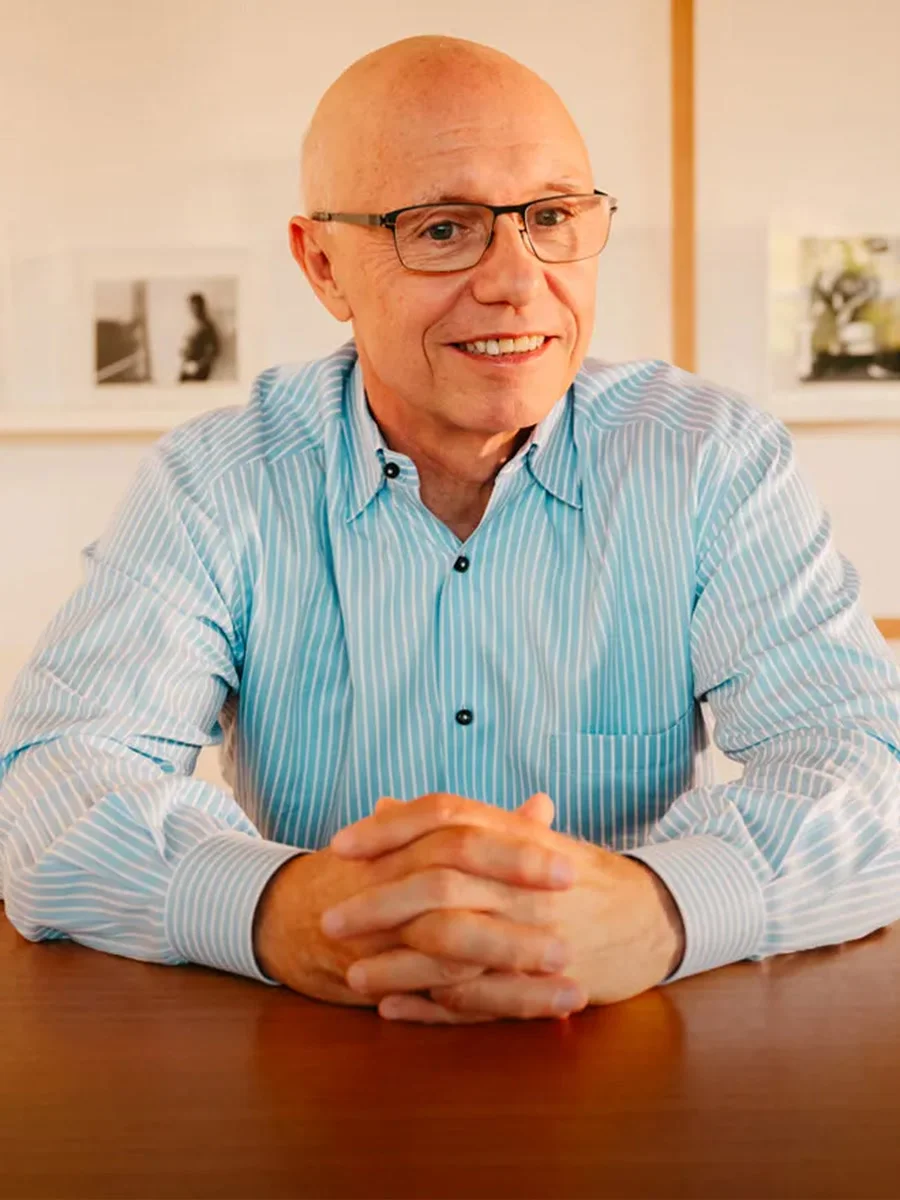
Doug Leone
Grew Sequoia into a global multi-stage franchise; blunt operator's view of the craft.
An outsider learns to start with the customer
Doug Leone’s investing system begins with a useful but limited autobiographical claim. His family moved from Genoa to Mount Vernon, New York, in 1968, when he was 11; that implies a birth year around 1957 but does not establish a full birth date. He later described arriving without English, being mocked, and developing hunger, fear, empathy, and sharpness. Sequoia profile, “Backstory” · Seven Questions, answers 1–2 Investor-stated · strong for his remembered experience; researcher inference · insufficient public record for the claim that hardship caused investment skill. Repeated telling across 2014–2025 shows a stable self-understanding, not a counterfactual.
Engineering and technical sales supplied the more observable bridge into investing. Leone earned a BS in mechanical engineering from Cornell, an MS in industrial engineering from Columbia, and an MS in management from MIT, then worked in sales and sales management at Hewlett-Packard, Prime Computer, and Sun Microsystems. NIAF biography, p. 1 In a 2014 Stanford talk, he said sales trained him to view a business “from the customer in.” Stanford GSB, 00:08:41–00:09:38 The supportable causal chain is narrow: technical sales → repeated exposure to user/buyer problems and distribution → later emphasis on customer references, product pull, positioning, and sales leadership. Investor-stated · moderate. It does not prove that this lens predicted returns.
That lens recurs in the best company records. RingCentral had bootstrapped before Sequoia invested; PlanGrid reported organic ARR before a mature sales organization; ServiceNow had unusually strong customer references; Nubank’s opportunity began with observable consumer pain in a concentrated banking market. RingCentral essay · PlanGrid lab · ServiceNow lab · Nubank essay These are selected cases. Color—a reported large commitment near launch with little demonstrated habit—shows that customer evidence was not an invariant gate. Color failure lab
1988–1996: entering Sequoia, almost leaving, and learning what early wins conceal
Don Valentine hired Leone in 1988 after speaking with Sun executives and conducting a characteristically blunt interview. Leone later said some partners wanted him gone during his first three years and Valentine gave him more time; he became a partner in 1993. Sequoia profile, “Backstory” · Acquired, 00:19:36–00:20:06 This is principal testimony, not a preserved vote or performance file. The scene supports persistence and a direct-feedback culture; it cannot show why Valentine’s judgment was economically correct.
Arbor Software became the foundational deal in Leone’s account. Two consulting-domain founders reportedly had no code, a weak pitch, and acute personal financial pressure. Leone says he helped articulate the problem; another partner trusted the co-investor; Sequoia funded a proposed $2 million round; Arbor later went public and merged with Hyperion. Arbor frozen lab Investor-stated · moderate. The case foreshadows his later institutional contribution: translate domain knowledge into a customer problem, use a partner/co-investor network, and help shape the company narrative. It also exposes a conflict: an investor fighting for his career may over-author the founders’ pitch. Original customer work, memo, cap table, and economics are missing.
Leone says Arbor, International Network Services, and Renaissance Software—his first three investments—reached public markets. He also describes the confidence that followed and a later “abyss,” including a period around 2001 when he sat on ten boards without a winner. Acquired, 00:18:20–00:20:38 The roster, costs, marks, exits, and loss severity are unavailable. Investor-stated · moderate for the remembered sequence; researcher inference · strong that three outcome-selected IPOs cannot establish calibration across the next regime. Early success appears to have taught Leone a negative lesson: a streak can produce more confidence than information.
1996–2012: shared leadership, flattened credit, and the institutional turn
Valentine transferred stewardship to Michael Moritz and Leone in 1996 rather than selling a management company. Leone describes Moritz as “one” and himself as “1A,” a useful correction to single-leader narratives. Axios, 2017 · Acquired, 00:23:31 A 2024 SEC-filed Nubank exhibit supplies the controlling title chronology: Co-Head from 1996 through 2012 and Global Managing Partner from 2012 through 2022. Nubank SEC exhibit
The partnership’s economics matter because they shape behavior. Leone says Valentine flattened carry in Sequoia 6 and later senior partners received equal compensation. Acquired, 00:21:32–00:24:02 Investor-stated · moderate; agreements unavailable. If accurate, equalized economics plausibly reduced deal hoarding and made the Goetz–Leone disagreement at Meraki or the Grady–Leone collaboration at ServiceNow economically tolerable. That is a testable mechanism, not proof: partnership votes, attribution, fee income, reserves, and carry schedules remain private.
The 1999–2002 fund episode turned institutional reputation into a decision variable. Leone says some funds fell near 0.3x, partner obligations exceeded net worth, the firm declined fees, and gains were recycled until the funds approached 2x; a 2011 report records him saying partners wrote checks to protect LPs. Acquired, 00:26:18–00:28:03 · TechCrunch 2011 Every figure is retrospective and unaudited. The decision rule—protect long-run trust over near-term economics—is supported as stated philosophy, while the actual fund identities, legal clawback, cash flows, individual contributions, and ending net returns are insufficient public record.
The UC Regents’ June 30, 2025 private-equity disclosure is an external control, not a substitute. It reports LP-specific interim metrics for Sequoia legacy and later US funds, warns that methods can differ with timing, fees/carry, stock sales, secondaries, and valuations, and says no GP reviewed or approved the report. UC Regents report, pp. 1–3 It is a performance disclosure, not the 2020 Leone interview and not personal performance.
2002–2014: enterprise company architecture—and its negative controls
The most supportable investment-era pattern begins with enterprise infrastructure and software: Aruba (board from 2002), RingCentral and Meraki (2006), ServiceNow (2009), Medallia (board from 2011), Nubank (2013), and PlanGrid (2014). comprehensive ledger It is not a clean personal portfolio. Filings often show shared voting power through Sequoia vehicles; founders, co-investors, other partners, and executives hold causal roles.
Aruba and RingCentral establish durable board/ownership anchors but thin initial decision evidence. A 2009 Aruba proxy showed Sequoia at 15.5%; Leone was a director, while entry thesis, cost, and exit ownership remain missing. RingCentral’s S-1 showed Sequoia entities at 17.2% and five managing members with shared control disclaimers; Leone had joined the board in 2006. Aruba proxy · RingCentral S-1 Contemporaneous record · strong on vehicle positions and boards; insufficient public record on Leone return or solo decision authority.
Meraki is more revealing because disagreement survived the winner narrative. Three MIT founders had working technology but no settled go-to-market. Leone objected; Jim Goetz argued that founder and technical quality justified funding the learning. The founders reportedly tried five GTM approaches before enterprise demand clicked. Meraki history Cisco later paid about $1.2 billion cash, and Leone reportedly said Sequoia received about $400 million; the latter is a reported firm outcome, not an audited return or personal result. Cisco completion · TechCrunch report The supported lesson is not “Leone picked Meraki”; it is that explicit dissent plus complementary partner judgment can fund learnable commercial uncertainty.
ServiceNow most strongly supports the institutional-edge thesis. Pat Grady initiated contact with Fred Luddy in 2008. Grady and Leone visited in 2009, heard unusually positive references, and sponsored a $51.64 million Series D through US Growth IV; Leone became a director. ServiceNow transcript · ServiceNow S-1, Series D and principal stockholders Fred Luddy retained product leadership, Frank Slootman became CEO, and later sale deliberations involved multiple executives and directors. The source is retrospective and Sequoia-produced, but it includes multiple witnesses. Contemporaneous record · strong for capital/ownership/board; retrospective witness · moderate for decision causality. Grady sourced; Grady and Leone sponsored/governed; founders, executives, employees, customers, and the board produced the outcome.
Medallia and PlanGrid add founder-side and concentration evidence. Sequoia was Medallia’s sole institutional investor through multiple rounds, reported $105 million invested by 2014, and held 41.4% pre-IPO; Leone joined its board in 2011, while other Sequoia entities and decision makers remain visible in filings. Medallia 2012 announcement · Medallia S-1 PlanGrid’s Tracy Young corroborates a narrower board role: Leone helped interview a sales leader while the founders retained execution. Stanford full transcript, Young/Leone turns; search “help, not to run” These cases support company architecture—references, role design, recruiting, financing—more than product invention.
Color is the cleanest false positive. Reporting identified Leone as board member/lead for a reported $25 million Sequoia share of a $41 million financing close to launch. The product did not establish a coherent retained use case and the company wound down; the surviving record shows public pivot support, not a rigorous postmortem. contemporary Color report Documented behavior · strong on role and scale; provisional on exact loss. The case predicts where Leone’s edge should fail: pre-fit consumer behavior gives fewer enterprise references and can turn exceptional-founder confidence into halo.
Facebook is the negative control for access and updating. Leone says his daughter alerted him, he handed the lead to Roelof Botha, and he was in China for the meeting; Sequoia later passed at a higher price and again around reported $8–10 billion valuations. He grades the firm below F. Acquired, 00:59:58–01:02:47 Investor-stated · moderate. Exact rounds, prices, participants, and votes are absent. The first miss is distributed; the later misses test Leone’s stated data-driven revision. The lesson is serial re-underwriting, not imaginary counterfactual return.
2005–2023: building local franchises without claiming their portfolios
Under Leone’s leadership Sequoia entered China and India in the mid-2000s through locally led partnerships. He described a model in which local teams controlled investments while relationships, culture, and some economics joined the institution. Stanford GSB, 00:31:36–00:33:24 Neil Shen and Zhang Fan in China and Shailendra Singh in India/Southeast Asia require distinct institution- and company-level credit. Investor-stated · moderate for the intended design; insufficient public record for Leone’s exact role in regional selection, carry, conflicts, or company outcomes.
Brazil provides a useful boundary. Sequoia hired David Vélez as a partner in 2011 to explore Latin America; he left to found Nubank. Leone traveled with him and later backed Nubank with Sequoia and local co-lead Kaszek, while current firm credit also names Sonya Huang. Nubank essay · Nubank lab Leone also said Sequoia stopped a broader Brazil-office plan when it found insufficient software depth, retaining the company option without forcing a country franchise. Stanford GSB, 00:34:13–00:36:51 This supports evidence-gated geographic expansion; cost, ownership, regulatory risk, credit performance, and proceeds remain unresolved.
The global brand separated in 2023, after Leone’s handoff. Sequoia, HongShan, and Peak XV cited brand confusion, portfolio conflict, regulatory complexity, geopolitics, and back-office costs. Peak XV signed announcement Contemporaneous record · strong for separation; researcher inference · provisional on whether it falsifies the original model. The split rejects the permanence of one operating identity but the independent survival of the franchises may support the institution-building layer. No regional company becomes a Leone deal merely because he led globally.
The 2024 House Select Committee report criticized US venture investment connected to PRC military and human-rights concerns, including Sequoia Capital China transactions. House report The document is authoritative evidence of the committee’s publication and analysis, not automatic personal findings against Leone. Transaction, entity, regional-partner, and person boundaries remain necessary.
2012–2022: global managing partner, scale, warnings, and control failures
Moritz reduced day-to-day involvement in 2012; Leone served as Global Managing Partner through 2022. Nubank SEC exhibit During this period Sequoia operated across stages and regions. At TechCrunch Disrupt in 2018, Leone said the firm could write checks up to $1 billion and called China its largest market, while later warning that a firm that loses pre-seed becomes private equity. TechCrunch 2018 · 20VC, outline item 5 Investor-stated · strong for capacity and identity; researcher inference · moderate for the tension. Stage-specific teams can resolve it only if incentives, information, reserves, and authority remain coherent.
Leone’s 2014 Stanford talk is unusually valuable because it predates several later outcomes. He called Sequoia US’s lack of a woman investing partner an “abject failure,” warned that private markets were near a cycle top, described local autonomy, and explained the Brazil withdrawal. Stanford GSB, 00:20:35–00:36:51 These are contemporaneous admissions and forecasts; they do not demonstrate remedy or accuracy. This dossier found no measurable gender-remediation record sufficient to convert the admission into an outcome claim.
Sequoia’s 2021 fund redesign belongs to Roelof Botha, not Leone. Botha authored the plan for an open-ended US/Europe public-holdings pool allocating into closed-end stage subfunds and an RIA conversion; IAPD records the adviser registration effective January 3, 2022. Botha announcement · SEC IAPD, CRD 157373 Leone receives leadership-era context only. Liquidity policy, fees, carry crystallization, reserves, and his decision role are insufficient public record.
FTX is also institutional adverse context, not a supported Leone-sourced investment. The disclosed write-off came from Sequoia vehicles; the public firm letter does not identify Leone as source or sponsor. Axios, firm letter and vehicle amounts In November 2022 Leone warned that the downturn could exceed 2000 and 2008 and said the firm would “dream a little less” temporarily. CNBC, 2022-11-23 Researcher inference · strong: any philosophy that praises speed and dreaming needs custody, related-party, audit, valuation, and incentive gates. No public evidence shows the process change.
Politics and access form a judgment/conflict record rather than an investment return record. Public reports described Trump support, a post-January-6 renunciation, renewed 2024 support, and an unnamed-source claim about offering administration ties in connection with TikTok; Sequoia’s on-record statement supported a US-government-acceptable solution. Washington Post, 2020-08-08 · Bloomberg, 2021-01-13 · CBS, 2024-07-19 Unnamed-source reporting is not adjudication, political giving is not a deal thesis, and no reliable public record reviewed found a final judgment personally imposing liability on Leone.
2022–2026: succession, separation, and return
Leone handed the senior-steward role to Botha effective July 5, 2022, one day after his 65th birthday, while remaining a GP in existing funds and on boards. Axios, 2022-04-05 In a 2023 interview he said he retained existing-fund interests but no management-company ownership or new-fund carry; governing documents remain unavailable. Colossus, 55:21–1:02:18 The design expressed his generational doctrine: transfer economics and authority rather than sell control.
The sequence did not end there. Botha stepped down in November 2025; Alfred Lin and Pat Grady became co-stewards. On March 31, 2026 Sequoia named Leone chairman and invited him to resume active investing, with Reuters reporting that he had never fully left his boards or existing-fund GP roles. Axios, 2025-11-04 · Reuters, 2026-03-31 The current team page again lists him across seed/early and growth. Sequoia team, accessed 2026-08-21
The return is not self-proving failure. It may represent a planned contingency, an exceptional governance response, or an incomplete handoff; the public record supplies sequence, not cause. It nevertheless weakens any simple claim that the institution no longer depended on Leone. A strong succession system predicts a written contingency, transparent authority, aligned economics, and new leaders who can govern without predecessor ambiguity. Those records are private.
Leone’s current portfolio page is an access-date snapshot, not a lifetime ledger: exactly 16 names on 2026-08-21—nine current and seven enduring. Sequoia profile, “Companies” The deal search enumerated 35 public candidates, sufficiently reconstructed only nine, while an opaque commercial profile claimed 89 “partner investments.” denominator reconciliation Current cyber/AI names and headline transaction values are not realized returns.
A falsifiable thesis of Leone’s edge
Proposed edge. Leone’s most defensible repeatable contribution was institutional: combine behavioral founder assessment and enterprise customer/GTM judgment with partner complementarity, stage-matched executive recruiting, board governance, shared economics, succession, and locally empowered franchises. Researcher inference · moderate. It was strongest from the early 2000s through the 2010s in enterprise/infrastructure companies where references, distribution, leadership bottlenecks, and long boards were observable.
Mechanism. Technical-sales experience supplied customer-in questions; Sequoia’s network supplied access; complementary partners supplied technical, sector, or local judgment; equalized economics plausibly reduced hoarding; large vehicles and reserves supported long experiments; boards translated the thesis into recruiting, financing, role design, and exit decisions; regional authority placed decisions near markets. Each link is separately testable. philosophy
Supporting cases. ServiceNow connects Grady sourcing, customer references, vehicle capital, Leone governance, and a founder-to-scaler transition. Meraki shows productive dissent around GTM. PlanGrid supplies founder corroboration of bounded recruiting help. Medallia, RingCentral, Aruba, and Nubank add different ownership, board, category, and geography evidence. economic and learning ranks
Disconfirming cases. Color is a pre-fit false positive; Facebook is a repeated update failure; the ten-board abyss is an unidentified ordinary/failure cohort; FTX is a leadership-era control failure; the global split and 2026 return test franchise and succession design. None should be erased by redefining the thesis after the fact.
Predictions. If the edge is real, unseen memos and board records should show customer/reference evidence before scale; explicit technical-versus-GTM separation; founder-role diagnosis; partner dissent and role-level credit; interventions tied to measurable recruiting, financing, information, or succession outcomes; and local decision rights. Ordinary and losing cases should show the same process even when outcomes fail.
Falsifiers. The thesis weakens materially if memos show little customer/GTM work; partner or founder actions explain the visible wins; board minutes show ceremonial involvement; Color-like checks recur; ServiceNow or another outlier dominates cash economics; ex-outlier, vintage-adjusted fund cash flows are weak; regional costs exceed franchise value; or the 2022–2026 succession record shows no durable transfer. The public record cannot yet decide these tests.
People, capital, and influence map
| Actor or institution | Supported influence/action | Attribution boundary |
|---|---|---|
| Don Valentine | Hired/protected Leone; transferred stewardship; reportedly flattened carry | Votes, economics, and private evaluation unavailable |
| Michael Moritz | Complementary co-head, 1996–2012; “one” to Leone’s “1A” | Division of deals, LP work, hiring, and operations by period unresolved |
| Jim Goetz | Changed the partnership decision on Meraki; shared firm credit | Meraki is not a Leone-only pick |
| Pat Grady | Initiated ServiceNow contact in 2008; co-sponsored/governed | Source must remain Grady; company outcome belongs to the full team |
| Roelof Botha | Next steward; authored 2021 vehicle design; later departure | 2021 fund architecture is not Leone authorship |
| Alfred Lin | Successive steward and 2026 governance participant | Specific succession decision record unavailable |
| Neil Shen, Zhang Fan, HongShan | Built and governed China franchise | Regional companies/returns cannot be assigned to Leone |
| Shailendra Singh, Peak XV | Built India/SEA franchise; signed 2023 separation | Regional decisions and economics remain local/institutional |
| Rajeev Motwani | Introduced Meraki founders | Access source is not approval or execution |
| Gili Raanan | Sourced Adallom and brought team back for Wiz | Repeat relationship is shared institutional capital |
| David Vélez / Kaszek / Nubank team | Local opportunity, co-led seed, operating and regulated execution | Leone’s travel/board role does not become sole company credit |
| Founders and executives | Product, company, recruiting, sales, operations, culture | Investor help must be named by mechanism |
| Sequoia LPs and vehicles | Supplied capital and encoded duration, reserves, fees, carry, governance | Vehicle performance and company value are not Leone returns |
| UC Regents | Public LP performance-disclosure control | LP-specific interim metrics, not a Leone interview or personal record |
Skill, access, vehicle, team, era, luck, and outlier audit
| Alternative explanation | Evidence | What would discriminate it |
|---|---|---|
| Skill | Recurring customer/GTM and board patterns across several enterprise companies | Original memos, matched ordinary/loss cases, measurable board interventions |
| Access | Sequoia brand, Motwani/Raanan/Grady/Vélez networks, regional franchises | Cold-source funnel and matched same-deal performance |
| Team | Goetz, Grady, Botha, Moritz, local partners and founders hold causal roles | IC votes, attribution records, independent witness accounts |
| Vehicle | Large shared stakes, growth funds, flattened economics, long boards | LPAs, reserves, carry, cash flows, cross-fund allocation rules |
| Era | Cloud/mobile/enterprise expansion and changing exit markets | Vintage/stage/sector-matched benchmarks |
| Luck/outliers | Visible economic set is concentrated; ServiceNow is strongest anchor | Fund cash-flow attribution with and without the dominant position |
| Narrative selection | Milestone essays and current profile favor winners; 26/35 cases insufficient | Complete archived roster, write-offs, passes, ordinary boards, postmortems |
The public evidence currently favors institutional importance over personal alpha. That is a meaningful finding, not a downgrade to “no skill”: designing a partnership that improves sourcing, disagreement, governance, succession, and local authority can be a repeatable investment capability. It simply must not be measured with other people’s companies or headline valuations.
Sourced chronology and turning points
| Date | Turning point | Investment significance | Evidence boundary |
|---|---|---|---|
| c.1957 / 1968 | Born approximately 1957; moved Genoa → Mount Vernon at 11 | Stable outsider/hunger self-narrative | Arrival/age imply year; causality unproven |
| 1979–1988 | Engineering degrees; HP, Prime, Sun technical sales | Customer-in and distribution lens | Career facts strong; causal link retrospective |
| 1988 | Joined Sequoia | Access to Valentine institution | Hiring scene retrospective |
| 1993 | Became partner | Survived early internal opposition | Votes/economics unavailable |
| early 1990s | Arbor/INS/Renaissance; three reported IPOs | Early customer-translation success and overconfidence | Economics/roster incomplete |
| 1996 | Co-Head with Moritz | Generational ownership transfer | Role strong; exact powers private |
| 1999–2002 | Reported fund/clawback stress and LP repair | Reputation/incentive doctrine | Figures unaudited |
| 2002–2009 | Aruba, RingCentral, Meraki, ServiceNow | Enterprise/GTM/board system develops | Shared vehicles and partners |
| 2011 | Medallia board; Color false positive | Concentration and role architecture versus pre-fit halo | Loss/remediation incomplete |
| 2012 | Global Managing Partner | Institution becomes global/multi-stage | Title does not imply sole authority |
| 2013–2014 | Nubank and PlanGrid | Geographic option and founder-counterparty board evidence | Economics incomplete |
| 2014 | Stanford talk: founder screen, cycles, gender, local autonomy, Brazil retreat | Earliest broad partly contemporaneous doctrine | Remedies/performance not proven |
| 2018 | Up-to-$1bn checks; China called largest market | Growth scale and early-stage identity tension | Capacity/intention, not return |
| 2021–2022 | Botha-authored vehicle redesign; age-rule succession; FTX write-off | Duration/regulation and control/succession tests | Vehicle/FTX not Leone-authored deals |
| 2023 | Sequoia/HongShan/Peak XV separate | Global-model coordination boundary | Net LP value unresolved |
| 2025 | Botha departs; Lin/Grady co-stewards | Planned succession destabilizes | Causes private |
| 2026-03-31 | Leone returns as chairman/active investor | Key-person contingency and current investing reset | New decision rights/economics unavailable |
| 2026-08-21 | Current profile shows 16 company tiles | Access-date association snapshot | Not a lifetime or return denominator |
Learning path through the record
Begin with the source map to understand access and denominator boundaries. Read the direct writings beside the oral talks: the writing is sparse and outcome-heavy; the spoken record is richer but retrospective. Work the frozen investment labs before reading reveals, especially the Color failure and Facebook miss. Then use the 17-part investment philosophy and ten-model field guide.
The package’s central discipline is attribution. Separate person, partner, partnership, vehicle, regional franchise, founder, operator, and LP. Separate access, selection, approval, ownership, board work, exit, and return. Separate contemporaneous evidence from retrospective memory. When those distinctions are preserved, Leone’s most plausible legacy is not a list of famous companies; it is a contested, testable design for making an investment institution learn and renew.
1. Snapshot and testable edge thesis
| Field | Evidence-bounded answer |
|---|---|
| Investor | Doug Leone |
| Institution | Sequoia Capital, 1988–present |
| Leadership | Co-Head, 1996–2012; Global Managing Partner, 2012–2022; chairman and active investor from 2026 Nubank SEC exhibit · Reuters, 2026-03-31 |
| Core domain | Enterprise software/infrastructure, go-to-market, boards, partnership and franchise design; a few consumer/geographic exceptions |
| Public denominator | 16 current profile names on 2026-08-21; 35 publicly enumerated candidates; only 9 sufficiently reconstructed; opaque commercial claim of 89 denominator audit |
| Economic boundary | No Leone MOIC, IRR, DPI, TVPI, PME, loss rate, or personal carry is publicly computable |
Testable edge thesis. Leone’s most defensible repeatable edge was not solo company picking. It was an institutional capability: judge founder motive and complementarity, interrogate enterprise customer/GTM reality, then express that judgment through partner teams, stage-matched recruiting, board governance, succession, and locally empowered franchises. It should work best in enterprise and infrastructure companies where customer references, distribution bottlenecks, management architecture, and long holding periods are observable. Researcher inference · moderate.
The thesis is supported across ServiceNow, PlanGrid, Medallia, Meraki, RingCentral, Aruba, and Nubank, but the mechanism differs by case and credit is shared. Pat Grady sourced ServiceNow; Jim Goetz changed Leone’s mind on Meraki; Gili Raanan brought the Adallom/Wiz team; Kaszek co-led Nubank; founders and operators built every company. people and decision-rights map
Predictions. Unseen Leone cases should show: customer/reference evidence before scale; explicit founder-role and GTM diagnosis; partner-level dissent or complementary sponsorship; board work tied to recruiting, financing, or succession; and local decision authority rather than Menlo Park picking every regional deal. The edge should be weaker in pre-fit consumer products, in markets where customer evidence is unavailable, or when institutional coordination and incentives are unclear.
Falsifiers. The thesis weakens materially if original memos show little customer/GTM analysis; ordinary and failed cases show no better calibration; partner or founder work explains the visible wins; Color-like pre-fit checks recur; ServiceNow dominates fund economics; cash-flow data show weak vintage-adjusted results; board minutes show ceremonial rather than causal work; or local franchises produced no net LP value after coordination cost. The current record cannot decide those questions. uncertainty ledger
2. Core philosophy
Leone’s own words put motive, customer reality, self-awareness, and institutional humility first:
- “We’re here to help, not to run the company.” Stanford/PlanGrid transcript, Doug Leone turn; search exact phrase
- “I’ll always change my mind based on new data.” Seven Questions, answer 3
- “If something is working like a dream, break it.” Stanford GSB, 00:12:50–00:13:40
- “When you lose pre-seed, you become private equity.” 20VC, official outline item 5
Synthesis. Start with an internally motivated, unusually capable team close to a painful problem. Demand real pull or references. Treat the product as only the first layer: distribution, leadership, unit economics, incentives, and governance must be architected for the next stage. Keep experiments cheap enough to fail quickly, but support high-quality teams through learnable GTM uncertainty. Build a partnership that can transfer credit, economics, and authority. Investor-stated · strong for the preferences; researcher inference · moderate for consistent application.
The philosophy is intentionally tense. Leone praises disruption but warns about cycles; values speed but criticizes slogs; wants one-product focus while Sequoia became global and multi-stage; claims data-driven revision but repeatedly passed on Facebook; and planned retirement before returning as chairman. The tensions are evidence, not defects to edit away.
3. Sourcing
Four channels are supported:
- Trusted technical networks. Rajeev Motwani introduced Meraki; Gili Raanan secured the Adallom meeting and maintained the relationship that later led to Wiz. Meraki essay · Wiz essay
- Partner specialization. Pat Grady initiated contact with Fred Luddy in 2008; Grady and Leone later visited and sponsored ServiceNow. ServiceNow transcript
- Founder/institution relationships. Sequoia hired David Vélez in 2011 to explore Latin America; he then left to found Nubank, with Kaszek co-leading locally. Nubank essay · Nubank lab
- Direct hunting. Leone describes cold calls and traveling into emerging geographies; the public denominator of cold-sourced failures is unavailable. Stanford GSB, 00:28:28–00:36:51
Access is not selection. Leone’s daughter flagged Facebook, but Sequoia failed to convert the first meeting and two later valuation stages. Acquired, 01:01:40–01:02:47 A modern sourcing record should log introducer, unique information, conflicts, first owner, follow-up owner, and every later re-underwrite. Reputation can increase the number of shots; it cannot validate a price or thesis.
Repeatability depends on the institution retaining relationships beyond one partner. That supports the institutional-edge thesis, but also makes personal attribution harder: the better the partnership works, the less honest it is to call a deal “Leone’s.”
4. Picking
Founder weighting. Leone looks for domain pain, internal motive, “spikiness,” clear thinking, self-awareness, complementary skills, and “we” language. Stanford GSB, 00:15:13–00:20:08 The Q&A adds willingness to name limitations and hire around them. Seven Questions, answers 1–3
Product/market weighting. PlanGrid’s reported $4 million ARR without sales/marketing, Medallia’s referenceable bootstrapped base, RingCentral’s no-outside-capital record, and ServiceNow’s customer references are stronger evidence than charisma. PlanGrid essay · Medallia lab · ServiceNow lab
Red flags. No job-to-be-done, founder halo without usage, GTM uncertainty that is not learnable within runway, services-heavy economics, unclear role architecture, and price that assumes monopoly before evidence. Color is the clean counterexample: a reported $25 million Sequoia commitment near launch, little demonstrated fit, and no public process-change record. Color lab
Diligence. The strongest supported methods are founder interviews, customer references, organic-demand inspection, relationship/reference mapping, and partner debate. Exact IC quorum, vote, memo template use, valuation thresholds, and kill rates remain insufficient public record. The claim that Leone changes his mind on data is preference evidence; Meraki documents one change, while Facebook documents repeated failure to update.
5. Deal and portfolio mechanics
The public record is much thinner on mechanics than on people and boards.
- Ownership and concentration. Pre-IPO Sequoia stakes are reconstructable at ServiceNow (21.56%), Medallia (41.4% in the S-1), RingCentral (17.2%), and Aruba (15.5% in a 2009 proxy). These are vehicle positions, not Leone holdings. economic ranking
- Price discipline. Leone speaks about price/context and admits later Facebook passes; no stable formula, hurdle, or ownership-price tradeoff is public. 20VC outline items 3–4 Price discipline without systematic re-underwriting becomes anchoring.
- Follow-ons and reserves. ServiceNow and Medallia show multi-round concentration; Nubank received follow-ons. Reserve formulas and opportunity costs are private.
- Terms. Board/information rights and founder-role architecture are visible in cases; security preferences, liquidation terms, anti-dilution, pro rata rules, and protective provisions are not.
- Exits. Leone opposed the proposed ServiceNow sale but also pressed for a market check. His retrospective “had to shop” phrasing is not a universal Delaware rule; the deal lab applies the legal correction. ServiceNow lab
- Returns. Meraki’s approximately $400 million is a reported firm outcome; headline company values for Nubank, Medallia, Wiz, Aruba, and PlanGrid are not investor returns. No valuation-to-return conversion is permitted.
The visible portfolio is enterprise-heavy and power-law shaped, but 26 of 35 enumerated candidates remain insufficiently reconstructed. A personal hit rate and economic Pareto are not computable.
6. Vehicle and incentive fit
| Mechanism | Supported effect | Boundary |
|---|---|---|
| Conventional closed-end venture/growth funds | Shared GP votes, reserves, long private-company duration, and concentrated ownership | LPAs, partner carry, fees, recycling, key-person clauses, and cash flows are private |
| Flattened senior carry | Leone says Valentine equalized economics, reducing destructive internal competition | Retrospective account; agreements unavailable Acquired, 00:21:32–00:24:02 |
| 1999–2002 repair | Leone says partners declined fees, reinvested gains, and protected LP trust after reported fund/clawback stress | Fund identities, payments, and final returns unaudited Acquired, 00:26:18–00:28:03 |
| Regional partnerships | Local authority and relationships increased geographic reach | Regional economics/decisions are not Leone deal credit; 2023 split revealed coordination cost |
| Sequoia Capital Fund, 2021 | Open-ended public-holding pool plus closed-end subfunds altered duration/liquidity architecture | Roelof Botha authored it; no Leone decision role is established Botha announcement |
| 2022 retirement / 2026 return | Leone said he retained existing-fund roles but not new-fund carry or management-company ownership; later returned as chairman | Governing documents and new 2026 economics unavailable Colossus, 55:21–1:02:18 |
UC’s 2025 LP-specific interim Sequoia metrics are useful fund controls but not Leone performance; UC explicitly says unliquidated IRRs are interim and its report was not GP reviewed. UC Regents report, pp. 1–3
Vehicle design is part of strategy because duration, reserves, liquidity, compensation, regional authority, regulation, and succession determine which risks can be held. But leadership-era context is not authorship: the Botha-designed 2021 vehicle, FTX investments, and regional company portfolios cannot be assigned to Leone without decision evidence.
7. Team attribution and work with founders
| Case | Sourcing | Supported Leone contribution | Other indispensable actors |
|---|---|---|---|
| ServiceNow | Pat Grady, 2008 | 2009 sponsorship, board, financing/CEO/sale deliberation | Grady, Fred Luddy, Frank Slootman, Roelof Botha, Carl Eschenbach |
| Meraki | Rajeev Motwani introduction; shared partnership | Skeptical GTM voice, later relationship | Jim Goetz persuaded; Sanjit Biswas, John Bicket, Hans Robertson iterated |
| PlanGrid | Partnership source unresolved | Board and sales-leader interviews | Tracy Young, Ralph Gootee, Ryan Sutton-Gee; Bill Smith |
| Medallia | Individual source unresolved | Board and partnership narrative | Amy Pressman, Borge Hald, Leslie Stretch; other Sequoia decision makers |
| Nubank | Vélez/Sequoia relationship; Kaszek local network | Brazil exploration, seed/board/follow-on relationship | David Vélez, Cristina Junqueira, Edward Wible, Sonya Huang, Kaszek |
| Wiz | Gili Raanan | Relationship participation and later essay | Raanan, Assaf Rappaport and founding team, Bogomil Balkansky |
The supported board pattern is bounded: diagnose the next constraint, recruit or redesign roles, finance through the transition, and remain a shock absorber without taking operating ownership. PlanGrid transcript, Young/Leone speaker turns; search “problem you have today” A board seat, long tenure, large stake, or favorable retrospective does not by itself prove value creation.
8. Views on the craft
- Power law: visible outcomes are concentrated, but missing cash flows and the opaque denominator prohibit personal-alpha or 80/20 percentages.
- Fund size: Leone warns that losing pre-seed identity turns venture into private equity, even as Sequoia operated large growth vehicles. The tension requires stage-specific teams and incentives, not a slogan.
- Access versus selection: networks generate shots; customer evidence, price, and repeated re-underwriting determine whether access becomes value. Facebook is the negative control.
- Great investing: absorb failure, share success, write clear memos, select LPs carefully, transfer economics, and make the next generation owners. Colossus show notes, 50:45–1:04:04
- Governance: help with people, GTM, capital, and succession; do not run the company.
- Exits: decide from contemporaneous alternatives and fiduciary process, not the later market capitalization.
- Institutional craft: culture requires incentives and decision rights. “Team” language without shared credit, local authority, and succession is branding.
9. Signature bets and decision process
Use the frozen packets before reading outcomes:
- ServiceNow — Grady sourcing, customer references, large 2009 growth check, founder/CEO design, and sale-process challenge.
- Meraki — technical truth without GTM truth; Leone’s dissent and Goetz’s persuasion.
- PlanGrid — observable organic pull and stage-matched sales recruitment.
- Medallia — bootstrapped references, category creation, concentration, and founder/CEO architecture.
- RingCentral and Aruba — category transitions with incomplete entry economics.
- Nubank — regulated remote geography plus a local co-investor.
- Color — failure lab: capital before fit.
- Facebook — miss lab: three chances and serial-update failure.
- 1999–2002 fund repair — portfolio/LP incentive lab, not a company deal.
Each lab separates known facts, unknowns, must-be-true conditions, walk criteria, next-check milestones, reveal, and attribution. None treats later value as ex-ante evidence.
10. Mental models and maxims
The reconciled inventory retains ten distinct rules:
- Start customer-in: require domain pain and observable pull.
- Back spiky, mission-driven, complementary “we” teams.
- Separate technical truth from GTM truth; stage distribution.
- Focus, stay lean, and fail fast before scaling.
- Re-underwrite on new evidence; do not anchor to the first pass.
- Architect the current bottleneck; help without operating.
- Map the relationship graph; separate access, selection, and credit.
- Align incentives, ownership, and capital duration before taking risk.
- Localize authority and transfer economics to renew the institution.
- Follow the monetizable control point toward the customer — retained provisionally because the present AI cohort is not cycle-tested.
Excluded slogans and unsupported candidates are listed in the model evidence gaps.
11. Evolution and contradictions
| Period | Publicly supported emphasis | Development or contradiction |
|---|---|---|
| 1988–1996 | Customer-in sales lens; individual struggle; early enterprise bets | Three early IPOs reportedly produced confidence before an unidentified ten-board abyss |
| 1996–2002 | Shared leadership, flattened economics, global beginnings, LP repair | Retrospective fund figures remain unaudited; ordinary roster missing |
| 2002–2014 | Enterprise networking/SaaS boards; founder/GTM and management architecture | Color was a large pre-fit false positive; Facebook was repeatedly not re-underwritten |
| 2014–2018 | Public founder screen, cycles, local autonomy, gender failure, operating “laws” | Growth scale strains early-stage identity; no measurable gender-remedy record here |
| 2019–2022 | Large institutional stakes, geographic expansion, open-ended-fund transition, succession | Botha authored the new vehicle; FTX is a leadership-era control failure, not a Leone deal |
| 2023–2026 | Retirement doctrine, global split, cyber/AI return, chairman role | Split tests local-franchise coordination; 2026 return tests planned succession |
The durable core is customer/GTM/people architecture. The largest unresolved contradiction is control: Leone champions autonomy and speed but the public record does not show how governance gates changed after Color, FTX, the regional split, or the 2025 succession reversal.
12. Failures and limits
- Color: large capital before product/market fit; no public IC postmortem or changed approval rule.
- Facebook: access at three stages, no conversion, repeated anchoring; exact IC votes and counterfactual economics unknown.
- 2001 ten-board abyss: self-reported ordinary/failure period; roster and magnitude absent.
- 1999–2002 fund stress: reputational repair is supported only by retrospective figures and later reporting.
- Adallom: an earlier team miss later recovered through Raanan/Wiz; continued relationship is institutional, not solely Leone’s.
- Global model: locally autonomous franchises created reach but shared brand, portfolio conflict, regulation, geopolitics, and operations led to separation. Peak XV signed announcement
- FTX: adverse leadership-era governance context; no public evidence makes it a Leone-sourced deal. Axios, firm letter
- Politics/TikTok: reporting about access, Trump support/reversals, and TikTok advocacy matters to judgment and conflict analysis, not deal returns; an unnamed-source allegation is not adjudication. source map
- China scrutiny: the House report concerns entity/transaction conduct; it does not automatically impose personal findings on Leone. House report
- Legal boundary: no reliable public record reviewed found a final judgment personally imposing liability on Leone. A filed FTX complaint is allegation, not fact.
Selection bias is severe: current profiles curate winners; board biographies omit passes and dead companies; private marks are not cash; and only 9 of 35 enumerated candidates are sufficiently reconstructed.
13. Historical operating environment
Leone entered venture from technical sales in 1988, before today’s large venture ecosystem and before cloud/SaaS terminology stabilized. Enterprise distribution required reference selling, direct channels, and long customer adoption. Early-1990s software IPOs and the late-1990s liquidity boom were followed by the 2000–2002 reversal; Leone’s early wins and later abyss must be read across that regime change. Acquired institutional history
Aruba, RingCentral, Meraki, and ServiceNow were underwritten across networking, broadband, cloud, and enterprise-workflow transitions. Later NVCA data show US VC-backed IPOs fell from 88 in 2007 to 16 in 2008 and 10 in 2009, giving context—not ex-ante proof—to ServiceNow’s 2009 financing. NVCA 2024 Yearbook
The 2010s added mobile/cloud adoption, abundant growth capital, and regional platform expansion. The 2020–2022 boom/reset, crypto governance failure, geopolitical scrutiny, RIA conversion, and AI-security wave changed both underwriting and institutional constraints. Fund inference still requires cash flows; private marks, headline acquisitions, and LP-specific interim metrics cannot establish personal alpha. Kaplan & Schoar, NBER 9807 · Cochrane, JFE
14. Modern VC translation (as of 2026-08-21)
| Lesson | What transfers | What changed or does not transfer | Applicability signals | Most likely misuse | 2026 application |
|---|---|---|---|---|---|
| Customer-in underwriting | Direct pain, references, retention, workflow depth | AI prototypes can create usage before durable budgets or moats | Paid repeat use, independent references, expansion, workflow ownership | Treating demo enthusiasm as pull | Researcher hypothetical · moderate: require cohort and budget evidence before scaling an AI application |
| Spiky complementary teams | Job-relevant excellence and self-awareness remain valuable | Distributed teams and AI leverage change role boundaries | Named weakness, complementary owner, truth-changing reference | Romanticizing hardship or charisma | Researcher hypothetical · moderate: score behaviors, not biography |
| GTM as separate truth | Technical novelty still needs buyer, channel, and unit economics | Product-led and AI-assisted sales compress some cycles, not procurement | User→buyer→budget chain, payback, implementation burden | Hiring a famous sales leader before repeatability | Researcher hypothetical · moderate: stage the hire against a documented bottleneck |
| Focus and fast failure | Thin experiments preserve option value | Platform APIs can enable multi-product surfaces earlier | One retained wedge, bounded burn, explicit kill date | Using “focus” to ignore adjacent customer demand | Researcher hypothetical · moderate: pre-register expansion gates |
| Re-underwriting | New data should reset probabilities and price | Faster rounds and continuous data increase anchoring risk | Material retention, density, regulation, or unit-economics change | Defending the first pass | Researcher hypothetical · moderate: re-open the memo at every financing |
| Board architecture | Recruiting, capital, audit, and succession remain board work | Founder control and information rights vary; AI risk adds model/data oversight | Named constraint, owner, milestone, information path | Counting seat/tenure as value | Researcher hypothetical · moderate: write a quarterly intervention hypothesis and outcome |
| Relationship graph | Proven teams and introducers carry information | Dense networks amplify prestige/FOMO and conflicts | Unique history, reference quality, explicit credit | Calling access alpha | Researcher hypothetical · moderate: separate source, sponsor, approver, and operator |
| Incentive/duration fit | Reserves, liquidity, carry, and key-person risk shape strategy | Evergreen/continuation/secondaries/RIA structures add layers and conflicts | Duration match, reserve map, fee/carry crystallization, LP liquidity | “Patient capital” without stop rules | Researcher hypothetical · moderate: model vehicle and company cash needs jointly |
| Local authority/succession | Decisions near customers and real ownership aid renewal | Geopolitics, data rules, brand conflict, and sanctions can overwhelm culture | Local IC authority, economics, compliance, conflict process | Using a shared brand as governance | Researcher hypothetical · moderate: write a constitutional map plus separation plan |
| Customer-layer control point | Budget ownership and workflow position remain central | AI infrastructure may capture exceptional value; Nvidia contradicts a simple “value moves up” law | Gross-margin durability, switching cost, budget control | Assuming applications always win | Researcher hypothetical · provisional: compare value capture across the whole stack |
The applications are hypothetical and locally labeled; none claims Leone used 2026 tools. Current facts must be refreshed at each decision.
15. Comparison with completed peers
These three are completed and dimensionally defensible:
| Dimension | Leone | Arthur Rock | Peter Crisp | Martin Casado |
|---|---|---|---|---|
| Why comparable | Target; partnership-scale enterprise investor | Multi-generation founder/board judgment and concentrated governance | Institution builder, patient capital, boards, shared Apple/enterprise attribution problems | Modern infrastructure founder-investor with explicit technical/GTM models |
| Sourcing | Partner/referral network, cold hunting, regional franchises | Trusted intermediaries and earned reputation | Rockefeller/Venrock access and referrals | Technical community, open-source and practitioner networks |
| Picking | Founder behavior + customer/GTM evidence | People judgment and intellectual honesty | People + reachable market, less decision detail | Market maps falsified by use, buyer/budget/control point |
| Ownership | Large vehicle stakes; personal economics absent | More concentrated personal/partnership cases | Durable Venrock vehicle stakes, incomplete returns | Modern fund ownership/pricing treated explicitly but still private |
| Governance | Recruiting, founder/CEO roles, financing, succession | Small-portfolio, hands-on boards | Long boards; mechanism often underdocumented | Technical/product/GTM assistance inside a16z platform |
| Portfolio construction | Enterprise-heavy visible set; large stakes, incomplete weights/cash flows | Small active portfolio ideal; incomplete full ledger | Apple may dominate; portfolio and losses incomplete | Recent infrastructure attribution set; outcome denominator immature |
| Vehicles | Closed-end venture/growth funds, later Botha-authored open-ended architecture | Bank/finite LP/personal and syndicate structures | Family capital → durable Venrock partnership | Modern a16z flagship/growth/specialist pools |
| Incentives | Flattened carry, LP repair, regional economics and succession; agreements absent | Concentrated board/personal economics, entity details incomplete | Rockefeller sponsor and partner/carry boundaries | Platform/team contribution and partner economics remain private |
| Institution | Flattened carry, local franchises, succession | Smaller person-centered firms | Family office to institutional Venrock | Large service platform; less generational history |
| Failures | Color, Facebook, abyss, global/succession controls | Diasonics, passes, governance conflicts | Europe, Advent, board adversity | Public theses are young; outcome denominator immature |
| Attribution risk | Especially high: partner teams and regional vehicles | Co-investor/founder credit still material | Sponsor/partner/vehicle distinctions central | Founder expertise and a16z platform can be confused with deal alpha |
Primary evidence controls the comparison: Rock’s direct account specifies people diligence and concentrated governance HBR, diligence/control passages; Crisp’s oral history states the people-plus-large-market screen CHM, printed pp. 12–17; Casado’s writing traces buyer, sales motion, and enterprise GTM failure modes a16z, “Growth+Sales”.
Rock is the best governance and generational-ownership comparator; Crisp tests institution/platform versus personal selection; Casado tests whether Leone’s customer/GTM intuitions become more falsifiable when expressed as modern infrastructure economics. The comparison is not a ranking. Different eras, vehicles, sectors, and evidence density prevent performance conclusions. Researcher inference · moderate.
16. The strongest case against greatness
The skeptical thesis is that Leone was a forceful narrator and capable steward inside the venture industry’s most advantaged brand, and that Sequoia access, fund scale, partner talent, founder execution, favorable enterprise cycles, and a few outliers explain more than distinctive Leone skill.
The evidence is serious. Pat Grady sourced ServiceNow; Jim Goetz overruled Leone’s Meraki skepticism; Gili Raanan sourced Adallom/Wiz; Kaszek and company operators were essential at Nubank. Color shows a large false positive before fit. Facebook shows privileged access without updating. The 16-name live profile is curated, the broader 35-name roster is only 25.7% sufficiently reconstructed, and the commercial 89 is opaque. Cash flows, write-offs, carry, reserves, and vintage-matched comparisons are missing. Global expansion later separated; the planned 2022 succession was followed by a 2026 return. FTX and China/political controversies reveal institutional-control risk without establishing Leone deal responsibility.
The favorable thesis wins if original memos and references show the same people/GTM logic across winners, ordinary cases, and losses; board records show measurable recruiting/governance contribution; fund cash flows show strong ex-outlier performance; partners independently describe Leone improving decisions; and local-franchise economics exceed coordination cost. The skeptical thesis wins if ServiceNow or a few positions dominate, partner teams own the decisions, customer/GTM language is hindsight, Color-like errors recur, governance work is ceremonial, or performance vanishes after vehicle/access controls. The public record currently supports institutional importance more strongly than personal alpha.
17. Analyst study guide, glossary, and go deeper
Recommended learning path
- Read the final biography for formation, turning points, and the edge test.
- Audit the source map, then compare direct writings with talks.
- Work the no-hindsight ServiceNow, Meraki, PlanGrid, Medallia, RingCentral, Aruba, and Nubank labs before revealing outcomes.
- Complete the Color failure and Facebook miss exercises.
- Use the mental-model field guide to turn evidence into checklists.
- Re-read the denominator, vehicle, and uncertainty sections before making any greatness claim.
Glossary
| Term | Meaning here |
|---|---|
| Access | Ability to see or win a deal; distinct from selection, price, ownership, and contribution |
| Sponsor | Partner who advocates for an investment; not necessarily source, approver, or board owner |
| Sequoia vehicle | The named LP/holdco/fund owning securities; never shorthand for Leone personally |
| Growth fund | Closed-end vehicle investing later/larger checks; stage identity and reserves differ from seed |
| Sequoia Capital Fund | Botha-authored 2021 US/Europe architecture combining an open-ended public pool with closed-end subfunds |
| Local franchise | Regionally led partnership with local investment authority and some shared culture/economics |
| Company architecture | Roles, GTM, incentives, capital, board, and succession beyond the product |
| Customer-in | Begin with user/buyer pain and work backward to product/distribution |
| Reported return | Unverified self-report or third-party figure; not audited cash-flow evidence |
| Two-axis label | Attribution type plus sufficiency grade |
Reusable checklists
Sourcing
- Who introduced it, what unique information traveled, and who owns follow-up?
- Is access repeatable without brand, family, or regional privilege?
- Which partner, vehicle, geography, and conflict are involved?
- When will a rejected opportunity be re-underwritten?
Diligence and picking
- What domain pain is firsthand? What paid pull exists without subsidy?
- Which founder behavior is observed rather than narrated?
- What are the separate technical, product, buyer, channel, and unit-economic truths?
- What evidence changes the decision? What is the kill criterion and date?
IC and portfolio
- Freeze knowns/unknowns, price, security, ownership, reserves, and dilution.
- Name source, sponsor, dissent, approver, board owner, and vehicle.
- Re-open the memo on material evidence; do not defend prior sunk work.
- Stress returns without the largest position; never convert valuation to return.
Governance and incentives
- What current bottleneck can the board influence, and who owns execution?
- Are founder, executive, board, partner, LP, and regional incentives aligned?
- Does fund duration/reserve capacity match the company’s milestones?
- What information path, succession trigger, and contingency governs failure?
Best sources
- Stanford GSB 2014 — earliest broad contemporaneous statement of founder, cycle, gender, and global views.
- Stanford/PlanGrid full transcript — best founder counterparty evidence on bounded board contribution; use speaker turns/search phrases because no stable paragraph numbering is exposed.
- Acquired 2020 — deepest direct institutional history and Facebook miss, with retrospective limits.
- ServiceNow Crucible transcript plus S-1 — best multi-witness decision case and strongest cost/ownership anchor.
- Universal Laws — clearest written operating doctrine; metaphor is not validation.
- UC Regents report — best public LP control, explicitly not personal performance.
Go deeper through original LPAs/cash-flow schedules, archived partner bios, investment memos/IC votes, board minutes, founder/partner adverse interviews, full authorized transcripts, regional partnership agreements, and the 2025–2026 succession record. Until then, “insufficient public record” is a result, not an omission.
Pareto 80/20 — what drove the record
This is a deal-forensics reconstruction, not an audited personal track record. “Sequoia invested,” “a Sequoia vehicle owned shares,” “Leone sat on the board,” and “Leone sourced the company” are different claims. The public record supports all four in only a few cases. Dollar outcomes below are company transaction values or reported firm proceeds unless explicitly stated; none is presented as Leone’s personal return.
Evidence labels. Every important conclusion uses two axes: attribution — investor-stated, contemporaneous record, documented behavior, retrospective witness, or researcher inference — and support — strong, moderate, provisional, or insufficient public record.
Economic ranking — directionally material to Sequoia, not a personal-return table
| Rank | Deal | Why it ranks | Attribution boundary and evidence |
|---|---|---|---|
| 1 | ServiceNow | Sequoia Capital US Growth Fund IV paid $51.64 million for Series D preferred in November 2009; Sequoia-affiliated entities held 23,944,344 shares / 21.56% immediately before the 2012 IPO. Those are unusually strong cost-and-ownership anchors, although they do not reveal later sales, distributions, taxes, or realized proceeds. ServiceNow S-1, “Series D” and principal-stockholder notes | Pat Grady found and cultivated Fred Luddy; Leone joined Grady for the decisive visit, became a director, and later participated in CEO and sale-process decisions. This is a Grady-sourced, Grady–Leone team deal, not a lone-Leone find. Contemporaneous record · strong on capital/ownership/board; retrospective witness · moderate on decision causality. |
| 2 | Medallia | Sequoia was the sole institutional investor through multiple rounds and said by 2014 that it had invested $105 million. Its entities owned 44,407,056 shares / 41.4% before the 2019 IPO. Thoma Bravo announced a $6.4 billion acquisition in 2021, but the public record used here does not establish Sequoia’s ownership at closing. 2014 financing announcement · Medallia S-1 · acquisition announcement | Leone joined the board in November 2011; fund footnotes show shared Sequoia decision rights, including Jim Goetz on global-growth entities. Contemporaneous record · strong on board, capital, and pre-IPO ownership; insufficient public record on realized return. |
| 3 | Meraki | Cisco paid approximately $1.2 billion cash in 2012. Leone later said Sequoia received about $400 million cash; that is a reported firm outcome, not an audited return or a Leone result. Cisco completion release · TechCrunch report of Leone’s $400 million statement | The firm credits both Leone and Jim Goetz. Firm history says Leone initially resisted the go-to-market risk and Goetz persuaded him. Investor-stated · moderate for proceeds; retrospective witness · moderate for the shared decision path. |
| 4 | RingCentral | Sequoia entities held 9,191,963 shares / 17.2% before the 2013 IPO. The filing identifies five members of SC XII’s general partner; it does not assign the stake to Leone or disclose total cost and realized proceeds. RingCentral S-1 | Leone joined the board in December 2006. Contemporaneous record · strong on board and fund stake; insufficient public record on personal or fund return. |
| 5 | Aruba Networks | Sequoia held 13,659,581 shares / 15.5% in a 2009 proxy; HP later announced a $3.0 billion equity-value acquisition in 2015. Ownership at exit and total cost are not established here. Aruba 2009 proxy · HP acquisition announcement | Leone was a director and reported the Sequoia holdings through fund entities, disclaiming beneficial ownership except for his economic interest. Contemporaneous record · strong on governance and 2009 ownership; insufficient public record on return. |
Economic caveat. Nubank and Wiz could belong near the top in gross company-value terms, but public ownership, cost, sale/distribution, and person-level decision records are too incomplete to rank them responsibly. Google announced Wiz at $32 billion, while Alphabet’s preliminary acquisition accounting later recorded $29.467 billion of consideration after adjustments; neither number is a Sequoia gain. Google announcement · Alphabet 2026 10-Q
Historical-significance ranking — category and institutional consequences
- ServiceNow — enterprise workflow and governance. A 2009 growth investment made during an exceptionally thin IPO market became a durable enterprise-software relationship; the Fred Luddy/Frank Slootman transition and resisted sale offer provide unusually visible board-decision evidence. Researcher inference · strong on significance; not a claim that Leone alone created the outcome.
- Nubank — geographic boundary crossing. The 2013 seed was Sequoia’s first Brazil startup investment and showed a US partnership backing a Latin American consumer-finance platform without first building a local office. The current firm credits Leone and Sonya Huang; Kaszek co-led locally. Sequoia David Vélez page · TechCrunch 2014 financing report Documented behavior · strong on the investment; moderate on the later lesson.
- Aruba — enterprise wireless. A 2002 board relationship carried through a 2007 IPO and 2015 strategic sale, bridging networking hardware, software, and enterprise mobility. Contemporaneous record · strong on chronology; researcher inference · moderate on category significance.
- RingCentral — cloud communications before the SaaS label was obvious. Leone’s 2006 thesis contrasted cloud-delivered communications for small businesses with on-premise PBX systems. Leone’s IPO essay Investor-stated · moderate because it is an IPO-day retrospective.
- Meraki — cloud-managed networking and patient go-to-market iteration. The company moved from working technology without a clear business model through five go-to-market attempts before enterprise demand clicked. Sequoia’s multi-voice history Retrospective witness · moderate.
Learning-value ranking — decisions an investor can actually rehearse
- Color Labs: a large pre-launch check, exceptional-founder confidence, and almost no demonstrated product-market fit — the cleanest Leone-linked false positive.
- Facebook miss: three separable chances — early meeting, later price, and subsequent growth rounds — with unusually candid Leone self-grading.
- ServiceNow: separated sourcing, customer-reference diligence, founder-role design, CEO recruitment, and a contested acquisition process.
- Meraki: distinguished technical truth from commercial truth and shows why partner dissent can improve rather than kill a deal.
- The 1999–2002 fund episode: portfolio construction and incentive repair when early markups and distributed stock reversed; a fund case, not a company investment.
Concentration stress test
Remove ServiceNow and the public record still contains a reported $400 million firm outcome at Meraki, large pre-IPO stakes in Medallia, RingCentral, and Aruba, and category-significant relationships at Nubank and PlanGrid. That supports repeatability of enterprise sourcing, boards, and follow-on support. It does not establish fund alpha: without cash flows, reserves, ownership decay, write-offs, and distributions, contribution to TVPI/DPI and a Leone-specific hit rate are not computable. Researcher inference · moderate.
1. Denominator, scope, and search reconciliation
The firm’s live Leone page, frozen 2026-08-21, contained 16 unique company tiles: 9 current and 7 enduring. That is the exact rendered count; the page is curated, omits dead/quiet legacy deals, and may drift. Sequoia Leone profile, “Companies”
A commercial profile separately claimed 89 “partner investments.” Its matching rules, duplicates, follow-ons, board-only relationships, and dead-company coverage are not public, and much of the list was paywalled. It is an upper-bound claimed denominator, not ground truth. Crunchbase Leone profile
Targeted searches enumerated 35 unique candidates:
- 16 current official-profile names: Cresta, Cyera, Island, Oasis Security, Physna, SecurityScorecard, strongDM, Trade Republic, Zafran, Medallia, Meraki, Nubank, PlanGrid, RingCentral, ServiceNow, and Wiz.
- 19 legacy/discovered names: Arbor Software/Hyperion, International Network Services (INS), Renaissance Software, Aruba Networks, Netezza, Rackspace, Color Labs, ActionIQ, CafePress, Aster Data, ZirMed, MedExpress, Hayneedle, SearchMe, Sentient Networks, inCode Wireless, MarketLive, Telera, and Geeknet.
| Denominator state | Count | Meaning |
|---|---|---|
| Commercially claimed | 89 | Mutable, opaque upper bound; may contain duplicates, follow-ons, and firm/team associations |
| Publicly enumerated unique candidates | 35 | Names that could be written down and individually searched |
| Searched | 35 / 35 enumerated; not computable against opaque 89 | Each named candidate received at least a role/outcome query; the other 54 commercial claims were not publicly enumerable or proven unique |
| Researched | 35 | At minimum, current official-profile or legacy role source inspected |
| Sufficiently reconstructed | 9 | Arbor, Aruba, Color, Medallia, Meraki, Nubank, PlanGrid, RingCentral, ServiceNow |
| Partially reconstructed | 6 | ActionIQ, INS, Renaissance, Netezza, Rackspace, Wiz |
| Unresolved | 26 / 35 enumerated; at least 80 / 89 claimed | Missing enough of sourcing, decision, terms, ownership, governance, or outcome to pass the full reconstruction gate |
| Excluded from Leone deal denominator | 17 firm-level examples | Yahoo, Google, PayPal, LinkedIn, YouTube, Reddit, 23andMe, HubSpot, WhatsApp, Dropbox, Airbnb, Docker, Stripe, Instacart, UiPath, DoorDash, and Robinhood were named in a Sequoia-history introduction, not attributed to Leone as individual deals. Acquired, 00:00:46 |
Coverage: 9 / 35 = 25.7% of the enumerated roster. As a sensitivity only, 9 / 89 = 10.1% if every commercial claim were a unique company, but that is not a coverage estimate because the 89-item roster is opaque and the 35 candidates are not proven to be a subset of 89 unique names. A personal success rate, loss ratio, and aggregate MOIC are not computable.
Each named company was paired with Leone/Sequoia, board, funding, S-1/proxy/Form 3/4, acquisition/IPO, shutdown, and founder-interview queries. The search order was live firm profile, SEC issuer/insider filings, company/acquirer releases, direct interviews, then reputable contemporary reporting. A case qualified as “sufficient” only when at least four of six fields — entry, person-level role, vehicle/capital, decision process, governance, outcome — had support and both role and outcome were among them.
2. Historical and base-rate context
| Cohort | Information environment at entry | Later neutral context | Implication |
|---|---|---|---|
| Arbor / INS / Renaissance, early 1990s | Enterprise software, services, and trading systems before internet-era scale | Leone says his first three investments reached IPOs and produced false confidence before his 2001 “ten boards, no winner” reckoning. Acquired, 00:18:20–00:20:38 | Early success is not proof the process worked in the next regime. |
| Aruba / RingCentral, 2002–2006 | Enterprise networking and hosted communications before the 2008 crisis | A later NVCA series records 88 US VC-backed IPOs in 2007, then 16 in 2008 and 10 in 2009. NVCA 2024 Yearbook | Holding periods and financing access mattered; the yearbook is later context, not ex-ante knowledge. |
| ServiceNow, November 2009 | Enterprise SaaS adoption was growing, but public exits were scarce; ServiceNow had paying references and fast growth | The same later series shows 10 VC-backed IPOs in 2009 versus 60 in 2012. | The contrarian element was market timing; the company was not pre-product. |
| Medallia 2011; Nubank 2013; PlanGrid 2014 | Post-crisis SaaS/mobile expansion; risks were respectively market creation, regulated Brazil finance, and construction adoption | VC exits recovered while mobile/cloud category formation accelerated. | “Cloud” is not one bet: regulation, channel, sales cycle, and capital intensity differed. |
| Wiz/current cyber and AI, 2020–2026 | Abundant 2020–21 capital, 2022 reset, then intense security/AI demand | Alphabet completed Wiz in 2026, but current private marks are not cash. | Do not mix realized legacy outcomes with live marks. |
Kaplan and Schoar note that private-equity inference requires cash-flow data and that persistence is a fund-level question; Cochrane shows how selection bias changes venture-return estimates. Kaplan & Schoar, NBER 9807 · Cochrane, JFE Researcher inference · strong: missing fund cash flows are not a cosmetic gap.
3. Vehicles, economics, and incentives
| Era / vehicle | Publicly supported mechanics | What cannot be inferred |
|---|---|---|
| Sequoia 5–8 / early growth | Leone says a $165m growth fund wrote roughly $2m average checks and returned a reported 4.5x net; he calls Sequoia 6 the Yahoo fund and 8 the Google fund. Acquired, 00:24:36–00:26:18 | These are retrospective statements, not audited schedules; contribution by partner is unknown. |
| Conventional closed-end funds | Filings identify separate LPs, GPs, and shared voting/investment power: US Growth IV at ServiceNow; SC XII at RingCentral; multiple venture/global-growth entities at Medallia. | Board seat ≠ personal ownership; managing-member footnote ≠ sole investment vote. |
| 1999–2002 repair | Leone says some funds fell near 0.3x, partners owed more than their net worth, declined fees, and recycled gains to bring the funds near 2x. Acquired, 00:26:18–00:28:03 A 2011 report records him saying partners wrote checks in 2002 to protect LPs. TechCrunch 2011 | Which funds/amounts, audited ending returns, legal clawback paid, and individual contributions. All figures remain retrospective self-report. |
| Sequoia Capital Fund, from 2021 | Sequoia said its US/Europe business would place selected public holdings in an open-ended fund, allocate into closed-end subfunds across stages, and receive their proceeds; LPs were predominantly nonprofits/endowments. Sequoia announcement An SEC Form D identifies the Cayman LP and manager. 2025 Form D | The 2021 architecture cannot be applied retroactively. Liquidity, NAV policy, fee layering, carry crystallization, and Leone’s economics are private. |
Vehicle-attribution correction. Roelof Botha — not Leone — authored the 2021 Sequoia Fund announcement and described the US/Europe open-ended liquid portfolio, closed-end venture subfunds, and RIA conversion. Botha’s announcement IAPD records the adviser registration effective January 3, 2022. SEC IAPD, CRD 157373 This is leadership-era context only; no public record reviewed establishes Leone’s decision role in the redesign. Contemporaneous record · strong on structure; insufficient public record for Leone attribution.
Public-LP cross-check, not a personal record. The Regents of the University of California reported, for its own positions as of June 30, 2025, a 5.44x total-value multiple / 17.4% net IRR for “Sequoia Capital (Legacy Funds),” 4.55x / 33.5% for US Venture XVI, and 2.13x / 27.2% for US Venture XVII. UC Regents private-equity report, rows “Sequoia,” pp. 1–3 These are LP-specific interim estimates, not Leone performance: UC says its calculations can differ with cash-flow timing, carry/fee treatment, stock sales, secondaries, and valuations; unliquidated-fund IRRs are interim; and no GP reviewed or approved the report. Contemporaneous record · strong for UC’s position; insufficient public record for deal or person attribution.
- Shared economics constrain hero attribution. Leone says Valentine flattened carry in Sequoia 6 and later senior partners had equal compensation; agreements are unavailable. Acquired, 00:21:32–00:24:02 Investor-stated · moderate.
- Follow-on reserves change behavior. Multi-round ownership at ServiceNow/Medallia shows concentration, but opportunity cost and reserve debate are not public. Documented behavior · strong on concentration; insufficient on the counterfactual.
- Distributions are the economic unknown. Pre-IPO stakes and headline exits omit lockups, sales, dilution, transfers, tax, and DPI. No personal MOIC, IRR, carry, or wealth contribution is estimated.
4. People, capital, and decision rights
| Case / layer | Sourcing / underwriting | Capital / formal control | Company-side work | Boundary |
|---|---|---|---|---|
| ServiceNow | Pat Grady began in 2008; Grady and Leone visited in 2009 and checked unusually strong references. Crucible transcript | US Growth IV held 22,948,252 shares, a principals fund 996,092, and Growth V Holdco later 337,500. Leone could be deemed to share power but disclaimed broader ownership. Form 4 | Fred Luddy remained product leader; Grady/Leone framed the CEO choice; Frank Slootman became CEO. | Source = Grady. Sponsor/governor = Grady + Leone. Outcome = founders, employees, executives, customers, board. |
| Medallia | Leone’s IPO essay stresses long bootstrapping, category creation, and references. IPO essay | Board since 2011. A 2020 proxy reports Sequoia-affiliated 44,407,056 / 32.2%; Leone’s separate 9,379,069 / 6.4% line is footnote-defined, not personal ownership. 2020 proxy | Amy Pressman and Borge Hald founded/ran it; later CEO choices were company/board decisions. | Largest-stockholder representative ≠ sole authority or personal shares. |
| Meraki | Leone objected to missing GTM; Jim Goetz persuaded him. | Sequoia capital; vehicle/cost schedule missing. | Biswas, Bicket, and Robertson ran five GTM iterations. | Shared-partner decision; founders dominate execution credit. |
| RingCentral | Leone wrote a 2006 founder/cloud-PBX thesis. | SC XII entities; S-1 lists Goguen, Leone, Moritz, Goetz, Botha as managers, each disclaiming personal ownership. | Vlad Shmunis led; David Weiden/Khosla also involved. Founder interview | Board role strong; lone authority/personal ownership absent. |
| PlanGrid | Partnership sent a same-day unanimous term sheet after organic pull and Tracy Young’s leadership. PlanGrid story | Vehicle terms/ownership absent; Leone joined board. | Young, Gootee, Hersen built it; Leone helped recruit sales leader Bill Smith. | Strong board-help witness; economics insufficient. |
| Nubank | David Vélez had worked with Sequoia; current credit also names Sonya Huang; Kaszek co-led seed. | Seed vehicle, cumulative cost/ownership/sales not rebuilt. | Vélez, Cristina Junqueira, Edward Wible, and team built the regulated platform. Nubank SEC leadership exhibit | Geographic champion ≠ sole deal maker. |
| Global Sequoia | Leone was advocate/institution builder. | China/India teams had locally controlled investment decisions under his described model. | Neil Shen/Zhang Fan and Shailendra Singh/local teams built franchises. | No regional company assigned to Leone absent company evidence; 2023 split/succession are institutional outcomes. |
5. Comprehensive scoped investment ledger
A. Current official roster — 9 current + 7 enduring as of 2026-08-21
All 16 rows are firm-claimed person-level associations, not automatic sourcing/return claims. Common source: Sequoia Leone profile.
| Company | Partnered | Public state | Attribution / status |
|---|---|---|---|
| Cresta | 2021 | Private/current | Profile association only; investor-stated · provisional |
| Cyera | 2022 | Current; later Oasis combination in firm material | Coauthored later essay; investor-stated · moderate, economics unknown |
| Island | 2020 | Private/current | Profile only; investor-stated · provisional |
| Oasis Security | 2023 | Current; later Cyera combination | Profile/coauthored essay; investor-stated · moderate, terms unknown |
| Physna | 2020 | Private/current | Profile only; investor-stated · provisional |
| SecurityScorecard | 2015 | Private/current | Profile only here; investor-stated · provisional |
| strongDM | 2019 | Private/current | Profile; investor-stated · provisional |
| Trade Republic | 2021 | Private/current | European team role unresolved; investor-stated · provisional |
| Zafran | 2023 | Private/current | Joint thesis with Bogomil Balkansky. Announcement Investor-stated · moderate |
| Medallia | 2011 | IPO 2019; acquired 2021, announced $6.4bn | Board/capital/ownership; contemporaneous record · strong |
| Meraki | 2006 | Acquired 2012, about $1.2bn cash | Joint with Jim Goetz; reported $400m firm proceeds; retrospective witness · moderate |
| Nubank | 2013 | IPO/public | Leone + Sonya Huang current credit; documented behavior · strong, economics unresolved |
| PlanGrid | 2014 | Acquired 2018, $875m net of cash | Board/founder witness; retrospective witness · moderate |
| RingCentral | 2006 | IPO/public 2013 | Board and 17.2% fund stake; contemporaneous record · strong |
| ServiceNow | 2009 | IPO/public 2012 | Grady source; Grady + Leone sponsor/board; contemporaneous record · strong |
| Wiz | 2020 | Google acquisition completed 2026 | Leone essay credits Gili Raanan for bringing team back and admits Adallom miss. Wiz essay Investor-stated · moderate, economics insufficient |
B. Nineteen legacy/discovered candidates
| Company | Public record and attribution boundary | Status |
|---|---|---|
| Arbor / Hyperion | Leone says he rewrote the near-bankrupt founders’ pitch and Sequoia invested $2m; retrospective, cap table/cash flows absent. Acquired, 00:18:20–00:20:38 | Investor-stated · moderate |
| INS | Leone calls it one of his first three IPOs and says Lucent bought it for $7bn; cost/ownership not rebuilt. Same source. | Investor-stated · moderate |
| Renaissance Software | Leone identifies the Wall Street systems company among first three IPOs; economics missing. Same source. | Investor-stated · moderate |
| Aruba | Director/fund-ownership filings, IPO, HP sale; entry thesis and exit ownership missing. | Contemporaneous record · strong |
| Netezza | Institutional biography association; sourcing/cost/ownership not established here. | investor-stated · provisional |
| Rackspace | Biography association; role, vehicle, economics not rebuilt. | investor-stated · provisional |
| Color Labs | Contemporary report identifies Leone as board member/lead for reported $25m Sequoia investment just before launch. TechCrunch | Contemporaneous record · strong |
| ActionIQ | Sequoia led $13m after seed; a16z led $30m B; Uniphore acquired it in undisclosed all-stock deal. VentureBeat · a16z · Bowery Leone role not securely sourced. | Contemporaneous record · insufficient public record for Leone |
| CafePress | Legacy board listing; no verified decision/economics. | researcher inference · insufficient public record |
| Aster Data | Legacy board listing; outcome not reconstructed. | researcher inference · insufficient public record |
| ZirMed | Legacy listing; alias/change-of-control reconciliation incomplete. | researcher inference · insufficient public record |
| MedExpress | Legacy board listing; investment versus board-only role unresolved. | researcher inference · insufficient public record |
| Hayneedle | Legacy board listing; investment versus board-only role unresolved. | researcher inference · insufficient public record |
| SearchMe | Legacy board listing; adverse/closed-company search done; thesis/loss/response absent. | researcher inference · insufficient public record |
| Sentient Networks | Legacy listing; entity/outcome unresolved. | researcher inference · insufficient public record |
| inCode Wireless | Legacy listing; entity/outcome unresolved. | researcher inference · insufficient public record |
| MarketLive | Legacy listing; role/entry/outcome unresolved. | researcher inference · insufficient public record |
| Telera | Legacy listing; role/entry/outcome unresolved. | researcher inference · insufficient public record |
| Geeknet | Legacy listing; role/vehicle/outcome unresolved. | researcher inference · insufficient public record |
The last eleven candidates remain visible to show the ordinary/failed-company retrieval problem. Their common discovery source is the mutable commercial profile; none enters the Pareto ranking.
6. Ex-ante decision laboratories
Each packet freezes what was available at/near decision. The worksheet precedes the outcome.
Lab A — ServiceNow, November 2009
Frozen packet. Fred Luddy had customers; Pat Grady had pursued him since 2008. Grady/Leone heard unusually positive references and rapid growth. The financing required $51.64m and a board seat. Known risks: Luddy preferred product to CEO administration; enterprise scaling lay ahead. Unknown: IPO, later value, VMware approach, all post-2009 outcomes. Sources: S-1 and retrospective Crucible transcript.
- Would you invest? Yes only if references independently verify mission-critical use, retention, and expansion.
- What price/structure? Board/information rights and founder-role plan; no exact valuation answer without contemporaneous terms.
- What must be true? Workflow expands beyond a niche; enthusiasm becomes repeatable sales; Luddy accepts a complementary CEO.
- What makes you walk? Founder-dependent support, concealed churn, no role agreement, or price requiring category monopoly.
- Next check. At the first post-close board meeting (within 90 days), reconcile booked recurring revenue, churn, implementation time, and reference-customer expansion against diligence; set dated Luddy/CEO-role milestones before releasing the next reserve.
Reveal. Growth IV invested; Grady sourced; Grady/Leone sponsored; Leone became director; Frank Slootman became CEO. Firm participants say Leone opposed a later sale and pressed for a market check. His recollection that the company legally “had to shop” is not universal law: Delaware authority rejects a single required auction blueprint. City Capital Associates v. Interco The retrospective transcript also gives inconsistent offer figures, so none is adopted.
Verdict: reference quality, complementary roles, and exit challenge are replicable; the later value cannot leak into 2009 underwriting. Documented behavior · strong on investment/board; retrospective witness · moderate on causality.
Lab B — Meraki, 2006
Frozen packet. Three MIT founders had working mesh-network technology but no settled business model. Leone opposed the GTM gap; Jim Goetz argued founder/technical quality justified it. Unknown: workable segment, number of iterations, financing runway. Sequoia history
- Invest? Conditionally, sized for several channel tests.
- Price/structure? Staged capital/reserves; do not price as proven PMF.
- Must be true? One segment values central management; founders learn distribution.
- Walk? Founders refuse sales learning or capital cannot fund iterations.
- Next check. Within 90 days, require one falsifiable segment/channel test with lead-to-paid conversion, gross margin, and CAC-payback evidence; fund the next test only after documenting why the first failed.
Reveal. Goetz persuaded Leone. The company reportedly tried five GTM approaches over two to three years before enterprise clicked in 2009. Cisco paid about $1.2bn cash; Leone later reported about $400m to Sequoia. Retrospective witness · moderate.
Verdict: identify learnable uncertainty, make dissent explicit, and fund the learning loop — not “ignore GTM.”
Lab C — PlanGrid, May 2014
Frozen packet. Mobile blueprints had organic demand; about 30 employees, no mature sales organization. Partnership sent a unanimous same-day term sheet after observing product pull and Tracy Young’s leadership. Risks: construction adoption, monetization, procurement, competition. Firm history · Stanford eCorner transcript, Tracy Young “partnered with Sequoia” and Leone “no sales people”
- Invest? Yes if telemetry/references verify pull across independent projects.
- Price/structure? Preserve founder control; budget milestones for professional sales.
- Must be true? Daily system of work; bottoms-up use leads to enterprise accounts.
- Walk? Trial-only usage, no procurement path, or easily bundled feature.
- Next check. At the next quarter-end, measure project activation, eight-week retained use, inbound-to-paid conversion, and the sales-leader search against a dated hiring milestone.
Reveal. Sequoia invested, Leone joined the board, and Bill Smith was recruited to sales. Autodesk completed the 2018 acquisition for $875m net of cash, citing about $100m expected ARR. Autodesk filing
Verdict: fast conviction on observable pull plus deliberate GTM recruitment; ownership/return remain unknown. Retrospective witness · moderate decision; contemporaneous record · strong exit.
Lab D — Medallia, 2011–2012
Frozen packet. Amy Pressman and Borge Hald had bootstrapped Medallia for roughly a decade, built referenceable enterprise customers, and argued that customer experience would move from periodic surveys to real-time operating data. There was no institutional syndicate to validate the category. Leone joined the board in November 2011; Sequoia announced $35m in September 2012. 2012 announcement
- Invest? Yes only if references show the product changes frontline decisions rather than merely producing reports.
- Price/structure? Stage against retention, implementation quality, and repeatable sales; exact valuation unavailable.
- Must be true? Real-time feedback becomes an operating system, not a feature; founders professionalize a bootstrapped organization.
- Walk? Services-heavy deployments, weak expansion, or incumbents can bundle the category cheaply.
- Next check. Over the next two quarters, compare enterprise renewal/expansion, implementation duration, services mix, and gross margin with the reference claims before the next financing.
Reveal. Sequoia continued as sole institutional investor and reported $105m cumulative investment by 2014; its entities held 41.4% pre-IPO in 2019. Medallia went public and later accepted an announced $6.4bn acquisition. Ownership at sale/proceeds remain unknown.
Verdict: reference diligence and market-creator funding are supported; concentration cannot be judged without reserves/distributions. Contemporaneous record · strong on capital/board; insufficient public record on return.
Lab E — RingCentral, 2006
Frozen packet. Vlad Shmunis and team had communications experience and no outside funding. Small businesses faced costly on-premise PBXs; broadband/hosted software made cloud delivery plausible, but reliability, portability, acquisition cost, and incumbents were open risks. Leone’s IPO essay
- Invest? Yes if uptime, paid retention, and support economics validate telephony as a service.
- Price/structure? Reserve for infrastructure/channel learning; require board visibility into service quality. Entry terms are missing.
- Must be true? Reliability reaches business-critical standards; customers expand; acquisition cost is recovered through subscriptions.
- Walk? Churn masks growth, support scales linearly, regulation blocks expansion, or incumbents bundle below sustainable price.
- Next check. Review monthly uptime, support tickets per account, logo/seat churn, and CAC payback at the next quarterly board; release infrastructure reserves only if reliability and retention improve together.
Reveal. Sequoia invested; Leone joined the board in December 2006. SC XII entities held 17.2% pre-IPO, with five managing members disclaiming personal ownership. Cumulative cost/distributions are absent.
Verdict: category timing and service quality, not simply “SaaS.” Contemporaneous record · strong on board/stake; investor-stated · moderate on thesis.
Lab F — Aruba Networks, 2002
Frozen packet. Aruba was formed in 2002 as enterprises began deploying Wi-Fi, while security, centralized control, roaming, and incumbent competition remained material. Leone’s filings establish a 2002 board start, but no memo, check, valuation, or customer packet survived this search. ServiceNow S-1 biography
- Invest? Only after pilots demonstrate secure centralized management in real enterprise deployment.
- Price/structure? Stage against reference deployments/channel proof; no defensible exact price is public.
- Must be true? Wireless becomes primary enterprise access; central policy matters; Aruba can displace/coexist with incumbents.
- Walk? Wi-Fi remains consumer convenience, security failures persist, or incumbents commoditize before distribution scales.
- Next check. Before a follow-on, require two production enterprise pilots to meet dated security, roaming, deployment-time, and channel-conversion thresholds.
Reveal. Leone served as director; Aruba IPO’d in 2007. A 2009 proxy showed Sequoia at 15.5%; HP announced a $3.0bn equity-value acquisition in 2015. Entry cost/exit ownership are absent.
Verdict: governance and intermediate stake are secure; sourcing/return are too thin for hero attribution. Contemporaneous record · strong on board/ownership; insufficient public record on process/economics.
Lab G — Nubank, 2013
Frozen packet. David Vélez had worked with Sequoia and proposed a digital Brazilian financial company amid concentrated incumbent banks, high fees, poor customer experience, regulation, fraud, and uncertain capital needs. Sequoia had no Brazil office; Kaszek brought local co-investor knowledge. Sequoia Latin America account
- Invest? Yes as a seed option if regulators permit it and early users show strong activation/referral.
- Price/structure? Small first check with reserves tied to licensing, fraud/credit evidence, and cohorts; valuation unavailable.
- Must be true? Mobile overcomes branch advantage; customer love lowers acquisition cost; controls scale; regulation is navigable.
- Walk? Regulatory arbitrage, losses outrun cohort maturity, or incumbent response makes capital needs incompatible with reserves.
- Next check. At the first 10,000 activated customers or next regulatory review, whichever comes first, test referral, 90-day activity, fraud/credit loss, acquisition cost, and required regulatory capital.
Reveal. Sequoia and Kaszek co-led the 2013 seed; Sequoia followed on, and Nubank went public in 2021. Current credit names Leone and Sonya Huang; execution/governance belong to Vélez, Cristina Junqueira, Edward Wible, and the board. Cost, ownership changes, and proceeds were not rebuilt.
Verdict: remote geographic underwriting plus local knowledge, not a generalized claim over regional portfolios. Documented behavior · strong on entry; insufficient public record on economics.
Lab H — Color Labs, March 2011: false positive
Frozen packet. Color raised $41m around launch; reporting put Sequoia’s share at $25m, led by board member Leone, reportedly three days before launch. Founder/technical ambition was high; demonstrated PMF was near zero. Contemporary TechCrunch report
- Invest? No at proposed scale before retention/coherent use case; a small experiment might be defensible.
- Price/structure? Tranches tied to activation/repeat use and a bounded pivot budget.
- Must be true? Users understand proximity graph, return organically, and novelty becomes habit.
- Walk? No job-to-be-done; founder halo/FOMO; launch precedes retention baseline.
- Next check. At days 30, 60, and 90 after launch, review cohort activation and weekly retention against a pre-registered threshold; no large pivot budget without a stable repeated use case.
Reveal. Sequoia invested at scale. Leone later defended a pivot while acknowledging little to show. Color wound down; reporting described a small Apple engineering-team transaction, not purchase of company/IP. Reported transaction summary
Verdict: capital concentration preceded problem/solution fit. No public memo, dissent, postmortem, or process change was found. Contemporaneous record · strong on role; provisional on loss.
Lab I — Facebook miss, 2004 and later rounds
Frozen decision 1. Leone says his daughter alerted him early; he passed the lead to Roelof Botha. A Zuckerberg meeting was scheduled while Leone was in China, and the Sequoia team did not convert it. Separate Leone’s referral, Botha’s follow-up, and the meeting team. Frozen decision 2. Sequoia later had a chance at a much higher price; Leone says it declined. Frozen decision 3. At roughly $8–10bn valuation rounds, he says the firm was “asleep at the switch.” These are retrospective self-reports; exact round documents and IC votes were not recovered. Acquired transcript, 00:59:58–01:02:47
- Invest? Decision 1: prioritize founder meeting despite thin product data. Decisions 2/3: re-underwrite from observed network/engagement, not prior rejection.
- Price/structure? Early: option-size ownership. Later: valuation tied to cohort retention, density, and monetization runway.
- Must be true? Network effects strengthen, identity graph persists, and engagement supports future economics.
- Walk? Manipulated engagement, weak campus replication, governance impossible, or price outruns plausible network value.
- Next check. After the next campus launch — and again before every later financing — refresh the decision from cohort retention, network density, cross-campus replication, engagement quality, and price rather than the prior rejection.
Reveal. Facebook became a major public company. Leone grades Sequoia’s performance below F, but that does not make every missed stage his sole decision. The lesson is a serial-update failure: an early miss should not anchor later underwriting when evidence changes. Investor-stated · moderate on process; later outcome is public, but counterfactual return is unknowable.
Lab J — Arbor Software, early 1990s
Frozen packet. Two consulting-domain founders were reportedly near personal bankruptcy, with no code and a weak pitch. Leone helped articulate the problem; another partner trusted a credible co-investor. Proposed Series A: $2m. Acquired, 00:19:36–00:20:38
- Invest? Only after independent customer reconstruction; founder desperation/investor career pressure are conflicts.
- Price/structure? Seed-sized first close with technical/customer milestones.
- Must be true? Consulting knowledge maps to repeatable software; founders recruit/build.
- Walk? Investor-authored pitch but customers do not recognize pain; approval rests only on co-investor.
- Next check. Before a second tranche and within six months, require a working prototype plus five design-partner commitments that independently validate the problem articulated in the investor-built pitch.
Reveal. Sequoia funded; Arbor went public and merged with Hyperion. Leone calls it Sequoia’s largest win then. Investor-stated · moderate; economics not rebuilt.
7. Portfolio-level forensics
| Dimension | Observed pattern | Counterevidence / limit |
|---|---|---|
| Stage | Formation at Arbor; early RingCentral/Meraki/Nubank/PlanGrid; large ServiceNow growth; multi-round Medallia | No complete check series; leadership-era vehicles were not individually controlled. |
| Sector | Enterprise infrastructure/software: networking, communications, workflow, CX, security | Nubank is regulated consumer exception; Color shows consumer-product weakness. |
| Edge | Sales background appears in reference diligence, founder/CEO complementarity, GTM recruiting, cold sourcing | Retrospective stories overselect success; the 2001 ten-board abyss is counterevidence. |
| Concentration | Large pre-IPO stakes at ServiceNow, Medallia, RingCentral, Aruba | Cost, reserve burden, realized exit stakes missing; percentages need fund size/timing. |
| Governance | Long boards and executive recruiting recur | Board presence is endogenous and winners’ boards are overdocumented. |
| Geography | Nubank/institution building broadened opportunity set | China/India decisions belonged to local teams; 2023 split is not Leone deal evidence. |
| Error response | Meraki iteration and 2000–02 repair show patience; Color shows pivot support | Public support ≠ rigorous postmortem; no changed approval process is proven. |
- Strong outcomes often required long governance: Aruba 2002–2015; RingCentral 2006–2013 IPO; ServiceNow 2009–2012 IPO; Medallia 2011–2019 IPO; PlanGrid 2014–2018.
- Risks differed: technical product (Arbor/Meraki), GTM (Meraki/PlanGrid), organizational (ServiceNow), regulatory/geographic (Nubank), consumer behavior (Color). “Back hungry founders” is too coarse.
- Current security names are mostly private; marks cannot establish a new winning cohort.
- The visible set is power-law shaped, but even win/loss status is missing for many companies. The opaque 89 claim worsens survivorship risk.
No public record permits Leone-cohort IRR/TVPI/DPI/PME/loss ratio, a same-vintage comparison with other Sequoia deals, personal attribution shares, vintage-normalized hit rate, or a claim that named outcomes drove a particular fund.
8. Failure, miss, anti-portfolio, and control postmortems
| Case | Failure mode | Knowable then | Public response | Evidence |
|---|---|---|---|---|
| Color | Large capital before fit; founder/technical halo | No proven habit and extreme size were visible | Public pivot support; no approval-process change found | Documented behavior · strong role; remediation insufficient |
| Three chances not converted; later decisions anchored to earlier miss | New network evidence could be re-underwritten each round | Leone grades below F; no IC record | Investor-stated · moderate | |
| 2001 ten-board abyss | Regime shift/false confidence after three IPOs | Portfolio quality/liquidity could be stressed; roster absent | Leone says abyss forced rebuilding | Investor-stated · moderate |
| 1999–2002 fund episode | Early carry/distributed stock reversed; reported 0.3x and liability above net worth | Liquidity/distribution mechanics existed before bust | Fees declined, gains reinvested, reported near-2x recovery | Investor-stated · moderate, unaudited |
| Adallom/Wiz | Earlier team miss; relationship recovered | Team/security trend observable; decision record absent | Gili Raanan maintained relationship and brought team back | Investor-stated · moderate; later deal not necessarily Leone-sourced |
| ActionIQ | Possibly ordinary all-stock, undisclosed exit after large funding | Capital efficiency could be underwritten; no Leone record | None attributable | Insufficient for success/failure classification |
| Quiet legacy names | Possible shutdown/modest outcomes hidden by winner narratives | Unknown without memos/cap tables | None found | Insufficient public record |
Boundaries. FTX is adverse institutional context from Leone’s leadership era, not a Leone-sourced deal; public 2022 crypto authors/stewards were other partners. China/India outcomes belong to local teams absent company evidence. The 2023 split and later succession are governance history, not individual deal outcomes.
9. Uncertainty and retrieval ledger
| Missing record | Why it matters | Route tried / next | Current conclusion |
|---|---|---|---|
| Complete unique list | Success/loss denominator | Live profile, commercial profile, SEC insider, legacy boards; next archived bios/paid export methodology | 35 enumerated vs opaque 89 |
| Fund cash flows/audits | TVPI/DPI/IRR/concentration contribution | SEC lacks cash flows; next LP statements/audited schedules | No return estimate |
| Personal carry/economics | Incentive vs governance | Equal-carry oral account; next LPAs/carry schedules if legal | Exact amounts private |
| Original memos/IC votes | Source/sponsor/dissent/approval | Direct interviews/retrospectives only | Causal confidence capped moderate |
| ServiceNow counsel/minutes | Tests “must shop” recollection | Transcript, case law, SEC; next board/counsel records | No universal legal claim; retrospective offer values inconsistent |
| Medallia/Aruba exit ownership | Converts headline value to proceeds | Pre-IPO/proxy/acquisition filings; next dispositions | Materiality plausible; MOIC not computable |
| RingCentral cost/distributions | Interprets 17.2% stake | S-1 partial rounds; next 13D/Form 4/LP records | No realized-return claim |
| Nubank cost/stake sales | Economic rank | Firm/company releases, SEC leadership; next holder/disposition schedule | Historical significance high; economics unranked |
| Wiz source/Sequoia stake | Prevents headline→return error | Essay/profile/Google/Alphabet | Relationship supported; MOIC/person credit not |
| ActionIQ Leone link | Whether it belongs personally | Financing, a16z, exit note | Sequoia yes; Leone insufficient |
| Color loss/remediation | Error rate/process change | Contemporary reports; next liquidation/board/IC records | Decision failure; dollar loss/remedy uncertain |
| 2001 ten-board roster | Ordinary/failure denominator | Oral record; next archived bios/issuer filings | Episode supported; companies unidentified |
| Current-profile drift | Live page changes | Frozen exact rendered count | 9 current + 7 enduring = 16 on 2026-08-21 |
Bottom line
The secure Leone record is narrower than the mythology: an enterprise-heavy, multi-decade body of board and partnership work with strong anchors at ServiceNow, Medallia, RingCentral, Aruba, Meraki, PlanGrid, Nubank, Arbor, plus the clear Color failure and candid Facebook miss. His observable edge was often customer/GTM judgment and organizational intervention; partner dissent and founder execution were essential. Firm-building importance cannot be assigned as individual deal alpha.
The record is economically suggestive, not auditable. ServiceNow and Medallia have the best cost/ownership evidence; Meraki has the clearest reported firm cash outcome; Color has the cleanest false-positive evidence. Everything else should remain labeled by vehicle, person, and source rather than compressed into “Doug Leone invested in Sequoia’s winners.”
Coverage and evidence base
The public written corpus is small and interested: one full operating essay, one edited direct-voice Q&A, six company milestone pieces, and two coauthored security announcements. All ten ★★★/★★ items in the source map were accessible in full and deeply analyzed in individual notes. The 2018 Q&A preserves Leone’s words but carries no named writer byline; the 2024 and 2026 pieces are joint work with Bogomil Balkansky. The milestone essays were written at financings, IPOs, acquisitions, or combinations and are therefore evidence of stated rationale and attribution—not contemporaneous proof that the rationale caused the outcome.
The excluded written denominator is Leone’s sparse social output, which is dynamic, mostly amplification, and not enumerable from a stable archive. No public Leone book, recurring personal blog, investor-letter series, LP-letter series, testimony, or complete archived social corpus was found after Sequoia author-page, site-search, LinkedIn/X, Wayback, catalog, and PDF sweeps. The most important intellectual record is consequently oral; see talks.md.
Source-by-source analysis
Universal Laws of Physics and Companies (2015)
Context and access. This is the corpus’s only long, general operating essay, published by Sequoia before the 2016 private-market correction and after Leone’s 2014 Stanford cycle warning. It is fully accessible with heading locators. Universal Laws, “What’s at stake” · note
Argument and reasoning. Leone starts from accelerating technological change, imports the Hagstrom/Munger latticework idea, and maps physics concepts onto organizations: inertia explains habit, friction explains conversion loss, mass limits acceleration, pressure requires controlled expansion, fulcrums create asymmetric leverage, and entropy disperses message control. The chain is metaphor → managerial diagnostic → action. He recommends innovation in every function, lean headcount, one-product sequencing, profitable unit economics, speed, and community-guided distribution. Universal Laws, “Newton’s Laws” through “Summary”
Evidence, assumptions, and implications. Carbon3D, Natera, Google, and NetApp/Nimble illustrate transfer and focus; they do not constitute a denominator or causal test. The essay assumes organizational analogies retain predictive value, that additional headcount usually reduces adaptability, and that product sequencing beats simultaneous expansion. The operating use is to name the bottleneck, identify the unwanted inertia, and protect a single wedge until unit economics work. Investor-stated · strong for the rules; researcher inference · provisional for efficacy. The uncited Fortune 1000 turnover claim should not be reused as a base rate. Universal Laws, “No company is safe” and “Ideal gas law”
Evolution and contradiction. The “stay lean” and one-product rules recur in 2022 and 2025. Yet Sequoia’s own global, multi-stage expansion increased institutional mass. That is a real level-of-analysis tension: a portfolio institution can diversify while asking each company to focus, but only if coordination cost and incentives stay controlled. The 2023 regional separation shows that institutional friction was not hypothetical. Researcher inference · moderate. Peak XV, signed split rationale
Meraki Milestone (2012)
Context and access. Published when Cisco agreed to buy Meraki, this is full-text, outcome-aware direct voice. Meraki milestone, opening · note
Argument and reasoning. Leone says Rajeev Motwani introduced a three-person MIT team that saw a wireless transition and served smaller ISPs with a lower-cost, easier-to-deploy system plus network analytics. The reasoning is trusted technical referral → complementary/domain team → enabling transition → underserved customer economics. Investor-stated · moderate because the source names the chain but was written six years after investment. Meraki milestone, paragraphs 1–4
Evidence, assumptions, and implications. The article supplies the introduction and market thesis but not the original memo, valuation, ownership, dissent, alternatives, or board work. The actionable rule is to trace who knows the unusually strong technical team, then test whether new infrastructure materially lowers adoption cost for a neglected segment. The boundary is hindsight: a completed acquisition makes the early signals look cleaner than they were. Investor-stated · moderate for Motwani sourcing; researcher inference · insufficient public record for exclusive Leone credit or economic contribution. Meraki essay
RingCentral IPO (2013)
Context and access. IPO-day full text. RingCentral IPO, opening and paragraph 4 · note
Argument and reasoning. Leone frames smartphones and mobile work as making fixed office phone systems anachronistic. RingCentral combined that transition with a bootstrapped operating record: when Sequoia met Vlad Shmunis in 2006, the company had no outside financing. The chain is behavior shift → customer frustration → cloud communications product → evidence of capital-efficient demand. Investor-stated · moderate. RingCentral essay
Evidence, assumptions, and implications. The essay assumes mobile expectations would reshape business communications and that early bootstrapping signaled product/company quality. A decision rule follows: before financing, ask what users now expect because of an adjacent platform shift and whether the company has proven demand without subsidized growth. Missing fields include sourcing, terms, ownership, competition, and losing cloud-telephony bets. IPO success validates public-market access, not the complete underwriting thesis. RingCentral essay
PlanGrid Milestone (2018)
Context and access. Published when Autodesk agreed to acquire PlanGrid; use alongside Tracy Young’s founder-side case and Stanford transcript. PlanGrid milestone, paragraphs 1–4 · PlanGrid retrospective, “Doug” and “Tracy” sections · note
Argument and reasoning. Leone treats $4 million ARR without sales or marketing as strong pull, then adds founder complementarity—construction, graphics, and technology—and clarity under partnership questioning. The chain is organic demand → complementary founder knowledge → low communication noise → rapid conviction. Investor-stated · strong for the stated screen; retrospective founder-witness · moderate for the application because the contemporaneous memo and terms are absent. PlanGrid essay
Evidence, assumptions, and implications. Founder testimony says Leone sat in on VP Sales interviews, while Young retained execution. This narrows the board-value claim to stage-specific recruiting rather than “building” the company. A usable rule is to inspect demand before the go-to-market machine, then hire the next bottleneck without displacing founder ownership. The failure mode is mistaking a hot category or founder presentation skill for durable economics. The exit essay omits weak periods, ownership, and whether acquisition was preferable to independence. PlanGrid essay
Seven Questions with Doug Leone (2018)
Context and access. The fully accessible edited Q&A is direct voice but not a bylined Leone essay; site text was later updated to call him former Global Managing Partner. Seven Questions, publication line and seven headings · note
Argument and reasoning. Self-honesty is the root: admit limitations, recruit complementary people, and prefer team output over being the smartest individual. Founders should pursue a problem they cannot ignore for impact rather than money; persistence then has an internal source. Listening and data-based mind changes keep intensity from turning into rigidity. A 12-month unit links strategic direction with repeated execution. Seven Questions, answers 1–3 and 6–7
Evidence, assumptions, and implications. The primary evidence is introspective, not behavioral. The founder screen assumes mission and personal compulsion are distinguishable from rehearsed narrative; the team rule assumes incentives reward shared credit. Use it by asking what weakness a founder names without prompting, what problem remains if wealth/status disappear, and what new datum would reverse the decision. Investor-stated · strong for preferences; researcher inference · provisional for predictive validity. Seven Questions
Biographical development and tension. Leone ties his sharpness to 1968 immigration and adolescent exclusion. He also admits linear thinking and poor listening. This complicates a simple “hardship creates edge” story: hardship can produce hunger, but also aggression and pattern bias. Investor-stated · strong for subjective experience; researcher inference · insufficient public record for causation. Seven Questions, answers 1, 3, and 4
Medallia IPO (2019)
Context and access. Full IPO-day essay, eight years after Sequoia first partnered. Medallia IPO, paragraphs 1–6 · note
Argument and reasoning. Borge Hald and Amy Pressman started from firsthand hotel-service frustration, built a real-time customer-experience platform, grew before institutional capital, reference-checked Sequoia unusually hard, and later hired Leslie Stretch so the founders could focus on their strengths. The chain is personal pain → market-creation product → demonstrated demand → reciprocal partner diligence → role redesign. Investor-stated · moderate. Medallia essay
Evidence, assumptions, and implications. The strongest non-obvious signal is not only that Sequoia evaluated the founders, but that Pressman evaluated Sequoia. For a modern IC, founder diligence on investors can reveal seriousness about governance and time horizon. The CEO transition implies leadership architecture should follow strengths, but no board search record allocates credit. “Grow strongly” is vague and the later private acquisition/public performance are outside this celebratory frame. Medallia essay
Nubank IPO (2021)
Context and access. Full IPO-day essay; direct evidence of Leone’s Brazil travel with David Vélez and the local market observation. Nubank IPO, paragraphs 1–6 · note
Argument and reasoning. At a São Paulo intersection, Vélez pointed to bank branches with long lines in a market controlled by few institutions. Leone interprets the combination of ignored consumer pain, concentrated profit pools, and a founder with IQ/EQ, principles, and willingness to hire around gaps as a non-obvious opportunity. The chain is local observation → structural incumbent failure → founder-market fit → seed experiment → sustained board/follow-on support. Investor-stated · strong for the retrospective rationale. Nubank essay
Attribution and assumptions. Sequoia hired Vélez as a partner in 2011 to explore Latin America; he then left to found Nubank. Leone’s repeated Brazil visits and Vélez’s transition from local investor to founder make the origin collaborative rather than an external-founder cold start. The essay states Sequoia was the only financial institution on the board, not that Leone alone originated the idea. Documented behavior · strong for shared scouting and board presence; researcher inference · insufficient public record for individual economic contribution. The key assumptions—regulatory permission, credit performance, low-cost acquisition, and customer trust—need filings and contemporaneous memos. Nubank essay · Nubank SEC exhibit
Decision implication and boundary. Send senior investors into markets to observe bottlenecks with a local domain partner, but require a ledger of why earlier expansion attempts stopped. Leone’s 2014 Stanford account says Sequoia pulled back its Brazil office because it found too little software depth, while preserving the Vélez company bet. This is a disciplined boundary case, not proof that the country thesis was fully right. Stanford GSB, 00:34:13–00:36:51
Partnering with Zafran (2024)
Context and access. Full coauthored financing announcement by Leone and Bogomil Balkansky; interested, joint evidence. Zafran, opening and product sections · note
Argument and reasoning. AI increases attack and development velocity; patch volume exceeds security-team capacity; prioritization should therefore identify exploitable paths and mobilize controls already installed. The chain is asymmetric threat growth → remediation bottleneck → contextual prioritization → existing-control leverage. Investor-stated · moderate for the thesis; researcher inference · insufficient public record for loss reduction. Zafran essay
Evidence, assumptions, and implications. The announcement cites external vulnerability-speed data but offers no customer outcome, false-positive rate, competitive comparison, terms, or ownership. Joint authorship prevents solo attribution. The usable rule is to invest where a product changes resource allocation under an unavoidable queue, then pre-register measurable outcomes: remediation time, exploited-path precision, operator hours, and incident loss. Zafran essay
Wiz and Google (2025)
Context and access. Full essay published when Google announced the acquisition; closing and ultimate economics were not yet complete. Wiz and Google, paragraphs 1–5 · note
Argument and reasoning. The same four founders moved from Adallom through Microsoft to Wiz. Gili Raanan secured the original 2013 meeting, and prior experience supplied a high-information relationship when the team returned in 2020. The rule is not simply “8200 founder”; it is an intact team with a shared operating history, prior company evidence, and a new platform transition. Investor-stated · strong for the stated rationale and for the Raanan/Leone relationship account. Wiz essay
Evidence, assumptions, and implications. The essay’s most important attribution fact is that Raanan sourced Adallom. A modern IC should map the whole relationship graph and ask which past behaviors transfer to the new market. The main failure mode is repeat-founder halo: later success makes earlier team signals appear deterministic. Terms, dissent, failed repeat-team investments, follow-ons, and board actions remain absent. Wiz essay
Cyera and Oasis: Stronger Together (2026)
Context and access. Full text appears on Sequoia’s canonical article route, coauthored with Balkansky after Leone’s return to active investing. Sequoia, “Cyera and Oasis” · note
Argument and reasoning. Leone says his Oasis investment memo compared Danny Brickman’s drive with founders of Wiz and Cyera. The machine-identity thesis then combines with Cyera’s data-security platform: adjacent control planes should form a broader AI-era security platform. This is the closest written item to contemporaneous memo evidence, though the memo itself is not public. Investor-stated · moderate for the original comparison; researcher inference · provisional for combination synergies. Cyera/Oasis essay
Evidence, assumptions, and implications. Founder pattern recognition, category adjacency, and consolidation are the mechanisms. A decision rule is to document the exact prior behaviors being compared and the integration metrics before approving a combination. The counterrisk is circular winner-pattern matching plus platform-story inflation. Customer retention, interoperability, operating roles, price, and merger economics remain unknown. Cyera/Oasis essay
Cross-source synthesis
The founder screen is behavioral and relational, not résumé-only
Across PlanGrid, Medallia, Nubank, Wiz, and the Q&A, Leone favors firsthand pain, complementary founders, demonstrated pull, internal motivation, self-awareness, and willingness to hire around gaps. Trusted introductions matter at Meraki and Adallom, but the later screen demands evidence after access. Investor-stated · strong for consistency; researcher inference · provisional for predictive power because the published denominator contains only successes. PlanGrid milestone · Nubank IPO · Wiz and Google
Company building means constraint removal after founder insight
The corpus consistently assigns product insight to founders and investor contribution to business architecture: remove friction, stay lean, sequence products, recruit stage-matched leaders, test unit economics, and avoid taking operating ownership. PlanGrid and Medallia are the clearest recruiting/role-design cases; the writings do not support a claim that Leone invented their products. Retrospective founder/firm witness · moderate. Universal Laws, “Run a better business” · PlanGrid retrospective · Medallia IPO
Repeat relationships compound access and information—but invite halo
Motwani/Meraki, Vélez/Nubank, and Raanan–Adallom–Wiz show networks delivering non-auction access. The later Cyera/Oasis piece makes founder comparison explicit. Investor-stated · moderate for relationship continuity; researcher inference · provisional for an enduring edge. The missing comparison is the repeat-founder and trusted-referral failures. Meraki milestone · Wiz and Google · Cyera/Oasis
The global and multi-stage institution contains a focus paradox
Leone tells companies to focus on one product, stay lean, and keep unit economics sound, while the institution under his leadership became global and multi-stage. His 2014 spoken explanation is decentralization; the 2023 signed separation says shared brand, portfolio conflict, regulation, and back-office complexity became hindrances. Researcher inference · strong that focus must be evaluated at the correct organizational level; researcher inference · insufficient public record on whether the original expansion created net LP value after all costs. Universal Laws, “Ideal gas law” · Peak XV, signed split rationale
Intellectual chronology, evolution, and contradictions
| Period | Public position | Development or tension |
|---|---|---|
| 2012–2013 | Back technical transitions with demonstrated customer value and efficient early operation | Meraki and RingCentral are outcome-day accounts; original underwriting remains unavailable. |
| 2015 | Use durable cross-disciplinary laws: move, reduce friction, stay lean, sequence products | Becomes a general operating framework rather than deal-specific rationale. |
| 2018–2019 | Select mission-driven, self-aware founders and design complementary teams; founders should diligence investors | Adds metacognition and reciprocal partnership to the operating framework. |
| 2021 | Local observation plus concentrated incumbent failure can justify a non-obvious geography/company bet | Nubank looks successful; the broader Brazil office was previously withdrawn, preserving a useful boundary. |
| 2024–2026 | Re-engages in cyber/AI through founder patterns, customer-adjacent security problems, and platform combinations | Current investment announcements are prospective; the success-only publication set magnifies halo and lacks the post-FTX/global-split control lesson. |
The largest unresolved contradiction is not between two slogans, but between risk-taking and control. Leone praises disruption, local autonomy, and dreaming with founders, yet also insists on unit economics, focus, incentive alignment, and fast withdrawal from slogs. That combination can be coherent if experiments are small and escalation is evidence-gated. The written record does not disclose those gates for FTX, global expansion, or ordinary deals. Researcher inference · moderate.
Decision playbook and modern translation
Start with a founder’s lived problem, then demand non-founder evidence
- Historical rule: a founder who is the first user can reveal a large latent need, as in Medallia, PlanGrid, and Nubank. Investor-stated · strong.
- Diagnostic questions: What did the founder experience personally? Which unaffiliated users share the pain? What demand appeared before paid distribution? Which fact would prove the founder is an idiosyncratic rather than representative user?
- Boundary/failure mode: authenticity can coexist with a tiny market; mission stories can be coached. Medallia IPO · PlanGrid milestone
- Modern VC translation (as of 2026-08-21): researcher inference · strong. Require direct problem evidence plus cohort retention, reference diversity, and a market-size decomposition. In AI, a compelling demo or personal workflow is not proof of durable willingness to pay.
Treat early pull as a signal; do not confuse it with complete economics
- Historical rule: bootstrapped revenue or demand without a sales machine deserves attention. Investor-stated · moderate.
- Diagnostic questions: What is organic versus subsidized? What are gross margin, payback, retention, implementation burden, and founder-led sales concentration? Can a stage-matched commercial leader repeat it?
- Boundary/failure mode: founder relationships and novelty can create non-repeatable early revenue. RingCentral IPO · PlanGrid milestone
- Modern VC translation (as of 2026-08-21): researcher inference · strong. For AI companies, include inference cost, human review, model/provider concentration, and latency in the true gross margin; report both before and after founder-led customers.
Hire to the bottleneck, preserve founder authority
- Historical rule: once product pull exists, use investor networks for specific executive gaps while founders own the company. Retrospective founder/firm witness · moderate.
- Diagnostic questions: What breaks at the next scale? Is the candidate a builder for this stage or a manager of a later one? Who owns the decision? What outcome will show the hire worked?
- Boundary/failure mode: prestigious executives can impose premature process; boards can claim credit for founder work. PlanGrid retrospective · Medallia IPO
- Modern VC translation (as of 2026-08-21): researcher inference · strong. Write a six-to-twelve-month role scorecard and a founder/board decision-rights map before search launch. AI speed shortens feedback cycles; it does not eliminate role clarity.
Separate immutable constraints from adaptable tactics
- Historical rule: change product and GTM tactics aggressively, but respect incentives, unit economics, focus, and organizational capacity. Investor-stated · strong.
- Diagnostic questions: Which assumption is a physical/economic constraint, and which is merely convention? What is written in pen versus pencil? Where is friction compounding?
- Boundary/failure mode: calling a preference a “law” can hide context; even Leone’s global design met changing geopolitical and coordination limits. Universal Laws · Peak XV, signed split rationale
- Modern VC translation (as of 2026-08-21): researcher inference · moderate. Maintain an IC assumption ledger: constraint, evidence, owner, test date, and reversal condition. Review it after every major model, regulation, or financing change.
Best writings and unresolved record
- Universal Laws of Physics and Companies — the only complete general operating doctrine; best for explicit rules, weakest where metaphor is mistaken for proof. source
- Nubank IPO: Only the Beginning — strongest geography, founder, and shared-attribution narrative; must be paired with filings and the Brazil withdrawal. source
- Seven Questions — best compact evidence of self-awareness, motivation, team, listening, and error correction; edited introspection rather than behavior. source
- Wiz and Google — most useful repeat-team and relationship-sourcing record, with Gili Raanan’s role preserved. source
- PlanGrid Milestone — best when read with Tracy Young’s account, because founder testimony bounds Leone’s recruiting contribution. source
Unresolved: the original investment memos; losing and ordinary-company writings; LP letters; archived internal newsletters; fund constitutions; board records; FTX-era decision controls; the complete social corpus; and independent evidence for current Zafran/Cyera/Oasis outcomes. The books The Power Law, Patient Capital, and The Hard Thing About Hard Things were available only as metadata/excerpts in this run and were not content-analyzed as writings by Leone.
Coverage denominator and evidence boundary
Ten ★★★/★★ appearances in sources.md were processed into notes and this synthesis: five full official transcript/creator-caption routes (Stanford 2014, PlanGrid, Peak XV, ServiceNow, Cresta), four full-audio/partial-text routes (Acquired, 20VC, Colossus, Divot), and one official video paired with a third-party transcript (ElevenLabs). The public record spans 2014–2025; a 2011 TechCrunch appearance survives only as partial publisher coverage. Five lower-priority records—TechCrunch 2011 and 2018, This Week in Startups 2022, CNBC 2022, and Made IT 2023—were enumerated but not deeply processed because they are partial or substantially overlap stronger, more retrievable records.
No public Leone testimony, standalone oral history, or pre-2011 long-form recording was found after official firm/profile, YouTube/channel, Apple Podcasts, conference, CHM, Stanford archive, Listen Notes-style web, and decade sweeps. Colossus requires registration for its complete transcript; Acquired’s official page offers audio and metadata while a third-party transcript is used only for navigation; Divot exposes audio without stable chapters; ElevenLabs supplies event metadata/video and GoTranscript supplies timestamped text. Quotes are limited to short verified passages or titles where body text was not reliably transcribed.
Source-by-source guide
Stanford GSB — Luck and Taking Risks (2014-11-04)
The earliest complete priority appearance is unusually broad and partly contemporaneous. Leone attributes his hiring to sales and a “customer in” view; describes Moritz as complementary; defines Sequoia’s culture as heterogeneous individual contributors learning “we”; and says a working system should be broken before competitors break it. Stanford, 00:08:41–00:14:23 He screens founders for domain pain, nonconformity, clear thinking, self-awareness, and pronouns rather than pitch polish. Investor-stated · strong for the screen; researcher inference · provisional for predictive validity. Stanford, 00:15:13–00:20:08 · note
The talk also contains counterevidence the later success narrative should not erase. Leone calls the lack of a US woman investing partner an “abject failure”; says private markets were near a cycle top; and explains why Sequoia stopped its Brazil-office plan while keeping the Vélez/Nubank bet. Stanford, 00:20:35–00:27:07 and 00:34:13–00:36:51 His decentralized-global claim—local teams decide, relationships and culture unify—was later tested by the 2023 split. Investor-stated · strong for the 2014 design; researcher inference · moderate for the contradiction.
Stanford eCorner — Solve the Problem You Have (2017-04-19)
Tracy Young and Leone jointly reconstruct the PlanGrid relationship. Product pull and complementary founder knowledge came first; Leone’s supported contribution was interviewing/recruiting at the next bottleneck while Young’s team ran the company. The paired speakers make this better board-value evidence than a Leone monologue. Documented behavior · moderate because the founder corroborates a bounded intervention, though the setting remains success-selected and Sequoia-adjacent. Official transcript, Tracy Young/Doug Leone turns; search “help, not to run” · note
The decision rule is staged: solve the problem actually blocking the company, recruit for that stage, and keep founder authority. The missing evidence is initial sourcing, investment terms, board minutes, failed hires, and the acquisition decision.
Acquired — Sequoia Capital Part II (2020-02-17)
Leone supplies the deepest institutional history: early struggle, Arbor/Hyperion, the 1996 handoff, the 1999 fund/clawback response, and global decentralization. He explicitly says Moritz was “one” and he was “1A,” preventing later narratives from assigning sole leadership. Acquired official episode, 2020-02-17 The searchable transcript places the Arbor account near 00:19:36 and the leadership clarification near 00:23:31. Retrospective witness · moderate because Leone is the central participant and beneficiary; LP letters and partnership documents remain unavailable. note The episode also preserves a high-value miss. Around 01:01:40–01:02:47, Leone says his daughter alerted him to Facebook; he handed the lead to Roelof Botha, but Leone was in China for the pitch. He then passed again at a higher price and at later opportunities around $8–10 billion, grading himself “G.” Acquired official audio, 01:01:40–01:02:47 Investor-stated · moderate for the sequence; valuations, dates, and counterparty records remain unverified. The case counters any simple claim that access, delegation, or repeated exposure guarantees action.
The most decision-useful institutional rule is to choose reputation and future trust over short-term partner economics, then transfer ownership rather than sell the management company. The 2026 return does not automatically refute renewal, but it makes decision rights and key-person continuity a live question.
20VC — Scaling Sequoia over Generations (2021-09-13)
The official outline covers the Valentine interview, Leone’s shift from a coordinator/COO stance to leadership, “team not family,” the overconfidence created by three early IPOs, a subsequent “abyss,” price discipline, and international expansion. 20VC, outline items 1–5 His sharpest institution rule is that losing pre-seed turns a venture firm into private equity. Investor-stated · strong for identity; researcher inference · moderate for tension with Sequoia’s growth scale. note
The appearance is also a warning against outcome-based self-confidence: early wins preceded a difficult period. Without the investment ledger, however, “first three IPOs” and “abyss” cannot establish magnitude, attribution, or repeatability.
Peak XV Moonshot — Building an Enduring Company (2022-05-25)
Leone gives a compact operating sequence: select spiky “we, not I” people; architect the company, not only the product; prefer fast flops to slow slogs; respect gross margin; practice servant leadership; and focus on one problem. Peak XV, show-note timestamps 07:05–37:58 Investor-stated · strong for the rules; researcher inference · provisional for efficacy because the talk supplies examples but no denominator. note
The appearance occurred inside the former Sequoia India/SEA organization one year before the global brand separated. Company focus and institutional decentralization can coexist, but the later separation shows that shared brand/back-office/portfolio-conflict costs require their own gates.
Invest Like the Best — Lessons from a Titan (2023-02-28)
This is the best investor-craft syllabus. Public timestamps cover motivation (10:55–15:31), sales formation (16:44), emerging technology (23:51), positioning and lead generation (28:30–37:15), investor failure (50:45), early-2000s clawback (55:21), LP selection (59:06), performance accountability (1:02:18), and memo construction (1:04:04). Colossus show notes · note
The recurring mechanism is clarity: understand core motivation, state positioning simply, connect it to repeatable demand creation, and write the investment case so risks and upside are explicit. Investor-stated · strong. Leone also says he retained existing-fund interests but no management-company ownership or new-fund carry after stepping down; this is important direct evidence, not a substitute for legal documents. Investor-stated · moderate. The 2026 chairman return reopens the boundary.
Crucible Moments — ServiceNow (2024-08-29)
Fred Luddy, Frank Slootman, Leone, Pat Grady, Roelof Botha, and Carl Eschenbach reconstruct founder vision, product pull, scaling instability, leadership transition, financing, and the proposed sale. The transcript explicitly credits Pat Grady with initiating contact with Luddy in 2008; Leone’s supported role is later board-level financing and governance, not sole sourcing. Sequoia transcript, “Finding product-market fit” through “Blocking the sale” Retrospective witness · moderate across the multi-speaker account. note
The “dodging a $150B mistake” frame leaks later value into the earlier decision. A no-hindsight account would need the offer, ownership, liquidity needs, probabilities, and contemporaneous alternatives. This episode is therefore excellent for locating witnesses and decision points, not for accepting the marketing title as economics.
Divot #1 — Trauma, Hardship, Purpose (2025-03-05)
The late-career interview repeats the immigration/outsider narrative, early Sequoia struggle, purpose, founder relationships, and national optimism. Apple Podcasts publisher description Consistency across 2014, 2018, 2023, and 2025 supports that this is Leone’s stable self-understanding; it does not prove hardship caused investment results. Investor-stated · strong for subjective experience; researcher inference · insufficient public record for causality. note
No stable public transcript or chapters were found, so no body quotation is promoted. The profile-style framing is favorable and deal claims require separate person-level evidence.
Sequoia/Cresta — Why AI Will Transform Customer Experience (2025-10-14)
Leone compares AI with internet and mobile cycles, argues value generally moves upward toward the application/customer/money layer, and calls AI “Industrial Revolution 2.0.” Sequoia transcript, “Where Value Accrues in AI” Investor-stated · strong for the view; researcher inference · provisional for its forecast. Nvidia is an obvious infrastructure counterexample, and Sequoia’s Cresta investment creates interested positioning. note
The strongest current rule is to locate value through customer proximity and gross margin without assuming every application keeps its margin after model, inference, integration, and human-review costs.
ElevenLabs Summit — In conversation with Doug Leone (2025-11-11)
This current playbook separates laws “in pen” from tactics “in pencil”: incentives, unit economics, decision speed, and organizational capacity endure; product and GTM tactics change. Leone says his contribution begins after technical zero-to-one: GTM, stage-matched people, board composition, cap table, R&D protection, and IPO preparation. Official event, “In conversation with Doug Leone” · third-party transcript, 00:10:34 and later sections Investor-stated · strong for current preferences; researcher inference · provisional for outcomes. note
The talk’s Nubank financing numbers are direct self-report pending SEC/fund reconciliation. The AI-era emphasis on speed must be read against FTX: faster decisions without control and incentive checks can destroy capital. Leone does not fully resolve that counterexample in this appearance.
Recurring frameworks and strongest counterarguments
Find the nonconforming but self-aware founder
Leone repeatedly seeks domain pain, unusual background, “spikiness,” internal motivation, clear thinking, and a team pronoun. The framework appears in Stanford 2014, 20VC 2021, Moonshot 2022, Invest Like the Best 2023, and Divot 2025. Investor-stated · strong for consistency. Stanford, 00:15:13–00:20:08 · 20VC outline · Colossus timestamps 10:55–15:31 and 46:14
The counterargument is narrative selection: outsiders who succeed can tell coherent hardship stories, while losing outsiders disappear. A modern IC should score observed behaviors, reference selection, truth-changing evidence, and failed/ordinary comparables—not hardship itself. Researcher inference · strong.
Founder insight, investor architecture
Stanford/PlanGrid, ServiceNow, and ElevenLabs distinguish the founder’s zero-to-one insight from investor assistance in distribution, recruiting, boards, financing, and role transitions. Investor-stated · strong for the division. Stanford eCorner, Leone/Young speaker turns; search “problem you have today” · ServiceNow transcript · ElevenLabs transcript, 00:10:34
The counterargument is institutional halo: Sequoia’s brand can ease financing and recruiting, making selection and post-investment contribution hard to separate. Pat Grady, founders, operators, and local partners deserve claim-specific credit.
Risk-taking is evidence-gated disruption, not permanent acceleration
The 2014 instruction to break a working system is balanced by cycle awareness, Brazil withdrawal, 2022 “flops over slogs,” and 2025 incentive/unit-economic constraints. Researcher inference · strong: the coherent rule is to experiment aggressively, withdraw when gates fail, and escalate only with evidence. Stanford, 00:12:50–00:14:23 and 00:23:17–00:27:07 · Peak XV, 18:06–24:53
FTX is the stress test. The public record shows a firm write-off and leadership-era control failure, but not Leone’s personal sourcing. Any rule that praises speed and dreaming must specify governance, custody, related-party, audit, and incentive gates. Researcher inference · strong. Axios, Sequoia FTX letter
Local autonomy created reach and later coordination costs
In 2014 and 2021 Leone describes locally autonomous regional partnerships unified by culture and relationships. Stanford, 00:31:36–00:33:24 · 20VC, item 5 In 2023 the firms said shared brand, portfolio conflicts, regulation, geopolitics, and back-office complexity made the structure harder to run. Peak XV, signed separation announcement
Investor-stated · strong for original design; contemporaneous record · strong for separation; researcher inference · provisional on net success. The regional businesses’ independent survival supports franchise-building value, while the split rejects the permanence of one global operating identity.
Institutional succession is a designed process with an exception
Acquired and Invest Like the Best describe transferring economics and authority to younger partners; Axios records the 2022 age-rule handoff. Acquired official episode · Colossus, 55:21–1:02:18 Botha left in 2025, Lin and Grady became co-stewards, and Leone returned as chairman and active investor in 2026. Axios, 2025-11-04 · Reuters, 2026-03-31
Documented behavior · strong for the sequence; researcher inference · insufficient public record for why the first handoff failed or why the return was necessary. A robust succession model needs both planned renewal and a transparent contingency path.
Evolution, biography, and decision evidence
| Date | What the oral record adds | Evidence boundary |
|---|---|---|
| 2014 | Sales/customer-in origin; complementary partnership; cold-call sourcing; global design; Brazil retreat; gender and cycle criticism | Earliest complete talk, but career scenes are retrospective and famous-company examples dominate. |
| 2017 | Founder counterparty bounds PlanGrid recruiting contribution | Successful relationship, no failed-company comparison. |
| 2020 | Arbor, 1996 handoff, LP/clawback, regional institutional design, and the repeated Facebook miss | Principal’s recollection; legal/economic documents and Facebook counterparty records missing. |
| 2021–2023 | Investment abyss, price/early-stage identity, GTM mechanics, LPs, memos, retirement economics | Rich craft record; claims need ledger and agreements. |
| 2024 | Multi-witness ServiceNow case | Retrospective and firm-produced; later value contaminates title. |
| 2025 | Stable hardship/purpose narrative plus AI-cycle and company-building update | Current beliefs, not yet cycle-tested. |
| 2026 external record | Leone returns as chairman/active investor | Reported role change; causal decision record unavailable. |
The strongest supportable formative chain is modest: technical sales taught customer-in problem framing and lead creation; Sequoia’s early toughness trained direct feedback; Moritz supplied complementarity; repeated company boards developed a GTM/people/governance specialty. Investor-stated · moderate. Stanford, 00:06:07–00:11:33 · Colossus, 16:44 and 28:30–37:15 The public record cannot yet prove this mechanism, rather than Sequoia access, vehicle scale, team skill, timing, and a few outliers, drove returns.
Listen to these five first
- Stanford GSB (2014) — earliest complete baseline and the only single appearance that combines career, sourcing, founder selection, cycles, gender criticism, Brazil, and globalization. watch
- Invest Like the Best (2023) — best investor-craft map: motivation, GTM, LPs, failure, performance, and memo writing, with public timestamps. listen
- Acquired (2020) — essential institutional history and attribution correction; pair it with independent LP and succession sources. listen
- Stanford eCorner / PlanGrid (2017) — best founder counterparty record and most bounded evidence of board recruiting value. read
- ServiceNow Crucible Moments (2024) — best multi-witness company-building and governance case, provided the hindsight-heavy title is discounted and Pat Grady’s role is preserved. listen/read
Unresolved oral record
Highest-value next retrievals are creator captions for Divot; a fully accessible authorized Acquired and 20VC transcript; the UC Investments interview’s exact pages and editorial process; complete TechCrunch 2011/2018 captions; the This Week in Startups and Made IT transcripts if they add non-duplicative evidence; and oral accounts from Moritz, Grady, Raanan, Shen, Singh, Botha, LPs, founders of failed companies, and former partners. No complete public talk denominator can be claimed because private LP meetings, board sessions, and conference recordings may remain unindexed.
Start customer-in: require domain pain and observable pull
- Rule — Begin with a painful user/buyer workflow and work backward; do not scale because a technology or founder is impressive until independent usage, references, or paid pull show the problem is real.
- Evidence status — Investor-stated · strong for the rule; retrospective witness · moderate across enterprise applications, with contemporaneous filings supporting only capital/ownership; predictive efficacy remains unproven without the losing denominator.
- Provenance and origin — Leone says his pre-venture sales work taught him to see a business “from the customer in.” Stanford GSB, 00:08:41–00:09:38
- Mechanism and reasoning — Firsthand pain reduces solution-first invention; independent references test severity; organic or paid use tests recurrence; buyer and budget evidence separate interest from a company. The hidden assumption is that early customers resemble a scalable market.
- Historical and vehicle context — Enterprise software in the 1990s–2010s relied on direct references and long adoption cycles. RingCentral’s bootstrapped demand and ServiceNow’s 2009 references were more informative than category labels, while a large growth vehicle could finance later scaling. RingCentral essay · ServiceNow S-1
- When to use — Use for enterprise, infrastructure, regulated, and workflow products where users, buyers, budgets, retention, and expansion can be observed. Do not demand mature revenue from deep-tech formation bets; instead define the nearest credible technical/customer proof.
- How to apply it — (1) name the user pain in the user’s language; (2) separate user, buyer, and budget owner; (3) collect independent references and cohort/usage evidence; (4) state what must recur without founder intervention; (5) kill or tranche if the job, retention, or procurement path is not visible; (6) recheck at the next financing.
- Examples
- Retrospective founder-witness application — PlanGrid. About $4 million ARR without a sales/marketing organization showed pull before Sequoia helped recruit sales leadership; Autodesk later acquired it, but the outcome is not evidence available at entry. PlanGrid essay · Stanford transcript, Young/Leone turns; search “help, not to run”
- Retrospective multi-witness application — ServiceNow. Pat Grady and Leone heard unusually strong customer references before the 2009 growth investment; Grady sourced, and Leone’s role was later sponsorship/board work. ServiceNow transcript
- Investor-stated application — Nubank. Vélez showed Leone long bank queues and concentrated incumbents; the seed still required regulation, fraud, credit, and cohort tests. Nubank essay
- Counterexample — Color. A reported large pre-launch commitment preceded demonstrated habit or a clear job-to-be-done; the company wound down. contemporary report
- Evidence — The earliest stated origin is the 2014 Stanford talk; PlanGrid supplies founder counterparty evidence; ServiceNow supplies multi-witness evidence; issuer filings bound capital/ownership. decision labs
- Limits, failure modes, and exception ledger — Organic use can be free novelty, references can be selected, and a painful workflow can lack a reachable budget. Color is the false positive; deep tech may require capital before customer proof. The 26 unresolved names prevent calibration.
- Evolution and contradictions — The customer-in lens is stable from 2014 through 2025. Color predates the public articulation and no source proves it caused a process change; the current AI application thesis risks mistaking rapid adoption for durable economics.
- Modern VC translation (as of 2026-08-21) — Leone’s current AI discussion emphasizes rapid adoption but does not establish durable application economics. Cresta transcript, “AI Is Industrial Revolution 2.0” and “Where Value Accrues” Observable signals: repeated paid work, a named budget, retention after novelty, and gross-margin durability. Researcher hypothetical · moderate: for an AI support agent, kill scale-up if priced cohorts do not retain or the workflow never owns a budget. Likely misuse: treating demo velocity as pull.
Back spiky, mission-driven, complementary “we” teams
- Rule — Prefer founders with job-relevant exceptional strength, internal motive, self-awareness, complementary ownership, and evidence of shared credit; never substitute hardship, pedigree, or charisma for observed behavior.
- Evidence status — Investor-stated · strong for the screen; researcher inference · provisional for predictive power because successful-team stories dominate.
- Provenance and origin — By 2014 Leone publicly screened for domain pain, nonconformity, clear thought, self-awareness, and pronouns; in 2018 he tied self-honesty to complementary recruiting. Stanford GSB, 00:15:13–00:20:08 · Seven Questions, answers 1–3
- Mechanism and reasoning — Extreme ability creates an advantage; mission sustains effort; complementary roles reduce blind spots; “we” behavior predicts information sharing. The causal assumptions are that these traits can be observed, remain stable under stress, and matter more than context.
- Historical and vehicle context — Sequoia’s multi-partner model could surround technical founders with GTM, recruiting, and financing specialists. Flat senior economics plausibly reduced internal credit competition, but the agreement is unavailable. Acquired, 00:21:32–00:24:02
- When to use — Use at formation and executive transitions when role ownership is visible. Do not use biography, immigrant hardship, elite institutions, 8200 service, or “fire-breather” language as a standalone score.
- How to apply it — (1) name the specific spike and job it serves; (2) ask each founder to name a weakness and contrary datum; (3) map decisions/roles; (4) run back-channel references for truth behavior; (5) observe credit under questioning; (6) kill if gaps have no credible owner or mission disappears when status/wealth are removed.
- Examples
- Retrospective multi-witness application — Meraki. Three MIT founders brought technical/domain complementarity, but GTM remained open; Goetz and Leone disagreed rather than treating pedigree as sufficient. Meraki history
- Retrospective founder-witness application — PlanGrid. Construction, graphics, and technology knowledge plus clear team answers accompanied observable pull. PlanGrid essay
- Investor-stated application — Nubank. Leone emphasizes Vélez’s intensity, IQ/EQ, principles, and willingness to hire around gaps; operating credit remains with Vélez, Junqueira, Wible, and team. Nubank essay
- Counterexample — Color. Exceptional-founder/technical confidence did not establish a durable consumer job; this is precisely the halo failure the screen must prevent. Color lab
- Evidence — Stanford and Seven Questions independently establish the screen; company histories show applications; Color supplies adverse behavior. The complete rejected-founder and ordinary-team denominator is unavailable.
- Limits, failure modes, and exception ledger — Mission can be rehearsed, “we” language gamed, references selected, and complementarity can become diffusion of responsibility. Hardship causality is unsupported; the Divot transcript is unavailable, so no unlocated body claim is used. Divot access note
- Evolution and contradictions — Leone’s screen becomes more explicit from 2014 to 2022 (“spiky,” “we, not I”). The public record does not show a dated scoring or approval change after Color.
- Modern VC translation (as of 2026-08-21) — Leone’s 2025 playbook recommends thin B2B products, rapid customer feedback, and explicit role/cap-table architecture. ElevenLabs transcript, 00:10:34 onward Observable signals: a job-relevant spike, named owner for product/model-data/security/distribution/economics, and references showing shared credit. Researcher hypothetical · moderate: ask a two-founder AI team to assign each irreversible decision and expose one unowned gap before investment. Likely misuse: using “spiky” to excuse integrity or collaboration failures.
Separate technical truth from GTM truth; stage distribution
- Rule — Underwrite product/technical validity and repeatable distribution as separate gates; fund learnable GTM uncertainty in stages, then recruit the sales leader matched to the current motion.
- Evidence status — Retrospective witness · moderate for separate product/GTM problems; researcher inference · moderate for a consistent capital-staging rule because terms/reserve memos are absent.
- Provenance and origin — Technical sales preceded Leone’s venture career; Meraki provides the clearest decision scene: working technology, no settled model, Leone skeptical, Goetz willing to fund learning. Meraki history
- Mechanism and reasoning — A good product can fail without a user→buyer→budget→channel path; a premature sales organization can scale noise. Staged experiments reveal segment, message, lead source, payback, and implementation burden before fixed cost rises.
- Historical and vehicle context — Direct enterprise selling, cloud adoption, and long procurement cycles made references and sales leadership central. Venture/growth reserves could fund iteration, but exact reserve ratios and opportunity costs are private.
- When to use — Use where the product works but segment/channel/repeatability is uncertain. Do not use “GTM is learnable” to finance unlimited pivots, or import an enterprise playbook into consumer habit formation.
- How to apply it — (1) freeze product proof; (2) map user, buyer, budget, and channel; (3) choose one segment/message; (4) predefine lead, conversion, retention, payback, and implementation gates; (5) run bounded experiments; (6) hire the next-stage leader only after repeatability; (7) stop when runway cannot buy the next proof.
- Examples
- Retrospective multi-witness application — Meraki. Founders reportedly tried five GTM approaches before enterprise demand clicked; this supports patient experimentation, not ignoring commercial risk. Sequoia multi-voice history
- Retrospective founder-witness application — PlanGrid. Organic pull preceded a mature sales team; Leone helped interview a sales leader while founders retained execution. Stanford transcript, Young/Leone turns; search “interview these candidates”
- Retrospective multi-witness application — ServiceNow. Strong references preceded the growth check; Fred Luddy remained product leader while Frank Slootman became scaling CEO. ServiceNow transcript
- Boundary — Color. Consumer social habit lacked the same referenceable enterprise buyer path; a large check did not make GTM uncertainty learnable. contemporary report
- Evidence — Meraki, PlanGrid, and ServiceNow are three separate, interested retrospective decision accounts; Leone’s 2023 sales discussion supplies the articulated mechanism. Colossus, 16:44 and 28:30–37:15
- Limits, failure modes, and exception ledger — Success narratives omit failed experiments and burn. Sales hiring may reflect growth rather than cause it. Terms, experiment budgets, and losing GTM cases are missing.
- Evolution and contradictions — The mechanism develops from a sales-origin story to explicit positioning/lead-generation doctrine. Color and the unidentified ten-board abyss show it was not a universal gate.
- Modern VC translation (as of 2026-08-21) — Leone’s 2025 AI discussion describes compressed adoption relative to earlier technology waves. Cresta transcript, “AI Is Industrial Revolution 2.0” Observable signals: repeatable user→buyer→budget conversion, payback, implementation load, and one segment that closes without founder heroics. Researcher hypothetical · moderate: postpone a prestige VP Sales until two independent AI-product cohorts reproduce the same motion. Likely misuse: calling every distribution gap learnable.
Focus, stay lean, and fail fast before scaling
- Rule — Protect one validated wedge, keep organizational mass and burn low, expand only when unit economics and product pull work, and stop bounded experiments before they become slow slogs.
- Evidence status — Investor-stated · strong for the rule; researcher inference · provisional for performance because named examples are success-selected.
- Provenance and origin — The 2015 essay maps organizational mass, pressure, friction, and one-product sequencing into a general doctrine. Universal Laws, “Ideal gas law” through “Summary”
- Mechanism and reasoning — Low fixed cost preserves option value; focus increases learning density; profitable unit economics reduce financing dependence; explicit kill gates prevent escalation of commitment. It assumes one wedge can expose the important risks.
- Historical and vehicle context — The doctrine emerged amid expanding late-stage private markets and after Leone’s 2014 cycle warning. It conflicts at the institutional level with Sequoia’s global/multi-stage mass, a tension revealed by the 2023 separation.
- When to use — Use before repeatable pull and when experiments can isolate a hypothesis. Do not force one-product purity on regulated/deep-tech systems requiring integrated components, or terminate a long-cycle test before its evidence window.
- How to apply it — (1) name one wedge and metric; (2) cap headcount/burn; (3) define unit economics at steady state; (4) set expansion and kill thresholds; (5) review evidence on a fixed date; (6) add products/geographies only when the wedge funds learning; (7) record exceptions.
- Examples
- Investor-stated illustration — RingCentral. The company had no outside capital when Sequoia met it, creating evidence of demand/capital efficiency before institutional scale. RingCentral essay
- Retrospective founder-witness application — PlanGrid. Organic ARR preceded a formal GTM organization; scale followed evidence. PlanGrid essay
- Researcher-applied boundary — Meraki. Multiple GTM tests were tolerable only if bounded by runway and learning; the source does not disclose budgets. Meraki history
- Counterexample — Color. Large pre-fit capital reduced the discipline of a small option; no public postmortem proves a later gate. Color lab
- Evidence — Universal Laws and the independent Peak XV transcript articulate focus, margin, and fast-failure rules. Peak XV, 18:06–24:53 and 37:58 Company cases show compatible behavior but not causation.
- Limits, failure modes, and exception ledger — “Lean” can underinvest in security/compliance; “fail fast” can misread slow adoption; unit economics can be temporary; one product can hide platform opportunity. Physics is analogy, not validation.
- Evolution and contradictions — The rule is stable from 2015 to 2025. Sequoia’s own stage/geographic expansion and later split show focus must be applied at the correct organizational level. Peak XV signed split rationale
- Modern VC translation (as of 2026-08-21) — Current AI economics can include compute, review, deployment, and supplier costs rather than conventional software margins. Casado, “Questioning Margins Is a Boring Cliché” Observable signals: contribution margin per completed task, one retained wedge, bounded burn, and a dated expansion gate. Researcher hypothetical · moderate: keep an AI workflow single-product until quality-adjusted contribution margin and retention clear thresholds. Likely misuse: cutting security, data, or regulated-deployment learning.
Re-underwrite on new evidence; do not anchor to the first pass
- Rule — Treat every material new datum and financing as a fresh decision; write what would reverse the view, and never let an early pass, win, or sunk effort anchor later underwriting.
- Evidence status — Investor-stated · strong for the update preference; retrospective witness · moderate for application, with mixed-direction evidence because Meraki supports it while Facebook contradicts it.
- Provenance and origin — In 2018 Leone said he changes his mind on new data rather than emotion. Seven Questions, “When did you realize you were wrong?”
- Mechanism and reasoning — Explicit priors and falsifiers convert disagreement into information; new customer, retention, price, regulation, or team evidence changes probabilities; separate memos prevent sunk-cost defense and rejection anchoring.
- Historical and vehicle context — Venture rounds naturally create re-underwriting points, but reserves, signaling, ownership targets, and partner reputation can distort the decision. Boom/bust regimes make early success especially dangerous.
- When to use — Use after material product, market, team, regulation, or price change and at every follow-on. Do not churn the thesis on noisy weekly metrics; predefine materiality.
- How to apply it — (1) record prior, evidence, and disconfirmers; (2) assign a dissent owner; (3) state what changed; (4) rebuild scenario value at the current price; (5) ignore sunk work; (6) choose invest/pass/size/kill; (7) audit forecast versus outcome later.
- Examples
- Retrospective multi-witness application — Meraki. Leone’s GTM objection was explicit; Goetz’s countercase changed the partnership decision, and bounded iteration followed. Meraki history
- Counterexample — Facebook. Daughter-originated access, an early missed meeting, a higher-price pass, and later $8–10 billion opportunities were not converted; Leone grades the firm below F. Acquired, 00:59:58–01:02:47
- Retrospective boundary — early IPOs/abyss. Three early IPOs reportedly produced confidence before a period with ten boards and no winner, showing regime and outcome anchoring. Acquired, 00:18:20–00:20:38
- Investor-stated relationship update — Adallom/Wiz. Raanan maintained contact after the earlier team miss and brought the founders back; the exact IC re-underwriting remains absent. Wiz essay
- Evidence — The Q&A supplies direct doctrine; Meraki and Facebook provide opposite behaviors; the deal ledger separates each Facebook decision.
- Limits, failure modes, and exception ledger — Data can be endogenous, private marks can mislead, and changing price is not changing company quality. No memo archive shows base rates or update magnitudes; retrospective self-grading may compress multiple decision makers.
- Evolution and contradictions — The 2018 doctrine postdates the Facebook miss. No public record proves the miss caused the rule, or that FTX-era diligence implemented it.
- Modern VC translation (as of 2026-08-21) — The current AI cycle is described by Leone as unusually compressed, increasing the importance of separating material evidence from narrative speed. Cresta transcript, “AI Is Industrial Revolution 2.0” Observable signals: predeclared materiality, cohort/price/regulation changes, and a fresh scenario at each financing. Researcher hypothetical · moderate: assign a non-sponsor to re-underwrite an AI follow-on from a blank memo. Likely misuse: treating every metric fluctuation as thesis change.
Architect the current bottleneck; help without operating
- Rule — At each stage, identify the constraint the board can legitimately influence—people, GTM, capital, information, or succession—assign an owner, and help remove it without taking the founder’s operating role.
- Evidence status — Investor-stated · strong for board restraint; retrospective witness · moderate for recruiting/governance cases, with filings supporting board/capital facts rather than causality.
- Provenance and origin — Leone and Tracy Young frame board help as solving the problem currently blocking the company, while Young retains execution. Stanford transcript, speaker turns; search “problem you have today”
- Mechanism and reasoning — Stage-specific diagnosis prevents generic advice; role clarity preserves founder information and accountability; a board can extend network, financing, feedback, and succession capacity. It assumes the board sees truthful data and its intervention is additive.
- Historical and vehicle context — Large Sequoia stakes and long boards created ability and incentive to help, but shared fund ownership and fiduciary duties prevent personal-credit shortcuts.
- When to use — Use when the constraint is board-addressable and management consents to roles. Do not intervene as shadow CEO, use board power to settle personal taste, or infer contribution from attendance.
- How to apply it — (1) name one constraint; (2) establish baseline and owner; (3) distinguish advise/recruit/approve/operate; (4) define information and milestone; (5) intervene narrowly; (6) measure outcome and side effects; (7) exit the intervention when management owns it.
- Examples
- Retrospective founder-witness application — PlanGrid. Leone helped interview a sales leader; Young’s team took execution. Stanford transcript, Doug Leone turn; search “help, not to run”
- Retrospective multi-witness application — ServiceNow. Luddy remained product leader, Slootman scaled the business, and Leone/Grady participated in financing, CEO, and sale decisions. ServiceNow transcript
- Investor-stated application — Medallia. Founder strengths and the Leslie Stretch transition fit role architecture, but individual search credit is unresolved. Medallia essay
- Boundary — Color. Public pivot support does not reveal a useful board mechanism or process remediation. Color report
- Evidence — PlanGrid gives founder corroboration; ServiceNow gives multiple witnesses plus filing anchors; a third-party transcript of the official ElevenLabs event records Leone defining his value as GTM, people, board design, and shock absorption. ElevenLabs transcript, 00:10:34 onward
- Limits, failure modes, and exception ledger — Boards select which stories are published; winners have richer records; CEO changes may be coercive; outcome correlation is endogenous. Minutes, alternatives, dissent, and failed interventions are largely unavailable.
- Evolution and contradictions — Board restraint is explicit in 2017 and broadens by 2025 to cap tables/IPO readiness. ServiceNow’s later-value framing and Color’s silence warn against hindsight.
- Modern VC translation (as of 2026-08-21) — Leone’s current record treats AI as both a major opportunity and a source of extreme downside. Cresta transcript, closing AI-risk discussion Observable signals: a named board-addressable constraint, management owner, information path, milestone, and model/data/security risk register. Researcher hypothetical · moderate: write one quarterly intervention hypothesis for an AI company and retire it when management owns the control. Likely misuse: calling a seat a service or suppressing bad news.
Map the relationship graph; separate access, selection, and credit
- Rule — Trace the introducer, unique information, sponsor, approver, vehicle, board owner, and operator separately; let repeated relationships increase information, never erase fresh diligence or shared credit.
- Evidence status — Investor-stated · strong for relationship provenance; researcher inference · strong for the attribution control, with filings independently bounding vehicle roles in a few cases.
- Provenance and origin — Leone’s milestone essays name Motwani at Meraki and Raanan at Adallom/Wiz rather than claiming pure cold origination. Meraki essay · Wiz essay
- Mechanism and reasoning — Trusted history can transmit difficult-to-observe team behavior and earn access; explicit role maps prevent prestige from turning into false personal alpha. Fresh price, product, and market diligence controls relationship halo.
- Historical and vehicle context — Sequoia’s brand, alumni, partners, regional teams, and shared economics create institutional networks. That makes opportunities repeatable at firm level while making individual attribution less identifiable.
- When to use — Use for every sourced opportunity, repeat founder, partner referral, and regional deal. Do not infer selection skill from meeting access or assign a regional company to global leadership.
- How to apply it — (1) draw the graph; (2) label source/sponsor/dissent/approver/vehicle/board/operator; (3) record unique information and conflict; (4) run independent diligence; (5) allocate credit by action; (6) test the deal without relationship advantage; (7) preserve the graph for follow-ons.
- Examples
- Retrospective multi-witness application — Meraki. Motwani introduced the team; Leone and Goetz had different underwriting roles; founders owned execution. Meraki history
- Retrospective multi-witness application — ServiceNow. Grady initiated contact in 2008; Grady/Leone sponsored in 2009; Luddy/Slootman built; vehicle filings show shared control. ServiceNow transcript · Form 4
- Investor-stated application — Wiz. Raanan brought the Adallom team and preserved the relationship; Leone later participated and wrote the outcome essay. Wiz essay
- Counterexample — Facebook. Access from Leone’s daughter and partner handoff did not become selection/action. Acquired, 01:01:40–01:02:47
- Evidence — Three separate firm-produced company accounts plus independent issuer filings establish distinct actors. The 35-name denominator shows why profile association cannot equal source or return. ledger
- Limits, failure modes, and exception ledger — Published histories may selectively name partners; internal votes and economics remain private; repeat-team success creates halo; brand access is era- and institution-dependent.
- Evolution and contradictions — Leone’s early public stories name introducers, while later institutional mythology can flatten roles. The 2026 profile’s 16 tiles are current firm claims, not a historical contribution ledger. Sequoia profile, accessed 2026-08-21
- Modern VC translation (as of 2026-08-21) — Sequoia’s live Leone page is a mutable 16-company association snapshot, demonstrating why present relationship data is not a historical contribution ledger. Sequoia profile, accessed 2026-08-21 Observable signals: introducer, unique information, sponsor, approver, vehicle, board owner, operator, conflict, and independent reference. Researcher hypothetical · moderate: require those fields in a current sourcing graph before assigning credit. Likely misuse: counting brand-generated inbound as investor edge.
Align incentives, ownership, and capital duration before taking risk
- Rule — Underwrite company milestones together with fund duration, reserves, liquidity, partner economics, LP obligations, cap-table incentives, and key-person continuity; reputation and future trust outrank short-term fee/carry extraction.
- Evidence status — Investor-stated · moderate on firm economics/LP repair; contemporaneous record · strong on vehicle holdings; insufficient public record on agreements and personal economics.
- Provenance and origin — Leone says Valentine flattened carry and that partners later protected LPs during the 1999–2002 fund stress. Acquired, 00:21:32–00:28:03
- Mechanism and reasoning — Shared economics reduce internal hoarding; reserve/duration fit prevents forced abandonment; aligned cap tables and boards reduce agency conflict; LP trust preserves future capital. The assumptions depend on enforceable documents and transparent valuation.
- Historical and vehicle context — Closed-end funds held private positions through boom/bust cycles; later the Botha-authored Sequoia Capital Fund added open-ended public holdings and RIA regulation. Do not back-project the 2021 structure. Botha announcement · SEC IAPD
- When to use — Use before every initial/follow-on, cross-fund allocation, secondary, board conflict, regional expansion, and succession. Do not call capital patient without reserve, stop, valuation, and liquidity rules.
- How to apply it — (1) map vehicle/LP/partner/company cash timelines; (2) model ownership/dilution/reserves; (3) disclose fee/carry/liquidity conflicts; (4) align founder/employee incentives; (5) set valuation and distribution policy; (6) define key-person/succession path; (7) stress a closed exit window.
- Examples
- Investor-stated application — 1999–2002 repair. Leone says partners declined fees and recycled gains after fund/clawback stress; a separate 2011 report records partner checks. Fund identities, payments, and ending returns are unverified. Acquired, 00:26:18–00:28:03 · TechCrunch 2011, partner-check report
- Contemporaneous illustration — ServiceNow concentration. The S-1 shows a large growth-fund stake, but not reserve opportunity cost, personal ownership, or that this model caused the decision. ServiceNow S-1
- Contemporaneous illustration — Medallia concentration. The S-1 shows multi-round Sequoia ownership, but not reserve opportunity cost, personal ownership, or decision causality. Medallia S-1
- Investor-stated application — succession economics. Leone says he gave up management-company ownership/new-fund carry while retaining existing-fund roles; agreements are absent. Colossus, 55:21–1:02:18
- Boundary — 2021 redesign. Botha, not Leone, authored the new vehicle; leadership-era proximity is not decision credit. Botha, “The Sequoia Fund”
- Evidence — Oral institutional history, SEC holdings, regulatory registration, and the UC LP report provide independent layers. UC’s interim metrics are explicitly LP-specific and not GP reviewed. UC report, pp. 1–3
- Limits, failure modes, and exception ledger — LPAs, carry schedules, reserve models, valuation policy, and cash flows are private. Shared economics can reduce competition or weaken accountability; evergreen structures can defer price discovery.
- Evolution and contradictions — Reputation-over-fees and generational ownership are stable claims. The 2026 return reopens key-person and new-economics questions; the public record does not resolve them.
- Modern VC translation (as of 2026-08-21) — Sequoia’s current architecture includes an open-ended public-holdings pool, closed-end subfunds, and registered-adviser context; Botha authored the design. Botha announcement · SEC IAPD Observable signals: company/fund duration match, reserve map, liquidity, fee/carry crystallization, cross-vehicle allocation, and key-person continuity. Researcher hypothetical · moderate: stress a follow-on under a three-year closed exit window and an LP liquidity request. Likely misuse: citing interim TVPI/IRR as personal alpha.
Localize authority and transfer economics to renew the institution
- Rule — Put decisions near markets and customers, give the next generation real authority and economics, and bind the system with explicit culture, accountability, conflict, succession, and separation mechanisms.
- Evidence status — Investor-stated · strong for the intended design; contemporaneous record · strong for the signed separation and reported handoffs; researcher inference · provisional on net performance.
- Provenance and origin — Valentine transferred stewardship to Moritz and Leone in 1996 without selling the firm; Leone describes Moritz as “one” and himself as “1A.” Acquired, 00:23:31
- Mechanism and reasoning — Local authority improves information and talent legitimacy; shared economics/culture reduce internal franchise conflict; real succession prevents founder-partner entrenchment. The system needs constitutional decision rights and an exit path when shared brand costs exceed benefits.
- Historical and vehicle context — Sequoia expanded into China and India through locally led partnerships; Leone was Global Managing Partner, not the source of each regional deal. Regulation, geopolitics, data/security, portfolio overlap, and back-office complexity later changed the feasible structure.
- When to use — Use for multi-office/fund organizations and generational handoffs where local information matters. Do not use a shared brand as a substitute for legal authority, compliance, economics, or conflict resolution.
- How to apply it — (1) map decisions/economics by region/generation; (2) define shared and local domains; (3) install accountability and conflict rules; (4) create talent/economic ownership path; (5) set succession triggers and contingency; (6) stress geopolitics/portfolio overlap; (7) predefine separation.
- Examples
- Retrospective witness application — 1996 handoff. Valentine transferred leadership to Moritz/Leone; exact partnership economics remain private. Axios 2017
- Investor-stated application — regional franchises. Leone says local teams made investment decisions while relationships/culture unified them; Neil Shen, Zhang Fan, and Shailendra Singh retain regional credit. Stanford GSB, 00:31:36–00:33:24
- Counterexample/boundary — 2023 split. The signed announcement cites brand confusion, portfolio conflict, regulation, geopolitics, and back-office complexity. Peak XV announcement
- Succession exception — 2022–2026. Botha succeeded Leone under an age rule; Botha left in 2025 and Leone returned as chairman/active investor in 2026. Reuters, 2026-03-31
- Evidence — Direct testimony, the signed restructuring rationale, and independent handoff/return reporting provide multiple placements across independent sources. Stanford GSB, 00:31:36–00:33:24 · Peak XV announcement · Axios 2017 handoff account · Reuters 2026 return
- Limits, failure modes, and exception ledger — Regional cash flows, carry, votes, key-person clauses, conflict cases, and counterfactual centralized performance are unavailable. Independent franchise survival may show institution building even if one brand failed.
- Evolution and contradictions — The design moved from domestic succession to global decentralization, then three independent brands; 2026 adds a contingency return. This is evolution under constraint, not proof the original model was either wholly right or wrong.
- Modern VC translation (as of 2026-08-21) — The 2023 split and 2024 House scrutiny show that brand, portfolio, regulatory, geopolitical, and entity boundaries are current operating constraints. Peak XV signed rationale · House report Observable signals: local IC authority/economics, compliance owner, conflict process, sanctions/data map, succession trigger, and separability. Researcher hypothetical · moderate: write the constitutional and separation map before opening a cross-border franchise. Likely misuse: claiming regional outcomes for headquarters.
Follow the monetizable control point toward the customer
- Rule — Map where technical improvement becomes workflow control, budget ownership, switching cost, and durable gross margin; prefer the layer closest to customer value only when evidence shows it can retain economics.
- Evidence status — Investor-stated · moderate for the 2025 rule; researcher inference · provisional for cross-cycle efficacy. The current AI cohort is not mature.
- Provenance and origin — Leone’s 2025 Cresta conversation argues that value tends to accrue toward the application/customer/money layer as gross margins rise. Cresta transcript, “Where Value Accrues in AI”
- Mechanism and reasoning — Customer proximity exposes jobs and budgets; workflow integration can create data, distribution, and switching advantages; gross margin funds sales/R&D. The assumptions fail when infrastructure is scarce, standards capture value, or applications are easily replicated.
- Historical and vehicle context — RingCentral, Medallia, ServiceNow, and PlanGrid monetized enterprise workflows across cloud/mobile transitions. The 2025 AI wave has faster adoption and exceptional infrastructure value, so analogies require stack-wide economics.
- When to use — Use for stack and category mapping after identifying user, buyer, budget, gross margin, switching cost, and competitive control. Do not use “applications always win” as a law or infer returns from private marks.
- How to apply it — (1) map every technical layer; (2) trace user→buyer→budget→payment; (3) calculate quality-adjusted gross margin and implementation burden; (4) identify control point/data/switching cost; (5) test supplier/platform bargaining power; (6) scenario value migration; (7) kill if value is passed through.
- Examples
- Researcher-applied historical illustration — RingCentral. Hosted communications translated broadband/cloud into a business-critical paid workflow; initial thesis is retrospective, while the filing independently establishes the vehicle stake rather than the model. RingCentral essay · RingCentral S-1, principal stockholders
- Researcher-applied historical illustration — Medallia. Real-time customer data sought to become an operating system rather than a survey/report feature; references and later concentration are documented, while the filing does not prove Leone used this model. Medallia essay · Medallia S-1, principal stockholders
- Investor-stated current application — Cresta. Leone/Ping Wu place AI value in customer-experience applications; Sequoia’s interest and the immature cycle require discounting. Cresta transcript
- Counterexample/boundary — AI infrastructure. Leone’s own discussion acknowledges Nvidia as a counterweight to simple upward value migration; infrastructure scarcity can retain value. Cresta transcript, “Where Value Accrues in AI”
- Evidence — Cresta supplies the direct modern rule; RingCentral and Medallia supply separate historical company evidence; Zafran shows a current problem/control thesis but no outcome. Zafran essay
- Limits, failure modes, and exception ledger — This model is provisional. Attempted routes: full Cresta first-party transcript, 2025 ElevenLabs video/third-party transcript, Sequoia current company essays, issuer filings for legacy workflow companies, and the 35-name deal ledger. Result: three grounded illustrations but no full AI cycle, comparable ownership/return series, or falsified application-layer cohort. Needed: realized cash flows, stack-level margin/retention, and losing application bets.
- Evolution and contradictions — The customer-in sales lens is old; the explicit “value accrues up” claim is new. Nvidia and platform/API dependence limit it; no source proves Leone used the rule at RingCentral or Medallia in this exact form.
- Modern VC translation (as of 2026-08-21) — Leone’s 2025 discussion itself places application value against the Nvidia infrastructure counterweight. Cresta transcript, “Where Value Accrues in AI” Observable signals: budget control, quality-adjusted margin, switching cost, supplier power, and workflow retention at every layer. Researcher hypothetical · provisional: map an AI support company’s model, orchestration, data, application, and distribution economics before assuming the customer layer wins. Likely misuse: ignoring supplier concentration or commoditization.
Evidence gaps and candidate models
- “Break what works” as a standalone disruption model — merged into re-underwriting and focus/experimentation. Missing proof for a separate portfolio decision rule: named decisions where a working company process was deliberately broken, the prior baseline, alternative, and outcome. Routes attempted: Stanford 2014 captions, Universal Laws, PlanGrid/ServiceNow/Meraki histories, and 20 notes.
- Price discipline / “play the market” — plausible but excluded. The 20VC outline names the topic; no authorized transcript locator, valuation thresholds, ownership tradeoff, or matched accepted/rejected price decisions were public. Routes attempted: official 20VC outline/audio route, Acquired Facebook segment, filings for ServiceNow/Medallia/RingCentral/Aruba, and the deal ledger.
- Power-law portfolio construction — excluded. Visible outcomes are concentrated, but cash flows, losses, reserves, dilution, distributions, and partner attribution are absent. Routes attempted: UC LP report, SEC filings, Sequoia vehicle announcement/IAPD, commercial profile, and 35-company reconstruction.
- “Inverse fund size and returns” — excluded as an empirical model. ElevenLabs provides a direct statement via a third-party transcript; no comparable fund series or controlled test is public. Routes attempted: official event video, transcript, UC report, Acquired/20VC, and Sequoia filings.
- Hardship creates investing edge — excluded. Multiple interviews establish Leone’s subjective story, not causality. Routes attempted: Seven Questions, Stanford, Colossus timestamps, Divot publisher/audio route; no counterfactual or behavioral test found.
- One-year planning horizon — treated as an operating cadence, not a distinct investment model. The Q&A states it, but named investment applications, review records, and exceptions are missing.
- Politics/access as a sourcing model — excluded. Reporting is relevant to conflict/judgment, not a supported repeatable investment process; unnamed-source TikTok claims and donations do not become investment evidence.
The ten retained models reconcile every distinct, reusable rule supported across the 20 notes and phase documents. Where evidence is only compatible rather than decision-linked, the examples say “researcher-applied”; where source breadth or cycle completion is inadequate, the model remains provisional with an exact attempted-route ledger.
What the evidence supports
The strongest defensible conclusion is narrower than “great investor.” The record supports Leone as an important enterprise investor and institution builder whose repeatable public method was to start with customer pain, separate technical truth from go-to-market truth, recruit around the current bottleneck, and distribute responsibility across a partnership. It does not establish a Leone-specific return premium. The direct evidence is strongest where dated statements, counterparty witnesses, and filings overlap: the 2014 Stanford interview, 00:08:41–00:20:08, the PlanGrid founder/Leone transcript, search “help, not to run”, and the ServiceNow multi-witness account.
ServiceNow is the best-supported decision case, but it is a team case. Pat Grady sourced and cultivated the relationship; Grady and Leone performed the decisive customer-reference work; Leone joined the board; and Fred Luddy, Frank Slootman, Grady, Botha, Eschenbach, and other operators or partners appear in the later governance story. The filing supplies hard capital and ownership anchors—$51.64 million for the Series D and 23,944,344 Sequoia-affiliated shares, or 21.56%, immediately before the IPO—without supplying realized proceeds. ServiceNow S-1, Series D and principal-stockholder notes
The broader enterprise record is compatible with repeatable access, selection, and board work rather than a single lucky position. Medallia, RingCentral, Aruba, Meraki, PlanGrid, and Nubank span different years, products, stages, and outcomes. Yet the support is asymmetric: filings establish fund stakes and directorships, while origin stories and mechanisms usually come from interested, outcome-aware accounts. For example, Cisco announced a $1.2 billion Meraki acquisition and Leone later reported about $400 million for Sequoia, but the latter is a reported firm outcome, not an audited return or personal result. Cisco completion release · TechCrunch report of Leone’s statement
The evidence also supports institutional influence. Leone’s public record covers flattened senior economics, local franchises, leadership succession, downturn behavior, and LP repair. Those claims are most credible as accounts of governance intent, not proof of superior net returns. The later Sequoia Fund architecture is attributable to Roelof Botha’s signed announcement, while the adviser registration is a regulator record; neither establishes Leone as the vehicle’s designer. Botha’s Sequoia Fund announcement · SEC IAPD, CRD 157373
What could falsify the thesis
The favorable thesis is that Leone’s customer/GTM judgment, relationship graph, board architecture, and incentive design improved decisions across regimes. It predicts that original memos would name the same mechanisms before outcomes; losing and ordinary cases would show disciplined kill or update rules; independent founders and partners would describe specific interventions; and fund cash flows would remain strong after removing the largest position and controlling for vintage, stage, and Sequoia access.
The strongest alternative is simpler: Leone was a gifted steward and narrator inside an unusually advantaged brand, while partner talent, founder execution, fund scale, enterprise-market tailwinds, and a few large positions explain most of the observed success. That thesis gains force from Grady’s ServiceNow sourcing, Goetz’s decisive Meraki dissent, Raanan’s Adallom/Wiz sourcing, Color’s large pre-fit false positive, repeated Facebook passes, and the absence of a complete cash-flow denominator. The public record currently supports institutional importance more strongly than personal alpha.
The favorable thesis would be materially weakened by any of the following: original memos showing post-outcome rationales were absent at entry; ordinary or failed deals showing that customer/GTM gates were applied inconsistently; board minutes showing ceremonial rather than causal involvement; ex-ServiceNow fund performance near benchmark; or compensation and decision-right records assigning most selection credit elsewhere. It would be strengthened by dated memos, independent counterparty evidence, complete fund cash flows, and a reconstructed losing denominator that preserve the claimed pattern.
No public source reviewed proves that Color changed a later approval process, that the Facebook miss caused the 2018 updating doctrine, or that FTX-era controls implemented that doctrine. The package therefore treats these as falsification tests, not redemptive lessons. Acquired, Facebook discussion at 00:59:58–01:02:47 · Seven Questions, “When did you realize you were wrong?”
Attribution and denominator audit
The live Sequoia profile contained exactly 16 company names on 2026-08-21: nine current and seven enduring. Targeted discovery produced another 19 legacy candidates, for 35 publicly enumerable names. Nine of those 35 meet the package’s sufficient-reconstruction rule, or 25.7%; 26 remain unresolved. Crunchbase’s claim of 89 partner investments is an opaque upper bound whose aliases, follow-ons, team associations, and matching rules cannot be audited. It is not a valid denominator for a hit rate. Sequoia profile, Companies · Crunchbase profile
The ledger preserves the following boundaries:
- ServiceNow is Grady-sourced and Grady–Leone sponsored, with company and other Sequoia actors separately credited. ServiceNow transcript
- Meraki is a shared Leone–Goetz decision in which Goetz’s dissent changed the investment outcome. Sequoia’s multi-voice history
- Gili Raanan sourced Adallom; the later Wiz relationship is not exclusive Leone origination. Wiz and Google
- Nubank’s origin includes David Vélez, local co-investor Kaszek, later Sequoia partner Sonya Huang, and company operators; Leone’s travel and board role do not make it a solo creation. Nubank essay
- The 2021 open-ended vehicle description is Botha-authored. FTX is a firm-level diligence and governance failure, not a publicly established Leone-sourced deal. The 2024 House report addresses entities and transactions; it does not automatically create personal findings against Leone. Axios on Sequoia’s FTX letter · House Select Committee report
Transaction value is not investor return; fund ownership is not personal ownership; a board seat is not proof of sourcing; and a current profile tile is not a historical contribution ledger. The UC Regents figures are LP-specific, interim net metrics with methodology and non-GP-review caveats. They may contextualize Sequoia vehicles but cannot be converted into Leone performance. UC Regents report, Sequoia rows on printed pp. 1–3
Transfer limits for modern VCs
The most portable parts of the record are diagnostic rather than heroic: identify a painful job, separate user from buyer and budget, test technical and distribution truth independently, map source/sponsor/approver/board owner, pre-register reversal conditions, and match capital duration to evidence milestones. Those disciplines survive changes in sector and vehicle because they produce observable records.
The least portable parts are biography-as-signal, prestige-network access, metaphors presented as laws, and retrospective winner stories. An AI application can exhibit rapid adoption without durable budget ownership, retention, gross-margin durability, or defensibility. The modern translations therefore cite their current premise, name observable signals, and use explicit researcher hypotheticals rather than claiming Leone applied a 2026 test. Cresta transcript, “AI Is Industrial Revolution 2.0” and “Where Value Accrues”
Vehicle and geography lessons also transfer conditionally. Local decision rights can improve customer proximity, but shared brands create conflict, regulatory, geopolitical, and coordination costs; Peak XV’s signed separation rationale is evidence of those constraints, not proof the original expansion was wholly wrong. Peak XV separation announcement Patient capital can support long compounding only when fee/carry crystallization, reserves, liquidity, governance, and stop rules are explicit.
The package’s ten mental models are thus working hypotheses. Their grounded examples are labeled as investor-stated, retrospective witness, contemporaneous record, researcher-applied illustration, boundary, or counterexample. None should be used as a scorecard until the user defines the relevant vehicle, stage, current market, observable signals, and failure date.
Unresolved evidence
The largest missing objects are original investment memos and IC votes; complete fund cash flows and write-off schedules; partnership agreements, carry, reserves, and regional economics; board minutes and intervention outcomes; the full ordinary and losing deal roster; independent founder, executive, partner, and LP interviews; contemporaneous Arbor/Hyperion and early-company files; and the 2025–2026 succession record. These gaps prevent a personal MOIC, IRR, hit rate, loss rate, or causal board-value estimate.
The direct-voice corpus is unusually rich in interviews but thin in independent written records. No public personal book, LP-letter series, shareholder-letter series, testimony corpus, or full Leone oral history was found. The complete Colossus transcript is login-gated; books were metadata or preview only; the ElevenLabs event has official video metadata but the timestamped transcript used for search is third-party; and no public Leone collection was found in the CHM or Stanford catalogs. source map and access boundaries
Current Zafran, Cyera, Oasis, Cresta, and other profile associations remain live or prospective. Current valuation, announced acquisition value, and current firm association are not realized outcome evidence. Political reporting, TikTok advocacy, FTX litigation, and China scrutiny belong in judgment and control analysis with person-versus-firm boundaries intact. The federal FTX-related docket shows voluntary dismissal without prejudice and no merits adjudication; it does not establish personal liability. Siskind docket
Central-claim audit trail
The central audit re-opened the claims most capable of distorting the package: edge and falsifiers, causal biography, economics, Pareto ranks, material deal rationales, attribution, vehicles, failures, peer comparisons, current premises, and adverse evidence.
| Central claim | Package location inspected | Source and locator control | Result |
|---|---|---|---|
| Leone’s edge is customer/GTM and company architecture, not a verified personal-return premium | profile, falsifiable thesis; philosophy, snapshot | Stanford GSB, 00:08:41–00:20:08; ServiceNow transcript | Pass. Thesis is inference-labeled, domain/period bounded, and paired with observable falsifiers. |
| Immigration and technical-sales experience are formation evidence, not proven causes of performance | profile, opening | NIAF biography, printed p. 1; Seven Questions, answers 1 and 4 | Pass. Subjective experience and causal inference remain distinct. |
| ServiceNow ranks first directionally, with hard cost/ownership anchors but no realized-return claim | investments, economic ranking | S-1, Series D and principal-stockholder notes | Pass. $51.64 million and 21.56% are filing facts; later proceeds are not estimated. |
| ServiceNow credit belongs to Grady, Leone, company leaders, and other partners | investments, people and decision rights | multi-witness transcript | Pass. Grady sourcing and Leone board/sponsorship are separated. |
| Medallia had $105 million invested by 2014 and 41.4% Sequoia ownership before IPO, but exit ownership is unknown | Medallia lab | 2014 company release; S-1 principal stockholders | Pass. Acquisition value is not converted into Sequoia proceeds. |
| Meraki’s approximately $400 million is a reported firm outcome and the decision was shared with Goetz | Meraki lab | TechCrunch report; multi-voice history | Pass. “Reported,” firm-level, hindsight, and partner boundaries are explicit. |
| RingCentral and Aruba filings establish stakes and boards, not Leone returns | RingCentral lab; Aruba lab | RingCentral S-1; Aruba proxy | Pass. Ownership, entities, timing, and economic unknowns are separated. |
| PlanGrid’s early pull and recruiting contribution are retrospective founder/firm evidence, not proof of investment causality | PlanGrid lab; writings, PlanGrid | milestone essay; founder/Leone transcript, search “interview these candidates” | Pass. Approximately $4 million ARR and recruiting help are properly hindsight-bounded. |
| Nubank’s local observation and seed decision are collaborative, not a solo geography result | Nubank lab; writings, Nubank | Nubank essay; contemporary financing report | Pass. Vélez, Kaszek, company operators, Huang, and Leone are not collapsed into one actor. |
| Wiz’s $32 billion announcement and Alphabet’s $29.467 billion accounting figure are transaction controls, not Sequoia return | investments, economic caveat; Wiz writing | Google announcement; Alphabet 2026 10-Q, acquisition note | Pass. Raanan sourcing and incomplete economics remain explicit. |
| Public-LP performance controls contextualize Sequoia funds but do not establish Leone performance | investments, vehicles and economics | UC Regents report, Sequoia rows on printed pp. 1–3 | Pass. Interim LP-specific methodology, timing, valuation, fee/carry, and non-GP-review caveats are preserved. |
| The role chronology separates 1996–2012 co-head, 2012–2022 global managing partner, retirement, and 2026 chairman return | profile, succession and return; philosophy, snapshot | Nubank SEC exhibit, biography; Reuters, 2026-03-31 | Pass. Current versus historical role claims are dated. |
| The current-profile denominator is exactly 16; the wider public set is 35; the 89 claim is opaque | investments, denominator | Sequoia profile, accessed 2026-08-21; Crunchbase profile | Pass. 9/35 coverage is named; no hit rate is computed against 89. |
| Botha, not Leone, authored the 2021 vehicle announcement | investments, vehicles; philosophy, vehicle fit | signed Sequoia announcement; SEC IAPD | Pass. Leone receives leadership-era context only. |
| Color and Facebook are adverse decisions without invented process-reform causality | failure postmortems | Color contemporary report; Acquired, 00:59:58–01:02:47 | Pass. Capital response and exact later rule change remain unknown. |
| FTX, China scrutiny, crypto, and political claims preserve person-versus-firm boundaries | philosophy, failures and limits; source map, criticism | Axios FTX letter; House report; Siskind docket | Pass. Allegation, committee analysis, entity failure, and personal adjudication are not conflated. |
| Modern translations are current-premise cited and explicitly hypothetical where no current application is proven | mental-model field guide | Cresta transcript; Peak XV separation | Pass after correction. All ten models state observable signals and likely misuse; retrospective applications were downgraded. |
| Peer comparison is dimensional rather than a performance ranking | philosophy, completed peers | Arthur Rock, HBR; Peter Crisp, CHM printed pp. 12–17; Martin Casado, a16z | Pass. Era, vehicle, sector, and evidence-density limits prevent a ranking. |
Ordinary-claim audit trail
The reproducible sample takes the first externally verifiable, non-central factual claim after the first substantive H2 in each of the eight core documents, then repeats the rule after the next H2 for the four source-heavy documents—sources, writings, talks, and investments. Central thesis or economic-ranking claims were skipped because they are audited above.
| # | Ordinary claim | Document | Source and locator | Result |
|---|---|---|---|---|
| 1 | Leone arrived in the United States in 1968 at age eleven | profile, opening | Sequoia profile, opening biography | Pass. |
| 2 | The source map’s Seven Questions item is a full direct written interview from 2018 | sources, direct writings | Seven Questions | Pass. |
| 3 | The source map uses the migrated official Stanford full-transcript page and discloses its locator limits | sources, priority talks | Stanford eCorner full transcript | Pass after correction. Old PDF route removed; speaker/search locators used. |
| 4 | Universal Laws uses company-physics analogies to argue for focus and low organizational mass | writings, Universal Laws | essay, “Ideal gas law” through “Summary” | Pass. Analogy is not presented as empirical validation. |
| 5 | The 2014 Stanford appearance contains Leone’s customer-in sales origin | talks, Stanford GSB | video, 00:08:41–00:09:38 | Pass. |
| 6 | The 2017 PlanGrid record bounds investor help as recruiting support rather than running the company | talks, Stanford eCorner | full transcript, search “help, not to run” | Pass. |
| 7 | ServiceNow’s Series D cost was $51.64 million | investments, Pareto opening | S-1, Series D table | Pass. |
| 8 | The live official profile listed 9 current and 7 enduring names | investments, denominator | Sequoia profile, accessed 2026-08-21 | Pass. |
| 9 | Leone’s current role chronology includes the 2026 chairman return | philosophy, snapshot | Reuters, 2026-03-31 | Pass. |
| 10 | Customer-in is sourced to Leone’s technical-sales experience | mental models, customer-in | Stanford GSB, 00:08:41–00:09:38 | Pass. |
| 11 | The review describes the direct written corpus as thinner than the oral record | review, unresolved evidence | source-map coverage assessment | Pass. Ten priority written items and ten priority spoken items are reconciled with access boundaries. |
| 12 | The review says the FTX-related federal action ended without a merits ruling | review, unresolved evidence | Siskind docket, disposition dated 2023-09-11 | Pass. The dismissal was voluntary and without prejudice. |
Twenty-point acceptance matrix
| # | Required improvement | Pass/fail | Document and section inspected | Correction or continuation required |
|---|---|---|---|---|
| 1 | Deep chronological investment biography | Pass | profile, 1988–2026 narrative | None. Formative experience, belief, action, outcome, and causal limits are connected. |
| 2 | Falsifiable thesis of the edge | Pass | profile, edge; philosophy, edge | None. Domain, period, mechanism, predictions, alternatives, denominator, and overturning evidence are explicit. |
| 3 | Ex-ante deal reconstruction | Pass | ten decision labs | None. Known, unknown, thesis, dissent, terms, milestones, governance, and outcomes are separated where evidence permits. |
| 4 | Pareto economic, historical, and learning analysis | Pass | three ranked views | None. Directional ranks, confidence, attribution, outlier stress, and denominator caveat are present; no invented 80/20 percentage. |
| 5 | No premature completion or placeholders | Pass | All eight core documents and root openings | None. Every document is substantive; no future-phase stub or status preamble remains. |
| 6 | Searched portfolio denominator and coverage | Pass | denominator reconciliation; ledger | None. 16 official + 19 legacy/discovered = 35; 89 remains an opaque upper bound; 9/35 is named coverage. |
| 7 | Comprehensive source-by-source writings | Pass | ten writing analyses; source map | None. Each accessible priority item has a note, deep subsection, boundary, label, and adjacent citations. |
| 8 | Detailed, cited mental models | Pass | ten-model field guide | None after label correction. Every model has twelve required bullets, four or more grounded cases, counterexample/boundary, and multiple sources. |
| 9 | Dated modern-VC translation | Pass | writings playbook; all ten mental models | None after strict revision. Each model cites current premises, names signals/misuse, and labels the modern case or hypothetical. |
| 10 | Full failure postmortems | Pass | Color and Facebook labs | None. Missing capital, governance, and process-change evidence is disclosed rather than invented. |
| 11 | Partner, team, and decision-rights attribution | Pass | people/capital map; deal-rights table | None. Source, sponsor, board, company, partner, vehicle, and unknown roles remain separate. |
| 12 | Vehicle economics and incentive analysis | Pass | investments, vehicles; philosophy, vehicle | None. Botha authorship and private fee/carry/reserve limits are explicit. |
| 13 | Historical market, regulatory, and base-rate context | Pass | investments, context; philosophy, environment | None. Later context is labeled; unavailable ex-ante base rates are not fabricated. |
| 14 | Direct voice and primary-archive exhaustion | Pass | sources, coverage assessment; talks denominator | None. Ten priority writings and ten priority talks are processed; legitimate access/catalog barriers are named. |
| 15 | Pinpoint citations | Pass | Central and ordinary audit trails; all core documents | None after Stanford migration. Stable pages use headings, paragraphs, timestamps, filing tables, printed pages, speaker turns, or dated snapshots. |
| 16 | Explicit attribution and evidence labels | Pass | writings; talks; investments; models | None after review downgrades. Interested retrospectives are not called independent or contemporaneous behavior. |
| 17 | Strongest case against greatness | Pass | philosophy, skeptical case; review, falsifiers | None. Luck, access, partners, vehicle, denominator, survivorship, economics, era, and contradictions are tested. |
| 18 | Comparison with completed peers | Pass | Rock, Crisp, and Casado comparison | None. Comparisons are dimension-matched and explicitly not performance rankings. |
| 19 | Investment-committee decision exercises | Pass | ten no-hindsight labs; study guide | None. Each lab covers invest/pass, kill criteria, ownership/terms, and a dated fifth Next check before revealing outcome; Color and Facebook supply adverse cases. |
| 20 | Reader learning architecture | Pass | chronology; learning path, glossary, checklists; people maps | None. Relative links resolve within the Markdown package; no bespoke site component is required. |
Direct writings and written interviews
- ★★★ | Universal Laws of Physics and Companies | https://sequoiacap.com/article/universal-laws-of-physics-and-companies | 2015-08-18 | first-person essay | Most complete authored operating doctrine; physics is metaphor, not empirical validation. (A; full; accessed 2026-08-21)
- ★★★ | Seven Questions with Doug Leone | https://sequoiacap.com/article/seven-questions-with-doug-leone | 2018-06-20 | edited direct-voice Q&A | Best compact self-assessment on motivation, founder purpose, listening, error correction, and teams. (A; full; page headings; accessed 2026-08-21)
- ★★ | Meraki Milestone: How 3 Guys from MIT Transformed the Networking Industry | https://sequoiacap.com/article/cisco-acquires-meraki/ | 2012-11-18 | first-person milestone essay | Early sourcing, market, team, and acquisition narrative; celebratory and outcome-aware. (A; full; headings; accessed 2026-08-21)
- ★★ | RingCentral IPO: An IPO With a Nice Ring to It | https://sequoiacap.com/article/an-ipo-with-a-nice-ring-to-it/ | 2013-09-27 | first-person milestone essay | Documents pre-funding status and communications thesis; IPO-day hindsight boundary. (A; full; headings; accessed 2026-08-21)
- ★★ | PlanGrid Milestone: Making Construction Planning Paperless | https://sequoiacap.com/article/autodesk-acquires-plangrid/ | 2018-11-20 | first-person milestone essay | Founder complementarity, organic pull, and rapid conviction; exit-day self-report. (A; full; headings; accessed 2026-08-21)
- ★★ | Medallia IPO: How Two Founders Predicted the Power of Real Time | https://sequoiacap.com/article/medallia-ipo-how-two-founders-predicted-the-power-of-real-time | 2019-07-19 | first-person milestone essay | Late discovery, market creation, reference diligence, and CEO transition. (A; full; headings; accessed 2026-08-21)
- ★★★ | Nubank IPO: Only the Beginning | https://sequoiacap.com/article/nubank-ipo-only-the-beginning/ | 2021-12-09 | first-person milestone essay | Strongest authored evidence on Brazil exploration, David Vélez, consumer pain, and attribution. (A; full; headings; accessed 2026-08-21)
- ★★ | Partnering with Zafran: Put Your Defense on Offense | https://sequoiacap.com/article/partnering-with-zafran-put-your-defense-on-offense | 2024-03-28 | coauthored investment announcement | Current cyber thesis; joint authorship with Bogomil Balkansky and interested evidence. (A; full; headings; accessed 2026-08-21)
- ★★★ | Wiz and Google: Securing the Cloud | https://sequoiacap.com/article/wiz-and-google-securing-the-cloud | 2025-03-18 | first-person acquisition essay | Team continuity from Adallom to Wiz, Gili Raanan sourcing, reinvestment, and a stated mistake. (A; full; headings; accessed 2026-08-21)
- ★★ | Cyera and Oasis: Stronger Together | https://sequoiacap.com/article/cyera-and-oasis-stronger-together | 2026-07-28 | coauthored combination essay | Current returned-investor record on founder comparison and identity-security thesis. (A; full; headings; accessed 2026-08-21)
- ★ | X/LinkedIn short-form corpus | https://www.linkedin.com/in/douglas-leone-a2714 | 2009–2026 | social posts | Sparse, mostly amplification; dynamic access and deletion risk mean it is not treated as a complete corpus. (A/C by post; partial; accessed 2026-08-21)
Priority talks, podcasts, and oral record
- ★★★ | Stanford GSB — Luck and Taking Risks | https://www.youtube.com/watch?v=4cl8X02Xd1I | 2014-11-04 | video/talk | Best early long-form record on career, culture, founder selection, cycles, globalization, gender, sourcing, and Brazil. Creator video plus timestamped transcript route. (A; full)
- ★★★ | Stanford eCorner — Solve the Problem You Have (with Tracy Young) | https://stvp.stanford.edu/av/solve-problem-you-have-entire-talk | 2017-04-19 | official full-transcript webpage | Founder–VC relationship and hiring evidence with a founder counterparty; use speaker turns and exact search phrases because the page has no stable paragraph numbering. (A; full; accessed 2026-08-21)
- ★★★ | Acquired — Sequoia Capital Part II with Doug Leone | https://www.acquired.fm/episodes/sequoia-capital-part-ii-with-doug-leone | 2020-02-17 | podcast | Deep firm history, Arbor, 1996 succession, 1999 clawback, global model, institutional ownership, and the repeated Facebook miss at 01:01:40–01:02:47; official audio, third-party transcript for search. (A; full audio/partial transcript interface)
- ★★★ | 20VC — Scaling Sequoia over Generations | https://www.thetwentyminutevc.com/doug-leone/ | 2021-09-13 | podcast | Leadership, “team not family,” investment abyss, pricing, early stage, China/India. Official outline; audio route. (A; full audio/partial text)
- ★★★ | Peak XV Moonshot — Quick Start Guide to Building an Enduring Company | https://www.peakxv.com/podcast/a-quick-start-guide-to-building-an-enduring-company-in-conversation-with-doug-leone/ | 2022-05-25 | podcast/transcript | Company architecture, fast failure, margins, servant leadership, and focus with timestamped first-party transcript. (A; full)
- ★★★ | Invest Like the Best — Lessons from a Titan | https://www.joincolossus.com/episode/leone-clear-and-simple/?tab=shownotes | 2023-02-28 | podcast | Richest investor-craft interview: motivation, GTM, LPs, memos, clawback, succession economics. Transcript login boundary; detailed timestamps public. (A; partial text/full audio)
- ★★ | Sequoia Crucible Moments — ServiceNow | https://sequoiacap.com/podcast/crucible-moments-servicenow | 2024-08-29 | edited multi-speaker podcast/transcript | Decision and board evidence triangulated with Luddy, Slootman, Grady, Botha, and Eschenbach; retrospective and firm-produced. (A; full)
- ★★ | Divot #1 — Trauma, Hardship, Purpose, and Silicon Valley’s Top Firm | https://podcasts.apple.com/es/podcast/1-sequoias-doug-leone-trauma-hardship-purpose-and/id1800156920?i=1000697826561 | 2025-03-05 | podcast | Late-career biography, founder relationships, leadership, and America; publisher metadata/timestamps incomplete. (A; full audio/partial text)
- ★★ | Sequoia — Why AI Will Transform Customer Experience | https://sequoiacap.com/podcast/why-ai-will-create-abundance-and-transform-customer-experience-cresta-ceo-ping-wu/ | 2025-10-14 | transcripted multi-speaker podcast | Current AI cycle, value-accrual, application layer, and company-speed framework; separate Ping Wu and Sonya Huang. (A; full)
- ★★ | ElevenLabs Summit — In conversation with Doug Leone | https://elevenlabs.io/events/elevenlabs-summit | 2025-11-11 | event video | Current returned-investor playbook on immutable laws, incentives, GTM, boards, cap tables, and IPO readiness; official event metadata plus third-party timestamped transcript. (A/B; full video/third-party transcript)
- ★ | This Week in Startups E1403 | https://thisweekinstartups.com/episodes/9i3RxxZ6Lh9 | 2022-03-08 | podcast | Global growth, founder secondary sales, mentoring, Europe and China; enumerated but not deeply processed because higher-priority appearances cover the same themes. (A; full audio)
- ★ | Made IT #102 | https://podcasts.apple.com/gb/podcast/102-doug-leone-partner-sequoia-capital-on-how-to-develop/id1518862081?i=1000609229658 | 2023-04-17 | podcast | Founder traits, product-market fit, conviction, unit economics, and sales for Italian founders; detailed publisher timestamps. (A; full audio)
- ★ | TechCrunch Disrupt 2011 | https://techcrunch.com/2011/09/12/doug-leone/ | 2011-09-12 | stage interview | Early public interview; article route survives but stable full transcript was not found. (B; partial)
- ★ | TechCrunch Disrupt 2018 — Finding the Next Silicon Valley | https://techcrunch.com/video/finding-the-next-silicon-valley-with-doug-leone-sequoia-disrupt-sf/ | 2018-09-06 | stage video | Globalization and growth-check capacity; publisher video and contemporaneous article. (A/B; full video/partial text)
- ★ | CNBC — downturn worse than 2000/2008 | https://www.cnbc.com/2022/11/23/sequoias-doug-leone-says-todays-downturn-is-worse-than-2000-and-2008.html | 2022-11-23 | broadcast interview | FTX-era caution and short-term change in risk posture; not a deep appearance. (A/B; partial)
Official identity, firm, archive, and LP records
- ★★★ | Sequoia official profile — Doug Leone | https://sequoiacap.com/people/doug-leone | current; accessed 2026-08-21 | institutional profile and company list | Canonical self-authored backstory, philosophy, current portfolio, and person-level firm claims; not an audited track record. (A; full)
- ★★★ | Sequoia team directory | https://sequoiacap.com/our-team/ | current; accessed 2026-08-21 | official directory | Confirms active seed/early + growth listing after 2026 return. (A; full)
- ★★★ | NIAF biography | https://www.niaf.org/wp-content/uploads/2025/06/Doug-Leone-Bio.pdf | 2025 | institutional biography PDF | Education, roles, boards, and bounded investment list on one printed page. (A/B; full)
- ★★★ | Nubank 2024 SEC exhibit — Leone biography | https://www.sec.gov/Archives/edgar/data/1691493/000129281424002731/ex99-2.htm | 2024-06-21 | issuer-filed exhibit | Strong public control for education and role chronology: Co-Head 1996–2012; Global Managing Partner 2012–2022. It does not prove individual deal economics. (A; full)
- ★★★ | UC Regents private-equity performance report | https://www.ucop.edu/investment-office/_files/updates/pe_irr_06-30-21.pdf | 2025-06-30 | public-LP holdings disclosure | Fund-level, LP-specific interim metrics with stated methodology and not-GP-reviewed caveats. Route for DEALS; never convert to Leone personal performance. (A; full)
- ★★ | The Sequoia Fund — patient capital for enduring companies | https://sequoiacap.com/article/the-sequoia-fund-patient-capital-for-building-enduring-companies | 2021-10-26 | signed firm-model announcement | Roelof Botha—not Leone—describes the US/Europe open-ended liquid portfolio, closed-end venture subfunds, and intended RIA conversion. Leone receives leadership-era context only absent decision evidence. (A; full)
- ★★ | SEC IAPD — Sequoia Capital Operations, LLC | https://adviserinfo.sec.gov/firm/summary/157373 | effective 2022-01-03; accessed 2026-08-21 | regulator registration record | Confirms CRD 157373 / SEC 801-122957 registration route; it does not allocate vehicle-design authorship to Leone. (A; full)
- ★★ | UC Investments annual report 2020 | https://ucop.edu/investment-office/investment-reports/annual-reports/uc-annual-report-2020-digital-version.pdf | 2020 | public-LP annual report/interview | Legitimately public LP relationship and edited Leone Q&A; locate by “DOUG LEONE.” (A; full)
- ★★ | SEC issuer filings and fund signatures | https://www.sec.gov/edgar/search/ | varies | filings/search route | Board, ownership, and entity route for DEALS; query Douglas M. Leone, Sequoia entities, and each issuer. (A; full)
- ★ | Computer History Museum oral histories | https://www.computerhistory.org/collections/oralhistories/ | catalog; accessed 2026-08-21 | archive catalog | No Leone oral history found; witness histories such as Thomas Stephenson may mention him. (A/B; partial)
- ★ | Stanford Silicon Valley Archives | https://library.stanford.edu/libraries/silicon-valley-archives | catalog; accessed 2026-08-21 | archive catalog | No public Leone collection/finding aid identified; Don Valentine/Sequoia history remains a lead. (A; catalog only)
- ★ | Internet Archive/Wayback — Sequoia and Leone pages | https://web.archive.org/ | archive route | Snapshot route for old firm pages, newsletters, and removed FTX material; robots/capture availability varies. (A/B; partial)
Books, histories, and retrospective witnesses
- ★★★ | The Power Law — Sebastian Mallaby | https://www.penguinrandomhouse.com/books/566771/the-power-law-by-sebastian-mallaby/ | 2022 | book | Firm history, global expansion, and venture context; full text not available in this run, so no content claims extracted. (B; metadata/partial)
- ★★ | The Hard Thing About Hard Things — Ben Horowitz | https://a16z.com/books/the-hard-thing-about-hard-things/ | 2014 | book | Founder-side account of leadership and CEO intervention; accessible excerpts only, no chapter treated as fully read. (A/B; partial)
- ★★ | Patient Capital — Victoria Ivashina and Josh Lerner | https://press.princeton.edu/books/hardcover/9780691196855/patient-capital | 2019 | book | Institutional ownership, partner economics, and succession context; preview only. (B; partial)
- ★★ | Tracy Young / PlanGrid story | https://articles.sequoiacap.com/plangrid-story | undated firm retrospective | multi-voice case | Founder-side evidence on Leone’s recruiting help, but still firm-produced. (A; full)
- ★★ | Thomas F. Stephenson oral history | https://archive.computerhistory.org/resources/access/text/2021/05/102792223-05-01-acc.pdf | 2021 | CHM oral history PDF | Independent Sequoia witness route; search hits Leone but does not create personal deal attribution by itself. (A/B; full)
Press, criticism, litigation, regulation, and succession
- ★★★ | Axios — Sequoia leadership changes | https://www.axios.com/2017/12/15/sequoia-capital-shakes-up-leadership-1513300220 | 2017-12-15 | reported succession account | Direct Leone account of Valentine’s handoff and later steward structure. (B; full)
- ★★★ | Axios — Sequoia has a new leader | https://www.axios.com/2022/04/05/sequoia-capital-new-leader | 2022-04-05 | reported succession account | Botha handoff timing, age rule, and Leone’s stated retirement intent. (B; full)
- ★★★ | Peak XV — launching independent firms | https://www.peakxv.com/announcement/launching-peak-xv-partners | 2023-06-06 | signed first-party restructuring announcement | Contemporaneous rationale: brand confusion, portfolio conflict, regulation, geopolitics, and back-office complexity; signed after Leone’s 2022 handoff. (A; full)
- ★★ | Reuters — global businesses separate | https://www.investing.com/news/economy/sequoia-to-split-off-china-indiase-asia-businesses-amid-geopolitical-tension-3099397 | 2023-06-06 | reported firm restructuring | Independent context on the signed split and geopolitical/regulatory pressure. (B; full)
- ★★★ | Reuters — Leone named chairman | https://www.investing.com/news/stock-market-news/sequoia-capital-names-veteran-doug-leone-as-chairman-4591965 | 2026-03-31 | reported succession/current role | Confirms active-investing return after Botha’s departure; quotes Grady and Lin announcements. (B; full)
- ★★ | Forbes — Leone returns to Sequoia | https://www.forbes.com/sites/iainmartin/2026/03/31/billionaire-vc-doug-leone-returns-to-sequoia-in-chairman-role/ | 2026-03-31 | reported profile | Adds turbulent succession and board-release context; some details from unnamed sources. (B; full)
- ★★ | Washington Post — TikTok advocacy | https://www.washingtonpost.com/technology/2020/08/08/trump-tiktok-mnuchin-navarro/ | 2020-08-08 | reported investigation | Conflict and political-access evidence; key Leone claim rests on an unnamed source and requires that qualifier. (B; partial/paywall)
- ★★ | Bloomberg — Leone renounces Trump | https://news.bloomberglaw.com/private-equity/sequoia-capitals-leone-renounces-trump-after-backing-campaign | 2021-01-13 | reported email | Direct emailed statement after January 6; access text available. (B/A for quoted email; full)
- ★★ | CBS — renewed Trump support | https://www.cbsnews.com/news/trump-jd-vance-silicon-valley-support/ | 2024-07-19 | reported political-finance story | Establishes later reversal via contributor reporting; not an investing record. (B; full)
- ★★ | Axios — Sequoia says it did proper FTX diligence | https://www.axios.com/2022/11/10/sequoia-capital-investors-ftx | 2022-11-10 | reported firm letter | Firm-level write-off/diligence evidence; do not assign sourcing to Leone. (B; full)
- ★★ | FTX class-action complaint | https://s.wsj.net/public/resources/documents/ClassActionDeltec.pdf | 2023-02-22 | filed complaint PDF | Allegations reference Sequoia statements; complaint is not adjudicated fact and Leone is not thereby a proven wrongdoer. (A for filing/B-C for allegations; full)
- ★★ | Siskind v. Sequoia Capital Operations, LLC — federal docket | https://dockets.justia.com/docket/florida/flsdce/1%3A2023cv22144/648716 | 2023-06-27; dismissed 2023-09-11 | court-docket route | Plaintiff voluntarily dismissed without prejudice; there was no merits adjudication. Entity-level allegations do not establish Leone liability. (A for docket; full metadata)
- ★ | Congressional China-investment inquiry | https://www.theinformation.com/briefings/house-committee-says-additional-questions-remain-for-sequoia-following-china-split | 2023 | reported committee letter | Regulatory criticism of legacy structure; paywalled summary only and post-Leone handoff. (B; partial)
- ★★★ | US House Select Committee — The CCP’s Investors | https://selectcommitteeontheccp.house.gov/sites/evo-subsites/selectcommitteeontheccp.house.gov/files/evo-media-document/2024-02-08%20FINAL%20VC%20Report.pdf | 2024-02-08 | official committee report PDF | Primary government criticism of Sequoia Capital China and other US VC investment in PRC-linked companies; allegations/findings apply at entity and transaction level, not automatically to Leone personally. (A for publication; B for contested analysis; full)
Deal, portfolio, and historical-context routes
- ★★★ | Sequoia company list on Leone profile | https://sequoiacap.com/people/doug-leone | current | official person-level candidate denominator | Best starting list; incomplete for dead/quiet deals and follow-ons. (A; full)
- ★★★ | ServiceNow SEC filings | https://www.sec.gov/edgar/browse/?CIK=1373715&owner=exclude | 2012–present | filings | Board, ownership, IPO, governance and transaction reconstruction route. (A; full)
- ★★★ | Nubank SEC filings | https://www.sec.gov/edgar/browse/?CIK=1691493&owner=exclude | 2021–present | filings | Ownership, board, related entities, and public-company outcomes. (A; full)
- ★★★ | RingCentral SEC filings | https://www.sec.gov/edgar/browse/?CIK=1384905&owner=exclude | 2013–present | filings | Board/ownership/IPO route. (A; full)
- ★★ | Crunchbase Doug Leone profile | https://www.crunchbase.com/person/douglas-leone/ | current | commercial database | Candidate list reports 89 partner investments, but paywall, entity matching, duplicates, and partner-attribution method need reconciliation. (C; partial)
- ★★ | PitchBook-NVCA Venture Monitor | https://nvca.org/pitchbook-nvca-venture-monitor/ | quarterly | industry report hub | Stage, fundraising, exit, and valuation base rates; use the vintage contemporaneous to each decision. (B; full/varies)
- ★★ | Adapting to Endure | https://www.sequoiacap.com/wp-content/uploads/sites/6/2022/06/Adapting-to-Endure_Sequoia-Capital-2022.pdf | 2022-05 | firm presentation PDF | Leone’s downturn history segment plus team macro guidance; collective authorship and ex-post forecast testing required. (A; full)
Coverage assessment
- Searches and variants:
Doug Leone,Douglas Leone,Douglas M. Leone, plus interview/transcript/podcast/essay/letter/filetype:pdf/oral-history/lawsuit/complaint/China/India/FTX/TikTok/Trump/succession/2026; year sweeps for 2008, 2010, 2011, 2014–2018, and 2020–2026. Venue sweeps covered Sequoia, Stanford GSB/eCorner, Acquired, Colossus, 20VC, TechCrunch, CNBC, YouTube, Apple Podcasts, SEC, CHM, Stanford archives, and Wayback. - Direct voice: ten priority written items and ten priority spoken appearances were processed. The writing corpus is small and heavily composed of firm-published milestone essays; the oral record is richer. No public personal book, shareholder letter series, LP letter series, testimony, or full Leone oral history was found.
- Priority accounting: all 10 ★★★/★★ direct-written items and all 10 ★★★/★★ talks above have notes and synthesis coverage. Items ranked ★ are enumerated but intentionally excluded from the deep denominator because their themes duplicate stronger records or only partial media survived.
- Archive/access barriers: Colossus places the complete transcript behind login; Acquired’s official page exposes audio/metadata but not a full transcript; books were metadata/preview-only; Washington Post and The Information are partial/paywalled; social feeds are dynamic; the ElevenLabs event has official metadata/video but the timestamped transcript route is third-party. CHM and Stanford catalog searches revealed no Leone collection.
- Attribution: Sequoia’s profile is the candidate person-level deal list. SEC filings, founder-side accounts, milestone posts, and partner/witness testimony must still establish sourcing, sponsorship, diligence, approval, board work, recruiting, follow-ons, and exits. Firm, fund, regional, and partner credit stay separate.
- Candidate denominator: Sequoia’s mutable profile names exactly 16 companies as of 2026-08-21: nine current (Cresta, Cyera, Island, Oasis Security, Physna, Security Scorecard, strongDM, Trade Republic, Zafran) and seven enduring (Medallia, Meraki, Nubank, PlanGrid, RingCentral, ServiceNow, Wiz). That access-date snapshot is not a complete historical ledger. Crunchbase claims 89 partner investments without public methodology. DEALS must reconcile aliases, removed/dead/quiet deals, follow-ons, board-only roles, legacy entities, and global-fund deals before computing coverage.
- Historical context: the 2014 Stanford talk offers a contemporaneous cycle view; TechCrunch 2018 documents growth-stage scale; Adapting to Endure records 2022 downturn guidance; vintage NVCA/PitchBook reports and SEC filings are the neutral comparison routes.
- Adverse sweep: gender representation, Brazil withdrawal, global-structure reversal, TikTok/political-access reporting, Trump support reversals, FTX leadership-era control failure, the FTX complaint, China scrutiny, and 2025 succession turbulence were searched. No reliable public record found a final judgment personally imposing liability on Leone; allegations and firm-level failures are not treated as personal adjudications.
- Peer comparisons: completed canon peers should be selected only after checking live completion state; likely dimensions include multi-generational partnership building, global franchising/decentralization, enterprise GTM, and stage expansion. No unfinished peer is promoted here.
- Highest-value retrieval leads: fund partnership agreements and clawback records; contemporary Arbor/Hyperion and early-deal files; regional economics and decision rights; ordinary/failed deals; independent founder and LP witnesses; contemporaneous board minutes; full books; archived Sequoia newsletters; and a decision-level record explaining the 2025–2026 succession reversal.
Source notes
t 20VC — Scaling Sequoia over Generations
- URL: https://www.thetwentyminutevc.com/doug-leone/ | Published: 2021-09-13 | Format: podcast | Reliability: A | Access: full audio; partial official outline | Accessed: 2026-08-21 | Locator scheme: official numbered topic outline; no public stable transcript timestamps
Takeaways (evidence-complete bullets in your words; no arbitrary count)
- The episode covers the Valentine interview, shift from operating coordinator to leader, “team not family,” first-three-IPO overconfidence and later abyss, price discipline versus playing the market, and China/India expansion.
- Leone’s early-stage warning—lose pre-seed and the firm becomes private equity—reveals a boundary even as Sequoia raised large growth vehicles.
Quotes (each ≤25 words, verbatim, with timestamp or paragraph anchor)
- “When you lose pre-seed, you become private equity.” (official outline item 5; audio wording)
Biography and decision evidence (dated facts, ex-ante information, people/vehicle attribution)
- Direct retrospective account of hiring, failure recovery, and international team selection; official page names Nubank, Meraki, ServiceNow, and Trade Republic but supplies no attribution method.
Philosophy signals (tags: sourcing / picking / portfolio / boards / risk / exits / people / macro)
- tags: sourcing / picking / portfolio / risk / people / macro; early-stage identity, price/context judgment, resilience, culture, succession.
Contradictions, counterevidence, and access limits
- The outline is detailed but not a verbatim transcript. Growth-fund scale and pre-seed identity remain in tension; cyclical-compounding claims need fund data.
Open questions
- Acquire authorized transcript/captions and compare the “abyss” with the actual investment ledger.
t Acquired — Sequoia Capital Part II with Doug Leone
- URL: https://www.acquired.fm/episodes/sequoia-capital-part-ii-with-doug-leone | Published: 2020-02-17 | Format: podcast | Reliability: A | Access: full audio; partial official text, searchable third-party transcript | Accessed: 2026-08-21 | Locator scheme: timestamp
Takeaways (evidence-complete bullets in your words; no arbitrary count)
- Leone corrects the leadership story: Moritz was “one,” Leone “1A”; Valentine transferred stewardship rather than selling it. He recounts early struggle, Arbor, the 1999 decision to protect LPs during a fund-size/clawback problem, and decentralized regional partnerships.
- The institutional rule is to leave economics and authority to the next generation rather than monetize the management company. This is direct retrospective testimony, not a disclosed partnership agreement.
- Around 01:01:40–01:02:47 he gives a concrete miss: his daughter flagged Facebook; he handed it to Roelof Botha, was in China during the pitch, and later passed again at a high price and at opportunities around $8–10 billion. He grades himself “G.” This is self-reported failure evidence, not a reconstructed cap-table counterfactual.
Quotes (each ≤25 words, verbatim, with timestamp or paragraph anchor)
- “I was here for three years. I almost got thrown out.” (00:19:36)
Biography and decision evidence (dated facts, ex-ante information, people/vehicle attribution)
- Arbor founders were near personal bankruptcy when Leone helped remake the pitch (00:20:06); leadership sequence is discussed around 00:23:31; 1999 LP action appears later in the episode.
- The Facebook sequence distinguishes access from action: family-originated alert, partner handoff, Leone absent from the pitch while in China, and repeated valuation-based passes. Exact dates, price, allocation, and counterparty records remain unavailable.
Philosophy signals (tags: sourcing / picking / portfolio / boards / risk / exits / people / macro)
- tags: sourcing / portfolio / risk / exits / people; listening to pain, reputation over short-term economics, generational ownership, local autonomy.
Contradictions, counterevidence, and access limits
- Firm history is narrated by a principal beneficiary. The Facebook account is unusually adverse but still retrospective; exact fund cash flows, clawback, votes, regional carry, ordinary deals, and counterparty documents are absent. Official page lacks full transcript.
Open questions
- Retrieve LP letters, fund agreements, Arbor records, and Moritz/Valentine/LP accounts.
t Sequoia — Why AI Will Transform Customer Experience
- URL: https://sequoiacap.com/podcast/why-ai-will-create-abundance-and-transform-customer-experience-cresta-ceo-ping-wu/ | Published: 2025-10-14 | Format: multi-speaker podcast/transcript | Reliability: A | Access: full | Accessed: 2026-08-21 | Locator scheme: section heading/speaker
Takeaways (evidence-complete bullets in your words; no arbitrary count)
- Leone distinguishes capital-driven bubble conditions from durable winners, compares AI’s adoption latency with internet/mobile, and argues value generally accrues toward the application/customer/money layer as gross margins rise.
- He calls AI “Industrial Revolution 2.0” and acknowledges upside plus existential downside. Ping Wu’s product/market claims remain separate from Leone’s cycle thesis.
Quotes (each ≤25 words, verbatim, with timestamp or paragraph anchor)
- “It always accrues up.” (“Where Value Accrues in AI,” Doug Leone)
Biography and decision evidence (dated facts, ex-ante information, people/vehicle attribution)
- Current evidence of Leone’s Cresta board/partner role and 2025 technology view; it does not prove Cresta returns or validate application-layer supremacy.
Philosophy signals (tags: sourcing / picking / portfolio / boards / risk / exits / people / macro)
- tags: picking / portfolio / risk / macro; cycle pattern, application layer, customer proximity, gross margins, compressed adoption.
Contradictions, counterevidence, and access limits
- Nvidia is an obvious counterweight to a simple application-layer thesis. Sequoia is invested in Cresta, so company claims are interested; no valuation/return claim is treated as realized.
Open questions
- Define falsifiers for value accrual and compare infrastructure/application outcomes after a full cycle.
t Divot #1 — Trauma, Hardship, Purpose, and Silicon Valley’s Top Firm
- URL: https://podcasts.apple.com/es/podcast/1-sequoias-doug-leone-trauma-hardship-purpose-and/id1800156920?i=1000697826561 | Published: 2025-03-05 | Format: podcast | Reliability: A | Access: full audio; partial publisher text | Accessed: 2026-08-21 | Locator scheme: episode chapter unavailable; no stable transcript
Takeaways (evidence-complete bullets in your words; no arbitrary count)
- Late-career account connects immigration hardship to resilience, reviews early Sequoia struggle, founder relationships, purpose, and optimism about the United States.
- It repeats a coherent autobiographical narrative found in 2014, 2018, and 2023; repetition supports consistency, not causality or investing efficacy.
Quotes (each ≤25 words, verbatim, with timestamp or paragraph anchor)
- “Trauma, Hardship, Purpose” (publisher title; no unverified body quote extracted)
Biography and decision evidence (dated facts, ex-ante information, people/vehicle attribution)
- Direct voice supports subjective experience and current beliefs. Publisher claims about specific deals are not adopted without person-level corroboration.
Philosophy signals (tags: sourcing / picking / portfolio / boards / risk / exits / people / macro)
- tags: picking / people / risk; hardship, purpose, resilience, relationship, optimism.
Contradictions, counterevidence, and access limits
- No public transcript or chapter timestamps were found; body-level quotation is therefore avoided. Hero-profile framing and outcome selection are material biases.
Open questions
- Obtain creator captions/transcript and compare new factual claims against contemporaneous sources.
t ElevenLabs Summit — In conversation with Doug Leone
- URL: https://elevenlabs.io/events/elevenlabs-summit | Published: event held 2025-11-11 | Format: event video | Reliability: A for video/B for transcript | Access: full video and third-party transcript | Accessed: 2026-08-21 | Locator scheme: timestamp via https://gotranscript.com/public/doug-leones-rules-for-building-in-the-ai-era
Takeaways (evidence-complete bullets in your words; no arbitrary count)
- Leone separates immutable “laws” from adaptable tactics: align incentives, follow the money, calibrate decision speed, respect unit economics, and dream more broadly with founders. He defines his value as GTM, people, board design, and founder shock absorption rather than technical expertise.
- He advises thin B2B products with rapid customer feedback, stage-matched sales leaders, explicit cap-table architecture, R&D protection, and 18-month IPO governance planning.
Quotes (each ≤25 words, verbatim, with timestamp or paragraph anchor)
- “Zero to one is black magic.” (third-party transcript, 00:10:34)
Biography and decision evidence (dated facts, ex-ante information, people/vehicle attribution)
- He cites Nubank’s initial financing and follow-ons as an example; amounts and ownership remain direct self-report pending filing reconciliation.
Philosophy signals (tags: sourcing / picking / portfolio / boards / risk / exits / people / macro)
- tags: picking / boards / portfolio / risk / exits / people / macro; founder domain, incentive alignment, speed, GTM, board restraint, IPO preparation.
Contradictions, counterevidence, and access limits
- Official event page dates the San Francisco summit; GoTranscript is a third-party transcription route with possible errors. 2025 advice comes after the FTX-era control failure and global split, neither fully addressed here.
Open questions
- Retrieve creator captions, verify Nubank financing fields, and test “inverse fund size/returns” with disclosed fund data.
t Invest Like the Best — Lessons from a Titan
- URL: https://www.joincolossus.com/episode/leone-clear-and-simple/?tab=shownotes | Published: 2023-02-28 | Format: podcast | Reliability: A | Access: full audio; public show notes, transcript login-gated | Accessed: 2026-08-21 | Locator scheme: public timestamped show notes
Takeaways (evidence-complete bullets in your words; no arbitrary count)
- Leone emphasizes motivation over surface polish, simple positioning, disciplined lead generation, sponsor judgment in emerging technology, investor failure modes, LP selection, memo clarity, and performance accountability.
- He says he had no ownership in a management company or carry in new funds after retirement, while remaining a partner in existing funds. That is valuable direct evidence but needs governing documents.
Quotes (each ≤25 words, verbatim, with timestamp or paragraph anchor)
- “Take full responsibilities of failures, and share the successes.” (episode theme; firm profile repeats the principle)
Biography and decision evidence (dated facts, ex-ante information, people/vehicle attribution)
- Formative sales experience (16:44), GTM craft (28:30–37:15), childhood (47:25), early-2000s clawback (55:21), LP lessons (59:06), memo components (1:04:04).
Philosophy signals (tags: sourcing / picking / portfolio / boards / risk / exits / people / macro)
- tags: sourcing / picking / portfolio / risk / people / macro; core motivation, clarity, distribution, incentives, institutional renewal.
Contradictions, counterevidence, and access limits
- Complete transcript requires registration; timestamped show notes bound topics, not every exact phrase. Current 2026 chairman role complicates the finality of his retirement design.
Open questions
- Verify economics and clawback with LP documents; test memo principles across misses and FTX-era diligence.
t Peak XV Moonshot — A Quick Start Guide to Building an Enduring Company
- URL: https://www.peakxv.com/podcast/a-quick-start-guide-to-building-an-enduring-company-in-conversation-with-doug-leone/ | Published: 2022-05-25 | Format: podcast/transcript | Reliability: A | Access: full | Accessed: 2026-08-21 | Locator scheme: transcript heading/timestamp
Takeaways (evidence-complete bullets in your words; no arbitrary count)
- Leone separates company architecture from product, prefers quick failures to capital-draining slogs, treats gross margin as a constraint, defines founder leadership as service, and asks teams to solve one singular problem before expanding.
- The conversation is a founder AMA inside the former Sequoia India/SEA organization and records the “spiky” plus “we, not I” culture before the 2023 separation.
Quotes (each ≤25 words, verbatim, with timestamp or paragraph anchor)
- “Fail fast: Why flops are better than slogs.” (official show note, 18:06)
Biography and decision evidence (dated facts, ex-ante information, people/vehicle attribution)
- The introduction describes Leone’s international leadership; it does not allocate regional investment decisions to him.
Philosophy signals (tags: sourcing / picking / portfolio / boards / risk / exits / people / macro)
- tags: picking / boards / risk / people; focus, product-market fit, unit economics, staged leadership, servant posture.
Contradictions, counterevidence, and access limits
- Founder advice is prescriptive and mostly unsupported by denominator statistics. The later regional separation tests the institutional culture claim but does not automatically refute company advice.
Open questions
- Identify named success and failure cases for each rule and compare the transcript with regional governance outcomes.
t Crucible Moments — The ServiceNow Story
- URL: https://sequoiacap.com/podcast/crucible-moments-servicenow | Published: 2024-08-29 | Format: multi-speaker podcast/transcript | Reliability: A | Access: full | Accessed: 2026-08-21 | Locator scheme: chapter timestamp/speaker
Takeaways (evidence-complete bullets in your words; no arbitrary count)
- Fred Luddy supplies founder origins; Frank Slootman describes scaling; the transcript explicitly credits Pat Grady with initiating contact with Luddy in 2008; Leone recalls founder domain vision and the board’s later willingness to finance growth; Roelof Botha and Carl Eschenbach add team perspectives.
- A proposed acquisition becomes the key governance case: the board and executives debated liquidity versus endurance. Multi-speaker reconstruction is stronger than Leone alone but remains retrospective and firm-produced.
Quotes (each ≤25 words, verbatim, with timestamp or paragraph anchor)
- “He wanted to do something special.” (Doug Leone, opening founder assessment)
Biography and decision evidence (dated facts, ex-ante information, people/vehicle attribution)
- Leone was a ServiceNow board member; the episode places him in financing and sale discussions, but Grady initiated the relationship and the transcript does not disclose all votes, terms, or contemporaneous minutes.
Philosophy signals (tags: sourcing / picking / portfolio / boards / risk / exits / people / macro)
- tags: picking / boards / portfolio / exits / people; domain founder, founder-to-scaler transition, shock absorption, patient independence.
Contradictions, counterevidence, and access limits
- The “$150B mistake” title uses later market value and is hindsight marketing, not an ex-ante valuation. Speaker memories may converge after success.
Open questions
- Retrieve S-1, board minutes if public, acquisition correspondence, ownership/dilution, and dissenting accounts.
t Stanford GSB — Luck and Taking Risks
- URL: https://www.youtube.com/watch?v=4cl8X02Xd1I | Published: 2014-11-07; talk 2014-11-04 | Format: video/talk | Reliability: A | Access: full | Accessed: 2026-08-21 | Locator scheme: timestamp
Takeaways (evidence-complete bullets in your words; no arbitrary count)
- Leone describes technical sales, Valentine’s hiring, Moritz complementarity, Sequoia’s team norm, deliberate disruption, founder screening, private-market cyclicality, decentralized global expansion, Brazil withdrawal, gender failure, and cold-call sourcing.
- Contemporaneous value: the cycle warning and Brazil/global statements preceded later outcomes. Retrospective career scenes still need independent checks.
Quotes (each ≤25 words, verbatim, with timestamp or paragraph anchor)
- “If something is working like a dream, break it.” (00:12:50–00:13:40)
- “Our inability to have women investors at Sequoia US is an abject failure.” (00:20:35–00:21:30)
Biography and decision evidence (dated facts, ex-ante information, people/vehicle attribution)
- He says Valentine hired him for a customer-in view (00:08:41); global teams made local decisions (00:13:40); Sequoia withdrew from Brazil but retained Nubank exposure (00:34:13–00:36:51).
Philosophy signals (tags: sourcing / picking / portfolio / boards / risk / exits / people / macro)
- tags: sourcing / picking / portfolio / risk / people / macro; outliers, domain pain, questions over polish, team credit, cycles, decentralization.
Contradictions, counterevidence, and access limits
- The global model later separated; the gender admission does not show remediation; famous founder examples risk selection bias. Creator captions/secondary transcript may contain minor ASR errors.
Open questions
- Test the 2014 cycle forecast, Brazil chronology, team-remedy outcomes, and cold-sourced denominator.
t Stanford eCorner — Solve the Problem You Have
- URL: https://stvp.stanford.edu/av/solve-problem-you-have-entire-talk | Published: 2017-04-19 | Format: official full-transcript webpage | Reliability: A | Access: full | Accessed: 2026-08-21 | Locator scheme: speaker turn plus exact search phrase; no stable paragraph numbering
Takeaways (evidence-complete bullets in your words; no arbitrary count)
- Tracy Young and Leone jointly describe product pull, founder–VC trust, role clarity, recruiting, and scaling. Young’s account is important counterparty evidence: Leone helped interview sales leaders, while founders retained the operating work.
- Leone advises solving the immediate bottleneck, hiring for the next stage rather than prestige, and making the board useful without taking the company from founders.
Quotes (each ≤25 words, verbatim, with timestamp or paragraph anchor)
- “We’re here to help, not to run the company.” (Doug Leone turn; search exact phrase)
Biography and decision evidence (dated facts, ex-ante information, people/vehicle attribution)
- The account supports Leone’s role in PlanGrid executive recruiting but does not establish initial sourcing, terms, or exit control.
Philosophy signals (tags: sourcing / picking / portfolio / boards / risk / exits / people / macro)
- tags: picking / boards / people / exits; firsthand problem, complementary founders, staged hiring, board restraint.
Contradictions, counterevidence, and access limits
- Firm/Stanford setting favors a successful relationship and lacks losing cases. The official full transcript is searchable but has no stable paragraph numbering.
Open questions
- Compare Young’s later post-Sequoia accounts and Autodesk transaction record with this shared-stage narrative.
w Cyera and Oasis: Stronger Together
- URL: https://sequoiacap.com/article/cyera-and-oasis-stronger-together | Published: 2026-07-28 | Format: coauthored combination essay | Reliability: A | Access: full | Accessed: 2026-08-21 | Locator scheme: headings/paragraph
Takeaways (evidence-complete bullets in your words; no arbitrary count)
- Leone and Balkansky connect Oasis’s machine-identity thesis with Cyera’s data-security platform. Leone says an earlier Oasis memo compared Danny Brickman’s drive with founders of Wiz and Cyera, which is unusually close to contemporaneous decision evidence.
- The essay argues machine identities will outnumber human identities and need an integrated security platform; the business combination is still an interested forward claim, not realized synergy evidence.
Quotes (each ≤25 words, verbatim, with timestamp or paragraph anchor)
- “The pitch for Oasis was simple: enterprises were about to have far more machine identities than human ones.” (title section)
Biography and decision evidence (dated facts, ex-ante information, people/vehicle attribution)
- The coauthored text places Leone in the 2021 pre-formation relationship and later Series A memo; contribution and approval remain shared/unknown.
Philosophy signals (tags: sourcing / picking / portfolio / boards / risk / exits / people / macro)
- tags: sourcing / picking / portfolio / people; founder comparison, category adjacency, platform combination, long relationship.
Contradictions, counterevidence, and access limits
- Comparing founders across winners can become pattern-matching bias; the essay gives no rejected-team denominator or integration metrics. Canonical URL is an archive index with no stable paragraph anchors.
Open questions
- Archive the article slug, retrieve the memo, test the identity-count premise, and track integration/customer retention.
w Medallia IPO: How Two Founders Predicted the Power of Real Time
- URL: https://sequoiacap.com/article/medallia-ipo-how-two-founders-predicted-the-power-of-real-time | Published: 2019-07-19 | Format: IPO milestone essay | Reliability: A | Access: full | Accessed: 2026-08-21 | Locator scheme: paragraph
Takeaways (evidence-complete bullets in your words; no arbitrary count)
- Leone says Sequoia discovered a fast-growing company with no institutional investors after the founders had built from a firsthand hotel-service problem. Amy Pressman extensively reference-checked Sequoia, reversing the usual diligence direction.
- The essay presents founder mission, market creation, real-time data, and the later Leslie Stretch CEO transition as strengths. It separates discovery from founding insight but remains celebratory.
Quotes (each ≤25 words, verbatim, with timestamp or paragraph anchor)
- “Amy called more of Sequoia’s references than anyone else we’ve worked with.” (paragraph 5)
Biography and decision evidence (dated facts, ex-ante information, people/vehicle attribution)
- Leone appears in the accompanying image and writes from the partnership’s perspective; individual sourcing and CEO-search work are not fully allocated.
Philosophy signals (tags: sourcing / picking / portfolio / boards / risk / exits / people / macro)
- tags: sourcing / picking / boards / exits / people; founder-problem fit, market creation, reciprocal diligence, leadership transition.
Contradictions, counterevidence, and access limits
- The “continued to grow strongly” claim is vague; the public-company record is needed to evaluate execution, governance, and later private acquisition.
Open questions
- Who sourced Medallia, what did the 2011 memo say, and how did the board select Stretch?
w Meraki Milestone: How 3 Guys from MIT Transformed the Networking Industry
- URL: https://sequoiacap.com/article/cisco-acquires-meraki/ | Published: 2012-11-18 | Format: acquisition milestone essay | Reliability: A | Access: full | Accessed: 2026-08-21 | Locator scheme: paragraph
Takeaways (evidence-complete bullets in your words; no arbitrary count)
- Leone identifies Rajeev Motwani’s introduction, a three-founder MIT team, low-cost wireless deployment, ease of use, and network-analysis tools as the opportunity. The argument links domain team, a technology transition, and an under-served customer.
- It gives sourcing and thesis evidence but was written after Cisco agreed to acquire Meraki; it cannot by itself recreate the initial memo, price, dissent, or ownership.
Quotes (each ≤25 words, verbatim, with timestamp or paragraph anchor)
- “Six years ago Sanjit, John and Hans saw our Wi-Fi world before many others.” (opening)
Biography and decision evidence (dated facts, ex-ante information, people/vehicle attribution)
- Person-level evidence: Leone recalls the first meeting and names Motwani as the introducer. Team-level investment approval and later board labor remain unresolved.
Philosophy signals (tags: sourcing / picking / portfolio / boards / risk / exits / people / macro)
- tags: sourcing / picking / exits / people; trusted technical network, complementary founding team, and category transition.
Contradictions, counterevidence, and access limits
- Celebratory prose omits failed wireless bets, competitive alternatives, terms, and whether the acquisition maximized value.
Open questions
- Retrieve the original investment memo, Meraki filings/transaction record, and founder-side account.
w Nubank IPO: Only the Beginning
- URL: https://sequoiacap.com/article/nubank-ipo-only-the-beginning/ | Published: 2021-12-09 | Format: IPO milestone essay | Reliability: A | Access: full | Accessed: 2026-08-21 | Locator scheme: paragraph
Takeaways (evidence-complete bullets in your words; no arbitrary count)
- Leone recounts traveling to Brazil with David Vélez and observing bank branches with long lines in a concentrated market. The essay argues the consumer pain and incumbent value pool created an opening, while Vélez combined intensity, IQ/EQ, principles, and willingness to hire around blind spots.
- It explicitly notes that Sequoia hired Vélez as a partner in 2011 to explore Latin America and that he then left to found Nubank; Sequoia was the only financial institution then on Nubank’s board. This supports shared credit and undercuts external-founder and lone-investor retellings.
Quotes (each ≤25 words, verbatim, with timestamp or paragraph anchor)
- “We knew right away that David was special—a fire-breather who had both IQ and EQ.” (paragraph 4)
Biography and decision evidence (dated facts, ex-ante information, people/vehicle attribution)
- Leone’s repeated Brazil travel and board role are supported. The timing of the initial $1 million check and 15% stake comes from later oral testimony, not this essay.
Philosophy signals (tags: sourcing / picking / portfolio / boards / risk / exits / people / macro)
- tags: sourcing / picking / boards / people / macro; local observation, concentrated incumbents, founder range, follow-on patience, non-obvious geography.
Contradictions, counterevidence, and access limits
- IPO-day optimism omits regulatory, credit-loss, dilution, pricing, and macro risks. “Only” board institution does not prove unique value creation.
Open questions
- Reconstruct Vélez/Leone decision rights, Sequoia fund entities, follow-ons, dilution, and rejected Brazil deals.
w PlanGrid Milestone: Making Construction Planning Paperless
- URL: https://sequoiacap.com/article/autodesk-acquires-plangrid/ | Published: 2018-11-20 | Format: acquisition milestone essay | Reliability: A | Access: full | Accessed: 2026-08-21 | Locator scheme: paragraph
Takeaways (evidence-complete bullets in your words; no arbitrary count)
- The company reached $4 million ARR without a sales or marketing team; Leone treats this as unusually strong product pull. Construction expertise, graphics expertise, clarity under questioning, and founder complementarity drove rapid conviction.
- The later Sequoia founder case adds that Leone helped recruit a VP Sales, but Young says the company took over execution; that bounds board value rather than crediting Sequoia with growth.
Quotes (each ≤25 words, verbatim, with timestamp or paragraph anchor)
- “Most companies fail because they throw a party and no one shows up.” (paragraph 2)
Biography and decision evidence (dated facts, ex-ante information, people/vehicle attribution)
- Leone says the partnership decided soon after the pitch; the page does not name dissent, terms, or who first sourced the company.
Philosophy signals (tags: sourcing / picking / portfolio / boards / risk / exits / people / macro)
- tags: picking / boards / people / exits; organic pull, complementary founders, clear answers, targeted executive recruiting.
Contradictions, counterevidence, and access limits
- Exit-day narrative risks hindsight and omits challenges later described by Young. ARR and project counts are issuer/firm claims, not audited here.
Open questions
- What price and ownership accompanied the 2014 decision, and how did executive hiring affect growth and exit timing?
w RingCentral IPO: An IPO With a Nice Ring to It
- URL: https://sequoiacap.com/article/an-ipo-with-a-nice-ring-to-it/ | Published: 2013-09-27 | Format: IPO milestone essay | Reliability: A | Access: full | Accessed: 2026-08-21 | Locator scheme: paragraph
Takeaways (evidence-complete bullets in your words; no arbitrary count)
- Leone frames the shift from fixed office telephony to device- and location-independent communications, and notes RingCentral had not taken outside funding when Sequoia met Vlad Shmunis’s team in 2006.
- The selection logic is market transition plus an operating company that had already demonstrated capital efficiency; IPO-day publication introduces outcome awareness.
Quotes (each ≤25 words, verbatim, with timestamp or paragraph anchor)
- “RingCentral hadn’t yet taken outside funding.” (paragraph beginning “When we first met”)
Biography and decision evidence (dated facts, ex-ante information, people/vehicle attribution)
- Establishes a direct Leone-authored partnership narrative, but not exclusive sourcing or approval credit.
Philosophy signals (tags: sourcing / picking / portfolio / boards / risk / exits / people / macro)
- tags: picking / portfolio / exits; technical transition, customer workflow, bootstrap evidence, durability.
Contradictions, counterevidence, and access limits
- It supplies no initial valuation, ownership, miss cases, or contemporaneous risks. “Family business” language is descriptive, not a governance assessment.
Open questions
- Reconcile the S-1 ownership/board tables and first-round documents with the milestone story.
w Seven Questions with Doug Leone
- URL: https://sequoiacap.com/article/seven-questions-with-doug-leone | Published: 2018-06-20 | Format: edited Q&A | Reliability: A | Access: full | Accessed: 2026-08-21 | Locator scheme: question heading/paragraph
Takeaways (evidence-complete bullets in your words; no arbitrary count)
- Leone ties self-honesty to admitting limits and surrounding himself with complementary people; he selects founders for mission, persistence, and a personal need to pursue an opening rather than money.
- He says maturity improved his listening, names his own linear-thinking weakness, and claims to change views based on data rather than status defense. The annual planning horizon links direction to execution.
Quotes (each ≤25 words, verbatim, with timestamp or paragraph anchor)
- “I’ll always change my mind based on new data. Never emotions, just data.” (“When did you realize you were wrong?”)
Biography and decision evidence (dated facts, ex-ante information, people/vehicle attribution)
- The childhood answer dates the family’s move to 1968 and frames social abuse as a source of sharpness and drive. This is retrospective self-interpretation.
Philosophy signals (tags: sourcing / picking / portfolio / boards / risk / exits / people / macro)
- tags: picking / people / risk; self-awareness, complementary teams, mission, persistence, listening, and revisability.
Contradictions, counterevidence, and access limits
- An edited firm interview supplies no losing-decision denominator and cannot test whether data actually overrode emotion. The page now calls him “former” Global Managing Partner although it was published during his tenure, reflecting later site editing.
Open questions
- Find partner/associate cases where Leone changed his mind and the decision record shows why.
w Universal Laws of Physics and Companies
- URL: https://sequoiacap.com/article/universal-laws-of-physics-and-companies | Published: 2015-08-18 | Format: essay | Reliability: A | Access: full | Accessed: 2026-08-21 | Locator scheme: section heading
Takeaways (evidence-complete bullets in your words; no arbitrary count)
- Leone divides durable company-building constraints from changing tactics. Inertia means every function must innovate; friction compounds against acquisition and retention; low mass permits acceleration; pressure should expand only after a product works; the fulcrum is a startup’s asymmetric advantage; entropy weakens centrally controlled messaging.
- His examples are illustrations—Carbon3D, Natera, Google, NetApp/Nimble—not tests. The claimed Fortune 1000 turnover statistic is uncited and should not be reused as a measured base rate.
Quotes (each ≤25 words, verbatim, with timestamp or paragraph anchor)
- “Change may feel risky, but the biggest risk is not changing.” (“No company is safe”)
Biography and decision evidence (dated facts, ex-ante information, people/vehicle attribution)
- The essay establishes a 2015 intellectual influence: Hagstrom’s multidisciplinary models and Charlie Munger’s latticework. It does not establish that Leone used each metaphor when making a named investment.
Philosophy signals (tags: sourcing / picking / portfolio / boards / risk / exits / people / macro)
- tags: picking / portfolio / risk / people / macro; focus, profitable unit economics, lean staffing, and continuous reinvention.
Contradictions, counterevidence, and access limits
- “One product at a time” can conflict with later multi-stage and global-fund breadth; that is an institutional comparison, not direct company-level contradiction. Physics analogies can clarify but do not validate causality.
Open questions
- What operating metrics and board decisions followed these rules, and which portfolio companies broke them successfully?
w Wiz and Google: Securing the Cloud
- URL: https://sequoiacap.com/article/wiz-and-google-securing-the-cloud | Published: 2025-03-18 | Format: acquisition announcement essay | Reliability: A | Access: full | Accessed: 2026-08-21 | Locator scheme: paragraph
Takeaways (evidence-complete bullets in your words; no arbitrary count)
- Leone traces the four founders from Adallom to Microsoft and then Wiz. Gili Raanan secured the initial Adallom meeting, preserving partner attribution; Leone says the team’s continuity and 8200 background were unusual.
- The narrative supplies a repeat-founder/team thesis and admits prior familiarity mattered. It was written when Google announced the acquisition, so valuations and inevitability are hindsight-sensitive; the transaction closed only later.
Quotes (each ≤25 words, verbatim, with timestamp or paragraph anchor)
- “They weren’t looking for financing.” (paragraph 2)
Biography and decision evidence (dated facts, ex-ante information, people/vehicle attribution)
- Raanan sourced the Adallom meeting; Leone participated and later partnered on Wiz. This is documented shared behavior, not sole origination.
Philosophy signals (tags: sourcing / picking / portfolio / boards / risk / exits / people / macro)
- tags: sourcing / picking / exits / people; repeat teams, scarce technical formation, trusted history, patient relationship.
Contradictions, counterevidence, and access limits
- A successful second company can make founder signals appear more predictable than they were. Terms, dissent, failed repeat-founder cases, and exact board work are absent.
Open questions
- Obtain the Adallom and Wiz memos, 2020 ownership/terms, follow-ons, acquisition board record, and Raanan/Balkansky accounts.
w Partnering with Zafran: Put Your Defense on Offense
- URL: https://sequoiacap.com/article/partnering-with-zafran-put-your-defense-on-offense | Published: 2024-03-28 | Format: coauthored investment announcement | Reliability: A | Access: full | Accessed: 2026-08-21 | Locator scheme: heading/paragraph
Takeaways (evidence-complete bullets in your words; no arbitrary count)
- Leone and Bogomil Balkansky argue that vulnerability volume and remediation latency make comprehensive patching impossible; Zafran should use existing controls to prioritize exploitable paths and lower operational burden.
- The reasoning is a problem definition and product thesis, not outcome evidence. External Rapid7 claims need their original report for independent validation.
Quotes (each ≤25 words, verbatim, with timestamp or paragraph anchor)
- “Today’s security teams face a never-ending game of whack-a-mole.” (opening section)
Biography and decision evidence (dated facts, ex-ante information, people/vehicle attribution)
- Joint byline makes shared sponsorship explicit; it does not allocate sourcing, diligence, board, or economics between the partners.
Philosophy signals (tags: sourcing / picking / portfolio / boards / risk / exits / people / macro)
- tags: picking / risk / people; asymmetric threat, prioritization, use of installed controls, founder/security expertise.
Contradictions, counterevidence, and access limits
- Interested announcement omits competitors, valuation, ownership, customer evidence, false-positive risk, and proof that the platform reduces loss.
Open questions
- Retrieve the investment memo, customer references, outcome metrics, and partner decision-rights record.