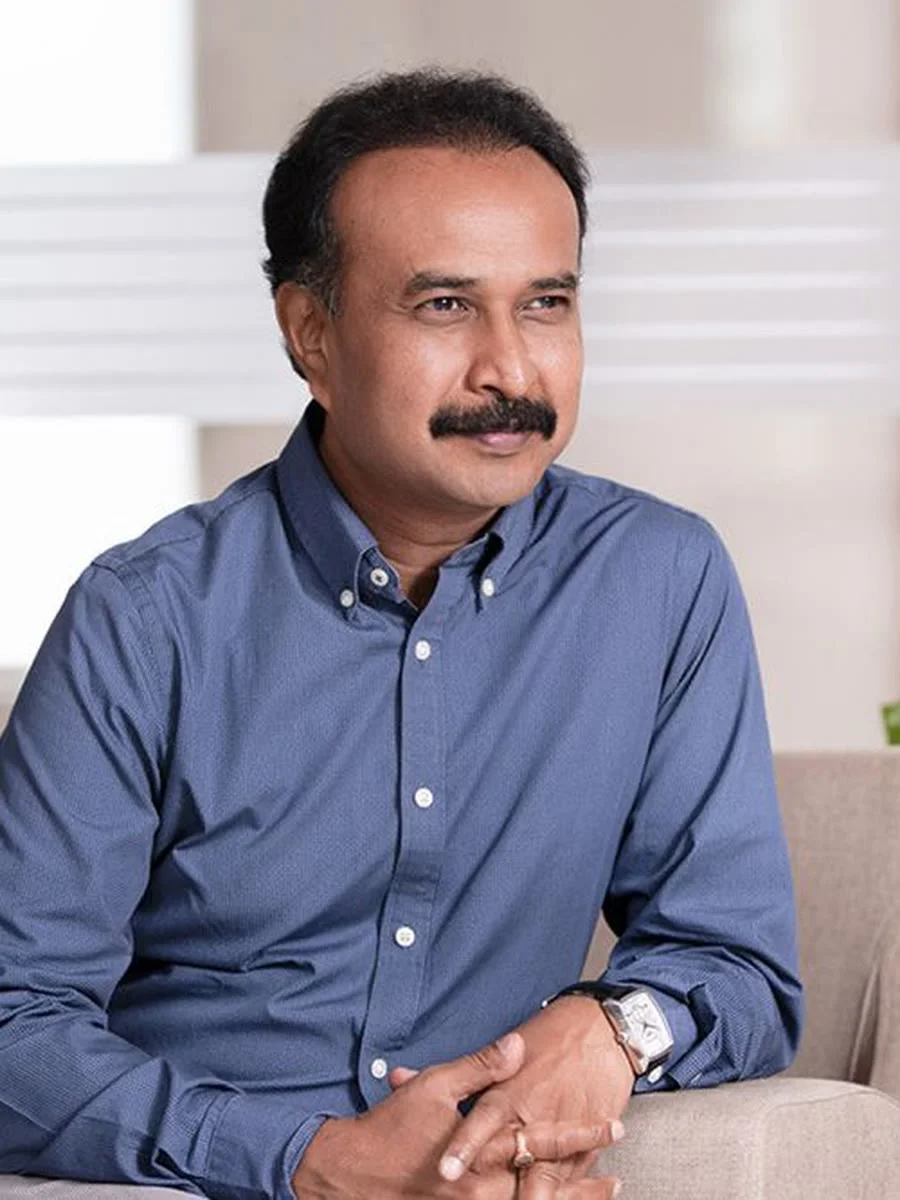
Prashanth Prakash
Co-founded Erasmic and helped build Accel's India franchise from Bengaluru.
The workshop, the computer, and the return to Bengaluru
Prashanth Prakash's investing biography begins with access as well as agency. Born in Bengaluru on 29 May 1965, he describes a middle-class immediate household embedded in older Bengaluru relationships and property, a grandfather trained in electrical engineering, an engineer father who moved from Hindustan Machine Tools and a small foundry side business into entrepreneurship, and a family nursery business that made environmental systems visible early. He also remembers access to an imported personal computer in the early 1980s, then expensive enough to be comparable to a car. These are retrospective family memories rather than independently verified genealogy or property history, but Prakash himself treats them as formative. [investor-stated · moderate] FCTC part 1, 12:29–35:47 · MyGov interview, 04:21–10:08
The less flattering part of the origin story is decision-relevant. Prakash says he was not a strong student or athlete, did well in history, and stayed engaged by building electronics and participating in science-club work. The point is not a hidden-prodigy fable: costly equipment, a technical parent, workshop exposure, family networks, and room to experiment were forms of inherited advantage. [investor-stated · strong] for his school and project recollection; [researcher inference · strong] for the access boundary. FCTC part 1, 21:17–33:43
He completed an undergraduate computer-science engineering degree in Bengaluru in 1988 and a master's in computer science at the University of Delaware in 1990. Public biographies differ between Bangalore University and Bangalore Institute of Technology, plausibly an affiliating-university versus college distinction, but no degree record was inspected. [retrospective witness · moderate] Padma citation, p. 1, para. 2 · Sikshana annual report 2010–11, pp. 33–34
From 1991 to 1995 he worked in Maryland on real-time simulation and interfaces used in nuclear-power-plant operator training. Accel calls the role software engineering; a later profile calls it a user-interface product role in defence technology; an institutional biography identifies S3 Technologies, a GSE Systems division, and GemCase. The stable fact is exposure to technically unforgiving systems and operator interfaces; the claim that this caused his later preference for user-centered founders is his retrospective interpretation, not contemporaneous proof. [investor-stated · moderate] Accel profile, “What was your first job?” · Sikshana annual report 2010–11, pp. 33–34 · Mint profile, career chronology
Returning to India was not a solitary leap. Prakash says the mid-1990s decision was made with his wife, Amita, and later calls her his first co-founder. He credits her with operational and financial discipline, income support, tolerance for travel, and absorbing household risk while they already had a child. That household capital and care work belongs inside the investment biography because it helped make two entrepreneurial experiments possible. [investor-stated · strong] Coffee with Ashwath, 12:13–17:24 · FCTC part 2, 02:42–07:17
Visual Reality and NetKraft: operating before judging operators
Prakash and Amita started Visual Reality in 1995 or 1996. His account describes training people in multimedia and building a creative studio in a market with little experienced talent. The legal entity, capitalization, customers, ownership, and disposition have not surfaced, and the date conflict remains open. [investor-stated · moderate] FCTC part 2, 02:42–04:16 · Fortune India, VisualReality passage · Padma citation, p. 1, para. 3
In 1997 or 1998, he co-founded NetKraft with Atul Jalan to provide internet and offshore solutions, especially in retail and healthcare. Erasmic's archived biography says Prakash set the company's vision and strategy, raised two venture rounds, and grew the business above 400 employees; a contemporaneous 2004 transaction report says roughly 350 employees, $8.5 million raised from named investors, and profitability in 2003–04. Those records support founder/CEO and fundraising experience while preserving the head-count discrepancy. [contemporaneous record · moderate] Erasmic founding-team ARC, “Prashanth Prakash” biography; captured 2008-07-20 00:48:55 UTC; crawl-001/2008/07/24/5/1216930139866_5.arc.gz, offset 98154511, length 5351 · exact index record · Rediff/PTI, transaction and company-background paragraphs, 10 June 2004
The ordinary and painful period matters more than the clean exit sentence. After the dot-com crash and the post-9/11 contraction, Prakash says NetKraft cut about 200 roles and shifted from dot-com projects toward enterprise internet work. That supports an operator memory of runway, customer relevance, and restructuring; it does not establish that later portfolio companies received or followed a documented stop rule. [investor-stated · moderate] Mint profile, paragraphs beginning “Then, the dotcom crash” · MyGov interview, 11:11–20:10
Adea Solutions bought NetKraft in an all-cash transaction in 2004, with price undisclosed. Prakash later says the sale returned investor capital, but no cap table, ownership, proceeds, timing, or realized multiple is public. The disciplined lesson is therefore downside empathy and adaptation, not a verified founder return. [contemporaneous record · strong] for buyer, form, financing, staffing, and profitability; [investor-stated · insufficient public record] for the capital-return claim. Rediff/PTI, 10 June 2004 · Mint profile, NetKraft exit paragraph
The operating chapter plausibly supplied three later sensitivities: user behavior matters beside technical merit; businesses must adapt when financing and demand change; and hands-on support can be worth more than a cheque. Only the first is directly linked by Prakash to his earlier work, while the latter two are reconstructed from chronology and later institutional practice. [investor-stated · moderate] for the user-needs link; [researcher inference · moderate] for the broader causal bridge. Accel profile, “What was your first job?” · Erasmic value-add ARC, heading “Our Value Add” and six list items; captured 2008-08-20 01:45:20 UTC; crawl-001/2008/08/22/12/1219398162270_12.arc.gz, offset 22089708, length 2851 · exact index record
Erasmic: creating the missing seed institution
Fundraising difficulty at NetKraft became part of Prakash's explanation for moving into investing. The sequence was incremental: he and Subrata Mitra first offered incubation or support for equity, then used friends' and high-net-worth capital in a five-deal investment club, then formed a roughly $10 million Erasmic vehicle with Mahendran Balachandran and Gagan Kumar. Contemporary reporting names N. S. Raghavan, Prakash Bhalerao, and Parag Saxena among early backers and describes Google's five-year LP commitment. The legal entities, individual allocations, GP economics, and IC rights remain unavailable. [retrospective witness · moderate] for the support-for-equity sequence; [contemporaneous record · strong] for the club, partners, and named capital. Business Today, 24 August 2008, paras. 100–107 · Economic Times, 19 February 2007 · Mint profile, Erasmic paragraphs
Erasmic's recovered 2008 pages describe a distinctive institutional design. The intended initial cheques were $100,000–$500,000 into four to six companies; candidates should usually have customer validation, differentiated technology or scarce knowledge, modest capital needs, a credible India revenue or delivery path, and a domain in which the partners could add more than money. The firm promised help with customers, hiring, technology, operations, finance, and later fundraising. [contemporaneous record · strong] for the published screen and service promise; [contemporaneous record · provisional] for its effectiveness. Overview ARC, heading and three paragraphs; captured 2008-08-20 01:46:30 UTC; crawl-001/2008/08/22/12/1219398191820_12.arc.gz, offset 24114836, length 2895 · Funding Philosophy ARC, heading and six paragraphs; captured 2008-08-20 01:45:54 UTC; crawl-001/2008/08/22/12/1219398162270_12.arc.gz, offset 41513780, length 2936 · Value Add ARC, heading and six list items; captured 2008-08-20 01:45:20 UTC; same ARC, offset 22089708, length 2851
This was a team architecture, not Prakash's solo method. Erasmic named four general partners with different operator, technology, sales, and management backgrounds. Its track-record page grouped Galvanon, Small Device Technologies, Mu Sigma, NuWare, and Pension Retirement Online but did not consistently distinguish fund investment, incubation, client work, personal capital, or advisory activity. Favorable intervention stories therefore establish institutional activity, not a Prakash-only or audited return record. [contemporaneous record · strong] for the published roster and category ambiguity; [researcher inference · strong] for the attribution limit. Founding Team ARC, “General Partners” and four biographies; captured 2008-07-20 00:48:55 UTC; crawl-001/2008/07/24/5/1216930139866_5.arc.gz, offset 98154511, length 5351 · Track Record ARC, five company entries; captured 2008-08-20 01:48:08 UTC; crawl-001/2008/08/22/11/1219399517504_11.arc.gz, offset 95423119, length 3829 · exact track-record index
The period strategy was also historically specific. In a market where Erasmic said larger funds preferred cheques above $2 million and Indian founders had limited institutional seed support, the team used India as customer market, operating base, or validation environment for cross-border businesses. It named strategic acquisition as an exit route. This is better read as a response to a 2004–08 capital and capability gap than as a timeless small-fund formula. [contemporaneous record · provisional] for Erasmic's unsourced market characterization; [researcher inference · strong] for the historical interpretation. Overview ARC, second paragraph; captured 2008-08-20 01:46:30 UTC; crawl-001/2008/08/22/12/1219398191820_12.arc.gz, offset 24114836, length 2895 · Indian Landscape ARC, three headings and bullet order; captured 2008-08-20 01:47:37 UTC; crawl-001/2008/08/22/11/1219399517504_11.arc.gz, offset 55599718, length 3518 · Investment Strategy ARC, second paragraph; captured 2008-07-20 00:49:03 UTC; crawl-001/2008/07/24/5/1216930166992_5.arc.gz, offset 4619965, length 2727 · Business Today, paras. 100–107
Accel India: from a concentrated seed craft to a scaled platform
In 2008 Erasmic combined with Accel. Contemporary reports describe a $60 million close, mostly institutional LPs, a planned 25–30-company portfolio, and retention of the four Erasmic partners; Accel later calls the vehicle $65 million. [contemporaneous record · strong] Business Standard, management paragraphs 88–95 · Mint, fund-close paragraphs 133–138 · Accel Flipkart account, paragraphs 10–16 The size distinction may reflect close or later convention, so the figures are not blended; the sources support an Accel-branded successor with a larger planned portfolio, not a complete reserve, governance, or follow-on-capacity design. [researcher inference · strong] Vehicle analysis
The visible vehicle sequence then expanded: India III officially closed at $155 million; India IV filed a $305 million offering before its first sale; India V filed a $430 million offering and was reported as a $450 million close; India VI filed $525 million sold while Accel announced $550 million; India VII and India VIII were each $650 million headline vehicles, with a separate entrepreneur sleeve around India VII. These numbers describe different legal and disclosure scopes, not an audited performance series. [contemporaneous record · strong] for the individual filings and announcements; [researcher inference · strong] for the non-comparability boundary. India III official close, headline and opening · India IV Form D, items 1, 3, 4, 7 and 13 · India V Form D, items 1, 3 and 13 · India V reported close, opening · India VI Form D, items 1 and 13–14 · India VI announcement, opening · India VII announcement, opening · India VII Entrepreneurs Form D, items 1 and 13–14 · India VIII Form D, items 1, 3 and 13–14 · vehicle boundary
Scaling changed the method. The early Erasmic proposal implied four to six high-touch companies; in 2024, Prakash separately reported actively managing roughly 15–18 companies across India and Southeast Asia. [investor-stated · moderate] Mint profile, paragraph beginning “No wonder it’s tough” Accel's meeting-to-term-sheet-and-final-agreement process was also reported to have expanded from roughly two to two-and-a-half months to three-to-four months amid governance concerns. [investor-stated · strong] Business Standard, quotation beginning “We do spend a lot more time” Fortune had earlier described more than 40 portfolio companies receiving follow-on investment and a 12–15 year firm-level horizon. [retrospective witness · moderate] Fortune India, paragraphs 211 and 216 Together those observations suggest a platform capable of patience but also a partner-capacity problem; no public workload, reserve, or intervention ledger shows how attention was allocated. [researcher inference · moderate]
The most famous firm outcome is also the clearest warning against transferred credit. Prakash says Accel was initially dismissive of Flipkart; analyst Abhishek Goyal's proximity created the information channel, Subrata Mitra was more involved and held the board seat, and Mahendran Balachandran helped with regulation. Accel's published history is written by Sameer Gandhi and Mitra and describes a team and multi-vehicle decision. Prakash participated in the evolving view, but the public record does not establish him as sole source, sponsor, governor, owner, or beneficiary. [investor-stated · strong] for the negative attribution; [researcher inference · strong] for rejecting lone-investor credit. FCTC part 2, 09:20–12:56 · Accel Flipkart history
Prakash's more specifically documented relationships include BlueStone, BookMyShow, Infra.Market, and RentoMojo. BlueStone records a board tenure beginning 26 October 2011; Accel's BookMyShow page names a 2012 Series A relationship; a SEBI-hosted offer document identifies him as Accel India V's Infra.Market nominee; and RentoMojo's DRHP names him a non-executive Accel nominee director from 4 December 2024 while an earlier announced tenure still needs reconciliation. [documented behavior · strong] BlueStone FY2024–25 annual report, printed pp. 14 and 120–123 · Accel BookMyShow page, “Series A · 2012” relationship card · Shalimar Paints offer document, sections 4.1.9–4.1.10 · RentoMojo DRHP, p. 235 and Board and Management section These establish named relationships and, for BlueStone, Infra.Market, and RentoMojo, specific governance roles; they do not establish the full sourcing-to-exit chain or a BookMyShow board role. [researcher inference · strong]
People, capital, and influence map
No inspected biography or direct-voice source identifies a formal investment mentor or a rival who demonstrably shaped Prakash's method. Those roles therefore remain unknown, rather than being inferred from chronology or reputation. [researcher inference · strong] identity, guiding-question, and name/date sweep
Formative and institutional influence
| person, capital source, or institution | supported contribution | attribution and economic boundary |
|---|---|---|
| Amita Prakash and the household | Co-founded Visual Reality operationally; shared the return-to-India decision; supplied financial discipline, income support, care work, and tolerance for entrepreneurial risk. [investor-stated · strong] FCTC part 2, 02:42–07:17 | Company ownership and later fund economics are unknown; household support is causal capacity, not an Accel investment decision. [researcher inference · strong] same direct account, 02:42–07:17 |
| Father, mother, grandfather, and family networks | Engineering/manufacturing model, protection, early electronics and computer access, nursery/environment exposure, Bengaluru relationships, and property. [investor-stated · moderate] FCTC part 1, 12:29–35:47 | Retrospective influence is not independent proof of causation; privilege and access are not themselves investing skill. [researcher inference · strong] FCTC part 1, 12:29–35:47 |
| Atul Jalan; NetKraft employees, customers, View Group, CDC Capital Partners, and Adea | Jalan co-founded NetKraft; employees executed the pivot; the named investors supplied reported venture capital; Adea bought the company. [contemporaneous record · strong] Rediff/PTI, transaction and company-background paragraphs | Individual operating decisions, ownership, seller allocations, and returns remain unknown; the company was not a one-person outcome. [researcher inference · strong] Rediff/PTI, undisclosed-price transaction report |
| Subrata Mitra, Mahendran Balachandran, and Gagan Kumar | Mitra co-created the Erasmic precursor; Balachandran and Kumar completed a four-partner team with distinct operating, technology, sales, and management backgrounds. [contemporaneous record · strong] Founding Team ARC, “General Partners”; captured 2008-07-20 00:48:55 UTC; crawl-001/2008/07/24/5/1216930139866_5.arc.gz, offset 98154511, length 5351 |
Individual allocations, IC votes, carry, and case ownership are unknown unless a case-specific source below narrows them. [researcher inference · strong] Business Standard, management paras. 88–95 |
| Accel global, India funds, Mauritius holders, LPs, and GPs | The 2008 combination attached the local team to Accel's name and later pooled vehicles; Forms D identify legal form, offering/sold amounts, investor counts, and related persons. [contemporaneous record · strong] Business Standard, management paras. 88–95 · India IV Form D, items 1, 3, 4, 7 and 13 · India VIII Form D, items 1, 3 and 13–14 | A related-person listing, fund holding, or vehicle sale does not disclose Prakash's vote, allocation, carry, or personal cash return. [researcher inference · strong] vehicle table |
| Sikshana, ACT, Karnataka/NSAC, IVCA, UnboxingBLR, IISc, and United Way coalitions | Public records document separate governance, policy, convening, philanthropic, academic, and lake-restoration relationships. [documented behavior · strong] Sikshana annual report, pp. 3–4 and 33–34 · ACT annual return, pp. 8–11 · PIB NSAC release, non-official-member list · IVCA release, pp. 1–2 · UnboxingBLR, “Our Journey” · IISc launch release, initial-grant passage · FCTC part 1, 42:30–45:06 | Their effect on problem access is plausible but unmeasured; civic participation is not fund sourcing, financial return, or a conflict by itself. [researcher inference · strong] bounded adverse/conflict sweep |
Material-case people and decision rights
| case and named people | source, sponsor, diligence, approval, negotiation | governance, recruiting, follow-on, exit | later narration and boundary |
|---|---|---|---|
| Flipkart — Sachin and Binny Bansal; Abhishek Goyal; Subrata Mitra; Mahendran Balachandran; Sameer Gandhi; Prakash | Goyal supplied the internal information channel; Prakash says Accel was initially dismissive and Mitra was more involved. Exact sponsor, diligence owner, IC votes, terms, and negotiation are unknown. [investor-stated · strong] FCTC part 2, 09:20–12:56 | Mitra held the board role in Prakash's account; Balachandran helped on regulation. Recruiting, follow-on authorization, and exit influence by Prakash are unknown. [investor-stated · strong] same account, 09:20–12:56 | Gandhi and Mitra authored Accel's later history; the public record rejects sole Prakash sourcing, governance, ownership, or return credit. [researcher inference · strong] Accel history, byline and complete account |
| QwikCilver — founders Kumar Sudarsan, TP Pratap, and Bhaskar Vasudevan; Mahendran Balachandran; Prakash | Balachandran and Prakash share attribution for the 2006 founder meeting. Exact source, sponsor, diligence owner, approval, terms, and negotiation remain unknown. [retrospective witness · moderate] Accel account, opening and “Finding founder-market fit,” paras. 5–14 | Board service, recruiting ownership, tranche/follow-on authority, and exit negotiation are unknown; Pine Labs confirms only the 2019 acquisition chronology. [researcher inference · strong] Pine Labs history, 2019 timeline | The exit-era Accel account is collective retrospective narration; no seller allocation or Prakash economics is public. [retrospective witness · moderate] Accel account, funding and acquisition passages |
| BlueStone — founder Gaurav Singh Kushwaha; Prakash; India III/VII entities | Prakash retrospectively narrates founder assessment and thesis; the original source, sponsor, diligence owner, IC approval, terms, and negotiation remain unknown. [investor-stated · moderate] Prakash essay, “Why we leaned in so early” | Prakash's board tenure begins 26 October 2011; individual recruiting, intervention, follow-on authorization, and exit decision rights are unknown. [documented behavior · strong] annual report, printed pp. 14 and 120–123 | Prakash authored the 2025 reflection; the prospectus establishes India III's OFS and retained shares, not personal return. [researcher inference · strong] prospectus, cover and PDF pp. 24–25 |
| MyGlamm/Good Glamm — founder Darpan Sanghvi; Anand Daniel; Rachit Parekh; Prakash | Daniel, Parekh, and Prakash jointly narrated the growth thesis. Source, sponsor, diligence, approval, acquisition-rights design, and negotiation by individual are unknown. [investor-stated · moderate] Accel essay, byline and paras. 1–12 | Available reporting identifies Daniel—not Prakash—as Accel's later board representative; individual recruiting, bridge/follow-on, resignation, asset-sale, and insolvency decisions remain unknown. [retrospective witness · moderate] Economic Times board report, opening and named-director paragraphs | The thesis is shared and the later distress is not Prakash-personal economics or responsibility. [researcher inference · strong] NCLT order, paras. 6–9, 15–28 and 38–45 |
| Freshworks — founder Girish Mathrubootham; Anand Daniel; Shekhar Kirani; Prakash | Prakash says Mathrubootham intersected with Daniel and Kirani and credits Kirani's enterprise background. Source, sponsor, diligence, IC approval, and negotiation beyond that account are unknown. [investor-stated · strong] Indian Silicon Valley, 04:13–05:46 | Board, recruiting, follow-on, and exit roles are unknown here; no personal-return claim follows. [researcher inference · strong] Accel Freshworks history, complete partner account | Prakash's account is evidence of team recognition, not personal deal ownership. [researcher inference · strong] Indian Silicon Valley, 04:13–05:46 |
| Infra.Market — founders Souvik Sengupta and Aaditya Sharda; Prakash | Accel's current page identifies the founders, Prakash, and the 2019 seed relationship. Exact source, sponsor, diligence owner, IC approval, terms, and negotiation are unknown. [documented behavior · strong] Accel relationship card, “Founders,” “Initial Investment,” and “Partners” | A filing documents Prakash as India V's nominee director; specific governance actions, recruiting, follow-on authorization, and exit influence are unknown. [documented behavior · strong] Shalimar Paints offer document, sections 4.1.9–4.1.10 | Prakash and Sengupta later discussed the operating model, but no complete deal postmortem or Prakash economics is public. [retrospective witness · moderate] SeedToScale, guest list and sections “On picking a product” through “A concrete solution” |
| BookMyShow — founders Ashish Hemrajani, Rajesh Balpande, and Parikshit Dar; Prakash | Accel's current page identifies the founders, Prakash, and the 2012 Series A relationship. Exact source, sponsor, diligence owner, IC approval, terms, and negotiation are unknown. [documented behavior · strong] Accel relationship card, “Founders,” “Initial Investment,” and “Partners” | Board and recruiting roles are unknown; a 2017 company release identifies Accel only as an existing investor, while follow-on authorization, exit influence, and liquidity remain unknown. [contemporaneous record · moderate] BookMyShow release, opening and transaction paragraphs | Prakash supplies a later existing-investor quotation, not a complete deal narrative or personal return. [investor-stated · moderate] BookMyShow release, Prakash quotation |
| RentoMojo — founder Geetansh Bamania; Prakash | Accel's current page identifies Bamania, Prakash, and the 2015 seed relationship. Exact source, sponsor, diligence owner, IC approval, terms, and negotiation are unknown. [documented behavior · strong] Accel relationship card, “Founders,” “Initial Investment,” and “Partners” | The DRHP names Prakash as an Accel nominee director from 4 December 2024; earlier tenure, specific governance actions, recruiting, follow-on authorization, and exit influence are unknown. [documented behavior · strong] RentoMojo DRHP, p. 235 and Board and Management | No complete Prakash deal narration or personal economics is public. [researcher inference · insufficient public record] Accel relationship card |
| BabyOye, UrbanTouch, and Deep Rooted failure controls | A BabyOye founder account credits Prakash with operating help; UrbanTouch supplies only a vehicle record plus provisional DIN association; Deep Rooted has a provisional commercial-registry nominee lead. Source, sponsorship, diligence, approval, negotiation, and loss allocation remain unknown. [retrospective witness · provisional] BabyOye founder account, operating-help passages · UrbanTouch tribunal, paras. 6–7 · Deep Rooted registry lead | Board votes, recruiting, follow-on authority, stop decisions, recovery, and Prakash's role are unknown except for the bounded leads stated at left. [researcher inference · strong] failure postmortems | Later outcomes are controls against winner-only narration, not proof that Prakash caused or personally bore each result. [researcher inference · strong] BabyOye outcome · Deep Rooted shutdown report |
A falsifiable thesis of the edge
Proposed edge. Prakash's repeatable advantage, if it exists, is an operator-and-network-assisted ability to identify an India-specific customer or coordination bottleneck early, match it with a founder who learns the system deeply, and use patient institutional capital plus operating help to turn that bottleneck into a scalable company. The mechanism is not generic “good judgment”: local problem access narrows the search; operating experience improves questions about customer use and organizational adaptation; a prepared thematic map speeds recognition; complementary partners supply missing expertise; and a long-duration vehicle funds staged capability building. The proposed domain is Indian seed and early-stage consumer, marketplace, SaaS, and physical-system companies from the mid-2000s through the mid-2020s. [researcher inference · moderate] Accel profile, “What was your first job?” · FCTC part 2, experience, networks, and team attribution, 22:46–31:03 · Funding Philosophy ARC, six criteria; captured 2008-08-20 01:45:54 UTC; crawl-001/2008/08/22/12/1219398162270_12.arc.gz, offset 41513780, length 2936 · Fortune India, follow-on and horizon paras. 211 and 216 · cross-source synthesis
This thesis is deliberately narrower than reputation. The public record supports the institutional method and several relationships, but it does not yet prove superior personal selection or realized performance. Prakash says experience matters more than gut, describes networks as material to access and reference comfort, and credits team members on central deals. Those admissions make access, accumulated pattern recognition, and team architecture part of the mechanism—not nuisance variables to be ignored. [investor-stated · strong] FCTC part 2, 22:46–31:03
Case test, including the record without BlueStone
| test class | observed case evidence | implication for the proposed edge |
|---|---|---|
| Support: QwikCilver | A 2006 meeting preceded a small seed relationship in an initially tiny stored-value category; Mahendran Balachandran and Prakash share partner attribution, and the company was later acquired by Pine Labs. The narrative was published at exit and lacks full economics. [retrospective witness · moderate] QwikCilver account | Consistent with category preparation and patient support, but equally consistent with founder execution, shared partner work, and retrospective winner selection. [researcher inference · moderate] |
| Support: BlueStone | A 2011 relationship, documented board tenure, trust-building product/operating changes, patient financing, and public listing fit the bottleneck-plus-capability story. India III sold 2,603,915 IPO shares at ₹517 and retained 13,540,055 shares, but lot-level economics and Prakash's share are absent. [documented behavior · strong] BlueStone prospectus, cover and pp. 24–25 · Prakash reflection | Strongest public case for long-duration governance and partial vehicle liquidity, but one visible outlier cannot establish repeatability. [researcher inference · strong] |
| Support, without BlueStone: Infra.Market and BookMyShow | Official records show a 2019 seed relationship and Prakash nominee role for Infra.Market, plus a 2012 BookMyShow Series A relationship and later existing-investor participation. Original memos, ownership, full governance chains, and realized cash are absent. [documented behavior · strong] Infra.Market page · Shalimar Paints offer document, sections 4.1.9–4.1.10 · BookMyShow release, opening and transaction paragraphs | Shows repeated presence in India-specific physical and consumer systems, but not selection alpha or return contribution. [researcher inference · strong] |
| Ordinary control: Teabox | The company pursued global tea disintermediation, raised later rounds, and was reported in FY24 as a small active profitable business; no proceeds or Prakash-specific intervention is public. [retrospective witness · provisional] Teabox archive · financial report | A plausible local-bottleneck thesis can produce a durable but non-outlier company, which is compatible with the edge but does not prove venture-scale economics. [researcher inference · moderate] |
| Ordinary/weak control: FabHotels | A managed-hotel network raised successive rounds; a government table records India IV capital; FY24 reporting showed scaled revenue and a significant loss, with no exit or case-specific lesson. [retrospective witness · moderate] DPIIT table · FY24 report | Scaling a fragmented system does not guarantee operating leverage or liquidity. [researcher inference · strong] |
| Failure: BabyOye and UrbanTouch | Specialist e-commerce received capital and operating support, yet BabyOye was later reported as a likely major write-off; a reproduced UrbanTouch tribunal record implies about 0.596x sale consideration divided by cited investment for the vehicle, before fees, taxes, timing, and unobserved distributions. [retrospective witness · moderate] BabyOye outcome · [contemporaneous record · moderate] UrbanTouch reproduced tribunal record, paragraphs 6–7, PDF pp. 6–7 | The same local-specialist logic can become inventory, logistics, acquisition-cost, and financing risk; the public record shows no portfolio-wide stop discipline. [researcher inference · strong] |
| Failure: Deep Rooted and MyGlamm/Good Glamm | Deep Rooted moved from greenhouses toward a more capital-intensive brand/logistics model and was later reported to stop operations after a follow-on. [retrospective witness · moderate] 2021 pivot and capital-intensity account · 2022 follow-on, opening and financing paragraphs · reported shutdown Good Glamm's content-to-commerce roll-up later entered lender-driven insolvency [contemporaneous record · strong] NCLT order, paras. 6–9, 15–28 and 38–45; available reporting points to Anand Daniel rather than Prakash for Accel's later board role [retrospective witness · moderate] board report, named-director paragraphs | “Understand the bottleneck” is insufficient without working-capital, integration, governance, and loss-budget gates; team attribution remains essential. [researcher inference · strong] |
| Miss/control: Policybazaar and Nykaa | Prakash says a Coverfox conflict contributed to missing the first online-insurance wave and identifies Nykaa as a repeated-look miss, but no IC records or counterfactual stakes exist. [investor-stated · moderate] Bengaluru-vs-Mumbai note, 19:35–20:38 · FCTC part 2, 50:41–52:16 | Access, conflicts, fit preferences, and judgment can exclude major winners; a favorable portfolio alone cannot reveal the opportunity cost. [researcher inference · strong] |
The named research union contains 52 opportunity groups, all searched and described, but zero are reconstructed end to end from original memo through security, ownership, follow-ons, governance, cash exit, and Prakash economics. The Padma citation says more than 50 investments and more than 30 boards without a roster; the current Accel graph has 28 mutable relationships; Erasmic's reported 15 investments are incompletely named. A career hit rate or coverage fraction is therefore not computable. [researcher inference · strong] Padma citation, pp. 1–2 · Accel profile, “Companies” relationship-card grid; interface supplies no stable card anchors · Business Today, Erasmic count, paras. 100–107 · denominator reconciliation
BlueStone subtraction test. Removing BlueStone eliminates the largest public Prakash-linked vehicle-cash observation. UrbanTouch then becomes the only provisionally associated case with public vehicle cost and sale consideration, while QwikCilver, Deeksha, and HealthcareMagic reveal transaction scale without seller allocation. The remaining record still supports institution building and repeated thematic presence, but it cannot establish personal economic outperformance. [researcher inference · strong] BlueStone prospectus, cover and PDF pp. 24–25 · UrbanTouch tribunal, paras. 6–7 and reproduced PDF pp. 6–7 · UrbanTouch DIN association lead · QwikCilver reported acquisition, opening · HealthcareMagic acquisition, 2014 Form 10-K Note 4 · economic ranking
Predictions and falsifiers
If the edge thesis is true, unseen or newly disclosed Prakash-linked cases should show, before the outcome: (1) an India-specific customer or coordination bottleneck stated more precisely than a sector label; (2) founder learning or domain depth documented during diligence; (3) a named responsible partner and complementary team roles; (4) staged capital linked to customer, unit-economics, operating, or technology milestones; and (5) governance interventions consistent with those ex-ante risks. Those predictions are [researcher inference · moderate] because they operationalize public principles rather than reproduce a disclosed Prakash checklist. Funding Philosophy ARC, first through sixth criteria; captured 2008-08-20 01:45:54 UTC; crawl-001/2008/08/22/12/1219398162270_12.arc.gz, offset 41513780, length 2936 · prepared-mind account, 01:02–03:43 · longer-diligence quotation, paragraph beginning “We do spend a lot more time” · historical operating rules
The thesis would weaken if private memos show mainly relationship- or brand-driven access without bottleneck analysis; if matched out-of-network founders received systematically worse access despite equivalent evidence; if partner attribution places the central work elsewhere; if follow-ons were not milestone-gated; or if a complete cash-flow denominator shows no advantage over comparable India early-stage vehicles. It would be overturned as a personal performance thesis if Prakash-linked results are fully explained by one outlier, market beta, shared Accel ownership, or survivorship-selected public narratives. [researcher inference · strong] Padma citation, undefined career totals, pp. 1–2 · Prakash's Flipkart team attribution, 09:20–12:56 · BlueStone prospectus, India III sale and retained shares, cover and pp. 24–25 · India IV Form D, related persons and offering fields, items 3, 7 and 13 · denominator
What belongs to skill—and what may belong elsewhere
| possible return driver | evidence | disciplined assessment |
|---|---|---|
| Skill and learned judgment | Operator history, user-needs language, repeated founder/domain heuristics, category preparation, and explicit recognition of earlier mistakes. [investor-stated · moderate] Accel profile, “What was your first job?” · prepared theses and founder recognition, 01:02–05:46 · 2025 climate-tech underdelivery, opening and closing quotations | Plausible and decision-relevant, but predictive efficacy is unmeasured because there is no rejected-deal or matched-founder denominator. [researcher inference · moderate] candidate denominator |
| Access and privilege | Family resources, early computer/workshop exposure, and Bengaluru relationships are [investor-stated · strong] FCTC part 1, 12:29–35:47; Prakash says networks affect references and comfort [investor-stated · strong] FCTC part 2, 29:29–31:03; policy and civic networks are separately [documented behavior · strong] PIB NSAC release, non-official-member list · ACT annual return, pp. 8–11 | These are genuine access advantages, but not necessarily repeatable by analysts without the same social and institutional position; they may also create selection bias. [researcher inference · strong] |
| Team contribution | Erasmic's four partners, Goyal's Flipkart advocacy, Mitra's board work, Balachandran's regulatory help, and named later-partner roles. [documented behavior · strong] Founding Team ARC, “General Partners”; captured 2008-07-20 00:48:55 UTC; crawl-001/2008/07/24/5/1216930139866_5.arc.gz, offset 98154511, length 5351 · Flipkart attribution, 09:20–12:56 · Freshworks partner account, 04:13–05:46 |
Central, not residual: the public record is incompatible with a lone-picker theory. [researcher inference · strong] case-specific people map |
| Vehicle design | Small early cheques, a reported firm-level 12–15 year horizon, and more than 40 reported follow-on companies. [retrospective witness · moderate] Fortune India, paragraphs 211 and 216 | Patient capital can turn slow learning into company survival, but larger funds introduce deployment, attention, ownership, and exit pressure that is not publicly measured. [researcher inference · moderate] Vehicle boundaries |
| Market regime and geography | India moved through scarce seed capital, mobile/data expansion, India Stack, deeper domestic demand, more founders, public listings, and global supply-chain shifts. [researcher inference · strong] Business Today, early-capital context, paras. 100–107 · Golden Age, opening through four themes · India Stack panel, 00:03–20:13 · Advanced Manufacturing report, definition and qualifying framework | A structural tailwind can reward the right presence without proving security selection; lessons transfer only where comparable capital and customer gaps exist. [researcher inference · strong] historical context |
| Luck and one-outlier effects | Prakash recalls his father emphasizing being in the right place at the right time; BlueStone dominates observable linked cash evidence; the career denominator is unavailable. [investor-stated · moderate] for the luck recollection; [researcher inference · strong] for the concentration risk. FCTC part 1, 31:33–33:43 · BlueStone prospectus, India III OFS and retained shares, cover and pp. 24–25 · Padma citation, undefined career totals, pp. 1–2 | Luck cannot be quantified away; a private cash-flow ledger and matched cohort are needed to distinguish timing from persistent edge. [researcher inference · strong] economic ranking |
Evolution, ordinary periods, failures, and criticism
The public philosophy did not move in a straight line. In 2008 the Erasmic voice emphasized modest capital, early validation, cross-border delivery, and strategic acquisition. By 2012 Prakash could forecast internet-scale outcomes while also pausing new e-commerce funding amid adoption and capital uncertainty. In 2015–18, firm reporting surfaced weak or consolidated consumer bets and an exit bottleneck; Fortune warned that apparent exits could be stock or notional rather than distributable cash. [researcher inference · strong] Funding Philosophy ARC, six criteria; captured 2008-08-20 01:45:54 UTC; crawl-001/2008/08/22/12/1219398162270_12.arc.gz, offset 41513780, length 2936 · Investment Strategy ARC, second paragraph; captured 2008-07-20 00:49:03 UTC; crawl-001/2008/07/24/5/1216930166992_5.arc.gz, offset 4619965, length 2727 · 2012 internet forecast, complete interview · 2012 e-commerce pause, reproduced quotation · Fortune India, liquidity and downside paras. 212–216 and 237–244
The 2020–21 record became more thematic and optimistic: local consumption, fragmented supply chains, consumer brands, agritech, climate, and emerging technology. [researcher inference · strong] Golden Age, opening through four themes · Captain Fresh, opening through supply-demand matrix · 2021 climate and exit-capacity answer blocks
By 2024–25, the public vocabulary had shifted toward profitability, longer diligence, staged omnichannel rollout, and a narrower advanced-manufacturing screen around owned IP or integration, technology readiness, pilots, and global relevance. That dated shift is [researcher inference · strong], not proof of an internal process change or better outcomes. Business Standard, diligence quotation beginning “We do spend a lot more time” · Omnichannel report, framework and case studies · Advanced Manufacturing report, definition and qualifying framework
Prakash directly said Indian climate technology had not lived up to potential. [investor-stated · strong] Mint, rather than Prakash, grouped sustainability, agritech, and EV among other underdelivering Accel theses. [retrospective witness · moderate] These are evidence of reassessment, not proof the newer screen fixes earlier errors. [researcher inference · strong] Mint reassessment, opening and closing quotations
Several tensions remain productive rather than resolved. Prakash values prepared intuition yet reports substantially longer diligence after governance failures. He favors capital efficiency yet expects manufacturing rounds large enough to compress gestation. He celebrates founder resilience, while Good Glamm shows that pivots and roll-ups can deepen integration and solvency risk. He advocates hands-on mentoring, but public evidence does not show intervention capacity, dissent, replacement, or stop decisions across failed cases. [researcher inference · strong] prepared theses, 01:02–03:43 · longer-diligence quotation · manufacturing capital and gestation answer · MyGlamm thesis, founder and pivot paras. 5–12 · Good Glamm NCLT order, paras. 6–9, 15–28 and 38–45 · failure postmortems
The strongest skeptical case is therefore simple: Prakash was well placed in Bengaluru as India venture capital professionalized; Accel supplied brand, capital, follow-ons, and shared expertise; public narratives select winners and later themes; BlueStone dominates observable linked cash evidence; and the private denominator, partner allocation, and personal economics are missing. On this view, institution building and civic influence are real achievements, but superior repeatable investing skill is unproved. [researcher inference · strong] Business Today, local platform and capital formation, paras. 100–107 · Fortune India, follow-ons, horizon, and liquidity limits, paras. 211–216 · BlueStone prospectus, India III OFS and retained shares, cover and pp. 24–25 · Padma citation, undefined career totals, pp. 1–2 · portfolio forensics
The favorable reply is narrower than hero worship. Prakash helped construct an early seed institution when both capital and operating help were scarce, retained a documented long-duration governance relationship at BlueStone, participated in several category-creating or locally specific companies, and publicly supplied unusually explicit team and miss admissions. That makes his record useful as a decision curriculum even before it becomes a verified performance table. [researcher inference · moderate] Business Today, Erasmic formation, paras. 100–107 · BlueStone annual report, board tenure and attendance, printed pp. 14 and 120–123 · Flipkart team attribution, 09:20–12:56 · Nykaa miss, 50:41–52:16 · investments bottom line
Adverse-record searches also require proportion. In the Discovery Village matter, a reproduced National Green Tribunal judgment found the projected regulatory and environmental violations not made out and dismissed O.A. No. 49 of 2023; the Supreme Court then found no reason to interfere and dismissed Civil Appeal No. 5732 of 2025. [contemporaneous record · moderate] for the NGT reproduction; [contemporaneous record · strong] for the official Supreme Court disposition. NGT judgment reproduction, paras. 19–22, pp. 7–8 · Supreme Court signed order, p. 1 Allegations are not findings, and dismissal does not prove that every operating fact was independently audited; neither disposition proves investment skill. [researcher inference · strong]
Beyond the fund: civic systems without category errors
Public records separately establish a 2010–11 Sikshana governance role, ACT Capital Foundation director/promoter-member status, nomination to the National Startup Advisory Council, an IVCA co-chair role, UnboxingBLR co-foundership, and IISc Longevity India grant support; Prakash's own account describes United Way lake work. [documented behavior · strong] Sikshana annual report 2010–11, pp. 3–4 and 33–34 · ACT annual return, pp. 8–11 · PIB NSAC release, non-official-member list · IVCA release, pp. 1–2 · UnboxingBLR, “Our Journey” · IISc launch release, initial-grant passage · FCTC part 1, 42:30–45:06 Read together, these roles show a later career widening from companies toward civic and ecosystem infrastructure; whether that produced investment advantage is unmeasured. [researcher inference · moderate] ACT's pandemic model used broad sourcing, specialist tracks, a collective IC, fast grants, and reallocation, while his civic account describes bounded prototypes, public adoption, local ownership, and an initiator exit. [investor-stated · moderate] ACT Grants interview, answers under “How was ACT Grants formed?” and “How does ACT Grants function?” · FCTC part 1, 42:30–58:07
These activities plausibly deepen problem access, expert networks, and institutional knowledge, but that is not the same as Accel deal sourcing. Private prototypes that seek government scale also raise questions about agenda setting, procurement, disclosure, maintenance, distribution, and recusal. The specific public materials inspected here—the Karnataka task-force report, PIB NSAC appointment notice, ACT annual return, and named civic-institution pages—did not state a general cross-role conflict, procurement, disclosure, or recusal framework for Prakash. That is a bounded retrieval result, not proof that no policy exists; the disciplined conclusion is an unanswered governance boundary, not an allegation. [researcher inference · strong] Karnataka task-force report, mandate and recommendations · PIB NSAC release, non-official-member list · ACT annual return, pp. 8–11 · bounded criticism, litigation, misses, and conflict sweep
This civic chapter also illuminates a durable personal preference: systems should be transferred to communities or institutions rather than remain attached to an individual. That is consistent with his repeated collective-credit language, but it should not be used to excuse opaque attribution. Being behind the scenes can distribute ownership; it can also obscure who set priorities and who is accountable when outcomes fail. [investor-stated · strong] for the stated norm; [researcher inference · strong] for the accountability boundary. FCTC part 1, 1:06:28–1:12:42
Sourced chronology
| date | event | evidence and interpretation boundary |
|---|---|---|
| 29 May 1965 | Born in Bengaluru. | Official award narrative, not a birth record. [retrospective witness · moderate] Padma citation, p. 1, para. 1 |
| 1980s | Electronics projects and early family-computer access; undergraduate computer-science study in Bengaluru. | Direct retrospective memory plus institution biographies; privilege and causation kept explicit. [investor-stated · moderate] FCTC part 1, 21:17–31:33 |
| 1988–1990 | Undergraduate degree, then University of Delaware master's. | Bangalore University/BIT naming remains unresolved. [retrospective witness · moderate] Sikshana annual report, pp. 33–34 |
| 1991–1995 | Maryland simulation/interface work for nuclear-operator training systems. | Employer and role labels vary; user-needs influence is retrospective. [investor-stated · moderate] Accel profile, “What was your first job?” · Sikshana annual report, pp. 33–34 |
| 1995–1996 | Return to Bengaluru with Amita; Visual Reality founded. | Amita's co-founder/household role is direct testimony; formation date and entity remain unresolved. [investor-stated · strong] FCTC part 2, 02:42–07:17 |
| 1997–1998 | NetKraft co-founded with Atul Jalan. | Year differs across retrospective sources. [retrospective witness · moderate] Fortune India, Prakash/VisualReality/NetKraft passages · Mint, paragraph beginning “His first real startup” |
| 2000–2001 | Dot-com/post-9/11 contraction, about 200 job cuts, enterprise pivot. | Direct retrospective account; board and payroll records unavailable. [investor-stated · moderate] Mint, paragraphs beginning “Then, the dotcom crash” and “We were able” |
| 2004 | Adea bought NetKraft in an undisclosed all-cash transaction. | Transaction is contemporaneous; claimed investor-capital return is unverified. [contemporaneous record · strong] Rediff/PTI, transaction and company-background paragraphs, 10 June 2004 |
| 2004–2007 | Support-for-equity precursor, five-deal club, then approximately $10 million Erasmic vehicle with Mitra, Balachandran, and Kumar. | Entity, allocation, IC, and carry details unavailable. [contemporaneous record · strong] Business Today, paras. 100–107 · Economic Times, Google LP commitment report, 19 February 2007 |
| 2008 | Erasmic combined with Accel; $60 million contemporary close / $65 million later wording. | Scope difference preserved. [contemporaneous record · strong] Business Standard, management paras. 88–95 · Mint, fund-close paras. 133–138 · Accel Flipkart history, paras. 10–16 |
| 2008–2012 | Accel platform expansion, debated Flipkart decision, QwikCilver and other early-category work; BlueStone relationship begins in 2011. | Team allocation remains explicit; BlueStone board appointment is documented. [documented behavior · strong] FCTC part 2, Flipkart account, 09:20–12:56 · QwikCilver account, opening and “Finding founder-market fit” · BlueStone annual report, printed pp. 14 and 120–123 |
| 2014–2018 | India vehicles scaled; public firm reviews showed wins, weak/consolidated bets, and an exit bottleneck. | Related-person filings and firm outcomes do not prove Prakash authority or return. [researcher inference · strong] India IV Form D, items 1, 3, 4, 7 and 13 · Fortune India, liquidity and downside paras. 212–216 and 237–244 |
| 2020–2021 | Public thesis broadens across local consumption, supply chains, agritech/climate, ACT Grants, and ecosystem liquidity. | The breadth is a direct/joint public position [investor-stated · moderate] Golden Age, opening through four themes · 2021 climate and exit-capacity answer blocks · ACT Grants interview, formation and operating-model answers; the forecasts are not outcome evidence. [researcher inference · strong] |
| 2022–2024 | Unboxing Bengaluru, more policy/civic roles, profitability and governance reset, omnichannel and manufacturing focus. | Authorship, institutional roles, and the dated public positions are [documented behavior · strong] Penguin, product description and author biographies · Business Standard, diligence quotation beginning “We do spend a lot more time” · Omnichannel report, framework and case studies · 2024 manufacturing op-ed, paras. 320–369; grouping them as a reset and transferring them to fund practice remain [researcher inference · moderate]. |
| 2025 | Padma Shri; BlueStone IPO; Prakash acknowledges climate-tech underdelivery and sharpens manufacturing criteria. | Award and listing are [contemporaneous record · strong] Padma citation, pp. 1–2 · BlueStone prospectus, cover and PDF pp. 24–25; the underdelivery admission is [investor-stated · strong] Mint reassessment, opening and closing quotations; the newer screen is public but its efficacy remains [researcher inference · provisional] Advanced Manufacturing report, definition and qualifying framework. |
| 2026 snapshot | Accel profile maps 28 current relationships; public activity emphasizes IP-led engineering, manufacturing, AI applications, longevity, profitability, and ecosystem institutions. | The relationship grid and named current activities are [contemporaneous record · moderate] Accel profile, “Companies” relationship-card grid; interface supplies no stable card anchors · Deccan Herald, founder-focus answer · IISc launch release, initial-grant passage; the mutable graph is not a career denominator and newer themes lack mature outcome evidence. [researcher inference · strong] source-map coverage |
Continue through the evidence
Use the biography as the spine, then read the package in this order:
- Written corpus for the 2008 Erasmic doctrine, later thematic work, intellectual chronology, and contradictions.
- Talks corpus for direct voice, role attribution, dated changes, and the strongest negative admissions.
- Investment record and decision labs for the 52-group denominator, vehicle boundaries, six no-hindsight exercises, ordinary cases, and failures. Start with QwikCilver, BlueStone, and the failure control UrbanTouch.
- Investment philosophy for the integrated operating system, vehicle and governance implications, skeptical case, and modern transfer tests.
- Mental models for decision-ready rules, case applications, exception ledgers, and falsifiers.
- Source map for the 220-record evidence denominator, access boundaries, archive routes, and unresolved primary records.
1. Snapshot and testable edge thesis
| question | evidence-backed answer |
|---|---|
| Who, firms, and era | Prashanth Prakash is a Bengaluru operator-turned-investor whose relevant vehicles run from a 2004 investment club through the roughly $10 million Erasmic fund, the 2008 Accel India combination, and later Accel India vehicles. He also holds civic and philanthropic roles that must remain economically separate from Accel. [contemporaneous record · strong] Business Today, paras. 100–107 · vehicle ledger |
| Proposed edge | The narrow, testable thesis is that Prakash helped build an India-specific early-stage system that combines a prepared view of structural change with unusually local customer and operating knowledge, then uses patient team capital and hands-on support to turn hard coordination problems into scalable companies. [researcher inference · moderate] This is a reconstructed system, not a Prakash-authored formula. Profile edge thesis · recurring spoken frameworks |
| Mechanism | A dated theme map should improve recognition; reachable customers and founder-earned domain knowledge should reduce early ambiguity; staged evidence should limit financing mistakes; operating and governance help should close capability gaps; and a larger platform should preserve optionality through follow-ons. [researcher inference · moderate] The public record supports each link unevenly and does not show the complete causal chain for an audited cohort. Historical operating rules · portfolio-level controls |
| Scope | The thesis best fits seed and early-stage Indian companies from the mid-2000s onward where customer access, trust, fragmented supply, local regulation, or physical execution is the bottleneck. [researcher inference · moderate] It is least defensible as a general claim about late-stage price setting, public-market timing, frontier-model economics, personal return skill, or any company merely associated with Accel. Historical context · attribution controls |
| Supporting cases | QwikCilver supplies category-education evidence, BlueStone supplies a long governance and partial-liquidity record, Captain Fresh supplies a year-long founder/domain-learning account, and Infra.Market supplies a locally specific coordination thesis. [researcher inference · moderate] Each is team- or vehicle-mediated; only BlueStone offers directly observable Prakash-linked board tenure and vehicle proceeds. Decision labs · economic contribution ranking |
| Disconfirming cases | BabyOye and UrbanTouch show that category logic does not solve commerce economics; Good Glamm shows that founder resilience and content distribution do not solve integration, leverage, or governance; Teabox is an ordinary-outcome control; and the climate-tech underdelivery admission weakens theme-selection confidence. [researcher inference · strong] Failure postmortems · 2025 reassessment |
| Predicted evidence | If the edge is real, unseen dated files should show a precise India-specific bottleneck before the outcome, founder learning demonstrated during diligence, named partner and team roles, capital tied to falsifiable milestones, and governance actions consistent with the ex-ante risks. [researcher inference · moderate] Profile predictions |
| Falsifiers | The thesis weakens if original memos are mainly sector fashion or relationship access; if partner records put the work elsewhere; if follow-ons were not milestone-gated; if interventions did not change operating evidence; or if a full cash-flow ledger shows ordinary outcomes no better than dimension-matched India funds. It fails as a personal performance thesis if results are explained by one outlier, shared Accel ownership, market beta, or survivorship-selected narratives. [researcher inference · strong] 52-case denominator · material-case role matrix |
The present verdict is therefore deliberately asymmetric: the record strongly supports institution building, a repeatable vocabulary for looking, and several documented operating relationships; it provides only moderate support for a repeatable Prakash-specific selection edge and insufficient public record for person-level returns. [researcher inference · strong] Portfolio bottom line
2. Core philosophy
Prakash's direct voice begins with preparation rather than prediction. In 2023 he urged investors to pursue new ideas rather than the “flavour of the season,” while describing a prepared mind as the condition for recognizing them. [investor-stated · strong] Mint interview note His 2020 joint interview describes instinct as conditioning by accumulated experience, not a license to ignore evidence. [investor-stated · moderate] Instinct and intuition note
The clearest opportunity sequence is operational. Start with an unmet need; identify a customer the company can reach predictably; bound the initial market; test the wedge; then ask whether adjacent demand can make the company venture-scale. [investor-stated · moderate] Markets & Opportunities note Erasmic's captured 2008 philosophy independently required customer validation, differentiated delivery, comparatively low capital needs, a credible India revenue path, a domain in which the team could help, and working compatibility. [contemporaneous record · strong] archived Funding Philosophy
Treating the founder as a learning system rather than a résumé is a reconstructed rule. [researcher inference · strong] Founder-learning model Captain Fresh's joint investment essay emphasizes domain obsession and the founder's ability to teach the investors about a fragmented supply chain; the BlueStone IPO reflection emphasizes curiosity, local category understanding, endurance, and willingness to change the model. [investor-stated · moderate] Captain Fresh essay · BlueStone reflection Because these are interested, selected accounts, they do not establish comparative predictive power. [researcher inference · strong]
Capital is a means of buying verified progress. The early record favors customer proof, cash conservation, and a plausible sustaining-revenue path; later interviews require a visible first-rupee profit mechanism and financing instruments matched to the business. [investor-stated · strong] 2008 business-plans note · profit mechanism, 19:35–20:38 · venture-debt continuum The reconstructed rule is not “never burn”; it is to specify what evidence each unit of capital must purchase and what result stops the next unit. [researcher inference · strong] Capital-efficiency model
The operating philosophy is collective and bounded. Prakash's current Accel profile explicitly prefers collective credit, the Erasmic pages advertise a four-partner operating service, and multiple cases name other partners as sponsors or governors. [investor-stated · strong] for the norm; [documented behavior · strong] for shared work. Accel profile · Erasmic founding-team archive Mentoring is supposed to be permissioned, but Prakash also reports a 15–18-company active load and limited unilateral board power. [investor-stated · moderate] Master Mentor note
Synthesized as a decision system, the philosophy is: prepare a falsifiable map; enter through a specific reachable customer or coordination bottleneck; select founders who can teach and update; fund evidence rather than narrative; standardize only the binding layer; match capital and governance to the milestone; distribute work across named people; and distinguish paper value from cash. [researcher inference · strong] This synthesis should be used as a checklist to test Prakash's record, not quoted as his own words. Mental-model field guide · deal forensics
3. Sourcing
How opportunities entered the funnel
- Operator and founder networks. Prakash and Subrata Mitra first used friends, industry angels, HNIs, and experience from five early IT deals to form Erasmic. [contemporaneous record · strong] Business Today, paras. 100–105 This is access evidence, not proof that network-sourced deals were better. [researcher inference · strong]
- Prepared thematic search. The record moves from 2008 cross-border services and consumer/mobile opportunity to supply chains, agritech, brands, climate, advanced manufacturing, applications of AI, and longevity. [investor-stated · moderate] Written chronology Theme lists define where to look; they do not establish a company-level thesis or deployed allocation. [researcher inference · strong]
- Founder teaching. Captain Fresh's authors say they tracked Utham Gowda for a year and learned the seafood system from his domain model; QwikCilver's account describes early meetings before stored value was widely understood. [retrospective witness · moderate] Captain Fresh essay · QwikCilver account
- Institutional platform and referrals. The Accel platform supplies a wider partner, founder, executive, policy, and later-stage network than Erasmic could. [researcher inference · moderate] Public records do not disclose source-to-meeting, meeting-to-investment, conflict, or source-to-return denominators. Fund VIII announcement · evidence still missing
- Civic and ecosystem access. Startup-policy, ACT, Bengaluru, and scientific networks can reveal unsolved systems and experts. [researcher inference · moderate] They also require vehicle, information-sharing, related-party, and recusal boundaries; the public record shows no general framework, which is an unanswered governance question rather than an allegation. ACT annual return, pp. 8–11 · civic boundary
Repeatability test
The repeatable portion is not Prakash's personal Rolodex. It is the procedure: date the structural view; name the buyer and bottleneck; identify what the source has directly observed; record conflicts; ask what new fact changes the map; and preserve passes so the funnel can be audited. [researcher inference · strong] Prepared-mind model · reachable-customer model
An IC should reject “proprietary sourcing” when it means only prestige, geography, policy proximity, or a warm introduction. It should ask for the source owner, relationship history, information gained before the financing, other investors who saw the opportunity, the rejected-opportunity set, and any conflict or allocation constraint. [researcher inference · strong] The absence of those denominators is a central limit of the public Prakash record. Source-map coverage
4. Picking
| dimension | supported screen | boundary and decision use |
|---|---|---|
| Founder | Prefer earned domain insight, curiosity, customer obsession, decisiveness, resilience, and the ability to teach something falsifiable. [investor-stated · moderate] Captain Fresh essay · BlueStone reflection | Trait words are elastic. Demand references, changed decisions, reproduced operating knowledge, and the unresolved expert gap; Good Glamm is the negative control. [researcher inference · strong] Founder-learning model |
| Market | Begin with a reachable customer, unmet need, bounded regional TAM, tractable wedge, and credible adjacency. [investor-stated · moderate] Markets note | A large population is not a TAM; adjacency may have a different buyer, channel, or economics. Teabox and BabyOye are controls. [researcher inference · strong] Failure postmortems |
| Product and moat | In software and services, differentiation may come from technology or scarce knowledge; in manufacturing, the later screen requires proprietary IP, adequate technology readiness, pilots or qualification, and global relevance. [researcher inference · strong] Erasmic Investment Strategy · Advanced Manufacturing report | IP without customer qualification, yields, cost, reliability, or freedom to operate is not a moat. The recent manufacturing cohort is too young for realized validation. [researcher inference · strong] Manufacturing model |
| Customer evidence | Erasmic preferred 6–12 months of operation and customer validation; later talks emphasize direct engagement and observable willingness to use or pay. [contemporaneous record · strong] Funding Philosophy · customer-engagement note | Logos, pilots, downloads, or gross merchandise value are insufficient without repeat behavior, contribution, collections, and a route to durable access. [researcher inference · strong] |
| Capital and financing fit | Prefer a visible route to sustaining revenue or first-rupee profit; match equity, debt, working capital, and asset finance to the underlying risk. [investor-stated · strong] Profitability note · venture-debt note | Do not demand premature accounting profit from a measured network or technical build; do not let “strategic capital” hide a negative contribution engine. [researcher inference · strong] Capital-efficiency model |
| Local systems | Fragmented supply, trust, regulation, language, channel density, and physical fulfillment can create locally specific wedges. [researcher inference · strong] QwikCilver, BlueStone, and Deep Rooted labs | Complexity is not itself defensibility. Standardize the binding coordination layer and measure whether the full stack earns its cost. [researcher inference · strong] Fragmentation model · full-stack model |
The public record does not disclose a Prakash scoring model, pass rate, reference template, valuation threshold, IC voting rule, veto, conflict rule, or complete post-governance diligence checklist. [researcher inference · insufficient public record] Material-case role matrix The disciplined reconstruction is therefore procedural: freeze the date; state the buyer, bottleneck, and alternative; test founder knowledge; reproduce customer and technical evidence; map unit economics and financing needs; name the responsible partner and dissent owner; set kill criteria; and define the next evidence date. [researcher inference · strong] No-hindsight labs
Red flags are a founder who cannot show learning; inaccessible or subsidized customers; a wedge with no economic adjacency; capital needs that outrun vehicle reserves; IP without qualification; inventory, working-capital, or integration risk treated as “execution”; governance concentration without independent information; and a category thesis standing in for company evidence. [researcher inference · strong] Contradictions and boundaries
5. Deal and portfolio mechanics
What the record supports
- Initial cheque and stage. The Erasmic plan proposed $100,000–$500,000 cheques and intensive work in four to six companies; the 2008 successor planned sub-$1 million seed starts across 25–30 companies. [contemporaneous record · strong] Erasmic Overview · Mint, paras. 133–138
- Follow-on capacity. Larger Accel vehicles made multi-round support possible, and reporting describes more than 40 follow-on companies and a 12–15 year firm-level horizon. [retrospective witness · moderate] Fortune India, paras. 211 and 216 This does not reveal reserve ratios, pro-rata rules, loss budgets, partner allocation, or whether Prakash made each decision. [researcher inference · strong]
- Governance. BlueStone filings document Prakash's director role. [contemporaneous record · strong] BlueStone prospectus, pp. 24–25 and 147–148 Infra.Market identifies an India V nominee channel. [contemporaneous record · strong] Infra.Market role record RentoMojo identifies him as a non-executive Accel nominee director. [contemporaneous record · strong] RentoMojo DRHP, p. 235 Board presence proves neither sourcing nor intervention efficacy. [researcher inference · strong]
- Liquidity. The public record supports a partial BlueStone offer-for-sale, an exact UrbanTouch vehicle cost and sale record, and headline transaction consideration for several acquisitions. [contemporaneous record · strong] Economic ranking It rarely supplies seller allocation, remaining value, fees, taxes, timing, or distributed cash. [researcher inference · strong]
What must remain unknown
No universal ownership target, entry-price rule, security preference, anti-dilution policy, board-right threshold, reserve policy, follow-on scorecard, concentration limit, sell discipline, or partner-level carry record is public. [researcher inference · insufficient public record] Vehicle and economics retrieval ledger The 52 researched opportunity groups are a searched candidate set, not a career denominator: the current 28-company graph is mutable, Erasmic's 15 investments are only partially named, and the Padma wording is not an enumerated roster. [researcher inference · strong] Reconciliation
Portfolio construction should therefore be inferred only at the level the evidence permits. Early Erasmic concentration plausibly matched promised operating intensity; larger Accel funds widened breadth and follow-on capacity but also created deployment, attention, escalation, and exit-pressure risks. [researcher inference · moderate] Dimension-matched fund comparison BlueStone dominates observable Prakash-linked cash evidence, while UrbanTouch is the strongest exact negative cash control and Good Glamm the strongest operating/governance failure control. [researcher inference · strong] Pareto analysis
For modern IC use, treat every follow-on as a new decision: compare milestone delta with the original memo, reprice the remaining market and financing risk, record outside validation, calculate reserve opportunity cost, assign an independent kill advocate, and vote separately on company quality and vehicle fit. [researcher inference · strong] Patient-capital model A board seat should have named information rights, intervention scope, time budget, conflict controls, and a handoff or exit condition. [researcher inference · strong] Mentoring-capacity model
6. Vehicle and incentive fit
| vehicle / period | enablement | constraint and unknowns |
|---|---|---|
| 2004 investment club | Friends, industry angels, and HNIs financed five early IT opportunities; small pooled capital plausibly supported operator involvement. [contemporaneous record · strong] Business Today, paras. 100–101 | Legal form, commitments, allocation, fees, carry, governance, reserves, and results are absent. [researcher inference · insufficient public record] |
| Erasmic, roughly $10 million | HNI/industry capital and an undisclosed five-year Google LP commitment supported a small-cheque, concentrated, hands-on strategy. [contemporaneous record · strong] Business Today, para. 101 · Economic Times Google report | The public proposal does not establish actual portfolio shape, term, management fee, carry, key-person, recycling, reserves, allocation, or realized cash flows. [researcher inference · strong] Erasmic Overview |
| 2008 successor / Fund II | A contemporary $60 million close—later described as $65 million—planned 25–30 companies, sub-$1 million seed starts, and follow-ons despite the financial crisis. [contemporaneous record · strong] Mint, paras. 133–138 | The $5 million scope difference, parallel entities, LP rights, IC, fees, carry, reserves, and performance are unresolved. [researcher inference · strong] Accel retrospective |
| India III, $155 million | The official 2011 close and BlueStone security-holder record establish an early-stage pool able to hold through a 2025 offer-for-sale. [contemporaneous record · strong] close release · BlueStone prospectus, pp. 24–25 | A long hold and partial liquidity do not reveal net returns, distributions, opportunity cost, or Prakash's allocation. [researcher inference · strong] |
| India IV–VI | Public records show a $305 million India IV offering before first sale, a $430 million India V offering / reported $450 million close, and $525 million sold in India VI / a $550 million announcement. [contemporaneous record · strong] India IV Form D · India V Form D · India VI Form D | Size permits reserves and broader portfolios but does not prove either. Multiple directors and nominee structures rebut unilateral-authority assumptions; compensation, allocation, geographic authority, succession, and performance remain private. [researcher inference · strong] |
| India VII family | Accel announced $650 million for India and Southeast Asia. [contemporaneous record · strong] Accel announcement A separately registered $49.42 million entrepreneur sleeve and a pension commitment of up to $25 million to the main LP reveal distinct capital sources. [contemporaneous record · strong] Entrepreneurs L.P. Form D · Delaware pension minutes | The sleeve must not be added mechanically to the headline. Main-fund commitments, allocation, fees, carry, key-person terms, and Prakash authority are unavailable. [researcher inference · strong] |
| India VIII, $650 million sold | The Form D and announcement establish a scaled early-stage India vehicle. [contemporaneous record · strong] Form D, items 1, 3, 13–14 · announcement | Item 3 names Sameer Gandhi and Ryan Connor, not Prakash; it is not a complete IC, carry, succession, or key-person roster. [researcher inference · strong] |
| ACT Capital Foundation | The annual return identifies Prakash as promoter-member/director, 25 shares, board attendance, nil remuneration, and no penalties; the structure enabled rapid grantmaking with a collective IC. [contemporaneous record · strong] ACT annual return, pp. 8–11 · ACT interview note | ACT capital is legally and economically separate from Accel and cannot establish venture sourcing or return. Related-party, information-sharing, and recusal evidence remains incomplete. [researcher inference · strong] |
The incentive conclusion is bounded. Small early vehicles could align concentration with labor; larger institutional funds could finance long learning arcs and follow-ons; parallel entities could allocate stage and liquidity differently. [researcher inference · moderate] Yet no public LP agreement shows duration, fundraising pressure, management fees, carry, recycling, reserves, stakeholder votes, removal, succession, or key-person continuity. [researcher inference · insufficient public record] Full vehicle ledger
The strategy therefore cannot be evaluated independently of vehicle fit. A locally specific, slow-qualification company may be attractive for a vehicle with sufficient duration and reserves but destructive for one facing deployment or liquidity pressure; an intensive mentoring promise may work in a four-to-six-company pool and become marketing language across a much larger partner workload. [researcher inference · strong] Fund-scale model · capacity model
7. Team attribution and work with founders
The public record is incompatible with a lone-picker biography. Erasmic presented four partners—Subrata Mitra, Prakash, Mahendran Balachandran, and Gagan Kumar—with complementary operator, engineering, sales, and management experience. [contemporaneous record · strong] Erasmic founding-team archive Later Accel cases name still more partners, founders, executives, vehicle directors, and nominees. [documented behavior · strong] People map
| actor / institution | supported contribution | attribution boundary |
|---|---|---|
| Prashanth Prakash | NetKraft operator; Erasmic co-founder/partner; BlueStone author and director; jointly named in QwikCilver, MyGlamm, and Captain Fresh narratives; India V nominee at Infra.Market; non-executive Accel nominee at RentoMojo. [documented behavior · strong] Material-case role matrix | Sourcing, sponsorship, diligence, approval, negotiation, recruiting, follow-on, exit influence, check allocation, and carry remain unknown case by case unless specifically documented. [researcher inference · strong] |
| Subrata Mitra | Co-created the investment club and Erasmic; named Small Device chair and Mu Sigma board member; co-authored the transaction-specific Flipkart account. [contemporaneous record · strong] Business Today, paras. 100–106 · Flipkart account | Mitra's sourcing, board, or narration cannot be reassigned to Prakash. [researcher inference · strong] |
| Mahendran Balachandran | Erasmic/Accel partner, India IV director, and Prakash's jointly named participant in the QwikCilver founder meeting. [retrospective witness · moderate] QwikCilver account | The retrospective does not allocate who sourced, sponsored, negotiated, governed, or drove the exit. [researcher inference · strong] |
| Gagan Kumar | Fourth Erasmic partner in the captured 2008 team record. [contemporaneous record · strong] team archive | His case allocation and economics are not public; omission from later narratives does not transfer his work to others. [researcher inference · strong] |
| Later Accel partners | Sameer Gandhi and Mitra narrate Flipkart; Anand Daniel and Rachit Parekh co-author MyGlamm; Barath Shankar Subramanian and Parekh co-author Captain Fresh; Shekhar Kirani is named on Hotelogix and Freshworks; Daniel and Arun Mathew are named on Ola. [contemporaneous record · strong] Counter-attribution cases | A current Prakash profile card, award citation, or broad biography cannot override transaction-specific partner evidence. [researcher inference · strong] |
| Founders and executives | Founders own product, customer, operating, hiring, and financing decisions; the evidence shows investor support ranging from teaching and introductions to recruiting, board service, and operating advice. [documented behavior · moderate] Erasmic value-add archive | Public narratives rarely show advice declined, harmful intervention, management replacement, dissent, stop decisions, or causal counterfactuals. [researcher inference · strong] Evidence still missing |
Prakash's stated mentoring norm is to help by permission rather than force. [investor-stated · moderate] Mobile-first note That norm does not remove financing or information asymmetry: board rights, preferred securities, runway, follow-on control, and distressed-company leverage can constrain founder choice. [researcher inference · strong] Founder-choice contradiction
The operating promise also has a capacity limit. Erasmic advertised help across strategy, customers, organization, technology, operations, marketing, and finance; Prakash later described 15–18 active companies. [contemporaneous record · strong] for the promised service; [investor-stated · moderate] for the workload. Erasmic value add · Master Mentor note A credible support plan therefore needs a named owner, founder consent, hours and specialist cost, baseline, intervention, milestone, handoff, and portfolio opportunity cost. [researcher inference · strong] Permissioned-mentoring model
8. Views on the craft
- Power law and outliers. Prakash does not publish a formal power-law doctrine. The observable record is nevertheless outlier-sensitive: BlueStone dominates attributable cash evidence, while the complete portfolio denominator and personal cash flows are unavailable. [researcher inference · strong] Economic ranking A great investor should preserve upside without letting one winner launder the ordinary-case record. [researcher inference · strong]
- Fund size. Erasmic's small pool paired low cheque sizes with intense operating support; later Accel vehicles paired seed entry with follow-on breadth. [contemporaneous record · strong] Vehicle comparison Bigger is useful only if opportunity count, ownership, reserves, partner bandwidth, and exit markets preserve return math. [researcher inference · strong]
- Access versus selection. The record documents founder and operator networks. [contemporaneous record · strong] Sourcing evidence It also documents Accel-platform reach, Bengaluru ecosystem participation, and civic roles. [documented behavior · strong] Fund VIII platform · Bengaluru access audit · Civic-role boundary Taken together, these channels are potential access advantages. [researcher inference · strong] They are not selection skill until a complete funnel shows which accessed deals were chosen, passed, conflicted, or lost and what happened. [researcher inference · strong]
- Governance. Prakash celebrates mentoring and reports limited unilateral board control; public filings prove some nominee roles but not interventions or their causal outcomes. [investor-stated · moderate] 2023 new-ideas note · governance evidence Great governance is an information and decision-rights system, not attendance or proximity. [researcher inference · strong]
- Exits. The 2018 record separates paper marks, stock consideration, and distributable cash; later talks treat domestic IPOs and M&A as ecosystem infrastructure. [retrospective witness · strong] Fortune India, exit discussion · liquidity framework A financing round, valuation, unicorn label, acquisition headline, or IPO filing is not a realized return. [researcher inference · strong]
- Great-investor standard. The most defensible standard in this record is to develop a prepared but revisable view, identify a locally real bottleneck, learn from founders without surrendering verification, match evidence to capital, distribute credit accurately, preserve governance capacity, and realize cash without forcing the wrong clock. [researcher inference · strong] Mental models The public record does not prove Prakash met that standard across a denominator; it shows why the standard is useful. [researcher inference · strong] Bottom line
9. Signature bets and decision process
The six decision labs preserve the information freeze, ask the analyst to decide, and reveal the actual decision and outcome only afterward. They should be used as exercises, not retold as hindsight-supported “proof” of a philosophy. [researcher inference · strong] No-hindsight protocol
| case | ex-ante decision problem | attribution and learning boundary |
|---|---|---|
| QwikCilver | In 2006 and again in 2010, decide whether a new stored-value layer can win retailer trust, regulatory permission, and integration distribution before the category is established. [researcher inference · strong] | The relationship is jointly attributed to Balachandran and Prakash; the lab does not supply original memo, terms, ownership, or proceeds. [retrospective witness · moderate] QwikCilver account |
| BlueStone | Decide whether online jewelry can overcome authenticity, touch, exchange, inventory, manufacturing, and working-capital constraints, and what milestones justify omnichannel expansion. [researcher inference · strong] | Prakash's board tenure and India III's partial OFS are documented; sourcing, IC allocation, full dilution, remaining value, and personal economics are not. [contemporaneous record · strong] prospectus, pp. 24–25 and 147–148 |
| BabyOye | Test whether specialist assortment and online convenience can overcome inventory, fulfillment, repeat, gross-margin, and acquisition-cost risk. [researcher inference · strong] | A founder account names Prakash's operating help; the later sale is reported as a likely major VC write-off, not a proved zero recovery. [retrospective witness · moderate] Economic Times founder account |
| UrbanTouch | Decide financing limits for a beauty-commerce company when repeat, contribution, inventory, and acquisition economics are not public. [researcher inference · strong] | A tribunal record yields an exact vehicle-level cost and sale ratio of about 0.596x before fees, taxes, timing, and unobserved distributions; it is not a Prakash return. [contemporaneous record · moderate] tribunal findings |
| MyGlamm / Good Glamm | Decide whether content-led distribution and acquisitions create defensible consumer economics or compound integration, financing, and governance risk. [researcher inference · strong] | The thesis is jointly authored; lender-driven breakup and asset sales test it adversely, while Accel ownership, votes, recoveries, and partner actions remain unknown. [retrospective witness · strong] Economic Times timeline |
| Deep Rooted | Across 2018, 2020, and 2022 freezes, decide whether a perishables supply system should remain B2B, pivot B2C, or expand offline, and what density, loss, working-capital, and stop gates govern the shift. [researcher inference · strong] | ROC-derived FY24 reporting shows ₹52.21 crore loss and negative ₹36.55 crore operating cash flow; later reporting said operations would shut after scaling and fundraising failed. A commercial registry mirror still showed the legal entity as active, which does not prove continuing operations or liquidation. [retrospective witness · moderate] TheKredible financials · Entrackr shutdown report · Zauba registry mirror Partner approvals, board actions, write-off, and recovery remain unknown. [researcher inference · strong] |
The replay discipline is the process lesson. Before each reveal, write: invest or pass; the alternative thesis; the exact kill criteria; acceptable security, ownership, and financing exposure; the responsible partner and dissent owner; and the next-check milestone. [researcher inference · strong] Afterwards, score the original reasoning separately from the outcome so luck, price, governance, and subsequent decisions do not collapse into one verdict. [researcher inference · strong] Decision-learning ranking
10. Mental models and maxims
The field guide contains 15 distinct supported models. The labels below describe the origin of each rule; they do not assert that the rule generated excess return. [researcher inference · strong] Evidence-gap inventory
| model | origin evidence and navigable use |
|---|---|
| Prepared mind before non-consensus | Erasmic's multi-sector search plus Prakash's 2020 conditioning language and 2023 anti-fashion advice support a dated search map that remains falsifiable. [researcher inference · strong] Talk framework 1 |
| Reachable customer and bounded bottleneck | Erasmic customer validation and the later unmet-need, reachable-customer, regional-TAM, adjacency sequence support a bottom-up market screen. [investor-stated · moderate] Talk framework 2 |
| Founder learning under ambiguity | Early compatibility language and later Captain Fresh, BlueStone, and MyGlamm narratives support testing founder-earned insight and updating, with Good Glamm as a boundary. [researcher inference · strong] Talk framework 3 |
| Evidence and capital efficiency before scale | The 2008 validation/cash discipline and later profitability and financing-fit statements support funding observable progress, not capital efficiency as austerity. [researcher inference · strong] Talk framework 6 |
| Fragmentation to standardized coordination | Captain Fresh, Infra.Market, QwikCilver, and agritech evidence support locating a fragmented coordination failure and standardizing the layer that creates repeatability. [researcher inference · strong] Writings synthesis |
| Minimum necessary full stack | Supply-chain and physical-commerce cases support internalizing only the control points required for quality, reliability, data, or customer trust. [researcher inference · moderate] Historical operating rules |
| Density-gated omnichannel expansion | BlueStone and the 2024 joint omnichannel work support testing digital demand and local density before committing to physical rollout. [researcher inference · strong] Omnichannel report |
| Patient capital with milestone gates | Long-horizon reporting plus the contrast between commerce failures, slow BlueStone development, and manufacturing gestation support patience conditional on evidence. [researcher inference · moderate] Vehicle analysis |
| Permissioned mentoring with capacity limits | Erasmic's service promise and Prakash's mentoring and workload statements support consent, a named intervention, and a time budget rather than generic “value add.” [researcher inference · strong] Talk framework 5 |
| Fund-scale portfolio and follow-on fit | The move from a roughly $10 million concentrated pool to $650 million vehicles makes opportunity count, ownership, reserves, and partner bandwidth part of company selection. [researcher inference · strong] Fund comparison |
| IP and qualification led manufacturing | The 2025 advanced-manufacturing framework requires IP, technology readiness, qualification or pilots, and global relevance after acknowledged climate/deep-tech misses. [researcher inference · strong] Advanced Manufacturing report |
| Application-first locally grounded AI | Prakash's recent record generally prioritizes workflow applications, Indian languages, and selective sovereignty, while leaving foundation-model scope unresolved. [researcher inference · moderate] AI allocation note |
| Real liquidity and public-market discipline | The exit bottleneck, BlueStone OFS, and repeated IPO/liquidity discussion support separating company progress, headline valuation, sale event, proceeds, and LP distribution. [researcher inference · strong] Talk framework 9 |
| Ecosystem density as an investment input | Bengaluru, founder recycling, universities, talent, capital, buyers, policy, and civic systems can reduce search and execution friction; the causal return effect remains unmeasured. [researcher inference · moderate] Bengaluru Innovation Report foreword |
| Venture methods with vehicle separation | ACT and civic work support fast search, expert review, prototypes, reallocation, and institutional handoff, while legal and economic separation prevents grant or policy work from becoming Accel performance. [researcher inference · strong] Talk framework 10 |
The maxims compress to three safeguards: a prepared mind must still be disconfirmed; patience must still be gated; and hands-on help must still be attributed, permissioned, and capacity-priced. [researcher inference · strong] Each model's full entry supplies mechanism, procedure, examples, counterexample, evidence breadth, and a dated transfer test. Mental models
11. Evolution and contradictions
| period | observed change | unresolved tension |
|---|---|---|
| 2004–08: club to Erasmic and Accel | A support-for-equity club became a roughly $10 million formal fund and then a $60 million institutional successor; doctrine emphasized customer validation, modest capital, cross-border delivery, compatibility, and strategic acquisition. [contemporaneous record · strong] Business Today · Erasmic archive | The promised four-to-six-company operating model and the actual 15-investment history do not reconcile publicly; legal entities, reserves, allocation, and outcomes remain missing. [researcher inference · strong] |
| 2008–12: seed platform and consumer internet | The record moves toward a 25–30-company platform with follow-ons, optimism about Indian internet scale, and a temporary pause in new e-commerce funding when adoption and capital were uncertain. [investor-stated · moderate] Talk evolution | Prepared conviction did not mean uninterrupted bullishness; the pause is compatible with updating but no dated portfolio-allocation series tests it. [researcher inference · strong] |
| 2015–18: customer and exit clarity | Spoken frameworks sharpen around mobile distribution, unmet need, reachable customers, bounded TAM, and operating difficulty; firm reporting surfaces consolidated bets and an exit bottleneck. [researcher inference · strong] Talk evolution · Fortune India | Category learning grew clearer while ownership, intervention, write-off, and cash-return evidence remained opaque. [researcher inference · strong] |
| 2020–21: thematic expansion | Public work broadens into consumption, fragmented supply chains, agritech, climate, brands, ACT, and ecosystem liquidity during a capital-rich market. [investor-stated · moderate] Written chronology | MyGlamm's later collapse and climate-tech underdelivery show that resilience, distribution, and themes were insufficient without integration, solvency, governance, and milestone controls. [researcher inference · strong] |
| 2022–24: profitability and diligence reset | Prakash emphasizes a three-to-five-year route to good profits; Accel reportedly nearly doubles diligence time after governance failures; omnichannel becomes density-gated. [investor-stated · moderate] Investment-pace note · omnichannel report | Longer elapsed diligence does not prove better detection; capital efficiency also conflicts with financing manufacturing quickly. [researcher inference · strong] |
| 2025–26: manufacturing, AI, longevity, and liquidity | The latest system emphasizes IP-led engineering, qualification, application-layer AI, financing fit, profitability, and scientific or civic ecosystems. [investor-stated · moderate] Advanced Manufacturing report · Talk evolution | Recent themes lack mature outcome cohorts; application-first AI conflicts with selective sovereign-model openness; longevity's high-cost stack conflicts with democratization; vehicle and conflict boundaries matter more as roles widen. [researcher inference · strong] Contradictions 7–8 |
Four durable tensions should remain visible. Intuition tells the investor where to look, while evidence decides whether to proceed; Prakash never states that reconciled formula in one source. [researcher inference · moderate] Prepared-mind model Patient capital can preserve learning, while finite funds and reserves can reward escalation; no reserve ledger resolves the tension. [researcher inference · strong] Patient-capital model Permissioned mentoring respects founders, while preferred capital and board rights still create power. [researcher inference · strong] Capacity model Finally, ecosystem participation can improve problem access while increasing disclosure and recusal needs; no general conflict framework was found. [researcher inference · strong] Civic boundary
12. Failures and limits
| failure, miss, or limit | what it tests | disciplined conclusion |
|---|---|---|
| UrbanTouch | Accel India Venture II invested ₹58,752,280 and received ₹35,017,255 sale consideration, a cited-cash ratio of about 0.596x before fees, taxes, timing, and unobserved distributions. [contemporaneous record · moderate] tribunal findings | A plausible category and revenue story did not solve capital and shutdown risk. It is vehicle evidence, not Prakash-personal economics. [researcher inference · strong] |
| BabyOye | Specialist selection, convenience, and operating support met inventory, fulfillment, repeat, and CAC risk; later reporting calls the sale a likely major VC write-off. [retrospective witness · moderate] postmortem | Founder help and customer logic are not enough without threshold economics and financing limits; exact recovery is unknown. [researcher inference · strong] |
| MyGlamm / Good Glamm | A 2021 content-to-commerce roll-up thesis was followed by defaults, delayed salaries, arbitration, a board resignation, breakup, and lender-driven sales. [retrospective witness · strong] Economic Times timeline | Resilience, decisive pivots, and distribution do not substitute for integration, leverage, governance, or independent downside information. Partner actions and recoveries remain unknown. [researcher inference · strong] |
| Deep Rooted | The B2B greenhouse/perishables thesis moved through B2C and offline layers; ROC-derived FY24 reporting recorded ₹52.21 crore loss and negative ₹36.55 crore operating cash flow before Entrackr reported an operating shutdown. A commercial registry mirror still showed the legal entity as active, so the record establishes neither liquidation nor zero recovery. [retrospective witness · moderate] Decision lab and source chain | Repeated financing and channel expansion did not overcome density, spoilage, working-capital, and loss risk. Prakash's approvals, board interventions, stop timing, write-off, and recovery remain unknown; no case-specific lesson should be invented. [researcher inference · strong] Failure postmortem |
| Teabox | Direct global access addressed a clear intermediary bottleneck, yet FY24 reporting suggests a small profitable company rather than a realized venture-scale outcome. [retrospective witness · moderate] Teabox control | A worthy, functioning company can be an ordinary venture outcome; wedge quality and venture-scale adjacency are separate questions. [researcher inference · strong] |
| Climate, sustainability, agritech, and EV themes | Prakash directly acknowledged climate-tech underdelivery; Mint framed other earlier themes as underperforming. [investor-stated · moderate] 2025 previous-misses note | A candid reassessment is evidence of updating, not proof that the new manufacturing screen repairs prior errors. [researcher inference · strong] |
| Policybazaar / PB Fintech | Prakash says a Coverfox conflict blocked first-wave exposure and that Accel later gained Acko exposure; transcript quality, dates, and attribution are limited. [investor-stated · moderate] Bengaluru-vs-Mumbai note | Conflicts can turn preparation into a pass; without ownership and counterfactual cash flows, this is not a quantified missed return. [researcher inference · strong] |
| Flipkart, Swiggy, Freshworks, and Ola credit | Broad biographies associate Prakash with famous firms, while transaction-specific records name Mitra, Gandhi, Daniel, Mathew, or Kirani. [contemporaneous record · strong] Attribution controls | Firm success cannot be counted as Prakash's selection, governance, or economics without case evidence. [researcher inference · strong] |
The largest limitation is the denominator. The 52 researched opportunity groups are neither all opportunities seen nor all investments made; no complete passes, write-offs, ownership histories, reserve decisions, partner allocations, or fund cash flows are public. [researcher inference · strong] Evidence boundary Public narratives disproportionately explain winners after milestones and recent themes before outcomes; this creates survivorship, hindsight, and advocacy bias. [researcher inference · strong] Writings evidence boundary
Era dependence is also material. A 2004–08 seed-capital gap, Bengaluru's operator network, India's mobile and payments build-out, global liquidity, and later domestic IPO capacity cannot be assumed in another geography or vintage. [researcher inference · strong] Historical context The transferable object is a diagnostic method, not the historical sector list, cheque size, holding period, or founder network. [researcher inference · strong]
13. Historical operating environment
| period condition | what a diligent contemporary could know | interpretive boundary |
|---|---|---|
| 2004–08 seed-capital gap | Prakash and Mitra first pooled friends', angels', and HNIs' money; the later fund said large foreign pools preferred checks above $2 million while local companies needed smaller amounts and operating help. [contemporaneous record · strong] Business Today, paras. 100–107 · Erasmic Overview | This supports an institutional gap, not Erasmic's uniqueness, pricing advantage, or returns. The academic period record describes a foreign-funded, later-stage-biased market and a boom-contraction cycle, but it is not a Prakash base rate. [researcher inference · strong] India VC/PE report 2009 |
| 2008 crisis and fund formation | Accel's $60 million successor closed after the global break with mostly institutional LPs, sub-$1 million intended seed starts, and a 25–30-company target. [contemporaneous record · strong] Mint, paras. 133–138 | Crisis cash conservation and selective follow-on were rational, but no portfolio cash schedule reveals how the rule was applied. [researcher inference · strong] 2008 business-plans note |
| Period regulation | SEBI's venture-capital rules defined dedicated private pools, disclosure, a 25% single-undertaking cap, and a general 75% unlisted-equity/equity-linked allocation rule. [contemporaneous record · strong] SEBI regulations, regs. 2 and 11–12 | Offshore Cayman and Mauritius entities cannot be assumed to use the same domestic form; regulatory context is not proof of any Accel fund's compliance route or portfolio construction. [researcher inference · strong] India IV Form D |
| 2010s consumer and infrastructure build-out | Period evidence describes a broader mobile, payments, logistics, marketplace, and online-demand build-out. [researcher inference · moderate] Historical context QwikCilver still needed retailer trust and RBI authorization, BlueStone needed authenticity and physical trust, and Infra.Market needed procurement, quality, working capital, and distribution. [researcher inference · strong] QwikCilver account · BlueStone deck · Infra.Market discussion | Broad internet tailwinds did not erase category-specific physical, regulatory, trust, or capital constraints. [researcher inference · strong] |
| 2020–21 abundant venture capital | The published record became more thematic and expansion-oriented across brands, supply chains, agritech, climate, and liquidity; MyGlamm's roll-up thesis appeared in 2021. [investor-stated · moderate] Golden Age essay · MyGlamm essay | Later defaults and lender-driven breakup cannot leak into the 2021 decision, but they show that abundant capital can defer integration and governance truth. [researcher inference · strong] Good Glamm timeline |
| 2022–26 reset and new industrial themes | Profitability, longer diligence, omnichannel staging, advanced-manufacturing qualification, application-layer AI, and domestic liquidity become more prominent. [investor-stated · moderate] Talk evolution | Recent manufacturing, AI, and longevity bets do not yet have a mature shutdown, dilution, margin, or realized-return cohort. Forecasts remain open tests, not validated evolution. [researcher inference · strong] Evidence still missing |
Available base rates are sparse. The public sources permit some market and regulatory context but no matched India seed cohort with consistent vintage, stage, ownership, write-off, and distributed-cash data. [researcher inference · insufficient public record] Denominator boundary Later IPOs, acquisitions, and current profile cards are outcome-selected and cannot be imported into an original decision packet. [researcher inference · strong] The labs therefore use the best dated company and market evidence available, then expose the reveal separately. Decision labs
14. Modern VC translation (as of 2026-08-20)
Every row below is an analyst-created transfer test. Historical evidence establishes the source rule; the current procedure and misuse warning are [researcher inference · strong] unless a row says otherwise.
| major lesson | transfer rule, changed-condition failure, and applicability signal | explicitly classified example and likely misuse |
|---|---|---|
| Prepared mind before non-consensus | Transfer. Maintain a versioned theme memo with dated disconfirmers. Changed-condition failure. In 2026, a fashionable AI, climate, or manufacturing label can make consensus look contrarian; the rule fails when the memo cannot name changed evidence or a kill condition. Observable signal. Failed leading indicators trigger a documented resize or stop. [researcher inference · strong] Model | Grounded current adverse control. Prakash's 2025 climate-tech underdelivery admission shows that a new label is not repaired evidence. [investor-stated · moderate] Previous misses Likely misuse. Backfilling a theme memo after seeing a popular company. [researcher inference · strong] |
| Reachable customer and bounded bottleneck | Transfer. Replace demo enthusiasm with repeat workflow completion, paid conversion, distribution ownership, inference-adjusted contribution, and bounded adjacency. Changed-condition failure. In 2026, cheap demos and broad digital reach weaken population, downloads, and generalized productivity as demand proxies; the rule fails without a named buyer, workflow, access channel, and paid behavior. Observable signal. One bounded cohort repeats and pays before adjacent TAM is counted. [researcher inference · strong] Model | Grounded historical example. Captain Fresh's investor essay names exact buyer specifications and founder-taught supply knowledge; it is thesis evidence, not margin proof. [investor-stated · moderate] Captain Fresh essay Likely misuse. Calling a large population a customer base. [researcher inference · strong] |
| Founder learning under ambiguity | Transfer. Ask for reproducible workflow knowledge, failed experiments, references, data rights, and a changed decision. Changed-condition failure. When presentation polish is easier to produce in 2026, the screen fails if charisma or domain tenure substitutes for independently reproducible learning. Observable signal. A customer or expert verifies the insight and the founder updates after adverse evidence. [researcher inference · strong] Model · AI context | Grounded adverse control. Good Glamm's later integration, solvency, and governance breakdown shows why resilience narratives are insufficient. [retrospective witness · strong] Failure lab Likely misuse. Treating a polished narrative as operating evidence. [researcher inference · strong] |
| Evidence and capital efficiency before scale | Transfer. Map each instrument to the risk it buys down: equity for uncertain learning, debt for bounded cash-flow or asset risk, working capital for collectible turnover, and staged follow-on for milestone proof. Changed-condition failure. A broader 2026 financing menu fails when availability is mistaken for fit or efficiency underfunds qualification. Observable signal. Each rupee has an evidence target, maturity match, downside bearer, and stop. [researcher inference · strong] Model | Grounded current premise. Prakash's 2025 discussion describes an equity-to-debt continuum, not universal borrower fit. [investor-stated · moderate] Venture-debt note Likely misuse. Debt for unresolved product risk or growth capital for negative contribution. [researcher inference · strong] |
| Fragmentation to standardized coordination | Transfer. Instrument participants, failure costs, information gaps, service levels, working capital, and the minimum useful standard. Changed-condition failure. In 2026, digitization can merely relocate cost or market power; the rule fails when another layer raises take rate without reducing measured failure. Observable signal. Cycle time, defects, collections, or repeat improve for more than one side. [researcher inference · strong] Model | Grounded historical examples. Infra.Market and Captain Fresh document coordination theses, not audited Prakash-specific margin creation. [retrospective witness · moderate] Infra.Market discussion · Captain Fresh essay Likely misuse. Treating fragmentation itself as a moat. [researcher inference · strong] |
| Minimum necessary full stack | Transfer. Internalize only the binding control point; attach a make/buy/partner test, utilization threshold, capital burden, and exit. Changed-condition failure. In 2026, adding logistics, inventory, retail, or manufacturing can turn control into fixed-cost fragility; the rule fails without density, loss, and handoff gates. Observable signal. The internal layer improves the binding metric after full capital cost. [researcher inference · strong] Model | Grounded current adverse control. Deep Rooted added B2C and offline layers before FY24 loss and a reported operating shutdown; active registry status does not prove operating continuity. [retrospective witness · moderate] Deep Rooted lab Likely misuse. Calling operational complexity defensibility. [researcher inference · strong] |
| Density-gated omnichannel expansion | Transfer. Open physical capacity only after local demand, repeat, contribution, service radius, inventory turns, and cannibalization clear. Changed-condition failure. In 2026, stores can produce visibility and booked growth without store economics; the rule fails when rollout precedes cohort thresholds or lacks a digital-only control. Observable signal. Mature cohorts clear pre-registered contribution and repeat gates after full costs. [researcher inference · strong] Model | Grounded current case. BlueStone permits a real omnichannel study, but one positive trajectory cannot validate the rule generally. [contemporaneous record · strong] BlueStone prospectus Likely misuse. Treating stores as automatic demand proof. [researcher inference · strong] |
| Patient capital with milestone gates | Transfer. Split technical, regulatory, commercial, and scale milestones; set time, capital, evidence, and kill thresholds; re-underwrite follow-ons. Changed-condition failure. Larger or faster 2026 rounds cannot compress physics, qualification, or regulation; the rule fails when elapsed time and cumulative capital replace milestone delta. Observable signal. Each tranche closes a pre-specified uncertainty within a vehicle able to finance the arc. [researcher inference · strong] Model · manufacturing gestation | Analyst-created hypothetical. A robotics company receives the next tranche only after repeated yield and named-customer qualification. [researcher inference · strong] Robotics context Likely misuse. Renaming escalation “patience.” [researcher inference · strong] |
| Permissioned mentoring with capacity limits | Transfer. Contract founder request, owner, specialist, baseline, deliverable, decision right, time, handoff, and outcome. Changed-condition failure. A larger 2026 platform makes access easier to promise but harder to deliver; the rule fails without an owner, founder consent, or priced opportunity cost. Observable signal. A named intervention changes a measured capability and hands off. [researcher inference · strong] Model | Grounded current capacity control. Prakash reports a 15–18-company active load. [investor-stated · moderate] Master Mentor note Likely misuse. Counting introductions or board meetings as efficacy. [researcher inference · strong] |
| Fund-scale portfolio and follow-on fit | Transfer. Model ownership, reserves, realistic exits, partner load, loss budget, and fund-return contribution. Changed-condition failure. A $650 million 2026 vehicle cannot inherit a roughly $10 million fund's labor model or outcome threshold; the rule fails when a sound company cannot matter to the vehicle. Observable signal. Ownership and reserve math work without heroic exits. [researcher inference · strong] Model · Fund VIII Form D | Analyst-created hypothetical. Route a credible $50 million-outcome company to a smaller vehicle or pass if main-fund math cannot work. [researcher inference · strong] Likely misuse. Assuming size creates patience or quality guarantees vehicle fit. [researcher inference · strong] |
| IP and qualification-led manufacturing | Transfer. Require freedom to operate, readiness, repeatable yield, qualification owner, conversion, cost-down, supply risk, working capital, and a credible buyer. Changed-condition failure. 2026 industrial policy, China+1 demand, and larger rounds do not turn patents, subsidies, or prototypes into qualified production; the rule fails without repeatable yield and buyer-owned qualification. Observable signal. A named buyer advances a repeatable process through a checkable gate. [researcher inference · strong] Model · current framework | Analyst-created hypothetical. A patented component remains pre-scale until repeated yield, cost, and buyer qualification clear; the 2025 framework is a screen, not an outcome. [researcher inference · strong] Misses control Likely misuse. Calling IP, policy, or a pilot product-market fit. [researcher inference · strong] |
| Application-first locally grounded AI | Transfer. Test accuracy, latency, unit cost, data rights, language coverage, oversight, distribution, retention, and payment in one expensive workflow. Changed-condition failure. Lower 2026 model and voice costs can make access easy while retention and economics stay weak; the rule fails when “local” or “sovereign” lacks a control or performance advantage. Observable signal. A bounded workflow retains paid users after full inference and oversight cost. [researcher inference · strong] Model · voice context | Analyst-created hypothetical. A multilingual voice workflow earns model investment only after task-completion, correction, paid-retention, and data-rights evidence beat an API baseline. [researcher inference · strong] AI boundary Likely misuse. Equating language coverage or local training with moat. [researcher inference · strong] |
| Real liquidity and public-market discipline | Transfer. Track financing value, realizable stake, restrictions, offer size, leakage, remaining value, distributed cash, and fund clock separately. Changed-condition failure. More 2026 IPO filings do not make paper value distributable; the rule fails when filing, listing, or transaction consideration is owner cash. Observable signal. A named vehicle's sold stake and proceeds reconcile, with residual value separate. [researcher inference · strong] Model | Grounded current comparison. BlueStone records partial vehicle liquidity; RentoMojo's 2026 DRHP is still a filing, not proceeds. [contemporaneous record · strong] BlueStone prospectus · RentoMojo DRHP Likely misuse. Calling a filing or mark a realized exit. [researcher inference · strong] |
| Ecosystem density as an investment input | Transfer. Map founders, labor, universities, buyers, services, capital, regulation, repeat founders, and exits; name the binding missing edge. Changed-condition failure. In 2026, branding, events, and policy proximity can expand access without selection; the rule fails when density cannot tie to a bottleneck or disclosed conflict. Observable signal. Adding the missing edge shortens a measured search, hiring, qualification, or sales cycle. [researcher inference · strong] Model | Grounded current boundary. Bengaluru networks support access evidence, but no source-to-return denominator establishes alpha. [researcher inference · strong] Profile audit Likely misuse. Treating city prestige or policy access as skill. [researcher inference · strong] |
| Venture methods with vehicle separation | Transfer. Rapid sourcing, specialist review, prototypes, reallocation, and handoff can move to civic systems if owner, beneficiaries, procurement, impact, conflicts, and sunset are recorded. Changed-condition failure. Wider 2026 civic roles increase overlap; the rule fails when grant, policy, or personal activity is counted as Accel sourcing, value, or return. Observable signal. Entity, rights, cash source, beneficiaries, conflicts, and impact remain separately auditable. [researcher inference · strong] Model | Grounded current control. ACT's annual return identifies its structure, Prakash's role and shares, and nil remuneration; it does not establish Accel economics. [contemporaneous record · strong] ACT return, pp. 8–11 Likely misuse. Merging philanthropic impact with venture performance. [researcher inference · strong] |
The translation is intentionally stricter than the historical narratives. The public record shows a $650 million India VIII vehicle. [contemporaneous record · strong] Fund VIII Form D Prakash's 2025 discussion spans equity, venture debt, working capital, and asset finance. [investor-stated · moderate] Venture-debt note Current AI discussion includes cheaper voice interfaces and application-layer opportunities. [investor-stated · moderate] Voice-first AI note Current manufacturing work describes longer qualification and gestation even when more capital is available. [investor-stated · moderate] Manufacturing gestation Those conditions increase the value of explicit milestones, attribution, capacity accounting, and vehicle-fit votes. [researcher inference · strong] They do not establish that Prakash or Accel use this complete analyst-created checklist. [researcher inference · strong]
15. Comparison with completed peers
Peter Brooke is a valid institution-builder and operator-to-investor comparator: he repeatedly changed vehicles, emphasized local information and operating support, and confronted the capacity and authority problems of cross-border investing. Arthur Rock is a valid people-first and governance comparator: he used relationship access, behavioral founder judgment, flexible structures, long board involvement, and explicit attention to negative information. [researcher inference · strong] Both packages are complete; no unfinished peer is used. Different eras, geographies, vehicle forms, currencies, and return methods make this a craft comparison, not a performance ranking. [researcher inference · strong]
| dimension | Prashanth Prakash | Peter Brooke | Arthur Rock | bounded comparison |
|---|---|---|---|---|
| Sourcing | Operator, founder, Bengaluru, Accel, thematic, and civic networks; no funnel denominator. [researcher inference · strong] Sourcing | Relationship-before-transaction, comparative advantage, and local champions; the later TA machine belongs substantially to partners. [investor-stated · moderate] Brooke sourcing · Brooke CHM oral-history analysis | Warm technical/referrer networks, prior executives, and inbound preference; no complete funnel. [investor-stated · moderate] Rock sourcing | All three institutionalized relationship access; Prakash adds a locally specific ecosystem thesis, Brooke a cross-border local-information architecture, and Rock longitudinal founder/referrer access. None proves selection alpha without passes. [researcher inference · strong] |
| Picking | Reachable customer, bottleneck, founder learning, evidence, capital fit, and later IP/qualification screens. [researcher inference · strong] Picking | Growing sector, defensibility, candid management, technical dissent, and stage-matched cash. [investor-stated · strong] Brooke picking | Repeatedly observe people, test reality, demand observable demand, and install financial/product information. [investor-stated · strong] Rock picking · Rock 1987 writing analysis | Prakash is most explicit about India-specific customer and coordination bottlenecks; Brooke about institution/region fit; Rock about longitudinal people and information systems. Predictive denominators are missing for all. [researcher inference · moderate] |
| Ownership and terms | No universal target or price rule; multiple pooled and nominee vehicles; exact security/cost evidence is case-specific. [researcher inference · insufficient public record] Mechanics | Notes plus common could match weak exit markets; universal ownership and pricing rules are absent. [investor-stated · strong] Brooke mechanics | Flexible common, convertibles, placement equity, and warrants; no timeless standard term sheet. [documented behavior · strong] Rock mechanics | Instrument flexibility is shared; Prakash's record is richest in recent entity filings but still weakest on partner-level allocation and carry. [researcher inference · strong] |
| Portfolio construction | Erasmic promised four to six intensive companies; larger funds planned broader portfolios and follow-ons; 52 researched groups are not a denominator. [researcher inference · strong] Reconciliation | Brooke separated bank, growth, early venture, country, and buyout mandates; several vehicle records remain incomplete. [researcher inference · strong] Brooke vehicle fit | Rock stated a few companies and long boards; reserves and a complete denominator remain absent. [investor-stated · moderate] Rock portfolio mechanics | Prakash supplies the clearest fund-size evolution; Brooke the clearest mandate redesign; Rock the clearest concentration-by-attention norm. All are outlier-sensitive. [researcher inference · strong] |
| Governance and founder work | Permissioned mentoring, operating service, nominee boards, and platform support; intervention outcomes and capacity accounting are sparse. [researcher inference · strong] Team attribution | Active boards, recruitment, strategy, and local/central rights; Wang, Japan, and Hong Kong expose limits. [researcher inference · strong] Brooke team work | Recruiting, accounting, audit, CEO oversight, offering preparation, and stop decisions; intensity varied by case. [documented behavior · strong] Rock team work | All reject passive money; Rock has the clearest bad-news architecture, Brooke the clearest authority-by-geography problem, and Prakash the clearest founder-permission/capacity tension. [researcher inference · strong] |
| Vehicle and incentives | Club → HNI-backed Erasmic → institutional Accel vehicles and parallel entities; ACT separate. Fees, carry, key-person, reserve, and succession terms remain private. [researcher inference · strong] Vehicle fit | Bank balance sheet → family capital → SBIC/LP and cross-border affiliates; vehicle redesign is central to the philosophy. [researcher inference · strong] Brooke vehicle fit | Bank → finite LP → later personal/syndicate/board forms; later entity agreements and succession system are incomplete. [researcher inference · strong] Rock vehicle fit | Brooke makes vehicle adaptation most explicit; Prakash shows the largest public scale change; Rock best exposes the difference between board craft and a transferable institution. [researcher inference · moderate] |
| Failures and correction | BabyOye, UrbanTouch, Good Glamm, Teabox, conflicts, attribution errors, and climate underdelivery; reported longer diligence and sharper manufacturing thresholds. [researcher inference · strong] Failures | Japan, the International Network Fund, missing promised Hong Kong support, and Wang show local-authority and early-stage mandate errors. [researcher inference · strong] Brooke failures | Diasonics monitoring, ROLM/Compaq passes, Ridge governance, and ordinary disappointments test attention and people judgment. [researcher inference · strong] Rock failures | Prakash's correction is most explicit in current thematic thresholds but least mature in outcome evidence; Brooke and Rock offer older, more resolved failure mechanisms. [researcher inference · strong] |
| Economics and outliers | BlueStone dominates observable linked cash; no person-level return ledger or full fund denominator. [researcher inference · strong] Pareto ranking | Manager-reported fund results and famous companies do not bridge to Brooke-personal cash flows. [researcher inference · strong] Brooke skeptical case | SDS and famous technology firms dominate reputation; conflicting capitalization/outcome reports and missing ordinary cases prevent a clean personal multiple. [researcher inference · strong] Rock skeptical case | Each biography needs an ex-outlier test and owner-specific cash flows; no cross-peer return ranking is valid. [researcher inference · strong] |
The sharpest disagreement is about where the reusable edge sits. Brooke's record locates it in institution and vehicle design across local contexts. [researcher inference · moderate] Brooke edge Rock's locates it in people judgment plus governance information. [researcher inference · moderate] Rock edge Prakash's locates it in local bottleneck recognition plus patient platform support. [researcher inference · moderate] Prakash edge No common denominator establishes which mechanism contributes most to return. [researcher inference · strong] Bounded comparison
16. The strongest case against greatness
Skeptical thesis. [researcher inference · strong] Prakash may be a consequential institution builder and ecosystem participant whose investing reputation reflects fortunate presence in Bengaluru as Indian venture professionalized, privileged access to founders and policy networks, Accel's brand and follow-on capital, shared partner work, selected winner narratives, and one dominant observable cash case—without a full denominator proving superior repeatable personal investment performance.
- Access may explain the funnel. Prakash's account describes family resources and early workshop and computer exposure. [investor-stated · moderate] FCTC part 1, 12:29–33:43 The record also documents operator, Bengaluru, Accel-platform, and civic access. [documented behavior · strong] Access-versus-skill audit Whether those channels explain access independently of selection is a skeptical hypothesis, not his stated conclusion. [researcher inference · strong]
- Team attribution is central. Erasmic had four partners; QwikCilver, MyGlamm, and Captain Fresh are joint accounts; transaction-specific records assign Flipkart, Swiggy, Freshworks, Ola, and other work elsewhere. [documented behavior · strong] People map
- The denominator is missing. The 52 researched groups are a constructed public candidate set, not all looks, investments, write-offs, or cash flows; no pass ledger, ownership series, reserve schedule, or person-level return record exists. [researcher inference · strong] Reconciliation
- Observable economics are concentrated. BlueStone is the strongest attributable cash case, while UrbanTouch supplies an exact negative vehicle control and many famous outcomes cannot be assigned to Prakash. [researcher inference · strong] Economic ranking
- Public stories select winners and recent theses. IPO essays and investment announcements explain successes retrospectively; manufacturing, AI, and longevity writing advocates themes before mature outcomes. [researcher inference · strong] Writings coverage
- Ordinary and failed cases challenge the screen. Teabox remained ordinary; BabyOye and UrbanTouch lost value; Good Glamm collapsed despite celebrated resilience and distribution; climate tech underdelivered. [researcher inference · strong] Failures
- Era and vehicle effects are powerful. Scarce seed capital, India's mobile and payment build-out, abundant global capital, Accel reserves, and domestic liquidity could reward presence and patience without proving company-selection skill. [researcher inference · strong] Historical environment
- The stated system is partly reconstructed. Prepared mind, customer wedge, founder learning, capital efficiency, and platform support recur, but Prakash never publishes the complete combined checklist, scoring weights, kill thresholds, or reserve rules. [researcher inference · strong] Mental models
- Process changes remain unvalidated. Nearly doubled diligence time and sharper manufacturing thresholds may be sensible reactions, but elapsed time and a new framework are not evidence of better detection or returns. [researcher inference · strong] Contradictions
The strongest favorable reply is narrower than a personal-alpha claim. Prakash helped create an early seed institution when small cheques and operating support were scarce; the record shows several locally specific category relationships, a documented long BlueStone board role, willingness to preserve some negative admissions, and a later vocabulary that is more instrumented than the earlier thematic optimism. [researcher inference · moderate] Profile edge test That makes the record a useful decision curriculum even before it becomes a verified performance table. [researcher inference · strong]
Evidence would favor the favorable thesis if dated IC memos, passes, partner allocations, reference work, cap tables, intervention logs, votes, follow-ons, and owner-specific cash flows show that the proposed mechanisms were present before outcomes and improved ordinary-case results after controlling for access, team, vehicle, vintage, and outliers. [researcher inference · strong] Evidence would favor the skeptic if roles are mostly institutional or nominal, category enthusiasm substitutes for company evidence, follow-ons reflect escalation, ordinary-case cash returns are weak, or results concentrate in founders and market regimes available to Accel regardless of Prakash. [researcher inference · strong] Primary records that could change the assessment
17. Analyst study guide, glossary, and go deeper
Recommended reading path
- Start with the biography's falsifiable edge. Write the edge, mechanism, scope, alternative explanation, prediction, and falsifier in your own words.
- Read the 2008 Erasmic doctrine, then the written chronology. Mark which claims are firm voice, joint writing, sole byline, or researcher synthesis.
- Read the spoken frameworks and contradictions. Separate current aspiration from demonstrated process change.
- Complete all six no-hindsight labs before each actual-decision reveal. Always include the negative UrbanTouch lab and the Good Glamm failure lab.
- Reconcile the 52-group ledger, role matrix, and vehicle ledger. Reject any person-level conclusion that cannot survive all three.
- Use the 15-model field guide to convert the record into IC procedures, then reread the skeptical case.
- Compare only the completed peers: Peter Brooke for institution/vehicle design and Arthur Rock for people/governance architecture.
Investor-specific glossary
Unless a row carries a stronger source label, each definition is [researcher inference · moderate] and applies only within this package.
| term | meaning here |
|---|---|
| Prepared mind | A dated, falsifiable map of structural change used to recognize a non-consensus company; not intuition without verification. Model |
| Reachable customer | A specifically named buyer or user the company can access predictably enough to test behavior and willingness to pay. Model |
| Bounded bottleneck | The initial coordination, trust, regulation, distribution, or workflow failure the company can measurably remove before claiming adjacency. Picking |
| Minimum necessary full stack | Only the operational layers required to control quality, reliability, data, or trust, with explicit capital and handoff tests. Model |
| Density gate | A local demand, repeat, contribution, service-radius, and inventory threshold required before physical expansion. Model |
| Milestone-gated patience | Long-duration capital conditional on pre-registered technical, customer, economic, governance, and financing evidence. Model |
| Permissioned mentoring | A founder-requested intervention with a named owner, deliverable, time budget, decision boundary, and handoff. Model |
| Vehicle boundary | Separation of club, Erasmic, each Accel/parallel entity, personal positions, board roles, ACT grants, and civic activity. Vehicle ledger |
| Attributable cash | Proceeds tied to a named legal vehicle and observed transaction, before any unsupported claim about fund net return, carry, or personal wealth. Economic ranking |
| Relationship graph | Accel's mutable current association list; useful for retrieval, not a career portfolio or lead-partner denominator. Current ledger |
| Reveal discipline | Decide from the dated evidence packet before reading the actual investment or outcome. Decision labs |
Reusable sourcing checklist
- What structural view was dated before the company appeared, and what would disconfirm it?
- Who introduced the opportunity, what did that person directly observe, and what incentive or conflict did they have?
- Which customer is reachable now, through what channel, at what cost, and with what behaviorally costly proof?
- What local or system-specific bottleneck exists beyond a fashionable sector label?
- Which comparable opportunities were seen, passed, conflicted, or lost, and are those outcomes preserved?
- Does civic, policy, university, founder, or portfolio proximity require disclosure, information separation, or recusal?
Reusable diligence and IC checklist
- Freeze the date; separate known, unknown, disputed, inferred, and later-reveal facts.
- Ask the founder for one reproducible operating insight, one changed decision, one failed experiment, and one expert gap.
- Independently test customer behavior, contribution, collections, technical performance, qualification, data rights, and regulation.
- State the base case, strongest alternative, kill criteria, and next evidence date.
- Specify security, ownership, dilution, check, reserves, follow-on threshold, and fund-return fit; mark unavailable inputs explicitly.
- Name sourcing, sponsorship, diligence, approval, negotiation, governance, recruiting, follow-on, dissent, and exit owners; keep unproved roles
unknown. - Price the operating-support plan in partner hours and specialist cost; record founder consent and handoff.
- Vote separately on company quality, price, vehicle fit, conflict, and governance capacity.
Reusable governance and follow-on checklist
- What information rights reach the board independently of the founder narrative?
- Which metrics, covenants, technical gates, or customer signals require intervention, resizing, or stop?
- Who owns dissent, and can that person access customers, finance, product, legal, and people evidence?
- What changed since the original memo, and is it evidence or merely more capital and elapsed time?
- What is the reserve opportunity cost relative to new investments and stronger portfolio companies?
- Are founder choice, financing leverage, board duty, conflicts, and recusal documented?
- Does the vehicle have enough duration and liquidity tolerance for the next milestone?
- At exit, separate offer event, sold stake, gross proceeds, fees/taxes, remaining value, and LP distribution.
Go deeper — ranked sources
The ranking is [researcher inference · moderate] and prioritizes decision utility, directness, adverse value, and coverage rather than praise.
- Erasmic's captured 2008 pages — the earliest surviving institutional screen, strategy, vehicle proposal, operating-service claim, team record, and track-record boundary; unbylined team voice, not Prakash-only doctrine.
- Mint — “Invest in new ideas, not flavour of the season” — the clearest prepared-mind, anti-fashion, board-power, valuation, exit, and LP-liquidity discussion.
- SeedToScale — Markets & Opportunities — the most reusable customer-access, unmet-need, bounded-TAM, adjacency, and heavy-lifting sequence.
- BlueStone prospectus — the strongest primary control for vehicle, security-holder, board, dilution, and partial-liquidity analysis.
- Mint — previous misses and manufacturing reset — the strongest adverse thematic update and the right control against treating the new manufacturing framework as already validated.
- Fortune India — The Accel Effect — useful for follow-on breadth, reported duration, weak/consolidated bets, and the distinction between paper exits and cash; still a firm narrative rather than audited fund data.
- Master Mentor — the best career, luck, mentoring, workload, and public/private-boundary narrative, with retrospective limitations kept visible.
- Tribunal UrbanTouch record — the strongest exact negative vehicle cash control and a model for refusing transaction rumors.
- Advanced Manufacturing report — the clearest current IP/readiness/qualification screen; a joint, interested, pre-outcome framework.
- Source map — the 220-record denominator, archive routes, reliability priorities, access states, and unresolved primary records needed to audit every synthesis claim.
The final exercise is to write two one-page IC memoranda from the same frozen case: one using the favorable edge thesis and one using the skeptical thesis. Both must name the buyer, bottleneck, founder-learning proof, capital gates, vehicle fit, attribution map, kill criteria, and evidence that would change the decision. [researcher inference · strong] If the two memos differ only in tone, the analyst has not operationalized the record. Decision labs
Pareto 80/20 — what drove the record
The public record does not support a literal 80/20 calculation. There is no complete Prakash-personal portfolio, security-level cash-flow ledger, allocation record, carry schedule, or audited fund-return series. The rankings below therefore separate cash-evidence proxies, historical importance, and decision-learning value; they do not equate company fame, acquisition price, IPO proceeds, or board service with Prakash's personal return. [researcher inference · strong] Evidence boundary
Economic contribution — ranked by attributable cash evidence, not fame
| rank / evidence tier | observable measure and attributed entity | supported mechanism and confidence | denominator boundary |
|---|---|---|---|
| 1 · BlueStone | India III sold 2,603,915 IPO shares at ₹517 for gross proceeds of ₹1,346.22 million and retained 13,540,055 shares. [contemporaneous record · strong] BlueStone prospectus, cover and PDF pp. 24–25 | A 2011 relationship, documented Prakash board tenure, and partial public-market liquidity make this the largest attributable vehicle-cash observation in the public record. [researcher inference · strong] Prakash essay | Gross vehicle proceeds and the disclosed ₹63.68 weighted-average acquisition cost are not net LP distributions or Prakash's return; lot-level cost, fees, carry, taxes, timing, and remaining-value history are missing. [researcher inference · strong] Prospectus |
| 2 · UrbanTouch downside | A reproduced tribunal record gives Accel India Venture II (Mauritius) Limited ₹58,752,280 invested and ₹35,017,255 sale consideration: a single-source observed ~0.596x sale-consideration / cited-investment ratio and ₹23,735,025 shortfall. [contemporaneous record · moderate] tribunal investment and sale findings | This is the most complete public cost-versus-sale observation, but the court record establishes India Venture II economics rather than Prakash attribution; his link is only a provisional commercial-DIN association. [researcher inference · moderate] tribunal record · DIN mirror | The ratio excludes fees, taxes, timing, carry, and any unobserved distributions; it is not a complete fund MOIC or Prakash return. [researcher inference · strong] |
| unranked · QwikCilver, Deeksha, HealthcareMagic | Reported/acquirer consideration is $110 million, $40 million, and $6 million cash plus contingent earnout respectively. [retrospective witness · moderate] QwikCilver · Deeksha · HealthcareMagic 10-K | These establish transaction scale, not investor cash allocation. [researcher inference · strong] case ledger | Without seller waterfalls, ownership, dilution, and distributions, no economic order among them—or against BlueStone/UrbanTouch—is defensible. [researcher inference · strong] |
Removing BlueStone leaves UrbanTouch as the only associated case with public vehicle cost and sale consideration, although its Prakash link remains provisional; the other transactions supply noncomparable headline consideration. A concentration test excluding BlueStone is therefore not computable. [researcher inference · strong] Portfolio-level economic boundary
Historical importance — ranked independently of economics
| rank | case or institutional event | historical basis and attribution | boundary |
|---|---|---|---|
| 1 | Erasmic investment club → $10 million fund → Accel India | A five-deal HNI/angel club became a formal $10 million vehicle and then the locally managed Accel India platform. [contemporaneous record · strong] Business Today, paras. 100–107 | This was a Prakash–Subrata Mitra effort that later included Mahendran Balachandran and Gagan Kumar; it is not a lone-founder or fund-return claim. [contemporaneous record · strong] Business Standard, paras. 88–95 |
| 2 | QwikCilver | The 2006 founder meeting and later seed relationship placed Accel beside an initially tiny Indian stored-value category before Pine Labs' acquisition. [retrospective witness · moderate] Accel India account, “Finding founder-market fit” | Balachandran and Prakash share the attributed partner role; category creation and founder execution are not investor-only achievements. [retrospective witness · moderate] Accel India account, opening |
| 3 | BlueStone | A 2011 relationship traversed online-only, full-stack manufacturing, omnichannel retail, and an Indian public listing. [retrospective witness · strong] Prakash essay, complete chronology · Prospectus, “History” and “Capital Structure” | Prakash's board tenure is documented, but sourcing, IC approval, follow-on authority, and company-building credit remain collective or unknown. [researcher inference · strong] BlueStone annual report, printed pp. 14 and 120–123 |
| 4 | BookMyShow | The current page records a 2012 Series A and Prakash relationship; a 2017 company release records Accel as an existing investor in a ₹550 crore round. [contemporaneous record · strong] Accel company page · BookMyShow release | The release does not disclose Prakash's role, a named Accel vehicle, ownership, or outcome economics. [researcher inference · strong] BookMyShow release |
| 5 | Infra.Market | The current page records a 2019 seed relationship, and a SEBI-hosted offer document identifies Prakash as Accel India V's nominee on the board. [contemporaneous record · strong] Accel company page · Shalimar Paints offer document, sections 4.1.9–4.1.10 | Private valuation, scale, and board status are not realized performance; the operating model also evolved from asset-light claims toward owned plants. [researcher inference · moderate] 2023 Prakash essay, Infra.Market passages |
Decision-learning value — ranked for replayability
| rank | case | replayable question | evidence boundary |
|---|---|---|---|
| 1 | UrbanTouch | When should a fund stop financing a loss-making vertical-commerce company, and what cash-recovery evidence matters more than headline sale rumors? [researcher inference · strong] tribunal record | The court record gives loss, financing, security counts, vehicle cost, shutdown, and Accel sale consideration, but not the original memo, ownership percentage, board votes, cash-flow timing, or a complete distribution ledger. [researcher inference · strong] tribunal record |
| 2 | BabyOye | When does hands-on operating support create durable advantage, and when does specialist e-commerce remain an expensive inventory/logistics trap? [researcher inference · strong] 2011 founder account · later outcome report | The write-off characterization is reported; exact Accel loss and sale allocation remain unknown. [researcher inference · strong] |
| 3 | Deep Rooted | What demand, spoilage, working-capital, and contribution-margin evidence should unlock continued capital after a forced channel pivot? [researcher inference · strong] 2022 follow-on · reported shutdown | The shutdown is anonymously sourced and no minutes, write-off, or recovery record is public. [researcher inference · strong] |
| 4 | MyGlamm / Good Glamm | When does a celebrated pivot and roll-up become leverage, integration, governance, and solvency risk? [researcher inference · strong] 2021 joint thesis · NCLT order | The thesis is shared; available board evidence points to Anand Daniel, not Prakash, for later governance. [researcher inference · strong] board report |
| 5 | BlueStone | Which trust failures justify full-stack ownership, and which milestones justify patient follow-on capital? [researcher inference · strong] 2011 deck | The deck freezes company claims, not Accel's memo; the 2025 essay is retrospective. [researcher inference · strong] Prakash essay |
| 6 | QwikCilver | How much gestation and customer education should an investor finance before a category exists? [researcher inference · moderate] Accel India account | The account was published at exit and is vulnerable to selection and hindsight bias. [researcher inference · strong] article framing |
Evidence boundary and searched denominator
Scope, inclusion, and deduplication
- A company family enters the named Prakash-linked set only when an official Accel relationship page, contemporaneous Erasmic record, or direct/joint investment account associates Prakash or his then-current team with capital, a formal portfolio, or a clearly investment-framed relationship. One company family is counted once across renames, rounds, follow-ons, mergers, and exits. [researcher inference · strong] Official profile graph · Erasmic merger record
- The sweep covers the mid-1990s through 2026 and the variants
Prashanth Prakash,Prashant Prakash,Prakash Prashanth, Erasmic/EVF/Accel India, company aliases, and vehicle names. Routes included the live Accel graph, SEC/SEBI/IBBI and court/tax filings, government FDI and award records, company releases, fund announcements, press archives, DIN/MCA-derived leads, Common Crawl recovery, Wayback attempts, and transaction/acquirer records. [researcher inference · strong] source-map identity/search scope · archive/access ledger - Current website association proves only Accel's present label. It does not by itself prove sourcing, sponsorship, diligence, approval, check ownership, board work, exit influence, or personal economics. [researcher inference · strong] Accel profile and relationship cards
- Prakash personally, the 2004 investment club, Erasmic Venture Fund, each Accel India LP, Mauritius holding companies, Accel growth vehicles, co-investors, portfolio-company boards, and ACT's philanthropic capital are separate actors. [researcher inference · strong] Vehicle sequence
- A company acquisition price, IPO market capitalization, disclosed selling-shareholder proceeds, or private valuation is not an investor return. A return multiple or IRR is not calculated without the relevant security, ownership, dilution, cash-flow timing, fees, and distributions. [researcher inference · strong] BlueStone prospectus, cover and capital structure
Reconciliation
The reproducible named set contains 52 opportunity groups: 28 current official Accel relationship pages, eight additional Erasmic/EVF names, two Padma-named noncurrent outcomes, two personal/non-Accel-looking investments, two shared essay ties, seven additional board/transaction cases, and three team/profile cases retained to test attribution. It is a discovery denominator, not a funded-career, ownership, or return denominator. [researcher inference · strong] Current graph · Additional ledger
| required state | count | exact boundary |
|---|---|---|
| publicly claimed / known | >50 investments; >30 boards | The 2025 Padma citation supplies broad, undefined career claims. It does not list companies, dates, vehicles, follow-ons, board types, or deduplication rules. [retrospective witness · moderate] Padma citation, pp. 1–2 |
| separately reported historical team totals | 15 Erasmic investments by August 2008; planned 25–30 for the $60 million successor | The 15 are not fully named; the 25–30 was a plan, not a closing ledger. [contemporaneous record · strong] Business Today, paras. 100–107 · Mint, paras. 133–138 |
| named and searched | 52/52 | All 28 current official pages and 24 additional historical, personal, board/transaction, or attribution-control groups were inspected and deduplicated. [researcher inference · strong] Ledger |
| researched at claim level | 52/52 | Every group has a ledger row with the strongest located relationship, entry, outcome, and attribution boundary. [researcher inference · strong] Ledger |
| developed as decision labs | 6/52 | QwikCilver, BlueStone, BabyOye, UrbanTouch, MyGlamm/Good Glamm, and Deep Rooted have enough differentiated evidence for bounded exercises. [researcher inference · strong] Decision labs |
| sufficiently reconstructed end to end | 0/52 | No case publicly discloses a complete chain of decision-date memo, exact vehicle/check/security, ownership and dilution, follow-ons, governance decisions, exit/write-off cash flows, and Prakash economics. [researcher inference · insufficient public record] Uncertainty ledger |
| unresolved | 52/52 | Every named group lacks at least one material attribution or economic field; “unresolved” does not mean no evidence exists. [researcher inference · strong] Ledger |
| excluded or deduplicated | 7 exclusions + 1 lineage control | NetKraft and VisualReality are operator cases; ACT is philanthropic; S4S is an explicit non-investment; an unnamed materials-company intention was not a closed deal; Zetwerk and Fashinza lack a Prakash-specific deal claim. HolidayMe is deduplicated into the HolidayMe→umrahme group lineage. [researcher inference · strong] Exclusions |
Coverage fraction: not computable. The numerator can be named as 52 researched candidates, but the career denominator cannot: the Padma citation first names eight bets and then says “over 50 other companies,” without an enumerated roster or consistent scope; the 15 Erasmic investments are only partially named; the current 28-card graph is mutable and survivorship-biased; and private/personal positions are not disclosed. Neither 52/>50 nor 52/>58 is a defensible fraction. [researcher inference · strong] Padma citation, p. 1 · Current graph · 2008 Erasmic count
Historical market, regulatory, and base-rate context
- In 2004, the investable context described by the founders was not a mature institutional seed market: Prakash and Mitra first pooled friends', angels', and HNIs' capital in an investment club, then converted experience from five early deals into a formal $10 million fund. [contemporaneous record · strong] Business Today, paras. 100–105
- At the July–November 2008 combination and close, the team described Indian early-stage capital as underserved even though later-stage firms were present; the $60 million successor closed after the global market break, used mostly institutional LPs, planned sub-$1 million initial seed checks, and targeted 25–30 companies. [contemporaneous record · strong] Business Today, paras. 105–107 · Mint, paras. 133–138
- Period SEBI rules defined a domestic venture fund as a dedicated private pool, required disclosure of strategy, capped a single undertaking at 25% of corpus, and generally required 75% of investible funds in unlisted equity or equity-linked instruments. [contemporaneous record · strong] SEBI Venture Capital Funds Regulations, regs. 2, 11–12 These rules are context, not proof that every offshore Erasmic or Accel entity used that domestic form. [researcher inference · strong] Accel India IV Form D, items 1 and 4
- A period academic review describes 2004–08 Indian private-equity/venture activity as heavily foreign-funded, biased toward later stages, and shortened by the boom-and-contraction cycle. [retrospective witness · moderate] India Venture Capital and Private Equity Report 2009 That is a market comparator, not a base rate for Prakash's selection skill or returns. [researcher inference · strong] Evidence boundary
- The 2010s cases reflect expanding consumer internet, payments, logistics, and marketplace infrastructure, but each encountered category-specific physical constraints: QwikCilver needed retailer trust and RBI authorization; BlueStone needed authenticity, touch, exchange, inventory, and manufacturing controls; Infra.Market needed procurement, quality, working capital, and distribution. [researcher inference · strong] QwikCilver account · BlueStone deck · Infra.Market discussion
- The 2021 MyGlamm thesis was published during a capital-rich roll-up period; the later Good Glamm record includes a flat round, defaults, arbitration, delayed salaries, a board resignation, and lender-driven asset sales. [retrospective witness · strong] Economic Times timeline Later distress cannot be imported into the 2021 decision freeze, but it is necessary evidence against treating growth, content distribution, or resilience as sufficient. [researcher inference · strong] MyGlamm essay
Vehicles, economics, and incentive boundaries
| period / entity | public evidence | supported incentive implication | unresolved boundary |
|---|---|---|---|
| 2004 investment club | Friends, industry angels, and HNIs financed five early IT investments before a formal fund. [contemporaneous record · strong] Business Today, paras. 100–101 | Small pooled capital and operator involvement plausibly favored incubation and hands-on work. [researcher inference · moderate] Erasmic value-add archive | Legal form, commitments, allocation, fees, carry, reserves, and results are unknown. [researcher inference · insufficient public record] |
| Erasmic formal fund | Reported $10 million corpus; HNI/industry backers; Google made a five-year LP commitment of undisclosed amount. [contemporaneous record · strong] Business Today, para. 101 · Economic Times, 2007 report | The archived plan proposed four to six companies and $100,000–$500,000 checks plus senior-management time, implying concentration and operating bandwidth. [contemporaneous record · strong] Erasmic Overview, archived body | Proposed portfolio shape is not proof of actual deployment; legal entities, Google amount, side letters, term, fees, carry, and cash flows are missing. [researcher inference · strong] |
| Accel India successor / Fund II | Contemporary sources report a $60 million 2008 fund; Accel's 2018 retrospective calls it $65 million. [contemporaneous record · strong] for $60 million; [retrospective witness · moderate] for $65 million. Mint, paras. 133–138 · Accel Flipkart account, paras. 10–16 | A larger institutional pool allowed a planned 25–30-company portfolio and follow-ons, while retaining sub-$1 million seed starts. [researcher inference · strong] Mint, paras. 133–138 | Currency, final-close versus headline size, parallel entities, and reason for the $5 million conflict remain unresolved. [researcher inference · strong] |
| Accel India III | Accel announced a $155 million 2011 seed and early-stage close; BlueStone's filing identifies Accel India III (Mauritius) as its 2012 security holder and 2025 selling shareholder. [contemporaneous record · strong] Official close release · BlueStone prospectus, PDF pp. 24–25 and 147–148 | The BlueStone OFS demonstrates partial vehicle liquidity after a long hold. [researcher inference · strong] Prospectus, cover | LP agreements, net/gross returns, distributions, and Prakash allocation are absent. [researcher inference · strong] |
| Accel India IV L.P. | A 2015 Form D identifies a Cayman limited partnership, a $305 million offering with first sale yet to occur, venture-capital-fund status, and six directors including Prakash. [contemporaneous record · strong] SEC Form D, items 1, 3, 4, 7, and 13 | Multiple named directors and a pooled vehicle are evidence against assuming unilateral Prakash authority. [researcher inference · strong] SEC Form D, item 3 | An offering notice is not proof of final capital raised, commitments, investment allocation, carry, or performance. [researcher inference · strong] |
| Accel India V L.P. | A 2016 Form D records a $430 million Cayman offering; contemporary reporting says the final close was $450 million. A later SEBI document identifies Prakash as India V's nominee on Infra.Market's board. [contemporaneous record · strong] Form D, items 1, 3 and 13 · reported final close · Infra.Market control | Nominee status establishes a vehicle-to-board channel, not personal ownership. [researcher inference · strong] Shalimar Paints offer document | The $20 million scope difference, allocation, reserves, fees, carry, and performance remain unresolved. [researcher inference · strong] |
| Accel India VI L.P. | A 2019 Form D records $525 million offered and sold to 96 investors; Accel announced $550 million of new capital. [contemporaneous record · strong] Form D, items 1 and 13–14 · Accel announcement | Greater disclosed capital can support larger reserves, but the record does not show reserve ratios or allocation rules. [researcher inference · moderate] Form D | The $25 million scope difference, LP identities, IC, fees, carry, and performance remain unresolved. [researcher inference · strong] |
| Accel India VII family | Accel announced $650 million for India and Southeast Asia; a separate Entrepreneurs L.P. Form D records $49.42 million sold to 149 investors, CIMA lists the main and sleeve separately, and Delaware pension minutes approved up to $25 million to the main LP. [contemporaneous record · strong] Accel announcement · Entrepreneurs L.P. Form D · CIMA register, p. 3 · Delaware minutes | The named pension commitment and entrepreneur sleeve show distinct capital sources and structures. [researcher inference · strong] Delaware minutes | The sleeve must not be mechanically added to the headline; main-fund commitments, fees, carry, and allocation remain private. [researcher inference · strong] |
| Accel India VIII L.P. | A Delaware Form D records $650 million offered and sold to 131 investors; Accel describes an early-stage India strategy. [contemporaneous record · strong] Form D, items 1, 3 and 13–14 · Accel announcement | The filing names Sameer Gandhi and Ryan Connor as related directors, not Prakash; Item 3 is not a complete IC or carry roster. [researcher inference · strong] Form D, item 3 | LP identities, reserve policy, partner allocation, fees, carry, and performance remain unavailable. [researcher inference · insufficient public record] |
| Accel growth / Mauritius holding entities | BlueStone's filing separately names Accel India III, Accel Growth III Holdings, and Accel India VII Mauritius entities. [contemporaneous record · strong] BlueStone annual report, pp. 120–123 | Parallel entities make “Accel invested” an incomplete economic description. [researcher inference · strong] BlueStone prospectus, shareholders and capital structure | The inter-vehicle transfer/allocation rationale and ultimate LP beneficiaries are not public. [researcher inference · strong] |
| ACT Capital Foundation | The nonprofit's annual return identifies Prakash as promoter-member/director, 25 shares, board attendance, nil remuneration, and nil penalties. [contemporaneous record · strong] ACT annual return, pp. 8–11 | Grant and venture-philanthropy decisions use a legally and economically separate pool from Accel. [researcher inference · strong] ACT About | ACT grants must not be counted as Accel investments or Prakash venture returns. [researcher inference · strong] |
Dimension-matched modern-fund comparison — as of 2026-08-20
| dimension | Erasmic public record | Accel Fund VIII public record | what can and cannot be inferred |
|---|---|---|---|
| capital and breadth | $10 million proposed around four to six companies and $100,000–$500,000 checks. [contemporaneous record · strong] Erasmic Overview | $650 million announced for early-stage India companies. [contemporaneous record · strong] Fund VIII announcement | More capital permits broader and longer support, but says nothing by itself about concentration, ownership, loss budget, or return. [researcher inference · strong] |
| organization | Four named Erasmic partners by 2008, with marketing claims of intensive operating support. [contemporaneous record · strong] Business Standard, para. 93 · Erasmic value-add | Accel describes a wider global network and regional platform. [contemporaneous record · moderate] Fund VIII announcement | Platform breadth may change partner bandwidth and service delivery; no public workload, staffing, or attribution dataset tests it. [researcher inference · moderate] |
| incentives and duration | LP term, management fees, carry, recycling, key-person, and reserve terms are absent from the inspected Erasmic record. [researcher inference · insufficient public record] Erasmic funding philosophy | The same economic terms are absent from the public Fund VIII announcement and Form D. [researcher inference · insufficient public record] Fund VIII announcement · Form D | No dimension-matched conclusion about patience, compensation, or fundraising pressure is supportable beyond vehicle size and stated strategy. [researcher inference · strong] same sources |
People, capital, and influence map
| actor | supported role | material case attribution | unknown decision rights |
|---|---|---|---|
| Prashanth Prakash | NetKraft operator; Erasmic co-founder/partner; Accel India partner/director; named BlueStone, Infra.Market, and RentoMojo nominee/non-executive director; ACT director. [contemporaneous record · strong] Profile chronology | BlueStone author and director; QwikCilver joint meeting; MyGlamm and Captain Fresh joint author; Infra.Market and RentoMojo nominee. [retrospective witness · strong] BlueStone essay · RentoMojo DRHP, p. 235 | IC vote, veto, check allocation, carry, negotiation, recruiting, follow-on, and exit authority are not public. [researcher inference · insufficient public record] |
| Subrata Mitra | Co-created the investment club and Erasmic; one of four Accel India partners in 2008. [contemporaneous record · strong] Business Today, paras. 100–106 | Named Small Device chair and Mu Sigma board member; co-author of the Flipkart retrospective with Sameer Gandhi. [contemporaneous record · strong] CIOL, biography · Flipkart account | Prakash must not receive Mitra's named sourcing/board credit absent case evidence. [researcher inference · strong] |
| Mahendran Balachandran | Erasmic/Accel partner and Accel India IV director. [contemporaneous record · strong] Business Standard, para. 93 · Form D, item 3 | Jointly named with Prakash in QwikCilver's 2006 founder meeting. [retrospective witness · moderate] QwikCilver account, opening | Approval, ownership, board, and exit split are unknown. [researcher inference · strong] |
| Gagan Kumar | Fourth Erasmic/Accel India partner at the 2008 combination. [contemporaneous record · strong] Business Standard, para. 93 | No inspected material case assigns him a role in the six labs. [researcher inference · insufficient public record] | Deal responsibilities and later vehicle roles remain unresolved. [researcher inference · insufficient public record] |
| Anand Daniel and Rachit Parekh | Co-authors with Prakash of the 2021 MyGlamm investment thesis. [contemporaneous record · strong] Essay byline | Joint team-level sponsor/narrator boundary. [contemporaneous record · strong] MyGlamm essay | Individual sourcing, voting, ownership, board response, and loss allocation are unknown. [researcher inference · strong] |
| Barath Shankar Subramanian and Rachit Parekh | Co-authors with Prakash of the Captain Fresh thesis. [contemporaneous record · strong] Essay byline | Joint post-investment thesis; no sole Prakash credit. [contemporaneous record · strong] Captain Fresh essay | Sourcing, IC, allocation, board, and follow-on roles remain unknown. [researcher inference · strong] |
| Sameer Gandhi, Shekhar Kirani, and Anand Daniel | Accel partners whose firm accounts or company page establish alternative partner credit. [contemporaneous record · strong] Flipkart account · Freshworks account · Swiggy page | Flipkart is narrated by Gandhi/Mitra; Freshworks by Kirani/Gandhi; Swiggy's current page names Daniel. [contemporaneous record · strong] same sources | Firm success does not transfer to Prakash without case-specific role evidence. [researcher inference · strong] |
| Founders, executives, employees, co-investors, lenders, and acquirers | Built and financed the companies, supplied domain knowledge, and often controlled operating outcomes. [researcher inference · strong] BlueStone essay, closing credit | Named in the case-specific sources below. [researcher inference · strong] | Investor board service is not company-building or founder credit. [researcher inference · strong] |
Material-case role matrix
Unknown below means the inspected public record does not assign that function; it does not mean nobody performed it. Website partner labels and board seats do not silently fill sourcing, IC, or economic fields. [researcher inference · strong] official relationship graph
| case | sourcing / sponsorship / diligence / approval / negotiation | board work / recruiting | follow-on / exit influence | later narration |
|---|---|---|---|---|
| BlueStone | All five functions unknown; the company deck is not an IC memo. [researcher inference · strong] 2011 deck | Prakash board tenure from 2011 is documented; specific interventions and recruiting are unknown. [contemporaneous record · strong] annual report | Follow-on authorization and exit influence unknown; India III/VII securities and India III OFS are documented. [contemporaneous record · strong] prospectus | Prakash wrote the 2025 IPO reflection; hindsight boundary applies. [retrospective witness · strong] essay |
| QwikCilver | Balachandran and Prakash jointly met the founders; sponsorship, diligence, approval, and negotiation split unknown. [retrospective witness · moderate] Accel account | Board and recruiting roles unknown. [researcher inference · insufficient public record] company page | Follow-on allocation and acquisition influence unknown. [researcher inference · insufficient public record] Pine Labs | Exit-era institutional account, not a sole Prakash narrative. [retrospective witness · moderate] Accel account |
| BabyOye | All five original transaction functions unknown. [researcher inference · insufficient public record] Medianama | Founder credits Prakash with warehouse, hiring, and operations help; formal board authority unknown. [contemporaneous record · strong] Economic Times | Follow-on authorization, stop, and sale influence unknown. [researcher inference · insufficient public record] Mahindra disclosure | No Prakash case postmortem located. [researcher inference · insufficient public record] outcome report |
| UrbanTouch | All five original transaction functions unknown; a reproduced legal record identifies India Venture II as investor. [contemporaneous record · moderate] tribunal record | A commercial registry is only a board-association lead; interventions/recruiting unknown. [retrospective witness · provisional] DIN mirror | Security counts, vehicle cost, and sale consideration appear in that single reproduced record; partner-level follow-on and exit influence remain unknown. [contemporaneous record · moderate] tribunal record | No Prakash narration or lesson located. [researcher inference · insufficient public record] same record |
| Deep Rooted | Current page associates Prakash; sourcing, sponsorship, diligence, approval, and negotiation unknown. [contemporaneous record · moderate] Accel page | Commercial registry nominee lead only; interventions and recruiting unknown. [retrospective witness · provisional] Zauba | Accel participated in later rounds; authorization, stop, and recovery unknown. [retrospective witness · moderate] 2022 round | No case-specific Prakash postmortem located. [researcher inference · insufficient public record] reported shutdown |
| MyGlamm / Good Glamm | Joint Daniel/Prakash/Parekh thesis; all transaction-function splits unknown. [contemporaneous record · strong] essay byline | Distress-period board reporting identifies Anand Daniel, not Prakash; recruiting unknown. [retrospective witness · moderate] board report | Accel reportedly joined the 2024 round; approval, debt, asset-sale, and recovery roles unknown. [retrospective witness · moderate] timeline | Original joint essay exists; no Prakash postmortem located. [researcher inference · strong] essay |
| Infra.Market | Current relationship and India V exposure documented; source/sponsor/diligence/approval/negotiation split unknown. [contemporaneous record · strong] Accel page · offer document | Prakash is India V's nominee director; specific board/recruiting actions unknown. [contemporaneous record · strong] offer document, sections 4.1.9–4.1.10 | Follow-on authorization and exit influence unknown; no completed liquidity located. [researcher inference · insufficient public record] Accel page | Prakash has discussed the operating model, but not a complete deal postmortem. [investor-stated · moderate] podcast note |
| RentoMojo | Current relationship documented; source/sponsor/diligence/approval/negotiation split unknown. [contemporaneous record · moderate] Accel page | DRHP names Prakash as India IV nominee director from 2024; earlier announced tenure remains unresolved; recruiting unknown. [contemporaneous record · strong] DRHP, management section | Proposed OFS is unpriced; follow-on and exit influence unknown. [contemporaneous record · strong] DRHP | No complete Prakash deal narrative located. [researcher inference · insufficient public record] Accel page |
| HealthcareMagic | Accel's $2.5 million financing is documented; a commercial registry mirror lists the entity among Prakash's past associations, but all five transaction functions remain unknown. [retrospective witness · provisional] financing · DIN mirror | Board role is an unverified registry lead; interventions/recruiting unknown. [retrospective witness · provisional] DIN mirror | Seller allocation and acquisition influence unknown. [researcher inference · insufficient public record] Ebix 10-K | No Prakash transaction narrative located. [researcher inference · insufficient public record] same sources |
| Deeksha | Prakash confirmed Accel's ₹2.5 crore commitment; sourcing, sponsorship, diligence, approval form, and negotiation remain unknown. [contemporaneous record · moderate] VCCircle | A commercial registry mirror is only a company-association lead; board work/recruiting unknown. [retrospective witness · provisional] DIN mirror | Seller allocation and acquisition influence unknown. [researcher inference · insufficient public record] reported acquisition | No Prakash postmortem located. [researcher inference · insufficient public record] VCCircle |
| BookMyShow | Current relationship and company quote support firm chronology; sourcing, sponsorship, diligence, approval, and negotiation split unknown. [contemporaneous record · moderate] company release | Board/recruiting roles unknown. [researcher inference · insufficient public record] Accel page | Follow-on participation is firm-level; exit influence and liquidity unknown. [researcher inference · strong] company release | Prakash supplies a later existing-investor quotation, not a complete deal narrative. [investor-stated · moderate] company release |
Comprehensive public deal and opportunity ledger
Current official relationship graph — 28 company families
Each row below reports Accel's current website fields as of 2026-08-20. “No exit label” means only that the inspected Accel page did not display one; it does not prove the company remains active, independent, valuable, or held. [researcher inference · strong] Prakash profile relationship graph
| company | official initial field / visible outcome | strongest Prakash-linked evidence | material unknowns |
|---|---|---|---|
| AgroStar | 2017; no exit label. [contemporaneous record · strong] page | Current Prakash relationship; selected agritech example, not a proved lead or outcome. [contemporaneous record · moderate] agritech note | Stage, vehicle, check, ownership, board, cash flow. |
| BlueStone | Series A, 2011; 2025 IPO/OFS. [contemporaneous record · strong] page · prospectus | Prakash-authored retrospective plus board appointment dated 26 October 2011. [retrospective witness · strong] essay · annual report, PDF p. 19 | Sourcing/IC split, every follow-on, net LP return, personal economics. |
| BookMyShow | Series A, 2012; no exit label. [contemporaneous record · strong] page | Current relationship and 2017 existing-investor round quote. [contemporaneous record · moderate] company release | Vehicle, role, ownership, governance, outcome. |
| Brik | Seed, 2023; no exit label. [contemporaneous record · strong] page | Current website association only. [contemporaneous record · moderate] | All transaction and role fields beyond stage/year. |
| CapriCoast | Seed, 2015; acquired by HomeLane. [contemporaneous record · strong] page | Current website association only. [contemporaneous record · moderate] | Terms, consideration, vehicle, ownership, Prakash role, proceeds. |
| CleverTap | Seed, 2014; no exit label. [contemporaneous record · strong] page | Current Prakash relationship; deduplicated from earlier WizRocket branding. [researcher inference · moderate] | Security, ownership, board, follow-ons, outcome. |
| Curefoods | 2021; stage and exit not displayed. [contemporaneous record · strong] page | Current website association only. [contemporaneous record · moderate] | Stage, vehicle, role, economics. |
| Deep Rooted | Seed, 2018; page has no exit label, while 2025 reporting says shutdown. [contemporaneous record · moderate] page · Entrackr | Current Prakash relationship, later published thesis, 2022 follow-on, and reported FY24 loss are visible. [retrospective witness · moderate] 2020 thesis · 2022 round · financials | Exact entry memo, vehicle/round allocation, ownership, board acts, verified closure, write-off, and recovery unknown. [researcher inference · strong] |
| EcoSoul | Series A, 2022; no exit label. [contemporaneous record · strong] page | Prakash publicly named it as a firm investment; current page assigns him. [investor-stated · moderate] TIA Summit, 21:43–22:46 | Check, vehicle, role, impact, economics. |
| FabHotels | Series A, 2015; no exit label. [contemporaneous record · strong] page | Current relationship, an India IV receipt, and FY24 scaled-but-loss-making status are visible. [retrospective witness · moderate] DPIIT table · FY24 report | Full vehicle allocation, ownership/dilution, board actions, current cap table, and realized outcome unknown. [researcher inference · strong] |
| Fibmold | Seed, 2023; no exit label. [contemporaneous record · strong] page | Current relationship and Prakash firm-level mention. [investor-stated · moderate] TIA Summit note | Check, allocation, role, technical/impact results. |
| Fixxly | Seed, 2026; no exit label. [contemporaneous record · strong] page | Current website association only. [contemporaneous record · moderate] | All economics and decision roles; too recent for realized evaluation. |
| Gently | Seed, 2024; no exit label. [contemporaneous record · strong] page | Current website association only. [contemporaneous record · moderate] | All economics and decision roles. |
| GlowRoad | Series A, 2017; acquired by Amazon. [contemporaneous record · strong] page | Current relationship; reporter later calls it Prakash-led. [retrospective witness · moderate] Business Standard | Consideration, vehicle, ownership, exact partner roles, proceeds. |
| HomeLane | 2017; no exit label. [contemporaneous record · strong] page | Current relationship; Prakash later cites moderated growth/profitability at firm level. [investor-stated · moderate] venture-debt note | Stage, vehicle, ownership, CapriCoast transaction, realized outcome. |
| Infra.Market | Seed, 2019; no exit label. [contemporaneous record · strong] page | Current relationship and Accel India V nominee board evidence. [contemporaneous record · strong] SEBI-hosted offer document | Check, ownership/dilution, IC, follow-ons, net result. |
| MyWear | Seed, 2015; no exit label. [contemporaneous record · strong] page | Current website association only. [contemporaneous record · moderate] | All decision, governance, status, and economic fields. |
| Pramaana Labs | Seed, 2026; no exit label. [contemporaneous record · strong] page | Current website association only. [contemporaneous record · moderate] | All economics and decision roles; too recent for realized evaluation. |
| PropTiger | 2012; stage and exit not displayed. [contemporaneous record · strong] page | Current relationship; older biographies call it led, without transaction-level proof. [retrospective witness · provisional] Padma citation | Stage, vehicle, News Corp/REA transaction path, ownership, proceeds. |
| QikPod | Series A, 2015; no exit label. [contemporaneous record · strong] page | Current website association only. [contemporaneous record · moderate] | Current status, check, vehicle, role, economics. |
| QTalk | Seed, 2019; no exit label. [contemporaneous record · strong] page | Current website association only. [contemporaneous record · moderate] | Current status and all economic/role fields. |
| QwikCilver | 2010; acquired by Pine Labs. [contemporaneous record · strong] page | Joint Balachandran/Prakash meeting and seed account; page's 2010 field conflicts with the retrospective's 2006 meeting. [retrospective witness · moderate] Accel India account | Exact investment date, vehicle, check, ownership, dilution, proceeds. |
| RentoMojo | Seed, 2015; 2026 DRHP. [contemporaneous record · strong] page · DRHP | Prakash is a non-executive Accel nominee director. [contemporaneous record · strong] DRHP, p. 235 | Accel vehicle allocation, final offer, Prakash decision role, proceeds. |
| Snaptrude | Seed, 2023; no exit label. [contemporaneous record · strong] page | Current website association only. [contemporaneous record · moderate] | All transaction, governance, and outcome fields. |
| TeaBox | Seed, 2014; no exit label. [contemporaneous record · strong] page | Current relationship; reporter later calls it Prakash-led. [retrospective witness · moderate] Business Standard | Check, vehicle, ownership, governance, current outcome. |
| The Lafz | Series A, 2020; no exit label. [contemporaneous record · strong] page | Current website association only. [contemporaneous record · moderate] | All transaction, status, and outcome fields. |
| Travelstop | Seed, 2019; acquired by Wego. [contemporaneous record · strong] page | Current website association only. [contemporaneous record · moderate] | Consideration, vehicle, ownership, role, proceeds. |
| UmrahMe | Series A, 2017; no exit label. [contemporaneous record · strong] page | Current website association only. [contemporaneous record · moderate] | Current status, vehicle, role, ownership, outcome. |
Additional historical, personal, board, and team cases — 24
| company / family | relationship evidence | outcome evidence | attribution and economics boundary |
|---|---|---|---|
| HolidayIQ | Named as an Erasmic portfolio company at the 2008 Accel combination. [contemporaneous record · strong] Business Standard, para. 93 | Not reconstructed here beyond the period portfolio label. [researcher inference · insufficient public record] | Four-partner team; vehicle/check/role/outcome unknown. |
| Kaati Zone | Named as Erasmic portfolio; Fortune separately says Prakash invested in Kiran Nadkarni's startup. [contemporaneous record · strong] Business Standard, para. 93 · Fortune India, paras. 253–254 | No reliable public cash-flow reconstruction located. [researcher inference · insufficient public record] | Personal versus club/fund allocation, check, ownership, and outcome unknown. |
| Myntra | Named as Erasmic portfolio in 2008. [contemporaneous record · strong] Business Standard, para. 93 | Later acquired by Flipkart, but this record does not establish Erasmic ownership or proceeds. [researcher inference · moderate] Accel Flipkart account, para. 25 | Team attribution, security, dilution, and realization unknown. |
| Galvanon | Erasmic “Track Record” says NCR acquired it; NCR confirms a 2005 asset acquisition. [contemporaneous record · moderate] archived record · NCR 10-K, acquisition note | Acquisition occurred; investment exposure is not established. [researcher inference · strong] | Relationship type, Prakash role, ownership, and proceeds unknown. |
| Small Device Technologies | Erasmic page lists Digital Chocolate acquisition; contemporaneous reporting confirms the transaction. [contemporaneous record · moderate] archived record · RCR Wireless | Acquired; April versus August 2007 timing remains unresolved. [researcher inference · moderate] | Subrata Mitra, not Prakash, is specifically named as chair; investment economics absent. [contemporaneous record · strong] CIOL |
| Mu Sigma | Erasmic says it arranged part of seed funding, supplied an interim COO, recruited operations leadership, and opened commercial access. [contemporaneous record · moderate] archived record | No audited result or Erasmic cash flow in the source. [researcher inference · strong] | Collective institutional copy; Mitra has the named board role; Prakash-specific role unknown. |
| NuWare | Erasmic page supplies a company description but no investment or intervention. [contemporaneous record · strong] archived record | No outcome evidence in the inspected record. [researcher inference · insufficient public record] | Candidate relationship only; do not count as proved funded exposure. |
| Pension Retirement Online (PRO) | Erasmic says it supplied seed funding, India operations, trained staff, automation, presales, and a consulting partnership. [contemporaneous record · moderate] archived record | No later outcome or cash flow located. [researcher inference · insufficient public record] | Collective institutional account; amount, security, owner, and economics unknown. |
| MyGlamm / Good Glamm | Joint 2021 Accel investment thesis by Daniel, Prakash, and Parekh. [contemporaneous record · strong] essay | 2025 reporting records lender-driven breakup and distressed asset sales. [retrospective witness · strong] Economic Times timeline | Exact Accel vehicle, ownership, board decisions, recoveries, loss, and personal allocation unknown. |
| Captain Fresh | Joint 2021 Series A thesis by Subramanian, Prakash, and Parekh. [contemporaneous record · strong] essay | No realized outcome in the inspected record. [researcher inference · insufficient public record] | Check, security, ownership, board, follow-ons, and economics unknown. |
| Biopeak | A 2025 Prakash interview frames an investment around diagnostics, AI, longevity science, and India-specific biology. [investor-stated · moderate] Mint interview | Too recent for realized evaluation; no clinical or cash-flow outcome is established. [researcher inference · strong] | Vehicle, co-sponsors, terms, ownership, validation milestones, and governance unknown. |
| Flipkart | The Padma citation counts it among Prakash's bets, while Accel's transaction-specific history is authored by Sameer Gandhi and Subrata Mitra and says the firm invested $800,000. [retrospective witness · moderate] Padma citation, p. 1 · Accel account | A major Accel team outcome, but the inspected sources do not assign Prakash the original deal or its economics. [researcher inference · strong] Accel account | Retained to expose conflicting attribution; not ranked as a Prakash return. |
| Swiggy | The Padma citation counts it among Prakash's bets, while Accel's current page names Anand Daniel; India IV's prospectus sale is vehicle evidence, not person evidence. [retrospective witness · moderate] Padma citation, p. 1 · Accel page · prospectus | India IV sold 10,572,706 shares at ₹390, but transaction sources do not attribute the investment or proceeds to Prakash. [contemporaneous record · strong] prospectus | Retained as a team/vehicle attribution control; not ranked as a Prakash return. |
| VilCart | A company profile names Prakash among investors in the 2021 seed round. [retrospective witness · moderate] YourStory, funding section | No realized outcome located. [researcher inference · insufficient public record] | Personal versus fund vehicle, check, security, ownership, governance, and economics unknown. |
| HealthcareMagic | A period report records a $2.5 million Accel India investment, while a commercial DIN mirror lists the entity among Prakash's past company associations. [retrospective witness · provisional] 2009 financing · DIN mirror | Ebix later disclosed $6 million cash plus contingent earnout up to $12.36 million; the 2016 filing carried the earnout liability at zero. [contemporaneous record · strong] 2014 10-K · 2016 10-K | Underlying MCA role filing, seller allocation, Accel proceeds, dilution, and Prakash economics unknown. [researcher inference · strong] |
| Deeksha / Ace Creative Learning | Prakash confirmed Accel's ₹2.5 crore half of a ₹5 crore round; later reporting valued Vedantu's acquisition at $40 million. [contemporaneous record · moderate] VCCircle deal body · Venture Intelligence report | Company identity and the reported acquisition are visible. [contemporaneous record · moderate] Deeksha history | Stake, consideration allocation, Accel proceeds, IRR, and decision rights unknown. |
| ZingHR / Cnergyis | A transaction-adviser account associates Accel and Mumbai Angels with ZingHR; a commercial DIN mirror separately supplies only a provisional company-association lead for Prakash. [retrospective witness · provisional] adviser account · DIN mirror | No exit or cash-flow record located. [researcher inference · insufficient public record] | Exact round, vehicle, ownership, board actions, and economics unknown. |
| BabyOye / Moms Supplies | A 2011 founder account says a $2.5 million financing included Prakash's help on warehousing, hiring, and operations; a period thesis targeted a specialized baby-commerce category. [contemporaneous record · strong] Economic Times · Medianama | Mahindra acquired the business in 2015; later reporting characterized the sale as a likely major VC write-off, not a proved zero recovery. [retrospective witness · moderate] Mahindra release · Economic Times | Exact Accel ownership, dilution, sale allocation, recovery, and Prakash economics unknown. |
| Hotelogix / HMS Infotech | Accel's current page assigns the 2011 Series A to Shekhar Kirani, and a period $1.2 million round also quotes Kirani; a commercial DIN mirror separately supplies only a provisional Prakash company-association lead, not a verified tenure. [retrospective witness · provisional] Accel page · VCCircle · DIN mirror | No realized outcome located. [researcher inference · insufficient public record] | Board association is not proof of lead, ownership, or economics; counter-attribution favors Kirani. |
| UrbanTouch / Reindeer Software | A reproduced tribunal record identifies Accel India Venture II (Mauritius) Limited and ₹58,752,280 invested across equity, Series A, and Series B securities as of 1 April 2012. [contemporaneous record · moderate] tribunal investment findings | It records ₹35,017,255 Accel sale consideration, losses and shutdown, refuting a reported $30 million rumor; the single-source observed sale-consideration / cited-investment ratio is ~0.596x. [contemporaneous record · moderate] tribunal sale findings | Fees, taxes, timing, unobserved distributions, dilution history, partner decisions, and Prakash economics remain unknown. [researcher inference · strong] |
| Exclusively.in | A period record reports a $2.8 million Series A and says Prakash and Ashish Gupta joined the board. [contemporaneous record · moderate] deal record | Snapdeal acquired the business after $18.8 million reported cumulative funding; terms were undisclosed, and the property later shut. [retrospective witness · moderate] TechCrunch · Economic Times | Exit proceeds, write-off, Prakash actions, and economics unknown. |
| LetsBuy | An Accel fund release listed it among team portfolio examples, and a BabyOye founder later described Prakash drawing on LetsBuy experience. [retrospective witness · provisional] India III release · Economic Times | No Prakash-specific transaction or economics record located. [researcher inference · insufficient public record] | Retained as team/profile attribution, not a lead or return claim. |
| Ola | An Indiaspora biography assigns Prakash a broad foundational role, while Accel's transaction page names Anand Daniel and Arun Mathew. [retrospective witness · provisional] Indiaspora bio · Accel page | No Prakash-specific transaction or economics record located. [researcher inference · insufficient public record] | Retained to preserve and reject uncorroborated personal-credit inflation. |
| Freshworks | An Indiaspora biography assigns a broad foundational role, but Accel's account names Shekhar Kirani and Sameer Gandhi and the prospectus assigns disclosed India III/IV voting authority to Gandhi and Mauritius directors. [contemporaneous record · strong] Indiaspora bio · Accel account · prospectus, pp. 148–149 | A major firm/vehicle outcome is visible, but not a Prakash-specific result. [researcher inference · strong] | Retained as a counter-attribution case; Prakash economics unknown. |
Exclusions and attribution controls
- NetKraft and VisualReality are operating-company chapters, not investments made by Prakash. NetKraft's all-cash sale had undisclosed value after $8.5 million raised; it is formative operator evidence, not a venture return. [contemporaneous record · strong] Rediff/PTI, paras. 42–53
- ACT's environment/health grants, IISc Longevity India support, and other philanthropy are separate from Accel capital. [contemporaneous record · strong] ACT About · IISc launch
- S4S is explicitly discussed as a company in which the speaker says Accel had not invested; an unnamed materials-company intention is not a closed deal. [investor-stated · moderate] TIA Summit note, 21:43–27:21
- Zetwerk and Fashinza appear as Accel investments in Prakash's manufacturing essay, but the essay does not say he sourced, sponsored, approved, governed, or owned them. [investor-stated · moderate] Moneycontrol, B2B marketplace section
- HolidayMe is not a second opportunity group: Traveazy describes HolidayMe's 2014 origin, Accel's 2016 Series A, and the later umrahme launch within the same group lineage. [contemporaneous record · strong] Traveazy timeline · Accel umrahme page
No-hindsight decision labs
The exercise prompts in each lab are analyst-created and deliberately appear before every sourced capital response, governance outcome, sale, shutdown, or later lesson. Missing terms, dissent, ownership, votes, and alternatives remain missing; they are not reconstructed from the result. [researcher inference · strong] Evidence boundary
Decision lab 1: QwikCilver — creating a stored-value category
Decision freeze A — 2006 founder meeting. A later Accel account recalls Mahendran Balachandran and Prakash meeting the founders when Indian gift cards were a tiny, poorly understood market and retailers needed education, trust, and infrastructure. Because this description was published years later, it is participant memory of the early information set rather than a contemporaneous memo. [retrospective witness · moderate] Accel India, opening and “Finding founder-market fit”
Decision freeze B — 2010 capital window. No decision-date memo, market sizing, diligence, terms, ownership, approval roles, dissent, reserve plan, or milestones survived in the public record. A reader must therefore decide using only a proposed enterprise stored-value rail, retailer integration/education requirements, and a regulatory authorization path. [researcher inference · strong] Accel company page · retrospective category account
- A prudent contemporary could fund a narrowly scoped retailer-integration proof, wait for authorization and repeat-use evidence, or pass because education cycles could outrun the category. These are analyst-created alternatives, not documented IC debate. [researcher inference · moderate] Accel India account
Reader exercise — decide before revealing the actual decisions or outcome. [researcher inference · strong]
- Would you invest then? Choose invest, stage, or pass using only retailer willingness, authorization path, integration cost, and founder evidence available at each freeze.
- What would kill the deal? Specify maximum implementation time, authorization delay, customer concentration, fraud loss, and cash-burn thresholds.
- What ownership/terms fit the risk? Propose a security, governance rights, ownership target, and reserve cap without assuming a later sale.
- What evidence unlocks the next check? Require activated retailers, stored-value volume, repeat use, gross margin, fraud loss, integration time, and regulatory milestones.
Actual decisions and outcome. Accel's page records a 2010 initial investment. The later account says the company raised $20 million across Accel and others and jointly names Balachandran and Prakash in the original meeting, but supplies no allocation, board minutes, or tranche logic. Pine Labs confirms the acquisition, and Mint/PTI reported a $110 million price. No source discloses Accel proceeds or Prakash economics. [retrospective witness · moderate] Accel page · Accel account · Pine Labs · Mint/PTI
Decision lab 2: BlueStone — underwriting trust in jewelry commerce
Decision freeze — 2011 deck and Series A decision. The surviving company deck argued that high ticket values and margins, movement toward branded/lightweight fashion jewelry, and a nascent online channel created an opportunity; it proposed a low-inventory start and later category expansion. These were company claims, not independent diligence or an Accel memo. [contemporaneous record · strong] 2011 deck, PDF pp. 5–23
- Jewelry required authenticity, sizing, touch, exchange, logistics, and working-capital trust; the deck's channel and margin claims could be tested before a large rollout. [contemporaneous record · strong] deck, market and model slides
- The exact Accel check, instrument, entry price, ownership, IC sponsor, dissent, alternatives, and intended board plan are unavailable. [researcher inference · insufficient public record] Accel company page
- An analyst could require conversion after certification disclosure, return/exchange behavior, inventory turns, repeat/referral demand, customer-acquisition payback, and evidence that full-stack manufacturing improves quality enough to justify capital intensity. This is a reconstructed test, not a documented term sheet. [researcher inference · moderate] deck
Reader exercise — decide before revealing the actual decisions or outcome. [researcher inference · strong]
- Would you invest then? Decide whether online trust and margin potential offset inventory, authentication, and return risk.
- What would kill the deal? Set limits for inventory turns, gross-margin leakage, returns, fraud/authenticity failures, CAC payback, and financing needs.
- What ownership/terms fit the risk? Specify staged funding, information rights, inventory covenants, governance, and reserve ceiling.
- What evidence unlocks the next check? Require cohort repeat, branded demand, delivery success, exchange satisfaction, contribution margin, and working-capital discipline.
Actual decisions and outcome. Accel's page records a 2011 Series A. The annual report dates Prakash's board appointment to 26 October 2011; later filings show India III/VII exposure, though not every follow-on decision or intervention. The 2025 prospectus records India III selling 2,603,915 shares at ₹517 for ₹1,346.22 million gross while retaining 13,540,055 shares. The filing does not support a full MOIC, net fund return, or personal return. [contemporaneous record · strong] Accel page · annual report, PDF pp. 17–19 and 125–128 · prospectus, cover and PDF pp. 24–25
Decision lab 3: BabyOye — underwriting specialist commerce and operating support
Decision freeze — 2011 financing. A contemporary report describes a proposed $2.5 million round for a baby-products e-commerce company and a category thesis built around fragmented specialist supply and online convenience. [contemporaneous record · moderate] Medianama The original memo, unit-economics cohort, check allocation, security, ownership, IC vote, dissent, reserve rule, and decision-date assessment of warehousing, hiring, and operating design are absent. [researcher inference · strong] evidence boundary
- Inventory turns, fulfillment reliability, repeat behavior, customer-acquisition payback, supplier terms, and contribution margin are analyst-created diligence tests prompted by the disclosed warehouse/operations model; the inspected sources do not say the IC used them. [researcher inference · strong] founder operating account
Reader exercise — decide before revealing the actual decisions or outcome. [researcher inference · strong]
- Would you invest then? Decide whether specialist selection and trust can overcome inventory, fulfillment, and acquisition costs.
- What would kill the deal? Set limits for repeat rate, contribution margin, dead inventory, fulfillment failure, CAC payback, and burn per city.
- What ownership/terms fit the risk? Choose milestone tranches, inventory controls, board rights, liquidation protection, and a follow-on ceiling.
- What evidence unlocks the next check? Require cohort retention, private-label margin, inventory turns, supplier terms, on-time fulfillment, and cash conversion.
Actual decisions and outcome. Accel participated in the 2011 round and the founder credited Prakash with operating help. A 2013 report described $12 million of fresh capital and estimated that Accel, Tiger, and Helion together held about 60%, roughly equally; that is press reporting, not a cap table. Mahindra officially acquired the business in 2015, and later reporting characterized the transaction as a likely major VC write-off. Exact consideration, Accel recovery, Prakash economics, board response, stop rule, claimed lesson, and later process change are not public; earlier staging might or might not have improved recovery. [retrospective witness · moderate] 2011 founder account · Times of India · Mahindra release · Economic Times outcome
Decision lab 4: UrbanTouch — setting financing limits in early e-commerce
Decision freeze — 2011 capital/governance window. No accessible contemporaneous investment thesis or memo was located. The only defensible ex-ante framing is that UrbanTouch/Reindeer operated an e-commerce property during India's early online-retail buildout; any more specific rationale would be hindsight invention. Public records do not disclose the original forecast, unit economics, alternatives, approval, dissent, reserve rule, or decision-date downside valuation. [researcher inference · insufficient public record] tribunal record
- Because the information set is thin, the exercise begins by defining a minimum diligence packet rather than presuming a positive thesis. [researcher inference · strong] Evidence boundary
Reader exercise — decide before revealing the actual decisions or outcome. [researcher inference · strong]
- Would you invest then? List the minimum evidence required before making any decision; do not infer quality from a future buyer.
- What would kill the deal? Define gross-margin, repeat, inventory, acquisition-cost, cash-conversion, and runway thresholds.
- What ownership/terms fit the risk? Specify staged financing, preference, information/board rights, and an absolute reserve limit.
- What evidence unlocks the next check? Require cohort contribution margin, inventory liquidation value, supplier terms, repeat purchase, and runway without a new round.
Actual decisions and outcome. A reproduced tribunal record identifies Accel India Venture II (Mauritius) Limited and records ₹58,752,280 invested across 1,000 equity shares, 36,500 Series A shares, and 8,333 Series B shares as of 1 April 2012. It reports ₹35,017,255 of Accel sale consideration within ₹122.335 million total consideration, describes losses and shutdown, and rejects a reported $30 million sale rumor. Sale consideration divided by the cited investment is approximately 0.596x, a ₹23,735,025 shortfall before fees, taxes, timing, and any unobserved distributions; this is a single-source observed sale-consideration / cited-investment calculation from the reproduced court figures, not a complete fund MOIC, return, or Prakash economics. Board-level votes, interventions, bridge decisions, claimed lesson, and later process change remain unknown, so whether an earlier stop improved recovery is unknowable. [contemporaneous record · moderate] tribunal record, investment and sale findings
Decision lab 5: MyGlamm — underwriting a content-to-commerce roll-up
Decision freeze — 2021 operating thesis. In a later jointly authored account, Anand Daniel, Prakash, and Rachit Parekh argued that MyGlamm's pivot, owned distribution, content-to-commerce engine, and house-of-brands strategy could build a digital consumer platform. The source is a later firm essay, not a decision-date IC memo, and supports joint thesis attribution only. [contemporaneous record · strong] Accel essay, byline and thesis
- The company had survived a prior model change and was using content and acquisitions to aggregate demand and brands. [contemporaneous record · strong] Accel essay
- Acquisition-level unit economics, deferred consideration, integration capacity, debt limits, working capital, salary/vendor obligations, downside runway, vehicle, ownership, decision rights, and dissent are absent from the essay. These are uncertainty fields, not evidence that the risks had already materialized. [researcher inference · strong] Accel essay
Reader exercise — decide before revealing the actual decisions or outcome. [researcher inference · strong]
- Would you invest then? Decide whether distribution and content synergies justify a roll-up without assuming successful refinancing.
- What would kill the deal? Set limits for brand-level contribution loss, integration slippage, deferred liabilities, debt covenant stress, salary/vendor delays, and runway.
- What ownership/terms fit the risk? Propose acquisition approval rights, debt limits, reporting covenants, milestone tranches, and liquidation protection.
- What evidence unlocks the next check? Require organic versus acquired growth, brand-level cash generation, cross-sell, working capital, covenant headroom, and a no-refinancing survival plan.
Actual decisions and outcome. Accel invested under the joint 2021 thesis and reportedly joined a $30 million flat round in 2024; available reporting identifies Anand Daniel, not Prakash, as Accel's director who resigned in December 2024. [retrospective witness · moderate] original thesis · Economic Times timeline · board report The NCLT admitted Sanghvi Beauty & Technologies to CIRP on 12 September 2025 after documented debt/default and inability to pay. [contemporaneous record · strong] NCLT order, paras. 6–9, 15–28 and 38–45 No inspected evidence assigns Prakash the acquisitions, debt, bridge, board resignation, or insolvency decisions, and no Prakash-specific postmortem or process change was found; stronger acquisition gates might have helped, but the counterfactual is unobserved. [researcher inference · strong] failure record
Decision lab 6: Deep Rooted — underwriting a perishables channel pivot
Decision freeze A — 2018. No contemporaneous memo, check, instrument, ownership, approval, dissent, or milestone plan was recovered. A reader should treat the original greenhouse/perishables rationale as unavailable at this first freeze rather than import a later description. [researcher inference · insufficient public record] evidence boundary
Decision freeze B — 2020 capital window. A period company account presented a greenhouse aggregation and technology-enabled perishables supply chain and quoted Prakash on transforming that chain. Exact terms, ownership, channel economics, and board gates remained undisclosed. [investor-stated · moderate] Global AgInvesting
Decision freeze C — September 2022 capital decision. A March 2020 hospitality-demand collapse had forced a B2B-to-D2C pivot. By 2021, public accounts warned that produce was capital-intensive, two-city scale conflicted with national ambition, brand trust would take years, and logistics and affordability were hard constraints. [contemporaneous record · strong] Forbes India · YourStory
- A no-hindsight gate should require city-level contribution margin after spoilage/fulfillment, repeat cohorts, channel-specific margins, order density, inventory loss, cash conversion, farmer retention, runway without another round, and a reserve/stop rule. These are analyst-created controls. [researcher inference · strong] 2021 warning record
Reader exercise — decide before revealing the actual decisions or outcome. [researcher inference · strong]
- Would you invest then? Make separate 2018, 2020, and 2022 decisions; do not let the pandemic excuse every post-pivot metric.
- What would kill the deal? Set channel-level contribution, spoilage, density, repeat, working-capital, and runway thresholds.
- What ownership/terms fit the risk? Specify milestone tranches, board information, reserve cap, liquidation terms, and a channel stop rule.
- What evidence unlocks the next check? Require stable city cohorts, positive post-fulfillment contribution, controlled waste, farmer retention, and cash conversion.
Actual decisions and outcome. Accel joined the 2018 seed, 2020 $5.5 million Series A, and a 2022 $12.5 million round led by IvyCap with existing investors participating; the 2022 report also noted stress at comparable operator Fraazo. [retrospective witness · moderate] Accel page · 2020 round · 2022 round A commercial registry mirror associates Prakash with a nominee-director role, but an MCA DIR-12, minutes, votes, intervention record, and stop authorization were not recovered. [retrospective witness · provisional] Zauba record ROC-derived FY24 reporting shows ₹36.81 crore total revenue, ₹88.62 crore expense, ₹52.21 crore loss, and negative ₹36.55 crore operating cash flow; Entrackr later reported operations would stop after failed scaling/fundraising. A commercial registry mirror continued to show the legal entity as active, so this is a reported operational shutdown, not proved liquidation or zero recovery. [retrospective witness · moderate] TheKredible · Entrackr shutdown report · Zauba record No case-specific Prakash lesson was found in the inspected sources; his later climate-tech underdelivery admission is sector context, not proved causation. Whether staged financing, refusing the 2022 round, or an earlier channel stop improved recovery is unknown. [researcher inference · strong] Mint interview · search boundary
Portfolio-level forensics
What the observable portfolio actually says
- The mutable 28-company Accel graph contains 15 seed labels, eight Series A labels, and five year-only records with no stage. Initial-year fields cluster as 2010:1, 2011:1, 2012:2, 2014:2, 2015:5, 2017:4, 2018:1, 2019:3, 2020:1, 2021:1, 2022:1, 2023:3, 2024:1, and 2026:2. [researcher inference · strong] official graph and reciprocal pages
- Four current cards show acquisitions—CapriCoast/HomeLane, GlowRoad/Amazon, QwikCilver/Pine Labs, and Travelstop/Wego—and BlueStone has separate primary IPO evidence. These are five observable liquidity events among the current 28, not five wins or a 17.9% realized-return rate. [researcher inference · strong] official graph · BlueStone prospectus
- The 52-group discovery ledger adds removed, historical, personal, board, essay, and counter-attribution cases. It is deliberately heterogeneous and cannot support a statistical loss rate, stage mix, or sector-performance table. [researcher inference · strong] Denominator reconciliation
- Sector classifications are not consistently published across the 52; check size, security, ownership, dilution, reserve allocation, board activity, and cash flows are missing for most cases. Any sector or ownership concentration inferred from the visible names would reproduce profile-selection and survivorship bias. [researcher inference · strong] Comprehensive ledger
- Case-specific governance evidence is materially narrower than website association. Official filings support Prakash board/nominee roles at BlueStone, Infra.Market, and RentoMojo; HealthcareMagic and UrbanTouch supply only commercial-registry association leads, while UrbanTouch's legal record is vehicle-only. None publishes a complete sourcing-to-exit decision chain. [researcher inference · strong] material-case role matrix
Capital, follow-ons, and fund-performance controls
- The visible vehicle sequence rises from a reported $10 million Erasmic corpus to $60/$65 million Fund II, $155 million India III, a $305 million India IV offering before first sale, $430 million India V offering/$450 million reported close, $525 million India VI Form D sale/$550 million announcement, and $650 million India VII and VIII. These figures reflect close, offering, sold amount, or announcement scope and are not one continuous audited series. [researcher inference · strong] Vehicle table
- A Rockefeller Foundation 2019 filing carried India III, IV, V, and VI interests at approximately $13.72 million, $24.15 million, $10.41 million, and $0.46 million. These are year-end fair values—not commitments, paid-in capital, distributions, or returns. [contemporaneous record · strong] Form 990-PF, p. 31
- Fortune's 2018 account reported more than 35 exits, including 18 M&A outcomes, cited Tracxn estimates from 1x to 12x, and relayed Accel's statement that its “first fund” had returned capital while its “second” was expected to deliver attractive returns. The article does not identify the exact legal vehicles behind those labels or supply cash-flow dates, denominator, gross/net basis, or audit. [retrospective witness · moderate] Fortune India
- The same account described a 12–15 year horizon and more than 40 follow-on companies. That supports patient-capital and reserve-direction claims at firm level, not Prakash's allocation, reserve discipline, or realized performance. [retrospective witness · moderate] Fortune India
- Fortune also quotes a non-consensus process in which one partner could approve a small deal and two a somewhat larger one, but supplies no thresholds, veto rules, period/fund scope, or Prakash-specific authority. [retrospective witness · moderate] Fortune India, decision-process passage
Team outcomes that are not Prakash returns
- Swiggy's prospectus records India IV selling 10,572,706 shares at ₹390 for ₹4,123.36 million gross and a ₹11.17 weighted-average acquisition cost; the current Accel page names Anand Daniel, not Prakash. [contemporaneous record · strong] Swiggy prospectus · Accel page
- Freshworks disclosed a 25.5% pre-IPO Accel affiliate pool and a roughly $100 million December 2019 repurchase from an India III affiliate; Accel's official account is by Sameer Gandhi and Shekhar Kirani, and disclosed voting authority did not name Prakash. [contemporaneous record · strong] Freshworks prospectus · Accel account
- Accel's Flipkart account says the firm invested $800,000 but is authored by Gandhi and Subrata Mitra. The Padma citation's broad credit is retained as conflicting evidence, not used to transfer deal economics to Prakash. [contemporaneous record · strong] Accel account · Padma citation
Failure, miss, and anti-portfolio postmortems
| case | thesis and early warning | capital/governance response | stop, outcome, lesson, and counterfactual |
|---|---|---|---|
| BabyOye | Specialist e-commerce and Prakash's operating help were visible in 2011. [contemporaneous record · strong] Inventory, fulfillment, repeat, and acquisition economics are analyst-created tests prompted by that model, not documented IC criteria. [researcher inference · strong] period sources · founder account | Capital reportedly escalated in 2013; no board response or stop rule is public. [retrospective witness · provisional] Times of India | Mahindra acquired it; later press called it a likely major VC write-off. No Prakash postmortem or later process change was found, and earlier staging might or might not have improved recovery. [retrospective witness · moderate] outcome |
| UrbanTouch | No original thesis survived in accessible sources; a reproduced legal record later reports losses and large financing relative to residual asset value. [contemporaneous record · moderate] tribunal record | A commercial DIN mirror supplies only a company-association lead; capital approvals, interventions, dissent, and refusal decisions are unknown. [retrospective witness · provisional] DIN mirror | The reproduced court figures imply an observed sale-consideration / cited-investment ratio of approximately 0.596x and a ₹23,735,025 shortfall; fees, taxes, timing, and unobserved distributions remain unknown. No claimed lesson or process change surfaced, and the earlier-stop counterfactual is unobservable. [contemporaneous record · moderate] tribunal record |
| Deep Rooted | The greenhouse/perishables thesis met a pandemic demand collapse, then a more capital-intensive brand/logistics pivot; 2021 reporting already identified scale and trust risks. [contemporaneous record · strong] Forbes India · YourStory | Accel joined the 2022 $12.5 million follow-on; minutes and stop rules are absent. [contemporaneous record · moderate] 2022 round | FY24 deterioration preceded a reported shutdown. No case-specific Prakash lesson was found in the inspected sources; his later climate-tech underdelivery admission is sector context, not proved causation. [researcher inference · strong] shutdown report · Mint admission |
| MyGlamm / Good Glamm | The 2021 house-of-brands thesis emphasized content, distribution, acquisitions, and resilience; later debt, integration, and liquidity stress challenge its sufficiency. [contemporaneous record · strong] original thesis | Existing investors reportedly joined a flat 2024 round; Anand Daniel, not Prakash, is the available Accel board attribution. [retrospective witness · moderate] timeline | NCLT admitted CIRP after debt/default and inability to pay. No Prakash-specific postmortem or process change was found; better acquisition gates might have helped, but the counterfactual is unobserved. [contemporaneous record · strong] NCLT order |
| Exclusively.in | A $2.8 million Series A and Prakash board role are reported; no original unit-economics or differentiation memo surfaced. [contemporaneous record · moderate] deal record | Cumulative funding reportedly reached $18.8 million before Snapdeal acquired the company on undisclosed terms. [retrospective witness · moderate] TechCrunch | Snapdeal later shut the property. Proceeds, recovery, decision process, and lesson are unknown; acquisition followed by closure is not enough to label the original investment zero. [retrospective witness · moderate] Economic Times |
| Teabox — ordinary control | The thesis was global tea disintermediation, with logistics and technology as visible execution constraints. [contemporaneous record · moderate] company archive | Accel joined later rounds, including a reported $7 million Series B with debt; governance decisions are unavailable. [retrospective witness · moderate] TechCrunch | FY24 reporting showed a small active and profitable business, not a failure or realized win. No proceeds, claimed lesson, or counterfactual return is public. [retrospective witness · provisional] Inc42 financials |
| FabHotels — weak/ordinary control | A managed budget-hotel network raised successive rounds; the public record does not preserve the original Prakash memo. [retrospective witness · moderate] 2017 financing | A government table records ₹142.14 million from India IV; board response and stop rules remain unknown. [contemporaneous record · strong] DPIIT table | FY24 reporting showed ₹563.6 crore total revenue and ₹114 crore loss: scaled and loss-making, not a proved failure or exit. No case-specific lesson or return is public. [retrospective witness · moderate] Entrackr |
| Policybazaar/PB Fintech miss | Prakash says a Coverfox conflict caused the team to miss the first online-insurance wave and that Accel later caught up with Acko. [investor-stated · moderate] talk note, 19:35–20:38 | The current pages map Coverfox to Subrata Mitra and Acko to Abhinav Chaturvedi; this is a team-level conflict/miss, not proved personal ownership. [contemporaneous record · strong] Coverfox · Acko | No pass date, IC record, counterfactual stake, or missed-return figure exists. The same talk contains collective board self-critique about insufficient challenge to boom-era financing/valuations, but no company-level process change. [investor-stated · moderate] talk note, 16:31–17:01 |
Prakash later said Indian climate technology had not lived up to its potential and described a narrower advanced-manufacturing screen around defensible IP and engineering. This is a sector-level underdelivery admission and strategy refinement; it does not prove which deal caused the change or that later returns improved. [investor-stated · moderate] Mint interview
Uncertainty and retrieval ledger
Economics and ownership
- No audited Prakash-personal or fund-by-fund DPI, TVPI, IRR, gross/net bridge, loss ratio, capital-account history, carry allocation, management-fee schedule, GP commitment, hurdle, clawback, or cash-flow ledger was located. [researcher inference · insufficient public record] Vehicle evidence
- BlueStone lacks lot-level basis and full India III cash history; QwikCilver lacks consideration allocation; Deeksha and HealthcareMagic lack seller waterfalls; UrbanTouch lacks fees, taxes, timing, dilution history, and any unobserved distributions; RentoMojo's OFS price remains blank; Infra.Market and BookMyShow lack completed liquidity evidence. [researcher inference · strong] Economic ranking
- An official ITAT order concerns Prakash's sale of land and a villa, allows his appeal on separate long- and short-term capital-gains treatment, and states that the interest-deduction issue was not before the tribunal. It does not concern Mu Sigma, an investment exit, or venture economics; it is retained only as an identity-controlled legal record. [contemporaneous record · strong] ITAT order, paras. 2–7 and 14–18
Attribution, governance, and denominator
- The 52-group union cannot be converted into a career hit rate: profile removals/additions are unaudited, the Padma wording has no roster, the 15-company Erasmic total is incompletely named, and private or personal positions may be absent. [researcher inference · strong] Denominator table
- A DIN/company registry associates the matching identity with 71 legal entities, but that set mixes fund-management, property/family, nonprofit/civic, duplicate/alias, operating, and unresolved commercial entities. It is a governance lead list, not an investment denominator. [retrospective witness · provisional] Zauba DIN page
- IC thresholds, vetoes, sourcing, diligence, negotiation, allocation, follow-on approvals, board votes, recruiting interventions, exit influence, geographic authority, succession, and partner carry shares remain unknown except where a case source supplies a narrower role. [researcher inference · insufficient public record] People map
- Company failure, an Accel vehicle's exposure, Prakash's website/board association, and Prakash's personal economics are four separate fields. No adverse record found justifies collapsing them. [researcher inference · strong] Failure postmortems
Vehicle and chronology reconciliations
- Erasmic's legal close and allocations remain unavailable; Fund II's $60/$65 million, India V's $430/$450 million, and India VI's $525/$550 million pairs remain disclosure-scope differences without a public bridge. [researcher inference · strong] Vehicle table
- India VII's entrepreneur sleeve should not be mechanically added to the $650 million headline; India IV Form D related-person listings and later Form D omissions are not complete IC, ownership, or carry rosters. [researcher inference · strong] India VII Form D · India VIII Form D
- RentoMojo's 2015 board-join announcement and its DRHP's 4 December 2024 nominee-director date need the underlying appointment/cessation filings to reconcile tenure. [researcher inference · strong] RentoMojo DRHP
Primary records that could change the assessment
- Obtain Accel/Erasmic allocation schedules, IC memos, LP reports, capital accounts, side letters, cash-flow schedules, carry agreements, and reserve models. [researcher inference · strong]
- Obtain MCA cap tables, PAS-3/MGT-7/SH-7/DIR-12 filings and board minutes for the material current and removed cases; obtain seller waterfalls and closing statements for BlueStone, QwikCilver, Deeksha, HealthcareMagic, UrbanTouch, BabyOye, GlowRoad, Travelstop, CapriCoast, and Exclusively.in. [researcher inference · strong]
- Obtain company confirmation of Deep Rooted's operating/legal status, Good Glamm lender recoveries, and Prakash/Accel write-offs or recoveries; commercial registry mirrors remain leads until underlying filings are retrieved. [researcher inference · strong]
- Retrieve a roster defining the Padma citation's company and board counts, historical Accel profile revisions, and the ten unnamed portions of Erasmic's reported 15-company portfolio. [researcher inference · strong]
Closing search and adverse boundary
The final three case-specific searches—UrbanTouch + Prashanth Prakash + consideration + Accel, HealthcareMagic + Prashanth Prakash + earnout + Accel, and Deeksha + Prashanth Prakash + proceeds + Accel + Vedantu—produced no additional ownership, IC, or distribution evidence beyond the records cited above. [researcher inference · strong]
Identity-controlled searches combined Prakash with loss, write-off, fraud, sanction, SEBI, NGT, Supreme Court, Deep Rooted, Good Glamm, and exact company variants. They found corporate failures and a personal land-and-villa capital-gains appeal, but no investment-related fraud or securities-sanction finding against Prakash. The ITAT allowed his appeal on separate capital-gains treatment and did not decide the interest-deduction issue; the order supplies no investment-return evidence. Discovery Village litigation was dismissed by the NGT and the Supreme Court declined to interfere; allegations are not merits findings. Search absence is not proof that no private, sealed, or inaccessible matter exists. [researcher inference · strong] ITAT order, paras. 2–7 and 14–18 · NGT reproduction · Supreme Court order
Bottom line
The most defensible public conclusion is narrower than the reputation: Prakash helped build an early India seed institution, has a long and specifically documented BlueStone relationship, and appears in several valuable or instructive transactions. Yet the record also contains likely write-offs, reported shutdowns, distressed roll-ups, team-level misses, ordinary companies, and many attribution conflicts. Without the private denominator and cash-flow ledger, this is a decision-forensics curriculum—not a verified personal performance table. [researcher inference · strong] 52-case ledger · Portfolio forensics
Coverage and evidence base
Literal priority-source reconciliation
[contemporaneous record · strong] The source map now contains 26 priority written records: 21 ★★★ and 5 ★★. WRITINGS added two reports, three sole-bylined op-eds, one Prakash-bylined civic essay with TNN page credit, a signed foreword, two stable direct LinkedIn posts, and nine contemporaneous Erasmic pages absent from the original SCOUT denominator. The reports remain joint institutional works, and the Erasmic pages remain unbylined team/vehicle voice rather than sole-authored Prakash doctrine. The public-access denominator is 24 full + 2 partial = 26.
| access state | count | exact records |
|---|---|---|
| full | 24 | nine Common Crawl-recovered Erasmic pages; Accel profile; Golden Age of Indian Startups, VCs; Captain Fresh essay; MyGlamm essay; five clear sole-bylined 2023–24 policy/manufacturing op-eds; one 2022 Prakash-bylined civic essay with TNN page credit; BlueStone IPO essay; rendered Advanced Manufacturing Leap report; signed Bengaluru Innovation Report foreword; two direct LinkedIn posts |
| partial | 2 | Decoding Omnichannel: substantial report page and case studies are visible, but the separate download did not resolve as a stable file; Unboxing Bengaluru: publisher data plus authorized Penguin, Moneycontrol, and Times of India excerpts, but not the complete book |
| deeply analyzed to the accessible boundary | 26/26 | every record has a dedicated source note and substantive subsection; partial records are analyzed only to the legitimate public boundary |
[contemporaneous record · strong] for the inspected bylines, page credits, signatures, institutional authorship, and access states; [researcher inference · strong] for the resulting attribution limits. The corpus has six attribution classes. The BlueStone reflection and five policy/manufacturing op-eds are clearly solely bylined to Prakash; the civic museum essay is Prakash-bylined with TNN page credit and a footer identifying Prakash as writer. Two LinkedIn posts are direct personal-channel writing, and the 2024 Bengaluru report contains a separately signed Prakash foreword. Captain Fresh, MyGlamm, Golden Age, omnichannel, and advanced-manufacturing are joint works whose arguments show public endorsement, not sentence-level authorship. The live Accel profile is attributed first-person institutional copy but mutable and undated. Unboxing Bengaluru is co-authored with Malini Goyal and only partially accessible. The nine Erasmic pages are contemporaneous unbylined institutional records: strong evidence of what the small founding team represented publicly in 2008, but not personal authorship or unilateral practice. Accel profile · Moneycontrol author index · Times of India author index · Penguin book page · Common Crawl Erasmic index
Evidence boundary — [researcher inference · strong]. This is a broad but uneven public corpus spanning 2008–2026: unusually rich in early institutional doctrine and recent thematic writing, thin in the intervening years. It supports dated positions on founder selection, locally specific markets, technology-enabled supply chains, consumer brands, omnichannel scaling, manufacturing, and patient company building. It does not reveal a complete declined-opportunity set, contemporaneous IC memoranda, ownership, reserves, follow-on decisions, write-offs, fund cash flows, or audited personal returns. Portfolio essays written after positive milestones are selected retrospective narratives; co-authored firm reports are interested advocacy. No repetition count converts those limitations into efficacy evidence.
The search included exact-name and name-variant sweeps across Accel, SeedToScale, Medium, Economic Times, Moneycontrol, old Erasmic/Accel India domains, LinkedIn/X, policy and conference publications, reports, Google Books, publisher pages, library catalogs, Internet Archive, and Common Crawl. Wayback CDX routes timed out, but Common Crawl's 2008–09 index and ARC records recovered nine full original Erasmic pages with capture timestamps, offsets, lengths, and digests preserved in the notes. Two full-body LinkedIn posts were identity-verified; no stable complete social corpus or attributable policy submission was found. Search results for a different Prashanth Prakash in engineering/medical contexts were excluded by identity controls.
Source-by-source analysis
Erasmic — Funding Philosophy (captured 2008; institutional voice)
Published screen. Erasmic wanted most, not necessarily all, of six traits: roughly 6–12 months of operation and customer validation; differentiated services made harder to copy by technology or scarce knowledge; comparatively low capital needs; a credible India revenue path; a domain where the managers could add more than money; and working compatibility with the founding team. Wireless/telecom and consumer web were named areas despite the claim that the market was too small for strict sector bias. [contemporaneous record · strong] for the firm's screen; [contemporaneous record · provisional] for asserted capital efficiency and valuation effects. Common Crawl index record · source note
Use and limits. The historical rule is evidence before financing, differentiated delivery, manageable capital, manager-founder fit, and a path to sustaining revenue. [researcher inference · strong] It is among the closest public records to a period selection screen, but the capture does not establish original publication or revision history; it remains unbylined team copy and shows no applicant funnel, scoring, exceptions, valuation, or outcome comparison. It cannot be assigned personally to Prakash or treated as proof that the screen worked. Funding Philosophy, six paragraphs and archive locator
Erasmic — Investment Strategy (captured 2008; institutional voice)
Argument and causal chain. The page prioritizes differentiated services where technology or scarce skills create a replication barrier, an India operation reinforces the advantage, capital consumption stays modest, and a strategic acquirer can recognize the value. India is framed as an operating advantage within a cross-border company, not only an end market. [contemporaneous record · strong] for the published chain; [contemporaneous record · provisional] for its economic validity. Common Crawl index record · source note
Decision implications and limits. This is the corpus's earliest explicit liquidity logic: build scarce capability for strategic acquisition. A modern translation should require named buyer classes and independently valuable economics because an acquisition-dependent thesis can fail even when the product advantage is real. [researcher inference · strong] The page provides no buyer map, integration risk, security, ownership target, price discipline, or holding-period rule. Investment Strategy, complete body and archive locator
Erasmic — Our Value Add (captured 2008; institutional voice)
Operating model. Erasmic promises hands-on support across strategy, customers, organization, technology, operations, marketing, and finance: secure strategic customers or development partners; recruit managers; develop IP and technical staff; translate customer requirements; and provide controller/CFO help for operations, fundraising, and debt. [contemporaneous record · strong] for the promised service model, not its capacity or efficacy. Common Crawl index record · source note
Decision implications and limits. The implied method is to diagnose a missing capability, add expertise or access, install a repeatable process, and shift founders toward roles only they can fill. The breadth creates a capacity question the page never answers: four-to-six intensive companies may be consistent with this promise, but frequency, staff allocation, transfer milestones, founder consent, and outcomes are absent. [researcher inference · strong] It is a claimed institutional model, not evidence that Prakash personally performed every function. Our Value Add, six functions and archive locator
Erasmic — Overview (captured 2008; institutional voice)
Fund design and gap. The page proposes—not proves a legal close of—a US$10 million fund for cross-border US/India startups using India delivery and US sales. It describes larger foreign funds as preferring more than US$2 million while local companies needed smaller cheques plus mentoring, then proposes four to six companies, US$100,000–US$500,000 each, and substantial senior-management time. [contemporaneous record · strong] for intended design; [contemporaneous record · moderate] for the unsampled capital-gap claim. Common Crawl index record · source note
Portfolio implications and limits. The useful historical rule is to enter below large-fund cheque minimums only where concentration permits operating work that changes financing readiness. Four-to-six initial cheques at the disclosed endpoints account for only US$0.4–3 million, so the page does not reconcile the rest of the proposed corpus; reserves, follow-ons, fees, uncalled capital, or a broader portfolio must not be invented. [researcher inference · strong] Later contemporary reporting is needed to distinguish this proposal from the fund that actually closed. Overview, proposal language and arithmetic boundary · Mint, November 2008 fund close
Erasmic — Indian Landscape (captured 2008; institutional voice)
Market map and capital gap. The page treats India in three distinct roles: a large emerging customer market; an operating base for KPO/BPO and cross-border delivery; and a lower-cost validation environment before entering more expensive geographies. Mobile/television reach, telecom spending, broadband, disposable income, cricket, and Bollywood support its domestic-demand story, while it argues that funds above US$100 million generally could not make sub-US$1 million investments. [contemporaneous record · strong] for the dated firm thesis; [contemporaneous record · provisional] for unsourced adoption counts and the claimed capital pool. Common Crawl index record · source note
Decision implications and controls. The historically faithful rule is to identify the mismatch between company needs and incumbent-fund cheque sizes, then state whether India is indispensable as customer market, operating base, or validation environment. China-company analogies establish a search direction, not comparable regulation, income, infrastructure, or outcome. [researcher inference · strong] Period reporting independently supports a small-cheque gap but not every aggregate or the page's precise forecast. [contemporaneous record · moderate] Indian Landscape, three sections and period controls
Erasmic — Founding Team (captured 2008; institutional voice)
Team and biography record. Erasmic presented four general partners—Subrata Mitra, Prashanth Prakash, Mahendran Balachandran, and Gagan Kumar—and emphasized founder/operator experience, cross-border technology work, large-company management, and engineering/business education. Its Prakash biography traces S3 Technologies, US consulting, the 1998 Bengaluru establishment of NetKraft, its 2004 Adea sale, prior venture fundraising, and technical education. [contemporaneous record · strong] for what the firm represented; [contemporaneous record · moderate] for biography claims, some of which period transaction reporting corroborates. Common Crawl index record · Rediff/PTI NetKraft transaction · source note
Attribution and limits. The page says Mitra and Prakash co-founded an Erasmic Consulting precursor before the 2006 fund and invested personal time and capital, but it does not define the entities, dates, individual economics, authority, allocation, or IC rights. NetKraft headcount differs between the archived bio and contemporaneous press. The defensible people signal is partnership-level experiential complementarity—not proof that the team selected founders in its own image or that operating experience caused returns. [researcher inference · moderate] Founding Team, four biographies and attribution controls · Rediff/PTI, NetKraft transaction
Erasmic — Investment Area (captured 2008; institutional voice)
Eligibility lanes. The page names three cross-border cases: an Indian company with some customer validation and usually early revenue but little non-Indian market access; a US founder needing a strong India development/BPO back end; or a US founder whose idea could attract later venture capital after Erasmic helped form a team, prototype, and early validation. [contemporaneous record · strong] for eligibility; [researcher inference · moderate] for the shared bridge logic. Common Crawl index record · source note
Decision implications and limits. The relevant test is whether cross-border market access or execution is actually the binding constraint and which milestone should unlock institutional financing. Thresholds such as “some” traction remain discretionary, and the second lane has no explicit validation gate. [researcher inference · moderate] Entity, sector exclusions, valuation, ownership, reserves, authority, board expectations, follow-ons, and exits are absent; “considered for funding” is a funnel, not proof of investment. Investment Area, three eligibility bullets and archive locator
Erasmic — Track Record (captured 2008; institutional voice)
Intervention ledger. The page lists Galvanon, Small Device Technologies, Mu Sigma, NuWare, and Pension Retirement Online, but does not consistently distinguish investment, client, incubation, personal angel position, or fund asset. Mu Sigma and PRO contain the substantive evidence: Erasmic collectively claims seed-network help, interim operations, India team formation, delivery/process work, automation, presales, and US commercial access. [contemporaneous record · moderate] for self-reported team actions; [contemporaneous record · strong] for the ambiguity of the category labels. Common Crawl index record · source note
Controls and limits. SEC and trade records support the Galvanon and Small Device acquisitions but do not connect Prakash or Erasmic economics; the Small Device month conflicts. [contemporaneous record · moderate] NCR 2005 Form 10-K, acquisition note · RCR Wireless, Small Device transaction NuWare has only a business description. No page entry supplies complete dates, individual owners of interventions, amounts, governance rights, causal outcomes, or proceeds. The responsible interpretation is a favorable institutional activity ledger requiring company, board, vehicle, and cash-flow controls—not a personal or audited return record. [researcher inference · strong] Track Record, five entries and archive locator
Erasmic — Positioning (captured 2008; institutional voice)
Claimed differentiator. Erasmic calls itself a multi-skilled, hands-on partner and says partners would contribute engineering, delivery-process, sales/marketing, business-development, and general-management skills. [contemporaneous record · strong] for positioning; [contemporaneous record · provisional] for the promotional suggestion that engagement could ensure success. Common Crawl index record · source note
Underwriting the service. Support should be treated as a scarce resource: name the responsible partner, time commitment, concrete deliverable, founder consent, handoff condition, and opportunity cost. Those safeguards are analyst-created; the page gives no hours, authority, duration, comparator, adverse case, or portfolio-capacity data. [researcher inference · moderate] It establishes intended differentiation, not uniqueness or efficacy. Positioning, sole body paragraph and archive locator
Accel profile and current first-person copy (mutable; accessed 2026-08-19)
Context, argument, and reasoning. The profile is not a dated investment essay. It combines an institutional biography with short first-person answers: early simulator-interface work taught Prakash to connect engineering with user needs; he describes productivity as aligning work to energy and converting long-form media to transcripts; and he adopts a collective-credit maxim. The defensible reasoning chain is experience building interfaces → attention to what users need → early product-management orientation. [investor-stated · strong] for these self-descriptions; [researcher inference · provisional] for treating them as a historical investment screen. Accel profile, “What was your first job?” and advice answer · source note
Decision implications, assumptions, and limits. The investable translation is to examine whether a technical founder understands both implementation and user behavior, and whether learning systems reduce search cost without replacing verification. [researcher inference · moderate] The credit answer is evidence of a preferred working norm, not proof that team attribution was always handled correctly. The page says he joined Accel in 2008 and currently focuses on consumer, marketplaces, and SaaS; its relationship cards are a mutable discovery graph, not a career ledger or personal ownership record. It supplies no examples of rejected investments, pricing, portfolio construction, reserves, governance, or exits. Accel profile, About and Relationships
“The Golden Age of Indian Startups, VCs” (2020; with Mahendran Balachandran and Subrata Mitra)
Context, argument, and reasoning. The three authors look back over Accel/Erasmic's first 15 years in India and argue that domestic consumption, a young population, expanding internet access, localized solutions, technology-led supply-chain aggregation, and globally competitive SaaS created a compounding startup opportunity. Their chain is macro adoption and local demand → founders solving India-specific access and coordination failures → digitally enabled scale → ecosystem reinvestment and export opportunity. [investor-stated · strong] for the jointly stated 2020 position; [retrospective witness · moderate] for the prior firm history; [investor-stated · provisional] for broad value-creation and returned-capital claims because the article provides no audited denominator. Medium essay, opening through four themes · source note
Evidence, implications, and limits. The lunchtime Flipkart order-density anecdote and the comparison between Indian domestic consumption and export-led peer economies make the local-market mechanism concrete. Later sections identify consumer brands, B2B aggregation, and SaaS export as distinct lanes rather than one generic “India growth” thesis. [investor-stated · strong] The useful decision rule is to specify which adoption bottleneck a company removes and why a local founder can translate a global model rather than merely copy it. [researcher inference · strong] Yet the article groups Accel's wins, uses market capitalization and valuations alongside economic impact, and says venture money returned “in multiples” without vehicle-level cash flows. It is a firm narrative, not Prakash-personal credit or return evidence. Medium essay, paragraphs on internet access and SaaS · source note
“Transforming the Seafood Supply Chain” (2021; with Barath Shankar Subramanian and Rachit Parekh)
Context, argument, and reasoning. Published with Accel's Series A announcement, this is the closest accessible near-decision, post-decision public rationale—not a reproduced ex-ante memo. The authors start from a fragmented, heterogeneous, perishable supply system: uncertain catch by species/size/quality, weak cold chain, buyer-specific demand, and constrained global supply. They argue that aggregation, prediction, traceability, end-to-end logistics, and demand matching can improve fill rates and reduce spoilage. [investor-stated · strong] for the jointly announced rationale; [investor-stated · provisional] for the uncited $50 billion-plus India and $100 billion-plus export market figures. Captain Fresh essay, opening through supply-demand matrix · source note
Founder and decision evidence. The founder screen is lived domain obsession plus the ability to teach the investor a market the investor initially understood only vaguely; the team says it tracked Utham Gowda for a year before investing. [investor-stated · strong] The implied rule is not simply to prefer “under-the-radar” sectors, but to require a founder-specific model for converting fragmentation into standardized service. [researcher inference · strong] The page cites other Accel B2B companies as analogies, yet gives no pricing, security, ownership, margin, working-capital, quality-loss, regulatory, or follow-on evidence. Joint authorship prevents Prakash-only attribution; Accel's current company card names Barath Shankar Subramanian as the associated partner, adding a separate control against personal deal credit. [contemporaneous record · strong] Later company outcomes cannot be backfilled into this 2021 thesis. Captain Fresh essay, first-meeting and approach passages · Accel company card · source note
“Building a digital CPG giant in India: Our investment in MyGlamm” (2021; with Anand Daniel and Rachit Parekh)
Context, argument, and reasoning. At a growth investment, the authors argue that informed consumers, dissatisfaction with standardized incumbent products, digital discovery, content, direct channels, and rapid feedback create room for a new beauty/CPG platform. Their company thesis rests on a founder willing to own distribution, use multiple brands for distinct segments, and combine POPxo's community with commerce. [investor-stated · strong] for the jointly stated 2021 rationale; [investor-stated · provisional] for the “generational company” forecast and content-to-commerce flywheel because no cohort economics or comparison is published. MyGlamm essay, consumer shift through investment announcement · source note
Counterevidence and implications. The founder screen emphasizes ambition, decisiveness, resilience after near-failure, and opportunistic recombination during COVID. [investor-stated · strong] That yields a practical question set—what hard distribution choice has the founder made, what customer insight is proprietary, and does content lower acquisition cost without obscuring retention or working capital? [researcher inference · strong] Attribution is internally uneven: the page displays three authors, while its closing sign-off adds Manasi beyond those displayed authors, so it cannot support sentence-level or Prakash-personal deal credit. [contemporaneous record · strong] The later Good Glamm breakup is a necessary control: reported flat financing, defaults/arbitration, delayed salaries, asset sales, and an Accel board resignation show that a persuasive flywheel narrative did not eliminate financing, governance, or integration risk. This does not establish Prakash's individual loss or responsibility, but it falsifies any unqualified success claim. [researcher inference · strong] MyGlamm essay, displayed authors and closing sign-off · Economic Times, reported collapse timeline · source note
“Innovation, sustainability to fuel transformative phase” (2023)
Context, argument, and reasoning. This sole-authored year-ahead op-ed predicts that AI, manufacturing-as-a-service, renewables, EVs, engineering talent, and digitally disaggregated supply chains will move India from a service-centric economy toward products and manufacturing. It connects a large developer base to Western software/B2B demand, AI to access in health and education, and China-plus-one style supply shifts to the Global South. [investor-stated · strong] for the dated forecast; [investor-stated · provisional] for its market sizes and causal confidence because methodology and falsification criteria are absent. Economic Times op-ed, body paragraphs 131–137 · source note
Decision implications and limits. The article is a theme map, not an underwriting process. To make it decision-useful, an investor would need to identify the enabling policy or cost curve, the product layer that captures value, the customer's switching incentive, and a dated indicator that would disconfirm the theme. [researcher inference · strong] Its optimism also sits beside Prakash's June 2023 statement that India lacked a real deep-tech research and financing ecosystem; the corpus therefore records aspiration and constraint in the same year rather than treating the forecast as settled fact. [researcher inference · strong] Moneycontrol, 2023 deep-tech critique · source note
“Decoding Omnichannel: Strategies for D2C Brands” (2024; six authors)
Context, argument, and reasoning. The report rejects online-versus-offline as a binary. It proposes a staged loop: verify online awareness and local order density; seed a base city; deepen the city and test new geographies/formats; identify look-alike markets and cannibalization; then scale using data and ML. Lenskart, BlueStone, and AgroStar illustrate catchment selection, touch-and-try, cross-channel inventory, content-to-store conversion, and franchise experiments. [investor-stated · moderate] because Prakash is one of six authors; [researcher inference · provisional] for efficacy because only selected cases and company-supplied metrics are visible. Report page, framework and case studies · source note
Decision implications and limits. This is the corpus's most operational scaling framework. [researcher inference · moderate] A board can ask for awareness, order-density, drive-time, footfall, contribution-margin, inventory-turn, cannibalization, and repeat-purchase evidence at each gate. It extends MyGlamm's digital-first thesis and BlueStone's trust thesis by treating stores as measured complements to online discovery. [researcher inference · moderate] The page does not link the forecast model, raw case data, failed rollout cohort, or stable separate report download. The correct use is a test sequence, not the assertion that every D2C brand needs stores or that reported growth was caused by omnichannel expansion. Report page, framework and case studies · source note
“India’s manufacturing journey is set to get better in 2025” (2024)
Context, argument, and reasoning. The sole-authored op-ed sharpens the prior year's manufacturing optimism into four pillars—precision engineering, R&D-led manufacturing, robotics, and defence—plus an AI-human collaboration thesis. It points to engineering talent, China-plus-one, governance continuity, corporate manufacturing commitments, policy support, public examples, and falling robotics costs. [investor-stated · strong] for the dated taxonomy; [investor-stated · provisional] for the many market, deal, talent, export, cost, and adoption figures because underlying datasets are not linked. Moneycontrol op-ed, paragraphs 320–369 · source note
Assumptions, implications, and contradictions. The implied screen favors globally benchmarkable technical output, owned R&D, automation serving an actual labor/quality constraint, and policy-supported strategic demand. [researcher inference · strong] The AI-human section rejects pure substitution but offers no task-level productivity, error, adoption, or margin evidence. Company examples include Accel-linked businesses without disclosing selection or economics, so they are illustrations rather than performance validation. [researcher inference · strong] This piece is more specific than the 2023 forecast but still lacks capitalization, certification, sales-cycle, and reserve rules essential for venture underwriting. Moneycontrol op-ed, four pillars and AI-human section · source note
“Celebrating BlueStone’s IPO” (2025)
Context, argument, and reasoning. This sole-authored post-IPO reflection says Accel mapped e-commerce in 2011 with a “prepared mind,” identified jewelry as a design/brand/supply category rather than a marketplace-placement or price game, and backed founder Gaurav Singh Kushwaha's locally specific view that Indian demand would center gold, design, and everyday wear. The operating chain is trust problem → high-fidelity rendering, home try-on, and exchange policy → integrated design/manufacturing/supply → measured omnichannel distribution. [investor-stated · strong] for Prakash's retrospective thesis; [documented behavior · strong] for the long board relationship; [researcher inference · provisional] for claiming each insight existed fully at entry. BlueStone essay, “Why we leaned in” through omnichannel · BlueStone annual report, board and security sections · source note
Implications and limits. This is the strongest Prakash-specific deal writing because it combines category selection, founder assessment, product mechanisms, capital-cycle endurance, and a public milestone. [researcher inference · strong] It suggests three rules: local behavior can invalidate a global category template; trust may require full-stack capabilities; and a capital-scarce middle rewards frugality and unit-economics discipline. [researcher inference · strong] It does not disclose the original memo, terms, ownership, follow-ons, dilution, cash proceeds, missed milestones, or board interventions. The IPO is not identical to a realized personal or fund return, and retrospective selection after listing remains an important bias. BlueStone essay, thesis and endurance sections · BlueStone annual report, board/security controls · source note
“India’s Advanced Manufacturing Leap” (2025; with Prayank Swaroop, Vidhya Ananthakrishnan, and Nayan Nandan)
Context, argument, and reasoning. The report defines three archetypes: innovation in the product; proprietary equipment or raw material that changes a process; and process innovation using largely standard equipment. Its qualification screen asks for automation/digitization, owned IP or proprietary integration, and clear performance or cost gains. The broader thesis is that supply-chain diversification, engineering talent, public incentives, and domestic demand can support high-precision, IP-led Indian companies in electronics, aerospace/defence, and automobiles. [investor-stated · strong] for the jointly published taxonomy; [investor-stated · provisional] for the macro forecast and promotional comparisons. Rendered report, definition and qualifying framework · source note
Decision implications and limits. This is more decision-ready than the two op-eds: identify the innovation archetype, verify IP and integration ownership, benchmark performance, then map qualification, capex, working capital, supplier/customer concentration, policy dependence, and commercialization time. [researcher inference · moderate] The report acknowledges a remaining quality gap but does not publish failure rates, certification delays, capital overruns, ownership requirements, or venture-return base rates. Its disclaimer says Accel/Praxis/public data may be incomplete and forecasts may differ from outcomes. Public-company successes and selected startups therefore establish plausibility, not a portfolio result. Rendered report, framework and disclaimer · source note
Unboxing Bengaluru: The City of New Beginnings (2022/2023; with Malini Goyal; partial)
Accessible argument and attribution. Publisher and library records identify Goyal and Prakash as co-authors, while authorized Penguin, Moneycontrol, and Times of India excerpts expose limited book text. The ecosystem excerpt argues that compact geography, technology-centered culture, educated migration, porous professional networks, and pay-it-forward behavior amplify repeated founder/operator encounters. The social excerpt records founders' illiquid paper wealth, long hours, unstable early years, and limited relationship bandwidth. [investor-stated · moderate] for the joint accessible thesis; [retrospective witness · moderate] for quoted founder experiences. Neither sentence-level authorship nor the unopened chapters may be assigned to Prakash. Penguin book page · authorized Moneycontrol excerpt · authorized Penguin excerpt · source note
Decision implications and limits. The defensible translation is to test an ecosystem for talent density, repeated local interaction, accessible role models, cultural openness, and civic capacity rather than treating capital as the only input. [researcher inference · moderate] The Ather anecdote concerns reported Sachin and Binny Bansal financing, not Prakash or an Accel vehicle. Anecdotes do not establish comparison-city base rates, network inclusion, causality, or returns. Edition dates and page counts conflict, and the complete book, notes, bibliography, and “Fault Lines and Futures” treatment still require licensed access. Authorized ecosystem excerpt · source note, edition and access ledger
“A museum in Bengaluru will showcase India’s technology, innovation & startup feats” (2022)
Context, argument, and evidence. This Prakash-bylined civic essay—with TNN page credit and a footer identifying Prakash as writer—proposes a living museum that preserves India's technology and startup history, interprets the present, and continually refreshes possible futures. Its ecosystem map treats government laboratories, academia and public enterprises; domestic and multinational corporations; and startups as coequal contributors. [investor-stated · strong] for Prakash's proposed institution; [researcher inference · moderate] for translating its network view into investing. A NASSCOM executive summary supports the essay's rounded FY2022 industry-revenue scale, but that forecast is not a venture outcome. [contemporaneous record · strong] Times of India essay · NASSCOM Strategic Review 2022, executive summary p. 8 · source note
Implementation control and limits. The public-private proposal later became the Karnataka Technology Innovation Museum Foundation, with Prakash as chair, so the essay has a documented institutional follow-through. Its original 18–24 month expectation did not hold: a 2026 official RFP still described Phase 1 and targeted later phases for 2027–28. [documented behavior · strong] That persistence-plus-delay is more informative than repeating the launch vision. The piece concerns civic memory and inspiration, not company selection, ownership, or returns. [researcher inference · strong] MIST project and board · MIST RFP, dated roadmap
“Budget 2023: Focus on emerging sectors praiseworthy, but startups need a helping hand” (2023)
Argument and primary-source controls. Prakash's two-part judgment is that infrastructure and emerging-sector programs can expand technology formation, while tax and regulatory rules still impede startup risk capital. He connects capex, agritech, green hydrogen, battery manufacturing, and AI centers to future demand, then criticizes non-resident angel-tax expansion and restrictive startup-exemption conditions while favoring GIFT IFSC simplification and capital-gains parity. [investor-stated · moderate] for the interested policy thesis. The Budget speech and Finance Bill confirm the announcements and proposed legal changes, but allocations, targets, and compliance counts are inputs—not realized employment, deployment, formation, or returns. Moneycontrol essay · Budget speech · source note
Decision implications and conflicts. The reusable rule is to map each policy to its legal instrument, beneficiary conditions, implementation date, transmission channel, and measurable company bottleneck. [researcher inference · strong] The article rarely supplies multipliers, take-up, counterfactuals, or capital-supply elasticity. Prakash's position as a venture investor makes his tax and fund-structure recommendations relevant but interested; the essay does not quantify who benefits or compare alternative public uses. [researcher inference · moderate] Moneycontrol essay, policy and startup-tax sections · source note, official controls
“Bullish on India: Watch out for startups bringing innovation and disruption to manufacturing” (2023)
Context, mechanism, and evidence. This sole-authored essay makes the 2023 manufacturing thesis explicit: demographics, digital skills, credit, policy, China-plus-one demand, multinational assembly, PLI incentives, digital public infrastructure, and physical infrastructure can support technology-enabled B2B manufacturing platforms. The company mechanism is coordination—aggregate fragmented suppliers, standardize processes, expose capacity and quality, match demand, and use data for procurement and monitoring. [investor-stated · moderate] for the thesis; [investor-stated · provisional] for market forecasts and selected company metrics. Moneycontrol essay · source note
Decision implications and counterevidence. A testable screen is to locate a fragmented, low-trust supply network, verify whether software improves capacity, price, quality or delivery visibility, then measure repeat demand, take rate, working capital, bad debt, quality liability, and owned-versus-leased capacity. [researcher inference · strong] The article omits those economics. Its Zetwerk, Infra.Market, and funding figures are company/report claims without complete definitions; later reporting of Infra.Market's owned plants complicates the “without fixed assets” characterization. [researcher inference · moderate] Inc42, later Infra.Market owned footprint The 2025 shift toward proprietary product/process/equipment and admission of earlier sector misses may be an underwriting refinement, but no decision ledger proves the change. [researcher inference · moderate] Mint, 2025 strategy reassessment · source note
“Seizing global opportunities: Budget 2024’s vision for India’s future” (2024)
Argument and accuracy controls. Prakash presents a competitiveness stack: talent, research finance, manufacturing infrastructure, quality, trade access, and capital-market reform should help India capture global opportunity. He links rural roads and agriculture spending to agritech, patient finance to deep-tech commercialization, vocational programs to workforce supply, industrial parks to export services, and credit/tax reform to private capital. [investor-stated · strong] for the policy framework; [investor-stated · provisional] for company outcomes. Official records expose two important errors or elisions: the proposed 10,000 facilities were bio-input resource centers, not general bio-research centers, and the ₹1 lakh crore item was financing capacity, not an additional annual R&D expenditure. Moneycontrol essay · Budget speech · source note
Decision implications and limits. The strongest rule is the essay's own access caveat: a headline pool matters only if implementation instruments, eligibility, fees, timing, co-financing, and operating access reach the target company. [researcher inference · strong] It supplies no causal evidence that announced programs increase productivity or venture returns. As with the 2023 piece, Prakash's public-policy and investor roles should be read together, with benefits, potential or perceived conflicts, disclosure/recusal controls, and alternative beneficiaries kept visible. The inspected public record is insufficient to establish influence, impropriety, or an actual conflict. [researcher inference · moderate] Moneycontrol essay, R&D-access caveat and capital sections · source note, official-speech controls
Bengaluru Innovation Report 2024 — signed foreword (2024)
Context, argument, and boundary. In a separately signed foreword, Prakash argues that digital technology broadens startup reach into traditional sectors and that Bengaluru's technology history, R&D centers, GCC/software talent, startup density, capital, accelerators, and public policy reinforce one another. The stated goal is comparative evidence and coordination toward a ten-year city vision. [investor-stated · strong] for the foreword; [researcher inference · moderate] for an investment-cluster screen. His Startup Vision Group chair and Accel partner titles make the public-private boundary explicit. Report PDF, foreword p. 5 · source note
Evidence and limits. The foreword's startup, unicorn, engineer, and IT-export figures are not footnoted there, and the 66-page report body has separate institutional/data authorship. The document can support a comparative cluster checklist—talent depth, incumbent R&D, formation, capital, infrastructure, and market access—but supplies no weights, causal identification, company-selection thresholds, or conflict-governance process. [researcher inference · moderate] No report-body claim is attributed to Prakash merely because he signed the foreword. [researcher inference · strong] Report PDF, signed foreword p. 5 · source note
“India’s next leap in global relevance…” — LinkedIn (2025)
Direct thesis and timing. The public activity ID fixes the post's creation at 2025-07-17, but LinkedIn marks the currently visible body “Edited” and exposes no edit history. The current wording says India's global relevance must extend from software and capital to IP-led manufacturing in defence, aerospace, semiconductors, renewables, and precision engineering; proprietary innovation, domain depth, regulated technical execution, and durable capability matter more than speed alone. [investor-stated · strong] for the body accessed 2026-08-19; [contemporaneous record · provisional] for assigning that exact wording to July 2025. LinkedIn post, body and Edited marker · source note, activity-ID derivation and edit boundary
Decision implications and limits. A practical screen is to identify a strategic technical bottleneck, test owned IP and domain knowledge, map regulation and qualification, and decide whether constraints compound defensibility or merely delay sales. That screen is [researcher inference · moderate]; the short post gives no stage, cheque, ownership, technical threshold, capital plan, or named decision. The creation date precedes Accel's August multi-author report, but whether the current exact wording anticipated it is [researcher inference · provisional] because the edit history is unavailable. LinkedIn post, current body and Edited marker · advanced-manufacturing report
National Startup Day reflection — LinkedIn (2026)
Latest located direct evolution. In a full public post dated by its activity ID to 2026-01-16, Prakash argues that India's advantage is shifting from speed alone to depth: global-standard products grounded in IP-led engineering and manufacturing. The goal is enduring, respected companies rather than a larger startup count. The linked PTI interview adds translational innovation, domain-immersed entrepreneurship, and global IP plus Indian manufacturing discipline, but those expansions are reported quotations rather than authored post text. [investor-stated · strong] for the post; [investor-stated · moderate] for the interview. LinkedIn post · The Week, full PTI syndication · source note
Implications and limits. Relative to the 2020 scale narrative, the post adds product endurance, owned IP, engineering depth, and manufacturing. A usable test is whether applied R&D or domain experience becomes difficult-to-replicate capability, whether production meets global standards, and whether speed accelerates learning without bypassing qualification. This is textual evolution, not proof that Accel's portfolio practice, allocation, or returns changed. [researcher inference · strong] 2020 Golden Age essay · 2026 LinkedIn post
Cross-source synthesis
Recurring beliefs and the evidence behind them
| recurring belief | supported causal chain | boundary |
|---|---|---|
| Small initial cheques are useful when operating involvement closes an institutional-readiness gap. | Erasmic's 2008 pages propose US$100,000–US$500,000 into four to six cross-border companies, paired with senior-management help in customers, hiring, technology, operations, finance, and later fundraising. [researcher inference · strong] Overview index record · Overview source note · Value Add index record · Value Add source note | This is unbylined institutional promise and proposed design, not a proven closed-fund model, Prakash-only method, or measured intervention effect. |
| Start with a locally specific bottleneck, not a copied global label. | India's consumption and access constraints differ from peer economies; seafood has heterogeneous supply and fragile logistics; Indian jewelry depends on gold, design, trust, and touch; manufacturing must earn an IP/performance advantage. [researcher inference · strong] Golden Age · Captain Fresh · BlueStone · Advanced Manufacturing | The writings contain selected opportunities, not a rejected-market denominator or proof that local specificity predicts returns. |
| A founder's right to win comes from learning a hard system deeply. | The profile links product building to user understanding; Captain Fresh praises lived domain obsession; BlueStone praises first-principles curiosity; MyGlamm emphasizes hard distribution choices and adaptive resilience. [researcher inference · strong] Accel profile · Captain Fresh · BlueStone · MyGlamm | No matched founder-rejection set tests whether the celebrated traits were distinctive ex ante. |
| Technology creates value when it coordinates fragmented physical work. | Aggregation and disintermediation recur in the 2020 ecosystem history; Captain Fresh matches uncertain physical supply; omnichannel cases connect digital demand to stores/inventory; manufacturing requires IP plus measurable physical performance. [researcher inference · strong] Golden Age · Captain Fresh · Omnichannel | Full-stack systems add capital, quality, certification, and execution risk that the essays underweight. |
| Channel and capability should follow customer trust, not ideology. | MyGlamm starts digital/content-first; BlueStone describes rendering, home trial, manufacturing, and stores; the omnichannel report stages physical rollout using measured demand. [researcher inference · strong] MyGlamm · BlueStone · Omnichannel | Good Glamm is counterevidence to any claim that content, direct channels, or brand architecture assure durable economics. |
| Form themes from structural transitions, then require a company-level mechanism. | The 2023–24 op-eds identify AI, supply chains, manufacturing, renewables, robotics, and defence; the 2025 report adds innovation archetypes and qualification tests. [researcher inference · strong] 2023 op-ed · 2024 op-ed · 2025 report | Forecasts remain weak until dated signals, base rates, capital needs, and falsifiers are specified. |
| Long-duration building requires patience plus operating discipline. | BlueStone's mid-stage capital gap is paired with frugality, catalog expansion, manufacturing, and unit economics; the omnichannel report uses staged gates rather than an all-at-once rollout. [researcher inference · moderate] BlueStone · Omnichannel | No public reserve policy, bridge decision, dilution schedule, or loss-budget record shows how patience was financed across the portfolio. |
| Venture ecosystems depend on civic, policy, academic, incumbent, and network infrastructure—not capital alone. | The museum essay, book excerpts, signed Bengaluru foreword, and Budget op-eds connect institutional memory, repeated local interaction, talent, R&D, infrastructure, and implementation access to startup formation. [researcher inference · strong] Museum essay · book excerpt · foreword | Public roles and investor interests overlap; announcements, cluster anecdotes, and advocacy do not establish causation, equitable access, conflict controls, or venture returns. |
What the corpus does and does not support across the venture lifecycle
| venture activity | written evidence | assessment |
|---|---|---|
| sourcing | macro/category mapping, under-the-radar physical systems, local demand, policy/technology shifts | Substantive theme formation is visible. No written funnel, provenance ledger, or pass set exists. [researcher inference · strong] |
| picking | founder learning, curiosity, ambition, resilience, first-principles thinking, and a mechanism-specific right to win | Recurrent but retrospective and winner-selected. Predictive efficacy is unestablished. [researcher inference · moderate] |
| pricing and ownership | Erasmic proposed US$100,000–US$500,000 initial company cheques; later writings provide only stage labels and public milestones | One intended cheque range is not valuation, security, target ownership, dilution, reserve, or follow-on-price doctrine; even the proposed US$10 million corpus is not closing evidence. [researcher inference · provisional] |
| portfolio construction | Erasmic proposed four to six high-touch companies; later writings span consumer, B2B supply chains, SaaS, manufacturing, climate/renewables | Early intended concentration is visible, but allocation, realized count, reserves, concentration limits, and loss budgets remain absent. [researcher inference · provisional] |
| governance | Erasmic promised hands-on customer, team, product, operations, finance, and fundraising work; later writings imply staged rollout, trust/quality systems, frugality, and long-horizon support | Promised value add is not a capacity or outcome record; no complete board cadence, intervention ledger, recusal rule, replacement framework, or negative-case denominator is written. [researcher inference · provisional] |
| exits | Erasmic named strategic acquisition; BlueStone reached an IPO; the 2020 article makes a general returned-capital claim | Named routes are not sell/distribution rules or cash proceeds; no buyer discipline, ownership, holding-period target, audited return series, or personal economics appears. [researcher inference · insufficient public record] |
Intellectual chronology, evolution, and contradictions
| date | written evidence | change or continuity |
|---|---|---|
| 2008 | Nine contemporaneous Erasmic pages state a small-cheque, concentrated, cross-border, customer-validated, hands-on model with strategic acquisition as the only named exit. [contemporaneous record · strong] | Provides period institutional screens plus retrospective intervention and biography records, but remains unbylined team voice, partly proposed design, promotional, and unaudited. [researcher inference · strong] Funding Philosophy index · Funding Philosophy source note · Track Record index · Track Record source note |
| 2020 | Golden Age explains the prior 15 years through local consumption, internet access, supply-chain aggregation, SaaS, and an accumulating founder/capital ecosystem. [investor-stated · strong] | Establishes the broadest jointly stated firm-level India framework, but retrospectively and without person-level attribution. Essay |
| 2021 | Captain Fresh and MyGlamm apply the broad map to two concrete opportunities: fragmented physical supply and content-led digital consumer brands. [investor-stated · strong] | Moves from ecosystem narrative to company-level mechanisms and founder traits; both remain joint investment announcements. Captain Fresh · MyGlamm |
| 2022 | The museum essay proposes institutional memory across public research, academia, incumbents, multinationals, and startups; authorized book excerpts place networks, migration, and city life inside the ecosystem model. [investor-stated · moderate] | Extends the written corpus beyond venture transactions into civic infrastructure, while providing no direct selection or return rule. Museum essay · book excerpt |
| 2023 | Budget and manufacturing op-eds connect policy instruments, supply-chain coordination, AI, renewables, EVs, and Global South demand. [investor-stated · moderate] | Broadens from internet-era coordination to policy-enabled industrial transformation, while a same-year interview says deep-tech infrastructure remains weak and the policy essay supplies limited causal testing. Budget essay · manufacturing essay · critique |
| 2024 | Decoding Omnichannel turns channel convergence into staged metrics; the manufacturing op-ed specifies four pillars; the Budget essay and Bengaluru foreword connect implementation, cluster strength, and ten-year planning. [researcher inference · strong] | The corpus becomes more operational and public-private, but comparison with the official Budget speech exposes policy-description errors and the documents still omit portfolio economics. [researcher inference · strong] Omnichannel · Manufacturing op-ed · Budget essay · official Budget speech |
| 2025 | BlueStone retrospectively reconstructs one long-duration case; the July-created LinkedIn post—whose current body is marked Edited—and August Advanced Manufacturing Leap add IP/domain/qualification and product/process/equipment screens. [researcher inference · strong] | One thread looks backward from an IPO; the report looks forward from joint manufacturing statements, while the exact timing of the post's current wording is unresolved. Together they tighten mechanisms but preserve selection, attribution, and return bias. [researcher inference · strong] BlueStone · LinkedIn · report |
| 2026 | The National Startup Day post explicitly favors depth, global standards, IP-led engineering, manufacturing, and durable companies over startup count or speed alone. [investor-stated · strong] | Sharpens a textual shift from scale narratives toward defensibility and endurance; no portfolio data establish a corresponding change in practice. LinkedIn |
| current profile | User-centered engineering, learning leverage, and collective credit appear as personal operating preferences. [investor-stated · strong] | These can illuminate the newer writings but are undated and cannot be assumed to have governed every earlier decision. [researcher inference · strong] Profile |
Six tensions must remain visible:
- Intuition versus instrumentation. An attributed 2020 joint interview/article records Prakash's guarded reliance on instinct and conditioning, while the omnichannel report insists on brand tracking, catchments, and staged data. The narrow reconciliation is intuition for where to look, followed by measurement before scaling; the corpus never states that complete rule. [researcher inference · moderate] YourStory joint interview/article · Omnichannel report
- Global playbooks versus local first principles. BlueStone rejects a solitaire/global template, while the manufacturing essays depend on global supply-chain shifts and export demand. The consistent element is not local isolation but translating external opportunity through India-specific customer and capability evidence. [researcher inference · strong] BlueStone · Advanced Manufacturing
- Digital-first efficiency versus full-stack control. MyGlamm celebrates direct/content channels; Captain Fresh and BlueStone require logistics, manufacturing, or stores. The choice appears contingent on the trust, quality, and coordination bottleneck—not a universal asset-light or vertically integrated preference. [researcher inference · strong] MyGlamm · Captain Fresh · BlueStone
- Deep-tech deficit versus manufacturing confidence. A 2023 critique says the research/financing ecosystem is inadequate; the 2025 report says academia, talent, policy, and early capital are coalescing. An inflection is possible, but the writings supply no matched indicators proving the gap closed. [researcher inference · strong] 2023 critique · 2025 report
- Resilience narrative versus financing/governance failure. The MyGlamm essay treats near-failure and a pivot as evidence of founder resilience; later reporting records Good Glamm's lender-driven breakup. Resilience can be real without assuring durable integration, solvency, or governance. [researcher inference · strong] MyGlamm essay · Economic Times timeline
- Hands-on differentiation versus capacity and attribution. Erasmic promised wide operating support and listed favorable interventions, but gave no partner-hour budget, adverse cohort, handoff metrics, or individual attribution. The promise becomes decision-grade only when owner, deliverable, founder consent, opportunity cost, and counterfactual are recorded. [researcher inference · strong] Positioning index · Positioning source note · Track Record index · Track Record source note
Decision playbook and modern translation
Historical operating rules supported by the writings
| historical rule | diagnostic questions | boundary and failure mode |
|---|---|---|
| Concentrate only when operating labor is genuinely part of the product. [researcher inference · strong] | Is the company below mainstream fund cheque thresholds because it needs capital, capability, or both? Which partner will own which customer, hiring, product, operations, or finance bottleneck, and what milestone ends the intervention? Erasmic Overview index · Overview source note · Value Add index · Value Add source note | The 2008 pages describe proposed design and promotional service breadth, not capacity, founder consent, causality, or performance; intervention can slow founders or consume more partner time than the portfolio can supply. |
| Name the local bottleneck before naming the category. [researcher inference · strong] | What is unpredictable, fragmented, untrusted, inaccessible, or poorly matched? Why does a global template fail here? Golden Age · Captain Fresh · BlueStone | A vivid local story can hide a small market, low willingness to pay, regulation, or structurally poor margins. |
| Require a founder-specific learning advantage. [researcher inference · strong] | What did the founder learn by operating inside the system? Which hard choice or failed attempt changed the model? Can the founder teach the investor something falsifiable? Captain Fresh · MyGlamm · BlueStone | Passion, hustle, humility, and resilience are easy to narrate after success and can coexist with weak economics or governance. |
| Choose the minimum full stack that resolves trust, quality, or coordination. [researcher inference · strong] | Which layer must the company own for a measurable customer outcome? Could a partner do it? What capital, working-capital, quality, and operational risks does ownership add? Captain Fresh · BlueStone | “Full stack” can become an unfalsifiable rationale for complexity and low returns. |
| Scale channels by evidence gates, not digital/offline ideology. [investor-stated · moderate] | Where is awareness and order density concentrated? What catchment, format, inventory, contribution-margin, repeat, and cannibalization data justify the next stage? Omnichannel report | This is a jointly stated rule; selected winner cases do not establish causality, and physical rollout can consume cash faster than the brand compounds. |
| Turn a macro theme into an owned technical advantage. [researcher inference · strong] | Which cost curve, policy, supply shift, or customer need is dated? Is the advantage product, equipment, process, or integration IP? What benchmark and purchase evidence validate it? 2023 op-ed · 2025 report | A policy tailwind or large forecast is not a moat; certification, capex, timing, and customer concentration can dominate. |
| Finance endurance with milestones and frugality. [researcher inference · moderate] | What must be true before the next capability or channel is built? Which unit economics improve? How much reserve and time bridge the capital-scarce middle? BlueStone · Omnichannel | The public corpus does not disclose Accel's reserve decisions, ownership, dilution, or cases where patience prolonged a weak investment. |
| Write a falsifier beside every forecast. [researcher inference · strong] | Which dated observable would show the theme is late, structurally wrong, or not venture-capturable? What base rate and peer set matter? 2024 manufacturing op-ed · Advanced Manufacturing disclaimer | The original op-eds rarely state falsifiers; without them, trend language invites confirmation bias. |
Modern VC translation (as of 2026-08-19)
| lesson | transfer test, changed assumptions, signals, misuse, and current example |
|---|---|
| Hands-on seed concentration | The principle transfers where a small cheque plus a scarce operating capability can unlock a specific validation or financing milestone. Analyst-created conditional: where a modern fund uses specialist/platform teams or holds a larger portfolio than Erasmic proposed, test whether that structure changes the bandwidth equation; require a named operator, hours/cost, founder consent, deliverable, handoff, and counterfactual rather than presuming an effect. Analyst-created hypothetical: fund four regulated-technology prototypes only if each has a pre-assigned qualification or commercial operator and a dated transfer milestone. Likely misuse is marketing a platform as “value add” without measuring attention or founder outcomes. [researcher inference · moderate] Erasmic Positioning index · Positioning source note · Track Record index · Track Record source note |
| Local bottleneck first | The rule transfers where geography, regulation, logistics, trust, or language materially changes behavior. Analyst-created current hypothesis: because customer access conditions may differ materially from 2005–20, require current adoption, reliability, willingness-to-pay, and unit-economics evidence rather than assuming “access” remains differentiated. Grounded historical example: Captain Fresh's uncertain perishable supply and buyer-specific demand define a testable coordination problem. Likely misuse is calling any Indian localization a moat. [researcher inference · strong] Captain Fresh mechanism |
| Founder learning advantage | Ask for a changed decision, proprietary dataset, process insight, and credible reference—not personality adjectives. Analyst-created current hypothesis: lower-cost narrative-generation tools may reduce the evidentiary value of polished product and market stories, increasing the value of reproducible learning evidence. Analyst-created hypothetical: require a vertical-AI founder to reproduce one customer workflow, show three failed variants, and identify the expert they still need. Likely misuse is equating obsession with correctness. [researcher inference · moderate] Accel profile, user-needs origin |
| Minimum necessary full stack | Compare ownership with contractual control and instrument the claimed customer outcome. Grounded example: BlueStone's trust mechanisms linked digital visualization, try-on, exchange, manufacturing, inventory, and stores; the public annual report can control governance and securities, but not causal efficacy. Likely misuse is celebrating vertical integration without return on capital. [researcher inference · strong] BlueStone essay · annual report |
| Evidence-gated channel expansion | The staged method transfers. Analyst-created current risk hypothesis: privacy constraints, attribution loss, marketplaces, quick commerce, and channel conflict may weaken simple online-to-store mapping, so test rather than presume that transfer. Signals are geo-cohort repeat, contribution margin, incrementality, inventory turns, and cannibalization. Analyst-created hypothetical: approve ten stores only in pre-registered catchments, then stop unless incremental cohort economics beat the online control. Likely misuse is treating correlation between stores and growth as causation. [researcher inference · moderate] Omnichannel stages |
| IP-led manufacturing | The report's archetypes transfer, but current underwriting must include export controls, dual-use risk, certification, capital intensity, supply concentration, working capital, and policy durability. Signals are independent benchmark wins, qualification progress, owned process knowledge, repeat orders, and improving yield. Analyst-created hypothetical: classify a precision-component startup by whether its defensibility resides in product design, proprietary equipment, process control, or integration, then pre-register a benchmark and qualification milestone. The 2025 report supplies that classification framework, not a controlled company example or return forecast. Likely misuse is applying SaaS multiples to hardware without cash-flow or risk adjustment. [researcher inference · strong] Advanced Manufacturing report and disclaimer |
| Endurance with explicit stop rules | Long development cycles still require patient capital, but continuation should depend on milestones rather than narrative loyalty. Signals are narrowing technical risk, repeat demand, improving quality/yield, and a funded path to the next proof point. Analyst-created hypothetical: reserve follow-on capital for certification milestones while defining a stop if qualification or gross-margin evidence misses a dated threshold. Likely misuse is turning “patient” into “never write off.” [researcher inference · moderate] BlueStone, “Weathering the middle” |
| Forecast falsification | Re-test every 2023–25 theme against the date, metric, denominator, and mechanism it predicted. Signals include policy implementation, private R&D, certification time, export share, customer adoption, financing duration, and realized—not announced—exits. Grounded counterexample: the 2023 deep-tech deficit complicates the 2025 ecosystem optimism. Likely misuse is citing a few funded companies as proof the base rate changed. [researcher inference · strong] 2023 critique · 2025 report |
These translations are analyst-created unless explicitly labeled investor-stated. Joint authorship remains stated in the adjacent text. They are tests to run, not claims that Prakash used them historically or that they generated superior returns.
Best writings and unresolved record
Read these five first
- BlueStone IPO reflection (2025). The best Prakash-specific investment writing: one named company, local category thesis, founder screen, product/trust mechanisms, full-stack choice, capital-cycle endurance, and a filing-controllable public milestone. Its retrospective selection bias is explicit. [researcher inference · strong] Essay
- Erasmic Funding Philosophy (captured 2008). The closest public period institutional screen: customer evidence, differentiated and capital-efficient service, manager-founder fit, team-specific value add, and sustaining revenue. Read as contemporaneous team doctrine with unknown original publication/revision history, not personal authorship or efficacy evidence. [researcher inference · strong] Common Crawl index record · source note
- Captain Fresh investment essay (2021). The strongest near-decision, post-decision public rationale: explicit fragmentation, perishability, market-learning, founder, and technology/logistics mechanism at Series A. Market figures and team attribution remain bounded. [researcher inference · strong] Essay
- The Golden Age of Indian Startups, VCs (2020). The broadest account of how the original Erasmic/Accel team interpreted India's adoption, consumption, B2B, and SaaS opportunity. Read as joint firm history, not Prakash-only attribution or audited performance. [researcher inference · strong] Essay
- India’s Advanced Manufacturing Leap (2025). The latest located and clearest taxonomy for translating macro enthusiasm into product, equipment, process, IP, and performance questions. Promotional forecasting and coauthorship require skepticism. [researcher inference · strong] Report
Unresolved record and retrievals that could change the synthesis
- Obtain Unboxing Bengaluru through purchase or legitimate library borrowing; separate Prakash's contribution from Malini Goyal's and do not infer content from publicity.
- Retrieve a stable full Decoding Omnichannel file and the underlying forecast/case data; add failed or reversed channel expansions.
- Preserve independent copies or stable archive routes for the nine recovered Erasmic pages; Common Crawl currently supplies the full bodies, but Wayback CDX remained unavailable and the original site is dead. Continue identity-verified social discovery beyond the two processed LinkedIn posts without claiming a complete feed.
- Search private or archival investment memoranda, annual LP letters, IC records, board materials, pass/write-off ledgers, and reserve decisions. The public writings do not establish pricing, ownership, portfolio construction, governance interventions, exits, or personal/fund returns.
- Test the 2023–25 AI/manufacturing forecasts against dated neutral statistics and a complete outcome denominator rather than selected examples.
- Separate sentence-level or section-level authorship in every joint report and investment announcement. Public endorsement is supported; individual composition is not.
- Reconcile the Good Glamm failure and any other adverse outcomes with the original founder, channel, integration, financing, and governance claims before promoting them into mental models.
Coverage and evidence base
The TALKS corpus reconciles 74 deduplicated priority appearance families: 52 ★★★ and 22 ★★, with one notes/t-*.md file for every included family. 38 families expose a full public article, Q&A, publisher transcript, platform transcript, or caption track spanning essentially the complete runtime; 36 remain partial because only publisher highlights, metadata, an indexed body, an incomplete or unusable caption track, or an event summary was recoverable. Contemporaneous record · strong for the local inventory; researcher inference · strong for family boundaries and materiality decisions. Source map
| processed state | count | scope |
|---|---|---|
| ★★★ represented by a deep note and this synthesis | 52/52 | every highest-priority appearance family |
| ★★ represented by a deep note and this synthesis | 22/22 | every second-priority appearance family |
| complete public text/transcript or full-runtime caption route | 38 | version-bound source available for the analyzed body |
| partial public record | 36 | exact access limitation retained in each note |
| source notes | 74/74 | one note per deduplicated included family |
The denominator is deliberately broader than the 20 routes mapped by SCOUT. The TALKS sweep added edited interviews, full platform transcripts, long-form YouTube appearances, conference panels, direct event reports, and first-party SeedToScale episodes across 2008–2026. Duplicate uploads are one family: the two PTI YouTube IDs carry the same 27:15 program, the two Sahyadri videos form one two-part interview, and short clips from longer FCTC or summit recordings are not new appearances. A page, clip, or conference agenda clears the denominator only where Prakash contributes materially; host-only Biopeak introductions, moderator-only sessions, trailers, shorts, reposts, and metadata-only attendance are retained in the exclusion ledger rather than used to inflate coverage. Researcher inference · strong. PTI family note · Sahyadri family note · Source map
The transcript hierarchy was exhausted source by source. Official article/Q&A bodies and platform transcripts were preferred; creator captions and official audio followed; public timestamped auto-caption mirrors were used only when YouTube returned its sign-in/bot challenge; publisher highlights or event recaps became explicitly partial fallbacks. Raw transcripts, captions, audio, and video are not stored in the repository. Machine wording is never promoted above its provenance, speaker separation is preserved in joint sessions, and a missing transcript produces no invented quotation. Contemporaneous record · strong for the retrieval ledger; researcher inference · strong for the evidentiary boundary. Indian Silicon Valley note · COVID publisher-highlights note · CMU partial note
This is a rich but interested record. Prakash speaks variously as an Accel partner, former operator, Erasmic cofounder, ACT Grants participant, civic and policy adviser, philanthropist, personal or vehicle-unclear investor, and longevity initiative patron. Repetition establishes consistency, not causal efficacy or returns. A speaker's Accel title does not turn ACT grants, government work, civic advocacy, or the Biopeak financing into Accel activity; co-panelists' language is not assigned to him. Researcher inference · strong. ACT note · Biopeak investment note · FCTC part 2 note
Source-by-source guide
Two inspected appearances are explicit exclusions. Self Care — the Foundation for Success (uploaded 2025-09-22; 1:01:40) exposed only title/date/runtime metadata and no evidence sufficient to establish Prakash's material contribution. Biopeak Live episode 11 with Matt Kaeberlein (uploaded 2026-05-25; 57:46) contains Prakash's host questions and transitions, while Kaeberlein supplies the scientific, clinical, and entrepreneurial claims; no Prakash investment or career-decision evidence appears. Shorts, trailers, reposts, and duplicate uploads are likewise excluded or consolidated. Researcher inference · strong for the materiality decisions; contemporaneous record · strong for the inspected metadata and caption record. Source map
- [contemporaneous record · moderate] 2008-11-14 — We Are Yet To See Slowdown In Business Plans We Receive. [investor-stated · strong] Prakash said the successor fund would retain Erasmic's seed and early-stage emphasis while using Accel's information and relationship networks to help portfolio companies recruit, sell, and form strategic partnerships. [researcher inference · strong] The interview is contemporaneous with the crisis but success-selected and self-reported: “more than 20” companies is not reconciled to a legal vehicle or full denominator, and the breakeven/profitability claims omit weak, failed, or consolidated positions. Local note
- [contemporaneous record · moderate] 2012-03-29 — We may be 5–7 years from creating ten $1-billion internet firms in India. [investor-stated · moderate] Prakash’s 2012 internet thesis joins increasing broadband, consumer spending, and access: online catalogs could overcome the constrained assortment of physical retail in tier-II and tier-III cities. [contemporaneous record · moderate] Search indexing exposed the full interview body, but the direct publisher page returned a cache miss and curl yielded no readable body in this run. Local note
- [contemporaneous record · moderate] 2012-04-30 — "Early Stage Focus Will Remain, But More Money At Our Disposal". [investor-stated · moderate] Prakash presented the Erasmic–Accel combination as an institutional-capability decision: Accel's domain expertise, global founder appeal, and cross-hub relationships would supplement a locally led India team. [contemporaneous record · strong] The rendered 2012 date conflicts with the interview's 2008 future tense and the independently reported 2008 Fund II chronology. Local note
- [contemporaneous record · moderate] 2012-06-13 — “No more e-commerce” — reported 2012 seed-funding pause. [retrospective witness · provisional] A contemporary Venture Intelligence post reproduces Prakash saying Accel would stop seed-funding new e-commerce trading platforms because “me too” entry had crowded the space, while existing companies might scale, consolidate, or attract later-stage capital. [contemporaneous record · provisional] Only a secondary excerpt is available. Local note
- [contemporaneous record · moderate] 2015-09-14 — People are focusing on mobile-first or mobile-only approaches. [investor-stated · strong] Prakash says Accel did not foresee Indian e-commerce reaching its eventual scale when it first invested: consumer-adoption data were absent, connectivity was weak, and prior attempts had failed. [researcher inference · strong] The headline's mobile-first thesis is only one dated opportunity area, whereas the richest evidence concerns uncertainty, founder observation, and financing power. Local note
- [contemporaneous record · moderate] 2015-12-01 — The kick-start fund. [investor-stated · strong] Prakash described Accel's method as theme-based: select what it regards as the best team within a sector and “almost never” invest in conflicting companies. [contemporaneous record · strong] The “almost never” conflict claim coexists with three reported portfolio combinations. Local note
- [contemporaneous record · moderate] 2016-02-19 — The era of lead gen is game over; have full control of customer engagement. [investor-stated · strong] Prakash expected entrepreneurs starting in 2016 to face more circumspect investors and a different fundraising reality, with a possible 12–24-month lull. [researcher inference · moderate] Saying there was no bubble while calling the period a hyper-valuation cycle and predicting a funding lull preserves a real tension: Prakash expected repricing without systemic collapse. Local note
- [contemporaneous record · moderate] Circa 2017 — A Parallel Universe — BECO Capital panel with Vani Kola and Prashanth Prakash. [investor-stated · moderate] Prakash says his first India venture was an early internet company and that he and his business partner both exited companies in the same quarter. [researcher inference · strong] Fund origin, Google commitment, portfolio scale, and LP concentration are retrospective self-reports without governing documents or a named fund vintage. Local note
- [contemporaneous record · moderate] 2018-01-10 — How to Start a Start-up and Digitalization of the Economy — Sahyadri Conclave 2018. [contemporaneous record · strong] Sahyadri's event report says Prakash's session explained how digitalization transformed industry, defined transformation and subsets of digitalization, and discussed data analytics, personalization, and network effects. [contemporaneous record · strong] The videos are publicly indexed, but yt-dlp hit YouTube bot confirmation, transcript clients were blocked, timed-text returned no usable body, and no legitimate mirror was found. Local note
- [contemporaneous record · moderate] 2018-05-11 — Markets Opportunities — Evaluate Wise & Execute Nice. [investor-stated · moderate] Prakash frames the first Indian consumer-internet opportunity as making access predictable: a venture must own the operational work required to deliver a consistently good customer experience, not merely add a digital interface. [contemporaneous record · strong] SeedToScale exposes the full official audio and a “Download Transcript” control, but the control resolves only to the page anchor. Local note
- [contemporaneous record · moderate] 2018-07-13 — The Accel effect. [investor-stated · strong] His selection screen combined fund-scale relevance, an asset-light and technology-enabled model, timing, and a long period spent forming a view of the market and company. [researcher inference · strong] The article's celebratory title and closing virtuous-cycle forecast coexist with its own harder evidence: notional marks, stock consideration, estimated rather than audited multiples, material company losses, and a persistent exit bottleneck. Local note
- [contemporaneous record · moderate] 2018-07-14 — Evening Keynote at the CMU India Conclave. [contemporaneous record · strong] Carnegie Mellon University's official channel titles the 56:03 item an “Evening Keynote by Prashanth Prakash” at the CMU India Conclave in Bangalore on July 14, 2018. [contemporaneous record · moderate] CMU's item calls Prakash's session an evening keynote, while Deccan Herald calls Devi Shetty “the keynote speaker” and lists Prakash among other speakers. Local note
- [contemporaneous record · moderate] 2019-06-28 — Entrepreneur India Conclave 2018 — sector and selection remarks. [investor-stated · strong] Prakash reduces early-stage selection to three variables: latent/developing market opportunity, entrepreneurial-team quality, and early evidence of execution. [contemporaneous record · moderate] The source is a multi-investor retrospective with edited excerpts and apparent transcription errors, not an official full transcript or recording. Local note
- [contemporaneous record · moderate] 2020-01-15 — Accel Partners: “We don't see us as investors, but co-creators” — YourStory. [contemporaneous record · strong] YourStory frames Accel India's operating ethos as co-creation: work from the ground up with founders, add value across stages, and build trust rather than function only as a capital provider. [researcher inference · strong] “Co-creator” can describe genuine operating help or retrospectively enlarge investor credit. Local note
- [contemporaneous record · moderate] 2020-01-16 — Accel India founders on investing through instinct and intuition. [investor-stated · strong] Prakash's only substantive published excerpt says instinct and intuition must be used “in a guarded manner.” He warns that even deep familiarity with a space can create conditioning that becomes counterproductive, and connects the freedom to hold uncertainty with seed investing. [researcher inference · strong] The article headline and standfirst jointly attribute instinct and intuition to both founders, but the body gives different claims to each speaker. Local note
- [contemporaneous record · moderate] 2020-04-17 — The State of the VC Ecosystem amidst the COVID-19 Crisis. [contemporaneous record · strong] The publisher structures the conversation from historical comparison (dot-com and 2008) through ecosystem response, portfolio risk, founder survival, pre-product-market-fit choices, a 24-month outlook, reinvention, sector change, and anxiety. [contemporaneous record · strong] The official audio enclosure and YouTube video are public, but yt-dlp returned YouTube’s “Sign in to confirm you’re not a bot” barrier, the public timed-text endpoint returned no caption body, and publisher/Apple/Spotify/RSS routes exposed show notes rather than a transcript. Local note
- [contemporaneous record · moderate] 2020-08-14 — ACT Grants helped create disruptive, scalable solutions to fight Covid-19. [investor-stated · moderate] Prakash says ACT emerged after more than 1,000 startup participants gathered in a Telegram group and 15–20 venture, private-equity, and investment-banking groups created a structured grant mechanism. [researcher inference · strong] Venture vocabulary—IC, scalable technology, teams, and market readiness—does not turn grants into investments. Local note
- [contemporaneous record · moderate] 2020-11-22 — Investments From US, Middle East Set To Make Up For Chinese Capital. [investor-stated · moderate] Prakash described the first pandemic months as an observation period and estimated a six-month investment-market lag. [researcher inference · moderate] Vedantu and Ninjacart are two favorable examples within an undisclosed portfolio. Local note
- [contemporaneous record · moderate] 2020-11-26 — Investments will follow good entrepreneurs in agritech — TechCircle interview. [investor-stated · moderate] Prakash attributes agritech's improving opportunity set to smartphone adoption and asset-light technology companies tackling agricultural bottlenecks. [researcher inference · strong] Execution quality is asserted as the capital magnet, but the appearance record supplies no operational KPI, founder-assessment process, or evidence separating execution from market timing and follow-on capital availability. Local note
- [contemporaneous record · moderate] 2020-12-11 — Future of Agritech: The evolution of Agritech in India. [contemporaneous record · strong] The panel’s public agenda divides the market into landscape, funding tailwinds, farm bills, COVID effects, farm-to-consumer, precision agronomy, and founder advice. [contemporaneous record · strong] The official video and audio are accessible, but yt-dlp hit YouTube’s bot-confirmation barrier, the public timed-text endpoint returned no captions, publisher/Apple/Spotify searches exposed no transcript, and the page’s transcript control is a non-file anchor. Local note
- [contemporaneous record · moderate] 2021-07-01 — A VC's Tips to Survive & Thrive in the Digital Age — Spotlight with Sandhya. [investor-stated · strong] Prakash treats the pandemic as an accelerator of existing digital marketplaces, payments, and fintech: changing customer behavior pulled some businesses roughly two years ahead of prior projections. [contemporaneous record · strong] Public YouTube transcript and media routes were blocked by bot confirmation, but the publisher's RSS feed exposed the official audio enclosure. Local note
- [contemporaneous record · moderate] 2021-08-06 — Future of Beauty and Personal Care: Tracking the evolution of the category in India. [contemporaneous record · strong] The publisher isolates Prakash’s category framing at 06:30–10:51, investor perspective at 20:50–24:00, and offline-survival point at 30:35–31:45. [contemporaneous record · strong] The official video/audio and chapter index are accessible, but yt-dlp met YouTube’s bot-confirmation barrier, the public timed-text endpoint returned no caption body, and publisher/Apple/Spotify/RSS searches produced no transcript. Local note
- [contemporaneous record · moderate] 2021-11-16 — Pioneering Indian Venture Capital — Indian Silicon Valley. [investor-stated · strong] Prakash defines venture as a five-to-ten-year foresight exercise, but constrains the investor's role: a prepared mind should identify an emerging space and know what to look for, while the entrepreneur remains better placed to decide exactly what to build. [researcher inference · strong] The interview's “prepared mind” narrative can make successful category sequences look planned after the fact. Local note
- [contemporaneous record · moderate] 2021-11-17 — Will look at global crypto opportunities; there are regulatory challenges in India. [investor-stated · moderate] At the 2021 funding peak, Prakash saw internet IPOs as a catalytic proof of Indian exit capacity that could attract more capital and support experiments in longer-cycle space and climate technology. [contemporaneous record · strong] The full edited text is available, but no audio or verbatim transcript is linked; editorial omissions and paraphrase outside answer blocks cannot be reconstructed. Local note
- [contemporaneous record · moderate] 2022-10-17 — India's Startup Story at Khazanah Megatrends Forum 2022. [investor-stated · moderate] Prakash divided India's technology-company formation into IT-services foundations, global product and engineering centers, and a startup/digitization phase. [researcher inference · moderate] The presentation celebrates 100 unicorns while also saying profitable, sustainable startup construction remained unsolved. Local note
- [contemporaneous record · moderate] 2022-11-16 — Indian startups need to deliver good profits in three to five years. [investor-stated · strong] Prakash distinguishes headline valuations from durable venture outcomes: good profits and public exits are necessary to return capital to investors and sustain later inflows. [contemporaneous record · moderate] The article preserves selected remarks but not a complete event recording or transcript. Local note
- [contemporaneous record · moderate] 2022-11-17 — Epicentre Of Climate-Change Tech Will Move Into India. [investor-stated · moderate] Prakash said ACT grew from a COVID-response coalition into a multi-cause platform after participants saw startup-built solutions as applicable to broader social problems. [researcher inference · strong] A voluntary pledge plus resources can encourage action, but neither signatories nor tools prove emissions reduction. Local note
- [contemporaneous record · moderate] 2022-11-29 — How Infra.Market offers concrete solutions through its construction marketplace. [retrospective witness · moderate] Founder Souvik Sengupta frames the opportunity as a two-sided fragmentation problem: construction companies repeatedly rebuild local procurement networks, while small producers lack national distribution. [researcher inference · strong] “Asset-light” and “quasi ownership” pull in opposite directions: low fixed investment depends on monitoring, contracts, counterparty cooperation, and enforcement that can reintroduce operational and balance-sheet risk. Local note
- [contemporaneous record · moderate] 2022-12-15 — Borderless Ambitions — Globalising the India Stack. [investor-stated · moderate] Prakash used Juspay to explain a monetization layer around nominally free UPI transactions: banks and other providers pay for enabling services, while payment apps such as PhonePe can monetize sticky customers through insurance and other products. [researcher inference · moderate] “UPI itself is free” requires a scope boundary: end-user transfers can be free while banks, apps, infrastructure providers, or merchants still bear and monetize surrounding costs. Local note
- [contemporaneous record · moderate] 2022-12-15 — The Start-up Pledge for Climate Action. [investor-stated · moderate] Prakash separated his Accel role from ACT, describing ACT as a coalition of venture funds, technology entrepreneurs, investment bankers, and social-sector leaders formed during COVID and then extended to climate, education, and healthcare. [contemporaneous record · strong] ACT's June 2023 write-up says implementation would begin with 6–10 startups, and a later ACT newsletter describes a 10-startup pilot with StepChange. Local note
- [contemporaneous record · moderate] 2023-01-07 — Indian Startups: Will 2023 Be Better Than 2022? — CNBC-TV18 Young Turks. [contemporaneous record · strong] CNBC-TV18 identifies the appearance as a January 7, 2023 Young Turks discussion in which Sequoia India managing director Mohit Bhatnagar and Accel partner Prashanth Prakash shared their outlook for Indian startups in 2023. [contemporaneous record · strong] YouTube displays a transcript control, but the public transcript client, timed-text endpoint, and yt-dlp media route were blocked or empty; web search found no transcript mirror or speaker-attributed recap of this exact interview. Local note
- [contemporaneous record · moderate] 2023-04-03 — Coffee with Ashwath — startups, collective philanthropy, and co-building. [investor-stated · strong] Prakash describes ACT's pandemic model as a coalition of investors/donors, NGOs, and startup founders with technology and operating ideas. [researcher inference · strong] Startup speed and government scale can complement each other, but the analogy may obscure procurement, evidence quality, public accountability, maintenance, and community consent. Local note
- [contemporaneous record · moderate] 2023-06-02 — There is no real ecosystem for deep tech in India. [investor-stated · strong] Prakash’s 2023 deep-tech diagnosis is ecosystem-wide: modest corporate and government R&D, an early financing cliff after $1–3 million, weak university translation incentives, missing industry links, and poor acquisition demand for intellectual property. [contemporaneous record · strong] The article contains selected direct quotations, not an official transcript. Local note
- [contemporaneous record · moderate] 2023-08-06 — Prashanth Prakash in Conversation at Venture Catalysts' Bangalore Office Launch. [investor-stated · moderate] Sharma's contemporaneous post attributes to Prakash a retrospective arc from entering Indian venture in 2008 without a playbook to a major Flipkart exit in 2023. [researcher inference · strong] “Best entrepreneurs globally” is not a testable conclusion without a comparison set and metric; the evidence offered is a successful case, not a global founder-quality distribution. Local note
- [contemporaneous record · moderate] 2023-09-01 — Ep #9: WTF Is Venture Capital?. [contemporaneous record · strong] The official Nikhil Kamath title and Blume's participant page identify a venture-capital roundtable with Nikhil Kamath, Nithin Kamath, Rajan Anandan, Prashanth Prakash, and Karthik Reddy. [contemporaneous record · strong] Public editions differ by one day in displayed date and by seconds in displayed duration: YouTube shows a September 1 upload and 2:29:40 runtime, while Apple and Spotify date the episode September 2 and Spotify shows 2:29:39. Local note
- [contemporaneous record · moderate] 2023-11-21/22 event window; exact session/upload date unavailable — TIA Summit 2023 — Unboxing Bengaluru and China-plus-N manufacturing. [investor-stated · moderate] Prakash treats Bengaluru as evidence that innovation has dispersed beyond Silicon Valley. [researcher inference · strong] The 60–80% Bengaluru claim, “first” claims, fund scale, company count, and unicorn count are promotional self-reports with inconsistent possible definitions. Local note
- [contemporaneous record · moderate] 2023-11-28 — Unboxing Bengaluru: The City of New Beginnings — India Global Forum. [investor-stated · strong] Prakash frames Bengaluru as a bounded proxy for understanding India's last three to four decades of transformation. [researcher inference · strong] The proxy claim risks selection bias: Bengaluru is unusually wealthy, technical, migratory, and English-accessible, so its consumers and institutions may not represent India outside comparable urban clusters. Local note
- [contemporaneous record · moderate] 2023-12-21 — Karya AI and the Potential of AI to Uplift Bharat — Global AI Conclave. [investor-stated · strong] Prakash argues that AI for lower-income and lower-literacy users needs simpler interfaces, especially voice interaction in Indian languages, because conventional search can be intimidating. [researcher inference · moderate] “Global first, adapt for Bharat” can conflict with designing around low literacy, voice, language, connectivity, and willingness-to-pay from inception. Local note
- [contemporaneous record · moderate] 2023-12-28 — Invest in new ideas, not flavour of the season. [investor-stated · strong] Prakash says Accel maintains “prepared minds,” reassessing spaces every four or five years and studying themes four or five years before expected impact. [contemporaneous record · strong] The article is full text but explicitly edited; omitted questions, answer cuts, and recording context are unavailable. Local note
- [contemporaneous record · moderate] 2024-03-25 — Accel aims to invest in 15–25 Indian startups in 2024. [investor-stated · strong] Prakash said Accel still had substantial dry powder, expected 15–25 Indian investments in 2024, and generally launched a fund every three to four years after deploying the current vehicle. [researcher inference · strong] A longer process can mean better diligence, slower decision-making, or both. Local note
- [contemporaneous record · moderate] 2024-05-10 — Prashanth Prakash: Master mentor. [investor-stated · strong] Prakash describes venture work as forming forward-looking views, locating entrepreneurs who can embody them, and serving as a guide whose involvement can range from operational detail to strategy when invited. [contemporaneous record · strong] The article is fully readable, but it is a reporter-shaped profile rather than a verbatim transcript; only text inside quotation marks is treated as direct voice. Local note
- [contemporaneous record · moderate] 2024-05-10 — There are not enough consumer brands; we have only seen the tip of the iceberg. [investor-stated · strong] Prakash says consumer brands should scale through online and offline platforms “wisely and profitably”; the tipping point is brand formation, not permission to subsidize any omnichannel expansion. [contemporaneous record · strong] The edited text is complete and speaker-labelled but no recording or verbatim transcript is linked. Local note
- [contemporaneous record · moderate] 2024-06-10 — A Toolkit for Decoding Omnichannel — Accel India launch conversation. [investor-stated · strong] Prakash distinguishes the launch document from a conventional market report: after a landscape of “trailblazers,” it is meant to help brands decide readiness, choose an offline format, pilot, select metrics, and graduate toward national or multi-format expansion. [researcher inference · strong] A toolkit can discipline expansion but may create false precision across categories with different margins, replenishment, discovery, return rates, and working-capital cycles. Local note
- [contemporaneous record · moderate] 2024-08-14 — Should founders move from Bengaluru to Mumbai to build? — Prashanth Prakash and Sanjay Nayar. [investor-stated · strong] Prakash says the first startup IPO cohort disappointed, but founders and investors quickly learned the public-market discipline: constrain promises, deliver consistently, and combine growth with profits. [researcher inference · strong] Prakash's public-market optimism is conditional on a scarce qualifying asset pool; that scarcity can support valuations but can also indicate that venture-backed companies have not yet met his own revenue-and-profit test. Local note
- [contemporaneous record · moderate] 2024-10-11 — TIA Summit 2024 — domestic capital, frugality, and Global South platforms. [investor-stated · provisional] Prakash compares India's current startup phase with China's 2008–18 decade and argues that domestic capital—not foreign capital alone—is the step-change because it is persistent and locally committed. [researcher inference · strong] Monthly public-market inflows are not the same as domestic venture commitments. Local note
- [contemporaneous record · moderate] 2024-11-24 — Robotics, Precision Manufacturing Hot Bets For Investors. [investor-stated · moderate] Prakash identified robotics, precision manufacturing, and combinations of software with physical production as near-term founder and venture opportunities. [researcher inference · strong] The “seven times capacity” comparison is not decision-ready because neither demand nor capacity is defined. Local note
- [contemporaneous record · moderate] 2024-12-10 — Is AI really going to force Indians out of jobs? — FCTC episode 6, part 1. [investor-stated · moderate] The episode is principally a formative-biography and civic-operating interview, not an answer to its AI-and-jobs headline. [contemporaneous record · strong] Despite the headline, the complete mirrored captions contain no sustained analysis of Indian job displacement. Local note
- [contemporaneous record · moderate] 2024-12-17 — How this VC straddles startups, politics and development — FCTC episode 6, part 2. [investor-stated · strong] Prakash opens the institutional history by rejecting a founder-hero account: he says Erasmic required three complementary co-founders and that Accel India would not have existed without that combination. [researcher inference · strong] The host introduces Prakash as foundational to Flipkart, while Prakash's own detailed account shifts decisive proximity to Goyal, board involvement to Mitra, regulation to Balachandran, and the investment to a team. Local note
- [contemporaneous record · moderate] 2024; exact date unavailable — Demo Day 2024 keynote — Ramaiah Evolute. [investor-stated · strong] Prakash rejects unicorn size as the only valid outcome. [researcher inference · strong] The IPO forecast is precise enough to test but underspecified: “startup,” listing venue, completion versus filing, India origin, and calendar cutoff are undefined. Local note
- [contemporaneous record · moderate] 2025-02-10 — “We Expect 70–100 IPOs This Year,” Says Accel's Prashanth Prakash. [investor-stated · provisional] Prakash characterized India as an unusually complete emerging-market startup ecosystem because startups span sectors and reinforce capital and entrepreneurship. [researcher inference · strong] The article's introductory “funding recovery” frame is compatible with Prakash's stage-specific caution only if recovery is uneven: he simultaneously describes smaller early rounds and a two-to-three-year Series B/early-growth crunch. Local note
- [contemporaneous record · moderate] 2025-04-05 — Are Indian Startups Gaining from the New US Tariffs? — Startup Mahakumbh 2025. [contemporaneous record · strong] TICE TV identifies Prakash as the interview subject and says he gives a “deep dive” into Startup Mahakumbh 2025's planning, purpose, first-day turnout, ecosystem implications, and next-year vision. [contemporaneous record · strong] The YouTube page advertised a transcript, but the transcript body resolved empty; the official caption client was request-blocked, and the media route required sign-in to confirm a viewer was not a bot. Local note
- [contemporaneous record · moderate] 2025-04-08 — Venture debt across the startup capital continuum. [investor-stated · moderate] Prakash says Indian venture debt evolved from bridge/runway extension into working-capital, supply-chain, early bank-relationship, global-expansion, asset-based, and pre-IPO uses. [researcher inference · strong] Debt can reduce equity dilution but adds repayment, covenant, security, and refinancing risk. Local note
- [contemporaneous record · moderate] 2025-04-14 — India Can Become a Global Hub for IP-Led Innovation. [investor-stated · strong] Prakash said India could become a hub for IP-led innovation and high-value manufacturing in defence, electric vehicles, aerospace, and energy. [contemporaneous record · strong] The published PTI text and Prakash's own post specify a $650 million fund, while the third-party automatic captions appear to render the spoken figure as $700 million near 20:30. Local note
- [contemporaneous record · moderate] 2025-05-20 — Karnataka fintech, talent, and matched startup funding — World Fintech Summit 2025. [investor-stated · strong] His first institutional proposal is to use the fintech center of excellence for specialized skilling in AI and cybersecurity, so the existing cluster can preserve its talent advantage as fintech becomes more technically demanding. [researcher inference · strong] The 50–60% and 60%-plus shares lack company lists, geographic rules, revenue definitions, or de-duplication across payments, broking, and insurance; they are positioning claims, not established market measurements. Local note
- [contemporaneous record · moderate] 2025-06-06 — Over 250 Indian AI startups and a voice-first opportunity. [investor-stated · moderate] Prakash's stated adoption thesis is that voice is the natural interface for the next billion users and that multilingual Indian-language capability can broaden access. [researcher inference · strong] A large startup count measures formation, not quality, survival, revenue, ownership, or return. Local note
- [contemporaneous record · moderate] 2025-06-10 — Accel's AI capital allocation and the IndiaAI Mission. [investor-stated · strong] Prakash says Accel remains primarily an early-stage investor—seed and Series A—with selective growth investments, and that this stage posture would continue for its AI-focused capital. [researcher inference · strong] Forty companies in 18 months signals portfolio breadth but says nothing about quality, ownership, capital concentration, survival, or returns. Local note
- [contemporaneous record · moderate] 2025-07-28 — India can be a global lab for scalable longevity solutions. [investor-stated · moderate] Prakash frames the Biopeak decision around the convergence of diagnostics, AI, and longevity science, with a precision-health system adapted to Indian biology, environment, and lifestyle. [researcher inference · strong] The interview's scientific and accessibility language is investment advocacy from an investor in the company. Local note
- [contemporaneous record · moderate] 2025-08-05 — More capital can compress advanced-manufacturing gestation periods. [investor-stated · moderate] Prakash gives four reasons for Accel's advanced-manufacturing focus: China+1 supply-chain movement, a policy transition from production incentives toward design incentives, more engineering-first founder inbound, and a large market forecast. [researcher inference · strong] More capital can fund parallel development and capacity, but it cannot by itself compress physical validation, certification, procurement, or regulatory time. Local note
- [contemporaneous record · moderate] 2025-08-05 — Accel rejigs India playbook after previous misses. [investor-stated · strong] Prakash openly says Indian climate technology had not come close to its potential; Mint groups sustainability, agritech, and electric vehicles among Accel theses that underdelivered. [contemporaneous record · strong] The readable article is a two-minute reported interview, not a complete transcript. Local note
- [contemporaneous record · moderate] 2025-08-06 — India will see advanced-manufacturing unicorns within three to four years. [investor-stated · moderate] Prakash said venture attitudes toward defence, robotics, semiconductors, aerospace, and other asset-heavy businesses had shifted in the preceding six to nine months. [researcher inference · moderate] Prakash's 2023 claim that India lacked a real deep-tech ecosystem is not necessarily inconsistent with a 2025 inflection claim, but the later source must identify what changed and measure it rather than rely on sentiment. Local note
- [contemporaneous record · moderate] 2025-09-11 — Pitching Jewelry for the Digital Age: Inside BlueStone’s Original Deck. [contemporaneous record · strong] The 2011 deck’s ex-ante thesis combined high ticket size and margins, a shift toward branded/lightweight/fashion jewelry, a nascent online channel, and an expected low-inventory model. [contemporaneous record · strong] The publisher calls the source a 33-page idea-stage deck, while the downloadable PDF has 25 PDF pages: slides 1–24 followed by slide 33. Local note
- [contemporaneous record · moderate] 2025-09-22 — H-1B fee increase as a possible positive for Indian startups. [investor-stated · moderate] Prakash viewed the announced H-1B fee increase as a potential positive for Indian venture and startups because some U.S.-experienced product and AI talent might return to India. [researcher inference · strong] A policy that may benefit India's talent supply can still harm individual workers, students, U.S. startups, and cross-border knowledge exchange. Local note
- [contemporaneous record · moderate] 2025-09-25 — Medicine 4.0: Innovations for the Future of Indian Healthcare. [contemporaneous record · strong] Longevity India identifies Prakash and Nithin Kamath as the two fireside participants and says both unpack Medicine 3.0's infrastructure and personalization shortcomings. [contemporaneous record · strong] The organizer's May 30 recap predates the September 25 upload and separately matches its main joint summary, but both are Longevity India publications; this is same-organizer corroboration, not source independence. Local note
- [contemporaneous record · moderate] 2025-10-06 — Unboxing Bengaluru: Memory, Metropolis, and the Making of a New City — BBLF2025. [investor-stated · strong] Prakash declares the urban-convenience startup era mature and argues Bengaluru's next reinvention should be “industrial AI”: full-stack companies combining software, AI, hardware, and scaled manufacturing. [researcher inference · strong] The Flipkart origin story compresses many causal contributors into Amazon location, founder migration, and Accel backing; the panel provides no contemporaneous memo, cap-table evidence, or alternative witness account. Local note
- [contemporaneous record · moderate] 2026-01-04 — India's evolving ecosystem — SuperReturn Asia fireside. [contemporaneous record · moderate] Interviewer Arnaud Bonzom and Black Mangroves summarize Prakash as arguing that India's ecosystem is approaching “completeness,” with domestic B2C IPOs adding to U.S.-listed SaaS precedents. [researcher inference · strong] The no-foundation-model summary sits in tension with Prakash's June 2025 openness to monetizable sovereign and India-specific models. Local note
- [contemporaneous record · moderate] 2026-01-07 — Data Science & AI for Longevity. [contemporaneous record · strong] Longevity India says Prashanth Prakash and AI/ML specialist Ram Prakash H jointly explore data science and AI in longevity and preventive care. [researcher inference · strong] The publisher's systems-safety summary is directionally cautious, but it is not an independent technical or clinical evaluation. Local note
- [contemporaneous record · moderate] 2026-01-10 — Shift towards profitability, not a funding winter. [investor-stated · strong] Prakash distinguishes a stage and sector reallocation from a generalized funding winter: he sees adequate $3–8 million pre-Series A and Series A capital in AI, deep tech, and some consumer segments, but a shortage in $20–50 million Series B/C rounds. [contemporaneous record · strong] The body is an edited Q&A preserved in page metadata, not a recording or verbatim transcript. Local note
- [contemporaneous record · moderate] 2026-03-04 — From 500 to 2 Lakh Startups: How India Is Becoming a Global Tech Superpower. [investor-stated · moderate] Prakash rejected a lone-investor version of Accel's successes, describing the named companies as firm and team investments. [contemporaneous record · strong] The title's “500 to 2 Lakh Startups” and several ecosystem totals are introduced by the interviewer. Local note
- [contemporaneous record · moderate] 2026-04-14 — The Journey of Generosity at the 2026 Indiaspora Forum. [contemporaneous record · strong] Indiaspora explicitly lists Prakash, Arun Jain, and Latha Rajnikanth as panel speakers while separately identifying Atul Satija as session chair. [contemporaneous record · strong] The video page exposed a transcript control but no transcript body; the official caption client was request-blocked and media retrieval was bot-blocked. Local note
- [contemporaneous record · moderate] 2026-05-14 — Value, Valuation & the Void in Between. [investor-stated · moderate] Prakash treated direct-to-consumer as an entry point for building a brand around digital-first, trend-setting customers rather than a permanent channel definition. [researcher inference · strong] The session title promises value and valuation, but Prakash offers outcome heuristics rather than a valuation method: no discount rate, ownership, dilution, margin, growth, comparable, return hurdle, or probability model is disclosed. Local note
- [contemporaneous record · moderate] 2026-05-19 — Becoming an Inclusive $30 Trillion Economy by 2047. [investor-stated · moderate] After an explicit handoff, Prakash said investors should ask where trillions of dollars of economic activity can come from and what gives India a “right to win.” His proposed foundation was dual-use technology and advanced manufacturing, not defence alone. [contemporaneous record · strong] The $30 trillion target belongs to the session title and publisher framing. Local note
- [contemporaneous record · moderate] 2026-06-02 — We Can Do Much More For Our Country — India Philanthropy Summit 2026 fireside chat. [investor-stated · strong] In the accessible excerpt, Prakash distinguishes emerging philanthropy from passive cheque-writing: he says the next generation wants direct involvement, institution-building, disruption, and scalable solutions. [researcher inference · strong] “Disruption,” “innovation,” and “scale” are directional rhetoric without a named cause, theory of change, beneficiary-governance model, risk budget, or measured outcome in the accessible excerpt. Local note
- [contemporaneous record · moderate] Undated — Guest of the Week — Prashanth Prakash on Startup Karnataka. [contemporaneous record · strong] Doordarshan Chandana presents Prashanth Prakash as the sole “Guest of the Week” and identifies him as chairman of the Vision Group on Startup. [contemporaneous record · strong] The YouTube watch page and transcript client were blocked by bot confirmation; the public timed-text endpoint returned no usable captions; search results exposed only title, runtime, channel, and description. Local note
- [contemporaneous record · moderate] Undated — Grounding Innovation in Spirituality — INKtalks. [investor-stated · moderate] Prakash frames the Nandi-area venue as a deliberate alternative to private consumption: a place for spiritual, creative, and immersive experiences rather than merely a large house. [researcher inference · strong] The geological-age phrase is almost certainly misrecognized by ASR (“million” where the geological context may require another unit). Local note
Recurring decision frameworks
1. Prepared mind, then non-consensus opportunity
- [investor-stated · strong] Prakash repeatedly rejects investing by current fashion. The durable version is not clairvoyance: form a view years ahead, keep enough domain context to recognize a team or market inflection, and remain willing to update when a founder's view is better. His 2015 Flipkart answer is especially valuable because he admits there was no consumer-adoption data and that Accel did not anticipate the eventual scale. Invest in new ideas · mobile-first/Flipkart interview · Master mentor
- [researcher inference · strong] “Prepared mind” and “intuition” are compatible only if intuition is treated as a compressed, challengeable hypothesis—not an exemption from evidence. The public record does not show the complete declined-deal set needed to test whether intuition selected winners or merely explains them in hindsight. Instinct and intuition · Pioneering Indian VC
2. Start with unmet need, reachable customer, and bounded TAM
- [investor-stated · strong] The most portable early-stage screen is a sequence: own predictable customer access and the heavy lifting; identify an unmet need; bound TAM regionally; and test expansion from a tractable wedge into adjacent categories. This is more decision-useful than the broad sector lists that recur in press interviews. Markets & Opportunities
- [investor-stated · moderate] Customer access is not merely lead generation. In 2016 Prakash argued that internet businesses should control customer engagement and retention rather than depend on lead intermediaries or discounts; later omnichannel work turns that into a staged online-to-offline system. Customer engagement · omnichannel interview
- [researcher inference · strong] A large TAM, policy tailwind, or “next billion” interface does not establish a monetizable market. The public talks rarely disclose conversion, price, cohort retention, gross margin, or a rejected-market denominator. AI voice-first remarks · 2012 internet-unicorn forecast
3. Select for founder behavior, learning, and customer obsession
- [investor-stated · strong] The recurring founder signal is behavior under ambiguity: technical capacity combined with willingness to solve logistics, service, packaging, and other unglamorous customer problems. Prakash's Flipkart recollection is strongest as an observation about the Bansals, not as proof of his personal investment lead. Mobile-first/Flipkart interview
- [investor-stated · moderate] The sources separately emphasize mission and domain insight, founder–investor compatibility, and operational resilience. Spotlight's evidence is about operating-team fungibility, channel redundancy, and distributed culture—not founder selection. The record is weak on falsification: no source gives a complete scorecard, rejected founders, founder-reference misses, or rates of post-investment team failure. Master mentor · Indian Silicon Valley · Spotlight
4. Early-stage institutional platform with follow-on capacity, not a lone picker
- [investor-stated · strong] From the 2008 crisis interview through the 2012 Erasmic–Accel discussion, Prakash frames the institutional advantage as local judgment plus global expertise, founder access, larger initial positions, and follow-on capacity. He explicitly declines to disclose combination economics, an important boundary against invented carry or ownership. 2008 business-plans interview · fund-combination interview
- [investor-stated · moderate] By 2024 he describes a three-to-four-year fund cadence, dry-powder-dependent launch timing, and 15–25 planned annual investments. By 2025 the AI clip still says seed and Series A dominate, with selected growth. These are firm-level plans, not a person-level portfolio or cash-flow ledger. Investment pace and diligence · IndiaAI capital allocation
- [researcher inference · strong] More capital has two opposed mechanisms in this corpus: it can preserve ownership and finance winners, but it can also enable overfunding, escalation, and excessive pace. Vehicle terms, reserves, ownership, follow-on loss rates, and vintage results remain missing. Fund-combination interview · manufacturing gestation interview · venture-debt interview
5. Mentor by permission; capacity and governance still bind
- [investor-stated · moderate] Prakash's ideal role is guide and mentor, with involvement ranging from tactical detail to strategy when founders invite it. He resists the “adult supervision” model. Master mentor
- [researcher inference · moderate] His reported 15–18-company active workload and preference for in-person meetings imply a practical capacity constraint; he does not state a board-capacity doctrine. The 2023 Mint interview instead establishes limited unilateral board control. Master mentor · Invest in new ideas
- [investor-stated · moderate] The 2015 joint interview says entrepreneurs cannot be forced because they have choices. The later governance-failure environment leads Accel to nearly double diligence time. The corpus does not show whether the founder-autonomy norm, board intervention, and investor accountability were reconciled in distressed cases. Mobile-first interview · Investment pace and diligence
- [researcher inference · insufficient public record] No complete board calendar, intervention log, founder testimony denominator, recusal policy, or failed-intervention set tests the mentoring claim. Company outcomes cannot be attributed to advice by proximity. Master mentor
6. Capital efficiency, profitability, and financing fit
- [investor-stated · strong] Capital efficiency appears in the 2008 downturn, the 2016 funding lull, the 2022 three-to-five-year profitability expectation, and the 2026 rejection of “funding winter” language. The stable core is not zero burn; it is matching capital, growth, and business model to a credible path to operating durability. 2008 business plans · customer engagement · profitability forecast · 2026 funding interview
- [investor-stated · moderate] Venture debt is presented as a continuum—from runway and working capital to asset finance and pre-IPO uses—rather than a substitute for equity at one stage. The event context is lender-friendly and omits coupon, covenant, warrant, default, and refinancing evidence. Venture-debt continuum
- [researcher inference · strong] Profitability language is vulnerable to outcome selection: slower growth, layoffs, delayed investment, discounted asset sales, or lender pressure can also improve short-term cash metrics. Company filings and full cohorts are required. Kick-start fund · Accel effect
7. Advanced manufacturing: IP, maturity, and global relevance
- [investor-stated · strong] The 2025 manufacturing system is unusually concrete. Accel divides innovation into product, process, and equipment; generally seeks at least a validated TRL-6 prototype plus pilots or early customer traction; and wants global relevance with Indian initial demand, except where defence begins domestically. Manufacturing gestation · previous misses
- [investor-stated · provisional] Prakash expects capital to compress five-to-ten-year gestation into three-to-five years, initial $5–10 million rounds to become $30–50 million rounds within 18–36 months, and an advanced-manufacturing unicorn within three-to-four years. These are dated forecasts, not current facts; certification, procurement, validation, and yield may not compress with financing. Manufacturing gestation · unicorn forecast
- [researcher inference · strong] The 2025 optimism is credible evidence of strategy change because Prakash directly says Indian climate tech had not lived up to potential. Mint, not Prakash, frames sustainability, agritech, and EV as other underdelivering Accel theses. Neither statement shows that the new taxonomy fixes selection, capital intensity, or commercialization. Previous misses
8. AI: application layer, local language, and selective sovereignty
- [investor-stated · moderate] In 2024 FCTC part 2, Prakash treats AI as an enabling component and a requirement for global competitiveness. A 2025 Moneycontrol report attributes compute, data, R&D, and talent constraints jointly to Prakash and a MeitY official, so those constraints cannot be assigned to him alone. FCTC part 2 · AI voice-first
- [investor-stated · moderate] Direct 2025 evidence supports contextual applications, voice and local-language interfaces, and openness to monetizable India-specific models. AI voice-first · IndiaAI capital allocation
- [contemporaneous record · provisional] A 2026 SuperReturn organizer summary reports an application/agent preference and says he doubted India would produce foundation models because of $30–50 billion capital requirements. This may distinguish frontier general models from targeted sovereign models, but the missing recording prevents confident reconciliation. SuperReturn summary
- [researcher inference · strong] Service workflow scale is not automatically proprietary data, reusable IP, distribution, or pricing power. The “40 plus AI companies” and “250 startups” claims have no public deduplicated roster or outcome denominator. IndiaAI capital allocation · AI voice-first
9. Exits and liquidity are ecosystem infrastructure, not paper marks
- [investor-stated · moderate] Prakash repeatedly treats IPOs and M&A as necessary for LP distributions and for confidence and capital supply in the venture system. The 2018 Accel profile also acknowledges India's exit bottleneck; later sources forecast IPO counts. Invest in new ideas · Accel effect · 2021 crypto/IPO interview · 2025 IPO forecast
- [researcher inference · strong] A unicorn, announced IPO, offer price, or reported valuation is not realized fund return. The spoken corpus lacks vehicle ownership, dilution, primary/secondary splits, distributed proceeds, fees, carry, and fund cash flows. Internet-unicorn forecast · manufacturing-unicorn forecast
10. Venture methods applied to public and social systems—without merging the vehicles
- [investor-stated · moderate] ACT Grants shows a crisis-specific operating model: broad startup sourcing, specialist tracks, a collective IC, rapid grants to deployable teams, and reallocation as the pandemic changed. It is grantmaking and public-health capacity work, not Accel investing. ACT Grants interview
- [investor-stated · moderate] FCTC, MyGov, Sahyadri, and civic interviews extend the ecosystem thesis into policy, philanthropy, Bengaluru institutions, manufacturing, and public digital capacity. Those roles can create knowledge and networks, but public participation is not evidence of fund advantage or a conflict by itself. FCTC part 2 · MyGov · Sahyadri
- [researcher inference · strong] The missing control is a disclosed role map: which entity funded, recommended, selected, governed, or benefited; where portfolio interests overlapped; and when disclosure or recusal occurred. Master mentor · ACT Grants
Evolution across the record
| period | dominant spoken evidence | defensible evolution |
|---|---|---|
| 2008–12 | Business plans; fund combination; internet forecast; e-commerce pause | From crisis discipline and an Erasmic-scale seed model to an Accel platform with larger positions and follow-ons. Internet upside is paired with real adoption uncertainty and a temporary e-commerce funding pause, not a single uninterrupted bullish narrative. |
| 2015–18 | Mobile-first; Kick-start fund; customer engagement; Markets & Opportunities; Accel effect | Founder/customer observation, mobile distribution, customer ownership, unmet need, regional TAM, and operating difficulty become clearer. Weak or consolidated bets and the exit bottleneck supply early downside controls. |
| 2020–21 | Instinct; COVID VC; ACT Grants; Agritech; Indian Silicon Valley; crypto/IPO | The record expands from investing process into a joint, agenda-level discussion of portfolio exposure and runway; reserve rules remain unavailable. Public-health grants, capital geography, agritech, and ecosystem liquidity broaden the record while category optimism rises at the 2021 funding peak. |
| 2022–23 | profitability; climate; deep-tech gap; new ideas; TIA 2023 | Profitability and three-to-five-year operating expectations answer boom-era excess. Climate optimism coexists with a blunt diagnosis of missing deep-tech follow-on capital, university incentives, research, and M&A. Manufacturing begins to replace generic software/consumer optimism as a national and venture theme. |
| 2024 | investment pace/diligence; Master mentor; omnichannel; robotics; FCTC part 1; FCTC part 2 | Accel reports nearly doubled diligence time after governance failures. Prakash's reported 15–18-company workload implies a practical capacity constraint, while he separately describes limited unilateral board control. Consumer strategy becomes staged omnichannel; robotics, precision manufacturing, AI, and civic systems move to the center. |
| 2025–26 | previous misses; manufacturing gestation; AI allocation; venture debt; Biopeak; Medicine 4.0; Data Science & AI; 2026 profitability; MyGov | The latest system is IP- and engineering-led, with explicit manufacturing maturity thresholds, application-layer AI, financing instruments matched to business needs, and greater emphasis on profitability. Joint publisher summaries add awareness rather than affordability as a claimed longevity-adoption barrier and require explainability, traceability, human oversight, domain expertise, and sound data for longevity AI; absent speaker-separated transcripts, these are not uniquely Prakash's doctrine. Personal/vehicle-unclear longevity investing and public roles make attribution boundaries more important, not less. |
Contradictions, counterevidence, and boundaries
- Climate promise versus admitted underdelivery. The 2022 interview predicts India becoming a climate-tech epicenter. In 2025, Prakash directly says Indian climate tech had not lived up to potential; Mint frames sustainability, agritech, and EV as other underdelivering Accel theses. The later record is strategy-evolution evidence, not proof the new manufacturing thesis will work. Researcher inference · strong. Climate interview · Previous misses
- No deep-tech ecosystem versus a manufacturing inflection. The 2023 critique identifies missing follow-on finance, university incentives, R&D, M&A, and LLM capability; 2025 says investor attitudes changed within six-to-nine months. These can be sequentially compatible, but the later claim needs measurable changes rather than event sentiment. Researcher inference · strong. Deep-tech gap · Manufacturing-unicorn forecast
- Capital efficiency versus capital-compressed gestation. Early and post-boom sources favor doing more with less; manufacturing sources expect larger and faster rounds to compress development. The reconciliation is milestone-based financing, but Prakash does not publish a milestone/reserve/loss system. Researcher inference · strong. 2008 business plans · Manufacturing gestation
- Founder choice versus investor power. The 2015 joint interview says founders cannot be forced; board, follow-on, preferred-security, runway, and distressed-company leverage can still create asymmetry. No adverse financing case tests the norm. Researcher inference · strong. Mobile-first interview
- Intuition versus increased diligence. Guarded intuition and a prepared mind remain core, while the 2024 process takes nearly twice as long after governance failures. That is plausible learning, but elapsed time is not evidence of improved detection. Researcher inference · strong. Instinct · Investment pace and diligence
- Broad sector mandates versus “not flavor of the season.” Interviews repeatedly list many fashionable sectors. The disciplined version is to treat lists as funnel areas and require a distinct company-level thesis; no public allocation record shows whether Accel did so. Researcher inference · strong. New ideas · Investment pace
- Longevity democratization versus high-cost architecture. Biopeak's multi-omics, imaging, clinicians, and personalized roadmaps sit in tension with mass access. A later joint publisher summary attributed to Prakash and Nithin Kamath calls awareness, rather than affordability, the main adoption barrier, sharpening rather than resolving the missing price, reimbursement, and capacity evidence. The investing vehicle remains unclear. Researcher inference · strong. Biopeak investment · Medicine 4.0
- Application-layer preference versus sovereign-model openness. June 2025 direct voice permits monetizable Indian sovereign models; a January 2026 organizer summary says foundation models are too capital intensive. Missing primary audio prevents a clean frontier-versus-targeted model distinction. Researcher inference · strong. IndiaAI allocation · SuperReturn summary
- Public-market validation versus realized returns. Better margins, valuations, unicorns, IPO pipelines, and offer events recur as ecosystem validation. None reveals Accel ownership, dilution, proceeds, or distributed cash, much less Prakash-personal economics. Researcher inference · strong. Accel effect · IPO forecast
- Mentor ideal versus downside record. The corpus is rich in favorable mentor language but thin on failed interventions, founder disputes, shutdown decisions, board resignations, or cases where advice harmed outcomes. The Kick-start profile and “previous misses” interview are valuable precisely because they break the success-only pattern. Researcher inference · strong. Master mentor · Kick-start fund · Previous misses
- Civic access versus attribution/conflict controls. Policy and philanthropic networks can improve problem discovery and execution. They can also overlap with portfolio interests; no general disclosure, information-sharing, or recusal regime appears in the spoken record. This is an unanswered governance question, not an allegation of misconduct. Researcher inference · strong. FCTC part 2 · ACT Grants
- Macro forecast versus investable edge. China+1, H-1B policy, urban clusters, government incentives, and capital geography recur. A directionally correct macro call can still fail to produce a priced, owned, realized investment. Researcher inference · strong. Global capital · H-1B · Manufacturing gestation
Biography, deals, vehicles, and attribution leads
| lead | spoken evidence | disciplined use |
|---|---|---|
| Visual Reality / NetKraft | Master mentor; FCTC part 1 | Treat product work, layoffs, pivot, and capital-return claims as retrospective operator evidence; recover contemporaneous financing, ownership, sale terms, and realized economics. |
| Erasmic formation and Google | Master mentor; fund interview; Indian Silicon Valley | Separate incubator, angel syndication, $10 million vehicle, Google support, and 2008 combination; recover legal entities, LP terms, allocation, IC, and carry. |
| Flipkart | Mobile-first interview; Indian Silicon Valley; FCTC part 2 | Use Prakash's founder/customer observations and uncertainty; do not convert joint/team recollection into personal sourcing, sponsorship, board, ownership, or return. |
| BlueStone | Original deck; consumer/omnichannel interview | The partial 2011 deck is ex-ante company evidence; retrospective narration and IPO celebration need prospectus ownership, team-role, board, dilution, and cash-flow controls. |
| Infra.Market | Construction marketplace; venture debt | Separate founder statements, Accel's institutional relationship, Stride facilities, and Prakash's participant/investor-encounter role; personal sourcing, IC authority, board role, ownership, and economics remain unresolved. |
| MyGlamm / consumer brands | Beauty category; omnichannel interview | Category framing is not company outcome. Compare the 2021 team thesis with the Beauty note's Economic Times outcome control without assigning team actions solely to Prakash. |
| Agritech | Future of Agritech; Previous misses | Treat the 2020 panel as ex-ante optimism and Mint's 2025 reporter-framed agritech-underperformance record as a sector-level update; Prakash's direct concession concerns climate tech. Do not label AgroStar or another company a failure without case evidence. |
| Biopeak | Longevity investment | Mint names Prakash personally among investors but not Accel; recover entity, terms, ownership, governance, data rights, conflicts, clinical validation, and outcomes. |
| ACT Grants | ACT interview | Use as collective grantmaking and crisis-operations evidence; do not infer equity, financial return, Accel capital, or Prakash-only selection. |
| Fund cadence and AI count | 2024 investment pace; IndiaAI allocation | Plans and “40 plus” claims need a deduplicated vehicle/company ledger, actual deployments, partner attribution, reserves, ownership, and outcomes. |
Five sources to study first
The ranking is researcher inference · moderate and prioritizes decision utility rather than uniformly complete or direct evidence; completeness, directness, counterevidence, and source limitations remain source-specific.
- Mint — Invest in new ideas, not flavour of the season — the strongest compact statement of prepared minds, decade-ahead themes, limited unilateral board control, 2021 excess, valuations, exits, and LP liquidity.
- SeedToScale — Markets & Opportunities — the clearest reusable sourcing and picking sequence: predictable customer access and heavy lifting, unmet need, regional TAM, a tractable wedge, adjacent categories, and operating difficulty.
- Mint — Master mentor — the best career and role narrative, including NetKraft failure/pivot, Erasmic formation, Accel combination, luck, mentoring, active-company load, and public/private boundaries.
- FCTC part 2 — startups, politics and development — the broadest recent first-person integration of operator history, India venture evolution, manufacturing, AI, Flipkart recollection, and civic roles; caption limitations and attribution caveats remain explicit.
- Mint — Accel rejigs India playbook after previous misses — the most important skeptical update: Prakash directly concedes climate-tech underdelivery, while Mint frames sustainability, agritech, and EV as other underdelivering Accel theses before presenting the new manufacturing thesis.
The 2008 business-plans interview is the best contemporaneous crisis/fund supplement; the Financial Express manufacturing Q&A the best current threshold and financing supplement; the Accel effect the best exit/governance counterweight.
Evidence still missing
- [researcher inference · strong] No complete personal deal ledger, pass denominator, IC memorandum set, partner vote/veto history, allocation schedule, ownership record, reserve history, fund cash flow, carry record, or audited person-level return attribution surfaced. Firm, team, vehicle, board, personal, and public-role claims therefore remain separated. Source map
- [researcher inference · strong] Flipkart, BlueStone, Infra.Market, MyGlamm, Captain Fresh, BookMyShow, QwikCilver, RentoMojo, and other named cases need contemporaneous memos, partner accounts, securities, vehicles, cap tables, board records, follow-ons, exits/write-offs, and cash flows before the talks become track-record evidence. Source map
- [researcher inference · strong] Diligence, mentoring, and board claims lack checklists, calendars, intervention logs, founder and co-investor testimony, failed interventions, conflict/recusal records, and matched outcomes. Longer diligence and repeated founder praise are not enough. Investment pace · Master mentor
- [researcher inference · strong] Manufacturing forecasts need cohort-level TRL at entry, certification/procurement milestones, capital raised, dilution, plant yield, revenue, gross margin, time to profitability, shutdowns, and realized exits. The three-to-five-year and unicorn windows remain open outcome checks. Manufacturing gestation · manufacturing-unicorn forecast
- [researcher inference · strong] AI claims need the 40-plus-company and 250-startup rosters, stage and vehicle data, compute/data rights, accuracy and safety, product deployment, monetization, ownership, survival, and returns. Service-workflow scale and voice access are hypotheses, not moats. IndiaAI allocation · AI voice-first
- [researcher inference · strong] ACT Grants and civic/policy roles need grant ledgers, selection minutes, implementation and impact evidence, related-party disclosures, information-sharing boundaries, and recusal practice. Nothing in the public record establishes a misconduct finding; the gap is governance visibility. ACT interview · FCTC part 2
- [researcher inference · strong] Biopeak needs a named investing vehicle, term sheet, ownership, governance, clinical endpoints, independent scientific review, pricing/access path, data rights, and IISc/portfolio conflict controls. The interview is interested advocacy, not medical validation. Biopeak investment
- [researcher inference · strong] The joint longevity appearances need speaker-separated transcripts plus clinical-validation evidence, model metrics, and vehicle attribution. Publisher summaries support explainability, traceability, human oversight, domain expertise, sound data, and the awareness-versus-affordability claim only jointly; they do not establish a Prakash-only doctrine. Medicine 4.0 · Data Science & AI
- [contemporaneous record · strong] Several media remain partial because YouTube blocked official captions, direct timed-text returned empty, publishers exposed only highlights, or no primary recording was released. Each note preserves the exact route and avoids invented quotes; obtaining creator captions or licensed media remains the cleanest closure path. COVID podcast · BlueStone deck · SuperReturn summary
Researcher inference · strong: the spoken corpus supports a coherent but bounded system—prepared judgment, unmet need and reachable customers, founder behavior, early-stage institutional capital, permissioned mentorship, capital discipline, IP-led manufacturing, application-layer AI, and ecosystem liquidity. It does not prove a complete personal process, person-level returns, causal board value, successful strategy changes, or adequate public/private conflict controls.
Prepared mind before non-consensus
- Rule — Build a dated view of a structural transition before it is fashionable, then treat intuition as a hypothesis to challenge with founder and market evidence rather than as permission to skip diligence. [researcher inference · strong] Talk synthesis, framework 1
- Evidence status — The prepared-mind and anti-fashion language is repeatedly investor-stated; application evidence is retrospective and selection-biased, so the reusable rule is [researcher inference · strong], not a verified source of excess return. Instinct and intuition note · Mobile-first Flipkart note
- Provenance and origin — The earliest surviving institutional form is Erasmic's 2008 multi-sector search rather than a personal slogan; Prakash later described conditioning and instinct in 2020 and explicitly urged investors in 2023 to pursue new ideas rather than consensus categories. [contemporaneous record · moderate] Erasmic strategy note · 2020 source · 2023 note Short origin quote: “At Accel, we have a set of prepared minds where we rejig and reassess spaces every four to five years.” Source note
- Mechanism and reasoning — A prior map reduces recognition time when technology, adoption, regulation, or talent changes; founder interaction then supplies disconfirming detail. The model works only if the view is timestamped, its causal mechanism is explicit, and subsequent evidence can reverse it. [researcher inference · strong] Writings chronology
- Historical and vehicle context — Early Indian venture markets had sparse adoption data, limited seed institutions, and small Erasmic cheques; later Accel vehicles had greater follow-on capacity. That evolution makes a prepared mind more scalable but also increases the cost of conviction errors and narrative escalation. [researcher inference · strong] Vehicle history
- When to use — Use it for emergent categories where historical datasets are thin but structural signals can be dated; do not use it to override unit economics, technical validation, conflicts, or a missing route to customers. [researcher inference · strong] Talks, contradiction boundary
- How to apply it — Write the transition, causal chain, leading indicators, disconfirmers, and next evidence date before meeting companies; ask what the founder knows that changes the map; kill or resize the thesis when the dated disconfirmers appear; record passes and conflicts so memory cannot retain only winners. [researcher inference · strong] Policybazaar miss
- Examples —
- Retrospective application claim — QwikCilver: Balachandran and Prakash met the founders before stored value was widely understood; the later category account supports recognition and education work, but not the original memo or Prakash-only credit. Decision lab
- Documented application — Captain Fresh: the team tracked Utham Gowda for a year and let his domain model refine its view of fragmented seafood supply. Accel essay
- Researcher-applied illustration — Policybazaar/PB Fintech: Prakash says a Coverfox conflict blocked the first insurance wave and that Accel later obtained Acko exposure; garbled ASR, missing dates, and team attribution prevent a return counterfactual. Talk note, 19:35–20:38
- Evidence — The rule recurs across a 2020 joint interview, the 2015 Flipkart recollection, the 2023 new-ideas interview, Captain Fresh's jointly authored investment account, and the explicit insurance anti-portfolio. These are at least four claim placements across independent interview, talk, and firm-essay sources, but none publishes a complete accepted-and-rejected opportunity set. Talk synthesis · Captain Fresh note
- Limits, failure modes, and exception ledger — Intuition can become hindsight narration, sector fashion can masquerade as contrarianism, and a conflict can turn preparation into a documented pass. Flipkart's eventual scale was not anticipated, while climate optimism later met Prakash's underdelivery admission. [researcher inference · strong] Flipkart boundary · Climate miss
- Evolution and contradictions — The record moves from broad, instinct-heavy category discovery toward longer diligence and instrumented channel/manufacturing gates. The narrow reconciliation is intuition for where to look and evidence for whether to proceed; Prakash never states that full combined rule in one source. [researcher inference · moderate] Investment-pace note · Omnichannel framework
- Modern VC translation (as of 2026-08-20) — What transfers — timestamp the transition, causal chain, and falsifier before sourcing. What fails under changed 2026 conditions — the edge disappears when the theme is already consensus or the dated cost, policy, or adoption premise reverses. Observable applicability signals — versioned assumptions, disconfirming data, and a founder-caused update. Most likely misuse — relabeling a fashionable AI, climate, or manufacturing theme as contrarian after a winner appears. Analyst-created hypothetical — write an industrial-automation memo before meetings and resize the theme when its adoption gate misses. [researcher inference · strong] Prepared-minds source · Climate counterevidence
Reachable customer and bounded bottleneck
- Rule — Start with a specific unmet need and a customer the company can reach predictably; bound the initial market, then require evidence that the wedge can expand into adjacent demand. [investor-stated · moderate] Markets and opportunities note
- Evidence status — The sequence is directly stated in the spoken corpus and independently echoed by Erasmic's customer-validation screen and investment essays; the claim that it predicts returns is [researcher inference · provisional] because the rejected-market denominator is absent. Funding philosophy note
- Provenance and origin — Erasmic's captured 2008 funding philosophy preferred operating companies with customer validation and a credible India revenue path; the later markets talk makes customer access, unmet need, regional TAM, and adjacency explicit. [contemporaneous record · strong] Common Crawl record · Markets note Short origin quote: “India is not homogenous or singular when compared to other countries.” Source note
- Mechanism and reasoning — Reachable customers shorten learning cycles and expose willingness to pay; a bounded wedge makes adoption, contribution, and retention falsifiable; adjacency supplies venture scale only after the wedge works. [researcher inference · strong] Talk synthesis, framework 2
- Historical and vehicle context — India's early adoption, payments, logistics, and disposable-income constraints made broad top-down TAM especially unreliable. Small early cheques could finance customer proof, whereas later fund scale required credible expansion beyond a niche. [researcher inference · strong] Erasmic Indian landscape · Accel Effect
- When to use — Use for seed and Series A markets with uncertain adoption or geography-specific behavior; do not use a tractable wedge when it cannot support ownership economics, when expansion has a different buyer, or when customer access depends on unsustainable discounts. [researcher inference · strong] Customer-engagement note
- How to apply it — Name the buyer, unmet job, current workaround, acquisition route, purchase trigger, regional denominator, wedge economics, and adjacency assumptions; require paid or behaviorally costly proof; stop when access, repeat, margin, or adjacency conversion misses a pre-registered threshold. [researcher inference · strong] Decision playbook
- Examples —
- Documented application — Captain Fresh: exact buyer specifications and variable seafood supply define a coordination bottleneck; the authors still disclose no margin or working-capital proof. Investment essay
- Documented application — Teabox: direct access to global tea buyers bypassed slow intermediaries, but logistics and technology were visible constraints; FY24 reporting suggests a small profitable company rather than a realized venture win. Seed announcement · Outcome control
- Researcher-applied illustration — BabyOye: specialist selection and online convenience were plausible, but inventory, fulfillment, repeat, and CAC were not publicly documented decision gates; the later acquisition was reported as a likely major VC write-off. Decision lab
- Evidence — Independent support comes from the 2008 Erasmic page, the markets talk, a Captain Fresh investment essay, a Teabox period announcement, and BabyOye's failure record. Four-plus placements support the screen, while vehicle ownership and comparative success rates remain missing. Writings synthesis · Talk synthesis
- Limits, failure modes, and exception ledger — A vivid problem can hide a small market, low willingness to pay, poor margins, regulation, or a different adjacency buyer. Teabox is the ordinary-outcome control; BabyOye shows that customer convenience does not solve physical economics. [researcher inference · strong] Teabox and BabyOye controls
- Evolution and contradictions — The model evolves from customer validation and India revenue in 2008 to direct engagement in 2016 and measured online-to-offline adjacency in 2024. Broad forecasts about the next billion users remain less instrumented than the operational rule. [researcher inference · strong] Internet forecast · Omnichannel report
- Modern VC translation (as of 2026-08-20) — What transfers — name the buyer, unmet job, reachable channel, bounded wedge, and adjacency. What fails under changed 2026 conditions — AI demo usage or a large language population does not transfer when paid repeat, distribution ownership, or inference-adjusted contribution is absent. Observable applicability signals — paid conversion, repeat workflow completion, cohort margin, and adjacency conversion. Most likely misuse — treating India’s population or downloads as TAM. Analyst-created hypothetical — fund a Hindi voice field-workflow only after one paid role repeats, then gate the next language on cohort evidence. [researcher inference · strong] Market framing · Voice-first boundary
Founder learning under ambiguity
- Rule — Prefer founders who have earned specific insight by operating inside a hard system, can teach the investor something falsifiable, make costly customer-centered choices, and update without abandoning responsibility. [researcher inference · strong] Writings decision playbook
- Evidence status — Domain obsession, customer work, curiosity, decisiveness, compatibility, and resilience are investor-stated across independent sources; their predictive value is [researcher inference · provisional] because no matched founder-rejection or team-failure dataset is public. Talk synthesis, framework 3
- Provenance and origin — Erasmic's 2008 screen required working compatibility and a domain where managers could add value; later company essays make founder-specific learning more explicit. [contemporaneous record · strong] Funding philosophy · Captain Fresh essay Short origin quote: “We have always looked for founders who are passionate about solving hard problems in seemingly under-the-radar sectors.” Source note
- Mechanism and reasoning — Lived exposure generates non-obvious process, customer, and regulation knowledge; falsifiable teaching reveals whether insight is causal rather than charismatic; costly decisions show priorities under constraint; updating reduces attachment to the first model. [researcher inference · strong] Accel profile
- Historical and vehicle context — Operator-investors in Erasmic could recognize execution detail and offer labor, but that also invited affinity bias. Accel's wider platform increased specialist access while making individual sourcing and intervention attribution harder. [researcher inference · strong] Erasmic team note · People map
- When to use — Use at seed and in opaque physical or regulated systems where learning speed matters; do not substitute personality adjectives for references, technical proof, governance, or economics, and do not infer a founder trait from a later successful outcome. [researcher inference · strong] Talks limits
- How to apply it — Ask for one operating insight competitors miss, three decisions changed by evidence, a painful customer problem personally observed, a reference who saw the change, and the unresolved expert gap; kill the deal when the story cannot be reproduced or contrary evidence is rationalized away. [researcher inference · strong] Modern founder-learning translation
- Examples —
- Documented application — Captain Fresh: the authors say Gowda's domain obsession and ability to explain the system built conviction during a year of tracking. Accel essay
- Retrospective application claim — BlueStone: Prakash emphasizes first-principles curiosity, local jewelry knowledge, endurance, and willingness to change the model; the account was written at IPO and needs hindsight discounting. IPO reflection
- Documented application — MyGlamm/Good Glamm: the 2021 essay treated a near-failure pivot and decisive channel choices as resilience; later lender-driven breakup shows resilience did not assure integration, solvency, or governance. Original thesis · Failure lab
- Evidence — Four-plus placements come from an archived 2008 team screen, the 2015 Flipkart recollection, Captain Fresh, BlueStone, MyGlamm, and a later failure record. Joint authorship and retrospective framing are retained at each case. Flipkart note · Writings synthesis
- Limits, failure modes, and exception ledger — Passion, humility, obsession, and resilience are narratively elastic; compatible founders can still make poor financing or governance choices; investor operating similarity may create affinity bias. Good Glamm is the strongest negative control, and no public rejected-founder or post-investment team-change denominator was located. [researcher inference · strong] Good Glamm postmortem
- Evolution and contradictions — Early compatibility and customer validation broaden into learning, curiosity, resilience, and mission; after governance failures Accel reportedly lengthened diligence. Longer diligence is a process change, not evidence the founder screen became more accurate. [researcher inference · strong] Investment-pace interview
- Modern VC translation (as of 2026-08-20) — What transfers — test earned domain insight, falsifiable teaching, and evidence-driven updating. What fails under changed 2026 conditions — founder polish, generated prototypes, intensity, or mission language cannot substitute for references and reproduced workflow knowledge. Observable applicability signals — specific changed decisions, failed experiments, customer references, and an admitted expert gap. Most likely misuse — converting charisma or resilience into a hindsight trait. Analyst-created hypothetical — ask an industrial founder to reproduce one yield lesson and show the decision it reversed before scoring learning. [researcher inference · moderate] Captain Fresh founder evidence · Good Glamm boundary
Evidence and capital efficiency before scale
- Rule — Finance growth only after customer evidence and a credible first-rupee profit mechanism show how capital converts into durable operating progress; burn is acceptable only against pre-specified evidence and financing fit. [researcher inference · strong] Profit-mechanism note
- Evidence status — Customer validation, capital efficiency, sustaining revenue, profitability, and financing fit recur from 2008 to 2026; company-level enforcement and superior outcomes remain [researcher inference · provisional]. Talk synthesis, framework 6
- Provenance and origin — Erasmic's 2008 doctrine preferred differentiated, comparatively low-capital companies with a credible revenue path; the 2008 downturn interview sharpened cash conservation, and later talks require a visible route to profit. [contemporaneous record · strong] Funding philosophy · Business-plans note Short origin quote: “Staged infusion of capital is the most efficient and beneficial to all parties in the long run”. Source note
- Mechanism and reasoning — Early evidence reduces financing dependence, while a capital-to-milestone map exposes whether growth creates retention, margin, or defensibility. Matching equity, debt, working capital, and asset finance to cash-flow risk prevents a liquidity instrument from hiding a business-model problem. [researcher inference · strong] Venture-debt note
- Historical and vehicle context — Sparse 2008 seed capital made efficiency a survival constraint; later larger funds and abundant rounds could finance longer gestation but also escalation. Public records disclose neither reserve policy nor loss budget, so vehicle incentives cannot be assumed benign. [researcher inference · strong] Vehicle comparison
- When to use — Use before every initial and follow-on decision, especially commerce, logistics, hardware, and roll-ups; do not require premature accounting profit when a measured investment creates durable density, quality, certification, or network value. [researcher inference · strong] Accel Effect note
- How to apply it — Define contribution after the real bottleneck, repeat/retention, working-capital cycle, cash runway, milestone cost, downside financing, and a no-next-round plan; match the security to the risk; stop when capital no longer narrows uncertainty or unit economics fail the dated threshold. [researcher inference · strong] Failure labs
- Examples —
- Retrospective application claim — BlueStone: frugality, unit economics, catalog expansion, and capability building are presented as surviving a capital-scarce middle; reserve decisions and causality are missing. IPO reflection
- Researcher-applied illustration — UrbanTouch: a reproduced tribunal record gives ₹58.75 million invested and ₹35.02 million sale consideration, a bounded roughly 0.596x observed ratio before unobserved cash flows. Decision lab
- Researcher-applied illustration — Good Glamm: a reported flat bridge, debt/default, delayed obligations, and CIRP show that growth capital and acquisitions can postpone rather than resolve cash-generation risk. NCLT-backed lab
- Evidence — Independent support comes from the 2008 Erasmic screen, the downturn interview, profitability talks in 2022 and 2026, BlueStone's retrospective, and two legal/failure controls. Profitability note · 2026 note · Failure postmortems
- Limits, failure modes, and exception ledger — Short-term profitability can reflect underinvestment, layoffs, or asset sales; efficiency can underfund a genuine network or certification curve; venture debt can move risk to covenants and refinancing. The public record lacks cohort-level burn, reserves, and write-offs. [researcher inference · strong] Venture-debt boundary
- Evolution and contradictions — The rule persists, but larger vehicles and manufacturing optimism make it more conditional: Prakash argues capital can compress gestation while later demanding profitability and public-market discipline. Money cannot compress regulatory validation or physics. [researcher inference · strong] Manufacturing-gestation note
- Modern VC translation (as of 2026-08-20) — What transfers — measure capital per uncertainty retired and match the financing instrument to the cash-flow risk. What fails under changed 2026 conditions — abundant equity or venture debt does not repair weak repeat, contribution, covenants, or a missing no-next-round plan. Observable applicability signals — retention, contribution after the real bottleneck, runway, cash conversion, and milestone cost. Most likely misuse — calling underinvestment or a small non-venture outcome efficient. Analyst-created hypothetical — release a commerce follow-on only after a cohort clears repeat and post-returns contribution gates. [researcher inference · strong] Venture-debt limits · 2026 profitability screen
Fragmentation to standardized coordination
- Rule — Invest where technology plus operations can convert fragmented, variable supply and demand into a repeatable service with measurable quality, availability, and working-capital economics. [researcher inference · strong] Writings synthesis
- Evidence status — The mechanism is jointly investor-stated across the Golden Age and Captain Fresh accounts and appears in several company cases; its outcome efficacy is [researcher inference · provisional] because failures and ordinary outcomes are incompletely observed. Captain Fresh note
- Provenance and origin — Erasmic described cross-border operating gaps in 2008; the 2020 Golden Age essay explicitly elevated B2B aggregation and supply-chain digitization, and the 2021 Captain Fresh essay supplied the most detailed operating example. [contemporaneous record · strong] Golden Age · Captain Fresh Short origin quote: “Before we met Utham, we only had a vague idea of how fragmented the seafood supply chain is” Source note
- Mechanism and reasoning — A coordinator can pool supply, translate buyer specifications, forecast demand, reduce search and failure costs, and create data from repeated workflows. The moat exists only if service reliability and contribution improve faster than inventory, credit, spoilage, and operational complexity. [researcher inference · strong] Infra.Market note
- Historical and vehicle context — Indian physical markets combined fragmented suppliers, uneven logistics, and fast digitization; larger Accel vehicles could fund working capital and physical capability that a small seed fund could not. This creates both opportunity and capital-intensity risk. [researcher inference · strong] Golden Age note · Vehicle boundary
- When to use — Use where fragmentation causes observable mismatch, delay, waste, quality variance, or financing friction; do not use it when incumbents coordinate cheaply, take rates cannot cover operations, or the platform bears risks customers will not pay to remove. [researcher inference · strong] Captain Fresh risk boundary
- How to apply it — Map every supplier, buyer, handoff, quality failure, inventory day, credit exposure, and data loop; identify the minimum owned operation; require service-level improvement, repeat demand, positive post-loss contribution, and declining working-capital intensity before geographic expansion. [researcher inference · strong] Deep Rooted lab
- Examples —
- Documented application — Captain Fresh: heterogeneous seafood supply, fragile logistics, and buyer-specific requirements motivate a software-and-operations coordinator; no public economics validate the thesis. Accel essay
- Researcher-applied illustration — Infra.Market: Prakash describes technology, aggregation, and later owned plants; the evolution shows that coordination can become asset ownership, while private economics remain unavailable. Talk note
- Researcher-applied illustration — Deep Rooted: greenhouse aggregation and demand-backed perishables evolved into a capital-intensive channel pivot; FY24 losses preceded a reported operating shutdown. Decision lab
- Evidence — Four-plus placements span the 2020 ecosystem essay, a 2021 investment essay, an Infra.Market interview, Deep Rooted's period financing and warning sources, and its later failure report. Global AgInvesting · Deep Rooted warnings
- Limits, failure modes, and exception ledger — Coordination can hide structurally low margins, working-capital drag, spoilage, credit losses, and local density requirements. Deep Rooted is the strongest negative control; Teabox is an ordinary small outcome; Captain Fresh and Infra.Market lack public return evidence. [researcher inference · strong] Ordinary and failure controls
- Evolution and contradictions — The corpus begins with asset-light preferences but later celebrates full-stack operations and owned plants. The coherent rule is not “asset light”; own only what measurably improves coordination and economics. [researcher inference · strong] Accel Effect · Writings tension 3
- Modern VC translation (as of 2026-08-20) — What transfers — map every fragmented handoff and test whether coordination improves a paid service level. What fails under changed 2026 conditions — software does not create a moat when inventory, credit, spoilage, or incumbent coordination absorbs the gain. Observable applicability signals — fill rate, rejection, repeat, loss-adjusted contribution, inventory days, and cash conversion. Most likely misuse — applying SaaS valuation to a financed operating balance sheet. Analyst-created hypothetical — pilot one industrial-input corridor and expand only after service improves while working-capital intensity falls. [researcher inference · strong] Captain Fresh mechanism · Deep Rooted adverse case
Minimum necessary full stack
- Rule — Own the minimum set of software, supply, logistics, service, or physical layers required to make trust, quality, and availability reproducible; outsource layers that do not create measurable control or learning. [researcher inference · strong] Writings operating rules
- Evidence status — Prakash and co-authors repeatedly describe full-stack responses to Indian operating gaps, but “minimum necessary” is the researcher’s reconciliation of early asset-light preferences with later owned capability. Outcome causality is [researcher inference · provisional]. Golden Age · Talk synthesis
- Provenance and origin — Erasmic’s 2008 screen favored comparatively low-capital businesses; by 2018–2021, the Accel corpus explicitly argued that Indian startups sometimes had to build missing ecosystem layers. [contemporaneous record · strong] Erasmic philosophy note · Accel Effect Short origin quote: “the business has to be tech-enabled in some way”. Source note
- Mechanism and reasoning — Owning a bottleneck can reduce variance, shorten feedback, guarantee service, and create proprietary data; every added layer also increases fixed cost, working capital, execution surfaces, and governance burden. The economic test is incremental control per unit of capital. [researcher inference · strong] Captain Fresh note
- Historical and vehicle context — Missing logistics, payments, quality assurance, and trusted retail made the Indian “stack” wider than a pure software analogue. Larger Accel funds could finance that width, but public records do not disclose reserves or layer-level returns. [researcher inference · strong] Vehicle boundary
- When to use — Use when a named external failure prevents customer adoption or quality; do not integrate merely to increase narrative scope, reported gross merchandise value, or valuation, and do not own a layer whose failure risk exceeds the control it provides. [researcher inference · strong] Capital-efficiency framework
- How to apply it — Map the customer promise and each failure point; price build, partner, and contract alternatives; pilot one owned layer; require a pre-set improvement in fill rate, defects, repeat, margin, or cash conversion; reverse or stop if the layer misses. [researcher inference · strong] Historical operating rule
- Examples —
- Retrospective application claim — BlueStone: an online jeweler added physical stores and manufacturing/fulfillment capabilities to solve trust and experience; the IPO reflection does not isolate each layer’s return. IPO reflection
- Documented application — Captain Fresh: software, quality control, logistics, and trade execution answer variable seafood supply; private margins and capital intensity remain undisclosed. Accel essay
- Documented application — MyGlamm/Good Glamm: content, commerce, brand acquisition, and offline distribution broadened the stack, but later debt distress and CIRP show scope did not guarantee solvency or integration. Original thesis · Failure lab
- Evidence — Independent placements include the archived Erasmic screen, the Accel Effect interview, Golden Age essay, BlueStone and Captain Fresh firm essays, and Good Glamm’s adverse record. They support the tension and cases, not a published layer-level underwriting formula. Writings synthesis · Failure postmortem
- Limits, failure modes, and exception ledger — Vertical integration can disguise weak product-market fit, cross-subsidize loss-making layers, and create inventory, credit, compliance, or founder-bandwidth risk. Good Glamm is the clearest negative control; BlueStone’s survivor account is hindsight-prone. [researcher inference · strong]
- Evolution and contradictions — The record moves from low-capital preference to acceptance of full-stack operating companies. The bounded synthesis is to integrate only the causal bottleneck, instrument it, and remain willing to remove it; Prakash does not state that complete rule verbatim. [researcher inference · strong] Writings contradictions
- Modern VC translation (as of 2026-08-20) — What transfers — own only the layer that causally improves trust, quality, availability, or learning. What fails under changed 2026 conditions — integration loses its rationale when a current provider, API, contract, or standard meets the service threshold more cheaply. Observable applicability signals — layer-level defects, fill rate, repeat, contribution, cash need, and a credible outsource comparison. Most likely misuse — calling scope or operational complexity a moat. Analyst-created hypothetical — an AI clinic owns quality review but partners for logistics unless the partner misses a pre-registered service gate. [researcher inference · strong] Full-stack history · Good Glamm scope boundary
Density-gated omnichannel expansion
- Rule — Let online demand reveal local density, pilot a small physical format in the strongest catchment, measure incremental economics and cannibalization, and scale stores only when repeatable gates clear. [researcher inference · strong] Omnichannel report
- Evidence status — The Accel–Fireside framework directly states the sequence and metrics, while company examples are retrospective and jointly attributed. No Prakash-specific store approval ledger or matched failed-pilot sample is public. [contemporaneous record · strong] Toolkit note
- Provenance and origin — Earlier consumer essays emphasized mobile-first reach and direct engagement; the 2024 report formalized online brand-building, order-density mapping, pilot stores, catchments, and expansion metrics. [contemporaneous record · strong] Mobile-first note · Report note Short origin quote: “Early signs of a consumer franchise being built online paves the path for planning offline expansion.” Source note
- Mechanism and reasoning — Digital demand lowers discovery cost and maps geographic intent; a store can add trust, trial, convenience, and service. Catchment-level incrementality distinguishes new demand from customers merely shifting channels. [researcher inference · strong] Omnichannel talk note
- Historical and vehicle context — India’s fragmented retail, rising internet access, and uneven city density made digital-first entry attractive, while later consumer funds could finance stores. Physical rollout changes capital, lease, inventory, and governance exposure. [researcher inference · strong] Golden Age note
- When to use — Use for categories where touch, fit, trust, service, or immediacy constrains online conversion; do not use stores to conceal weak online retention, acquire vanity footprint, or copy a winner across low-density catchments. [researcher inference · strong] Report
- How to apply it — Geocode orders and searches; select the strongest catchment; pre-register store capex, payback, incremental revenue, repeat, gross margin, inventory turns, and cannibalization; pilot one format; compare with control catchments; stop or redesign before rollout if gates fail. [researcher inference · strong] Toolkit note
- Examples —
- Retrospective application claim — BlueStone: the company moved from online jewelry to stores and later IPO; the source describes endurance and trust but publishes no controlled catchment analysis. Accel IPO reflection
- Documented application — Lenskart: the joint report uses digitally informed physical expansion as a category exemplar; it is not a disclosed Prakash investment memo. Omnichannel report
- Researcher-applied illustration — Deep Rooted: a demand-backed perishables model pivoted toward a consumer channel, yet losses and a reported operational shutdown show that channel expansion cannot repair density, margin, or working-capital failure by itself. Decision lab
- Evidence — Four-plus placements come from the full report, two contemporaneous report/talk notes, BlueStone’s firm reflection, and Deep Rooted’s financing and shutdown evidence. The evidence supports a measurement framework, not causal proof of store-led returns. Report note · Failure postmortem
- Limits, failure modes, and exception ledger — Geocoded orders can reflect marketing allocation rather than latent demand; attribution windows, privacy limits, leases, inventory transfers, and channel cannibalization can distort payback. Deep Rooted is a channel-pivot negative control, not a store-format test. [researcher inference · strong]
- Evolution and contradictions — Digital-first conviction evolved into a measured online-plus-offline system. The later framework corrects any simplistic “internet replaces stores” reading, but does not establish that every digital brand should become omnichannel. [researcher inference · strong] Writings evolution
- Modern VC translation (as of 2026-08-20) — What transfers — use online order density to select a physical pilot and measure catchment-level incrementality. What fails under changed 2026 conditions — aggregate growth is uninformative when attribution, leases, inventory transfers, privacy limits, or cannibalization prevent a clean local comparison. Observable applicability signals — control catchments, incremental repeat, gross margin, inventory turns, capex payback, and cannibalization. Most likely misuse — rolling out stores from brand heat or blended revenue. Analyst-created hypothetical — open one diagnostic center in the densest catchment and stop if holdout-adjusted payback misses. [researcher inference · strong] 2024 framework · Channel-pivot boundary
Patient capital with milestone gates
- Rule — Extend time and follow-on capital only while a company is retiring named technical, customer, regulatory, or channel uncertainties; pair patience with dated milestones, reserve limits, and an explicit stop or restructure rule. [researcher inference · strong] Capital-gestation note
- Evidence status — Prakash explicitly argues for patient capital and greater pools for long-gestation sectors, while company histories show endurance. The milestone-gate and reserve-limit synthesis is [researcher inference · provisional] because no public Accel reserve policy or Prakash IC record was located. Talk synthesis
- Provenance and origin — Erasmic proposed small initial checks plus hands-on help; Accel’s later vehicles and Prakash’s manufacturing comments add follow-on capacity and long-duration ambition. [contemporaneous record · moderate] Erasmic overview · Manufacturing note Short origin quote: “We typically engage with companies that have at least a TRL-6 (technology readiness level) product.” Source note
- Mechanism and reasoning — Some uncertainty resolves only through iteration, certification, density, or behavior change; sufficient runway preserves option value. Milestones prevent elapsed time and sunk capital from being mistaken for progress, and stop rules protect the portfolio from narrative escalation. [researcher inference · strong] BlueStone reflection
- Historical and vehicle context — Small Erasmic vehicles constrained initial exposure; later Accel India funds could support multiple rounds and sectors with longer qualification. Larger reserves also create incentive to defend ownership or continue weak bets, but public cash-flow data are absent. [researcher inference · strong] Vehicle comparison
- When to use — Use when the uncertainty has a measurable resolution path and the resulting market could fit the vehicle; do not confuse regulatory waiting, repeated pivots, or financing need with learning, and do not promise that capital can compress physics. [researcher inference · strong]
- How to apply it — Define the next falsifiable proof, time and cash required, reserve cap, external dependency, downside financing, governance owner, and stop/restructure choice before each tranche; compare progress with the no-follow-on counterfactual at every gate. [researcher inference · strong] Decision labs
- Examples —
- Retrospective application claim — BlueStone: Accel describes a long hold through a capital-scarce middle and eventual IPO; no tranche-level milestones or counterfactual are published. IPO reflection
- Researcher-applied illustration — Deep Rooted: multiple rounds followed greenhouse and channel pivots before losses and reported shutdown; public sources do not reveal who approved follow-ons or which gates failed. Decision lab
- Researcher-applied illustration — UrbanTouch: the reproduced tribunal record implies roughly 0.596x on disclosed investment versus sale consideration before unknown cash flows; it demonstrates a stop, not whether the timing was optimal. Decision lab
- Evidence — Independent support comes from Erasmic’s archived check-size model, fund-history interviews, the BlueStone reflection, a manufacturing interview, and the Deep Rooted and UrbanTouch adverse records. These do not disclose capital calls, reserves, internal gates, or Prakash’s vote. Fund interview · Adverse postmortems
- Limits, failure modes, and exception ledger — Patient capital can subsidize weak economics, postpone governance action, and crowd out new options; premature stops can destroy learning or future value. Attempted routes included Erasmic/Accel archived pages, fund interviews, Form D/CIMA and Rockefeller 990 references, public-pension searches, and company/legal records; no LPAs, IC minutes, reserve schedules, capital calls, distributions, or complete follow-on decisions were found. Below target for documented application.
- Evolution and contradictions — The philosophy expands from low-capital seeds to institutionally supported, longer-gestation companies, while later profitability language adds a corrective. Prakash’s claim that more capital can compress gestation is bounded by his own climate underdelivery admission and by non-financeable scientific or regulatory time. [researcher inference · strong] Climate miss
- Modern VC translation (as of 2026-08-20) — What transfers — extend time only while named technical, customer, regulatory, or channel uncertainty is retiring. What fails under changed 2026 conditions — larger rounds cannot compress physics, certification, procurement, or repeated pivots that create no new evidence. Observable applicability signals — dated proof point, cash to proof, reserve cap, external dependency, and stop or restructure decision. Most likely misuse — describing an uncapped rescue as patience. Analyst-created hypothetical — tranche a robotics round at qualification and repeat-yield gates rather than elapsed quarters. [researcher inference · strong] Capital-compression claim and limits · Deep Rooted outcome
Permissioned mentoring with capacity limits
- Rule — Offer operating help only with founder consent, a named bottleneck, a capable owner, and an explicit handoff; limit active commitments so mentoring does not become shadow management or superficial access. [researcher inference · strong] Mentor talk note
- Evidence status — Permission, willingness, compatibility, operating contribution, and capacity recur in Prakash’s mentoring talk and archived Erasmic pages. Overall efficacy is [researcher inference · provisional]. Claimed interventions are documented, but incremental company outcomes and Prakash-only attribution are not. Talk synthesis
- Provenance and origin — Erasmic marketed management participation and practical assistance; the later mentoring talk makes recipient willingness and finite mentor capacity explicit, while Prakash’s board self-critique supplies a governance boundary. [contemporaneous record · strong] Value-add archive · Governance note Short origin quote: “In my mind, it is being a guide and mentor” Source note
- Mechanism and reasoning — Consent improves information flow and preserves founder agency; a named problem and owner make help actionable; a handoff prevents dependency; a capacity limit protects attention. Board authority changes the relationship and requires formal accountability rather than mentoring language. [researcher inference · strong]
- Historical and vehicle context — A small operator-led Erasmic portfolio could plausibly provide intensive help; Accel’s larger platform offered deeper recruiting and network capacity but diluted personal attribution and increased portfolio-load risk. [researcher inference · strong] Erasmic value-add note · People map
- When to use — Use when a founder requests help on a solvable hiring, customer, operating, or governance bottleneck; decline when incentives conflict, expertise is absent, the board must exercise formal oversight, or attention cannot be sustained. [researcher inference · strong]
- How to apply it — Obtain permission; write the problem, owner, decision right, deliverable, time box, and exit; disclose conflicts; measure whether the bottleneck improved; hand back responsibility; reduce commitments when the capacity ledger exceeds a pre-set limit. [researcher inference · strong] Erasmic positioning note
- Examples —
- Researcher-applied illustration — Erasmic portfolio: archived pages describe help with recruiting, customers, technology, and management; these are contemporaneous marketing claims, not independently measured effects. Value-add archive
- Retrospective application claim — BabyOye: a founder account credits Prakash with operating help, yet later reports imply a major write-off; useful help does not establish investment success or causal rescue. Decision lab
- Researcher-applied illustration — BlueStone: long board association and an eventual IPO are documented, but no source identifies which decisions Prakash personally changed. IPO reflection
- Evidence — Four-plus placements span three archived Erasmic pages, the full mentoring talk, the board-independence talk, BabyOye’s founder account, and BlueStone’s firm essay. They support a process ethic, not a causal return claim. Mentor note · Funding philosophy
- Limits, failure modes, and exception ledger — Permission can be performative when the investor controls capital or a board seat; advice can blur accountability, create key-person dependency, or exceed sector expertise. BabyOye is the negative outcome control, and Prakash’s own capacity estimate of roughly 15–18 active relationships is an asserted ceiling rather than audited workload. [researcher inference · strong] Attempted routes: the complete Mint mentoring profile, archived Erasmic overview/value-add/positioning/philosophy pages, the BabyOye founder account, BlueStone and Accel essays, the live Accel profile, talk synthesis, and investment/legal records. Results: general claimed help and a 15–18 capacity statement, but no consent log, intervention register, hours, named owner/handoff, matched outcome set, or board minutes; demonstrated mentoring efficacy is below target. Mentor note · Erasmic value-add note · Investment retrieval ledger
- Evolution and contradictions — Hands-on operator help becomes a more explicit permission-and-capacity model, while governance commentary distinguishes mentorship from board duty. The residual contradiction is structural power: consent between investor and founder is never fully symmetrical. [researcher inference · strong] Governance note
- Modern VC translation (as of 2026-08-20) — What transfers — require consent, a named bottleneck, an owner, a time box, and a handoff. What fails under changed 2026 conditions — larger portfolios and formal board duties make informal help unsafe when power, conflicts, hours, or accountability are unrecorded. Observable applicability signals — founder request, scoped deliverable, logged time, outcome, conflict check, and handoff date. Most likely misuse — counting introductions or investor intervention as causal value-add. Analyst-created hypothetical — time-box a recruiting search and return the decision to the founder after a measured slate is delivered. [researcher inference · strong] Mentoring account · Governance boundary
Fund-scale portfolio and follow-on fit
- Rule — Match opportunity size, entry check, target ownership, follow-on need, partner time, and plausible exit value to the vehicle before investing; a larger fund increases support capacity but also changes incentives and the minimum outcome that matters. [researcher inference · strong] Vehicle analysis
- Evidence status — Check-size evolution, early-stage positioning, and greater follow-on capacity are documented at firm level. Ownership targets, reserve ratios, concentration, partner attribution, and realized vehicle economics are not public, so tested portfolio construction is [researcher inference · insufficient public record] and below target. Talk synthesis
- Provenance and origin — Erasmic’s archived overview proposed four to six initial investments of roughly $100,000–$500,000; later Accel India funds expanded institutional and follow-on capacity. [contemporaneous record · moderate] Overview archive · 2012 fund interview Short origin quote: “picking a set of 4-6 companies” Source note
- Mechanism and reasoning — Fund size determines how much ownership and return each company must supply; follow-on reserves preserve winners and finance proof, while partner time constrains operating help. Misfit encourages overcapitalization, premature market expansion, or attention to companies too small to affect the fund. [researcher inference · strong]
- Historical and vehicle context — Prakash’s record spans Erasmic, Accel India vehicles, and separate family/philanthropic structures. Firm investments cannot be attributed automatically to him, and family or grant capital cannot be blended into venture returns. [researcher inference · strong] Attribution rules
- When to use — Use before initial checks, follow-ons, opportunity-fund transfers, and any cross-vehicle decision; reject or route elsewhere when the company’s capital path, exit range, duration, governance load, or mandate does not fit. [researcher inference · strong]
- How to apply it — Model entry and diluted ownership, total reserve requirement, partner hours, loss ratio, exit distribution, and contribution to fund return; define cross-fund allocation and conflict rules; compare with the next-best use of reserves at every follow-on. [researcher inference · strong]
- Examples —
- Researcher-applied illustration — Erasmic: the archived page proposed small checks into a handful of early companies paired with operating help; it does not prove actual portfolio construction or realized returns. Overview note
- Researcher-applied illustration — BlueStone: sustained association through IPO fits follow-on capacity, but cash invested, proceeds, ownership dilution, and fund allocation are not fully public. Investment economics
- Researcher-applied illustration — Deep Rooted: repeated financing and an operating shutdown raise reserve-allocation questions; sources do not identify Prakash’s personal approvals, vehicle exposure, or stop rule. Failure lab
- Evidence — Four-plus placements include the archived Erasmic overview and philosophy, 2012 and 2024 fund interviews, BlueStone’s IPO record, and Deep Rooted’s financing/outcome record. These establish vehicle evolution and examples, not a validated allocation model. Investment-pace note · Vehicle comparison
- Limits, failure modes, and exception ledger — Fund math can rationalize overownership, starve experimental checks, or hide partner-level conflicts. Attempted routes included archived Erasmic/Accel pages, Form D and CIMA references, Rockefeller 990 materials, public-pension minutes, fund interviews, company filings, and legal records; no LPAs, IC/allocation minutes, reserve schedules, capital calls, distributions, company-by-company fund mapping, or complete performance denominator were found.
- Evolution and contradictions — The platform grew from concentrated operator-led seed investing into a larger early-stage institution. Greater capacity supports patience and specialization but weakens simple claims of personal causality and raises the hurdle for small outcomes such as Teabox. [researcher inference · strong] Ordinary-outcome control
- Modern VC translation (as of 2026-08-20) — What transfers — match entry, diluted ownership, reserves, partner time, duration, and plausible exit contribution to the vehicle. What fails under changed 2026 conditions — a larger platform does not solve a deal whose total capital path, small outcome, cross-fund allocation, or governance load cannot matter economically. Observable applicability signals — modeled ownership, reserve ratio, loss budget, partner-capacity ledger, and allocation rule. Most likely misuse — treating assets under management or financing rounds as performance. Analyst-created hypothetical — route a capital-light niche company to a smaller vehicle when even a strong exit cannot move the flagship fund. [researcher inference · strong] Fund-size constraints · Erasmic design
IP and qualification led manufacturing
- Rule — Back manufacturing only when a team owns a defensible product, process, or equipment advantage and can traverse prototype, qualification, repeat production, yield, and global customer relevance. [researcher inference · strong] Manufacturing-strategy note
- Evidence status — Prakash directly states the IP-and-engineering screen and the climate-tech underdelivery; the product/process/equipment taxonomy is firm-level, while qualification gates are [researcher inference · provisional]. No complete manufacturing deal or outcome cohort is public. Mint interview
- Provenance and origin — After broad sustainability optimism and a 2023 admission that India lacked a real deep-tech ecosystem, the 2025 playbook narrowed toward proprietary engineering in product, process, or equipment. [researcher inference · strong] Deep-tech deficit · Manufacturing strategy Short origin quote: “I don’t think climate tech has close to lived up to its potential, at least in India” Source note
- Mechanism and reasoning — Owned engineering can support pricing power and export relevance; qualification, yield, reliability, and supplier integration turn invention into repeatable production. Capital creates option value only when it advances one of those observable states. [researcher inference · strong] Advanced-manufacturing report
- Historical and vehicle context — Software-heavy talent and venture portfolios left physical-engineering translation thin; Accel’s later $650 million vehicle and Atoms for X widened capacity, but decision rights, reserves, technical experts, and return targets remain undisclosed. [contemporaneous record · moderate] Unicorn-forecast note
- When to use — Use for robotics, aerospace, defence, industrial AI, energy components, and precision manufacturing with an identifiable buyer and qualification path; do not infer investability from geopolitics, subsidies, demand forecasts, or “deep tech” labels alone. [researcher inference · strong] Robotics note
- How to apply it — Score IP ownership and freedom to operate, technical team depth, TRL, prototype evidence, buyer specification, certification, yield, cycle time, bill of materials, working capital, service liability, export comparison, and the cash required to each gate; stop when proof stalls. [researcher inference · strong]
- Examples —
- Researcher-applied illustration — Nabhdrishti Aerospace, Scimplify, and Fabheads: Mint maps them to product-, process-, and equipment-led archetypes; it does not show Prakash sourcing, IC sponsorship, technical scores, terms, or outcomes. Mint manufacturing section
- Researcher-applied illustration — Infra.Market: technology-enabled aggregation and owned plants demonstrate industrial scale, but the public account supports a coordination/full-stack thesis more than proprietary qualification-led manufacturing. Interview note
- Researcher-applied illustration — Climate technology: Prakash says the category had not come close to its Indian potential; the source does not identify the failed-company denominator or cash losses. Previous-misses note
- Evidence — Four-plus placements include the 2023 deep-tech diagnosis, 2024 robotics interview, 2025 Mint admission and taxonomy, Moneycontrol’s panel account, and Accel’s report. These are largely prospective and institutionally related, not independent realized-return evidence. 2024 robotics source · 2025 panel source
- Limits, failure modes, and exception ledger — IP can be weak, encumbered, easy to design around, or irrelevant to procurement; qualification can outlast reserves; unicorn value is not cash return. Attempted routes included the full report, Mint and Moneycontrol interviews, Business Standard, company cards, offer documents, and current portfolio pages; no IC memos, technical benchmarks, qualification files, rejected-company funnel, vehicle cash flows, or mature outcome cohort were found. Below target for demonstrated application.
- Evolution and contradictions — Broad climate and “Make in India” enthusiasm becomes a narrower hardware/components and proprietary-engineering screen. That is a plausible learning response, but no source proves the earlier misses caused the new process or that qualification governance changed. [researcher inference · strong]
- Modern VC translation (as of 2026-08-20) — What transfers — require owned product, process, or equipment advantage plus a buyer qualification path. What fails under changed 2026 conditions — subsidies, geopolitical demand, or a unicorn forecast cannot substitute for freedom to operate, yield, reliability, procurement, and financing through repeat production. Observable applicability signals — TRL, pilot buyer, certification, yield, cycle time, bill of materials, service liability, and cash to qualification. Most likely misuse — equating national strategy with company defensibility. Analyst-created hypothetical — fund a rare-earth-free motor only after independent IP review and a customer-backed qualification schedule. [researcher inference · strong] 2025 manufacturing screen · Prior-miss boundary
Application-first locally grounded AI
- Rule — Prefer AI that solves a paid, context-specific workflow using local language, behavior, and distribution; fund foundational or sovereign layers only when strategic need, differentiated data rights, technical proof, and capital fit are explicit. [researcher inference · moderate] Talk synthesis, framework 8
- Evidence status — Prakash directly emphasizes applications, voice-first access, Indian-language context, and selective sovereign capacity. The combined hierarchy and any investment-performance claim remain [researcher inference · provisional] because recordings, decision memos, company outcomes, and a rejected-deal denominator are incomplete. AI voice note
- Provenance and origin — The accessible sequence runs from Karya’s data-and-livelihood case in 2023, through 2024–2025 remarks on applications and voice access, to 2026 Bharat1AI and sovereignty discussions. [researcher inference · moderate] Karya note · Bharat1AI note Short origin quote: “We cannot yet build AI business for Bharat with the existing VC model.” Source note
- Mechanism and reasoning — Local language and workflow context improve reach and task fit; application revenue can arrive before frontier-model scale. Sovereign infrastructure may reduce strategic dependency, but consumes capital and requires data, compute, talent, evaluation, and governance that an application does not. [researcher inference · strong]
- Historical and vehicle context — India’s mobile distribution, linguistic diversity, public digital infrastructure, and cost sensitivity create application opportunities, while national AI missions introduce non-venture objectives. Firm, family, grant, and policy roles must remain separate. [researcher inference · strong] India AI mission note
- When to use — Use for workflow AI where language, domain behavior, or distribution materially changes value; consider foundational layers only with a named strategic dependency and credible technical path; do not call every localized interface a moat or every sovereign project a venture return opportunity. [researcher inference · strong]
- How to apply it — Define user job, language/context failure, paid buyer, baseline completion, evaluation set, data rights and compensation, inference-adjusted margin, distribution, safety, and dependency risk; for foundation layers add compute, benchmark, talent, governance, and financing gates. [researcher inference · strong]
- Examples —
- Researcher-applied illustration — Karya: Prakash discusses data work and livelihoods as a locally grounded AI input; the record does not establish a Prakash investment, vehicle, ownership, or venture return. Karya note
- Researcher-applied illustration — Bharat1AI: inclusive-economy framing supports local-language and public-purpose reasoning, but not an investable company thesis or independent outcome. Bharat1AI note
- Researcher-applied illustration — Voice-first startups: Prakash identifies voice as an access path beyond text interfaces; no source supplies a named Prakash-led deal, cohort conversion, retention, or economics. Voice-first note
- Evidence — Four-plus placements span Karya, FCTC remarks, India AI Mission coverage, the voice-first interview, Bharat1AI, and a SuperReturn organizer summary. Several are ecosystem or policy records rather than investment decisions, and some lack full recordings. FCTC note · SuperReturn note
- Limits, failure modes, and exception ledger — Local language may be a feature rather than a moat; data work can externalize labor harms; application margins can collapse under compute or platform dependence; sovereignty can become subsidy-led duplication. Attempted routes covered available captions, organizer pages, Moneycontrol/IndiaAI reporting, Karya and Bharat1AI talks, and firm/profile searches; no full decision memos, deal roster, benchmark pack, application cohort, data-contract audit, or realized outcomes were found. Below target for investment application.
- Evolution and contradictions — The record broadens from inclusive data production to application-first access and selective sovereign capacity. Application efficiency and national infrastructure are not fully consistent capital objectives, so they should be evaluated through separate vehicles and scorecards. [researcher inference · strong]
- Modern VC translation (as of 2026-08-20) — What transfers — start with a paid local workflow, language/context failure, distribution, data rights, and task evaluation. What fails under changed 2026 conditions — localization is not a moat when switching is easy, inference erases margin, data labor is unprotected, or sovereign infrastructure serves a non-venture objective. Observable applicability signals — subgroup task accuracy, paid repeat, licensed data, compensated contributors, inference-adjusted margin, and model-switch resilience. Most likely misuse — conflating inclusive or sovereign policy value with venture return. Analyst-created hypothetical — pilot a voice compliance workflow in one language and separate any public-language infrastructure into another scorecard and vehicle. [researcher inference · strong] AI-for-Bharat constraint · 2026 access limit
Real liquidity and public-market discipline
- Rule — Treat an exit as cash or freely realizable securities, not a valuation headline; approach public markets only with durable core economics, coherent acquisitions, controlled promises, and governance that can withstand recurring disclosure. [researcher inference · strong] IPO-profitability note
- Evidence status — Prakash repeatedly describes IPOs, profitability, and public-market scrutiny as ecosystem disciplines. Model efficacy is [researcher inference · provisional]. Cash proceeds are documented for BlueStone only in bounded offer terms; most portfolio returns, lockups, distributions, and post-listing value are unavailable. Talk synthesis, framework 9
- Provenance and origin — Earlier ecosystem accounts emphasized seed formation and follow-on capital; by 2022–2026, the corpus makes profitability, IPO readiness, domestic liquidity, and fewer funding-dependent companies explicit. [researcher inference · strong] Profitability note Short origin quote: “We should not get ahead of ourselves; we need 5-10 good IPOs.” Source note
- Mechanism and reasoning — Realizations recycle capital, talent, and credibility; public disclosure can force operating and governance discipline. A valuation or listing without durable cash generation, tradable proceeds, or honest acquisition accounting does not establish investor return. [researcher inference · strong]
- Historical and vehicle context — India’s earlier exit scarcity constrained the venture flywheel; deeper domestic markets and founder acceptance later improved routes to liquidity. Realization still depends on security, ownership, OFS allocation, lockups, tax, and fund distribution. [researcher inference · strong] Bengaluru–Mumbai note
- When to use — Use in late-stage follow-ons, acquisition strategy, IPO preparation, and retrospective performance; do not count unicorn status, gross secondary value, M&A announcement, or board association as realized personal or fund return. [researcher inference · strong] Economics boundary
- How to apply it — Reconcile security and vehicle ownership, invested cash, dilution, primary versus secondary shares, OFS proceeds, lockups, tax, distributions, post-listing liquidity, and opportunity cost; separately test profitability, related-party controls, acquisition integration, and disclosure quality. [researcher inference · strong]
- Examples —
- Documented application — BlueStone: the IPO and Accel-related OFS supply an identifiable liquidity route; allocation to particular funds or Prakash, tax, distributions, and final multiple remain incomplete. IPO reflection · Economics table
- Researcher-applied illustration — UrbanTouch: a tribunal record reproduces invested and sale-consideration amounts yielding a bounded roughly 0.596x observed ratio before unknown cash flows. Decision lab
- Researcher-applied illustration — Good Glamm: a content-to-commerce roll-up later entered lender-driven CIRP, illustrating why acquisition scale and funding are not liquidity or public-readiness evidence. Decision lab
- Evidence — Four-plus placements include Prakash’s 2022 and 2026 profitability remarks, 2024 and 2025 IPO forecasts, BlueStone offer/reflection records, UrbanTouch’s tribunal record, and Good Glamm’s NCLT record. Forecasts are dated for later scoring rather than treated as outcomes. IPO forecast note · Robotics/IPO note
- Limits, failure modes, and exception ledger — IPOs can transfer risk rather than create durable value; proceeds can belong to a different vehicle or seller; public prices can fall after lockup; profitability can be engineered by underinvestment. The complete fund cash-flow ledger and Prakash allocation remain unavailable. [researcher inference · strong]
- Evolution and contradictions — The narrative advances from ecosystem capital formation toward real exit and profitability discipline. Yet Prakash also makes time-bounded unicorn and IPO-count forecasts; valuation and count metrics are weaker than the cash-and-quality rule. [researcher inference · strong] Manufacturing forecast
- Modern VC translation (as of 2026-08-20) — What transfers — reconcile invested cash, security, ownership, dilution, primary and secondary shares, lockups, tax, and distributions. What fails under changed 2026 conditions — a valuation, IPO count, gross OFS, or current market capitalization is not a realizable Prakash or fund return without seller and vehicle allocation. Observable applicability signals — filed security terms, named seller, proceeds, lockup expiry, freely tradable value, and fund distribution. Most likely misuse — reporting paper value or aggregate OFS as personal cash. Analyst-created hypothetical — maintain a security-by-vehicle realization ledger through lockup before calling an IPO a win. [researcher inference · strong] 2026 profitability context · Vehicle/economics controls
Ecosystem density as an investment input
- Rule — Treat a location’s repeated interaction among anchor employers, R&D, founders, customers, capital, universities, public infrastructure, and exits as a measurable sourcing and scaling input—not as proof that any city or company will win. [researcher inference · strong] Bengaluru foreword
- Evidence status — Prakash repeatedly states Bengaluru/India ecosystem mechanisms across independent talks, reports, and essays. The model is stronger as a sourcing map than as a causal return predictor because city rankings, counterfactual regions, and company-level attribution are incomplete, so investment application is [researcher inference · insufficient public record] and below target. Talk synthesis
- Provenance and origin — The 2020 Golden Age essay described India’s founder and capital flywheel; later Unboxing Bengaluru work decomposed the city into historical institutions, talent, networks, and global links rather than a single startup-era cause. [researcher inference · strong] Golden Age · Unboxing note Short origin quote: “the network effect in Bengaluru is not just far more apparent but also much more amplified in length and breadth.” Source note
- Mechanism and reasoning — Dense networks lower search, hiring, reference, customer, and knowledge-transfer costs; exits recycle operators and capital; public and research institutions expand the opportunity set. Congestion, groupthink, wage inflation, and policy capture can reverse those benefits. [researcher inference · strong]
- Historical and vehicle context — Bengaluru’s engineering, public-sector, IT-services, multinational, and startup layers predate Accel India; Prakash is a participant, investor, and civic convenor, not the sole author of the ecosystem. Separate these roles and vehicles in every claim. [researcher inference · strong] People map
- When to use — Use for sourcing allocation, talent diligence, regional customer access, and ecosystem-building; do not reject companies outside a celebrated cluster or infer quality from a prestigious address, network, or accelerator. [researcher inference · strong]
- How to apply it — Map anchor institutions, founder recirculation, specialist talent, customer proximity, follow-on capital, research translation, policy reliability, exit recycling, cost, and inclusion; compare the company’s actual dependencies with at least one alternative geography. [researcher inference · strong]
- Examples —
- Researcher-applied illustration — Bengaluru technology stack: Prakash’s foreword and Unboxing work connect earlier public/R&D institutions, IT services, global capability centers, and startups; the causal weights are not estimated. Foreword note · BBLF note
- Researcher-applied illustration — India startup flywheel: the Golden Age essay links talent, founder ambition, capital, and exits; it is a joint Accel narrative with survivor and institutional-interest bias. Golden Age note
- Researcher-applied illustration — Advanced manufacturing: robotics, aerospace, and precision production require laboratories, suppliers, qualification customers, and industrial talent beyond generic startup density. Robotics note
- Evidence — Four-plus placements span the Golden Age essay, Bengaluru report foreword, Unboxing work, Khazanah and IGF talks, and the manufacturing/deep-tech critique. Multiple records are linked to Prakash-led civic organizations, so institutional relatedness is disclosed. Khazanah note · IGF note
- Limits, failure modes, and exception ledger — Ecosystem narratives invite hometown bias, post hoc causality, double counting, and exclusion of weak outcomes. City-level growth does not establish Prakash’s deal returns; the corpus lacks matched regional cohorts, causal estimates, cost-adjusted founder outcomes, and complete failure migration data. [researcher inference · strong] Attempted routes: Golden Age, the Unboxing Bengaluru book excerpts and foreword, BBLF/IGF/Khazanah talks, Bengaluru report material, deep-tech/manufacturing interviews, company ledgers, and regional-result searches. Results: civic mechanisms and macro narratives, but no Prakash sourcing-allocation log, company-level location counterfactual, matched regional cohort, cost-adjusted causal estimate, or attributable return; investment application is below target. Unboxing note · Talk coverage · Investment searched denominator
- Evolution and contradictions — The thesis evolves from India-scale optimism to a richer, historically layered Bengaluru account and then to sector-specific infrastructure gaps. The correction is to measure the exact density a company needs rather than “Bengaluru” as one undifferentiated advantage. [researcher inference · strong]
- Modern VC translation (as of 2026-08-20) — What transfers — map the specific talent, customer, laboratory, supplier, capital, policy, and exit dependencies a company needs. What fails under changed 2026 conditions — city prestige is a weak proxy when remote work, cost, or sector-specific infrastructure changes which dependencies must be local. Observable applicability signals — time to hire, expert referrals, customer access, lab or supplier proximity, follow-on availability, cost, and operator recirculation. Most likely misuse — turning civic advocacy or a ranking into a picking signal. Analyst-created hypothetical — compare an aerospace supplier’s qualification network in two regions instead of assigning a Bengaluru premium. [researcher inference · moderate] Bengaluru network evidence · Deep-tech infrastructure gap
Venture methods with vehicle separation
- Rule — Apply venture habits—problem selection, operator sourcing, time-boxed experiments, milestones, and rapid feedback—to public or social problems only after specifying mandate, capital type, decision rights, beneficiary, conflicts, governance, and a non-financial scorecard. [researcher inference · strong] Talk synthesis, framework 10
- Evidence status — Prakash’s ACT Grants, policy, AI-inclusion, and ecosystem work documents transfer of venture methods. The separation rule is a researcher safeguard derived from his overlapping roles and is [researcher inference · provisional]; public records do not supply complete grant ledgers, recusals, outcome evaluations, or Prakash-only decisions. ACT Grants note
- Provenance and origin — The corpus moves from investment-platform building into pandemic grants, Karnataka and national startup policy, workforce/data inclusion, and city institutions. Each adds public purpose without converting grants or civic results into venture returns. [researcher inference · strong] FCTC note Short origin quote: “We focused more on solutions that were ready to go to market and had great teams” Source note
- Mechanism and reasoning — Venture methods can accelerate search, recruit operators, stage scarce capital, and expose failure early. Public and social systems have plural beneficiaries, due process, distributional effects, and accountability that market prices cannot resolve, so separate authority and metrics are essential. [researcher inference · strong]
- Historical and vehicle context — Prakash has acted through Accel, ACT Grants, family/philanthropic capital, civic organizations, and policy forums. A title or association does not prove investment, donation, board action, procurement influence, or personal economic benefit. [researcher inference · strong] Attribution rules
- When to use — Use for emergency response, ecosystem infrastructure, workforce/data inclusion, and policy pilots with a measurable public problem; do not use venture speed to bypass procurement, legal review, privacy, community consent, democratic accountability, or conflicts. [researcher inference · strong]
- How to apply it — Publish the problem, legal authority, funder and instrument, selector, recusal rules, beneficiary, milestone, data rights, harm metric, independent reviewer, handoff or sunset, and results; keep venture sourcing and portfolio economics in a separate ledger. [researcher inference · strong]
- Examples —
- Documented application — ACT Grants: the pandemic response used founder networks and rapid grants; speed is plausible process evidence, while grant attribution, full denominator, and causal health outcomes remain incomplete. ACT Grants note
- Researcher-applied illustration — Karnataka/startup-policy work: Prakash discusses founders and government working together; the evidence supports advocacy and participation, not unilateral authority or private investment return. FCTC note
- Researcher-applied illustration — Karya/Bharat1AI: data-work and inclusive-AI cases show beneficiary and sovereignty objectives that require labor, privacy, and public-value measures separate from venture valuation. Karya note · Bharat1AI note
- Evidence — Four-plus placements span ACT Grants, FCTC, Karya, Bharat1AI, MyGov and Sahyadri public forums, and Budget 2024 writing. They support role breadth and methods, but most are participant accounts or event records without independent impact evaluation. MyGov note · Budget note
- Limits, failure modes, and exception ledger — Speed can weaken due process; network sourcing can exclude outsiders; private investors may shape public priorities; success metrics can privilege visibility over welfare. Attempted routes covered talks, captions, policy/event pages, ACT material, company and nonprofit records, and role disclosures; no complete grant/beneficiary ledger, procurement files, recusal register, counterfactual evaluation, or unified conflict statement was found. Below target for independently evaluated outcomes.
- Evolution and contradictions — Hands-on investing habits expand into crisis, policy, and ecosystem work, while vehicle separation becomes more important as roles multiply. No source shows a formal integrated conflict architecture; the separation and publication requirements are analytic safeguards, not claimed Prakash procedure. [researcher inference · strong]
- Modern VC translation (as of 2026-08-20) — What transfers — use problem selection, operator sourcing, staged experiments, milestones, and rapid feedback. What fails under changed 2026 conditions — public or social work cannot inherit venture speed when due process, plural beneficiaries, procurement, privacy, or democratic accountability require different authority and metrics. Observable applicability signals — published mandate, funder, instrument, selector, recusal, beneficiary, harm metric, independent review, and sunset. Most likely misuse — converting public influence into proprietary deal flow or venture credit. Analyst-created hypothetical — run a time-boxed public-health grant with an independent selector and a separate non-financial outcome ledger. [researcher inference · strong] ACT practice · Policy-role boundary
Evidence gaps and candidate models
- Inventory reconciliation — Fifteen supportable models survive synonym merging across the complete 100-note denominator: 74 deduplicated talk families and 26 priority written records, reconciled against the deal/opportunity corpus. “Digital first” is merged into full stack and omnichannel; “founder resilience” into founder learning; “venture debt” into capital efficiency; “India as a global lab” into customer, manufacturing, AI, and ecosystem models; “philanthropic venture” into vehicle-separated public methods. Talk denominator · Writing denominator · Investment denominator
- Signal-to-model reconciliation map —
- Theme and sourcing signals from the prepared-mind, local-market, and ecosystem corpus map to Prepared mind, Reachable customer, and Ecosystem density. Talk frameworks 1–2 · Writing synthesis
- Founder, intervention, and governance signals map to Founder learning, Permissioned mentoring, and Vehicle separation. Venture-lifecycle boundary · Attribution controls
- Operating and scaling signals map to Evidence and capital efficiency, Fragmentation, Minimum full stack, and Density-gated omnichannel. Historical operating rules · Decision labs
- Duration and vehicle signals map to Patient capital and Fund-scale fit. Vehicle evidence · Talk framework 4
- Frontier and realization signals map to IP-led manufacturing, Locally grounded AI, and Real liquidity. Talk frameworks 7–9 · Portfolio forensics
- Philosophy-index reconciliation — The direct Mental models and maxims index covers all 15 stable headings, while the philosophy also uses lifecycle sections: Snapshot/edge thesis links models 1, 11, 12, and 14; Core philosophy links models 1–15 at belief level; Sourcing links models 1, 2, 3, and 14; Picking links models 3–7, 11, and 12; Deal and portfolio mechanics links models 4 and 7–13; Vehicle and incentive fit links models 8, 10, 13, and 15. This is a crosswalk, not evidence that the philosophy document independently validates each model.
- Global evidence gaps — No complete Prakash-authored investment ledger, rejected-deal denominator, IC memo set, partner voting record, board-minute corpus, ownership history, reserve policy, fund cash-flow statement, attribution schedule, realized-return denominator, conflict/recusal register, or matched failure cohort was located. These omissions block claims of personal track record, model-level alpha, or causal operating value-add. Investment uncertainty ledger · Talk evidence gaps · Writing unresolved record
- Source and retrieval gaps — Several videos lack primary recordings or complete transcripts; event pages and ASR can truncate caveats; archived Erasmic pages are contemporaneous but promotional; firm essays are jointly authored and retrospective; private-company filings and news do not reveal full capital or governance. Each below-target model records its inspected routes and missing artifacts in its own exception ledger. Talk retrieval hierarchy · Writing evidence boundary
- Candidate: write the falsifier beside every forecast — The corpus supports dated forecasts and later contradiction checks, but not a repeated Prakash-stated forecasting protocol distinct from prepared-mind, manufacturing, AI, and liquidity models. Keep as a candidate until a primary source shows a systematic pre-mortem, threshold, review date, and action. Historical operating rules · Talk contradictions
- Candidate: collective credit over individual hero attribution — Prakash often speaks institutionally and credits founders or ecosystems, but this is presently an attribution discipline rather than a sufficiently evidenced investment mechanism with three decision cases and an adverse boundary. Attribution controls · Joint-authorship boundary
- Candidate: premium-to-mass cross-subsidy — A small subset of inclusive-business material suggests higher-value demand may finance broad access, but the corpus lacks three Prakash-linked decisions, unit economics, beneficiary outcomes, and a failure control. It remains below inventory threshold. Biopeak note · AI-for-Bharat financing boundary
- Candidate: governance independence as a standalone model — Board independence, longer diligence, and role boundaries are important, but public cases do not show three Prakash-specific interventions and outcomes. Governance is embedded in mentoring, patient capital, liquidity, and vehicle separation rather than inflated into a sixteenth model. Diligence change · Governance boundary
Direct writings and first-person institutional record
- ★★★ | Erasmic — Funding Philosophy (original:
http://www.erasmic.com/about_philosophy.html) | https://index.commoncrawl.org/CC-MAIN-2008-2009-index?url=erasmic.com%2Fabout_philosophy.html&output=json | captured 2008-08-20 01:45:54 UTC | contemporaneous unbylined firm page recovered from Common Crawl ARC; reliability A for Erasmic's position, access full; exact ARC metadata retained in note | Primary institutional doctrine on seed-stage capital and support; team/vehicle voice, not Prakash-personal authorship. - ★★★ | Erasmic — Investment Strategy (original:
http://www.erasmic.com/investment_strategy.html) | https://index.commoncrawl.org/CC-MAIN-2008-2009-index?url=erasmic.com%2Finvestment_strategy.html&output=json | captured 2008-07-20 00:49:03 UTC | contemporaneous unbylined firm page recovered from Common Crawl ARC; reliability A for Erasmic's position, access full; exact ARC metadata retained in note | Earliest recoverable strategy screen; preserve company stage, geography, and institutional-team attribution. - ★★★ | Erasmic — Our Value Add (original:
http://www.erasmic.com/about_value_add.html) | https://index.commoncrawl.org/CC-MAIN-2008-2009-index?url=erasmic.com%2Fabout_value_add.html&output=json | captured 2008-08-20 01:45:20 UTC | contemporaneous unbylined firm page recovered from Common Crawl ARC; reliability A for Erasmic's position, access full; exact ARC metadata retained in note | Specifies claimed operating support and governance contribution; advocacy must be checked against company and board evidence. - ★★★ | Erasmic — Overview (original:
http://www.erasmic.com/about_overview.html) | https://index.commoncrawl.org/CC-MAIN-2008-2009-index?url=erasmic.com%2Fabout_overview.html&output=json | captured 2008-08-20 01:46:30 UTC | contemporaneous unbylined firm page recovered from Common Crawl ARC; reliability A for firm plan, access full; exact ARC metadata retained in note | Proposed $10 million fund, four-to-six-company focus, $100,000–$500,000 checks, and senior-management time; plan is not closing/performance evidence. - ★★★ | Erasmic — Investment Area (original:
http://www.erasmic.com/investment_area.html) | https://index.commoncrawl.org/CC-MAIN-2008-2009-index?url=erasmic.com%2Finvestment_area.html&output=json | captured 2008-08-20 01:47:03 UTC | contemporaneous unbylined firm page recovered from Common Crawl ARC; reliability A for Erasmic's position, access full; exact ARC metadata retained in note | Primary market/technology scope and exclusion evidence for reconstructing the early funnel. - ★★★ | Erasmic — Track Record (original:
http://www.erasmic.com/about_track_record.html) | https://index.commoncrawl.org/CC-MAIN-2008-2009-index?url=erasmic.com%2Fabout_track_record.html&output=json | captured 2008-08-20 01:48:08 UTC | contemporaneous firm intervention ledger recovered from Common Crawl ARC; reliability A for what Erasmic claimed, access full; exact ARC metadata retained in note | Names company assistance and exits including Mu Sigma/PRO; valuable team-behavior record but not audited attribution or return evidence. - ★★ | Erasmic — Positioning (original:
http://www.erasmic.com/about_positioning.html) | https://index.commoncrawl.org/CC-MAIN-2008-2009-index?url=erasmic.com%2Fabout_positioning.html&output=json | captured 2008-07-20 00:48:39 UTC | contemporaneous unbylined firm page recovered from Common Crawl ARC; reliability A for Erasmic's position, access full; exact ARC metadata retained in note | Differentiation and ecosystem posture; useful control against later Accel retrospective branding. - ★★ | Erasmic — Indian Landscape (original:
http://www.erasmic.com/investment_indian_landscape.html) | https://index.commoncrawl.org/CC-MAIN-2008-2009-index?url=erasmic.com%2Finvestment_indian_landscape.html&output=json | captured 2008-08-20 01:47:37 UTC | contemporaneous unbylined firm page recovered from Common Crawl ARC; reliability A for the dated thesis, access full; exact ARC metadata retained in note | Ex-ante India opportunity framing before later outcomes; forecasts require period-matched base-rate controls. - ★★ | Erasmic — Founding Team (original:
http://www.erasmic.com/team_founding.html) | https://index.commoncrawl.org/CC-MAIN-2008-2009-index?url=erasmic.com%2Fteam_founding.html&output=json | captured 2008-07-20 00:48:55 UTC | contemporaneous institutional team/biography page recovered from Common Crawl ARC; reliability A for firm representation, access full; exact ARC metadata retained in note | Primary team-composition and role boundary; biography evidence, not a Prakash-authored investment rule. - ★★★ | Prashanth Prakash — Accel profile and live relationships | https://www.accel.com/team/prashanth-prakash | current page accessed 2026-08-19 | first-person profile plus official mutable affiliation graph; reliability A for Prakash's statements and Accel's current labels; access full; locators: About / Get to know / Relationships | Direct voice on early product work, Erasmic, focus, learning process, and credit; embeds 28 current company links and three publications but is not a historical deal ledger.
- ★★★ | Celebrating BlueStone’s IPO: A decade of design, trust, and quiet endurance | https://www.accel.com/news/celebrating-bluestones-ipo-a-decade-of-design-trust-and-quiet-endurance | 2025-08-18 | sole-authored Accel portfolio essay; reliability A for Prakash's dated account, B for retrospective deal narrative; access full; locators: Why we leaned in early / hyperlocal thesis / closing signature | Highest-value Prakash-specific retrospective reconstruction of the 2011 entry thesis and IPO reflection; control against the prospectus, ownership, team, and board records.
- ★★★ | Building a digital CPG giant in India: Our investment in MyGlamm | https://www.accel.com/news/building-a-digital-cpg-giant-in-india-our-investment-in-myglamm | 2021-08-04 | co-authored Accel investment essay; reliability A for the team statement, B for retrospective company account; access full; locators: byline and paras. 15–30 | Written evidence on D2C category mapping, founder assessment, growth-stage rationale, COVID pivot, and shared Anand Daniel/Prakash/Rachit Parekh attribution.
- ★★★ | Transforming the Seafood Supply Chain: Our Investment in Captain Fresh | https://www.accel.com/news/transforming-the-seafood-supply-chain-our-investment-in-captain-fresh | 2021-07-20 | co-authored Accel investment essay; reliability A for the team statement, B for retrospective rationale; access full; locator: byline and thesis body | Written sourcing and B2B supply-chain thesis; keeps Barath Shankar Subramanian, Prakash, and Rachit Parekh credit joint.
- ★★★ | Innovation, sustainability to fuel transformative phase | https://economictimes.indiatimes.com/news/india/innovation-sustainability-to-fuel-transformative-phase-accels-prashanth-prakash/articleshow/106425708.cms | 2023-12-31 | Prakash-authored op-ed; reliability A for his dated views, B/C for unsupported forecasts; access full; locators: byline and body paras. 128–147 | Direct writing on AI, manufacturing-as-a-service, green energy, Global South expansion, and 2024 expectations; later results and changed views are required controls.
- ★★★ | India’s manufacturing journey is set to get better in 2025 | https://www.moneycontrol.com/news/opinion/india-s-manufacturing-journey-is-set-to-get-better-in-2025-12897899.html | 2024-12-30 | Prakash-authored op-ed; reliability A for views, B/C for cited market forecasts without underlying links; access full; locators: byline / four pillars / AI-human collaboration | Direct written evolution toward precision engineering, robotics, R&D-led manufacturing, defence, and hybrid AI-human work.
- ★★★ | The Golden Age of Indian Startups, VCs | https://medium.com/accel-india-insights/the-golden-age-of-indian-startups-vcs-4aebdb78fffb | 2020-01-09 | co-authored Accel India history; reliability A for the authors' account, B for retrospective firm narrative; access full | Direct institutional chronology for Erasmic, the first Accel India fund, internet adoption, Flipkart, and ecosystem development; preserve co-author and 2008/2009 date boundaries.
- ★★★ | Decoding Omnichannel: Strategies for D2C Brands | https://www.seedtoscale.com/decoding-omnichannel-report | 2024-05-09 launch; page undated | six-author Accel/Fireside/Redseer report; reliability B for framework, C for unsourced forecasts/company-selected cases; access substantial rendered page, separate download unresolved | Adds a staged online-to-offline expansion framework, brand/demand signals, and Lenskart/BlueStone/AgroStar cases; no sentence-level Prakash authorship or failed-rollout denominator.
- ★★★ | India’s Advanced Manufacturing Leap: Pioneering the Future of IP-Driven Manufacturing | https://events-in.accel.com/advanced-manufacturing-report | 2025-08-14 | four-author Accel/Praxis research report; reliability B for taxonomy and dated thesis, C for forecasts/promotional comparisons; access full rendered report, separate download registration-gated | Defines product, equipment-led process, and process innovation plus IP/performance screens; controls the 2023–24 manufacturing thesis but lacks company-level decision/economics evidence.
- ★★★ | A museum in Bengaluru will showcase India’s technology, innovation & startup feats | https://timesofindia.indiatimes.com/city/bengaluru/a-museum-in-bengaluru-will-showcase-indias-technology-innovation-startup-feats/articleshow/96632714.cms | 2022-12-31 | Prakash-bylined civic/technology-history op-ed with TNN page credit; footer identifies Prakash as writer; reliability A for his proposal and views, B/C for historical generalizations; access full | Earliest located Prakash-bylined piece; explains the Technology and Innovation Museum proposal and a public-memory/civic-infrastructure thesis that must not be recast as venture doctrine.
- ★★★ | Budget 2023: Focus on emerging sectors praiseworthy but startups need a helping hand | https://www.moneycontrol.com/news/opinion/budget-2023-focus-on-emerging-sectors-praiseworthy-but-startups-need-a-helping-hand-9988711.html | 2023-02-02 | Prakash-authored policy op-ed; reliability A for views, B/C for causal and macro claims; access full | Connects infrastructure, agritech, green energy, AI, angel tax, GIFT IFSC, and capital-gains policy to startup formation; the page identifies his Accel affiliation, making the recommendations interested but not a formal conflict disclosure.
- ★★★ | Bullish on India: Watch out for startups bringing innovation and disruption to manufacturing | https://www.moneycontrol.com/news/opinion/bullish-on-india-watch-out-for-startups-bringing-innovation-and-disruption-to-manufacturing-11328981.html | 2023-09-07 | Prakash-authored manufacturing op-ed; reliability A for dated views, B/C for market forecasts; access full | Intermediate statement in the 2023–25 manufacturing thesis, useful for tracing policy, infrastructure, supply-chain, founder, and venture-capture assumptions.
- ★★★ | Seizing global opportunities: Budget 2024’s vision for India’s future | https://www.moneycontrol.com/news/opinion/seizing-global-opportunities-budget-2024s-vision-for-indias-future-12777184.html | 2024-07-24 | Prakash-authored policy op-ed; reliability A for views, B/C for causal and forecast claims; access full | Updates the public-policy thesis across manufacturing, climate, agriculture, digital infrastructure, skills, and global competitiveness; policy enthusiasm is not portfolio performance.
- ★★★ | Bengaluru Innovation Report 2024 — signed Prashanth Prakash foreword | https://cdn.tracxn.com/marketing-campaigns/Bangalore_Innovation_Report_-_2024_A4AAy88hUDJthl4jJ69_N.pdf | 2024 | signed foreword on PDF p. 5; report body has separate institutional/data authorship; reliability A for foreword, B/C for report claims; access full PDF | Direct civic/ecosystem statement on startup, GCC, talent, government, and ten-year city planning; do not attribute the 66-page report body to Prakash.
- ★★★ | Unboxing Bengaluru: The City of New Beginnings | https://www.penguin.co.in/book/unboxing-bengaluru/ | 2023-11-30 ebook/original hardback; UnboxingBLR reports 2022 and paperback reissued January 2026 | co-authored book; reliability A for publisher metadata and authorized excerpts, B for catalog metadata; access partial via authorized Penguin/Moneycontrol/TOI excerpts; locators in note | Analyzable excerpts cover Bengaluru's network density, pay-it-forward culture, founder life, and urban fault lines; the unopened body and Goyal/Prakash sentence-level authorship remain unresolved.
- ★★ | India’s next leap in global relevance will come from what we build, not just the software we write | https://www.linkedin.com/posts/prakashprashanth_accel-advancedmanufacturing-defencetech-activity-7351626579396976643-vKyk | created 2025-07-17; current body accessed 2026-08-19 | direct LinkedIn post; reliability A for Prakash's current wording, provisional for exact creation-date wording because LinkedIn marks it Edited and exposes no revision history; access full current body; date decoded from activity ID | Manufacturing thesis associated with a pre-report post date; whether the current exact wording preceded Accel's August report remains unresolved and is not performance evidence.
- ★★ | National Startup Day reflection — India’s real advantage will come from depth | https://www.linkedin.com/posts/prakashprashanth_press-trust-of-india-activity-7417937321452257280-qaxw | 2026-01-16 | direct LinkedIn post linking a PTI interview; reliability A for Prakash's post, B for PTI-reported quotations; access full public post, linked PTI body available through authorized syndication; date decoded from activity ID | Latest located direct writing on IP-led outcomes, applied science, manufacturing, and ecosystem depth; separate the authored post from the reported interview it endorses.
Interviews, talks, video, and evolving direct voice
- ★★★ | The Accel effect | https://www.fortuneindia.com/venture/the-accel-effect/101864 | Published/Event: 2018-07-13 online; originally published in the 2018-03-15 to 2018-06-14 special issue | Format: reported firm profile with multi-speaker interview excerpts; reliability: A for named quotations, B for narrative, Tracxn estimates, company figures, and performance framing; access: full rendered article; underlying interviews and datasets unavailable | Unique value: Fortune's central skeptical control is liquidity: it says much apparent success was notional, reports more than 35 exits with 18 M&As and estimated 1x–12x returns, and notes that Myntra and TaxiForSure consideration was buyer stock rather than cash. The figures are attributed to Tracxn estimates, not audited vehicle statements. | Deep note.
- ★★★ | "Early Stage Focus Will Remain, But More Money At Our Disposal" | https://www.vccircle.com/early-stage-focus-will-remain-more-money-our-disposal | Published/Event: 2012-04-30 on the current page; the interview concerns the 2008 Erasmic–Accel combination and appears to have been migrated or redated | Format: edited email interview / Q&A; reliability: A for Prashanth Prakash's published answers, B for Shrija Agrawal's framing; access: full rendered Q&A; no original email chain or edit history | Unique value: Prakash presented the Erasmic–Accel combination as an institutional-capability decision: Accel's domain expertise, global founder appeal, and cross-hub relationships would supplement a locally led India team. These are expected mechanisms, not measured company or fund outcomes. | Deep note.
- ★★★ | Accel aims to invest in 15–25 Indian startups in 2024 | https://www.business-standard.com/companies/start-ups/venture-capital-major-accel-aims-to-invest-in-25-indian-startups-prashanth-124032500406_1.html | Published/Event: 2024-03-25 | Format: reported interview; reliability: A for Prakash-attributed quotations; B for reporter framing and third-party Tracxn data; access: full rendered text | Unique value: Prakash said Accel still had substantial dry powder, expected 15–25 Indian investments in 2024, and generally launched a fund every three to four years after deploying the current vehicle. This is a plan stated during Fund VII, not evidence of actual 2024 investments or a commitment to a launch date. | Deep note.
- ★★★ | ACT Grants helped create disruptive, scalable solutions to fight Covid-19 | https://indiacsr.in/act-grants-helped-create-disruptive-scalable-solutions-to-fight-against-covid19-prashanth-prakash/ | Published/Event: 2020-08-14 | Format: edited interview with Apresh Mishra; reliability: A for Prakash-attributed answers; B for India CSR framing and ACT self-report; access: full body indexed in search; direct page returned HTTP 429 during final open | Unique value: Prakash says ACT emerged after more than 1,000 startup participants gathered in a Telegram group and 15–20 venture, private-equity, and investment-banking groups created a structured grant mechanism. The claimed ₹100 crore corpus came from venture participants, industrialists, and entrepreneurs; no audited deployment ledger is supplied here. | Deep note.
- ★★ | Over 250 Indian AI startups and a voice-first opportunity | https://www.moneycontrol.com/news/business/startup/over-250-indian-ai-startups-emerged-during-last-18-months-says-accel-s-prashanth-prakash-13101983.html | Published/Event: 2025-06-06; event: 2025-06-04 | Format: reported joint fireside remarks at Accel AI Summit; reliability: A for the one Prakash quotation; B for attributed paraphrase; C for the unattributed startup count; access: full article, not full session transcript | Unique value: Moneycontrol reports Prakash's claim that more than 250 Indian AI startups emerged in 18 months. The article supplies no dataset, definition, cutoff, deduplication, or source for the count, so it is retained as a reported claim rather than a verified denominator. | Deep note.
- ★★★ | Unboxing Bengaluru: Memory, Metropolis, and the Making of a New City — BBLF2025 | https://www.youtube.com/watch?v=ik8XmpilX7Y | Published/Event: 2025-10-06 | Format: 49:20 Book Brahma Literature Festival panel with Prashanth Prakash, Kannada translator Prathiba Nandakumar, and moderator Suresh Narasimha; reliability: A for direct speaker substance, B for exact wording in the third-party auto-generated caption mirror, and insufficient for unsourced market shares, forecasts, or third-party performance; access: partial; public auto-captions through 49:12 and YouTube's title/date/runtime metadata were inspected, but creator-caption provenance was unavailable and audio was not independently checked | Unique value: Prakash says the book was meant to help both established and newly arrived residents understand Bengaluru, build civic identification, and confront neglect of cities even though cities are national economic engines. | Deep note.
- ★★★ | A Parallel Universe — BECO Capital panel with Vani Kola and Prashanth Prakash | https://www.youtube.com/watch?v=LoMTGwV2Vts | Published/Event: exact upload date unavailable; the YouTube page rendered “9 years ago” on 2026-08-19 | Format: 39:07 conference panel / joint interview; reliability: A for the speakers' direct statements, B for exact wording in a third-party auto-generated caption mirror, and insufficient for self-reported fund performance, valuations, or deal attribution; access: partial; the complete public auto-caption mirror was inspected, but YouTube returned a 401/sign-in bot challenge, creator-caption provenance was unavailable, and audio was not independently checked | Unique value: Prakash says his first India venture was an early internet company and that he and his business partner both exited companies in the same quarter. They chose a small seed fund over another startup to apply their operating lessons across multiple companies. The account supplies no company, transaction, or vehicle documentation. | Deep note.
- ★★★ | Should founders move from Bengaluru to Mumbai to build? — Prashanth Prakash and Sanjay Nayar | https://www.youtube.com/watch?v=5-jWhGN422c | Published/Event: 2024-08-14 | Format: 20:44 joint Moneycontrol panel with Prashanth Prakash, Sanjay Nayar, and moderators Bodhisatva Ganguli and Chandra Ranganathan; reliability: A for direct speaker statements, B for exact wording in the third-party auto-generated caption mirror, and insufficient for uncorroborated market counts or predictions; access: partial; public auto-captions through 20:38 and YouTube's title/date/runtime metadata were inspected, but creator-caption provenance was unavailable and audio was not independently checked | Unique value: Prakash says the first startup IPO cohort disappointed, but founders and investors quickly learned the public-market discipline: constrain promises, deliver consistently, and combine growth with profits. He uses Zomato as the positive playbook. | Deep note.
- ★★ | Becoming an Inclusive $30 Trillion Economy by 2047 | https://www.youtube.com/watch?v=mVW25EWaa5A | Published/Event: 2026-05-19 | Format: 29:37 four-speaker Bharat1AI fireside panel; reliability: A for official Bharat1AI metadata and participant list; B/C for meaning recovered from a Hindi-script phonetic automatic-caption track; no exact English-speech quote grade; access: full automatic captions through approximately 29:21, but spoken English is rendered phonetically in Devanagari; Prakash's explicit 00:19–04:41 handoff is used for cautious paraphrase only | Unique value: Bharat1AI presents the event as a discussion among Prashanth Prakash, Mohandas Pai, Ashutosh Sharma, and Abhay Singhal about an inclusive $30 trillion Indian economy by 2047. That number is the publisher's session frame, not automatically a Prakash forecast. | Deep note.
- ★★★ | India can be a global lab for scalable longevity solutions | https://www.livemint.com/news/india/india-has-the-potential-to-be-a-global-lab-for-scalable-longevity-solutions-accel-s-prashanth-prakash-11753435048181.html | Published/Event: 2025-07-28 | Format: edited investment interview; reliability: A for Prakash's published answers; B for framing and company descriptions; access: full rendered Q&A | Unique value: Prakash frames the Biopeak decision around the convergence of diagnostics, AI, and longevity science, with a precision-health system adapted to Indian biology, environment, and lifestyle. The answer is a post-investment thesis, not the original memo or clinical validation. | Deep note.
- ★★★ | Pitching Jewelry for the Digital Age: Inside BlueStone’s Original Deck | https://www.seedtoscale.com/podcast/pitching-jewelry-for-the-digital-age-inside-bluestones-original-deck | Published/Event: 2025-09-11 in the canonical RSS feed | Format: 40:29 joint podcast/video plus a publisher-linked copy of the 2011 pitch deck; reliability: A for the deck’s contemporaneous contents; A for direct speech if speaker-verified; B for publisher retrospective summaries; access: partial — official audio, page, and linked deck accessible; no transcript/captions; supplied PDF contains 25 PDF pages numbered 1–24 and 33 rather than the publisher-described complete 33-page deck | Unique value: The 2011 deck’s ex-ante thesis combined high ticket size and margins, a shift toward branded/lightweight/fashion jewelry, a nascent online channel, and an expected low-inventory model. It proposed starting with jewelry and later expanding into watches and lifestyle accessories. | Deep note.
- ★★★ | Epicentre Of Climate-Change Tech Will Move Into India | https://www.moneycontrol.com/news/environment/epicentre-of-climate-change-tech-will-move-into-india-prashanth-prakash-9548031.html | Published/Event: 2022-11-17 on the page header; footer says first published 2022-11-16 | Format: edited interview excerpts / Q&A; reliability: A for Prashanth Prakash's published answers, B for Darlington Jose Hector's framing and cited market figure; access: full rendered article body; an unrelated expandable vaccine-FAQ module interrupts the first answer and is excluded | Unique value: Prakash said ACT grew from a COVID-response coalition into a multi-cause platform after participants saw startup-built solutions as applicable to broader social problems. That is an institutional-origin account, not evidence that the platform caused social outcomes. | Deep note.
- ★★ | Evening Keynote at the CMU India Conclave | https://www.youtube.com/watch?v=CfXEB3aMN5U | Published/Event: event dated 2018-07-14 in the official title; video uploaded 2018-07-24 | Format: 56:03 Carnegie Mellon University event video; reliability: A for CMU provenance and title; B for Deccan Herald event context; no speech-content grade because no transcript or playable media was accessible in this run; access: metadata and independent event report only; direct media/captions and multiple transcript fallbacks failed | Unique value: Carnegie Mellon University's official channel titles the 56:03 item an “Evening Keynote by Prashanth Prakash” at the CMU India Conclave in Bangalore on July 14, 2018. That verifies an appearance record, not the substance of the talk. | Deep note.
- ★★ | Indian Startups: Will 2023 Be Better Than 2022? — CNBC-TV18 Young Turks | https://www.youtube.com/watch?v=60ADJAeZbzU | Published/Event: 2023-01-07 | Format: 26:50 joint television interview with Mohit Bhatnagar and Prashanth Prakash; reliability: A for direct speech if speaker-verified; B for CNBC-TV18 title and description; access: severely partial — title, date, runtime, participants, and topic accessible; no transcript, captions, chapter list, audio, or speaker-attributed report recovered | Unique value: CNBC-TV18 identifies the appearance as a January 7, 2023 Young Turks discussion in which Sequoia India managing director Mohit Bhatnagar and Accel partner Prashanth Prakash shared their outlook for Indian startups in 2023. That establishes the forum and participants, not either investor's answer to the title question. | Deep note.
- ★★★ | Coffee with Ashwath — startups, collective philanthropy, and co-building | https://www.youtube.com/watch?v=HurN0DZzJ7A | Published/Event: 2023-04-03 (YouTube premiere; podcast syndication dates the audio episode 2023-03-31) | Format: 22:41 joint video interview with C. N. Ashwath Narayan; reliability: A for Prashanth Prakash's direct statements, B for exact wording in the third-party auto-generated caption mirror, and insufficient for impact, economic, and priority claims; access: partial; the public mirror's auto-captions cover 22:35 of the 22:41 upload and a syndicated publisher listing was inspected, but creator-caption provenance was unavailable and audio was not independently checked | Unique value: Prakash describes ACT's pandemic model as a coalition of investors/donors, NGOs, and startup founders with technology and operating ideas. His claimed advantage is speed through coordination: the actors could move faster together than independently. | Deep note.
- ★★★ | Will look at global crypto opportunities; there are regulatory challenges in India | https://www.moneycontrol.com/news/business/interview-will-look-at-global-opportunities-for-crypto-there-are-regulatory-challenges-in-india-accel-indias-prashanth-prakash-7731971.html | Published/Event: 2021-11-17 | Format: edited interview at Bengaluru Tech Summit; reliability: A for attributed answers; B for reporter framing; C for forecasts and unsourced talent shares; access: full text | Unique value: At the 2021 funding peak, Prakash saw internet IPOs as a catalytic proof of Indian exit capacity that could attract more capital and support experiments in longer-cycle space and climate technology. This was a prospective claim, not evidence that those new bets later returned capital. | Deep note.
- ★★ | Data Science & AI for Longevity | https://www.youtube.com/watch?v=pEuBOLNAAg0 | Published/Event: 2026-01-07 | Format: 26:47 two-person fireside chat at RISE for Healthy Aging 2025; reliability: B for publisher metadata and joint discussion summary; C for any speaker-level allocation not stated by the publisher; access: partial — complete publisher description and metadata recovered; transcript body and playable media unavailable | Unique value: Longevity India says Prashanth Prakash and AI/ML specialist Ram Prakash H jointly explore data science and AI in longevity and preventive care. The publisher's repeated “they discuss” wording establishes Prakash as a substantive co-discussant, not merely the session host. | Deep note.
- ★★★ | A Toolkit for Decoding Omnichannel — Accel India launch conversation | https://www.youtube.com/watch?v=xT8pUyCc9eM | Published/Event: 2024-06-10 | Format: 27:58 joint panel with Prashanth Prakash, Kanwaljit Singh, and moderator Mangalam Maloo; reliability: A for direct speaker statements, B for exact wording in the third-party auto-generated caption mirror, and insufficient for report forecasts or portfolio outcomes; access: partial; complete public auto-captions through 27:50 and YouTube's title/date/runtime metadata were inspected, but creator-caption provenance was unavailable and audio was not independently checked | Unique value: Prakash distinguishes the launch document from a conventional market report: after a landscape of “trailblazers,” it is meant to help brands decide readiness, choose an offline format, pilot, select metrics, and graduate toward national or multi-format expansion. | Deep note.
- ★★★ | There is no real ecosystem for deep tech in India | https://www.moneycontrol.com/news/business/startup/there-is-no-real-ecosystem-for-deep-tech-in-india-accels-prashanth-prakash-10728441.html | Published/Event: 2023-06-02 | Format: reported event remarks; reliability: A for quoted remarks; B for reporter framing; C for unsourced ecosystem generalizations and third-party figures; access: full article; no event recording/transcript located | Unique value: Prakash’s 2023 deep-tech diagnosis is ecosystem-wide: modest corporate and government R&D, an early financing cliff after $1–3 million, weak university translation incentives, missing industry links, and poor acquisition demand for intellectual property. | Deep note.
- ★★ | Guest of the Week — Prashanth Prakash on Startup Karnataka | https://www.youtube.com/watch?v=PY7YEqvIx_Y | Published/Event: undated — the public watch/search surfaces did not expose an upload date | Format: 55:24 one-to-one Doordarshan Chandana television interview; reliability: A for direct speech if speaker-verified; B for official broadcaster title and description; access: severely partial — exact title, runtime, channel, guest role, and description hashtags accessible; no transcript, captions, chapters, audio, or detailed recap recovered | Unique value: Doordarshan Chandana presents Prashanth Prakash as the sole “Guest of the Week” and identifies him as chairman of the Vision Group on Startup. This confirms a substantive Prakash appearance rather than a passing mention. | Deep note.
- ★★★ | Entrepreneur India Conclave 2018 — sector and selection remarks | https://india.entrepreneur.com/leadership/what-indias-investors-think/336321 | Published/Event: 2018; retrospective article published 2019-06-28 | Format: edited multi-investor event excerpts; reliability: A for attributed Prakash quotations; B for editorial transcription; C for unsourced portfolio counts; access: full excerpt, not full recording/transcript | Unique value: Prakash reduces early-stage selection to three variables: latent/developing market opportunity, entrepreneurial-team quality, and early evidence of execution. The compact rule does not reveal thresholds or relative weights. | Deep note.
- ★★★ | Is AI really going to force Indians out of jobs? — FCTC episode 6, part 1 | https://www.youtube.com/watch?v=Yzs7KJ5HQWw | Published/Event: 2024-12-10 | Format: long-form video interview / first of two parts; reliability: A for Prashanth Prakash's direct voice, B for exact wording in the third-party auto-generated caption mirror, and insufficient for medical forecasts or uncorroborated family and civic claims; access: partial; complete 1:22:52 third-party auto-caption mirror and publisher show notes inspected, but the official YouTube caption endpoint and
yt-dlpreturned a sign-in/bot challenge, creator-caption provenance was unavailable, and the audio was not independently checked | Unique value: The episode is principally a formative-biography and civic-operating interview, not an answer to its AI-and-jobs headline. Its sustained themes are Bengaluru identity, inherited access, family influences, lakes and urban systems, collaborative public action, and longevity; the only extended AI claim concerns health. | Deep note. - ★★★ | How this VC straddles startups, politics and development — FCTC episode 6, part 2 | https://www.youtube.com/watch?v=eZUaJkNHCdo | Published/Event: 2024-12-17 | Format: long-form video interview / second of two parts; reliability: A for Prashanth Prakash's direct voice, B for exact wording in the third-party auto-generated caption mirror, and insufficient for rapid-fire deal economics or uncited market figures; access: partial; complete 56:35 third-party auto-caption mirror and publisher metadata inspected, but the official YouTube caption endpoint and
yt-dlpreturned a sign-in/bot challenge, creator-caption provenance was unavailable, and the audio was not independently checked | Unique value: Prakash opens the institutional history by rejecting a founder-hero account: he says Erasmic required three complementary co-founders and that Accel India would not have existed without that combination. The auto-captions garble one co-founder's name, so identity must come from independent records rather than silent correction. | Deep note. - ★★★ | Future of Agritech: The evolution of Agritech in India | https://www.seedtoscale.com/podcast/future-of-agritech-the-evolution-of-agritech-in-india | Published/Event: 2020-12-11 | Format: 46:48 three-person panel podcast/video with publisher highlights; reliability: A for passages explicitly attributed to a named speaker; B for publisher synthesis; C for unsourced market sizes, penetration, and policy characterizations; access: partial — official audio/video and detailed page accessible, but no transcript or captions were obtainable | Unique value: The panel’s public agenda divides the market into landscape, funding tailwinds, farm bills, COVID effects, farm-to-consumer, precision agronomy, and founder advice. Mark Kahn, Prakash, and Anand Daniel all participate; only passages the page explicitly names can be assigned to one speaker. | Deep note.
- ★★ | Future of Beauty and Personal Care: Tracking the evolution of the category in India | https://www.seedtoscale.com/podcast/future-of-beauty-and-personal-care-tracking-the-evolution-of-the-category-in-india | Published/Event: 2021-08-06 | Format: 57:11 multi-speaker podcast/video with chaptered publisher highlights; reliability: A for direct speech if speaker-verified; B for publisher summaries and promotional framing; access: partial — official audio/video, RSS, and detailed chapter index accessible, but no transcript or captions were obtainable | Unique value: The publisher isolates Prakash’s category framing at 06:30–10:51, investor perspective at 20:50–24:00, and offline-survival point at 30:35–31:45. These ranges establish where to retrieve his views; the show notes do not provide their exact wording. | Deep note.
- ★★★ | Investments From US, Middle East Set To Make Up For Chinese Capital | https://www.newindianexpress.com/business/2020/Nov/22/interview--investments-from-us-middle-eastset-to-make-up-for-chinese-capitalprashanth-prakash-2226432.html | Published/Event: 2020-11-22 | Format: edited interview excerpts / Q&A; reliability: A for Prashanth Prakash's published answers, B for Bismah Malik's framing; access: full rendered excerpt; no audio, original transcript, or editing history | Unique value: Prakash described the first pandemic months as an observation period and estimated a six-month investment-market lag. By after August 2020, he believed investors had more evidence about which businesses fit the “new normal”; the interview supplies no market series or definition of recovery. | Deep note.
- ★★ | H-1B fee increase as a possible positive for Indian startups | https://www.linkedin.com/posts/cnbc-international_india-may-see-less-of-a-talent-drain-as-h-activity-7375846352586489856--JKF | Published/Event: 2025-09-22 11:00:07 UTC (creation time decoded from public activity ID) | Format: CNBC International video excerpt with public platform transcript; reliability: A for the visible speaker transcript; B for CNBC framing; access: full transcript for the short excerpt; linked full CNBC video route unresolved/robots-blocked | Unique value: Prakash viewed the announced H-1B fee increase as a potential positive for Indian venture and startups because some U.S.-experienced product and AI talent might return to India. This is a directional labor-supply hypothesis immediately after a policy announcement, not migration evidence. | Deep note.
- ★★ | We Can Do Much More For Our Country — India Philanthropy Summit 2026 fireside chat | https://www.youtube.com/watch?v=hLh-QuB7uBA | Published/Event: 2026-06-02 | Format: 20:15 HURUN INDIA fireside conversation between Prashanth Prakash and Anas Rahman Junaid; reliability: A for Prakash's direct words in HURUN INDIA's publisher clip transcript, B for the publisher's framing and role labels, and insufficient for the inaccessible remainder; access: partial; YouTube title/date/runtime metadata and one HURUN INDIA publisher clip transcript were inspected, but the full video has no available captions and direct audio retrieval was blocked by YouTube's sign-in challenge | Unique value: In the accessible excerpt, Prakash distinguishes emerging philanthropy from passive cheque-writing: he says the next generation wants direct involvement, institution-building, disruption, and scalable solutions. | Deep note.
- ★★★ | Borderless Ambitions — Globalising the India Stack | https://www.youtube.com/watch?v=kFzEr4c68sI | Published/Event: 2022-12-15 | Format: 48:21 India Global Forum upload containing a 20:13 Prashanth Prakash–Sanjay Jain panel followed by unrelated programming; reliability: A for official IGF metadata and session record; B for exact wording in public YouTube automatic captions; C for uncited company, market, and forecast figures; access: full English automatic captions through approximately 48:22; only the titled session at 00:03–20:13 is in scope, with moderator-resolved Prakash turns | Unique value: In a rapid opening exchange, Prakash answered that he had launched or funded about 300 startups, 25 of them unicorns. The question conflates launching, funding, personal, and firm activity, so the figures cannot be treated as a personal portfolio or performance denominator. | Deep note.
- ★★★ | The Start-up Pledge for Climate Action | https://www.youtube.com/watch?v=CE_DFKIrNYk | Published/Event: 2022-12-15 | Format: 23:12 multi-speaker India Global Forum panel; reliability: A for official IGF and ACT provenance; B for exact wording in public YouTube automatic captions; C for uncited comparative and forecast claims; access: full English automatic-caption track through 23:13 inspected; direct media retrieval was blocked, and only moderator-directed or otherwise turn-resolved Prashanth Prakash speech is used | Unique value: Prakash separated his Accel role from ACT, describing ACT as a coalition of venture funds, technology entrepreneurs, investment bankers, and social-sector leaders formed during COVID and then extended to climate, education, and healthcare. This is an institutional-origin account, not evidence of personal investment ownership or impact. | Deep note.
- ★★★ | Unboxing Bengaluru: The City of New Beginnings — India Global Forum | https://www.youtube.com/watch?v=Xykphi-RCBg | Published/Event: 2023-11-28 | Format: 19:23 one-on-one India Global Forum book conversation with Prashanth Prakash; reliability: A for direct speaker substance, B for exact wording in the third-party auto-generated caption mirror and IGF's publisher synthesis, and insufficient for unsourced city rankings or counts; access: partial; complete public auto-captions through 19:20, IGF's publisher summary, and YouTube title/date/runtime metadata were inspected, but creator-caption provenance was unavailable and audio was not independently checked | Unique value: Prakash frames Bengaluru as a bounded proxy for understanding India's last three to four decades of transformation. His subject is the city's social operating system—not technology alone—and why it repeatedly makes space for new institutions and entrepreneurs. | Deep note.
- ★★ | Accel's AI capital allocation and the IndiaAI Mission | https://www.linkedin.com/posts/accelinindia_the-indiaai-mission-aims-to-strengthen-the-activity-7338161302910996481-Kt17 | Published/Event: 2025-06-10 11:13:11 UTC (creation time decoded from the public activity ID); recorded at the 2025 Accel AI Summit | Format: short joint video interview with public LinkedIn transcript; reliability: A for identifiable speaker turns; B for auto-transcribed wording and Accel framing; access: full visible clip transcript; audio not independently checked | Unique value: Prakash says Accel remains primarily an early-stage investor—seed and Series A—with selective growth investments, and that this stage posture would continue for its AI-focused capital. The interviewer calls it a $650 million fund; the legal vehicle and AI-specific allocation are not established in the clip. | Deep note.
- ★★ | The Journey of Generosity at the 2026 Indiaspora Forum | https://www.youtube.com/watch?v=XRK7_PeHNJ8 | Published/Event: 2026-04-14 | Format: 35:06 four-person philanthropy panel; reliability: B for publisher metadata, participant roles, and event context; C for Prakash-specific content because no transcript or speech summary was recovered; access: partial — complete publisher description and event metadata recovered; transcript body and playable media unavailable | Unique value: Indiaspora explicitly lists Prakash, Arun Jain, and Latha Rajnikanth as panel speakers while separately identifying Atul Satija as session chair. That role separation establishes Prakash as a panel participant rather than host or introducer, although the inaccessible transcript prevents measuring his speaking share. | Deep note.
- ★★★ | How Infra.Market offers concrete solutions through its construction marketplace | https://www.seedtoscale.com/podcast/how-infra-market-offers-concrete-solutions-through-its-construction-marketplace | Published/Event: 2022-11-29 | Format: founder/investor podcast moderated by Pankaj Mishra; reliability: A for named first-person statements, B for exact wording in the indexed transcript mirror and publisher narrative, and insufficient for unaudited operating, valuation, and market-share figures; access: partial; official page, highlights, guest list, and public audio metadata were accessible, while a third-party indexed copy of the publisher-style transcript supplied the full speaker-labeled body; the official page did not expose a transcript, the mirror's original PDF route was Cloudflare-blocked, and no stable timestamps or page numbers were available | Unique value: Founder Souvik Sengupta frames the opportunity as a two-sided fragmentation problem: construction companies repeatedly rebuild local procurement networks, while small producers lack national distribution. His and Aaditya Sharda's complementary procurement and distribution experience is presented as the origin of the thesis. | Deep note.
- ★★★ | Grounding Innovation in Spirituality — INKtalks | https://www.youtube.com/watch?v=j8ViD-aqvYA | Published/Event: exact upload date unavailable | Format: 13:49 on-stage interview with Lakshmi Pratury / INKtalks; reliability: A for Prashanth Prakash's direct statements, B for exact wording in a third-party auto-generated caption mirror, and insufficient for geological, historical, event-scale, or city-wide claims; access: partial; the complete public auto-caption mirror was inspected, but the official YouTube page/captions returned an authorization or sign-in challenge, creator-caption provenance was unavailable, and audio was not independently checked | Unique value: Prakash frames the Nandi-area venue as a deliberate alternative to private consumption: a place for spiritual, creative, and immersive experiences rather than merely a large house. His ten-year vision is to make the area a spiritual and creative counterpart to Bengaluru's technology identity. | Deep note.
- ★★★ | Accel India founders on investing through instinct and intuition | https://yourstory.com/2020/01/investing-instinct-accel-india-investors-startups | Published/Event: 2020-01-16 | Format: edited joint interview article with embedded video; reliability: A for excerpts explicitly attributed to Prashanth Prakash or Subrata Mitra, B for framing and portfolio narrative; access: full rendered article; embedded joint video identified, but no full transcript or timestamp verification obtained | Unique value: Prakash's only substantive published excerpt says instinct and intuition must be used “in a guarded manner.” He warns that even deep familiarity with a space can create conditioning that becomes counterproductive, and connects the freedom to hold uncertainty with seed investing. | Deep note.
- ★★★ | We may be 5–7 years from creating ten $1-billion internet firms in India | https://www.business-standard.com/article/companies/we-may-be-5-7-years-from-creating-10-1-bn-internet-firms-in-india-prashanth-prakash-112032900025_1.html | Published/Event: 2012-03-29; page later shows 2013 update | Format: edited interview; reliability: A for attributed answers; B for framing; C for unsourced forecasts; access: indexed full text; direct page returned cache miss/empty body during this run | Unique value: Prakash’s 2012 internet thesis joins increasing broadband, consumer spending, and access: online catalogs could overcome the constrained assortment of physical retail in tier-II and tier-III cities. | Deep note.
- ★★★ | Invest in new ideas, not flavour of the season | https://www.livemint.com/companies/people/invest-in-new-ideas-not-flavour-of-the-season-says-accels-prashant-prakash-11703763460440.html | Published/Event: 2023-12-28 | Format: edited interview; reliability: A for attributed answers; B for reporter framing; C for unsupported forecasts; access: full text | Unique value: Prakash says Accel maintains “prepared minds,” reassessing spaces every four or five years and studying themes four or five years before expected impact. The investable target is a potentially large, globally relevant space with domestic tailwinds, not a familiar category attracting consensus capital. | Deep note.
- ★★★ | “We Expect 70–100 IPOs This Year,” Says Accel's Prashanth Prakash | https://www.financialexpress.com/business/sme-we-expect-70-100-ipos-this-year-says-accels-prashanth-prakash-3744114/ | Published/Event: 2025-02-10 | Format: edited interview excerpts / Q&A; reliability: A for Prashanth Prakash's published answers, B for Ayanti Bera's framing; access: full rendered excerpt; no recording, original transcript, or cited data appendix | Unique value: Prakash characterized India as an unusually complete emerging-market startup ecosystem because startups span sectors and reinforce capital and entrepreneurship. The comparison names Southeast Asia, South America, and China but gives no common variables, dates, or denominator. | Deep note.
- ★★★ | Karya AI and the Potential of AI to Uplift Bharat — Global AI Conclave | https://www.youtube.com/watch?v=-gVoLgI7lHI | Published/Event: 2023-12-21 video; panel held 2023-12-16 and reported 2023-12-18/19 | Format: 25:46 joint panel with Karya founder Manu Chopra and Prashanth Prakash; reliability: A for Prakash quotations in Moneycontrol's same-event report; B for reporter paraphrase and publisher chapters; access: substantial but not a transcript — official video metadata and chapters plus a same-event Moneycontrol report; captions/audio blocked | Unique value: Prakash argues that AI for lower-income and lower-literacy users needs simpler interfaces, especially voice interaction in Indian languages, because conventional search can be intimidating. His mechanism is interface and information synthesis, not merely cheaper compute. | Deep note.
- ★★★ | India's Startup Story at Khazanah Megatrends Forum 2022 | https://www.youtube.com/watch?v=XrQtEODMEeg | Published/Event: 2022-10-17 | Format: 24:28 single-speaker conference presentation within KMF2022 “Innovation Without Borders”; reliability: A for Khazanah Megatrends Forum metadata and session framing; B for exact wording in full third-party automatic captions; access: official session page plus captions inspected from 00:00 through approximately 24:22; direct YouTube replay and first-party captions were blocked | Unique value: Prakash divided India's technology-company formation into IT-services foundations, global product and engineering centers, and a startup/digitization phase. The chronology is a useful causal narrative but lacks cohort definitions, company counts by phase, and evidence separating correlation from causation. | Deep note.
- ★★★ | The kick-start fund | https://www.livemint.com/Companies/kk5qTJvCSaoWnHNYWUM68N/The-kickstart-fund.html | Published/Event: 2015-12-01 | Format: reported firm profile with edited Prashanth Prakash interview excerpts; reliability: A for attributed quotations, B for narrative, fund chronology, valuations, and deal figures; access: full rendered article; underlying interview and editing record unavailable | Unique value: Prakash described Accel's method as theme-based: select what it regards as the best team within a sector and “almost never” invest in conflicting companies. The absolute-sounding rule is immediately testable against Mint's later examples of portfolio consolidation and distress. | Deep note.
- ★★★ | India will see advanced-manufacturing unicorns within three to four years | https://www.moneycontrol.com/technology/india-will-see-manufacturing-unicorns-within-3-4-yrs-says-accel-s-prashanth-prakash-article-13397785.html | Published/Event: 2025-08-06 | Format: reported panel remarks at Accel's Advanced Manufacturing Summit; reliability: A for attributed direct quotations; B for reporter paraphrase and event framing; access: full rendered text | Unique value: Prakash said venture attitudes toward defence, robotics, semiconductors, aerospace, and other asset-heavy businesses had shifted in the preceding six to nine months. That is a participant's perception at an Accel-branded summit, not a measured industry-capital series. | Deep note.
- ★★★ | Markets Opportunities — Evaluate Wise & Execute Nice | https://www.seedtoscale.com/podcast/markets-opportunities-evaluate-wise-execute-nice | Published/Event: 2018-05-11 in the canonical RSS feed; page JSON-LD says 2018-03-18 | Format: 35:50 podcast with publisher highlights; reliability: A for passages explicitly attributed to Prashanth Prakash; B for SeedToScale summaries and examples; C for unsourced market-share or forecast claims; access: partial — official audio and extensive publisher highlights accessible, but no transcript or caption file was obtainable | Unique value: Prakash frames the first Indian consumer-internet opportunity as making access predictable: a venture must own the operational work required to deliver a consistently good customer experience, not merely add a digital interface. The publisher attributes this directly to him under “Take Ownership for Heavy Lifting,” but the wording was not checked against a transcript. | Deep note.
- ★★★ | Prashanth Prakash: Master mentor | https://www.livemint.com/mint-lounge/business-of-life/prashanth-prakash-accel-partners-vc-mint-business-lounge-profile-11715263874235.html | Published/Event: 2024-05-10 | Format: long-form reported profile/interview; reliability: A for attributed quotations; B for reporter narrative and retrospective claims; access: full text | Unique value: Prakash describes venture work as forming forward-looking views, locating entrepreneurs who can embody them, and serving as a guide whose involvement can range from operational detail to strategy when invited. This is a mentoring ideal, not evidence that every board relationship worked that way. | Deep note.
- ★★ | Medicine 4.0: Innovations for the Future of Indian Healthcare | https://www.youtube.com/watch?v=i8x_KMwf2io | Published/Event: 2025-09-25 | Format: 36:07 two-person fireside chat at RISE for Healthy Aging 2025; reliability: B for publisher description and organizer recap; C for speaker-level allocation within jointly summarized claims; access: substantial metadata and organizer recap but no recovered transcript or playable media | Unique value: Longevity India identifies Prakash and Nithin Kamath as the two fireside participants and says both unpack Medicine 3.0's infrastructure and personalization shortcomings. This establishes substantive co-discussion rather than a Prakash introduction or moderator-only role. Publisher description, paragraph 1 | Deep note.
- ★★★ | People are focusing on mobile-first or mobile-only approaches | https://economictimes.indiatimes.com/opinion/interviews/people-are-focusing-on-the-mobile-first-or-mobile-only-kind-of-approaches-subrata-mitra-prashanth-prakash-accel-partners/articleshow/48950203.cms | Published/Event: 2015-09-14 | Format: edited joint interview with Subrata Mitra and Prashanth Prakash; reliability: A for speaker-attributed answers; B for reporter framing; access: full rendered body | Unique value: Prakash says Accel did not foresee Indian e-commerce reaching its eventual scale when it first invested: consumer-adoption data were absent, connectivity was weak, and prior attempts had failed. This is unusually direct uncertainty evidence, though the joint article's introductory claim of who “spotted” Flipkart is not transaction-level attribution. | Deep note.
- ★★★ | More capital can compress advanced-manufacturing gestation periods | https://www.financialexpress.com/business/more-capitalcan-compress-gestation-periods-says-prashanth-prakash-3936416/ | Published/Event: 2025-08-05 | Format: edited Q&A with Ayanti Bera; reliability: A for Prakash's published answers; B/C for unsupported market estimates and causal forecasts; access: full rendered Q&A | Unique value: Prakash gives four reasons for Accel's advanced-manufacturing focus: China+1 supply-chain movement, a policy transition from production incentives toward design incentives, more engineering-first founder inbound, and a large market forecast. Each mechanism should be separately measured rather than accepted as one compound tailwind. | Deep note.
- ★★★ | From 500 to 2 Lakh Startups: How India Is Becoming a Global Tech Superpower | https://www.youtube.com/watch?v=Cbccg0VRBkc | Published/Event: 2026-03-04 | Format: MyGov India video interview with opening montage; reliability: A for official metadata; B for clear Prashanth Prakash answer turns and exact wording in full third-party automatic captions; B for interviewer framing only as interviewer claims; access: 1:16:04 runtime; captions inspected from 00:00 through approximately 1:16:01, but direct YouTube replay and first-party captions were blocked | Unique value: Prakash rejected a lone-investor version of Accel's successes, describing the named companies as firm and team investments. That is the correct attribution boundary for the rest of the interview unless a personal decision is expressly identified. | Deep note.
- ★★ | “No more e-commerce” — reported 2012 seed-funding pause | https://ventureintelligence.blogspot.com/2012/06/?m=0 | Published/Event: 2012-06-13 | Format: secondary trade-blog excerpt of a Business Standard interview; reliability: C for the excerpt and attribution; original publisher body not located; access: partial excerpt only | Unique value: A contemporary Venture Intelligence post reproduces Prakash saying Accel would stop seed-funding new e-commerce trading platforms because “me too” entry had crowded the space, while existing companies might scale, consolidate, or attract later-stage capital. | Deep note.
- ★★★ | There are not enough consumer brands; we have only seen the tip of the iceberg | https://www.moneycontrol.com/technology/there-are-not-enough-consumer-brands-weve-only-seen-the-tip-of-the-iceberg-accels-prashanth-prakash-and-fireside-ventures-kanwaljit-singh-article-12719055.html/amp | Published/Event: 2024-05-10 | Format: edited joint interview; reliability: A for speaker-labelled answers; B for reporter framing and co-authored report claims; C for forecasts; access: full text | Unique value: Prakash says consumer brands should scale through online and offline platforms “wisely and profitably”; the tipping point is brand formation, not permission to subsidize any omnichannel expansion. | Deep note.
- ★★★ | Pioneering Indian Venture Capital — Indian Silicon Valley | https://www.youtube.com/watch?v=OykUcA0GpYM | Published/Event: 2021-11-16 | Format: long-form video interview; reliability: A for Prashanth Prakash's direct voice, B for exact wording in the third-party auto-generated caption mirror, and insufficient for self-reported outcomes or personal economics; access: partial; complete 44:19 third-party auto-caption mirror inspected, but the official YouTube caption endpoint and
yt-dlpboth returned a sign-in/bot challenge, creator-provided caption provenance was unavailable, and the audio was not independently checked | Unique value: Prakash defines venture as a five-to-ten-year foresight exercise, but constrains the investor's role: a prepared mind should identify an emerging space and know what to look for, while the entrepreneur remains better placed to decide exactly what to build. | Deep note. - ★★★ | Accel rejigs India playbook after previous misses | https://www.livemint.com/companies/accel-india-advanced-manufacturing-strategy-11754309450230.html | Published/Event: 2025-08-05 | Format: reported interview; reliability: A for attributed quotations; B for reporter framing and firm examples; C for unsourced market or employment claims; access: full text | Unique value: Prakash openly says Indian climate technology had not come close to its potential; Mint groups sustainability, agritech, and electric vehicles among Accel theses that underdelivered. The quotation supports climate tech directly, while the broader list is reporter framing. | Deep note.
- ★★★ | Indian startups need to deliver good profits in three to five years | https://www.business-standard.com/article/companies/indian-startups-need-to-deliver-good-profits-in-3-5-yrs-accel-s-prakash-122111601582_1.html | Published/Event: 2022-11-16 | Format: reported Bengaluru Tech Summit remarks; reliability: A for quoted remarks; B for reporter narrative; C for unsourced forecasts; access: indexed full text; direct publisher route may be paywalled | Unique value: Prakash distinguishes headline valuations from durable venture outcomes: good profits and public exits are necessary to return capital to investors and sustain later inflows. | Deep note.
- ★★★ | Shift towards profitability, not a funding winter | https://www.deccanherald.com/business/shift-towards-profitability-not-a-funding-winter-accel-india-founding-partner-prashanth-prakash-3858204 | Published/Event: 2026-01-10 | Format: edited interview; reliability: A for attributed answers; B for reporter framing; C for unsourced market totals and forecasts; access: full body embedded in page metadata; rendered extraction omitted body | Unique value: Prakash distinguishes a stage and sector reallocation from a generalized funding winter: he sees adequate $3–8 million pre-Series A and Series A capital in AI, deep tech, and some consumer segments, but a shortage in $20–50 million Series B/C rounds. | Deep note.
- ★★★ | India Can Become a Global Hub for IP-Led Innovation | https://www.youtube.com/watch?v=tyESNXlcBok and https://www.youtube.com/watch?v=N3q-eBrNuco | Published/Event: 2025-04-14 for tyESNXlcBok and syndicated PTI text; 2025-05-05 for N3q-eBrNuco | Format: one PTI interview appearance published as two 27:15 video uploads plus syndicated edited text; reliability: A for PTI's published answers and Prakash's contemporaneous endorsement; B for upload metadata and exact wording in third-party automatic captions; access: full syndicated text and near-complete captions through 27:16 inspected; YouTube replay/direct captions blocked, and the two uploads are consolidated as one appearance family | Unique value: Prakash said India could become a hub for IP-led innovation and high-value manufacturing in defence, electric vehicles, aerospace, and energy. He made this an opportunity thesis rather than documenting realized exports, patents, margins, or Accel returns. | Deep note.
- ★★★ | Demo Day 2024 keynote — Ramaiah Evolute | https://www.youtube.com/watch?v=eNX3GTiUq4o | Published/Event: exact upload date unavailable; title and event identify Demo Day 2024 | Format: 16:03 solo keynote; reliability: A for Prashanth Prakash's direct statements, B for exact wording in a third-party auto-generated caption mirror, and insufficient for market forecasts, portfolio counts, or future technical outcomes; access: partial; the complete public auto-caption mirror and YouTube's rendered title/channel metadata were inspected, but YouTube returned an authorization/sign-in challenge, creator-caption provenance was unavailable, and audio was not independently checked | Unique value: Prakash rejects unicorn size as the only valid outcome. He argues that a maturing public-company base creates buyers for smaller startups, provided those companies own deep technology, meaningful innovation, and globally relevant IP. | Deep note.
- ★★★ | Robotics, Precision Manufacturing Hot Bets For Investors | https://www.business-standard.com/technology/tech-news/robotics-precision-manufacturing-emerge-as-key-bets-accel-s-prakash-124112400535_1.html | Published/Event: 2024-11-24; page shows last updated 2024-11-25 | Format: reported interview / event article; reliability: A for Prashanth Prakash's exact quoted remarks, B for Peerzada Abrar's paraphrase, market figures, and context; access: full article body available; no recording, raw transcript, report dataset, or interview-question sequence | Unique value: Prakash identified robotics, precision manufacturing, and combinations of software with physical production as near-term founder and venture opportunities. He argued that the global integration gap and India's engineering and demand conditions created room for new entrants; the article does not define the gap or compare global competitors. | Deep note.
- ★★ | How to Start a Start-up and Digitalization of the Economy — Sahyadri Conclave 2018 | https://www.youtube.com/watch?v=0VtYhE9H_BU and https://www.youtube.com/watch?v=4jIQiI7-vZU | Published/Event: 2018-01-10 appearance date in Sahyadri's Day Five report; YouTube upload dates not exposed | Format: 69:29 two-part keynote/classroom talk (36:38 + 32:51), treated as one appearance; reliability: A for direct speech if speaker-verified; B for Sahyadri's contemporaneous institutional recap; access: partial — both official video records and a dated institutional recap accessible; no transcript, captions, chapters, or audio recovered | Unique value: Sahyadri's event report says Prakash's session explained how digitalization transformed industry, defined transformation and subsets of digitalization, and discussed data analytics, personalization, and network effects. This is the institution's near-event synthesis, not a verbatim transcript. | Deep note.
- ★★★ | A VC's Tips to Survive & Thrive in the Digital Age — Spotlight with Sandhya | https://www.youtube.com/watch?v=6pOe56BR7io | Published/Event: 2021-07-01 in the publisher RSS feed; YouTube premiere 2021-07-02 | Format: 22:45 one-to-one video interview; 22:39 publisher-hosted podcast audio; reliability: A for Prakash speech checked against the official audio; B for publisher title, description, and chapters; access: substantial — publisher RSS audio recovered and locally transcribed; public YouTube captions and video download were blocked | Unique value: Prakash treats the pandemic as an accelerator of existing digital marketplaces, payments, and fintech: changing customer behavior pulled some businesses roughly two years ahead of prior projections. This is a 2021 forecast made during the disruption, not a later explanation of winners. | Deep note.
- ★★ | Are Indian Startups Gaining from the New US Tariffs? — Startup Mahakumbh 2025 | https://www.youtube.com/watch?v=2YX_sVJFSRs | Published/Event: 2025-04-05 | Format: 8:53 one-to-one video interview; reliability: B for publisher metadata and description; C for summary-level speech attribution without a recovered transcript; access: partial — title, date, runtime, speaker identity, and publisher description recovered; public transcript and media routes were blocked | Unique value: TICE TV identifies Prakash as the interview subject and says he gives a “deep dive” into Startup Mahakumbh 2025's planning, purpose, first-day turnout, ecosystem implications, and next-year vision. That is sufficient to distinguish a substantive solo interview from a host introduction, although the inaccessible transcript limits claim resolution. | Deep note.
- ★★ | India's evolving ecosystem — SuperReturn Asia fireside | https://www.linkedin.com/posts/arnaudbonzom_it-was-a-pleasure-interviewing-prashanth-activity-7413716933432344576-D29m | Published/Event: 2026-01-04 23:04:17 UTC (creation time decoded from the public activity ID) | Format: interviewer and organizer summary of a SuperReturn Asia fireside; reliability: B for event identity and second-hand topic summary; C for unlinked numeric claims; access: detailed 21-point summary only; no recording or transcript published, and a public comment asks whether one will be released | Unique value: Interviewer Arnaud Bonzom and Black Mangroves summarize Prakash as arguing that India's ecosystem is approaching “completeness,” with domestic B2C IPOs adding to U.S.-listed SaaS precedents. Without a transcript, exact wording and valuation/exit criteria cannot be attributed directly. | Deep note.
- ★★ | Investments will follow good entrepreneurs in agritech — TechCircle interview | https://www.youtube.com/watch?v=1tBT3Dsvwv8 | Published/Event: 2020-11-26 | Format: 14:09 TechCircle interview with Prashanth Prakash at Bengaluru Tech Summit; reliability: A for the one direct quotation preserved by TechCircle, B for TechCircle's contemporaneous paraphrase and company/role metadata, and insufficient for the unusable auto-caption text; access: partial; YouTube title/date/runtime metadata and TechCircle's same-day publisher article were inspected, but the only public auto-caption mirror is severely garbled Hindi transliteration and direct audio retrieval was blocked by YouTube's sign-in challenge | Unique value: Prakash attributes agritech's improving opportunity set to smartphone adoption and asset-light technology companies tackling agricultural bottlenecks. This is TechCircle's contemporaneous paraphrase rather than a recoverable verbatim passage. | Deep note.
- ★★★ | The era of lead gen is game over; have full control of customer engagement | https://www.techcircle.in/2016/02/19/the-era-of-lead-gen-is-game-over-have-full-control-of-customer-engagement-prashanth-prakash/ | Published/Event: 2016-02-19 | Format: edited event interview article with a referenced video; reliability: A for attributed Prashanth Prakash quotations, B for framing and firm history; access: full rendered article; referenced full interview/video is not transcribed or timestamp-verified here | Unique value: Prakash expected entrepreneurs starting in 2016 to face more circumspect investors and a different fundraising reality, with a possible 12–24-month lull. He rejected the publication's bubble framing, treating bust concerns as a feature of hyper-valuation cycles. This was a contemporaneous forecast, not a timeless funding-cycle rule. | Deep note.
- ★★★ | TIA Summit 2023 — Unboxing Bengaluru and China-plus-N manufacturing | https://www.youtube.com/watch?v=PGF_n2ycEdE | Published/Event: exact upload date unavailable; recorded in the 2023 summit cycle, whose organizer concept note dates the event to 2023-11-21 and 2023-11-22 | Format: 28:58 on-stage interview; reliability: A for Prashanth Prakash's direct statements, B for exact wording in a third-party auto-generated caption mirror, and insufficient for self-reported fund scale, portfolio outcomes, city shares, or market forecasts; access: partial; the complete public auto-caption mirror and organizer event document were inspected, but official YouTube captions were unavailable behind an authorization/sign-in challenge, creator-caption provenance was unavailable, and audio was not independently checked | Unique value: Prakash treats Bengaluru as evidence that innovation has dispersed beyond Silicon Valley. He attributes the city's position to accumulated aerospace, space, IT/BT, startup, and digital-public-infrastructure capabilities, but his 60–80% share of consequential post-independence Indian activity is rhetorical and denominator-free. | Deep note.
- ★★★ | TIA Summit 2024 — domestic capital, frugality, and Global South platforms | https://www.youtube.com/watch?v=ap_IG2dTb_I | Published/Event: 2024-10-11; recorded 2024-09-25 according to the organizer agenda | Format: 17:39 fireside interview; reliability: A for Prashanth Prakash's direct statements, B for exact wording in a third-party auto-generated caption mirror, and insufficient for capital-flow figures, geopolitical assertions, market forecasts, or investment attribution; access: partial; the complete public auto-caption mirror, indexed YouTube metadata, and organizer agenda were inspected, but official YouTube captions were unavailable behind an authorization/sign-in challenge, creator-caption provenance was unavailable, and audio was not independently checked | Unique value: Prakash compares India's current startup phase with China's 2008–18 decade and argues that domestic capital—not foreign capital alone—is the step-change because it is persistent and locally committed. His claimed $4–5 billion monthly capital-market inflow is not sourced or directly tied to venture allocation. | Deep note.
- ★★★ | Value, Valuation & the Void in Between | https://www.youtube.com/watch?v=4qeABnsZtbE | Published/Event: recorded 2026-05-14; uploaded 2026-05-19 | Format: 39:25 TiE Bangalore D2C Summit fireside panel with audience Q&A; reliability: A for TiE metadata and participant/event record; B for exact wording in public YouTube automatic captions; C for uncited market, exit, and fund-size generalizations; access: full English caption track through approximately 38:53 inspected; direct media retrieval was blocked, and only resolved Prashanth Prakash turns are used | Unique value: Prakash treated direct-to-consumer as an entry point for building a brand around digital-first, trend-setting customers rather than a permanent channel definition. He placed the initial audience roughly at ages 25–35, but supplied no consumer data or category-specific exceptions. | Deep note.
- ★★ | The State of the VC Ecosystem amidst the COVID-19 Crisis | https://www.seedtoscale.com/podcast/the-state-of-the-vc-ecosystem-amidst-the-covid-19-crisis | Published/Event: 2020-04-17 in the canonical RSS feed | Format: 38:34 joint podcast/video with chaptered show notes; reliability: A for direct speech if speaker-verified; B for publisher summaries and chapter labels; access: partial — official audio/video and complete chapter index accessible, but no transcript or captions were obtainable | Unique value: The publisher structures the conversation from historical comparison (dot-com and 2008) through ecosystem response, portfolio risk, founder survival, pre-product-market-fit choices, a 24-month outlook, reinvention, sector change, and anxiety. This is reliable evidence of the agenda, not evidence that Prakash personally made each point. | Deep note.
- ★★★ | We Are Yet To See Slowdown In Business Plans We Receive | https://www.vccircle.com/we-are-yet-see-slowdown-business-plans-we-receive | Published/Event: 2008-11-14 | Format: edited email interview / Q&A; reliability: A for Prashanth Prakash's published answers, B for framing and vehicle description; access: full rendered Q&A; no audio or separate transcript applicable to an email interview | Unique value: Prakash said the successor fund would retain Erasmic's seed and early-stage emphasis while using Accel's information and relationship networks to help portfolio companies recruit, sell, and form strategic partnerships. The operating benefits were prospective claims, not measured outcomes. | Deep note.
- ★★ | Prashanth Prakash in Conversation at Venture Catalysts' Bangalore Office Launch | https://www.youtube.com/watch?v=YiuVUWpYi40 | Published/Event: 2023-08-06 | Format: 20:56 conversation with Dr. Apoorva Ranjan Sharma; reliability: A for official Venture Catalysts metadata; B for Sharma's contemporaneous promotional post and its Prakash-attributed excerpts; C for the uncited return figures in the video description; access: no first-party or automatic caption track and no retrievable media/transcript; note is limited to official show text and the interviewer's participant post | Unique value: Venture Catalysts' official title identifies a 20:56 conversation between Prakash and Dr. Apoorva Ranjan Sharma at the platform's Bangalore office launch. The title makes Prakash a materially substantive speaker, but the recording date is not stated separately from the August 6 upload. | Deep note.
- ★★ | Venture debt across the startup capital continuum | https://www.linkedin.com/posts/entrepreneur-media-india_entrepreneurindia-venturedebt-startupecosystem-activity-7315297655264268288-C7cu | Published/Event: 2025-04-08 09:01:12 UTC (creation time decoded from the public activity ID) | Format: short edited video interview at Stride Ventures' Global Venture Debt Report 2025 launch; reliability: A for identifiable Prakash answers; B for public auto-transcript and event framing; access: full visible clip transcript; audio not independently checked | Unique value: Prakash says Indian venture debt evolved from bridge/runway extension into working-capital, supply-chain, early bank-relationship, global-expansion, asset-based, and pre-IPO uses. This is a broad practitioner taxonomy presented at a lender's report launch, not comparative cost or default evidence. | Deep note.
- ★★ | Karnataka fintech, talent, and matched startup funding — World Fintech Summit 2025 | https://www.youtube.com/watch?v=sIv2_UQy9mA | Published/Event: 2025-05-20 | Format: 1:03:13 moderated session with Prashanth Prakash, Karnataka minister Priyank Kharge, and Razorpay co-founder Harshil Mathur; reliability: A for clearly attributable direct substance, B for exact wording and speaker boundaries in the third-party auto-generated caption mirror, and insufficient for unsourced ecosystem shares or forecasts; access: partial; public auto-captions through 1:03:01, Elets' publisher recap, and YouTube title/date/runtime metadata were inspected, but creator-caption provenance was unavailable and audio was not independently checked | Unique value: Prakash opens with a cluster-concentration thesis: he estimates Bengaluru/Karnataka companies account for more than 60% of payments and broking and roughly 50–60% of digital insurance, then argues the state should seek a larger share of national fintech. The shares are not sourced and may overlap definitions. | Deep note.
- ★★ | Ep #9: WTF Is Venture Capital? | https://www.youtube.com/watch?v=zCTm1wHcfkI | Published/Event: 2023-09-01 on YouTube; podcast editions dated 2023-09-02 | Format: edited five-person video/podcast roundtable; reliability: A for official Nikhil Kamath, Spotify, and Blume metadata; B for Karthik Reddy's editing recollection; no Prakash-content grade because speaker attribution is unresolved; access: full 2:29:40 runtime and unlabelled captions inspected; Glasp and a full third-party caption track merge speakers, and the recording could not be independently replayed in this run | Unique value: The official Nikhil Kamath title and Blume's participant page identify a venture-capital roundtable with Nikhil Kamath, Nithin Kamath, Rajan Anandan, Prashanth Prakash, and Karthik Reddy. Blume describes Prakash as a founding partner at Accel; that establishes participation and role, not ownership of any claim in the merged captions. | Deep note.
- ★★★ | Accel Partners: “We don't see us as investors, but co-creators” — YourStory | https://www.youtube.com/watch?v=tJLafC6zhbk | Published/Event: 2020-01-15 | Format: 36:07 joint video interview with Prashanth Prakash, Subrata Mitra, and Shradha Sharma; reliability: A for speaker-labelled excerpts in YourStory's companion articles, B for the publisher's synthesis of the full interview, and insufficient for statements not preserved in those articles; access: partial; YouTube's rendered metadata, the publisher's full-interview article and two companion excerpt articles were inspected, but YouTube exposed no captions, the public caption mirror confirmed no auto-captions, and
yt-dlpaudio retrieval failed with a sign-in/bot challenge | Unique value: YourStory frames Accel India's operating ethos as co-creation: work from the ground up with founders, add value across stages, and build trust rather than function only as a capital provider. This is publisher synthesis of the joint interview, not a speaker-labelled verbatim passage. | Deep note.
Biography, firm formation, and institutional history
- ★★★ | Padma Shri citation — Shri Prashanth Prakash | https://www.padmaawards.gov.in/Document/pdf/CitationsForTickets/2025/2025100.pdf | 2025 | Government of India award citation; reliability A for award/rationale, B for retrospective biography and portfolio claims; access full; locators: pp. 1–2, paras. 1–6 | High-value official identity/role narrative whose broad counts, chronology, and evaluative praise require independent transactional and contemporary controls.
- ★★★ | The alchemy of Bangalore | https://www.fortuneindia.com/technology/the-alchemy-of-bangalore/101014 | 2011 | long-form ecosystem history/interview; reliability A for direct quotes, B for narrative; access full; locator: Prakash/VisualReality/NetKraft passages | Period-proximate operator chronology, Atul Jalan/Kiran Nadkarni links, 1995/1998 dates, 2004 sale, and Bengaluru historical context.
- ★★★ | Erasmic, Accel merge to form India fund | https://www.business-standard.com/article/markets/erasmic-accel-merge-to-form-india-fund-108072901029_1.html | 2008-07-29 | contemporaneous financial press quoting announcement; reliability B/A for attributed firm statement; access full | $10 million Erasmic corpus, $60 million target, four partners, strategy, and named inherited portfolio at the merger date.
- ★★★ | Accel closes $60 million India fund in bearish market | https://www.livemint.com/Money/buVSNmUkp7oN7vr2fjTphJ/Accel-closes-60-mn-India-fund-in-bearish-market.html | 2008-11-13 | contemporaneous financial report/interview; reliability B; access full | Closing-date, mostly institutional LP base, Google non-repeat, sub-$1 million seed focus, and planned 25–30-company denominator; compare later $65 million wording.
- ★★★ | Sikshana Annual Report 2010–11 | https://sikshana.org/media/static/org/AnnualReports/AR2010_11.pdf | 2011 | nonprofit annual report; reliability A for contemporaneous Sikshana role/report, B for affiliated retrospective education/career biography; access full PDF; locators: pp. 3–4 and 33–34 | Contemporary chairman/board evidence plus a retrospective BIT/Delaware, S3/GSE/GemCase, and then-current-board account whose older claims still need independent records.
- ★★★ | US-based Adea Solutions to buy Netkraft | https://www.rediff.com/business/report/adea/20040610.htm | 2004-06-10 | PTI contemporaneous transaction report; reliability B; access full | All-cash acquisition with value undisclosed, $8.5 million raised, named investors, roughly 350 staff, and 2003–04 profitability; controls later exit-return storytelling.
- ★★★ | Still hot on start-ups | https://www.businesstoday.in/magazine/current/story/still-hot-on-startups-128574-2008-08-06 | 2008-08-24 print issue | contemporaneous Business Today firm profile; reliability B, with attributed Prakash comments; access full | Period-proximate account of Prakash and Subrata Mitra's five-deal investment club, later $10 million formal fund, named backing, and Accel combination; a stronger control than retrospective formation stories.
- ★★ | UnboxingBLR — Our Story | https://www.unboxingblr.com/our-story | current page accessed 2026-08-19 | official foundation history; reliability A for institutional self-description; access full; locator: Our Journey | Dates the 2020 project, 2022 book, 2023 foundation/institutional expansion, and later civic initiatives.
- ★★★ | Erasmic finds limited partner in Google | https://economictimes.indiatimes.com/industry/banking/finance/erasmic-finds-limited-partner-in-google/articleshow/1635402.cms | 2007-02-19 | contemporaneous business report with Prakash quotation; reliability B; access full | Rare near-contemporaneous evidence for Google's five-year LP commitment and Prakash's interpretation of it as institutional validation; amount and economics remain undisclosed.
Official Accel company relationship and denominator routes
★★★ | AgroStar | https://www.accel.com/companies/agrostar | current page opened 2026-08-19 | official Accel company page; reliability A for current partner/stage labels; access full | Named Prakash relationship and agritech case; connect to 2025 sector-level disappointment without assuming this company failed.
★★★ | BlueStone | https://www.accel.com/companies/bluestone | current page opened 2026-08-19 | official Accel company page; reliability A for current labels; access full | Priority IPO case with prospectus and sole-authored thesis controls.
★★★ | BookMyShow | https://www.accel.com/companies/book-my-show | current page opened 2026-08-19 | official Accel company page; reliability A for current labels; access full | Priority long-hold consumer case; page names Prakash and 2012 Series A.
★★★ | CleverTap | https://www.accel.com/companies/clevertap | current page opened 2026-08-19 | official Accel company page; reliability A for current labels; access full | Priority SaaS/mobile-engagement case and possible WizRocket alias; deduplicate entity and rounds.
★★ | Deep Rooted | https://www.accel.com/companies/deep-rooted | current page opened 2026-08-19 | official Accel company page; reliability A for current labels; access full | Perishables supply-chain case and denominator control.
★★ | FabHotels | https://www.accel.com/companies/fabhotels | current page opened 2026-08-19 | official Accel company page; reliability A for current labels; access full | Travel/hospitality case requiring operating and outcome controls.
★★ | Fibmold | https://www.accel.com/companies/fibmold | current page opened 2026-08-19 | official Accel company page; reliability A for current labels; access full | Advanced-manufacturing/sustainable-packaging case for strategy-evolution testing.
★★ | HomeLane | https://www.accel.com/companies/homelane | current page opened 2026-08-19 | official Accel company page; reliability A for current labels; access full | Home-interiors case; compare with CapriCoast and avoid conflating follow-on/category overlap.
★★★ | Infra.Market | https://www.accel.com/companies/infra-market | current page opened 2026-08-19 | official Accel company page; reliability A for current labels; access full | Priority B2B/building-materials case with SEBI/open-offer board and vehicle evidence.
★★★ | PropTiger | https://www.accel.com/companies/proptiger | current page opened 2026-08-19 | official Accel company page; reliability A for current labels; access full | Named led-investment claim in older bios; reconstruct News Corp transaction, stage, board, and outcome.
★★★ | QwikCilver | https://www.accel.com/companies/qwikcilver | current page opened 2026-08-19 | official Accel company page; reliability A for current labels; access full | Priority Pine Labs acquisition case; establish vehicle, cash/stock terms, and Prakash versus firm credit.
★★★ | RentoMojo | https://www.accel.com/companies/rentomojo | current page opened 2026-08-19 | official Accel company page; reliability A for current labels; access full | Major rental-commerce relationship paired below with exact SEBI DRHP nominee-director evidence.
★★ | Snaptrude | https://www.accel.com/companies/snaptrude | current page opened 2026-08-19 | official Accel company page; reliability A for current labels; access full | Architecture/design software lead and less-famous denominator case.
★★★ | Teabox | https://www.accel.com/companies/teabox | current page opened 2026-08-19 | official Accel company page; reliability A for current labels; access full | Early seed case with contemporaneous Prakash remarks and later operating-outcome questions.
★★ | Brik | https://www.accel.com/companies/brik | current page accessed 2026-08-20 | official Accel company page; reliability A for current partner/stage/outcome labels; access full | Seed 2023; current website association only; all role and economic fields remain unknown.
★★ | CapriCoast | https://www.accel.com/companies/capricoast | current page accessed 2026-08-20 | official Accel company page; reliability A for current partner/stage/outcome labels; access full | Seed 2015 and HomeLane acquisition label; transaction terms, role, and proceeds unknown.
★★ | Curefoods | https://www.accel.com/companies/curefoods | current page accessed 2026-08-20 | official Accel company page; reliability A for current partner/stage/outcome labels; access full | Initial year 2021 with no displayed stage; current website association only.
★★ | EcoSoul | https://www.accel.com/companies/ecosoul | current page accessed 2026-08-20 | official Accel company page; reliability A for current partner/stage/outcome labels; access full | Series A 2022; current website association and no realized economics.
★★ | Fixxly | https://www.accel.com/companies/fixxly | current page accessed 2026-08-20 | official Accel company page; reliability A for current partner/stage/outcome labels; access full | Seed 2026; too recent for realized evaluation and current website association only.
★★ | Gently | https://www.accel.com/companies/gently | current page accessed 2026-08-20 | official Accel company page; reliability A for current partner/stage/outcome labels; access full | Seed 2024; current website association only.
★★ | GlowRoad | https://www.accel.com/companies/glowroad | current page accessed 2026-08-20 | official Accel company page; reliability A for current partner/stage/outcome labels; access full | Series A 2017 and Amazon acquisition label; consideration, ownership, and proceeds unknown.
★★ | MyWear | https://www.accel.com/companies/mywear | current page accessed 2026-08-20 | official Accel company page; reliability A for current partner/stage/outcome labels; access full | Seed 2015; current website association only.
★★ | Pramaana Labs | https://www.accel.com/companies/pramaana-labs | current page accessed 2026-08-20 | official Accel company page; reliability A for current partner/stage/outcome labels; access full | Seed 2026; too recent for realized evaluation and current website association only.
★★ | QikPod | https://www.accel.com/companies/qikpod | current page accessed 2026-08-20 | official Accel company page; reliability A for current partner/stage/outcome labels; access full | Series A 2015; current website association with status and economics unresolved.
★★ | QTalk | https://www.accel.com/companies/qtalk | current page accessed 2026-08-20 | official Accel company page; reliability A for current partner/stage/outcome labels; access full | Seed 2019; current website association with status and economics unresolved.
★★ | The Lafz | https://www.accel.com/companies/the-lafz | current page accessed 2026-08-20 | official Accel company page; reliability A for current partner/stage/outcome labels; access full | Series A 2020; current website association only.
★★ | Travelstop | https://www.accel.com/companies/travelstop | current page accessed 2026-08-20 | official Accel company page; reliability A for current partner/stage/outcome labels; access full | Seed 2019 and Wego acquisition label; terms, ownership, and proceeds unknown.
★★ | umrahme | https://www.accel.com/companies/umrahme | current page accessed 2026-08-20 | official Accel company page; reliability A for current partner/stage/outcome labels; access full | Series A 2017; deduplicated with HolidayMe through the official Traveazy lineage.
Transaction, vehicle, board, and economics controls
- ★★★ | Flipkart: Realizing the India Opportunity | https://www.accel.com/news/flipkart-realizing-the-india-opportunity | 2018-05-09 | official Accel firm account by Sameer Gandhi and Subrata Mitra; reliability A for firm statement, B for retrospective rationale; access full | Critical control against personal-credit inflation: $800,000 seed, $65 million fund wording, team process, and multi-vehicle financing without sole Prakash attribution.
- ★★★ | BlueStone Jewellery and Lifestyle Limited IPO prospectus | https://www.sebi.gov.in/sebi_data/attachdocs/aug-2025/1755172304134.pdf | 2025-08-14 | SEBI-hosted final prospectus; reliability A; access full, 532 pages; locators: cover, PDF pp. 24–25 and capital structure | Primary India III OFS share count, ₹517 price, ₹63.68 WACA, remaining shares, risks, and capital history.
- ★★★ | Swiggy Limited prospectus | https://www.swiggy.com/corporate/wp-content/uploads/2024/11/Swiggy-Limited-Prospectus_Final-filing-version.pdf | 2024-11-08 | company-filed prospectus; reliability A; access full PDF; locators: pp. 130–132 principal shareholders | Primary Accel India IV ownership evidence; does not assign Prakash sourcing, sponsorship, or personal economics, and Accel's company page instead identifies Anand Daniel.
- ★★★ | Shalimar Paints letter of offer | https://www.sebi.gov.in/sebi_data/commondocs/jan-2024/Shalimar_Paints_LOO_p.pdf | 2024-01 | SEBI-hosted offer document; reliability A; access full PDF; locators: sections 4.1.9–4.1.10 and director biography | Primary evidence that Prakash represented Accel India V on Infra.Market's board and for vehicle/entity separation.
- ★★★ | BookMyShow raises INR 550 crore | https://in.bmscdn.com/bmsin/static/pdf-press-release/6-feb-2017-bookmyshow-raises-largest-single-funding-of-inr-550crs.pdf | 2017-02-06 | company press release; reliability A for announced round and quotation, B for promotional claims; access full PDF | Contemporaneous quote and existing-investor role; control round chronology and co-investors.
- ★★★ | SEC Form D — Accel India IV L.P. | https://www.sec.gov/Archives/edgar/data/1635781/000163578115000001/xslFormDX01/primary_doc.xml | 2015-03-23 | US securities filing; reliability A; access full; locators: items 1, 3, 4, 13 and signature | Primary Cayman LP, $305 million offering, formation, and named-director evidence; listing Prakash is not proof of unilateral IC control, ownership, commitment, or carry.
- ★★★ | Freshworks Inc. IPO prospectus | https://www.sec.gov/Archives/edgar/data/1544522/000162828021019055/freshworks424b4.htm | 2021-09-21 | SEC-filed prospectus; reliability A; access full; locators: Principal Stockholders, pp. 148–149 | Security-specific counterevidence: the disclosed India III/IV Mauritius voting decisions were collective among four named people other than Prakash; does not resolve deal sourcing.
- ★★★ | SEC Form D — Accel India V L.P. | https://www.sec.gov/Archives/edgar/data/1687347/000168734716000001/xslFormDX01/primary_doc.xml | 2016-12-01 | US securities filing; reliability A; access full; locators items 1, 3, 13 and signature | Cayman vehicle and $430 million offering; preserve beside reported $450 million final close; no Prakash economics, performance, or complete IC authority.
- ★★★ | Deepening our longstanding commitment to India with our sixth fund | https://www.accel.com/news/deepening-our-longstanding-commitment-to-india-with-our-sixth-fund | 2019-12-02 | official Accel fund announcement; reliability A for firm statement, B for promotional history; access full | Announces a $550 million sixth India fund, seed/early focus, and more than 100 firm-level companies; not person-level capital or performance.
- ★★★ | Our commitment to companies in India and Southeast Asia | https://www.accel.com/news/our-commitment-to-companies-in-india-and-southeast-asia | 2022-03-01 | official Accel fund announcement; reliability A for firm statement, B for promotional statistics; access full | Announces a $650 million seventh fund and more than $2 billion regional commitment; firm-level only.
- ★★★ | Fueling the future: announcing Fund VIII for India’s boldest founders | https://www.accel.com/news/fueling-the-future-announcing-our-viii-fund-for-indias-boldest-founders | 2025-01-05 | official Accel fund announcement; reliability A for firm statement, B for promotional strategy; access full | Announces a $650 million eighth early-stage India fund and current sector map; too recent for realized-performance evaluation.
- ★★★ | BlueStone FY2024–25 annual report | https://bsmedia.business-standard.com/_media/bs/data/announcements/bse/05092025/20400aae-d730-4e9e-abb1-adb1cff066a9.pdf | 2025-09-05 | exchange-filed annual report; reliability A; access full PDF; locators: pp. 17–19 and 125–128 | Primary 2011 appointment, no personal beneficial holding, 17/17 attendance, no-debarment statement, current-directorship annexure, and India III/VII security-history control.
- ★★★ | RentoMojo draft red herring prospectus | https://www.sebi.gov.in/sebi_data/attachdocs/apr-2026/1775525404083_1204.pdf | 2026-04 | SEBI-filed DRHP; reliability A; access full PDF; locator: p. 235 and board/management section | Primary evidence that Prakash is a non-executive Accel nominee director; not proof of personal investment economics.
- ★★★ | Pine Labs — company history | https://www.pinelabs.com/about | current page accessed 2026-08-19 | acquirer official history; reliability A for company-stated transaction chronology; access full; locator: 2019 timeline | Independent company confirmation of the 2019 QwikCilver acquisition; price and investor proceeds are not disclosed.
- ★★ | Pine Labs acquires gift solution firm Qwikcilver for $110 million | https://www.livemint.com/companies/start-ups/pine-labs-acquires-gift-solution-firm-qwikcilver-for-110-mn-1555673014042.html | 2019-04-19 | PTI-reported acquisition announcement; reliability B; access full | Reports the completed $110 million acquisition and funding from internal cash plus existing investors; ownership, dilution, Accel proceeds, vehicle allocation, and Prakash economics remain unknown.
- ★★★ | Accel — Swiggy | https://www.accel.com/companies/swiggy | current page opened 2026-08-19 | official Accel company page; reliability A for current partner/stage labels; access full | Attribution counterexample: current page identifies Anand Daniel, not Prakash, for the 2015 seed relationship.
- ★★★ | Freshworks: a decade of aspirations and accomplishments | https://www.accel.com/news/freshworks-chennai-a-decade-of-aspirations-and-accomplishments | 2021-09-22 | official retrospective by Shekhar Kirani and Sameer Gandhi; reliability A for authorship/firm statement, B for retrospective narrative; access full | Attribution counterexample: foregrounds Kirani around the $1 million 2011 seed and early company work, not Prakash.
Government, policy, civic, legal, and contextual controls
- ★★★ | National Startup Advisory Council reconstituted; non-official members nominated | https://www.pib.gov.in/PressReleasePage.aspx?PRID=1987898&lang=2®=48 | 2023-12-18 | Press Information Bureau release; reliability A; access full | Primary appointment control naming Prakash and council mandate; does not document his individual recommendations.
- ★★★ | ACT Grants — About Us | https://actgrants.in/about-act/ | current page accessed 2026-08-19 | official institution page; reliability A/B for self-description; access full | Pandemic origin, venture-philanthropy model, Prakash board seat, and Health/Environment investment-committee roles; keep civic capital separate from Accel investing.
- ★★★ | ACT Capital Foundation Annual Return FY 2023–24 | https://actgrants.in/wp-content/uploads/2025/12/Annual-Return-FY-2023-24.pdf | FY ended 2024-03-31 | Companies Act annual return; reliability A; access full PDF; locators: pp. 8–11 | Primary evidence for promoter-member/director status, DIN 00041560, 25 shares, board attendance, nil remuneration, and nil penalties.
- ★★★ | IISc launches Longevity India Initiative | https://www.iisc.ac.in/events/iisc-launches-longevity-india-initiative-to-pioneer-ageing-research-in-india/ | 2024-04-18 | university release; reliability A for institutional act, B for promotional framing; access full | Confirms initial grant support and launch role; distinguishes research philanthropy from venture investment.
- ★★ | IVCA announces VC Council for 2024–2026 | https://static.levocdn.com/WGLBUT82/PressRelease-IVCAVCCouncil-2024-2026-hFB8vGgxIIGP.pdf | 2024-06-25 | IVCA press release; reliability A for council role, B for industry claims; access full PDF | Names Prakash and Rajan Anandan as co-chairs; maps industry-policy network and potential access advantages.
- ★★ | Karnataka Skill & Entrepreneurship Task Force report | https://www.karnatakadigital.in/wp-content/uploads/2023/04/Task-Force-Final-Report-10-03-2022-1.pdf | 2022-03-10 | Karnataka task-force report; reliability A; access full PDF; locator: member list and recommendations | Primary role evidence and policy/recommendation body for later public/private boundary analysis.
- ★★★ | Dinesh Kallahalli v. Prashanth Prakash — NGT judgment text | https://indiankanoon.org/doc/54167654/ | 2025-03-18 | secondary legal reproduction of National Green Tribunal judgment; reliability B pending canonical NGT comparison; access full copy | Gives allegations, respondent and regulator evidence, reasoning, and dismissal as devoid of merit; report allegations and disposition symmetrically and retain the official Supreme Court disposition.
- ★★★ | Dinesh Kallahalli v. Prashanth Prakash — Supreme Court order | https://api.sci.gov.in/supremecourt/2025/21995/21995_2025_7_32_61681_Order_09-May-2025.pdf | 2025-05-09 | official Supreme Court order; reliability A; access full, two pages; locator: signed order | Final no-interference disposition after Discovery Village environmental/planning litigation; allegations and dismissal must both be represented accurately.
- ★★ | Accel-backed Deep Rooted to shut operations | https://entrackr.com/exclusive/exclusive-accel-backed-deep-rooted-to-shut-operations-8865073 | 2025-03-18 | three-source reported shutdown; reliability C because sources are unnamed; access full | Strongest concrete Prakash-linked failure lead: reported shutdown after FY24 revenue fell 57% to ₹34.37 crore and loss reached ₹52.21 crore; use “reported,” not “verified.”
- ★★★ | SEBI Venture Capital Funds Regulations, 1996 | https://www.sebi.gov.in/acts/ventureregu.html | 1996 with later amendments | official regulation; reliability A; access full; locators: regulations 2–4, 11–21, 25–37 | Period-matched rules on registration, private capital pools, concentration, disclosure, investigation, and sanctions; do not assume every offshore Erasmic/Accel entity used this form.
- ★★ | India Venture Capital and Private Equity Report 2009 | https://papers.ssrn.com/sol3/Delivery.cfm/SSRN_ID1579189_code1074013.pdf?abstractid=1579189&mirid=1 | 2009/2010 | IIT Madras academic report via SSRN; reliability B; access full alternate route | Quantitative 2004–08 context on boom/contraction, foreign-capital dominance, late-stage bias, and short holding periods; frame seed strategy without converting base rates into personal results.
- ★★★ | Inside Good Glamm’s collapse | https://economictimes.indiatimes.com/tech/startups/inside-good-glamms-collapse-a-timeline-of-how-the-crisis-unfolded/articleshow/122885143.cms | 2025-07-24 | reported timeline with named transaction events; reliability B; access full | Control against the 2021 co-authored MyGlamm thesis: flat round, defaults/arbitration, Accel board resignation, discounted asset sales, delayed salaries, and lender-driven breakup; exposure and responsibility remain team-level.
DEALS owner-phase additions and controls
★★★ | BlueStone 2011 original pitch deck | https://cdn.prod.website-files.com/6410c4927a4ae326761f2b26/68aef8bd41fb57631302dfed_Bluestone_Deck_PitchCraft.pdf | 2011; publisher copy accessed 2026-08-20 | company deck; reliability A for contemporaneous company claims; access full | Decision-freeze source for market, channel, inventory, margin, and expansion claims; not an Accel memo.
★★ | Deeksha — About Us | https://deekshalearning.com/about-us/ | current page accessed 2026-08-20 | official company history; reliability A for self-description, B for chronology; access full | Identity and operating-history control for Ace Creative Learning/Deeksha; no transaction economics.
★★★ | Rockefeller Foundation Form 990-PF 2019 | https://docs.candid.org/990/131/131659629/131659629_2019_202043119349100024_990PF.pdf | tax year 2019 | IRS-filed nonprofit return; reliability A; access full PDF; locator p. 31 | Rare LP-side fair values for India III–VI; values are not commitments, distributions, or returns.
★★ | Mahindra completes acquisition of BabyOye — reported outcome | https://economictimes.indiatimes.com/industry/cons-products/fmcg/mahindra-group-completes-the-acquisition-of-babyoye/articleshow/46115841.cms?from=mdr | 2015-02 | reported transaction; reliability B; access full | Characterizes a likely major VC write-off; exact Accel recovery and seller allocation remain unknown.
★★ | Venture capitalists’ role in starting a start-up — BabyOye | https://economictimes.indiatimes.com/jobs/venture-capitalists-role-in-starting-a-start-up/articleshow/8657278.cms | 2011-05-31 | contemporaneous founder report; reliability B; access full | Founder attributes warehousing, hiring, and operations help to Prakash after a $2.5 million round.
★★ | Snapdeal shuts down Exclusively.in | https://economictimes.indiatimes.com/snapdeal-shuts-down-exclusively/articleshow/53994968.cms?from=mdr | 2016-09 | reported shutdown; reliability B; access full | Post-acquisition closure control; does not establish investor recovery or zero value.
★★ | Accel, Prosus, Bessemer directors quit Good Glamm board | https://economictimes.indiatimes.com/tech/startups/accel-prosus-bessemer-directors-quit-good-glamm-board-amid-cash-crunch/articleshow/117679053.cms | 2025-01-29 | reported MCA/board account; reliability B; access full | Identifies Anand Daniel—not Prakash—as the available Accel board representative in the distress period.
★★ | Accel India to invest $2.5 million in HealthcareMagic | https://ehealth.eletsonline.com/2009/02/accel-india-to-invest-usd-2-5-million-in-healthcare-portal/ | 2009-02 | period financing report; reliability B; access full | Round-size and chronology source; seller allocation and later proceeds require acquirer filings.
★★ | Deep Rooted raises $12.5 million | https://entrackr.com/2022/09/d2c-startup-for-farm-produce-deep-rooted-raises-12-5-mn/ | 2022-09 | contemporaneous financing report; reliability B; access full | Follow-on decision freeze and comparable-category warning; no round allocation or board minutes.
★★ | FabHotels FY24 revenue and loss | https://entrackr.com/fintrackr/fabhotels-gross-revenue-crosses-rs-550-cr-in-fy24-losses-widen-23-8649057 | 2025-01 | reported ROC-derived financials; reliability B; access full | Scaled but loss-making ordinary-outcome control; not audited here and not a return statement.
★★ | Clover Ventures $5.5 million Series A | https://globalaginvesting.com/omnivore-accel-mayfield-back-5-5m-series-greenhouse-based-agtech-startup-clover-ventures/ | 2020-02 | contemporaneous financing report with Prakash quotation; reliability B; access full | Original perishables thesis and investor-attributed rationale before the pandemic channel break.
★★★ | IBBI insolvency process — Sanghvi Beauty & Technologies | https://ibbi.gov.in/claims/order-process/U72900PN2015PTC156163 | 2025 process | official insolvency registry; reliability A; access full | Current official CIRP control for Good Glamm legal disposition.
★★★ | NCLT order admitting Sanghvi Beauty & Technologies to CIRP | https://ibbi.gov.in/uploads/order/1347ac0abbba1338590531864725429d.pdf | 2025-09-12 | official tribunal order; reliability A; access full PDF; locators paras. 6–9, 15–28, 38–45 | Primary debt, default, operations-closed, inability-to-pay, and CIRP evidence; no Prakash conduct finding.
★★ | Teabox original seed announcement archive | https://in.teabox.com/blogs/press/india-s-teabox-raises-seed-funding-from-accel-to-build-an-online-starbucks-for-disrupting-global-tea-market | 2014 | company press archive; reliability B for announced thesis; access full | Period global-tea disintermediation thesis and logistics/technology execution boundary.
★★ | Teabox financials | https://inc42.com/company/teabox/financials/ | FY2024 | reported MCA-derived financial summary; reliability C/B; access full | Ordinary-outcome control suggesting small active profitability; no investor distributions.
★★ | Indiaspora member biography — Prashant Prakash | https://indiaspora.org/members/prashant-prakash/ | current page accessed 2026-08-20 | organization biography; reliability B/C for broad deal credit; access full | Claims foundational Ola/Freshworks roles; retained only as counter-attribution against transaction-specific sources.
★★★ | ITAT order — Prashanth Prakash land-and-villa capital-gains appeal | https://itat.gov.in/public/files/upload/-64755813590809135621351REFNO573-14-Prashanth_Prakash.pdf | assessment year 2009–10; pronounced 2015-03-20; accessed 2026-08-20 | official tribunal order; reliability A; access full PDF; locators paras. 2–7 and 14–18 | Concerns separate capital-gains treatment for land and a villa; allows the assessee's appeal and says the interest-deduction issue was not before the tribunal. It contains no Mu Sigma share sale or venture-return evidence.
★★★ | DPIIT FDI receipt table — FabHotels | https://master-dpiit.digifootprint.gov.in/static/uploads/2025/07/a291fdc82789fad0b2301e794a0a195c.pdf | government table accessed 2026-08-20 | official government PDF; reliability A; access full | Records ₹142.14 million from Accel India IV; not total cost, ownership, or return.
★★★ | QwikCilver: A First-to-Market Journey | https://medium.com/accel-india-insights/qwikcilver-a-first-to-market-journey-from-inception-to-acquisition-d3aa2e58a6d4 | 2019 | official Accel India retrospective; reliability A for firm statement, B for exit-era memory; access full | Joint Balachandran/Prakash founder-meeting account, category formation, and $20 million total-funding context.
★★ | Vedantu acquires Deeksha — reported $40 million | https://news.ventureintelligence.com/private-equity/edtech-unicorn-vedantu%EF%BB%BF-acquires-test-prep-platform-deeksha-for-%2440-m | 2022 | reported transaction; reliability B; access full | Company acquisition value only; seller allocation and Accel proceeds absent.
★★★ | Delaware pension minutes — Accel India VII | https://open.omb.delaware.gov/information/InvestCommittee/2022/02-14-22-DPERS-Minutes-FINAL-Public-signed.pdf | 2022-02-14 | public pension investment-committee minutes; reliability A; access full PDF | Approves up to $25 million to India VII subject to legal review; rare named-LP commitment evidence.
★★ | Exclusively.in Series A and board record | https://space.levo.so/WGLBUT82/7125574285168590105.pdf | period record accessed 2026-08-20 | archived deal PDF; reliability B; access full | Reports $2.8 million Series A and Prakash/Ashish Gupta board appointments.
★★ | Snapdeal acquires Exclusively.in | https://techcrunch.com/2015/02/18/india-snapdeal-exclusively/ | 2015-02-18 | contemporaneous transaction report; reliability B; access full | Reports acquisition after $18.8 million cumulative funding; terms and investor proceeds undisclosed.
★★ | Accel India V reported $450 million close | https://techcrunch.com/2016/11/30/accel-india-closes-its-newest-fund-with-450-million-and-in-record-time/ | 2016-11-30 | contemporaneous fund report; reliability B; access full | Final-close figure to preserve beside the $430 million Form D offering; no public bridge.
★★ | Teabox raises $7 million Series B | https://techcrunch.com/2017/12/13/teabox-raises-7m/ | 2017-12-13 | contemporaneous financing report; reliability B; access full | Follow-on and debt context for an ordinary outcome; no return data.
★★ | Deep Rooted financials | https://thekredible.com/company/deep-rooted/financials | FY2024 | reported ROC-derived financial summary; reliability C/B; access full | Revenue, expense, loss, and operating-cash-flow warning evidence; underlying filings not retrieved.
★★ | BabyOye buys Hoopos and raises fresh capital | https://timesofindia.indiatimes.com/tech-news/babyoye-buys-start-up-hoopos/articleshow/19483849.cms | 2013-04-09 | contemporaneous financing report; reliability B/C for ownership estimate; access full | Reports $12 million fresh capital and approximate combined investor ownership; not a cap table.
★★★ | Traveazy group timeline | https://traveazy.com/about/ | current page accessed 2026-08-20 | official company history; reliability A for self-described lineage; access full | Deduplicates HolidayMe and umrahme into one opportunity-group lineage.
★★★ | Accel — Acko | https://www.accel.com/companies/acko | current page accessed 2026-08-20 | official company page; reliability A for current partner label; access full | Anti-portfolio attribution control naming Abhinav Chaturvedi, not Prakash.
★★★ | Accel — Coverfox | https://www.accel.com/companies/coverfox | current page accessed 2026-08-20 | official company page; reliability A for current partner label; access full | Conflict/miss attribution control naming Subrata Mitra, not Prakash.
★★★ | Accel — Hotelogix | https://www.accel.com/companies/hotelogix | current page accessed 2026-08-20 | official company page; reliability A for current partner/stage labels; access full | Names Shekhar Kirani for the 2011 Series A; controls Prakash board association.
★★★ | Accel — Ola Cabs | https://www.accel.com/companies/ola-cabs | current page accessed 2026-08-20 | official company page; reliability A for current partner/stage labels; access full | Names Anand Daniel and Arun Mathew; counters broad Prakash foundational-role biography copy.
★★ | UrbanTouch tribunal record | https://www.casemine.com/judgement/in/5f8555a7714d58330c70a4ca | judgment reproduction accessed 2026-08-20 | legal-document reproduction; reliability B pending canonical tribunal PDF; access full | Identifies Accel India Venture II (Mauritius), ₹58,752,280 invested across equity/Series A/Series B, ₹35,017,255 sale consideration, losses and shutdown; supports only a single-source observed ~0.596x sale-consideration / cited-investment ratio before fees, taxes, timing, and unobserved distributions; it is not a fund return or Prakash economics.
★★★ | CIMA private-fund register — June 2022 | https://www.cima.ky/upimages/commonfiles/QuarterlyListofallPrivateFundsregisteredandlicensedwiththeCaymanIslandsMonetaryAuthority-June2022_1657640012.pdf | 2022-06 | official regulator register; reliability A; access full PDF; locator p. 3 | Lists India VII main and Entrepreneurs LP separately; registration is not a performance statement.
★★ | IDG/EVF investment report and partner biographies | https://www.ciol.com/idg-ventures-india-erasmic-venture-fund-invest-usd35-perfint/ | period report accessed 2026-08-20 | contemporaneous industry report; reliability B; access full | Names Subrata Mitra, not Prakash, for Small Device/Mu Sigma governance controls.
★★ | Clover uprooted to Deep Rooted | https://www.forbesindia.com/article/how-we-survived/clover-uprooted-to-deep-rooted/67291/1 | 2021 | reported company survival account; reliability B; access full | Documents the pandemic demand collapse and channel pivot; no investor decision record.
★★ | Lastaki advises ZingHR | https://www.linkedin.com/pulse/lastaki-advises-zinghr-concluding-investment-from-neha | transaction period; accessed 2026-08-20 | adviser account; reliability B/C; access full | Associates ZingHR/Cnergyis with Accel and Mumbai Angels; no exit or economics.
★★ | FabHotels raises $25 million | https://www.livemint.com/Companies/m9ZwLqVyQmf44QKjgLqTuK/FabHotels-raises-25-million-from-Goldman-Sachs-Accel-Partn.html?facet=amp | 2017 | contemporaneous financing report; reliability B; access full | Round chronology and follow-on participation; ownership and return absent.
★★★ | Mahindra acquisition disclosure — BabyOye | https://www.mahindra.com/resources/investor-reports/FY17/Announcements/SEintimationMRPL14thOct.pdf | 2015-02; filed copy accessed 2026-08-20 | official company disclosure; reliability A; access full PDF | Confirms acquisition; does not disclose price or investor recovery.
★★ | BabyOye funding and thesis | https://www.medianama.com/2011/04/223-babyoye-funding-accel-tiger-global/ | 2011-04 | contemporaneous financing report; reliability B; access full | Decision-date category thesis and $2.5 million round evidence.
★★★ | Accel India III $155 million official close | https://www.prnewswire.com/news-releases/accel-partners-announces-closing-of-155-million-seed-and-early-stage-fund-for-india-133962338.html | 2011-11-15 | official Accel release; reliability A for firm statement, B for promotional portfolio claims; access full | Fund size, strategy, 34-company team denominator, and portfolio examples; not Prakash-specific allocation.
★★ | Digital Chocolate expands to India and Spain | https://www.rcrwireless.com/20070813/archived-articles/digital-chocolate-expands-to-india-spain | 2007-08-13 | contemporaneous acquisition report; reliability B; access full | Small Device Technologies acquisition control; transaction timing differs from archive shorthand.
★★★ | SEC Form D — Accel India VI L.P. | https://www.sec.gov/Archives/edgar/data/1784044/000178404419000001/xslFormDX01/primary_doc.xml | 2019-11-27 | US securities filing; reliability A; access full; locators items 1, 3, 13–14 | Records $525 million offered/sold to 96 investors; preserve beside Accel $550 million announcement.
★★★ | SEC Form D — Accel India VII Entrepreneurs L.P. | https://www.sec.gov/Archives/edgar/data/1913365/000191336522000001/xslFormDX08/primary_doc.xml | 2022-03-18 | US securities filing; reliability A; access full; locators items 1, 3, 13–14 | Records separate $49.42 million entrepreneur sleeve sold to 149 investors; do not add mechanically to headline.
★★★ | SEC Form D — Accel India VIII L.P. | https://www.sec.gov/Archives/edgar/data/2044369/000204436924000001/xslFormDX01/primary_doc.xml | 2024-12-20 | US securities filing; reliability A; access full; locators items 1, 3, 13–14 | Delaware LP, $650 million sold to 131 investors, and related-person control.
★★★ | NCR 2005 Form 10-K | https://www.sec.gov/Archives/edgar/data/70866/000119312506051223/d10k.htm | 2006 filing for FY2005 | SEC-filed annual report; reliability A; access full | Independent Galvanon asset-acquisition control; Erasmic exposure and proceeds remain unproved.
★★★ | Ebix 2014 Form 10-K | https://www.sec.gov/Archives/edgar/data/814549/000081454915000012/ebix-2014x10k.htm | 2015-03-16 | SEC-filed annual report; reliability A; access full; acquisition note | HealthcareMagic $6 million cash plus contingent earnout up to $12.36 million; no seller waterfall.
★★★ | Ebix 2016 Form 10-K | https://www.sec.gov/Archives/edgar/data/814549/000081454917000004/ebix-2016x10k.htm | 2017-03-16 | SEC-filed annual report; reliability A; access full; acquisition note | Later HealthcareMagic earnout-liability control showing zero carrying amount.
★★ | Catamaran and Accel invest ₹5 crore in Ace Creative Learning | https://www.vccircle.com/catamaran-accel-investing-rs-5cr-test-prep-firm-ace-learning | transaction-period report accessed 2026-08-20 | deal report quoting Prakash; reliability B; access full | Prakash confirms Accel’s ₹2.5 crore commitment; stake and security undisclosed.
★★ | Hotelogix gets $1.2 million from Accel and others | https://www.vccircle.com/hospitality-saas-solutions-firm-gets-12m-accel-partners-others | 2011 | contemporaneous financing report; reliability B; access full | Quotes Shekhar Kirani and supplies the stronger transaction attribution.
★★ | Zauba DIN profile — Prashanth Prakash | https://www.zaubacorp.com/PRASHANTH-PRAKASH-00041560 | current mirror accessed 2026-08-20 | commercial corporate-registry mirror; reliability C pending MCA filings; access full | 71-entity lead list for board chronology; explicitly not an investment denominator.
★★ | Deep Rooted pandemic pivot | https://yourstory.com/2021/04/pandemic-survival-bengaluru-farm-to-fork-d2c-startup-deep-rooted-co | 2021-04 | reported founder/company account; reliability B; access full | Contemporaneous capital-intensity, trust, logistics, affordability, and two-city warning evidence.
★★ | VilCart company profile and funding history | https://yourstory.com/companies/vilcart | current profile accessed 2026-08-20 | publisher company profile; reliability B/C; access full | Names Prakash among 2021 seed investors; vehicle, check, ownership, and economics unknown.
★★ | Zauba company profile — Clover Ventures | https://www.zaubacorp.com/CLOVER-VENTURES-PRIVATE-LIMITED-U74999KA2018PTC112837 | current mirror accessed 2026-08-20 | commercial corporate-registry mirror; reliability C pending MCA filings; access full | Active-entity and nominee-director lead; does not prove operating activity, current tenure, votes, or investment economics.
Coverage assessment
Mechanical coverage
This map contains 220 rows and 220 unique canonical source-family URL fields: 136 ★★★ / 84 ★★ / 0 ★. Exclusive section totals are 26 direct writings/first-person institutional records; 74 interviews, talks, video, or edited-interview families; 9 biography/firm-history records; 28 official Accel company routes; 17 transaction, vehicle, board, or attribution controls; 12 government, policy, civic, legal, or contextual controls; and 54 DEALS owner-phase additions and controls. The map is 215 checked / 5 unchecked: all writing, spoken, and DEALS sources used in their owner phases are checked, while five unused biography/civic context rows remain preserved for later synthesis or review. Multi-upload PTI and Sahyadri appearances remain intentional family rows rather than duplicates. Mirrors, transcript tools, filing indexes, author indexes, search-result pages, short clips, and trailers are not counted independently.
Identity, guiding questions, and name/date sweep
The SCOUT was framed around eight questions: (1) exact identity and chronology; (2) the operator-to-investor transition; (3) Erasmic/Accel entities and decision rights; (4) the complete written and spoken corpus; (5) person-versus-team-versus-vehicle deal attribution; (6) failures, criticism, litigation, and regulatory evidence; (7) the boundary among policy, civic, family/personal, and Accel roles; and (8) the missing portfolio and return denominator.
Searches used Prashanth Prakash, Prashant Prakash, Prakash Prashanth, Visual Reality, VisualReality, NetKraft, Netkraft, Erasmic, Accel India, partner/company combinations, year sweeps from the 1990s through 2026, and criticism/lawsuit/NGT/Supreme Court/SEBI/MCA variants. Government, Accel, publisher, corporate-filing, and biographical sources tie the target to Bengaluru, the University of Delaware, Visual Reality, NetKraft, Erasmic, Accel, DIN 00041560-linked board records, Karnataka policy roles, and named civic institutions. Namesake legal and corporate results were excluded unless another target-specific identifier connected them.
Direct voice, writings, and spoken-source denominator
The priority written denominator now contains twenty-six records: nine 2008 Erasmic institutional pages recovered from Common Crawl; the Accel first-person profile; the BlueStone, MyGlamm, and Captain Fresh investment essays; the 2020 Accel India history; five clear sole-bylined 2023–24 policy/manufacturing op-eds plus one 2022 Prakash/TNN-credited civic essay whose footer identifies Prakash as writer; the 2024 Decoding Omnichannel and 2025 Advanced Manufacturing Leap reports; the signed Bengaluru Innovation Report 2024 foreword; Unboxing Bengaluru; and two direct 2025–26 LinkedIn writings. Twenty-four bodies are publicly readable in full, while the omnichannel report and book are partial but substantial. The Erasmic pages are contemporaneous firm/team voice rather than Prakash-personal writings; exact capture and ARC metadata are preserved in their notes. Old Accel India, wider LinkedIn/X, conference-publication, policy-submission, and remaining book routes were also searched before fixing this denominator.
The TALKS denominator is now 74 processed appearance families, deduplicated at the appearance level and linked one-to-one to 74 distinct notes/t-*.md deep notes. All 74 registry rows are checked. Edited interviews and reported remarks count when they preserve attributable Prakash answers; multi-part or duplicate uploads count once when they represent the same appearance. FCTC parts 1 and 2 remain separate because they contain distinct interview bodies, while the two PTI uploads and two Sahyadri parts remain consolidated family rows.
Access is heterogeneous and is stated row by row. On a conservative binary classification, 38 families are full and 36 are partial/limited: “full” requires an Access field that explicitly begins full/indexed full or documents captions spanning essentially the entire runtime; fields marked partial, substantial, metadata/summary-only, or no transcript are counted partial. The underlying routes include full edited text; first-party audio checked locally; full public automatic captions; complete third-party auto-caption mirrors where first-party captions were blocked; publisher transcripts, chapters, or same-event reporting; and, for the weakest retained families, metadata or publisher summaries only. Third-party captions are never described as creator captions, audio was not claimed checked unless it was, joint-speaker claims remain speaker-bounded, and metadata-only families carry no invented transcript substance. Repetition across appearances is consistency evidence, not proof of accuracy, attribution, or investment efficacy.
Explicit exclusions do not inflate the 74-family denominator. Self Care the Foundation for Success (uploaded 2025-09-22; 61:40) names Prakash in a three-person program, but the inspected public evidence did not establish a sufficiently material, attributable Prakash contribution. Biopeak Live episode 11 with Matt Kaeberlein (uploaded 2026-05-25; 57:46) contains Prakash host questions and transitions; Kaeberlein supplies the scientific, clinical, and entrepreneurial claims, and no Prakash investment or career decision evidence appears. Short promotional clips, trailers, excerpt reposts, and duplicate uploads were either consolidated into their fuller appearance family or excluded; none received a standalone row merely because Prakash's name appeared in the title or metadata.
Vehicle, people, and attribution boundary
The mapped public sequence now distinguishes: the reported $10 million Erasmic corpus; the $60 million 2008 close versus Accel's later $65 million wording; India III's official $155 million close; India IV's $305 million SEC offering; India V's $430 million SEC offering versus a reported $450 million final close; India VI's $525 million Form D sale versus Accel's $550 million announcement; and $650 million India VII and VIII announcements/filings. These records establish different facts—close, offering, vehicle-family scope, or firm announcement—not a continuous audited performance series. Management/advisory agreements, LP agreements, allocations, carry, IC records, cash flows, and Prakash-personal economics remain unavailable.
Flipkart is the central attribution warning. Accel's own 2018 account is authored by Sameer Gandhi and Subrata Mitra and describes team and multi-vehicle support. The Padma citation and promotional biographies group Flipkart among Prakash's bets without transaction-level role evidence. Until a contemporaneous memo, allocation, board record, or participant account resolves it, the roster's “seeded Flipkart” shorthand is not treated as personal lead credit.
Candidate portfolio denominator
Accel's current profile exposes 28 company affiliations in structured data and relationship cards; all linked pages were opened and reciprocally name Prakash. DEALS expanded that mutable graph to 52 deduplicated opportunity groups by adding named historical EVF/Erasmic cases, Padma noncurrent cases, personal/non-Accel-looking investments, shared essay ties, board/transaction cases, and team/profile attribution controls. Fourteen current company pages remain standalone priority rows and the other 14 are traceable through the master profile graph; the 54 owner-phase additions map every new filing and outcome source used in investments.md.
The searched state is 52/52 named candidates researched, 6/52 developed as decision labs, 0/52 sufficiently reconstructed end to end, and 52/52 unresolved in at least one material attribution or economic field. The Padma citation first names eight bets and then says “over 50 other companies,” without a roster or definition; Erasmic's reported 15-company total is only partially named. A career coverage fraction and literal Pareto-return split therefore remain not computable. [researcher inference · strong] DEALS denominator
Criticism, litigation, misses, and skeptical searches
Mandatory searches combined Prakash/Accel/Erasmic/portfolio names with criticism, bad behavior, conflict, underperformance, failed thesis, loss, write-off, lawsuit, fraud, SEBI, NGT, Supreme Court, Discovery Village, board, and government-adviser variants. DEALS added the UrbanTouch tribunal record, BabyOye's reported likely write-off, Exclusively.in's post-acquisition shutdown, Deep Rooted's reported operating stop, Good Glamm's official CIRP, the Policybazaar conflict miss, and Prakash's climate-tech underdelivery admission. The NGT dismissed the Discovery Village application and the Supreme Court declined to interfere. No inspected source established a securities sanction, fraud finding, or investment-related merits judgment against Prakash. That is a bounded search result, not proof no such record exists.
Access barriers and archive routes
- Unboxing Bengaluru was partially read through authorized Penguin, Moneycontrol, and Times of India excerpts; obtain a licensed copy or legitimate library loan for complete chapter, notes, bibliography, and co-author analysis.
- The NLSIU catalogue identifies Malini Goyal and Prashanth Prakash, Vintage/Penguin Random House, ISBN 9780670098521, xvii + 331 pages, call number 307.760954872 GOY, and one General Stacks copy marked available; the body was not borrowed or read in this run. NLSIU catalogue route
- All 74 TALKS appearance families were processed through the transcript hierarchy and carry an exact row-level access statement. First-party audio or creator captions remain unavailable for a material subset; those notes preserve the actual fallback used—public automatic captions, third-party caption mirrors, publisher transcripts/chapters, same-event reporting, or metadata-only evidence—and do not claim audio verification or full-speech coverage.
- MCA master data, LLP agreements, annual returns, and charge/ownership documents require direct MCA retrieval; commercial registry mirrors are leads only and were not admitted as independent source rows.
- Internet Archive CDX attempts for
erasmic.com/*,net-kraft.com/*, andvisualreality.com/*each timed out after 30 seconds. A subsequent Common Crawl 2008–09 index/ARC pass recovered nine full Erasmic pages with exact capture metadata; NetKraft remains tied only to contemporaneous reporting, and the Visual Reality historic-domain identity remains unconfirmed. Wayback failure is therefore an access-route result, not an Erasmic corpus gap. - Venue sweeps found no target-attributable item at Stanford eCorner, HBS oral histories, 20VC, Acquired, Colossus, 25iq, The Knowledge Project, Tim Ferriss, TED, C-SPAN, or Charlie Rose. This is a bounded negative search, not proof that no appearance exists.
- LinkedIn/X, old Erasmic/Accel India, Bengaluru Tech Summit, IVCA, Startup Mahakumbh, policy-submission, and conference combinations were searched. Two full-body LinkedIn posts were recovered and processed, with dates decoded from their public activity IDs; no stable complete social corpus or attributable policy submission surfaced. Conference results duplicated listed media or supplied metadata-only leads.
- Forbes India returned HTTP 403; the IIT Madras copy of the 2009 VCPE report triggered CAPTCHA, so the full SSRN route was used; direct KDEM timed out; and one PIB iframe/cache route failed before a canonical
PressReleasePage.aspxresult supplied the indexed content. Claims dependent only on failed routes were excluded. - The full NGT judgment text was inspected through a legal-document reproduction and the Supreme Court disposition is official; a stable canonical NGT judgment PDF and the complete pleading set still need retrieval.
- Private fund LP reports, capital calls/distributions, allocation schedules, IC memos, board minutes, and complete pass/write-off records did not surface publicly.
Search saturation
After the source-category, venue, social, catalog, archive, vehicle, filing, and adverse sweeps above, the closing saturation pass used three distinct unresolved queries: the canonical NGT final-order PDF for OA 49/2023; Prakash-specific Accel India IV carry/IC/allocation records; and Prakash-linked Deep Rooted/Good Glamm loss or write-off records. All three returned no new result. This supports closing public-route discovery for SCOUT; it does not claim private records, archive bodies, books, or media transcripts are complete, and their exact owner-phase handoffs remain listed below.
DEALS then reconciled the 52-group union and closed with three distinct transaction searches: Prakash-specific UrbanTouch/Accel consideration; HealthcareMagic/Accel earnout allocation; and Deeksha/Accel/Vedantu proceeds. They returned no additional ownership, IC, or distribution evidence beyond the tribunal, acquirer filings, and reports mapped above. This closes the public-route DEALS sweep, not private fund, MCA, board, or closing records.
WRITINGS then ran three owner-phase closing sweeps: (1) the Moneycontrol and Times of India author indexes plus exact-name/date variants, which surfaced the three sole-bylined op-eds and one Prakash/TNN-credited civic essay now processed and no further priority body; (2) Erasmic/Accel India wildcard searches across Wayback and Common Crawl, which recovered the nine processed Erasmic pages while Wayback remained unavailable; and (3) identity-verified LinkedIn/X searches around manufacturing, startup policy, IP, and Bengaluru, which produced the two processed canonical LinkedIn posts but no complete stable social feed or attributable policy submission. Two later profile snippets lacked stable canonical post URLs and were not treated as bodies. No identified accessible ★★★/★★ writing remains unprocessed.
Historical context and completed-peer boundary
SEBI's period regulation, the 2009 IIT Madras venture-capital study, Karnataka's task-force report, IVCA, contemporaneous 2008 fund reports, and Prakash's dated views provide starting points for India's seed-capital, regulation, public-market, talent, and policy context. Later phases must add period-matched quantitative base rates without treating current datasets as ex-ante facts.
No completed canon investor matches Prakash's modern India geography and era. Peter Brooke is a limited structural comparator for building an investment institution across markets, while Georges Doriot offers a limited patient-capital/public-policy contrast. Neither is a direct strategy peer; unfinished India/modern investors must not be used as completed comparators.
Highest-value retrievals for later phases
- Obtain a licensed full copy of Unboxing Bengaluru, a stable full Decoding Omnichannel download and underlying data, additional old Accel India archive bodies, a more complete identity-verified social feed, and attributable policy submissions; the nine located Erasmic pages and all other accessible priority writings are already processed.
- Recover first-party audio or creator captions for the partial-access TALKS families, especially metadata- or publisher-summary-only appearances; preserve the completed family denominator and joint-speaker attribution rather than adding duplicate clips.
- Obtain Erasmic and Accel formation, LP, management/advisory, IC, allocation, and cash-flow records; reconcile the $60/$65 million vehicle descriptions and Google commitment.
- Build the career deal ledger beyond the 28 live-profile links, including historical removals, firm-only claims, personal investments, passes, write-offs, sector disappointments, and ordinary outcomes.
- For Flipkart, Swiggy, BlueStone, BookMyShow, Infra.Market, QwikCilver, and other material cases, retrieve contemporaneous memos, filings, founder/partner accounts, board records, ownership, dilution, and cash flows before assigning credit or economics.
- Retrieve MCA primary records, a canonical NGT judgment file, and the complete pleadings; map policy, nonprofit, personal/family, and Accel entities with conflict and recusal boundaries.
- Add India venture-capital, public-market, mobile/internet, regulation, and sector base rates matched to each decision date; label every later reconstruction.
Source notes
[t] The Accel effect
- URL: https://www.fortuneindia.com/venture/the-accel-effect/101864 | Published: 2018-07-13 online; originally published in the 2018-03-15 to 2018-06-14 special issue | Format: reported firm profile with multi-speaker interview excerpts | Reliability: A for named quotations, B for narrative, Tracxn estimates, company figures, and performance framing | Access: full rendered article; underlying interviews and datasets unavailable | Accessed: 2026-08-19 | Locator scheme: rendered paragraphs 165–245; named-speaker paragraphs and original-publication footer
Takeaways (evidence-complete bullets in your words; no arbitrary count)
[contemporaneous record · strong]Fortune's central skeptical control is liquidity: it says much apparent success was notional, reports more than 35 exits with 18 M&As and estimated 1x–12x returns, and notes that Myntra and TaxiForSure consideration was buyer stock rather than cash. The figures are attributed to Tracxn estimates, not audited vehicle statements. Paragraphs 212–213[investor-stated · strong]Prakash identified a structural Indian exit constraint: too few public companies able to acquire the new generation of startups. In 2018 he expected several startups to become IPO-ready within roughly four years and thought active public markets would draw large private-equity investors into consumer internet. This is a dated forecast, not outcome evidence. Paragraphs 214–215[investor-stated · strong]His selection screen combined fund-scale relevance, an asset-light and technology-enabled model, timing, and a long period spent forming a view of the market and company. “Game changer” is an ambition threshold; the article supplies no scoring rubric or rejected-deal comparison. Paragraphs 219 and 224[contemporaneous record · strong]Shekhar Kirani—not Prakash—described Accel as partner-based rather than consensus-based: one partner could approve a small investment, while two were needed for a somewhat larger ticket. The source gives no thresholds, vetoes, conflicts process, or fund-specific governance documents. Paragraph 225[contemporaneous record · moderate]The risk process is multi-speaker institutional evidence: Subrata Mitra described a 20–25% “worry list”; the article says Accel reviewed runway quarterly and focused on sub-six-month and six-to-twelve-month bands; Anand Daniel described customer-acquisition, transaction economics, and repeat usage. None may be reassigned to Prakash. Paragraphs 238–240[investor-stated · moderate]Prakash pointed to India-centric logistics, agriculture, rental, and hotel businesses as plausible standalone IPO candidates. The statement names BlackBuck, AgroStar, RentoMojo, and FabHotels as opportunities but does not establish his personal sourcing, the relevant vehicle, or investment results. Paragraph 242
Quotes (each ≤25 words, verbatim, with timestamp or paragraph anchor)
[investor-stated · strong]Prakash: “In India, we don’t have enough number of public companies that absorb the new generation of companies.” Paragraph 214[investor-stated · strong]Prakash: “We take a lot of time to form our views about a space and a company”. Paragraph 219[investor-stated · strong]Prakash: “the business has to be tech-enabled in some way”. Paragraph 224[contemporaneous record · strong]Kirani, not Prakash: “Ours is not a consensus-based partnership”. Paragraph 225
Biography and decision evidence (dated facts, ex-ante information, people/vehicle attribution)
[contemporaneous record · moderate]Fortune reports that Accel had invested more than $500 million in India over ten years, raised five India funds, and managed more than $1 billion. These are publication-level aggregates without vehicle names, dates, commitments, cross-fund allocations, or audited capital accounts. Paragraph 193[contemporaneous record · strong]The article credits Mitra as first investor in Flipkart, Mu Sigma, Myntra, CureFit, and CoverFox; Kirani as Zenoti's sponsor; Daniel for unit-economic analysis; and Dinesh Katiyar for cross-border companies. Those explicit assignments prevent laundering team practice into Prakash-personal credit. Paragraphs 211, 225–228, 232–240[contemporaneous record · strong]Fortune reports a $1 million Flipkart investment in 2009, while Accel's official history reports an $800,000 seed and is authored by Sameer Gandhi and Mitra. The article also forecasts “whopping returns” without stake details. Amount, vehicle, ownership, and realized-return boundaries remain unresolved. Fortune, paragraphs 220–221 · Accel, Flipkart history[contemporaneous record · strong]Fortune reports more than $20 million invested in Swiggy over five rounds and an estimated 16.2% holding, but Accel's current company page identifies Anand Daniel, not Prakash, for the relationship. Swiggy's later prospectus records an Accel India IV principal-shareholder position without assigning individual deal leadership. Fortune, paragraph 223 · Accel, Swiggy · Swiggy prospectus, pp. 130–132[contemporaneous record · moderate]Prakash is quoted on selection and exits, but no paragraph assigns him sourcing, approval, board work, or ownership for Flipkart, Myntra, Swiggy, Zenoti, or CoverFox. Paragraphs 214–225
Philosophy signals (tags: sourcing / picking / portfolio / boards / risk / exits / people / macro)
[investor-stated · strong]picking / macro: underwrite whether a technology-enabled, preferably asset-light company can matter at the fund's scale and whether entry timing is right; develop the market view before committing. Paragraphs 219 and 224[contemporaneous record · moderate]portfolio / people: partner-level sponsorship can move a small deal, with two-partner support for larger tickets; conviction may be expressed through repeated financing. Ticket thresholds, reserves, ownership targets, and loss discipline are absent. Paragraphs 209–211 and 225[contemporaneous record · moderate]risk: monitor runway and unit economics, but tolerate cash burn when it produces growth and scale. The burn-tolerance statement is Mitra's and the unit-economic framework is Daniel's; this is team doctrine only. Paragraphs 237–240[investor-stated · strong]exits: India-specific M&A capacity depends on scaled domestic acquirers and public markets; IPO readiness may bring later-stage PE capital. The article does not disclose a company-level exit decision rule. Paragraphs 212–216
Contradictions, counterevidence, and access limits
[researcher inference · strong]The article's celebratory title and closing virtuous-cycle forecast coexist with its own harder evidence: notional marks, stock consideration, estimated rather than audited multiples, material company losses, and a persistent exit bottleneck. Paragraphs 212–216, 237–244[researcher inference · strong]Reported 1x–12x M&A returns, a returned first fund, and attractive second-fund prospects are not comparable measures. The article supplies no gross/net convention, dates, ownership, cash flows, valuation marks, fees, or denominator, so no fund performance series can be calculated. Paragraphs 212 and 216[researcher inference · moderate]Asset-light preference sits uneasily with the named India-centric opportunities in freight, agriculture, rentals, and hotels, which can require operational control or physical networks. The article does not resolve how Accel assessed off-balance-sheet dependence or capital intensity. Paragraphs 224 and 242[contemporaneous record · strong]The rendered article is complete, but interview recordings, question wording, Tracxn extracts, underlying company financial documents, and editing history are unavailable. Only explicitly named quotations retain speaker attribution. Byline, full article, and original-publication footer
Open questions
- Which legal vehicles and cash flows support the reported exit counts, multiples, returned first fund, and prospective second-fund returns?
- What dollar thresholds and veto/conflict rules governed one-partner versus two-partner approvals?
- Which of Prakash's 2018 IPO forecasts occurred within four years, and what changed when they did not?
- How did Accel define fund-scale relevance and reconcile asset-light preference with operationally intensive India businesses?
[t] "Early Stage Focus Will Remain, But More Money At Our Disposal"
- URL: https://www.vccircle.com/early-stage-focus-will-remain-more-money-our-disposal | Published: 2012-04-30 on the current page; the interview concerns the 2008 Erasmic–Accel combination and appears to have been migrated or redated | Format: edited email interview / Q&A | Reliability: A for Prashanth Prakash's published answers, B for Shrija Agrawal's framing | Access: full rendered Q&A; no original email chain or edit history | Accessed: 2026-08-19 | Locator scheme: question headings and answer paragraphs; the page has no stable paragraph IDs and displays mojibake in punctuation
Takeaways (evidence-complete bullets in your words; no arbitrary count)
[investor-stated · moderate]Prakash presented the Erasmic–Accel combination as an institutional-capability decision: Accel's domain expertise, global founder appeal, and cross-hub relationships would supplement a locally led India team. These are expected mechanisms, not measured company or fund outcomes. Questions “Why did you merge” and “Why Accel Partners chose Erasmic?”[investor-stated · moderate]He identified the smaller vehicle's constraint as position and follow-on capacity. The larger fund was intended to take larger positions and support companies through multiple financing rounds; the Q&A does not disclose ownership targets, reserves, loss ratios, or whether larger exposure improved returns. Question “Did you face any disadvantage being small as a fund?”[investor-stated · strong]He explicitly declined to discuss the post-combination economics. He did say that the existing Erasmic vehicle, portfolio, and investor obligations would continue under the name Accel India Venture Fund I, separating legacy stewardship from the proposed Fund II. Questions on economics and first-fund status[investor-stated · moderate]The proposed Accel India Venture Fund II was described as a $60 million vehicle, with initial investments of $300,000–$1 million and continued participation from seed through already-operating growth companies. This is a stated plan; a 2008 Mint report independently records the planned $60 million fund and a contemporaneous $100,000–$500,000 Erasmic range. Questions on new fund and strategy · Mint, 25 July 2008, Erasmic–Accel report[investor-stated · moderate]The mandate remained deliberately broad—technology, technology-enabled services, internet, mobile, media, life sciences, consumer, and other high-growth Indian sectors. The breadth prevents treating this interview as a narrow sector-selection rule. Question “Any particular sectors that you would be upbeat about?”
Quotes (each ≤25 words, verbatim, with timestamp or paragraph anchor)
[investor-stated · strong]Prakash: “There were definitely some disadvantages of being a smaller fund.” Answer on small-fund disadvantages[investor-stated · strong]Prakash: “Would like to skip this question, hope you understand the confidential nature of such economics.” Answer on post-combination economics[investor-stated · strong]Prakash: “Our size of initial investment would be in the range of $300K to $1 million.” Answer on strategy and ticket size[investor-stated · strong]Prakash: “geography-specific investment teams can reap strong benefits from global venture platforms.” Final answer
Biography and decision evidence (dated facts, ex-ante information, people/vehicle attribution)
[contemporaneous record · strong]The current VCCircle page names Shrija Agrawal as interviewer and describes an email interview with Prakash as an Accel India Venture Fund partner. Its body names all four Erasmic partners collectively but does not assign the combination, fund design, or any portfolio decision to Prakash alone. Introduction and entity questions[contemporaneous record · strong]The page's displayed date is 30 April 2012, yet its future-tense $60 million fundraising narrative matches July 2008 reporting, while VCCircle itself reported in November 2011 that Fund II had raised $60 million three years earlier. The safest interpretation is that the interview records the 2008 combination but that the exact original publication date is unresolved after migration. VCCircle page date and body · Mint, 25 July 2008 · VCCircle, 17 November 2011[investor-stated · moderate]Prakash said the existing fund, companies, and investors would continue to be managed as before. That establishes a claimed continuity obligation; it does not establish legal ownership changes, management-fee allocation, carried interest, individual decision rights, or LP consent. First-fund-status answer
Philosophy signals (tags: sourcing / picking / portfolio / boards / risk / exits / people / macro)
[investor-stated · moderate]sourcing / people: pair a locally experienced investing team with global specialist and relationship networks to attract founders and help portfolio companies. The source provides no funnel, conversion rate, or matched outcome evidence for that proposed advantage. Opening and “Why Accel chose Erasmic” answers[investor-stated · moderate]portfolio / risk: a larger vehicle should support larger ownership positions and multiple rounds while retaining early-stage entry. Missing reserve ratios, partner capacity, graduation rules, and write-off data prevent evaluating whether more capital reduced financing risk or increased escalation risk. Small-fund and strategy answers[investor-stated · moderate]picking / macro: keep a multi-sector mandate rather than pre-committing to one category. The interview lists sectors but gives no comparative thesis, market evidence, selection scorecard, or valuation discipline. Sector answer[researcher inference · insufficient public record]boards / exits: “company-development assistance and strategic support” is too general to recover governance rights, intervention rules, or exit discipline. Strategy answer
Contradictions, counterevidence, and access limits
[contemporaneous record · strong]The rendered 2012 date conflicts with the interview's 2008 future tense and the independently reported 2008 Fund II chronology. Claims should be dated to the 2008 decision context, while preserving 2012 as the current page date rather than inventing an original timestamp. VCCircle page · Mint, 25 July 2008[researcher inference · moderate]The claimed global-platform benefit and “local market leadership” may be compatible, but the source does not test the tension between local autonomy and global control, nor identify who could approve, veto, reserve, or exit an investment. Answers on Accel's rationale and the new entity[researcher inference · strong]More fund capital can support winners, but it can also increase check sizes, follow-on escalation, and portfolio breadth. The interview supplies plans only and cannot establish which mechanism dominated. Answers on fund size and investing strategy[contemporaneous record · strong]Access is limited to VCCircle's edited email Q&A. The original email, omitted questions or text, editor's changes, partnership documents, LP materials, performance, and portfolio denominator are not public here; mojibake affects punctuation but not the recoverable substance. Complete rendered Q&A
Open questions
- Which legal and LP documents show how the Erasmic vehicle and economics changed, and which responsibilities remained with the four-person India team?
- Did the $300,000–$1 million initial-ticket policy and larger follow-on capacity produce higher ownership, lower financing failure, or merely larger capital exposure?
- Which portfolio companies received material help from Accel's global network, what action occurred, and what outcome would not have occurred otherwise?
- What was the interview's original publication date, and does an earlier VCCircle snapshot or syndication preserve the unmigrated page?
[t] Accel aims to invest in 15–25 Indian startups in 2024
- URL: https://www.business-standard.com/companies/start-ups/venture-capital-major-accel-aims-to-invest-in-25-indian-startups-prashanth-124032500406_1.html | Published: 2024-03-25 | Format: reported interview | Reliability: A for Prakash-attributed quotations; B for reporter framing and third-party Tracxn data | Access: full rendered text | Accessed: 2026-08-19 | Locator scheme: body paragraphs and quotation openings; no stable paragraph IDs
Takeaways (evidence-complete bullets in your words; no arbitrary count)
- [investor-stated · strong] Prakash said Accel still had substantial dry powder, expected 15–25 Indian investments in 2024, and generally launched a fund every three to four years after deploying the current vehicle. This is a plan stated during Fund VII, not evidence of actual 2024 investments or a commitment to a launch date. Paragraphs beginning “We look at” and “Accel had unveiled”
- [investor-stated · moderate] He named agritech, B2B, manufacturing, AI, SaaS, and climate technology as central 2024 themes. The broad list lacks capital allocation, stage, price, selection, or reserve rules and should be tested against the actual cohort. Paragraph beginning “Prakash said sectors”
- [investor-stated · moderate] He attributed improved foreign-investor sentiment partly to difficulty investing in China and partly to Indian policy stability. This is his macro interpretation, not a measured causal decomposition or assurance that sentiment became deployed capital. Quotation beginning “Sentiment among foreign investors”
- [investor-stated · strong] Accel's stated meeting-to-term-sheet-and-final-agreement process expanded from roughly two to two-and-a-half months to three-to-four months—almost double—amid governance concerns. The interview does not identify new diligence tests or whether extra time reduced failures. Quotation beginning “We do spend a lot more time”
- [investor-stated · moderate] Prakash said domestic investors waited for valuations to fall after foreign capital withdrew and that some India funds moved from seed into later-stage checks. This describes market adaptation, but it does not disclose Accel's transactions, pricing, or realized advantage. Paragraphs beginning “Since foreign capital” and “Prakash said a lot”
Quotes (each ≤25 words, verbatim, with timestamp or paragraph anchor)
[investor-stated · strong]“We still have a lot of dry powder in our current fund” — Prakash. Fund-cadence quotation[investor-stated · strong]“Previously, that was more like two to two and a half months. I see that now being three-four months.” Diligence quotation[investor-stated · strong]“Investors were waiting for valuations to come down to levels that they were comfortable with.” Domestic-investor quotation
Biography and decision evidence (dated facts, ex-ante information, people/vehicle attribution)
[contemporaneous record · strong]Business Standard identifies Aryaman Gupta as reporter and Prakash as Accel partner. The 15–25 target and diligence timeline are firm-level statements; the source does not assign individual deals or an exclusive decision right to Prakash. Byline and opening paragraphs[contemporaneous record · moderate]The article reports 17 investments in 2023 and 51 in 2022 from Tracxn and identifies Fund VII as a $650 million March 2022 vehicle. Those figures are reporter-supplied context, not Prakash quotations or a deduplicated Accel cash-flow ledger. Paragraphs beginning “The firm had made” and “Accel had unveiled”[researcher inference · insufficient public record]“Current fund” appears to refer to Accel India VII, but the interview does not identify the investing entity, remaining commitments, recycling, reserves, or geographic allocation. Fund-cadence paragraphs
Philosophy signals (tags: sourcing / picking / portfolio / boards / risk / exits / people / macro)
[investor-stated · moderate]portfolio / risk: let deployment, not a calendar promise, govern the next fund launch; the undisclosed remaining capital prevents assessing pace discipline. Fund-cadence quotation[investor-stated · moderate]picking / risk: extend diligence when governance failures reveal weaknesses, but require the actual checklist and false-positive/false-negative record before calling duration a quality improvement. Diligence quotation and governance context[investor-stated · moderate]macro / sourcing: exploit a foreign-capital pullback and lower valuations while recognizing that reported sentiment and accessible bargains are different things. Foreign and domestic investor quotations[investor-stated · moderate]picking: maintain a multi-theme funnel spanning software, industrial, climate, and agriculture rather than reducing the 2024 strategy to one category. Sector paragraph
Contradictions, counterevidence, and access limits
[researcher inference · strong]A longer process can mean better diligence, slower decision-making, or both. The source reports elapsed time but no governance-detection yield or later cohort outcomes. Diligence paragraphs[contemporaneous record · moderate]The article juxtaposes bullishness with a 72% reported funding decline and seven-year low in 2023. Those Tracxn figures are contextual controls, not proof that Prakash's 2024 deployment plan succeeded. Paragraphs beginning “Accel's increased” through “Global macro”[contemporaneous record · strong]Access is reporter-edited text, not audio or a verbatim transcript. It omits pipeline composition, rejected deals, diligence criteria, final agreements, and actual year-end deployment. Full article
Open questions
- How many of the planned 15–25 investments closed in 2024, through which entities, at what stages and check sizes?
- What specific governance tests were added, and did they detect problems that the shorter process missed?
- How much Fund VII capital and reserves remained on 25 March 2024, and what deployment threshold triggered Fund VIII?
- Which domestic investors moved later-stage, and did lower entry valuations translate into better ownership or outcomes?
[t] ACT Grants helped create disruptive, scalable solutions to fight Covid-19
- URL: https://indiacsr.in/act-grants-helped-create-disruptive-scalable-solutions-to-fight-against-covid19-prashanth-prakash/ | Published: 2020-08-14 | Format: edited interview with Apresh Mishra | Reliability: A for Prakash-attributed answers; B for India CSR framing and ACT self-report | Access: full body indexed in search; direct page returned HTTP 429 during final open | Accessed: 2026-08-19 | Locator scheme: question headings and answer paragraphs
Takeaways (evidence-complete bullets in your words; no arbitrary count)
- [investor-stated · moderate] Prakash says ACT emerged after more than 1,000 startup participants gathered in a Telegram group and 15–20 venture, private-equity, and investment-banking groups created a structured grant mechanism. The claimed ₹100 crore corpus came from venture participants, industrialists, and entrepreneurs; no audited deployment ledger is supplied here. Answer “Please tell us about ACT Grants”
- [investor-stated · moderate] ACT screened for teams with technology-based approaches that were close to market, scalable, and able to execute quickly. That resembles venture selection language, but ACT deployed grants for public-health purposes and must not be recast as an Accel fund or conventional return-seeking investment. Answer “Please tell us about ACT Grants”
- [investor-stated · moderate] The response changed with the pandemic: prevention, PPE, telemedicine and testing came first; migrant sustenance and re-employment followed; life-saving capacity became the later focus. This is an adaptive allocation narrative, though the source does not quantify decisions by phase. Answer “How has been the journey so far?”
- [investor-stated · moderate] Prakash describes a core investment committee with specialist tracks and more than 100 analysts and volunteers from otherwise competing funds. The committee structure is evidence of collective decision-making, not Prakash-personal grant attribution. Answer “How has been the journey so far?”
- [investor-stated · moderate] Beyond emergency response, he proposed reusing Swasth-style platforms to digitize public health for communicable and non-communicable disease, citing support from NITI Aayog and the National Health Mission. This was an August 2020 aspiration requiring later implementation and outcome checks. Answer “What is the next step for ACT Grants?”
Quotes (each ≤25 words, verbatim, with timestamp or paragraph anchor)
[investor-stated · strong]“We focused more on solutions that were ready to go to market and had great teams” — Prakash. ACT formation answer[investor-stated · strong]“people from multiple funds who otherwise would all compete with each other” — Prakash. Journey answer[investor-stated · strong]“technologies we have built and platforms that we constructed here can be leveraged to digitize public health systems” — Prakash. Next-step answer
Biography and decision evidence (dated facts, ex-ante information, people/vehicle attribution)
[contemporaneous record · moderate]India CSR identifies Prakash as United Way Bengaluru chairman and Accel partner, but the interview concerns ACT Grants. Affiliation is not evidence that Accel committed the capital or owned grant recipients. Introduction[investor-stated · moderate]Prakash names StepOne, Mylabs, Swasth, Cloud Physician, and oxygen-device efforts including InAccel as examples. The interview reports operating reach or promise but provides no grant amounts, dates, individual selection votes, control rights, or independently measured impact. Journey and focus-area answers[investor-stated · strong]The described IC included venture partners, founders, and social-sector leaders, while track teams did screening work. Any case attribution should be made to ACT or a named track unless minutes or participant testimony establish Prakash's role. Journey answer
Philosophy signals (tags: sourcing / picking / portfolio / boards / risk / exits / people / macro)
[investor-stated · moderate]sourcing / picking: in an emergency, seek deployable teams through a broad ecosystem funnel, then organize domain tracks to evaluate scalability and readiness. Formation and journey answers[investor-stated · moderate]portfolio / risk: reallocate attention as the problem changes rather than locking the initial prevention thesis; the missing grant-by-phase ledger prevents evaluation of speed or waste. Journey answer[investor-stated · moderate]people / boards: use a federated committee and volunteer specialist tracks to convert competing firms' human capital into shared public-purpose diligence. Journey answer[investor-stated · moderate]macro: treat crisis-built digital-health infrastructure as a potential long-lived public good, while distinguishing a proposed reuse mechanism from demonstrated adoption. Next-step answer
Contradictions, counterevidence, and access limits
[researcher inference · strong]Venture vocabulary—IC, scalable technology, teams, and market readiness—does not turn grants into investments. No ownership, financial return, Accel allocation, or individual economics should be inferred. Full interview[researcher inference · moderate]The interview calls ACT a “great success” and cites reach, but supplies no total applications, rejection rate, deployment fraction, counterfactual, failure list, or independently audited health outcomes. Introduction and journey answer[contemporaneous record · moderate]The body was fully returned by the web index, but a direct open received HTTP 429. The edited text has no audio, original transcript, stable paragraph IDs, grant ledger, or committee minutes. Canonical India CSR route
Open questions
- How much of the ₹100 crore corpus was committed, disbursed, returned, or left unused, by phase and grantee?
- Which committee or track selected each named grantee, and what was Prakash's specific role?
- Which deployments survived beyond the pandemic and produced independently measured health outcomes?
- What conflict, recusal, or related-party procedures applied where ACT participants had commercial ties to applicants?
[t] Over 250 Indian AI startups and a voice-first opportunity
- URL: https://www.moneycontrol.com/news/business/startup/over-250-indian-ai-startups-emerged-during-last-18-months-says-accel-s-prashanth-prakash-13101983.html | Published: 2025-06-06; event: 2025-06-04 | Format: reported joint fireside remarks at Accel AI Summit | Reliability: A for the one Prakash quotation; B for attributed paraphrase; C for the unattributed startup count | Access: full article, not full session transcript | Accessed: 2026-08-19 | Locator scheme: body paragraphs beginning “India has seen,” “Prakash said,” and “Voice will”
Takeaways (evidence-complete bullets in your words; no arbitrary count)
- [contemporaneous record · moderate] Moneycontrol reports Prakash's claim that more than 250 Indian AI startups emerged in 18 months. The article supplies no dataset, definition, cutoff, deduplication, or source for the count, so it is retained as a reported claim rather than a verified denominator. Opening body paragraph
- [investor-stated · moderate] Prakash's stated adoption thesis is that voice is the natural interface for the next billion users and that multilingual Indian-language capability can broaden access. This is a distribution hypothesis, not evidence of willingness to pay, accuracy, retention, or company defensibility. Quotation beginning “Voice will”
- [contemporaneous record · moderate] The article jointly attributes the need for R&D, high-quality data, scalable compute, and skilled talent to Prakash and MeitY Additional Secretary Abhishek Singh. Without a full transcript, those statements cannot be separated by speaker. Paragraph beginning “Prakash as well as”
Quotes (each ≤25 words, verbatim, with timestamp or paragraph anchor)
[investor-stated · strong]“Voice will be the most natural interface for the next billion users,” Prakash said. Direct-quotation paragraph
Biography and decision evidence (dated facts, ex-ante information, people/vehicle attribution)
[contemporaneous record · strong]The session joined Prakash, Singh, and Moneycontrol's Chandra R. Srikanth at an Accel-branded summit in Bengaluru. It is ecosystem and policy commentary, not a documented investment decision or government commitment. Event-identification paragraph[researcher inference · insufficient public record]The article names no Accel AI investment, vehicle, check, source, team role, or result. “AI startups” cannot be converted into Prakash's portfolio without case-level evidence. Full article
Philosophy signals (tags: sourcing / picking / portfolio / boards / risk / exits / people / macro)
[investor-stated · moderate]macro / sourcing: treat local-language voice as an interface shift that may bring new users into software markets. Voice quotation[contemporaneous record · moderate]risk / macro: distinguish application opportunity from enabling constraints in data, compute, research, and talent, while retaining joint speaker attribution. Jointly attributed paragraph[researcher inference · insufficient public record]picking: the source gives no company-level screen for speech quality, data rights, unit economics, or moat, so “voice-first” remains an opportunity hypothesis rather than an investable checklist. Full article
Contradictions, counterevidence, and access limits
[researcher inference · strong]A large startup count measures formation, not quality, survival, revenue, ownership, or return. The missing methodology makes the “250” claim unsuitable as a performance statistic. Opening paragraph[researcher inference · moderate]Voice may reduce interface friction while increasing accuracy, safety, latency, language-data, and privacy challenges. None is tested in the short report. Voice and infrastructure paragraphs[contemporaneous record · strong]Only a short article and one Prakash quotation are available here; the complete session, captions, questions, caveats, and speaker-specific wording were not published on the page. Full article
Open questions
- What dataset and definition produced the 250-startup count?
- Which voice-first companies did Accel examine, invest in, or pass on, and against what tests?
- What multilingual accuracy, latency, safety, data-consent, and unit-economic thresholds would qualify an investment?
- Is a full Accel AI Summit recording or speaker-labeled transcript publicly retrievable?
[t] Unboxing Bengaluru: Memory, Metropolis, and the Making of a New City — BBLF2025
- URL: https://www.youtube.com/watch?v=ik8XmpilX7Y | Published: 2025-10-06 | Format: 49:20 Book Brahma Literature Festival panel with Prashanth Prakash, Kannada translator Prathiba Nandakumar, and moderator Suresh Narasimha | Reliability: A for direct speaker substance, B for exact wording in the third-party auto-generated caption mirror, and insufficient for unsourced market shares, forecasts, or third-party performance | Access: partial; public auto-captions through 49:12 and YouTube's title/date/runtime metadata were inspected, but creator-caption provenance was unavailable and audio was not independently checked | Accessed: 2026-08-19 | Locator scheme: YouTube timestamps and matching
[m:ss]blocks in the public caption mirror
Takeaways (evidence-complete bullets in your words; no arbitrary count)
[investor-stated · strong]Prakash says the book was meant to help both established and newly arrived residents understand Bengaluru, build civic identification, and confront neglect of cities even though cities are national economic engines. 03:50–05:51[investor-stated · strong]His city-innovation thesis is institutional layering: public-sector science and industry, IT services, global capability centers, and product companies successively brought talent and a larger technical canvas to Bengaluru. 08:24–15:41[retrospective witness · moderate]Prakash recounts a causal chain from Amazon's Bengaluru operation to Sachin and Binny Bansal's arrival, their 2007 approach to Accel, and Flipkart's role in catalyzing India's startup industry. This is memory, not a contemporaneous investment record. 12:02–15:09[documented behavior · moderate]He says a former NGF factory shed on a 100-acre campus was being repurposed into an India technology museum, with state land/support and a stated 24-month build horizon. The appearance supplies no budget, governing entity, milestone, or completion evidence. 10:30–11:31[investor-stated · strong]Prakash declares the urban-convenience startup era mature and argues Bengaluru's next reinvention should be “industrial AI”: full-stack companies combining software, AI, hardware, and scaled manufacturing. 29:07–31:40[investor-stated · strong]He extends that thesis beyond Bengaluru: advanced manufacturing needs cost-effective land and should use the distinct capabilities of Belagavi, Hubballi-Dharwad, and Mysuru rather than remaining concentrated in the capital. 35:16–36:20[investor-stated · strong]Prakash interprets local-versus-outsider resentment as economic disenfranchisement more than language conflict. His remedy is meaningful local participation in technology-led growth, including better opportunities than gig work and regional clusters beyond Bengaluru. 32:10–34:46[investor-stated · strong]He criticizes founders and migrants who extract value from Bengaluru and leave without reinvesting, and says he now urges startup entrepreneurs who make substantial wealth to return roughly 5–10% to the city. 41:57–43:31[investor-stated · strong]The closing governance diagnosis is an ownership gap: Bengaluru lacks a durable city-level executive accountable for outcomes. He positions the Unboxing Bengaluru Foundation and Bengaluru Habba as mechanisms for convening civic contributors and celebrating the city. 45:05–48:38
Quotes (each ≤25 words, verbatim, with timestamp or paragraph anchor)
[investor-stated · moderate]“cities are the economic engines of any country”. 04:51[retrospective witness · moderate]“Amazon not coming here would not have got Sachin and Bini here”. 14:06[investor-stated · moderate]“that era of urban convenience is over”. 29:39[investor-stated · moderate]“No large economy was built just on IT and technology”. 31:10[investor-stated · moderate]“getting a fair share of participation in the economy is the only solution”. 34:46
Biography and decision evidence (dated facts, ex-ante information, people/vehicle attribution)
[contemporaneous record · strong]Book Brahma Literature Festival published the 49:20 Day 3 panel on October 6, 2025 and names Prakash, Nandakumar, and Narasimha. Original video[contemporaneous record · strong]Penguin credits Malini Goyal and Prakash as the book's co-authors; Nandakumar describes translating it into Kannada, and Narasimha moderates. Their research, translation, and prompts remain separately attributed. Publisher book page · 18:15–28:36[retrospective witness · moderate]Prakash says the Bansals approached “us at Accel” in 2007. The captions then render an ambiguous “founded/funded Flipkart” phrase; this note records the approach but does not convert it into a sole-founder or sole-investor claim. 13:04–14:38[documented behavior · moderate]The museum plan and foundation activity show institution-building outside venture investing, but the panel does not disclose legal ownership, donors, board structure, procurement, state support terms, or milestone delivery. 10:30–11:31 and 47:08–48:38[retrospective witness · strong]Nandakumar supplies the translation process and local-language interpretation; Narasimha supplies several portfolio accolades and ecosystem counts. These are not treated as Prakash's direct investment claims. 00:46–02:48 and 18:15–28:36
Philosophy signals (tags: sourcing / picking / portfolio / boards / risk / exits / people / macro)
[investor-stated · strong]macro / sourcing: ecosystem formation is path-dependent; anchor employers and global product teams can import talent, expose it to new capabilities, and generate founders. 12:02–15:41[investor-stated · strong]picking / macro: the next investable frontier is full-stack industrial technology combining software, AI, hardware, and manufacturing rather than another layer of urban convenience. 29:07–31:40[investor-stated · strong]risk / portfolio: manufacturing scale requires regional specialization and affordable land; concentrating every company in Bengaluru would work against the thesis. 35:16–36:20[investor-stated · strong]people / macro: durable ecosystem legitimacy depends on residents sharing in growth rather than being confined to low-leverage service work. 32:10–34:46[investor-stated · moderate]people / exits: liquidity should create a civic-return norm; Prakash urges wealthy startup founders to recycle a share of gains into the city, but states no vehicle or enforcement mechanism. 41:57–43:31
Contradictions, counterevidence, and access limits
[researcher inference · strong]The Flipkart origin story compresses many causal contributors into Amazon location, founder migration, and Accel backing; the panel provides no contemporaneous memo, cap-table evidence, or alternative witness account. 12:02–16:44[researcher inference · strong]Declaring urban convenience “over” is stronger than evidence presented. A category can mature while continuing to compound, consolidate, or generate new infrastructure and business models. 29:07–30:40[researcher inference · strong]The industrial-AI thesis names desirable sectors but provides no pipeline, capital intensity, time-to-scale, export competitiveness, supply-chain, or workforce evidence. 29:39–31:40[researcher inference · moderate]Explaining local conflict primarily through economic exclusion may underweight language, political representation, housing, infrastructure, and cultural-status concerns. 32:10–34:46[researcher inference · moderate]A 5–10% civic-giving norm is not a theory of change: it leaves donor power, recipient selection, public accountability, additionality, and measurement unspecified. 41:57–43:31[contemporaneous record · strong]The mirror labels captions auto-generated, repeats phrases, and confuses names and terms; it ends eight seconds before the 49:20 runtime. Quotes carry moderate support, and claims are assigned only where the conversational turn is clear. Caption mirror · original video
Open questions
- What did Accel's 2007 Flipkart memo predict, who sponsored the investment, and which claims in the retrospective account survive contemporaneous-record review?
- Which companies satisfy the “industrial AI” thesis, and what underwriting changes for capital intensity, manufacturing risk, and time to liquidity?
- What is the technology museum's legal entity, budget, state-support agreement, opening milestone, collection policy, and current status?
- How should regional advanced-manufacturing clusters divide capabilities, capital, land, and talent without becoming subsidy-dependent?
- Which vehicle receives the proposed founder giving, who governs it, and what public outcomes would establish additionality?
[t] A Parallel Universe — BECO Capital panel with Vani Kola and Prashanth Prakash
- URL: https://www.youtube.com/watch?v=LoMTGwV2Vts | Published: exact upload date unavailable; the YouTube page rendered “9 years ago” on 2026-08-19 | Format: 39:07 conference panel / joint interview | Reliability: A for the speakers' direct statements, B for exact wording in a third-party auto-generated caption mirror, and insufficient for self-reported fund performance, valuations, or deal attribution | Access: partial; the complete public auto-caption mirror was inspected, but YouTube returned a 401/sign-in bot challenge, creator-caption provenance was unavailable, and audio was not independently checked | Accessed: 2026-08-19 | Locator scheme: YouTube timestamps and matching
[m:ss]blocks in the public caption mirror
Takeaways (evidence-complete bullets in your words; no arbitrary count)
[investor-stated · moderate]Prakash says his first India venture was an early internet company and that he and his business partner both exited companies in the same quarter. They chose a small seed fund over another startup to apply their operating lessons across multiple companies. The account supplies no company, transaction, or vehicle documentation. 02:16–03:17[investor-stated · moderate]He says the first fund was $10 million and that Google became its first LP while seeking an on-the-ground view of India. This is direct but retrospective evidence; legal entity, close date, commitments, and individual fundraising roles are not shown. 02:47–03:17[investor-stated · moderate]His evidence for accelerating consumer adoption is time-to-scale: he contrasts Flipkart's and Ola's multi-year paths to roughly 10,000–20,000 daily transactions with newer hyperlocal businesses reaching that range within a year. The figures are unsourced recollections and the comparison does not control for category or market timing. 03:47–04:48[investor-stated · strong]Prakash argues that seed and early-stage investors help establish an ecosystem before angels and other participants follow, and that prior operating experience helped his team judge founder difficulty and work through scarce-capital periods. 12:00–13:33[investor-stated · strong]He describes early-stage venture as a patience business that must be practiced consistently over many years, not added opportunistically when seed becomes fashionable. This is an endurance principle, not evidence of actual holding periods or follow-on behavior. 13:03–14:03[investor-stated · moderate]On the MENA region, he identifies cross-border talent and technology links with India, then uses growing millennial online purchases and better founder quality as adoption signals. He predicts a three-to-four-year window for disruptive regional companies without stating a dated market model or portfolio exposure. 17:39–19:11[investor-stated · strong]His advice to prospective LPs is sequential: form an independent long-duration macro view, decide whether the asset class's opportunity and risk fit, and only then choose managers through local knowledge and relationship-building. 19:44–21:50[investor-stated · moderate]He says fund access is constrained by concentration: about 12–15 LPs, only roughly four allocations above $25 million, and at most one or two new LPs per fund. These are self-reported fund-level figures without a named vintage or vehicle. 22:25–23:58[investor-stated · moderate]His practical allocation advice is to enter an ecosystem early, start small across more than one team, and preserve a future seat. He recalls accepting a $40 million commitment after an unusually strong first meeting just before fundraising, illustrating that timing and relationship can override lack of prior-fund history. 23:58–25:32
Quotes (each ≤25 words, verbatim, with timestamp or paragraph anchor)
[investor-stated · moderate]“how can we apply it to multiple companies”. 02:47[investor-stated · moderate]“we raised a 10 million fund with Google”. 03:17[investor-stated · moderate]“the Holy Grail of all venture is early stage and seed”. 13:33[investor-stated · moderate]“you got to do it year in and year after year”. 14:03[investor-stated · moderate]“start early in an ecosystem start small”. 23:58
Biography and decision evidence (dated facts, ex-ante information, people/vehicle attribution)
[investor-stated · moderate]Prakash says he moved back to India about 16–17 years before this appearance and first operated an internet startup. Because the upload date is unavailable and no company is named in this passage, the chronology remains approximate. 01:45–02:47[investor-stated · moderate]He attributes the seed-fund decision jointly to himself and his unnamed partner; the caption mirror appears to misrecognize the partner's name. No sole-founder or sole-decision attribution is warranted. 02:16–03:17[investor-stated · moderate]The $10 million first fund and Google LP claim are vehicle-level recollections, but the speaker does not identify whether this was an incubation pool, Erasmic vehicle, or later Accel fund. 02:47–03:17[investor-stated · moderate]He says the team already had more than a decade on the ground and frames its differentiator as prior entrepreneurial experience plus persistence in seed. The source does not identify which partner sourced, selected, boarded, or exited any named investment. 01:45–03:17 and 12:00–14:03[investor-stated · moderate]The prospective-LP anecdote shows a discretionary allocation decision: an unnamed institution proposed $40 million during a first meeting immediately before fundraising, and Prakash says the fund agreed because of approach and timing. The fund and counterparty are not reliably transcribed. 24:29–25:32[retrospective witness · moderate]Vani Kola separately describes Myntra and Snapdeal, her LP base, and her own experience as an entrepreneur. Those statements belong to Kola and are not evidence of Prakash's personal deals, vehicles, or philosophy. 04:48–11:30 and 14:33–16:38
Philosophy signals (tags: sourcing / picking / portfolio / boards / risk / exits / people / macro)
[investor-stated · strong]picking / people: operating history matters most at seed because it informs both selection and empathetic work with founders through scarce-capital periods. 12:00–13:33[investor-stated · strong]portfolio / people: early-stage work requires patience and repeated commitment across cycles; a manager should not treat seed as a fashionable allocation option. 13:03–14:03[investor-stated · moderate]macro / sourcing: look for adoption acceleration, cross-border talent and technology transfer, and a step-change in founder quality before declaring an ecosystem investable. 03:47–04:48 and 17:39–19:11[investor-stated · strong]risk / people: an LP should separate country conviction from manager selection, develop both through direct exposure, and recognize that relationships take years. 19:44–21:50[investor-stated · moderate]portfolio: small initial commitments across a few teams buy learning and future access; large minimum checks can become a structural barrier once a fund is subscribed. 22:25–25:32[researcher inference · moderate]modern application, as of 2026-08-19: record ecosystem adoption indicators and manager-relationship milestones separately; the panel supports that decomposition, but it does not disclose a formal scorecard. 17:39–21:50
Contradictions, counterevidence, and access limits
[researcher inference · strong]Fund origin, Google commitment, portfolio scale, and LP concentration are retrospective self-reports without governing documents or a named fund vintage. They should not be converted into audited fund facts. 02:16–03:17 and 22:25–25:32[researcher inference · strong]Faster transaction scaling can reflect a more mature market, but it can also reflect subsidies, category differences, or gross-volume metrics with weak unit economics. None is tested here. 03:47–04:48[researcher inference · strong]The panel's joint format creates high attribution risk. The forward-looking seed-hypothesis, e-commerce/mobile failure, Ratan Tata, and several export-innovation remarks after 26:03 are Kola's responses or contain speaker switches; they are not assigned to Prakash here. 26:03–38:54[researcher inference · moderate]The MENA call is directional and unfalsified: no investment list, entry price, ownership, time horizon from the event date, or realized result appears. 17:39–19:11[contemporaneous record · strong]The third-party mirror labels the captions auto-generated and contains duplicated rolling fragments and name-recognition errors. YouTube access returned a 401/sign-in bot challenge, so quote support remains moderate and no transcript is committed. Caption mirror · original video
Open questions
- What was the exact event and upload date, and can creator-provided captions or audio resolve names and speaker transitions?
- Which legal vehicle raised the stated $10 million, when did it close, and what was Google's exact commitment and role?
- Which partner sourced and led each investment used in the scale comparison, and what were the underlying transaction definitions?
- Did the three-to-four-year MENA forecast produce investments or exits, and which dated indicators drove the call?
- Which fund vintage had 12–15 LPs, and how did concentration, check-size floors, and geographic diversification affect returns and governance?
[t] Should founders move from Bengaluru to Mumbai to build? — Prashanth Prakash and Sanjay Nayar
- URL: https://www.youtube.com/watch?v=5-jWhGN422c | Published: 2024-08-14 | Format: 20:44 joint Moneycontrol panel with Prashanth Prakash, Sanjay Nayar, and moderators Bodhisatva Ganguli and Chandra Ranganathan | Reliability: A for direct speaker statements, B for exact wording in the third-party auto-generated caption mirror, and insufficient for uncorroborated market counts or predictions | Access: partial; public auto-captions through 20:38 and YouTube's title/date/runtime metadata were inspected, but creator-caption provenance was unavailable and audio was not independently checked | Accessed: 2026-08-19 | Locator scheme: YouTube timestamps and matching
[m:ss]blocks in the public caption mirror
Takeaways (evidence-complete bullets in your words; no arbitrary count)
[investor-stated · strong]Prakash says the first startup IPO cohort disappointed, but founders and investors quickly learned the public-market discipline: constrain promises, deliver consistently, and combine growth with profits. He uses Zomato as the positive playbook. 01:35–02:38[investor-stated · moderate]He sees more public demand than qualifying supply. His working definition of a good asset is at least ₹1,000 crore of “real” revenue plus profitability, and he estimates fewer than 30–40 listed consumer companies meet it; neither threshold nor count is sourced in the panel. 02:08–03:09[investor-stated · strong]For early-stage selection, Prakash puts the business model ahead of technological or product novelty: founders in India's difficult profit environment should understand how the first rupee of profit is produced before relying on later public capital. 06:41–07:43[investor-stated · strong]Asked whether Zomato's performance disadvantages portfolio company Swiggy, he argues that public investors assess each platform on its own capability and value, seek diversification, and can recognize durable regional leadership differences. 08:44–10:18[investor-stated · moderate]He predicts sustainable long-term IPO stories from Bengaluru and says several Bengaluru companies then in process would list within six months. The panel supplies no company list, probability, or later scorecard. 10:18–11:50[investor-stated · strong]Prakash rejects a winner-take-all city frame: India benefits from multiple startup clusters, and Bengaluru, Delhi, and Mumbai can all be valuable centers. 12:52–13:24[investor-stated · strong]His IPO-readiness test has three parts: a mature core model with a visible scaling path, acquisitions that reinforce rather than distract from that model, and marketing that does not run ahead of the product. 15:26–16:31[investor-stated · strong]He also admits a governance failure during exuberant financings: investors sitting on boards did not question new rounds and valuations. This complicates any simple account in which founder hubris alone explains later problems. 16:31–17:01[investor-stated · strong]Against the claim that India funds only consumption, Prakash reports an early founder shift toward precision manufacturing enabled by engineering talent and diversifying supply chains, while still expecting consumption to attract substantial capital. 17:31–18:34[investor-stated · moderate]In the rapid-fire anti-portfolio, Prakash says a conflict with Coverfox caused his team to miss the first insurance-startup wave represented by Policybazaar/PB Fintech, before it “caught up” with Acko. The ASR garbles company names, and the exchange does not specify investor, vehicle, timing, or realized outcome. 19:35–20:38
Quotes (each ≤25 words, verbatim, with timestamp or paragraph anchor)
[investor-stated · moderate]“how to make my first rupee in profit”. 07:13[investor-stated · moderate]“public investors are smart they look at every company for what it's capable of and what it's worth”. 09:16[investor-stated · moderate]“India needs like multiple clusters and multiple centers”. 12:52[investor-stated · moderate]“you can't go public with that kind of a mindset”. 15:59[investor-stated · moderate]“don't Market ahead of your product”. 16:31
Biography and decision evidence (dated facts, ex-ante information, people/vehicle attribution)
[contemporaneous record · strong]Moneycontrol published the 20:44 panel on August 14, 2024, identifying Prakash and Nayar as separate respondents to Ganguli and Ranganathan. Original video[investor-stated · strong]The moderator explicitly calls Swiggy a Prakash-portfolio company; Prakash answers at the level of investor expectations and platform differentiation, not personal sourcing, board work, ownership, or exit. 08:44–10:18[investor-stated · moderate]The insurance anti-portfolio is the closest decision evidence: an asserted Coverfox conflict blocked Policybazaar/PB Fintech exposure, followed by an asserted recovery through Acko. The appearance leaves the accountable firm or fund and decision dates unresolved. 19:35–20:38[retrospective witness · strong]Nayar—not Prakash—argues there was no funding winter, advocates exit awareness, says founders choose investors, criticizes Bengaluru's insularity, and gives the initial founder-hubris diagnosis. Those claims remain Nayar-attributed. 03:09–06:41, 07:43–08:44, 11:19–12:52, and 13:54–15:26[investor-stated · strong]Prakash's board admission is collective—“we all sit on boards”—and does not identify a company, meeting, vote, dissent, or intervention. It is evidence of acknowledged oversight weakness, not a company-specific decision record. 16:31–17:01
Philosophy signals (tags: sourcing / picking / portfolio / boards / risk / exits / people / macro)
[investor-stated · strong]picking / risk: test for a credible first-rupee profit mechanism, not only technology quality or product appeal. 06:41–07:43[investor-stated · strong]exits / portfolio: prepare companies for public scrutiny by controlling promises and delivering both growth and profit. 01:35–03:09[investor-stated · strong]exits / risk: require a mature core model and coherent acquisitions before an IPO; do not use public ownership to discover the business model. 15:26–16:31[investor-stated · strong]boards: his candid admission that boards failed to challenge financing rounds and valuations implies that governance quality must be assessed against actions during booms, not advisory rhetoric alone. 16:31–17:01[investor-stated · moderate]sourcing / risk: conflicts can create an explicit anti-portfolio; the reported response is to seek later exposure through another company, although the vehicle and economics are missing. 19:35–20:38[investor-stated · strong]macro / picking: expect investable opportunity in both precision manufacturing and domestic consumption rather than treating them as mutually exclusive capital-allocation theses. 17:31–18:34
Contradictions, counterevidence, and access limits
[researcher inference · strong]Prakash's public-market optimism is conditional on a scarce qualifying asset pool; that scarcity can support valuations but can also indicate that venture-backed companies have not yet met his own revenue-and-profit test. 02:08–03:09[researcher inference · strong]The claim that public investors are discerning sits beside the panel's acknowledgment of disappointing earlier IPOs. Price discovery can discipline companies only after earlier private-market governance and underwriting failures have already occurred. 01:35–02:08 and 09:16–10:18[investor-stated · strong]Prakash's acknowledgment that boards did not challenge boom-era rounds is direct counterevidence to the idea that weak outcomes can be assigned only to founders who stopped listening. 13:54–17:01[researcher inference · moderate]The six-month Bengaluru IPO prediction is falsifiable but underspecified: no candidate set, definition of “IPO,” or evidence date is provided, so this note does not score its outcome. 10:49–11:50[contemporaneous record · strong]The mirror labels its captions auto-generated, repeats phrases, and ends six seconds before the 20:44 runtime. Quotes therefore carry moderate support, and garbled company names are normalized only where the question context makes the intended company clear. Caption mirror · original video[researcher inference · strong]Because the rolling captions omit speaker labels, attribution follows moderator prompts, turn changes, and first-person references. Nayar's comments on funding, exits, city culture, founder psychology, and China are not assigned to Prakash. Full panel
Open questions
- Which Bengaluru companies supported the six-month IPO prediction, and what were their outcomes by February 2025?
- What data supports the ₹1,000-crore qualification threshold and the estimate of fewer than 30–40 listed consumer companies?
- Which Accel entity held Swiggy, Coverfox, or Acko, and what was Prakash's personal role in each sourcing, conflict, board, follow-on, and exit decision?
- What conflict policy excluded Policybazaar/PB Fintech, and did the later Acko investment reproduce, hedge, or change the original insurance thesis?
- Which boom-era financing rounds did Prakash believe boards should have challenged, and how did his later governance practice change?
[t] Becoming an Inclusive $30 Trillion Economy by 2047
- URL: https://www.youtube.com/watch?v=mVW25EWaa5A | Published: 2026-05-19 | Format: 29:37 four-speaker Bharat1AI fireside panel | Reliability: A for official Bharat1AI metadata and participant list; B/C for meaning recovered from a Hindi-script phonetic automatic-caption track; no exact English-speech quote grade | Access: full automatic captions through approximately 29:21, but spoken English is rendered phonetically in Devanagari; Prakash's explicit 00:19–04:41 handoff is used for cautious paraphrase only | Accessed: 2026-08-19 | Locator scheme: video ID mVW25EWaa5A and mm:ss timestamps; publisher LinkedIn post paragraphs
Takeaways (evidence-complete bullets in your words; no arbitrary count)
[contemporaneous record · strong]Bharat1AI presents the event as a discussion among Prashanth Prakash, Mohandas Pai, Ashutosh Sharma, and Abhay Singhal about an inclusive $30 trillion Indian economy by 2047. That number is the publisher's session frame, not automatically a Prakash forecast. Bharat1AI publisher post, video paragraph · official video[investor-stated · moderate]After an explicit handoff, Prakash said investors should ask where trillions of dollars of economic activity can come from and what gives India a “right to win.” His proposed foundation was dual-use technology and advanced manufacturing, not defence alone. Panel, 02:05–02:41[investor-stated · moderate]He contrasted software with messy real-world systems that require people, engineering, regulation, and an actual market. This makes market formation and implementation capacity part of the thesis rather than treating technical novelty as sufficient. Panel, 02:39–03:06[investor-stated · provisional]Prakash cited roughly $27 billion in annual Indian defence procurement and suggested replacing $10–15 billion could create a market at global rather than domestic price points. The figures have no source, fiscal-year definition, import/local split, or value-added measure in the panel. Panel, 03:06–03:37[investor-stated · moderate]He argued that capabilities built for strategic autonomy—advanced industrial AI, fusion sensors, and autonomous technology—could later be reused outside defence and form critical mass for national IP. The source does not address export controls, procurement cycles, certification, customer concentration, or spillover evidence. Panel, 03:37–04:29[investor-stated · provisional]For 2047, Prakash wanted convergence around dual-use technology built in India for domestic use and global markets. It is a direction of travel, not a quantified contribution to the session's $30 trillion target. Panel, 04:29–04:41[contemporaneous record · moderate]Bharat1AI's later description emphasizes mindset shifts, innovation-led leadership, and ecosystem building. Those are publisher summaries of the group conversation and are not assigned to Prakash individually. Bharat1AI company feed, fireside post
Quotes (each ≤25 words, verbatim, with timestamp or paragraph anchor)
[researcher inference · strong]No English quotation is admitted: the only complete track phonetically transliterates the English speech into Devanagari, so reconstructed English would not be verbatim. Official video, Prakash handoff at 00:11
Biography and decision evidence (dated facts, ex-ante information, people/vehicle attribution)
[contemporaneous record · strong]The moderator explicitly gives the microphone to “Prashanth sir” for his reflections, and the uninterrupted answer runs from approximately 00:19 to 04:41 before the next speaker begins. This establishes a material speaking contribution despite the four-person format. Panel handoff, 00:07–00:19 · answer endpoint, 04:29–04:46[contemporaneous record · strong]Bharat1AI names Prakash, Pai, Sharma, and Singhal as participants. Remarks after 04:46 are not attributed to Prakash without another explicit handoff, and group-level event language is kept separate from investor claims. Bharat1AI publisher post[investor-stated · moderate]Prakash speaks as an investor about country-level opportunity but names no Accel vehicle, company, sourcing decision, IC vote, check, ownership, board action, follow-on, or exit. Prakash segment, 00:19–04:41
Philosophy signals (tags: sourcing / picking / portfolio / boards / risk / exits / people / macro)
[investor-stated · moderate]macro / picking: start with strategic markets where India has procurement demand and can build globally priced, dual-use intellectual property. The thesis needs company-level proof of competitiveness and civilian reuse. Panel, 02:05–04:29[investor-stated · moderate]risk / people: underwrite real-world systems for engineering talent, regulatory execution, market access, and operational complexity—not software alone. No diligence checklist or rejection example makes the heuristic falsifiable. Panel, 02:39–03:06[researcher inference · moderate]portfolio / sourcing: dual-use deployment can diversify end markets after a defence beachhead, but it can also concentrate procurement, policy, certification, and ethical risk. The risk extension is analytical, not stated by Prakash. Panel, 03:37–04:29[researcher inference · insufficient public record]boards / exits: the segment contains no board, reserve, realization, or exit rule. Complete Prakash segment
Contradictions, counterevidence, and access limits
[contemporaneous record · strong]The $30 trillion target belongs to the session title and publisher framing. Prakash asks more generally where “trillions” will come from and does not assign a dollar contribution, growth rate, probability, or model to his dual-use thesis. Official title · Prakash segment, 02:05–02:39[researcher inference · moderate]A large procurement budget is not equivalent to venture-addressable revenue or domestic value added. Tender eligibility, incumbents, margins, working capital, procurement delay, localization, and export permissions could sharply reduce the opportunity. Panel, 03:06–03:37[researcher inference · moderate]Defence-to-civilian spillover is plausible but not automatic: standards, buyer needs, price, liability, and distribution can prevent reuse even when the core technology works. Panel, 03:37–04:29[contemporaneous record · strong]Player metadata reports 29:37, while the only complete automatic-caption track ends near 29:21. The track is marked Hindi although it phonetically represents English speech in Devanagari, lacks speaker labels, and was not audio-verified; therefore it supports cautious meaning within an explicit turn but no English quotation. Official video
Open questions
- What source and fiscal-year definition support the $27 billion procurement figure, and how much is realistically contestable by venture-backed Indian companies?
- Which Accel investments, if any, implement this dual-use thesis, and who sourced, sponsored, governed, and funded them?
- By 2047, what domestic revenue, exports, patents, civilian reuse, gross margins, or realized returns would validate the dual-use contribution?
- How does Prakash underwrite export-control, procurement-delay, customer-concentration, certification, and ethical risks in defence-linked companies?
- Can Bharat1AI or the uploader provide the original English transcript or audio-verified captions so the segment can support exact quotations?
[t] India can be a global lab for scalable longevity solutions
- URL: https://www.livemint.com/news/india/india-has-the-potential-to-be-a-global-lab-for-scalable-longevity-solutions-accel-s-prashanth-prakash-11753435048181.html | Published: 2025-07-28 | Format: edited investment interview | Reliability: A for Prakash's published answers; B for framing and company descriptions | Access: full rendered Q&A | Accessed: 2026-08-19 | Locator scheme: question headings and body paragraphs; no stable paragraph IDs
Takeaways (evidence-complete bullets in your words; no arbitrary count)
- [investor-stated · moderate] Prakash frames the Biopeak decision around the convergence of diagnostics, AI, and longevity science, with a precision-health system adapted to Indian biology, environment, and lifestyle. The answer is a post-investment thesis, not the original memo or clinical validation. Question “what was the thought process”
- [investor-stated · moderate] His proposed category shift is from reactive episodic treatment and population averages to predictive, preventive, longitudinal, individual-first care. The source describes the product architecture but offers no prospective trial, accuracy, safety, retention, or unit-economics data. Questions on investment, Medicine 4.0, and health-system limits
- [investor-stated · moderate] He defines longevity as improving healthspan rather than merely lifespan and argues that Indian deployment should combine evidence-based science, regulatory alignment, cultural compatibility, ethics, and scale. This is a normative framework; its component claims require separate clinical evidence. Question “What’s your definition of longevity?”
- [investor-stated · provisional] He expects high-touch cases, AI modeling, efficient diagnostics, and diverse cohorts to make longevity services accessible beyond wealthy users. The interview provides no price path, subsidy, cost curve, or evidence that broader access occurred. Question on spreading longevity to all sections
- [investor-stated · moderate] Prakash presents South Asia-specific data and collaboration with IISc's Longevity India initiative as potential differentiation. Institutional adjacency and population focus do not themselves prove proprietary data rights, scientific validity, defensibility, or investment returns. Answers on democratization and Biopeak uniqueness
Quotes (each ≤25 words, verbatim, with timestamp or paragraph anchor)
[investor-stated · strong]“The timing of this investment is deeply intentional.” Investment-thought-process answer[investor-stated · strong]“Longevity, for us, is not merely about extending the lifespan but expanding the healthspan.” Longevity-definition answer[investor-stated · strong]“Longevity must not become a luxury.” Access answer[investor-stated · strong]“People are treated as conditions, not as dynamic ecosystems.” Health-system-limits answer
Biography and decision evidence (dated facts, ex-ante information, people/vehicle attribution)
[contemporaneous record · moderate]Mint says Biopeak raised $3.5 million from Ranjan Pai through Claypond Capital, Prakash, and Nikhil and Nithin Kamath. It names Prakash personally while describing his Accel title; it does not say Accel invested. Introduction[researcher inference · insufficient public record]The public text does not identify Prakash's investing entity, check size, security, ownership, governance rights, related parties, or whether capital was personal, family-office, or another vehicle. The record therefore remains personal/vehicle unresolved rather than Accel-attributed. Introduction and full Q&A[investor-stated · moderate]The published thesis names multi-omics, imaging, clinicians, biologists, and hybrid symbolic/generative AI as system components. This establishes what Prakash endorsed after investing, not which evidence he reviewed before committing. Questions on uniqueness and Medicine 4.0 pillars
Philosophy signals (tags: sourcing / picking / portfolio / boards / risk / exits / people / macro)
[investor-stated · moderate]picking / macro: look for category inflections where multiple enabling technologies converge and local population needs create a distinctive design surface. Investment-thought-process answer[investor-stated · moderate]picking / risk: prefer an integrated, longitudinal system over fragmented tests or acute interventions, while demanding independent evidence that integration improves outcomes. Medicine 4.0 and limitations answers[investor-stated · provisional]portfolio / macro: use premium/high-touch deployments as a learning loop for mass access. This resembles a cross-subsidy or cost-curve hypothesis but remains unquantified. Access answer[investor-stated · moderate]people / risk: combine clinicians, biologists, data, and AI rather than treating the software layer as sufficient; the interview does not identify team assessment or scientific-governance procedures. Uniqueness answer
Contradictions, counterevidence, and access limits
[researcher inference · strong]The interview's scientific and accessibility language is investment advocacy from an investor in the company. It is not independent medical guidance, regulatory clearance, or evidence of efficacy. Introduction and complete Q&A[researcher inference · moderate]“Democratization” sits in tension with expensive multi-omics, imaging, clinicians, and individualized roadmaps. No price, reimbursement, capacity, or low-income distribution plan resolves the tension. Access, uniqueness, and pillars answers[contemporaneous record · strong]The full edited Q&A is accessible, but there is no audio, original transcript, clinical appendix, cap table, term sheet, or pre-investment diligence record. Full article
Open questions
- Which entity made Prakash's investment, on what terms, and with what governance or information rights?
- What prospective clinical endpoints, baselines, false-positive rates, and independent review support the platform's claims?
- What price and delivery pathway would make the service accessible beyond high-income users?
- What data rights and conflict safeguards govern Biopeak, IISc Longevity India, participating clinicians, and investors?
[t] Pitching Jewelry for the Digital Age: Inside BlueStone’s Original Deck
- URL: https://www.seedtoscale.com/podcast/pitching-jewelry-for-the-digital-age-inside-bluestones-original-deck | Published: 2025-09-11 in the canonical RSS feed | Format: 40:29 joint podcast/video plus a publisher-linked copy of the 2011 pitch deck | Reliability: A for the deck’s contemporaneous contents; A for direct speech if speaker-verified; B for publisher retrospective summaries | Access: partial — official audio, page, and linked deck accessible; no transcript/captions; supplied PDF contains 25 PDF pages numbered 1–24 and 33 rather than the publisher-described complete 33-page deck | Accessed: 2026-08-19 | Locator scheme: episode paragraphs; deck PDF pages/slides 5–24 and 33; no verified audio timestamps
Takeaways (evidence-complete bullets in your words; no arbitrary count)
[contemporaneous record · strong]The 2011 deck’s ex-ante thesis combined high ticket size and margins, a shift toward branded/lightweight/fashion jewelry, a nascent online channel, and an expected low-inventory model. It proposed starting with jewelry and later expanding into watches and lifestyle accessories. BlueStone deck, PDF pp. 5–8[contemporaneous record · strong]Customer pain was specified as price, limited variety, inconvenience, sales pressure, and weak in-store education; the online response was broader selection, comparison, education, reviews, and lower overhead. Trust was not assumed away: the deck separately lists touch/feel, fit, authenticity, security, delivery, domain knowledge, and cash-on-delivery return risk. BlueStone deck, PDF pp. 11 and 20–21[contemporaneous record · strong]The deck converts those barriers into operating requirements: rich media and 3D views, measurements, tracked/expedited delivery, trained support, certification, trusted payment, COD controls, vendor ties, and possible in-house manufacturing. This is more operationally specific than the later shorthand that “design” was the moat. BlueStone deck, PDF pp. 19–21[contemporaneous record · strong]The plan projected ₹22.37 crore of year-one revenue, rising to ₹160.84 crore in year three, with year-three net profit of ₹27.01 crore; it sought ₹13 crore, including ₹5 crore for branding/marketing and ₹2 crore each for IT, inventory, and operations/design. These are forecasts and proposed uses, not verified results. BlueStone deck, PDF pp. 22–23[retrospective witness · moderate]The 2025 episode page says Prakash remembers Accel backing the company at idea stage because of opportunity scale and Gaurav Singh Kushwaha’s clarity and first-principles reasoning. That is direct retrospective rationale after BlueStone reached public markets, not a contemporaneous IC record. SeedToScale, episode summary paragraphs 1–4[researcher inference · moderate]The strongest supported lesson is not “online beats offline,” but that a remote high-trust category required a stack of design, visualization, logistics, certification, payment, support, and eventually omnichannel trust mechanisms. No single element in the deck proves a durable moat by itself. BlueStone deck, PDF pp. 17–21
Quotes (each ≤25 words, verbatim, with timestamp or paragraph anchor)
[researcher inference · strong]No Prakash quote is retained: the accessible episode page paraphrases his recollection but supplies no verbatim excerpt or speaker transcript. SeedToScale episode[contemporaneous record · strong]Deck wording: “Deliver a prestigious feel, combined with superior value.” BlueStone deck, PDF p. 19
Biography and decision evidence (dated facts, ex-ante information, people/vehicle attribution)
[contemporaneous record · strong]The deck describes BlueStone as a startup, lays out a six-week launch plan, and reports a 31-person organization as of December 1. The page dates the underlying pitch to 2011; the deck itself exposes 2010–11 market data but no visible cover date in the supplied copy. BlueStone deck, PDF pp. 5, 15–16, 24, and 33 · SeedToScale, episode summary[retrospective witness · moderate]The publisher says the company had neither a website nor sales when Accel decided and identifies Prakash as the investor revisiting the pitch. It does not disclose the exact decision date, vehicle, amount, terms, ownership, other IC participants, or whether Prakash sourced or unilaterally approved it. SeedToScale, opening summary[contemporaneous record · strong]The supplied deck lists CaratLane as the pure-play online competitor and compares traditional jewelers, chains, store-backed portals, luxury marketplaces, and generic marketplaces. This freezes at least part of the competitive set known at the pitch date. BlueStone deck, PDF p. 18[contemporaneous record · strong]The canonical RSS feed dates the retrospective September 11, 2025 and identifies SeedToScale as author; the page lists Gaurav Singh Kushwaha, Prakash, and interviewer Chandra R. Srikanth. SeedToScale, featured guests and platform metadata
Philosophy signals (tags: sourcing / picking / portfolio / boards / risk / exits / people / macro)
[retrospective witness · moderate]picking / people: Prakash’s disclosed rationale pairs market scale with founder clarity and first-principles reasoning. The claim lacks contemporaneous scoring, dissent, or comparison with rejected founders. SeedToScale, episode summary paragraph 3[contemporaneous record · strong]picking / risk: underwrite the trust failure modes explicitly—touch, fit, authenticity, security, service, returns, and delivery—and map each to an operating countermeasure before treating a category as digitally addressable. BlueStone deck, PDF p. 21[contemporaneous record · moderate]portfolio / macro: the deck’s expansion roadmap moves from generic jewelry and solitaires toward designer/traditional jewelry, then lifestyle adjacencies. It is a company plan, not evidence of Accel’s portfolio construction rule. BlueStone deck, PDF p. 13[researcher inference · provisional]boards / exits: the public-market outcome makes the retrospective decision story salient, but neither episode nor deck reveals governance interventions, follow-on decisions, dilution, sale proceeds, fund-level contribution, or exit discipline. SeedToScale episode
Contradictions, counterevidence, and access limits
[contemporaneous record · strong]The publisher calls the source a 33-page idea-stage deck, while the downloadable PDF has 25 PDF pages: slides 1–24 followed by slide 33. Slides 25–32 are absent from the supplied artifact, so “full original deck” is not publicly established. Publisher episode summary and linked deck[contemporaneous record · moderate]The deck promotes a low-inventory, negative-working-capital model, yet requests ₹2 crore for inventory and later describes stocking staple runners and possible in-house manufacturing. That is an operating tension, not necessarily a contradiction, and the episode transcript could explain the transition. BlueStone deck, PDF pp. 6, 13, 21, and 23[researcher inference · moderate]The 2025 summary says design was the moat, whereas the deck itself proposes a broader advantage stack and names several easily copied marketing channels. Durable differentiation requires later evidence on proprietary design throughput, brand, supply chain, trust, economics, and omnichannel execution. SeedToScale summary · deck, PDF pp. 17–21[contemporaneous record · strong]The full official audio enclosure is accessible, but yt-dlp was blocked by YouTube bot confirmation, the public caption endpoint returned no text, and no publisher/Apple/Spotify transcript was found. The page’s “Download Transcript” link points to the deck, not a spoken transcript. SeedToScale media controls
Open questions
- Where are slides 25–32, and do they change the funding, economics, risk, or team reconstruction?
- What contemporaneous Accel memo records Prakash’s role, the IC debate, entry terms, ownership, and dissent?
- How did actual revenue, margins, customer acquisition, inventory, returns, and capital needs compare with the three-year projections?
- Which trust mechanisms were in the original launch versus added later, and which measurably affected conversion or retention?
- What were Accel’s vehicle-level cash flows, dilution, sale proceeds, and unrealized holding through the 2025 public-market event?
[t] Epicentre Of Climate-Change Tech Will Move Into India
- URL: https://www.moneycontrol.com/news/environment/epicentre-of-climate-change-tech-will-move-into-india-prashanth-prakash-9548031.html | Published: 2022-11-17 on the page header; footer says first published 2022-11-16 | Format: edited interview excerpts / Q&A | Reliability: A for Prashanth Prakash's published answers, B for Darlington Jose Hector's framing and cited market figure | Access: full rendered article body; an unrelated expandable vaccine-FAQ module interrupts the first answer and is excluded | Accessed: 2026-08-19 | Locator scheme: question headings and answer paragraphs; no stable paragraph IDs
Takeaways (evidence-complete bullets in your words; no arbitrary count)
[investor-stated · moderate]Prakash said ACT grew from a COVID-response coalition into a multi-cause platform after participants saw startup-built solutions as applicable to broader social problems. That is an institutional-origin account, not evidence that the platform caused social outcomes. First question, opening answer paragraph[investor-stated · moderate]He argued that startup speed, pragmatism, and goal orientation could be directed toward social challenges and named education, environment, gender, and health as ACT verticals. The claim transfers an operating style; it does not show that venture selection, incentives, or time horizons automatically fit public-good problems. First answer, paragraph after the embedded FAQ[investor-stated · strong]The Green Startup Pledge's environmental focus was organized around mobility, SaaS compliance/reporting, and deep-tech manufacturing or plastics replacement, supported by toolkits, frameworks, and ecosystem collaboration. These are program inputs; the source supplies no adoption, emissions, or counterfactual outcome measure. Question on focus areas and complete answer[investor-stated · provisional]Prakash predicted that the epicentre of climate technology would move to India, using India's mobile and digital-payments leapfrogging as analogy and the ability to build locally for global deployment as the opportunity. The analogy does not account for hardware capex, regulation, industrial customers, scientific validation, or climate-impact measurement. Paragraphs beginning “India has demonstrated” and “The epicenter”[investor-stated · moderate]He named Farmers for Forests, APChemi, Ambee, and Brisil as examples addressing forestry/carbon credits, plastic pyrolysis, environmental intelligence, and green silica. ACT's current site lists all four in its environment portfolio, supporting ACT—not Prakash personally or necessarily Accel—as the institutional attribution. Final answer · ACT For Environment, portfolio section
Quotes (each ≤25 words, verbatim, with timestamp or paragraph anchor)
[investor-stated · strong]Prakash: “solutions that start-ups create could be used to solve larger societal problems.” First answer, opening paragraph[investor-stated · strong]Prakash: “The three large areas that we will focus on will be mobility, SaaS platforms and deep tech.” Focus-areas answer, opening sentence[investor-stated · strong]Prakash: “It’s time we get more ambitious with our sustainability goals.” Focus-areas answer, India comparison paragraph[investor-stated · strong]Prakash: “There’s a large opportunity in this space to build from India for the world”. Focus-areas answer, climate-tech prediction paragraph
Biography and decision evidence (dated facts, ex-ante information, people/vehicle attribution)
[contemporaneous record · strong]Moneycontrol identifies Darlington Jose Hector as interviewer, Prakash as Accel India co-founder and an ACT board member, and the Green Startup Pledge as an ACT For Environment–BCG collaboration. These roles and institutions must remain distinct. Headline, dek, byline, and introduction[contemporaneous record · strong]ACT currently describes itself as a nonprofit venture-philanthropy platform providing early risk capital and network support, and places Prakash within its wider VC community. The interview does not establish a Prakash-only grant decision or an Accel investment in the four named examples. ACT homepage, “Who We Are,” “Capital,” and community sections · Moneycontrol final answer[investor-stated · moderate]Prakash reported that 10–12 startups had signed on and that two or three were addressing the cited urban environmental problems. The names, selection date, pledge terms, and impact baseline are not mapped to those counts. Final question, opening answer[contemporaneous record · moderate]The reporter, not Prakash, cites an IEA forecast that the global cleantech market would rise from $122 billion to $870 billion by 2030. The article does not link the report or define the market, so the number should not be used as investor analysis without retrieving the underlying IEA work. Introduction immediately before “Excerpts from an interview”
Philosophy signals (tags: sourcing / picking / portfolio / boards / risk / exits / people / macro)
[investor-stated · moderate]sourcing / people: convene founders, investors, experts, nonprofits, government, and the public around a shared pledge, then provide a toolkit and implementation resources. The interview does not specify governance, enforcement, or who bears cost. Focus-areas answer[investor-stated · moderate]picking / macro: concentrate on mobility and batteries, sustainability compliance software, climate-friendly manufacturing, and materials substitution where India can build for global demand. Missing unit economics, technology-readiness, emissions additionality, and buyer evidence make this a search map rather than a full screen. Focus-areas answer[researcher inference · moderate]portfolio / risk: a climate portfolio needs two simultaneous ledgers—venture or grant viability and measurable environmental effect—because a commercially successful tool can have weak additionality and an impactful technology can lack durable economics. This dual-ledger rule is inferred, not stated. Named examples and pledge description · ACT For Environment selection criteria[researcher inference · insufficient public record]boards / exits: the source gives no board intervention, follow-on rule, grant-to-equity boundary, ownership, realization, or exit policy. Complete Q&A
Contradictions, counterevidence, and access limits
[researcher inference · strong]A voluntary pledge plus resources can encourage action, but neither signatories nor tools prove emissions reduction. The source reports 10–12 sign-ons without baselines, targets, verification, enforcement, retention, or measured results. Pledge and final-answer paragraphs[researcher inference · moderate]Digital payments are a weakly matched analogy for climate technology: the latter may require physical infrastructure, long validation, regulated markets, and auditable life-cycle effects. The interview offers no boundary conditions for when leapfrogging should transfer. India comparison and prediction paragraphs[contemporaneous record · strong]The page inserts an expandable COVID-vaccine FAQ between Prakash's answer paragraphs. It is a generic site module, not part of the interview, and no vaccine language from it is attributed to Prakash in this note. Rendered interruption after the first answer[contemporaneous record · strong]The article supplies edited excerpts only, with conflicting header and footer publication dates, no audio, raw transcript, question sequence, editing history, pledge document, company-impact data, or IEA link. Complete rendered article
Open questions
- What exact commitments did each Green Startup Pledge signatory make, and what independently verified emissions, waste, water, or biodiversity outcomes followed?
- Which of the 10–12 signatories remained active, and which two or three companies corresponded to the urban-problem count?
- For Farmers for Forests, APChemi, Ambee, and Brisil, who selected and funded each company, through what ACT vehicle or grant, and what role did Prakash personally perform?
- By what observable measure and date would the prediction that climate technology's epicentre moved to India be confirmed or falsified?
[t] Evening Keynote at the CMU India Conclave
- URL: https://www.youtube.com/watch?v=CfXEB3aMN5U | Published: event dated 2018-07-14 in the official title; video uploaded 2018-07-24 | Format: 56:03 Carnegie Mellon University event video | Reliability: A for CMU provenance and title; B for Deccan Herald event context; no speech-content grade because no transcript or playable media was accessible in this run | Access: metadata and independent event report only; direct media/captions and multiple transcript fallbacks failed | Accessed: 2026-08-19 | Locator scheme: video ID CfXEB3aMN5U; event-report paragraphs; no speech locators
Takeaways (evidence-complete bullets in your words; no arbitrary count)
[contemporaneous record · strong]Carnegie Mellon University's official channel titles the 56:03 item an “Evening Keynote by Prashanth Prakash” at the CMU India Conclave in Bangalore on July 14, 2018. That verifies an appearance record, not the substance of the talk. Official video[contemporaneous record · moderate]Deccan Herald reported the following day that the third CMU India Alumni Conclave used the theme “Future of Work” and discussed emerging technology's effects on work. This is event-level context and cannot be attributed as Prakash's thesis. Deccan Herald event report[researcher inference · insufficient public record]No Prakash-specific claim about venture capital, work, technology, India, a company, or an investment is admitted. A theme plus a speaker listing cannot substitute for speech evidence. Official video · event report
Quotes (each ≤25 words, verbatim, with timestamp or paragraph anchor)
[researcher inference · strong]No quotation is admitted because the speech was not available as audio, video, first-party captions, or a recoverable full transcript in this run. Official video
Biography and decision evidence (dated facts, ex-ante information, people/vehicle attribution)
[contemporaneous record · strong]The official CMU title establishes Prakash's named speaker role on July 14, 2018, and the upload on July 24 preserves a university-hosted record. It does not state his Accel title, investment role, or affiliation in the accessible metadata. Official video[contemporaneous record · moderate]Deccan Herald lists “Prashanth Prakash of Accel” among the event's speakers and reports roughly 2,000 CMU alumni in India. The alumni count and event description are reporter claims, not Prakash biography or investor evidence. Deccan Herald event report[researcher inference · insufficient public record]Nothing accessible identifies a Prakash-led sourcing decision, selection rationale, investment vehicle, IC vote, check, ownership, board action, follow-on allocation, exit, or return. Accessible appearance record
Philosophy signals (tags: sourcing / picking / portfolio / boards / risk / exits / people / macro)
[researcher inference · insufficient public record]sourcing / picking / portfolio / boards / risk / exits / people / macro: no philosophy signal is assigned. The event's “Future of Work” theme is too general, and no speech content can establish Prakash's position on any axis. Deccan Herald event report
Contradictions, counterevidence, and access limits
[contemporaneous record · moderate]CMU's item calls Prakash's session an evening keynote, while Deccan Herald calls Devi Shetty “the keynote speaker” and lists Prakash among other speakers. Multiple keynote slots could reconcile the labels, but no accessible agenda settles the session taxonomy. Official video · event report[contemporaneous record · strong]Direct media extraction failed with YouTube's login/bot challenge, the public page exposed no usable captions, and a transcript fallback returnedLOGIN_REQUIREDacross its Android, iOS, and watch-page routes. Another fallback returned no transcript. Search-result snippets were not used as speech evidence. Official video[researcher inference · strong]The 56-minute runtime suggests substantial content exists, but runtime cannot support any substantive inference. This note is deliberately an access-limited appearance record rather than a reconstructed keynote. Official video
Open questions
- Can CMU provide the event program, speaker introduction, first-party caption file, transcript, or a playable archival master?
- Was Prakash's segment formally one of multiple keynotes, a fireside chat, or another session type?
- What claims did he make about the future of work, and which were forecasts with measurable dates and outcomes?
- Did he discuss any Accel investment or personal decision, and what ex-ante evidence and institutional attribution accompanied it?
[t] Indian Startups: Will 2023 Be Better Than 2022? — CNBC-TV18 Young Turks
- URL: https://www.youtube.com/watch?v=60ADJAeZbzU | Published: 2023-01-07 | Format: 26:50 joint television interview with Mohit Bhatnagar and Prashanth Prakash | Reliability: A for direct speech if speaker-verified; B for CNBC-TV18 title and description | Access: severely partial — title, date, runtime, participants, and topic accessible; no transcript, captions, chapter list, audio, or speaker-attributed report recovered | Accessed: 2026-08-19 | Locator scheme: YouTube title and description only; no claim-level timestamp or paragraph locators available
Takeaways (evidence-complete bullets in your words; no arbitrary count)
[contemporaneous record · strong]CNBC-TV18 identifies the appearance as a January 7, 2023 Young Turks discussion in which Sequoia India managing director Mohit Bhatnagar and Accel partner Prashanth Prakash shared their outlook for Indian startups in 2023. That establishes the forum and participants, not either investor's answer to the title question. CNBC-TV18 video title and description[researcher inference · insufficient public record]No Prakash-specific macro forecast, sector preference, valuation view, runway prescription, or portfolio action can be reconstructed from the accessible record. The title's “Will 2023 Be Better” wording is an editorial question, not a disclosed Prakash conclusion. CNBC-TV18 video[researcher inference · insufficient public record]A same-day CNBC-TV18 watchlist article preserved on Merisis discusses the 2022 reset, early-stage funding, dry powder, unit economics, and multiple named investors, but its accessible text does not attribute a statement to Prakash or Bhatnagar. Those editorial and third-party views are therefore excluded from this appearance note. Related CNBC-TV18 watchlist copy, body paras 1–7
Quotes (each ≤25 words, verbatim, with timestamp or paragraph anchor)
[researcher inference · strong]No verbatim quote is retained. The public metadata contains no spoken excerpt, and speaker attribution cannot be inferred in a two-investor interview. CNBC-TV18 video
Biography and decision evidence (dated facts, ex-ante information, people/vehicle attribution)
[contemporaneous record · strong]The video was published January 7, 2023 and identifies Prakash as “Partner at Accel” and Bhatnagar as “Managing Director at Sequoia.” It records their institutional affiliations at the time but discloses no fund, investment, board role, or decision. CNBC-TV18 description[contemporaneous record · strong]The appearance is joint. Any future recovery must distinguish interviewer prompts, Bhatnagar's remarks, and Prakash's remarks before coding evidence to either investor. CNBC-TV18 title[contemporaneous record · moderate]The related watchlist article frames 2022 as a funding and valuation reset and 2023 as potentially difficult, but those are the writer's synthesis and sourced market figures. They are not evidence of an Accel decision or Prakash's ex-ante forecast. Related article, body paras 1–7
Philosophy signals (tags: sourcing / picking / portfolio / boards / risk / exits / people / macro)
[researcher inference · insufficient public record]macro: the discussion was explicitly an outlook for 2023 after 2022, but the accessible source does not reveal Prakash's scenario, confidence, or indicators. CNBC-TV18 description[researcher inference · insufficient public record]sourcing / picking / portfolio / boards / risk / exits / people: no speaker-verified doctrine or decision evidence survives in public metadata. Topic adjacency to a funding reset is not enough to populate these tags. CNBC-TV18 video
Contradictions, counterevidence, and access limits
[contemporaneous record · strong]YouTube displays a transcript control, but the public transcript client, timed-text endpoint, and yt-dlp media route were blocked or empty; web search found no transcript mirror or speaker-attributed recap of this exact interview. CNBC-TV18 video[researcher inference · strong]The related same-day article cannot fill the gap: it contains several investors' attributed comments, so importing its general claims into this two-person video would collapse both source and speaker boundaries. Related CNBC-TV18 watchlist copy[researcher inference · moderate]The title creates a binary better/worse frame, whereas startup conditions differ by stage, sector, geography, and capital need. Without the answers, there is no basis to say Prakash accepted that framing. CNBC-TV18 title
Open questions
- What did Prakash forecast for funding volumes, valuations, profitability, and startup survival in 2023?
- Which remarks belonged to Prakash and which to Bhatnagar?
- Did Prakash separate seed-stage conditions from growth-stage financing, and did he name sectors or companies?
- What evidence or indicators did he use, and how did the forecast compare with 2023 outcomes?
- Can CNBC-TV18 supply a transcript or accessible media copy with speaker labels and timestamps?
[t] Coffee with Ashwath — startups, collective philanthropy, and co-building
- URL: https://www.youtube.com/watch?v=HurN0DZzJ7A | Published: 2023-04-03 (YouTube premiere; podcast syndication dates the audio episode 2023-03-31) | Format: 22:41 joint video interview with C. N. Ashwath Narayan | Reliability: A for Prashanth Prakash's direct statements, B for exact wording in the third-party auto-generated caption mirror, and insufficient for impact, economic, and priority claims | Access: partial; the public mirror's auto-captions cover 22:35 of the 22:41 upload and a syndicated publisher listing was inspected, but creator-caption provenance was unavailable and audio was not independently checked | Accessed: 2026-08-19 | Locator scheme: YouTube timestamps and matching
[m:ss]blocks in the public caption mirror
Takeaways (evidence-complete bullets in your words; no arbitrary count)
[investor-stated · strong]Prakash describes ACT's pandemic model as a coalition of investors/donors, NGOs, and startup founders with technology and operating ideas. His claimed advantage is speed through coordination: the actors could move faster together than independently. 02:16–03:49[investor-stated · strong]He distinguishes philanthropic prototypes from population-scale impact: small actors can prove an intervention, but serving millions requires government partnership. This is a scale mechanism, not audited evidence that ACT caused the outcomes discussed by the host. 03:19–05:20[investor-stated · moderate]The post-pandemic extension is to apply startup-style catalytic action to persistent problems in environment, primary/preventive health, and education before India's centenary. The priority and time horizon are explicit; project selection, budgets, and success measures are not. 05:20–06:51[investor-stated · moderate]Prakash uses early-childhood learning as a concrete example, naming Rocket Learning and describing learning that reaches parents and homes rather than staying in the classroom. The appearance provides no evaluation design or outcome data. 06:51–08:22[investor-stated · moderate]He presents a young-philanthropist platform as a way to start giving early and participate directly in solving for vulnerable citizens. The captions garble the platform name and pledge terms, so those details are not treated as verified. 08:53–10:07[investor-stated · provisional]In early 2023, he argued India was partially decoupling from global startup stress because of pandemic-era economic management, stronger institutions, and investor confidence in Indian entrepreneurial talent. His path to a $10 trillion economy around 2030–32 is an unsupported macro forecast. 10:07–12:13[investor-stated · strong]His biography emphasizes catch-up rather than childhood exceptionalism: he says he was neither a strong student nor athlete and only later built capabilities. He then identifies returning from the US—jointly decided with his wife Amita—as the pivotal move. 12:13–15:16[investor-stated · moderate]Prakash says NetKraft grew from seeing India's nascent internet infrastructure, sold after roughly seven or eight years, and returned money to its investors. Difficulty raising that capital led him to start investing before the founder pipeline was obvious. These are retrospective self-reports without transaction records. 15:16–17:24[investor-stated · strong]His incubator prescription is replication: identify lighthouse institutions, convert their practices into a framework/playbook, and transfer capacity to weaker rural, northeastern, and other underserved incubators. 17:24–18:59[investor-stated · strong]Accel's stated differentiation is co-building across the whole company journey—from an initial million through much larger rounds and an IPO—while remaining a trusted partner in difficult periods. This is an operating claim, not intervention-level proof. 18:59–20:34[investor-stated · strong]Unboxing Bangalore is pitched as a digital and eventually physical platform for residents to understand the city's technology, culture, and institutions; his causal claim is that understanding enables affection, citizenship, and a better city. 20:34–22:35
Quotes (each ≤25 words, verbatim, with timestamp or paragraph anchor)
[investor-stated · moderate]“can we bring in the same startup energy into solving for this pandemic”. 02:48[investor-stated · moderate]“if you want to create impact for Millions you have to work with the government”. 03:49[investor-stated · moderate]“you might not start great but you can always catch up”. 13:14[investor-stated · moderate]“I would have been too late again”. 16:51[investor-stated · moderate]“we think ourselves as co-builders”. 19:30
Biography and decision evidence (dated facts, ex-ante information, people/vehicle attribution)
[contemporaneous record · strong]The video premiered April 3, 2023 and identifies Prakash as chair of Karnataka's Vision Group for Startups; podcast mirrors list the episode on March 31, 2023. Video · syndicated episode listing[investor-stated · moderate]Prakash attributes ACT's formation and execution to a network of investors, donors, NGOs, startups, and government. Host Ashwath Narayan supplies the vaccination-allocation examples; those operational claims are not silently reassigned to Prakash. 00:45–05:20[investor-stated · strong]He credits wife Amita as equally responsible for the pivotal decision to return from the United States to India around the mid-1990s. 14:15–15:16[investor-stated · moderate]The NetKraft account includes a circa-1995 infrastructure observation, company formation, a seven-to-eight-year build, sale, and investor capital return. No buyer, sale date, proceeds, ownership, or realized multiple appears. 14:46–16:51[investor-stated · moderate]He names C-CAMP, IIT Madras's incubation center, Bangalore Bioinnovation Centre, and Social Alpha as lighthouse incubators. Auto-caption errors prevent reliable attribution of every person and institution named. 17:24–18:59[investor-stated · moderate]Accel's capital-continuum and co-builder language is collective firm attribution. The appearance does not identify the responsible partner, vehicle, board role, reserve decision, or outcome for any company. 18:59–20:34
Philosophy signals (tags: sourcing / picking / portfolio / boards / risk / exits / people / macro)
[investor-stated · strong]people / boards: combine founder speed, nonprofit context, donor capital, and state reach; no single actor has all capabilities required for population-scale intervention. 02:16–05:20[investor-stated · moderate]portfolio / risk: use catalytic prototypes in education, health, and environment, then seek government scale rather than assuming philanthropy can fund the full rollout. 05:20–08:22[investor-stated · moderate]macro / sourcing: invest ahead of an obvious founder supply when a structural financing gap and future entrepreneurial demand are both plausible. 16:19–17:24[investor-stated · strong]boards / people: act as a trusted co-builder through multiple financing stages and adverse periods, not only as a check writer. 18:59–20:34[researcher inference · moderate]modern application, as of 2026-08-19: a coalition project should name the prototype metric, state adoption gate, operating owner, and post-handoff accountability before funding. The source supports the sequence but does not disclose this checklist. 03:19–06:21
Contradictions, counterevidence, and access limits
[researcher inference · strong]Startup speed and government scale can complement each other, but the analogy may obscure procurement, evidence quality, public accountability, maintenance, and community consent. 02:16–06:21[researcher inference · strong]The ACT and vaccination segment is celebratory and jointly narrated. It contains no intervention denominator, audited spend, comparison group, adverse outcome, or beneficiary testimony. 00:45–05:20[researcher inference · strong]The 2023 India-decoupling and $10 trillion forecasts are directionally optimistic and lack models, falsifiers, or capital-flow definitions. 10:07–12:13[researcher inference · strong]“Co-builder” can overstate investor causality. The interview provides no matched company evidence, founder attribution, failed interventions, or conflicts between trust and governance enforcement. 18:59–20:34[contemporaneous record · strong]The public mirror labels the captions auto-generated and contains repeated fragments and recognition errors; coverage ends six seconds before the 22:41 runtime. Quotes remain moderate-support and no transcript is committed. Caption mirror · original video
Open questions
- Which ACT interventions, budgets, partners, and outcome measurements support the coalition's claimed speed and scale?
- What independent evaluations exist for the education, health, environment, and incubator-replication programs?
- Which records verify NetKraft's founding, financing, sale, investor returns, and Prakash's decision to become a VC?
- What company-level intervention log supports Accel's co-builder claim, including failures and founder disagreements?
- Can creator captions or audio resolve garbled names, platform terms, and exact macro wording?
[t] Will look at global crypto opportunities; there are regulatory challenges in India
- URL: https://www.moneycontrol.com/news/business/interview-will-look-at-global-opportunities-for-crypto-there-are-regulatory-challenges-in-india-accel-indias-prashanth-prakash-7731971.html | Published: 2021-11-17 | Format: edited interview at Bengaluru Tech Summit | Reliability: A for attributed answers; B for reporter framing; C for forecasts and unsourced talent shares | Access: full text | Accessed: 2026-08-19 | Locator scheme: question headings and answer paragraphs
Takeaways (evidence-complete bullets in your words; no arbitrary count)
- [investor-stated · moderate] At the 2021 funding peak, Prakash saw internet IPOs as a catalytic proof of Indian exit capacity that could attract more capital and support experiments in longer-cycle space and climate technology. This was a prospective claim, not evidence that those new bets later returned capital. Moneycontrol, IPO question
- [investor-stated · strong] He anticipated a rapid shift from growth and digitization narratives to margins and “real profitability” within 12–18 months, and described fast dealmaking and elevated valuations as a hype cycle likely to normalize. Moneycontrol, profitability and free-flow-of-capital questions
- [investor-stated · moderate] Prakash’s approach to crypto was experimental and geographically conditional: Accel would inspect new technologies, but Indian regulatory uncertainty pushed the immediate opportunity set toward global companies such as FalconX. Moneycontrol, metaverse/crypto and India-company questions
- [investor-stated · provisional] He argued that wealth upside would continue drawing strong talent to early-stage companies and estimated a shift from 80% of top talent going abroad to roughly half joining Indian startups. No data or definitions support those percentages. Moneycontrol, talent question
Quotes (each ≤25 words, verbatim, with timestamp or paragraph anchor)
[investor-stated · moderate]“They will know that this is a 5-10 years kind of investment cycle.” — Prakash, IPO answer[investor-stated · strong]“If companies don't deliver to the potential of the valuation, it gets reset.” — Prakash, capital-flow answer[investor-stated · moderate]“When it comes to India, there are some regulatory challenges.” — Prakash, India crypto answer
Biography and decision evidence (dated facts, ex-ante information, people/vehicle attribution)
[contemporaneous record · strong]Moneycontrol published the edited exchange on November 17, 2021 from Bengaluru Tech Summit and identified Prakash as an Accel partner and Karnataka Vision Group chair. Moneycontrol, headline, date, introduction[investor-stated · moderate]Prakash cites the 2008 cycle and an e-commerce cycle as experience informing his expectation that 2021 distortions would settle. That establishes a claimed memory framework, not his personal economics or the timing quality of past decisions. Moneycontrol, Accel-concern question[investor-stated · moderate]He names FalconX as an Accel crypto company and uses “we,” which is firm-level evidence. The interview does not identify Prakash’s sourcing, sponsorship, vehicle, ownership, or governance role. Moneycontrol, India crypto answer
Philosophy signals (tags: sourcing / picking / portfolio / boards / risk / exits / people / macro)
[investor-stated · moderate]picking / risk: Treat frontier categories as experiments and let regulation determine geography rather than assuming innovation and company domicile coincide. The answer gives no experimental check size or loss budget. Moneycontrol, crypto questions[investor-stated · strong]portfolio / risk: A high valuation creates a delivery obligation; margins and profitability must eventually validate growth. Market repricing is expected to discipline misses. Moneycontrol, profitability and capital-flow questions[investor-stated · moderate]exits / macro: Visible public exits can expand capital supply across stages and increase willingness to fund long-duration categories. This is a capital-cycle model, not a guarantee that added capital improves selection. Moneycontrol, IPO answer[investor-stated · provisional]people: Early-stage equity upside is expected to offset competition from larger employers. The claimed talent shares and decade-long adequacy are unsupported forecasts. Moneycontrol, talent answer
Contradictions, counterevidence, and access limits
[contemporaneous record · strong]The full edited text is available, but no audio or verbatim transcript is linked; editorial omissions and paraphrase outside answer blocks cannot be reconstructed. Moneycontrol, “Edited excerpts”[researcher inference · moderate]The interview combines optimism about more capital with concern about distortions. It does not specify the valuation, governance, reserve, or ownership rules that would prevent Accel from contributing to the cycle. Moneycontrol, IPO and Accel-concern answers[researcher inference · moderate]Forecasting normalization does not establish that a fund avoided overpayment before repricing. Entry valuations, write-downs, and fund cash flows are absent. Moneycontrol, capital-flow answer[researcher inference · insufficient public record]FalconX is the only named crypto example; no complete screened/declined set, Indian regulatory memo, experimental budget, or subsequent outcome is disclosed. Moneycontrol, crypto questions
Open questions
- Which 2021 Accel rounds were priced above internal base cases, and what happened after the expected reset?
- Did the predicted 12–18-month move to real profitability occur across the companies discussed?
- What crypto experiments were approved, for which vehicles, under what regulatory and loss limits?
- Were space- and climate-tech allocations increased after the IPO wave, and how did they perform?
- What dataset, if any, supported the 80%-to-50% talent migration estimate?
[t] Data Science & AI for Longevity
- URL: https://www.youtube.com/watch?v=pEuBOLNAAg0 | Published: 2026-01-07 | Format: 26:47 two-person fireside chat at RISE for Healthy Aging 2025 | Reliability: B for publisher metadata and joint discussion summary; C for any speaker-level allocation not stated by the publisher | Access: partial — complete publisher description and metadata recovered; transcript body and playable media unavailable | Accessed: 2026-08-19 | Locator scheme: publisher-description paragraph; no claim-level video timestamps available
Takeaways (evidence-complete bullets in your words; no arbitrary count)
[contemporaneous record · strong]Longevity India says Prashanth Prakash and AI/ML specialist Ram Prakash H jointly explore data science and AI in longevity and preventive care. The publisher's repeated “they discuss” wording establishes Prakash as a substantive co-discussant, not merely the session host. Publisher description, paragraph 1[investor-stated · moderate]The publisher summarizes the conversation as moving past large-language-model hype toward the requirements for trustworthy and scalable Medicine 4.0 systems. This is a joint thesis; the unavailable transcript prevents allocating its premises to either speaker. Publisher description, paragraph 1[investor-stated · moderate]Explainability, traceability, and human oversight are presented as requirements for healthcare AI, while standalone LLMs are described as insufficient for high-stakes medical decisions. The note preserves these as jointly summarized safeguards rather than Prakash-only claims. Publisher description, paragraph 1[investor-stated · moderate]The accessible summary conditions useful AI on strong data, domain expertise, and responsible design. It supplies no model, data lineage, evaluation benchmark, clinical workflow, or named deployment with which to test the framework. Publisher description, paragraph 1
Quotes (each ≤25 words, verbatim, with timestamp or paragraph anchor)
[researcher inference · insufficient public record]No verbatim quote is retained because the accessible source contains publisher paraphrase but no transcript-grade, speaker-separated wording. Publisher video
Biography and decision evidence (dated facts, ex-ante information, people/vehicle attribution)
[contemporaneous record · strong]The publisher identifies Prakash as Founding Partner of Accel India and Ram Prakash H as an AI/ML specialist. It does not label either participant moderator, and it credits both with exploring and discussing the topic. Publisher description, paragraph 1[contemporaneous record · strong]The video belongs to Longevity India's RISE for Healthy Aging 2025 playlist but was published January 7, 2026. The upload date is not treated as the event date or as proof that the views were first formed in 2026. Publisher page and playlist[researcher inference · strong]An Accel affiliation does not establish that any AI system, dataset, or healthcare company discussed was funded by Accel. The publisher names no company, vehicle, security, check, ownership, or governance right. Publisher description
Philosophy signals (tags: sourcing / picking / portfolio / boards / risk / exits / people / macro)
[investor-stated · moderate]risk / picking: the joint framework rejects a general-purpose model as sufficient for high-stakes healthcare and instead requires explainability, traceability, human oversight, domain expertise, and sound data. Publisher description[researcher inference · moderate]people / boards: human oversight and domain expertise imply governance and multidisciplinary-team diligence, but the summary does not disclose who holds override authority, how errors escalate, or what Prakash asks a board to monitor. Publisher description[investor-stated · moderate]macro: AI is framed as an enabling layer for preventive and longevity care rather than a standalone destination; system quality depends on the surrounding data and clinical design. Publisher description[researcher inference · insufficient public record]sourcing / portfolio / exits: no deal source, entry condition, portfolio allocation, reserve policy, company outcome, or exit threshold appears in the accessible record. Publisher video
Contradictions, counterevidence, and access limits
[researcher inference · strong]The publisher's systems-safety summary is directionally cautious, but it is not an independent technical or clinical evaluation. No hallucination rate, calibration measure, audit method, prospective validation, or patient outcome is reported. Publisher description[researcher inference · moderate]Explainability and traceability can conflict with model complexity and proprietary systems; the summary states the requirements without explaining acceptable tradeoffs or enforcement. Publisher description[contemporaneous record · strong]The YouTube transcript control produced no text; the official caption client was request-blocked, media download was bot-blocked, and Longevity India's public podcast feed did not include this session. The note therefore makes no speaker-separated or timestamped speech claim. Publisher video[researcher inference · strong]Because every substantive point is jointly summarized, none should be cited as Prakash's unique doctrine without a recovered transcript or another direct, speaker-specific source. Publisher description
Open questions
- Which safeguards were proposed by Prakash and which by Ram Prakash H?
- What data provenance, consent, representativeness, and audit requirements did the speakers consider adequate?
- How should human oversight operate when model output conflicts with a clinician or patient preference?
- What model-level and clinical endpoints would qualify an AI system as trustworthy enough for deployment?
- Which, if any, companies or investments shaped Prakash's views, through what vehicle and with what conflicts disclosed?
[t] A Toolkit for Decoding Omnichannel — Accel India launch conversation
- URL: https://www.youtube.com/watch?v=xT8pUyCc9eM | Published: 2024-06-10 | Format: 27:58 joint panel with Prashanth Prakash, Kanwaljit Singh, and moderator Mangalam Maloo | Reliability: A for direct speaker statements, B for exact wording in the third-party auto-generated caption mirror, and insufficient for report forecasts or portfolio outcomes | Access: partial; complete public auto-captions through 27:50 and YouTube's title/date/runtime metadata were inspected, but creator-caption provenance was unavailable and audio was not independently checked | Accessed: 2026-08-19 | Locator scheme: YouTube timestamps and matching
[m:ss]blocks in the public caption mirror
Takeaways (evidence-complete bullets in your words; no arbitrary count)
[investor-stated · strong]Prakash distinguishes the launch document from a conventional market report: after a landscape of “trailblazers,” it is meant to help brands decide readiness, choose an offline format, pilot, select metrics, and graduate toward national or multi-format expansion. 05:15–05:46 and 08:53–09:56[investor-stated · strong]He rejects a revenue threshold as the automatic trigger for omnichannel. Readiness should be tested contextually, then expansion should proceed as a graded sequence with measurable pilot evidence. 08:53–09:56[investor-stated · strong]His new-brand advantage has two parts: rapid online product iteration compresses the learning cycle, while digital-first teams can integrate online and offline into one continuous customer experience. Incumbents cannot simply remove the resulting customer insight. 12:31–14:02[investor-stated · moderate]Prakash says the choice of modern-trade format depends on how much discovery, assisted selling, and engagement a product requires. “Modern trade” is not one uniform channel; brands must match the format to the selling task. 16:04–17:05[investor-stated · strong]His expansion method is data-led clustering: use online demand to locate hot spots, start offline in those micro-markets, and avoid treating a whole city as the minimum geographic unit. He cites a meat-delivery company, apparently Licious, but the ASR renders the name imperfectly. 20:08–22:13[investor-stated · strong]A second failure mode is under-digitized supply-chain coordination. Multiple fulfillment nodes must sit on an integrated platform so inventory, delivery, and the customer experience do not become isolated channel businesses. 20:40–22:43[investor-stated · strong]A third failure mode is applying familiar digital economics to an unfamiliar store or distribution model. Prakash says the report therefore includes guidance for assessing channel-specific economics before scaling. 22:13–23:13[investor-stated · moderate]For established offline brands, he identifies quick commerce as one route for testing a new customer and service proposition. This is a channel observation, not evidence that quick-commerce economics are attractive. 24:45–25:15[investor-stated · strong]Prakash calls omnichannel an imperative for IPO aspiration: in his view it improves the odds of building a public-market-scale consumer company. He then names BlueStone as an Accel portfolio benchmark for a unified, technology-enabled experience. 26:17–27:48
Quotes (each ≤25 words, verbatim, with timestamp or paragraph anchor)
[investor-stated · moderate]“we wanted a report that was almost a little bit of a toolkit”. 05:15[investor-stated · moderate]“it's not about just some number”. 08:53[investor-stated · moderate]“their ability to be very Nimble and agile”. 12:31[investor-stated · moderate]“this is not even a city strategy this is a cluster strategy”. 21:43[investor-stated · moderate]“you have a better shot at going IPO if you are omni channel”. 26:17
Biography and decision evidence (dated facts, ex-ante information, people/vehicle attribution)
[contemporaneous record · strong]Accel India published the 27:58 panel on June 10, 2024 and names Prakash, Fireside Ventures founder Kanwaljit Singh, and Moneycontrol moderator Mangalam Maloo. Original video[contemporaneous record · strong]The toolkit/report is presented as a joint ecosystem product; the conversation does not establish Prakash as sole author, analyst, or owner of its forecasts and methods. 04:42–05:46[retrospective witness · strong]Singh, not Prakash, supplies the online-first product-market-fit sequence, warns against premature 2,000-store/25-city expansion, and names The Sleep Company, Mamaearth, and Lenskart. Those claims remain Singh-attributed. 06:16–08:53 and 17:35–20:08[investor-stated · moderate]Prakash's Licious-like example is offered as an operating illustration of hot-zone analysis; the captions do not establish his investment role, vehicle, ownership, or board participation. 21:11–22:13[investor-stated · moderate]BlueStone is explicitly called “in our portfolio,” but the appearance does not assign sourcing, IC sponsorship, board work, follow-ons, or the omnichannel intervention to Prakash personally. 26:48–27:48
Philosophy signals (tags: sourcing / picking / portfolio / boards / risk / exits / people / macro)
[investor-stated · strong]risk / portfolio: replace a single scale threshold with readiness tests, a bounded pilot, preselected metrics, and staged expansion. 08:53–09:56[investor-stated · strong]picking / people: favor teams able to compress learning through digital iteration and technically unify channel experiences. 12:31–14:02[investor-stated · strong]boards / risk: use observed online-demand clusters to choose offline launch locations and avoid broad city rollouts before evidence. 20:08–22:13[investor-stated · strong]portfolio: require one supply-chain and customer-data layer across channels; separate channel stacks undermine the omnichannel premise. 20:40–22:43[investor-stated · moderate]exits: omnichannel capability is treated as a route to IPO-scale durability, not merely incremental distribution. No public-market outcome comparison is supplied. 25:15–27:48
Contradictions, counterevidence, and access limits
[researcher inference · strong]A toolkit can discipline expansion but may create false precision across categories with different margins, replenishment, discovery, return rates, and working-capital cycles. 05:15–09:56[researcher inference · strong]Online demand maps can identify concentration but may reflect promotion, platform ranking, delivery coverage, or digital demographics rather than durable offline demand. 20:08–22:13[researcher inference · strong]Calling omnichannel an IPO imperative is not tested against a matched set of online-only, offline-only, and integrated brands. It remains an investor judgment, not outcome evidence. 25:15–27:48[researcher inference · strong]Joint-speaker transitions are not always marked by the rolling captions. Claims are assigned only where question flow and first-person portfolio references make the speaker sufficiently clear. Full panel[contemporaneous record · strong]The mirror labels captions auto-generated and includes repetition and name errors; it ends eight seconds before the 27:58 runtime. Quotes remain moderate-support and no transcript is committed. Caption mirror · original video
Open questions
- What exact readiness tests, pilot metrics, and stop/scale thresholds does the toolkit prescribe by category?
- Which report authors, datasets, and company samples support each forecast and recommendation?
- Do hot-zone pilots outperform matched city-wide or distributor-led launches after promotion and delivery-coverage effects are controlled?
- Which partner and vehicle own the Licious and BlueStone relationships, and what interventions were actually made?
- Does omnichannel adoption improve contribution margin, inventory turns, repeat purchase, and IPO outcomes after selection effects?
[t] There is no real ecosystem for deep tech in India
- URL: https://www.moneycontrol.com/news/business/startup/there-is-no-real-ecosystem-for-deep-tech-in-india-accels-prashanth-prakash-10728441.html | Published: 2023-06-02 | Format: reported event remarks | Reliability: A for quoted remarks; B for reporter framing; C for unsourced ecosystem generalizations and third-party figures | Access: full article; no event recording/transcript located | Accessed: 2026-08-19 | Locator scheme: section headings and quoted paragraphs
Takeaways (evidence-complete bullets in your words; no arbitrary count)
- [investor-stated · strong] Prakash’s 2023 deep-tech diagnosis is ecosystem-wide: modest corporate and government R&D, an early financing cliff after $1–3 million, weak university translation incentives, missing industry links, and poor acquisition demand for intellectual property. Moneycontrol, opening remarks, “Academic support,” and “ChatGPT boost”
- [investor-stated · moderate] Molecular discovery is his sharpest example of missing local leverage: work initiated in India may have to be repeated in Boston. The article does not identify a company or trial, so this is a sector judgment rather than documented diligence. Moneycontrol, opening quoted remarks
- [investor-stated · strong] He argues IIT incentive systems privilege global publications over industry research, startup formation, and translatable work, and says he was part of a task force attempting to change professor evaluation. Moneycontrol, “Academic support”
- [investor-stated · moderate] On language models, he doubts India then had the academic depth, PhD pipeline, and industry connections to create one. The claim is tightly dated to June 2023 and should not be projected onto later Indian model-building without a new evidence check. Moneycontrol, “ChatGPT boost”
- [investor-stated · strong] He treats M&A culture as part of venture infrastructure: large companies that wait for startups to fail or hire their teams cheaply weaken the potential payoff for deep intellectual property. Moneycontrol, closing paragraph on M&A
Quotes (each ≤25 words, verbatim, with timestamp or paragraph anchor)
[investor-stated · strong]“It is very easy to get the first cheque of $1-3 million, but after that there’s no funding pipeline” — Prakash, opening remarks[investor-stated · strong]“There’s no rating in India for industry work or industry research” — Prakash, “Academic support”[investor-stated · moderate]“We really have to do a lot more at every level.” — Prakash, “ChatGPT boost”
Biography and decision evidence (dated facts, ex-ante information, people/vehicle attribution)
[contemporaneous record · strong]Moneycontrol published the remarks on June 2, 2023 and attributes them to an unidentified Bengaluru event. No official event page, recording, or complete transcript is identified in the article. Moneycontrol, headline, date, and opening[investor-stated · moderate]Prakash identifies himself as participating in a task force on IIT professor incentives. The article does not name the task force, dates, mandate, recommendations, conflicts, or whether he acted for government, Accel, or personally. Moneycontrol, “Academic support”[contemporaneous record · provisional]The article says Tracxn associated Prakash with 15 startup boards and Accel with more than 200 companies and 20 unicorns. These current-database counts are not transaction-level evidence and are excluded from personal performance attribution. Moneycontrol, closing biography paragraphs
Philosophy signals (tags: sourcing / picking / portfolio / boards / risk / exits / people / macro)
[investor-stated · strong]picking / risk: Deep-tech underwriting must test the full commercialization chain—follow-on finance, validation infrastructure, research translation, corporate R&D, and IP buyers—not merely whether a seed round is available. Moneycontrol, opening remarks and closing M&A discussion[investor-stated · moderate]people / macro: Professor incentives and PhD/industry connections are treated as upstream determinants of investable company quality. A fund cannot manufacture a deep pipeline only by announcing a sector pool. Moneycontrol, “Academic support” and “ChatGPT boost”[investor-stated · strong]exits / macro: A credible acquirer market for IP is part of the return architecture. Acqui-hiring after distress is not equivalent to strategic IP acquisition. Moneycontrol, closing M&A paragraph[researcher inference · moderate]portfolio: His diagnosis implies staging capital against ecosystem milestones and reserving for the post-seed financing cliff, but he does not state an Accel reserve policy or portfolio construction rule. Moneycontrol, opening remarks
Contradictions, counterevidence, and access limits
[contemporaneous record · strong]The article contains selected direct quotations, not an official transcript. It does not identify the event or preserve the questions that elicited the remarks. Moneycontrol, full article[retrospective witness · moderate]B. V. Naidu supplies immediate counterevidence: his fund reported 12 deep-tech investments and two acquisitions within 18 months. This is another investor’s selected account, not audited base-rate data, but it directly qualifies “no real ecosystem.” Moneycontrol, paragraphs after “Investments on the rise”[contemporaneous record · provisional]Moneycontrol cites rising AI-model investment and IIT Madras incubation/valuation figures. Those aggregates are reporter-provided and do not establish scientific depth, follow-on finance, or realized returns. Moneycontrol, “Investments on the rise” and “Academic support”[researcher inference · moderate]Prakash’s later 2025 advanced-manufacturing optimism does not erase this critique; it creates an evolution question about which ecosystem bottlenecks improved and which investment archetypes avoided them. Moneycontrol, full remarks Mint, 2025 manufacturing interview
Open questions
- Which event hosted the remarks, and is a complete recording or transcript available?
- Which named deep-tech companies did Accel examine, invest in, decline, or write off before June 2023?
- What follow-on-financing, lab-validation, regulatory, and acquisition milestones entered Accel’s underwriting?
- Which IIT task force did Prakash serve on, and what recommendations, disclosures, and outcomes followed?
- By 2025–26, which bottlenecks had measurably improved enough to support the advanced-manufacturing thesis?
[t] Guest of the Week — Prashanth Prakash on Startup Karnataka
- URL: https://www.youtube.com/watch?v=PY7YEqvIx_Y | Published: undated — the public watch/search surfaces did not expose an upload date | Format: 55:24 one-to-one Doordarshan Chandana television interview | Reliability: A for direct speech if speaker-verified; B for official broadcaster title and description | Access: severely partial — exact title, runtime, channel, guest role, and description hashtags accessible; no transcript, captions, chapters, audio, or detailed recap recovered | Accessed: 2026-08-19 | Locator scheme: official YouTube title and one-line description only; no claim-level timestamp or paragraph locators available
Takeaways (evidence-complete bullets in your words; no arbitrary count)
[contemporaneous record · strong]Doordarshan Chandana presents Prashanth Prakash as the sole “Guest of the Week” and identifies him as chairman of the Vision Group on Startup. This confirms a substantive Prakash appearance rather than a passing mention. Official video title[contemporaneous record · moderate]The broadcaster's description consists of “#GuestoftheWeek #PrashanthPrakash #StartupKarnataka #KarnatakaEntrepreneurs,” framing the program around Karnataka's startup ecosystem and entrepreneurs. It does not disclose what Prakash said about them. Official video description[researcher inference · insufficient public record]No investment thesis, policy recommendation, company example, forecast, or decision can be safely reconstructed from the accessible metadata. The 55-minute duration suggests depth but is not evidence of any particular claim. Official video
Quotes (each ≤25 words, verbatim, with timestamp or paragraph anchor)
[researcher inference · strong]No verbatim quote is retained because no speaker transcript, caption track, audio copy, or excerpt could be obtained. Official video
Biography and decision evidence (dated facts, ex-ante information, people/vehicle attribution)
[contemporaneous record · strong]The title records Prakash's role as chairman of the Vision Group on Startup at the time the program was published. Because the upload date is unavailable, this note does not convert that role into a dated tenure claim. Official video title[researcher inference · strong]The Vision Group is a public-policy/advisory context, not an Accel investment vehicle. Statements made in that capacity should not be attributed to an Accel fund without explicit evidence. Official title and framing[contemporaneous record · moderate]The source is published by Doordarshan Chandana and names no co-panelist in the title, supporting primary-guest status. It does not expose the interviewer name, recording date, or production transcript. Official video
Philosophy signals (tags: sourcing / picking / portfolio / boards / risk / exits / people / macro)
[researcher inference · insufficient public record]macro / people: the program's Startup Karnataka and Karnataka Entrepreneurs framing may concern ecosystem-building, but metadata does not reveal Prakash's actual diagnosis or prescription. Official description[researcher inference · insufficient public record]sourcing / picking / portfolio / boards / risk / exits: no speaker-verified evidence is accessible for these dimensions. Official video
Contradictions, counterevidence, and access limits
[contemporaneous record · strong]The YouTube watch page and transcript client were blocked by bot confirmation; the public timed-text endpoint returned no usable captions; search results exposed only title, runtime, channel, and description. No legitimate public audio mirror or broadcaster recap was found. Official video[researcher inference · strong]Main-guest status proves Prakash spoke substantively, so the appearance is included rather than excluded. It does not justify inferring content from his role, other interviews, or later policy work. Official video title[researcher inference · moderate]Without an upload or recording date, claims about whether the interview preceded or followed a specific Karnataka policy, startup cycle, or Accel fund would be temporally unsafe. Official video
Open questions
- What was the recording and broadcast date, and who interviewed Prakash?
- Which parts address public policy versus Accel investing?
- Did Prakash identify specific Karnataka ecosystem bottlenecks, founder-selection criteria, or policy interventions?
- Which companies, funds, board decisions, or outcomes were discussed, if any?
- Can Doordarshan provide an accessible transcript or media archive with timestamps?
[t] Entrepreneur India Conclave 2018 — sector and selection remarks
- URL: https://india.entrepreneur.com/leadership/what-indias-investors-think/336321 | Event: 2018; retrospective article published 2019-06-28 | Format: edited multi-investor event excerpts | Reliability: A for attributed Prakash quotations; B for editorial transcription; C for unsourced portfolio counts | Access: full excerpt, not full recording/transcript | Accessed: 2026-08-19 | Locator scheme: “Prashanth Prakash – Accel Partners” section and question headings
Takeaways (evidence-complete bullets in your words; no arbitrary count)
- [investor-stated · strong] Prakash reduces early-stage selection to three variables: latent/developing market opportunity, entrepreneurial-team quality, and early evidence of execution. The compact rule does not reveal thresholds or relative weights. Entrepreneur India, selection-rationale question
- [investor-stated · moderate] He saw SaaS and healthcare IP as readily exportable, consumer models as more locally contingent, B2B adoption as emerging despite low upfront willingness to pay, and agriculture as attractive across a named Accel cluster. Entrepreneur India, global-sector and mid-term questions
- [investor-stated · moderate] Prakash describes the Indian founder ecosystem as moving from roughly three-to-four toward seven-to-eight on a ten-point maturity analogy, driven partly by easier information sharing. This is an impressionistic benchmark without defined dimensions or comparison data. Entrepreneur India, Accel-ten-year remarks
Quotes (each ≤25 words, verbatim, with timestamp or paragraph anchor)
[investor-stated · strong]“Three things that matter to us” — Prakash, selection-rationale answer[investor-stated · moderate]“SaaS Space, it is ripe for entrepreneurs to build from India for the rest of the world” — Prakash, global-sector answer[investor-stated · moderate]“Entrepreneurs are absorbing the best from everywhere.” — Prakash, ten-year-journey remarks
Biography and decision evidence (dated facts, ex-ante information, people/vehicle attribution)
[contemporaneous record · moderate]The 2019 article republishes remarks from Entrepreneur India Conclave 2018 and labels Prakash as Accel Partners. It reports “about 130” Accel companies over ten years, which is a firm-level self-description rather than a personal ledger. Entrepreneur India, Prakash section[investor-stated · moderate]Prakash names CleverTap and Zenoti as SaaS examples and BlackBuck, AgroStar, Samunnati, and Ninjacart within B2B/agriculture discussion. Naming does not establish his personal deal role or complete the success/failure denominator. Entrepreneur India, global-sector and mid-term answers[researcher inference · insufficient public record]The excerpts contain no vehicle, check, ownership, IC, board, follow-on, exit, or cash-return information for any example. Entrepreneur India, full Prakash section
Philosophy signals (tags: sourcing / picking / portfolio / boards / risk / exits / people / macro)
[investor-stated · strong]picking / people: Combine market potential, team quality, and early execution signals at the early stage. Entrepreneur India, selection-rationale answer[investor-stated · moderate]macro / picking: Prefer categories whose product or IP can travel globally; apply more caution to consumer models whose consumption context changes across borders. Entrepreneur India, global-sector answer[investor-stated · moderate]portfolio: Clustered exposure in agritech and B2B is presented as sector conviction, but no allocation, reserve, correlation, or outcome data are disclosed. Entrepreneur India, mid-term answer[researcher inference · moderate]risk: “Early signs of execution” risks favoring visible traction over scientific or market-creation work unless adapted by category; the excerpt does not state such adaptations. Entrepreneur India, selection-rationale answer
Contradictions, counterevidence, and access limits
[contemporaneous record · moderate]The source is a multi-investor retrospective with edited excerpts and apparent transcription errors, not an official full transcript or recording. Only the clearly headed Prakash section is attributed to him. Entrepreneur India, article introduction and Prakash section[researcher inference · moderate]The article’s framing asks which 2018 predictions “came true,” inviting hindsight. This note records the dated statements and does not accept the editor’s success judgment. Entrepreneur India, transition into investor slides[researcher inference · moderate]The named agritech cluster later sits uneasily beside Mint's 2025 reporter-framed agritech-underperformance record; Prakash's direct concession in that article concerns climate tech. The evolution requires company-level outcomes, not selective examples. Entrepreneur India, mid-term answer Mint, 2025 “previous misses” interview[researcher inference · insufficient public record]No declined founder, false-positive execution signal, or failed SaaS/healthcare/B2B case is supplied to test the three-part rule. Entrepreneur India, Prakash section
Open questions
- What observable thresholds defined market potential, team quality, and early execution for the 2018 fund?
- How did the roughly 130-company cohort perform by sector, stage, and cash outcome?
- Which named agritech and B2B companies were Prakash-led versus partner- or firm-level examples?
- Which early execution signals proved misleading, and how did the rule change afterward?
- Is a full 2018 event recording available to correct transcription and restore omitted context?
[t] Is AI really going to force Indians out of jobs? — FCTC episode 6, part 1
- URL: https://www.youtube.com/watch?v=Yzs7KJ5HQWw | Published: 2024-12-10 | Format: long-form video interview / first of two parts | Reliability: A for Prashanth Prakash's direct voice, B for exact wording in the third-party auto-generated caption mirror, and insufficient for medical forecasts or uncorroborated family and civic claims | Access: partial; complete 1:22:52 third-party auto-caption mirror and publisher show notes inspected, but the official YouTube caption endpoint and
yt-dlpreturned a sign-in/bot challenge, creator-caption provenance was unavailable, and the audio was not independently checked | Accessed: 2026-08-19 | Locator scheme: YouTube timestamps and matching[m:ss]blocks in the public caption mirror
Takeaways (evidence-complete bullets in your words; no arbitrary count)
[investor-stated · moderate]The episode is principally a formative-biography and civic-operating interview, not an answer to its AI-and-jobs headline. Its sustained themes are Bengaluru identity, inherited access, family influences, lakes and urban systems, collaborative public action, and longevity; the only extended AI claim concerns health. 00:01–01:21:34[investor-stated · moderate]Prakash describes an unusual combination of inherited Bengaluru land and social access, a middle-class household, an engineer-industrialist father, and a family nursery business. He connects those strands to technology curiosity, entrepreneurship, and environmental concern, but the causal chain is autobiographical interpretation. 12:29–20:47[investor-stated · strong]His formative-technology account is concrete: electronics projects held his attention when conventional academics did not, and an expensive imported personal computer in the early 1980s expanded what he thought could be built. Access came through family resources and an engineer father, an important privilege boundary around the origin story. 21:17–31:02[investor-stated · moderate]His father's path—PSU employment alongside a small manufacturing venture, then leaving to scale it—provided a close operating model before Prakash became an entrepreneur. Prakash recalls bank dependence, family seed capital, no venture funding, and a nearly absent founder peer network. 33:43–35:47[investor-stated · strong]Prakash's civic decision rule is to ignore what cannot be controlled and act on possibilities that can be influenced. He applies this to preservation and urban systems, but the interview offers no counterfactual for where intervention displaced a better use of time or capital. 40:26–41:59[investor-stated · moderate]The lake model is usage-to-ownership-to-governance: add basic public use such as walking infrastructure, organize a local lake society, then transfer stewardship so the initiating actor can exit. This resembles platform seeding, though no lake denominator, maintenance record, or ecological outcome is supplied. 42:30–45:06[investor-stated · moderate]For larger urban projects, he describes a venture-like financing progression: use philanthropic money for a small proof of concept, obtain government adoption, then attract larger public or multilateral funding. This is an intended scale mechanism, not proof that every prototype was additional, representative, or durable. 47:10–50:16[investor-stated · strong]Unboxing Bengaluru's operating thesis is coordination: bring siloed experts and initiatives together, create a city-level platform, and build communities capable of long-term engagement rather than isolated goodwill projects. 50:16–58:07[investor-stated · strong]His coalition rule is to stay behind the scenes and detach execution from personal credit, allowing other leaders to own initiatives. He pairs that with scenario planning, fast emotional recovery, and feedback delivered without dwelling on blame. 1:06:28–1:12:42[investor-stated · provisional]Prakash treats bodily systems as a complex technology system and predicts that AI's “ultimate application” will be health, with more doctors treating healthy people within ten to fifteen years. These are speculative health-market views, not clinical evidence or medical advice. 1:13:13–1:21:34
Quotes (each ≤25 words, verbatim, with timestamp or paragraph anchor)
[investor-stated · moderate]“what you can't control don't worry too much about it”. 40:26[investor-stated · moderate]“create a system where you can actually build something and then get out of it”. 44:02[investor-stated · moderate]“if you don't work on this idea of communities nothing will happen”. 56:02[investor-stated · moderate]“this is for the city this is not for you not for me”. 1:08:03[investor-stated · moderate]“where AI can find its ultimate application it has to be our health it has to be our body”. 1:16:54
Biography and decision evidence (dated facts, ex-ante information, people/vehicle attribution)
[investor-stated · moderate]Prakash says his ancestors' Bengaluru connection reaches to the city's founding era and acknowledges central-city land as privilege; he also characterizes his immediate household as middle class after his mother married a self-starting engineer from a less wealthy family. Documentary genealogy and property records were not examined in this source. 12:29–17:39[investor-stated · moderate]He describes a father who worked at Hindustan Machine Tools, started a small manufacturing unit with a loan, and later left the PSU to scale it. Prakash recalls accompanying him to the workshop as a young child. 17:04 and 33:43–35:47[investor-stated · moderate]The family nursery and plant business is his stated bridge to environmental interest; childhood electronics and early personal-computer access are his stated bridge to technology. These are distinct influences, not demonstrated causes of later investment performance. 18:11–21:49 and 27:26–29:29[investor-stated · strong]Prakash says he performed poorly in most school subjects, excelled in history, and stayed engaged through building gadgets and science-club work. The account is unusually direct counterevidence to a simple academic-prodigy biography. 30:00–31:33[investor-stated · moderate]He credits both paternal mentoring and maternal protection, while his father's early explanation of Prakash's success emphasized being in the right place at the right time. That recollection supplies an internal luck/access counterweight, not an independent performance attribution. 31:33–33:43[investor-stated · moderate]The Unboxing Bengaluru path began as a book idea around 2019 and expanded into a documentary, museum, festival, podcast, and foundation platform. Host Malini Goyal describes leaving the Economic Times in 2021 and building the initiative with him; her career statement remains her testimony, not Prakash's. 01:05–08:50 and 50:16–58:07[investor-stated · moderate]Prakash describes lake work through United Way and later urban projects as the laboratory from which he learned community formation, prototyping, government partnership, and coalition design. Names, budgets, timelines, procurement, and measured outcomes are incomplete. 42:30–58:07
Philosophy signals (tags: sourcing / picking / portfolio / boards / risk / exits / people / macro)
[researcher inference · moderate]sourcing / people: direct exposure to a problem, technical curiosity, and a community of practitioners are recurring entry routes in his personal and civic stories. Turning this into an investment sourcing rule would require deal-level evidence. 21:17–29:29 and 42:30–45:06[investor-stated · strong]risk: separate uncontrollable conditions from influenceable levers, then act on the latter; for public projects, start with a bounded prototype before asking government or large funders to scale it. 40:26–41:59 and 49:12–50:16[investor-stated · moderate]portfolio / exits: design a civic system that can outlive the initiator, then hand ownership to a local society or leader. The transfer resembles an exit, but ecological and governance durability are unmeasured. 43:30–45:06 and 1:08:03–1:08:33[investor-stated · strong]people: coalition leaders should accept that an idea may become government property, waive personal credit, and recruit operators who can own the implementation. 1:06:28–1:09:03[investor-stated · moderate]boards / people: patience does not eliminate corrective feedback; Prakash says moving on without teaching can allow repetition, so the operating challenge is delivering the same message better. 1:09:33–1:12:42[investor-stated · provisional]macro: health, preventive care, biological measurement, personalization, and AI are framed as a large coming category. No investable market map, regulation, clinical-validation standard, or portfolio attribution appears. 1:13:13–1:21:34[researcher inference · moderate]modern application, as of 2026-08-19: a reusable public-purpose test is to specify the local owner after the sponsor exits, the proof-of-concept metric, and the scale funder's adoption threshold before funding. Those controls operationalize his narrative but are not a disclosed checklist. 43:30–50:16
Contradictions, counterevidence, and access limits
[contemporaneous record · strong]Despite the headline, the complete mirrored captions contain no sustained analysis of Indian job displacement. A short founder-criteria montage appears at the end, but the episode's substantive AI discussion concerns biology and health. Full video · 1:16:54–1:22:36[researcher inference · strong]The origin story combines agency with substantial enabling conditions: central-city family property, multigenerational networks, an engineer father, workshop exposure, and costly early computer access. Those conditions complicate any purely individual-skill explanation. 12:29–29:29[researcher inference · strong]Applying startup vocabulary to lakes and public infrastructure may clarify iteration but can obscure public accountability, distributional effects, maintenance, procurement, and democratic legitimacy. The interview does not supply those controls. 42:30–58:07[researcher inference · strong]Being behind the scenes can enable coalition ownership, but it can also reduce transparency about agenda setting, conflicts, funders, and responsibility when outcomes fail. 1:06:28–1:09:03[researcher inference · strong]The longevity segment moves from systems analogy to predictions about medicine and personalized intervention without clinical citations. It must not be treated as validated medical guidance or investment efficacy evidence. 1:13:13–1:21:34[contemporaneous record · strong]The third-party mirror labels the captions auto-generated and contains duplicated rolling fragments and recognition errors. Official caption retrieval failed with a YouTube sign-in/bot challenge on 2026-08-19, so exact quotation support remains moderate and no full transcript is committed. Caption mirror · original video
Open questions
- Where in the two-part recording, if anywhere, does Prakash directly address AI-driven job loss, and can creator captions or audio verify it?
- Which family, school, company, and property records can independently test the formative chronology and privilege narrative?
- Which lakes and urban projects formed the intervention denominator, and what ecological, financial, maintenance, and community-governance outcomes followed?
- What conflicts, procurement safeguards, and public-accountability rules govern private philanthropic prototypes that later seek government scale?
- Which parts of the civic playbook were genuinely transferred from venture practice, and which arose from public-sector partners or community leaders?
- What clinical evidence, regulation, adoption data, and portfolio exposure would make the longevity thesis decision-useful rather than speculative?
[t] How this VC straddles startups, politics and development — FCTC episode 6, part 2
- URL: https://www.youtube.com/watch?v=eZUaJkNHCdo | Published: 2024-12-17 | Format: long-form video interview / second of two parts | Reliability: A for Prashanth Prakash's direct voice, B for exact wording in the third-party auto-generated caption mirror, and insufficient for rapid-fire deal economics or uncited market figures | Access: partial; complete 56:35 third-party auto-caption mirror and publisher metadata inspected, but the official YouTube caption endpoint and
yt-dlpreturned a sign-in/bot challenge, creator-caption provenance was unavailable, and the audio was not independently checked | Accessed: 2026-08-19 | Locator scheme: YouTube timestamps and matching[m:ss]blocks in the public caption mirror
Takeaways (evidence-complete bullets in your words; no arbitrary count)
[investor-stated · strong]Prakash opens the institutional history by rejecting a founder-hero account: he says Erasmic required three complementary co-founders and that Accel India would not have existed without that combination. The auto-captions garble one co-founder's name, so identity must come from independent records rather than silent correction. 01:06–02:42[investor-stated · strong]He identifies his wife as his first co-founder in Visual Reality, credits her operating and financial discipline, and says family support enabled financially painful entrepreneurial experimentation. This adds a missing household-capital and care-work dimension to the founder biography. 02:42–07:17[investor-stated · strong]The Flipkart account supplies rare negative and team evidence: Accel was initially dismissive; analyst Abhishek Goyal's proximity created a live information channel; the small fund feared e-commerce's capital intensity; customer-centered iteration changed the view; Subrata Mitra, not Prakash, was more involved and held the board role; Mahendran Balachandran helped with regulation. 09:20–12:56[investor-stated · strong]Prakash's India-market learning is segmentation before scale. “India” contains multiple affordability and buying contexts, so the founder must choose which India, understand value at the consumer level, and engineer a locally viable business model rather than merely deploy generic technology. 13:29–18:38[investor-stated · strong]Full-value capture may require founders to span consumer, supply chain, manufacturing, and adjacent capabilities. He treats multi-dimensional team construction as a response to thin profit pools, not as complexity for its own sake. 19:08–20:40[investor-stated · strong]A serial founder gets the most decision value when the new company is adjacent to a domain already absorbed; generic founder experience does not automatically outrank prior domain immersion. 21:12–22:46[investor-stated · moderate]Prakash characterizes investing as roughly 80/20 experience to gut, comparing accumulated cases to a personal generative model. The ratio is metaphorical rather than measured, and familiarity can compound both expertise and bias. 22:46–25:49[investor-stated · strong]His founder preference is humble, grounded, energetic, domain-deep, open-minded, and fast-iterating. He distinguishes conviction from arrogance and explicitly acknowledges that arrogant founders can still succeed, making fit a personal bias rather than a universal success law. 25:49–29:29[investor-stated · strong]Networks and references materially affect access and comfort when an investor barely knows a founder. This is unusually direct evidence that sourcing and trust are relationship-mediated, but the interview does not explain how the firm checks network bias or expands access. 29:29–31:03[investor-stated · moderate]Prakash argues that India's next startup reinvention requires deeper IP, technology, and manufacturing; imported Chinese manufacturing patterns are insufficient, and India must combine cost, technology, AI, sustainability, and local operating adaptation. The account is a 2024 thesis, not outcome evidence. 31:33–40:54[investor-stated · strong]He separates two AI scopes: AI is existential for globally exposed technology startups over the next few years, but India's larger opportunity set includes agriculture and old-economy systems where AI is an enabling component rather than the whole product. 40:54–44:00[investor-stated · provisional]In rapid fire, Prakash calls BlueStone his best investment by money/payback, identifies Nykaa as a miss after multiple looks, and says the funding environment had exited winter but permanently changed what gets funded. No cash flows, vehicle, ownership, opportunity record, or decision documents substantiate the rankings. 50:41–52:16
Quotes (each ≤25 words, verbatim, with timestamp or paragraph anchor)
[investor-stated · moderate]“three of us found each other to create Erasmic”. 01:38–02:09[investor-stated · moderate]“we were dismissive because we just didn't know what to expect”. 10:22[investor-stated · moderate]“he was more involved in Flipkart than me”. 11:55[investor-stated · moderate]“your Ingenuity in engineering a business model trumps any other capability you have as an entrepreneur”. 15:29[investor-stated · moderate]“gut has a small place I think experience matters”. 22:46[investor-stated · moderate]“what kind of companies that will get funded has changed forever”. 51:12
Biography and decision evidence (dated facts, ex-ante information, people/vehicle attribution)
[investor-stated · moderate]Prakash says Visual Reality began after he returned from the United States, trained people in multimedia, became a creative studio, and was co-founded operationally with his wife. The source does not resolve the 1995/1996 date conflict, legal entity, capitalization, clients, ownership, or disposition. 02:42–04:16[investor-stated · moderate]He credits his wife's financial support, tolerance for travel, and willingness to absorb startup stress while they already had a child. This is decision-relevant household context usually omitted from the founder chronology. 04:47–07:17[investor-stated · strong]Erasmic's starting sourcing problem was the absence of a mature startup pipeline: partners had to search for entrepreneurs and ideas, with few peer funds in Bengaluru. The source does not quantify the searched or rejected denominator. 07:49–09:20[investor-stated · strong]Flipkart role allocation in this account is specific: Goyal supplied proximity and pushed the initially dismissive partners; customer focus changed their assessment; Mitra was more involved than Prakash and sat on the board; Balachandran assisted with regulatory issues. 09:20–12:56[investor-stated · moderate]Prakash's “we finally gave in” wording supports team participation but not a sole sourcing or lead claim. The relevant fund, check, security, IC vote, ownership, and individual economics are absent. 10:54–11:55[investor-stated · strong]He names BlueStone and Infra.Market as spaces in which repeated experience built personal familiarity. That supports a learning loop and current relationship, not returns, exclusive sourcing, or sole credit. 24:18–25:49[investor-stated · provisional]The BlueStone “best investment” and Nykaa miss are direct admissions but remain rapidly stated labels. Neither has the entry-date information set, alternatives, vehicle cash flows, realized-versus-marked status, or counterfactual needed for a deal conclusion. 50:41–51:44
Philosophy signals (tags: sourcing / picking / portfolio / boards / risk / exits / people / macro)
[investor-stated · strong]sourcing: physical and relationship proximity can reveal rapid founder iteration before formal diligence; networks also influence access and reference comfort. 09:20–10:22 and 29:29–31:03[investor-stated · strong]picking: choose the target India, locate consumer value, test whether the model can monetize there, and prefer domain immersion over generic technical brilliance or founder status. 13:29–18:38 and 21:12–22:46[investor-stated · strong]picking / people: seek humility and groundedness for working fit, but require energy, flexibility, speed, and deep domain commitment; do not confuse a strong thesis with a fixed product answer. 25:49–29:29 and 51:44–52:16[investor-stated · moderate]risk: accumulated failures and successes create useful priors, but personal category familiarity can attract more founders and recursively strengthen—or narrow—the model. 22:46–25:49[investor-stated · strong]boards / attribution: board membership and active co-creation belong to the named partner; in Flipkart's case, Prakash assigns that role to Mitra and regulatory contribution to Balachandran. 11:24–12:56[investor-stated · moderate]portfolio / macro: Accel divides India-origin opportunities between building for India and building globally from India; each requires a different market, monetization, and technology frame. 16:01–18:38[investor-stated · moderate]macro: deep tech, manufacturing, and AI are related but not interchangeable; physical manufacturing needs IP, supply-chain adaptation, sustainability, and capital beyond software playbooks. 31:33–44:00[researcher inference · moderate]modern application, as of 2026-08-19: record whether familiarity comes from domain evidence or network comfort, then require an explicit out-of-network comparison before investment. The source establishes both effects; the bias-control procedure is an analytical extension. 21:12–25:49 and 29:29–31:03
Contradictions, counterevidence, and access limits
[researcher inference · strong]The host introduces Prakash as foundational to Flipkart, while Prakash's own detailed account shifts decisive proximity to Goyal, board involvement to Mitra, regulation to Balachandran, and the investment to a team. The host framing must not override the role evidence. 01:06 and 09:20–12:56[researcher inference · strong]The 80/20 science-versus-gut ratio is rhetorical: Prakash immediately says investing is not science and describes an opaque personal generative model. It cannot be operationalized or audited without recorded predictions and decisions. 22:46–24:18[researcher inference · strong]Preference for referrals and relational comfort may improve information quality while reproducing network privilege. The source discloses the mechanism but no access, diversity, or anti-bias control. 29:29–31:03[researcher inference · strong]The 2024 optimism on agritech precedes Mint's 2025 reporter-framed agritech and adjacent-sector underperformance record; Prakash's direct concession in that article concerns climate tech. This appearance is therefore an ex-ante baseline whose outcome must be tested, not a settled success narrative. 32:05–32:36[researcher inference · moderate]He calls AI existential for many global-tech startups within two or three years while also warning that India's opportunity is much broader than AI. The distinction is coherent by market scope, but “dust bin” rhetoric lacks company-level survival evidence. 41:26–44:00[researcher inference · strong]BlueStone as best investment and Nykaa as a miss cannot be compared without the capital, ownership, timing, liquidity, and counterfactual decision records. “Best” may mean personal satisfaction, gross multiple, proceeds, or fund contribution. 50:41–51:44[contemporaneous record · strong]The third-party mirror labels the captions auto-generated and includes rolling repetition and name errors. Official caption retrieval failed with a YouTube sign-in/bot challenge on 2026-08-19, so quotations remain moderate-confidence and ambiguous names were not silently repaired from the captions. Caption mirror · original video
Open questions
- Which three Erasmic founders did Prakash name in the audio, and how did their legal, IC, carry, and operating roles differ over time?
- What dated Flipkart memo records Goyal's observations, the initial dismissal, the decision reversal, the fund-size concern, partner votes, and allocation?
- How did Accel measure domain immersion, local business-model viability, humility, and flexibility before investment rather than retrospectively?
- What proportion of sourced and funded founders came through existing networks, and how did their outcomes compare with cold or out-of-network sourcing?
- Which BlueStone cash flows and vehicle exposures support “best investment,” and what decision record defines Nykaa as a miss?
- Which 2024 deep-tech, manufacturing, agritech, and AI predictions have pre-specified milestones that can be checked without hindsight?
[t] Future of Agritech: The evolution of Agritech in India
- URL: https://www.seedtoscale.com/podcast/future-of-agritech-the-evolution-of-agritech-in-india | Published: 2020-12-11 | Format: 46:48 three-person panel podcast/video with publisher highlights | Reliability: A for passages explicitly attributed to a named speaker; B for publisher synthesis; C for unsourced market sizes, penetration, and policy characterizations | Access: partial — official audio/video and detailed page accessible, but no transcript or captions were obtainable | Accessed: 2026-08-19 | Locator scheme: publisher timestamps 02:24–41:45, named sections, and RSS metadata
Takeaways (evidence-complete bullets in your words; no arbitrary count)
[contemporaneous record · strong]The panel’s public agenda divides the market into landscape, funding tailwinds, farm bills, COVID effects, farm-to-consumer, precision agronomy, and founder advice. Mark Kahn, Prakash, and Anand Daniel all participate; only passages the page explicitly names can be assigned to one speaker. SeedToScale, “Key Topics” and participant paragraph[investor-stated · moderate]The sole clearly Prakash-attributed thesis in the highlights is a trust mechanism: during disrupted supply chains, startups that connected farmers directly with local mandis and offline markets earned confidence by remaining usable. This supports distribution resilience and workflow ownership, not a claim that every agritech model became durable. SeedToScale, “Interest for Agritech funding in India,” publisher-attributed Prakash quote[contemporaneous record · strong]The page explicitly attributes the four-part category map—farmer platforms, farm-to-consumer, precision agriculture, and life sciences—to Mark Kahn. Those market sizes, examples, and forecasts must not be rewritten as Prakash’s framework. SeedToScale, paragraph “Mark refers to four major spaces” and four subsections[contemporaneous record · moderate]The publisher describes AgroStar’s COVID response as increasing in-app agronomy content while physical input and information access were disrupted, producing faster farmer adoption. It is a selected portfolio-style example without a control group, retention data, or post-pandemic economics. SeedToScale, “The COVID impact”[researcher inference · moderate]The episode is most useful as a December 2020 ex-ante baseline: it records optimism around digital access, supply-chain reconfiguration, policy change, and farmer adoption. In 2025 Prakash directly conceded climate-tech underdelivery; Mint reporter-framed sustainability, agritech, and EV as other underdelivering Accel theses. That later record does not make every 2020 premise false, but it demands a case-by-case outcome test. SeedToScale, full highlights · Mint, “Accel rejigs India playbook after previous misses”
Quotes (each ≤25 words, verbatim, with timestamp or paragraph anchor)
[investor-stated · moderate]“the farmers were also able to develop trust and confidence in them.” — Prakash, publisher-attributed quote, “Interest for Agritech funding in India”
Biography and decision evidence (dated facts, ex-ante information, people/vehicle attribution)
[contemporaneous record · strong]The canonical RSS feed dates publication December 11, 2020, identifies Anand Daniel, Mark Kahn, and Prashanth Prakash, and gives a 46:48 duration; the YouTube upload followed on December 14. SeedToScale episode and platform links[contemporaneous record · strong]Kahn is presented as Omnivore’s agritech specialist, while Prakash and Daniel represent Accel. The page’s category taxonomy is Kahn-attributed; the Prakash passage concerns startup-mediated farmer trust. SeedToScale, participant paragraph and category map[contemporaneous record · moderate]AgroStar, Ninjacart, FreshToHome, Clover, Fasal, DeHaat, and Samunnati appear as market examples. Their appearance does not establish Prakash’s personal sourcing, vehicle, ownership, board role, investment result, or even Accel exposure for every company. SeedToScale, market-segment and COVID sections[contemporaneous record · moderate]In 2025 Prakash directly conceded climate-tech underdelivery; Mint reporter-framed sustainability, agritech, and EV as other underdelivering Accel theses. That later record is a critical control on the 2020 optimism, but full decision and write-off records remain unavailable. Mint, “previous misses” section
Philosophy signals (tags: sourcing / picking / portfolio / boards / risk / exits / people / macro)
[investor-stated · moderate]picking / risk / macro: treat trust earned during broken physical workflows as an adoption signal, then test whether it persists after the shock rather than assuming crisis usage equals durable product-market fit. The persistence test is a researcher boundary on Prakash’s stated trust observation. Prakash-attributed passage under funding/COVID discussion[contemporaneous record · moderate]sourcing / picking: the panel searches across input access, outputs and market linkages, farm hardware/data, life sciences, and finance. This is a joint opportunity map, with the four categories explicitly Kahn-attributed rather than Prakash-authored. 02:24–41:45 and four category sections[researcher inference · moderate]portfolio / risk: Mint's 2025 reporter-framed agritech-underperformance record suggests category enthusiasm needed harder milestones for retention, gross margins, working capital, farmer economics, subsidy/regulatory dependence, and follow-on capital. These diagnostics are analyst-derived, not stated in the 2020 highlights or attributed to Prakash in the later article. 2020 episode · 2025 Mint interview[researcher inference · insufficient public record]boards / exits: neither the publisher highlights nor RSS record discloses governance interventions, reserve decisions, shutdown criteria, exit timing, or realized returns for an agritech company. SeedToScale highlights
Contradictions, counterevidence, and access limits
[contemporaneous record · strong]The official video and audio are accessible, but yt-dlp hit YouTube’s bot-confirmation barrier, the public timed-text endpoint returned no captions, publisher/Apple/Spotify searches exposed no transcript, and the page’s transcript control is a non-file anchor. The retained quote is exact publisher text but was not audio-checked. SeedToScale media controls[contemporaneous record · strong]The publisher says “Mark refers to four major spaces”; therefore the taxonomy, market sizes, and company examples cannot be credited to Prakash without a speaker transcript. SeedToScale, category-map introduction[contemporaneous record · provisional]Claims such as roughly $15 billion of agronomy inputs, $10 billion of precision agriculture, 30% current penetration rising to 60% in two years, and policy creating a national free market have no linked datasets or precise definitions. They are excluded from the note’s supported claims. SeedToScale, category and funding sections[researcher inference · moderate]The episode treats emergency adoption as acceleration; Mint's 2025 reporter-framed agritech-underperformance record supplies counterevidence to a simple “shock creates durable winner” narrative. Post-shock retention and unit economics are the missing bridge. SeedToScale, “The COVID impact” · Mint, 2025 interview
Open questions
- What did Prakash personally say at each chapter beyond the one publisher-attributed passage?
- Which December 2020 portfolio assumptions, milestones, and reserve decisions were revised after the category underdelivered?
- Did COVID-acquired farmer cohorts retain, transact profitably, and improve farmer economics after physical channels reopened?
- Which agritech cases generated realized returns, write-offs, shutdowns, or pivots for the relevant Accel vehicles?
- Can the market-size, penetration, and policy claims be reconstructed from dated primary datasets and legal texts?
[t] Future of Beauty and Personal Care: Tracking the evolution of the category in India
- URL: https://www.seedtoscale.com/podcast/future-of-beauty-and-personal-care-tracking-the-evolution-of-the-category-in-india | Published: 2021-08-06 | Format: 57:11 multi-speaker podcast/video with chaptered publisher highlights | Reliability: A for direct speech if speaker-verified; B for publisher summaries and promotional framing | Access: partial — official audio/video, RSS, and detailed chapter index accessible, but no transcript or captions were obtainable | Accessed: 2026-08-19 | Locator scheme: publisher time ranges 00:00–55:34; speaker-labelled ranges; RSS metadata
Takeaways (evidence-complete bullets in your words; no arbitrary count)
[contemporaneous record · strong]The publisher isolates Prakash’s category framing at 06:30–10:51, investor perspective at 20:50–24:00, and offline-survival point at 30:35–31:45. These ranges establish where to retrieve his views; the show notes do not provide their exact wording. SeedToScale, chapter index[contemporaneous record · moderate]The page summarizes the episode as covering technology-enabled scaling, India-specific challenges, COVID, social media, data, and offline sales. Because Darpan Sanghvi, Prakash, and Anand Daniel all participate, only speaker-labelled segments can be made Prakash-specific. SeedToScale, introduction and chapter index[investor-stated · moderate]At 30:35–31:45 the publisher specifically attributes to Prakash the view that incumbent brands need to use their offline muscle to stay relevant digitally. The page later summarizes his broader position as convergence between old and new channels, not simple online replacement. SeedToScale, 30:35–31:45 and “old doesn’t need to make way” bullet[contemporaneous record · strong]Darpan’s origins, product choice, house-of-brands model, POPxo acquisition, and offline learning are founder-attributed or publisher summaries. They cannot be converted into Prakash’s investment rules without a speaker transcript. SeedToScale, 00:00–34:47 and learning bullets[researcher inference · moderate]The appearance is valuable as peak-2021 thesis evidence because its publisher calls MyGlamm a tremendous success shortly before the later Good Glamm collapse narrative. The contrast tests whether channel convergence, acquisition-led customer access, and a house of brands created durable economics rather than promotional scale. SeedToScale, introduction · Economic Times, “Inside Good Glamm’s collapse”
Quotes (each ≤25 words, verbatim, with timestamp or paragraph anchor)
[researcher inference · strong]No verbatim Prakash quote is retained. The publisher assigns topic ranges and paraphrases but provides no transcript excerpt suitable for quotation. SeedToScale episode
Biography and decision evidence (dated facts, ex-ante information, people/vehicle attribution)
[contemporaneous record · strong]The canonical RSS feed dates the episode August 6, 2021, gives a 57:11 duration, and describes Darpan Sanghvi speaking with Anand Daniel; the page also lists Prakash and assigns him three time ranges. SeedToScale episode and platform metadata[contemporaneous record · moderate]SeedToScale calls MyGlamm one of Accel’s more recent BPC investments and says Prakash provides the investor perspective. It does not disclose which Accel vehicle invested, who sourced or led, entry terms, ownership, board responsibility, follow-ons, or Prakash’s personal economics. SeedToScale, introduction and 20:50–24:00[contemporaneous record · strong]Accel published a co-authored MyGlamm investment essay two days before the episode, credited jointly to Anand Daniel, Prakash, and Rachit Parekh. The close timing reinforces team attribution and promotional context rather than sole-credit inference. Accel, “Building a digital CPG giant in India,” byline[contemporaneous record · strong]Later reporting describes defaults/arbitration, delayed salaries, board resignations, and lender-driven asset sales at Good Glamm. Those outcomes do not establish individual culpability, but they are indispensable counterevidence to the episode’s success framing. Economic Times, collapse timeline
Philosophy signals (tags: sourcing / picking / portfolio / boards / risk / exits / people / macro)
[investor-stated · moderate]picking / macro: Prakash’s speaker-labelled ranges indicate a category view based on BPC’s particular structure and an investor lens on competing with established brands. The actual screens, metrics, and failure conditions are absent. 06:30–10:51 and 20:50–24:00[investor-stated · moderate]risk / portfolio: channel capability should be additive: old brands need digital relevance, while digital brands still confront offline distribution. The publisher attributes the former point to Prakash; the broader convergence discussion is joint. 30:35–34:47[researcher inference · moderate]boards / risk: the later collapse raises governance questions about acquisition pace, leverage, working capital, integration, board oversight, and stop-loss decisions. None of these controls appears in the accessible episode summary. 2021 episode · 2025 collapse timeline[researcher inference · insufficient public record]exits: neither the episode nor the investment essay provides realized proceeds, security terms, dilution, impairment, write-off, or fund-level return. SeedToScale episode · Accel investment essay
Contradictions, counterevidence, and access limits
[contemporaneous record · strong]The official video/audio and chapter index are accessible, but yt-dlp met YouTube’s bot-confirmation barrier, the public timed-text endpoint returned no caption body, and publisher/Apple/Spotify/RSS searches produced no transcript. The page’s transcript control is a non-file anchor. SeedToScale media controls[contemporaneous record · strong]Speaker boundaries are uneven: Prakash is named at 06:30–10:51, 20:50–24:00, and 30:35–31:45; Darpan is named in other ranges; remaining ranges are joint or ambiguous. This note does not assign the founder’s product, POPxo, or house-of-brands remarks to Prakash. SeedToScale, chapter index[contemporaneous record · moderate]The publisher’s claim of “tremendous success” was promotional and made before Good Glamm’s later distress. It cannot serve as durable-outcome or return evidence. SeedToScale, introduction · Economic Times, 2025 timeline[researcher inference · moderate]Channel convergence can improve reach while increasing fixed costs, inventory, integration demands, and organizational complexity. The accessible discussion names the opportunity but supplies no cohort economics, store productivity, brand-level contribution, or acquisition integration data. SeedToScale, 30:35–55:34
Open questions
- What exact category screens and underwriting metrics did Prakash state at 06:30–10:51 and 20:50–24:00?
- Which participant made each claim in the joint 39:22–55:34 future-of-category discussion?
- What were Accel’s entry terms, vehicle, ownership, follow-on decisions, board rights, impairments, and realized cash flows?
- Which early-warning indicators did the board see before defaults, board resignations, delayed salaries, and asset sales?
- Did offline expansion and acquisitions improve retained gross profit after customer acquisition and working capital, or merely increase reported scale?
[t] Investments From US, Middle East Set To Make Up For Chinese Capital
- URL: https://www.newindianexpress.com/business/2020/Nov/22/interview--investments-from-us-middle-eastset-to-make-up-for-chinese-capitalprashanth-prakash-2226432.html | Published: 2020-11-22 | Format: edited interview excerpts / Q&A | Reliability: A for Prashanth Prakash's published answers, B for Bismah Malik's framing | Access: full rendered excerpt; no audio, original transcript, or editing history | Accessed: 2026-08-19 | Locator scheme: three question headings and answer paragraphs; no stable paragraph IDs
Takeaways (evidence-complete bullets in your words; no arbitrary count)
[investor-stated · moderate]Prakash described the first pandemic months as an observation period and estimated a six-month investment-market lag. By after August 2020, he believed investors had more evidence about which businesses fit the “new normal”; the interview supplies no market series or definition of recovery. First question, paragraphs beginning “In the early months” and “In our portfolio”[investor-stated · provisional]He named Vedantu and Ninjacart as portfolio examples that had done well and “weathered the storm.” No operating metric, time series, vehicle ownership, partner attribution, or counterexample appears, so these are success-selected observations rather than demonstrated portfolio resilience. First answer, second paragraph[investor-stated · moderate]Accel's stated near-term preference was enterprise B2B companies serving global markets, based on accelerated digital adoption. He distinguished companies built in India from companies restricted to Indian demand, indicating a geography-of-talent versus geography-of-revenue thesis. Second question and complete answer[investor-stated · provisional]Prakash said increased North American, European, and Middle Eastern interest could offset dried-up Chinese capital, and forecast a significant investment jump in the January–March FY21 quarter. The article provides neither flow data nor a definition of “significant,” and the forecast needs an outcome check rather than retrospective acceptance. Third question and complete answer
Quotes (each ≤25 words, verbatim, with timestamp or paragraph anchor)
[investor-stated · strong]Prakash: “Overall there was a six-months lag in the investment market due to the pandemic-led disruption.” First answer, final sentence[investor-stated · strong]Prakash: “We are looking for enterprise start-ups (B2B) which are catering to global markets”. Second answer, opening sentence[investor-stated · strong]Prakash: “it would be good, if there is access to capital from more countries.” Third answer, first paragraph[investor-stated · strong]Prakash: “you also need to ensure that the intent followed by actual action.” Third answer, final paragraph
Biography and decision evidence (dated facts, ex-ante information, people/vehicle attribution)
[contemporaneous record · strong]The New Indian Express identifies Bismah Malik as author, Prakash as Accel's founder partner in India, and Prakash as head of Karnataka's startup Vision Group as of 22 November 2020. Those roles are publication descriptions, not evidence that he alone set Accel's portfolio or public policy. Byline, date, and introduction[investor-stated · moderate]The answer uses “we” for both investor observation and Accel's search, and “our portfolio” for Vedantu and Ninjacart. It documents a firm-level view but no originating partner, investment date, vehicle, check, ownership, board action, reserve decision, or realized outcome. First two answers[contemporaneous record · moderate]The reporter frames the capital question around India's tightened FDI rules and reduced Chinese investment plans. Prakash's answer addresses replacement interest; it does not establish the rule's causal magnitude or endorse exclusion of a particular source of capital. Introduction and third question
Philosophy signals (tags: sourcing / picking / portfolio / boards / risk / exits / people / macro)
[investor-stated · moderate]macro / picking: use a shock first as an observation window, then update sector and business-model preferences from demonstrated operating behavior. The interview does not define the evidence threshold, the six-month window's start and end, or how price should change with resilience. First answer[investor-stated · moderate]sourcing / picking: seek India-built B2B products for global customers when digital adoption expands addressable demand. Missing product, distribution, retention, pricing, and competition tests make this a direction of search rather than a complete underwriting rule. Second answer[investor-stated · moderate]portfolio / macro: diversify the ecosystem's capital geography rather than depend on one foreign source. The source does not say how Accel would change reserves, syndicates, company domicile, governance, or follow-on planning. Third answer[researcher inference · insufficient public record]boards / risk / exits: no board response, downside triage, ownership rule, financing terms, or exit discipline is disclosed. Complete excerpt
Contradictions, counterevidence, and access limits
[researcher inference · moderate]Vedantu and Ninjacart are two favorable examples within an undisclosed portfolio. Their inclusion cannot support a portfolio-wide conclusion without the companies that deteriorated, failed, required rescue, or changed plans during the same period. First answer[researcher inference · moderate]A shift toward global digital B2B can coexist with the introduction's B2B, consumer-goods, and agritech search, but the edited excerpt never reconciles which mandate had priority or how global demand applied to the latter categories. Introduction and second answer[researcher inference · strong]Investor interest is not deployed capital. Prakash himself warns that intent must become action, so the regional-capital and FY21-quarter claims remain forecasts until tested against comparable completed investment-flow data. Third answer[contemporaneous record · strong]Only three edited Q&As are rendered. There is no recording, verbatim transcript, interview duration, omitted-question list, underlying dataset, or editing history; the article therefore supports the published wording, not completeness of the conversation. Complete article
Open questions
- Did investment value and deal count actually jump in January–March FY21, on what geography and stage definition, and relative to which quarter?
- How much North American, European, and Middle Eastern capital was deployed after the rule change, and how much formerly expected Chinese capital disappeared?
- What operating metrics made Vedantu and Ninjacart “do well,” and how did they compare with every other relevant Accel company during the same shock?
- Which global-B2B companies were sourced or funded under this updated thesis, at what price and ownership, and what subsequent evidence supported or falsified it?
[t] H-1B fee increase as a possible positive for Indian startups
- URL: https://www.linkedin.com/posts/cnbc-international_india-may-see-less-of-a-talent-drain-as-h-activity-7375846352586489856--JKF | Published: 2025-09-22 11:00:07 UTC (creation time decoded from public activity ID) | Format: CNBC International video excerpt with public platform transcript | Reliability: A for the visible speaker transcript; B for CNBC framing | Access: full transcript for the short excerpt; linked full CNBC video route unresolved/robots-blocked | Accessed: 2026-08-19 | Locator scheme: LinkedIn Transcript lines/paragraphs; no timestamps shown
Takeaways (evidence-complete bullets in your words; no arbitrary count)
- [investor-stated · moderate] Prakash viewed the announced H-1B fee increase as a potential positive for Indian venture and startups because some U.S.-experienced product and AI talent might return to India. This is a directional labor-supply hypothesis immediately after a policy announcement, not migration evidence. Transcript paragraph 1
- [investor-stated · provisional] He also perceived that graduates of leading Indian universities were becoming less likely to choose the United States and expected the fee change to reinforce that tendency. The clip provides no enrollment, visa, relocation, or startup-employment data. Transcript paragraph 2
- [contemporaneous record · moderate] CNBC frames the broader interview as balancing this opportunity against gaps in academia, research, and capital needed for an Indian “Deepseek moment.” Those additional views are not present in the excerpt transcript and remain CNBC's summary unless the full video is recovered. CNBC post text
Quotes (each ≤25 words, verbatim, with timestamp or paragraph anchor)
[investor-stated · strong]“From an Indian VC perspective, I think this is still a positive in my opinion.” Transcript paragraph 1[investor-stated · strong]“if some of those people can relocate and work in startups in India, I think that's a positive.” Transcript paragraph 1[investor-stated · strong]“it's a net talent, less of a talent drain.” Transcript paragraph 2
Biography and decision evidence (dated facts, ex-ante information, people/vehicle attribution)
[contemporaneous record · strong]CNBC International identifies Prakash as the speaker and Accel as his affiliation. The clip concerns ecosystem talent, not a fund commitment, portfolio hire, or individual investment. Post text and transcript[researcher inference · insufficient public record]No named returnee, company, role, hiring funnel, or Accel decision connects the macro prediction to actual portfolio behavior. Visible transcript
Philosophy signals (tags: sourcing / picking / portfolio / boards / risk / exits / people / macro)
[investor-stated · moderate]people / macro: treat policy-induced changes in migration incentives as possible shifts in the local founder and senior-operator talent pool. Transcript paragraph 1[investor-stated · moderate]sourcing / people: value product-building and frontier-AI experience acquired in the United States as a potential contributor to Indian startups. Transcript paragraph 1[researcher inference · provisional]risk / macro: a more available talent pool helps only if research institutions, capital, compensation, markets, and company quality can absorb it; CNBC flags some of these constraints but the visible transcript does not develop them. CNBC post text
Contradictions, counterevidence, and access limits
[researcher inference · strong]A policy that may benefit India's talent supply can still harm individual workers, students, U.S. startups, and cross-border knowledge exchange. The clip addresses only the Indian VC upside. Visible transcript[researcher inference · moderate]Intent to stay or return is not actual relocation, startup formation, employment, or venture return. Later visa and migration data are required. Transcript paragraph 2[contemporaneous record · strong]LinkedIn exposes a transcript for this short excerpt. The CNBC short link could not be resolved through the research browser and CNBC pages were robots-blocked, so the full interview, exact runtime, questions, and omitted caveats remain unavailable. CNBC International post
Open questions
- How did Indian H-1B applications, U.S. enrollment, return migration, and startup hiring change after the fee announcement?
- Which returnees founded or joined Accel-evaluated companies, and did their U.S. experience predict outcomes?
- What was the full CNBC interview date, runtime, and complete speaker transcript?
- Did later policy implementation match the assumptions Prakash made immediately after the announcement?
[t] We Can Do Much More For Our Country — India Philanthropy Summit 2026 fireside chat
- URL: https://www.youtube.com/watch?v=hLh-QuB7uBA | Published: 2026-06-02 | Format: 20:15 HURUN INDIA fireside conversation between Prashanth Prakash and Anas Rahman Junaid | Reliability: A for Prakash's direct words in HURUN INDIA's publisher clip transcript, B for the publisher's framing and role labels, and insufficient for the inaccessible remainder | Access: partial; YouTube title/date/runtime metadata and one HURUN INDIA publisher clip transcript were inspected, but the full video has no available captions and direct audio retrieval was blocked by YouTube's sign-in challenge | Accessed: 2026-08-19 | Locator scheme: publisher-post transcript paragraphs; no timestamps are claimed for the excerpt
Takeaways (evidence-complete bullets in your words; no arbitrary count)
[investor-stated · strong]In the accessible excerpt, Prakash distinguishes emerging philanthropy from passive cheque-writing: he says the next generation wants direct involvement, institution-building, disruption, and scalable solutions. HURUN INDIA publisher clip and transcript[investor-stated · strong]He frames the work as urgent, contrasting India's long remaining needs with another 75-year wait and calling for progress within the next 25 years. This is an exhortation, not a quantified forecast. HURUN INDIA publisher clip and transcript[investor-stated · strong]Prakash argues that philanthropy cannot continue unchanged: intellectual property, disruptive thinking, and innovation should become part of its operating fabric. The short excerpt does not specify the mechanism, beneficiaries, or outcome metrics. HURUN INDIA publisher clip and transcript[contemporaneous record · moderate]HURUN INDIA summarizes the same exchange as a case for next-generation philanthropists to build, innovate, and pursue scalable solutions using technology and intellectual capital. That synthesis is publisher framing, not additional direct testimony. Publisher post
Quotes (each ≤25 words, verbatim, with timestamp or paragraph anchor)
[investor-stated · strong]“the next generation wants to be more involved, wants to build”. Publisher clip transcript, opening paragraph[investor-stated · strong]“we are still a long way to go”. Publisher clip transcript, second paragraph[investor-stated · strong]“I don't know if we can wait another 75 years”. Publisher clip transcript, second paragraph[investor-stated · strong]“we can't do things the way we have been doing philanthropy”. Publisher clip transcript, closing paragraph[investor-stated · strong]“the leverage of IP and the leverage of disruptive thinking and innovation”. Publisher clip transcript, closing paragraph
Biography and decision evidence (dated facts, ex-ante information, people/vehicle attribution)
[contemporaneous record · strong]HURUN INDIA published the 20:15 video on June 2, 2026 and identifies the format as a conversation between Prakash and HURUN INDIA founder Anas Rahman Junaid. Original video · publisher post[contemporaneous record · moderate]The publisher labels Prakash “Promoter—Prashanth Prakash Family Foundation.” This supports the appearance-level affiliation but not the foundation's legal form, governance, funding, or program portfolio. Publisher post[investor-stated · insufficient public record]The excerpt contains a philosophy of philanthropy but no dated grant, recipient, amount, selection process, board vote, operating intervention, or measured result that can be attributed to Prakash or the foundation. Accessible publisher excerpt[contemporaneous record · strong]Junaid is the interlocutor, and HURUN INDIA is the publisher. The accessible excerpt contains Prakash's response but not enough of Junaid's questions to reconstruct the full conversational context. Publisher post
Philosophy signals (tags: sourcing / picking / portfolio / boards / risk / exits / people / macro)
[investor-stated · strong]people: prefer next-generation philanthropists who participate in building and problem-solving rather than treating capital transfer as the full intervention. Publisher clip transcript[investor-stated · moderate]picking / portfolio: the accessible language favors disruptive and scalable solutions, but supplies no issue-selection rubric, diligence standard, or portfolio-construction rule. Publisher clip transcript[investor-stated · strong]macro / risk: Prakash treats India's development horizon as too urgent for incremental continuation over another 75 years and proposes a 25-year action horizon. Publisher clip transcript[investor-stated · moderate]boards / portfolio: embedding IP, disruptive thinking, and innovation implies institution-level capability rather than one-off giving, although the excerpt does not say how a foundation should govern or measure it. Publisher clip transcript
Contradictions, counterevidence, and access limits
[researcher inference · strong]“Disruption,” “innovation,” and “scale” are directional rhetoric without a named cause, theory of change, beneficiary-governance model, risk budget, or measured outcome in the accessible excerpt. Publisher clip transcript[researcher inference · moderate]The transcript says “IP,” while the publisher synthesis says “intellectual capital.” The excerpt does not resolve whether Prakash means intellectual property, intellectual capital, or both. Publisher post and clip transcript[researcher inference · moderate]The 25-year-versus-75-year contrast communicates urgency but provides no baseline, target, sector, or accountability date against which it can be evaluated. Publisher clip transcript[contemporaneous record · strong]The original 20:15 video exposes no captions through the public transcript route, and direct media retrieval produced YouTube's sign-in/bot challenge. Only the HURUN INDIA excerpt is treated as reviewed evidence; no full-video timestamps or unobserved claims are supplied. Original video · publisher excerpt[researcher inference · strong]The publisher's role label and synthesis are useful contemporaneous metadata but cannot substitute for foundation filings, program records, or a complete transcript. Publisher post
Open questions
- What causes, organizations, and programs does the Prashanth Prakash Family Foundation fund or operate, through what legal vehicle and governance process?
- What does “IP” mean in this exchange, and how would it be acquired, shared, governed, or deployed?
- What measurable national outcomes should change within the proposed 25-year horizon?
- How does the foundation distinguish genuinely scalable interventions from technology-forward solutions that exclude difficult-to-reach beneficiaries?
- What did Junaid ask in the omitted context, and what additional claims or examples appear in the inaccessible remainder of the fireside chat?
[t] Borderless Ambitions — Globalising the India Stack
- URL: https://www.youtube.com/watch?v=kFzEr4c68sI | Published: 2022-12-15 | Format: 48:21 India Global Forum upload containing a 20:13 Prashanth Prakash–Sanjay Jain panel followed by unrelated programming | Reliability: A for official IGF metadata and session record; B for exact wording in public YouTube automatic captions; C for uncited company, market, and forecast figures | Access: full English automatic captions through approximately 48:22; only the titled session at 00:03–20:13 is in scope, with moderator-resolved Prakash turns | Accessed: 2026-08-19 | Locator scheme: video ID kFzEr4c68sI and mm:ss timestamps; IGF Highlights 2022 PDF page 42
Takeaways (evidence-complete bullets in your words; no arbitrary count)
[investor-stated · provisional]In a rapid opening exchange, Prakash answered that he had launched or funded about 300 startups, 25 of them unicorns. The question conflates launching, funding, personal, and firm activity, so the figures cannot be treated as a personal portfolio or performance denominator. Panel, 01:14–01:34[investor-stated · moderate]Prakash used Juspay to explain a monetization layer around nominally free UPI transactions: banks and other providers pay for enabling services, while payment apps such as PhonePe can monetize sticky customers through insurance and other products. The account is illustrative and technically simplified. Panel, 05:13–06:39[investor-stated · moderate]He expected digital health records, cross-provider usability, and faster insurance/payment processing to lower cost and broaden service supply. Later he called health harder than payments because insurers and providers have varied expectations and outcomes. Panel, 06:39–07:17 · Panel, 15:08–15:47[investor-stated · moderate]Prakash argued that consent-based aggregation of tax, GST, insurance, and health data could reduce friction in lending, insurance, and credit. The presentation does not address consent quality, data minimization, exclusion errors, security, liability, or measured approval outcomes. Panel, 09:47–11:00[investor-stated · provisional]He said digital tolling made transport and logistics 30–40% more efficient within two years without new roads and cited BlackBuck as a startup using the network. No baseline, metric, causal design, or personal/Accel attribution supports the figure or company association. Panel, 11:00–12:22[investor-stated · moderate]Prakash expected Indian services built on exported digital infrastructure—not only enterprise software—to become global providers, analogizing their path to Visa's country-by-country spread. The talk does not separate open public infrastructure from proprietary startup capture. Panel, 12:22–13:03[investor-stated · provisional]Responding to concern about loss-making unicorns, he said founders were shifting from capital-fueled acceleration to profitable growth, accepting 30–50% growth while targeting positive EBITDA and $100–200 million actual revenue. He predicted a large share of India's 100–150 unicorns would become “Centaurs” within 12 months. Panel, 17:08–18:33[contemporaneous record · strong]IGF's official 2022 highlights identify Prakash and Jain and summarize the session's UPI monetization and data-privacy themes. The PDF's broader bullets are collective session notes, not automatic Prakash attribution. IGF Highlights 2022, p. 42
Quotes (each ≤25 words, verbatim, with timestamp or paragraph anchor)
[investor-stated · moderate]Prakash: “UPI itself is free and has remained free” Panel, 06:32–06:37[investor-stated · moderate]Prakash: “it's not only Enterprise software that will now get built for the rest of the world” Panel, 12:53–12:57[investor-stated · moderate]Prakash: “their focus has shifted to profitable growth” Panel, 17:31–17:42[investor-stated · moderate]Prakash: “the stock markets are also great teachers of lessons for startups in humility” Panel, 18:17–18:25
Biography and decision evidence (dated facts, ex-ante information, people/vehicle attribution)
[contemporaneous record · strong]The moderator introduces Prakash from Accel India and Jain through Google Map Maker, UIDAI/UPI, MOSIP, and Bharat Innovation Fund. Jain explains the architecture and globalization of India Stack; those claims are not reassigned to Prakash. Introductions, 00:21–02:33[contemporaneous record · strong]IGF's official highlights list Prakash as Accel Partners India founding partner and Jain as Bharat Innovation Fund partner/CIIE chief innovation officer. Institutional titles establish panel context, not personal ownership of each example. IGF Highlights 2022, p. 42[investor-stated · provisional]The 300-startup/25-unicorn answer is the only numeric track-record statement, but it does not name entities, dates, attribution, ownership, outcomes, or failures. It is retained as a self-report with explicit ambiguity. Panel, 01:14–01:34[investor-stated · moderate]Juspay, PhonePe, and BlackBuck are presented as ecosystem examples. Prakash does not say he personally sourced, sponsored, governed, or exited any of them, and the talk identifies no Accel vehicle or check. Panel, 05:25–07:17 · Panel, 11:49–12:22
Philosophy signals (tags: sourcing / picking / portfolio / boards / risk / exits / people / macro)
[investor-stated · moderate]sourcing / picking: look for proprietary services and distribution built on open, low-cost digital rails—payments, health, credit, logistics—and for companies able to follow the infrastructure abroad. Panel, 05:13–07:17 · Panel, 09:47–13:03[investor-stated · moderate]macro / risk: infrastructure can reduce transaction friction, but higher-complexity domains such as health require multiple provider types, transparency, affordability, and outcome alignment. This is a market-formation thesis, not proof of investability. Panel, 15:08–15:47[investor-stated · moderate]portfolio / exits: after abundant capital, prioritize a credible route to positive EBITDA and substantive revenue; public markets impose discipline. No runway, burn, valuation, reserve, or listing threshold is given. Panel, 17:08–18:33[researcher inference · insufficient public record]boards / people: the session supplies no founder assessment, board intervention, follow-on decision, exit execution, or realized fund return. Titled session, 00:03–20:13
Contradictions, counterevidence, and access limits
[researcher inference · moderate]“UPI itself is free” requires a scope boundary: end-user transfers can be free while banks, apps, infrastructure providers, or merchants still bear and monetize surrounding costs. Prakash's own examples show a paid services layer. Panel, 05:25–06:39[researcher inference · moderate]Juspay is described as enabling a second authentication factor for a billion transactions, but the session provides no product architecture or source. The example should not be used as a definitive technical description without company documentation. Panel, 05:25–06:00[researcher inference · strong]Unicorn valuation does not establish profitable growth, and a $100–200 million revenue label does not establish positive EBITDA. The predicted conversion of a “big chunk” within 12 months needs company-level outcome checking. Panel, 17:08–18:33[contemporaneous record · strong]The titled panel ends around 20:13; the 48:21 upload then begins unrelated IGF programming. No post-20:13 speech is used for Prakash. The caption track trails to about 48:22, rolling cues were normalized, and audio was not independently checked. Session endpoint, 19:53–20:13 · next program, 20:29
Open questions
- What entities, dates, and attribution rules underlie the 300-startup and 25-unicorn figures, and what was the full loss and return distribution?
- Did a “big chunk” of India's unicorns reach $100–200 million actual revenue with positive EBITDA by late 2023?
- What source supports the 30–40% logistics-efficiency claim, and how much resulted from digital tolling versus other changes?
- For Juspay, PhonePe, and BlackBuck, what role—if any—did Prakash or a named Accel vehicle have in sourcing, IC, board work, reserves, or exit?
- Which India Stack–enabled startups successfully expanded with exported infrastructure, and did those markets produce durable revenue, margins, and realized returns?
[t] The Start-up Pledge for Climate Action
- URL: https://www.youtube.com/watch?v=CE_DFKIrNYk | Published: 2022-12-15 | Format: 23:12 multi-speaker India Global Forum panel | Reliability: A for official IGF and ACT provenance; B for exact wording in public YouTube automatic captions; C for uncited comparative and forecast claims | Access: full English automatic-caption track through 23:13 inspected; direct media retrieval was blocked, and only moderator-directed or otherwise turn-resolved Prashanth Prakash speech is used | Accessed: 2026-08-19 | Locator scheme: video ID CE_DFKIrNYk and mm:ss timestamps; ACT page headings
Takeaways (evidence-complete bullets in your words; no arbitrary count)
[investor-stated · moderate]Prakash separated his Accel role from ACT, describing ACT as a coalition of venture funds, technology entrepreneurs, investment bankers, and social-sector leaders formed during COVID and then extended to climate, education, and healthcare. This is an institutional-origin account, not evidence of personal investment ownership or impact. Panel, 02:30–03:35[investor-stated · moderate]For ACT's climate work, he prioritized Indian startups with deployment-ready technology that needed go-to-market support because he considered the climate-tech funding ecosystem immature. “Deployment-ready,” maturity, and support success are not defined or benchmarked. Panel, 03:35–04:13[investor-stated · strong]He said the Green Startup Pledge was for both climate-tech companies and ordinary startups: sustainability should enter product design and the operating model from the beginning, supported by BCG/ACT frameworks, measurement, data, and goal tracking. The source establishes planned program inputs, not measured emissions outcomes. Panel, 07:17–08:20[investor-stated · provisional]Prakash called it the world's first pledge designed for early-stage startup sustainability. ACT's later program page repeats that description, but neither source supplies a systematic comparison against every earlier pledge. Panel, 08:20–08:49 · ACT Green Startup Pledge[investor-stated · moderate]He argued that early sustainable manufacturing design could create later economic value, using another panelist's circular-manufacturing example as transferable practice. The discussion does not quantify switching cost, margin, capital intensity, emissions, or the counterfactual to conventional design. Panel, 12:09–12:47[investor-stated · provisional]Prakash expected Indian startups to build climate technologies, manufacturing approaches, and business models for India and export, and linked better tools and frameworks to qualifying more companies for climate capital. The capital-attraction mechanism is asserted rather than tested. Panel, 17:06–18:12[investor-stated · provisional]He forecast that a comparable UAE Green Pledge platform should exist by the same time the following year, while allowing for local tailoring. No launch owner, budget, milestone, or public outcome is supplied in the panel. Panel, 18:49–19:17[contemporaneous record · strong]ACT's later full program description says the pledge targets net zero by 2050, uses stage-relevant reporting and flexible frameworks, and planned an initial beta group of 6–10 startups. These are later institutional specifications and must not be back-attributed as words spoken by Prakash in the December 2022 panel. ACT program description, published 2023-06-13
Quotes (each ≤25 words, verbatim, with timestamp or paragraph anchor)
[investor-stated · moderate]Prakash: “the funding ecosystem is still not very mature when it comes to climate Tech” Panel, 03:53–04:03[investor-stated · moderate]Prakash: “get every startup to build sustainability into their design into their operating model from the very beginning” Panel, 07:40–07:51[investor-stated · provisional]Prakash: “this will be the first pledge anywhere in the world” Panel, 08:45–08:49[investor-stated · moderate]Prakash: “the opportunity is not only to build for India but build for the rest of the world” Panel, 17:19–17:24
Biography and decision evidence (dated facts, ex-ante information, people/vehicle attribution)
[contemporaneous record · strong]IGF introduces Prakash as an Accel India partner, Anirban Mukherjee as BCG's India climate/sustainability lead, and Pulkit Shrivastava as an EVage co-founder. The moderator's claim that the pledge was undertaken by Accel and led by BCG conflicts with Prakash's clarification that it was an ACT initiative with BCG; this note follows the latter and ACT's own record. Introductions, 01:07–02:30 · ACT platform page[investor-stated · strong]Prakash explicitly said he was with Accel but the program belonged to ACT. Accel affiliation, ACT governance, BCG framework work, and startup participation are therefore separate attribution layers. Panel, 02:30–02:50[contemporaneous record · strong]ACT says the pledge was launched at COP27 in 2022 and led by ACT For Environment with BCG; its later materials name Accel, Peak XV, Matrix, Nithin Kamath, and Deepinder Goyal as early supporters. Support does not establish program authorship, startup selection, capital provision, or Prakash-personal decision rights. ACT platform page, “Green Startup Pledge” · ACT program description[researcher inference · insufficient public record]No Accel vehicle, ACT grant, Prakash-led selection, check, ownership, board role, follow-on decision, exit, or realized environmental outcome is disclosed. Complete panel
Philosophy signals (tags: sourcing / picking / portfolio / boards / risk / exits / people / macro)
[investor-stated · moderate]sourcing / picking: seek deployment-ready climate innovation that lacks go-to-market and financing support, while also recruiting non-climate startups into sustainable operations. The source supplies no readiness scale or selection cutoff. Panel, 03:35–04:13 · Panel, 07:17–07:51[investor-stated · moderate]risk / portfolio: make sustainability a design-time constraint and measure it from the beginning to reduce later transition cost. The proposed toolkit is risk infrastructure, not evidence that a particular portfolio improved. Panel, 07:40–08:31[investor-stated · moderate]macro / people: combine venture, technology, finance, and social-sector actors around problems that exceed one firm's remit, then make Indian approaches portable. Coalition participation and portability remain outputs to verify. Panel, 02:39–04:29 · Panel, 17:06–19:17[researcher inference · insufficient public record]boards / exits: neither the pledge nor this panel describes board enforcement, capital reserves, exit policy, realized returns, or consequences for missing climate goals. Complete panel
Contradictions, counterevidence, and access limits
[contemporaneous record · strong]ACT's June 2023 write-up says implementation would begin with 6–10 startups, and a later ACT newsletter describes a 10-startup pilot with StepChange. These later implementation records narrow the panel's ambition to reach every startup and should be measured as a staged pilot, not ecosystem-wide adoption. ACT program description · ACT July–September 2024 newsletter, GSP item[researcher inference · strong]A pledge, toolkit, supporter list, or pilot cohort does not demonstrate net emissions reductions. No baseline, scope boundary, target trajectory, assurance provider, compliance rate, attrition, or counterfactual appears in the panel. ACT platform page[contemporaneous record · strong]The $200 billion annual India green-investment requirement and present-flow estimate are stated by Mukherjee, not Prakash. They are excluded from Prakash's claim set even though he later refers to “the 200 billion goal.” Panel, 14:01–16:33 · Prakash interjection, 17:45–18:12[researcher inference · moderate]No public UAE platform outcome is established by the sources reviewed; absence in this source set is not proof that none launched. The forecast therefore remains an outcome-check question. Panel, 18:49–19:17[contemporaneous record · strong]The 23:12 video has an English automatic-caption track extending to approximately 23:13 because its final cue trails the player runtime. Rolling-caption duplication was normalized; audio was not independently checked, so exact quotes carry moderate support and probable ASR names are not quoted. Official video
Open questions
- Which 6–10 beta startups entered the pledge, how many remained, and what independently assured emissions or resource outcomes changed against baselines?
- Did a comparable UAE Green Pledge platform launch by late 2023, under what entity, and with what adoption and results?
- What objective test defined “deployment-ready,” and did ACT/BCG support improve commercialization or climate additionality versus rejected companies?
- What decision rights, funding, and personal work did Prakash contribute through ACT, distinct from Accel support and BCG program design?
- Did early sustainable design actually reduce later switching cost or improve margins, survival, follow-on financing, and environmental performance?
[t] Unboxing Bengaluru: The City of New Beginnings — India Global Forum
- URL: https://www.youtube.com/watch?v=Xykphi-RCBg | Published: 2023-11-28 | Format: 19:23 one-on-one India Global Forum book conversation with Prashanth Prakash | Reliability: A for direct speaker substance, B for exact wording in the third-party auto-generated caption mirror and IGF's publisher synthesis, and insufficient for unsourced city rankings or counts | Access: partial; complete public auto-captions through 19:20, IGF's publisher summary, and YouTube title/date/runtime metadata were inspected, but creator-caption provenance was unavailable and audio was not independently checked | Accessed: 2026-08-19 | Locator scheme: YouTube timestamps and matching
[m:ss]blocks in the public caption mirror
Takeaways (evidence-complete bullets in your words; no arbitrary count)
[investor-stated · strong]Prakash frames Bengaluru as a bounded proxy for understanding India's last three to four decades of transformation. His subject is the city's social operating system—not technology alone—and why it repeatedly makes space for new institutions and entrepreneurs. 03:22–06:26[investor-stated · strong]The book's method was deliberately bottom-up: roughly 600 interviews over three years, intended to replace a single author's city narrative with accounts spanning public-sector industry, IT and biotech, startups, and digital public goods. 06:57–08:29[investor-stated · moderate]He links Bengaluru's economic success to a giving norm: wealth creation is followed by putting capital to public purpose. He cites the city's representation in the Giving Pledge, but supplies no names, date, or denominator beyond “five people from India.” 08:29–09:30[investor-stated · strong]His “sandbox” thesis is that Bengaluru's linguistic and cultural diversity makes it a microcosm for future India and therefore a useful launch market for consumer brands testing younger customers. 09:30–10:32[investor-stated · strong]Prakash identifies city governance—not one government or individual—as Bengaluru's binding constraint. He argues that modern India needs clearer, accountable urban leadership if cities are to remain livable economic engines. 12:07–13:37[investor-stated · strong]He treats cultural infrastructure as economic infrastructure: museums and other places where young residents engage with the city help it remain attractive and coherent across generations. 13:37–14:38[investor-stated · strong]His long-horizon competitiveness thesis is talent-led: globally dispersed innovation gives Bengaluru an advantage if it remains open, English-accessible, entrepreneurial, and able to attract people capable of executing large ambitions. 15:09–16:43[documented behavior · strong]Prakash says the research exposed a coordination gap among residents who wanted to give back, prompting him to create Unboxing Bengaluru Foundation as a platform connecting otherwise siloed contributors. 17:46–18:47
Quotes (each ≤25 words, verbatim, with timestamp or paragraph anchor)
[investor-stated · moderate]“Bangalore is a good proxy for New India”. 03:22[investor-stated · moderate]“we had 600 interviews over three years”. 06:57[investor-stated · moderate]“I look at Bangalore as a Sandbox”. 09:30[investor-stated · moderate]“what has led Bangalore down is governance”. 12:07[investor-stated · moderate]“I started with this book and ended up with the foundation”. 18:16
Biography and decision evidence (dated facts, ex-ante information, people/vehicle attribution)
[contemporaneous record · strong]India Global Forum published the 19:23 conversation on November 28, 2023 and identifies Prakash as an Accel partner. IGF's summary independently describes his history, governance, and foundation themes. Original video · IGF session page[contemporaneous record · strong]Penguin credits Malini Goyal and Prakash as co-authors of Unboxing Bengaluru; the appearance's repeated “we” should not erase Goyal's authorship or assign all research to Prakash. Publisher book page · 06:57–08:29[documented behavior · strong]Prakash reports founding Unboxing Bengaluru Foundation after the interviews revealed demand for a coordination platform; the official foundation history likewise names Goyal and Prakash as co-founders. 17:46–18:47 · foundation history[investor-stated · insufficient public record]The appearance contains ecosystem beliefs but no company-specific sourcing, investment memo, IC vote, ownership, board action, follow-on, or exit decision attributable to Prakash. Full conversation[contemporaneous record · strong]The unnamed IGF interviewer supplies prompts and promotional framing; the city, research-method, governance, and foundation claims summarized here are Prakash's answers. Full conversation
Philosophy signals (tags: sourcing / picking / portfolio / boards / risk / exits / people / macro)
[investor-stated · strong]sourcing / macro: treat Bengaluru's diverse population as an early signal environment for products and social changes likely to diffuse through India. 09:30–10:32[investor-stated · strong]people / picking: city advantage compounds when ambitious people can relocate, find collaborators, and execute in an open ecosystem. 15:09–16:43[investor-stated · strong]macro / risk: talent and entrepreneurship can sustain relevance, but weak urban governance and cultural infrastructure can erode the ecosystem that produces them. 12:07–16:43[documented behavior · strong]people / portfolio: when interviews revealed fragmented civic intent, Prakash's response was to create a convening institution rather than only publish the diagnosis. 17:46–18:47[researcher inference · moderate]boards: the call for accountable city leadership resembles an ownership-and-governance lens, but Prakash does not translate it into a board practice or investment rule in this appearance. 12:07–13:37
Contradictions, counterevidence, and access limits
[researcher inference · strong]The proxy claim risks selection bias: Bengaluru is unusually wealthy, technical, migratory, and English-accessible, so its consumers and institutions may not represent India outside comparable urban clusters. 03:22–04:24 and 09:30–10:32[researcher inference · moderate]The appearance cites four historical waves and 600 interviews but gives no sampling frame, interview protocol, archive, or method for reconciling conflicting memories. 06:57–08:29[researcher inference · strong]Calling governance the principal failure identifies a constraint without specifying authority, budget, institutional design, or measurable accountability. 12:07–13:37[researcher inference · moderate]Prakash's claim about Bengaluru and the Giving Pledge is time-sensitive and unverified within the appearance; no names or date are supplied. 08:29–09:30[contemporaneous record · strong]The mirror labels captions auto-generated and includes repetitions and name errors; it ends three seconds before the 19:23 runtime. Quotes therefore carry moderate support, and IGF's publisher synthesis is used as corroboration rather than a transcript substitute. Caption mirror · IGF session page
Open questions
- Where are the 600 interview list, protocol, recordings, and archival materials, and how were interviewees selected?
- Which parts of the book and foundation strategy were led by Goyal, Prakash, or other collaborators?
- What legal form, governance, funding, programs, and measured outcomes does Unboxing Bengaluru Foundation have?
- Which consumer launches validate Bengaluru as a predictive sandbox after controlling for income, language, and platform access?
- What specific urban-governance reform would create accountable leadership without concentrating power or excluding residents?
[t] Accel's AI capital allocation and the IndiaAI Mission
- URL: https://www.linkedin.com/posts/accelinindia_the-indiaai-mission-aims-to-strengthen-the-activity-7338161302910996481-Kt17 | Published: 2025-06-10 11:13:11 UTC (creation time decoded from the public activity ID); recorded at the 2025 Accel AI Summit | Format: short joint video interview with public LinkedIn transcript | Reliability: A for identifiable speaker turns; B for auto-transcribed wording and Accel framing | Access: full visible clip transcript; audio not independently checked | Accessed: 2026-08-19 | Locator scheme: Transcript paragraphs 1–6 and speaker/question boundaries
Takeaways (evidence-complete bullets in your words; no arbitrary count)
- [investor-stated · strong] Prakash says Accel remains primarily an early-stage investor—seed and Series A—with selective growth investments, and that this stage posture would continue for its AI-focused capital. The interviewer calls it a $650 million fund; the legal vehicle and AI-specific allocation are not established in the clip. Transcript paragraphs 3–4
- [investor-stated · moderate] Accel's AI emphasis is the application layer: Prakash argues India can convert service-industry workflow exposure into agents and contextual platforms, drawing on SaaS experience. The “90%” workflow claim is uncited and should not be accepted as measured share. Transcript paragraphs 4–5
- [investor-stated · provisional] He says Accel funded more than 40 AI companies in the preceding 18 months. The clip provides no roster, deduplication, vehicle, stage, check, partner, or outcome denominator. Transcript paragraph 5
- [investor-stated · moderate] On foundation models, he remains open but emphasizes monetizability and collaboration with the IndiaAI Mission for sovereign and India-specific models. This is an institutional-partnership aspiration, not evidence of a public subsidy, approved investment, or model performance. Transcript paragraph 6
Quotes (each ≤25 words, verbatim, with timestamp or paragraph anchor)
[investor-stated · strong]“has been primarily early stage fund and that's not changing even in AI.” Transcript paragraph 3[investor-stated · strong]“we believe there is a big right to win in the application space” Transcript paragraph 4[investor-stated · strong]“we have already in the last 18 months done 40 plus AI companies.” Transcript paragraph 5
Biography and decision evidence (dated facts, ex-ante information, people/vehicle attribution)
[contemporaneous record · strong]Accel in India published the clip; Naman Maheshwari asks the questions; Prakash answers for Accel; IndiaAI Mission CEO and MeitY Additional Secretary Abhishek Singh separately answers on public compute and datasets. Their claims must remain speaker- and institution-specific. Post text and transcript[researcher inference · insufficient public record]Neither “40 plus” nor the $650 million framing maps to a named vehicle-level portfolio, capital allocation, Prakash sponsorship, or audited deployment. Question and Prakash answer
Philosophy signals (tags: sourcing / picking / portfolio / boards / risk / exits / people / macro)
[investor-stated · strong]portfolio / risk: preserve seed/Series A focus while permitting selected growth exposure rather than changing stage strategy because AI is fashionable. Transcript paragraphs 3–4[investor-stated · moderate]picking / macro: favor AI applications and contextual platforms that convert India-based workflow knowledge into products; require proof that service exposure becomes proprietary product advantage. Transcript paragraphs 4–5[investor-stated · moderate]risk / macro: apply a monetizability screen to foundation models and seek public-private complementarity around sovereign models. Transcript paragraph 6
Contradictions, counterevidence, and access limits
[researcher inference · strong]Forty companies in 18 months signals portfolio breadth but says nothing about quality, ownership, capital concentration, survival, or returns. Transcript paragraph 5[researcher inference · moderate]Workflow volume does not automatically create data rights, reusable IP, distribution, or pricing power. A public commenter on the same post explicitly raises this execution gap, but that comment is counterargument rather than proof. Post transcript and first public comment[contemporaneous record · strong]The public transcript is complete for the short clip but contains recognition errors (“Axel,” “Series 8,” “SAS”). Corrections are limited to obvious proper nouns in paraphrase; quotes preserve visible wording except the explicitly disclosed name correction. Transcript
Open questions
- What are the more-than-40 companies, investing vehicles, dates, stages, checks, partner roles, and outcomes?
- How much of the $650 million vehicle was actually allocated to AI, and was it formally AI-focused?
- What evidence shows India-based workflows confer proprietary data or application advantage?
- Which IndiaAI collaborations involved Accel portfolio companies, and what disclosure or conflict safeguards applied?
[t] The Journey of Generosity at the 2026 Indiaspora Forum
- URL: https://www.youtube.com/watch?v=XRK7_PeHNJ8 | Published: 2026-04-14 | Format: 35:06 four-person philanthropy panel | Reliability: B for publisher metadata, participant roles, and event context; C for Prakash-specific content because no transcript or speech summary was recovered | Access: partial — complete publisher description and event metadata recovered; transcript body and playable media unavailable | Accessed: 2026-08-19 | Locator scheme: publisher-description paragraph and Indiaspora press-release paragraphs; no claim-level video timestamps available
Takeaways (evidence-complete bullets in your words; no arbitrary count)
[contemporaneous record · strong]Indiaspora explicitly lists Prakash, Arun Jain, and Latha Rajnikanth as panel speakers while separately identifying Atul Satija as session chair. That role separation establishes Prakash as a panel participant rather than host or introducer, although the inaccessible transcript prevents measuring his speaking share. Publisher description, paragraph 1[contemporaneous record · strong]The recording is a 35-minute panel titled “The Journey of Generosity,” but the publisher does not summarize any participant's remarks. Accordingly, no view about giving, wealth, legacy, nonprofit selection, or impact measurement is attributed to Prakash merely from the title. Publisher title and description[contemporaneous record · moderate]The event brought together leaders from 23 countries across technology, investment, philanthropy, policy, arts, and scholarship; philanthropy and social impact were among several forum themes. This supplies setting, not Prakash's personal thesis. Publisher description, event-context sentences[contemporaneous record · strong]Indiaspora's pre-event release dates the forum March 22–25, 2026, at the JW Marriott Prestige Golfshire outside Bengaluru; the April 14 video is therefore a later publication of an event recording. Indiaspora press release, opening paragraphs
Quotes (each ≤25 words, verbatim, with timestamp or paragraph anchor)
[researcher inference · insufficient public record]No verbatim Prakash quote is retained because the publisher supplies roles and setting but no transcript text or speaker-specific paraphrase. Publisher video
Biography and decision evidence (dated facts, ex-ante information, people/vehicle attribution)
[contemporaneous record · strong]The publisher identifies Prakash as Founding Partner, Accel; Jain as Founder, Mission Samriddhi; Rajnikanth as a philanthropist with Shree Dayaa Foundation; and Satija as founder-mentor of The/Nudge Institute and session chair. Those labels should remain person- and institution-specific. Publisher description, participant sentence[researcher inference · strong]Prakash appears in a philanthropy panel while carrying his Accel title. The record does not say the giving discussed came from Accel, an Accel fund, Prakash personally, ACT Grants, or another vehicle; it therefore supports no capital attribution. Publisher description[contemporaneous record · moderate]Indiaspora describes the forum as a platform intended to catalyze positive impact and collaboration among diaspora leaders. That is the convener's mission and should not be converted into Prakash's personal objective without his words. Indiaspora press release, mission paragraphs
Philosophy signals (tags: sourcing / picking / portfolio / boards / risk / exits / people / macro)
[researcher inference · provisional]people / macro: accepting a speaker role in a generosity panel is documented participation in a cross-institutional philanthropy conversation, but it does not reveal Prakash's beneficiary-selection, grantmaking, or impact philosophy. Publisher description[researcher inference · insufficient public record]picking / risk: the accessible record contains no nonprofit diligence standard, theory of change, evidence threshold, grant size, time horizon, failure tolerance, or outcome metric. Publisher video[researcher inference · insufficient public record]sourcing / portfolio / boards / exits: a philanthropy panel supplies no evidence about Accel deal sourcing, portfolio construction, board conduct, reserve policy, or exits. Publisher video
Contradictions, counterevidence, and access limits
[contemporaneous record · strong]The video page exposed a transcript control but no transcript body; the official caption client was request-blocked and media retrieval was bot-blocked. The note includes the appearance because the publisher explicitly distinguishes Prakash as a speaker from the session chair, but it does not manufacture a generosity thesis. Publisher video[researcher inference · strong]A panel invitation and a venture-capital title are not evidence that Accel funds philanthropic activity or that Prakash spoke for Accel on giving. Vehicle attribution remains unresolved. Publisher description[contemporaneous record · moderate]The pre-event release says plenaries allowed media while breakouts were off the record under Chatham House Rules. The publisher labels this a panel but does not specify plenary versus breakout; the existence of an official recording suggests publication authority but does not resolve session classification. Indiaspora press release, media-rules section[researcher inference · strong]Without speaker-separated content, the panel title and co-panelists' affiliations cannot be used as proxies for Prakash's beliefs, commitments, or giving record. Publisher video
Open questions
- How much of the 35:06 session did Prakash speak, and what claims or examples were his?
- Which giving vehicle or institutions did he discuss, if any, and what was his formal role in each?
- What beneficiary-selection, diligence, governance, and impact-measurement practices did he endorse?
- Did he describe failures, tradeoffs, conflicts, or limits to applying venture methods in philanthropy?
- Was the session a plenary or breakout, and what publication permissions governed the recording?
[t] How Infra.Market offers concrete solutions through its construction marketplace
- URL: https://www.seedtoscale.com/podcast/how-infra-market-offers-concrete-solutions-through-its-construction-marketplace | Published: 2022-11-29 | Format: founder/investor podcast moderated by Pankaj Mishra | Reliability: A for named first-person statements, B for exact wording in the indexed transcript mirror and publisher narrative, and insufficient for unaudited operating, valuation, and market-share figures | Access: partial; official page, highlights, guest list, and public audio metadata were accessible, while a third-party indexed copy of the publisher-style transcript supplied the full speaker-labeled body; the official page did not expose a transcript, the mirror's original PDF route was Cloudflare-blocked, and no stable timestamps or page numbers were available | Accessed: 2026-08-19 | Locator scheme: transcript speaker labels and headings (“On picking a product,” “A concrete solution,” “A profit mindset,” “A broad and backward integration,” “Why risk management matters,” and “The A to Z of B2B”); official highlights paragraphs 78–94; transcript mirror
Takeaways (evidence-complete bullets in your words; no arbitrary count)
[retrospective witness · moderate]Founder Souvik Sengupta frames the opportunity as a two-sided fragmentation problem: construction companies repeatedly rebuild local procurement networks, while small producers lack national distribution. His and Aaditya Sharda's complementary procurement and distribution experience is presented as the origin of the thesis. Transcript mirror, opening through “On picking a product”[investor-stated · strong]Prakash's early selection signal was willingness to perform difficult physical work at the source. Starting with aggregates and sand meant dealing with quarries, local logistics, inconsistent supply, and no national brand—“cloud to quarry” rather than a light marketplace overlay. Transcript mirror, “On picking a product”[retrospective witness · moderate]Sengupta says the company leased small shares of idle plant capacity across regions instead of concentrating owned factories, then used proximity and digital control to imitate distributed ownership. The operating claims are founder testimony without plant contracts, utilization records, or unit-economics disclosure. Transcript mirror, “A concrete solution” and plant-digitization passages[investor-stated · strong]Prakash says the 2019 company stood out because it was already profitable and intended to preserve profitability while integrating the value chain, during a market focused on GMV and top-line growth. He treats profit as an architectural constraint, not a later correction. Transcript mirror, “A profit mindset”[investor-stated · moderate]His reconstruction of the moat is a virtual house of related brands whose raw materials, backward integration, channel, and technology reinforce one another. The claimed synergy is intelligible, but the episode gives no segment margins, transfer pricing, acquisition accounting, or comparison with focused incumbents. Transcript mirror, “A broad and backward integration”[retrospective witness · moderate]Sengupta describes digitized recipes, distributed plants, local fulfillment, and unused capacity as a capital-efficient substitute for factory ownership. The founder's “quasi ownership” language also reveals execution risk: quality control, counterparty incentives, and technology must replicate rights that owned assets provide contractually. Transcript mirror, plant-technology passage[investor-stated · strong]Prakash treats risk management as foundational product infrastructure in a credit-bearing B2B marketplace. A chief risk officer and cash/credit discipline are compared with the first product or UX hire in a consumer company. Transcript mirror, “Why risk management matters”[retrospective witness · moderate]The founder says organic growth was supported by profits and debt partners, while equity largely funded acquisitions. That is a financing architecture intended to protect founder ownership, but no debt terms, covenants, working-capital aging, equity rounds, or acquisition ledger is shown. Transcript mirror, debt/equity passage[investor-stated · moderate]Moving from B2B into B2B2C adds a genuinely different operating system: retail management, consumer service, brand architecture, and talent. Prakash does not treat a shared supply chain as proof that the company automatically owns the consumer relationship. Transcript mirror, B2B2C and brand passages[investor-stated · strong]His final abstraction is “multiple full stacks”: manufacturing, logistics, distribution, brand, credit, and technology must each work and interlock. The phrase is a useful complexity warning, not proof that maximum vertical scope always creates a moat. Transcript mirror, “The A to Z of B2B”[investor-stated · moderate]Cleaner materials become both a national need and a white-space search direction. Prakash asks how material innovation can improve efficiency and says India's construction volume makes cleaner building especially important; the source supplies no lifecycle assessment or investment screen. Transcript mirror, material-innovation passage before “The A to Z of B2B”
Quotes (each ≤25 words, verbatim, with timestamp or paragraph anchor)
[investor-stated · moderate]“for us, this is as hard as it could get, from the cloud to the quarry.” Transcript mirror, “On picking a product”[investor-stated · moderate]“But these guys were refreshingly different.” Transcript mirror, “A profit mindset”[investor-stated · moderate]“Probably as important as getting your first B2C company, your first UX or product person.” Transcript mirror, “Why risk management matters”[investor-stated · moderate]“there's going to be nothing more important than finding cleaner ways of building.” Transcript mirror, material-innovation passage[investor-stated · moderate]“it's really not one full stack but multiple full stacks.” Transcript mirror, “The A to Z of B2B”
Biography and decision evidence (dated facts, ex-ante information, people/vehicle attribution)
[retrospective witness · moderate]Sengupta dates the founders' start to 2016 after working in construction and steel distribution, says the business bootstrapped through 2019, and says it met Prakash and Kanishk at Accel after developing aggregates and a concrete use case. These are participant recollections, not contemporaneous financing documents. Transcript mirror, opening, “On picking a product,” and “A concrete solution”[retrospective witness · moderate]The founder says Karnataka expansion followed Accel's first cheque and names Prakash and Kanishk in the investor encounter. The account does not resolve which Kanishk, legal vehicle, signer, IC sponsor, amount, security, ownership, or board rights. Transcript mirror, paragraph ending “met Prashanth and Kanishk at Accel”[investor-stated · strong]Prakash's recorded selection evidence is founder willingness to go to the source, a hard local-supply use case, early profitability, and a methodical path to aggregate margin pools. He does not claim sole sourcing or sole decision authority. Transcript mirror, “On picking a product” through “A profit mindset”[contemporaneous record · moderate]The official page identifies Prakash, Sengupta, and moderator Pankaj Mishra; says Sengupta and Aaditya Sharda spotted the opportunity in 2016; and reports a $2.5 billion valuation by 2021. The valuation is publisher narrative without round documents and must not be converted into Prakash-personal economics. Official page, highlights and guest list[retrospective witness · moderate]The founder attributes company strategy and operating metrics to the founding team; Prakash mostly frames, interprets, and asks questions. Statements about being India's second-largest concrete producer, hundreds of plants, export share, or lender count belong to Sengupta and remain unaudited here. Transcript mirror, complete speaker-labeled body
Philosophy signals (tags: sourcing / picking / portfolio / boards / risk / exits / people / macro)
[investor-stated · strong]sourcing / picking: value founder-earned domain insight and willingness to attack the physically hardest bottleneck, especially when the apparent marketplace requires deep supply operations. Transcript mirror, “On picking a product”[investor-stated · strong]picking: favor a day-one profit mindset and a causal account of where margins emerge across the value chain, rather than scale measured only by GMV or top line. Transcript mirror, “A profit mindset”[investor-stated · moderate]portfolio / boards: interpret adjacent acquisitions and brand expansion through shared raw materials, channels, and backward integration; demand operational synergy rather than a collection of unrelated brands. Transcript mirror, “A broad and backward integration”[investor-stated · strong]risk: install credit, cash, and risk leadership early when working capital and customer exposure are part of the product. Transcript mirror, “Why risk management matters”[retrospective witness · moderate]risk / portfolio: match financing to use—debt and internal cash for repeatable working capital, equity for acquisitions—while testing covenants, cyclicality, client concentration, and dilution. The first clause is founder-stated; the test list is an analytical extension. Transcript mirror, financing and risk passages[investor-stated · moderate]people: expanding from B2B to B2B2C requires different brand, retail, and customer-management talent; supply-side success does not eliminate the capability transition. Transcript mirror, B2B2C and brand passages[investor-stated · moderate]macro: fragmented Indian construction, idle small-manufacturer capacity, infrastructure buildout, and cleaner materials define the opportunity, while incumbent profit pools and physical execution define the difficulty. Official highlights · transcript mirror, closing material section[researcher inference · moderate]modern application, as of 2026-08-19: for an “asset-light” physical marketplace, map every ownership-like function—quality, capacity, credit, logistics, maintenance, and brand—and identify the contract or system that substitutes for owned assets. The episode supports the function set; the audit format is reconstructed. Transcript mirror, plant-control and “The A to Z of B2B” passages
Contradictions, counterevidence, and access limits
[researcher inference · strong]“Asset-light” and “quasi ownership” pull in opposite directions: low fixed investment depends on monitoring, contracts, counterparty cooperation, and enforcement that can reintroduce operational and balance-sheet risk. Transcript mirror, distributed-capacity and plant-technology passages[researcher inference · strong]Full-stack integration may increase margins while also multiplying businesses, product categories, credit exposures, compliance regimes, and talent demands. The source acknowledges management difficulty but provides no complexity-adjusted return comparison. Transcript mirror, “A broad and backward integration” through “The A to Z of B2B”[researcher inference · strong]Profitability, lender support, export share, plant count, market rank, and acquisition use of equity are all participant claims without financial statements, lender confirmations, or dated definitions. They cannot establish fund returns or even like-for-like profitability. Transcript mirror, complete body[researcher inference · strong]The conversation is produced by an Accel learning platform and pairs an investor with a portfolio founder. Its educational value is high, but the format has no independent skeptical interviewer, failed-company comparator, customer, supplier, lender, or employee evidence. Official page and guest list[researcher inference · strong]The claimed first cheque and long-time backing do not identify Prakash's personal sourcing, IC authority, board role, ownership, or economics. Kanishk's surname and role are also omitted from the transcript passage. Transcript mirror, paragraph ending “met Prashanth and Kanishk at Accel”[contemporaneous record · strong]The official page exposes only highlights and a player; the full speaker-labeled text was inspected through an indexed third-party mirror whose original PDF download was blocked by Cloudflare and supplied no stable pages or timestamps. Exact quotations therefore use transcript headings, and no full transcript is stored in the repository. Official page · transcript mirror
Open questions
- Which Accel vehicle wrote the first cheque, who sourced and sponsored it, what were the amount, security, ownership, IC vote, and board rights, and who is the named Kanishk?
- What contemporaneous investment memo documented the quarry-level founder insight, profit architecture, and risks before investment?
- Do audited statements reconcile reported profitability, organic debt funding, acquisition equity, lender count, working-capital cycles, and export exposure?
- Which supplier contracts and quality systems make distributed capacity economically equivalent to owned capacity, and where has that model failed?
- How do segment margins and returns change as Infra.Market adds brands, B2C distribution, acquisitions, exports, and cleaner materials?
- Can the publisher's original transcript or timestamped audio be retrieved legitimately to improve locator and quotation confidence?
[t] Grounding Innovation in Spirituality — INKtalks
- URL: https://www.youtube.com/watch?v=j8ViD-aqvYA | Published: exact upload date unavailable | Format: 13:49 on-stage interview with Lakshmi Pratury / INKtalks | Reliability: A for Prashanth Prakash's direct statements, B for exact wording in a third-party auto-generated caption mirror, and insufficient for geological, historical, event-scale, or city-wide claims | Access: partial; the complete public auto-caption mirror was inspected, but the official YouTube page/captions returned an authorization or sign-in challenge, creator-caption provenance was unavailable, and audio was not independently checked | Accessed: 2026-08-19 | Locator scheme: YouTube timestamps and matching
[m:ss]blocks in the public caption mirror
Takeaways (evidence-complete bullets in your words; no arbitrary count)
[investor-stated · moderate]Prakash frames the Nandi-area venue as a deliberate alternative to private consumption: a place for spiritual, creative, and immersive experiences rather than merely a large house. His ten-year vision is to make the area a spiritual and creative counterpart to Bengaluru's technology identity. 00:24–02:55[investor-stated · moderate]The venue's design is presented as place-specific ecosystem work: an Italian architect drew from Hampi, roughly 1,000 artisans spent almost two years carving stone, and programming incorporates local venues, cuisine, history, and crafts. These figures and historical claims are not independently documented in the appearance. 03:26–06:00[investor-stated · provisional]He describes India as having moved from a once-dismissed venture market to a focus of global capital attention and calls the current period “India's moment.” This is sentiment evidence from an investor, not a measured capital-flow or return comparison. 06:31–08:06[retrospective witness · moderate]Interviewer Lakshmi Pratury supplies the counterweight: post-1991 entrepreneurship still needs greater ethical and behavioral maturity and higher-quality work. Prakash agrees that groundedness and humility should remain close to Indian ethos; the criticism originates with Pratury, not him. 08:06–09:07[investor-stated · moderate]Unboxing Bengaluru is described as a city-brand and cultural platform beyond technology, including an annual December festival modeled aspirationally on Edinburgh. The source establishes intent, not attendance, economics, institutional durability, or attribution among collaborators. 09:07–10:42[investor-stated · strong]His desired civic norm is low-status wealth: residents should remain socially legible across net worth, recognize that life exceeds valuations and possessions, and treat people for who they are. He positions this culture as relevant to what future Indian cities should emulate. 10:42–12:16[investor-stated · moderate]Prakash explicitly credits an earlier generation—including names the captions render imperfectly, alongside Nandan Nilekani and Kiran Mazumdar-Shaw—with creating models for sharing wealth and selfless city-building. He casts his own role as narration and amplification, not origination. 12:16–13:19
Quotes (each ≤25 words, verbatim, with timestamp or paragraph anchor)
[investor-stated · moderate]“this is going to be the spiritual and the creative capital”. 01:55[investor-stated · moderate]“we really want us to celebrate the local Heritage and culture”. 04:59[investor-stated · moderate]“being grounded and humility are also very Indian”. 08:37[investor-stated · moderate]“there is more to life than money”. 11:14[investor-stated · moderate]“you can be different with money”. 12:46
Biography and decision evidence (dated facts, ex-ante information, people/vehicle attribution)
[investor-stated · moderate]Prakash says he had been involved with INK on and off and had attended an earlier Mumbai edition; he treats INK as one mechanism among several for building the Nandi-area vision. No date, entity, funding, or governance role is specified. 02:25–02:55[investor-stated · moderate]He names an architect called Roberto in the captions and credits local artisan communities with the venue's physical execution. Because the auto-captions do not reliably preserve surnames or place names, individual attribution remains incomplete. 03:26–05:29[investor-stated · moderate]He says he had recently returned from Singapore's SuperReturn conference before declaring unusually strong global attention toward India. The upload and event date are unavailable, so this cannot serve as a precisely dated market-timing call. 06:31–07:35[investor-stated · moderate]Unboxing Bengaluru was already an active initiative, with an annual December festival presented as planned. The interview does not identify whether Prakash acted personally, through the foundation, or through another funding vehicle. 09:07–10:09[investor-stated · strong]Prakash refuses sole credit for Bengaluru's philanthropic culture: he assigns foundational influence to earlier business leaders and describes his contribution as making their example visible. 12:16–13:19
Philosophy signals (tags: sourcing / picking / portfolio / boards / risk / exits / people / macro)
[investor-stated · moderate]people / macro: an innovation ecosystem should preserve local heritage, spiritual space, and creative life rather than reduce development to technology and valuations. 00:24–05:29[investor-stated · strong]people: humility, low-status wealth, respectful treatment, and recognition of non-financial value are presented as ecosystem qualities worth preserving as capital scales. 08:37–12:16[investor-stated · moderate]macro / risk: global attention validates opportunity but creates a need for cultural grounding; otherwise, the appearance implies that ecosystem growth can outrun ethical maturity. 06:31–09:07[investor-stated · moderate]people / exits: wealth is framed as a means to strengthen the city and share opportunity, not a terminal status marker. This is a moral stance; no distribution, giving, or investment-return data appears. 11:14–13:19[researcher inference · moderate]modern application, as of 2026-08-19: founder and partner assessment can include behavior under status and wealth, but the interview supplies no disclosed diligence test or evidence that these traits predict returns. 08:06–13:19
Contradictions, counterevidence, and access limits
[researcher inference · strong]The geological-age phrase is almost certainly misrecognized by ASR (“million” where the geological context may require another unit). It is therefore excluded as factual evidence pending a reliable source. 00:24–01:25[researcher inference · strong]Calling the Nandi area a future spiritual and creative capital is an aspiration. The appearance supplies no land-use, community-consent, governance, access, environmental-impact, or local-benefit evidence. 01:25–02:55[researcher inference · strong]Celebrating local heritage through a privately controlled venue can broaden exposure while also commodifying culture or concentrating agenda-setting power. No artisan contracts, ownership, or benefit-sharing evidence is provided. 03:26–06:00[researcher inference · moderate]The India-moment and Bengaluru-origin claims are broad and celebratory. They lack a denominator, comparison cities, failure cases, or dated investment-performance evidence. 06:31–10:42[contemporaneous record · strong]The public mirror identifies its captions as auto-generated and includes duplicated fragments, uncertain names, and recognition errors. Official access was blocked, so quotations remain moderate-support and no transcript is committed. Caption mirror · original video
Open questions
- What was the exact recording and upload date, and can creator captions or audio resolve names and factual wording?
- Who owns and governs the Nandi venue, who financed it, and what rights or benefits accrued to artisans and local communities?
- What measurable outcomes would distinguish a spiritual and creative ecosystem from a privately curated events space?
- Which entity funds and governs INK collaboration and Unboxing Bengaluru, and how are conflicts with Prakash's investing roles managed?
- How are humility, ethics, and low-status behavior evaluated in actual founder or partner decisions, if at all?
[t] Accel India founders on investing through instinct and intuition
- URL: https://yourstory.com/2020/01/investing-instinct-accel-india-investors-startups | Published: 2020-01-16 | Format: edited joint interview article with embedded video | Reliability: A for excerpts explicitly attributed to Prashanth Prakash or Subrata Mitra, B for framing and portfolio narrative | Access: full rendered article; embedded joint video identified, but no full transcript or timestamp verification obtained | Accessed: 2026-08-19 | Locator scheme: rendered paragraphs 149–180; speaker-attributed excerpts; no timestamps
Takeaways (evidence-complete bullets in your words; no arbitrary count)
[investor-stated · strong]Prakash's only substantive published excerpt says instinct and intuition must be used “in a guarded manner.” He warns that even deep familiarity with a space can create conditioning that becomes counterproductive, and connects the freedom to hold uncertainty with seed investing. Paragraph 175[investor-stated · moderate]The practical tension is not data versus intuition but how to prevent historical patterns from hardening into false certainty when sparse seed-stage evidence requires judgment. This mechanism is a close paraphrase of Prakash's excerpt; the article gives no operational debiasing process. Paragraph 175[contemporaneous record · strong]Subrata Mitra—not Prakash—uses Flipkart to argue that a few thousand then-current e-commerce transactions could have discouraged investment, and says his instinct was right roughly 40% of the time. Those comments cannot be attributed to Prakash or treated as audited Accel hit-rate data. Paragraphs 169–174[researcher inference · provisional]A decision-ready version of “guarded” intuition would require a written prior, the data that challenges it, a disconfirming case, confidence level, owner, and post-decision review. These controls are analyst-created because the published Prakash excerpt specifies no method. Paragraph 175
Quotes (each ≤25 words, verbatim, with timestamp or paragraph anchor)
[investor-stated · strong]Prakash: “You need to use instinct and intuition in a guarded manner.” Paragraph 175[investor-stated · strong]Prakash: “conditioning that can be counterproductive sometimes.” Paragraph 175[investor-stated · strong]Prakash: “And that's the good part about being in seed (rounds).” Paragraph 175[investor-stated · provisional]Mitra, not Prakash: “I've got it right maybe 40 percent of the times”. The denominator and measurement period are unstated. Paragraph 174
Biography and decision evidence (dated facts, ex-ante information, people/vehicle attribution)
[contemporaneous record · strong]YourStory identifies Shradha Sharma as interviewer and presents Prakash and Mitra jointly. The article's broad statement that they co-founded and led Accel India is framing, not a transaction-level role map; period records identify Mahendran Balachandran and Gagan Kumar as additional Erasmic partners continuing into the Accel combination. Paragraphs 149–160 · Business Standard, 2008 management paragraphs[retrospective witness · moderate]Mitra's Flipkart example was published after the company became a celebrated outcome. It is useful for his recollection of the sparse market data but cannot alone reconstruct what the team knew, debated, priced, or approved before investment. Paragraphs 169–174[contemporaneous record · strong]Accel's official Flipkart history is authored by Sameer Gandhi and Mitra, reports an $800,000 seed, and describes a team and multi-vehicle process. Neither that control nor this joint interview assigns Prakash sole or lead Flipkart credit. Accel, Flipkart history · YourStory, paragraphs 169–175[contemporaneous record · strong]The article groups Ola, Swiggy, Flipkart, BookMyShow, and Freshdesk in Accel India's portfolio narrative. It does not say Prakash sourced, sponsored, approved, governed, owned, or exited any of them. Paragraphs 157–160
Philosophy signals (tags: sourcing / picking / portfolio / boards / risk / exits / people / macro)
[investor-stated · strong]picking / risk / people: use intuition, but constrain confidence produced by familiarity; seed-stage judgment benefits from remaining open to evidence that violates learned patterns. Paragraph 175[investor-stated · moderate]macro / picking: Mitra frames intuition as a judgment about market readiness when contemporaneous data is too small to extrapolate. This is Mitra's model, not Prakash's, though the article says Prakash agreed before adding his conditioning warning. Paragraphs 169–175[researcher inference · provisional]portfolio: if an individual hit-rate can be low while a seed portfolio succeeds, position sizing, ownership, follow-on reserves, and loss containment become decisive. The published excerpts disclose none of those mechanics. Mitra excerpt, paragraph 174[researcher inference · insufficient public record]sourcing / boards / exits: no sourcing channel, governance practice, exit rule, or realized-return evidence appears in the rendered excerpts. Rendered article, paragraphs 149–180
Contradictions, counterevidence, and access limits
[researcher inference · strong]The article headline and standfirst jointly attribute instinct and intuition to both founders, but the body gives different claims to each speaker. Prakash's guarded-use warning must not be expanded into Mitra's market-readiness model, Flipkart story, or 40% estimate. Headline, standfirst, and paragraphs 169–175[researcher inference · strong]Mitra's approximate 40% figure has no unit of analysis, date range, portfolio denominator, weighting, definition of “right,” treatment of follow-ons, or realized-return basis. It is an attributed recollection, not a verified hit rate. Paragraph 174[researcher inference · moderate]Prakash warns against conditioning but offers no falsification test, decision journal, independent dissent, postmortem, or case where intuition was overridden. The protection remains an attitude rather than a documented process. Paragraph 175[contemporaneous record · strong]The full rendered article is accessible and identifies an embedded joint video, but it supplies no transcript or timestamps. This note covers only the edited text excerpts and does not infer unquoted portions of the recording. Paragraphs 149–166
Open questions
- What concrete controls made intuition “guarded” inside Accel's investment process?
- What denominator, period, and outcome definition produced Mitra's approximate 40% claim?
- What did Prakash personally say in the untranscribed video beyond the single published excerpt?
- Which contemporaneous Flipkart records show the market-readiness debate, decision rights, and each partner's contribution?
[t] We may be 5–7 years from creating ten $1-billion internet firms in India
- URL: https://www.business-standard.com/article/companies/we-may-be-5-7-years-from-creating-10-1-bn-internet-firms-in-india-prashanth-prakash-112032900025_1.html | Published: 2012-03-29; page later shows 2013 update | Format: edited interview | Reliability: A for attributed answers; B for framing; C for unsourced forecasts | Access: indexed full text; direct page returned cache miss/empty body during this run | Accessed: 2026-08-19 | Locator scheme: question text and immediately following answer in indexed body
Takeaways (evidence-complete bullets in your words; no arbitrary count)
- [investor-stated · moderate] Prakash’s 2012 internet thesis joins increasing broadband, consumer spending, and access: online catalogs could overcome the constrained assortment of physical retail in tier-II and tier-III cities. Business Standard, first question
- [investor-stated · provisional] He forecast at least ten Indian internet companies worth $1 billion within five to seven years, while also warning that the ecosystem still lacked sufficient users, digital-ad spending, and middle-India purchasing power. This tension makes the piece useful as an ex-ante forecast rather than proof of foresight. Business Standard, first two questions
- [investor-stated · strong] He resists hero narratives about early investors: even formative Facebook investors did not know its ultimate scale, and only a handful emerge from many startups. Outcomes should therefore be interpreted against the full denominator. Business Standard, catalyst question
- [investor-stated · strong] Accel’s stated differentiation was willingness to enter at formative stages with checks as small as $200,000, sometimes alongside angels, and support companies into later financing. Business Standard, entrepreneur-choice question
- [investor-stated · moderate] Prakash expected meaningful internet exits over a ten-year period and online advertising to accelerate after a user-reach tipping point. The thresholds are qualitative except for comparative U.S. ad-share figures. Business Standard, catalyst and monetization questions
Quotes (each ≤25 words, verbatim, with timestamp or paragraph anchor)
[investor-stated · strong]“There are just a handful of companies from the scores of start-ups.” — Prakash, catalyst answer[investor-stated · moderate]“In India we have to be patient” — Prakash, catalyst answer[investor-stated · strong]“We are willing to go in at very early formative stages, investing as little as $200,000.” — Prakash, entrepreneur-choice answer
Biography and decision evidence (dated facts, ex-ante information, people/vehicle attribution)
[contemporaneous record · moderate]Business Standard published Raghuvir Badrinath’s interview on March 29, 2012 and later marked it updated January 20, 2013. The introduction reports a $170 million India-focused fund and Accel’s Flipkart backing; those reporter statements are separate from Prakash’s answers. Business Standard, headline and introduction[investor-stated · moderate]Prakash cites Flipkart as a company with substantial progress but “a lot of road” remaining. The answer is firm-level and does not identify his personal role, vehicle, ownership, or board contribution. Business Standard, catalyst answer[researcher inference · insufficient public record]The $200,000 entry point is an advertised capability, not a disclosed distribution of initial checks or proof that small checks produced larger ownership or returns. Business Standard, entrepreneur-choice answer
Philosophy signals (tags: sourcing / picking / portfolio / boards / risk / exits / people / macro)
[investor-stated · strong]picking / portfolio: Treat outliers as rare and judge early conviction against the many startups that do not become Facebook-scale companies. Business Standard, catalyst answer[investor-stated · strong]sourcing / ownership: Enter at formative stages with small checks and work with angels toward later financing; the source does not show target ownership or reserve policy. Business Standard, entrepreneur-choice answer[investor-stated · moderate]macro: Access expansion can be an investable mechanism when internet distribution materially widens assortment outside major cities. Business Standard, first answer[investor-stated · moderate]exits / risk: Allow a decade for meaningful internet exits and distinguish valuation from durable monetization. Business Standard, catalyst and advertising answers
Contradictions, counterevidence, and access limits
[contemporaneous record · moderate]Search indexing exposed the full interview body, but the direct publisher page returned a cache miss and curl yielded no readable body in this run. The note therefore preserves the canonical URL while labeling access as indexed rather than directly rendered. Business Standard canonical page[researcher inference · moderate]The forecast combines caution about immature prerequisites with a definite-seeming company count. A valid scorecard requires fixing what “India internet company,” valuation date, and survivorship mean. Business Standard, first two answers[researcher inference · insufficient public record]No screened-company denominator, entry pricing, ownership, loss ratio, or realized return accompanies the early-stage differentiation claim. Business Standard, full indexed body[researcher inference · strong]Accel US investments, Accel India fund claims, and Prakash-personal decisions must remain distinct; the interview’s global-brand framing does not transfer U.S. results to him. Business Standard, introduction and answers
Open questions
- Under a fixed definition, how many qualifying companies existed by March 2017 and March 2019, and how many sustained that valuation?
- Which contemporaneous market data underwrote the 250-million-user and advertising thresholds?
- How many $200,000-scale entries did Accel India make, what ownership did they buy, and how did their cohort perform?
- Which companies were in the full 2012 internet opportunity set, including passes and losses?
- What cash distributions, not headline valuations, resulted from the decade-long exit thesis?
[t] Invest in new ideas, not flavour of the season
- URL: https://www.livemint.com/companies/people/invest-in-new-ideas-not-flavour-of-the-season-says-accels-prashant-prakash-11703763460440.html | Published: 2023-12-28 | Format: edited interview | Reliability: A for attributed answers; B for reporter framing; C for unsupported forecasts | Access: full text | Accessed: 2026-08-19 | Locator scheme: question headings and answer paragraphs
Takeaways (evidence-complete bullets in your words; no arbitrary count)
- [investor-stated · strong] Prakash says Accel maintains “prepared minds,” reassessing spaces every four or five years and studying themes four or five years before expected impact. The investable target is a potentially large, globally relevant space with domestic tailwinds, not a familiar category attracting consensus capital. Mint, question “Will more pools of capital”
- [investor-stated · moderate] He describes 2023 as a correction of ecosystem excesses and explicitly includes investors and boards in the realignment. His explanation—momentum, short memories, changing gatekeepers, and limited single-investor influence—acknowledges responsibility but also diffuses it. Mint, questions “Reflecting back,” “How have things changed,” and “Where does the onus lie”
- [investor-stated · moderate] He treats public-market exits and LP distributions as the next ecosystem validation, saying five to ten good IPOs matter more than broad optimism. The answer contains dated 2024–25 and dry-powder forecasts that require later outcome checks. Mint, questions on public-market exits and dry powder
- [investor-stated · strong] Prakash rejects “tech for the sake of tech,” using oversized engineering teams without a clear contribution to business value as an example. Necessary technology and its economic productivity should be visible rather than inferred from headcount. Mint, question “How have things changed”
Quotes (each ≤25 words, verbatim, with timestamp or paragraph anchor)
[investor-stated · strong]“At Accel, we have a set of prepared minds where we rejig and reassess spaces every four to five years.” — Prakash, competition question[investor-stated · moderate]“We should not get ahead of ourselves; we need 5-10 good IPOs.” — Prakash, public-market question[investor-stated · strong]“The underlying economic model of the company remained unclear.” — Prakash, question “How have things changed”
Biography and decision evidence (dated facts, ex-ante information, people/vehicle attribution)
[contemporaneous record · strong]Mint published the edited interview on December 28, 2023 and identifies Prakash as a founding partner at Accel. The Q&A is direct voice after editorial selection, not a complete recording or pre-decision memo. Mint, headline, byline, date, and introduction[investor-stated · moderate]Prakash says earlier Indian venture cycles failed and dates scaled company formation to the Flipkart/mobile/talent era roughly 15 years before the interview. This is a periodization claim, not proof that Flipkart alone caused the transition or that Accel captured its returns. Mint, public-market-exit question[investor-stated · provisional]He forecasts roughly $15 billion in dry powder deployment over two to three years, a 20–40% valuation correction, and new India-focused growth pools. The interview provides no dataset or definitions for checking those ranges. Mint, dry-powder question
Philosophy signals (tags: sourcing / picking / portfolio / boards / risk / exits / people / macro)
[investor-stated · strong]sourcing / picking: Build prepared sector views before consensus and seek founders already planning for categories with global relevance and local tailwinds. The cadence is explicit; the research process and kill thresholds are not. Mint, competition question[investor-stated · strong]risk / people: Evaluate whether engineering capacity is necessary, productive, and tied to business value; headcount is not a proxy for technology advantage. Mint, question “How have things changed”[investor-stated · moderate]boards: Prakash says one investor may be unable to control board decisions and describes Accel’s desired role as a balanced, prudent sounding board. The interview supplies no case where this posture prevented an excess. Mint, question “Where does the onus lie”[investor-stated · moderate]exits / macro: Public-market maturity and actual fund distributions are ecosystem feedback loops; IPO counts without quality and cash returns are insufficient. Mint, questions on India’s advantages and public-market exits
Contradictions, counterevidence, and access limits
[contemporaneous record · strong]The article is full text but explicitly edited; omitted questions, answer cuts, and recording context are unavailable. Quotes can support stated beliefs, not tone or exhaustive coverage. Mint, introduction[investor-stated · moderate]Prakash acknowledges investor and board participation in boom-era excess, then emphasizes collective momentum and limited unilateral influence. That is a real tension between accountability and claimed control. Mint, questions “How have things changed” and “Where does the onus lie”[researcher inference · moderate]“Prepared minds” is vulnerable to hindsight unless dated sector maps, rejected cases, decision memos, and misses are compared. The interview names no full opportunity set or scorecard. Mint, competition question[investor-stated · provisional]The forecasts about IPO momentum, dry powder, valuation correction, and growth pools are not sourced. They should be tested against 2024–26 market data rather than repeated as facts. Mint, public-market and dry-powder questions
Open questions
- Which dated prepared-mind maps existed before the themes became popular, and what did Accel decline or abandon?
- What portfolio-level data show whether engineering headcount was reduced without damaging product velocity or defensibility?
- Which board decisions did Accel oppose during 2020–21, and how were votes, reservations, or protective rights recorded?
- Did the 2024–25 IPO, LP-distribution, dry-powder, and growth-pool forecasts occur on the terms Prakash described?
- How often did non-consensus sector work generate write-offs or opportunity costs rather than outliers?
[t] “We Expect 70–100 IPOs This Year,” Says Accel's Prashanth Prakash
- URL: https://www.financialexpress.com/business/sme-we-expect-70-100-ipos-this-year-says-accels-prashanth-prakash-3744114/ | Published: 2025-02-10 | Format: edited interview excerpts / Q&A | Reliability: A for Prashanth Prakash's published answers, B for Ayanti Bera's framing | Access: full rendered excerpt; no recording, original transcript, or cited data appendix | Accessed: 2026-08-19 | Locator scheme: seven question headings and answer paragraphs; no stable paragraph IDs
Takeaways (evidence-complete bullets in your words; no arbitrary count)
[investor-stated · provisional]Prakash characterized India as an unusually complete emerging-market startup ecosystem because startups span sectors and reinforce capital and entrepreneurship. The comparison names Southeast Asia, South America, and China but gives no common variables, dates, or denominator. Question on comparison with emerging markets[investor-stated · moderate]He described venture supply as more diversified across global and domestic managers and stages than when a few funds dominated. The operating implication is a less concentrated capital market, but the excerpt supplies no manager count, capital share, stage table, or survival-adjusted evidence. Question on venture-capital evolution[investor-stated · provisional]Prakash estimated domestic capital's share at 3–5% a decade earlier and about 15% in 2025, set a 30–40% aspiration, and said family-office startup investment had tripled in three years. None of the figures carries a source, geography, flow-versus-stock definition, or consistent startup-capital denominator. Questions on domestic and institutional capital[investor-stated · provisional]He forecast 70–100 public offerings in 2025 including SMEs, while diagnosing weak M&A as the absence of large Indian technology acquirers. He expected listed startups eventually to acquire smaller firms and IP-rich startups to attract global buyers; all are testable forecasts, not established exit mechanisms. Question on IPOs and M&A[investor-stated · moderate]He said seed rounds had normalized from $2–5 million to $1–2 million and Series A to $3–5 million, while Series B and early growth faced a two-to-three-year capital crunch. His five-to-seven-year opportunity set shifted away from saturated urban-consumer themes toward supply chains, import substitution, aerospace, defence, R&D, IP-led innovation, chemicals, APIs, and molecules. Questions on early-stage funding and future sectors
Quotes (each ≤25 words, verbatim, with timestamp or paragraph anchor)
[investor-stated · moderate]Prakash: “India has emerged as one of the most complete startup ecosystems among emerging markets.” First answer[investor-stated · moderate]Prakash: “The aim is to reach 30-40% through regulatory incentives and ecosystem development.” Domestic-capital answer[investor-stated · moderate]Prakash: “Public market exits remain strong, with 70-100 IPOs expected this year, including SMEs.” IPO and M&A answer[investor-stated · moderate]Prakash: “Urban consumer-focused startups are reaching saturation.” Final answer
Biography and decision evidence (dated facts, ex-ante information, people/vehicle attribution)
[contemporaneous record · strong]Financial Express identifies Ayanti Bera as interviewer and Prakash as Accel's founding partner. The published answers discuss ecosystem and firm-level themes; they do not name a Prakash-led investment, IC vote, vehicle, ownership, board intervention, reserve decision, or exit. Headline, byline, date, and introduction[investor-stated · moderate]The 2025 opportunity list makes advanced manufacturing, aerospace, defence, IP, and import substitution explicit, extending beyond the software and urban-consumer categories often associated with India's earlier venture cycle. Chronology shows a public emphasis; it does not establish the experience that caused it or Prakash's individual investment attribution. Final answer[investor-stated · provisional]The domestic-capital discussion links family-office participation to strong public-market returns and anticipates pension and insurance participation only after further ecosystem maturation. The source offers causal interpretation but no institutional allocation data or policy-specific decision record. Domestic-capital questions
Philosophy signals (tags: sourcing / picking / portfolio / boards / risk / exits / people / macro)
[investor-stated · moderate]macro / portfolio: a healthier startup-finance system should combine more manager diversity, more domestic capital, and less dependence on a few global pools. The desired 30–40% is a policy aspiration, not an empirically derived optimal allocation. Venture evolution and domestic-capital answers[investor-stated · moderate]risk / exits: treat public listings as the current exit channel while underwriting a future in which listed domestic technology companies become acquirers. The source does not address listing quality, post-IPO performance, lockups, realization, acquisition integration, or fund distributions. IPO and M&A answer[investor-stated · moderate]picking / sourcing: move from saturated urban-consumer demand toward industrial, supply-chain, IP, and science-intensive problems with five-to-seven-year horizons. No selection rubric distinguishes genuine IP and import substitution from capital-intensive imitation. Final answer[researcher inference · moderate]portfolio / risk: smaller seed and Series A rounds plus a later-stage funding gap imply a need to underwrite milestone efficiency and follow-on availability separately. This is an analyst inference; Prakash does not state a reserve or round-sizing rule. Funding answer
Contradictions, counterevidence, and access limits
[researcher inference · strong]The article's introductory “funding recovery” frame is compatible with Prakash's stage-specific caution only if recovery is uneven: he simultaneously describes smaller early rounds and a two-to-three-year Series B/early-growth crunch. Aggregate recovery should not be projected onto every stage. Introduction and funding answer[researcher inference · moderate]A large IPO count does not by itself prove venture liquidity: the forecast expressly includes SME listings, while the article gives no venture-backed denominator, offer size, secondary-sale share, holding-period return, or cash distributed to LPs. IPO and M&A answer[researcher inference · moderate]The claim that urban consumer is reaching saturation sits beside a claim that India's ecosystem affects many sectors. These can both hold, but the Q&A supplies no demand, penetration, margin, or category evidence to locate saturation precisely. First and final answers[contemporaneous record · strong]The accessible record is an edited excerpt with no audio, verbatim transcript, source tables, question follow-ups, or definitions. Quotes reproduce the published answer text but carry moderate support because editorial compression cannot be audited. Complete Financial Express Q&A
Open questions
- How many qualifying Indian IPOs actually occurred in calendar 2025 under Prakash's definition, and how many were venture-backed, SME, main-board, or Accel-related?
- What consistent dataset supports the 3–5%, 15%, 30–40%, and threefold family-office figures?
- Did the predicted two-to-three-year Series B and early-growth capital crunch materialize in round count, dollars, valuation, or time-to-close?
- Which advanced-manufacturing or IP-led deals did Prakash personally source, sponsor, or govern, and what ex-ante evidence separated them from capital-intensive false positives?
[t] Karya AI and the Potential of AI to Uplift Bharat — Global AI Conclave
- URL: https://www.youtube.com/watch?v=-gVoLgI7lHI | Published: 2023-12-21 video; panel held 2023-12-16 and reported 2023-12-18/19 | Format: 25:46 joint panel with Karya founder Manu Chopra and Prashanth Prakash | Reliability: A for Prakash quotations in Moneycontrol's same-event report; B for reporter paraphrase and publisher chapters | Access: substantial but not a transcript — official video metadata and chapters plus a same-event Moneycontrol report; captions/audio blocked | Accessed: 2026-08-19 | Locator scheme: publisher video chapters 13:45 and 17:35; Moneycontrol article body paragraphs 1–10 after the hero image
Takeaways (evidence-complete bullets in your words; no arbitrary count)
[investor-stated · strong]Prakash argues that AI for lower-income and lower-literacy users needs simpler interfaces, especially voice interaction in Indian languages, because conventional search can be intimidating. His mechanism is interface and information synthesis, not merely cheaper compute. Moneycontrol same-event report, body para 3[investor-stated · strong]He expects frugal startups to design models with cost discipline but says the current economics do not support a Bharat-focused AI business under the existing VC model. He proposes building global-first technology and adapting it over time for Bharat use cases. Moneycontrol, body paras 2 and 10[contemporaneous record · moderate]The panel jointly says early AI-for-Bharat models will need philanthropic investment because initial scaling economics are not viable. The report attributes that thesis to both Chopra and Prakash, so it should not be recoded as Prakash's sole proposal. Moneycontrol, body para 1[investor-stated · moderate]Prakash expects healthcare adoption to be especially strong because users perceive high value. The report immediately illustrates this with Karya's Kannada tuberculosis chatbot, but it does not make clear whether the example and claimed reach came from Prakash, Chopra, or the reporter. Moneycontrol, body paras 3–4 · Video chapter “Future of AI in Healthcare,” 17:35[investor-stated · strong]The strategic sequence is hybrid-capital and staged: use philanthropy where the initial economics cannot satisfy venture return requirements, learn from globally viable products, and adapt for local language and access constraints rather than forcing a conventional VC model too early. Moneycontrol, body paras 1–3 and 10
Quotes (each ≤25 words, verbatim, with timestamp or paragraph anchor)
[investor-stated · strong]“We cannot yet build AI business for Bharat with the existing VC model.” Moneycontrol, body para 10[investor-stated · strong]“What is built for global, we need to adapt it for Bharat and build over a period for the Bharat use case.” Moneycontrol, body para 10
Biography and decision evidence (dated facts, ex-ante information, people/vehicle attribution)
[contemporaneous record · strong]Moneycontrol identifies the December 2023 speakers as Karya.ai founder and CEO Manu Chopra and Accel founding partner Prashanth Prakash. The video was published after the December 16 conclave; the report was first published December 18 and displays a December 19 update. Moneycontrol report header/footer · Official video[contemporaneous record · strong]The publisher places the “future of AI in India” discussion at 13:45 and healthcare at 17:35. Those chapters establish topical sequence but do not assign every statement within the joint panel. Official video chapters[contemporaneous record · moderate]The report says Karya originated at Microsoft Research and became a startup in 2021, paying disadvantaged rural workers at rates it describes as 20 times the country's minimum wage. Those are reporter/Karya claims, not an Accel investment disclosure. Moneycontrol, body para 5[researcher inference · strong]The appearance does not establish that Accel invested in Karya. Prakash's capital-model comments must remain separate from Chopra's company claims and from any ACT/philanthropic vehicle activity not named in the report. Moneycontrol report, full body
Philosophy signals (tags: sourcing / picking / portfolio / boards / risk / exits / people / macro)
[investor-stated · strong]picking / risk / macro: market importance does not by itself make a venture-backable company; Prakash explicitly separates social need from business-model viability and cost discipline. Moneycontrol, body paras 1–2 and 10[investor-stated · strong]people / picking: voice-first Indian-language interfaces are an access thesis aimed at users underserved by text-heavy search, making product design and distribution part of the underwriting question. Moneycontrol, body para 3[researcher inference · moderate]portfolio: the global-first, Bharat-adaptation sequence suggests a way to preserve commercial scale while retaining a local-impact option, but no Accel allocation, ownership, reserve, or return target is disclosed. Moneycontrol, body para 10[researcher inference · insufficient public record]sourcing / boards / exits: the panel exposes no deal source, diligence process, governance intervention, follow-on rule, or exit evidence. Official video and report
Contradictions, counterevidence, and access limits
[researcher inference · moderate]“Global first, adapt for Bharat” can conflict with designing around low literacy, voice, language, connectivity, and willingness-to-pay from inception. The report does not show how Prakash resolves product architecture that may not transfer cleanly. Moneycontrol, body paras 3 and 10[contemporaneous record · provisional]The healthcare example is directionally relevant but under-specified: “helped more than a million patients” is not accompanied by a denominator, time period, clinical outcome, control group, or independent evaluation. Moneycontrol, body para 4[researcher inference · moderate]Philanthropic capital can fund public-good discovery but can also conceal weak recurring economics. The panel summary provides no graduation criteria for when a subsidized AI-for-Bharat service becomes venture-, government-, or customer-financed. Moneycontrol, body paras 1 and 10[contemporaneous record · strong]The official video exposes chapters and a transcript control, but public caption/media routes were blocked. Moneycontrol's report is speaker-attributed but selective, so silence about a topic cannot be treated as evidence that it was not discussed. Official video
Open questions
- What milestone would make an AI-for-Bharat company compatible with the VC model: gross margin, paying users, government procurement, or global revenue subsidy?
- Which layer should philanthropy fund—data creation, model training, distribution, evaluation, or end-user subsidy—and who owns resulting assets?
- Did Prakash discuss data consent, worker compensation, model bias, privacy, or language-community governance beyond the published recap?
- What measured clinical outcomes support the tuberculosis-chatbot example, and who reported the claimed patient reach?
- Has Accel or an affiliated vehicle invested in Karya or comparable companies, and if so, how were commercial and impact mandates separated?
[t] India's Startup Story at Khazanah Megatrends Forum 2022
- URL: https://www.youtube.com/watch?v=XrQtEODMEeg | Published: 2022-10-17 | Format: 24:28 single-speaker conference presentation within KMF2022 “Innovation Without Borders” | Reliability: A for Khazanah Megatrends Forum metadata and session framing; B for exact wording in full third-party automatic captions | Access: official session page plus captions inspected from 00:00 through approximately 24:22; direct YouTube replay and first-party captions were blocked | Accessed: 2026-08-19 | Locator scheme: video ID XrQtEODMEeg and mm:ss timestamps; official session-page sections
Takeaways (evidence-complete bullets in your words; no arbitrary count)
[investor-stated · moderate]Prakash divided India's technology-company formation into IT-services foundations, global product and engineering centers, and a startup/digitization phase. The chronology is a useful causal narrative but lacks cohort definitions, company counts by phase, and evidence separating correlation from causation. Presentation, 00:52–05:19[investor-stated · provisional]He cited roughly 60,000–70,000 startups and 100 unicorns and said Accel had worked with more than 200 startups. The presentation provides no as-of date, startup/unicorn definition, active-company denominator, fund mapping, or outcome distribution. Presentation, 03:58–05:19[investor-stated · moderate]He argued that multinational product centers kept talent in India, generated experienced operators, and supplied founders, illustrating the point with Sachin and Binny Bansal leaving Amazon to build Flipkart. He described Accel as fortunate to provide the first check, but did not claim sole sourcing, decision ownership, or disclose economics. Presentation, 05:19–09:58[investor-stated · moderate]Prakash warned that India had not yet solved profitable, sustainable startup building after easy money encouraged scaling. He expected the next decade to emphasize value and profitability, and rejected direct transplantation of the US consumer-internet playbook. Presentation, 09:58–13:22[investor-stated · moderate]His India adaptation thesis was that nominal smartphone scale overstates high-value consumer depth, while customer-acquisition costs can be in dollars and revenue in rupees. He therefore favored fuller-stack, omnichannel models and products delivering more features at lower cost. The talk gives no company-level unit-economics table. Presentation, 10:43–14:20[investor-stated · moderate]He contrasted consumer adaptation with global software, where he said markets are flatter, and used Freshworks as a successful India-built example. “First check” is expressed as an Accel-level claim; no partner attribution, check terms, or realized-return evidence is supplied. Presentation, 14:20–16:11[investor-stated · moderate]Captain Fresh illustrated a full-stack, cross-border supply-chain thesis, while Aadhaar, UPI, GST, and other India Stack infrastructure illustrated public rails enabling new businesses. These are examples selected for the talk, not evidence that Prakash individually sourced or governed them. Presentation, 16:11–21:11[investor-stated · provisional]Prakash forecast 10 million developers, one billion daily digital transactions, and India becoming the third-largest economy by 2030. The talk supplies no definitions or model and does not distinguish milestone dates among the three claims. Presentation, 23:24–24:10[contemporaneous record · strong]KMF's official page places the presentation within a six-person “Innovation Without Borders” session and summarizes themes of geographically dispersed innovation, gap identification, failure, and cross-disciplinary collaboration. Those summaries are collective session framing, not Prakash-only claims. Official KMF2022 session page
Quotes (each ≤25 words, verbatim, with timestamp or paragraph anchor)
[investor-stated · moderate]Prakash: “innovation no longer is something that is part of the global North.” Presentation, 00:45[investor-stated · moderate]Prakash: “build profitable sustainable startups” Presentation, 09:59[investor-stated · moderate]Prakash: “you got to get more and more full stack.” Presentation, 11:56[investor-stated · moderate]Prakash: “software lives in a very flat world.” Presentation, 14:20
Biography and decision evidence (dated facts, ex-ante information, people/vehicle attribution)
[contemporaneous record · strong]The official KMF page names Prakash among six participants in the 2022 session and hosts “India's Startup Story” as his standalone segment. The page does not identify an Accel fund, role, or personal performance record. Official KMF2022 session page[investor-stated · moderate]Prakash connects Accel institutionally to more than 200 startups and to first checks in Flipkart and Freshworks. He does not separate his role from that of the partnership, identify the investing vehicles, or supply ownership, reserve, board, exit, or return data. Presentation, 03:58–09:58 · Presentation, 14:20–16:11[investor-stated · moderate]The Flipkart account locates the founders' pre-company experience at Amazon and says the wider investor market followed after Accel's initial backing. It remains a retrospective origin narrative, not contemporaneous IC evidence. Presentation, 07:28–09:58[investor-stated · moderate]Captain Fresh is presented as an Accel-backed example operating across Southeast Asia. The institutional wording does not establish Prakash's sourcing, deal leadership, or governance. Presentation, 16:11–18:35
Philosophy signals (tags: sourcing / picking / portfolio / boards / risk / exits / people / macro)
[investor-stated · moderate]people / sourcing: experienced product-center employees can become founders because they have already built and scaled technology inside India. The thesis should be tested against founder outcomes and selection bias, not accepted from a few successful examples. Presentation, 05:19–09:58[investor-stated · moderate]picking / macro: local consumer ventures should be underwritten for India's income distribution and mixed online-offline behavior, whereas globally sold software can use a flatter market. This is a category-level distinction, not a complete screen. Presentation, 10:43–16:11[investor-stated · moderate]risk / portfolio: favor value creation, profitability, fuller-stack delivery, and capital models suited to rupee revenue rather than importing easy-money blitzscaling assumptions. No burn multiple, margin, payback, or concentration threshold is given. Presentation, 09:58–14:20[investor-stated · moderate]macro / sourcing: public digital infrastructure and large developer supply can open new company-formation spaces in finance, commerce, agriculture, and exported software. The presentation does not separate infrastructure causality from coincident capital and demand. Presentation, 18:35–24:10[researcher inference · insufficient public record]boards / exits: the talk contains no personal board intervention, reserve allocation, exit timing, realization, or LP-distribution evidence. Complete presentation
Contradictions, counterevidence, and access limits
[researcher inference · moderate]The presentation celebrates 100 unicorns while also saying profitable, sustainable startup construction remained unsolved. Valuation milestones and durable economics are therefore separate measures, and the gross unicorn count cannot validate the thesis. Presentation, 03:58–05:19 · Presentation, 09:58–10:43[researcher inference · moderate]Six hundred million smartphones do not define one consumer market; Prakash narrows the high-value segment to roughly 100–120 million but provides no income cutoff, spending data, date, or source. The number should remain provisional. Presentation, 10:43–12:39[researcher inference · moderate]The 2030 predictions require consistent outcome definitions: developer stock versus active professionals, which payment rails and retries enter daily transactions, and nominal versus real GDP and exchange-rate assumptions. Presentation, 23:24–24:10[contemporaneous record · strong]Direct YouTube replay/caption retrieval was blocked by a login/bot challenge. The third-party automatic captions cover approximately 24:22 of the 24:28 runtime but are not publisher-certified or audio-verified, so speech quotes and precise claims carry moderate support. Official video[contemporaneous record · strong]The KMF session summary aggregates six participants. Only the single-speaker video is used for Prakash-specific claims; the official written summary is retained solely as session framing. Official KMF2022 session page
Open questions
- Which dataset and definitions support the 60,000–70,000 startups, 100 unicorns, smartphone segments, and farmer-reach figures?
- For Flipkart, Freshworks, and Captain Fresh, which Accel partner and vehicle sourced, sponsored, governed, reserved for, and exited each investment?
- Did the full-stack and omnichannel companies discussed achieve better margins, retention, cash conversion, and realized returns than thinner-stack comparables?
- By 2030, did India reach each developer, transaction, and economy-rank forecast under definitions fixed before measurement?
- How much of the innovation dispersion thesis survives adjustment for capital flows, customer geography, founder migration, and multinational ownership?
[t] The kick-start fund
- URL: https://www.livemint.com/Companies/kk5qTJvCSaoWnHNYWUM68N/The-kickstart-fund.html | Published: 2015-12-01 | Format: reported firm profile with edited Prashanth Prakash interview excerpts | Reliability: A for attributed quotations, B for narrative, fund chronology, valuations, and deal figures | Access: full rendered article; underlying interview and editing record unavailable | Accessed: 2026-08-19 | Locator scheme: article paragraphs 127–153 in rendered page; no stable paragraph IDs
Takeaways (evidence-complete bullets in your words; no arbitrary count)
[investor-stated · strong]Prakash described Accel's method as theme-based: select what it regards as the best team within a sector and “almost never” invest in conflicting companies. The absolute-sounding rule is immediately testable against Mint's later examples of portfolio consolidation and distress. Paragraph 138[investor-stated · strong]He said seed selection combines team quality with fit to a sector thesis; the source therefore rejects both passive inbound selection and team-only underwriting. It does not reveal the sector-thesis contents, scorecard, dissent, or rejected companies. Paragraphs 144–145[investor-stated · moderate]Prakash segmented India-facing demand into roughly 10 million, 50–100 million, and one billion consumers. His preferred model could extend beyond the first group without depending heavily on universal adoption. The audience boundaries, purchasing power, acquisition economics, and success threshold are not defined. Paragraph 153[contemporaneous record · strong]Mint's reported counter-record names three same-portfolio consolidations or sales—Letsbuy to Flipkart, Exclusively.in to Myntra, and Myntra to Flipkart—and says the firm lacked winners in online furniture, real estate, and grocery delivery. This challenges a clean winner-selection or strict non-conflict story without proving misconduct or fund-level underperformance. Paragraphs 149–151[contemporaneous record · moderate]The fourth fund increased reported follow-on capacity from $5–10 million to $15–20 million. That is evidence of a seed-plus-reserves model, not evidence that larger reserves improved ownership, survival, or cash returns. Paragraph 152
Quotes (each ≤25 words, verbatim, with timestamp or paragraph anchor)
[investor-stated · strong]Prakash: “We have a theme-based approach where we bet on the best team in a particular sector”. Paragraph 138[investor-stated · strong]Prakash: “Our seed strategy is well thought out. It isn’t based just on which entrepreneur walks through the door.” Paragraph 144[investor-stated · strong]Prakash: “we also look at whether it fits with our investment thesis for that sector”. Paragraph 145[investor-stated · strong]Prakash: “It’s important for a start-up to understand which India they are addressing.” Paragraph 153
Biography and decision evidence (dated facts, ex-ante information, people/vehicle attribution)
[contemporaneous record · moderate]Mint reports a four-person Erasmic founding team—Prakash, Subrata Mitra, Mahendran Balachandran, and Gagan Kumar—an approximately $10 million first fund, a 2008 $60 million successor, a 2011 $155 million third fund, and a 2015 $305 million fourth fund. A 2015 SEC Form D independently supports a $305 million Accel India IV offering but not every earlier press number or the simplified formation dates. Paragraphs 140–144 · SEC Form D, items 3 and 13[contemporaneous record · strong]The article assigns consumer-internet leadership jointly to Prakash and Mitra, healthcare to Balachandran, portfolio-company support around Mu Sigma to Kumar, and software-product investing to Shekhar Kirani. These are reported functional boundaries, not proof that Prakash personally led each consumer deal. Paragraphs 146–148[contemporaneous record · strong]Mint calls Flipkart a $1 million second-fund bet but does not assign it to Prakash. Accel's later official account reports an $800,000 seed, was authored by Sameer Gandhi and Subrata Mitra, and describes team and multi-vehicle support. Amount and personal-credit discrepancies must remain explicit. Mint, paragraph 143 · Accel, Flipkart history[contemporaneous record · moderate]Mint reports more than 100 investments across four funds by 2015 and identifies several winners and misses, but provides no complete company-by-vehicle ledger, ownership, dilution, write-offs, proceeds, or net fund cash flows. Paragraphs 137 and 149–153
Philosophy signals (tags: sourcing / picking / portfolio / boards / risk / exits / people / macro)
[investor-stated · strong]sourcing / picking: start with a sector thesis, then choose a team that fits; do not confuse a high-volume seed portfolio with undirected “spray and pray.” The interview does not disclose theme-formation research or hit-rate math. Paragraphs 138 and 144–145[investor-stated · moderate]macro / picking: explicitly define the reachable India before underwriting scale, seeking markets larger than the affluent first 10 million without requiring all one billion people. This is a segmentation heuristic, not empirical market sizing. Paragraph 153[documented behavior · moderate]portfolio / risk: reported follow-on capacity expanded with fund size, while the record included consolidation and categories without winners. The article does not reveal loss ratios or reserve allocation across winners and misses. Paragraphs 149–152[researcher inference · insufficient public record]boards / exits: M&A transactions are named, but the source supplies no board deliberations, partner actions, ownership, consideration mix, or realized proceeds. Paragraphs 149–150
Contradictions, counterevidence, and access limits
[contemporaneous record · strong]The “almost never” conflict claim coexists with three reported portfolio combinations. Consolidation is not necessarily a conflicting initial investment, but the article does not provide entry dates, category boundaries, information controls, founder consent, or conflict handling needed to reconcile the two. Paragraphs 138 and 149–150[researcher inference · strong]The article's opening valuations and conclusion that winners overshadowed misses are marked-value journalism, not audited fund-performance evidence. No investment cost, ownership, dilution, currency, exit proceeds, fees, carry, or net return series supports the comparison. Paragraphs 134–136 and 151[researcher inference · moderate]Seed continuity may describe stage identity while obscuring a material change in capacity: later funds could write much larger follow-ons. The source does not show how this altered ownership concentration or risk. Paragraphs 137, 144, and 152[contemporaneous record · strong]The full reported article is rendered, but the underlying interview, question wording, recording, omitted answers, and edit history are unavailable. Only text explicitly placed in quotation marks is treated as Prakash's direct voice. Byline and complete article
Open questions
- What were the precise definitions and decision rights behind the “almost never” non-conflict policy?
- Which partner sponsored, approved, governed, and exited each consumer-internet investment?
- Which source reconciles the reported $1 million Flipkart bet with Accel's later $800,000 figure?
- What were the company-by-company and vehicle-level outcomes for the weak categories and consolidated positions?
[t] India will see advanced-manufacturing unicorns within three to four years
- URL: https://www.moneycontrol.com/technology/india-will-see-manufacturing-unicorns-within-3-4-yrs-says-accel-s-prashanth-prakash-article-13397785.html | Published: 2025-08-06 | Format: reported panel remarks at Accel's Advanced Manufacturing Summit | Reliability: A for attributed direct quotations; B for reporter paraphrase and event framing | Access: full rendered text | Accessed: 2026-08-19 | Locator scheme: speaker-attributed body paragraphs; no stable paragraph IDs
Takeaways (evidence-complete bullets in your words; no arbitrary count)
- [investor-stated · moderate] Prakash said venture attitudes toward defence, robotics, semiconductors, aerospace, and other asset-heavy businesses had shifted in the preceding six to nine months. That is a participant's perception at an Accel-branded summit, not a measured industry-capital series. Paragraph beginning “Prakash said the VC industry”
- [investor-stated · provisional] He forecast at least one advanced-manufacturing unicorn within three to four years. The statement is explicitly probabilistic and time-bounded, making 6 August 2028–2029 the appropriate outcome-check window rather than treating the prediction as fact. Quotation beginning “I would guess”
- [investor-stated · moderate] He disputes the assumption that deep-tech companies necessarily consume more capital than consumer startups and argues that, after reaching market, deep-tech businesses can become profitable faster. The article supplies no matched capital-intensity or time-to-profitability data. Quotation beginning “People think these companies”
- [contemporaneous record · moderate] Prayank Swaroop—not Prakash—describes Accel's screen as first-of-kind products, AI-driven processes, or proprietary equipment that are defensible and globally relevant. That partner-level thesis is useful institutional context but should not be assigned sentence-by-sentence to Prakash. Paragraph beginning “Swaroop explained”
Quotes (each ≤25 words, verbatim, with timestamp or paragraph anchor)
[investor-stated · strong]“VCs don’t seem to be viewing these as old-world, asset-heavy businesses anymore.” Industry-shift quotation[investor-stated · strong]“I would guess that in the next three to four years, we will see a unicorn in advanced manufacturing.” Forecast quotation[investor-stated · strong]“Once deep tech companies reach the market, they can reach profitability much faster.” Profitability quotation
Biography and decision evidence (dated facts, ex-ante information, people/vehicle attribution)
[contemporaneous record · strong]Moneycontrol identifies the venue as Accel's Advanced Manufacturing Summit in Bengaluru and speakers as Accel partners Prakash and Swaroop. Remarks evidence an institutional thesis, not a particular investment decision or Prakash-only allocation authority. Opening paragraphs[contemporaneous record · moderate]The article says Accel launched Atoms for X to source early robotics, industrial-AI, and defence companies. It does not give cohort denominator, check sizes, ownership, reserves, decision-makers, or outcomes. Paragraph beginning “Accel's renewed focus”[researcher inference · strong]This 6 August statement precedes Accel's 14 August 2025 advanced-manufacturing report but follows years of Prakash's manufacturing advocacy. It is one dated forecast in an evolving institutional campaign, not independent corroboration of the report. Full article
Philosophy signals (tags: sourcing / picking / portfolio / boards / risk / exits / people / macro)
[investor-stated · moderate]macro / sourcing: monitor when capital-provider priors change enough that formerly avoided physical businesses can attract venture financing. Industry-shift quotation[investor-stated · provisional]exits / macro: use a time-bounded unicorn forecast as a falsifiable ecosystem expectation, while recognizing valuation is not cash return or operating quality. Forecast quotation[investor-stated · moderate]risk / portfolio: compare capital intensity and profitability after market entry rather than assuming deep tech is always more consumptive; a matched cohort is still needed. Profitability quotation[contemporaneous record · moderate]picking: Accel's partner-level screen emphasizes proprietary product, process, or equipment innovation and global relevance. The source does not show how the screen was scored or rejected. Swaroop-attributed thesis paragraph
Contradictions, counterevidence, and access limits
[researcher inference · moderate]Prakash's 2023 claim that India lacked a real deep-tech ecosystem is not necessarily inconsistent with a 2025 inflection claim, but the later source must identify what changed and measure it rather than rely on sentiment. Moneycontrol 2025 panel report · Moneycontrol 2023 deep-tech remarks[researcher inference · strong]A unicorn valuation is a financing milestone, not evidence of profitability, defensibility, ownership, cash realization, or a successful venture return. Forecast and profitability paragraphs[contemporaneous record · strong]The article contains selected quotations and paraphrases, not a full panel video or transcript. Audience questions, caveats, competing views, and the complete methodology are unavailable here. Full report
Open questions
- Did an advanced-manufacturing company reach a $1 billion valuation by 6 August 2028 or 2029, and on what financing terms?
- What measured change in six-to-nine-month deal flow, capital, or partner approvals underlies the claimed VC inflection?
- Do matched deep-tech and consumer cohorts support the claim of faster post-market profitability?
- Which Atoms for X companies were selected or rejected, by whom, through which vehicle, and with what outcomes?
[t] Markets Opportunities — Evaluate Wise & Execute Nice
- URL: https://www.seedtoscale.com/podcast/markets-opportunities-evaluate-wise-execute-nice | Published: 2018-05-11 in the canonical RSS feed; page JSON-LD says 2018-03-18 | Format: 35:50 podcast with publisher highlights | Reliability: A for passages explicitly attributed to Prashanth Prakash; B for SeedToScale summaries and examples; C for unsourced market-share or forecast claims | Access: partial — official audio and extensive publisher highlights accessible, but no transcript or caption file was obtainable | Accessed: 2026-08-19 | Locator scheme: publisher headings and attributed paragraphs; RSS episode 5 metadata; no verified audio timestamps
Takeaways (evidence-complete bullets in your words; no arbitrary count)
[investor-stated · moderate]Prakash frames the first Indian consumer-internet opportunity as making access predictable: a venture must own the operational work required to deliver a consistently good customer experience, not merely add a digital interface. The publisher attributes this directly to him under “Take Ownership for Heavy Lifting,” but the wording was not checked against a transcript. SeedToScale, “Take Ownership for Heavy Lifting”[investor-stated · moderate]His QwikCilver example starts with a narrow unmet need—paper gift vouchers were awkward to buy, use, and administer—then asks how changing behavior can convert the niche into a meaningful market. This is a problem-first screen, not evidence that the investment generated a particular return or that Prakash alone sponsored it. SeedToScale, “Meet the Unmet Need”[investor-stated · moderate]Prakash rejects importing a global TAM without adjusting for India’s regional and income heterogeneity. He permits a leap of faith around latent demand, but says the team should understand the audience’s monetary behavior and avoid assuming it will change too quickly. SeedToScale, “Tame the TAM, Regionally”[investor-stated · moderate]The BookMyShow example makes founder judgment part of TAM underwriting: begin with a tractable wedge, build evidence of demand, and assess whether the founder can discover adjacent categories such as sports, events, and plays. This is a 2018 retrospective; it does not reconstruct the information set or ownership at Accel’s original decision. SeedToScale, BookMyShow paragraphs under “Tame the TAM, Regionally”[investor-stated · moderate]For B2B, the page paraphrases Prakash as extending “ownership” beyond one buyer to the stakeholder network whose behavior must change. Its education example says a platform must align educators, students, and parents around the outcome parents value. SeedToScale, “Understanding the B2B Space”[investor-stated · provisional]He forecasts that millennial consumption would reopen products, services, and brands to reinvention and that Indian entrepreneurs could take homegrown brands global within five to ten years. The episode provides no dated scorecard, base rate, or definition of success for testing that 2018 forecast. SeedToScale, “What the Future Beholds?”
Quotes (each ≤25 words, verbatim, with timestamp or paragraph anchor)
[investor-stated · moderate]“The obsession with great customer experience meant an obsession with solving something that requires heavy lifting.” — Prakash, publisher-attributed pull quote, “Take Ownership”[investor-stated · moderate]“India is not homogenous or singular when compared to other countries.” — Prakash, publisher-attributed pull quote, “Tame the TAM”[investor-stated · moderate]“Everything gets reinvented, the products and services, and brands.” — Prakash, publisher-attributed pull quote, “What the Future Beholds?”
Biography and decision evidence (dated facts, ex-ante information, people/vehicle attribution)
[contemporaneous record · strong]The canonical RSS entry identifies Prakash and Anand Daniel as the episode authors, dates publication to May 11, 2018, and gives a 35:50 duration. The current page’s structured data instead says March 18, 2018; this note preserves rather than resolves that metadata conflict. SeedToScale episode page and platform links[retrospective witness · moderate]Prakash associates himself with BookMyShow and QwikCilver examples and explains what those cases came to demonstrate. The episode does not supply investment dates, vehicle, check size, ownership, IC participants, board actions, dilution, proceeds, or attribution sufficient for a personal track-record claim. SeedToScale, QwikCilver and BookMyShow sections[contemporaneous record · moderate]The publisher’s introduction says he had invested since 2004 and lists BookMyShow, QwikCilver, RentoMojo, and CleverTap. That is promotional portfolio framing, not primary transaction evidence or proof that he led every named investment. SeedToScale, introduction
Philosophy signals (tags: sourcing / picking / portfolio / boards / risk / exits / people / macro)
[investor-stated · moderate]picking / risk: screen for an unmet need whose solution requires operational ownership; heavy lifting can be a barrier only if it produces repeatable customer experience. “Take Ownership” and “Meet the Unmet Need”[investor-stated · moderate]picking / macro: build TAM bottom-up from disposable income, behavior, geography, and monetizable early segments; treat latent demand as an explicit leap of faith rather than visible fact. “Tame the TAM, Regionally”[investor-stated · moderate]people / portfolio: founder vision matters when the initial wedge is too small to support the eventual company; assess whether the founder can see and execute adjacencies after establishing traction. BookMyShow paragraphs[researcher inference · provisional]sourcing / exits: the framework suggests sourcing where behavior is changing before revenue is fully visible, but the episode gives no funnel, rejection log, pricing rule, ownership target, reserve policy, or exit discipline. Full publisher highlights
Contradictions, counterevidence, and access limits
[contemporaneous record · strong]SeedToScale exposes the full official audio and a “Download Transcript” control, but the control resolves only to the page anchor. Podcast-platform and web searches found no transcript; YouTube has only short derivative clips, not a captioned full episode. Quotes above therefore use exact publisher-attributed text with heading locators and remain unverified against audio. Episode media and transcript controls[researcher inference · moderate]Heavy lifting is not automatically a moat: it can also mean poor unit economics, capital intensity, or service fragility. The highlights give successful examples but no failed comparable or cost curve. “Take Ownership for Heavy Lifting”[researcher inference · moderate]Regional TAM discipline sits in tension with the page’s broad claim that “everything is a white space” for a new generation. The former demands behavioral constraints; the latter risks treating generational change as unconstrained demand. “Tame the TAM” and “What the Future Beholds?”[contemporaneous record · provisional]The page states that QwikCilver held almost 90% market share but supplies no date, market definition, dataset, or independent source. It is excluded from the takeaways as an established fact. QwikCilver section
Open questions
- Can the official audio be transcribed and speaker-checked to attach timestamps to every Prakash passage?
- Which contemporaneous memos show that predictable access, heavy lifting, regional TAM, and adjacencies were used before the BookMyShow and QwikCilver decisions?
- What failed or marginal investments passed this same screen, and what distinguishes operational moat from expensive service work?
- Did the five-to-ten-year homegrown-brand forecast hold on a realized-exit and durable-profit basis rather than fundraising or valuation?
- What market definition and date support the publisher’s QwikCilver share claim?
[t] Prashanth Prakash: Master mentor
- URL: https://www.livemint.com/mint-lounge/business-of-life/prashanth-prakash-accel-partners-vc-mint-business-lounge-profile-11715263874235.html | Published: 2024-05-10 | Format: long-form reported profile/interview | Reliability: A for attributed quotations; B for reporter narrative and retrospective claims | Access: full text | Accessed: 2026-08-19 | Locator scheme: body paragraphs beginning with quoted phrases; no stable paragraph IDs
Takeaways (evidence-complete bullets in your words; no arbitrary count)
- [investor-stated · strong] Prakash describes venture work as forming forward-looking views, locating entrepreneurs who can embody them, and serving as a guide whose involvement can range from operational detail to strategy when invited. This is a mentoring ideal, not evidence that every board relationship worked that way. Mint, paragraphs beginning “And what does it take” and “In my mind”
- [investor-stated · moderate] He frames his career as a chain of contingent events—returning to India, founding an internet company, reconnecting with Subrata Mitra, and receiving Google backing—rather than a deterministic account of superior foresight. The retrospective is unusually explicit about luck but still comes from a favorable profile. Mint, paragraphs beginning “How does it feel” and “These are goosebump moments”
- [retrospective witness · moderate] NetKraft supplied a failure-and-pivot lesson: after the dot-com crash and 9/11, the company cut 200 people, shifted from dot-com work to enterprise internet services, and later exited. Prakash says it returned capital, but the profile supplies no transaction value or independent return record. Mint, paragraphs beginning “Then, the dotcom crash” and “We were able”
- [investor-stated · moderate] Prakash reports actively managing 15–18 companies across India and Southeast Asia and preferring in-person founder and board meetings. This is evidence of his stated 2024 workload and operating style, not a complete portfolio denominator or proof of board influence. Mint, paragraph beginning “No wonder it’s tough”
- [investor-stated · strong] He explicitly separates three activity domains: Accel portfolio work, state/national startup-policy roles, and applying venture-system lessons to governance and social change. That boundary is analytically important because the profile also discusses ACT Grants, IISc longevity work, and Unboxing BLR. Mint, paragraphs beginning “As chairman” through “So the idea”
Quotes (each ≤25 words, verbatim, with timestamp or paragraph anchor)
[investor-stated · strong]“It's about having the ability to form certain forward-thinking opinions or views on where things are going” — Prakash, VC-role paragraph[investor-stated · strong]“In my mind, it is being a guide and mentor” — Prakash, paragraph beginning “In my mind”[investor-stated · moderate]“We were really fortunate to be in the right place at the right time.” — Prakash, paragraph beginning “How does it feel”
Biography and decision evidence (dated facts, ex-ante information, people/vehicle attribution)
[retrospective witness · moderate]Prakash recounts a 1991–95 Maryland defence-technology product role, a return to India, Visual Reality, and then NetKraft with Atul Jalan in 1997. The dates and identities are profile-level evidence and should be checked against contemporaneous corporate records before being treated as a complete chronology. Mint, paragraphs beginning “His first job” and “His first real startup”[retrospective witness · moderate]He describes Erasmic as an incubator that supplied support for equity and syndicated angel capital, later becoming a venture fund backed by Google for $10 million. This is his 2024 recollection; the recovered Erasmic pages and 2008 vehicle reporting are stronger period controls. Mint, paragraphs beginning “Being an entrepreneur” through “What we could do”[retrospective witness · moderate]The article says Erasmic and Accel courted one another before the 2008 combination. Prakash names Peter Wagner as driving Accel’s international view; this identifies a person in the institutional transition but does not establish deal terms or IC authority. Mint, paragraphs beginning “Accel believed” and “Erasmic and Accel”[researcher inference · insufficient public record]The reporter assigns Prakash and Mitra early Flipkart credit, but the quoted passage only says the Accel India partners met Sachin and Binny in 2008. It does not identify sourcing, sponsorship, allocation, or board responsibility. Mint, paragraphs beginning “At the moment” and “You needed that seed talent”
Philosophy signals (tags: sourcing / picking / portfolio / boards / risk / exits / people / macro)
[investor-stated · strong]picking / people: A venture investor should pair a formed view of future value with the ability to recognize a team that can make it concrete; sometimes the founder supplies the deeper view and the investor’s work is recognition and alignment. Mint, paragraph beginning “And what does it take”[investor-stated · moderate]boards / people: Support should be founder-permissioned and situational, from minutiae through strategy, rather than imposed “adult supervision.” The account names co-founder disputes and personal crises but gives no adverse or failed board case. Mint, paragraphs beginning “To him” and “In my mind”[retrospective witness · moderate]risk / exits: His operator memory links survival with painful restructuring and returning investor capital. Because NetKraft economics are undisclosed, the lesson supports downside empathy more strongly than investment-performance attribution. Mint, paragraphs beginning “Then, the dotcom crash” and “We were able”[investor-stated · moderate]macro: He credits multinational GCCs with creating seed talent and treats public/social systems as capable of acceleration through networked entrepreneurial methods. These are ecosystem beliefs, not company selection rules without translation into falsifiable tests. Mint, paragraphs beginning “Erasmic and Accel” and “My third interest”
Contradictions, counterevidence, and access limits
[contemporaneous record · strong]The article is fully readable, but it is a reporter-shaped profile rather than a verbatim transcript; only text inside quotation marks is treated as direct voice. Mint, byline and full body[researcher inference · moderate]The profile’s “universally held” reputation and “top venture capitalist” framing are promotional judgments without a disclosed interview denominator. They are not accepted as performance evidence. Mint, paragraphs beginning “This is the kind” and “Prashanth wears”[researcher inference · insufficient public record]The 15–18 active-company claim cannot be reconciled from the profile to vehicle, ownership, board, follow-on, exit, or return data. It should not replace the wider career ledger. Mint, paragraph beginning “No wonder it’s tough”[researcher inference · strong]The piece mixes Accel investing, policy influence, personal philanthropy, family giving, and civic projects. Each claim must retain its stated role; proximity does not prove conflicts, fund participation, or shared economics. Mint, paragraphs beginning “As chairman” through “Over the past year”
Open questions
- What contemporaneous NetKraft financing and sale records establish invested capital, ownership, acquirer, and realized returns?
- What were the legal and economic terms of Google’s Erasmic support and the 2008 Accel combination?
- Which 15–18 companies did Prakash actively manage in May 2024, in what formal capacity, and for which vehicles?
- Which board interventions had measurable benefits, and which founder relationships or interventions failed?
- Which specific policy matters involved Accel portfolio interests, and what disclosure or recusal practices applied?
[t] Medicine 4.0: Innovations for the Future of Indian Healthcare
- URL: https://www.youtube.com/watch?v=i8x_KMwf2io | Published: 2025-09-25 | Format: 36:07 two-person fireside chat at RISE for Healthy Aging 2025 | Reliability: B for publisher description and organizer recap; C for speaker-level allocation within jointly summarized claims | Access: substantial metadata and organizer recap but no recovered transcript or playable media | Accessed: 2026-08-19 | Locator scheme: publisher-description paragraph and organizer-recap “Fireside Chat and Panel discussions” paragraphs; no claim-level video timestamps available
Takeaways (evidence-complete bullets in your words; no arbitrary count)
[contemporaneous record · strong]Longevity India identifies Prakash and Nithin Kamath as the two fireside participants and says both unpack Medicine 3.0's infrastructure and personalization shortcomings. This establishes substantive co-discussion rather than a Prakash introduction or moderator-only role. Publisher description, paragraph 1 Organizer recap, fireside paragraphs 46–48[investor-stated · moderate]The publisher jointly attributes to the two speakers a model of Medicine 4.0 in which AI and data make healthcare more scalable, preventive, and personalized. Because the transcript is unavailable, the note does not assign the formulation—or its supporting reasoning—to Prakash alone. Publisher description, paragraph 1[investor-stated · moderate]The organizer says both speakers treated awareness rather than affordability as the largest adoption barrier. That comparative claim is preserved as a joint, publisher-rendered conclusion; neither the description nor recap supplies survey evidence, segmentation, or a price threshold. Organizer recap, paragraph 48[contemporaneous record · moderate]Nutrition literacy, strength training, an AI-supported care-coordinator role, and the startups Fitto and Nora appear in the publisher's discussion summary. The record does not say which participant introduced each item, whether either company was an investment, or what evidence qualified them as early movers. Publisher description, paragraph 1[contemporaneous record · strong]The organizer specifically assigns the anecdote comparing rushed Indian care with more thoughtful care abroad to Kamath, not Prakash. Preserving that boundary prevents a salient personal story from being misattributed. Organizer recap, paragraphs 47–48
Quotes (each ≤25 words, verbatim, with timestamp or paragraph anchor)
[researcher inference · insufficient public record]No verbatim appearance quote is retained because neither the accessible YouTube page nor the organizer recap provides transcript-grade wording allocated to Prakash. Publisher video
Biography and decision evidence (dated facts, ex-ante information, people/vehicle attribution)
[contemporaneous record · strong]The event organizer identifies Prakash as Accel India's founding partner and Kamath as Zerodha's CEO; it presents them as co-participants in the fireside. Those affiliations identify the speakers but do not allocate capital or institutional endorsement. Organizer recap, paragraphs 46–48[contemporaneous record · moderate]A separate organizer recap calls Prakash a Founding Patron of Longevity India and connects his AI and healthcare work to a technology-and-investment mission around aging. That adjacent framing is evidence of his institutional role, not verbatim speech from this appearance. Longevity India, paragraph beginning “Mr. Prashanth Prakash”[researcher inference · strong]Neither the video description nor the event recap says Accel invested in Fitto, Nora, Longevity India, or any Medicine 4.0 venture discussed. Prakash's Accel title, personal patron role, and any separately reported personal investment must remain distinct. Publisher description
Philosophy signals (tags: sourcing / picking / portfolio / boards / risk / exits / people / macro)
[investor-stated · moderate]macro / picking: the joint thesis looks for a healthcare category shift where AI, longitudinal data, and preventive delivery can overcome infrastructure and personalization constraints. It remains a category hypothesis rather than a disclosed underwriting memo. Publisher description[investor-stated · moderate]people / risk: nutrition literacy, strength training, and an AI-supported human coordinator imply that software alone is insufficient; behavior and care delivery are part of the system. Speaker-level ownership of this view is unresolved. Organizer recap, paragraph 48[researcher inference · moderate]risk: saying awareness exceeds affordability as the primary barrier creates a falsifiable adoption hypothesis, but the available record offers no cohort data, willingness-to-pay evidence, or counterexample from low-income patients. Organizer recap, paragraph 48[researcher inference · insufficient public record]sourcing / portfolio / boards / exits: no sourcing channel, check size, ownership, reserve decision, board action, or exit criterion is disclosed. Fitto and Nora are examples in a discussion, not established portfolio evidence. Publisher description
Contradictions, counterevidence, and access limits
[contemporaneous record · strong]The organizer's May 30 recap predates the September 25 upload and independently matches its main joint summary, but both are Longevity India publications. This is same-organizer corroboration, not source independence. Organizer recap, date and paragraphs 44–48 Publisher video[researcher inference · strong]“Scalable,” “preventive,” and “personalized” are product aspirations in an event summary, not clinical endpoints, regulatory findings, cost evidence, or proof of improved health outcomes. Publisher description[researcher inference · moderate]The awareness-over-affordability claim may underweight the expense of diagnostics, specialist time, and longitudinal monitoring. The accessible record gives no distributional analysis with which to resolve that tension. Organizer recap, paragraph 48[contemporaneous record · strong]YouTube exposed a transcript control but returned no transcript body; the official caption client was request-blocked, media retrieval was bot-blocked, and the organizer's public audio feed did not contain this fireside. No short quote was promoted from an unverified ASR route. Publisher video
Open questions
- Which Medicine 4.0 claims and examples were Prakash's, and which were Kamath's?
- What evidence led either speaker to rank awareness above affordability across Indian patient segments?
- What validation, regulatory, safety, and human-oversight standards did Prakash propose for AI-supported care?
- Were Fitto or Nora investments of Prakash, Kamath, Accel, Rainmatter, or neither—and on what terms?
- What measurable price, access, adherence, and outcome targets would distinguish scale from aspiration?
[t] People are focusing on mobile-first or mobile-only approaches
- URL: https://economictimes.indiatimes.com/opinion/interviews/people-are-focusing-on-the-mobile-first-or-mobile-only-kind-of-approaches-subrata-mitra-prashanth-prakash-accel-partners/articleshow/48950203.cms | Published: 2015-09-14 | Format: edited joint interview with Subrata Mitra and Prashanth Prakash | Reliability: A for speaker-attributed answers; B for reporter framing | Access: full rendered body | Accessed: 2026-08-19 | Locator scheme: question headings and named speaker prefixes; no stable paragraph IDs
Takeaways (evidence-complete bullets in your words; no arbitrary count)
- [investor-stated · strong] Prakash says Accel did not foresee Indian e-commerce reaching its eventual scale when it first invested: consumer-adoption data were absent, connectivity was weak, and prior attempts had failed. This is unusually direct uncertainty evidence, though the joint article's introductory claim of who “spotted” Flipkart is not transaction-level attribution. Question “Did you anticipate the ecommerce boom?”
- [investor-stated · moderate] His strongest founder signal was not a forecast but observed behavior: the Bansals combined technical competence with relentless attention to logistics, packaging, service, and customer satisfaction. Mitra supplies more operational examples, so the shared observation should remain team-attributed. Question “What did you think when you first met”
- [investor-stated · moderate] Prakash resisted assuming that increasingly fast delivery would automatically create durable demand: he called the services experiments and distinguished real need from entrepreneur-asserted behavior change. The excerpt does not identify which company or decision this skepticism affected. Answer beginning “Actually, it is not like”
- [investor-stated · moderate] In September 2015 he named fintech, on-demand/local services, mobile-first or mobile-only products, and SaaS as active areas. This is a dated opportunity list, not evidence of priority weights, entry prices, hit rates, or later returns. Question “Which sectors”
- [investor-stated · strong] On financing power, Prakash says an entrepreneur cannot be forced because alternatives exist; Mitra separately says Accel generally tries not to overfund and that final power rests with the entrepreneur. These are stated norms, not evidence about every negotiation. Questions on investor-founder conflict and balance of power
Quotes (each ≤25 words, verbatim, with timestamp or paragraph anchor)
[investor-stated · strong]Prakash: “Not at this scale. There was really no data for consumer adoption.” E-commerce-boom answer[investor-stated · strong]Prakash: “Need will drive behaviour. But how much of that need is real… it still has to be discovered.” On-demand answer[investor-stated · strong]Prakash: “I think no entrepreneur can get forced that way. They have choices.” Investor-founder-conflict answer
Biography and decision evidence (dated facts, ex-ante information, people/vehicle attribution)
[contemporaneous record · moderate]The byline identifies Archana Rai as interviewer and clearly prefixes each answer with Mitra or Prakash. The introduction describes them as Erasmic co-founders and early Mu Sigma investors, but supplies no security, vehicle, ownership, board, or individual-sponsorship record. Introduction and byline[investor-stated · moderate]Prakash's Flipkart answer supplies period conditions—poor connectivity, failed prior attempts, and missing adoption data—while the founder answer supplies an observed team-quality signal. It does not prove Prakash sourced, led, allocated, or held the board seat. First two questions[researcher inference · insufficient public record]The introductory “duo” framing and plural questions are weaker than Accel's own Sameer Gandhi/Subrata Mitra account for personal Flipkart credit. This note preserves only what Prakash says he observed, not a personal-lead attribution. Article introduction and named answers
Philosophy signals (tags: sourcing / picking / portfolio / boards / risk / exits / people / macro)
[investor-stated · moderate]picking / people: favor evidence that a technically capable team will personally attack operational bottlenecks and protect the customer experience. Flipkart-founder answer[investor-stated · strong]risk / macro: acknowledge that a successful market can begin without reliable demand data; distinguish uncertainty honestly from hindsight certainty. E-commerce-boom answer[investor-stated · moderate]picking / macro: treat convenience models as experiments until genuine need is demonstrated; faster service is not itself proof of durable behavior change. On-demand answer[investor-stated · moderate]people / portfolio: the stated ideal is founder choice and negotiation, not coercive capital; the source offers no adverse financing case to test that norm. Conflict and power answers
Contradictions, counterevidence, and access limits
[researcher inference · strong]The headline's mobile-first thesis is only one dated opportunity area, whereas the richest evidence concerns uncertainty, founder observation, and financing power. It should not be elevated into a durable master doctrine. Complete interview[researcher inference · moderate]“Entrepreneurs have choices” can be true in a competitive round yet weak where a company has limited runway or concentrated investors. The interview does not examine distressed negotiations or follow-on leverage. Investor-founder-conflict answer[contemporaneous record · strong]Access is an edited joint Q&A, not audio or an original transcript. Speaker prefixes are usable, but omissions, edits, and the introductory credit framing cannot be independently audited. Full rendered interview
Open questions
- Which contemporaneous Flipkart memo, allocation, and board records identify who sourced, sponsored, diligenced, and governed the investment?
- Which observed customer or cohort evidence converted Accel's initial uncertainty into conviction, and when?
- Which 2015 on-demand investments did Prakash support or reject, and did demonstrated need predict outcomes?
- How did the stated founder-choice norm operate in down rounds, bridge financings, covenant disputes, or shutdowns?
[t] More capital can compress advanced-manufacturing gestation periods
- URL: https://www.financialexpress.com/business/more-capitalcan-compress-gestation-periods-says-prashanth-prakash-3936416/ | Published: 2025-08-05 | Format: edited Q&A with Ayanti Bera | Reliability: A for Prakash's published answers; B/C for unsupported market estimates and causal forecasts | Access: full rendered Q&A | Accessed: 2026-08-19 | Locator scheme: seven question headings; no stable paragraph IDs
Takeaways (evidence-complete bullets in your words; no arbitrary count)
- [investor-stated · moderate] Prakash gives four reasons for Accel's advanced-manufacturing focus: China+1 supply-chain movement, a policy transition from production incentives toward design incentives, more engineering-first founder inbound, and a large market forecast. Each mechanism should be separately measured rather than accepted as one compound tailwind. Question “What prompted Accel”
- [investor-stated · strong] He defines advanced manufacturing through engineering and IP and divides it into product, process, and equipment innovation, naming Nabhdrishti, Scimplify, and Fabheads as examples. The taxonomy is a selection frame, not proof that the examples possess durable moats. Question “How does Accel define”
- [investor-stated · provisional] More capital is expected to shorten maturation from five-to-ten years to three-to-five, with $5–10 million initial rounds and $30–50 million rounds within 18–36 months. These are unusually concrete financing forecasts and should be checked against actual cohorts, dilution, milestones, and failure rates. Question “How are you approaching funding timelines?”
- [investor-stated · strong] Accel's stated seed/Series A screen generally requires at least a TRL-6 product—an initially validated prototype—plus early customer traction or pilots; pre-product companies are rare exceptions. This is the clearest public manufacturing-stage threshold located, though the source gives no scoring rubric or rejected examples. Question “What commercial benchmarks”
- [investor-stated · moderate] The preferred market shape is globally relevant companies that can find initial Indian demand, with defence as a possible India-first exception. Public-market margins and valuations in older manufacturing and defence companies are cited as validation, but no comparison set or valuation date is disclosed. Questions on global ambition and public markets
Quotes (each ≤25 words, verbatim, with timestamp or paragraph anchor)
[investor-stated · strong]“Advanced manufacturing has engineering at its core.” Definition answer[investor-stated · strong]“We typically engage with companies that have at least a TRL-6 (technology readiness level) product.” Commercial-benchmark answer[investor-stated · strong]“We look for companies that are globally relevant but can find initial demand in India.” Market answer
Biography and decision evidence (dated facts, ex-ante information, people/vehicle attribution)
[contemporaneous record · strong]Financial Express identifies Ayanti Bera as writer/interviewer and Prakash as Accel partner. The answers use “our thesis” and “we,” so screens and funding expectations belong to Accel's stated institutional approach rather than Prakash alone. Byline, introduction, and full Q&A[investor-stated · moderate]Prakash names three portfolio examples against the product/process/equipment taxonomy. The Q&A does not state source, lead partner, vehicle, check, date, security, ownership, board role, follow-on, or result for any case. Definition answer[investor-stated · strong]The TRL-6 and pilot threshold describes a decision rule available by 5 August 2025. It should not be projected backward onto older climate, EV, agritech, or manufacturing investments without contemporaneous evidence. Commercial-benchmark answer
Philosophy signals (tags: sourcing / picking / portfolio / boards / risk / exits / people / macro)
[investor-stated · moderate]sourcing / macro: combine global supply-chain change, domestic incentives, founder inbound, and market size to identify an opportunity, but maintain separate falsification tests for each. Prompting answer[investor-stated · strong]picking / risk: prefer validated engineering maturity and initial customer evidence over research-only promise, with exceptions explicitly rare. Commercial-benchmark answer[investor-stated · provisional]portfolio / risk: accelerate technical companies with larger, faster follow-on capital. The hypothesis can shorten build time but may also increase burn, dilution, or premature scaling; the source does not model those countervailing risks. Funding-timeline answer[investor-stated · moderate]picking / exits: seek global relevance and Indian initial demand, using public-market evidence as a possible exit-quality signal rather than equating current multiples with venture realizations. Global and public-market answers
Contradictions, counterevidence, and access limits
[researcher inference · strong]More capital can fund parallel development and capacity, but it cannot by itself compress physical validation, certification, procurement, or regulatory time. The proposed causal mechanism needs milestone-level cohort evidence. Funding-timeline answer[researcher inference · moderate]A TRL-6 threshold reduces research risk but may mean Accel enters after grants, founders, or micro-funds absorbed the earliest uncertainty. The interview does not discuss price paid for that de-risking or credit to prior capital. Funding and benchmark answers[contemporaneous record · moderate]The $500 billion-to-$1.3 trillion estimate is unattributed in the Q&A; it is retained as Prakash's published forecast, not independently validated market size. Prompting answer[contemporaneous record · strong]Full edited text is accessible, but no audio, transcript, fund allocation, cohort data, scorecard, memo, or actual financing schedule accompanies it. Complete Q&A
Open questions
- Which portfolio companies met TRL-6 at entry, what exceptions were made, and how did their outcomes compare?
- Did the predicted $30–50 million rounds occur within 18–36 months, and what milestones and dilution accompanied them?
- Which portions of technical gestation were actually shortened by capital, and which remained constrained by certification, procurement, or regulation?
- What fund, partner, allocation, ownership, reserve, and board evidence connects the named examples to Prakash?
[t] From 500 to 2 Lakh Startups: How India Is Becoming a Global Tech Superpower
- URL: https://www.youtube.com/watch?v=Cbccg0VRBkc | Published: 2026-03-04 | Format: MyGov India video interview with opening montage | Reliability: A for official metadata; B for clear Prashanth Prakash answer turns and exact wording in full third-party automatic captions; B for interviewer framing only as interviewer claims | Access: 1:16:04 runtime; captions inspected from 00:00 through approximately 1:16:01, but direct YouTube replay and first-party captions were blocked | Accessed: 2026-08-19 | Locator scheme: video ID Cbccg0VRBkc and mm:ss timestamps
Takeaways (evidence-complete bullets in your words; no arbitrary count)
[investor-stated · moderate]Prakash rejected a lone-investor version of Accel's successes, describing the named companies as firm and team investments. That is the correct attribution boundary for the rest of the interview unless a personal decision is expressly identified. Interview, 01:17–02:10[investor-stated · moderate]He connected his willingness to experiment to a family history in engineering and entrepreneurship: a grandfather trained in electrical engineering, a father who moved from HMT employment and a foundry side business into entrepreneurship, and an expensive family PC bought when such equipment cost about as much as a car. These are retrospective memories without corroborating family records. Interview, 04:21–10:08[investor-stated · moderate]Prakash described founding Visual Reality and then Netcraft in the early Indian web era, failing to find venture capital or sufficient talent, shrinking after the dot-com bust, and pivoting from consumer-web production toward enterprise internet work before a 2004 sale. The account identifies adaptation under constraint but omits buyer, terms, ownership, and returns. Interview, 11:11–20:10[investor-stated · moderate]He said Erasmic began as an incubator and then a roughly $10 million seed fund, with Google committing half, before the platform became Accel India in 2008. These are retrospective fund-history claims; no LP document, close date, capital-call record, or legal-entity map appears. Interview, 20:10–25:09[investor-stated · moderate]In the Flipkart account, Prakash said partner Abhishek Goyal advocated for the founders and that the team eventually mustered the courage to invest despite a small fund. He did not claim solo sourcing or decision ownership, and the source gives no check size, stake, IC record, reserves, or exit cash flows. Interview, 25:09–30:07[investor-stated · moderate]He linked India's product-company formation to mobile data, India Stack, global-company engineering centers, and returning or locally trained talent. Freshworks is explicitly credited to partner Shekhar Kirani, which prevents folding it into a Prakash-personal track record. Interview, 30:07–40:04[investor-stated · provisional]Prakash forecast that advanced manufacturing could contribute at least $1 trillion as India moved from roughly a $4 trillion economy toward $7–8 trillion. The interview provides no horizon, price basis, sector definition, baseline, or model. Interview, 41:56–44:33[investor-stated · moderate]He described Startup Mahakumbh and policy engagement as collective ecosystem work and framed his Padma Shri as recognition of that community. Claimed visitor and startup counts are not independently verified within the video. Interview, 48:28–64:21[investor-stated · moderate]His founder advice emphasized burn discipline, deep and intrinsic founder-space fit, economic models before blitzscaling, pivoting when a company loses relevance or misunderstood its customer, and usually developing domain depth before founding immediately after graduation. Interview, 67:33–74:16
Quotes (each ≤25 words, verbatim, with timestamp or paragraph anchor)
[investor-stated · moderate]Prakash: “we uh had to learn the hard way” Interview, 18:31[investor-stated · moderate]Prakash: “It took us some time to really muster the courage to do an e-commerce startup.” Interview, 26:04[investor-stated · moderate]Prakash: “manage your burn.” Interview, 67:43[investor-stated · moderate]Prakash: “I would say for most people, no.” Interview, 72:45, answering whether one should start immediately after graduation
Biography and decision evidence (dated facts, ex-ante information, people/vehicle attribution)
[investor-stated · moderate]The chronology offered is entrepreneurial work in early web services, a post-bust contraction and B2B pivot, a 2004 sale, Erasmic, and Accel India from 2008. All dates and causal interpretations are retrospective and need corporate or fund records before being treated as verified biography. Interview, 11:11–25:09[investor-stated · moderate]The most decision-specific episode is Flipkart: founders with Amazon experience, internal advocacy by Goyal, and a team overcoming reluctance created by limited fund size. This is evidence of a debated firm decision, not evidence that Prakash alone found, selected, or governed the company. Interview, 25:09–30:07[investor-stated · moderate]Prakash attributes Freshworks to Kirani and repeatedly treats Accel outcomes as collective. That negative attribution evidence is valuable: company association alone should not enter a Prakash-specific performance table. Interview, 01:17–02:10 · Interview, 35:37–37:39[investor-stated · provisional]He said an early prime-ministerial meeting focused on agricultural technology and later discussed helping establish Krishi Kalpa. The interview gives no meeting record, incorporation documents, vehicle boundary, capital amount, governance role, or measured farmer outcome. Interview, 44:33–48:28
Philosophy signals (tags: sourcing / picking / portfolio / boards / risk / exits / people / macro)
[investor-stated · moderate]people / picking: look for founders whose knowledge and passion make a problem feel second nature, and favor relevant operating depth over indiscriminate student entrepreneurship. This remains a qualitative heuristic without a rejected-deal sample. Interview, 67:43–74:16[investor-stated · moderate]risk / portfolio: control burn, require a viable economic model before aggressive scaling, and pivot when customer assumptions or continuing relevance fail. No thresholds, time-to-pivot rule, or reserve implication is specified. Interview, 67:33–72:39[investor-stated · moderate]sourcing / people: category preparation and team debate matter; the Flipkart recollection highlights internal advocacy and willingness to act despite a small fund. The source does not show how many comparable proposals were rejected or how the decision was sized. Interview, 25:09–30:07[investor-stated · provisional]macro / picking: combine AI with healthcare and biotechnology and pursue advanced manufacturing as India's next frontier. The thesis is broad and carries no technology-readiness, capital-intensity, regulatory, customer, or return screen. Interview, 41:56–44:33 · Interview, 64:21–67:33[researcher inference · insufficient public record]boards / exits: apart from the unspecific Netcraft sale, the interview gives no board intervention, follow-on allocation, exit decision, ownership, realized multiple, or LP distribution. Complete interview
Contradictions, counterevidence, and access limits
[contemporaneous record · strong]The title's “500 to 2 Lakh Startups” and several ecosystem totals are introduced by the interviewer. They are not converted into Prakash claims, and the interview provides no Startup India dataset, counting rule, or as-of date for them. Official title and interview, 02:10–04:21[researcher inference · moderate]The $1 trillion advanced-manufacturing statement is directionally consistent with a larger economy but is not testable as given because it lacks a date, nominal/real basis, value-added definition, and counterfactual. Interview, 41:56–44:33[researcher inference · moderate]Startup abundance, event attendance, or award recognition does not establish startup survival, productivity, innovation, or returns. The conversation largely supplies narrative and gross counts rather than cohort-quality evidence. Interview, 48:28–64:21[contemporaneous record · strong]Direct YouTube replay/caption retrieval was blocked by a login/bot challenge. The third-party automatic captions cover essentially the full runtime but lack first-party certification and audio verification; only clear interviewer-answer turns are used, quotes carry moderate support, and probable name ASR errors are normalized only outside quotation. Official video
Open questions
- Which corporate filings, acquisition announcements, and cap-table records verify the Visual Reality and Netcraft chronology, 2004 sale, ownership, and outcome?
- Do Erasmic fund documents confirm the $10 million size and Google's 50% commitment, and which legal entities bridged Erasmic to Accel India?
- What did Accel's Flipkart IC know before investing, who voted and sponsored, what check and ownership resulted, and which team members led later governance and exit choices?
- What definitions and date make the $1 trillion advanced-manufacturing forecast falsifiable, and what progress has occurred?
- Across investments where burn discipline, founder-space fit, or a pivot recommendation was applied, did survival and return outcomes improve versus rejected or unmanaged cases?
[t] “No more e-commerce” — reported 2012 seed-funding pause
- URL: https://ventureintelligence.blogspot.com/2012/06/?m=0 | Canonical original: unresolved Business Standard interview, June 2012 | Published: 2012-06-13 | Format: secondary trade-blog excerpt of a Business Standard interview | Reliability: C for the excerpt and attribution; original publisher body not located | Access: partial excerpt only | Accessed: 2026-08-19 | Locator scheme: post headed “No More E-Commerce”: Flipkart investor
Takeaways (evidence-complete bullets in your words; no arbitrary count)
- [retrospective witness · provisional] A contemporary Venture Intelligence post reproduces Prakash saying Accel would stop seed-funding new e-commerce trading platforms because “me too” entry had crowded the space, while existing companies might scale, consolidate, or attract later-stage capital. Venture Intelligence, June 13 post
- [researcher inference · moderate] If accurate, this is unusually useful negative-selection evidence: sector conviction did not imply unlimited entry, and crowding changed the seed decision before the category’s eventual winners were settled. Venture Intelligence, June 13 post
- [retrospective witness · provisional] The excerpt says Accel believed some funded companies were not bad and distinguishes stopping new seed entries from abandoning incumbents. It therefore describes portfolio triage and opportunity saturation, not a claim that e-commerce itself was finished. Venture Intelligence, June 13 post
Quotes (each ≤25 words, verbatim, with timestamp or paragraph anchor)
[retrospective witness · provisional]“We are not planning to seed-fund any new firm.” — attributed to Prakash, “No More E-Commerce” post[retrospective witness · provisional]“There is not much room for new e-commerce companies to come and exist” — attributed to Prakash, same excerpt[retrospective witness · provisional]“There are talks of consolidation and acquisition between portfolio companies and other e-commerce companies” — attributed to Prakash, same excerpt
Biography and decision evidence (dated facts, ex-ante information, people/vehicle attribution)
[contemporaneous record · provisional]Venture Intelligence dated its excerpt June 13, 2012 and identifies Prakash as an Accel partner speaking to Business Standard. The original article title, URL, complete questions, and complete body were not recovered. Venture Intelligence, June 13 post[retrospective witness · provisional]The wording says “we” and describes the fund’s plan; it does not establish Prakash’s sole decision authority, which vehicle held the companies, or which partners supported the pause. Venture Intelligence, same excerpt[researcher inference · insufficient public record]The excerpt names no companies in the affected opportunity set, no investments stopped, and no seed checks declined after the policy. Venture Intelligence, same excerpt
Philosophy signals (tags: sourcing / picking / portfolio / boards / risk / exits / people / macro)
[retrospective witness · provisional]sourcing / picking: Stop adding seed exposure when new pitches are undifferentiated clones and the category appears crowded. Venture Intelligence, June 13 post[retrospective witness · provisional]portfolio: Continue supporting selected incumbents and expect consolidation or later-stage financing rather than interpreting a new-entry pause as an immediate exit instruction. Venture Intelligence, same excerpt[researcher inference · moderate]risk: A category-level pause can protect against saturation but can also miss second-generation models; the decision requires a defined differentiation test and later counterfactual review. Venture Intelligence, same excerpt[researcher inference · insufficient public record]exits: Consolidation is mentioned, but no sale terms, write-offs, continuation capital, or realized proceeds are disclosed. Venture Intelligence, same excerpt
Contradictions, counterevidence, and access limits
[contemporaneous record · provisional]Only a secondary excerpt is available. It may omit qualifications, company names, or the question that shaped the answer; the wording must not be promoted to a fully verified transcript. Venture Intelligence, June archive[researcher inference · moderate]The stance follows a March 2012 forecast of ten billion-dollar internet companies. The two are not necessarily contradictory: one favors internet growth while the other rejects undifferentiated e-commerce entry. Business Standard, March interview Venture Intelligence excerpt[researcher inference · insufficient public record]Without the affected pitch denominator and subsequent investments, the pause cannot be scored for missed winners, avoided losses, or timing. Venture Intelligence, same excerpt[researcher inference · strong]“Flipkart investor” is the blog’s headline shorthand; it is not transaction-level proof that Prakash personally led Flipkart. Venture Intelligence, post heading
Open questions
- What was the canonical Business Standard URL and full interview text?
- Which e-commerce companies were in Accel’s portfolio and pipeline when the pause was stated?
- What differentiated models, if any, were still eligible after June 2012?
- Which subsequently successful companies would the rule have rejected, and which losses did it avoid?
- What consolidation, follow-on, write-off, and cash-return outcomes followed for the existing cohort?
[t] There are not enough consumer brands; we have only seen the tip of the iceberg
- URL: https://www.moneycontrol.com/technology/there-are-not-enough-consumer-brands-weve-only-seen-the-tip-of-the-iceberg-accels-prashanth-prakash-and-fireside-ventures-kanwaljit-singh-article-12719055.html/amp | Published: 2024-05-10 | Format: edited joint interview | Reliability: A for speaker-labelled answers; B for reporter framing and co-authored report claims; C for forecasts | Access: full text | Accessed: 2026-08-19 | Locator scheme: question text and named speaker answer
Takeaways (evidence-complete bullets in your words; no arbitrary count)
- [investor-stated · strong] Prakash says consumer brands should scale through online and offline platforms “wisely and profitably”; the tipping point is brand formation, not permission to subsidize any omnichannel expansion. Moneycontrol, opening report question and Prakash answer
- [investor-stated · moderate] He treats India as many distinct consumption markets, supporting localized and regional brands rather than one national template. His “multiply urban brands by ten” phrasing is illustrative, not a measured market-size derivation. Moneycontrol, regional-brands question
- [investor-stated · provisional] Prakash forecasts ten to twenty Indian brands going global within four to five years. The answer names Lenskart as an early example but supplies no definition of “global” or denominator. Moneycontrol, regional-brands answer
- [investor-stated · strong] He distinguishes a profitable luxury brand from an IPO-scale one and insists that investors still need an exit path. This prevents profitability, listability, and venture liquidity from being collapsed into the same outcome. Moneycontrol, luxury-brand question
- [investor-stated · moderate] On funding, he says capital remains available for companies that can demonstrate quality at a defensible valuation; investors are less willing to buy future hyperbole. This is a selection posture, not evidence that the market priced correctly. Moneycontrol, funding-spring question
Quotes (each ≤25 words, verbatim, with timestamp or paragraph anchor)
[investor-stated · strong]“Brands should reach customers in a wise and profitable way” — Prakash, opening answer[investor-stated · moderate]“India is like 10-15 different countries in terms of dynamics.” — Prakash, regional-brands answer[investor-stated · strong]“They should also have an exit path for investors.” — Prakash, luxury-brand answer
Biography and decision evidence (dated facts, ex-ante information, people/vehicle attribution)
[contemporaneous record · strong]Moneycontrol dated the joint interview May 10, 2024, naming Prakash for Accel and Kanwaljit Singh for Fireside Ventures. Speaker labels permit answer-level attribution; joint reporter summaries do not. Moneycontrol, headline, byline, introduction, and edited-excerpts marker[contemporaneous record · moderate]The interview accompanies a report jointly published by Accel, Fireside, and Redseer. Report figures, Singh’s ₹1,000-crore/listability benchmark, and Prakash’s answers have different authorship and are kept separate. Moneycontrol, introduction and speaker-labelled answers[researcher inference · insufficient public record]Lenskart, FirstCry, and BlueStone are invoked around IPO discussion, but this interview does not establish Prakash’s role, vehicle, ownership, or return in any company. Moneycontrol, global-brand and IPO questions
Philosophy signals (tags: sourcing / picking / portfolio / boards / risk / exits / people / macro)
[investor-stated · strong]picking / risk: Demand profitable customer access and treat channel expansion as a staged business decision, not as a growth label. Moneycontrol, opening Prakash answer[investor-stated · moderate]sourcing / macro: Map regional consumption dynamics independently; national opportunity can emerge from many localized markets rather than one uniform consumer. Moneycontrol, regional-brands answer[investor-stated · strong]exits: Ask separately whether a brand can be profitable, public-market scale, globally extensible, and liquid for investors. Moneycontrol, global-brand and luxury-brand answers[investor-stated · moderate]portfolio / risk: Fund only when the company and entrepreneur can substantiate quality and valuation; broad capital availability does not eliminate selectivity. Moneycontrol, funding-spring answer
Contradictions, counterevidence, and access limits
[contemporaneous record · strong]The edited text is complete and speaker-labelled but no recording or verbatim transcript is linked. Statements outside labelled answers may be reporter synthesis or joint report material. Moneycontrol, full article[researcher inference · moderate]The interview is tied to a report launch and thus has advocacy incentives; it does not enumerate failed store launches, stranded leases, inventory losses, or brands that should remain online-only. Moneycontrol, report framing and answers[researcher inference · moderate]“Enough investors” for quality companies is circular unless company quality and fair valuation are defined before financing outcomes. Moneycontrol, funding-spring answer[researcher inference · insufficient public record]No portfolio-wide channel economics, failure denominator, ownership, or cash-return record tests the omnichannel or global-brand predictions. Moneycontrol, full interview
Open questions
- Which observable metrics define wise and profitable channel expansion, and what are the stop-loss rules?
- Which regional brands were in Accel’s 2024 pipeline, including passes and failures?
- How many Indian brands met a pre-declared “global” threshold by May 2028 and May 2029?
- Which profitable brands failed to produce investor liquidity, and why?
- How did Accel separate company quality from price when assessing 2024 consumer rounds?
[t] Pioneering Indian Venture Capital — Indian Silicon Valley
- URL: https://www.youtube.com/watch?v=OykUcA0GpYM | Published: 2021-11-16 | Format: long-form video interview | Reliability: A for Prashanth Prakash's direct voice, B for exact wording in the third-party auto-generated caption mirror, and insufficient for self-reported outcomes or personal economics | Access: partial; complete 44:19 third-party auto-caption mirror inspected, but the official YouTube caption endpoint and
yt-dlpboth returned a sign-in/bot challenge, creator-provided caption provenance was unavailable, and the audio was not independently checked | Accessed: 2026-08-19 | Locator scheme: YouTube timestamps and matching[m:ss]blocks in the public caption mirror
Takeaways (evidence-complete bullets in your words; no arbitrary count)
[investor-stated · strong]Prakash defines venture as a five-to-ten-year foresight exercise, but constrains the investor's role: a prepared mind should identify an emerging space and know what to look for, while the entrepreneur remains better placed to decide exactly what to build. 01:02–02:38[investor-stated · moderate]He links Accel India's prepared-mind sequence to e-commerce, then cross-border analytics through Mu Sigma, then SaaS through Freshworks. This is a retrospective institutional narrative; it does not disclose the dated thesis memos, rejected alternatives, partner votes, vehicle allocations, or causal contribution of the framework. 02:38–06:17[investor-stated · strong]Freshworks is explicitly team-attributed. Prakash says founder Girish Mathrubootham intersected with partners Anand Daniel and Shekhar Kirani; he credits Kirani's enterprise experience and prior relationship with Prakash for recognizing that world-class enterprise software could be built from India. 04:13–05:46[investor-stated · moderate]Prakash calls India-origin SaaS a one-trillion-dollar opportunity because it opens a much larger global enterprise-spend pool and makes Indian startups legible to global investors. The figure is an aspiration with no market-definition, date horizon, probability, or revenue denominator. 05:46–07:49[investor-stated · strong]The claimed early-stage operating model evolved from partners owning post-board initiatives, to specialist venture-development staff, and then to ecosystem programs intended to diffuse operating knowledge beyond the portfolio. The mechanism is bottleneck ownership rather than advice alone. 12:54–18:34[investor-stated · moderate]His outlier screen has three parts: founder conviction rooted in a mission and non-obvious domain insight; compatibility for a potentially decade-long working relationship; and investor preparedness in a space whose economics the firm understands. The interview supplies examples and rationale, but no funnel, scorecard, false-positive rate, or comparison with rejected founders. 20:13–26:24[investor-stated · strong]He says Accel does not take broad option value across hundreds of startups and instead intends to support a selected entrepreneur until that entrepreneur stops. That is a stated concentration and endurance principle; the source does not show portfolio counts, reserves, write-offs, founder removals, or exceptions. 24:21–25:24[investor-stated · strong]Prakash explicitly overweights prepared-mind work over pattern matching in emerging categories. Imported Silicon Valley or China patterns can fail when Indian payment, logistics, monetization, consumer readiness, or rural supply chains sit at different maturity levels. 27:25–31:29[investor-stated · moderate]He translates venture operating ideas—bias to action, urgency, access to capital, incubation, and scale—into civic and nonprofit work across environment, agriculture, and Bengaluru. This is evidence of an intended transfer, not evidence that venture methods caused better public outcomes. 33:03–40:46[investor-stated · provisional]In late 2021 he forecast a distinctive Indian startup decade and suggested roughly $2 trillion of a move from a $3 trillion to $6 trillion economy could come from startups and digital activity. The interview provides no model or definition, so the claim remains a dated optimism baseline rather than a validated forecast. 41:16–43:49
Quotes (each ≤25 words, verbatim, with timestamp or paragraph anchor)
[investor-stated · moderate]“venture investing is really about looking at five ten years ahead”. 01:02[investor-stated · moderate]“we back the entrepreneur till the entrepreneur gives up”. 24:21[investor-stated · moderate]“we don't build for momentum”. 25:24[investor-stated · moderate]“it's this combination of conviction compatibility and preparedness from our side”. 26:24[investor-stated · moderate]“I would always overweight prepared mind over pattern matching”. 28:26
Biography and decision evidence (dated facts, ex-ante information, people/vehicle attribution)
[investor-stated · moderate]Prakash dates the Erasmic-to-Accel India beginning to roughly 2006–07. Other public records distinguish incubation, investment-club, formal-fund, and 2008 merger milestones, so this spoken shorthand should not collapse those entities or dates. 01:34[investor-stated · strong]He says Erasmic began as a technology incubator and names Mu Sigma as an early incubation, which he connects to a hands-on, pre-product-market-fit identity. The account does not name the legal vehicle, security, amount, individual operating owner, or economics. 08:50–11:23[investor-stated · strong]Prakash attributes Freshworks recognition to Anand Daniel and Shekhar Kirani and says Kirani made the call. This is direct evidence against assigning Freshworks sourcing or selection solely to Prakash. 04:13–05:46[investor-stated · moderate]He narrates Flipkart as a firm journey from an initially disbelieved e-commerce thesis to the Walmart exit, but this appearance does not allocate sourcing, sponsorship, board work, follow-ons, or realized economics among partners and vehicles. 02:38–03:43[investor-stated · moderate]Prakash says his second startup provided US services to Kirani when Kirani was a Silicon Valley CTO, and that Bangalore teams built products for Motorola and other companies. This is relevant relationship and operating-history evidence, but company, contract, and date details remain unverified here. 04:44–05:46[investor-stated · strong]He describes three layers of Accel support capacity: partners, specialist venture-development staff, and portfolio/ecosystem programs. No headcount, cost, company coverage, decision rights, or measured effect is supplied. 12:54–18:34[investor-stated · moderate]His public-purpose portfolio in 2021 included global environmental work, a national aim around farm incomes, Bengaluru urban work, Krishi Kalpa, and ACT's environmental vertical with Sequoia's GV Ravishankar. These are self-described roles, not audited impact results. 36:08–40:46
Philosophy signals (tags: sourcing / picking / portfolio / boards / risk / exits / people / macro)
[investor-stated · strong]sourcing / macro: maintain prepared theses four or more years ahead, then use them to recognize founder insight without prescribing the product. 01:02–03:43[investor-stated · strong]picking: look for mission saturation, a domain insight the prepared investor did not reach, relationship compatibility, and a space where the firm can reason about economics. 20:13–26:24[investor-stated · strong]picking / risk: use pattern matching more in mature categories; in emerging categories, reconstruct local infrastructure, monetization, consumer, logistics, and supply-chain conditions from first principles. 27:25–31:29[investor-stated · moderate]portfolio: reject “spray and pray” and option-value framing in favor of conviction and follow-on endurance. Missing fund data prevents testing whether actual construction matched the stated rule. 10:23–11:23 and 24:21–25:24[investor-stated · strong]boards: a board meeting should produce a specific initiative that a partner or operator owns through completion; questions alone are necessary but insufficient. 12:54–14:26[investor-stated · moderate]people: partner specialists, ex-entrepreneurs, peer learning, and community programs are intended to transfer capability into companies and the ecosystem. Capacity constraints and founder dependency remain unmeasured. 13:24–18:34[investor-stated · moderate]exits: Flipkart's Walmart exit and Freshworks's IPO are framed as ecosystem proof and aspiration multipliers, not merely liquidity events. No sell discipline, distribution decision, or net-return evidence appears. 02:38–06:49[researcher inference · moderate]modern application, as of 2026-08-19: the transferable rule is to write the local system assumptions before importing a precedent, and record which assumption makes the opportunity non-analogous. The source supports the diagnosis; a formal assumption ledger is an analytical extension. 27:25–31:29
Contradictions, counterevidence, and access limits
[researcher inference · strong]The interview's “prepared mind” narrative can make successful category sequences look planned after the fact. It provides no dated thesis archive, complete thesis denominator, passed-category outcomes, or failed prepared minds. 01:34–07:49[researcher inference · strong]“Back the entrepreneur until the entrepreneur gives up” is underspecified when governance requires replacing a founder, stopping follow-on capital, selling, or protecting other stakeholders. No exception or failure case is discussed. 24:21–25:24[researcher inference · strong]Deep portfolio involvement may create value, selection effects, or retrospective co-creation claims. The appearance provides no matched comparison, founder testimony, or intervention-level outcome evidence. 09:20–18:34[researcher inference · strong]The appearance correctly names Kirani and Daniel in Freshworks, but its Flipkart narrative remains collective and the host's celebratory framing invites personal-credit leakage. Deal-level attribution must remain unresolved unless transaction and governance records assign roles. 02:38–05:46[researcher inference · moderate]The 2021 SaaS and India-decade forecasts contain large round numbers without models or falsifiers. They are useful as ex-ante expectations, not evidence that outcomes later validated the selection process. 05:46–07:49 and 41:46–43:19[contemporaneous record · strong]The complete public third-party caption mirror identifies itself as auto-generated and contains repeated rolling-caption fragments and recognition errors.yt-dlp --js-runtimes node --list-subsand the official timed-text route did not yield captions on 2026-08-19; therefore quotations retain moderate support and were not silently upgraded to creator-verified transcript text. Caption mirror metadata · original video
Open questions
- Which dated prepared-mind memos preceded Flipkart, Mu Sigma, Freshworks, B2B, and agritech, and which other theses produced no investment or poor outcomes?
- What portfolio construction, reserve, founder-transition, and write-off rules qualify the pledge to back an entrepreneur until they stop?
- Which partners owned sourcing, IC sponsorship, board work, follow-ons, and exit decisions for each named company and vehicle?
- What intervention ledger would show whether venture-development work caused a milestone rather than merely accompanying selected companies?
- How were the one-trillion-dollar SaaS and two-trillion-dollar digital-economy forecasts defined, timed, and falsified?
- Can creator-provided captions or audio be legitimately retrieved later to resolve ASR wording and raise quotation confidence?
[t] Accel rejigs India playbook after previous misses
- URL: https://www.livemint.com/companies/accel-india-advanced-manufacturing-strategy-11754309450230.html | Published: 2025-08-05 | Format: reported interview | Reliability: A for attributed quotations; B for reporter framing and firm examples; C for unsourced market or employment claims | Access: full text | Accessed: 2026-08-19 | Locator scheme: body sections “previous misses” and “Advanced manufacturing as India’s moat”
Takeaways (evidence-complete bullets in your words; no arbitrary count)
- [investor-stated · strong] Prakash openly says Indian climate technology had not come close to its potential; Mint groups sustainability, agritech, and electric vehicles among Accel theses that underdelivered. The quotation supports climate tech directly, while the broader list is reporter framing. Mint, opening paragraphs
- [investor-stated · strong] Accel’s replacement manufacturing screen centers on intellectual property and engineering capability, divided into product-led, process-led, and equipment-led innovation. The three-part taxonomy is a prospective classification, not outcome evidence. Mint, section “Advanced manufacturing as India’s moat”
- [investor-stated · moderate] Prakash remains constructive on consumer investing but rejects repeating existing platform forms; he looks for new consumption pockets beyond India’s top 100 cities. The article names firm investments but does not show that this search produced superior returns. Mint, paragraphs beginning “As for the consumption sector”
- [investor-stated · moderate] Within the energy transition, he narrows attention toward defensible hardware and components, using rare-earth-free motors as an example. This is a more specific picking rule than generic climate exposure. Mint, paragraphs beginning “While climate tech”
Quotes (each ≤25 words, verbatim, with timestamp or paragraph anchor)
[investor-stated · strong]“I don’t think climate tech has close to lived up to its potential, at least in India” — Prakash, opening quotation[investor-stated · strong]“I don’t think you can do more of the same.” — Prakash, consumer-sector paragraph[investor-stated · moderate]“I think it’s coming down to hardware and components.” — Prakash, energy-transition paragraph
Biography and decision evidence (dated facts, ex-ante information, people/vehicle attribution)
[contemporaneous record · strong]Mint dated the interview August 5, 2025 and identified Prakash as an Accel partner. It says the manufacturing strategy would draw from Accel’s latest $650 million fund, but does not identify specific investing entities, allocations, or Prakash’s approval rights. Mint, headline through opening paragraphs[contemporaneous record · moderate]Mint names Nabhdrishti Aerospace, Scimplify, and Fabheads as examples of the three innovation archetypes. Their inclusion demonstrates firm-level examples, not that Prakash sourced or led them. Mint, “Advanced manufacturing as India’s moat”[contemporaneous record · moderate]The article says Accel had made unannounced EV-component investments. Because the companies, dates, vehicles, and terms are withheld, this is a lead for later deal research rather than a reconstructed decision. Mint, energy-transition paragraphs
Philosophy signals (tags: sourcing / picking / portfolio / boards / risk / exits / people / macro)
[investor-stated · strong]picking / risk: Prefer manufacturing businesses with novel IP or engineering advantage expressed through product, process, or equipment; category exposure alone is insufficient. Mint, “Advanced manufacturing as India’s moat”[investor-stated · moderate]portfolio: After thesis-level disappointment, narrow the next search to a more technically defensible subproblem rather than abandoning the secular transition. Rare-earth-free motors illustrate that refinement. Mint, opening and energy-transition paragraphs[investor-stated · moderate]sourcing / macro: In consumer markets, search beyond top-100-city platform clones for unmet demand and new operating forms. The interview gives no sourcing channel or unit-economic threshold. Mint, consumer-sector paragraphs[researcher inference · moderate]people: Prakash’s criticism that engineering talent was redirected toward coding implies a founder/team screen for physical-engineering depth, but he does not define a measurable skill threshold. Mint, closing quotation
Contradictions, counterevidence, and access limits
[contemporaneous record · strong]The readable article is a two-minute reported interview, not a complete transcript. Several thesis summaries belong to Mint, and only quoted language is treated as Prakash’s exact voice. Mint, byline, reading time, and body[researcher inference · strong]Prakash's direct climate-tech concession and Mint's reporter-framed sustainability, agritech, and EV underperformance list are thesis-level, not a loss ledger. No invested capital, ownership, write-offs, exits, or opportunity costs are disclosed. Mint, opening paragraphs[researcher inference · moderate]Advanced manufacturing still depends on the follow-on finance, research translation, and M&A infrastructure Prakash criticized in 2023. The interview does not show which bottlenecks improved. Moneycontrol, 2023 deep-tech remarks Mint, manufacturing section[contemporaneous record · provisional]The engineering employment statistic is attributed to a TeamLease report but does not itself prove that advanced-manufacturing startups can absorb or productively retrain the labor pool. Mint, closing paragraphs
Open questions
- Which climate, sustainability, agritech, and EV companies formed the underdelivering denominator, and what were their cash outcomes?
- Which failed assumptions—timing, policy, science, founder quality, capital intensity, or exit markets—drove the misses?
- What specific changes between 2023 and 2025 made the three manufacturing archetypes investable?
- Which unannounced EV-component companies and vehicles were involved, and what evidence justified confidentiality?
- What portfolio construction, reserves, follow-on milestones, and failure budgets apply to capital-intensive manufacturing?
[t] Indian startups need to deliver good profits in three to five years
- URL: https://www.business-standard.com/article/companies/indian-startups-need-to-deliver-good-profits-in-3-5-yrs-accel-s-prakash-122111601582_1.html | Published: 2022-11-16 | Format: reported Bengaluru Tech Summit remarks | Reliability: A for quoted remarks; B for reporter narrative; C for unsourced forecasts | Access: indexed full text; direct publisher route may be paywalled | Accessed: 2026-08-19 | Locator scheme: body paragraphs by topic; no transcript/timestamps
Takeaways (evidence-complete bullets in your words; no arbitrary count)
- [investor-stated · strong] Prakash distinguishes headline valuations from durable venture outcomes: good profits and public exits are necessary to return capital to investors and sustain later inflows. Business Standard, opening paragraphs
- [investor-stated · provisional] He forecast at least 25 of roughly 100 Indian unicorns would list within three to five years, creating billions of dollars of exits, and expected greater global ambition across SaaS, B2B, and e-commerce. The article provides no forecast methodology. Business Standard, IPO and global-expansion paragraphs
- [investor-stated · moderate] Prakash identifies digitally enabled “Bharat” and agriculture as under-served demand, emphasizing agronomy support and farmer market linkages rather than internet access alone. Business Standard, closing Bharat/agriculture paragraphs
- [investor-stated · provisional] He predicted a major portion of Indian farmers could double income within five years. No baseline, causal model, target share, or attribution to startup intervention is disclosed. Business Standard, final quotation
Quotes (each ≤25 words, verbatim, with timestamp or paragraph anchor)
[investor-stated · strong]“If we don't return money to our investors, we are not going to get new capital into this country” — Prakash, opening quotation[investor-stated · moderate]“This will create a virtuous cycle of more investments coming into the startup ecosystem” — Prakash, IPO paragraph[investor-stated · provisional]“In the next five years, a major portion of our of our farmers will be able to double their income” — Prakash, final paragraph
Biography and decision evidence (dated facts, ex-ante information, people/vehicle attribution)
[contemporaneous record · strong]Business Standard reported the remarks from Bengaluru Tech Summit on November 16, 2022 and identified Prakash as both an Accel partner and Karnataka Vision Group chair. The report does not separate which role informed each policy/ecosystem statement. Business Standard, date and opening paragraphs[contemporaneous record · provisional]The reporter names AgroStar, BlueStone, BookMyShow, GlowRoad, QwikCilver, RentoMojo, and TeaBox as investments Prakash was “known for leading.” That promotional roster lacks transaction-level role evidence and is not accepted as sole-credit proof. Business Standard, biography paragraph[researcher inference · insufficient public record]The stated $150 billion invested in India is not defined by date, security, fund type, or cash-flow source, so it cannot be reconciled to the exit requirement. Business Standard, opening body
Philosophy signals (tags: sourcing / picking / portfolio / boards / risk / exits / people / macro)
[investor-stated · strong]exits / portfolio: Judge ecosystem maturity by profits, public liquidity, and returned capital rather than unicorn counts or private valuations. Business Standard, opening and IPO paragraphs[investor-stated · moderate]macro / sourcing: Look beyond urban technology users to under-served, digitally reachable populations with domain-specific problems such as agronomy and farm-market access. Business Standard, closing Bharat paragraphs[investor-stated · moderate]picking: Global ambition can arise from SaaS, enterprise, B2B, and selected e-commerce models, but the speech offers no company-level screen for exportability. Business Standard, global-expansion paragraph[researcher inference · moderate]risk: Forecasts about IPOs and farmer income should become falsifiable monitoring commitments, not portfolio-marketing claims. Business Standard, IPO and final paragraphs
Contradictions, counterevidence, and access limits
[contemporaneous record · moderate]The article preserves selected remarks but not a complete event recording or transcript. Reporter-supplied valuations, counts, and portfolio attributions remain separate from Prakash’s quoted claims. Business Standard, full indexed body[researcher inference · moderate]Profitability within three to five years is an ecosystem statement, while the article also favors sectors with different capital and maturation profiles. No exception rule is stated. Business Standard, opening and sector paragraphs[researcher inference · moderate]Mint's 2025 reporter-framed agritech-underperformance record is adverse evidence against treating the farmer-income forecast as validated sector insight; Prakash's direct concession in that article concerns climate tech. Mint, 2025 previous-misses interview Business Standard, final agriculture paragraphs[researcher inference · insufficient public record]IPO counts, cash distributions, farmer income, and portfolio-company profitability require outcome checks not supplied by the source. Business Standard, full body
Open questions
- How many of the roughly 100 unicorns listed by November 2025 and November 2027, and how many produced substantial cash distributions?
- What portion of the stated $150 billion was realized, unrealized, written down, or returned?
- Which named companies were demonstrably Prakash-led, and through which vehicles?
- What share of farmers doubled real income by November 2027, and what role did venture-backed tools play?
- How did Accel apply the profitability expectation to deep-tech and capital-intensive companies?
[t] Shift towards profitability, not a funding winter
- URL: https://www.deccanherald.com/business/shift-towards-profitability-not-a-funding-winter-accel-india-founding-partner-prashanth-prakash-3858204 | Published: 2026-01-10 | Format: edited interview | Reliability: A for attributed answers; B for reporter framing; C for unsourced market totals and forecasts | Access: full body embedded in page metadata; rendered extraction omitted body | Accessed: 2026-08-19 | Locator scheme: question text and immediately following answer in embedded articleBody
Takeaways (evidence-complete bullets in your words; no arbitrary count)
- [investor-stated · strong] Prakash distinguishes a stage and sector reallocation from a generalized funding winter: he sees adequate $3–8 million pre-Series A and Series A capital in AI, deep tech, and some consumer segments, but a shortage in $20–50 million Series B/C rounds. Deccan Herald, opening funding question and answer
- [investor-stated · strong] His current company screen favors products anchored in novel technology, IP, and engineering that are hard to replicate and foundational enough to become irreplaceable in a larger system. Speed or surface differentiation is explicitly secondary. Deccan Herald, founder-focus question
- [investor-stated · moderate] He expects VCs to moderate growth expectations and require a plausible path to ₹50–100 crore EBITDA within seven or eight operating years. The target is an investor-stated 2026 heuristic, not an audited Accel-wide rule. Deccan Herald, IPO/profitability question
- [investor-stated · moderate] Prakash connects global demand and Indian import substitution to defence, space, manufacturing, robotics, semiconductors, and biotech, conditioned on delivering globally competitive quality and competence. Deccan Herald, opening funding answer
Quotes (each ≤25 words, verbatim, with timestamp or paragraph anchor)
[investor-stated · strong]“There is definitely a lack of funding for Series B and C rounds that are upwards of $20-$50 million.” — Prakash, opening answer[investor-stated · moderate]“One should not position this as a funding winter.” — Prakash, 2021-comparison answer[investor-stated · strong]“The focus should be to build something foundational, making their company irreplaceable in a larger system” — Prakash, founder-focus answer
Biography and decision evidence (dated facts, ex-ante information, people/vehicle attribution)
[contemporaneous record · strong]Deccan Herald dated the Uma Kannan interview January 10, 2026 and identified Prakash as an Accel India founding partner. The page exposes the edited body in structured metadata even though the rendered extractor returned only headline and standfirst. Deccan Herald, headline, byline, date, and embedded articleBody[investor-stated · provisional]The article’s 2025 funding total and Prakash’s expectation of similar 2026 funding are not supported by a linked data source or consistent stage definitions. Deccan Herald, first and funding-winter questions[researcher inference · insufficient public record]No named Accel company, vehicle, check, board action, reserve decision, or exit is tied to the screening rules. The source establishes 2026 stated preferences, not personal transaction attribution. Deccan Herald, full edited body
Philosophy signals (tags: sourcing / picking / portfolio / boards / risk / exits / people / macro)
[investor-stated · strong]picking / risk: Demand defensibility rooted in novel technology, IP, and engineering and test whether the product becomes a necessary system component. Deccan Herald, founder-focus answer[investor-stated · strong]portfolio / macro: Diagnose capital conditions by stage and sector; an aggregate fall can coexist with plentiful seed/Series A money and a Series B/C gap. Deccan Herald, opening answer[investor-stated · moderate]exits / risk: Underwrite a seven-to-eight-year path to material EBITDA rather than maximizing growth indefinitely. The threshold needs sector-specific treatment for biotech and other long-duration categories. Deccan Herald, IPO/profitability answer[investor-stated · moderate]macro: Import substitution is attractive only when products satisfy global quality and competence; domestic demand alone is not presented as sufficient. Deccan Herald, opening answer
Contradictions, counterevidence, and access limits
[contemporaneous record · strong]The body is an edited Q&A preserved in page metadata, not a recording or verbatim transcript. The page’s ordinary rendered extraction omitted the body, so future readers may need source/structured-data access. Deccan Herald, page metadata[researcher inference · moderate]Calling the environment “not a funding winter” is a framing choice: the same answer confirms a meaningful Series B/C shortage. The stage split is more informative than the label. Deccan Herald, opening and funding-winter answers[researcher inference · moderate]A uniform seven-to-eight-year EBITDA expectation may conflict with biotech, semiconductor, or defence development and procurement cycles. The interview does not explain exceptions or milestone substitutes. Deccan Herald, deep-tech and profitability answers[researcher inference · insufficient public record]No evidence shows how often “irreplaceable” system positioning was observed ex ante, how it was measured, or whether Accel’s selected companies achieved it. Deccan Herald, founder-focus answer
Open questions
- Which datasets and stage definitions support the claimed $3–8 million adequacy and $20–50 million gap?
- How does Accel adapt the seven-to-eight-year EBITDA target for biotech, semiconductors, space, and defence?
- What tests distinguish foundational IP from superficial technical differentiation before investment?
- Which 2026 portfolio companies meet the “irreplaceable system” criterion, and what customer evidence supports it?
- Did 2026 funding and IPO conditions match the interview’s forecast after sector and stage normalization?
[t] India Can Become a Global Hub for IP-Led Innovation
- URL: https://www.youtube.com/watch?v=tyESNXlcBok and https://www.youtube.com/watch?v=N3q-eBrNuco | Published: 2025-04-14 for tyESNXlcBok and syndicated PTI text; 2025-05-05 for N3q-eBrNuco | Format: one PTI interview appearance published as two 27:15 video uploads plus syndicated edited text | Reliability: A for PTI's published answers and Prakash's contemporaneous endorsement; B for upload metadata and exact wording in third-party automatic captions | Access: full syndicated text and near-complete captions through 27:16 inspected; YouTube replay/direct captions blocked, and the two uploads are consolidated as one appearance family | Accessed: 2026-08-19 | Locator scheme: video IDs and mm:ss timestamps; syndicated question/answer paragraphs
Takeaways (evidence-complete bullets in your words; no arbitrary count)
[investor-stated · strong]Prakash said India could become a hub for IP-led innovation and high-value manufacturing in defence, electric vehicles, aerospace, and energy. He made this an opportunity thesis rather than documenting realized exports, patents, margins, or Accel returns. PTI syndicated text, paragraphs 1–3[investor-stated · strong]He described the founder opportunity as broader across sectors and geographies than in earlier cycles and said entrepreneurs with the ability to envision products for India and the world had substantial room. The article gives no denominator or cohort outcomes for this breadth claim. PTI syndicated text, opening answer[investor-stated · moderate]Prakash argued that the post-COVID market had corrected an unsustainable growth-at-all-costs phase toward balancing growth and profitability. He also said seed and Series A capital remained available through venture funds and family offices, but that founders should raise the right amount at the right time rather than maximize cash. PTI interview, 04:01–07:40[investor-stated · strong]He said Accel had announced a $650 million fund, usually makes 15–25 investments annually, expected roughly 20–25 that year, and planned to deploy over two to three years. The stated themes were AI, technology-led industrialization, and “Bharat,” defined here around the top 30% of households in tier-two and smaller cities. PTI syndicated text, fund-deployment paragraphs[investor-stated · moderate]At the enterprise AI application layer, he expected agentic software to automate workflows; in industrialization, he emphasized import substitution and participation in global supply chains. These are directional screens, not complete underwriting criteria. PTI interview, 08:01–11:15 · PTI interview, 12:04–18:18[investor-stated · moderate]He said Accel's early-stage advantage rests on being entrepreneur-first, preparing around emerging categories, supporting product and go-to-market work, and using specialists and its SeedToScale platform. The interview does not reveal IC thresholds, ownership targets, reserves, or evidence that the services changed outcomes. PTI interview, 18:18–23:47[investor-stated · moderate]Prakash described the Padma Shri as recognition of India's startup ecosystem rather than a solitary achievement. That is his interpretation of the award, not independent evidence of the ecosystem's causal role. PTI interview, 00:00–01:18
Quotes (each ≤25 words, verbatim, with timestamp or paragraph anchor)
[investor-stated · strong]Prakash: “If you're a start-up entrepreneur, there's no better time to begin.” PTI syndicated text, opening answer[investor-stated · strong]Prakash: “There is limitless headroom for entrepreneurs.” PTI syndicated text, opening answer[investor-stated · strong]Prakash: “We typically do 15-25 investments a year.” PTI syndicated text, investment-pace paragraph[investor-stated · strong]Prakash: “The deployment of the $650 million war chest would happen over a period of next two-three years.” PTI syndicated text, final fund paragraph
Biography and decision evidence (dated facts, ex-ante information, people/vehicle attribution)
[contemporaneous record · strong]PTI identifies Prakash as an Accel partner and places the interview at Startup Mahakumbh. His LinkedIn post thanked PTI interviewer Moumita and recapped the $650 million fund and the three themes, providing contemporaneous endorsement of the published framing. Prakash's post · PTI syndicated text[contemporaneous record · strong]The appearance survives as two PTI uploads:tyESNXlcBok, uploaded April 14, andN3q-eBrNuco, uploaded May 5. Identical 27:15 runtimes, matching interview progression, and overlapping captions support consolidation; both IDs and dates remain recorded rather than treating the later upload as a new interview. April upload · May upload[investor-stated · moderate]Prakash described Accel's historical category preparation and entrepreneur-first positioning at firm level. He did not identify a personally sourced deal, individual IC vote, ownership level, board action, or realized return in this interview. PTI interview, 18:18–23:47[contemporaneous record · moderate]The syndicated article lists Amagi, Acko, BlackBuck, BlueStone, BrowserStack, Cult.fit, Flipkart, Freshworks, Swiggy, Urban Company, and Zetwerk as Accel investments. The list is reporter context and must not be recast as Prakash's personal portfolio. PTI syndicated text, final paragraph
Philosophy signals (tags: sourcing / picking / portfolio / boards / risk / exits / people / macro)
[investor-stated · moderate]sourcing / picking: prepare around emerging categories, then look for founders who can imagine globally useful products in AI, industrialization, and underserved non-metro consumption. The source does not specify falsifiable screens within those broad fields. PTI syndicated text · PTI interview, 18:18–22:30[investor-stated · moderate]risk / portfolio: pair growth with profitability, avoid both underfunding and excess capital, and deploy a fund over two to three years rather than treating the announced amount as immediately invested. No reserve or concentration policy is disclosed. PTI interview, 04:01–07:40 · PTI syndicated text, fund-deployment paragraphs[investor-stated · moderate]people / portfolio: supplement early checks with product, zero-to-one go-to-market, recruiting, and sector specialists. The interview offers no counterfactual evidence separating service value from founder selection. PTI interview, 22:08–23:47[researcher inference · insufficient public record]boards / exits: no board-level intervention, follow-on decision, exit trigger, realization, or LP distribution is described. Complete PTI interview
Contradictions, counterevidence, and access limits
[contemporaneous record · strong]The published PTI text and Prakash's own post specify a $650 million fund, while the third-party automatic captions appear to render the spoken figure as $700 million near 20:30. This note uses the contemporaneously published and endorsed $650 million figure and preserves the ASR discrepancy rather than silently harmonizing it. PTI syndicated text · Prakash's post[researcher inference · moderate]“Limitless” entrepreneurial headroom conflicts with any literal resource constraint; talent, customer adoption, follow-on capital, regulation, and exit depth still bound outcomes. The phrase is treated as enthusiasm, not a market-size result. PTI syndicated text, opening answer[contemporaneous record · strong]Direct YouTube caption/media retrieval was blocked by a login/bot challenge. A third-party transcript fallback covers both copies through approximately 27:16 but is automatic and lightly divergent, so quotes are taken only from PTI's published text and timestamped paraphrases are moderate. April upload · May upload[contemporaneous record · strong]Later 2026 syndication or social resurfacing, if encountered, is a separate publication or endorsement event and is not used to redetermine this appearance's 2025 date. The canonical syndicated text, both PTI uploads, and Prakash's endorsement are all from 2025. PTI syndicated text · Prakash's post
Open questions
- Did Accel complete 20–25 investments in calendar 2025, under a consistent definition of new and follow-on deals?
- How much of the $650 million was deployed by each anniversary, by company and stage, and did the two-to-three-year plan hold?
- Which patents, exports, gross margins, lighthouse customers, or realized returns would show that India's IP-led and high-value-manufacturing thesis worked?
- Which investments did Prakash personally source, sponsor, govern, or exit within the three themes, and what did Accel know before investing?
- Can PTI provide the original master or transcript to resolve the $650 million/$700 million audio-ASR discrepancy conclusively?
[t] Demo Day 2024 keynote — Ramaiah Evolute
- URL: https://www.youtube.com/watch?v=eNX3GTiUq4o | Published: exact upload date unavailable; title and event identify Demo Day 2024 | Format: 16:03 solo keynote | Reliability: A for Prashanth Prakash's direct statements, B for exact wording in a third-party auto-generated caption mirror, and insufficient for market forecasts, portfolio counts, or future technical outcomes | Access: partial; the complete public auto-caption mirror and YouTube's rendered title/channel metadata were inspected, but YouTube returned an authorization/sign-in challenge, creator-caption provenance was unavailable, and audio was not independently checked | Accessed: 2026-08-19 | Locator scheme: YouTube timestamps and matching
[m:ss]blocks in the public caption mirror
Takeaways (evidence-complete bullets in your words; no arbitrary count)
[investor-stated · strong]Prakash rejects unicorn size as the only valid outcome. He argues that a maturing public-company base creates buyers for smaller startups, provided those companies own deep technology, meaningful innovation, and globally relevant IP. 00:37–03:08[investor-stated · provisional]He predicts another 30–40 Indian startup IPOs in 2025 and cites Swiggy, Ola, and a Bangalore pipeline as evidence of public-market maturation. The talk gives no list, definition, probability, or later scorecard, so this is an ex-ante forecast rather than validated evidence. 02:08–03:08[investor-stated · strong]His founder advice combines lean iteration with analytical ability, creativity, and intuition. More importantly, founders should identify their actual archetype rather than imitate high-momentum operators whose fundraising ability and risk profile differ from their own. 03:08–06:15[investor-stated · strong]The broadly applicable path is to choose a sharply defined problem, find product-market fit locally, then expand nationally and globally. He contrasts that sequence with attempting to become the next capital-intensive Zepto. 05:44–07:51[investor-stated · moderate]Prakash discloses a useful circle-of-competence gap: although Accel invested in ten-minute food company Swish, he says he does not personally understand why twenty minutes is inadequate and tests the audience for demand. This is evidence of uncertainty, but the firm's thesis and responsible partner are not identified. 06:46–07:51[investor-stated · provisional]He forecasts that AI agents will pressure low-cost software labor while increasing the relative value of mechanical, electrical, semiconductor, precision, materials, and robotics work. The talk provides no labor model or adoption horizon beyond a rough five-year scenario. 08:24–10:31[investor-stated · moderate]The institutional signal is a portfolio mix claim: eight or nine of roughly twenty Accel investments in the preceding year had a meaningful manufacturing element. He presents this as evidence of a shift from app-only startups toward integrated manufacturing, software, AI, supply chains, and science. 10:31–13:02[investor-stated · strong]His central thesis is “hard plus soft”: globally relevant Indian companies should combine science, physical engineering, software, AI, manufacturing, and supply chains, making them more IP-rich and, in his view, more resilient. 11:31–14:03[investor-stated · provisional]He extends the systems thesis to “medicine 3.0,” predicting a shift from organ-level care toward systems biology and integrative medicine. This is a speculative category view, not clinical evidence or medical advice. 14:03–15:37
Quotes (each ≤25 words, verbatim, with timestamp or paragraph anchor)
[investor-stated · moderate]“no small startup is inconsequential”. 00:37[investor-stated · moderate]“don't try to be an entrepreneur who you aren't”. 05:13[investor-stated · moderate]“we first make it work locally”. 06:15[investor-stated · moderate]“don't get enamored too much by that”. 07:51[investor-stated · moderate]“the importance of the hard plus the soft”. 08:24
Biography and decision evidence (dated facts, ex-ante information, people/vehicle attribution)
[investor-stated · moderate]The talk identifies Prakash as Accel's founding partner and is framed as a Demo Day 2024 keynote at a Ramaiah institution. The precise event date and upload date remain unavailable. 00:03[investor-stated · moderate]His 2025 IPO call is a dated, falsifiable expectation made in a 2024-titled appearance: 30–40 further Indian companies would list, with Bengaluru improving its representation. No portfolio subset or confidence interval is given. 02:08–03:08[investor-stated · moderate]Prakash says “we invested” in Swish and identifies the firm as a Swiggy investor; this supports only firm-level participation. It does not establish Prakash's sourcing, IC sponsorship, board role, ownership, or vehicle. 06:46–07:20[investor-stated · moderate]The eight-or-nine-of-twenty manufacturing statistic is also firm-level and retrospective. No company list, fund vintage, inclusion rule, decision date, or partner allocation appears. 11:01–12:02[investor-stated · strong]His explicit uncertainty about ten-minute food demand separates personal consumer intuition from the firm's decision, useful evidence against automatically treating every Accel investment as Prakash's individual conviction. 06:46–07:51
Philosophy signals (tags: sourcing / picking / portfolio / boards / risk / exits / people / macro)
[investor-stated · strong]picking / exits: smaller outcomes can be investable when deep IP creates strategic-acquisition value; scale alone should not define startup significance. 00:37–03:39[investor-stated · strong]picking / people: match the company to the founder's genuine capabilities and fundraising profile instead of copying a celebrated high-momentum archetype. 04:41–07:51[investor-stated · strong]risk / portfolio: de-risk a sharp problem through local product-market fit, then sequence national and global expansion. 06:15–06:46[investor-stated · moderate]sourcing / macro: search the convergence of AI with physical systems, precision and materials engineering, robotics, manufacturing, supply chains, and sustainability. 08:24–13:32[investor-stated · moderate]people: deep-technology companies require co-founders who can build physical systems and practice engineering or science, not software-only teams. 13:32–14:33[researcher inference · moderate]modern application, as of 2026-08-19: assess the integration interfaces—IP ownership, manufacturing yield, software advantage, supply assurance, and technical co-founder coverage—rather than applying a generic “deep tech” label. The source motivates but does not disclose this checklist. 10:31–14:03
Contradictions, counterevidence, and access limits
[researcher inference · strong]The IPO forecast is precise enough to test but underspecified: “startup,” listing venue, completion versus filing, India origin, and calendar cutoff are undefined. It must not be silently treated as accurate after the fact. 02:08–03:08[researcher inference · strong]Strategic-acquisition optionality can validate small deep-IP companies, but it can also encourage building for buyers rather than durable customers. No acquisition outcomes, returns, or failed IP companies are presented. 00:37–03:39[researcher inference · strong]The Swish example exposes a gap between audience enthusiasm, firm investment, and Prakash's own demand intuition. The appearance does not explain which evidence resolved that tension or who owned the decision. 06:46–07:51[researcher inference · strong]The AI-labor and medicine claims move from technical possibility to broad societal outcomes without cost curves, regulation, validation standards, adoption bottlenecks, or failure cases. 08:24–10:31 and 14:03–15:37[contemporaneous record · strong]The public mirror labels the captions auto-generated and contains duplicated fragments and recognition errors. Official access was blocked, so quote support remains moderate and no transcript is committed. Caption mirror · original video
Open questions
- What was the exact event/upload date, and can creator captions or audio verify the wording?
- How many of the forecast 30–40 2025 IPOs completed, under what definition, and which were Accel portfolio companies?
- Who sourced and led Swish, what demand evidence supported the investment, and how was Prakash's stated uncertainty resolved?
- Which twenty investments underlie the manufacturing-mix claim, which vehicles funded them, and what qualified as a manufacturing element?
- What technical, commercial, and governance milestones distinguish resilient hard-plus-soft companies from capital-intensive science projects with weak venture economics?
[t] Robotics, Precision Manufacturing Hot Bets For Investors
- URL: https://www.business-standard.com/technology/tech-news/robotics-precision-manufacturing-emerge-as-key-bets-accel-s-prakash-124112400535_1.html | Published: 2024-11-24; page shows last updated 2024-11-25 | Format: reported interview / event article | Reliability: A for Prashanth Prakash's exact quoted remarks, B for Peerzada Abrar's paraphrase, market figures, and context | Access: full article body available; no recording, raw transcript, report dataset, or interview-question sequence | Accessed: 2026-08-19 | Locator scheme: article subheadings and paragraph openings; no stable paragraph IDs
Takeaways (evidence-complete bullets in your words; no arbitrary count)
[investor-stated · moderate]Prakash identified robotics, precision manufacturing, and combinations of software with physical production as near-term founder and venture opportunities. He argued that the global integration gap and India's engineering and demand conditions created room for new entrants; the article does not define the gap or compare global competitors. Opening paragraphs beginning “Robotics and precision manufacturing” and “Noting that”[investor-stated · provisional]He claimed Indian aircraft demand alone represented seven times the capacity of the two large aircraft makers and inferred an aerospace capacity opportunity for India. The quote names neither aircraft period nor capacity unit, order-book treatment, maker denominator, localization share, or source. Paragraph beginning “The number of aircraft”[investor-stated · provisional]Prakash predicted space and aerospace would create an industry larger than India's software-led startup industry, and that India would become an aerospace-and-defence precision-manufacturing powerhouse within ten years. These are directional, time-bounded forecasts, not demonstrated venture returns. Paragraphs beginning “Areas such as space tech” and “Founders seem to be comfortable”[investor-stated · moderate]He observed that founders were more comfortable working with manufacturing firms and expected more venture investment. The article points to Artpark and IIT incubators as ecosystem infrastructure, but it gives no founder sample, company funnel, commercialization time, capital intensity, or procurement outcomes. Paragraphs beginning “Though traditional companies,” “Founders seem,” and “These startups”[investor-stated · provisional]Prakash linked stronger funding momentum to IPO liquidity and forecast more than ten Bengaluru IPOs in 2025. The article's reported Q3 2024 data support year-on-year improvement, not by themselves his stated “almost 100 per cent quarter-on-quarter growth”; both the funding-rate and IPO forecasts need like-for-like outcome checks. “IPO boom” section
Quotes (each ≤25 words, verbatim, with timestamp or paragraph anchor)
[investor-stated · strong]Prakash: “India has a unique advantage to be able to complement and provide that additional capacity in aerospace”. Aircraft-demand paragraph[investor-stated · strong]Prakash: “Areas such as space tech and aerospace will create an industry that is much larger than the software-led startup industry”. Space-and-aerospace paragraph[investor-stated · strong]Prakash: “Accel is very bullish on this space, and you will see a lot more startups in this space”. Ten-year manufacturing forecast paragraph[investor-stated · strong]Prakash: “Next year, there will be 10 plus IPOs from Bengaluru alone”. “IPO boom” section, penultimate quote
Biography and decision evidence (dated facts, ex-ante information, people/vehicle attribution)
[contemporaneous record · strong]Peerzada Abrar reports the interview occurred while Prakash unveiled the Bengaluru Rising report from UnboxingBLR Foundation at Bengaluru Tech Summit; the article identifies Prakash as Accel partner and UnboxingBLR chairman. Those roles contextualize his city and manufacturing claims but do not prove sole authorship of the report or Accel's investment decisions. Headline, byline, opening, and final paragraphs[investor-stated · moderate]Prakash said Accel was bullish and that many portfolio companies were preparing to list, but named none. The article cites Swiggy's IPO and Accel among its early backers; it does not state Prakash's role, security, ownership, proceeds, or fund distribution. Ten-year forecast and “IPO boom” paragraphs[contemporaneous record · moderate]The reporter attributes automotive/non-automotive shares, projected component-market growth, and a $27 billion aerospace-and-defence market to Ascertis Credit. Those are reporter-supplied context, not Prakash's research, and the linked article exposes no underlying report methodology. Industry-data paragraphs after the incubator discussion
Philosophy signals (tags: sourcing / picking / portfolio / boards / risk / exits / people / macro)
[investor-stated · moderate]sourcing / picking: search where software capability meets hard production—robotics, aerospace, defence, and precision manufacturing—and where domestic demand plus global capacity constraints may create a wedge. A valid screen still needs customer qualification, certification, throughput, yield, working capital, and export competitiveness. Opening and aircraft-demand paragraphs[investor-stated · moderate]people / portfolio: founder willingness to engage traditional manufacturers and incubator infrastructure are treated as ecosystem-enablement signals. The source does not show which founders crossed from prototype to repeat production or how a venture vehicle funds long hardware cycles. Founder-comfort and incubator paragraphs[investor-stated · moderate]macro / exits: public listings are framed as the “last missing piece” that can catalyze funding and domestic family-office participation. An IPO is a liquidity route, not proof of durable post-listing value or realized fund returns. “IPO boom” section[researcher inference · insufficient public record]boards / risk: no technology-diligence process, milestone schedule, capital-reserve policy, board intervention, procurement strategy, or shutdown rule is disclosed for capital-intensive manufacturing. Complete article
Contradictions, counterevidence, and access limits
[researcher inference · strong]The “seven times capacity” comparison is not decision-ready because neither demand nor capacity is defined. Orders can span years, global plants can expand, and only part of an aircraft's value may be addressable by Indian suppliers. Aircraft-demand quote[researcher inference · moderate]Predicting a space-and-aerospace industry larger than software-led startups mixes categories unless revenue, enterprise value, employment, exports, or venture returns are specified. The source supplies no common metric or base year. Space-and-aerospace quote[contemporaneous record · moderate]The article calls funding growth “almost 100 per cent quarter-on-quarter,” then cites $3.4 billion in Q3 2024 versus $1.7 billion in the corresponding prior-year quarter and nearly $3 billion in Q3 2022. Those figures support year-on-year doubling, not quarter-on-quarter doubling; Q2 2024 is absent. “IPO boom” opening data paragraphs[contemporaneous record · strong]The full article body is accessible, but the recording, verbatim transcript, question order, Bengaluru Rising dataset, Ascertis report, Accel portfolio list, and forecast definitions are absent. Exact quotes are strong evidence of published words; surrounding paraphrases remain reporter-mediated. Complete article
Open questions
- What demand period, capacity unit, aircraft categories, manufacturers, and addressable Indian content produce the seven-times comparison?
- Did Bengaluru record more than ten qualifying IPOs in 2025, and how many Accel portfolio companies listed or generated realized cash proceeds?
- Which Accel manufacturing deals did Prakash source, sponsor, approve, or govern, through what vehicle, and with what follow-on and ownership plan?
- Which outcome metric and 2034 comparison would confirm that India became a precision-manufacturing powerhouse or that aerospace exceeded the software-led startup industry?
[t] How to Start a Start-up and Digitalization of the Economy — Sahyadri Conclave 2018
- URL: https://www.youtube.com/watch?v=0VtYhE9H_BU and https://www.youtube.com/watch?v=4jIQiI7-vZU | Published: 2018-01-10 appearance date in Sahyadri's Day Five report; YouTube upload dates not exposed | Format: 69:29 two-part keynote/classroom talk (36:38 + 32:51), treated as one appearance | Reliability: A for direct speech if speaker-verified; B for Sahyadri's contemporaneous institutional recap | Access: partial — both official video records and a dated institutional recap accessible; no transcript, captions, chapters, or audio recovered | Accessed: 2026-08-19 | Locator scheme: Part 1/Part 2 video-level locators; Sahyadri Conclave Day Five report paragraph beginning “Mr. Prashanth Prakash”
Takeaways (evidence-complete bullets in your words; no arbitrary count)
[contemporaneous record · strong]Sahyadri's event report says Prakash's session explained how digitalization transformed industry, defined transformation and subsets of digitalization, and discussed data analytics, personalization, and network effects. This is the institution's near-event synthesis, not a verbatim transcript. Sahyadri Conclave Day Five, Prakash paragraph[contemporaneous record · strong]The talk closed with BlueStone, Bizongo, and BlackBuck case studies. The cases span consumer jewelry, B2B packaging/supply chains, and trucking/logistics, supporting a cross-sector digital-transformation frame; the public recap does not reveal which metrics or lessons Prakash assigned to each. Sahyadri Day Five, Prakash paragraph[researcher inference · moderate]The documented sequence moves from a general transformation model to data-enabled personalization and network effects, then to company cases. That is a plausible teaching architecture, not proof that Prakash used it as a formal Accel diligence framework. Sahyadri recap[researcher inference · insufficient public record]Despite the video title's “How to Start a Start-up,” the accessible recap preserves no founder checklist, market-selection rule, fundraising advice, or startup-formation steps. Those cannot be reconstructed from the title alone. Part 1 · Part 2
Quotes (each ≤25 words, verbatim, with timestamp or paragraph anchor)
[researcher inference · strong]No verbatim Prakash quote is retained. The institutional page paraphrases the session, and neither video yielded speaker text that could be checked. Sahyadri recap · Part 1 · Part 2
Biography and decision evidence (dated facts, ex-ante information, people/vehicle attribution)
[contemporaneous record · strong]Sahyadri identifies the speaker as “Mr. Prashanth Prakash, Partner, Accel Partners, Bengaluru” during Day Five of its January 6–10, 2018 conclave. The page dates Day Five January 10, anchoring the appearance even though YouTube omits upload dates. Sahyadri Conclave schedule and Day Five report[contemporaneous record · strong]The two videos share the same title stem, speaker, publisher, and sequential Part 1/Part 2 labels, so they are one 69:29 appearance rather than two independent talks. Part 1 · Part 2[contemporaneous record · moderate]BlueStone, Bizongo, and BlackBuck are documented as cases discussed, not necessarily as investments personally sourced, led, or boarded by Prakash. The recap also provides no fund vehicle, entry date, ownership, or realized return. Sahyadri, Prakash paragraph[researcher inference · strong]The classroom/event context and company examples do not convert the talk into an Accel investment memorandum. Any decision-level use requires separate contemporaneous deal evidence. Sahyadri, Prakash paragraph
Philosophy signals (tags: sourcing / picking / portfolio / boards / risk / exits / people / macro)
[contemporaneous record · moderate]macro / picking: Prakash links industry transformation to data analytics, personalization, and network effects, suggesting that digital value comes from changed information and interaction structures rather than a web storefront alone. Sahyadri recap[researcher inference · moderate]portfolio: the three cases provide exposure to distinct transaction networks and operational data, but the recap does not say Prakash presented them as a portfolio construction rule or compared their economics. Sahyadri, Prakash paragraph[researcher inference · insufficient public record]sourcing / boards / risk / exits / people: no accessible speaker text describes deal sourcing, founder assessment, governance, downside controls, exit timing, or team evaluation. Part 1 · Part 2
Contradictions, counterevidence, and access limits
[contemporaneous record · strong]The videos are publicly indexed, but yt-dlp hit YouTube bot confirmation, transcript clients were blocked, timed-text returned no usable body, and no legitimate mirror was found. Sahyadri's report is therefore the claim-level source and remains a selective paraphrase. Part 1 · Part 2[researcher inference · moderate]“Network effect” is not automatically a moat: effects can be local, multi-homing can weaken them, and subsidized growth can obscure unit economics. The recap gives no evidence that the talk tested those failure modes. Sahyadri recap[researcher inference · moderate]Case selection may reflect availability or audience familiarity rather than the full Accel portfolio. Three successful or salient cases do not expose misses, rejected deals, or base rates. Sahyadri, Prakash paragraph[contemporaneous record · strong]YouTube upload dates are unavailable; this note uses the institution's January 10, 2018 Day Five event date and does not imply same-day video publication. Sahyadri schedule
Open questions
- What exact startup-formation steps did Prakash give, and how did he distinguish a feature, product, company, and network?
- What data, personalization loop, or network effect did he identify in each of BlueStone, Bizongo, and BlackBuck?
- Did the talk disclose Accel's role, investment timing, decision rationale, or governance work in any case?
- Which counterexamples or failed digital transformations did he discuss?
- Can Sahyadri provide slides, captions, or a transcript covering both parts with speaker timestamps?
[t] A VC's Tips to Survive & Thrive in the Digital Age — Spotlight with Sandhya
- URL: https://www.youtube.com/watch?v=6pOe56BR7io | Published: 2021-07-01 in the publisher RSS feed; YouTube premiere 2021-07-02 | Format: 22:45 one-to-one video interview; 22:39 publisher-hosted podcast audio | Reliability: A for Prakash speech checked against the official audio; B for publisher title, description, and chapters | Access: substantial — publisher RSS audio recovered and locally transcribed; public YouTube captions and video download were blocked | Accessed: 2026-08-19 | Locator scheme: official-audio timestamps cross-checked against publisher YouTube chapters at 01:59, 06:10, 09:40, 15:00, and 20:45
Takeaways (evidence-complete bullets in your words; no arbitrary count)
[investor-stated · strong]Prakash treats the pandemic as an accelerator of existing digital marketplaces, payments, and fintech: changing customer behavior pulled some businesses roughly two years ahead of prior projections. This is a 2021 forecast made during the disruption, not a later explanation of winners. Official audio, 01:13–01:52[investor-stated · strong]His opportunity set extends beyond already-digital businesses: hybrid education, remote and data-driven healthcare, personalized digital insurance, agritech market access, and hybrid entertainment/media. He ties each to an altered user or delivery constraint rather than naming sectors without a mechanism. Official audio, 02:05–06:07[investor-stated · strong]His operating prescription has three layers: make roles more fungible and teams more cross-disciplinary; create redundant customer, supplier, and channel paths; and deliberately rebuild culture for a workforce that is digitally connected but physically separated. Official audio, 06:36–09:40[investor-stated · strong]Prakash describes his government work as a search for high-leverage policy and institutional mechanisms rather than operational control. His example is the Karnataka Digital Economy Mission, structured with 51% private-institution ownership and 49% Karnataka-government ownership so industry can help drive digital-economy execution. Official audio, 10:05–13:45[investor-stated · strong]He wants philanthropy to import urgency, practicality, multi-stakeholder collaboration, technology platforms, and access to global capital from the startup world. In the interview he places ACT's oxygen-device procurement and Bengaluru vaccination coalition inside that operating model. Official audio, 15:00–20:44[investor-stated · strong]Social work broadened his field of view beyond corporate startups but also made the scale of India's problems more visible. His proposed response is collective action in which an individual acts as a catalyst, not as the sole problem-solver. Official audio, 21:07–22:14
Quotes (each ≤25 words, verbatim, with timestamp or paragraph anchor)
[investor-stated · strong]“You need to build a world of redundancy.” Official audio, 07:29–07:35; wording matched by base.en and small.en ASR[investor-stated · strong]“I've definitely found more purpose.” Official audio, 21:07–21:15; wording matched by base.en and small.en ASR
Biography and decision evidence (dated facts, ex-ante information, people/vehicle attribution)
[contemporaneous record · strong]Raintree Media's RSS feed dates the audio July 1, 2021; the YouTube page says it premiered July 2. The episode is therefore a contemporaneous mid-pandemic record, including forward expectations through 2023, rather than hindsight after reopening. Publisher video description and chapter list[investor-stated · strong]Prakash says he had blended venture work with social-impact work over the prior decade and names ACT, the Karnataka Startup Vision Group, and government strategy/policy work as separate channels. None of those is evidence of an Accel fund investment. Official audio, 10:05–10:56[investor-stated · strong]He attributes his philanthropic shift to meeting an education-sector individual he identifies as “Mr. Ramothi” roughly 12–14 years earlier, whose question was why corporate practices were missing from NGO/impact work. The name is uncertain in the audio transcription and is not normalized to a specific person without corroboration. Official audio, 15:04–15:49[investor-stated · strong]For ACT, he reports participation from more than 50 venture funds, procurement of more than 45,000 oxygen devices over two to three months, and a community vaccination coalition involving BBMP, NGOs, and private healthcare. These are Prakash's contemporaneous operational claims; this note does not independently audit counts or recipients. Official audio, 18:12–20:44
Philosophy signals (tags: sourcing / picking / portfolio / boards / risk / exits / people / macro)
[investor-stated · strong]macro / picking: structural opportunity follows changed behavior and delivery constraints; the named sectors are linked to hybrid learning, remote care, uncertainty, broader farm market access, or digitally mediated entertainment. 02:05–06:07[investor-stated · strong]portfolio / risk / people: resilience means cross-functional people, flexible capacity, redundant routes to customers and suppliers, and culture-building mechanisms for distributed teams. 06:36–09:40[researcher inference · moderate]boards: the operating advice implies a board-level diagnostic around role rigidity, channel concentration, and cultural cohesion, but the interview discloses no portfolio-company board case, vote, reserve decision, or intervention outcome. 06:36–09:40[researcher inference · insufficient public record]sourcing / exits: the interview contains no entry-price rule, ownership target, new-deal sourcing method, follow-on allocation formula, or exit threshold. Its sectors are an opportunity map, not a disclosed Accel portfolio construction policy. Full interview
Contradictions, counterevidence, and access limits
[contemporaneous record · strong]Public YouTube transcript and media routes were blocked by bot confirmation, but the publisher's RSS feed exposed the official audio enclosure. A local tiny.en transcript was used for discovery and paraphrase; only the two short quotes above were separately checked with base.en and small.en models. Publisher video[investor-stated · provisional]Prakash expected institutions to operate in an intermittent pandemic environment through at least 2023. That forecast should be tested against later reopening and adoption data; the interview supplies no probability range or scenario table. 02:25–03:14[researcher inference · moderate]His sector list mixes investment opportunities with public-service needs. Rural healthcare infrastructure and a venture-backable health company are not interchangeable, and the interview does not specify business models, margins, or who pays. 03:21–04:14[investor-stated · provisional]ACT scale figures and the 51/49 KDEM ownership description are first-person claims, not independently reconciled in this note to procurement records, audited accounts, or governing documents. 10:56–13:45 and 18:12–20:44
Open questions
- Which companies did Prakash underwrite from the five-sector opportunity map, through which Accel vehicles, and with what entry assumptions?
- Which portfolio companies actually adopted cross-functional staffing, channel redundancy, or distributed-culture mechanisms, and what measured outcomes followed?
- Who is the education-sector influence rendered as “Mr. Ramothi” in the audio, and what organization or work established the relationship?
- Do KDEM governing documents confirm the 51/49 structure and clarify Prakash's formal authority versus advisory influence?
- How did the 2021 education, health, insurance, agritech, and media forecasts compare with adoption and returns through 2023?
[t] Are Indian Startups Gaining from the New US Tariffs? — Startup Mahakumbh 2025
- URL: https://www.youtube.com/watch?v=2YX_sVJFSRs | Published: 2025-04-05 | Format: 8:53 one-to-one video interview | Reliability: B for publisher metadata and description; C for summary-level speech attribution without a recovered transcript | Access: partial — title, date, runtime, speaker identity, and publisher description recovered; public transcript and media routes were blocked | Accessed: 2026-08-19 | Locator scheme: publisher-description paragraph; dated adjacent-source paragraph; no claim-level video timestamps available
Takeaways (evidence-complete bullets in your words; no arbitrary count)
[contemporaneous record · strong]TICE TV identifies Prakash as the interview subject and says he gives a “deep dive” into Startup Mahakumbh 2025's planning, purpose, first-day turnout, ecosystem implications, and next-year vision. That is sufficient to distinguish a substantive solo interview from a host introduction, although the inaccessible transcript limits claim resolution. Publisher description, paragraph 1[investor-stated · moderate]The publisher attributes to Prakash a first-day attendance figure above 2,700 and the comparison that this equaled the prior edition's entire footfall. This is a publisher-rendered first-person claim, not an independently audited attendance count. Publisher description, paragraph 1[investor-stated · moderate]The description says Prakash discusses what the turnout means for India's startup ecosystem, the organizers' next-year ambitions, and an effort to meet or exceed Piyush Goyal's goals for innovation, scale, and global impact. It does not preserve his exact plan, milestones, or division of responsibility. Publisher description, paragraph 1[contemporaneous record · moderate]Before the event, Prakash publicly described Startup Mahakumbh as a unified innovation platform with dedicated pavilions for defence and space technology, cybersecurity, B2B, and precision manufacturing. That separate January statement corroborates an ecosystem-building agenda but is not speech from this April interview. Business Today, paragraph beginning “Sharing his thoughts,” 2025-01-17
Quotes (each ≤25 words, verbatim, with timestamp or paragraph anchor)
[researcher inference · insufficient public record]No verbatim appearance quote is retained: the publisher exposed a transcript control but not transcript text, and media retrieval required bot confirmation. Publisher video
Biography and decision evidence (dated facts, ex-ante information, people/vehicle attribution)
[contemporaneous record · strong]The official 2025 event speaker page lists Prashanth Prakash as Founding Partner, Accel India; the TICE interview was published on the event's final day. This establishes identity and proximity, not his exact organizing authority. Startup Mahakumbh 2025 speaker roster Publisher date[contemporaneous record · moderate]The January 17 curtain-raiser record is ex ante to the April 3–5 event and names the dedicated pavilion plan before attendance outcomes were known. It is therefore stronger evidence of prior intent than a post-event reconstruction, but it is still public promotion rather than an operating plan. Business Today, event and Prakash paragraphs[researcher inference · strong]Prakash's Accel title does not make Startup Mahakumbh an Accel investment vehicle. The record concerns an ecosystem convening with government and industry partners; no fund, check, ownership, portfolio-company benefit, or return is disclosed. Publisher description
Philosophy signals (tags: sourcing / picking / portfolio / boards / risk / exits / people / macro)
[investor-stated · moderate]macro / people: his public framing treats a national convening as infrastructure for collaboration among startups, investors, policymakers, and sector specialists, with success measured partly by participation and future reach. Publisher description Business Today, Prakash paragraph[researcher inference · provisional]sourcing / picking: sector pavilions and investor access could widen deal discovery in emerging categories, but neither source says Prakash or Accel uses the event as a sourcing funnel or discloses any selection rule. Business Today, Prakash paragraph[researcher inference · insufficient public record]portfolio / boards / risk / exits: the accessible record contains no reserve policy, board intervention, downside framework, ownership target, or exit rule. The interview should not be stretched into an Accel portfolio doctrine. Publisher video
Contradictions, counterevidence, and access limits
[contemporaneous record · strong]The YouTube page advertised a transcript, but the transcript body resolved empty; the official caption client was request-blocked, and the media route required sign-in to confirm a viewer was not a bot. No cookie, account, or credential workaround was used. Publisher video[researcher inference · strong]The title asks whether Indian startups benefit from new U.S. tariffs, but the description does not state Prakash's answer. No view on tariff winners, losers, time horizon, or transmission mechanism is attributed to him here. Title and publisher description[investor-stated · provisional]The 2,700-plus visitor comparison is presented without registration rules, unique-attendee methodology, denominator reconciliation, or a contemporaneous audit. It is evidence of Prakash's reported scale claim, not verified impact. Publisher description, paragraph 1[researcher inference · moderate]Attendance and prominent speakers can measure convening scale but do not establish startup quality, financing outcomes, commercial traction, or venture returns. Publisher description
Open questions
- What did Prakash actually say about the distributional effect of U.S. tariffs across Indian startup sectors?
- Which 2025 operating targets did he own, and which belonged to government, trade bodies, or other organizers?
- Were the 2,700-plus attendees unique and verified, and what comparable measure supports the prior-edition denominator?
- Which pavilion relationships produced financings, customers, policy changes, or measurable founder outcomes?
- Did any Accel vehicle source or invest through the event, and if so under what ordinary fund process?
[t] India's evolving ecosystem — SuperReturn Asia fireside
- URL: https://www.linkedin.com/posts/arnaudbonzom_it-was-a-pleasure-interviewing-prashanth-activity-7413716933432344576-D29m | Published: 2026-01-04 23:04:17 UTC (creation time decoded from the public activity ID) | Format: interviewer and organizer summary of a SuperReturn Asia fireside | Reliability: B for event identity and second-hand topic summary; C for unlinked numeric claims | Access: detailed 21-point summary only; no recording or transcript published, and a public comment asks whether one will be released | Accessed: 2026-08-19 | Locator scheme: numbered summary points 1–21
Takeaways (evidence-complete bullets in your words; no arbitrary count)
- [contemporaneous record · moderate] Interviewer Arnaud Bonzom and Black Mangroves summarize Prakash as arguing that India's ecosystem is approaching “completeness,” with domestic B2C IPOs adding to U.S.-listed SaaS precedents. Without a transcript, exact wording and valuation/exit criteria cannot be attributed directly. Summary points 1–3
- [contemporaneous record · provisional] The summary says he doubted India would build foundation models because they require $30–50 billion, while favoring local-language speech, vertical SaaS, and agentic applications. This is materially decision-relevant but second-hand and lacks the question, caveats, or recording. Summary points 4–7
- [contemporaneous record · provisional] It reports a manufacturing thesis built on services-to-products transition, lower-cost engineering talent, industrial clusters, semiconductor design, and eventual domestic fabrication. Numerical cost, city, and fab-status claims are unsupported in the post. Summary points 8–21
- [researcher inference · strong] The post is useful as an appearance and retrieval record, not a quotation source. Its 21 points should be tested against Prakash's full 2025–26 interviews and current official datasets before entering the canon as doctrine or fact. Complete summary and missing-recording comment
Quotes (each ≤25 words, verbatim, with timestamp or paragraph anchor)
[researcher inference · strong]No Prakash quotation is retained because the page provides the interviewer's and organizer's summary rather than a transcript or recording. Complete post
Biography and decision evidence (dated facts, ex-ante information, people/vehicle attribution)
[contemporaneous record · strong]Bonzom identifies himself as interviewer and Prakash as Accel India founding partner at SuperReturn Asia. Black Mangroves supplies the 21-point synopsis; no point establishes a Prakash-only deal or fund decision. Post introduction and embedded Black Mangroves summary[researcher inference · insufficient public record]Portfolio-name promotion in the embedded post does not establish Prakash's sourcing, sponsorship, board work, vehicle, ownership, or realized economics. Embedded summary introduction
Philosophy signals (tags: sourcing / picking / portfolio / boards / risk / exits / people / macro)
[contemporaneous record · provisional]picking / macro: prefer AI applications, speech, and vertical workflows over capital-intensive foundation-model competition; recover the primary recording before treating the $30–50 billion threshold as Prakash's exact rule. Summary points 4–7[contemporaneous record · provisional]sourcing / people: look beyond the three dominant hubs while recognizing that company formation and capital may remain clustered around them. Summary points 8–11[contemporaneous record · provisional]macro / risk: build semiconductor capability in stages—domestic design with foreign fabrication before domestic manufacturing—rather than treating sovereignty as immediate self-sufficiency. Summary points 17–21
Contradictions, counterevidence, and access limits
[researcher inference · strong]The no-foundation-model summary sits in tension with Prakash's June 2025 openness to monetizable sovereign and India-specific models. A recording may reveal distinctions between general frontier models and targeted sovereign models; the summary alone cannot resolve them. SuperReturn summary · Accel AI clip[researcher inference · moderate]“Ecosystem completeness,” 40%-cheaper labor, and fab progress are conclusions or figures without definitions and primary citations in the post. Numbered summary[contemporaneous record · strong]No video, audio, transcript, runtime, question sequence, or venue date is linked; a commenter explicitly asks whether a recording will be released. The note is therefore partial. Post and comments
Open questions
- Will SuperReturn, Bonzom, or Black Mangroves release the complete recording or transcript?
- Did Prakash distinguish frontier general models from smaller sovereign or domain models?
- What definitions and sources support ecosystem completeness, labor-cost, city, and semiconductor claims?
- Which Accel decisions, if any, operationalized the application-layer and manufacturing views discussed?
[t] Investments will follow good entrepreneurs in agritech — TechCircle interview
- URL: https://www.youtube.com/watch?v=1tBT3Dsvwv8 | Published: 2020-11-26 | Format: 14:09 TechCircle interview with Prashanth Prakash at Bengaluru Tech Summit | Reliability: A for the one direct quotation preserved by TechCircle, B for TechCircle's contemporaneous paraphrase and company/role metadata, and insufficient for the unusable auto-caption text | Access: partial; YouTube title/date/runtime metadata and TechCircle's same-day publisher article were inspected, but the only public auto-caption mirror is severely garbled Hindi transliteration and direct audio retrieval was blocked by YouTube's sign-in challenge | Accessed: 2026-08-19 | Locator scheme: TechCircle article paragraphs; no timestamps are claimed from the unusable captions
Takeaways (evidence-complete bullets in your words; no arbitrary count)
[investor-stated · moderate]Prakash attributes agritech's improving opportunity set to smartphone adoption and asset-light technology companies tackling agricultural bottlenecks. This is TechCircle's contemporaneous paraphrase rather than a recoverable verbatim passage. TechCircle publisher article[investor-stated · strong]His explicit selection signal is execution quality: he says capable operators are entering agritech and predicts investment will follow them. TechCircle publisher article[investor-stated · moderate]He expects companies from agritech's earlier cohort to reach IPOs because public investors can understand the underlying businesses. The article gives no cohort, timing, valuation, or realized scorecard. TechCircle publisher article[investor-stated · moderate]Within that IPO thesis, he identifies agriculture-focused financial services as a particularly plausible public-market category. No unit-economics or credit-quality test accompanies the claim. TechCircle publisher article
Quotes (each ≤25 words, verbatim, with timestamp or paragraph anchor)
[investor-stated · strong]“We are seeing entrepreneurs (entering agri-tech) who are good at execution coming into the space and investments will follow”. TechCircle article, third paragraph
Biography and decision evidence (dated facts, ex-ante information, people/vehicle attribution)
[contemporaneous record · strong]TechCircle published the interview and accompanying article on November 26, 2020, identifying Prakash as an Accel partner and Karnataka Vision Group on Startups chair. Original video · publisher article[contemporaneous record · moderate]TechCircle names Samunnati, AgroStar, and Ninjacart as Accel investments when describing the firm's agritech exposure. The article does not attribute sourcing, IC sponsorship, board work, follow-ons, or ownership to Prakash personally. Publisher article[contemporaneous record · moderate]The article says Accel's $550 million India fund, raised in December 2019, would continue backing B2B ecommerce and enterprise supply-chain companies. That is firm-level strategy, not proof that this interview announced a new Prakash decision. Publisher article[contemporaneous record · strong]The interview is materially substantive rather than a name-only appearance: TechCircle identifies Prakash as its respondent and preserves his agritech selection and IPO views in the accompanying editorial record. Original video · publisher article
Philosophy signals (tags: sourcing / picking / portfolio / boards / risk / exits / people / macro)
[investor-stated · strong]people / picking: follow entrepreneurs who demonstrate execution ability in a difficult, operationally complex sector. Publisher article[investor-stated · moderate]macro / sourcing: smartphone diffusion and asset-light models can make previously difficult agricultural problems more venture-addressable. Publisher article[investor-stated · moderate]exits: favor agritech categories whose business mechanics public investors can understand, with agriculture-focused finance named as a candidate. Publisher article[researcher inference · moderate]portfolio: the combination of Samunnati, AgroStar, and Ninjacart suggests exposure across finance, inputs, and market linkage, but the article does not state that diversification as Prakash's deliberate portfolio construction. Publisher article
Contradictions, counterevidence, and access limits
[researcher inference · strong]Execution quality is asserted as the capital magnet, but the appearance record supplies no operational KPI, founder-assessment process, or evidence separating execution from market timing and follow-on capital availability. Publisher article[researcher inference · strong]Public-market comprehensibility does not establish IPO readiness; agricultural finance also introduces underwriting, liquidity, regulatory, and weather-linked risks that the publisher summary does not test. Publisher article[researcher inference · moderate]The article's named Accel holdings support firm exposure but cannot establish Prakash's personal decision record or the 2020 fund's ownership of each company. Publisher article[contemporaneous record · strong]The public caption mirror labels its text auto-generated, switches to severely corrupted Hindi transliteration, and covers only 13:16 of the video's 14:09 runtime. It is not used as a transcript or quotation source. Caption mirror · original video[contemporaneous record · strong]Most of the accessible evidence is TechCircle's paraphrase; only its quotation is treated as verbatim. Claims not present in the publisher article remain unreviewed rather than inferred from title or garbled captions. Publisher article
Open questions
- Which agritech founders and operating metrics met Prakash's 2020 execution threshold?
- Which agriculture-focused financial-services companies did he expect to list, on what horizon, and with what credit-quality safeguards?
- Which Accel vehicle owned Samunnati, AgroStar, and Ninjacart, and what was Prakash's role in each investment and board relationship?
- Did the predicted early-crop IPO pathway occur, and how did the named companies perform against the 2020 thesis?
- Can a creator caption track, audio, or faithful transcript be recovered for the claims omitted from TechCircle's article?
[t] The era of lead gen is game over; have full control of customer engagement
- URL: https://www.techcircle.in/2016/02/19/the-era-of-lead-gen-is-game-over-have-full-control-of-customer-engagement-prashanth-prakash/ | Published: 2016-02-19 | Format: edited event interview article with a referenced video | Reliability: A for attributed Prashanth Prakash quotations, B for framing and firm history | Access: full rendered article; referenced full interview/video is not transcribed or timestamp-verified here | Accessed: 2026-08-19 | Locator scheme: rendered paragraphs 49–75; no stable paragraph IDs or available timestamps
Takeaways (evidence-complete bullets in your words; no arbitrary count)
[investor-stated · strong]Prakash expected entrepreneurs starting in 2016 to face more circumspect investors and a different fundraising reality, with a possible 12–24-month lull. He rejected the publication's bubble framing, treating bust concerns as a feature of hyper-valuation cycles. This was a contemporaneous forecast, not a timeless funding-cycle rule. Paragraphs 57–64[investor-stated · moderate]He distinguished operating frugality by business model: easier in B2B e-commerce, harder in consumer businesses. The article supplies no unit-economic comparison or company examples, so the boundary is asserted rather than demonstrated. Paragraph 62[investor-stated · provisional]Prakash argued that sufficient consumer habit and critical mass could make a very large internet company profitable. The source does not define critical mass, retention, contribution margin, payback, or the companies tested, so profitability is a possibility claim rather than documented efficacy. Paragraph 67[investor-stated · strong]His O2O model rejected pure lead generation: a company should stay close to the transaction, control the customer journey, and use mobile to connect online and offline touchpoints. He separately warned against subsidy and discount habits observed in China, showing that he wanted integration without importing every Chinese growth tactic. Paragraphs 68–69[investor-stated · moderate]Asked whether e-commerce still had potential, he answered that there was “plenty.” That records continuing category optimism in early 2016 but supplies no category map, pricing discipline, or test for when opportunity becomes overcrowding. Paragraph 73
Quotes (each ≤25 words, verbatim, with timestamp or paragraph anchor)
[investor-stated · strong]Prakash: “People starting out now will find a different reality as the investors will be a lot more circumspect”. Paragraph 61[investor-stated · strong]Prakash: “We will see a little bit of lull here and there and it could last for 12-24 months”. Paragraph 64[investor-stated · strong]Prakash: “A true O2O business is one where you are close to the transaction and in control of the customer's journey.” Paragraph 68[investor-stated · strong]Prakash: “plenty”. Paragraph 73, answer on remaining e-commerce opportunity
Biography and decision evidence (dated facts, ex-ante information, people/vehicle attribution)
[contemporaneous record · strong]TechCircle says the conversation occurred at its E-commerce Summit and identifies Prakash as Accel Partners India managing director. The page does not give the event date, interviewer questions in full, or timestamps. Paragraphs 48–57[contemporaneous record · moderate]The article describes Prakash and “college mate” Subrata Mitra as forming Accel's Indian arm in 2008 after an Erasmic merger, then groups Flipkart, Mu Sigma, Freshdesk, and TaxiForSure as firm bets. A period merger report names four continuing Erasmic partners, while official Accel records assign central Flipkart voice to Mitra/Gandhi and current Freshworks association to Shekhar Kirani. The article cannot support Prakash-personal deal credit. TechCircle, paragraphs 49–50 · Business Standard, 2008 management paragraphs · Accel, Flipkart history · Accel, Freshworks history[contemporaneous record · strong]The interview gives market and operating views but no named underwriting decision, cheque, legal vehicle, ownership, partner sponsor, board role, reserves, write-off, exit, or return. Rendered interview article, paragraphs 54–75
Philosophy signals (tags: sourcing / picking / portfolio / boards / risk / exits / people / macro)
[investor-stated · strong]macro / risk: expect financing standards to tighten after hyper-valuation periods and give new companies enough runway for a possible 12–24-month lull. The explicit runway prescription is a researcher implication; Prakash states the lull, not a reserve formula. Paragraphs 61–64[investor-stated · strong]picking / portfolio: favor customer-engagement models that own more of the transaction and join online with offline operations; avoid dependence on lead fees alone. The article does not address capital intensity, inventory risk, or channel conflict. Paragraph 68[investor-stated · moderate]risk: distinguish organic habit formation from demand purchased through subsidies and discounts. The source contains no cohort data or threshold separating productive promotion from structurally uneconomic demand. Paragraphs 67–69[researcher inference · insufficient public record]sourcing / boards / people / exits: the edited excerpts disclose no sourcing channel, governance practice, talent decision, or exit discipline. Rendered interview article
Contradictions, counterevidence, and access limits
[researcher inference · moderate]Saying there was no bubble while calling the period a hyper-valuation cycle and predicting a funding lull preserves a real tension: Prakash expected repricing without systemic collapse. The page gives no definition that would make “bubble” falsifiable. Paragraphs 61–64[researcher inference · strong]Critical-mass profitability and O2O control are mechanism claims without company-level evidence, failed cases, or a denominator. They should guide questions, not be treated as demonstrated investment results. Paragraphs 67–69[researcher inference · moderate]The China comparison is selective: Prakash borrows transaction-control and integration lessons while rejecting subsidy habits. The article does not test whether India's logistics, payments, density, or purchasing power made the analogy transferable in 2016. Paragraphs 68–69[contemporaneous record · strong]The page ends “For more, watch the interview,” but its rendered text supplies neither a transcript nor timestamped media claims. This note covers only the published excerpts and does not infer what the full conversation contained. Paragraph 75
Open questions
- Did the forecast 12–24-month lull describe new rounds, valuations, deal count, or portfolio fundraising, and how was it evaluated later?
- What operating metrics define critical consumer mass and defensible control of the customer journey?
- Which Accel investments actually applied the O2O framework before investment, and which failed despite it?
- Can the original event video or an archived transcript provide full questions, timestamps, and omitted context?
[t] TIA Summit 2023 — Unboxing Bengaluru and China-plus-N manufacturing
- URL: https://www.youtube.com/watch?v=PGF_n2ycEdE | Published: exact upload date unavailable; recorded in the 2023 summit cycle, whose organizer concept note dates the event to 2023-11-21 and 2023-11-22 | Format: 28:58 on-stage interview | Reliability: A for Prashanth Prakash's direct statements, B for exact wording in a third-party auto-generated caption mirror, and insufficient for self-reported fund scale, portfolio outcomes, city shares, or market forecasts | Access: partial; the complete public auto-caption mirror and organizer event document were inspected, but official YouTube captions were unavailable behind an authorization/sign-in challenge, creator-caption provenance was unavailable, and audio was not independently checked | Accessed: 2026-08-19 | Locator scheme: YouTube timestamps and matching
[m:ss]blocks in the public caption mirror
Takeaways (evidence-complete bullets in your words; no arbitrary count)
[investor-stated · moderate]Prakash treats Bengaluru as evidence that innovation has dispersed beyond Silicon Valley. He attributes the city's position to accumulated aerospace, space, IT/BT, startup, and digital-public-infrastructure capabilities, but his 60–80% share of consequential post-independence Indian activity is rhetorical and denominator-free. 00:31–03:39[investor-stated · moderate]His compact career narrative runs from US study and startup exposure, to returning to India, founding internet company Netcraft around 1997, starting Erasmic in 2004, and later joining the Accel platform. Dates and entity transitions are spoken shorthand rather than corporate-record evidence. 03:39–05:11[investor-stated · moderate]He characterizes Accel India as a $2.5 billion platform with 250 startups and 25 unicorns and estimates roughly half the portfolio is in Bengaluru. The appearance supplies no as-of date, capital-definition, company list, vehicle mapping, or realized-return data. 04:41–05:41[investor-stated · strong]Unboxing Bengaluru is positioned as a biography of a city and its people rather than another startup book. Its explanatory targets include philanthropy, understated wealth, the experience of young and expatriate residents, startup couples, and alumni “mafias” that recycle support. 05:41–11:22[investor-stated · moderate]The book was built over three years from roughly 600 interviews; Prakash says he attended about half and about 30% were recorded. This demonstrates an unusually large research process but not sampling quality, consent, archival access, or causal validity. 11:22–13:28[investor-stated · moderate]Delay during COVID changed the project's scope: the book led to an Unboxing Bengaluru foundation and a pilot December festival intended to make the city's non-technology culture visible. The source describes intended scale, not delivered attendance, cost, governance, or economic impact. 14:59–20:40[investor-stated · provisional]His sustainable-materials thesis starts from India's agricultural residues and skepticism that recycling can address more than a minority of waste. He therefore favors products designed from agricultural inputs, especially molded-fiber packaging, for global markets. The waste percentages are unsupported here. 20:40–23:17[investor-stated · moderate]He names EcoSoul and Fibmold as firm investments and mentions an unannounced Europe–India materials company the team intended to back. This is unusually contemporaneous pipeline evidence but remains firm-level; terms, partner ownership, and completion are absent. 21:43–22:46[investor-stated · strong]The manufacturing model is distributed aggregation rather than Chinese-style giant clusters: give small processors IP and monitoring tools, control quality and logistics through a platform, and present buyers with reliable volume. He cites S4S as an example Accel had not invested in and Captain Fresh as an invested company. 24:18–27:51[investor-stated · moderate]“China plus N” extends the platform across India, Indonesia, Vietnam, and other Global South suppliers rather than expecting one country to replace China. The source offers a sourcing thesis, not proof that cross-border aggregation produces superior margins, quality, or returns. 26:51–28:21
Quotes (each ≤25 words, verbatim, with timestamp or paragraph anchor)
[investor-stated · moderate]“Innovation is not centered today in one part of the world”. 01:01[investor-stated · moderate]“this is not a book about startups”. 05:41[investor-stated · moderate]“we had about 600 interviews”. 11:22[investor-stated · moderate]“the only solution is to build products with sustainable materials from scratch”. 21:11[investor-stated · moderate]“it's not China plus one”. 27:21
Biography and decision evidence (dated facts, ex-ante information, people/vehicle attribution)
[investor-stated · moderate]Prakash dates Netcraft to approximately 1997 and calls it India's first internet startup, then dates Erasmic to 2004 and calls it India's first technology venture fund. Both priority claims require independent archival testing. 04:09–04:41[investor-stated · moderate]He says Erasmic “became Accel” and links the journey to Flipkart, but this language compresses entity formation, fund vehicles, merger/partnership steps, and individual deal roles. No sole-person attribution is warranted. 04:09–05:11[investor-stated · moderate]Prakash and Malini Goyal are presented as co-authors. He credits Goyal's professional writing ability, says the research took three years, and assigns himself participation in about 50% of interviews; the project was collaborative rather than his solo work. 11:22–13:59[investor-stated · moderate]He identifies COVID-era charitable work as one reason the book took three rather than two years and says the delay prompted the foundation/festival expansion. Exact organizations and time allocations are not resolved in the captions. 14:59–16:31[investor-stated · moderate]EcoSoul, Fibmold, and Captain Fresh are attributed to “we” or the firm; S4S is explicitly identified as not invested. The unannounced materials company is a stated intention, not evidence of a completed investment. 21:43–27:21[contemporaneous record · strong]The organizer concept note fixes the summit dates at November 21–22, 2023, but does not establish the video's upload date or which day this conversation occurred. TIA Summit 2023 concept note
Philosophy signals (tags: sourcing / picking / portfolio / boards / risk / exits / people / macro)
[investor-stated · moderate]macro / sourcing: map the institutional history that made a city an innovation node; the thesis is cumulative talent, industry, public infrastructure, and cultural support rather than startup counts alone. 00:31–06:44[investor-stated · moderate]people: alumni networks and “mafias” can recycle trust, mentorship, and access, though Prakash acknowledges their clannish downside. 10:20–11:22[investor-stated · moderate]sourcing / macro: agricultural residues, sustainable-material demand, and supply-chain diversification create category tailwinds for India-origin physical products. 20:40–24:18[investor-stated · strong]picking / boards: distributed manufacturing platforms must provide processors with IP and technology, monitor quality, aggregate volume, and guarantee logistics to buyers. 24:50–27:51[investor-stated · moderate]risk / portfolio: use India as a platform origin but diversify supply across multiple Global South countries; one replacement market cannot replicate China's scale. 26:51–28:21[researcher inference · moderate]modern application, as of 2026-08-19: diligence a China-plus-N platform through processor retention, batch quality, traceability, working capital, freight reliability, and country concentration. These tests operationalize the thesis but are not disclosed by Prakash. 24:18–28:21
Contradictions, counterevidence, and access limits
[researcher inference · strong]The 60–80% Bengaluru claim, “first” claims, fund scale, company count, and unicorn count are promotional self-reports with inconsistent possible definitions. None should be treated as audited. 01:33–05:41[researcher inference · strong]A 600-interview research process can be broad yet still selective. The appearance supplies no sampling frame, dissenting cities, coded evidence, source archive, or method for separating civic pride from causal history. 05:41–13:59[researcher inference · strong]The recycling ceiling and near-zero agricultural-input-cost claims omit collection, contamination, treatment, transport, yield, and competing-use economics. Those costs can determine whether the materials thesis works. 20:40–22:46[researcher inference · strong]Distributed processing reduces cluster dependence but may increase quality-control, training, traceability, and working-capital complexity. The source identifies technology as the bridge without providing unit economics or failure cases. 24:18–28:21[contemporaneous record · strong]The public mirror labels the captions auto-generated and contains duplicated fragments, uncertain company names, and recognition errors. Official YouTube captions were inaccessible, so quotations remain moderate-support and no transcript is committed. Caption mirror · original video
Open questions
- What was the exact recording day and upload date, and can creator captions or audio verify company and collaborator names?
- Which records support the Netcraft/Erasmic “first” claims and disentangle incubation, fund, merger, and Accel vehicle history?
- What sampling method and archive underlie the 600 Unboxing Bengaluru interviews, and where are dissenting or comparative-city cases?
- Which partner, fund, entry date, ownership, and board role apply to EcoSoul, Fibmold, and Captain Fresh, and did the unannounced deal close?
- Do distributed China-plus-N platforms show better gross margin, defect rate, working-capital turns, and delivery reliability than centralized alternatives?
[t] TIA Summit 2024 — domestic capital, frugality, and Global South platforms
- URL: https://www.youtube.com/watch?v=ap_IG2dTb_I | Published: 2024-10-11; recorded 2024-09-25 according to the organizer agenda | Format: 17:39 fireside interview | Reliability: A for Prashanth Prakash's direct statements, B for exact wording in a third-party auto-generated caption mirror, and insufficient for capital-flow figures, geopolitical assertions, market forecasts, or investment attribution | Access: partial; the complete public auto-caption mirror, indexed YouTube metadata, and organizer agenda were inspected, but official YouTube captions were unavailable behind an authorization/sign-in challenge, creator-caption provenance was unavailable, and audio was not independently checked | Accessed: 2026-08-19 | Locator scheme: YouTube timestamps and matching
[m:ss]blocks in the public caption mirror
Takeaways (evidence-complete bullets in your words; no arbitrary count)
[investor-stated · provisional]Prakash compares India's current startup phase with China's 2008–18 decade and argues that domestic capital—not foreign capital alone—is the step-change because it is persistent and locally committed. His claimed $4–5 billion monthly capital-market inflow is not sourced or directly tied to venture allocation. 01:08–03:12[investor-stated · strong]He sees entrepreneurship broadening beyond elite schools and a few metros: talent and aspiration from ordinary colleges can now start, fund, and scale companies. The talk offers no geographic or educational-origin denominator, so this is ecosystem observation rather than measured inclusion. 03:12–04:46[investor-stated · strong]Prakash distinguishes IT services, where customers specified what to build, from startups, where founders choose the problem and product. He says the first generation's “X of Y” localization is giving way to products selected for Indian needs and global markets. 04:16–05:48[investor-stated · moderate]Supply-chain diversification and “Make in India” expand the opportunity from services to manufacturing for the world. He couples that with the return of globally experienced Indian founders, calling the convergence an “India moment.” 05:17–06:20[investor-stated · strong]He immediately qualifies ecosystem optimism with lessons from recent excess: startups should be more frugal, earn revenue, confront India's difficult profit environment, and use global markets rather than assume abundant capital validates a business model. 06:20–07:23[investor-stated · provisional]Because India lacks sufficient R&D spending and institutional capacity, Prakash proposes a shortcut: bring global IP into India, contextualize it, manufacture locally, and use joint ventures with the original principals to serve world markets. This may accelerate commercialization but creates licensing and dependency risks not discussed. 07:53–08:54[investor-stated · provisional]Defense is his example of a category whose investability changed within five years as geopolitics constrained incumbent exporters and created supply gaps. The opportunity thesis is clear; several supporting geopolitical claims are unsourced and are not treated as facts here. 08:54–10:27[investor-stated · strong]His “China plus N” model is a technology-enabled aggregation platform: Indian founders coordinate high-quality suppliers across the Global South, then sell reliable supply into the Global North. The claimed Indian advantage is the combination of technology, quality control, and logistics. 10:59–12:36[investor-stated · moderate]He describes Bengaluru as the “city of new beginnings” and mentions a recent air-taxi investment as an example of importing global talent to build a more frugal product locally. The captions do not reliably identify the company or founders, so deal attribution remains unresolved. 13:09–15:45[investor-stated · strong]Unboxing Bengaluru's civic thesis is that a city becomes less transactional when residents engage with its arts, crafts, and culture and develop ownership. He presents the annual festival as infrastructure for belonging, not merely promotion. 15:45–17:15
Quotes (each ≤25 words, verbatim, with timestamp or paragraph anchor)
[investor-stated · moderate]“the moment that really changes the Dynamics in a country is when people within the country start investing into the ecosystem”. 02:09[investor-stated · moderate]“every entrepreneur decides what to build for the country”. 04:46[investor-stated · moderate]“the startups need to be more frugal”. 06:51[investor-stated · moderate]“it's just not China plus one it's China plus n”. 11:32[investor-stated · moderate]“engagement of the city brings in ownership Within the city”. 16:15
Biography and decision evidence (dated facts, ex-ante information, people/vehicle attribution)
[contemporaneous record · strong]The organizer agenda schedules Prakash, identified as a partner at Accel, for a September 25, 2024 fireside session from 11:20 to 11:30. The video was indexed as published October 11, 2024. TIA Summit agenda · video[investor-stated · moderate]Prakash dates Accel's Flipkart funding to about fifteen years before the appearance and uses it as the reference point for the ecosystem's change. He does not allocate sourcing, IC sponsorship, board work, or vehicle ownership among Accel partners. 03:12–04:16[investor-stated · moderate]He says that five years earlier he would have rejected defense as an investment category but sees it differently in 2024. This is evidence of a thesis change, not proof that Prakash or Accel completed a defense investment. 08:54–10:27[investor-stated · moderate]A recently funded air-taxi company is described collectively and linked to globally experienced entrepreneurs. The auto-captions garble the company and prior-employer names, so neither company identity nor Prakash's personal role is assigned. 14:43–15:45[investor-stated · moderate]Unboxing Bengaluru is described in the first person plural and as part of a global culture-cities initiative. The appearance does not identify entity ownership, funders, budget, board, or individual operating responsibilities. 13:09–17:15
Philosophy signals (tags: sourcing / picking / portfolio / boards / risk / exits / people / macro)
[investor-stated · moderate]macro / sourcing: domestic savings entering productive assets and a broader founder base are the structural signals he watches for ecosystem depth. 01:08–04:46[investor-stated · strong]picking / risk: require frugality, revenue evidence, a path through India's difficult profit environment, and access to global markets even during abundant-capital periods. 06:20–07:23[investor-stated · moderate]sourcing / macro: use geopolitical supply gaps to revisit categories previously considered uninvestable, with defense and manufacturing as examples. 07:53–10:59[investor-stated · moderate]risk / people: global-IP partnerships can compress R&D time, while Indian contextualization and manufacturing provide local advantage. Licensing dependence, control, and export restrictions remain unstated. 07:53–08:54[investor-stated · strong]portfolio / boards: China-plus-N platforms must integrate multiple countries' suppliers through technology, quality, and logistics rather than merely broker introductions. 10:59–12:36[researcher inference · moderate]modern application, as of 2026-08-19: a geopolitical thesis should identify the exact unavailable supplier, transferable IP, regulatory permission, local manufacturing capability, and export buyer before capital is committed. The source motivates but does not disclose this gate. 07:53–12:36
Contradictions, counterevidence, and access limits
[researcher inference · strong]Monthly public-market inflows are not the same as domestic venture commitments. The appearance does not establish a transmission mechanism, allocation rate, or cyclicality, so the capital claim cannot by itself prove startup-funding durability. 01:38–03:12[researcher inference · strong]The R&D shortcut may accelerate products but can leave core IP, pricing power, export rights, and roadmap control with foreign principals. Those risks complicate the claim that India lacks time for domestic R&D. 07:53–08:54[researcher inference · strong]Defense demand created by conflict can be large yet exposed to procurement cycles, export controls, security review, policy shifts, and ethical constraints. None is part of the spoken opportunity case. 08:54–10:27[researcher inference · strong]China-plus-N aggregation diversifies country supply but introduces cross-border quality, compliance, customs, working-capital, and logistics complexity. No operating metrics or portfolio outcomes are provided. 10:59–12:36[contemporaneous record · strong]The public mirror labels the captions auto-generated and includes duplicated rolling fragments and garbled names. Official YouTube captions were inaccessible, so quotations remain moderate-support and no transcript is committed. Caption mirror · original video
Open questions
- Can official captions or audio verify the capital-flow figure, company names, and geopolitical wording?
- What share of Indian domestic-market inflows reached venture funds or startups, through which vehicles, and with what persistence?
- Which dated decision memo changed the defense thesis, and did it lead to investments, partner assignments, or realized outcomes?
- Which global-IP partnerships met Accel's ownership, licensing, export-control, and gross-margin requirements?
- Which China-plus-N portfolio companies demonstrate cross-country supplier quality, logistics reliability, working-capital efficiency, and buyer retention?
[t] Value, Valuation & the Void in Between
- URL: https://www.youtube.com/watch?v=4qeABnsZtbE | Published: recorded 2026-05-14; uploaded 2026-05-19 | Format: 39:25 TiE Bangalore D2C Summit fireside panel with audience Q&A | Reliability: A for TiE metadata and participant/event record; B for exact wording in public YouTube automatic captions; C for uncited market, exit, and fund-size generalizations | Access: full English caption track through approximately 38:53 inspected; direct media retrieval was blocked, and only resolved Prashanth Prakash turns are used | Accessed: 2026-08-19 | Locator scheme: video ID 4qeABnsZtbE and mm:ss timestamps; participant event-post paragraph
Takeaways (evidence-complete bullets in your words; no arbitrary count)
[investor-stated · moderate]Prakash treated direct-to-consumer as an entry point for building a brand around digital-first, trend-setting customers rather than a permanent channel definition. He placed the initial audience roughly at ages 25–35, but supplied no consumer data or category-specific exceptions. Panel, 04:23–05:42[investor-stated · provisional]He expected most Indian categories to remain 70–80% offline even by 2030 and said successful brands would preserve direct customer understanding while becoming multi-channel, often full-stack businesses with better margins. The audience shares, denominator, and margin evidence are absent. Panel, 05:42–07:29[investor-stated · moderate]In zero-to-one distribution, he saw quick commerce as a testing or complementary channel but warned of platform control, required platform spend, fast private-label imitation, and rival brands being promoted to induce more spend. He offered no named cohort or economics table to distinguish observation from selection bias. Panel, 14:17–16:32[investor-stated · moderate]Prakash said founders still need a unique wedge and direct consumer relationship because a repeatable channel playbook eliminates differentiation; he expected iconic brands to be built differently rather than by copying an incumbent's route. Panel, 16:32–18:05[investor-stated · provisional]He mapped D2C opportunities to venture-fund scale: $25–50 million, $100–200 million, and $500 million-plus funds need different outcomes. He predicted a profitable ₹100 crore brand could deliver a four-to-five-times exit, while ₹300–400 crore brands face fewer acquirers and roughly ₹1,000 crore may be needed for a large IPO path. These are heuristics, not transaction distributions. Panel, 25:54–27:57[investor-stated · moderate]Prakash said younger principals or vice presidents, rather than senior partners such as him, may understand emerging consumers and make new-brand decisions. This is evidence of delegated firm judgment, not proof that senior partners lack IC or portfolio authority. Panel, 25:08–25:50[investor-stated · moderate]His sourcing advice was to find a globally emerging consumer trend, enter India before competitors but not before local readiness, and show early momentum. The tension between “first” and “not too early” is left to judgment rather than a measurable timing rule. Panel, 28:06–29:54[investor-stated · moderate]In the luxury-textile Q&A, he argued that founders should identify the cohort already receptive to the value proposition rather than assume the category cannot be sold online, using Aza Fashions and his daughters' purchases as anecdotal evidence. Panel, 35:53–37:25
Quotes (each ≤25 words, verbatim, with timestamp or paragraph anchor)
[investor-stated · moderate]Prakash: “I see D2C as a kind of an entry starting point to build brands in the country” Panel, 04:28–04:35[investor-stated · moderate]Prakash, on quick commerce: “don't think that that's where I will spend all my money.” Panel, 16:14–16:20[investor-stated · provisional]Prakash: “build a profitable 100 crore brand and you will have a good four fivex exit” Panel, 26:50–27:00[investor-stated · moderate]Prakash: “you have to get initial momentum.” Panel, 29:38–29:45
Biography and decision evidence (dated facts, ex-ante information, people/vehicle attribution)
[contemporaneous record · strong]TiE's video and a pre-event participant post place Prakash and Kalaari's Vani Kola in a May 14, 2026 fireside moderated by Acko's Varun Dua. The event record prevents treating Kola's and Dua's statements as Prakash's. Official video · Kalaari event post[investor-stated · strong]Prakash says senior partners such as him and Kola are no longer necessarily the people making D2C selection decisions, attributing consumer understanding to younger investors. He does not identify an Accel principal, decision, vehicle, or current governance boundary. Panel, 25:08–25:50[contemporaneous record · strong]Kola—not Prakash—says founders need champions more than seniority and that senior partners do not make every decision. That corroborates a team-decision theme but remains her testimony about firm process. Panel, 29:57–31:48[researcher inference · insufficient public record]No Prakash-led D2C sourcing decision, IC vote, check, ownership, board action, reserve allocation, exit, or realized return is named. Complete panel
Philosophy signals (tags: sourcing / picking / portfolio / boards / risk / exits / people / macro)
[investor-stated · moderate]sourcing / picking: start narrowly with trend-setting customers, preserve direct insight as channels expand, and identify a distinct wedge rather than copy an apparent playbook. Panel, 04:23–07:56 · Panel, 16:32–18:05[investor-stated · moderate]risk / portfolio: treat quick commerce as an adjunct and guard against platform dependence, adverse spending incentives, private labels, and promoted competitors. No maximum channel concentration or customer-acquisition threshold is specified. Panel, 14:17–16:32[investor-stated · provisional]exits / portfolio: match the company's plausible revenue and acquisition/IPO path to fund size before taking venture capital. The ₹100 crore, ₹300–400 crore, and ₹1,000 crore breakpoints need realized-cohort validation. Panel, 25:54–27:57[investor-stated · moderate]people: delegate consumer-category judgment to investors closer to the cohort, and let founders discover customer fit through early momentum. The source does not show how decision rights, accountability, or dissent operate. Panel, 25:08–25:50[researcher inference · insufficient public record]boards: no board intervention, follow-on rule, founder conflict, or governance outcome is described. Complete panel
Contradictions, counterevidence, and access limits
[researcher inference · strong]The session title promises value and valuation, but Prakash offers outcome heuristics rather than a valuation method: no discount rate, ownership, dilution, margin, growth, comparable, return hurdle, or probability model is disclosed. Prakash capital answer, 25:08–29:54[researcher inference · moderate]A profitable ₹100 crore brand is not guaranteed a buyer or four-to-five-times exit. Purchase multiple, stake, dilution, entry price, timing, strategic fit, and cash realization all determine the investor outcome. Panel, 26:26–27:00[researcher inference · moderate]Prakash criticizes repeatable playbooks while giving category-level channel rules. These can coexist if the rules are cautions rather than recipes, but the panel gives no failed/successful cohort to locate that boundary. Panel, 14:17–18:35[contemporaneous record · strong]The public search feed reports a 39:25 video, while the English automatic captions end around 38:53. Rolling cues were normalized, and audio was not independently checked; quotes carry moderate support and no statement is assigned across an unresolved turn. Official video
Open questions
- Across Indian D2C exits, what revenue, profitability, purchase-price, dilution, and fund-return distributions support the three outcome archetypes?
- Which companies failed after quick-commerce-led early growth, and what platform-spend, margin, concentration, or retention threshold predicted failure?
- Which younger Accel investors led the referenced D2C decisions, and how were sourcing, IC sponsorship, board ownership, and credit allocated?
- Did the 70–80% offline-by-2030 category forecast hold under a fixed denominator, and which categories were exceptions?
- What measurable signal identifies a global trend that is locally ready but not already crowded, and how did investments selected on that basis perform?
[t] The State of the VC Ecosystem amidst the COVID-19 Crisis
- URL: https://www.seedtoscale.com/podcast/the-state-of-the-vc-ecosystem-amidst-the-covid-19-crisis | Published: 2020-04-17 in the canonical RSS feed | Format: 38:34 joint podcast/video with chaptered show notes | Reliability: A for direct speech if speaker-verified; B for publisher summaries and chapter labels | Access: partial — official audio/video and complete chapter index accessible, but no transcript or captions were obtainable | Accessed: 2026-08-19 | Locator scheme: publisher timestamps 01:27–33:25 and RSS metadata; speaker identity within chapters unresolved
Takeaways (evidence-complete bullets in your words; no arbitrary count)
[contemporaneous record · strong]The publisher structures the conversation from historical comparison (dot-com and 2008) through ecosystem response, portfolio risk, founder survival, pre-product-market-fit choices, a 24-month outlook, reinvention, sector change, and anxiety. This is reliable evidence of the agenda, not evidence that Prakash personally made each point. SeedToScale, chapter list 01:27–33:25[contemporaneous record · strong]Survival advice is separated into portfolio-level risk assessment at 13:00, actionable founder advice at 16:08, cash-runway planning at 20:20, and advice for pre-PMF founders at 21:55. The separation matters because a mature portfolio company and an unvalidated startup face different option values, but the show notes do not reveal the actual prescriptions. SeedToScale, 13:00–21:55[contemporaneous record · moderate]BookMyShow is explicitly used as a reinvention case at 28:43, followed by sector transformation at 30:25. Without a transcript, the episode can establish that the case was discussed, not what Prakash versus Subrata Mitra claimed or whether the analogy fit the pandemic. SeedToScale, 28:43 and 30:25[researcher inference · provisional]The sequence implies a crisis operating stack—compare the shock, assess portfolio exposure, protect runway, reconsider pre-PMF plans, then look for structural change—but this reconstruction is the researcher’s organization of chapter headings, not a speaker-verified Prakash framework. SeedToScale, full chapter list
Quotes (each ≤25 words, verbatim, with timestamp or paragraph anchor)
[researcher inference · strong]No verbatim Prakash quote is retained. The publisher provides chapter topics but no transcript or speaker-attributed excerpt; converting those labels into quotations would invent wording. SeedToScale episode
Biography and decision evidence (dated facts, ex-ante information, people/vehicle attribution)
[contemporaneous record · strong]The canonical RSS feed dates the episode April 17, 2020, identifies Subrata Mitra, Anand Daniel, and Prashanth Prakash, and reports a 38:34 duration. This is near-real-time crisis evidence, not a later outcome narrative. SeedToScale episode and platform links[contemporaneous record · moderate]SeedToScale introduces Mitra and Prakash jointly as founding partners who had been entrepreneurs and had seen earlier downturns. That publisher framing does not identify which prior company, downturn action, or portfolio decision informed any particular answer. SeedToScale, episode introduction[contemporaneous record · strong]All substantive claims in the show notes are joint unless a future transcript assigns the speaker. Nothing in the accessible record supports attributing the portfolio triage, runway rule, fundraising forecast, or BookMyShow analogy solely to Prakash. SeedToScale, introduction and chapter list
Philosophy signals (tags: sourcing / picking / portfolio / boards / risk / exits / people / macro)
[contemporaneous record · moderate]portfolio / risk / macro: the episode’s dated agenda treats portfolio exposure and runway as separate analytical layers before considering opportunity. The precise thresholds and allocation rules remain unavailable. 13:00–24:30[contemporaneous record · moderate]picking / people: pre-PMF founders receive a dedicated segment, implying that preserving an unproven option differs from stabilizing an established operation. No speaker-specific rule or decision case is visible. 21:55[contemporaneous record · moderate]boards / people: “actionable advice,” runway planning, reinvention, and anxiety show that crisis governance encompassed operational and psychological support, not financing alone. The notes do not document board votes, bridge terms, layoffs, shutdowns, or reserves. 16:08–31:13[researcher inference · insufficient public record]sourcing / exits: the accessible show notes disclose no new-deal screen, price discipline, ownership target, follow-on allocation, or exit rule for the crisis period. Full episode index
Contradictions, counterevidence, and access limits
[contemporaneous record · strong]The official audio enclosure and YouTube video are public, but yt-dlp returned YouTube’s “Sign in to confirm you’re not a bot” barrier, the public timed-text endpoint returned no caption body, and publisher/Apple/Spotify/RSS routes exposed show notes rather than a transcript. The page’s “Download Transcript” control is a non-file anchor. SeedToScale media controls[researcher inference · strong]A two-speaker episode cannot support Prakash-specific doctrine from topic labels. Even if a later summary repeats a point, speaker attribution must be checked against the audio or a reliable transcript. SeedToScale, joint introduction[researcher inference · moderate]Historical analogy can illuminate a shock while hiding important differences: COVID combined a health emergency, mandated shutdowns, and uneven demand spikes. The chapter list gives no evidence that the speakers bounded the dot-com/2008 comparison. 01:27 and 30:25[contemporaneous record · provisional]The source map previously used April 24, 2020; both the current page JSON-LD and canonical RSS feed say April 17. The RSS date is used here, with the discrepancy left visible for shared-file reconciliation. SeedToScale episode metadata
Open questions
- Which participant spoke in each chapter, and what exact runway, reserve, or portfolio-triage thresholds did each recommend?
- Which Accel India companies received bridge capital, layoffs advice, shutdown support, or follow-on restraint during the first pandemic months?
- What did the speakers forecast for fundraising and sector structure at 24:30, and how did the next 24 months compare?
- What BookMyShow decision was presented as the reinvention lesson, and was it contemporaneous or retrospective?
- Can a speaker-checked transcript be obtained from the publisher so the episode can move from agenda-level to claim-level analysis?
[t] We Are Yet To See Slowdown In Business Plans We Receive
- URL: https://www.vccircle.com/we-are-yet-see-slowdown-business-plans-we-receive | Published: 2008-11-14 | Format: edited email interview / Q&A | Reliability: A for Prashanth Prakash's published answers, B for framing and vehicle description | Access: full rendered Q&A; no audio or separate transcript applicable to an email interview | Accessed: 2026-08-19 | Locator scheme: question headings and answer paragraphs; no stable paragraph IDs
Takeaways (evidence-complete bullets in your words; no arbitrary count)
[investor-stated · strong]Prakash said the successor fund would retain Erasmic's seed and early-stage emphasis while using Accel's information and relationship networks to help portfolio companies recruit, sell, and form strategic partnerships. The operating benefits were prospective claims, not measured outcomes. Questions 1–2, paragraphs beginning “There will be” and “These networks”[investor-stated · strong]The stated deployment horizon was four years. Prakash framed the fund's close during the financial crisis as evidence of LP support rather than market timing, but supplied neither an LP list nor commitment or closing documents. Questions on time horizon and fund timing[investor-stated · moderate]In November 2008, he expected domestic consumer and business opportunities to remain comparatively stable and growing, while saying the team had not yet seen fewer incoming business plans. He nevertheless expected the funding bar to rise to the highest-quality teams and ideas. This is a dated crisis-era observation and forecast, not a general law or later outcome. Questions on deal types and slowdown[investor-stated · provisional]Prakash said the firm had long emphasized capital efficiency, sometimes at the cost of growth, and claimed most portfolio companies were near cash breakeven while a few were profitable. No company names, accounting periods, definitions, audited figures, or searched denominator make those portfolio assertions testable. Question on tiding over the market slump[investor-stated · moderate]Drawing on work with more than 20 seed and early-stage companies, he favored staged capital, expected first-time teams to need senior hiring help, and said active investor involvement was especially necessary during the first 12–18 months. The account supports an institutional operating model but does not identify owners, actions, failures, or incremental results company by company. Final question and four experience bullets
Quotes (each ≤25 words, verbatim, with timestamp or paragraph anchor)
[investor-stated · strong]Prakash: “Four years.” Answer to “What is the time horizon”[investor-stated · strong]Prakash: “the bar for funding in these times will definitely be higher”. Answer on slowdown and entrepreneurship[investor-stated · strong]Prakash: “Staged infusion of capital is the most efficient and beneficial to all parties in the long run”. Final answer, first experience bullet[investor-stated · strong]Prakash: “Active involvement is required from us, particularly for the first 12-18 months”. Final answer, third experience bullet
Biography and decision evidence (dated facts, ex-ante information, people/vehicle attribution)
[contemporaneous record · strong]VCCircle identifies this as Shrija Agrawal's email interview with Prakash after an announced $60 million fund close, and describes Erasmic as the predecessor. Contemporaneous Mint independently reported a $60 million close on November 13; Accel's later Flipkart history calls the vehicle $65 million. The discrepancy remains unresolved and no blended figure should be inferred. VCCircle introduction · Mint, 13 November 2008 · Accel, Flipkart history[contemporaneous record · strong]A July 2008 report names Prakash, Subrata Mitra, Mahendran Balachandran, and Gagan Kumar as the four Erasmic partners continuing with Accel India. Prakash's use of “we” in this interview therefore supports institutional strategy, not unilateral IC control or personal ownership. Business Standard, merger and management paragraphs · VCCircle, complete Q&A[contemporaneous record · moderate]The published answers disclose criteria and post-investment practice but no named deal, memo, valuation, security, ownership, partner sponsor, dissent, reserve decision, board action, write-off, proceeds, or net fund return. VCCircle, complete Q&A
Philosophy signals (tags: sourcing / picking / portfolio / boards / risk / exits / people / macro)
[investor-stated · strong]sourcing / picking / macro: keep the seed mandate during a downturn, emphasize domestic demand, and raise the quality bar rather than stop reviewing plans. The source gives no scoring rubric for “highest quality.” Questions on current deal types, entrepreneurship, and strategy shift[investor-stated · moderate]portfolio / risk: stage capital and prefer capital efficiency even when it slows growth. The interview does not define milestone gates, tranche sizes, reserves, shutdown rules, or when sacrificing growth becomes strategically harmful. Capital-efficiency answer and final experience bullets[investor-stated · moderate]people / boards: supply senior-management recruiting, operating help, sales contacts, and partnership access, with unusually active support in the first 12–18 months. This describes intended institutional involvement, not board rights or proven causal impact. Final answer, experience bullets 2–4[researcher inference · insufficient public record]exits: no exit discipline or liquidity process appears in the interview. Complete Q&A
Contradictions, counterevidence, and access limits
[researcher inference · strong]The interview is contemporaneous with the crisis but success-selected and self-reported: “more than 20” companies is not reconciled to a legal vehicle or full denominator, and the breakeven/profitability claims omit weak, failed, or consolidated positions. Final two answers[researcher inference · moderate]The claim that strong innovations historically emerge in down cycles is offered without examples or base rates. The lack of a then-visible decline in incoming plans measures pipeline volume, not plan quality, funding, survival, or returns. Answer on slowdown and entrepreneurship[researcher inference · moderate]Promised global-network advantages may be real services, but this interview offers no matched comparison between companies that did and did not receive those introductions. Opening answers on Accel's platform[contemporaneous record · strong]This was an email interview. The rendered page supplies the complete published questions and answers but no original email chain, editing history, unpublished material, audio, or transcript. Published wording can be attributed to Prakash while editorial omissions remain unknowable. Byline, introduction, and Q&A
Open questions
- Which companies and accounting periods supported the near-breakeven and profitability claims?
- What milestones governed staged capital, and how often did a company lose follow-on support?
- Which LP and legal documents reconcile the contemporaneous $60 million close with Accel's later $65 million description?
- Which recruiting, sales, or partnership interventions during the first 12–18 months changed outcomes, and who performed them?
[t] Prashanth Prakash in Conversation at Venture Catalysts' Bangalore Office Launch
- URL: https://www.youtube.com/watch?v=YiuVUWpYi40 | Published: 2023-08-06 | Format: 20:56 conversation with Dr. Apoorva Ranjan Sharma | Reliability: A for official Venture Catalysts metadata; B for Sharma's contemporaneous promotional post and its Prakash-attributed excerpts; C for the uncited return figures in the video description | Access: no first-party or automatic caption track and no retrievable media/transcript; note is limited to official show text and the interviewer's participant post | Accessed: 2026-08-19 | Locator scheme: video title/description; Sharma LinkedIn post paragraphs; no video timestamps
Takeaways (evidence-complete bullets in your words; no arbitrary count)
[contemporaneous record · strong]Venture Catalysts' official title identifies a 20:56 conversation between Prakash and Dr. Apoorva Ranjan Sharma at the platform's Bangalore office launch. The title makes Prakash a materially substantive speaker, but the recording date is not stated separately from the August 6 upload. Official video[investor-stated · moderate]Sharma's contemporaneous post attributes to Prakash a retrospective arc from entering Indian venture in 2008 without a playbook to a major Flipkart exit in 2023. The excerpt establishes his interpretation, not the exact entity, investment date, or cash outcome. Sharma participant post, opening quoted paragraph[investor-stated · moderate]In the same excerpt, Prakash used Flipkart to argue that strong founders can be both technologically and operationally capable. It is a people/picking lesson drawn from one winner, with no comparison against rejected or failed teams. Sharma participant post, first quotation[investor-stated · provisional]Sharma also attributes to Prakash the view that India has globally strong entrepreneurs capable of scale, global company building, software, and operationally heavy businesses. “Best” is promotional comparative language without a cohort, benchmark, or return distribution. Sharma participant post, second quotation[contemporaneous record · provisional]The official description says Accel earned 20–25 times and $1.5–2 billion from Flipkart. It does not quote Prakash, identify a source, reconcile US and India entities, distinguish gross proceeds from profit, or state the invested denominator; the figures remain publisher framing. Official video description[contemporaneous record · moderate]Sharma says the conversation addressed Accel's India journey and how venture rules changed over the prior decade. With no transcript, no additional rule, chronology, or decision is reconstructed from that teaser. Sharma participant post, closing paragraph
Quotes (each ≤25 words, verbatim, with timestamp or paragraph anchor)
[investor-stated · moderate]Prakash: “Flipkart really demonstrated that great entrepreneurs are as capable technologically as they are operational.” Sharma participant post, first quotation[investor-stated · moderate]Prakash: “India has demonstrated that we have the best entrepreneurs globally and we have the capability to build scale”. Sharma participant post, second quotation
Biography and decision evidence (dated facts, ex-ante information, people/vehicle attribution)
[contemporaneous record · strong]The publisher and interviewer identify Prakash as Accel India's co-founder/partner and Sharma as his conversation partner. The host's institutional relationship to the office launch must remain separate from Accel's investment history. Official video · Sharma participant post[investor-stated · moderate]The accessible excerpt gives 2008 and 2023 as retrospective endpoints for Prakash's “no playbook” and “bumper exit” narrative. It does not identify the first-check date, vehicle, partner roles, initial evidence, ownership, board work, reserves, sale dates, or distributions. Sharma participant post, first quotation[contemporaneous record · moderate]A contemporaneous news summary similarly reported Accel's combined US/India ownership and a 20–25-times, $1.5–2 billion outcome, but explicitly presented the figures as reported rather than primary transaction evidence. It is corroborating media repetition, not an audited return source. YourStory report, 2023-07-31[researcher inference · insufficient public record]Nothing accessible assigns Flipkart sourcing, IC sponsorship, board responsibility, exit timing, or carry credit to Prakash personally. Accessible appearance family
Philosophy signals (tags: sourcing / picking / portfolio / boards / risk / exits / people / macro)
[investor-stated · moderate]people / picking: prize founders who combine technology with operational execution rather than treating them as separate archetypes. The lesson is winner-derived and lacks a prospective scoring method. Sharma participant post, first quotation[investor-stated · provisional]macro / sourcing: believe India can produce globally scaled companies in both technology and operationally intensive categories. No sector, geography, capital-efficiency, or timing boundary appears in the excerpt. Sharma participant post, second quotation[researcher inference · moderate]exits: a large realized company outcome can validate the possibility of the venture model, but one gross multiple does not reveal fund-level DPI, net return, loss ratio, or repeatability. Official video description[researcher inference · insufficient public record]portfolio / boards / risk: the accessible show text contains no diversification, reserves, governance, or downside-management rule. Official video
Contradictions, counterevidence, and access limits
[researcher inference · strong]“Best entrepreneurs globally” is not a testable conclusion without a comparison set and metric; the evidence offered is a successful case, not a global founder-quality distribution. Sharma participant post, second quotation[researcher inference · strong]A 20–25-times return and $1.5–2 billion proceeds cannot both be assessed without invested capital, ownership changes, sale sequence, currencies, fees, and entity/vehicle allocation. The official description gives none. Official video description[contemporaneous record · strong]YouTube exposes no caption track for this video. Direct extraction hit a login/bot challenge; two transcript services reported no captions; several Piped and Invidious routes returned blocks, errors, HTML, or timeouts. Search snippets are not used as a transcript. Official video[contemporaneous record · strong]The two quotations come from Sharma's participant post, not a timestamped transcript, and may be edited promotional excerpts. No other video claim is admitted. Sharma participant post
Open questions
- Can Venture Catalysts provide the recording, first-party transcript, captions, or speaker-labelled edit so the remaining 20:56 can be audited?
- Which Accel India and US entities invested in Flipkart, when, at what cost and ownership, and what cash proceeds and net fund returns did each realize?
- Who sourced and sponsored the first Flipkart check, what did the IC know ex ante, and which partners led board, reserve, and exit decisions?
- What operating evidence made the founders appear unusually capable before investment rather than after success?
- Which “rules of the game” did Prakash say changed after 2008, and did later deal outcomes validate those changes?
[t] Venture debt across the startup capital continuum
- URL: https://www.linkedin.com/posts/entrepreneur-media-india_entrepreneurindia-venturedebt-startupecosystem-activity-7315297655264268288-C7cu | Published: 2025-04-08 09:01:12 UTC (creation time decoded from the public activity ID) | Format: short edited video interview at Stride Ventures' Global Venture Debt Report 2025 launch | Reliability: A for identifiable Prakash answers; B for public auto-transcript and event framing | Access: full visible clip transcript; audio not independently checked | Accessed: 2026-08-19 | Locator scheme: transcript question/answer sequence; no timestamps shown
Takeaways (evidence-complete bullets in your words; no arbitrary count)
- [investor-stated · moderate] Prakash says Indian venture debt evolved from bridge/runway extension into working-capital, supply-chain, early bank-relationship, global-expansion, asset-based, and pre-IPO uses. This is a broad practitioner taxonomy presented at a lender's report launch, not comparative cost or default evidence. Transcript paragraphs 1–5
- [investor-stated · strong] He rejects limiting venture debt to one stage: early Series A companies may begin using it for runway, operating companies for working capital, and mature companies for asset-based or pre-IPO financing. Suitability still depends on repayment capacity and terms, which the clip does not discuss. Transcript paragraphs 4–5
- [investor-stated · moderate] He names Infra.Market as a long-running Stride relationship that began with working-capital support and continued across growth. The source does not disclose facilities, pricing, covenants, warrants, repayment, conflicts, or whether Accel influenced lender selection. Transcript paragraph 6
- [investor-stated · moderate] Prakash says several B2B and consumer portfolio companies moderated growth and improved profitability, naming HomeLane, Curefoods/EatFit, and BlueStone. These are firm-level retrospective claims without period-matched financial statements in the clip. Transcript paragraphs 6–8
- [investor-stated · provisional] On AI he expects application-layer and agentic opportunities in India, while treating sovereign models such as Sarvam as an exception to a general preference away from model-layer bets. Transcript paragraphs 8–10
Quotes (each ≤25 words, verbatim, with timestamp or paragraph anchor)
[investor-stated · strong]“has a role to play in the entire continuum of capital requirements for the startup.” Transcript paragraph 4[investor-stated · strong]“being able to moderate growth and achieve better profitability has been a big event of the last year.” Transcript paragraph 8[investor-stated · strong]“it is more in the application layer that you will see a lot of new companies emerge.” Transcript paragraph 10
Biography and decision evidence (dated facts, ex-ante information, people/vehicle attribution)
[contemporaneous record · strong]Entrepreneur India identifies Punita Sabharwal as interviewer and the Stride report launch as venue. Stride praise and portfolio examples occur in an interested event context, and the interview does not establish Prakash's personal debt decisions. Post text and full transcript[investor-stated · moderate]The named company accounts are plural Accel portfolio statements. Infra.Market's financing relationship is attributed to Stride and the company; no fund-level or Prakash-personal economics are disclosed. Transcript paragraphs 6–8
Philosophy signals (tags: sourcing / picking / portfolio / boards / risk / exits / people / macro)
[investor-stated · moderate]portfolio / risk: match debt form to company maturity and operating need instead of using it only as an equity-round bridge. Transcript paragraphs 2–5[investor-stated · moderate]portfolio / boards: moderate topline growth when necessary to improve profitability; the clip does not specify board actions, targets, or tradeoffs. Transcript paragraphs 7–8[investor-stated · provisional]picking / macro: favor AI applications and agentic products while allowing strategically important sovereign-model exceptions. Transcript paragraphs 8–10
Contradictions, counterevidence, and access limits
[researcher inference · strong]Debt can reduce equity dilution but adds repayment, covenant, security, and refinancing risk. None of those costs appears in the celebratory event interview. Venture-debt answers[researcher inference · moderate]Improved profitability may reflect cost cuts or slower investment as well as better unit economics. Company filings and cohort comparisons are required. Profitability answer[contemporaneous record · strong]The public transcript contains recognition errors, including “Excel,” “Stripe,” and “HomeLand.” Paraphrase corrects obvious entities to Accel, Stride, and HomeLane; direct quotations avoid ambiguous names. Full transcript
Open questions
- What were the terms, repayment record, warrants, and conflicts in Infra.Market's Stride facilities?
- Which debt structures worked or failed across Accel's portfolio, and what was the loss/default denominator?
- What company filings support the claimed profitability improvements?
- Which AI application and sovereign-model investments map to the stated 2025 strategy?
[t] Karnataka fintech, talent, and matched startup funding — World Fintech Summit 2025
- URL: https://www.youtube.com/watch?v=sIv2_UQy9mA | Published: 2025-05-20 | Format: 1:03:13 moderated session with Prashanth Prakash, Karnataka minister Priyank Kharge, and Razorpay co-founder Harshil Mathur | Reliability: A for clearly attributable direct substance, B for exact wording and speaker boundaries in the third-party auto-generated caption mirror, and insufficient for unsourced ecosystem shares or forecasts | Access: partial; public auto-captions through 1:03:01, Elets' publisher recap, and YouTube title/date/runtime metadata were inspected, but creator-caption provenance was unavailable and audio was not independently checked | Accessed: 2026-08-19 | Locator scheme: YouTube timestamps and matching
[m:ss]blocks in the public caption mirror
Takeaways (evidence-complete bullets in your words; no arbitrary count)
[investor-stated · moderate]Prakash opens with a cluster-concentration thesis: he estimates Bengaluru/Karnataka companies account for more than 60% of payments and broking and roughly 50–60% of digital insurance, then argues the state should seek a larger share of national fintech. The shares are not sourced and may overlap definitions. 00:36–01:37[investor-stated · strong]His first institutional proposal is to use the fintech center of excellence for specialized skilling in AI and cybersecurity, so the existing cluster can preserve its talent advantage as fintech becomes more technically demanding. 19:06–21:44[investor-stated · strong]His second proposal is cross-sector problem discovery: bring agritech, rural-health, and other domain actors into the fintech center of excellence so local problems can generate specific financial products and startup use cases beyond Bengaluru. 22:14–23:15 and 29:57–30:57[investor-stated · moderate]Prakash reports seeing $50 million mid-to-late-stage rounds return after a dry period. His mechanism is greater IPO timing visibility: capital is more willing to enter when a company appears 12–18 months from listing. He provides no sample or deal list. 38:41–42:15[investor-stated · strong]He proposes selective private matching for Karnataka's Elevate grants and greater VC participation in centers of excellence, but cautions the government to match only where expert investors see value rather than every grant recipient. 43:21–47:30[contemporaneous record · strong]Prakash's own substantive content is limited but material: one ecosystem thesis, two institution-design proposals, and one funding-market observation. The majority of regulation, globalization, AI-product, government-budget, and cybersecurity content belongs to Kharge or Mathur. Full session
Quotes (each ≤25 words, verbatim, with timestamp or paragraph anchor)
[investor-stated · strong]“we are already the fintech capital”. Elets publisher recap · 00:36[investor-stated · moderate]“the aspiration is to now dominate our this whole space”. 01:06[investor-stated · moderate]“fintech is a very focused area”. 19:06[investor-stated · moderate]“there's a lot of capital still available at the early stages”. 38:41[investor-stated · moderate]“Be selective sir because you say wherever you think there is value, you put the money not in every elevator”. 46:57
Biography and decision evidence (dated facts, ex-ante information, people/vehicle attribution)
[contemporaneous record · strong]The session occurred on World Fintech Summit day one, May 5, 2025; Elets uploaded the 1:03:13 video on May 20 and identifies Prakash as moderator and Accel partner. Elets event recap · original video[contemporaneous record · strong]Elets' recap preserves Prakash's fintech-capital statement but attributes the regulatory and product arguments to Kharge and Mathur. The note maintains those boundaries rather than treating the moderated session as a solo interview. Publisher recap[investor-stated · moderate]Prakash frames proposals for the state fintech center of excellence and Elevate co-funding, but the session records no adopted policy, written commitment, fund, check, IC vote, company selection, or follow-through attributable to him. 19:06–22:14 and 43:21–47:30[retrospective witness · strong]Mathur supplies Razorpay's regulatory, international expansion, AI-product, talent, IPO, and startup-program claims; Kharge supplies government policy, budget, cluster, skilling, and grant claims. Those remain respondent-attributed. Full session[investor-stated · insufficient public record]No company-specific Prakash sourcing, portfolio ownership, board action, follow-on, exit, or realized-return evidence appears. His role is moderator with discrete substantive interventions, not the source of the full panel's content. Full session
Philosophy signals (tags: sourcing / picking / portfolio / boards / risk / exits / people / macro)
[investor-stated · moderate]macro / sourcing: dense category clusters can compound through specialized talent, policy feedback, and adjacent founders, but Prakash's concentration estimates need independent measurement. 00:36–01:37[investor-stated · strong]people / portfolio: preserve cluster advantage by training for the next bottlenecks—AI, cybersecurity, and sector-specific fintech—not only expanding generic engineering supply. 19:06–21:44[investor-stated · strong]sourcing / picking: use cross-industry convening to surface local problems in agriculture and rural health that generalist fintech founders may not see. 22:14–23:15 and 29:57–30:57[investor-stated · moderate]exits / risk: late-stage risk appetite rises when IPO timing becomes more legible; near-listing visibility can affect financing supply independently of the underlying category. 38:41–42:15[investor-stated · strong]picking / risk: public-private matching should be selective and expert-screened, not automatically attached to every government grant winner. 43:21–47:30
Contradictions, counterevidence, and access limits
[researcher inference · strong]The 50–60% and 60%-plus shares lack company lists, geographic rules, revenue definitions, or de-duplication across payments, broking, and insurance; they are positioning claims, not established market measurements. 00:36–01:37[researcher inference · strong]Matching grants can mobilize private diligence but can also socialize downside, amplify incumbent VC preferences, and disadvantage hard-to-measure public-interest innovation. No governance or loss-sharing design is supplied. 43:21–47:30[researcher inference · moderate]The return of $50 million rounds may reflect selection around near-IPO companies rather than a broad reopening of growth capital; the panel provides no denominator or counterfactual. 38:41–42:15[researcher inference · strong]Most of the 63-minute session is moderator questioning and respondent testimony. A moderator's question is not treated as Prakash's belief unless he explicitly frames an observation or proposal. Full session[contemporaneous record · strong]The mirror labels captions auto-generated, omits speaker labels, repeats phrases, and ends twelve seconds before the 1:03:13 runtime. Quotes without publisher corroboration carry moderate support, and turn attribution follows direct address and response boundaries. Caption mirror · original video
Open questions
- What data supports Prakash's category-share estimates, and how are headquarters, operating presence, revenue, and overlapping products counted?
- Which center-of-excellence proposals were adopted, funded, or delivered after the session, and what outcome metrics apply?
- How would a selective Elevate matching facility allocate risk, prevent favoritism, and disclose participating investors and conflicts?
- Which $50 million rounds informed the market-reopening observation, and did their IPOs occur within the stated 12–18-month window?
- What portion of the proposed cross-sector pipeline originated outside Bengaluru, and did it reach farmers, rural patients, or other intended users?
[t] Ep #9: WTF Is Venture Capital?
- URL: https://www.youtube.com/watch?v=zCTm1wHcfkI | Published: 2023-09-01 on YouTube; podcast editions dated 2023-09-02 | Format: edited five-person video/podcast roundtable | Reliability: A for official Nikhil Kamath, Spotify, and Blume metadata; B for Karthik Reddy's editing recollection; no Prakash-content grade because speaker attribution is unresolved | Access: full 2:29:40 runtime and unlabelled captions inspected; Glasp and a full third-party caption track merge speakers, and the recording could not be independently replayed in this run | Accessed: 2026-08-19 | Locator scheme: official video ID zCTm1wHcfkI; publisher show notes; no speaker-safe transcript locators
Takeaways (evidence-complete bullets in your words; no arbitrary count)
[contemporaneous record · strong]The official Nikhil Kamath title and Blume's participant page identify a venture-capital roundtable with Nikhil Kamath, Nithin Kamath, Rajan Anandan, Prashanth Prakash, and Karthik Reddy. Blume describes Prakash as a founding partner at Accel; that establishes participation and role, not ownership of any claim in the merged captions. Official video · Blume participant page[contemporaneous record · strong]The official podcast descriptions frame the episode as an explanation of what venture capital is, what works and does not, and lessons accumulated across the participants' investing careers. Those are publisher-described episode topics; they cannot be converted into Prakash's individual philosophy without reliable speaker labels. Apple Podcasts episode · Spotify episode[retrospective witness · moderate]Reddy said roughly five hours were recorded and the released 150 minutes represented about half of the conversation. This establishes material editorial selection, but not which omitted or retained remarks belonged to Prakash. Reddy's participant post[researcher inference · insufficient public record]No Prakash-specific investment rule, company decision, return claim, board action, or market forecast is admitted from this episode. Both Glasp's preview and the inspected full caption fallback present a continuous multi-speaker stream without dependable names at turns. Glasp transcript page · caption fallback provider
Quotes (each ≤25 words, verbatim, with timestamp or paragraph anchor)
[researcher inference · strong]No Prakash quotation is admitted: the available caption texts merge five speakers, while speaker changes cannot be verified from text alone. Glasp transcript page
Biography and decision evidence (dated facts, ex-ante information, people/vehicle attribution)
[contemporaneous record · strong]The official records place Prakash in the released September 2023 discussion as an Accel founding partner. They do not identify which Accel vehicle he represented or disclose a personal track record, investment ownership, IC vote, board seat, reserve decision, or realized outcome. Blume participant page · official video[contemporaneous record · strong]The episode is institutionally a Nikhil Kamath production, while Blume catalogs it because Reddy participated. Neither catalog makes Blume the interviewer or supports transferring one panelist's comments to another. YouTube channel metadata · Blume participant page[retrospective witness · moderate]Reddy's post documents a large gap between recorded and published duration. Any future reconstruction of Prakash's chronology should therefore distinguish the released edit from the longer, inaccessible conversation. Reddy's participant post
Philosophy signals (tags: sourcing / picking / portfolio / boards / risk / exits / people / macro)
[researcher inference · insufficient public record]sourcing / picking / portfolio / boards / risk / exits / people / macro: the publisher's broad venture-capital framing is not enough to assign any position on these axes to Prakash. A speaker-labelled transcript or audio-verified turn map is required. Apple Podcasts episode description
Contradictions, counterevidence, and access limits
[contemporaneous record · strong]Public editions differ by one day in displayed date and by seconds in displayed duration: YouTube shows a September 1 upload and 2:29:40 runtime, while Apple and Spotify date the episode September 2 and Spotify shows 2:29:39. These are edition metadata differences, not evidence of distinct appearances. Official video · Spotify episode[retrospective witness · moderate]Reddy's five-hours-to-150-minutes account means absence from the published edit is not evidence that a topic was not discussed, and the edit cannot be treated as a complete oral history. Reddy's participant post[contemporaneous record · strong]YouTube's public page exposed no usable caption track in this run; direct retrieval was blocked by YouTube's login/bot challenge. Glasp exposed merged preview text, and the separate full caption fallback covered the runtime but likewise lacked speaker labels. Neither is used as a Prakash transcript. Official video · Glasp transcript page
Open questions
- Can the publisher supply a speaker-labelled transcript, edit decision list, or original recording that maps Prakash's turns?
- Which Prakash statements survived the roughly 50% edit, and which claims can be audio-verified with stable timestamps?
- Which companies or decisions did Prakash discuss personally, through which Accel vehicle, and with what ex-ante evidence and later outcome?
- Did the panel distinguish personal judgment from firm process when discussing sourcing, IC decisions, board work, reserves, and exits?
[t] Accel Partners: “We don't see us as investors, but co-creators” — YourStory
- URL: https://www.youtube.com/watch?v=tJLafC6zhbk | Published: 2020-01-15 | Format: 36:07 joint video interview with Prashanth Prakash, Subrata Mitra, and Shradha Sharma | Reliability: A for speaker-labelled excerpts in YourStory's companion articles, B for the publisher's synthesis of the full interview, and insufficient for statements not preserved in those articles | Access: partial; YouTube's rendered metadata, the publisher's full-interview article and two companion excerpt articles were inspected, but YouTube exposed no captions, the public caption mirror confirmed no auto-captions, and
yt-dlpaudio retrieval failed with a sign-in/bot challenge | Accessed: 2026-08-19 | Locator scheme: publisher article sections and speaker-labelled paragraphs; no timestamps are asserted because no legitimate transcript or audio was available
Takeaways (evidence-complete bullets in your words; no arbitrary count)
[contemporaneous record · strong]YourStory frames Accel India's operating ethos as co-creation: work from the ground up with founders, add value across stages, and build trust rather than function only as a capital provider. This is publisher synthesis of the joint interview, not a speaker-labelled verbatim passage. YourStory, full-interview summary[contemporaneous record · moderate]The publisher says Prakash and Mitra were building their own company in 2004 before “twists of fate” moved them to investing, where they assembled a $10 million early-stage fund. The article does not separate their individual decisions, legal entities, or fundraising roles. YourStory, origin paragraphs[investor-stated · strong]Prakash's prepared-mind rule combines research on scenarios, profit pools, and revenue shifts with openness to experimentation. Seed checks allow the firm to test assumptions while learning from founders rather than treating a prior thesis as fixed. YourStory, prepared-mind excerpt[investor-stated · strong]He says instinct and intuition must be used cautiously because expertise can create conditioning that becomes counterproductive. Continued seed investing is presented as a way to refine judgment even after portfolio companies become large. YourStory, instinct-and-intuition excerpt[investor-stated · moderate]His timing constraint is category conviction: if a business remains evangelical and ahead of its market, Accel may wait despite liking the direction. The excerpt does not define the observable threshold between early and too early. YourStory, final Prakash excerpt[contemporaneous record · moderate]The joint interview treats patience as part of company understanding: the publisher says learning a founder and business can take up to a year. Because the article summarizes both investors, this cannot be assigned solely to Prakash. YourStory, balance-and-patience paragraph[contemporaneous record · moderate]On exits, the publisher records a maturing but young ecosystem: $100–300 million outcomes existed, while IPO candidates still needed to convince institutional and public investors of sustainability. No company-level exit role or realized return is established. YourStory, exits and IPO paragraphs
Quotes (each ≤25 words, verbatim, with timestamp or paragraph anchor)
[investor-stated · strong]“You need to have an open mind, but also a prepared mind”. YourStory, Prakash answer[investor-stated · strong]“You need to use instinct and intuition in a guarded manner.” YourStory, Prakash answer[investor-stated · strong]“conditioning that can be counterproductive sometimes.” YourStory, Prakash answer[investor-stated · strong]“that's where you refine your instinct and intuition.” YourStory, Prakash answer[investor-stated · strong]“we may want to wait”. YourStory, final Prakash answer
Biography and decision evidence (dated facts, ex-ante information, people/vehicle attribution)
[contemporaneous record · strong]YouTube dates the 36:07 YourStory upload to January 15, 2020; YourStory published its full-interview article on January 16. The appearance is explicitly joint with Accel partners Subrata Mitra and Prashanth Prakash. Video · publisher article[contemporaneous record · moderate]YourStory attributes the 2004 entrepreneurial pivot and $10 million fund collectively to Mitra and Prakash. It does not identify the fund's legal name, LPs, close date, commitments, ownership, or which partner originated the move. YourStory, origin paragraphs[contemporaneous record · moderate]The publisher names Flipkart, Swiggy, and Freshworks among Accel's early bets and describes “Originals” as the firm's terminology. This establishes firm context only, not Prakash's sourcing, IC, board, follow-on, or exit role. YourStory, portfolio context[retrospective witness · strong]Mitra's statements about ecommerce timing, his claimed roughly 40% instinct hit rate, and six-to-nine-month post-check learning are Mitra's evidence. They are not reassigned to Prakash. YourStory, Mitra-labelled answers[investor-stated · strong]Prakash separately identifies consumer brands and marketplaces as areas where accumulated experience shaped his intuition. This is a personal category-interest statement, not a disclosed deal list or performance record. YourStory, Prakash-labelled answer
Philosophy signals (tags: sourcing / picking / portfolio / boards / risk / exits / people / macro)
[investor-stated · strong]sourcing / picking: research scenarios and profit-pool shifts before the meeting, but remain open enough for founder evidence to change the prepared view. YourStory, prepared-mind excerpt[investor-stated · strong]risk: treat expertise-induced conditioning as a source of error and use small seed experiments to refine intuition. YourStory, instinct-and-intuition excerpt[investor-stated · moderate]macro / picking: distinguish category conviction from market readiness; an evangelical business may warrant waiting even when its long-term direction is attractive. YourStory, final Prakash excerpt[contemporaneous record · moderate]boards / people: the stated co-creator model emphasizes trust, ground-up work, patience, and value beyond capital. The articles do not document interventions or founder testimony. YourStory, full-interview summary[contemporaneous record · moderate]exits: sustainability must become legible to institutional and public investors; large private valuations do not by themselves create IPO readiness. YourStory, exits and IPO paragraphs
Contradictions, counterevidence, and access limits
[researcher inference · strong]“Co-creator” can describe genuine operating help or retrospectively enlarge investor credit. The accessible articles provide no intervention ledger, founder corroboration, or counterfactual outcomes. YourStory, co-creation framing[researcher inference · strong]Prepared-mind and intuition narratives are vulnerable to survivor bias without the dated theses, rejected companies, waiting decisions, false positives, and category failures. YourStory, prepared-mind excerpt[researcher inference · strong]The articles summarize a joint interview and alternate between collective and speaker-labelled claims. Only explicitly labelled Prakash passages are treated as his direct testimony; other claims remain joint or publisher-attributed. YourStory, full interview and excerpts[contemporaneous record · strong]The public mirror states that the upload has no auto-generated captions, and direct audio retrieval returned a YouTube sign-in/bot challenge. Exact timestamps and full-appearance coverage are therefore unavailable; article quotes are not represented as a transcript. Video · publisher article
Open questions
- Can creator captions or authorized audio later establish a complete timestamped transcript and resolve all speaker transitions?
- What legal vehicle and LP commitments made up the stated $10 million fund, and how were roles divided between Mitra and Prakash?
- Which dated prepared-mind theses led Accel to invest, wait, or pass, and what were the outcomes of each group?
- What concrete company-building interventions support the co-creator label, and how do founders attribute their effects?
- Which exits produced the cited $100–300 million outcomes, for which vehicles, and with what realized net returns?
[w] Prashanth Prakash — Accel profile and first-person copy
- URL: https://www.accel.com/team/prashanth-prakash | Published: undated current page | Format: institutional profile / first-person questionnaire | Reliability: A for Prakash's answers and Accel's current institutional labels | Access: full | Accessed: 2026-08-19 | Locator scheme: visible headings and question prompts; no stable paragraph IDs or publication/version date
Takeaways (evidence-complete bullets in your words; no arbitrary count)
[investor-stated · strong]Prakash connects his first software role to product judgment: engineers had to decide both how a system worked and what users needed because a separate product-management function did not yet exist. He says building simulator interfaces taught him to investigate user needs and tailor products to them. This supports a user-centered origin story, but the profile never says how he later applied it to a named investment. “What was your first job?”[investor-stated · moderate]His productivity premise is scarcity: investing offers more to learn than available time. His two responses are to schedule work around perceived energy cycles and convert video podcasts into text with an AI transcription tool so he can find high-value passages quickly. The page reports a personal practice, not measured evidence that either method improves investment decisions. “What's your go-to productivity hack?”[investor-stated · moderate]The profile's closest statement of professional ethos is to prioritize useful collective outcomes over personal credit. Prakash says this orientation lets him pursue enjoyable, impactful work and build leverage in the ecosystem without seeking recognition. It is self-description on an employer page; no deal-level control in this record tests whether credit, economics, or decision rights were actually shared. “What's the most impactful piece of advice you received?”[contemporaneous record · strong]Accel currently describes him as Bangalore-based, joining in 2008, and focused on consumer, online marketplaces, and SaaS. It also calls him an Erasmic co-founder, says he founded two earlier Internet and multimedia-publishing companies, and names the University of Delaware. These are current institutional labels, not a dated historical record of when sector focus changed. “About Prashanth”[researcher inference · moderate]A coherent reasoning chain can be reconstructed across the page: start with the user's problem, accept that relevant knowledge exceeds available attention, build a deliberate learning system, and optimize for shared execution rather than visible authorship. The component statements are Prakash's; their assembly into an investing process is researcher inference because the page supplies no screening, diligence, IC, ownership, reserve, governance, or exit procedure. “Get to know Prashanth”[researcher inference · provisional]For an analyst, the most defensible decision implication is to require an explicit user observation and problem definition before accepting a product narrative, then seek the fastest legitimate route to disconfirming information. The first half follows Prakash's user-needs account; the disconfirmation step is an analyst-created safeguard, not a rule stated on the page. “What was your first job?” and productivity response[researcher inference · insufficient public record]The profile does not disclose what Prakash means by a compelling founder, market, or product; how he sources; which partner leads; target price or ownership; portfolio construction; follow-on thresholds; board practice; failure response; or exit discipline. None can be inferred from the three short answers or the publication cards. Full profile
Quotes (each ≤25 words, verbatim, with timestamp or paragraph anchor)
[investor-stated · strong]Prakash: “engineers were responsible for both the ‘how’ and the ‘what’ from the user’s perspective.” “What was your first job?”, first paragraph[investor-stated · strong]Prakash: “there’s always more to learn and limited time to do so.” Productivity response, first paragraph[investor-stated · strong]Prakash, quoting advice he attributes to Truman: “It is amazing what you can accomplish if you do not care who gets the credit.” Advice response, first sentence
Biography and decision evidence (dated facts, ex-ante information, people/vehicle attribution)
[contemporaneous record · strong]The live Accel page says Prakash joined in 2008 after co-founding Erasmic and founding two operating companies. It does not name those two companies, date Erasmic, identify Erasmic's other founders, or explain the transaction by which it became part of Accel. “About Prashanth”[retrospective witness · moderate]A 2024 Mint profile independently places the first job in Maryland during 1991–1995 and calls the role “user interface product manager,” whereas the Accel answer calls it software engineer. The functional accounts overlap—interfaces and product responsibility—but the role labels are not identical and should remain source-specific. Accel, first-job response · Mint, career chronology paragraphs[investor-stated · moderate]Prakash's own biography on this page is intellectual rather than transactional: early interface work created interest in user interaction, and the absence of product managers required engineers to understand both implementation and need. The source does not name a later portfolio company for which this background influenced an invest/pass decision. First-job response, both paragraphs[contemporaneous record · strong]The visible “Relationships” area on the accessed page links three Accel publications: the sole-authored BlueStone IPO reflection and co-authored MyGlamm and Captain Fresh investment essays. Publication association is not evidence that Prakash personally sourced, led, approved, owned, governed, or realized any corresponding investment. “Relationships”[researcher inference · insufficient public record]No vehicle, IC, board, or economics evidence appears. “Joined in 2008” establishes Accel affiliation, not the legal fund that financed a given company or Prakash's allocation of carry, authority, or proceeds. “About Prashanth”
Philosophy signals (tags: sourcing / picking / portfolio / boards / risk / exits / people / macro)
[investor-stated · moderate]picking / people: understand the user's needs and build around them; the profile presents this as a lesson from engineering, not an explicit venture screen or claim that user research outranks founder, market, distribution, or price. First-job response[investor-stated · moderate]people: prefer collective impact over individual recognition. This can support team behavior and ecosystem cooperation, but the page offers no rule for resolving credit, governance, compensation, or accountability when interests diverge. Advice response[investor-stated · moderate]risk / people: manage cognitive scarcity by matching demanding work to energy and converting long-form video into searchable text. The source provides no validation protocol for transcription errors, omitted context, confirmation bias, or over-weighting material available online. Productivity response[contemporaneous record · moderate]sourcing / macro: Accel's present focus labels—consumer, online marketplaces, and SaaS—define a broad opportunity set, not an investment thesis or dated sector allocation. “About Prashanth”[researcher inference · insufficient public record]portfolio / boards / exits: no usable signal. The page contains neither portfolio math nor board and exit decisions. Full profile
Contradictions, counterevidence, and access limits
[contemporaneous record · strong]The current page is fully accessible, but it has no publication date, revision history, archived snapshot, or stable paragraph identifiers. Its 2026 footer does not date the biographical copy. “Current” sector and relationship labels must therefore be date-stamped to the 2026-08-19 access, not projected backward across his career. Full profile[researcher inference · strong]The first-person questionnaire is employer-selected profile copy. It reveals what Prakash and Accel chose to foreground, but omits failures, disagreements, rejected deals, ordinary outcomes, capital allocation, and accountability mechanisms. Positive self-description cannot by itself establish investing efficacy. “Get to know Prashanth”[researcher inference · strong]The anti-credit maxim creates an attribution hazard for research: a low-recognition posture may be genuine, but it cannot justify assigning him work that company, filing, founder, or partner records do not independently connect to him. Advice response[researcher inference · moderate]The user-centered product lesson and the current broad sector labels are compatible, but the page does not document continuity. Treating an early software experience as the cause of later consumer, marketplace, or SaaS choices would turn chronology into causation. “About Prashanth” and first-job response[researcher inference · moderate]The profile's efficiency technique privileges transcript scanning. It does not explain when full audiovisual context is necessary or how Prakash prevents automated text from flattening tone and uncertainty; downstream research should validate any quote against the original media. Productivity response
Open questions
- When was this profile copy first published, what revisions has it undergone, and did its focus labels change over time?
- Which two operating companies does the “About” paragraph intend, and what contemporaneous records distinguish Prakash's roles at each?
- Which named investment shows Prakash applying his user-needs lesson before the decision, and what evidence records the actual product diligence?
- How does his learning workflow validate transcripts, seek disconfirming evidence, and translate learning into an IC decision?
- In specific deals, who sourced, sponsored, approved, negotiated, governed, followed on, and exited—and how did Prakash's anti-credit norm affect the record?
[w] India’s Advanced Manufacturing Leap: Pioneering the Future of IP-Driven Manufacturing
- URL: https://events-in.accel.com/advanced-manufacturing-report | Published: 2025-08-14 | Format: co-authored Accel research report and interactive web presentation | Reliability: B for the authors' taxonomy and dated thesis, C for forecasts and promotional comparisons not reproducible from the rendered route | Access: full rendered report page; separate download uses a registration flow | Accessed: 2026-08-19 | Locator scheme: rendered headings “India’s Manufacturing Moment,” “Defining Advanced Manufacturing,” “Ground Reality,” “High-Conviction Sectors,” Authors, and disclaimer
Takeaways (evidence-complete bullets in your words; no arbitrary count)
- Prashanth Prakash, Prayank Swaroop, Vidhya Ananthakrishnan, and Nayan Nandan define advanced manufacturing as product, equipment-led process, or process innovation that yields significant performance, efficiency, or cost gains through proprietary IP or system integration. This is [investor-stated · strong] for the jointly published taxonomy, not sentence-level Prakash authorship. Rendered report, “Defining Advanced Manufacturing” and Authors
- Their core macro thesis is comparative rather than low-cost: supply-chain diversification, engineering talent, digital depth, public incentives, and rising domestic demand give India an opportunity in high-precision, IP-led production rather than only high-volume assembly. The stated mechanism runs from policy and geopolitical tailwinds to an investable founder/talent ecosystem, proprietary capability, performance/cost advantage, and global demand. It remains [investor-stated · provisional] because the public route does not expose a reproducible causal model or matched international base rates. Rendered report, “India’s Manufacturing Moment” and “Ground Reality”
- The qualification test is more concrete than the 2023–24 op-eds: advanced manufacturing should show automation/digitization, owned IP or proprietary integration, and measurable product/process performance improvement. Product innovation, proprietary equipment/raw-material innovation, and standard-equipment process innovation are distinct archetypes. This converts a thematic forecast into an initial sourcing screen. [investor-stated · strong] Rendered report, definition and qualifying framework
- [investor-stated · moderate] The report prioritizes electronics/electricals, aerospace/defence, and automobiles and cites public-company and startup examples. It does not provide company-level investment memos, entry prices, ownership, capital intensity, time-to-scale distributions, write-offs, or an independent outcome denominator. Sector conviction cannot therefore be equated with demonstrated venture returns. Rendered report, “High-Conviction Sectors” and company examples
- Compared with the 2023 ET op-ed and 2024 Moneycontrol essay, the report narrows “manufacturing” toward proprietary performance gains and acknowledges a quality gap India still must close. [researcher inference · strong] for the textual evolution. It also partially answers Prakash's 2023 complaint that India lacked a deep-tech ecosystem by asserting that academia, talent, and early-stage capital are beginning to coalesce; whether the ecosystem is now adequate remains untested. 2023 forecast, body · 2024 manufacturing essay, four pillars · 2023 deep-tech critique · 2025 report, “Ground Reality”
- A diligence translation is to ask: what IP or integration is owned; which benchmark shows a material advantage; what qualification/certification cycle is required; which equipment, suppliers, customers, and policies are single points of failure; how much working capital and follow-on funding bridge commercialization; and what export or domestic purchase order validates willingness to pay. [researcher inference · moderate] Rendered report, qualifying framework, sectors, and disclaimer
Quotes (each ≤25 words, verbatim, with timestamp or paragraph anchor)
- “India’s opportunity lies in high-precision, IP-led manufacturing” — rendered report, “India’s Manufacturing Moment”.
- “Clear product/process performance gains” — rendered report, qualifying framework.
Biography and decision evidence (dated facts, ex-ante information, people/vehicle attribution)
- [contemporaneous record · strong] The Authors section establishes Prakash as one of four Accel authors at the 14 August 2025 launch. Shared authorship and a firm publication prevent sole attribution. Rendered report, Authors
- [researcher inference · moderate] This is a prospective firm thesis published after multiple advanced-manufacturing investments and public policy initiatives. It is direct evidence of a 2025 position, but it is not ex-ante evidence for older deals and does not identify which partner sourced or approved any example. Rendered report, company examples and Authors
- [contemporaneous record · strong] The disclaimer says data came from Accel, Praxis, or public sources; it disclaims completeness, accuracy, and forecast certainty. That disclosure materially bounds use of every projection and “SaaS-like multiples” comparison. Rendered report, disclaimer
Philosophy signals (tags: sourcing / picking / portfolio / boards / risk / exits / people / macro)
- [researcher inference · moderate] sourcing: search at the intersection of proprietary engineering, measurable improvement, supply-chain transition, and policy/market pull. Rendered report, definition and “India’s Manufacturing Moment”
- [investor-stated · strong] picking: distinguish product, equipment-led process, and process innovation; verify IP ownership/integration and performance evidence. Rendered report, definition and qualifying framework
- [researcher inference · moderate] risk / boards: monitor certification, quality, capex, working capital, supply concentration, policy dependence, and commercialization milestones—the public report implies but does not specify these controls. Rendered report, sectors and disclaimer
- [investor-stated · provisional] macro: China+1, production incentives, infrastructure, engineering talent, and public-market signals are treated as tailwinds. Rendered report, “India’s Manufacturing Moment” and “Ground Reality”
- [researcher inference · insufficient public record] portfolio / exits: sector priorities are named, but allocation, reserve, concentration, liquidity, and sell discipline are absent. Rendered report, sectors and disclaimer
Contradictions, counterevidence, and access limits
- [researcher inference · strong] The 2025 confidence conflicts with Prakash's 2023 statement that India had “no real ecosystem” for deep tech. The report suggests an inflection, but does not measure the change in research funding, specialist capital, commercialization time, or exits needed to resolve the tension. 2023 deep-tech critique · 2025 report, “Ground Reality”
- [researcher inference · strong] The report's public-company successes and selected startups create survivorship and promotional bias. No shutdown, delayed certification, capital overrun, down round, or failed policy-supported project is analyzed. Rendered report, public-company and startup examples
- [investor-stated · provisional] Claims such as $1 trillion-plus manufacturing value added by FY2030, 12–18% CAGR, doubled export share, and “SaaS-like multiples” need original datasets, date definitions, peer sets, and sensitivity analysis before investment use. Rendered report, forecasts and disclaimer
- [contemporaneous record · strong] The separate downloadable artifact required registration; this note relies on the substantial rendered report page and its explicit disclaimer. Rendered report, Download Report control and disclaimer
Open questions
- Which examples meet each archetype under a consistent, auditable rubric, and which were excluded?
- What venture holding periods, ownership needs, reserves, and failure rates follow from certification- and capex-heavy businesses?
- Which policy benefits are durable enough to underwrite, and what happens if they change?
- What evidence would falsify the asserted India “right to win” for each named sector?
[w] Bengaluru Innovation Report 2024 — signed foreword
- URL: https://cdn.tracxn.com/marketing-campaigns/Bangalore_Innovation_Report_-_2024_A4AAy88hUDJthl4jJ69_N.pdf | Published: 2024 (no day or month stated in the report) | Format: signed foreword in 66-page ecosystem report | Reliability: A for Prashanth Prakash's signed foreword, B for the multi-party report and sourced tables, C where figures rely only on “Analyst Estimates” or unspecified media | Access: full | Accessed: 2026-08-19 | Locator scheme: PDF page 5 foreword; PDF page 7 contributors; PDF page 8 contents; PDF pages 16–63 report exhibits; PDF page 65 disclaimer
Takeaways (evidence-complete bullets in your words; no arbitrary count)
- Prakash's signed foreword treats digital technology as a distribution and disruption mechanism: it expands startup reach into traditional industries and enlarges the opportunity set for new ventures. This is [investor-stated · strong] as his 2024 position, not proof that the mechanism generated returns. Report PDF, foreword, PDF p. 5
- Bengaluru's asserted advantage is a cluster: a long technology history, major-company R&D centers, software and GCC talent, startup density, capital, accelerators, and public policy reinforce one another. The foreword names the components but does not isolate their causal contribution or rank them as investment criteria. [investor-stated · moderate] Report PDF, foreword, PDF p. 5
- The report's stated purpose—compare Bengaluru with Indian and global technology hubs, bring ecosystem actors including government together, and guide a ten-year city vision—places Prakash's public-policy work inside his ecosystem thesis. [investor-stated · strong] for purpose; [researcher inference · moderate] for its relationship to investing. Report PDF, foreword, PDF p. 5
- [investor-stated · moderate] Prakash presents ecosystem development as coordinated rather than investor-only. His two signatory roles—Startup Vision Group chairperson and Accel India founding partner—make public-private collaboration explicit, but the foreword does not specify how conflicts, selection, procurement, or benefits to individual firms are governed. Report PDF, foreword signature and report-purpose paragraphs, PDF p. 5
- The numerical case in the foreword includes more than 14,000 DPIIT-registered startups, 45 of India's 112 unicorns, more than 2.1 million software engineers, and over 38% of national IT exports. These are [investor-stated · provisional] because the foreword has no footnotes and the report's underlying exhibits use a mixture of named datasets, media, and analyst estimates. Report PDF, foreword, PDF p. 5; exhibits and source labels, PDF pp. 16–63
- A defensible investment translation is to test a city or sector cluster for talent depth, incumbent R&D, startup formation, capital availability, public infrastructure, and credible market access, then compare it against alternate hubs. This is [researcher inference · moderate]; the foreword does not give weights, thresholds, or evidence that cluster strength predicts venture outcomes. Report PDF, foreword purpose and cluster claims, PDF p. 5
Quotes (each ≤25 words, verbatim, with timestamp or paragraph anchor)
- “The rise of digital technologies is empowering startups to expand their reach and disrupt traditional industries like never before.” — foreword, PDF p. 5, opening paragraph.
- “Bengaluru is projected to be the fastest-growing city in the Asia-Pacific region.” — foreword, PDF p. 5, ecosystem-description paragraph.
- “help build a clear vision for Bengaluru's evolution over the next decade.” — foreword, PDF p. 5, report-purpose paragraph.
- “this report hopes to inspire more innovators to start and scale their businesses in Bengaluru and beyond.” — foreword, PDF p. 5, closing paragraph.
Biography and decision evidence (dated facts, ex-ante information, people/vehicle attribution)
- [contemporaneous record · strong] The foreword is signed “Prashanth Prakash,” “Chairperson of the Startup Vision Group for the Government of Karnataka,” and “Founding Partner, Accel India.” It is direct evidence that he publicly held both roles when the 2024 report was issued. Report PDF, foreword signature, PDF p. 5
- [contemporaneous record · strong] PDF page 7 names the Department of Electronics, IT, Bt and S&T as report author and separately lists report partners and data/design contributors. Prakash is the author of his signed foreword, not the report's tables or other contributors' remarks. Report PDF, contributors, PDF p. 7
- [researcher inference · strong] No company investment, Accel vehicle, cheque, ownership, board role, reserve decision, or exit is attributed to Prakash in the foreword. City statistics cannot be converted into personal deal evidence. Report PDF, foreword, PDF p. 5
Philosophy signals (tags: sourcing / picking / portfolio / boards / risk / exits / people / macro)
- [investor-stated · moderate] sourcing / people: dense founder, investor, accelerator, R&D, GCC, and engineering networks are treated as conditions that generate and support ventures. Report PDF, foreword ecosystem-description paragraphs, PDF p. 5
- [researcher inference · moderate] picking: cross-hub comparison and ecosystem depth are implied context screens, not disclosed company-selection rules. Report PDF, foreword report-purpose paragraph, PDF p. 5
- [investor-stated · moderate] macro: digital adoption, startup policy, talent concentration, IT exports, and the relationship between government and industry are central. Report PDF, foreword, PDF p. 5
- [researcher inference · moderate] risk: the report seeks a long-term city vision, but the foreword does not address infrastructure stress, cost inflation, policy capture, geographic concentration, or startup failure rates. Report PDF, foreword and report-purpose paragraph, PDF p. 5
- [researcher inference · insufficient public record] portfolio / boards / exits: no allocation, ownership, governance, reserve, liquidity, or return discipline is supplied. Report PDF, foreword, PDF p. 5
Contradictions, counterevidence, and access limits
- [researcher inference · strong] This is a promotional foreword in a Karnataka ecosystem report. Its mandate creates selection bias toward Bengaluru's strengths and makes it weaker evidence for relative investment performance than for Prakash's stated civic thesis. Report PDF, title, foreword, and contributors, PDF pp. 1, 5, 7
- [investor-stated · provisional] Forecasts and superlatives—“fastest-growing,” “GCC capital of the world,” and ecosystem rankings—need dated definitions and comparable-city methods. The foreword provides none; some exhibits cite “Analyst Estimates” or “Media Sources.” Report PDF, foreword and exhibit source labels, PDF pp. 5 and 16–63
- [researcher inference · strong] Counts of startups, investors, unicorns, software engineers, and IT-export share use different units and boundaries. They do not demonstrate capital efficiency, realized exits, survival, per-company productivity, or causation by the 2015 startup policy. Report PDF, foreword counts and report exhibits, PDF pp. 5 and 16–63
- [contemporaneous record · strong] The report's disclaimer says the information should not be the sole basis for business decisions, does not guarantee the views of named companies, and does not necessarily endorse cited products or services. Report PDF, disclaimer, PDF p. 65
- [researcher inference · moderate] The report's growth emphasis is in tension with the co-authored book's stated attention to Bengaluru's unplanned-growth fault lines. This foreword does not discuss congestion, affordability, unequal access, governance capacity, or adverse externalities. Report PDF, foreword, PDF p. 5 · Penguin book description
- [contemporaneous record · strong] The PDF is fully accessible and text-searchable. Only the signed foreword is attributed personally to Prakash; report-body analysis was used to audit context and numerical provenance, not to expand his authorship. Report PDF, foreword and contributors, PDF pp. 5 and 7
Open questions
- What precise date, source, definition, and deduplication rule underlie each headline count in the foreword?
- Which hub-comparison metrics influenced actual Accel sourcing or investment decisions, and what counterexamples failed despite Bengaluru location?
- What ten-year objectives, owners, budgets, and falsifiable milestones followed from the report?
- How did the Startup Vision Group manage conflicts between ecosystem policy and the interests of participating investors or portfolio companies?
- Do subsequent survival, exit, productivity, and job data validate the report's ecosystem-to-growth mechanism?
[w] A museum in Bengaluru will showcase India’s technology, innovation & startup feats
- URL: https://timesofindia.indiatimes.com/city/bengaluru/a-museum-in-bengaluru-will-showcase-indias-technology-innovation-startup-feats/articleshow/96632714.cms | Published: 2022-12-31 | Format: authored civic-vision essay | Reliability: A for Prashanth Prakash’s stated plan and views; B/C for project forecasts, priority claims, and uncited comparisons | Access: full | Accessed: 2026-08-19 | Locator scheme: rendered body paragraphs 143–165; no stable paragraph IDs or named article sections
Takeaways (evidence-complete bullets in your words; no arbitrary count)
- [investor-stated · strong] Prakash argues that India’s technology and startup history deserves a dedicated public institution that preserves its past, interprets the present, and continually refreshes its account of possible futures. The intended output is civic memory and inspiration, not financial return or a venture-investment rubric. Times of India essay, opening and paragraphs 154–164
- [investor-stated · strong] His institutional map has three coequal sources of innovation: government laboratories, academic institutions, and public-sector enterprises; domestic and multinational corporations; and startups. This is evidence that his public history is ecosystem-based rather than a founder-only or venture-only narrative. Times of India essay, paragraphs 154–157
- [investor-stated · moderate] The reasoning chain is: the technology sector has become economically important; its achievements lack a single interpretive venue; Bengaluru concentrates relevant history and institutions; a national-facing museum located there can make the record legible; interactive presentation can engage visitors; and exposure may inspire future innovation and entrepreneurship. The final causal step is a hope, not an evaluated museum outcome. Times of India essay, opening, project-design paragraphs, and close
- [contemporaneous record · strong] NASSCOM’s 2022 Strategic Review supports the opening scale claim: it expected Indian technology-industry revenue of about $227 billion in FY2022, up 15.5% year over year. Prakash’s article omits the fiscal-year and forecast context, so “today pegged at $227 billion plus” should be read as a rounded industry estimate rather than audited calendar-2022 revenue. NASSCOM Strategic Review 2022 executive summary, PDF p. 8 Times of India essay, opening paragraph
- [investor-stated · moderate] The proposed content is explicitly dynamic. Past, present, and future galleries would be supplemented by rotating themes in biotech, urban and civic technology, space, digital health, public digital goods, and global capability centres. That design treats canon-building as revisable rather than finished. Times of India essay, paragraphs 156–157
- [investor-stated · moderate] Prakash treats display technology—holograms, haptics, augmented and virtual reality, touch walls, and AI-enabled interviews—as a means of public engagement. His examples from Tel Aviv, Seattle, the Indian Music Experience, Science Gallery Bengaluru, and MAP are analogues for experience design, not evidence that the proposed museum will reproduce their effects. Times of India essay, paragraphs 158–163
- [documented behavior · strong] The essay’s public-private design became institutionally concrete. The current project site says the Museum of Innovation, Startup & Technology is governed by the Karnataka Technology Innovation Museum Foundation and structured as a partnership between Karnataka’s electronics/IT/biotechnology department and UnboxingBLR; it names Prakash as KTIMF chairperson and an UnboxingBLR co-founder. MIST official site, project description and Board
- [contemporaneous record · strong] The original 18–24 month build expectation did not hold. A January 2026 official request for proposals still described Phase 1 design and experience planning, with later phases targeted for late 2027 and late 2028. The project persisted, but its timeline and implementation structure evolved materially beyond the December 2022 forecast. Times of India essay, paragraphs 152–153 MIST official RFP, “The Landmark Project,” partnership model, and phase roadmap
- [researcher inference · moderate] A limited venture-relevant principle can be drawn: understand an innovation cluster as a network of public research, academia, incumbents, multinational capability centres, and startups, and preserve institutional history so future participants can see those dependencies. The essay does not convert that ecosystem view into selection criteria, ownership strategy, or evidence of superior returns. Times of India essay, three pillars and future-theme paragraphs
Quotes (each ≤25 words, verbatim, with timestamp or paragraph anchor)
[investor-stated · strong]“think of it as a museum built in Bengaluru but built for the country.” — Prakash, paragraph 154[investor-stated · strong]“it will have three important foundational pillars.” — Prakash, paragraph 154[investor-stated · moderate]“The future section will be dynamic and will undertake periodic thematic exploration” — Prakash, paragraph 156
Biography and decision evidence (dated facts, ex-ante information, people/vehicle attribution)
[contemporaneous record · strong]The Times of India page names Prashanth Prakash and TNN in its December 31, 2022 byline. Its footer identifies the writer as an Accel Partners founding partner and chairman of the Karnataka Vision Group on Startups; its author card calls him a policy and strategy adviser to Karnataka’s chief minister. Times of India essay, byline, writer line, and author card[documented behavior · strong]The current official museum record names Prakash as chairperson of KTIMF, chairperson of the startup Vision Group, and co-founder of UnboxingBLR. This later record links the 2022 civic proposal to an operating governance role, but not to Accel fund activity. MIST official site, Board[contemporaneous record · strong]The public-private boundary is now explicit: the official RFP describes MIST as 49% Karnataka ITBT Department and 51% UnboxingBLR, governed through a Section 8 company. It separately identifies the neighboring Innoverse incubator as a wholly government initiative. Those entities, budgets, and mandates should not be merged. MIST official RFP, “A Unique Partnership Model”[researcher inference · insufficient public record]The 2022 article does not disclose fundraising commitments, donor rights, procurement rules, curator appointment, conflicts policy, artifact ownership, or whether Prakash’s Accel relationships influenced proposed coverage. Nor does it evidence an Accel investment decision, vehicle, or return. Times of India essay, full body
Philosophy signals (tags: sourcing / picking / portfolio / boards / risk / exits / people / macro)
[investor-stated · moderate]macro / people: Innovation is produced by interacting institutions, not startups alone. Government laboratories, IISc, ISRO, HAL, incumbents, MNCs, startups, GCCs, and public digital goods all belong in the explanatory map. Times of India essay, paragraphs 155–157[researcher inference · moderate]sourcing: An ecosystem map that includes research institutions, corporates, public infrastructure, and civic problems may reveal opportunity channels ignored by a startup-only map. This is an analyst translation; the essay does not describe Prakash’s deal-sourcing process. Times of India essay, three pillars and candidate future themes[researcher inference · moderate]risk: Any institutional canon can overrepresent sponsors, celebrated winners, and current priorities. A dynamic gallery can reduce obsolescence only if governance preserves curatorial independence, failures, contested credit, and voices outside Bengaluru; the article does not address those safeguards. Times of India essay, pillars, future section, and PPP paragraphs[researcher inference · insufficient public record]picking / portfolio / boards / exits: No founder-scoring, diligence, pricing, ownership, concentration, reserve, company-governance, or exit rule appears. Prakash’s museum governance role must not be substituted for a portfolio-company board doctrine. Times of India essay, full body
Contradictions, counterevidence, and access limits
[contemporaneous record · strong]The original and current project site are fully accessible. The 2022 article records an early concept; the 2026 RFP records a later legal, ownership, design, and phasing state. Neither proves the museum has opened or achieved its inspiration mission. Times of India essay, paragraph 154 MIST official site, Roadmap[contemporaneous record · strong]The 18–24 month expectation from December 2022 was missed; by January 2026 the project was issuing a design-authority RFP and targeting later phases in 2027–2028. This is a useful counterexample to treating civic-project announcements as delivery evidence. Times of India essay, paragraph 152 MIST official RFP, dated heading and phase roadmap[investor-stated · provisional]“Country’s first” requires a narrow definition. Bengaluru already has the Visvesvaraya Industrial and Technological Museum and HAL and HMT heritage museums; the current MIST site more carefully claims to be the first dedicated exclusively to modern India’s innovation, technology, and entrepreneurship journey. Times of India essay, opening paragraph MIST official site, opening description Bengaluru Urban district museum list, VITM/HAL/HMT entries[researcher inference · moderate]The essay says “built for the country” while locating the institution, source network, and much of its narrative in Bengaluru. That geographic concentration may be historically justified, but national scope requires explicit representation of other regions and institutions, which the source does not specify. Times of India essay, paragraphs 154–157[researcher inference · moderate]The author simultaneously held venture, state-advisory, vision-group, and later nonprofit governance roles. Those overlaps may enable coordination, but without published conflict, sponsorship, and curatorial policies they also create an attribution and independence risk. The sources establish the roles, not misconduct. Times of India essay, writer and author lines MIST official site, Board
Open questions
- What is the current construction, fundraising, procurement, and opening schedule, separately for MIST and Innoverse?
- How will the museum select firms, founders, institutions, failures, and disputed innovations without privileging donors, advisers, or Prakash’s venture network?
- What conflict-of-interest, curatorial-independence, artifact-provenance, and public-access rules govern KTIMF and UnboxingBLR?
- Which regions and non-Bengaluru institutions will make the national claim representative, and how will the dynamic future section be updated?
- How will the museum test whether it inspires entrepreneurship or public understanding rather than merely attracting visitors and showcasing technology?
[w] Celebrating BlueStone’s IPO: A decade of design, trust, and quiet endurance
- URL: https://www.accel.com/news/celebrating-bluestones-ipo-a-decade-of-design-trust-and-quiet-endurance | Published: 2025-08-18 | Format: sole-authored Accel portfolio essay | Reliability: A for Prakash's stated retrospective thesis; company and deal claims require controls | Access: full | Accessed: 2026-08-19 | Locator scheme: visible article headings and paragraphs; no stable paragraph IDs
Takeaways (evidence-complete bullets in your words; no arbitrary count)
[investor-stated · moderate]Prakash retrospectively says Accel approached Indian e-commerce in 2011 with a “prepared mind” and isolated jewelry as a category where brand, design, and supply would matter more than marketplace placement. The essay does not disclose the prior mapping work, comparable companies, market data, memo, or competing theses, so the ex-ante framing is plausible direct testimony rather than a reproduced contemporaneous record. “Why we leaned in so early”[investor-stated · moderate]The founder assessment combines first-principles reasoning, curiosity sufficient to learn an unfamiliar category, and humility to revise assumptions. The causal chain is explicit at a high level—these traits produced conviction to back Gaurav Singh Kushwaha early—but no interview evidence, diligence artifact, dissent, or threshold shows how Accel distinguished the traits from persuasive founder storytelling. “Why we leaned in so early”[investor-stated · strong]The product thesis rejected a transplanted global solitaire playbook. In Prakash's account, Indian demand would center on gold, design, and frequent everyday use rather than only wedding inventory; winning would therefore depend on brand and taste rather than merely logistics or low price. This is the essay's most precise market-selection argument. “A hyperlocal and customer-obsessed thesis for India”[investor-stated · moderate]The essay identifies trust as an engineered conversion prerequisite. High-fidelity rendering reduces imagination risk; alloy-replica home try-ons reduce tactile and fit uncertainty; transparent exchange policies address reluctance around an expensive category. The mechanism is customer confidence before conversion, but the source supplies no experiment, adoption sequence, conversion lift, or failure comparison. “Trust by design”[investor-stated · moderate]Prakash treats full-stack control as necessary when category disruption requires simultaneous change in design, visualization, supply chain, manufacturing, and retail. He says this control improved quality, speed, and innovation, but offers no cost, inventory, gross-margin, lead-time, or competitor comparison proving the claimed advantage. “Building full-stack, before it was fashionable”[investor-stated · moderate]The omnichannel argument is complementarity rather than channel substitution: online and offline form a continuum, while a machine-learning allocation engine connects design demand to inventory across stores. The implied decision rule is to add physical distribution after digital learning and allocate stock scientifically, but the essay does not date store expansion or define the algorithm, data, benchmark, or causal effect. “Omnichannel, with tech at the core”[investor-stated · provisional]Prakash attributes survival through the mid-2010s to frugality, catalog breadth, manufacturing depth, and improving unit economics amid a claimed scarcity of mid-stage capital for vertical commerce. The source contains no financing timeline, burn, unit-economics series, counterfactual, or failed comparator, so it cannot separate discipline from later-round availability, market growth, or survivorship. “Weathering the middle”[investor-stated · provisional]The closing opportunity set—AI-assisted design, new materials, manufacturing innovation, and global demand—is forward-looking. It states where Prakash sees remaining upside after listing; it is not evidence that these initiatives will work or that their economics resemble the original 2011 thesis. “What this milestone signals”[researcher inference · moderate]The source supports a sequenced decision framework: localize category demand; judge whether a learning-oriented founder holds a non-consensus view; identify the trust bottleneck; decide which full-stack capabilities must be owned; combine channels only where data connects them; and preserve endurance through capital-scarce periods. This synthesis is not a verbatim Prakash checklist and should not be credited as one. Article sections from “Why we leaned in early” through “Weathering the middle”
Quotes (each ≤25 words, verbatim, with timestamp or paragraph anchor)
[investor-stated · strong]Prakash: “It would not be a logistics or price game, but a brand and taste game.” “A hyperlocal and customer-obsessed thesis for India,” final sentence[investor-stated · strong]Prakash: “These were deliberate choices to build confidence first, conversion next.” “Trust by design,” final sentence[investor-stated · strong]Prakash: “Building a consumer brand is a long game.” “Weathering the middle,” opening sentence
Biography and decision evidence (dated facts, ex-ante information, people/vehicle attribution)
[retrospective witness · moderate]The essay dates the market mapping and first meeting with Kushwaha to 2011 and describes Accel collectively as BlueStone's first partner. Its repeated “we” and “our” language means that sole authorship of the 2025 reflection does not establish sole sourcing, sponsorship, IC authority, or investment ownership by Prakash. Opening and “Why we leaned in so early”[contemporaneous record · strong]BlueStone's exchange-filed FY2024–25 annual report identifies Prakash as a non-executive director and dates his first board appointment to 26 October 2011. This independently anchors an early formal relationship but does not identify who sourced or approved Accel's investment. Annual report, printed p. 14 / PDF p. 19[documented behavior · strong]The annual report records Prakash attending all 17 board meetings he was entitled to attend in FY2024–25. Attendance establishes sustained formal governance participation; it does not reveal interventions, votes, conflicts, or contribution to the operational choices celebrated in the essay. Annual report, printed p. 33 / PDF p. 38[contemporaneous record · strong]The annual report says the shares were listed effective 19 August 2025, while the Accel article is dated 18 August and describes the bell and listing as “today.” The likely publication/time-zone explanation cannot be confirmed from either page; preserve both dates instead of silently normalizing them. Essay date and opening · Annual report, Corporate Information, PDF p. 5[researcher inference · insufficient public record]The essay and minimal control do not supply the contemporaneous investment memo or deck, legal investor entity, round date and amount, security, price, ownership, dilution, reserves, follow-ons, sale participation, or realized cash flows. “First partners” and an eventual listing cannot support a personal-return multiple. Full essay · Annual report
Philosophy signals (tags: sourcing / picking / portfolio / boards / risk / exits / people / macro)
[investor-stated · moderate]sourcing / macro: map broad e-commerce categories before a company appears so the team can recognize a differentiated opportunity. “Prepared mind” is retrospective and unspecified; no sourcing channel or mapping artifact survives in this record. “Why we leaned in so early”[investor-stated · moderate]picking / people: value first-principles thinking, curiosity to master an unfamiliar category, humility to revise, and a locally grounded non-consensus thesis. The source supplies one celebrated case and no rejected-founder comparison. “Why we leaned in so early” and “A hyperlocal...”[investor-stated · moderate]risk / picking: in a trust-sensitive high-ticket category, underwrite the entire confidence system—visualization, trial, exchange, supply, manufacturing, and channel coordination—not only front-end commerce. The claim is operationally specific but outcome evidence is retrospective and uncoupled from alternatives. “Trust by design” and “Building full-stack...”[investor-stated · provisional]portfolio / risk: endurance, frugality, and unit economics matter when mid-stage capital is scarce. The essay does not disclose Accel's reserve policy, follow-on decisions, dilution tolerance, bridge behavior, or whether the claimed scarcity caused a financing decision. “Weathering the middle”[documented behavior · strong]boards: Prakash held a board seat from October 2011 and attended 17/17 FY25 meetings; the public record here contains no board-action narrative. Annual report, printed pp. 14 and 33 / PDF pp. 19 and 38[investor-stated · provisional]exits: Prakash frames the IPO as a milestone and continuation rather than the end. That rhetorical stance discloses no sale, lock-up, distribution, holding-period, liquidity, or return decision by Accel or Prakash. “What this milestone signals” and closing
Contradictions, counterevidence, and access limits
[researcher inference · strong]The fully accessible essay is a celebratory IPO publication written approximately fourteen years after the original decision. It is selected around a survivor, benefits from outcome knowledge, and offers no losing vertical-commerce case, ordinary comparison, contemporaneous memo, or dissent. Title, date, and full article[researcher inference · strong]Sole authorship does not resolve transaction attribution because the narrative consistently says “we,” “our,” and “At Accel.” The individual evidence is authorship plus a long board tenure; the investment thesis and outcome remain narrated as firm/team activity. Byline, opening, and closing · Annual report, printed p. 14 / PDF p. 19[researcher inference · moderate]“Proven right” compresses several distinct propositions: Indian product mix, brand and taste, trust features, full-stack integration, omnichannel, and ultimate listing. A listing does not separately prove that each mechanism was necessary, sufficient, or superior to alternatives. “A hyperlocal...” through “Omnichannel...”[researcher inference · moderate]The essay praises frugality and unit economics while the later annual report describes adding more than 80 stores and the resulting front-loaded operating costs; that is not necessarily a contradiction because company stage changed. It does mean “frugal” cannot be generalized into a timeless low-capital model. “Weathering the middle” · Annual report shareholder letter, printed p. 2 / PDF p. 7[researcher inference · insufficient public record]No evidence here tests whether BlueStone's IPO generated a strong, weak, or unrealized return for a named Accel vehicle, much less for Prakash personally. Ownership and cash-flow reconstruction belongs in DEALS. Full essay
Open questions
- Can the original 2011 deck, memo, market map, partner notes, and IC record verify what Accel knew and believed before investing?
- Who sourced, sponsored, diligenced, negotiated, and approved the first check, and through which Accel India entity and security?
- What market, founder, and product risks were debated; what would have killed the deal; and what milestone unlocked each follow-on?
- Which trust, full-stack, and omnichannel initiatives were tested against alternatives, and what contemporaneous metrics show their incremental effect?
- What were the vehicle's ownership, dilution, primary and secondary sales, remaining stake, distributions, and realized or unrealized economics at listing?
- What specific board interventions, if any, connect Prakash to financing endurance, manufacturing, channel expansion, or governance decisions?
[w] Budget 2023: Focus on emerging sectors praiseworthy but startups need a helping hand
- URL: https://www.moneycontrol.com/news/opinion/budget-2023-focus-on-emerging-sectors-praiseworthy-but-startups-need-a-helping-hand-9988711.html | Published: 2023-02-02 | Format: sole-authored opinion essay | Reliability: A for Prakash's policy views; factual and causal claims require controls | Access: full | Accessed: 2026-08-19 | Locator scheme: visible article headings and body paragraphs; no stable paragraph IDs
Takeaways (evidence-complete bullets in your words; no arbitrary count)
[investor-stated · moderate]Prakash's central argument is a two-part budget judgment: public investment and emerging-sector programs are positive for the economy and technology formation, but the tax and regulatory treatment of startups and their investors still impedes private risk capital. This is an interested venture investor's policy thesis, not an independent welfare analysis. Standfirst, “Emerging Sector Focus,” and “Addressing Startups’ Wishlist”[contemporaneous record · strong]The opening numbers largely reproduce the Finance Minister's own budget speech: estimated current-year growth of 7%, per-capita income of ₹1.97 lakh, and central capital outlay rising 33% to ₹10 lakh crore or 3.3% of GDP. The official source confirms that these were government estimates and allocations, not realized 2023–24 growth, income, spending, or job creation. Moneycontrol, opening paragraphs · Budget Speech, paras. 2, 7, and 44, PDF pp. 5–6 and 15[investor-stated · provisional]Prakash predicts that infrastructure outlay will boost the economy and jobs, while lower effective tax under the new regime will increase consumption and benefit both B2B and B2C startups. The mechanism is plausible—public capex creates demand and disposable income supports spending—but no multiplier, execution rate, household propensity to consume, startup exposure, or counterfactual is supplied. The prediction would weaken if budgeted capex is not executed, crowds out private investment, produces few jobs, or household tax savings do not reach the relevant startup categories. Capital-outlay paragraph[contemporaneous record · strong]The essay accurately repeats that more than 39,000 compliances had been reduced and more than 3,400 legal provisions decriminalized. Both the essay and speech leave the unit, baseline, economic materiality, and startup-specific time saved unspecified; a count of changes is not itself evidence that business formation or operating cost improved. Moneycontrol, ease-of-business paragraph · Budget Speech, para. 59, PDF p. 18[investor-stated · moderate]In agritech, he links an Agriculture Accelerator Fund to rural entrepreneurship and affordable farmer solutions, then treats a ₹20 lakh crore agricultural-credit target as positive for animal husbandry, dairy, and fisheries. The official speech confirms both announcements, but the credit target is sector lending—not the Accelerator Fund's corpus—and neither source establishes how much capital reaches startups or raises farmer productivity and profitability. “Agritech” · Budget Speech, paras. 16–17 and 23, PDF pp. 9–11[contemporaneous record · strong]The green-economy numbers match the budget speech at its level of precision: ₹35,000 crore for priority energy-transition, net-zero, and energy-security capital investment; a rounded ₹19,700 crore National Green Hydrogen Mission; and a target of 5 million metric tonnes a year by 2030. The Cabinet's primary announcement gives the more exact mission outlay of ₹19,744 crore. These are policy inputs and a target, not proof of deployment, emissions reduction, import substitution, or venture returns. “Green Economy” · Budget Speech, paras. 77–78, PDF p. 21 · Cabinet approval, mission components[investor-stated · provisional]Prakash treats the lithium-ion-cell machinery customs exemption as lowering electric-vehicle life-cycle cost. The speech confirms an extension of customs-duty exemption for imported capital goods and machinery used to manufacture lithium-ion cells, but neither document quantifies pass-through to cell prices, vehicles, ownership cost, domestic value added, or imports. The predicted benefit fails if savings are retained upstream, imported content rises, or non-battery costs dominate. “Green Economy” · Budget Speech, para. 120, PDF p. 31[investor-stated · provisional]He interprets three planned AI centers of excellence at top institutions as a positive route to India-relevant solutions. The official speech defines agriculture, health, and sustainable cities as application areas and promises industry partnership. A falsifiable test is whether the centers produce deployed, scalable solutions, high-quality personnel, licensing or startup formation in those areas; institutional creation alone does not verify the thesis. “Artificial Intelligence” · Budget Speech, para. 60, PDF p. 18[investor-stated · moderate]His sharpest criticism is the proposed extension of section 56(2)(viib), commonly called angel tax, to non-resident investment. He predicts a broad deterrent because Indian startups raise much funding overseas. The Finance Bill and explanatory memorandum confirm that removing “being a resident” would bring non-resident share consideration above fair market value into scope from 1 April 2024; the essay gives no foreign-funding denominator, valuation-dispute rate, or comparison group. “Addressing Startups’ Wishlist,” opening paragraphs · Finance Bill 2023, clause 32, PDF p. 44 · Official explanatory memorandum, “Bringing the non-resident investors...”[investor-stated · provisional]Prakash says available startup exemption conditions restrict salary advances, stock M&A, subsidiaries, ESOP-trust contributions, and other asset uses, and that many startups abandoned exemption or moved abroad. Official tax guidance confirms broad seven-year restrictions on loans/advances, capital contributions, shares and securities, and named assets, but this source set does not quantify abandonment, relocation, or whether every example is legally captured exactly as phrased. Moneycontrol, angel-tax paragraphs · Income Tax Department, “Conditions as to utilisation of funds”[contemporaneous record · strong]The essay correctly records two narrower startup concessions: moving the eligible incorporation cutoff from 31 March 2023 to 31 March 2024 and extending the shareholding-change loss carry-forward window from seven to ten years after incorporation. The official speech establishes the proposals, but neither source estimates their beneficiary count or value. Moneycontrol, startup-tax paragraph · Budget Speech, para. 140, PDF p. 35[investor-stated · moderate]Prakash welcomes GIFT IFSC measures as reducing the approvals and dual-regulation burden for an Indian fund manager. The speech confirms SEZ-power delegation to IFSCA, a multi-regulator single-window system, acquisition financing by foreign-bank IFSC units, and statutory work on arbitration and ancillary services. “Will reduce friction” remains a prediction testable through approval time, duplicate filings, manager formation, acquisition-financing volume, and dispute resolution. Moneycontrol, IFSCA paragraphs · Budget Speech, para. 101, PDF pp. 26–27[investor-stated · provisional]The final recommendation is parity in long-term capital-gains treatment for VC/PE equity and listed shares. Prakash predicts that parity would attract more investors during a funding slowdown, but does not specify the compared securities, taxpayer classes, holding periods, tax rates, or elasticity of capital supply. Without those dimensions, the principle is clear while the economic effect and even the claimed disadvantage cannot be independently measured from the essay. Closing two paragraphs
Quotes (each ≤25 words, verbatim, with timestamp or paragraph anchor)
[investor-stated · strong]Prakash: “The budget however failed to appeal to Indian entrepreneurs” “Addressing Startups’ Wishlist,” opening sentence[investor-stated · strong]Prakash: “Bringing parity in LTCG tax will inspire more investors to come into the industry.” Closing paragraph[investor-stated · strong]Prakash on agritech: “The fund will aim at bringing innovative and affordable solutions for challenges faced by farmers.” “Agritech,” first paragraph
Biography and decision evidence (dated facts, ex-ante information, people/vehicle attribution)
[contemporaneous record · strong]Moneycontrol solely bylines Prashanth Prakash, publishes the piece on 2 February 2023, and identifies him as co-founder and partner of Accel India while expressly saying the views are personal. The opinions can be attributed to him, but not automatically to Accel's funds, partners, LPs, or portfolio companies. Byline, timestamp, and disclosure[documented behavior · moderate]The op-ed shows Prakash acting as a public policy advocate at the interface of venture formation, tax, fund management, and emerging sectors. It names no Prakash investment and gives no evidence that he personally designed the high-level M. Damodaran panel's agenda, drafted tax language, or represented an authorized industry consensus. “Addressing Startups’ Wishlist” and disclosure[investor-stated · moderate]The essay treats government policy as an investability input: public infrastructure, sector programs, tax treatment, and regulatory architecture change customer demand, operating cost, capital supply, and fund-manager friction. It does not disclose whether these signals altered a specific Accel IC decision, sector allocation, reserve, or follow-on. Full essay[retrospective witness · moderate]By August 2025, Prakash told Mint that climate tech had not come close to its potential in India and the report says Accel's climate/sustainability, agritech, and EV theses had underdelivered. That later reassessment is evidence of evolution from program optimism toward selectivity; it does not retroactively prove the 2023 budget measures were ineffective. Mint, “previous misses” and advanced-manufacturing sections[researcher inference · insufficient public record]No fund, investment vehicle, check, ownership, governance right, performance figure, or personal economic exposure appears. The op-ed is policy evidence for WRITINGS, not a deal ledger. Full essay
Philosophy signals (tags: sourcing / picking / portfolio / boards / risk / exits / people / macro)
[investor-stated · moderate]macro / sourcing: scan budgets for public capex, regulatory simplification, sector-specific infrastructure, and customer incentives that can expand startup opportunity sets. An announcement is a lead for diligence, not proof of implementation or venture-scale demand. Opening through “Emerging Sector Focus”[researcher inference · moderate]picking / risk: translate each policy input into an observable operating channel before underwriting it: awarded and spent capex, eligible customer, price pass-through, adoption, approval time, or deployed research output. This test is derived from the essay's causal claims and their missing evidence, not stated by Prakash. Full essay[investor-stated · moderate]portfolio / macro: tax and regulatory design affect the supply, location, and structure of venture capital. Prakash favors fewer use-of-funds restrictions, neutral residence treatment, GIFT IFSC simplification, and LTCG parity; the source supplies no quantitative portfolio-allocation response. “Addressing Startups’ Wishlist”[researcher inference · provisional]people / macro: public institutions and private entrepreneurs are complements in this worldview—the state builds incentives, infrastructure, and research platforms, while startups commercialize solutions. The later weak sector outcomes show that complementarity is conditional on execution, market pull, and company economics. “Emerging Sector Focus” · Mint, 2025 reassessment[researcher inference · insufficient public record]boards / exits: no governance or exit decision is described. The LTCG argument concerns capital supply and taxation, not a disclosed holding-period or sale rule. Closing paragraphs
Contradictions, counterevidence, and access limits
[contemporaneous record · strong]The article body is fully accessible and sole-authored, but it is advocacy published the day after the Budget and relies heavily on announced inputs. It contains no underlying workbook, beneficiary data, policy implementation results, or methodology for causal forecasts. Title, date, and full article[researcher inference · strong]Prakash is economically interested in easier startup fundraising and investor tax treatment. That does not invalidate his legal or operational concerns, but it requires separating ecosystem benefit from benefits to managers, funds, founders, and existing shareholders. Author disclosure and “Addressing Startups’ Wishlist”[contemporaneous record · strong]The mission-outlay difference is rounding, not necessarily contradiction: the Budget speech and essay say ₹19,700 crore, while the earlier Cabinet authorization says ₹19,744 crore and itemizes ₹17,490 crore for incentives, ₹1,466 crore for pilots, ₹400 crore for R&D, and ₹388 crore for other components. Use the exact authorization for component analysis. Budget Speech, para. 77 · Cabinet approval[researcher inference · strong]The essay repeatedly moves from policy allocation to outcome—capital outlay to jobs, credit target to agritech benefit, duty relief to EV life-cycle cost, centers to relevant AI, and tax parity to investor entry. Each transition needs execution and response data; none is established merely because the input number is correct. Full essay[researcher inference · provisional]Several factual claims remain unverified in the inspected primary controls: a current-account “red line” of 2.5–3% of GDP attributed only to unnamed experts; “most” startup funds coming from overseas; “many” startups abandoning exemption or moving abroad; and listed-versus-private LTCG disadvantage without taxpayer and instrument definitions. They cannot carry quantitative conclusions. Opening and “Addressing Startups’ Wishlist”[retrospective witness · moderate]The 2025 acknowledgment that climate tech and agritech had not met Accel's hopes is a genuine tension with 2023 sector optimism. It suggests that favorable policy direction was insufficient, while leaving open whether timing, company selection, infrastructure, market demand, or vehicle economics caused the gap. Mint, 2025 reassessment
Open questions
- What was actually disbursed, awarded, or completed under each cited program, and which startup revenues, margins, or deployments can be causally connected to it?
- What denominator supports the claim that most Indian startup capital came from overseas, and how did non-resident section 56 treatment affect round count, pricing, domicile, and time to close?
- Which exact instruments, investor classes, rates, and holding periods did Prakash want equalized under LTCG parity, and what capital-supply elasticity did he expect?
- Did the GIFT IFSC measures reduce median approvals, duplicate filings, and manager formation cost as predicted?
- Which agritech, climate, green-hydrogen, EV, or AI investments were initiated or changed because of these measures, and what would have caused Accel to pass?
- How did the 2025 sector reassessment change Prakash's policy-to-investment diligence, milestone, reserve, or stop rules?
[w] Seizing Global Opportunities: Budget 2024’s vision for India’s future
- URL: https://www.moneycontrol.com/news/opinion/seizing-global-opportunities-budget-2024s-vision-for-indias-future-12777184.html | Published: 2024-07-24 | Format: authored opinion essay | Reliability: A for Prashanth Prakash’s stated policy interpretation; B/C for predicted effects and imprecisely characterized measures | Access: full | Accessed: 2026-08-19 | Locator scheme: named section headings and paragraph anchors; no stable paragraph IDs
Takeaways (evidence-complete bullets in your words; no arbitrary count)
- [investor-stated · strong] Prakash’s central claim is that the July 2024 Union Budget forms a mutually reinforcing competitiveness stack: talent development, research finance, manufacturing infrastructure, quality control, trade access, and capital-market reform should help India capture global opportunities. This is a policy-and-economic thesis, not a direct venture-selection or portfolio-construction doctrine. Moneycontrol essay, opening two paragraphs and conclusion
- [investor-stated · moderate] His rural-development chain is: road connectivity and agriculture spending improve physical and digital foundations; biotechnology and digital agriculture then create openings for agritech; startups can translate those inputs into precision farming, farm management, and sustainable practices. The official Budget Speech confirms ₹2.66 lakh crore for rural development and ₹1.52 lakh crore for agriculture and allied sectors, but it does not promise startup demand or venture-scale outcomes. Moneycontrol essay, “Bharat: The Key to Unlocking India’s Future” Union Budget Speech 2024–25, PDF pp. 7 and 11, paragraphs 18 and 41
- [contemporaneous record · strong] One policy description is materially wrong: Prakash calls the announced 10,000 facilities “bio-research centers,” while the official speech says “need-based bio-input resource centres” in the natural-farming program. These may aid agricultural inputs, but they are not a general network of research laboratories. Moneycontrol essay, “Bharat” second paragraph Union Budget Speech, PDF p. 6, paragraph 12
- [investor-stated · moderate] Prakash treats patient public finance as a bridge across the commercialization gap in deep tech, agriculture, manufacturing, and space. His important caveat is institutional: the promised capital matters to venture-backed companies only if eligibility and access rules actually include them. That implementation boundary is closer to a reusable diligence rule than his broader praise of the Budget. Moneycontrol essay, “Investing in R&D for Future Competitiveness”
- [contemporaneous record · strong] The official speech describes operationalizing the Anusandhan National Research Fund for basic research and prototypes, plus a mechanism for private-sector commercial-scale innovation with a ₹1 lakh crore financing pool already announced in the interim budget. It does not describe an additional ₹1 lakh crore annual spending allocation. Prakash’s claim that this “additional spend” takes Indian R&D from roughly 0.6% toward 1% of GDP therefore conflates financing capacity with realized annual R&D expenditure. Moneycontrol essay, R&D section Union Budget Speech, PDF p. 20, paragraph 93
- [investor-stated · moderate] His workforce chain links upgraded vocational institutes, internships, and employment-linked EPFO incentives to a larger supply of industry-ready workers. The official speech supports the measures—1,000 ITIs, internships for one crore youth over five years, and manufacturing incentives for first-time employees and employers over four years—but these are program targets, not completed outcomes. Moneycontrol essay, “Empowering the Workforce through Job Creation” Union Budget Speech, PDF pp. 8–9 and 13, paragraphs 21, 24, and 51
- [investor-stated · moderate] His infrastructure chain is: ready industrial parks reduce setup friction; PPP export hubs centralize regulation, logistics, and trade services; levy and withholding changes reduce e-commerce friction; startups in logistics and export management can build on that substrate. The official speech confirms planned parks near 100 cities and PPP export hubs, but implementation, site readiness, operator access, and additionality were unknown at publication. Moneycontrol essay, “Infrastructure Development for a Robust Ecosystem” Union Budget Speech, PDF pp. 13–14, paragraphs 50–52
- [investor-stated · moderate] The capital-policy chain is: larger Mudra loans and an MSME guarantee can widen credit; angel-tax abolition removes fundraising friction; a variable-capital structure can make pooled private capital more flexible; lower long-term capital-gains rates can attract capital to private companies. The first three premises were proposals with conditions, and the claimed increase in investment is a forecast rather than a demonstrated effect. Moneycontrol essay, “Capital Support for Startups and MSMEs” and “Tax-Friendly Regime”
- [contemporaneous record · strong] Important conditions are absent from the essay: the ₹20 lakh Mudra ceiling applied to prior Tarun-category borrowers who repaid successfully; the ₹100 crore MSME guarantee requires upfront and annual fees; and government would only seek legislative approval for a variable company structure covering aircraft/ship leasing and pooled private-equity funds. These are narrower than unconditional, immediately available startup capital. Union Budget Speech, PDF p. 12, paragraphs 43 and 46, and PDF p. 22, paragraph 105
- [researcher inference · moderate] The strongest venture-relevant rule is not “a favorable Budget means invest.” It is: map each public announcement to the implementation instrument, beneficiary conditions, timing, private co-financing, and company-level bottleneck before underwriting policy-driven demand. That rule is inferred from Prakash’s own caveat on R&D access and the gaps between his summary and the official speech. Moneycontrol essay, R&D and infrastructure sections Union Budget Speech, paragraphs 43, 46, 50–52, 93, and 105
Quotes (each ≤25 words, verbatim, with timestamp or paragraph anchor)
[investor-stated · strong]“Global opportunities abound” — Prakash, opening body paragraph[investor-stated · strong]“However, there is a need to clearly define how venture-backed startups can avail these funds.” — Prakash, R&D section, first paragraph[investor-stated · moderate]“The abolition of the angel tax is a significant move towards creating a more investor-friendly environment.” — Prakash, tax section, opening sentence
Biography and decision evidence (dated facts, ex-ante information, people/vehicle attribution)
[contemporaneous record · strong]Moneycontrol gives Prashanth Prakash the sole byline, displays July 24, 2024 at 18:10 IST, and separately records first publication at 17:06. Its footer identifies him as a partner at Accel India and says the views are personal. Moneycontrol essay, byline/date and footer[investor-stated · strong]Because the column appeared one day after the Finance Minister’s July 23 speech and repeatedly forecasts what measures “will” do, it captures Prakash’s contemporaneous initial reading rather than a later outcome assessment. Moneycontrol essay, headline/date and full body Union Budget Speech, cover and July 23, 2024 presentation[researcher inference · insufficient public record]The essay names no Accel vehicle, investment, partner team, investment-committee action, board role, or ownership position. It should be used for Prakash’s policy interpretation and advocacy, not as evidence that he or Accel invested in every highlighted theme. Moneycontrol essay, full body[researcher inference · moderate]His explicit request for clear venture-backed-startup eligibility shows that he is reading public finance from the perspective of private innovation capital. It does not reveal whether he advocated that policy in an official capacity or held a financial interest affected by it. Moneycontrol essay, R&D section
Philosophy signals (tags: sourcing / picking / portfolio / boards / risk / exits / people / macro)
[investor-stated · moderate]macro / sourcing: Public investment can open opportunity maps in agritech, deep tech, space, manufacturing, e-commerce, logistics, exports, fintech, and MSME services. These are sector-search directions, not proof of addressable startup revenue. Moneycontrol essay, substantive sections from “Bharat” through “Capital Support”[researcher inference · moderate]picking / risk: Require policy-to-company transmission: eligibility, implementing agency, release schedule, procurement or loan mechanics, co-financing, fees, and customer behavior. Prakash’s R&D-access caveat directly supports the first element; the remaining checklist is an analyst translation from the measures’ official conditions. Moneycontrol essay, R&D caveat Union Budget Speech, relevant program paragraphs[investor-stated · moderate]people / macro: Human-capital policy is treated as productive infrastructure: vocational course design should follow industry need, internships should expose young people to real business environments, and employment incentives should lower the first-hire barrier. The essay does not state how an investor should evaluate an individual founding team. Moneycontrol essay, workforce section[researcher inference · insufficient public record]portfolio / boards / exits: No rule appears for ownership, pricing, concentration, reserves, governance, exits, or the effect of tax changes on fund-level net returns. Moneycontrol essay, full body
Contradictions, counterevidence, and access limits
[contemporaneous record · strong]Both the op-ed and official Budget Speech are fully accessible. The speech confirms most headline measures but corrects the bio-input-centre label and narrows the R&D pool, Mudra, guarantee, variable-company, internship, and PPP claims. Moneycontrol essay, full body Union Budget Speech, paragraphs 12, 21, 43, 46, 50–52, 93, and 105[researcher inference · strong]Allocation, financing capacity, guarantee cover, tax proposal, legislative intent, and completed private investment are different evidence states. The essay sometimes compresses them into a single story of capital flow; synthesis must keep them separate. Moneycontrol essay, R&D, infrastructure, capital-support, and tax sections Union Budget Speech, corresponding paragraphs[investor-stated · provisional]The claim that a ₹1 lakh crore financing pool brings national R&D expenditure closer to 1% of GDP is not demonstrated. The speech supplies no such calculation and characterizes the pool as a financing mechanism announced earlier, not annual realized R&D spend. Moneycontrol essay, R&D section Union Budget Speech, PDF p. 20, paragraph 93[investor-stated · provisional]Claims that the capital-gains rate “will significantly increase” private-company investment, parks “will attract” manufacturing startups, and tax changes “will” facilitate inflows are directional forecasts with no counterfactual, scale estimate, or scoring date. Moneycontrol essay, infrastructure and tax sections[researcher inference · moderate]The article applauds substantial state intervention yet asks for an even larger capital outlay and a fund-of-funds model. That is coherent policy advocacy, but it exposes a boundary condition: opportunity creation depends on continuing fiscal capacity, administrative execution, and crowd-in rather than crowd-out of private capital. Moneycontrol essay, penultimate and concluding paragraphs
Open questions
- Which Budget measures were implemented on schedule, what capital was actually disbursed, and which startups qualified?
- What denominator and accounting treatment support the “0.6%” R&D baseline and the claim that the financing pool moves expenditure near 1% of GDP?
- Which sector opportunities would Prakash reject despite policy support, and what implementation failure would kill a policy-led thesis?
- Did the angel-tax, long-term capital-gains, variable-company, and equalisation-levy changes measurably change domestic venture fundraising, company financing, or exits?
- Was Prakash writing only as an Accel partner, or did any civic advisory role inform the recommendations; if so, what conflict and disclosure controls applied?
[w] Bullish on India: Watch out for startups bringing innovation and disruption to manufacturing
- URL: https://www.moneycontrol.com/news/opinion/bullish-on-india-watch-out-for-startups-bringing-innovation-and-disruption-to-manufacturing-11328981.html | Published: 2023-09-07 | Format: sole-authored opinion essay | Reliability: A for Prakash's thesis and disclosed Accel examples; company and macro claims require controls | Access: full | Accessed: 2026-08-19 | Locator scheme: visible article headings and body paragraphs; no stable paragraph IDs
Takeaways (evidence-complete bullets in your words; no arbitrary count)
[investor-stated · provisional]Prakash's headline thesis is that India's next growth phase will come from B2B manufacturing startups and that manufacturing's GDP share will begin accelerating. The article makes the claim falsifiable through manufacturing gross value added as a share of GDP, export share, productivity, employment, and the startup-versus-incumbent contribution; it provides no baseline for the GDP-share sentence. Opening and “Manufacturing Boom Coming”[investor-stated · provisional]The premise that no nation became wealthy without manufacturing prowess is a sweeping historical generalization. It motivates the argument but defines neither wealth nor manufacturing intensity, gives no country set, and does not test services-led or resource-led paths. It should not serve as an empirical base rate. Opening paragraph[investor-stated · moderate]He identifies a bundle of supply-side tailwinds: favorable demographics, digitally skilled labor, a supportive credit cycle, policy commitment, “China +1” diversification, multinational assembly, local preference for certain categories, production-linked incentives, GST and UPI, and public/private infrastructure spending. The causal theory is cumulative rather than isolated; the essay does not estimate which input is necessary, sufficient, or already priced. “Manufacturing Boom Coming”[contemporaneous record · moderate]Prakash says production-linked incentives introduced since 2020 included tax rebates, target-based subsidies, and duty changes and had helped manufacturers become globally competitive. Government records confirm PLI schemes across 14 sectors with a ₹1.97 lakh crore outlay; later official reporting records realized investment, production/sales, and jobs, but is not a causal comparison and postdates the essay. The article's Taiwan and South Korea analogies lack matched program, sector, and base-rate controls. Moneycontrol, PLI paragraphs · Commerce Ministry, PLI scope and later reported outcomes[investor-stated · provisional]Apple/Foxconn is offered as a signal that India is a credible alternative to China. One assembly commitment can update market belief, but it does not establish broad supplier depth, domestic value added, quality, cost, export competitiveness, or resilience. The “China +1” thesis would weaken if India gains final assembly without sustained supplier localization or export revenue. “Manufacturing Boom Coming,” second paragraph[contemporaneous record · moderate]The essay cites a Morgan Stanley forecast that Indian manufacturing could reach $1.6 trillion by 2031. Morgan Stanley's own 2022 page forecasts manufacturing rising from 15.6% to 21% of GDP by 2031 and India's export share doubling; the headline dollar figure is a rounded implication of a forecast, not an observed market size. The prediction has a clear 2031 test and should retain Morgan Stanley, not Prakash, attribution. Moneycontrol, infrastructure paragraph · Morgan Stanley, “Global Offshoring Creates a Workforce for the World”[investor-stated · moderate]Prakash transfers a founder capability from e-commerce to manufacturing: success in ambiguous Indian markets implies that a new founder cohort can devise strategies for domestic and international manufacturing. This is an analogy, not a demonstrated skill transfer; manufacturing can require different capital intensity, certification, yield, cycle time, safety, and working capital. “Startups And Manufacturing,” opening paragraph[investor-stated · moderate]His core startup mechanism is coordination: technology-enabled B2B platforms aggregate fragmented suppliers, align them with demand, standardize processes, expose information, and thereby improve trust, quality assurance, customization, timing, and supply-chain efficiency. This is decision-relevant, but the essay does not specify take rate, gross margin, working capital, bad debt, supplier concentration, repeat purchase, service levels, or who bears quality failures. “Startups And Manufacturing” and conclusion[contemporaneous record · provisional]The claim of up to $8.5 billion of private funding over eight years traces to a 2023 Matrix Partners India report described by Economic Times as more than $8.5 billion across 500 Indian B2B-startup equity rounds since 2015. That denominator includes broader B2B and agritech activity, not only manufacturing companies; it measures financing, not value creation or returns. Moneycontrol, funding paragraph · Economic Times, Matrix report scope[investor-stated · provisional]Zetwerk is presented as evidence that a digital supplier platform can improve procurement and benefit from global diversification: Prakash reports its “China +1” revenue moving from zero to 30% of total revenue in two years and its NPS moving from negative to positive. No period endpoints, revenue definition, audited segment, survey sample, score, or independent control is cited. These are company/portfolio claims, not verified causal proof that the platform produced the change. “B2B Marketplaces Show Promise,” Zetwerk paragraph[investor-stated · provisional]Infra.Market is used to argue for geographic capacity aggregation without concentrated fixed cost: lease 10–20% of supplier capacity and route demand among 400 manufacturers. The essay also calls it the second-largest concrete manufacturer “without having fixed assets.” None of the counts, ranking, capacity definition, ownership, or economics is sourced; later founder reporting describes more than 250 fully owned plants, showing that the operating model evolved or the earlier characterization was incomplete. Moneycontrol, Infra.Market paragraphs · Inc42 founder interview, manufacturing footprint[investor-stated · moderate]Captain Fresh supplies a boundary case to conventional manufacturing: a marketplace attempts to organize a fragmented animal-protein chain where perishability and numerous suppliers create coordination risk. The essay describes opportunity, not operating results, Accel's decision date, or why this should share a manufacturing category with industrial procurement. “B2B Marketplaces Show Promise,” Captain Fresh paragraph[investor-stated · provisional]The “Industry 5.0” extension predicts large efficiency gains from AI and data. Moglix is described as digitizing procurement, Bizongo as predictive multi-vendor standardization, and Detect as cloud/AI preventive monitoring across safety and inspection. These descriptions suggest measurable tests—cycle time, cost, stockouts, scrap, downtime, incidents, and yield—but the article supplies no before/after metrics or independent outcome. “When AI, Big Data Meets Manufacturing”[researcher inference · moderate]The complete 2023 investment screen implied by the essay is: find a fragmented, low-trust supply network; test whether software makes capacity, quality, price, or delivery legible; verify repeat demand and unit economics; decide what must remain asset-light versus owned; and test whether policy/export tailwinds add incremental demand. The first two elements are strongly present; the economic, capital-intensity, and falsification tests are analyst-added because the essay omits them. “Startups And Manufacturing” through conclusion
Quotes (each ≤25 words, verbatim, with timestamp or paragraph anchor)
[investor-stated · strong]Prakash: “India's next phase of growth will come from startups within the B2B manufacturing ecosystem.” Opening paragraph[investor-stated · strong]Prakash: “The share of manufacturing as a percentage of India's GDP is now likely to grow at an accelerated pace.” Before “Manufacturing Boom Coming”[investor-stated · strong]Prakash: “These companies create trust and solve the incentive gap by creating transparency.” Conclusion, penultimate paragraph
Biography and decision evidence (dated facts, ex-ante information, people/vehicle attribution)
[contemporaneous record · strong]Moneycontrol solely bylines Prashanth Prakash and dates the article 7 September 2023. Its author disclosure calls him co-founder and partner of Accel India and says the views are personal. The thesis is attributable to Prakash, but the publication does not constitute an Accel investment memo or LP communication. Byline, timestamp, and disclosure[contemporaneous record · moderate]The essay identifies Accel as an investor in Zetwerk and Fashinza and uses Infra.Market and Captain Fresh as supporting examples. It does not state that Prakash personally sourced, sponsored, approved, governed, or owned any of them; Moglix, Bizongo, and Detect are examples of the category and are not explicitly called Accel investments in this piece. “B2B Marketplaces Show Promise” and “When AI, Big Data Meets Manufacturing”[investor-stated · moderate]The September 2023 essay broadens the investment lens from consumer software toward physical supply networks while retaining a software-coordination mechanism. It gives more case detail than the February budget op-ed but still contains no check, price, ownership, IC, board, reserve, or exit decision. Full manufacturing essay · February budget op-ed[retrospective witness · strong]In August 2025, Prakash described Accel's “advanced manufacturing” lens as IP- and engineering-led and split opportunities into product-, process-, and equipment-led archetypes. That is a genuine refinement from the 2023 emphasis on B2B marketplaces, supplier alignment, and data layers; it adds proprietary engineering as a moat rather than discarding coordination platforms outright. Mint, “Advanced manufacturing as India's moat”[retrospective witness · moderate]The same 2025 interview acknowledges that earlier climate-tech, agritech, and EV theses had not met Accel's hopes while the firm planned new manufacturing bets. This records willingness to revise sector expression, but not a manufacturing-return denominator or the specific process change triggered by misses. Mint, opening and energy-transition paragraphs[researcher inference · insufficient public record]No personal investment attribution or economics can be derived from named companies, metrics, or the Accel affiliation. DEALS must resolve vehicle, source, sponsor, IC, security, ownership, board, follow-on, exit, and cash flows independently. Full essay
Philosophy signals (tags: sourcing / picking / portfolio / boards / risk / exits / people / macro)
[investor-stated · moderate]macro / sourcing: identify investable transitions where geopolitics, policy incentives, digital infrastructure, credit, and physical infrastructure change both domestic and export demand. Each tailwind needs a company-level channel and time horizon; broad national optimism is not enough. “Manufacturing Boom Coming”[investor-stated · moderate]picking: favor technology that makes fragmented supply legible and dependable through custom production, quality assurance, vendor standardization, predictive intelligence, or preventive monitoring. “Startups And Manufacturing” through “When AI, Big Data Meets Manufacturing”[researcher inference · moderate]risk / portfolio: explicitly underwrite capital intensity, working capital, credit, quality liability, supplier concentration, and owned-versus-leased capacity. The essay celebrates asset-light aggregation, but Infra.Market's later owned footprint shows that orchestration platforms may internalize assets as they scale. Infra.Market paragraphs · Inc42 founder interview[investor-stated · provisional]people: Prakash assumes founders who navigated ambiguity in Indian e-commerce can transfer that capability to manufacturing. A valid people screen would need evidence of engineering, process, quality, and operations competence—not only prior startup speed. “Startups And Manufacturing,” opening[researcher inference · moderate]picking / evolution: by 2025, add proprietary product, process, or equipment innovation to the 2023 marketplace screen. This is an inferred combined rule from two dated sources; Prakash did not publish it in this form. 2023 manufacturing essay · Mint, 2025 archetypes[researcher inference · insufficient public record]boards / exits: no board action, follow-on rule, ownership target, liquidity path, or exit decision is described. Full essay
Contradictions, counterevidence, and access limits
[contemporaneous record · strong]The article body is fully accessible and sole-authored, but it is a bullish opinion essay in a promotional national-growth series. It combines macro forecasts, portfolio promotion, company-supplied metrics, and public-policy advocacy without a methods appendix or comparable failure set. Title, series note, and full article[researcher inference · strong]The national thesis has five explicit falsifiers: manufacturing share fails to rise toward Morgan Stanley's 21% by 2031; exports do not deepen domestic value added; startup-enabled suppliers show no productivity or quality gain; marketplace unit economics remain financing-dependent; or incumbents, not startups, capture most incremental value. Opening and Morgan Stanley forecast · Morgan Stanley forecast[researcher inference · strong]Funding is an input, not an outcome. The $8.5 billion figure is broader B2B equity financing across 500 rounds, and the underlying report was produced by another investor. It does not establish manufacturing productivity, returns, or Prakash's record. Economic Times, Matrix report scope[researcher inference · provisional]Zetwerk's 0-to-30% export-revenue claim, NPS direction, Infra.Market's second-largest ranking, 10–20% leased capacity, and 400-manufacturer network remain single-source claims in the inspected public record. Exact dates, definitions, surveys, and reconciliations were not located, so these numbers should not be used as audited case evidence. “B2B Marketplaces Show Promise”[researcher inference · moderate]Infra.Market's “without fixed assets” description is in tension with later reporting that its founder described more than 250 fully owned manufacturing plants. Acquisition and model evolution could reconcile the accounts, but the 2023 essay gives no as-of date or entity boundary. 2023 Infra.Market paragraphs · Inc42 founder interview[researcher inference · moderate]The 2025 IP-led archetypes refine the thesis toward deeper proprietary capability, while the acknowledgment of earlier sector misses argues against treating policy support or thematic correctness as sufficient. The unresolved question is whether this is a documented underwriting change or only a new taxonomy. Mint, 2025 reassessment and archetypes[researcher inference · strong]“Industry 5.0,” “massive efficiency gains,” “tremendous success,” and “not-so-distant” self-reliance are undefined. Without time, cohort, and measured outcomes, they are rhetoric rather than decision-grade evidence. “Startups And Manufacturing” through conclusion
Open questions
- What was manufacturing's GDP and export baseline in September 2023, and what annual path would make “accelerated” growth true rather than merely positive?
- How much of China +1 assembly produces Indian supplier value added, learning, and durable export relationships rather than imported-component throughput?
- Which source, period, entity, and methodology support each Zetwerk and Infra.Market number, and do audited filings reconcile them?
- What unit economics, working-capital burden, bad debt, quality liability, repeat rate, and owned-versus-leased asset threshold make a B2B manufacturing marketplace venture-scale?
- Which of the 2023 named companies were actually Prakash or Accel investments, who led each decision, and which generated realized or unrealized vehicle economics?
- Did the 2025 product/process/equipment taxonomy change sourcing, diligence, ownership, reserves, governance, or kill criteria after the earlier sector misses?
- By 2031, what evidence would distinguish startup causation from the effect of large manufacturers, multinationals, policy subsidies, or general infrastructure?
[w] Transforming the Seafood Supply Chain: Our Investment in Captain Fresh
- URL: https://www.accel.com/news/transforming-the-seafood-supply-chain-our-investment-in-captain-fresh | Published: 2021-07-20 | Format: co-authored investment essay | Reliability: A for the authors' stated thesis and Accel's investment announcement; B for uncited market and company claims | Access: full | Accessed: 2026-08-19 | Locator scheme: dated byline; body paragraphs, with no stable paragraph IDs
Takeaways (evidence-complete bullets in your words; no arbitrary count)
- [investor-stated · strong] The central argument is that a hard, overlooked market can become venture-backable when a founder combines supply aggregation, technology-enabled matching, logistics, and quality standardization. The authors present Captain Fresh not as a consumer brand but as infrastructure between heterogeneous fish supply and exacting retailer demand. Accel essay, paragraphs beginning “At Accel” and “Captain Fresh is taking”
- [investor-stated · moderate] The reasoning chain is explicit: seafood supply is fragmented, perishable, variable by species/size/quality, and constrained by weak cold-chain infrastructure; buyer demand is equally specific; software can predict and match those two sides; integrated logistics and scale can then improve fill rate, delivery predictability, quality, seller access, and spoilage. The source establishes the authors' model, not that each link worked economically. Accel essay, paragraphs beginning “Captain Fresh is taking,” “It sounds simple,” and “This is where”
- [investor-stated · moderate] The founder-selection signal is sustained, domain-specific obsession: the authors say Utham Gowda had spent five years immersed in fish and that his passion for changing the industry stood out from the first meeting. This is a stated picking heuristic, although the piece provides no comparison with founders Accel declined. Accel essay, opening paragraph
- [investor-stated · moderate] The authors say Accel tracked and engaged with Gowda for a year before the July 2021 Series A. That is the investing team's account of a prolonged relationship before commitment, not an independent record of the diligence performed, decision rights, or which co-author led it. Accel essay, second paragraph
- [investor-stated · moderate] A reusable historical decision rule is: look for a large, fragmented commodity market in which aggregation plus technology can make quality and fulfillment more reliable, then test whether the founder understands the operational heterogeneity at a granular level. The rule's support is moderate because it is stated jointly and illustrated with one new deal plus four favorable portfolio references. Accel essay, paragraphs beginning “Captain Fresh continues” and “Captain Fresh is taking”
- [investor-stated · provisional] The market case rests on claims that Indian seafood is a greater-than-$50 billion addressable market and fresh-seafood exports exceed $100 billion, with demand persistently outstripping finite supply. The essay gives no source, base year, market definition, or derivation for either figure. They are underwriting inputs, not verified market facts in this note. Accel essay, paragraphs beginning “Before we met” and “With an addressable market”
- [contemporaneous record · strong] Independent transaction controls support the round, not the thesis: contemporaneous reporting described a $12 million Series A led by Accel, while the company's transaction counsel identified the investing entity as Accel India VI (Mauritius) Limited and the deal value as $12 million. Neither control assigns the deal to Prashanth Prakash personally. Economic Times, synopsis and opening two body paragraphs DSK transaction summary, opening paragraph and Deal Value block
- [researcher inference · moderate] The essay reveals a willingness to let a founder supply missing market knowledge: the authors admit their pre-meeting understanding was vague, then credit Gowda with making the opportunity and constraint legible. That can be read as founder-led learning, but it also creates a diligence risk if founder framing is not independently challenged. Accel essay, paragraph beginning “Before we met”
Quotes (each ≤25 words, verbatim, with timestamp or paragraph anchor)
[investor-stated · strong]“We have always looked for founders who are passionate about solving hard problems in seemingly under-the-radar sectors.” — joint authors, opening paragraph[investor-stated · moderate]“Before we met Utham, we only had a vague idea of how fragmented the seafood supply chain is” — joint authors, fourth body paragraph[investor-stated · moderate]“It sounds simple, but in this industry, it is anything but.” — joint authors, seventh body paragraph
Biography and decision evidence (dated facts, ex-ante information, people/vehicle attribution)
[contemporaneous record · strong]Accel published the essay on July 20, 2021 under the joint byline of Barath Shankar Subramanian, Prashanth Prakash, and Rachit Parekh; its sign-off again names all three. Every thesis statement in the piece therefore belongs to the joint author group unless separate evidence identifies a speaker. Accel essay, date, byline, and sign-off[documented behavior · strong]The piece announces an Accel Series A after roughly a year of tracking and engagement. A contemporaneous transaction report dates the announcement to July 19, 2021 and reports $12 million; transaction counsel gives July 15 as completion and names Accel India VI (Mauritius) Limited among the subscribing entities. Accel essay, second paragraph Economic Times, headline/date and opening paragraphs DSK transaction summary, Series A investors and Deal Value[researcher inference · insufficient public record]The essay does not disclose who sourced, sponsored, diligenced, approved, negotiated, or obtained governance rights; nor does it disclose check size by investor, ownership, reserves, milestones, or follow-on policy. Prakash's byline proves participation in the public statement, not sole or lead deal credit. Accel essay, byline and full body[contemporaneous record · strong]Accel's current company page names Barath Shankar Subramanian as the partner associated with Captain Fresh and describes the initial investment as Series A in 2021. That current website field narrows personal-credit claims but does not reconstruct the 2021 investment committee or rule out work by the other essay authors. Accel Captain Fresh profile, “Initial Investment” and “Partners” fields
Philosophy signals (tags: sourcing / picking / portfolio / boards / risk / exits / people / macro)
[investor-stated · moderate]sourcing / picking / people: Seek founders with earned, specific insight into hard sectors, and build conviction through extended engagement rather than relying only on a market map. The piece does not reveal an outbound-sourcing process or a falsifiable founder threshold. Accel essay, first two paragraphs[investor-stated · moderate]picking / risk: Prefer markets whose messiness is itself the moat opportunity: fragmented suppliers, variable inventory, fragile logistics, and exact buyer requirements create coordination work that a software-and-operations platform may absorb. The hidden assumption is that the platform can do so at attractive unit economics. Accel essay, paragraphs beginning “Captain Fresh is taking” and “It sounds simple”[investor-stated · moderate]portfolio: The authors frame Captain Fresh as a continuation of Accel's B2B supply-chain pattern and cite BlackBuck, Infra.Market, Moglix, and Zetwerk. This supports a firm-level pattern-recognition claim, not proof that Prakash led those investments or that the set is a complete performance denominator. Accel essay, third paragraph[researcher inference · provisional]macro: The demand-supply imbalance, income growth, protein consumption, and export gap are used as tailwinds. A disciplined IC translation would require independently defined market sizes, biological-sustainability constraints, price elasticity, cold-chain economics, and regulation before treating those tailwinds as durable. Accel essay, fourth through sixth paragraphs[researcher inference · insufficient public record]boards / exits: The article contains no governance, board, exit, valuation, ownership, or realized-return policy. Accel essay, full body
Contradictions, counterevidence, and access limits
[contemporaneous record · strong]The original is fully accessible and verifies the joint thesis and firm-level announcement.[researcher inference · moderate]As an investment announcement, it is advocacy written after the decision and selects only favorable analogues; it is not a pre-decision memo, independent market study, or outcome audit. Accel essay, date, byline, and full body[researcher inference · moderate]The thesis calls supply finite and naturally constrained while also seeking demand growth and global market access. It does not address overfishing, stock sustainability, traceability enforcement, or whether higher throughput could worsen the constraint it describes. Accel essay, paragraphs beginning “Before we met” and “Additionally”[investor-stated · provisional]The market-size, demand-growth, and export-market figures have no linked underlying source. The later financing controls validate the transaction, not those inputs or Captain Fresh's operating claims. Accel essay, fourth through sixth paragraphs Economic Times, opening body[researcher inference · insufficient public record]No denominator is supplied for the referenced Accel B2B investments, no failed analogue is discussed, and no later revenue, gross-margin, spoilage, working-capital, customer-concentration, ownership, dilution, or cash-return evidence appears. A later outcome must not be retrofitted into the 2021 rationale. Accel essay, third paragraph and full body[researcher inference · strong]Co-authorship is a hard boundary: the wording cannot identify which thesis components were Prakash's, and the current Accel company card's association with Subramanian cautions against assigning sole personal credit to Prakash. Accel essay, byline and sign-off Accel Captain Fresh profile, “Partners”
Open questions
- Who sourced Captain Fresh, who sponsored it in the investment committee, and what roles did Prakash, Subramanian, and Parekh separately perform?
- What pre-Series-A evidence supported market size, supply constraints, spoilage, take rate, gross margin, working-capital intensity, retention, and logistics density?
- Which biological-stock, fishery-regulation, labor, and traceability risks were underwritten, and what kill criteria or milestones governed follow-ons?
- Did the four cited Accel supply-chain investments form a tested base-rate set, or were they selected after the fact as successful analogues?
- What ownership, board rights, follow-on capital, dilution, and realized or unrealized economics belonged to Accel India VI and any related vehicle?
[w] Decoding Omnichannel: Strategies for D2C Brands
- URL: https://www.seedtoscale.com/decoding-omnichannel-report | Published: 2024-05-09 launch reported; page undated | Format: co-authored research report and interactive case-study page | Reliability: B for the authors' framework, C for unsourced forecasts and company-supplied outcome figures | Access: partial; the substantial rendered report page is available, but the separate downloadable file did not resolve without a form flow | Accessed: 2026-08-19 | Locator scheme: rendered headings, case-study names, and Authors section
Takeaways (evidence-complete bullets in your words; no arbitrary count)
- The six named authors—including Prashanth Prakash and representatives of Accel, Fireside Ventures, and Redseer—argue that online and offline retail should be treated as one demand system rather than mutually exclusive channels. The report's causal chain is: an online brand creates measurable awareness and order density; those signals identify store catchments; physical presence supplies trust, trial, and consultation; combined channel data then improves inventory and expansion decisions. This is [investor-stated · moderate] for a jointly published position, not evidence that Prakash individually originated each framework. Rendered report, opening, framework, and Authors
- The decision rule is staged, not “open stores early.” First verify an online consumer franchise through awareness and local demand; then seed a base city, deepen it, test several new cities and franchise formats, find look-alike markets, measure cannibalization, and only then use data/ML for broad rollout. This is [investor-stated · strong] as a jointly published operating sequence, with efficacy only [researcher inference · provisional] because the page supplies selected successful cases rather than a matched failure set. Rendered report, “Deciding when to go omnichannel” and Stages I–IV
- [documented behavior · provisional] The Lenskart case operationalizes the stages through pin-code clustering, footfall and demographic analysis, drive-time catchments, experiments with franchise formats, and later nationwide market selection. The BlueStone case connects browsing to touch-and-try checkout and cross-store inventory forecasting; AgroStar connects digital advisory usage with physical retail. These examples support mechanism plausibility, but the report does not disclose selection criteria, counterfactuals, raw datasets, or independent audits. Rendered report, Lenskart, BlueStone, and AgroStar cases
- The framework materially extends the 2021 MyGlamm “digital-first, content-led” thesis and the later 2025 BlueStone reflection. The consumer thesis evolves from acquiring and educating customers online toward instrumenting the migration between online discovery and physical trust. [researcher inference · strong] for the textual progression; [researcher inference · insufficient public record] for claiming Prakash personally drove the operating changes. MyGlamm essay, distribution and POPxo passages · Omnichannel report, staged framework · BlueStone essay, trust and omnichannel sections
- Operationally, a diligence team should request cohort-level online order density, brand-awareness measures, store catchment and cannibalization data, inventory turns, contribution margin by channel, and the experiment history behind each expansion stage. A blended top-line growth rate alone cannot distinguish channel complementarity from capital-intensive substitution. [researcher inference · moderate] Rendered report, Stages I–IV and case studies
- [investor-stated · provisional] The page's forecasts—such as a $2.2 trillion Indian retail market, 500 million online shoppers, and 90% of sales retaining offline touchpoints—are not linked to underlying models on the rendered route. They are context claims, not validated premises for an investment decision. Rendered report, market forecasts
Quotes (each ≤25 words, verbatim, with timestamp or paragraph anchor)
- “Identifying look-alikes is a science. You can’t leave it to anecdotal judgment” — Lenskart case study, Stage III.
- “Early signs of a consumer franchise being built online paves the path for planning offline expansion.” — “Deciding when to go omnichannel”.
Biography and decision evidence (dated facts, ex-ante information, people/vehicle attribution)
- [contemporaneous record · strong] The Authors section names Prakash as one of six authors and describes his focus as consumer, B2B, and climate tech. This supports a dated public association with the framework, not sentence-level authorship or sole investment credit. Rendered report, Authors
- [researcher inference · strong] The report's BlueStone example is retrospective to FY2024 and therefore cannot be treated as Prakash's 2011 investment memo. Its online-to-offline evidence is useful for tracing the later evolution of a company he publicly discusses, subject to filing and company-data controls. Rendered report, BlueStone case · BlueStone essay, retrospective investment account
- [researcher inference · strong] The Lenskart, BlueStone, AgroStar, and other cases are presented as firm/report examples. They do not establish that Prakash sourced, sponsored, governed, or owned each underlying investment. Rendered report, case studies and Authors
Philosophy signals (tags: sourcing / picking / portfolio / boards / risk / exits / people / macro)
- [investor-stated · moderate] sourcing / picking: look for an online consumer franchise with geographically concentrated, observable demand before underwriting physical expansion. Rendered report, “Deciding when to go omnichannel” and Stage I
- [researcher inference · strong] boards / risk: require a stage gate for store rollout and measure catchment, cannibalization, channel economics, and inventory rather than accepting anecdotal enthusiasm. Rendered report, Stages I–IV
- [investor-stated · provisional] macro: treats Indian consumption and persistent offline touchpoints as structural inputs, while the supporting forecasts remain weakly sourced on the public page. Rendered report, market forecasts
- [researcher inference · insufficient public record] portfolio / exits: no reserve, ownership, pricing, exit, or portfolio-construction rule is stated. Rendered report, complete visible framework
Contradictions, counterevidence, and access limits
- The report's data-heavy prescription sits in tension with an attributed joint interview/article in which Prakash speaks positively but cautiously about instinct and conditioning, and with the BlueStone essay's retrospective emphasis on founder curiosity and taste. A plausible reconciliation is intuition for category/founder selection followed by instrumentation for rollout, but that is [researcher inference · moderate]. YourStory, attributed Prakash discussion in a joint interview/article · Omnichannel report, Stages I–IV · BlueStone essay, founder and thesis sections
- [researcher inference · strong] The highlighted companies are winners or growth cases. No failed omnichannel rollout, store-closure cohort, capital-efficiency comparison, or online-only counterexample appears. Rendered report, case studies
- [contemporaneous record · strong] The rendered page exposes a substantial framework and case set, but the Download Report control did not yield a separate stable file in this run. Analysis is bounded to the visible page. Rendered report, visible body and Download Report control
Open questions
- Which author owned the stage model, forecasts, case selection, and calculations?
- What definitions, source dates, and denominators underlie the 2030 market and channel forecasts?
- How did the model perform for brands that delayed, accelerated, franchised, or reversed offline expansion?
- Which unit-economics thresholds trigger each stage, and how do they vary by category?
[w] Erasmic Venture Fund — Founding Team
- URL: http://www.erasmic.com/team_founding.html | Published: undated; origin Last-Modified 2008-04-21; site footer ©2005–07 | Format: archived, unbylined institutional team-biography page | Reliability: A for Erasmic's contemporaneous representation of its team; B/C for unfootnoted career, education, headcount, and financing details; insufficient for Prashanth Prakash-personal authorship | Access: full archived HTML; historical live URL unavailable | Accessed: 2026-08-19 | Locator scheme: “General Partners” heading and four named biographies in page order | Archive: Common Crawl CC-MAIN-2008-2009 capture 2008-07-20 00:48:55 UTC | ARC filename: crawl-001/2008/07/24/5/1216930139866_5.arc.gz | Offset: 98154511 | Length: 5351 | Digest: 5HER4Y5FDDZKVKG6TY6OXLR27LGHHL74
Takeaways (evidence-complete bullets in your words; no arbitrary count)
- [contemporaneous record · strong] Erasmic presented four general partners: Subrata Mitra, Prashanth Prakash, Mahendran Balachandran, and Gagan Kumar. The bios collectively emphasized founder/operator experience, offshore or cross-border technology work, large-company management, and engineering plus business education. This is team-composition evidence, not proof of equal ownership, authority, allocation, or investment-committee rights. Archived page, heading and four biographies; Common Crawl index and ARC locator above
- [contemporaneous record · moderate] The page's Prakash biography gives an operator-to-investor chronology: real-time simulation tooling at S3 Technologies, US consulting, a 1998 move to Bengaluru to establish NetKraft, founder/CEO responsibility for its strategy, a 2004 sale to Adea Systems, prior venture fundraising, and graduate and undergraduate computer-science training. These are claims Erasmic made about him, not a self-authored memoir or independently audited résumé. Archived page, “Prashanth Prakash” biography; ARC offset 98154511, length 5351
- [contemporaneous record · strong] The Subrata Mitra biography says Mitra and Prakash co-founded Erasmic Consulting before the 2006 launch of Erasmic Venture Fund to mentor and invest personal time and capital in early-stage US/India cross-border companies. That wording attributes the consulting precursor jointly and distinguishes it from the later fund; it does not name its legal entity, dates of individual investments, or each person's economics. Archived page, “Subrata Mitra” biography
- [contemporaneous record · moderate] NetKraft is presented as Prakash's most relevant pre-investing decision record: he established an India delivery company, chose retail and healthcare as verticals, grew it above 400 employees with offices across the US and Europe, raised two venture rounds, and sold it in 2004. A contemporaneous transaction report corroborates the buyer, year, named investors, roughly 350 employees, profitability, and $8.5 million raised, while differing from the archived page's “over 400” employee count. Archived page, Prakash biography Rediff/PTI, June 10, 2004
- [contemporaneous record · strong] Period-matched press independently confirms the four-partner roster and the Erasmic-to-Accel combination. Business Today also describes Prakash and Mitra moving from their respective operating companies into a five-investment club and then a formal $10 million fund. That supports a transition path but does not establish the archived page's precise formation date or legal sequence. Business Standard, July 29, 2008 Business Today, August 24, 2008 issue
- [researcher inference · moderate] The most defensible people-selection signal is experiential complementarity: founders, builders, managers, and cross-border operators were assembled as a partnership. The page does not state that the team selected portfolio founders in its own image or that operating experience caused superior outcomes. Archived page, all four biographies
Quotes (each ≤25 words, verbatim, with timestamp or paragraph anchor)
[contemporaneous record · strong]“Prashanth has over 16 years of experience in information technology, Internet product development and consulting services.” — Prakash biography, opening sentence; capture 2008-07-20[contemporaneous record · strong]“he led a team that was responsible for building the next generation Case Tools for real-time simulations” — Prakash biography, S3 passage; ARC offset 98154511[contemporaneous record · strong]“As Founder/CEO of NetKraft he helped define both the Vision and Strategic direction for NetKraft” — Prakash biography, NetKraft passage[contemporaneous record · strong]“Previously, Prashanth secured two rounds of Venture Funding for NetKraft” — Prakash biography, financing passage; ARC offset 98154511[contemporaneous record · strong]“mentor & invest their personal time & capital into early stage US/India cross-border companies.” — Mitra biography, Erasmic Consulting passage
Biography and decision evidence (dated facts, ex-ante information, people/vehicle attribution)
[contemporaneous record · strong]The page was captured July 20, 2008 and carries an origin Last-Modified value of April 21, before the July 29 public Erasmic–Accel combination report. It is therefore a contemporaneous pre-announcement representation of the founding team, although its original publication date is unknown. Common Crawl index record Business Standard[contemporaneous record · moderate]Erasmic says Prakash moved to Bengaluru in 1998 to set up NetKraft, served as founder and CEO, focused offshore solutions on retail and healthcare, sold the company to Texas-based Adea Systems in 2004, and earlier raised capital from European and US funds. Rediff/PTI corroborates an all-cash Adea acquisition, names View Group and CDC Capital Partners, and says $8.5 million had been raised; the transaction price remained undisclosed. Archived page, Prakash biography Rediff/PTI[contemporaneous record · moderate]The page credits Prakash with a master's degree in computer science from the University of Delaware and an undergraduate computer-science degree from Bangalore Institute of Technology. This note did not inspect university records, so those remain institutionally reported biography facts. Archived page, Prakash biography, final sentence[contemporaneous record · strong]Coauthor and credit boundaries matter even on a team page: the Erasmic Consulting precursor is jointly attributed to Mitra and Prakash; the fund page lists four general partners; and no portfolio company, sourcing partner, investment vote, board seat, or outcome is allocated to an individual. Archived page, all biographies[researcher inference · insufficient public record]Job titles and biographies do not establish legal control. Partnership shares, management-company interests, investment-committee rules, compensation, carried interest, LP commitments, and authority over individual deals require formation and fund documents that were not available here. Archived page, full body
Philosophy signals (tags: sourcing / picking / portfolio / boards / risk / exits / people / macro)
[researcher inference · moderate]people: The team appears designed around complementary operator experience: entrepreneurship and product development, enterprise/offshore delivery, multinational management, and cross-border company building. That is an inference from the biographies, not an explicit hiring or founder-evaluation rule. Archived page, four biographies[contemporaneous record · moderate]sourcing / people: The predecessor activity joined mentoring with investment of personal time and capital in early-stage US/India cross-border companies. It suggests relationship-led, hands-on sourcing, but the page names no sourcing channel, selection rate, or rejected company. Archived page, Mitra biography[researcher inference · moderate]picking / risk: Prakash's operating record makes technical product work, offshore execution, vertical focus, financing, organizational scaling, and sale processes plausible lenses he could recognize. The page never says he converted those experiences into investment criteria, so they must remain possible capabilities rather than personal doctrine. Archived page, Prakash biography[researcher inference · insufficient public record]portfolio / boards / exits / macro: Apart from Prakash's prior company sale and the partnership's cross-border orientation, the team page contains no fund construction, governance, reserve, exit, market-cycle, or return policy. Archived page, full body
Contradictions, counterevidence, and access limits
[contemporaneous record · moderate]The archived page says NetKraft had more than 400 employees in 2004, whereas the June 2004 PTI report says it had around 350. The difference may reflect date, inclusion, or rounding, but neither source defines the count; preserve both rather than harmonizing them. Archived page, Prakash biography Rediff/PTI[contemporaneous record · moderate]The page says the fund launched in 2006 after Erasmic Consulting; Business Today describes an informal investment club beginning about four years before its 2008 article and a later formal fund. These can fit a precursor-to-fund sequence, but the public records inspected do not resolve entity formation, first close, or first investment dates. Archived page, Mitra biography Business Today[researcher inference · strong]A firm-authored biography is self-description and may select favorable facts. Rediff/PTI and the two 2008 business reports corroborate only parts of the account; they do not verify the S3/GemCase work, every geography, the degrees, or causal claims about team capability. Archived page, full body Rediff/PTI[researcher inference · moderate]Later Accel material may simplify the predecessor as Prakash “co-founding Erasmic,” while this period page distinguishes jointly founded Erasmic Consulting, a 2006 fund launch, and four general partners. Those statements describe different levels and dates; they should not be collapsed into sole-founder credit. Accel, current Prashanth Prakash profile Archived page, Mitra biography and team roster[contemporaneous record · strong]The historical live URL is unavailable. The full body was recovered from Common Crawl's ARC object using filenamecrawl-001/2008/07/24/5/1216930139866_5.arc.gz, offset98154511, length5351, and digest5HER4Y5FDDZKVKG6TY6OXLR27LGHHL74; the collection uses ARC rather than later WARC files. One capture cannot establish publication chronology or later revision history. Index record ARC object
Open questions
- What legal entities and dates separated Erasmic Consulting, Erasmic Venture Fund, and the later Accel India structure?
- What were each partner's ownership, investment-committee authority, portfolio assignments, board roles, and economics?
- Can employment or project records independently verify Prakash's S3/GemCase responsibilities and the stated education history?
- Why do the archived biography and contemporary transaction report differ on NetKraft headcount, and what was the exact acquisition value and investor return?
- Which specific investments received Mitra's and Prakash's personal capital before the fund, and how were outcomes attributed?
- Which later Prakash decision rules can be traced to his NetKraft experience with evidence, rather than inferred from résumé proximity?
[w] Erasmic Venture Fund — Funding Philosophy
- URL: http://www.erasmic.com/about_philosophy.html | Published: undated; site footer ©2005–07 | Format: archived institutional investment-policy page | Reliability: A for the contemporaneous Erasmic policy, insufficient for personal Prashanth Prakash authorship | Access: full archived HTML; historical live URL no longer serves the page | Accessed: 2026-08-19 | Locator scheme: heading “Funding Philosophy” and six body paragraphs | Archive: Common Crawl CC-MAIN-2008-2009 capture 2008-08-20 01:45:54 UTC | ARC filename: crawl-001/2008/08/22/12/1219398162270_12.arc.gz | Offset: 41513780 | Length: 2936 | Digest: JJM2QI5UJO3RHYTT2QLYW4UH46X7RVQH
Takeaways (evidence-complete bullets in your words; no arbitrary count)
- Erasmic sought companies with most—not necessarily all—of six characteristics. The first was evidence before financing: roughly 6–12 months of operation plus product/service validation through customer traction. This is [contemporaneous record · strong] for the firm's published screen. Common Crawl index, “Funding Philosophy,” opening and first criterion; capture 2008-08-20
- The economic preference was differentiated services whose technology or specialized knowledge made delivery more efficient or harder to replicate. Erasmic expected those businesses to need less capital and earn higher valuation multiples, while matching the team's operating experience. [contemporaneous record · strong] for the thesis; [contemporaneous record · provisional] for the asserted economics. Common Crawl index, “Funding Philosophy,” second through fifth criteria; capture 2008-08-20
- [contemporaneous record · moderate] The page says the market was too small to sustain a strict sector bias, yet names wireless/telecom and consumer-oriented web applications as definite focus areas. This is a broad opportunity posture constrained by deal flow, with directional sector priority rather than true sector neutrality. Common Crawl index, “Funding Philosophy,” sector paragraph; capture 2008-08-20
- Manager-founder fit was an explicit criterion: the managers had to judge that a good working relationship could develop. A second criterion required a domain where managers could add value beyond money. Together they make post-investment operating fit part of selection, not merely portfolio support. [contemporaneous record · strong] Common Crawl index, “Funding Philosophy,” fourth and fifth criteria; capture 2008-08-20
- An India-based sales model was preferred at least to generate sustaining revenue and cash flow. The broader archived corpus describes US/India delivery and sales configurations, so this clause should not be simplified into an India-only customer mandate. [contemporaneous record · moderate] Funding Philosophy, sixth criterion · Erasmic Overview, first paragraph · Investment Area, three categories
- A literal screen reconstructed from the page is: require early customer evidence; test differentiation and capital intensity; check sector opportunity without forcing a narrow mandate; assess working compatibility and team-specific value add; and identify a credible sustaining-revenue path. [researcher inference · strong] Common Crawl index, “Funding Philosophy,” complete body; capture 2008-08-20
Quotes (each ≤25 words, verbatim, with timestamp or paragraph anchor)
- “Fund companies that have (most of) the following” — opening line; capture 2008-08-20.
- “Founders with some track record” — first criterion; capture 2008-08-20.
- “business validation for products/services through some customer traction” — first criterion; capture 2008-08-20.
- “Domains where the Fund Managers can add value, outside of funding” — fifth criterion; capture 2008-08-20.
- “Some preference to having India based sales model” — sixth criterion; capture 2008-08-20.
Biography and decision evidence (dated facts, ex-ante information, people/vehicle attribution)
- [contemporaneous record · strong] Common Crawl captured the page on 20 August 2008; its footer says ©2005–07. That makes it contemporaneous Erasmic institutional evidence, but the page gives no publication or revision date. Common Crawl exact index record
- [contemporaneous record · strong] The text uses “fund managers” and “we” only at firm level and has no byline. It does not prove that Prakash wrote a sentence, originated a criterion, or had unilateral decision rights. Recovered page, complete body; ARC offset 41513780, length 2936
- [researcher inference · insufficient public record] No named investment is tied to the screen. Later deal outcomes cannot be used to claim that these criteria were applied without deal-specific contemporaneous evidence. Recovered page, complete body; ARC offset 41513780, length 2936
Philosophy signals (tags: sourcing / picking / portfolio / boards / risk / exits / people / macro)
- [contemporaneous record · strong] sourcing: operating startups with initial traction, especially differentiated services, wireless/telecom, and consumer web. Funding Philosophy, first criterion and sector paragraph
- [contemporaneous record · strong] picking: customer validation, non-replicability, capital efficiency, manager-founder working fit, team edge, and sustaining cash flow. Funding Philosophy, six criteria
- [contemporaneous record · moderate] people / boards: compatibility and hands-on contribution matter, but the page states neither board structure nor intervention rights. Funding Philosophy, fourth and fifth criteria
- [researcher inference · moderate] risk: early revenue and lower capital needs appear to reduce financing risk; technology defensibility and relationship quality remain subjective. Funding Philosophy, first through fourth criteria
- [researcher inference · insufficient public record] portfolio / exits / macro: sector flexibility responds to a small deal market; allocation, reserves, ownership, exit timing, and return thresholds are absent. Funding Philosophy, complete body
Contradictions, counterevidence, and access limits
- [researcher inference · moderate] “No specific sector bias” sits beside “definite focus” on two areas. It can mean a broad mandate with preferences, but the page does not state how priorities affected allocation. Funding Philosophy, sector paragraph
- [researcher inference · moderate] Six to twelve months of operations and customer traction is not a pure pre-seed strategy. It conflicts with any later description of Erasmic as financing ideas before validation unless deal evidence shows exceptions. Funding Philosophy, first criterion
- [contemporaneous record · provisional] Higher multiples, lower capital requirements, and non-replicability are asserted without definitions, comparison sets, or failure cases. Service differentiation can erode as staff scale or competitors hire similar talent. Funding Philosophy, second through fourth criteria
- [researcher inference · moderate] The relationship test risks affinity bias and is not operationalized. The page offers no reference-check method, disagreement protocol, governance safeguard, or evidence that compatibility predicted outcomes. Funding Philosophy, fourth criterion
- [contemporaneous record · strong] The canonical live URL is historical and unavailable. The full body was recovered using byte range 41513780–41516715 and verified against the index record and ARC header. Common Crawl ARC object · exact index record
- [contemporaneous record · strong] Common Crawl preserves one public snapshot, not revision history. Wayback CDX/page retrieval was attempted but timed out or was unavailable in the research interface, so earlier wording and change dates remain unknown. Common Crawl exact index record
Open questions
- Who drafted and approved the policy, and which partners could waive a criterion?
- How were customer traction, defensibility, founder compatibility, and “add value” scored at investment committee?
- Which Erasmic investments met each criterion at entry, which were exceptions, and what happened to the rejects?
- Did the India-sales preference coexist with the fund's US-sales/India-delivery model by company type, or did the strategy change over time?
- What ownership, follow-on, loss, and exit data would test the claimed capital-efficiency and multiple advantage?
[w] Erasmic Venture Fund — The Indian Landscape
- URL: http://www.erasmic.com/investment_indian_landscape.html | Published: undated; origin Last-Modified 2008-07-28; site footer ©2005–07 | Format: archived, unbylined institutional market-thesis page | Reliability: A for what Erasmic represented at the capture date; B/C for unfootnoted market figures, comparisons, and forecasts; insufficient for Prashanth Prakash-personal authorship | Access: full archived HTML; historical live URL unavailable | Accessed: 2026-08-19 | Locator scheme: three section headings and their bullet order | Archive: Common Crawl CC-MAIN-2008-2009 capture 2008-08-20 01:47:37 UTC | ARC filename: crawl-001/2008/08/22/11/1219399517504_11.arc.gz | Offset: 55599718 | Length: 3518 | Digest: 2SZLTCYWTKPF4E4465PLPKXUGBVWZDNE
Takeaways (evidence-complete bullets in your words; no arbitrary count)
- [contemporaneous record · strong] Erasmic's ex-ante market thesis had two sides: India could become a large customer market for technology and technology-enabled services, while India-based talent and costs could help young US companies develop and test products before entering more expensive geographies. This is the firm's dated opportunity map, not a demonstrated return driver. Archived page, first and second sections; Common Crawl index record and ARC locator above
- [contemporaneous record · moderate] The domestic-demand chain was: mobile and television penetration plus telecom spending showed consumer reach; cheap DSL and disposable income could expand consumer internet use; cricket and Bollywood supplied abundant content; therefore internet, mobile, media, and related services might support new companies. The page supplies no source, date definition, subscriber-versus-user distinction, or adoption model for its approximately 90 million mobile and 200 million television figures. Archived page, first section, bullets 3–4; ARC offset 55599718, length 3518
- [contemporaneous record · provisional] China examples—Chinacars.com and Baidu—are used as analogies for why India and China could become the primary growth markets over the next twenty years. Analogy establishes a search direction, not comparable infrastructure, regulation, income, competition, or company outcomes. Archived page, first section, bullet 5
- [contemporaneous record · strong] The cross-border side distinguishes three patterns: KPO/BPO companies that need India from formation; other startups that use Indian economics to validate ideas before a US or other high-cost launch; and US companies serving Indian wireless, telecom, video, broadband, or IPTV demand. This is more precise than a generic “India advantage” because it separates operating base, validation site, and end market. Archived page, second section, bullets 1–3; ARC locator above
- [contemporaneous record · strong] The page identifies a financing mismatch: roughly $2 billion was or would be available for India, but known companies had already attracted large investments, too few additional deals could absorb the pool, and funds above $100 million generally could not make sub-$1 million investments. Its implied niche was early and idea-stage capital below mainstream venture check sizes. Archived page, third section, heading and bullets 1–3
- [contemporaneous record · moderate] Period reporting independently supports the small-check gap, though not the $2 billion aggregate: in August 2008 Business Today attributed to Prakash an underserved early-stage opportunity, an approximately $500,000 initial check, and a plan for 30 investments; July reporting described Erasmic as a $10 million early-stage fund combining with Accel around a targeted $60 million vehicle. Business Today, “Still hot on start-ups,” paragraphs beginning “Prakash was quick” and “Erasmic was one of” Business Standard, “Erasmic, Accel merge to form India fund,” paragraphs 1–6
- [researcher inference · moderate] A historically faithful decision rule is: look for a structural gap between company capital needs and incumbent fund check sizes, then test whether India is indispensable as a customer market, operating base, or validation environment. The three-way India test and capital-gap test are derived from the page; they are not disclosed as Prakash's personal or later Accel checklist. Archived page, second and third sections
Quotes (each ≤25 words, verbatim, with timestamp or paragraph anchor)
[contemporaneous record · strong]“New technology and technology led service businesses will emerge from India in the near future” — first section heading; capture 2008-08-20 01:47:37 UTC[contemporaneous record · strong]“Several other startups would like to leverage Indian rates to pre-validate ideas” — second section, bullet 2; ARC offset 55599718[contemporaneous record · strong]“question is: where are the deals?” — third section heading; capture 2008-08-20 01:47:37 UTC[contemporaneous record · strong]“Most new India focused funds also have larger corpus ($100+M in size)” — third section, bullet 3; ARC offset 55599718
Biography and decision evidence (dated facts, ex-ante information, people/vehicle attribution)
[contemporaneous record · strong]The page is an Erasmic Venture Fund institutional artifact, captured on August 20, 2008 with an origin Last-Modified value of July 28. It has no author byline and speaks about the market rather than identifying any partner, investment committee, or vehicle decision. Common Crawl index record and recovered response metadata[contemporaneous record · strong]Period reports establish that Prashanth Prakash was one of four Erasmic/Accel India partners and quote his early-stage view. That makes the page relevant to the institution in which he worked, but does not prove he drafted, approved, or individually applied any sentence. Business Standard, merger report Business Today, profile[contemporaneous record · moderate]The capture is ex-ante relative to most later Indian internet outcomes and contemporaneous with the Erasmic–Accel combination. Its named examples—Indiatimes, MakeMyTrip, Yatra, and Tejas Networks—illustrate deals the page says had already been “picked up”; the page does not claim they were Erasmic investments. Archived page, third section, bullet 1 Business Standard, July 29, 2008[researcher inference · insufficient public record]No founder assessment, company-specific diligence, cheque actually issued, ownership, reserves, board work, exit, failure, fund return, or Prakash-personal economics appears. The note therefore records institutional sourcing and market hypotheses, not an attributed personal investment decision. Archived page, full body
Philosophy signals (tags: sourcing / picking / portfolio / boards / risk / exits / people / macro)
[contemporaneous record · strong]macro / sourcing: Search where adoption infrastructure and disposable income may unlock consumer demand, where culture supplies content, and where India is strategically necessary to an international company's formation or market entry. Archived page, first and second sections[researcher inference · moderate]picking / risk: Ask which of three roles India plays—customer, operating base, or validation environment—and what evidence makes that role indispensable rather than merely cheap. The indispensability test is analytical discipline added here; the page itself sometimes treats labor rates and broad adoption indicators as sufficient. Archived page, second section[contemporaneous record · moderate]portfolio / risk: Fund size and minimum viable cheque can structurally exclude seed deals. The page flags this mismatch but provides no ownership, follow-on reserve, concentration, graduation, dilution, or loss-budget policy. Archived page, third section[researcher inference · insufficient public record]boards / exits / people: This page offers no founder qualities, governance model, value-add practice, buyer map, or exit rule; those topics require other Erasmic pages and deal evidence and should not be imported into this record. Archived page, full body
Contradictions, counterevidence, and access limits
[contemporaneous record · provisional]The approximately 90 million mobile, 200 million television, and $2 billion venture-capital figures are unsourced snapshots with ambiguous denominators and time windows. The independently inspected reports corroborate an early-stage financing gap and the Erasmic vehicle sizes, not those aggregate figures. Archived page, first and third sections Business Today[researcher inference · moderate]“Lots of venture money” and “where are the deals?” can both be true if capital is concentrated in large funds and companies need smaller initial rounds. They are not a contradiction unless the analysis ignores stage, cheque size, geography, or manager mandate. Archived page, third section[researcher inference · moderate]The 2008 validation-through-low-rates framing sits in tension with Prakash's 2023 emphasis on original deep technology and his 2024 emphasis on globally competitive, quality-led manufacturing. This may reflect ecosystem evolution rather than a personal reversal; the 2008 page is unbylined institutional voice, whereas the later op-eds carry Prakash's byline. Economic Times, 2023 op-ed Moneycontrol, 2024 manufacturing op-ed[researcher inference · moderate]The twenty-year India/China growth forecast was dated in 2008 and should be scored against a defined 2028 endpoint, a specified metric, and separate country outcomes. The page provides none, so neither later unicorn counts nor GDP growth alone can validate it. Archived page, first section, bullet 5[contemporaneous record · strong]The historical live URL no longer serves the page. The full body was recovered from Common Crawl's ARC object using filenamecrawl-001/2008/08/22/11/1219399517504_11.arc.gz, offset55599718, length3518, and digest2SZLTCYWTKPF4E4465PLPKXUGBVWZDNE; the collection labels these as ARC rather than later WARC files. One snapshot cannot reveal the original publication date, prior revisions, or later edits. Index record ARC object
Open questions
- What sources and dates underlay the mobile, television, telecom-spending, and $2 billion venture-capital estimates?
- Which sub-$1 million opportunities did Erasmic reject, and how did those outcomes compare with funded companies?
- What evidence distinguished a strategically necessary India operation from temporary labor-cost arbitrage?
- How did the team size the domestic-market adoption risk for DSL, IPTV, wireless infrastructure, and consumer internet?
- At the forecast's 2028 endpoint, which explicit revenue, adoption, company-formation, or return metric should decide whether India and China became the “primary growth markets”?
- Who wrote and approved the page, and which elements—if any—can documentary evidence attribute to Prakash individually?
[w] Erasmic Venture Fund — Investment Area
- URL: http://www.erasmic.com/investment_area.html | Published: undated; server Last-Modified 2008-07-28 03:41:56 GMT; captured 2008-08-20 01:47:03 UTC | Format: archived institutional website page | Reliability: A for Erasmic's contemporaneous stated mandate; not Prakash-personal | Access: full via Common Crawl ARC recovery | Accessed: 2026-08-19 | Locator scheme: heading and three body bullets; ARC response headers; exact CC-MAIN-2008-2009 index record
Takeaways (evidence-complete bullets in your words; no arbitrary count)
[contemporaneous record · strong]Erasmic's first stated target was an Indian company with little or no access to non-Indian markets, some customer validation, and usually a small existing revenue stream. This is an institutional eligibility statement: it combines a cross-border-access problem with evidence beyond an untested idea, but “some,” “small,” and “usually” leave the thresholds discretionary. Recovered “Investment Area,” introduction and bullet 1; exact Common Crawl record[contemporaneous record · strong]Its second target was a US founder whose idea required a strong development or BPO-style back end. The geographical premise was therefore bidirectional rather than India-only: the vehicle could use India-based execution capacity to support a US-origin company. The page does not define whether Erasmic would invest in the US parent, Indian subsidiary, or another entity. Recovered “Investment Area,” bullet 2; exact Common Crawl record[contemporaneous record · strong]Its third target was a US founder with a product idea that Erasmic believed could attract substantial later venture interest after the fund helped establish an initial team, prototype, and early validation. This describes an incubation-to-follow-on pathway: institutional capital is expected only after organization, product, and proof have been partially built. It does not say how “significant VC traction” was assessed ex ante. Recovered “Investment Area,” bullet 3; exact Common Crawl record[researcher inference · moderate]Across the three categories, the common selection logic is not sector but a remediable bridge: connect an India-based company to external markets, or connect a US founder to India-based development and operating capacity. The page supports that synthesis, but does not establish that every Erasmic investment followed it. Recovered “Investment Area,” all three bullets; exact Common Crawl record[researcher inference · moderate]The implied stage gate is customer validation or early revenue for the first category, and team plus prototype plus early validation for the third. The second category contains no comparable validation gate, so it could admit idea-stage US founders based primarily on the perceived need for an India back end. That asymmetry is explicit in the wording, not evidence of actual selection outcomes. Recovered “Investment Area,” bullets 1–3; exact Common Crawl record[researcher inference · provisional]A usable decision implication is to test whether cross-border access or execution is truly the binding constraint, then specify the milestone that should unlock later financing. Evidence that customers do not value the proposed product, that India-based delivery is not a cost or talent advantage, or that follow-on investors do not reward the milestone would falsify the relevant thesis. This falsification framework is analyst-created; the page supplies no explicit kill criteria. Recovered “Investment Area,” all bullets; exact Common Crawl record[researcher inference · insufficient public record]The page supplies no sector exclusions, cheque size, valuation, ownership target, reserve policy, decision authority, diligence method, time horizon, board expectation, follow-on obligation, or exit rule. “Companies considered for funding” describes a funnel, not a complete investment policy or evidence that funding occurred. Recovered “Investment Area,” complete body; exact Common Crawl record
Quotes (each ≤25 words, verbatim, with timestamp or paragraph anchor)
[contemporaneous record · strong]Erasmic institutional copy: “Indian companies that have little or no access to markets outside of India”. Recovered bullet 1; exact Common Crawl record[contemporaneous record · strong]Erasmic institutional copy: “US founders that have ideas that require a strong Development / BPO like back-end presence”. Recovered bullet 2; exact Common Crawl record[contemporaneous record · strong]Erasmic institutional copy: “once an initial team, prototype & early validation is in place through involvement of this fund”. Recovered bullet 3; exact Common Crawl record
Biography and decision evidence (dated facts, ex-ante information, people/vehicle attribution)
[contemporaneous record · strong]The page title, logo alt text, footer, and prose identify the speaker as Erasmic Venture Fund. There is no byline, named partner, first-person singular statement, or deal attribution. Every mandate claim here belongs to the Erasmic institution/team; none can be assigned to Prashanth Prakash personally. Recovered title, logo, body, and footer; exact Common Crawl record[contemporaneous record · strong]A July 29, 2008 merger report independently names Prakash, Subrata Mitra, Mahendran Balachandran, and Gagan Kumar as the four Erasmic partners who would manage Accel India. It establishes Prakash's institutional proximity around the archive date, but not authorship, sponsorship, unanimity, or personal use of these criteria. Business Standard, merger and management paragraphs[contemporaneous record · moderate]The archived page was captured on August 20, 2008, after the merger announcement, while its HTTP header says it was last modified July 28. Its footer still says © 2005–07 Erasmic Venture Fund. These dates show persistence of legacy Erasmic copy, not when the mandate was first adopted or whether it remained operative after the merger. Exact Common Crawl record and recovered response headers · Business Standard, July 29, 2008[researcher inference · insufficient public record]No named company, investment date, cheque, partner action, IC record, or outcome appears. The page is ex-ante institutional positioning rather than person-level biography or documented decision behavior. Recovered complete body; exact Common Crawl record
Philosophy signals (tags: sourcing / picking / portfolio / boards / risk / exits / people / macro)
[contemporaneous record · strong]sourcing / macro: search across an India–US corridor for companies whose market access or development back end can be improved through cross-border relationships. This is Erasmic's institutional posture, not a Prakash-specific sourcing practice. Recovered bullets 1–3; exact Common Crawl record[contemporaneous record · moderate]picking: prefer some external proof—customer validation and usually revenue for the Indian-company category; team, prototype, and early validation as milestones for the US-product category. The page provides no quantitative bar or comparison with rejected companies. Recovered bullets 1 and 3; exact Common Crawl record[researcher inference · moderate]risk / people: the thesis assumes that access, hiring, development, and BPO-style operating support can convert a product or revenue foothold into institutional fundability. Appropriate diligence would separate execution risk the fund can influence from product demand it cannot manufacture. The second sentence is an analyst safeguard. Recovered all three bullets; exact Common Crawl record[researcher inference · insufficient public record]portfolio / boards / exits: no usable signal. Later-VC traction is a financing milestone, not an exit policy, and the page discloses neither construction nor governance. Recovered complete body; exact Common Crawl record
Contradictions, counterevidence, and access limits
[contemporaneous record · strong]The original HTTP URL is no longer relied on for access. Common Crawl indexed an HTTP 200 capture at timestamp20080820014703with ARC filecrawl-001/2008/08/22/11/1219399517504_11.arc.gz, byte offset13231939, compressed length2727, MIMEtext/html, and digestFWUD5TRIDIJZCILKYOZZNS53IKG7DEYM. The exact byte range was recovered and passed gzip integrity testing. Exact Common Crawl index record[contemporaneous record · strong]The capture is a single version with a server-supplied Last-Modified header and stale-looking 2005–07 footer; it has no publication date, author, revision history, or stable paragraph IDs. It cannot establish when any criterion began, ended, or changed. Recovered response headers and footer; exact Common Crawl record[contemporaneous record · moderate]The 2008 Accel merger announcement describes the successor fund as India-focused and multi-sector, whereas this page includes two explicit US-founder categories. These can coexist through India-linked back ends or reflect a broader legacy Erasmic mandate, but the legal-entity and post-merger boundaries are not stated. Recovered bullets 2–3; exact Common Crawl record · Business Standard, successor-fund focus[researcher inference · strong]The category definitions are marketing copy, not a denominated portfolio sample. Without considered, rejected, funded, failed, and exited cases, there is no way to test selectivity, causal value-add, or realized performance. Recovered complete body; exact Common Crawl record
Open questions
- Who authored and approved these categories, and which version was in force before and after the Accel merger?
- What did “some customer validation,” “small revenue,” and “significant VC traction” mean in measurable terms?
- Which legal entity received investment when a US founder used an India-based development or BPO back end?
- Which funded and rejected companies map to each category, and did later financing follow the team–prototype–validation sequence?
- Which partner sourced, sponsored, approved, governed, and followed on each qualifying investment?
[w] Erasmic Venture Fund — Investment Strategy
- URL: http://www.erasmic.com/investment_strategy.html | Published: undated; site footer ©2005–07 | Format: archived institutional strategy page | Reliability: A for the contemporaneous Erasmic strategy, insufficient for personal Prashanth Prakash authorship | Access: full archived HTML; historical live URL no longer serves the page | Accessed: 2026-08-19 | Locator scheme: heading “Investment Strategy” and two body paragraphs | Archive: Common Crawl CC-MAIN-2008-2009 capture 2008-07-20 00:49:03 UTC | ARC filename: crawl-001/2008/07/24/5/1216930166992_5.arc.gz | Offset: 4619965 | Length: 2727 | Digest: DFN7YV6TAFBHQY54QFBZKGNRXOLUCDAU
Takeaways (evidence-complete bullets in your words; no arbitrary count)
- Erasmic's published strategy begins with differentiated services. Differentiation could come from a difficult-to-copy technology platform or scarce delivery skills, rather than exclusively from proprietary software. [contemporaneous record · strong] Common Crawl index, “Investment Strategy,” first and second paragraphs; capture 2008-07-20
- The proposed causal chain is explicit: scarce technology or skill makes a service difficult to replicate; an India operation becomes a differentiator; the model consumes little capital; and a strategic acquisition can create substantial return quickly. [contemporaneous record · strong] for the stated chain, [contemporaneous record · provisional] for its economic validity. Common Crawl index, “Investment Strategy,” second paragraph; capture 2008-07-20
- [contemporaneous record · moderate] India is framed as an operating advantage inside a cross-border company, not merely as an end market. The page does not say whether that advantage is lower cost, talent availability, time-zone coverage, or another mechanism, so later synthesis should not choose one without evidence. Common Crawl index, “Investment Strategy,” second paragraph; capture 2008-07-20
- Strategic acquisition is the sole named liquidity route. This suggests an early strategy oriented toward building scarce capabilities that an industry buyer would value, but it gives no buyer map, integration thesis, ownership target, price discipline, or holding-period threshold. [researcher inference · moderate] Common Crawl index, “Investment Strategy,” second paragraph; capture 2008-07-20
- A practical historical rule is: invest only when a service has a concrete replication barrier, the India arm strengthens that barrier, total capital remains modest, and plausible strategic buyers can realize the advantage. [researcher inference · strong]; “plausible buyers” is necessary diligence inferred from the stated exit mechanism, not a disclosed Erasmic checklist. Common Crawl index, “Investment Strategy,” complete body; capture 2008-07-20
Quotes (each ≤25 words, verbatim, with timestamp or paragraph anchor)
- “Our strategy is to invest in companies that provide a differentiated service.” — first paragraph; capture 2008-07-20.
- “a technology platform that's difficult to replicate” — second paragraph; capture 2008-07-20.
- “their Indian arm becomes a key differentiator.” — second paragraph; capture 2008-07-20.
- “significant ROI through strategic acquisitions in a short duration of time.” — second paragraph; capture 2008-07-20.
Biography and decision evidence (dated facts, ex-ante information, people/vehicle attribution)
- [contemporaneous record · strong] Common Crawl captured this institutional page on 20 July 2008; its footer says ©2005–07. It is a rare contemporaneous strategy artifact from the Erasmic period. Common Crawl exact index record
- [contemporaneous record · strong] The page has no byline and uses collective language. It supports an Erasmic team/vehicle thesis, not personal authorship, a specific Prakash decision, or sole credit for any investment. Recovered page, complete body; ARC offset 4619965, length 2727
- [researcher inference · insufficient public record] No company, cheque, vehicle close, partner, board seat, acquisition, return multiple, or realized proceeds is named. Application and economics require separate deal records. Recovered page, complete body; ARC offset 4619965, length 2727
Philosophy signals (tags: sourcing / picking / portfolio / boards / risk / exits / people / macro)
- [contemporaneous record · strong] sourcing: cross-border service companies whose India operations matter strategically. Investment Strategy, second paragraph
- [contemporaneous record · strong] picking: hard-to-copy platforms or scarce skills, India-arm advantage, and low capital intensity. Investment Strategy, second paragraph
- [contemporaneous record · provisional] exits: strategic acquisition is the intended route; rapid ROI is an aspiration, not a documented result. Investment Strategy, second paragraph
- [researcher inference · moderate] risk: replication, talent scarcity, capital consumption, and buyer availability are the implicit underwriting variables. Investment Strategy, second paragraph
- [researcher inference · insufficient public record] portfolio / boards / people / macro: no concentration, reserves, governance, founder criteria, or market-cycle conditions are provided on this page. Investment Strategy, complete body
Contradictions, counterevidence, and access limits
- [researcher inference · moderate] A skill-based service can be difficult to replicate initially yet become people-intensive, margin-constrained, and vulnerable to employee turnover. The page provides no measurement of defensibility or operating leverage. Investment Strategy, second paragraph
- [contemporaneous record · provisional] “Little capital,” “significant ROI,” and “short duration” are undefined and unsupported by a denominator. They are underwriting goals, not verified outcomes. Investment Strategy, second paragraph
- [researcher inference · moderate] Depending on strategic acquisition concentrates exit risk in a limited buyer set and can make the thesis sensitive to technology cycles, corporate budgets, integration costs, and cross-border regulation. Investment Strategy, second paragraph
- [researcher inference · strong] The later Accel corpus emphasizes consumer platforms, SaaS, and eventually capital-intensive advanced manufacturing. That evolution does not invalidate this page, but it prevents treating the 2005–08 services/acquisition model as a timeless personal philosophy. Golden Age, India opportunity themes · Advanced Manufacturing report, definition and sectors
- [contemporaneous record · strong] The canonical live URL is historical and unavailable. The full body was recovered using byte range 4619965–4622691 and verified against the index record and ARC header. Common Crawl ARC object · exact index record
- [contemporaneous record · strong] Common Crawl supplies one accessible snapshot. Wayback retrieval was attempted but unavailable/time-limited, so the original publication date and version history remain unresolved. Common Crawl exact index record
Open questions
- What quantitative threshold defined differentiation, low capital need, significant ROI, and short duration?
- Which strategic buyers were identified before investment, and were founder preferences aligned with an acquisition-led strategy?
- Which deals followed this exact thesis, including failures and companies that required more capital or time?
- How much of the India-arm advantage came from cost, talent, process, customer access, or fund-manager operating help?
- When and why did the team expand from differentiated services toward consumer platforms, SaaS, and other sectors?
[w] Erasmic Venture Fund — Overview
- URL: http://www.erasmic.com/about_overview.html | Published: undated; site footer ©2005–07 | Format: archived institutional fund-overview page | Reliability: A for the contemporaneous proposed model, insufficient for proof of a legal close, deployment, returns, or personal Prashanth Prakash authorship | Access: full archived HTML; historical live URL no longer serves the page | Accessed: 2026-08-19 | Locator scheme: heading “Overview” and three body paragraphs | Archive: Common Crawl CC-MAIN-2008-2009 capture 2008-08-20 01:46:30 UTC | ARC filename: crawl-001/2008/08/22/12/1219398191820_12.arc.gz | Offset: 24114836 | Length: 2895 | Digest: FN65LYONLAK7Z7ZPY64MPTMQ63SRSTQM
Takeaways (evidence-complete bullets in your words; no arbitrary count)
- The page describes a proposed US$10 million fund for cross-border US/India startups, using India-based delivery and US-based sales. “Propose to put together” is crucial: this is [contemporaneous record · strong] for intended design, not evidence that US$10 million legally closed or was fully deployed. Common Crawl index, “Overview,” first paragraph; capture 2008-08-20
- Erasmic identifies a capital-supply gap. US and European funds were scouting India but reportedly preferred investments above US$2 million, while many local startups needed smaller cheques plus intensive mentoring before they could absorb larger rounds. [contemporaneous record · moderate] because no fund sample or deal-flow denominator is shown. Common Crawl index, “Overview,” second and third paragraphs; capture 2008-08-20
- The proposed portfolio was concentrated and high-touch: four to six companies, US$100,000–US$500,000 per company, and substantial senior-management time. The central product was capital plus company-building labor, not money alone. [contemporaneous record · strong] Common Crawl index, “Overview,” third paragraph; capture 2008-08-20
- The stated mechanism is staged institutional readiness: supply an undersized initial cheque; use senior operators to mentor and build the company; establish cross-border delivery and sales; then help the business reach a level suitable for larger capital or a strategic outcome. The later stages are [researcher inference · moderate] from this page and adjacent Erasmic pages, not explicit here. Overview, first through third paragraphs · Our Value Add, complete list · Investment Strategy, second paragraph
- Multiplying the endpoints yields only US$0.4 million to US$3 million of initial company cheques. The page does not explain the remainder of the proposed US$10 million, so fees, reserves, follow-ons, uncalled commitments, or a broader portfolio must not be invented. [researcher inference · strong] Overview, first and third paragraphs
- A decision-ready historical rule is: enter the capital gap below large-fund cheque minimums only where a small portfolio allows senior managers to contribute enough operating time to change financing readiness. [researcher inference · strong] Overview, second and third paragraphs
Quotes (each ≤25 words, verbatim, with timestamp or paragraph anchor)
- “a US $10M fund to work with start-up companies in the cross-border (US/India) space” — first paragraph; capture 2008-08-20.
- “Most of these funds would like to invest upwards of $2M at a time.” — second paragraph; capture 2008-08-20.
- “smaller amounts of capital but significant mentoring and handholding” — third paragraph; capture 2008-08-20.
- “picking a set of 4-6 companies” — third paragraph; capture 2008-08-20.
- “a lot of senior management time” — third paragraph; capture 2008-08-20.
Biography and decision evidence (dated facts, ex-ante information, people/vehicle attribution)
- [contemporaneous record · strong] Common Crawl captured the page on 20 August 2008; the footer says ©2005–07. It preserves a contemporaneous Erasmic proposal but no prospectus, closing document, audited statement, or amendment. Common Crawl exact index record
- [contemporaneous record · strong] The page is unbylined and refers collectively to “we.” It supports the institution's intended model; it does not identify Prakash's authorship, commitment, ownership, investment authority, or economics. Recovered page, complete body; ARC offset 24114836, length 2895
- [researcher inference · strong] The fund size, portfolio count, and cheque range are prospective. They must not be conflated with later descriptions of a 2005 first fund, a 2008 second fund, or an Accel vehicle without legal-entity reconciliation. Erasmic Overview, prospective wording · Golden Age, Erasmic/Accel chronology · 2008 Erasmic–Accel announcement
Philosophy signals (tags: sourcing / picking / portfolio / boards / risk / exits / people / macro)
- [contemporaneous record · moderate] portfolio: four to six companies imply concentration; US$100,000–US$500,000 initial cheques imply staged capital, but reserves are unknown. Overview, third paragraph
- [contemporaneous record · moderate] sourcing / macro: exploit a financing gap below the minimum cheque of large foreign funds in a nascent India/US cross-border market. Overview, first through third paragraphs
- [contemporaneous record · moderate] people / boards: senior-management time and mentoring are central, though governance rights and accountable operators are not named. Overview, third paragraph
- [researcher inference · moderate] picking: companies must be small enough to benefit from the cheque and sufficiently tractable for hands-on company building; detailed criteria live on other pages. Overview, second and third paragraphs · Funding Philosophy, six criteria
- [researcher inference · insufficient public record] risk / exits: small initial exposure may stage risk, but follow-on, ownership, loss, liquidity, and duration policy are absent. Overview, complete body
Contradictions, counterevidence, and access limits
- [researcher inference · strong] A proposed model is not an operating fact. The public page does not establish subscriptions, first close, final close, capital calls, portfolio deployment, management fees, ownership, reserves, or returns. Overview, prospective wording and complete body
- [researcher inference · strong] The four-to-six-company count and US$100,000–US$500,000 range account for at most US$3 million of first cheques. Without documentation, the remaining capital cannot be assigned to follow-ons or expenses. Overview, first and third paragraphs
- [contemporaneous record · provisional] The assertion that larger funds wanted at least US$2 million and that few Indian companies could absorb it is unsourced and may reflect Erasmic's market positioning. Overview, second paragraph
- [researcher inference · moderate] A concentrated, hands-on portfolio can create influence but also key-person, concentration, and scaling risk. No loss budget, diversification rule, follow-on triage, or manager-capacity limit is given. Overview, third paragraph
- [researcher inference · moderate] Cross-border US sales/India delivery depends on customer access, legal/tax structure, currency, talent retention, and coordination. None is treated as an underwriting risk on this page. Overview, first paragraph
- [contemporaneous record · strong] The canonical live URL is historical and unavailable. The full body was recovered using byte range 24114836–24117730 and verified against the index record and ARC header. Common Crawl ARC object · exact index record
- [contemporaneous record · strong] Common Crawl provides one accessible snapshot; Wayback access failed or timed out. The publication date, revisions, and any later actual-versus-plan update remain unavailable. Common Crawl exact index record
Open questions
- What legal entity and close documents correspond, if any, to the proposed US$10 million fund?
- How much capital was committed, called, initially invested, reserved, and ultimately returned?
- Were four to six companies the whole portfolio, an incubation sleeve, or a first cohort?
- What partner time budget and governance rights made intensive mentoring feasible?
- How did the model change when Erasmic became associated with Accel and larger funds entered India?
[w] Erasmic Venture Fund — Positioning
- URL: http://www.erasmic.com/about_positioning.html | Published: undated; server Last-Modified 2008-04-21 12:07:48 GMT; captured 2008-07-20 00:48:39 UTC | Format: archived institutional website positioning page | Reliability: A for Erasmic's contemporaneous self-positioning; not evidence of comparative performance or Prakash-personal philosophy | Access: full via Common Crawl ARC recovery | Accessed: 2026-08-19 | Locator scheme: heading, subheading, and sole body paragraph; ARC response headers; exact CC-MAIN-2008-2009 index record
Takeaways (evidence-complete bullets in your words; no arbitrary count)
[contemporaneous record · strong]Erasmic positions itself as a “Multi Skilled, Hands-On Partner.” The framing is relational rather than purely financial: the institution claims that active company engagement is its differentiator. The page does not define hours, operating authority, governance rights, stage, or duration. Recovered subheading and body paragraph; exact Common Crawl record[contemporaneous record · strong]The stated mechanism is partners contributing managerial, business, and technical skills to funded companies. Five capability domains are named: core engineering, delivery processes, sales and marketing, business development, and general management. These span product delivery through commercialization and organization-building, but are capability claims rather than documented interventions. Recovered sole body paragraph; exact Common Crawl record[contemporaneous record · moderate]The institutional copy says partner engagement would provide skills “to ensure success.” That wording implies a strong causal claim, but no fund can ensure a venture outcome and the page gives no success definition, baseline, comparison group, or adverse case. It is best read as promotional aspiration, not a warranted guarantee. Recovered sole body paragraph; exact Common Crawl record[researcher inference · moderate]The implied operating model is to diagnose a portfolio company's missing function and temporarily supply partner expertise across engineering, delivery, go-to-market, or management. The diagnosis-and-temporary language is analyst reconstruction; the page says only that partners would engage and provide skills. Recovered subheading and sole body paragraph; exact Common Crawl record[researcher inference · provisional]A decision implication is to treat hands-on support as an underwritable resource: identify the responsible partner, time commitment, concrete deliverable, founder consent, handoff point, and opportunity cost before investing. The thesis would be falsified if engagement does not close the named capability gap, slows founders, or cannot scale across the portfolio. These tests are absent from the page and are added as safeguards. Recovered sole body paragraph; exact Common Crawl record[researcher inference · insufficient public record]The comparison with “other funds” is unsupported. The page names no comparator, evidence, customer or founder testimony, staffing model, service level, portfolio outcome, return, or case in which Erasmic declined to intervene. It establishes intended positioning, not uniqueness or efficacy. Recovered sole body paragraph; exact Common Crawl record
Quotes (each ≤25 words, verbatim, with timestamp or paragraph anchor)
[contemporaneous record · strong]Erasmic institutional copy: “Multi Skilled, Hands-On Partner”. Recovered subheading; exact Common Crawl record[contemporaneous record · strong]Erasmic institutional copy: “we would actively engage with the funded company”. Recovered sole body paragraph, first clause; exact Common Crawl record[contemporaneous record · strong]Erasmic institutional copy: “Core Engineering, Delivery processes, Sales & marketing, Business Development and General management”. Recovered sole body paragraph, final clause; exact Common Crawl record
Biography and decision evidence (dated facts, ex-ante information, people/vehicle attribution)
[contemporaneous record · strong]The title, logo, body, and footer identify the speaker only as Erasmic Venture Fund. There is no byline, named partner, individual skill mapping, or first-person singular statement. The philosophy is institutional/team voice and must not be represented as Prashanth Prakash's personal claim. Recovered complete page; exact Common Crawl record[contemporaneous record · strong]A July 29, 2008 merger report names Prakash, Subrata Mitra, Mahendran Balachandran, and Gagan Kumar as the four Erasmic partners. It says the successor Accel India fund would deliver active strategic and operational guidance, corroborating continuity of the team-level positioning; it does not identify who wrote this page or supplied which capability. Business Standard, management and guidance paragraphs[contemporaneous record · moderate]Business Today reported in August 2008 that Prakash and Mitra had been closely involved in the day-to-day operations of five early investments before forming the formal $10 million fund. This provides contemporaneous third-party support for some hands-on behavior, but it is a broad narrative without company-by-company roles, methods, failures, or independent outcome attribution. Business Today, fund origin paragraphs[researcher inference · insufficient public record]No investment decision appears on the page. It offers no company, date, cheque, security, ownership, IC vote, board action, operational work product, follow-on, or exit evidence. Institutional capability cannot substitute for person-level biography or a documented decision trail. Recovered complete body; exact Common Crawl record
Philosophy signals (tags: sourcing / picking / portfolio / boards / risk / exits / people / macro)
[contemporaneous record · strong]people / boards: Erasmic foregrounds active partnership and a multidisciplinary partner bench rather than passive capital. The page does not say that engagement required a board seat or distinguish advice from executive authority. Recovered subheading and sole body paragraph; exact Common Crawl record[contemporaneous record · moderate]picking / risk: the value proposition assumes capability gaps in funded companies can be reduced through partner labor across engineering, delivery, commercial functions, and management. It does not reveal whether gaps are a positive selection feature, a tolerable risk, or a reason to pass. Recovered sole body paragraph; exact Common Crawl record[researcher inference · moderate]portfolio / people: hands-on support creates a capacity constraint: partner time devoted to one company cannot be supplied elsewhere. A complete philosophy would need workload and prioritization rules, neither of which appears. Recovered sole body paragraph; exact Common Crawl record[researcher inference · insufficient public record]sourcing / exits / macro: no usable signal. The page describes post-funding support, not origination, liquidity, or a market thesis. Recovered complete body; exact Common Crawl record
Contradictions, counterevidence, and access limits
[contemporaneous record · strong]Common Crawl indexed an HTTP 200 capture at timestamp20080720004839with ARC filecrawl-001/2008/07/24/5/1216930139866_5.arc.gz, byte offset83082698, compressed length2652, MIMEtext/html, and digest7PNOCEV64YRHL2WTSFQO3INUCCDIKL6L. The exact range was recovered and passed gzip integrity testing. Exact Common Crawl index record[contemporaneous record · strong]The response says Last-Modified April 21, 2008, the capture is July 20, and the footer says © 2005–07. With no publication date or revision history, the page cannot show when the positioning began or whether it changed between modification, capture, and the Accel merger announcement eight days later. Recovered response headers and footer; exact Common Crawl record · Business Standard, July 29, 2008[contemporaneous record · moderate]The phrase “would actively engage” is prospective, while Business Today's later description of day-to-day involvement is retrospective and covers five early investments without names. The two records are compatible, but neither proves that every funded company received or benefited from all five capability areas. Recovered sole body paragraph; exact Common Crawl record · Business Today, fund origin paragraphs[researcher inference · strong]The record is promotional and one-sided. It gives no founder complaints, partner-company conflict, intervention failure, bandwidth shortfall, adverse selection, or evidence that comparable funds were less engaged. Recovered complete body; exact Common Crawl record
Open questions
- Who authored and approved the positioning, and which partners supplied each of the five claimed capabilities?
- What engagement, staffing, and handoff commitments did founders receive before investment?
- How did Erasmic measure whether hands-on work improved company outcomes rather than displacing founder judgment?
- What partner-capacity or portfolio-size limit made this operating model sustainable?
- Which named successes, failures, and founder accounts test the claim that this approach differentiated Erasmic from other funds?
[w] Erasmic Venture Fund — Track Record
- URL: http://www.erasmic.com/about_track_record.html | Published: undated; server Last-Modified 2008-07-28 03:42:06 GMT; captured 2008-08-20 01:48:08 UTC | Format: archived institutional website / self-reported track-record page | Reliability: A for what Erasmic claimed at capture; mixed for underlying outcomes and roles; not Prakash-personal | Access: full body via Common Crawl ARC recovery, despite embedded redirect | Accessed: 2026-08-19 | Locator scheme: five named company entries and nested bullets; ARC response headers; exact CC-MAIN-2008-2009 index record
Takeaways (evidence-complete bullets in your words; no arbitrary count)
[contemporaneous record · strong]Erasmic's page lists five organizations under “Track Record”: Galvanon, Small Device Technologies, Mu-Sigma, NuWare Technology Corporation, and Pension Retirement Online (PRO). Inclusion alone is ambiguous: the page does not consistently label each as an investment, client, incubation, personal angel position, portfolio company, or fund asset. Recovered complete “Track Record” body; exact Common Crawl record[contemporaneous record · moderate]Galvanon is described only as “Recently acquired by NCR.” NCR's 2005 Form 10-K confirms an acquisition on December 19, 2005, but says NCR acquired Galvanon and later specifies business assets; it does not connect Erasmic or Prakash to the company or transaction. By the page's July 2008 modification date, “recently” was at least about two and a half years stale. Recovered Galvanon entry; exact Common Crawl record · NCR 2005 Form 10-K, acquisition note[contemporaneous record · moderate]Small Device Technologies is described as acquired by Digital Chocolate in April 2007. Independent trade reporting confirms that Digital Chocolate acquired the Bangalore company, but dates the public transaction report to August 13, 2007; a contemporaneous Erasmic-related release in December calls Small Device “now a part of Digital Chocolate.” These controls support the acquisition but not the page's April month. Recovered Small Device entry; exact Common Crawl record · RCR Wireless, August 13, 2007 · CIOL, December 27, 2007[contemporaneous record · moderate]For Mu-Sigma, the page presents an operating intervention rather than merely financing: it says Erasmic helped a Chicago-based founder launch in the US and India, arranged part of the seed round through its networks, served as interim COO across delivery and Indian operations, hired a VP Operations, scaled India to more than 12 people including two senior managers, and supplied US business-development access. Every action is self-reported and assigned to Erasmic collectively; no dates, individual operator, amount, documents, or outcome metrics are given. Recovered Mu-Sigma entry and seven nested bullets; exact Common Crawl record[contemporaneous record · moderate]The Mu-Sigma example implies a sequence: identify a US-based founder seeking an India partner, help form the cross-border organization, bridge seed capital, temporarily fill an operating gap, recruit durable leadership, scale a small local team, and open commercial networks. It is the page's most concrete evidence for an incubation model, but the record does not show which steps preceded the investment, who performed them, or whether they caused later progress. Recovered Mu-Sigma introduction and nested bullets; exact Common Crawl record[contemporaneous record · strong]The NuWare entry contains only a business description: a global technology-solutions and offshore-IT-services provider to Fortune 500 financial-services companies. The page states no Erasmic investment, assistance, board role, transaction, or result. Treating NuWare as a realized venture outcome would exceed the evidence. Recovered NuWare entry; exact Common Crawl record[contemporaneous record · moderate]For PRO, the page says Erasmic provided seed funding; established India-based daily recordkeeping and 401(k) processing operations; recruited and trained staff across account setup, distributions, contribution analysis, loans, 1099-R processing, and discrimination tests; built onsite/offshore automation tools; supported presales and online lead generation; and helped close a US consulting partnership. This is a broad claim of capital plus company-building services, with no amounts, dates, named personnel, customer evidence, compliance control, or performance result. Recovered PRO introduction and six nested bullets; exact Common Crawl record[researcher inference · moderate]Mu-Sigma and PRO together show the institutional theory of value-add: use India-based operating capacity to build cross-border service businesses, supply temporary management, recruit a team, and create US commercial access. The page's examples support that pattern, but do not measure incremental value against founder execution or alternative capital. Recovered Mu-Sigma and PRO entries; exact Common Crawl record[researcher inference · provisional]A decision-ready interpretation would require each claimed intervention to have an owner, start date, cost, milestone, handoff condition, and counterfactual. Failure to recruit permanent leadership, achieve compliant delivery, convert US leads, or raise follow-on capital would falsify the operating-support thesis. These controls are analyst-created; the page reports only favorable activities. Recovered Mu-Sigma and PRO entries; exact Common Crawl record
Quotes (each ≤25 words, verbatim, with timestamp or paragraph anchor)
[contemporaneous record · strong]Erasmic institutional copy on Mu-Sigma: “Arrange part of the seed funding through our networks”. Recovered Mu-Sigma nested bullet 2; exact Common Crawl record[contemporaneous record · strong]Erasmic institutional copy on Mu-Sigma: “Interim COO role for the company, including complete back-end support”. Recovered Mu-Sigma nested bullet 3; exact Common Crawl record[contemporaneous record · strong]Erasmic institutional copy on PRO: “Provide necessary seed funding”. Recovered PRO nested bullet 1; exact Common Crawl record[contemporaneous record · strong]Erasmic institutional copy on PRO: “Help close strategic partnership with US consultant to increase sales”. Recovered PRO nested bullet 6; exact Common Crawl record
Biography and decision evidence (dated facts, ex-ante information, people/vehicle attribution)
[contemporaneous record · strong]The page is unsigned Erasmic Venture Fund institutional copy. It never names Prashanth Prakash, an author, the partner responsible for any company, or a fund vehicle. Its use of “Erasmic” and “our” requires team/organization attribution rather than assignment to Prakash. Recovered title, body, and footer; exact Common Crawl record[contemporaneous record · strong]A July 2008 merger report identifies Prakash, Subrata Mitra, Mahendran Balachandran, and Gagan Kumar as Erasmic's four partners. That is evidence that Prakash was part of the institution near the capture date, not that he sourced, selected, operated, governed, or exited any company on this page. Business Standard, management paragraphs[contemporaneous record · strong]A December 2007 financing article specifically says Subrata Mitra had been chairman of Small Device and was on Mu Sigma's board. It does not name Prakash in those roles. This claim-specific control makes personal attribution to Prakash especially unsafe for those two entries and shows why collective website copy must not erase named partner evidence. CIOL, Subrata Mitra biography[documented behavior · moderate]The page contains possible institutional decision evidence only for Mu-Sigma and PRO: seed financing plus operating services. It gives no IC rationale, cheque size, security, ownership, legal vehicle, approval date, board record, reserves, write-offs, return, or exit proceeds. Galvanon and Small Device acquisition statements do not establish that Erasmic invested or realized a return. Recovered all five entries; exact Common Crawl record
Philosophy signals (tags: sourcing / picking / portfolio / boards / risk / exits / people / macro)
[contemporaneous record · moderate]sourcing / macro: the Mu-Sigma and PRO accounts favor US–India operating bridges in analytics and retirement-processing services. The five entries are too inconsistently described to establish sector allocation or a complete sourcing mandate. Recovered Mu-Sigma and PRO introductions; exact Common Crawl record[contemporaneous record · moderate]people / boards: Erasmic portrays itself as willing to supply interim executive capacity and recruit permanent operators. The page itself names no person and no board seat; the external control names Mitra's Small Device chair and Mu Sigma board roles. Recovered Mu-Sigma bullets; exact Common Crawl record · CIOL, Mitra roles[contemporaneous record · moderate]risk: PRO's account recognizes that regulated 401(k) processing requires trained staff and workflow tools, but the marketing page supplies no control failures, audit evidence, service levels, error rates, or compliance outcomes. Recovered PRO nested bullets 2–4; exact Common Crawl record[researcher inference · insufficient public record]picking / portfolio / exits: no decision standard or portfolio math is disclosed. Two acquisitions are named, but investment ownership, consideration, realized proceeds, losses, and attribution are absent; “track record” therefore cannot be read as verified fund performance. Recovered complete body; exact Common Crawl record
Contradictions, counterevidence, and access limits
[contemporaneous record · strong]Common Crawl indexed an HTTP 200 capture at timestamp20080820014808with ARC filecrawl-001/2008/08/22/11/1219399517504_11.arc.gz, byte offset95423119, compressed length3829, MIMEtext/html, and digestKDI3TFVJ4ZST5LS6Y2UKVUGNTZ6FXK3H. The exact range was recovered and passed gzip integrity testing. Exact Common Crawl index record[contemporaneous record · strong]The HTML head contains JavaScript redirecting visitors tohttp://www.erasmic.com/. The substantive track-record body nevertheless exists in the captured response and is accessible when recovered directly. A normal script-enabled visit at that time may have left the page before displaying it. Recovered head redirect and body; exact Common Crawl record[contemporaneous record · strong]The capture has no byline or publication date; its header says Last-Modified July 28, 2008 and its footer says © 2005–07. The page may combine claims from different periods and cannot date Erasmic's help without transaction-specific evidence. Recovered response headers and footer; exact Common Crawl record[contemporaneous record · strong]The Galvanon entry's “recently” conflicts with NCR's December 19, 2005 acquisition date relative to the 2008 capture. Its first logo link also points tosmall-device.comwhile the displayed company and second link identify Galvanon, showing a page-level linking error. Recovered Galvanon entry; exact Common Crawl record · NCR Form 10-K[contemporaneous record · moderate]The Small Device month is not corroborated: Erasmic says April 2007, while contemporaneous public reporting announces the acquisition in August. Closing, signing, or an earlier private effective date could reconcile the accounts, but the page provides none. Recovered Small Device entry; exact Common Crawl record · RCR Wireless, August 13, 2007[researcher inference · strong]Selection and survivorship bias are severe: the page is titled “Track Record,” reports only favorable activities or company descriptions, and provides no denominator, failures, write-offs, adverse consequences, or audited returns. Recovered complete body; exact Common Crawl record
Open questions
- What legal and economic relationship did Erasmic or its partners have with each of the five organizations?
- Who personally sourced, financed, operated, recruited, governed, and exited each company, and which actions belonged specifically to Subrata Mitra?
- What evidence supports the April 2007 Small Device date, and what transaction date should be used?
- What were the amounts, securities, ownership, follow-on decisions, and realized or unrealized outcomes for Mu-Sigma and PRO?
- Were the more-than-12 Mu-Sigma team members and two senior managers measured at a stated date, and did permanent management replace the interim COO role?
- Why was a homepage redirect embedded in a fully populated track-record page, and was the body intended for public display at capture?
[w] Erasmic Venture Fund — Our Value Add
- URL: http://www.erasmic.com/about_value_add.html | Published: undated; site footer ©2005–07 | Format: archived institutional portfolio-support page | Reliability: A for the contemporaneous Erasmic operating model, insufficient for personal Prashanth Prakash authorship | Access: full archived HTML; historical live URL no longer serves the page | Accessed: 2026-08-19 | Locator scheme: heading “Our Value Add” and six list items | Archive: Common Crawl CC-MAIN-2008-2009 capture 2008-08-20 01:45:20 UTC | ARC filename: crawl-001/2008/08/22/12/1219398162270_12.arc.gz | Offset: 22089708 | Length: 2851 | Digest: BD3YUEPU7TBEXAIAVZQ6OQWDP334YZUU
Takeaways (evidence-complete bullets in your words; no arbitrary count)
- [contemporaneous record · strong] Erasmic describes a hands-on portfolio model spanning strategy, customers, organization, technology, operations, marketing, and finance. The page establishes the promised institutional service model, but not its capacity, frequency, or outcomes. Archived page, “Our Value Add,” items 1–6; ARC offset 22089708
- [contemporaneous record · strong] Founder mentoring aimed to move startups toward professionally managed businesses. The firm also offered help securing strategic customers or development partners, making commercial access and operating formalization core parts of its stated value proposition. Archived page, items 1–2; ARC offset 22089708
- [contemporaneous record · strong] Team construction was interventionist: recruit experienced managers to balance founding teams, develop intellectual property and technical staff, and free founders for business roles. This supports deliberate role specialization rather than a founder-does-everything model. Archived page, items 3–4; ARC offset 22089708
- [contemporaneous record · strong] Operating support was intended to be lightweight but consistent. Product/service marketing would translate customer requirements into offerings, while controller and strategic-CFO functions would support daily operations, external fundraising, and debt structuring. Archived page, items 4–6; ARC offset 22089708
- [researcher inference · strong] The mechanism across the page is bottleneck removal: diagnose a missing capability, add expertise or access, install a repeatable process, and shift founders toward roles only they can fill. The six published functions support this reconstruction, but Erasmic does not state that sequence. Archived page, items 1–6; ARC offset 22089708
- [researcher inference · moderate] A modern diligence translation is to identify before investment which portfolio-company constraints the investor can credibly relieve, name the responsible operator, and define evidence of transfer to management. Erasmic did not publish a capacity or milestone system. Archived page, complete body; ARC offset 22089708
Quotes (each ≤25 words, verbatim, with timestamp or paragraph anchor)
- [contemporaneous record · strong] “Mentoring Founders to better understand Business and Strategy” — item 1; ARC offset 22089708
- [contemporaneous record · strong] “Recruit seasoned management talent to balance existing (founding) teams” — item 3; ARC offset 22089708
- [contemporaneous record · strong] “Help grow Technical assets (IP).” — item 4; ARC offset 22089708
- [contemporaneous record · strong] “light-weight but consistent across the company.” — item 4; ARC offset 22089708
- [contemporaneous record · strong] “more strategic CFO functions” — item 6; ARC offset 22089708
Biography and decision evidence (dated facts, ex-ante information, people/vehicle attribution)
- [contemporaneous record · strong] Common Crawl captured this Erasmic page on 20 August 2008; the site footer says ©2005–07. It is evidence of what the firm publicly offered at the capture date, not proof of when each promise originated. Common Crawl index record
- [contemporaneous record · strong] The page is unbylined and names no founder or fund manager who designed, staffed, or performed a function, so none may be assigned personally to Prakash. Archived page, complete body; ARC offset 22089708
- [contemporaneous record · strong] The language describes capabilities and intentions rather than completed interventions. The separate archived “Track Record” page is the appropriate route to test named applications; this page alone proves no company outcome. Archived page, complete body; ARC offset 22089708
Philosophy signals (tags: sourcing / picking / portfolio / boards / risk / exits / people / macro)
- [contemporaneous record · strong] portfolio / people: senior talent recruitment, founder role design, technical-team development, and professional management are explicit. Archived page, items 1, 3–4; ARC offset 22089708
- [researcher inference · moderate] boards: business and strategy mentoring implies close involvement, but no board seat, voting right, reporting cadence, or escalation path is stated. Archived page, item 1 and complete-body boundary; ARC offset 22089708
- [researcher inference · moderate] sourcing: the strongest fit would be a company whose commercial, team, operating, marketing, or finance gap matches the managers' real capabilities. The page describes support after funding rather than a selection rule. Archived page, items 1–6; ARC offset 22089708
- [contemporaneous record · moderate] risk: controller/CFO work, debt structure, consistent operations, and balanced leadership are presented as support functions that could reduce operating risk; efficacy is not measured. Archived page, items 3–6; ARC offset 22089708
- [contemporaneous record · strong] picking / exits / macro: the page provides no selection thresholds, ownership, capital allocation, return targets, exit practices, or market context. Archived page, complete body; ARC offset 22089708
Contradictions, counterevidence, and access limits
- [researcher inference · strong] A six-function support promise is resource-intensive. The page gives no fund staffing, partner bandwidth, company load, service prioritization, or evidence that support was delivered consistently. Archived page, items 1–6 and complete-body boundary; ARC offset 22089708
- [researcher inference · moderate] “Balance” and “relieve Founders” can mean useful specialization or investor overreach. No founder consent, governance boundary, conflict process, or failed intervention is disclosed. Archived page, items 3–4; ARC offset 22089708
- [researcher inference · moderate] Securing customers or development partners can accelerate validation but may also create concentration or related-party risks; the page gives no safeguards. Archived page, item 2; ARC offset 22089708
- [researcher inference · moderate] Debt structuring for young companies can preserve ownership or amplify downside. No stage, coverage, covenant, or repayment criteria are stated. Archived page, item 6; ARC offset 22089708
- [contemporaneous record · strong] The page distinguishes product/service marketing from technology and operations, but does not discuss product discovery, unit economics, pricing, compliance, security, or customer retention. Archived page, items 4–5 and complete-body boundary; ARC offset 22089708
- [contemporaneous record · strong] The historical live URL is unavailable. The full body was recovered from the named ARC object using byte range 22089708–22092558 and verified against the index record and ARC header. Common Crawl index record · ARC object
- [contemporaneous record · moderate] Common Crawl preserves one accessible version, while Wayback retrieval failed or timed out. No change history or evidence of when individual support promises were added is available. Common Crawl index record, single returned capture
Open questions
- Who performed each support function, for how many companies, and with what time allocation?
- Which named portfolio interventions changed customer acquisition, hiring, IP, operating reliability, financing, or outcome—and which failed?
- What governance rights allowed Erasmic to recruit executives or reshape founder roles?
- How did the team decide between doing work itself, recruiting an executive, or requiring the company to buy outside expertise?
- Did hands-on support create repeatable institutional capability or key-person dependency?
[w] The Golden Age of Indian Startups, VCs
- URL: https://medium.com/accel-india-insights/the-golden-age-of-indian-startups-vcs-4aebdb78fffb | Published: 2020-01-09 | Format: co-authored essay | Reliability: A for the authors' dated account and stated thesis, B for retrospective firm history and self-reported portfolio figures | Access: full | Accessed: 2026-08-19 | Locator scheme: paragraphs and numbered trend headings “Founder quality,” “Fast-paced scaling,” “Tech gets all-pervasive,” and “On cloud nine”
Takeaways (evidence-complete bullets in your words; no arbitrary count)
- [investor-stated · strong] Mahendran Balachandran, Prashanth Prakash, and Subrata Mitra present the essay as Accel India's lessons after fifteen operating years, including predecessor Erasmic Venture Fund. The publication is shared and cannot be separated to Prakash at sentence level. Essay, byline and opening “This is the 15th year” paragraph
- [investor-stated · strong] The authors frame the preceding decade through a domestic-demand thesis: growing connectivity, a young population, local consumer knowledge, and adaptation of global solutions created an opportunity to partner with Indian founders. Consumer platforms and India-built enterprise software are the two principal branches. Essay, local-themes introduction and “On cloud nine”
- [investor-stated · strong] The retrospective local-theme framework uses Flipkart, Paytm, Myntra, Ola, Oyo, and Swiggy as market examples, but expressly identifies only Flipkart, Myntra, Ola, and Swiggy as Accel investments in that sentence. [researcher inference · strong] Named category winners are not automatically portfolio companies or Prakash-led decisions. Essay, local-themes paragraph beginning “The benefits of local context”
- [investor-stated · moderate] Founder quality is treated as a path-dependent sourcing advantage: successful startups train prospective founders, social acceptance makes entrepreneurship a first-choice career, and viable founder geography spreads beyond major metros. The essay offers anecdotes rather than a scoring rubric or cohort evidence. Essay, “Founder quality”
- [investor-stated · strong] “Speed to scale” is the outcome lens. The authors report Accel's $1 million Swiggy seed at roughly 100 deliveries per day, a $1 million Freshworks seed when it had six employees, and an $800,000 Flipkart investment followed by Walmart's reported $21 billion acquisition. [researcher inference · strong] These are gross company or transaction markers, not fund returns or personal decision attribution. Essay, “Fast-paced scaling” and Flipkart history paragraphs
- [investor-stated · moderate] The sector-expansion thesis moves from consumer internet and SaaS toward agritech, education, insurance, real estate, renewable energy, IoT, automation, electric mobility, deep tech, and manufacturing. For “old economy” businesses, the proposed mechanism is technology-enabled aggregation and disintermediation that improves supplier discovery, project management, and price transparency. Essay, “Tech gets all-pervasive”
- [investor-stated · moderate] SaaS conviction rests on global buyers selecting products regardless of origin, Indian founders understanding global enterprises better, and a claimed development-cost advantage over Bay Area peers. The conclusion predicts an export category compounding faster than India's services industry did, but supplies neither entry discipline nor a falsifiable pace threshold. Essay, “On cloud nine” and conclusion
- [researcher inference · moderate] A usable reconstruction is to source founders trained by prior startup waves, prefer markets unlocked by digital infrastructure and domestic consumption or global software demand, validate local adaptation or product quality, and test whether early adoption can compound unusually fast. The essay does not disclose an investment-committee process. Essay, “Founder quality,” local themes, and “On cloud nine”
Quotes (each ≤25 words, verbatim, with timestamp or paragraph anchor)
- [investor-stated · strong] “We have had our share of wins along this journey and this article presents our learnings.” — opening paragraph beginning “This is the 15th year”
- [investor-stated · strong] “Viewed through the lens they call hindsight” — local-themes paragraph
- [investor-stated · strong] “Entrepreneurship is now the ‘cool thing’ to do” — “Founder quality”
- [investor-stated · strong] “Globally, enterprises are choosing the best product independent of where it is built.” — “On cloud nine”
- [investor-stated · provisional] “has returned VC money in multiples” — conclusion; no vehicle denominator
Biography and decision evidence (dated facts, ex-ante information, people/vehicle attribution)
- [contemporaneous record · strong] The byline establishes Prakash as one of three Accel-partner authors on 9 January 2020. It supports a shared institutional position, not personal authorship of particular paragraphs. Essay, byline and publication date
- [investor-stated · moderate] The authors date a first fund to 2005, a second fund to 2008, and a Flipkart seed investment to 2009. “We” and “our seed” identify the Accel/Erasmic team or vehicle; the essay does not identify the sourcing partner, investment-committee vote, legal vehicle, ownership, or board lead. Essay, fund-history and Flipkart paragraphs
- [retrospective witness · moderate] The essay says the Flipkart founders were 25 and 26 with three years of job experience when they approached the firm. Published long after investment and exit, this account cannot by itself prove the contemporaneous underwriting case. Essay, Flipkart history paragraph
- [investor-stated · strong] Swiggy, Freshworks, and Flipkart cheque amounts and later scale markers are disclosed, but no entry valuation, dilution, follow-on capital, proceeds, or net fund cash flow is given. They cannot support a reported-return calculation. Essay, “Fast-paced scaling,” Flipkart history, and conclusion
Philosophy signals (tags: sourcing / picking / portfolio / boards / risk / exits / people / macro)
- [investor-stated · moderate] sourcing / people: founder apprenticeship inside successful startups, early-career ambition, and widening city coverage expand the founder pool. Essay, “Founder quality”
- [investor-stated · moderate] picking: local consumer insight and localization support India-facing products; globally competitive products and cost structure support SaaS exports. Essay, local themes and “On cloud nine”
- [investor-stated · moderate] macro: connectivity, digital identity, digital payments, tax infrastructure, domestic consumption, and demographics are treated as market-enabling infrastructure. Essay, local-themes introduction and digital-infrastructure passages
- [investor-stated · provisional] portfolio: examples span consumer marketplaces, mobility, food, logistics, SaaS, and emerging industrial sectors, but target allocation, concentration, reserves, and ownership are absent. Essay, portfolio examples across the four trend sections
- [contemporaneous record · strong] risk / boards: the essay does not discuss governance, unit economics, burn, regulation, failure modes, or downside controls. Essay, complete-body boundary
- [investor-stated · provisional] exits: Walmart's reported Flipkart acquisition is the only explicit liquidity event; “returned VC money in multiples” lacks a vehicle denominator and realized/unrealized split. Essay, Flipkart history and conclusion
Contradictions, counterevidence, and access limits
- [investor-stated · strong] The authors explicitly invoke hindsight. [researcher inference · strong] The evidence set is success-selected: no failed investment, missed winner, write-off, adverse selection, or base-rate comparison is analyzed. Essay, local-themes hindsight phrase and complete-body boundary
- [researcher inference · strong] The claim that the cohort created more than $100 billion of market capitalization “comparable to 4% of India's GDP” compares a stock-like valuation with an annual flow. The essay supplies no company list, valuation dates, methodology, or independent source. Essay, opening impact paragraph
- [investor-stated · provisional] Claims about jobs, employee wealth, infrastructure, tax revenue, FDI, profitability, user counts, payment volume, and valuation are unsupported in the article. Treat them as author assertions pending dated primary datasets. Essay, impact, infrastructure, and company-example passages
- [researcher inference · strong] Fund-history labels and dates need vehicle-level reconciliation with legal closes and other Accel accounts. “First fund,” “second fund,” Erasmic, Accel India, and the investment year are not interchangeable attribution units. Essay, fund-history paragraphs
- [contemporaneous record · strong] Paytm and Oyo appear as local-theme examples but are not included in the essay's parenthetical list of Accel investments. Mu Sigma and Zoho likewise illustrate enterprise-service evolution without an investment claim in that paragraph. Essay, local-themes and enterprise-service paragraphs
- [contemporaneous record · strong] The article text is public and complete. Its embedded chart is image-based and exposes no auditable table in the page text, so no chart-only value was extracted. Essay, embedded chart and surrounding “Fast-paced scaling” text
Open questions
- Which partner sourced, underwrote, sponsored, and served on the board for each named Accel investment, and through which vehicle?
- What were entry valuation, ownership, follow-ons, dilution, proceeds, and net vehicle-level returns for the cited deals?
- What contemporaneous memos show that domestic consumption, founder apprenticeship, or SaaS cost advantage drove the decisions before outcomes were known?
- What is the complete cohort—including losses and misses—behind the claimed $100 billion market capitalization and “VC money in multiples”?
- Which observable evidence would have falsified the 2020 forecasts for geographic founder expansion, SaaS exports, and technology-led industrial marketplaces?
[w] Innovation, sustainability to fuel transformative phase
- URL: https://economictimes.indiatimes.com/news/india/innovation-sustainability-to-fuel-transformative-phase-accels-prashanth-prakash/articleshow/106425708.cms | Published: 2023-12-31 | Format: authored opinion essay | Reliability: A for Prashanth Prakash's dated views; B/C for uncited figures, causal claims, and forecasts | Access: full | Accessed: 2026-08-19 | Locator scheme: byline and body paragraphs 131–137 in rendered page text; no stable paragraph IDs
Takeaways (evidence-complete bullets in your words; no arbitrary count)
- [investor-stated · strong] Prakash's central 2024 forecast is a shift in India's growth narrative from services toward product innovation and manufacturing, with AI, green energy, and manufacturing as linked engines. This is a dated macro thesis, not an investment memo or a demonstrated portfolio result. Economic Times essay, opening body paragraph
- [investor-stated · moderate] His AI reasoning chain is: generative-AI breakthroughs attract talent; India's developer base can create software-development and B2B applications for Western customers; AI can also lower delivery barriers in education and healthcare for “Bharat”; therefore AI can serve both exports and domestic inclusion. The article gives no examples, adoption measures, or constraints for either route. Economic Times essay, body paragraphs beginning “This revolution” and “We anticipate advancements”
- [investor-stated · moderate] His manufacturing chain is: confidence in infrastructure and service capacity should attract investment; technology layered over integrated vertical value chains produces “Manufacturing as a Service”; disaggregated supply chains can then extend from India into Southeast Asia and the Gulf. This establishes his concept, but the essay does not define a MaaS unit of analysis or cite a company that proves it. Economic Times essay, synopsis and body paragraph beginning “India's manufacturing sector”
- [investor-stated · moderate] The sustainability leg predicts investment and talent accumulation in renewables and electric vehicles, with India becoming a Global South leader in solar, wind, and EV manufacturing. It identifies an arena, not a picking rule; no cost curve, policy dependency, company evidence, or time-bound outcome measure is provided. Economic Times essay, penultimate body paragraph
- [investor-stated · provisional] The article makes several dated quantitative premises—“65%” of the population and $500 billion in annual consumption for Bharat, a $300 billion manufacturing-sector objective, and the world's biggest developer base—without naming a source, base year, definition, or currency convention beyond the displayed dollar sign. They should be preserved as Prakash's inputs, not repeated as verified facts. Economic Times essay, synopsis and body paragraphs beginning “We anticipate advancements” and “India's manufacturing sector”
- [contemporaneous record · moderate] A September 2024 World Bank review independently found that Indian manufacturing GVA grew 9.9% in FY2023/24 after contracting 2.2% in FY2022/23. It attributed the rebound primarily to declining input costs as oil prices moderated. That supports the direction of a manufacturing rebound but does not validate Prakash's MaaS mechanism, $300 billion target, or full-year 2024 transformation forecast. World Bank India Development Update, PDF p. 6, figure 2.2 and paragraphs below it
- [researcher inference · moderate] A usable IC translation is to decompose a country-level tailwind into two customer routes—export productivity and domestic access—then require distinct evidence for each. The article itself does not specify kill criteria; a cautious analyst would test customer willingness to pay, regulation, data availability, distribution cost, and durable technical advantage separately. Economic Times essay, AI and MaaS body paragraphs
- [researcher inference · moderate] The later Moneycontrol op-ed preserves manufacturing and AI optimism but replaces the broad 2024 triad with four manufacturing pillars and an AI-plus-human workflow thesis. This looks like increasing operational specificity, although two essays cannot establish whether Prakash changed his investing process. Moneycontrol essay, “The future of manufacturing” and “AI-Human collaboration”
Quotes (each ≤25 words, verbatim, with timestamp or paragraph anchor)
[investor-stated · strong]“India’s economy is undergoing a transformation — shifting away from a service-centric model towards product innovation and manufacturing.” — Prakash, opening body paragraph[investor-stated · moderate]“We anticipate advancements in AI, driven by the breakthrough of GenAI.” — Prakash, third body paragraph[investor-stated · provisional]“As 2024 begins, India stands ready for a transformative phase driven by innovation, sustainability and global influence.” — Prakash, closing body paragraph
Biography and decision evidence (dated facts, ex-ante information, people/vehicle attribution)
[contemporaneous record · strong]The Economic Times credits the piece to Prashanth Prakash and timestamps its last update at December 31, 2023, 11:21 PM IST. The publisher's disclaimer says the opinions are the writer's, supporting personal attribution for the views even though the headline identifies him with Accel. Economic Times essay, byline/date and disclaimer[investor-stated · strong]The predictions were made before 2024 began: AI advances, MaaS investment, renewable/EV talent accumulation, a manufacturing shift, and wider Global South reach are therefore genuine ex-ante expectations rather than retrospective narration. Economic Times essay, full body and closing paragraph[researcher inference · insufficient public record]No Accel fund, vehicle, investment, board role, ownership position, or Prakash-specific deal is identified. The article cannot establish that any portfolio action followed from these beliefs. Economic Times essay, full body[researcher inference · moderate]Prakash sometimes writes “we,” but the page does not define whether that means India, its technology community, investors, or Accel. Because the disclaimer assigns the views to the writer, the safest attribution is Prakash's broad outlook, not an Accel policy or team consensus. Economic Times essay, paragraphs beginning “We anticipate” and “As Indians gain confidence,” plus disclaimer
Philosophy signals (tags: sourcing / picking / portfolio / boards / risk / exits / people / macro)
[investor-stated · moderate]macro / sourcing: Search where structural capabilities intersect a global inflection: a large technical workforce plus GenAI, improving manufacturing capability plus supply-chain diversification, and natural/industrial capacity plus clean-energy demand. The essay names search fields but not sourcing channels. Economic Times essay, body paragraphs 131–137[researcher inference · provisional]picking / people: The argument implies that talent density and the ability to combine technology with physical value chains matter. It does not state how Prakash ranks founders, products, margins, competition, timing, or valuation inside those themes, so treating the macro thesis as a complete picking model would overreach. Economic Times essay, body paragraphs beginning “This revolution” and “India's manufacturing sector”[researcher inference · moderate]risk: The proposed MaaS architecture creates dependencies on infrastructure, cross-border logistics, supply-chain coordination, and confidence in India's ability to serve. Those are assumptions to diligence, not merely tailwinds. Economic Times essay, synopsis and MaaS paragraph[researcher inference · insufficient public record]portfolio / boards / exits: The essay provides no ownership, concentration, reserve, governance, follow-on, pricing, or exit rule. Economic Times essay, full body
Contradictions, counterevidence, and access limits
[contemporaneous record · strong]The full original is accessible and its byline is clear.[researcher inference · moderate]It is a seven-paragraph year-ahead opinion column with no linked evidence; reliability A applies to what Prakash believed, not to the truth of its forecasts or figures. Economic Times essay, byline, body, and disclaimer[contemporaneous record · moderate]The World Bank's subsequent account gives a different proximate explanation for FY2023/24 manufacturing growth—lower input costs following moderated oil prices—than Prakash's infrastructure-confidence and MaaS mechanism. These explanations can coexist, but the independent record does not isolate Prakash's claimed causal channel. World Bank India Development Update, PDF p. 6 Economic Times essay, MaaS paragraph[researcher inference · moderate]The declared move away from services sits in tension with an AI export thesis centered on software development and B2B applications. A synthesis should distinguish a changing output mix from continued reliance on service-like delivery rather than force a binary transition. Economic Times essay, opening and AI paragraphs[investor-stated · provisional]“Transformative,” “leader,” and “seismic shift” have no defined success measures or deadline beyond the 2024 framing. The public record here cannot score whether the prediction succeeded, failed, or was merely early. Economic Times essay, synopsis, renewables paragraph, and close[researcher inference · provisional]The 2024 piece predicts service access for Bharat and exports to the West and Global South simultaneously but does not compare capital intensity, margins, sales cycles, regulation, or competitive advantage across those routes. Economic Times essay, AI and MaaS paragraphs
Open questions
- What exact dataset and definition produced the $300 billion manufacturing objective, the $500 billion Bharat-consumption estimate, and the “biggest developer base” claim?
- What observable 2024 outcomes did Prakash use to judge the AI, MaaS, renewables, EV, and Global South predictions?
- Which portfolio decisions, if any, were made before or during 2024 because of this thesis, and which Accel partners and vehicles made them?
- How does Prakash distinguish a technology-enabled manufacturer from a marketplace, software vendor, contract manufacturer, or services business under MaaS?
- What policy, cost, customer, infrastructure, or talent evidence would falsify the claimed structural shift?
[w] LinkedIn — India’s next leap through IP-led manufacturing
- URL: https://www.linkedin.com/posts/prakashprashanth_accel-advancedmanufacturing-defencetech-activity-7351626579396976643-vKyk | Published: post created 2025-07-17 14:59:23 UTC (activity-ID decode, corroborated by embedded
datePublished); current page marked Edited, edit time and version history unavailable | Format: direct LinkedIn post | Reliability: A for Prashanth Prakash's currently visible statement, insufficient for proving the full current wording existed at creation | Access: full current public body; original version unavailable | Accessed: 2026-08-19 | Locator scheme: post paragraphs 1–3; public activity ID 7351626579396976643; LinkedIn Edited marker
Takeaways (evidence-complete bullets in your words; no arbitrary count)
- [investor-stated · strong] In the currently visible body, Prakash argues that India's next source of global relevance requires IP-led manufacturing in addition to software and capital. He frames advanced manufacturing as a national capability rather than only an investable category. LinkedIn post, paragraph 1
- [investor-stated · strong] The current post names defence, aerospace, semiconductors, renewables, and precision engineering as strategic sectors. Its selection attributes are proprietary innovation, domain expertise, and execution inside regulated, technically demanding environments. LinkedIn post, paragraph 1
- [investor-stated · strong] Speed is subordinated to durable capability: Prakash says success requires innovation, intent, and support systems and describes hard constraints as opportunities for compounding advantage. LinkedIn post, paragraph 2
- [investor-stated · strong] “At Accel, we’re looking to back founders” makes the current body a firm sourcing statement, not merely national-policy aspiration. [researcher inference · strong] The post provides no stage, cheque, ownership, technical-diligence threshold, capital plan, or named decision. LinkedIn post, paragraph 2 and complete-body boundary
- [researcher inference · moderate] A usable screen is to identify a strategic technical bottleneck, test owned IP and domain knowledge, map regulation and qualification, and decide whether constraints compound advantage or merely delay commercialization. The post does not publish that diligence process. LinkedIn post, paragraphs 1–2
- [researcher inference · provisional] The post ID predates Accel's August 2025 advanced-manufacturing events and report, but the page is marked Edited and exposes no edit timestamp or prior body. The safe conclusion is that a Prakash post existed before the events; the evidence cannot prove that every currently visible thesis phrase predated the later report. LinkedIn post, creation metadata, Edited marker, and paragraph 3 event dates
Quotes (each ≤25 words, verbatim, with timestamp or paragraph anchor)
- [investor-stated · strong] “India’s next leap in global relevance will come not just from code and capital, but from IP-led manufacturing” — LinkedIn post, paragraph 1
- [investor-stated · strong] “Advanced manufacturing is a national imperative” — LinkedIn post, paragraph 1
- [investor-stated · strong] “These sectors demand IP-led innovation, domain expertise, and the ability to execute in highly regulated, technically intensive environments.” — LinkedIn post, paragraph 1
- [investor-stated · strong] “Success here isn’t about chasing speed” — LinkedIn post, paragraph 2
- [investor-stated · strong] “opportunities for compounding advantage.” — LinkedIn post, paragraph 2
Biography and decision evidence (dated facts, ex-ante information, people/vehicle attribution)
- [contemporaneous record · strong] The post appears under Prakash's own LinkedIn profile and uses first person. It is directly attributable to him, unlike the unbylined Erasmic pages or multi-author Accel report. LinkedIn post, author header and paragraphs 1–3
- [investor-stated · moderate] The current body says Accel is seeking founders in this category, while the post ID dates creation to 17 July 2025. Because the post is marked Edited, this dates the post—not necessarily the exact current sourcing sentence—and identifies no fund, allocation, committee authority, or deal sponsorship. LinkedIn post, paragraph 2, creation metadata, and Edited marker
- [investor-stated · strong] The current body announces gatherings planned for Bengaluru on 5 August and New Delhi on 14 August. Announcement is not evidence that the events occurred or that an attendee was funded. LinkedIn post, paragraph 3
- [contemporaneous record · strong] Tagged Accel colleagues, policymakers, and registrants are not presented as co-authors and do not establish team credit for the thesis or later investments. LinkedIn post, paragraph 3 and tag list
Philosophy signals (tags: sourcing / picking / portfolio / boards / risk / exits / people / macro)
- [investor-stated · strong] sourcing: founders working in defence, aerospace, semiconductors, renewables, precision engineering, and related IP-led manufacturing. LinkedIn post, paragraphs 1–2
- [investor-stated · strong] picking / people: proprietary innovation, deep domain knowledge, and execution strength under technical and regulatory constraints. LinkedIn post, paragraph 1
- [researcher inference · moderate] risk: regulation and technical intensity are framed as possible sources of advantage, but qualification time, capex, working capital, concentration, and policy dependence are not underwritten publicly. LinkedIn post, paragraphs 1–2 and complete-body boundary
- [investor-stated · strong] macro: national strategic capability and global relevance provide the demand frame. LinkedIn post, paragraph 1
- [contemporaneous record · strong] portfolio / boards / exits: the post has no allocation, reserve, ownership, governance, time-horizon, or liquidity rule. LinkedIn post, complete-body boundary
Contradictions, counterevidence, and access limits
- [researcher inference · moderate] The 2020 co-authored essay celebrated “speed to scale,” while the current LinkedIn body says success is not about chasing speed. A shift from consumer/software velocity toward patient technical capability is plausible, but neither source directly reconciles the statements. LinkedIn post, paragraph 2 · 2020 essay, “Fast-paced scaling”
- [investor-stated · provisional] IP, domain depth, “intent,” and compounding advantage have no measurement thresholds. A regulated or technically complex market can create defensibility or merely produce delay and capital loss. LinkedIn post, paragraphs 1–2
- [contemporaneous record · strong] The post also promotes two events. It supplies no technical evidence, market sizing, unsuccessful case, capital-return denominator, certification cycle, customer reference, or non-Indian comparison. LinkedIn post, paragraph 3 and complete-body boundary
- [researcher inference · moderate] Strategic-sector language can blur commercial demand with national importance. No procurement reliability, subsidy durability, export-control, customer concentration, or geopolitical downside is addressed. LinkedIn post, paragraph 1 and complete-body boundary
- [contemporaneous record · strong] LinkedIn displayed a relative age; the activity ID decodes reproducibly to 2025-07-17 14:59:23 UTC, and embedded
datePublishedcorroborates the second. The page is marked Edited, but exposes no modification timestamp or prior body. LinkedIn post, creation metadata and Edited marker - [contemporaneous record · strong] The current public body was fully readable. Images lacked descriptive text and were not used as evidence; comments were not treated as Prakash's words. LinkedIn post, body, image metadata, and comments
Open questions
- Which technical, IP, regulatory, customer, and manufacturing milestones must a company meet before Accel invests?
- How does the fund size ownership, reserves, and patience for certification- and capex-heavy businesses?
- Which constraints have actually compounded advantage, and which produced write-offs, delays, or follow-on traps?
- What separates a nationally important project from a venture-returnable company?
- When did this priority become an allocation decision, and which partner or vehicle owns the resulting record?
[w] LinkedIn — National Startup Day: from speed to enduring IP-led companies
- URL: https://www.linkedin.com/posts/prakashprashanth_press-trust-of-india-activity-7417937321452257280-qaxw | Published: 2026-01-16 14:34:36 UTC (activity ID; confirmed by embedded datePublished) | Format: direct LinkedIn post linking to a PTI interview | Reliability: A for Prashanth Prakash's direct post, B for PTI's reported framing and verbatim interview quotations | Access: full public post body; original PTI route identified but cache-missed; full PTI syndication readable at The Week | Accessed: 2026-08-19 | Locator scheme: LinkedIn post paragraph 1 and embedded datePublished; activity ID 7417937321452257280; PTI/The Week paragraphs and quoted statements
Takeaways (evidence-complete bullets in your words; no arbitrary count)
- [investor-stated · strong] On National Startup Day, Prakash says India's startup advantage is shifting from speed alone toward depth: global-standard products grounded in IP-led engineering and manufacturing. The desired output is an enduring, globally respected company rather than a larger startup count. LinkedIn post, paragraph 1
- [investor-stated · strong] He does not reject startup velocity; he recombines it with deep technical construction. The post's rule is to apply startup speed to hard, durable product capability rather than treat speed as the goal. LinkedIn post, paragraph 1
- [researcher inference · strong] Compared with the 2020 co-authored “speed to scale” essay, the 2026 post adds product endurance, owned intellectual property, engineering depth, and manufacturing. This is textual evolution, not proof that portfolio practice or returns changed. 2020 essay, “From starting up to scaling up” section · 2026 LinkedIn post, paragraph 1
- [investor-stated · moderate] The linked PTI interview expands the argument into three reported archetypes: translational innovation, domain-immersed entrepreneurship, and global IP combined with Indian manufacturing discipline. PTI reports Prakash's interview and supplies direct quotations, but it is not a Prakash-authored article. The Week, PTI syndication, paragraphs beginning “Prakash outlined three broad…” through “The third model…”
- [investor-stated · moderate] PTI also reports a capability sequence: India-specific consumer platforms built execution and infrastructure; SaaS established global product credibility; and the next wave applies engineering and manufacturing to electric mobility, aerospace, defence, and deep technology. This is a retrospective narrative with named successes and no failed-company denominator. The Week, PTI syndication, paragraphs beginning “Tracing the evolution…” through “The next wave…”
- [researcher inference · moderate] A decision translation is to ask whether a company converts applied R&D or deep domain experience into owned, difficult-to-replicate capability; whether manufacturing can meet global standards; and whether speed accelerates learning without bypassing qualification. LinkedIn post, paragraph 1 · The Week, PTI syndication, three-model discussion
Quotes (each ≤25 words, verbatim, with timestamp or paragraph anchor)
- [investor-stated · strong] “India’s real advantage will come from depth” — LinkedIn post, paragraph 1.
- [investor-stated · strong] “building global-standard products rooted in IP-led engineering and manufacturing.” — LinkedIn post, paragraph 1.
- [investor-stated · strong] “The next chapter of Indian entrepreneurship won’t be defined by speed alone” — LinkedIn post, paragraph 1.
- [investor-stated · strong] “apply startup speed to build enduring, globally respected products from India.” — LinkedIn post, paragraph 1.
- [investor-stated · moderate] “founders are building global quality products and technologies from India” — reported direct quotation in The Week, PTI syndication, opening quotation.
Biography and decision evidence (dated facts, ex-ante information, people/vehicle attribution)
- [contemporaneous record · strong] The LinkedIn statement is in Prakash's first person and directly attributable to him on 16 January 2026. It describes conviction after multiple cycles but names no personal investment decision. LinkedIn post, paragraph 1 and embedded datePublished
- [contemporaneous record · strong] The canonical destination is an original PTI report, headline and article route. Its headline and prose use “said,” “told PTI,” and “according to,” so it is an interview/report, not a Prakash-authored op-ed; the authored LinkedIn post and reporter-framed report remain separate evidence.
- [contemporaneous record · strong] The original PTI page cache-missed in the research interface. The full text was readable in The Week's PTI syndication, dateline and complete article, dated 16 January 2026, and was used only for explicitly quoted or attributed interview material.
- [researcher inference · strong] Company examples in PTI illustrate phases or archetypes. They do not establish that Prakash sourced, led, boarded, or invested in each company, and the article does not name the Accel vehicle or deal economics. The Week, PTI syndication, company-example paragraphs
Philosophy signals (tags: sourcing / picking / portfolio / boards / risk / exits / people / macro)
- [investor-stated · moderate] sourcing: translational R&D, domain-immersed founders, and global-IP/Indian-manufacturing combinations. The Week, PTI syndication, three-model discussion
- [investor-stated · strong] picking: depth, owned intellectual property, engineering quality, manufacturing rigor, global standards, and endurance. LinkedIn post, paragraph 1
- [investor-stated · moderate] people: lived domain experience and the ability to execute difficult, long-cycle development are positive signals in the PTI expansion. The Week, PTI syndication, domain-immersed-founder paragraphs
- [investor-stated · moderate] macro: accumulated digital infrastructure, startup experience, capital depth, R&D support, procurement, and strategic-sector policy enable the next wave. The Week, PTI syndication, ecosystem-enabler paragraphs
- [researcher inference · moderate] risk: long development cycles are acknowledged indirectly; capital intensity, certification failure, procurement delay, and technical obsolescence are not quantified. The Week, PTI syndication, long-cycle and strategic-sector discussion
- [contemporaneous record · strong] portfolio / boards / exits: the post supplies no allocation, ownership, reserves, governance, or realized-return rule. LinkedIn post, complete body
Contradictions, counterevidence, and access limits
- [researcher inference · moderate] “Depth” and “enduring” correct a speed-only narrative but have no operational definition, minimum evidence, or time horizon. Durable technology can still be commercially weak or too capital-intensive for venture funds. LinkedIn post, paragraph 1
- [researcher inference · strong] The phase narrative is success-selected: Flipkart, Zomato, Freshworks, BrowserStack, Ather, Agnikul, and others are used to explain progress without a denominator of failures, pivots, down rounds, or missed categories. The Week, PTI syndication, company-example paragraphs
- [contemporaneous record · provisional] PTI reports more than 200,000 DPIIT-recognized startups and over US$115 billion invested in a decade. Those figures are not sourced in the article and were not treated as verified performance evidence. The Week, PTI syndication, ecosystem-scale paragraph
- [researcher inference · moderate] Government procurement and early risk absorption may unlock strategic companies or create subsidy and customer concentration. The interview as reported does not state falsifiers or safeguards. The Week, PTI syndication, procurement and risk-capital paragraphs
- [contemporaneous record · strong] The LinkedIn post calls the link a “longer articulation,” but the destination is still reporter-framed interview copy. Only text inside quotation marks or clearly attributed paraphrase is evidence of Prakash's statements; article structure and wording remain PTI's. LinkedIn post, paragraph 1 · The Week, PTI syndication, complete article
- [contemporaneous record · strong] LinkedIn displayed a relative age. The exact timestamp was reconstructed from activity ID 7417937321452257280: 7417937321452257280 >> 22 = 1768574076045 Unix milliseconds, or 2026-01-16 14:34:36 UTC; the page's embedded datePublished is 2026-01-16T14:34:36.029Z. LinkedIn post, activity ID and embedded datePublished
- [contemporaneous record · strong] The LinkedIn body was fully readable. The original PTI route was not retrievable through the research interface, so The Week's full PTI syndication, complete article is the content-access route.
Open questions
- What measurable evidence distinguishes depth from costly complexity and true IP from ordinary engineering work?
- Which 2026 archetype has the strongest realized or marked return evidence across a complete Accel cohort?
- How are long technical cycles reconciled with fund duration, follow-on reserves, ownership, and exit timing?
- What policy support is underwritable, and what happens when procurement, grants, tariffs, or strategic priorities change?
- Which failures or missed investments changed Prakash's emphasis from speed to enduring, IP-led outcomes?
[w] India’s manufacturing journey is set to get better in 2025
- URL: https://www.moneycontrol.com/news/opinion/india-s-manufacturing-journey-is-set-to-get-better-in-2025-12897899.html | Published: 2024-12-30 (page also states first published 2024-12-26) | Format: authored opinion essay | Reliability: A for Prashanth Prakash's dated views; B/C for uncited figures, company examples, causal claims, and forecasts | Access: full | Accessed: 2026-08-19 | Locator scheme: byline, named section headings, and paragraph anchors; no stable paragraph IDs
Takeaways (evidence-complete bullets in your words; no arbitrary count)
- [investor-stated · strong] Prakash's core 2025 thesis is that favorable macroeconomics, geopolitics, engineering talent, cost efficiency, and policy continuity can move India toward globally competitive manufacturing and AI-enabled services. He organizes manufacturing around four pillars—precision engineering, robotics, R&D-led production, and defence—then adds AI-human collaboration as a parallel productivity model. Moneycontrol essay, opening paragraphs, “The future of manufacturing,” and “A transformative phase ahead”
- [investor-stated · moderate] The macro reasoning chain is: geopolitical tension drives China+1 diversification; a youthful technical workforce supplies capability; a third government term supplies predictability; global corporations' investments validate reliability; therefore long-duration industrial commitments to India become more attractive. Each step is plausible but the essay does not estimate the sensitivity of investment to any one factor or state what would reverse the chain. Moneycontrol essay, opening three body paragraphs
- [investor-stated · moderate] Precision engineering is framed as a response to global aerospace, defence, and automotive capacity gaps. The implied rule is to look for Indian suppliers able to meet international tolerances and quality benchmarks, not merely exploit low labor costs. Agnikul, JEH Aerospace, and Fabheads are illustrations, but the essay supplies no performance measurements or Prakash-specific investment attribution. Moneycontrol essay, “The future of manufacturing,” precision-engineering paragraphs
- [investor-stated · moderate] R&D-led manufacturing is positioned as the durability layer: specialty chemicals, biotechnology, life sciences, advanced materials, clean energy, circular systems, and agriculture require ongoing innovation rather than scale alone. The logic assumes local R&D can translate into defensible products and export demand; the article does not discuss IP protection, certification, time to qualification, or research productivity. Moneycontrol essay, “R&D, the key to long-term competitiveness”
- [investor-stated · moderate] The robotics chain is: labor shortages and consistency requirements increase automation demand; falling system costs improve adoption; Indian engineering capability can serve global demand; robotics then complements precision manufacturing. GreyOrange, 10X Construction, and CynLr serve as examples, but the source does not establish outcomes, unit economics, or a shared business model. Moneycontrol essay, robotics paragraphs immediately before the defence discussion
- [investor-stated · moderate] The defence thesis depends unusually directly on the state: larger budgets, iDEX, indigenization, and procurement support create demand and room for private startups. Official data subsequently support the direction—FY2023/24 defence production of ₹1,27,434 crore, 65% domestic manufacture, and ₹21,083 crore of exports—but do not validate the named startups, their economics, or the forecast that India becomes a global leader. Moneycontrol essay, defence paragraphs Press Information Bureau, “Surge in Indigenous Defence Production” and “Unprecedented Growth in Defence Exports”
- [investor-stated · moderate] The AI-human thesis rejects full substitution: AI agents should handle intensive tasks while humans move toward judgment, oversight, and creative roles. The implied picking rule is to favor systems in which automation and human context are complements, with Qure.ai and Ema offered as examples. The article provides no workflow-level productivity, error-rate, or customer-retention evidence. Moneycontrol essay, “AI-Human collaboration: The symbiosis of the future”
- [investor-stated · provisional] Several quantitative premises lack underlying links: $9.2 billion across 984 venture deals, 20 successful IPOs, more than four million engineers annually, 12% specialty-chemicals growth and over $40 billion in exports, a $42 billion industrial-robotics market by 2030, robot-cost decline, 65% defence indigenization, and a 10x AI expansion in software TAM. Independent reporting traces the $9.2 billion and 984 figures specifically to January–October 2024 GlobalData counts, a narrower period than the essay's description of “2024.” Moneycontrol essay, opening and sector paragraphs Financial Express, opening and second paragraph
- [contemporaneous record · strong] The International Federation of Robotics' finalized 2024 report records 37,587 US installations and 28,355 German installations in 2023. Prakash's “40,000” and “26,000” are therefore rough directional figures, not exact readings from that final dataset; his underlying source is unnamed. IFR World Robotics 2024 presentation, PDF pp. 19 and 21 IFR World Robotics 2024 release, country overview
- [researcher inference · moderate] Compared with his December 2023 op-ed, the framework becomes more granular: broad manufacturing-as-a-service, green energy, and GenAI optimism turns into industry-specific pillars, named companies, defence procurement, and hybrid workflows. The continuity is stronger than the change—both pieces rely on Indian talent plus global demand—but the later article still stops short of investment thresholds. Economic Times essay, AI/MaaS/renewables paragraphs Moneycontrol essay, four-pillar and AI-human sections
Quotes (each ≤25 words, verbatim, with timestamp or paragraph anchor)
[investor-stated · strong]“The journey ahead will be underpinned by precision engineering, robotic, R&D-led manufacturing and defence” — Prakash, dek[investor-stated · provisional]“The software total addressable market (TAM) has expanded 10x due to AI” — Prakash, “AI-Human collaboration” opening paragraph[investor-stated · moderate]“Rather than replacing human expertise, AI complements it” — Prakash, “AI-Human collaboration” second paragraph
Biography and decision evidence (dated facts, ex-ante information, people/vehicle attribution)
[contemporaneous record · strong]Moneycontrol identifies Prashanth Prakash as the author and as an Accel partner, and says the views are personal. The page displays December 30, 2024 at 13:27 IST but separately says it was first published December 26, 2024 at 15:41; the note preserves both rather than inventing one publication history. Moneycontrol essay, headline metadata, byline, author line, and footer[investor-stated · strong]The piece is ex-ante with respect to its “better in 2025” forecast and the expected next frontier of AI-human collaboration, but retrospective when it calls 2024 a landmark year. Its 2024 funding evidence actually covers January–October according to the cited independent report, so the retrospective summary is not a full-year census. Moneycontrol essay, title and opening paragraphs Financial Express, GlobalData scope[researcher inference · insufficient public record]Named companies are examples in a personal op-ed, not a disclosed portfolio ledger. The piece does not identify which are Accel investments, which partner sourced or led them, what vehicle invested, or whether Prakash had any decision or governance role. Moneycontrol essay, precision, R&D, robotics, defence, and AI sections[researcher inference · insufficient public record]No check size, security, price, ownership, reserve, board, follow-on, exit, or return data appears. The source is useful for dated thematic beliefs, not for personal deal attribution or performance. Moneycontrol essay, full body
Philosophy signals (tags: sourcing / picking / portfolio / boards / risk / exits / people / macro)
[investor-stated · moderate]sourcing / macro: Search at the intersection of global bottlenecks and Indian capabilities: aerospace capacity versus precision suppliers, labor shortages versus robotics, changing supply chains versus China+1, and strategic procurement versus domestic defence startups. Moneycontrol essay, opening, precision, robotics, and defence paragraphs[researcher inference · moderate]picking: The four-pillar framework suggests diligence questions: can the product clear global quality thresholds; does proprietary R&D compound; can automation deliver consistency at declining total cost; and is government demand translated into executable procurement? These questions are inferred from the essay; Prakash does not state evidence thresholds or kill criteria. Moneycontrol essay, “The future of manufacturing” through defence paragraphs[investor-stated · moderate]people / risk: In AI, preserve human judgment and context where model capability is insufficient; automate intensive work while moving people toward oversight and creation. The source does not define liability, error tolerance, or which workflows should remain human-first. Moneycontrol essay, “AI-Human collaboration”[researcher inference · moderate]risk: Each pillar has a distinct hidden dependency—certification and capacity cycles in aerospace, long R&D paybacks, integration economics in robotics, and state budgets/procurement in defence. A broad India-manufacturing thesis should not substitute for pillar-specific underwriting. Moneycontrol essay, four manufacturing pillars[researcher inference · insufficient public record]portfolio / boards / exits: The essay offers no allocation, concentration, ownership, governance, reserve, liquidity, or exit model and no complete company denominator. Moneycontrol essay, full body
Contradictions, counterevidence, and access limits
[contemporaneous record · strong]The original is fully accessible and directly attributable, but it cites no underlying source for its figures or company claims. Reliability A therefore attaches to Prakash's views, while market and outcome claims remain B/C until independently controlled. Moneycontrol essay, byline, full body, and personal-views footer[contemporaneous record · moderate]The 2024 funding total is time-scope sensitive: independent coverage reports $9.2 billion and 984 deals only through October, while another full-year research tally reported $13.2 billion. The essay's unqualified “2024” phrasing obscures that denominator difference. Financial Express, GlobalData January–October scope YourStory 2024 annual funding report, headline and opening summary[contemporaneous record · moderate]The official IFR final statistics are 37,587 US and 28,355 German industrial-robot installations in 2023, rather than the essay's 40,000 and 26,000. Rounding may explain the US difference; the German difference goes in the opposite direction. IFR World Robotics 2024, country overview Moneycontrol essay, robotics market paragraph[researcher inference · moderate]The essay invokes labor shortages as a robotics driver while treating India's youthful workforce as a general advantage. The tension may be sector- or geography-specific, but the article does not segment labor abundance by skill, occupation, wage, or customer market. Moneycontrol essay, opening workforce paragraph and robotics paragraphs[investor-stated · provisional]Claims that the software TAM expanded 10x, that India can become a “global automation leader,” and that 2025 will be better are forecasts without baselines, definitions, or scoring dates. The source cannot establish their realization. Moneycontrol essay, robotics, AI-human, title, and closing paragraphs[researcher inference · provisional]Government support is both tailwind and concentration risk. Official budget and indigenization evidence validates policy direction, but not procurement timing, startup eligibility, gross margins, export permissions, or durability under a changed administration or security priority. Press Information Bureau, FY2024/25 allocation and iDEX sections Moneycontrol essay, defence paragraphs
Open questions
- Which sources and definitions support the engineer, specialty-chemicals, robotics-market, robot-cost, AI-TAM, and IPO figures?
- Which named companies were investments, which were market examples, and what roles—if any—did Prakash and specific Accel vehicles have?
- What quality, certification, gross-margin, working-capital, export-demand, procurement, and R&D milestones would qualify or kill a manufacturing investment?
- How would Prakash score the 2025 forecast, pillar by pillar, using evidence available after the year ended?
- Where does AI-human collaboration create a durable product moat rather than a labor-arbitrage service, and what error or liability boundary requires human control?
[w] Building a digital CPG giant in India: Our investment in MyGlamm
- URL: https://www.accel.com/news/building-a-digital-cpg-giant-in-india-our-investment-in-myglamm | Published: 2021-08-04 | Format: co-authored Accel investment essay | Reliability: A for the authors' stated team thesis; company history and performance claims require controls | Access: full | Accessed: 2026-08-19 | Locator scheme: body paragraphs counted from the first prose paragraph after the byline (¶1); no stable paragraph IDs
Takeaways (evidence-complete bullets in your words; no arbitrary count)
[investor-stated · moderate]The authors' market premise is that Indian beauty and personal-care purchasing had shifted from limited neighborhood-store choice toward a multichannel, digital-first journey. Consumers researched suitability, ingredient sourcing, and usage through online forums and video; the pandemic then accelerated online adoption. The essay gives no market-share series, cohort, survey, or source for the magnitude of this shift. ¶¶1–4[investor-stated · moderate]Their problem diagnosis is dissatisfaction with traditional CPG: standardized products, slow iteration, weak ingredient transparency, and uncertain efficacy. They infer a need for a digital-first, content-led brand. The reasoning moves from reported consumer frustration to category architecture without showing whether price, offline distribution, incumbent response, or customer-acquisition cost could dominate those preferences. ¶4[investor-stated · moderate]The founder case rests first on ambition and commitment to building a “generational” company. The authors cite two hard strategic choices as evidence: selling through owned channels rather than large marketplaces and constructing a house of brands for multiple segments. The essay treats these choices as vision, but does not report the alternatives, unit economics, organizational complexity, or evidence threshold used in diligence. ¶¶5–7[investor-stated · moderate]The second founder criterion is adaptive execution under distress: Darpan Sanghvi had previously built and listed a company, pivoted MyGlamm near a cash-out point, and responded to the first COVID wave by partnering with POPxo. The authors interpret this history as hustle, decisiveness, resilience, and accumulated leadership experience; the page supplies no independent chronology or role attribution for the claimed turnaround. ¶¶8–10[investor-stated · provisional]The operating thesis is a content-to-commerce flywheel: women-focused content attracts and educates users, those audiences lower or improve product acquisition, and the resulting commerce supports a house of direct-to-consumer brands. “Millions” of daily users and a return to “hyper-growth” are unquantified company claims, with no retention, conversion, contribution margin, acquisition cost, or attribution measurement. ¶¶9–11[investor-stated · moderate]The announced action is a growth investment, not an origin-stage bet. The essay's decision logic therefore depends on observed founder behavior, an operating pivot, and an existing audience/commercial system rather than only a pre-product category thesis. It gives no round size, valuation, security, ownership, reserves, governance rights, or follow-on plan. ¶12[researcher inference · moderate]A defensible 2021 decision chain is: identify a behavior shift; isolate incumbent product and information gaps; test whether owned distribution plus content can turn education into repeatable acquisition; evaluate the founder through prior hard choices and crisis response; then finance growth. This is a synthesis of the co-authors' argument, not evidence that Prakash personally used or controlled the entire process. ¶¶1–12[researcher inference · moderate]The later breakup is material counterevidence to the house-of-brands and content-to-commerce scaling thesis. It does not show that the 2021 premise was irrational ex ante, but it shows that audience, acquisitions, and growth did not by themselves protect the group from financing, integration, payment, governance, and liquidity risk. 2021 essay, ¶¶5–12 · Economic Times, 2024–25 timeline
Quotes (each ≤25 words, verbatim, with timestamp or paragraph anchor)
[investor-stated · strong]Daniel, Prakash, and Parekh: “This clarity of vision was compelling.” ¶7[investor-stated · strong]Daniel, Prakash, and Parekh: “Spot opportunities and move decisively: This exemplified Darpan’s style.” ¶10[investor-stated · strong]The co-authors: “Today we are excited to announce our growth investment in MyGlamm.” ¶12
Biography and decision evidence (dated facts, ex-ante information, people/vehicle attribution)
[contemporaneous record · strong]The page is dated 4 August 2021 and its displayed byline names Anand Daniel, Prashanth Prakash, and Rachit Parekh. The closing sign-off names Anand, Prashanth, Manasi, and Rachit. This mismatch shows at least four associated team members but does not explain drafting, sourcing, sponsorship, diligence, IC votes, or board responsibility. Byline and sign-off[contemporaneous record · strong]The authors characterize the financing as Accel's growth investment and speak throughout as “we,” “our,” and “us.” Every thesis, founder judgment, and historical claim in the essay is therefore team-attributed; none may be treated as sole Prakash testimony absent another source. ¶¶4–12[retrospective witness · moderate]The source says Sanghvi previously started and listed a company, pivoted MyGlamm when it nearly ran out of money, and nearly shut during the first COVID wave before the POPxo partnership. Those events are presented retrospectively by the investing team; no contemporaneous documents or exact dates are linked. ¶¶8–10[retrospective witness · moderate]Economic Times later reports that MyGlamm rebranded as The Good Glamm Group in 2021, raised $30 million at a flat $1.25 billion valuation in March 2024, received acquisition-payment default notices in April 2024, saw Accel and other investor representatives resign from the board in January 2025, and entered lender-enforced asset sales in July 2025. This is a 2025 retrospective timeline of reported company/team events, not a Prakash-specific decision or personal-economics record. ET timeline, 2021 through July 2025[researcher inference · insufficient public record]The source set does not identify the investing vehicle, legal entity, round terms, price, ownership, board designee, Prakash's IC role, follow-on decision, write-down, recovery, or cash flow. It cannot support a Prakash-level win/loss or return claim. 2021 essay · ET timeline
Philosophy signals (tags: sourcing / picking / portfolio / boards / risk / exits / people / macro)
[investor-stated · moderate]macro / sourcing: search where consumer discovery and education are moving online faster than incumbent product organizations can respond. The pandemic acceleration is historical context, but the essay offers no rule for separating durable channel change from temporary shock. ¶¶1–4[investor-stated · moderate]picking / people: evaluate ambition through costly strategic choices, and resilience through specific pivots under existential pressure. The source celebrates Sanghvi's own-channel and house-of-brands choices but does not specify evidence that would distinguish conviction from overexpansion. ¶¶5–10[investor-stated · provisional]picking / risk: content can be a proprietary distribution and education layer for commerce. The essay assumes audience engagement converts economically and that a shared platform can support multiple brands; later integration and financing trouble make unit economics, brand-level retention, and acquisition discipline necessary kill tests. ¶¶9–11 · ET timeline[researcher inference · moderate]portfolio / risk: growth investors evaluating an acquisition-led house of brands should separately stress working-capital needs, deferred purchase obligations, integration capacity, vendor and salary payments, refinancing dependency, and lender security. These controls arise from the reported outcome, not from a rule stated by the 2021 co-authors. ET timeline, March 2024–July 2025[researcher inference · insufficient public record]boards / exits: the later departure of investor representatives is reported, but this record does not name Accel's designee or explain board votes, intervention, resignation rationale, exit availability, lender negotiations, or recoveries. ET timeline, January–July 2025
Contradictions, counterevidence, and access limits
[contemporaneous record · strong]The 2021 essay is fully accessible and accurately exposes its multi-author byline and team sign-off. It is not a contemporaneous memo: it announces a completed growth investment and uses company claims selected to explain the decision publicly. Title, date, byline, and closing[researcher inference · strong]Joint authorship is a hard attribution boundary. No sentence can be assigned uniquely to Prakash, and the additional name in the sign-off means even the displayed three-person byline may not describe the full investment team. Byline and sign-off[researcher inference · strong]The later record challenges the causal confidence of the “flywheel” claim. Economic Times reports overpayment for brands, weak scaling, a flat financing, payment defaults, deeply discounted asset sales, investor board departures, and lender enforcement. These outcomes do not isolate which original assumption failed, but they rule out treating content reach or rapid acquisition as sufficient evidence of durable value. 2021 essay, ¶¶9–11 · ET, synopsis and timeline[researcher inference · moderate]The original praise of founder decisiveness is double-edged. Moving quickly enabled the POPxo response during COVID, while the later acquisition spree reportedly created integration and financing exposure. The evidence does not show whether the same decision process caused both, so this is a tension rather than a resolved lesson. 2021 essay, ¶¶8–11 · ET, synopsis and 2021–25 timeline[researcher inference · moderate]“House of brands” is presented in 2021 as a deliberate foundation for segment coverage, then reported in 2025 as a structure broken apart by lenders. The missing bridge is governance and capital allocation: neither source provides brand-level IC, integration milestones, stop rules, or who approved later acquisitions. 2021 essay, ¶¶5–11 · ET, July 2025[researcher inference · provisional]Economic Times is a quality reported control, not a filing or complete forensic record. Its valuation, transaction, payment, and asset-sale claims require primary financing, corporate, lender, and court documents before precise economics or responsibility can be assigned. ET full timeline
Open questions
- Which author or team member sourced MyGlamm, led diligence, sponsored it at IC, negotiated the round, and held any board or observer role?
- What contemporaneous cohort, retention, conversion, customer-acquisition-cost, contribution-margin, and brand-level data supported the content-to-commerce flywheel?
- What was the investment vehicle, security, valuation, ownership, governance package, reserve plan, and milestone schedule?
- What evidence distinguished a scalable house of brands from an acquisition-dependent conglomerate with integration and working-capital risk?
- Which warning signals appeared before the 2024 flat round and default notices, what capital or governance responses followed, and why did Accel's representative leave the board?
- What write-downs, recoveries, or remaining interests belong to the named Accel vehicle, and what part—if any—can be attributed to Prakash?
[w] Unboxing Bengaluru: The City of New Beginnings
- URL: https://www.penguin.co.in/book/unboxing-bengaluru/ | Published: 2023-11-30 e-book; publisher catalog says November 2023 hardback; January 2026 paperback reissue | Format: co-authored book with authorized excerpts | Reliability: A for publisher metadata and the co-authored excerpt text, B for library/catalog metadata, C for secondary reviews | Access: partial | Accessed: 2026-08-19 | Locator scheme: publisher description; Penguin authorized excerpt paragraphs; Moneycontrol authorized excerpt paragraphs; Penguin catalogs page 18 and page 58; NLS OPAC contents and physical-description fields
Takeaways (evidence-complete bullets in your words; no arbitrary count)
- [investor-stated · moderate] Malini Goyal and Prashanth Prakash examine Bengaluru as a startup city and a social system rather than only as a portfolio market. The publisher describes a historical, behavioral, technological, and consumption study that also covers migration, parallel economies, young workers, and urban fault lines. Only descriptions, contents, and authorized excerpts—not the complete body—were accessible. Penguin, product description · NLS OPAC, contents field
- [investor-stated · strong] The authorized startup-ecosystem excerpt proposes three intertwined advantages: compact geography, a technology-centered culture, and a history of educated migration with comparatively porous professional networks. The claimed mechanism is proximity plus shared professional identity plus accessible networks, producing repeated encounters and serendipity. Moneycontrol authorized excerpt, “Small-city feel,” “Techie culture,” and “Migrant city” sections
- [investor-stated · moderate] The same excerpt treats pay-it-forward behavior as ecosystem infrastructure. Founder accounts describe senior operators responding without prior relationships, advising without investing, and occasionally making rapid personal funding decisions. These anecdotes support a network-sourcing hypothesis but do not estimate how often help is unavailable or whether it predicts returns. Moneycontrol authorized excerpt, “pay-it-forward culture” section and Amrit Acharya/Tarun Mehta anecdotes
- [retrospective witness · moderate] The Ather episode concerns Sachin and Binny Bansal's reported $1 million round, not Prakash or an Accel vehicle. [researcher inference · strong] It is evidence for the book's network thesis, not evidence of Prakash's investment decision-making. Moneycontrol authorized excerpt, Tarun Mehta and Bansal funding anecdote
- [retrospective witness · moderate] The official Penguin excerpt on young and single residents reports founders' illiquid paper wealth, long working hours, unstable early years, and limited relationship bandwidth. It illustrates social costs of startup formation; it does not establish a venture-selection or board-practice rule. Penguin authorized excerpt, Ashwin anecdote and founder-workload paragraphs
- [contemporaneous record · strong] The accessible table of contents broadens the book beyond celebratory ecosystem history: chapters include “Networks and Mafia,” “Startups and Startup Couples,” “Ripple Effect: Parallel Economy,” “City with a Heart,” and “Fault Lines and Futures.” No substantive conclusion was inferred from unopened chapters. NLS OPAC, contents field
- [researcher inference · moderate] For investing research, the defensible inference is that the book's ecosystem lens includes talent density, repeated local interaction, role-model networks, cultural openness, and civic conditions. The partial, jointly authored record cannot connect those factors to named Prakash investment decisions. Moneycontrol authorized excerpt, ecosystem sections · Penguin, co-author metadata and product description
Quotes (each ≤25 words, verbatim, with timestamp or paragraph anchor)
- [investor-stated · strong] “the network effect in Bengaluru is not just far more apparent but also much more amplified in length and breadth.” — Moneycontrol authorized excerpt, “Techie culture” paragraph.
- [investor-stated · strong] “Bengaluru's pay-it-forward culture makes it a compelling ecosystem.” — Moneycontrol authorized excerpt, pay-it-forward paragraph.
- [retrospective witness · moderate] “all my wealth was on paper” — Penguin authorized excerpt, founder “Ashwin” anecdote.
- [retrospective witness · moderate] “there is little bandwidth for anything else.” — Penguin authorized excerpt, founder-workload paragraph.
- [investor-stated · moderate] “the fault-lines of unplanned and poorly managed growth” — Penguin, product description.
Biography and decision evidence (dated facts, ex-ante information, people/vehicle attribution)
- [contemporaneous record · strong] Publisher, catalog, library, and retailer records name Goyal and Prakash as co-authors. The accessible passages do not permit sentence-level separation; first-person reporting may reflect the reporting co-author and must not be assigned personally to Prakash. Penguin, author line · NLS OPAC, author and responsibility fields
- [contemporaneous record · moderate] The Penguin author biography identifies Prakash as an Accel India founding partner and UnboxingBLR Foundation co-founder. That is publisher-supplied biography, not independent proof of particular deal roles. Penguin, Prashanth Prakash biography
- [retrospective witness · moderate] The authorized ecosystem excerpt reports third-party founder experiences involving Amrit Acharya, Ananth Narayanan, Tarun Mehta, Sachin and Binny Bansal, and others. Their quoted experiences are evidence about reported network behavior, not Prakash's actions. Moneycontrol authorized excerpt, founder anecdotes
- [contemporaneous record · strong] No accessible excerpt discloses Prakash's entry price, ownership, investment committee reasoning, board conduct, reserve policy, or exit decision. The note therefore contains no book-derived personal deal attribution. Penguin authorized excerpt, complete accessible body · Moneycontrol authorized excerpt, complete accessible body
Philosophy signals (tags: sourcing / picking / portfolio / boards / risk / exits / people / macro)
- [investor-stated · moderate] sourcing / people: dense physical clusters, experienced-founder accessibility, migrant openness, and recurring professional encounters are presented as founder-network advantages. Moneycontrol authorized excerpt, “Small-city feel,” “Techie culture,” “Migrant city,” and pay-it-forward sections
- [investor-stated · moderate] macro: city history, technology institutions, migration, culture, and urban form are treated as causal ecosystem inputs rather than background scenery. Penguin, product description · Moneycontrol authorized excerpt, opening and ecosystem sections
- [researcher inference · moderate] risk: the publisher description and contents acknowledge unmanaged growth and fault lines, while the social excerpt highlights founder time pressure and financial illiquidity; the unopened chapters prevent a fuller risk analysis. Penguin, product description · Penguin authorized excerpt, Ashwin and founder-workload paragraphs · NLS OPAC, contents field
- [contemporaneous record · strong] picking / portfolio / boards / exits: the legitimate accessible text does not specify company-selection criteria, portfolio construction, governance practice, or sell discipline. Penguin authorized excerpt, complete accessible body · Moneycontrol authorized excerpt, complete accessible body
Contradictions, counterevidence, and access limits
- [contemporaneous record · strong] Canonical publisher route—metadata and marketing only: Penguin, product metadata and description lists both authors, synopsis, Vintage Books, paperback ISBN 9780143468400, hardback ISBN 9780670098521, 352 pages, and a January 2026 publication label. It does not expose the manuscript.
- [contemporaneous record · strong] Original publisher catalog—full bibliographic entry, no body: Penguin October–December 2023 catalog, page 18 lists Vintage, hardback, 340-page extent, ISBN 9780670098521, November 2023, Indian Subcontinent, and ₹699.
- [contemporaneous record · strong] Paperback publisher catalog—full bibliographic entry, no body: Penguin January–March 2026 catalog, page 58 lists Vintage, paperback, 352 pages, ISBN 9780143468400, January, world territory, and ₹499.
- [contemporaneous record · strong] Library catalog—metadata, contents, and holding only: NLS OPAC, bibliographic, contents, and holdings fields records 2023, xvii plus 331 pages, 23 cm, ISBN 9780670098521, DDC 307.760954872, call number 307.760954872 GOY, and a physical copy. It supplies chapter titles but no digital body.
- [contemporaneous record · strong] Retail preview route—control visible, body not retrieved: Kobo, product metadata and preview control lists a 30 November 2023 e-book, ISBN 9789357084291, 320 pages, approximately 116,000 words, EPUB3/DRM, and a preview control. The preview text did not render through the available interface, so none was analyzed.
- [contemporaneous record · strong] Authorized body access—full excerpts only: Penguin, dating/startup-life excerpt, complete page exposes an excerpt dated 5 December 2023; Moneycontrol, ecosystem/network excerpt, complete page exposes an excerpt dated 9 December 2023.
- [contemporaneous record · strong] Additional excerpt/reprint routes: Times of India, founder-network excerpt, complete body is a full co-bylined excerpt dated 30 August 2024; Times of India, startup-couples excerpt, partial body and Times of India, love/dating excerpt, partial body are partially rendered excerpts dated 29 August 2024. They expand legitimate partial access but do not make the full book available.
- [contemporaneous record · moderate] Reviews are secondary: LinkedIn, Suresh Narasimha review, complete body is dated 14 January 2024; YourStory, 2023 year-end list entry is another secondary route. Reviewer interpretations were not substituted for book text. No Google Books record or legitimate full preview was surfaced; a direct Books API request returned a quota error.
- [contemporaneous record · strong] Bibliographic dates and extents vary by manifestation: the 2023 hardback catalog, page 18 says 340 pages, the Moneycontrol excerpt, edition caption says 320 pages, NLS OPAC, physical-description field records xvii plus 331 pages, and the 2026 paperback catalog, page 58 says 352. These are edition/metadata differences, not a basis for choosing one universal page count.
- [contemporaneous record · provisional] UnboxingBLR, “Our Journey” chronology says the book reached stands in 2022, while the Penguin 2023 catalog, page 18, NLS OPAC, publication field, Kobo, publication metadata, and authorized excerpts support 2023. The discrepancy remains unresolved. No unlicensed copy was sought or used.
- [researcher inference · strong] The ecosystem excerpt is affirmative and anecdotal. It does not show comparison-city sampling, negative cases, network exclusion, housing/traffic costs, or whether social density independently causes startup outcomes. Moneycontrol authorized excerpt, complete accessible body
Open questions
- Can a licensed hardback, e-book, or library copy be obtained to review every chapter, notes, bibliography, and methodological disclosures?
- Which passages, if any, are Prakash's first-person recollections rather than jointly authored synthesis or Goyal's reporting?
- What data support the publisher's $0.5 trillion and five-million-employment claims, and what date and sector boundary do they use?
- How do the unopened “Fault Lines and Futures” and “City with a Heart” chapters qualify the positive network thesis?
- Are the reported 2022 launch and documented November 2023 publication different releases, a soft launch, or a chronology error?
- Do density and pay-it-forward behavior predict venture outcomes after controlling for capital availability, sector mix, talent cost, and survivor selection?